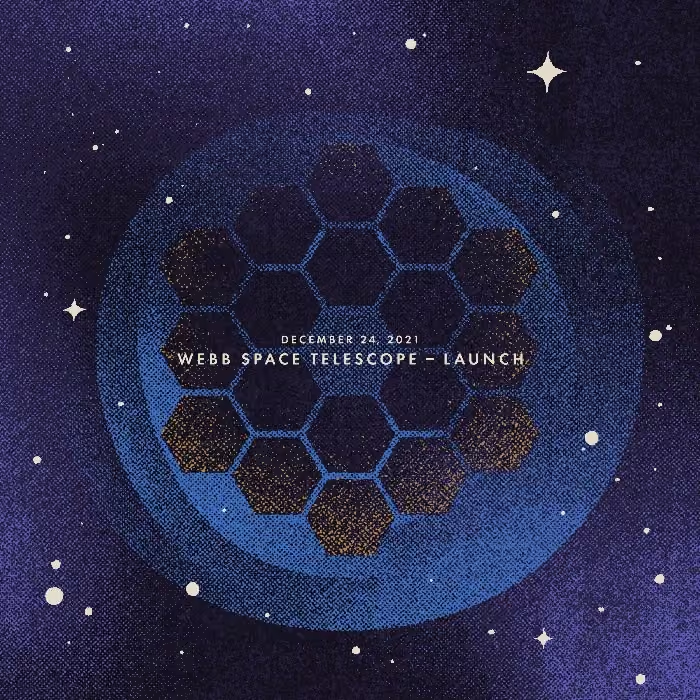
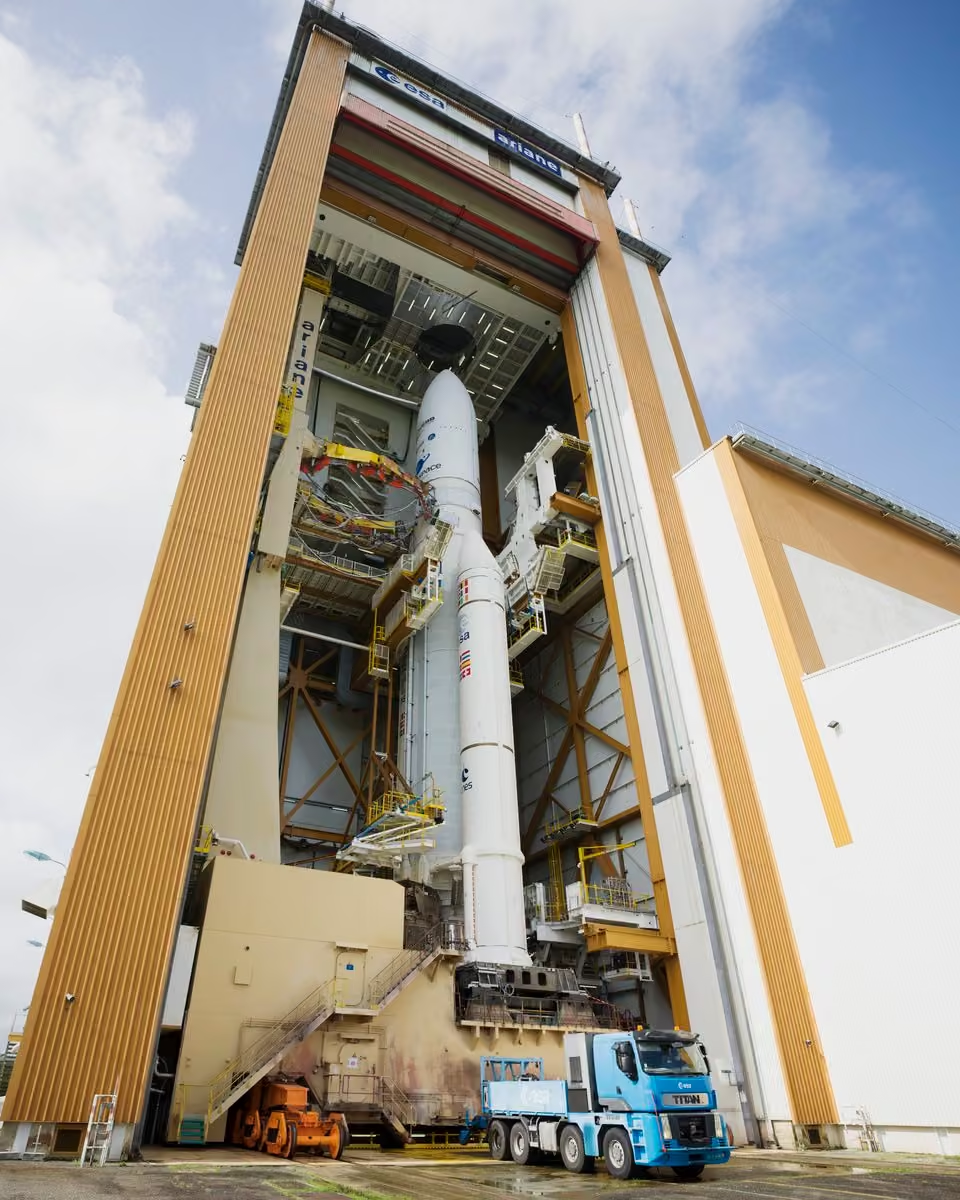
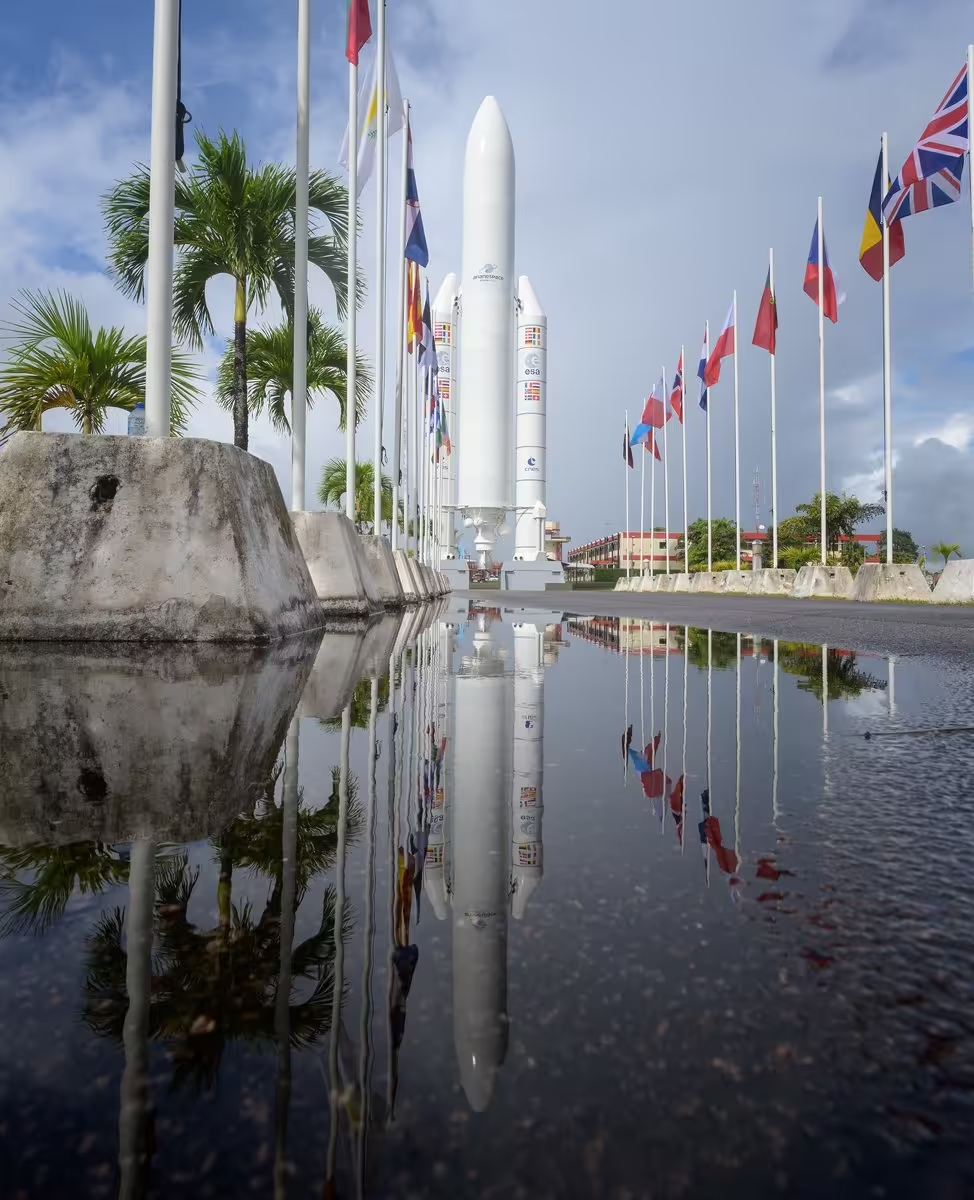
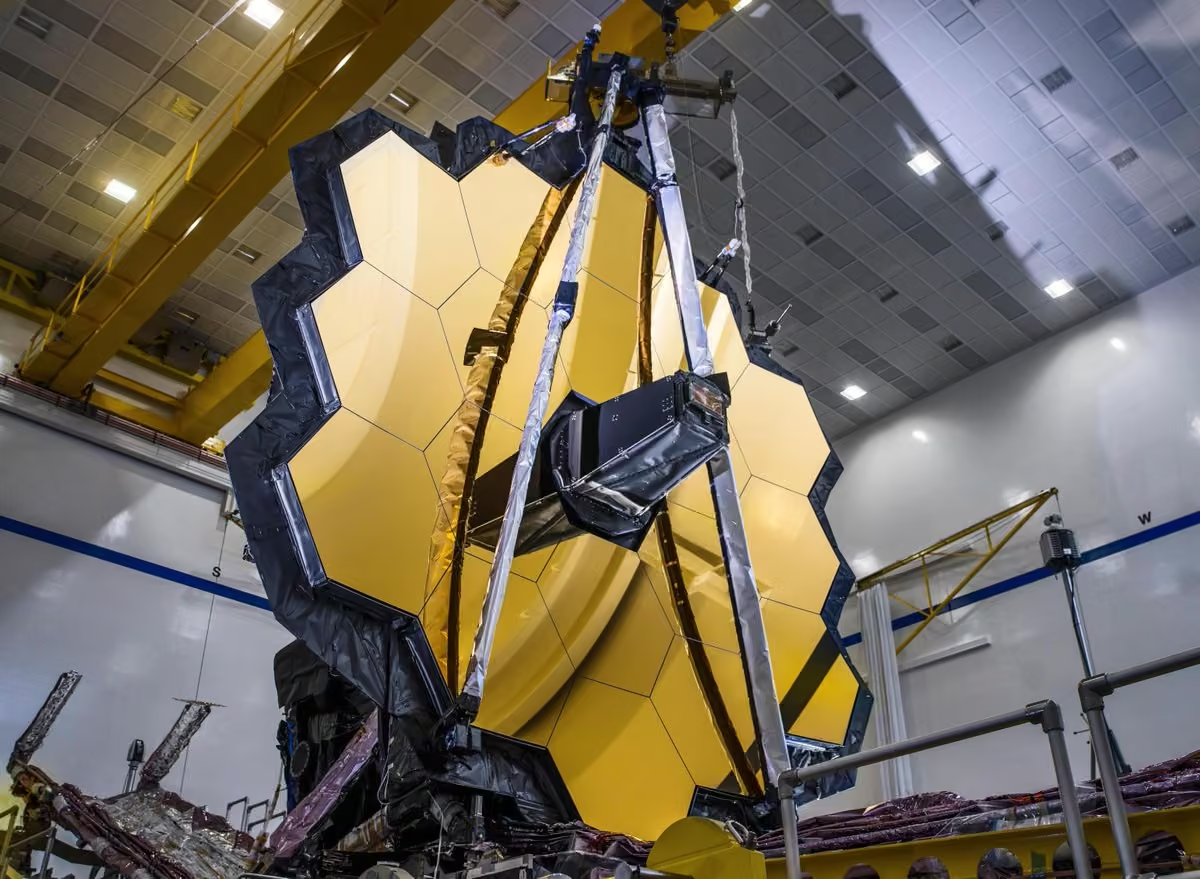
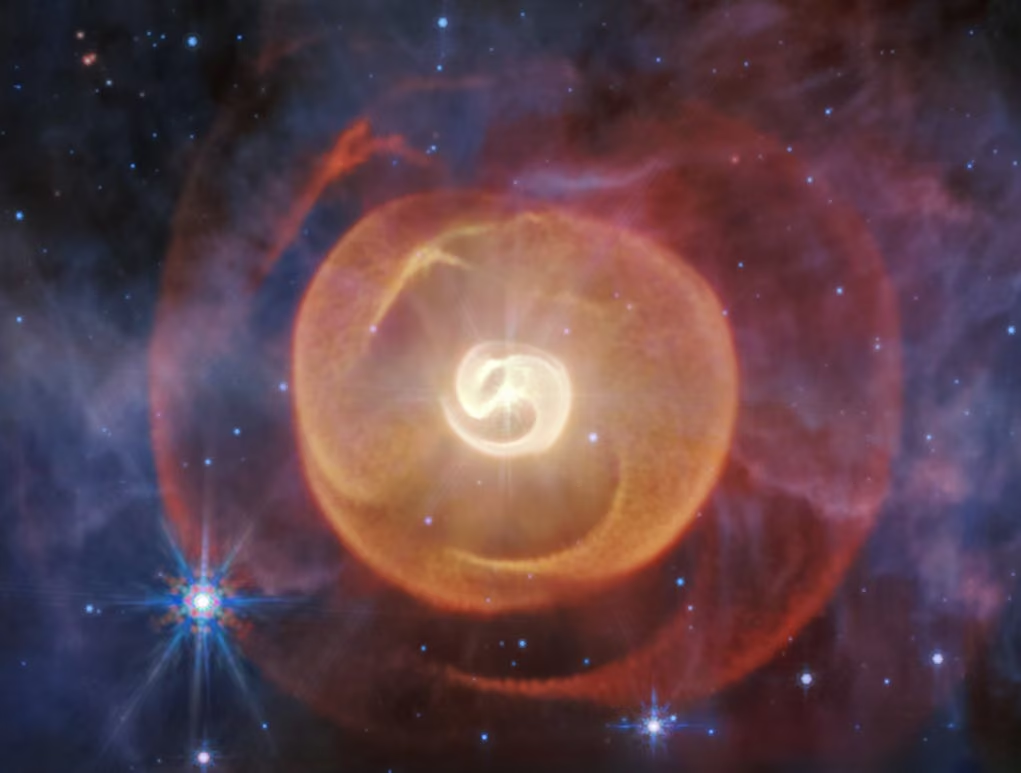
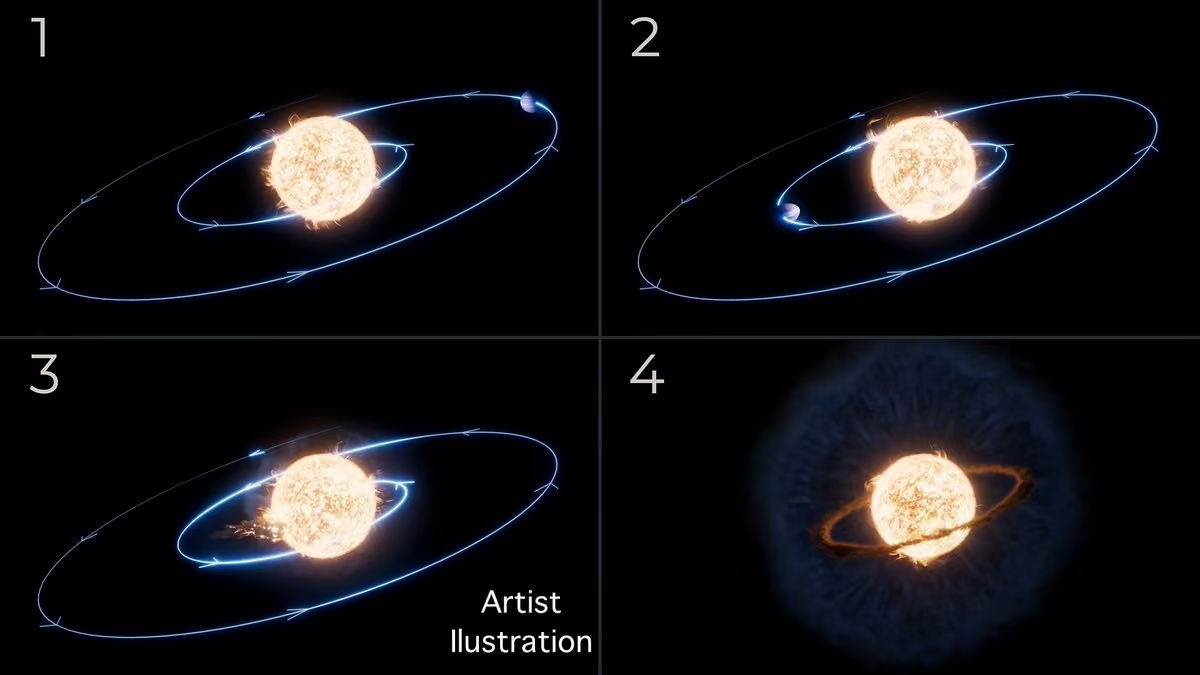
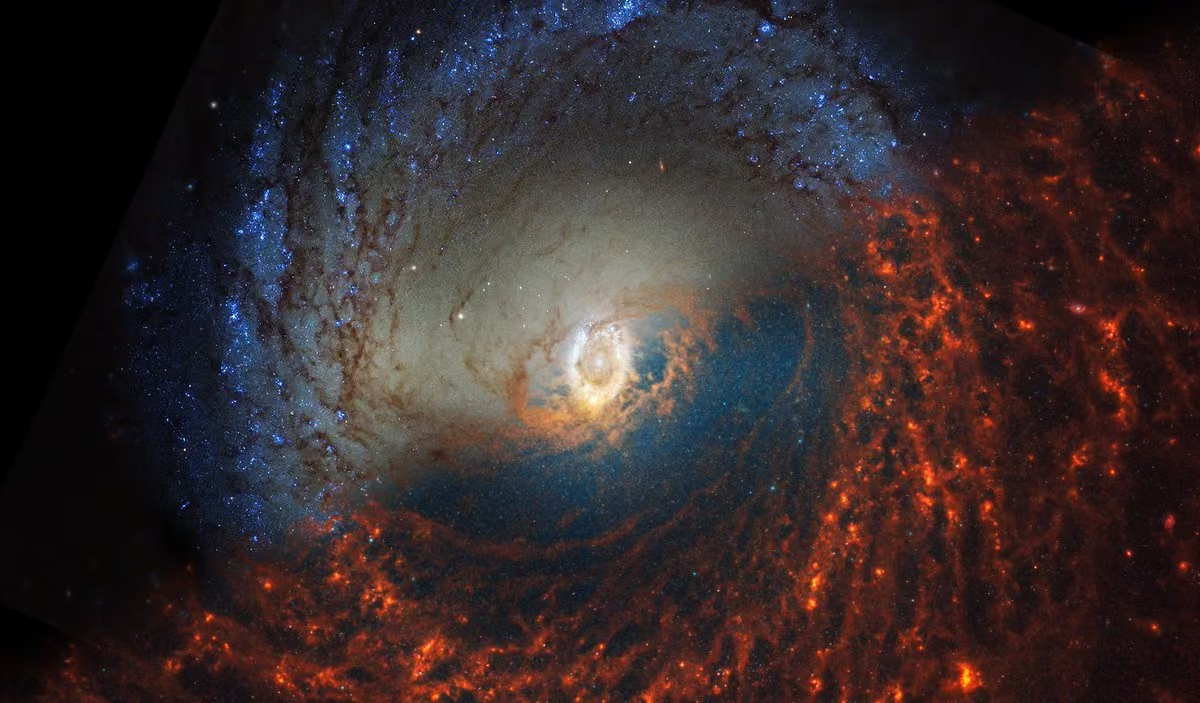
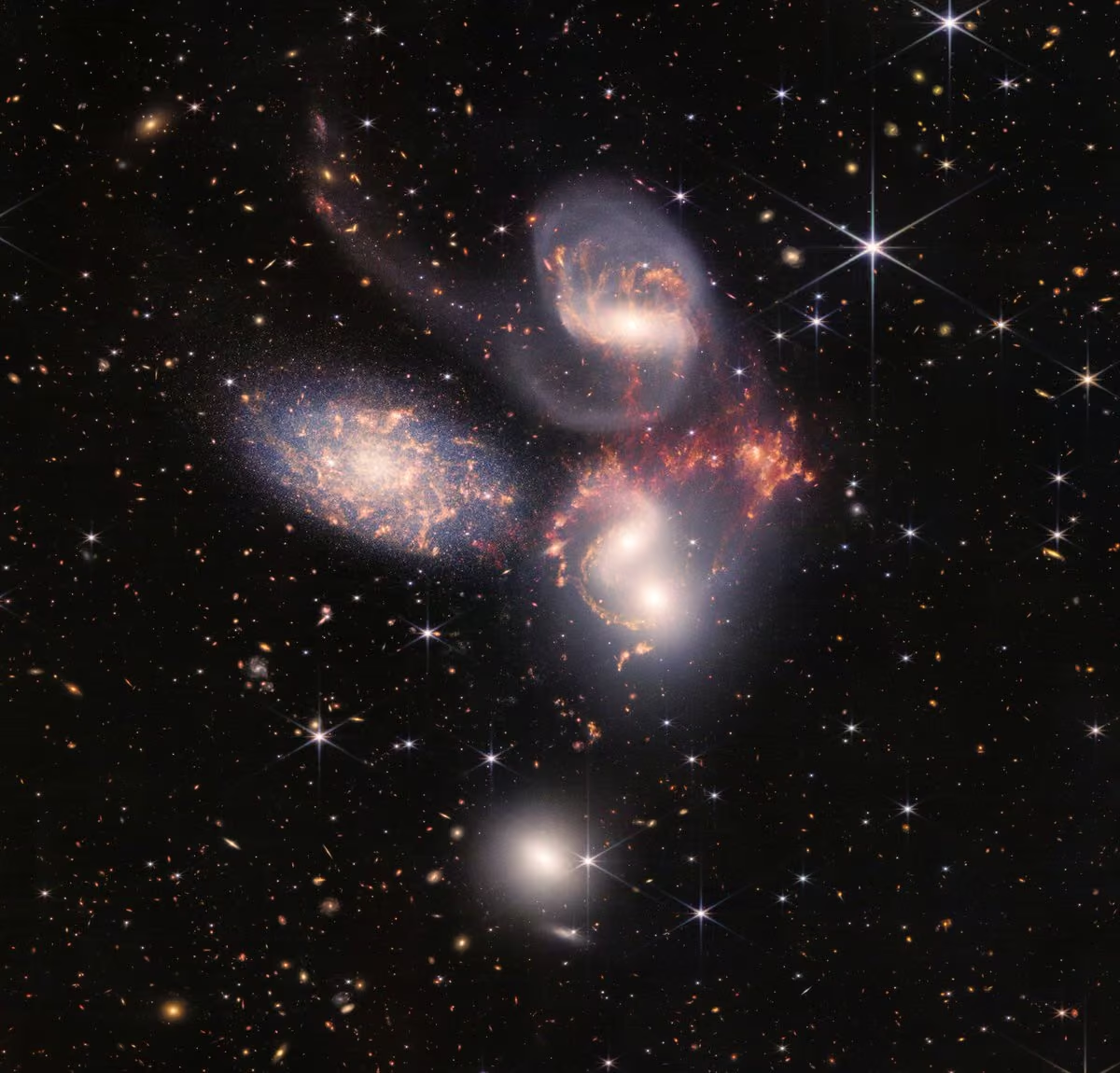
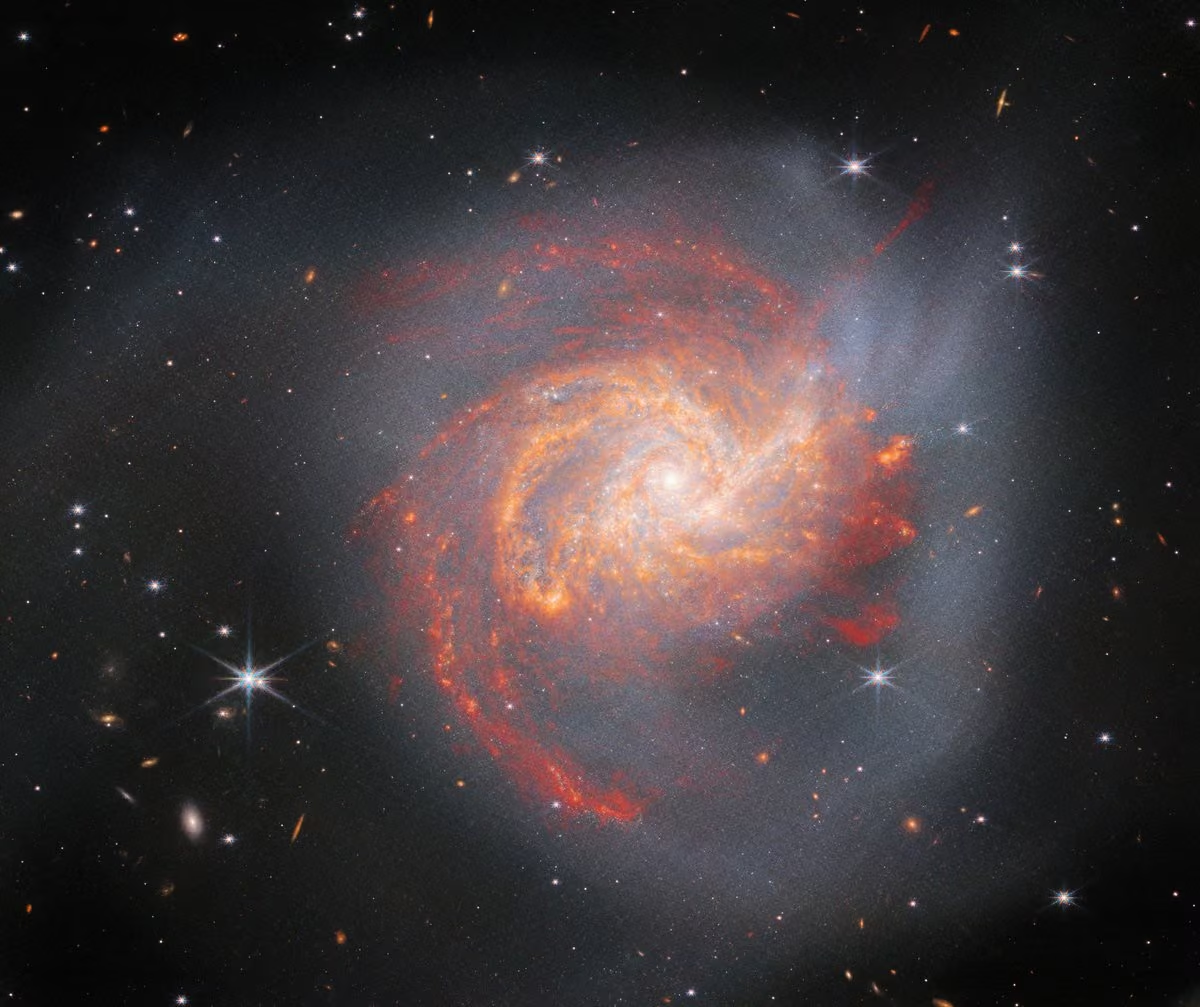
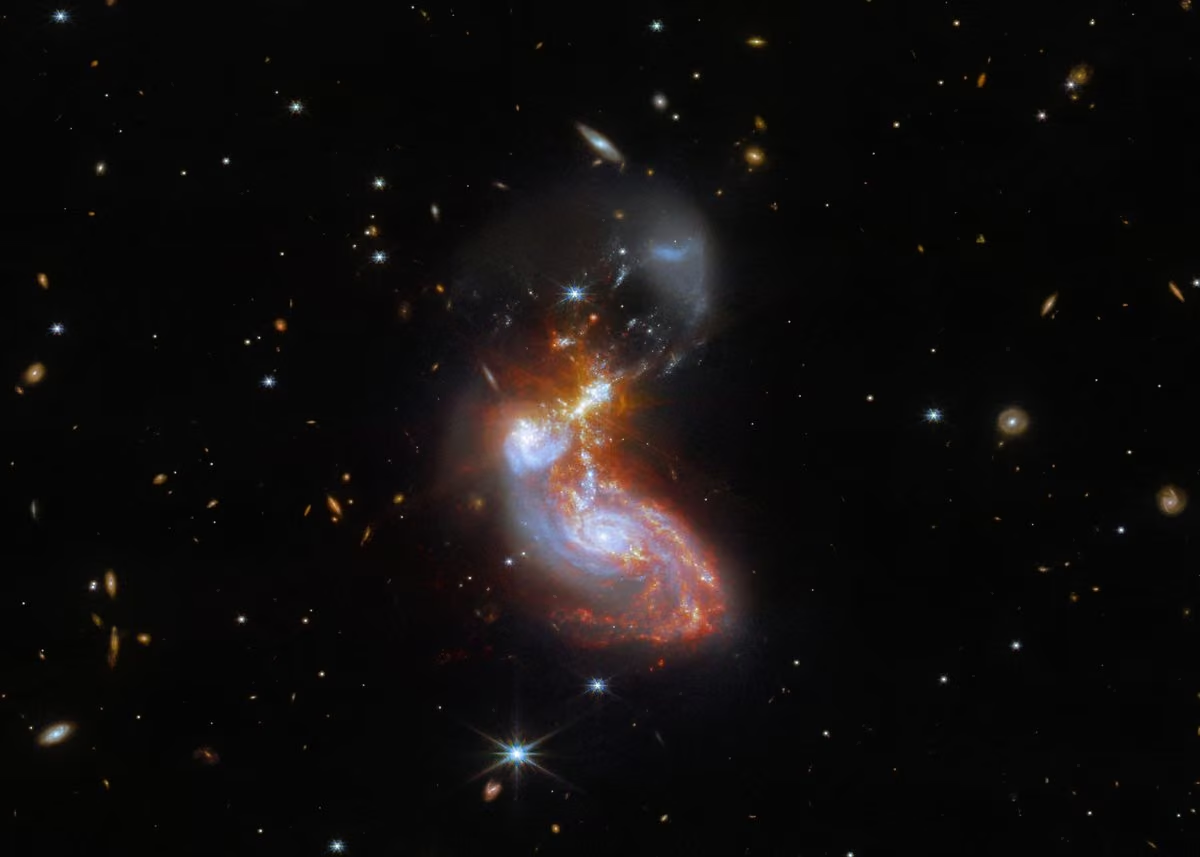
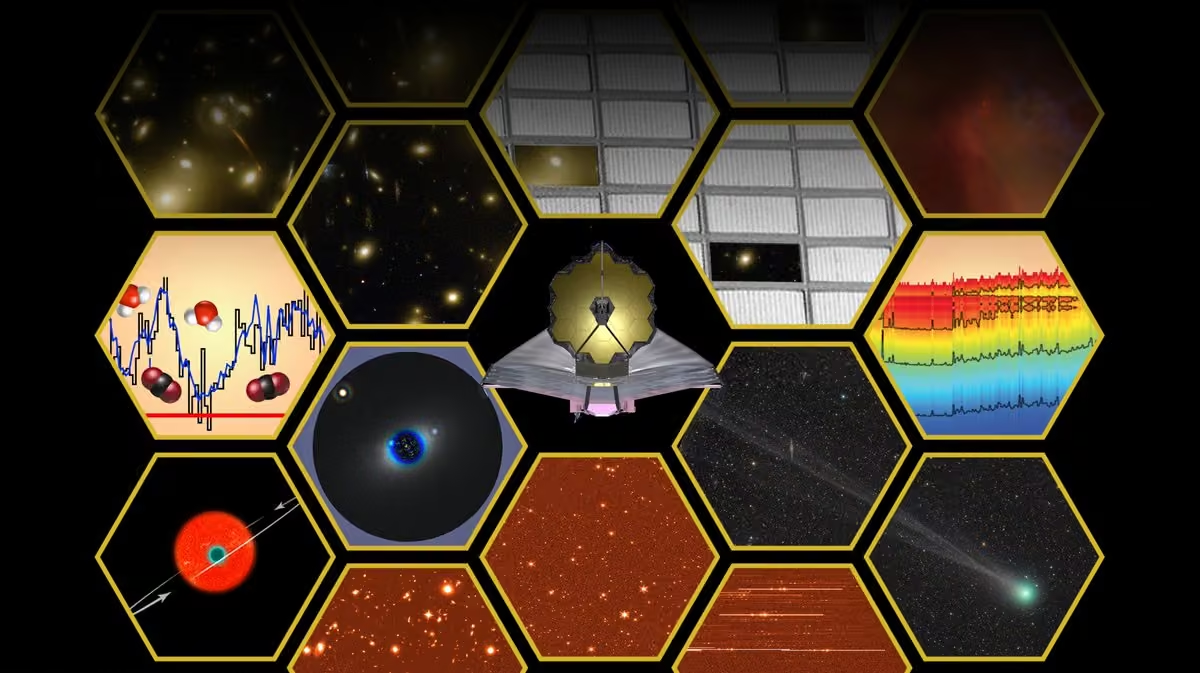
Two stars enter...
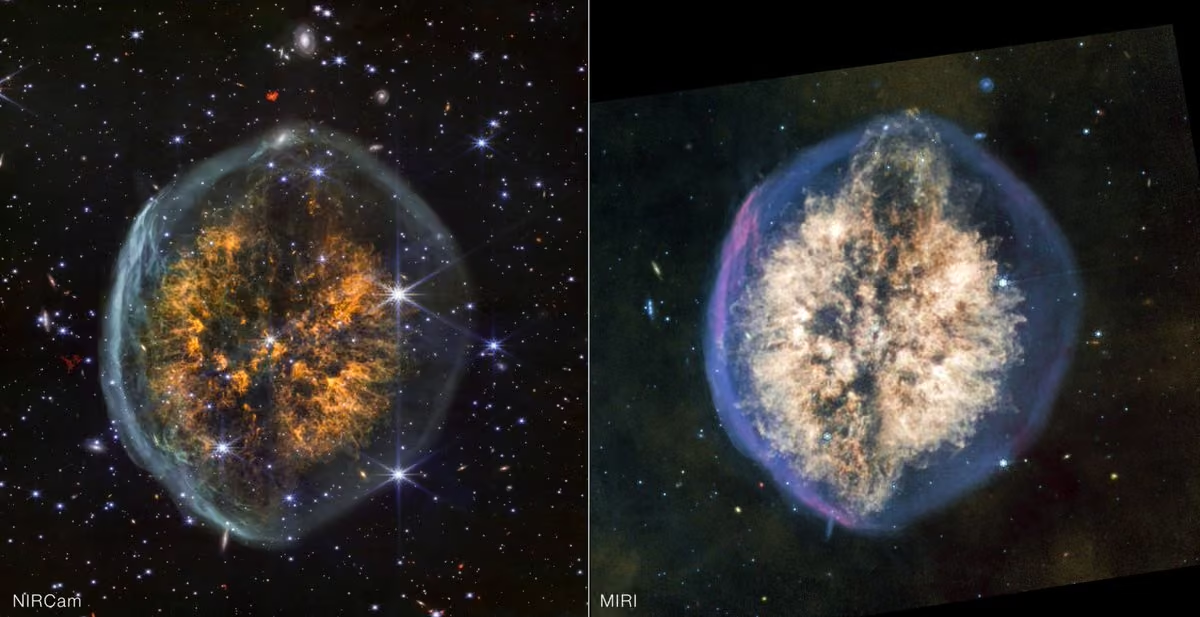
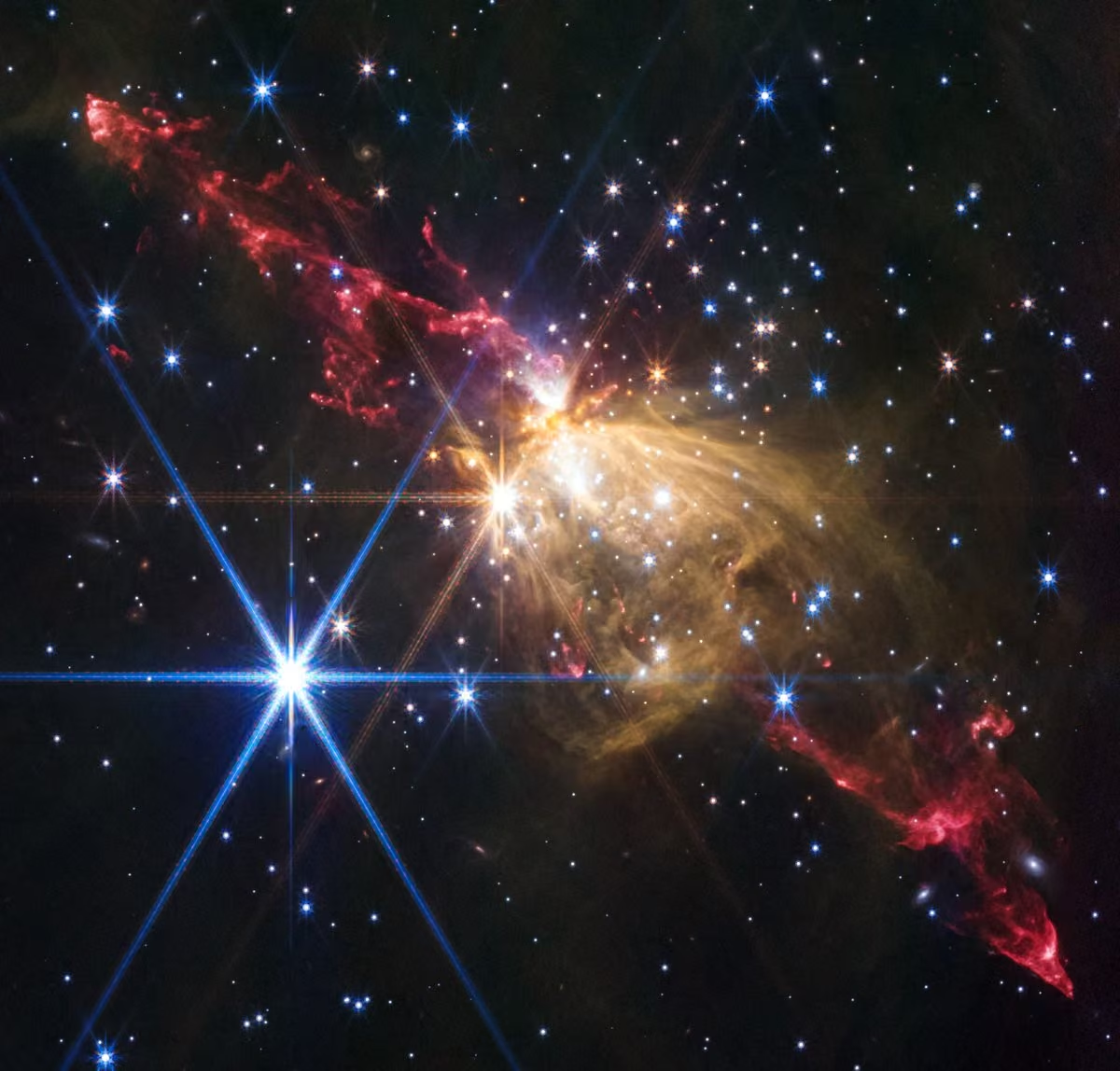
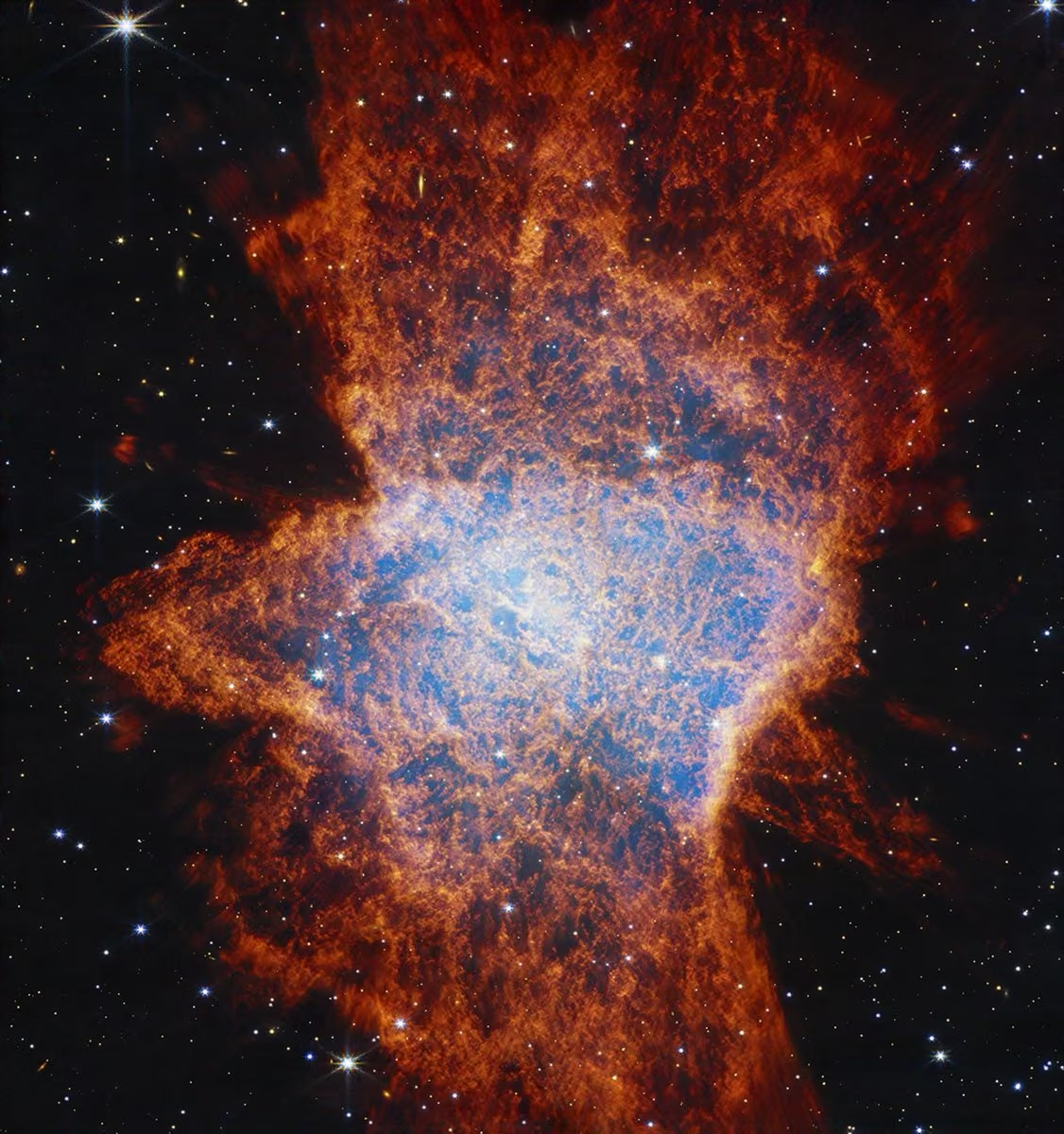
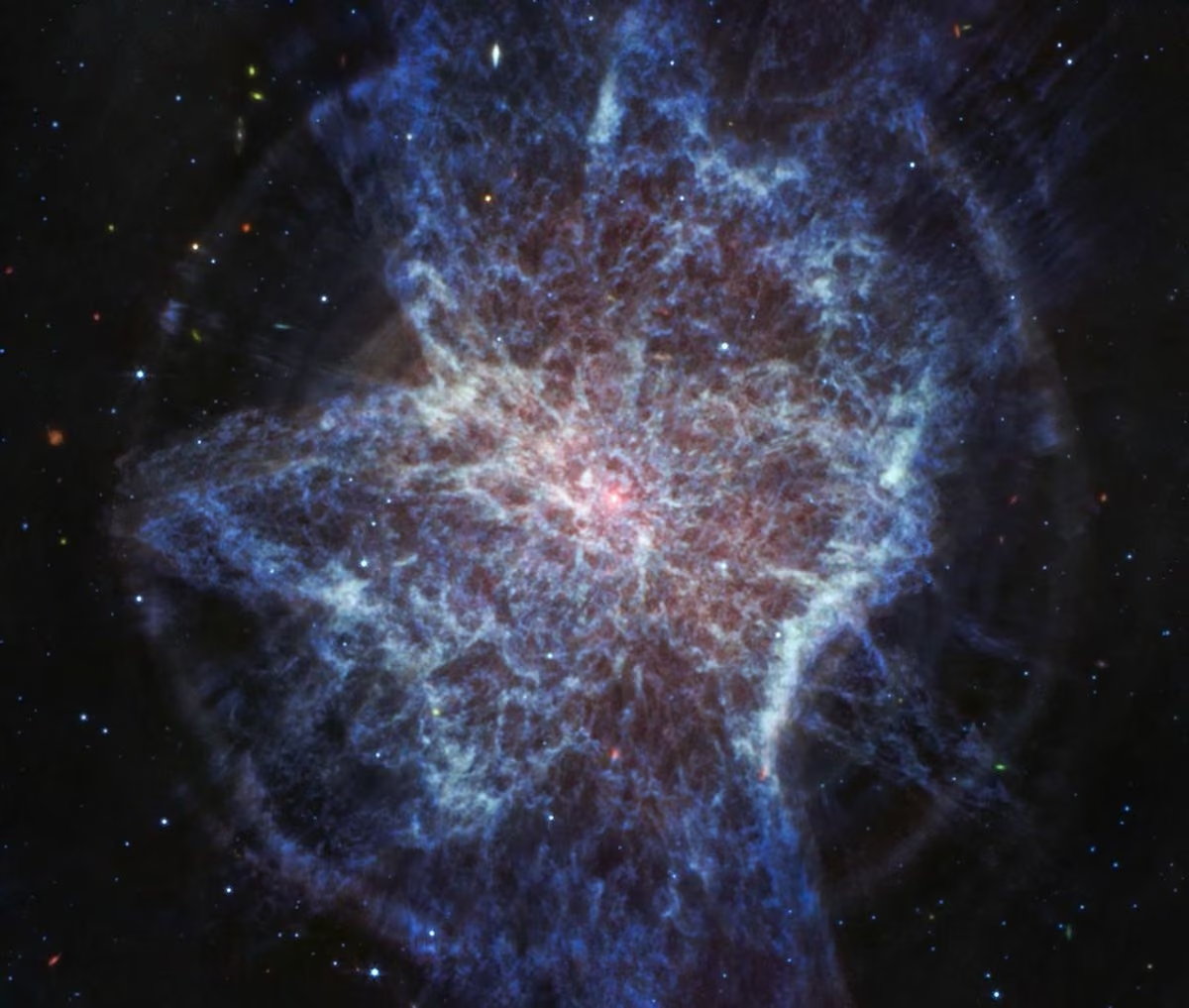
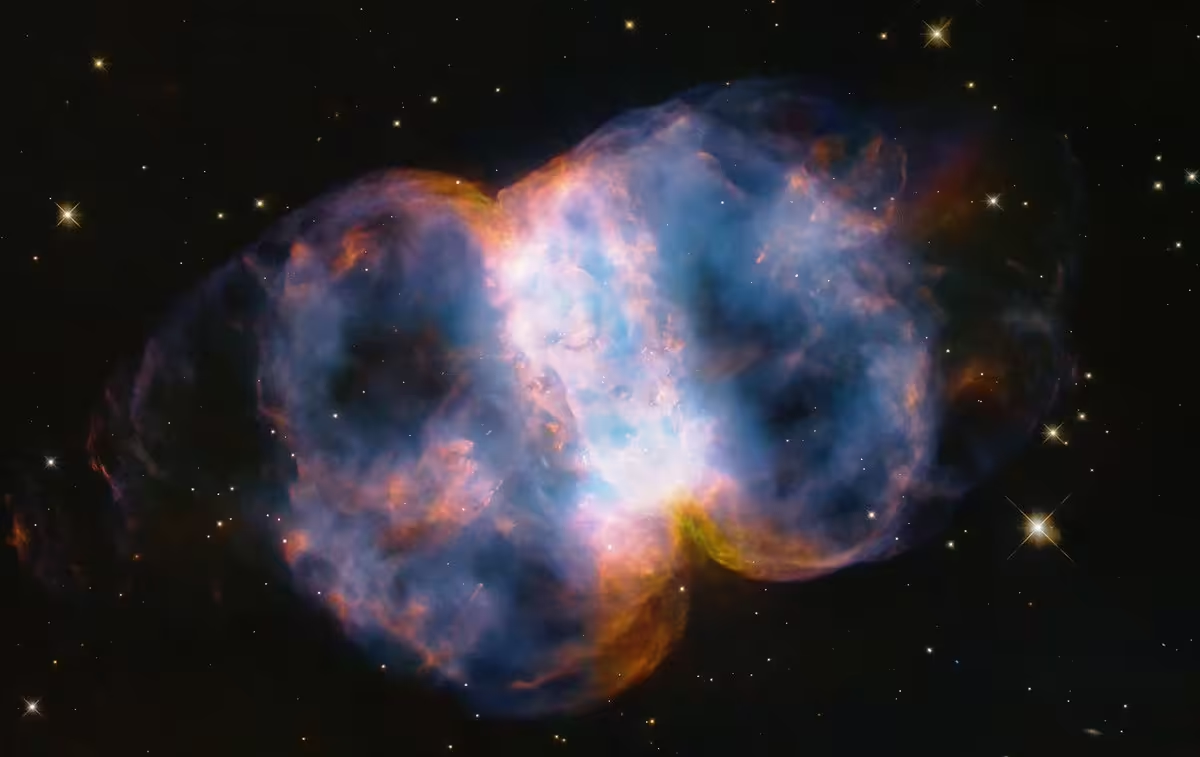
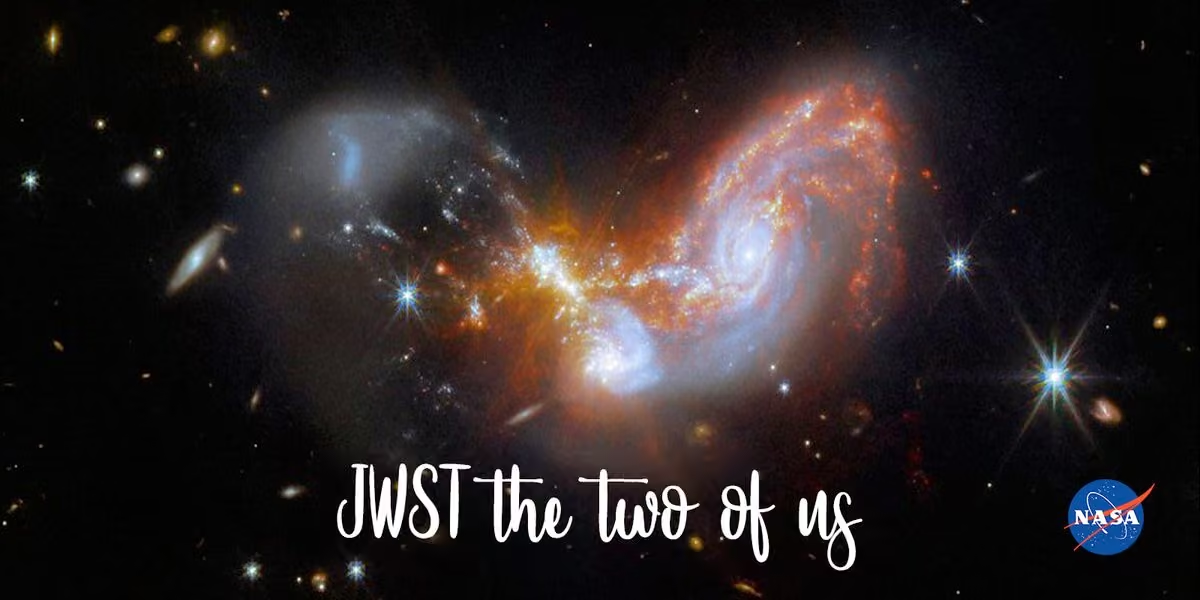
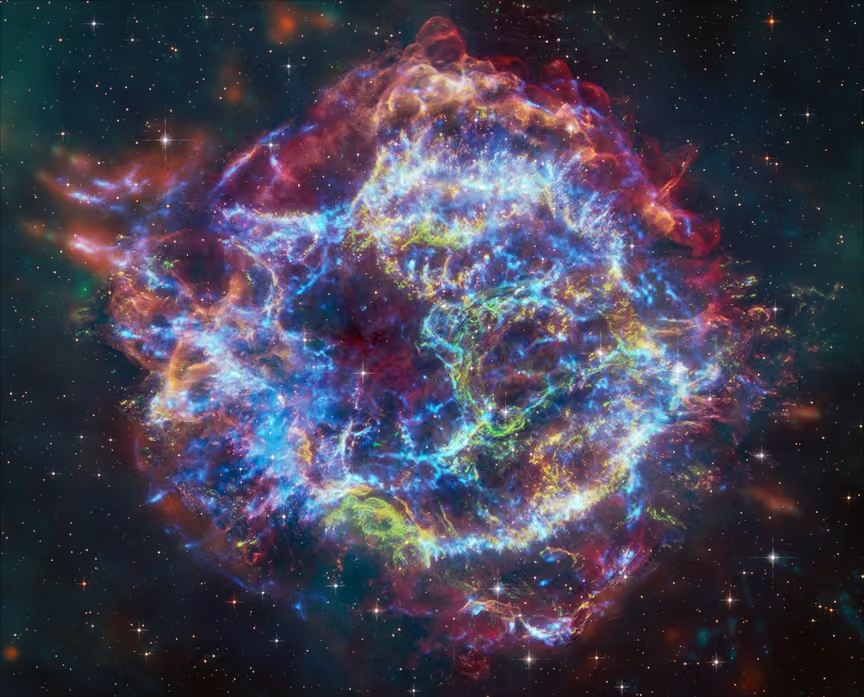
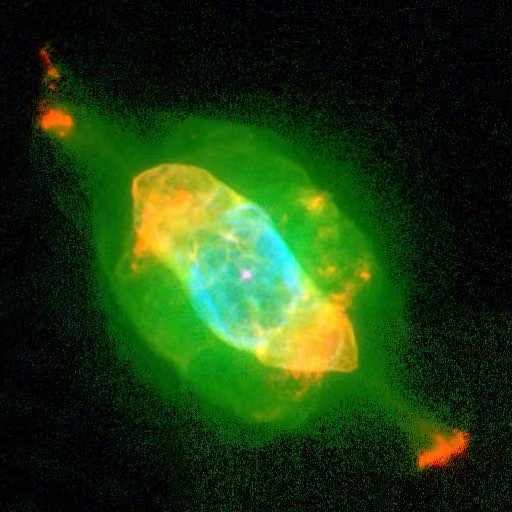
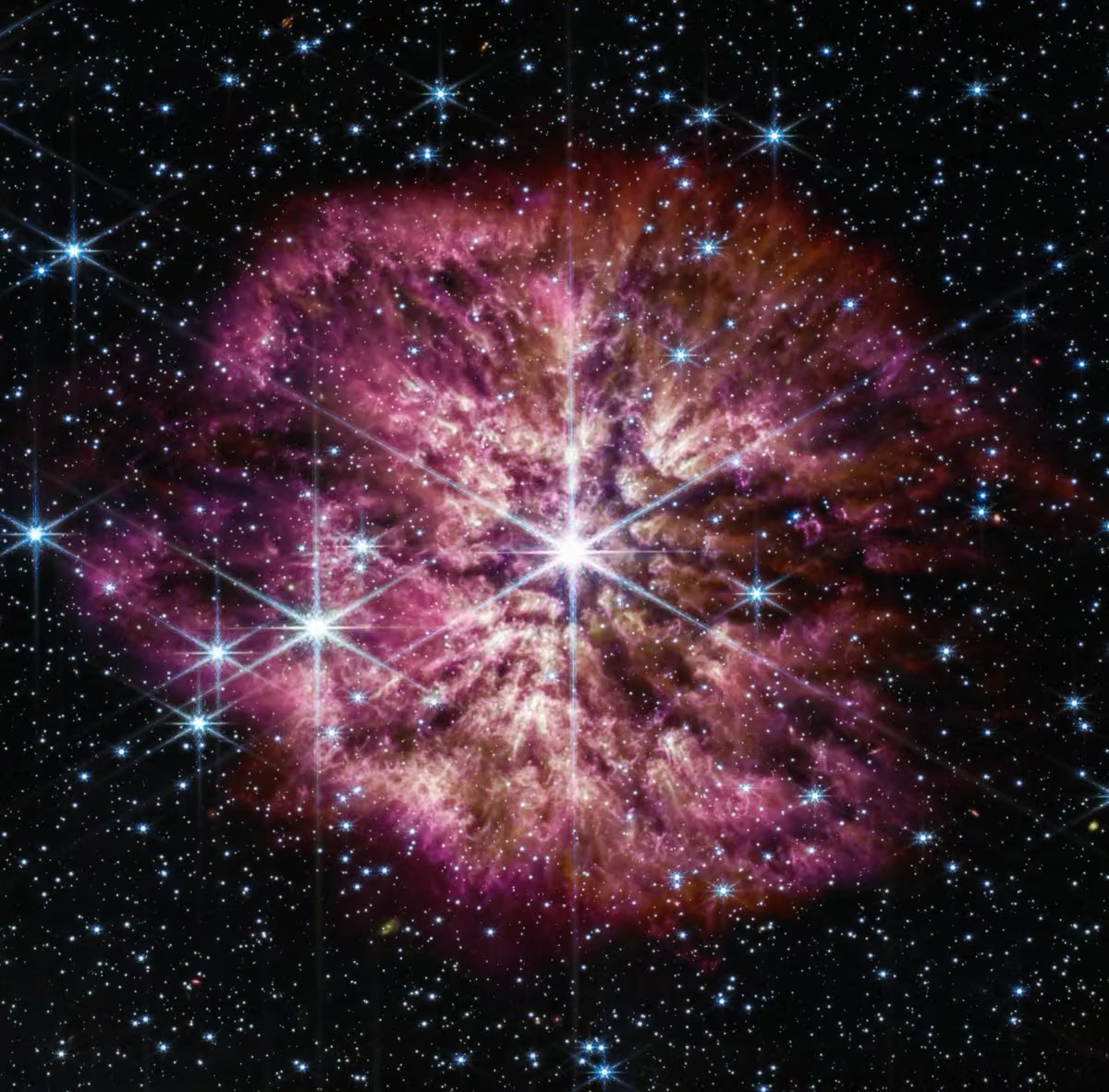
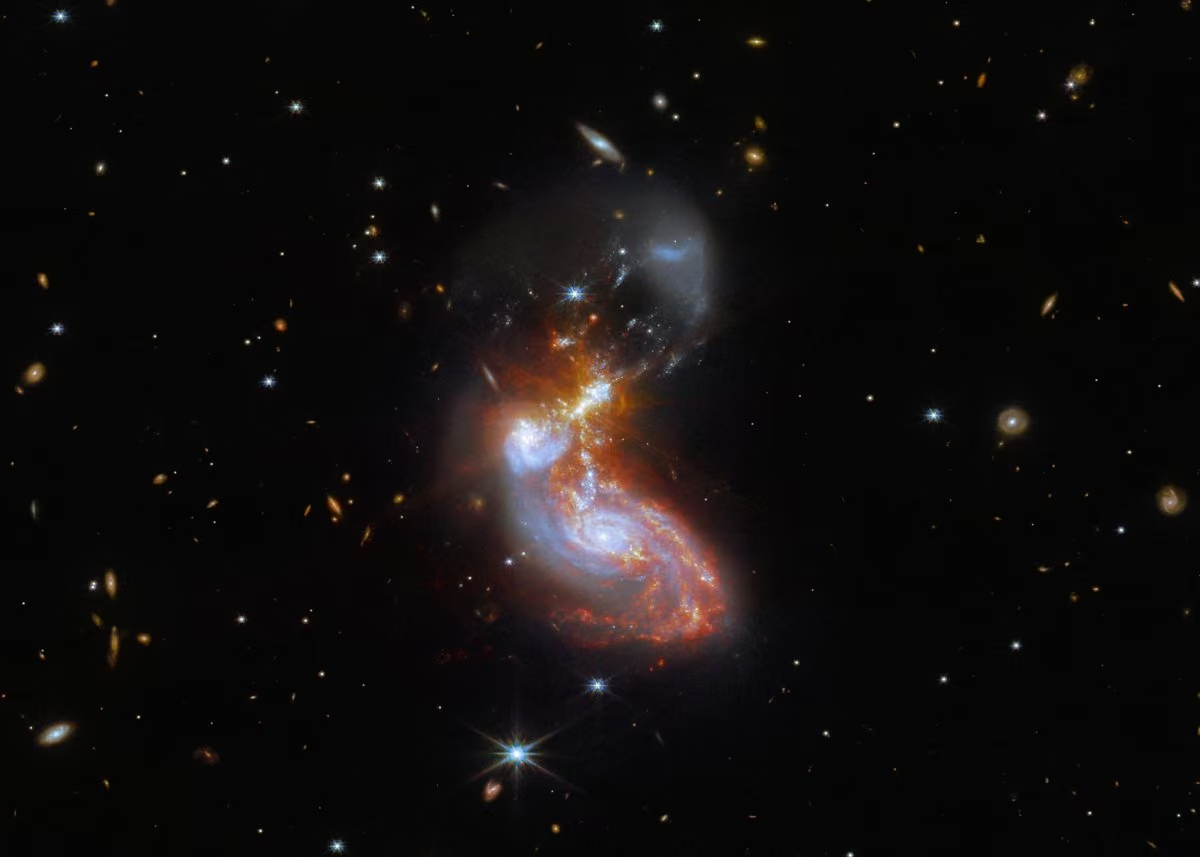
Webb observed the aftermath of a star merger, helping astronomers piece together the fate of the pair. Webb’s quick-turn look was cross-referenced with ultraviolet, visible, and near-infrared data from telescopes both in space and on the ground.
James Webb Space Telescope
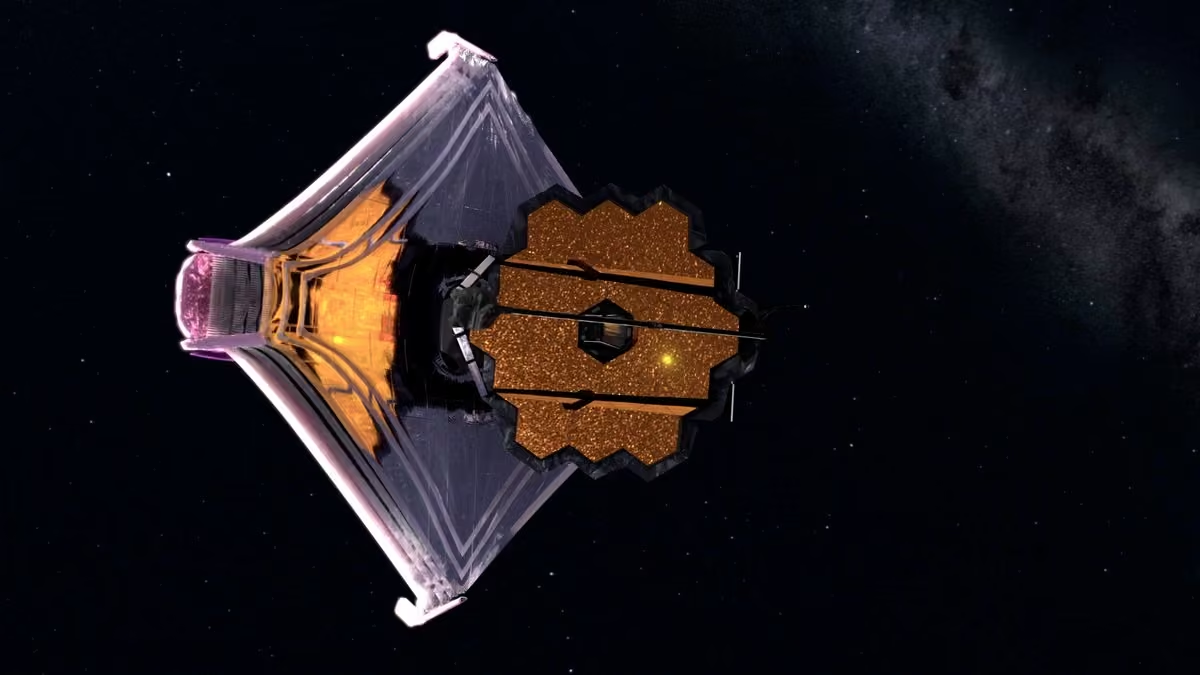
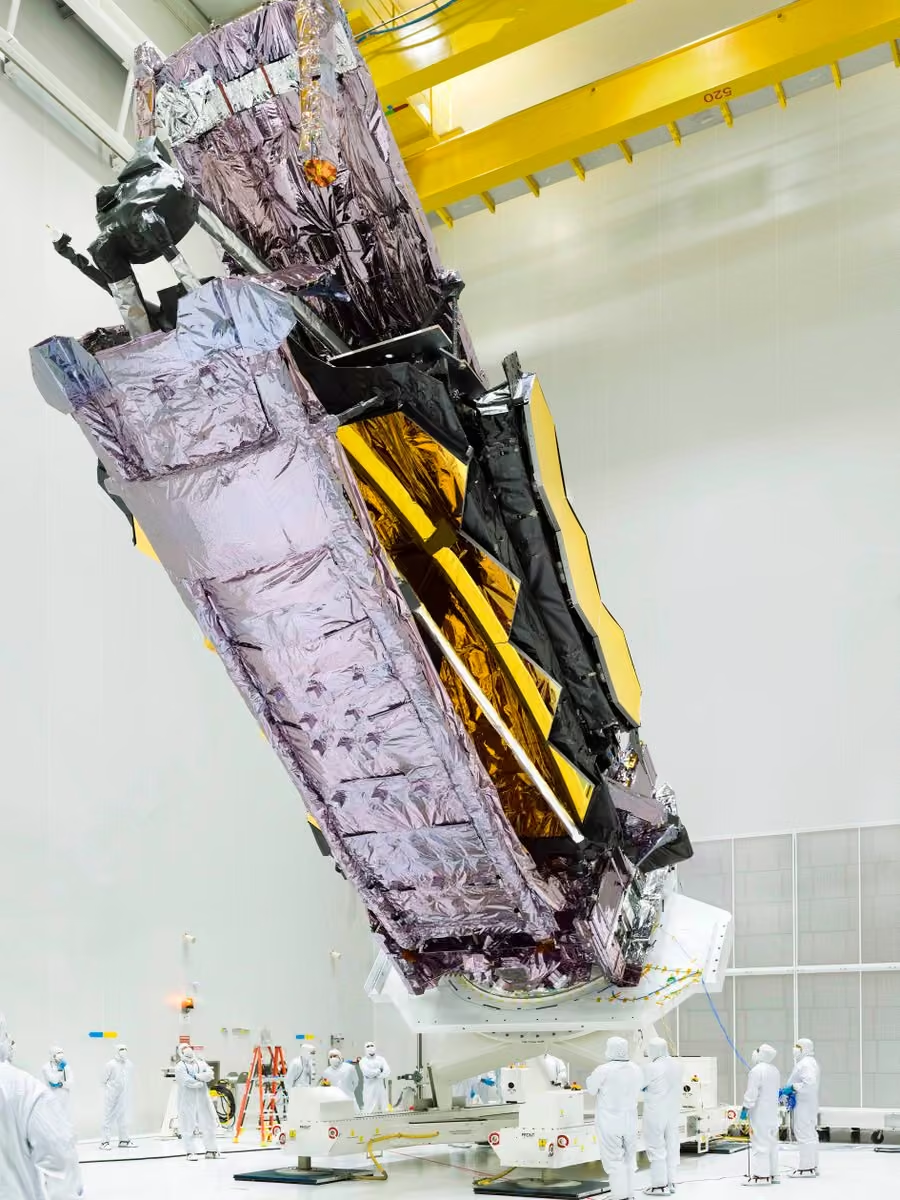
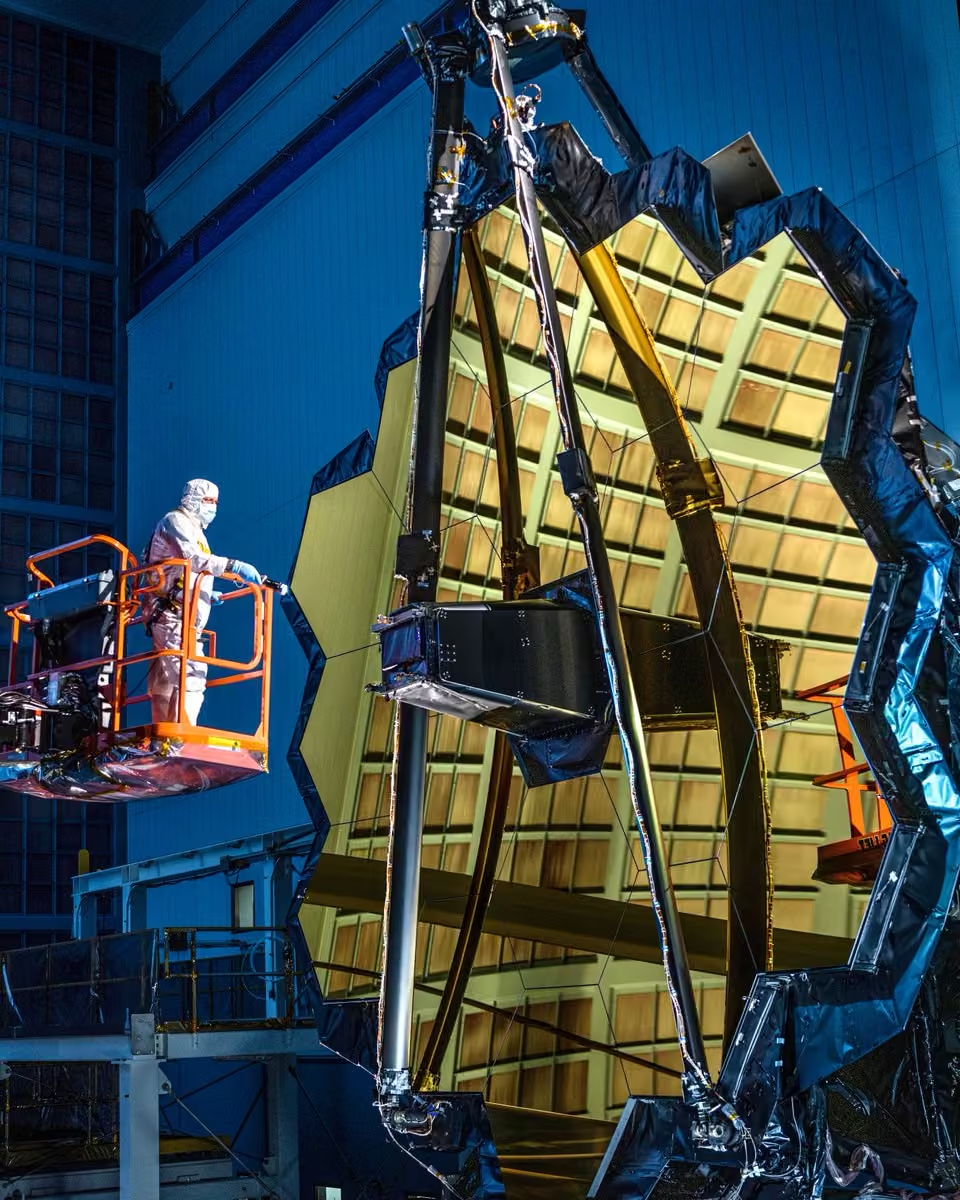
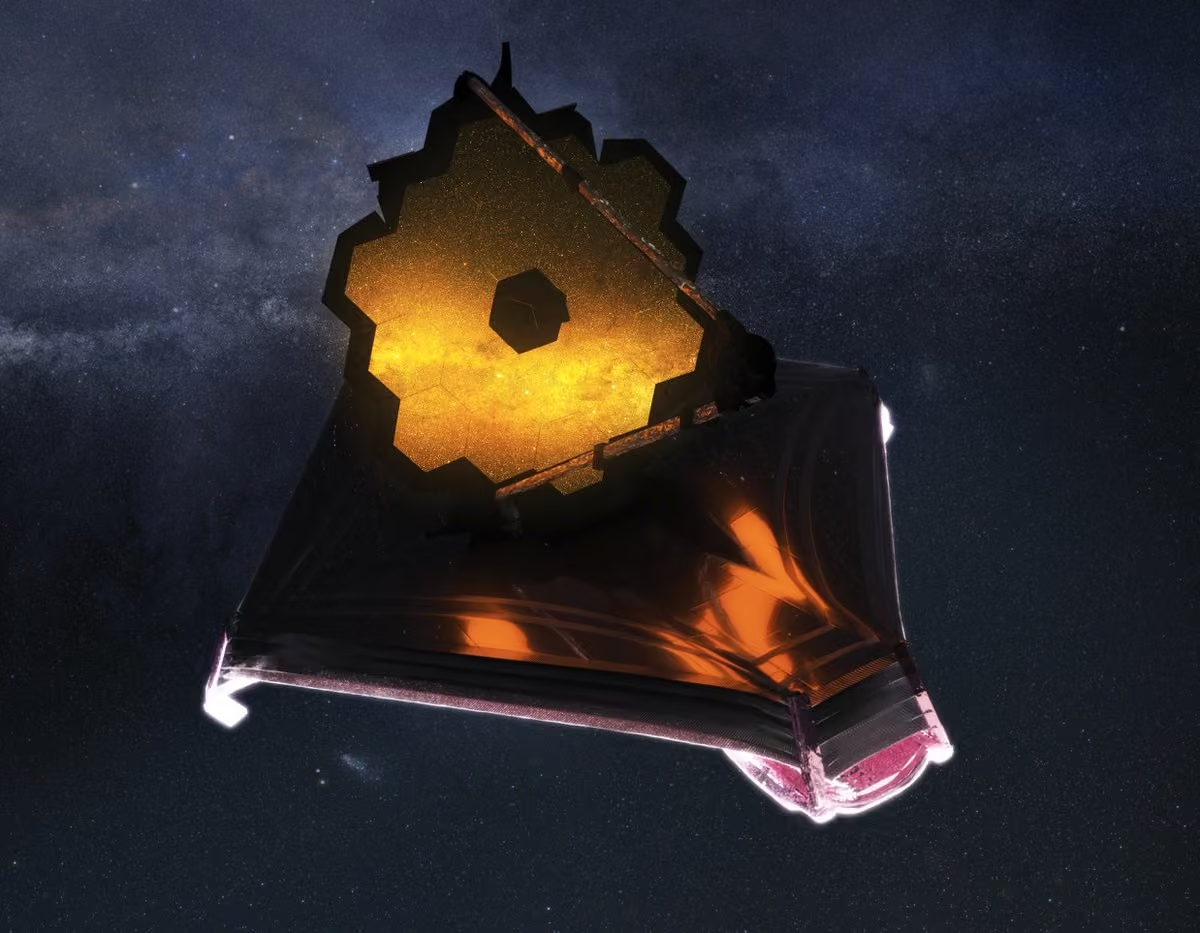
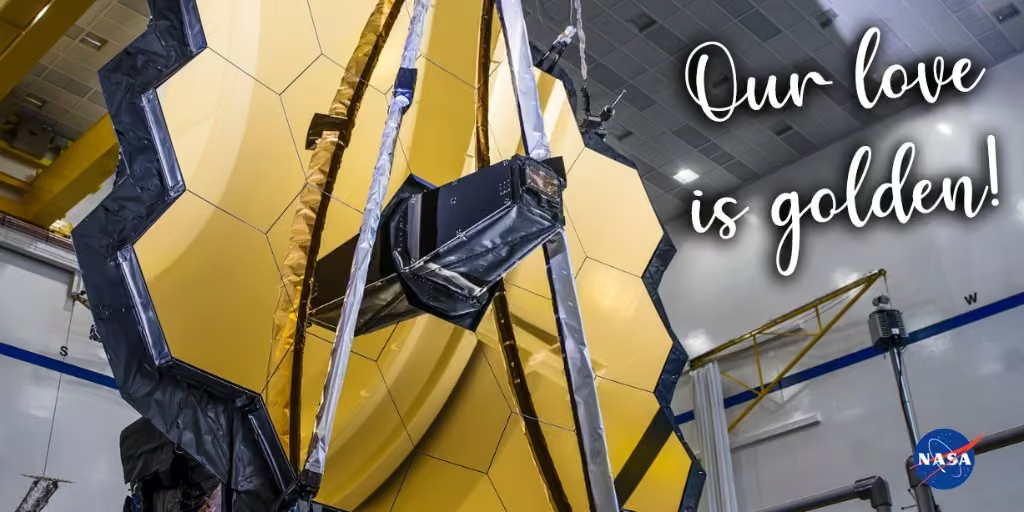
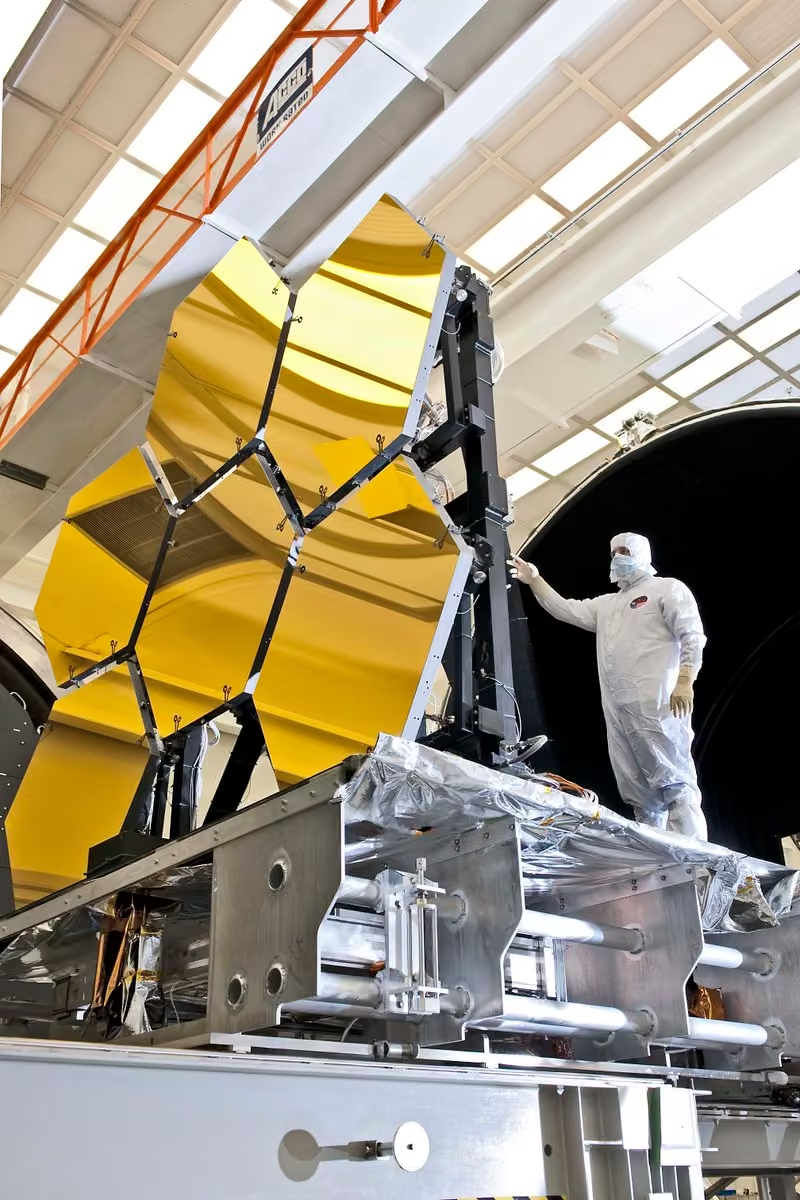
The James Webb Space Telescope (JWST) is a space telescope designed to conduct infrared astronomy. It is the largest telescope in space, and is equipped with high-resolution and high-sensitivity instruments, allowing it to view objects too old, distant, or faint for the Hubble Space Telescope. This enables investigations across many fields of astronomy and cosmology, such as observation of the first stars and the formation of the first galaxies, and detailed atmospheric characterization of potentially habitable exoplanets. More on Wikipedia
-
NASA Webb Telescope
@NASAWebb

-
NASA Webb Telescope reposted
Space Telescope Science Institute
@SpaceTelescope
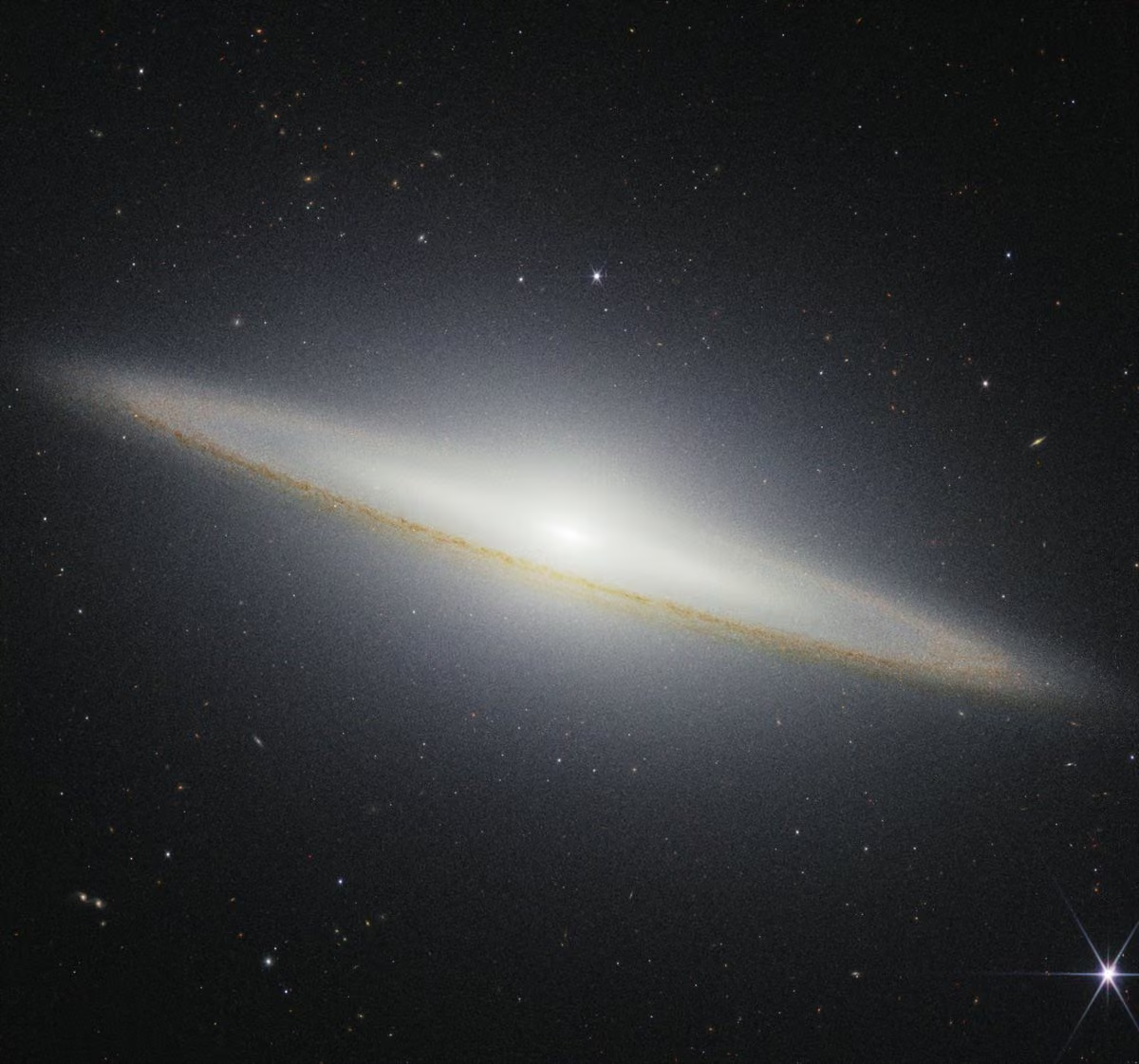
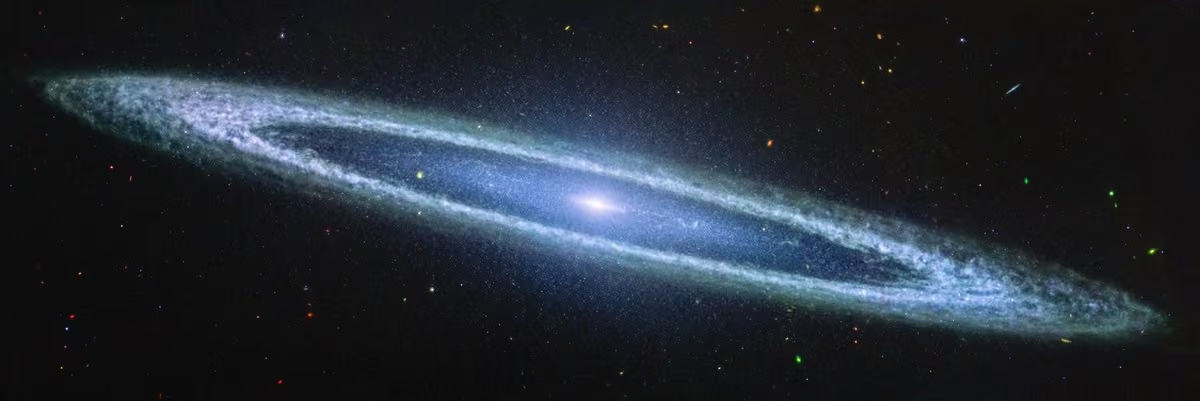
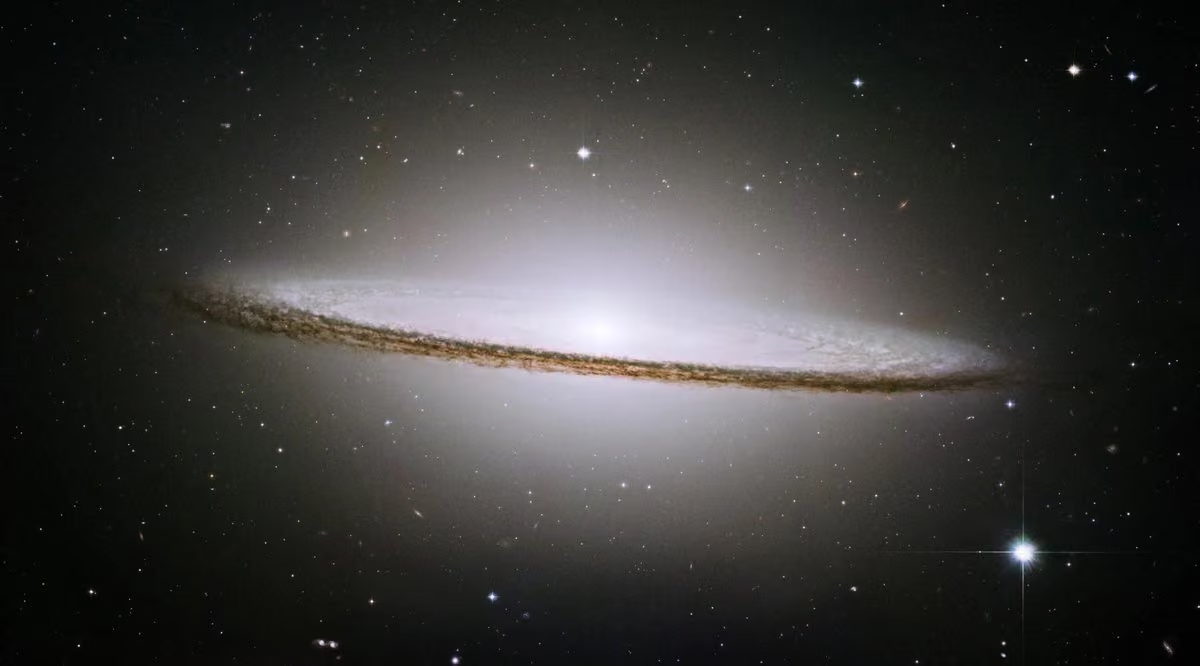
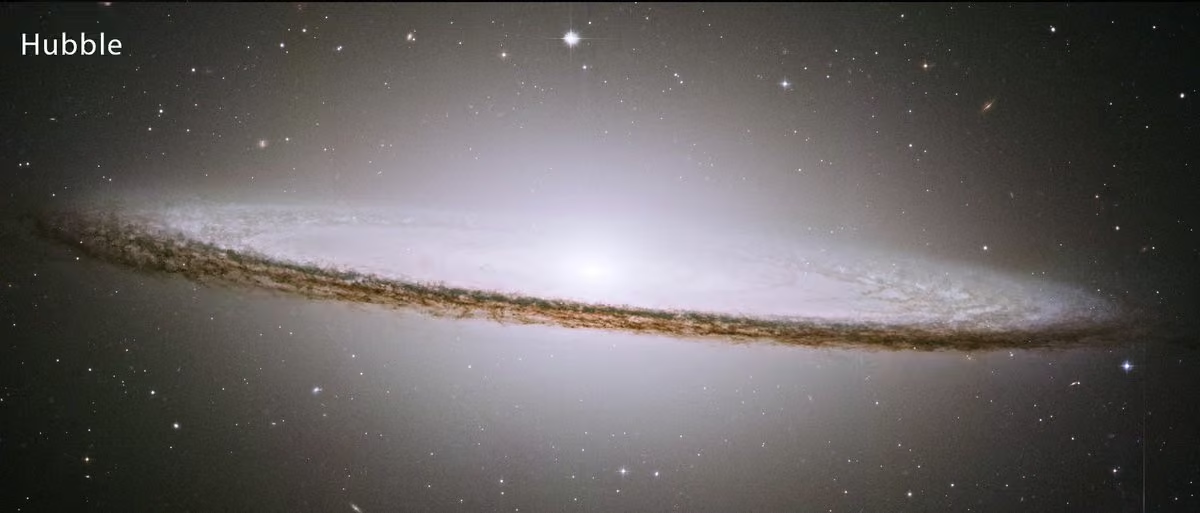
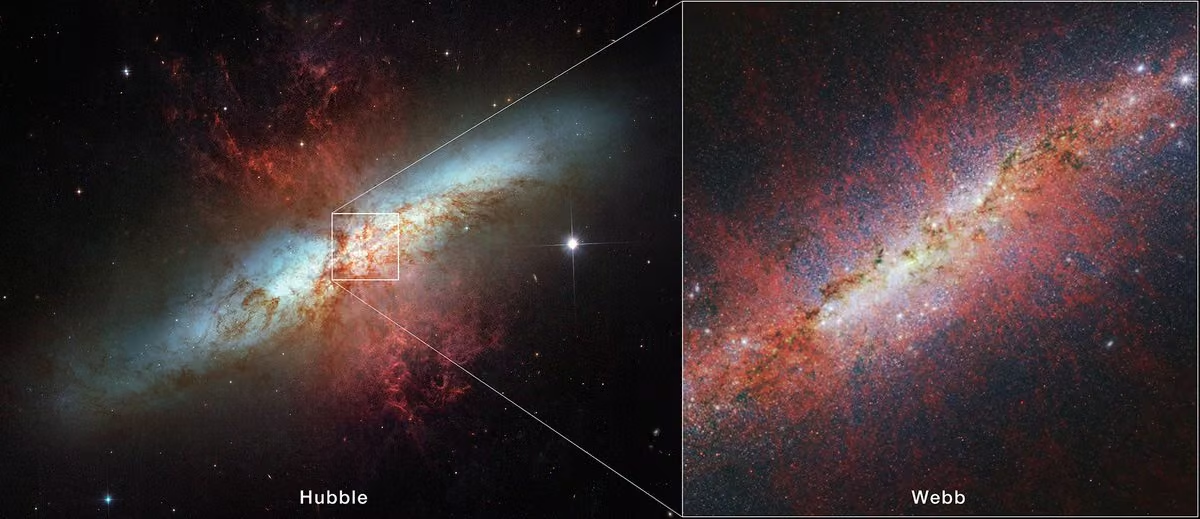
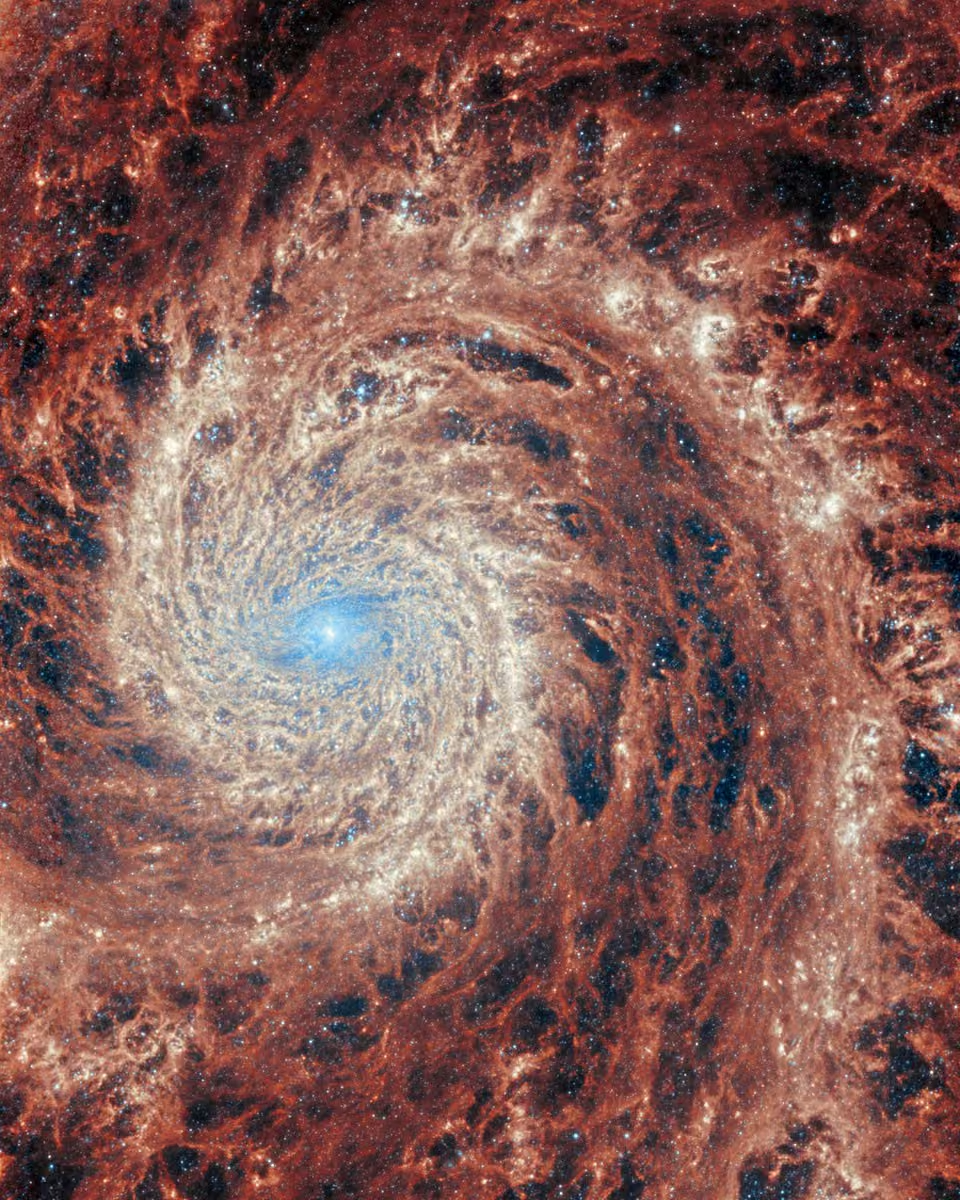
NOVEMBER 10: The Cigar Galaxy has been notoriously difficult to study. It contains large amounts of dust, making its disk nearly impenetrable at optical wavelengths. Now #nasawebb has pierced through its dust to reveal its structure in incredible detail. www.youtube.com/live/YeA17Ex3lcE
-
NASA Webb Telescope
@NASAWebb
Happy Halloween! 👻
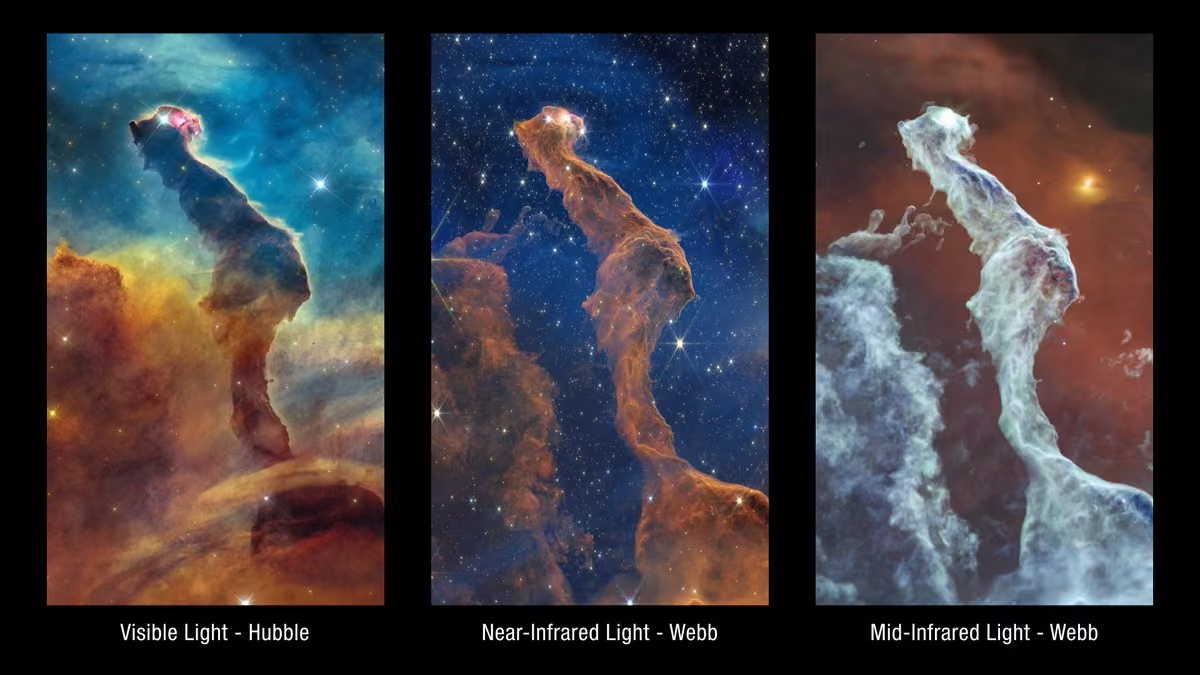
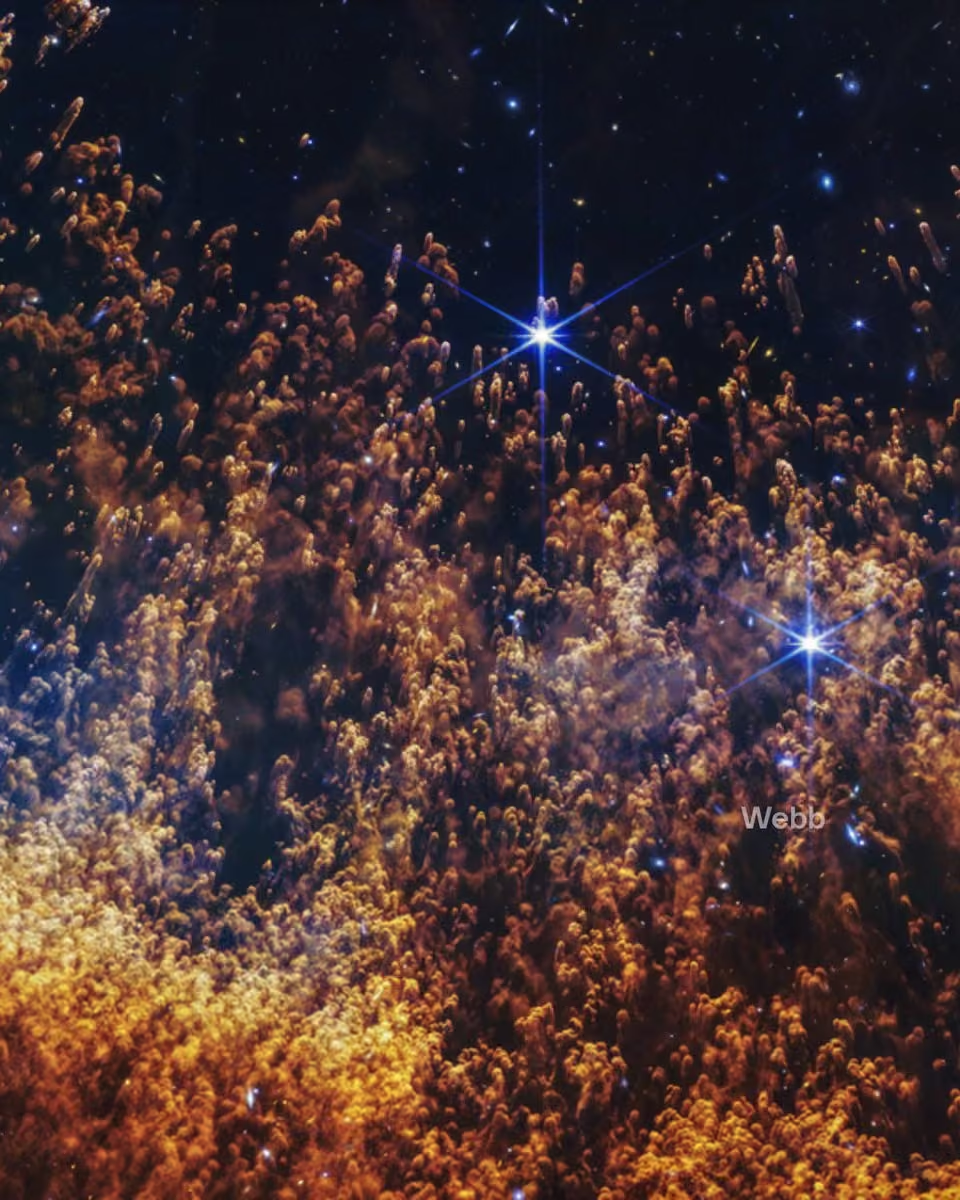
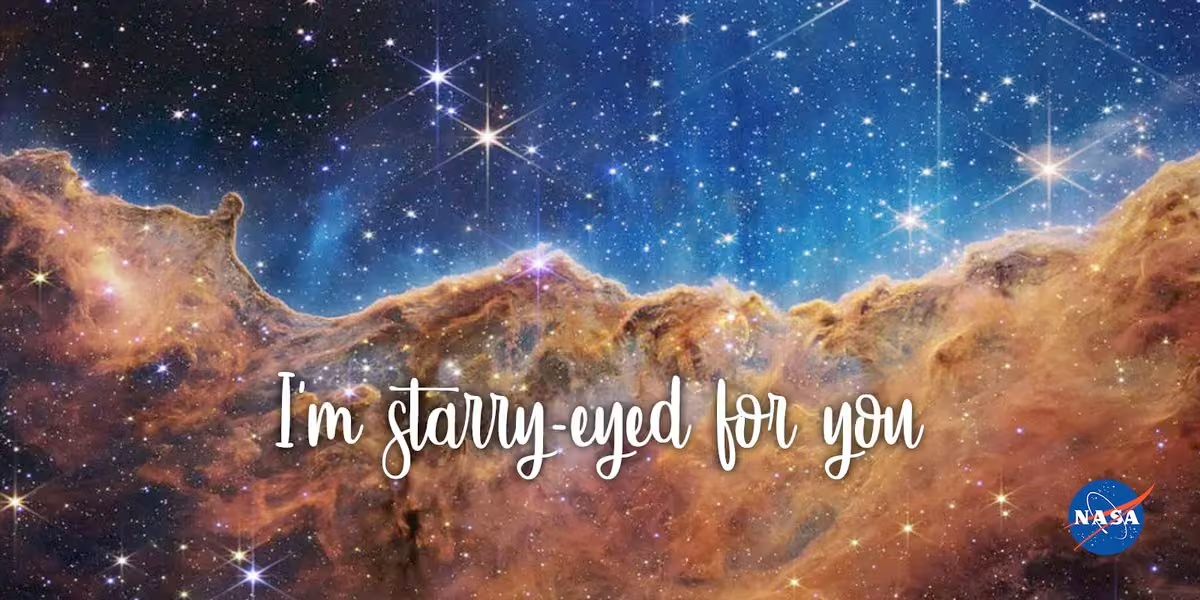
Like a spectral form rising out of a cold mist, @NASAHubble and Webb have captured a hauntingly dynamic star-forming scene, which lies within the vast Carina Nebula, a diffuse star-forming region located about 7,500 light-years away from Earth.
NASA Webb Telescope
@NASAWebb
The small, select area both telescopes observed is nicknamed the Cat’s Head Nebula because of its resemblance to a cat sitting with its back toward the viewer. The “head” of the cat is turned to the right, revealing a glowing eye.
NASA Webb Telescope
@NASAWebb
Hubble and Webb’s complementary views of the Cat’s Head Nebula are helping astronomers learn more about the elusive, chaotic, and complex process known as star formation. Read more: science.nasa.gov/missions/hubble/ghostly-cats-head-nebula…
-
NASA Webb Telescope
@NASAWebb
Pspspsp! Just in time for Halloween, NASA’s Hubble and James Webb Space Telescopes recently stared at an eerie star-forming scene within the Carina Nebula, a massive gas and dust cloud located approximately 7,500 light-years away from Earth.
This media couldn't be displayed. See it on the original post.
NASA Webb Telescope
@NASAWebb
The two telescopes offer complementary views of the shadowy form, nicknamed the Cat’s Head Nebula, which reflects the “magical” process of star formation. Read more: science.nasa.gov/missions/hubble/ghostly-cats-head-nebula…
-
NASA Webb Telescope
@NASAWebb
Rest easy, Captain. We have the helm. ✨
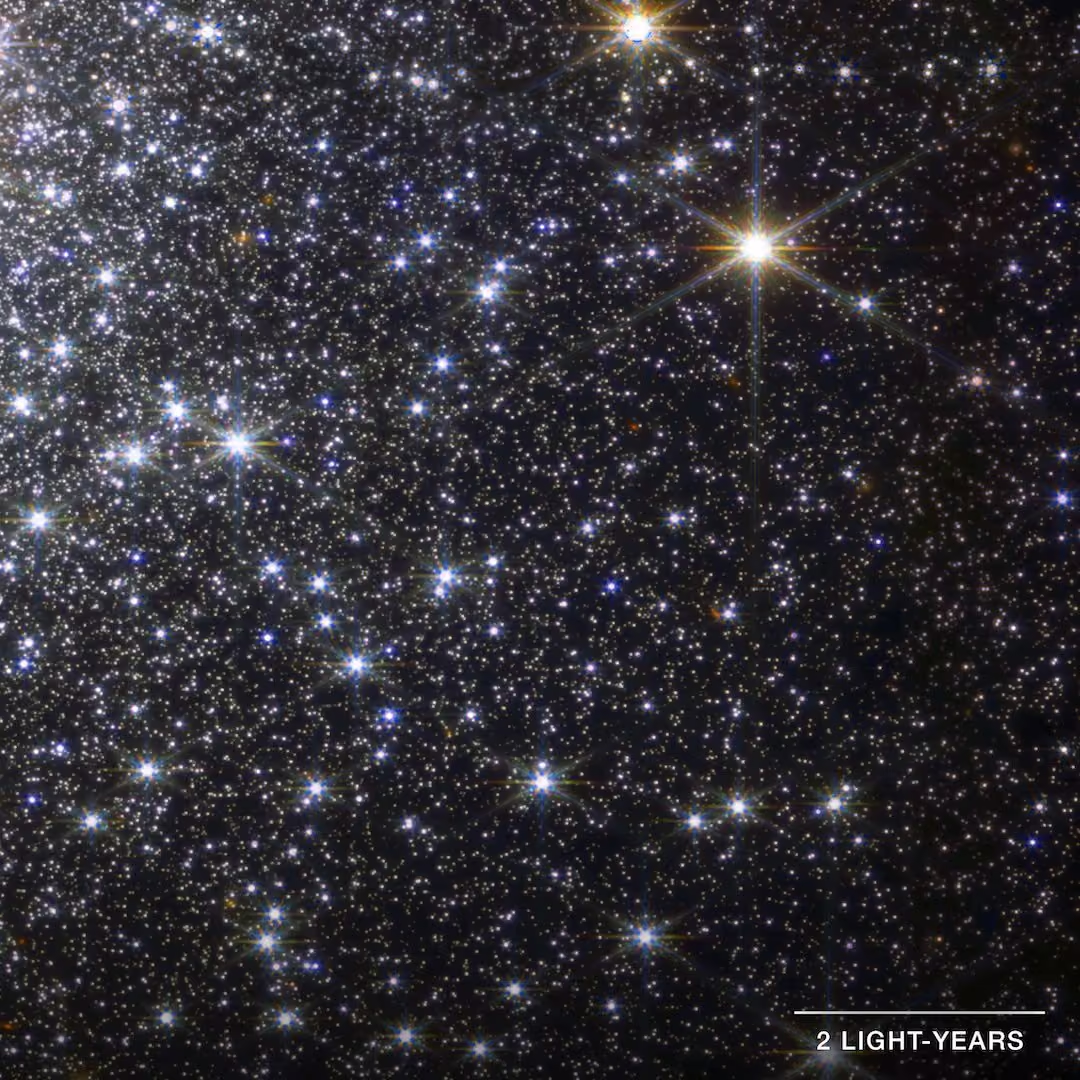
This is Webb’s look at Westerlund 1, a super star cluster. Because our galaxy is past its peak of star formation, and because stars live relatively short lives, only a few of these clusters exist to give us clues to that past era.
NASA Webb Telescope
@NASAWebb
Note for clarity: "because such stars live relatively short lives..." Massive stars are relatively short-lived.
-
NASA Webb Telescope reposted
Chandra Observatory
@chandraxray
Ghosted by the universe, just in time for Halloween!🎃 This eerie structure, combining data from NASA's Chandra X-ray Observatory & @NASAWebb, is part of the Carina Nebula, located about 7,500 light years from Earth in our Milky Way galaxy. 👻s.si.edu/reaper
-
NASA Webb Telescope
@NASAWebb
Double, double toil and trouble; Fire burn and cauldron bubble 🧙♀️
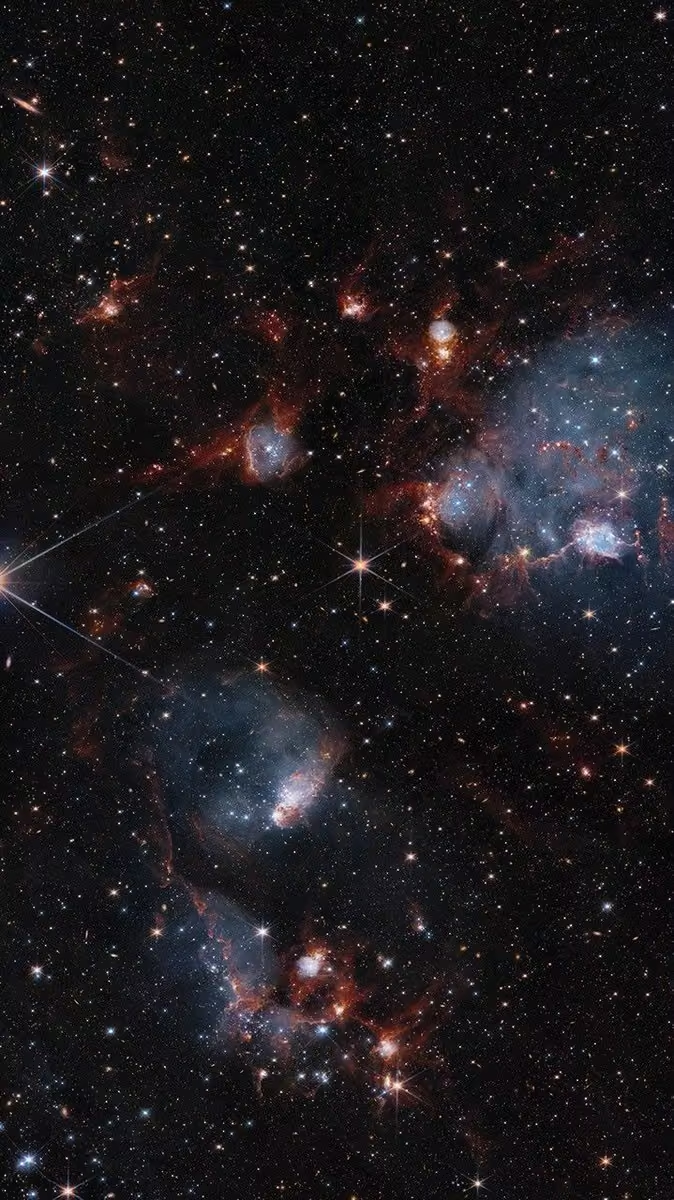
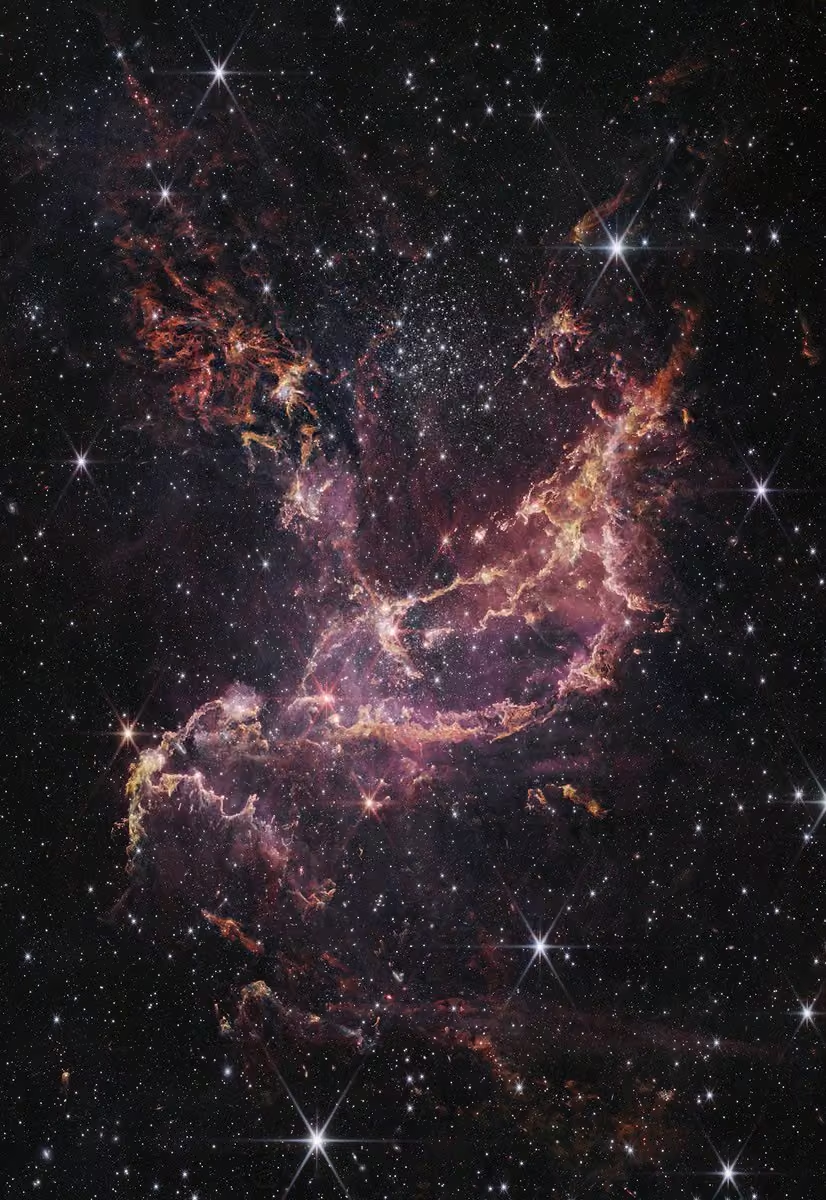
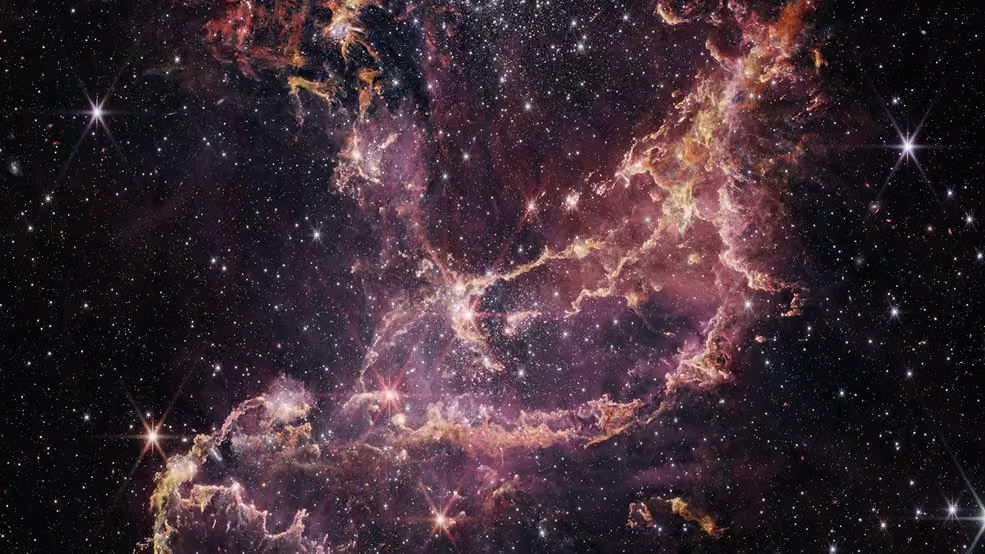
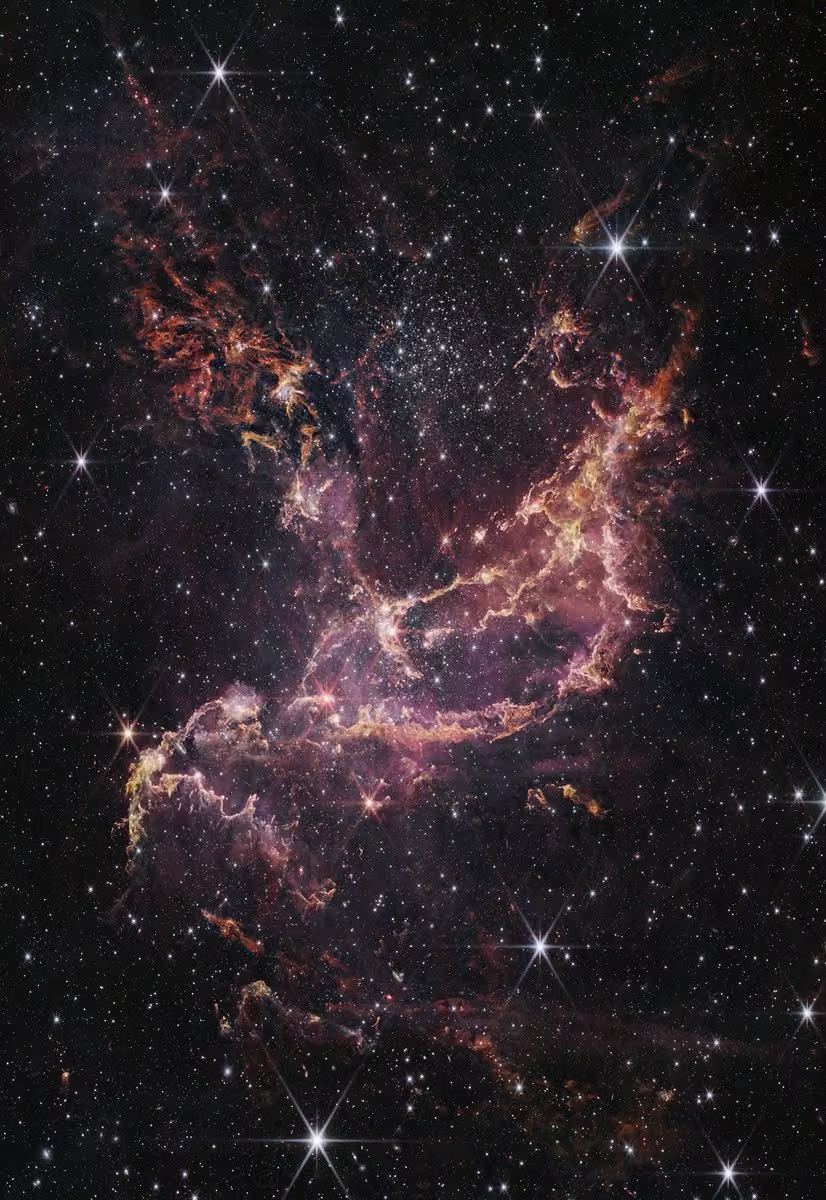
This turbulent cauldron of star formation, N159, resides about 161,000 light years away in the Large Magellanic Cloud, one of the satellite galaxies orbiting our Milky Way.
esawebb.org/images/potm2610a/
NASA Webb Telescope
@NASAWebb
This region has a lower metallicity (proportion of elements that are heavier than helium and hydrogen) than our Milky Way, revealing more about how stars formed in the conditions of the early universe.
-
NASA Webb Telescope reposted
NASA Universe
@NASAUniverse
With its quick reflexes, flexible scheduling, and multiwavelength vision, our Neil Gehrels Swift Observatory has made discoveries with nearly every NASA space telescope during its 22 years in space.
As the mission winds down, let’s see how Swift’s collaborations have helped us unravel the mysteries of the cosmos.
🔽 -
NASA Webb Telescope
@NASAWebb
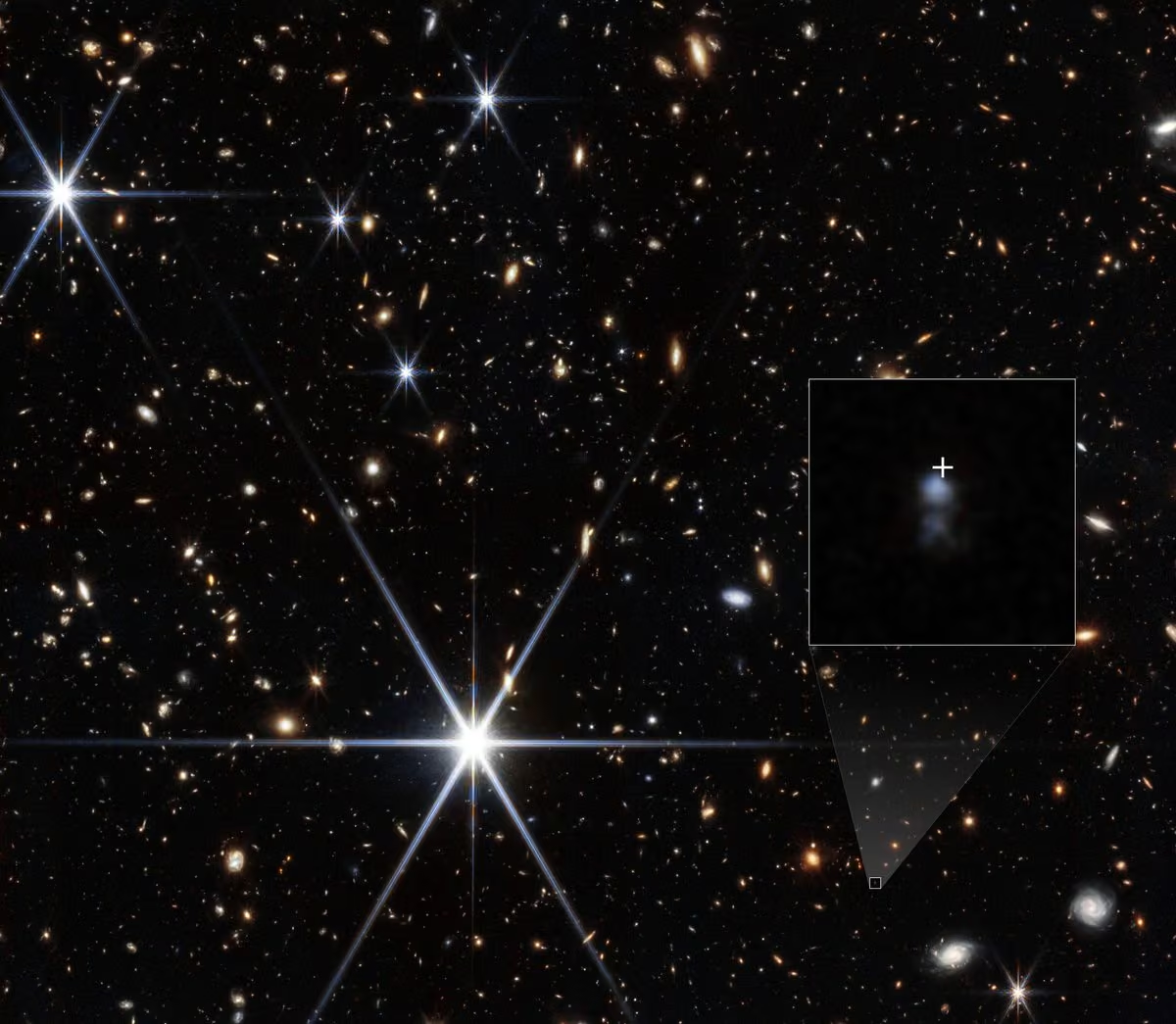
Fast radio bursts (FRBs) - enigmatic, millisecond-long flashes of radio emission from the distant universe - were first discovered in 2007.
Their origins are difficult to pinpoint, but Webb found the host galaxy to the most distant FRB seen to date.
science.nasa.gov/missions/webb/webb-measures-distance-to-… -
NASA Webb Telescope
@NASAWebb
Happy World Space Week!
If you're searching up space facts today, you might run into our newest image! 👇
google.com
NASA Webb Telescope
@NASAWebb
Brewing up new stars 🪄
Webb’s unique view of the stellar nursery known as NGC 7129 reveals numerous stars formerly hidden in this cosmic cauldron, helping astronomers study the star lifecycle in more depth.
science.nasa.gov/missions/webb/nasas-webb-captures-commot… -
NASA Webb Telescope
@NASAWebb
Brewing up new stars 🪄
Webb’s unique view of the stellar nursery known as NGC 7129 reveals numerous stars formerly hidden in this cosmic cauldron, helping astronomers study the star lifecycle in more depth.
science.nasa.gov/missions/webb/nasas-webb-captures-commot… -
NASA Webb Telescope
@NASAWebb
They say planet formation’s a cruel endeavor
Violent collisions, like that between a proto-Earth and a Mars-sized object named Theia 4.5 billion years ago, shaped our home planet. Webb is helping compare other young stellar systems to our own. science.nasa.gov/missions/webb/nasas-webb-provides-crash-…Post not available here, view on X
NASA Webb Telescope
@NASAWebb
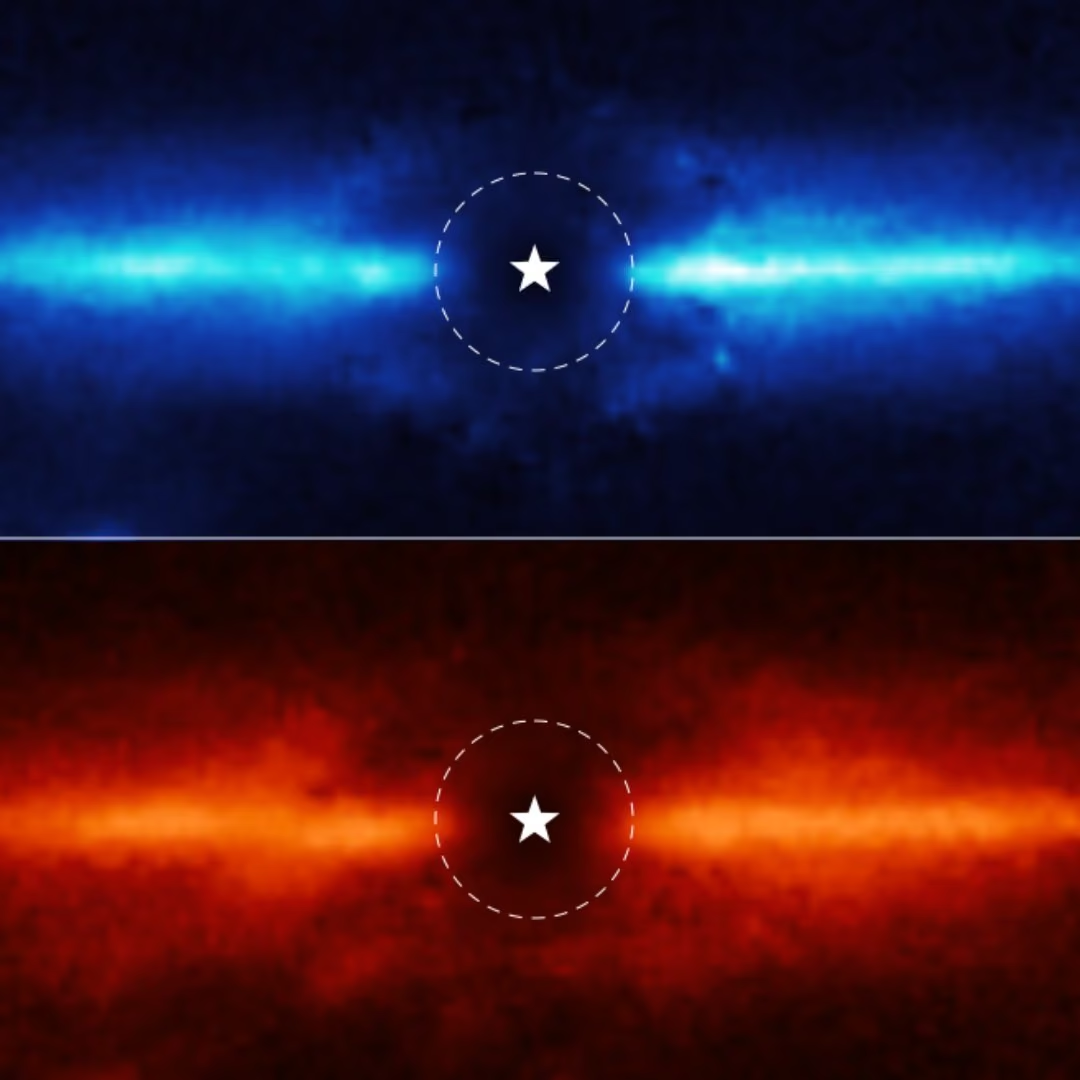
Silica-rich debris disks seem to be produced by high-energy impacts between Mars-sized bodies around younger stars. Silica-poor ones might be formed by smaller scale collisions across a range of ages, which is likely why they vary in brightness.
NASA Webb Telescope
@NASAWebb
Our solar system might have experienced more than one extreme debris disk phase, like when the Earth, with its silica-rich crust, was formed by a giant collision. The gas giants migrating outward may have disrupted smaller bodies, generating dust-rich conditions.
-
NASA Webb Telescope
@NASAWebb
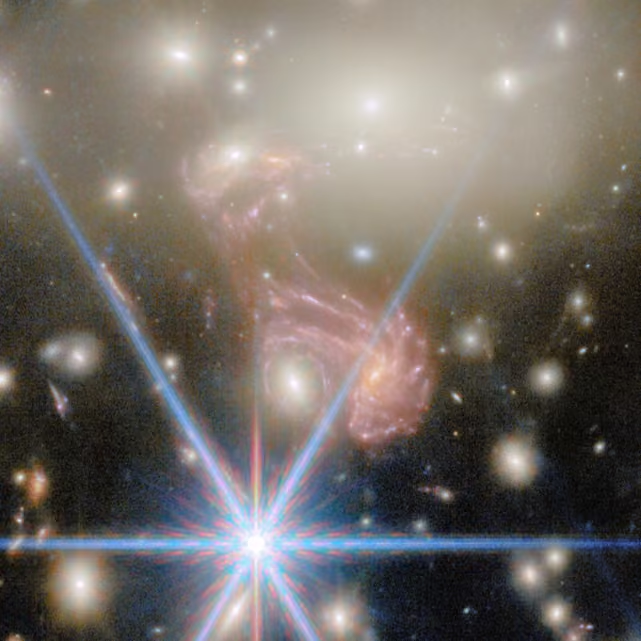
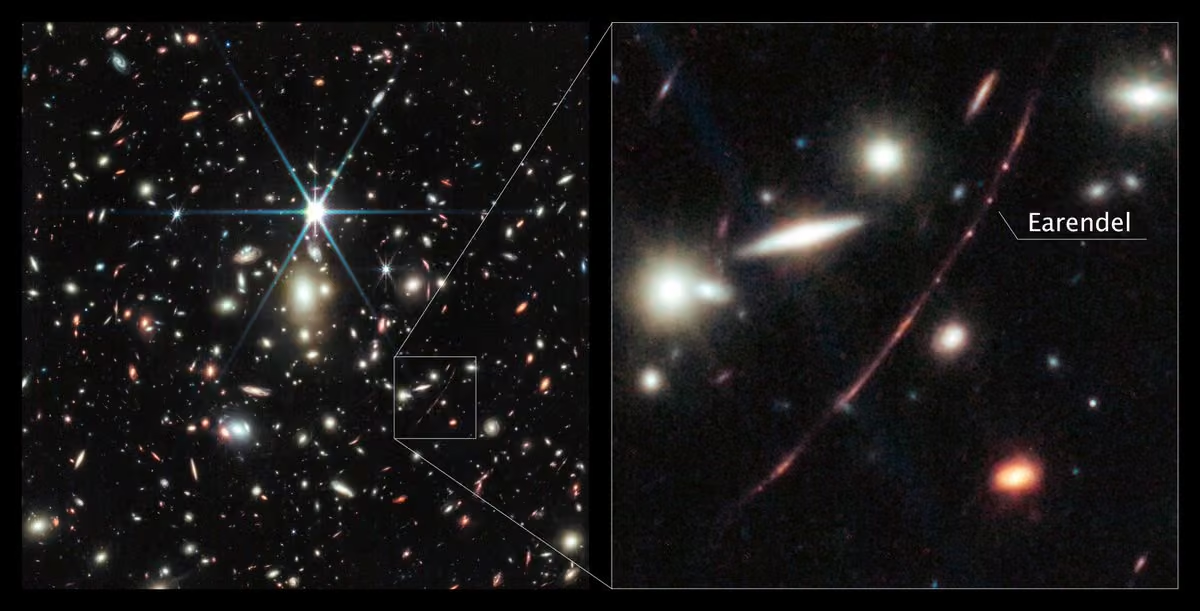
Seeing double… or quadruple! 👀
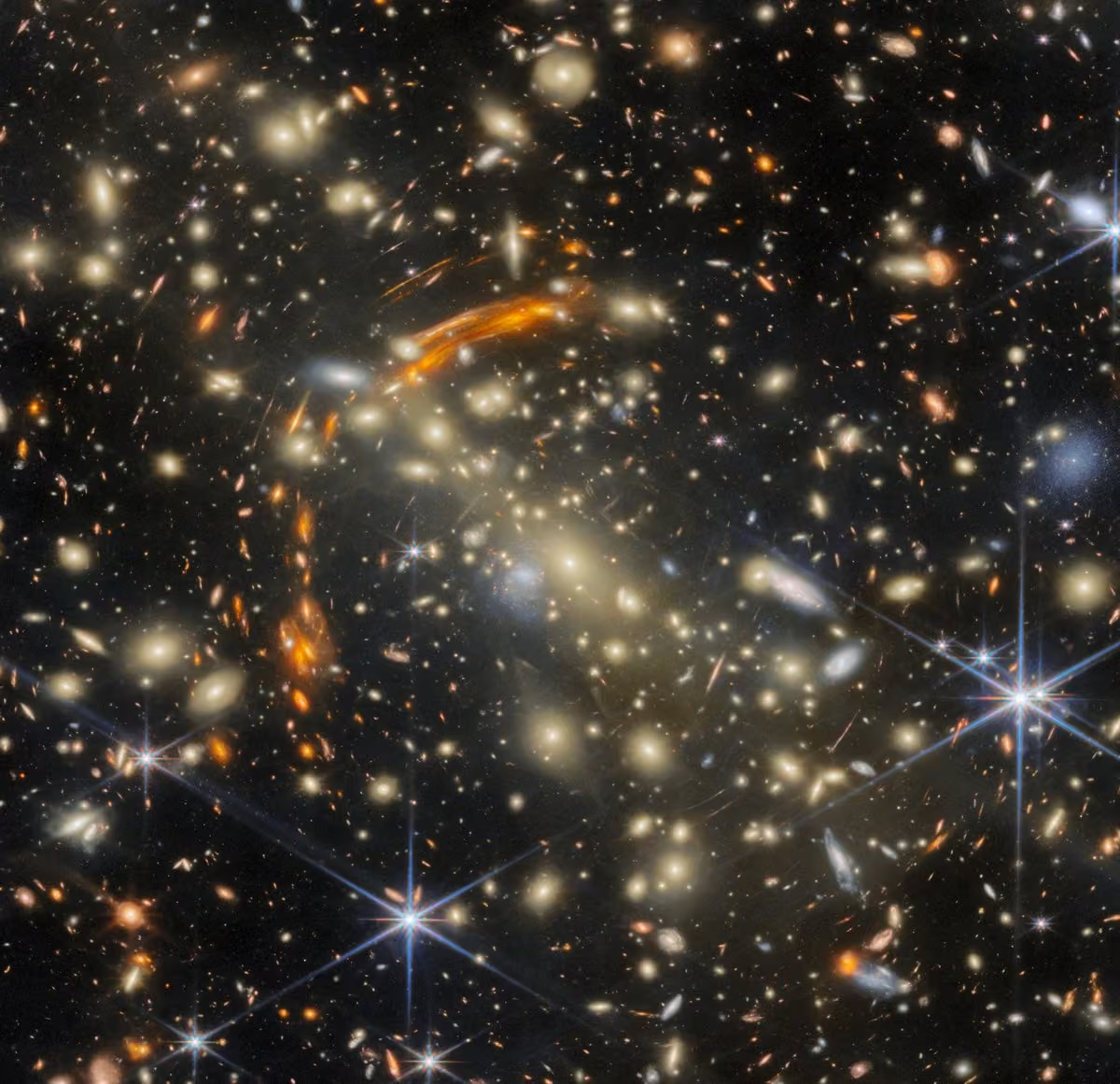
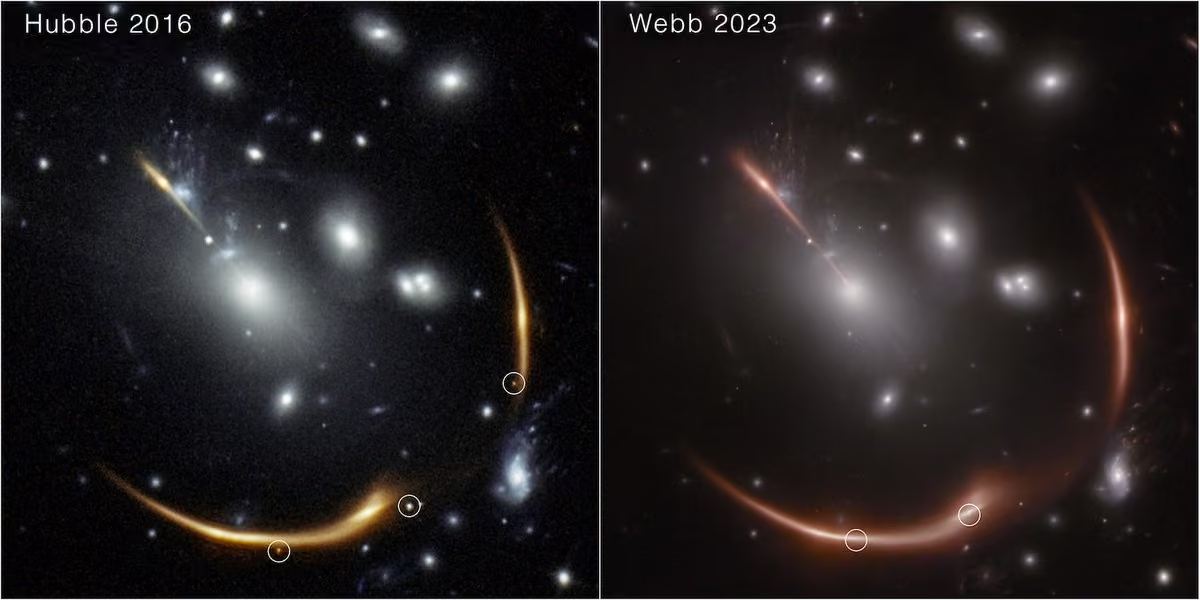
In this Webb image of galaxy cluster MACS J0454.1-0300, gravitational lensing shows us 4 or more images of the same galaxy. This is the first time researchers have spotted this more than once in the same galaxy cluster!
esawebb.org/images/potm2609a/
NASA Webb Telescope
@NASAWebb
The brilliant golden galaxies visible in this image make up galaxy cluster MACS J0454.1-0300, but the orange galaxies are much farther away. Gravitational lensing occurs in this image due to the enormous mass of those golden galaxies. They bend and magnify the flight of the more distant orange galaxies.
NASA Webb Telescope
@NASAWebb
On the left here is @NASAHubble’s 2014 image of galaxy cluster MACS J0454.1-0300. It shows quite a different scene. Because Webb is more sensitive to redder light, we are able to see hundreds more galaxies in the same scene.
-
NASA Webb Telescope
@NASAWebb
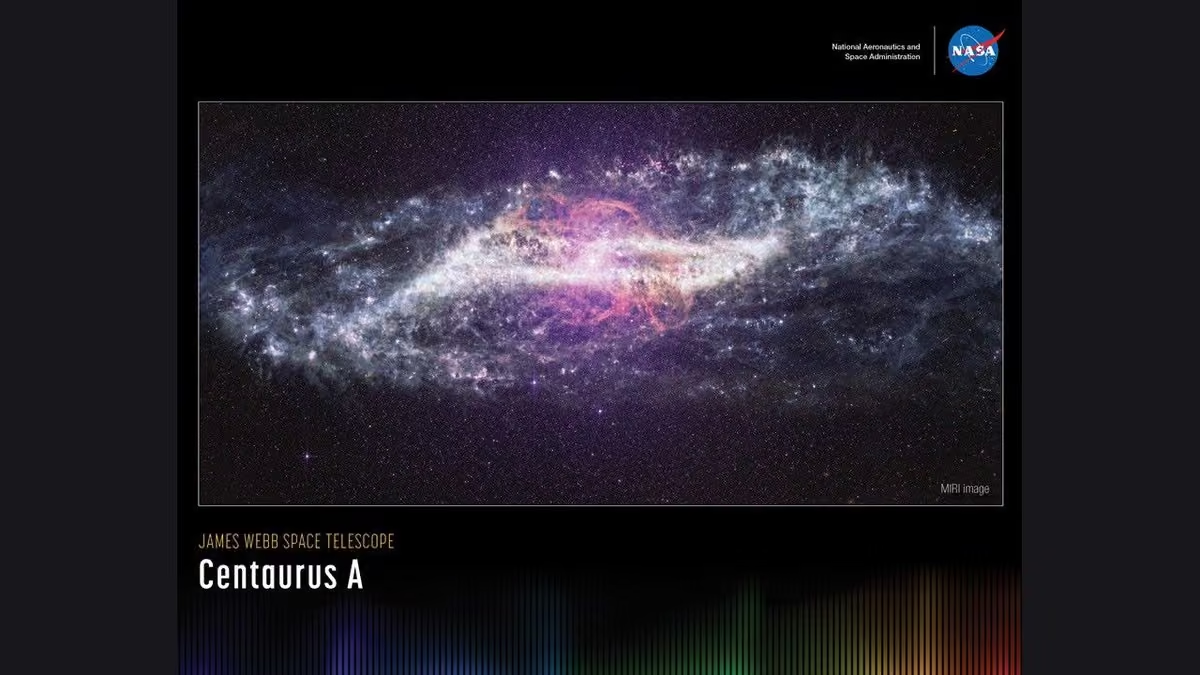
Free downloadable mini poster of Webb's look at Centaurus A!
science.nasa.gov/asset/webb/centaurus-a-poster/ -
NASA Webb Telescope
@NASAWebb
Within this star-forming nebula (captured by Webb) are the smallest brown dwarfs ever detected. Neither planet nor star, these objects are formed like stars, raising questions about the star formation process. science.nasa.gov/missions/webb/nasas-webb-reveals-dynamic…
Post not available here, view on X
NASA Webb Telescope
@NASAWebb
Within is also a unique perspective on protostars, a few of which can be seen in the upper-right. They are ejecting powerful jets that have crashed into the gas and dust surrounding them, creating luminous regions called Herbig-Haro objects.
NASA Webb Telescope
@NASAWebb
This panorama is one of Webb’s largest images to date. You can download the full size (6.6GB) file here: esawebb.org/images/weic2619a/?linkId=1009046563
-
NASA Webb Telescope
@NASAWebb
Scientists used Webb and @NASAHubble to study some of the most far-flung bodies in our solar system, Trans-Neptunian Objects, unexpectedly finding that the number and colors followed the same relationships as their larger family members.
More: science.nasa.gov/missions/hubble/nasas-hubble-webb-find-f…This media couldn't be displayed. See it on the original post. -
NASA Webb Telescope
@NASAWebb
“Being a star just means that you just find your own special place and that you shine where you are.” - Dolly Parton ✨
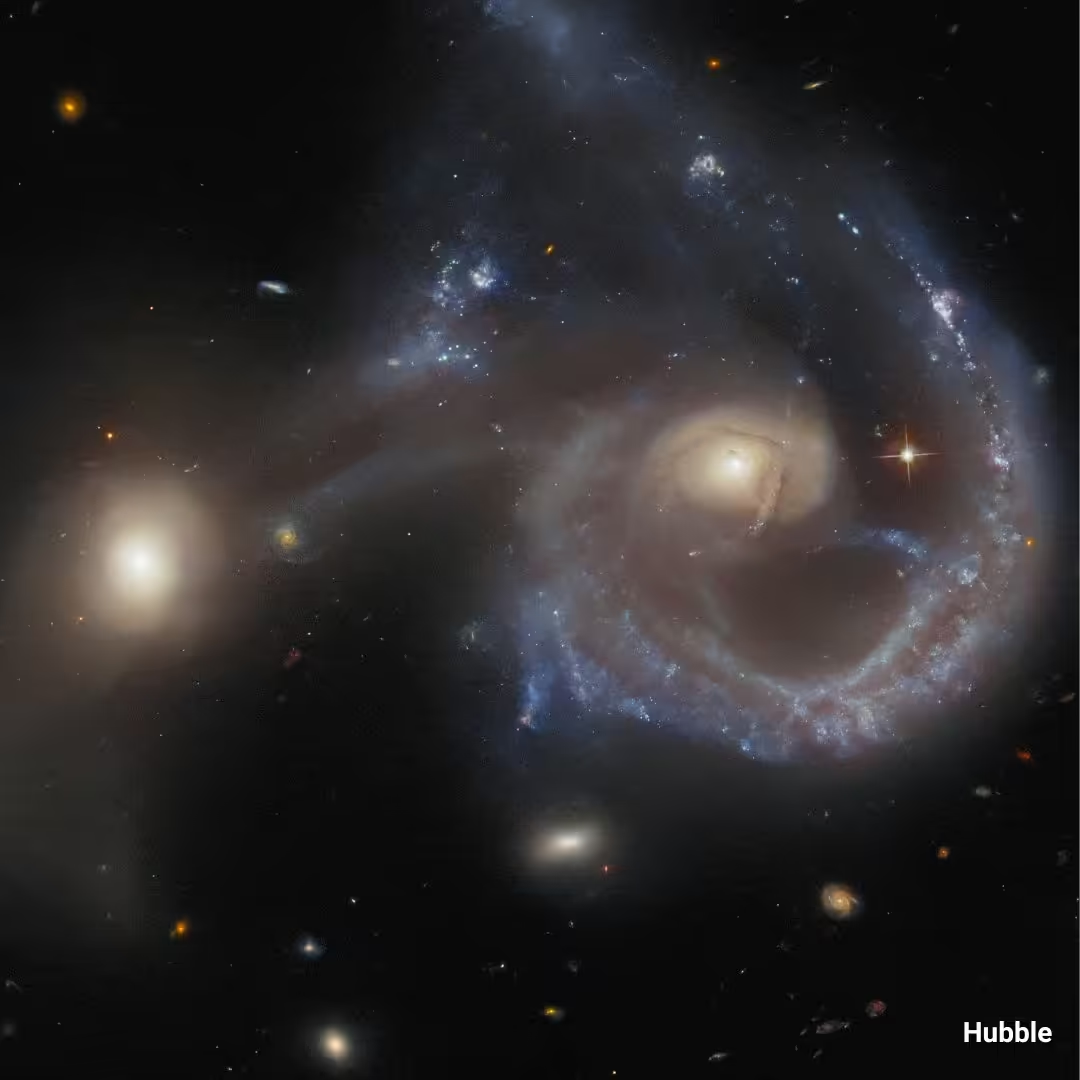
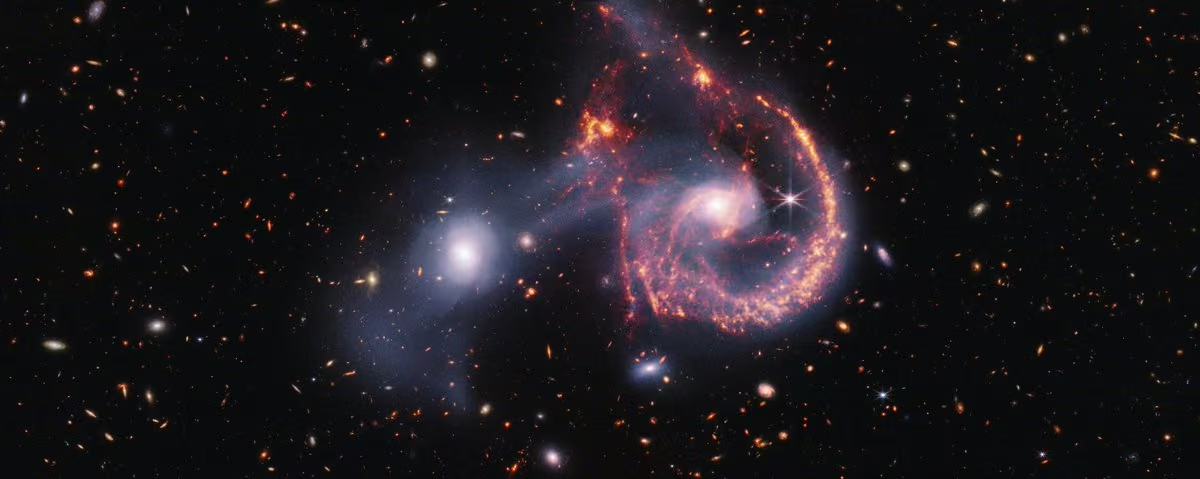
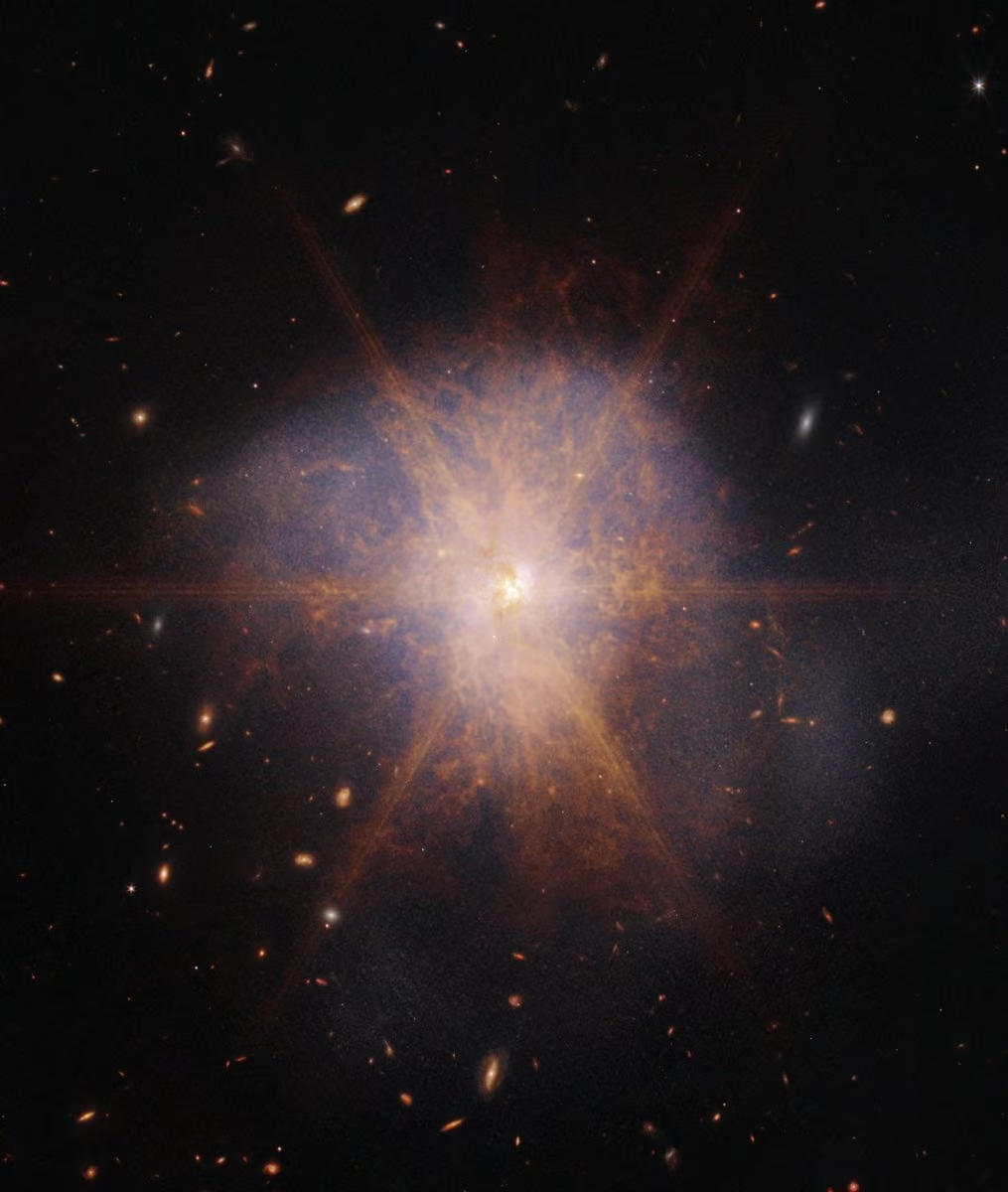
An irregular galaxy might seem like an odd place for so many new stars to shine, yet multitudes are forming within the gas that crowds Arp 263. -
NASA Webb Telescope reposted
Chandra Observatory
@chandraxray
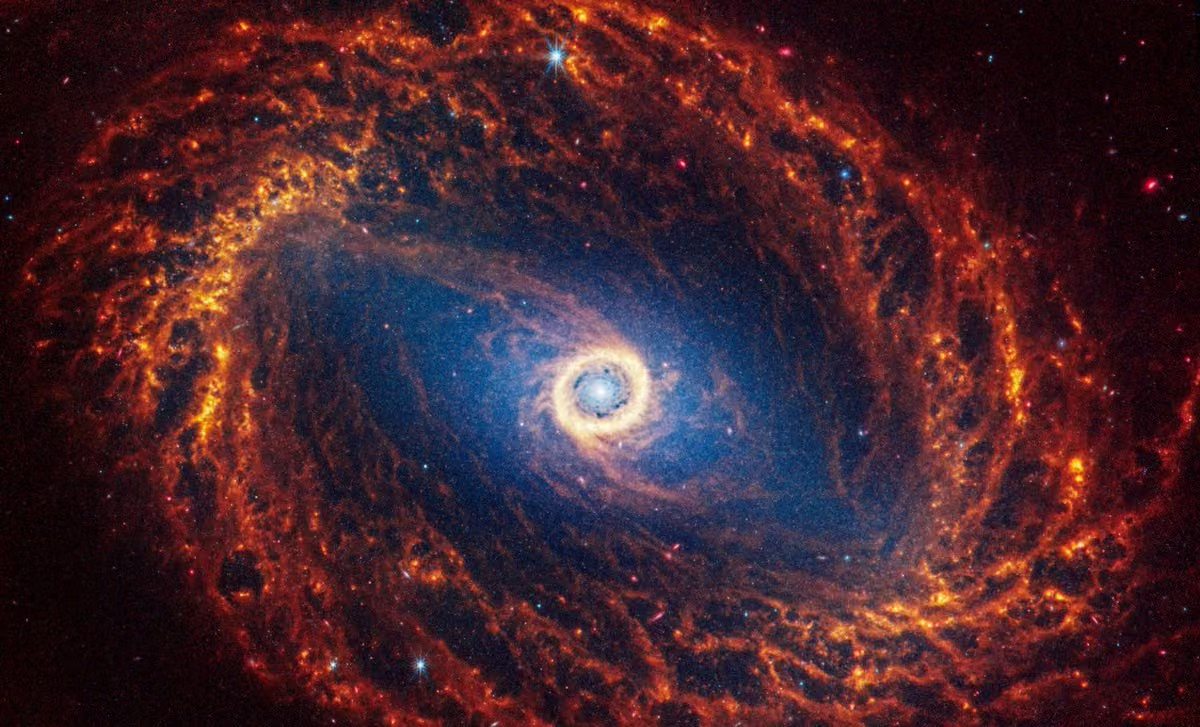
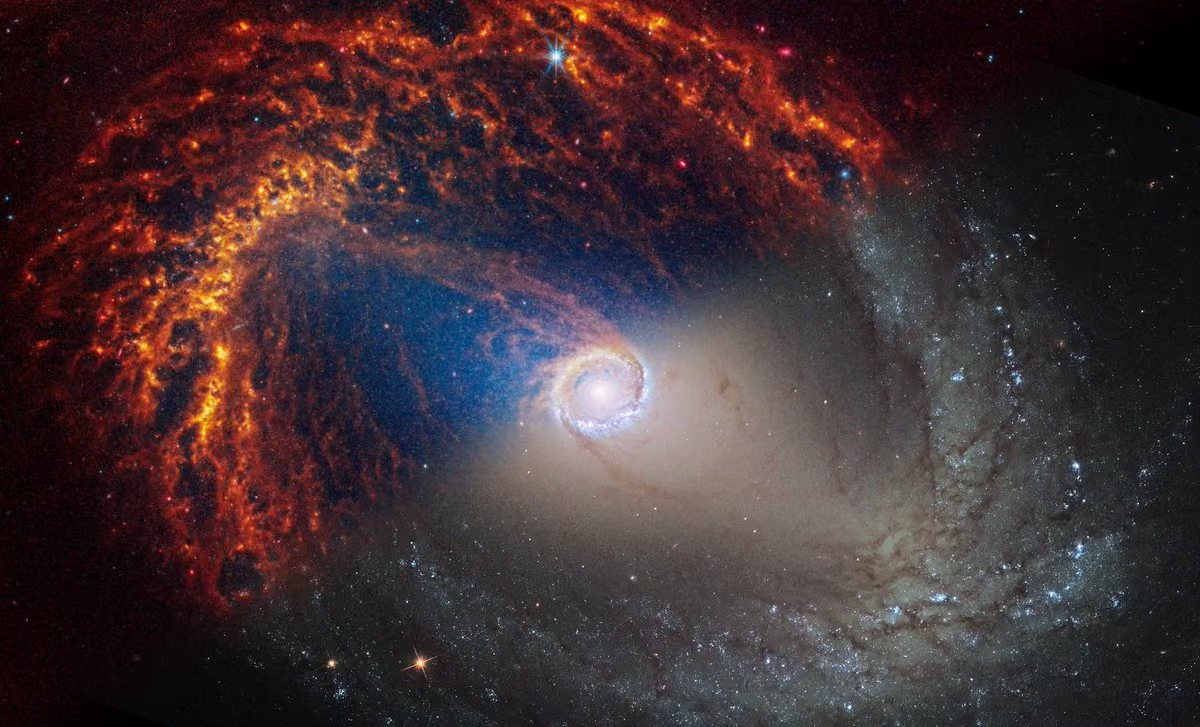
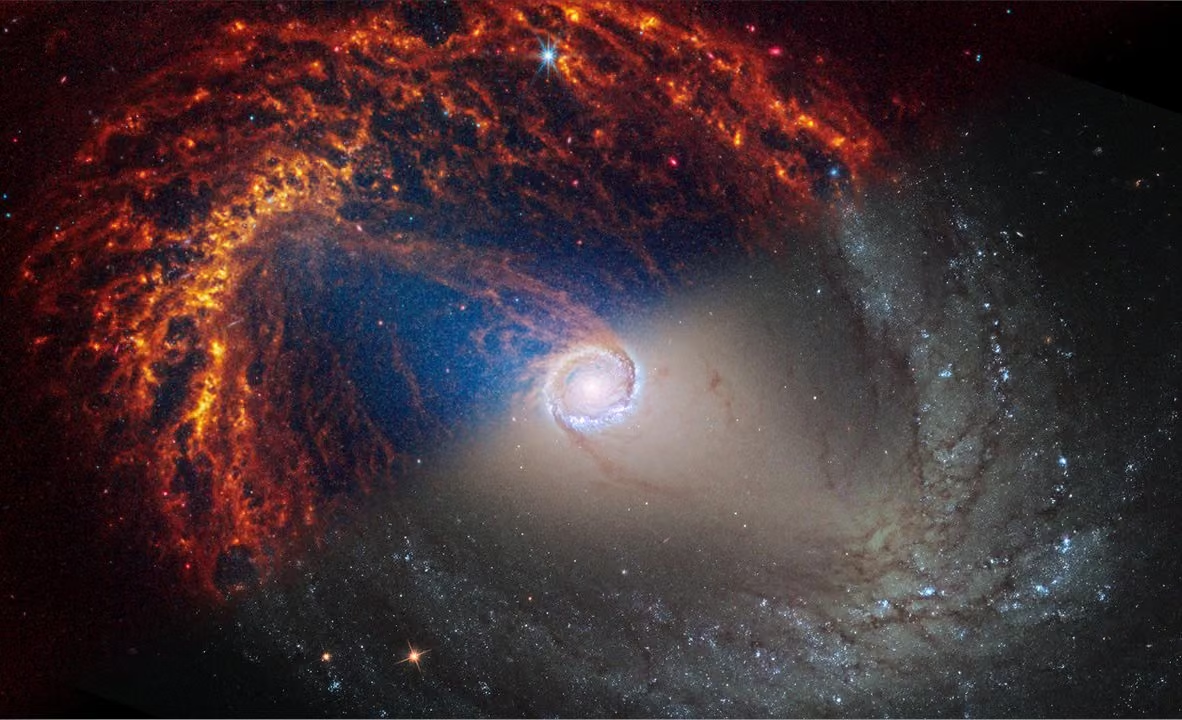
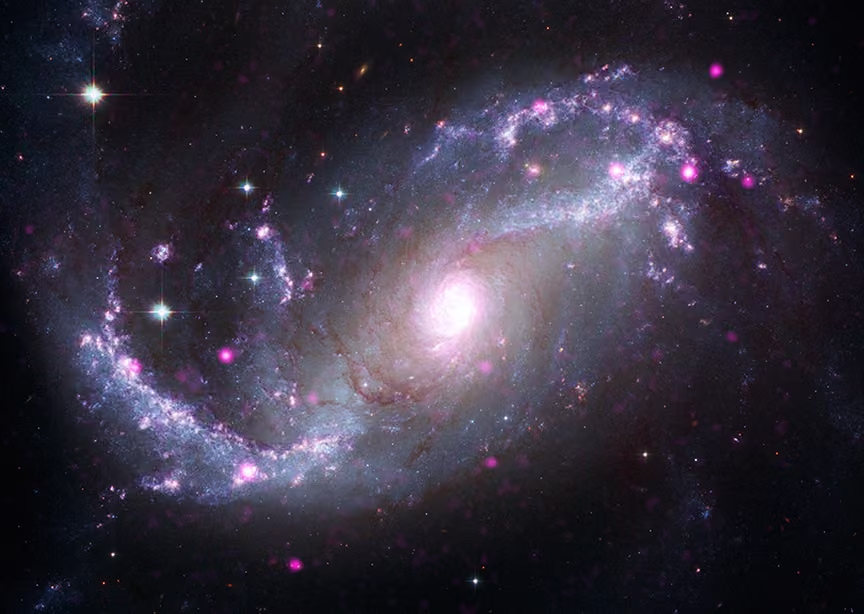
Take in this new image of the barred spiral galaxy NGC 1672 from Chandra, @NASAHubble, and @NASAWebb. Studying barred spirals in action can help reveal how gas in our own Milky Way, which is also a barred spiral, feeds its central black hole and forms new stars.🌀
-
NASA Webb Telescope
@NASAWebb
How close is too close to a black hole? Asking for a friend. 😬
Webb just revealed dust and water surviving in the extreme environment of a star located near our Milky Way's supermassive black hole, Sagittarius A*!
esawebb.org/images/weic2617d/Post not available here, view on X
NASA Webb Telescope
@NASAWebb
Webb’s mid-infrared data revealed the clear signature of oxygen-rich silicate dust, as well as, for the first time, water, in IRS 3’s dust envelope. Even under the harsh conditions of its environment, stars can produce dust, which will help create future generations of stars!
NASA Webb Telescope
@NASAWebb
Full article: esawebb.org/news/weic2617/
-
NASA Webb Telescope reposted
Chandra Observatory
@chandraxray
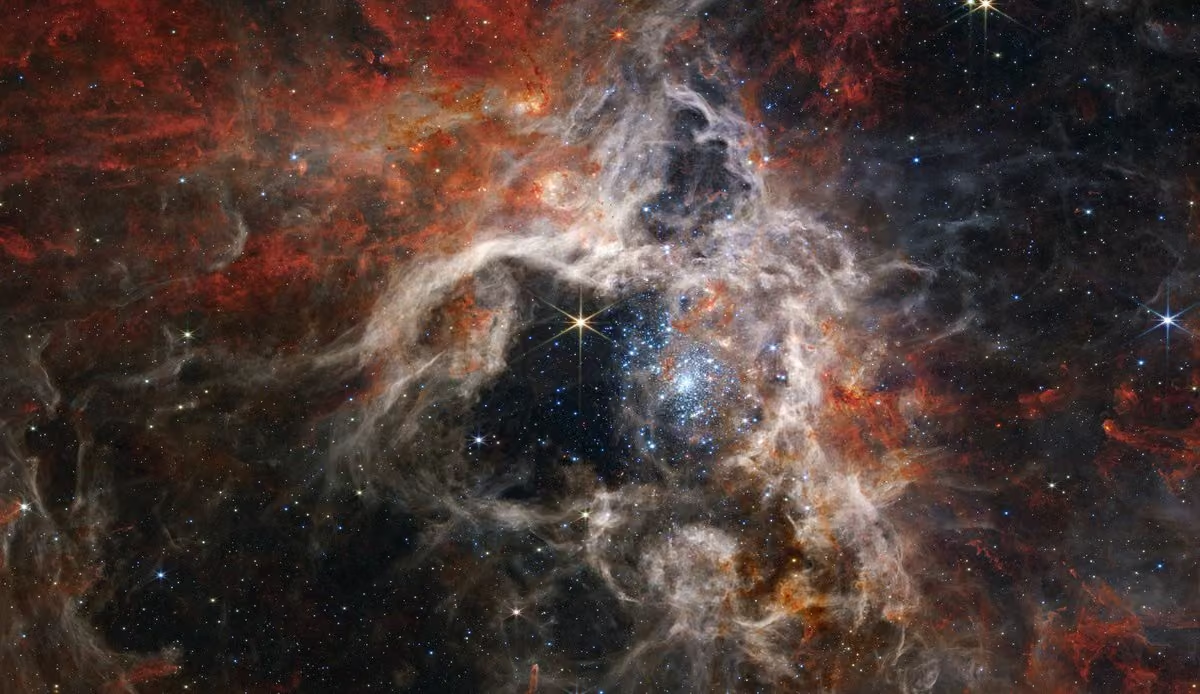
Like a collage made of layered sheets of colored cellophane, a vibrant new image layers observations of the Tarantula Nebula from NASA's Chandra (blue), Hubble (green), and Webb (red). More: s.si.edu/tarantula26
-
NASA Webb Telescope
@NASAWebb
What animal do you see in this Webb image?!
A bird? An elephant? A giraffe? Let your imagination run wild!
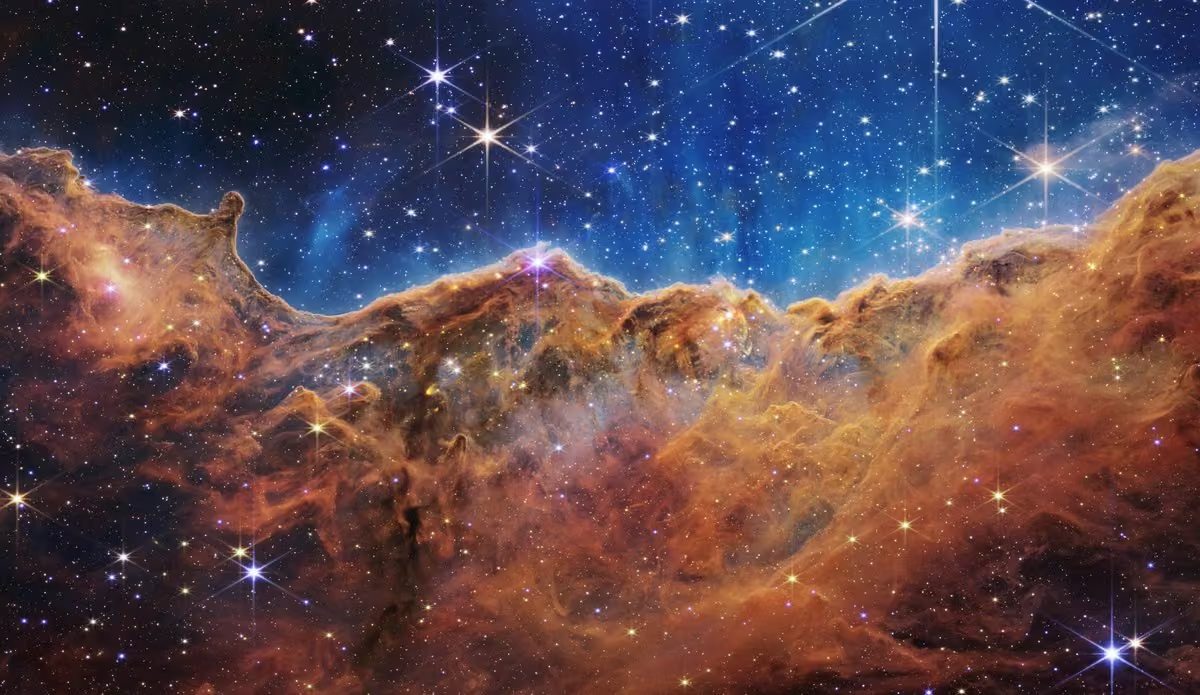
This is Webb’s infrared view of part of the Carina Nebula, a star-forming region also home to the Cosmic Cliffs, which was one of the first images released by Webb.Post not available here, view on X
NASA Webb Telescope
@NASAWebb
Just outside the field of view, just 39 light years away, is Eta Carinae, a well-known star system containing at least two stars, one of which is 100 times more massive than the Sun - and 5 million times more luminous.
NASA Webb Telescope
@NASAWebb
Between massive stars external to the nebula, as well as the ones buried within, the dust and gasses for the Carina Nebula's "Treasure Chest" are being carved out by stellar radiation and winds. Read more: esawebb.org/images/potm2607a/
-
NASA Webb Telescope
@NASAWebb
It's the circle of life…
Webb's look at the Lion Nebula, the remains of a dying lower-mass star, is in both the mid and near-infrared. Though massive stars undergo supernova explosions at the end of their lives, lower-mass stars shed their outer layers.
NASA Webb Telescope
@NASAWebb
In the Lion Nebula’s case, its white dwarf is “cooking” everything from the inside and producing a bubble of ionized gas as it does. The gas bubble, which forms the lion’s face, is expanding over time and destroying dust that is in its path.
NASA Webb Telescope
@NASAWebb
Understanding why the swept-up gas has a complex structure of rings and shells, a common feature in nebula of this kind, is an ongoing endeavor. science.nasa.gov/missions/webb/lion-nebula-roars-to-life-…
(This view is Webb's Lion Nebula in mid-infrared light alone.) -
NASA Webb Telescope
@NASAWebb
Technical Trivia: Which of these techniques involve placing a specially designed mask with several small pinholes in the light path through a telescope?
A: Coronagraphy
B: Aperture masking interferometry
C: Integral Field Unit Spectroscopy
D: Multi-Object Spectroscopy
NASA Webb Telescope
@NASAWebb
B is correct, aperture masking interferometry!
This observational technique allowed science teams to make detailed and unique observations of the massive binary star system Wolf-Rayet 137; PDS 70, a young, Sun-like star; and Jupiter’s moon Io.
science.nasa.gov/blogs/webb/2026/08/04/webb-unravels-smal… -
NASA Webb Telescope
@NASAWebb
This July was our 4th science anniversary, and the results have been fascinating! Bringing us previously unseen details from all throughout the universe to right here in our own solar system, Webb has given scientists, and the world, a powerful new set of tools.
This media couldn't be displayed. See it on the original post. -
NASA Webb Telescope reposted
NASA Goddard
@NASAGoddard
Need a break from mindlessly scrolling?
Take a deep dive into some mysterious space rabbit holes, curated by us, for you. Bizarre enough to keep you locked in, and it all starts at nasa.gov. -
NASA Webb Telescope
@NASAWebb
Who doesn't love a good mystery?! 🔍🔴
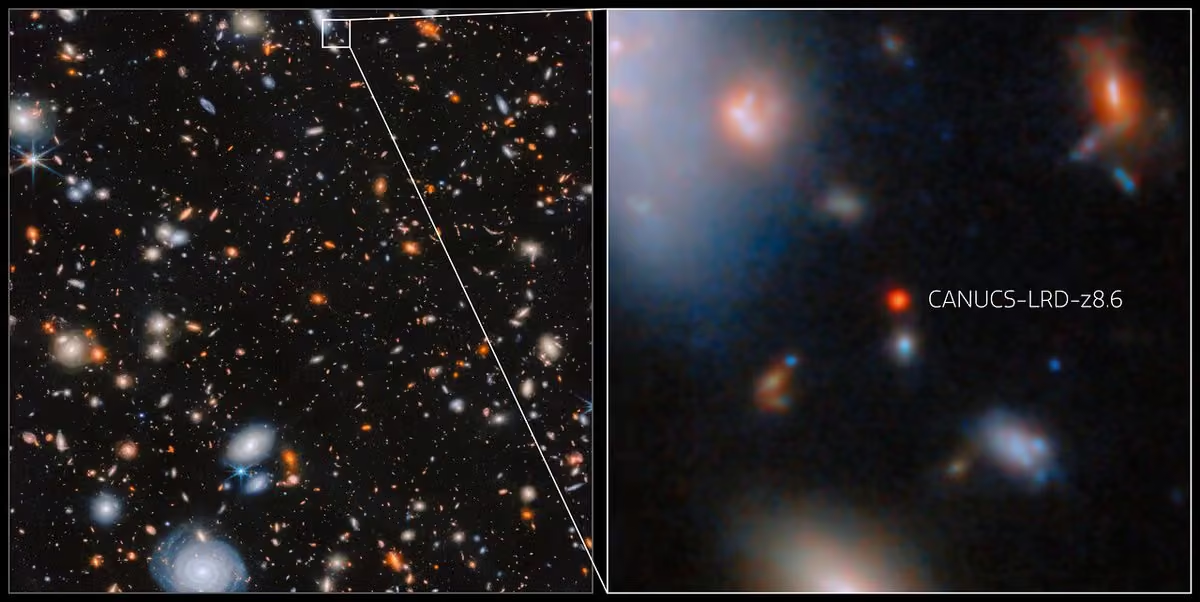
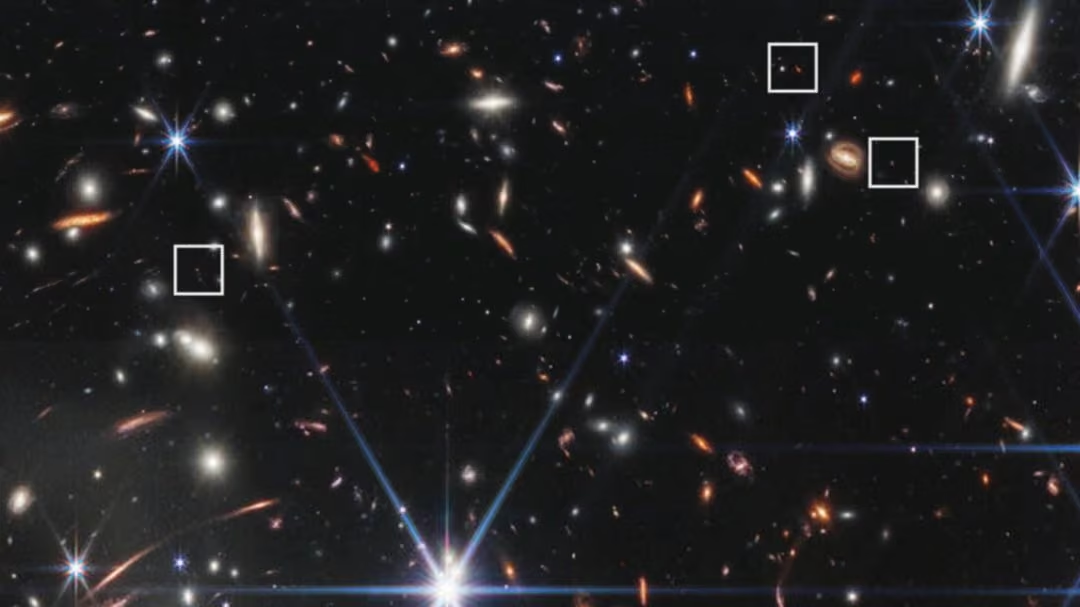
Little Red Dots (LRD), first detected by Webb, are very distant, seemed to emerge ~600 million years/mysteriously decline by ~1.5 billion years post-big bang. What if they didn’t disappear, they just evolved?
science.nasa.gov/missions/webb/nasa-webb-explores-family-…Post not available here, view on X
NASA Webb Telescope
@NASAWebb
Because it is closer and easier to observe, we can see the host galaxy in detail. But if this particular object were as distant as the LRD, would it still look like one? At a higher simulated redshift, the host galaxy’s structure fades, and it looks just like a Little Red Dot.
NASA Webb Telescope
@NASAWebb
LRDs might have a host galaxy, they are just too dim for us to see, even with Webb. Astronomers will be looking for other lower-redshift Saguaro-like galaxies, as well as building a census of other LRDs, to help us build a more complete picture of these objects.
-
NASA Webb Telescope
@NASAWebb
In about 40 minutes!!
Space Telescope Science Institute
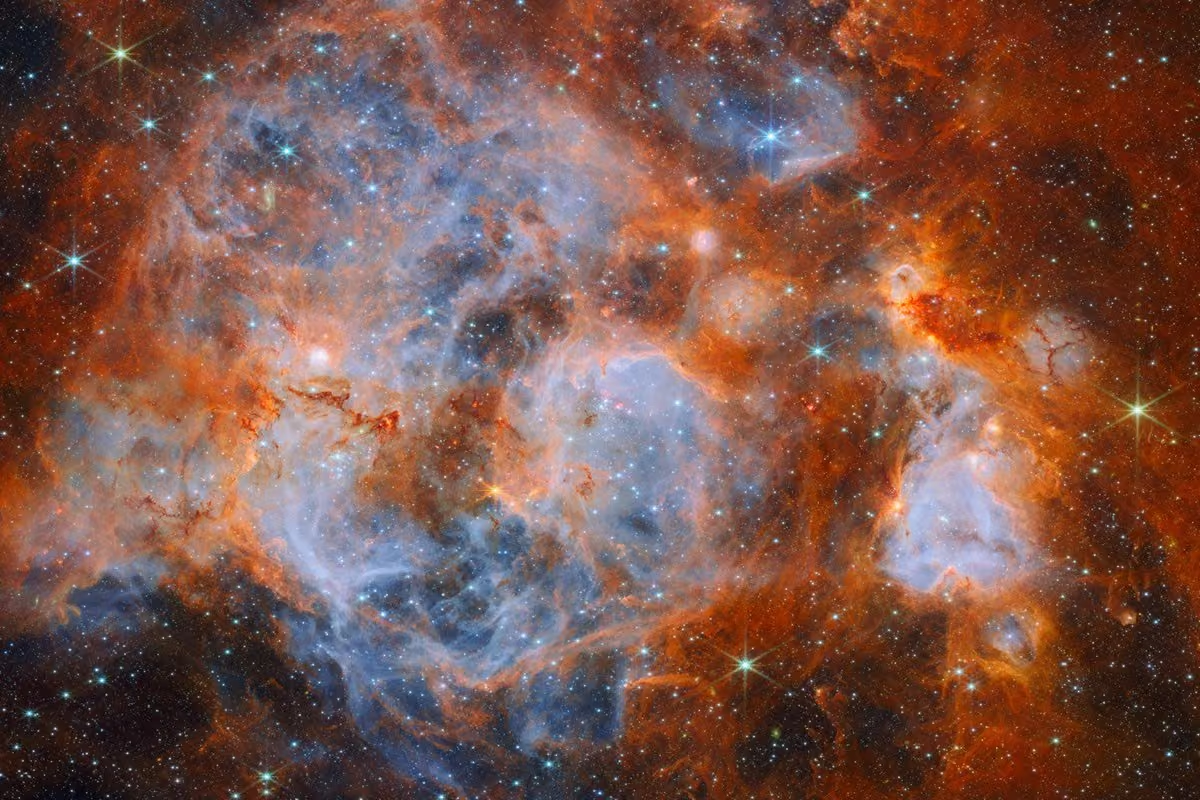
@SpaceTelescope
TODAY at 4 p.m.: STScI's Dr. Macarena Garcia Marin will explore #nasawebb's record-breaking performance, scientific breakthroughs, and astonishing discoveries. We will also look ahead and ask the questions that will shape Webb's future science.
www.youtube.com/live/VJakMxRPfw0
NASA Webb Telescope
@NASAWebb
Here's the YouTube link: www.youtube.com/live/VJakMxRPfw0
-
NASA Webb Telescope
@NASAWebb
Wake up, babe! There’s a new planet around Beta Pictoris!
Webb spotted a new giant planet hiding in one of the most studied planetary systems in our galaxy.
science.nasa.gov/missions/webb/nasas-webb-discovers-hidde…Post not available here, view on X
NASA Webb Telescope
@NASAWebb
Why wasn’t this found sooner? Beta Pic’s debris disk is really bright and scatters light from the star, making it hard to tell planets from other structures. Webb effectively ignored the dust and was able to hone in on the signature of the planet.
NASA Webb Telescope
@NASAWebb
The researchers plan to continue analyzing Webb's observations to better determine the planet's temperature, atmospheric composition, and orbit, providing an even more detailed view of one of astronomy's most iconic planetary systems.
-
NASA Webb Telescope reposted
Space Telescope Science Institute
@SpaceTelescope
EVENT: On July 21, STScI's Dr. Macarena Garcia Marin will explore #nasawebb's record-breaking performance, scientific breakthroughs, and astonishing discoveries. We will also look ahead and ask the questions that will shape Webb’s future science.
www.youtube.com/live/VJakMxRPfw0 -
NASA Webb Telescope
@NASAWebb
Four years of Webb science! And what a time it has been! We've learned so much about our universe and ourselves. Here are some of our favorite images and most interesting science results!
Post not available here, view on X
NASA Webb Telescope
@NASAWebb
In 2025, we looked back in time! Abell S1063 was Webb's deepest look back on a single target as of 2025.
Webb discovered a new moon around Uranus and examined the exoplanet TRAPPIST-1 e spectrum, a system with many rocket planets, including some in its habitable zone.
We also saw the Red Spider planetary nebula, Sagittarius B2 molecular cloud, and Barred spiral Galaxy NGC 2283.
NASA Webb Telescope
@NASAWebb
And to round out four years of history-making science, we're celebrating 2026 and what we've learned so far. From far away and very old "Little Red Dots" to new views of Saturn's sunlit surface, 2026 is shaping up to be another incredible year of science!
-
Post not available here, view on X
NASA Webb Telescope
@NASAWebb
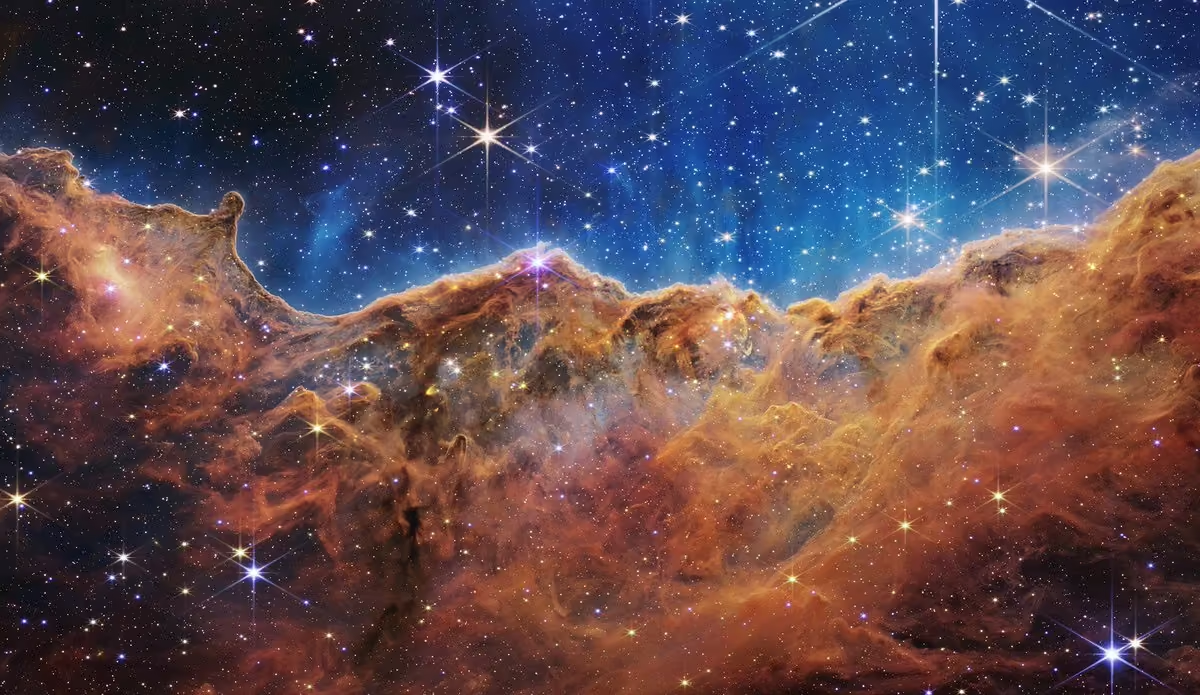
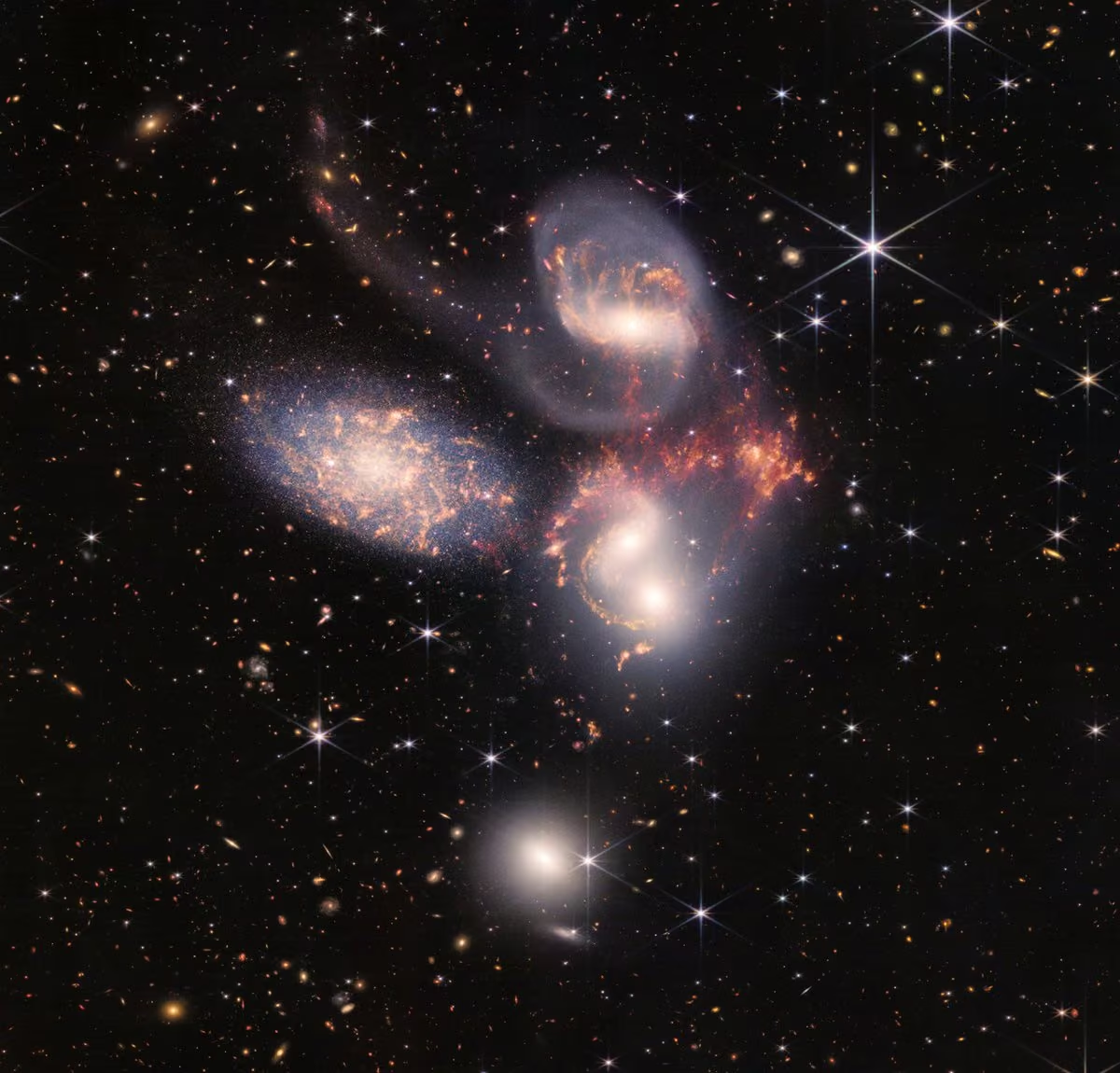
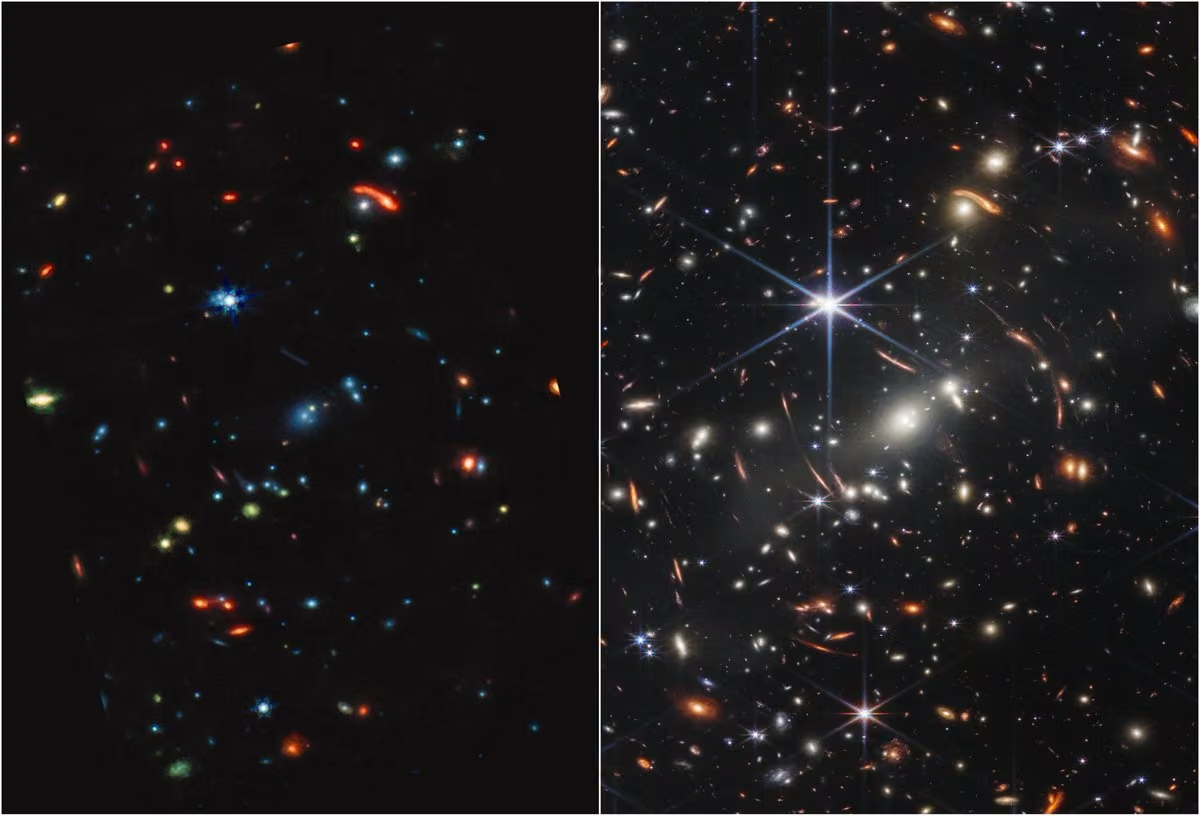
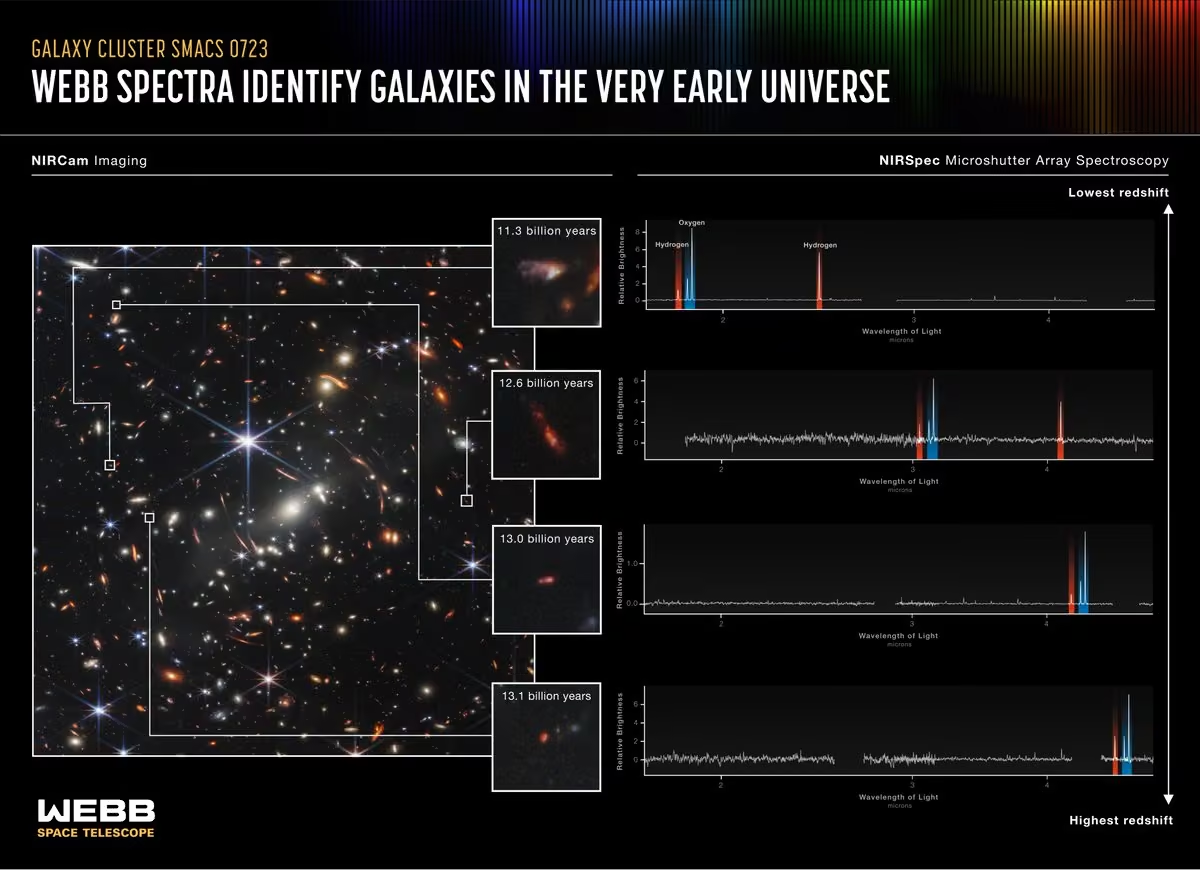
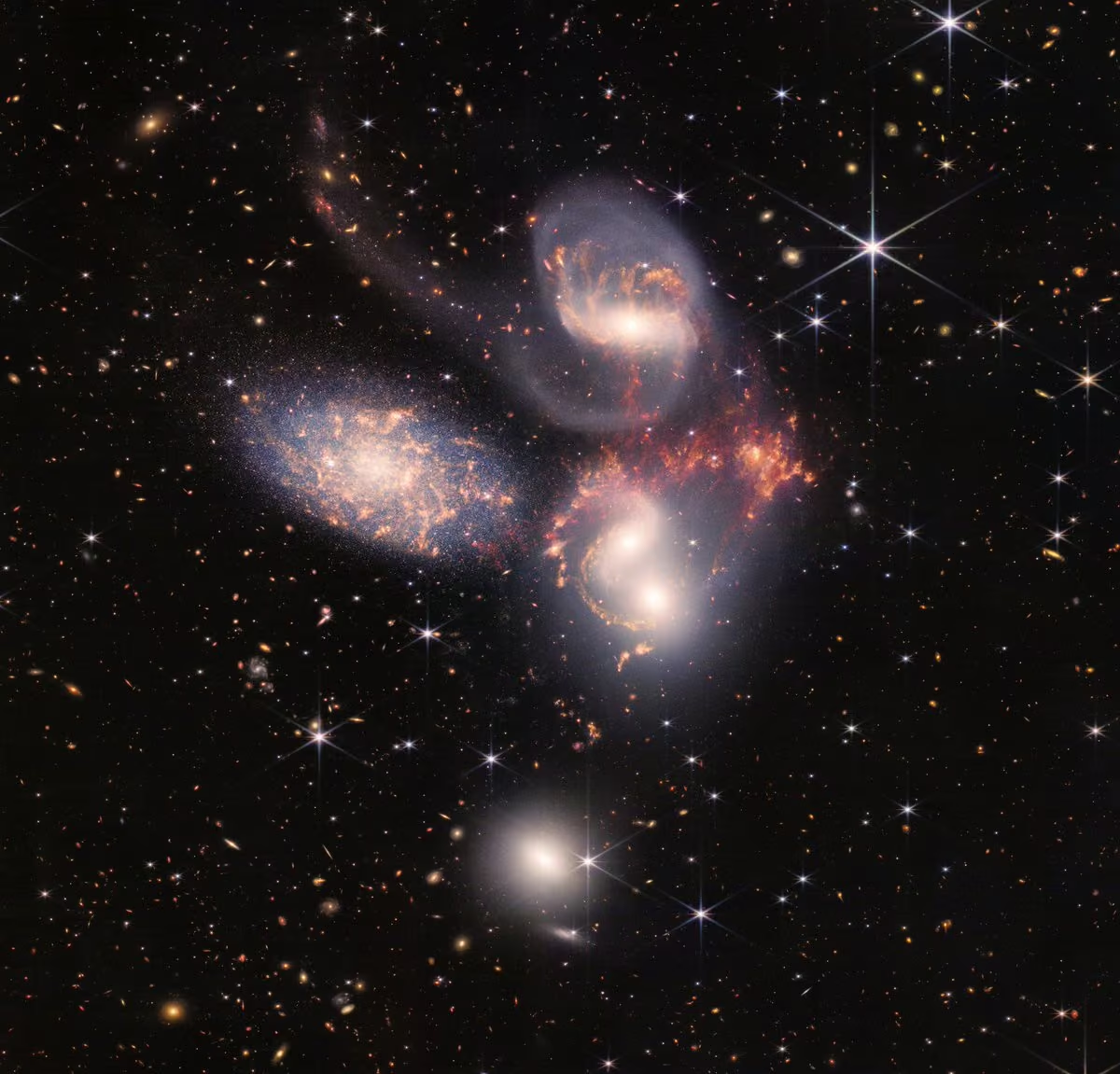
Starting with our first images, released on July 12, 2021, Webb wowed the world with its never-before-seen views of the "Cosmic Cliffs" of the Carina Nebula, Southern Ring Nebula, WASP 96-b spectrum, Stephan's Quintet, and Galaxy Cluster SMACS 0723.
NASA Webb Telescope
@NASAWebb
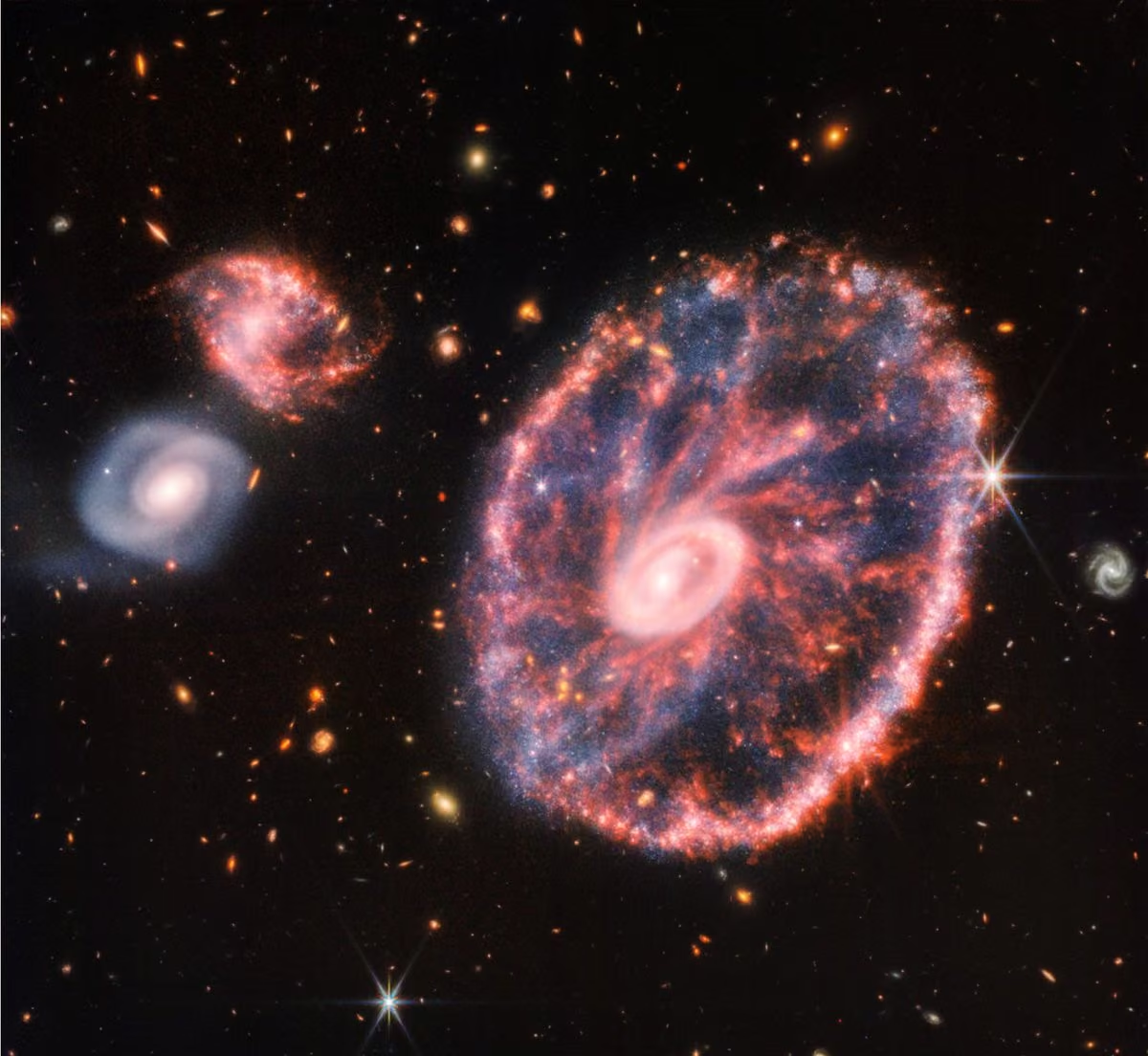
In 2022, Webb peered into the Cartwheel Galaxy, Tarantula Nebula, and galaxy cluster MACS0647. We saw the first clear evidence of carbon dioxide in the atmosphere of an exoplanet (WASP-39) and looked at Wolf-Rayet 140, where we saw not one, but two stars.
Post not available here, view on X
NASA Webb Telescope
@NASAWebb
New views of familiar sights in 2024. Webb showed us a new map of Jupiter's Great Red Spot using the telescope's Integral Field Unit on the NIRSpec instrument. Webb also teamed up with Chandra X-Ray Observatory to show us a new view of the Crab Nebula, which was first documented a thousand years before in 1024!
Webb also viewed Spiral galaxies IC 2163 and NGC 2207, Westerlund 1 (one of the closest super star clusters) and imaged Epsilon Indi Ab, the coldest, most Jupiter-like exoplanet to be imaged so far.
NASA Webb Telescope
@NASAWebb
In 2025, we looked back in time! Abell S1063 was Webb's deepest look back on a single target as of 2025.
Webb discovered a new moon around Uranus and examined the exoplanet TRAPPIST-1 e spectrum, a system with many rocket planets, including some in its habitable zone.
We also saw the Red Spider planetary nebula, Sagittarius B2 molecular cloud, and Barred spiral Galaxy NGC 2283. -
NASA Webb Telescope
@NASAWebb
Galaxy cluster formation is a messy process! Webb captured the formation of this young galaxy cluster in progress. Its two-sub-clusters have slammed through each other and travelled over a million light-years apart, repeating this process until they finally merge.
NASA Webb Telescope
@NASAWebb
Each sub-cluster is anchored on a bright, massive elliptical galaxy - the two brightest points in the center, with the largest glowing halos around them. Smaller white elliptical galaxies are bound to one of them by gravity, and will be incorporated into the final galaxy cluster.
NASA Webb Telescope
@NASAWebb
The gravity of this cluster is so strong that it can bend and focus light like a magnifying glass; the prominent orange, stretched-out arcs alongside each sub-cluster are images of distant background galaxies. esawebb.org/images/potm2606a/
-
NASA Webb Telescope
@NASAWebb
July 12th is Webb’s 4th science anniversary!
When we dive deeper into the familiar galaxy Centaurus A, our view becomes richer and stranger— a vivid record of cosmic history.
science.nasa.gov/missions/webb/nasa-webb-uncovers-unusual…Post not available here, view on X
NASA Webb Telescope
@NASAWebb
Many of the glowing red points in the MIRI image are dust-rich stars or stellar nurseries. Dust is a raw ingredient for new stars and planets and vital to the ongoing life cycle of the galaxy.
At the heart of the galaxy, an actively feeding supermassive black hole shines brightly, surrounded by complex structures sculpted by a past galactic collision and ongoing activity.
NASA Webb Telescope
@NASAWebb
This combined view of Centaurus A from Webb in near and mid-infrared exposes a warped disk of gas and dust left behind by a collision with another galaxy billions of years ago. The grainy glow is actually a dense field of millions of individually resolved stars.
-
NASA Webb Telescope
@NASAWebb
Gonna shine across that sky 🎶
In the infrared, Webb reveals bright protostars flowering from within the thick dust of the FS Tau star system. Set against a tapestry of background galaxies, this star-forming nebula is home to baby stars. science.nasa.gov/missions/webb/nasas-webb-reveals-stars-s…
NASA Webb Telescope
@NASAWebb
Though dust obscures background stars and galaxies, in @NASAHubble’s image of FS Tau (right) we can see protostar FS Tau b, its dusty protoplanetary disk, and its jet of matter (colored cyan). Compare to the Webb image on the left!
-
NASA Webb Telescope
@NASAWebb
You’re a spark in the dark 🎶
Webb looked at gas giant planet WD 1856 b, which closely orbits a white dwarf - the remains of a Sun-like star. Did it survive the death of its star or did it migrate to its current location later?
science.nasa.gov/missions/webb/nasas-webb-studies-how-pla… -
NASA Webb Telescope
@NASAWebb
Webb’s new view of M82, added to archival data from @NASAHubble, is giving us a more complete picture of this starburst galaxy. science.nasa.gov/missions/webb/nasas-webb-pinpoints-milli…
NASA Webb Telescope
@NASAWebb
Because Webb can see infrared light, it is able to peer through clouds of dust and gas to see the shape of this edge-on galaxy, as well as approximately 16.5 million of its stars.
NASA Webb Telescope
@NASAWebb
M82’s rapid star formation, thought to be the result of its merger with another galaxy, will only be a brief period in its history. The extreme star formation is causing plumes of material to be ejected above and below the disk of the galaxy disrupting future stellar birth.
-
NASA Webb Telescope
@NASAWebb
You might have heard of interstellar comet 3I/ATLAS.
We don't get the opportunity to study objects like this often. Webb took a look at the comet's composition. It's showing us how unusual our own solar system might be.
Here's what we've learned 👇Post not available here, view on X
NASA Webb Telescope
@NASAWebb
There’s only one planet we know of with life - our own. Getting to study objects that formed in a different system than our own is a rare opportunity for learning how common, or uncommon, the conditions are for the evolution of life elsewhere in the universe.
NASA Webb Telescope
@NASAWebb
Learn more: science.nasa.gov/missions/webb/nasas-webb-finds-clues-to-…
-
NASA Webb Telescope
@NASAWebb
One well-done gas giant planet, coming right up! Webb examined a “hot Jupiter” exoplanet called HD 80606 b, with four times Jupiter’s mass, and a very elliptical orbit that sweeps close by its Sun-like star. science.nasa.gov/missions/webb/nasas-webb-catches-exoplan…
-
NASA Webb Telescope
@NASAWebb
Webb teamed up with @NASAHubble to examine a relic from our galaxy’s formation. This object might look like a globular cluster of stars, but is actually something much odder and rarer - a “bulge fossil fragment.” science.nasa.gov/missions/webb/nasa-webb-hubble-reveal-hi…
-
NASA Webb Telescope
@NASAWebb
Go far and wide with @NASARoman! NASA’s next space telescope will be joining Webb in L2, a million miles away to join us and your name can come too!
Get your boarding pass to send your name with Roman as we work to create the most complete picture of the universe yet: -
NASA Webb Telescope reposted
Nancy Grace Roman Space Telescope
@NASARoman
Have you ever wanted to have your name 'Roman' a million miles away?
Now you can! Send your name along the Nancy Grace Roman Space Telescope, scheduled to launch Aug. 30, 2026!
Sign up here: my.nasa.gov/specialevents/s/send-your-name-with-nancy-rom…
Submissions close July 12. -
NASA Webb Telescope
@NASAWebb
Webb has delivered the strongest evidence yet that its discovery of mysterious Little Red Dots (LRD) are “black hole stars.” They appear starting ~600 million years after the big bang, and scientists are still working out exactly what they are. science.nasa.gov/missions/webb/nasa-webb-finds-strongest-…
Post not available here, view on X
NASA Webb Telescope
@NASAWebb
This gas accounts for why most LRDs are faint in X-rays; any X-rays given off are likely absorbed by the surrounding cocoons. More typical growing supermassive black holes are not embedded in dense gas, which allows UV light and X-rays from material orbiting them to escape.
NASA Webb Telescope
@NASAWebb
Ultimately this is one more piece of an ongoing puzzle discovered by, and potentially solvable by Webb.
-
NASA Webb Telescope
@NASAWebb
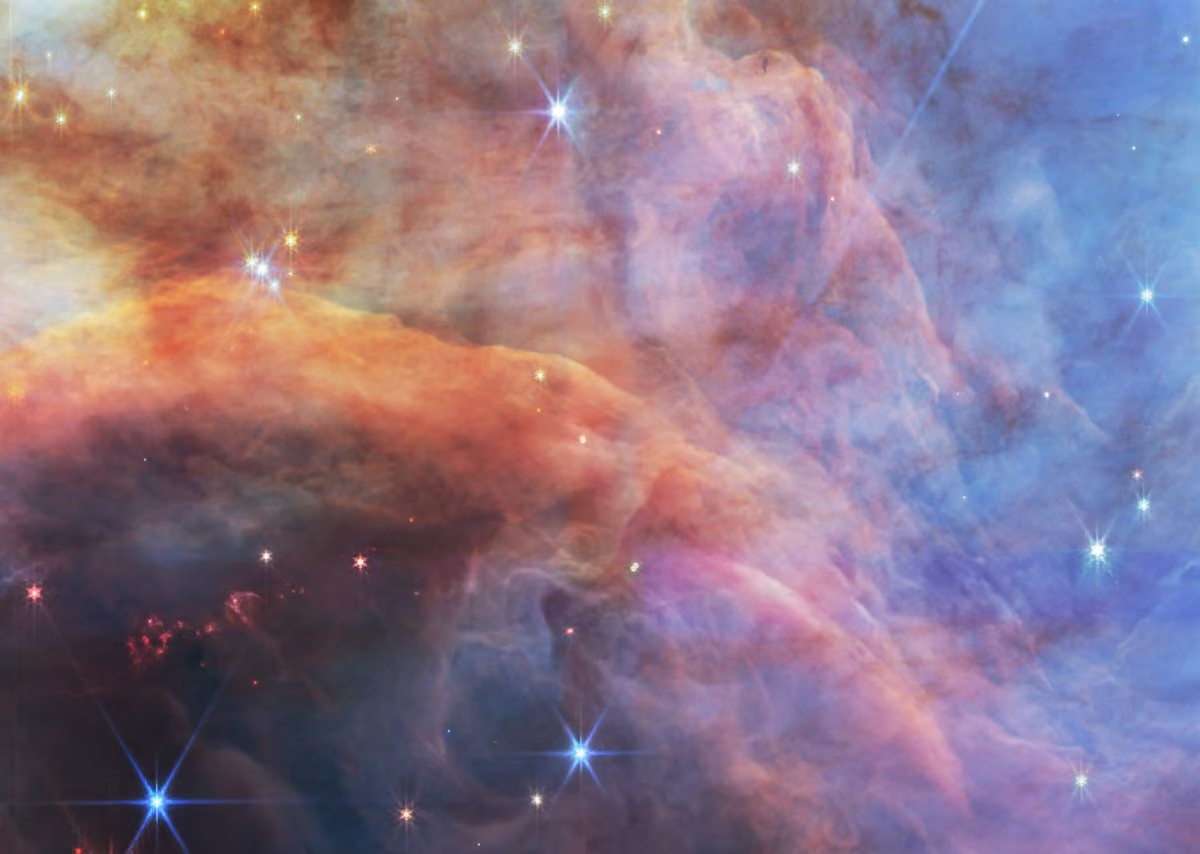
Beyond the Orion Nebula is a long and massive filament of cold gas and dust divided into four parts and collectively called the Orion Molecular Clouds. This image shows just a small portion of one of the clouds. esawebb.org/images/potm2605a/
NASA Webb Telescope
@NASAWebb
Every stage of star formation — from the youngest stellar embryos, to protoplanetary discs, to newly-minted pre-main sequence stars — is contained within just this scene (captured by Webb’s Near-Infared Camera) which stretches 150 light-years across.
-
NASA Webb Telescope
@NASAWebb
Webb is looking at the chemical fingerprints of interstellar comet 3I/ATLAS in the mid-infrared 🔎
New data points to a very different formation environment and chemistry for this object compared to most comets that formed in our own solar system.
science.nasa.gov/blogs/3iatlas/2026/06/01/nasas-webb-dete… -
NASA Webb Telescope
@NASAWebb
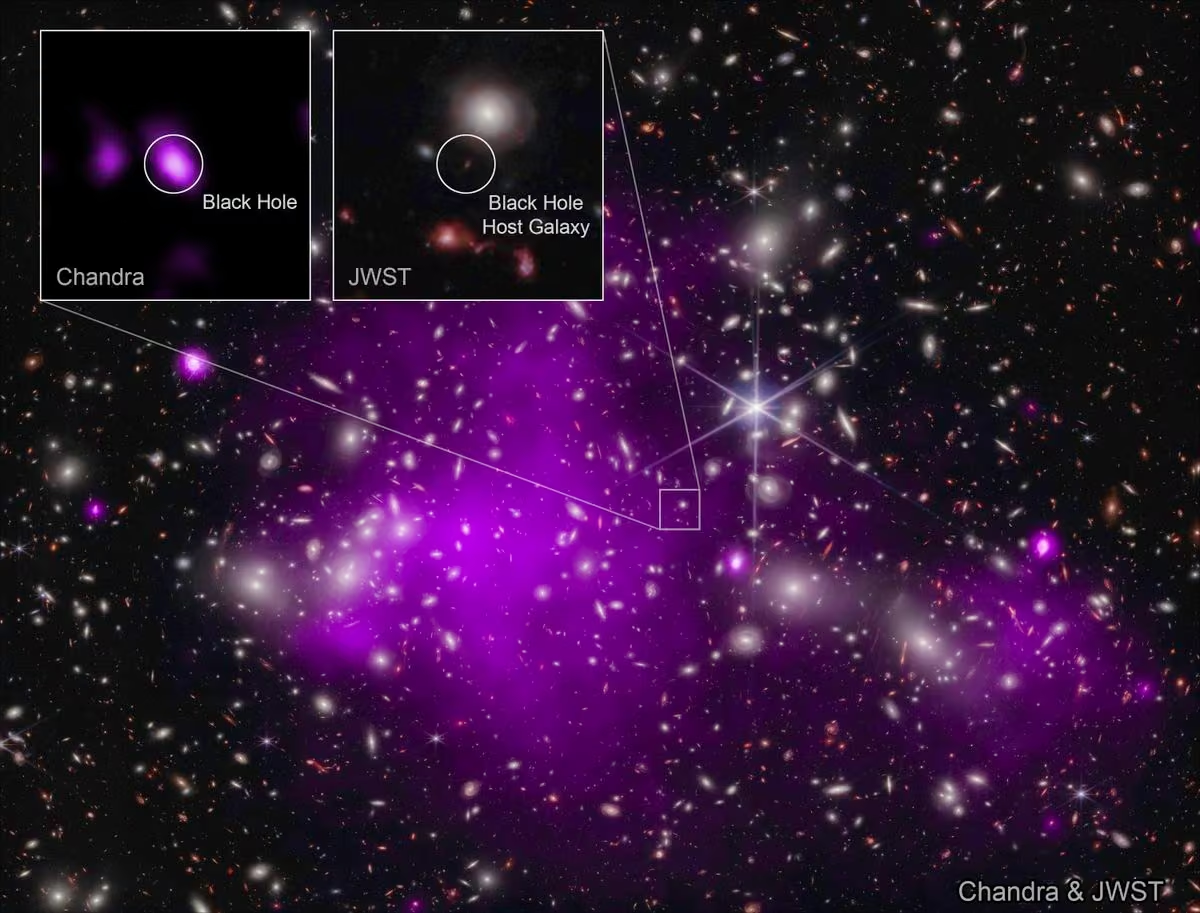
Which came first, galaxies or black holes?
New Webb observations show that some supermassive black holes were enormous from their beginnings, shifting traditional ideas around how black holes form and grow.
science.nasa.gov/missions/webb/nasas-webb-reveals-black-h… -
NASA Webb Telescope reposted
Chandra Observatory
@chandraxray
Westerlund 2 is a young cluster of thousands of stars located about 20,000 light-years from Earth. This close-up image, roughly 12 light-years across, combines observations from NASA's Chandra X-ray Observatory & @NASAWebb.✨
-
NASA Webb Telescope reposted
Chandra Observatory
@chandraxray
At the heart of galaxy NGC 1365, a supermassive black hole is basically feasting at an all‑you‑can‑eat buffet in this image from Chandra and @NASAWebb. Located about 60 million light-years from Earth, this gobbling black hole has a mass of roughly 2 million suns... and growing.⚫
-
NASA Webb Telescope reposted
Space Telescope Science Institute
@SpaceTelescope
There is a massive black hole in the center of almost every galaxy. How did it get there, and importantly, how does it grow? On May 19, we'll discuss what new #nasawebb data is driving the biggest tensions in our understanding of the black hole phenomenon.
youtube.com/live/KIMhXF-heAw -
NASA Webb Telescope
@NASAWebb
To MoM-z14 & back! 💐
Let a caregiver in your life know your appreciation for them reaches the farthest galaxy ever detected!
Read more about MoM-z14: science.nasa.gov/missions/webb/nasa-webb-pushes-boundarie… -
NASA Webb Telescope
@NASAWebb
Don’t let anyone dull your shine 💫
The heart of galaxy M77 nearly outshines the galaxy itself in this mid-infrared Webb image. Gas rapidly orbits the central black hole, heating up, and radiating light. esawebb.org/images/potm2604a/
NASA Webb Telescope
@NASAWebb
In the mid-infrared, swirling filaments of dust are shown in blue. The glowing orange bubbles along the arms are being carved out by newly formed star clusters.
Post not available here, view on X
NASA Webb Telescope
@NASAWebb
This image is a composite of both mid and near infrared. The bright orange lines radiating out of the center are diffraction spikes. They aren't a physical feature of the galaxy, but an optical effect caused by the structure of the telescope.
NASA Webb Telescope
@NASAWebb
Light can bend (or be diffracted) around the edges of the telescope primary mirror and the struts that hold the secondary mirror. Bright objects in Webb images show a distinctive six-plus-two-pointed pattern. Hubble's have 4 point diffraction spikes due to its structure.
-
NASA Webb Telescope
@NASAWebb
It’s heaven in my heart, and we could find you some *space* ✨
Webb looked at nearly 9000 star clusters in four different nearby galaxies and its data shows that more massive star clusters emerge more quickly from the clouds they are born in.
esawebb.org/news/weic2608/ -
NASA Webb Telescope reposted
NASA Science
@NASAScience_
From Hubble discoveries to your screen. 👇
You can do NASA science, too.
With Galaxy Zoo, volunteers classify @NASAWebb galaxies – sometimes as the first humans to see them. 👀
Get started: science.nasa.gov/citizen-science/galaxy-zoo
Hubble
@NASAHubble
Did you know April is Citizen Science Month?
Public participation in scientific research helps solve the mysteries of the universe! Find out more about Hubble's citizen science work: science.nasa.gov/mission/hubble/science/citizen-science/?…
And find @NASA projects you can work on here: science.nasa.gov/citizen-science/?linkId=933928838This media couldn't be displayed. See it on the original post. -
NASA Webb Telescope
@NASAWebb
We won both the Webby and People's Voice awards for best education and science social campaigns in @TheWebbyAwards! Saying we're grateful for you all doesn't even scratch the surface! Thank you so much for following, engaging, and voting!💗
winners.webbyawards.com/2026/social/social-campaigns/educ… -
NASA Webb Telescope
@NASAWebb
Shine, dream, smile! Oh, let us light up the night… with a pair of new stars, and maybe some planets!
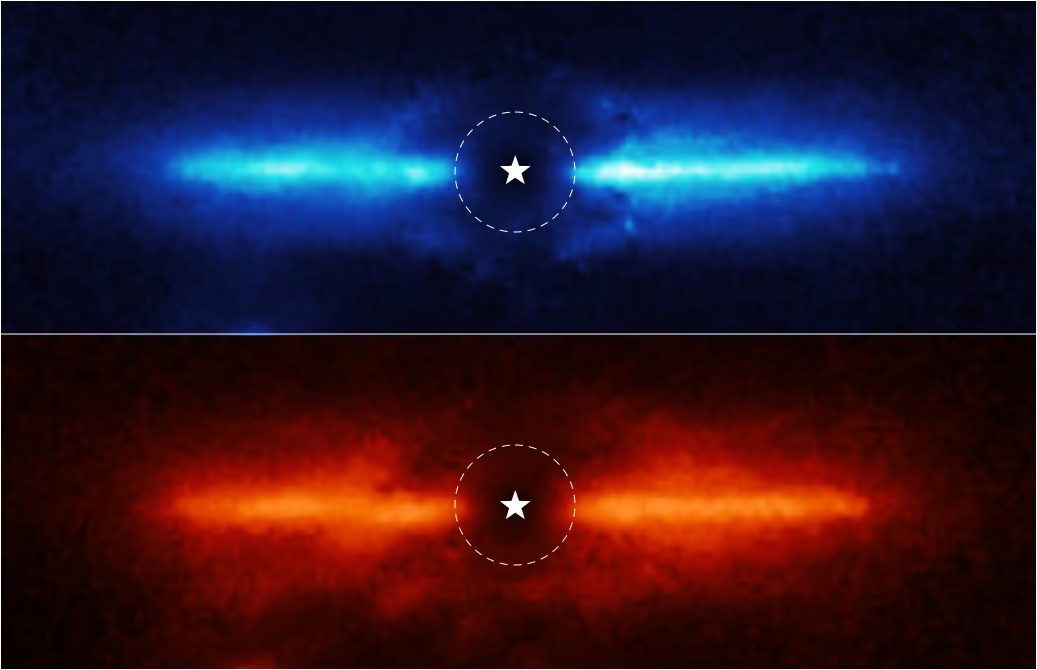
Webb captured edge-on views of two protoplanetary disks, which will help us better understand the process of planet formation.
esawebb.org/images/potm2603a/ -
NASA Webb Telescope
@NASAWebb
The end is near! The fate of this nebula's central star and Webby voting is the same, both reaching the end.
There are a few hours left to get your Webby vote in! Voting ends tonight (Thursday, April 16) at 11:59 PM PDT. Click here to submit yours: vote.webbyawards.com/PublicVoting -
NASA Webb Telescope
@NASAWebb
There's still one more day to cast your vote in @TheWebbyAwards!
If you've enjoyed unfolding the universe with us this year, vote here: vote.webbyawards.com/PublicVoting
To MoM-z14 and back 💞 -
NASA Webb Telescope
@NASAWebb
Wait, there's more Webb in this year's @TheWebbyAwards!
Vote for Cosmic Dawn as the best longform documentary by Thursday, April 16: vote.webbyawards.com/PublicVotingThis media couldn't be displayed. See it on the original post. -
NASA Webb Telescope reposted
Hubble
@NASAHubble
We heard Hearing Hubble got nominated for @TheWebbyAwards! 👂🎊
Our DIY-experience lets you transform the scientific data in Hubble images into sound.
Voting closes on Thursday, April 16: vote.webbyawards.com/PublicVoting -
NASA Webb Telescope
@NASAWebb
Webb directly imaged 29 Cygni b, an object 15 times the mass of Jupiter, to find out if it formed like a planet or a star, since they result from different processes. Data show it's a planet! science.nasa.gov/missions/webb/nasas-webb-redefines-divid…
-
NASA Webb Telescope
@NASAWebb
There’s nothing we love more than sharing the universe with you all. If you feel the same, vote for us in @TheWebbyAwards by Thursday, April 16!
Vote here: vote.webbyawards.com/PublicVoting -
NASA Webb Telescope
@NASAWebb
We can't wait to rock out the show with you, @NASARoman! 🤩
Together, we'll usher in an exciting new era of cosmic discovery.
Nancy Grace Roman Space Telescope
@NASARoman
You get the best of both worlds with Webb and Roman!
Roman will give us a big picture view of cosmic ecosystems and pinpoint rare objects. @NASAWebb can use its narrower view but more powerful vision to follow up on those objects for even more detailed observations. -
NASA Webb Telescope
@NASAWebb
Amaze amaze amaze!
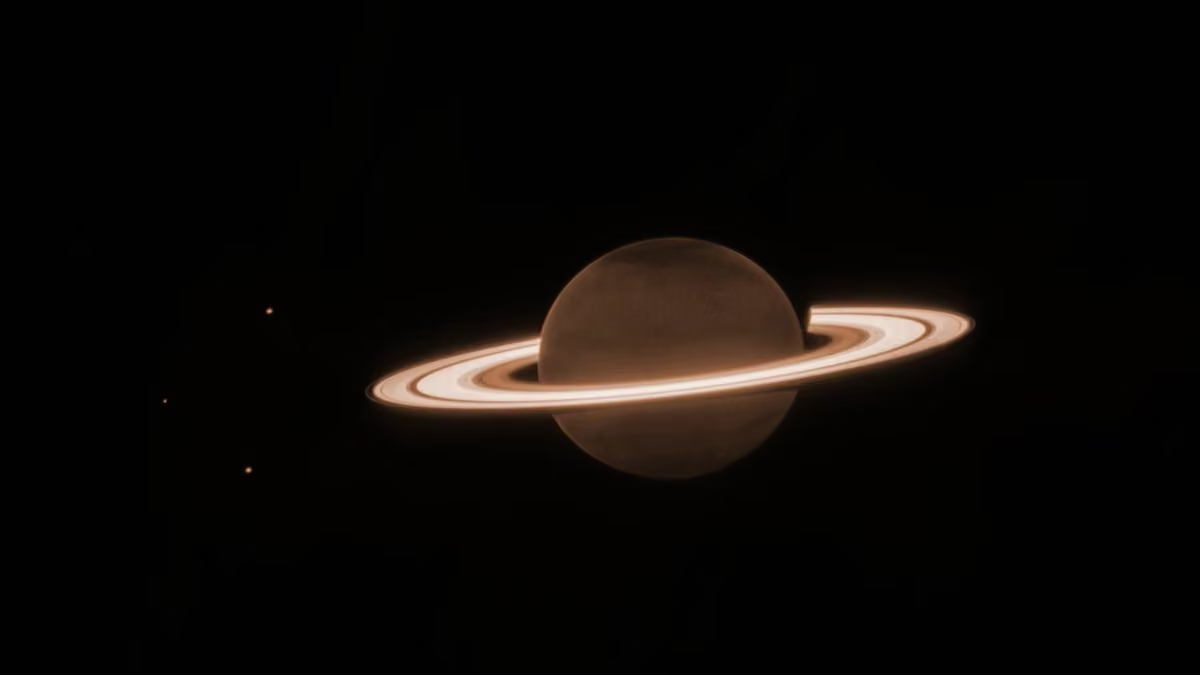
Webb teamed up with @NASAHubble, observing the ringed planet in complementary wavelengths of light to give us a richer, more layered understanding of its atmosphere. science.nasa.gov/missions/webb/nasa-webb-hubble-share-mos… -
NASA Webb Telescope
@NASAWebb
Is it just me or is that galaxy getting closer? 👀
M90 (NGC 4569), shown here in this new Webb image, is indeed getting closer! Its orbit through the Virgo cluster has accelerated so much that M90 is in the process of escaping the cluster entirely and is moving in our direction. -
NASA Webb Telescope
@NASAWebb
Webb captured this new image of galaxy Messier 58, in both the near and mid-infrared, as part of a treasury of 55 massive, star-forming galaxies. The data on the properties of these galaxies will add insight to our picture of how galaxies grow and evolve over cosmic time.
-
NASA Webb Telescope reposted
Hubble
@NASAHubble
Two eyes on the Black Eye Galaxy!
Data from Hubble and @NASAWebb combine in this new image of the Black Eye Galaxy, also known as Messier 64.
Astronomers used Hubble and Webb to study this galaxy to learn more about star formation in nearby galaxies: science.nasa.gov/mission/hubble/science/explore-the-night… -
NASA Webb Telescope reposted
Chandra Observatory
@chandraxray
Spring into spring with this new image of the Cat's Paw Nebula from NASA's Chandra and @NASAWebb. We expect it to start knocking planets off the counter for sport any minute now. 🐾
-
NASA Webb Telescope reposted
Hubble
@NASAHubble
Let’s get to the heart of it. 🧡
This new image from Hubble and @NASAWebb takes a closer look at the core of Messier 101, also known as the Pinwheel Galaxy.
At 25 million light-years away, M101 is one of the closest “face-on” spiral galaxies to us: science.nasa.gov/mission/hubble/science/explore-the-night… -
NASA Webb Telescope reposted
National Air and Space Museum
@airandspace
Now on display at Air and Space:
🌌 James Webb Space Telescope Pathfinder, a full-scale engineering model used by @nasawebb for critical testing in development of the spacecraft
☀️ Parker Solar Probe full-scale model built primarily out of spare parts and back-ups from the spacecraft that has flown through the Sun’s corona -
NASA Webb Telescope reposted
Space Telescope Science Institute
@SpaceTelescope
#nasawebb has revolutionized our ability to study the formation and growth of new planetary systems, some with similarities to our own.
On March 18, join us for a conversation on what we’ve learned about young planetary systems. www.youtube.com/live/Sz_i_4_fGgs -
NASA Webb Telescope
@NASAWebb
Webb may showcase the beauty of deep space objects, but it also plays a strong role in planetary defense applications.
Using Webb observations, experts accurately measured the size and orbit of asteroid 2024 YR4 and confirmed it will not impact our Moon in 2032. -
NASA Webb Telescope
@NASAWebb
If it’s invisible, how do you map it and why does it *matter*?
Using Webb data, researchers mapped locations of dark matter (shown in blue) across a field of nearly 800,000 galaxies.
www.nasa.gov/missions/webb/nasa-reveals-new-details-about…
NASA Webb Telescope
@NASAWebb
We can’t see dark matter. It doesn’t emit, reflect, absorb, or block light, but like everything with mass, it has gravity. If we observe how and where light is being warped by gravity, we can make a map of the matter warping it, even if that matter is invisible to us.
NASA Webb Telescope
@NASAWebb
Why does dark matter matter? Scientists think dark matter started clumping together first in the early universe, eventually pulling regular matter together, prompting galaxy and star formation to begin earlier than they might have otherwise.
-
NASA Webb Telescope
@NASAWebb
A brain-new image from Webb! 🧠
What looks like a brain is actually a dying star blowing off a shell of gas, and within that shell, a cloud of various gases. The dark lane that divides its “hemispheres” may be related to an outflow from the central star.
science.nasa.gov/missions/webb/nasas-webb-examines-craniu…
NASA Webb Telescope
@NASAWebb
Webb has captured two views of this nebula. The near-infrared view shows more stars, as well as background galaxies. In the mid-infrared, the cosmic dust glows more prominently.
NASA Webb Telescope
@NASAWebb
What’s next for this star will depend on its mass, which is yet undetermined. If it is a high mass star it will explode in a supernova. If it’s less massive and more Sun-like, it’ll keep shedding layers until only its core remains as a dense white dwarf star.
-
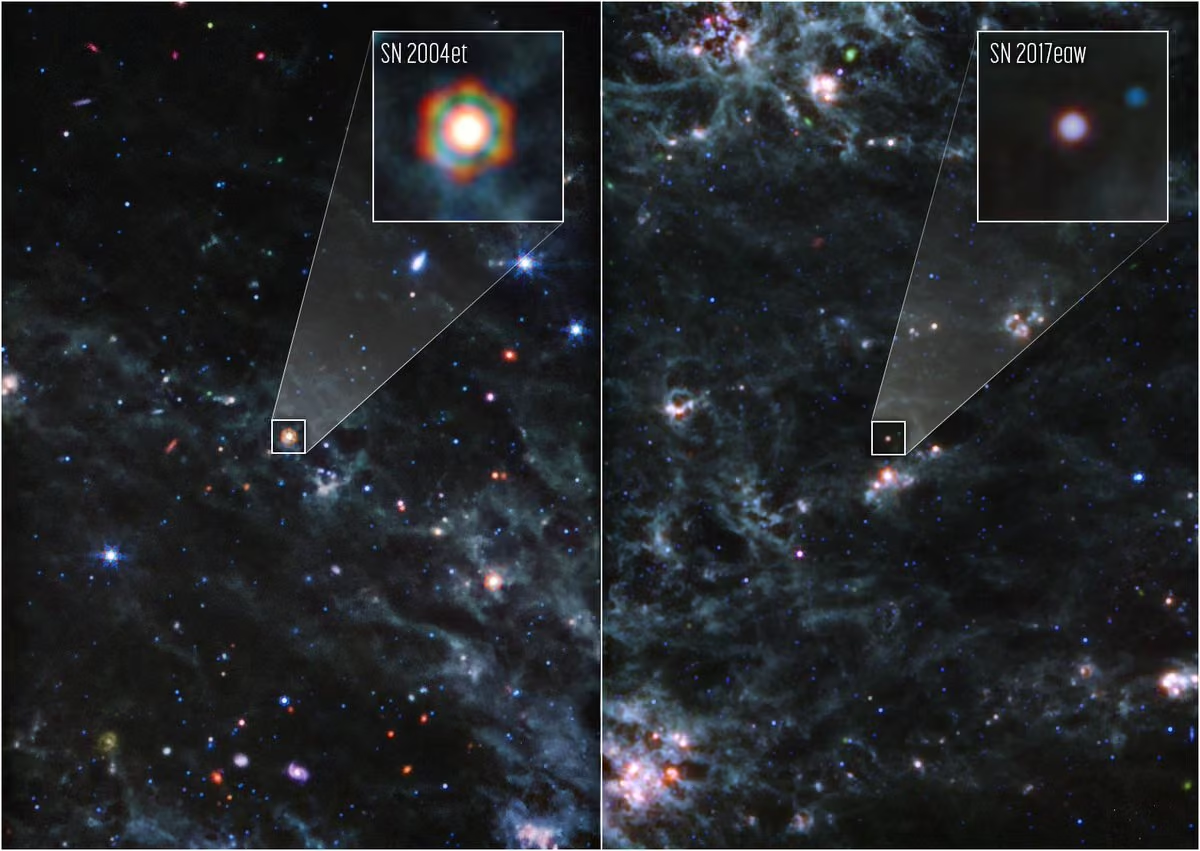
NASA Webb Telescope
@NASAWebb
What if you could go back in time and see a star just before it goes supernova? Archives of telescope data are essentially letting astronomers do just that. 🧵 👇 science.nasa.gov/missions/webb/nasas-webb-telescope-locat…
Post not available here, view on X
NASA Webb Telescope
@NASAWebb
We would expect that the most massive stars (those that will end their lives as supernovas) to be among the brightest and most luminous, and thus easy to spot in pre-supernova imagery. But that hasn’t been the case.
NASA Webb Telescope
@NASAWebb
Perhaps the most massive & old stars are also the dustiest, and the dust could make them look less luminous and hard to see. This particular dusty supergiant seems to support that hypothesis. Next? Locate and study similar stars that have the potential to go supernova, but haven’t yet.
-
NASA Webb Telescope
@NASAWebb
Light from the age of the dinosaurs 🦖
The light that Webb collected to create this image has been journeying to us from spiral galaxy NGC 5134 for 65 million years, or since soon after Tyrannosaurus rex went extinct!
esawebb.org/images/potm2602a/ -
NASA Webb Telescope
@NASAWebb
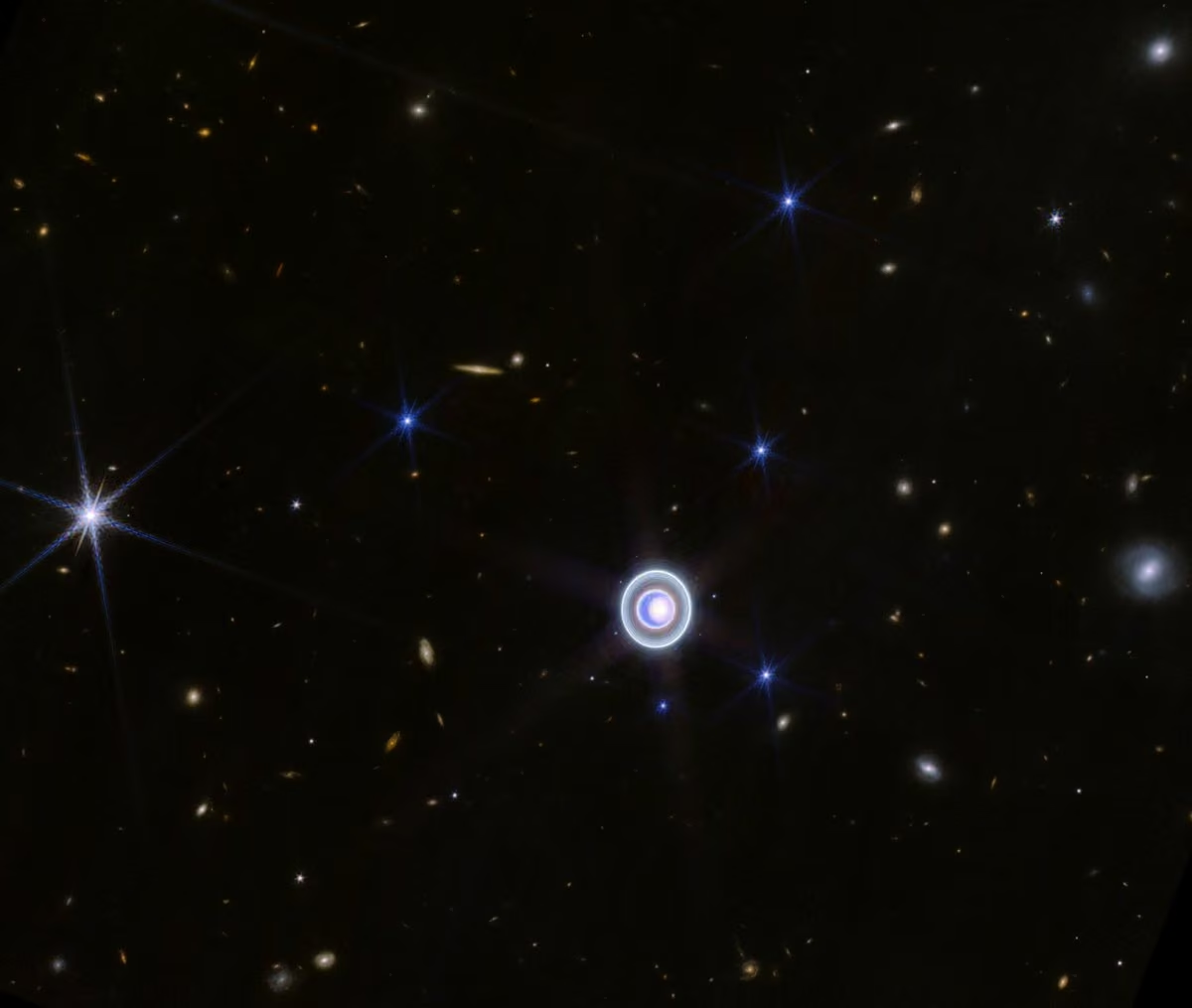
Hey, hey, it’s everyone’s favorite 7th planet from the Sun!
Webb has provided us with the first vertical view of Uranus’s ionosphere, revealing auroras shaped by its tilted magnetic field.
esawebb.org/news/weic2602/ -
NASA Webb Telescope
@NASAWebb
Supercharging discoveries ⚡
With Webb, astronomers can peer deeper into star-forming regions than ever before, revealing nuances of this age-old process.This media couldn't be displayed. See it on the original post. -
NASA Webb Telescope reposted
Space Telescope Science Institute
@SpaceTelescope
Astronomers have used #nasawebb to search for brown dwarfs at very low masses in a nearby nebula that contains newborn stars. Join Dr. Kevin Luhman (Penn State) for a discussion on the surprising aspect of these new brown dwarfs on Feb. 24, at 7 p.m. ET.
www.youtube.com/watch?v=4A-EMQGzRV4 -
NASA Webb Telescope reposted
Hubble
@NASAHubble
Who’s in your #nasamooncrew? 🫵
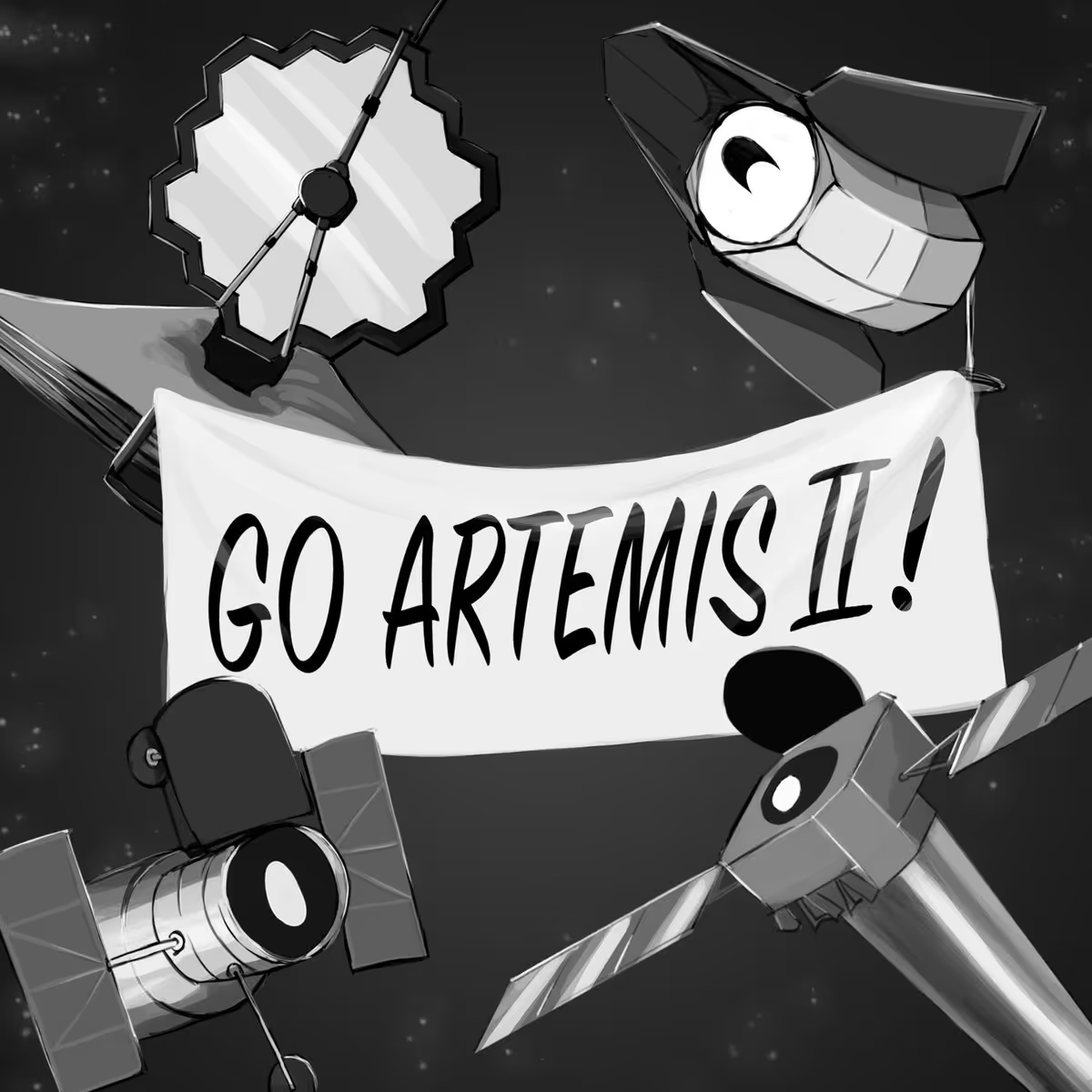
Crews bring together the right mix of skills to make missions happen! Just like the Artemis II crew working together on their journey around the Moon, NASA’s space telescopes use their different strengths to observe the universe.
Your turn: Tell @NASA who you’d bring on a journey around the Moon! Details here: www.nasa.gov/nasamooncrew/?linkId=902398715 -
NASA Webb Telescope
@NASAWebb
Meet our current record holder for farthest galaxy ever seen (so far!!)
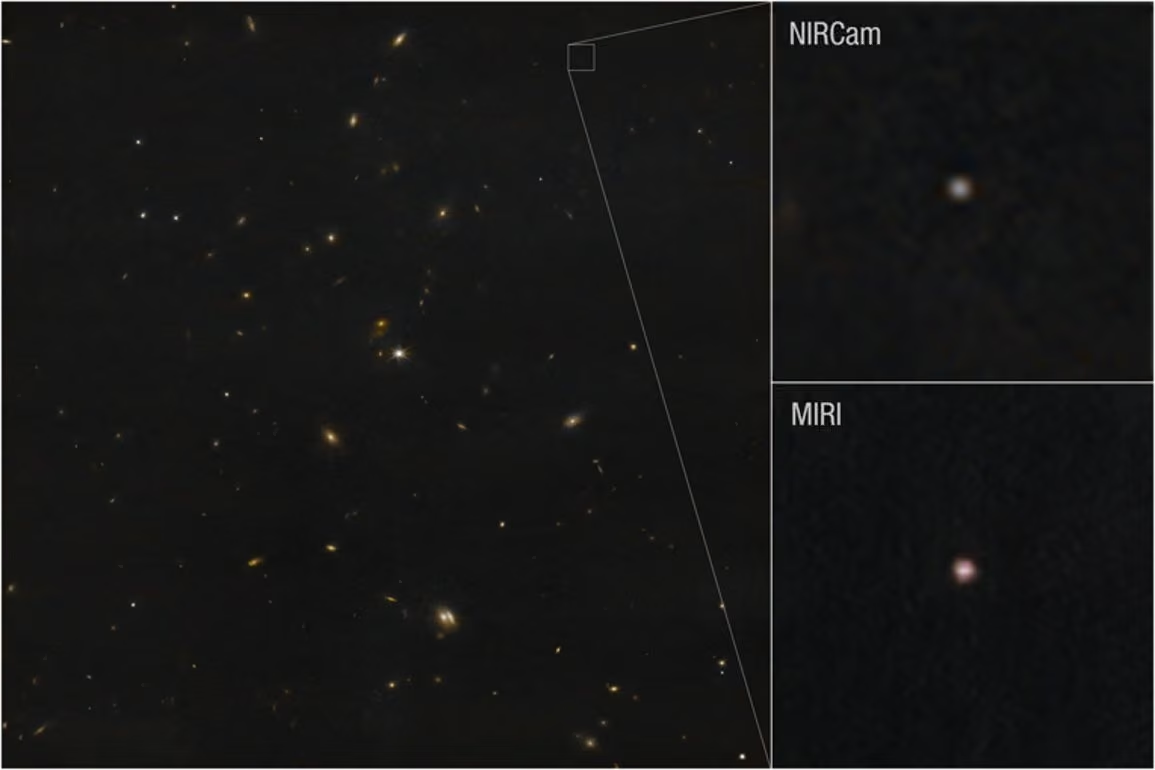
MoM-z14 may look like a little yellow smudge here, but it's our first view of a galaxy that existed just 280 million years after the big bang!
science.nasa.gov/missions/webb/nasa-webb-pushes-boundarie… -
NASA Webb Telescope reposted
Chandra Observatory
@chandraxray
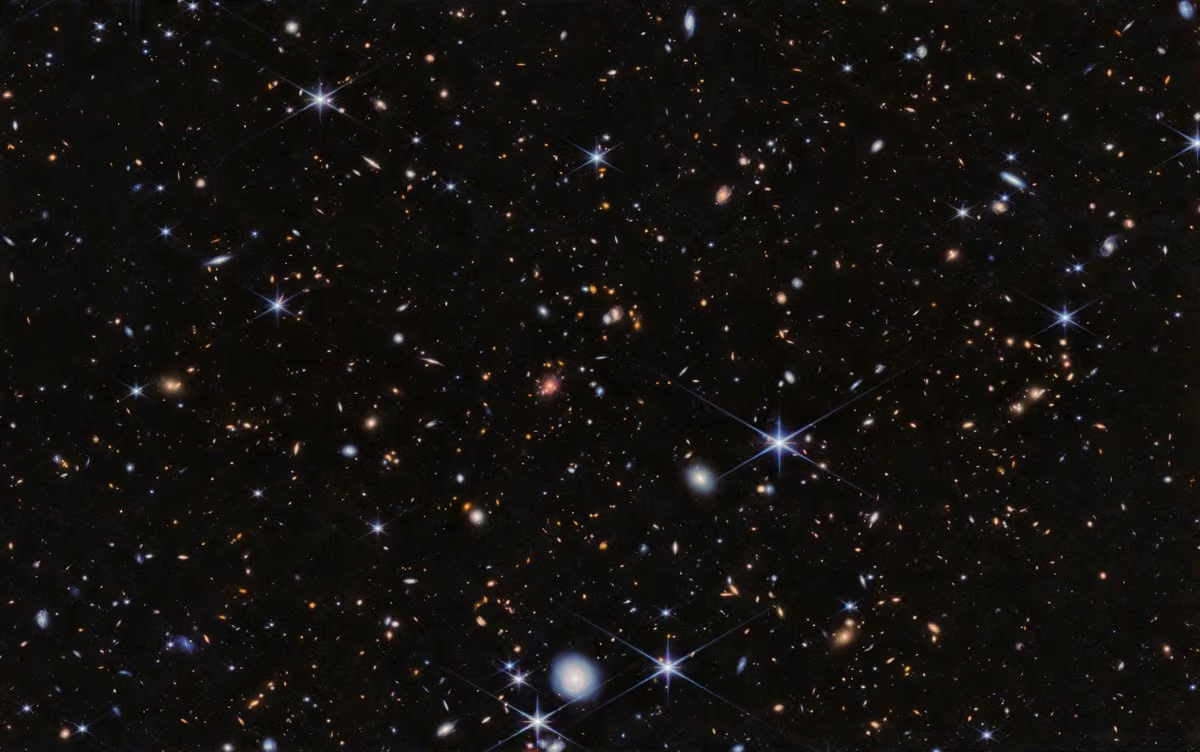
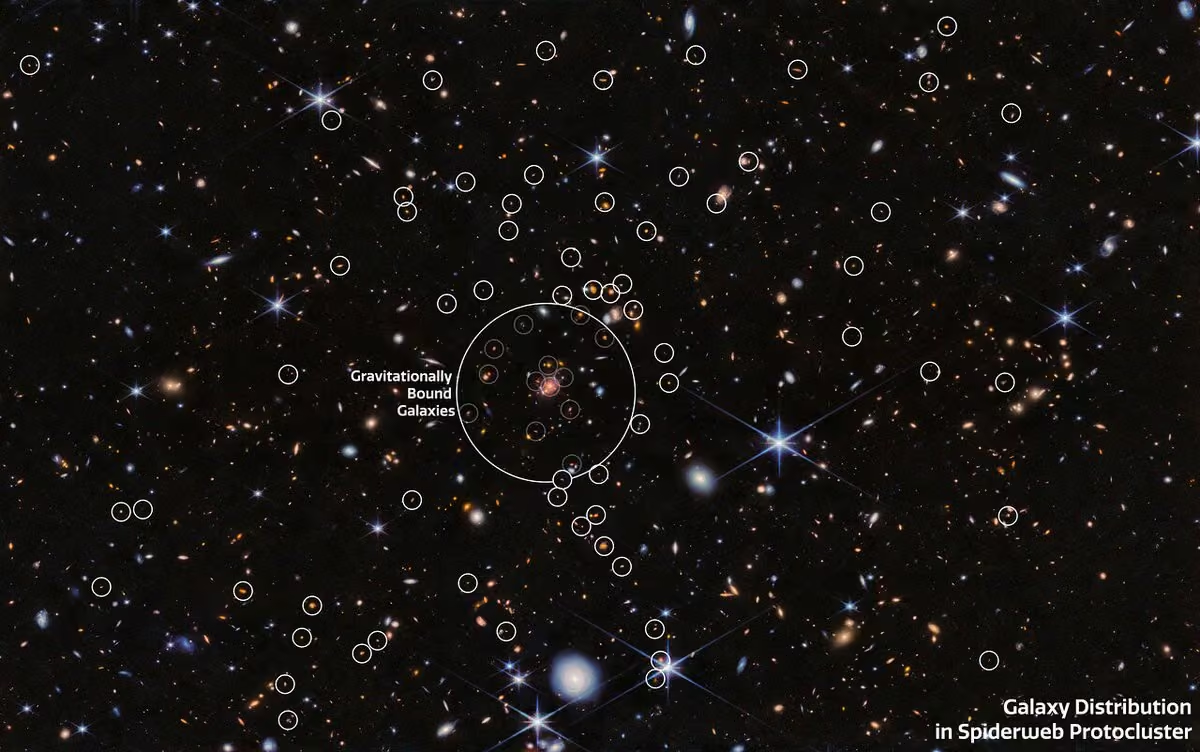
A new discovery made using both @NASA's Chandra X-ray Observatory & @NASAWebb shows that galaxy clusters may have started forming earlier in the universe than previously thought — one or two billion years earlier than previously thought possible! More at: s.si.edu/protoc
-
NASA Webb Telescope
@NASAWebb
There are over 300 confirmed galaxies (and potentially hundreds more) gravitationally bound together in this galaxy cluster, shown by Webb. At its center are elliptical galaxies that dominate the cluster with their immense gravity.
esawebb.org/images/potm2601a/
NASA Webb Telescope
@NASAWebb
Their gravity is so strong that light from galaxies behind this cluster is warped and magnified, an effect called gravitational lensing. Galaxies stretched into bright lines are scattered throughout this image
NASA Webb Telescope
@NASAWebb
At center is a pink galaxy with distinct spiral arms that resembles a jellyfish with tangled tentacles because its light has been warped and bent by gravity. This galaxy is also home to what was once the most distant single star ever discovered.
-
NASA Webb Telescope
@NASAWebb
Go with the (silicate) flow
Webb’s observations of the protostar EC 53 uncovered long sought evidence to explain why comets at the edge of our solar system contain crystalline silicates, a common ingredient found on Earth.
science.nasa.gov/missions/webb/nasa-webb-finds-young-sun-… -
NASA Webb Telescope
@NASAWebb
Galactic upcycling ♻️
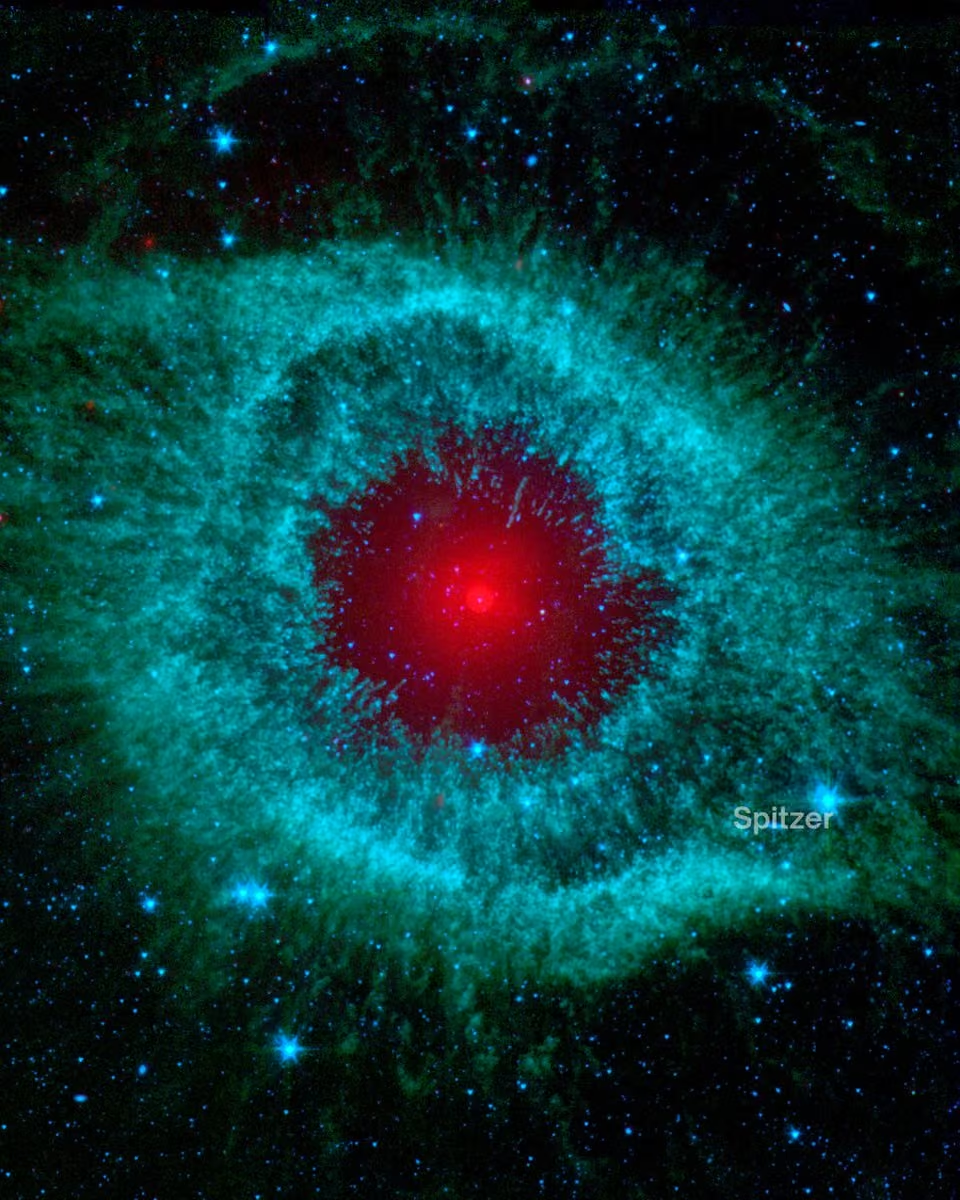
Webb captured a new close-up of an old favorite, the Helix Nebula. We’ve seen this region before with telescopes like @NASAHubble and the retired Spitzer Space Telescope, but Webb zooms into this dying star with a deeper, more detailed view. -
NASA Webb Telescope
@NASAWebb
Webb took a high resolution look at a supermassive black hole, the one at the center of the Circinus Galaxy, changing the way scientists think about how black holes interact with the matter around them.
science.nasa.gov/missions/webb/nasas-webb-delivers-unprec…
NASA Webb Telescope
@NASAWebb
For more on how black holes work, check out @NASAUniverse’s Travelers Series on NASA+: plus.nasa.gov/series/the-traveler/?linkId=898317703
-
NASA Webb Telescope
@NASAWebb
Hooray for exoplanets! Congratulations to the Pandora team on a successful liftoff this morning! We’re honored to be bonded by tech and so excited for all of the upcoming exoplanet atmosphere data! 🙌
NASA's Kennedy Space Center
@NASAKennedy
🛰️Pandora’s near-infrared detector is a spare developed for @NASAWebb, which is THE observatory most sensitive to exoplanet atmospheres.
Pandora will observe its targets for 24 hours, something flagship missions like Webb, which are in high demand, cannot regularly do. -
NASA Webb Telescope
@NASAWebb
A platypus?? A platypus galaxy?! Not exactly. 👇
Scientists using Webb data have identified a sample of galaxies that have a previously unseen combination of features. One might compare the discovery to another infamous oddball, the platypus.
science.nasa.gov/missions/webb/scientists-identify-astron… -
NASA Webb Telescope
@NASAWebb
Resilience has been a part of the elements we’re made of, from the very beginning.
Webb revealed two rare kinds of dust in the dwarf galaxy Sextans, implying that even when the universe had only a fraction of today’s heavy elements, stars could still forge solid dust grains. -
NASA Webb Telescope reposted
NASA Goddard
@NASAGoddard
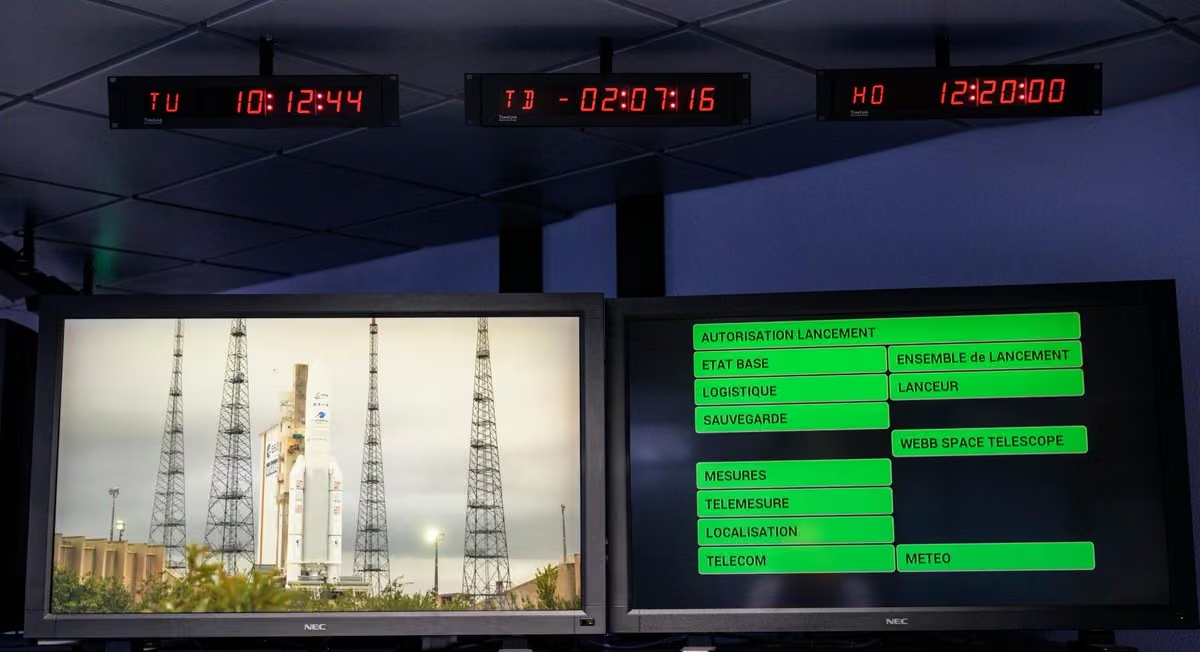
If you start Cosmic Dawn: The Untold Story of the James Webb Space Telescope on plus.nasa.gov?linkId=891199687 at 10:42:12, you can watch @NASAWebb launch exactly at midnight.
Start your 2026 off right! 🚀
plus.nasa.gov/video/cosmic-dawn-the-untold-story-of-the-j… -
NASA Webb Telescope
@NASAWebb
Happy launch-a-versary! ✨
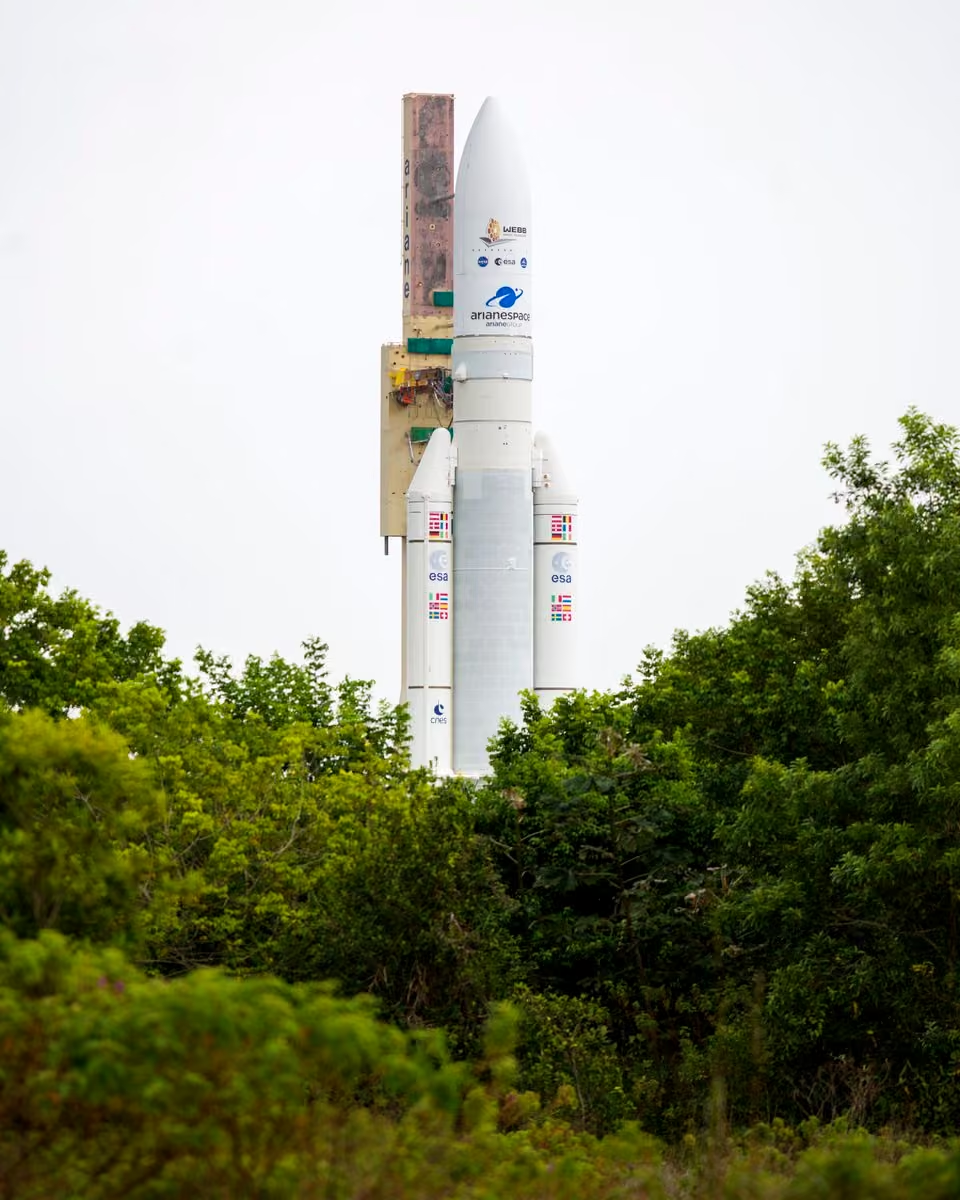
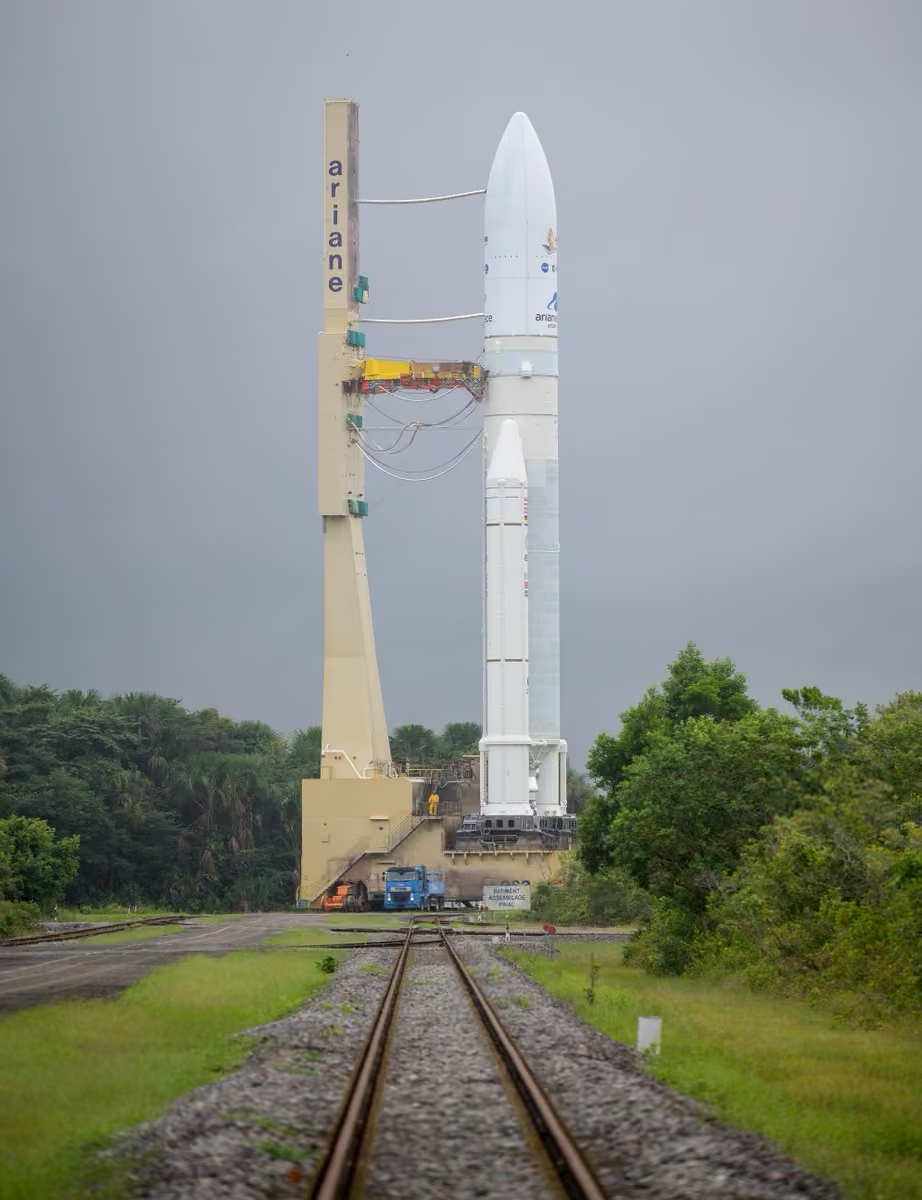
4 years ago, Webb launched from French Guiana and changed our view of the universe forever.
Like the best holiday stories, ours has it all: perseverance, triumph, a little bit of drama, and a whole lot of heart: www.nasa.gov/cosmicdawn/This media couldn't be displayed. See it on the original post. -
NASA Webb Telescope
@NASAWebb
'Twas the night before Webb's launch.
Four years ago.
We waited excitedly,
To see what it would show.
Now it's four years later,
And Webb's science is stunning.
Hear a story from John Mather,
Who got the telescope up and running.This media couldn't be displayed. See it on the original post. -
NASA Webb Telescope
@NASAWebb
Oh, the lights are shining so brightly everywhere ✨
As we wrap up 2025, Webb captured a star-studded glimpse into Westerlund 2, a cosmic nursery that reminds us to look forward to the beauty of new beginnings.
esawebb.org/images/potm2512a/
NASA Webb Telescope
@NASAWebb
For the first time, we can see the full population of brown dwarfs in this massive star cluster. Brown dwarfs are objects that are bigger than planets, but smaller than stars. They’re star-like, but aren’t big enough to fully sustain fusion.
NASA Webb Telescope
@NASAWebb
Intense energy from newborn stars carves shapes into the surrounding nebula and drives the cycle of cosmic creation. Swirls of orange and red gas are material shaped by the cluster’s radiation, while the tiny stars threaded throughout are just beginning to shine.
-
NASA Webb Telescope
@NASAWebb
Scientists are using Webb to investigate an oddball exoplanet: Jupiter-mass, gaseous, lemon-shaped, may or may not contain diamonds at its core, orbiting a pulsar. science.nasa.gov/missions/webb/nasas-webb-observes-exopla…
Post not available here, view on X
NASA Webb Telescope
@NASAWebb
This planet also has an unusual atmosphere that scientists cannot yet explain. One of the ideas floating involves a planet interior that crystallized as it cooled, causing pure carbon crystals to float to the top, mix with helium, possibly creating sooty clouds.
NASA Webb Telescope
@NASAWebb
How a planet like this forms around a pulsar in the first place is still an open question. All this remains a puzzle until scientists are able to collect more data!
-
NASA Webb Telescope
@NASAWebb
What does Webb and @NASAMars’ Curiosity Rover have in common?
They both help us explore worlds beyond Earth, teach us that great engineering feats are possible, and are both named in the 2025 TIME’s “Best Invention Hall of Fame”!
science.nasa.gov/missions/webb/nasas-webb-curiosity-named… -
NASA Webb Telescope reposted
Space Telescope Science Institute
@SpaceTelescope
SAVE THE DATE: Dr. Stefanie Milam will discuss how #nasawebb is revealing details across the Solar System that were not previously known—December 17 at 4 p.m. ET.
www.youtube.com/watch?v=BgrD1bd_In4 -
NASA Webb Telescope
@NASAWebb
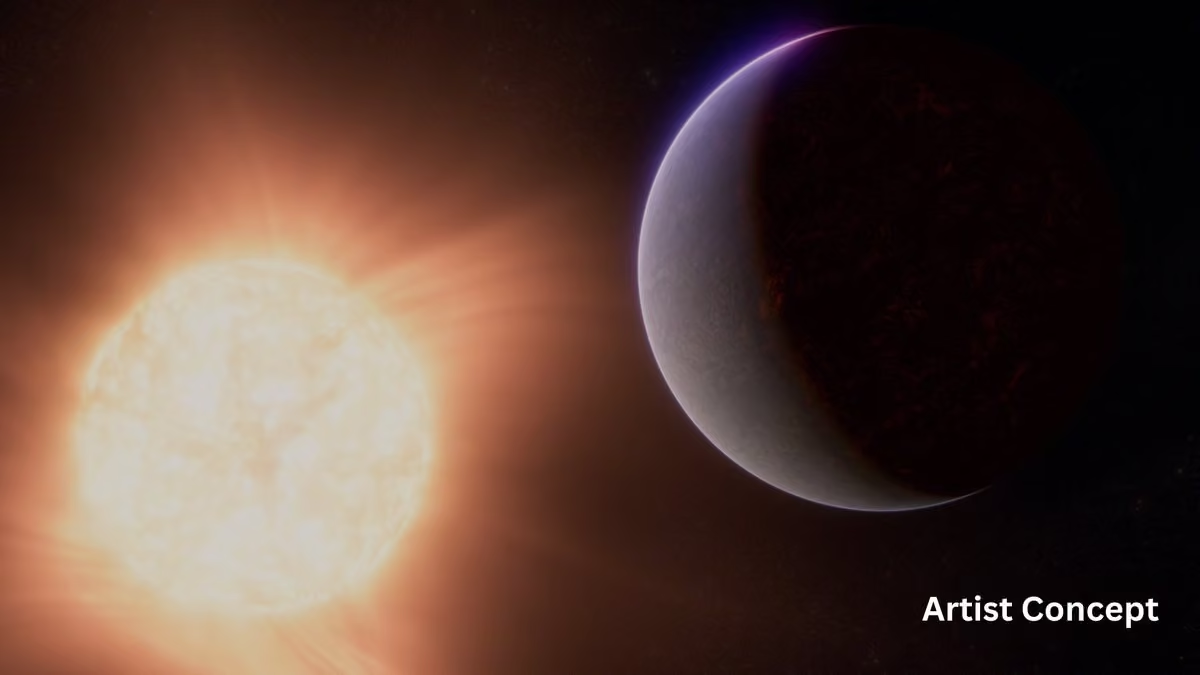
Webb detected the strongest evidence yet for an atmosphere on a rocky planet outside of our solar system! Findings suggest ultra-hot super-Earth TOI-561 b is surrounded by a thick blanket of gases above a global magma ocean.
science.nasa.gov/missions/webb/nasas-webb-detects-thick-a…
NASA Webb Telescope
@NASAWebb
This exoplanet is super close to its host star - a “year” on TOI-561 b is only 11 hours. This combined with an unusually low density makes the planet interesting. Scientists are using Webb’s NIRSpec instrument to investigate further.
-
NASA Webb Telescope
@NASAWebb
Webb confirmed the earliest supernova to date; this dying star exploded when the universe was only 730 million years old. Webb’s sharp infrared capability also allowed astronomers to locate the supernova’s very faint and distant host galaxy. science.nasa.gov/missions/webb/nasas-webb-identifies-earl…
NASA Webb Telescope
@NASAWebb
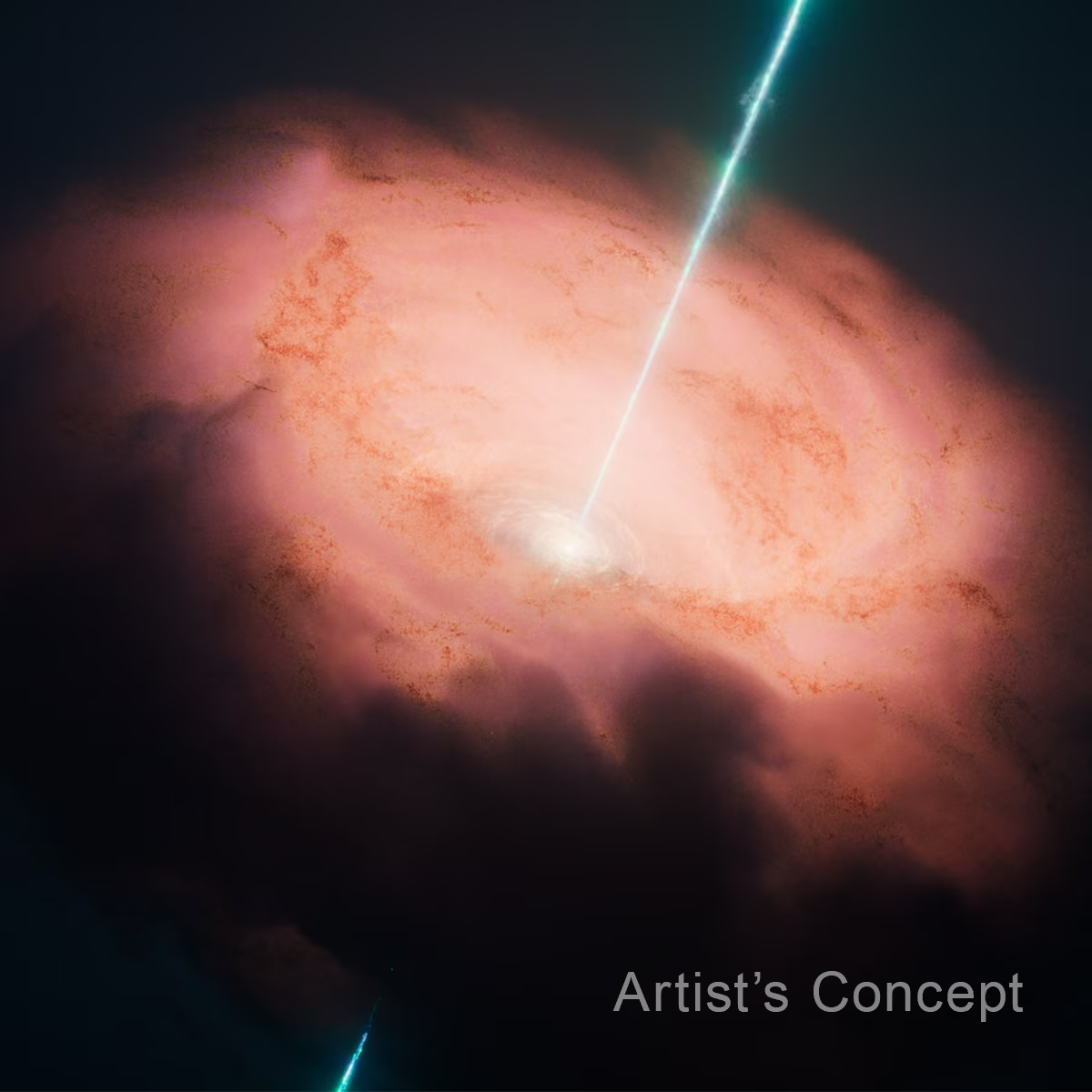
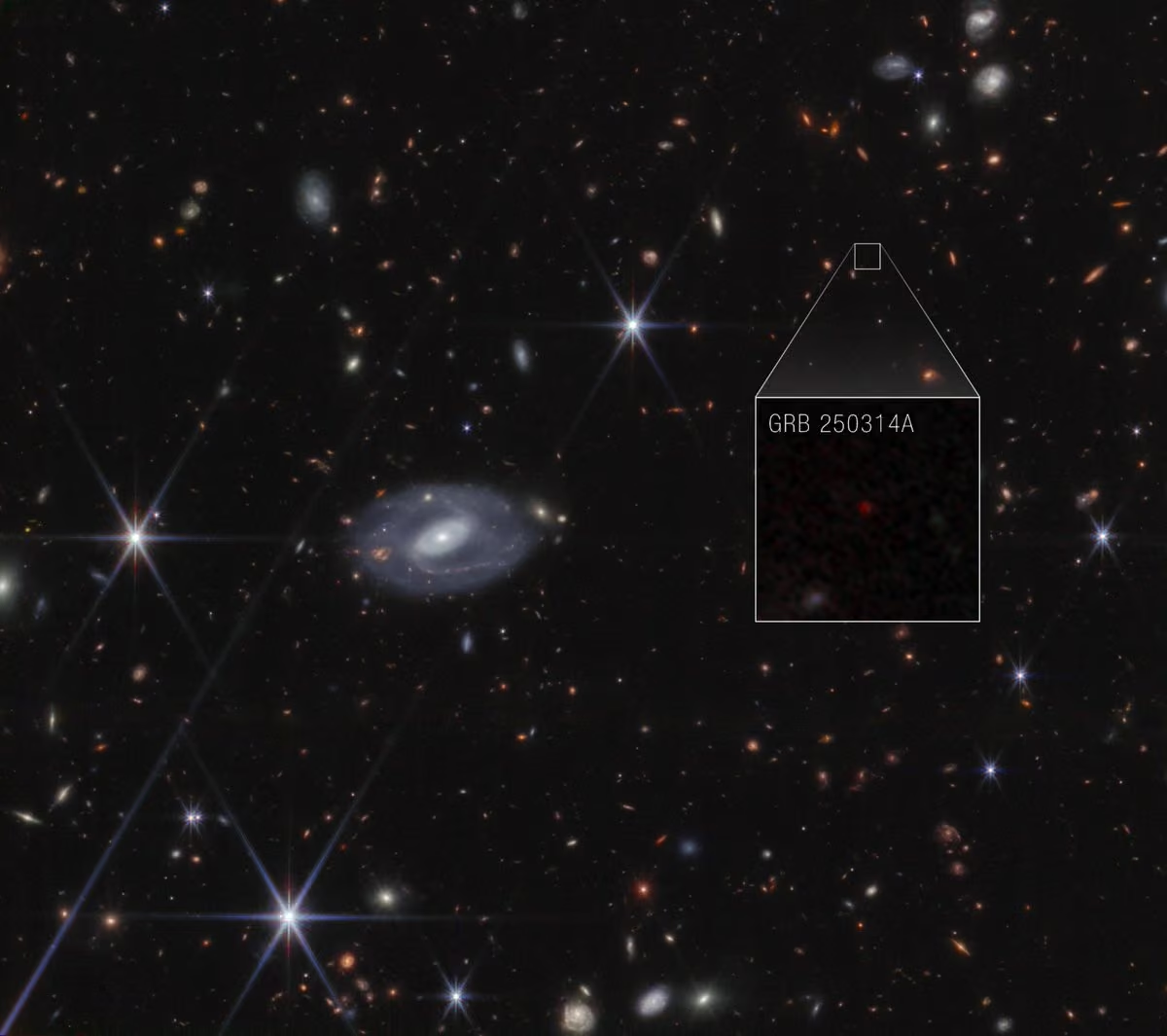
Webb supported a whole chain of observations of international telescopes which began when a rare and super bright flash of light, called a gamma-ray burst (GRB), occurred in mid-March.
-
NASA Webb Telescope
@NASAWebb
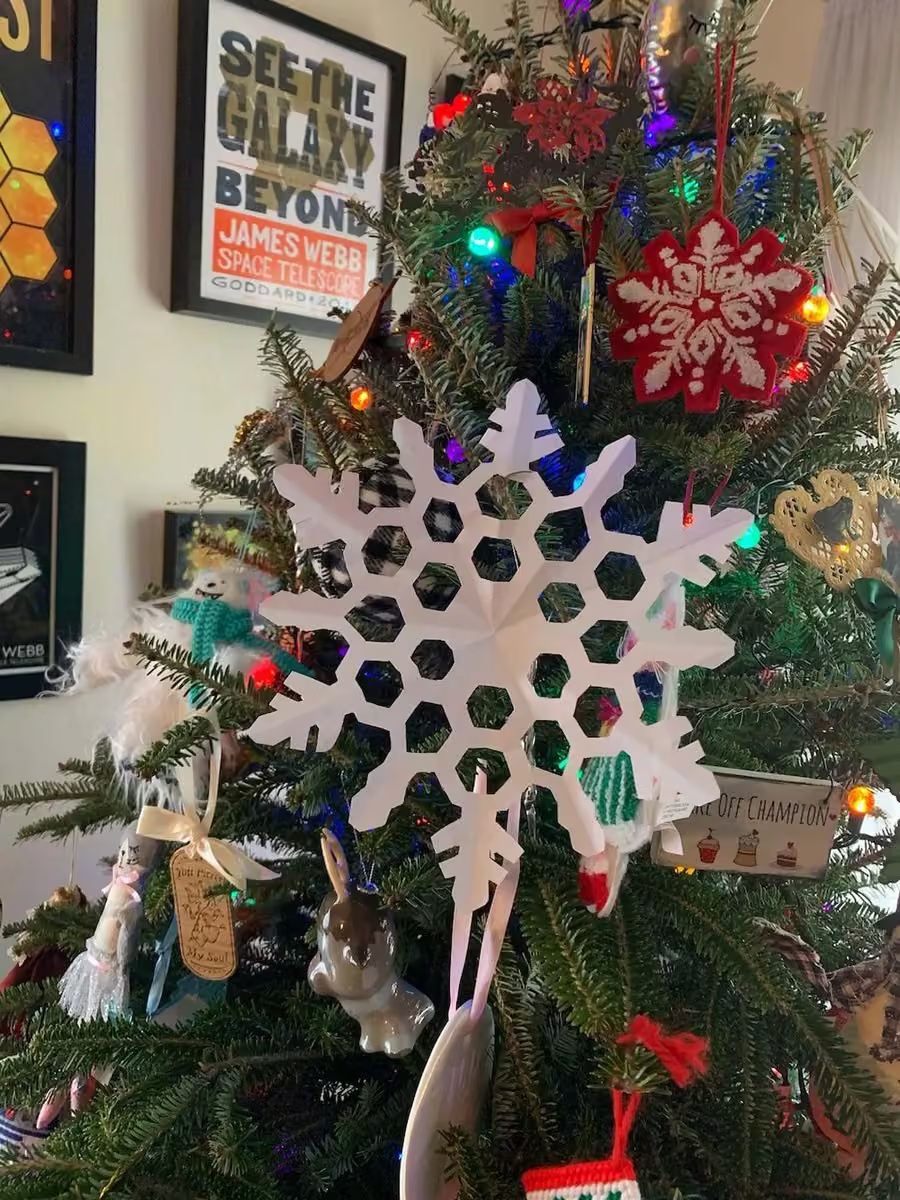
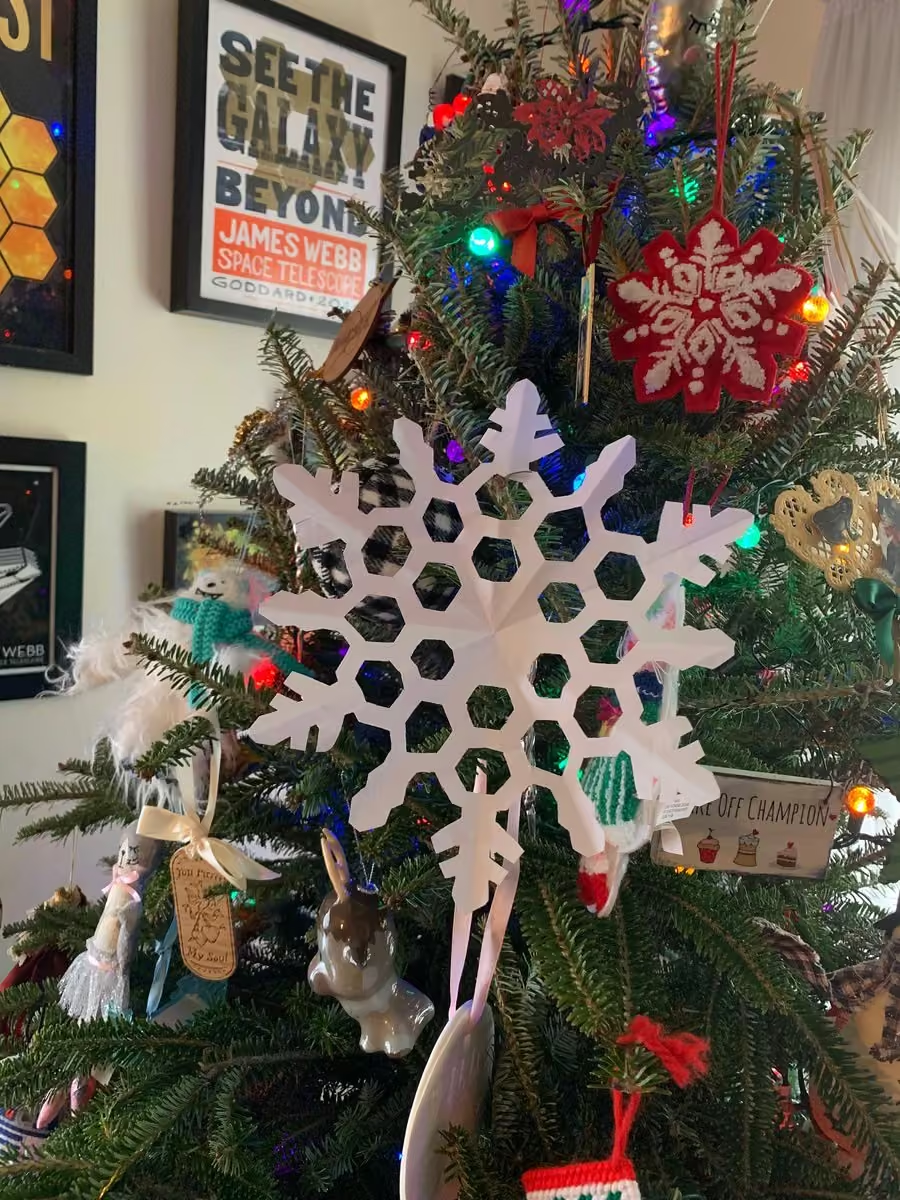
Make space for more holiday cheer! ❄️
Use this template to create your own Webb-themed paper snowflake: science.nasa.gov/mission/webb/webb-paper-snowflake/ -
NASA Webb Telescope reposted
Nancy Grace Roman Space Telescope
@NASARoman
Rome wasn't built in a day, but Roman just came together in one! The Nancy Grace Roman Space Telescope has finished final integration at the @NASAGoddard Space Flight Center.
Learn more about this historic milestone: www.nasa.gov/missions/roman-space-telescope/nasa-complete…
1/2 -
NASA Webb Telescope reposted
NASA Universe
@NASAUniverse
From blazing coronas and swirling accretion disks to powerful jets that stretch millions of miles, the extreme environments of black holes reveal their presence — and their secrets.
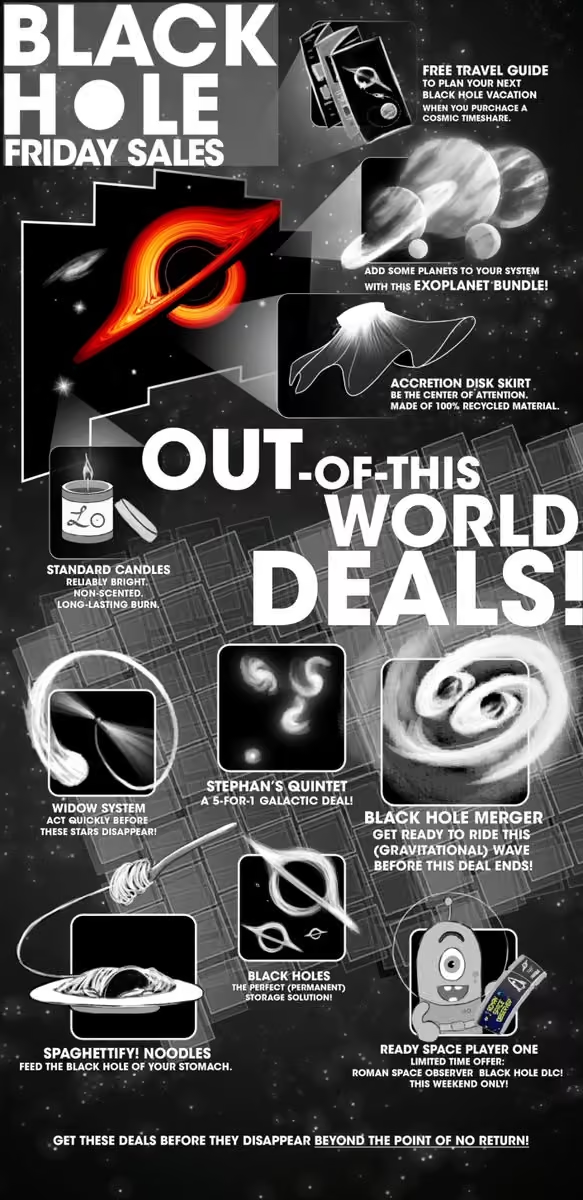
Get pulled into “Black Hole Environments, Explained.” #blackholefridayThis media couldn't be displayed. See it on the original post. -
NASA Webb Telescope
@NASAWebb
Webb took a look at this pair of nearby interacting dwarf galaxies, giving us a peek at the types of galaxy interactions that were likely common billions of years ago.
Read more: esawebb.org/images/potm2511a/
NASA Webb Telescope
@NASAWebb
These galaxies are named NGC 4490 and NGC 4485, and they’re located about 24 million light-years away. They are the closest known interacting dwarf-dwarf galaxy system where astronomers have observed the interactions between them, as well as been able to resolve the stars within.
NASA Webb Telescope
@NASAWebb
Dwarf galaxies can give us insights into galaxies in the early universe, which were thought to have less mass than galaxies like the Milky Way, and also contain a lot of gas, relatively few stars, and typically have small amounts of elements heavier than helium.
-
NASA Webb Telescope
@NASAWebb
New Webb data suggests that black holes in the early Universe are growing faster than we expected in early galaxies - and also growing faster than the galaxies that host them.
esawebb.org/news/weic2522/ -
NASA Webb Telescope reposted
NASA
@NASA
LIVE: See the latest images of comet 3I/ATLAS, the third object we've ever seen passing through our solar system from elsewhere in the galaxy.
We’re sharing what we know about this visiting comet, how we’re studying it, and what we can learn from it. x.com/i/broadcasts/1LyGBXEOlpzxN -
NASA Webb Telescope
@NASAWebb
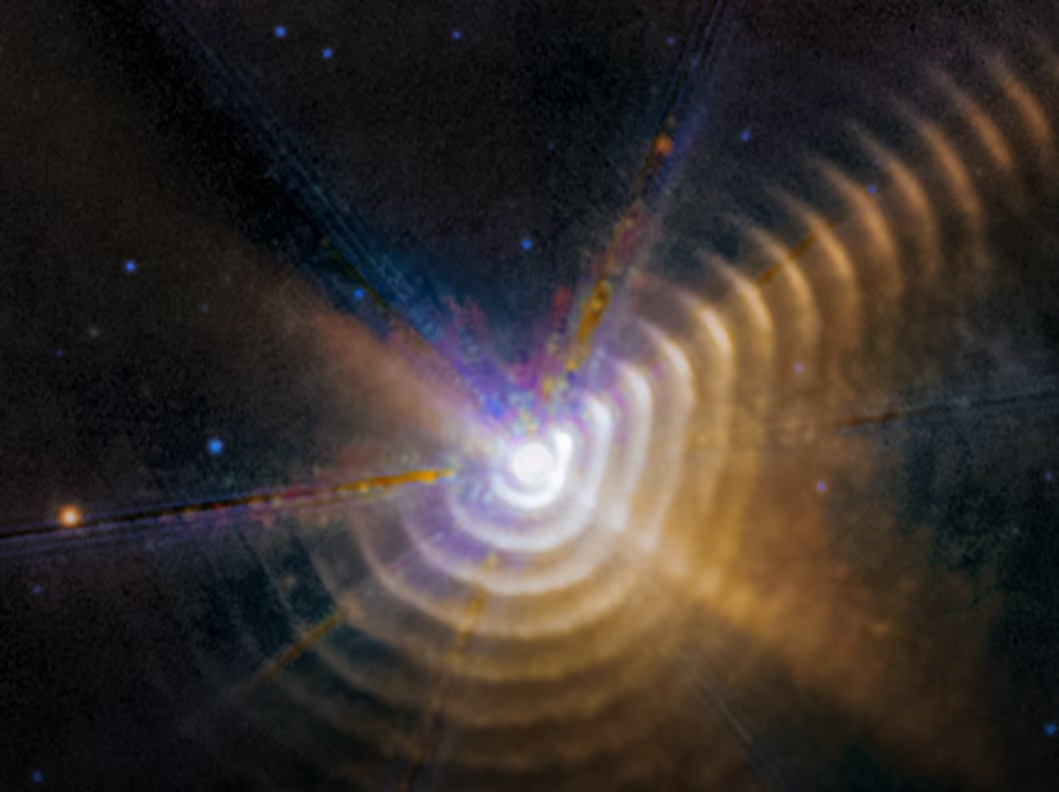
Webb refined our view of Apep, a star system consisting of two rare Wolf-Rayet stars and a supermassive third star, which is slicing holes in the dusty shells its companions are creating. science.nasa.gov/missions/webb/webb-first-to-show-4-dust-…
NASA Webb Telescope
@NASAWebb
Webb confirmed the 3rd star and the unusually long orbital period of the Wolf-Rayet stars (190 years), which causes these dust shells to be created during the 25 years it takes them to pass each other.
-
NASA Webb Telescope reposted
NASA
@NASA
We're hosting a live event on Wednesday, Nov. 19 to share the latest images of the interstellar comet 3I/ATLAS, collected by several NASA missions.
Tune in for the details—and send in your questions for the livestream with #asknasa: www.nasa.gov/news-release/nasa-to-share-comet-3i-atlas-im… -
NASA Webb Telescope reposted
NASA Goddard
@NASAGoddard
We've been giving you some space, but now we're back to giving you space ✨
@NASAWebb captured newborn stars forming in clouds of dust and gas in nearby star-forming region Pismis 24.
science.nasa.gov/missions/webb/glittering-glimpse-of-star… -
NASA Webb Telescope
@NASAWebb
There’s beauty in the breakdown.
When a Sun-like star reaches the end of its life, it creates a planetary nebula like this one. Webb’s new observations of the Red Spider Nebula reveal never-before-seen detail. esawebb.org/images/potm2510a/ -
NASA Webb Telescope
@NASAWebb
The most exciting chemical laboratory? The space between the stars 🤩
In this episode of @NASA’s Curious Universe podcast, astronomer Ewine van Dishoek explains how Webb is revealing new details about the formation of stars and planets.
Listen here: nasa.gov/curiousuniverse -
NASA Webb Telescope
@NASAWebb
Nature’s magnifying glass 🔎
Galaxies in these images might look stretched or warped. That’s due to gravitational lensing, a tool that allows us to peer even further into the universe! esawebb.org/images/potm2509a/?linkId=864890066
NASA Webb Telescope
@NASAWebb
Learn more about gravitational lensing in this @NASAGoddard Glossary!
This media couldn't be displayed. See it on the original post. -
NASA Webb Telescope
@NASAWebb
Webb provided the first direct measurements of the potential for moon-formation in a carbon-rich disk encircling a giant exoplanet, which is itself orbiting a young red dwarf star. science.nasa.gov/missions/webb/nasas-webb-telescope-studi…
-
NASA Webb Telescope
@NASAWebb
From space rocks in the asteroid belt to icy moons around Saturn, @Caltech astronomer Katherine de Kleer explains how Webb is rewriting our understanding of objects within our solar system in the latest episode of NASA’s Curious Universe podcast.
🎧 nasa.gov/curiousuniverse -
NASA Webb Telescope
@NASAWebb
Webb took a look at the Sagittarius B2 molecular cloud, the most massive, and active star-forming region in our galaxy, located only a few hundred light years from our central black hole. Why is it so much more active than the rest of the galactic center? science.nasa.gov/missions/webb/nasas-webb-explores-larges…
Post not available here, view on X
NASA Webb Telescope
@NASAWebb
Webb's Mid-Infrared Instrument captured glowing cosmic dust heated by very young massive stars in unprecedented detail in Sgr B2. Note that while the dust and gas glow dramatically, all the bright stars disappear from view.
NASA Webb Telescope
@NASAWebb
In contrast, in the near-infrared, it’s the colorful stars that steal the show in Sgr B2. Astronomers will seek to learn more about their masses and ages, to better learn about how stars are formed in this dense, active region of the galactic center.
-
NASA Webb Telescope
@NASAWebb
The 1st exoplanet was found just a few decades ago; now we know they are the rule, not the exception. Celebrate the 6000th confirmed exoplanet, with @NASAJPL's Dr. Eric Mamajek and the Small Steps, Giant Leaps podcast. www.nasa.gov/podcasts/small-steps-giant-leaps/small-steps…
-
NASA Webb Telescope
@NASAWebb
Are we alone in the universe?
With Webb’s unprecedented infrared sensitivity, we can detect exoplanet atmospheres and study their chemical compositions in an attempt to answer that question.
But what would it take to be able to say that we found life? We asked a NASA scientist.This media couldn't be displayed. See it on the original post.
NASA Webb Telescope
@NASAWebb
Learn more about how Webb is supporting our search for life beyond Earth: science.nasa.gov/blogs/webb/2025/04/18/how-nasas-webb-tel…
-
NASA Webb Telescope reposted
NASA Universe
@NASAUniverse
At our hearts, we are seekers, and today we celebrate a scientific milestone!
Nearly 30 years after the first discovery of a world orbiting a Sun-like star beyond our solar system, @NASA’s Exoplanet Archive reached 6,000 confirmed exoplanets. 🎉
Read more:This media couldn't be displayed. See it on the original post. -
NASA Webb Telescope
@NASAWebb
Tonight!
Space Telescope Science Institute
@SpaceTelescope
STScI's Dr. Néstor Espinoza will explore some of the most exciting findings #nasawebb is unveiling about the atmospheres of distant exoplanets. 🔭 🧪
DATE: Wednesday, September 17, 7 p.m. ET: youtube.com/live/i466qvWBQ1o -
NASA Webb Telescope
@NASAWebb
Looking like a cosmic double-bladed lightsaber, Webb captured enormous jets of gas 8 light-years across erupting from a massive baby star. This rare sighting is helping us better understand how massive stars form.
science.nasa.gov/missions/webb/nasas-webb-observes-immens… -
NASA Webb Telescope
@NASAWebb
A happy accident 🌌
Webb's view of a brown dwarf, named "The Accident," discovered in 2020 by a citizen scientist participating in @NASAJPL's now-retired NEOWISE program, could solve a cosmic mystery!
www.jpl.nasa.gov/news/nasa-study-celestial-accident-sheds…Post not available here, view on X
NASA Webb Telescope
@NASAWebb
The Accident likely formed about 10-13 billion years ago when the cosmos contained mostly hydrogen and helium. Oxygen would later form in the cores of stars and become more abundant, meaning the silicon likely bonded instead with the available hydrogen to make silane.
NASA Webb Telescope
@NASAWebb
We haven’t detected silicon, or silane, in other places where we expected to find it, because when oxygen is available, silicon bonds so readily with it that there is almost no silicon left to bond with hydrogen to form silane.
-
NASA Webb Telescope
@NASAWebb
Whether planet e has an atmosphere is still TBD. Researchers are still observing it, and think its primary atmosphere is gone, though it could have a heavier secondary one. science.nasa.gov/missions/webb/nasa-webb-looks-at-earth-s…
NASA Webb Telescope
@NASAWebb
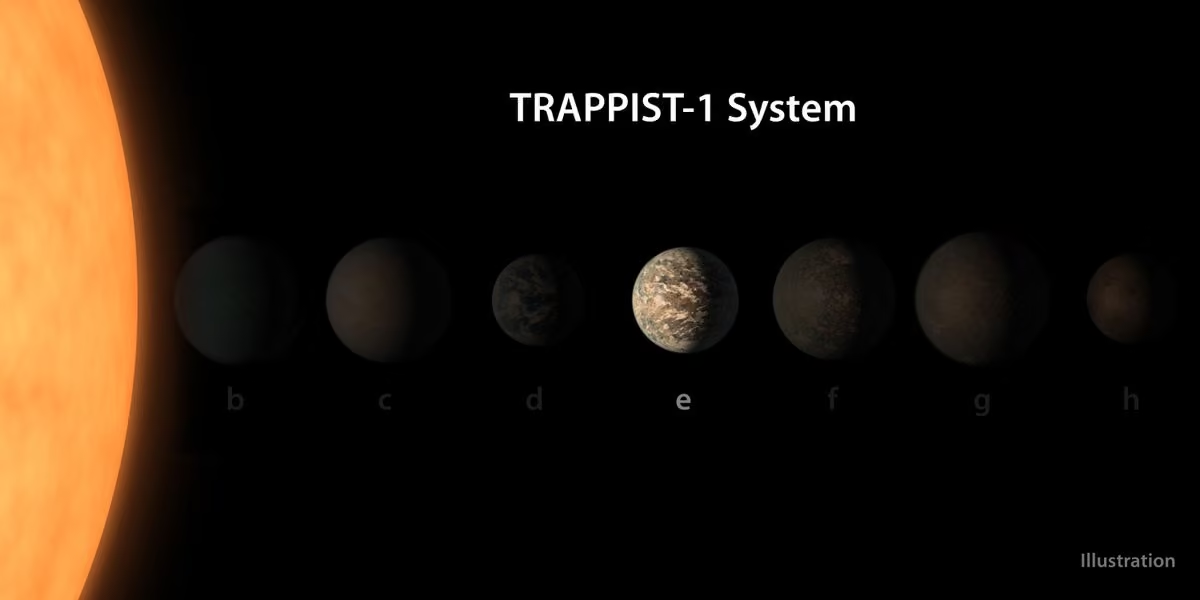
M-dwarf star TRAPPIST-1 has 7 rocky planets. The middle planet, e, is in the so-called Goldilocks zone of its star (not too hot, not too cold) where liquid surface water is, in theory, possible. But only if the planet has an atmosphere. Stay tuned.
-
NASA Webb Telescope
@NASAWebb
No more hiding, I’ll be shining, like I’m born to be! 🎶
Webb captured newborn stars glowing in the infrared within clouds of dust and gas (colored golden and orange in this image) in a star-forming region called Pismis 24.
science.nasa.gov/missions/webb/glittering-glimpse-of-star…
NASA Webb Telescope
@NASAWebb
At center is Pismis 24-1, thought to be a single massive star, now known to be at least two. They’re some of the most massive, luminous stars ever seen and are blasting out scorching radiation and stellar winds that are carving away the nebula.
NASA Webb Telescope
@NASAWebb
The fierce forces shaping and compressing the spires in the glowing gas at the bottom of the scene are causing new stars to form. More than 200 solar systems could fit in the tip of the tallest one, which is about 5.4 light-years from bottom going up up up to its top.
Post not available here, view on X
NASA Webb Telescope
@NASAWebb
Pismis 24 is one of the closest sites of massive star birth, giving scientists rare insight into the properties of hot young stars and how they evolve
-
NASA Webb Telescope reposted
Chandra Observatory
@chandraxray
Westerlund 1 is the biggest and closest "super" star cluster to Earth. Some of the stars found here shine with the brightness of almost one million Suns! This new image combines X-ray light from Chandra, optical light from @NASAHubble, and infrared light from @NASAWebb.
-
NASA Webb Telescope
@NASAWebb
Butterfly in the sky… 🎶
This space butterfly is all about growth. It’s a protostar (a young star gathering mass from its environment) surrounded by a massive planet-forming disc. Webb and @NASAHubble data combine to create this unique view!
esawebb.org/images/potm2508a/ -
NASA Webb Telescope
@NASAWebb
Be a team player ✅
We recently observed comet 3I/ATLAS with our Near-Infrared Spectrograph instrument, adding to the data collected by @NASAHubble and the recently launched SPHEREx mission.
science.nasa.gov/blogs/3iatlas/2025/08/25/nasas-webb-spac… -
NASA Webb Telescope
@NASAWebb
Tell me ‘bout the first time you saw me 🦋💍
Webb got close in with the inner workings of the Butterfly Nebula, previously captured by @NASAHubble in 2009, giving us a new and unprecedented view.
esawebb.org/news/weic2517/Post not available here, view on X
NASA Webb Telescope
@NASAWebb
Planetary nebulas typically look ring-like and are formed by dying Sun-like stars. This one has two lobes making it resemble a butterfly due to a doughnut-shaped torus of gas and dust that may be preventing gas from flowing outward in all directions.
NASA Webb Telescope
@NASAWebb
The dusty torus in the central region of the Butterfly Nebula is oriented vertically and nearly edge-on from our perspective. It intersects with bubbles of gas (in red) enclosing the star. Jets (in blue) shoot off in opposite directions.
-
NASA Webb Telescope reposted
NASA Solar System
@NASASolarSystem
As NASA continues to study the interstellar comet 3I/ATLAS, two space telescopes have made new observations, together providing more information about its size, physical properties, and chemical makeup.
@NASAWebb observed the object with its Near-Infrared Spectrograph instrument science.nasa.gov/blogs/3iatlas/2025/08/25/nasas-webb-spac… and the new SPHEREx telescope contributed new data as well science.nasa.gov/blogs/3iatlas/2025/08/25/nasas-new-spher…
All about this comet, the third such interstellar visitor that NASA has observed:
science.nasa.gov/solar-system/comets/3i-atlas/ -
NASA Webb Telescope reposted
Chandra Observatory
@chandraxray
The "ink-redible" Squid Galaxy is located about 50 million light-years from Earth. This view of the Squid, roughly 29,000 light-years across, combines different types of light captured by NASA's Chandra, @NASAHubble, @NASAWebb, and @TheNRAO's Very Large Array.🦑
-
NASA Webb Telescope
@NASAWebb
We’re not sitting on this one, Uranus has another Moon!
Webb discovered an unknown moon orbiting the planet, expanding its known satellite family to 29.
science.nasa.gov/blogs/webb/2025/08/19/new-moon-discovere…
NASA Webb Telescope
@NASAWebb
The newly discovered moon is estimated to be just six miles (10 km) in diameter, assuming it has a similar reflectivity to Uranus’ other small satellites. We haven’t seen this moon before now, likely due to its small size rendering it invisible to earlier missions or telescopes.
NASA Webb Telescope
@NASAWebb
Of the planet's now 29 moons, this one is the 14th member of the system of moons orbiting inward of the largest moons,Miranda, Ariel, Umbriel, Titania, and Oberon.
-
NASA Webb Telescope
@NASAWebb
TRAPPIST-1 d: third rock from its sun
Webb’s first look at TRAPPIST-1 d does not show signs of an atmosphere, let alone an Earth-like one.
science.nasa.gov/missions/webb/webb-narrows-atmospheric-p…
Here’s the scoop ⬇️
NASA Webb Telescope
@NASAWebb
Possible reasons Webb didn’t see an atmosphere on TRAPPIST-1 d:
- it could be extremely thin and hard to detect
- the planet could have very thick, Venus-like, high-altitude clouds blocking us from better sensing the atmosphere it
- it could be a barren rock
NASA Webb Telescope
@NASAWebb
TRAPPIST-1 d is one of the innermost of seven rocky planets orbiting the M-dwarf star TRAPPIST-1. It’s the 3rd closest to its star, and is much closer to it than Earth is to our Sun. It orbits very quickly, its year being equal to only 4 Earth days.
NASA Webb Telescope
@NASAWebb
These new Webb results give us important clues about TRAPPIST-1 d’s three siblings in the habitable zone (whose conditions could support liquid water on their surfaces) as well as other M-dwarf systems.
-
NASA Webb Telescope
@NASAWebb
We give this system 3 stars! ⭐⭐⭐
Webb revealed strong evidence of a giant gas planet orbiting one of the three stars (as shown in this artist illustration) in the Alpha Centauri system, located four light years away. science.nasa.gov/missions/webb/nasas-webb-finds-new-evide…
NASA Webb Telescope
@NASAWebb
Alpha Centauri is made up of a binary system of Sun-like stars (A & B) and a faint red dwarf (proxima). Webb data has provided the strongest evidence for a gas giant orbiting star A.
NASA Webb Telescope
@NASAWebb
If confirmed, this planet would be the closest to Earth that orbits in the habitable zone (the distance from a star at which liquid water could exist on orbiting planets’ surfaces) of a Sun-like star. A gas giant would, however, not support life as we know it.
-
NASA Webb Telescope reposted
NASA Science
@NASAScience_
What happens when you see a galaxy in a new light?
You get a stunning split-view like this.
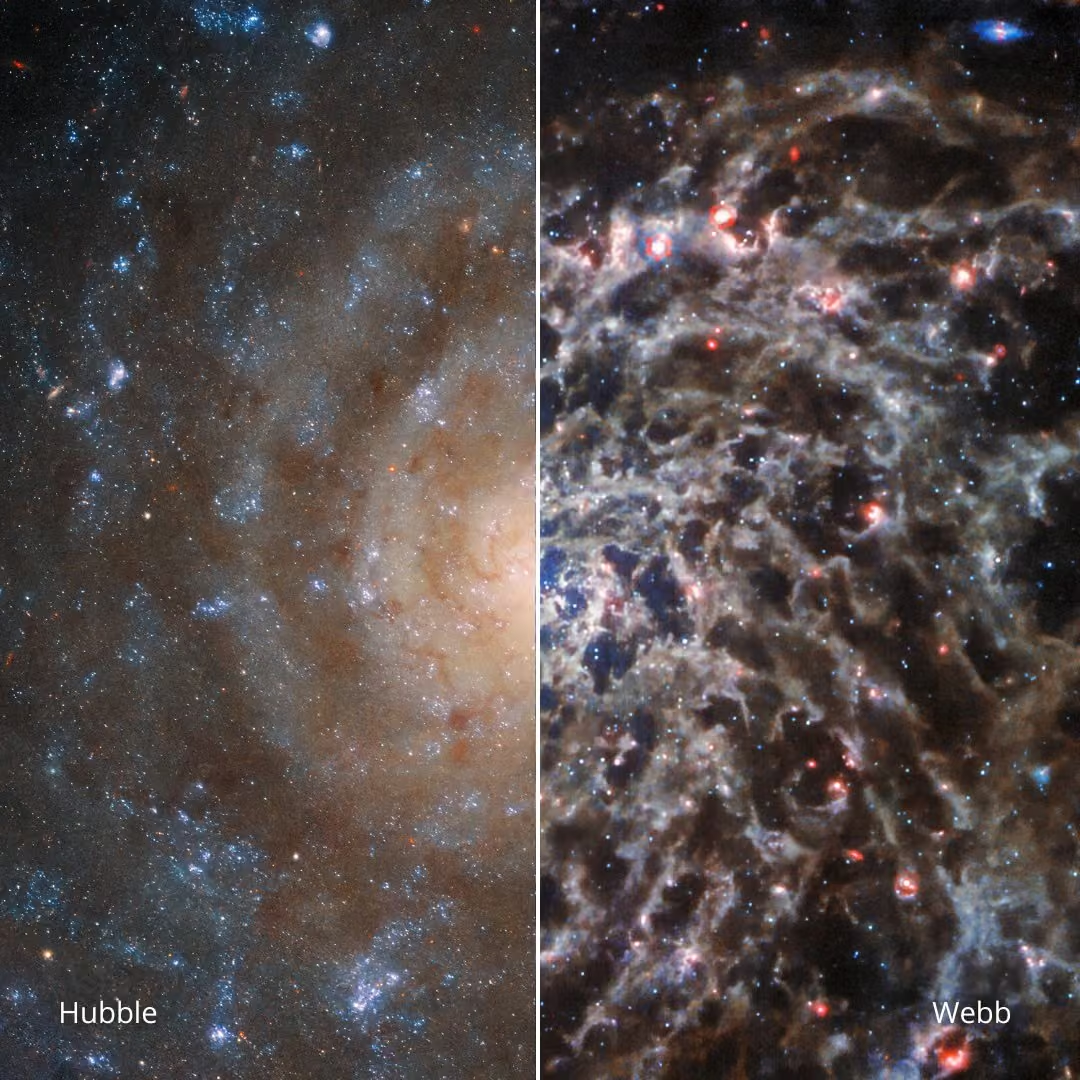
#nasascience Image of the Month: NGC 628, seen through @NASAWebb's infrared eyes and @NASAHubble’s visible-light view. One galaxy. Two ways to observe.
Explore: science.nasa.gov/multimedia/august-2025/?linkId=849364428 -
NASA Webb Telescope
@NASAWebb
Hello deep field, our old friend. We've come to look at you again! 👋
We last saw this region through @NASAHubble’s eyes. Webb’s view uncovers previously hidden galaxies and offers new insights into the formation of the first cosmic structures.
esawebb.org/images/potm2507a/ -
NASA Webb Telescope
@NASAWebb
NASA's Curious Universe podcast has a new series, and we're the star! 🌟
In the first episode, Webb scientist Mic Bagley guides us through new discoveries made by Webb and how the telescope's data turns into the beautiful images we get to see.
🎧 nasa.gov/curiousuniverse -
NASA Webb Telescope
@NASAWebb
Dare to be different ⭐ ⭐
Planetary nebulae are typically symmetrical, but some stray from the norm! Webb’s newest look at NGC 6072 reveals an unusual scene, potentially caused by a binary star system (two stars orbiting one another).
science.nasa.gov/missions/webb/nasas-webb-traces-details-…
NASA Webb Telescope
@NASAWebb
This image, taken by Webb’s NIRCam highlights multiple elliptical outflows. This is evidence that there are likely at least two stars here. Specifically, a companion star is interacting with an aging star that had already begun to shed some of its outer layers of gas and dust.
NASA Webb Telescope
@NASAWebb
Webb's MIRI image shows longer wavelengths and highlights the star (central pinkish-white dot) that could be a main player in this scene. We can also see concentric rings which may be additional evidence that this is a binary star system!
-
NASA Webb Telescope
@NASAWebb
Hold onto your Gauntlet, Webb may have observed the birth of a supermassive black hole in the Infinity Galaxy - between the nuclei of two merging galaxies. science.nasa.gov/blogs/webb/2025/07/15/nasas-webb-finds-p…
NASA Webb Telescope
@NASAWebb
How supermassive black holes (usually found at the center of galaxies) form is mysterious. Webb data shows that this one may be the result of the collapse of a large gas cloud, created by the galaxy merger.
NASA Webb Telescope
@NASAWebb
Note: This post highlights a combination of peer-reviewed results and data from Webb science in progress, which has not yet been through the peer-review process.
-
NASA Webb Telescope reposted
NASA Universe
@NASAUniverse
Are we alone? To find out, we’re building the Habitable Worlds Observatory. This powerful space telescope uses proven technologies from @NASAHubble, @NASAWebb, and @NASARoman to look for signatures of planets that can support life — and maybe life itself. science.nasa.gov/astrophysics/programs/habitable-worlds-o…
This media couldn't be displayed. See it on the original post. -
NASA Webb Telescope
@NASAWebb
Three years of wonder ✨
It's been three years since we released our first science images, here's a recap. We're grateful to have you all along for this journey to #unfoldtheuniverse! -
NASA Webb Telescope
@NASAWebb
Today marks 3 years since we released our first science images! 🤩
We’ve peered into the early universe, explored the atmospheres of exoplanets, shed light on black holes, and so much more!
Stay up to date as we continue to #unfoldtheuniverse: science.nasa.gov/mission/webb/ -
NASA Webb Telescope
@NASAWebb
3 years & we’re only scratching the surface!
On our 3rd science anniversary, we’re looking at one “toe bean” of the Cat’s Paw Nebula. This active star-forming region is revealing more about how young stars are shaping their surroundings!
science.nasa.gov/missions/webb/nasas-webb-scratches-beyon… -
NASA Webb Telescope
@NASAWebb
It’s always better when we’re together 💕
This new mosaic combines Webb’s observations with @NASAHubble’s, increasing our understanding of open star clusters NGC 460 and NGC 456.
science.nasa.gov/missions/hubble/nasas-hubble-and-webb-re…
NASA Webb Telescope
@NASAWebb
Open star clusters are made up of dozens to thousands of stars held loosely together by gravity. As clouds of gas collapse, stars are born. And as these young, hot stars expel stellar winds, others collapse, giving rise to more stars.
NASA Webb Telescope
@NASAWebb
@NASAHubble’s visible and near-infrared view captures the glowing, ionized gas as stellar radiation blows “bubbles” in the clouds of gas and dust (blue), while Webb’s infrared vision highlights the clumps and delicate structures of dust (red).
-
NASA Webb Telescope
@NASAWebb
We love Webb’s spectrographic data and the way it studies stars. We love the way Webb sees exoplanets and can even study Mars. We love Webb’s big, gold mirrors and the way it sees back in time. We love Webb so much it even makes us rhyme!
10 things: science.nasa.gov/missions/webb/3-years-of-science-10-cosm… -
NASA Webb Telescope
@NASAWebb
A documentary about Webb? My dream date. Cute. And we know that.
Cosmic Dawn, @NASA's new documentary following Webb's journey is now available with audio descriptions: youtu.be/SRO-F1Lg8po
NASA Webb Telescope
@NASAWebb
Prefer the film without descriptions? plus.nasa.gov/video/cosmic-dawn-the-untold-story-of-the-j…
-
NASA Webb Telescope
@NASAWebb
We aren’t blowing smoke, M82 is working overtime forming new stars!
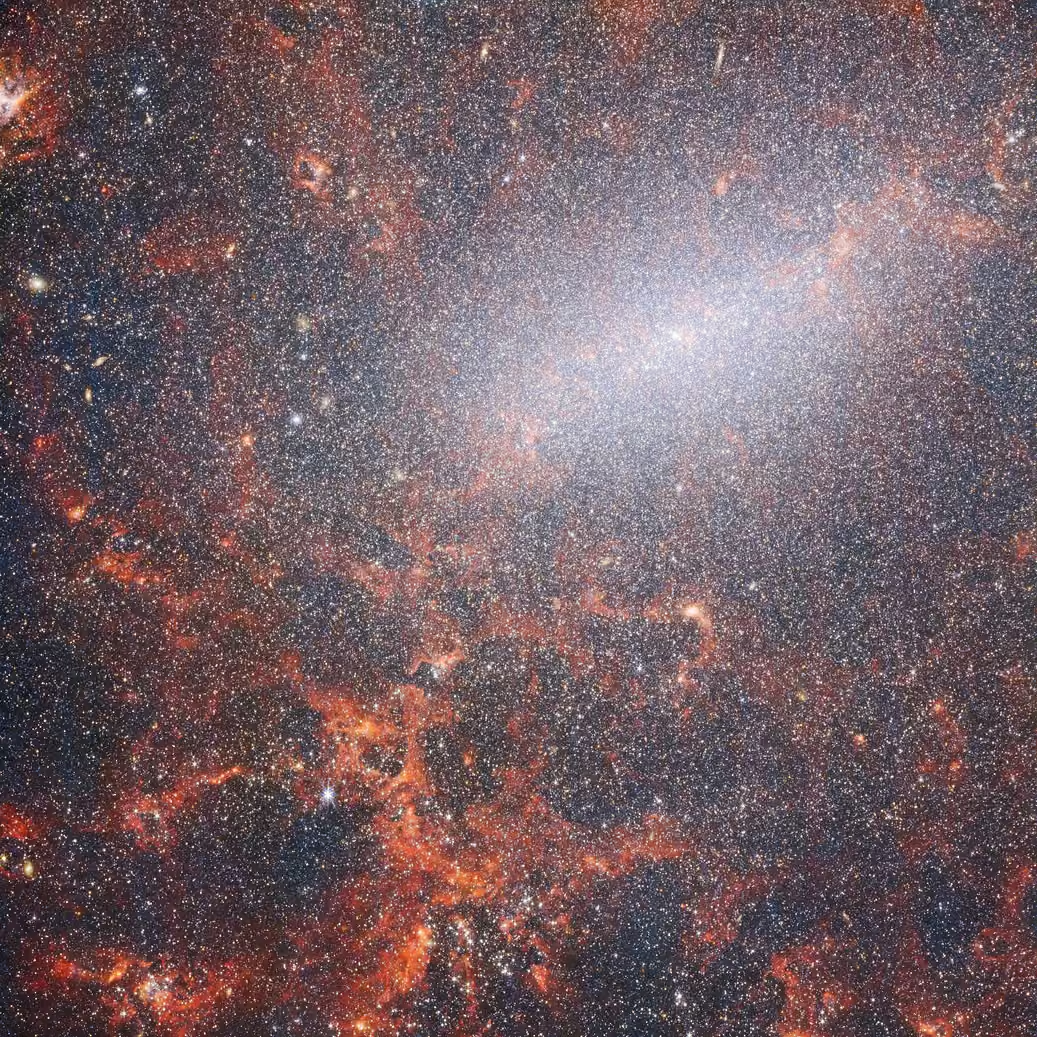
This galaxy, also called the Cigar Galaxy, is smaller than our Milky Way, but 5x as luminous and forms stars 10x faster! Webb’s NIRCam allows us to see billions of stars through all the dust!
NASA Webb Telescope
@NASAWebb
We’ve seen this region before! In 2024, this image of M82 was also taken by Webb’s NIRCam, focusing on the core of the galaxy. Every single white dot in this image is a star or a star cluster!
NASA Webb Telescope
@NASAWebb
Here's Webb’s mid-infrared view, which, in contrast to both near-infrared views, is nearly starless and is dominated by the emission from the warm dust and clouds of organic molecules called polycyclic aromatic hydrocarbons, or PAHs.
-
NASA Webb Telescope
@NASAWebb
Hello darkness my old friend…
What you are (not) seeing, highlighted in blue, is dark matter. Webb was used to precisely map out the dark matter that is part of the makeup of two colliding galaxy clusters.
science.nasa.gov/missions/webb/nasa-webb-pierces-bullet-c…Post not available here, view on X
NASA Webb Telescope
@NASAWebb
While we cannot see dark matter because it does not emit light, it has mass and gravitational influence on light we can see. It can act like a lens, magnifying and warping objects behind it.
NASA Webb Telescope
@NASAWebb
Imagine dark matter as water so clear you can’t see it unless the wind ripples it. The ripples will distort any pebbles below its surface. Likewise, dark matter distorts the shapes of distant background galaxies. We can’t see it, but we see its effects.
-
NASA Webb Telescope
@NASAWebb
Did you know that Webb can observe asteroids? Even ones as small as 100-200 meters in size! Here's one example: www.nasa.gov/solar-system/webb-detects-extremely-small-ma…
We even tracked NASA's DART mission impacting an asteroid! science.nasa.gov/blogs/webb/2023/02/08/breaking-the-track…
Learn With NASA
@LearnWithNASA
Time for an International Asteroid Day pop quiz!🪨
Asteroids ...
a. are rocky objects that orbit the Sun
b. range in size from as small as a car to as big as a state
c. are mostly found between Mars & Jupiter
d. all of the above
Find the answers here: www.nasa.gov/learning-resources/what-are-asteroids-ages-1… -
NASA Webb Telescope
@NASAWebb
Galaxies, through thick and thin…🌌
Astronomers used Webb to look at 111 edge-on disk galaxies of various ages to better understand changes in galaxy disks over time, and how star-formation shapes them. science.nasa.gov/missions/webb/nasas-webb-digs-into-struc… -
NASA Webb Telescope
@NASAWebb
A never-before-seen planet! 🪐
This is Webb’s first discovery of a planet using direct imaging. With a mass similar to Saturn, it’s also the lightest exoplanet yet seen using this technique!
science.nasa.gov/missions/webb/likely-saturn-mass-planet-…
NASA Webb Telescope
@NASAWebb
The star, TWA 7 is a young red dwarf, cooler and less massive than our own Sun, making planets easier to spot than if they were orbiting a much brighter star. MIRI’s coronagraph was used to suppress the glare of the star, revealing faint nearby objects - like this planet.
-
NASA Webb Telescope reposted
NASA Goddard
@NASAGoddard
“The first thing I think about when approaching a potential new story is by asking the question: ‘Would a fifth grader think this story is awesome?’ Black holes, giant explosions, stars dying…if the story is there then the imagery will be there too."
-
NASA Webb Telescope
@NASAWebb
Remember all the potential questions Webb's "little red dots" raised about cosmology? Learn more Thursday June 26 at 7pm EDT in this talk streamed live via the STScI YouTube Account. Info below. 👇
Space Telescope Science Institute
@SpaceTelescope
#nasawebb has transformed our view of galaxy evolution. On June 26, Dr. Kevin Hainline (University of Arizona) explores Webb's discovery of 'little red dots'—compact, distant sources scattered across the sky that continue to defy easy explanation. youtube.com/live/hQWt3P4Eb-c
-
NASA Webb Telescope reposted
NASA
@NASA
See the untold story of @NASAWebb, the world's most powerful space telescope, and the team that made it possible.
Watch "Cosmic Dawn," our newest documentary, on our free streaming platform, NASA+: plus.nasa.gov/video/cosmic-dawn-the-untold-story-of-the-j…This media couldn't be displayed. See it on the original post. -
NASA Webb Telescope
@NASAWebb
Webb observed these little green galaxies in Pandora’s Cluster. Were they the cause of a massive cosmic makeover?
In the universe’s first billion years, it was immersed in a fog of neutral hydrogen gas. Today, this gas is ionized (stripped of its electrons). Which cosmic objects are responsible? science.nasa.gov/missions/webb/nasas-webb-uncovers-galaxy…Post not available here, view on X
NASA Webb Telescope
@NASAWebb
The light from these galaxies was originally emitted in the visible part of the spectrum in the early universe, but has been stretched into the infrared as it traversed the expanding universe and eventually reached Webb’s instruments.
NASA Webb Telescope
@NASAWebb
Next, scientists will verify that these low-mass starburst galaxies can account for all the ultraviolet light needed to convert the universe’s neutral hydrogen to its ionized form. Being able to detect them using Webb is an important first step.
www.youtube.com/watch?v=Aq3E4qFn3Dc&sttick=0 -
NASA Webb Telescope
@NASAWebb
You’ve never seen @NASAWebb like this. 👀
Experience every close-call, technological feat, and scientific marvel of the Webb telescope's journey, through the eyes of the people who made it happen. Our new NASA+ documentary, Cosmic Dawn, is streaming now:This media couldn't be displayed. See it on the original post. -
NASA Webb Telescope
@NASAWebb
Exoplanets are cool 😎
Here’s Webb’s view of 14 Her c, a chilly 26 degrees F (-3 C) in temperature, and one of the coldest exoplanets imaged to date. It’s hard to capture objects this faint - but Webb was up to the challenge. science.nasa.gov/missions/webb/frigid-exoplanet-in-strang… -
NASA Webb Telescope
@NASAWebb
“We’re going to change how we understand the universe. We’re going to see all the way back, to the very beginning of the universe–what we call Cosmic Dawn.”
Hint: 👀 plus.nasa.gov -
NASA Webb Telescope
@NASAWebb
"There aren’t many things these days that almost everyone on planet Earth can feel inspired about, but I feel like the images from Webb are one of those things. They bring in a sense of wonder.”
👀 plus.nasa -
NASA Webb Telescope
@NASAWebb
“We built something that was so ambitious, if it didn’t work at all, we would be terrified. But if it did work, we would be guaranteed tremendous discoveries.”
Hint: 👀 plus -
NASA Webb Telescope
@NASAWebb
Asteroid watch! 👀
Webb was able to help refine, by nearly 20%, our knowledge of the asteroid 2024 YR4’s orbit, and the (super tiny) odds of it impacting the Moon in 2032.
science.nasa.gov/blogs/planetary-defense/2025/06/05/nasas… -
NASA Webb Telescope reposted
NASA Universe
@NASAUniverse
We often ask the age-old question … what came first, the chicken or the egg? Regarding the cosmos, astronomers often wonder which objects formed first: galaxies or their central supermassive black hole.
-
NASA Webb Telescope
@NASAWebb
We’ve seen it before, but not quite like this!
Webb observed the iconic Sombrero galaxy in near-infrared light for the first time, showing dust from the galaxy’s outer ring blocking stellar light from within. In the central region, roughly 2,000 globular clusters glow.
NASA Webb Telescope
@NASAWebb
In Nov. 2024, Webb saw the Sombrero Galaxy in mid-infared. The signature, glowing core seen in visible-light doesn't shine; instead a smooth inner disk is revealed. The outer ring, which looked smooth in imaging from Spitzer, shows intricate clumps for the first time.
NASA Webb Telescope
@NASAWebb
@NASAHubble imaged the Sombrero galaxy in 2003. The hallmark of the nearly edge-on galaxy in visible light is a brilliant, white, bulbous core encircled by thick dust lanes comprising the spiral structure of the galaxy. This dust lane is the site of star formation in the galaxy.
-
NASA Webb Telescope
@NASAWebb
In Webb’s new deep field are galaxies that may have existed as early as 200 million years after the big bang! This long exposure to a small area of sky totals 120 hours of observing time and is Webb’s deepest look back on a single target to date!
esawebb.org/images/potm2505a/
NASA Webb Telescope
@NASAWebb
Here the gravity of the foreground galaxy cluster is bending and magnifying the light from the far-off galaxies behind it, an effect called gravitational lensing. The collection heavy galaxies is called Abell S1063 and is 4.5 billion light years away.
-
NASA Webb Telescope
@NASAWebb
Webb can see an era in the early universe that we've never seen before, but that's only a fraction of the universe's total size!
Hear more about how big space really is from Dr. Amber Straugh, Webb's Deputy Project Scientist! 👇
NASA Universe
@NASAUniverse
How big is our universe?
The closest star to us is about 4 light-years away — and that's just in our neighborhood. Learn about mind-boggling cosmic distances from @NASAGoddard’s Dr. Amber Straughn in just 90 seconds.
More answers from @NASA experts: www.nasa.gov/directorates/smd/we-asked-a-nasa-expert/?lin…This media couldn't be displayed. See it on the original post. -
NASA Webb Telescope
@NASAWebb
Neptune is glowing—and it’s not what we expected. Webb just spotted auroras stretching across Neptune’s mid-latitudes—not the poles. Why? The planet’s bizarre magnetic field and a shockingly cold upper atmosphere may hold the answer.
This media couldn't be displayed. See it on the original post. -
NASA Webb Telescope
@NASAWebb
Ice ice baby!
Webb found crystalline water ice in a debris disk around a young, Sun-like star. Scientists expected to see it in other star systems, because of its presence in our own - but haven't had sensitive enough instruments to give definitive proof until now. -
NASA Webb Telescope
@NASAWebb
Evaporation, condensation, precipitation on my mind. This is the (methane?!) cycle, and it happens all the time! 🎶
Webb provided evidence for cloud convection on Saturn’s moon Titan, the only other place in our solar system with weather like Earth!
science.nasa.gov/missions/webb/webbs-titan-forecast-partl… -
NASA Webb Telescope
@NASAWebb
Webb captured an enormous display of auroras unlike anything seen on Earth. These infrared observations reveal unexpected activity in Jupiter’s atmosphere, challenging what scientists thought they knew about the planet’s magnetic field and particle interactions.
This media couldn't be displayed. See it on the original post. -
NASA Webb Telescope reposted
NASA Universe
@NASAUniverse
Join NASA’s Night Sky Network on Thursday, May 15, at 6:00 p.m. PT (9:00 p.m. ET) for a livestream presented by @NASAJPL’s Eric Mamajek about the future of exoplanet observation and the hunt for Earth-like planets. The event will also be recorded. Details: www.youtube.com/live/Kq96EXyNtj0
-
NASA Webb Telescope
@NASAWebb
Think Northern Lights, but way bigger!
Auroras on both planets are caused by solar storms, but Jupiter has an additional source of charged particles contributing to the light show — volcanoes on its moon Io!
science.nasa.gov/missions/webb/nasas-webb-reveals-new-det… -
NASA Webb Telescope
@NASAWebb
In July 2022, Webb revealed a breathtaking view of a region now nicknamed the Cosmic Cliffs.
This glittering landscape is part of a small piece of the vast Carina Nebula Complex — where stars are born amid clouds of gas and dust. science.nasa.gov/missions/webb/new-visualization-from-nas…This media couldn't be displayed. See it on the original post. -
NASA Webb Telescope reposted
Space Telescope Science Institute
@SpaceTelescope
#nasawebb has expanded our view of the transient universe well beyond the limits of even Hubble.
Join us on May 14 for "Deep Space Dialogues: Opening a New Frontier in Transient Science with Webb" ➡️ www.youtube.com/watch?v=7S2-5mJq_4s -
NASA Webb Telescope
@NASAWebb
Sub-Neptunes. Shrouded in mystery… and haze.
These are one of the most common types of exoplanets in our galaxy, but we don’t have one in our solar system to study. Webb is lifting the veil on these objects: science.nasa.gov/missions/webb/nasas-webb-lifts-veil-on-c…Post not available here, view on X
NASA Webb Telescope
@NASAWebb
Previous data showed TOI-421b may not be as hazy as others of its kind. Astronomers thought perhaps because it is a bit hotter, it would be less prone to haze or clouds. Indeed, Webb saw a clear atmosphere, and was able to determine its composition.
NASA Webb Telescope
@NASAWebb
A big surprise is that a large part of TOI-421b's atmosphere is hydrogen, which mimics the composition of its star. It may have formed and evolved differently than other sub-Neptunes, which commonly orbit smaller, cooler red dwarfs, rather than stars like its Sun-like host.
-
NASA Webb Telescope
@NASAWebb
In order to see distant galaxies, Webb’s mirrors need to be free of imperfections.
Webb’s unique folding mirror segments required the development of special measuring instruments, which are now used for testing products like camera lenses and virtual reality headsets!
NASA Webb Telescope
@NASAWebb
Learn more about the innovative and powerful new technologies that made Webb possible and continue to advance technology:science.nasa.gov/mission/webb/innovations/
-
NASA Webb Telescope
@NASAWebb
There’s more to the universe than meets the eye!
This galaxy group features lighter than humans can't see - infrared and X-ray - as well as optical light.
We’re seeing it as it appeared when the universe was 6.5 billion years old, a little less than half its current age.
NASA Webb Telescope
@NASAWebb
This image combines infrared data from Webb with infrared and optical observations from @NASAHubble. The data from Chandra and ESA’s XMM-Newton, shown in purple, are where X-rays are emitted by hot gas in the group of galaxies.
Read more and play with the slider: -
NASA Webb Telescope
@NASAWebb
It’s time for a galaxy hunt!
You can help identify the shapes of thousands of galaxies taken by Webb with the Galaxy Zoo project. If you’re quick, you may even be the first person to see the galaxies you’re asked to classify!
Happy hunting! www.zooniverse.org/projects/zookeeper/galaxy-zoo/
NASA Webb Telescope
@NASAWebb
Join us live on Twitch today at 4PM ET to learn more about beginner-friendly volunteer projects, like Galaxy Zoo! We’ll make measurements together live on-air, answer your questions, and showcase a new project using Webb data! www.twitch.tv/nasa
-
Post not available here, view on X
NASA Webb Telescope
@NASAWebb
Join us live on Twitch tomorrow, April 29 at 4PM ET to learn more about beginner-friendly volunteer projects, like Galaxy Zoo! We’ll make measurements together live on-air, answer your questions, and showcase a new project using Webb data! www.twitch.tv/nasa
-
NASA Webb Telescope reposted
Hubble
@NASAHubble
One telescope. Nearly 1.7 million observations. Thirty-five years – and counting.
Hubble's new 35th anniversary images show cosmic sites from within our solar system to our galaxy and beyond – a reminder of the mission's impact on every area of astronomy. ⬇️ -
NASA Webb Telescope reposted
Hubble
@NASAHubble
#otd 35 years ago, Hubble launched into space to begin its mission to understand our universe!
To this day, it remains a scientific powerhouse. Check out the telescope's biggest discoveries from its past year in orbit ⬇️This media couldn't be displayed. See it on the original post. -
NASA Webb Telescope
@NASAWebb
From the farthest known galaxy, thank you!
Our social media team is bringing home a Webby Award and People's Voice Award!
Congrats to all the @NASA’s Webby winners! www.nasa.gov/general/nasa-wins-six-webby-awards-six-webby… -
NASA Webb Telescope
@NASAWebb
How do you find something you can’t see? ⚫
Webb is giving us a new look at barred spiral galaxy Messier 83 (M83)! It revealed new evidence that suggests the presence of a central supermassive black hole - previously undetected, highly-ionized neon gas. esawebb.org/news/weic2509/ -
NASA Webb Telescope
@NASAWebb
Webb is "running rings" around this planetary nebula, bringing it into sharp focus with this new mid-infrared look. At the center are a pair of stars, one of which shed its layers of dust and gas as it neared the end of its life cycle. science.nasa.gov/missions/webb/with-nasas-webb-dying-star…
NASA Webb Telescope
@NASAWebb
Planetary nebulae like these are so-called because they looked like round planets through early telescopes. We’ve come a long way since, with Webb’s mid-infared view being the most detailed view of a planetary nebula to date.
NASA Webb Telescope
@NASAWebb
NGC 1514 has been observed at least since the late 1800s, including by William Herschel. To him it looked cloudy. In 2010, the infrared WISE telescope caught this view, which does show its rings but lacks the crisp detail Webb is now able to provide.
-
NASA Webb Telescope
@NASAWebb
Putting the Webb in #webbys 💫
Thank you for spending another year with us as we #unfoldtheuniverse. Because of your dedicated interest in and excitement about our telescope, we have been nominated for a Webby!
Cast your vote for our social media team: vote.webbyawards.com/PublicVoting -
NASA Webb Telescope
@NASAWebb
Plot twist!
Astronomers thought this was the story of a star that expanded and engulfed its planet, but Webb data revealed a different means to the planet’s end. Its orbit actually shrunk over millions of years, drawing it closer and closer to the star! science.nasa.gov/missions/webb/nasa-webbs-autopsy-of-plan… -
NASA Webb Telescope
@NASAWebb
You make us feel like a million stars 🤩
Thank you for spending your year sharing space with us on the web(b)!
Voting is open for the 2025 @TheWebbyAwards & we’ve been nominated in the Social Campaigns/Education & Science category!
Vote #webbys here: vote.webbyawards.com/PublicVoting
NASA Webb Telescope
@NASAWebb
NASA also was nominated in other categories for the @TheWebbyAwards! You can find those here: www.nasa.gov/general/nasa-receives-10-nominations-for-the…
-
NASA Webb Telescope
@NASAWebb
Not that we're biased but... *whispers* if you're going to vote in @NASAUniverse's "Battle of the [Gamma Ray] Bursts," vote for the one we observed!
NASA Universe
@NASAUniverse
Continuing with The Gold Makers, @NASAWebb detected tellurium from GRB 230307A (left), showing this long gamma-ray burst caused a rare, powerful blast called a kilonova. GRB 130603B (right) also triggered a kilonova, but the initial event was a much shorter burst.
-
NASA Webb Telescope
@NASAWebb
Did you know that Webb can see small, nearby objects like asteroids?
Webb took a look at asteroid 2024 YR4, which we know is of no significant threat to Earth. But the more we know about asteroids, the better we can protect our planet from space hazards.
science.nasa.gov/blogs/webb/Post not available here, view on X
NASA Webb Telescope
@NASAWebb
The thermal properties of a small asteroid (i.e. how quickly it heats up and cools down, how hot it is at its current distance from the Sun) differ from larger ones - likely a combination of its very fast spin and lack of fine-grained surface sand.
NASA Webb Telescope
@NASAWebb
2024 YR4 is being studied by NASA’s planetary defense program and the International Asteroid Warning Network. Webb's unique data about its size has improved what we know about its orbit and trajectory. Combined with data from other telescopes, we are helping keep Earth safe!
-
NASA Webb Telescope
@NASAWebb
What does star formation look like in extreme environments? 🌟
Webb & MeerKAT (a ground-based radio telescope) took a look at Sagittarius C, a star-forming region located in the heart of our galaxy, near the supermassive black hole at its core.
science.nasa.gov/missions/webb/nasa-webb-explores-effect-…
NASA Webb Telescope
@NASAWebb
Stars typically form in clouds of dust and gas - of which there are plenty near the galaxy’s center - so why aren’t we seeing many stars born there? Webb’s data shows that the strong magnetic fields near our central black hole may be helping to suppress star formation.
NASA Webb Telescope
@NASAWebb
Though there is a rich cloud of raw star-making material in Sagittarius C, these magnetic fields in the region may be strong enough to resist the gravity that would typically cause dense clouds of gas and dust to collapse and forge stars.
-
NASA Webb Telescope reposted
Chandra Observatory
@chandraxray
30 years ago this week, @NASAHubble captured one of the most recognizable images in astronomy — the famous "Pillars of Creation." In the decades since, Chandra, Hubble, and @NASAWebb have added even more detail to this fascinating landscape. chandra.si.edu/blog/node/922
-
NASA Webb Telescope
@NASAWebb
The universe also has eras!
Webb spotted a surprising galaxy from just 330 million years after the big bang, during the universe’s “era of reionization.” It shouldn’t have been detectable because of the composition of the early universe, but it was! How? science.nasa.gov/missions/webb/nasas-webb-sees-galaxy-mys… -
NASA Webb Telescope
@NASAWebb
Expand your imagination 🍥
What appears to be a single galaxy is actually two that are far apart! The closer galaxy is in the image's center, while the more distant galaxy appears to be wrapped around it in a rare phenomenon we call an “Einstein ring.”
esawebb.org/images/potm2503a/
NASA Webb Telescope
@NASAWebb
Einstein rings occur when light from a distant galaxy gets bent by the gravity of a massive closer-by object, in this case another galaxy. Einstein predicted this effect in his theory of relativity.
-
NASA Webb Telescope
@NASAWebb
Welcome to the club, Neptune!
Webb has captured auroras on Neptune, confirming their presence for the first time, making the planet the last gas giant in our solar system to have their presence confirmed.
science.nasa.gov/missions/webb/nasas-webb-captures-neptun…
NASA Webb Telescope
@NASAWebb
Webb’s Near-Infared Spectograph shows the aurora location - overlaid on @NASAHubble data. Auroras occur when energetic particles become trapped in a planet’s magnetic field and strike the upper atmosphere. The energy released during these collisions creates the signature glow.
-
NASA Webb Telescope
@NASAWebb
Sometimes the stars (and galaxies) align!
This outflow from a newly forming star looks like it is topped by a galaxy, like a sundae with a cherry on top. Perspective makes all the difference - these objects are light years apart and totally unassociated. science.nasa.gov/missions/webb/nasas-webb-telescope-unmas… -
NASA Webb Telescope
@NASAWebb
These dots are gas giant exoplanets captured by Webb's camera - the clearest infrared look we've gotten yet! Webb also detected carbon dioxide and heavy elements in the planets - evidence they may have formed in the same way as Jupiter and Saturn. science.nasa.gov/missions/webb/nasas-webb-images-young-gi…
-
NASA Webb Telescope
@NASAWebb
Webb explored the Orion Molecular Cloud Complex, looking for the faintest and the smallest of brown dwarfs - that category of objects that are not planets, but are also so small their cores can't sustain fusing hydrogen like full-fledged stars. science.nasa.gov/missions/webb/nasas-webb-peers-deeper-in…
NASA Webb Telescope
@NASAWebb
Webb’s ability to see warm objects through dense dust is allowing Webb to not only find brown dwarfs but explore their lowest mass limits, which may be approximately 2-3 times the mass of Jupiter.
-
NASA Webb Telescope reposted
Hubble
@NASAHubble
Have you ever listened to a Hubble image? 🎧
Now you can create your own sonifications like this one with “Hearing Hubble”!
Experience science through sound by choosing an image, musical settings, and data to scan.
Make your masterpiece here: science.nasa.gov/mission/hubble/multimedia/online-activit…This media couldn't be displayed. See it on the original post. -
NASA Webb Telescope
@NASAWebb
Birds of a feather, we should stay together 💞
A binary pair of actively forming stars created this shimmering hourglass of gas and dust. Here, Webb’s ability to see near-infrared light reveals incredible detail and structure in Lynds 483.
science.nasa.gov/missions/webb/nasa-webb-wows-with-incred…
NASA Webb Telescope
@NASAWebb
In the center of this hourglass shape lie two protostars, ejecting gas and dust. Millions of years from now, when the stars have finished forming, they may each be about the mass of our Sun. All that may remain is a tiny disk of gas and dust where planets may eventually form.
-
NASA Webb Telescope
@NASAWebb
Webb observed a rapidly-rotating, free-floating object ~13 times the mass of Jupiter. Could it be a brown dwarf - something not really a planet or a star? Webb took a detailed look that even probed the depths of its atmosphere: science.nasa.gov/missions/webb/nasas-webb-exposes-complex…
-
NASA Webb Telescope
@NASAWebb
10 minute activities: Walking the dog, folding the laundry… capturing an image of an entire galaxy!?
Webb’s new view of barred spiral galaxy NGC 2283 was captured in just 10 minutes of observing time!
esawebb.org/images/potm2502a/
NASA Webb Telescope
@NASAWebb
Showcased is the light from clouds of hydrogen gas heated by young stars in NGC 2283, as well as the stars themselves. The bright foreground stars are actually in the Milky Way; the diffraction spikes are patterns produced by light bending around the sharp edges of a telescope.
-
NASA Webb Telescope
@NASAWebb
Webb took a look at a rare type of exoplanet called an ultra-hot Neptune. Finding a planet of that size so close to its host star is like finding a snowball that hasn’t melted in a fire. It’s a peek into how planets evolve under extreme conditions. exoplanetes.umontreal.ca/en/jwst-forecasts-partially-clou…
-
NASA Webb Telescope
@NASAWebb
Join NASA’s Night Sky Network on Tuesday, February 25th, at 6:00 p.m. PT (9:00 p.m. ET) for a livestream presented by @spacetelescope’s Joseph Depasquale about “Revealing the Invisible Universe” with Webb. The event will also be recorded. Details: www.youtube.com/watch?v=rBDRyl0ALk8
-
NASA Webb Telescope
@NASAWebb
Webb’s got new insight on Sagittarius A*, the supermassive black hole at the center of our galaxy. The swirling disk of gas and dust surrounding it is more active than expected, emitting a constant but random stream of flares, from faint flickers to bright eruptions.
-
NASA Webb Telescope reposted
Canadian Space Agency
@csa_asc
Will you be our Valentine? 💞
This cosmic heart, captured by #webb, is a pair of merging galaxies, II ZW 96, dancing in a swirl of love 500M light-years away. With newborn stars lighting the scene, it’s a love story written in the cosmos! ✨
📸CSA, NASA, ESA, L. Armus, A. Evans -
NASA Webb Telescope reposted
NASA Goddard
@NASAGoddard
Not feeling Valentine's Day this year? Fair enough. 💔
We've got valentines cards to share if you could use a little space. ⬇️ -
NASA Webb Telescope
@NASAWebb
Webb’s infrared sensitivity has helped map the cooling gas that was a missing component in understanding the atypically high rate of star formation within the Phoenix galaxy cluster. science.nasa.gov/missions/webb/webb-maps-full-picture-of-…
-
NASA Webb Telescope
@NASAWebb
Webb looked at the composition of objects at the far reaches of our solar system in unprecedented detail - from dwarf planets to small icy bodies. These remnants of our Sun’s original protoplanetary disk give us insight into how our solar system formed. science.nasa.gov/blogs/webb/
-
NASA Webb Telescope
@NASAWebb
Little galaxies can hold big clues
Webb took a look at Leo P, a dwarf galaxy, and its patterns of star formation. Unlike other dwarf galaxies, Leo P unusually resumed its star formation after the end of the universe’s “dark ages.” But why? www.stsci.edu/contents/news-releases/2025/news-2025-401 -
NASA Webb Telescope
@NASAWebb
Dust in the (stellar) wind
This new Webb image shows an edge-on protoplanetary disc around a newly formed star, surrounded by jets and a disc wind, in unprecedented detail. Read more: esawebb.org/images/potm2501a/ -
NASA Webb Telescope reposted
Hubble
@NASAHubble
Greetings, explorer.
In our new game "Hubble's Cosmic Adventure," chart your path through space and discover stunning celestial destinations throughout our universe.
Start your mission here: science.nasa.gov/mission/hubble/multimedia/hubbles-cosmic…
Let us know where you go! ⬇️ -
NASA Webb Telescope reposted
NASA Universe
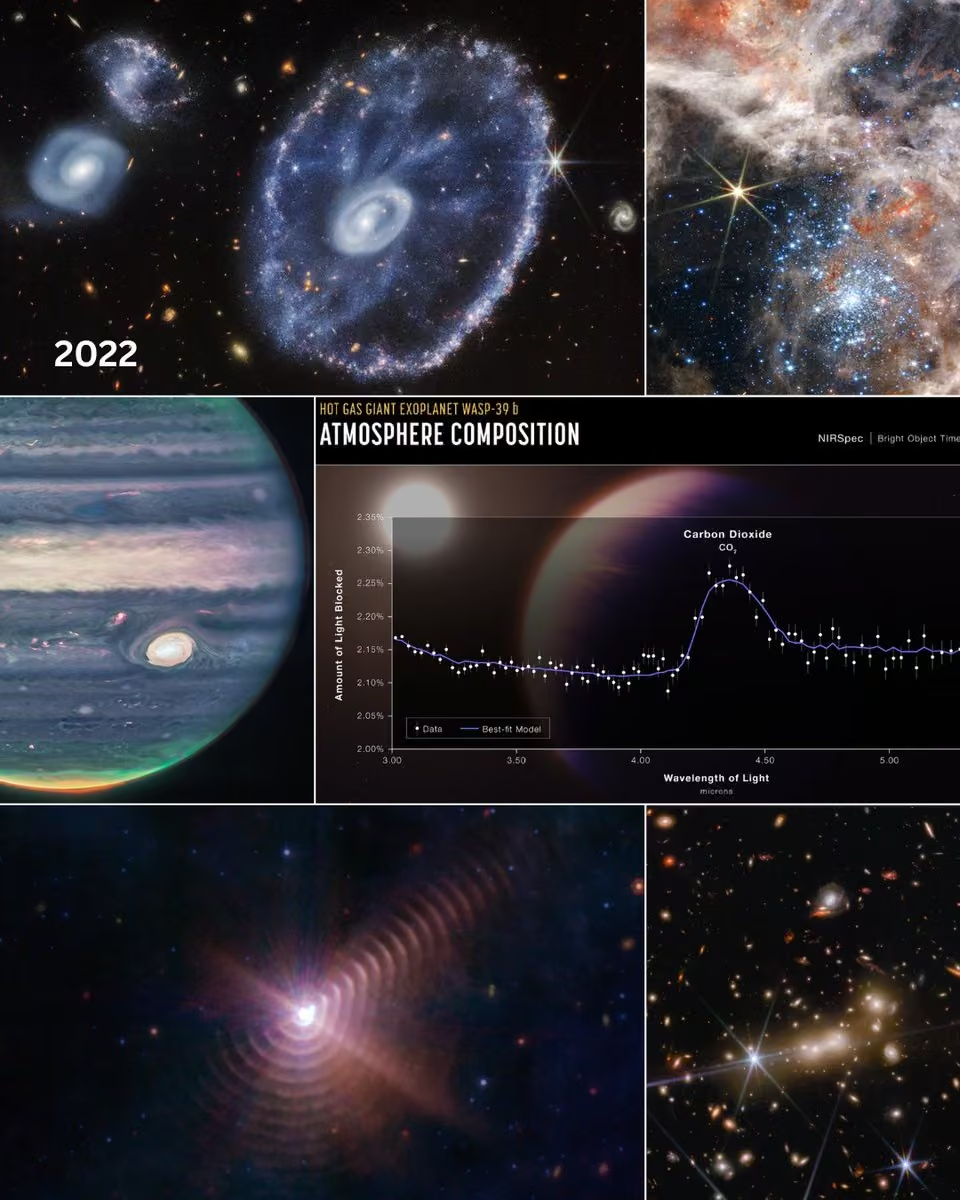
@NASAUniverse
If our universe were made of peanut butter, it went from creamy to crunchy! But how did those cosmic “peanuts” form? 🥜
@NASAWebb is helping us study the formation of the first galaxies over 13 billion years ago: science.nasa.gov/missions/webb/new-3d-visualization-highl… -
NASA Webb Telescope reposted
NASA
@NASA
Spiral galaxy NGC 628 to Earth: 32 million light-years
Priority Mail: 1-3 business days
New @USPS stamps feature iconic images from @NASAWebb: science.nasa.gov/missions/webb/space-images-from-nasas-we… -
NASA Webb Telescope reposted
NASA Universe
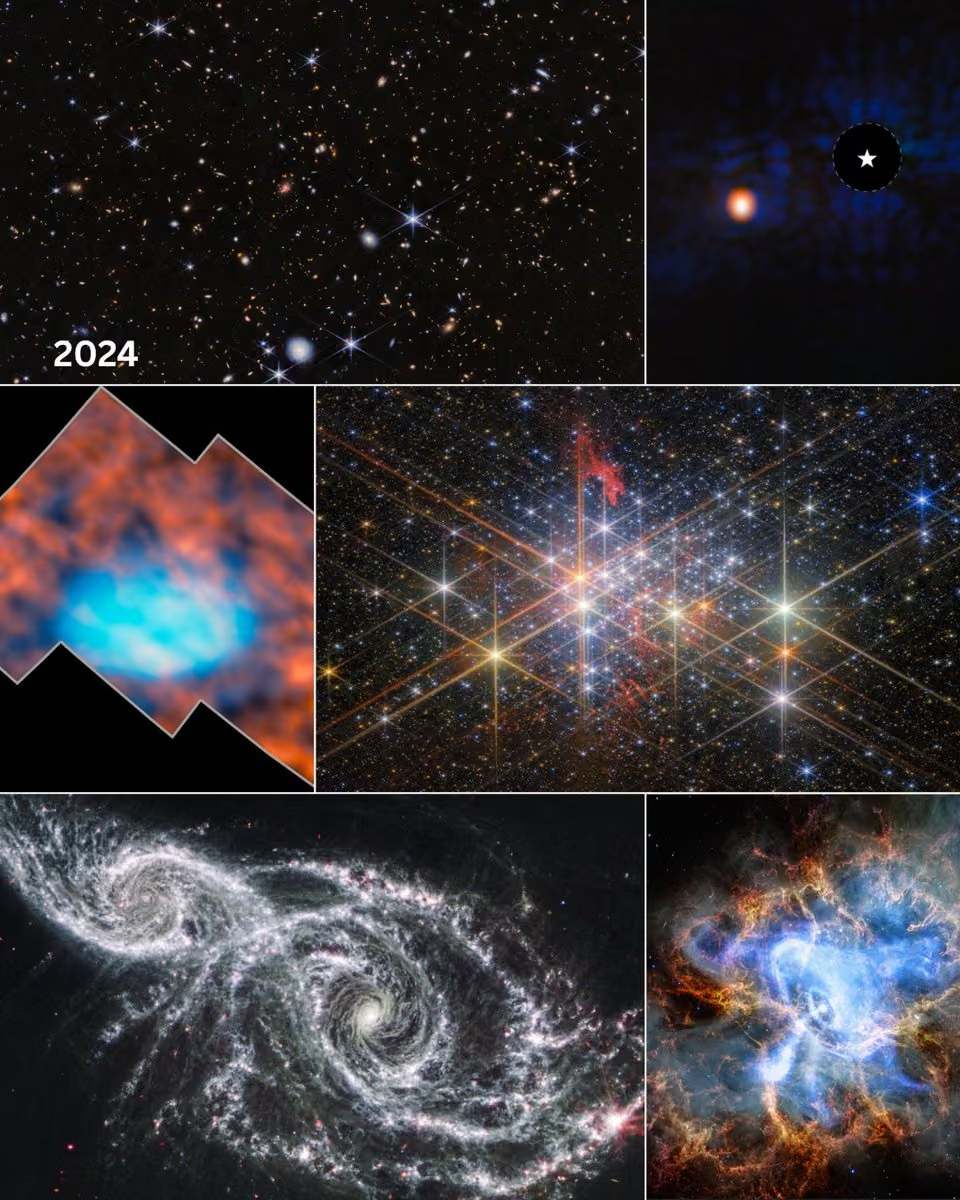
@NASAUniverse
Our discoveries often require several telescopes — take gamma-ray burst 230307A. It was detected by Fermi, then pinpointed by Swift and others, which allowed @NASAWebb to find the signature of tellurium, an element rarer than platinum on Earth. science.nasa.gov/missions/webb/nasas-webb-makes-first-det… #swift20
-
NASA Webb Telescope reposted
NASA
@NASA
See between the stars 🤩
@NASAWebb delivers an unprecedented look at the fine details left after a long-ago supernova heated this interstellar material, causing it to glow in the infrared: science.nasa.gov/missions/webb/nasas-webb-reveals-intrica… -
NASA Webb Telescope
@NASAWebb
Webb is giving astronomers an unprecedented look at the fine details and 3D structure of the dust and gas between the stars. Usually invisible, a long-ago supernova explosion is heating it and causing it to glow in the infrared. science.nasa.gov/missions/webb/nasas-webb-reveals-intrica…
Bill Nelson
@SenBillNelson
Even as a star dies, its light endures—echoing across the cosmos.
@NASAWebb's latest image beautifully captures its lasting legacy—a keyhole into the past and a mission that will inspire generations to come. -
NASA Webb Telescope
@NASAWebb
Webb is solving mysteries it created. Remember “little red dots?” They seemed too big to exist in the early universe... and maybe theory couldn’t account for them. It turns out they may be a new class of galaxy containing growing supermassive black holes. science.nasa.gov/missions/webb/newfound-galaxy-class-may-…
Post not available here, view on X
NASA Webb Telescope
@NASAWebb
We know LRD emerged in large numbers and then declined between ~600 million to 1.5 billion years after the big bang. Some 70% of them show evidence of containing rapidly orbiting gas - a sign of an accretion disk obscuring a central supermassive black hole.
NASA Webb Telescope
@NASAWebb
Questions remain: why aren’t LRD seen after 1.5 billion years post-big bang? Why aren't they bright in X-rays like modern black holes? Is this how black holes grew in the early universe? Future observations will help astronomers find answers; for now this "case" remains open.
-
NASA Webb Telescope
@NASAWebb
Like images of broken light, Webb captured these carbon-rich dust shells around a binary star system. Drifting swiftly outwards, they are seeding their surroundings with carbon - one way elements spread across the universe. science.nasa.gov/missions/webb/webb-watches-carbon-rich-d…
NASA Webb Telescope
@NASAWebb
Wolf-Rayet 140 contains two massive stars that follow a tight, elongated orbit. (In these images, they are within the central white dot.) As they swing past each other, their stellar winds collide, compressing and forming these rings of carbon-rich dust.
NASA Webb Telescope
@NASAWebb
Though many events in space take place over vast timescales, these rings (Webb spotted 17 of them) are moving outward from their stars at more than 1600 miles/s, making them noticeably different from one year to the next. This animation shows changes in WR140 between 2022-2023.
NASA Webb Telescope
@NASAWebb
Like clockwork, the stars’ winds generate dust for several months every eight years, as the pair make their closest approach to each other. Webb shows where dust formation stops — look for the darker region at top left of the images.
NASA Webb Telescope
@NASAWebb
The dust here isn’t uniform. In places it has “piled up” in amorphous clouds as large as our whole solar system; other individual particles float freely. The spread of this carbon-rich dust into the galactic neighborhood is key for the formation of solar systems like ours.
NASA Webb Telescope
@NASAWebb
Some of these dust shells have persisted for more than 130 years, and this system could generate tens of thousands of shells over hundreds of thousands of years. Ultimately, massive stars end their lives in a supernova explosion, likely the fate of Wolf-Rayet 140.
-
NASA Webb Telescope reposted
Space Telescope Science Institute
@SpaceTelescope
Only #nasawebb can provide such a detailed view of L1527 IRS—a star still in the process of formation. Examine this science visualization and watch material ejected from the shrouded star. Credit: NASA, ESA, CSA, R. Crawford, L. Hustak, A. Pagan, F. Summers, G. Bacon (STScI).
-
NASA Webb Telescope reposted
Space Telescope Science Institute
@SpaceTelescope
Space Telescope Live has a new calendar tool and timeline feature specially designed to provide you with quick access to thousands of #nasawebb observations and more than 1.6 million Hubble observations: webbtelescope.pub/WebbObservations
-
NASA Webb Telescope reposted
Chandra Observatory
@chandraxray
Want this holiday wreath for your front door? You're going to need a bigger door. This new image of star cluster NGC 602 from Chandra & @NASAWebb is about 175 light-years across and it sparkles with the light from thousands of stars.🎀 More: s.si.edu/wreath
-
NASA Webb Telescope
@NASAWebb
Even in space, connections are important. This image of NGC 2566 is part of an observing program dedicated to understanding the connections between stars, gas and dust in nearby star-forming galaxies. Read more: esawebb.org/images/potm2412a/
-
NASA Webb Telescope
@NASAWebb
A riddle wrapped in a 20-year-old @nasahubble mystery…
Webb confirmed a controversial finding of Hubble’s - planet-forming disks in the early universe that are longer-lived than they should be, given the conditions in their environment. Read more: science.nasa.gov/missions/webb/nasas-webb-finds-planet-fo…Post not available here, view on X
NASA Webb Telescope
@NASAWebb
Webb's instruments can split up light into its components, unlocking the chemical make-up of whatever it is observing. Webb saw that the stars in star cluster NGC 346 do have longer-lived disks allowing their planets time to form and grow - despite the lack of heavier elements.
NASA Webb Telescope
@NASAWebb
How do these disks survive long enough to form massive planets? Maybe it takes longer for stars in clusters with fewer heavier elements to blow away their disks. Maybe the gas clouds that formed these stars are more massive, producing bigger disks that take longer to disperse.
-
NASA Webb Telescope
@NASAWebb
It's that time of year, let's make some snowflakes! ❄️
Fold and cut your own using our Webb template: science.nasa.gov/mission/webb/webb-paper-snowflake/ -
NASA Webb Telescope
@NASAWebb
Someone struck a match against the night…
Webb discerned distinct star clusters in the Firefly Sparkle galaxy, which existed 600 million years after the big bang - the first discovery of an actively forming galaxy as lightweight as the young Milky Way. science.nasa.gov/missions/webb/found-first-actively-formi…Post not available here, view on X
NASA Webb Telescope
@NASAWebb
Another piece of evidence that the galaxy is still in the process of forming is that the projected actual shape of the galaxy shows its stars haven’t settled into a central bulge or thin, flattened disk.
NASA Webb Telescope
@NASAWebb
Other galaxies detected by Webb from this time period in the Universe’s history are much more massive than the Firefly Sparkle, which itself is more similar in mass to what our Milky Way’s might have been at this same stage of development.
-
NASA Webb Telescope
@NASAWebb
Webb and the Spiderweb protocluster? Let’s get stuck in! 👇
What is it? A galaxy cluster in formation, 10 billion light years away, composed of more than 100 known galaxies. Webb has found some new ones! esawebb.org/news/weic2428/Post not available here, view on X
NASA Webb Telescope
@NASAWebb
The characteristics of the new galaxies Webb has spotted are shedding light on how galaxies grow and interact as clusters form. Most galaxies in local clusters are old and not very active. The ones in the Spiderweb are comparatively adolescents.
NASA Webb Telescope
@NASAWebb
Surprises? The previously-known galaxies in the Spiderweb galaxy cluster are not as dusty as we thought. This may be because their star formation and growth are not being triggered so much by galaxy mergers, but by gas accumulating around the cluster
-
NASA Webb Telescope
@NASAWebb
Pardon our dust!
Webb’s near and mid-infrared view of spiral galaxy NGC 2090 highlights its two winding arms as well as the beautiful details of its swirls of dust and gas. esawebb.org/images/potm2411a/
NASA Webb Telescope
@NASAWebb
In visible light, the arms of NGC 2090 are not easily traceable because of its dust and gas and its patchy dusty disk - as seen in this recent @nasahubble view. This type of galaxy is called a flocculent spiral. esahubble.org/images/potw2448a/
NASA Webb Telescope
@NASAWebb
Across the disk of NGC 2090 are clusters of star formation that can be seen in both Webb and Hubble's images. Together, the telescopes are helping to create a fuller overall picture of star formation and galaxy evolution.
-
NASA Webb Telescope reposted
Hubble
@NASAHubble
Hats off to you, @NASAWebb! 🎩
Now, both Hubble and Webb have observed M104 – nicknamed the Sombrero Galaxy.
Webb's new mid-infrared view shows the smooth inner disk of the galaxy, and highlights how the clumpy gas in the outer ring is distributed: science.nasa.gov/missions/webb/hats-off-to-nasas-webb-som… -
NASA Webb Telescope
@NASAWebb
Ring around the galaxy… Here’s Webb’s stunning new mid-infrared image of M104.
This bright core of the galaxy is dim in this view, revealing a smooth inner disk as well as details of how the clumpy gas in the outer ring is distributed. science.nasa.gov/missions/webb/hats-off-to-nasas-webb-som…
NASA Webb Telescope
@NASAWebb
Dust is one of the universe’s essential building blocks. Though this particular galaxy is not a particular hotbed of star formation, it does contain lots of stars for scientists to study, especially tight groupings called globular clusters.
NASA Webb Telescope
@NASAWebb
Also known as the Sombrero galaxy, M104 looks a bit more hat-like in @NASAHubble visible-light image (shown below), which showcases its prominent, glowing core.
-
NASA Webb Telescope reposted
Hubble
@NASAHubble
Calling all stargazers! 🔭
Your mission, should you choose to accept it, is to look up every month next year as part of Hubble's Night Sky Observing Challenge.
This year-long challenge is in honor of Hubble's upcoming 35th anniversary: science.nasa.gov/mission/hubble/science/explore-the-night… -
NASA Webb Telescope reposted
Chandra Observatory
@chandraxray
A supermassive black hole located 12.1 billion light-years from Earth is consuming matter at a phenomenal rate — over 40 times the theoretical limit! This discovery could help explain how supermassive black holes grew so quickly in the early Universe: s.si.edu/lid568 ⚫
-
NASA Webb Telescope reposted
Chandra Observatory
@chandraxray
Today Chandra is studying NGC 1512 as part of a multi-observatory project to help us learn more about different phases of star formation in nearby spiral galaxies. NGC 1512 is located about 30 million light-years from Earth, shown here in infrared light captured by @NASAWebb.
-
NASA Webb Telescope
@NASAWebb
Webb has its eye on Titan, a moon of Saturn, a place where methane and ethane make up its liquid rivers and seas. Learn more about future Titan studies in Other Worlds Episode 3.
NASA+: plus.nasa.gov/video/other-worlds-titan/
Youtube: youtu.be/LkYPsWnsBOc -
NASA Webb Telescope
@NASAWebb
Take a deep dive into how our optics team keeps Webb’s mirrors in top performance shape, enabling it to continue seeing the universe in unprecedented detail. (Hint: by making small adjustments to the mirror segments as shown here.) science.nasa.gov/blogs/webb/
-
NASA Webb Telescope reposted
Hubble
@NASAHubble
A nearly 100-billion-mile-diameter debris disk encircles the star Vega.
Astronomers have long assumed this was a disk of planet-forming material, but new observations with Hubble and @NASAWebb offer a different verdict.
"The Vega disk is smooth, ridiculously smooth." -
NASA Webb Telescope
@NASAWebb
I always feel like somebody’s watching me 👀
Happy Halloween from @NASAWebb & @NASAHubble! This creepy new image combines mid-infrared light from Webb with ultraviolet and visible light from Hubble, revealing a pair of “eyes” from space. science.nasa.gov/missions/webb/blood-soaked-eyes-nasas-we…Post not available here, view on X
NASA Webb Telescope
@NASAWebb
This pair may swing by one another repeatedly over the course of many millions of years. They might eventually meld, leaving behind completely reshaped arms, and an even brighter cyclops-like “eye” at the core. The areas of star formation really pop in this mid-infrared view.
NASA Webb Telescope
@NASAWebb
These galaxies are busy places! In just one Earth year,they can form the equivalent of two dozen new stars that are the size of our Sun. That’s a lot compared to our Milky Way, which only forms the equivalent of two or three new Sun-like stars per year.
-
NASA Webb Telescope
@NASAWebb
The eerie eye of a Phantom in the sky…
Here’s an updated look at M74, also known as the Phantom Galaxy. New Webb data is allowing scientists a better look at its stellar nurseries. esawebb.org/images/potm2410a/ -
NASA Webb Telescope
@NASAWebb
It’s giving rainbows and unicorns, like a middle school binder 🦄🌈
Meet NGC 602, a young star cluster in the Small Magellanic Cloud, where astronomers using @NASAWebb have found candidates for the first brown dwarfs outside of our galaxy. esawebb.org/news/weic2425/Post not available here, view on X
NASA Webb Telescope
@NASAWebb
Brown dwarfs are not quite stars and not quite gas giant planets either. They are also free-floating; they aren’t gravitationally bound to a star like a planet would be. But they do share some characteristics with exoplanets, like storm patterns and atmospheric composition.
NASA Webb Telescope
@NASAWebb
@NASAHubble saw NGC 602 harboring very young low-mass stars; Webb is showing us how significant and extensive brown dwarfs may be here. This will help us understand how brown dwarfs form, particularly in an environment similar to the harsh conditions of the early Universe.
NASA Webb Telescope
@NASAWebb
We'd like to note a correction that brown dwarfs are not always free-floating as we implied.
-
NASA Webb Telescope reposted
NASA
@NASA
What has NASA done for you lately? We've contributed more than $75 billion in economic output, supported over 300,000 jobs, and provided benefits to all 50 states (and the District of Columbia) in fiscal year 2023. Get the receipts: nasa.gov/value-of-nasa/
-
NASA Webb Telescope
@NASAWebb
Shopping for pumpkins this weekend? Consider carving your own James Webb Space Pumpkin! We have five Webb-related designs, with differing degrees of difficulty. If you make a Webb-related pumpkin, be sure to tag us so we can share! science.nasa.gov/mission/webb/space-pumpkin/?linkId=62747…
-
NASA Webb Telescope
@NASAWebb
Congrats to the whole @EuropaClipper team on a successful launch! We'll wave as you fly by on the way out to your planetary front row seat. We're so happy and not at all jealous 😜
NASA
@NASA
Leaving our water world, to explore another 🚀
@EuropaClipper launched from @NASAKennedy at 12:06pm ET (16:06 UTC) on a @SpaceX Falcon Heavy, beginning a 1.8-billion-mile journey to explore the mysteries of Europa, Jupiter’s ocean moon.
NASA Webb Telescope
@NASAWebb
Webb took a look at Europa in 2023! www.nasa.gov/solar-system/nasas-webb-finds-carbon-source-…
(P.S. Our image is pixelated because Europa is very small (~90% the size of Earth’s Moon) compared to its huge distance of 390.4 million miles from us.) -
NASA Webb Telescope reposted
NASA
@NASA
Got your pickaxe?
We're inviting gamers, educators, and students to check out a new #minecraftedu world inspired by @NASAWebb! This partnership with @Minecraft allows creators to explore star formation, planets, and galaxies, modeled on real Webb images: www.nasa.gov/learning-resources/new-minecraft-game/?linkI… -
NASA Webb Telescope
@NASAWebb
Imagine a sky full of hundreds of stars as bright as the full moon… If our solar system were a part of this “super star” cluster, that is what we might experience. Here is Webb’s look at Westerlund 1, one of the closest clusters of its kind. esawebb.org/images/potm2409a/
Post not available here, view on X
NASA Webb Telescope
@NASAWebb
Westerlund 1 is a natural laboratory for the study of extreme stellar physics, helping astronomers to learn how the most massive stars in our galaxy live and die, and how stellar winds, supernovae, and other ejected material affect star formation within their environment.
NASA Webb Telescope
@NASAWebb
What are the lines coming from the stars? Diffraction spikes! They're patterns produced as light bends around the sharp edges of a telescope. Diffraction spikes appear when light interacts with the primary mirror and struts that support the secondary mirror.
-
NASA Webb Telescope
@NASAWebb
Chris Gunn's photography on Webb was stellar! ✨
Check out some of our fav Chris Gunn photos of Webb's journey to space here: www.flickr.com/photos/nasawebbtelescope/albums/7215771186…
Nancy Grace Roman Space Telescope
@NASARoman
Photographer Chris Gunn has worked on missions like @NASAHubble and @NASAWebb and now leads the team to document Roman's progress.
His passion for figuring out how things work gives him a unique perspective when it comes to highlighting @NASA missions. www.nasa.gov/people/chris-gunn/?linkId=610454108 -
NASA Webb Telescope
@NASAWebb
Centaurs are objects in orbital flux: small and icy, pushed inward of Neptune by its gravity, not quite comets...yet. Webb mapped gases spewing from Centaur 29P in high detail, providing new insights into the formation and evolution of the solar system. science.nasa.gov/missions/webb/nasas-webb-reveals-unusual…
Post not available here, view on X
NASA Webb Telescope
@NASAWebb
Though not a comet, Centaur 29P does have active outbursts that vary in intensity every 6-8 weeks. With Webb, scientists discovered a new jet of carbon monoxide, as well as jets of carbon dioxide, marking this as the first definitive detection of CO2 on this object.
NASA Webb Telescope
@NASAWebb
The angles of the jets suggest that Centaur 29P might be made of multiple objects of differing compositions that coalesced. Centaurs are like the leftovers of our solar system’s formation and in their icy bodies is preserved chemical information about our early stages.
-
NASA Webb Telescope
@NASAWebb
A New H0pe?
Scientists are using Webb to measure the expansion of the universe, by pointing it at a gravitationally lensed supernova, SN H0pe. The light from this exploding star has been bent and magnified by a galaxy cluster between it and us. blogs.nasa.gov/webb/2024/10/01/webb-researchers-discover-…Post not available here, view on X
NASA Webb Telescope
@NASAWebb
Having “trifold” images of this supernova allow scientists to use the time delays, its distance, and the lensing properties to calculate a value for the Hubble constant: the rate at which the universe is expanding.
Note: this science is in progress and not yet peer-reviewed.
NASA Webb Telescope
@NASAWebb
The value for the Hubble constant obtained using this method matches other measurements in the local universe. More observations of Supernova H0pe, one of the most distant of its kind, will help further our understanding of this fundamental parameter of the universe.
-
NASA Webb Telescope
@NASAWebb
Webb spotted an unusual early galaxy with gas clouds that outshine its stars. Hotter and more massive stars than we see in the local universe may be heating its dust, making it shine. Is this a transition point for galaxies, from primordial to modern? science.nasa.gov/missions/webb/in-odd-galaxy-nasas-webb-f…
-
NASA Webb Telescope reposted
Hubble
@NASAHubble
Our eyes in the sky found some eyes in the sky.
Hubble and @NASAWebb studied a bright pair of galactic “eyes” – which are really two colliding galaxies known as Arp 107. Located 465 million light-years away, this pair’s merger will take hundreds of millions of years to complete. -
NASA Webb Telescope reposted
Hubble
@NASAHubble
Our telescope teammate @NASAWebb also observed NGC 1559.
This image shows near- and mid-infrared data of the galaxy, highlighting the glow of interstellar dust grains and the light from stars – even young stars hidden behind lots of dust.
Learn more: esawebb.org/images/potm2402a/?linkId=596146612 -
NASA Webb Telescope
@NASAWebb
Today is Webb’s 1000th day in space! 🎉
Our #unfoldtheuniverse "Lifer" checklist:
A spacecraft impacting an asteroid
Unexpected dust (supernova remnants and early galaxies)
Exoplanets atmospheres
Early black holes
The farthest galaxy (so far!)
What's your fav discovery?
NASA Webb Telescope
@NASAWebb
Also, within those 1000 days, we launched Webb, commissioned it, and saw it safely to its home at the second Lagrange point! 🚀
-
NASA Webb Telescope reposted
NASA
@NASA
Get pulled in to this black hole image. You read that right!
@NASAWebb’s Mid-Infrared Instrument captured a supermassive black hole gobbling gas and dust. The energy it emits as it feeds makes the spiral galaxy’s core shine like a six-pointed pink "star": science.nasa.gov/missions/webb/nasas-webb-provides-anothe… -
NASA Webb Telescope
@NASAWebb
On Wednesdays we wear pink. 💖
Arp 107, an interacting galaxy pair, was captured by Webb in both the near and mid-infrared, the latter represented in pinkish hues. What does each infrared wavelength tell us? ⬇️ science.nasa.gov/missions/webb/nasas-webb-provides-anothe…
NASA Webb Telescope
@NASAWebb
Webb’s mid-infrared observations show star-forming regions and dust, as well as the large spiral galaxy’s bright nucleus. Near-infrared data (this image) highlights the stars within the colliding galaxies, as well as the translucent bridge of stars being pulled from them both.
NASA Webb Telescope
@NASAWebb
Other observatories have captured this galaxy pair. Left: a visible-light beauty shot by @NASAHubble. Right: Infrared Spitzer showcases the difference in ages of the stars in these galaxies. Older stars are in blue (3.6 microns) and clumps of young stars in pink (8 microns).
-
NASA Webb Telescope reposted
NASA Goddard
@NASAGoddard
🎤 Say you can’t sleep, baby I know,
That’s that Stephan’s Quintet, oh! -
NASA Webb Telescope reposted
Nancy Grace Roman Space Telescope
@NASARoman
We're looking for a guy in
Outreach ✅
Terp alum ✅
6'5 ✅
Blue eyes ✅
Learn more about Peter Sooy's journey to @NASA: www.nasa.gov/people/peter-sooy-spreading-cosmic-awe-acros… -
NASA Webb Telescope
@NASAWebb
Here’s Webb’s look at the Digel Clouds, an outpost of star-formation located in the Milky Way’s “outer rim.” ✨
Webb’s sharp infrared eye captured activity within star clusters in these molecular clouds in unprecedented detail: science.nasa.gov/missions/webb/nasas-webb-peers-into-the-…
NASA Webb Telescope
@NASAWebb
Astronomers call this region the “Extreme Outer Galaxy” with Digel Clouds 1 and 2 located 58,000 light years away from the Galactic Center. Webb observations now allow scientists to study star formation out there with the same level of detail as within our own solar neighborhood.
-
NASA Webb Telescope
@NASAWebb
We have special feelings about this galaxy group ourselves! It was one of the first full-color images we released!
Hubble
@NASAHubble
#otd 15 years ago, Hubble shared a glimpse of Stephan's Quintet – a gorgeous grouping of galaxies.
Though it looks like this group is all close together, the upper left galaxy is actually about seven times closer to Earth than the rest of them: science.nasa.gov/image-detail/stephans-quintet-6/This media couldn't be displayed. See it on the original post. -
NASA Webb Telescope reposted
-
NASA Webb Telescope reposted
NASA Goddard
@NASAGoddard
This image was too perfect not to ask… what questions do you have about @NASAWebb? 💫
Reply here and we’ll answer! -
NASA Webb Telescope reposted
ARCHIVED - NASA Europa Clipper
@EuropaClipper
Picture this: what might exist below Europa's surface? If you know creative kids, encourage them to submit to our new art challenge. Entries submitted by Sept. 30 may be featured online or during the launch broadcast in October! Get the full picture: spaceplace.nasa.gov/art-challenge/en/
-
NASA Webb Telescope
@NASAWebb
? 🤔
Thanks to a cosmic magnifying glass effect, the gravity of a massive galaxy cluster is warping two distant interacting galaxies (a face-on spiral and a dusty red galaxy) behind it, making them appear multiple times, tracing a familiar shape. science.nasa.gov/missions/webb/nasas-webb-reveals-distort…
NASA Webb Telescope
@NASAWebb
@NASAHubble has observed the spiral, but only Webb has seen the dusty red galaxy. Dust traps shorter wavelengths but allows infrared light to pass. The dot of the question mark is an unrelated galaxy that happens to be in the right place and space-time, from our perspective.
NASA Webb Telescope
@NASAWebb
Gravitational lensing allows astronomers to pinpoint specific regions of star formation in these distant galaxies. Active star formation, and the face-on galaxy’s remarkably intact spiral shape, indicate that these galaxies’ interaction with each other is just beginning.
-
NASA Webb Telescope reposted
NASA Universe
@NASAUniverse
A star’s habitable zone is the range of distances where conditions may be just right for liquid water to exist on the surface of an orbiting planet. Like toasting a perfectly golden marshmallow on a campfire, it can’t be too hot … or too cold: science.nasa.gov/exoplanets/habitable-zone/?linkId=570624447
-
NASA Webb Telescope reposted
NASA Goddard
@NASAGoddard
When’s the last time you took a stroll around the neighborhood?
Join @NASAHubble on a trip to meet some of our cosmic neighbors!
science.nasa.gov/mission/hubble/hubble-news/hubble-social… -
NASA Webb Telescope
@NASAWebb
A stellar view!
This is NGC 1333, a nearby star-forming region. Webb’s sharp infrared vision lets us peer through the dusty veil to reveal newborn stars, brown dwarfs, and planetary mass objects. Read more: esawebb.org/images/potm2408a/
NASA Webb Telescope
@NASAWebb
Here is @NASAHubble’s 33rd anniversary view from 2023. Most of the firestorm of star birth is hidden behind clouds of fine dust at visible wavelengths. .science.nasa.gov/missions/hubble/hubble-celebrates-33rd-a…
-
NASA Webb Telescope
@NASAWebb
Here's Webb's look at NGC 346. At left just our Near-Infrared Camera. At right, a composite: infrared (Webb + Spitzer), optical (ESO + @NASAHubble) , and X-rays (@chandraxray + XMM-Newton).
Fun fact, Hubble can see ultraviolet and infrared as well as visible light!
Hubble
@NASAHubble
📍 NGC 346
➡️ 210,000 light-years
🏠 Small Magellanic Cloud
Nestled within one of our Milky Way’s closest galaxy neighbors, the Small Magellanic Cloud, the star cluster NGC 346 is home to hot stars that unleash a torrent of radiation: science.nasa.gov/centers-and-facilities/goddard/hubble-ca… -
NASA Webb Telescope reposted
NASA Goddard
@NASAGoddard
Nobody will remember:
-how many mirror segments you have
-how much data you collect
-how far away L2 is
People will remember:
-the Pillars of Creation
-can you point at the Pillars of Creation
-are there new images of the Pillars of Creation -
NASA Webb Telescope reposted
NASA
@NASA
Titan: a strange world with seas of methane and ethane. Scientists are using @NASAWebb to take a close look—and developing Dragonfly, a mission to send an octocopter to Saturn’s largest moon.
Watch “Other Worlds” on our ad-free streaming service NASA+: plus.nasa.gov/video/other-worlds-titan/?linkId=561996203 -
NASA Webb Telescope
@NASAWebb
Did Webb’s look at early galaxies really break cosmology? (Spoiler: nope!)
Their unexpected brightness isn't due to a problematic amount of star formation. Much of their light likely comes from hot disks of matter around their central black holes. science.nasa.gov/missions/webb/webb-finds-early-galaxies-…
NASA Webb Telescope
@NASAWebb
When the supermassive black holes at the center of galaxies rapidly consume the gas that orbits them, friction in the fast-moving gas emits light and heat. As a result the galaxies look much brighter than if the light were just emanating from stars alone.
NASA Webb Telescope
@NASAWebb
Initially the extra light made it appear that the galaxies in question contained many more stars, and were more massive than we would estimate. When these outlier galaxies were removed from the data analysis, the remaining galaxies fit the model predictions. Crisis averted!
-
NASA Webb Telescope reposted
NASA Universe
@NASAUniverse
Is there life out there? @NASA scientists study exoplanets light-years away to learn more about their atmospheres, surfaces, and other conditions to see if they could support life as we know it.
Learn more in the newest episode of Astro-Investigates: youtu.be/aPj770zAbaM -
NASA Webb Telescope
@NASAWebb
#sxsw2025 panel voting is open! Beautiful Webb imagery, signed, sealed, and delivered from NASA to you! 💌
Vote: panelpicker.sxsw.com/vote/150050
#sxsw panel name: “NASA's Love Letter: Stunning Webb Images & More” -
NASA Webb Telescope reposted
NASA Universe
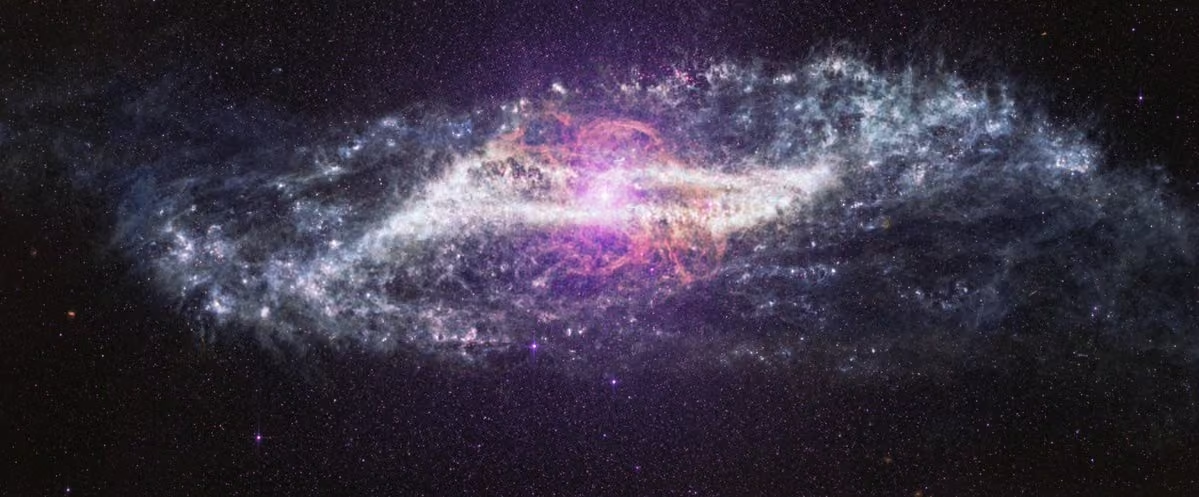
@NASAUniverse
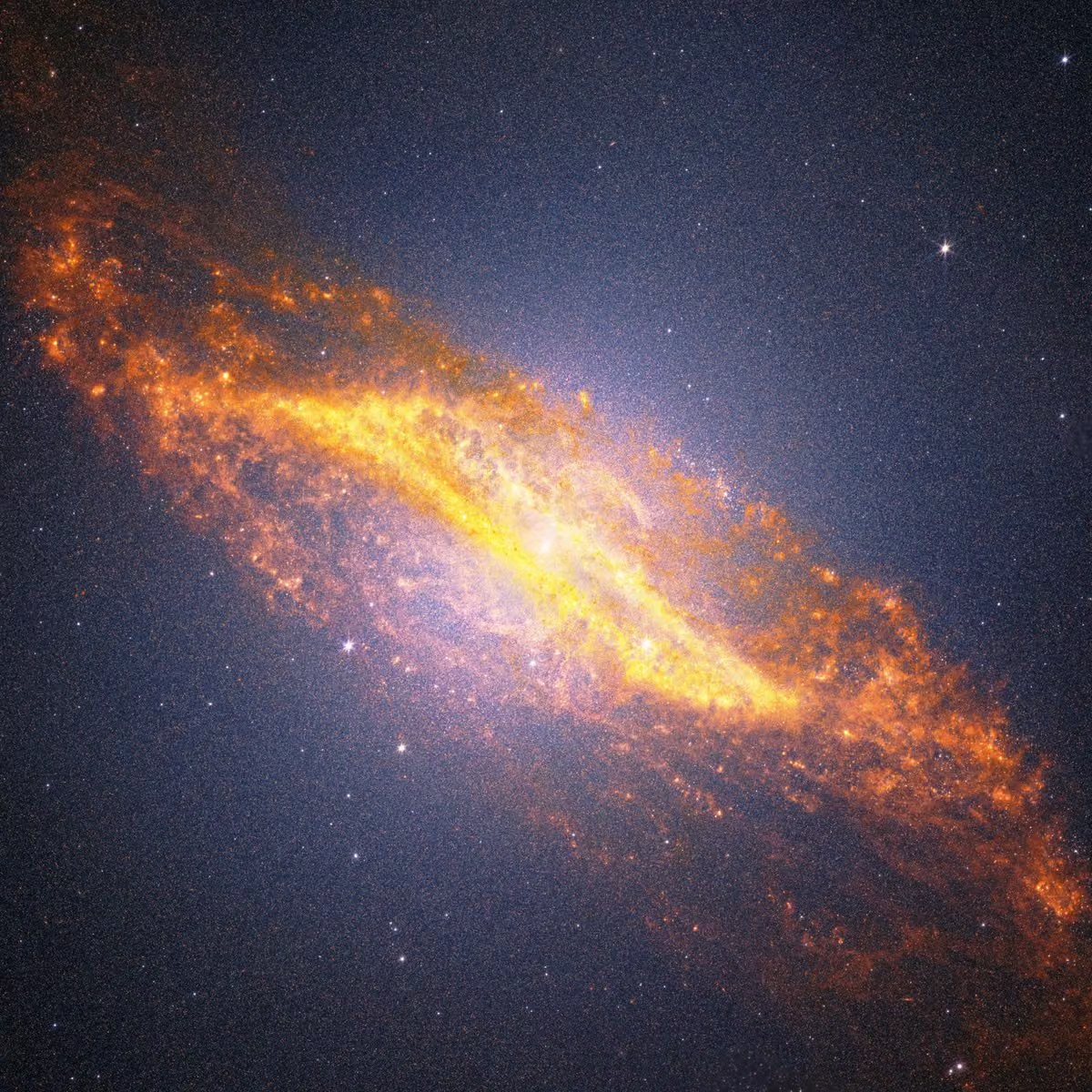
How do we know the universe is expanding? Educators, explore Doppler shift with your high school students and help them calculate the redshift of a supernova, determine its velocity relative to Earth, and find the distance to that object: www.jpl.nasa.gov/edu/teach/activity/math-of-the-expanding… #backtoschool
-
NASA Webb Telescope reposted
Space Telescope Science Institute
@SpaceTelescope
Watch as this video takes you to the farthest galaxy ever detected by #nasawebb (so far), JADES-GS-z14-0. Read about how the scientists were able to find this galaxy, observed only 290 million years after the big bang: webbtelescope.pub/4bWMXYD
-
NASA Webb Telescope
@NASAWebb
Won’t you be our cosmic neighbor, M106?
This galaxy with a very active black hole, is one of the brightest and nearest spirals to ours. Its central region is lit up by its black hole gobbling up dust and gas, which heats up, creating powerful radiation. esawebb.org/images/potm2407a/
NASA Webb Telescope
@NASAWebb
This spiral galaxy has a secret - two extra arms (shown here in green) composed of hot gas, rather than stars. Analogous to a wave crashing up against a rock before reaching the shore, they were likely created as a result of the violent churning of gas around the black hole.
-
NASA Webb Telescope
@NASAWebb
No rings or medals, but there are mountains, beaches, and rain forests @OlympicNP! The Webb team had a great weekend exhibiting, giving talks, and unfolding the universe under the stars in the Pacific Northwest.
-
NASA Webb Telescope reposted
NASA
@NASA
Our solar system is full of mysteries. What secrets are we uncovering?
Go behind-the-scenes with the scientists who are using @NASAWebb to explore "Other Worlds"—now streaming for free on NASA+: plus.nasa.gov/series/other-worlds/?linkId=533594158 -
NASA Webb Telescope
@NASAWebb
Bullseye 🎯
Wolf-Rayet 140 may look a bit familiar to #olympics archers & sharpshooters. This Webb target is composed of at least 17 concentric dust rings, emanating from a pair of stars located just over 5,000 light-years from Earth. Learn more: www.nasa.gov/universe/star-duo-forms-fingerprint-in-space… -
NASA Webb Telescope reposted
Hubble
@NASAHubble
Telescope teamwork ✅
Hubble and @NASAWebb captured the galaxies in this image, while @ChandraXRay detected the superheated gas that these galaxies are immersed in, seen in purple.
Called MACS J0416, this cluster of galaxies is held together by gravity: www.nasa.gov/image-article/take-a-summer-cosmic-road-trip… -
NASA Webb Telescope reposted
NASA Goddard
@NASAGoddard
If the #paris2024 Olympics Opening Ceremony has you dreaming of gold, check out NASA's James Webb Space Telescope!
Watch Elements of Webb on NASA+ to see how @NASAWebb goes for gold… and carbon, and other elements!
plus.nasa.gov/series/elements-of-webb/?linkId=496434921This media couldn't be displayed. See it on the original post. -
NASA Webb Telescope reposted
NASA Universe
@NASAUniverse
The medals awarded at the #olympics contain metals made by large stars that exploded billions of years ago. 🥇🥈🥉
But you don’t have to be a stellar athlete to be rewarded with star stuff — learn more about how and where familiar elements are made: tmblr.co/Zz_UqjaPr5GvSq00 -
NASA Webb Telescope
@NASAWebb
his job is pommel horse. our job is space horse 🐴
NASA Webb Telescope
@NASAWebb
Learn more about Webb's fresh view of the Horsehead Nebula's "mane," seen in unprecedented detail: science.nasa.gov/missions/webb/webb-captures-top-of-iconi…
-
NASA Webb Telescope
@NASAWebb
Stellar form, Cartwheel Galaxy. 🤸
Just as there are #olympics rings, there are 2 rings that make up this galaxy. Note a bright, inner ring and a surrounding, colorful ring, both expanding outwards from the center of an ancient galactic collision: science.nasa.gov/missions/webb/webb-captures-stellar-gymn… -
NASA Webb Telescope
@NASAWebb
#dyk that our Milky Way may have started out looking like a “surfboard”? Webb found that the most common galaxies in the early universe may have been elongated, like “pool noodles” & “surfboards": science.nasa.gov/missions/webb/webb-shows-many-early-gala…
We're wishing all #olympics surfers the best of luck! 🌊 -
NASA Webb Telescope reposted
Hubble
@NASAHubble
Happy #olympics Opening Ceremony, Hubble-style.
These “rings” show different Hubble views of places in space – from Saturn in our solar system, to dying stars thousands of light-years away.
For more Hubble images: science.nasa.gov/mission/hubble/?linkId=523797899 -
NASA Webb Telescope
@NASAWebb
No matter the sport, we’re going for gold. 🥇
Webb’s mirrors are coated with a thin gold layer to reflect infrared light. While gold medals at the #olympics contain about 6g of gold, Webb’s mirrors are coated with about 48g. It would take 8 gold medals to cover Webb’s mirrors!
NASA
@NASA
Let the games begin!
Athletes from across the world are gathering today to kick off the 2024 #olympics – pushing boundaries and inspiring generations. If you were an Olympic athlete, which sport would you play?This media couldn't be displayed. See it on the original post. -
NASA Webb Telescope
@NASAWebb
Unfolding the universe takes a stellar team! 💫
This #nationalinternday, meet Webb video production intern Karly Noetzel. Her advice for prospective NASA interns: “Show people what you’re passionate about. Your excitement is contagious, and doors open when you share your joy.”
NASA Webb Telescope
@NASAWebb
Want to apply for to be a NASA intern? Make sure to follow @NASAInterns for tips and upcoming deadlines. Learn more at intern.nasa.gov.
-
NASA Webb Telescope reposted
NASA JPL
@NASAJPL
It’s a cold, cold world.
This is an actual photo of the coldest exoplanet ever directly imaged. It was spotted by @NASAWebb's Mid-Infrared Instrument (MIRI) about 12 light-years from Earth. www.jpl.nasa.gov/news/nasas-webb-images-cold-exoplanet-12… -
NASA Webb Telescope
@NASAWebb
Need to beat the heat?
Webb has snapped a direct image of Epsilon Indi Ab: the coldest and most Jupiter-like exoplanet to be imaged so far. To make the discovery, Webb blocked out starlight (shown by the star symbol) with a mask called a coronagraph: science.nasa.gov/missions/webb/nasas-webb-images-cold-exo…
NASA Webb Telescope
@NASAWebb
Previously, directly imaged exoplanets were often the youngest, hottest worlds. As planets cool, they become significantly fainter and more difficult to image. Most of their emission is in mid-infrared light. Luckily, Webb is ideally suited to conduct mid-infrared imaging.
NASA Webb Telescope
@NASAWebb
With an estimated temperature of 35 degrees F (2 degrees C), Epsilon Indi Ab is just a bit warmer than the gas giants in our own solar system. With its unique properties, this intriguing world is giving astronomers a rare opportunity to study a true solar system analog.
NASA Webb Telescope
@NASAWebb
Fictional planets in the Epsilon Indi system have long inhabited the realm of science fiction, from Star Trek to Halo. Directly imaging a real planet there marks just the beginning of learning what this system is really like.
-
NASA Webb Telescope
@NASAWebb
Happy 25th anniversary, @chandraxray!
In the past quarter century, Chandra has revolutionized our understanding of X-ray astronomy. Since the start of Webb science operations in 2022, the two telescopes have worked in tandem to combine infrared and X-ray wavelengths.
NASA Webb Telescope
@NASAWebb
To celebrate its accomplishments, the Chandra team has released 25 never-seen-before views of the cosmos. Each of the images in this thread contain data from both Chandra and Webb. Find the full set of images here: www.nasa.gov/missions/chandra/25-images-to-celebrate-nasa…
-
NASA Webb Telescope reposted
Chandra Observatory
@chandraxray
25 new images to celebrate Chandra's 25th anniversary! Launched into space on July 23, 1999, Chandra continues to discover new phenomena and examine old mysteries from within our Solar System out to nearly the edge of the observable Universe. 🎉s.si.edu/Chandra25 #chandra25
-
NASA Webb Telescope
@NASAWebb
2 for 2!
Both Webb & @NASAHubble observed galactic duo Arp 142: the Penguin and the Egg.
Hubble’s visible-light image was taken in 2013. Webb’s new image reveals a haze of stars and gas joining the galaxies, as well as thousands of background galaxies: science.nasa.gov/missions/webb/vivid-portrait-of-interact… -
NASA Webb Telescope reposted
NASA Goddard
@NASAGoddard
Happy 2nd anniversary to @NASAWebb!
Celebrating 2 years of science, this egg-citing image shows the Penguin (NGC 2936) & Egg (NGC 2937) galaxies. These galaxies are joining together through mutual gravitational attraction in a blue haze of stars and gas.
science.nasa.gov/missions/webb/vivid-portrait-of-interact… -
NASA Webb Telescope reposted
NASA's Johnson Space Center
@NASAJohnson
Celebrating 2 years is EGGtra special!!
🥚🐧
NASA Webb Telescope
@NASAWebb
Penguins make excellent parents, even in space. 🐧
Celebrating 2 years of science, this new Webb image shows 2 galaxies: a Penguin (NGC 2936) guarding an Egg (NGC 2937). Webb reveals they are in a cosmic hug, joined together by a blue haze of stars & gas: science.nasa.gov/missions/webb/vivid-portrait-of-interact… -
NASA Webb Telescope reposted
NASA Marshall
@NASA_Marshall
Happy feet! 🐧
To celebrate the second science anniversary of @NASAWebb, the team released a near- and mid-infrared image on July 12 of two interacting galaxies: The Penguin and the Egg.
Learn more about the new image >> science.nasa.gov/missions/webb/vivid-portrait-of-interact… -
NASA Webb Telescope reposted
Space 360
@Space360HQ
🎉 Happy 2nd anniversary to @NASAWebb, the ultimate space detective!
You've unmasked hidden galaxies, sniffed out exoplanet atmospheres, and dazzled us with cosmic candids from baby stars to ancient galaxies. We’re all looking forward to year three’s revelations! -
NASA Webb Telescope
@NASAWebb
Club Penguin 🐧
#icymi, not one but TWO Webb instruments observed the "Penguin and Egg" galaxies! Near-infrared light (left) features a hazy mix of stars and gas joining the pair, while mid-infrared (right) showcases the oldest stars in the Egg, which has lost its gas and dust.
NASA Webb Telescope
@NASAWebb
For more on these two interacting galaxies, head to: science.nasa.gov/missions/webb/vivid-portrait-of-interact…
-
NASA Webb Telescope reposted
NASA JPL
@NASAJPL
It's #worldemojiday, and we're curious: What's your favorite space emoji?
Respond in the comments! 💫 -
NASA Webb Telescope reposted
NASA Ames
@NASAAmes
Worlds-wide Webb 📸
For 2 years, @NASAWebb has been helping us #unfoldtheuniverse.
Ames scientists helped design, develop, and test two of Webb’s scientific instruments, NIRCam and MIRI, that make stunning images like this possible.
Learn more: www.nasa.gov/centers-and-facilities/ames/ames-contributio… -
NASA Webb Telescope reposted
Hubble
@NASAHubble
Two incredible views of two galaxies from two telescopes!
Hubble previously studied Arp 142, also known as the Penguin and the Egg. For the second science anniversary of @NASAWebb, infrared observations shine new light on this interacting galaxy pair. ⬇️ -
NASA Webb Telescope
@NASAWebb
This is eggcellent news! Welcome to the world, baby penguins. More than a rock and a hop away, we also just hatched a new image of a Penguin and an Egg. Talk about cosmic timing 🐧🥚
More: science.nasa.gov/missions/webb/vivid-portrait-of-interact…
Shedd Aquarium
@shedd_aquarium
🚨 Get ready to rockhop with excitement — we've got double the news! 🚨
We are welcoming two new southern rockhopper penguin chicks to the colony at Shedd and are excited to share all about them with you!
🥚 The young birds hatched just days apart on June 18 and June 20. (1/4) -
NASA Webb Telescope reposted
Pittsburgh Penguins
@penguins
it's like looking in a mirror ✨
NASA Webb Telescope
@NASAWebb
Penguins make excellent parents, even in space. 🐧
Celebrating 2 years of science, this new Webb image shows 2 galaxies: a Penguin (NGC 2936) guarding an Egg (NGC 2937). Webb reveals they are in a cosmic hug, joined together by a blue haze of stars & gas: science.nasa.gov/missions/webb/vivid-portrait-of-interact… -
NASA Webb Telescope
@NASAWebb
WASP-39 b is a tidally locked planet: One side is in eternal day, the other in eternal night.
By observing the day/night boundary, Webb has confirmed — with extraordinary precision — the differences in temperature and cloud cover between the two sides. science.nasa.gov/missions/webb/nasas-webb-investigates-et…
NASA Webb Telescope
@NASAWebb
This isn't Webb's first look at this distant world. Back in fall 2022, Webb’s initial observations of WASP-39 b marked the first clear evidence of carbon dioxide in the atmosphere of a planet outside our solar system, or an exoplanet.
NASA Webb Telescope
@NASAWebb
Catch your breath — Webb has captured the first clear evidence of carbon dioxide (CO2) in the atmosphere of a planet outside of our solar system! WASP-39 B is a gas giant closely orbiting a Sun-like star 700 light years away: science.nasa.gov/missions/webb/nasas-webb-detects-carbon-…
NASA Webb Telescope
@NASAWebb
Later that year, additional WASP-39 b data from Webb provided the first molecular and chemical profile of an exoplanet. Besides carbon dioxide, its atmosphere showed evidence of water, sulfur dioxide, carbon monoxide, sodium and potassium.
NASA Webb Telescope
@NASAWebb
Webb’s latest data gives us the first molecular and chemical profile of a distant world, gas giant WASP-39 b. This bodes well for its ability to probe the atmospheres of small, rocky planets like in the TRAPPIST-1 system: science.nasa.gov/missions/webb/nasas-webb-reveals-an-exop…
NASA Webb Telescope
@NASAWebb
Webb's stability and precision allowed scientists to separately observe both sides of WASP-39 b's day/night boundary. Unlike what we may expect on Earth, the evening side of WASP-39 b appears hundreds of degrees hotter than the morning side, with morning likely to be cloudier.
NASA Webb Telescope
@NASAWebb
What’s behind the temperature difference? It's suspected that the morning side of WASP-39 b is slammed by cool winds from the nightside, while the evening side is being hit by winds heated on the dayside. Research suggests wind speeds reach thousands of miles per hour!
-
NASA Webb Telescope reposted
NASA en español
@NASA_es
Los pingüinos son excelentes progenitores, incluso en el espacio. 🐧
Esta imagen, publicada para celebrar los primeros dos años de operaciones científicas de @NASAWebb, muestra dos galaxias: un Pingüino (NGC 2936) cuidando de un Huevo (NGC 2937).
Más: ciencia.nasa.gov/universo/un-retrato-de-galaxias-en-inter… -
NASA Webb Telescope reposted
ARCHIVED NASA Space Communications and Navigation
@NASASCaN
Cutest gal-egg-xies ever. 🐧💞🥚
As @NASAWebb marks two years of incredible science, we're also sending a cosmic hug to the Deep Space Network — the international array of antennas that allows us to communicate with our favorite golden telescope.
NASA Webb Telescope
@NASAWebb
Penguins make excellent parents, even in space. 🐧
Celebrating 2 years of science, this new Webb image shows 2 galaxies: a Penguin (NGC 2936) guarding an Egg (NGC 2937). Webb reveals they are in a cosmic hug, joined together by a blue haze of stars & gas: science.nasa.gov/missions/webb/vivid-portrait-of-interact… -
NASA Webb Telescope reposted
ARCHIVED - NASA Landsat
@NASA_Landsat
NASA looks out into the universe with @NASAWebb to see spectacular penguin-shaped galaxies, then looks to Earth and sees... penguin poop! 🐧🛰️
ARCHIVED - NASA Ice
@NASA_ICE
DYK that penguins can be spotted beyond Antarctica, as far away as the Galápagos Islands and ... distant galaxies?!? 🌌🐧👀
Congratulations to our friends @NASAWebb for two years of spectacular science.
NASA Webb Telescope
@NASAWebb
Penguins make excellent parents, even in space. 🐧
Celebrating 2 years of science, this new Webb image shows 2 galaxies: a Penguin (NGC 2936) guarding an Egg (NGC 2937). Webb reveals they are in a cosmic hug, joined together by a blue haze of stars & gas: science.nasa.gov/missions/webb/vivid-portrait-of-interact… -
NASA Webb Telescope reposted
ARCHIVED - NASA Ice
@NASA_ICE
DYK that penguins can be spotted beyond Antarctica, as far away as the Galápagos Islands and ... distant galaxies?!? 🌌🐧👀
Congratulations to our friends @NASAWebb for two years of spectacular science.
NASA Webb Telescope
@NASAWebb
Penguins make excellent parents, even in space. 🐧
Celebrating 2 years of science, this new Webb image shows 2 galaxies: a Penguin (NGC 2936) guarding an Egg (NGC 2937). Webb reveals they are in a cosmic hug, joined together by a blue haze of stars & gas: science.nasa.gov/missions/webb/vivid-portrait-of-interact… -
NASA Webb Telescope
@NASAWebb
Penguins make excellent parents, even in space. 🐧
Celebrating 2 years of science, this new Webb image shows 2 galaxies: a Penguin (NGC 2936) guarding an Egg (NGC 2937). Webb reveals they are in a cosmic hug, joined together by a blue haze of stars & gas: science.nasa.gov/missions/webb/vivid-portrait-of-interact…Post not available here, view on X
NASA Webb Telescope
@NASAWebb
Which came first for this Penguin and its Egg? @NASAHubble took the visible-light view on the left in 2013.
On the right side is Webb's near-infrared image. With its sensitive vision, Webb peers through dust, intensifies bright objects, and highlights unseen stars and galaxies.
NASA Webb Telescope
@NASAWebb
Since Webb started science, it has discovered the most distant known galaxy, opened a new window into the atmospheres of other worlds, and provided unparalleled insight into the birth of stars and planets. We can’t wait to see how Webb will guide the next generation of explorers.
-
NASA Webb Telescope
@NASAWebb
Tom and Jerry. Bert and Ernie. Thelma and Louise.
Heading into Webb’s 2nd year of science, we’re all about what 2 can do. So here’s just a few of the dynamic duos we love ⤵️Post not available here, view on X
NASA Webb Telescope
@NASAWebb
Look into the orange-white splotch at the center of this image. Buried deep in a disk of gas and dust are two actively forming stars. Over thousands of years, they’ve repeatedly gobbled up and spat out material, producing those fiery orange lobes known as Herbig-Haro 46/47.
NASA Webb Telescope
@NASAWebb
What are some of *your* favorite iconic duos? Drop them below! 👇
-
NASA Webb Telescope reposted
Chandra Observatory
@chandraxray
Roads? Where we're going, we don't need roads. NASA's Chandra & Webb telescopes are taking us all on a cosmic summer road trip — using light as the highway — to visit four stunning destinations across space. More in the thread below and at: s.si.edu/roadtrip
-
NASA Webb Telescope
@NASAWebb
Congrats to Webb instrument systems engineer Dr. Begoña Vila for receiving the 2024 Galician Excellence Title in the Sciences and Medicine category. Read more about this award and Dr. Vila's achievements: science.nasa.gov/missions/webb/nasas-begona-vila-awarded-…
-
NASA Webb Telescope
@NASAWebb
Diamonds of the season 💎
These glittering “gems,” or glowing orange dots, are actually four images of the same thing — an extremely bright object known as a quasar: esawebb.org/images/potm2406a/
So how did Webb end up with multiple copies? ⬇️
NASA Webb Telescope
@NASAWebb
The effect is called gravitational lensing. Much like this @NASAHubble example, a foreground galaxy’s massive gravitational pull has warped time and space around it. Light followed that bend and took various paths, magnifying and creating multiple copies of the quasar behind it.
NASA Webb Telescope
@NASAWebb
Combining gravitational lensing with Webb’s mid-infrared capabilities, scientists can learn more about the quasar's central black hole. Webb's observations will also probe the nature of dark matter, an invisible form of matter that accounts for most of the universe's mass.
-
NASA Webb Telescope
@NASAWebb
NGC 4449 is putting on a show 🎇
Though this dwarf galaxy has been forming stars for billions of years, it is going through a much higher rate of activity than in its past. This intense period is called a starburst, making NGC 4449 a starburst galaxy: esawebb.org/images/potm2405b/ -
NASA Webb Telescope
@NASAWebb
Star-spangled 🎆
Webb’s new red, white and blue image features a star-to-be: a protostar. Only about 100,000 years old, this relatively young object is hidden in the “neck” of the hourglass-shaped cloud of gas and dust: science.nasa.gov/missions/webb/nasas-webb-captures-celest…Post not available here, view on X
NASA Webb Telescope
@NASAWebb
This view of the protostar marks Webb’s second look at the region. Back in 2022, Webb used its Near-Infrared Camera to see cavities being carved in the cloud as the protostar ejected material:
NASA Webb Telescope
@NASAWebb
Countdown to a new star ⏳
Hidden in the neck of this “hourglass” of light are the very beginnings of a new star — a protostar. The clouds of dust and gas within this region are only visible in infrared light, the wavelengths that Webb specializes in: science.nasa.gov/missions/webb/nasas-webb-catches-fiery-h…
NASA Webb Telescope
@NASAWebb
What’s next for the protostar? As it grows older, it will continue to consume, destroy, and push away much of the cloud. Eventually, once it finishes gathering mass, the star will become much easier to see.
-
NASA Webb Telescope
@NASAWebb
Congrats to Dr. Marcia Rieke, who was awarded the Gruber Cosmology Prize!
Dr. Rieke served as the principal investigator on Webb's NIRCam instrument. Her pioneering work on Webb and @NASAHubble has enabled new ways of studying star and galaxy formation. www.nasa.gov/missions/webb/nasa-webb-hubble-scientist-mar… -
NASA Webb Telescope
@NASAWebb
Spot check 🔴
Above Jupiter’s Great Red Spot, sunlight influences upper atmospheric structure. But Jupiter doesn’t get much sun — only 4% of what Earth does. Thinking the region “would be really boring,” scientists were in for a surprise with Webb: www.esa.int/Science_Exploration/Space_Science/Webb/Jupite… -
NASA Webb Telescope
@NASAWebb
Let’s work it out on the remix 🫶
When @NASAHubble and @NASAWebb get together, the internet always goes crazy. Float through multiwavelength views of the iconic Pillars of Creation in this new 3D visualization. More on how it was made: science.nasa.gov/missions/hubble/new-hubble-webb-pillars-…This media couldn't be displayed. See it on the original post. -
NASA Webb Telescope
@NASAWebb
With the help of a natural “magnifying glass,” Webb has made the first discovery of star clusters in a galaxy that existed less than 500 million years after the big bang — when the universe was about 3% of its current age: www.esa.int/Science_Exploration/Space_Science/Webb/Webb_c…
Zoom into this image below ⬇️
NASA Webb Telescope
@NASAWebb
In the close-up on the left, check out the chain of bright dots, mirrored from one side to the other. These are the young star clusters. On the right, take a look at the group of glowing yellow galaxies at the center. These form the galaxy cluster acting as a “magnifying glass.”
NASA Webb Telescope
@NASAWebb
The galaxy cluster’s gravity is so great that it warps surrounding time and space. Light follows that bend instead of traveling in a straight line. This effect, called gravitational lensing, can distort, magnify, and produce multiple images of objects behind a galaxy cluster.
-
NASA Webb Telescope
@NASAWebb
It's #nationalselfieday!
Here are two "selfies" Webb took of its primary mirror back in February and March 2022. These images were taken by a special lens within its NIRCam instrument that allowed our team to check the telescope's alignment with its science instruments.
NASA Webb Telescope
@NASAWebb
Read more about each of these past milestones:
Feb 2022 selfie - science.nasa.gov/blogs/webb/
March 2022 selfie - www.nasa.gov/news-release/nasas-webb-reaches-alignment-mi… -
NASA Webb Telescope
@NASAWebb
The stars, they aligned 🎶
See how those bright red, clumpy streaks are all slanted in the same direction to the same degree? They show aligned protostellar outflows, or jets of gas from newborn stars. Webb captures this phenomenon for the first time: science.nasa.gov/missions/webb/first-of-its-kind-detectio…Post not available here, view on X
NASA Webb Telescope
@NASAWebb
This area is part of the Serpens Nebula. Located 1,300 light-years from Earth, it’s only 1-2 million years old — very young in cosmic terms! It’s home to a dense cluster of newly forming stars (about 100,000 years old), seen at the center of this image.
NASA Webb Telescope
@NASAWebb
Next, the team plans to use Webb’s NIRSpec instrument to investigate the cloud’s chemical make-up. Understanding these baby stars, right before they have planet-forming disks, may help us better understand our own solar system’s origins.
-
NASA Webb Telescope reposted
NASA
@NASA
Juneteenth commemorates the day enslaved African Americans in Galveston, Texas learned of their freedom. This view from the @Space_Station shows the city and Galveston Bay: science.nasa.gov/earth/earth-observatory/
-
NASA Webb Telescope
@NASAWebb
Twin win: Webb discovered that WL 20S, long thought to be a star, is actually a pair of stars!
This image shows Webb & @ALMAObs data of the jets streaming from the twin stars’ poles (in blue/green) and the dusty disks around the stars (in pink): www.jpl.nasa.gov/news/nasas-webb-reveals-long-studied-sta… -
NASA Webb Telescope reposted
NASA
@NASA
As we celebrate the start of #blackspaceweek, tune in now for a live event from @NMAAHC featuring @NASA_Astronauts Victor Glover, Jessica Watkins, and Yvonne Cagle: youtu.be/oq_OqySiJfQ
-
NASA Webb Telescope
@NASAWebb
Webb is cracking open the Crab Nebula to help scientists figure out what is inside. 🦀
The Crab is the remnant of what was once a massive star, but it’s highly unusual in composition, making scientists think its star might not have been typical either: science.nasa.gov/missions/webb/investigating-the-origins-…
NASA Webb Telescope
@NASAWebb
Webb also mapped light emitted from the dust in the Crab Nebula in high resolution for the first time. Unlike other supernova remnants, which have dust concentrated at their centers, the Crab Nebula’s dust is found in the outer shell’s dense filaments.
-
NASA Webb Telescope
@NASAWebb
Webb Telescope: supernova discovery machine!
Webb has identified 10 times more supernovae in the early universe than previously known. Several are the most distant examples of their type, including those used to measure the universe's expansion rate: science.nasa.gov/missions/webb/nasas-webb-opens-new-windo…Post not available here, view on X
NASA Webb Telescope
@NASAWebb
Webb uncovered ~80 supernovae in a patch of sky the thickness of a grain of rice held at arm’s length. This included several Type Ia supernovae, which are so predictably bright that they are used as a standard to measure distances and calculate the universe's expansion rate.
NASA Webb Telescope
@NASAWebb
Scientists expect ancient supernovae to contain far fewer heavy chemical elements than Sun-like stars. Comparing these supernovae with those nearby will help us form a more accurate view of star formation and supernovae explosion mechanisms in the early universe.
-
NASA Webb Telescope reposted
NASA Solar System
@NASASolarSystem
The @NASAWebb space telescope delivers astounding views of the most distant locations in the universe we have ever observed. It also shows us our own neighborhood like never before. 🪐 How we explore the solar system with Webb: webbtelescope.org/contents/articles/exploring-our-solar-s…
-
NASA Webb Telescope
@NASAWebb
Tiny star, big potential.
Webb studied the planet-forming disk around a star weighing 1/10th of our Sun, finding it holds the largest number of carbon-containing molecules seen to date in such a disk: science.nasa.gov/missions/webb/webb-finds-plethora-of-car…
What this tells us about potential future planets ⬇️Post not available here, view on X
NASA Webb Telescope
@NASAWebb
The star, ISO-Chal 147, is just one to two million years old. The 13 different carbon-bearing molecules Webb detected within its planet-forming disk include the first detection of ethane outside of our solar system, as well as ethylene, propyne, and more.
NASA Webb Telescope
@NASAWebb
With so much gaseous carbon in the disk, there is likely little carbon left in the solid materials that planets would form from, making them carbon-poor. The team plans to expand their study to further understand how common carbon-rich, rocky planet-forming zones are.
-
NASA Webb Telescope
@NASAWebb
What goes into finding a potentially habitable planet?
Learn how Webb’s sensitive vision may help us detect and characterize the atmospheres of some of the most promising candidates orbiting cool stars — and lay the groundwork for future missions: science.nasa.gov/blogs/webb/ -
NASA Webb Telescope
@NASAWebb
Searched for our spark and we found it 😤
Why are Webb's stars so sparkly? Those diffraction spikes are produced as light bends around a telescope's sharp edges. Webb’s unique pattern is due to its hexagonal primary mirror & secondary mirror struts: webbtelescope.org/contents/media/images/01G529MX46J7AFK61… -
NASA Webb Telescope reposted
NASA
@NASA
As we mark the start of #pridemonth, we're reflecting on how far we've come while recognizing the work still to be done.
There's space for everyone — all genders and orientations — in exploration and discovery. -
NASA Webb Telescope reposted
Chandra Observatory
@chandraxray
Chandra & @NASAWebb together again! The Crab Nebula is the result of a supernova explosion seen by people on Earth in the year 1054. Located about 6,500 light-years from Earth, the neutron star at its center is roughly 20 km in diameter and it rotates about 30 times per second!
-
NASA Webb Telescope
@NASAWebb
The world’s most powerful space telescope has done it again.
Webb has discovered what appears to be a new record-holder for the most distant known galaxy — shattering its own previous record. This galaxy existed only 290 million years after the big bang: blogs.nasa.gov/webb/2024/05/30/nasas-james-webb-space-tel…Post not available here, view on X
NASA Webb Telescope
@NASAWebb
Data from Webb’s mid-infrared instrument also reveals the surprising presence of oxygen. Detected this early in the life of the galaxy, the oxygen suggests that multiple generations of very massive stars already lived and died before Webb’s observations.
NASA Webb Telescope
@NASAWebb
For all of these reasons, this galaxy is very different from those predicted to exist in the early universe by models and simulations. Though this is science in progress, such compelling evidence has profound implications for what we know of this period of our cosmic history.
-
NASA Webb Telescope
@NASAWebb
Light the way ✨
Webb shows this galaxy in an intense period of star formation called a starburst. Starbursts are usually concentrated at a galaxy’s core, but NGC 4449’s activity is more widespread, likely due to interactions with its galactic neighbors: esawebb.org/images/potm2405a/
NASA Webb Telescope
@NASAWebb
Observing in both near- and mid-infrared light, Webb reveals incredible detail. Individual stars are seen as bright blue spots. The diffuse blue gradient at the core shows the distribution of older stars, while young star clusters, glowing yellow, are concentrated at the edges.
NASA Webb Telescope
@NASAWebb
Additionally, orange-red indicates the distribution of carbon-based compounds; red corresponds to hydrogen-rich regions.
Astronomers can study NGC 4449 to peek into the past. This galaxy is similar to early star-forming galaxies, which also grew by merging with other systems. -
NASA Webb Telescope reposted
NASA
@NASA
This #memorialday, we honor the brave souls who made the ultimate sacrifice for our freedom. We remember and salute you.
-
NASA Webb Telescope
@NASAWebb
Webb has pinpointed three galaxies actively forming when our 13.8 billion-years-old universe was in its infancy. The galaxies are surrounded by gas suspected to be almost purely hydrogen & helium, the earliest elements to exist. More on this breakthrough: science.nasa.gov/missions/webb/galaxies-actively-forming-…
NASA Webb Telescope
@NASAWebb
By matching Webb’s data to models of star formation, researchers found that these galaxies are a unique window into future star formation. They primarily have populations of young stars, and the gas around them suggests they haven’t formed most of their stars yet.
NASA Webb Telescope
@NASAWebb
These galaxies belong to the Era of Reionization, only several hundred million years after the big bang. Gas between stars and galaxies was largely opaque. Stars contributed to heating & ionizing gas, eventually turning the gas transparent one billion years after the big bang.
NASA Webb Telescope
@NASAWebb
Why an illustration? Webb’s data consists of tiny red dots and their spectra, or graphs breaking down their light. Artist concepts help us visualize what a close-up of the gas around these galaxies may have looked like.
Learn more about spectroscopy: science.nasa.gov/mission/webb/ -
NASA Webb Telescope
@NASAWebb
Plan a visit to "Other Worlds" from the comfort of your screen. 📺
Episode 2 of this series takes us to one of Jupiter's most exciting moons. Get to know the scientists exploring this ocean world with Webb & prepping for the @EuropaClipper launch: www.youtube.com/watch?v=2C5wzE1J8BM -
NASA Webb Telescope reposted
Nancy Grace Roman Space Telescope
@NASARoman
Our planet hunter has arrived!
Roman's Coronagraph Instrument technology demonstration has arrived all the way from @NASAJPL!
This instrument will block out the light from distant stars and use an array of masks to reveal orbiting exoplanets: www.jpl.nasa.gov/news/nasa-tool-gets-ready-to-image-faraw…
NASA JPL
@NASAJPL
Special delivery 🎁
The JPL-built Roman Coronagraph Instrument has been delivered to @NASAGoddard, where it will be integrated with @NASARoman.
The tech demo will increase the variety of exoplanets that scientists can directly image. www.jpl.nasa.gov/news/nasa-tool-gets-ready-to-image-faraw… -
NASA Webb Telescope reposted
Space Telescope Science Institute
@SpaceTelescope
Every six weeks, a maneuver is planned for the James Webb Space Telescope to ensure it stays in its orbit a million miles away. It's carried out by a group of skilled engineers at the Space Telescope Science Institute.
Watch as the team prepares the observatory!This media couldn't be displayed. See it on the original post. -
NASA Webb Telescope
@NASAWebb
Break out the chocolate and graham crackers, we’re headed to a “marshmallow” planet!
With its puffy atmosphere, WASP-107 b is one of the least dense planets known. New Webb data may have solved the mystery of its floofiness. For s‘more on this story: science.nasa.gov/missions/webb/webb-cracks-case-of-inflat…Post not available here, view on X
NASA Webb Telescope
@NASAWebb
Here’s where Webb came in. Its sensitivity teased out WASP-107 b’s atmospheric composition, revealing a surprising lack of methane — one-thousandth the amount expected. Based on this finding, researchers realized WASP-107 b had a significantly hotter interior than believed.
NASA Webb Telescope
@NASAWebb
The likely culprit is a phenomenon called tidal heating, caused by the planet’s slightly elliptical orbit. Knowing the amount of internal heat churning up that puffy atmosphere, scientists calculated the size of the planet’s core, finding it twice as massive as estimated!
NASA Webb Telescope
@NASAWebb
With the puzzle pieces in place, WASP-107 b turned out to be not so odd after all. As researcher Mike Line puts it: “We can take something more like Neptune, with a lot of rock and not as much gas, just dial up the temperature, and poof it up to look the way [WASP-107 b] does.”
-
NASA Webb Telescope
@NASAWebb
Our earliest, most distant look yet at a black hole merger 👀
Webb detected evidence of a collision between two galaxies and their massive black holes, so far away that we're seeing it as it was when the universe was 740 million years old. More via @ESA: www.esa.int/Science_Exploration/Space_Science/Webb/Webb_d…
NASA Webb Telescope
@NASAWebb
🔎 Here's a close-up of the merger's location, known as the ZS7 system!
Webb's findings shed new light on how black holes grew so quickly in the early universe. -
NASA Webb Telescope
@NASAWebb
Su-su-su-supernova 💥
Supernovae like the one that formed Cas A (shown here) are crucial for life as we know it. They spread elements like the calcium in our bones and the iron in our blood across space, seeding new generations of stars and planets: science.nasa.gov/missions/webb/webb-reveals-never-before-… -
NASA Webb Telescope reposted
European Space Agency
@esa
🎶A supermassive black hole...
Astronomers have used the NASA/ESA/CSA James Webb Space Telescope to find evidence of the most distant detection of black holes merging together.
Never before has this phenomenon been detected so early in the Universe, shedding new light on how black holes grow. -
NASA Webb Telescope
@NASAWebb
Quick: How many space words can you think of that start with S?
Spiral galaxy and Stars are featured in Webb's image of NGC 4535. Look for knots of bright red and orange prominent at the outer edges of the arms. These are regions of star formation! More: science.nasa.gov/missions/webb/nasas-webb-depicts-stagger… -
NASA Webb Telescope
@NASAWebb
You're in for a ride! 🐴
When it comes to the Horsehead Nebula, multiple missions have taken the reins. From Euclid, to Hubble, and now Webb, we can learn more about our universe thanks to these amazing machines. More on Webb's contributions: science.nasa.gov/missions/webb/webb-captures-top-of-iconi…This media couldn't be displayed. See it on the original post. -
NASA Webb Telescope
@NASAWebb
This #mothersday, we're honoring all kinds of mothers.
In this 2017 photo, Dr. Nancy Grace Roman — the "Mother of Hubble" and namesake of @NASARoman — gets a tour of the Webb Telescope from our Senior Project Scientist, Dr. Jane Rigby. 💐 -
NASA Webb Telescope
@NASAWebb
As #blackholeweek closes, here's the most distant supermassive black hole ever detected in X-rays.
Webb revealed the black hole's host galaxy existed 470 million years after the big bang, while @chandraxray confirmed the existence of the black hole: www.nasa.gov/missions/chandra/nasa-telescopes-discover-re… -
NASA Webb Telescope reposted
NASA Universe
@NASAUniverse
Curious about what happens when stuff falls toward a black hole? Spaghettification isn’t the only weird thing that occurs! Time also seems to run slower closer to a black hole. Learn more: science.nasa.gov/universe/what-happens-when-something-get… #blackholeweek
-
NASA Webb Telescope reposted
NASA Goddard
@NASAGoddard
Does your brain ever feel like a black hole? We get it. Some days…weeks…it’s just like that.
#blackholeweek is the perfect time to celebrate those times when all thoughts disappear behind the event horizon. Here, we’ve got 5 tips to tell if your brain has gone full black hole. -
NASA Webb Telescope
@NASAWebb
Teachers do so much, and play so many roles in the classroom for their students. Sometimes, they even play trivia host!
This #teachersappreciationweek, we're sharing a fun, new 10-question quiz as an introduction to #nasawebb science: create.kahoot.it/details/85925a00-b5ec-42a3-825e-f15d5cd3…
#thankateacher -
NASA Webb Telescope reposted
NASA Universe
@NASAUniverse
This deep field from @NASAWebb shows that a tiny patch of sky can be filled with countless wonders. Upon taking a closer look at a trio of faint galaxies lurking in the background, scientists found a connection to the modern universe: www.nasa.gov/centers-and-facilities/goddard/nasas-webb-te… #colorwheelchallenge
-
NASA Webb Telescope reposted
NASA Universe
@NASAUniverse
Science is a process of questions and answers, and astronomers always want to know more about black holes! With our telescopes pointed at them, black holes regularly make headlines. Follow this thread to catch up on some recent black hole news. #blackholeweek 🧵1/5
-
NASA Webb Telescope
@NASAWebb
The floor is lava! 🔥
Webb may have detected atmospheric gasses around molten 55 Cancri e, 41 light years from Earth. It’s the best evidence to date for a rocky planet with an atmosphere outside our solar system! science.nasa.gov/missions/webb/nasas-webb-hints-at-possib…
NASA Webb Telescope
@NASAWebb
55 Cancri e is a much more hostile environment than Earth: it’s hot (thought to be molten), bathed in radiation from being close to its Sun-like star, and tidally-locked with one side always day, the other side always night.
NASA Webb Telescope
@NASAWebb
Webb’s observations suggest it’s possible for such an extreme environment to sustain a gaseous atmosphere — and also bodes well for Webb’s ability to characterize cooler, potentially habitable rocky planets.
NASA Webb Telescope
@NASAWebb
This planet’s initial atmosphere is likely long gone due to the heat and radiation from its star. Its current one would be its secondary, continually replenished by dissolved gasses from its magma ocean.
Dive deeper into this strange world: science.nasa.gov/exoplanet-catalog/55-cancri-e/?linkId=42… -
NASA Webb Telescope
@NASAWebb
This #blackholeweek, we're pulled in by the farthest active supermassive black hole ever spotted. Webb's image shows the black hole's host: GN-z11, a galaxy that existed when our 13.8 billion-year-old universe was only about 430 million years old. More: science.nasa.gov/missions/webb/webb-unlocks-secrets-of-on…
-
NASA Webb Telescope reposted
NASA
@NASA
Ever wonder what happens when you fall into a black hole?
Thanks to a new, immersive visualization produced on a NASA supercomputer, we're kicking off #blackholeweek with a virtual plunge into the event horizon—a black hole's point of no return: science.nasa.gov/universe/black-holes/supermassive-black-…This media couldn't be displayed. See it on the original post. -
NASA Webb Telescope
@NASAWebb
I'm looking out...'cause I've got mirrors 🎶
Check out what Webb's current observation targets are, where you can find them in the sky, and who's behind the research — all in one place: science.nasa.gov/mission/webb/what-is-webb-observing/?lin…
Is science that sweet? We guess so! -
NASA Webb Telescope reposted
NASA Universe
@NASAUniverse
It’s #blackholeweek, a special week where we celebrate black holes! Join us as we dive into all things new and cool about these intriguing objects … figuratively, of course. We don’t want to jump into a black hole, so instead, we’ll meet you at the event horizon.
-
NASA Webb Telescope reposted
NASA
@NASA
Yesterday, Dr. Jane Rigby and Dr. Ellen Ochoa received the Presidential Medal of Freedom from the @WhiteHouse for their work to broaden our horizons of discovery, both on Earth and beyond our home planet: www.nasa.gov/news-release/former-nasa-center-director-sci…
-
NASA Webb Telescope
@NASAWebb
That's no lightsaber...
These are two views of a dusty disk made of planet formation debris, observed in infrared light for the first time. The white star symbol marks where Webb blocked out starlight with a coronagraph, or mask: science.nasa.gov/missions/webb/new-webb-image-reveals-dus… #maythefourthbewithyou! -
NASA Webb Telescope
@NASAWebb
⭐ Group huddle ⭐️
Until Webb, it was a challenge to observe star clusters in the dense central area of our Milky Way — which bulges out, full of old stars and dust! Here’s Webb’s view of NGC 6440: esawebb.org/images/potm2404a/
NASA Webb Telescope
@NASAWebb
Orbiting within the Galactic bulge, 28,000 light years away, NGC 6440 is a globular cluster. Globular clusters are full of older stars (hundreds of thousands to millions of them!) tightly bound together by gravity.
-
NASA Webb Telescope
@NASAWebb
Looking for a 5-day forecast?
One side of planet WASP-43 b is always illuminated by its star, the other in permanent darkness. Webb tells us this gas giant is clear on its dayside and cloudy on its nightside, with equatorial winds of 5,000 miles per hour: science.nasa.gov/missions/webb/nasas-webb-maps-weather-on…Post not available here, view on X
NASA Webb Telescope
@NASAWebb
Webb carefully measured changes in brightness of the WASP-43 system over time as the planet orbits the star. This graph shows more than 8,000 measurements of mid-infrared light captured over 24 hours. Webb was able to detect differences in brightness as small as 0.004%!
NASA Webb Telescope
@NASAWebb
Since mid-infrared light corresponds to heat, astronomers were able to turn these brightness measurements into temperature maps. Based on the data, WASP-43 b has an average temperature of ~2,280°F (1,250°C) on the dayside and ~1,115°F (600°C) on the nightside.
-
NASA Webb Telescope
@NASAWebb
Horsehead Nebula: Yeigh or Neigh? 🐴
The Horsehead Nebula is famously known for…looking like a horse’s head. Webb captured the top of the "horse's mane," giving us the sharpest infrared images of the region to date: science.nasa.gov/missions/webb/webb-captures-top-of-iconi…Post not available here, view on X
NASA Webb Telescope
@NASAWebb
This portion of the Horsehead Nebula is about 0.8 light years across. In the near-infrared, young stars peep through the ethereal blueish clouds, and distant galaxies sprinkle the background.
NASA Webb Telescope
@NASAWebb
In the mid-infrared, Webb captures the glow of substances like dusty silicates and soot-like molecules called polycyclic aromatic hydrocarbons.
-
NASA Webb Telescope
@NASAWebb
Happy birthday to our space bestie @NASAHubble! Enjoy their 34th anniversary image below:
Hubble
@NASAHubble
Hubble's 34th launch anniversary is this week! 🥳
We're celebrating with this new image of the Little Dumbbell Nebula. Located about 3,400 light-years away, this nebula formed when lobes of gas expanded out from a dying star at the center.
For more: science.nasa.gov/missions/hubble/hubble-celebrates-34th-a… -
NASA Webb Telescope
@NASAWebb
Happy #earthday! There’s no place like our home planet: still the only place we know of with life.
That’s why researchers have used observations of Earth to better understand how the atmospheres of habitable, Earth-sized exoplanets might look to Webb: astrobiology.nasa.gov/news/the-earth-as-a-transiting-exop… -
NASA Webb Telescope reposted
NASA Earth
@NASAEarth
#earthday is almost here! But first… let’s take a selfie. 🌎🤳
Celebrate with us by sharing a photo of you in your favorite part of this watery world and tag it with #globalselfie.
www.nasa.gov/general/join-nasa-in-celebrating-earth-day-2… -
NASA Webb Telescope reposted
ARCHIVED NASA Exoplanets
@NASAExoplanets
#otd in 2018, @NASA launched the Transiting Exoplanet Survey Satellite to search for new worlds. So far, it’s discovered 432 planets and 7,138 planet candidates! science.nasa.gov/mission/tess/?linkId=402203266 Here are some of the wondrous worlds.🧵⬇️
-
NASA Webb Telescope
@NASAWebb
What might it be like to witness our cosmic beginnings?
@CarnegieScience astronomer emeritus Alan Dressler takes us through the origins of the Webb Telescope and how it is peering back through time and space to see the first stars and galaxies: science.nasa.gov/blogs/webb/ -
NASA Webb Telescope
@NASAWebb
Are you a wordsmith?
It's #nationalhaikuday!
Send us your best work 💛
If you're inspired by Webb's science and engineering, send us your poem (haiku or not) at GSFC-NASAWebb@mail.nasa.gov. Not sure where to start? Dive into our treasury of images: www.flickr.com/photos/nasawebbtelescope -
NASA Webb Telescope
@NASAWebb
Our Webb connects them all.
NASA Webb Telescope
@NASAWebb
Webb's four main science goals are to 1. study the star life cycle (top left image); 2. look back in time at the first galaxies (top right); 3. learn how galaxies evolve (bottom left); and 4. explore worlds in our solar system and beyond (bottom right): science.nasa.gov/mission/webb/science-overview/?linkId=39…
NASA Webb Telescope
@NASAWebb
NASA Webb Telescope
@NASAWebb
Many of you asked about this image in our last post. This is NGC 1512. Learn more about this spiral galaxy, compare it to @NASAHubble's view, and download the image here: webbtelescope.org/contents/media/images/2024/105/01HM9YZV…
Additional download links below ⬇️
NASA Webb Telescope
@NASAWebb
Our Webb connects them all.
-
NASA Webb Telescope
@NASAWebb
Many of you asked about this image in our last post. This is NGC 1512. Learn more about this spiral galaxy, compare it to @NASAHubble's view, and download the image here: webbtelescope.org/contents/media/images/2024/105/01HM9YZV…
Additional download links below ⬇️
NASA Webb Telescope
@NASAWebb
Our Webb connects them all.
Post not available here, view on X
NASA Webb Telescope
@NASAWebb
About 50,000 sources of near-infrared light are represented in this image. It features Pandora's Cluster: a conglomeration of already-massive clusters of galaxies coming together to form a megacluster. Download this view: webbtelescope.org/contents/media/images/2023/107/01GQQF4K…
NASA Webb Telescope
@NASAWebb
Saturn looks a bit different in Webb's infrared vision. Its extremely dark appearance is due to methane gas absorbing almost all of the sunlight falling on the atmosphere — contrasting its bright, icy rings. Download & learn more: webbtelescope.org/contents/media/images/01H3X9BMPCX165ZK9…
-
NASA Webb Telescope reposted
Hubble
@NASAHubble
Located 12 million light-years away, the galaxy M82 forms stars at 10 times the rate of our Milky Way Galaxy!
Hubble's sharp, wide view shows the galaxy edge-on, with shredded clouds and hot hydrogen gas.
@NASAWebb is helping astronomers learn even more: science.nasa.gov/missions/webb/nasas-webb-probes-an-extre… -
NASA Webb Telescope
@NASAWebb
#icymi: Our very own Webb program scientist, Dr. Eric Smith, was in Houlton, Maine yesterday to talk about the total solar eclipse! Learn more about why Webb can't look at the Sun (even during an eclipse).
Catch up on the full broadcast: www.youtube.com/watch?v=2MJY_ptQW1o -
NASA Webb Telescope reposted
NASA
@NASA
Amid whispered gasps and shared moments, witness the celestial masterpiece that was the 2024 total solar #eclipse — the last total solar eclipse to sweep North America until 2045! Relive the path from Mazatlán to Maine with us.
This media couldn't be displayed. See it on the original post. -
NASA Webb Telescope
@NASAWebb
What, like it's hard @NASAMoon? 😎
This might be a special day for you, but Webb always has the Sun blocked: webb.nasa.gov/content/observatory/sunshield.html
ARCHIVED - NASA Moon
@NASAMoon
Vote #teammoon! The Moon is the central player in the #totalsolareclipse. It blocks the Sun and casts its shadow on Earth.
NASA Solar System
@NASASolarSystem
Today is the total solar #eclipse – but whose big day is it? Earth, Moon, and Sun all want the title!
As residents of the solar system, it’s time to do your civic duty – vote for your team! ⬇️
Whose big day is it? -
NASA Webb Telescope reposted
NASA Solar System
@NASASolarSystem
Want to get a hands-on sense of how the #eclipse works? Try our 3D interactive in "Eyes on the Solar System" - eyes.nasa.gov/apps/solar-system/
-
NASA Webb Telescope reposted
NASA Solar System
@NASASolarSystem
Today is the total solar #eclipse – but whose big day is it? Earth, Moon, and Sun all want the title!
As residents of the solar system, it’s time to do your civic duty – vote for your team! ⬇️
Whose big day is it? -
NASA Webb Telescope
@NASAWebb
Webb can never look at the Sun. (That's why it has a sunshield!) But YOU can during tomorrow's total solar #eclipse — with the proper eye protection: science.nasa.gov/eclipses/future-eclipses/eclipse-2024/
Can't make it to a viewing location? Catch our live @NASA broadcast: science.nasa.gov/eclipses/future-eclipses/eclipse-2024/live/This media couldn't be displayed. See it on the original post. -
NASA Webb Telescope
@NASAWebb
You’ve got to…make your own kind of eclipse?
Webb may not be able to view the total solar eclipse on April 8, but similar to how the Moon will block the Sun, its coronagraphs can block a distant star’s light in order to reveal hidden planets: science.nasa.gov/blogs/webb/ -
NASA Webb Telescope reposted
ARCHIVED NASA Exoplanets
@NASAExoplanets
We can do a lot of science during an eclipse. An exoplanet eclipse helped reveal water vapor on a planet 400 light-years from Earth! science.nasa.gov/exoplanets/
-
NASA Webb Telescope
@NASAWebb
Catching the total solar eclipse on April 8?
Eclipses don’t just happen in our solar system! Here’s how Webb makes use of them ⬇️
NASA Webb Telescope
@NASAWebb
Exoplanets can “eclipse” their stars when they pass in front of them and block their light. Webb can observe these changes in brightness to confirm a planet’s existence and to learn more about its characteristics, as it did for planet LHS 475 b.
NASA Webb Telescope
@NASAWebb
Webb can also study the starlight that filters through a planet’s atmosphere in these "eclipses" to get a sense for what the planet’s atmosphere is like. Researchers detect and measure the abundances of gases based on the locations and heights of peaks on a transmission spectrum.
-
NASA Webb Telescope
@NASAWebb
Dive into Webb’s infrared views of M82.
Watch the video below to hear our Deputy Project Scientist for Planetary Science, Dr. Stefanie Milam, take you through the bright core of this starburst galaxy. For more on this region, go to: science.nasa.gov/missions/webb/nasas-webb-probes-an-extre…This media couldn't be displayed. See it on the original post. -
NASA Webb Telescope
@NASAWebb
Count us out of this! Webb's infrared optics detect extremely faint heat signals, and the Earth, Moon, and Sun are *all* much too bright and hot for us to ever look their way. It's why we have a sunshield: webb.nasa.gov/content/observatory/sunshield.html
NASA Solar System
@NASASolarSystem
On April 8, worlds will align 🌎🌑☀️
It’s going to be a BIG DAY – but whose big day is it?
Earth, Moon and Sun each think it's theirs. Whose team are YOU on?
Use #teamearth, #teammoon, or #teamsun to support your team. Polls open on eclipse day.
NASA Webb Telescope
@NASAWebb
Webb might not be able to ever look at the Sun, but you can — with proper eye safety. Learn more: science.nasa.gov/eclipses/future-eclipses/eclipse-2024/sa…
-
NASA Webb Telescope
@NASAWebb
All of these white dots are stars.
12 million light-years away, starburst galaxy M82 sprouts new stars 10 times faster than our Milky Way. Using its infrared vision, Webb peered through dust and gas to reveal never-before-seen detail at the heart of M82: science.nasa.gov/missions/webb/nasas-webb-probes-an-extre…Post not available here, view on X
NASA Webb Telescope
@NASAWebb
Taken at longer near-infrared wavelengths, this image shows the clumpy red tendrils of a galactic wind caused by the rapid rate of star formation. Webb traced its structure via emission from small, dusty chemical molecules called polycyclic aromatic hydrocarbons (PAHs).
NASA Webb Telescope
@NASAWebb
Researchers plan to take spectral data of M82 and study additional starburst galaxies with Webb. These observations will help determine the ages of star clusters and the length of star formation phases in a starburst galaxy — deepening our knowledge of the early universe.
-
NASA Webb Telescope
@NASAWebb
Welcome to Mid-Infrared Madness. This March, we’re all about the mid-infrared wavelengths. Vote for your favorite image from Webb’s Mid-Infrared Instrument (MIRI) over the next week! ⬇️
Post not available here, view on X
NASA Webb Telescope
@NASAWebb
Get caught up in our final Webs Region, featuring web-like filaments of gas and dust! The Tarantula Nebula (left) is named for those exact qualities, while the also aptly-named Cartwheel Galaxy (right) displays thread-like wheel spokes.
NASA Webb Telescope
@NASAWebb
Vote:
Post not available here, view on X
NASA Webb Telescope
@NASAWebb
Vote:
NASA Webb Telescope
@NASAWebb
NASA Webb Telescope
@NASAWebb
Our Mid-Infrared Madness tournament started out with 16 images from Webb’s Mid-Infrared Instrument (MIRI). Now, your picks have moved on to the second round!
Help us determine our Far Out Four ⬇️Post not available here, view on X
NASA Webb Telescope
@NASAWebb
NASA Webb Telescope
@NASAWebb
We’re down to two final contenders in our Mid-Infrared Madness tournament: the Pillars of Creation (left) and the Cartwheel Galaxy (right).
More on each mid-infrared image:
Pillars of Creation - science.nasa.gov/missions/webb/haunting-portrait-nasas-we…
Cartwheel Galaxy - science.nasa.gov/missions/webb/webb-captures-stellar-gymn…
Vote below ⬇️
NASA Webb Telescope
@NASAWebb
NASA Webb Telescope
@NASAWebb
Congratulations to our Mid-Infrared Madness tournament champion, the Pillars of Creation! 🥇
If you haven't already, you can download this image as a wallpaper here: webbtelescope.org/contents/media/images/2022/053/01GFRYSF…
Thanks for playing, everyone! -
NASA Webb Telescope
@NASAWebb
Congratulations to our Mid-Infrared Madness tournament champion, the Pillars of Creation! 🥇
If you haven't already, you can download this image as a wallpaper here: webbtelescope.org/contents/media/images/2022/053/01GFRYSF…
Thanks for playing, everyone!
NASA Webb Telescope
@NASAWebb
A round of applause for all our other worthy contestants 👏
Want to learn even more about Webb's Mid-Infrared Instrument (MIRI)? Go to: www.esa.int/Science_Exploration/Space_Science/Webb/How_MI… -
NASA Webb Telescope
@NASAWebb
We’re down to two final contenders in our Mid-Infrared Madness tournament: the Pillars of Creation (left) and the Cartwheel Galaxy (right).
More on each mid-infrared image:
Pillars of Creation - science.nasa.gov/missions/webb/haunting-portrait-nasas-we…
Cartwheel Galaxy - science.nasa.gov/missions/webb/webb-captures-stellar-gymn…
Vote below ⬇️
NASA Webb Telescope
@NASAWebb
Winner will be crowned tomorrow!
-
NASA Webb Telescope reposted
Nancy Grace Roman Space Telescope
@NASARoman
#icymi Roman's primary structure, also known as the spacecraft bus, and propulsion tanks have been integrated.
Wondering what those tiny red covers are? They house thrusters, which will tilt the telescope to observe specific areas of the cosmos. 📸 NASA/ Chris Gunn -
NASA Webb Telescope
@NASAWebb
Since we began our Mid-Infrared Madness tournament, you’ve helped us narrow down 16 images from Webb’s Mid-Infrared Instrument (MIRI) to just four. This time, you determine who’s making it to the championship round!
Post not available here, view on X
NASA Webb Telescope
@NASAWebb
Vote:
NASA Webb Telescope
@NASAWebb
The Ring Nebula (left) is still in the ring as the representative of the Companions Region in our tournament bracket. Also rolling into this round is the Cartwheel Galaxy (right), having left the other contenders of the Webs Region in the dust (and gas).
NASA Webb Telescope
@NASAWebb
Vote:
-
NASA Webb Telescope
@NASAWebb
Not all galaxies spiral!
This small irregular dwarf galaxy, I Zwicky 18, is located 59 million light-years away. Two bursts of star formation lie at its heart, surrounded by wispy bubbles of gas formed by winds and radiation from hot, young stars within. esawebb.org/images/potm2403a/Post not available here, view on X
NASA Webb Telescope
@NASAWebb
Scientists are using Webb’s unique resolution and sensitivity in the infrared to study individual dusty stars in this nearby galaxy in detail, hoping to shed light on the comparable life-cycle of stars and dust in the early universe.
NASA Webb Telescope
@NASAWebb
A blueish companion galaxy is visible at bottom right: It is interacting with the dwarf galaxy and may have triggered the star formation. Surrounding orange blobs are the dim glow from far away, fully-formed galaxies.
-
NASA Webb Telescope
@NASAWebb
Our Mid-Infrared Madness tournament started out with 16 images from Webb’s Mid-Infrared Instrument (MIRI). Now, your picks have moved on to the second round!
Help us determine our Far Out Four ⬇️Post not available here, view on X
NASA Webb Telescope
@NASAWebb
In our Webs Region we have the Cartwheel Galaxy (left) and NGC 5068 (right). MIRI showcases fine details about the Cartwheel Galaxy's dusty regions and young stars. It also highlights NGC 5068's dusty structure and glowing bubbles of gas, containing newly-formed star clusters.
NASA Webb Telescope
@NASAWebb
Vote:
-
NASA Webb Telescope
@NASAWebb
This galaxy's got its green for #stpatricksday! ☘️
NGC 6822 is about 1.5 million light-years away. In this Webb composite image, its NIRCam instrument spotlights countless stars, while its MIRI instrument showcases the greenish-yellow, gas-rich regions: esawebb.org/images/potm2307a/ -
NASA Webb Telescope reposted
NASA Ames
@NASAAmes
When the Moon hits your eye, like a big pizza pie 🎵
#sendyourname there.
This #piday is one of the last chances to sign up to get your name aboard our first robotic Moon rover!
SIGN UP: www3.nasa.gov/send-your-name-with-viper/ -
NASA Webb Telescope reposted
NASAJPL Edu
@NASAJPL_Edu
Why is today great for space exploration + math? It's #piday! And there are more than 3.14 ways to celebrate with us:
🚀Learn how we use pi @NASA
🧮How many decimals of pi we really need
✨Try the math yourself in the #nasapidaychallenge
And more here! www.jpl.nasa.gov/edu/events/2024/3/7/celebrate-pi-day-wit… -
NASA Webb Telescope reposted
ARCHIVED NASA Exoplanets
@NASAExoplanets
A scan of a developing star could be like seeing our solar system in its infancy.🚼
@NASAWebb found complex molecules like ethanol and likely acetic acid. The team also detected sulfur dioxide (a possible driver of metabolic reactions on a young Earth). science.nasa.gov/missions/webb/cheers-nasas-webb-finds-et… -
NASA Webb Telescope
@NASAWebb
How were ingredients for life delivered to Earth?
New Webb data shows icy, carbon-containing molecules around 2 baby stars that have yet to form planets. These findings tell us about how such molecules may get transported to potentially habitable worlds: science.nasa.gov/missions/webb/cheers-nasas-webb-finds-et…
NASA Webb Telescope
@NASAWebb
Webb found complex organic molecules such as ethanol and likely acetic acid (found in vinegar) around protostars IRAS 2A & IRAS 23385. The team also detected formic acid, methane, formaldehyde, and sulfur dioxide (which may have helped drive metabolic reactions on a young Earth).
NASA Webb Telescope
@NASAWebb
Astronomers have been puzzled over whether complex organic molecules (COMs) are made in the ice or gas phase. Webb’s results suggest that the chemical reactions forming COMs take place in the ice phase, and previously detected gaseous COMs originate from sublimation.
NASA Webb Telescope
@NASAWebb
COMs in cold ices are thought to be easier to transport from molecular clouds to planet-forming disks than warm, gaseous molecules. These icy COMs can be incorporated into comets and asteroids, which could then collide with forming planets and deliver ingredients for life.
NASA Webb Telescope
@NASAWebb
IRAS 2A is particularly interesting as a low-mass protostar, which may be similar to how our solar system began. That means the chemicals found around IRAS 2A may have been present in the first stages of development of our solar system and then transported to our planet.
-
NASA Webb Telescope reposted
NASA Universe
@NASAUniverse
These new images from @NASAWebb give us insight into a truly stellar childhood. The unprecedented level of detail helps astronomers learn more about the birth and growth of stars in this massive cloud of gas and dust.
NASA Webb Telescope
@NASAWebb
Here’s your guided tour of NGC 604 — as narrated by Webb’s senior project scientist, Dr. Jane Rigby!
Transport yourself through bubbles carved out by bright, hot stars in Webb’s NIRCam view, then clouds of cooler gas and dust in Webb’s MIRI view. More: science.nasa.gov/missions/webb/peering-into-the-tendrils-…This media couldn't be displayed. See it on the original post. -
NASA Webb Telescope reposted
NASA
@NASA
LIVE: @SenBillNelson delivers the #stateofnasa address, and outlines our goals for Fiscal Year 2025. x.com/i/broadcasts/1dRKZERajrXxB
-
NASA Webb Telescope
@NASAWebb
Space is all about triple-checking your work.
How fast is the universe expanding? New, extended Webb measurements reaffirm @NASAHubble's accuracy — though why the expansion rate is so much faster than projected remains a mystery: science.nasa.gov/missions/webb/nasas-webb-hubble-telescop…
NASA Webb Telescope
@NASAWebb
In the time you read this, the universe got bigger.
One of @NASAHubble’s goals was to determine how fast the universe is expanding. Webb has now corroborated 30 years of Hubble data, deepening a persistent mystery: Why is the universe expanding so fast? science.nasa.gov/blogs/webb/ -
NASA Webb Telescope
@NASAWebb
Webb captured NGC 604 rolling out the red carpet for more than 200 new stars. Located in the Triangulum galaxy, this star-forming region contains the most massive and hottest types of stars — there is no analogous region within our own galaxy: science.nasa.gov/missions/webb/peering-into-the-tendrils-…
Post not available here, view on X
NASA Webb Telescope
@NASAWebb
As seen in mid-infrared light, large clouds of cooler dust and gas glow brightly. Fewer stars are visible because hot stars are fainter at these wavelengths, but some that can still be seen include red supergiants: cool, large stars hundreds of times the diameter of our Sun.
NASA Webb Telescope
@NASAWebb
How stars are born and how they interact with their environments are two big questions in astronomy today. Webb’s ultra-sensitive infrared eye is revealing more intricacies of these processes than ever before. Learn more by watching the video below:
This media couldn't be displayed. See it on the original post. -
NASA Webb Telescope reposted
NASA
@NASA
As we celebrate #internationalwomensday📷, we recommit to lifting up and empowering women today and every day.
“If we want scientists and engineers in the future, we should be cultivating the girls as much as the boys.” – Sally Ride -
NASA Webb Telescope reposted
NASA Universe
@NASAUniverse
You’re one in a million … literally!
In celebration of reaching 1 million followers, let’s take a tour of some other things there are 1 million of in our exploration of the universe. -
NASA Webb Telescope
@NASAWebb
Happy 15th birthday to an iconic exoplanet explorer! 🎂
In 2015, Kepler discovered K2-18 b, a planet about 8.6 times as massive as Earth. Last year, Webb built on this discovery by discovering methane and carbon dioxide in its atmosphere: www.nasa.gov/universe/exoplanets/webb-discovers-methane-c…
ARCHIVED NASA Exoplanets
@NASAExoplanets
15 years of science, exploration and discoveries 💫
#otd in 2009, we launched our Kepler Space Telescope. It taught us more about planets, stars and our place in the universe. It retired in 2018 and we’re *still* making discoveries in its data! www.nasa.gov/history/more-planets-than-stars-keplers-lega… -
NASA Webb Telescope
@NASAWebb
What’s Webb looking at? 👀
With our new tool, now you can check Webb’s current targets, where those targets are in the sky, the scientists behind the observations — and more: science.nasa.gov/missions/hubble/what-are-hubble-and-webb…
NASA Webb Telescope
@NASAWebb
Images on this tool show ground telescopes’ data as a reference for ongoing Webb science. Real-time Webb data must first undergo processing so that its infrared wavelengths, invisible to our eyes, can be translated into visible light. More on this process: science.nasa.gov/mission/webb/
-
NASA Webb Telescope reposted
Chandra Observatory
@chandraxray
Listen to the Universe
Watch the full NASA+ documentary free at: plus.nasa.gov/video/listen-to-the-universe/ -
NASA Webb Telescope
@NASAWebb
Webb may have found evidence for the long-theorized first generation of stars — as well as the most distant active supermassive black hole to date. GN-z11, a galaxy that existed 430 million years after the big bang, is giving up its secrets: science.nasa.gov/missions/webb/webb-unlocks-secrets-of-on…
NASA Webb Telescope
@NASAWebb
GN-z11, an extremely bright galaxy, was discovered by @NASAHubble and is one of the earliest distant galaxies ever observed. Webb found the first clear evidence explaining why it is so luminous: a 2-million-solar-mass central supermassive black hole rapidly gobbling up matter.
NASA Webb Telescope
@NASAWebb
Observers using Webb also discovered a pocket of pristine gas in the galaxy’s halo. Theory and models both suggest that clumps of helium like these may collapse to form Population III stars, the first generation of stars in the early universe.
NASA Webb Telescope
@NASAWebb
Population III stars have never been observed. They’d be made almost entirely of hydrogen and helium (unlike modern stars, which contain heavier elements) and be massive, bright, and hot. Finding them is one of the most important goals of modern astrophysics.
-
NASA Webb Telescope
@NASAWebb
Hearing is believing. 👂
Sonification is a process that translates visual data into sound. Listen to Webb’s image of galaxy M74: Its large, medium and small features are represented by low, medium and high pitches, respectively, with the brightest stars heard as percussion.
NASA Webb Telescope
@NASAWebb
How are sonifications created, and how do they impact the blind and visually impaired community? Learn more and find other sonifications at chandra.si.edu/sound/.
-
NASA Webb Telescope
@NASAWebb
Twin. Where have you been?
When you find someone who complements your wavelengths, nobody knows you like they do. #tbt to when Webb’s infrared data was combined with @NASAHubble’s UV & visible-light data for a comprehensive view of galaxy pair VV 191: science.nasa.gov/blogs/webb/ -
NASA Webb Telescope
@NASAWebb
How will Webb advance the search for life on Jupiter’s moon Europa?
Episode 2 of “Other Worlds” is now streaming on NASA+, free to watch and free of ads: plus.nasa.gov/video/other-worlds-europa/?linkId=339900492 -
NASA Webb Telescope
@NASAWebb
Here’s your golden ticket to star factory NGC 1559 🌟
Webb’s Mid-Infrared Instrument captures the glow of interstellar dust grains, while its Near-Infrared Camera shows the light from stars — even young stars hidden behind vast amounts of dust. More: esawebb.org/images/potm2402a/ -
NASA Webb Telescope
@NASAWebb
Scientists had long expected supernova SN 1987A to form a neutron star or black hole, but direct evidence was elusive — until now. For the first time, Webb has found ionized argon at the site, a strong indicator of a newborn neutron star’s presence: science.nasa.gov/missions/webb/webb-finds-evidence-for-ne…
Post not available here, view on X
NASA Webb Telescope
@NASAWebb
Scientists captured simultaneous images and spectra of SN 1987A with Webb in July 2022 (making it one of the very first objects seen by Webb!), using an instrument mode where a spectrum is taken for every image pixel.
NASA Webb Telescope
@NASAWebb
Analysis of Webb’s spectra shows a signature of ionized argon from near the center of the remnant that could only be created by a source of high-energy radiation. According to the research team, only a few scenarios are likely, and all of them involve a baby neutron star.
-
NASA Webb Telescope
@NASAWebb
Going to #sxsw? Don’t miss “The Greatest Hits of NASA’s Webb and Beyond.”
Hear about Webb’s latest discoveries and what’s next for NASA astrophysics at this talk, taking place March 9 at 3:30 pm ET. More on NASA’s events at SXSW: www.nasa.gov/nasa-meets-south-by-southwest/ -
NASA Webb Telescope
@NASAWebb
A Webb honey-filled chocolate, just for us?
You're too sweet, @NASARoman! 🍯
Nancy Grace Roman Space Telescope
@NASARoman
Space is like a box of chocolates, you never know what you're gonna get! 🍫This #valentinesday, we want to give you 18 sweet cosmic treats! Check out the thread below to learn more about these astro bites.
🔗 See how Roman could help us learn more about these cosmic delights 1/10 -
NASA Webb Telescope
@NASAWebb
Single? Taken? It’s complicated?
Pick which of these describes you this #valentinesday, and we’ll match you with a space image below! -
NASA Webb Telescope
@NASAWebb
Send your loved ones some #nasavalentines! 💌
Select a card and personalize your message here: www.nasa.gov -
NASA Webb Telescope reposted
NASA Goddard
@NASAGoddard
💞 Whether your love burns as hot as the Sun or your heart is as cold as the vacuum of space, we've got #nasavalentines for you!
svs.gsfc.nasa.gov/12861/ -
NASA Webb Telescope
@NASAWebb
Can I call you rose? 🌹
Ahead of #valentinesday, here's a gift for your Valentine in the form of this cosmic "bloom." Located 120 million light-years away, NGC 3256 is the result of a "meet-cute" between two galaxies that collided 500 million years ago: esawebb.org/images/potm2306a/ -
NASA Webb Telescope
@NASAWebb
Seeing a lot of red and gold today 👀
#superbowl -
NASA Webb Telescope reposted
ARCHIVED – NASA Astrobiology
@NASAAstrobio
Astrobiology 🤝 Space Biology
While they may sound similar, they don't investigate the same things. What they do have in common is their ability to help us understand how life functions on Earth and in the Universe: science.nasa.gov/biological-physical/stories/space-biolog…
Can you guess the difference? -
NASA Webb Telescope
@NASAWebb
Run, don't crabwalk...to process your own image of the Crab Nebula! 🦀
Take part in the latest season of NASA's #astrophotochallenge to learn how to work with data from missions such as Webb, @NASAHubble, @chandraxray and more. Enter by Feb. 29: mo-www.cfa.harvard.edu/OWN/astrophoto/index.html -
NASA Webb Telescope reposted
Learn With NASA
@LearnWithNASA
Celebrate #blackhistorymonth with Color of Space, a documentary that captures the stories of seven current & former Black astronauts.
Learn about their paths to @NASA, their sources of inspiration, experiences in space & the importance of representation. plus.nasa.gov/video/the-color-of-space-a-nasa-documentary… -
NASA Webb Telescope
@NASAWebb
It's always better when we're together ❤️ 💙
In these galaxy images, Webb data is highlighted in red and @NASAHubble data in blue. While Webb shows dust glowing in infrared light, Hubble's visible light view tells us where starlight is absorbed by dust: science.nasa.gov/missions/webb/nasas-webb-depicts-stagger… -
NASA Webb Telescope reposted
Hubble
@NASAHubble
A Herculean galaxy 💪
The spiral galaxy UGC 11105 shines in this week's #hubblefriday view, from its home 110 million light-years away in the constellation Hercules.
Find out more: science.nasa.gov/missions/hubble/hubble-views-a-dim-but-d… -
NASA Webb Telescope reposted
NASA
@NASA
This #blackhistorymonth, we recognize the achievements of our Black workforce, who propel us into the future.
Celebrate with our #bhm playlist of NASA podcast episodes featuring Black scientists, engineers, and leaders in exploration: soundcloud.com/nasa/sets/black-history-month -
NASA Webb Telescope
@NASAWebb
Students, ready to show us what you're made of? You have until Friday, Feb. 2 to submit your NASA summer internship application: intern.nasa.gov
Don't forget to follow @NASAInterns for resources, advice from past interns and more!
NASA Internships
@NASAInterns
Remember: You’re made of star stuff! ✨
Every element began in a star. Those elements combined and formed minerals and even planets. Later they became the building blocks of life, and eventually you.
Shine bright today. Apply to be a @NASA intern: intern.nasa.gov -
NASA Webb Telescope reposted
NASA Goddard
@NASAGoddard
A butterfly effect 🦋
Work done to build @NASAWebb made simulation software better and drove advances that have been used to design medical and augmented reality devices!
Learn more with @NASASpinoff: spinoff.nasa.gov/Webb_Telescope_Made_Simulation_Software_… -
NASA Webb Telescope
@NASAWebb
Galactic mergers occur when neighboring galaxies interact, pulled in by gravity. Here's a Webb round-up of #cosmiccollisions:
Stephan's Quintet - science.nasa.gov/missions/webb/nasas-webb-sheds-light-on-…
NGC 3256 - esawebb.org/images/potm2306a/
Il ZW 96 - www.nasa.gov/image-article/vp-harris-french-president-get…
Arp 220 - science.nasa.gov/missions/webb/webb-captures-the-spectacu…
NASA Webb Telescope
@NASAWebb
Want to see more #cosmiccollisions in action? Head over to @NASAHubble for new images of galactic mergers each day of this week.
-
NASA Webb Telescope
@NASAWebb
Go on, give these a whirl.
Webb just released highly detailed images of 19 spiral galaxies! These observations add new near and mid-infrared puzzle pieces to the PHANGS program, a worldwide astronomy project: science.nasa.gov/missions/webb/nasas-webb-depicts-stagger…Post not available here, view on X
NASA Webb Telescope
@NASAWebb
Evidence from Webb also shows that galaxies grow from inside out. Star formation begins at galaxies’ cores and spreads along their arms, spiraling away from the center. The areas near the cores that look lit by a blue spotlight are older stars.
NASA Webb Telescope
@NASAWebb
Head here to check out comparisons of these galaxies in optical light (via @NASAHubble) and infrared (Webb), as well as see the full-resolution imagery: webbtelescope.org/contents/news-releases/2024/news-2024-105
-
NASA Webb Telescope
@NASAWebb
“Look now or you’re going to miss it.”
In astronomy, events often take place over millions and billions of years. But sometimes, it can all change in an instant. Learn more about how Webb and other missions study these "cosmic blips": science.nasa.gov/directorates/smd/astrophysics-division/h… -
NASA Webb Telescope
@NASAWebb
❤️ From one spacecraft to another — we'll miss you, little #marshelicopter that could. #thanksingenuity for all you've taught us.
NASA JPL
@NASAJPL
New images confirm the #marshelicopter sustained rotor damage during Flight 72. Our helicopter has flown its final flight.
Ingenuity defied the odds and captured our hearts. #thanksingenuity for showing us what’s possible when we dare mighty things. www.jpl.nasa.gov/news/after-three-years-on-mars-nasas-ing… -
NASA Webb Telescope reposted
NASA
@NASA
Today is our annual Day of Remembrance.
#nasaremembers the crews of Apollo 1, space shuttles Challenger and Columbia, and all members of the NASA family who lost their lives while furthering the cause of exploration and discovery. nasa.gov/DoRThis media couldn't be displayed. See it on the original post. -
NASA Webb Telescope
@NASAWebb
It’s always darkest before the dawn.
This image from the Webb telescope shows N79, a massive star-forming region. At mid-infrared wavelengths, Webb reveals glowing gas and dust deep within the clouds, as well as embedded baby stars: esawebb.org/images/potm2401a/ -
NASA Webb Telescope
@NASAWebb
Sealed with stardust ✨
@USPS has issued 2 new stamps celebrating the Webb Telescope. The first is a Priority Mail Express stamp of the “Cosmic Cliffs” in the Carina Nebula; the second is a Priority Mail stamp of the Pillars of Creation in mid-infrared: science.nasa.gov/missions/webb/new-u-s-postal-service-sta… -
NASA Webb Telescope reposted
Hubble
@NASAHubble
Are you ready for some #cosmiccollisions?
Galaxies are like huge neighborhoods of stars, dust, and gas held together by gravity – and there are billions of them in our universe!
Sometimes, those galaxies interact and merge with each other, pulled in by their mutual gravity.This media couldn't be displayed. See it on the original post. -
NASA Webb Telescope reposted
NASA Universe
@NASAUniverse
There are some pretty chill places in the universe. The Frosty Leo Nebula is teeming with ice crystals — while it’s not quite snow, it could make a giant snowman or an epic ice rink! ⛄ #snowmanday
-
NASA Webb Telescope
@NASAWebb
Making waves 🌊
New Webb data shows that many galaxies in the early universe looked like surfboards or pool noodles, while others resembled volleyballs or frisbees. This discovery could reshape our understanding of how galaxies evolve: science.nasa.gov/missions/webb/webb-shows-many-early-gala…Post not available here, view on X
NASA Webb Telescope
@NASAWebb
That so many of these distant galaxies appear two-dimensional was a surprise to researchers. Their new hypothesis is that these are the precursors to massive modern galaxies, and that our own Milky Way might have appeared similar billions of years ago.
NASA Webb Telescope
@NASAWebb
Webb’s preliminary results build upon past @NASAHubble findings, providing a more detailed look at elongated, distant galaxies. Scientists will keep observing and trying to gather data on as many galaxies as possible to fill the gaps in our knowledge.
-
NASA Webb Telescope reposted
ARCHIVED NASA Exoplanets
@NASAExoplanets
The Beta Pictoris system has it all!
A really bright, close star
A multi-component disk
Exocomets
Two exoplanets
& now: A 10-billion-mile ''cat's tail.''
science.nasa.gov/missions/webb/nasas-webb-discovers-dusty… -
NASA Webb Telescope
@NASAWebb
We did the Monster Math. It was a star graveyard smash!
A bizarre structure dubbed the “Green Monster” lurks in the remains of this exploded star. By combining Webb & @ChandraXray data, scientists may have found its source in a blast wave from the star: chandra.si.edu/photo/2024/casa/ -
NASA Webb Telescope
@NASAWebb
A “cat's tail” appears wrapped around this developing planetary system.
The Beta Pictoris planetary system is made up of two dusty disks of debris. Webb has discovered a new structure, a tail of dust extending from the secondary disk: science.nasa.gov/missions/webb/nasas-webb-discovers-dusty… #aas243Post not available here, view on X
NASA Webb Telescope
@NASAWebb
Webb’s Mid-Infrared Instrument (MIRI) was crucial for detecting the cat’s tail, as it was not revealed at near-infrared wavelengths. MIRI also revealed that the material of the secondary disk and the cat’s tail is hotter than that of the primary disk.
NASA Webb Telescope
@NASAWebb
Researchers theorize the cat's tail is the result of a dust production event, such as a collision, that occurred about a hundred years ago. They estimate the amount of dust within the cat’s tail to be equivalent to a large main belt asteroid, spread out across 10 billion miles!
-
NASA Webb Telescope reposted
NASA Citizen Science
@DoNASAScience
Using NASA’s James Webb Space Telescope, these astronomers have noticed some perplexing activity and possible aurorae around a brown dwarf that was discovered by one of our very own Backyard Worlds: Planet 9 project volunteers, Dan Caselden. What could be causing it? Learn more:
NASA Webb Telescope
@NASAWebb
Brown dwarf W1935 posed a mystery.
Webb found that methane in this object’s atmosphere was emitting infrared light, despite no obvious energy source. Using clues from our solar system, scientists found a possible explanation in aurorae:
science.nasa.gov/missions/webb/nasas-webb-finds-signs-of-… #aas243 -
NASA Webb Telescope
@NASAWebb
Brown dwarf W1935 posed a mystery.
Webb found that methane in this object’s atmosphere was emitting infrared light, despite no obvious energy source. Using clues from our solar system, scientists found a possible explanation in aurorae:
science.nasa.gov/missions/webb/nasas-webb-finds-signs-of-… #aas243Post not available here, view on X
NASA Webb Telescope
@NASAWebb
This isn’t the first time aurorae have been speculated to exist on brown dwarfs. But this is the first candidate brown dwarf with the signature of methane emission, and is also the coldest auroral candidate outside our solar system, with a temperature of about 400° F (200° C).
NASA Webb Telescope
@NASAWebb
In our solar system, wind from our star is a primary contributor to aurorae. Io (Jupiter) and Enceladus (Saturn) also play a role in their respective planets’ aurorae. With Webb, we’ll be able to unpack how similar or different the auroral process may be beyond our solar system.
-
NASA Webb Telescope reposted
Chandra Observatory
@chandraxray
For the first time scientists have combined the powers of @NASA's Chandra & Webb Space Telescopes to study the famous supernova remnant Cassiopeia A, helping to solve the mystery behind the remnant's "Green Monster": s.si.edu/casa24 #aas243
-
NASA Webb Telescope reposted
NASA Universe
@NASAUniverse
The XRISM (pronounced “crism”) observatory has released its first look at the X-ray sky. The @JAXA_en-led satellite detects X-ray light with two instruments, Resolve and Xtend. Resolve measures the energy of the incoming X-rays, and Xtend makes images.
-
NASA Webb Telescope
@NASAWebb
Out: er space
In: frared -
NASA Webb Telescope
@NASAWebb
We took some of our most popular Webb images of this year and turned it into a tournament.
Vote over the next few days to help us determine Webb’s top image of 2023!Post not available here, view on X
NASA Webb Telescope
@NASAWebb
NASA Webb Telescope
@NASAWebb
We’re back with Round 2 of our “Top Webb Image of 2023” tournament, and we’re down to the final four: Uranus, M51, Cas A, and Rho Ophiuchi. Cast your vote in the poll below! We’ll reveal the winner on New Year’s Eve.
NASA Webb Telescope
@NASAWebb
NASA Webb Telescope
@NASAWebb
Drum roll please... 🥁
You all selected M51 as the top Webb image of 2023! Download the image in full-resolution here: esawebb.org/images/potm2308c/
Thanks for voting in our tournament. We’re looking forward to bringing you even more science in 2024. Happy New Year's Eve! -
NASA Webb Telescope
@NASAWebb
We’re back with Round 2 of our “Top Webb Image of 2023” tournament, and we’re down to the final four: Uranus, M51, Cas A, and Rho Ophiuchi. Cast your vote in the poll below! We’ll reveal the winner on New Year’s Eve.
NASA Webb Telescope
@NASAWebb
What’s your favorite Webb image of 2023?
-
NASA Webb Telescope reposted
NASA Universe
@NASAUniverse
On Dec. 25, 2021, we received one of the ultimate holiday gifts — @NASAWebb’s launch!
Webb has given us a new view of the cosmos. From the most distant starlight ever seen to the ingredients of another world’s skies, we’re excited to see what’s next for this powerful telescope. -
NASA Webb Telescope reposted
NASA Universe
@NASAUniverse
How did pioneering infrared telescopes, like NASA’s retired Infrared Astronomy Satellite (IRAS) and Spitzer observatories, pave the way for current spacecraft like @NASAWebb to give us a new view of the universe? Read on to find out! 🧵
This media couldn't be displayed. See it on the original post. -
NASA Webb Telescope reposted
Space Telescope Science Institute
@SpaceTelescope
#nasawebb has had a busy year, and what better way to celebrate the telescope’s two years in space than to remember the science headlines it made in 2023! Credit: STScI.
-
NASA Webb Telescope
@NASAWebb
Happy 2-year anniversary, Webb! 🥳
It's hard to believe that it's been two years since Webb first set off to #unfoldtheuniverse. With breakthroughs that span from our solar system to the farthest reaches of the universe, Webb is the Christmas gift that keeps on giving. -
NASA Webb Telescope reposted
NASA JPL
@NASAJPL
Before @NASAWebb, there was IRAS and Spitzer!
Meet the infrared telescopes that paved the way for some of the most inspirational images we've ever taken of the universe. www.jpl.nasa.gov/news/meet-the-infrared-telescopes-that-p…This media couldn't be displayed. See it on the original post. -
NASA Webb Telescope reposted
NASA Universe
@NASAUniverse
25 years ago this month, our Submillimeter Wave Astronomy Satellite (SWAS) headed to space to hunt for water and other molecules linked to life as we know it. SWAS helped us study water in the Milky Way, star formation, comets, and more. Follow this thread for highlights! 🧵
-
NASA Webb Telescope
@NASAWebb
Before Webb began giving us incredible views of the cosmos, our lead photographer Chris Gunn took beautiful photos of the telescope itself. Ahead of Webb's 2nd launch anniversary, Gunn has remastered some favorites, including a previously unreleased image: science.nasa.gov/missions/webb/a-look-through-time-with-n…
-
NASA Webb Telescope
@NASAWebb
Supernova 2: Galactic Boogaloo
In 2016, @NASAHubble saw a supernova named Requiem in a distant galaxy. Now Webb has found a second supernova named Encore — marking the first time two gravitationally lensed supernovae have been found in the same galaxy: science.nasa.gov/blogs/webb/
NASA Webb Telescope
@NASAWebb
Let’s back up a bit. Gravitational lensing occurs when an object, such as a galaxy cluster, has such intense gravity that it warps surrounding time and space. Light follows that bend instead of traveling in a straight line, distorting and brightening what’s behind the object.
NASA Webb Telescope
@NASAWebb
Not only does gravitational lensing warp and magnify distant galaxies, but it can also display multiple instances of the same object. In Webb’s new image, the galaxy cluster’s gravitational lensing effect produced five copies of the galaxy containing Requiem and Encore.
NASA Webb Telescope
@NASAWebb
It wasn’t just the host galaxy, either! The supernovae were also copied multiple times. In this side by side comparison, note the circles marking 3 separate instances of Requiem in Hubble’s image (left) versus two instances of Encore in Webb’s image (right).
NASA Webb Telescope
@NASAWebb
Due to gravitational lensing, light from the supernovae reaches Earth by several paths — like trains leaving the same station but taking different routes. While we saw 3 instances of Requiem in Hubble’s image, a fourth copy is expected to “reach its destination” & appear in 2035.
NASA Webb Telescope
@NASAWebb
Here’s more space math for you: By measuring differences in the times that the supernova images appear, astronomers can actually measure how fast the universe itself is expanding. The research team plans to continue tracking both Requiem and Encore to learn more.
-
NASA Webb Telescope
@NASAWebb
Relive our launch in full color 🎨
To celebrate Webb's 2nd launch anniversary, we've got two new coloring pages for you! Share your creations with us by using #colorwithnasa or tagging us at @NASAWebb: science.nasa.gov/mission/webb/coloring-webb/?linkId=25634…
Image Credit: NASA/Chris Gunn -
NASA Webb Telescope
@NASAWebb
A distant diamond sky...
Here is Webb’s view of a galaxy cluster whose immense mass distorts and magnifies the light from more distant galaxies behind it. Gravitational lensing lets astronomers study some of the most distant galaxies in the universe: esawebb.org/images/potm2312a/ -
NASA Webb Telescope reposted
NASA Solar System
@NASASolarSystem
With a tilt leading to 21-year-long winters (no thank you), potentially habitable moons, and a similarity to planets we’ve observed outside our solar system, the ice giant Uranus is one of our top targets for future exploration. science.nasa.gov/uranus/
NASA Webb Telescope
@NASAWebb
Seen here by Webb, ice giant Uranus is a dynamic world with rings, moons, storms, extreme seasons, and more. Webb’s sensitivity has even captured the close-in Zeta ring, faint, diffuse, and elusive. www.nasa.gov/missions/webb/nasas-webb-rings-in-holidays-w…
-
NASA Webb Telescope
@NASAWebb
Seen here by Webb, ice giant Uranus is a dynamic world with rings, moons, storms, extreme seasons, and more. Webb’s sensitivity has even captured the close-in Zeta ring, faint, diffuse, and elusive. www.nasa.gov/missions/webb/nasas-webb-rings-in-holidays-w…
Post not available here, view on X
NASA Webb Telescope
@NASAWebb
Because of the planet’s extreme 98-degree tilt, Uranus's seasons are extreme. For a quarter of its year, the Sun shines on one pole, which means half the planet experiences a dark, 21-year winter.
NASA Webb Telescope
@NASAWebb
Context is king! Uranus is a good proxy for many of the types of far-off exoplanets being discovered. Learning more about Uranus may help us understand more about planets of this size in general, including their meteorology, and how they formed.
-
NASA Webb Telescope
@NASAWebb
We've got the perfect holiday decoration for you. Make your own Webb-themed paper snowflake! ❄️
Share your designs with us by tagging @NASAWebb: science.nasa.gov/mission/webb/webb-paper-snowflake/?linkI… -
NASA Webb Telescope
@NASAWebb
Gift a galactic journey this holiday season!
Sign up to send the names of your friends and family to Jupiter’s moon Europa on NASA’s @EuropaClipper spacecraft. Don't forget to send your name, too! The deadline to participate is Dec. 31: science.nasa.gov/mission/europa-clipper/ -
NASA Webb Telescope
@NASAWebb
Unique. That’s what you are.
Not a star, not a planet — a brown dwarf is an object that falls in between. Within the star cluster shown below, Webb observed the tiniest, free-floating brown dwarf ever discovered. More on this record-breaking discovery: www.nasa.gov/missions/webb/nasas-webb-identifies-tiniest-…
NASA Webb Telescope
@NASAWebb
Webb’s sharp infrared eye found this brown dwarf and two others in star cluster IC 348, about 1000 light-years away. At only 5 million years old, IC 348 is considered a very young cluster. Brown dwarfs here are still glowing in infrared light from the heat of their formation.
Post not available here, view on X
NASA Webb Telescope
@NASAWebb
But brown dwarfs aren’t the only free agents in space. Could these be uncommon “rogue planets” instead? It’s unlikely: The surrounding stars are both young and low-mass, so they probably could not have produced and then ejected giant planets in such a short time.
NASA Webb Telescope
@NASAWebb
We still don’t quite understand how brown dwarfs this small are even able to form. Webb’s got more to do: Future surveys can search for similar objects to clarify their status, as well as the mysteries of their formation and composition.
-
NASA Webb Telescope
@NASAWebb
Tiny dots, big science.
These pixels of data are portals into another world! Learn more about how Webb took its first direct image of an exoplanet: science.nasa.gov/blogs/webb/
ARCHIVED NASA Exoplanets
@NASAExoplanets
This is @NASAWebb’s first direct image of a planet outside our solar system, and it hints at the future of studying distant worlds. It was taken in 2022 and scientists are still studying the data to reveal what it can tell us about the planet HIP 65426 b. science.nasa.gov/blogs/webb/
-
NASA Webb Telescope
@NASAWebb
Black hole growth spurt? Galactic food coma?
In its second year of science, Webb’s answering questions…and raising new ones. Hear directly from 3 NASA scientists in the latest episode of @NASA’s Curious Universe podcast: nasa.gov/curiousuniverse -
NASA Webb Telescope
@NASAWebb
To: You, From: The Universe 🎁
This stunning new Webb image is a gift from a past star. In near-infrared light, supernova remnant Cassiopeia A (Cas A) resembles a shiny ornament. Embedded within gas from the star are the materials for new stars & planets: www.nasa.gov/missions/webb/nasas-webb-stuns-with-new-high…
NASA Webb Telescope
@NASAWebb
Nobody puts baby in a corner.
Well…except “Baby Cas A.” So-called because it looks like a mini-Cas A, Baby Cas A is the blob in the bottom right corner. Light from the supernova has reached and is warming the distant dust within it, creating its intriguing dust pattern.
NASA Webb Telescope
@NASAWebb
It’s all about perspective. Objects in space reveal different aspects of their composition and behavior at different wavelengths. Scientists are investigating why features present in Webb’s mid-infrared image (light) are invisible in its near-infrared view (left).
-
NASA Webb Telescope reposted
NASA Universe
@NASAUniverse
After its launch on Dec. 9, 2021, our IXPE telescope upgraded @NASA’s X-ray eyes by detecting polarization, a property of light rarely measured in space. When it studies the cosmos alongside other telescopes, they can make an X-traordinary pair: www.nasa.gov/missions/ixpe/nasas-ixpe-marks-two-years-of-…
-
NASA Webb Telescope reposted
Hubble
@NASAHubble
#otd 30 years ago, Hubble’s Wide Field and Planetary Camera 2 was installed!
It’s known for providing a clear, gorgeous view of the cosmos, like the ones featured here.
Built at @NASAJPL, this camera captured over 135,000 stunning images of our universe: www.jpl.nasa.gov/missions/wide-field-and-planetary-camera… -
NASA Webb Telescope reposted
NASA
@NASA
Teamwork makes the dream work. 💫
@ChandraXRay and @NASAWebb joined forces to create this composite image of the Tarantula Nebula. This stunning visual serves as one example of the magic that results from coming together. We were #madetoconnect.
Who is the Webb to your Chandra? -
NASA Webb Telescope
@NASAWebb
“Light takes time to travel through space. When light from a distant galaxy…reaches us, we are seeing the galaxy as it appeared in the past.”
In this deep dive, learn how the world's most powerful space telescope pinpoints the "ages" of distant galaxies: science.nasa.gov/blogs/webb/ -
NASA Webb Telescope
@NASAWebb
Improvise, adapt, overcome?
Rocky planets may be able to form in harsher environments than we thought. Webb detected building blocks of planets, including water & carbon dioxide, in a rocky planet-forming zone being hit by extreme ultraviolet radiation: www.nasa.gov/missions/webb/webb-study-reveals-rocky-plane…Post not available here, view on X
NASA Webb Telescope
@NASAWebb
To the team’s surprise, Webb found partially crystalline silicate dust, plus various molecules (water, carbon monoxide, carbon dioxide, hydrogen cyanide, acetylene) that can form rocky planets. It’s the first time such molecules have been detected under these extreme conditions.
NASA Webb Telescope
@NASAWebb
Massive star-forming regions are likely representative of the environment in which most planetary systems formed. Looking ahead, the researchers will observe other disks in the same region to check how common these conditions are.
-
NASA Webb Telescope
@NASAWebb
Everything is not as it seems 🪄
See that string at the bottom of this image? It’s made up of 2 baby stars spewing out almost parallel jets of gas. Astronomers used to think there was just one star, but Webb’s high-resolution view shows more to the story: esawebb.org/images/potm2311a/
NASA Webb Telescope
@NASAWebb
The “string” here is Herbig-Haro (HH) 797. A Herbig-Haro object is the bright region that surrounds newborn stars, formed when the stars’ outflows collide with nearby gas and dust at high speeds.
NASA Webb Telescope
@NASAWebb
In the top half of the image, those bright objects are actually thought to contain two further baby stars! Webb’s infrared vision is particularly suited for studying young stars and their outflows, as infrared light can pierce through obscuring gas and dust.
-
NASA Webb Telescope
@NASAWebb
How about 2 record-breaking black holes for #blackholefriday?
-Webb detected the most distant active supermassive black hole to date: science.nasa.gov/missions/webb/webb-detects-most-distant-…
-@ChandraXray & Webb teamed up to study a black hole seen 470 million years after the big bang: www.nasa.gov/missions/chandra/nasa-telescopes-discover-re… -
NASA Webb Telescope
@NASAWebb
This #blackholefriday, we’ve picked up an exoplanet bundle, some standard candles, and galactic group Stephan’s Quintet. What’s pulling you in?
nasa.tumblr.com/post/734882422236266496/black-hole-friday…
NASA Webb Telescope
@NASAWebb
Learn more about how Webb…
🪐 Studies exoplanets: webbtelescope.org/news/news-releases?Category=06-exoplanets
🕯️ Uses “standard candles”: esawebb.org/images/potm2302a/
👀 Checked out Stephan’s Quintet: www.nasa.gov/image-article/nasas-webb-sheds-light-galaxy-… -
NASA Webb Telescope reposted
-
NASA Webb Telescope
@NASAWebb
As an infrared telescope, it’s only fitting for Webb to bring the (infra)red cranberry sauce — served chilled, of course. (Webb itself has to be extremely cold to detect faint heat signatures in space!) ❄️
-
NASA Webb Telescope
@NASAWebb
Catch a whiff of this.
Webb made a definitive detection of methane gas in the atmosphere of “warm Jupiter” WASP-80 b. (The planet is similar in size to Jupiter, but with much warmer temperatures.) Hear directly from the research team on their discovery: science.nasa.gov/blogs/webb/Post not available here, view on X
NASA Webb Telescope
@NASAWebb
Webb used both the transit and eclipse methods, studying changes in light as the planet moved in front of and behind the star. Scientists then made spectra, or measurements of how much light was blocked or emitted by the planet's atmosphere at different wavelengths.
NASA Webb Telescope
@NASAWebb
With Webb’s infrared sensitivity, scientists are not just able to delve into the chemical composition of the planet. They can also infer from the data about WASP 80-b’s birth, growth, and evolution. These results have implications for more exciting exoplanet science to come.
-
NASA Webb Telescope reposted
ARCHIVED NASA Exoplanets
@NASAExoplanets
#otd in 2008, astronomers using @ESO's Very Large Telescope revealed a direct image – a picture – of the exoplanet Beta Pictoris b. In the 15 years since, we've gotten other exoplanet images, but Beta Pic b remains a popular target, and it's glorious!
📷 ESO/A.-M. Lagrange et al. -
NASA Webb Telescope reposted
ESO
@ESO
#otd in 2008 we released the first direct image of exoplanet #betapictoris b, taken with the now retired NACO instrument at #vlt:
www.eso.org/public/news/eso0842/
Many more "firsts" enabled by direct images of Beta Pictoris b followed, see below! 👇
📷 ESO/A.-M. Lagrange et al. -
NASA Webb Telescope
@NASAWebb
Wish upon 500,000 stars 🌟
Take in this magical view of the heart of our home galaxy. Seen by Webb in unprecedented detail, Sagittarius C is a star-forming region about 300 light-years away from the supermassive black hole at the Milky Way’s center: www.nasa.gov/missions/webb/nasas-webb-reveals-new-feature…Post not available here, view on X
NASA Webb Telescope
@NASAWebb
The galactic center is only 25,000 light years away from Earth, close enough for Webb to study individual stars. Webb’s data will help astronomers learn more about star formation in an extreme cosmic environment — and along with it, the origin story of our universe.
NASA Webb Telescope
@NASAWebb
Update: We've reposted the first tweet in this thread to correct a typo. Thanks for bearing with us, everybody!
-
NASA Webb Telescope
@NASAWebb
Congrats to Dr. Marcia Rieke, principal investigator for Webb’s NIRCam instrument, for receiving @AstroSocietyPac’s Catherine Wolfe Bruce Gold Medal! Considered one of the “founding mothers of infrared astronomy,” Rieke was nominated for her leadership: www.nasa.gov/missions/webb/webb-telescopes-marcia-rieke-a…
-
NASA Webb Telescope reposted
Chandra Observatory
@chandraxray
For millennia, musicians have looked to the heavens for inspiration. Now a new collaboration is enabling actual data from @NASA telescopes to be used as the basis for original music that humans can play. More details, including sheet music, at: s.si.edu/music
This media couldn't be displayed. See it on the original post. -
NASA Webb Telescope
@NASAWebb
15 years ago, Spitzer saw unusual readings of neon III in a still-developing “solar system.” Webb just discovered the abnormal neon III has all but disappeared. Scientists believe clues to our own solar system’s past may lie in these flashing neon signs: science.nasa.gov/missions/webb/webb-follows-neon-signs-to…
Post not available here, view on X
NASA Webb Telescope
@NASAWebb
Webb found only traces of the neon III signature, indicating X-ray radiation. Scientists theorize an on-and-off wind may have absorbed UV light, leaving X-rays to hit the disk. Winds are common in a young planetary system, and perhaps Spitzer caught it during a wind-free period.
NASA Webb Telescope
@NASAWebb
In fact, it may be that young systems — including our early solar system — regularly switch between phases of UV and X-ray radiation. The team is already planning more observations of SZ Cha with Webb, as well as other telescopes, to get to the bottom of the mystery.
-
NASA Webb Telescope reposted
NASA
@NASA
Hear that? NASA podcasts are on @Spotify now: open.spotify.com/playlist/4aFLfreejjai6F33vbK7Ur?flow_ctx…
-
NASA Webb Telescope
@NASAWebb
Decades of testing went into sending the Webb telescope into space — and now it's helping us out here on Earth.
A simulation software improved by Webb's development is helping to design augmented reality displays and headsets, medical tools and more: www.nasa.gov/directorates/stmd/nasas-webb-telescope-impro… -
NASA Webb Telescope
@NASAWebb
#icymi: @ChandraXray and Webb recently teamed up to discover a record-breaking supermassive black hole. Webb’s infrared eye helped detect the black hole’s host galaxy, while Chandra’s X-ray detections helped confirm the existence of the black hole: www.nasa.gov/missions/chandra/nasa-telescopes-discover-re…
-
NASA Webb Telescope reposted
NASA en español
@NASA_es
¡Un descubrimiento revolucionario!Nuevos hallazgos de @NASAWebb respaldan la teoría que explica cómo se forman los planetas. Aprende más: ciencia.nasa.gov/universo/hallazgos-de-webb-respaldan-teo…
-
NASA Webb Telescope reposted
Hubble
@NASAHubble
Hubble and @NASAWebb joined forces for one of the most colorful views of our universe – ever.
This is a galaxy cluster called MACS0416, located a whopping 4.3 billion light-years away: www.nasa.gov/missions/webb/nasas-webb-hubble-combine-to-c… -
NASA Webb Telescope
@NASAWebb
Unlike the Webb Telescope, you don’t need to travel a million miles into the cosmos to see “Other Worlds.” 🪐
Find it now on our new family-friendly streaming service, NASA+. No subscription required, no cost, and never any ads: plus.nasa.govThis media couldn't be displayed. See it on the original post. -
NASA Webb Telescope
@NASAWebb
She comes in colors everywhere 🎵
Webb and @NASAHubble have brought you one of the most colorful and comprehensive views of the universe ever taken. This image showcases MACS0416, a gigantic galaxy cluster located about 4.3 billion light-years from Earth: www.nasa.gov/missions/webb/nasas-webb-hubble-combine-to-c…Post not available here, view on X
NASA Webb Telescope
@NASAWebb
MACS0416 is a natural magnifying glass. Its gravity is so strong that it warps time and space around it. Light follows that bend instead of traveling in a straight line, distorting and brightening (magnifying) distant objects behind this galaxy cluster.
NASA Webb Telescope
@NASAWebb
One object stood out in this field: a monstrously bright star nicknamed “Mothra,” located in a galaxy that existed 3 billion years after the big bang. This star has been magnified by the gravity of the galaxy cluster — plus a mystery object — by a factor of at least 4,000 times!
-
NASA Webb Telescope
@NASAWebb
A breakthrough discovery!
Baby stars are surrounded by disks of material. Scientists theorized that icy pebbles drift from the outer to the inner regions of a disk, delivering water & solids that form planets. New data from Webb shows this in action: www.nasa.gov/missions/webb/nasas-webb-findings-support-lo… -
NASA Webb Telescope
@NASAWebb
Transport yourself to Other Worlds.
In this brand-new series, hear directly from NASA scientists about how the Webb Telescope is exploring planets both near and far. Stream Episode 1 tomorrow, Nov. 8 on NASA+: nasa.gov/plusThis media couldn't be displayed. See it on the original post. -
NASA Webb Telescope
@NASAWebb
Time travel is real: you just need a space telescope!
Learn more about how Webb has been able to help us peer back to what the universe was like more than 13.4 billion years ago: nasa.tumblr.com/post/732983197003087873/how-astronomers-t… -
NASA Webb Telescope
@NASAWebb
Congrats to the @NASARoman team for checking off this major milestone! (While it was fun to dress up as Dr. Frankenstein in this comic, we can’t take the credit for Roman’s power-up.)
Happy Halloween! 👻
Nancy Grace Roman Space Telescope
@NASARoman
IT’S ALIVE….well, now it has its power source! ⚡️
Roman’s power distribution unit has been installed into the spacecraft’s primary structure. This unit is the primary power source for the entire observatory and will draw energy from the solar array sunshields! #nasahalloween -
NASA Webb Telescope
@NASAWebb
Three explosions, two stars, and a rare discovery.
Webb recently detected tellurium, an element rarer than platinum on Earth, in the explosive aftermath of two neutron stars merging. The detection may help reshape our understanding of the cosmos: www.nasa.gov/missions/webb/nasas-webb-makes-first-detecti…
Thread👇 -
NASA Webb Telescope
@NASAWebb
Jupiter’s fly like a jet stream high above the whole scene ♪
Webb has discovered a 3000-mi (4800-km) wide jet stream over Jupiter’s equator, above the main cloud decks. More on Webb's unique ability to track interactions in Jupiter's layered atmosphere: www.nasa.gov/missions/webb/nasas-webb-discovers-new-featu… -
NASA Webb Telescope
@NASAWebb
Know a young fan of space?
On Sept. 23 at 12pm ET, kids ages 5-12 are invited to a free online event. They'll get to participate in a hands-on activity, ask @SpaceTelescope expert Dr. Quyen Hart their questions, learn cool space facts & more!
Sign up: us02web.zoom.us/webinar/register/WN_S2LdgEQKTMWXrW6Hf86HIw -
NASA Webb Telescope
@NASAWebb
What might a baby picture of our Sun look like? 👶
Seen in this Webb image is a newborn star with supersonic jets of gas spewing from its poles. It’s only a few tens of thousands of years old here, but when it grows up, it'll be much like our Sun: www.nasa.gov/missions/webb/nasas-webb-snaps-supersonic-ou… -
NASA Webb Telescope
@NASAWebb
In the time you read this, the universe got bigger.
One of @NASAHubble’s goals was to determine how fast the universe is expanding. Webb has now corroborated 30 years of Hubble data, deepening a persistent mystery: Why is the universe expanding so fast? science.nasa.gov/blogs/webb/ -
NASA Webb Telescope
@NASAWebb
The Webb telescope has detected carbon dioxide and methane in the atmosphere of exoplanet K2-18 b, a potentially habitable world over 8 times bigger than Earth. Webb’s data suggests the planet might be covered in ocean, with a hydrogen-rich atmosphere: www.nasa.gov/universe/exoplanets/webb-discovers-methane-c…
-
NASA Webb Telescope
@NASAWebb
Floating like a cosmic jellyfish is the iconic supernova SN 1987A.
Webb has given us the most clear & detailed look yet, revealing a new feature — small crescent-like structures thought to be part of the outer layers of gas shot out from the explosion:
www.nasa.gov/missions/webb/webb-reveals-new-structures-wi… -
NASA Webb Telescope
@NASAWebb
There’s just one Ring Nebula to rule them all. Now Webb has turned its eye on this popular target, revealing the complexity of its structure in unprecedented detail — and the possibility that the dying star at its center has a companion: science.nasa.gov/blogs/webb/
-
NASA Webb Telescope
@NASAWebb
Hello from the other side! 📡
How does data get to and from Webb, a million miles away? The Deep Space Network (DSN) has antennae in California, Australia, and Madrid, allowing us to talk to Webb round the clock! science.nasa.gov/blogs/webb/ -
NASA Webb Telescope
@NASAWebb
The light of Earendel, our most beloved star ⭐
Discovered by @NASAHubble, Earendel is the farthest star ever detected. Webb’s fresh look reveals it to be a massive B-type star more than twice as hot and about a million times more luminous than our Sun: science.nasa.gov/missions/webb/webb-reveals-colors-of-ear… -
NASA Webb Telescope
@NASAWebb
Going goblin mode.
Within the orange-white splotch at the center of this image are 2 chaotic baby stars. Over thousands of years, the pair repeatedly gobbled up, then spat out the gas and dust around them — producing those fiery orange lobes: science.nasa.gov/missions/webb/webb-snaps-highly-detailed… -
NASA Webb Telescope
@NASAWebb
On our world, water is life. But how did it get here? Are there similar environments around other stars?
Webb has us one step closer to answers. In a still-developing “solar system,” Webb detected water in the zone where rocky planets like Earth may form: www.nasa.gov/centers-and-facilities/goddard/webb-detects-… -
NASA Webb Telescope
@NASAWebb
We know something about double features.
The Barbie-pink image (left) features both infrared data from the Webb telescope and X-ray data from @chandraxray. Meanwhile, the dark, intense image on the right is stripped down to data from just Webb's Mid-Infrared Instrument. -
NASA Webb Telescope
@NASAWebb
Cheers to our first year! 🥂
Let’s celebrate one year of Webb science by taking a brand-new look at Sun-like stars being born, in this detailed close-up of Rho Ophiuchi, the closest-star-forming region to Earth. science.nasa.gov/missions/webb/webb-celebrates-first-year… -
NASA Webb Telescope
@NASAWebb
You’ve been here since the beginning: From the moment the Ariane 5 rocket boosted Webb into space to when we saw those unforgettable first images almost one year ago.
To celebrate, we've got a challenge for you! Unscramble the universe to unlock a special reward ⤵️ -
NASA Webb Telescope
@NASAWebb
Celebrate the first year of Webb science with us! 🎉
Our anniversary celebration kicks off with a brand-new Webb image at 6 am ET on July 12th. Following that, we'll be taking your questions at our NASA Science Live show at 4 pm ET. Full schedule here: www.nasa.gov/news-release/join-nasa-to-celebrate-webb-spa… -
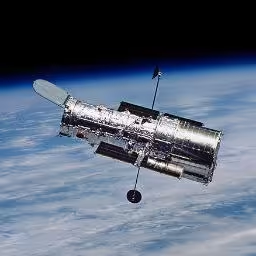
NASA Webb Telescope
@NASAWebb
CEERS-iously?
In a survey of 100,000 galaxies named CEERS, Webb found the most distant active supermassive black hole to date, 2 more small early black holes, and 11 early galaxies. All existed in the first 1.1 billion years after the big bang. Seriously! science.nasa.gov/missions/webb/webb-detects-most-distant-… -
NASA Webb Telescope
@NASAWebb
Achoo! 🤧
Cosmic dust is an important building block for stars & planets. Where does it come from? Webb has revealed large amounts of dust in 2 supernovae, supporting the idea that exploding stars played a key role in supplying dust to the early universe: www.nasa.gov/feature/webb-locates-dust-reservoirs-in-two-… -
NASA Webb Telescope
@NASAWebb
Of course Saturn brought its ring light 🪐
Webb took its first near-infrared look at Saturn on June 25. The planet appears dark at this wavelength, as methane gas in its atmosphere absorbs sunlight — but its icy rings stay bright! Learn more: science.nasa.gov/blogs/webb/ -
NASA Webb Telescope
@NASAWebb
Cosmic Webb, meet cosmic web 🤝
Galaxies gather in clusters and threads stretching across the universe, punctuated by vast voids. Now Webb has discovered an early strand of this cosmic web — 10 galaxies that existed 830 million years after the big bang: science.nasa.gov/missions/webb/nasas-webb-identifies-the-… -
NASA Webb Telescope
@NASAWebb
Webb — constantly raising the (Orion) Bar for us all.
While observing the Orion Bar, Webb made the first detection ever of a crucial carbon molecule in space. This molecule was found inside a planet-forming disk surrounding a young star system: science.nasa.gov/missions/webb/webb-makes-first-detection… -
NASA Webb Telescope
@NASAWebb
Early in our cosmic history, gas in the universe shifted (over hundreds of millions of years) from opaque to transparent, allowing light to travel freely. But how? Webb proves the answer lies in galaxies from the early universe: science.nasa.gov/missions/webb/nasas-webb-proves-galaxies…
Let's clear this up 👇 -
NASA Webb Telescope
@NASAWebb
Cosmic smoke & telescope mirrors?
Webb found complex organic molecules similar to smoke or smog in a galaxy more than 12 billion light-years from Earth. This sets a new record for the most distant detection of these big, complicated molecules: stories.tamu.edu/news/2023/06/05/webb-telescope-detects-u…Post not available here, view on X
NASA Webb Telescope
@NASAWebb
Due to how far light from this galaxy had to travel, we’re seeing this galaxy as it was back when the universe was < 1.5 billion years old. The discovery suggests that complex chemistry began occurring in the universe much earlier than we thought.
-
NASA Webb Telescope
@NASAWebb
Webb’s looked at galaxies from both sides now…
From dust structures in mid-infrared light to stars in near-infrared light, Webb’s dual vision is helping us to see star-forming regions — such as galaxy NGC 5068 — as never before: esawebb.org/images/potm2305a/ -
NASA Webb Telescope
@NASAWebb
Daily hydration reminder 💧
Webb spotted a massive water emission from Saturn's moon Enceladus, spanning over 6000 miles and gushing out at 79 gallons per second. (Webb's data shows Enceladus as a white pixel. Compare its size to the water jet below!) science.nasa.gov/missions/webb/webb-maps-surprisingly-lar… -
NASA Webb Telescope
@NASAWebb
I could be brown, I could be blue, I could be violet sky…
Webb, @chandraxray, @NASAHubble and other telescopes contributed to these stunning composite images of star cluster NGC 346, spiral galaxies NGC 1672 & M74, and the Pillars of Creation: s.si.edu/chandrawebb2 -
NASA Webb Telescope
@NASAWebb
If you enjoyed our #unfoldtheuniverse and #jwstart challenges, check out #missiontopsyche! Learn more about their internship opportunities for undergrad students interested in combining the arts with science and engineering at the link below. Application deadline: June 23rd.
Learn With NASA
@LearnWithNASA
Get your creative juices flowing! 🎨🧶🎭
Applications are open for the 2023-2024 Psyche Inspired Internship. Undergrads are invited to share the excitement, innovation & science of NASA’s Psyche mission with the public through artistic & creative works.
psyche.asu.edu/get-involved/psyche-inspired/psyche-inspir… -
NASA Webb Telescope
@NASAWebb
Com-et me, bro. ☄️
Webb confirmed the 1st detection of water vapor around a rare type of comet in the main asteroid belt. This suggests that ice from the early solar system can be preserved there—a breakthrough for studying the origins of water on Earth: science.nasa.gov/missions/webb/nasas-webb-finds-water-and… -
NASA Webb Telescope
@NASAWebb
“Mother of Hubble,” friend of Webb. 💐
We’re honored that Dr. Nancy Grace Roman visited the Webb Telescope at @NASAGoddard in 2017. Here she is shown with our Operations Project Scientist, Dr. Jane Rigby.
Hubble
@NASAHubble
#happymothersday!
Dr. Nancy Grace Roman is often called the "Mother of Hubble". Her work at @NASA made Hubble's mission possible, and also helped pave the way for space-based telescopes like @NASAWebb and @NASARoman.
Find out more about Dr. Roman: science.nasa.gov/people/nancy-roman/?linkId=214483436 -
NASA Webb Telescope
@NASAWebb
For Webb's second year of science, a record-breaking 1,600 proposals were submitted by more than 5,450 scientists from 52 countries. Learn more about how 249 proposals were ultimately selected from Christine Chen at the @SpaceTelescope Science Institute: science.nasa.gov/blogs/webb/
-
NASA Webb Telescope
@NASAWebb
True to its name, a mini-Neptune is kind of like Neptune, but fun-sized. These exoplanets have thick, hazy atmospheres that can be difficult to peer through. Now Webb has lifted the curtain with the closest look yet at mini-Neptune GJ 1214 b (illustrated): www.jpl.nasa.gov/news/nasas-webb-takes-closest-look-yet-a…
-
NASA Webb Telescope
@NASAWebb
Webb has a new achievement under its (asteroid) belt!
This image is our first infrared look at an asteroid belt outside our solar system. Webb reveals there are actually 3 belts, including 2 never-before-seen inner belts, around the star of Fomalhaut: science.nasa.gov/missions/webb/webb-looks-for-fomalhauts-… -
NASA Webb Telescope
@NASAWebb
Thank you, teachers! 🍎
This #teacherappreciationweek, join us for a #nasascience virtual event series designed with classrooms in mind — including 2 live talks on Webb’s recent science discoveries: www.nasa.gov/learning-resources/for-educators/in-apprecia… -
NASA Webb Telescope
@NASAWebb
Webb's on the case 🔎
Webb found hints of water vapor while studying rocky exoplanet GJ 486 b. Scientists are puzzled whether this could be due to spots on its star, or if this could indicate the 1st atmosphere definitively detected around a rocky world: www.nasa.gov/centers-and-facilities/goddard/webb-finds-wa… -
NASA Webb Telescope
@NASAWebb
This is shaping up to be a giant cluster…of galaxies.
These 7 spotlighted galaxies form a protocluster so far away, its light took ~13 billion years to reach us. Webb scientists predict it may grow into one of the largest, densest galaxy clusters known: science.nasa.gov/missions/webb/webb-reveals-early-univers… -
NASA Webb Telescope
@NASAWebb
Webb Telescope. #webbys Award. It just makes sense. Last chance to vote for us in the Webb(y)s! ⬇️
General Video: Technology- wbby.co/31914N
Social Campaigns: Education & Discovery- wbby.co/31856N
Social Video: Events & Livestreaming- wbby.co/31871N -
NASA Webb Telescope
@NASAWebb
Stars: always making a dramatic exit! 🌟
Webb’s powerful infrared eye has captured never-before-seen detail of Cassiopeia A (Cas A). 11,000 light-years away, it is the remnant of a massive star that exploded about 340 years ago: science.nasa.gov/missions/webb/webb-reveals-never-before-… -
NASA Webb Telescope
@NASAWebb
Uranus has never looked better. Really.
Only Voyager 2 and Keck (with adaptive optics) have imaged the planet's faintest rings before, and never as clearly as Webb’s first glimpse at this ice giant, which also highlights bright atmospheric features. science.nasa.gov/missions/webb/nasas-webb-scores-another-… -
NASA Webb Telescope
@NASAWebb
It's #nationalflowerday! 🌺
Try not to sneeze: WR 124 (center) is a Wolf-Rayet star, which produce a LOT of cosmic dust! Taken by Webb's Mid-Infrared Instrument, this image shows off the flower-like structure of WR 124's dust cloud. Download & learn more: science.nasa.gov/mission/webb/ -
NASA Webb Telescope
@NASAWebb
The Webb Telescope team is honored to receive the 2023 Robert H. Goddard Memorial Trophy. This year, the award recognizes the 20,000 people around the world who designed, developed and now operate Webb: www.nasa.gov/missions/webb/webb-telescope-team-honored-wi…
-
NASA Webb Telescope
@NASAWebb
There is beauty in transience. 🌸
Webb’s stunning image of a super bright, massive Wolf-Rayet star calls forth the ephemeral nature of cherry blossoms. The Wolf-Rayet phase is a fleeting stage that only some stars go through, soon before they explode: science.nasa.gov/missions/webb/nasas-webb-telescope-captu… -
NASA Webb Telescope
@NASAWebb
Gold stars for you! 🌟
Shown here is M92, a cluster of thousands of stars located 27,000 light-years away in our Milky Way. One of Webb’s first science observations, this was taken as part of a program designed to help scientists make the most of Webb: science.nasa.gov/blogs/webb/ -
NASA Webb Telescope
@NASAWebb
Feel like you’re spiraling? You’re in good company!
Webb’s images of NGC 1365 (left), NGC 7496 (top) & NGC 1433 (bottom) reveal the galaxies' networks of gas and dust in incredible detail. The data is part of an ongoing Webb survey of 19 spiral galaxies: science.nasa.gov/missions/webb/nasas-webb-reveals-intrica… -
NASA Webb Telescope
@NASAWebb
It’s a great big universe…
Webb’s new view of Pandora’s Cluster stitches 4 snapshots together into a panorama, showing 3 separate galaxy clusters merging into a megacluster and some 50,000 sources of near-infrared light. science.nasa.gov/missions/webb/nasas-webb-uncovers-new-de… -
NASA Webb Telescope
@NASAWebb
Hey, you've got us starry-eyed. Be our Valentine? 🤩 #valentinesday
-
NASA Webb Telescope
@NASAWebb
2 Fast 2 Furious!
When NASA’s #dartmission smashed into an asteroid as a test of planetary defense, Webb was ready to capture it. But to observe that event, Webb actually had to break its tracking speed limit 3 times over. Here's how the team did it: science.nasa.gov/blogs/webb/ -
NASA Webb Telescope
@NASAWebb
No sugar or spice, but everything ice ❄️
In this molecular cloud (a birthplace of stars & planets), Webb scientists found a variety of icy ingredients. These frozen molecules, like carbon dioxide and methane, could go on to become building blocks of life. science.nasa.gov/missions/webb/webb-unveils-dark-side-of-… -
NASA Webb Telescope
@NASAWebb
✨ Starry surprises in NGC 346
🌌 Early "green pea" galaxies discovered
🥇 First exoplanet confirmed by Webb
📀 New infrared look at dusty disk AU Mic
...and more!
#icymi, catch up on Webb updates announced during the recent #aas241 conference here: www.nasa.gov/universe/nasa-recaps-webb-telescope-findings… -
NASA Webb Telescope
@NASAWebb
With our powers combined 😎
@ChandraXRay teamed up with Webb to create a new stunning composite image of the Tarantula Nebula. Chandra's X-rays (shown in royal blue & purple) identify supernova explosion remnants, while Webb reveals forming baby stars: www.nasa.gov/image-article/enduring-stellar-lifecycle-30-… -
NASA Webb Telescope
@NASAWebb
What was star formation like in the early universe? One way to study conditions in the distant past is to find parallels close by. That's why Webb took a look at star-forming region NGC 346 within our neighboring dwarf galaxy: science.nasa.gov/missions/webb/nasas-webb-uncovers-star-f… #aas241
-
NASA Webb Telescope
@NASAWebb
A whole new world!
41 light-years away is the small, rocky planet LHS 475 b. At 99% of Earth’s diameter, it’s almost exactly the same size as our home world. This marks the first time researchers have used Webb to confirm an exoplanet. science.nasa.gov/missions/webb/nasas-webb-confirms-its-fi… #aas241 -
NASA Webb Telescope
@NASAWebb
Last July, Webb released the deepest & sharpest infrared image ever seen. Zooming in, scientists found 3 young galaxies similar to a rare type of galaxy in our cosmic backyard — including what may be the most chemically primitive galaxy identified. www.nasa.gov/centers-and-facilities/goddard/nasas-webb-te…
-
NASA Webb Telescope
@NASAWebb
What do your favorite Webb images of 2022 say about you?
1. Pick your favorite out of each set in this thread.
2. Keep track of your choices.
3. Find & share your result!
Let’s get started ⬇️ -
NASA Webb Telescope
@NASAWebb
O Trappist-1, O Trappist-1, how lovely are thy planets!
We know you are all eagerly awaiting Webb's look at this system of 7 Earth-sized worlds. The telescope has observed all the planets, and preliminary results (including atmospheric properties) will be out in the new year! -
NASA Webb Telescope
@NASAWebb
🏆 Among stellar company!
For its significant contributions to science and discovery, the James Webb Space Telescope was selected for the 2022 Bloomberg Businessweek 50 – an annual unranked list of icons, leaders, and innovators.
More: www.nasa.gov/feature/goddard/2022/nasa-webb-telescope-sel… -
NASA Webb Telescope
@NASAWebb
What a year it has been for Webb! It feels like just yesterday we were getting ready to launch, and now Webb has hit the ground running in its mission to #unfoldtheuniverse. Break out your box of tissues and relive the magic with us. Happy Birthday, Webb! 🎉
This media couldn't be displayed. See it on the original post. -
NASA Webb Telescope
@NASAWebb
Galactic panoramic 📸
This shot is just a portion of what will be the complete wide field covered by this Webb program, but it’s already unveiling galaxies in unprecedented detail and depth. The multi-wavelength image combines Webb & @NASAHubble data: science.nasa.gov/blogs/webb/ -
NASA Webb Telescope
@NASAWebb
The best of both worlds 🎸
Recognize the Pillars of Creation? Webb’s near-infrared and mid-infrared images of this super star-forming region were fused to highlight new details: science.nasa.gov/mission/webb/ -
NASA Webb Telescope
@NASAWebb
A Titan-ic success!
Here is Webb’s first look at Saturn’s largest moon, Titan. Because Titan has a dense atmosphere, its surface is hidden in visible light. Enter Webb’s infrared eye, which captured clouds as well as bright & dark patches on its surface: science.nasa.gov/blogs/webb/ -
NASA Webb Telescope
@NASAWebb
Hang out long enough and you start to become each other…just ask these galaxies.
In Webb’s latest image, two galaxies in the process of merging are twisting each other out of shape. Bright tendrils of star-forming regions connect their glowing cores: www.nasa.gov/image-article/vp-harris-french-president-get…
NASA Webb Telescope
@NASAWebb
Here are complementary Hubble & Webb views of this galactic pair. While Hubble shows the merger in visible light, Webb’s image shines in infrared. The star-forming regions in the galaxies are particularly bright in infrared light. Slide between both views: esawebb.org/images/comparisons/potm2211a/
-
Nancy Grace Roman Space Telescope
@NASARoman
Happy #friendsgiving, everyone! We want to share some things we are thankful for from our fellow space telescope friends. To start, we are thankful for the beautiful images we received this year from @NASAWebb ✨ ✨ ✨
science.nasa.gov/mission/webb/multimedia/images/
NASA Webb Telescope
@NASAWebb
Thanks, @NASARoman ❤️
We'd like to express how grateful we are to the Spitzer Space Telescope for everything it’s taught us about the @NASAUniverse, and for showing us how it’s done in infrared: www.nasa.gov/mission_pages/spitzer/images/index.html #friendsgiving -
NASA Webb Telescope
@NASAWebb
Webb’s latest data gives us the first molecular and chemical profile of a distant world, gas giant WASP-39 b. This bodes well for its ability to probe the atmospheres of small, rocky planets like in the TRAPPIST-1 system: science.nasa.gov/missions/webb/nasas-webb-reveals-an-exop…
-
NASA Webb Telescope
@NASAWebb
"This is a whole new chapter in astronomy."
Webb researchers found 2 early galaxies, one of which may contain the most distant starlight ever seen. These 2 unexpectedly bright galaxies could fundamentally alter what we know about the very first stars: science.nasa.gov/missions/webb/nasas-webb-draws-back-curt… -
NASA Webb Telescope
@NASAWebb
New distant galaxy results and more!
MEDIA: Join us on Thursday, November 17th at 11 am EST (16 UTC) to hear from our experts on James Webb Space Telescope early science results. RSVP info: www.nasa.gov/news-release/experts-available-to-discuss-na… -
NASA Webb Telescope
@NASAWebb
Countdown to a new star ⏳
Hidden in the neck of this “hourglass” of light are the very beginnings of a new star — a protostar. The clouds of dust and gas within this region are only visible in infrared light, the wavelengths that Webb specializes in: science.nasa.gov/missions/webb/nasas-webb-catches-fiery-h… -
NASA Webb Telescope
@NASAWebb
Webb's mirrors were built to withstand micrometeoroids, which are unavoidable in space. In May, a dust-sized hit was larger than tested for. After careful analysis, we've found it to be a rare statistical event. Webb’s optical performance remains twice as good as requirements. ⬇️
Post not available here, view on X
NASA Webb Telescope
@NASAWebb
Thanks to @Arianespace’s precise launch, Webb has fuel for 20+ years of science. With projected mission time significantly extended, our engineers want to optimize Webb for long-term performance. More on our mitigation strategy: blogs.nasa.gov/webb/2022/11/15/nasa-webb-micrometeoroid-m…
-
NASA Webb Telescope
@NASAWebb
How it started ➡️ How it’s going
These images demonstrate Webb’s remarkable ability to resolve faint stars in nearby dwarf galaxy Wolf-Lundmark-Melotte (WLM). On the right is Webb’s brand new image, and on the left is Spitzer’s view: science.nasa.gov/blogs/webb/ -
NASA Webb Telescope
@NASAWebb
You can’t escape its clutches.
Just in time for #halloween, the Pillars of Creation reach back out like a ghostly hand. The eerie landscape, captured this time by Webb’s mid-infrared instrument (MIRI), spotlights ancient curtains of dust in new detail: www.nasa.gov/feature/goddard/2022/haunting-portrait-nasa-… -
NASA Webb Telescope
@NASAWebb
Go big or gourd home, right? 🎃
Your #halloween decorations just aren't complete without a Webb pumpkin. Download these @SpaceTelescope stencils & share your creations by tagging us: science.nasa.gov/mission/webb/space-pumpkin/?linkId=18699… -
NASA Webb Telescope
@NASAWebb
Takes two to tango 💃
270 million light-years away, a pair of entwined galaxies are colliding together, creating new stars at a rate more than 20 times that of our Milky Way. Webb's latest image shines a new light on these interacting galaxies: esawebb.org/images/potm2210a/ -
NASA Webb Telescope
@NASAWebb
This is what you’ve waited for.
Journey with us through Webb’s breathtaking view of the Pillars of Creation, where scores of newly formed stars glisten like dewdrops among floating, translucent columns of gas and dust: science.nasa.gov/missions/webb/nasas-webb-takes-star-fill…
Here’s your guided tour ⬇️Post not available here, view on X
NASA Webb Telescope
@NASAWebb
If this majestic landscape looks familiar, you may recognize the original. Here, @NASAHubble’s iconic view, taken in visible light, is on the left. Webb “sees” in infrared light invisible to our eyes, allowing it to pierce through the dust and reveal stars galore (right).
-
NASA Webb Telescope
@NASAWebb
These cosmic “tree rings” tell a story written by the stars.
Every 8 years, these 2 stars are brought together by their orbits, creating streams of gas that can then form a new ring of dust. Webb reveals 15 of the 17 rings here for the first time: www.nasa.gov/feature/jpl/star-duo-forms-fingerprint-in-sp… -
NASA Webb Telescope
@NASAWebb
DART, you rocked out there. 🪨
#icymi, Webb and @NASAHubble both captured the effects of #dartmission colliding with an asteroid as a test of planetary defense. This is the first time both telescopes observed the same target at the same time: science.nasa.gov/missions/hubble/webb-hubble-capture-deta…
NASA Webb Telescope
@NASAWebb
Speed, I am speed.
Observing the #dartmission impact with Webb was a unique challenge. The target moved over at a speed over 3 times faster than the original speed limit Webb was designed to track! In the weeks leading up to the impact, teams carefully tested for success. -
NASA Webb Telescope
@NASAWebb
Space, but make it goth! 🕸️
If this new image from Webb’s mid-infrared instrument (MIRI) looks dark & moody, that's because things look different in this light than what you may be used to. These are the "bones” of galaxy IC 5332, usually hidden by dust: esawebb.org/images/comparisons/potm2209a/
NASA Webb Telescope
@NASAWebb
In visible and ultraviolet light, @NASAHubble (left) shows dark regions of dust that separate the spiral arms. Webb (right) is able to peer through that dust in mid-infrared light, instead seeing patterns of gas that echo the arms’ shape.
-
NASA Webb Telescope
@NASAWebb
Hey Neptune. Did you ring? 👋
Webb’s latest image is the clearest look at Neptune's rings in 30+ years, and our first time seeing them in infrared light. Take in Webb's ghostly, ethereal views of the planet and its dust bands, rings and moons: science.nasa.gov/missions/webb/new-webb-image-captures-cl… #iac2022Post not available here, view on X
NASA Webb Telescope
@NASAWebb
That’s no star. It’s Neptune’s large, unusual moon, Triton! Because Triton is covered in frozen, condensed nitrogen, it reflects 70% of the sunlight that hits it — making it appear very bright to Webb. 6 of Neptune’s other moons (labeled) are also seen here.
NASA Webb Telescope
@NASAWebb
Let’s zoom out and get the big picture! Some quick Neptune facts:
📍 Far out - 30x farther from the Sun than Earth
🕶️ Hello darkness my old friend - Neptune doesn’t get much Sun, so high noon would be like a dim twilight on Earth.
🥶 Ice giant. Brr. -
NASA Webb Telescope
@NASAWebb
Webb got its first look at @NASAMars! 👀
The close-up on the left reveals surface features such as Huygens Crater, dark volcanic Syrtis Major, and Hellas Basin, while the “heat map" on the right shows light being given off by Mars as it loses heat. More: science.nasa.gov/blogs/webb/ -
NASA Webb Telescope
@NASAWebb
Talk about out of this world! This is Webb’s first direct image of a planet outside of our solar system, and it hints at Webb’s future possibilities for studying distant worlds: science.nasa.gov/blogs/webb/
Not what you expected? Let’s walk through the details👇Post not available here, view on X
NASA Webb Telescope
@NASAWebb
Each of Webb's 4 views is at a different wavelength of infrared light. The white star is the location of the host star. Its light is blocked by Webb’s coronagraphs, or tiny masks. The bar shapes in the NIRCam views are artifacts of the telescope optics, not physical objects.
-
NASA Webb Telescope
@NASAWebb
There’s space for everyone.
We’re one hour out from a @TwitterSpaces event about ways that NASA imagery is made accessible. Tune in to hear from @ChandraXRay, @SpaceTelescope experts and more about how space gets translated into text, touch and sound. x.com/i/spaces/1PlJQaOXRRWJE -
NASA Webb Telescope
@NASAWebb
What if you could hear Webb data?
Here, the “Cosmic Cliffs” are sonified, or translated to sound. Blue gas and dust sound windy, while a melodic line represents the rise and fall of the “mountain range.” Louder tones represent brighter light. More: science.nasa.gov/missions/webb/nasa-webbs-first-full-colo… -
NASA Webb Telescope
@NASAWebb
There’s more than one way to experience space imagery! You can hear the sounds of a black hole…
ARCHIVED NASA Exoplanets
@NASAExoplanets
The misconception that there is no sound in space originates because most space is a ~vacuum, providing no way for sound waves to travel. A galaxy cluster has so much gas that we've picked up actual sound. Here it's amplified, and mixed with other data, to hear a black hole!
Post not available here, view on X
NASA Webb Telescope
@NASAWebb
Tomorrow at 3 pm ET (19 UTC), ask our experts live on @TwitterSpaces about all of these ways they help make NASA imagery accessible!
x.com/i/spaces/1PlJQaOXRRWJE -
NASA Webb Telescope
@NASAWebb
Feast your eyes on the beautiful spiral structure of the Phantom Galaxy, M74, as seen by Webb in the mid-infrared. Delicate filaments of dust and gas wind outwards from the center of the galaxy, which has a ring of star formation around its nucleus. esawebb.org/images/potm2208a/
NASA Webb Telescope
@NASAWebb
.@NASAHubble’s observations of M74 revealed bright areas of star formation in visible and ultraviolet wavelengths. Webb’s infrared vision is helping to pinpoint these regions, accurately measure the masses and ages of star clusters, and gain insight into interstellar dust.
-
NASA Webb Telescope
@NASAWebb
Catch your breath — Webb has captured the first clear evidence of carbon dioxide (CO2) in the atmosphere of a planet outside of our solar system! WASP-39 B is a gas giant closely orbiting a Sun-like star 700 light years away: science.nasa.gov/missions/webb/nasas-webb-detects-carbon-…
-
NASA Webb Telescope
@NASAWebb
1. Make way for the king of the solar system! 👑
New Webb images of Jupiter highlight the planet's features, including its turbulent Great Red Spot (shown in white here), in amazing detail. These images were processed by citizen scientist Judy Schmidt: science.nasa.gov/blogs/webb/
NASA Webb Telescope
@NASAWebb
Check out the bright waves, swirls, and vortices in Jupiter’s atmosphere — as well as the dark ring system, one million times fainter than the planet! Two moons of Jupiter, including one that’s only about 12 miles (20 km) across, are on the left.
-
NASA Webb Telescope
@NASAWebb
Heading #backtoschool? Pack the Webb telescope #stem Toolkit! 🎒
Teachers and parents, find Webb resources, activities, lesson plans and more for grades K-12: www.nasa.gov/learning-resources/search/?terms=8048%2c8050… -
NASA Webb Telescope
@NASAWebb
Nancy Grace Roman Space Telescope
@NASARoman
... 🤔 @NASAWebb #nationaltellajokeday
NASA Webb Telescope
@NASAWebb
Nancy Grace Roman Space Telescope
@NASARoman
Well, this is going to be interesting @NASAWebb #nationaltellajokeday
NASA Webb Telescope
@NASAWebb
Our turn, @NASARoman. How about a joke from us instead? #nationaltellajokeday
-
NASA Webb Telescope
@NASAWebb
Nancy Grace Roman Space Telescope
@NASARoman
Well, this is going to be interesting @NASAWebb #nationaltellajokeday
NASA Webb Telescope
@NASAWebb
Our turn, @NASARoman. How about a joke from us instead? #nationaltellajokeday
-
NASA Webb Telescope
@NASAWebb
Our turn, @NASARoman. How about a joke from us instead? #nationaltellajokeday
-
Nancy Grace Roman Space Telescope
@NASARoman
🤣 @NASAWebb #nationaltellajokeday
NASA Webb Telescope
@NASAWebb
This better be good, @NASARoman!
#nationaltellajokeday
Nancy Grace Roman Space Telescope
@NASARoman
*snickers* @NASAWebb #nationaltellajokeday
NASA Webb Telescope
@NASAWebb
Oh boy, @NASARoman...
#nationaltellajokeday
Nancy Grace Roman Space Telescope
@NASARoman
Hey @NASAWebb, I got a joke to tell you! #nationaltellajokeday
NASA Webb Telescope
@NASAWebb
🙄
-
NASA Webb Telescope
@NASAWebb
This better be good, @NASARoman!
#nationaltellajokeday
Nancy Grace Roman Space Telescope
@NASARoman
*snickers* @NASAWebb #nationaltellajokeday
NASA Webb Telescope
@NASAWebb
Oh boy, @NASARoman...
#nationaltellajokeday
Nancy Grace Roman Space Telescope
@NASARoman
Hey @NASAWebb, I got a joke to tell you! #nationaltellajokeday
-
NASA Webb Telescope
@NASAWebb
Oh boy, @NASARoman...
#nationaltellajokeday
Nancy Grace Roman Space Telescope
@NASARoman
Hey @NASAWebb, I got a joke to tell you! #nationaltellajokeday
-
NASA Webb Telescope
@NASAWebb
A space telescope’s only as good as the sum of its parts!
Explore what makes up the upcoming @NASARoman telescope, track the status of each component and more: roman.gsfc.nasa.gov/interactive/?linkId=175965546 -
NASA Webb Telescope
@NASAWebb
Turn the lights up 💡
Check out the Cartwheel Galaxy as seen by @NASAHubble in visible light and Webb in infrared. Complimentary views from complementary telescopes! Download both images in full-resolution below ⬇️
Hubble: esahubble.org/images/potw1036a/
Webb: science.nasa.gov/mission/webb/ -
NASA Webb Telescope
@NASAWebb
Did somebody say new Webb images?
#icymi, we just dropped an incredible new Cartwheel Galaxy image, and yes, more images will be rolling out over the coming weeks! But there’s a few things you should know first about Webb’s next steps 👇
NASA Webb Telescope
@NASAWebb
Time to reinvent the wheel.
Here’s the Cartwheel Galaxy in a whole new light — as a composite image from 2 instruments on the Webb telescope. Webb uniquely offers not just a snapshot of the galaxy’s current state, but also a peek into its past & future: science.nasa.gov/missions/webb/webb-captures-stellar-gymn… -
NASA Webb Telescope
@NASAWebb
“Everything we said we were going to do that seemed impossible, we're doing it."
Webb's Senior Project Scientist, Nobel laureate John Mather, helped take the Webb telescope from dream to reality. Listen to his trajectory on @NASA’s #gravityassist podcast: www.nasa.gov/podcasts/gravity-assist/gravity-assist-meet-… -
NASA Webb Telescope
@NASAWebb
Need a new perspective? Here’s some Webb-inspired #mondaymotivation: Sometimes, seeing clearly requires looking at things with a fresh set of eyes. When you’re able to peer through the dust, that’s when you can reveal even more stars. ✨
-
NASA Webb Telescope
@NASAWebb
Hey @NASASolarSystem, ready for your close-up? As part of Webb’s prep for science, we tested how the telescope tracks solar system objects like Jupiter. Webb worked better than expected, and even caught Jupiter’s moon Europa: blogs.nasa.gov/webb/2022/07/14/webb-images-of-jupiter-and…
-
NASA Webb Telescope
@NASAWebb
How did we get the data for our first images? Through @NASA’s Deep Space Network! At one million miles away, it takes about five seconds for data to get from Webb to Earth, where it's then sent to our operations center. Right, @NASASCaN?
Learn more: www.nasa.gov/communicating-with-missions/dsn/ -
NASA Webb Telescope
@NASAWebb
Our faces right now ↘️
NASA Marshall
@NASA_Marshall
Is anyone else starstruck?! 🌌
@NASAWebb's first images have been released! Which one is your favorite? #unfoldtheuniverse
View all five images HERE>> science.nasa.gov/mission/webb/multimedia/images/ -
NASA Webb Telescope
@NASAWebb
Webb’s first full-color images are now the world’s to enjoy! We hope you found them as meaningful and beautiful as we did. Here’s to many years of Webb science — we can’t wait to see what’s next as we continue to #unfoldtheuniverse! www.nasa.gov/news-release/nasa-reveals-webb-telescopes-fi…
-
NASA Webb Telescope
@NASAWebb
🌟 A star is born!
Behind the curtain of dust and gas in these “Cosmic Cliffs” are previously hidden baby stars, now uncovered by Webb. We know — this is a show-stopper. Just take a second to admire the Carina Nebula in all its glory: nasa.gov/webbfirstimages/ #unfoldtheuniverse
NASA Webb Telescope
@NASAWebb
The “Cosmic Cliffs” build on the legacy of Hubble’s imagery of the Carina Nebula, seen here. Webb’s new view gives us a rare peek into stars in their earliest, rapid stages of formation. For an individual star, this period only lasts about 50,000 to 100,000 years.
-
NASA Webb Telescope
@NASAWebb
✋🏼 Galactic high five!
In Webb’s image of Stephan’s Quintet, we see 5 galaxies, 4 of which interact. (The left galaxy is in the foreground!) Webb will revolutionize our knowledge of star formation & gas interactions in these galaxies: nasa.gov/webbfirstimages/ #unfoldtheuniverse
NASA Webb Telescope
@NASAWebb
Galaxies collide in Stephan’s Quintet, pulling and stretching each other in a gravitational dance. In the mid-infrared view here, see how Webb pierces through dust, giving new insight into how interactions like these may have driven galaxy evolution in the early universe.
NASA Webb Telescope
@NASAWebb
Webb's mosaic is its largest image to date, covering an area of the sky 1/5 of the Moon’s diameter (as seen from Earth). It contains more than 150 million pixels and is constructed from about 1,000 image files. Compare the new image to @NASAHubble’s 2009 view, shown here!
-
NASA Webb Telescope
@NASAWebb
Put a ring on it! 💍
Compare views of the Southern Ring nebula and its pair of stars by Webb’s NIRCam (L) & MIRI (R) instruments. The dimmer, dying star is expelling gas and dust that Webb sees through in unprecedented detail: nasa.gov/webbfirstimages/ #unfoldtheuniverse -
NASA Webb Telescope
@NASAWebb
👀 Sneak a peek at the deepest & sharpest infrared image of the early universe ever taken — all in a day’s work for the Webb telescope. (Literally, capturing it took less than a day!) This is Webb’s first image released as we begin to #unfoldtheuniverse: nasa.gov/webbfirstimages/
Post not available here, view on X
NASA Webb Telescope
@NASAWebb
If you held a grain of sand up to the sky at arm’s length, that tiny speck is the size of Webb’s view in this image. Imagine — galaxies galore within a grain, including light from galaxies that traveled billions of years to us!
Post not available here, view on X
NASA Webb Telescope
@NASAWebb
Compare Webb’s Mid-Infrared (L) & Near-Infrared (R) views. Lens flares? Nope, the spikes you see are when light from bright objects like stars is bent by the edges of the telescope. They’re less prominent in mid-infrared.
More on diffraction spikes: webbtelescope.org/contents/media/images/01G529MX46J7AFK61…
NASA Webb Telescope
@NASAWebb
Why do some of the galaxies in this image appear bent? The combined mass of this galaxy cluster acts as a “gravitational lens,” bending light rays from more distant galaxies behind it, magnifying them. The light from the farthest galaxy here traveled 13.1 billion years to us.
-
NASA Webb Telescope
@NASAWebb
Clouds are in the forecast for exoplanet WASP-96 b! ☁️
Webb spotted the unambiguous signature of water, indications of haze & evidence for clouds (once thought not to exist there)! This is the most detailed exoplanet spectrum to date: nasa.gov/webbfirstimages/ #unfoldtheuniverse -
NASA Webb Telescope
@NASAWebb
The wait is almost over! 🌟
The full set of Webb's first images & data will be revealed in less than 2 days. On July 12, watch our broadcast LIVE at 10:30 am ET (14:30 UTC) on any of @NASA’s streaming platforms, including Twitter. Count down with us: webb.nasa.gov/countdown -
NASA Webb Telescope
@NASAWebb
One “Transformer” meets another!
Peter Cullen, voice of Optimus Prime from Transformers, says hello to the James Webb Space Telescope — which unfolded like a “Transformer” in space! -
NASA Webb Telescope
@NASAWebb
🎯 Target(s) acquired!
The targets of Webb’s first images have been announced: www.nasa.gov/missions/webb/nasa-shares-list-of-cosmic-tar…
✨ SMACS 0723
✨ WASP-96b
✨ Southern Ring Nebula
✨ Stephan’s Quintet
✨ Carina Nebula
Tune in July 12 as we reveal Webb’s first images & #unfoldtheuniverse. -
NASA Webb Telescope
@NASAWebb
Webb’s Near-Infrared Spectrograph is ready to #unfoldtheuniverse!
NIRSpec showed it can capture infrared spectra (rainbows of light) from 100s of targets at once, using ~250,000 tiny shutters to view & block parts of the sky. 3 down, 1 instrument to go! science.nasa.gov/blogs/webb/ -
NASA Webb Telescope
@NASAWebb
Are you ready to #unfoldtheuniverse?
Join us July 12 at 10:30 am ET (14:30 UTC), as Webb’s first full-color images & data are revealed one by one! Watch on @NASA’s streaming platforms: Facebook, Twitter, YouTube, Twitch, DailyMotion.
(Voice and imagery used with permission.)This media couldn't be displayed. See it on the original post. -
NASA Webb Telescope
@NASAWebb
Talk about an overachiever!
Gaze at this test image — an unexpected & deep view of the universe — captured by Webb’s Fine Guidance Sensor (FGS) in May. Built by @csa_asc to point Webb precisely at targets, taking glamour shots isn’t even FGS’s main job: blogs.nasa.gov/webb/2022/07/06/webbs-fine-guidance-sensor… -
NASA Webb Telescope
@NASAWebb
We’re 1 week away from revealing Webb’s first images and data!
Want to share the excitement and get a behind-the-scenes look? All are welcome to join our Global Virtual Social event on Facebook: www.facebook.com/events/1233791624054607/
Follow along at @NASASocial! #unfoldtheuniverse -
NASA Webb Telescope
@NASAWebb
Get your game plan ready for the reveal of Webb's first images on July 12! 🙌
Find out how you can watch our broadcast, view the spectacular images, and participate in this historic event to #unfoldtheuniverse: science.nasa.gov/blogs/webb/ -
NASA Webb Telescope
@NASAWebb
Cloudy with a chance of...diamonds? 💎
Uranus and Neptune have such extreme conditions that carbon atoms could be crushed into diamonds in their atmospheres! Listen to Webb scientist Naomi Rowe-Gurney explain more on @NASA's Gravity Assist podcast: www.nasa.gov/podcasts/gravity-assist/gravity-assist-its-r… -
NASA Webb Telescope
@NASAWebb
We've got this down to a science.
Gearing up to #unfoldtheuniverse on July 12, our team has started taking some of Webb’s first science data. Hear from @SpaceTelescope scientists about how targets are lined up for Webb's NIRSpec instrument: science.nasa.gov/blogs/webb/ -
NASA Webb Telescope
@NASAWebb
✨ Meet the people with front row seats to the universe!
At Webb's @SpaceTelescope Mission Operations Center (MOC), “The Front Row” communicates with and monitors Webb’s well-being. Hear from 3 members of the Front Row team in our MOCumentary series!
www.instagram.com/stories/highlights/18224337751193799/ -
NASA Webb Telescope
@NASAWebb
Media: Here’s your “need to know” about Webb’s first images reveal on July 12!
👉 June 29: Media Day at @SpaceTelescope
👉 July 12: Televised reveal of Webb’s first images, media briefing & more
RSVP here: www.nasa.gov/news-release/nasa-invites-media-public-to-vi…
More details on our events timeline are below ⬇️ -
NASA Webb Telescope
@NASAWebb
Once Webb is ready to #unfoldtheuniverse, how do we plan out its schedule? 🗓️
With hundreds of programs selected for Webb's first year of science, a lot more goes into this process than you may think! Learn more from @SpaceTelescope expert Christine Chen: science.nasa.gov/blogs/webb/ -
NASA Webb Telescope
@NASAWebb
In late May, Webb sustained a dust-sized micrometeroid impact to a primary mirror segment. Not to worry: Webb is still performing at a level that exceeds all mission requirements. Our first images will #unfoldtheuniverse on July 12: science.nasa.gov/blogs/webb/
-
NASA Webb Telescope
@NASAWebb
Webb's Mission Operations Center (MOC) team at @SpaceTelescope does awesome every day 🌟
Get to know the people who command the world’s most powerful space telescope in our new Instagram Story series, MOCumentary! Check it out: www.instagram.com/stories/highlights/18224337751193799/ -
NASA Webb Telescope
@NASAWebb
Game on! Try out @NASARoman's #romanobservergame and see if you can beat the score of our Senior Project Scientist, Nobel laureate John Mather!
👾 Get started: roman.gsfc.nasa.gov/game.html -
NASA Webb Telescope
@NASAWebb
Get your brushes, dance moves, guitars, and crayons ready! 🖌️
On July 12, Webb will release its first images. What do you think it will discover? Use #unfoldtheuniverse to share your Webb-inspired art (of any kind) with us! More: science.nasa.gov/mission/webb/unfoldtheuniverse-art-chall…This media couldn't be displayed. See it on the original post. -
NASA Webb Telescope
@NASAWebb
Webb’s NIRISS instrument is a 4-in-1 tool to #unfoldtheuniverse! 🧰
With its 4 modes, NIRISS can cover a range of science, from probing exoplanet atmospheres to studying thousands of galaxies at once. More from Webb outreach scientist Nathalie Ouellette: science.nasa.gov/blogs/webb/ -
NASA Webb Telescope
@NASAWebb
Thanks for letting me be the Player 2 to your Player 1, @NASARoman! It sure was fun playing the #romanobservergame with you — even if things got a little carried away. Rematch? 🎮
👀 Who else wants to try it out on their computer? You may even spot Webb: roman.gsfc.nasa.gov/game/ -
NASA Webb Telescope
@NASAWebb
🗓 July 12 — Save the date!
Count down with us to the big reveal of Webb’s first full-color images and spectroscopic data: science.nasa.gov/mission/webb/launch/?linkId=167509814
Want a hint on how Webb will #unfoldtheuniverse? Read more: science.nasa.gov/missions/webb/first-images-from-nasas-we… -
NASA Webb Telescope
@NASAWebb
Is Webb there yet?
Tomorrow at noon ET (16 UTC), join us on @TwitterSpaces to ask our science instrument experts LIVE about what’s left for the Webb telescope to #unfoldtheuniverse. Or drop your questions below: x.com/i/spaces/1MYxNnydbXPxw -
NASA Webb Telescope
@NASAWebb
✅ Check please!
Before we can #unfoldtheuniverse & start science, our team must test, calibrate, verify and sign off on each mode of operation for Webb’s 4 instruments. There are 17 instrument modes in total! Follow along on our “Where Is Webb?” tracker: webb.nasa.gov/whereiswebb -
NASA Webb Telescope
@NASAWebb
Computer, enhance! Compare the same target — seen by Spitzer & in Webb’s calibration images. Spitzer, NASA's first infrared Great Observatory, led the way for Webb’s larger primary mirror & improved detectors to see the infrared sky with even more clarity: blogs.nasa.gov/webb/2022/05/09/miris-sharper-view-hints-a…
-
NASA Webb Telescope
@NASAWebb
Webb has come a long way on its journey to #unfoldtheuniverse ✨
MEDIA: Join us on May 9 at 11 am ET (15 UTC) to preview the final months of Webb’s science instrument preparations & hear from Webb experts about recent mirror alignment progress. Details: www.nasa.gov/news-release/nasa-to-discuss-webb-telescope-… -
NASA Webb Telescope
@NASAWebb
Happy #starwarsday from your favorite space telescopes! Sometimes the dark side is a good thing. Webb & @NASARoman have sunshields that divide their telescopes into a “light side” facing the Sun and a “dark side” away from the Sun. #maythe4thbewithyou!
-
NASA Webb Telescope
@NASAWebb
“It’s full of stars!” ✨
This mosaic represents a sparkling turning point as we #unfoldtheuniverse. #nasawebb’s mirrors are now fully aligned! Next is instrument calibration, the final phase before Webb is ready for science: science.nasa.gov/blogs/webb/
What do we see here? ⤵️ -
NASA Webb Telescope
@NASAWebb
Thanks to everyone who has voted for @NASA’s #curiousuniverse: James Webb Space Telescope audio mini-series for @TheWebbyAwards! We hear your support loud and clear👂
You have until 11:59 PT tomorrow, April 21 to keep sounding off with your #webbys vote: www.nasa.gov/general/nasa-receives-eight-2022-webby-award… -
NASA Webb Telescope
@NASAWebb
LIVE on @TwitterSpaces: Our @NASA & @ESA experts are taking your questions on how the Webb telescope got so cool — literally. 😎
But who’s who? ⬇️
x.com/i/spaces/1vAxRkMdAOXKl -
NASA Webb Telescope
@NASAWebb
Cool news! Webb’s MIRI instrument recently passed through its critical “pinch point” and cooled to just a few kelvins above absolute zero, which is the coldest you can go: www.jpl.nasa.gov/news/webb-telescopes-coldest-instrument-…
Wondering why MIRI is extremely chill? Thread ❄️ -
NASA Webb Telescope
@NASAWebb
Now let's get in formation 😎
3 out of #nasawebb's 4 instruments have been successfully aligned to its mirrors! This concludes the 6th stage of its 7 mirror alignment phases to create the most accurate & focused images possible: science.nasa.gov/blogs/webb/ #unfoldtheuniverse -
NASA Webb Telescope
@NASAWebb
Congrats @NASAHubble on observing the farthest star ever seen!
🔎 We can’t wait to study this star in even more detail with Webb's infrared capabilities — and potentially find even farther stars! science.nasa.gov/missions/hubble/record-broken-hubble-spo…
Hubble
@NASAHubble
RECORD BROKEN: Hubble observed the farthest individual star ever seen!
This extraordinary new benchmark detected light from a star that existed within the first billion years after the universe's birth in the big bang.
Find out more: science.nasa.gov/missions/hubble/record-broken-hubble-spo…This media couldn't be displayed. See it on the original post. -
Nancy Grace Roman Space Telescope
@NASARoman
Had to call up my friend @NASAWebb because I'm still in awe of you for all your mirror alignment progress! Can't wait for your vision to be out of this world! 🌟www.nasa.gov/news-release/nasas-webb-reaches-alignment-mi…
NASA Webb Telescope
@NASAWebb
So glad you’re always just a call away, @NASARoman!
Even among all these stars, nothing shines as bright as our friendship. Thanks for congratulating us on our latest mirror alignment milestone! Read about it here: www.nasa.gov/news-release/nasas-webb-reaches-alignment-mi… ✨
NASA Webb Telescope
@NASAWebb
🎶 I’d love to see me from your point of view 🎶
-
NASA Webb Telescope
@NASAWebb
So glad you’re always just a call away, @NASARoman!
Even among all these stars, nothing shines as bright as our friendship. Thanks for congratulating us on our latest mirror alignment milestone! Read about it here: www.nasa.gov/news-release/nasas-webb-reaches-alignment-mi… ✨ -
NASA Webb Telescope
@NASAWebb
Looking sharp, Webb!
A special lens inside the NIRCam instrument took a "selfie" of Webb's mirror segments, verifying their alignment with NIRCam. The segments are bright as they are all collecting light from the same star in unison. www.nasa.gov/news-release/nasas-webb-reaches-alignment-mi… #unfoldtheuniverse -
NASA Webb Telescope
@NASAWebb
Small adjustments, major progress!
Having completed 2 more mirror alignment steps, #nasawebb’s optical performance will be able to meet or exceed its science goals. Now that’s good optics! 😉 www.nasa.gov/news-release/nasas-webb-reaches-alignment-mi… #unfoldtheuniverse
Curious about this image? Thread ⬇️Post not available here, view on X
NASA Webb Telescope
@NASAWebb
Look how far we've come: We started with 18 scattered dots — 18 reflections of the same star, one from each of Webb’s primary mirror segments. These dots were then re-arranged, stacked, and fine-tuned, setting the stage for our first science images this summer! #unfoldtheuniverse
-
NASA Webb Telescope
@NASAWebb
📺 Watch our virtual media briefing at noon EDT (16:00 UTC) on March 16th on nasa.gov/live to see a progress update on Webb’s mirror alignment! Experts will discuss the latest imagery. Use #unfoldtheuniverse to ask questions. Media RSVP info: www.nasa.gov/press-release/nasa-to-discuss-progress-as-we…
-
Nancy Grace Roman Space Telescope
@NASARoman
I wonder if they will let me hang up my favorite superhero posters in the @NASAGoddard cleanroom? I cannot wait to join these fantastic telescopes! Is there an application that I need to fill out to join the team @NASAExoplanets ?
ARCHIVED NASA Exoplanets
@NASAExoplanets
Space is big. Stunningly, staggeringly, almost-impossibly big. Exploring this vast expanse takes a team. Over time, legendary space telescopes answered the call: @NASAHubble, @chandraxray, Spitzer, Kepler, TESS, and now, @NASAWebb. This is their story. science.nasa.gov/universe/exoplanets/exoplanet-detection-…
This media couldn't be displayed. See it on the original post.
NASA Webb Telescope
@NASAWebb
You're already a member of the team in our hearts, @NASARoman — no application necessary! We can't wait for you to join us in space 💗
-
NASA Webb Telescope
@NASAWebb
What was the universe like 13.5 billion years ago?
Listen to Dr. Aaron Yung explain how #nasawebb will study the early universe & learn about his unique path to working at @NASAGoddard in the latest episode of NASA's Gravity Assist podcast: www.nasa.gov/podcasts/gravity-assist/gravity-assist-using… -
NASA Webb Telescope
@NASAWebb
The Webb team has successfully completed initial checks showing that the inner workings of Webb’s NIRSpec instrument are in good order! Get a technical look at how this was achieved from members of the @ESA_Webb instrument team: science.nasa.gov/blogs/webb/ #unfoldtheuniverse
-
NASA Webb Telescope
@NASAWebb
#nasawebb has completed 2 more phases of its 3-month mirror alignment process: First, the team made adjustments to its mirror segments & updated the alignment of its secondary mirror, refining each of the 18 dots of starlight from its 18 mirror segments. #unfoldtheuniverse
NASA Webb Telescope
@NASAWebb
Then, each of those 18 dots was stacked to produce one unified image. Up next: fine-tuning this single dot of starlight to make it progressively sharper. Read more on our blog: science.nasa.gov/blogs/webb/ #unfoldtheuniverse
-
NASA Webb Telescope
@NASAWebb
He(X)agon marks the spots 🏴☠️
Last week, 18 spots helped confirm that each of Webb's mirror segments can see starlight. Now we've arranged those dots into our primary mirror shape, completing the first of Webb's mirror alignment phases: science.nasa.gov/blogs/webb/ #unfoldtheuniverse -
NASA Webb Telescope
@NASAWebb
Meet Webb’s guide to #unfoldtheuniverse 🌟
The Fine Guidance Sensor (FGS) instrument, one of @CSA_ASC's contributions, helps keep Webb pointed to high accuracy & locked on a target star. It has successfully performed its 1st guiding operation! More: science.nasa.gov/blogs/webb/ -
NASA Webb Telescope
@NASAWebb
When 2 interstellar interlopers recently whizzed through our solar system, scientists had few ways to study them. But now #nasawebb may give researchers an up-close-and-personal view of an object trespassing on our cosmic turf: science.nasa.gov/missions/webb/studying-the-next-interste…
Image: Artist conception -
NASA Webb Telescope
@NASAWebb
Hey @NASARoman, to us you don’t just have a huge field of view — you'd be a dream view! 😍 #valentinesday
Want to send your own #nasavalentines? Here you go: mars.nasa.gov/free-holiday-ecard/love-valentine/ -
NASA Webb Telescope
@NASAWebb
Bonus image! When it’s time to focus, sometimes you need to take a good look at yourself.
This “selfie” taken by Webb of its primary mirror was not captured by an externally mounted engineering camera, but with a special lens within its NIRCam instrument. #unfoldtheuniverse -
Post not available here, view on XPost not available here, view on X
NASA Webb Telescope
@NASAWebb
⚫️ Our team first chose a bright, isolated star called HD 84406. Over ~25 hours, Webb was repointed to 156 positions around the star's predicted location, generating 1560 images with NIRCam’s 10 detectors. This is just the center of an image mosaic with over 2 billion pixels!
-
NASA Webb Telescope
@NASAWebb
✨ Our NIRCam instrument's detectors saw their 1st photons of starlight! While #nasawebb is not yet ready for science, this is the first of many steps to capture images that are at first unfocused, used to slowly fine-tune the optics: science.nasa.gov/blogs/webb/ #unfoldtheuniverse
-
NASA Webb Telescope
@NASAWebb
🚗 Whew, we found parking space! #icymi, yesterday Webb fired its thrusters for about 5 minutes to insert itself toward its orbit of Lagrange point 2 (L2), nearly 1 million miles (1.5 million km) away.
Watch to learn more about what makes L2 special 👇 #unfoldtheuniverseThis media couldn't be displayed. See it on the original post. -
Nancy Grace Roman Space Telescope
@NASARoman
We are glad you had a safe trip @NASAWebb! We got your postcard and feel a little bit of FOMO, but we will be there before you know it! #unfoldtheuniverse science.nasa.gov/blogs/webb/
NASA Webb Telescope
@NASAWebb
Glad to hear our postcard made it! There's plenty of space here for both of us ❤️
-
NASA Webb Telescope
@NASAWebb
🏠 Home, home on Lagrange! We successfully completed our burn to start #nasawebb on its orbit of the 2nd Lagrange point (L2), about a million miles (1.5 million km) from Earth. It will orbit the Sun, in line with Earth, as it orbits L2. blogs.nasa.gov/webb/2022/01/24/orbital-insertion-burn-a-s… #unfoldtheuniverse
NASA Webb Telescope
@NASAWebb
Want to know what’s next for #nasawebb? Ask your questions on today’s NASA Science Live, happening at 3 pm ET (20:00 UTC) using #unfoldtheuniverse. Watch: youtu.be/pWklR2PBfQU
-
NASA Webb Telescope
@NASAWebb
So…you’ve heard that the Webb telescope will be orbiting Lagrange point 2. But what even is that, anyway? And how do you orbit something that isn’t an object?
We’ve got you! Here’s a thread ⬇️
#unfoldtheuniversePost not available here, view on X
NASA Webb Telescope
@NASAWebb
Why send Webb to orbit L2?
😎 Shade: The Sun, Earth (and Moon) are always on one side. At L2, Webb’s sunshield can always face all of these heat & light sources to protect Webb’s optics & instruments, which have to stay super cold to detect faint heat signals in the universe. -
NASA Webb Telescope
@NASAWebb
We're gearing up to insert #nasawebb into its orbit!
What to expect on Jan. 24:
⏰ 3pm ET (20:00 UTC) NASA Science Live: Ask questions with #unfoldtheuniverse 🌟
⏰ 4pm ET (21:00 UTC) Media teleconference with @NASAGoddard & @northropgrumman experts
www.nasa.gov/press-release/nasa-to-discuss-webb-s-arrival… -
NASA Webb Telescope
@NASAWebb
Our mirror segment deployments are complete! 🎉
Using motors, each segment was moved out about half the length of a paper clip to clear the mirrors from their launch restraints and give each segment enough space for mirror alignment. science.nasa.gov/blogs/webb/ #unfoldtheuniverse -
NASA Webb Telescope
@NASAWebb
🌴 Jungle wildlife. Lots of rain! And months away from home.
Meet some of our amazing team members & hear their firsthand accounts of what it was like at Webb’s launch site in Kourou, French Guiana before our historic launch 🚀This media couldn't be displayed. See it on the original post. -
NASA Webb Telescope
@NASAWebb
#nasawebb’s mirrors are warming up their moves! 💃🏾
Its 18 primary mirror segments have motors to align them to perform as one big mirror. Today we confirmed that all motors (including those on Webb's other mirrors) are in working order: science.nasa.gov/blogs/webb/ #unfoldtheuniverse
NASA Webb Telescope
@NASAWebb
Ground teams have also started instructing Webb’s primary and secondary mirror to move from the configuration which kept them from rattling around during launch. This will kick off approximately 3 months of mirror alignment work. #unfoldtheuniverse
-
NASA Webb Telescope
@NASAWebb
"Just because we made it look easy doesn't mean it was easy." - Bill Ochs, #nasawebb project manager
Relive the historic moment the James Webb Space Telescope completed the last of its 50 major deployments! #unfoldtheuniverse -
NASA Webb Telescope
@NASAWebb
As we continue our million mile (1.5 million km) journey out to our orbit, we'd just like to thank each of you for following us as we #unfoldtheuniverse! You're all one in a million (miles) in our hearts ❤️
-
NASA Webb Telescope
@NASAWebb
#nasawebb is fully deployed! 🎉
With the successful deployment & latching of our last mirror wing, that's:
50 major deployments, complete.
178 pins, released.
20+ years of work, realized.
Next to #unfoldtheuniverse: traveling out to our orbital destination of Lagrange point 2! -
NASA Webb Telescope
@NASAWebb
We are GO for #nasawebb’s final mirror wing deployment this morning! Here’s what you should expect:
🔲 Fire pins to release mirror wing
🔲 Unfold mirror
🔲 Latch the wing (2+ hours) ⏱
🔲 🥳🕺🏽🎉
🔲 #unfoldtheuniverse! (5+ months) ✨
More: science.nasa.gov/blogs/webb/Post not available here, view on X
NASA Webb Telescope
@NASAWebb
✅ The final wing is now deployed! Before we celebrate, we’ve still got work to do. The team is working hard at @SpaceTelescope to latch the wing into place, a multi-hour process. When the final latch is secure, #nasawebb will be fully unfolded in space. #unfoldtheuniverse
-
NASA Webb Telescope
@NASAWebb
Nope, we’re not just winging it! But we did successfully deploy and latch the first of our two primary mirror wings. 😎
These side panels, folded back for launch, each hold 3 of Webb’s 18 mirror segments. Next up: our final wing! blogs.nasa.gov/webb/2022/01/07/first-of-two-primary-mirro… #unfoldtheuniverse -
NASA Webb Telescope
@NASAWebb
It’s what we’ve all been waiting for: The James Webb Space Telescope will soon spread its primary mirror wings!
Today we begin with the mirror wing on the port (left) side of the observatory. This process should take a few hours: blogs.nasa.gov/webb/2022/01/07/primary-mirror-deployment-… #unfoldtheuniverse
NASA Webb Telescope
@NASAWebb
Don't miss the buzz when Webb’s iconic primary mirror is revealed in all of its honeycomb glory. 🐝
Watch coverage of our final mirror wing deployment LIVE on social media and NASA TV no earlier than 9am ET (14:00 UTC) on Jan. 8: www.nasa.gov/news-release/nasa-to-host-coverage-briefing-… #unfoldtheuniverse -
NASA Webb Telescope
@NASAWebb
We've been hearing you loud and clear: Why doesn't Webb have cameras for its journey to #unfoldtheuniverse? It sounds like a no-brainer, but there's more to it than meets the lens. Thread ⬇️
-
NASA Webb Telescope
@NASAWebb
Sorry for the shade, @NASASun, @NASAMoon & @NASAEarth! But you're just not cool enough 😎
Now fully deployed, our sunshield blocks your heat & light so that our mirrors will be able to detect faint heat signals in the universe: www.nasa.gov/news-release/sunshield-successfully-deploys-… #unfoldtheuniverse -
NASA Webb Telescope
@NASAWebb
✅ Secondary mirror deployed! But there's little time to pause and reflect.
Teams will ensure @NASAWebb's tripod structure is latched before beginning its final major milestone this week: full deployment of the space telescope's honeycomb-shaped primary mirror.
NASA Webb Telescope
@NASAWebb
CONFIRMED: “The world’s most sophisticated tripod” has not only deployed but also latched!
Each of the struts for this tripod, which helps #nasawebb’s secondary mirror direct light into the instruments, is about 25 feet long (7.6 m)! blogs.nasa.gov/webb #unfoldtheuniverse -
NASA Webb Telescope
@NASAWebb
LIVE NOW: Today we’re deploying #nasawebb’s secondary mirror structure, a tripod that helps the mirror reflect light to our instruments. Watch as we unfold the mirror that’s second on paper but tied for first in our hearts 🥇 #unfoldtheuniverse
📺: www.youtube.com/watch?v=-EnlaXnFcGs -
NASA Webb Telescope
@NASAWebb
We just finished deploying our sunshield today, but wait, there's more!
#nasawebb's secondary mirror is planned to be unfolded tomorrow, Jan. 5th, in the morning (Eastern time). Read more at the blog: science.nasa.gov/blogs/webb/ #unfoldtheuniverse
NASA Webb Telescope
@NASAWebb
Note: We will have LIVE coverage of the secondary mirror deployment on nasa.gov/live starting at approximately 9:45 a.m. EST (subject to change based on Webb’s operations).
-
NASA Webb Telescope
@NASAWebb
This is it: we’ve just wrapped up one of the most challenging steps of our journey to #unfoldtheuniverse.
With all five layers of sunshield tensioning complete, about 75% of our 344 single-point failures have been retired! -
NASA Webb Telescope
@NASAWebb
Can you feel the tension? Webb is feeling it...in a good way! We tensioned 3 of 5 sunshield layers yesterday. Today we start with Layer 4: blogs.nasa.gov/webb/2022/01/04/tensioning-begins-for-two-…
Follow along LIVE for the final layer starting ~9:30 am ET (14:30 UTC): nasa.gov/live #unfoldtheuniverse
NASA Webb Telescope
@NASAWebb
We just tensioned #nasawebb’s sunshield some more, that was Layer 4. Now everybody look alive, it’s time to tension Layer 5! And better yet — keep watching along live: nasa.gov/live #unfoldtheuniverse
-
NASA Webb Telescope
@NASAWebb
Today we start tensioning the most Sun-facing layer of #nasawebb's 5-layer, tennis court-sized sunshield. Read in depth how our sunshield works ➡️ jwst.nasa.gov/content/observatory/sunshield.html
More about tensioning activities: blogs.nasa.gov/webb #unfoldtheuniversePost not available here, view on X
NASA Webb Telescope
@NASAWebb
The layers start coming and they don’t stop coming…
Layers 2 and 3 are now complete! Tensioning for the final two layers of Webb’s 5-layer sunshield is planned for tomorrow. More: blogs.nasa.gov/webb/2022/01/03/second-and-third-layers-of… #unfoldtheuniverse -
NASA Webb Telescope
@NASAWebb
To ensure that #nasawebb is in prime condition for its next major step, our team has decided to focus today on learning more about how Webb behaves in space. Sunshield tensioning has been moved to no earlier than tomorrow, Jan. 3. science.nasa.gov/blogs/webb/ #unfoldtheuniverse
-
NASA Webb Telescope
@NASAWebb
#happynewyear! As work on our sunshield mid-boom deployments went late into New Year's Eve, our team is pausing activities to rest & prepare for sunshield tensioning tomorrow, Jan. 2. Tensioning is expected to last at least 2 days: blogs.nasa.gov/webb/2022/01/01/webb-sunshield-tensioning-… #unfoldtheuniverse
-
NASA Webb Telescope
@NASAWebb
Shine bright like a diamond 💎
With the successful deployment of our right sunshield mid-boom, or “arm,” Webb’s sunshield has now taken on its diamond shape in space. Next up: tensioning the 5 sunshield layers! science.nasa.gov/blogs/webb/ #unfoldtheuniverse -
NASA Webb Telescope
@NASAWebb
We successfully deployed #nasawebb’s port sunshield mid-boom, which pulls out our 5 sunshield layers. While scheduled for earlier today, our team paused to confirm the sunshield cover had fully rolled up: science.nasa.gov/blogs/webb/ #unfoldtheuniverse
Thread ⬇️ -
NASA Webb Telescope
@NASAWebb
Find it hard to get out from under the covers in the morning? Imagine doing it in space!
Our sunshield covers protected the sunshield while it was folded for launch. Today those covers were removed to prep for unfolding the sunshield! blogs.nasa.gov/webb/2021/12/30/webb-team-releases-sunshie… #unfoldtheuniverse -
NASA Webb Telescope
@NASAWebb
We just successfully deployed our aft (back) momentum flap, which helps balance pressure from solar radiation on Webb's sunshield, much like a trim tab helps stabilize a boat or plane! ⛵ ✈️
Sail on, Webb! blogs.nasa.gov/webb/2021/12/30/webbs-aft-momentum-flap-de… #unfoldtheuniverse -
NASA Webb Telescope
@NASAWebb
⬆️ Heads up! At ~9am ET we began to extend #nasawebb's Deployable Tower Assembly, which creates space between the spacecraft & telescope, helping to keep the telescope cold & giving the sunshield room to deploy. This could take 6+ hours. science.nasa.gov/blogs/webb/ #unfoldtheuniverse
NASA Webb Telescope
@NASAWebb
Moving on up! ⬆️
Our team has just confirmed that we have successfully extended our Deployable Tower Assembly (DTA) upwards, making space for our sunshield deployments in the next few days -- another step completed as we #unfoldtheuniverse: blogs.nasa.gov/webb/2021/12/29/webbs-deployable-tower-ass… -
NASA Webb Telescope
@NASAWebb
Due to the precision of our launch and our first two mid-course corrections, our team has determined that Webb should have enough fuel to allow support of science operations for significantly more than a 10-year science lifetime! 💫 blogs.nasa.gov/webb/2021/12/29/nasa-says-webbs-excess-fue…
NASA Webb Telescope
@NASAWebb
Many of you have asked us about the timing of our solar array deployment. That deployment was executed automatically after rocket separation, based on a stored command to deploy either when Webb reached a certain attitude toward the Sun or automatically at 33 min. after launch.
-
NASA Webb Telescope
@NASAWebb
Our telescope is blooming like a flower in space! This marks the start of a major phase to #unfoldtheuniverse: our sunshield deployment. First, what is our sunshield?
5️⃣ layers
🎾 Opens to the size of a tennis court
🛡️ Protects Webb’s optics from the Sun
webb.nasa.gov/content/observatory/sunshield.html
NASA Webb Telescope
@NASAWebb
✅ Right now, we just successfully completed the first step: unfolding the forward sunshield pallet. Think of Webb’s pallets as a cake stand that will hold 5 layers of sunshield — the cake’s layers, if you will. 🍰
More about this step: blogs.nasa.gov/webb/2021/12/28/forward-pallet-structure-l… #unfoldtheuniverse
NASA Webb Telescope
@NASAWebb
✅ And we just confirmed that our aft (back) sunshield pallet has successfully opened up as well! blogs.nasa.gov/webb/2021/12/28/aft-sunshield-pallet-deplo…
What’s next to #unfoldtheuniverse? Check out webb.nasa.gov/deployments -
NASA Webb Telescope
@NASAWebb
It’s been a busy evening! Not only did we just complete our second burn, but #nasawebb also passed the altitude of the Moon as it keeps cruising on to the second Lagrange point to #unfoldtheuniverse. Bye, @NASAMoon! 👋 🌑
-
NASA Webb Telescope
@NASAWebb
Burn, baby, burn! No, we didn't have a disco inferno — we just completed our second mid-course correction burn as we continue to fine-tune #nasawebb's trajectory to Lagrange point 2. This burn is one of three planned course corrections: blogs.nasa.gov/webb/2021/12/27/webbs-second-mid-course-co…
#unfoldtheuniverse -
NASA Webb Telescope
@NASAWebb
📞 Hello Webb? It's us, Earth!
Our team just deployed the gimbaled antenna assembly, which includes Webb’s high-data-rate dish antenna. This antenna will be used to send at least 28.6 Gbytes of data down from the observatory, twice a day: science.nasa.gov/blogs/webb/ -
NASA Webb Telescope
@NASAWebb
Success! #nasawebb’s first mid-course correction burn helped fine-tune Webb's trajectory toward its orbit around the second Lagrange point, a million miles (1.5 million km) from Earth: blogs.nasa.gov/webb/2021/12/25/the-first-mid-course-corre…
#unfoldtheuniverse -
NASA Webb Telescope
@NASAWebb
What was it like in the Mission Operations Center at @SpaceTelescope when we launched the world’s most powerful space telescope?
Relive this historic moment through Dr. Jane Rigby, our Webb operations project scientist at @NASAGoddard: science.nasa.gov/blogs/webb/ 🚀 ✨ -
NASA Webb Telescope
@NASAWebb
For years, we’ve been answering the question: When will #nasawebb launch? This morning, we answered that for the last time! Next up: Where is Webb? We’ve got an answer for that, too!
See where Webb is on its million mile journey to #unfoldtheuniverse: webb.nasa.gov/whereiswebb -
NASA Webb Telescope
@NASAWebb
#nasawebb is safely in space with its solar array drawing power from the Sun! Its reaction wheels will keep the spacecraft pointed in the right direction so that its sunshield can protect the telescope from radiation and heat: blogs.nasa.gov/webb/2021/12/25/webb-is-on-its-way/
#unfoldtheuniverse -
NASA Webb Telescope
@NASAWebb
3...2...1… The boosters have ignited, and we have liftoff at Europe’s Spaceport in French Guiana! #nasawebb is now on its way to its new home a million miles from Earth, where it will #unfoldtheuniverse in ways we’ve never seen before. 🚀 💫 blogs.nasa.gov/webb/
NASA Webb Telescope
@NASAWebb
Here is that moment, preserved for posterity! #unfoldtheuniverse #nasawebb
-
NASA Webb Telescope
@NASAWebb
#nasawebb’s @Ariane5 rocket is now on internal power and in its final launch configuration. We’ve had a final weather forecast, and all systems are go for launch to #unfoldtheuniverse in less than 10 minutes at 7:20 am ET (12:20 UTC): science.nasa.gov/blogs/webb/
-
NASA Webb Telescope
@NASAWebb
Rocket: fueled ✅
Webb’s launch vehicle, an @ariane5 rocket, is all fueled up. Launch is still scheduled for no earlier than 7:20 am ET (12:20 UTC). Read more: science.nasa.gov/blogs/webb/ -
NASA Webb Telescope
@NASAWebb
⏳ The launch countdown clock has started! With about 2 hours left to go, weather conditions are looking favorable: science.nasa.gov/blogs/webb/
📺 Our live broadcast starts in less than 1 hour: nasa.gov/live #unfoldtheuniverse -
NASA Webb Telescope
@NASAWebb
’Twas the night before launch,
And all through Kourou,
The teams are a go, and the weather is too!
The rocket rolled out to the launchpad with glee,
Join us for the world's biggest launch watch party!
Coverage starts at 6AM ET (11 UTC): nasa.gov/live #unfoldtheuniverse -
NASA Webb Telescope
@NASAWebb
Our launch tomorrow at 7:20 am ET (12:20 UTC) is just the start of a million mile journey for #nasawebb! Here's what's coming up: science.nasa.gov/blogs/webb/
Watch the video below or explore our deployments tracker for more on how we'll #unfoldtheuniverse: jwst.nasa.gov/content/webbLaunch/deploymentExplorer.html?… -
NASA Webb Telescope
@NASAWebb
☀️ The latest weather forecast has arrived, and we are still GO for launch of #nasawebb tomorrow, Dec. 25 at 7:20 am ET (12:20 UTC)! Watch live at nasa.gov/live 📺
More info: science.nasa.gov/blogs/webb/
📷 : NASA/Chris Gunn, captured Dec 23. -
NASA Webb Telescope
@NASAWebb
A telescope for the world, by the world 🌍
Hear from people around the globe about what makes the James Webb Space Telescope — an international collaboration between @NASA, @esa & @csa_asc — a scientific and technological marvel. #unfoldtheuniverseThis media couldn't be displayed. See it on the original post. -
NASA Webb Telescope
@NASAWebb
✅ Rollout complete!
The James Webb Space Telescope and the @ariane5 rocket it’s riding on are all settled in their final position on Earth. Next step: launch on Dec. 25 at 7:20 am ET (12:20 UTC) to #unfoldtheuniverse: science.nasa.gov/blogs/webb/
📸: NASA/Bill Ingalls -
Sleeping At Last
@sleepingatlast
✨✨✨ New Song!! ✨✨✨ - mailchi.mp/sleepingatlast/new-song
NASA Webb Telescope
@NASAWebb
Thanks @sleepingatlast — this song is golden, just like our mirrors! 🎶
-
NASA Webb Telescope
@NASAWebb
Let's rock(et) and roll(out)! 🚀
We’ve started to roll out the Webb telescope and its launch vehicle – an @Ariane5 rocket – to the launch pad. The process should take about 2 hours. Launch is set for Dec. 25 at 7:20 am ET (12:20 UTC): science.nasa.gov/blogs/webb/ #unfoldtheuniverse -
NASA Webb Telescope
@NASAWebb
🚪 We’ll spare you the knock-knock joke, because we already know who’s there! The doors of the Final Assembly Building at Europe’s Spaceport opened this morning, revealing the @Arianespace Ariane 5 rocket carrying the James Webb Space Telescope.
#unfoldtheuniverse -
NASA Webb Telescope
@NASAWebb
Due to adverse weather conditions at Europe’s Spaceport in French Guiana, the James Webb Space Telescope’s launch is postponed from Dec. 24 to no earlier than Dec. 25. A weather forecast will be issued tomorrow to confirm this date: www.nasa.gov/missions/webb/james-webb-space-telescope-lau… #unfoldtheuniverse
-
NASA Webb Telescope
@NASAWebb
Get in, we're going to space!
On Dec. 18, our team lowered the @ariane5 nosecone down over Webb using a laser-guided crane system, and locked it in place for launch. Liftoff is set for Dec. 24 at 7:20 AM ET. #unfoldtheuniverse -
NASA Webb Telescope
@NASAWebb
The James Webb Space Telescope is nestled all snug in its rocket, and now visions of launch can dance in your head — and on your screens!
📺 Learn how you can watch along as we #unfoldtheuniverse on Dec. 24: www.nasa.gov/press-release/nasa-sets-coverage-invites-pub… -
NASA Webb Telescope
@NASAWebb
The James Webb Space Telescope has been encapsulated inside its @Ariane5 rocket fairing, and is set to launch on Dec. 24: science.nasa.gov/blogs/webb/
📸: @esa-Manuel Pedoussaut -
NASA Webb Telescope
@NASAWebb
Webb will soon meet its rocket. 🚀
Having been moved to the final assembly building at Europe’s Spaceport, next Webb will be connected to the @ariane5's upper stage & encapsulated within the fairing. Launch is on Dec. 22: science.nasa.gov/blogs/webb/
Credits: © ESA-CNES-Arianespace -
NASA Webb Telescope
@NASAWebb
#nasawebb's mirrors are made of beryllium, and most of the world's beryllium is buried in volcanic rock. But where does beryllium *really* come from? To explain its rare beginnings, we have to talk about the cosmic origins of most elements. Watch our latest “Elements of Webb” ⬇️
This media couldn't be displayed. See it on the original post. -
NASA Webb Telescope
@NASAWebb
To do really big things, you need a really big team!
Hundreds of dedicated people around the world have spent years planning, building, and executing our mission.
Learn about a few of them in the latest episode of @NASA’s Curious Universe podcast: nasa.gov/curiousuniverse. -
NASA Webb Telescope
@NASAWebb
⛽ Teams have finished loading the James Webb Space Telescope with the fuel it will use to steer itself in space! Webb will soon be placed on top of its @Ariane5 rocket for launch on Dec. 22: science.nasa.gov/blogs/webb/
Credit: © ESA-CNES-Arianespace/Optique video du CSG – P Piron -
NASA Webb Telescope
@NASAWebb
💫 Want to know how the @NASAWebb telescope will #unfoldtheuniverse?
Planetary scientist Naomi Rowe-Gurney will be taking your questions about the world’s most powerful space telescope, launching Dec. 22, in a special @Tumblr Answer Time!
❓Ask here: tumblr.co/NASAWebb -
NASA Webb Telescope
@NASAWebb
About 13.5 billion years ago, the first galaxies began forming. But what were they like?
Tune into the first episode of @NASA’s Curious Universe mini-series to learn how the Webb telescope will peer into our cosmic history: nasa.gov/curiousuniverse -
NASA Webb Telescope
@NASAWebb
The James Webb Space Telescope’s target launch date is moving from Dec. 18 to no earlier than Dec. 22 to allow for additional testing, following an incident during launch preparations that caused a vibration throughout the observatory. More details: science.nasa.gov/blogs/webb/.
-
NASA Webb Telescope
@NASAWebb
Get ready: This is how we #unfoldtheuniverse. ⬇️
The James Webb Space Telescope is folded to fit inside its rocket. After launch, it must slowly unfold itself, step by step, as it makes its way through space. Watch the video below to experience this incredible journey! -
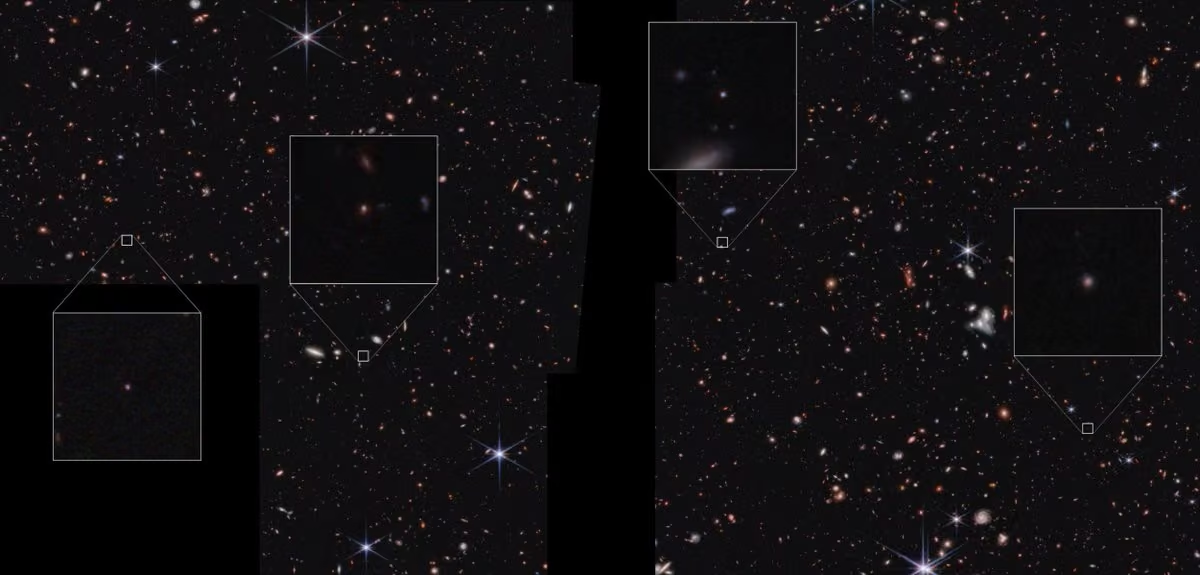
NASA Webb Telescope
@NASAWebb
Happy #halloween! You're always a treat, @NASARoman 👻
Don't forget to share your Webb #nasacostume or Webb pumpkins by tagging us! Our stencils: science.nasa.gov/mission/webb/space-pumpkin/?linkId=13744… 🎃
Nancy Grace Roman Space Telescope
@NASARoman
Happy #halloween from your fav duo Roman and @NASAWebb! Can you guess what their costumes are? They are a little far from home but still looking for some sweet treats! 👻 Still have pumpkins to carve? Check out our stencils! svs.gsfc.nasa.gov/13748
-
NASA Webb Telescope
@NASAWebb
Ahead of our launch in Dec., show us how you think #nasawebb will #unfoldtheuniverse. ✨
Watch @KellieGerardi & Delta V explain how to join our #unfoldtheuniverse art challenge! Your art may be shared on our social media/website & launch broadcast: science.nasa.gov/mission/webb/nasas-james-webb-space-tele… -
NASA Webb Telescope
@NASAWebb
After a 5,800-mile move, #nasawebb has unpacked & settled into the cleanroom at its launch site in French Guiana! Webb was carefully lifted from its packing container and then raised vertical.
More on our launch location: jwst.nasa.gov/content/about/launch.html
📸: NASA/Chris Gunn -
NASA Webb Telescope
@NASAWebb
Together, forever... best friends!
🥰 Thank you so much, @NASARoman! We can't wait to have Webb and Roman work together in space 💫
Nancy Grace Roman Space Telescope
@NASARoman
We are so glad you made it to your launch location safely in French Guiana @NASAWebb! You are one step closer to reaching our forever home in space! Don't forget to write us! www.nasa.gov/news-release/nasas-webb-space-telescope-arri…
-
NASA Webb Telescope
@NASAWebb
Your space telescope is out for delivery... 🚢 📦
Having completed a 16-day, ~5800-mile sea voyage from California to French Guiana, #nasawebb will soon be driven to its launch site, where it will prepare for its Dec. 18 launch: www.nasa.gov/news-release/nasas-webb-space-telescope-arri…
📸 : NASA/Chris Gunn -
NASA Webb Telescope
@NASAWebb
Welcome to Webb STEAM Day, a #stem + Arts Interactive Learning Experience — happening today 9:30 a.m.-5:30 p.m. ET!
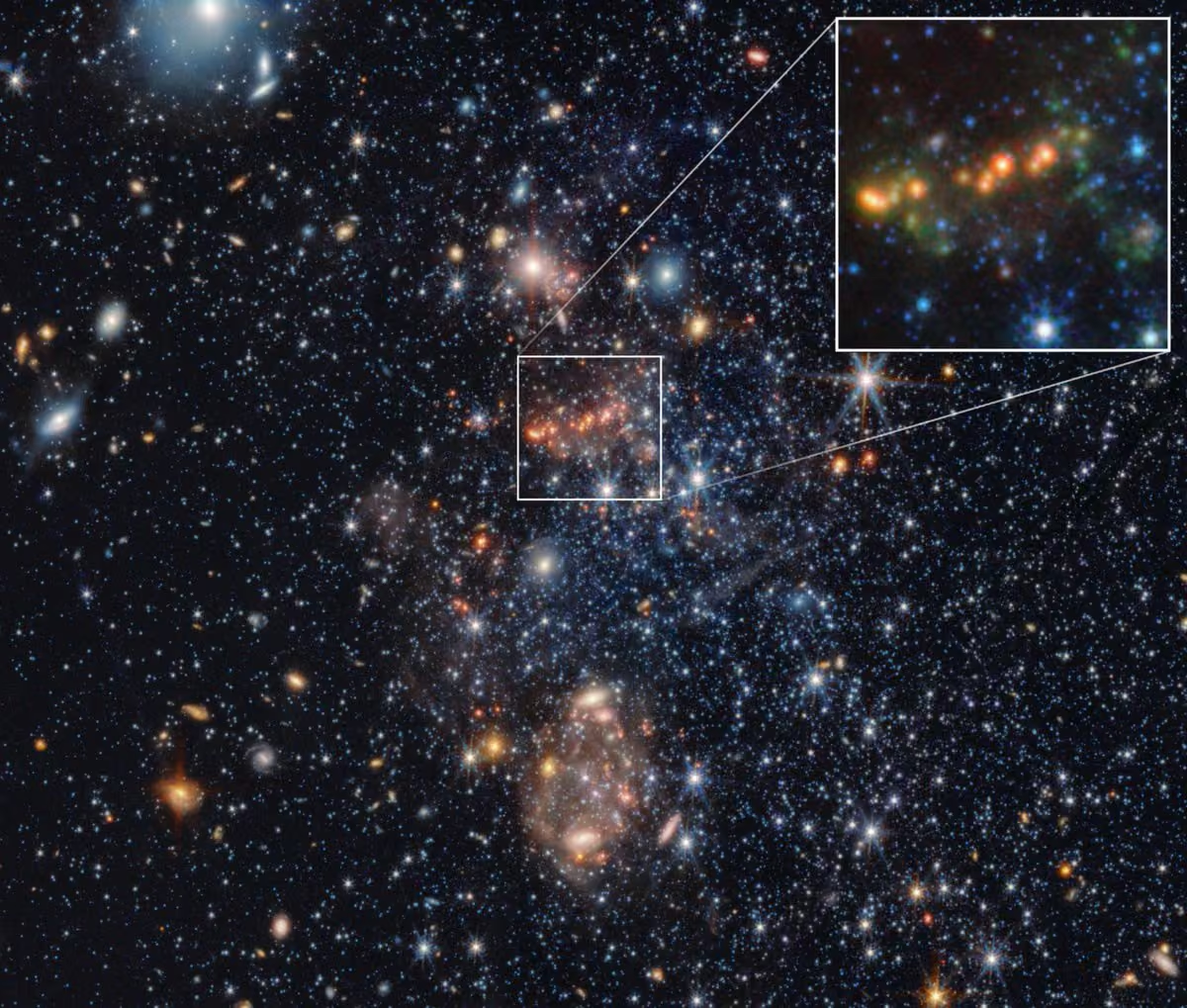
🗣️ Listen to talks
📚 Explore the Library
📓 Study Webb’s science & engineering
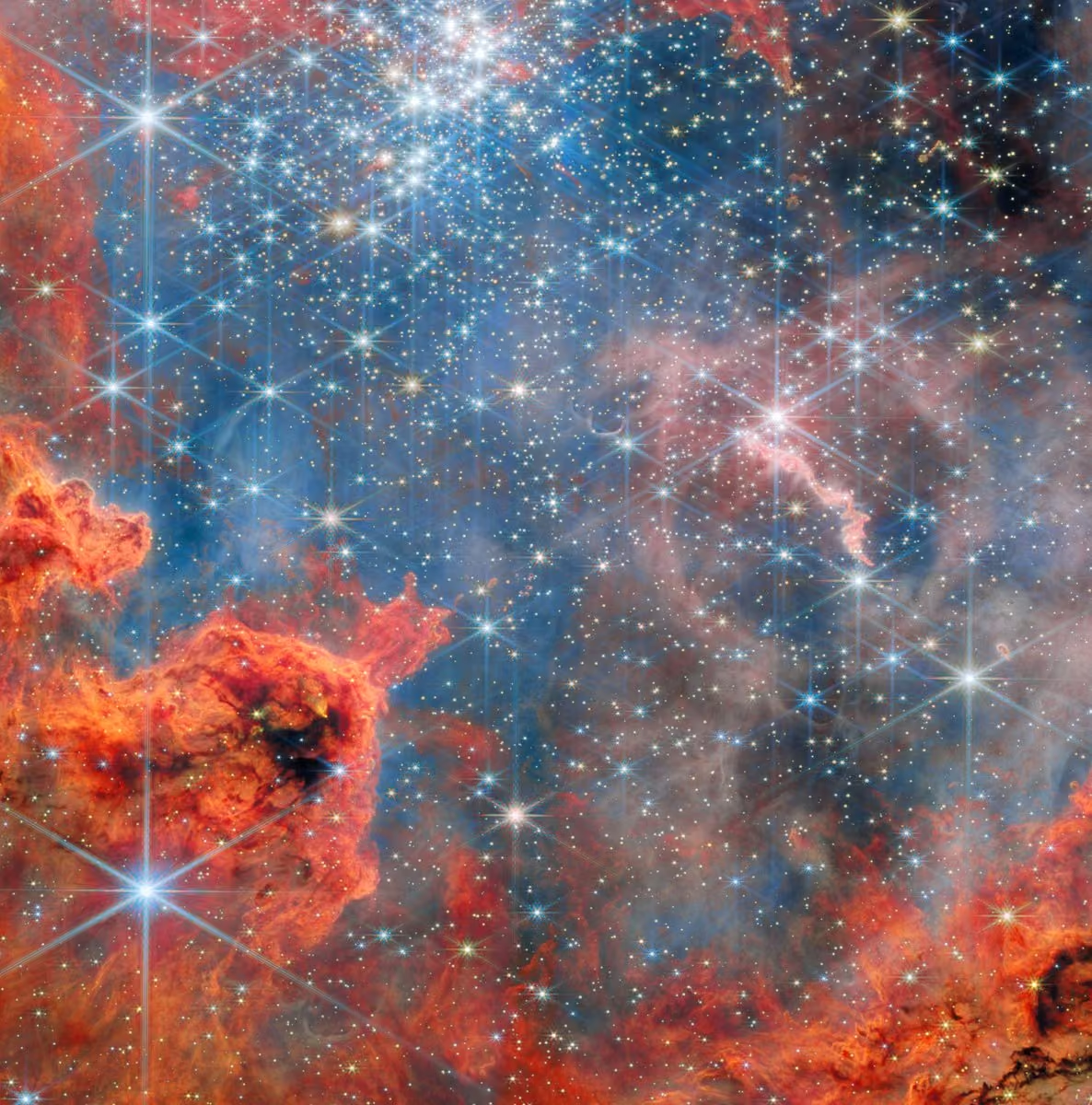
...and more!
Register for free and find it all here: nasa.6connex.com/event/NASAUniverse/WebbSTEAMDay/login -
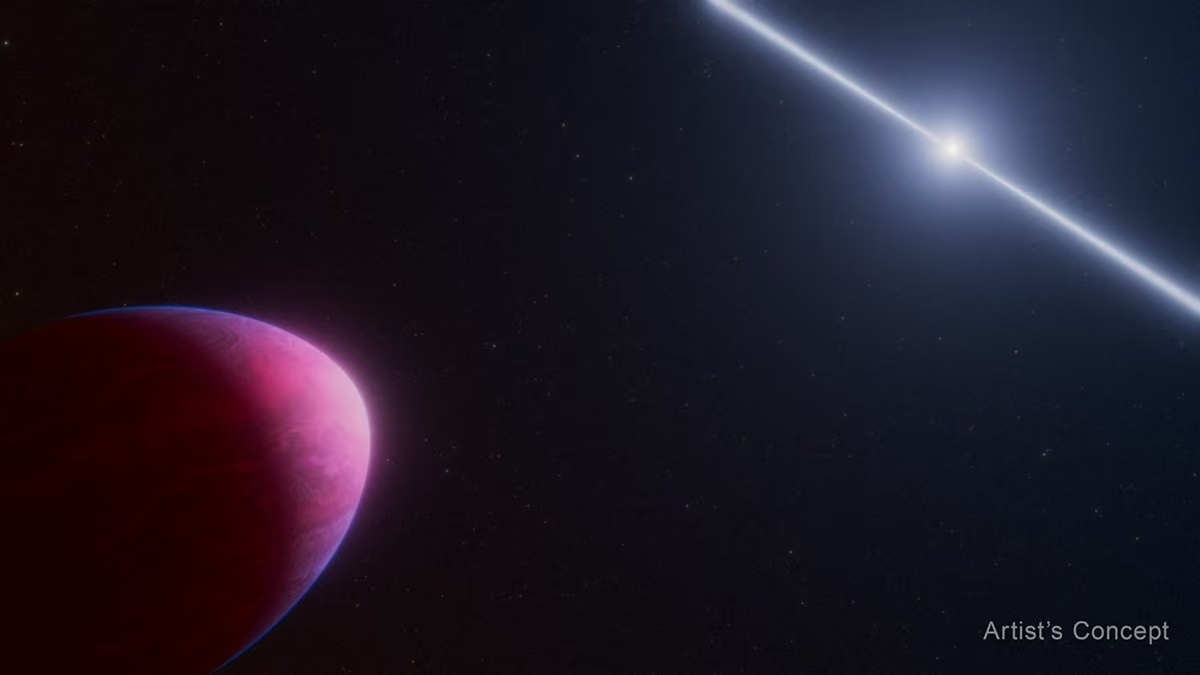
NASA Webb Telescope
@NASAWebb
And they were roommates!
Congrats @NASARoman on your milestone! We tested #nasawebb's instrument module in the very same chamber: www.nasa.gov/universe/new-video-shows-james-webb-space-te…
Nancy Grace Roman Space Telescope
@NASARoman
🚨 Roman passed its Critical Design Review, meaning that all design work is DONE! Next steps: building and testing hardware that will fly 🚀 Roman's Solar Array Sun Shield recently completed its two-week testing in the @NASAGoddard Thermal Vacuum chamber! www.nasa.gov/missions/roman-space-telescope/nasa-confirms…
-
NASA Webb Telescope
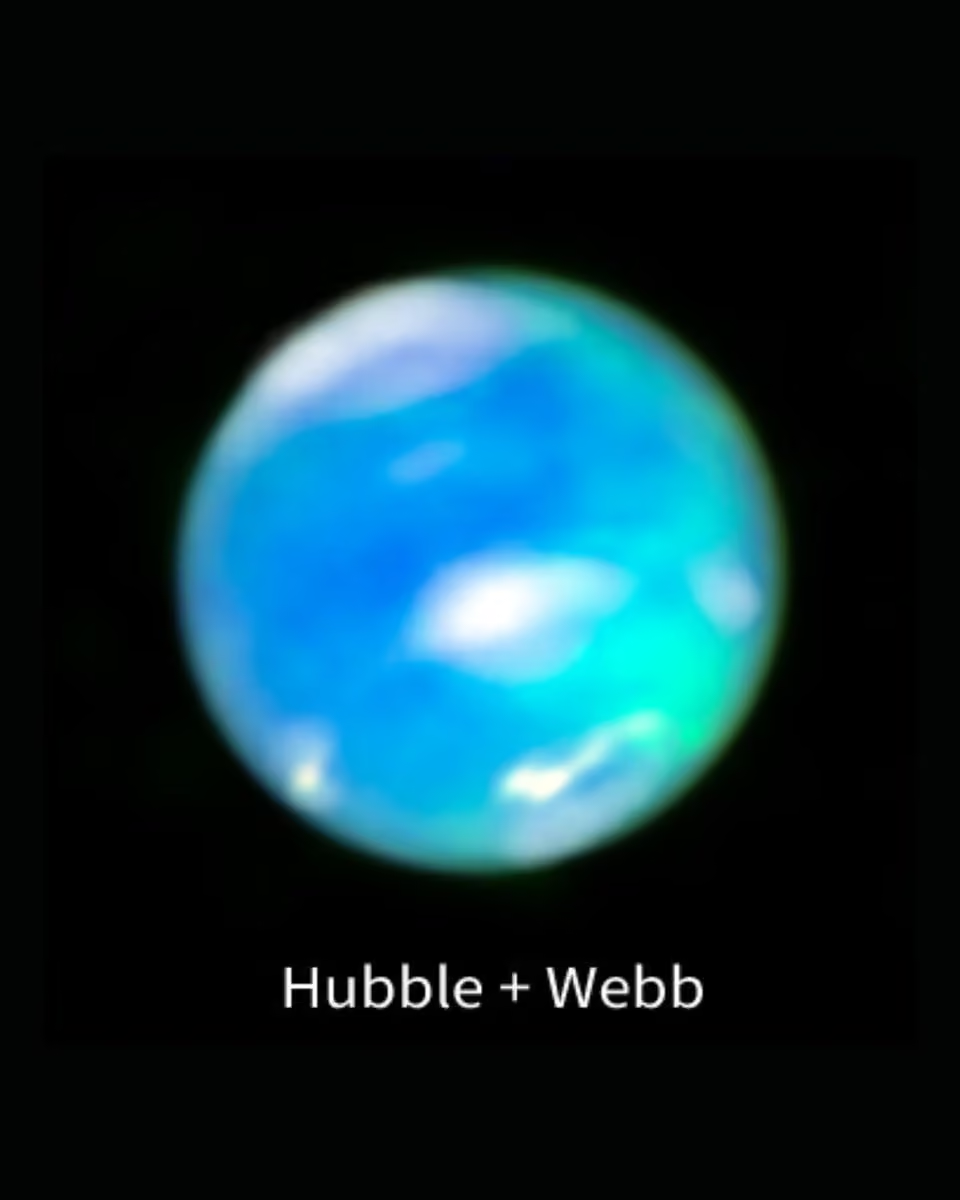
@NASAWebb
Like a good neighbor, Webb will be there!
Happy #goodneighborday, @NASARoman! Check out our comics series to learn how #nasawebb and Roman will work together at their orbital destination, the second Lagrange point (L2) — a million miles away.
x.com/i/events/1441027072034545664 -
NASA Webb Telescope
@NASAWebb
Launch date update! December 18, 2021 is now the target launch date for #nasawebb! 🚀 This date was coordinated between @NASA @ESA, and @Arianespace.
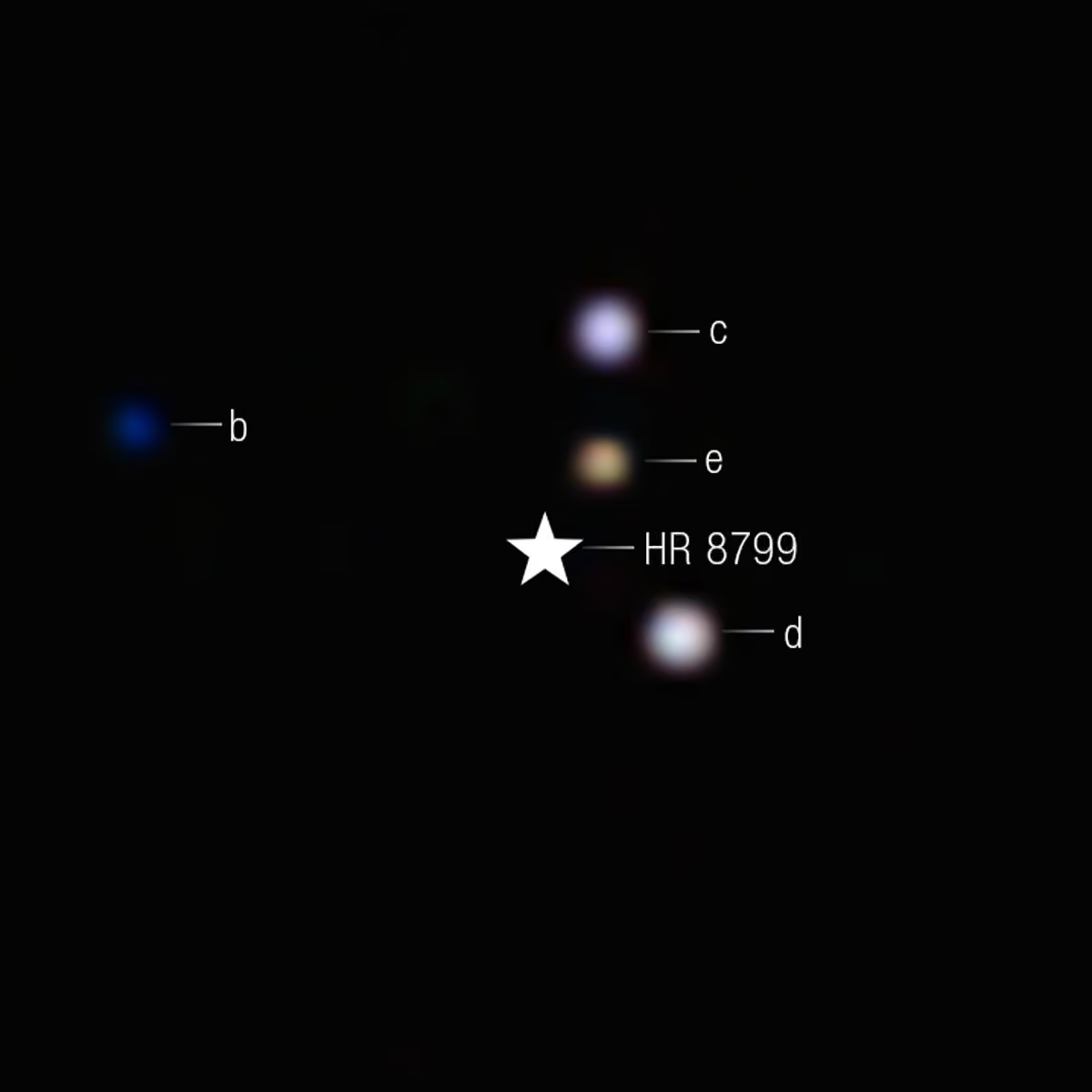
Next: Webb will be packed for its journey to the launch site in Kourou, French Guiana.
Read more: www.nasa.gov/news-release/nasa-readies-james-webb-space-t… -
NASA Webb Telescope
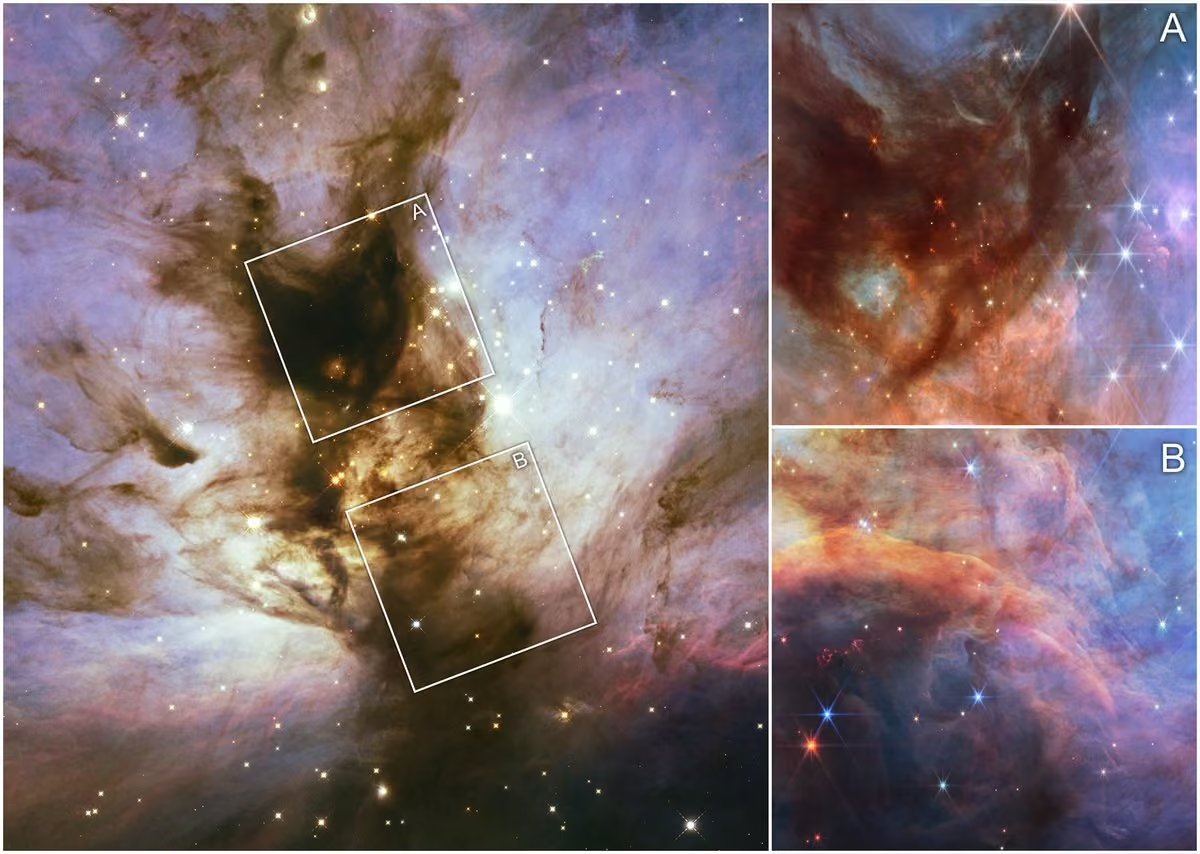
@NASAWebb
Spectroscopy is all about reading between the lines 📖
Beyond temperature and composition, it can tell us about the density of stars, or even the motion of objects in space! Part 5 of @SpaceTelescope's #spectroscopy101 series: science.nasa.gov/mission/webb/ -
NASA Webb Telescope
@NASAWebb
Testing complete ✅
#nasawebb has completed testing at @NorthropGrumman, demonstrating that it can survive its journey into space. Engineers are now preparing to ship Webb to its launch site of Kourou, French Guiana: www.nasa.gov/feature/goddard/2021/nasa-s-james-webb-space… -
NASA Webb Telescope
@NASAWebb
#onthisday 18 years ago, the Spitzer Space Telescope launched into space and began its mission to reveal the infrared universe to the world.
This image of Messier 81 was among the first released after Spitzer’s launch: www.spitzer.caltech.edu/image/ssc2003-06c1-spiral-galaxy-… -
NASA Webb Telescope
@NASAWebb
In honor of #worldelephantday, we’re featuring the Elephant’s Trunk Nebula. This stellar nursery was imaged by the Spitzer Space Telescope in infrared light, giving a preview of what #nasawebb will provide. 🐘
Credit: NASA/JPL-Caltech/W. Reach (SSC/Caltech). -
NASA Webb Telescope
@NASAWebb
Tower stowed ✅
Lens cap removed ✅
Sunshield pallets stowed ✅
3 more testing milestones have been completed for #nasawebb! The world’s most complex & powerful space telescope is making big progress for its launch & million-mile journey later this year. www.nasa.gov/universe/james-webb-space-telescope-testing-… -
NASA Webb Telescope
@NASAWebb
📷 This #nationalcameraday, we're spotlighting the different cameras that will be helping Webb and @NASARoman uncover mysteries of our universe.
So how do Webb's cameras compare to cameras in our daily lives? Thread 👇 -
NASA Webb Telescope
@NASAWebb
The Southern Pinwheel galaxy is mesmerizing. More importantly, #nasawebb scientists think it may hide clues to lingering questions about star formation.
What will Webb be able to tell us about star formation? science.nasa.gov/mission/webb/ Credit: NASA/ESA/STScI -
NASA Webb Telescope
@NASAWebb
❤️ You’ve got a friend in me, @NASARoman! ❤️
Here’s to all the complementary views we’ll see from our shared vantage point in space. #bestfriendday -
Post not available here, view on XPost not available here, view on X
NASA Webb Telescope
@NASAWebb
Quyen Hart is a senior education and outreach scientist at @SpaceTelescope. Dr. Hart is the first person in her family to obtain a B.S., M.S., and Ph.D. degree! #aapiheritagemonth #apahm #aapimonth
-
NASA Webb Telescope
@NASAWebb
Watch the journey of #nasawebb's mirrors, from individual segments being tested and inspected at @NASA_Marshall to views of the fully assembled mirror at @NASAGoddard & @northropgrumman.
The mirrors just experienced their last test on Earth: www.nasa.gov/universe/webbs-golden-mirror-wings-open-one-… -
Post not available here, view on XPost not available here, view on X
NASA Webb Telescope
@NASAWebb
“The primary mirror is a technological marvel. The lightweight mirrors, coatings, actuators and mechanisms, electronics and thermal blankets when fully deployed form a single precise mirror that is truly remarkable,” - Lee Feinberg, optical telescope element manager for #nasawebb
-
NASA Webb Telescope
@NASAWebb
Thanks, @NASARoman! With your wide field of view, we can always count on you to see the big picture. 👓
Nancy Grace Roman Space Telescope
@NASARoman
Congratulations on packing your sunshield, @NASAWebb! Let’s just agree that both of our sunshields are pretty cool. 😎 www.nasa.gov/feature/goddard/2021/nasa-s-webb-telescope-p…
NASA Webb Telescope
@NASAWebb
A million mile trip into space requires careful packing. 🧳
Engineers have successfully folded and packed #nasawebb's sunshield — a heat protector the size of a tennis court. Read more about Webb's latest update at @northropgrumman: www.nasa.gov/feature/goddard/2021/nasa-s-webb-telescope-p…
NASA Webb Telescope
@NASAWebb
Missed our first #nasawebb & @NASARoman comic?
Here’s why we'll be great neighbors in space: x.com/i/events/1310651368630177792 -
NASA Webb Telescope
@NASAWebb
Nathalie Ouellette, #nasawebb Outreach Scientist for @csa_asc, will participate in a livestream tonight to celebrate Yuri's Night in Canada. Her talk on Webb is from ~8:30-8:40 pm ET.
🚀 Facebook Live: www.facebook.com/events/2808129742785771/
🚀 YouTube Live: www.youtube.com/watch?v=1bPL9YkJBRU -
NASA Webb Telescope
@NASAWebb
A million mile trip into space requires careful packing. 🧳
Engineers have successfully folded and packed #nasawebb's sunshield — a heat protector the size of a tennis court. Read more about Webb's latest update at @northropgrumman: www.nasa.gov/feature/goddard/2021/nasa-s-webb-telescope-p… -
NASA Webb Telescope
@NASAWebb
What will #nasawebb study during its first year in space? 286 proposals were selected for the first round of General Observer scientific programs: science.nasa.gov/missions/webb/nasas-james-webb-space-tel…
-
NASA Webb Telescope
@NASAWebb
Nathalie Ouellette, #nasawebb Outreach Scientist for @csa_asc, will be joining a panel on space missions organized by the @rasc & @GuelphPhysics on Jan. 26th at 7 p.m. ET. It will be open to the public via YouTube Live: youtu.be/B1MK5ABcX6E
-
NASA Webb Telescope
@NASAWebb
In 2020, #nasawebb advanced through a series of engineering milestones at @NorthropGrumman — a testament to the hard work of its mission engineers & technicians.
Take a look back on Webb’s top 10 moments: www.nasa.gov/universe/nasas-webb-telescope-looks-back-on-… -
NASA Webb Telescope
@NASAWebb
With the end of the year just days away, we're excited to announce #nasawebb has cleared one of its most important milestones to date. Its 5-layer sunshield has been successfully deployed & tensioned into the same configuration it will have in space! www.nasa.gov/missions/nasas-webb-sunshield-successfully-u…
Post not available here, view on X
NASA Webb Telescope
@NASAWebb
This animation shows where Webb will be positioned in space, and how the sunshield will always contend with a bright sun that never sets! By keeping its sensors and mirrors in the shade, they are much more able to detect faint thermal signatures humans have never seen before.
NASA Webb Telescope
@NASAWebb
Nearly three months ago (pictured) Webb was exposed to a simulated launch environment in testing chambers. Now Webb is performing a full run of deployments and movements that it will do once in space in the very same order. Launch, shake, rattle, and then unfurl and deploy.
-
NASA Webb Telescope
@NASAWebb
One of the most iconic features of the #nasawebb telescope is its primary mirror: 18 segments made of beryllium and covered in a thin layer of gold. The large mirror (21.6 ft/6.5 m in diameter) will view faint galaxies 13 billion light-years away: www.jwst.nasa.gov/content/observatory/ote/mirrors/index.h…
-
NASA Webb Telescope
@NASAWebb
#nasawebb is getting ready to make its million-mile journey. 🌌
Learn about what our cosmic time machine will discover in the latest episode of NASA's Curious Universe podcast.
🎧 Listen & subscribe: nasa.gov/curiousuniverse -
NASA Webb Telescope
@NASAWebb
Testing is the spacecraft equivalent of @NASA_Astronauts training. But how does a space telescope like #nasawebb “train” for its launch journey?
Thread ⬇️ -
NASA Webb Telescope
@NASAWebb
LIVE NOW 🔭 Nathalie Ouellette, #nasawebb Canadian Outreach Scientist, is giving an "Exploring by the Seat Of Your Pants" live webinar on astronomy and Webb in French here:
www.youtube.com/watch?v=rEjx3_RGqWE -
NASA Webb Telescope
@NASAWebb
The next environment #nasawebb will experience is space! Webb’s recent tests have validated that the fully assembled observatory will endure the deafening noise & jarring shakes, rattles and vibrations of liftoff. 🚀 More: www.nasa.gov/solar-system/nasas-james-webb-space-telescop…
-
NASA Webb Telescope
@NASAWebb
Nathalie Ouellette, #nasawebb Canadian Outreach Scientist, will be giving a "Exploring by the Seat Of Your Pants" live webinar on astronomy and Webb in French on October 8th. The live session is open to classrooms from all over North America. Sign up: www.exploringbytheseat.com/lesson/nathalie-ouellette-fren…
-
NASA Webb Telescope
@NASAWebb
Attend a free online talk on #nasawebb on Wednesday, June 10th! Astrophysicist Nathalie Ouellette will be speaking on @Telus_Spark's YouTube and Facebook live at 1PM MST. Learn more: sparkscience.ca/spark-science-from-home/live-from-spark
-
NASA Webb Telescope
@NASAWebb
Learn about #nasawebb in English & French! Webb Outreach scientist Nathalie Ouellette gave 2 talks for "Astro at Home," by Discover the Universe, which allows kids & families to connect to astronomers from home. English: youtu.be/uJmGeee9YyQ & French: youtu.be/9J3k0HbKvKg
-
NASA Webb Telescope
@NASAWebb
Astronomers will use #nasawebb to peer into a nearby stellar nursery to examine its faintest, tiniest residents, including the smallest brown dwarfs and “rogue planets.” Learn how: science.nasa.gov/missions/webb/nasas-webb-telescope-to-se…
-
NASA Webb Telescope
@NASAWebb
A new #hubblecast video explores (in fewer than 5 minutes) how #hubble observations differ across different wavelengths of the electromagnetic spectrum, and how these will be complemented by the #nasawebb! www.spacetelescope.org/videos/hubblecast126a/
-
NASA Webb Telescope
@NASAWebb
Nathalie Ouellette, #nasawebb Canadian Outreach Scientist, will be giving a "Exploring by the Seat Of Your Pants" live webinar on astronomy and Webb on November 25th. The live session is open to classrooms from all over North America. Sign up here: www.exploringbytheseat.com/lesson/nathalie-ouellette-cana…
-
NASA Webb Telescope
@NASAWebb
Join us today, Oct 17, at 4:30pm EDT for a #nasasciencelive featuring #nasawebb. Our experts will discuss the telescope, and its science & engineering. Watch: www.nasa.gov/nasasciencelive Got questions? Submit them by using #asknasa.
-
NASA Webb Telescope
@NASAWebb
What appears to @NASASpitzer as a cosmic tornado actually marks the site of a still-forming star. A powerful light-years-long jet stretches from the star, located just off the top of the photo. Learn more: science.nasa.gov/mission/webb/ (Image credit: www.nasa.gov/multimedia/imagegallery/image_feature_570.html)
-
NASA Webb Telescope
@NASAWebb
The most powerful and complex space telescope ever created by humankind has achieved its final form as a fully assembled observatory. Reaching a major milestone, engineers have successfully connected the two halves of #nasawebb
More about this milestone: www.nasa.gov/feature/goddard/2019/nasa-s-james-webb-space… -
NASA Webb Telescope
@NASAWebb
The #usopen starts today! Can you imagine a spacecraft the size of a tennis court? To see infrared light from faraway objects, #nasawebb needs to be very cold! Our sunshield (~21x14 m in size) will shade Webb and keep it < ~50 Kelvin (-370°F or -223°C). jwst.nasa.gov/content/observatory/sunshield.html
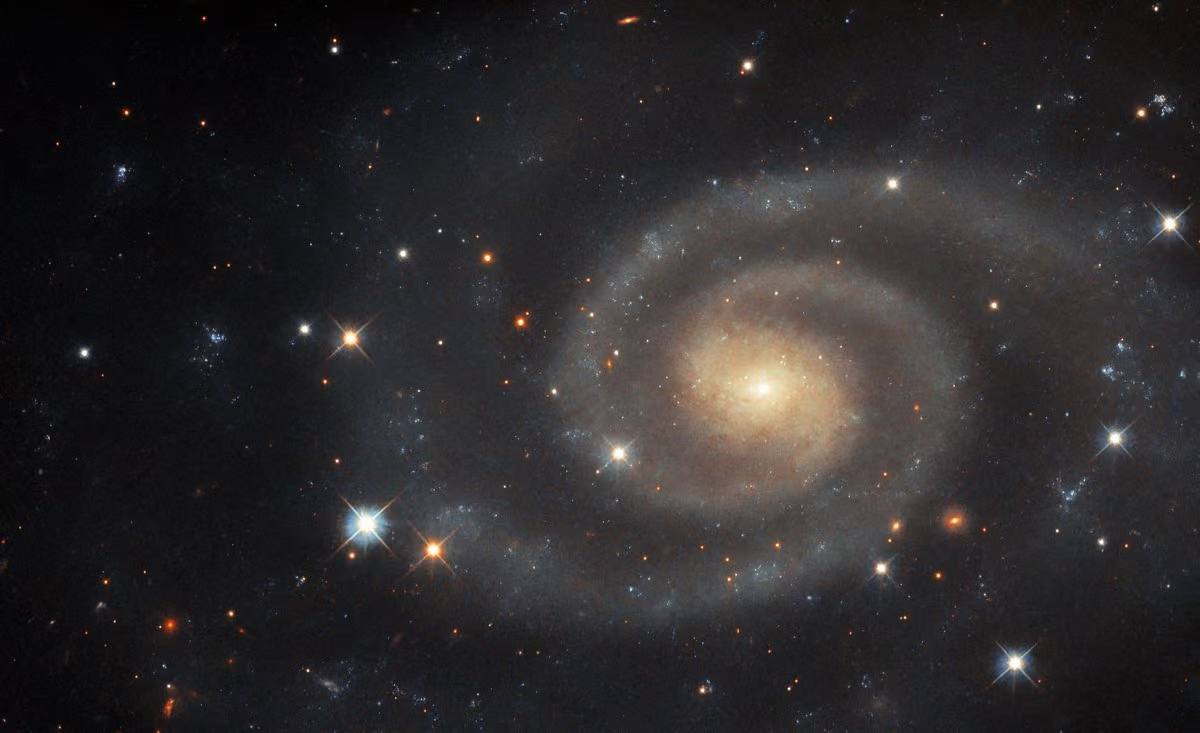
-
NASA Webb Telescope
@NASAWebb
#nasawebb was engineered to intricately fold in on itself to become much smaller for launch. The team recently tested a key part of this choreography by commanding Webb to deploy the structure that holds its mission-critical secondary mirror.
More here: www.nasa.gov/universe/critical-deployment-of-nasa-webbs-s…This media couldn't be displayed. See it on the original post. -
NASA Webb Telescope
@NASAWebb
See the thread from @PlanetQuest below to learn more about this smol exoplanet, L 98-59b, and its siblings!
Planetquest
@PlanetQuest
📣Discovery Alert!📣
@NASA_TESS🛰 discovered its smallest planet yet, about 35 light-years away in the southern constellation Volans🌌
science.nasa.gov/exoplanets/This media couldn't be displayed. See it on the original post. -
NASA Webb Telescope
@NASAWebb
Solar eclipse: Moon blocks Sun. Coronagraph: Telescope blocks star’s light to see hidden planets. Learn how #nasawebb will use its coronagraphs to open a new window on #exoplanets and planet-forming disks: science.nasa.gov/missions/webb/a-new-view-of-exoplanets-w… #jwst
-
NASA Webb Telescope
@NASAWebb
Join the James Webb Space Telescope in orbit beyond the Moon, and explore the universe from its perspective via WebbVR: The James Webb Space Telescope Virtual Experience. Free on Steam for @OculusRift or @htcvive: store.steampowered.com/app/891960/
-
NASA Webb Telescope
@NASAWebb
Here’s the story of how #nasa began 60 years ago: youtu.be/VV6QeZFaVSQ For a bit of our own mission’s history, check out the story of how our mirrors and their tech were developed: jwst.nasa.gov/mirrors.html #jwst #nasa60th
-
NASA Webb Telescope
@NASAWebb
Happy 60th birthday! This coming week @NASA will be highlighting #nasa achievements past and present in the lead up to the big Oct 1st anniversary day. Here's an overview: www.nasa.gov/specials/60counting/overview.html Stay tuned for more! #nasa60th
-
NASA Webb Telescope
@NASAWebb
What in the world is an exoplanet? For the first time in history, humans know that there is at least one planet for every star in our galaxy. Here’s an overview of how we got here, and where we’re going. www.nasa.gov/feature/jpl/what-in-the-world-is-an-exoplane…
-
NASA Webb Telescope
@NASAWebb
Meet Nikole Lewis, a project scientist for Webb at @stsci. Nikole plans to use Webb to study the atmospheres of exoplanets. “I want to know what temperature those atmospheres are…what clouds and potentially hazes form those planetary atmospheres.” #iwd2018 #womeninstem #jwst
-
NASA Webb Telescope
@NASAWebb
#webb will target #mars during its first year of operations, shining light on the planet’s history and habitability. Mars will be visible to Webb from May to Sept. 2020. Find out more here: science.nasa.gov/missions/webb/nasas-james-webb-space-tel… #jwst
-
NASA Webb Telescope
@NASAWebb
Astronomers around the world will have immediate access to early data from specific observations from @NASAWebb. These just announced observations will be made within the first 5 months of science operations. science.nasa.gov/missions/webb/nasas-james-webb-space-tel… #jwst
-
NASA Webb Telescope
@NASAWebb
A lot can happen in 100 days at @NASA! @NASA_Johnson has been busy with astronauts, @Space_Station, #jwst & more! nasa.tumblr.com/post/166298662539/100-days-in-houston
-
NASA Webb Telescope
@NASAWebb
Interested in seeing @NASAWebb's amazing photographer @ChrisGunnPhoto at @sxsw? More: #sxsw #panelpicker: panelpicker.sxsw.com/vote/79309 #sxsw2018
-
NASA Webb Telescope
@NASAWebb
Like LEGO? A @NASAWebb design is up for LEGO community fans to vote on. Check it out: ideas.lego.com/projects/9353f9ab-a11f-4820-8e1c-c427f7b17bbc #jwst #webb
-
NASA Webb Telescope
@NASAWebb
We'll be moving #webb into a giant testing chamber at @NASA_Johnson soon! Read why: www.nasa.gov/image-feature/webb-telescope-set-for-testing… #jwst
-
NASA Webb Telescope
@NASAWebb
Local to @NASAGoddard? Our free Visitor Center exhibit of @NASAWebb inspired art now runs through July 2! www.nasa.gov/press-release/goddard/2017/james-webb-space-… #jwstart
-
NASA Webb Telescope
@NASAWebb
For those curious about specifics of the selected targets for #webb (to be observed in 1st year), a list is here: jwst-docs.stsci.edu/display/JSP/JWST+GTO+Observation+Spec…
-
NASA Webb Telescope
@NASAWebb
#icymi, join us on March 31, 2pm ET on our Facebook, for a live, close-up view of #jwst's huge gold-coated mirror. facebook.com/webbtelescope
-
NASA Webb Telescope
@NASAWebb
Really nice Webbcam view right now: jwst.nasa.gov/webcam.html They are setting up to measure the mirrors again, post-environmental testing.
-
NASA Webb Telescope
@NASAWebb
Want to know what the discovery of seven earth-sized planets around the TRAPPIST-1 star means for #jwst?- Read more: www.nasa.gov/universe/probing-seven-worlds-with-nasas-jam…
-
NASA Webb Telescope
@NASAWebb
Skype interview with our senior project scientist Dr. John Mather...
Brendan Byrne
@SpaceBrendan
What's so special about @NASAWebb? Pretty much everything. www.wmfe.org/james-webb-is-seein-red/65942
-
NASA Webb Telescope
@NASAWebb
Art + science
Caroline Corbasson
@CCorbasson
Inspired by the #jwst hlow.paris/caroline-corbasson-space-stars @NASAWebb
-
NASA Webb Telescope
@NASAWebb
"It's a really beautiful sight." Peek At the #jwst Before it Peers into Forming Galaxies via @PopSci www.popsci.com/peeking-at-james-webb-telescope-before-it-…
-
NASA Webb Telescope
@NASAWebb
#jwst being moved in prep for an upcoming test. Excellent view from observation window at @NASAGoddard.
-
NASA Webb Telescope
@NASAWebb
Today, 1-2pm ET - ask @MIT planetary scientist @ProfSaraSeager about the technologies needed to #search4life on exoplanets.