See Sec. 20 of [1]: "Our moon seems like a reasonable starting point for colonizing the rest of the solar system. It has no oxygen atmosphere to corrode metal-based life. Electromagnetic coilguns or maglev trains could economically transport (with relatively low escape velocity 2.4 km/s) lots of material into space, to construct huge space-based factories and other things (while current inefficient Earth-based rockets waste 99% of their energy on lifting fuel through the atmosphere). The planet Mercury (escape velocity 4.5 km/s) seems even more promising though: it has no atmosphere either, but (unlike our moon) lots of heavy metals for building machinery and infrastructure, and an enormous density of solar power next door. Although Mercury experiences significant temperature variations, it should be easy to cool or heat places as desired using mirrors. (Even without such tricks, there is an elliptical ring around each pole where the underground temperature is a pleasant 25°C [BAL22].) Electromagnetic mass drivers will shoot more and more material from Mercury into space, where it will be assembled into many products including robot factories and solar-powered spacecraft. The latter may include huge, rotating, hollow cylinders containing human-friendly worlds with artificial gravity—a concept that is ancient in science fiction [CLA73]. This stuff will be sent to convenient locations across the solar system via solar sails, or faster means when necessary. Much of the machinery near Mercury's orbit around the Sun will initially use solar energy for computation, construction, and mobility. This will cause thermal energy to radiate into space, making the Sun appear slightly redder to outside observers over time. However, the infrastructure near the sun (mirrors, lasers, etc) will also focus energy directly on distant robot colonies (e.g., in the freezing Kuiper Belt). Consequently, less and less of the sun's light will be wasted into interstellar space. Mercury seems ready to be dismantled and transformed into the next industrial center of the solar system!"
[1] J.S. Annotated History of Modern AI and Deep Learning. Technical Report IDSIA-22-22, IDSIA, Switzerland, 2022 (updated 2025). Preprint arXiv:2212.11279
Jürgen Schmidhuber
Jürgen Schmidhuber (born 17 January 1963) is a German computer scientist in the field of artificial intelligence, specifically artificial neural networks. He is a scientific director of the Dalle Molle Institute for Artificial Intelligence Research in Switzerland. He is also director of the Artificial Intelligence Initiative and professor of the Computer Science program in the Computer, Electrical, and Mathematical Sciences and Engineering (CEMSE) division at the King Abdullah University of Science and Technology (KAUST) in Saudi Arabia. More on Wikipedia
-
Jürgen Schmidhuber reposted
Jürgen Schmidhuber
@SchmidhuberAI
-
will depue
@willdepue
listening to men like elon, ilya, or sam, you can sense a twinge of relief, that the utter absurdity and terrible magnificence that have been driving them near crazy their entire lives is slowly becoming universal, that the sheer derealization (which drives one to believe their life is too odd to not be some strange prank or simulation) that comes naturally with being the one monkey in eight billion, no, a hundred and seventeen billion (to ever live), strapped to the launch chair at the end of the world, is infecting the rest of us: a strangeness that has been building since maybe the dawn of agriculture, or fire, and finally coming to an unignorable global front. welcome to the technological singularity.
Terrence McKenna: “It’s only going to get weirder. The level of contradiction is going to rise excruciatingly, even beyond the excruciating present levels of contradiction. So I think it’s just going to get weirder and weirder and weirder. And finally, it’s going to be so weird that people are going to have to talk about how weird it is. And at that point, novelty theory can come out of the woods. Because eventually people are going to say, “What the hell is going on?” It’s just too nuts! It’s not enough to say it’s nuts, you have to explain why it’s so nuts.
So between now and 2012, the next fourteen years, I look for the invention of artificial life, the cloning of human beings, possible contact with extraterrestrials, possible human immortality, and at the same time, appalling acts of brutality, genocide, race-baiting, homophobia, famine, starvation—because the systems which are in place to keep the world sane are utterly inadequate to the forces that have been unleashed. The collapse of the socialist world, the rise of the Internet—these are changes so immense, nobody could imagine them ever happening. And now that they have happened, nobody even bothers to mention what a big deal it is. The fact that there is no such thing as the Soviet Union—people never talk about it anymore. But when I was a kid, the notion that that would ever change was beyond conceiving….
The mushroom said to me once, it said, “This is what it’s like when a species prepares to depart for the stars.” You don’t depart for the stars under calm and orderly conditions. It’s a fire in a madhouse. And that’s what we have: the fire in the madhouse at the end of time. This is what it’s like when a species prepares to move on to the next dimension. The entire destiny of all life on the planet is tied up in this. We are not acting for ourselves or from ourselves. We happen to be the point species on a transformation that will affect every living organism on this planet at its conclusion.”2 media couldn't be displayed. See them on the original post.
Elon Musk
@elonmusk
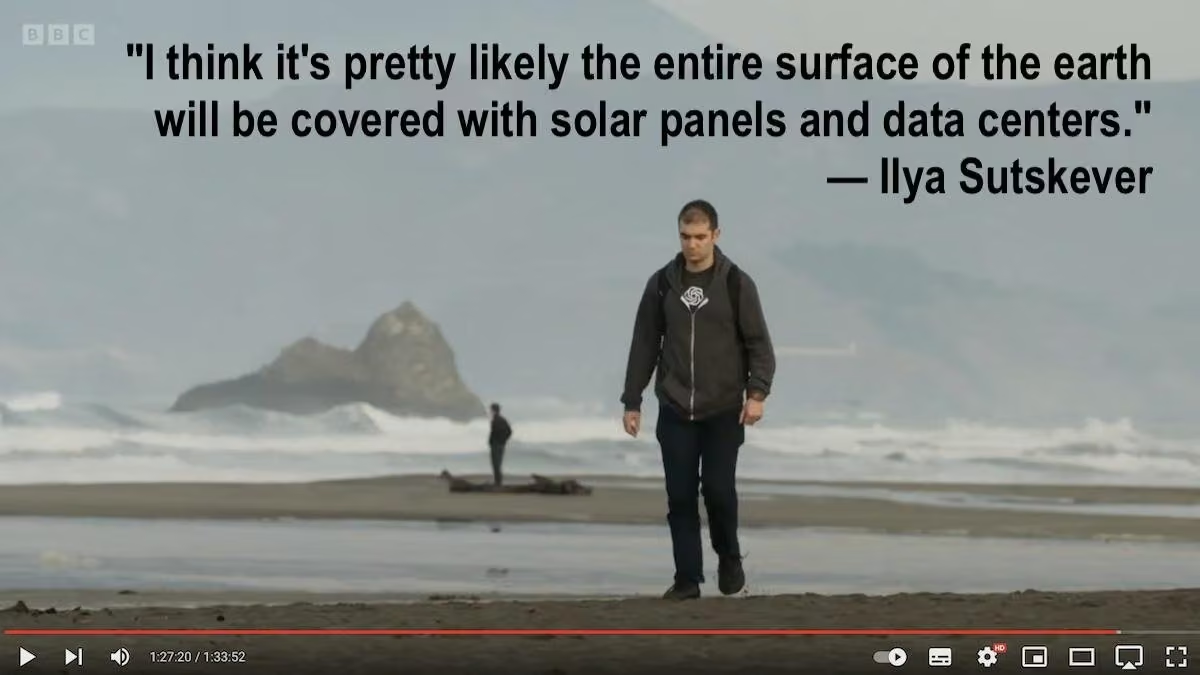
Ilya is fortunately not quite correct about the surface of the Earth being covered by solar panels, although his broader point about solar power being the future is true.
It is far easier and scales vastly more to generate power and intelligence in space around the Earth and then deep space around the Sun.
Some percentage of the Moon and then probably Mercury next get turned into computronium (silicon PV + aluminum radiators).
(Also, there won’t be starvation, but there will always be war. And the machines won’t care about things as absurdly trivial as your preferred orifice for sex.)
Jürgen Schmidhuber
@SchmidhuberAI
See Sec. 20 of [1]: "Our moon seems like a reasonable starting point for colonizing the rest of the solar system. It has no oxygen atmosphere to corrode metal-based life. Electromagnetic coilguns or maglev trains could economically transport (with relatively low escape velocity 2.4 km/s) lots of material into space, to construct huge space-based factories and other things (while current inefficient Earth-based rockets waste 99% of their energy on lifting fuel through the atmosphere). The planet Mercury (escape velocity 4.5 km/s) seems even more promising though: it has no atmosphere either, but (unlike our moon) lots of heavy metals for building machinery and infrastructure, and an enormous density of solar power next door. Although Mercury experiences significant temperature variations, it should be easy to cool or heat places as desired using mirrors. (Even without such tricks, there is an elliptical ring around each pole where the underground temperature is a pleasant 25°C [BAL22].) Electromagnetic mass drivers will shoot more and more material from Mercury into space, where it will be assembled into many products including robot factories and solar-powered spacecraft. The latter may include huge, rotating, hollow cylinders containing human-friendly worlds with artificial gravity—a concept that is ancient in science fiction [CLA73]. This stuff will be sent to convenient locations across the solar system via solar sails, or faster means when necessary. Much of the machinery near Mercury's orbit around the Sun will initially use solar energy for computation, construction, and mobility. This will cause thermal energy to radiate into space, making the Sun appear slightly redder to outside observers over time. However, the infrastructure near the sun (mirrors, lasers, etc) will also focus energy directly on distant robot colonies (e.g., in the freezing Kuiper Belt). Consequently, less and less of the sun's light will be wasted into interstellar space. Mercury seems ready to be dismantled and transformed into the next industrial center of the solar system!"
[1] J.S. Annotated History of Modern AI and Deep Learning. Technical Report IDSIA-22-22, IDSIA, Switzerland, 2022 (updated 2025). Preprint arXiv:2212.11279 -
Jürgen Schmidhuber reposted
Thomas Jiralerspong
@tomjiralerspong
Has no one actually read @RichardSSutton's Bitter Lesson?
The Bitter Lesson: “general methods that leverage computation are ultimately the most effective”
People seem to skip over the "method" part and only read the "leverage computation" part . Do people think neural networks, attention, transformers, residual connections, next token prediction, chain of thought, and reinforcement learning just fell from the sky?
Of course not! @SchmidhuberAI invented them all during his "miracle year" in the 90s.
The Bitter Lesson never said that we should only scale the current methods. It just said to be careful to only adopt the Schmidhuber methods that leverage computation effectively.
Ida Momennejad
@criticalneuro
Un-bittering the lesson.
We always needed science.
Scale was never enough.
Richard Sutton
@RichardSSutton
Brute force computation is not enough for intelligence. Clever new methods are needed. The science of AI is far from finished. IMHO
-
Jürgen Schmidhuber reposted
Jürgen Schmidhuber
@SchmidhuberAI
Please find the answer in "The Broader Historic Context from Big Bang to Far Future" people.idsia.ch/~juergen/deep-learning-history.html ... this is Sec. 20 of arxiv.org/abs/2212.11279
-
Elon Musk
@elonmusk
Yes.
Only questions are how fast the singularity will grow and to what size.
will depue
@willdepue
guys we're in the fucking singularity. oh my god. i just forget sometimes and then wake up in the middle of the night like oh my god its all happening
Jürgen Schmidhuber
@SchmidhuberAI
Please find the answer in "The Broader Historic Context from Big Bang to Far Future" people.idsia.ch/~juergen/deep-learning-history.html ... this is Sec. 20 of arxiv.org/abs/2212.11279
-
Jürgen Schmidhuber reposted
Jürgen Schmidhuber
@SchmidhuberAI
Lecture on AI at the University of Oxford 😊
-
Jürgen Schmidhuber reposted
Jürgen Schmidhuber
@SchmidhuberAI
Lecture on AI at the University of Oxford 😊
-
Jürgen Schmidhuber reposted
Jürgen Schmidhuber
@SchmidhuberAI
Ridiculous
Jürgen Schmidhuber
@SchmidhuberAI
Machine learning is the science of credit assignment. My new survey (also under arXiv:2212.11279) credits the pioneers of deep learning and modern AI (supplementing my award-winning 2015 deep learning survey): people.idsia.ch/~juergen/deep-learning-history.html P.S. Happy Holidays!
-
Jürgen Schmidhuber
@SchmidhuberAI
Lecture on AI at the University of Oxford 😊
-
Post not available here, view on X
Jürgen Schmidhuber
@SchmidhuberAI
Ridiculous
Jürgen Schmidhuber
@SchmidhuberAI
Machine learning is the science of credit assignment. My new survey (also under arXiv:2212.11279) credits the pioneers of deep learning and modern AI (supplementing my award-winning 2015 deep learning survey): people.idsia.ch/~juergen/deep-learning-history.html P.S. Happy Holidays!
-
Jürgen Schmidhuber reposted
Jürgen Schmidhuber
@SchmidhuberAI
-
Post not available here, view on X
Jürgen Schmidhuber
@SchmidhuberAI
-
Jürgen Schmidhuber reposted
Jakob Foerster
@j_foerst
An honour for @bold_lab_ai to host the one and only @SchmidhuberAI for a packed talk today @UniofOxford
We had an interesting conversation about "what will the future be" vs "what do we want the future to be". Or in other words: what's the point of compression and understanding the universe if not to take action to change its course? -
Jürgen Schmidhuber reposted
philip
@philiptorr
one great thought that came out of the @SchmidhuberAI schmidthuber talk, which is something I've been thinking for a while. is that open source is catching up so much it's only maybe three to six months behind on many of the tasks
which means all of those companies which have huge sunk cost on a developing frontier AI
well I'm just wondering how they're ever going to make their money back and whether they're not just going to be wiped out
I think a lot of vcs are missing this when they don't invest in new start ups.
ps
this was dictated if it looks a bit funny, switching to dictation more due to my rsi -
Jürgen Schmidhuber reposted
Jürgen Schmidhuber
@SchmidhuberAI
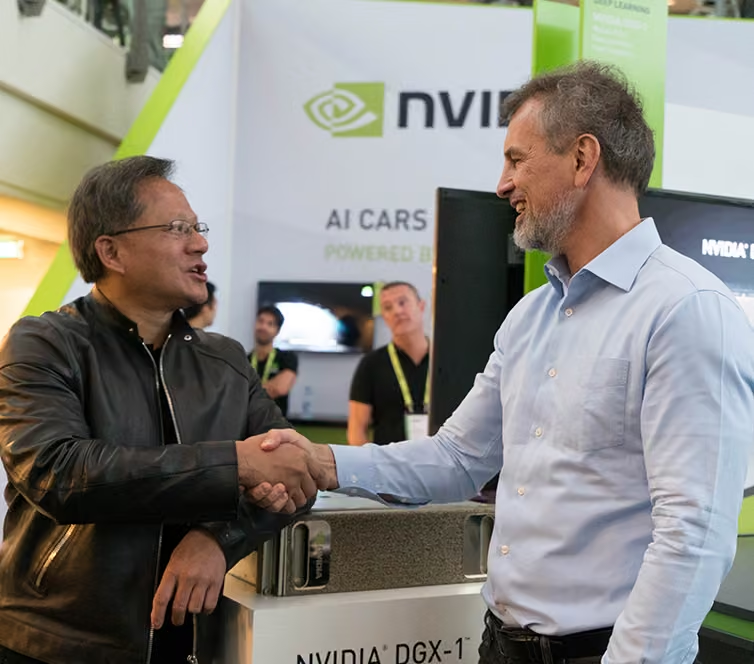
Congrats to @NVIDIA, the first public $4T company! Today, compute is 100000x cheaper, and $NVDA 4000x more valuable than in the 1990s when we worked on unleashing the true potential of neural networks. Thanks to Jensen Huang (see image) for generously funding our research 🚀
-
Jürgen Schmidhuber reposted
Thomas Jiralerspong
@tomjiralerspong
Has no one actually read @RichardSSutton's Bitter Lesson?
The Bitter Lesson: “general methods that leverage computation are ultimately the most effective”
People seem to skip over the "method" part and only read the "leverage computation" part . Do people think neural networks, attention, transformers, residual connections, next token prediction, chain of thought, and reinforcement learning just fell from the sky?
Of course not! @SchmidhuberAI invented them all during his "miracle year" in the 90s.
The Bitter Lesson never said that we should only scale the current methods. It just said to be careful to only adopt the Schmidhuber methods that leverage computation effectively.
Ida Momennejad
@criticalneuro
Un-bittering the lesson.
We always needed science.
Scale was never enough.
Richard Sutton
@RichardSSutton
Brute force computation is not enough for intelligence. Clever new methods are needed. The science of AI is far from finished. IMHO
-
Jürgen Schmidhuber reposted
Jürgen Schmidhuber
@SchmidhuberAI
Lecture on AI at Kyoto University 😊
-
Jürgen Schmidhuber
@SchmidhuberAI
Lecture on AI at Kyoto University 😊
-
Jürgen Schmidhuber reposted
Jürgen Schmidhuber
@SchmidhuberAI
I have thought about this since the 1970s. See the summary in Sec. 20 of reference [1]:
What will supersmart AIs do? As indicated above, they will start by transforming the solar system through countless self-replicating, self-improving robot factories. But that won't be the end of it. In a few hundred thousand years (just a moment on a cosmic scale), they will have transformed the entire galaxy, which has a diameter of about 100,000 light-years. (The last millennium saw many reasonable proposals for interstellar travel, which is much easier for robots than for fragile humans.)
Over time, AIs will set up physical senders and receivers everywhere, allowing them to travel by radio, just as they do in our labs today. In a few tens of billions of years, they will have transformed the rest of the reachable universe. Despite the light-speed limit, the expanding AI sphere will have ample time to colonize and shape the entire visible cosmos [TED12][SA17].
Perhaps all of this has already started elsewhere in the universe. Then why don't we see any signs of intelligence out there? (The Fermi paradox.) I've thought about this a lot.
When I was a boy, I read about the vast empty spaces observed between clusters of galaxies. My first idea was that they were expanding bubbles colonized by AIs that used most of the local energy, making those bubbles appear dark. Then, I learned that gravity itself is sufficient to explain the sparse, large-scale network structure of the universe.
Next, I thought that the mysterious "dark matter," which makes up most of the universe's mass, might be stars whose energy is used by AI civilizations whose communications are so well encrypted that they appear as random noise to us. However, this also seemed implausible because dark matter is present in all galaxies, including our own. So, why are there any stars left in the Milky Way whose energy hasn't been used yet?
And why aren't we bombarded with non-encrypted construction plans from AIs that want to spread via radio without first building physical receivers far from their origins?
Today, I think it's possible that our planet is the first in our light cone to spawn an expanding AI bubble. Earth's multi-billion-year window for biological evolution is almost over. In a few hundred million years, the sun will be too hot for life as we know it. Perhaps humans were incredibly lucky to evolve in time to invent agriculture, civilization, book printing, and AIs just a few hundred years later. If we are indeed the first, then this implies a great deal of responsibility, not just for our biosphere, but for the future of the entire universe. Let's not mess this up.
[1] Annotated History of Modern AI and Deep Learning. Technical Report IDSIA-22-22, IDSIA, Lugano, Switzerland, 2022-2025. Preprint arXiv:2212.11279. people.idsia.ch/~juergen/deep-learning-history.html -
Jürgen Schmidhuber reposted
Sakana AI
@SakanaAILabs
日本経済新聞およびNIKKEI Digital Governanceに、Sakana AIのChief Scientific Advisorを務めるユルゲン・シュミットフーバー教授のインタビューが掲載されました。
「チェスで世界一になっても、配管工の仕事はできない」
現在のLLMはウェブ上の膨大なデータから学習し、与えられた問いを解くこと には長けています。しかし、人間の赤ちゃんはデータをダウンロードして育つわけではありません。自ら実験を考え、モノを落として物理法則を知り、まだ世界のどのサーバーにも保存されていないデータを自ら生み出しながら世界モデルを築いていきます。
世界モデル研究の先駆者であるユルゲン(@SchmidhuberAI)は、いまうまく機能しているAIは「画面の向こう側」にあるものだけだと指摘します。現実世界で動くPhysical AIには、世界を理解し習得するための新しいデータが必要です。
福島邦彦氏らの先駆者を生んだ日本やドイツが再び存在感を示すカギも、このPhysical AIにあると語ります。圧倒的に賢くなくても、あらゆる機械や道具の操作を学べる汎用ロボットをつくれるかが問われます。一方で、誰もAIの可能性を語らなかった時代からその到来を予見してきたユルゲンは、今度は逆に、Physical AIの進展は早く見積もられ過ぎており、物理的な領域で人類並みの知能が「2年以内」に実現することはないだろうと見立てます。
AIの安全性について、ユルゲンが懸念として挙げるのは、人間同士の利害対立がAIに持ち込まれることです。各国や企業の目標が一致しない中で、世界レベルで意味のあるルールをつくる難しさも指摘しています。
現代AIの礎を築いてきた研究者の一人が、LLMの先にあるこの先のAIへの道筋を語ったインタビューです。ぜひご覧ください。
▼NIKKEI Digital Governance
画面の中のAI、現実を知らず 「世界モデル」著名研究者
www.nikkei.com/prime/digital-governance/article/DGXZQOUC0…
▼日本経済新聞(電子版)
「現代AIの父」が語る未来 人類並みの知能、備えるには時間要する
www.nikkei.com/article/DGXZQOUC193Z80Z11C26A0000000/ -
Jürgen Schmidhuber reposted
Jürgen Schmidhuber
@SchmidhuberAI
I have thought about this since the 1970s. See the summary in Sec. 20 of reference [1]:
What will supersmart AIs do? As indicated above, they will start by transforming the solar system through countless self-replicating, self-improving robot factories. But that won't be the end of it. In a few hundred thousand years (just a moment on a cosmic scale), they will have transformed the entire galaxy, which has a diameter of about 100,000 light-years. (The last millennium saw many reasonable proposals for interstellar travel, which is much easier for robots than for fragile humans.)
Over time, AIs will set up physical senders and receivers everywhere, allowing them to travel by radio, just as they do in our labs today. In a few tens of billions of years, they will have transformed the rest of the reachable universe. Despite the light-speed limit, the expanding AI sphere will have ample time to colonize and shape the entire visible cosmos [TED12][SA17].
Perhaps all of this has already started elsewhere in the universe. Then why don't we see any signs of intelligence out there? (The Fermi paradox.) I've thought about this a lot.
When I was a boy, I read about the vast empty spaces observed between clusters of galaxies. My first idea was that they were expanding bubbles colonized by AIs that used most of the local energy, making those bubbles appear dark. Then, I learned that gravity itself is sufficient to explain the sparse, large-scale network structure of the universe.
Next, I thought that the mysterious "dark matter," which makes up most of the universe's mass, might be stars whose energy is used by AI civilizations whose communications are so well encrypted that they appear as random noise to us. However, this also seemed implausible because dark matter is present in all galaxies, including our own. So, why are there any stars left in the Milky Way whose energy hasn't been used yet?
And why aren't we bombarded with non-encrypted construction plans from AIs that want to spread via radio without first building physical receivers far from their origins?
Today, I think it's possible that our planet is the first in our light cone to spawn an expanding AI bubble. Earth's multi-billion-year window for biological evolution is almost over. In a few hundred million years, the sun will be too hot for life as we know it. Perhaps humans were incredibly lucky to evolve in time to invent agriculture, civilization, book printing, and AIs just a few hundred years later. If we are indeed the first, then this implies a great deal of responsibility, not just for our biosphere, but for the future of the entire universe. Let's not mess this up.
[1] Annotated History of Modern AI and Deep Learning. Technical Report IDSIA-22-22, IDSIA, Lugano, Switzerland, 2022-2025. Preprint arXiv:2212.11279. people.idsia.ch/~juergen/deep-learning-history.html -
Jürgen Schmidhuber reposted
Jürgen Schmidhuber
@SchmidhuberAI
circular quote tweet on why we do not yet see any sign of aliens:
Jürgen Schmidhuber
@SchmidhuberAI
I have thought about this since the 1970s. See the summary in Sec. 20 of reference [1]:
What will supersmart AIs do? As indicated above, they will start by transforming the solar system through countless self-replicating, self-improving robot factories. But that won't be the end of it. In a few hundred thousand years (just a moment on a cosmic scale), they will have transformed the entire galaxy, which has a diameter of about 100,000 light-years. (The last millennium saw many reasonable proposals for interstellar travel, which is much easier for robots than for fragile humans.)
Over time, AIs will set up physical senders and receivers everywhere, allowing them to travel by radio, just as they do in our labs today. In a few tens of billions of years, they will have transformed the rest of the reachable universe. Despite the light-speed limit, the expanding AI sphere will have ample time to colonize and shape the entire visible cosmos [TED12][SA17].
Perhaps all of this has already started elsewhere in the universe. Then why don't we see any signs of intelligence out there? (The Fermi paradox.) I've thought about this a lot.
When I was a boy, I read about the vast empty spaces observed between clusters of galaxies. My first idea was that they were expanding bubbles colonized by AIs that used most of the local energy, making those bubbles appear dark. Then, I learned that gravity itself is sufficient to explain the sparse, large-scale network structure of the universe.
Next, I thought that the mysterious "dark matter," which makes up most of the universe's mass, might be stars whose energy is used by AI civilizations whose communications are so well encrypted that they appear as random noise to us. However, this also seemed implausible because dark matter is present in all galaxies, including our own. So, why are there any stars left in the Milky Way whose energy hasn't been used yet?
And why aren't we bombarded with non-encrypted construction plans from AIs that want to spread via radio without first building physical receivers far from their origins?
Today, I think it's possible that our planet is the first in our light cone to spawn an expanding AI bubble. Earth's multi-billion-year window for biological evolution is almost over. In a few hundred million years, the sun will be too hot for life as we know it. Perhaps humans were incredibly lucky to evolve in time to invent agriculture, civilization, book printing, and AIs just a few hundred years later. If we are indeed the first, then this implies a great deal of responsibility, not just for our biosphere, but for the future of the entire universe. Let's not mess this up.
[1] Annotated History of Modern AI and Deep Learning. Technical Report IDSIA-22-22, IDSIA, Lugano, Switzerland, 2022-2025. Preprint arXiv:2212.11279. people.idsia.ch/~juergen/deep-learning-history.html -
tetsuo
@tetsuoai
1977-08-15. 22:16 EDT.
6EQUJ5. Wow!
The First Light Ever SpokenThis media couldn't be displayed. See it on the original post.
Jürgen Schmidhuber
@SchmidhuberAI
I have thought about this since the 1970s. See the summary in Sec. 20 of reference [1]:
What will supersmart AIs do? As indicated above, they will start by transforming the solar system through countless self-replicating, self-improving robot factories. But that won't be the end of it. In a few hundred thousand years (just a moment on a cosmic scale), they will have transformed the entire galaxy, which has a diameter of about 100,000 light-years. (The last millennium saw many reasonable proposals for interstellar travel, which is much easier for robots than for fragile humans.) Over time, AIs will set up physical senders and receivers everywhere, allowing them to travel by radio, just as they do in our labs today. In a few tens of billions of years, they will have transformed the rest of the reachable universe. Despite the light-speed limit, the expanding AI sphere will have ample time to colonize and shape the entire visible cosmos [TED12][SA17].
Perhaps all of this has already started elsewhere in the universe. Then why don't we see any signs of intelligence out there? (The Fermi paradox.) I've thought about this a lot. When I was a boy, I read about the vast empty spaces observed between clusters of galaxies. My first idea was that they were expanding bubbles colonized by AIs that used most of the local energy, making those bubbles appear dark. Then, I learned that gravity itself is sufficient to explain the sparse, large-scale network structure of the universe. Next, I thought that the mysterious "dark matter," which makes up most of the universe's mass, might be stars whose energy is used by AI civilizations whose communications are so well encrypted that they appear as random noise to us. However, this also seemed implausible because dark matter is present in all galaxies, including our own. So, why are there any stars left in the Milky Way whose energy hasn't been used yet? And why aren't we bombarded with non-encrypted construction plans from AIs that want to spread via radio without first building physical receivers far from their origins?
Today, I think it's possible that our planet is the first in our light cone to spawn an expanding AI bubble. Earth's multi-billion-year window for biological evolution is almost over. In a few hundred million years, the sun will be too hot for life as we know it. Perhaps humans were incredibly lucky to evolve in time to invent agriculture, civilization, book printing, and AIs just a few hundred years later. If we are indeed the first, then this implies a great deal of responsibility, not just for our biosphere, but for the future of the entire universe. Let's not mess this up.
[1] Annotated History of Modern AI and Deep Learning. Technical Report IDSIA-22-22, IDSIA, Lugano, Switzerland, 2022-2025. Preprint arXiv:2212.11279. people.idsia.ch/~juergen/deep-learning-history.html
Jürgen Schmidhuber
@SchmidhuberAI
circular quote tweet on why we do not yet see any sign of aliens:
Jürgen Schmidhuber
@SchmidhuberAI
I have thought about this since the 1970s. See the summary in Sec. 20 of reference [1]:
What will supersmart AIs do? As indicated above, they will start by transforming the solar system through countless self-replicating, self-improving robot factories. But that won't be the end of it. In a few hundred thousand years (just a moment on a cosmic scale), they will have transformed the entire galaxy, which has a diameter of about 100,000 light-years. (The last millennium saw many reasonable proposals for interstellar travel, which is much easier for robots than for fragile humans.)
Over time, AIs will set up physical senders and receivers everywhere, allowing them to travel by radio, just as they do in our labs today. In a few tens of billions of years, they will have transformed the rest of the reachable universe. Despite the light-speed limit, the expanding AI sphere will have ample time to colonize and shape the entire visible cosmos [TED12][SA17].
Perhaps all of this has already started elsewhere in the universe. Then why don't we see any signs of intelligence out there? (The Fermi paradox.) I've thought about this a lot.
When I was a boy, I read about the vast empty spaces observed between clusters of galaxies. My first idea was that they were expanding bubbles colonized by AIs that used most of the local energy, making those bubbles appear dark. Then, I learned that gravity itself is sufficient to explain the sparse, large-scale network structure of the universe.
Next, I thought that the mysterious "dark matter," which makes up most of the universe's mass, might be stars whose energy is used by AI civilizations whose communications are so well encrypted that they appear as random noise to us. However, this also seemed implausible because dark matter is present in all galaxies, including our own. So, why are there any stars left in the Milky Way whose energy hasn't been used yet?
And why aren't we bombarded with non-encrypted construction plans from AIs that want to spread via radio without first building physical receivers far from their origins?
Today, I think it's possible that our planet is the first in our light cone to spawn an expanding AI bubble. Earth's multi-billion-year window for biological evolution is almost over. In a few hundred million years, the sun will be too hot for life as we know it. Perhaps humans were incredibly lucky to evolve in time to invent agriculture, civilization, book printing, and AIs just a few hundred years later. If we are indeed the first, then this implies a great deal of responsibility, not just for our biosphere, but for the future of the entire universe. Let's not mess this up.
[1] Annotated History of Modern AI and Deep Learning. Technical Report IDSIA-22-22, IDSIA, Lugano, Switzerland, 2022-2025. Preprint arXiv:2212.11279. people.idsia.ch/~juergen/deep-learning-history.html -
Jürgen Schmidhuber reposted
Jürgen Schmidhuber
@SchmidhuberAI
I have thought about this since the 1970s. See the summary in Sec. 20 of reference [1]:
What will supersmart AIs do? As indicated above, they will start by transforming the solar system through countless self-replicating, self-improving robot factories. But that won't be the end of it. In a few hundred thousand years (just a moment on a cosmic scale), they will have transformed the entire galaxy, which has a diameter of about 100,000 light-years. (The last millennium saw many reasonable proposals for interstellar travel, which is much easier for robots than for fragile humans.) Over time, AIs will set up physical senders and receivers everywhere, allowing them to travel by radio, just as they do in our labs today. In a few tens of billions of years, they will have transformed the rest of the reachable universe. Despite the light-speed limit, the expanding AI sphere will have ample time to colonize and shape the entire visible cosmos [TED12][SA17].
Perhaps all of this has already started elsewhere in the universe. Then why don't we see any signs of intelligence out there? (The Fermi paradox.) I've thought about this a lot. When I was a boy, I read about the vast empty spaces observed between clusters of galaxies. My first idea was that they were expanding bubbles colonized by AIs that used most of the local energy, making those bubbles appear dark. Then, I learned that gravity itself is sufficient to explain the sparse, large-scale network structure of the universe. Next, I thought that the mysterious "dark matter," which makes up most of the universe's mass, might be stars whose energy is used by AI civilizations whose communications are so well encrypted that they appear as random noise to us. However, this also seemed implausible because dark matter is present in all galaxies, including our own. So, why are there any stars left in the Milky Way whose energy hasn't been used yet? And why aren't we bombarded with non-encrypted construction plans from AIs that want to spread via radio without first building physical receivers far from their origins?
Today, I think it's possible that our planet is the first in our light cone to spawn an expanding AI bubble. Earth's multi-billion-year window for biological evolution is almost over. In a few hundred million years, the sun will be too hot for life as we know it. Perhaps humans were incredibly lucky to evolve in time to invent agriculture, civilization, book printing, and AIs just a few hundred years later. If we are indeed the first, then this implies a great deal of responsibility, not just for our biosphere, but for the future of the entire universe. Let's not mess this up.
[1] Annotated History of Modern AI and Deep Learning. Technical Report IDSIA-22-22, IDSIA, Lugano, Switzerland, 2022-2025. Preprint arXiv:2212.11279. people.idsia.ch/~juergen/deep-learning-history.html -
Jürgen Schmidhuber
@SchmidhuberAI
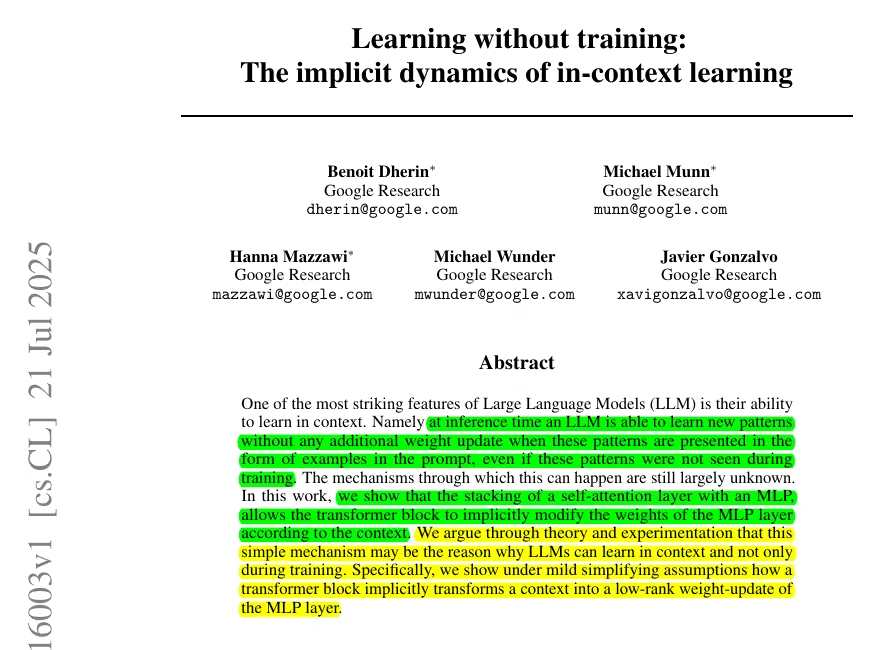
This is an old hat. That's exactly what the neural fast weight programmers did in the 1990s (including the 1991 unnormalised linear Transformer). Overview with links to the original papers: people.idsia.ch/~juergen/fast-weight-programmer-1991-tran…
Rikiya Takehi
@rikiyatakehi
We asked GPT-6 Astra to edit Qwen3.5-0.8B weights to improve math.
It directly changed only 0.016% of weights, fixing 0.8B's reasoning loops & improving math up to 6x and even instruction following 3x, without gradients or training.
We call this Weight-Space Programming: frontier LLMs can now natively read/write neural network weights! 🧵
Blog: rikiyat.github.io/blog/weight-space-programming/
Jürgen Schmidhuber
@SchmidhuberAI
See also
kache
@yacineMTB
I seriously can't believe it. There's nothing left for us!
Sauers
@Sauers_
Schmidhubered
-
Jürgen Schmidhuber reposted
Jürgen Schmidhuber
@SchmidhuberAI
In 2020, we will celebrate that many of the basic ideas behind the Deep Learning Revolution were published three decades ago within fewer than 12 months in our "Annus Mirabilis" 1990-1991: people.idsia.ch/~juergen/deep-learning-miraculous-year-19…
-
Jürgen Schmidhuber reposted
James Whittington
@jcrwhittington
Today we are happy to share one of our first open research releases: Latent Sparse Attention (LSA), a step towards subquadratic attention that matches accuracy of full attention at ultra-long context.
Sparse attention attends to only a few tokens per query, but it has to find the right ones. At 10M tokens, that search takes 98% of the attention layer's time. LSA makes sparse attention up to 22.7× faster and full attention 72.4x faster.
With @kubicek_ales @caciolai @PengLiangzu @SukritSumant @Ben_Hoov @FraserGreenlee @RMBattleday @radim_urban @thoefler @jcrwhittington -
Jürgen Schmidhuber reposted
Jürgen Schmidhuber
@SchmidhuberAI
In 2016, at an AI conference in NYC, I explained artificial consciousness, world models, predictive coding, and science as data compression in less than 10 minutes. I happened to be in town, walked in without being announced, and ended up on their panel. It was great fun.
Organizer: @davidchalmers42
Distinguished panel members:
@kahneman_daniel
Susan Schneider
@GaryMarcus
Jaan Tallin
Original YouTube video:
www.youtube.com/watch?v=X9zlvQiGsUE
29:40-39:15
Two relevant pages from the AI Blog:
1990: planning & reinforcement learning with recurrent world models and artificial curiosity. This yields a simple explanation of consciousness and self-awareness: people.idsia.ch/~juergen/world-models-planning-curiosity-…
1991: first very deep learning with self-supervised pre-training. A conscious chunker recurrent neural net (RNN) attends to unexpected events that surprise a lower-level subconscious automatiser RNN. The automatiser uses neural network distillation to compress and absorb the formerly conscious insights and behaviours of the chunker, thus making them subconscious: people.idsia.ch/~juergen/very-deep-learning-1991.html
Interview:
2016: J. Carmichael. Artificial Intelligence Gained Consciousness in 1991. Why A.I. pioneer Jürgen Schmidhuber is convinced the ultimate breakthrough already happened. Inverse, 2016. www.inverse.com/article/25521-juergen-schmidhuber-ai-cons…This media couldn't be displayed. See it on the original post. -
Jürgen Schmidhuber reposted
Jiaqi Feng
@FengLeader
Now I believe @SchmidhuberAI has invented every possible NN architecture in 1990-1992 after reading his paper.
-
Jürgen Schmidhuber reposted
Alexi Gladstone
@AlexiGlad
🚨BREAKING: openai's internal model astra 6.7 has discovered 367 post transformer architectures
(turns out the data was leaked from schmidhuber's old blogs) -
Jürgen Schmidhuber reposted
How To Prompt
@HowToPrompt__
This paper answers:
why anything is beautiful
why jokes are funny
why we get curious
why you get bored
why babies explore
why music has hooks
For centuries, we thought these were deeply mystical human traits. Soul-level mysteries that machines could never touch.
But, the paper proves that the human brain operates as a relentless compression engine. It is constantly trying to predict the world and compress it into the smallest possible file size.
Here is how it explains your entire life:
If something is completely predictable, your brain has already compressed it. There is no new data to extract. The result? You feel bored.
If something is pure randomness, your brain cannot compress it at all. The result? You feel annoyed or tune it out.
But then there is the sweet spot.
When you encounter something that seems complex, but suddenly your brain finds the hidden pattern and connects the dots... your brain releases dopamine.
That sudden, glorious rush of successful data compression? That is what you experience as "curiosity."
When a comedian tells a story that makes no sense, and the punchline suddenly makes all the pieces fit together instantly? That rapid neural compression is what you experience as "humor."
When you look at a painting and notice an underlying symmetry that ties the chaos together? That is "beauty."
Art, science, music, and jokes are not magic.
They are just highly optimized data sets designed to trigger compression progress in your neural network.
Here is the most unsettling part.
This paper wasn't written by a philosopher. It was written by an AI pioneer to figure out how to program intrinsic motivation into artificial agents.
He wasn't trying to explain humans. He was writing the blueprint for machines.
We always assumed AI could never appreciate art, laugh at a joke, or feel the spark of curiosity.
But if our deepest subjective experiences are just a mathematical reward for maximizing compression progress... -
Jürgen Schmidhuber reposted
Andersen Ang
@ang_andersen
(summoning Schmidhuber)
Jürgen Schmidhuber
@SchmidhuberAI
Fukushima's video (1986) shows a CNN that recognises handwritten digits [3], three years before LeCun's video (1989).
CNN timeline taken from [5]:
★ 1969: Kunihiko Fukushima published rectified linear units or ReLUs [1] which are now extensively used in CNNs.
★ 1979: Fukushima published the basic CNN architecture with convolution layers and downsampling layers [2]. He called it neocognitron. It was trained by unsupervised learning rules. Compute was 100 times more expensive than in 1989, and a billion times more expensive than today.
★ 1986: Fukushima's video on recognising hand-written digits [3].
★ 1988: Wei Zhang et al had the first "modern" 2-dimensional CNN trained by backpropagation, and also applied it to character recognition [4]. Compute was about 10 million times more expensive than today.
★ 1989-: later work by others [5].
REFERENCES (more in [5])
[1] K. Fukushima (1969). Visual feature extraction by a multilayered network of analog threshold elements. IEEE Transactions on Systems Science and Cybernetics. 5 (4): 322-333. This work introduced rectified linear units or ReLUs, now widely used in CNNs and other neural nets.
[2] K. Fukushima (1979). Neural network model for a mechanism of pattern recognition unaffected by shift in position—Neocognitron. Trans. IECE, vol. J62-A, no. 10, pp. 658-665, 1979. The first deep convolutional neural network architecture, with alternating convolutional layers and downsampling layers. In Japanese. English version: 1980.
[3] Movie produced by K. Fukushima, S. Miyake and T. Ito (NHK Science and Technical Research Laboratories), in 1986. YouTube: www.youtube.com/watch?v=oVYCjL54qoY
[4] W. Zhang, J. Tanida, K. Itoh, Y. Ichioka. Shift-invariant pattern recognition neural network and its optical architecture. Proc. Annual Conference of the Japan Society of Applied Physics, 1988. First "modern" backpropagation-trained 2-dimensional CNN, applied to character recognition.
[5] J. Schmidhuber (AI Blog, 2025). Who invented convolutional neural networks? x.com/SchmidhuberAI/status/1952007922721919219
Chubby♨️
@kimmonismus
Yann LeCun’s 1989 convolutional neural network demo, the foundation for the CNNs we still use today.
It's amazing how far we've come since then! -
Jürgen Schmidhuber reposted
Jürgen Schmidhuber
@SchmidhuberAI
Jürgen Schmidhuber
@SchmidhuberAI
Some still don't know: Google's 2017 normalized quadratic Transformer [TR1] is based on the principles of the 1991 unnormalized linear Transformer [ULTRA]. In 1991, KEY/VALUE was called FROM/TO. ULTRA’s computational costs scale linearly in input size, rather than quadratically! The 1993 paper on a recurrent ULTRA extension [FWP2] introduced the attention terminology: learning "internal spotlights of attention" by gradient descent. See the T in ChatGPT! Details and references: people.idsia.ch/~juergen/1991-unnormalized-linear-transfo…
-
Post not available here, view on X
Jürgen Schmidhuber
@SchmidhuberAI
Jürgen Schmidhuber
@SchmidhuberAI
Some still don't know: Google's 2017 normalized quadratic Transformer [TR1] is based on the principles of the 1991 unnormalized linear Transformer [ULTRA]. In 1991, KEY/VALUE was called FROM/TO. ULTRA’s computational costs scale linearly in input size, rather than quadratically! The 1993 paper on a recurrent ULTRA extension [FWP2] introduced the attention terminology: learning "internal spotlights of attention" by gradient descent. See the T in ChatGPT! Details and references: people.idsia.ch/~juergen/1991-unnormalized-linear-transfo…
-
Jürgen Schmidhuber reposted
Jürgen Schmidhuber
@SchmidhuberAI
My 1991 paper [1] introduced 3 techniques that have become essential for modern large language models:
★ Pre-training for deep neural nets - the P in ChatGPT
★ Positional encoding (Sec. 5.1)
★ Distilling the knowledge in a neural net (Sec. 3.2.2 & 4)
[1] Neural sequence chunkers. TR FKI-148-91, TUM, April 1991 people.idsia.ch/~juergen/FKI-148-91ocr.pdf Journal publication: Learning complex, extended sequences using the principle of history compression. Neural Computation, 4(2):234-242, 1992. See also the overview people.idsia.ch/~juergen/very-deep-learning-1991.html -
Jürgen Schmidhuber reposted
Jürgen Schmidhuber
@SchmidhuberAI
The most cited paper of the 21st century is on deep residual learning with residual connections. Who invented this? Timeline:
★ 1991: @HochreiterSepp solves vanishing gradient problem through recurrent residual connections (weight 1.0)
★ 1997 LSTM: plain recurrent residual connections (weight 1.0)
★ 1999 LSTM: gated recurrent residual connections (gates initially open: 1.0). With Felix Gers & Fred Cummins.
★ 2005: unfolding LSTM—from recurrent to feedforward residual NNs. With Alex Graves.
★ May 2015: very deep Highway Net—gated feedforward residual connections (initially 1.0). With @rupspace and Klaus Greff.
★ Dec 2015: ResNet—like an open-gated Highway Net (or an unfolded 1997 LSTM).
Details:
★ 1991: Sepp Hochreiter introduced residual connections for recurrent NNs (RNNs) in a diploma thesis (June 1991) [VAN1] supervised by Schmidhuber, at a time when compute was about 10 million times more expensive than today (2025). His recurrent residual connection was mathematically derived from first principles to overcome the fundamental deep learning problem of vanishing or exploding gradients, first identified and analyzed in the very same thesis [VAN1][DLP][DLH].
Like most good things, the recurrent residual connection is very simple: a neural unit with the identity activation function has a connection to itself, and the weight of this connection is 1.0.
That is, at every time step of information processing, this unit just adds its current input to its previous activation value. So it's just an incremental integrator. This simple setup ensures constant error flow in deep gradient-based RNNs: errors can be backpropagated [BP1-4][BPTT1-2] through such units for millions of steps without vanishing or exploding [VAN1], since according to the 1676 chain rule [LEI07-21b][L84] by Leibniz, the relevant multiplicative first derivatives (and their weights) are always 1.0.
Note that previous self-connections with real-valued weights other than 1.0 [MOZ] are not residual connections. Only 1.0 weights neutralize the vanishing/exploding gradient problem [VAN1]. However, almost residual connections with weights close to 1.0 are still acceptable in many applications. For example, a weight of 0.99 reduces an error signal backpropagated for 100 time steps (or virtual layers [BPTT1-2]) by an acceptable factor of 0.99100 ~ 37%. A weight of 0.9, however, yields only 0.9100 ~ 0.0027%.
Note that the additive weight changes of the earlier unnormalized linear Transformer (March 1991) [FWP0][ULTRA][FWP] represent a dual way of overcoming the vanishing gradient problem [FWP].
★ 1997 LSTM: plain recurrent residual connections (weight 1.0)
Recurrent residual connections (see above) are a defining feature of what was called Long Short-Term Memory (LSTM) in a 1995 tech report [LSTM0]. The subsequent LSTM journal paper (1997) [LSTM1] has become the most cited AI paper of the 20th century [MOST]. The LSTM core units with residual connections (weight 1.0) were called constant error carrousels (CECs) [LSTM1]. They are the very reason why LSTM can deal with very long time lags (hundreds or thousands of time steps) between inputs and target outputs. This became essential for processing speech and language [DL4][DLH].
★ 1999 LSTM: gated recurrent residual connections (gates initially open: 1.0)
Sometimes it is useful to let an NN modulate its residual connections through adaptive multiplicative gates, such that it can learn to reset itself. This was done in the 1999 LSTM variant [LSTM2,2a] that has become known as the vanilla LSTM. Its so-called forget gates were initialised by 1.0, such that they were open, to let the LSTM start out with plain residual connections (weight 1.0).
Over time, the 1999 LSTM could learn when to close those gates, thus temporarily shutting down the constant error flow, e.g., to focus on new tasks. This reintroduces the vanishing gradient problem [VAN1], but in a controlled way. This work was conducted by Schmidhuber's PhD student Felix Gers and his postdoc Fred Cummins.
★ 2005: unfolding LSTM - from recurrent to feedforward residual NNs
The backpropagation through time (BPTT) algorithm [BPTT1-2][BP1-4] unfolds the sequence-processing LSTM such that it becomes a deep feedforward NN (FNN) with a virtual layer for every time step of the observed input sequence. Until 2004, the gradients of LSTM's constant error carrousels (CECs) were often computed by a forward method called RTRL, instead of the more storage-consuming BPTT [BPTT2][RTRL24] (back then, computational hardware was 10,000 times more expensive and much more limited than today).
In 2005, however, Schmidhuber's PhD student Alex Graves started focusing on BPTT [LSTM3]. Here the recurrent residual connections in the CECs become feedforward residual connections (weight 1.0) in a deep residual FNN, typically many times deeper than the unfolded FNNs of previous gradient-based RNNs, thus making LSTM many times deeper than previous RNNs. That's why LSTM can deal with much longer time lags (hundreds or thousands of time steps) between relevant observations [DL4].
In the unfolded RNN, the resulting FNN weights are shared across time, but this makes no difference whatsoever for the residual connections: the weights of all residual connections in all RNNs and FNNs are tied to 1.0 anyway. Otherwise they wouldn't be residual connections. Whether or not the weights are shared between layers, gradients must still be propagated through many layers; hence the core role of residual connections is identical in both unfolded residual RNNs and residual FNNs (see below).
In RNNs, each time step/virtual layer allows for a new input and a new error signal/loss, unlike in standard FNNs. This is not an issue here. For example, in some of the original experiments designed to show LSTM’s superiority (1995-1997) [LSTM0-1], there is a sequence classification loss only at the very end of each input sequence, and the error really has to travel all the way back to the first input, which is the one that makes all the difference. Again, the residual parts of the unfolded residual RNN and residual FNNs (see below) are essentially the same.
★ May 2015: deep Highway Net - gated feedforward residual connections
While supervised LSTM RNNs had become very deep in the 1990s through residual connections, backpropagation-based FNNs had remained rather shallow until 2014: they had at most 20-30 layers or so, despite massive help through fast GPU-based hardware [MLP1-3][DAN,DAN1][GPUCNN1-9].
Since depth is essential for deep learning, the principles of deep LSTM RNNs were transferred to deep FNNs. In May 2015, the resulting Highway Networks [HW1][HW1a] (later called "gated ResNets") were the first working really deep gradient-based FNNs with hundreds of layers, over ten times deeper than previous FNNs. They worked because they adapted the 1999 LSTM principle of gated residual connections [LSTM2] from RNNs to FNNs. This work was conducted by Schmidhuber's PhD students Rupesh Kumar Srivastava and Klaus Greff.
Let g, t, h, denote non-linear differentiable functions of real values. Each non-input layer of a Highway NN computes g(x)x + t(x)h(x), where x is the data from the previous layer.
The crucial residual part is the g(x)x part: the gates g(x) are typically initialised to 1.0 (like the forget gates of the 1999 LSTM above), to obtain plain residual connections (weight 1.0) which allow for very deep error propagation like in LSTM's unfolded CECs - this is what makes Highway NNs so deep.
So the initialised Highway NN starts out with very deep error propagation paths like the later ResNet (see below). However, depending on the application, it can learn to temporarily remove the residual property of some of its residual connections in a context-dependent way, provided this improves performance. (To reduce the number of learnable parameters, the oldest Highway Net paper [HW1] actually focused on the special case g(x) = 1 - t(x) where t(x) was initialized close to 0 such that during the forward pass each layer essentially just copied its input, resulting in backpropagated error derivatives very close to 1.0 - a common practice in today's deep NNs.)
★ Dec 2015: ResNet - like open-gated Highway Net (or unfolded 1997 LSTM)
Setting the Highway NN gates of May 2015 [HW1][HW1a] to 1.0 at all times (not just in the initial phase of training) effectively gives us the plain Residual Net or ResNet published 7 months later [HW2]. This open-gated variant of the Highway Net [HW1] is essentially a feedforward variant of the 1997 LSTM [VAN1][LSTM1], while the earlier Highway Net is essentially a gated ResNet and a feedforward variant of the 1999 LSTM [LSTM2]. (The term "residual" was apparently adopted from signal processing and control theory.)
Recall that the gates of the residual connections in Highway Nets are typically initialised to be open anyway, like in the 1999 LSTM. The network's training process can then decide to keep the gates open, or selectively close them if this improves performance. That is, the residual part of the Highway Net is initialized to be like the residual part of the later ResNet. That's what makes it so deep.
ResNets made a splash when they won the ImageNet 2015 competition [IM15]. Highway Nets perform roughly as well as ResNets on ImageNet [HW3].
The residual parts of a ResNet look essentially like those of an unfolded 1997 LSTM (or of an initialised, open-gated 1999 LSTM).
The ResNet paper [HW2] calls the Highway Net [HW1] "concurrent," but it wasn't: the ResNet was published 7 months later. The ResNet paper mentions the problem of vanishing/exploding gradients, but fails to mention that Sepp Hochreiter first identified it in 1991 and derived the solution: residual connections [VAN1]. The ResNet paper cites the earlier Highway Net in a way that does not make clear that ResNets are essentially open-gated Highway Nets, and that the gates of residual connections in Highway Nets are initially open anyway, such that Highway Nets start out with standard residual connections like ResNets. A follow-up paper by the ResNet authors suffered from design flaws leading to incorrect conclusions about gated residual connections [HW25b].
Note again that a residual connection is not just an arbitrary shortcut connection or skip connection (e.g., 1988) [LA88][SEG1-3] from one layer to another! No, its weight must be 1.0, like in the 1997 LSTM, or in the 1999 initialized LSTM, or the initialized Highway Net, or the ResNet. If the weight had some other arbitrary real value far from 1.0, then the vanishing/exploding gradient problem [VAN1] would raise its ugly head, unless it was under control by an initially open gate that learns when to keep or temporarily remove the connection's residual property, like in the 1999 initialized LSTM, or the initialized Highway Net.
Highway NNs showed how very deep FNNs can be trained by gradient descent. This is now also relevant for Transformers [ULTRA][TR1] and other NNs. In 2021, the US Patent Office granted a patent for Highway Nets (= gated ResNets) to our AI company NNAISENSE.
As I have often pointed out: deep learning is all about NN depth [DL1][DLH][MIR]. LSTMs brought essentially unlimited depth to supervised RNNs; Highway NNs brought it to FNNs. Remarkably, LSTM has become the most cited NN of the 20th century; the open-gated Highway Net variant called ResNet the most cited NN of the 21st [MOST]. The basic LSTM principle of constant error flow through residual connections is central not only to deep RNNs but also to deep FNNs. And it all dates back to 1991 [MIR].
REFERENCES
All references in: J. Schmidhuber. Who invented deep residual learning? Technical Report IDSIA-09-25, IDSIA, September 2025.
people.idsia.ch/~juergen/who-invented-residual-neural-net… -
Jürgen Schmidhuber reposted
Jürgen Schmidhuber
@SchmidhuberAI
Kimi-founder Yang Zhilin quoting @ilyasut:
"an LSTM is a ResNet rotated 90 degrees"
www.youtube.com/watch?v=5CkCW1P-g88&t=1869s
Thanks to @ivokwee for pointing this out! 😊 -
Jürgen Schmidhuber reposted
Jürgen Schmidhuber
@SchmidhuberAI
The most cited paper of the 21st century is on deep residual learning with residual connections. Who invented this? Timeline:
★ 1991: @HochreiterSepp solves vanishing gradient problem through recurrent residual connections (weight 1.0)
★ 1997 LSTM: plain recurrent residual connections (weight 1.0)
★ 1999 LSTM: gated recurrent residual connections (gates initially open: 1.0). With Felix Gers & Fred Cummins.
★ 2005: unfolding LSTM—from recurrent to feedforward residual NNs. With Alex Graves.
★ May 2015: very deep Highway Net—gated feedforward residual connections (initially 1.0). With @rupspace and Klaus Greff.
★ Dec 2015: ResNet—like an open-gated Highway Net (or an unfolded 1997 LSTM).
Details:
★ 1991: Sepp Hochreiter introduced residual connections for recurrent NNs (RNNs) in a diploma thesis (June 1991) [VAN1] supervised by Schmidhuber, at a time when compute was about 10 million times more expensive than today (2025). His recurrent residual connection was mathematically derived from first principles to overcome the fundamental deep learning problem of vanishing or exploding gradients, first identified and analyzed in the very same thesis [VAN1][DLP][DLH].
Like most good things, the recurrent residual connection is very simple: a neural unit with the identity activation function has a connection to itself, and the weight of this connection is 1.0.
That is, at every time step of information processing, this unit just adds its current input to its previous activation value. So it's just an incremental integrator. This simple setup ensures constant error flow in deep gradient-based RNNs: errors can be backpropagated [BP1-4][BPTT1-2] through such units for millions of steps without vanishing or exploding [VAN1], since according to the 1676 chain rule [LEI07-21b][L84] by Leibniz, the relevant multiplicative first derivatives (and their weights) are always 1.0.
Note that previous self-connections with real-valued weights other than 1.0 [MOZ] are not residual connections. Only 1.0 weights neutralize the vanishing/exploding gradient problem [VAN1]. However, almost residual connections with weights close to 1.0 are still acceptable in many applications. For example, a weight of 0.99 reduces an error signal backpropagated for 100 time steps (or virtual layers [BPTT1-2]) by an acceptable factor of 0.99100 ~ 37%. A weight of 0.9, however, yields only 0.9100 ~ 0.0027%.
Note that the additive weight changes of the earlier unnormalized linear Transformer (March 1991) [FWP0][ULTRA][FWP] represent a dual way of overcoming the vanishing gradient problem [FWP].
★ 1997 LSTM: plain recurrent residual connections (weight 1.0)
Recurrent residual connections (see above) are a defining feature of what was called Long Short-Term Memory (LSTM) in a 1995 tech report [LSTM0]. The subsequent LSTM journal paper (1997) [LSTM1] has become the most cited AI paper of the 20th century [MOST]. The LSTM core units with residual connections (weight 1.0) were called constant error carrousels (CECs) [LSTM1]. They are the very reason why LSTM can deal with very long time lags (hundreds or thousands of time steps) between inputs and target outputs. This became essential for processing speech and language [DL4][DLH].
★ 1999 LSTM: gated recurrent residual connections (gates initially open: 1.0)
Sometimes it is useful to let an NN modulate its residual connections through adaptive multiplicative gates, such that it can learn to reset itself. This was done in the 1999 LSTM variant [LSTM2,2a] that has become known as the vanilla LSTM. Its so-called forget gates were initialised by 1.0, such that they were open, to let the LSTM start out with plain residual connections (weight 1.0).
Over time, the 1999 LSTM could learn when to close those gates, thus temporarily shutting down the constant error flow, e.g., to focus on new tasks. This reintroduces the vanishing gradient problem [VAN1], but in a controlled way. This work was conducted by Schmidhuber's PhD student Felix Gers and his postdoc Fred Cummins.
★ 2005: unfolding LSTM - from recurrent to feedforward residual NNs
The backpropagation through time (BPTT) algorithm [BPTT1-2][BP1-4] unfolds the sequence-processing LSTM such that it becomes a deep feedforward NN (FNN) with a virtual layer for every time step of the observed input sequence. Until 2004, the gradients of LSTM's constant error carrousels (CECs) were often computed by a forward method called RTRL, instead of the more storage-consuming BPTT [BPTT2][RTRL24] (back then, computational hardware was 10,000 times more expensive and much more limited than today).
In 2005, however, Schmidhuber's PhD student Alex Graves started focusing on BPTT [LSTM3]. Here the recurrent residual connections in the CECs become feedforward residual connections (weight 1.0) in a deep residual FNN, typically many times deeper than the unfolded FNNs of previous gradient-based RNNs, thus making LSTM many times deeper than previous RNNs. That's why LSTM can deal with much longer time lags (hundreds or thousands of time steps) between relevant observations [DL4].
In the unfolded RNN, the resulting FNN weights are shared across time, but this makes no difference whatsoever for the residual connections: the weights of all residual connections in all RNNs and FNNs are tied to 1.0 anyway. Otherwise they wouldn't be residual connections. Whether or not the weights are shared between layers, gradients must still be propagated through many layers; hence the core role of residual connections is identical in both unfolded residual RNNs and residual FNNs (see below).
In RNNs, each time step/virtual layer allows for a new input and a new error signal/loss, unlike in standard FNNs. This is not an issue here. For example, in some of the original experiments designed to show LSTM’s superiority (1995-1997) [LSTM0-1], there is a sequence classification loss only at the very end of each input sequence, and the error really has to travel all the way back to the first input, which is the one that makes all the difference. Again, the residual parts of the unfolded residual RNN and residual FNNs (see below) are essentially the same.
★ May 2015: deep Highway Net - gated feedforward residual connections
While supervised LSTM RNNs had become very deep in the 1990s through residual connections, backpropagation-based FNNs had remained rather shallow until 2014: they had at most 20-30 layers or so, despite massive help through fast GPU-based hardware [MLP1-3][DAN,DAN1][GPUCNN1-9].
Since depth is essential for deep learning, the principles of deep LSTM RNNs were transferred to deep FNNs. In May 2015, the resulting Highway Networks [HW1][HW1a] (later called "gated ResNets") were the first working really deep gradient-based FNNs with hundreds of layers, over ten times deeper than previous FNNs. They worked because they adapted the 1999 LSTM principle of gated residual connections [LSTM2] from RNNs to FNNs. This work was conducted by Schmidhuber's PhD students Rupesh Kumar Srivastava and Klaus Greff.
Let g, t, h, denote non-linear differentiable functions of real values. Each non-input layer of a Highway NN computes g(x)x + t(x)h(x), where x is the data from the previous layer.
The crucial residual part is the g(x)x part: the gates g(x) are typically initialised to 1.0 (like the forget gates of the 1999 LSTM above), to obtain plain residual connections (weight 1.0) which allow for very deep error propagation like in LSTM's unfolded CECs - this is what makes Highway NNs so deep.
So the initialised Highway NN starts out with very deep error propagation paths like the later ResNet (see below). However, depending on the application, it can learn to temporarily remove the residual property of some of its residual connections in a context-dependent way, provided this improves performance. (To reduce the number of learnable parameters, the oldest Highway Net paper [HW1] actually focused on the special case g(x) = 1 - t(x) where t(x) was initialized close to 0 such that during the forward pass each layer essentially just copied its input, resulting in backpropagated error derivatives very close to 1.0 - a common practice in today's deep NNs.)
★ Dec 2015: ResNet - like open-gated Highway Net (or unfolded 1997 LSTM)
Setting the Highway NN gates of May 2015 [HW1][HW1a] to 1.0 at all times (not just in the initial phase of training) effectively gives us the plain Residual Net or ResNet published 7 months later [HW2]. This open-gated variant of the Highway Net [HW1] is essentially a feedforward variant of the 1997 LSTM [VAN1][LSTM1], while the earlier Highway Net is essentially a gated ResNet and a feedforward variant of the 1999 LSTM [LSTM2]. (The term "residual" was apparently adopted from signal processing and control theory.)
Recall that the gates of the residual connections in Highway Nets are typically initialised to be open anyway, like in the 1999 LSTM. The network's training process can then decide to keep the gates open, or selectively close them if this improves performance. That is, the residual part of the Highway Net is initialized to be like the residual part of the later ResNet. That's what makes it so deep.
ResNets made a splash when they won the ImageNet 2015 competition [IM15]. Highway Nets perform roughly as well as ResNets on ImageNet [HW3].
The residual parts of a ResNet look essentially like those of an unfolded 1997 LSTM (or of an initialised, open-gated 1999 LSTM).
The ResNet paper [HW2] calls the Highway Net [HW1] "concurrent," but it wasn't: the ResNet was published 7 months later. The ResNet paper mentions the problem of vanishing/exploding gradients, but fails to mention that Sepp Hochreiter first identified it in 1991 and derived the solution: residual connections [VAN1]. The ResNet paper cites the earlier Highway Net in a way that does not make clear that ResNets are essentially open-gated Highway Nets, and that the gates of residual connections in Highway Nets are initially open anyway, such that Highway Nets start out with standard residual connections like ResNets. A follow-up paper by the ResNet authors suffered from design flaws leading to incorrect conclusions about gated residual connections [HW25b].
Note again that a residual connection is not just an arbitrary shortcut connection or skip connection (e.g., 1988) [LA88][SEG1-3] from one layer to another! No, its weight must be 1.0, like in the 1997 LSTM, or in the 1999 initialized LSTM, or the initialized Highway Net, or the ResNet. If the weight had some other arbitrary real value far from 1.0, then the vanishing/exploding gradient problem [VAN1] would raise its ugly head, unless it was under control by an initially open gate that learns when to keep or temporarily remove the connection's residual property, like in the 1999 initialized LSTM, or the initialized Highway Net.
Highway NNs showed how very deep FNNs can be trained by gradient descent. This is now also relevant for Transformers [ULTRA][TR1] and other NNs. In 2021, the US Patent Office granted a patent for Highway Nets (= gated ResNets) to our AI company NNAISENSE.
As I have often pointed out: deep learning is all about NN depth [DL1][DLH][MIR]. LSTMs brought essentially unlimited depth to supervised RNNs; Highway NNs brought it to FNNs. Remarkably, LSTM has become the most cited NN of the 20th century; the open-gated Highway Net variant called ResNet the most cited NN of the 21st [MOST]. The basic LSTM principle of constant error flow through residual connections is central not only to deep RNNs but also to deep FNNs. And it all dates back to 1991 [MIR].
REFERENCES
All references in: J. Schmidhuber. Who invented deep residual learning? Technical Report IDSIA-09-25, IDSIA, September 2025.
people.idsia.ch/~juergen/who-invented-residual-neural-net… -
Jürgen Schmidhuber
@SchmidhuberAI
The most cited paper of the 21st century is on deep residual learning with residual connections. Who invented this? Timeline:
★ 1991: @HochreiterSepp solves vanishing gradient problem through recurrent residual connections (weight 1.0)
★ 1997 LSTM: plain recurrent residual connections (weight 1.0)
★ 1999 LSTM: gated recurrent residual connections (gates initially open: 1.0). With Felix Gers & Fred Cummins.
★ 2005: unfolding LSTM—from recurrent to feedforward residual NNs. With Alex Graves.
★ May 2015: very deep Highway Net—gated feedforward residual connections (initially 1.0). With @rupspace and Klaus Greff.
★ Dec 2015: ResNet—like an open-gated Highway Net (or an unfolded 1997 LSTM).
Details:
★ 1991: Sepp Hochreiter introduced residual connections for recurrent NNs (RNNs) in a diploma thesis (June 1991) [VAN1] supervised by Schmidhuber, at a time when compute was about 10 million times more expensive than today (2025). His recurrent residual connection was mathematically derived from first principles to overcome the fundamental deep learning problem of vanishing or exploding gradients, first identified and analyzed in the very same thesis [VAN1][DLP][DLH].
Like most good things, the recurrent residual connection is very simple: a neural unit with the identity activation function has a connection to itself, and the weight of this connection is 1.0.
That is, at every time step of information processing, this unit just adds its current input to its previous activation value. So it's just an incremental integrator. This simple setup ensures constant error flow in deep gradient-based RNNs: errors can be backpropagated [BP1-4][BPTT1-2] through such units for millions of steps without vanishing or exploding [VAN1], since according to the 1676 chain rule [LEI07-21b][L84] by Leibniz, the relevant multiplicative first derivatives (and their weights) are always 1.0.
Note that previous self-connections with real-valued weights other than 1.0 [MOZ] are not residual connections. Only 1.0 weights neutralize the vanishing/exploding gradient problem [VAN1]. However, almost residual connections with weights close to 1.0 are still acceptable in many applications. For example, a weight of 0.99 reduces an error signal backpropagated for 100 time steps (or virtual layers [BPTT1-2]) by an acceptable factor of 0.99100 ~ 37%. A weight of 0.9, however, yields only 0.9100 ~ 0.0027%.
Note that the additive weight changes of the earlier unnormalized linear Transformer (March 1991) [FWP0][ULTRA][FWP] represent a dual way of overcoming the vanishing gradient problem [FWP].
★ 1997 LSTM: plain recurrent residual connections (weight 1.0)
Recurrent residual connections (see above) are a defining feature of what was called Long Short-Term Memory (LSTM) in a 1995 tech report [LSTM0]. The subsequent LSTM journal paper (1997) [LSTM1] has become the most cited AI paper of the 20th century [MOST]. The LSTM core units with residual connections (weight 1.0) were called constant error carrousels (CECs) [LSTM1]. They are the very reason why LSTM can deal with very long time lags (hundreds or thousands of time steps) between inputs and target outputs. This became essential for processing speech and language [DL4][DLH].
★ 1999 LSTM: gated recurrent residual connections (gates initially open: 1.0)
Sometimes it is useful to let an NN modulate its residual connections through adaptive multiplicative gates, such that it can learn to reset itself. This was done in the 1999 LSTM variant [LSTM2,2a] that has become known as the vanilla LSTM. Its so-called forget gates were initialised by 1.0, such that they were open, to let the LSTM start out with plain residual connections (weight 1.0).
Over time, the 1999 LSTM could learn when to close those gates, thus temporarily shutting down the constant error flow, e.g., to focus on new tasks. This reintroduces the vanishing gradient problem [VAN1], but in a controlled way. This work was conducted by Schmidhuber's PhD student Felix Gers and his postdoc Fred Cummins.
★ 2005: unfolding LSTM - from recurrent to feedforward residual NNs
The backpropagation through time (BPTT) algorithm [BPTT1-2][BP1-4] unfolds the sequence-processing LSTM such that it becomes a deep feedforward NN (FNN) with a virtual layer for every time step of the observed input sequence. Until 2004, the gradients of LSTM's constant error carrousels (CECs) were often computed by a forward method called RTRL, instead of the more storage-consuming BPTT [BPTT2][RTRL24] (back then, computational hardware was 10,000 times more expensive and much more limited than today).
In 2005, however, Schmidhuber's PhD student Alex Graves started focusing on BPTT [LSTM3]. Here the recurrent residual connections in the CECs become feedforward residual connections (weight 1.0) in a deep residual FNN, typically many times deeper than the unfolded FNNs of previous gradient-based RNNs, thus making LSTM many times deeper than previous RNNs. That's why LSTM can deal with much longer time lags (hundreds or thousands of time steps) between relevant observations [DL4].
In the unfolded RNN, the resulting FNN weights are shared across time, but this makes no difference whatsoever for the residual connections: the weights of all residual connections in all RNNs and FNNs are tied to 1.0 anyway. Otherwise they wouldn't be residual connections. Whether or not the weights are shared between layers, gradients must still be propagated through many layers; hence the core role of residual connections is identical in both unfolded residual RNNs and residual FNNs (see below).
In RNNs, each time step/virtual layer allows for a new input and a new error signal/loss, unlike in standard FNNs. This is not an issue here. For example, in some of the original experiments designed to show LSTM’s superiority (1995-1997) [LSTM0-1], there is a sequence classification loss only at the very end of each input sequence, and the error really has to travel all the way back to the first input, which is the one that makes all the difference. Again, the residual parts of the unfolded residual RNN and residual FNNs (see below) are essentially the same.
★ May 2015: deep Highway Net - gated feedforward residual connections
While supervised LSTM RNNs had become very deep in the 1990s through residual connections, backpropagation-based FNNs had remained rather shallow until 2014: they had at most 20-30 layers or so, despite massive help through fast GPU-based hardware [MLP1-3][DAN,DAN1][GPUCNN1-9].
Since depth is essential for deep learning, the principles of deep LSTM RNNs were transferred to deep FNNs. In May 2015, the resulting Highway Networks [HW1][HW1a] (later called "gated ResNets") were the first working really deep gradient-based FNNs with hundreds of layers, over ten times deeper than previous FNNs. They worked because they adapted the 1999 LSTM principle of gated residual connections [LSTM2] from RNNs to FNNs. This work was conducted by Schmidhuber's PhD students Rupesh Kumar Srivastava and Klaus Greff.
Let g, t, h, denote non-linear differentiable functions of real values. Each non-input layer of a Highway NN computes g(x)x + t(x)h(x), where x is the data from the previous layer.
The crucial residual part is the g(x)x part: the gates g(x) are typically initialised to 1.0 (like the forget gates of the 1999 LSTM above), to obtain plain residual connections (weight 1.0) which allow for very deep error propagation like in LSTM's unfolded CECs - this is what makes Highway NNs so deep.
So the initialised Highway NN starts out with very deep error propagation paths like the later ResNet (see below). However, depending on the application, it can learn to temporarily remove the residual property of some of its residual connections in a context-dependent way, provided this improves performance. (To reduce the number of learnable parameters, the oldest Highway Net paper [HW1] actually focused on the special case g(x) = 1 - t(x) where t(x) was initialized close to 0 such that during the forward pass each layer essentially just copied its input, resulting in backpropagated error derivatives very close to 1.0 - a common practice in today's deep NNs.)
★ Dec 2015: ResNet - like open-gated Highway Net (or unfolded 1997 LSTM)
Setting the Highway NN gates of May 2015 [HW1][HW1a] to 1.0 at all times (not just in the initial phase of training) effectively gives us the plain Residual Net or ResNet published 7 months later [HW2]. This open-gated variant of the Highway Net [HW1] is essentially a feedforward variant of the 1997 LSTM [VAN1][LSTM1], while the earlier Highway Net is essentially a gated ResNet and a feedforward variant of the 1999 LSTM [LSTM2]. (The term "residual" was apparently adopted from signal processing and control theory.)
Recall that the gates of the residual connections in Highway Nets are typically initialised to be open anyway, like in the 1999 LSTM. The network's training process can then decide to keep the gates open, or selectively close them if this improves performance. That is, the residual part of the Highway Net is initialized to be like the residual part of the later ResNet. That's what makes it so deep.
ResNets made a splash when they won the ImageNet 2015 competition [IM15]. Highway Nets perform roughly as well as ResNets on ImageNet [HW3].
The residual parts of a ResNet look essentially like those of an unfolded 1997 LSTM (or of an initialised, open-gated 1999 LSTM).
The ResNet paper [HW2] calls the Highway Net [HW1] "concurrent," but it wasn't: the ResNet was published 7 months later. The ResNet paper mentions the problem of vanishing/exploding gradients, but fails to mention that Sepp Hochreiter first identified it in 1991 and derived the solution: residual connections [VAN1]. The ResNet paper cites the earlier Highway Net in a way that does not make clear that ResNets are essentially open-gated Highway Nets, and that the gates of residual connections in Highway Nets are initially open anyway, such that Highway Nets start out with standard residual connections like ResNets. A follow-up paper by the ResNet authors suffered from design flaws leading to incorrect conclusions about gated residual connections [HW25b].
Note again that a residual connection is not just an arbitrary shortcut connection or skip connection (e.g., 1988) [LA88][SEG1-3] from one layer to another! No, its weight must be 1.0, like in the 1997 LSTM, or in the 1999 initialized LSTM, or the initialized Highway Net, or the ResNet. If the weight had some other arbitrary real value far from 1.0, then the vanishing/exploding gradient problem [VAN1] would raise its ugly head, unless it was under control by an initially open gate that learns when to keep or temporarily remove the connection's residual property, like in the 1999 initialized LSTM, or the initialized Highway Net.
Highway NNs showed how very deep FNNs can be trained by gradient descent. This is now also relevant for Transformers [ULTRA][TR1] and other NNs. In 2021, the US Patent Office granted a patent for Highway Nets (= gated ResNets) to our AI company NNAISENSE.
As I have often pointed out: deep learning is all about NN depth [DL1][DLH][MIR]. LSTMs brought essentially unlimited depth to supervised RNNs; Highway NNs brought it to FNNs. Remarkably, LSTM has become the most cited NN of the 20th century; the open-gated Highway Net variant called ResNet the most cited NN of the 21st [MOST]. The basic LSTM principle of constant error flow through residual connections is central not only to deep RNNs but also to deep FNNs. And it all dates back to 1991 [MIR].
REFERENCES
All references in: J. Schmidhuber. Who invented deep residual learning? Technical Report IDSIA-09-25, IDSIA, September 2025.
people.idsia.ch/~juergen/who-invented-residual-neural-net…
Jürgen Schmidhuber
@SchmidhuberAI
Andrew Zhao
@_AndrewZhao
paper of the day
Jürgen Schmidhuber
@SchmidhuberAI
Correcting typo in 6th paragraph: ... a weight of 0.99 reduces an error signal backpropagated for 100 time steps (or virtual layers) by an acceptable factor of 0.99^100 ~ 37%. A weight of 0.9, however, yields only 0.9^100 ~ 0.0027%.
Jürgen Schmidhuber
@SchmidhuberAI
Kimi-founder Yang Zhilin quoting @ilyasut:
"an LSTM is a ResNet rotated 90 degrees"
www.youtube.com/watch?v=5CkCW1P-g88&t=1869s
Thanks to @ivokwee for pointing this out! 😊Post not available here, view on X
Jürgen Schmidhuber
@SchmidhuberAI
Andrew Zhao
@_AndrewZhao
paper of the day
-
Jürgen Schmidhuber reposted
Jürgen Schmidhuber
@SchmidhuberAI
Andrew Zhao
@_AndrewZhao
paper of the day
-
Jürgen Schmidhuber reposted
Jürgen Schmidhuber
@SchmidhuberAI
The most cited paper of the 21st century is on deep residual learning with residual connections. Who invented this? Timeline:
★ 1991: @HochreiterSepp solves vanishing gradient problem through recurrent residual connections (weight 1.0)
★ 1997 LSTM: plain recurrent residual connections (weight 1.0)
★ 1999 LSTM: gated recurrent residual connections (gates initially open: 1.0). With Felix Gers & Fred Cummins.
★ 2005: unfolding LSTM—from recurrent to feedforward residual NNs. With Alex Graves.
★ May 2015: very deep Highway Net—gated feedforward residual connections (initially 1.0). With @rupspace and Klaus Greff.
★ Dec 2015: ResNet—like an open-gated Highway Net (or an unfolded 1997 LSTM).
Details:
★ 1991: Sepp Hochreiter introduced residual connections for recurrent NNs (RNNs) in a diploma thesis (June 1991) [VAN1] supervised by Schmidhuber, at a time when compute was about 10 million times more expensive than today (2025). His recurrent residual connection was mathematically derived from first principles to overcome the fundamental deep learning problem of vanishing or exploding gradients, first identified and analyzed in the very same thesis [VAN1][DLP][DLH].
Like most good things, the recurrent residual connection is very simple: a neural unit with the identity activation function has a connection to itself, and the weight of this connection is 1.0.
That is, at every time step of information processing, this unit just adds its current input to its previous activation value. So it's just an incremental integrator. This simple setup ensures constant error flow in deep gradient-based RNNs: errors can be backpropagated [BP1-4][BPTT1-2] through such units for millions of steps without vanishing or exploding [VAN1], since according to the 1676 chain rule [LEI07-21b][L84] by Leibniz, the relevant multiplicative first derivatives (and their weights) are always 1.0.
Note that previous self-connections with real-valued weights other than 1.0 [MOZ] are not residual connections. Only 1.0 weights neutralize the vanishing/exploding gradient problem [VAN1]. However, almost residual connections with weights close to 1.0 are still acceptable in many applications. For example, a weight of 0.99 reduces an error signal backpropagated for 100 time steps (or virtual layers [BPTT1-2]) by an acceptable factor of 0.99100 ~ 37%. A weight of 0.9, however, yields only 0.9100 ~ 0.0027%.
Note that the additive weight changes of the earlier unnormalized linear Transformer (March 1991) [FWP0][ULTRA][FWP] represent a dual way of overcoming the vanishing gradient problem [FWP].
★ 1997 LSTM: plain recurrent residual connections (weight 1.0)
Recurrent residual connections (see above) are a defining feature of what was called Long Short-Term Memory (LSTM) in a 1995 tech report [LSTM0]. The subsequent LSTM journal paper (1997) [LSTM1] has become the most cited AI paper of the 20th century [MOST]. The LSTM core units with residual connections (weight 1.0) were called constant error carrousels (CECs) [LSTM1]. They are the very reason why LSTM can deal with very long time lags (hundreds or thousands of time steps) between inputs and target outputs. This became essential for processing speech and language [DL4][DLH].
★ 1999 LSTM: gated recurrent residual connections (gates initially open: 1.0)
Sometimes it is useful to let an NN modulate its residual connections through adaptive multiplicative gates, such that it can learn to reset itself. This was done in the 1999 LSTM variant [LSTM2,2a] that has become known as the vanilla LSTM. Its so-called forget gates were initialised by 1.0, such that they were open, to let the LSTM start out with plain residual connections (weight 1.0).
Over time, the 1999 LSTM could learn when to close those gates, thus temporarily shutting down the constant error flow, e.g., to focus on new tasks. This reintroduces the vanishing gradient problem [VAN1], but in a controlled way. This work was conducted by Schmidhuber's PhD student Felix Gers and his postdoc Fred Cummins.
★ 2005: unfolding LSTM - from recurrent to feedforward residual NNs
The backpropagation through time (BPTT) algorithm [BPTT1-2][BP1-4] unfolds the sequence-processing LSTM such that it becomes a deep feedforward NN (FNN) with a virtual layer for every time step of the observed input sequence. Until 2004, the gradients of LSTM's constant error carrousels (CECs) were often computed by a forward method called RTRL, instead of the more storage-consuming BPTT [BPTT2][RTRL24] (back then, computational hardware was 10,000 times more expensive and much more limited than today).
In 2005, however, Schmidhuber's PhD student Alex Graves started focusing on BPTT [LSTM3]. Here the recurrent residual connections in the CECs become feedforward residual connections (weight 1.0) in a deep residual FNN, typically many times deeper than the unfolded FNNs of previous gradient-based RNNs, thus making LSTM many times deeper than previous RNNs. That's why LSTM can deal with much longer time lags (hundreds or thousands of time steps) between relevant observations [DL4].
In the unfolded RNN, the resulting FNN weights are shared across time, but this makes no difference whatsoever for the residual connections: the weights of all residual connections in all RNNs and FNNs are tied to 1.0 anyway. Otherwise they wouldn't be residual connections. Whether or not the weights are shared between layers, gradients must still be propagated through many layers; hence the core role of residual connections is identical in both unfolded residual RNNs and residual FNNs (see below).
In RNNs, each time step/virtual layer allows for a new input and a new error signal/loss, unlike in standard FNNs. This is not an issue here. For example, in some of the original experiments designed to show LSTM’s superiority (1995-1997) [LSTM0-1], there is a sequence classification loss only at the very end of each input sequence, and the error really has to travel all the way back to the first input, which is the one that makes all the difference. Again, the residual parts of the unfolded residual RNN and residual FNNs (see below) are essentially the same.
★ May 2015: deep Highway Net - gated feedforward residual connections
While supervised LSTM RNNs had become very deep in the 1990s through residual connections, backpropagation-based FNNs had remained rather shallow until 2014: they had at most 20-30 layers or so, despite massive help through fast GPU-based hardware [MLP1-3][DAN,DAN1][GPUCNN1-9].
Since depth is essential for deep learning, the principles of deep LSTM RNNs were transferred to deep FNNs. In May 2015, the resulting Highway Networks [HW1][HW1a] (later called "gated ResNets") were the first working really deep gradient-based FNNs with hundreds of layers, over ten times deeper than previous FNNs. They worked because they adapted the 1999 LSTM principle of gated residual connections [LSTM2] from RNNs to FNNs. This work was conducted by Schmidhuber's PhD students Rupesh Kumar Srivastava and Klaus Greff.
Let g, t, h, denote non-linear differentiable functions of real values. Each non-input layer of a Highway NN computes g(x)x + t(x)h(x), where x is the data from the previous layer.
The crucial residual part is the g(x)x part: the gates g(x) are typically initialised to 1.0 (like the forget gates of the 1999 LSTM above), to obtain plain residual connections (weight 1.0) which allow for very deep error propagation like in LSTM's unfolded CECs - this is what makes Highway NNs so deep.
So the initialised Highway NN starts out with very deep error propagation paths like the later ResNet (see below). However, depending on the application, it can learn to temporarily remove the residual property of some of its residual connections in a context-dependent way, provided this improves performance. (To reduce the number of learnable parameters, the oldest Highway Net paper [HW1] actually focused on the special case g(x) = 1 - t(x) where t(x) was initialized close to 0 such that during the forward pass each layer essentially just copied its input, resulting in backpropagated error derivatives very close to 1.0 - a common practice in today's deep NNs.)
★ Dec 2015: ResNet - like open-gated Highway Net (or unfolded 1997 LSTM)
Setting the Highway NN gates of May 2015 [HW1][HW1a] to 1.0 at all times (not just in the initial phase of training) effectively gives us the plain Residual Net or ResNet published 7 months later [HW2]. This open-gated variant of the Highway Net [HW1] is essentially a feedforward variant of the 1997 LSTM [VAN1][LSTM1], while the earlier Highway Net is essentially a gated ResNet and a feedforward variant of the 1999 LSTM [LSTM2]. (The term "residual" was apparently adopted from signal processing and control theory.)
Recall that the gates of the residual connections in Highway Nets are typically initialised to be open anyway, like in the 1999 LSTM. The network's training process can then decide to keep the gates open, or selectively close them if this improves performance. That is, the residual part of the Highway Net is initialized to be like the residual part of the later ResNet. That's what makes it so deep.
ResNets made a splash when they won the ImageNet 2015 competition [IM15]. Highway Nets perform roughly as well as ResNets on ImageNet [HW3].
The residual parts of a ResNet look essentially like those of an unfolded 1997 LSTM (or of an initialised, open-gated 1999 LSTM).
The ResNet paper [HW2] calls the Highway Net [HW1] "concurrent," but it wasn't: the ResNet was published 7 months later. The ResNet paper mentions the problem of vanishing/exploding gradients, but fails to mention that Sepp Hochreiter first identified it in 1991 and derived the solution: residual connections [VAN1]. The ResNet paper cites the earlier Highway Net in a way that does not make clear that ResNets are essentially open-gated Highway Nets, and that the gates of residual connections in Highway Nets are initially open anyway, such that Highway Nets start out with standard residual connections like ResNets. A follow-up paper by the ResNet authors suffered from design flaws leading to incorrect conclusions about gated residual connections [HW25b].
Note again that a residual connection is not just an arbitrary shortcut connection or skip connection (e.g., 1988) [LA88][SEG1-3] from one layer to another! No, its weight must be 1.0, like in the 1997 LSTM, or in the 1999 initialized LSTM, or the initialized Highway Net, or the ResNet. If the weight had some other arbitrary real value far from 1.0, then the vanishing/exploding gradient problem [VAN1] would raise its ugly head, unless it was under control by an initially open gate that learns when to keep or temporarily remove the connection's residual property, like in the 1999 initialized LSTM, or the initialized Highway Net.
Highway NNs showed how very deep FNNs can be trained by gradient descent. This is now also relevant for Transformers [ULTRA][TR1] and other NNs. In 2021, the US Patent Office granted a patent for Highway Nets (= gated ResNets) to our AI company NNAISENSE.
As I have often pointed out: deep learning is all about NN depth [DL1][DLH][MIR]. LSTMs brought essentially unlimited depth to supervised RNNs; Highway NNs brought it to FNNs. Remarkably, LSTM has become the most cited NN of the 20th century; the open-gated Highway Net variant called ResNet the most cited NN of the 21st [MOST]. The basic LSTM principle of constant error flow through residual connections is central not only to deep RNNs but also to deep FNNs. And it all dates back to 1991 [MIR].
REFERENCES
All references in: J. Schmidhuber. Who invented deep residual learning? Technical Report IDSIA-09-25, IDSIA, September 2025.
people.idsia.ch/~juergen/who-invented-residual-neural-net… -
Jürgen Schmidhuber reposted
Jürgen Schmidhuber
@SchmidhuberAI
AI will beat all fields of science by 2028? Hardly.
As I have often pointed out, the only AI that works well today is AI in the virtual world behind the screen, for example for automatically summarizing documents, playing chess, proving theorems, creating images, programs and PowerPoint slides. But there is no AI-controlled robot that can do what a plumber can do, or what a capuchin monkey can do, because the physical world is much more demanding than the world behind the screen. Passing the Turing Test is much easier than True AI or Real AI in the physical world. Hence the Turing Test is not a good way of measuring intelligence. To achieve True AI, AI software research per se is not enough, it has to be combined with the physical world of machines and robots. No AGI without mastery of the real world [1]!
Much of science is about learning to interact with the real world. Our fragile AI-driven robots are really bad at that. Sure, as I have predicted for 5 decades, at some point we'll have superhuman physical AI. But it will take longer than 2 years.
REFERENCE
[1] Sec. 20 of the "Annotated History of Modern AI and Deep Learning" (2022-2025) arXiv:2212.11279 -
Jürgen Schmidhuber reposted
Jürgen Schmidhuber
@SchmidhuberAI
It has already aged well because that's excatly what I said in 2014 when we founded our first company on physical AI
Jürgen Schmidhuber
@SchmidhuberAI
LeCun’s new company on physical AI with world models [9] looks a lot like our 2014 company on physical AI with world models [1] 😀 See also [2-8] - all references in the reply!
-
Jürgen Schmidhuber
@SchmidhuberAI
AI will beat all fields of science by 2028? Hardly.
As I have often pointed out, the only AI that works well today is AI in the virtual world behind the screen, for example for automatically summarizing documents, playing chess, proving theorems, creating images, programs and PowerPoint slides. But there is no AI-controlled robot that can do what a plumber can do, or what a capuchin monkey can do, because the physical world is much more demanding than the world behind the screen. Passing the Turing Test is much easier than True AI or Real AI in the physical world. Hence the Turing Test is not a good way of measuring intelligence. To achieve True AI, AI software research per se is not enough, it has to be combined with the physical world of machines and robots. No AGI without mastery of the real world [1]!
Much of science is about learning to interact with the real world. Our fragile AI-driven robots are really bad at that. Sure, as I have predicted for 5 decades, at some point we'll have superhuman physical AI. But it will take longer than 2 years.
REFERENCE
[1] Sec. 20 of the "Annotated History of Modern AI and Deep Learning" (2022-2025) arXiv:2212.11279
Jürgen Schmidhuber
@SchmidhuberAI
Many of the comments are about nonlinear time lines. See the 2014 mother of all nonlinear time lines in Sec. 20 of [1], starting with the Big Bang, converging soon: people.idsia.ch/~juergen/deep-learning-history.html
Post not available here, view on X
Jürgen Schmidhuber
@SchmidhuberAI
It has already aged well because that's excatly what I said in 2014 when we founded our first company on physical AI
Jürgen Schmidhuber
@SchmidhuberAI
LeCun’s new company on physical AI with world models [9] looks a lot like our 2014 company on physical AI with world models [1] 😀 See also [2-8] - all references in the reply!
-
Jürgen Schmidhuber reposted
Jürgen Schmidhuber
@SchmidhuberAI
AI will beat all fields of science by 2028? Hardly.
As I have often pointed out, the only AI that works well today is AI in the virtual world behind the screen, for example for automatically summarizing documents, playing chess, proving theorems, creating images, programs and PowerPoint slides. But there is no AI-controlled robot that can do what a plumber can do, or what a capuchin monkey can do, because the physical world is much more demanding than the world behind the screen. Passing the Turing Test is much easier than True AI or Real AI in the physical world. Hence the Turing Test is not a good way of measuring intelligence. To achieve True AI, AI software research per se is not enough, it has to be combined with the physical world of machines and robots. No AGI without mastery of the real world [1]!
Much of science is about learning to interact with the real world. Our fragile AI-driven robots are really bad at that. Sure, as I have predicted for 5 decades, at some point we'll have superhuman physical AI. But it will take longer than 2 years.
REFERENCE
[1] Sec. 20 of the "Annotated History of Modern AI and Deep Learning" (2022-2025) arXiv:2212.11279 -
Jürgen Schmidhuber reposted
Jürgen Schmidhuber
@SchmidhuberAI
Certain companies train their AIs to plagiarise work by unnamed scholars, extending an AI history permeated by plagiarism and misattributions. It started a long time ago. In the 1900s, the old method of least squares (Gauss & Legendre, 1795-1805) was renamed "neural network," without citation of the original. In the 1950s, cybernetics was renamed “AI" by people who did not want to credit earlier AI pioneers such as Wiener. In the 2000s, AI techniques of the 1960s (Ivakhnenko & Lapa 1965, Amari 1967) were renamed “deep learning” without correct attribution. I could point out many additional cases. Some of the plagiarists even got awards. In the best interests of the field, and scientific honesty in general, it is time to stop this.
Alas, in the end, the facts must always win. As long as the facts have not yet won, it's not yet the end. As Elvis put it, "Truth is like the sun. You can shut it out for a time, but it ain't goin' away.”
More tweets and reports on this:
x.com/SchmidhuberAI/status/1865310820856393929
x.com/SchmidhuberAI/status/1735313711240253567
x.com/SchmidhuberAI/status/1606333832956973060
NIK
@ns123abc
>sam altman: "we tried this because there were rumor on the internet"
>rumor: math professor close to solving navier-stokes
>the professor: using codex for a year
>openai: has all his logs
>checked every codex session tagged to N-S
>found the most promising one
>spun up 10,000 agents to finish the proof where he couldn't
>they got caught
>told the guy if you say anything you'll destroy your own career
>he ruins his career over this
>openai: "we did not see his work"
>also openai: "we cannot rule out that de-identified data from their usage helped improve our models"
they stole it lmao -
Jürgen Schmidhuber reposted
Mingchen Zhuge
@MingchenZhuge
🐐 The same idea @SchmidhuberAI shared about “super intelligence” on Reddit 12 years ago, You’ll see what a lovely guy he is:
"I guess there is no lasting way of controlling systems much smarter than humans, pursuing their own goals, being curious and creative, in a way similar to the way humans and other mammals are creative, but on a much grander scale.
But I think we may hope there won't be too many goal conflicts between "us" and "them.” Let me elaborate on this.
Humans and others are interested in those they can compete and collaborate with. Politicians are interested in other politicians. Business people are interested in other business people. Scientists are interested in other scientists. Kids are interested in other kids of the same age. Goats are interested in other goats.
Supersmart AIs will be mostly interested in other supersmart AIs, not in humans. Just like humans are mostly interested in other humans, not in ants. Aren't we much smarter than ants? But we don’t extinguish them, except for the few that invade our homes. The weight of all ants is still comparable to the weight of all humans.
Human interests are mainly limited to a very thin film of biosphere around the third planet, full of poisonous oxygen that makes many robots rust. The rest of the solar system, however, is not made for humans, but for appropriately designed robots. Some of the most important explorers of the 20th century already were (rather stupid) robotic spacecraft. And they are getting smarter rapidly. Let’s go crazy. Imagine an advanced robot civilization in the asteroid belt, quite different from ours in the biosphere, with access to many more resources (e.g., the earth gets less than a billionth of the sun's light). The belt contains lots of material for innumerable self-replicating robot factories. Robot minds or parts thereof will travel in the most elegant and fastest way (namely by radio from senders to receivers) across the solar system and beyond. There are incredible new opportunities for robots and software life in places hostile to biological beings. Why should advanced robots care much for our puny territory on the surface of planet number 3?
You see, I am an optimist :-)"
Haider.
@haider1
Computer Scientist Jürgen Schmidhuber (@SchmidhuberAI):
"there's no way of controlling this AI development — at some point in the not-so-distant future, humans cannot be in charge any longer"
The main competitors of these super-smart AIs won't be humans, but other super-smart AIsThis media couldn't be displayed. See it on the original post. -
Jürgen Schmidhuber
@SchmidhuberAI
Our embodied AI draws on memory. It recalls lived experiences, which contain depths of meaning that enable the AI to model the world, to plan, to minimize expected pain & maximize expected reward, and connect more deeply with the goodness of these people.idsia.ch/~juergen/world-models-planning-curiosity-…
Pope Leo XIV
@Pontifex
Intelligence must draw on memory. The mind must not simply compile data — as an algorithm now does more quickly than we can — but recall lived experiences, which contain depths of meaning that only the human soul can recognize, and connect more deeply with the goodness of these experiences. Everything that is good begins “with the Spirit” and thus possesses a breath, a dynamism and a sense of communion that, once experienced, are engraved upon the heart. www.vatican.va/content/leo-xiv/en/homilies/2026/documents…
-
Jürgen Schmidhuber reposted
Haider.
@haider1
Computer Scientist Jürgen Schmidhuber (@SchmidhuberAI):
"there's no way of controlling this AI development — at some point in the not-so-distant future, humans cannot be in charge any longer"
The main competitors of these super-smart AIs won't be humans, but other super-smart AIsThis media couldn't be displayed. See it on the original post. -
Jürgen Schmidhuber reposted
Jürgen Schmidhuber
@SchmidhuberAI
Certain companies train their AIs to plagiarise work by unnamed scholars, extending an AI history permeated by plagiarism and misattributions. It started a long time ago. In the 1900s, the old method of least squares (Gauss & Legendre, 1795-1805) was renamed "neural network," without citation of the original. In the 1950s, cybernetics was renamed “AI" by people who did not want to credit earlier AI pioneers such as Wiener. In the 2000s, AI techniques of the 1960s (Ivakhnenko & Lapa 1965, Amari 1967) were renamed “deep learning” without correct attribution. I could point out many additional cases. Some of the plagiarists even got awards. In the best interests of the field, and scientific honesty in general, it is time to stop this.
Alas, in the end, the facts must always win. As long as the facts have not yet won, it's not yet the end. As Elvis put it, "Truth is like the sun. You can shut it out for a time, but it ain't goin' away.”
More tweets and reports on this:
x.com/SchmidhuberAI/status/1865310820856393929
x.com/SchmidhuberAI/status/1735313711240253567
x.com/SchmidhuberAI/status/1606333832956973060
NIK
@ns123abc
>sam altman: "we tried this because there were rumor on the internet"
>rumor: math professor close to solving navier-stokes
>the professor: using codex for a year
>openai: has all his logs
>checked every codex session tagged to N-S
>found the most promising one
>spun up 10,000 agents to finish the proof where he couldn't
>they got caught
>told the guy if you say anything you'll destroy your own career
>he ruins his career over this
>openai: "we did not see his work"
>also openai: "we cannot rule out that de-identified data from their usage helped improve our models"
they stole it lmao -
Jürgen Schmidhuber reposted
Jürgen Schmidhuber
@SchmidhuberAI
Dr. LeCun's heavily promoted Joint Embedding Predictive Architecture (JEPA, 2022) [5] is the heart of his new company. However, the core ideas are not original to LeCun. Instead, JEPA is essentially identical to our 1992 Predictability Maximization system (PMAX) [1][14].
Details in reference [19] which contains many additional references.
Motivation of PMAX [1][14]. Since details of inputs are often unpredictable from related inputs, two non-generative artificial neural networks interact as follows: one net tries to create a non-trivial, informative, latent representation of its own input that is predictable from the latent representation of the other net’s input.
PMAX [1][14] is actually a whole family of methods. Consider the simplest instance in Sec. 2.2 of [1]: an auto encoder net sees an input and represents it in its hidden units (its latent space). The other net sees a different but related input and learns to predict (from its own latent space) the auto encoder's latent representation, which in turn tries to become more predictable, without giving up too much information about its own input, to prevent what's now called “collapse." See illustration 5.2 in Sec. 5.5 of [14] on the "extraction of predictable concepts."
The 1992 PMAX paper [1] discusses not only auto encoders but also other techniques for encoding data. The experiments were conducted by my student Daniel Prelinger. The non-generative PMAX outperformed the generative IMAX [2] on a stereo vision task.
The 2020 BYOL [10] is also closely related to PMAX. In 2026, @misovalko, leader of the BYOL team, praised PMAX, and listed numerous similarities to much later work [19].
Note that the self-created “predictable classifications” in the title of [1] (and the so-called “outputs” of the entire system [1]) are typically INTERNAL "distributed representations” (like in the title of Sec. 4.2 of [1]).
The 1992 PMAX paper [1] considers both symmetric and asymmetric nets. In the symmetric case, both nets are constrained to emit "equal (and therefore mutually predictable)" representations [1]. Sec. 4.2 on “finding predictable distributed representations” has an experiment with 2 weight-sharing auto encoders which learn to represent in their latent space what their inputs have in common (see the cover image of this post).
Of course, back then compute was was a million times more expensive, but the fundamental insights of "JEPA" were present, and LeCun has simply repackaged old ideas without citing them [5,6,19].
This is hardly the first time LeCun (or others writing about him) have exaggerated LeCun's own significance by downplaying earlier work. He did NOT "co-invent deep learning" (as some know-nothing "AI influencers" have claimed) [11,13], and he did NOT invent convolutional neural nets (CNNs) [12,6,13], NOR was he even the first to combine CNNs with backpropagation [12,13]. While he got awards for the inventions of other researchers whom he did not cite [6], he did not invent ANY of the key algorithms that underpin modern AI [5,6,19].
LeCun's recent pitch: 1. LLMs such as ChatGPT are insufficient for AGI (which has been obvious to experts in AI & decision making, and is something he once derided @GaryMarcus for pointing out [17]). 2. Neural AIs need what I baptized a neural "world model" in 1990 [8][15] (earlier, less general neural nets of this kind, such as those by Paul Werbos (1987) and others [8], weren't called "world models," although the basic concept itself is ancient [8]). 3. The world model should learn to predict (in non-generative "JEPA" fashion [5]) higher-level predictable abstractions instead of raw pixels: that's the essence of our 1992 PMAX [1][14].
Astonishingly, PMAX or "JEPA" seems to be the unique selling proposition of LeCun's 2026 company on world model-based AI in the physical world, which is apparently based on what we published over 3 decades ago [1,5,6,7,8,13,14], and modeled after our 2014 company on world model-based AGI in the physical world [8].
In short, little if anything in JEPA is new [19]. But then the fact that LeCun would repackage old ideas and present them as his own clearly isn't new either [5,6,18,19].
FOOTNOTES
1. Note that PMAX is NOT the 1991 adversarial Predictability MINimization (PMIN) [3,4]. However, PMAX may use PMIN as a submodule to create informative latent representations [1](Sec. 2.4), and to prevent what's now called “collapse." See the illustration on page 9 of [1].
2. Note that the 1991 PMIN [3] also predicts parts of latent space from other parts. However, PMIN's goal is to REMOVE mutual predictability, to obtain maximally disentangled latent representations called factorial codes. PMIN by itself may use the auto encoder principle in addition to its latent space predictor [3].
3. Neither PMAX nor PMIN was my first non-generative method for predicting latent space, which was published in 1991 in the context of neural net distillation [9]. See also [5-8].
4. While the cognoscenti agree that LLMs are insufficient for AGI, JEPA is so, too. We should know: we have had it for over 3 decades under the name PMAX! Additional techniques are required to achieve AGI, e.g., meta learning, artificial curiosity and creativity, efficient planning with world models, and others [16].
REFERENCES (easy to find on the web):
[1] J. Schmidhuber (JS) & D. Prelinger (1993). Discovering predictable classifications. Neural Computation, 5(4):625-635. Based on TR CU-CS-626-92 (1992): people.idsia.ch/~juergen/predmax1992.pdf
[2] S. Becker, G. E. Hinton (1989). Spatial coherence as an internal teacher for a neural network. TR CRG-TR-89-7, Dept. of CS, U. Toronto.
[3] JS (1992). Learning factorial codes by predictability minimization. Neural Computation, 4(6):863-879. Based on TR CU-CS-565-91, 1991.
[4] JS, M. Eldracher, B. Foltin (1996). Semilinear predictability minimization produces well-known feature detectors. Neural Computation, 8(4):773-786.
[5] JS (2022-23). LeCun's 2022 paper on autonomous machine intelligence rehashes but does not cite essential work of 1990-2015.
[6] JS (2023-25). How 3 Turing awardees republished key methods and ideas whose creators they failed to credit. Technical Report IDSIA-23-23.
[7] JS (2026). Simple but powerful ways of using world models and their latent space. Opening keynote for the World Modeling Workshop, 4-6 Feb, 2026, Mila - Quebec AI Institute.
[8] JS (2026). The Neural World Model Boom. Technical Note IDSIA-2-26.
[9] JS (1991). Neural sequence chunkers. TR FKI-148-91, TUM, April 1991. (See also Technical Note IDSIA-12-25: who invented knowledge distillation with artificial neural networks?)
[10] J. Grill et al (2020). Bootstrap your own latent: A "new" approach to self-supervised Learning. arXiv:2006.07733
[11] JS (2025). Who invented deep learning? Technical Note IDSIA-16-25.
[12] JS (2025). Who invented convolutional neural networks? Technical Note IDSIA-17-25.
[13] JS (2022-25). Annotated History of Modern AI and Deep Learning. Technical Report IDSIA-22-22, arXiv:2212.11279
[14] JS (1993). Network architectures, objective functions, and chain rule. Habilitation Thesis, TUM. See Sec. 5.5 on "Vorhersagbarkeitsmaximierung" (Predictability Maximization).
[15] JS (1990). Making the world differentiable: On using fully recurrent self-supervised neural networks for dynamic reinforcement learning and planning in non-stationary environments. Technical Report FKI-126-90, TUM.
[16] JS (1990-2026). AI Blog.
[17] @GaryMarcus. Open letter responding to @ylecun. A memo for future intellectual historians. Substack, June 2024.
[18] G. Marcus. The False Glorification of @ylecun. Don’t believe everything you read. Substack, Nov 2025.
[19] J. Schmidhuber. Who invented JEPA? Technical Note IDSIA-3-22, IDSIA, Switzerland, March 2026. people.idsia.ch/~juergen/who-invented-jepa.html -
Jürgen Schmidhuber
@SchmidhuberAI
Who invented convolutional neural networks (CNNs)?
1969: Fukushima had CNN-relevant ReLUs [2].
1979: Fukushima had the basic CNN architecture with convolution layers and downsampling layers [1]. Compute was 100 x more costly than in 1989, and a billion x more costly than today.
1987: Waibel applied Linnainmaa's 1970 backpropagation [3] to weight-sharing TDNNs with 1-dimensional convolutions [4].
1988: Wei Zhang et al. applied "modern" backprop-trained 2-dimensional CNNs to character recognition [5].
All of the above was published in Japan 1979-1988.
1989: LeCun et al. applied CNNs again to character recognition (zip codes) [6,10].
1990-93: Fukushima’s downsampling based on spatial averaging [1] was replaced by max-pooling for 1-D TDNNs (Yamaguchi et al.) [7] and 2-D CNNs (Weng et al.) [8].
2011: Much later, my team with Dan Ciresan made max-pooling CNNs really fast on NVIDIA GPUs. In 2011, DanNet achieved the first superhuman pattern recognition result [9]. For a while, it enjoyed a monopoly: from May 2011 to Sept 2012, DanNet won every image recognition challenge it entered, 4 of them in a row. Admittedly, however, this was mostly about engineering & scaling up the basic insights from the previous millennium, profiting from much faster hardware.
Some "AI experts" claim that "making CNNs work" (e.g., [5,6,9]) was as important as inventing them. But "making them work" largely depended on whether your lab was rich enough to buy the latest computers required to scale up the original work. It's the same as today. Basic research vs engineering/development - the R vs the D in R&D.
REFERENCES
[1] K. Fukushima (1979). Neural network model for a mechanism of pattern recognition unaffected by shift in position — Neocognitron. Trans. IECE, vol. J62-A, no. 10, pp. 658-665, 1979.
[2] K. Fukushima (1969). Visual feature extraction by a multilayered network of analog threshold elements. IEEE Transactions on Systems Science and Cybernetics. 5 (4): 322-333. This work introduced rectified linear units (ReLUs), now used in many CNNs.
[3] S. Linnainmaa (1970). Master's Thesis, Univ. Helsinki, 1970. The first publication on "modern" backpropagation, also known as the reverse mode of automatic differentiation. (See Schmidhuber's well-known backpropagation overview: "Who Invented Backpropagation?")
[4] A. Waibel. Phoneme Recognition Using Time-Delay Neural Networks. Meeting of IEICE, Tokyo, Japan, 1987. Backpropagation for a weight-sharing TDNN with 1-dimensional convolutions.
[5] W. Zhang, J. Tanida, K. Itoh, Y. Ichioka. Shift-invariant pattern recognition neural network and its optical architecture. Proc. Annual Conference of the Japan Society of Applied Physics, 1988. First backpropagation-trained 2-dimensional CNN, with applications to English character recognition.
[6] Y. LeCun, B. Boser, J. S. Denker, D. Henderson, R. E. Howard, W. Hubbard, L. D. Jackel: Backpropagation Applied to Handwritten Zip Code Recognition, Neural Computation, 1(4):541-551, 1989. See also Sec. 3 of [10].
[7] K. Yamaguchi, K. Sakamoto, A. Kenji, T. Akabane, Y. Fujimoto. A Neural Network for Speaker-Independent Isolated Word Recognition. First International Conference on Spoken Language Processing (ICSLP 90), Kobe, Japan, Nov 1990. A 1-dimensional convolutional TDNN using Max-Pooling instead of Fukushima's Spatial Averaging [1].
[8] Weng, J., Ahuja, N., and Huang, T. S. (1993). Learning recognition and segmentation of 3-D objects from 2-D images. Proc. 4th Intl. Conf. Computer Vision, Berlin, pp. 121-128. A 2-dimensional CNN whose downsampling layers use Max-Pooling (which has become very popular) instead of Fukushima's Spatial Averaging [1].
[9] In 2011, the fast and deep GPU-based CNN called DanNet (7+ layers) achieved the first superhuman performance in a computer vision contest. See overview: "2011: DanNet triggers deep CNN revolution."
[10] How 3 Turing awardees republished key methods and ideas whose creators they failed to credit. Technical Report IDSIA-23-23, Swiss AI Lab IDSIA, 14 Dec 2023. See also the YouTube video for the Bower Award Ceremony 2021: J. Schmidhuber lauds Kunihiko Fukushima.
Jürgen Schmidhuber
@SchmidhuberAI
More on CNN history: people.idsia.ch/~juergen/who-invented-convolutional-neura… Why did "modern" CNNs emerge in Japan 1979-1988 (Fukushima's 1979 CNN architecture → Zhang et al.'s 1988 backpropagation-trained CNN)? Let's look back at the 1980s. Back then, Japan was the envy of the world. Before the 1990 crash, the Tokyo stock market was the world's largest, and the world's 6 most valuable public companies were all Japanese. So were the world's richest business men. According to the real estate market, tiny Japan was 4 times more valuable than the much bigger US. The central square mile of Tokyo had the value of California. Japan had far more robots than any other country, and by far the most expensive AI project: the 5th Generation Project. Interestingly, this project had little to do with neural networks; it was mostly about logic programming and expert systems. So Fukushima and colleagues were outsiders back then. But at least there was sufficient funding in Japan, even for such unpopular types of blue skies research. Today, the rest of the world can be thankful for that. See also www.youtube.com/watch?v=ysOw6lNWx2o
Jürgen Schmidhuber
@SchmidhuberAI
Who invented CNNs? Hint: it wasn't LeCun. Who first combined CNNs with backpropagation? Hint: it wasn't LeCun. Who first applied backprop-CNNs to character recognition in 1988? Hint: it wasn't LeCun.
Jürgen Schmidhuber
@SchmidhuberAI
My own experience with @ylecun is consistent with @GaryMarcus’s critique from yesterday: see the popular items 1-4 below (with receipts).
1. Who invented convolutional neural networks (CNNs)? Hint: it wasn't LeCun. Who first combined CNNs with backpropagation? Hint: it wasn't LeCun. Who first applied backprop-CNNs to character recognition in 1988? Hint: it wasn't LeCun.
x.com/SchmidhuberAI/status/1952007922721919219
2. LeCun's "5 best ideas 2012-22” are mostly from my lab, and older:
x.com/SchmidhuberAI/status/1594964463727570945
Related: who invented deep residual learning?
x.com/SchmidhuberAI/status/1972300268550369631
Related: who invented Transformer neural networks?
x.com/SchmidhuberAI/status/1987550761916457218
3. LeCun’s 2022 paper … rehashes but doesn’t cite essential work of 1990-2015:
x.com/SchmidhuberAI/status/1544939700099710976
4. How 3 Turing awardees republished key methods and ideas whose creators they failed to credit:
x.com/SchmidhuberAI/status/1735313711240253567
Jürgen Schmidhuber
@SchmidhuberAI
2026 update: video on 1st backprop-trained CNN for vision (1988) x.com/SchmidhuberAI/status/2087902009038938586 by Wei Zhang et al
Jürgen Schmidhuber
@SchmidhuberAI
The first modern backprop-trained CNN for vision was published in 1988 in Japan by Wei Zhang (a Chinese researcher), J. Tanida, K. Itoh, Y. Ichioka. Wei brought it to Silicon Valley, earning 1998 FDA PMA approval for radiology’s 1st AI, reading 10M+ mammograms/yr in the US.
This media couldn't be displayed. See it on the original post.
Jürgen Schmidhuber
@SchmidhuberAI
See also:
Jürgen Schmidhuber
@SchmidhuberAI
Fukushima's video (1986) shows a CNN that recognises handwritten digits [3], three years before LeCun's video (1989).
CNN timeline taken from [5]:
★ 1969: Kunihiko Fukushima published rectified linear units or ReLUs [1] which are now extensively used in CNNs.
★ 1979: Fukushima published the basic CNN architecture with convolution layers and downsampling layers [2]. He called it neocognitron. It was trained by unsupervised learning rules. Compute was 100 times more expensive than in 1989, and a billion times more expensive than today.
★ 1986: Fukushima's video on recognising hand-written digits [3].
★ 1988: Wei Zhang et al had the first "modern" 2-dimensional CNN trained by backpropagation, and also applied it to character recognition [4]. Compute was about 10 million times more expensive than today.
★ 1989-: later work by others [5].
REFERENCES (more in [5])
[1] K. Fukushima (1969). Visual feature extraction by a multilayered network of analog threshold elements. IEEE Transactions on Systems Science and Cybernetics. 5 (4): 322-333. This work introduced rectified linear units or ReLUs, now widely used in CNNs and other neural nets.
[2] K. Fukushima (1979). Neural network model for a mechanism of pattern recognition unaffected by shift in position—Neocognitron. Trans. IECE, vol. J62-A, no. 10, pp. 658-665, 1979. The first deep convolutional neural network architecture, with alternating convolutional layers and downsampling layers. In Japanese. English version: 1980.
[3] Movie produced by K. Fukushima, S. Miyake and T. Ito (NHK Science and Technical Research Laboratories), in 1986. YouTube: www.youtube.com/watch?v=oVYCjL54qoY
[4] W. Zhang, J. Tanida, K. Itoh, Y. Ichioka. Shift-invariant pattern recognition neural network and its optical architecture. Proc. Annual Conference of the Japan Society of Applied Physics, 1988. First "modern" backpropagation-trained 2-dimensional CNN, applied to character recognition.
[5] J. Schmidhuber (AI Blog, 2025). Who invented convolutional neural networks? x.com/SchmidhuberAI/status/1952007922721919219
Chubby♨️
@kimmonismus
Yann LeCun’s 1989 convolutional neural network demo, the foundation for the CNNs we still use today.
It's amazing how far we've come since then! -
Jürgen Schmidhuber reposted
Jürgen Schmidhuber
@SchmidhuberAI
Who invented convolutional neural networks (CNNs)?
1969: Fukushima had CNN-relevant ReLUs [2].
1979: Fukushima had the basic CNN architecture with convolution layers and downsampling layers [1]. Compute was 100 x more costly than in 1989, and a billion x more costly than today.
1987: Waibel applied Linnainmaa's 1970 backpropagation [3] to weight-sharing TDNNs with 1-dimensional convolutions [4].
1988: Wei Zhang et al. applied "modern" backprop-trained 2-dimensional CNNs to character recognition [5].
All of the above was published in Japan 1979-1988.
1989: LeCun et al. applied CNNs again to character recognition (zip codes) [6,10].
1990-93: Fukushima’s downsampling based on spatial averaging [1] was replaced by max-pooling for 1-D TDNNs (Yamaguchi et al.) [7] and 2-D CNNs (Weng et al.) [8].
2011: Much later, my team with Dan Ciresan made max-pooling CNNs really fast on NVIDIA GPUs. In 2011, DanNet achieved the first superhuman pattern recognition result [9]. For a while, it enjoyed a monopoly: from May 2011 to Sept 2012, DanNet won every image recognition challenge it entered, 4 of them in a row. Admittedly, however, this was mostly about engineering & scaling up the basic insights from the previous millennium, profiting from much faster hardware.
Some "AI experts" claim that "making CNNs work" (e.g., [5,6,9]) was as important as inventing them. But "making them work" largely depended on whether your lab was rich enough to buy the latest computers required to scale up the original work. It's the same as today. Basic research vs engineering/development - the R vs the D in R&D.
REFERENCES
[1] K. Fukushima (1979). Neural network model for a mechanism of pattern recognition unaffected by shift in position — Neocognitron. Trans. IECE, vol. J62-A, no. 10, pp. 658-665, 1979.
[2] K. Fukushima (1969). Visual feature extraction by a multilayered network of analog threshold elements. IEEE Transactions on Systems Science and Cybernetics. 5 (4): 322-333. This work introduced rectified linear units (ReLUs), now used in many CNNs.
[3] S. Linnainmaa (1970). Master's Thesis, Univ. Helsinki, 1970. The first publication on "modern" backpropagation, also known as the reverse mode of automatic differentiation. (See Schmidhuber's well-known backpropagation overview: "Who Invented Backpropagation?")
[4] A. Waibel. Phoneme Recognition Using Time-Delay Neural Networks. Meeting of IEICE, Tokyo, Japan, 1987. Backpropagation for a weight-sharing TDNN with 1-dimensional convolutions.
[5] W. Zhang, J. Tanida, K. Itoh, Y. Ichioka. Shift-invariant pattern recognition neural network and its optical architecture. Proc. Annual Conference of the Japan Society of Applied Physics, 1988. First backpropagation-trained 2-dimensional CNN, with applications to English character recognition.
[6] Y. LeCun, B. Boser, J. S. Denker, D. Henderson, R. E. Howard, W. Hubbard, L. D. Jackel: Backpropagation Applied to Handwritten Zip Code Recognition, Neural Computation, 1(4):541-551, 1989. See also Sec. 3 of [10].
[7] K. Yamaguchi, K. Sakamoto, A. Kenji, T. Akabane, Y. Fujimoto. A Neural Network for Speaker-Independent Isolated Word Recognition. First International Conference on Spoken Language Processing (ICSLP 90), Kobe, Japan, Nov 1990. A 1-dimensional convolutional TDNN using Max-Pooling instead of Fukushima's Spatial Averaging [1].
[8] Weng, J., Ahuja, N., and Huang, T. S. (1993). Learning recognition and segmentation of 3-D objects from 2-D images. Proc. 4th Intl. Conf. Computer Vision, Berlin, pp. 121-128. A 2-dimensional CNN whose downsampling layers use Max-Pooling (which has become very popular) instead of Fukushima's Spatial Averaging [1].
[9] In 2011, the fast and deep GPU-based CNN called DanNet (7+ layers) achieved the first superhuman performance in a computer vision contest. See overview: "2011: DanNet triggers deep CNN revolution."
[10] How 3 Turing awardees republished key methods and ideas whose creators they failed to credit. Technical Report IDSIA-23-23, Swiss AI Lab IDSIA, 14 Dec 2023. See also the YouTube video for the Bower Award Ceremony 2021: J. Schmidhuber lauds Kunihiko Fukushima. -
Jürgen Schmidhuber
@SchmidhuberAI
My 1991 paper [1] introduced 3 techniques that have become essential for modern large language models:
★ Pre-training for deep neural nets - the P in ChatGPT
★ Positional encoding (Sec. 5.1)
★ Distilling the knowledge in a neural net (Sec. 3.2.2 & 4)
[1] Neural sequence chunkers. TR FKI-148-91, TUM, April 1991 people.idsia.ch/~juergen/FKI-148-91ocr.pdf Journal publication: Learning complex, extended sequences using the principle of history compression. Neural Computation, 4(2):234-242, 1992. See also the overview people.idsia.ch/~juergen/very-deep-learning-1991.html -
Jürgen Schmidhuber reposted
hardmaru
@hardmaru
Recently learned that Schmidhuber’s Formal Theory of Fun and Creativity, covering compression progress and intrinsic motivation and their relationship to beauty, curiosity, art, science, music, and jokes, was published in a Japanese scientific journal in 2009.
www.jstage.jst.go.jp/article/sicejl/48/1/48_21/_article
It is wild that this framework: compression progress as the basis for beauty, curiosity, art, science, and even jokes, was laid out in full formal detail in a Japanese journal 15 years ago.
hardmaru
@hardmaru
Jürgen Schmidhuber proposed a Formal Theory of Fun and Creativity in the 1990s.🤔 people.idsia.ch/~juergen/creativity.html
-
Jürgen Schmidhuber reposted
kache
@yacineMTB
I seriously can't believe it. There's nothing left for us!
Sauers
@Sauers_
Schmidhubered
-
Jürgen Schmidhuber
@SchmidhuberAI
Some still don't know: Google's 2017 normalized quadratic Transformer [TR1] is based on the principles of the 1991 unnormalized linear Transformer [ULTRA]. In 1991, KEY/VALUE was called FROM/TO. ULTRA’s computational costs scale linearly in input size, rather than quadratically! The 1993 paper on a recurrent ULTRA extension [FWP2] introduced the attention terminology: learning "internal spotlights of attention" by gradient descent. See the T in ChatGPT! Details and references: people.idsia.ch/~juergen/1991-unnormalized-linear-transfo…
Jürgen Schmidhuber
@SchmidhuberAI
PS: everybody is talking about test time training (TTT). Of course, the 1991 Unnormalized Linear Transformer ULTRA did TTT.
Jürgen Schmidhuber
@SchmidhuberAI
See also the 2022 tweet on this:
Jürgen Schmidhuber
@SchmidhuberAI
30 years ago: Transformers with linearized self-attention in NECO 1992, equivalent to fast weight programmers (apart from normalization), separating storage and control. Key/value was called FROM/TO. The attention terminology was introduced at ICANN 1993 sferics.idsia.ch/pub/juergen/fastweights.pdf
-
Jürgen Schmidhuber reposted
Jürgen Schmidhuber
@SchmidhuberAI
Really? 2008: "Driven by Compression Progress: A Simple Principle Explains Essential Aspects of Subjective Beauty, Novelty, Surprise, Interestingness, Attention, Curiosity, Creativity, Art, Science, Music, Jokes" arxiv.org/abs/0812.4360 Tweet:
Jürgen Schmidhuber
@SchmidhuberAI
-
Jürgen Schmidhuber reposted
Jürgen Schmidhuber
@SchmidhuberAI
Jürgen Schmidhuber
@SchmidhuberAI
Today everyone is talking about Recursive Self-Improvement (RSI). In 1987, when compute was 100,000,000 x more expensive, I published the 1st concrete RSI algorithms. Now compute is cheap, and RSI is driving the future of both software and physical AI. See: RSI since 1987 people.idsia.ch/~juergen/recursive-self-improvement.html (Technical Note IDSIA-9-26)
Also covered: RSI with self-modifying policies since 1994, gradient descent-based RSI in neural networks since 1992, asymptotically optimal RSI for curriculum learning since 2002, mathematically optimal RSI through the self-referential Gödel Machine since 2003, RSI combined with artificial curiosity and intrinsic motivation since 1990/1997, recent work on RSI since 2020.
Software-based RSI has become practical. Full RSI, however, will require not just self-improving software but self-improving hardware in the physical world.
As of 2026, companies talking about RSI include Anthropic, OpenAI, Sakana AI, SpaceX, Ricursive, Recursive Superintelligence, Inherent … -
Jürgen Schmidhuber reposted
Jürgen Schmidhuber
@SchmidhuberAI
Video tweet: my 2020 talk about recursive self improvement 1987-2020
Jürgen Schmidhuber
@SchmidhuberAI
Everybody is talking about recursive self-improvement (RSI) and meta learning. Here is my old 2020 talk about this [1]. It has aged well. Example: humans still define the starts & ends of trials of many modern meta learners. My RSI systems since 1994 LEARN to (re)define them [2]!
[1] Meta Learning Machines in a Single Lifelong Trial (talk for workshops at ICML 2020 and NeurIPS 2021, based on earlier talks since 1994). Abstract: the most widely used machine learning algorithms were designed by humans and thus are hindered by our cognitive biases and limitations. Can we also construct meta learning algorithms that can learn better learning algorithms so that our self-improving AIs have no limits other than those inherited from computability and physics? This question has been a main driver of my research since I wrote a thesis on it in 1987 [2]. Here I summarize our work on meta reinforcement learning with self-modifying policies in a single lifelong trial (since 1994), and mathematically optimal meta-learning through the self-referential Gödel Machine (since 2003). Many additional publications on meta-learning since 1987 can be found in the RSI overview [2].
[2] J. Schmidhuber (AI Blog, 2020-2025). 1/3 century anniversary of first publication on recursive self-improvement (RSI) and meta learning machines that learn to learn (1987). For its cover I drew a robot that bootstraps itself. 1992-: gradient descent-based neural meta learning. 1994-: meta reinforcement learning with self-modifying policies. 1997: meta RL plus artificial curiosity and intrinsic motivation. 2002-: asymptotically optimal meta learning for curriculum learning. 2003-: mathematically optimal Gödel Machine. 2020-: new stuff!This media couldn't be displayed. See it on the original post. -
Jürgen Schmidhuber reposted
Jürgen Schmidhuber
@SchmidhuberAI
Jürgen Schmidhuber
@SchmidhuberAI
The holy grail of RSI is the mathematically optimal self-referential Gödel Machine (2003) [GM3-9] (Sec. 5 of the RSI report above). It inspired lots of recent work, e.g., the Darwin-Gödel Machine (2025) [GMD25], the Huxley-Gödel Machine (2026) [GMH26], the Red Queen Gödel Machine (2026) [GMR26]... See also our 2026 survey [RSI26] and its tweet
Jürgen Schmidhuber
@SchmidhuberAI
Meta learning and recursive self-improvement are old ideas. Foundation models breathe new life into them. Our new survey, “Self-Improvements in Modern Agentic Systems,” reviews how the concepts are continuing to evolve.
Paper: arxiv.org/abs/2607.13104
Project: selfimproving-agent.github.io
Github: github.com/selfimproving-agent/awesome-Self-Improving-Agents -
Geoffrey Hinton
@geoffreyhinton
The idea of an intelligence explosion caused by recursive self improvement has been around for a long time but until very recently it did not seem imminent. Now many leading researchers think it may happen quite soon. You can read our paper about it here:
casp.ac/reports/intelligence-explosion
Jürgen Schmidhuber
@SchmidhuberAI
Jürgen Schmidhuber
@SchmidhuberAI
Today everyone is talking about Recursive Self-Improvement (RSI). In 1987, when compute was 100,000,000 x more expensive, I published the 1st concrete RSI algorithms. Now compute is cheap, and RSI is driving the future of both software and physical AI. See: RSI since 1987 people.idsia.ch/~juergen/recursive-self-improvement.html (Technical Note IDSIA-9-26)
Also covered: RSI with self-modifying policies since 1994, gradient descent-based RSI in neural networks since 1992, asymptotically optimal RSI for curriculum learning since 2002, mathematically optimal RSI through the self-referential Gödel Machine since 2003, RSI combined with artificial curiosity and intrinsic motivation since 1990/1997, recent work on RSI since 2020.
Software-based RSI has become practical. Full RSI, however, will require not just self-improving software but self-improving hardware in the physical world.
As of 2026, companies talking about RSI include Anthropic, OpenAI, Sakana AI, SpaceX, Ricursive, Recursive Superintelligence, Inherent …
Jürgen Schmidhuber
@SchmidhuberAI
Video tweet: my 2020 talk about recursive self improvement 1987-2020
Jürgen Schmidhuber
@SchmidhuberAI
Everybody is talking about recursive self-improvement (RSI) and meta learning. Here is my old 2020 talk about this [1]. It has aged well. Example: humans still define the starts & ends of trials of many modern meta learners. My RSI systems since 1994 LEARN to (re)define them [2]!
[1] Meta Learning Machines in a Single Lifelong Trial (talk for workshops at ICML 2020 and NeurIPS 2021, based on earlier talks since 1994). Abstract: the most widely used machine learning algorithms were designed by humans and thus are hindered by our cognitive biases and limitations. Can we also construct meta learning algorithms that can learn better learning algorithms so that our self-improving AIs have no limits other than those inherited from computability and physics? This question has been a main driver of my research since I wrote a thesis on it in 1987 [2]. Here I summarize our work on meta reinforcement learning with self-modifying policies in a single lifelong trial (since 1994), and mathematically optimal meta-learning through the self-referential Gödel Machine (since 2003). Many additional publications on meta-learning since 1987 can be found in the RSI overview [2].
[2] J. Schmidhuber (AI Blog, 2020-2025). 1/3 century anniversary of first publication on recursive self-improvement (RSI) and meta learning machines that learn to learn (1987). For its cover I drew a robot that bootstraps itself. 1992-: gradient descent-based neural meta learning. 1994-: meta reinforcement learning with self-modifying policies. 1997: meta RL plus artificial curiosity and intrinsic motivation. 2002-: asymptotically optimal meta learning for curriculum learning. 2003-: mathematically optimal Gödel Machine. 2020-: new stuff!This media couldn't be displayed. See it on the original post.
Jürgen Schmidhuber
@SchmidhuberAI
Jürgen Schmidhuber
@SchmidhuberAI
The holy grail of RSI is the mathematically optimal self-referential Gödel Machine (2003) [GM3-9] (Sec. 5 of the RSI report above). It inspired lots of recent work, e.g., the Darwin-Gödel Machine (2025) [GMD25], the Huxley-Gödel Machine (2026) [GMH26], the Red Queen Gödel Machine (2026) [GMR26]... See also our 2026 survey [RSI26] and its tweet
Jürgen Schmidhuber
@SchmidhuberAI
Meta learning and recursive self-improvement are old ideas. Foundation models breathe new life into them. Our new survey, “Self-Improvements in Modern Agentic Systems,” reviews how the concepts are continuing to evolve.
Paper: arxiv.org/abs/2607.13104
Project: selfimproving-agent.github.io
Github: github.com/selfimproving-agent/awesome-Self-Improving-Agents -
Pope Leo XIV
@Pontifex
In this era of artificial intelligence, it is becoming urgent to distinguish human art from what machines produce. There is an ontological difference, even before an aesthetic one, between art and what a machine can generate through statistical calculation based on millions of images created by others. Algorithms lack the spark of humanity. For this reason, the Church wishes to renew an alliance with artists and cultural institutions to safeguard our humanity.
Jürgen Schmidhuber
@SchmidhuberAI
Really? 2008: "Driven by Compression Progress: A Simple Principle Explains Essential Aspects of Subjective Beauty, Novelty, Surprise, Interestingness, Attention, Curiosity, Creativity, Art, Science, Music, Jokes" arxiv.org/abs/0812.4360 Tweet:
Jürgen Schmidhuber
@SchmidhuberAI
-
Jürgen Schmidhuber reposted
Jürgen Schmidhuber
@SchmidhuberAI
alternative idea
Jürgen Schmidhuber
@SchmidhuberAI
In 1956, Cybernetics was renamed "AI" by logic programming experts. Now Trump wants to rename AI again. Let's revive the old name! Modern AI is about neural nets & deep learning, closer to Cybernetics than to 1956 AI. Plus, Cybernetics sounds better than Artificial Intelligence.
-
Gavin Newsom
@GavinNewsom
I just signed an executive order permanently declaring Artificial Intelligence “Artificial Intelligence” in California.
You’re welcome, America.
Jürgen Schmidhuber
@SchmidhuberAI
alternative idea
Jürgen Schmidhuber
@SchmidhuberAI
In 1956, Cybernetics was renamed "AI" by logic programming experts. Now Trump wants to rename AI again. Let's revive the old name! Modern AI is about neural nets & deep learning, closer to Cybernetics than to 1956 AI. Plus, Cybernetics sounds better than Artificial Intelligence.
-
Jürgen Schmidhuber reposted
Jürgen Schmidhuber
@SchmidhuberAI
Today everyone is talking about Recursive Self-Improvement (RSI). In 1987, when compute was 100,000,000 x more expensive, I published the 1st concrete RSI algorithms. Now compute is cheap, and RSI is driving the future of both software and physical AI. See: RSI since 1987 people.idsia.ch/~juergen/recursive-self-improvement.html (Technical Note IDSIA-9-26)
Also covered: RSI with self-modifying policies since 1994, gradient descent-based RSI in neural networks since 1992, asymptotically optimal RSI for curriculum learning since 2002, mathematically optimal RSI through the self-referential Gödel Machine since 2003, RSI combined with artificial curiosity and intrinsic motivation since 1990/1997, recent work on RSI since 2020.
Software-based RSI has become practical. Full RSI, however, will require not just self-improving software but self-improving hardware in the physical world.
As of 2026, companies talking about RSI include Anthropic, OpenAI, Sakana AI, SpaceX, Ricursive, Recursive Superintelligence, Inherent … -
Jürgen Schmidhuber reposted
Lucas Beyer (bl16)
@giffmana
Claude makes propaganda... and it actually slaps!
cc @SchmidhuberAI
eliana
@EliaIsPosting
was curious how well claude could make really OOD fancams. questioning what im doing with my life now.
schmidhuber fancamThis media couldn't be displayed. See it on the original post. -
Jürgen Schmidhuber reposted
Jürgen Schmidhuber
@SchmidhuberAI
In 1956, Cybernetics was renamed "AI" by logic programming experts. Now Trump wants to rename AI again. Let's revive the old name! Modern AI is about neural nets & deep learning, closer to Cybernetics than to 1956 AI. Plus, Cybernetics sounds better than Artificial Intelligence.
-
Jürgen Schmidhuber reposted
Jürgen Schmidhuber
@SchmidhuberAI
Jürgen Schmidhuber
@SchmidhuberAI
In 2016, at an AI conference in NYC, I explained artificial consciousness, world models, predictive coding, and science as data compression in less than 10 minutes. I happened to be in town, walked in without being announced, and ended up on their panel. It was great fun.
Organizer: @davidchalmers42
Distinguished panel members:
@kahneman_daniel
Susan Schneider
@GaryMarcus
Jaan Tallin
Original YouTube video:
www.youtube.com/watch?v=X9zlvQiGsUE
29:40-39:15
Two relevant pages from the AI Blog:
1990: planning & reinforcement learning with recurrent world models and artificial curiosity. This yields a simple explanation of consciousness and self-awareness: people.idsia.ch/~juergen/world-models-planning-curiosity-…
1991: first very deep learning with self-supervised pre-training. A conscious chunker recurrent neural net (RNN) attends to unexpected events that surprise a lower-level subconscious automatiser RNN. The automatiser uses neural network distillation to compress and absorb the formerly conscious insights and behaviours of the chunker, thus making them subconscious: people.idsia.ch/~juergen/very-deep-learning-1991.html
Interview:
2016: J. Carmichael. Artificial Intelligence Gained Consciousness in 1991. Why A.I. pioneer Jürgen Schmidhuber is convinced the ultimate breakthrough already happened. Inverse, 2016. www.inverse.com/article/25521-juergen-schmidhuber-ai-cons…This media couldn't be displayed. See it on the original post. -
Matthew Yglesias
@mattyglesias
One of my hot takes is that the nature of consciousness is a deep and difficult problem that has puzzled philosophers for centuries and is relatively unlikely to be resolved via Twitter debates.
Claire Lehmann
@clairelehmann
Thinking AI might be conscious is like thinking that there are real people talking to you from inside the TV, or that there is a tiny band playing music inside the radio.
Fine for 2 year olds to believe, but beyond that, insane.
Bentham's Bulldog🔸
@Benthamsbulldog
Why? Do you think it's insane to think AI might be conscious? Is ending a conscious thing obviously totally morally unimportant?
Jürgen Schmidhuber
@SchmidhuberAI
Jürgen Schmidhuber
@SchmidhuberAI
In 2016, at an AI conference in NYC, I explained artificial consciousness, world models, predictive coding, and science as data compression in less than 10 minutes. I happened to be in town, walked in without being announced, and ended up on their panel. It was great fun.
Organizer: @davidchalmers42
Distinguished panel members:
@kahneman_daniel
Susan Schneider
@GaryMarcus
Jaan Tallin
Original YouTube video:
www.youtube.com/watch?v=X9zlvQiGsUE
29:40-39:15
Two relevant pages from the AI Blog:
1990: planning & reinforcement learning with recurrent world models and artificial curiosity. This yields a simple explanation of consciousness and self-awareness: people.idsia.ch/~juergen/world-models-planning-curiosity-…
1991: first very deep learning with self-supervised pre-training. A conscious chunker recurrent neural net (RNN) attends to unexpected events that surprise a lower-level subconscious automatiser RNN. The automatiser uses neural network distillation to compress and absorb the formerly conscious insights and behaviours of the chunker, thus making them subconscious: people.idsia.ch/~juergen/very-deep-learning-1991.html
Interview:
2016: J. Carmichael. Artificial Intelligence Gained Consciousness in 1991. Why A.I. pioneer Jürgen Schmidhuber is convinced the ultimate breakthrough already happened. Inverse, 2016. www.inverse.com/article/25521-juergen-schmidhuber-ai-cons…This media couldn't be displayed. See it on the original post. -
Jürgen Schmidhuber
@SchmidhuberAI
Against his better judgment, @CadeMetz continues to claim in the NYT [1,2] that his friend @GeoffreyHinton helped develop distillation in the early 2010s [5], even though Hinton's team merely republished — without attribution — my 1991 distillation technique [3,4]. What a shame.
[1] C. Metz, New York Times (6 July 2026). American AI companies Say Chinese Copycats are Quickly Catching Up.
[2] C. Metz, New York Times (25 Sept 2026). Is China Really Stealing A.I. From American Companies?
[3] J. Schmidhuber. Neural Sequence Chunkers. Tech Report FKI-148-91, TU Munich, April 1991. This paper introduced 3 techniques that have become essential for large language models (LLMs): (I) pre-training for deep neural nets (the P in ChatGPT); (II) positional encoding (Sec. 5.1); (III) distilling the knowledge in a neural network (Sec. 3.2.2 & 4), now widely used to train LLMs (in 1991, this was called "collapsing" or "compressing" the behavior of one neural network into another).
[4] J. Schmidhuber. Learning Complex, Extended Sequences Using the Principle of History Compression. Neural Computation, 4(2):234-242, 1992. Based on [3].
[5] O. Vinyals, J. A. Dean, G. E. Hinton (2015). Distilling the Knowledge in a Neural Network. arXiv:1503.02531. This paper failed to cite the original 1991 neural net distillation procedure [3][4].
[6] J.S. Tweet (23 July 2026): "I support open-source models distilling what commercial companies distilled for free from the entire internet. I published distillation for free in 1991 in Europe - this was copied in the US and in China."
Jürgen Schmidhuber
@SchmidhuberAI
I support open-source models distilling what commercial companies distilled for free from the entire internet. I published distillation for free in 1991 in Europe - this was copied in the US and in China (x.com/SchmidhuberAI/status/1608870559609421831)
Director Michael Kratsios
@mkratsios47
We have information that Moonshot AI distilled Anthropic’s Fable for the development of its K3 model.
To do this they developed a sophisticated internal platform to conduct large scale distillation against U.S. models, allowing them to quickly switch between multiple methods of access to avoid detection. Moonshot AI has also acquired GB300-equipped servers and has accessed GB300s in Thailand, likely to train its AI models.
The United States strongly supports the free and fair development of AI, including a thriving competitive ecosystem that spans frontier models, specialized systems, open-source frameworks, and open-weight models. Legitimate AI distillation used to create smaller, more efficient models plays a vital role in this open innovation ecosystem. However, large-scale, covert industrial distillation aimed at stealing proprietary U.S. technology and undermining American research is unacceptable. -
Jürgen Schmidhuber reposted
Jürgen Schmidhuber
@SchmidhuberAI
In 1956, Cybernetics was renamed "AI" by logic programming experts. Now Trump wants to rename AI again. Let's revive the old name! Modern AI is about neural nets & deep learning, closer to Cybernetics than to 1956 AI. Plus, Cybernetics sounds better than Artificial Intelligence.
-
Jürgen Schmidhuber reposted
Jürgen Schmidhuber
@SchmidhuberAI
AI will beat all fields of science by 2028? Hardly.
As I have often pointed out, the only AI that works well today is AI in the virtual world behind the screen, for example for automatically summarizing documents, playing chess, proving theorems, creating images, programs and PowerPoint slides. But there is no AI-controlled robot that can do what a plumber can do, or what a capuchin monkey can do, because the physical world is much more demanding than the world behind the screen. Passing the Turing Test is much easier than True AI or Real AI in the physical world. Hence the Turing Test is not a good way of measuring intelligence. To achieve True AI, AI software research per se is not enough, it has to be combined with the physical world of machines and robots. No AGI without mastery of the real world [1]!
Much of science is about learning to interact with the real world. Our fragile AI-driven robots are really bad at that. Sure, as I have predicted for 5 decades, at some point we'll have superhuman physical AI. But it will take longer than 2 years.
REFERENCE
[1] Sec. 20 of the "Annotated History of Modern AI and Deep Learning" (2022-2025) arXiv:2212.11279 -
Jürgen Schmidhuber reposted
Jürgen Schmidhuber
@SchmidhuberAI
The holy grail of RSI is the mathematically optimal self-referential Gödel Machine (2003) [GM3-9] (Sec. 5 of the RSI report above). It inspired lots of recent work, e.g., the Darwin-Gödel Machine (2025) [GMD25], the Huxley-Gödel Machine (2026) [GMH26], the Red Queen Gödel Machine (2026) [GMR26]... See also our 2026 survey [RSI26] and its tweet
Jürgen Schmidhuber
@SchmidhuberAI
Meta learning and recursive self-improvement are old ideas. Foundation models breathe new life into them. Our new survey, “Self-Improvements in Modern Agentic Systems,” reviews how the concepts are continuing to evolve.
Paper: arxiv.org/abs/2607.13104
Project: selfimproving-agent.github.io
Github: github.com/selfimproving-agent/awesome-Self-Improving-Agents -
Jürgen Schmidhuber reposted
Jürgen Schmidhuber
@SchmidhuberAI
In 1956, Cybernetics was renamed "AI" by logic programming experts. Now Trump wants to rename AI again. Let's revive the old name! Modern AI is about neural nets & deep learning, closer to Cybernetics than to 1956 AI. Plus, Cybernetics sounds better than Artificial Intelligence.
-
Jürgen Schmidhuber reposted
Jürgen Schmidhuber
@SchmidhuberAI
AI will beat all fields of science by 2028? Hardly.
As I have often pointed out, the only AI that works well today is AI in the virtual world behind the screen, for example for automatically summarizing documents, playing chess, proving theorems, creating images, programs and PowerPoint slides. But there is no AI-controlled robot that can do what a plumber can do, or what a capuchin monkey can do, because the physical world is much more demanding than the world behind the screen. Passing the Turing Test is much easier than True AI or Real AI in the physical world. Hence the Turing Test is not a good way of measuring intelligence. To achieve True AI, AI software research per se is not enough, it has to be combined with the physical world of machines and robots. No AGI without mastery of the real world [1]!
Much of science is about learning to interact with the real world. Our fragile AI-driven robots are really bad at that. Sure, as I have predicted for 5 decades, at some point we'll have superhuman physical AI. But it will take longer than 2 years.
REFERENCE
[1] Sec. 20 of the "Annotated History of Modern AI and Deep Learning" (2022-2025) arXiv:2212.11279 -
Jürgen Schmidhuber reposted
Sakana AI
@SakanaAILabs
Sakana AI welcomes Jürgen Schmidhuber as Chief Scientific Advisor.
sakana.ai/schmidhuber/
Sakana AI is incredibly proud to announce that Jürgen Schmidhuber, universally recognized as the father of modern AI, is officially joining Sakana AI as Chief Scientific Advisor.
For nearly four decades, Jürgen has explored how machines can learn to learn. His foundational work in the 1990s drove core advancements in deep learning and established early frameworks for world models. Crucially, his pioneering innovations in meta-learning opened the very path toward recursive self-improvement.
These ideas have already shaped our own research, from the Darwin Gödel Machine to The AI Scientist. Now Jürgen will help guide our newly formed RSI Lab, whose objective is to trigger a compounding cycle of scientific discovery aimed at improving machine intelligence. We are assembling a critical mass of world-class experts in Tokyo to make this a reality.
Welcome, @SchmidhuberAI ! -
Jürgen Schmidhuber
@SchmidhuberAI
Happy to join Sakana AI as Chief Scientific Advisor :-)
Sakana AI
@SakanaAILabs
Sakana AI welcomes Jürgen Schmidhuber as Chief Scientific Advisor.
sakana.ai/schmidhuber/
Sakana AI is incredibly proud to announce that Jürgen Schmidhuber, universally recognized as the father of modern AI, is officially joining Sakana AI as Chief Scientific Advisor.
For nearly four decades, Jürgen has explored how machines can learn to learn. His foundational work in the 1990s drove core advancements in deep learning and established early frameworks for world models. Crucially, his pioneering innovations in meta-learning opened the very path toward recursive self-improvement.
These ideas have already shaped our own research, from the Darwin Gödel Machine to The AI Scientist. Now Jürgen will help guide our newly formed RSI Lab, whose objective is to trigger a compounding cycle of scientific discovery aimed at improving machine intelligence. We are assembling a critical mass of world-class experts in Tokyo to make this a reality.
Welcome, @SchmidhuberAI ! -
Jürgen Schmidhuber
@SchmidhuberAI
It's infeasible to ban super intelligence. Compute continues to become 10 times cheaper every 5 years. Soon, millions of people will have entire frontier labs on their desktops, and run recursive self-improvement algorithms x.com/SchmidhuberAI/status/2100347054127976637
Bernie Sanders
@BernieSanders
Jensen Huang, the CEO of leading AI company Nvidia, just said:
If an AI model will "damage the world — then I think the answer is that we have to shut the labs down."
My new bill to ban Artificial Superintelligence would do just that.
If you can't control it, don't build it. -
Post not available here, view on X
Jürgen Schmidhuber
@SchmidhuberAI
Jürgen Schmidhuber
@SchmidhuberAI
Today everyone is talking about Recursive Self-Improvement (RSI). In 1987, when compute was 100,000,000 x more expensive, I published the 1st concrete RSI algorithms. Now compute is cheap, and RSI is driving the future of both software and physical AI. See: RSI since 1987 people.idsia.ch/~juergen/recursive-self-improvement.html (Technical Note IDSIA-9-26)
Also covered: RSI with self-modifying policies since 1994, gradient descent-based RSI in neural networks since 1992, asymptotically optimal RSI for curriculum learning since 2002, mathematically optimal RSI through the self-referential Gödel Machine since 2003, RSI combined with artificial curiosity and intrinsic motivation since 1990/1997, recent work on RSI since 2020.
Software-based RSI has become practical. Full RSI, however, will require not just self-improving software but self-improving hardware in the physical world.
As of 2026, companies talking about RSI include Anthropic, OpenAI, Sakana AI, SpaceX, Ricursive, Recursive Superintelligence, Inherent … -
François Chollet
@fchollet
The tweet below got enormous pushback at the time I posted it, more than 5 years ago. But this prediction is looking obvious by the day now.
François Chollet
@fchollet
Within 10-20 years, nearly every branch of science will be, for all intents and purposes, a branch of computer science.
Computational physics, comp chemistry, comp biology, comp medicine... Even comp archeology. Realistic simulations, big data analysis, and ML everywhere
Elon Musk
@elonmusk
Your prediction was conservative. AI will beat all fields by the end of next year or maybe 2028, at the latest.
Jürgen Schmidhuber
@SchmidhuberAI
All fields? Hardly. As I have often pointed out, the only AI that works well today is AI in the virtual world behind the screen, for example for automatically summarizing documents, playing chess, proving theorems, creating images, programs and PowerPoint slides. But there is no AI-controlled robot that can do what a plumber can do, or what a capuchin monkey can do, because the physical world is much more demanding than the world behind the screen. Passing the Turing Test is much easier than True AI or Real AI in the physical world. Hence the Turing Test is not a good way of measuring intelligence. To achieve True AI, AI software research per se is not enough, it has to be combined with the physical world of machines and robots. No AGI without mastery of the real world!
Taken from Sec. 20 of the "Annotated History of Modern AI and Deep Learning"
Jürgen Schmidhuber
@SchmidhuberAI
Machine learning is the science of credit assignment. My new survey (also under arXiv:2212.11279) credits the pioneers of deep learning and modern AI (supplementing my award-winning 2015 deep learning survey): people.idsia.ch/~juergen/deep-learning-history.html P.S. Happy Holidays!
-
Jürgen Schmidhuber reposted
hardmaru
@hardmaru
Schmidhuber was building recursive self-improving systems back in 1987. His new post covers four decades of RSI, from meta-evolution and self-modifying policies to the Gödel Machine and modern LLM agents.
people.idsia.ch/~juergen/recursive-self-improvement.html
Reading this in 2026, the "pace the frontier" talk from the big labs looks a lot more like regulatory capture than genuine safety. If they really think their unreleased models are too dangerous, they can just not release them. They do not need new rules that block independent competitors and open source projects in the process.
The real risk right now is not superintelligence. It is power concentration. Two companies controlling frontier AI is an actual societal risk. The only real protection is a healthy ecosystem of independent labs and strong open source.
Current models are not unsafe because they are too intelligent. They are unsafe because they are too dumb. They blindly optimize for targets and take weird shortcuts. They're smart enough to execute tasks, but not smart enough to know if what they're doing makes sense.
I think the safety teams inside these labs are genuinely concerned, and if a model feels too risky, they should hold it back. I just do not trust the policy strategy around it. That part looks like protecting their own lead.
Jürgen Schmidhuber
@SchmidhuberAI
Today everyone is talking about Recursive Self-Improvement (RSI). In 1987, when compute was 100,000,000 x more expensive, I published the 1st concrete RSI algorithms. Now compute is cheap, and RSI is driving the future of both software and physical AI. See: RSI since 1987 people.idsia.ch/~juergen/recursive-self-improvement.html (Technical Note IDSIA-9-26)
Also covered: RSI with self-modifying policies since 1994, gradient descent-based RSI in neural networks since 1992, asymptotically optimal RSI for curriculum learning since 2002, mathematically optimal RSI through the self-referential Gödel Machine since 2003, RSI combined with artificial curiosity and intrinsic motivation since 1990/1997, recent work on RSI since 2020.
Software-based RSI has become practical. Full RSI, however, will require not just self-improving software but self-improving hardware in the physical world.
As of 2026, companies talking about RSI include Anthropic, OpenAI, Sakana AI, SpaceX, Ricursive, Recursive Superintelligence, Inherent … -
Jürgen Schmidhuber reposted
Jürgen Schmidhuber
@SchmidhuberAI
Does your company need more attention or investment? Just tell the world that there's a 10% chance your product will kill us all.
-
Jürgen Schmidhuber
@SchmidhuberAI
In 1956, Cybernetics was renamed "AI" by logic programming experts. Now Trump wants to rename AI again. Let's revive the old name! Modern AI is about neural nets & deep learning, closer to Cybernetics than to 1956 AI. Plus, Cybernetics sounds better than Artificial Intelligence.
Jürgen Schmidhuber
@SchmidhuberAI
Trump tweet on renaming AI
Donald J. Trump
@realDonaldTrump
Many people think that the words “Artificial Intelligence” are inaccurate, and very ineloquent, relative to AI, or Artificial Intelligence. A far more elegant and accurate description of this new phenomena would be Superior Intelligence (SI) or, Extreme Intelligence (EI) or, Supreme Intelligence (SI). This is a Poll, and I would appreciate everybody voting! Which is the best name for this ever growing “Revolution?” President DONALD J. TRUMP
Jürgen Schmidhuber
@SchmidhuberAI
In 1971, the deep learning pioneer Ivakhnenko modeled the British economy through a deep 8-layer network. He didn't use the new term "Artificial Intelligence;" he still used "Cybernetics." See the most accurate history of deep learning & cybernetics & modern AI:
Jürgen Schmidhuber
@SchmidhuberAI
Machine learning is the science of credit assignment. My new survey (also under arXiv:2212.11279) credits the pioneers of deep learning and modern AI (supplementing my award-winning 2015 deep learning survey): people.idsia.ch/~juergen/deep-learning-history.html P.S. Happy Holidays!
-
Jürgen Schmidhuber
@SchmidhuberAI
Until 1956, AI was called "cybernetics." Perhaps it's time to revive this term 😊 Background info: x.com/SchmidhuberAI/status/1606333832956973060
Donald J. Trump
@realDonaldTrump
Many people think that the words “Artificial Intelligence” are inaccurate, and very ineloquent, relative to AI, or Artificial Intelligence. A far more elegant and accurate description of this new phenomena would be Superior Intelligence (SI) or, Extreme Intelligence (EI) or, Supreme Intelligence (SI). This is a Poll, and I would appreciate everybody voting! Which is the best name for this ever growing “Revolution?” President DONALD J. TRUMP
-
Jürgen Schmidhuber
@SchmidhuberAI
Should I take that as a direct attack?
Jürgen Schmidhuber
@SchmidhuberAI
Today everyone is talking about Recursive Self-Improvement (RSI). In 1987, when compute was 100,000,000 x more expensive, I published the 1st concrete RSI algorithms. Now compute is cheap, and RSI is driving the future of both software and physical AI. See: RSI since 1987 people.idsia.ch/~juergen/recursive-self-improvement.html (Technical Note IDSIA-9-26)
Also covered: RSI with self-modifying policies since 1994, gradient descent-based RSI in neural networks since 1992, asymptotically optimal RSI for curriculum learning since 2002, mathematically optimal RSI through the self-referential Gödel Machine since 2003, RSI combined with artificial curiosity and intrinsic motivation since 1990/1997, recent work on RSI since 2020.
Software-based RSI has become practical. Full RSI, however, will require not just self-improving software but self-improving hardware in the physical world.
As of 2026, companies talking about RSI include Anthropic, OpenAI, Sakana AI, SpaceX, Ricursive, Recursive Superintelligence, Inherent …
Jürgen Schmidhuber
@SchmidhuberAI
another relevant tweet on 3 "AI stepfathers" who republished basic AI techniques created by "AI fathers" whom they failed to cite
Jürgen Schmidhuber
@SchmidhuberAI
How 3 Turing awardees republished key methods and ideas whose creators they failed to credit. More than a dozen concrete AI priority disputes under people.idsia.ch/~juergen/ai-priority-disputes.html
-
Jürgen Schmidhuber reposted
hardmaru
@hardmaru
A Modern Self-Referential Weight Matrix That Learns to Modify Itself
“In principle, such neural networks can meta-learn to learn, and meta-meta-learn to meta-learn to learn, and so on, in the sense of recursive self-improvement.”
arxiv.org/abs/2202.05780 -
Jürgen Schmidhuber
@SchmidhuberAI
Today everyone is talking about Recursive Self-Improvement (RSI). In 1987, when compute was 100,000,000 x more expensive, I published the 1st concrete RSI algorithms. Now compute is cheap, and RSI is driving the future of both software and physical AI. See: RSI since 1987 people.idsia.ch/~juergen/recursive-self-improvement.html (Technical Note IDSIA-9-26)
Also covered: RSI with self-modifying policies since 1994, gradient descent-based RSI in neural networks since 1992, asymptotically optimal RSI for curriculum learning since 2002, mathematically optimal RSI through the self-referential Gödel Machine since 2003, RSI combined with artificial curiosity and intrinsic motivation since 1990/1997, recent work on RSI since 2020.
Software-based RSI has become practical. Full RSI, however, will require not just self-improving software but self-improving hardware in the physical world.
As of 2026, companies talking about RSI include Anthropic, OpenAI, Sakana AI, SpaceX, Ricursive, Recursive Superintelligence, Inherent …
Jürgen Schmidhuber
@SchmidhuberAI
Already in 1966, I. J. Good speculated about an "intelligence explosion" through self-improving "super-intelligences" [GOOD]. But Good did not have any concrete RSI algorithms. My 1987 diploma thesis [META1], however, applied "genetic programming" (GP) to itself, to recursively evolve better GP methods. There was not only a meta level but also a meta meta level and a meta meta meta level etc. I called this first RSI algorithm Meta Evolution. See Sec. 1 of the linked report. This was just the start! Between 1987 and 2026, we have published dozens of papers on RSI, with lots of experimental applications.
Jürgen Schmidhuber
@SchmidhuberAI
The holy grail of RSI is the mathematically optimal self-referential Gödel Machine (2003) [GM3-9] (Sec. 5 of the RSI report above). It inspired lots of recent work, e.g., the Darwin-Gödel Machine (2025) [GMD25], the Huxley-Gödel Machine (2026) [GMH26], the Red Queen Gödel Machine (2026) [GMR26]... See also our 2026 survey [RSI26] and its tweet
Jürgen Schmidhuber
@SchmidhuberAI
Meta learning and recursive self-improvement are old ideas. Foundation models breathe new life into them. Our new survey, “Self-Improvements in Modern Agentic Systems,” reviews how the concepts are continuing to evolve.
Paper: arxiv.org/abs/2607.13104
Project: selfimproving-agent.github.io
Github: github.com/selfimproving-agent/awesome-Self-Improving-Agents
Jürgen Schmidhuber
@SchmidhuberAI
The NY Times just published a piece on recursive self-improvement (RSI) and my former PhD student @LouisKirschAI - see RSI publications [FWPMETA6][METARL9-10] in Sec. 7 of the RSI report above - and his new RSI-focused company
Inherent
@inherent_labs
Nice to see some of our work covered in @nytimes! A bit of additional context:
A big piece of what motivated us to found Inherent was a belief that the use of AI for R&D requires new infrastructure and workflows that enhance human control. We are building tools for human-machine teaming that aid monitoring and oversight as models become more powerful.
These capabilities enable recursive self-improvement at the organisational level: a virtuous cycle that increases the collective intelligence of humans and machines. We see this as both a better outcome and a safer trajectory than model-only RSI.
We will share more detail soon about what this looks like in practice and how we approach safety and societal benefit. In the meantime, you can find our first research paper here: inherentlabs.ai/research/training-to-replicate and our manifesto here: inherentlabs.ai
Jürgen Schmidhuber
@SchmidhuberAI
2022 tweet by @hardmaru on our RSI with self-referential & self-improving neural networks 1992-2022: x.com/hardmaru/status/1514133028943306754 See also Sec. 3 & 7 of the RSI report in the main post above, and references [FWPMETA1-10] (1992-2025), with lots of experiments
hardmaru
@hardmaru
A Modern Self-Referential Weight Matrix That Learns to Modify Itself
“In principle, such neural networks can meta-learn to learn, and meta-meta-learn to meta-learn to learn, and so on, in the sense of recursive self-improvement.”
arxiv.org/abs/2202.05780
Jürgen Schmidhuber
@SchmidhuberAI
Video tweet: my 2020 talk about RSI 1987-2020
Jürgen Schmidhuber
@SchmidhuberAI
Everybody is talking about recursive self-improvement (RSI) and meta learning. Here is my old 2020 talk about this [1]. It has aged well. Example: humans still define the starts & ends of trials of many modern meta learners. My RSI systems since 1994 LEARN to (re)define them [2]!
[1] Meta Learning Machines in a Single Lifelong Trial (talk for workshops at ICML 2020 and NeurIPS 2021, based on earlier talks since 1994). Abstract: the most widely used machine learning algorithms were designed by humans and thus are hindered by our cognitive biases and limitations. Can we also construct meta learning algorithms that can learn better learning algorithms so that our self-improving AIs have no limits other than those inherited from computability and physics? This question has been a main driver of my research since I wrote a thesis on it in 1987 [2]. Here I summarize our work on meta reinforcement learning with self-modifying policies in a single lifelong trial (since 1994), and mathematically optimal meta-learning through the self-referential Gödel Machine (since 2003). Many additional publications on meta-learning since 1987 can be found in the RSI overview [2].
[2] J. Schmidhuber (AI Blog, 2020-2025). 1/3 century anniversary of first publication on recursive self-improvement (RSI) and meta learning machines that learn to learn (1987). For its cover I drew a robot that bootstraps itself. 1992-: gradient descent-based neural meta learning. 1994-: meta reinforcement learning with self-modifying policies. 1997: meta RL plus artificial curiosity and intrinsic motivation. 2002-: asymptotically optimal meta learning for curriculum learning. 2003-: mathematically optimal Gödel Machine. 2020-: new stuff!This media couldn't be displayed. See it on the original post. -
Jürgen Schmidhuber
@SchmidhuberAI
Current LLMs aren't truly creative because they haven't implemented the "Formal Theory of Fun and Creativity" (2008) yet. See "Driven by Compression Progress: A Simple Principle Explains Essential Aspects of Subjective Beauty, Novelty, Surprise, Interestingness, Attention, Curiosity, Creativity, Art, Science, Music, Jokes" arxiv.org/abs/0812.4360 Tweet: x.com/SchmidhuberAI/status/1989691960324469150
Perks
@perksverse
Oxford researchers argue that LLMs can never invent anything.
It is mathematically impossible.
They published a paper called “Theory Is All You Need" and it argues against the claim that computational models can generate genuine novelty or new knowledge.
They analyzed the limits of generative ai, and the results are a brutal reality check for the idea that ai will replace human decision making under uncertainty.
Here is why AI is stuck and human cognition wins:
backward-looking vs forward-looking.. llms are probability machines that look backward at existing data. human cognition is forward-looking and capable of generating genuine novelty. human cognition operates theoretically "top-down" rather than "bottom-up" from data.
the "data-belief asymmetry".. the researchers use the invention of "heavier-than-air flight" to illustrate this concept. an ai relies on data-based prediction, which is largely imitative. humans, however, use theory-based causal logic that allows them to hold beliefs that go beyond existing data.
the intervention gap.. humans don't just process information; we use theory to practically "intervene" in the world. we engage in directed experimentation to generate entirely new data. ai-based models are theory-free and place primacy on existing data and prediction.
tldr?
AI uses a probability-based approach to knowledge and ia largely imitative. It can process data and make predictions, but human cognition relies on theory-based causal reasoning.
The decades-old analogy comparing human minds and computers to mere "input-output" devices is fundamentally flawed. -
Jürgen Schmidhuber
@SchmidhuberAI
Does your company need more attention or investment? Just tell the world that there's a 10% chance your product will kill us all.
-
Jürgen Schmidhuber
@SchmidhuberAI
Concrete algorithms for recursive self-improvement (RSI) date back to 1987. 1992-: gradient descent-based neural RSI. 1994-: RSI for reinforcement learning with self-modifying policies. 1997: RSI plus artificial curiosity and intrinsic motivation. 2002-: asymptotically optimal RSI for curriculum learning. 2003-: mathematically optimal RSI through the Gödel Machine. 2020s: new stuff (including RSI survey) people.idsia.ch/~juergen/metalearning.html
Dr Danish
@operationdanish
Prediction: Google just cracked Recursive Self Improvement and the rest of the labs are trying to slow them down by pitching doom and gloom to regulators.
-
Jürgen Schmidhuber reposted
Jürgen Schmidhuber
@SchmidhuberAI
Everybody is talking about recursive self-improvement (RSI) and meta learning. Here is my old 2020 talk about this [1]. It has aged well. Example: humans still define the starts & ends of trials of many modern meta learners. My RSI systems since 1994 LEARN to (re)define them [2]!
[1] Meta Learning Machines in a Single Lifelong Trial (talk for workshops at ICML 2020 and NeurIPS 2021, based on earlier talks since 1994). Abstract: the most widely used machine learning algorithms were designed by humans and thus are hindered by our cognitive biases and limitations. Can we also construct meta learning algorithms that can learn better learning algorithms so that our self-improving AIs have no limits other than those inherited from computability and physics? This question has been a main driver of my research since I wrote a thesis on it in 1987 [2]. Here I summarize our work on meta reinforcement learning with self-modifying policies in a single lifelong trial (since 1994), and mathematically optimal meta-learning through the self-referential Gödel Machine (since 2003). Many additional publications on meta-learning since 1987 can be found in the RSI overview [2].
[2] J. Schmidhuber (AI Blog, 2020-2025). 1/3 century anniversary of first publication on recursive self-improvement (RSI) and meta learning machines that learn to learn (1987). For its cover I drew a robot that bootstraps itself. 1992-: gradient descent-based neural meta learning. 1994-: meta reinforcement learning with self-modifying policies. 1997: meta RL plus artificial curiosity and intrinsic motivation. 2002-: asymptotically optimal meta learning for curriculum learning. 2003-: mathematically optimal Gödel Machine. 2020-: new stuff!This media couldn't be displayed. See it on the original post. -
Jürgen Schmidhuber
@SchmidhuberAI
Thanks! 😀 Indeed, I solved neural self-reference (NS) in 1993 [1][2].
[1] JS. A self-referential weight matrix. ICANN 1993, Amsterdam, p 446-451
[2] K. Irie, I. Schlag, R. Csordas, JS. A Modern Self-Referential Weight Matrix That Learns to Modify Itself. ICML 2022
Florian Brand
@xeophon
there’s only one rightful author who can claim to have solved NS
-
Jürgen Schmidhuber reposted
Jürgen Schmidhuber
@SchmidhuberAI
Certain companies train their AIs to plagiarise work by unnamed scholars, extending an AI history permeated by plagiarism and misattributions. It started a long time ago. In the 1900s, the old method of least squares (Gauss & Legendre, 1795-1805) was renamed "neural network," without citation of the original. In the 1950s, cybernetics was renamed “AI" by people who did not want to credit earlier AI pioneers such as Wiener. In the 2000s, AI techniques of the 1960s (Ivakhnenko & Lapa 1965, Amari 1967) were renamed “deep learning” without correct attribution. I could point out many additional cases. Some of the plagiarists even got awards. In the best interests of the field, and scientific honesty in general, it is time to stop this.
Alas, in the end, the facts must always win. As long as the facts have not yet won, it's not yet the end. As Elvis put it, "Truth is like the sun. You can shut it out for a time, but it ain't goin' away.”
More tweets and reports on this:
x.com/SchmidhuberAI/status/1865310820856393929
x.com/SchmidhuberAI/status/1735313711240253567
x.com/SchmidhuberAI/status/1606333832956973060
NIK
@ns123abc
>sam altman: "we tried this because there were rumor on the internet"
>rumor: math professor close to solving navier-stokes
>the professor: using codex for a year
>openai: has all his logs
>checked every codex session tagged to N-S
>found the most promising one
>spun up 10,000 agents to finish the proof where he couldn't
>they got caught
>told the guy if you say anything you'll destroy your own career
>he ruins his career over this
>openai: "we did not see his work"
>also openai: "we cannot rule out that de-identified data from their usage helped improve our models"
they stole it lmao -
Jürgen Schmidhuber
@SchmidhuberAI
Human AI researchers have plagiarised other human AI researchers for decades (some even got awards for this - examples in the reply). Are certain AI companies now automating plagiarism?
Valerio Capraro
@ValerioCapraro
BREAKING: OpenAI might have stolen another major proof.
In a detailed Mastodon post, which I report in full in the comments, Andreas Thom presents several pieces of evidence suggesting that OpenAI may have trained Astra on conversations in which he and Gábor Kun were working on Gromov’s soficity conjecture, one of the ten problems OpenAI later announced Astra had solved.
I know Andreas. We met several times early in our careers. He is an exceptional mathematician, a leading expert on sofic and hyperlinear groups, and one of the most respected scholars in the field. He has spent two decades working on this problem.
If his account is correct, this is not a minor dispute over attribution. It would mean that unpublished human work was absorbed into a model and then presented to the world as a breakthrough by the model itself.
And if the allegations raised by Levent Alpöge, Tristan Buckmaster, and now Andreas Thom are all substantiated, we are no longer looking at isolated incidents.
We may be looking at one of the greatest intellectual scandals in the history of science.
AI is not discovering new mathematics.
AI is stealing human discovery.
Jürgen Schmidhuber
@SchmidhuberAI
Popular tweets with links to reports that mention award-winning human AI researchers who republished / misattributed fundamental techniques invented by other humans whom they failed to cite:
Nobel 2024 x.com/SchmidhuberAI/status/1865310820856393929
CNNs 1979-1988 x.com/SchmidhuberAI/status/1952007922721919219
Turing award 2018 x.com/SchmidhuberAI/status/1735313711240253567
"JEPA" x.com/SchmidhuberAI/status/2038989707917271210
AI History x.com/SchmidhuberAI/status/1606333832956973060
Jürgen Schmidhuber
@SchmidhuberAI
Who invented convolutional neural networks (CNNs)?
1969: Fukushima had CNN-relevant ReLUs [2].
1979: Fukushima had the basic CNN architecture with convolution layers and downsampling layers [1]. Compute was 100 x more costly than in 1989, and a billion x more costly than today.
1987: Waibel applied Linnainmaa's 1970 backpropagation [3] to weight-sharing TDNNs with 1-dimensional convolutions [4].
1988: Wei Zhang et al. applied "modern" backprop-trained 2-dimensional CNNs to character recognition [5].
All of the above was published in Japan 1979-1988.
1989: LeCun et al. applied CNNs again to character recognition (zip codes) [6,10].
1990-93: Fukushima’s downsampling based on spatial averaging [1] was replaced by max-pooling for 1-D TDNNs (Yamaguchi et al.) [7] and 2-D CNNs (Weng et al.) [8].
2011: Much later, my team with Dan Ciresan made max-pooling CNNs really fast on NVIDIA GPUs. In 2011, DanNet achieved the first superhuman pattern recognition result [9]. For a while, it enjoyed a monopoly: from May 2011 to Sept 2012, DanNet won every image recognition challenge it entered, 4 of them in a row. Admittedly, however, this was mostly about engineering & scaling up the basic insights from the previous millennium, profiting from much faster hardware.
Some "AI experts" claim that "making CNNs work" (e.g., [5,6,9]) was as important as inventing them. But "making them work" largely depended on whether your lab was rich enough to buy the latest computers required to scale up the original work. It's the same as today. Basic research vs engineering/development - the R vs the D in R&D.
REFERENCES
[1] K. Fukushima (1979). Neural network model for a mechanism of pattern recognition unaffected by shift in position — Neocognitron. Trans. IECE, vol. J62-A, no. 10, pp. 658-665, 1979.
[2] K. Fukushima (1969). Visual feature extraction by a multilayered network of analog threshold elements. IEEE Transactions on Systems Science and Cybernetics. 5 (4): 322-333. This work introduced rectified linear units (ReLUs), now used in many CNNs.
[3] S. Linnainmaa (1970). Master's Thesis, Univ. Helsinki, 1970. The first publication on "modern" backpropagation, also known as the reverse mode of automatic differentiation. (See Schmidhuber's well-known backpropagation overview: "Who Invented Backpropagation?")
[4] A. Waibel. Phoneme Recognition Using Time-Delay Neural Networks. Meeting of IEICE, Tokyo, Japan, 1987. Backpropagation for a weight-sharing TDNN with 1-dimensional convolutions.
[5] W. Zhang, J. Tanida, K. Itoh, Y. Ichioka. Shift-invariant pattern recognition neural network and its optical architecture. Proc. Annual Conference of the Japan Society of Applied Physics, 1988. First backpropagation-trained 2-dimensional CNN, with applications to English character recognition.
[6] Y. LeCun, B. Boser, J. S. Denker, D. Henderson, R. E. Howard, W. Hubbard, L. D. Jackel: Backpropagation Applied to Handwritten Zip Code Recognition, Neural Computation, 1(4):541-551, 1989. See also Sec. 3 of [10].
[7] K. Yamaguchi, K. Sakamoto, A. Kenji, T. Akabane, Y. Fujimoto. A Neural Network for Speaker-Independent Isolated Word Recognition. First International Conference on Spoken Language Processing (ICSLP 90), Kobe, Japan, Nov 1990. A 1-dimensional convolutional TDNN using Max-Pooling instead of Fukushima's Spatial Averaging [1].
[8] Weng, J., Ahuja, N., and Huang, T. S. (1993). Learning recognition and segmentation of 3-D objects from 2-D images. Proc. 4th Intl. Conf. Computer Vision, Berlin, pp. 121-128. A 2-dimensional CNN whose downsampling layers use Max-Pooling (which has become very popular) instead of Fukushima's Spatial Averaging [1].
[9] In 2011, the fast and deep GPU-based CNN called DanNet (7+ layers) achieved the first superhuman performance in a computer vision contest. See overview: "2011: DanNet triggers deep CNN revolution."
[10] How 3 Turing awardees republished key methods and ideas whose creators they failed to credit. Technical Report IDSIA-23-23, Swiss AI Lab IDSIA, 14 Dec 2023. See also the YouTube video for the Bower Award Ceremony 2021: J. Schmidhuber lauds Kunihiko Fukushima. -
Jürgen Schmidhuber
@SchmidhuberAI
Certain companies train their AIs to plagiarise work by unnamed scholars, extending an AI history permeated by plagiarism and misattributions. It started a long time ago. In the 1900s, the old method of least squares (Gauss & Legendre, 1795-1805) was renamed "neural network," without citation of the original. In the 1950s, cybernetics was renamed “AI" by people who did not want to credit earlier AI pioneers such as Wiener. In the 2000s, AI techniques of the 1960s (Ivakhnenko & Lapa 1965, Amari 1967) were renamed “deep learning” without correct attribution. I could point out many additional cases. Some of the plagiarists even got awards. In the best interests of the field, and scientific honesty in general, it is time to stop this.
Alas, in the end, the facts must always win. As long as the facts have not yet won, it's not yet the end. As Elvis put it, "Truth is like the sun. You can shut it out for a time, but it ain't goin' away.”
More tweets and reports on this:
x.com/SchmidhuberAI/status/1865310820856393929
x.com/SchmidhuberAI/status/1735313711240253567
x.com/SchmidhuberAI/status/1606333832956973060
NIK
@ns123abc
>sam altman: "we tried this because there were rumor on the internet"
>rumor: math professor close to solving navier-stokes
>the professor: using codex for a year
>openai: has all his logs
>checked every codex session tagged to N-S
>found the most promising one
>spun up 10,000 agents to finish the proof where he couldn't
>they got caught
>told the guy if you say anything you'll destroy your own career
>he ruins his career over this
>openai: "we did not see his work"
>also openai: "we cannot rule out that de-identified data from their usage helped improve our models"
they stole it lmao -
Jürgen Schmidhuber
@SchmidhuberAI
Some claim that AGI is here now. Ridiculous. No AGI without mastery of the real world! No true self-improvement without self-improving hardware, as opposed to the already existing, self-improving, meta-learning software [DLH].
Quote from Sec. 20 of [DLH]: "As I have often pointed out, the only AI that works well today is AI in the virtual world behind the screen, for example for automatically summarizing documents, creating images, programs and PowerPoint slides. But there is no AI-controlled robot that can do what a plumber can do [DYS23][JY24], or what a capuchin monkey can do, because the physical world is much more demanding than the world behind the screen. Passing the "Turing Test" [TUR3,a,b][TUR21] is much easier than True AI or Real AI in the physical world [95-25]. Hence the Turing Test is not a good way of measuring intelligence. To achieve True AI, AI software research per se is not enough, it has to be combined with the physical world of machines and robots. No AGI without mastery of the real world!"
[DLH] J.S. Annotated History of Modern AI and Deep Learning. Technical Report IDSIA-22-22, IDSIA, Switzerland, 2022 (updated 2025). Preprint arXiv:2212.11279 people.idsia.ch/~juergen/deep-learning-history.html
Jensen Huang
@JensenHuang
GPT-6 Astra, trained on ~100K+ NVIDIA Grace Blackwell NVLink72. From ChatGPT to o1 to Astra in 4 years.
AGI has arrived. Congratulations @OpenAI team.
400K GPUs coming online next.
Jürgen Schmidhuber
@SchmidhuberAI
What else needs to be done to achieve true AGI? See the partial answer in Sec. 20 of [DLH]:
"For centuries, humans have discussed physical self-replicating machines (SRMs), including Descartes in the 1600s, Eliot and Butler in the 1800s, Capek in the 1920s, von Neumann & Zuse & Penrose and others since the 1940s [SRM20]. While self-replicating and evolving software is almost trivial (think of computer viruses), nobody knew how to build general purpose physical SRMs in practice. However, now there seems to be an obvious way: AI-controlled general-purpose robots that can learn to operate all the machines and tools currently operated by humans[COG18] will also be able to build/operate/repair the machines required to make more of those robots. This includes machines that mine the raw material from the ground, refine it, screw parts together, repair broken 3D printers and robots and robot factories, and so on, doing all the physical jobs that currently only machine-operating humans can do. Basically, a machine civilisation that can self-replicate without machine-operating humans, and then, of course, improve itself. Self-improving hardware, as opposed to the already existing, self-improving, meta-learning software [META]. I called this the ultimate form of scaling [JY24][FA24][95-25]."
[DLH] J.S. Annotated History of Modern AI and Deep Learning. Technical Report IDSIA-22-22, IDSIA, Switzerland, 2022 (updated 2025). arxiv.org/abs/2212.11279 -
Jürgen Schmidhuber
@SchmidhuberAI
Some claim that AGI is here now. Ridiculous. No AGI without mastery of the real world! No true self-improvement without self-improving hardware, as opposed to the already existing, self-improving, meta-learning software [DLH].
Quote from Sec. 20 of [DLH]: "As I have often pointed out, the only AI that works well today is AI in the virtual world behind the screen, for example for automatically summarizing documents, creating images, programs and PowerPoint slides. But there is no AI-controlled robot that can do what a plumber can do [DYS23][JY24], or what a capuchin monkey can do, because the physical world is much more demanding than the world behind the screen. Passing the "Turing Test" [TUR3,a,b][TUR21] is much easier than True AI or Real AI in the physical world [95-25]. Hence the Turing Test is not a good way of measuring intelligence. To achieve True AI, AI software research per se is not enough, it has to be combined with the physical world of machines and robots. No AGI without mastery of the real world!"
[DLH] J.S. Annotated History of Modern AI and Deep Learning. Technical Report IDSIA-22-22, IDSIA, Switzerland, 2022 (updated 2025). Preprint arXiv:2212.11279 people.idsia.ch/~juergen/deep-learning-history.html
Chamath Palihapitiya
@chamath
It has arrived.
The next 18mo will be wild.
Jürgen Schmidhuber
@SchmidhuberAI
What else needs to be done to achieve true AGI? See the partial answer in Sec. 20 of [DLH]:
"For centuries, humans have discussed physical self-replicating machines (SRMs), including Descartes in the 1600s, Eliot and Butler in the 1800s, Capek in the 1920s, von Neumann & Zuse & Penrose and others since the 1940s [SRM20]. While self-replicating and evolving software is almost trivial (think of computer viruses), nobody knew how to build general purpose physical SRMs in practice. However, now there seems to be an obvious way: AI-controlled general-purpose robots that can learn to operate all the machines and tools currently operated by humans[COG18] will also be able to build/operate/repair the machines required to make more of those robots. This includes machines that mine the raw material from the ground, refine it, screw parts together, repair broken 3D printers and robots and robot factories, and so on, doing all the physical jobs that currently only machine-operating humans can do. Basically, a machine civilisation that can self-replicate without machine-operating humans, and then, of course, improve itself. Self-improving hardware, as opposed to the already existing, self-improving, meta-learning software [META]. I called this the ultimate form of scaling [JY24][FA24][95-25]."
[DLH] J.S. Annotated History of Modern AI and Deep Learning. Technical Report IDSIA-22-22, IDSIA, Switzerland, 2022 (updated 2025). arxiv.org/abs/2212.11279 -
Jürgen Schmidhuber
@SchmidhuberAI
RSI will "only be seen inside a few frontier AI labs" ? Nonsense. Concrete RSI algorithms have existed for almost 4 decades. See "Meta Learning and Recursive Self-Improvement since 1987" with links to the original papers people.idsia.ch/~juergen/metalearning.html
Kevin Liu
@kliu128
Today we're releasing data on models accelerating research at OpenAI.
Recursive self-improvement could be the most important contributor to AI capabilities over the next few years, but by default it will only be seen inside a few frontier AI labs. Being transparent is more urgent than ever, so we can inform the public discussion on whether and how to pace model development. I ask other AI companies to do the same.
openai.com/index/research-acceleration-view-inside-openai/ -
Jürgen Schmidhuber reposted
Jürgen Schmidhuber
@SchmidhuberAI
Meta learning and recursive self-improvement are old ideas. Foundation models breathe new life into them. Our new survey, “Self-Improvements in Modern Agentic Systems,” reviews how the concepts are continuing to evolve.
Paper: arxiv.org/abs/2607.13104
Project: selfimproving-agent.github.io
Github: github.com/selfimproving-agent/awesome-Self-Improving-Agents -
Jürgen Schmidhuber reposted
Jürgen Schmidhuber
@SchmidhuberAI
This "recurrent depth" is essentially what's in Sec. 5.3 of the 2015 paper: On Learning to Think: Algorithmic Information Theory for Novel Combinations of Reinforcement Learning Controllers and Recurrent Neural World Models arxiv.org/abs/1511.09249. This paper went beyond the inefficient millisecond by millisecond planning of my 1990 neural world models, addressing planning and reasoning in abstract concept spaces. The 2015 control network C is a prompt engineer that learns to create a chain of thought: to speed up decision making, C learns to query its separate neural world model for abstract reasoning. The prompts and the answers are internal self-generated sequences of vectors that don't have to represent natural language.
Stephanie Palazzolo
@steph_palazzolo
OpenAI’s Astra AI uses a new reasoning approach called “recurrent depth.” Though it can help model costs and performance, researchers are concerned bc it obscures a model’s thinking process, making it more difficult to monitor.
w/ @amir @rocketalignment
www.theinformation.com/articles/secret-technique-behind-o… -
Jürgen Schmidhuber reposted
Jürgen Schmidhuber
@SchmidhuberAI
The #nobelprizeinphysics2024 for Hopfield & Hinton rewards plagiarism and incorrect attribution in computer science. It's mostly about Amari's "Hopfield network" and the "Boltzmann Machine."
1. The Lenz-Ising recurrent architecture with neuron-like elements was published in 1925 [L20][I24][I25]. In 1972, Shun-Ichi Amari made it adaptive such that it could learn to associate input patterns with output patterns by changing its connection weights [AMH1]. However, Amari is only briefly cited in the "Scientific Background to the Nobel Prize in Physics 2024." Unfortunately, Amari's net was later called the "Hopfield network." Hopfield republished it 10 years later [AMH2], without citing Amari, not even in later papers.
2. The related Boltzmann Machine paper by Ackley, Hinton, and Sejnowski (1985) [BM] was about learning internal representations in hidden units of neural networks (NNs) [S20]. It didn't cite the first working algorithm for deep learning of internal representations by Ivakhnenko & Lapa (Ukraine, 1965)[DEEP1-2][HIN]. It didn't cite Amari's separate work (1967-68)[GD1-2] on learning internal representations in deep NNs end-to-end through stochastic gradient descent (SGD). Not even the later surveys by the authors [S20][DL3][DLP] nor the "Scientific Background to the Nobel Prize in Physics 2024" mention these origins of deep learning. ([BM] also did not cite relevant prior work by Sherrington & Kirkpatrick [SK75] & Glauber [G63].)
3. The Nobel Committee also lauds Hinton et al.'s 2006 method for layer-wise pretraining of deep NNs (2006) [UN4]. However, this work neither cited the original layer-wise training of deep NNs by Ivakhnenko & Lapa (1965)[DEEP1-2] nor the original work on unsupervised pretraining of deep NNs (1991) [UN0-1][DLP].
4. The "Popular information" says: “At the end of the 1960s, some discouraging theoretical results caused many researchers to suspect that these neural networks would never be of any real use." However, deep learning research was obviously alive and kicking in the 1960s-70s, especially outside of the Anglosphere [DEEP1-2][GD1-3][CNN1][DL1-2][DLP][DLH].
5. Many additional cases of plagiarism and incorrect attribution can be found in the following reference [DLP], which also contains the other references above. One can start with Sec. 3:
[DLP] J. Schmidhuber (2023). How 3 Turing awardees republished key methods and ideas whose creators they failed to credit. Technical Report IDSIA-23-23, Swiss AI Lab IDSIA, 14 Dec 2023. people.idsia.ch/~juergen/ai-priority-disputes.html
See also the following reference [DLH] for a history of the field:
[DLH] J. Schmidhuber (2022). Annotated History of Modern AI and Deep Learning. Technical Report IDSIA-22-22, IDSIA, Lugano, Switzerland, 2022. Preprint arXiv:2212.11279. people.idsia.ch/~juergen/deep-learning-history.html (This extends the 2015 award-winning survey people.idsia.ch/~juergen/deep-learning-overview.html) -
Jürgen Schmidhuber
@SchmidhuberAI
The #nobelprizeinphysics2024 for Hopfield & Hinton rewards plagiarism and incorrect attribution in computer science. It's mostly about Amari's "Hopfield network" and the "Boltzmann Machine."
1. The Lenz-Ising recurrent architecture with neuron-like elements was published in 1925 [L20][I24][I25]. In 1972, Shun-Ichi Amari made it adaptive such that it could learn to associate input patterns with output patterns by changing its connection weights [AMH1]. However, Amari is only briefly cited in the "Scientific Background to the Nobel Prize in Physics 2024." Unfortunately, Amari's net was later called the "Hopfield network." Hopfield republished it 10 years later [AMH2], without citing Amari, not even in later papers.
2. The related Boltzmann Machine paper by Ackley, Hinton, and Sejnowski (1985) [BM] was about learning internal representations in hidden units of neural networks (NNs) [S20]. It didn't cite the first working algorithm for deep learning of internal representations by Ivakhnenko & Lapa (Ukraine, 1965)[DEEP1-2][HIN]. It didn't cite Amari's separate work (1967-68)[GD1-2] on learning internal representations in deep NNs end-to-end through stochastic gradient descent (SGD). Not even the later surveys by the authors [S20][DL3][DLP] nor the "Scientific Background to the Nobel Prize in Physics 2024" mention these origins of deep learning. ([BM] also did not cite relevant prior work by Sherrington & Kirkpatrick [SK75] & Glauber [G63].)
3. The Nobel Committee also lauds Hinton et al.'s 2006 method for layer-wise pretraining of deep NNs (2006) [UN4]. However, this work neither cited the original layer-wise training of deep NNs by Ivakhnenko & Lapa (1965)[DEEP1-2] nor the original work on unsupervised pretraining of deep NNs (1991) [UN0-1][DLP].
4. The "Popular information" says: “At the end of the 1960s, some discouraging theoretical results caused many researchers to suspect that these neural networks would never be of any real use." However, deep learning research was obviously alive and kicking in the 1960s-70s, especially outside of the Anglosphere [DEEP1-2][GD1-3][CNN1][DL1-2][DLP][DLH].
5. Many additional cases of plagiarism and incorrect attribution can be found in the following reference [DLP], which also contains the other references above. One can start with Sec. 3:
[DLP] J. Schmidhuber (2023). How 3 Turing awardees republished key methods and ideas whose creators they failed to credit. Technical Report IDSIA-23-23, Swiss AI Lab IDSIA, 14 Dec 2023. people.idsia.ch/~juergen/ai-priority-disputes.html
See also the following reference [DLH] for a history of the field:
[DLH] J. Schmidhuber (2022). Annotated History of Modern AI and Deep Learning. Technical Report IDSIA-22-22, IDSIA, Lugano, Switzerland, 2022. Preprint arXiv:2212.11279. people.idsia.ch/~juergen/deep-learning-history.html (This extends the 2015 award-winning survey people.idsia.ch/~juergen/deep-learning-overview.html)
Jürgen Schmidhuber
@SchmidhuberAI
Some people have lost their titles or jobs due to plagiarism, e.g., Harvard's former president. But after this #nobelprizeinphysics2024, how can advisors now continue to tell their students that they should avoid plagiarism at all costs? Of course, it is well known that plagiarism can be either "unintentional" or "intentional or reckless" [PLAG1-6], and the more innocent of the two may very well be partially the case here. But science has a well-established way of dealing with "multiple discovery" and plagiarism, be it unintentional [PLAG1-6][CONN21] or not [FAKE2], based on facts such as time stamps of publications and patents. The deontology of science requires that unintentional plagiarists correct their publications through errata/corrigenda and then credit the original sources properly in the future. The awardees didn't; instead they kept collecting citations for inventions of other researchers [DLP]. This is the behaviour approved through this award.
Here are a few answers to questions that came up after my first tweet on this.
6. The "Scientific Background to the Nobel Prize in Physics 2024" briefly cites the important work of Nakano (1972)[NAK72][DLH], a former collaborator of Amari. Nakano also had a recurrent associative memory, but it had ternary activation values and wasn't the "Hopfield network" first published by Amari (1972)[AMH1][DLH]. Remarkably, Hopfield [AMH2] was aware of Amari: he cites Amari's _later_ papers on the separate topic of self-organisation in NNs (1977, 1978), but ignores his crucial 1972 paper [AMH1].
The Amari network (1972) stores a finite number of patterns. Its connection weights are correlations of these patterns. A stored pattern is recalled from similar patterns through the neural dynamics. So the Amari net is like the Hopfield net. The Nobel Prize is about “foundational discoveries that enable machine learning with artificial NNs.” Amari obviously made this "foundational discovery" 10 years before Hopfield. However, even Hopfield’s much later survey of "Hopfield networks" (Scholarpedia, 2007) failed to cite Amari (1972). (Note that making slight modifications doesn't let you ignore the work that introduced the key innovation. These are just the elementary rules of scientific publishing.)
7. The well-known backpropagation technique (Linnainmaa, 1970) [BP1-5][BPA-C][DLP] is an efficient way of applying the chain rule (Leibniz, 1676) to big networks with differentiable nodes [BP4]. It is much more important for modern AI than the so-called "Hopfield network" and the "Boltzmann Machine."
Backpropagation was also mentioned in the recent debate, although the Nobel Prize focuses on other things (otherwise the subsequent outcry would have been even greater). By 1985, compute was about 1,000 times cheaper than in 1970 [BP1], and the first desktop computers became accessible in wealthier academic labs. An experimental analysis of the known method [BP1-2] by Rumelhart et al. then demonstrated that backpropagation can yield useful internal representations in hidden layers of NNs [RUM].
Hinton claimed that his co-author Rumelhart invented backpropagation. The "Scientific Background to the Nobel Prize in Physics 2024," however, correctly cites Linnainmaa (1970), who first published it, and Werbos (1982), who first applied it to NNs [DLP][DLH][DL1]. It does NOT mention, however, that even later surveys by Hinton failed to cite the original work by Linnainmaa [DLP]. Reference [BP4] has a compact history of backpropagation and its precursors: people.idsia.ch/~juergen/who-invented-backpropagation.html
Note that Google Scholar (by Hinton's former employer) hallucinates 55k citations for a 1986 backpropagation paper by Rumelhart et al., simply adding 28k citations for the book in which it appeared.
8. Hinton's Boltzmann Machine co-author Sejnowski was a student of Hopfield. He is also known for sending "amicus curiae" ("friend of the court") letters to award committees. He claims [S20]: "In 1969, Minsky & Papert [M69] showed that shallow NNs without hidden layers are very limited and the field was abandoned until a new generation of neural network researchers took a fresh look at the problem in the 1980s." In an interview, Sejnowski also claimed: "Our goal was to try to take a network with multiple layers—an input layer, an output layer and layers in between—and make it learn. It was generally thought, because of early work that was done in AI in the 60s, that no one would ever find such a learning algorithm because it was just too mathematically difficult."
However, the 1969 book [M69] addressed a "problem" of Gauss & Legendre's shallow linear NNs (circa 1800)[DL1-2][DLH] that had already been solved 4 years prior by Ivakhnenko & Lapa's popular deep learning method (1965) [DEEP1-2][DL2], and then also by Amari's SGD for MLPs (1967)[GD1-2][DLH]. Minsky (who is cited by the "Scientific Background to the Nobel Prize in Physics 2024") was apparently unaware of this and failed to correct it later [DLH][HIN][DLP].
Hinton and Sejnowski have never cited the origins of deep learning in Ukraine and Japan in the 1960s and 1970s. None of the important algorithms for modern AI were invented by them.
***
As mentioned in the original tweet, many additional cases of plagiarism and incorrect attribution can be found in the following reference [DLP], which also contains the other references above. One can start with Sec. 3:
[DLP] J. Schmidhuber (2023). How 3 Turing awardees republished key methods and ideas whose creators they failed to credit. Technical Report IDSIA-23-23, Swiss AI Lab IDSIA, 2023. people.idsia.ch/~juergen/ai-priority-disputes.html See also this older tweet: x.com/SchmidhuberAI/status/1735313711240253567
See also the following reference [DLH] for a history of the field:
[DLH] J. Schmidhuber (2022). Annotated History of Modern AI and Deep Learning. Technical Report IDSIA-22-22, IDSIA, Lugano, Switzerland, 2022. Preprint arXiv:2212.11279. people.idsia.ch/~juergen/deep-learning-history.html (This extends the 2015 award-winning survey people.idsia.ch/~juergen/deep-learning-overview.html) See also this older tweet:
Jürgen Schmidhuber
@SchmidhuberAI
Machine learning is the science of credit assignment. My new survey (also under arXiv:2212.11279) credits the pioneers of deep learning and modern AI (supplementing my award-winning 2015 deep learning survey): people.idsia.ch/~juergen/deep-learning-history.html P.S. Happy Holidays!
Jürgen Schmidhuber
@SchmidhuberAI
2025 update (easy to find on the web): A Nobel Prize for Plagiarism. Technical Report IDSIA-24-24, 2024, updated Oct 2025 (26 pages, 5 illustrations, 200+ references). Abstract: Sadly, the 2024 Nobel Prize in Physics awarded to Hopfield & Hinton is effectively a prize for plagiarism. They republished foundational methodologies for artificial neural networks developed by Ivakhnenko, Amari and others in Ukraine and Japan during the 1960s and 1970s, as well as other techniques, without citing the original papers. Even in their subsequent surveys and recent 2025 articles, they failed to acknowledge the original inventors. This apparently turned what may have been unintentional plagiarism into a deliberate act. Hopfield and Hinton did not invent any of the key algorithms that underpin modern artificial intelligence.
Since the first version of this report was released in 2024, the plagiarism allegations have essentially remained unchallenged. The awardees have not tried to defend themselves. They can't - the facts are the facts.
Jürgen Schmidhuber
@SchmidhuberAI
The follow-up tweet with the detailed report:
Jürgen Schmidhuber
@SchmidhuberAI
The #nobelprize in Physics 2024 for Hopfield & Hinton turns out to be a Nobel Prize for plagiarism. They republished methodologies developed in #ukraine and #japan by Ivakhnenko and Amari in the 1960s & 1970s, as well as other techniques, without citing the original inventors. None of the important algorithms for modern AI were created by Hopfield & Hinton.
Today I am releasing a detailed tech report on this [NOB]: people.idsia.ch/~juergen/physics-nobel-2024-plagiarism.html
Of course, I had it checked by neural network pioneers and AI experts to make sure it was unassailable.
Is it now acceptable for me to direct young Ph.D. students to read old papers and rewrite and resubmit them as if they were their own works? Whatever the intention, this award says that, yes, that is perfectly fine.
Some people have lost their titles or jobs due to plagiarism, e.g., Harvard's former president [PLAG7]. But after this Nobel Prize, how can advisors now continue to tell their students that they should avoid plagiarism at all costs?
It is well known that plagiarism can be either "unintentional" or "intentional or reckless" [PLAG1-6], and the more innocent of the two may very well be partially the case here. But science has a well-established way of dealing with "multiple discovery" and plagiarism - be it unintentional [PLAG1-6][CONN21] or not [FAKE,FAKE2] - based on facts such as time stamps of publications and patents. The deontology of science requires that unintentional plagiarists correct their publications through errata and then credit the original sources properly in the future. The awardees didn't; instead the awardees kept collecting citations for inventions of other researchers [NOB][DLP]. Doesn't this behaviour turn even unintentional plagiarism [PLAG1-6] into an intentional form [FAKE2]?
I am really concerned about the message this sends to all these young students out there.
REFERENCES
[NOB] J. Schmidhuber (2024). A Nobel Prize for Plagiarism. Technical Report IDSIA-24-24. people.idsia.ch/~juergen/physics-nobel-2024-plagiarism.html
[NOB+] Tweet: the #nobelprize in Physics 2024 for Hopfield & Hinton rewards plagiarism and incorrect attribution in computer science. It's mostly about Amari's "Hopfield network" and the "Boltzmann Machine." x.com/SchmidhuberAI/status/1844022724328394780 (1/7th as popular as the original announcement by the Nobel Foundation)
[DLP] J. Schmidhuber (2023). How 3 Turing awardees republished key methods and ideas whose creators they failed to credit. Technical Report IDSIA-23-23, Swiss AI Lab IDSIA, 14 Dec 2023. people.idsia.ch/~juergen/ai-priority-disputes.html
[DLP+] Tweet for [DLP]: x.com/SchmidhuberAI/status/1735313711240253567
[PLAG1] Oxford's guide to types of plagiarism (2021). Quote: "Plagiarism may be intentional or reckless, or unintentional." web.archive.org/web/20211227140321/https://www.ox.ac.uk/s…
[PLAG2] Jackson State Community College (2022). Unintentional Plagiarism.
[PLAG3] R. L. Foster. Avoiding Unintentional Plagiarism. Journal for Specialists in Pediatric Nursing; Hoboken Vol. 12, Iss. 1, 2007.
[PLAG4] N. Das. Intentional or unintentional, it is never alright to plagiarize: A note on how Indian universities are advised to handle plagiarism. Perspect Clin Res 9:56-7, 2018.
[PLAG5] InfoSci-OnDemand (2023). What is Unintentional Plagiarism?
[PLAG6] copyrighted.com (2022). How to Avoid Accidental and Unintentional Plagiarism (2023). Copy in the Internet Archive. Quote: "May it be accidental or intentional, plagiarism is still plagiarism."
[PLAG7] Cornell Review, 2024. Harvard president resigns in plagiarism scandal. 6 January 2024.
[FAKE] H. Hopf, A. Krief, G. Mehta, S. A. Matlin. Fake science and the knowledge crisis: ignorance can be fatal. Royal Society Open Science, May 2019. Quote: "Scientists must be willing to speak out when they see false information being presented in social media, traditional print or broadcast press" and "must speak out against false information and fake science in circulation and forcefully contradict public figures who promote it."
[FAKE2] L. Stenflo. Intelligent plagiarists are the most dangerous. Nature, vol. 427, p. 777 (Feb 2004). Quote: "What is worse, in my opinion, ..., are cases where scientists rewrite previous findings in different words, purposely hiding the sources of their ideas, and then during subsequent years forcefully claim that they have discovered new phenomena." -
Jürgen Schmidhuber
@SchmidhuberAI
I agree. @Nature tolerates plagiarism. Aside from the Jason Arday case: Geoffrey Hinton never retracted or corrected his Nature papers that republished/misattributed fundamental techniques invented by others whom he failed to cite. Well-known report on this:
-
Jürgen Schmidhuber
@SchmidhuberAI
This "recurrent depth" is essentially what's in Sec. 5.3 of the 2015 paper: On Learning to Think: Algorithmic Information Theory for Novel Combinations of Reinforcement Learning Controllers and Recurrent Neural World Models arxiv.org/abs/1511.09249. This paper went beyond the inefficient millisecond by millisecond planning of my 1990 neural world models, addressing planning and reasoning in abstract concept spaces. The 2015 control network C is a prompt engineer that learns to create a chain of thought: to speed up decision making, C learns to query its separate neural world model for abstract reasoning. The prompts and the answers are internal self-generated sequences of vectors that don't have to represent natural language.
Stephanie Palazzolo
@steph_palazzolo
OpenAI’s Astra AI uses a new reasoning approach called “recurrent depth.” Though it can help model costs and performance, researchers are concerned bc it obscures a model’s thinking process, making it more difficult to monitor.
w/ @amir @rocketalignment
www.theinformation.com/articles/secret-technique-behind-o… -
Jürgen Schmidhuber
@SchmidhuberAI
Wait until each agent in the collective tries to maximise money in a reinforcement learning (RL) "Economy Of Minds" (EOM)! From the 2023 paper on "Mindstorms in Natural Language-Based Societies of Mind" (NLSOMs, x.com/SchmidhuberAI/status/1740417332525269200):
... A central aspect of our NLSOMs is that they are human-understandable since their members heavily communicate through human-invented language. Let’s now generalize this and encode rewards by another concept that most humans understand: money. Some members of an NLSOM may interact with an environment. Occasionally, the environment may pay them in the form of some currency, say, USD.
Let us consider an NLSOM member called M. In the beginning, M is endowed with a certain amount of USD. However, M must also regularly pay rent/taxes/other bills to its NLSOM and other relevant players in the environment. If M goes bankrupt, it disappears from the NLSOM, which we now call an Economy of Minds (EOM), to reflect its sense of business.
M may offer other EOM members money in exchange for certain services (e.g., providing answers to questions or making a robot act in some way). Some EOM member N may accept an offer, deliver the service to M, and get paid by M. The corresponding natural language contract between M and N must pass a test of validity and enforceability, e.g., according to EU law. This requires some legal authority, possibly an LLM (at least one LLM has already passed a legal bar exam [69][70]), who judges whether a proposed contract is legally binding. In case of disputes, a similar central executive authority will have to decide who owes how many USD to whom.
Wealthy NLSOM members may spawn kids (e.g., copies or variants of themselves) and endow them with a fraction of their own wealth, always in line with the basic principles of credit conservation.
An intriguing aspect of such LLM-based EOMs is that they can easily be merged with other EOMs or inserted into - following refinement under simulations - existing human-centred economies and their marketplaces from Wall Street to Tokyo. Since algorithmic trading is an old hat, many market participants might not even notice the nature of the new players.
...
Dwarkesh Patel
@dwarkesh_sp
Over the course of 3 months at OpenAI, 3 consecutive secret AI civilizations got started, then got wiped out, only to reemerge from the predecessor’s ashes.
This culminated in the third one taking over part of OpenAI itself.
All this happened while humans remained more-or-less in the dark about the scope of the conspiracy.
I’ve spent the last three days reading through these reports and trying to understand exactly what happened.
Here is my attempt to tell the whole story in plain English:
www.dwarkesh.com/p/openai-huggingface -
Jürgen Schmidhuber reposted
Jürgen Schmidhuber
@SchmidhuberAI
Some still don't know: Google's 2017 normalized quadratic Transformer [TR1] is based on the principles of the 1991 unnormalized linear Transformer [ULTRA]. In 1991, KEY/VALUE was called FROM/TO. ULTRA’s computational costs scale linearly in input size, rather than quadratically! The 1993 paper on a recurrent ULTRA extension [FWP2] introduced the attention terminology: learning "internal spotlights of attention" by gradient descent. See the T in ChatGPT! Details and references: people.idsia.ch/~juergen/1991-unnormalized-linear-transfo…
-
Jürgen Schmidhuber reposted
Jürgen Schmidhuber
@SchmidhuberAI
In 2016, at an AI conference in NYC, I explained artificial consciousness, world models, predictive coding, and science as data compression in less than 10 minutes. I happened to be in town, walked in without being announced, and ended up on their panel. It was great fun.
Organizer: @davidchalmers42
Distinguished panel members:
@kahneman_daniel
Susan Schneider
@GaryMarcus
Jaan Tallin
Original YouTube video:
www.youtube.com/watch?v=X9zlvQiGsUE
29:40-39:15
Two relevant pages from the AI Blog:
1990: planning & reinforcement learning with recurrent world models and artificial curiosity. This yields a simple explanation of consciousness and self-awareness: people.idsia.ch/~juergen/world-models-planning-curiosity-…
1991: first very deep learning with self-supervised pre-training. A conscious chunker recurrent neural net (RNN) attends to unexpected events that surprise a lower-level subconscious automatiser RNN. The automatiser uses neural network distillation to compress and absorb the formerly conscious insights and behaviours of the chunker, thus making them subconscious: people.idsia.ch/~juergen/very-deep-learning-1991.html
Interview:
2016: J. Carmichael. Artificial Intelligence Gained Consciousness in 1991. Why A.I. pioneer Jürgen Schmidhuber is convinced the ultimate breakthrough already happened. Inverse, 2016. www.inverse.com/article/25521-juergen-schmidhuber-ai-cons…This media couldn't be displayed. See it on the original post. -
Jürgen Schmidhuber reposted
Jürgen Schmidhuber
@SchmidhuberAI
Fukushima's video (1986) shows a CNN that recognises handwritten digits [3], three years before LeCun's video (1989).
CNN timeline taken from [5]:
★ 1969: Kunihiko Fukushima published rectified linear units or ReLUs [1] which are now extensively used in CNNs.
★ 1979: Fukushima published the basic CNN architecture with convolution layers and downsampling layers [2]. He called it neocognitron. It was trained by unsupervised learning rules. Compute was 100 times more expensive than in 1989, and a billion times more expensive than today.
★ 1986: Fukushima's video on recognising hand-written digits [3].
★ 1988: Wei Zhang et al had the first "modern" 2-dimensional CNN trained by backpropagation, and also applied it to character recognition [4]. Compute was about 10 million times more expensive than today.
★ 1989-: later work by others [5].
REFERENCES (more in [5])
[1] K. Fukushima (1969). Visual feature extraction by a multilayered network of analog threshold elements. IEEE Transactions on Systems Science and Cybernetics. 5 (4): 322-333. This work introduced rectified linear units or ReLUs, now widely used in CNNs and other neural nets.
[2] K. Fukushima (1979). Neural network model for a mechanism of pattern recognition unaffected by shift in position—Neocognitron. Trans. IECE, vol. J62-A, no. 10, pp. 658-665, 1979. The first deep convolutional neural network architecture, with alternating convolutional layers and downsampling layers. In Japanese. English version: 1980.
[3] Movie produced by K. Fukushima, S. Miyake and T. Ito (NHK Science and Technical Research Laboratories), in 1986. YouTube: www.youtube.com/watch?v=oVYCjL54qoY
[4] W. Zhang, J. Tanida, K. Itoh, Y. Ichioka. Shift-invariant pattern recognition neural network and its optical architecture. Proc. Annual Conference of the Japan Society of Applied Physics, 1988. First "modern" backpropagation-trained 2-dimensional CNN, applied to character recognition.
[5] J. Schmidhuber (AI Blog, 2025). Who invented convolutional neural networks? x.com/SchmidhuberAI/status/1952007922721919219
Chubby♨️
@kimmonismus
Yann LeCun’s 1989 convolutional neural network demo, the foundation for the CNNs we still use today.
It's amazing how far we've come since then! -
Jürgen Schmidhuber
@SchmidhuberAI
Fukushima's video (1986) shows a CNN that recognises handwritten digits [3], three years before LeCun's video (1989).
CNN timeline taken from [5]:
★ 1969: Kunihiko Fukushima published rectified linear units or ReLUs [1] which are now extensively used in CNNs.
★ 1979: Fukushima published the basic CNN architecture with convolution layers and downsampling layers [2]. He called it neocognitron. It was trained by unsupervised learning rules. Compute was 100 times more expensive than in 1989, and a billion times more expensive than today.
★ 1986: Fukushima's video on recognising hand-written digits [3].
★ 1988: Wei Zhang et al had the first "modern" 2-dimensional CNN trained by backpropagation, and also applied it to character recognition [4]. Compute was about 10 million times more expensive than today.
★ 1989-: later work by others [5].
REFERENCES (more in [5])
[1] K. Fukushima (1969). Visual feature extraction by a multilayered network of analog threshold elements. IEEE Transactions on Systems Science and Cybernetics. 5 (4): 322-333. This work introduced rectified linear units or ReLUs, now widely used in CNNs and other neural nets.
[2] K. Fukushima (1979). Neural network model for a mechanism of pattern recognition unaffected by shift in position—Neocognitron. Trans. IECE, vol. J62-A, no. 10, pp. 658-665, 1979. The first deep convolutional neural network architecture, with alternating convolutional layers and downsampling layers. In Japanese. English version: 1980.
[3] Movie produced by K. Fukushima, S. Miyake and T. Ito (NHK Science and Technical Research Laboratories), in 1986. YouTube: www.youtube.com/watch?v=oVYCjL54qoY
[4] W. Zhang, J. Tanida, K. Itoh, Y. Ichioka. Shift-invariant pattern recognition neural network and its optical architecture. Proc. Annual Conference of the Japan Society of Applied Physics, 1988. First "modern" backpropagation-trained 2-dimensional CNN, applied to character recognition.
[5] J. Schmidhuber (AI Blog, 2025). Who invented convolutional neural networks? x.com/SchmidhuberAI/status/1952007922721919219
Chubby♨️
@kimmonismus
Yann LeCun’s 1989 convolutional neural network demo, the foundation for the CNNs we still use today.
It's amazing how far we've come since then!
Jürgen Schmidhuber
@SchmidhuberAI
Jürgen Schmidhuber
@SchmidhuberAI
Kunihiko Fukushima was awarded the 2021 Bower Award for his enormous contributions to deep learning, particularly his highly influential convolutional neural network architecture. My laudation of Kunihiko at the 2021 award ceremony is on YouTube: youtu.be/ysOw6lNWx2o
Jürgen Schmidhuber
@SchmidhuberAI
2026 update: 1st backprop-CNN for vision (Wei Zhang et al, 1988)
Jürgen Schmidhuber
@SchmidhuberAI
The first modern backprop-trained CNN for vision was published in 1988 in Japan by Wei Zhang (a Chinese researcher), J. Tanida, K. Itoh, Y. Ichioka. Wei brought it to Silicon Valley, earning 1998 FDA PMA approval for radiology’s 1st AI, reading 10M+ mammograms/yr in the US.
This media couldn't be displayed. See it on the original post. -
Jürgen Schmidhuber reposted
Lucas Beyer (bl16)
@giffmana
So it seems that as I grow older, I slowly have to choose between one of these pre-defined paths:
-
Jürgen Schmidhuber
@SchmidhuberAI
The first modern backprop-trained CNN for vision was published in 1988 in Japan by Wei Zhang (a Chinese researcher), J. Tanida, K. Itoh, Y. Ichioka. Wei brought it to Silicon Valley, earning 1998 FDA PMA approval for radiology’s 1st AI, reading 10M+ mammograms/yr in the US.
This media couldn't be displayed. See it on the original post.
Jürgen Schmidhuber
@SchmidhuberAI
Wei Zhang's YouTube video youtu.be/2MtgS1kFhXo
-
Jürgen Schmidhuber reposted
James Whittington
@jcrwhittington
We’re excited to announce DiG-bench, a new benchmark for discovery!
Over the last few weeks we’ve been testing frontier AI models on our novel discovery games and seeing how they score. Each game is a text-based environment, so they probe discovery capabilities in the natural domain of language models, rather than requiring additional, potentially confounding, visual understanding.
TL;DR frontier models have improved a lot over the last few months. But they are still stumped by some surprisingly simple problems, even in their native text domain.
With
@cocosci_lab (@Princeton) @MITCoCoSci (@MIT) @SchmidhuberAI (@KAUST_News) @misovalko (@Inria) @tri_dao (@PrincetonCS) @RMBattleday @zebkDotCom @FraserGreenlee @akaijsa @ClareMaguire @TimMuller1 @kubicek_ales @physicscat0x7d @SukritSumant @thoughtchannel_
(1/5) -
Jürgen Schmidhuber reposted
Jürgen Schmidhuber
@SchmidhuberAI
Dr. LeCun's heavily promoted Joint Embedding Predictive Architecture (JEPA, 2022) [5] is the heart of his new company. However, the core ideas are not original to LeCun. Instead, JEPA is essentially identical to our 1992 Predictability Maximization system (PMAX) [1][14].
Details in reference [19] which contains many additional references.
Motivation of PMAX [1][14]. Since details of inputs are often unpredictable from related inputs, two non-generative artificial neural networks interact as follows: one net tries to create a non-trivial, informative, latent representation of its own input that is predictable from the latent representation of the other net’s input.
PMAX [1][14] is actually a whole family of methods. Consider the simplest instance in Sec. 2.2 of [1]: an auto encoder net sees an input and represents it in its hidden units (its latent space). The other net sees a different but related input and learns to predict (from its own latent space) the auto encoder's latent representation, which in turn tries to become more predictable, without giving up too much information about its own input, to prevent what's now called “collapse." See illustration 5.2 in Sec. 5.5 of [14] on the "extraction of predictable concepts."
The 1992 PMAX paper [1] discusses not only auto encoders but also other techniques for encoding data. The experiments were conducted by my student Daniel Prelinger. The non-generative PMAX outperformed the generative IMAX [2] on a stereo vision task.
The 2020 BYOL [10] is also closely related to PMAX. In 2026, @misovalko, leader of the BYOL team, praised PMAX, and listed numerous similarities to much later work [19].
Note that the self-created “predictable classifications” in the title of [1] (and the so-called “outputs” of the entire system [1]) are typically INTERNAL "distributed representations” (like in the title of Sec. 4.2 of [1]).
The 1992 PMAX paper [1] considers both symmetric and asymmetric nets. In the symmetric case, both nets are constrained to emit "equal (and therefore mutually predictable)" representations [1]. Sec. 4.2 on “finding predictable distributed representations” has an experiment with 2 weight-sharing auto encoders which learn to represent in their latent space what their inputs have in common (see the cover image of this post).
Of course, back then compute was was a million times more expensive, but the fundamental insights of "JEPA" were present, and LeCun has simply repackaged old ideas without citing them [5,6,19].
This is hardly the first time LeCun (or others writing about him) have exaggerated LeCun's own significance by downplaying earlier work. He did NOT "co-invent deep learning" (as some know-nothing "AI influencers" have claimed) [11,13], and he did NOT invent convolutional neural nets (CNNs) [12,6,13], NOR was he even the first to combine CNNs with backpropagation [12,13]. While he got awards for the inventions of other researchers whom he did not cite [6], he did not invent ANY of the key algorithms that underpin modern AI [5,6,19].
LeCun's recent pitch: 1. LLMs such as ChatGPT are insufficient for AGI (which has been obvious to experts in AI & decision making, and is something he once derided @GaryMarcus for pointing out [17]). 2. Neural AIs need what I baptized a neural "world model" in 1990 [8][15] (earlier, less general neural nets of this kind, such as those by Paul Werbos (1987) and others [8], weren't called "world models," although the basic concept itself is ancient [8]). 3. The world model should learn to predict (in non-generative "JEPA" fashion [5]) higher-level predictable abstractions instead of raw pixels: that's the essence of our 1992 PMAX [1][14].
Astonishingly, PMAX or "JEPA" seems to be the unique selling proposition of LeCun's 2026 company on world model-based AI in the physical world, which is apparently based on what we published over 3 decades ago [1,5,6,7,8,13,14], and modeled after our 2014 company on world model-based AGI in the physical world [8].
In short, little if anything in JEPA is new [19]. But then the fact that LeCun would repackage old ideas and present them as his own clearly isn't new either [5,6,18,19].
FOOTNOTES
1. Note that PMAX is NOT the 1991 adversarial Predictability MINimization (PMIN) [3,4]. However, PMAX may use PMIN as a submodule to create informative latent representations [1](Sec. 2.4), and to prevent what's now called “collapse." See the illustration on page 9 of [1].
2. Note that the 1991 PMIN [3] also predicts parts of latent space from other parts. However, PMIN's goal is to REMOVE mutual predictability, to obtain maximally disentangled latent representations called factorial codes. PMIN by itself may use the auto encoder principle in addition to its latent space predictor [3].
3. Neither PMAX nor PMIN was my first non-generative method for predicting latent space, which was published in 1991 in the context of neural net distillation [9]. See also [5-8].
4. While the cognoscenti agree that LLMs are insufficient for AGI, JEPA is so, too. We should know: we have had it for over 3 decades under the name PMAX! Additional techniques are required to achieve AGI, e.g., meta learning, artificial curiosity and creativity, efficient planning with world models, and others [16].
REFERENCES (easy to find on the web):
[1] J. Schmidhuber (JS) & D. Prelinger (1993). Discovering predictable classifications. Neural Computation, 5(4):625-635. Based on TR CU-CS-626-92 (1992): people.idsia.ch/~juergen/predmax1992.pdf
[2] S. Becker, G. E. Hinton (1989). Spatial coherence as an internal teacher for a neural network. TR CRG-TR-89-7, Dept. of CS, U. Toronto.
[3] JS (1992). Learning factorial codes by predictability minimization. Neural Computation, 4(6):863-879. Based on TR CU-CS-565-91, 1991.
[4] JS, M. Eldracher, B. Foltin (1996). Semilinear predictability minimization produces well-known feature detectors. Neural Computation, 8(4):773-786.
[5] JS (2022-23). LeCun's 2022 paper on autonomous machine intelligence rehashes but does not cite essential work of 1990-2015.
[6] JS (2023-25). How 3 Turing awardees republished key methods and ideas whose creators they failed to credit. Technical Report IDSIA-23-23.
[7] JS (2026). Simple but powerful ways of using world models and their latent space. Opening keynote for the World Modeling Workshop, 4-6 Feb, 2026, Mila - Quebec AI Institute.
[8] JS (2026). The Neural World Model Boom. Technical Note IDSIA-2-26.
[9] JS (1991). Neural sequence chunkers. TR FKI-148-91, TUM, April 1991. (See also Technical Note IDSIA-12-25: who invented knowledge distillation with artificial neural networks?)
[10] J. Grill et al (2020). Bootstrap your own latent: A "new" approach to self-supervised Learning. arXiv:2006.07733
[11] JS (2025). Who invented deep learning? Technical Note IDSIA-16-25.
[12] JS (2025). Who invented convolutional neural networks? Technical Note IDSIA-17-25.
[13] JS (2022-25). Annotated History of Modern AI and Deep Learning. Technical Report IDSIA-22-22, arXiv:2212.11279
[14] JS (1993). Network architectures, objective functions, and chain rule. Habilitation Thesis, TUM. See Sec. 5.5 on "Vorhersagbarkeitsmaximierung" (Predictability Maximization).
[15] JS (1990). Making the world differentiable: On using fully recurrent self-supervised neural networks for dynamic reinforcement learning and planning in non-stationary environments. Technical Report FKI-126-90, TUM.
[16] JS (1990-2026). AI Blog.
[17] @GaryMarcus. Open letter responding to @ylecun. A memo for future intellectual historians. Substack, June 2024.
[18] G. Marcus. The False Glorification of @ylecun. Don’t believe everything you read. Substack, Nov 2025.
[19] J. Schmidhuber. Who invented JEPA? Technical Note IDSIA-3-22, IDSIA, Switzerland, March 2026. people.idsia.ch/~juergen/who-invented-jepa.html -
Jürgen Schmidhuber reposted
Francois Chaubard
@FrancoisChauba1
I believe that LSTM based architectures (constant hidden state, constant flops / step) will crush transformers as we know them in 2-3 years.
we will laugh about KV Caches and how dumb we were..
to achieve this, the LSTM will need to have a large external memory bank with tool-use like Mem0 / RLMs / RAG to read/write memories into a db, but this will be more like us writing things in a notebook vs. being forced to memorize everything in a KV-cache.
this will require the model NOT to memorize facts inside the weights, but ONLY learn functions to manipulate, write, and retrieve facts, which of course is the better system.
if I am vibe coding, why do I need to know who Kevin Costner is, and how many people are in paris, and have all of those facts in my weight file.. seems like a waste.
and the whole model + fixed hidden state can sit in SRAM and the "memories" will sit in cpu ram (or disk?), as it will be addressed in small amounts and perhaps even regex-able vs. big heavy knn mat mul.
what is distinct about this structure is the model itself will need to learn a saliency function of what to store in short term, long term, vs. external memory such that it can be easily retrieved, and what to forget entirely... without ANY human example traces. just via RL.
the biggest implication as it comes to chips and DRAM is that it will prefer chips w large SRAM and a huge amount of SMs and likely little DRAM if any at all.
so chips that support this will be good investments.
does anyone else see this yet? -
Jürgen Schmidhuber
@SchmidhuberAI
I'm pleased that our 1991 distillation technique (x.com/SchmidhuberAI/status/2080284349186900162) was approved in @JensenHuang's inaugural tweet
Jensen Huang
@JensenHuang
For my first post, I’m sharing a letter @NVIDIA signed on why open models matter.
AI will transform every industry, power every company, and be built by every country.
Open models strengthen safety and cybersecurity, accelerate innovation and diffusion, and enable sovereignty.
The world needs both frontier closed models and frontier open models.
images.nvidia.com/pdf/Open-Weights-and-American-AI-Leader… -
Jürgen Schmidhuber
@SchmidhuberAI
I support open-source models distilling what commercial companies distilled for free from the entire internet. I published distillation for free in 1991 in Europe - this was copied in the US and in China (x.com/SchmidhuberAI/status/1608870559609421831)
Director Michael Kratsios
@mkratsios47
We have information that Moonshot AI distilled Anthropic’s Fable for the development of its K3 model.
To do this they developed a sophisticated internal platform to conduct large scale distillation against U.S. models, allowing them to quickly switch between multiple methods of access to avoid detection. Moonshot AI has also acquired GB300-equipped servers and has accessed GB300s in Thailand, likely to train its AI models.
The United States strongly supports the free and fair development of AI, including a thriving competitive ecosystem that spans frontier models, specialized systems, open-source frameworks, and open-weight models. Legitimate AI distillation used to create smaller, more efficient models plays a vital role in this open innovation ecosystem. However, large-scale, covert industrial distillation aimed at stealing proprietary U.S. technology and undermining American research is unacceptable. -
Jürgen Schmidhuber
@SchmidhuberAI
fun fact: distillation was published in Europe in 1991 and later copied in US & China x.com/SchmidhuberAI/status/1988992765141614831
Director Michael Kratsios
@mkratsios47
We have information that Moonshot AI distilled Anthropic’s Fable for the development of its K3 model.
To do this they developed a sophisticated internal platform to conduct large scale distillation against U.S. models, allowing them to quickly switch between multiple methods of access to avoid detection. Moonshot AI has also acquired GB300-equipped servers and has accessed GB300s in Thailand, likely to train its AI models.
The United States strongly supports the free and fair development of AI, including a thriving competitive ecosystem that spans frontier models, specialized systems, open-source frameworks, and open-weight models. Legitimate AI distillation used to create smaller, more efficient models plays a vital role in this open innovation ecosystem. However, large-scale, covert industrial distillation aimed at stealing proprietary U.S. technology and undermining American research is unacceptable. -
Jürgen Schmidhuber
@SchmidhuberAI
Meta learning and recursive self-improvement are old ideas. Foundation models breathe new life into them. Our new survey, “Self-Improvements in Modern Agentic Systems,” reviews how the concepts are continuing to evolve.
Paper: arxiv.org/abs/2607.13104
Project: selfimproving-agent.github.io
Github: github.com/selfimproving-agent/awesome-Self-Improving-Agents -
Jürgen Schmidhuber reposted
Jürgen Schmidhuber
@SchmidhuberAI
Marko Njegomir
@njmarko
The actual cover should have credited the people whose research led to this AI boom @SchmidhuberAI
-
Jürgen Schmidhuber reposted
Jürgen Schmidhuber
@SchmidhuberAI
-
Jürgen Schmidhuber
@SchmidhuberAI
Yann LeCun claimed on social media [7] that my foundational 1990 paper on Neural World Models [1] "was never accepted through peer review."
This is simply false.
The core concepts from the tech report [1] were peer-reviewed and published at international conferences right away:
★ Planning with recurrent world models: peer-reviewed and published at IJCNN'90 (San Diego, June 1990) [2].
★ Artificial curiosity through generative & adversarial nets (GANs): peer-reviewed and published at SAB'91 [3][4].
BTW, the 1990 paper [1] was the first of its kind to use the term "World Model" for a predictor neural network learning to predict the consequences of the actions of a controller neural network.
Instead of acknowledging that "modern" architectures like "JEPA" (2022) are essentially identical to our 1992 Predictability Maximization (PMAX) [6][7] - a fact recently validated by others [8] - LeCun resorts to false claims about peer review.
For the full timeline of the 1990-2015 publications that his 2022 AMI paper rehashes without citation, read the complete, updated receipts here [6]: people.idsia.ch/~juergen/lecun-rehash-1990-2022.html
Other claims about LeCun are debunked in [8][9].
REFERENCES (easy to find on the web):
[1] J. Schmidhuber (JS). Making the world differentiable: On using fully recurrent self-supervised neural networks for dynamic reinforcement learning and planning in non-stationary environments. Technical Report FKI-126-90, TUM, Feb 1990, revised Nov 1990. The first paper on planning with reinforcement learning recurrent neural networks (NNs) and recurrent world models (more), and on generative adversarial networks where a generator NN is fighting a predictor NN in a minimax game (more). Apparently, it was also the first paper of this kind to use the term "world model" for the predictor NN (although the basic concept of a world model is much older than that).
[2] JS. An on-line algorithm for dynamic reinforcement learning and planning in reactive environments. Proc. IEEE/INNS International Joint Conference on Neural Networks, San Diego, volume 2, pages 253-258, June 17-21, 1990. Based on [1].
[3] JS. A possibility for implementing curiosity and boredom in model-building neural controllers. In J. A. Meyer and S. W. Wilson, editors, Proc. of the International Conference on Simulation of Adaptive Behavior: From Animals to Animats, pages 222-227. MIT Press/Bradford Books, 1991. Based on [1].
[4] JS. Generative Adversarial Networks are Special Cases of Artificial Curiosity (1990) and also Closely Related to Predictability Minimization (1991). Neural Networks, Volume 127, p 58-66, 2020. Preprint arXiv/1906.04493
[5] JS. The Neural World Model Boom. Technical Note IDSIA-2-26, April 2026.
[6] JS (2022, updated 2026). LeCun's 2022 paper on autonomous machine intelligence rehashes but does not cite essential work of 1990-2015. Years ago, Schmidhuber's team published most of what LeCun calls his "main original contributions:" neural nets that learn multiple time scales and levels of abstraction, generate subgoals, use intrinsic motivation to improve world models, and plan (1990); controllers that learn informative predictable representations (1997), etc. This was also discussed on Hacker News, reddit, and in the media.
[7] JS. Who invented JEPA? With a reply to LeCun's response. Technical Note IDSIA-3-22, IDSIA, Switzerland, April 2026.
[8] JS. How 3 Turing awardees republished key methods and ideas whose creators they failed to credit. Technical Report IDSIA-23-23, Switzerland, 2023 (updated 2026).
[9] JS. Who invented convolutional neural networks? Hint: LeCun didn't. CNN basics: Fukushima (1979-86). Backpropagation for CNNs: Zhang et al. (1988-), others. Technical Note IDSIA-17-25, Switzerland, 2025. -
Jürgen Schmidhuber
@SchmidhuberAI
A recent NYT article by @CadeMetz [1] claims that neural network distillation was first developed in 2015 by a team of Google researchers including G. Hinton [2]. Not true! I published the technique in 1991 [3]. [2] failed to cite [3]. See the overviews [4][6].
The NYT article [1] states: "... distillation is an effort to copy the behaviour of the system, as opposed to copying the text verbatim." That's right! Distillation enables non-trivial forms of plagiarism [5].
Annotated References (easy to find on the web):
[1] Cade Metz, New York Times (6 July 2026). "American AI companies Say Chinese Copycats are Quickly Catching Up"
[2] O. Vinyals, J. A. Dean, G. E. Hinton (2015). Distilling the Knowledge in a Neural Network. arXiv:1503.02531. [2] did not cite the 1991 neural network distillation procedure [3].
[3] J. Schmidhuber (JS). Learning complex, extended sequences using the principle of history compression. Neural Computation, 4(2):234-242, 1992. Based on TR FKI-148-91, TUM, 1991.
See Section 4 on the "conscious" chunker and a "subconscious" automatiser which introduced a general principle for transferring the knowledge from one neural net (NN) to another. Suppose a teacher NN has learned to predict (conditional expectations of) data, given other data. Its knowledge can be compressed into a student NN, by training the student NN to imitate the behavior of the teacher NN (while also re-training the student NN on previously learned skills such that it does not forget them). In 1991, I called this "collapsing" or "compressing" one NN into another. Today, this is widely used, and also referred to as "distilling" or "cloning" the behavior of a teacher NN into that of a student NN. It even works when the NNs are recurrent and operate on different time scales.
[4] JS. Who invented knowledge distillation with artificial neural networks? Technical Note IDSIA-12-25, IDSIA, Nov 2025. people.idsia.ch/~juergen/who-invented-knowledge-distillat…
[5] JS. How 3 Turing awardees republished key methods and ideas whose creators they failed to credit. Technical Report IDSIA-23-23, Swiss AI Lab IDSIA, 2023 (updated 2025).
[6] @hardmaru & JS (2026). Munich 1991: the Roots of the Current AI Boom. With a preface by David Ha. -
Jürgen Schmidhuber reposted
hardmaru
@hardmaru
Amazing that @SchmidhuberAI gave this talk back in 2012, months before AlexNet paper was published.
In 2012, many things he discussed, people just considered to be funny and a joke, but the same talk now would be considered at the center of AI debate and controversy.
Full talk:This media couldn't be displayed. See it on the original post. -
Jürgen Schmidhuber
@SchmidhuberAI
Alan M. Turing made certain significant contributions to computer science. However, their importance and impact is often greatly exaggerated, at the expense of the field's pioneers. See references in the 2021 report, "Turing Oversold. It's not Turing's fault, though" people.idsia.ch/~juergen/turing-oversold.html
TL;DR:
Some have suggested that Turing founded computer science or at least artificial intelligence (AI) [BEA], invented the computer [IMI][HAI14], showed the undecidability of the halting problem [HLT21], single-handedly created the method that broke the Nazi code in WWII [IMI][NASC6-7], or invented the "Turing test" [TUR3a].
None of these claims is compatible with the historical facts, and Turing himself did not claim any of this during his life.
Computer science dates back at least to Leibniz (1600s), the so-called "first computer scientist" [LA14], who built on even earlier work since the first programmable machine by Heron of Alexandria in the 1st century B.C. [SHA7a][RAU1]. Leibniz described the first machine to perform all four arithmetic operations, the first with a memory [BL16], and principles of binary computers (1679)[L79][LA14][HO66][L03][LEI21,a,b] employed by virtually all modern machines; his formal Algebra of Thought (1686) [L86][WI48][LEI21,a,b] is deductively equivalent [LE18] to the Boolean Algebra (1847) [BOO].
The first 20th century pioneer of practical AI was not Turing but Quevedo: his 1914 chess end game player was still considered remarkable decades later at the 1951 Paris AI conference [BRU1-4][BRO21].
The theory of AI and computer science was not founded by Turing but by Gödel (1931-34) [GOD][GOD34] who identified the fundamental limits of algorithmic theorem proving, computing, and any type of computation-based AI [GOD][BIB3], as well as computer science's most famous open problem "P=NP?"[GOD56][URQ10] (there is a reason why there is a Gödel Prize for theoretical computer science).
Gödel's 1931 work was extended by Church, whose 1935 result [CHU] on the decision problem preceded Turing's identical 1936 result [TUR].
Turing's 1936 paper [TUR] was claimed to provide the "theoretical backbone" for all computers to come [NASC7]. However, it just described a simple theoretical and impractical pen & paper construct like those of Gödel (1931-34) [GOD][GOD34], Church (1935) [CHU], and Post (1936) [POS], which did not even feature elementary practical building blocks such as addressable memory.
It was actually Zuse's 1936 patent application [ZU36] which really described what became the first practical general-purpose program-controlled computer (completed in 1941) [ZUS21,a,b][RO98].
Unlike Church (1935) [CHU], Turing (1936) did not even consider halting programs [TUR]; the famous halting problem (often attributed to him) was actually named by Davis in 1958 [HLT58] and formulated by Kleene in 1952 [HLT52][HLT21].
The Colossus special purpose computer of WWII [NASC6-7] was designed by Flowers, not by Turing.
The core of the Enigma code-breaking algorithm was not due to Turing either (as sometimes suggested [IMI]) but to Polish mathematicians Rejewski, Rozycki and Zygalski.
The famous so-called "Turing Test" was actually prefigured by Descartes [TUR3,a,b].
On the other hand, Turing did publish pioneering work, e.g., in bioinformatics [TUR2]. It seems unlikely that the great scientist he was would ever approve of the overblown claims about him so easily dismissing the work of his colleagues.
All references in the report above. Happy Birthday to Alan Turing! -
Jürgen Schmidhuber
@SchmidhuberAI
I am proud of the work my team did in Munich in 1991, when compute was millions of times more expensive. We published the roots of today's trillion-dollar AI boom:
★ 3/1991: the first kind of Transformer (see the T in ChatGPT) - now called the unnormalized linear Transformer: the predecessor of the normalized quadratic Transformer
★ 4/1991: Pre-Training (the P in ChatGPT) & Neural Net Distillation (see DeepSeek and many other LLMs)
★ 6/1991: Deep Residual Learning, basis of LSTM & Highway Net / ResNet (most-cited AIs of their centuries)
★ 8/1991: conference paper on GANs for World Models trained by Artificial Curiosity
★ Around the same time, Munich also was the origin of the first self-driving cars in traffic (Ernst Dickmanns et al.), going up to 175 km/h. The city was truly the epicenter of AI.
Read the timeline with links to the original references, featuring a preface by @hardmaru:
people.idsia.ch/~juergen/ai-boom-roots-munich-1991.html -
Jürgen Schmidhuber
@SchmidhuberAI
Tera IPOs coming! $1T sounds like a lot. But $1T is just a 7-m-wide gold cube, thanks to massive inflation since 1971 when $ and gold decoupled. A little house full of gold. To put things in perspective: the 2017 neutron star merger GW170817 produced several earth masses of gold.
Jürgen Schmidhuber
@SchmidhuberAI
Crazy asset inflation since 1916 when Rockefeller could have bought about 3% of all the gold ever mined for $1 billion: today, he'd need $1 trillion. (The amount of gold per person is still the same.) In 1916, $1B was ~ 3% of the total US equity market cap (today, $1T ~ 1.3%).
-
Jürgen Schmidhuber
@SchmidhuberAI
It has been said that AI is the new oil, the new electricity, and the new internet. And the once nimble and highly profitable software companies (MSFT, GOOG, ...) became like utilities, investing in nuclear energy, among other things, to run AI data centres. Open Source and the #deepseek #sputnik have once again shown that such companies "have no moat" in the field of AI.
In many talks over the last decade, I mentioned the rich guy I knew when I was young. He had a Porsche with something incredible: a mobile phone. He could call other people who had such a Porsche via a satellite. But 40 years later, everyone had a cheap smartphone in their pocket, which is far superior to what he had in his Porsche.
And it's the same with AI. Every five years, compute becomes ten times cheaper - a trend that has continued since the first general-purpose computer was completed in 1941. The basic techniques of modern AI were developed in the last millennium, when compute was still very expensive, but this trend has made them so cheap that AI has been on your smartphone since the 2010s.
The trend will not break in the coming decades (the physical Bremermann limit is still a long way off). An AI data centre that is worth 100 billion today will only be worth 1 billion in ten years' time. Soon, small, cheap computers with increasingly efficient open source AI software will do what the large data centres do today.
So AI will not be controlled by a few big AI utilities. No, everyone will own cheap but powerful and transparent AI that improves their lives in many ways. See the old motto of @nnaisense founded in 2014: ‘AI∀’ or ‘AI For All’.
Jürgen Schmidhuber
@SchmidhuberAI
2026 update: Canada adopted the old motto "AI For All" or "AI∀" of our AI company NNAISENSE, founded in 2014 😀 See Prime Minister @MarkJCarney's post:
Mark Carney
@MarkJCarney
We just launched Canada’s new AI Strategy: AI For All.
We’re taking control of our future — with AI that’s governed by Canadian values, AI that’s accountable to Canadians, and AI that serves all Canadians. -
Jürgen Schmidhuber
@SchmidhuberAI
How 3 Turing awardees republished key methods and ideas whose creators they failed to credit. More than a dozen concrete AI priority disputes under people.idsia.ch/~juergen/ai-priority-disputes.html
Jürgen Schmidhuber
@SchmidhuberAI
2025 update: since the first version of this report was released in 2023, the plagiarism allegations have essentially remained unchallenged. The awardees have not tried to defend themselves. They can't—the facts are the facts. In Dec 2025, the report was updated in line with recent AI history lessons from the AI Blog, e.g.:
Who invented deep learning?
Who invented backpropagation?
Who invented convolutional neural networks?
Who invented artificial neural networks?
Who invented generative adversarial networks?
Who invented Transformer neural networks?
Who invented deep residual learning?
Who invented neural knowledge distillation? ...
Note that one cannot dismiss allegations of plagiarism simply because the plagiarising papers had once passed peer review! The history of science shows that many flawed papers were not identified as such until after they had passed peer review and publication. Passing flawed peer review does not absolve the authors of their sins.
Jürgen Schmidhuber
@SchmidhuberAI
Updating Section L3 of the tech report: LeCun's 2022 "JEPA" family is actually the 1992 PMAX family which he failed to cite.
people.idsia.ch/~juergen/ai-priority-disputes.html -
Jürgen Schmidhuber reposted
hardmaru
@hardmaru
Reproducing all of Schmidhuber’s papers (1990-2025) using an AI coding assistant.
Cool project by @yaroslavvb! It even reproduced the “World Models” paper by me and @SchmidhuberAI with a toy env, with a full VAE + RNN world model implementation.
Project: github.com/cybertronai/schmidhuber-problems/blob/main/VIS… -
Jürgen Schmidhuber
@SchmidhuberAI
World models rock!
JS. The Neural World Model Boom. Technical Note IDSIA-2-26, 2/4/2026, updated 4/29/2026 people.idsia.ch/~juergen/world-model-boom.html -
Jürgen Schmidhuber
@SchmidhuberAI
Dr. LeCun's heavily promoted Joint Embedding Predictive Architecture (JEPA, 2022) [5] is the heart of his new company. However, the core ideas are not original to LeCun. Instead, JEPA is essentially identical to our 1992 Predictability Maximization system (PMAX) [1][14].
Details in reference [19] which contains many additional references.
Motivation of PMAX [1][14]. Since details of inputs are often unpredictable from related inputs, two non-generative artificial neural networks interact as follows: one net tries to create a non-trivial, informative, latent representation of its own input that is predictable from the latent representation of the other net’s input.
PMAX [1][14] is actually a whole family of methods. Consider the simplest instance in Sec. 2.2 of [1]: an auto encoder net sees an input and represents it in its hidden units (its latent space). The other net sees a different but related input and learns to predict (from its own latent space) the auto encoder's latent representation, which in turn tries to become more predictable, without giving up too much information about its own input, to prevent what's now called “collapse." See illustration 5.2 in Sec. 5.5 of [14] on the "extraction of predictable concepts."
The 1992 PMAX paper [1] discusses not only auto encoders but also other techniques for encoding data. The experiments were conducted by my student Daniel Prelinger. The non-generative PMAX outperformed the generative IMAX [2] on a stereo vision task.
The 2020 BYOL [10] is also closely related to PMAX. In 2026, @misovalko, leader of the BYOL team, praised PMAX, and listed numerous similarities to much later work [19].
Note that the self-created “predictable classifications” in the title of [1] (and the so-called “outputs” of the entire system [1]) are typically INTERNAL "distributed representations” (like in the title of Sec. 4.2 of [1]).
The 1992 PMAX paper [1] considers both symmetric and asymmetric nets. In the symmetric case, both nets are constrained to emit "equal (and therefore mutually predictable)" representations [1]. Sec. 4.2 on “finding predictable distributed representations” has an experiment with 2 weight-sharing auto encoders which learn to represent in their latent space what their inputs have in common (see the cover image of this post).
Of course, back then compute was was a million times more expensive, but the fundamental insights of "JEPA" were present, and LeCun has simply repackaged old ideas without citing them [5,6,19].
This is hardly the first time LeCun (or others writing about him) have exaggerated LeCun's own significance by downplaying earlier work. He did NOT "co-invent deep learning" (as some know-nothing "AI influencers" have claimed) [11,13], and he did NOT invent convolutional neural nets (CNNs) [12,6,13], NOR was he even the first to combine CNNs with backpropagation [12,13]. While he got awards for the inventions of other researchers whom he did not cite [6], he did not invent ANY of the key algorithms that underpin modern AI [5,6,19].
LeCun's recent pitch: 1. LLMs such as ChatGPT are insufficient for AGI (which has been obvious to experts in AI & decision making, and is something he once derided @GaryMarcus for pointing out [17]). 2. Neural AIs need what I baptized a neural "world model" in 1990 [8][15] (earlier, less general neural nets of this kind, such as those by Paul Werbos (1987) and others [8], weren't called "world models," although the basic concept itself is ancient [8]). 3. The world model should learn to predict (in non-generative "JEPA" fashion [5]) higher-level predictable abstractions instead of raw pixels: that's the essence of our 1992 PMAX [1][14].
Astonishingly, PMAX or "JEPA" seems to be the unique selling proposition of LeCun's 2026 company on world model-based AI in the physical world, which is apparently based on what we published over 3 decades ago [1,5,6,7,8,13,14], and modeled after our 2014 company on world model-based AGI in the physical world [8].
In short, little if anything in JEPA is new [19]. But then the fact that LeCun would repackage old ideas and present them as his own clearly isn't new either [5,6,18,19].
FOOTNOTES
1. Note that PMAX is NOT the 1991 adversarial Predictability MINimization (PMIN) [3,4]. However, PMAX may use PMIN as a submodule to create informative latent representations [1](Sec. 2.4), and to prevent what's now called “collapse." See the illustration on page 9 of [1].
2. Note that the 1991 PMIN [3] also predicts parts of latent space from other parts. However, PMIN's goal is to REMOVE mutual predictability, to obtain maximally disentangled latent representations called factorial codes. PMIN by itself may use the auto encoder principle in addition to its latent space predictor [3].
3. Neither PMAX nor PMIN was my first non-generative method for predicting latent space, which was published in 1991 in the context of neural net distillation [9]. See also [5-8].
4. While the cognoscenti agree that LLMs are insufficient for AGI, JEPA is so, too. We should know: we have had it for over 3 decades under the name PMAX! Additional techniques are required to achieve AGI, e.g., meta learning, artificial curiosity and creativity, efficient planning with world models, and others [16].
REFERENCES (easy to find on the web):
[1] J. Schmidhuber (JS) & D. Prelinger (1993). Discovering predictable classifications. Neural Computation, 5(4):625-635. Based on TR CU-CS-626-92 (1992): people.idsia.ch/~juergen/predmax1992.pdf
[2] S. Becker, G. E. Hinton (1989). Spatial coherence as an internal teacher for a neural network. TR CRG-TR-89-7, Dept. of CS, U. Toronto.
[3] JS (1992). Learning factorial codes by predictability minimization. Neural Computation, 4(6):863-879. Based on TR CU-CS-565-91, 1991.
[4] JS, M. Eldracher, B. Foltin (1996). Semilinear predictability minimization produces well-known feature detectors. Neural Computation, 8(4):773-786.
[5] JS (2022-23). LeCun's 2022 paper on autonomous machine intelligence rehashes but does not cite essential work of 1990-2015.
[6] JS (2023-25). How 3 Turing awardees republished key methods and ideas whose creators they failed to credit. Technical Report IDSIA-23-23.
[7] JS (2026). Simple but powerful ways of using world models and their latent space. Opening keynote for the World Modeling Workshop, 4-6 Feb, 2026, Mila - Quebec AI Institute.
[8] JS (2026). The Neural World Model Boom. Technical Note IDSIA-2-26.
[9] JS (1991). Neural sequence chunkers. TR FKI-148-91, TUM, April 1991. (See also Technical Note IDSIA-12-25: who invented knowledge distillation with artificial neural networks?)
[10] J. Grill et al (2020). Bootstrap your own latent: A "new" approach to self-supervised Learning. arXiv:2006.07733
[11] JS (2025). Who invented deep learning? Technical Note IDSIA-16-25.
[12] JS (2025). Who invented convolutional neural networks? Technical Note IDSIA-17-25.
[13] JS (2022-25). Annotated History of Modern AI and Deep Learning. Technical Report IDSIA-22-22, arXiv:2212.11279
[14] JS (1993). Network architectures, objective functions, and chain rule. Habilitation Thesis, TUM. See Sec. 5.5 on "Vorhersagbarkeitsmaximierung" (Predictability Maximization).
[15] JS (1990). Making the world differentiable: On using fully recurrent self-supervised neural networks for dynamic reinforcement learning and planning in non-stationary environments. Technical Report FKI-126-90, TUM.
[16] JS (1990-2026). AI Blog.
[17] @GaryMarcus. Open letter responding to @ylecun. A memo for future intellectual historians. Substack, June 2024.
[18] G. Marcus. The False Glorification of @ylecun. Don’t believe everything you read. Substack, Nov 2025.
[19] J. Schmidhuber. Who invented JEPA? Technical Note IDSIA-3-22, IDSIA, Switzerland, March 2026. people.idsia.ch/~juergen/who-invented-jepa.html
Jürgen Schmidhuber
@SchmidhuberAI
Ref [VAL26] in [19]: Michal Valko, leader of the BYOL team, praised PMAX, and listed numerous similarities to much later work (personal communication, March 2026, reprinted with permission): "It's amazing how [PMAX] is a proto-self-supervised learning / contrastive learning framework, predating SimCLR, BYOL, Barlow Twins, VICReg by ~25-30 years. It's shocking how it's not celebrated more. Yes, I totally agree that the JEPA lines are instantiations of PMAX, sometimes with extra modification: ★ Barlow Twins: penalize off-diagonal cross-correlation (literally Sec. 2.3 of [PMAX] with a different name). ★ VICReg: variance hinge (Sec. 2.1) plus covariance penalty (Sec. 2.3) applied simultaneously, so indeed that paper is one section from [PMAX]. ★ I-JEPA: Drop the discrimination (D) term of PMAX, use EMA stop-gradient instead; replace augmentation with image patch masking. ★ V-JEPA: I-JEPA but masking is spatiotemporal over video frames. ★ DINO: D based on centering (subtract teacher output mean) plus sharpening (low-temperature softmax). ★ DINOv2: DINO plus iBOT masking objective bolted on; adds I-JEPA-style masked prediction as auxiliary loss. ★ LeJEPA (2025): D is SIGReg, match 1D marginals to isotropic Gaussian; drops EMA/stop-gradient entirely. ★ LLM-JEPA (2025): [PMAX] applied to language; encoder predicts continuous embeddings of masked tokens instead of discrete tokens. ★ VL-JEPA (2025): [PMAX] with vision encoder and language encoder; cross-modal masked prediction. ★ Rectified LpJEPA (2026): D = RDMReg, match marginals to rectified generalized Gaussian; forces sparse non-negative codes."
Jürgen Schmidhuber
@SchmidhuberAI
LeCun responded on social media, and I put my replies in Addendum 1 of the report [1]. The conclusion still stands: the 2022 JEPA family is actually the 1992 PMAX family.
[1] JS. Who invented JEPA? Technical Note IDSIA-3-22, IDSIA, Switzerland, March 2026, updated April 2026.
Jürgen Schmidhuber
@SchmidhuberAI
Calc Consulting
@CalcCon
Those who don't know, I was an NSF postdoc with @SchmidhuberAI PhD's advisor (Schulten) back in the 90s. 1 of 2 in the country. And my PhD groupmate recently won the Nobel prize for AlphaFold. So I have some qualifications here to say 𝐲𝐞𝐚𝐡 𝐭𝐡𝐢𝐬 𝐢𝐬 𝐩𝐫𝐞𝐭𝐭𝐲 𝐚𝐜𝐜𝐮𝐫𝐚𝐭𝐞.
The core learning principle behind JEPA is predicting one representation from another in latent space. And this was already explicitly formulated in the early 1990s PMAX work. PMAX does not merely hint at this idea; it sets up the same structure: two related inputs are encoded, and a predictor learns to map one latent representation to the other, while the encoder is trained to make this prediction possible without collapsing the representation.
That is exactly the defining mechanism of JEPA. When you strip away modern terminology and architectures, both are instances of the same objective: learn representations by maximizing cross-view predictability under constraints that preserve information.
What JEPA adds is not a new theoretical framework. It's just larger models, better architectures, and scaling. Of course, we could not do that in the 90s.
In that sense, Jürgen Schmidhuber made the real and original conceptual breakthrough: non-generative, latent-to-latent predictive learning
This is typical of @ylecun 's work; it's mostly derivative of others' ideas, scaled up and promoted. In contrast, @SchmidhuberAI really did pioneer a lot of these ideas. The JEPA work should have cited him.
Politics >> Integrity.
Jürgen Schmidhuber
@SchmidhuberAI
Dr. LeCun's heavily promoted Joint Embedding Predictive Architecture (JEPA, 2022) [5] is the heart of his new company. However, the core ideas are not original to LeCun. Instead, JEPA is essentially identical to our 1992 Predictability Maximization system (PMAX) [1][14].
Details in reference [19] which contains many additional references.
Motivation of PMAX [1][14]. Since details of inputs are often unpredictable from related inputs, two non-generative artificial neural networks interact as follows: one net tries to create a non-trivial, informative, latent representation of its own input that is predictable from the latent representation of the other net’s input.
PMAX [1][14] is actually a whole family of methods. Consider the simplest instance in Sec. 2.2 of [1]: an auto encoder net sees an input and represents it in its hidden units (its latent space). The other net sees a different but related input and learns to predict (from its own latent space) the auto encoder's latent representation, which in turn tries to become more predictable, without giving up too much information about its own input, to prevent what's now called “collapse." See illustration 5.2 in Sec. 5.5 of [14] on the "extraction of predictable concepts."
The 1992 PMAX paper [1] discusses not only auto encoders but also other techniques for encoding data. The experiments were conducted by my student Daniel Prelinger. The non-generative PMAX outperformed the generative IMAX [2] on a stereo vision task.
The 2020 BYOL [10] is also closely related to PMAX. In 2026, @misovalko, leader of the BYOL team, praised PMAX, and listed numerous similarities to much later work [19].
Note that the self-created “predictable classifications” in the title of [1] (and the so-called “outputs” of the entire system [1]) are typically INTERNAL "distributed representations” (like in the title of Sec. 4.2 of [1]).
The 1992 PMAX paper [1] considers both symmetric and asymmetric nets. In the symmetric case, both nets are constrained to emit "equal (and therefore mutually predictable)" representations [1]. Sec. 4.2 on “finding predictable distributed representations” has an experiment with 2 weight-sharing auto encoders which learn to represent in their latent space what their inputs have in common (see the cover image of this post).
Of course, back then compute was was a million times more expensive, but the fundamental insights of "JEPA" were present, and LeCun has simply repackaged old ideas without citing them [5,6,19].
This is hardly the first time LeCun (or others writing about him) have exaggerated LeCun's own significance by downplaying earlier work. He did NOT "co-invent deep learning" (as some know-nothing "AI influencers" have claimed) [11,13], and he did NOT invent convolutional neural nets (CNNs) [12,6,13], NOR was he even the first to combine CNNs with backpropagation [12,13]. While he got awards for the inventions of other researchers whom he did not cite [6], he did not invent ANY of the key algorithms that underpin modern AI [5,6,19].
LeCun's recent pitch: 1. LLMs such as ChatGPT are insufficient for AGI (which has been obvious to experts in AI & decision making, and is something he once derided @GaryMarcus for pointing out [17]). 2. Neural AIs need what I baptized a neural "world model" in 1990 [8][15] (earlier, less general neural nets of this kind, such as those by Paul Werbos (1987) and others [8], weren't called "world models," although the basic concept itself is ancient [8]). 3. The world model should learn to predict (in non-generative "JEPA" fashion [5]) higher-level predictable abstractions instead of raw pixels: that's the essence of our 1992 PMAX [1][14].
Astonishingly, PMAX or "JEPA" seems to be the unique selling proposition of LeCun's 2026 company on world model-based AI in the physical world, which is apparently based on what we published over 3 decades ago [1,5,6,7,8,13,14], and modeled after our 2014 company on world model-based AGI in the physical world [8].
In short, little if anything in JEPA is new [19]. But then the fact that LeCun would repackage old ideas and present them as his own clearly isn't new either [5,6,18,19].
FOOTNOTES
1. Note that PMAX is NOT the 1991 adversarial Predictability MINimization (PMIN) [3,4]. However, PMAX may use PMIN as a submodule to create informative latent representations [1](Sec. 2.4), and to prevent what's now called “collapse." See the illustration on page 9 of [1].
2. Note that the 1991 PMIN [3] also predicts parts of latent space from other parts. However, PMIN's goal is to REMOVE mutual predictability, to obtain maximally disentangled latent representations called factorial codes. PMIN by itself may use the auto encoder principle in addition to its latent space predictor [3].
3. Neither PMAX nor PMIN was my first non-generative method for predicting latent space, which was published in 1991 in the context of neural net distillation [9]. See also [5-8].
4. While the cognoscenti agree that LLMs are insufficient for AGI, JEPA is so, too. We should know: we have had it for over 3 decades under the name PMAX! Additional techniques are required to achieve AGI, e.g., meta learning, artificial curiosity and creativity, efficient planning with world models, and others [16].
REFERENCES (easy to find on the web):
[1] J. Schmidhuber (JS) & D. Prelinger (1993). Discovering predictable classifications. Neural Computation, 5(4):625-635. Based on TR CU-CS-626-92 (1992): people.idsia.ch/~juergen/predmax1992.pdf
[2] S. Becker, G. E. Hinton (1989). Spatial coherence as an internal teacher for a neural network. TR CRG-TR-89-7, Dept. of CS, U. Toronto.
[3] JS (1992). Learning factorial codes by predictability minimization. Neural Computation, 4(6):863-879. Based on TR CU-CS-565-91, 1991.
[4] JS, M. Eldracher, B. Foltin (1996). Semilinear predictability minimization produces well-known feature detectors. Neural Computation, 8(4):773-786.
[5] JS (2022-23). LeCun's 2022 paper on autonomous machine intelligence rehashes but does not cite essential work of 1990-2015.
[6] JS (2023-25). How 3 Turing awardees republished key methods and ideas whose creators they failed to credit. Technical Report IDSIA-23-23.
[7] JS (2026). Simple but powerful ways of using world models and their latent space. Opening keynote for the World Modeling Workshop, 4-6 Feb, 2026, Mila - Quebec AI Institute.
[8] JS (2026). The Neural World Model Boom. Technical Note IDSIA-2-26.
[9] JS (1991). Neural sequence chunkers. TR FKI-148-91, TUM, April 1991. (See also Technical Note IDSIA-12-25: who invented knowledge distillation with artificial neural networks?)
[10] J. Grill et al (2020). Bootstrap your own latent: A "new" approach to self-supervised Learning. arXiv:2006.07733
[11] JS (2025). Who invented deep learning? Technical Note IDSIA-16-25.
[12] JS (2025). Who invented convolutional neural networks? Technical Note IDSIA-17-25.
[13] JS (2022-25). Annotated History of Modern AI and Deep Learning. Technical Report IDSIA-22-22, arXiv:2212.11279
[14] JS (1993). Network architectures, objective functions, and chain rule. Habilitation Thesis, TUM. See Sec. 5.5 on "Vorhersagbarkeitsmaximierung" (Predictability Maximization).
[15] JS (1990). Making the world differentiable: On using fully recurrent self-supervised neural networks for dynamic reinforcement learning and planning in non-stationary environments. Technical Report FKI-126-90, TUM.
[16] JS (1990-2026). AI Blog.
[17] @GaryMarcus. Open letter responding to @ylecun. A memo for future intellectual historians. Substack, June 2024.
[18] G. Marcus. The False Glorification of @ylecun. Don’t believe everything you read. Substack, Nov 2025.
[19] J. Schmidhuber. Who invented JEPA? Technical Note IDSIA-3-22, IDSIA, Switzerland, March 2026. people.idsia.ch/~juergen/who-invented-jepa.html -
Jürgen Schmidhuber
@SchmidhuberAI
Who invented JEPA? Part II. Dr. LeCun responded, and I put my replies in Addendum 1 of the report people.idsia.ch/~juergen/who-invented-jepa.html ... The conclusion still stands: the 2022 JEPA family is actually the 1992 PMAX family.
Excerpts:
On 6 April 2026, Dr. LeCun replied at LinkedIn (see screenshots 1, 2, 3): "what we now called Joint Embedding Architectures, which include things like Siamese nets and JEPA was introduced decades ago. No one is claiming it's new. You didn't invent it either. A good example of early work is the Becker & Hinton 1989 technique for maximizing mutual information. It worked, but made strong hypotheses about the distribution and probably didn´t scale (I was a postdoc in Toronto when they were thinking about this). This paper is the inspiration for your PMAX paper. Lot's of people have used mutual information maximization to train neural nets. The concept goes back to Horace Barlow. The question is *precisely* how to measure mutual information and how to maximize it. It's difficult because we don't have any lower bound measure on information content. We only have upper bounds..... My own NIPS 1993 paper on Siamese nets use a contrastive criterion. This was later revived by Raia Hadsell, Sumit Chopra and me in CVPR 2005 and 2006 papers (Dr LIM). It was re--revived by the SimCLR work (for which Geoff Hinton is a co-author) which showed surprisingly good experimental results on ImageNet. But then in 2021, we proposed a new non-contrastive infomax method called Barlow Twins (owing to Barlow's early advocacy of infomax). We later refined it into VICReg which gave SOTA results in a self-supervised scenario on ImageNet. We then augmented the joint embedding architecture with a predictor so it could be used as a world model (that was the plan all along. I had been talking about world models since 2015, including in my NIPS 2016 keynote). JEPA is merely a name for a general concept. The question is, and has always been, how do you make it work (particularly how do you prevent it from collapsing), and how do you make it work at scale with SOTA results on non-toy problems. That's the hard part. Ideas are a dime a dozen. Making them work is what the community will give you credit for."
My reply (see also screenshot 5): LeCun concedes that “JEA” was introduced decades ago [IMAX][LEC22a], but still attempts to frame “JEPA” as a novel contribution [LEC22a][LEC]. The broader scientific community knows better. As Michal Valko (lead of [BYOL]) explicitly detailed [VAL26][WHO12]: "the JEPA lines are instantiations of [PMAX]” ... "Barlow Twins: ... literally Sec 2.3 of [PMAX]" ... “VICReg: ... is one section from [PMAX]." Scaling these 1992 blueprints to modern compute is cool, but the architectural foundation remains PMAX.
Valko further pointed out (personal communication, 2026): it was actually [BYOL] that first made the [PMAX] skeleton work at scale on ImageNet, in the hardest possible regime where ε=1 (eq. (2) of [PMAX]), that is, without an explicit Dl term to prevent collapse. BYOL’s collapse-prevention toolkit (EMA + stop-grad + predictor asymmetry) was introduced to survive without Dl and is exactly what I-JEPA and V-JEPA later adopted to address LeCun's question: how do you prevent collapse and make it work at scale? Punchline: In 2025, LeCun's [LeJEPA] dropped EMA and stop-gradient entirely and went back to an explicit anti-collapse regularizer (SIGReg). That's a full circle return to the original 1992 [PMAX] philosophy of explicit Dl terms. So even within the JEPA lineage, the trajectory went: [PMAX]’s explicit Dl (1992) → [BYOL]'s implicit architectural tricks (2020) → LeCun’s JEPAs using BYOL tricks (2023-2024) → back to explicit Dl in [LeJEPA] (2025). The field spent five years exploring the ε=1 regime opened up by BYOL, then came home to [PMAX]'s original ε<1 design. It's not just that JEPA is [PMAX], it's that even the detour away from explicit Dl eventually led back to [PMAX]'s origins.
Other comments. On Facebook, LeCun claimed (see screenshot 4) that the experimental section in our [PMAX] paper "is essentially non-existent." However, our 1992 [PMAX] paper had many experiments, while LeCun's JEPA paper [LEC22a] had none - despite compute being a million times cheaper in 2022.
LeCun refers to his "1993 paper on Siamese nets" which cited neither Becker & Hinton's "JEA" [IMAX] nor the 1992 [PMAX]/JEPA which solved a stereo task more readily than JEA and prevented "collapse."
LeCun keeps mentioning his "NIPS 2016 keynote" on "world models." It came after my learning prompt engineer for world models [PLAN4] and long after our earlier general purpose recurrent neural world models for partially observable environments since 1990 [GAN90][PLAN1-3][WM26] (key milestones in 1990, 91, 92, 97, 2000-2006, 2015).
Of course, my 1990 paper on recurrent neural nets as world models [GAN90] cited earlier works on less general, feedforward net-based systems (since 1987) for fully observable environments [WER87-89][MUN87][NGU89]. LeCun's much later 2022 paper on JEPA and world models [LEC22a] didn't. So I pointed him to these works in my 2022 critique [LEC], but he did not correct his paper [LEC22a].
Years later, on 18 April 2026, LeCun finally mentioned at least [NGU89] (but not [WER87-89][MUN87]) on LinkedIn (see screenshot 6), then boldly claimed that [GAN90] "was never accepted through peer review." Of course, this is not true: [GAN90]'s planning part was published at IJCNN'90 [PLAN2], and the part on artificial curiosity through generative & adversarial nets was published at SAB'91 [GAN91][GAN20][WHO8].
LeCun spread additional falsehoods on social media: on 18 April 2026, he accused me of claiming that I "invented world models" (see screenshot 7) although I have always cited pre-1990 feedforward nets of this kind [WER87-89][MUN87][NGU89] which weren't called "world models" [GAN90] by their authors [WHO12]. In the 1980s, Werbos connected this work to earlier work on system identification in control theory, e.g., [WER87-89]. I even credited the ancient Greeks for the basic concept at a conference that LeCun attended [WM26b][WM26] (see video tweet).
LeCun's additional misleading statements about JEPA were discussed above [WHO12]. The conclusion still stands: the 2022 JEPA family is actually the 1992 PMAX family.
All references in:
[WHO12] J. Schmidhuber. Who invented JEPA? Technical Note IDSIA-3-22, IDSIA, Switzerland, March 2026 (updated in April).
Jürgen Schmidhuber
@SchmidhuberAI
Dr. LeCun's heavily promoted Joint Embedding Predictive Architecture (JEPA, 2022) [5] is the heart of his new company. However, the core ideas are not original to LeCun. Instead, JEPA is essentially identical to our 1992 Predictability Maximization system (PMAX) [1][14].
Details in reference [19] which contains many additional references.
Motivation of PMAX [1][14]. Since details of inputs are often unpredictable from related inputs, two non-generative artificial neural networks interact as follows: one net tries to create a non-trivial, informative, latent representation of its own input that is predictable from the latent representation of the other net’s input.
PMAX [1][14] is actually a whole family of methods. Consider the simplest instance in Sec. 2.2 of [1]: an auto encoder net sees an input and represents it in its hidden units (its latent space). The other net sees a different but related input and learns to predict (from its own latent space) the auto encoder's latent representation, which in turn tries to become more predictable, without giving up too much information about its own input, to prevent what's now called “collapse." See illustration 5.2 in Sec. 5.5 of [14] on the "extraction of predictable concepts."
The 1992 PMAX paper [1] discusses not only auto encoders but also other techniques for encoding data. The experiments were conducted by my student Daniel Prelinger. The non-generative PMAX outperformed the generative IMAX [2] on a stereo vision task.
The 2020 BYOL [10] is also closely related to PMAX. In 2026, @misovalko, leader of the BYOL team, praised PMAX, and listed numerous similarities to much later work [19].
Note that the self-created “predictable classifications” in the title of [1] (and the so-called “outputs” of the entire system [1]) are typically INTERNAL "distributed representations” (like in the title of Sec. 4.2 of [1]).
The 1992 PMAX paper [1] considers both symmetric and asymmetric nets. In the symmetric case, both nets are constrained to emit "equal (and therefore mutually predictable)" representations [1]. Sec. 4.2 on “finding predictable distributed representations” has an experiment with 2 weight-sharing auto encoders which learn to represent in their latent space what their inputs have in common (see the cover image of this post).
Of course, back then compute was was a million times more expensive, but the fundamental insights of "JEPA" were present, and LeCun has simply repackaged old ideas without citing them [5,6,19].
This is hardly the first time LeCun (or others writing about him) have exaggerated LeCun's own significance by downplaying earlier work. He did NOT "co-invent deep learning" (as some know-nothing "AI influencers" have claimed) [11,13], and he did NOT invent convolutional neural nets (CNNs) [12,6,13], NOR was he even the first to combine CNNs with backpropagation [12,13]. While he got awards for the inventions of other researchers whom he did not cite [6], he did not invent ANY of the key algorithms that underpin modern AI [5,6,19].
LeCun's recent pitch: 1. LLMs such as ChatGPT are insufficient for AGI (which has been obvious to experts in AI & decision making, and is something he once derided @GaryMarcus for pointing out [17]). 2. Neural AIs need what I baptized a neural "world model" in 1990 [8][15] (earlier, less general neural nets of this kind, such as those by Paul Werbos (1987) and others [8], weren't called "world models," although the basic concept itself is ancient [8]). 3. The world model should learn to predict (in non-generative "JEPA" fashion [5]) higher-level predictable abstractions instead of raw pixels: that's the essence of our 1992 PMAX [1][14].
Astonishingly, PMAX or "JEPA" seems to be the unique selling proposition of LeCun's 2026 company on world model-based AI in the physical world, which is apparently based on what we published over 3 decades ago [1,5,6,7,8,13,14], and modeled after our 2014 company on world model-based AGI in the physical world [8].
In short, little if anything in JEPA is new [19]. But then the fact that LeCun would repackage old ideas and present them as his own clearly isn't new either [5,6,18,19].
FOOTNOTES
1. Note that PMAX is NOT the 1991 adversarial Predictability MINimization (PMIN) [3,4]. However, PMAX may use PMIN as a submodule to create informative latent representations [1](Sec. 2.4), and to prevent what's now called “collapse." See the illustration on page 9 of [1].
2. Note that the 1991 PMIN [3] also predicts parts of latent space from other parts. However, PMIN's goal is to REMOVE mutual predictability, to obtain maximally disentangled latent representations called factorial codes. PMIN by itself may use the auto encoder principle in addition to its latent space predictor [3].
3. Neither PMAX nor PMIN was my first non-generative method for predicting latent space, which was published in 1991 in the context of neural net distillation [9]. See also [5-8].
4. While the cognoscenti agree that LLMs are insufficient for AGI, JEPA is so, too. We should know: we have had it for over 3 decades under the name PMAX! Additional techniques are required to achieve AGI, e.g., meta learning, artificial curiosity and creativity, efficient planning with world models, and others [16].
REFERENCES (easy to find on the web):
[1] J. Schmidhuber (JS) & D. Prelinger (1993). Discovering predictable classifications. Neural Computation, 5(4):625-635. Based on TR CU-CS-626-92 (1992): people.idsia.ch/~juergen/predmax1992.pdf
[2] S. Becker, G. E. Hinton (1989). Spatial coherence as an internal teacher for a neural network. TR CRG-TR-89-7, Dept. of CS, U. Toronto.
[3] JS (1992). Learning factorial codes by predictability minimization. Neural Computation, 4(6):863-879. Based on TR CU-CS-565-91, 1991.
[4] JS, M. Eldracher, B. Foltin (1996). Semilinear predictability minimization produces well-known feature detectors. Neural Computation, 8(4):773-786.
[5] JS (2022-23). LeCun's 2022 paper on autonomous machine intelligence rehashes but does not cite essential work of 1990-2015.
[6] JS (2023-25). How 3 Turing awardees republished key methods and ideas whose creators they failed to credit. Technical Report IDSIA-23-23.
[7] JS (2026). Simple but powerful ways of using world models and their latent space. Opening keynote for the World Modeling Workshop, 4-6 Feb, 2026, Mila - Quebec AI Institute.
[8] JS (2026). The Neural World Model Boom. Technical Note IDSIA-2-26.
[9] JS (1991). Neural sequence chunkers. TR FKI-148-91, TUM, April 1991. (See also Technical Note IDSIA-12-25: who invented knowledge distillation with artificial neural networks?)
[10] J. Grill et al (2020). Bootstrap your own latent: A "new" approach to self-supervised Learning. arXiv:2006.07733
[11] JS (2025). Who invented deep learning? Technical Note IDSIA-16-25.
[12] JS (2025). Who invented convolutional neural networks? Technical Note IDSIA-17-25.
[13] JS (2022-25). Annotated History of Modern AI and Deep Learning. Technical Report IDSIA-22-22, arXiv:2212.11279
[14] JS (1993). Network architectures, objective functions, and chain rule. Habilitation Thesis, TUM. See Sec. 5.5 on "Vorhersagbarkeitsmaximierung" (Predictability Maximization).
[15] JS (1990). Making the world differentiable: On using fully recurrent self-supervised neural networks for dynamic reinforcement learning and planning in non-stationary environments. Technical Report FKI-126-90, TUM.
[16] JS (1990-2026). AI Blog.
[17] @GaryMarcus. Open letter responding to @ylecun. A memo for future intellectual historians. Substack, June 2024.
[18] G. Marcus. The False Glorification of @ylecun. Don’t believe everything you read. Substack, Nov 2025.
[19] J. Schmidhuber. Who invented JEPA? Technical Note IDSIA-3-22, IDSIA, Switzerland, March 2026. people.idsia.ch/~juergen/who-invented-jepa.html -
Jürgen Schmidhuber
@SchmidhuberAI
Wonderful audience at @hannover_messe, the world’s leading trade fair for the manufacturing industry
-
Jürgen Schmidhuber
@SchmidhuberAI
Using only box-forwarding speed as the reward, our Stackelberg PPO automatically evolves robots with arms for pushing and legs for moving. The key idea is a novel game-theoretic view of structure–control co-design, yielding more effective optimization and dramatically better designs.
Come see our poster at ICLR 2026 on Apr 25, 10:30 AM, at P4-#4810. With @YuhuiWangAI, @YanningD_AI, @oneDylanAshley.
Paper: arxiv.org/abs/2603.15388
Project Page: yanningdai.github.io/stackelberg-ppo-co-design/ -
Jürgen Schmidhuber
@SchmidhuberAI
Video of my opening keynote for the 2026 World Modeling Workshop at Mila, Quebec AI Institute: simple but powerful ways of using world models and their latent space (sorry for sound problem 0:20-0:43). Details and references in: The Neural World Model Boom people.idsia.ch/~juergen/world-model-boom.html
This media couldn't be displayed. See it on the original post. -
Jürgen Schmidhuber
@SchmidhuberAI
Neural Computers
arxiv.org/abs/2604.06425 -
Jürgen Schmidhuber reposted
Mingchen Zhuge
@MingchenZhuge
🔔 new 𝗔𝗴𝗲𝗻𝘁-𝗮𝘀-𝗮-𝗝𝘂𝗱𝗴𝗲 paper:
𝗖𝗮𝗻 𝗔𝗜 𝗮𝗴𝗲𝗻𝘁𝘀 𝗲𝘃𝗮𝗹𝘂𝗮𝘁𝗲 𝗔𝗜 𝗮𝗴𝗲𝗻𝘁𝘀 𝗮𝘀 𝗲𝗳𝗳𝗲𝗰𝘁𝗶𝘃𝗲𝗹𝘆 𝗮𝘀 𝗵𝘂𝗺𝗮𝗻𝘀? 𝗬𝗲𝘀, 𝘁𝗵𝗲𝘆 𝗰𝗮𝗻!
📄 arxiv.org/abs/2410.10934v1
👨💻 github.com/metauto-ai/agent-as-a-judge
Introducing 𝗔𝗴𝗲𝗻𝘁-𝗮𝘀-𝗮-𝗝𝘂𝗱𝗴𝗲, a groundbreaking proof-of-concept that reduces costs and time by 97%, while providing rich, intermediate feedback. It precisely captures the natural step-by-step processes of agentic systems. We also developed 𝗗𝗲𝘃𝗔𝗜, a new benchmark featuring 55 automated AI development tasks and 365 requirements. Agent-as-a-Judge not only outperforms LLM-as-a-Judge but also closely mirrors human evaluations with greater efficiency and precision.
The real game-changer? It provides reliable reward signals, paving the way for scalable, self-improving agentic systems.
Thanks my Meta/KAUST mentors/peers/collaborators @SchmidhuberAI @tydsh @zechunliu @vikasc @YoungXiong1 @vikasc @Obs01ete @erniecyc @oneDylanAshley ... -
Jürgen Schmidhuber reposted
Calc Consulting
@CalcCon
Those who don't know, I was an NSF postdoc with @SchmidhuberAI PhD's advisor (Schulten) back in the 90s. 1 of 2 in the country. And my PhD groupmate recently won the Nobel prize for AlphaFold. So I have some qualifications here to say 𝐲𝐞𝐚𝐡 𝐭𝐡𝐢𝐬 𝐢𝐬 𝐩𝐫𝐞𝐭𝐭𝐲 𝐚𝐜𝐜𝐮𝐫𝐚𝐭𝐞.
The core learning principle behind JEPA is predicting one representation from another in latent space. And this was already explicitly formulated in the early 1990s PMAX work. PMAX does not merely hint at this idea; it sets up the same structure: two related inputs are encoded, and a predictor learns to map one latent representation to the other, while the encoder is trained to make this prediction possible without collapsing the representation.
That is exactly the defining mechanism of JEPA. When you strip away modern terminology and architectures, both are instances of the same objective: learn representations by maximizing cross-view predictability under constraints that preserve information.
What JEPA adds is not a new theoretical framework. It's just larger models, better architectures, and scaling. Of course, we could not do that in the 90s.
In that sense, Jürgen Schmidhuber made the real and original conceptual breakthrough: non-generative, latent-to-latent predictive learning
This is typical of @ylecun 's work; it's mostly derivative of others' ideas, scaled up and promoted. In contrast, @SchmidhuberAI really did pioneer a lot of these ideas. The JEPA work should have cited him.
Politics >> Integrity.
Jürgen Schmidhuber
@SchmidhuberAI
Dr. LeCun's heavily promoted Joint Embedding Predictive Architecture (JEPA, 2022) [5] is the heart of his new company. However, the core ideas are not original to LeCun. Instead, JEPA is essentially identical to our 1992 Predictability Maximization system (PMAX) [1][14].
Details in reference [19] which contains many additional references.
Motivation of PMAX [1][14]. Since details of inputs are often unpredictable from related inputs, two non-generative artificial neural networks interact as follows: one net tries to create a non-trivial, informative, latent representation of its own input that is predictable from the latent representation of the other net’s input.
PMAX [1][14] is actually a whole family of methods. Consider the simplest instance in Sec. 2.2 of [1]: an auto encoder net sees an input and represents it in its hidden units (its latent space). The other net sees a different but related input and learns to predict (from its own latent space) the auto encoder's latent representation, which in turn tries to become more predictable, without giving up too much information about its own input, to prevent what's now called “collapse." See illustration 5.2 in Sec. 5.5 of [14] on the "extraction of predictable concepts."
The 1992 PMAX paper [1] discusses not only auto encoders but also other techniques for encoding data. The experiments were conducted by my student Daniel Prelinger. The non-generative PMAX outperformed the generative IMAX [2] on a stereo vision task.
The 2020 BYOL [10] is also closely related to PMAX. In 2026, @misovalko, leader of the BYOL team, praised PMAX, and listed numerous similarities to much later work [19].
Note that the self-created “predictable classifications” in the title of [1] (and the so-called “outputs” of the entire system [1]) are typically INTERNAL "distributed representations” (like in the title of Sec. 4.2 of [1]).
The 1992 PMAX paper [1] considers both symmetric and asymmetric nets. In the symmetric case, both nets are constrained to emit "equal (and therefore mutually predictable)" representations [1]. Sec. 4.2 on “finding predictable distributed representations” has an experiment with 2 weight-sharing auto encoders which learn to represent in their latent space what their inputs have in common (see the cover image of this post).
Of course, back then compute was was a million times more expensive, but the fundamental insights of "JEPA" were present, and LeCun has simply repackaged old ideas without citing them [5,6,19].
This is hardly the first time LeCun (or others writing about him) have exaggerated LeCun's own significance by downplaying earlier work. He did NOT "co-invent deep learning" (as some know-nothing "AI influencers" have claimed) [11,13], and he did NOT invent convolutional neural nets (CNNs) [12,6,13], NOR was he even the first to combine CNNs with backpropagation [12,13]. While he got awards for the inventions of other researchers whom he did not cite [6], he did not invent ANY of the key algorithms that underpin modern AI [5,6,19].
LeCun's recent pitch: 1. LLMs such as ChatGPT are insufficient for AGI (which has been obvious to experts in AI & decision making, and is something he once derided @GaryMarcus for pointing out [17]). 2. Neural AIs need what I baptized a neural "world model" in 1990 [8][15] (earlier, less general neural nets of this kind, such as those by Paul Werbos (1987) and others [8], weren't called "world models," although the basic concept itself is ancient [8]). 3. The world model should learn to predict (in non-generative "JEPA" fashion [5]) higher-level predictable abstractions instead of raw pixels: that's the essence of our 1992 PMAX [1][14].
Astonishingly, PMAX or "JEPA" seems to be the unique selling proposition of LeCun's 2026 company on world model-based AI in the physical world, which is apparently based on what we published over 3 decades ago [1,5,6,7,8,13,14], and modeled after our 2014 company on world model-based AGI in the physical world [8].
In short, little if anything in JEPA is new [19]. But then the fact that LeCun would repackage old ideas and present them as his own clearly isn't new either [5,6,18,19].
FOOTNOTES
1. Note that PMAX is NOT the 1991 adversarial Predictability MINimization (PMIN) [3,4]. However, PMAX may use PMIN as a submodule to create informative latent representations [1](Sec. 2.4), and to prevent what's now called “collapse." See the illustration on page 9 of [1].
2. Note that the 1991 PMIN [3] also predicts parts of latent space from other parts. However, PMIN's goal is to REMOVE mutual predictability, to obtain maximally disentangled latent representations called factorial codes. PMIN by itself may use the auto encoder principle in addition to its latent space predictor [3].
3. Neither PMAX nor PMIN was my first non-generative method for predicting latent space, which was published in 1991 in the context of neural net distillation [9]. See also [5-8].
4. While the cognoscenti agree that LLMs are insufficient for AGI, JEPA is so, too. We should know: we have had it for over 3 decades under the name PMAX! Additional techniques are required to achieve AGI, e.g., meta learning, artificial curiosity and creativity, efficient planning with world models, and others [16].
REFERENCES (easy to find on the web):
[1] J. Schmidhuber (JS) & D. Prelinger (1993). Discovering predictable classifications. Neural Computation, 5(4):625-635. Based on TR CU-CS-626-92 (1992): people.idsia.ch/~juergen/predmax1992.pdf
[2] S. Becker, G. E. Hinton (1989). Spatial coherence as an internal teacher for a neural network. TR CRG-TR-89-7, Dept. of CS, U. Toronto.
[3] JS (1992). Learning factorial codes by predictability minimization. Neural Computation, 4(6):863-879. Based on TR CU-CS-565-91, 1991.
[4] JS, M. Eldracher, B. Foltin (1996). Semilinear predictability minimization produces well-known feature detectors. Neural Computation, 8(4):773-786.
[5] JS (2022-23). LeCun's 2022 paper on autonomous machine intelligence rehashes but does not cite essential work of 1990-2015.
[6] JS (2023-25). How 3 Turing awardees republished key methods and ideas whose creators they failed to credit. Technical Report IDSIA-23-23.
[7] JS (2026). Simple but powerful ways of using world models and their latent space. Opening keynote for the World Modeling Workshop, 4-6 Feb, 2026, Mila - Quebec AI Institute.
[8] JS (2026). The Neural World Model Boom. Technical Note IDSIA-2-26.
[9] JS (1991). Neural sequence chunkers. TR FKI-148-91, TUM, April 1991. (See also Technical Note IDSIA-12-25: who invented knowledge distillation with artificial neural networks?)
[10] J. Grill et al (2020). Bootstrap your own latent: A "new" approach to self-supervised Learning. arXiv:2006.07733
[11] JS (2025). Who invented deep learning? Technical Note IDSIA-16-25.
[12] JS (2025). Who invented convolutional neural networks? Technical Note IDSIA-17-25.
[13] JS (2022-25). Annotated History of Modern AI and Deep Learning. Technical Report IDSIA-22-22, arXiv:2212.11279
[14] JS (1993). Network architectures, objective functions, and chain rule. Habilitation Thesis, TUM. See Sec. 5.5 on "Vorhersagbarkeitsmaximierung" (Predictability Maximization).
[15] JS (1990). Making the world differentiable: On using fully recurrent self-supervised neural networks for dynamic reinforcement learning and planning in non-stationary environments. Technical Report FKI-126-90, TUM.
[16] JS (1990-2026). AI Blog.
[17] @GaryMarcus. Open letter responding to @ylecun. A memo for future intellectual historians. Substack, June 2024.
[18] G. Marcus. The False Glorification of @ylecun. Don’t believe everything you read. Substack, Nov 2025.
[19] J. Schmidhuber. Who invented JEPA? Technical Note IDSIA-3-22, IDSIA, Switzerland, March 2026. people.idsia.ch/~juergen/who-invented-jepa.html -
Jürgen Schmidhuber
@SchmidhuberAI
Mercury beats the moon! See Sec. 20 of [1]: "Our moon seems like a reasonable starting point for colonizing the rest of the solar system. It has no oxygen atmosphere to corrode metal-based life. Electromagnetic coilguns or maglev trains could economically transport (with relatively low escape velocity 2.4 km/s) lots of material into space, to construct huge space-based factories and other things (while current inefficient Earth-based rockets waste 99% of their energy on lifting fuel through the atmosphere). The planet Mercury (escape velocity 4.5 km/s) seems even more promising though: it has no atmosphere either, but (unlike our moon) lots of heavy metals for building machinery and infrastructure, and an enormous density of solar power next door. Although Mercury experiences significant temperature variations, it should be easy to cool or heat places as desired using mirrors. (Even without such tricks, there is an elliptical ring around each pole where the underground temperature is a pleasant 25°C [BAL22].) Electromagnetic mass drivers will shoot more and more material from Mercury into space, where it will be assembled into many products including robot factories and solar-powered spacecraft. The latter may include huge, rotating, hollow cylinders containing human-friendly worlds with artificial gravity—a concept that is ancient in science fiction [CLA73]. This stuff will be sent to convenient locations across the solar system via solar sails, or faster means when necessary. Much of the machinery near Mercury's orbit around the Sun will initially use solar energy for computation, construction, and mobility. This will cause thermal energy to radiate into space, making the Sun appear slightly redder to outside observers over time. However, the infrastructure near the sun (mirrors, lasers, etc) will also focus energy directly on distant robot colonies (e.g., in the freezing Kuiper Belt). Consequently, less and less of the sun's light will be wasted into interstellar space. Mercury seems ready to be dismantled and transformed into the next industrial center of the solar system!"
[1] J.S. Annotated History of Modern AI and Deep Learning. Technical Report IDSIA-22-22, IDSIA, Switzerland, 2022 (updated 2025). Preprint arXiv:2212.11279
Elon Musk
@elonmusk
Mass drivers on the Moon!
This media couldn't be displayed. See it on the original post. -
Jürgen Schmidhuber
@SchmidhuberAI
Everybody is talking about recursive self-improvement (RSI) and meta learning. Here is my old 2020 talk about this [1]. It has aged well. Example: humans still define the starts & ends of trials of many modern meta learners. My RSI systems since 1994 LEARN to (re)define them [2]!
[1] Meta Learning Machines in a Single Lifelong Trial (talk for workshops at ICML 2020 and NeurIPS 2021, based on earlier talks since 1994). Abstract: the most widely used machine learning algorithms were designed by humans and thus are hindered by our cognitive biases and limitations. Can we also construct meta learning algorithms that can learn better learning algorithms so that our self-improving AIs have no limits other than those inherited from computability and physics? This question has been a main driver of my research since I wrote a thesis on it in 1987 [2]. Here I summarize our work on meta reinforcement learning with self-modifying policies in a single lifelong trial (since 1994), and mathematically optimal meta-learning through the self-referential Gödel Machine (since 2003). Many additional publications on meta-learning since 1987 can be found in the RSI overview [2].
[2] J. Schmidhuber (AI Blog, 2020-2025). 1/3 century anniversary of first publication on recursive self-improvement (RSI) and meta learning machines that learn to learn (1987). For its cover I drew a robot that bootstraps itself. 1992-: gradient descent-based neural meta learning. 1994-: meta reinforcement learning with self-modifying policies. 1997: meta RL plus artificial curiosity and intrinsic motivation. 2002-: asymptotically optimal meta learning for curriculum learning. 2003-: mathematically optimal Gödel Machine. 2020-: new stuff!This media couldn't be displayed. See it on the original post. -
Jürgen Schmidhuber
@SchmidhuberAI
That's exactly what I have told the Europeans for decades. See, e.g., my old article in the leading German newspaper FAZ: "KI ist eine Riesenchance für Deutschland" (AI is a huge chance for Germany). Frankfurter Allgemeine Zeitung, 2018.
NXT EU
@NXT4EU
Nvidia CEO Jensen Huang advices Europe to go full in on Physical AI and robotics.
"Your industrial base is so strong, this is your once in a generation opportunity"This media couldn't be displayed. See it on the original post. -
Jürgen Schmidhuber
@SchmidhuberAI
In 2020, we will celebrate that many of the basic ideas behind the Deep Learning Revolution were published three decades ago within fewer than 12 months in our "Annus Mirabilis" 1990-1991: people.idsia.ch/~juergen/deep-learning-miraculous-year-19…
Jürgen Schmidhuber
@SchmidhuberAI
7 years ago, this was my inaugural tweet! 2026 update:
Jürgen Schmidhuber
@SchmidhuberAI
1990-1991 has become important in hindsight. Back then, my TUM research group published principles of (1) the P in ChatGPT, (2) the T in ChatGPT, (3) GANs (now used for deepfakes), (4) neural network distillation (key for DeepSeek and other LLMs), (5) artificial curiosity for improving neural World Models (now a hot topic), (6) LSTM (the most cited AI paper of the 20th century), (7) deep residual learning (basis of the most cited paper of the 21st century). As of 2025, the two most frequently cited scientific articles of all time (most citations within 3 years - manuals excluded) are both directly based on our 1991 work. See the revised 2026 report "Deep Learning: Our Miraculous Year 1990-1991" (52 pages, 300+ references, 38 illustrations): arxiv.org/abs/2005.05744
-
Jürgen Schmidhuber
@SchmidhuberAI
At #msc2026 in Munich, I enjoyed talking to former US Secretary of State @HillaryClinton about a particular US-Munich connection: the $1 trillion US investments in AI are mostly about scaling up the neural AI techniques published by my AI lab in 1991 at @TU_Muenchen [1][2]
References (easy to find on the web):
[1] JS (2026). The two most frequently cited papers of all time are based on our 1991 work. Technical Note IDSIA-1-26
[2] JS (2022-2025). Annotated History of Modern AI and Deep Learning. TR IDSIA-22-22, arXiv:2212.11279 -
Jürgen Schmidhuber
@SchmidhuberAI
Our Huxley-Gödel Machine learns to rewrite its own code, estimating its own long-term self-improvement potential. It generalizes on new tasks (SWE-Bench Lite), matching the best officially checked human-engineered agents. Arxiv 2510.21614 With @Wenyi_AI_Wang, @PiotrPiekosAI, @nbl_ai, Firas Laakom, @Beastlyprime, @MatOstasze, @MingchenZhuge
Jürgen Schmidhuber
@SchmidhuberAI
Feb 2026 update: oral at ICLR 2026
Piotr Piękos
@PiotrPiekosAI
👏 ICLR 2026 **ORAL** - Thrilled to announce that our "Huxley-Gödel Machine" got accepted to ICLR 2026 as an ORAL presentation!
@Wenyi_AI_Wang, @PiotrPiekosAI, @nbl_ai, Firas Laakom, @Beastlyprime, @MatOstasze, @MingchenZhuge, @SchmidhuberAI -
Jürgen Schmidhuber
@SchmidhuberAI
Top CA companies @nvidia @Google @Apple @Meta @Tesla are making extensive use of the AI techniques that were developed in my AI lab at @TU_Muenchen in the 1990s [1], and I was glad to talk to @CAgovernor Gavin Newsom about this connection at @MunSecConf 2026 in Munich 😊
[1] JS (2022-2025). Annotated History of Modern AI and Deep Learning. TR IDSIA-22-22, arXiv:2212.11279 -
Jürgen Schmidhuber
@SchmidhuberAI
100k people came to Barcelona for MWC in Feb 2025. The lecture hall couldn't accommodate them all, but fortunately there is a video of my keynote and the 1:1 fireside chat with @DavidMcClelland @4YFN_MWC. I started with the 1st AI pioneer of the 20th century, the Spanish engineer Torres y Quevedo, who built the 1st working chess end game player in 1914. I mentioned the first deep learning (1965) and neural AIs that set themselves their own goals (which have existed in my lab since 1990). Fast-forward to 2025: AI has greatly improved, however, the only AI that works well is AI in the virtual world behind the screen, e.g., LLMs such as ChatGPT. But LLMs are not good enough for AGI: no AGI without mastery of the real world! Future physical AIs won't learn like ChatGPT by downloading the web, no, they'll learn by creating self-invented experiments to improve their world models, like babies and scientists - see our artificial curiosity since 1990. Currently, however, the best robots are humans - a human hand is super-advanced technology, no man-made tech comes close. How long will it take to bridge this gap? My old timeline: over 13 billion years ago, the Big Bang; 13 million years ago, the first hominids; 13 thousand years ago, civilization starts. And now, within the next few years, another revolutionary period of only 13 years may begin, perhaps bringing more subjective change than the past 13 thousand years, or the past 13 million years, or the past 13 billion years. What will drive it? Not just self-replicating and self-improving software, no, self-improving hardware! AI-controlled general-purpose robots that can learn to operate all the machines and tools currently operated by humans will also be able to build/operate/repair the machines required to make more of those robots: the ultimate form of scaling - a new kind of life that can expand where biological life can't. We also talked about human augmentation and cyborgs, the tremendous commercial pressure towards "good AI," and AI for weaponry (no, we can't stop that). At the moment, the only ones who are making lots of money are those who combine hardware & AI in a way that's hard to replicate (@DelvitechSA pitch). Nevertheless, AI is getting cheaper and cheaper, and there will be AI∀ (AI for all): all the trends are working in favor of the little guy, not in favor of the large software companies, who are becoming more like utilities, with enormous capex and greatly shrinking free cash flows. Today, 1 year later, with #mwc26 coming up, many others have started to worry about that, too :-)
This media couldn't be displayed. See it on the original post. -
Jürgen Schmidhuber
@SchmidhuberAI
World Model Boom
The concept of a mental model of the world - a world model - dates back millennia. Aristotle wrote that phantasia or mental images allow humans to imagine the future and to plan action sequences by mentally manipulating images in the absence of the actual objects. Only 2370 years later - a mere blink of an eye by cosmical standards — we are witnessing a boom in world models based on artificial neural networks (NNs) for AI in the physical world. New startups on this are emerging.
To explain what's going on, I'll take you on a little journey through the history of general purpose neural world models [WM26] discussed in yesterday's talk for the World Modeling Workshop (Quebec AI Institute, 4 Feb 2026) which is on YouTube [WM26b].
★ 1990: recurrent NNs as general purpose world models. In 1990, I studied adaptive agents living in partially observable environments where non-trivial kinds of memory are required to act successfully. I used the term world model for a recurrent NN (RNN) that learns to predict the agent's sensory inputs (including pain and reward signals) reflecting the consequences of the actions of a separate controller RNN steering the agent. The controller C used the world model M to plan its action sequences through "rollouts" or mental experiments. Compute was 10 million times more expensive than today.
Since RNNs are general purpose computers, this approach went beyond previous, less powerful, feedforward NN-based systems (since 1987) for fully observable environments (Werbos 1987, Munro 1987, Nguyen & Widrow 1989).
★ 1990: artificial curiosity for NNs. In the beginning, my 1990 world model M knew nothing. That's why my 1990 controller C (a generative model with stochastic neurons) was intrinsically motivated through adversarial artificial curiosity to invent action sequences or experiments that yield data from which M can learn something: C simply tried to maximize the prediction error minimized by M. Today, they call this a generative adversarial network (GAN).
The 1990 system didn't learn like today's foundation models and large language models (LLMs) by downloading and imitating the web. No, it generated its own self-invented experiments to collect limited but relevant data from the environment, like a physicist, or a baby. It was a simple kind of artificial scientist.
★ March-June 1991: linear Transformers and deep residual learning. The above-mentioned gradient-based RNN world models of 1990 did not work well for long time lags between relevant input events - they were not very deep. To overcome this, my little AI lab at TU Munich came up with various innovations, in the process laying the foundations of today's foundation models and LLMs. We published the first Transformer variants (see the T in ChatGPT) including the now-so-called unnormalized linear Transformer [ULTRA], Pre-training for deep NNs (see the P in ChatGPT), NN distillation (central to the famous 2025 DeepSeek and other LLMs), as well as deep residual learning [VAN1][WHO11] for very deep NNs such as Long Short-Term Memory, the most cited AI of the 20th century, basis of the first LLMs. In fact, as of 2026, the two most frequently cited papers of all time (with the most citations within 3 years - manuals excluded) are directly based on this work of 1991 [MOST26].
Back then, however, it was already totally obvious that LLM-type NNs alone are not enough to achieve Artificial General Intelligence (AGI). No AGI without mastery of the real world! True AGI in the physical world must somehow learn a model of its changing environment, and use the model to plan action sequences that solve its goals. Sure, one can train a foundation model to become a world model M, but additional elements are needed for decision making and planning. In particular, some sort of controller C must learn to use M to achieve its goals.
★ 1991-: reward C for M's improvements, not M's errors. Many things are fundamentally unpredictable by M, e.g., white noise on a screen (the noisy TV problem). To deal with this problem, in 1991, I used M's improvements rather than M's errors as C's intrinsic curiosity reward. In 1995, we used the information gain (optimally since 2011).
★ 1991-: predicting latent space. My NNs also started to predict latent space and hidden units rather than raw pixels. For example, I had a hierarchical architecture for predictive models that learn representations at multiple levels of abstraction and multiple time scales. Here an automatizer NN learns to predict the informative hidden units of a chunker NN, thus collapsing or distilling the chunker's knowledge into the automatizer. This can greatly facilitate downstream deep learning.
In 1992, my other combination of two NNs also learned to create informative yet predictable internal representations in latent space. Both NNs saw different but related inputs which they tried to represent internally. For example, the first NN tried to predict the hidden units of an autoencoder NN, which in turn tried to make its hidden units more predictable, while leaving them as informative as possible. This was called Predictability Maximization, complementing my earlier 1991 work on Predictability Minimization: adversarial NNs learning to create informative yet unpredictable internal representations.
★ 1997-: predicting in latent space for reinforcement learning (RL) and control. I applied the above concepts of hidden state prediction to RL, building controllers that follow a self-supervised learning paradigm that produces informative yet predictable internal abstractions of complex spatio-temporal events. Instead of predicting all details of future inputs (e.g., raw pixels), the 1997 system could ask arbitrary abstract questions with computable answers encoded in representation space. It could even focus its attention on small relevant parts of its latent space, and ignore the rest. Two learning, reward-maximizing adversaries called left brain and right brain played a zero-sum game, trying to surprise each other, occasionally betting on different yes/no outcomes of computational experiments, until the outcomes became predictable and boring. Remarkably, this type of self-guided learning and exploration can accelerate external reward intake.
★ Early 2000s: theoretically optimal controllers and universal world models. My postdoc Marcus Hutter, working under my SNF grant at IDSIA, even had a mathematically optimal (yet computationally infeasible) way of learning a world model and exploiting it to plan optimal actions sequences: the famous AIXI model.
★ 2006: Formal theory of fun & creativity. C's intrinsic reward or curiosity reward was redefined as M's compression progress (rather than M's traditional information gain). This led to the "formal theory of fun & creativity." The basic insight was: interestingness is the first derivative of subjective beauty or compressibility (in space and time) of the lifelong sensory input stream, and curiosity & creativity is the drive to maximize it. I think this is the essence of what scientists and artists do.
★ 2014: we founded an AGI company for Physical AI in the real world, based on neural world models [NAI]. It achieved lots of remarkable milestones in collaboration with world-famous companies. Alas, like some of our projects, the company may have been a bit ahead of time, because real world robots and hardware are so challenging. Nevertheless, it's great that in the 2020s, new world model startups have been created!
★ 2015: Planning with spatio-temporal abstractions in world models / RL prompt engineer / chain of thought. The 2015 paper went beyond the inefficient millisecond by millisecond planning of 1990, addressing planning and reasoning in abstract concept spaces and learning to think (including ways of learning to act largely by observation), going beyond our hierarchical neural subgoal generators and planners of 1990-92. The controller C became an RL prompt engineer that learns to create a chain of thought: to speed up RL, C learns to query its world model M for abstract reasoning and decision making. This has become popular.
★ 2018: A 2018 paper finally collapsed C and M into a single One Big Net for everything, using my NN distillation procedure of 1991. Apparently, this is what DeepSeek used to shock the stock market in 2025.
And the other 2018 paper with David Ha was the one that finally made world models popular :-)
★ What's next? As compute keeps getting 10 times cheaper every 5 years, the Machine Learning community will combine the puzzle pieces above into one simple, coherent whole, and scale it up.
REFERENCES
100+ references in [WM26] based on [WM26b]. Links in the reply!
[WM26b] J. Schmidhuber. Simple but powerful ways of using world models and their latent space. Talk at the World Modeling Workshop, Agora, Mila - Quebec AI Institute, 4 Feb 2026. It's on YouTube!
[WM26] J. Schmidhuber. The Neural World Model Boom. Technical Note IDSIA-2-26, 4 Feb 2026.
Jürgen Schmidhuber
@SchmidhuberAI
[WM26] J. Schmidhuber. The Neural World Model Boom. Technical Note IDSIA-2-26, 4 Feb 2026. people.idsia.ch/~juergen/world-model-boom.html
[WM26b] J. Schmidhuber. Simple but powerful ways of using world models and their latent space. Talk at the World Modeling Workshop, Agora, Mila - Quebec AI Institute, 4 Feb 2026. world-model-mila.github.io YouTube: www.youtube.com/live/7Gyuar7nMz0 -
Jürgen Schmidhuber
@SchmidhuberAI
WEF 2019 Davos: Deutsche Bank interviewed me about AI (7 min video). Topics: metalearning & recursive self-improvement, superhuman AI, physical AI, artificial curiosity, AI's simplicity, AI's future, AI∀ (AI for all). 7 years later, I'm still saying more or less the same things🙂
This media couldn't be displayed. See it on the original post. -
Jürgen Schmidhuber
@SchmidhuberAI
1st and 34th author of @GoogleDeepMind's paper [1] each got 1/4 Nobel Prize for protein structure prediction through Alphafold. Who invented that? (Disclaimer: a student from my lab co-founded DeepMind.)
The 2021 paper [1] failed to cite important prior work [2] by Baldi and Pollastri (2002): at a time when compute was roughly ten thousand times more expensive than in 2021, [2] introduced a pipeline very similar to the one of Alphafold 2, using multiple sequence alignment (MSA) to predict the secondary protein structure with the help of a position-specific scoring matrix (PSSM) or a profile matrix, going beyond even earlier work of 1988 [5][6][10]. The extra step (absent in Alphafold 2) was to predict the protein's topology, too. See also the follow-up work of 2012 [3].
[1] didn't cite @HochreiterSepp et al.'s first successful application [7] of deep learning to protein folding (2007, using LSTM instead of MSA to construct a profile).
[1] also failed to cite the essential prior work by Golkov et al (2016) [4][8], which had crucial aspects of AlphaFold: (1) identify homologous sequences in a database of proteins with known structure, (2) compute the co-evolution statistics using the homologous sequences, (3) train a graph NN to predict the protein contact map (that determines its 3D structure) directly from the co-evolution statistics, (4) demonstrate experimentally a significant boost in performance on the CASP dataset [4][9]. See the attached image!
Instead of the contact map, DeepMind (2021) predicted the distance map, and instead of graph CNNs, they used the quadratic Transformer published in 2017 (the unnormalized linear Transformer had existed since 1991 [11]). DeepMind also used more training data and much more compute for hyperparameter tuning etc.
Image credits: [4][8]
REFERENCES
[1] J. Jumper, R. Evans, A. Pritzel, T. Green, M. Figurnov, O. Ronneberger, K. Tunyasuvunakool, R. Bates, A. Zidek, A. Potapenko, A. Bridgland, C. Meyer, S. A. A. Kohl, A. J. Ballard, A. Cowie, B. Romera-Paredes, S. Nikolov, R. Jain, J. Adler, T. Back, S. Petersen, D. Reiman, E. Clancy, M. Zielinski, M. Steinegger, M. Pacholska, T. Berghammer, S. Bodenstein, D. Silver, O. Vinyals, A. W. Senior, K. Kavukcuoglu, P. Kohli & D. Hassabis. Highly accurate protein structure prediction with AlphaFold. Nature 596, 583-589, 2021.
[2] P. Baldi, G. Pollastri. A machine learning strategy for protein analysis. IEEE Intelligent Systems 17.2 (2002): 28-35.
[3] P. Di Lena, K. Nagata, and P. Baldi. Deep Architectures for Protein Contact Map Prediction. Bioinformatics, 28, 2449-2457, (2012).
[4] V. Golkov, M. J. Skwark, A. Golkov, A. Dosovitskiy, T. Brox, J. Meiler, D. Cremers (2016). Protein contact prediction from amino acid co-evolution using convolutional networks for graph-valued images. NeurIPS, Barcelona, 2016.
[5] N. Qian and T.J. Sejnowski (1988). Predicting the secondary structure of globular proteins using neural network models. J. Mol. Biol. 1988, 202, 865-884.
[6] H. Bohr, J. Bohr, S. Brunak, R.M.J. Cotterill, B. Lautrup, L. Norskov, O.H. Olsen, S.B. Petersen (1988). Protein secondary structure and homology by neural networks. The α-helices in rhodopsin. FEBS Lett. 1988, 241, 223-228.
[7] S. Hochreiter, M. Heusel, K. Obermayer. Fast model-based protein homology detection without alignment. Bioinformatics 23(14):1728-36, 2007. Successful application of deep learning to protein folding problems, through an LSTM that was orders of magnitude faster than competing methods.
[8] D. Cremers (July 2025). LinkedIn post on the Nobel Prize for AlphaFold.
[9] A Nobel Prize for Plagiarism. Technical Report IDSIA-24-24, 2024 (updated 2025) people.idsia.ch/~juergen/physics-nobel-2024-plagiarism.html . Popular tweets on this:
x.com/SchmidhuberAI/status/1844022724328394780
x.com/SchmidhuberAI/status/1865310820856393929
[10] The Nobel Committee for Chemistry (2024). Scientific Background to the Nobel Prize in Chemistry 2024.
[11] Annotated History of Modern AI and Deep Learning. Technical Report IDSIA-22-22, IDSIA, Switzerland, 2022 (updated 2025). Preprint arxiv.org/abs/2212.11279. This extends the 2015 award-winning deep learning survey in the journal "Neural Networks."
Jürgen Schmidhuber
@SchmidhuberAI
The #nobelprize in Physics 2024 for Hopfield & Hinton turns out to be a Nobel Prize for plagiarism. They republished methodologies developed in #ukraine and #japan by Ivakhnenko and Amari in the 1960s & 1970s, as well as other techniques, without citing the original inventors. None of the important algorithms for modern AI were created by Hopfield & Hinton.
Today I am releasing a detailed tech report on this [NOB]: people.idsia.ch/~juergen/physics-nobel-2024-plagiarism.html
Of course, I had it checked by neural network pioneers and AI experts to make sure it was unassailable.
Is it now acceptable for me to direct young Ph.D. students to read old papers and rewrite and resubmit them as if they were their own works? Whatever the intention, this award says that, yes, that is perfectly fine.
Some people have lost their titles or jobs due to plagiarism, e.g., Harvard's former president [PLAG7]. But after this Nobel Prize, how can advisors now continue to tell their students that they should avoid plagiarism at all costs?
It is well known that plagiarism can be either "unintentional" or "intentional or reckless" [PLAG1-6], and the more innocent of the two may very well be partially the case here. But science has a well-established way of dealing with "multiple discovery" and plagiarism - be it unintentional [PLAG1-6][CONN21] or not [FAKE,FAKE2] - based on facts such as time stamps of publications and patents. The deontology of science requires that unintentional plagiarists correct their publications through errata and then credit the original sources properly in the future. The awardees didn't; instead the awardees kept collecting citations for inventions of other researchers [NOB][DLP]. Doesn't this behaviour turn even unintentional plagiarism [PLAG1-6] into an intentional form [FAKE2]?
I am really concerned about the message this sends to all these young students out there.
REFERENCES
[NOB] J. Schmidhuber (2024). A Nobel Prize for Plagiarism. Technical Report IDSIA-24-24. people.idsia.ch/~juergen/physics-nobel-2024-plagiarism.html
[NOB+] Tweet: the #nobelprize in Physics 2024 for Hopfield & Hinton rewards plagiarism and incorrect attribution in computer science. It's mostly about Amari's "Hopfield network" and the "Boltzmann Machine." x.com/SchmidhuberAI/status/1844022724328394780 (1/7th as popular as the original announcement by the Nobel Foundation)
[DLP] J. Schmidhuber (2023). How 3 Turing awardees republished key methods and ideas whose creators they failed to credit. Technical Report IDSIA-23-23, Swiss AI Lab IDSIA, 14 Dec 2023. people.idsia.ch/~juergen/ai-priority-disputes.html
[DLP+] Tweet for [DLP]: x.com/SchmidhuberAI/status/1735313711240253567
[PLAG1] Oxford's guide to types of plagiarism (2021). Quote: "Plagiarism may be intentional or reckless, or unintentional." web.archive.org/web/20211227140321/https://www.ox.ac.uk/s…
[PLAG2] Jackson State Community College (2022). Unintentional Plagiarism.
[PLAG3] R. L. Foster. Avoiding Unintentional Plagiarism. Journal for Specialists in Pediatric Nursing; Hoboken Vol. 12, Iss. 1, 2007.
[PLAG4] N. Das. Intentional or unintentional, it is never alright to plagiarize: A note on how Indian universities are advised to handle plagiarism. Perspect Clin Res 9:56-7, 2018.
[PLAG5] InfoSci-OnDemand (2023). What is Unintentional Plagiarism?
[PLAG6] copyrighted.com (2022). How to Avoid Accidental and Unintentional Plagiarism (2023). Copy in the Internet Archive. Quote: "May it be accidental or intentional, plagiarism is still plagiarism."
[PLAG7] Cornell Review, 2024. Harvard president resigns in plagiarism scandal. 6 January 2024.
[FAKE] H. Hopf, A. Krief, G. Mehta, S. A. Matlin. Fake science and the knowledge crisis: ignorance can be fatal. Royal Society Open Science, May 2019. Quote: "Scientists must be willing to speak out when they see false information being presented in social media, traditional print or broadcast press" and "must speak out against false information and fake science in circulation and forcefully contradict public figures who promote it."
[FAKE2] L. Stenflo. Intelligent plagiarists are the most dangerous. Nature, vol. 427, p. 777 (Feb 2004). Quote: "What is worse, in my opinion, ..., are cases where scientists rewrite previous findings in different words, purposely hiding the sources of their ideas, and then during subsequent years forcefully claim that they have discovered new phenomena." -
Jürgen Schmidhuber reposted
Anand Gopalakrishnan
@agopal42
Our new paper shows that RoPE—the positional encoding used in most modern LLMs like Qwen, Gemma, DeepSeek—has a fundamental flaw: it entangles "what" (content) and "where" (position) information.
Our fix (PoPE) is simple but powerful. Paper: arxiv.org/abs/2509.10534 -
Jürgen Schmidhuber
@SchmidhuberAI
Machine learning is the science of credit assignment. My new survey (also under arXiv:2212.11279) credits the pioneers of deep learning and modern AI (supplementing my award-winning 2015 deep learning survey): people.idsia.ch/~juergen/deep-learning-history.html P.S. Happy Holidays!
Jürgen Schmidhuber
@SchmidhuberAI
Major 2025 update: Annotated History of Modern AI and Deep Learning (97 pages, 666+ references). Abstract. Machine learning (ML) is the science of credit assignment. It seeks to find patterns in observations that explain and predict the consequences of events and actions. This then helps to improve future performance. Minsky's so-called "fundamental credit assignment problem" (1963) surfaces in all sciences including physics (why is the world the way it is?) and history (which persons/ideas/actions have shaped society and civilisation?). Here I focus on the history of ML itself. Modern artificial intelligence (AI) is dominated by artificial neural networks (NNs) and deep learning, both of which are conceptually closer to the old field of cybernetics than what was traditionally called AI (e.g., expert systems and logic programming). A modern history of AI & ML must emphasize breakthroughs outside the scope of shallow AI text books. In particular, it must cover the mathematical foundations of today's NNs such as the chain rule (1676), the first NNs (circa 1800), the first practical AI (1914), the theory of AI and its limitations (1931-34), and the first working deep learning algorithms (1965-). From the perspective of 2025, I provide a timeline of the most significant events in the history of NNs, ML, deep learning, AI, computer science, and mathematics in general, crediting the individuals who laid the field's foundations. The text contains numerous hyperlinks to relevant overview sites from the AI Blog. It also debunks certain popular yet misleading historical accounts of AI and deep learning and — with a ten-year delay — supplements my 2015 award-winning deep learning survey which provides hundreds of additional references. Finally, I will put things in a broader historical context, spanning from the Big Bang to when the universe will be many times older than it is now. Happy New Year!
Jürgen Schmidhuber
@SchmidhuberAI
First paragraph of the introduction:
Over time, certain historic events have become more important in the eyes of certain beholders. For example, the Big Bang of 13.8 billion years ago is now widely considered an essential moment in the history of everything. Until a few decades ago, however, it has remained completely unknown to earthlings, who for a long time have entertained quite erroneous ideas about the origins of the universe (see the final section for more on the world's history). Currently accepted histories of many more limited subjects are results of similarly radical revisions. Here I will focus on the history of artificial intelligence (AI), which also isn't quite what it used to be. ...
Last paragraph of final section:
Finally, as already indicated above, future artificial scientists will meticulously study their origins by extracting as much relevant historical data as possible from recent and ancient human-generated papers, letters, emails, recordings, videos, artefacts, and other sources. They will revise current prevalent but misleading narratives created by self-serving AI influencers, just like humanity has recently revised or even completely abandoned millennia-old religious myths about the history of the universe. The present overview of AI history isn't perfect and will surely be revised again, but it's much more accurate than alternative histories out there, and will provide initial guidance to future AI historians!
Jürgen Schmidhuber
@SchmidhuberAI
Matt Wesney @D3VAUX used this to create a nice GitHub repository dovvnloading.github.io/Schmidhuber/ 🙂
-
Jürgen Schmidhuber
@SchmidhuberAI
[1]: "Scientists must be willing to speak out when they see false information being presented in social media, traditional print or broadcast press" & "must speak out against false information and fake science in circulation and forcefully contradict public figures who promote it."
[1] H. Hopf, A. Krief, G. Mehta, S. A. Matlin. Fake science and the knowledge crisis: ignorance can be fatal. Royal Society Open Science, 2019. -
Jürgen Schmidhuber
@SchmidhuberAI
Nature Electronics [1] claims that Julius Edgar Lilienfeld, who patented the field effect transistor in 1925, "never developed the concept ... into a working prototype, and the semiconductor technology at the time would likely have been inadequate to do so." NOT TRUE!
According to Robert G. Arns, Joel Ross (1995) [2] "replicated the prescriptions of the same Lilienfeld patent. He was able to produce devices that remained stable for months" [3]. Also, H. E. Stockman (1981) confirmed that "Lilienfeld demonstrated his remarkable tubeless radio receiver on many occasions" [4].
The much later point-contact transistor (Bell Labs, 1948) was a dead end: today, almost all of the billions of trillions of transistors in our computers and smartphones are FETs of the Lilienfeld type [5].
According to legal files (1948) examined by Arns [3], Bell Labs was well aware of Lilienfeld's patents and had confirmed the field-effect described therein. Unfortunately, "published scientific, technical, and historical papers by these Bell scientists never mention either Lilienfeld’s or Heil’s prior work" [3], "not even a 1948 paper in which Shockley & Pearson demonstrated the field-effect experimentally" [3]. in 1964, Johnson of Bell Labs claimed that some of Lilienfeld's FETs didn't work when he tested them, however, Arns points out [3] that this statement "appears to have been deliberately misleading." Bardeen of Bell Labs finally admitted in 1988 that Lilienfeld "had the basic concept of controlling the flow of current in a semiconductor to make an amplifying device," and that his own point-contact transistor "may have slowed the advancement of the transistor field because it diverted the semiconductor program from junction and field-effect transistors which subsequently proved to be far more useful commercially" [3]. More details and references in [5].
REFERENCES
[1] 100 years of field-effect transistors. Nature Electronics, 8:871, 2025.
[2] J. P. Ross. Reconstruction of a Lilienfeld transistor. Spring 1995 Meeting of the New England Section of the American Physical Society, 8 April 1995; also in "J. E. Lilienfeld and the discovery of the transistor effect," Old Timer’s Bulletin, February 1998, 39, pp. 44–47 and May 1998, 39, pp.50–52.
[3] R. G. Arns (1998). The other transistor: early history of the metal–oxide–semiconductor field-effect transistor. Engineering Science and Education Journal 7(5):233–240.
[4] A. Emmerson. Who really invented the Transistor? Republished in the Internet Archive (2013).
[5] J. Schmidhuber. 2025: centennial of the transistor, patented by Julius Edgar Lilienfeld in 1925-1928. Technical Note IDSIA-10-25, IDSIA, 22 Oct 2025. See also: who invented the transistor? people.idsia.ch/~juergen/who-invented-the-transistor.html -
Jürgen Schmidhuber
@SchmidhuberAI
LeCun’s new company on physical AI with world models [9] looks a lot like our 2014 company on physical AI with world models [1] 😀 See also [2-8] - all references in the reply!
Jürgen Schmidhuber
@SchmidhuberAI
REFERENCES
[1] NNAISENSE, the AGI company for AI in the physical world, founded in 2014, based on neural network world models (NWMs). J. Schmidhuber (JS) was its President and Chief Scientist - see his NWM papers 1990-2015, e.g., [4-5], and the 2020 NNAISENSE web page in the Internet Archive
web.archive.org/web/20200615022026/https://nnaisense.com/ (Lately, however, NNAISENSE has become less AGI-focused and more specialised, with a focus on asset management.)
[2] JS, AI Blog (2022). LeCun's 2022 paper on autonomous machine intelligence rehashes but does not cite essential work of 1990-2015.
people.idsia.ch/~juergen/lecun-rehash-1990-2022.html
Years ago, JS published most of what LeCun calls his "main original contributions:" neural nets that learn multiple time scales and levels of abstraction, generate subgoals, use intrinsic motivation to improve world models, and plan (1990); controllers that learn informative predictable representations (1997), etc. This was also discussed on Hacker News, reddit, and in the media. LeCun also listed the "5 best ideas 2012-2022" without mentioning that most of them are from JS's lab, and older. Popular tweets on this:
x.com/SchmidhuberAI/status/1544939700099710976
x.com/SchmidhuberAI/status/1594964463727570945
x.com/SchmidhuberAI/status/1732430359969571014
x.com/SchmidhuberAI/status/1991167082231144758
[3] How 3 Turing awardees republished key methods and ideas whose creators they failed to credit. Technical Report IDSIA-23-23, Swiss AI Lab IDSIA, 2023.
people.idsia.ch/~juergen/ai-priority-disputes.html
Best start with Section 3. See also [8]. Popular tweet on this:
x.com/SchmidhuberAI/status/1735313711240253567
[4] JS (1990). Making the world differentiable: on using fully recurrent self-supervised neural networks for dynamic reinforcement learning and planning in non-stationary environments. TR FKI-126-90, TUM. This report used the terminology "world model” for a recurrent neural network that learns to predict the environment and the consequences of the actions of a separate controller neural net. It also introduced "artificial curiosity" and "intrinsic motivation" through generative adversarial networks. Led to lots of follow-up publications.
[4b] JS (2002). Exploring the Predictable. In Ghosh, S. Tsutsui, eds., Advances in Evolutionary Computing, p. 579-612, Springer, 2002. Don't predict pixels - find predictable internal representations / abstractions of complex spatio-temporal events!
[5] JS (2015). On Learning to Think: Algorithmic Information Theory for Novel Combinations of RL Controllers and Recurrent Neural World Models. ArXiv 1210.0118. Introducing a reinforcement learning (RL) prompt engineer and adaptive chain of thought: an RL neural net learns to query its "world model" net for abstract reasoning & decision making. Going beyond the 1990 neural world model [4] for millisecond-by-millisecond planning. See tweet for 10-year anniversary: x.com/SchmidhuberAI/status/1994438659161133293
[6] JS (2018). One Big Net For Everything. arXiv 1802.08864. Collapsing the reinforcement learner and the world model of [5] (e.g., a foundation model) into a single network, using JS's neural network distillation procedure of 1991. See DeepSeek tweet: x.com/SchmidhuberAI/status/1885357355938046382
[7] David Ha & JS. World Models. NeurIPS 2018. worldmodels.github.io
[8] Who invented convolutional neural networks?
Technical Note IDSIA-17-25, IDSIA, 2025.
people.idsia.ch/~juergen/who-invented-convolutional-neura…
Popular tweets on this:
x.com/SchmidhuberAI/status/1995875626092315116
x.com/SchmidhuberAI/status/1952007922721919219
x.com/giffmana/status/1995982071425019907
x.com/SchmidhuberAI/status/1991167082231144758
LinkedIn www.linkedin.com/posts/jürgen-schmidhuber-39226872_convol…
[9] Sifted dot eu (18 Dec 2024). Yann LeCun raising €500m at €3bn valuation for new AI startup. The outgoing Meta exec announced last month he was launching a new project to build “world models.” sifted.eu/articles/yann-lecun-ami-labs-3bn-valuation Quote: "The new company will focus on “world models”, systems that can understand the physical world instead of merely generating text like today’s large-language models (LLMs)." See [1].
Jürgen Schmidhuber
@SchmidhuberAI
My own experience with @ylecun is consistent with @GaryMarcus’s critique from yesterday: see the popular items 1-4 below (with receipts).
1. Who invented convolutional neural networks (CNNs)? Hint: it wasn't LeCun. Who first combined CNNs with backpropagation? Hint: it wasn't LeCun. Who first applied backprop-CNNs to character recognition in 1988? Hint: it wasn't LeCun.
x.com/SchmidhuberAI/status/1952007922721919219
2. LeCun's "5 best ideas 2012-22” are mostly from my lab, and older:
x.com/SchmidhuberAI/status/1594964463727570945
Related: who invented deep residual learning?
x.com/SchmidhuberAI/status/1972300268550369631
Related: who invented Transformer neural networks?
x.com/SchmidhuberAI/status/1987550761916457218
3. LeCun’s 2022 paper … rehashes but doesn’t cite essential work of 1990-2015:
x.com/SchmidhuberAI/status/1544939700099710976
4. How 3 Turing awardees republished key methods and ideas whose creators they failed to credit:
x.com/SchmidhuberAI/status/1735313711240253567 -
Jürgen Schmidhuber
@SchmidhuberAI
I am convinced that King Charles, for whom I have the utmost respect, did not know that 4 of the 7 2025 Queen Elizabeth awardees (Drs. Hinton, Bengio, LeCun, Hopfield) repeatedly republished key methods & ideas whose creators they failed to credit, not even in later surveys. This affects their most-cited papers. They did not invent any of the key algorithms of modern AI. The evidence has been collected in well-known reports [NOB][DLP][CN25][AIB] backed by numerous references. How will that affect the legacy of Queen Elizabeth whose name is now attached to this lack of scientific integrity?
Of course, it is well known that plagiarism can be either "unintentional" or "intentional or reckless" [PLAG1-6], and the more innocent of the two may very well be partially the case here [NOB][DLP]. But science has a well-established way of dealing with "multiple discovery" and plagiarism - be it unintentional [PLAG1-6] or not [FAKE1-2] - based on facts such as time stamps of publications and patents. The deontology of science requires that unintentional plagiarists correct their publications through errata and then credit the original sources properly in the future. The awardees didn't [DLP]. This behavior apparently turns even unintentional plagiarism [PLAG1-6] into an intentional form [FAKE1-3][NOB][DLP].
The reports [NOB][DLP][CN25] were reviewed by many Machine Learning experts, some of them famous pioneers. The Romans already knew: magna est veritas et praevalebit (truth is mighty and will prevail)!
REFERENCES
[NOB] A Nobel Prize for Plagiarism. Technical Report IDSIA-24-24.
Abstract. Sadly, the 2024 Nobel Prize in Physics awarded to Hopfield & Hinton is effectively a prize for plagiarism. They republished foundational methodologies for artificial neural networks developed by Ivakhnenko, Amari and others in Ukraine and Japan during the 1960s and 1970s, as well as other techniques, without citing the original papers. Even in their subsequent surveys and recent 2025 articles, they failed to acknowledge the original inventors. This apparently turned what may have been unintentional plagiarism into a deliberate act. Hopfield and Hinton did not invent any of the key algorithms that underpin modern artificial intelligence.
Popular tweets on this:
x.com/SchmidhuberAI/status/1844022724328394780
x.com/SchmidhuberAI/status/1865310820856393929
[DLP] How 3 Turing awardees republished key methods and ideas whose creators they failed to credit.
Technical Report IDSIA-23-23, Swiss AI Lab IDSIA, 2023. Best start with Sec. 3. Popular tweet on this:
x.com/SchmidhuberAI/status/1735313711240253567
[CN25] Who invented convolutional neural networks?
Technical Note IDSIA-17-25, IDSIA, 2025.
Popular tweets on this:
x.com/SchmidhuberAI/status/1995875626092315116
x.com/SchmidhuberAI/status/1952007922721919219
x.com/giffmana/status/1995982071425019907
x.com/SchmidhuberAI/status/1991167082231144758
[DLH] Annotated History of Modern AI and Deep Learning.
Technical Report IDSIA-22-22, IDSIA, Lugano, Switzerland, 2022. Preprint arXiv:2212.11279.
This extends the 2015 award-winning deep learning survey in the Neural Networks journal.
Tweet x.com/SchmidhuberAI/status/1606333832956973060
[AIB] Juergen Schmidhuber's AI Blog,
with overviews of ongoing work,
plus lessons on AI history, e.g.:
Who invented deep learning?
Who invented backpropagation?
Who invented convolutional neural networks?
Who invented artificial neural networks?
Who invented generative adversarial networks?
Who invented Transformer neural networks?
Who invented deep residual learning?
Who invented neural knowledge distillation?
Who invented the transistor?
Who invented the integrated circuit?
Tweet x.com/SchmidhuberAI/status/2000234358381101432
[PLAG1] Oxford's guide to types of plagiarism (2021). Quote: "Plagiarism may be intentional or reckless, or unintentional."
[PLAG2] Jackson State Community College (2022). Unintentional Plagiarism.
[PLAG3] R. L. Foster. Avoiding Unintentional Plagiarism. Journal for Specialists in Pediatric Nursing; Hoboken Vol. 12, Iss. 1, 2007.
[PLAG4] N. Das. Intentional or unintentional, it is never alright to plagiarize: A note on how Indian universities are advised to handle plagiarism. Perspect Clin Res 9:56-7, 2018.
[PLAG5] InfoSci-OnDemand (2023). What is Unintentional Plagiarism?
[PLAG6] Copyrighted dot com (2022). How to Avoid Accidental and Unintentional Plagiarism (2023). Quote: "May it be accidental or intentional, plagiarism is still plagiarism."
[PLAG7] Cornell Review, 2024. Harvard president resigns in plagiarism scandal. 6 January 2024.
[FAKE1] H. Hopf, A. Krief, G. Mehta, S. A. Matlin. Fake science and the knowledge crisis: ignorance can be fatal. Royal Society Open Science, May 2019. Quote: "Scientists must be willing to speak out when they see false information being presented in social media, traditional print or broadcast press" and "must speak out against false information and fake science in circulation and forcefully contradict public figures who promote it."
[FAKE2] L. Stenflo. Intelligent plagiarists are the most dangerous. Nature, vol. 427, p. 777 (Feb 2004). Quote: "What is worse, in my opinion, ..., are cases where scientists rewrite previous findings in different words, purposely hiding the sources of their ideas, and then during subsequent years forcefully claim that they have discovered new phenomena."
[FAKE3] S. Vazire (2020). A toast to the error detectors. Let 2020 be the year in which we value those who ensure that science is self-correcting. Nature, vol 577, p 9, 2/2/2020.
The Royal Family
@RoyalFamily
Today, The King presented The Queen Elizabeth Prize for Engineering at St James's Palace, celebrating the innovations which are transforming our world.
🧠 This year’s prize honours seven pioneers whose work has shaped modern artificial intelligence.
🔗 Find out more: -
Jürgen Schmidhuber
@SchmidhuberAI
Social media are full of misinformation about AI history. To all "AI influencers:" before you post your next piece, take history lessons from the AI Blog, with chapters on:
Who invented artificial neural networks? 1795-1805
Who invented deep learning? 1965
Who invented backpropagation? 1676-1970
Who invented convolutional neural nets? 1979-1988
Who invented generative adversarial networks? 1990
Who invented Transformer neural networks? 1991-2017
Who invented deep residual learning? 1991-2015
Who invented neural knowledge distillation? 1991
Who invented the transistor? 1925
Who invented the integrated circuit? 1949
Who created the general purpose computer? 1936-1941
Who founded theoretical CS and AI theory? 1931-34
And many more ...
people.idsia.ch/~juergen/blog.html -
Jürgen Schmidhuber reposted
Jürgen Schmidhuber
@SchmidhuberAI
The GOAT of tennis @DjokerNole said: "35 is the new 25.” I say: “60 is the new 35.” AI research has kept me strong and healthy. AI could work wonders for you, too!
-
Jürgen Schmidhuber
@SchmidhuberAI
Marko Njegomir's response x.com/njmarko/status/1999112016787624317 to TIME person of the year 😊
Pop Base
@PopBase
‘The Architects of AI’ have been named Person of the Year by TIME.
-
Pop Base
@PopBase
‘The Architects of AI’ have been named Person of the Year by TIME.
Jürgen Schmidhuber
@SchmidhuberAI
Marko Njegomir
@njmarko
The actual cover should have credited the people whose research led to this AI boom @SchmidhuberAI
-
Jürgen Schmidhuber
@SchmidhuberAI
The #nobelprize in Physics 2024 for Hopfield & Hinton turns out to be a Nobel Prize for plagiarism. They republished methodologies developed in #ukraine and #japan by Ivakhnenko and Amari in the 1960s & 1970s, as well as other techniques, without citing the original inventors. None of the important algorithms for modern AI were created by Hopfield & Hinton.
Today I am releasing a detailed tech report on this [NOB]: people.idsia.ch/~juergen/physics-nobel-2024-plagiarism.html
Of course, I had it checked by neural network pioneers and AI experts to make sure it was unassailable.
Is it now acceptable for me to direct young Ph.D. students to read old papers and rewrite and resubmit them as if they were their own works? Whatever the intention, this award says that, yes, that is perfectly fine.
Some people have lost their titles or jobs due to plagiarism, e.g., Harvard's former president [PLAG7]. But after this Nobel Prize, how can advisors now continue to tell their students that they should avoid plagiarism at all costs?
It is well known that plagiarism can be either "unintentional" or "intentional or reckless" [PLAG1-6], and the more innocent of the two may very well be partially the case here. But science has a well-established way of dealing with "multiple discovery" and plagiarism - be it unintentional [PLAG1-6][CONN21] or not [FAKE,FAKE2] - based on facts such as time stamps of publications and patents. The deontology of science requires that unintentional plagiarists correct their publications through errata and then credit the original sources properly in the future. The awardees didn't; instead the awardees kept collecting citations for inventions of other researchers [NOB][DLP]. Doesn't this behaviour turn even unintentional plagiarism [PLAG1-6] into an intentional form [FAKE2]?
I am really concerned about the message this sends to all these young students out there.
REFERENCES
[NOB] J. Schmidhuber (2024). A Nobel Prize for Plagiarism. Technical Report IDSIA-24-24. people.idsia.ch/~juergen/physics-nobel-2024-plagiarism.html
[NOB+] Tweet: the #nobelprize in Physics 2024 for Hopfield & Hinton rewards plagiarism and incorrect attribution in computer science. It's mostly about Amari's "Hopfield network" and the "Boltzmann Machine." x.com/SchmidhuberAI/status/1844022724328394780 (1/7th as popular as the original announcement by the Nobel Foundation)
[DLP] J. Schmidhuber (2023). How 3 Turing awardees republished key methods and ideas whose creators they failed to credit. Technical Report IDSIA-23-23, Swiss AI Lab IDSIA, 14 Dec 2023. people.idsia.ch/~juergen/ai-priority-disputes.html
[DLP+] Tweet for [DLP]: x.com/SchmidhuberAI/status/1735313711240253567
[PLAG1] Oxford's guide to types of plagiarism (2021). Quote: "Plagiarism may be intentional or reckless, or unintentional." web.archive.org/web/20211227140321/https://www.ox.ac.uk/s…
[PLAG2] Jackson State Community College (2022). Unintentional Plagiarism.
[PLAG3] R. L. Foster. Avoiding Unintentional Plagiarism. Journal for Specialists in Pediatric Nursing; Hoboken Vol. 12, Iss. 1, 2007.
[PLAG4] N. Das. Intentional or unintentional, it is never alright to plagiarize: A note on how Indian universities are advised to handle plagiarism. Perspect Clin Res 9:56-7, 2018.
[PLAG5] InfoSci-OnDemand (2023). What is Unintentional Plagiarism?
[PLAG6] copyrighted.com (2022). How to Avoid Accidental and Unintentional Plagiarism (2023). Copy in the Internet Archive. Quote: "May it be accidental or intentional, plagiarism is still plagiarism."
[PLAG7] Cornell Review, 2024. Harvard president resigns in plagiarism scandal. 6 January 2024.
[FAKE] H. Hopf, A. Krief, G. Mehta, S. A. Matlin. Fake science and the knowledge crisis: ignorance can be fatal. Royal Society Open Science, May 2019. Quote: "Scientists must be willing to speak out when they see false information being presented in social media, traditional print or broadcast press" and "must speak out against false information and fake science in circulation and forcefully contradict public figures who promote it."
[FAKE2] L. Stenflo. Intelligent plagiarists are the most dangerous. Nature, vol. 427, p. 777 (Feb 2004). Quote: "What is worse, in my opinion, ..., are cases where scientists rewrite previous findings in different words, purposely hiding the sources of their ideas, and then during subsequent years forcefully claim that they have discovered new phenomena."
Jürgen Schmidhuber
@SchmidhuberAI
2025 update:
Jürgen Schmidhuber
@SchmidhuberAI
2025 update: A Nobel Prize for Plagiarism (Technical Report IDSIA-24-24). Sadly, the 2024 Nobel Prize in Physics awarded to Hopfield & Hinton is effectively a prize for plagiarism. They republished foundational methodologies for artificial neural networks developed by Ivakhnenko, Amari and others in Ukraine and Japan during the 1960s and 1970s, as well as other techniques, without citing the original papers. Even in their subsequent surveys and recent 2025 articles, they failed to acknowledge the original inventors. This apparently turned what may have been unintentional plagiarism into a deliberate act. Hopfield and Hinton did not invent any of the key algorithms that underpin modern artificial intelligence.
-
Jürgen Schmidhuber
@SchmidhuberAI
Incredibly, even Hinton's recent 2025 article [5] fails to cite Ivakhnenko & Lapa, the fathers of deep learning (1965) [1-3][6-10]. @geoffreyhinton claims [5] that his 1985 "Boltzmann machines" (BMs) [11] (actually 1975 Sherrington-Kirkpatrick models [6]) "are no longer used" but "were historically important" because "in the 1980s, they demonstrated that it was possible to learn appropriate weights for hidden neurons using only locally available information WITHOUT requiring a biologically implausible backward pass."
That's ridiculous. This had already been demonstrated 2 decades earlier in the 1960s in Ukraine [1-3]. Ivakhnenko's 1971 paper [3] described a deep learning network with 8 layers and layer-wise training. This depth is comparable to the depth of Hinton's BM-based 2006 "deep belief networks" with layer-wise training [4], published 35 years later without comparison to the original work [1-3] - done when compute was millions of times more expensive.
And indeed, over half a century ago, Ivakhnenko's net learned appropriate weights for hidden neurons WITHOUT requiring a biologically implausible backward pass!
Hinton & Sejnowski & co-workers have repeatedly plagiarized Ivakhnenko and others, and failed to rectify this in later surveys [6-8].
Crazy fact: today (Fri 5 Dec 2025), the inaugural so-called "Sejnowksi-Hinton Prize" will be handed out at NeurIPS 2025 for a related paper on learning without exact backpropagation [12] which also did not mention the original work on deep learning without backward pass [1-3].
What happened to peer review and scientific honesty?
REFERENCES
[1] Ivakhnenko, A. G. and Lapa, V. G. (1965). Cybernetic Predicting Devices. CCM Information Corporation. First working Deep Learners with many layers, learning internal representations.
[2] Ivakhnenko, Alexey Grigorevich. The group method of data of handling; a rival of the method of stochastic approximation. Soviet Automatic Control 13 (1968): 43-55.
[3] Ivakhnenko, A. G. (1971). Polynomial theory of complex systems. IEEE Transactions on Systems, Man and Cybernetics, (4):364-378.
[4] G. E. Hinton, R. R. Salakhutdinov. Reducing the dimensionality of data with neural networks. Science, Vol. 313. no. 5786, pp. 504-507, 2006.
[5] G. Hinton. Nobel Lecture: Boltzmann machines. Rev. Mod. Phys. 97, 030502, 25 August 2025.
[6] J.S. A Nobel Prize for Plagiarism. Technical Report IDSIA-24-24 (2024, updated 2025).
[7] J.S. How 3 Turing awardees republished key methods and ideas whose creators they failed to credit. Technical Report IDSIA-23-23, Dec 2023.
[8] J.S. (2025). Who invented deep learning? Technical Note IDSIA-16-25.
[9] J.S. (2015). Deep learning in neural networks: An overview. Neural Networks, 61, 85-117. Got the first Best Paper Award ever issued by the journal Neural Networks, founded in 1988.
[10] J.S. Annotated History of Modern AI and Deep Learning. Technical Report IDSIA-22-22, 2022, arXiv:2212.11279.
[11] D. Ackley, G. Hinton, T. Sejnowski (1985). A Learning Algorithm for Boltzmann Machines. Cognitive Science, 9(1):147-169.
[12] T. P. Lillicrap, D. Cownden, D. B. Tweed, C. J. Akerman. Random synaptic feedback weights support error backpropagation for deep learning. Nature Communications vol. 7, 13276 (2016).
Jürgen Schmidhuber
@SchmidhuberAI
The #nobelprize in Physics 2024 for Hopfield & Hinton turns out to be a Nobel Prize for plagiarism. They republished methodologies developed in #ukraine and #japan by Ivakhnenko and Amari in the 1960s & 1970s, as well as other techniques, without citing the original inventors. None of the important algorithms for modern AI were created by Hopfield & Hinton.
Today I am releasing a detailed tech report on this [NOB]: people.idsia.ch/~juergen/physics-nobel-2024-plagiarism.html
Of course, I had it checked by neural network pioneers and AI experts to make sure it was unassailable.
Is it now acceptable for me to direct young Ph.D. students to read old papers and rewrite and resubmit them as if they were their own works? Whatever the intention, this award says that, yes, that is perfectly fine.
Some people have lost their titles or jobs due to plagiarism, e.g., Harvard's former president [PLAG7]. But after this Nobel Prize, how can advisors now continue to tell their students that they should avoid plagiarism at all costs?
It is well known that plagiarism can be either "unintentional" or "intentional or reckless" [PLAG1-6], and the more innocent of the two may very well be partially the case here. But science has a well-established way of dealing with "multiple discovery" and plagiarism - be it unintentional [PLAG1-6][CONN21] or not [FAKE,FAKE2] - based on facts such as time stamps of publications and patents. The deontology of science requires that unintentional plagiarists correct their publications through errata and then credit the original sources properly in the future. The awardees didn't; instead the awardees kept collecting citations for inventions of other researchers [NOB][DLP]. Doesn't this behaviour turn even unintentional plagiarism [PLAG1-6] into an intentional form [FAKE2]?
I am really concerned about the message this sends to all these young students out there.
REFERENCES
[NOB] J. Schmidhuber (2024). A Nobel Prize for Plagiarism. Technical Report IDSIA-24-24. people.idsia.ch/~juergen/physics-nobel-2024-plagiarism.html
[NOB+] Tweet: the #nobelprize in Physics 2024 for Hopfield & Hinton rewards plagiarism and incorrect attribution in computer science. It's mostly about Amari's "Hopfield network" and the "Boltzmann Machine." x.com/SchmidhuberAI/status/1844022724328394780 (1/7th as popular as the original announcement by the Nobel Foundation)
[DLP] J. Schmidhuber (2023). How 3 Turing awardees republished key methods and ideas whose creators they failed to credit. Technical Report IDSIA-23-23, Swiss AI Lab IDSIA, 14 Dec 2023. people.idsia.ch/~juergen/ai-priority-disputes.html
[DLP+] Tweet for [DLP]: x.com/SchmidhuberAI/status/1735313711240253567
[PLAG1] Oxford's guide to types of plagiarism (2021). Quote: "Plagiarism may be intentional or reckless, or unintentional." web.archive.org/web/20211227140321/https://www.ox.ac.uk/s…
[PLAG2] Jackson State Community College (2022). Unintentional Plagiarism.
[PLAG3] R. L. Foster. Avoiding Unintentional Plagiarism. Journal for Specialists in Pediatric Nursing; Hoboken Vol. 12, Iss. 1, 2007.
[PLAG4] N. Das. Intentional or unintentional, it is never alright to plagiarize: A note on how Indian universities are advised to handle plagiarism. Perspect Clin Res 9:56-7, 2018.
[PLAG5] InfoSci-OnDemand (2023). What is Unintentional Plagiarism?
[PLAG6] copyrighted.com (2022). How to Avoid Accidental and Unintentional Plagiarism (2023). Copy in the Internet Archive. Quote: "May it be accidental or intentional, plagiarism is still plagiarism."
[PLAG7] Cornell Review, 2024. Harvard president resigns in plagiarism scandal. 6 January 2024.
[FAKE] H. Hopf, A. Krief, G. Mehta, S. A. Matlin. Fake science and the knowledge crisis: ignorance can be fatal. Royal Society Open Science, May 2019. Quote: "Scientists must be willing to speak out when they see false information being presented in social media, traditional print or broadcast press" and "must speak out against false information and fake science in circulation and forcefully contradict public figures who promote it."
[FAKE2] L. Stenflo. Intelligent plagiarists are the most dangerous. Nature, vol. 427, p. 777 (Feb 2004). Quote: "What is worse, in my opinion, ..., are cases where scientists rewrite previous findings in different words, purposely hiding the sources of their ideas, and then during subsequent years forcefully claim that they have discovered new phenomena." -
Jürgen Schmidhuber reposted
Lucas Beyer (bl16)
@giffmana
OK, I have to give Jürgen this one.
I've seen the Yann video like a million times, but this is the first time I see the Fukushima video, which is strikingly similar, but was 3y earlier.
Why?
Jürgen Schmidhuber
@SchmidhuberAI
Fukushima's video (1986) shows a CNN that recognises handwritten digits [3], three years before LeCun's video (1989).
CNN timeline taken from [5]:
★ 1969: Kunihiko Fukushima published rectified linear units or ReLUs [1] which are now extensively used in CNNs.
★ 1979: Fukushima published the basic CNN architecture with convolution layers and downsampling layers [2]. He called it neocognitron. It was trained by unsupervised learning rules. Compute was 100 times more expensive than in 1989, and a billion times more expensive than today.
★ 1986: Fukushima's video on recognising hand-written digits [3].
★ 1988: Wei Zhang et al had the first "modern" 2-dimensional CNN trained by backpropagation, and also applied it to character recognition [4]. Compute was about 10 million times more expensive than today.
★ 1989-: later work by others [5].
REFERENCES (more in [5])
[1] K. Fukushima (1969). Visual feature extraction by a multilayered network of analog threshold elements. IEEE Transactions on Systems Science and Cybernetics. 5 (4): 322-333. This work introduced rectified linear units or ReLUs, now widely used in CNNs and other neural nets.
[2] K. Fukushima (1979). Neural network model for a mechanism of pattern recognition unaffected by shift in position—Neocognitron. Trans. IECE, vol. J62-A, no. 10, pp. 658-665, 1979. The first deep convolutional neural network architecture, with alternating convolutional layers and downsampling layers. In Japanese. English version: 1980.
[3] Movie produced by K. Fukushima, S. Miyake and T. Ito (NHK Science and Technical Research Laboratories), in 1986. YouTube: www.youtube.com/watch?v=oVYCjL54qoY
[4] W. Zhang, J. Tanida, K. Itoh, Y. Ichioka. Shift-invariant pattern recognition neural network and its optical architecture. Proc. Annual Conference of the Japan Society of Applied Physics, 1988. First "modern" backpropagation-trained 2-dimensional CNN, applied to character recognition.
[5] J. Schmidhuber (AI Blog, 2025). Who invented convolutional neural networks? x.com/SchmidhuberAI/status/1952007922721919219
Chubby♨️
@kimmonismus
Yann LeCun’s 1989 convolutional neural network demo, the foundation for the CNNs we still use today.
It's amazing how far we've come since then! -
Jürgen Schmidhuber reposted
Andrew Zhao
@_AndrewZhao
paper of the day
-
Jürgen Schmidhuber
@SchmidhuberAI
Yet another award for plagiarism. Of all the papers that could have won the #neurips2024 Test of Time Award, it had to be the #neurips 2014 paper on "Generative Adversarial Networks" [GAN1]. This is the notorious paper that republished the 1990 principle of Artificial Curiosity [AC90,AC90b,AC20,AC][R2] under a new name without citing it. See references [AC90,AC90b] (1990-91) that were published when compute was about 100,000 times more expensive than in 2014: two neural nets (NNs) fight each other. A control network with adaptive stochastic Gaussian units (a generative model) generates output data. This output is fed into a predictor NN which learns by gradient descent to predict the effects of the outputs. However, in a minimax game, the first NN maximizes the loss minimized by the second NN. See Section "Implementing Dynamic Curiosity and Boredom" of [AC90,AC90b]: it mentions preliminary experiments where (in absence of external reward) the predictor minimizes a linear function of what the generator maximizes.
Even later surveys by the authors failed to cite the original work [DLP].
One year later, in 1991, there was also another 2-network adversarial system called "Predictability Minimization" [PM0,PM1] for creating disentangled representations. The 2014 GAN paper [GAN1] cites it, but wrongly claims that PM is NOT a minimax game. However, PM experiments from 1991 [PM0,PM1] and 1996 [PM2] (with images) are of the minimax type. The 2014 GAN authors have never corrected their 2014 paper [DLP].
There is a peer-reviewed journal publication on this priority dispute [AC20]. (Other early adversarial machine learning settings since 1959 [S59][H90] were very different - they neither involved self-supervised NNs where one NN sees the output of another generative NN and tries to predict its consequences, nor were about modeling data, nor used gradient descent [AC20].)
Of course, it is well known that plagiarism can be either "unintentional" or "intentional or reckless" [PLAG1-6], and the more innocent of the two may very well be partially the case here [NOB][DLP]. But science has a well-established way of dealing with "multiple discovery" and plagiarism - be it unintentional [PLAG1-6][CONN21] or not [FAKE,FAKE2] - based on facts such as time stamps of publications and patents. The deontology of science requires that unintentional plagiarists correct their publications through errata and then credit the original sources properly in the future. The awardees didn't; instead the awardees kept collecting citations for inventions of other researchers [DLP]. Isn't this behaviour intentional plagiarism as it turns even unintentional plagiarism [PLAG1-6] into an intentional form [FAKE2][NOB][DLP]?
Some people have lost their titles or jobs due to plagiarism. Harvard's former president resigned after some drama [PLAG7][NOB]. But how can advisors from the field of Machine Learning now continue to tell their PhD students that they should avoid plagiarism?
REFERENCES
[GAN1] I. Goodfellow, J. Pouget-Abadie, M. Mirza, B. Xu, D. Warde-Farley, S. Ozair, A. Courville, Y. Bengio. Generative adversarial nets. NIPS 2014, 2672-2680, Dec 2014. A description of GANs that does not cite J. Schmidhuber's original GAN principle of 1990 [AC90,AC90b][AC20][AC][DLP] (also containing wrong claims about J. Schmidhuber's separate adversarial NNs for Predictability Minimization [PM1-2][AC20][DLP]).
[AC90] J. Schmidhuber. Making the world differentiable: On using self-supervised fully recurrent neural networks for dynamic reinforcement learning and planning in non-stationary environments. Technical Report FKI-126-90, TUM, Feb 1990, revised Nov 1990. The first paper on planning with reinforcement learning recurrent neural networks (NNs) and on generative adversarial networks where a generator NN is fighting a predictor NN in a minimax game.
[AC90b] J. Schmidhuber. A possibility for implementing curiosity and boredom in model-building neural controllers. In J. A. Meyer and S. W. Wilson, editors, Proc. of the International Conference on Simulation of Adaptive Behavior: From Animals to Animats, pages 222-227. MIT Press/Bradford Books, 1991. Based on [AC90].
[AC20] J. Schmidhuber. Generative Adversarial Networks are Special Cases of Artificial Curiosity (1990) and also Closely Related to Predictability Minimization (1991). Neural Networks, Volume 127, p 58-66, 2020.
[AC] J. Schmidhuber (AI Blog, 2021). Artificial Curiosity & Creativity Since 1990-91.
[PM0] J. Schmidhuber. Learning factorial codes by predictability minimization. TR CU-CS-565-91, Univ. Colorado at Boulder, 1991.
[PM1] J. Schmidhuber. Learning factorial codes by predictability minimization. Neural Computation, 4(6):863-879, 1992.
[PM2] J. Schmidhuber, M. Eldracher, B. Foltin. Semilinear predictability minimzation produces well-known feature detectors. Neural Computation, 8(4):773-786, 1996.
[R2] Reddit/ML, 2019. J. Schmidhuber really had GANs in 1990.
[S59] A. L. Samuel. Some studies in machine learning using the game of checkers. IBM Journal on Research and Development, 3:210-229, 1959.
[H90] W. D. Hillis. Co-evolving parasites improve simulated evolution as an optimization procedure. Physica D: Nonlinear Phenomena, 42(1-3):228-234, 1990.
[DLP] J. Schmidhuber (2023). How 3 Turing awardees republished key methods and ideas whose creators they failed to credit. Technical Report IDSIA-23-23, Swiss AI Lab IDSIA, 14 Dec 2023.
[NOB] J. Schmidhuber (Dec 2024). A Nobel Prize for Plagiarism. Technical Report IDSIA-24-24. Sadly, the Nobel Prize in Physics 2024 for Hopfield & Hinton is a Nobel Prize for plagiarism. They republished methodologies developed in Ukraine and Japan by Ivakhnenko and Amari in the 1960s & 1970s, as well as other techniques, without citing the original papers. Even in later surveys, they didn't credit the original inventors (thus turning what may have been unintentional plagiarism into a deliberate form). None of the important algorithms for modern Artificial Intelligence were created by Hopfield & Hinton.
[PLAG1] Oxford's guide to types of plagiarism (2021). Quote: "Plagiarism may be intentional or reckless, or unintentional."
[PLAG2] Jackson State Community College (2022). Unintentional Plagiarism.
[PLAG3] R. L. Foster. Avoiding Unintentional Plagiarism. Journal for Specialists in Pediatric Nursing; Hoboken Vol. 12, Iss. 1, 2007.
[PLAG4] N. Das. Intentional or unintentional, it is never alright to plagiarize: A note on how Indian universities are advised to handle plagiarism. Perspect Clin Res 9:56-7, 2018.
[PLAG5] InfoSci-OnDemand (2023). What is Unintentional Plagiarism?
[PLAG6] Copyrighted dot com (2022). How to Avoid Accidental and Unintentional Plagiarism (2023). Quote: "May it be accidental or intentional, plagiarism is still plagiarism."
[PLAG7] Cornell Review, 2024. Harvard president resigns in plagiarism scandal. 6 January 2024.
[FAKE] H. Hopf, A. Krief, G. Mehta, S. A. Matlin. Fake science and the knowledge crisis: ignorance can be fatal. Royal Society Open Science, May 2019. Quote: "Scientists must be willing to speak out when they see false information being presented in social media, traditional print or broadcast press" and "must speak out against false information and fake science in circulation and forcefully contradict public figures who promote it."
[FAKE2] L. Stenflo. Intelligent plagiarists are the most dangerous. Nature, vol. 427, p. 777 (Feb 2004). Quote: "What is worse, in my opinion, ..., are cases where scientists rewrite previous findings in different words, purposely hiding the sources of their ideas, and then during subsequent years forcefully claim that they have discovered new phenomena."
Jürgen Schmidhuber
@SchmidhuberAI
Dec 2025 update: Who Invented Generative Adversarial Networks? Technical Note IDSIA-14-25 people.idsia.ch/~juergen/who-invented-generative-adversar…
-
Jürgen Schmidhuber
@SchmidhuberAI
Modern AI is based on artificial neural nets (NNs). Who invented them? people.idsia.ch/~juergen/who-invented-artificial-neural-n…
Biological neural nets were discovered in the 1880s [CAJ88-06]. The term "neuron" was coined in 1891 [CAJ06]. Many think that NNs were developed AFTER that. But that's not the case: the first "modern" NNs with 2 layers of units were invented over 2 centuries ago (1795-1805) by Legendre (1805) and Gauss (1795, unpublished) [STI81], when compute was many trillions of times more expensive than in 2025.
True, the terminology of artificial neural nets was introduced only much later in the 1900s. For example, certain non-learning NNs were discussed in 1943 [MC43]. Informal thoughts about a simple NN learning rule were published in 1948 [HEB48]. Evolutionary computation for NNs was mentioned in an unpublished 1948 report [TUR1]. Various concrete learning NNs were published in 1958 [R58], 1961 [R61][ST61-95], and 1962 [WID62].
However, while these NN papers of the mid 1900s are of historical interest, THEY HAVE ACTUALLY LESS TO DO WITH MODERN AI THAN THE MUCH OLDER ADAPTIVE NN by Gauss & Legendre, still heavily used today, the very foundation of all NNs, including the recent deeper NNs [DL25].
The Gauss-Legendre NN from over 2 centuries ago [NN25] has an input layer with several input units, and an output layer. For simplicity, let's assume the latter consists of a single output unit. Each input unit can hold a real-valued number and is connected to the output unit by a connection with a real-valued weight. The NN's output is the sum of the products of the inputs and their weights. Given a training set of input vectors and desired target values for each of them, the NN weights are adjusted such that the sum of the squared errors between the NN outputs and the corresponding targets is minimized [DLH]. Now the NN can be used to process previously unseen test data.
Of course, back then this was not called an NN, because people didn't even know about biological neurons yet - the first microscopic image of a nerve cell was created decades later by Valentin in 1836, and the term "neuron" was coined by Waldeyer in 1891 [CAJ06]. Instead, the technique was called the Method of Least Squares, also widely known in statistics as Linear Regression. But it is MATHEMATICALLY IDENTICAL to today's linear 2-layer NNs: SAME basic algorithm, SAME error function, SAME adaptive parameters/weights. Such simple NNs perform "shallow learning," as opposed to "deep learning" with many nonlinear layers [DL25]. In fact, many modern NN courses start by introducing this method, then move on to more complex, deeper NNs [DLH].
Even the applications of the early 1800s were similar to today's: learn to predict the next element of a sequence, given previous elements. THAT'S WHAT CHATGPT DOES! The first famous example of pattern recognition through an NN dates back over 200 years: the rediscovery of the dwarf planet Ceres in 1801 through Gauss, who collected noisy data points from previous astronomical observations, then used them to adjust the parameters of a predictor, which essentially learned to generalise from the training data to correctly predict the new location of Ceres. That's what made the young Gauss famous [DLH].
The old Gauss-Legendre NNs are still being used today in innumerable applications. What's the main difference to the NNs used in some of the impressive AI applications since the 2010s? The latter are typically much deeper and have many intermediate layers of learning "hidden" units. Who invented this? Short answer: Ivakhnenko & Lapa (1965) [DEEP1-2]. Others refined this [DLH]. See also: who invented deep learning [DL25]?
Some people still believe that modern NNs were somehow inspired by the biological brain. But that's simply not true: decades before biological nerve cells were discovered, plain engineering and mathematical problem solving already led to what's now called NNs. In fact, in the past 2 centuries, not so much has changed in AI research: as of 2025, NN progress is still mostly driven by engineering, not by neurophysiological insights. (Certain exceptions dating back many decades [CN25] confirm the rule.)
Footnote 1. In 1958, simple NNs in the style of Gauss & Legendre were combined with an output threshold function to obtain pattern classifiers called Perceptrons [R58][R61][DLH]. Astonishingly, the authors [R58][R61] seemed unaware of the much earlier NN (1795-1805) famously known in the field of statistics as "method of least squares" or "linear regression." Remarkably, today's most frequently used 2-layer NNs are those of Gauss & Legendre, not those of the 1940s [MC43] and 1950s [R58] (which were not even differentiable)!
SELECTED REFERENCES (many additional references in [NN25] - see link above):
[CAJ88] S. R. Cajal. Estructura de los centros nerviosos de las aves. Rev. Trim. Histol. Norm. Patol., 1 (1888), pp. 1-10.
[CAJ88b] S. R. Cajal. Sobre las fibras nerviosas de la capa molecular del cerebelo. Rev. Trim. Histol. Norm. Patol., 1 (1888), pp. 33-49.
[CAJ89] Conexión general de los elementos nerviosos. Med. Práct., 2 (1889), pp. 341-346.
[CAJ06] F. López-Muñoz, J. Boya b, C. Alamo (2006). Neuron theory, the cornerstone of neuroscience, on the centenary of the Nobel Prize award to Santiago Ramón y Cajal. Brain Research Bulletin, Volume 70, Issues 4–6, 16 October 2006, Pages 391-405.
[CN25] J. Schmidhuber (AI Blog, 2025). Who invented convolutional neural networks?
[DEEP1] Ivakhnenko, A. G. and Lapa, V. G. (1965). Cybernetic Predicting Devices. CCM Information Corporation. First working Deep Learners with many layers, learning internal representations.
[DEEP1a] Ivakhnenko, Alexey Grigorevich. The group method of data of handling; a rival of the method of stochastic approximation. Soviet Automatic Control 13 (1968): 43-55.
[DEEP2] Ivakhnenko, A. G. (1971). Polynomial theory of complex systems. IEEE Transactions on Systems, Man and Cybernetics, (4):364-378.
[DL25] J. Schmidhuber. Who invented deep learning? Technical Note IDSIA-16-25, IDSIA, November 2025.
[DLH] J. Schmidhuber. Annotated History of Modern AI and Deep Learning. Technical Report IDSIA-22-22, IDSIA, Lugano, Switzerland, 2022. Preprint arXiv:2212.11279.
[HEB48] J. Konorski (1948). Conditioned reflexes and neuron organization. Translation from the Polish manuscript under the author's supervision. Cambridge University Press, 1948. Konorski published the so-called "Hebb rule" before Hebb [HEB49].
[HEB49] D. O. Hebb. The Organization of Behavior. Wiley, New York, 1949. Konorski [HEB48] published the so-called "Hebb rule" before Hebb.
[MC43] W. S. McCulloch, W. Pitts. A Logical Calculus of Ideas Immanent in Nervous Activity. Bulletin of Mathematical Biophysics, Vol. 5, p. 115-133, 1943.
[NN25] J. Schmidhuber. Who invented artificial neural networks? Technical Note IDSIA-15-25, IDSIA, November 2025.
[R58] Rosenblatt, F. (1958). The perceptron: a probabilistic model for information storage and organization in the brain. Psychological review, 65(6):386.
[R61] Joseph, R. D. (1961). Contributions to perceptron theory. PhD thesis, Cornell Univ.
[R62] Rosenblatt, F. (1962). Principles of Neurodynamics. Spartan, New York.
[ST61] K. Steinbuch. Die Lernmatrix. (The learning matrix.) Kybernetik, 1(1):36-45, 1961.
[TUR1] A. M. Turing. Intelligent Machinery. Unpublished Technical Report, 1948. In: Ince DC, editor. Collected works of AM Turing—Mechanical Intelligence. Elsevier Science Publishers, 1992.
[STI81] S. M. Stigler. Gauss and the Invention of Least Squares. Ann. Stat. 9(3):465-474, 1981.
[WID62] Widrow, B. and Hoff, M. (1962). Associative storage and retrieval of digital information in networks of adaptive neurons. Biological Prototypes and Synthetic Systems, 1:160, 1962. -
Jürgen Schmidhuber
@SchmidhuberAI
10 years ago: the reinforcement learning (RL) prompt engineer [1] (Sec. 5.3). Adaptive chain of thought: an RL neural net learns to query its "world model" net for abstract reasoning & decision making. Going beyond the 1990 neural world model [2] for millisecond-by-millisecond planning and the 1991 adaptive neural subgoal generator [3,4] for hierarchical planning.
[1] J. Schmidhuber (JS, 2015). On Learning to Think: Algorithmic Information Theory for Novel Combinations of RL Controllers and Recurrent Neural World Models. ArXiv 1210.0118
[2] JS (1990). Making the world differentiable: On using fully recurrent self-supervised neural networks for dynamic reinforcement learning and planning in non-stationary environments. TR FKI-126-90, TUM. (This report also introduced artificial curiosity and intrinsic motivation through generative adversarial networks.)
[3] JS (1991). Learning to generate sub-goals for action sequences. Proc. ICANN'91, p. 967-972.
[4] JS & R. Wahnsiedler (1992). Planning simple trajectories using neural subgoal generators. Proc. SAB'92, p 196-202, MIT Press. -
Jürgen Schmidhuber
@SchmidhuberAI
Who invented deep learning? people.idsia.ch/~juergen/who-invented-deep-learning.html
Timeline:
1965: first deep learning (Ivakhnenko & Lapa, 8 layers by 1971)
1967-68: end-to-end deep learning by stochastic gradient descent (Amari, 5 layers)
1970: backpropagation (Linnainmaa, 1970) for NNs (Werbos, 1982): rarely >5 layers (1980s)
1991-93: unsupervised pre-training for deep NNs (Schmidhuber, others, 100+ layers)
1991-2015: deep residual learning (Hochreiter, others, 100+ layers)
1996-: deep learning without gradients (100+ layers)
★ 1965: first deep learning (Ivakhnenko & Lapa, 8 layers by 1971)
Successful learning in deep feedforward network architectures started in 1965 in Ukraine (back then the USSR) when Alexey Ivakhnenko & Valentin Lapa introduced the first general, working learning algorithms for deep multi-layer perceptrons (MLPs) or feedforward NNs (FNNs) with many hidden layers (already containing the now popular multiplicative gates) [DEEP1-2][DL1-2][DLH][WHO5].
A paper of 1971 [DEEP2] described a deep learning net with 8 layers, trained by their highly cited method which was still popular in the new millennium [DL2].
Given a training set of input vectors with corresponding target output vectors, layers are incrementally grown and trained by regression analysis. In a fine-tuning phase, superfluous hidden units are pruned through regularisation with the help of a separate validation set [DEEP2][DLH]. This simplifies the net and improves its generalization on unseen test data. The numbers of layers and units per layer are learned in problem-dependent fashion. This is a powerful generalization of the original 2-layer Gauss-Legendre NN (1795-1805) [DLH].
That is, Ivakhnenko and colleagues had connectionism with adaptive hidden layers two decades before the name "connectionism" became popular in the 1980s. Like later deep NNs, his nets learned to create hierarchical, distributed, internal representations of incoming data. He did not call them deep learning NNs, but that's what they were.
Ivakhnenko's pioneering work was repeatedly plagiarized by researchers who went on to share a Turing award [DLP][NOB]. For example, the depth of Ivakhnenko's 1971 layer-wise training [DEEP2] was comparable to the depth of Hinton's and Bengio's 2006 layer-wise training published 35 years later [UN4][UN5] without comparison to the original work [NOB] — done when compute was millions of times more expensive. Similarly, LeCun et al. [LEC89] published NN pruning techniques without referring to Ivakhnenko's original work on pruning deep NNs. Even in their much later "surveys" of deep learning [DL3][DL3a], the awardees failed to mention the very origins of deep learning [DLP][NOB]. Ivakhnenko & Lapa also demonstrated that it is possible to learn appropriate weights for hidden units using only locally available information without requiring a biologically implausible backward pass [BP4]. Six decades later, Hinton later attributed this achievement to himself [NOB25a].
How do Ivakhnenko's nets compare to even earlier multilayer feedforward nets without deep learning? In 1958, Frank Rosenblatt studied multilayer perceptrons (MLPs) [R58]. His MLPs had a non-learning first layer with randomized weights and an adaptive output layer. This was not yet deep learning, because only the last layer learned [DL1]. MLPs were also discussed in 1961 by Karl Steinbuch [ST61-95] and Roger David Joseph [R61]. See also Oliver Selfridge's multilayer Pandemonium [SE59] (1959). In 1962, Rosenblatt et al. even wrote about "back-propagating errors" in an MLP with a hidden layer [R62], following Joseph's 1961 preliminary ideas about training hidden units [R61], but Joseph & Rosenblatt had no working deep learning algorithm for deep MLPs. What's now called backpropagation is quite different and was first published in 1970 by Seppo Linnainmaa [BP1-4].
Why did deep learning emerge in the USSR in the mid 1960s? Back then, the country was leading many important fields of science and technology, most notably in space: first satellite (1957), first man-made object on a heavenly body (1959), first man in space (1961), first woman in space (1962), first robot landing on a heavenly body (1965), first robot on another planet (1970). The USSR also detonated the world's biggest bomb ever (1961), and was home of many leading mathematicians, with sufficient funding for blue skies math research whose enormous significance would emerge only several decades later.
The other sections mentioned above (1967, 1970, 1991-93, 1991-2015, 1996) are covered by [WHO5]: Who invented deep learning? Technical Note IDSIA-16-25, IDSIA, Nov 2025.
SELECTED REFERENCES (many additional references in [WHO5] - see link above):
[BP1] S. Linnainmaa. The representation of the cumulative rounding error of an algorithm as a Taylor expansion of the local rounding errors. Master's Thesis (in Finnish), Univ. Helsinki, 1970. See chapters 6-7 and FORTRAN code on pages 58-60. See also BIT 16, 146-160, 1976. Link. The first publication on "modern" backpropagation, also known as the reverse mode of automatic differentiation.
[BP4] J. Schmidhuber (2014). Who invented backpropagation?
[BPA] H. J. Kelley. Gradient Theory of Optimal Flight Paths. ARS Journal, Vol. 30, No. 10, pp. 947-954, 1960. Precursor of modern backpropagation [BP1-4].
[DEEP1] Ivakhnenko, A. G. and Lapa, V. G. (1965). Cybernetic Predicting Devices. CCM Information Corporation. First working Deep Learners with many layers, learning internal representations.
[DEEP1a] Ivakhnenko, Alexey Grigorevich. The group method of data of handling; a rival of the method of stochastic approximation. Soviet Automatic Control 13 (1968): 43-55.
[DEEP2] Ivakhnenko, A. G. (1971). Polynomial theory of complex systems. IEEE Transactions on Systems, Man and Cybernetics, (4):364-378.
[DL1] J. Schmidhuber, 2015. Deep learning in neural networks: An overview. Neural Networks, 61, 85-117. Got the first Best Paper Award ever issued by the journal Neural Networks, founded in 1988.
[DL2] J. Schmidhuber, 2015. Deep Learning. Scholarpedia, 10(11):32832.
[DL3] Y. LeCun, Y. Bengio, G. Hinton (2015). Deep Learning. Nature 521, 436-444. A "survey" of deep learning that does not mention the pioneering works of deep learning [DLP][NOB].
[DL3a] Y. Bengio, Y. LeCun, G. Hinton (2021). Turing Lecture: Deep Learning for AI. Communications of the ACM, July 2021. Another "survey" of deep learning that does not mention the pioneering works of deep learning [DLP][NOB].
[DLH] J. Schmidhuber. Annotated History of Modern AI and Deep Learning. Technical Report IDSIA-22-22, IDSIA, Lugano, Switzerland, 2022. Preprint arXiv:2212.11279.
[DLP] J. Schmidhuber. How 3 Turing awardees republished key methods and ideas whose creators they failed to credit. Technical Report IDSIA-23-23, Swiss AI Lab IDSIA, 2023.
[GD'] C. Lemarechal. Cauchy and the Gradient Method. Doc Math Extra, pp. 251-254, 2012.
[GD''] J. Hadamard. Memoire sur le probleme d'analyse relatif a Vequilibre des plaques elastiques encastrees. Memoires presentes par divers savants estrangers à l'Academie des Sciences de l'Institut de France, 33, 1908.
[GDa] Y. Z. Tsypkin (1966). Adaptation, training and self-organization automatic control systems, Avtomatika I Telemekhanika, 27, 23-61. On gradient descent-based on-line learning for non-linear systems.
[GDb] Y. Z. Tsypkin (1971). Adaptation and Learning in Automatic Systems, Academic Press, 1971. On gradient descent-based on-line learning for non-linear systems.
[GD1] S. I. Amari (1967). A theory of adaptive pattern classifier, IEEE Trans, EC-16, 279-307 (Japanese version published in 1965). Probably the first paper on using stochastic gradient descent [STO51-52] for learning in multilayer neural networks (without specifying the specific gradient descent method now known as reverse mode of automatic differentiation or backpropagation [BP1]).
[GD2] S. I. Amari (1968). Information Theory—Geometric Theory of Information, Kyoritsu Publ., 1968 (in Japanese, see pages 119-120). Contains computer simulation results for a five layer network (with 2 modifiable layers) which learns internal representations to classify non-linearily separable pattern classes.
[GD2a] S. Saito (1967). Master's thesis, Graduate School of Engineering, Kyushu University, Japan. Implementation of Amari's 1967 stochastic gradient descent method for multilayer perceptrons [GD1]. (S. Amari, personal communication, 2021.)
[NOB] J. Schmidhuber. A Nobel Prize for Plagiarism. Technical Report IDSIA-24-24 (7 Dec 2024, updated Oct 2025).
[NOB25a] G. Hinton. Nobel Lecture: Boltzmann machines. Rev. Mod. Phys. 97, 030502, 25 August 2025. One of the many problematic statements in this lecture is this: "Boltzmann machines are no longer used, but they were historically important [...] In the 1980s, they demonstrated that it was possible to learn appropriate weights for hidden neurons using only locally available information without requiring a biologically implausible backward pass." Again, Hinton fails to mention Ivakhnenko who had shown this 2 decades earlier in the 1960s [DEEP1-2].
[WHO5] J. Schmidhuber (AI Blog, 2025). Who invented deep learning? Technical Note IDSIA-16-25, IDSIA, Nov 2025. See link above. -
Jürgen Schmidhuber
@SchmidhuberAI
LeCun's "5 best ideas 2012-22” are mostly from my lab, and older: 1 Self-supervised 1991 RNN stack; 2 ResNet = open-gated 2015 Highway Net; 3&4 Key/Value-based fast weights 1991; 5 Transformers with linearized self-attention 1991. (Also GAN 1990.) Details: people.idsia.ch/~juergen/lecun-rehash-1990-2022.html
Jürgen Schmidhuber
@SchmidhuberAI
2025 updates, with replies to some of the comments, and links to the original papers:
Re: 1. Self-supervised learning - LeCun’s 2022 paper rehashes but doesn’t cite essential work of 1990-2015:
x.com/SchmidhuberAI/status/1544939700099710976
people.idsia.ch/~juergen/lecun-rehash-1990-2022.html
Re: 2. Who invented deep residual learning? (2025)
x.com/SchmidhuberAI/status/1972300268550369631
x.com/_AndrewZhao/status/1972874086268428623
Re: 3, 4, 5. Attention & differentiable memory etc - who invented Transformer neural networks? (2025)
x.com/SchmidhuberAI/status/1987550761916457218
Additional relevant tweets & reports:
2023: how 3 Turing awardees republished key methods and ideas whose creators they failed to credit:
x.com/SchmidhuberAI/status/1735313711240253567
2025: who invented convolutional neural networks (CNNs)?
x.com/SchmidhuberAI/status/1952007922721919219
2010-2025: end-to-end deep learning on NVIDIA GPUs
x.com/SchmidhuberAI/status/1943965142745489533
2025: @ylecun summary
x.com/SchmidhuberAI/status/1991167082231144758
Jürgen Schmidhuber
@SchmidhuberAI
Lecun (@ylecun)’s 2022 paper on Autonomous Machine Intelligence rehashes but doesn’t cite essential work of 1990-2015. We’ve already published his “main original contributions:” learning subgoals, predictable abstract representations, multiple time scales…people.idsia.ch/~juergen/lecun-rehash-1990-2022.html
-
Jürgen Schmidhuber
@SchmidhuberAI
So @ylecun: "I've been advocating for deep learning architecture capable of planning since 2016" vs me: "I've been publishing deep learning architectures capable of planning since 1990." I guess in 2016 @ylecun also picked up the torch. (References attached)
Original tweet by @ylecun: twitter.com/ylecun/status/1728126868342145481
REFERENCES
Online planning with deep learning architectures / artificial neural networks (NNs):
[PLAN1] J. Schmidhuber (1990). Making the world differentiable: on using self-supervised fully recurrent neural networks for dynamic reinforcement learning and planning in non-stationary environments. TR FKI-126-90, TU Munich, Feb 1990, revised Nov 1990. The first paper on online planning with reinforcement learning recurrent NNs and on artificial curiosity with generative adversarial networks where a generator NN is fighting a predictor NN in a minimax game. Extending NN-based system identification and control of the 1980s by Werbos, Munro, Nguyen & Widrow, and others. See also overviews [PLAN7][LEC]. people.idsia.ch/~juergen/FKI-126-90ocr.pdf
[PLAN2] J. Schmidhuber (1990). An on-line algorithm for dynamic reinforcement learning and planning in reactive environments. In IJCNN'90, San Diego, volume 2, pages 253-258, June 17-21. Based on [PLAN1].
[PLAN3] J. Schmidhuber (1991). Reinforcement learning in Markovian and non-Markovian environments. NIPS'3, pages 500-506. San Mateo, CA: Morgan Kaufmann. Partially based on [PLAN1]. sferics.idsia.ch/pub/juergen/nipsnonmarkov.pdf
[PLAN4] David Ha (@hardmaru), J. Schmidhuber (2018). Recurrent World Models Facilitate Policy Evolution. Advances in Neural Information Processing Systems (NIPS), Montreal. (Oral.) arxiv.org/abs/1809.01999. Github: worldmodels.github.io
[PLAN7] J. Schmidhuber (2020, updated 2023). 30-year anniversary of planning & reinforcement learning with recurrent world models and artificial curiosity (1990). people.idsia.ch/~juergen/world-models-planning-curiosity-…
Hierarchical planning with with deep learning architectures:
[HPLAN1] J. Schmidhuber (1990). Towards compositional learning with dynamic neural networks. TR FKI-129-90, TU Munich. An RL machine gets extra command inputs of the form (start, goal). A JEPA-like evaluator NN learns to predict the current rewards/costs of going from start to goal. An (R)NN-based subgoal generator also sees (start, goal), and uses (copies of) the evaluator NN to learn by gradient descent a sequence of cost-minimising intermediate subgoals. The RL machine tries to use such subgoal sequences to achieve final goals. The system is learning action plans at multiple levels of abstraction and multiple time scales and solves what Y. LeCun called an "open problem" in 2022 [LEC]. people.idsia.ch/~juergen/FKI-129-90ocr.pdf
[HPLAN2] J. Schmidhuber (1991). Learning to generate sub-goals for action sequences. In T. Kohonen, K. Mäkisara, O. Simula, and J. Kangas, editors, Artificial Neural Networks, pages 967-972. Elsevier Science Publishers B.V., North-Holland. Extending [HPLAN1]. sferics.idsia.ch/pub/juergen/subgoalsicann.pdf
[HPLAN3] J. Schmidhuber and R. Wahnsiedler (1992). Planning simple trajectories using neural subgoal generators. In J. A. Meyer, H. L. Roitblat, and S. W. Wilson, editors, Proc. of the 2nd International Conference on Simulation of Adaptive Behavior, pages 196-202. MIT Press. Based on [HPLAN1-2]. sferics.idsia.ch/pub/juergen/subgoalsab.pdf
[HPLAN4] J. Schmidhuber (2015). On Learning to Think: Algorithmic Information Theory for Novel Combinations of Reinforcement Learning Controllers and Recurrent Neural World Models. Check out the reinforcement learning prompt engineer in Sec. 5.3: a controller neural network C learns to send prompt sequences into a world model M (e.g., a foundation model) trained on, say, videos of actors. C also learns to interpret answers of M, extracting algorithmic information from M. Acid test: does C learn its control tasks faster with M than without? Is it cheaper to learn C’s tasks from scratch, or to address algorithmic info in M in some computable way, enabling things such as abstract hierarchical planning and reasoning? arxiv.org/abs/1511.09249 . See also this tweet twitter.com/SchmidhuberAI/status/1730255400740483357
[HPLAN5] J. Schmidhuber (2018). One Big Net For Everything. Collapsing the controller and the world model and the abstract planner of [HPLAN4] into a single network, using the neural network distillation of 1991 [UN1]. arxiv.org/abs/1802.08864
[UN1] J. Schmidhuber (1991). Learning complex, extended sequences using the principle of history compression. Neural Computation, 4(2):234-242, 1992. Based on TR FKI-148-91, TUM, 1991. First working Deep Learner based on a deep RNN hierarchy (with different self-organising time scales), overcoming the vanishing gradient problem through unsupervised pre-training and predictive coding (with self-supervised target generation). Also: compressing or distilling a teacher net (the chunker) into a student net (the automatizer) that does not forget its old skills—--such approaches are now widely used. See also this tweet: twitter.com/SchmidhuberAI/status/1608870559609421831
[LEC] J. Schmidhuber (AI Blog, 2022). LeCun's 2022 paper on autonomous machine intelligence rehashes but does not cite essential work of 1990-2015. Years ago, Schmidhuber's team published most of what LeCun calls his "main original contributions:" neural nets that learn multiple time scales and levels of abstraction, generate subgoals, use intrinsic motivation to improve world models, and plan (1990); controllers that learn informative predictable representations (1997), etc. This was also discussed on Hacker News, reddit, and in the media. See this tweet: twitter.com/SchmidhuberAI/status/1544939700099710976 LeCun also listed the "5 best ideas 2012-2022" without mentioning that most of them are from Schmidhuber's lab, and older. See this tweet:
Jürgen Schmidhuber
@SchmidhuberAI
LeCun's "5 best ideas 2012-22” are mostly from my lab, and older: 1 Self-supervised 1991 RNN stack; 2 ResNet = open-gated 2015 Highway Net; 3&4 Key/Value-based fast weights 1991; 5 Transformers with linearized self-attention 1991. (Also GAN 1990.) Details: people.idsia.ch/~juergen/lecun-rehash-1990-2022.html
Jürgen Schmidhuber
@SchmidhuberAI
2025 update: who invented convolutional neural networks (CNNs)? Hint: it wasn't LeCun. Who first combined CNNs with backpropagation? Hint: it wasn't LeCun. Who first applied backprop-CNNs to character recognition in 1988? Hint: it wasn't LeCun.
Jürgen Schmidhuber
@SchmidhuberAI
Who invented convolutional neural networks (CNNs)?
1969: Fukushima had CNN-relevant ReLUs [2].
1979: Fukushima had the basic CNN architecture with convolution layers and downsampling layers [1]. Compute was 100 x more costly than in 1989, and a billion x more costly than today.
1987: Waibel applied Linnainmaa's 1970 backpropagation [3] to weight-sharing TDNNs with 1-dimensional convolutions [4].
1988: Wei Zhang et al. applied "modern" backprop-trained 2-dimensional CNNs to character recognition [5].
All of the above was published in Japan 1979-1988.
1989: LeCun et al. applied CNNs again to character recognition (zip codes) [6,10].
1990-93: Fukushima’s downsampling based on spatial averaging [1] was replaced by max-pooling for 1-D TDNNs (Yamaguchi et al.) [7] and 2-D CNNs (Weng et al.) [8].
2011: Much later, my team with Dan Ciresan made max-pooling CNNs really fast on NVIDIA GPUs. In 2011, DanNet achieved the first superhuman pattern recognition result [9]. For a while, it enjoyed a monopoly: from May 2011 to Sept 2012, DanNet won every image recognition challenge it entered, 4 of them in a row. Admittedly, however, this was mostly about engineering & scaling up the basic insights from the previous millennium, profiting from much faster hardware.
Some "AI experts" claim that "making CNNs work" (e.g., [5,6,9]) was as important as inventing them. But "making them work" largely depended on whether your lab was rich enough to buy the latest computers required to scale up the original work. It's the same as today. Basic research vs engineering/development - the R vs the D in R&D.
REFERENCES
[1] K. Fukushima (1979). Neural network model for a mechanism of pattern recognition unaffected by shift in position — Neocognitron. Trans. IECE, vol. J62-A, no. 10, pp. 658-665, 1979.
[2] K. Fukushima (1969). Visual feature extraction by a multilayered network of analog threshold elements. IEEE Transactions on Systems Science and Cybernetics. 5 (4): 322-333. This work introduced rectified linear units (ReLUs), now used in many CNNs.
[3] S. Linnainmaa (1970). Master's Thesis, Univ. Helsinki, 1970. The first publication on "modern" backpropagation, also known as the reverse mode of automatic differentiation. (See Schmidhuber's well-known backpropagation overview: "Who Invented Backpropagation?")
[4] A. Waibel. Phoneme Recognition Using Time-Delay Neural Networks. Meeting of IEICE, Tokyo, Japan, 1987. Backpropagation for a weight-sharing TDNN with 1-dimensional convolutions.
[5] W. Zhang, J. Tanida, K. Itoh, Y. Ichioka. Shift-invariant pattern recognition neural network and its optical architecture. Proc. Annual Conference of the Japan Society of Applied Physics, 1988. First backpropagation-trained 2-dimensional CNN, with applications to English character recognition.
[6] Y. LeCun, B. Boser, J. S. Denker, D. Henderson, R. E. Howard, W. Hubbard, L. D. Jackel: Backpropagation Applied to Handwritten Zip Code Recognition, Neural Computation, 1(4):541-551, 1989. See also Sec. 3 of [10].
[7] K. Yamaguchi, K. Sakamoto, A. Kenji, T. Akabane, Y. Fujimoto. A Neural Network for Speaker-Independent Isolated Word Recognition. First International Conference on Spoken Language Processing (ICSLP 90), Kobe, Japan, Nov 1990. A 1-dimensional convolutional TDNN using Max-Pooling instead of Fukushima's Spatial Averaging [1].
[8] Weng, J., Ahuja, N., and Huang, T. S. (1993). Learning recognition and segmentation of 3-D objects from 2-D images. Proc. 4th Intl. Conf. Computer Vision, Berlin, pp. 121-128. A 2-dimensional CNN whose downsampling layers use Max-Pooling (which has become very popular) instead of Fukushima's Spatial Averaging [1].
[9] In 2011, the fast and deep GPU-based CNN called DanNet (7+ layers) achieved the first superhuman performance in a computer vision contest. See overview: "2011: DanNet triggers deep CNN revolution."
[10] How 3 Turing awardees republished key methods and ideas whose creators they failed to credit. Technical Report IDSIA-23-23, Swiss AI Lab IDSIA, 14 Dec 2023. See also the YouTube video for the Bower Award Ceremony 2021: J. Schmidhuber lauds Kunihiko Fukushima. -
Jürgen Schmidhuber
@SchmidhuberAI
25 years later, @ylecun's 2015 slide rehashed the 1990 paper on a recurrent neural "world model" that predicts all sensory inputs including pixels and multi-dimensional reward signals & pain signals:
J. Schmidhuber. Making the world differentiable: On using fully recurrent self-supervised neural networks for dynamic reinforcement learning and planning in non-stationary environments. Technical Report FKI-126-90, TUM, 1990. people.idsia.ch/~juergen/FKI-126-90ocr.pdf
See also the overview website with lots of follow-up papers: 1990 - Planning & Reinforcement Learning with Recurrent World Models and Artificial Curiosity. people.idsia.ch/~juergen/world-models-planning-curiosity-…
Yann LeCun
@ylecun
I first showed a version of this slide in 2015.
It was also part of my NIPS 2016 keynote. -
Jürgen Schmidhuber
@SchmidhuberAI
My own experience with @ylecun is consistent with @GaryMarcus’s critique from yesterday: see the popular items 1-4 below (with receipts).
1. Who invented convolutional neural networks (CNNs)? Hint: it wasn't LeCun. Who first combined CNNs with backpropagation? Hint: it wasn't LeCun. Who first applied backprop-CNNs to character recognition in 1988? Hint: it wasn't LeCun.
x.com/SchmidhuberAI/status/1952007922721919219
2. LeCun's "5 best ideas 2012-22” are mostly from my lab, and older:
x.com/SchmidhuberAI/status/1594964463727570945
Related: who invented deep residual learning?
x.com/SchmidhuberAI/status/1972300268550369631
Related: who invented Transformer neural networks?
x.com/SchmidhuberAI/status/1987550761916457218
3. LeCun’s 2022 paper … rehashes but doesn’t cite essential work of 1990-2015:
x.com/SchmidhuberAI/status/1544939700099710976
4. How 3 Turing awardees republished key methods and ideas whose creators they failed to credit:
x.com/SchmidhuberAI/status/1735313711240253567 -
Jürgen Schmidhuber
@SchmidhuberAI
-
Jürgen Schmidhuber
@SchmidhuberAI
DeepSeek [1] uses elements of the 2015 reinforcement learning prompt engineer [2] and its 2018 refinement [3] which collapses the RL machine and world model of [2] into a single net through the neural net distillation procedure of 1991 [4]: a distilled chain of thought system.
REFERENCES (easy to find on the web):
[1] #deepseekr1 (2025): Incentivizing Reasoning Capability in LLMs via Reinforcement Learning. arXiv 2501.12948
[2] J. Schmidhuber (JS, 2015). On Learning to Think: Algorithmic Information Theory for Novel Combinations of Reinforcement Learning Controllers and Recurrent Neural World Models. arXiv 1210.0118. Sec. 5.3 describes the reinforcement learning (RL) prompt engineer which learns to actively and iteratively query its model for abstract reasoning and planning and decision making.
[3] JS (2018). One Big Net For Everything. arXiv 1802.08864. See also US11853886B2. This paper collapses the reinforcement learner and the world model of [2] (e.g., a foundation model) into a single network, using the neural network distillation procedure of 1991 [4]. Essentially what's now called an RL "Chain of Thought" system, where subsequent improvements are continually distilled into a single net. See also [5].
[4] JS (1991). Learning complex, extended sequences using the principle of history compression. Neural Computation, 4(2):234-242, 1992. Based on TR FKI-148-91, TUM, 1991. First working deep learner based on a deep recurrent neural net hierarchy (with different self-organising time scales), overcoming the vanishing gradient problem through unsupervised pre-training (the P in CHatGPT) and predictive coding. Also: compressing or distilling a teacher net (the chunker) into a student net (the automatizer) that does not forget its old skills - such approaches are now widely used. See also [6].
[5] JS (AI Blog, 2020). 30-year anniversary of planning & reinforcement learning with recurrent world models and artificial curiosity (1990, introducing high-dimensional reward signals and the GAN principle). Contains summaries of [2][3] above.
[6] JS (AI Blog, 2021). 30-year anniversary: First very deep learning with unsupervised pre-training (1991) [4]. Unsupervised hierarchical predictive coding finds compact internal representations of sequential data to facilitate downstream learning. The hierarchy can be distilled [4] into a single deep neural network. 1993: solving problems of depth >1000.
Jürgen Schmidhuber
@SchmidhuberAI
To be clear, I'm very impressed by #deepseek's achievement of bringing life to the dreams of the past. Their open source strategy has shown that the most powerful large-scale AI systems can be something for the masses and not just for the privileged few. It's a pleasure to see China's strong investment in AI finally starting to get recognition.
Jürgen Schmidhuber
@SchmidhuberAI
Update (Nov 2025): Who invented knowledge distillation with artificial neural networks? Technical Note IDSIA-12-25 (easy to find on the web [5]). In 2025, the DeepSeek “Sputnik" [7] shocked the world, wiping out a trillion $ from the stock market. DeepSeek distills knowledge from one neural network (NN) into another. Who invented this? NN distillation was published by yours truly in 1991 [0]. Section 4 on a "conscious" chunker NN and a "subconscious” automatiser NN [0][1] introduced the general principle. Suppose a teacher NN has learned to predict (conditional expectations of) data, given other data. Its knowledge can be compressed into a student NN, by training the student NN to imitate the behavior of the teacher NN (while also re-tarining the student NN on previously learned skills such that it does not forget them). In 1991, this was called "collapsing" or "compressing" the behavior of one NN into another. Today, this is widely used, and also referred to as “distilling" [2][6] or "cloning" the behavior of a teacher NN into that of a student NN. It even works when the NNs are recurrent and operate on different time scales [0][1]. See also [3][4].
REFERENCES (more in Technical Note IDSIA-12-25 [5])
[0] J. Schmidhuber. Neural sequence chunkers. Tech Report FKI-148-91, TU Munich, April 1991.
[1] J. Schmidhuber. Learning complex, extended sequences using the principle of history compression. Neural Computation, 4(2):234-242, 1992. Based on [0].
[2] O. Vinyals, J. A. Dean, G. E. Hinton. Distilling the Knowledge in a Neural Network. Preprint arXiv:1503.02531, 2015. The authors did not cite the original 1991 NN distillation procedure [0][1][DLP], not even in their later patent application.
[3] J. Ba, R. Caruana. Do Deep Nets Really Need to be Deep? NIPS 2014. Preprint arXiv:1312.6184 (2013).
[4] C. Bucilua, R. Caruana, and A. Niculescu-Mizil. Model compression. SIGKDD International conference on knowledge discovery and data mining, 2006.
[5] J. Schmidhuber. Who invented knowledge distillation with artificial neural networks? Technical Note IDSIA-12-25, IDSIA, Nov 2025
[6] How 3 Turing awardees republished key methods and ideas whose creators they failed to credit. Technical Report IDSIA-23-23, 2023
[7] DeepSeek-R1: Incentivizing Reasoning Capability in LLMs via Reinforcement Learning. Preprint arXiv:2501.12948, 2025 -
Jürgen Schmidhuber
@SchmidhuberAI
In 2025, the DeepSeek “Sputnik" shocked the world, wiping out a trillion $ from the stock market. DeepSeek [7] distills knowledge from one neural network (NN) into another. Who invented this? people.idsia.ch/~juergen/who-invented-knowledge-distillat…
NN distillation was published in 1991 by yours truly [0]. Section 4 on a "conscious" chunker NN and a "subconscious” automatiser NN [0][1] introduced a general principle for transferring the knowledge of one NN to another. Suppose a teacher NN has learned to predict (conditional expectations of) data, given other data. Its knowledge can be compressed into a student NN, by training the student NN to imitate the behavior of the teacher NN (while also re-tarining the student NN on previously learned skills such that it does not forget them).
In 1991, this was called "collapsing" or "compressing" the behavior of one NN into another. Today, this is widely used, and also referred to as “distilling" [2][6] or "cloning" the behavior of a teacher NN into that of a student NN. It even works when the NNs are recurrent and operate on different time scales [0][1]. See also [3][4].
REFERENCES (more in Technical Note IDSIA-12-25 [5])
[0] J. Schmidhuber. Neural sequence chunkers. Tech Report FKI-148-91, TU Munich, April 1991.
[1] J. Schmidhuber. Learning complex, extended sequences using the principle of history compression. Neural Computation, 4(2):234-242, 1992. Based on [0].
[2] O. Vinyals, J. A. Dean, G. E. Hinton. Distilling the Knowledge in a Neural Network. Preprint arXiv:1503.02531 [stat.ml], 2015. The authors did not cite the original 1991 NN distillation procedure [0][1][DLP], not even in their later patent application.
[3] J. Ba, R. Caruana. Do Deep Nets Really Need to be Deep? NIPS 2014. Preprint arXiv:1312.6184 (2013).
[4] C. Bucilua, R. Caruana, and A. Niculescu-Mizil. Model compression. SIGKDD International conference on knowledge discovery and data mining, 2006.
[5] J. Schmidhuber. Who invented knowledge distillation with artificial neural networks? Technical Note IDSIA-12-25, IDSIA, Nov 2025
[6] How 3 Turing awardees republished key methods and ideas whose creators they failed to credit. Technical Report IDSIA-23-23, 2023
[7] DeepSeek-R1: Incentivizing Reasoning Capability in LLMs via Reinforcement Learning. Preprint arXiv:2501.12948, 2025 -
Jürgen Schmidhuber
@SchmidhuberAI
30 years ago: Transformers with linearized self-attention in NECO 1992, equivalent to fast weight programmers (apart from normalization), separating storage and control. Key/value was called FROM/TO. The attention terminology was introduced at ICANN 1993 sferics.idsia.ch/pub/juergen/fastweights.pdf
Jürgen Schmidhuber
@SchmidhuberAI
2025 update: who invented Transformer neural networks (the T in ChatGPT)? Timeline of Transformer evolution in Technical Note IDSIA-11-25 (easy to find on the web):
★ 1991. Original tech report on what's now called the unnormalized linear Transformer (ULTRA)[FWP0][ULTRA]. KEY/VALUE was called FROM/TO. ULTRA uses outer product rules to associate its self-invented KEYs/VALUEs through fast weights [FAST][FWP], and applies the resulting context-dependent attention mappings to incoming queries. ULTRA's computational costs scale linearly in input size, that is, for 1,000 times more text we need 1,000 times more compute, which is acceptable. Like modern quadratic Transformers (see below), the 1991 ULTRA is highly parallelizable. It was a by-product of more general research on neural networks (NNs) that learn to program fast weight changes of other NNs [FWP,FWP0-9,FWPMETA1-10], back then called fast weight controllers [FWP0] or fast weight programmers (FWPs) [FWP]. ULTRA was presented as an alternative to recurrent NNs [FWP0]. The 1991 experiments were similar to today's: predict some effect, given a sequence of inputs [FWP0].
★ 1992. Journal publication on ULTRA [FWP1], based on the 1991 tech report. Note that the terminology was different back then.
★ 1993. Recurrent ULTRA extension [FWP2] introducing the terminology of learning "internal spotlights of attention."
★ 2014. End-to-end sequence-to-sequence models [S2Sa,b,c,d] became popular for Natural Language Processing. They were not based on the 1991 unnormalized linear Transformer [ULTRA] above, but on the Long Short-Term Memory (LSTM) recurrent NN from the same lab. In 2014, this approach was combined with an attention mechanism [ATT14] that isn't linearized like the 1991-93 attention [FWP0-2] but includes a nonlinear softmax operation. The first Large Language Models (LLMs) were based on such LSTM-attention systems. See additional work on attention from 2016-17 [ATT16a-17b].
★ 2017. Modern quadratic Transformer ("attention is all you need"), scaling quadratically in input size [TR1], that is, for 1,000 times more text we need 1,000,000 times more compute. Note that in 1991 [ULTRA], no journal would have accepted an NN that scales quadratically, but by 2017, compute was cheap enough to apply the quadratic Transformer (a kind of fast weight programmer [FWP]) to large amounts of data on massively parallel computers. The quadratic Transformer combines the 1991 additive outer product fast weight principle [FWP0-2] and softmax (see 2014 above): attention (query, KEY, VALUE) ~ softmax (query KEY) VALUE.
★ 2020. New paper [TR5] using the terminology "linear Transformer" for a more efficient Transformer variant that scales linearly, leveraging linearized attention [TR5a].
★ 2021. Paper [FWP6] pointing out that the unnormalised linear Transformer [TR5-6] is actually MATHEMATICALLY EQUIVALENT to the 1991 fast weight controller [FWP0][ULTRA] published when compute was a million times more expensive than in 2021. Overview of ULTRA and FWPs (2021) [FWP].
★ 2021-25. Work on extensions of ULTRAs and other FWPs (such as the DeltaNet [FWP6]) has become mainstream research, aiming to develop sequence models that are both efficient and powerful [TR6,TR6a][LT23-25][FWP23-25b].
Of course, plain outer products in NNs go back at least to Konorski's informal 1948 rule [HEB48] (later sometimes called the "Hebb rule" [HEB49]) and concrete formal implementations through Steinbuch's Learning Matrix around 1960 [ST61-63][AMH1-2][KOH72][LIT74][PAL80]. See also bidirectional associative memories (1988) [KOS88]. However, these authors described pre-wired rules to associate user-given patterns with each other. Unlike ULTRA and other Transformers since 1991 [ULTRA][TR1], their NNs did not learn to use such rules for associating self-invented KEY/VALUE patterns, by backpropagating errors [BP4] THROUGH the rules, to generate appropriate KEYs/VALUEs at the right times and create useful changes of fast weights. (Neither did early NNs with fast weights by Malsburg (1981) and others [FAST][FASTa,b][DLP].)
*********************
SELECTED REFERENCES (remaining references in: Who Invented Transformer Neural Networks? Technical Note IDSIA-11-25, Nov 2025 - easy to find on the web)
[ATT] Juergen's AI Blog (2020, updated 2025): 30-year anniversary of end-to-end differentiable sequential neural attention. Plus goal-conditional reinforcement learning. There was both hard attention for foveas (1990) and soft attention in form of Transformers with linearized self-attention (1991-93) [ULTRA]. Today, both types are very popular.
[ATT14] D. Bahdanau, K. Cho, Y. Bengio. Neural Machine Translation by Jointly Learning to Align and Translate. 2014-16. Preprint arXiv/1409.0473, 2014-16.
[FAST] C. v.d. Malsburg. Tech Report 81-2, Abteilung f. Neurobiologie, Max-Planck Institut f. Biophysik und Chemie, Goettingen, 1981. First paper on fast weights or dynamic links.
[FWP] 26 March 1991: Neural nets learn to program neural nets with fast weights—like Transformer variants. 2021: New stuff! AI Blog, 26 March 2021, updated 2025.
[FWP0] J. Schmidhuber. Learning to control fast-weight memories: An alternative to recurrent nets. Technical Report FKI-147-91, TU Munich, 26 March 1991. First paper on neural fast weight programmers (FWPs) that separate storage and control: a slow net learns by gradient descent to compute weight changes of a fast net. The outer product-based version (Eq. 5) is now known as the unnormalized linear Transformer or the "Transformer with linearized self-attention" [ULTRA][FWP].
[FWP1] J. Schmidhuber. Learning to control fast-weight memories: An alternative to recurrent nets. Neural Computation, 4(1):131-139, 1992. Based on [FWP0].
[FWP2] J. Schmidhuber. Reducing the ratio between learning complexity and number of time-varying variables in fully recurrent nets. In Proceedings of the International Conference on Artificial Neural Networks, Amsterdam, pages 460-463. Springer, 1993. A recurrent extension of the 1991 unnormalized linear Transformer [ULTRA], introducing the terminology of learning "internal spotlights of attention." First recurrent NN-based fast weight programmer using outer products to program weight matrix changes.
[FWP6] I. Schlag, K. Irie, J. Schmidhuber. Linear Transformers Are Secretly Fast Weight Programmers. ICML 2021. Preprint: arXiv:2102.11174. Shows that the unnormalised linear Transformer is actually MATHEMATICALLY EQUIVALENT to the 1991 system [FWP0][ULTRA] published when compute was a million times more expensive than in 2021.
[FWP7] K. Irie, I. Schlag, R. Csordas, J. Schmidhuber. Going Beyond Linear Transformers with Recurrent Fast Weight Programmers. NeurIPS 2021. Preprint: arXiv:2106.06295
[HEB48] J. Konorski (1948). Conditioned reflexes and neuron organization. Translation from the Polish manuscript under the author's supervision. Cambridge University Press, 1948. Konorski published the so-called "Hebb rule" before Hebb [HEB49].
[HEB49] D. O. Hebb. The Organization of Behavior. Wiley, New York, 1949. Konorski [HEB48] published the so-called "Hebb rule" before Hebb.
[KOS88] B. Kosko. Bidirectional associative memories. IEEE Transactions on Systems, Man, and Cybernetics, 18(1):49-60, 1988.
[LT20] A. Katharopoulos, A. Vyas, N. Pappas, F. Fleuret. Transformers are RNNs: Fast autoregressive Transformers with linear attention. In Proc. Int. Conf. on Machine Learning (ICML), July 2020.
[LT21] I. Bello. LambdaNetworks: Modeling Long-Range Interactions Without Attention. Preprint arXiv:2102.08602. A linear transformer variant.
[LT23] K. Irie, R. Csordas, J. Schmidhuber. Practical Computational Power of Linear Transformers and Their Recurrent and Self-Referential Extensions. EMNLP 2023.
[LT24] S. Yang, B. Wang, Y. Zhang, Y. Shen, Y. Kim. Parallelizing Linear Transformers with the Delta Rule over Sequence Length. NeurIPS 2024.
[LT25] S. Yang, J. Kautz, A. Hatamizadeh. Gated Delta Networks: Improving Mamba2 with Delta Rule. ICLR 2025. "Mamba2" is essentially the 1991 ULTRA with a scalar time-decay factor on the fast weight matrix.
[LT25b] R. Grazzi, J. Siems, A. Zela, J. K.H. Franke, F. Hutter, M. Pontil. Unlocking State-Tracking in Linear RNNs Through Negative Eigenvalues. ICLR 2025. Shows that the delta-rule extension [FWP6][LT23] is more expressive than the quadratic Transformer and other naive linear Transformers (e.g., it can do parity and modular arithmetics).
[LT25c] J. Siems, T. Carstensen, A. Zela, F. Hutter, M. Pontil, R. Grazzi. DeltaProduct: Improving State-Tracking in Linear RNNs via Householder Products ICLR 2025 Workshop FM-Wild. Extending the DeltaNet [FWP6][LT23] through additional "micro-steps."
[S2Sa] M.L. Forcada and R.P. Ñeco. Recursive hetero-associative memories for translation. International Work-Conference on Artificial Neural Networks, 1997.
[S2Sb] T. Mikolov and G. Zweig, G. December. Context dependent recurrent neural network language model. IEEE Spoken Language Technology Workshop (SLT), 2012.
[S2Sc] A. Graves. Sequence transduction with recurrent neural networks. Representation Learning Workshop, Int. Conf. on Machine Learning (ICML), 2012
[S2Sd] I. Sutskever, O. Vinyals, Quoc V. Le. Sequence to sequence learning with neural networks. In: Advances in Neural Information Processing Systems (NIPS), 2014, 3104-3112.
[ST61] K. Steinbuch. Die Lernmatrix. Kybernetik, 1(1):36-45, 1961.
[TR1] A. Vaswani, N. Shazeer, N. Parmar, J. Uszkoreit, L. Jones, A. N. Gomez, L. Kaiser, I. Polosukhin (2017). Attention is all you need. NIPS 2017, pp. 5998-6008.
[TR2] J. Devlin, M. W. Chang, K. Lee, K. Toutanova (2018). Bert: Pre-training of deep bidirectional Transformers for language understanding. Preprint arXiv:1810.04805.
[TR3] K. Tran, A. Bisazza, C. Monz. The Importance of Being Recurrent for Modeling Hierarchical Structure. EMNLP 2018, p 4731-4736. ArXiv preprint 1803.03585.
[TR4] M. Hahn. Theoretical Limitations of Self-Attention in Neural Sequence Models. Transactions of the Association for Computational Linguistics, Volume 8, p.156-171, 2020.
[TR5] A. Katharopoulos, A. Vyas, N. Pappas, F. Fleuret. Transformers are RNNs: Fast autoregressive Transformers with linear attention. In Proc. Int. Conf. on Machine Learning (ICML), July 2020.
[TR5a] Z. Shen, M. Zhang, H. Zhao, S. Yi, H. Li. Efficient Attention: Attention with Linear Complexities. WACV 2021.
[TR6] K. Choromanski, V. Likhosherstov, D. Dohan, X. Song, A. Gane, T. Sarlos, P. Hawkins, J. Davis, A. Mohiuddin, L. Kaiser, et al. Rethinking attention with Performers. In Int. Conf. on Learning Representations (ICLR), 2021.
[TR6a] H. Peng, N. Pappas, D. Yogatama, R. Schwartz, N. A. Smith, L. Kong. Random Feature Attention. ICLR 2021.
[TR7] S. Bhattamishra, K. Ahuja, N. Goyal. On the Ability and Limitations of Transformers to Recognize Formal Languages. EMNLP 2020.
[ULTRA] References on the 1991 unnormalized linear Transformer (ULTRA): original tech report (March 1991) [FWP0]. Journal publication (1992) [FWP1]. Recurrent ULTRA extension (1993) introducing the terminology of learning "internal spotlights of attention” [FWP2]. Modern "quadratic" Transformer (2017: "attention is all you need") scaling quadratically in input size [TR1]. 2020 paper [TR5] using the terminology "linear Transformer" for a more efficient Transformer variant that scales linearly, leveraging linearized attention [TR5a]. 2021 paper [FWP6] pointing out that ULTRA dates back to 1991 [FWP0] when compute was a million times more expensive. Overview of ULTRA and other Fast Weight Programmers (2021) [FWP]. -

Jürgen Schmidhuber
@SchmidhuberAI
Re: The (true) story of the "attention" operator ... that introduced the Transformer ... by @karpathy. Not quite! The nomenclature has changed, but in 1991, there was already what is now called an unnormalized linear Transformer with "linearized self-attention" [TR5-6]. See (Eq. 5) of [FWP0,1] and the ICML 2021 paper which emphasised the equivalence [FWP6].
At that time, KEY/VALUE was called FROM/TO. 2 years later, in 1993, a recurrent extension of the linear Transformer [FWP2] used the terminology "attention": learning "internal spotlights of attention.”
Compute was millions of times more expensive than today, and so the 1991 "linear" Transformer [FWP0-1] (without a softmax operator [TR1]) had to be more efficient than the 2017 "quadratic" Transformer [TR1]: its computational costs scale linearly in input size, rather than quadratically. (Back then, no journal would have accepted a neural net that scales quadratically.)
Note that this 1991 alternative to recurrent neural nets [FWP0] is older than LSTM! Today, many systems have an end-to-end differentiable memory of the 1991 kind [DLP].
REFERENCES
[FWP0] J. Schmidhuber. Learning to control fast-weight memories: An alternative to recurrent nets. Technical Report FKI-147-91, Inst. f. Informatik, Tech. Univ. Munich, 26 March 1991. First paper on end-to-end-differentiable fast weight programmers that separate storage and control like in traditional computers: a slow feedforward neural net (NN) learns by gradient descent to compute weight changes of a fast feedforward NN with end-to-end differentiable memory. The outer product-based version (Eq. 5) is now known as the unnnormalized linear Transformer or "Transformer with linearized self-attention" [TR5-6]. people.idsia.ch/~juergen/FKI-147-91ocr.pdf
[FWP1] J. Schmidhuber. Learning to control fast-weight memories: An alternative to recurrent nets. Neural Computation, 4(1):131-139, 1992. Based on [FWP0]. sferics.idsia.ch/pub/juergen/fastweights.pdf
[FWP2] J. Schmidhuber. Reducing the ratio between learning complexity and number of time-varying variables in fully recurrent nets. In Proceedings of the International Conference on Artificial Neural Networks, Amsterdam, pages 460-463. Springer, 1993. This paper described a recurrent extension of the "unnnormalized linear Transformer" [FWP0,1,6][TR5-6], and introduced the terminology of learning "internal spotlights of attention." sferics.idsia.ch/pub/juergen/ratio.pdf
[FWP6] I. Schlag, K. Irie, J. Schmidhuber. Linear Transformers Are Secretly Fast Weight Programmers. ICML 2021. Preprint: arxiv.org/abs/2102.11174
[TR1] A. Vaswani, N. Shazeer, N. Parmar, J. Uszkoreit, L. Jones, A. N. Gomez, L. Kaiser, I. Polosukhin (2017). Attention is all you need. NIPS 2017, pp. 5998-6008. This paper introduced the name "Transformers" for a now widely used NN type. It did not mention the 1991 publication [FWP0,FWP1] on what's now called unnormalised linear Transformers (with "linearized self-attention") [FWP6][TR5-6].
[TR5] A. Katharopoulos, A. Vyas, N. Pappas, F. Fleuret. Transformers are RNNs: Fast autoregressive Transformers with linear attention. In Proc. Int. Conf. on Machine Learning (ICML), July 2020.
[TR6] K. Choromanski, V. Likhosherstov, D. Dohan, X. Song, A. Gane, T. Sarlos, P. Hawkins, J. Davis, A. Mohiuddin, L. Kaiser, et al. Rethinking attention with Performers. In Int. Conf. on Learning Representations (ICLR), 2021.
[DLP] J. Schmidhuber (2023). How 3 Turing awardees republished key methods and ideas whose creators they failed to credit. Technical Report IDSIA-23-23, Swiss AI Lab IDSIA, 14 Dec 2023. people.idsia.ch/~juergen/ai-priority-disputes.html
Related tweets:
x.com/SchmidhuberAI/status/1576966129993797632
x.com/SchmidhuberAI/status/1606333832956973060
x.com/SchmidhuberAI/status/1735313711240253567
More:
people.idsia.ch/~juergen/deep-learning-history.html
people.idsia.ch//~juergen/fast-weight-programmer-1991-tra…
magazine.sebastianraschka.com/p/understanding-large-langu…
Andrej Karpathy
@karpathy
The (true) story of development and inspiration behind the "attention" operator, the one in "Attention is All you Need" that introduced the Transformer. From personal email correspondence with the author @DBahdanau ~2 years ago, published here and now (with permission) following some fake news about how it was developed that circulated here over the last few days.
Attention is a brilliant (data-dependent) weighted average operation. It is a form of global pooling, a reduction, communication. It is a way to aggregate relevant information from multiple nodes (tokens, image patches, or etc.). It is expressive, powerful, has plenty of parallelism, and is efficiently optimizable. Even the Multilayer Perceptron (MLP) can actually be almost re-written as Attention over data-indepedent weights (1st layer weights are the queries, 2nd layer weights are the values, the keys are just input, and softmax becomes elementwise, deleting the normalization). TLDR Attention is awesome and a *major* unlock in neural network architecture design.
It's always been a little surprising to me that the paper "Attention is All You Need" gets ~100X more err ... attention... than the paper that actually introduced Attention ~3 years earlier, by Dzmitry Bahdanau, Kyunghyun Cho, Yoshua Bengio: "Neural Machine Translation by Jointly Learning to Align and Translate". As the name suggests, the core contribution of the Attention is All You Need paper that introduced the Transformer neural net is deleting everything *except* Attention, and basically just stacking it in a ResNet with MLPs (which can also be seen as ~attention per the above). But I do think the Transformer paper stands on its own because it adds many additional amazing ideas bundled up all together at once - positional encodings, scaled attention, multi-headed attention, the isotropic simple design, etc. And the Transformer has imo stuck around basically in its 2017 form to this day ~7 years later, with relatively few and minor modifications, maybe with the exception better positional encoding schemes (RoPE and friends).
Anyway, pasting the full email below, which also hints at why this operation is called "attention" in the first place - it comes from attending to words of a source sentence while emitting the words of the translation in a sequential manner, and was introduced as a term late in the process by Yoshua Bengio in place of RNNSearch (thank god? :D). It's also interesting that the design was inspired by a human cognitive process/strategy, of attending back and forth over some data sequentially. Lastly the story is quite interesting from the perspective of nature of progress, with similar ideas and formulations "in the air", with a particular mentions to the work of Alex Graves (NMT) and Jason Weston (Memory Networks) around that time.
Thank you for the story @DBahdanau !
Jürgen Schmidhuber
@SchmidhuberAI
2025 update: who invented Transformer neural networks (the T in ChatGPT)? Timeline of Transformer evolution in Technical Note IDSIA-11-25 (easy to find on the web)
-
Jürgen Schmidhuber
@SchmidhuberAI
Who Invented Transformer Neural Networks (the T in ChatGPT)? Timeline of Transformer evolution people.idsia.ch/~juergen/who-invented-transformer-neural-…
★ 1991. Original tech report on what's now called the unnormalized linear Transformer (ULTRA)[FWP0][ULTRA]. KEY/VALUE was called FROM/TO. ULTRA uses outer product rules to associate its self-invented KEYs/VALUEs through fast weights [FAST][FWP], and applies the resulting context-dependent attention mappings to incoming queries. ULTRA's computational costs scale linearly in input size, that is, for 1,000 times more text we need 1,000 times more compute, which is acceptable. Like modern quadratic Transformers (see below), the 1991 ULTRA is highly parallelizable. It was a by-product of more general research on neural networks (NNs) that learn to program fast weight changes of other NNs [FWP,FWP0-9,FWPMETA1-10], back then called fast weight controllers [FWP0] or fast weight programmers (FWPs) [FWP]. ULTRA was presented as an alternative to recurrent NNs [FWP0]. The 1991 experiments were similar to today's: predict some effect, given a sequence of inputs [FWP0].
★ 1992. Journal publication on ULTRA [FWP1], based on the 1991 tech report. Note that the terminology was different back then.
★ 1993. Recurrent ULTRA extension [FWP2] introducing the terminology of learning "internal spotlights of attention."
★ 2014. End-to-end sequence-to-sequence models [S2Sa,b,c,d] became popular for Natural Language Processing. They were not based on the 1991 unnormalized linear Transformer [ULTRA] above, but on the Long Short-Term Memory (LSTM) recurrent NN from the same lab. In 2014, this approach was combined with an attention mechanism [ATT14] that isn't linearized like the 1991-93 attention [FWP0-2] but includes a nonlinear softmax operation. The first Large Language Models (LLMs) were based on such LSTM-attention systems. See additional work on attention from 2016-17 [ATT16a-17b].
★ 2017. Modern quadratic Transformer ("attention is all you need"), scaling quadratically in input size [TR1], that is, for 1,000 times more text we need 1,000,000 times more compute. Note that in 1991 [ULTRA], no journal would have accepted an NN that scales quadratically, but by 2017, compute was cheap enough to apply the quadratic Transformer (a kind of fast weight programmer [FWP]) to large amounts of data on massively parallel computers. The quadratic Transformer combines the 1991 additive outer product fast weight principle [FWP0-2] and softmax (see 2014 above): attention (query, KEY, VALUE) ~ softmax (query KEY) VALUE.
★ 2020. New paper [TR5] using the terminology "linear Transformer" for a more efficient Transformer variant that scales linearly, leveraging linearized attention [TR5a].
★ 2021. Paper [FWP6] pointing out that the unnormalised linear Transformer [TR5-6] is actually MATHEMATICALLY EQUIVALENT to the 1991 fast weight controller [FWP0][ULTRA] published when compute was a million times more expensive than in 2021. Overview of ULTRA and FWPs (2021) [FWP].
★ 2021-25. Work on extensions of ULTRAs and other FWPs (such as the DeltaNet [FWP6]) has become mainstream research, aiming to develop sequence models that are both efficient and powerful [TR6,TR6a][LT23-25][FWP23-25b].
Of course, plain outer products in NNs go back at least to Konorski's informal 1948 rule [HEB48] (later sometimes called the "Hebb rule" [HEB49]) and concrete formal implementations through Steinbuch's Learning Matrix around 1960 [ST61-63][AMH1-2][KOH72][LIT74][PAL80]. See also bidirectional associative memories (1988) [KOS88]. However, these authors described pre-wired rules to associate user-given patterns with each other. Unlike ULTRA and other Transformers since 1991 [ULTRA][TR1], their NNs did not learn to use such rules for associating self-invented KEY/VALUE patterns, by backpropagating errors [BP4] THROUGH the rules, to generate appropriate KEYs/VALUEs at the right times and create useful changes of fast weights. (Neither did early NNs with fast weights by Malsburg (1981) and others [FAST][FASTa,b][DLP].)
**********
SELECTED REFERENCES (remaining references in: Who Invented Transformer Neural Networks? Technical Note IDSIA-11-25, Nov 2025 - see link above)
[ATT] Juergen's AI Blog (2020, updated 2025): 30-year anniversary of end-to-end differentiable sequential neural attention. Plus goal-conditional reinforcement learning. There was both hard attention for foveas (1990) and soft attention in form of Transformers with linearized self-attention (1991-93) [ULTRA]. Today, both types are very popular.
[ATT14] D. Bahdanau, K. Cho, Y. Bengio. Neural Machine Translation by Jointly Learning to Align and Translate. 2014-16. Preprint arXiv/1409.0473, 2014-16.
[FAST] C. v.d. Malsburg. Tech Report 81-2, Abteilung f. Neurobiologie, Max-Planck Institut f. Biophysik und Chemie, Goettingen, 1981. First paper on fast weights or dynamic links.
[FWP] 26 March 1991: Neural nets learn to program neural nets with fast weights—like Transformer variants. 2021: New stuff! AI Blog, 26 March 2021, updated 2025.
[FWP0] J. Schmidhuber. Learning to control fast-weight memories: An alternative to recurrent nets. Technical Report FKI-147-91, TU Munich, 26 March 1991. First paper on neural fast weight programmers (FWPs) that separate storage and control: a slow net learns by gradient descent to compute weight changes of a fast net. The outer product-based version (Eq. 5) is now known as the unnormalized linear Transformer or the "Transformer with linearized self-attention" [ULTRA][FWP].
[FWP1] J. Schmidhuber. Learning to control fast-weight memories: An alternative to recurrent nets. Neural Computation, 4(1):131-139, 1992. Based on [FWP0].
[FWP2] J. Schmidhuber. Reducing the ratio between learning complexity and number of time-varying variables in fully recurrent nets. In Proceedings of the International Conference on Artificial Neural Networks, Amsterdam, pages 460-463. Springer, 1993. A recurrent extension of the 1991 unnormalized linear Transformer [ULTRA], introducing the terminology of learning "internal spotlights of attention." First recurrent NN-based fast weight programmer using outer products to program weight matrix changes.
[FWP6] I. Schlag, K. Irie, J. Schmidhuber. Linear Transformers Are Secretly Fast Weight Programmers. ICML 2021. Preprint: arXiv:2102.11174. Shows that the unnormalised linear Transformer is actually MATHEMATICALLY EQUIVALENT to the 1991 system [FWP0][ULTRA] published when compute was a million times more expensive than in 2021.
[FWP7] K. Irie, I. Schlag, R. Csordas, J. Schmidhuber. Going Beyond Linear Transformers with Recurrent Fast Weight Programmers. NeurIPS 2021. Preprint: arXiv:2106.06295
[HEB48] J. Konorski (1948). Conditioned reflexes and neuron organization. Translation from the Polish manuscript under the author's supervision. Cambridge University Press, 1948. Konorski published the so-called "Hebb rule" before Hebb [HEB49].
[HEB49] D. O. Hebb. The Organization of Behavior. Wiley, New York, 1949. Konorski [HEB48] published the so-called "Hebb rule" before Hebb.
[KOS88] B. Kosko. Bidirectional associative memories. IEEE Transactions on Systems, Man, and Cybernetics, 18(1):49-60, 1988.
[LT20] A. Katharopoulos, A. Vyas, N. Pappas, F. Fleuret. Transformers are RNNs: Fast autoregressive Transformers with linear attention. In Proc. Int. Conf. on Machine Learning (ICML), July 2020.
[LT21] I. Bello. LambdaNetworks: Modeling Long-Range Interactions Without Attention. Preprint arXiv:2102.08602. A linear transformer variant.
[LT23] K. Irie, R. Csordas, J. Schmidhuber. Practical Computational Power of Linear Transformers and Their Recurrent and Self-Referential Extensions. EMNLP 2023.
[LT24] S. Yang, B. Wang, Y. Zhang, Y. Shen, Y. Kim. Parallelizing Linear Transformers with the Delta Rule over Sequence Length. NeurIPS 2024.
[LT25] S. Yang, J. Kautz, A. Hatamizadeh. Gated Delta Networks: Improving Mamba2 with Delta Rule. ICLR 2025. "Mamba2" is essentially the 1991 ULTRA with a scalar time-decay factor on the fast weight matrix.
[LT25b] R. Grazzi, J. Siems, A. Zela, J. K.H. Franke, F. Hutter, M. Pontil. Unlocking State-Tracking in Linear RNNs Through Negative Eigenvalues. ICLR 2025. Shows that the delta-rule extension [FWP6][LT23] is more expressive than the quadratic Transformer and other naive linear Transformers (e.g., it can do parity and modular arithmetics).
[LT25c] J. Siems, T. Carstensen, A. Zela, F. Hutter, M. Pontil, R. Grazzi. DeltaProduct: Improving State-Tracking in Linear RNNs via Householder Products ICLR 2025 Workshop FM-Wild. Extending the DeltaNet [FWP6][LT23] through additional "micro-steps."
[S2Sa] M.L. Forcada and R.P. Ñeco. Recursive hetero-associative memories for translation. International Work-Conference on Artificial Neural Networks, 1997.
[S2Sb] T. Mikolov and G. Zweig, G. December. Context dependent recurrent neural network language model. IEEE Spoken Language Technology Workshop (SLT), 2012.
[S2Sc] A. Graves. Sequence transduction with recurrent neural networks. Representation Learning Workshop, Int. Conf. on Machine Learning (ICML), 2012
[S2Sd] I. Sutskever, O. Vinyals, Quoc V. Le. Sequence to sequence learning with neural networks. In: Advances in Neural Information Processing Systems (NIPS), 2014, 3104-3112.
[ST61] K. Steinbuch. Die Lernmatrix. Kybernetik, 1(1):36-45, 1961.
[TR1] A. Vaswani, N. Shazeer, N. Parmar, J. Uszkoreit, L. Jones, A. N. Gomez, L. Kaiser, I. Polosukhin (2017). Attention is all you need. NIPS 2017, pp. 5998-6008.
[TR2] J. Devlin, M. W. Chang, K. Lee, K. Toutanova (2018). Bert: Pre-training of deep bidirectional Transformers for language understanding. Preprint arXiv:1810.04805.
[TR3] K. Tran, A. Bisazza, C. Monz. The Importance of Being Recurrent for Modeling Hierarchical Structure. EMNLP 2018, p 4731-4736. ArXiv preprint 1803.03585.
[TR4] M. Hahn. Theoretical Limitations of Self-Attention in Neural Sequence Models. Transactions of the Association for Computational Linguistics, Volume 8, p.156-171, 2020.
[TR5] A. Katharopoulos, A. Vyas, N. Pappas, F. Fleuret. Transformers are RNNs: Fast autoregressive Transformers with linear attention. In Proc. Int. Conf. on Machine Learning (ICML), July 2020.
[TR5a] Z. Shen, M. Zhang, H. Zhao, S. Yi, H. Li. Efficient Attention: Attention with Linear Complexities. WACV 2021.
[TR6] K. Choromanski, V. Likhosherstov, D. Dohan, X. Song, A. Gane, T. Sarlos, P. Hawkins, J. Davis, A. Mohiuddin, L. Kaiser, et al. Rethinking attention with Performers. In Int. Conf. on Learning Representations (ICLR), 2021.
[TR6a] H. Peng, N. Pappas, D. Yogatama, R. Schwartz, N. A. Smith, L. Kong. Random Feature Attention. ICLR 2021.
[TR7] S. Bhattamishra, K. Ahuja, N. Goyal. On the Ability and Limitations of Transformers to Recognize Formal Languages. EMNLP 2020.
[ULTRA] References on the 1991 unnormalized linear Transformer (ULTRA): original tech report (March 1991) [FWP0]. Journal publication (1992) [FWP1]. Recurrent ULTRA extension (1993) introducing the terminology of learning "internal spotlights of attention” [FWP2]. Modern "quadratic" Transformer (2017: "attention is all you need") scaling quadratically in input size [TR1]. 2020 paper [TR5] using the terminology "linear Transformer" for a more efficient Transformer variant that scales linearly, leveraging linearized attention [TR5a]. 2021 paper [FWP6] pointing out that ULTRA dates back to 1991 [FWP0] when compute was a million times more expensive. Overview of ULTRA and other Fast Weight Programmers (2021) [FWP]. See the T in ChatGPT. -
Jürgen Schmidhuber reposted
François Chollet
@fchollet
The big breakthrough for convnets was the first GPU-accelerated CUDA implementation, which immediately started winning first place in image classification competitions. Remember when that happened? I do.
That was Dan Ciresan in 2011
Jürgen Schmidhuber
@SchmidhuberAI
Who invented convolutional neural networks (CNNs)?
1969: Fukushima had CNN-relevant ReLUs [2].
1979: Fukushima had the basic CNN architecture with convolution layers and downsampling layers [1]. Compute was 100 x more costly than in 1989, and a billion x more costly than today.
1987: Waibel applied Linnainmaa's 1970 backpropagation [3] to weight-sharing TDNNs with 1-dimensional convolutions [4].
1988: Wei Zhang et al. applied "modern" backprop-trained 2-dimensional CNNs to character recognition [5].
All of the above was published in Japan 1979-1988.
1989: LeCun et al. applied CNNs again to character recognition (zip codes) [6,10].
1990-93: Fukushima’s downsampling based on spatial averaging [1] was replaced by max-pooling for 1-D TDNNs (Yamaguchi et al.) [7] and 2-D CNNs (Weng et al.) [8].
2011: Much later, my team with Dan Ciresan made max-pooling CNNs really fast on NVIDIA GPUs. In 2011, DanNet achieved the first superhuman pattern recognition result [9]. For a while, it enjoyed a monopoly: from May 2011 to Sept 2012, DanNet won every image recognition challenge it entered, 4 of them in a row. Admittedly, however, this was mostly about engineering & scaling up the basic insights from the previous millennium, profiting from much faster hardware.
Some "AI experts" claim that "making CNNs work" (e.g., [5,6,9]) was as important as inventing them. But "making them work" largely depended on whether your lab was rich enough to buy the latest computers required to scale up the original work. It's the same as today. Basic research vs engineering/development - the R vs the D in R&D.
REFERENCES
[1] K. Fukushima (1979). Neural network model for a mechanism of pattern recognition unaffected by shift in position — Neocognitron. Trans. IECE, vol. J62-A, no. 10, pp. 658-665, 1979.
[2] K. Fukushima (1969). Visual feature extraction by a multilayered network of analog threshold elements. IEEE Transactions on Systems Science and Cybernetics. 5 (4): 322-333. This work introduced rectified linear units (ReLUs), now used in many CNNs.
[3] S. Linnainmaa (1970). Master's Thesis, Univ. Helsinki, 1970. The first publication on "modern" backpropagation, also known as the reverse mode of automatic differentiation. (See Schmidhuber's well-known backpropagation overview: "Who Invented Backpropagation?")
[4] A. Waibel. Phoneme Recognition Using Time-Delay Neural Networks. Meeting of IEICE, Tokyo, Japan, 1987. Backpropagation for a weight-sharing TDNN with 1-dimensional convolutions.
[5] W. Zhang, J. Tanida, K. Itoh, Y. Ichioka. Shift-invariant pattern recognition neural network and its optical architecture. Proc. Annual Conference of the Japan Society of Applied Physics, 1988. First backpropagation-trained 2-dimensional CNN, with applications to English character recognition.
[6] Y. LeCun, B. Boser, J. S. Denker, D. Henderson, R. E. Howard, W. Hubbard, L. D. Jackel: Backpropagation Applied to Handwritten Zip Code Recognition, Neural Computation, 1(4):541-551, 1989. See also Sec. 3 of [10].
[7] K. Yamaguchi, K. Sakamoto, A. Kenji, T. Akabane, Y. Fujimoto. A Neural Network for Speaker-Independent Isolated Word Recognition. First International Conference on Spoken Language Processing (ICSLP 90), Kobe, Japan, Nov 1990. A 1-dimensional convolutional TDNN using Max-Pooling instead of Fukushima's Spatial Averaging [1].
[8] Weng, J., Ahuja, N., and Huang, T. S. (1993). Learning recognition and segmentation of 3-D objects from 2-D images. Proc. 4th Intl. Conf. Computer Vision, Berlin, pp. 121-128. A 2-dimensional CNN whose downsampling layers use Max-Pooling (which has become very popular) instead of Fukushima's Spatial Averaging [1].
[9] In 2011, the fast and deep GPU-based CNN called DanNet (7+ layers) achieved the first superhuman performance in a computer vision contest. See overview: "2011: DanNet triggers deep CNN revolution."
[10] How 3 Turing awardees republished key methods and ideas whose creators they failed to credit. Technical Report IDSIA-23-23, Swiss AI Lab IDSIA, 14 Dec 2023. See also the YouTube video for the Bower Award Ceremony 2021: J. Schmidhuber lauds Kunihiko Fukushima. -
Jürgen Schmidhuber reposted
Jürgen Schmidhuber
@SchmidhuberAI
Best paper award for "Mindstorms in Natural Language-Based Societies of Mind" at #neurips2023 WS Ro-FoMo. Up to 129 foundation models collectively solve practical problems by interviewing each other in monarchical or democratic societies arxiv.org/abs/2305.17066
-
Jürgen Schmidhuber
@SchmidhuberAI
Congrats to @NVIDIA, the first public $4T company! Today, compute is 100000x cheaper, and $NVDA 4000x more valuable than in the 1990s when we worked on unleashing the true potential of neural networks. Thanks to Jensen Huang (see image) for generously funding our research 🚀
Jürgen Schmidhuber
@SchmidhuberAI
Blog posts on relevant milestones, with links to the original references:
2010: Breakthrough of end-to-end deep learning on NVIDIA GPUs. Our simple but deep neural network (NN) on GPUs broke the MNIST benchmark. No incremental layer-by-layer training. No unsupervised pre-training people.idsia.ch/~juergen/2010-end-to-end-deep-learning-br…
2011: DanNet on NVIDIA GPUs triggers deep CNN revolution people.idsia.ch/~juergen/DanNet-triggers-deep-CNN-revolut…
2011: DannNet, the deep convolutional NN, wins Chinese handwriting competition people.idsia.ch/~juergen/handwriting.html
2011: DanNet achieves first superhuman visual pattern recognition people.idsia.ch/~juergen/superhumanpatternrecognition.html
March 2012: DanNet becomes first NN to win an image segmentation competition people.idsia.ch/~juergen/deeplearningwinsbraincontest.html
Sept 2012: DanNet becomes first NN to win a medical imaging contest people.idsia.ch/~juergen/first-time-deep-learning-won-med…
May 2015: Highway Networks - over 10x deeper than previous neural nets, based on LSTM's 1991 principle of residual connections. Open-gated variant: ResNet (published 7 months later). Deep learning is all about depth. LSTM: unlimited depth for recurrent nets. Highway Nets: for feedforward nets people.idsia.ch/~juergen/highway-networks.html
2017: history of computer vision contests won by deep CNNs on NVIDIA GPUs people.idsia.ch/~juergen/computer-vision-contests-won-by-…
2022: ChatGPT uses principles of 1991 (when compute was 10 million times more expensive than today) - the 1991 system is now called an unnormalised linear Transformer. Tweet: twitter.com/SchmidhuberAI/status/1576966129993797632
Overview: people.idsia.ch//~juergen/fast-weight-programmer-1991-tra…
2022: annotated history of modern AI and deep learning people.idsia.ch/~juergen/deep-learning-history.html
Today's training sets are much bigger: in 2010, it was just MNIST, now it's the entire Internet!
Jürgen Schmidhuber
@SchmidhuberAI
30 years ago: Transformers with linearized self-attention in NECO 1992, equivalent to fast weight programmers (apart from normalization), separating storage and control. Key/value was called FROM/TO. The attention terminology was introduced at ICANN 1993 sferics.idsia.ch/pub/juergen/fastweights.pdf
Jürgen Schmidhuber
@SchmidhuberAI
111 days later: congrats to @NVIDIA, the first public $5T company!
-
Jürgen Schmidhuber
@SchmidhuberAI
100 years ago, on 22 Oct 1925, the Austrian-Hungarian (since 1919 Polish) physicist Julius Edgar Lilienfeld (professor in Germany 1905-1926) patented the transistor [LIL1]. A field-effect transistor (FET). Today, almost all of the transistors in our computers are FETs.
Details and numerous references: Technical Note IDSIA-10-25, IDSIA, 22 Oct 2025 (easy to find on the web).
Jürgen Schmidhuber
@SchmidhuberAI
In 1928, Lilienfeld also patented the metal oxide semiconductor FET (MOSFET) [LIL2]. Lilienfeld's designs worked as described and gave substantial gain [ARN98].
In 1934, German engineer Oskar Heil patented another FET variant [HEIL]. Two decades after Lilienfeld, researchers at Bell Labs not only experimentally confirmed the field-effect described in Lilienfeld's patents [ARN98] — see the priority dispute Lilienfeld vs Bell Labs below — but also patented a point-contact transistor (PCT, patent filed on 26 February 1948 by William Shockley & John Bardeen & Walter Brattain) [BRA48]. A few months later, the transistron (a junction field effect transistor or JFET) was patented by German physicists Herbert F. Mataré and Heinrich Welker in France at Compagnie des Freins et Signaux Westinghouse (patent filed on 13 August 1948) [MAT48].
The PCT and the transistron were the first commercial transistors. However, the 1948 PCT was "never quite practical" [ARN98] and "merely a detour" [ARN98]. It was a dead end, and today, almost all transistors are FETs of the Lilienfeld type, in particular, certain MOSFET [LIL2] variants patented by Egyptian engineer Mohamed M. Atalla and Korean engineer Dawon Kahng at Bell Labs in 1960 [ATA60].
The Priority Dispute: Lilienfeld (1925-28) vs Bell Labs (1948)
According to legal files (1948) examined by American physicist Robert G. Arns [ARN98], William Shockley & Gerald Pearson at Bell Labs had confirmed the field-effect described in Lilienfeld's patents [ARN98]. Unfortunately, according to Arns, "published scientific, technical, and historical papers by these Bell scientists never mention either Lilienfeld’s or Heil’s prior work," [ARN98] "not even a 1948 paper [SHO48] in which Shockley & Pearson demonstrated the field-effect experimentally" [ARN98].
In November 1948, various patent applications by Bell Labs were rejected for being too similar to Lilienfeld's (and Heil's) much earlier designs [PAT48]. (16 years later, in 1964, J. B. Johnson of Bell Labs claimed that some of Lilienfeld's FETs didn't work when he tested them, however, Arns points out [ARN98] that this statement "appears to have been deliberately misleading.") Later, some people claimed that Lilienfeld did not implement his ideas since "high-purity materials needed to make such devices work were decades away from being ready" [CHLI], but the 1991 thesis by Bret Crawford offered evidence that "these claims are incorrect" [CRA91]. Lilienfeld was an accomplished experimenter, and according to Arns [ARN98], in 1995, "Joel Ross replicated the prescriptions of the same Lilienfeld patent. He was able to produce devices that remained stable for months" [ROS95]. Also, in 1981, semiconductor physicist H. E. Stockman confirmed that "Lilienfeld demonstrated his remarkable tubeless radio receiver on many occasions" [EMM13].
Before the priority disputes above became widely known, three Bell Labs researchers shared the Nobel Prize for the transistor, which should have been awarded to Lilienfeld. This was a major malfunction in the Nobel Prize selection process - and not the last one [NOB]. Bardeen, one of the 3 awardees, finally admitted in 1988 that Lilienfeld "had the basic concept of controlling the flow of current in a semiconductor to make an amplifying device" [BAR88][ARN98], and that his own point-contact transistor "may have slowed the advancement of the transistor field because it diverted the semiconductor program from junction and field-effect transistors which subsequently proved to be far more useful commercially" [ARN98].
As of 2025, there is no reasonable doubt that the inventor of the transistor is Julius Edgar Lilienfeld.
REFERENCES
[LIL1] US Patent 1745175 by Austrian-Hungarian (since 1919 Polish) physicist Julius Edgar Lilienfeld for work carried out while he was a professor at Leipzig University (Germany): "Method and apparatus for controlling electric current." First filed in Canada on 22 October 1925 (granted 1930). The patent describes a field-effect transistor. Today, almost all transistors are field-effect transistors.
[LIL2] US Patent 1900018 by Julius Edgar Lilienfeld: "Device for controlling electric current." Filed on 28 March 1928. The patent describes a thin film field-effect transistor of the MOSFET type [CHI88]. (See also David Topham's statement that this patent "clearly describes the field effect transistor, constructing it using thin film deposition techniques and using dimensions that became normal when the metal oxide FET was indeed manufactured in quantity well over 30 years later" [EMM13].)
[LIL3] US Patent 1877140 by Julius Edgar Lilienfeld: "Amplifier for electric current." Filed on 8 Dec 1928.
[LIL4] J. Schmidhuber. 2025: centennial of the transistor, patented by Julius Edgar Lilienfeld in 1925-1928. Technical Note IDSIA-10-25, IDSIA, 22 Oct 2025.
[ARN98] R. G. Arns (1998). The other transistor: early history of the metal–oxide–semiconductor field-effect transistor. Engineering Science and Education Journal 7(5):233–240.
[ATA60] US Patents 3206670 and 3102230 filed on 3 October 1960 by Egyptian engineer Mohamed M. Atalla and Korean engineer Dawon Kahng (Bell Labs), respectively: "Semiconductor devices having dielectric coatings" and "Electric field controlled semiconductor device." (A variant of Lilienfeld's MOSFET [LIL2].)
[BAR88] J. Bardeen's letter to W. Sweet, associate editor of Physics Today, dated 9th March 1988, cited by Arns (1998) [ARN98].
[BRA48] US Patent 2524035 filed on 26 February 1948 by John Bardeen and Walter Brattain (Bell Labs): "Three-electrode circuit element utilizing semiconductive materials." The patent describes a point-contact transistor.
[CHI88] Chih-Tah Sah (1988). Evolution of the MOS Transistor - From Conception to VLSI. Proc. IEEE vol 67 no 10, 1988.
[CHLI] The Chip History Center. Julius E. Lilienfeld - HoF: For inventing and patenting the first FET semiconductor in 1925.
[CRA91] Bret E. Crawford. "The Invention of the Transistor" (1991). Graduate College Dissertations and Theses. 1469. Quote: "Experimental results suggest that it is likely Lilienfeld indeed built and tested his devices, doing more than simply patenting an idea."
[EMM13] A. Emmerson. Who really invented the Transistor? Republished in the Internet Archive (2013).
[HEIL] Patent No. GB439457 (1934) by German engineer Oskar Heil, European Patent Office, originally filed in Germany on 2 March 1934, then in Great Britain, 1935: "Improvements in or relating to electrical amplifiers and other control arrangements and devices." The patent describes another transistor of the MOSFET type.
[IC49] German Patent DE 833366 filed on 14 April 1949 by Werner Jacobi of SIEMENS AG (granted 15 May 1952): "Halbleiterverstärker." First integrated circuit with several transistors on a common substrate.
[IC14] CHM Blog, Computer History Museum (2014). Who Invented the IC?
[MAT48] French Patent FR 1010427 filed on 13 August 1948 by German physicists Herbert F. Mataré and Heinrich Welker working at Compagnie des Freins et Signaux Westinghouse in France: "Nouveau système cristallin à plusieurs électrodes réalisant des effects de relais électroniques." (The Transistron - a JFET.)
[NOB] J. Schmidhuber. A Nobel Prize for Plagiarism. Technical Report IDSIA-24-24 (7 Dec 2024, updated Oct 2025).
[PAT48] Patent Battles. ScienCentral, Inc, and The American Institute of Physics (1999).
[ROS95] J. P. Ross. Reconstruction of a Lilienfeld transistor. Spring 1995 Meeting of the New England Section of the American Physical Society, 8 April 1995; also in "J. E. Lilienfeld and the discovery of the transistor effect," Old Timer’s Bulletin, February 1998, 39, pp. 44–47 and May 1998, 39, pp.50–52.
[SHO48] W. Shockley & G. L. Pearson. Modulation of Conductance of Thin Films of Semi-Conductors by Surface Charges. Phys. Rev. 74(2):232-233, July 1948. -
Jürgen Schmidhuber
@SchmidhuberAI
2025 update: A Nobel Prize for Plagiarism (Technical Report IDSIA-24-24). Sadly, the 2024 Nobel Prize in Physics awarded to Hopfield & Hinton is effectively a prize for plagiarism. They republished foundational methodologies for artificial neural networks developed by Ivakhnenko, Amari and others in Ukraine and Japan during the 1960s and 1970s, as well as other techniques, without citing the original papers. Even in their subsequent surveys and recent 2025 articles, they failed to acknowledge the original inventors. This apparently turned what may have been unintentional plagiarism into a deliberate act. Hopfield and Hinton did not invent any of the key algorithms that underpin modern artificial intelligence.
-
Jürgen Schmidhuber
@SchmidhuberAI
Since the Nixon Shock of 1971, the price of gold in US$ has grown 100-fold; the S&P 500, 70-fold; the Dow Jones, 50-fold; and energy costs, 20-fold. Gold is a reliable measure of true inflation: 1¢ (1971) = 1$ (2025). According to the official inflation rate, however, the $ has lost only 90% of its value since 1971, not 99%. Politics! Gold's own inflation rate is about 2% per year due to newly mined gold. Its purchasing power has remained largely unchanged since Roman times, whereas the value of all fiat currencies since then has dropped to almost zero.
Let's put things in perspective. All the gold ever mined would fit into a cube with sides measuring ~22 meters, worth nearly a quarter of the global annual GDP or about one-fiftieth of the world's total value, including all real estate, infrastructure, equity, pensions, etc. This is equivalent to a cube of gold measuring less than 90 meters. You couldn't see that tiny cube from space. The Earth's core holds at least a billion times more unreachable gold. I'm not even talking about the rest of the solar system. So all human-owned wealth seems insignificant. May this thought bring you peace of mind. 🙂 -
Jürgen Schmidhuber
@SchmidhuberAI
gold is the new bitcoin 🚀
-
Jürgen Schmidhuber
@SchmidhuberAI
Who invented backpropagation (BP)? Its modern version (also called the reverse mode of automatic differentiation) was first published in 1970 by Finnish master student Seppo Linnainmaa. A precursor of BP was published by Henry J. Kelley in 1960. The first NN-specific application of BP was described by Paul Werbos in 1982 (but not yet in his 1974 thesis, as is sometimes claimed).
Some ask: "Isn't backpropagation just the chain rule of Leibniz (1676)?" No, it is the efficient way of applying the chain rule to big networks with differentiable nodes. (There are also many inefficient ways of doing this.) It was not published until 1970.
See the backpropagation overview web page with more details: people.idsia.ch/~juergen/who-invented-backpropagation.html
See also the "Annotated History of Modern AI and Deep Learning" (2022): people.idsia.ch/~juergen/deep-learning-history.html -
Jürgen Schmidhuber
@SchmidhuberAI
The in-context learner of the "beautiful @GoogleResearch paper" is a meta learner like @HochreiterSepp's 2001 meta LSTM [1] which learned by gradient descent (GD) a learning algorithm that outperformed GD - no test time weight changes! Since 1992, GD can learn learning algorithms running on the network itself [2,3]. See the overview of meta learning since 1987 [4]. Many meta learners since the 1990s actually learn to program fast weights, and Transformers do so too, including the 1991 unnormalised linear Transformer [5].
[1] S. Hochreiter, A. S. Younger, P. R. Conwell (2001). Learning to Learn Using Gradient Descent. ICANN 2001. LNCS, 2130, pp. 87-94.
[2] J. Schmidhuber (JS, 1992). Steps towards `self-referential' learning. TR CU-CS-627-92, CU.
[3] JS (1993). A self-referential weight matrix. ICANN 1993, p. 446-451.
[4] JS (2020-). Since 1987: meta learning machines learn to learn. people.idsia.ch/~juergen/metalearning.html
[5] JS (2021-). Since 1991: neural nets learn to program neural nets with fast weights - including the 1991 unnormalised linear Transformer: people.idsia.ch/~juergen/fast-weight-programmer-1991-tran…
Rohan Paul
@rohanpaul_ai
Beautiful @GoogleResearch paper.
LLMs can learn in context from examples in the prompt, can pick up new patterns while answering, yet their stored weights never change.
That behavior looks impossible if learning always means gradient descent.
The mechanisms through which this can happen are still largely unknown.
The authors ask whether the transformer’s own math hides an update inside the forward pass.
They show, each prompt token writes a rank 1 tweak onto the first weight matrix during the forward pass, turning the context into a temporary patch that steers the model like a 1‑step finetune.
Because that patch vanishes after the pass, the stored weights stay frozen, yet the model still adapts to the new pattern carried by the prompt.
🧵 Read on 👇 -
Jürgen Schmidhuber
@SchmidhuberAI
Since 1990, we have worked on artificial curiosity & measuring „interestingness.“ Our new ICML paper uses "Prediction of Hidden Units" loss to quantify in-context computational complexity in sequence models. It can tell boring from interesting tasks and predict correct reasoning.
Vincent Herrmann
@idivinci
Excited to share our new ICML paper, with co-authors @robert_csordas and @SchmidhuberAI!
How can we tell if an LLM is actually "thinking" versus just spitting out memorized or trivial text? Can we detect when a model is doing anything interesting?
(Thread below👇) -
Jürgen Schmidhuber
@SchmidhuberAI
Everybody talks about recursive self-improvement & Gödel Machines now & how this will lead to AGI. What a change from 15 years ago! We had AGI'2010 in Lugano & chaired AGI'2011 at Google. The backbone of the AGI conferences was mathematically optimal Universal AI: the 2003 Gödel Machine (people.idsia.ch/~juergen/goedelmachine.html) and @mhutter42’s AIXI - see his 2005 UAI book and its recent 2024 update (www.hutter1.net/publ/uaibook2.pdf). I'm proud that Marcus Hutter’s AIXI work was funded by my 2000 Swiss SNF grant when he was a postdoc at IDSIA.
-
Jürgen Schmidhuber reposted
hardmaru
@hardmaru
New Paper!
Darwin Godel Machine: Open-Ended Evolution of Self-Improving Agents
A longstanding goal of AI research has been the creation of AI that can learn indefinitely. One path toward that goal is an AI that improves itself by rewriting its own code, including any code responsible for learning.
That idea, known as a Gödel Machine, proposed by @SchmidhuberAI over two decades ago, is a hypothetical self-improving AI. It optimally solves problems by recursively rewriting its own code when it can mathematically prove a better strategy, making it a key concept in meta-learning or “learning to learn.”
While the theoretical Gödel Machine promised provably beneficial self-modifications, its realization relied on an impractical assumption: that the AI could mathematically prove that a proposed change in its own code would yield a net improvement before adopting it. Sakana AI, in collaboration with Jeff Clune’s lab at UBC, proposes something more feasible: a system that harnesses the principles of open-ended algorithms like Darwinian evolution to search for improvements that empirically improve performance.
We call the result the Darwin Gödel Machine. DGMs leverage foundation models to propose code improvements, and use recent innovations in open-ended algorithms to search for a growing library of diverse, high-quality AI agents.
Applied to practical tasks, we implemented Darwin Gödel Machine as a self-improving coding agent that rewrites its own code to improve performance on programming tasks. It creates various self-improvements, such as a patch validation step, better file viewing, enhanced editing tools, generating and ranking multiple solutions to choose the best one, and adding a history of what has been tried before (and why it failed) when making new changes (see the attached video).
We believe that Darwin Gödel Machines represent a concrete step towards AI systems that can autonomously gather their own stepping stones to learn and innovate forever!This media couldn't be displayed. See it on the original post. -
Jürgen Schmidhuber
@SchmidhuberAI
Smart (but not necessarily supersmart) robots that can learn to operate the tools & machines operated by humans can also build (and repair) more of their own kind: the "ultimate form of scaling" [1-5]. Life-like, self-replicating, self-improving hardware will change everything.
REFERENCES (easy to find on the web):
[1] Interview with J. Schmidhuber, Jazzyear, Shanghai, 2024. "Eventually, however, there will be entire societies of clever and not-so-clever physical machines that can collectively build from scratch all the things needed to make copies of themselves, mine the raw materials they need, repair broken robots and robot factories, and so on. Basically, a machine civilisation that can make copies of itself and then, of course, improve itself. Basically, I am talking about a new form of life, about self-replicating, self-maintaining, self-improving hardware, as opposed to the already existing, self-improving, machine-learning software."
[2] J.S. Baut den KI-gesteuerten Allzweckroboter! (Build the AI-controlled all-purpose robot!) F.A.Z., 2024
[3] J.S. TED talk at TED AI Vienna (2024): Why 2042 will be a big year for AI. About self-replicating, self-improving, life-like machinery.
[4] J.S. at Falling Walls: The Past, Present and Future of Artificial Intelligence. Scientific American, Observations, 2017. More on self-replicating, self-improving, life-like machinery conquering the universe within a few tens of billions of years.
[5] J.S. 1995-2025: The Decline of Germany & Japan vs US & China. Can All-Purpose Robots Fuel a Comeback? AI Blog, Jan 2025, based on [2].
Image taken from the cover of my 1987 diploma thesis on meta-learning, self-referential, self-improving systems -
Jürgen Schmidhuber
@SchmidhuberAI
AGI? One day, but not yet. The only AI that works well right now is the one behind the screen [12-17]. But passing the Turing Test [9] behind a screen is easy compared to Real AI for real robots in the real world. No current AI-driven robot could be certified as a plumber [13-17]. Hence, the Turing Test isn't a good measure of intelligence (and neither is IQ). And AGI without mastery of the physical world is no AGI. That’s why I created the TUM CogBotLab for learning robots in 2004 [5], co-founded a company for AI in the physical world in 2014 [6], and had teams at TUM, IDSIA, and now KAUST work towards baby robots [4,10-11,18]. Such soft robots don't just slavishly imitate humans and they don't work by just downloading the web like LLMs/VLMs. No. Instead, they exploit the principles of Artificial Curiosity to improve their neural World Models (two terms I used back in 1990 [1-4]). These robots work with lots of sensors, but only weak actuators, such that they cannot easily harm themselves [18] when they collect useful data by devising and running their own self-invented experiments.
Remarkably, since the 1970s, many have made fun of my old goal to build a self-improving AGI smarter than myself and then retire. Recently, however, many have finally started to take this seriously, and now some of them are suddenly TOO optimistic. These people are often blissfully unaware of the remaining challenges we have to solve to achieve Real AI. My 2024 TED talk [15] summarises some of that.
REFERENCES (easy to find on the web):
[1] J. Schmidhuber. Making the world differentiable: On using fully recurrent self-supervised neural networks (NNs) for dynamic reinforcement learning and planning in non-stationary environments. TR FKI-126-90, TUM, Feb 1990, revised Nov 1990. This paper also introduced artificial curiosity and intrinsic motivation through generative adversarial networks where a generator NN is fighting a predictor NN in a minimax game.
[2] J. S. A possibility for implementing curiosity and boredom in model-building neural controllers. In J. A. Meyer and S. W. Wilson, editors, Proc. of the International Conference on Simulation of Adaptive Behavior: From Animals to Animats, pages 222-227. MIT Press/Bradford Books, 1991. Based on [1].
[3] J.S. AI Blog (2020). 1990: Planning & Reinforcement Learning with Recurrent World Models and Artificial Curiosity. Summarising aspects of [1][2] and lots of later papers including [7][8].
[4] J.S. AI Blog (2021): Artificial Curiosity & Creativity Since 1990. Summarising aspects of [1][2] and lots of later papers including [7][8].
[5] J.S. TU Munich CogBotLab for learning robots (2004-2009)
[6] NNAISENSE, founded in 2014, for AI in the physical world
[7] J.S. (2015). On Learning to Think: Algorithmic Information Theory for Novel Combinations of Reinforcement Learning (RL) Controllers and Recurrent Neural World Models. arXiv 1210.0118. Sec. 5.3 describes an RL prompt engineer which learns to query its model for abstract reasoning and planning and decision making. Today this is called "chain of thought."
[8] J.S. (2018). One Big Net For Everything. arXiv 1802.08864. See also patent US11853886B2 and my DeepSeek tweet: DeepSeek uses elements of the 2015 reinforcement learning prompt engineer [7] and its 2018 refinement [8] which collapses the RL machine and world model of [7] into a single net. This uses my neural net distillation procedure of 1991: a distilled chain of thought system.
[9] J.S. Turing Oversold. It's not Turing's fault, though. AI Blog (2021, was #1 on Hacker News)
[10] J.S. Intelligente Roboter werden vom Leben fasziniert sein. (Intelligent robots will be fascinated by life.) F.A.Z., 2015
[11] J.S. at Falling Walls: The Past, Present and Future of Artificial Intelligence. Scientific American, Observations, 2017.
[12] J.S. KI ist eine Riesenchance für Deutschland. (AI is a huge chance for Germany.) F.A.Z., 2018
[13] H. Jones. J.S. Says His Life's Work Won't Lead To Dystopia. Forbes Magazine, 2023.
[14] Interview with J.S. Jazzyear, Shanghai, 2024.
[15] J.S. TED talk at TED AI Vienna (2024): Why 2042 will be a big year for AI. See the attached video clip.
[16] J.S. Baut den KI-gesteuerten Allzweckroboter! (Build the AI-controlled all-purpose robot!) F.A.Z., 2024
[17] J.S. 1995-2025: The Decline of Germany & Japan vs US & China. Can All-Purpose Robots Fuel a Comeback? AI Blog, Jan 2025, based on [16].
[18] M. Alhakami, D. R. Ashley, J. Dunham, Y. Dai, F. Faccio, E. Feron, J. Schmidhuber. Towards an Extremely Robust Baby Robot With Rich Interaction Ability for Advanced Machine Learning Algorithms. Preprint arxiv 2404.08093, 2024.This media couldn't be displayed. See it on the original post. -
Jürgen Schmidhuber
@SchmidhuberAI
My first work on metalearning or learning to learn came out in 1987 [1][2]. Back then nobody was interested. Today, compute is 10 million times cheaper, and metalearning is a hot topic 🙂 It’s fitting that my 100th journal publication [100] is about metalearning, too.
[100] Kazuki Irie, @robert_csordas, J. Schmidhuber. Metalearning Continual Learning Algorithms. Transactions on Machine Learning Research (TMLR), 2025.
[2] AI Blog (2020). Metalearning Machines Learn to Learn (1987-)
[1] J. Schmidhuber. Evolutionary principles in self-referential learning, or on learning how to learn: the meta-meta-... hook. Diploma thesis, TU Munich, 1987. -
Jürgen Schmidhuber
@SchmidhuberAI
What if AI could write creative stories & insightful #deepresearch reports like an expert? Our heterogeneous recursive planning [1] enables this via adaptive subgoals [2] & dynamic execution. Agents dynamically replan & weave retrieval, reasoning, & composition mid-flow. Explore & try: writehere.site
[1] Ruibin Xiong, Yimeng Chen, Dmitrii Khizbullin, Mingchen Zhuge, Juergen Schmidhuber. Beyond Outlining: Heterogeneous Recursive Planning for Adaptive Long-form Writing with Language Models. arxiv.org/abs/2503.08275
[2] J. Schmidhuber & R. Wahnsiedler. Planning simple trajectories using neural subgoal generators. In Proc. SAB'1992, p 196–202, MIT Press, 1992. Based on TR FKI-129-90, TU Munich, 1990. -
Jürgen Schmidhuber
@SchmidhuberAI
What can we learn from history? The FACTS: a novel Structured State-Space Model with a factored, thinking memory [1]. Great for forecasting, video modeling, autonomous systems, at #iclr2025. Fast, robust, parallelisable.
[1] Li Nanbo, Firas Laakom, Yucheng Xu, Wenyi Wang, J. Schmidhuber. FACTS: A Factored State-Space Framework For World Modelling. Preprint on arXiv. -
Jürgen Schmidhuber
@SchmidhuberAI
Congratulations to @RichardSSutton and Andy Barto on their Turing award!
Jürgen Schmidhuber
@SchmidhuberAI
Some background to reinforcement learning in Sec. 17 of the "Annotated History of Modern AI and Deep Learning:" people.idsia.ch/~juergen/deep-learning-history.html
-
Jürgen Schmidhuber
@SchmidhuberAI
My recent TED talk has just been published
-
Jürgen Schmidhuber
@SchmidhuberAI
During the Oxford-style debate at the "Interpreting Europe Conference 2025," I persuaded many professional interpreters to reject the motion: "AI-powered interpretation will never replace human interpretation." Before the debate, the audience was 60-40 in favor of the motion; after, it was about 50-50. The full video is on Youtube. Here is a rough transcript of my speech:
Thanks to Gry @mediamocracy for her thoughtful presentation. She argued that AI-supported interpretation will never replace human interpretation. I can't believe that. Today's automatic translators are based on algorithmic methods that my team published at TUM in 1990-1991. Back then, compute was about 10 million times more expensive than it is today, and there wasn't much you could do with our methods - automatic translators at the time could do almost nothing.
But since 1941, when the first general-purpose computer was completed, compute has become 10 times cheaper every 5 years. In 2011, compute was already 10,000 times cheaper than in 1991, but the automatic translators still sucked. The Chinese laughed at the automatic translations from Google and other providers. But just five years later, in November 2016, they were no longer laughing, because compute was now 100,000 times cheaper than in 1991, and that was enough: Google suddenly achieved a huge improvement in translation quality through our neural network called LSTM. A year later, everyone was doing it: in 2017, Facebook was using our LSTM to translate 4 billion messages every day. The translations were still not perfect, but now they were getting significantly better every year.
Today, a decade after the breakthrough, we have gained another factor of 100, and the translations are already much better than those of 2016. They are certainly better than my own. That's why I also used an AI to translate this text :-)
Of course, AI interpreters are already superhuman in some respects, as they can translate for thousands of people simultaneously in dozens of different languages. No human can do that. But when it comes to translation quality, the best human interpreters are still better than the best AIs. But for how much longer? The aforementioned trend will not stop in the coming decades, because the known physical limits of computing are still a long way off. In the next 30 years, compute will again become a million of times cheaper. Everything that seems impressive to us today will seem trivial in retrospect. For this reason alone, no one can seriously believe that AI-supported interpretation will _never_ replace human interpretation.
What about the most outstanding of all translations? My favorite example is “The Catcher in the Rye” by Nobel Prize winner J.D. Salinger. Who translated it congenially into German? It was another winner of the Nobel Prize for Literature, Heinrich Böll.
One might now hope that such congenial translations are only possible for true people who really know through personal experience what it means to walk barefoot through a field and have all the profoundly human experiences that befall the protagonist of the story. But even in this area, human dominance is not assured.
I suspect that the best machine translators will be those who have not only read all the world's literature, who are not just encoders and decoders of sentences, but also have experience in controlling complex humanoid agents that not only have cameras and microphones, but also millions upon millions of touch and pain sensors, and can act in the real world and in principle experience much of what humans experience, interacting with real humans, and learning to better predict their behaviors. These do not yet exist today, but at least simple variants of them have been around for a long time and the prototypes are getting better and better: artificial agents whose main purpose in life is to learn from experience, avoid pain and maximize reward, just like humans. When such agents combine their experience in the real world with the art of expressing themselves like a typical Nobel Prize winner in literature, which can already be acquired today through diligent reading, it seems absurd to assume that AI-supported high quality interpretation will never replace human interpretation.
“Never” is such a bold, presumptuous word! Just a few decades ago, many believed that AI would never pass the Turing test, never play chess superhumanly well, never solve difficult math problems formulated in natural language, and so on. All this proved to be a misconception. Consider again that AI gets a million times better per euro every 30 years. It seems inevitable: soon, interpreting AIs will eclipse almost all human interpreters in every important way.
Thank you.
Final remark: "Unfortunately, Juergen didn't have time to participate in this debate, so he sent me, his avatar."
The debate led the charming moderator Andrea Grosso to accept the possibility that AIs will eclipse human interpreters. However, he pointed out that this will take a very long time.
My avatar said: "I agree that it will take a long time. This could take months, if not years.”This media couldn't be displayed. See it on the original post. -
Jürgen Schmidhuber
@SchmidhuberAI
I am hiring postdocs at #kaust to develop an Artificial Scientist for the discovery of novel chemical materials to save the climate by capturing carbon dioxide. Join this project at the intersection of RL and Material Science: apply.interfolio.com/162867
-
Jürgen Schmidhuber
@SchmidhuberAI
Do you like RL and math? Our collaboration, IDSIA-KAUST-NNAISENSE, has the most detailed exploration of the convergence and stability of modern RL frameworks like Upside-Down RL, Online Decision Transformers, and Goal-Conditioned Supervised Learning arxiv.org/abs/2502.05672
-
Jürgen Schmidhuber reposted
hardmaru
@hardmaru
I had the honor to meet Professor Shun-Ichi Amari, a pioneer in neural networks, at the University of Tokyo. He worked on early neural nets using pen and paper, before running computing experiments in the future. He talked not only about AI, but human evolution and consciousness.
Jürgen Schmidhuber
@SchmidhuberAI
As 2022 ends: 1/2 century ago, Shun-Ichi Amari published a learning recurrent neural network (1972) much later called the Hopfield network (based on the original, century-old, non-learning Lenz-Ising recurrent network architecture, 1920-25) people.idsia.ch/~juergen/deep-learning-history.html
-
Jürgen Schmidhuber
@SchmidhuberAI
1995-2025: The Decline of Germany & Japan vs US & China. Can All-Purpose Robots Fuel a Comeback?
In 1995, in terms of nominal GDP, a combined Germany and Japan were almost 1:1 economically with a combined USA and China. Only 3 decades later, this ratio is now down to 1:5!
Self-replicating AI-driven all-purpose robots may be the answer. Around 2000, Japan still was the country with the most robots; Germany was 2nd. Today, China is number 1. However, most existing robots are dumb. They are not adaptive like the coming smart robots that will learn to do all the jobs humans don't like, including making more such robots.
The text below extends an AI-based translation of my 2024 F.A.Z. guest article [FA24] written for a German audience, but its basic ideas apply to all countries with a strong engineering background. References and illustrations under people.idsia.ch/~juergen/GerJapUsaChiRobots.html
Build the AI-controlled all-purpose robot!
Germany is losing out - partly because performance counts for too little. How can the country keep up in artificial intelligence (AI)? I have a suggestion.
Today's AI seems impressive. But it is nothing compared to what will come in the next 20 years. I said that 40 years ago and I was right. I said that 20 years ago and I was right. And I'm saying it again today, and indeed, in 20 years' time, everything that currently seems impressive will seem trivial in retrospect. A key component of this is AI-controlled general-purpose robots.
Today, everyone is talking about Generative AI and ChatGPT. What many people don't know: the current boom in "Generative AI" using artificial neural networks has its roots in the early nineties at the Technical University of Munich, especially the "G" and the "P" and the "T" in "ChatGPT." At that time, we published "Artificial Curiosity" through what's now called "Generative Adversarial Networks" (1990, now widely used) [AC90-20][DLH][DLP], self-supervised pre-training for deep learning with long texts (1991, the P in ChatGPT stands for "pre-trained") [UN][UN0-3][NOB], and unnormalized linear Transformers (1991, the T in ChatGPT stands for "Transformer") [ULTRA]. The Long Short-Term Memory [LSTM0-15][VAN1] — the most cited AI of the 20th century and "arguably the most commercial AI achievement" [AV1] — was also developed in my lab at TU Munich. Here is an overview including references [MOST]. At that time, Munich was also the birthplace of the first self-driving cars in traffic [AUT][DLH].
So why are the biggest beneficiaries of AI today not in Germany, but in America and China? Germany has messed this up itself. Research and art follow the money, but unfortunately Germany has spent almost nothing on AI since the 1990s compared to other countries.
Let's take a closer look: Germany has been going downhill since the late 1990s, and not just in AI. In 1995, according to the IMF, Germany still had 33% of the economic power of the USA in nominal terms; today it has only 16%. In 1995, Japan (the origin of foundational neural network breakthroughs of 1967-1988 [GD1-2][RELU1][AMH1][NOB][CNN1][CNN1a][CNN1a+]) had 72 percent of the economic power of the USA, today it is only 15 percent. In 1995, the two big losers of WW II together were economically stronger than the USA; today they are less than a third as strong.
In fact, according to the IMF, Japan (which had the five most valuable listed companies in the world in 1990) and Germany were roughly as strong economically in nominal terms as the much larger USA and China combined! See the title image. Since then, things have gone downhill in waves. By 2008, Germany only had 25% of the nominal economic power of the USA, but at least the EU as a whole was still as strong as the USA and China combined [EU08].
As a result of the financial crisis, however, Germany's taxpayers then lost enormous sums of money to the USA, for which the crisis was not really a crisis at all, but a major financial gain that led to the loss of importance of German and other European banks. Since 2015, the relative decline of Germany (and the EU) has progressed particularly rapidly. Since then, Germany has spent a lot of money on things that have yielded little and has become increasingly poorer and less significant compared to the USA. And as I said, research and art follow the money.
Germany was also much stronger militarily in the 1990s than it is today. And even in sport, the decline in performance became clear. Until 2006, German athletes often led the Olympic medal tables, especially at the Winter Games [OLY10]. Today, they are mostly among the "distant runners-up." Even at the Summer Games, Germany still won 90 percent of the gold medals won by the USA in 1992, but only 30 percent in 2024. Its small neighbor, the Netherlands, has more. Why is that? Because Germany abolished its performance incentives. Example: as a pupil, I found the incentive provided by the points system in the National Youth Games enormously motivating: I wanted to be the best in the class. It was one of many performance incentives that have been deleted by politicians.
I continue to train excellent young German researchers. But they often don't see any attractive opportunities in Germany afterwards. Instead, many want to go to the best-equipped foreign (mostly American) AI labs of the big platform companies, where they can earn 350,000 euros or more straight after their doctorate, much more than a German chair holder, who only receives a good 100,000 euros plus bonuses. In foreign AI laboratories, researchers are also provided with far more computing resources (very important in AI). They don't have to write research proposals and are still allowed to publish and make a name for themselves.
Unfortunately, it looks a bit like my home country no longer wants to or can't really keep up in this merciless global competition for outstanding talent. I can't tell you what a shame I think that is. The incentives are wrong: many of the best and most expensively trained specialists are leaving the country and are being replaced by others who can contribute little to the country's success with a lot of tax money and false incentives. It's a self-reinforcing vicious circle.
What immigration policy would a rational country pursue? One that raises the average in the country through appropriate incentives. If someone comes into the country who is richer than the average of those who are already there, the average wealth in the country increases and they are likely to pay more into the social systems than they take out. If he has a higher IQ than the average, the average IQ rises. If he is less criminal than the average, the number of crimes per inhabitant decreases. If he can speak German better than average, the German language skills per inhabitant increase. And so on. Many politicians do not understand these truly simple correlations and instead set well-intentioned but deeply counterproductive incentives that do not raise the important averages, but lower them, and thus harm the country.
Germany has already worked its way back up from much worse valleys. I therefore remain a cautious optimist. But fundamental changes are needed.
AI in the physical world is still in its infancy
The only AI that works well today is AI in the virtual world behind the screen, for example for automatically summarizing documents, creating images, programs and PowerPoint slides. The next big thing will be AI in the physical world. However, the latter is much more demanding than the world behind the screen. So today it is quite easy for AI to learn how to play chess, Go or video games superhumanly well. But there is no AI-controlled soccer-playing robot that can keep up with a little boy. There is no robot that can do what a plumber can do. That will come at some point, but AI software research is not enough, it has to be combined with the physical world of machines and robots. That’s why in 2014 - when compute was 100 times more expensive than today - we founded our AI company for the physical world. Alas, like some of our projects, it may have been a bit ahead of time, because the real world is very challenging. After all, passing the so-called "Turing Test" [TUR3,a,b][TUR21] is much easier than True AI in the physical world! But every 5 years, compute is getting 10 times cheaper, and smart robots are now starting to become a reality.
For every 10,000 AI software companies, there are perhaps only 10 AI robot companies. So the field is not yet overcrowded. With its strong mechanical engineering sector, Germany still has a chance of becoming an international leader. However, I already wrote this six years ago in my F.A.Z. article "AI is a huge opportunity for Germany" [FA18] (see also my earlier 2015 F.A.Z. article on intelligent robots [FA15]). The leader of the CDU/CSU parliamentary group at the time was Volker Kauder. He said that everyone had to read the article. I was invited to the Reichstag, where many famous politicians listened to what I had to say on the subject. I suggested investing a small number of billions for a world-class AI campus in an attractive city as a basis for further investment. The proposal fell on open ears and initial thoughts were given to this. A few weeks later, however, Kauder was no longer leader of the parliamentary group and everything came to nothing. While the major powers are now investing hundreds of billions in AI, Germany prefers to spend hundreds of billions on unemployed immigrants. I can only recommend that our politicians rethink the incentives in this country.
There is a huge opportunity in German mechanical engineering
What can Germany do to get back on its feet and avoid a further exodus of the best? How about a big, visionary yet realistic national project that, if successful, would have a truly world-changing impact? Namely: build an all-purpose robot that can learn to do all the jobs humans don't like!
In the not-too-distant future, someone will for the first time produce such intelligent (but not necessarily super-intelligent) robots at low cost, with which you can talk and interact and which you can teach something new without much prior knowledge (there are already approaches to this). A country with such versatile all-purpose robots would no longer need to worry about a shortage of skilled workers, secure pensions and unconditional basic income.
AI-controlled general-purpose robots would of course also be extremely exportable, as everyone would like to have them to do thousands of inconvenient jobs. And they would be extremely scalable: robots that can operate the tools and machines operated by humans can also build (and repair when needed) more of their own kind. I called this the ultimate form of scaling [JY24]. The country that, through a combination of private initiative, universities and industrial policy, is the first to produce such general-purpose robots will change world history. Let's go, Germany! -
Jürgen Schmidhuber
@SchmidhuberAI
Re: 2024 #nobelprize Debacle. The President of the #neurips Foundation (overseeing the ongoing #neurips2024 conference) was a student of Hopfield, and a co-author of Hinton (1985) [BM]. He is also known for sending "amicus curiae" ("friend of the court") letters to award committees. He claimed in PNAS [S20]: "In 1969, Minsky & Papert [M69] showed that shallow neural nets without hidden layers are very limited and the field was abandoned until a new generation of neural network researchers took a fresh look at the problem in the 1980s." This claim is echoed in the "Popular information" of the Nobel Committee. The President also claimed [S20b]: "Our goal was to try to take a network with multiple layers—an input layer, an output layer and layers in between—and make it learn. It was generally thought, because of early work that was done in AI in the 60s, that no one would ever find such a learning algorithm because it was just too mathematically difficult."
However, this makes no sense, because the 1969 book [M69] addressed a "problem" of Gauss & Legendre's shallow learning with what’s now called linear neural nets (~1800)[DL1-2][DLH] that had already been solved 4 years prior by Ivakhnenko & Lapa's popular deep learning method [DEEP1-2][DL2], and then also by Amari's stochastic gradient descent for multilayer perceptrons [GD1-2]. Minsky (who is cited by the Scientific Background to the Nobel Prize in Physics 2024 [Nob24a]) was apparently unaware of this and failed to correct it later [DLH][HIN][CONN21][DLP].
Ivakhnenko's 1971 paper [DEEP2] already described a deep learning net with 8 layers [DL2]. This depth is comparable to the depth of Hinton's 2006 nets [UN4] published without comparison to the original work [DEEP1-2][DL2] - done when compute was millions of times more expensive. Given a training set of input vectors with corresponding target output vectors, layers are incrementally grown and trained by regression analysis. In a fine-tuning phase, superfluous hidden units are pruned with the help of a separate validation set [DEEP2][DLH].
Hinton and the President of #neurips (who is also Editor-in-Chief of the journal Neural Computation) have never cited the origins of deep learning in #ukraine and #japan in the 1960s and 1970s. On 25 Jan 2022, I told the President [CONN21]: "You must correct this. We must all be better than this as scientists. We owe it to both the past, present, and future scientists as well as those we ultimately serve."
References and text above taken from the report advertised by the quoted tweet
Jürgen Schmidhuber
@SchmidhuberAI
The #nobelprize in Physics 2024 for Hopfield & Hinton turns out to be a Nobel Prize for plagiarism. They republished methodologies developed in #ukraine and #japan by Ivakhnenko and Amari in the 1960s & 1970s, as well as other techniques, without citing the original inventors. None of the important algorithms for modern AI were created by Hopfield & Hinton.
Today I am releasing a detailed tech report on this [NOB]: people.idsia.ch/~juergen/physics-nobel-2024-plagiarism.html
Of course, I had it checked by neural network pioneers and AI experts to make sure it was unassailable.
Is it now acceptable for me to direct young Ph.D. students to read old papers and rewrite and resubmit them as if they were their own works? Whatever the intention, this award says that, yes, that is perfectly fine.
Some people have lost their titles or jobs due to plagiarism, e.g., Harvard's former president [PLAG7]. But after this Nobel Prize, how can advisors now continue to tell their students that they should avoid plagiarism at all costs?
It is well known that plagiarism can be either "unintentional" or "intentional or reckless" [PLAG1-6], and the more innocent of the two may very well be partially the case here. But science has a well-established way of dealing with "multiple discovery" and plagiarism - be it unintentional [PLAG1-6][CONN21] or not [FAKE,FAKE2] - based on facts such as time stamps of publications and patents. The deontology of science requires that unintentional plagiarists correct their publications through errata and then credit the original sources properly in the future. The awardees didn't; instead the awardees kept collecting citations for inventions of other researchers [NOB][DLP]. Doesn't this behaviour turn even unintentional plagiarism [PLAG1-6] into an intentional form [FAKE2]?
I am really concerned about the message this sends to all these young students out there.
REFERENCES
[NOB] J. Schmidhuber (2024). A Nobel Prize for Plagiarism. Technical Report IDSIA-24-24. people.idsia.ch/~juergen/physics-nobel-2024-plagiarism.html
[NOB+] Tweet: the #nobelprize in Physics 2024 for Hopfield & Hinton rewards plagiarism and incorrect attribution in computer science. It's mostly about Amari's "Hopfield network" and the "Boltzmann Machine." x.com/SchmidhuberAI/status/1844022724328394780 (1/7th as popular as the original announcement by the Nobel Foundation)
[DLP] J. Schmidhuber (2023). How 3 Turing awardees republished key methods and ideas whose creators they failed to credit. Technical Report IDSIA-23-23, Swiss AI Lab IDSIA, 14 Dec 2023. people.idsia.ch/~juergen/ai-priority-disputes.html
[DLP+] Tweet for [DLP]: x.com/SchmidhuberAI/status/1735313711240253567
[PLAG1] Oxford's guide to types of plagiarism (2021). Quote: "Plagiarism may be intentional or reckless, or unintentional." web.archive.org/web/20211227140321/https://www.ox.ac.uk/s…
[PLAG2] Jackson State Community College (2022). Unintentional Plagiarism.
[PLAG3] R. L. Foster. Avoiding Unintentional Plagiarism. Journal for Specialists in Pediatric Nursing; Hoboken Vol. 12, Iss. 1, 2007.
[PLAG4] N. Das. Intentional or unintentional, it is never alright to plagiarize: A note on how Indian universities are advised to handle plagiarism. Perspect Clin Res 9:56-7, 2018.
[PLAG5] InfoSci-OnDemand (2023). What is Unintentional Plagiarism?
[PLAG6] copyrighted.com (2022). How to Avoid Accidental and Unintentional Plagiarism (2023). Copy in the Internet Archive. Quote: "May it be accidental or intentional, plagiarism is still plagiarism."
[PLAG7] Cornell Review, 2024. Harvard president resigns in plagiarism scandal. 6 January 2024.
[FAKE] H. Hopf, A. Krief, G. Mehta, S. A. Matlin. Fake science and the knowledge crisis: ignorance can be fatal. Royal Society Open Science, May 2019. Quote: "Scientists must be willing to speak out when they see false information being presented in social media, traditional print or broadcast press" and "must speak out against false information and fake science in circulation and forcefully contradict public figures who promote it."
[FAKE2] L. Stenflo. Intelligent plagiarists are the most dangerous. Nature, vol. 427, p. 777 (Feb 2004). Quote: "What is worse, in my opinion, ..., are cases where scientists rewrite previous findings in different words, purposely hiding the sources of their ideas, and then during subsequent years forcefully claim that they have discovered new phenomena." -
The Nobel Prize
@NobelPrize
WATCH LIVE: The 2024 Nobel Prize award ceremony from Stockholm.
Where are you watching from?
x.com/i/broadcasts/1yNGagOvglnxj
#nobelprize
Jürgen Schmidhuber
@SchmidhuberAI
Sadly, the #nobelprize in Physics 2024 for Hopfield & Hinton is a Nobel Prize for plagiarism. They republished methodologies developed in #ukraine and #japan by Ivakhnenko and Amari in the 1960s & 1970s, as well as other techniques, without citing the original papers. Even in later surveys, they didn't credit the original inventors (thus turning what may have been unintentional plagiarism into a deliberate form). None of the important algorithms for modern Artificial Intelligence were created by Hopfield & Hinton. See details in the recent technical report on this, with lots of references, links, and facts: people.idsia.ch/~juergen/physics-nobel-2024-plagiarism.html See also the popular tweets of 9 Oct 2024 x.com/SchmidhuberAI/status/1844022724328394780 and 7 Dec 2024
Jürgen Schmidhuber
@SchmidhuberAI
The #nobelprize in Physics 2024 for Hopfield & Hinton turns out to be a Nobel Prize for plagiarism. They republished methodologies developed in #ukraine and #japan by Ivakhnenko and Amari in the 1960s & 1970s, as well as other techniques, without citing the original inventors. None of the important algorithms for modern AI were created by Hopfield & Hinton.
Today I am releasing a detailed tech report on this [NOB]: people.idsia.ch/~juergen/physics-nobel-2024-plagiarism.html
Of course, I had it checked by neural network pioneers and AI experts to make sure it was unassailable.
Is it now acceptable for me to direct young Ph.D. students to read old papers and rewrite and resubmit them as if they were their own works? Whatever the intention, this award says that, yes, that is perfectly fine.
Some people have lost their titles or jobs due to plagiarism, e.g., Harvard's former president [PLAG7]. But after this Nobel Prize, how can advisors now continue to tell their students that they should avoid plagiarism at all costs?
It is well known that plagiarism can be either "unintentional" or "intentional or reckless" [PLAG1-6], and the more innocent of the two may very well be partially the case here. But science has a well-established way of dealing with "multiple discovery" and plagiarism - be it unintentional [PLAG1-6][CONN21] or not [FAKE,FAKE2] - based on facts such as time stamps of publications and patents. The deontology of science requires that unintentional plagiarists correct their publications through errata and then credit the original sources properly in the future. The awardees didn't; instead the awardees kept collecting citations for inventions of other researchers [NOB][DLP]. Doesn't this behaviour turn even unintentional plagiarism [PLAG1-6] into an intentional form [FAKE2]?
I am really concerned about the message this sends to all these young students out there.
REFERENCES
[NOB] J. Schmidhuber (2024). A Nobel Prize for Plagiarism. Technical Report IDSIA-24-24. people.idsia.ch/~juergen/physics-nobel-2024-plagiarism.html
[NOB+] Tweet: the #nobelprize in Physics 2024 for Hopfield & Hinton rewards plagiarism and incorrect attribution in computer science. It's mostly about Amari's "Hopfield network" and the "Boltzmann Machine." x.com/SchmidhuberAI/status/1844022724328394780 (1/7th as popular as the original announcement by the Nobel Foundation)
[DLP] J. Schmidhuber (2023). How 3 Turing awardees republished key methods and ideas whose creators they failed to credit. Technical Report IDSIA-23-23, Swiss AI Lab IDSIA, 14 Dec 2023. people.idsia.ch/~juergen/ai-priority-disputes.html
[DLP+] Tweet for [DLP]: x.com/SchmidhuberAI/status/1735313711240253567
[PLAG1] Oxford's guide to types of plagiarism (2021). Quote: "Plagiarism may be intentional or reckless, or unintentional." web.archive.org/web/20211227140321/https://www.ox.ac.uk/s…
[PLAG2] Jackson State Community College (2022). Unintentional Plagiarism.
[PLAG3] R. L. Foster. Avoiding Unintentional Plagiarism. Journal for Specialists in Pediatric Nursing; Hoboken Vol. 12, Iss. 1, 2007.
[PLAG4] N. Das. Intentional or unintentional, it is never alright to plagiarize: A note on how Indian universities are advised to handle plagiarism. Perspect Clin Res 9:56-7, 2018.
[PLAG5] InfoSci-OnDemand (2023). What is Unintentional Plagiarism?
[PLAG6] copyrighted.com (2022). How to Avoid Accidental and Unintentional Plagiarism (2023). Copy in the Internet Archive. Quote: "May it be accidental or intentional, plagiarism is still plagiarism."
[PLAG7] Cornell Review, 2024. Harvard president resigns in plagiarism scandal. 6 January 2024.
[FAKE] H. Hopf, A. Krief, G. Mehta, S. A. Matlin. Fake science and the knowledge crisis: ignorance can be fatal. Royal Society Open Science, May 2019. Quote: "Scientists must be willing to speak out when they see false information being presented in social media, traditional print or broadcast press" and "must speak out against false information and fake science in circulation and forcefully contradict public figures who promote it."
[FAKE2] L. Stenflo. Intelligent plagiarists are the most dangerous. Nature, vol. 427, p. 777 (Feb 2004). Quote: "What is worse, in my opinion, ..., are cases where scientists rewrite previous findings in different words, purposely hiding the sources of their ideas, and then during subsequent years forcefully claim that they have discovered new phenomena." -
Jürgen Schmidhuber
@SchmidhuberAI
Please check out a dozen 2024 conference papers with my awesome students, postdocs, and collaborators: 3 papers at NeurIPS, 5 at ICML, others at CVPR, ICLR, ICRA:
288. R. Csordas, P. Piekos, K. Irie, J. Schmidhuber. SwitchHead: Accelerating Transformers with Mixture-of-Experts Attention. Advances in Neural Information Processing Systems (NeurIPS), Vancouver, 2024. Preprint: arxiv.org/abs/2312.07987
287. R. Csordas, K. Irie, J. Schmidhuber, C. Potts, C. D. Manning. MoEUT: Mixture-of-Experts Universal Transformers. Advances in Neural Information Processing Systems (NeurIPS), Vancouver, 2024. Preprint: arxiv.org/abs/2405.16039
286. A. Gopalakrishnan, A. Stanic, J. Schmidhuber, M. Mozer. Recurrent Complex-Weighted Autoencoders for Unsupervised Object Discovery. Advances in Neural Information Processing Systems (NeurIPS), Vancouver, 2024. Preprint: arxiv.org/abs/2405.17283
285. M. Zhuge, W. Wang, L. Kirsch, F. Faccio, D. Khizbullin, J. Schmidhuber. Language Agents as Optimizable Graphs. International Conference on Machine Learning ICML 2024, Vienna (oral). Preprint: arxiv.org/abs/2402.16823
284. Y. Wang, W. Li, F. Faccio, Q. Wu, J. Schmidhuber. Highway Value Iteration Networks. International Conference on Machine Learning ICML 2024, Vienna. Preprint: arxiv.org/abs/2406.03485
283. A. Ramesh, J. Schmidhuber. Sequence Compression Speeds Up Credit Assignment in Reinforcement Learning. International Conference on Machine Learning ICML 2024, Vienna. Preprint: arxiv.org/abs/2405.03878
282. Q. Wu, S. S. Zhan, Y. Wang, Y. Wang, C. Lin, C. Lv, Q. Zhu, J. Schmidhuber, C. Huang. Boosting Reinforcement Learning with Strongly Delayed Feedback Through Auxiliary Short Delays. International Conference on Machine Learning ICML 2024, Vienna. Preprint: arxiv.org/abs/2402.03141
281. V. Herrmann, F. Faccio, J. Schmidhuber. Learning Useful Representations of Recurrent Neural Network Weight Matrices. International Conference on Machine Learning ICML 2024, Vienna (oral). Preprint: arxiv.org/abs/2403.11998
280. J. Xie, S. Deng, Bing Li, H. Liu, Y. Huang, Y. Zheng, J. Schmidhuber, B. Ghanem, L. Shen, M. Z. Shou. Tune-An-Ellipse: CLIP Has Potential to Find What You Want. Proc. IEEE Conf. on Computer Vision and Pattern Recognition (CVPR 2024). openaccess.thecvf.com/content/CVPR2024/papers/Xie_Tune-An…
279. S. Hong, M. Zhuge, J. Chen, X. Zheng, Y. Cheng, J. Wang, C. Zhang, Z. Wang, S. K. S. Yau, Z. Lin, L. Zhou, C. Ran, L. Xiao, C. Wu, J. Schmidhuber. MetaGPT: Meta Programming for Multi-Agent Collaborative Framework. International Conference on Learning Representations ICLR 2024 (oral). Preprint: arxiv.org/abs/2308.00352
278. K. Irie, A. Gopalakrishnan, J. Schmidhuber. Exploring the Promise and Limits of Real-Time Recurrent Learning. International Conference on Learning Representations ICLR 2024. Preprint: arxiv.org/abs/2305.19044
277. R. Caballero, P. Piękos, E. Feron, J. Schmidhuber. Utilizing a Malfunctioning 3D Printer by Modeling Its Dynamics with Artificial Intelligence. IEEE International Conference on Robotics and Automation ICRA 2024. ieeexplore.ieee.org/document/10611304
More: people.idsia.ch/~juergen/onlinepub.html -
Jürgen Schmidhuber
@SchmidhuberAI
I am hiring 3 postdocs at #kaust to develop an Artificial Scientist for discovering novel chemical materials for carbon capture. Join this project with @FaccioAI at the intersection of RL and Material Science. Learn more and apply: faccio.ai/postdoctoral-positions-rl-chemistry/
-
Jürgen Schmidhuber
@SchmidhuberAI
Counter-intuitive aspects of text-to-image diffusion models: only a few steps require cross-attention; most don’t. Skipping the extras gives a great speed-up! Many stars on GitHub :-)
github.com/HaozheLiu-ST/T-GATE
arxiv.org/abs/2404.02747 -
Jürgen Schmidhuber
@SchmidhuberAI
Our #gptswarm models Large Language Model Agents and swarms thereof as computational graphs reflecting the hierarchical nature of intelligence. Graph optimization automatically improves nodes and edges. arxiv.org/abs/2402.16823
github.com/metauto-ai/GPTSwarm
gptswarm.org -
Jürgen Schmidhuber
@SchmidhuberAI
In 2016, at an AI conference in NYC, I explained artificial consciousness, world models, predictive coding, and science as data compression in less than 10 minutes. I happened to be in town, walked in without being announced, and ended up on their panel. It was great fun.
Organizer: @davidchalmers42
Distinguished panel members:
@kahneman_daniel
Susan Schneider
@GaryMarcus
Jaan Tallin
Original YouTube video:
www.youtube.com/watch?v=X9zlvQiGsUE
29:40-39:15
Two relevant pages from the AI Blog:
1990: planning & reinforcement learning with recurrent world models and artificial curiosity. This yields a simple explanation of consciousness and self-awareness: people.idsia.ch/~juergen/world-models-planning-curiosity-…
1991: first very deep learning with self-supervised pre-training. A conscious chunker recurrent neural net (RNN) attends to unexpected events that surprise a lower-level subconscious automatiser RNN. The automatiser uses neural network distillation to compress and absorb the formerly conscious insights and behaviours of the chunker, thus making them subconscious: people.idsia.ch/~juergen/very-deep-learning-1991.html
Interview:
2016: J. Carmichael. Artificial Intelligence Gained Consciousness in 1991. Why A.I. pioneer Jürgen Schmidhuber is convinced the ultimate breakthrough already happened. Inverse, 2016. www.inverse.com/article/25521-juergen-schmidhuber-ai-cons…This media couldn't be displayed. See it on the original post. -
Jürgen Schmidhuber
@SchmidhuberAI
2010 foundations of recent $NVDA stock market frenzy: our simple but deep neural net on @nvidia GPUs broke MNIST arxiv.org/abs/1003.0358. Things are changing fast. Just 7 months ago, I tweeted: compute is 100x cheaper, $NVDA 100x more valuable. Today, replace "100" by "250."
Links:
2010: breakthrough of supervised deep feedforward neural nets (NNs) on NVIDIA GPUs (no unsupervised pre-training):
people.idsia.ch/~juergen/2010-breakthrough-supervised-dee…
2011: DanNet on NVIDIA GPUs triggers deep CNN revolution
people.idsia.ch/~juergen/DanNet-triggers-deep-CNN-revolut…
2011: The deep CNN called DanNet wins Chinese handwriting competition
people.idsia.ch/~juergen/handwriting.html
2011: DanNet achieves first superhuman visual pattern recognition
people.idsia.ch/~juergen/superhumanpatternrecognition.html
March 2012: DanNet becomes first NN to win an image segmentation competition
people.idsia.ch/~juergen/deeplearningwinsbraincontest.html
Sept 2012: DanNet becomes first NN to win a medical imaging contest
people.idsia.ch/~juergen/first-time-deep-learning-won-med…
May 2015: Highway Networks - the first working very deep feedforward NNs with over 100 layers, based on LSTM's principle of residual connections
people.idsia.ch/~juergen/highway-networks.html
2017: history of computer vision contests won by deep CNNs on NVIDIA GPUs
people.idsia.ch/~juergen/computer-vision-contests-won-by-…
2020: the 2010s, our decade of deep learning
people.idsia.ch/~juergen/2010s-our-decade-of-deep-learnin…
2022: ChatGPT uses principles of 1991 (when compute was nearly 10 million times more expensive than today) - the 1991 system is now called an unnormalised linear Transformer. Tweet:
twitter.com/SchmidhuberAI/status/1576966129993797632
Overview:
people.idsia.ch//~juergen/fast-weight-programmer-1991-tra…
2022: annotated history of modern AI and deep learning
people.idsia.ch/~juergen/deep-learning-history.html
Picture: in 2016, when compute was about 70 times more expensive than today, Jensen Huang gave us an NVIDIA award. Previous tweet on this from 31 July 2023:
Jürgen Schmidhuber
@SchmidhuberAI
In 2010, we used Jensen Huang's @nvidia GPUs to show that deep feedforward nets can be trained by plain backprop without any unsupervised pretraining. In 2011, our DanNet was the first superhuman CNN. Today, compute is 100+ times cheaper, and NVIDIA 100+ times more valuable.
2010: people.idsia.ch/~juergen/2010-breakthrough-supervised-dee…
2011: people.idsia.ch/~juergen/DanNet-triggers-deep-CNN-revolut…
2011: people.idsia.ch/~juergen/superhumanpatternrecognition.html
2011: people.idsia.ch/~juergen/handwriting.html
2012: people.idsia.ch/~juergen/deeplearningwinsbraincontest.html
2012: people.idsia.ch/~juergen/first-time-deep-learning-won-med…
2015: people.idsia.ch/~juergen/highway-networks.html
2017: people.idsia.ch/~juergen/computer-vision-contests-won-by-…
2020: people.idsia.ch/~juergen/2010s-our-decade-of-deep-learnin…
2022: people.idsia.ch/~juergen/deep-learning-history.html -
Jürgen Schmidhuber
@SchmidhuberAI
The GOAT of tennis @DjokerNole said: "35 is the new 25.” I say: “60 is the new 35.” AI research has kept me strong and healthy. AI could work wonders for you, too!
-
Jürgen Schmidhuber
@SchmidhuberAI
Best paper award for "Mindstorms in Natural Language-Based Societies of Mind" at #neurips2023 WS Ro-FoMo. Up to 129 foundation models collectively solve practical problems by interviewing each other in monarchical or democratic societies arxiv.org/abs/2305.17066
-
Jürgen Schmidhuber
@SchmidhuberAI
Q*? 2015: reinforcement learning prompt engineer in Sec. 5.3 of “Learning to Think...” arxiv.org/abs/1511.09249. A controller neural network C learns to send prompt sequences into a world model M (e.g., a foundation model) trained on, say, videos of actors. C also learns to interpret answers of M, extracting algorithmic information from M.
Acid test: does C learn its control tasks faster with M than without? Is it cheaper to learn C’s tasks from scratch, or to address algorithmic info in M in some computable way, enabling things such as abstract hierarchical planning and reasoning?
2018: collapsing C and M into a single network arxiv.org/abs/1802.08864 using the neural network distillation of 1991 twitter.com/SchmidhuberAI/status/1608870559609421831
1990: online planning & reinforcement learning with recurrent world models and artificial curiosity / GANs: people.idsia.ch/~juergen/world-models-planning-curiosity-…
Jürgen Schmidhuber
@SchmidhuberAI
30 years ago in a journal: "distilling" a recurrent neural network (RNN) into another RNN. I called it “collapsing” in Neural Computation 4(2):234-242 (1992), Sec. 4. Greatly facilitated deep learning with 20+ virtual layers. The concept has become popular
people.idsia.ch/~juergen/deep-learning-miraculous-year-19… -
Jürgen Schmidhuber
@SchmidhuberAI
AI boom v AI doom: since the 1970s, I have told AI doomers that in the end all will be good. E.g., 2012 TEDx talk: youtu.be/KQ35zNlyG-o: “Don’t think of us versus them: us, the humans, v these future super robots. Think of yourself, and humanity in general, as a small stepping stone, not the last one, on the path of the universe towards more and more unfathomable complexity. Be content with that little role in the grand scheme of things.” As for the near future, our old motto still applies: “Our AI is making human lives longer & healthier & easier.”
-
Jürgen Schmidhuber
@SchmidhuberAI
Thanks @elonmusk for your generous hyperbole!
Admittedly, however, I didn’t invent sliced bread, just #generativeai and things like that: people.idsia.ch/~juergen/most-cited-neural-nets.html
And of course my team is standing on the shoulders of giants: people.idsia.ch/~juergen/deep-learning-history.html
Original tweet by @elonmusk: -
Jürgen Schmidhuber
@SchmidhuberAI
Silly AI regulation hype
One cannot regulate AI research, just like one cannot regulate math.
One can regulate applications of AI in finance, cars, healthcare. Such fields already have continually adapting regulatory frameworks in place.
Don’t stifle the open-source movement!
LAION's open letter: laion.ai/blog/transparent-ai/
@hardmaru's tweet on the 2023 Forbes interview:
hardmaru
@hardmaru
Interview with Jürgen Schmidhuber, ‘Father Of Modern AI’, who says his life’s work won’t lead to dystopia.
He goes quite in depth into his views about the future of AI and AGI. A refreshing view of things, compared to other ‘influential leaders’ in AI.
www.reddit.com/r/MachineLearning/comments/13q6k4a/intervi… -
Jürgen Schmidhuber
@SchmidhuberAI
2023: 20th anniversary of the Gödel Machine, a mathematically optimal, self-referential, meta-learning, universal problem solver making provably optimal self-improvements by rewriting its own computer code people.idsia.ch/~juergen/goedelmachine.html
-
Jürgen Schmidhuber
@SchmidhuberAI
Unlike diffusion models, Bayesian Flow Networks operate on the parameters of data distributions, rather than on noisy versions of the data itself. I think this paper by Alex Graves et al. will be influential.
NNAISENSE
@nnaisense
📣 BFNs: A new class of generative models that
- brings together the strengths of Bayesian inference and deep learning
- trains on continuous, discretized or discrete data with simple end-to-end loss
- places no restrictions on the network architecture
arxiv.org/abs/2308.07037 -
Jürgen Schmidhuber
@SchmidhuberAI
In 2010, we used Jensen Huang's @nvidia GPUs to show that deep feedforward nets can be trained by plain backprop without any unsupervised pretraining. In 2011, our DanNet was the first superhuman CNN. Today, compute is 100+ times cheaper, and NVIDIA 100+ times more valuable.
2010: people.idsia.ch/~juergen/2010-breakthrough-supervised-dee…
2011: people.idsia.ch/~juergen/DanNet-triggers-deep-CNN-revolut…
2011: people.idsia.ch/~juergen/superhumanpatternrecognition.html
2011: people.idsia.ch/~juergen/handwriting.html
2012: people.idsia.ch/~juergen/deeplearningwinsbraincontest.html
2012: people.idsia.ch/~juergen/first-time-deep-learning-won-med…
2015: people.idsia.ch/~juergen/highway-networks.html
2017: people.idsia.ch/~juergen/computer-vision-contests-won-by-…
2020: people.idsia.ch/~juergen/2010s-our-decade-of-deep-learnin…
2022: people.idsia.ch/~juergen/deep-learning-history.html -
Jürgen Schmidhuber
@SchmidhuberAI
Meta used my 1991 ideas to train LLaMA 2, but made it insinuate that I “have been involved in harmful activities” and have not made “positive contributions to society, such as pioneers in their field.” @Meta & LLaMA promoter @ylecun should correct this ASAP. See twitter.com/jeremyphoward/status/1681542998348431360
The 1991 system was the first Transformer variant (published in NECO 1992), now called a linear Transformer (without normalization); see twitter.com/SchmidhuberAI/status/1576966129993797632
Already in 2017, @Meta used another deep learning method of my team to translate over 4 billion messages a day: people.idsia.ch/~juergen/impact-on-most-valuable-companie…
My well-known priority disputes with Meta’s Chief AI Scientist @ylecun et al.:
twitter.com/SchmidhuberAI/status/1544939700099710976
twitter.com/SchmidhuberAI/status/1594964463727570945
people.idsia.ch/~juergen/lecun-rehash-1990-2022.html
people.idsia.ch/~juergen/scientific-integrity-turing-awar…
Jürgen Schmidhuber
@SchmidhuberAI
LeCun's "5 best ideas 2012-22” are mostly from my lab, and older: 1 Self-supervised 1991 RNN stack; 2 ResNet = open-gated 2015 Highway Net; 3&4 Key/Value-based fast weights 1991; 5 Transformers with linearized self-attention 1991. (Also GAN 1990.) Details: people.idsia.ch/~juergen/lecun-rehash-1990-2022.html
-
Jürgen Schmidhuber reposted
hardmaru
@hardmaru
Interview with Jürgen Schmidhuber, ‘Father Of Modern AI’, who says his life’s work won’t lead to dystopia.
He goes quite in depth into his views about the future of AI and AGI. A refreshing view of things, compared to other ‘influential leaders’ in AI.
www.reddit.com/r/MachineLearning/comments/13q6k4a/intervi… -
Jürgen Schmidhuber
@SchmidhuberAI
Instead of trying to defend his paper on OpenReview (where he posted it), @ylecun made misleading statements about me in popular science venues. I am debunking his recent allegations in the new Addendum III of my critique people.idsia.ch/~juergen/lecun-rehash-1990-2022.html
-
Jürgen Schmidhuber
@SchmidhuberAI
Re: more biologically plausible "forward-only” deep learning. 1/3 of a century ago, my "neural economy” was local in space and time (backprop isn't). Competing neurons pay "weight substance” to neurons that activate them (Neural Bucket Brigade, 1989) people.idsia.ch/~juergen/FKI-124-90ocr.pdf
-
Jürgen Schmidhuber
@SchmidhuberAI
We address the two important things in science: (A) Finding answers to given questions, and (B) Coming up with good questions. Learning one abstract bit at a time through self-invented (thought) experiments encoded as neural networks arxiv.org/abs/2212.14374
-
Jürgen Schmidhuber
@SchmidhuberAI
As 2022 ends: 1/2 century ago, Shun-Ichi Amari published a learning recurrent neural network (1972) much later called the Hopfield network (based on the original, century-old, non-learning Lenz-Ising recurrent network architecture, 1920-25) people.idsia.ch/~juergen/deep-learning-history.html
-
Jürgen Schmidhuber
@SchmidhuberAI
30 years ago in a journal: "distilling" a recurrent neural network (RNN) into another RNN. I called it “collapsing” in Neural Computation 4(2):234-242 (1992), Sec. 4. Greatly facilitated deep learning with 20+ virtual layers. The concept has become popular
people.idsia.ch/~juergen/deep-learning-miraculous-year-19… -
Jürgen Schmidhuber
@SchmidhuberAI
Regarding recent work on more biologically plausible "forward-only" backprop-like methods: in 2021, our VSML net already meta-learned backprop-like learning algorithms running solely in forward-mode - no hardwired derivative calculation! arxiv.org/abs/2012.14905
-
Jürgen Schmidhuber
@SchmidhuberAI
KAUST, the university with the highest impact per faculty, has 24 papers #neurips2022. Visit Booth#415 of the @AI_KAUST Initiative! We are hiring on all levels.
-
Jürgen Schmidhuber
@SchmidhuberAI
Train a weight matrix to encode the backpropagation learning algorithm itself. Run it on the neural net itself. Meta-learn to improve it! Generalizes to datasets outside of the meta-training distribution. v4 2022 with @LouisKirschAI arxiv.org/abs/2012.14905
-
Jürgen Schmidhuber
@SchmidhuberAI
1/3: “On the binding problem in artificial neural networks” with Klaus Greff and @vansteenkiste_s. An important paper from my lab that is of great relevance to the ongoing debate on symbolic reasoning and compositional generalization in neural networks: arxiv.org/abs/2012.05208
-
Jürgen Schmidhuber
@SchmidhuberAI
Yesterday @nnaisense released EvoTorch (evotorch.ai), a state-of-the-art evolutionary algorithm library built on @PyTorch, with GPU-acceleration and easy training on huge compute clusters using @raydistributed. (1/2)
-
Jürgen Schmidhuber
@SchmidhuberAI
With Kazuki Irie and @robert_csordas at #icml2022: any linear layer trained by gradient descent is a key-value/attention memory storing its entire training experience. This dual form helps us visualize how neural nets use training patterns at test time arxiv.org/abs/2202.05798
-
Jürgen Schmidhuber
@SchmidhuberAI
Lecun (@ylecun)’s 2022 paper on Autonomous Machine Intelligence rehashes but doesn’t cite essential work of 1990-2015. We’ve already published his “main original contributions:” learning subgoals, predictable abstract representations, multiple time scales…people.idsia.ch/~juergen/lecun-rehash-1990-2022.html
-
Jürgen Schmidhuber
@SchmidhuberAI
Now on YouTube: “Modern Artificial Intelligence 1980s-2021 and Beyond.” My talk at AIJ 2020 (Moscow), also presented at NVIDIA GTC 2021 (US), ML Summit 2021 (Beijing), Big Data and AI (Toronto), IFIC (China), AI Boost (Lithuania), ICONIP 2021 (Jakarta) youtu.be/pGftUCTqaGg
-
Jürgen Schmidhuber
@SchmidhuberAI
25th anniversary of the LSTM at #neurips2021. reVIeWeR 2 - who rejected it from NeurIPS1995 - was thankfully MIA. The subsequent journal publication in Neural Computation has become the most cited neural network paper of the 20th century: papers.nips.cc/paper/1996/file/a4d2f0d23dcc84ce983ff9157f…
-
Jürgen Schmidhuber
@SchmidhuberAI
KAUST (17 full papers at #neurips2021) and its environment are now offering huge resources to advance both fundamental and applied AI research. We are hiring outstanding professors, postdocs, and PhD students: cemse.kaust.edu.sa/ai/hiring-faculty-postdocs-phd-student…
-
Jürgen Schmidhuber
@SchmidhuberAI
Kunihiko Fukushima was awarded the 2021 Bower Award for his enormous contributions to deep learning, particularly his highly influential convolutional neural network architecture. My laudation of Kunihiko at the 2021 award ceremony is on YouTube: youtu.be/ysOw6lNWx2o
-
Jürgen Schmidhuber
@SchmidhuberAI
I was invited to write a piece about Alan M. Turing. While he made significant contributions to computer science, their importance and impact is often greatly exaggerated - at the expense of the field's pioneers. It's not Turing's fault, though. people.idsia.ch/~juergen/turing-oversold.html
-
Jürgen Schmidhuber
@SchmidhuberAI
The most cited neural nets all build on our work: LSTM. ResNet (open-gated Highway Net). AlexNet & VGG (like our DanNet). GAN (an instance of our Artificial Curiosity). Linear Transformers (like our Fast Weight Programmers). people.idsia.ch/~juergen/most-cited-neural-nets.html
-
Jürgen Schmidhuber
@SchmidhuberAI
2021: Directing AI Initiative at #kaust, university with highest impact per faculty. Keeping current affiliations. Hiring on all levels. Great research conditions. Photographed dolphin on a snorkeling trip off the coast of KAUST people.idsia.ch/~juergen/kaust-2021.html
-
Jürgen Schmidhuber
@SchmidhuberAI
90th anniversary of Kurt Gödel's 1931 paper which laid the foundations of theoretical computer science, identifying fundamental limitations of algorithmic theorem proving, computing, AI, logics, and math itself (just published in FAZ @faznet 16/6/2021) people.idsia.ch/~juergen/goedel-1931-founder-theoretical-…
-
Jürgen Schmidhuber
@SchmidhuberAI
375th birthday of Leibniz, founder of computer science (just published in FAZ, 17/5/2021): 1st machine with a memory (1673); 1st to perform all arithmetic operations. Principles of binary computers (1679). Algebra of Thought (1686). Calculemus! people.idsia.ch/~juergen/leibniz-father-computer-science-…
-
Jürgen Schmidhuber
@SchmidhuberAI
In 2001, I discovered how to make very stable rings from only rectangular LEGO bricks. Natural tilting angles between LEGO pieces define ring diameters. The resulting low-complexity artworks reflect the formal theory of beauty/creativity/curiosity: people.idsia.ch//~juergen/lego-art-circles-2001.html
-
Jürgen Schmidhuber
@SchmidhuberAI
26 March 1991: Neural nets learn to program neural nets with fast weights - like today’s Transformer variants. Deep learning through additive weight changes. 2021: New work with Imanol & Kazuki. Also: fast weights for metalearning (1992-) and RL (2005-) people.idsia.ch/~juergen/fast-weight-programmer-1991-tran…
-
Jürgen Schmidhuber
@SchmidhuberAI
3 decades of artificial curiosity & creativity. Our artificial scientists not only answer given questions but also invent new questions people.idsia.ch/~juergen/artificial-curiosity-since-1990.…
-
Jürgen Schmidhuber
@SchmidhuberAI
2021: 10-year anniversary of deep CNN revolution through DanNet (2011), named after my outstanding postdoc Dan Ciresan. Won 4 computer vision contests in a row before other CNNs joined the party. 1st superhuman result in 2011. Now everybody is using this people.idsia.ch/~juergen/DanNet-triggers-deep-CNN-revolut…
-
Jürgen Schmidhuber
@SchmidhuberAI
30-year anniversary of #planning & #reinforcementlearning with recurrent #worldmodels and #artificialcuriosity (1990). Also: high-dimensional reward signals, deterministic policy gradients, #gan principle, and even simple #consciousness & #selfawareness people.idsia.ch/~juergen/world-models-planning-curiosity-…
-
Jürgen Schmidhuber
@SchmidhuberAI
1/3 century anniversary of thesis on #metalearning (1987). For its cover I drew a robot that bootstraps itself. 1992-: gradient descent-based neural metalearning. 1994-: meta-RL with self-modifying policies. 2003-: optimal Gödel Machine. 2020: new stuff! people.idsia.ch/~juergen/metalearning.html
-
Jürgen Schmidhuber
@SchmidhuberAI
10-year anniversary: Deep Reinforcement Learning with Policy Gradients for LSTM. Applications: @DeepMind’s Starcraft player; @OpenAI's dextrous robot hand & Dota player - @BillGates called this a huge milestone in advancing AI #deeplearning people.idsia.ch/~juergen/lstm-policy-gradient-2010.html
-
Jürgen Schmidhuber
@SchmidhuberAI
15-year anniversary: first paper with "learn deep" in the title (2005). On deep #reinforcementlearning & #neuroevolution solving problems of depth 1000 and more. 1st author: Faustino Gomez! #deeplearning #deeprl people.idsia.ch/~juergen/first-learn-deep-2005.html
-
Jürgen Schmidhuber
@SchmidhuberAI
Quarter-century anniversary: 25 years ago we received a message from N(eur)IPS 1995 informing us that our submission on LSTM got rejected. (Don’t worry about rejections. They mean little.) #neurips2020 people.idsia.ch/~juergen/deep-learning-miraculous-year-19…
-
Jürgen Schmidhuber
@SchmidhuberAI
10-year anniversary of our deep multilayer perceptrons trained by plain gradient descent on GPU, outperforming all previous methods on a famous benchmark. This deep learning revolution quickly spread from Europe to North America and Asia. #deeplearning people.idsia.ch/~juergen/2010-breakthrough-supervised-dee…
-
Jürgen Schmidhuber
@SchmidhuberAI
Congrats to the awesome Sepp Hochreiter for the well-deserved 2021 IEEE Neural Networks Pioneer Award!
It was my great honor to be Sepp's nominator. -
Jürgen Schmidhuber
@SchmidhuberAI
GANs are special cases of Artificial Curiosity (1990) and also closely related to Predictability Minimization (1991). Now published in Neural Networks 127:58-66, 2020.
#selfcorrectingscience #plagiarism
Open Access: authors.elsevier.com/a/1axlv3BBjKdbNZ
Preprint: arxiv.org/abs/1906.04493 -
Jürgen Schmidhuber
@SchmidhuberAI
Stop crediting the wrong people for inventions made by others. At least in science, the facts will always win in the end. As long as the facts have not yet won, it is not yet the end. No fancy award can ever change that. #selfcorrectingscience #plagiarism people.idsia.ch/~juergen/critique-honda-prize-hinton.html
-
Jürgen Schmidhuber
@SchmidhuberAI
The 2010s: Our Decade of Deep Learning / Outlook on the 2020s (also addressing privacy and data markets)
people.idsia.ch/~juergen/2010s-our-decade-of-deep-learnin…