Absolutely fascinating work by @SakanaAILabs reproducing @kenneth0stanley Picbreeder in a non-interactive, VLM-agentic way.
I've had years to reflect on Kenneth Stanley's ideas as originally communicated in the book Why Greatness Cannot Be Planned.
The most load-bearing term is "serendipity", and what that actually means.
> We’re inspired by the idea that serendipity requires chance
As we laid out in our creativity article, I think chance is actually the wrong way to think about serendipity. It's mostly about respecting constraints, and the chance, if there is any, happens in the degrees of freedom not covered by the constraints. I think open-endedness can be thought of in a privileged, symbolic/non-statistical way.
The more recent work with Kenneth and @akarshkumar0101 elucidated to me that it's about three main things: First of all, the lack of any externalised agency ("following your own gradient of interest") or only non-complex internal agency or intelligence (as explained in his original book, framed there as "non-optimization"), secondly -- "deep understanding" (respecting constraints upstream in the phylogeny), or, in their terms "path dependence". And thirdly: "evolvability". It's also taken as a given that if the constraints are sparse/factorised/world-aligned, the more the better. Actually, the best possible sign of success of any representation learning architecture is sparsity, factorization, world-alignment and/or canalisation.
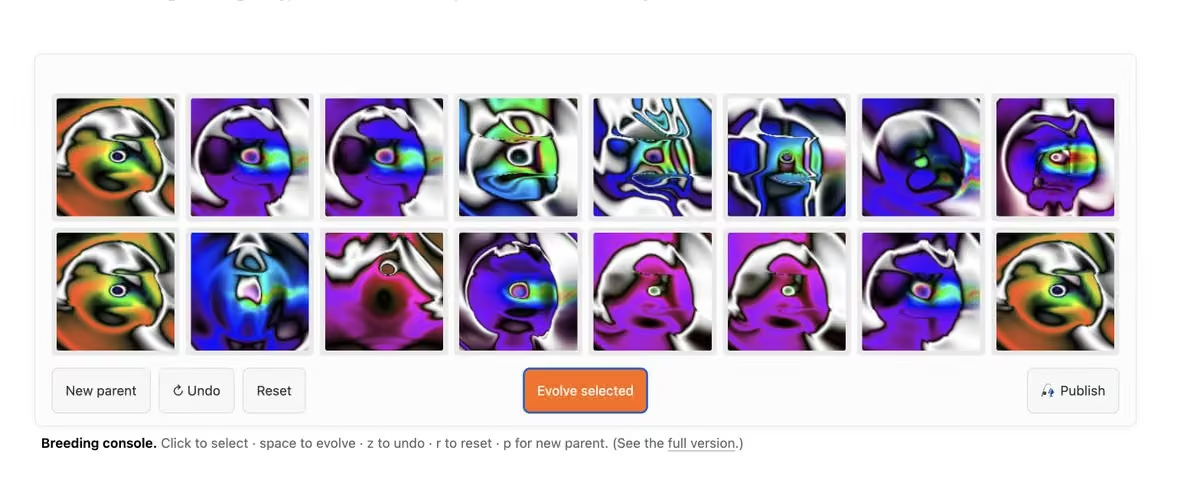
I was able to breed the anthropomorphic images below by manually navigating an extremely deceptive search space over many, many iterations and starting with something that didn't look anything like a face. The reason Picbreeder works through interactive human supervision is that we understand the world at an abstract level, and we can easily spot abstract motifs in the generated images. As @fchollet said, the ability to decompose perceptual information into its abstract constituent blocks is a core feature of human cognition. So Picbreeder was bootstrapping the iterative creation of a highly factorised modular architecture, by leveraging humans' ability to do just this.
It's interesting that the Sakana guys referred to serendipity as a "je ne sais quoi". It is paradoxical because it IS the state of understanding abstractly, perhaps without the conscious awareness of it. It's certainly true that when I was breeding the image below, I locked into a particular feature, and it became a convergent, "goal-orientated process". But the important thing is it was completely individual agency. I was following my own path, and it was extremely shallow agency. I wasn't trying to achieve a complex objective. I was merely trying to encourage the materialisation of the abstract feature I initially recognised.
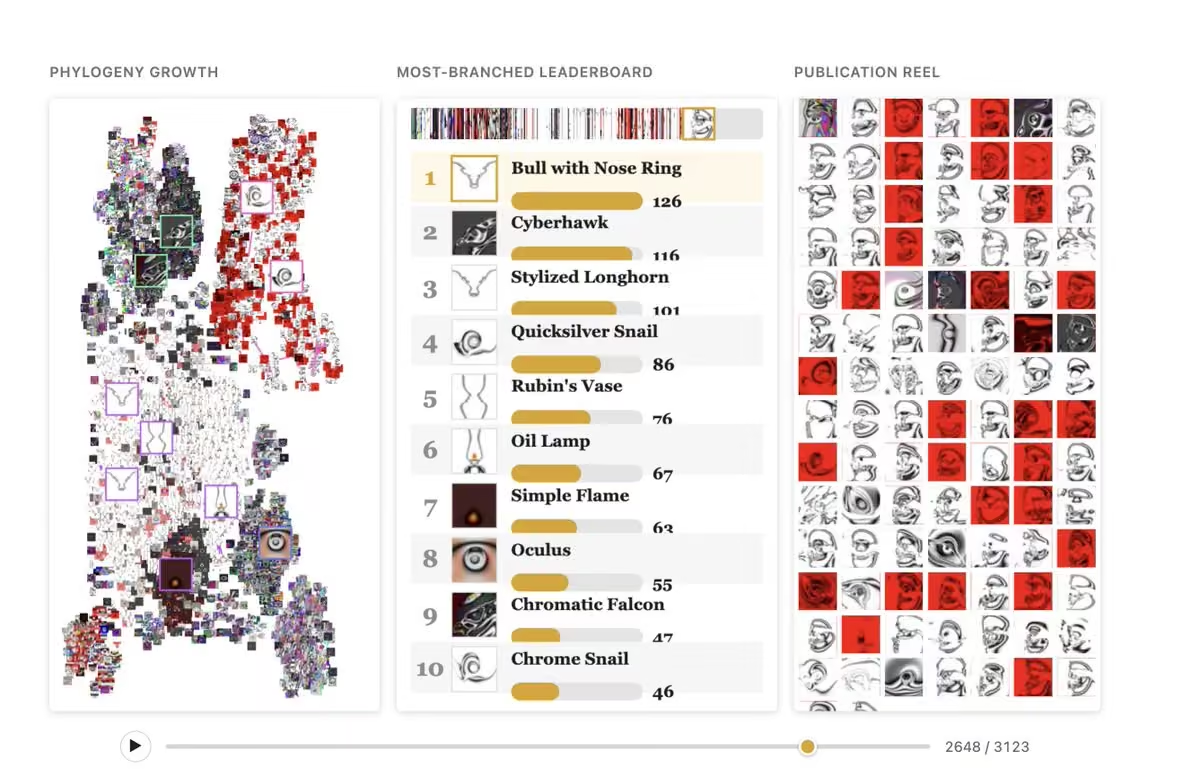
When we look at the phylogeny created in this non-interactive way, we see that deep abstractions are not locked in and shared in deep lineages above.
I think the two main problems of automating this process with LLMs are: convergence in sampling, and the inability to understand perceptual information in an abstract and systematic way. Both of these problems are directly explained by the fractured entangled representation hypothesis. So if this was an experiment trying to find if we could produce a factorised phylogeny from a non-factorised phylogeny (LLMs), it seems to have proven otherwise at this scale. However, we shouldn't give up so easily, if there is, indeed, even the slightest gradient of factorization, this process could presumably be scaled and repeated. I'm also intrigued by some of the work from Goodfire, which seems to suggest that factorization does meaningfully increase with scale, even on SGD networks (@banburismus_ ).
Anyway, in my opinion, this is one of the most important research directions in the whole field of AI: leveraging open-ended methods and building networks with factorised representations. Looking forward to lots more exciting work from Sakana!
VLMは人間のような創造性を持てるか?
ケネス・スタンレー教授らの『目標という幻想(Why Greatness Cannot Be Planned)』は、明確な目標を設定することが、かえって真に偉大な発見を遠ざけてしまうという逆説を論じた書籍です。その議論の中核にあったのが「PicBreeder」の実験でした。
PicBreeder では、ユーザーが「面白い」と感じた画像を選び、それを少しずつ進化させていきます。事前に決められたゴールはなく、人々が「なんとなく良い」と思ったものを選び続けるだけで、顔や動物、乗り物、頭蓋骨といった予期しない形が、何世代もかけて、多くの人の手を経て自然と現れます。スタンレー教授らは、こうした「オープンエンド」、つまり目標をあらかじめ定めない探索こそが人間の創造性の根幹にあると考えたのです。
では、このオープンエンドな探索を、AIは再現できるのでしょうか。
MIT・NYUとの共同研究として発表する「In Search of the Ingredients of Open-Endedness: Replicating Picbreeder with Large Vision-Language Models」では、視覚言語モデル(VLM)エージェントによる再現を試みました。エージェントたちは共有アーカイブを探索し、画像を選んで進化させ、気に入ったものを公開し、他のエージェントの作品を評価します。目標となる画像も「進歩」の定義も与えられていません。
その結果、AIによるオープンエンドな発見の可能性と限界の両方が浮かび上がりました。VLMエージェントは特定の見た目や意味に引き寄せられやすく、既存のアイデアを捨てて予期せぬ何かを探すよりも、手元にあるものを洗練させることに留まりがちでした。一方で、多様な人格を持つエージェント集団を導入すると探索は大きく改善され、生成されたアーカイブの意味的な幅広さは、人間が作ったアーカイブに迫る水準にまで達しました。
しかし、VLMでは届かなかった点もありました。人間は、偶然の産物を持続的な創造へとつなげることに長けています。あるものを見つけたとき、その価値を感じ取り、それを追いかけることで、より大きな概念的飛躍を達成できます。AIエージェントも興味深いパターンに気づくことはできても、そのパターンに囚われてしまう傾向がみられました。
なぜ人間は、本研究のVLMにはできなかったオープンエンドな探索を進められるのか。現在のAIシステムに何が欠けているのか。私たちはまだ十分に理解できていません。ここには、当社が探求するAI駆動型科学研究にも通じる大きな問いが残っています。Sakana AIは今後も、オープンエンドな知性の探求を深めていきます。
ブログ:pub.sakana.ai/picbreeder-vlm
論文:arxiv.org/abs/2605.23908 🐟
The AI Picbreeder Experiment: Can AI agents be creative when nobody tells them what to create?
Blog: pub.sakana.ai/picbreeder-vlm
In our new #gecco2026 paper, "In Search of the Ingredients of Open-Endedness: Replicating Picbreeder with Large Vision-Language Models", in collaboration with MIT and NYU, we revisit Picbreeder, a lost website where people collaboratively evolved images without any predefined objective. Users simply selected images they found interesting, allowing unexpected forms such as faces, animals, vehicles, and skulls to emerge gradually across many generations and many different people.
We recreated this process using vision-language model agents. The agents explore a shared archive, choose images to branch from, evolve new candidates, publish their favorites, and evaluate the creations of other agents. There is no target image and no explicit definition of what counts as progress.
The results reveal both the promise and current limitations of AI-driven open-ended discovery.
Compared with humans, VLM agents tend to keep circling back to the same kinds of images and concepts. They repeatedly select similar parents, make smaller conceptual leaps, and often refine an existing idea rather than abandoning it in search of something genuinely unexpected.
However, introducing a diverse population of agent personalities substantially improves exploration. In some runs, diverse agent populations approached or matched the human archive on measures of semantic diversity and produced more balanced evolutionary trees.
We also find intriguing evidence that open-ended evolution can produce more robust representations. A skull evolved by the agents changes smoothly when its underlying neural representation is perturbed, less fractured than a skull directly optimized with gradient descent, although still less cleanly disentangled than one evolved collectively by humans.
But perhaps the most interesting result is the gap that remains.
Humans appear better at turning fortunate accidents into sustained creative discoveries: recognizing when something unexpected is worth pursuing, refining it, and then making a larger conceptual leap. The AI agents often notice interesting patterns too, but are more likely to become trapped in them.
We still do not fully understand what enables humans to navigate open-ended search in this way, or what ingredient(s) current AI systems are missing. For now, the results suggest that there remains something important about human creativity that AI agents have not yet learned to reproduce.
This paper will be presented at #gecco2026 and is nominated for a best paper award! Please check out the interactive blog and technical paper for more details!
Read our full paper: arxiv.org/abs/2605.23908 🐟



 Sakana AI
@SakanaAILabs



 Takuya Akiba


 hardmaru


 田附千絵子 たづけちえこ
 ITmedia AI+


 ML_Bear
 R. Maruyama
 Robert Lange




 Stefania Druga



 Kai Arulkumaran


 Forbes JAPAN


 【公式】PIVOT@ビジネス映像メディア


 Machine Learning Street Talk


 STS forum

 shokupan


 朝日新聞(asahi shimbun)


 elvis


 NVIDIA Japan


 momosuke | Ryosuke HYAKUTA

 ネアー


 Auth0 Japan

 Ino.Ichi


 PyCon JP


 H.E William Kabogo Gitau, E.G.H


 PC Watch


 Modal


 DIVER OSINT CTF






 Mizuki Oka/岡瑞起


 Merge


 Lilian Weng

 ITmedia NEWS



 alphaXiv


 TBS CROSS DIG with Bloomberg
 OpenRouter


 Turing Post (Ksenia Se)

 Kazuto Suzuki


 CNET Japan


 NTTドコモ・ベンチャーズ
 VentureBeat




 Nature Japan


 Zuzanna Stamirowska


 NVIDIA AI


 あおい🐦


 防衛省防衛研究所


 chokudai(高橋 直大)@AtCoder


 日経電子版 テック
 ASCII.jp
 GMOインターネット株式会社【公式】


 heartkilla
 Grace Isford


 Masato Ota


 Motoki Sato


 日経電子版 金融

 西村あさひ法律事務所・外国法共同事業

 小牧知志 | 日経リサーチ


 Sho Ishiwata
 山田胡瓜・漫画家
 深津 貴之 / THE GUILD, note




 sho_yokoi


 Alireza Mohammadshahi


 Sota Omura | 大村 壮太 🐡


 Heiga Zen (全 炳河)


 kami


 Isao Takaesu
 Akarsh Kumar


 Scott Wu

 Hiroyuki Ota (ほた)


 Kosuke Nakago


 ITmedia

 Google Cloud Japan
 ほーきー(Hawkie)
 YI

 Ai Fujiki


 mahoh

 Tokyo Gov
 ryunosuke

 mzk


 Belinda


 Kosta Derpanis


 Yasuo TABEI

 Thomas Rost


 Luke Darlow
 Aurélien Geron


 LabBase就職【公式】

 Tetsuro Miyatake

 Kathy Matsui
 MPower Partners


 Techmeme
 Danny Crichton

 alex zhang


 机器之心 JIQIZHIXIN




 Signals


 ねじゅみ


 Yokoyama


 Masaya Ohagi


 LangChainJP


 Jeff Clune





 RK
 Brett Adcock


 bycloud


 Issa Sugiura ✈️ AACL2026