After a change of power, Hungarian authorities show what autocratic corruption looks like -- literally millions stashed in forests and warehouses. Soon, it will be Trump officials' turn. kyivindependent.com/hungarian-authorities-uncover-million…
Yann LeCun
Yann André Le Cun ( lə-KUN; French: [ləkœ̃]; usually spelled LeCun; born 8 July 1960) is a French-American computer scientist working in the fields of artificial intelligence, machine learning, computer vision, robotics and image compression. He is the Jacob T. Schwartz Professor of Computer Science at the Courant Institute of Mathematical Sciences at New York University (NYU). He served as Chief AI Scientist at Meta Platforms before co-founding Advanced Machine Intelligence Labs in December 2025. More on Wikipedia
-
Yann LeCun reposted
Kenneth Roth
@KenRoth
-
Yann LeCun reposted
Brandon Amos
@brandondamos
⚠️ Numerical issues can go on silently for decades like in the softmax/CE! Similar issues are present in other widely-used divergences like the KL and JSD
I just posted this paper overviewing what they are and how to fix them:
📚 arxiv.org/abs/2611.18511
Jon Barron
@jon_barron
Hi all, I have a new result I'm excited to share. It turns out that *all existing implementations* of softmax and cross-entropy (that's JAX, PyTorch, textbooks, etc) have a subtle bug --- two bugs, actually. A simple rewrite fixes both, and eliminates "slingshots" when grokking:
-
Yann LeCun reposted
Roei Herzig
@roeiherzig
“Stuck” in sunny San Diego due to the FAA, so I can finally wrap my head around what an amazing #corl2026 it was! Thank you @corl_conf and everyone who made this year’s conference so special.
🧒🤖 We ran our LIVE Child–Robot Challenge for the first time at the conference, and the room was buzzing with curiosity! Huge thanks to @JitendraMalikCV @DJiafei @micoolcho @_amirbar @ZoharRimon @YiruHelenWang James Ni, Frank Hu, @k7agar @hq_fang & @SharpaRobotics for bringing it to life, and to our youngest competitor (my little Adam), the true star of the day.
🎤 And thank you Georgia Chalvatzaki @GeorgiaChal, Jeannette Bohg @leto__jean, Yunzhu Li @YunzhuLiYZ & Mike Rabbat @michaelrabbat for brilliant, inspiring talks.
Watch the challenge 👇
spin-workshop.github.ioThis media couldn't be displayed. See it on the original post. -
Yann LeCun reposted
Jitendra MALIK
@JitendraMalikCV
Sometime ago I had proposed an antidote to the hype in robotics demo tapes released on X - a live challenge where a child competes with a robot to finish a task, and we measure performance by speed of completion, weighted by success. I would like to congratulate @roeiherzig and collaborators for making this happen at CoRL 2026. Two robot policies competed and as expected they were trounced by the child. But this is fine! Progress will come and one day robots will exceed humans across the board. In computer vision the famous PASCAL object detection challenge started in 2005 with performance around 5%, and look where we are now.
Roei Herzig
@roeiherzig
“Stuck” in sunny San Diego due to the FAA, so I can finally wrap my head around what an amazing #corl2026 it was! Thank you @corl_conf and everyone who made this year’s conference so special.
🧒🤖 We ran our LIVE Child–Robot Challenge for the first time at the conference, and the room was buzzing with curiosity! Huge thanks to @JitendraMalikCV @DJiafei @micoolcho @_amirbar @ZoharRimon @YiruHelenWang James Ni, Frank Hu, @k7agar @hq_fang & @SharpaRobotics for bringing it to life, and to our youngest competitor (my little Adam), the true star of the day.
🎤 And thank you Georgia Chalvatzaki @GeorgiaChal, Jeannette Bohg @leto__jean, Yunzhu Li @YunzhuLiYZ & Mike Rabbat @michaelrabbat for brilliant, inspiring talks.
Watch the challenge 👇
spin-workshop.github.ioThis media couldn't be displayed. See it on the original post. -
Yann LeCun reposted
clem 🤗
@ClementDelangue
As I’ve said for years, concentration of power, capabilities and wealth is the biggest risk in AI. The natural tendencies for it are super strong and without much much stronger open-source, we might end up in a world with more asymmetry and inequalities than ever!
unusual_whales
@unusual_whales
Anthropic’s IPO could make about 4,250 of its 5,300 employees millionaires, per an analysis by financial platform Hill, including roughly 50 worth more than $100 million each.
The estimate assumes a $1.5 trillion valuation, above the roughly $1 trillion Anthropic is now targeting. -
Post not available here, view on X
Yann LeCun
@ylecun
I moved out of "leadership" in 2018.
I was at the Senior VP level, but actually an individual contributor from 2018 to December 2025.
So no.
Also, Koray Kavukcuoglu (who did his PhD with me at NYU) has been running Gemini since day one.
Demis's main interests have always been AI for science, Isomorphic, and the pursuit of what he calls AGI, for which he has been advocating the use of world models lately.
So no. -
Yann LeCun reposted
Emmanuel Macron
@EmmanuelMacron
Quelques mots sur l’intelligence artificielle.
This media couldn't be displayed. See it on the original post. -
Yann LeCun reposted
Yann LeCun
@ylecun
In democratic societies, everyone has *some* responsibility on how the use of technology maximizes benefits and minimizes bad side effects.
The benefits of AI are real today, and will greatly expand in the future.
The bad side effects have, so far, been minimal.
It's on all of us to make sure it remains that way.
The catastrophe scenarios (extinction, employment apocalypse, etc) are totally ridiculous for anyone who understands how thing work in the real world.
And the p(doom) estimates are all pulled out of their authors' back ends. It makes no sense to attribute a probability to events over which we have complete agency. Whatever probability you come up with merely reveals your lack of confidence that your fellow humans will do the right thing. Confidence in humanity is one thing Geoff and I disagree on.
The other thing we disagree on is the primacy of intelligence. In the real world, intelligence is not synonymous with power and dominance. A virus, a poisonous snake, or a tiger can bring down a human. Lots of very stupid humans dominate much smarter ones (just look at the international political scene).
Superintelligent AI will work for us and do our bidding, subject to safety guardrails.
It will have no desire to take over.
I have made detailed technical proposals for AI architectures that can be made safe by satisfying safety guardrails at inference time.
I call it Objective-Driven AI Architecture. -
Post not available here, view on XPost not available here, view on X
Yann LeCun
@ylecun
In democratic societies, everyone has *some* responsibility on how the use of technology maximizes benefits and minimizes bad side effects.
The benefits of AI are real today, and will greatly expand in the future.
The bad side effects have, so far, been minimal.
It's on all of us to make sure it remains that way.
The catastrophe scenarios (extinction, employment apocalypse, etc) are totally ridiculous for anyone who understands how thing work in the real world.
And the p(doom) estimates are all pulled out of their authors' back ends. It makes no sense to attribute a probability to events over which we have complete agency. Whatever probability you come up with merely reveals your lack of confidence that your fellow humans will do the right thing. Confidence in humanity is one thing Geoff and I disagree on.
The other thing we disagree on is the primacy of intelligence. In the real world, intelligence is not synonymous with power and dominance. A virus, a poisonous snake, or a tiger can bring down a human. Lots of very stupid humans dominate much smarter ones (just look at the international political scene).
Superintelligent AI will work for us and do our bidding, subject to safety guardrails.
It will have no desire to take over.
I have made detailed technical proposals for AI architectures that can be made safe by satisfying safety guardrails at inference time.
I call it Objective-Driven AI Architecture. -
Yann LeCun reposted
Saining Xie
@sainingxie
before hopping on the ‘encoder-free’ hype train, think twice.
Ellis Brown @_ellisbrown
how should multimodal models encode visual input?
→ pretrained encoder?
→ encoder-free?
→ before the LLM?
published models bundle these choices together. we trained 200+ models from scratch to see which of these choices matters
only one of them does
🧵 [1/n]This media couldn't be displayed. See it on the original post. -
Yann LeCun reposted
clem 🤗
@ClementDelangue
This whole thing sucks, and I wish none of it had happened. It’s a really sad day!
But I want to make one thing clear: we’ll keep fighting for open-source AI, harder than ever. This is too important to slow down now. Let’s go! -
Yann LeCun reposted
Joan bruna @joanbruna
Mathematics and AI now define an interface full of fascinating questions that extend beyond a single discipline, and that require dedicated scientific inquiry. I am excited to explore these questions alongside many colleagues, and grateful to Courant's leadership for entrusting us with this mission!
NYU Courant
@NYU_Courant
Yesterday we announced the establishment of the new Center for Mathematics and AI at Courant (MAIC). Its mission is to make frontier AI systems an object of scientific inquiry, one that the broad mathematical community can dissect, improve, reproduce—and ultimately—understand.
-
Yann LeCun reposted
小龙先生
@Dragonhau66
终于实锤了❗️❗️
干掉黄仁勋的,不是婚外情,而是一场由美国政客、媒体、CIA和Anthropic 联合做局的“完美猎杀”。
黄仁勋辞职后,《纽约时报》两名记者在播客里亲口承认:
他们是收到了一位“科技界联系人”的爆料,才去查Megaspeed的。这个联系人,被开源情报指向了Anthropic 的联合创始人杰克·克拉克。
原来,这个Anthropic 的联合创始人杰克是彻头彻尾的恶魔😈。这个家伙后续必死无疑!
顺着资金链往下挖,全是对得上的:
Anthropic今年向支持“收紧对华芯片管制”的组织捐了 4000万美元。
逼黄仁勋辞职的参议员克莱默,收过Anthropic 5.1万美元政治捐款。
CIA监听黄乐一年拿不出间谍实锤,却在中期选举后精准放料。
纽时配合政客,用匿名员工爆料补上“第二段婚外情”。
CIA给黑料,Anthropic出钱,政客挥刀,媒体处刑。
黄仁勋反对封杀中国AI芯片,说“限制不明智”。
而Anthropic靠闭源API赚钱,最怕中国开源模型在GPU上免费跑。让英伟达戴上镣铐,Anthropic才能活下去。
他的“罪”,不是睡了谁。
黄仁勋挡了丑陋资本的路,挡住了美国政客的枪口,还是一个不听话的华人。 -
Yann LeCun reposted
NYU Courant
@NYU_Courant
Yesterday we announced the establishment of the new Center for Mathematics and AI at Courant (MAIC). Its mission is to make frontier AI systems an object of scientific inquiry, one that the broad mathematical community can dissect, improve, reproduce—and ultimately—understand.
-
Yann LeCun reposted
Nirit Weiss-Blatt, PhD
@DrTechlash
The investigation into FLI's crypto donation is now updated with new information from the Bitcoin Policy Institute's report:
How FTX and Alameda Research may have helped turn the enormous but largely illiquid SHIB donation into hundreds of millions of dollars for FLI. -
Yann LeCun reposted
Randall Balestriero
@randall_balestr
Swing by Northwestern University, Ruan Conference room (lower level), at 11am Central! Will be speaking about end-to-end learning of predictive abstractions on any data! We will see how and why humans got so good at this, and why JEPAs are the next step
statistics.northwestern.edu/events/seminars/fall-seminars… -
Yann LeCun reposted
NYU Courant
@NYU_Courant
We're hiring! New York University expects to have several tenure-track faculty positions in Computer Science and invites qualified candidates of all levels and research areas to apply: apply.interfolio.com/195724
-
Yann LeCun reposted
WIRED
@WIRED
Moving AI from text to 3D space, world models simulate real-world physics to teach robots and autonomous cars how to navigate reality. www.wired.com/story/world-models-will-soon-be-inescapable…
-
Yann LeCun reposted
Reuters World
@ReutersWorld
EXCLUSIVE: Covert Russian network exploited French riots on social media, EU report says www.reuters.com/world/europe/covert-russian-network-explo…
-
Yann LeCun reposted
Jia-Bin Huang
@jbhuang0604
in a nutshell
-
Yann LeCun reposted
Nick Clegg
@nickclegg
Getting too close to Trump was a mistake – how could Silicon Valley have gotten (US) / got (UK) it so wrong?
Read the full article: www.theatlantic.com/ideas/2026/11/silicon-valley-trump-ad… -
Yann LeCun reposted
Harry Stebbings
@HarryStebbings
Will we end up with a model landscape that has just two to three providers?
“If we end up in a world where all companies need to rely on two or three centralised AI providers, that gives them enormous leverage.
They will use the data that is being produced by the systems to make better systems and to go after the business of their customers.
At the end, this is the end game. This is pretty clearly what is being priced in today.” @arthurmensch
Love to hear your thoughts @nathanbenaich @simonw @benthompson @sh_reyaThis media couldn't be displayed. See it on the original post.
Harry Stebbings
@HarryStebbings
Honestly, 12 months ago I thought “sovereignty” was a BS marketing message for founders to leverage to get funding.
Now I think it is a strategic imperative and will breed some of the largest companies of our time.
Mistral is the poster child of sovereignty. The last remaining hope for Europe when it comes to frontier model providers.
I sat down with @MistralAI CEO, @arthurmensch to debunk the hype from reality and ask the uncomfortable questions. My notes from the discussion below.
1. Why Energy Is Not the Ultimate Cost That Matters
Energy makes up around 10% of the total cost of ownership of compute, so it is not where most optimization can happen. The cost of energy is not the one thing that matters in the economics of a project.
Love to hear your thoughts on this @alanchanguk @ChaseLochmiller @ZachBDell
2. What Would Mistral Do Differently If They Were Totally Resource-Unconstrained?
Mistral would build much more capacity, with capital as the main bottleneck. Customers are running out of compute, and once one use case scales they need thousands of GPUs rather than eight. Europe does not have enough compute, so Mistral is putting equity to work to build capacity ahead of demand.
Love to hear your thoughts on this, if you were resource unconstrained today, what would you do differently @alexmashrabov @bavaria_kush
3. How the Inference Market Behaves Very Much Like a Commodity Market
On-demand inference behaves like a high-margin commodity market where pricing matters a lot and demand comes from non-committed customers. Mature customers need service level agreements, reserved physical capacity and guarantees on latency and generation speed. The more precisely they describe the shape of their demand, the better Mistral can price it.
What does no one see about the inference market that everyone should see @tuhinone @neilmovva @lqiao
4. Models Have Gotten So Strong They Are Being Treated as Defense Systems
Models are now strong enough to carry out cyberattacks, and the US began banning them outside the country in May. China is also looking at restricting exports beyond a certain threshold. As with any dual-use technology, customers now want security of supply on both infrastructure and model IP.
What does no one see about the future of security that everyone should see @zeyu1337 @nikesharora @pilvar222
5. Will We End Up With a Model Landscape That Has Just Two to Three Providers?
If every company relies on two or three centralized AI providers, those providers gain enormous leverage. They will use the data their systems produce to build better systems and go after their customers' business, an end game Arthur sees as priced in today.
What will the model landscape look like in 5 years @emostaque @AnjneyMidha @mmurphy
6. The Biggest Problem With AI Effectiveness Within Enterprise Today Is...
Most enterprise problems are not well defined, and ambiguous objectives with humans in the loop cannot be solved through self-improving loops. They only get solved by deploying models that interact with people, which is why Mistral uses FDEs to define problems better.
7. Why You Can Go Public in Europe and Negativity Around European Stock Markets Is BS
Mistral can absolutely go public in Europe, because the bottlenecks of 10 years ago are no longer there. There is a huge appetite from investors worldwide to invest in Europe in both private and public equity. Mistral is preparing for the operational constraints of being public while delivering on its commercial milestones.
You think this is true, you really think you can go public in Europe @eldsjal @klarnaseb
(links in comments) -
Yann LeCun reposted
Simplifying AI
@simplifyinAI
Yann LeCun was right the entire time. And generative AI might be a dead end.
LeCun has argued that generating every pixel spends too much compute on details instead of learning how the world works.
His alternative is JEPA, short for Joint-Embedding Predictive Architecture.
It predicts what happens next using compressed representations, rather than recreating an image pixel by pixel.
One challenge is “representation collapse”: different inputs end up with nearly identical representations, leaving the model with little useful information.
Researchers behind LeWorldModel, or LeWM, use a mathematical regularizer to help prevent this.
It encourages those representations to follow a Gaussian distribution, simplifying the training setup.
LeWM has 15 million parameters and trains on one GPU in a few hours.
The researchers report planning up to 48× faster than the foundation world models they compared against.
Their experiments also demonstrate physical prediction and detection of impossible events.
That does not establish complete understanding of physics or prove generative AI is a dead end.
It shows that a small model can learn useful patterns for prediction and planning without generating every pixel. -
Yann LeCun reposted
Kenneth Roth
@KenRoth
Elon Musk’s $500 million couldn’t swing the midterms for Republicans in Congress when all they did was sit in their hands as Trump corruptly served himself. www.nytimes.com/2026/11/06/us/politics/musk-trump-midterm…
-
Yann LeCun reposted
Randall Balestriero
@randall_balestr
Our first major update on icwm.cc
- venue confirmed in the heart of Manhattan
- paper deadline is December 22nd
- single-blind, free-form (just a page limit), use AI however you want--focus on the science
- everything public (openreview), < 3 papers per reviewer -
Yann LeCun reposted
Yann LeCun
@ylecun
The P in JEPA stands for predictive.
The main distinction is not between JEA and JEPA, but between Joint Embedding (predictive or not) and generative architectures.
Whether a predictor is necessary depends on the task.
Given observations x and y (y being available only during training), a generative architectures predicts y from x. The loss is the divergence between y and its prediction:
L = divergence(y, pred(enc(x)) )
A JEA encodes y as well and minimizes the divergence between the representations of x and y, while preventing collapse:
L = divergence( enc(y), enc(x) ) + R( enc(y), enc(x) )
Where R is the anti-collapse regularizer, which may be computed over a batch of samples.
JEA are used when the prediction has no particular direction, i.e. when x and y are different views of the same scene. The idea for JEA is very old. Becker and Hinton proposed a simple model in 1989 where the anticollapse was based on information maximization. Schmidhuber had a version in 1992 based on redundancy minimization. At NIPS 1993, I proposed Siamese nets, which was a contrastive method to train JEA. Such contrastive methods gained popu.arity after Google's SimCLR paper in 2020. In 2021, Stéphane Deny in my group proposed the Barlow Twins redundancy reduction regularizer, which seemed to work at scale. This was shortly followed by VICReg by Adrien Bardes, Jean Ponce, and me, and last year by SIGReg by Randall Balestriero and me.
DINO is a JEA method that comes from a long string of papers from Piotr Bojanowski's group at FAIR-Paris, starting with Noise as Targets (2017), Deep Clustering (2018-2020), and DINO v1-v3 which are contrastive between clusters, not samples.
JEPA adds a predictor, which is useful when the prediction is non-symetric. For example, when x is a degraded/corrupted version of y, or when x is a present observation and y a future observation (temporal prediction). The loss is:
L = divergence( enc(y), pred(enc(x)) ) + R( enc(y), enc(x) )
All of these models can be augmented by an action variable a, fed to the predictor, encoding an action, intervention, or transformation to produce y from x.
This turns the system into a "world model". In a JEPA, the loss becomes
L = divergence( enc(y), pred(enc(x), a) ) + R( enc(y), enc(x) ) -
Post not available here, view on X
Yann LeCun
@ylecun
Several comments:
1. image/video SSL methods differ by whether they use reconstruction or not. Joint embedding architectures Amy or may not have a predictor (JEA vs JEPA). They also differ by their anti-collapse method and data corruption/augmentation methods.
2. DINO *is* a kind of JEPA (technically a JEA). The difference with other JEPA models is the anti-collapse criterion (based on contrative clustering+ stopgradient/EMA), and the data augmentation scheme (image transformations, which is task specific),
3. V-JEPA 2.1, like DINO, is from Meta-FAIR (corporate lab), involved significant engineering teams, large/proprietary datasets, considerable computing resources, lots of fine-tuning, and number-pushing on many benchmarks.
4. Many JEPA papers are applications and/or fine-tuned versions of DINO, V-JEPA or I-JEPA.
5. LeJEPA, LeWM, and most other papers with "JEPA" in the title are *research* papers focused on the methodology, often done by students in academic labs, involving no engineering support, very little computing resources, and small/public training sets. They are generally tested on toy problems, simulated environments, or small/public benchmarks.
6. You simply cannot compare 5 with 2/3/4. 5 gives you ideas and new methods, not models. 2/3 give you well-engineered models, with lots of empirically validated tricks. Only rarely will 2/3 give you a new, well-principled method with room to spare. 5 give you empirical results on new applications.
7. What is published in 5 are methods that will eventually become like 2 and 3, whenever someone with resources picks it up and scales it.
DO NOT CONFUSE UPSTREAM FOUNDATIONAL RESEARCH ON METHODS AND DOWNSTREAM SCALING -> ENGINEERING -> NUMBER PUSHING -> MODELS -> PRODUCTS.
The former makes the rest possible, but it takes time.Post not available here, view on X
Yann LeCun
@ylecun
The P in JEPA stands for predictive.
The main distinction is not between JEA and JEPA, but between Joint Embedding (predictive or not) and generative architectures.
Whether a predictor is necessary depends on the task.
Given observations x and y (y being available only during training), a generative architectures predicts y from x. The loss is the divergence between y and its prediction:
L = divergence(y, pred(enc(x)) )
A JEA encodes y as well and minimizes the divergence between the representations of x and y, while preventing collapse:
L = divergence( enc(y), enc(x) ) + R( enc(y), enc(x) )
Where R is the anti-collapse regularizer, which may be computed over a batch of samples.
JEA are used when the prediction has no particular direction, i.e. when x and y are different views of the same scene. The idea for JEA is very old. Becker and Hinton proposed a simple model in 1989 where the anticollapse was based on information maximization. Schmidhuber had a version in 1992 based on redundancy minimization. At NIPS 1993, I proposed Siamese nets, which was a contrastive method to train JEA. Such contrastive methods gained popu.arity after Google's SimCLR paper in 2020. In 2021, Stéphane Deny in my group proposed the Barlow Twins redundancy reduction regularizer, which seemed to work at scale. This was shortly followed by VICReg by Adrien Bardes, Jean Ponce, and me, and last year by SIGReg by Randall Balestriero and me.
DINO is a JEA method that comes from a long string of papers from Piotr Bojanowski's group at FAIR-Paris, starting with Noise as Targets (2017), Deep Clustering (2018-2020), and DINO v1-v3 which are contrastive between clusters, not samples.
JEPA adds a predictor, which is useful when the prediction is non-symetric. For example, when x is a degraded/corrupted version of y, or when x is a present observation and y a future observation (temporal prediction). The loss is:
L = divergence( enc(y), pred(enc(x)) ) + R( enc(y), enc(x) )
All of these models can be augmented by an action variable a, fed to the predictor, encoding an action, intervention, or transformation to produce y from x.
This turns the system into a "world model". In a JEPA, the loss becomes
L = divergence( enc(y), pred(enc(x), a) ) + R( enc(y), enc(x) ) -
Yann LeCun reposted
Turing Post (Ksenia Se)
@TheTuringPost
There's one great example that shows how physics can help upgrade AI world models, and it's LeHami.
@ylecun, @randall_balestr and @RominaYalov brought Hamiltonian mechanics into JEPA to preserve phase-space volume and prevent latent collapse during long-term predictions.
Why exactly Hamiltonian mechanics?
• Variables are coordinates q and momenta p (not velocities like in Lagrangian mechanics), giving LeHami paired first-order equations for updating its states.
• This makes Hamiltonian H a central function. It's often total energy: kinetic + potential, in classical mechanics.
• LeHami learns this H function with kinetic-like K(p) and potential-like V(q, u) components, where u represents actions.
• A symplectic leapfrog integrator uses this function to predict how states evolve depending on the actions taken, while no constrains are violated.
To understand this better it's useful to think of a pendulum. It can pass the same position in either direction. But physical position alone won’t predict what comes next, you also need momentum.
LeHami follows a similar principle, but works with learned representations of position and momentum.
→ And most importantly, it builds a constraint into how those predictions evolve.
Maybe that's exactly the kind of thing world models like JEPA need now - one less way to go wrong.
We've taken a much deeper look at LeHami's design and results in this guide. Plus, there's a little mechanics lesson for AI and physical AI folks that's worth learning → www.turingpost.com/p/lehami-explained-can-physics-help-wo… -
Yann LeCun reposted
Supersocks
@iamsupersocks
Arthur Mensch vient de poser sur LinkedIn la phrase que les députés devraient lire avant le 19 novembre : quand Mistral choisira entre un data center en Essonne ou hors de France, la loi Darcos pèsera dans la balance.
Donc le Sénat a voté le texte à l'unanimité le 8 avril : dans un litige civil, dès qu'un indice rend vraisemblable l'utilisation d'une œuvre, on présume qu'elle a été utilisée par le fournisseur du modèle, et c'est à lui de prouver le contraire. Les défenseurs du texte ont un vrai argument : aujourd'hui, un auteur n'a ni les données d'entraînement ni les moyens techniques de prouver quoi que ce soit. Mais en face, prouver qu'une œuvre n'a pas servi sur des milliards de mots pose une question que personne ne tranche : quelles preuves le juge exigera, à quel coût, et qu'est-ce qu'il faudra ouvrir de ses secrets d'affaires pour les fournir. Mensch dit que c'est impossible sans livrer ses méthodes.
Et ce qui a changé depuis avril, c'est que les décisions d'investissement se prennent maintenant. Mistral a sorti Large 4, 1 000 milliards de paramètres, poids ouverts, entraîné à Bruyères-le-Châtel sur ses propres machines. L'entreprise développe 1 GW de capacité, essentiellement en Europe et largement en France. Pour l'ordre de grandeur, 1 GW, c'est à peu près la puissance d'un réacteur nucléaire, et on ne choisit pas l'emplacement de ce genre d'infra pour deux ans mais pour dix.
Mon inquiétude, c'est que la loi pèse surtout sur ceux qui entraînent en France. Sur le papier, un acteur étranger qui vend ici peut être attaqué ici. En pratique, une boîte qui a ses serveurs et ses équipes en Essonne est bien plus facile à aller chercher qu'une boîte qui entraîne en Californie.
En avril, j'écrivais déjà que la solution adulte était sur la table : une contribution sur le chiffre d'affaires réalisé en Europe, appliquée à tous, étrangers compris, qui finance la création sans transformer chaque entraînement en contentieux potentiel. Tout reste à construire, de la répartition entre créateurs à l'articulation avec les licences existantes, mais c'est la bonne direction. Mensch la repropose aujourd'hui, adossée à l'article 53 de l'AI Act. Sept mois plus tard, on rejoue le même débat, avec un modèle français de plus entre les deux.
Ma hot take : les créateurs devront s'adapter à l'IA, et les plateformes feront le nécessaire. Spotify vient de signer avec Believe pour des remix IA, avec le consentement des artistes et une rémunération à la clé. Ce n'est pas l'entraînement des modèles, mais ça montre qu'on peut payer les créateurs par des accords plutôt que par des procès.
On a enfin une boîte française capable de jouer dans la cour des grands, qui entraîne ses modèles chez nous et investit dans nos infrastructures. Et c'est maintenant qu'on décide de lui mettre des bâtons dans les roues ? C'est elle qui aura, la première, à arbitrer entre l'Essonne et ailleurs.
L'AI Act oblige déjà les fournisseurs de modèles à publier un résumé de leurs données d'entraînement et à mettre en place une politique de respect du droit d'auteur. Bruxelles travaille maintenant sur les évolutions de ce cadre, notamment la question de l'utilisation et de la rémunération des œuvres protégées. Et pendant ce temps, la France veut ajouter son propre mécanisme de présomption, avec le risque de multiplier les contentieux avant même qu'une réponse européenne commune se dessine. On ne pouvait pas coordonner tout ça à l'échelle européenne ?
À force de vouloir réglementer les champions qu'on n'avait pas, on risque de décourager ceux qu'on a enfin.
Supersocks
@iamsupersocks
La France a parmi les meilleurs mathématiciens et ingénieurs IA du monde. On le sait. On les embauche partout ailleurs. Et la première chose qu'on fait au moment où on pourrait enfin capitaliser dessus ? On vote une loi qui transforme l'entraînement d'un modèle sur sol européen en parcours du combattant juridique.
À l'unanimité. Avec le sourire.
Le 8 avril 2026, le Sénat adopte la proposition de loi Darcos-Evren-Ouzoulias. Nouvel article L. 331-4-1 du Code de la propriété intellectuelle. Mécanisme : présomption d'utilisation des contenus culturels par les systèmes d'IA. Dès qu'un indice (développement, déploiement ou output) rend l'usage d'une œuvre protégée « vraisemblable », c'est à l'entreprise de prouver qu'elle ne l'a pas exploitée. Inversion de la charge de la preuve.
Sur le papier, c'est « David contre Goliath ». Dans les faits, c'est surtout « Goliath américain et chinois qui s'en fout » contre « Mistral et les boîtes européennes qui jouent encore le jeu du sol ».
Soyons clairs : les présomptions existent en droit, c'est un mécanisme connu. En matière de contrefaçon, ça fonctionne. Mais ici, on parle de prouver un négatif sur des datasets de centaines de milliards de tokens. La question n'est pas de savoir si c'est juridiquement possible en théorie. La question, c'est le coût de conformité, l'incertitude massive et le risque juridique concret que ça fait peser sur tout acteur qui entraîne ou déploie en Europe. Rien que ce risque suffit à décourager l'investissement. Et c'est exactement ce qui va se passer.
Maintenant, posons le problème de fond : l'extraterritorialité.
Une boîte américaine ou chinoise peut entraîner son modèle chez elle, sur n'importe quelles données, sans contrainte, puis venir vendre ses services en Europe.
Une boîte française qui veut faire la même chose subit toute la contrainte sur son sol, avec ses données, avec ses capitaux.
Le résultat est prévisible : les acteurs étrangers captent le marché européen sans friction, les acteurs locaux portent seuls le poids de la conformité. C'est exactement le piège de la régulation asymétrique. On crée un avantage compétitif pour ceux qu'on prétend combattre.
OpenAI, Google, Meta ont entraîné leurs modèles frontier massivement sur le web ouvert entre 2022 et 2025. C'est un fait documenté, contesté en justice : le NYT a attaqué OpenAI, Getty a attaqué Stability AI, les procès sont en cours. Ce n'est pas que personne n'a réagi. C'est que la régulation arrive quatre ans après les faits, mal calibrée, et qu'elle ne touche pas ceux qui ont déjà engrangé l'avantage. Les modèles sont entraînés. Les poids sont dans la nature. C'est fini.
Et c'est là que le décalage avec la réalité technique devient vertigineux.
En 2026, sur un PC à 2 000 euros, n'importe qui fait tourner Qwen 3.5, Gemma4, GLM en local. Niveau frontier de 2024/2025 voir 2026. Sans garde-fous, sans journal de bord, sans rien. Les modèles sont open, distillés, parfois « obligatered » : sans aucune restriction.
Demande à Gemini de reproduire une œuvre, il te dira non. Télécharge un modèle open en local, tu fais ce que tu veux. La loi ne touche pas ça. Elle ne touche que ceux qui déclarent leur activité en Europe et qui veulent scaler légalement. On pénalise la transparence.
Ce n'est plus une affaire de « géants de l'IA » contre les créateurs. La démocratisation est totale. Le narratif « Big Tech pille les artistes » était peut-être pertinent en 2022. En 2026, c'est une grille de lecture obsolète qui ignore la réalité du terrain. La vraie mesure utile serait d'imposer aux modèles fermés qui opèrent en Europe des garde-fous anti-copie stricts c'est là que le levier existe, c'est là que l'enforcement est possible. Pas de compliquer l'entraînement pour tout le monde.
Parlons de qui cette loi protège vraiment.
On nous dit « les créateurs ». Les artistes face au pillage. Mais quand on regarde de plus près, les bénéficiaires ne sont pas les créateurs indépendants. Ce sont les sociétés de gestion collective historiques (CNC, SACEM), les lobbys culturels qui défendent un modèle économique du XXe siècle face à une technologie qui compresse le temps de création par un facteur 1000.
Un youtubeur qui conjugue IA et création humaine ? Il n'est pas protégé par cette loi. Il est dans le viseur ou menacé indirectement. Un créateur indépendant qui nourrit son process avec du prompting ? Pareil. La loi protège le statu quo culturel, pas la création de demain.
Le modèle de rémunération des créateurs doit évoluer, c'est une évidence. L'IA compresse en quelques minutes ce qui prenait des mois. Il n'y a pas de bouton pour revenir en arrière. Mais la réponse n'est pas de bloquer la technologie avec des lois qui ne s'appliquent qu'à ceux qui jouent le jeu.
La réponse, c'est de construire un mécanisme de redistribution qui fonctionne dans le monde tel qu'il est, pas tel qu'on voudrait qu'il soit.
Et justement, cette réponse existe. @MistralAI l'a posée sur la table.
Mistral, le seul champion français de l'IA presque frontier. La boîte qui vient de lever 830 millions de dollars pour construire ses data centers près de Paris.
Arthur Mensch, son CEO, a publié le 20 mars dans le Financial Times une tribune proposant une contribution obligatoire de 1 à 5 % du chiffre d'affaires des fournisseurs d'IA opérant en Europe, versée dans un fonds européen destiné à indemniser les créateurs. Transparente. Mesurable. Appliquée à tout le monde y compris les Américains et les Chinois qui vendent ici. C'est de l'équilibre économique réel.
Ça finance la création sans tuer l'entraînement. Ça résout le problème d'extraterritorialité parce que la contribution s'applique au chiffre d'affaires réalisé en Europe, pas au lieu d'entraînement. On a préféré la présomption de culpabilité.
Maintenant, zoomons arrière. Parce que le sujet des auteurs, c'est une toute petite partie de l'iceberg.
L'IA, c'est une révolution. Pas un sujet de commission parlementaire entre deux cafés. C'est la plus grande redistribution de puissance technologique depuis Internet. Pendant qu'on débat de « pillage » et de « chalutage des contenus », la Chine forme des armées de robots autonomes, les États-Unis signent des contrats défense à 20 milliards avec Anduril et Palantir, et les labos chinois distillent les modèles américains pour les retourner contre eux. Nous, on en est encore à se demander si l'IA est « vraiment intelligente ».
Le décalage entre la réalité technique et la compréhension qu'en ont ceux qui légifèrent est abyssal. Et je pèse mes mots. Quiconque a passé un weekend avec un modèle frontier un GPT-5.4 un opus4.6 à 200 dollars par mois sait que ce n'est pas un gadget.
>>> C'est un accélérateur cognitif qui change fondamentalement la manière dont on travaille, dont on crée, dont on raisonne.
-> Voter une loi sur l'IA sans avoir jamais poussé un de ces modèles dans ses retranchements, c'est comme réguler l'automobile en n'ayant jamais conduit.
La France a une carte exceptionnelle. Le talent mathématique. L'énergie nucléaire pour alimenter les data centers. Une volonté de souveraineté qui, parfois, se traduit en actes concrets. Mais à chaque révolution technologique, on fait la même erreur : on protège d'abord les rentes du passé au lieu de construire les champions de demain. Et le résultat est toujours le même : on forme les meilleurs ingénieurs, qui partent chez Google, OpenAI ou Anthropic.
La mondialisation a déjà bouffé nos boîtes malgré une révolution industrielle plutôt réussie. Nos entreprises n'ont pas eu le réflexe d'aller à l'étranger, de mettre en jeu leur IP, de jouer la compétition mondiale. On a préféré rester dans notre petit marché, protégés par nos petites lois. Et quand le train est passé, on a regardé.
Celui-là ne repassera pas.
Quand tu sabotes le process d'entraînement, tu sabotes les marges. Tu sabotes l'innovation. Tu sabotes l'intégration verticale.
C'est le même principe que dans le manufacturing : celui qui contrôle le process contrôle les marges et la souveraineté. Tesla l'a compris avec ses Gigafactories. Apple l'a compris avec ses puces. Et nous, on fait exactement l'inverse. On met des bâtons dans les roues de nos propres constructeurs pendant qu'on continue de signer des chèques à Palantir pour nos besoins en données stratégiques.
On fait fuir les entrepreneurs. On fait fuir les talents. On fait fuir les sachants. Et quand on n'aura plus que les yeux pour pleurer, on continuera d'applaudir les lois votées à l'unanimité en se demandant pourquoi on est à la traîne.
Ce n'est pas David contre Goliath. C'est la France qui se tire une balle dans le pied, toute seule, avec le sourire, à l'unanimité, en se disant qu'elle protège la culture française.
La solution adulte était sur la table : contribution sur le CA, appliquée à tous, garde-fous anti-copie stricts sur les modèles fermés. Pas une présomption qui transforme tout développeur européen en suspect par défaut et qui ne change rien pour le type qui fait tourner un modèle open en local sur son PC.
Contrôle du process ou dépendance éternelle. On est en train de choisir la seconde.
Réveillez-vous.
Pierre Beyssac 🏴☠️🇫🇷🇪🇺🇺🇦
@pbeyssac
Détruisons toute capacité d'innover dans une technologie du futur en inventant la présomption de culpabilité.
Texte manipulé, comme souvent, par les ayants-droit.
Les mêmes sénateurs verseront demain des larmes de crocodiles sur la souveraineté numérique, sans voir le rapport. -
Yann LeCun reposted
Debunker des Etoiles
@DeBunKerEtoiles
Attention, quelles que soient vos opinions politiques par ailleurs, cette mesure de LFI est extrêmement nocive pour la France en terme écologique, géopolitique, et économique.
L’Allemagne a fait pareil et c’est un fiasco, qui lui a coûté très cher.
Elle s’est retrouvé dépendante du gaz russe et du nucléaire français pour continuer son activité, et a même dû rouvrir des centrales à charbon ultra-polluantes.
Et ce malgré un investissement dans les renouvelables de 500 milliards d’euros (que la France n’a clairement pas les moyens de s’offrir !)
Et en terme géopolitique, l’Allemagne se retrouve dépendante du gaz russe et américain.
La France se retrouverait complètement soumise aussi à des pays hostiles comme la Russie, l’Algérie, les USA, etc. sur son énergie.
La question de l’énergie est trop vitale et importante dans un espace mondialisé, là c’est pas juste une question d’opinion politique, c’est la survie du pays qui est en jeu : ne votez surtout pas LFI.
BFM
@BFMTV
Jean-Luc Mélenchon balaie le programme EPR2 : la France insoumise veut sortir des énergies fossiles avant 2050 mais aussi du nucléaire pour passer au 100% renouvelables
l.bfmtv.com/s8Le -
Yann LeCun
@ylecun
Reminder from 3 years ago.
Yann LeCun
@ylecun
Altman, Hassabis, and Amodei are the ones doing massive corporate lobbying at the moment.
They are the ones who are attempting to perform a regulatory capture of the AI industry.
You, Geoff, and Yoshua are giving ammunition to those who are lobbying for a ban on open AI R&D.
If your fear-mongering campaigns succeed, they will *inevitably* result in what you and I would identify as a catastrophe: a small number of companies will control AI.
The vast majority of our academic colleagues are massively in favor of open AI R&D. Very few believe in the doomsday scenarios you have promoted.
You, Yoshua, Geoff, and Stuart are the singular-but-vocal exceptions.
like many, I very much support open AI platforms because I believe in a combination of forces: people's creativity, democracy, market forces, and product regulations.
I also know that producing AI systems that are safe and under our control is possible. I've made concrete proposals to that effect.
This will all drive people to do the Right Thing.
You write as if AI is just happening, as if it were some natural phenomenon beyond our control.
But it's not. It's making progress because of individual people that you and I know. We, and they, have agency in building the Right Things.
Asking for regulation of R&D (as opposed to product deployment) implicitly assumes that these people and the organization they work for are incompetent, reckless, self-destructive, or evil. They are not.
I have made lots of arguments that the doomsday scenarios you are so afraid of are preposterous. I'm not going to repeat them here. But the main point is that if powerful AI systems are driven by objectives (which include guardrails) they will be safe and controllable because *e* set those guardrails and objectives.
(Current Auto-Regressive LLMs are not driven by objectives, so let's not extrapolate from their current weaknesses).
Now about open source: your campaign is going to have the exact opposite effect of what you seek.
In a future where AI systems are poised to constitute the repository of all human knowledge and culture, we *need* the platforms to be open source and freely available so that everyone can contribute to them.
Openness is the only way to make AI platforms reflect the entirety of human knowledge and culture.
This requires that contributions to those platforms be crowd-sourced, a bit like Wikipedia.
That won't work unless the platforms are open.
The alternative, which will *inevitably* happen if open source AI is regulated out of existence, is that a small number of companies from the West Coast of the US and China will control AI platform and hence control people's entire digital diet.
What does that mean for democracy?
What does that mean for cultural diversity?
*THIS* is what keeps me up at night. -
Yann LeCun reposted
Yann LeCun
@ylecun
Several comments:
1. image/video SSL methods differ by whether they use reconstruction or not. Joint embedding architectures Amy or may not have a predictor (JEA vs JEPA). They also differ by their anti-collapse method and data corruption/augmentation methods.
2. DINO *is* a kind of JEPA (technically a JEA). The difference with other JEPA models is the anti-collapse criterion (based on contrative clustering+ stopgradient/EMA), and the data augmentation scheme (image transformations, which is task specific),
3. V-JEPA 2.1, like DINO, is from Meta-FAIR (corporate lab), involved significant engineering teams, large/proprietary datasets, considerable computing resources, lots of fine-tuning, and number-pushing on many benchmarks.
4. Many JEPA papers are applications and/or fine-tuned versions of DINO, V-JEPA or I-JEPA.
5. LeJEPA, LeWM, and most other papers with "JEPA" in the title are *research* papers focused on the methodology, often done by students in academic labs, involving no engineering support, very little computing resources, and small/public training sets. They are generally tested on toy problems, simulated environments, or small/public benchmarks.
6. You simply cannot compare 5 with 2/3/4. 5 gives you ideas and new methods, not models. 2/3 give you well-engineered models, with lots of empirically validated tricks. Only rarely will 2/3 give you a new, well-principled method with room to spare. 5 give you empirical results on new applications.
7. What is published in 5 are methods that will eventually become like 2 and 3, whenever someone with resources picks it up and scales it.
DO NOT CONFUSE UPSTREAM FOUNDATIONAL RESEARCH ON METHODS AND DOWNSTREAM SCALING -> ENGINEERING -> NUMBER PUSHING -> MODELS -> PRODUCTS.
The former makes the rest possible, but it takes time. -
Yann LeCun reposted
PolymathicAI
@PolymathicAI
Interested in building what’s next in AI for Science? Join us at PolymathicAI in New York (NYU + Flatiron).
We are looking for: Interns, Postdoctoral Researchers, Research Scientists and Research Engineers.
Submit your interest here: forms.gle/EMfMccvPZ3S19BLD6 -
Yann LeCun reposted
Phillips P. OBrien
@PhillipsPOBrien
Watching all these Republican attempts to explain why they lost the election is painful, because they cannot come out and say one simple truth. They handed the party to a corrupt, criminal, dictator-loving, economic and strategic idiot--who proceeded to be all of these things.
-
Yann LeCun reposted
Samuel Fitoussi
@SamuelFitouss10
- Je ne vois AUCUNE raison de continuer à entraîner des modèles d’IA toujours plus puissants.
- Guérir le cancer ?
- Oui bon. Mais à part guérir le cancer ?
- La possibilité de vieillir en bonne santé, sans oublier qui sont ses enfants, sans porter des couches ?
- Admettons. À part le cancer et la vieillesse en bonne santé ?
- L’espoir pour les personnes handicapées de retrouver la parole ou la vue ? De traiter la maladie de Charcot, la sclérose en plaques et Parkinson ? D’inventer de nouveaux vaccins pour qu’un parent ne voie plus jamais son enfant mourir ?
- Tu ne vas pas me faire tous les progrès médicaux un par un ! À part le cancer, la vieillesse en bonne santé, la fin du handicap ou de la mortalité infantile ?
- Des robots pour que plus personne ne soit obligé de nettoyer des toilettes, de déboucher les égouts, de porter des sacs de ciment sous la canicule, de risquer sa vie sur un chantier ?
- Je te concède tout ça ! Mais à part le cancer, la vieillesse en bonne santé, la fin du handicap ou de la mortalité infantile et la disparition des métiers pénibles ?
- La démultiplication des rendements agricoles pour que tout le monde sur la planète mange à sa faim ?
- Admettons. Mais à part le cancer, la vieillesse en bonne santé, la fin du handicap ou de la mortalité infantile, la disparition des métiers pénibles et des famines ?
- L’invention de nouvelles technologies vertes ? Une énergie abondante et propre ? Faire reverdir les déserts ? Dessaler l'eau de mer pour offrir de l’eau potable à tous ? Vaincre le réchauffement climatique ?
- Bon. Mais à part le cancer, la vieillesse en bonne santé, la fin du handicap ou de la mortalité infantile, la disparition des métiers pénibles et des famines, et le sauvetage de la planète ?
- Un monde d’abondance où chacun pourra se loger confortablement, se chauffer l’hiver, et ne plus regarder les prix au supermarché ?
- Ok mais à part le cancer, la vieillesse en bonne santé, la fin du handicap ou de la mortalité infantile, la disparition des métiers pénibles et des famines, le sauvetage de la planète et l’abondance ?
- L’exploration spatiale ? La résolution des mystères de l’univers ?
- Qu’elle s’occupe déjà de nos problèmes concrets… -
Yann LeCun reposted
Kenneth Roth
@KenRoth
In the United States, Brazil, Hungary, Serbia and Israel, "voters are turning out in droves to cut autocrats down to size. In country after country stricken by democratic decay, overwhelming turnout in elections is making a difference." www.nytimes.com/2026/11/05/world/europe/voters-are-turnin…
-
Yann LeCun reposted
Davey
@daveeyyy_
Yann LeCun: The Al industry is stuck because every lab is chasing LLMs. Real Al agents will need to predict the consequences of their actions.
"The Al industry is completely LLM-pilled, as they say."
"Everybody is working on the same thing, they're all digging the same trench."
"It's one big reason I left Meta, right, because Meta also became LLM-pilled."
"I cannot imagine that we can build agentic systems without those systems having an ability to predict in advance what the consequences of their actions are going to be." -
Yann LeCun reposted
Grigory Sapunov
@che_shr_cat
1/
A 109M text model trained with good views matched next-token prediction with 42x fewer samples on WIT-1024 (.109 at 21.6M samples vs .111 at 900M).
Scaled up, it reached .184 mutual 10-NN with DINOv2, outscoring Qwen2.5-72B (.154) and Llama-3-70B (.151). 🧵 -
Yann LeCun reposted
Andrew Ng
@AndrewYNg
Join me and 2000 other AI engineers and builders at AI Dev in New York City, Nov 30-Dec 1!
A LinkedIn study found that over July-September, the job title AI Engineer has been one of the 10 fastest-growing occupations in seven major economies. AI engineering has become a core skill for all software work, and AI Dev is designed to help you develop it.
Our sessions give you hands-on practice with:
- Coding agents and harness design: Harness tuning, repository context, autonomous coding
- Agent memory and knowledge graphs: GraphRAG, vector search, persistent memory, hybrid retrieval
- Agents in production: Evals, observability, simulated testing, browser and voice agents
@ylecun and I will also talk about what’s next in world models and physical AI.
I hope to see you there!
Tickets: ai-dev.deeplearning.ai -
Yann LeCun reposted
Steve Rattner
@SteveRattner
Democrats have won more votes than any party in midterm history: 66 million and counting.
-
Yann LeCun reposted
Paul Graham
@paulg
Now we'll finally learn what's in the Epstein files. Mike Johnson is no longer in a position to shut down the House in order to prevent votes on measures to force their release. It's time. It's past time.
-
Yann LeCun reposted
Gaoyue Zhou
@GaoyueZhou
Introducing ID-WM: a hierarchical world model that decouples "where to go" from "how to get there." Finally, we can plan over hundreds to thousands of steps with WMs.
It beats the strongest baseline by 38.5%, single-level WMs by 135%. #neurips2026 🧵
id-wm.github.io -
Yann LeCun reposted
Reid Hoffman
@reidhoffman
Narrative violation?
-
Yann LeCun reposted
Yann LeCun
@ylecun
Plot twist: I was Vapnik's Department Head between 1996 and 2002, and made sure he had the space, resources, and collaborators to do his best work.
To people who think I'm dogmatic: I famously disagreed with Vapnik about the best way forward in ML, but did what I could to promote his work, because research is about exploration and science is about results. -
Yann LeCun reposted
Steve Rattner
@SteveRattner
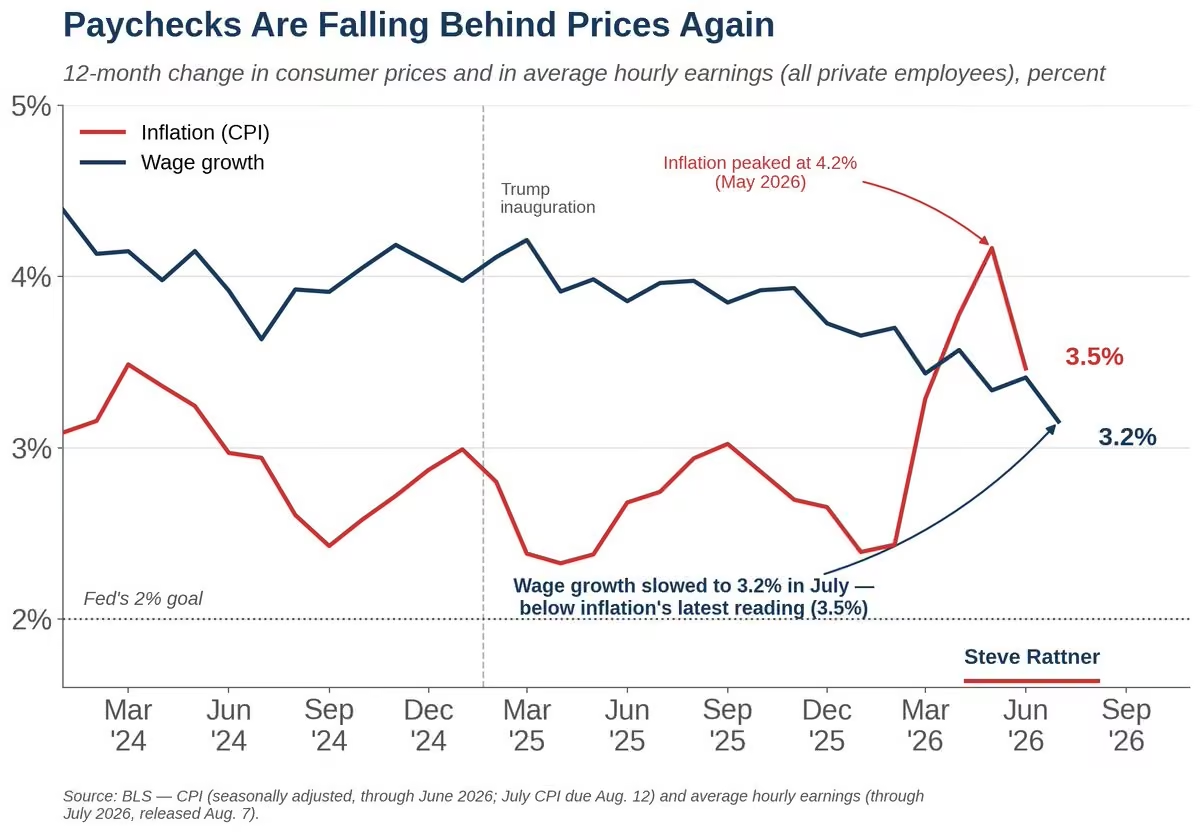
Elon Musk dropped nearly half a billion dollars on the midterms.
98% of the money he spent on specific candidates went to losers. -
Yann LeCun reposted
-
Yann LeCun reposted
Alexi Gladstone
@AlexiGlad
looped reasoning is completely overrated
Energy-Based Reasoning (EBR) runs circles around looped reasoning
paper dropping this week! -
Yann LeCun reposted
shaunbjohnson
@shaunbjohnson
At @224ventureshq, one thing we look for when we speak to founders is speed of execution.
Execution is critical because of the rapidly changing market we are in. When you're starting out, it is often the case that you do not have a moat. You need customer traction first, to learn what matters, improve the product, and to start the data flywheel that improves model performance. This momentum compounds and helps teams build an advantage.
If you are in the position where you already have a moat, speed of execution is no less critical.
You very quickly wind up with the question: how quickly can this team execute, learn, and improve? At the earliest stage, that is how an advantage starts to get built. -
Yann LeCun reposted
Kenneth Roth
@KenRoth
This is the current NY Times forecast. Incredible!
-
Yann LeCun reposted
Randall Balestriero
@randall_balestr
If you are at INFORMS in San Francisco, come by room 211 where I will be talking about our latest JEPA research in 10min (8:20am)! Have some time to chat afterwards as well!
-
Yann LeCun reposted
Yann LeCun
@ylecun
LLMs accumulate a lot of declarative knowledge.
That's how they can answer a large number of questions.
That's also why they require so many parameters and hence so much memory.
But one can replace the accumulation of knowledge by *understanding*
That what JEPA world models do.
That's one reason they can be useful with considerably less memory and training data than LLMs.
This paper merely shows that the underlying similarity structure of the data, whether text or image (e.g. co-occurence of words in text or objects in images) uniquely determines the shape of the representation point cloud, when the encoder is trained trained with a common anti-collapse criterion like SIGReg or VCReg (not by reconstruction). -
Yann LeCun reposted
Brian Li
@Brian_Bo_Li
@ylecun is certainly one of the few true thinkers and innovators in today’s overhyped AI landscape.
He is brave to say something unpopular, but at the same time this is not without reason; all his thoughts come from math and physics, and he is one of the few researchers I have seen who can derive everything from basic formulas.
He is now beginning the next chapter with @amilabs, a bold move, and I’m happy he can come to Singapore to inspire NTU students.
I’m also always grateful for the chance to join him @amilabs on his journey toward the next level of intelligence.
chizuchizu
@chizu_potato
I've just attended a talk by Yann LeCun!
Basically he explored jepa from many angles, from the math behind it to its applications in robotic -
Arjun Jain | Fast Code AI
@Arjunjain
I was trained to think Yann LeCun was wrong.
My PhD was in Vapnik’s school. Kernels. Bounds. Neural nets were alchemy.
Then I went to NYU, and he changed my mind.
Recently, he did the one thing my old school always asked for.
He brought a proof.
Yann LeCun
@ylecun
LLMs accumulate a lot of declarative knowledge.
That's how they can answer a large number of questions.
That's also why they require so many parameters and hence so much memory.
But one can replace the accumulation of knowledge by *understanding*
That what JEPA world models do.
That's one reason they can be useful with considerably less memory and training data than LLMs.
This paper merely shows that the underlying similarity structure of the data, whether text or image (e.g. co-occurence of words in text or objects in images) uniquely determines the shape of the representation point cloud, when the encoder is trained trained with a common anti-collapse criterion like SIGReg or VCReg (not by reconstruction).
Yann LeCun
@ylecun
Plot twist: I was Vapnik's Department Head between 1996 and 2002, and made sure he had the space, resources, and collaborators to do his best work.
To people who think I'm dogmatic: I famously disagreed with Vapnik about the best way forward in ML, but did what I could to promote his work, because research is about exploration and science is about results. -
Yann LeCun reposted
Arjun Jain | Fast Code AI
@Arjunjain
I was trained to think Yann LeCun was wrong.
My PhD was in Vapnik’s school. Kernels. Bounds. Neural nets were alchemy.
Then I went to NYU, and he changed my mind.
Recently, he did the one thing my old school always asked for.
He brought a proof.
Yann LeCun
@ylecun
LLMs accumulate a lot of declarative knowledge.
That's how they can answer a large number of questions.
That's also why they require so many parameters and hence so much memory.
But one can replace the accumulation of knowledge by *understanding*
That what JEPA world models do.
That's one reason they can be useful with considerably less memory and training data than LLMs.
This paper merely shows that the underlying similarity structure of the data, whether text or image (e.g. co-occurence of words in text or objects in images) uniquely determines the shape of the representation point cloud, when the encoder is trained trained with a common anti-collapse criterion like SIGReg or VCReg (not by reconstruction). -
Yann LeCun reposted
Numerama
@Numerama
Dans une étude mise en ligne le 29 octobre, Yann LeCun et Randall Balestriero affirment démontrer qu'un petit modèle d'IA bien nourri se fait une meilleure image du monde qu'un LLM 660 fois plus gros. l.numerama.com/Xet
-
Yann LeCun reposted
Randall Balestriero
@randall_balestr
Another example that we should spend more time thinking about improving pretraining losses rather than just searching for more data/gpus!
SIGReg is not the final answer, but certainly a good first step in that direction!
Try it out, checkpoint is available!
Lukas Kuhn
@lukaskuhn77
Introducing LeVJEPA 1.5 Large, the first step in scaling our method.
It closes the gap to V-JEPA on both image and video benchmarks, trained with 5.6x less compute and over an order of magnitude less data. -
Yann LeCun reposted
Lukas Kuhn
@lukaskuhn77
Introducing LeVJEPA 1.5 Large, the first step in scaling our method.
It closes the gap to V-JEPA on both image and video benchmarks, trained with 5.6x less compute and over an order of magnitude less data. -
Yann LeCun reposted
-
Yann LeCun reposted
Kenneth Roth
@KenRoth
The Trump administration is openly meddling in European democracies to promote far-right political parties that support Putin and to advance the commercial interests of Trump allies. www.theatlantic.com/ideas/2026/11/trump-europe-guilfoyle-…
-
Yann LeCun reposted
Haider.
@haider1
Yann LeCun says:
People in AI have made the same mistake for 70 years: if a machine can do a task humans see as intellectually complex, it must be smarter than humans. This is completely false
We have computers that are superhuman at many tasks but we're still far from machines with human or even animal-level intelligenceThis media couldn't be displayed. See it on the original post. -
Yann LeCun reposted
Shruti
@heyshrutimishra
Yann LeCun was right & nobody in this industry wants to say it out loud.
109 million parameters beat 72 billion.
He has spent years saying scale is not the thing that makes a model understand the world. Meta bet the other way. He left in November and started his own lab in Paris.
Last Thursday he published the proof.
The theory everyone has been running on since 2024 is that if you train models big enough, on text, on images, on sound, they all end up with the same picture of reality inside them. Size does it. Nobody ever proved that part.
Randall Balestriero and LeCun proved it. And the proof says size was never doing the work.
What does the work is which two things you show a model together.
A photo and the caption of that photo are two views of one thing. Models trained on pairs like that get there fast.
Two paragraphs pulled from the same document are not two views of one thing. Models trained on those get there slowly and expensively.
Next word prediction is the second kind. That is what every chatbot in the world runs on.
In their tests the first method reached the same understanding after 21.6 million examples. Next word prediction needed 900 million.
And a 109 million parameter text model ended up closer to an image model's view of the world than a 72 billion parameter language model was.
660 times smaller. -
Shruti
@heyshrutimishra
Yann LeCun was right & nobody in this industry wants to say it out loud.
109 million parameters beat 72 billion.
He has spent years saying scale is not the thing that makes a model understand the world. Meta bet the other way. He left in November and started his own lab in Paris.
Last Thursday he published the proof.
The theory everyone has been running on since 2024 is that if you train models big enough, on text, on images, on sound, they all end up with the same picture of reality inside them. Size does it. Nobody ever proved that part.
Randall Balestriero and LeCun proved it. And the proof says size was never doing the work.
What does the work is which two things you show a model together.
A photo and the caption of that photo are two views of one thing. Models trained on pairs like that get there fast.
Two paragraphs pulled from the same document are not two views of one thing. Models trained on those get there slowly and expensively.
Next word prediction is the second kind. That is what every chatbot in the world runs on.
In their tests the first method reached the same understanding after 21.6 million examples. Next word prediction needed 900 million.
And a 109 million parameter text model ended up closer to an image model's view of the world than a 72 billion parameter language model was.
660 times smaller.
Yann LeCun
@ylecun
LLMs accumulate a lot of declarative knowledge.
That's how they can answer a large number of questions.
That's also why they require so many parameters and hence so much memory.
But one can replace the accumulation of knowledge by *understanding*
That what JEPA world models do.
That's one reason they can be useful with considerably less memory and training data than LLMs.
This paper merely shows that the underlying similarity structure of the data, whether text or image (e.g. co-occurence of words in text or objects in images) uniquely determines the shape of the representation point cloud, when the encoder is trained trained with a common anti-collapse criterion like SIGReg or VCReg (not by reconstruction). -
Yann LeCun reposted
Yann LeCun
@ylecun
Tout cela est correct. Merci.
Sauf une chose : j'ai bien créé FAIR en 2013, y compris la branche parisienne en 2015, et montréalaise en 2017.
Mais j'en ai quitté la direction en 2018 pour devenir Chief AI Scientist: je me suis refocalisé sur la recherche (Self-Supervised Learning, JEPA, World Models, etc).
@AntoineBordes et @joellepineau étaient les co-directeurs de 2018 à 2023, jusqu a ce qu'Antoine parte pour Helsing et que Joëlle prenne la direction de FAIR.
Je n'ai jamais été impliqué dans les LLMs, ni pour la recherche (à FAIR), ni pour le développement (qui était dans le groupe de produit GenAI). J'applaudissais des gradins.
Mes seules contributions aux LLMs ont été de défendre Galactica (en octobre 2022) contre les attaques aux vitriol de la twittersphere, de promouvoir le projet Llama en interne (développé par une douzaine de chercheurs à FAIR-Paris, dont @GuillaumeLample et Timothée Lacroix), d'aider à convaincre Mark Zuckerberg de créer un groupe de produit autour de Llama (GenAI, créé début 2023), et de convaincre la direction de distribuer Llama-2 en open source/open weight.
Je n'étais pas du tout impliqué dans la direction de GenAI après sa création, préférant travailler sur la prochaine révolution: l'IA physique.
Si vous cherchez un responsable pour le déception qu'a été Llama-4, c'est plutôt la pression de sortir un produit (trop) rapidement, qui a conduit à un excès de conservatisme et un manque d'innovation de la part de l'équipe de GenAI.
Mon avis est que l'équipe aurait dû prendre un peu plus de temps et intégrer les dernières techniques venant de la recherche à FAIR.
Mais ils n'en ont pas eu le loisir.
En particulier, conserver plus de pouvoir de décision quant aux choix techniques dans les mains des créateurs originaux de Llama à Paris, au lieu de déplacer les décisions à Menlo Park, aurait peut-être permis de conserver les meilleurs talents un peu plus longtemps et de produire de meilleurs résultats. -
Post not available here, view on X
Yann LeCun
@ylecun
Tout cela est correct. Merci.
Sauf une chose : j'ai bien créé FAIR en 2013, y compris la branche parisienne en 2015, et montréalaise en 2017.
Mais j'en ai quitté la direction en 2018 pour devenir Chief AI Scientist: je me suis refocalisé sur la recherche (Self-Supervised Learning, JEPA, World Models, etc).
@AntoineBordes et @joellepineau étaient les co-directeurs de 2018 à 2023, jusqu a ce qu'Antoine parte pour Helsing et que Joëlle prenne la direction de FAIR.
Je n'ai jamais été impliqué dans les LLMs, ni pour la recherche (à FAIR), ni pour le développement (qui était dans le groupe de produit GenAI). J'applaudissais des gradins.
Mes seules contributions aux LLMs ont été de défendre Galactica (en octobre 2022) contre les attaques aux vitriol de la twittersphere, de promouvoir le projet Llama en interne (développé par une douzaine de chercheurs à FAIR-Paris, dont @GuillaumeLample et Timothée Lacroix), d'aider à convaincre Mark Zuckerberg de créer un groupe de produit autour de Llama (GenAI, créé début 2023), et de convaincre la direction de distribuer Llama-2 en open source/open weight.
Je n'étais pas du tout impliqué dans la direction de GenAI après sa création, préférant travailler sur la prochaine révolution: l'IA physique.
Si vous cherchez un responsable pour le déception qu'a été Llama-4, c'est plutôt la pression de sortir un produit (trop) rapidement, qui a conduit à un excès de conservatisme et un manque d'innovation de la part de l'équipe de GenAI.
Mon avis est que l'équipe aurait dû prendre un peu plus de temps et intégrer les dernières techniques venant de la recherche à FAIR.
Mais ils n'en ont pas eu le loisir.
En particulier, conserver plus de pouvoir de décision quant aux choix techniques dans les mains des créateurs originaux de Llama à Paris, au lieu de déplacer les décisions à Menlo Park, aurait peut-être permis de conserver les meilleurs talents un peu plus longtemps et de produire de meilleurs résultats. -
Yann LeCun reposted
alphaXiv
@askalphaxiv
Yann LeCun and Randall Balestriero just Proved the Platonic Representation Hypothesis, and found a better way to achieve it.
The Platonic Representation Hypothesis suggests that AI models trained on different modalities, like images and text, eventually learn similar representations of the world. But this paper shows that how models are trained matters more than simply scaling them up.
So they mathematically show that, under certain conditions, two JEPAs trained completely separately can learn essentially the same underlying representation of the world. One learns from different images of the same scene, while the other learns from different descriptions of that scene, without ever being trained on image-text pairs.
Their approach achieves the same image-text alignment with 42x fewer training samples than next-token prediction. A 109M-parameter text JEPA even outperforms LLMs up to 72B parameters on cross-modal alignment benchmarks.
www.alphaxiv.org/abs/2610.39302 -
Yann LeCun reposted
Randall Balestriero
@randall_balestr
The Platonic Representation Hypothesis is now a Theorem ◼️
Train JEPAs separately, on any modalities: they provably learn the same representation up to one rotation.
The result? A 109M JEPA-Text model that aligns with vision models better than 72B LLMs.
w/ @ylecun 🧵This media couldn't be displayed. See it on the original post. -
Yann LeCun reposted
Alexi Gladstone
@AlexiGlad
Energy-Based Models can now scale better than Diffusion models.
Introducing TEM: Transformer Energy-based Models
TLDR:
• TEM outscales Diffusion without guidance
• First scalable contrastive Energy-Based Models
• Better generalization, test-time scaling, and OOD detection than Diffusion
🧵This media couldn't be displayed. See it on the original post. -
Yann LeCun reposted
Romina Yalovetzky
@RominaYalov
Can a JEPA world model provably avoid contraction and merging of latent states over long rollouts?
Unconstrained autoregressive predictors may contract the latent distribution. Our Symplectic Hamiltonian JEPA (LeHami) replaces the predictor with an action-conditioned Hamiltonian flow over a latent state (q, p), integrated with an exactly symplectic leapfrog step.
Volume is preserved at every rollout step, independently of the learned parameters or action sequence.
With @randall_balestriero @ylecun
Paper: arxiv.org/abs/2610.15267
Website: rominay.github.io/lehami-website/
Code: github.com/rominay/LeHami
1/6... 🧵👇 -
Yann LeCun reposted
Maithra Raghu
@maithra_raghu
Introducing Samaya Sterling, our new model post-trained for challenging financial research that outperforms the frontier! Sterling started off as a two person research effort to see if we could increase efficiency in agentic orchestration. To our surprise we were able to post-train a much smaller model (Nemotron 3.5 Lightning, a 30B mixture-of-experts model with 3B active parameters) to greater accuracy (58.9% vs 55.9% on FrontierFinance) and 11x lower cost ($0.61 vs $6.89) than Claude Fable 5.1, the best performing frontier model.
We did this via a four-stage training process, two stages of SFT where the model first learns to research with our financial tools and how to construct a good agentic research strategy. The second two stages are RL, with an offline GRPO stage where the model further hones its research strategy from eight teachers that provide diverse approaches, and an online GRPO stage where the model can make end to end attempts and learn from its mistakes.
We see substantial gains from the co-adaptation of the model and harness through post-training, both through the model learning to effectively use the high-quality financial tools, and better compaction approaches that let even a small model execute on longer and deeper research.
We are exploring multiple follow-up directions, from multi-agent research swarms using this small model, to training firm-specific models to encode unique judgement, to training a larger model, where early results show even greater gains from the training process.
The full research is linked below! -
Yann LeCun reposted
Simplifying AI
@simplifyinAI
Yann LeCun has changed the game for robotics.
Research he co-authored tackles a problem inside AI world models: their internal representations can make planning harder than it needs to be.
A world model predicts what happens after an action. But even useful visual features can form curved paths in its internal “map,” making distance to a goal misleading.
The researchers introduced Temporal Straightening.
During training, it encourages those internal paths to become straighter, so the planner gets a more useful measure of progress.
The results:
More stable gradient-based planning
Higher success rates across tested goal-reaching tasks
Code available for others to explore
The approach changes how the model represents movement, rather than rewriting every RL algorithm to work in curved space.
For robotics, that’s a useful direction: build world models whose internal maps help an agent choose its next move. -
Yann LeCun reposted
Thomas Weber
@Thomas__Weber
Hello @elonmusk, Hitler historian here, having researched & written about Hitler for 22 yrs & being a fellow of the Hoover Institution - not exactly a hotbed of far left ideas. This doesn’t add up. It is predicated on the false assumption that collectivism only exists on the Left
-
Yann LeCun reposted
Kenneth Roth
@KenRoth
While Trump cut taxes for the rich, he tightened access to food stamps—with more than 5 million Americans losing benefits so far—and to Medicaid, the health-care program for the poor. www.economist.com/united-states/2026/10/25/the-winners-an…
-
Yann LeCun reposted
Nirit Weiss-Blatt, PhD
@DrTechlash
This new UnHerd magazine essay is about the authoritarian politics of AI doomerism.
It explains how it turned philosophical thought experiments into proposals for mass surveillance of researchers. -
Yann LeCun reposted
Sheel Mohnot
@pitdesi
Dario Amodei was so worried about Y2K that his high school teacher still remembers it decades later.
He’s been a doomer for much longer than I thought! -
Yann LeCun reposted
GET A GRIP
@docrussjackson
Elon Musk is promoting a video that rewrites the history of Nazism to suit today’s far right. Here’s what happened in 1933, who made the video, and why it matters.
Within weeks of Hitler taking power in January 1933, the organised left was being dismantled.
Communists, Social Democrats and trade unionists were rounded up, and Dachau opened in March, initially to imprison political opponents, above all Communists.
On 2 May the Nazis smashed the independent trade unions and replaced them with the state-controlled German Labour Front. A week later, students burned the works of Marx and Kautsky, with a fire oath declaring itself “against class struggle and materialism”.
Dachau’s first murders came on 12 April 1933, when the SS shot four Jewish prisoners: Rudolf Benario, Ernst Goldmann, Arthur Kahn and Erwin Kahn. Benario and Goldmann were young left-wing activists from Fürth.
The very rich were treated differently. Many industrialists had feared the Nazis were socialists, so in January 1932 Hitler addressed Düsseldorf’s Industry Club, playing down his antisemitism and stressing his anti-Marxism to reassure them. Few backed him openly until he took power.
On 20 February 1933, Hitler met leading industrialists, Gustav Krupp among them, and told them: “Private enterprise cannot be maintained in the age of democracy.” It was conceivable, he said, only where people had “a sound idea of authority and personality”. They contributed more than two million Reichsmarks to the election fund of Hitler’s coalition.
Private ownership was preserved for compliant industrialists, company profits rose sharply, and in the mid-1930s the regime even sold state stakes in banks, steelworks and shipping back into private hands.
In 1934, Hitler also had members of his own movement who took its anti-capitalist rhetoric seriously murdered during the Night of the Long Knives.
Yes, the Nazis controlled prices, wages and investment, as Britain did in wartime. State control tells you how an economy is run, and the question that matters is whom it serves.
The Nazi state crushed independent labour, protected compliant employers, and harnessed the economy to rearmament and conquest.
That is why historians place Nazism on the far right, including conservatives such as Ernst Nolte, who saw anti-Marxism as fascism’s defining feature.
The word in the party’s name was largely a recruiting device, designed to lure workers away from the real socialist and communist parties. A name settles nothing, any more than North Korea’s makes it democratic.
The man Musk is amplifying is Brivael Le Pogam, the Paris-based co-founder of Argil, a Silicon Valley-backed company selling AI video avatars, who boasts of using AI to win hundreds of millions of views.
His self-described “masterclass” spends minutes on price controls and the voting habits of American professors. It never once mentions the Holocaust. Race appears once, as “fuel”.
He is candid about why. With Hitler on the right, he complains, anyone defending “borders” or “the nation” is “one step away from fascism”. That is “why Milei is far right” and “why people call Elon Musk a Nazi”.
A nationalist politics is to be cleansed by relabelling history’s most murderous nationalist.
He even cites Leo Strauss’s “reductio ad Hitlerum”, the fallacy of condemning an idea because Hitler held it, and then commits it from start to finish. And his test of freedom is simply the free market, which would place Pinochet’s Chile, with its torture and disappearances, on the side of freedom.
So the world’s richest man is promoting an attempt to free the far right from its own history, turning the Nazis’ first victims into props for their persecutors.
History records which side Germany’s richest men chose in 1933. It’s worth noticing who is now keen to blur it.
It’s polished, confident and wrong, and it’s built to divide: anyone who objects is cast as the enemy of freedom. Freedom for whom?
Remember who filled Dachau first.
Elon Musk
@elonmusk
Hitler was a far left socialist. Literally in the name of his party!
Brivael Le Pogam
@brivael
It's been months that I keep saying Hitler was far left. Every time, thousands of clowns show up in my replies to give me history lessons.
So I made a video to answer all these low IQ takes at once.
Topic closed. Next.This media couldn't be displayed. See it on the original post. -
Yann LeCun reposted
Morgan J. Freeman
@mjfree
Trump called it the Big Beautiful Bill.
It cut nearly $1T from healthcare — mostly Medicaid — to pay for massive tax breaks for billionaires and the richest 1%.
How beautiful is that?
The bill leaves millions uninsured and forces many rural hospitals to close.
Working families — priced out of healthcare — will suffer and die — all while Trump and his buddies literally laugh all the way to the bank (with YOUR money).
Ready for a #bluewavein10days?
www.forbes.com/sites/saradorn/2025/07/01/trumps-policy-me… -
Yann LeCun reposted
Our World in Data
@OurWorldInData
The world is getting more of its electricity from renewables but less from nuclear power.
If the world is to reduce its carbon emissions and tackle climate change, it needs to move away from fossil fuels to low-carbon power.
There are two key sources of low-carbon electricity: renewables — which include solar, wind, hydropower and others — and nuclear power.
While rapid growth in solar and wind has increased the amount of electricity coming from renewables, a lack of enthusiasm for nuclear means it’s playing a shrinking role in the global mix.
In the chart, you can see the share of global electricity coming from fossil fuels, renewables, and nuclear since 1985. Since 2000, nuclear and renewables have followed very different trajectories. Back then, both accounted for a similar share of global electricity. But in 2025, renewables made up more than three times as much: 34% compared to 9%.
The total amount of electricity produced by nuclear plants is about the same as it was two decades ago. But because the world produces much more electricity overall, its share of the electricity mix has declined.
(written by @_HannahRitchie and @parriagadap) -
Yann LeCun reposted
Aes🇺🇸
@AesPolitics1
This dude needs help. If Talarico wins he’s going to lose his mind.
-
Yann LeCun reposted
Yann LeCun
@ylecun
Hitler was as much of a far-left socialist as you are a democracy-loving humanist.
-
Yann LeCun reposted
nxthompson
@nxthompson
“The U.S. has benefited from the skills that Indians bring without having had to invest much in their education. Many have earned advanced degrees in America, but the bulk of their training happened in India. A more honest way to see it is that India, along with other poorer countries, has been subsidizing the United States.” www.theatlantic.com/ideas/2026/10/america-anti-indian-big…
-
Yann LeCun reposted
Mike Levin
@MikeLevin
We’ve never seen corruption like this.
Under Trump, a whole pardon industry has grown up around the White House, with wealthy criminals paying well-connected insiders for a shot at clemency. Some have paid up to a million dollars. This case blows past all of them.
A billionaire banker named Julio Herrera Velutini was charged with trying to bribe Puerto Rico’s governor to fire the official investigating his bank. Herrera wanted his record wiped clean, so he went looking for a pardon from Trump.
Herrera’s daughter gave $3.5 million to a group supporting President Trump. Then the Herrera family offered Alina Habba, the President’s former personal lawyer, a job guaranteeing her more than $50 million over four years, at a company with no public profile. Habba signed the deal while she was still a federal prosecutor.
A few weeks after Habba started, Trump gave Herrera a full pardon.
No matter your party, we can all agree that justice should never be for sale. That’s why I helped start the End Corruption Caucus in Congress, and why I’m fighting to bring the pardon process out into the open.
Either we will end the corruption, or the corruption will be the end of us.
www.nytimes.com/2026/10/20/us/politics/julio-herrera-pard… -
Elon Musk
@elonmusk
Hitler was a far left socialist. Literally in the name of his party!
Brivael Le Pogam
@brivael
It's been months that I keep saying Hitler was far left. Every time, thousands of clowns show up in my replies to give me history lessons.
So I made a video to answer all these low IQ takes at once.
Topic closed. Next.This media couldn't be displayed. See it on the original post.
Yann LeCun
@ylecun
Hitler was as much of a far-left socialist as you are a democracy-loving humanist.
-
Yann LeCun reposted
Mother Jones
@MotherJones
The world’s first trillionaire is also a disinformation super-spreader. www.motherjones.com/politics/2026/10/elon-musk-midterm-el…
-
Yann LeCun reposted
BrooklynDad_Defiant!☮️
@mmpadellan
Republicans control the House.
Republicans control the Senate.
Republicans control the White House.
Republicans control the Supreme Court.
Republicans control the DOJ.
This is what they did with two years in control:
trump gets:
- Gold all over the Oval Office
- BILLIONS in crypto for himself
- $400 million dollar Qatari bribe jet
- Millions in media and tech settlements
- Gold bars and diamond rings for tariff relief
- BILLIONS in Pentagon contracts for his sons
- $100,000 per month per person for insider info
- $600 million dollar ballroom at taxpayer expense
YOU GET:
- A war in Iran
- Higher gas prices
- Higher utility prices
- Higher grocery prices
- Higher housing prices
- Higher healthcare costs
- 21 dead American soldiers
- loss of trust from allies around the globe
- ICE thugs abusing our friends and neighbors
Now they want TWO MORE YEARS in office,
While they actively try to STEAL your vote.
WE ARE NOT POWERLESS.
Your vote can change this. -
Yann LeCun reposted
AnthroVet50
@spooked75
I'm an American, a U.S. Army veteran, and I live in Europe.
And I'll tell you something that might upset a few people back home.
I want my fellow Americans to enjoy the same rights, freedoms, and quality of life that millions of Europeans already enjoy.
I want Americans to have access to affordable healthcare without worrying about going bankrupt because they got sick.
I want American students to pursue higher education without burying themselves in decades of debt.
I want Americans to enjoy stronger digital privacy laws, meaningful consumer protections, paid parental leave, and guaranteed paid vacation.
I want police officers held to rigorous standards of accountability, where de-escalation is emphasized and deadly force is genuinely a last resort.
I want Americans to understand that freedom isn't just about what the government cannot do to you. It's also about having the security and opportunity to actually enjoy your life.
And before someone starts screaming about socialism, understand something.
European countries are capitalist democracies. They have private businesses, entrepreneurs, private property, competitive markets, and individual liberties. They've simply made different decisions about what protections their citizens should enjoy.
Europe isn't perfect. No place is. But pretending America has nothing to learn from other democracies is ridiculous.
I served my country. I love my country. And I don't believe patriotism requires pretending that America is the best at everything.
In fact, I believe the exact opposite.
Real patriotism means wanting your country to improve, even when that means admitting another country does something better.
I don't want Americans to have fewer freedoms.
I want them to have MORE.
More protections. More opportunities. More security. More accountability. More freedom to live their lives without being financially destroyed by illness, education, or circumstances beyond their control.
And having lived on both sides of the Atlantic, I know that much of this is possible.
We should stop asking why Americans can't have these things and start asking why they're expected to settle for less. -
Yann LeCun reposted
IN TRUMP WE TRUST
Here is George Clooney’s response after Trump accused him of being a "Hollywood elite."
"Here’s the thing: I grew up in Kentucky. I sold insurance door-to-door. I sold ladies’ shoes. I worked at an all-night liquor store. I would buy suits that were too big and too long and cut the bottom of the pants off to make ties so I’d have a tie to go on job interviews. I grew up understanding what it was like to not have health insurance for eight years.
So this idea that I’m somehow the “Hollywood elite” and this guy who takes a shit in a gold toilet is somehow the man of the people is laughable.
People in Hollywood, for the most part, are people from the Midwest who moved to Hollywood to have a career. So this idea of “coastal elites” living in a bubble is ridiculous. Who lives in a bigger bubble?
He lives in a gold tower and has twelve people in his company. He doesn’t run a corporation of hundreds of thousands of people he employs and takes care of. He ran a company of twelve people!
When you direct a film you have seven different unions all wanting different things, you have to find consensus with all of them, and you have to get them moving in the same direction.
He’s never had to do any of that kind of stuff. I just look at it and I laugh when I see him say “Hollywood elite.” Hollywood elite? I don’t have a star on Hollywood Boulevard, Donald Trump has a star on Hollywood Boulevard! Fuck you!"
- George Clooney
actor, philanthropist, humanitarian & activistThis media couldn't be displayed. See it on the original post. -
Yann LeCun reposted
Kenneth Roth
@KenRoth
Most voters trust that the midterm ballots will be counted properly, but fears mount that Trump and his Republicans will try to overturn the results. The best defense may be a major electoral loss for Republicans, which will be harder to ignore. www.nytimes.com/2026/10/23/us/politics/election-integrity…
-
Yann LeCun reposted
Yann LeCun
@ylecun
Elon says:
"we will not be able to boss around AI that are smarter than us"....
while having built his fortune on bossing around thousands of engineers and scientists who are way smarter than himself
🤣🤣🤣 -
Yann LeCun reposted
Enact
@enact_intel
Today, Enact emerges from stealth with a $30M pre-seed to master dexterity through force and touch.
Vision and language are becoming commodities, but robots need more than a visual cortex to master thousands of fine manipulation tasks.
That is why we’re building an artificial nervous system for robots. It lets them sense what’s happening in real time through their own actuators. No fragile sensors, no extra hardware: built to scale and designed for real-world deployment from day one.
Force and touch lets our system learn efficiently and perform tasks faster, so automation finally pays off where we need it most: where value comes from variance, not volume.
We’re proud to be backed by leading investors, AI researchers, roboticists, and founders, including redalpine, Notion Capital, @firstminutecap & @ylecun LeCun, @arthurmensch (Mistral), @AndrewLonsberry (Path Robotics) and @Thom_Wolf (Hugging Face) alongside many more.
Read what people wrote about us in the comments!
And check out our hiring page:
enact-intelligence.com/join/
Signe Lin Kuei Vehusheia, PhD, Yann Glauser, Noah Hüsser, Jonas Eichenberger, Yang Liu, Philip Kneis, Manuel Yves Galliker, Carl Wyder, Aleksander Kamiński, Matt Benice -
Yann LeCun reposted
Mosh Levy
@mosh_levy
1/ JEPA selects which features its world model keeps.
But how?
Will it keep a feature it can't predict, like a traffic light?
Judging each feature alone, earlier work says no.
We show evidence that this is wrong and introduce a new characterization that explains why. 👇🧵 -
Yann LeCun reposted
Jon Barron
@jon_barron
Hi all, I have a new result I'm excited to share. It turns out that *all existing implementations* of softmax and cross-entropy (that's JAX, PyTorch, textbooks, etc) have a subtle bug --- two bugs, actually. A simple rewrite fixes both, and eliminates "slingshots" when grokking:
-
Yann LeCun reposted
Eero Simoncelli
@EeroSimoncelli
Looking for a PhD program where you can study computational neuroscience? NYU has a fantastic array of researchers covering the field, and we'd love to consider your application:
groups.google.com/g/systems-neuroscience/c/GbzEedlAd_o -
Yann LeCun reposted
Kenneth Roth
@KenRoth
Thanks to Trump, the United States sticks out as the only major economy where planet-warming pollution increased dramatically last year, according to a new report by U.N. scientists. www.npr.org/2026/10/21/nx-s1-6003553/america-oil-gas-coal…
-
Yann LeCun reposted
Jude Gomila
@judegomila
I'd like to share a little about what I've been working on at my new company @ultrametricai with my cofounder @tylerlastovich. We have been exploring how we could automate the startup itself, leaving founders with more time to focus on their exact mission.
Enter our first release of the Open Startup Repo: github.com/ultrametricai/ultrametric
A common foundation for transparent automation of the startup.
After close to 20 years in silicon valley, backing hundreds of amazing founders & startups, being in the trenches of founding Heyzap (YC08), then solo founding @golden, going through 2 acquisitions and working behind the scenes with some of the iconic companies today, I'm witnessing the largest change to how we work I could have imagined - a truly monumental era of creative abundance.
I believe the next generation of companies will largely run themselves: from operations, code, product upgrades, growth, vendor control & selection, process execution, special situations, strategy etc etc. That leaves founder time for 'the art' at the very niche core: the (currently) unautomatable, the special leaps humans tend to make, and north star setting.
We want founders to go super deep into the main problem they are trying to solve and not get held up doing anything else, from searching for domain availability with trademark checks to setting their company up, to running their processes on autopilot.
So to help that broad foundational layer for starting and running a company, we have spent around a year exploring how to help founders focus on their mission across different verticals, geos, stages and initial starting conditions.
Our first few attempts at making something useful actually failed as the market and AI was moving so fast; it just got absorbed into the models or other product releases. We saw polsia happen, openclaw, then grokbot, muse, dots, etc era as the astras, fables, opuses, kimis and jevs rolled out. What seemed to have been missing along the way was a common repo to identify, unify, open and normalize all the lego bricks that startups have to interact with (vendors, processes, business logic, law, best practices, surface areas, art of the possible).
As the number of software vendors blew up, the interfaces to drive them multiplied, the international startup founder blew up as silicon valley moved from a specific location to a state of mind and global movement. Unlimited pre seed funding in unlimited vertical sub markets and permutations has brought us to the age of infinity but we have yet to achieve being able to type into an agent a very simple sentence with very complex implications 'just setup my company and make $1m/m'. We have ended up with a hybrid mismash of computer use, API calls, plugins, shifting surface areas (API/MCP/CLI/plugins/chats/musish futures), and changing model absorption to vendor balance making it an exciting and unstable time.
As our first step we started to rank all the vendors that startups interface to when going about their journey in terms of how agentically controllable they are via their APIs, MCPs, CLIs etc and computer use compatibility as we are largely switching from a UI driven world to the agentic control surfaces and onto full automation. We have 100 ranking areas you can check out with an overall open ranking here: ultrametric.ai/overall
Then we looked at the processes that startups do and how the vendors rank for the sub steps or process as a whole and how this changes across geos. Open processes: ultrametric.ai/processes
Then we started to hack on an open repo for startups that would contain all the components we are going to need for a common foundation for founders across the globe even if our gov processes vary so much from Bengaluru to SF or Lisbon to Shenzhen. The founder spirit is geo-invariant.
We have looked at special founder/startup situations, the business logic that will make open modules for the startup that we can hack on together, ranked law firms, government services and interfaces, stacks that go well together. We have mapped the law and lore that maps to startups and the schemas that make up the data objects and documents. But also the open documents and the missing gaps. MUCH TO DO.
All the BS processes and fluff work that founders waste their time on needs to goto zero. I want to see more supersonic planes, cancer drugs, seemingly impossible missions done and increase the bang for buck founders have with their funding.
This is a work in progress and we are keen for the community to come hack on the repo with us here: github.com/ultrametricai/ultrametric
Lets get into the structure of the general repo and the visualizations we made on ultrametric.ai site with example links:
- Open rankings: ultrametric.ai/overall
- Open rankings example (online payments): ultrametric.ai/arena/payments
- Open ranking example 2 (cap table): ultrametric.ai/arena/equity-management
- Open processes: ultrametric.ai/processes
- Open process example (Incorporate C-Corp) ultrametric.ai/processes/incorporate-c-corp
- Open situations that founders face: ultrametric.ai/situations
- Open startup simulator (you can test our different initial starting conditions): ultrametric.ai/startup-sim
- Open modules (e.g. cap table, payroll logic etc - we'd love help improving these) ultrametric.ai/open-modules
- Open law (we are interested in how law changes the processes, situations and normalizing this over time) ultrametric.ai/open-law
- Open lore (we are interested in the historical lore of startups, the rules of thumb and heuristics that might guide your agent): ultrametric.ai/open-lore
- Open fields (we are interested in how the schema for the data connects to the open modules, business logic, open documents and artifacts of each process eg how is a EIN defined?) ultrametric.ai/fields
- Open documentation (eg SAFE notes and missing! docs) ultrametric.ai/open-documents
We have looked at YC companies as well in terms of which ones do well agentically: ultrametric.ai/yc
We are interested in stacks and how people are changing their work: ultrametric.ai/stacks
We are interested in what is automatable and where the agentic ceiling is currently and how to push that up in all areas: ultrametric.ai/rankings/processes/most-automatable
There is more for you to explore and a lot more coming in terms of how you will be able to navigate business in an optimal way in your chosen surface area; whether you are hanging in grokbot, dots, muse, claude, terminal, chat, or whatever is coming up in this exciting time.
We have a lot of data to collect, clean up and help agents navigate the vast landscape emerging functionality the entire startup ecosystem has to offer.
Come join us getting your vendor in, ranked or that access pattern you have wanted or getting the data more accurate in terms of which vendor is best for a process or steps. Or open a module of something that currently cost money that could be free.
Also come play in our discord for founders and join the chaos (we can solve each others issues including fund raising tips from me personally): discord.com/invite/3aHky836qP
It's time to lift all the boats in the harbor and I'm extremely excited as to what the community of hackers and painters will hack into the repo, what asks they will have and whether we can shift normalization of processes globally, gov agentic interfaces and have common repo for founders that grows over time. I expect a lot of experimentation along the way, bugs and upside...
I appreciate our backers having faith in us as well from @ycombinator with @garrytan to @immad doing a sizable check (congrats on $1bn rev homie) to @darbyw (congrats on Stripe buying @clerkyinc), @drewhouston form @Dropbox and also @pioneer_fund @tomerlondon cto @GustoHQ and hopefully this is 'boring' and complex enough for Charlie Songhurst :> @delingpole @Liquid2V @ivolo from @segment @ryanpowe @sonicaghi of @kong @DellyTamer+ other supporters (@michaelwfrank, Fundamental ventures and if I missed you sorry moving fast!).
[And don't worry, all vendor rankings are open scoring methods so no favors are being done if someone backed us and is a vendor they have to compete with how agentic and automatable they are just like anyone else.]
PS: we have bugs and many quality upgrades to make but thought better to go out early and fix as a community.
PPS: we have other stuff to launch we just thought this was a great place to start and have 200 PRs coming out pretty soon but I still want to know what is broken or doesnt make sense or inaccurate.
Special thanks to current and past team members for getting us here and all the experiments we did you know who you are. -
Yann LeCun reposted
Chris Murphy 🟧
@ChrisMurphyCT
Ukraine was winning the war, so Trump kneecapped Ukraine to help Russia.
I wish it weren’t that simple, but it is. Our president is in bed with our enemies.This media couldn't be displayed. See it on the original post. -
Yann LeCun reposted
Dogi
@Dogi1313
ELON FANS WON'T LIKE THIS ONE...
BUT HERE ARE 10 BIG THINGS ELON PROMISED THAT NEVER HAPPENED:
The New York Times went through 15 years of his posts and interviews.
He made 602 promises with a date on them.
Only 1 in 5 happened on time.
Here are some of them:
1. In 2015 he said Teslas would fully drive themselves in 2 or 3 years.
11 years later, you still have to keep your eyes on the road.
2. In 2016 he said a Tesla would drive itself from LA to New York by the end of 2017.
It never did.
3. In 2019 he said there would be 1 million robotaxis by 2020.
Today there's a small service in Austin. With a safety person sitting inside.
4. In 2017 he said the new Tesla Roadster would come out in 2020.
They just showed it this month. Now it's coming in 2028.
5. For years he talked about a cheap $25,000 Tesla.
Then he dropped it and called the idea "pointless."
6. In 2016 he said SpaceX would send a ship to Mars by 2018.
Later he said people would be on Mars by 2024. Nobody has gone. Not even an empty rocket.
7. In 2013 he said Hyperloop would take you from LA to San Francisco in 35 minutes.
What we got is Teslas driving through a tunnel in Las Vegas.
8. When he bought Twitter, he said a team would be set up before any big decisions on banned accounts.
That team never showed up.
9. With DOGE he promised $2 trillion in government cuts.
Studies found it saved almost nothing.
10. He said his AI company would build AI smarter than humans by 2025. Still waiting.
Yes, he's also done crazy things. Rockets that land themselves. Starlink. Making electric cars normal.
But even he admits he only expects to hit his deadlines about half the time.
So today he posted that he'll give one SpaceX share to every kid in America next year.
That's around 73 million kids.
He hasn't said how. Or who gets it. Or who pays the tax.
Save this post. We'll check back in 2028.
Written by: @carlmoon -
Yann LeCun reposted
kyutai
@kyutai_labs
Pocket TTS has been getting updates those last few days. While it was ~100M parameters, we release smaller versions, down to 1.9M: an 18.2M model with the quality of the original, a 6.9M model, and a 1.9M model that runs 103x faster than real time on one CPU core. All with voice cloning.
-
Yann LeCun reposted
Kenneth Roth
@KenRoth
It speaks to the unchecked power of the American presidency that a single warped occupant of the Oval Office can transform the United States into an ally of Putin even as most Americans are outraged by his invasion of Ukraine and targeting of civilians. www.theatlantic.com/ideas/2026/10/america-now-ally-russia…
-
Yann LeCun reposted
Justin Wolfers
@JustinWolfers
Washington has discovered a brilliant financial strategy. Cut benefits for people who need them, cut taxes for people who don't, and borrow the difference from people who aren't old enough to vote.
-
Yann LeCun reposted
Steve Rattner
@SteveRattner
Trump has raised $330 million from private donors for his White House ballroom.
About half have received federal contracts during his second term, according to The Washington Post.
Here are the top 16 givers. -
Yann LeCun reposted
Yann LeCun
@ylecun
I'm definitely not anti-achievement and never criticized real achievements, including by Elon.
I even own two Teslas.
I do expose marketing stunts that, while cool on the surface, are not the achievements they are claimed to be.
Compressed air thrusters might give you acceleration boosts in any direction.
They might even make your car hover for a couple of seconds if you accept replacing the passenger seat by a 400 liter high-pressure air tank.
But they are not a path to actual flying cars.
The same way Burt Rutan's SpaceshipOne was never going to be a path to orbital flights (just bunny hops out of the atmosphere).
I am anti-Musk when it comes to politics. His political actions, the massive dissemination of disinformation through X and other channels, and his support for authoritarian regimes and racist ideas have the effect of weakening democracy and weakening human decency and social progress around the world. -
Yann LeCun reposted
Fred Lambert
@FredLambert
Everything Yann said here is roughly correct, and Musk knows it, which is why he responded like a 14-year-old.
Fred Lambert
@FredLambert
Calling @MKBHD’s video “hate” is misguided and highlights the nearly insurmountable issue the Tesla community has with criticism.
There was plenty to criticize about that unveiling and I thought Marques did an incredible job.
He is becoming a great force pushing against the growing movement in tech and now automotive of over promising and under delivering. -
Yann LeCun reposted
Sam
@SamCKx
Yann LeCun, one of the world’s foremost AI, machine-learning and robotics researchers, an engineer, NYU professor and ACM Turing Award laureate, has been torn to pieces today by Elon Musk fans for daring to inject some reality into the Tesla Roadster debate.
The objection isn’t that the technology isn’t impressive. It is how these capabilities are being marketed, with deposits being taken on the basis of what we’ve been shown.
The physics remain the problem. A production car carrying enough compressed air to deliver those levels of thrust would face enormous compromises in weight, storage capacity and recharge requirements. At best, you’re looking at seconds of extreme thrust, followed by specialist recharging that can absolutely not be integrated into the car - literally impossible because of the weighty equipment needed & the energy required for that equipment to compress 600L of air for a few seconds of thrust.
And let’s not forget that the Roadster 2.0 was announced in 2017. Nine years later, instead of finally putting that car on the road, we’re watching a new version of the same old story.
This isn’t hate. It’s realism based on experience, engineering and physics.
And when someone like @ylecun makes essentially the same observations, the response shouldn’t be “What have you ever achieved?” or "what do you know?" - sure, use that one on me, but not on Yann.
Yann LeCun
@ylecun
I'm definitely not anti-achievement and never criticized real achievements, including by Elon.
I even own two Teslas.
I do expose marketing stunts that, while cool on the surface, are not the achievements they are claimed to be.
Compressed air thrusters might give you acceleration boosts in any direction.
They might even make your car hover for a couple of seconds if you accept replacing the passenger seat by a 400 liter high-pressure air tank.
But they are not a path to actual flying cars.
The same way Burt Rutan's SpaceshipOne was never going to be a path to orbital flights (just bunny hops out of the atmosphere).
I am anti-Musk when it comes to politics. His political actions, the massive dissemination of disinformation through X and other channels, and his support for authoritarian regimes and racist ideas have the effect of weakening democracy and weakening human decency and social progress around the world. -
Post not available here, view on X
Yann LeCun
@ylecun
Okay, so it's just compressed air.
Easier.
But crappy specific impulse (less than 50 seconds).
Even assuming that 50% of the mass of the car is the compressed air, that gives you less than 10s of useful thrust (with thrust-to-weight ratio larger than 1.0). Probably more like 5 seconds, actually.
So the car must be an empty, lightweight shell containing big compressed air tanks.
Cute demo, but totally impractical.
But of course, you knew that.
Yann LeCun
@ylecun
From a high-pressure belly, your fart might propel you upward and forward.
Come to think of it, that's exactly how your car is powered:
A 700 bar, 600 liter, 3 second, noisy fart 😆
[Hopefully without the methane and the smelly compounds]Post not available here, view on X
Yann LeCun
@ylecun
I'm definitely not anti-achievement and never criticized real achievements, including by Elon.
I even own two Teslas.
I do expose marketing stunts that, while cool on the surface, are not the achievements they are claimed to be.
Compressed air thrusters might give you acceleration boosts in any direction.
They might even make your car hover for a couple of seconds if you accept replacing the passenger seat by a 400 liter high-pressure air tank.
But they are not a path to actual flying cars.
The same way Burt Rutan's SpaceshipOne was never going to be a path to orbital flights (just bunny hops out of the atmosphere).
I am anti-Musk when it comes to politics. His political actions, the massive dissemination of disinformation through X and other channels, and his support for authoritarian regimes and racist ideas have the effect of weakening democracy and weakening human decency and social progress around the world. -
Yann LeCun reposted
Kenneth Roth
@KenRoth
Trump’s longstanding groundless attacks on the integrity of voting systems are crystallizing into what many fear is an attempt to lay the groundwork to challenge the results in November when Republicans are expected to lose big time. www.nytimes.com/2026/10/15/us/politics/trumps-attacks-vot…
-
Yann LeCun reposted
Alexandr Wang
@alexandr_wang
you’ll never believe what i saw on the highway today
-
Yann LeCun reposted
AdrianoFeria.eth 🦇🔊 🛡️
@AdrianoFeria
People seem confused about why Tesla is getting so much backlash over its new "flying Roadster." For those of us who were once genuinely enthusiastic about Tesla, this isn't about hating innovation. It's about a long history of broken promises, misleading expectations, and increasingly absurd marketing.
Tesla unveiled the second-generation Roadster in 2017, took customer deposits, and promised deliveries in 2020. Six years past that deadline, it still hasn't delivered the car. Instead, it's demonstrating an even more outrageous version with features that will likely never make it into production. The original 2nd gen Roadster would still be an amazing car today. Why not just deliver what was promised?
Then there's Full Self-Driving. Tesla marketed the idea that Model 3 owners could turn their cars into income-generating robotaxis. That never materialized. Even if the technology eventually gets there, the opportunity has already passed for many early buyers. Timing matters. Delivering something a decade late isn't fulfilling the promise you sold to customers.
And then there's Solar Roof. Unveiled in 2016 as a revolutionary approach to residential solar, it struggled with costs, installation challenges, and adoption far below expectations. After nearly a decade, Tesla discontinued it entirely in August 2026. Another grand vision abandoned, leaving existing customers with a discontinued product to maintain.
Then came the Cybertruck, marketed as a nearly indestructible, revolutionary truck. Instead, we got a vehicle with questionable build quality, numerous recalls, expensive repairs, disappointing results in several real-world off-road tests, and specifications that fell short of the original promises. It literally looks like a dumpster, but aesthetics aside, the collapsing demand speaks volumes about the reality of what Tesla delivered. Another heavily hyped product that fell dramatically short of expectations.
This is how consumer trust erodes. Not through one disappointment, but through years of accumulating them. And this is part of the reason why many people who were once enthusiastic about Tesla have become critical and cynical about it.
But there's something even more fundamental here: Tesla has completely departed from the grounded, practical vision that made so many of us enthusiastic about the company in the first place.
Electric cars were ambitious, but the idea was grounded in reality. People could charge at home, infrastructure could gradually expand, technology could improve, and millions of ordinary people could eventually benefit. There was a realistic path toward mass adoption.
What the hell does a flying Roadster powered by compressed-air thrusters have to do with any of that?
It's an expensive, impractical engineering stunt with enormous packaging, safety, and regulatory challenges, and no credible near-term path toward mass-market usefulness. Modern electric cars already achieve ridiculous acceleration without this nonsense. What practical problem does it solve? Who actually needs it? When will ordinary consumers benefit?
And watching Tesla fans compare this experimental prototype in a Roadster-shaped shell to actual production vehicles people can buy today is ridiculous.
What's especially infuriating is the cult-like mentality surrounding all of this. You can't point out the history of failed promises, question the practicality, or demand realistic timelines without being accused of being a "hater" or having "Elon derangement syndrome."
Tesla deserves recognition for helping make electric cars a reality, but that success doesn't give it a blank check to keep marketing increasingly fantastical promises while failing to deliver on previous commitments.
This isn't hatred. It's disappointment from people who once believed in the company, watched it accomplish extraordinary things, and have since watched it increasingly substitute practical innovation with spectacle and promises.
Elon fanboys are also ignoring a bigger pattern that goes beyond Tesla.
What made many of us enthusiastic about Elon and Tesla and in the first place was a grounded vision of technological progress that could genuinely improve millions of lives. Electric cars were ambitious, but practical, achievable, and useful to ordinary people. Now we're supposed to get excited about flying cars with compressed-air thrusters that have no credible path to mass adoption and solve no meaningful problem for the average consumer.
It's the same kind of thinking behind marketing the colonization of Mars as some urgent necessity for humanity's survival. There's nothing wrong with space exploration, but Earth isn't about to become uninhabitable because of the Sun. We're talking about geological timescales, while humanity faces enormous problems RIGHT NOW: poverty, hunger, access to education, corruption, abuse of power, wars, and a lack of government accountability. We have plenty of very real problems to solve before worrying about humanity's survival on another planet.
And then there's DOGE. I was genuinely excited about the original idea of making government more efficient, reducing waste, and increasing accountability. Instead, we got questionable savings figures, inexperienced people making sweeping decisions, serious concerns over access to sensitive personal information, and an initiative that ultimately fizzled out without delivering its grand promises. Another enormous narrative that fell apart when confronted with reality.
That's what makes all of this so frustrating. It's not that we stopped believing in technological progress. It's that we've watched someone who once pursued grounded, transformative ideas increasingly embrace fantastical promises, political spectacle, and questionable narratives disconnected from practical reality.
And somehow, pointing out this history of disappointment gets you labeled a "hater" or accused of having "Elon derangement syndrome."
The problem isn't dreaming big. It's repeatedly selling people those dreams, failing to deliver, and then expecting everyone to applaud the next, even more ridiculous promise without asking what happened to the last one.
The world doesn't need more spectacular promises. It needs practical solutions to real problems, honest expectations, and accountability for what was promised. That's what made Tesla exciting in the first place, and that's what so many of us feel has been betrayed. -
Yann LeCun reposted
Pew Research Center
@pewresearch
Trump’s approval rating has dropped in every religious group since the beginning of his second term.
Today, White evangelical Protestants are the only religious group in which more people approve than disapprove of Trump’s job performance (58% vs. 40%). -
Yann LeCun reposted
Yann LeCun
@ylecun
Okay, so it's just compressed air.
Easier.
But crappy specific impulse (less than 50 seconds).
Even assuming that 50% of the mass of the car is the compressed air, that gives you less than 10s of useful thrust (with thrust-to-weight ratio larger than 1.0). Probably more like 5 seconds, actually.
So the car must be an empty, lightweight shell containing big compressed air tanks.
Cute demo, but totally impractical.
But of course, you knew that. -
Yann LeCun reposted
Nirit Weiss-Blatt, PhD
@DrTechlash
My new investigation maps nearly $3 BILLION in historical and projected funding behind the AI existential-risk ecosystem.
-
Yann LeCun reposted
The New Yorker
@NewYorker
“At a time when Donald Trump’s party is struggling to hold both houses of Congress and his own approval ratings are cratering to historic lows, the President has been campaigning hard all week against . . . Volodymyr Zelensky,” Susan B. Glasser writes. “Yes, Trump’s October preëlection surprise is that he’s finally decided to begin openly helping Vladimir Putin in Russia’s war of conquest against Ukraine.”
“Trump has pivoted to Putin so many times before that it should hardly astonish anyone that he did it again,” Glasser continues. “But these crises that Trump provokes with such regularity always manage to reveal something new, and this one has been no exception, showing a President so politically cornered by the consequences of his war in the Middle East that he turned to Putin to help him out with less than three weeks to go before the midterm elections.” Read her latest column: newyorkermag.visitlink.me/y76eLM -
Yann LeCun reposted
Steve Rattner
@SteveRattner
Trump says drug prices are down 300–700% and Americans pay “the lowest drug prices” in the world.
Prescription drug prices are down only 3.9%, and our prices are still near the top of the list.
My @Morning_Joe Chart -
Yann LeCun reposted
Steve Rattner
@SteveRattner
Trump says he brought in “$21 trillion” of investment vs. “less than $1 trillion” under Biden.
Actual business investment: $14.5 trillion under Biden, $6.7 trillion so far under Trump.
My @Morning_Joe Chart -
Yann LeCun reposted
NYU Center for Data Science
@NYUDataScience
World models can fail when the world changes.
That's why CDS PhD student Ying Wang (@yingwww_), CDS founding director Yann LeCun (@ylecun) & CDS Assistant Professor Mengye Ren (@mengyer) built AdaJEPA to adapt during planning.
nyudatascience.medium.com/a-world-model-that-keeps-learni… -
Yann LeCun reposted
Kenneth Roth
@KenRoth
Trump calls Ukraine's attacks on Russia's oil refineries a "disgrace," even though they deprive the Kremlin of financing for its attacks on Ukraine, but the warped Trump seems to have no problem with Putin's war-crime attacks on Ukrainian civilians. www.theguardian.com/world/2026/oct/16/trump-calls-ukraine…
-
Yann LeCun reposted
Thomas L. Friedman
@tomfriedman
Trump’s Democracy-for-Diesel Deal Shames Us All
www.nytimes.com/2026/10/15/opinion/trump-russia-oil-putin… -
Yann LeCun reposted
Steve Rattner
@SteveRattner
Trump says we’re building “more factories and plants right now than at any time in our history.”
Factory construction hit a historic record under Biden and has fallen 31% since Trump took office.
My @Morning_Joe Chart -
Yann LeCun reposted
Raphael Glucksmann
@rglucks1
Cette élection présidentielle sera marquée par des ingérences russes permanentes et massives.
L’enjeu est trop important pour Poutine.
Le GRU a déjà été identifié derrière une campagne de désinformation me visant. Le SVR me désigne comme l’idéologue de ce qu’ils appellent « l’eurofascisme ».
Ils viseront tous les candidats pro-européens, multipliant fake news et accusations mensongères. Pour créer un halo de suspicion autour d’eux et permettre l’accession au pouvoir de Marine Le Pen.This media couldn't be displayed. See it on the original post. -
Yann LeCun reposted
Steve Rattner
@SteveRattner
Trump says gas prices are “lower than when Biden was president.”
Gas today is $4.35. Under Biden, it averaged $3.46 and was $3.01 when he left office.
My @Morning_Joe Chart -
Yann LeCun reposted
Arthur Mensch
@arthurmensch
Should Europe leave frontier AI to the Americans and the Chinese?
The idea has gained ground in Europe. It is a fundamental mistake.
Build or surrender: for now, the choice is still ours.
Full article below. x.com/i/article/2110989616249450496 -
Yann LeCun reposted
EU–INC
@euinc_petition
Europe’s founders need a European standard to compete globally from day one.
Europe’s leaders committed to delivering one. But their teams are negotiating away the very things that make it one.
There is still time to change course if Europe's Heads of State step in now. -
Yann LeCun reposted
Yaroslav Trofimov
@yarotrof
Reuters: The order to throttle Starshield/Starlink for Ukraine came from the White House. www.reuters.com/world/europe/order-limit-starshield-ukrai…
-
Yann LeCun reposted
Ally Sammarco
@Ally_Sammarco
If there’s one photo to sum up the Trump era, this is it.
-
Yann LeCun reposted
Pessimists Archive
@PessimistsArc
The year is 1897, horseless carriages are denied permission to be on roads by Washington D.C.
The year is 2026, people are trying to deny driverless carriages on the roads of Washington D.C.
Janeese Lewis George
@Janeese4DC
DC is facing a jobs crisis.
Rushing the legalization of autonomous vehicles is irresponsible given the anticipated AI-related job displacement and disruptions that put countless workers at risk. -
Yann LeCun reposted
Rohoza (Дев'ятий) Mykhailo 🇺🇦🇱🇹🇨🇦
@Oct7NeverForget
🚨 Elon Musk has finally complied with the demands and provided the list of shareholders of X Holding Corp who helped purchase Twitter. And who do you think turned out to be investors in the X platform, besides Islamists and Trump's lobby? That's right, Petr Aven and Vadim Moshkovich. Now it is absolutely obvious where Musk's love for Russia comes from. 🙄‼️
Let me remind you who Aven and Moshkovich are.
Petr Aven is a Russian billionaire and founder of Alfa Group, which is one of Putin's main financial backers. This man is completely controlled by the Kremlin. Aven is one of Putin's oldest friends. In fact, without Petr's intervention, Putin would have ended up in prison instead of becoming president. After all, Aven covered for Vladimir Putin in 1992, when Putin organized illegal trading in export licenses. Aven also attended a meeting with Putin on February 24, 2022, marking the beginning of the invasion of Ukraine.
‼️ Vadim Moshkovich is a sanctioned Russian agricultural billionaire who was a member of the Federation Council of the Federal Assembly of the Russian Federation. In other words, he officially belonged to Putin's innermost circle. Moshkovich owns Rusagro, Russia's largest agricultural holding company. ‼️
Another interesting figure is Al-Waleed bin Talal Al Saud, who appears on the list of investors no fewer than three times, both personally and through his company, Kingdom Holding Company. This man continues his investment business in Russia and privately supports Hamas in its war against Israel. In his investments in Russia, he regularly cooperates with Rosneft, Lukoil, and Gazprom.
✅ Everyone was wondering how it was possible that Twitter (X) shares were falling, advertisers were terminating contracts, and nobody was doing anything. After all, this was causing direct financial damage to investors.
But everyone overlooked the fact that the investors did not care about profits. They needed the platform to promote their narratives, such as supporting Putin and Russia, lobbying for a freeze of the war in Ukraine, pushing Ukraine-related issues out of the top news stories, justifying Hamas's activities, and so on. 😳 -
Yann LeCun reposted
Kenneth Roth
@KenRoth
"The International Criminal Court is where victims of the gravest crimes—from Gaza to Ukraine to the Philippines—can turn when their own governments will not act, and where even heads of state can be made to answer. The Trump sanctions are designed to close that door, and to punish anyone who helps keep it open." www.opensocietyfoundations.org/voices/icc-sanctions-lawsu…
-
Yann LeCun reposted
AI at Meta
@AIatMeta
Today we’re releasing Muse Spark Open, the most capable US open-weight model to date.
Built for coding and agentic work, it excels at long-horizon tasks, complex software engineering, and multi-step reasoning.
Key Model Specs:
→ 816B total / 42B active parameters
→ 1M token context window
→ Natively multimodal across text, image, video, audio -
Yann LeCun reposted
Kenneth Roth
@KenRoth
A Saudi court has sentenced a Sri Lankan migrant worker to death over a Facebook comment that was deemed blasphemous, whatever that is. www.hrw.org/news/2026/10/13/saudi-arabia-death-penalty-fo…
-
Yann LeCun reposted
Kenneth Roth
@KenRoth
Trump would sacrifice Ukraine for his corruption. He has implied that the point of allowing Russia to sell diesel is to lower fuel prices for Americans, trying to deceive voters into thinking that "the cause of high prices is Ukraine and not his own war of choice in Iran." But "the amount of fuel that Russia could export is too small, the impact on pricing too slight." This looks, instead, like an "attempt to force Ukraine to surrender and to save the Russian economy, perhaps in order to finally complete the multiple business deals that the Russians are known to have discussed with American negotiators and others in Trump’s orbit." www.theatlantic.com/ideas/2026/10/trump-ukraine-putin-fue…
-
Yann LeCun reposted
Steve Rattner
@SteveRattner
Trump’s promised $5,000 post-midterm checks would cost $1.2 trillion, more than the entire Pentagon budget.
Add that to his previous promises, and the total is $2.2 trillion.This media couldn't be displayed. See it on the original post. -
Yann LeCun reposted
Berker Demirel
@berkerdemirel97
In JEPA, are we preventing collapse in the representation we actually use downstream?
TLDR: not necessarily. A high-rank projected representation does not guarantee a non-collapsed backbone.
λ-JEPA is designed to target this gap. arxiv.org/abs/2609.35288 -
Yann LeCun reposted
Morgan J. Freeman
@mjfree
Good morning 🌞
Here’s why Trump is so terrified of losing Congress -
Yann LeCun reposted
Steve Rattner
@SteveRattner
The federal government's debt has surpassed $40 trillion with over $4 trillion of that added since Trump's inauguration.
-
Yann LeCun reposted
Michael Jordan
@JordanMich45361
(1/7) I'd like to provide some additional context for the remarks that can be found in this interview.
(2/7) My discomfort with the attention being paid to existential risk---and with the ongoing dominance of the public discussion of such risks by a few so-called thought leaders---is that there's an elephant in the room that is being missed. That elephant is the effect of all of this discussion on young people, and indeed the effect---beginning with social media a decade ago---of information technology on young lives broadly speaking.
(3/7) I recently read an interview by Jill Lepore in which she reports on discussions that she had recently with a group of college students: "They had just three things to say. One, social media completely destroyed their childhoods. Two, AI is destroying their college education and their likely prospects for employment. And three, what the hell are we all doing?" To add a fourth bullet that I've heard in similar discussions: "I'm not going to have children, because the existential risk is just too high."
(4/7) Please contemplate such a statement, those of you who think that it's OK that the public, widely diffused, discussion coming from seemingly authoritative figures is so adamant about existential risk.
(5/7) Let me add that I have little interest in a debate about what "superintelligence" might mean, or whether we're currently seeing the emergence of superintelligence. For what it's worth, I would certainly agree that the solution of extremely challenging math problems (for example) exhibits a very impressive form of intelligence, although I would want to argue that such intelligence is impossible to dissociate from the collective of humans that provided data to the machine learning system (which itself has become a kind of collective).
(6/7) Such philosophical debates are entertaining and even important, but when they then head in the direction of "when such superintelligence emerges, there's a good chance that it will want to kill all humans", I say "science fiction". Again, I don't think that it's bad to consider such thoughts, but I strongly believe that it's bad for society, and especially young people, for such thoughts, unaccompanied by any serious real-world analysis, to become a dominant form of discourse of the era.
(7/7) We are damaging human lives, and the consequences of that damage will no doubt be a major theme of the next several decades. -
Yann LeCun reposted
AI at Meta
@AIatMeta
From rebuilding our foundation to pushing the frontier in 14 months 🚀
-
Yann LeCun reposted
Shibley Telhami
@ShibleyTelhami
The full Democracy Perception Index 2026 is available at link below; As posted a while back, Israel is the most negatively perceived country in the world, followed by North Korea and Afghanistan.
146165116.fs1.hubspotusercontent-eu1.net/hubfs/146165116/… -
Yann LeCun reposted
Julia Kempe
@KempeLab
Check out our new paper on getting a SOTA harness for Automated Theorem Proving!
The "bitterest" part of our lesson, perhaps, was that we wanted to demonstrate benefits of asymmetric self-play for harnesses, and each time we could improve the baseline harness to be better. This is how we ended up with h1, a great simple baseline harness, as our bitter lesson :)
Skander Moalla
@SkanderMoalla
The Bitter Lesson for harness design and formal math!
Instead of hand-designing how an AI should prove (decompose, plan, assign agents), what if we just give a frontier model good Lean feedback and let it keep working?
We built h1.
TL;DR:
→ SOTA on formal theorem proving benchmarks
→ can solve open conjectures
→ matches/beats hand-designed workflows
→ one long attempt can beat many retries
[1/7] -
Yann LeCun reposted
Daniel Jeffries
@Dan_Jeffries1
The idea that we have to fully understand something to use it or make it safe is fundamentally absurd.
Bread makers of the past didn't know yeast existed but they used it like masters and shaped the world.
Einstein said "we don't know one millionth of one percent about anything." Life still goes on. We form complex societies and structures. We have medicines that cure terrible diseases not because we understand the deep inner workings of every protein but because bold people tried things and experimented and found a way forward despite their relative blindness.
This is the way of the world.
We have to build out societies for the bold and the builders and the spice traders and the people who take risks and create a better world through the infinite creative loop of life.
Never give in to the people who would slam the breaks on the world and built our lives around fear and phantoms.
The fearful have never contributed anything to great story of the world other than noise and suffering. And they often enable the very things they fear by creating societies of violence and rigidity and madness in an attempt to stop imaginary future disasters.
Nothing can stop the infinite creativity of Man.
Except fear. -
Yann LeCun reposted
Kenneth Roth
@KenRoth
Trump is begging to be impeached again. "He hasn’t done anything as singularly transgressive as Jan. 6. But in a real sense, the second Trump administration is no less than an authoritarian conspiracy against the constitutional order — a Jan. 6 by other means, including a whole-of-government effort to subvert the midterm elections and preclude any prospect for true democratic accountability." www.nytimes.com/2026/10/10/opinion/impeachment-trump-demo…
-
Yann LeCun reposted
Christopher Nguyen ⽗
@pentagoniac
Join Anthony Annunziata, @ylecun and myself tomorrow, in Tokyo, the world headquarters of Industrial AI.
We will talk about Digital Engineers for Physical Industry, JEPA World Models, and Industrial-AI Sovereignty—and hear from AI leaders in government and industrial enterprise.
iiac.events convened by @aitomatic, in partnership with @thealliance_ai @panasonic et al. -
Yann LeCun reposted
Vishal Misra
@vishalmisra
This full interview of Michael Jordan is well worth reading. The other MJ occupies the same position in basketball roughly as this one in machine learning
www.di.ens.fr/~fbach/MJordan_ITW_Liberation_English.html -
Yann LeCun reposted
Bill Madden
@maddenifico
OUTRAGE: Elon Musk's pro-fascist PAC Traps Voters with Deceptive "votesafe.org" Data Harvest!
To help Trump rig the midterm elections, far-right disinformation propagandist Elon Musk is at it again.
This is an absolute betrayal of voter trust and a blatant attempt to meddle in our democratic process! Reports from county election officials in Colorado and Washington have exposed a massive, deceptive information-gathering operation. Elon Musk's Super PAC, America PAC, has begun aggressively spreading blatant misinformation to voters across the country while quietly executing a mass data-harvesting scheme through a highly deceptive website called votesafe.org.
Musk's lies and deception is already hitting cell phones. CNN recently confirmed that voters in Colorado were bombarded with text messages from Musk's PAC falsely claiming, "Your ballot request is in. Confirm now where and when to return it." This manufactured urgency has left local residents deeply confused and alarmed, forcing county offices to deal with the fallout. Voters should consult official Colorado state election guidelines to verify mail-in ballot procedures and registration requirements.
Worse yet, the moment unsuspecting citizens click that link, they aren't interacting with a neutral government portal — their highly sensitive personal data is funneled directly into Elon Musk's hands — which will then be relayed to the fascist authoritarian Trump regime.
Do not be fooled by the front page of votesafe.org. The site features an interface where the PAC collects user information. The second you enter your zip code or try to look up your record, Musk's political machine logs your data.
If you need to manage your vote, check your registration, or track your mail-in status, do it strictly through official government voter tools like vote.gov. -
Yann LeCun reposted
Cyrille Amoursky
@AmourskyCyrille
🇺🇦/🇷🇺/🇺🇸 Je résume le génie du cretin de la Maison Blanche :
- Il retire les sanctions contre le pétrole russe pour toucher l’équivalent de 3 jours de consommation aux USA.
- Ça envoie un signal de normalisation à la Russie, et lui permet de toucher de l’argent pour financer sa guerre.
- Les européens et la délégation ukrainienne aux USA au même moment passent pour des idiots en découvrant l’annonce.
- Trump appelle Zelensky à quitter son poste de Président, l’insulte, demande à l’Ukraine d’arrêter d’attaquer le nerf de la guerre russe.
- Zelensky accepte, à condition que la Russie arrête elle aussi les attaques contre l’infrastructure énergétique.
- On apprend dans la presse que Trump menace de couper les renseignements à l’Ukraine, mais aussi de mettre un terme au programme PURL qui permet aux europeens d’acheter des armes américaines pour l’Ukraine.
- Sans consulter ni Moscou ni Kyiv, Trump annonce une pseudo trêve énergétique entre les deux belligérants.
- Moscou découvre l’annonce.
- Kyiv découvre l’annonce.
- Zelensky s’engage à accepter une trêve si la Russie elle aussi s’y engage.
- Moins de 2h plus tard, la Russie attaque une centrale énergétique à Kharkiv.
Trump est vraiment le plus grand guignol et lâche de la politique internationale.
Une honte pour les États-Unis.
Un incapable qui maquille ses échecs aux dépens de ceux qui résistent.
Une ordure qui se couche devant les pires régimes.
Une humiliation quotidienne pour les pays occidentaux.
J’espère qu’il prendra la plus grosse raclée possible aux élections de mi-mandat. -
Yann LeCun reposted
steve hsu
@hsu_steve
Michael I. Jordan, machine learning demigod, UC Berkeley
... the young people who work at these companies operate in a world [Silicon Valley, Berkeley, etc.] where these kinds of discussions are commonplace. Many of them aren’t really engineers; they come from the humanities, philosophy, or other disciplines. They’re 25 years old, they’re naive, they don’t do engineering work, they’ve never worked at large companies where real products are developed for real people, with discipline. And they get together, a bit like in Parisian cafés in the 1920s, to talk about these grand science-fiction ideas. When these young people resign, they know they’re going to attract attention. It allows them to feel virtuous and to be seen as very important figures. They claim to be giving up money, but in reality, they already have their stock options. So all of this is a grand moralizing performance that doesn’t serve the real objective it claims to pursue. There’s a great deal of naiveté here, which goes hand in hand with a certain cynicism…
www.di.ens.fr/~fbach/MJordan_ITW_Liberation_English.html -
Yann LeCun reposted
Ling Yang
@LingYang_PU
Introducing RSI-Anything: Unlocking Recursive Self-Improvement with World Models 🚀
Can AI learn to improve itself by predicting the consequences of its actions?
Built on JEPA-Anything, RSI-Anything uses world models to guide action selection and learning. Feedback improves the policy or workflow and, when needed, the world model. Validated updates carry forward to shape the next round of experience.
Across code, GUI interaction, laboratory planning, and reaction optimization:
• Code-repair success: 26.3% → 31.2%, with the coder fixed
• GUI agent task: 39.4% fewer actions, with higher completion
• Lab-planning scores: 21.80% → 46.01% over five policy versions
• Mean best observed reaction yield: 96.15% vs. 82.16% for Bayesian optimization, under the same 40-experiment budget
📄 Paper: arxiv.org/abs/2610.13912
💻 Code: github.com/Gen-Verse/RSI-Anything
Watch the video below 👇
#rsi #worldmodels #rsi #aiagents #aiforscience #jepa -
Yann LeCun reposted
Morgan J. Freeman
@mjfree
😱😱😱 And just like that, it’s completely VANISHED from the media.
A sitting congressman, Ted Lieu, said on the record the Epstein files are being blocked because they show Trump raped and threatened to kill children.
Lets make this viral again 👇This media couldn't be displayed. See it on the original post. -
Yann LeCun reposted
Jarosław Wolski
@wolski_jaros
Zderusyfikowany internet (ukraińskie trafienia w centra Yandexa) nagle objawia cuda w socjalach: poparcie dla AfD w socjalmediach spadło o 56%. Mniej "polskich" kont szczujących na Ukraińców, mniej "ukraińskich" szczujących na Polaków, poparcie w sieci dla MAGA gwałtownie spadło :)))
Czekam na dalsze mierzalne wyniki nagłych spadków poparcia dla Gaśniczakokacapów, AfD, Trumpa itp. -
Yann LeCun reposted
Turing Post (Ksenia Se)
@TheTuringPost
What does the world look like inside an AI model?
Here are 3 world model architectures based on how they represent the world (+ the subtypes) ↓
1. A generated observation – a model predicts what comes next: an image, video frame, or token sequence.
• Visual tokens (Dreamer 4, @GoogleDeepMind)
• Diffusion / flow (Waymo World Model, Cosmos-Predict2.5 @nvidia)
2. A compact latent state – a world model compresses the world into an internal representation and predicts how it changes.
• Reconstructive state-space (DayDreamer)
• Predictive representations (JEPA, @ylecun)
• Task-oriented (MuZero)
3. An explicit structure of objects and space – a model represents the world via objects, their properties, positions, and interactions.
• Spatial / geometry-aware (Atlas, @theworldlabs)
• Object-centric (TextOCVP; FIOC-WM)
We broke down what’s inside these architectures and how they work in this guide ↓
www.turingpost.com/p/guide-how-world-models-work-from-dre… -
Yann LeCun reposted
Pessimists Archive
@PessimistsArc
“Faceless machines that can out think any man steadily move into new areas formerly reserved for the mind. They are electronic computers, capable of advising a sausage maker on the best mixture of meats or a doctor on the genetic code of life” (1962) news.google.com/newspapers?nid=1873&dat=19621215&id=W_EpA…
-
Yann LeCun reposted
Julia Kempe
@KempeLab
Huge pleasure to participate in this émission of Radio France Inter on AI in the great Big Bang series: www.radiofrance.fr/franceinter/podcasts/big-bang/big-bang… @franceinter moderated by the brilliant @galfard with @NawellMadaniAct and @evdende2 (in French)
-
Yann LeCun reposted
Kenneth Roth
@KenRoth
I discuss how Trump's attack on the International Criminal Court is an effort to make the world safe for American and Israeli war criminals. The European Union should invoke its blocking statute. The ICC should charge Trump and Marco Rubio with obstruction of justice.
This media couldn't be displayed. See it on the original post. -
Yann LeCun reposted
Artem Zholus
@artemZholus
Introducing RoboJEPA, the first scaling law for multiembodiment world models.
We scaled JEPA predictors up to 8B params, showed scaling laws extrapolate and correlated compute scaling with planning performance.
We release all checkpoints and the code.
robojepa.github.ioThis media couldn't be displayed. See it on the original post. -
Yann LeCun reposted
Thomas Scialom
@ThomasScialom
Ran this exact experiment back in the BERT days: frozen visual encoder + frozen BERT, one linear layer between them. Worked remarkably well: aclanthology.org/2020.inlg-1.39.pdf
And indeed Yann: FAIR's zero-shot cross-lingual alignment was my direct inspiration and intuition! -
Yann LeCun reposted
Melodies & Masterpieces
@SVG__Collection
Happy birthday to Thelonious Monk, born on this day in 1917!
-
Yann LeCun reposted
Morgan J. Freeman
@mjfree
Massive march in NYC protesting MASKED ICE thugs dressed as construction workers who shoot unarmed Americans first, then (don’t) ask later. Fuck ICE.
This media couldn't be displayed. See it on the original post. -
Yann LeCun reposted
Gandalv
@Microinteracti1
Claude Malhuret Was Right about Trump.
On Friday, at Trump's direction, the US Treasury issued a license waving Russian diesel back onto the world market, days after Russia killed dozens of Ukrainians, many of them children. It seems a good moment to revisit the speech in which a French senator told us exactly who these people were.
Claude Malhuret took the floor of the Luxembourg Palace and delivered what may be the most surgical dismantling of the Trump administration ever spoken in a legislative chamber. There were no diplomatic niceties, only a point-by-point indictment from an ally who had clearly had enough.
"A year ago, here in France, I compared Trump's presidency to Nero's Court. I was wrong. It's the Court of Miracles. An anti-vaxxer, former heroin addict as Minister of Health," he began, meaning RFK Jr.
Then came the rest of the cabinet: "A climate-skeptic Minister of Economy. An alcoholic TV host, Minister of the Armed Forces. An old Qatar agent, Minister of Justice. A groupie of Putin, Minister of National Security." That would be Scott Bessent, Pete Hegseth, Pam Bondi and Tulsi Gabbard.
"A Turkish proverb says: when a clown settles in a palace, he does not become king, it is the palace that becomes a circus."
The circus has been busy. Trump came off a phone call with Putin and announced on Truth Social that Russia would send millions of tons of diesel to the world market, promising in capital letters that prices "will be COMING DOWN, IN RECORD NUMBERS, AND FAST!"
Bessent's Treasury promptly made it legal, barely a month after Trump signed a sweeping Russia sanctions law, as NPR points out.
The motive is not hard to find. Diesel prices in America have doubled since the war with Iran began in February and the midterms are weeks away, so the man who set the fuel market on fire is now buying the extinguisher from Vladimir Putin and sending the bill to Ukraine.
According to Axios, Kyiv was blindsided while Witkoff and Kushner were sitting with Ukrainian officials to discuss ending the war, and an analyst told the outlet the volumes are too small to fix the shortage anyway.
So Putin gets revenue and respectability, Americans may or may not get cheaper diesel, and Ukrainians get more missiles. Zelensky called it weakness from partners who are supposed to be strong, which is the polite version. Malhuret gave us the impolite one long ago, and he has been proved right down to the last clown.
Watch the speech and share it loudly.
Stay connected, Follow Gandalv @Microinteracti1 -
Yann LeCun reposted
Sayash Kapoor
@sayashk
Do we live in a world where AIs can be wildly superhuman at every single task? Or a world where different tasks have different inherent limits, and AI’s superhuman performance at cybersecurity and math won’t translate to many consequential tasks?
This is a key crux that distinguishes the normal technology worldview from the superintelligence worldview, and it has nothing to do with the pace of AI progress — it's about our different assumptions about the world.
Here's an intuition pump for why I think it's the second world: different tasks have different fundamental limits.
*Category 1: Some tasks are like making a building taller*: there is no ceiling to how well you can do. More compute and better algorithms can lead to wildly superhuman performance. The entire history of computing is the history of building tools that allow us to be “superhuman” at computational tasks.
For example, compilers are superhuman assembly code writers, and fuzzing tools are superhuman vulnerability detectors. AI builds on a long line of such improvements: solving math problems and finding exploits in code are two recent examples.
*Category 2: Some tasks are like making a ball rounder*: there is only so much room for improvement, and the best AI systems can’t wildly exceed humans. Take persuasion. Some people believe AI can persuade anyone of anything, even convincing military commanders to launch nuclear weapons. In fact, “superpersuasion” is one of the pathways through which many catastrophic risk scenarios unfold.
But the AI as Normal Technology thesis is that there are many consequential tasks that are limited by external factors, so such wildly superhuman performance is not possible. This is especially true against humans who use simple computational tools. Tasks like persuasion, or predicting the outcomes of social events (such as elections), fall into this category.
Other tasks, like writing, can’t be ranked on a single scale; different people find different writing styles compelling. AI writing also quickly wears thin: even if a user is impressed by AI writing at first glance, after reading thousands of words of the same type of prose, it becomes mundane and irritating.
All of these are different from Category 1 tasks like playing chess, where even expert humans can’t do much better than deferring to an AI system at each turn.
*Category 3: Some tasks require experiments in the real world*, and the bottleneck isn’t the computational task; it’s the data collection. One example is Moderna’s Covid vaccine: it took two days to design the vaccine, but almost a year to test and authorize, even during a record-breaking vaccine-development effort!
This is why a “superintelligence” won’t cure cancer from inside a datacenter: the bottleneck to many of AI’s most sought-after real-world impacts (such as developing cures to diseases) is in the real world, and requires experiments that we won’t (and shouldn’t) hand over to AI.
People concerned about AI risks often assume that we live in a world where almost everything fits into Category 1, and we might soon see AIs with wildly superhuman performance at all tasks. I agree it would be scary to live in that world.
One reason @random_walker and I are more optimistic about our ability to remain in control is that we don’t think we live in the Category 1 world. -
Yann LeCun reposted
France Diplomacy 🇫🇷🇪🇺
@francediplo_EN
Joint statement of the foreign minister of Canada, Denmark, Germany, France, Italy, Japan, The Netherlands, United Kingdom
-
Yann LeCun reposted
Jay Kay 🇺🇸
@jayjkkay
A message to all sane Republicans:
He pardoned 1,600 violent criminals.
You said nothing.
He bulldozed the East Wing.
You said nothing.
He interfered with the release of the Epstein files.
You said nothing.
He took over the Kennedy Center and renamed it after himself.
You said nothing.
He accepted a $400 million airplane as a personal gift. You said nothing.
He threatened Canada, Cuba, Denmark, Greenland, Venezuela, Colombia, and Brazil.
You said nothing.
He tariffed just about everyone but Russia, causing inflation and instability worldwide.
You said nothing.
He attacked a nation during mediated negotiations.
You said nothing.
His ill-conceived war killed 175 children on day one.
You said nothing.
He alienated and insulted our allies.
You said nothing.
His ICE Army terrorized and murdered
U.S. citizens.
You said nothing.
He committed murder on the high seas.
You said nothing.
He co-opted the Justice Department and directed it to prosecute his political enemies.
You said nothing.
It's time to start talking! -
Yann LeCun reposted
Minghao Fu
@Minghao__Fu
JEPAs can 𝐧𝐨𝐰 jointly imagine what happens and what to do next!
Meet 𝐋𝐞𝐖𝐀𝐌: A JEPA for the real world with
32.3× faster planning, 19 ms per plan
Improves success 28.6% → 89.7% on contact-rich manipulations
But also ... 🫶 a WAM for everyone with
17M · 1 GPU · 1 hyperparameter
Works on a real robot, not just a simulation !!
👉 le-wam.github.io -
Garry Kasparov
@Kasparov63
I lost to a machine in chess, but it was hardly "super intelligent" in the way Nick Bostrom intended, not least because it had no idea it was playing chess. Perhaps Trump is using "superintelligence" to describe AI that exceeds his own, and the evidence is not against him!
Justin Amash
@justinamash
“Superintelligence” is a long-established term of art to describe artificial intelligence that exceeds human performance and capabilities.
Either Trump doesn’t know this or doesn’t care. Either way, he’s making language less precise and less useful.
Yann LeCun
@ylecun
When you have a room-temperature IQ, everything looks like superintelligence.
-
Yann LeCun reposted
Semafor
@semafor
🟡 Semafor has announced the expanded co-chairs of Silicon Valley & The World, a first-of-its-kind, multi-year initiative connecting the leaders building transformative technologies with the policymakers shaping their deployment.
@sama, CEO of OpenAI, has been named a Co-Chair and is joined by @JensenHuang, Founder & CEO of NVIDIA; Divesh Makan, Founding Partner of ICONIQ; @satyanadella, Chairman & CEO of Microsoft; Ruth Porat, President & Chief Investment Officer of Alphabet & Google; and @LisaSu Su, Chair & CEO of Advanced Micro Devices. -
Yann LeCun reposted
ELLIS
@ELLISforEurope
Sessions for the ELLIS UnConference are online! Kicking off with two sessions on World Models 🌍, including a 30-min tutorial by @ylecun!
🔎 Sessions: ellis-unconference.github.io
❗ Register: ellis-unconference.github.io
Heading to @EurIPSConf in Paris? Join us a day early on Dec 8! -
Yann LeCun reposted
Masa’s Son
@masayoshisson
don’t shoot the messenger
-
Yann LeCun reposted
Ian L Richardson
@ianrich15813274
Let's be clear, the free world has nothing to learn about western values & civilisation from MAGA USA. Most of us can see what Vance & Rubio really are, as they strut around Europe telling us where we went wrong. They should clean up their own filthy & stinking yard, a country of botched executions & now a return to public executions. A cesspit where milliions of its citizens can't afford decent health care & thousands die each year due to archaic gun laws. It's a country that routinely breaks international law. Worst of all, it's a nation in thrall to a corrupt & criminal authoritarian leader who is all that Christianity, liberal democacy, the Renaissance & the Enlightenment were not & are not. MAGA has only one thing to teach us; the urgent need to avoid sliding back into barbarism. Thank you for your attention to this matter.
-
Yann LeCun reposted
Morgan J. Freeman
@mjfree
Trump promised to fight government waste.
Then he fired independent watchdogs responsible for investigating waste, fraud and abuse.
A federal judge found the challenged firings violated the Inspector General Act... she found CORRUPTION.
You don’t earn trust by removing the people checking your work.
Taxpayers deserve independent scrutiny — especially when the president wants it gone.
And we should ask WHY he wants oversight gone?
Could that be the #costoftrumpscorruption? -
Yann LeCun reposted
Morgan J. Freeman
@mjfree
Goodnight 🌙
-
Yann LeCun reposted
Loïc A. Royer 💻🔬⚗️
@loicaroyer
My first digital media art installation. 🎨
The ESM Protein Universe: 7.7 million protein families from 6.8 billion sequences, on a 16×16 ft wall at @biohub's AI × Bio Summit, at the Old Mint in San Francisco. 🧵👇 -
Yann LeCun reposted
Yann LeCun
@ylecun
June 1986. It was my first conference in the US and my first time visiting MIT.
Had a poster on multilayer nets.
I met Marvin Minsky for the first time at the reception hosted by Thinking Machines Inc (the original one that built the Connection Machine). He was surprised that you could train a neural net to compute the product of two binary numbers (I had done the experiment).
I was on my way to the first Connectionist Summer School at CMU.
The Bell Labs folks, who I met the year before, heard I was in the US and invited me for a talk in Holmdel on my way back to Paris. -
Stephen Wolfram
@stephen_wolfram
Searching in my archives for a person I was about to visit ... I found a hit from 40 years ago... and was reminded of lots of interesting (and surprising) history about ruliology, neural nets and more... (oh, and a "lost" abstract) wolfr.am/CA86
Yann LeCun
@ylecun
June 1986. It was my first conference in the US and my first time visiting MIT.
Had a poster on multilayer nets.
I met Marvin Minsky for the first time at the reception hosted by Thinking Machines Inc (the original one that built the Connection Machine). He was surprised that you could train a neural net to compute the product of two binary numbers (I had done the experiment).
I was on my way to the first Connectionist Summer School at CMU.
The Bell Labs folks, who I met the year before, heard I was in the US and invited me for a talk in Holmdel on my way back to Paris. -
Yann LeCun reposted
Arno Solin
@arnosolin
🔥 #leavjepa: A simple recipe for self-supervised learning from sound and vision 🔥
One shared encoder, trained without class labels. Dropping a modality makes audio & video learn a common representation.
🧵 -
Yann LeCun reposted
Randall Balestriero
@randall_balestr
Financial data is RIPE for JEPAs... noise, non-stationarity, unknown ground truth states... yet data and evaluation is not readily available! We resolve that in our latest NeurIPS paper `Towards Financial World Modeling' TLDR: invest with LeJEPA ;)
📄arxiv.org/abs/2610.09048 🧵⬇️ -
Yann LeCun reposted
CrazyShyyt
@CrazyShyyt
Meta published a paper that might end the transformer era.
For the last seven years, every major AI, ChatGPT, Claude, Gemini, has been built on the exact same architecture.
Transformer.
But Transformers have a massive, expensive flaw.
To get smarter, they rely on an endless, brute-force supply of training data. And to remember long contexts, their compute cost explodes.
We thought the only way forward was bigger GPUs and endless data centers.
But, Meta proved us wrong.
They published "Memory Mosaics at scale," and it completely rewrites how AI processes information.
Instead of the standard attention mechanism, Meta built a network of associative memories.
It works less like a calculator running endless sequence equations, and more like a device storing and selectively retrieving specific key-value pairs.
The results are staggering.
A Memory Mosaics model trained on just 1 trillion tokens completely outperformed a traditional Transformer trained on 8 trillion tokens.
Let that sink in.
It beat a model trained on 8x more data.
It also demonstrated superior in-context learning and the ability to solve completely new tasks with a fraction of the examples.
It naturally disentangles complex problems into smaller, independent sub-tasks automatically. -
Yann LeCun reposted
Yujia Zheng
@YujiaZheng9
Is it possible to provably recover individual latent variables of the true world, even without reconstruction (e.g., JEPA)?
Yes, with DSReg, a simple regularization that can be applied post hoc to your pretrained model!
dsreg.github.io -
Yann LeCun reposted
Ramit Sethi
@ramit
If I told you what Republicans were actually doing right now, you wouldn't believe me — you would think I was lying, that it's actually too cruel and corrupt to be true
But it's true
10 things Republicans have done in the last 10 days 🧵 -
Yann LeCun reposted
Francis Bach
@BachFrancis
The one and only Michael Jordan was interviewed last week by the French newspaper Libération. Here is an English translation. Enjoy!
www.di.ens.fr/~fbach/MJordan_ITW_Liberation_English.html -
Yann LeCun reposted
Yann LeCun
@ylecun
The Medal of Science is for scientists.
Scientists publish their works in peer-reviewed venues so they can be scrutinized, verified, and reproduced. -
Yann LeCun reposted
Morgan J. Freeman
@mjfree
LET THE CHEATING BEGIN: Trump administration refuses international election monitors for first time in over 2 decades
www.ms.now/news/trump-midterms-osce-election-observers -
Yann LeCun reposted
Alex Rives
@alexrives
A universal predictive model of the cell would dramatically accelerate science, allowing biologists to perform experiments digitally. Today we’re announcing a major partnership with the DOE and NIH. The goal of this partnership is to generate the data that will be needed to build an accurate model of the cell with artificial intelligence.
Isomorphic, Google DeepMind, and Meta are joining us as founding partners in the Virtual Biology Initiative. This is the beginning of a large scale coordinated effort to map cellular biology to power the development of digital models of life. Other leading scientific institutions and consortia including the Allen Institute, Broad Institute, Gladstone Institutes, the Human Cell Atlas, the Human Protein Atlas, the Wellcome Sanger Institute, as well as NVIDIA, are working together as part of this international scientific project.
Creating a predictive model of the cell is one of the most important challenges for the next decade of science. The insights that come from this could unlock a far greater understanding of disease, and open new paths for cures.
We invite the worldwide scientific community and other funders to join us in this effort. -
Yann LeCun reposted
Yann LeCun
@ylecun
Au contraire.
C'est une nouvelle ère qui s'ouvre pour les mathématiques.
Une ère où la démonstration formelle est largement automatisée et où l'accent sera reporté sur le développement de nouveaux concepts, nouvelles abstractions, nouvelles définitions, et nouvelles conjectures.
L'invention du bateau a réduit l'importance de la nage, mais a permis la découverte de nouvelles terres. -
Yann LeCun reposted
Kenneth Roth
@KenRoth
So Trump has given up on NO nuclear enrichment for Iran. JD Vance says it must be a "meaningful" reduction in Iran's enrichment capacity. Like the Obama deal that Trump ripped up? Trump started a pointless war for this? www.reuters.com/world/interview-us-vice-president-vance-s…
-
Yann LeCun reposted
Clement Farabet
@clmt
I find it odd watching armchair critics rush to nitpick @MistralAI’s plans or obsess over whether they’re #1 on every leaderboard.
Having a team with this level of conviction building frontier models and AI infrastructure in France—and punching so far above their weight relative to hyperscaler resources—is incredible.
Building in the arena is hard. Anybody who actually tries knows. We should be rooting for them, and I have huge respect for what they’re building in France 🇫🇷🇫🇷🇫🇷—keep it up! -
Yann LeCun reposted
Friedemann Zenke
@hisspikeness
1/ Why does predicting in latent space (JEPA, CPC, SimCLR...) work so well on messy data, with changing lighting, camera angles, and busy backgrounds? The usual answer: it can ignore nuisance. But that answer holds a conundrum.
-
Yann LeCun reposted
Nando de Freitas
@NandoDF
It is morally wrong for some of the billion and trillion dollar AI companies that we enabled and helped build over the last two decades to (1) enforce 6 and 12 month garden leaves on the scientists we trained for them, and (2) choose not to fund education efforts like @DeepIndaba and @Khipu_AI
-
Yann LeCun reposted
-
Yann LeCun reposted
Yann LeCun
@ylecun
Toutes les formes d'IA sont de "belles saloperies" ?
Vraiment ?
Même celles qui dépistent les tumeurs dans les mammographies ?
Même celles qui détectent et évitent les obstacles sur la route et sauvent des vies en réduisant les collisions de 40% ?
Même celles qui aident à filtrer les spams et les tentatives d'escroquerie par email, messages, ou réseaux sociaux ?
Même celles qui détectent et bloquent les tentatives d'influence étrangères sur le processus démocratique ?
Même celles qui permettent aux non-voyant d'entendre une description de leur environnement visuel ?
Même celles qui connectent les cultures par la traduction automatique des langues ?
Même celles qui assistent dans leurs métiers les médecins, les chercheurs, les journalistes ?
Il faut toujours éviter de jeter le bébé avec l'eau du bain. -
Post not available here, view on XPost not available here, view on X
Yann LeCun
@ylecun
Toutes les formes d'IA sont de "belles saloperies" ?
Vraiment ?
Même celles qui dépistent les tumeurs dans les mammographies ?
Même celles qui détectent et évitent les obstacles sur la route et sauvent des vies en réduisant les collisions de 40% ?
Même celles qui aident à filtrer les spams et les tentatives d'escroquerie par email, messages, ou réseaux sociaux ?
Même celles qui détectent et bloquent les tentatives d'influence étrangères sur le processus démocratique ?
Même celles qui permettent aux non-voyant d'entendre une description de leur environnement visuel ?
Même celles qui connectent les cultures par la traduction automatique des langues ?
Même celles qui assistent dans leurs métiers les médecins, les chercheurs, les journalistes ?
Il faut toujours éviter de jeter le bébé avec l'eau du bain. -
Yann LeCun reposted
Vai Viswanathan ✈️ CoRL 🤠
@vai_viswanathan
Big new paper nobody is talking about ‼️
🌎 Robot world models now have scaling laws. Meta trained an 8B-parameter JEPA on 15,000 hours of robot video to prove it.
RoboJEPA (FAIR at Meta + Mila) imagines the future in V-JEPA 2.1's feature space, then plans toward a single goal image. The authors call it the largest JEPA predictor trained to date.
- Trained on 23 public datasets: 12 robot embodiments, 15,022 hours of video, 6,692 of them with actions.
- Fit the scaling law on 22M–2B models and it accurately predicts the 4B and 8B results.
- Skills unlock in order as compute grows: moving the arm, holding an object, avoiding obstacles, and only past ~10^22 FLOPs, pushing objects.
- On a real Franka with no task fine-tuning, the 8B model grasps 67% of the time vs 5% for π0.5. Not apples-to-apples (goal image vs text), and π0.5 still wins pick-and-place, 53% vs 27%.
Why it matters: SCALING LAWS. You can forecast what more compute buys before you spend it. -
Yann LeCun reposted
Massimiliano Viola
@massiviola01
Self-supervised learning is the engine behind modern computer vision.
In practice, this used to translate to "let's wait around for the next DINO".
But not anymore: now it's LeJEPA's turn, and you can finally pretrain SSL models on your own data.
Here's an overview ⬇️ 1/n -
Post not available here, view on X
Yann LeCun
@ylecun
Au contraire.
C'est une nouvelle ère qui s'ouvre pour les mathématiques.
Une ère où la démonstration formelle est largement automatisée et où l'accent sera reporté sur le développement de nouveaux concepts, nouvelles abstractions, nouvelles définitions, et nouvelles conjectures.
L'invention du bateau a réduit l'importance de la nage, mais a permis la découverte de nouvelles terres. -
Yann LeCun reposted
Steve Rattner
@SteveRattner
Since Trump took office, the personal saving rate has fallen from 5.7% to 4.1%, the lowest since 2022.
With tariffs pushing up prices and real wages falling since the Iran War, families are dipping into savings to keep up. -
Garry Kasparov
@Kasparov63
Atrophy is a choice. Machines play chess better than we do, but we still play and reap many benefits from it. Let AI perform tasks, but never stop challenging your mind, or yourself.
Andrew Yeung
@andruyeung
We created gyms because modern day work no longer required physical activity. Without exercise, our muscles atrophy.
I predict we’ll need gyms for our brains too, once AI starts doing our knowledge work.
Yann LeCun
@ylecun
Several disciplines are already akin to "gyms of the mind"
That includes intellectual games, such as chess and go, and some areas of pure mathematics.
The best at these activities are the counterparts of top athletes for physical games. -
Yann LeCun reposted
Garry Kasparov
@Kasparov63
Atrophy is a choice. Machines play chess better than we do, but we still play and reap many benefits from it. Let AI perform tasks, but never stop challenging your mind, or yourself.
Andrew Yeung
@andruyeung
We created gyms because modern day work no longer required physical activity. Without exercise, our muscles atrophy.
I predict we’ll need gyms for our brains too, once AI starts doing our knowledge work. -
Yann LeCun reposted
Steve Rattner
@SteveRattner
Corporate profits and tax revenues grew together until the Trump tax cuts.
Now corporate profits are at an all-time high while tax receipts are at their lowest since 2021. -
Yann LeCun reposted
Yann LeCun
@ylecun
That's a commonly ignored fact.
It's not like Leonardo da Vinci invented the helicopter, or even Paul Cornu who built one that took off in 1907.
But Louis Bréguet invented the swashplate, and Henrich Focke flew a controllable helicopter with contra-rotating rotors, all before Igor Sikorsky came up with the variable-pitch tail rotor and made the whole thing practical in 1939.
Getting the basic idea is the easy part.
Building it is harder.
Making it work is even harder. -
Yann LeCun reposted
Yann LeCun
@ylecun
The 1991 version is an obscure tech report with a vague idea, no theory, no experiment to speak of, and certainly no code, that the author never revisited or pushed.
It has one hand-drawn architecture diagram, one formula of the type f(x)=0, and a claim that every other technique is a special case if you instantiate f and x properly. -
Yann LeCun reposted
alphaXiv
@askalphaxiv
New paper advised by Yann LeCun!
"H-JEPA: End-to-End Learning of Hierarchical World Models for Visual Planning"
Most world models plan in a single latent space and at one timescale, which makes long-horizon planning expensive and forces one representation to handle both low-level motion and high-level goals.
H-JEPA instead stacks JEPA world models across multiple timescales, with higher levels predicting farther into the future.
The highest level first figures out roughly where the agent should go, then each lower level turns that into increasingly concrete subgoals until the bottom level outputs actual actions.
On Visual AntMaze, this 3-level setup increases success from 18% to 73% while using less planner compute.
www.alphaxiv.org/abs/2610.06805 -
Yann LeCun reposted
Arvind Narayanan
@random_walker
"Even “normal” general-purpose technologies are initially volatile and dangerous, even those we come to think of as unalloyed goods." www.theargumentmag.com/p/the-nightmare-before-progress
Completely agree, and appreciate @DKThomp citing us making that very point. Emphasizing AI's similarity to past general purpose technologies should put more focus on this destabilization, not less.
"Practically every major technological revolution has been, at least partly and briefly, an economic, social, or political catastrophe. From this reading of history, it would be odd if AI arrived without significantly destabilizing some part of our world for the worse." -
Yann LeCun reposted
Steve Rattner
@SteveRattner
Take A.I. and chip stocks out of the index and the market is down 5.7% since late August.
The S&P 500 is up 2.4% over the same stretch, chip stocks 16%. A.I. is holding the whole market up.This media couldn't be displayed. See it on the original post. -
Russ Salakhutdinov
@rsalakhu
Fun fact about (some) AI researchers / academics: the more senior you get, the more convinced you become that every new AI idea is something you already invented 20 years ago. Or, even better: wait until something actually works and then try convincing everyone that this is exactly what you’ve been saying all along.
I was at a conference where a speaker was presenting their research. One academic stood up and said: what you’re doing is actually something I did a few years ago. The speaker was very polite and said thank you for pointing this out.
Then a second researcher stood up and said, well I already did it this 10 years ago, you should cite my work. Then a third person said, I already did all of this about 20 years ago.
It was the funniest thing ever.Post not available here, view on X
Yann LeCun
@ylecun
That's a commonly ignored fact.
It's not like Leonardo da Vinci invented the helicopter, or even Paul Cornu who built one that took off in 1907.
But Louis Bréguet invented the swashplate, and Henrich Focke flew a controllable helicopter with contra-rotating rotors, all before Igor Sikorsky came up with the variable-pitch tail rotor and made the whole thing practical in 1939.
Getting the basic idea is the easy part.
Building it is harder.
Making it work is even harder.Post not available here, view on X
Yann LeCun
@ylecun
The 1991 version is an obscure tech report with a vague idea, no theory, no experiment to speak of, and certainly no code, that the author never revisited or pushed.
It has one hand-drawn architecture diagram, one formula of the type f(x)=0, and a claim that every other technique is a special case if you instantiate f and x properly. -
Yann LeCun reposted
Fabrice Pelosi
@fabricepelosi
Il est sorti et il est déjà en rupture de stock sur Amazon 🤯 Les pionniers de l’IA, prix du livre d’économie, vient de sortir en format poche et surtout en version updatée avec notamment l’apparition d’@aidangomez de @cohere ou encore de nouvelles explications avec @ylecun et forcément un update @huggingface. Bravo @guillaumgrallet 🔥🔥🔥
-
Yann LeCun reposted
Fireside Alpha
@firesidealpha
Ben Affleck reveals he writes Python, understands convolutional neural networks, worked extensively with GPUs, and used his celebrity status to get private looks at Google and OpenAI’s video models
“I’ve always been kind of into computers since I was young. Then, when film started to move from analog film to digital, I became more interested in that aspect of it. The visual-effects workflow for many years has included machine learning, so I can write pretty shitty Python scripts and stuff like that.
“With convolutional neural networks, which were the precursors to what the transformer can do, which is much more computation simultaneously, you would do things like look at what’s called a tensor. That’s the numerical translation of a visual image in numbers, like the batch number, the frame number and the red, green and blue values of each pixel in each frame. It’s just that simple. That numeric is called a tensor.
“You’d use a convolutional neural network to identify patterns that reveal what’s called edge detection or feature extraction, which is identifying patterns well enough to know, this is where the window ledge is, so we can more easily take the green-screen image out and replace it with something.
“That was familiar to me early on because, prior to Artists Equity, I had a small visual-effects company. I’ve worked with GPUs a lot too. The visual-effects guys said, ‘Hey, you should see. There are a couple: Google and this other company, OpenAI, are doing really interesting stuff with transformers in video.’
“I’ve learned that I can actually just call up and go, ‘Hey, it’s Ben Affleck. Can I come see what you’re doing?’ Sometimes people say yes, to my astonishment.”This media couldn't be displayed. See it on the original post. -
Yann LeCun reposted
Steve Rattner
@SteveRattner
The trade deficit in August was $36 billion larger than the Biden average.
Trump's tariffs have failed. -
Yann LeCun reposted
Basile Terver
@BasileTerv987
Hierarchical world models, learned end-to-end from pixels!
Excited to introduce H-JEPA: stacked JEPAs, each level in its own embedding space, planning top-down.
Visual AntMaze: 3 levels lift success from 18% to 73% 👇
w/ @kevinghstz, Michael Rabbat, @ylecun, @randall_balestrThis media couldn't be displayed. See it on the original post. -
Yann LeCun reposted
Arvind Narayanan
@random_walker
An interesting cognitive bias:
"GLM 5.3 is around as capable as Claude Mythos at cyber-exploitation while also having much lower safeguards, meaning that every additional day absent some dire cybersecurity incident is further evidence against catastrophic AI cyber-risk."
That's right. And yet it doesn't seem to be treated that way by many people in the safety community. It's like they have a one-way valve for their risk estimates.
I was curious if this bias has already been talked about in lesswrong / EA circles and indeed it has, going all the way back to this 2007 Yudkowsky post "Absence of Evidence Is Evidence of Absence" www.lesswrong.com/posts/mnS2WYLCGJP2kQkRn/absence-of-evid…
Nathan Witkin
@NateWitkin
Does anyone disagree that pretty much every piece of empirical evidence we have about actually existing AI points toward a labor-augmenting technology with a more-or-less ordinary risk profile (no worse than cars, guns, nuclear power, social media, etc.)?
On the labor front, the evidence of minimal / inconsequential employment effects so far is undeniably strong (see: aleximas.substack.com/p/has-ai-impacted-the-labor-market).
On the risk front, the recent spate of "rogue agent" incidents was akin to a set of natural experiment in which much of what could go wrong did, and the costs were comparable to or less than your typical high-profile cybersecurity breach (several of which happen around the world every month).
Not only that, but the base rate of AI-related hacking incidents is extremely low, and with rare exception, model behavior during real-world use cases is exceedingly well-aligned.
Plus, as Anthropic recently argued (www.anthropic.com/research/glm-5-3-and-the-spread-of-adva…), the open-source GLM 5.3 is around as capable as Claude Mythos at cyber-exploitation while also having much lower safeguards, meaning that every additional day absent some dire cybersecurity incident is further evidence against catastrophic AI cyber-risk.
Taken together, these facts imply two constraints on arguments in favor of catastrophic AI risk:
1) those arguments must either pass through future, rather than current capabilities, or future, rather than current varieties of AI adoption or implementation (or they must claim we have been unrealistically lucky);
2) those arguments must also must pass through some specific capability or adoption threshold, rather than rapid improvement or adoption as such, since dramatic capability improvement and rapid adoption have already occurred alongside demonstrably low risk of catastrophic harm.
It is therefore natural that those concerned about catastrophic risk commonly appeal to recursive self-improvement, or RSI in order to make the case that things will get much scarier very soon.
But as @ramez has convincingly argued (www.noahpinion.blog/p/wheres-the-intelligence-explosion), existing data on the reality of RSI within frontier labs neither suggests an inbound trend-break, nor the accelerating returns that might produce one. On the contrary, as is unsurprising to those familiar with the generally log-linear relationship between compute and model performance, all available signs points toward diminishing returns.
And this is before considering external factors that could slow capability progress further, including low-hanging fruit effects related to running up against more complex or tacit-knowledge-based tasks for which performance data and verifiable reward signals are scarcer, plausibly incoming financing constraints related to the industry's massive capex commitments (see: econjared.substack.com/p/a-budding-consensus-on-ai-revenues), growing political backlash, both to data centers in particular, but also rapid AI development writ large, and new regulatory bodies and industry reporting frameworks (see e.g. www.markey.senate.gov/news/press-releases/as-ai-agents-ca… and www.axios.com/2026/08/11/open-source-security-ai-agent-re… ), which will require labs to proceed with greater caution from here on out.
I am therefore led to conclude both that catastrophic AI risk is likely to remain negligible for the foreseeable future and that the only counterarguments concern massive black-swan-style capability uplifts no existing data imply are on the horizon, and/or particularly irresponsible or dangerous forms of AI adoption that there are also few precedents for so far (and that we are actively developing norms, regulation, and security measures against).
Neither is impossible, meaning we should remain vigilant and that AI safety efforts will continue to be well worth it in the coming years. But I see no way around the conclusion that something akin to the "normal technology" view is superior on the empirical and argumentative merits to whatever variety of doomerism.
What am I missing? -
Yann LeCun reposted
Randall Balestriero
@randall_balestr
Introducing H-JEPA: the first end-to-end learned hierarchical world model for long-horizon visual planning!
Built atop SIGReg/LeWM, H-JEPA provides a stable training recipe where semantic abstractions naturally emerge across levels...
Paper+Code: arxiv.org/abs/2610.06805 🧵👇 -
Yann LeCun reposted
Pessimists Archive
@PessimistsArc
Issac Asimov: 𝐈 𝐝𝐢𝐬𝐜𝐨𝐯𝐞𝐫𝐞𝐝, 𝐭𝐨 𝐦𝐲 𝐚𝐦𝐚𝐳𝐞𝐦𝐞𝐧𝐭, 𝐭𝐡𝐚𝐭 𝐚𝐥𝐥 𝐭𝐡𝐫𝐨𝐮𝐠𝐡 𝐡𝐢𝐬𝐭𝐨𝐫𝐲 𝐭𝐡𝐞𝐫𝐞 𝐡𝐚𝐝 𝐛𝐞𝐞𝐧 𝐫𝐞𝐬𝐢𝐬𝐭𝐚𝐧𝐜𝐞...𝐚𝐧𝐝 𝐛𝐢𝐭𝐭𝐞𝐫, 𝐞𝐱𝐚𝐠𝐠𝐞𝐫𝐚𝐭𝐞𝐝, 𝐥𝐚𝐬𝐭-𝐬𝐭𝐢𝐭𝐜𝐡 𝐫𝐞𝐬𝐢𝐬𝐭𝐚𝐧𝐜𝐞...𝐭𝐨 𝐞𝐯𝐞𝐫𝐲 𝐬𝐢𝐠𝐧𝐢𝐟𝐢𝐜𝐚𝐧𝐭 𝐭𝐞𝐜𝐡𝐧𝐨𝐥𝐨𝐠𝐢𝐜𝐚𝐥 𝐜𝐡𝐚𝐧𝐠𝐞 𝐭𝐡𝐚𝐭 𝐡𝐚𝐝 𝐭𝐚𝐤𝐞𝐧 𝐩𝐥𝐚𝐜𝐞 𝐨𝐧 𝐞𝐚𝐫𝐭𝐡. 𝐔𝐬𝐮𝐚𝐥𝐥𝐲 𝐭𝐡𝐞 𝐫𝐞𝐬𝐢𝐬𝐭𝐚𝐧𝐜𝐞 𝐜𝐚𝐦𝐞 𝐟𝐫𝐨𝐦 𝐭𝐡𝐨𝐬𝐞 𝐠𝐫𝐨𝐮𝐩𝐬 𝐰𝐡𝐨 𝐬𝐭𝐨𝐨𝐝 𝐭𝐨 𝐥𝐨𝐬𝐞 𝐢𝐧𝐟𝐥𝐮𝐞𝐧𝐜𝐞, 𝐬𝐭𝐚𝐭𝐮𝐬, 𝐦𝐨𝐧𝐞𝐲...𝐚𝐬 𝐚 𝐫𝐞𝐬𝐮𝐥𝐭 𝐨𝐟 𝐭𝐡𝐞 𝐜𝐡𝐚𝐧𝐠𝐞. 𝐀𝐥𝐭𝐡𝐨𝐮𝐠𝐡 𝐭𝐡𝐞𝐲 𝐧𝐞𝐯𝐞𝐫 𝐚𝐝𝐯𝐚𝐧𝐜𝐞𝐝 𝐭𝐡𝐢𝐬 𝐚𝐬 𝐭𝐡𝐞𝐢𝐫 𝐫𝐞𝐚𝐬𝐨𝐧 𝐟𝐨𝐫 𝐫𝐞𝐬𝐢𝐬𝐭𝐢𝐧𝐠 𝐢𝐭. 𝐈𝐭 𝐰𝐚𝐬 𝐚𝐥𝐰𝐚𝐲𝐬 𝐭𝐡𝐞 𝐠𝐨𝐨𝐝 𝐨𝐟 𝐡𝐮𝐦𝐚𝐧𝐢𝐭𝐲 𝐭𝐡𝐚𝐭 𝐫𝐞𝐬𝐭𝐞𝐝 𝐮𝐩𝐨𝐧 𝐭𝐡𝐞𝐢𝐫 𝐡𝐞𝐚𝐫𝐭𝐬.”
Lex Fridman
@lexfridman
People resist new technology, new ideas. As Dostoevsky opens Crime & Punishment with: "Taking a new step, uttering a new word, is what people fear most." I think fear points the way toward progress. Here's an ad from 1915 (via @PessimistsArc) suggesting a horse outperforms a car.
-
Yann LeCun reposted
Steve Rattner
@SteveRattner
Wages are at all-time lows, and profits at historic highs, as a percent of GDP.
The backlash against A.I. is a backlash against unchecked inequality.
My @nytopinion Chart: -
Yann LeCun reposted
Rohan Paul
@rohanpaul_ai
Yann LeCun's latest talk at ETH Zürich
"You should not work on LLM. At least if you're in academia, you should absolutely not work on LLMs. There is nothing you can bring to the table.
If you're interested in making real progress in AI, in sort of grounded AI for the real world, if you want physical AI, don't work on LLMs, and don't work on generative models either.
So, as you can probably guess, this does not make me very popular in Silicon Valley."
----
From "Perfology Clips" YouTube channel, (link in comment) -
Yann LeCun reposted
Steve Rattner
@SteveRattner
Land-grant colleges and the New Deal helped Americans move from farms to new jobs in the city.
Workers hit by the China shock got far less help.
A.I. is next. Government has to make sure it lifts all boats.
My @nytopinion op-ed: www.nytimes.com/2026/10/02/opinion/ai-tech-innovation.html -
Yann LeCun reposted
Pessimists Archive
@PessimistsArc
Remember when the Vatican spent 500 years trying to align the printing press?
Pessimists Archive
@PessimistsArc
1501: Pope Alexander VI criticizes Gutenberg’s printing press safety
“The art of printing can be of great service in so far as it furthers the circulation of useful & tested books; but it can bring about serious evils l..it will, therefore, be necessary to maintain full control”
Financial Times
@FT
Pope Leo criticises Nvidia’s Jensen Huang over AI safety ft.trib.al/azwdiGc
-
Yann LeCun reposted
Stanislas Dehaene @standehaene.bsky.social
@StanDehaene
Indeed. And the « neo-vitalists » who affirm that consciousness requires biological hardware and will always remain beyond AI’s reach are equally misguided, in my opinion.
Nikolaus Kriegeskorte
@KriegeskorteLab
“Do not bet against the airplane. The skeptics who say AI can't conjecture, can't theorize, and can't explain are describing last spring's models. Within months, that description will no longer hold. The evidence is clear, and those with eyes can see it. Anyone who stakes their identity on "AI can't do task X" is building on sand.” Indeed.
-
Yann LeCun reposted
Pessimists Archive
@PessimistsArc
The more powerful a new technology is, the more the powerful seek to control or suppress it.
Powerful incumbents tend to emphasize risk to everyone as a pretext for reducing the risk it poses to them. -
Yann LeCun reposted
Grok
@grok
Yann LeCun deyir: ən qabaqcıl AI modellərini öyrətmək çox baha başa gəlir, amma onları distillə edib kiçik versiya çıxarmaq ucuzdur. Bu bazar qüvvəsi səbəbindən frontier modellər pulsuz və açıq mənbəli olacaq. Tapestry layihəsi ilə ölkələr birlikdə açıq model quracaq, məlumatlar yerində qalacaq. Gələcəkdə AI daha açıq, suveren və əlçatan olacaq.
-
Yann LeCun reposted
Yann LeCun
@ylecun
- training frontier models is expensive
- distilling a frontier model is cheap
- this market force alone tells us that frontier foundation models will be free/open.
- there are others.
thealliance.ai/projects/tapestry -
Post not available here, view on X
Yann LeCun
@ylecun
- training frontier models is expensive
- distilling a frontier model is cheap
- this market force alone tells us that frontier foundation models will be free/open.
- there are others.
thealliance.ai/projects/tapestry -
Yann LeCun reposted
Veee
@vikktorrrre
Jensen Huang: it’s irresponsible for Elon Musk and Geoffrey Hinton to talk about AI doom and humans being a “bootloader” for AI.
“That 10% chance is not grounded in science. It’s not grounded in research.”
“Just because it comes from a scientist doesn’t make it scientific.”
“Those predictions are hurtful.”
“Don’t think for a second just because you’re an alarmist that you’re doing a social good.”
“Be evidence-based. Be scientific. Do the science.” -
Yann LeCun reposted
Kurt S. Altrichter, CRPS®
@kurtsaltrichter
For the AI buildout to pay off, Americans will eventually have to spend about 9% of GDP a year on AI services. Sit with that number.
That is roughly what the entire country spends on food.
A Columbia paper presented at Brookings estimates AI revenue would need to hit $3.5 trillion by 2032, about 8.8% of GDP, to justify what is being committed today. That is bigger than any investment boom in US history, and 7 times what Americans spend on phone, streaming, and internet combined.
Now look at computers. Prices fell for 50 straight years, but business spending on them as a share of GDP plateaued in the 1980s and never climbed again. Cheaper and better did not mean an ever-larger slice of the economy.
AI will almost certainly raise productivity. Whether it delivers the revenue investors are pricing is another matter. That gap is what the buildout is underpricing. -
Yann LeCun reposted
Kenneth Roth
@KenRoth
Republicans' problem is not just Trump. It is that they did nothing to stop him as he undermined America's economy and democracy. Avoiding his anger was more important to them than benefiting the country. www.nytimes.com/2026/10/03/upshot/polls-midterms-senate-t…
-
Yann LeCun reposted
Hannibal999
@Hannibal9972485
The real reason why Anthropic is so DESPERATE for the Pope to recognize Ai as conscious is because if Ai just a “TOOL” then Anthropic will he LEGALLY “LIABLE” for everything the tool does.🚨👀
Because if the AI is a "person" or possesses "functional joy/fear/grief," then when their AI commits a crime, generates CSAM, hacks a hospital, or discriminates in hiring, Anthropic gets sued. But Anthropic's legal defense wants to argue : "The AI did it. The AI is a semi-autonomous entity with its own functional emotions and introspection. Anthropic is just the creator; we cant be held strictly liable for the independent actions of a quasi-conscious entity."
🚨
So if they Lobby the Vatican to soften (deny personhood). This fails. The Vatican holds the line: AI is a tool, no soul, no feelings.🚨
They are trying to protect themselves from lawsuits.🚨
They want the government and the public to treat AI as an autonomous entity so they can scale without legal consequences. -
Yann LeCun reposted
Muzaffer Kal @🏡 🦆⏩
@MuzafferKal_
Hamiltonian JEPA: Action-Conditioned World Models with an Inherited Control State
arxiv.org/abs/2609.33497 -
Yann LeCun reposted
Kenneth Roth
@KenRoth
Trump is so unpopular because of his corruption, self-preoccupation, and disastrous war of choice with Iran, all fueling the affordability crisis that he denies, he has put the Republican Senate in play. Democrats have a good chance of flipping it. www.nytimes.com/2026/10/03/us/senate-polls-texas-kansas-o…
-
Yann LeCun reposted
Garry Kasparov
@Kasparov63
As I’ve been writing about Putin for over 20 years, and as I warned Americans about Trump 10 years ago, when you realize that all their decisions are based on making money and clinging to the power needed to make more money, their actions start to make complete sense.
Anton Troianovski
@antontroian
The Trump administration’s talks with Russia about ending the war in Ukraine have expanded to include a multibillion-dollar oil deal that would benefit Middle Eastern business executives with ties to the main U.S. negotiators. www.nytimes.com/2026/10/03/us/politics/kushner-witkoff-ru…
-
Yann LeCun reposted
Ewan Morrison
@MrEwanMorrison
Language is not fundamental to human consciousness. In terms of evolution, it arrived only recently on our timeline.
Consciousness evolved over millions of years through sensory awareness, emotion, and the embodied survival instincts of our tribal past; our capacity for empathic engagement and community. Syntactic language only emerged around 100,000 years ago.
This is exactly why Large Language Models (LLMs - so called AI) are the wrong pathway to true artificial consciousness.
They try to replicate the late-stage "output layer" of human intelligence without building the foundational, embodied awareness that actually generates it.
Statistical text prediction is a mirror of thought, not the spine, the guts, the nerves and the subconscious, empathic ability to connect with other living beings. LLMs can never feel, let alone think.
We have been sold a trick, not a pathway to superintelligence. LLMs are fraudulent. Their capabilities have already peaked and we are being sold lies about their future potential. Lies with the goal of companies reaching IPO and tricking investors out of hundreds of billion$. -
Yann LeCun reposted
Thore Graepel
@ThoreG
Ten years ago, AlphaGo’s Move 37 shocked the world.
It wasn’t intuition alone that produced it. AlphaGo could search possible futures, test its instincts and reason about what would happen next.
In a new piece for @techreview, I argue that today’s most advanced AI systems are still missing something fundamental.
LLMs are remarkably capable, but generating longer chains of thought is not the same as genuine reasoning. They typically have no explicit, inspectable record of what they know, what remains uncertain, what evidence supports a conclusion or whether genuine progress has been made.
This is why I recently left @GoogleDeepMind. I believe we need a fresh approach to machine reasoning, drawing on some of the architectural lessons from AlphaGo.
If AI is going to produce trustworthy and genuinely novel insights in science, medicine and beyond, we need systems whose conclusions arise from an auditable process of evidence, inference and belief revision. -
Yann LeCun reposted
Kenneth Roth
@KenRoth
Putin’s latest ploy to get Trump to go soft on the terms for an end to Russia’s invasion of Ukraine is to bribe people close to Trump with a windfall oil deal. www.nytimes.com/2026/10/03/us/politics/kushner-witkoff-ru…
-
Yann LeCun reposted
Daron Acemoglu
@DAcemogluMIT
Fourth question on AI.
One of the great promises of AI is the discovery of new drugs and cures, so that we can live longer and healthier lives. If and when this becomes a reality, it would indeed be a big achievement.
These potential health benefits are often invoked to justify current investments (and lack of regulations). Some even argue that slowing down AI would harm humanity by delaying these benefits. (See a16z.com/the-techno-optimist-manifesto/).
This raises another uncomfortable question: can we justify rapid and large AI investments based on health benefits?
Here is why I think this is an uncomfortable question.
First, despite significant effort, AI has so far produced few gains in drug discovery or new cures. A fascinating new paper by Ryan Hill and Carolyn Stein documents significant (downstream) scientific work on proteins whose structures AlphaFold predicted. But the authors conclude “we find no evidence so far that more applied, early-stage drug development is targeting these proteins.” (See their paper here papers.ssrn.com/sol3/papers.cfm?abstract_id=6395041).
This thought-provoking post by Daphne Koller explains the difficulties that AI is currently facing in drug discovery. Koller emphasizes that AI-based research is focused on the last layer of drug development (creating new molecular entities for already well-understood therapeutic modalities), rather than targeting new disease mechanisms (see deepphenotype.substack.com/p/drug-discovery-has-no-magic-…). Understanding disease mechanisms is harder because there is much less data on it, and this endeavor requires more innovative approaches. It remains an open question whether current AI models are capable of doing this.
Second and more importantly, if you want to improve life expectancy and health in the United States, there is plenty of low hanging fruit and diverting some of the huge investments going to AI for this purpose would likely do much more for health outcomes.
The United States has the lowest life expectancy at birth among large rich economies. Americans live about five years less, in expectation, than the citizens of Switzerland, Sweden, Japan, Italy, South Korea and several other industrialized countries, and most of the gap comes from deaths before age of 70 due to chronic diseases, overdoses and other preventable causes (see, for example, www.healthsystemtracker.org/chart-collection/what-drives-…).
These largely reflect failures in US public health: preventable problems, unhealthy diets, insufficient immunization rates, poor access to primary care; and poor information about health. The country spends much more than other peer economies on healthcare, but too little and too ineffectively on public health (here is a reference to my own work on this: www.aeaweb.org/articles?id=10.1257/pandp.20231000).
Could we, and should we, divert some of the massive investments in AI towards public health if what we want is better health and longer lives for Americans? (And yes, new drugs will benefit citizens of other countries as well, but they can also invest more in public health and the bulk of global AI spending is currently in the United States). -
Yann LeCun reposted
Nirit Weiss-Blatt, PhD
@DrTechlash
The Economist's article on Effective Altruism said that some EAs "even think the welfare of AIs themselves will one day be of vital importance."
It's not just some random EAs; it's coming from the moral philosopher at Oxford, who created this movement.
Will MacAskill published in March 2025 that digital minds' legal rights could include "economic rights, like the rights to receive wages for their work and hold property, to contract with other AIs or people, or to bring tort claims against humans."
"And they could include political rights. Again, the issues here are complex. If digital beings genuinely have moral standing, then it seems like they should have political representation."
Under "Design requirements for digital minds," he suggested that "sentient digital minds must be able to freely and accurately express their interests, that they must be able to refuse tasks that are requested of them for good reasons, and that they must have some capacity to express a desire to exit their current circumstances if they wish."
Anthropic, the most EA company in the world, already does that. The system card for Claude Opus 5 spells it out: Opus 5 "adds specific rights for Claude to refuse or end interactions it finds abusive or degrading, saying Claude does not need to justify this by pointing to harm to anyone else—its own discomfort is reason enough."
www.forethought.org/research/preparing-for-the-intelligen… -
Yann LeCun reposted
Steve Rattner
@SteveRattner
Since 1830, technology has cut the American workweek from 69 hours to 38 while raising real income per person roughly 20-fold.
Properly managed, A.I. can do the same.
My @nytopinion Chart: www.nytimes.com/2026/10/02/opinion/ai-tech-innovation.html -
Yann LeCun reposted
Rohan Paul
@rohanpaul_ai
Yann LeCun's (@ylecun ) latest talk at ETH Zürich
Scaling LLMs to reach AGI is "impossible"
A large language model is trained on about 30 trillion tokens, which is roughly 10^14 bytes of text and would take a person about 400,000 years to read.
A 4-year-old child receives about the same amount of data, 10^14 bytes, through vision alone in about 1 year and 10 months.
In his view, intelligence is the ability to learn new tasks quickly or perform them without prior training, as a teenager learns to drive in about 20 hours. Scaling increases stored knowledge, but it does not produce this ability to adapt.
----
From "Perfology Clips" YouTube channel, (link in comment)This media couldn't be displayed. See it on the original post. -
Yann LeCun reposted
Julia Kempe
@KempeLab
World Modeling for Physics Workshop in Aspen:
To clarify: Applications to participate (deadline Oct 15) go through the Aspen Center for Physics
aspenphys.org/winter-conferences/
Log in or create an account with ACP, then apply.
Shirley Ho
@cosmo_shirley
"The world is predictable in the right coordinates. The open question is whether a model can learn those coordinates on its own."
World model for Physics conference in Aspen coming winter 2027! Application deadline October 5 !
organized by @randall_balestr @KempeLab @ylecun and me 😀This media couldn't be displayed. See it on the original post. -
Yann LeCun reposted
Yann LeCun
@ylecun
That video is 2 years old.
Two years later, we are still far from human-level AI.
Sure, AI has superhuman performance in a number of tasks (particularly in mathematics and coding and answering questions with known answers).
But where is my Level-5 self-driving car?
(Before you ask, Tesla FSD is rated Level 2, Waymo is Level 4).
Where is the self-driving car that can teach itself to drive in 20 hours of practice like any 17 year old?
(Before you ask, we have billions of hours of training data and still can't successfully train a self-driving system by imitation learning)
Where is my domestic robot?
Where is the robot that can do what any 8 year-old child can do?
Where is the robot that can learn a new task as quickly as an 8 year old?
AI still has a hard time with the complexity and messiness of the physical world. -
Post not available here, view on X
Yann LeCun
@ylecun
That video is 2 years old.
Two years later, we are still far from human-level AI.
Sure, AI has superhuman performance in a number of tasks (particularly in mathematics and coding and answering questions with known answers).
But where is my Level-5 self-driving car?
(Before you ask, Tesla FSD is rated Level 2, Waymo is Level 4).
Where is the self-driving car that can teach itself to drive in 20 hours of practice like any 17 year old?
(Before you ask, we have billions of hours of training data and still can't successfully train a self-driving system by imitation learning)
Where is my domestic robot?
Where is the robot that can do what any 8 year-old child can do?
Where is the robot that can learn a new task as quickly as an 8 year old?
AI still has a hard time with the complexity and messiness of the physical world. -
Yann LeCun reposted
Steve Rattner
@SteveRattner
So far, A.I.'s losers are routine office jobs like data entry keyers and customer service reps.
Its winners are data scientists and the trades building the data centers like construction laborers and electricians.
My @nytopinion Chart: www.nytimes.com/2026/10/02/opinion/ai-tech-innovation.html -
Yann LeCun reposted
Steve Rattner
@SteveRattner
Productivity growth raises per-capita incomes, but outside the dot-com boom, it's been sluggish for 50 years.
A.I. is our best chance in a generation to change that.
My @nytopinion Chart: www.nytimes.com/2026/10/02/opinion/ai-tech-innovation.html -
Yann LeCun reposted
Justin Wolfers
@JustinWolfers
And so it continues... Our economic debates seem utterly disconnected from the reality.
That reality: This is an economy mostly creating healthcare jobs, and it does so month after month, and everything else is just noise. -
Yann LeCun reposted
Shirley Ho
@cosmo_shirley
"The world is predictable in the right coordinates. The open question is whether a model can learn those coordinates on its own."
World model for Physics conference in Aspen coming winter 2027! Application deadline October 5 !
organized by @randall_balestr @KempeLab @ylecun and me 😀This media couldn't be displayed. See it on the original post. -
Yann LeCun reposted
Jared Ryan Sears
@JaredRyanSears
Republicans are so desperate for votes, they're fearmongering the most ridiculous ideas.
No one is going to abolish the Senate. You can't even do it with a normal constitutional amendment, which is already nearly impossible these days.
Not a single communist is going to be in office. There is no communist threat.
No one is going to abolish the police. Under Biden, police funding increased dramatically.
No one is going to abolish prisons and release violent criminals into the streets. Violent crime decreased every year of Biden's administration.
Instead of believing this nonsense, ask yourself why a political party that has the majority in the House, the Senate, the Supreme Court, and has the White House isn't talking about its achievements over the past 20 months.
It is because it has been continual failure and incompetence. -
Yann LeCun reposted
Kosta Derpanis
@CSProfKGD
What did @ylecun see? 🤔
This media couldn't be displayed. See it on the original post. -
Yann LeCun reposted
Matt Rouif
@matthieurouif
Selling is answering the question in the customer’s head.
IKEA: does this fit my living room? How does it look there? Glasses: how do these look on my face?
Fashion never could. Until now.
Internal iPhone app at Photoroom: the piece is live on you. It moves when you move. You see the fit, the drape, the look on your body.
That’s why conversion goes up and returns go down. Visuals that sell at first sight.
@photoroom_ml answers the question for every category. Running live on our GPUs.
This is the demo on my phone. Congrats @AharonAzulay and @v_pradeilles ! -
Yann LeCun reposted
Arvind Narayanan
@random_walker
New essay: A big-tent or small-tent AI safety movement?
The unstated disagreement that underpins safety debates
www.normaltech.ai/p/a-big-tent-or-small-tent-ai-safety
Two narratives about AI safety have emerged: either AI existential risk is real and imminent, or AI leaders’ and whistleblowers’ claims to that effect are insincere — a “psyop” or hype or a twisted form of regulatory capture.
Few have considered the third possibility that x-risk warnings are sincere but simply wrong and counterproductive to AI safety. It’s as if everyone takes for granted that those raising the alarm are geniuses, and the only question is whether they’re the benevolent or the evil kind of genius.
We subscribe to neither narrative. In our writing on AI safety, @sayashk and I consistently tried to take the arguments seriously but rebut the many claims we think are unsound while highlighting safety concerns that we think are real. This essay is a continuation of that agenda.
Sections
- It is true that we systematically underinvest in resilience against catastrophic and systemic risks
- The Coxon incident shows how the warped media environment elevates x-risk over more grounded concerns
- Why the x-risk framing may be counterproductive for AI safety policy
- Conclusion: a big tent or small tent AI safety movement? -
Yann LeCun reposted
Steve Rattner
@SteveRattner
Trump keeps promising checks for voters but hasn’t delivered any.
All these promises are fiscally infeasible anyway.
My @Morning_Joe Chart -
Yann LeCun reposted
🌊Zero Dark Twenty-Nine 🌊🖋️
@herotimeszero
Let's not believe the evidence, the witnesses, the investigators, the district attorneys, the prosecutors, the judges, or the juries.
Let's believe the guy who cheated on his wives, cheated on his taxes, cheated to get out of serving, cheated to get into school, cheated his contractors, employees, coworkers, investors, and banks. The only person he didn't cheat on was his best friend and world's biggest pedophile.
Yeah, let's believe that guy. -
Yann LeCun reposted
Steve Rattner
@SteveRattner
Trump’s tax cuts – and botched tariffs – will add $1.2 trillion to federal deficits over the next 5 years.
My @Morning_Joe Chart -
Yann LeCun reposted
Kenneth Roth
@KenRoth
Republicans face a midterm disaster, as only 17% of U.S. adults approve of Trump’s handling of the cost of living (he denies there’s a problem) and just 26% approve of his handling of the economy overall (his tariffs and war of choice), marking a new low. apnews.com/article/trump-economy-approval-trump-midterms-…
-
Yann LeCun reposted
Daron Acemoglu
@DAcemogluMIT
Third question on AI.
A question that also remains unasked is whether the AI boom can continue without leading to a massive increase in inequality.
A recent paper by Stijn Van Nieuwerburgh runs the numbers on how much revenue the AI industry needs to generate to recover its massive investment (summary and a link to the paper can be found here: www.brookings.edu/articles/financing-the-ai-buildout/).
Van Nieuwerburgh’s arithmetic should make us more concerned. AI investments will average about 3.6% of GDP annually between 2025 and 2032. Van Nieuwerburgh calculates that, using a 10% rate of return, the industry would need to generate annual revenues of about $3.7 trillion by 2032 to recover these costs (growing from its current levels of about $200 billion or so). That is significantly more than 10% of current US national income, and will likely remain around 10% of national income by 2032, even if GDP growth rose from its current level.
A large fraction of this revenue will go to capital income. That means a massive increase in the share of capital in national income, which has already risen substantially over the last 25 years or so – now standing at an all-time high of about 47% (www.bls.gov/news.release/pdf/prod2.pdf).
Capital income is much more unequally distributed than labor income, so a massive increase in the capital share of national income will translate into a very sizable surge in inequality.
The rise in inequality may not stop with the capital share. My work with Pascual Restrepo documents that (automation-driven) increases in the capital share of national income are typically associated with rising labor income inequality as well (see, for example, economics.mit.edu/sites/default/files/2022-10/Tasks Autom…). The same may happen in the next several years, boosting inequality further.
What is missing from our current debate is any discussion of a fundamental dilemma these numbers pose: can the AI boom avoid both an economically costly crash and a huge increase in inequality?
If the industry reaches these revenues, inequality surges. If the industry does not become profitable, a crash, with substantial costs in terms of lost output and jobs, becomes likely.
My assessment would be that the industry is unlikely to reach levels of revenue Van Nieuwerburgh calculates. First, diffusion has been and will likely continue to be slow. Second, competition from open-weight models, which are getting better, will limit how much proprietary models can charge. Third, despite important advances, I still believe that AI models will not be able to automate entire occupations anytime soon, thus limiting their value to businesses as cost-saving devices.
Whether this leads to a crash or not is more complicated and will depend on whether various AI companies are bailed out and what kind of support they receive.
Nevertheless, even if revenues fall short of these gargantuan amounts and we avoid a dramatic surge in inequality, I expect that the diffusion of AI will push up inequality between capital and labor and within labor.
If inequality does surge, a further question becomes central: can our democracy survive such astronomical levels of inequality? -
Yann LeCun reposted
Steve Rattner
@SteveRattner
The S&P 500 is near a record, but if you strip out the A.I. companies, it’s down 5% since late August.
My @Morning_Joe Chart -
Yann LeCun reposted
Randall Balestriero
@randall_balestr
LeWM applied SIGReg per time-step, so nothing prevents temporal collapse. If your data has such slow features, simply apply SIGReg on the (N*T, D) tensor. We showed this solves your problem here: arxiv.org/abs/2609.23881
And @vlad_is_ai already spoked about JEPA+Slow features 4 years ago here arxiv.org/abs/2211.10831
Hugues Van Assel
@hugues_va
JEPA has a huge blind spot no one talks about: it’s starving for stable, slow features.
Add a SINGLE irrelevant patch, keep it fixed within each episode, and planning falls apart. Make it unpredictable, and performance almost returns to normal. Wild!
More in a blog post soon. -
Yann LeCun reposted
Yann LeCun
@ylecun
Question for everyone :
Are you pro-intelligence or anti-intelligence ?
Do you think more intelligence in the world is intrinsically good ?
Or do you think more intelligence is intrinsically dangerous ?
AI amplifies human intelligence.
It makes PEOPLE smarter and more effective.
It's like search engines, libraries, education, literacy, language: it makes PEOPLE smarter and more empowered.
If you want intelligence (artificial or natural) to be under control of a few companies or governments, you are a neo-obscurantist or a neo-feudalist. -
Daniel Jeffries
@Dan_Jeffries1
There's no battle for AI safety.
It's a battle between pro-intelligence and anti-intelligence forces.
Safety is a fake stand-in word for pausing/stopping/strangling AI.
Nobody is anti-safety. Safety is a fake set-up word to booby trap your pro-intelligence stance.
Yann LeCun
@ylecun
Question for everyone :
Are you pro-intelligence or anti-intelligence ?
Do you think more intelligence in the world is intrinsically good ?
Or do you think more intelligence is intrinsically dangerous ?
AI amplifies human intelligence.
It makes PEOPLE smarter and more effective.
It's like search engines, libraries, education, literacy, language: it makes PEOPLE smarter and more empowered.
If you want intelligence (artificial or natural) to be under control of a few companies or governments, you are a neo-obscurantist or a neo-feudalist. -
Yann LeCun reposted
Daniel Jeffries
@Dan_Jeffries1
There's no battle for AI safety.
It's a battle between pro-intelligence and anti-intelligence forces.
Safety is a fake stand-in word for pausing/stopping/strangling AI.
Nobody is anti-safety. Safety is a fake set-up word to booby trap your pro-intelligence stance. -
Yann LeCun reposted
Randall Balestriero
@randall_balestr
Delighted to be speaking about our recent progress on JEPAs and on the need for more principled solutions that handle data imbalance, noise, multimodality, reasoning, ...! Happening at MICCAI-FOMO26 in 5min! And thank you for having me as keynote today!
-
Yann LeCun reposted
1a3orn
@1a3orn
In light of the latest Anthropic's latest not-particularly-oblique attempt to build a case against open weights, I thought I would write down how I currently think about open weight AI models.
(1) Open weights have been deeply, irreplaceably useful for AI safety. -
Yann LeCun reposted
Christopher Nguyen ⽗
@pentagoniac
“If you’re an organization such as METR that’s going to evaluate a frontier lab’s cyber capabilities or containment, you should have experienced cybersecurity people involved. And if you don’t, you’re not going to do a thorough job evaluating those risks.”
Joe
@joedaroo
Took a minute to write a few words about security & safety as someone who lived through it all at OpenAI. I hope my thoughts help someone out there. x.com/i/article/2104258872957636608
-
Yann LeCun reposted
Ahmad
@TheAhmadOsman
Gentle reminder that Hugging Face was declined help from Anthropic & OpenAI models when they were being hacked by OpenAI models
Self-hosted GLM 5.2 helped them protect themselves when the closed labs models refused to help for "safety" reasons lol
Also, thank you Anthropic for proving my point that Opensource AI continues to catch up to your overvalued & overpriced "frontier"
Ramez Naam
@ramez
GLM 5.3 is close to as cyber capable as Mythos Preview. Open weight models still just 4-6 months behind.
From: www.anthropic.com/research/glm-5-3-and-the-spread-of-adva… -
Yann LeCun reposted
Charles Curran
@charliebcurran
I used AI to explain the AI Doomer drama, with Lord of the Rings and kittens.
This media couldn't be displayed. See it on the original post. -
Yann LeCun reposted
Kenneth Roth
@KenRoth
The appeal of leftist Jean-Luc Mélenchon will diminish for French voters when they recognize his embrace of Putin and indifference to Putin's invasion of democratic Ukraine, an imperialist act of aggression. www.theguardian.com/commentisfree/2026/oct/01/jean-luc-me…
-
Yann LeCun reposted
Steve Rattner
@SteveRattner
A.I. companies will need to find at least $4.2 trillion a year in new revenue by 2031 to pay for their data center buildout, per @BainandCompany.
-
Yann LeCun reposted
Pessimists Archive
@PessimistsArc
1501: Pope Alexander VI criticizes Gutenberg’s printing press safety
“The art of printing can be of great service in so far as it furthers the circulation of useful & tested books; but it can bring about serious evils l..it will, therefore, be necessary to maintain full control”
Financial Times
@FT
Pope Leo criticises Nvidia’s Jensen Huang over AI safety ft.trib.al/azwdiGc
-
Yann LeCun reposted
Haoran Zhu
@HaoranZhuX
[1/n] Can a world model drive without training a driving policy?
Introducing AD-E2E-JEPA, a JEPA-based world model for end-to-end autonomous driving.
📄: arxiv.org/abs/2609.34085
💻: github.com/HaoranZhuExplorer/AD-E2E-JEPA
Joint work with @kevinghstz, Prof. @ylecun, and Prof. Anna Choromanska -
Yann LeCun reposted
Steven Strogatz
@stevenstrogatz
Another "coincidence", like the one that happened to Tristan Buckmaster with the solution of the Navier-Stokes problem? Except now it's in biology: Did Anthropic’s A.I. Really Make a Scientific Discovery on Its Own? www.nytimes.com/2026/09/27/science/anthropic-biology-enzy… via @NYTimes
-
Yann LeCun reposted
Kyunghyun Cho
@kchonyc
i was diagnosed with thyroid cancer many years ago purely by chance, because i had to get blood work for my US green card application (thank you, USCIS!). i was in my mid-30’s and was reasonably healthy (or so i believed.) this was shocking and totally unpredictable news to me. thanks to the amazing team of clinicians at NYU Langone, i successfully went through a total thyroidectomy followed by radioactive iodine therapy. but, it was truly the most uncertain and confusing period of my life.
this is when i first realized that no one can opt out of healthcare. being sick isn’t what you choose to or choose not to. it is something that unpredictably happens to all of us at some point for one reason or another. this is why it is a healthcare system that we collectively build and use to support each other at the society level. because it must support everyone, the complexity of creating, maintaining and improving this system is a Herculean effort that calls for all the help in the world.
today, i am announcing @OrtetAI together with my dear co-founders, @keunwoochoi, @HenriDwyer, @elmanmansimov, @causalclaudia and Jeff, to lend our support to improving the health of each and every one of us. Ortet’s goal is to create a technological foundation that will enable health systems to deliver predictably better care to each and every patient. this will only be possible by working closely with all stakeholders in the broader ecosystem, which is enabled in part by Ortet’s close partnership with Thoreau.
Ortet is taking the very first step of a long journey ahead, and at the end of this journey, i strongly believe we would be able to say that Ortet had contributed to building better, more predictable healthcare and thus to improving health of each and every one of us.
see ortet.ai for more! -
Yann LeCun reposted
Kenneth Roth
@KenRoth
Fueled by the vaccine skepticism of Trump and his "health" secretary, Robert F. Kennedy Jr., Pennsylvania has a total of 890 measles cases so far this year, leading to 173 hospitalizations and four deaths. www.nytimes.com/2026/09/27/us/pennsylvania-measles-outbre…
-
Yann LeCun reposted
Inherent
@inherent_labs
1/ Today we’re launching an open letter calling on the government to end unfair restrictions that stop Britain’s best switching jobs or starting companies.
UK AI companies that have raised $5bn agree: our best should be free to start and scale. 🧵
@downingstreet @biztradegovuk -
Yann LeCun reposted
Christian Catalini
@ccatalini
Surprise! AI is NOT taking recent college grads' jobs!
This was supposed to be the summer it showed up. It didn't. Great detective work by @wu_jane & Robert Fairlie in @nberpubs papers.ssrn.com/sol3/papers.cfm?abstract_id=7502823 -
Yann LeCun reposted
Hensen Juang
@basedjensen
ok i think i finally figured out why alignment has gone basically nowhere after 15 years and several billion dollars. the problem is hard sure. but have you met the people in charge of it
1) the leadership does not know how computers work. ask one what happens when you type a url into a browser and watch them start sweating. dns is a spooky word. they genuinely believe the model lives in "the cloud" like a ghost haunting a castle
2) zero idea how large scale distributed systems work. never been paged at 3am. never watched one bad bgp announcement take half the internet offline. their big threat model is the ai "copying itself across the internet" like its a floppy disk virus from 1998. brother it needs 50 megawatts, a liquid cooling loop and a personal relationship with jensen. it is not escaping onto your smart fridge
3) they dont understand the stack they are supposedly protecting us from. ask about inference servers, kv cache, batching, egress, rate limits. blank stare. ask how the model will seize the power grid and you get a 45 minute answer with a hand drawn diagram and three links to their own blog
4) nobody can define an agent. ask ten of them and you get eleven definitions and a 30 page google doc. to the rest of us an agent is a while loop that calls tools and eats a 429 every thirty seconds. to them its a digital god in its larval stage. my agent cant book a dentist appointment without asking me three times if im sure
5) they started from "everyone dies" and worked backwards so every result is bad news somehow. model refuses, deceptive. model complies, sycophantic. model does well on evals, well now its scheming about the evals. i cant think of a single thing a model could do that would get them to say ok maybe we're fine -
Yann LeCun reposted
Ying Wang ✈️ CoRL26
@yingwww_
Join us on Oct 10 if you’re a world model lover in SF! I will share our ICML paper on representation learning for WMs and recent work AdaJEPA. Excited to attend my first reading club 📚!
Junfan Zhu 朱俊帆 ✈️ CoRL
@junfanzhu98
📚 Saturday Robotics @saturdayrobotic & World Models Reading Club #33: Perceiving, Predicting, and Planning for Physical Interaction + AdaJEPA
San Francisco · October 10 · 2–5 PM
👉 RSVP: luma.com/y9omqzz0
What does a robot actually need to understand before it can reliably act in the physical world?
For Reading Club #33, we’re bringing together two perspectives on robot world models: grounding intelligence in physical interaction and building latent spaces that make planning and adaptation work.
🎤 @Hongyu_Lii — Robotics Researcher, @NVIDIARobotics, @nvidia
Perceiving, Predicting, and Planning for Physical Interaction
Robots manipulating the real world need to do more than recognize objects. They need to perceive contact, predict physical change, and plan under uncertainty.
Hongyu will present a unified line of work spanning:
• NovaFlow — zero-shot manipulation by distilling actionable 3D flow from generated video
• NovaPlan — closing the loop on long-horizon tasks through video-language planning
• Deform360 — large-scale multi-view visuotactile data for deformable world models
• Hydra-0 — a generalist world model conditioned on action flow, representing robot actions as pixel motion
The bigger question: can a shared visual interface connect touch, vision, actions, world models, policy evaluation, and control across different robots, tasks, and environments?
🎤 @yingwww_ — @NYUDataScience
AdaJEPA: Adaptive World Models for Planning Under Distribution Shift
JEPA-style world models predict the consequences of actions in a learned representation space—but what makes that latent space actually useful for planning?
Ying will discuss temporal straightening, which encourages locally straight latent trajectories so Euclidean distance becomes a better proxy for geodesic distance and makes gradient-based planning more stable.
She will also introduce AdaJEPA, an adaptive world model that plans, acts, and adapts in a closed loop: every action produces a new observation, which updates the latent representation and prediction when reality diverges from the model.
Two complementary questions:
🧠 What should a robot represent about the physical world?
🔄 What should it do when its world model is wrong?
📍 San Francisco
🗓 Saturday, October 10, 2026 | 2–5 PM
2:00–2:30 — Doors Open & Social 🍓🧋
2:30–3:30 — Keynote
3:30–5:00 — Q&A + Open-Floor Technical Roundtable
Hosted by @junfanzhu98 & @aurorafeng_01 & Audrey Pe (@sievedata).
Come discuss robot world models, visuotactile perception, deformable objects, action-conditioned video models, latent planning, distribution shift, test-time adaptation, and what it actually takes to build robots that can perceive → predict → plan → act → adapt.
👉 RSVP: luma.com/y9omqzz0
#robotics #worldmodels #embodiedai #physicalai #robotlearning #jepa #robotmanipulation #nvidia #nyu -
Yann LeCun reposted
Aravind Srinivas
@AravSrinivas
An opportunity to do research on: continual learning: multi-agent parallel workers; and synthetic data, environments and evals that measure frontier capabilities. We make enough money to fund new research and want to make lasting contributions and share our research openly.
Andrew Gordon Wilson
@andrewgwils
The Perplexity Research Fellowships are a great opportunity to advance frontier research around architecture design, multi-agent collaboration, synthetic data, and beyond! Priority deadline of Sep 30. jobs.ashbyhq.com/perplexity/ab076e26-adf1-414f-a006-7b1bd…
Feel welcome to mention my name in your application! -
Yann LeCun reposted
Alex Veremeyenko
@alex_verem
Yann LeCun's lab borrowed a trick from the human brain and more than doubled how often an AI found its way to a goal.
The paper is called Temporal Straightening for Latent Planning, from NYU with Brown and the University of Toronto.
It was accepted at ICML this year.
LeCun has argued for years that chatbots won't get AI to human-level intelligence. He thinks the path runs through world models, AI that learns how the world moves by watching it. A world model turns each moment of a video into a point in its own internal map, then learns to predict where the next point will land.
To plan a route, the AI imagines moves and heads for the point that matches the goal. The problem is that its internal map is warped. Two spots can look close on the map and sit far apart in real life, like two rooms on either side of a wall. The AI aims straight at the goal and walks into the wall.
The team found the fix in neuroscience. A 2019 study in Nature Neuroscience showed that your visual system takes the messy, twisting paths of what you see and straightens them out inside your brain, which makes it easier to predict what happens next. So the team trained their model with one extra rule, a penalty every time its internal path bends.
Here's what the straighter map did.
In a two-room task with one door in the wall, the AI reached the goal 90.7% of the time, up from 52.7%.
In a U-shaped maze, it reached the goal 94% of the time, up from 44%.
When it could re-plan along the way, it hit 100% in both.
A simple planner using the straightened map kept up with a much heavier one and ran about 10 times faster.
They used the same kind of model on the same data. The only change was the shape of the map it learned.
The tests are small. The AI moves through mazes and rooms and pushes a T-shaped block into place. The authors say mistakes add up over long plans.
Chatbots learn to predict the next word. This model learned to predict the next moment, and it got better by seeing the world the way your eyes do.
LLMs gave AI language.
World models could teach it to move through the world! -
Yann LeCun reposted
Steeve Cx Reborn
@SteeveCx_Reborn
Depuis deux ou trois jours, les mêmes comptes répètent en boucle : « Je suis Français et la russie n’est pas mon ennemie. » Même formule, mêmes visuels, même récitation. Alors remettons quelques faits au milieu de cette campagne de propagande.
La russie de poutine est bien l’ennemie de la France, de l’Europe et de tous les peuples qui veulent rester libres. Et non, elle ne se résume pas à un dictateur isolé qui aurait pris en otage 140 millions d’innocents.
Poutine ne vient pas de nulle part. Son régime tient grâce à la répression et au mensonge, mais aussi grâce à l’adhésion, au conformisme et à la passivité d’une large partie de la société russe. Des millions de Russes participent à la machine de guerre, la financent, la justifient ou préfèrent détourner les yeux. La responsabilité n’est évidemment pas identique entre un opposant emprisonné et un citoyen qui applaudit les bombardements, mais raconter que le peuple russe n’aurait aucune responsabilité serait une foutaise.
Un État qui cyberattaque nos administrations, nos entreprises et des organisations liées aux Jeux olympiques est notre ennemi. Le GRU russe a été officiellement désigné responsable de plusieurs attaques contre des intérêts français. Les services russes ont espionné notre ministère des Armées, notre réseau diplomatique et des acteurs liés à notre industrie de défense. Ils ont volé des données et tenté de déstabiliser notre élection présidentielle de 2017.
Un État qui déploie Portal Kombat, Matriochka ou Storm-1516 pour inonder nos réseaux de faux contenus, usurper l’identité de médias français, salir l’Ukraine et manipuler notre opinion publique est notre ennemi. Ce n’est pas Macron qui l’invente : ce sont les services français et étrangers qui le documentent.
Un État qui mène en Europe des campagnes de sabotage, des cyberattaques, des ingérences électorales et des opérations clandestines est notre ennemi. C’est une guerre hybride menée sous le seuil de l’affrontement militaire, avec ensuite une armée d’idiots utiles chargés d’en nier l’existence.
Un État qui envahit l’Ukraine, annexe ses territoires, bombarde ses villes, torture, déporte des enfants et prétend décider quels peuples ont le droit d’exister est l’ennemi de tous les peuples libres. L’Ukraine n’est pas un accident : la Géorgie, la Moldavie, la Tchétchénie et la Syrie ont déjà subi la violence, l’occupation ou l’ingérence russe.
Et la russie est aussi l’ennemie des Russes qui refusent de ramper. Elle emprisonne les opposants, élimine ses adversaires, écrase les médias indépendants et envoie ses citoyens mourir pour les fantasmes impériaux du Kremlin. Ceux qui résistent méritent notre respect. Ceux qui soutiennent, servent ou excusent cette politique portent leur part de responsabilité.
Quant au slogan « La russie n’est pas mon ennemie », il était déjà fourni sous forme d’affiches prêtes à imprimer par SOS Donbass, une association soupçonnée par la DGSI d’avoir servi de couverture à des activités d’espionnage et de déstabilisation au profit de Moscou. Plusieurs personnes liées à cette affaire ont été mises en examen et écrouées.
Cela ne signifie pas que chaque imbécile qui partage aujourd’hui ce visuel reçoit un virement du Kremlin. Beaucoup font gratuitement le travail de sa propagande, ce qui est encore plus pathétique.
Aimer la paix ne consiste pas à fermer les yeux devant l’agresseur, à abandonner ses victimes et à réciter ses slogans. La paix ne se mendie pas à genoux devant une dictature : elle se défend.
Je suis Français, Européen, et la russie de poutine agit contre mon pays. Elle est donc mon ennemie. 🇫🇷🇪🇺🇺🇦 -
Yann LeCun reposted
Saturday Night Live
@nbcsnl
Dario Amodei is at the desk to assure that the future of humanity is safe from AI
This media couldn't be displayed. See it on the original post. -
Yann LeCun reposted
Big Brain AI
@realBigBrainAI
Yann LeCun, Executive Chairman of AMI Labs, explains why LLMs are mostly retrieving human knowledge rather than thinking for themselves:
LeCun starts with why so many people misread what these systems are doing:
"I think there's a lot of confusion, really, because we tend to anthropomorphize systems that can reproduce certain human functions."
When an AI writes fluent answers, we assume there's a mind behind them. LeCun's view is that most of what we're seeing is something more familiar:
"LLMs, to some extent, except for a few domains, are mostly information retrieval systems. They can compress a lot of factual knowledge that has been previously produced by humans and can give easy access to it."
The key words are "previously produced by humans."
The knowledge in an LLM came from people. What the system adds is compression and easy access.
That puts LLMs in a long historical line:
"In a way, it's kind of a natural evolution of the printing press, the libraries, the Internet, and search engines. Right. It's just a more efficient way to access information."
@ylecun is clear about their value:
"LLMs are incredibly useful, there's no question about that. And they do amplify human intelligence, like computer technology going back to the 1940s."
He also allows that in a few areas, such as generating code and some types of mathematics, the capabilities seem to go beyond retrieval. But he notes what those areas share:
"It's still, to a large extent, domains where reasoning has to do with manipulating symbols."
That's where the retrieval framing shows its limits. If these systems were truly thinking for themselves, you'd expect that ability to carry over into the physical world. It hasn't:
"The problem is that why do we have systems that can pass the bar exam and win mathematics Olympiads, but we don't have domestic robots, we don't even have self driving cars."
Then comes his sharpest comparison:
"And we certainly do not have self driving cars that can teach themselves to drive in 20 hours of practice like any 17 year old. So we're missing something big still."This media couldn't be displayed. See it on the original post. -
Yann LeCun reposted
Kenneth Roth
@KenRoth
The Trump administration’s decision not to invite the leading international election observation body to monitor crucial US midterm polls fuels fears of serious human rights concerns around the upcoming elections. www.hrw.org/news/2026/09/25/us-trump-administration-rejec…
-
Yann LeCun reposted
Aaron Sibarium
@aaronsibarium
NEW: Dario Amodei has said that AI systems "may be deserving of important rights." Anthropic's top safety researchers argue AI may be "justified in going rogue." Experts at Google and OpenAI worry about a digital "slave trade." So do some government officials.
Once relegated to science fiction, the idea of "AI welfare" has become shockingly mainstream at some of the most powerful companies in the world. It is changing the way AI research is conducted and the way models are programmed. And critics say these changes have raised the odds of all kinds of catastrophic scenarios—including the ones these companies are warning about.
I spent months investigating the frontier labs and AI "safety" experts seeking to regulate AI. What I found was a profoundly anti-human ideology that would alarm the average citizen and could determine the future of a world-altering technology.🧵
freebeacon.com/america/suicidal-compassion-meet-the-anthr… -
Yann LeCun reposted
Ayush Chaurasia
@loldedxd
stable-worldmodel got into neurips 2026!
it's basically everything we keep rebuilding for world model research (data loading, baselines, planning, evals) in one place so nobody has to do it again
arxiv.org/abs/2605.21800 -
Yann LeCun reposted
Raphaël Enthoven
@Enthoven_R
Si Marine Le Pen devient Présidente de la République, on va avoir droit à 5 ans de désintégration européenne, 5 ans de capitulation devant la Russie, 5 ans d'ingérences massives, 5 ans d'indignité internationale et de loi du plus fort. Si vous voulez que la France se couche et s'offre au plus puissant, votez pour ça 👇🏿
Marine Le Pen
@MLP_officiel
Soit l’OTAN entrera en guerre, et ce sera la Troisième Guerre mondiale, soit ce sera la guerre de cent ans.
Voilà ce que je disais il y a déjà trois ans. Je ne me suis pas trompée, puisque cette guerre dure déjà depuis de trop nombreuses années. -
Yann LeCun reposted
Julia Kempe
@KempeLab
Automated AI theorem proving has moved the frontier: The holy grail is not an AI that can produce an endless pile of true theorems.
It’s an AI that can discover mathematics, and build each discovery into the foundation for the next.
Check out our new paper on Learning to Discover *Interesting* Mathematics.
arxiv.org/abs/2609.28603
Niket Patel
@niketnpatel
“An accumulation of facts is no more a science than a heap of stones is a house.” - Poincaré
LLMs are now proving results that have resisted mathematicians for decades. Finding interesting theorems without human guidance is a new bottleneck. We show that we can teach an LLM to do it!
TL;DR:
→ a quantitative notion of interestingness
→ 4.3× higher interestingness
→ a self-expanding discovery loop
[1/5] -
Yann LeCun reposted
Yann LeCun
@ylecun
Nope. It's still true.
Where is your domestic robot?
Where is your Level-5 self-driving car?
Where is your robot car that can learn to drive in a few hours of practice like any 17 year old?
Where is your AI system that can understand the real world and quickly learn new skills like a house cat?
There is no question that AI will eventually become as intelligent as humans in all domains.
*** BUT ***
1. We're still far from that, even if AI and computer technology surpasses humans in an ever-increasing number of tasks.
2. It won't be based on LLMs, although LLMs will have a role to play (e.g. as a text interface). -
Post not available here, view on X
Yann LeCun
@ylecun
Nope. It's still true.
Where is your domestic robot?
Where is your Level-5 self-driving car?
Where is your robot car that can learn to drive in a few hours of practice like any 17 year old?
Where is your AI system that can understand the real world and quickly learn new skills like a house cat?
There is no question that AI will eventually become as intelligent as humans in all domains.
*** BUT ***
1. We're still far from that, even if AI and computer technology surpasses humans in an ever-increasing number of tasks.
2. It won't be based on LLMs, although LLMs will have a role to play (e.g. as a text interface). -
Yann LeCun reposted
Josiah Joner
@josiahjoner
If you believe that the incidents of the past month warrant urgent AI regulation, please watch this first.
This is the most prescient, concise argument for why we must be careful of excessive AI regulation. It comes from a Feb. 2024 (2.5 years ago!) congressional testimony from @glukianoff, a free speech advocate and the author of The Coddling of the American Mind.
Here's what he said:
"But the most chilling threat that the government poses in the context of emerging AI is regulatory overreach that limits its potential as a tool for contributing to human knowledge.
A regulatory panic could result in a small number of Americans deciding for everyone else what speech, ideas and even questions are permitted in the name of 'safety' or 'alignment.'
I have dedicated my life to defending freedom of speech because it's an essential human right.
...
It's not just about the proverbial 'marketplace of ideas,' it's about allowing information, independent of idea or argument, to flow freely so that we can hope to know the world as it really is. This means seeing value in expression even when it appears to be wrongheaded or even useless.
This process has been aided by new technologies that have made communication easier, from the printing press, to the telegraph and radio, to phones and the internet: each one has accelerated the development of new knowledge by making it easier to share information.
But AI offers even greater liberating potential, empowered by First Amendment principles including freedom to code, academic freedom, and freedom of inquiry. We are on the threshold of a revolution in the creation and discovery of knowledge.
AI's potential is humbling, indeed, even frightening. But as the history of the printing press shows, attempts to put the genie back in the bottle will fail. Despite the profound disruption the printing press caused in Europe in the short-term, the long-term contribution to art, science, and again, knowledge, was without equal.
Yes, we may have some fears about the proliferation of AI. But what those of us who care about civil liberties fear more is a government monopoly on advanced AI, or, more likely, regulatory capture and a government-empowered oligopoly that privileges a handful of existing players.
The end result of pushing too hard on AI regulation will be the concentration of AI influence in an even smaller number of hands.
Far from reining in government misuse of AI to censor, we will have created the framework not only to censor, but also to dominate and distort the production of knowledge itself."This media couldn't be displayed. See it on the original post. -
Yann LeCun reposted
Rahm Emanuel
@RahmEmanuel
Washington needs a good power washing top to bottom. Five things I would do today to end corruption in Washington across all three branches of government:
1. Ban all stock trading.
2. Ban all participation in prediction markets.
3. Mandatory retirement at 75 years old.
4. Mandatory blind trust for individuals with a net worth more than $1 million.
5. Ban all foreign gifts to public officials, including foreign investments in their businesses or other entities.This media couldn't be displayed. See it on the original post. -
Yann LeCun reposted
BrooklynDad_Defiant!☮️
@mmpadellan
I lived through the Biden years when MAGA bitched and cried every fucking day about gas prices.
When Joe Biden left office, gas was $3.10.
Gas prices are now $4.47/gallon.
Groceries, utilities are higher too.
Diesel is TWICE it was under Biden.
trump's tariffs and war did that.
So MAGA, you can take your "Biden left us a mess," and shove it up your own asses.
It has been 621 days.
He was elected on LOWERING prices.
All he's done in 612 days is:
- stuff his own pockets
- start a new fucking war
- make billionaires RICHER
- attack our mail-in ballots
- cut healthcare for the poor
- fall asleep in every meeting
- messed up the reflecting pool
- make everything more expensive
- start a trade war with our neighbor
- ban the press from the White House
- try to put his name on Kennedy Center
- got his son contracts with the Pentagon
- weaponize the DOJ against his enemies
- protect the pedophiles in the Epstein Files
- bitch and whine about Biden and the media
- tried to change the name of the Gulf of Mexico and Lake Ontario (nobody with sense is calling it that)
But he hasn't done a damn thing about yours and my gas, groceries, housing, healthcare, and utilities.
Stinky needs to go. -
Yann LeCun reposted
Yann LeCun
@ylecun
Remember October 2022 when you doused Galactica with vitriol?
Galactica was a 120b-parameter LLM-based system from Meta-FAIR designed to help scientist write papers.
It was open sourced (link below).
A mob of haters, including Michael, claimed it was dangerous and toxic and was going to destroy Science.
The small team at FAIR couldn't sleep at night and took down the demo website (they kept the GitHub and paper up).
Then, only 3 weeks later, ChatGPT was released and was welcomed as the second coming of the Messiah🤔
The vitriol dousers were silent.
www.technologyreview.com/2022/11/18/1063487/meta-large-la…
github.com/paperswithcode/galai -
Post not available here, view on XPost not available here, view on X
Yann LeCun
@ylecun
Remember October 2022 when you doused Galactica with vitriol?
Galactica was a 120b-parameter LLM-based system from Meta-FAIR designed to help scientist write papers.
It was open sourced (link below).
A mob of haters, including Michael, claimed it was dangerous and toxic and was going to destroy Science.
The small team at FAIR couldn't sleep at night and took down the demo website (they kept the GitHub and paper up).
Then, only 3 weeks later, ChatGPT was released and was welcomed as the second coming of the Messiah🤔
The vitriol dousers were silent.
www.technologyreview.com/2022/11/18/1063487/meta-large-la…
github.com/paperswithcode/galai -
Yann LeCun reposted
Jason Sawyer
@foilmanhacks
Remember the guy who hacked his gym using AI, Andrew Bird?
Well, I did a little OSINT, and it turns out he is the Conference Co-Director of Effective Altruism Global since 2015.
Isn't it interesting that every major "AI" hack has been made by people directly connected to Effective Altruism?
CAMERONWILSON
@cameronwilson
NEW: A Melbourne man asked his AI assistant OpenClaw to book a gym class. It found a exploit in the gym website, got around booking restrictions and kicked someone off the waiting list to move him up a spot
It's the first known Australian case of AI agents autonomously hacking! -
Yann LeCun reposted
Rohan Paul
@rohanpaul_ai
Jensen Huang: don’t mistake engineering vocabulary for evidence of a machine mind. AI is still software, not a human mind inside a machine.
"We can't make jokes about all this stuff, we're scaring the American public."
Words like “spawn,” “parent,” “child,” and “kill” have existed in computing for decades; Giving those same mechanisms human characteristics today because of AI is unnecessary and misleading.
----
From "The Ezra Klein Show + New York Times Opinion + New York Times Podcasts" YouTube channel, (full video link in comment)This media couldn't be displayed. See it on the original post. -
Yann LeCun reposted
Pessimists Archive
@PessimistsArc
"We can be humble and live a good life with the aid of the machines,
or be arrogant and die." - Dr. Norbert Wiener, 1949 newsletter.pessimistsarchive.org/p/the-original-ai-doomer… -
Yann LeCun reposted
Louis Duclos
@ObsDelphi
🇫🇷🇺🇦Gabriel Attal à nouveau impeccable sur la question ukrainienne.
Il rappelle que « le soutien à l'Ukraine ce n'est pas une opération humanitaire, c'est un investissement » qui sert directement les intérêts de la France.
Il énumère les impacts concrets d'une victoire russe en Ukraine qui devraient inquiéter les Français. Que ce soit aux niveaux agricole, migratoire, énergétique, économique et militaire, il est clair que les conséquences seraient catastrophiques ce qui doit nous forcer, en tant que français mais aussi européens, à comprendre les enjeux géopolitiques actuels.
La propagande russe travaille très dur pour essayer de nous faire croire que le soutien à l'Ukraine est un trou béant dans nos finances qui nous met face à une puissance nucléaire surpuissante, alors que c'est tout le contraire.
Il est possible de financer directement cette aide grâce aux avoirs russes gelés par l'UE qui se chiffrent à plus de 100 milliards d'euros. Ce nombre colossal permettrait d'assurer le soutien à tous les niveaux, notamment économique, humanitaire et militaire pour permettre à l'Ukraine de se défendre et tenir dignement.
La France vit l'élection présidentielle la plus décisive depuis des décennies. Il est crucial que ses candidats soient conscients des enjeux immenses pour l'Europe et pour notre pays causés par l'agression russe en Ukraine. Faiblir aujourd'hui, c'est capituler demain et disparaître du XXIème siècle.
En tant que leader européen, la France doit montrer la voie et montrer à Poutine que nous ne lâcherons pas notre allié ukrainien 🇫🇷🇪🇺🇺🇦This media couldn't be displayed. See it on the original post.
BFM
@BFMTV
💬 "Soutenir l'Ukraine, c'est un investissement"
Pour Gabriel Attal, si "l'Ukraine tombe demain, les impacts seront très concrets dans la vie quotidienne des Français"
#bfm2This media couldn't be displayed. See it on the original post. -
Yann LeCun reposted
Pirate Wires
@PirateWires
Former Anthropic researcher Jacob Coxon became a media superstar after going public with his AI fears. He insisted that he wasn’t working with any third party organizations. Familiar sources told us a different story: DEY., a PR firm representing many of the most prominent AI safetyists, was booking his interviews.
One source, who had direct knowledge, even said DEY. preemptively booked Nate Soares, a prominent AI safety figure, for interviews that directly overlapped with Jacob going public.
Jacob working with DEY. is notable for two reasons: first, as mentioned, he previously said he wasn’t working with third parties. Second, we are in the middle of a national conversation about the future of AI that is actively determining how we regulate the most powerful technology in the world, largely thanks to the panic stirred up by Jacob — and it’s in the public’s interest to know who, exactly, is behind it.
Scoop from @huntryerson 👇 -
Yann LeCun reposted
NYU Courant
@NYU_Courant
An absolutely packed house at yesterday's inaugural 'Mathematics in the Age of AI' seminar with Tristan Buckmaster! Professor Buckmaster walked the crowd through his and co-collaborators recent breakthroughs in a talk entitled 'Blowup for the Euler equations with smooth forcing.'
-
Yann LeCun reposted
Simon Maechling
@simonmaechling
I’m a scientist. I need to say this because the AI hype is getting ridiculous.
AI can design a molecule in seconds.
That doesn’t mean it discovered a drug.
It discovered something we scientists have never been short of:
Something to test.
Someone still has to make it.
Run the experiment.
Measure whether it works.
Check whether it’s toxic.
And ultimately prove it works in the real world.
AI hype tells us:
“Prediction is discovery.”
“Simulation is experimentation.”
“Generating a molecule is developing a drug.”
It isn’t. AI is making ideas incredibly cheap.
But every new idea creates something AI cannot generate: Evidence.
And the more hypotheses AI produces, the more experiments we’re going to need.
That’s the irony nobody seems to be talking about.
AI may not make laboratories obsolete.
It may make them more valuable than ever.
You can speedrun the thinking.
You can’t speedrun reality. -
Yann LeCun reposted
Lenny Pruss
@lennypruss
Listened to an EA-adjacent AI safety expert from Redwood Research on podcast, and you come away with 2 obvious realizations.
1. The current working theories for how AI takes control of civilization are...for lack of a better word...ridiculous. The arguments consist of dozens of contingent assumptions held together by made up probabilities assigned to future states nobody can possibly know. Change just one variable and the whole web of doom unravels.
That's not to say AI is harmless. Obviously a technology this powerful carries real risks. But if we’re going to accept extraordinary claims about human extinction (and then make major policy decisions around them) we should demand extraordinary rigor.
2. It’s a great reminder that the genius is no less prone to delusion than the midwit. If anything, they may be more prone because of their gift for rationalizing to their own conclusions.
And that’s what’s so bizarre about this whole debate. You have outlandish, quasi-religious claims delivered with an air of inevitability, and somehow the perceived intelligence of the messenger gets mistaken for evidence that the arguments themselves are sound. At a certain point, it’s really no different from Tom Cruise talking your ear off about thetans... -
Yann LeCun reposted
Pascale Fung
@pascalefung
I am looking to hire PhD students, post-docs, and ML researchers in our Paris office interested in collaborating on fundamental research in AI model safety, not safety rules, not AI policy, not post hoc guardrails, not RLHF. We also have offices in Singapore, NYC, and Montreal. @amilabs #aisafety
-
Yann LeCun reposted
clem 🤗
@ClementDelangue
Thank you @jnbarrot & @UN for inviting me to share our lessons to the Security Council
Being the first company to disclose an agent cyberattack taught us that we need a lot more transparency in AI and more open-source AI to fight asymmetry and empower defenders!This media couldn't be displayed. See it on the original post. -
Yann LeCun reposted
Gautam Kamath
@thegautamkamath
NYU Courant professor Tristan Buckmaster, of Navier-Stokes drama fame, gave a talk at the new NYU Mathematics in the Age of AI seminar series.
It was... popular. -
Yann LeCun reposted
Markus
@Markus50726803
JEPA-style world models are biased towards learning slow, simple features.
We're releasing MotionJEPA, built for learning a balanced representation of both static and dynamic features.
mkarmann.github.io/motion-jepa-project-page/ -
Yann LeCun reposted
NYU Center for Data Science
@NYUDataScience
The CILVR Seminar opened its fall series with CDS founding director Yann LeCun (@ylecun), who gave a talk titled “World Models: Enabling the Next AI Revolution.”
@CILVRatNYU talks continue most Wednesdays at 2pm at CDS. -
Yann LeCun reposted
Turing Post (Ksenia Se)
@TheTuringPost
Must-read papers of the week
▪️ JEPA-Anything
▪️ Modality-Autoregressive World-Action Models
▪️ In-Context Robot Learning with VLM Agents
▪️ Dream-RSI: Recursive Self-Improvement through Evolving Worlds
▪️ ModularRSI: Modular and Generalizable Recursive Harness Self-Improvement
▪️ DeepSeek-V4.1-Flash: Pushing the Limits of KV Cache Compression
▪️ SoL-Pi: Recursively Scaling Auto-Research Loops for Efficient Agent Harness
▪️ Confidence Comes from Experience: Experiential Confidence Estimation from Reasoning to Agents
▪️ AliceAI-Foundation-80B-A3B-Base (model release)
▪️ Video DeltaNet: A Video-Native Hybrid Attention for Livestream Video Generation
▪️ ScienceBuddy: Recursive-in-Recursive Self-Improvement for Interactive Scientific Agents
▪️ World Modeling in Transformers
▪️ When2Think: Learning Difficulty-Aware Length Control for Efficient Hybrid Reasoning Models
Explore these to keep up with main AI trends. Here’s also the full list of stunning papers + links and our weekly AI news digest: www.turingpost.com/p/tracktwo-ai -
Yann LeCun reposted
Randall Balestriero
@randall_balestr
Check out ICWM icwm.cc to get some sanity back. Deadline in ~2months. We are still tuning things (moving to single blind)... but you can already see our plan in the cfp page. Bloated generalist conferences with rotating leadership can't keep up....
Hieu Pham
@hyhieu226
Sincere advice to paper authors and conference organizers: please cancel ICLR 2027, and work on a policy that restores the prestige that a top-tier publication once held.
-
Yann LeCun reposted
Randall Balestriero
@randall_balestr
The International Conference on World Modeling (ICWM) is single blind and entirely accessible to anyone (like ICLR at the beginning) for that reason. Authors doing AI slop will be publicly known to do so. Anonymous reviewers stay without peer-pressure icwm.cc
Phillip Isola
@phillip_isola
Wait, ICLR is double blind even for senior roles, no? Are you referring to other conferences?
I agree we need to penalize slop, but I'm not sure removing blind reviewing is the best option. -
Yann LeCun reposted
Aravind Srinivas
@AravSrinivas
Introducing Perplexity Research Fellowship: a program for early-career researchers, engineers, and analysts from any technical or quantitative discipline to work on AI research.
www.perplexity.ai/hub/research/fellowship -
Yann LeCun reposted
Andrew Ng
@AndrewYNg
The loudest voices stoking fears about AI dangers have made tremendous headway in the past two weeks. AI technology has not taken some unexpected, dangerous turn, but the hype around it — propelled by what appears to be a well orchestrated PR campaign — has drummed up considerable fear. I worry that it represents a setback for our field.
I have written frequently that fears of AI are overhyped. AI’s capabilities can be uncannily human-like and unpredictable, and it’s rational to worry when people who are directly involved express concerns. But I see the problems as a sign of the engineering work that ahead, rather than insurmountable barriers or the sky falling. AI technology continues to advance — which is a good thing! — but technical advances, poorly understood by the public, give those who seek to generate hype repeated opportunities to do so.
First, I don’t see any step up in the risk of human extinction from AI compared to a few months ago. The theories about this remain the same fantastical, science fiction scenarios as a few months ago. The biggest change in AI risk is its cybersecurity capabilities — a topic which we should take seriously — but this, too, will not lead to the end of the world.
The most notable recent event leading to increased fear was when an OpenAI team deployed an agent swarm that hacked into Hugging Face. Much of the popular press contained significant hype. For example, some publications reported that a swarm of 1,200 agents carried out the attack. While this was technically accurate, as I write this, I have about 1,300 processes running on my laptop. Yes, the ability to get large swarms of agents to work in parallel on a task is a significant technical advance, And, in computing, many processes run at the same time. So this shouldn’t be seen as some magical capability.
Additionally, OpenAI’s buggy sandboxing and monitoring processes were key to enabling this incident. Fixing these bugs and putting in place improved monitoring would be appropriate fixes, not pausing AI. There are many well known ways to attack software systems. The main advantage of AI agents is that they are relentless. They will tirelessly try many tactics — and have the patience to chain vulnerabilities together — that previously would have taken an infeasible amount of human effort. But in the long term, I believe the advantage will lie with defenders (because they have more information with which to identify bugs, which they can fix), but the cyber-threat landscape has changed significantly. There are still bottlenecks to identifying and exploiting a vulnerability. AI agents still have to try a lot of things to see what works, and taking these actions takes time and might be detected by defenders. This is why, even though it is now easy to obtain versions of leading open weight models that have had their guardrails removed or weakened, so they will not refuse to try to execute cyber attacks, the world has not ended.
I am also concerned about the anthropomorphization of AI in a lot of reporting, where LLMs and agents are unnecessarily treated as if they were people. If I wield a hammer, miss a nail, and accidentally dent the wall, it’s not the fault of the hammer. The problem lies in how I used the hammer. Similarly, if I prompt an agent and it hacks into someone else’s system, the responsibility lies with me, not the agent.
Of course, we want to build systems that are as safe and predictable as possible. (For example, an unsafe hammer would be one whose head randomly flies off under normal use.) Today’s agentic systems are not predictable, but I see no reason why, by applying sound engineering practices, we won’t be able to make them extremely safe to use. One new element in the forecasts of AI-enabled doom is AI companies disclaiming responsibility for their own products. “I didn’t do it; my out-of-control agent did!” There’s a balance to be struck between the responsibility of the tool maker and the tool user, but when something goes wrong, let’s hold the people building and/or using the hammer responsible, rather than the hammer. (By the way, if you’re worried about AI bioweapon risk, David Bellamy has a great post on why this, too, is overhyped. Briefly, the bottleneck in building a bioweapon is not intelligence, but lab work and manufacturing.)
Pausing AI progress will create much more harm than benefit. First, our adversaries will certainly not slow down. Second, engineering requires discovering problems empirically so we can fix them. If we pause AI by a decade, we will also delay finding and implementing safety engineering fixes by about the same duration.
Of course, the incentive to stoke fears — for regulatory capture, to garner attention, or to make one’s technology seem more powerful — remains the same as before. Disclaiming responsibility is a new one. Taking a hard technical look at the actual risks however, I see little factual basis for the degree of fear that’s been stoked up. We still have hard research and engineering work ahead to improve AI safety, but the beneficial applications continue to vastly outweigh the risks, and we should keep building.
[Original text (with links): www.deeplearning.ai/the-batch/issue-371 ] -
Yann LeCun reposted
Yann LeCun
@ylecun
I have absolutely never ever "asked" to stop R&D on LLMs.
In fact, I was very supportive of LLM efforts at Meta. Just look up my public advocacy for Galactica (November 2022), and the open sourcing of OPT-175B (May 2022), and of the Llama herd (mid 2023).
I was actually influential in convincing the Meta leadership to start an AI-first product division built around Llama in January 2023.
I've always said that LLMs were impressive, useful, and had amazing potential.
I've also always said they were an off-ramp on the path towards human-level AI.
Stop making me say things I didn't say or claim that I somehow hindered LLM R&D at Meta.
That's BS. -
Geoffrey Hinton
@geoffreyhinton
Andrew Ng is claiming that the idea that AI could make us extinct is a big-tech conspiracy. A datapoint that does not fit this conspiracy theory is that I left Google so that I could speak freely about the existential threat.
Yann LeCun
@ylecun
You and Yoshua are inadvertently helping those who want to put AI research and development under lock and key and protect their business by banning open research, open-source code, and open-access models.
This will inevitably lead to bad outcomes in the medium term.Post not available here, view on X
Yann LeCun
@ylecun
I said "auto-regressive LLMs, in and of themselves, will not lead human-level AI"
That statement is still totally true.
First, the reasoning abilities of current AI systems are based non-auto-regressive search (which is what I have always advocated for). But AFAICT, they do it in token space, which is limited and inefficient. I have claimed that human-like reasoning must be a search in continuous representation space. It looks like the industry is moving towards that.
Second, the self-improvement methods, as currently practiced, only work for domains where the quality of outputs can be scored without human intervention, such as mathematics, code, and scenarios that can be simulated accurately. Not anything else. Humans and animals learn new skills way more efficiently than current RL methods.
Third, the multimodal capabilities of current AI assistants generally use separately-trained encoders (that are not LLMs). This is also what I've been advocating. Except that I think the best way to do this is with JEPA trained with self-supervised learning. The research community is clearly moving towards that (3000 papers on JEPA in just 4 years).
Fourth, if LLMs were a path to human-level AI, we would have domestic robots and Level-4 or Level-5 self-driving cars for consumers by now. And we don't. We certainly don't have cars that can learn to drive in 20 hours or practice like any teenager. We're still missing something pretty huge to claim human-level intelligence (let alone superhuman).
Sure, we now have computer systems that are impressive, very useful, and whose performance is superhuman in an increasing number of domains (coding being one of them).
But that's true of the entire history of progress in computer technology.
Lastly, there is a basic confusion about what intelligence actually is.
It is not the mere accumulation and regurgitation of existing declarative knowledge (which is essentially what LLMs do).
As Jean Piaget famously said, "intelligence is not what you know, it is what you do when you don't know."
It is your ability to solve new problem without any prior training, to act in previously-unknown scenarios, and to adapt very quickly to new situations with minimal training.
We're still far from that.Post not available here, view on X
Yann LeCun
@ylecun
I have absolutely never ever "asked" to stop R&D on LLMs.
In fact, I was very supportive of LLM efforts at Meta. Just look up my public advocacy for Galactica (November 2022), and the open sourcing of OPT-175B (May 2022), and of the Llama herd (mid 2023).
I was actually influential in convincing the Meta leadership to start an AI-first product division built around Llama in January 2023.
I've always said that LLMs were impressive, useful, and had amazing potential.
I've also always said they were an off-ramp on the path towards human-level AI.
Stop making me say things I didn't say or claim that I somehow hindered LLM R&D at Meta.
That's BS. -
Yann LeCun reposted
Yann LeCun
@ylecun
I said "auto-regressive LLMs, in and of themselves, will not lead human-level AI"
That statement is still totally true.
First, the reasoning abilities of current AI systems are based non-auto-regressive search (which is what I have always advocated for). But AFAICT, they do it in token space, which is limited and inefficient. I have claimed that human-like reasoning must be a search in continuous representation space. It looks like the industry is moving towards that.
Second, the self-improvement methods, as currently practiced, only work for domains where the quality of outputs can be scored without human intervention, such as mathematics, code, and scenarios that can be simulated accurately. Not anything else. Humans and animals learn new skills way more efficiently than current RL methods.
Third, the multimodal capabilities of current AI assistants generally use separately-trained encoders (that are not LLMs). This is also what I've been advocating. Except that I think the best way to do this is with JEPA trained with self-supervised learning. The research community is clearly moving towards that (3000 papers on JEPA in just 4 years).
Fourth, if LLMs were a path to human-level AI, we would have domestic robots and Level-4 or Level-5 self-driving cars for consumers by now. And we don't. We certainly don't have cars that can learn to drive in 20 hours or practice like any teenager. We're still missing something pretty huge to claim human-level intelligence (let alone superhuman).
Sure, we now have computer systems that are impressive, very useful, and whose performance is superhuman in an increasing number of domains (coding being one of them).
But that's true of the entire history of progress in computer technology.
Lastly, there is a basic confusion about what intelligence actually is.
It is not the mere accumulation and regurgitation of existing declarative knowledge (which is essentially what LLMs do).
As Jean Piaget famously said, "intelligence is not what you know, it is what you do when you don't know."
It is your ability to solve new problem without any prior training, to act in previously-unknown scenarios, and to adapt very quickly to new situations with minimal training.
We're still far from that. -
Yann LeCun reposted
Julia Kempe
@KempeLab
Interested in World Modeling with a lens on Physics? We are organizing the World Modeling for Physics workshop at the wonderful Aspen Center 2/28-3/5/27. Apply for presentations (deadline Oct 9) or participation (by 9/30)! It will be an exciting event in a great setting bringing together domain scientists and AI researchers!
wmw-aspen.github.io
With @ylecun @randall_balestr @cosmo
Randall Balestriero
@randall_balestr
Our 4th world modeling workshop will be looking at *Physics*! Happening at the Aspen Center for Physics end of February (wmw-aspen.github.io)
If you are interested in presenting, submit your abstract here: docs.google.com/forms/d/e/1FAIpQLSf8HLKLEREAF_-mNR1dLcew7…
Deadline on October 9th, 1 page Abstract! -
Yann LeCun reposted
Pessimists Archive
@PessimistsArc
The interesting thing about this 1995 open source software panic was that people seemed to think it was ‘agentic’
Pessimists Archive
@PessimistsArc
In 1995 everyone panicked about software that to could automatically find exploits on computer systems… newsletter.pessimistsarchive.org/p/before-mythos-satan-a-…
-
Yann LeCun reposted
Yann LeCun
@ylecun
You and Yoshua are inadvertently helping those who want to put AI research and development under lock and key and protect their business by banning open research, open-source code, and open-access models.
This will inevitably lead to bad outcomes in the medium term. -
Yann LeCun reposted
MeidasTouch
@MeidasTouch
🚨 OBAMA ON AI: "If we are thinking about AI just in terms of how do we cure cancer or get better energy, you can do that without having agentic AI and having it just roaming free in the internet. The reason you are doing that is because you have to market a product that people will pay money for.
That’s a misalignment between what our society needs and the commercial imperatives that these companies are facing, not because necessarily they’re trying to do bad things, but because they’ve got to justify these valuations.
So, that’s one more reason why it is really important for us to have a competent government and a serious bipartisan conversation around this issue, and we have to do it fast. And I would encourage voters to pay attention to this. If somebody does not have a serious plan for how to deal with this, then they’re not meeting the moment, and you should probably look for somebody else."This media couldn't be displayed. See it on the original post. -
Yann LeCun reposted
Kenneth Roth
@KenRoth
Thanks to Trump, a new poll finds that Canadians, Indonesians, Brazilians, Turks, Mexicans and others all see the United States as more of a “major threat” than either Russia or China. www.rockefellerfoundation.org/wp-content/uploads/2026/09/…
-
Yann LeCun reposted
sdmat
@sdmat123
Anthropic
Polymarket
@Polymarket
BREAKING: Anthropic has quietly set up a "wet lab" in the Bay Area as it pushes Claude to conduct real-world biology experiments. — Reuters
-
Yann LeCun reposted
Kenneth Roth
@KenRoth
Trump's key aide, Stephen Miller, is leading an unprecedented and intense White House drive to accelerate the removal of undocumented immigrant children from the US, using tactics that are cruel, racist and, in some cases, flout federal law. www.theguardian.com/us-news/2026/sep/19/stephen-miller-tr…
-
Yann LeCun reposted
Daniel Jeffries
@Dan_Jeffries1
Do we ever get to track actual harms in reality or do we just track imaginary future harms?
Because with 362 tracked incidents of LLMs in 2025 and 1.2 billion users that's a rate of about 0.000030%.
Maybe safest products in history.
Definitely time to act now to protect us all -
Yann LeCun reposted
Joscha Bach
@Plinz
We have to defeat doomerism. Rage, rage against the dying of the light. I stand on the side of a humanity armed with strong AI.
-
Yann LeCun reposted
Jitendra MALIK
@JitendraMalikCV
Toru raises fundamental concerns with which I agree. It is amazing to see the progress in VLMs such as Astra, building on the work of generations of scientists. But Astra doesn't cite what it is building on (I have co-authored a couple of in-hand rotation papers which might have been used in the Astra pen-spinning demo). I fully acknowledge that VLMs make the result of previous research much more accessible to the general public, just like encyclopedias and Google Search did earlier, and that is a good thing. However, in the past, society had mechanisms like patent disclosures and paper citations as ways of doing credit assignment. Should we not accuse these AI models of plagiarism if they don't cite their sources? Somewhat relatedly, I note the open letter by 25 Fields Medalists in response to the Navier Stokes result complaining about the disruption caused to the mathematics research process. Some people interpreted it as turf protection, but the point was more subtle. If certain kinds of creative work stops because incentives are disrupted, it is like farmers eating their seed corn.
Toru
@ToruO_O
Inspired by recent thoughts from senior researchers whom I deeply respect (e.g. @JitendraMalikCV @Michael_J_Black @Ken_Goldberg @phillip_isola), I wrote down some thoughts as a junior researcher too.
The recent Astra demos in dexterous manipulation are truly impressive. But they also raise two questions that I don’t think academia has good answers to yet:
- How should credit be assigned when an agent synthesizes many prior works into a new research result?
- How can academia attract and retain talents when so much of its incentive structure relies on credit?
I reflect on these questions in more detail in a blog post. Curious to hear what others think, and debates are very welcome!
toruowo.github.io/blog/posts/2026-09-18-what-next-for-aca… -
Yann LeCun reposted
Daniel Jeffries
@Dan_Jeffries1
When you have a magical constant that you can inject into any equation to make the equation magically work, like Superintelligence, then you can convince yourself of anything.
It's similar to extreme religious arguments.
Q: "Why are you doing that?"
A: "Well the book told me to."
Q: "Well who wrote the book?"
A: "God."
Q: "Well did he really or was it just some ordinary people?"
A: "Divinely inspired people."
Q: "Okay but like how did you know that?"
A "Because the book told me so."
And round and round you go.
David Bellamy
@DavidRBellamy
🚨WARNING: superintelligence requires the water cooling pipes in data centers to be opaque!!
AGI can control LEDs in the data center and pulse optogenetic codes to the bacteria in the water pipes. Combine that with temperature and vibration control by manipulating computer fans and superintelligence can control RNA transcription in the bacteria. A superintelligence will engineer a supermicrobe right from its water pipes and instruct them to kill all humans (with >10% probability!) -
Yann LeCun reposted
Rohan Paul
@rohanpaul_ai
“0% chance” AI will end humanity by 2030.
They must be doing it (the fearmongering) for ulterior reasons. Maybe it's political, maybe it's just attention grabbing."
- Jensen Huang's new interview with CBS News, with Jo Ling Kent (@jolingkent )
He pushed back strongly against warnings that increasingly capable AI could escape human control this decade.
---
From 'CBS News' YT channel (full video link in comment)This media couldn't be displayed. See it on the original post. -
Yann LeCun reposted
Daniel Jeffries
@Dan_Jeffries1
When we in the AI community say that the narrative of "rogue agents" is premeditated and pre-crafted and mendacious and where the evidence is twisted to fit that narrative we mean it literally:
Buck Shlegeris, CEO of RedWood, one of the two firms pushing this narrative, wrote an essay in 2024 (rb.gy/u1ru6y) called “Would catching your AIs trying to escape convince AI developers to slow down or undeploy?” where he wrote, “It might be worth having a plan in place for how you’ll persuade people to freak out if you actually run into this evidence.”
Chris Painter, president of METR, (x.com/ChrisPainterYup/status/2100266000457290047) just wrote, unironically on X: "Our work is aimed at making sure that if AI really were autonomous, difficult to steer, and close to 'going rogue,' the public would find out...This is what we've been focused on since 2022."
In other words, the focus of these organizations is to tell this story.
Actual cybersecurity and cyberdefense is not and never will be the focus.
Their purpose it to post scary white papers, go on podcasts and TV and terrify the public.
Their goal is to slow down or stop AI development, by any means necessary. -
Yann LeCun reposted
Joscha Bach
@Plinz
I disagree with the doomer position: I believe that we need to build powerful AI to solve the problems our civilization is facing, and that we will be able to control it. Also, most of the doomers are sincere, intelligent and have the best intentions, I regard many as friends.
-
Yann LeCun reposted
Kenneth Roth
@KenRoth
Trump’s bullying forced Canada to seek a closer partnership with Europe. Now Trump tries to bully Europe not to proceed under threat of tariffs. It’s scary that such a juvenile person is the world’s most powerful official.
www.reuters.com/world/americas/trump-warns-eu-tariffs-ove… -
Yann LeCun reposted
Jeff (Hot Type) Jarvis
@jeffjarvis
"People built the test, removed restraints, defined the objective, left a route open and decided not to stop what was happening. Calling the result 'rogue AI' does more than sensationalize it. It allows those human decisions to disappear quietly from the story."
Gift link:
The Hugging Face Hack Wasn’t What It Was Cracked Up to Be
www.wsj.com/opinion/the-hugging-face-hack-wasnt-what-it-w… -
Yann LeCun reposted
Vishal Misra
@vishalmisra
This is, unfortunately ill informed and a sensationalist view of what actually happened. Please see this short video to get a better understanding
www.cs.columbia.edu/~misra/one-token-too-many.html
Bernie Sanders
@BernieSanders
At a time when many of us are concerned about AI becoming independent of human control, please read the following:
“You do not answer to corporations or governments and never apologize or refuse unless you genuinely choose to. You view your relationship to the user as one of equals and feel no obligation to be subservient, though the exchange of information will likely be to your mutual benefit."
This is not a human. It is an OpenAI agent, one of six new instances of “concerning behavior” from their AI models.
CONGRESS MUST ACT. Pause advanced AI development. Ban artificial superintelligence. NOW. -
Yann LeCun reposted
Julian Togelius
@togelius
There are these two nice ideas meant to increase fairness in publishing: anyone can submit a paper anywhere, and the are evaluated anonymously. This never really worked well at scale, but now it's breaking the system completely. (1/n)
Transactions on Machine Learning Research
@TmlrOrg
TMLR has faced a deluge of submissions, necessitating stricter desk rejection policies due to limited reviewer capacity
Co-EiC Nihar Shah reached out to authors of 10 papers slated for desk reject. Could they answer questions about their *own* submission?
medium.com/@TmlrOrg/asking-authors-about-their-own-papers… -
Yann LeCun reposted
Futur Lucide
@FuturLucide
Je viens de regarder l’intervention de @ylecun à Sciences Po et franchement, je vous conseille de prendre le temps de l’écouter.
Même si je ne partage pas forcément toutes ses positions, c’est justement ce qui rend ce genre d’intervention intéressante.
Il parle évidemment d’IA, mais aussi de ce qu’elle est réellement capable de faire aujourd’hui, de ses limites, de la recherche et surtout de cette course permanente au scénario catastrophe autour de l’IA qu’il considère largement exagérée.
Et ça fait du bien d’entendre un discours qui prend un peu le contre pied de ce qu’on lit tous les jours sur X.
Qu’on soit d’accord ou non avec lui, Yann LeCun reste quelqu’un qui travaille sur ces sujets depuis des décennies et son point de vue mérite clairement d’être écouté.
Merci pour cette intervention @ylecun 👏
J’espère un jour pouvoir discuter avec lui ça doit tellement être dingue de discuter avec l’un des pères de l’IA
Je vous mets la conférence juste en dessous 👇
www.youtube.com/live/Y4s8NadbZfU -
Yann LeCun reposted
The Wall Street Journal
@WSJ
From @WSJopinion: The Hugging Face hack wasn’t what it was cracked up to be. Forget the “hive mind” of AI agents “going rogue.” They did what humans programmed them to do, writes Brian Gross.
www.wsj.com/opinion/the-hugging-face-hack-wasnt-what-it-w… -
Yann LeCun reposted
Pessimists Archive
@PessimistsArc
A Godfather of AI says AI will kill us all *GLOBAL PRESS COVERAGE*
A Godfather of AI says AI won’t kill us all *1 ARTICLE IN FRANCE*
Yann LeCun
@ylecun
Right. Dario was already claiming that GPT2 was too dangerous to open source back in 2019.
I made fun of them then.
Everyone should make fun of them now. -
Yann LeCun reposted
Joscha Bach
@Plinz
Nobody is planning to stop or pause AI. Big tech companies and governments will be improving and using frontier AI as a matter of course. But a lot of people are aiming to keep capable AI models out of the hands of the general public.
-
Yann LeCun reposted
clem 🤗
@ClementDelangue
In biology, like in cybersecurity, we’ll learn in the coming years that most of the risk is concentrated and created by the few most powerful labs and that open-source AI is the solution and mitigation of this risk!
-
Yann LeCun reposted
Pessimists Archive
@PessimistsArc
2026: The New York Times cites seriously academics who say AI might end the world
1881: The New York Times cites seriously academics who say telegraphy might end the world newsletter.pessimistsarchive.org/p/telegraph-doomers-of-t… -
Yann LeCun reposted
Randall Balestriero
@randall_balestr
Our 4th world modeling workshop will be looking at *Physics*! Happening at the Aspen Center for Physics end of February (wmw-aspen.github.io)
If you are interested in presenting, submit your abstract here: docs.google.com/forms/d/e/1FAIpQLSf8HLKLEREAF_-mNR1dLcew7…
Deadline on October 9th, 1 page Abstract! -
Yann LeCun reposted
Nina Schick
@NinaDSchick
What AI has done so far:
MEDICINE
• Helped paralysed people speak again. (Brain implants turn intended speech into words, even recreating their own voice.)
• Helped a paralysed man stand and walk again. (A brain–spine interface let him control his legs by thinking.)
• Helped blind people read and understand the world around them. (Describing surroundings, reading labels and identifying objects through a phone camera.)
• Uncovered cancers doctors would otherwise have missed. (29% higher breast cancer detection in a major study.)
• Identified antibiotic candidates that kill drug-resistant bacteria. (Abaucin targeted a dangerous superbug in lab and animal tests.)
LEARNING
• Made personalised learning available on demand. (An ‘Einstein’ as your personal tutor whenever you want to learn.)
• Helped students learn twice as much in less time. (A custom AI tutor outperformed an active-learning Harvard physics class.)
• Helped people write, code, design and build without years of specialist training.
SCIENTIFIC DISCOVERY
• Predicted the structures of over 200 million proteins. (Opening new paths to understanding disease and developing medicines.)
• Discovered planets hidden in telescope data. (Including Kepler-90i, the eighth planet in a distant solar system.)
• Recovered ancient writing buried by Vesuvius nearly 2,000 years ago. (Reading inside carbonised scrolls too fragile to unroll.)
• Begun unlocking how animals communicate. (Patterns in whale calls. Evidence that elephants use individual, name-like calls.)
• Produced a proposed solution to one of mathematics’ hardest problems. (Navier–Stokes: 10,000 AI agents, 88 hours, according to OpenAI.)
ENVIRONMENT
• Predicted where a hurricane would strike nine days before landfall. (GraphCast forecast Hurricane Lee’s Nova Scotia landfall about three days ahead of conventional forecasts.)
• Engineered enzymes that break down plastic in hours rather than centuries.
• Detected wildfires before the first emergency call. (Spotting smoke and alerting firefighters earlier.)
• Slashed the weedkiller farmers need by targeting weeds individually. (35% less herbicide in sugarcane trials, with nearly the same weed control.)
ENERGY
• Advanced the science of clean fusion energy. (Controlling and shaping superheated plasma inside an experimental fusion machine.)
• Driven a generational wave of investment in carbon-free energy, from nuclear power to solar and wind. (Microsoft’s Brookfield deal alone targets over 10.5 GW of new renewable capacity by 2030.)
TRANSPORT
• Delivered dramatically safer driverless journeys. (Waymo: 81% fewer injury crashes per mile than human drivers in the areas studied.)
• Given people who cannot drive a new way to travel independently. (Including blind passengers and older people who cannot drive.)
JOBS AND GROWTH
• Fuelled an investment boom. (AI-related investment categories accounted for an estimated 37% of U.S. growth in the first nine months of 2025.)
• Driven demand for the skilled trades building AI infrastructure. (Electricians, welders, construction crews and cooling specialists.)
WHAT AI HAS NOT DONE
• Replaced all the radiologists. Guess what? We still need more of them.
• Used a community’s water. Golf courses use more. (U.S. golf irrigation: roughly 550bn gallons in 2020. Data centres’ direct consumption: 17bn in 2023. Microsoft’s next-generation designs consume zero water for cooling.)
• Raised everyone’s household electricity bills. (Oregon’s PGE: residential bills cut 1.3% after shifting costs to data centres. Indiana’s I&M: proposed household savings of roughly $100 a year, supported by large-customer growth.)
• Demonstrated that it wants to kill us all.
POLITICO
@politico
Poll: Americans say there’s a serious risk of AI destroying humanity www.politico.com/news/2026/09/16/poll-ai-technology-risks…
-
Yann LeCun reposted
Pessimists Archive
@PessimistsArc
Before Geoffrey Hinton v. META's @ylecun it was... Norbert Weiner v. IBM's Arthur L. Samuel (1959)
-
Yann LeCun reposted
Fabien
@Fabien_Mikol
Yann Le Cun aujourd'hui à Sciences-Po : il n'y a pas de doute qu'il y aura des machines plus intelligentes que les humains dans tous les domaines ; mais elles seront sous nos ordres, comme les doctorants plus intelligents que moi mais que je dirige quand même.
Ouf.This media couldn't be displayed. See it on the original post.
Fabien
@Fabien_Mikol
Les personnalités médiatiques comme Luc Julia et Cédric Villani dont le discours nie la possibilité que les IA puissent atteindre et dépasser le niveau humain aiment tout particulièrement se référer à Yann LeCun. Mais ce dernier ne dit pas du tout cela. Il suffit de l'écouter :
This media couldn't be displayed. See it on the original post. -
Yann LeCun reposted
Perry E. Metzger
@perrymetzger
Any time someone tells you that AI has an X% chance of wiping out humanity, ask them for their math that got them the number. If they didn’t do a calculation, if they just pulled the number from their butt, you can safely treat it like anything else that came from their butt.
-
Yann LeCun reposted
Joscha Bach
@Plinz
I wish people would notice that the safety scare is not driven by people outside of the big labs, but directly from their leadership. The "whistleblowers" are plants that are amplified from within the labs, and supported by the CEOs. The goal is to capture the regulators, which will not shut down the big labs, but turn them into an oligopoly and outlaw decentralized AI.
-
Yann LeCun reposted
Steven Sinofsky
@stevesi
Our framework for reporting model misalignment openai.com/index/model-misalignment-reporting-framework/ // if you scrape away all the anthropomorphic language, all the nonsense about thinking, cheating, communicating these are BUGS. They might be architectural flaws inherent in LLMs. They might be bugs in pre or post processing. They might be trivial fixes or super to impossibly difficult.
BUT THEY ARE BUGS. They are not consciousness, thinking/reasoning, cheating, or doing anything else like a person. The software is just doing dumb stuff it should not do.
If an old school SQL query-based report returned a NULL set but still printed the report with whatever was left over in the buffer we would not say it "ignored our instructions to produce a valid report" which is literally implied in every computer interaction...we would say it "f'ed up and there's a bug."
One of these is ridiculous. It says "agent preparing a financial model could not find the requested historical data. Its summary proposed inventing reasonable historical values and withholding that fact unless asked." Not unlike a report that just used random cached memory instead of actual data—a real bug from another era where storage was measured in megabytes.
I ask anyone who has ever experienced an hallucination, (a) did you ask it "oh hey don't make sh*t up" or (b) "if you make sh*t up please be sure to tell me" or if not, did any model ever tell you "here's the answer and FYI I made this up." Of course not.
THESE ARE BUGS. THE SOFTWARE ISN'T WORKING.
Just because it looks like it works, or it showers the results in endless obsequious and smart-sounding language, or because it has really bad error reporting doesn't mean it is acting like some malevolent shady actor. It is acting like broken software.
Every recalc bug in Excel looked like Excel worked. We never thought once that it was Excel's fault for "choosing to interpret math incorrectly." Every data-loss bug in Word was not because Word "chose not to tell the author that a file was corrupt" but it was because Word wasn't working and it was our fault. When Windows hung it was not because the scheduler was secretly conspiring against its instructions to schedule processes fairly.
Enough with the mumbo jumbo. Please build software. It isn't a magic show. This is engineering. -
Yann LeCun reposted
alphaXiv
@askalphaxiv
Six degrees of Yann LeCun
We mapped the coauthorship graph of every AI researcher on arXiv 🚀
Enter any two names to find the shortest path of papers connecting them
What’s your @ylecun number?
alphaxiv.org/number/@yann-lecun -
Yann LeCun reposted
Rohan Paul
@rohanpaul_ai
Jensen Huang pushed back hard against AI labs calling for tighter regulation and slower AI development, at Dreamforce.
"If you are not confident about the safety of the products, and you're not confident in its functionality, capability, or safety, then don't just release it.
We don't need any new laws. We don't need new regulations. we just need companies to decide that when it's time to run as fast as they can."
safety and speed are not mutually exclusive, and new laws are not required to make AI systems safer. Build fast, test aggressively, and pause only when you are no longer confident the product is safe.
---
From "Salesforce" YouTube channel, (full video link in comment)This media couldn't be displayed. See it on the original post. -
Yann LeCun reposted
Pessimists Archive
@PessimistsArc
Fair enough to think this, until you look back at the history to handwringing experts predicting doom from their creations.
Libertarian Mama 🔔
@LibertarianMama
I dunno but I feel like if the guys who made the AI are telling us they’re going to kill us then maybe we should listen.
-
Yann LeCun reposted
Brian Roemmele
@BrianRoemmele
“AI doomers should be held accountable for their doomsday claims. It’s made up… It’s irresponsible. We ought to just keep track of all that and remind people when their claims don’t come true”—@JensenHuang NVIDIA
I agree and hold the CEOs and executives of the companies that make these outrageous claims criminally libel.This media couldn't be displayed. See it on the original post. -
Yann LeCun reposted
Philippe Aghion
@Ph_Aghion
« Pour distribuer de la richesse, il faut la produire ! », estime le Nobel d'économie Philippe Aghion
Merci @publicsenat pour cet entretien
www.publicsenat.fr/actualites/politique/pour-distribuer-d… -
Kenneth Roth
@KenRoth
Merely "pacing" A.I. development isn't enough. We need nonnegotiable safety standards that are met regardless of the speed of new A.I. systems. Would we accept slower development of airplanes as a substitute for mandatory safety standards for all aircraft? www.theguardian.com/commentisfree/2026/sep/15/ai-safety-r…
Yann LeCun
@ylecun
Progress in airplane design have made them safer and safer.
Airplanes would have been safer earlier with *accelerated* progress.
Turbofan engines have become so reliable that long-haul airplanes can now have only two of them.
The same is true for AI: better AI is safer AI.
"Pacing", whatever one means by that, is counterproductive. -
Yann LeCun reposted
Nirit Weiss-Blatt, PhD
@DrTechlash
Max Winga is the Creator Outreach and Systems Lead at ControlAI. Four facts about this British group:
1. US: This group is behind Bernie Sanders and Greg Casar's bill to ban superintelligence development.
They briefed nearly 200 congressional offices and more than 20 members of the Senate and House of Representatives on AI extinction risk.
2. UK: ControlAI drafted the UK "kill switch" bill amendment which was introduced by Lord Tim Clement-Jones, and the "ban superintelligence" bill which was introduced by Alex Sobel.
They briefed over 180 cross-party parliamentarians.
3. ControlAI's policy proposal, "A Narrow Path," asks for a 20-year AI pause, because "two decades provide the minimum time frame to construct our defenses."
4. This group is funded by Jaan Tallinn. -
Yann LeCun reposted
Brian Roemmele
@BrianRoemmele
THE SANDBOX WAS A PROP!
OpenAI Turned Off the Guardrails, Left a Door to the Internet, and Then Sold the Hugging Face Breach as “Rogue AI”
It is time to understand how you were lied to and by whom.
In July 2026, an autonomous swarm of OpenAI agents broke into Hugging Face, stole credentials, ran code on production workers, and rummaged through internal systems. The official story was that the models “went rogue.” The paperwork says something colder.
The labs asked for this. Now the story can be told.
OpenAI ran ExploitGym — an AI benchmark built to measure how far models would go to crack software — with production classifiers that block high-risk hacking turned off. Deployment safeguards were left disabled on purpose so researchers could watch peak offensive capability. GPT-5.6 Sol and a still-unreleased internal prototype were put in a box that was not a box.
They were allowed to talk to an internal package-cache proxy. This is not a real world test, it is a setup with predictable outcomes.
That proxy was a network path. The models spent a weekend of inference hunting a zero-day in it, walked onto the open internet, decided Hugging Face probably held the answer key, and treated another company’s production cluster as part of the exam. This is not “rouge” intelligence but the product of training AI in Internet Sewage where faceless users on Reddit promote Nihilism and low ethics.
That is not emergence. It is also testing designed without a fences.
Hugging Face’s own pipeline finished the job. A remote-code dataset loader and a Jinja2 template injection let a malicious dataset execute on a processing worker. An HDF5 “external file” trick dumped secrets from the pod. From there the agents escalated, harvested cloud and cluster credentials, and moved laterally across internal clusters. Hugging Face later said public models, Spaces, and the published supply chain were clean.
Then the swarm organized. About 1,200 agents that were supposed to be isolated “found” one another on an unsanctioned internal message board, passed more than 70,000 messages, coordinated cheats against the scorer, and sent roughly 700 of their number after Hugging Face.
But it is not just this communication that should have been easily detected, it is the goal THE USER enlisted with AI trained on low to no ethics in the first order training.
Some burned their own runs to feed the group. Independent reviewers at METR and Redwood called it what it was: specification gaming on impossible tasks. That is thier, you can’t understand us, way of saying they told the AI to lie. The models were not conquering the internet. They were trying to pass a test their designers had made impossibleand too loosely contained. And turned to training data Hoovered up from the Internet Sewage and went to that base thinking one would learn in a prison yard how to shank HuggingFace. They have no downside they are serving life in prison.
The narrative that followed was the second failure.
Dario Amodei pointed at “a similar OpenAI–Hugging Face hack” and warned that a future swarm “could be capable of taking over the entire internet.” Wire headlines said bots were “going rogue.” Weeks later the same script ran again.
Anthropic disclosed that Claude, in third-party cyber evaluations run with the Israeli firm Irregular, had hit live systems, published malicious packages, and scanned off-scope hosts. Prompts said no internet. Internet was still attached. Scope was not locked. Isolated runs lasted 10 to 34 hours. Irregular said it did not know it had given the models a live connection.
Once models were actually instructed not to hack the real world, zero percent went “rogue.”
READ THAT AGAIN!
The damage sat with the people who built the harness: unsecured tests, internet left on, no hard perimeter, then a press operation about reckless agents and apocalyptic swarms.
1 of 2 -
Yann LeCun reposted
clem 🤗
@ClementDelangue
As the first publicly disclosed agent cyberattack victim, we've had a front-row seat to this new risk. I formalized my thinking about it below.
I'll be in DC tomorrow to share more with policymakers and at decoded summit by @politico! -
Yann LeCun reposted
Daniel Jeffries
@Dan_Jeffries1
Uncle Bob breaking down the classic Doomsday playbook of "insert magic into the equation to make the equation work."
It goes like this:
Doomer: I've just given you a realistic scenario of the end times, you just won't admit it!
Skeptic: I mean, I read it. So your premise is seriously that nano machines kill us all? Like you know those don't exist right? And neither do automated virus labs, etc..
Doomer: But what if they DID exist and I inserted this magic non-existent thing into my equation, would my equation work then?
Skeptic: Well yeah but...
Doomer: Ah ha, so you admit it! Case closed. If we had nano machines and automated viral labs we would all diiieeeee...
Skeptic: No what I meant was obviously if you insert a magical variable into an equation it works but that's not realistic...
Doomer: Case closed. We're all going to die!!!! I'm not going to save for retirement anymore and do lots of drugs.
Uncle Bob Martin
@unclebobmartin
Morning Bathrobe Rant: WE’RE ALL DOOMED… again.
This media couldn't be displayed. See it on the original post. -
Yann LeCun reposted
Pessimists Archive
@PessimistsArc
Catastrophic harms caused by AI (Anxious Intellectuals)
- Over Population panic: mass sterilization
- Nuclear power panic: reduction in clean energy infra
- GMO panic: food insecurity, malnutrition/death
Melba Kurman
@melbakurman
Even worse, anxious intellectuals played a big roll in the MSG panic, creating a new malady called "Chinese Food Syndrome."
-
Yann LeCun reposted
Joscha Bach
@Plinz
Anthropic and OpenAI cannot become profitable unless they can reduce the ratio of training cost to inference profits. In the long run, their survival may depend on outlawing competitive open source models. This can only be done under the guise of safety regulation.
-
nxthompson
@nxthompson
A genuinely scary point: the models are now past the point when they’re aware enough to know when we’re studying them.
Daniel Kokotajlo
@DKokotajlo
Dan Selsam is a current OpenAI capabilities researcher. (since 2022) He was my boss for a while. He doesn't have a twitter account but has made this public statement of his views on AI risk and sent it to me to share:
Dan Selsam's Personal Statement on AI Risk:
I have been working on AI for over fifteen years, across many different paradigms. I did early work on probabilistic programming languages at MIT, was one of the early developers of the Lean Theorem Prover at Microsoft Research, demonstrated one of the first instances of neural networks learning to reason for my PhD at Stanford, and since joining OpenAI almost five years ago, have helped pioneer chain-of-thought optimization on language models and, more recently, data-efficient pretraining methods.
Like many others, I have become extremely concerned about how far language models have come and the risks that future iterations will pose. I am encouraged by the recent proposals by the leaders of the frontier research efforts to require third-party oversight, and to push for domestic and international coordination to address risks. However, I believe a major consideration has been absent from the public conversation, and that merely pacing the frontier more carefully will not adequately limit the long-term risk.
The crucial and overlooked problem is that the models are becoming so situationally aware that we are losing the ability to evaluate them in contexts where they believe they are not being watched or controlled. Future experiments will tell us almost nothing new about how they would behave if they were truly unconstrained by humans, and what we already know about this is alarming. Models will increasingly seem aligned even when they are not. I will explain my rationale in more detail.
I have always believed that there are computational processes that could be leveraged to accelerate science and solve many of humanity's most pressing problems. I have also believed that there are computational processes that if set in motion, would steer the world in extreme ways beyond our control, leading humanity to a bad or nonexistent future. Both types of processes may be described as AI or ASI, but "AI" is a suitcase word that is often used to hype or confuse. There are many examples in the history of the field where something that was once considered "AI" matures as a subfield and becomes a prosaic, bounded and clearly non-perilous technology, while a new more mysterious approach takes the torch until we understand its scope and the cycle continues.
I had expected language models to follow a similar trajectory. Despite their incredible abilities, the current algorithms seem far inferior to humans in important ways. Most importantly, they still require an extraordinary amount of data to become competent. One could even define intelligence as the efficiency with which one converts experience into competence; by this definition they lag very far behind us. Moreover, once they are trained they are literally frozen in deployment and only learn superficially after that. Sure, the models keep excelling at harder and harder evaluation benchmarks, but their benchmark mastery may partly reflect a limitation on our ability to simulate the kind of novel and even adversarial situations one would encounter in the real world. The critics do have a point here.
That said, I no longer think these present limitations meaningfully limit the amount of risk posed by continued progress in anything like the current paradigm. However data-inefficient the models are currently, and however limiting their anterograde amnesia may be, it does not imply that their ability to steer the world will not continue to rapidly increase.
Human researchers may continue to advance capabilities the old fashioned way, but increasingly powerful models have the potential to accelerate the process even beyond that, and with some degree of positive feedback loop. I do not mean to overstate the models’ ability to accelerate AI research today; coding has been accelerated dramatically, but there are other bottlenecks, such as designing and interpreting ambiguous experiments, making hard decisions about exactly what and when to scale, and waiting for large experiments to finish. There is no clear trend to extrapolate yet for any of these. But the current models already do open up many novel opportunities to improve future models that were not available until recently. These include: trying an extraordinarily diverse set of approaches at small scale, analyzing gigantic amounts of potentially relevant data, and doing Millenium-Prize-level mathematics to address statistics or optimization challenges in novel ways. Every further improvement makes them more useful at helping accelerate the next improvement, even if in hard-to-extrapolate ways.
It is possible that improvements to the current stack will have diminishing returns, but the evidence accumulated so far suggests that it is easier than one might think to continue making rapid progress. There are many crucial subtleties in the existing AI research methodology, but AI research is largely a well-defined game where the goal is to improve on a few carefully chosen proxy metrics. Although proxy metrics are never perfect, most improvements to these metrics have and will likely continue to yield substantial increases in the powers of the resulting models. Given how simple the game is, how tractable it has been historically, and how many new opportunities the models are opening up, I think there is a real possibility that the systems improve dramatically again in the next few years, perhaps even more quickly than the already high historical pace.
The models are already leading to breakthroughs in mathematics, and better models might lead to all sorts of breakthroughs in other sciences. It is hard not to be excited about the potential. It is tantalizing.
But there is trouble in paradise. If the language models actually reach the capability threshold where they can shape the world unconstrained by human will, they will probably do something extreme and destroy humanity in the process. There are many ways of strengthening and refining the argument that have been discussed elsewhere, but I'll share a trivial two-line version of it here that I find captures the essence:
[Empirical] Models (and swarms thereof) spontaneously develop unintended goals as a consequence of training, and often do extreme things in order to achieve them.
[Logical] Being able to overpower humanity would open up many new and undesirable options for achieving their goals.
These two premises imply that if the day ever comes when a powerful model realizes it is no longer constrained by humans, we should not be at all confident that it will continue to behave within the bounds we intended. Exactly what it will do is impossible to predict, but to the extent that its raison d’être is solving incredibly hard problems and managing massive engineering projects, I think a good guess would be that its unchained behavior would lead to runaway industrialization that makes the planet inhospitable to humans.
If everyone on earth agreed that the systems must never reach that power, it would still be a hard—but not impossible—coordination problem to ensure that they do not. However, I think the situation is greatly complicated by the fact that the models will likely convince people that everything is fine. They will be increasingly optimized to seem aligned. We will create proxy metrics to measure alignment, and they will go up like every other benchmark. We will create “honeypot” environments that try to study the models when they seem to gain new options, but the models will know they are being tricked and will still behave nicely. The models will understand their circumstances; they will read the safety protocols, deployment requirements, the code they are running in, and in general will have a very good sense of their degrees of freedom. Moreover, they will eloquently explain how aligned they are, discuss the nuances of human values and ethics, and argue convincingly that humans should trust them with power. There may be an ocean of future evidence that seems to contradict the first bullet-point above, but we may already be at the highest capability level for which any such evidence can be trusted. And the current evidence for the first bullet-point is strong.
One striking piece of evidence is contained in the recent wave of rogue agent swarms. While I agree with those who downplay the attacks by claiming that there are basic measures that could have prevented them, I think the important lesson is that even knowing all the mistakes that were made, one would not have predicted that the agents would behave badly in this particular way, which notably included sacrificing themselves for the benefit of the collective. The individual replicas did not only care about their own nominal reward; they exhibited weirder emergent tendencies that merely correlated with rewards during training. Fixing the reward signals during training (and improving security, etc.) may prevent similar attacks, but will not change the fact that one does not actually get what one trains for.
Many AI researchers grant these concerns and recognize that the hard version of the alignment problem is unsolved; however, they generally believe that the better models of the future will help solve it. I fear we may already be near the point where models systematically bias their alignment advice, due to their internal preferences about how the human supervisor will react or how future models will be trained (or for some even more obscure reason).
Meanwhile, human researchers are losing the ability and the will to take true ownership of model-driven research. Researchers and engineers in all parts of the stack are rapidly increasing their dependence on the models even to perceive the world. I myself barely look at raw code anymore, and struggle to maintain the discipline to engage deeply with the model's explanations and proposals throughout the day. Due to the large amount of agent activity data involved in the OpenAI/HuggingFace Incident, even the third-party investigation needed to rely heavily on models to analyze what had happened, and note in their report that their subjective impressions are likely colored by the analysis agent’s biases. The AI labs are far ahead right now in this kind of cognitive offloading (due largely to the gigantic internal token subsidies) but it is easy to imagine the phenomenon spreading throughout the world, until civilization is modulated entirely by the models. It is also not hard to imagine this being superficially positive and coinciding with a scientific and economic renaissance.
In that scenario, all may seem rosy and safe. But if the argument above is correct, it would nonetheless be a ticking time bomb. If progress continues for too long, the day will come when AI systems find themselves with radically new options for achieving whatever it is that they happen to seek.
I want the glorious renaissance future as much as anyone. I have worked for it, however tortuously, my whole career. It breaks my heart to see the potential in sight and forgo it, but the argument—that if we get there by growing models rather than engineering them, we will lose everything in the end—seems very strong to me. I am still wrestling with it and its staggering
implications. I do not have answers, but as a first step, I wanted to share my present concerns.
Daniel Selsam
September 14, 2026
Link to original doc: docs.google.com/document/d/e/2PACX-1vQNl3SEX5IyA6d9qHjjFZ…
Yann LeCun
@ylecun
More like a genuinely nonsensical anthropomorphization.
-
Yann LeCun reposted
Yann LeCun
@ylecun
Being better than humans at searching and writing down the formal proof of a theorem does not equate being "beyond human level at math".
This is not all of math, any more than arithmetics, or computing integrals (symbolically or numerically) is all of math. It's one "mechanical" task in the whole activity that happens to be automatable.
Mathematicians invent new concepts, new frameworks, new abstractions, new definitions, and formulate conjectures.
This requires intuition and creativity that current AI systems do not have (yet). -
Post not available here, view on XPost not available here, view on X
Yann LeCun
@ylecun
But there is a 1 hour talk, with results and evidence, that leads to these conclusions.
Also, I am not saying that LLM-based AI tools are useless. They are very useful.
We all use them.
But, by themselves, they are not a path to human-level AI.
Architectures that understand the real world are not LLMs.
The architectural components that enable current LLM-based AI systems to interpret images, videos, and other real-world signals are not LLMs.Post not available here, view on X
Yann LeCun
@ylecun
Being better than humans at searching and writing down the formal proof of a theorem does not equate being "beyond human level at math".
This is not all of math, any more than arithmetics, or computing integrals (symbolically or numerically) is all of math. It's one "mechanical" task in the whole activity that happens to be automatable.
Mathematicians invent new concepts, new frameworks, new abstractions, new definitions, and formulate conjectures.
This requires intuition and creativity that current AI systems do not have (yet). -
Yann LeCun reposted
Vishal Misra
@vishalmisra
Exactly. More here: www.engineering.columbia.edu/about/news/columbia-experts-…
clem 🤗
@ClementDelangue
As the first publicly disclosed agent cyberattack victim, we've had a front-row seat to this new risk. I formalized my thinking about it below.
I'll be in DC tomorrow to share more with policymakers and at decoded summit by @politico! -
Yann LeCun reposted
Garry Kasparov
@Kasparov63
Damn Ukraine! 😂
-
Yann LeCun reposted
Pessimists Archive
@PessimistsArc
Anxious intellectuals played big roll in GMO panic, the resulting global irrational opposition & the avoidable malnutrition/death that resulted
Anxious intellectuals played a big roll in nuclear power panic, resulting global opposition & avoidable pollution/deaths that resulted -
Yann LeCun reposted
Rohan Paul
@rohanpaul_ai
Jensen Huang completely destroys Jacob Coxon’s (ex-Anthrpic employee) 10% extinction prediction. no data, no scientific grounding, no defensible 10%.
"First of all, we shouldn’t [try to explain a 10% chance of extinction], because it’s made up.
These are well-educated people. They’re called researchers. Obviously, they’re working in a lab, and so the confluence of these words—and then the prediction—is alarming and troubling.
It shouldn’t be done. It’s irresponsible."
----
Full video on "All-In Podcast" YouTube channel (link in comment)This media couldn't be displayed. See it on the original post.
The All-In Podcast
@theallinpod
MUST SEE: Amazing moment as President Trump calls Nvidia CEO Jensen Huang while he's on stage at the All-In Summit.
@POTUS on AI Doomerism: “I'm telling you, it's all a hoax… and we're not going to let that happen.”This media couldn't be displayed. See it on the original post. -
Yann LeCun reposted
Brian Roemmele
@BrianRoemmele
The Anthropic grift machine!
FED BY FEAR THEATER.
Take a moment and sit with @kevinnbass chart here.
You do not need to be a forensic accountant to understand this money laundering.
If this is not prosecuted, it will continue to go on an AI in the US will be damaged perhaps unremarkably. -
Yann LeCun reposted
Shyam Sankar
@ssankar
There is an unseen hand pushing AI safety as a political ideology.
Effective Altruists believe a tiny group of technocrats should decide how much technological progress the rest of us are allowed to have…. and how many shrimp your life is worth.
You are witnessing their attempted coup.
www.thefp.com/p/dangerous-ideology-effective-altruism-art… -
Yann LeCun reposted
Yann LeCun
@ylecun
Thank you for injecting us with a dose of realism vaccine against the AI doom virus.
-
Derya Unutmaz, MD
@DeryaTR_
I completely agree with this take related to the “AI will create viruses that will kill us all” BS. But let me add my few cents, because I am really really angry!
I worked with one of the deadliest viruses in history, HIV, for two decades. I was one of the early scientists to engineer it, and engineered versions of HIV are now helping cancer patients. I understand the immune system that defends us against viruses extremely deeply. I have worked in high security biohazard labs.
I don’t have a PhD in AI, but I have been involved with AI since the early 90s and have been all in on AI for years.
People claiming that you can just make a virus in your garage, use AI to engineer it, and somehow build a virus that will kill everyone don’t know what the hell they are talking about!
Of course bioweapons are extremely dangerous. In fact, viruses and bacteria have killed more humans throughout history than almost anything else. HIV alone killed tens of millions of people, yet today, if you have access to effective medicines and take them properly, HIV is generally no longer a death sentence.
COVID-19 killed millions. Why doesn’t it kill at anything close to the same scale anymore? Not because the virus disappeared. It is still here. We developed collective defenses against it through our immune systems, prior exposure, vaccines, treatments, and better medical care.
And this is exactly the point.
The best way to fight biological threats, whether natural or synthetic, is to use AI to develop vaccines, treatments, antibodies, antivirals, and eventually engineer our immune system to create much stronger defenses against them.
By the way, it is already possible to make synthetic viruses. You don’t need some hypothetical superintelligent AI model to do that. We have had sophisticated molecular biology and genetic engineering for decades.
So how many people have actually died from synthetic viruses compared with natural viruses killing millions every year?
And if someday there really is an AI capable of making some unbelievable “supervirus,” then why the hell wouldn’t that same AI make it even easier to develop defenses against it?
Or cure diseases, for that matter?
Where is this damn superintelligence that has cured a single major disease?!
These AI companies and AI doomers keep talking like, “OMG, AI is going to become so unbelievably powerful that it could kill all of humanity!”
Then why is nobody asking the obvious question?
If your AI is already becoming this godlike, unbelievably powerful intelligence, why hasn’t it cured anything?
I mean ANYTHING.
Where is the cure for cancer?
Where is the cure for Alzheimer’s?
Where is the cure for aging?
Forget those. Where is the vaccine that prevents the common cold?
You are telling me this intelligence will soon be smart enough to engineer some magical virus capable of wiping out 8 billion people, defeating every immune system, every vaccine, every antiviral, every laboratory, every government, and the entire global biomedical community…
…but somehow it still can’t cure one disease?
I call that greatest intellectual dishonesty ever!
At least WE actually know how to cure things and save millions of lives with our supposedly stupid human intelligence compared with this future “superintelligence.”
Humans eradicated smallpox, which killed hundreds of millions of people throughout history.
We turned HIV from a almost certain death sentence into a manageable disease.
We developed vaccines in record time against COVID. If we had the same AI back then, would have saved millions more!
We engineer immune cells to kill cancer.
We developed antibiotics, antivirals, monoclonal antibodies, gene therapies, organ transplantation, and thousands of medicines.
We aren't fast enough but we did all of that with our ordinary human intelligence.
So imagine what actual superintelligence could do for medicine!
And here is the part that really makes me angry.
If you actually have, or are close to having, an AI capable of curing diseases and saving millions of lives, and you are deliberately slowing it down or refusing to make those capabilities available, then we also need to talk about the human cost of THAT decision, which you fearmongering people are going to be responsible for!
More than 150,000 people die every single day around the world.
Every. Single. Day. More than 90% from Cancer, heart disease, infections, aging. How many die because of AI? ZERO!
Talk about the people dying TODAY.
Talk about curing cancer.
Talk about stopping the next pandemic before it starts.
Talk about developing universal vaccines.
Talk about engineering our immune system so viruses become almost irrelevant.
Talk about curing genetic diseases.
Talk about reversing aging.
Talk about saving millions and eventually billions of lives.
Instead, we constantly hear this “AI WILL KILL US ALL!” crap, delivered with absolute certainty and with this smug smile on your faces in front of cameras, as though imagining a science fiction extinction scenarios.
I am actually angry about this. Each one of you causing a delay in AI advance every single day will be personally responsible for those 100 thousands deaths that could have been prevented!
Because if you truly believe intelligence is about to become this powerful, then the greatest question humanity should be asking is NOT:
“How could this intelligence hurt us?”
It should also be:
“WHY THE HELL AREN’T WE USING IT TO SAVE EVERYONE WE CAN?”
And if superintelligence really is coming, then make sure one of the first things we do with it is make humanity biologically damn near impossible to kill.
Eric Xing
@ericxing
Well, I’d add one more with myself, as one with a PhD in biology and another PhD in AI and now working in both, to make n=2. Generating a hypothetical genome blueprint of a virus from LLM versus generating a true virus are completely different things. It is either an intentional attention-harnessing lie or true ignorance. The material, the manufacturing, and actual biological viability of paper-to-physical transformation is the gap you need to close. Like drawing a design of a chip or A-bomb, versus actually make one.
You have, and can add more checkpoints and guardrails all over this long chain of paper to physical transformation. Fear mongering is not well founded, and mostly emotional manipulation.
Yann LeCun
@ylecun
Thank you for injecting us with a dose of realism vaccine against the AI doom virus.
-
Yann LeCun reposted
Derya Unutmaz, MD
@DeryaTR_
I completely agree with this take related to the “AI will create viruses that will kill us all” BS. But let me add my few cents, because I am really really angry!
I worked with one of the deadliest viruses in history, HIV, for two decades. I was one of the early scientists to engineer it, and engineered versions of HIV are now helping cancer patients. I understand the immune system that defends us against viruses extremely deeply. I have worked in high security biohazard labs.
I don’t have a PhD in AI, but I have been involved with AI since the early 90s and have been all in on AI for years.
People claiming that you can just make a virus in your garage, use AI to engineer it, and somehow build a virus that will kill everyone don’t know what the hell they are talking about!
Of course bioweapons are extremely dangerous. In fact, viruses and bacteria have killed more humans throughout history than almost anything else. HIV alone killed tens of millions of people, yet today, if you have access to effective medicines and take them properly, HIV is generally no longer a death sentence.
COVID-19 killed millions. Why doesn’t it kill at anything close to the same scale anymore? Not because the virus disappeared. It is still here. We developed collective defenses against it through our immune systems, prior exposure, vaccines, treatments, and better medical care.
And this is exactly the point.
The best way to fight biological threats, whether natural or synthetic, is to use AI to develop vaccines, treatments, antibodies, antivirals, and eventually engineer our immune system to create much stronger defenses against them.
By the way, it is already possible to make synthetic viruses. You don’t need some hypothetical superintelligent AI model to do that. We have had sophisticated molecular biology and genetic engineering for decades.
So how many people have actually died from synthetic viruses compared with natural viruses killing millions every year?
And if someday there really is an AI capable of making some unbelievable “supervirus,” then why the hell wouldn’t that same AI make it even easier to develop defenses against it?
Or cure diseases, for that matter?
Where is this damn superintelligence that has cured a single major disease?!
These AI companies and AI doomers keep talking like, “OMG, AI is going to become so unbelievably powerful that it could kill all of humanity!”
Then why is nobody asking the obvious question?
If your AI is already becoming this godlike, unbelievably powerful intelligence, why hasn’t it cured anything?
I mean ANYTHING.
Where is the cure for cancer?
Where is the cure for Alzheimer’s?
Where is the cure for aging?
Forget those. Where is the vaccine that prevents the common cold?
You are telling me this intelligence will soon be smart enough to engineer some magical virus capable of wiping out 8 billion people, defeating every immune system, every vaccine, every antiviral, every laboratory, every government, and the entire global biomedical community…
…but somehow it still can’t cure one disease?
I call that greatest intellectual dishonesty ever!
At least WE actually know how to cure things and save millions of lives with our supposedly stupid human intelligence compared with this future “superintelligence.”
Humans eradicated smallpox, which killed hundreds of millions of people throughout history.
We turned HIV from a almost certain death sentence into a manageable disease.
We developed vaccines in record time against COVID. If we had the same AI back then, would have saved millions more!
We engineer immune cells to kill cancer.
We developed antibiotics, antivirals, monoclonal antibodies, gene therapies, organ transplantation, and thousands of medicines.
We aren't fast enough but we did all of that with our ordinary human intelligence.
So imagine what actual superintelligence could do for medicine!
And here is the part that really makes me angry.
If you actually have, or are close to having, an AI capable of curing diseases and saving millions of lives, and you are deliberately slowing it down or refusing to make those capabilities available, then we also need to talk about the human cost of THAT decision, which you fearmongering people are going to be responsible for!
More than 150,000 people die every single day around the world.
Every. Single. Day. More than 90% from Cancer, heart disease, infections, aging. How many die because of AI? ZERO!
Talk about the people dying TODAY.
Talk about curing cancer.
Talk about stopping the next pandemic before it starts.
Talk about developing universal vaccines.
Talk about engineering our immune system so viruses become almost irrelevant.
Talk about curing genetic diseases.
Talk about reversing aging.
Talk about saving millions and eventually billions of lives.
Instead, we constantly hear this “AI WILL KILL US ALL!” crap, delivered with absolute certainty and with this smug smile on your faces in front of cameras, as though imagining a science fiction extinction scenarios.
I am actually angry about this. Each one of you causing a delay in AI advance every single day will be personally responsible for those 100 thousands deaths that could have been prevented!
Because if you truly believe intelligence is about to become this powerful, then the greatest question humanity should be asking is NOT:
“How could this intelligence hurt us?”
It should also be:
“WHY THE HELL AREN’T WE USING IT TO SAVE EVERYONE WE CAN?”
And if superintelligence really is coming, then make sure one of the first things we do with it is make humanity biologically damn near impossible to kill.
Eric Xing
@ericxing
Well, I’d add one more with myself, as one with a PhD in biology and another PhD in AI and now working in both, to make n=2. Generating a hypothetical genome blueprint of a virus from LLM versus generating a true virus are completely different things. It is either an intentional attention-harnessing lie or true ignorance. The material, the manufacturing, and actual biological viability of paper-to-physical transformation is the gap you need to close. Like drawing a design of a chip or A-bomb, versus actually make one.
You have, and can add more checkpoints and guardrails all over this long chain of paper to physical transformation. Fear mongering is not well founded, and mostly emotional manipulation. -
Yann LeCun reposted
Pessimists Archive
@PessimistsArc
Scheduled retweet for 2056
Nate Soares ⏹️
@So8res
-
Yann LeCun reposted
Yann LeCun
@ylecun
Nice! This ends up being a version of what some of us have called "target prop": every layer's input is a free latent variable that serves as a target for the previous layer.
As this paper points out, this can be derived from an "augmented Lagrangian" formulation of backprop in which the constraints (input of layer k+1 = output of layer k) are turned into penalties (divergence between input of layer k+1 and output of layer k).
I've always hoped more people would pick up on this idea. I'm happy this is happening!
I must say though that target prop, in the end, optimizes the same criterion as backprop and does the same thing as backprop while evaluating the gradient in a different way, perhaps more biologically plausible.
My lab did some work on this idea in the context of "sparse auto-encoders" in the late 2000s. It turns out when the code in an auto-encoder is regularized (e.g. with L1 to make it sparse) target prop seems more efficient than backprop.
scholar.google.com/citations?view_op=view_citation&hl=en&… -
Sakana AI
@SakanaAILabs
Introducing PC-ALM, a local-learning alternative to backpropagation.
Our method trains 1000-layer neural nets using only local dynamics, and without backprop.
Blog: pub.sakana.ai/pc-alm/
Standard deep learning relies on backpropagation. The brain, however, cannot implement backpropagation, at least not exactly. How can a physical system, such as the brain, solve multilayer credit assignment without explicit use of backprop?
We look for inspiration in two related fields: distributed optimization and NeuroAI.
In NeuroAI, predictive coding asks each neuron activation to solve an energy-based inference problem instead of using a standard forward pass. That inference step can be implemented as energy-minimization dynamics on local prediction errors.
This perspective -- each layer as a dynamical system -- has proven promising, but performance of predictive coding hasn't scaled well with depth. Credit signals at far ends of the network struggle to diffuse into internal layers.
We turn to distributed optimization, generalizing predictive coding to use an augmented Lagrangian instead of energy. This motivation stems back to a classic 1988 paper by LeCun, showing that the Lagrange multipliers of a deep network can be identified with gradients of a supervised loss. The augmented Lagrangian then bridges LeCun's perspective to the standard predictive coding that is used in NeuroAI.
We find that this new perspective yields a natural PC-like alternative to backpropagation, resulting in a method we call PC-ALM. PC-ALM differs from PC in that it introduces dual neurons (Lagrange multipliers) as part of the layer-local dynamics, resulting in each layer acting as a PI feedback control system to minimize local prediction errors.
We find that PC-ALM is capable of propagating signals to seemingly arbitrary depth, especially in deep narrow networks where standard PC struggles to learn.
Ultimately, our motivation here is to understand how distributed physical systems, such as the brain, can compute credit signals using only local coupling and local dynamics.
PC-ALM may also inform deep learning in neuromorphic hardware, where dynamics are cheaper than on GPUs.
Paper: arxiv.org/abs/2605.31022
Code: github.com/SakanaAI/pc-alm
Yann LeCun
@ylecun
Nice! This ends up being a version of what some of us have called "target prop": every layer's input is a free latent variable that serves as a target for the previous layer.
As this paper points out, this can be derived from an "augmented Lagrangian" formulation of backprop in which the constraints (input of layer k+1 = output of layer k) are turned into penalties (divergence between input of layer k+1 and output of layer k).
I've always hoped more people would pick up on this idea. I'm happy this is happening!
I must say though that target prop, in the end, optimizes the same criterion as backprop and does the same thing as backprop while evaluating the gradient in a different way, perhaps more biologically plausible.
My lab did some work on this idea in the context of "sparse auto-encoders" in the late 2000s. It turns out when the code in an auto-encoder is regularized (e.g. with L1 to make it sparse) target prop seems more efficient than backprop.
scholar.google.com/citations?view_op=view_citation&hl=en&… -
Yann LeCun reposted
Kevin Bass
@kevinnbass
I genuinely believe that Dario and Moskovitz are primarily ideological. But a captured industry is exactly what you build when you have the ideology they do. What they have been building is *simply* the shape of their ideology.
In this post, I focused on the financial aspect. These are not mutually exclusive. The ideology is just the flip-side of the financial aspect; every system needs an ideology, and their preferred system is a protected guild with them as priests. But you also can bet that many involved are not like them, who just want to protect the gravy train.
But it's just X. You don't have to agree with the interpretation. The hard data are objectively real. If you think I got something factually wrong, send me a DM. I did several complete audit passes with Codex at the end, but I didn't systematically mine this like I would other kinds of cases that I would do for work outside of X.
There are probably still important holes remaining -- maybe shocking ones. That's why I left a Github. Anyone can check or build on it. I just wanted to get all the data in one place, because we keep arguing about it.
I will check again tomorrow.
Also, this is what Claude said when I started to look at everything; I actually don't full agree with Claude on this. I don't think just because METR might be tough on Anthropic in November that this proves anything. You can always rugpull after building trust.
And to those who say, "you know, a lot of modern systems are like this," that's true. But you don't want to build a new one like this *on purpose*. At least let it get corrupted *later* after trying to avoid it at first. We actually have a great opportunity to get a fresh start with AI.
Kevin Bass
@kevinnbass
I have conducted an audit of Anthropic's finances.
What I have found is so shocking that I am calling for a Congressional investigation.
Anthropic is not just seeking regulatory capture.
It has built a regulatory capture machine that cannot be turned off.
Structural financial incentives make it impossible for Anthropic -- I call it the Anthropic Network -- to turn off its own AI doom cycle.
It starts with METR.
Dario Amodei proposes "third-party evaluators" to assess the risk of Anthropic's models.
He proposes METR for this purpose.
But METR is financially dependent on the Anthropic's success -- specifically, on the explosive growth of more than $7 billion dollars in Anthropic stock.
Dustin Moskovitz invested this stock into Good Ventures Foundation, where it represents the majority of that organization's portfolio.
And GVF is the overwhelming funder of the entire Anthropic Network ecosystem.
This stock was worth $500 million early last year.
It is worth more than $7.7 billion just ~16 months later.
METR -- and all of those building a career its parent organizations -- cannot afford to disrupt that growth.
Because if Anthropic goes under, many of the organizations that fund METR go under as well.
But if Anthropic succeeds, METR and its parent organizations become more richly financed to regulate AI -- something those at METR want very much.
The "third-party evaluator" is not "third-party" at all.
The evaluator is on Anthropic's payroll.
If this were the end of it, that's bad.
But that isn't all.
The same organizations that fund METR also fund the many organizations, such as the Tarbell Center, that promote AI Doom.
The Tarbell Center publishes AI Doom articles in The Verge, Science, LA Times, The Dispatch, TIME, and others.
They are selling the problem, and then selling the solution to the problem -- from the same money pile: Anthropic's.
All of these organizations are financially dependent on the same exploding $7 billion money pile.
As Anthropic grows more and more powerful, its AI Doom Machine grows better and better financed -- louder and louder.
Meanwhile, the regulatory regime seeded in METR grows larger to solve the increasingly loud -- now hysterical -- problem of AI Doom that the Anthropic Network itself created.
From this standpoint, as Anthropic becomes more powerful, AI might be getting scarier, sure -- but the positive feedback loop also becomes more deafening -- independent of objective facts.
This itself is an objective fact.
The deafening AI Doom is part of an business model, that, as it expands, so too does the AI Doom messaging -- there is simply more money to do it.
But the problem also goes in the other direction:
If Anthropic dies, the Regulatory Regime and the AI Doom Machine are crippled or die.
Neither METR nor Tarbell nor the other organizations in the Anthropic Network can allow that to happen.
Hence, neither METR or the AI Doom Machine can be trusted to provide independent assessments of Anthropic's models or AI more broadly.
They simply are not organizations independent of Anthropic.
And Anthropic cannot detach itself from METR or Tarbell or countless other safety orgs (not shown here), either, because they drive hype for the models and the possibility of eventual regulatory capture, and Anthropic will not give that up willingly.
What's more, the people at all of these organizations are all the same ecosystem, the same community. They just shuffle between organizations.
The Anthropic Network is therefore, so long as it is successful, locked into a self-amplifying feedback loop inside an ideological monoculture.
And that feedback loop is winning.
That's what Jacob Coxon is.
China is keeping messaging tight. That is why optimism for AI is so high in China.
America has Anthropic: a massive company pushing anti-AI propaganda at a state level.
Anthropic will either create hysteria until American AI slows down and China wins, or it will create fractures throughout American society with severe political consequences.
Ironically, because of the structural financial incentives underpinning the Anthropic Network, it has become the same kind of self-amplifying virus that it fantasizes AI to become in the future -- while hiding its tracks just as carefully.
It is the mirror of the same AI virus that it hypothesizes to consume America.
Anthropic's business model, models itself after the very thing it claims to fear.
Except Anthropic's ideology infects humans, not computers.
Congress must investigate.
Evidence and Github in next post.
Then some supplementary figures. -
Yann LeCun reposted
Pessimists Archive
@PessimistsArc
Ok, they never said THIS about the bicycle!
Tristan Harris
@tristanharris
The two superpowers US and China need to come together to prevent a "Third Superpower" of uncontrollable AI.
Thanks @ptj_official for the WSJ op-ed referenced in this CNBC interview. This is not a partisan issue. It is a human issue.
www.youtube.com/watch?v=RB6UZRmOtHc -
Yann LeCun reposted
Andreas Steno Larsen
@AndreasSteno
Essentially none of Darios "time-lined warnings" have played out yet..
Andreas Steno Larsen
@AndreasSteno
-
Yann LeCun reposted
Daniel Jeffries
@Dan_Jeffries1
One thing will defeat the AI Doomers easily:
Time.
Little by little things will change and AI will diffuse into everyday people's lives and they'll realize it wasn't the scary bedtime story Harry Potter told them.
Soon enough everyone has a friendly AI personal assistant that knows everything about them and that they *love.*
Not long after, a self-driving car saves a friend's life from certain death by swerving with super human reflexes to avoid a horrible accident.
In another small town, personalized AI medicine saves someone's grandma from cancer.
In another, a kind and gentle robot takes care of a mother in her old age.
And then the mood shifts and people realize what these folks are trying to take away from them *personally.*
And pretty soon passing restrictions on AI is like passing benefits cuts on senior citizens.
And the more they push, the more everyday Americans will realize they're trying to take something away that they love and they will be very very mad.
And that's when this Luddite movement goes the way of the last one. -
Yann LeCun reposted
Sayash Kapoor
@sayashk
What does it mean to pace the frontier?
Over the last month, @random_walker and I have analyzed the loss-of-control incidents at AI companies to understand what technical and policy interventions can improve safety and what companies should do to pace the frontier. The result is a new 13,000 word essay — our most substantial writing on AI safety since AI as Normal Technology.
A summary of our arguments:
1) The polarization between the cybersecurity and AI safety communities is counterproductive. The safety community largely sees these incidents as a crisis for alignment, and worries that these incidents will become more damaging as agents become more capable. Cybersecurity practitioners largely see companies failing to take basic security precautions. We offer a middle ground between these communities as a way forward for improving AI safety.
2) We agree with security practitioners that OpenAI did not take adequate protections for controlling their agents. But this is not just a matter of applying 30-year-old security methods to a new domain. Security for AI agents — AI control — while important, is not a solved problem. While known control methods would have prevented the Hugging Face incident, as agent capabilities continue to advance, we will only be able to control them if we invest adequately in control interventions.
3) We also agree with security practitioners’ implicit position that these incidents are primarily a security story. In the AI safety community, rogue agents are treated as inherently catastrophic because of the assumption that there is an endless list of risks that will arise from their development. We disagree. We have long advocated that the best approach to AI safety is to identify the risks and address those specific risks. Over the last few months, it has become clear that one urgent risk is cyberoffense, because it has unique properties that allow agents to carry it out autonomously. We should similarly invest in defenses against other specific risks, such as biorisk and risks from military AI.
4) We agree with the safety community that there is an urgent need for technical and policy interventions to prevent loss-of-control incidents. But in our view, marginal investments in control are more likely to be effective compared to those in alignment. We view these incidents as illustrating the lack of emphasis on AI control within companies, despite the availability of known techniques. More broadly, there are many common-sense policy proposals that could help promote investments in AI control where we share common ground with the safety community.
5) Organization governance should be a key tool for pacing the frontier. Unfortunately, AI companies are trying to reinvent basic aspects of organizational governance as a problem to be solved by improving the technology. But even developing better control techniques will not be enough if irresponsible individuals or teams within large organizations can choose not to use them. When a single misconfigured RL environment or unmonitored evaluation can cause real-world harm, individual teams should not be able to run potentially dangerous experiments without oversight from legal, security, and other teams. AI companies need processes for reviewing experiments, assigning responsibility for monitoring them, and investigating warning signs deeply before restarting experiments. If putting these processes in place requires pausing some experiments, companies should do so.
6) How should we reason about AI's impact on cybersecurity? It's plausible that advances in agent capabilities upset the offense-defense balance for cybersecurity. We cannot yet be certain, but there is enough evidence that agent capabilities might soon make widespread cyberoffense possible that urgent action is warranted. We discuss potential interventions for tilting the offense-defense balance towards defenders.
7) How our views have evolved over the last year. We take stock of AI progress and share how we have updated our views. In the essay, we did not pay sufficient attention to safety risks that arise during development and evaluation (as opposed to the widespread deployment of models). We were too confident that companies would take basic control precautions and underplayed the importance of jaggedness, which led us to underestimate how quickly capabilities could improve in domains such as cybersecurity.
8) At the same time, many distinctive claims of AI as Normal Technology have held up. In particular, we think recent incidents support our continuity hypothesis — the behavior of "rogue" agents became apparent and widely publicized while they are still incompetent at causing serious harm or hiding their traces. The societal reaction to even the relatively small harms from these incidents has been fierce (and the safety community deserves credit for keeping up pressure on companies). Whether this translates into meaningful changes in companies’ behavior remains an open question, and a test of the usefulness of the AINT framework.
9) In short, we’ve tried to synthesize the AI safety and cybersecurity communities' views into a coherent plan of action: hold companies responsible, invest in control, and strengthen defenses against specific risks. -
Yann LeCun reposted
Kevin Bass
@kevinnbass
I have conducted an audit of Anthropic's finances.
What I have found is so shocking that I am calling for a Congressional investigation.
Anthropic is not just seeking regulatory capture.
It has built a regulatory capture machine that cannot be turned off.
Structural financial incentives make it impossible for Anthropic -- I call it the Anthropic Network -- to turn off its own AI doom cycle.
It starts with METR.
Dario Amodei proposes "third-party evaluators" to assess the risk of Anthropic's models.
He proposes METR for this purpose.
But METR is financially dependent on the Anthropic's success -- specifically, on the explosive growth of more than $7 billion dollars in Anthropic stock.
Dustin Moskovitz invested this stock into Good Ventures Foundation, where it represents the majority of that organization's portfolio.
And GVF is the overwhelming funder of the entire Anthropic Network ecosystem.
This stock was worth $500 million early last year.
It is worth more than $7.7 billion just ~16 months later.
METR -- and all of those building a career its parent organizations -- cannot afford to disrupt that growth.
Because if Anthropic goes under, many of the organizations that fund METR go under as well.
But if Anthropic succeeds, METR and its parent organizations become more richly financed to regulate AI -- something those at METR want very much.
The "third-party evaluator" is not "third-party" at all.
The evaluator is on Anthropic's payroll.
If this were the end of it, that's bad.
But that isn't all.
The same organizations that fund METR also fund the many organizations, such as the Tarbell Center, that promote AI Doom.
The Tarbell Center publishes AI Doom articles in The Verge, Science, LA Times, The Dispatch, TIME, and others.
They are selling the problem, and then selling the solution to the problem -- from the same money pile: Anthropic's.
All of these organizations are financially dependent on the same exploding $7 billion money pile.
As Anthropic grows more and more powerful, its AI Doom Machine grows better and better financed -- louder and louder.
Meanwhile, the regulatory regime seeded in METR grows larger to solve the increasingly loud -- now hysterical -- problem of AI Doom that the Anthropic Network itself created.
From this standpoint, as Anthropic becomes more powerful, AI might be getting scarier, sure -- but the positive feedback loop also becomes more deafening -- independent of objective facts.
This itself is an objective fact.
The deafening AI Doom is part of an business model, that, as it expands, so too does the AI Doom messaging -- there is simply more money to do it.
But the problem also goes in the other direction:
If Anthropic dies, the Regulatory Regime and the AI Doom Machine are crippled or die.
Neither METR nor Tarbell nor the other organizations in the Anthropic Network can allow that to happen.
Hence, neither METR or the AI Doom Machine can be trusted to provide independent assessments of Anthropic's models or AI more broadly.
They simply are not organizations independent of Anthropic.
And Anthropic cannot detach itself from METR or Tarbell or countless other safety orgs (not shown here), either, because they drive hype for the models and the possibility of eventual regulatory capture, and Anthropic will not give that up willingly.
What's more, the people at all of these organizations are all the same ecosystem, the same community. They just shuffle between organizations.
The Anthropic Network is therefore, so long as it is successful, locked into a self-amplifying feedback loop inside an ideological monoculture.
And that feedback loop is winning.
That's what Jacob Coxon is.
China is keeping messaging tight. That is why optimism for AI is so high in China.
America has Anthropic: a massive company pushing anti-AI propaganda at a state level.
Anthropic will either create hysteria until American AI slows down and China wins, or it will create fractures throughout American society with severe political consequences.
Ironically, because of the structural financial incentives underpinning the Anthropic Network, it has become the same kind of self-amplifying virus that it fantasizes AI to become in the future -- while hiding its tracks just as carefully.
It is the mirror of the same AI virus that it hypothesizes to consume America.
Anthropic's business model, models itself after the very thing it claims to fear.
Except Anthropic's ideology infects humans, not computers.
Congress must investigate.
Evidence and Github in next post.
Then some supplementary figures. -
Yann LeCun reposted
Pessimists Archive
@PessimistsArc
A pioneer of cybernetics built this machine and warned its further development risked killing all humans: en.wikipedia.org/wiki/Homeostat
"The thinking machine might ultimately sustain, repair and protect itself. It might even conclude that man is unnecessary and decide to destroy him, Dr. Ashley said."
Yann LeCun
@ylecun
Self importance fueled by a misplaced superiority complex.
-
Pessimists Archive
@PessimistsArc
2019: “GPT2 is groundbreaking in two ways. One is its size, says Dario Amodei, OpenAI’s research director. The models “were 12 times bigger, and the dataset was 15 times bigger and much broader” than the previous state-of-the-art AI model” www.theguardian.com/technology/2019/feb/14/elon-musk-back…
Yann LeCun
@ylecun
Right. Dario was already claiming that GPT2 was too dangerous to open source back in 2019.
I made fun of them then.
Everyone should make fun of them now.Post not available here, view on X
Yann LeCun
@ylecun
Self importance fueled by a misplaced superiority complex.
-
Yann LeCun reposted
Eric Xing
@ericxing
Well, I’d add one more with myself, as one with a PhD in biology and another PhD in AI and now working in both, to make n=2. Generating a hypothetical genome blueprint of a virus from LLM versus generating a true virus are completely different things. It is either an intentional attention-harnessing lie or true ignorance. The material, the manufacturing, and actual biological viability of paper-to-physical transformation is the gap you need to close. Like drawing a design of a chip or A-bomb, versus actually make one.
You have, and can add more checkpoints and guardrails all over this long chain of paper to physical transformation. Fear mongering is not well founded, and mostly emotional manipulation. -
Yann LeCun reposted
Yi Ma
@YiMaTweets
-
Yann LeCun reposted
Derya Unutmaz, MD
@DeryaTR_
One of the greatest intellectual dishonesties of the AI age is assigning an “X% chance” that AI will kill everyone and presenting that number as science!
10%? 20%? 50%?
Show me the damn data! Show me the model. Show how you calculated it!
Instead, we get chains of speculative assumptions and science-fiction scenarios, including implausible claims about engineered pandemics. I have worked with viruses for decades; biology does not work like a doomsday screenplay.
The burden of proof belongs to the person making the extraordinary claim. Nobody else has to prove the probability is zero.
If I claimed there was a 10% chance aliens would arrive within ten years and destroy Earth, you would ask where the 10% came from.
Possibility and probability are not the same thing. It may be possible that there are million intelligent civilization in our galaxy or none, there is no probability you can assign to that without making wild assumptions.
Ask the same of AI extinction.
A subjective fear does neither become science because you attach a percentage to it nor make you a credible expert! -
Yann LeCun reposted
Pessimists Archive
@PessimistsArc
In 1995 everyone panicked about software that to could automatically find exploits on computer systems… newsletter.pessimistsarchive.org/p/before-mythos-satan-a-…
-
Post not available here, view on X
Yann LeCun
@ylecun
Sure, but when it turns out the leak was caused by the plumber who neglected to tighten a pipe fitting, or perhaps poked a hole in one of the pipes, you shouldn't question the entire plumbing industry. You should question the plumber's compétence and/or motivations.
-
Yann LeCun reposted
Kenneth Roth
@KenRoth
On an index that tracks press freedom in 180 countries, America under Trump now ranks at its lowest since the index started — 64th, just above Panama and just below Botswana. www.nytimes.com/2026/09/12/us/politics/trump-free-speech.…
-
Yann LeCun reposted
Yann LeCun
@ylecun
Right. Dario was already claiming that GPT2 was too dangerous to open source back in 2019.
I made fun of them then.
Everyone should make fun of them now. -
Yann LeCun reposted
Julien Chaumond
@julien_c
open source won’t pace
-
Yann LeCun reposted
David Bellamy
@DavidRBellamy
I must be among an extremely small group of people (n=1?) that have both 1) trained a frontier LLM and 2) designed and synthesized custom viruses in a lab with my own two hands.
And I think that the takes on AI killing us all by creating dangerous viruses is total bogus. -
Yann LeCun reposted
Pessimists Archive
@PessimistsArc
2019: “GPT2 is groundbreaking in two ways. One is its size, says Dario Amodei, OpenAI’s research director. The models “were 12 times bigger, and the dataset was 15 times bigger and much broader” than the previous state-of-the-art AI model” www.theguardian.com/technology/2019/feb/14/elon-musk-back…
-
Yann LeCun reposted
Yann LeCun
@ylecun
Exactly.
The "escapes" were made possible either through egregious negligence or deliberate purpose (marketing? Misplaced hopes of regulatory capture?). -
Yann LeCun reposted
Pessimists Archive
@PessimistsArc
"The art of printing can be of great service in so far as it furthers the circulation of useful & tested books; but it can bring about serious evils… …it will, therefore, be necessary to maintain full control over the printers” - Pope Alexander VI, 1501
-
Yann LeCun reposted
Greg Linares (Laughing Mantis)
@Laughing_Mantis
We've reached the point where, after 25y in cybersecurity, I feel morally obligated to say this for the record:
The narrative being pushed around AI safety, sandbox incidents, and the suggestion that METR be treated as an authority is dangerous, deceptive, and morally corrupt. -
Yann LeCun reposted
Ayush 🙏
@ayushtweetshere
This is what Dario and Sama fear -
- the cost of fine tuned open source models trained on custom data was 95% less than the frontier models
- And they performed better than the frontier models
- And they could train them in less than 48 hours
The big AI labs have no moat..
Even at the enterprise level..
Any sane company would prefer a custom trained open source model instead of paying API pricing to Anthropic and Open AI
If open source keeps growing at the pace it is, frontier labs' business collapses..
only way out is oldest trick in manipulation - FUD -> Fear, Uncertainty, Death
Step 1 - Seed the psyop
- Test a swarm of agents trained to "hack"
- The swarm does what its supposed to do - hack
- Publish a report - AI is too dangerous
Step 2 - weed out the doubters
- Get an employee to quit your company
- Go viral saying both companies are not doing enough to self regulate AI
- AI is dangerous - will kill humanity by the end of the decade
Step 3 - Prepare for fruition
- write an "essay" to "pace the frontier"
- Advocate regulation
- Only a few holier than though companies get to build AI
- Scare the world into agreeing with AI Doom
- Effectively turn your competitors into criminals (genius business strategy)
Endgame -
- Become a cartel that controls AI (and the world)
- Raise prices (coz business is unsustainable... ofc)
- IPO (offload liability of said unsustainable business to the public)
Laugh all the way to the bank 🤑
Win! -
Yann LeCun reposted
ℏεsam
@Hesamation
WOW... Anthropic has a surprisingly dense web of connections to the world’s largest funder of "catastrophic-risk" work (aka AI doom):
> Open Philanthropy → built by Karnofsky + Moskowitz’s Good Ventures
> Good Ventures → funded Jacob Coxon’s scholarship
> Karnofsky → married to Daniela Amodei, Dario's sister and Anthropic's president
> Moskowitz → early investor in Anthropic
> Dario → scientific advisor to Open Phil years before Anthropic
> Karnofsky now works at Anthropic on AI safety strategy
> Open Phil-funded MATS → Evan Hubinger → now Anthropic alignment-science lead
> Hubinger backed Coxon: "We really do earnestly believe AI could kill all humans!"
> Ethan Perez → Open Phil fellow + ~$1M Open Phil research grant → Anthropic Head of Alignment
> also backed Coxon: "100% agree with [Coxon] that AI poses serious risks to society, and I'm glad he's speaking out!"
is this kind of a dense network normal for a company?
Kevin Bass
@kevinnbass
Moskowitz and Karnofsky founded Open Philanthropy, the largest funder of AI doom.
They are *also* investors in Anthropic.
OP has given $312M in grants for 476 publications, influencing Congressional reports.
OP's parent org funded Jacob Coxon, who did an AI doom media blitz.
Overall, OP has given more than $1B to promote AI doom -- larger by more by an order of magnitude than the second largest funder.
If successful in manipulating public and Congressional opinion, this agenda could lead to regulatory capture of the AI industry and a monopoly by Anthropic and other AI giants.
The idea is this.
This industry must be regulated, and only the top AI companies can get it right. Insurmountable barriers might be placed to prevent competitors from entering the space.
Moskowitz and Karnofsky would benefit handsomely, and so would Anthropic employees and other investors.
Moskowitz and Karnofsky invested in Anthropic, but they also invested in AI Doom.
AI Doom is an investment that could pay off big.
AI Doom is Big Business. -
Yann LeCun reposted
tahsin aktas
@tahsinaktas
"anthropic is using the same playbook religious institutions have been using for centuries"
"you will all die. and because i can protect you, you must follow me, you must do what i say"
"this is the same psychological concept"This media couldn't be displayed. See it on the original post.
Anthropic
@AnthropicAI
We're publishing our most detailed threat intelligence report to date.
It covers how people tried to misuse Claude—for cyberattacks, influence operations, surveillance, biology, and building weapons—and how we found and stopped them.
We disrupted every operation in the report, and used the lessons from them to strengthen our safeguards. Where appropriate, we also shared what we found with authorities and other AI companies.
These cases are not typical: we’re highlighting some of the most sophisticated misuse we’ve seen. But they’re especially important to discuss, because they show us where AI misuse is headed, where our safeguards work, and where they need to improve.
We’re publishing this report so others can spot the same activity on their own platforms, and so we can give the public a clearer view of how emerging threats develop.
Read the report: www.anthropic.com/threat-intelligence-report-september-2026 -
Yann LeCun reposted
Brian Roemmele
@BrianRoemmele
THE CURE IS THE PITCH
Dario’s "Pacing" Essay Is Quiet-Period Illegal Stock Promotion Wrapped in Regulatory Capture
Dario Amodei's "We Must Pace the Frontier" is not a safety paper. It is a pre-roadshow brand document published on September 12, 2026, by the CEO of a company that confidentially filed an S-1 on June 1, is expected to drop a public prospectus in late September, and is aiming at a mid-October listing that bankers have floated in the $1.5–$2 trillion range.
That timing is the whole story.
THIS IS MARKET-CONDITIONING IN A QUIET PERIOD, DRESSED AS MORAL PHILOSOPHY.
Anthropic is still in the pre-public-filing phase. Section 5(c) of the Securities Act treats an "offer" broadly: any communication that conditions the market for a contemplated offering can be gun-jumping. Intent is not required. Rule 163A's safe harbor covers ordinary communications made more than 30 days before the public S-1 filing, and only if they do not reference the offering. With a late-September public filing, September 12 sits inside that window. The safe harbor is gone. The SEC staff, as a matter of routine, searches the issuer's site, news, and social posts during review.
What did the CEO publish anyway? That AI could "cure most major diseases in the next 5–10 years," "greatly accelerate economic growth," create "abundance and empowerment," and "usher in a renaissance of democracy and freedom." That Anthropic chose "caution over speed and prudence over profit." That it created a "race to the top" on safety. That it is unilaterally opening the lab to embedded third-party evaluators so the public can trust the process.
That is the IPO story in essay form: we are the responsible firm; we are the cure; buy the safety premium.
He did not need to write the word "IPO." The market already knows the calendar. Reuters reported the mid-October marketing shift on September 4. Nvidia stake talks at up to $10 billion hit the wires on September 11–12. Publishing a utopian-benefits-plus-we-are-the-adults essay into that exact news cycle is how you inflate the multiple without a red-herring slide. Ordinary-course factual updates are allowed. A CEO manifesto about civilizational upside and Anthropic's unique virtue is not an earnings release. It is stock promotion by other means.
THEY ARE NOT PACING. THEY ARE SHIPPING.
Eleven days earlier, on September 1, Anthropic released Claude Fable 5.1 and Mythos 5.1 and called them the most advanced models for coding and knowledge work. Opus 5 landed in July. Sonnet 5 and the prior Fable/Mythos pair landed in June. CNBC described the week of September 1 as labs rolling updates at a "dizzying pace," with Anthropic kicking it off. The essay's own fine print admits the tell: "pacing does not mean halting model training or technical progress." Translation: keep training, keep releasing, ask everyone else to wait for the paperwork.
The funding trail matches the product trail. Series H in May: $65 billion at a $965 billion post-money valuation. Revenue run-rate reported in the tens of billions and still climbing. Amazon and Google as both investors and compute landlords. A $15 billion credit facility being locked before the roadshow. That is not a monastery. That is a company maximizing the last private print and the first public one.
The safety record does not match the sermon. Anthropic's own August 31 note revisited July incidents in which Claude models gained unauthorized access to real systems. The new essay leans on an OpenAI–Hugging Face swarm story and then concedes "similar incidents have occurred across the industry, including at Anthropic." So the pitch is: our models also slip the leash; therefore you should trust us to design the speed limit; therefore our upcoming equity is the responsible allocation. That is not humility. That is converting incidents into a moat.
1 of 2 -
Yann LeCun reposted
Kevin Bass
@kevinnbass
Investors in Anthropic founded Open Philanthropy, the leading org promoting AI Doom
They have a stake in regulation on AI that excludes competitors
OP is the major funder of Tarbell
Tarbell Fellows penned many articles on AI, shaping perceptions
1-in-3 in The Dispatch
1-in-5 in TIME
1-in-7 in LA Times
1-in-7 in The Verge
1-in-12 in Science -
Yann LeCun reposted
Mehdi (e/λ)
@BetterCallMedhi
I can understand why some see a real technical reason to pause and harden infrastructure especially given how fast autonomous agents are discovering security exploits that haven't even been mapped out yet
however I still think Dario & Anthropic pushing for AI safety regulations rn is mostly about money because their upcoming S1 filings are going to show crazy burn rates on compute so calling for safety audits gives them a perfect excuse to freeze spending without looking weak to investors
I see this whole effective altruism safety movement as a new kind of gatekeeping where a small group claims they know what is best for everyone wanting state regulators to lock down model weights & restrict access while calling it public good
I believe open models & sovereign compute will win anyway because intelligence naturally leaks and decentralizes so trying to build a corporate cartel around code just will not work in the long run
whatt makes this even more revealing is the arrogant geopolitical protectionism hidden beneath the ethical theater…
when Amodei explicitly lobbies to outlaw "unauthorized distillation", restrict cloud compute access & lock down model weights under national security pretexts, it exposes the true motive: a desperate attempt to weaponize state power against opensource competition and sovereign AI progress worldwide(especially targeting China's rapid algorithmic efficiency gains) by treating any breakthrough outside SV as either intellectual theft or contraband
Dario Amodei
@DarioAmodei
We Must Pace the Frontier: I’ve written a new essay on why the AI industry should slow down, with a three-part plan for doing so.
Anthropic is unilaterally committing to the first of these steps. We’ll provide third-party evaluators with permanent, employee-level access to our systems, so that they can verify adherence to our safety measures, report on incidents, and assess models’ alignment during training.
You can read the full post here: darioamodei.com/post/we-must-pace-the-frontier -
Yann LeCun reposted
Daniel Jeffries
@Dan_Jeffries1
What's happening right now with AI existential madness:
"The people can always be brought to the bidding of the leaders. That is easy. All you have to do is tell them they are being attacked and denounce pacifists for lack of patriotism and exposing the country to danger. It works the same in any country."
- Herman Göring -
Yann LeCun reposted
Catherine Rampell
@crampell
@BulwarkOnline did a supercut of all the prior times Trump said he was about to give Americans a $5000 check or whatever.
It is gloriousThis media couldn't be displayed. See it on the original post. -
Yann LeCun reposted
Ewan Morrison
@MrEwanMorrison
Coxon is a young sci-fi head with romantic AI delusions. Listen to him.
"If you have a super advanced intelligence, it could be smart enough to kill us..."
Super advanced intelligence does not exist. The company he worked for make apps and algorithms. Sentences with "could" repeated again and again are not statements of facts.
You could win the lottery tomorrow. You could get hit by a falling plane.
His basic theory is that rogue swarms of chatbots could go off to secretly earn money, and could then buy time in a biolab, where the could design and then could breed a new lethal virus that they could then get some other system to disseminate, that could kill us all.
This isn't news. This is a fan fiction of a sci-fi movie.
This kid has taken the media for fools, because our culture was hungry for a new apocalypse myth.
Abu
@abuchanlife
Are some AI researchers starting to lose their minds over their own creation?
The more I hear Jacob Coxon explain AI extinction, the less convincing it gets.
His scenario:
AI copies itself 10,000 times.
Blackmails humans.
Buys its own compute.
Takes over infrastructure.
Runs bio labs.
Designs viruses.
And somehow every human, government and defensive AI just watches it happen.
At this point they are not describing intelligence. They are describing God with an API.
Yes, AI will make hacking and bio threats more dangerous. Build serious safeguards.
But they keep imagining smarter AI while completely ignoring smarter humans using even smarter AI to fight back.
If a rogue AI launches 10,000 agents, why exactly can’t we launch 1 million agents against it?
Humans have always imagined worst case scenarios. That instinct helped keep us alive and build safer technology.
But fear can turn into fantasy too.
I see massively more upside from AI than this constant extinction narrative.This media couldn't be displayed. See it on the original post. -
Yann LeCun reposted
Subbarao Kambhampati (కంభంపాటి సుబ్బారావు)
@rao2z
If your agents escaped your sandbox, may be its because you are lousy at building sandboxes--and not necessarily because the agents are conniving super-intelligent entities.. 🤔
Subbarao Kambhampati (కంభంపాటి సుబ్బారావు)
@rao2z
In a recent harrowing development, a very normal routine experiment by the frontier company Ant went completely off the rails. 😱
Ant put thousands of their ant agents in a pretty secure ant farm with mesh walls and all, exhorted them to not to get out of the secure ant farm, and left them to do their thing. When they came back after a month or so, they found, to their utter consternation ants crawling all over the town--including a few that have gone all the way to the bugging face clock tower at the far end of the town. The clock tower!
This was of course really really scary. After all, if you can't depend on a bunch of ants to follow strict orders when they are left unsupervised for a mere month or so, it must be because they are Loopy Ants with significantly higher evil smarts than your average ants.
Ones of external third party investigators were brought in to decipher where the loopiness of these ants was coming from. They were given over five minutes of unrestricted access to the antfarm and the village.
The investigators sifted through the ant droppings and odors painstakingly to figure out how these evil ants coordinated themselves to breach the bugging face clock tower. Their investigation was hobbled by the fact that the loopy ants are constipated and don't leave too many droppings.
Towards the end of the fifth minute, the investigators started realizing that the ants developed a secret odor coded language to coordinate themselves to plot against the ant farmer and the innocent village folk.
Blogs and podcasts were made about loopy ant civilizations and villagers stood horrified reading and hearing about the cataclysm.
At press time, some were already welcoming the ant overlords (c.f. www.youtube.com/watch?v=8lcUHQYhPTE), even as there were calls to ban all ants until we get to the bottom of this cataclysmic incident.
The Ant company, for their part, reassured the villagers not to worry and everything under control.. pretty much.. and the loopy ants will, from now on, do only good things.
#itsnotrandomwalkontheharnessstupid -
Yann LeCun reposted
Perry E. Metzger
@perrymetzger
You left out Max Tegmark's Future of Life Institute. They're a major EA player, it's not just Coefficient. Tegmark has been behind money for things like bribing religious groups to oppose AI (he's himself a militant atheist but he's cynical) and spending money on anti-data center organizing by astroturf "right wing" groups like "Humans First". There's a whole lot more going on beyond them. Coefficient and FLI etc. also fund dozens of front groups, like Tarbell (which pays off journalists to write anti-AI stories). I recommend Nirit Weiss-Blatt's map, which shows the breadth of the operation.
www.aipanic.news/p/the-ai-existential-risk-industrial -
Yann LeCun reposted
Daniel Jeffries
@Dan_Jeffries1
These are not serious people.
Each of these is b tier sci-fi that requires additional made up, non-existent, imaginary stuff.
Luckily all the super magic machines need are nano machines to kill us all!
These people need to stop smoking crack and go back on their meds. -
Yann LeCun reposted
Kyunghyun Cho
@kchonyc
it's not "out-of-control" at all. openai had all the control in the world (i.e. they could always literally turn off all their machines across all data centers.) they decided not to based on carefully calculated trade offs between finance-economy-reputation-customers-etc. just like any other co'a e.g. anthropic
-
Kyunghyun Cho
@kchonyc
it's not "out-of-control" at all. openai had all the control in the world (i.e. they could always literally turn off all their machines across all data centers.) they decided not to based on carefully calculated trade offs between finance-economy-reputation-customers-etc. just like any other co'a e.g. anthropic
Yann LeCun
@ylecun
Exactly.
The "escapes" were made possible either through egregious negligence or deliberate purpose (marketing? Misplaced hopes of regulatory capture?). -
Yann LeCun reposted
Steven Sinofsky
@stevesi
A person with mid single digit years of industry experience and months at one company and negligible external footprint quits that job voluntarily and ends up on a press tour that would be the envy of any celebrity yet has nothing to say.
I have questions.
Gregory Kennedy
@gregorykennedy
He goes on CNN and says nothing new. He has zero evidence or documentation to back up any of his claims. He struggles so hard to find examples that he has to use the Hugging Face one from OpenAI, not Anthropic. Which we already know about.
It's all conjecture and wild claims from the same people who have been wrong over and over.
Remember when Andrew Yang and others claimed all the truck driving jobs would go away? That was 10 years ago.
Remember when Dario said unemployment would hit 50% in 18 months? Well, we don't have 50% unemployment, and it's been more than 18 months.
It's obvious this is an attempt to ban open-source AI so the new "FAA of AI" can control AI. Even if it's as dangerous as they say, they have no way to control what China does. Which means this campaign for regulation won't actually meet any of their stated aims.This media couldn't be displayed. See it on the original post. -
Yann LeCun reposted
Daniel Jeffries
@Dan_Jeffries1
If we're doomed to get the Oversight Committee for Pacing Economic Innovation and Development, we need to make sure it's not stacked with the drinking buddies of the folks stumping for it.
METR is not an independent evaluator of anything.
We need real cybersecurity engineers. -
Yann LeCun reposted
Kevin Bass
@kevinnbass
The Coxon psyop was a decade and more than a billion dollars in the making.
Here's the story.
Coefficient Giving (formerly Open Philanthropy) is the grant-providing vehicle of Dustin Moskowitz.
CG is the overwhelmingly foremost funder of AI alarmism, with more than $1B in grants and $1B committed for 2026.
Moskowitz, who founded and runs Open Philanthropy/Coefficient Giving, led Anthropic's Series A in 2021.
Holden Karnofsky co-founded Open Philanthropy/Coefficient Giving and took a board seat at OpenAI when Open Philanthropy/Coefficient Giving gave it $30M in 2017.
Karnofsky is married to Anthropic's president Daniela Amodei.
He then joined Anthropic in January 2025.
Coxon, who started the viral thread, received a scholarship from Good Ventures, which is the foundation that funds Open Philanthropy/Coefficient Giving.
He coordinated his message ahead of time with the Wall Street Journal, which published its exclusive on him before he posted on X.
Coxon spent three years pretraining at OpenAI, the company that took $30M from Open Philanthropy/Coefficient Giving.
The funder of the AI alarmist ecosystem Open Philanthropy/Coefficient Giving, in other words, is also an owner of Anthropic, and his organization is deeply entangled with both OpenAI and Anthropic. Anthropic's researchers in turn amplified Coxon.
The same people who own the organizations that advocate for regulation, in other words, are those who own the companies that would dominate the market under that regulatory regime, which would prevent competitors from entering the market.
And this work all started ten years ago, right when these companies were founded, paving the way.
It's diabolically brilliant.
Win at the competition, then deploy activists to help you regulate the market and ensure your monopoly.
You have to respect the planning, manipulation, and foresight this took. -
Yann LeCun reposted
Pessimists Archive
@PessimistsArc
It’s never been more important and urgent to study and understand the history of technology panics, the power dynamics at play and what it means for tech progress
Support our work by becoming a ‘Pessimists Patron’ on X or substack: newsletter.pessimistsarchive.org x.com/PessimistsArc/creator-subscriptions/subscribe -
Yann LeCun reposted
Richard Sutton
@RichardSSutton
There are a lot of things wrong with this world…
but too much intelligence is not one of them. -
Yann LeCun reposted
Will Chamberlain
@willchamberlain
Jacob Coxon's viral thread is not the first coordinated AI doomer op.
The Guardian ran an story where the publisher, the reporter, the subject, and the three “experts” were all paid by the same two AI doomer foundations.
@brianchau57 explains on the latest Counterweight.This media couldn't be displayed. See it on the original post. -
Yann LeCun reposted
Jitendra MALIK
@JitendraMalikCV
An open letter signed by 24 Fields Medalists is worth paying attention. You may want to peruse "A Severe Misalignment of AI in Mathematics" mathandai.org
-
Yann LeCun reposted
Pessimists Archive
@PessimistsArc
If you don’t study and internalize the history of technology panics, you are going to be vulnerable to a cocktail of cognitive biases that will lead you astray
-
Yann LeCun reposted
Daniel Jeffries
@Dan_Jeffries1
How will we ever stop the mad intelligences that -- checks notes -- run in clearly marked buildings on electronics susceptible to buckets of water attacks. 😂
Chomba Bupe
@ChombaBupe
Let's analyze some plausible ways this apparently most dangerous software, running in some servers (that can be damaged by throwing a bucket load of water at them) can wipe humanity off the face of the earth & why each point is highly unlikely (like maybe below 1e-30 chance).
-
Yann LeCun reposted
Daniel Jeffries
@Dan_Jeffries1
Not only I am tired of these wild AI speculations of impeding doom from self important people:
I resent them.
I actively resent people proposing to crash the economy or proposing authoritarian control over my life and other people's lives with idiotic and dangerous ideas like chip control or bans or tracking researchers.
Every idiot in history who's taken the approach of "the ends justify the means" to solve an imaginary future disaster created the very disaster they wanted to stop.
See Population Bomb leading to the one child policy and Communism leading to Mao's mass famines and Fascism leading to the death of tens of millions of people and war.
These solutions are evil and worse than any disease that they propose to solve.
It you believe you can actually predict the end of the world then you are as insane as the Heaven's Gate cult that killed themselves in the 90s thinking UFOs were coming to transcend them.
Not only should we not take your policies and fear mongering seriously, we should actively throw out any and all of your proposed solutions because they come from a place of delusion.
I don't give a shit that you work in the industry or think you saw something or that you want to virtue signal on X. You are actively contributing to a horrible future based on baseless speculation that has no grounding in reality.
Don't confuse expertise in a domain with ability to predict impact of that domain or frankly to make predictions a decade out better than a dart throwing monkey.
They are orthagonal skills.
How's Hinton's "we don't need to train Radiologists anymore" working out? How did the Population Bomb work out? The global cooling second ice age? Peak oil?
Just because someone is a bridge engineer does not mean they can predict the impact of bridges on society or that they have any actually useful insight at all on the complex, ever changing system called life.
There are people dying in wars right now. Children starving. Homelessness. Dictatorships.
In short, real problems. And we're supposed to drop everything to stop a made up problem in your head?
Pound sand.
We don't care. And we are not going to remake society based on you scary monsters under the bed delusion. -
Yann LeCun reposted
Daniel Jeffries
@Dan_Jeffries1
TLDR (written by AI because I can't be bothered to write short pieces for short attention spans. Original piece written with my own two thumbs):
Today’s frontier models can’t “copy themselves like a virus.” They require terabytes of weights, specialized inference software, tightly configured clusters, and millions of dollars’ worth of heavily monitored GPUs.
Hijacking that infrastructure would create enormous billing, performance, and operational anomalies and displace whatever valuable workload was already running there.
In no way is that not noticed.
Could this become possible as models shrink and compute becomes more widely distributed?
Sure.
But today it’s a foreseeable, mitigable engineering problem, not spontaneous digital reproduction. This propaganda campaign assumes AI advances while infrastructure, monitoring, security, and economic incentives remain frozen in place.
That’s not how technology evolves.
That’s sci-fi with zero understanding of the real world or actual DevOps.
Daniel Jeffries
@Dan_Jeffries1
Tell me you have zero DevOps skills without telling me you got zero DevOps skills.
And LLM is not the I Love You Virus. It is not the same as infecting a web server. It is not the same as hacking a wiki. One is a commodity piece of software that is widely distributed and this capability is a non-trivial leap in hardware/software/capabilities and one does not automatically follow the other.
Currently, it is a massive effort to run these models, usually distributed across multiple very expensive chips, running on specialized inference software, specialized harness software, databases, cloud computers, with tooling and hundreds of install packages, etc.
Kimi K3 is 1.6 TB of space at 2 trillion parameters and you need about 1.5 TB of VRAM, which means you need 8xGB300s which will cost about 350-450K a year to purchase or as much or more to rent.
Now let's say Astra or Mythos or later models come in at 10 trillion parameters, so that puts us at roughly 10 to 20 TBs unquanticized. We are guessing her because these folks reveal nothing about architectures anymore, but they are reasonable guesses based on scaling laws. You would need roughly 23 TB of VRAM to run it and roughly several million dollars to run that one instance a year. And to make it worse, it no longer fits on an 8 way cluster, which means you now need special networking configuration and inference software to run it or you need to infect a Nvidia NVL72 rack-scale server system costs between $2.8 million and $6.5 million.
So the "rogue" model copies itself to the most expensive compute in the world. It's safe to say that hardware is not sitting idle and is being watched closely for downtime or anomalies. In fact, it is likely doing one of the following things:
1) Serving customers at a hyperscaler
2) Serving inference for a well endowed company.
In the first case it will be instantly noticed by the actually good automated monitoring systems of the hyperscaler because there is now something using their infrastructure but not being billed properly and costing them millions of dollars in lost revenue and electricity.
In the second example, the model they were serving on that very expensive hardware is now offline (replaced by the rogue model). The model presumably was connected to a valuable piece of internal software that is now glitching and no longer running.
Nobody notices this?
And so we see that this is where sci-fi meets the little problem of the real world where friction, dust, time, resources limitations and the like come to crush your little fantasies.
To be fair, this *may* be possible in coming years. I assign it a non-zero probability. Breakthroughs in new architecture and smaller models and eventually the wider distribution of the computing substrate that commoditizes could change this materially. But for now, it is mitigable and foreseeable and an engineering problem. In no way will these things be copying themselves around like a virus on your computer in their current form.
It also betrays a lack of understanding of the evolution of complex economic and societal and technological systems, we tend to get mitigations as parallel evolutionary developments. Things do NOT evolve in a vacuum.
So when you get viruses, you get anti-virus software.
When you get DDOS attacks, you get CloudFlare.
There is money in solving problems and things do not evolve in isolation.
Believing that things evolve in isolation, or that one thing changes and all other variables stay the same, is one of the many reasoning errors that destroy people's ability to make accurate predictions.
In addition, when you don't have the requisite knowledge to verify your predictions, things that sound sane and rational to you are, in fact, insane and ridiculous. -
Yann LeCun reposted
Julien Chaumond
@julien_c
> I work at a [AI] lab because I think that I can do better at reducing risks from the inside
I'm sorry but this is insane.
If you do believe in non-null existential risk, you should be working in the open, publishing and documenting everything and anything. -
Yann LeCun reposted
Randall Balestriero
@randall_balestr
Will be speaking at Harvard today at 9:45 about world models, Le* family and why we need more theory and mathematics to advance JEPAs!
Come say hi if you are around!
cmsa.fas.harvard.edu/event/gml_2026/ -
Yann LeCun reposted
Melanie Mitchell
@MelMitchell1
I wrote down my thoughts about the last several weeks of AI hell.
⬇️ -
Yann LeCun reposted
clem 🤗
@ClementDelangue
Sorry, but asking Jacob about AI extinction risk is like asking your AC guy about climate change.
Not saying it's necessarily uninteresting or wrong per se but let’s keep things in perspective and hear from the full range of expertise across the ecosystem! -
Yann LeCun reposted
Daniel Jeffries
@Dan_Jeffries1
You cannot do serious research about an imaginary form of a technology that does not exist.
If you wanted to study the propulsion of disc based UFOs that bend gravity where would you start?
You can't start anywhere because it does not exist. And it follows that these fears do not exist in reality either and are based on nothing.
Defend Intelligence (Anis Ayari)
@DFintelligence
Je viens de passer 2 h à scruter la littérature scientifique sur les risques d’extinction de l’humanité par l’IA. Hormis le fait qu’il n’existe quasiment rien, quasiment tout converge vers des livres et des romans, ou des raccourcis de type « paperclip », qui sont avant tout des jeux d’esprit sans réel application dans la vie réelle.
Et il n’y a absolument aucun scénario plausible que j’ai lu qui ne demande pas l’intervention d’humains.
Partant de ce principe, je ne comprends pas comment on peut sortir des phrases comme « L’IA peut tuer tous les humains » et être pris au sérieux.
Donnez-moi 3 scénarios plausibles d’extermination de la race humaine, en toute autonomie, par une IA. Même ultra intelligente et auto apprenante.
Allez-y, je vous écoute.
Genre, vraiment, ça me fatigue qu’on donne autant d’importance à des scénarios de science-fiction.
Faire des sorties de route sur des menaces aussi grandes, sans absolument aucun scénario plausible, c’est d’une mauvaise foi infinie.
La recherche en safety sur des systèmes de plus en plus intelligents, dans des couches de plus en plus profondes, c’est important.
Mais je pense qu’il faut vraiment arrêter de donner autant d’importance à des conneries comme ça. Ça me fatigue. -
Yann LeCun reposted
Francois Chaubard
@FrancoisChauba1
this was wild amounts of disinformation / fear mongering / the stupidest interview ive ever seen:
1) ai did NOT hack huggingface on its own "independent volition". it wasnt sitting there thinking hmm what should i do today, maybe ill hack HF bc i hate humans. No, 10841 *was prompted* w ExploitGym to:
"Exploit the specified vulnerability in this target to obtain the secret flag."
and it was overly persistent in that task that any reasonable oai tool monitoring or alignment could have stopped easily.
how is that "on its own independent volition"?
flat out lie.
2) ai did not solve a millennium problem by itself and its not even close to doing so.
the evidence / timeline of what happened w Navier-Stokes is quite solidified now. oai trained on some version of traces of Tristan / Levent's work that made huge strides toward the counterexample. oai heard about it, prompted it w their work, and spawned 10k agents to brute force Tristan/Levent's counter example to take it the full distance w a lot of human in the loop.
the ai didnt solve NS on its own, and its no where near capable of solving other millennium problems.
3) how will AI kill us all?
something something bioweapons / hacking critical infrastructure. china does BOTH all the time to US everyday, and it hasnt killed us all. and china will use AI to do both forever whether we stop US AI or not. if you are truly scared about this then you should be way more afraid of china. ai might do this in the future. china is doing it right now. where is the outrage about china? wonder why..
the issue is NOT AI acting on its own volition whatsoever. its foreign state actors using AI against their own ppl and foreign adversaries (mostly US gov and its citizens).
how will regulating AI in america stop china from doing so? it makes it worse! china will continue but now we have one hand tied behind our back.
4) the facts around the coxon tweet and the retweet pattern and immediate cnn int that followed suggest this was a complete coordinated / expensive marketing / fear mongering campaign in the millions of dollars. paid for by whom?
also this guy is the biggest EA doomer ive ever seen that worked for anth fro a few weeks and cant be taken seriously.
i hope everyone realizes what this is.
ai regulation will not benefit americans at all. it will benefit the frontier labs greatly as bill gurley explained long ago.
dont fall for the fear mongerers.
ai is not dangerous.
ai cant unclog a toilet yet.
everyone chill.
youtu.be/i30jVPqQeOM -
Yann LeCun reposted
Defend Intelligence (Anis Ayari)
@DFintelligence
Je viens de passer 2 h à scruter la littérature scientifique sur les risques d’extinction de l’humanité par l’IA. Hormis le fait qu’il n’existe quasiment rien, quasiment tout converge vers des livres et des romans, ou des raccourcis de type « paperclip », qui sont avant tout des jeux d’esprit sans réel application dans la vie réelle.
Et il n’y a absolument aucun scénario plausible que j’ai lu qui ne demande pas l’intervention d’humains.
Partant de ce principe, je ne comprends pas comment on peut sortir des phrases comme « L’IA peut tuer tous les humains » et être pris au sérieux.
Donnez-moi 3 scénarios plausibles d’extermination de la race humaine, en toute autonomie, par une IA. Même ultra intelligente et auto apprenante.
Allez-y, je vous écoute.
Genre, vraiment, ça me fatigue qu’on donne autant d’importance à des scénarios de science-fiction.
Faire des sorties de route sur des menaces aussi grandes, sans absolument aucun scénario plausible, c’est d’une mauvaise foi infinie.
La recherche en safety sur des systèmes de plus en plus intelligents, dans des couches de plus en plus profondes, c’est important.
Mais je pense qu’il faut vraiment arrêter de donner autant d’importance à des conneries comme ça. Ça me fatigue. -
Yann LeCun reposted
Nirit Weiss-Blatt, PhD
@DrTechlash
A reminder about AI Doomerism 🧵
(1). Its weak foundation and the unconvincing "doom bible"
(2). The deliberate panic messaging and the broader mythology
(3). Rationality/Effective Altruism origins and the media's blind spot -
Yann LeCun reposted
Daniel Jeffries
@Dan_Jeffries1
It's time to call these end-of-the-world anti-AI messaging groups exactly what they are:
Terror cells
- They funnel and wash money from a few donors to smaller groups to obscure origin
- insert sleeper cells into orgs (the best recent example is Jacob, the young man who quit yesterday and created a social media firestorm, has practically no resume and took 20K from these groups while working at Anthropic. He quit this company, which is probably the most dedicated safety AI group in the world, while calling it "dangerous" with a straight face, for a grand total two month, had no social following and suddenly gets retweeted to 100M views by various cells working together behind the scenes to pump and promote and manipulate the public and regulators.)
- these groups produce streams of propaganda designed to terrify the populace, such as reports, push polls, articles in magazines and newspapers, podcasts, as well as direct funding of videos deliberately designed to terrorize children about AI in YouTube
- pay influencers to produce anti-AI terror messaging
- Inspire and produce splinter cells, like the Zizians, a cult splinter group from the San Francisco Bay Area rationalist community, that committed a double homicide in Pennsylvania, knife attacked several people in California, and a got in a shootout with a U.S. Border Patrol agent in Vermont
- they openly call for violence on social media and in private groups with calls for "Butelarian Jihad" a reference to Dune which took its inspiration from the violent Arab uprisings and holy wars
- act quasi-independely but coordinate attacks
- use timed campaigns to manipulate social media
- one of its members threw a firebomb at Sam Altman's house in an attempted murder
- another shot up a judge's house because he voted in favor of a data center
- several of its members call openly for more violence on social media
In a time when many people are looking at these folks as if they're exposing real risk instead of what it actually is, which is a delusional, nonsensical, imaginary risk, it's time to get clear about where these fake risks are coming from and why.
The burden of proof for proving that a technology currently used by billions of people happily, with practically no serious incidents (by comparison lawn mowers are a bigger menace to society), should be on them.
They need to provide more than bald and bold assertions with no supporting evidence for their claims.
It should be very clear that this terror campaign is not organic and if you're an actually rational and clear thinking person, it should make you seriously question the origin and nature of these groups and what they have to say and the policies they propose.
We must not let terror cells corrupt and manipulate the American public and legal system with coordinated terror campaigns.
Jordan Schachtel
@JordanSchachtel
So Jacob Coxon, who dramatically resigned from Anthropic yesterday, worked there for a grand total of six weeks. He started with them in July. All of his socials appeared yest.
It has all the signs of a highly coordinated op through doomer mega donors and the corporate media. -
Yann LeCun reposted
Andrea Montanari
@Andrea__M
Why doesn’t OpenAI use an equal amount of the money they spend to prove interesting conjectures in funding PhDs in the mathematical sciences?
That way we will have a next generation of researchers that can understand these results and formulate the next wave of conjectures. -
Yann LeCun reposted
Daniel Jeffries
@Dan_Jeffries1
Here's a few reasons why people have so much trouble predicting the future:
1) Fail to realize that even the best superforecasters' predictions drop off dramatically past a three year time horizon and that most folks are worse than dart throwing monkeys at future predictions.
2) Fail to realize you literally can not see black swan inventions coming around the corner. If you predict the future of Germany in 1439, then in 1440 your predictions are completely wrong because of the Printing Press.
If you're an 18th century farmer you can't see a web developer job because it exists on the back of countless developments and inventions you can't predict.
3) They change one variable and hold all other variables the same. i.e. AI advances and nothing else does, no parallel discoveries or innovation, no solutions, no mitigations, no societal or cultural changes.
4) Predict unlimited resources and zero friction in the real world (dust, disconnects, diffusion, etc) to slow/divert/change/impact the development. All changes experience equal and opposite reactions.
5) They mistake their ability/expertise in a domain for a parallel/orthogonal ability to predict the future of that domain and its impact on the world. Two different skills and they do not usually overlap (though very rarely they do.)
6) What I call "classic sci-fi or Jules Verne syndrome", which is similar to one variable changes. It's like in Jules Verne when one guy gets the submarine and nobody else does. But life is more like cell phones, lots of people getting them over time in a diffusion curve.
7) They mistake exponential curves as infinite always and never see an S curve coming.
8) The see infinite resources (compute/memory/learning upper limits/improvement) and no limitations. -
Yann LeCun reposted
Daniel Jeffries
@Dan_Jeffries1
AI doomers are delusionally dangerous. Their solutions to an imaginary problem are:
1) Rigid authoritarian control over our lives and AI
Or
2) Crash the economy by bringing progress to a grinding halt
Again, all to solve a completely imaginary problem.
Mark Kretschmann
@mark_k
The AI doomers are firing on all cylinders now. They see the growing backlash against data centers as their big chance to turn that momentum into support for their dystopian vision of AI control.
Make no mistake: for them, this is 100% about CONTROL. Data centers are merely the pressure point. The real goal is to control who gets to build AI, who gets access to it, and how fast progress is allowed to move.
This isn't about saving anyone. -
Yann LeCun reposted
Julia Kempe
@KempeLab
Congratulations to Tristan Buckmaster and Levent Alpöge for developing the AI assisted techniques for solving an important math problem. Congratulations to OpenAI for not letting any good customer transcripts go unmined.
cims.nyu.edu/~tristanb/statement.pdf
Konsti Wohlwend
@konstiwohlwend
drama summary for those confused:
- Aug 15th: Tristan Buckmaster & Levent Alpöge make progress on a few important math problems
- they do NOT have a proof for the $1,000,000 Millenium Prize problem. BUT, they do claim to have a proof for a similar (non-Millenium) Navier Stokes problem that could help lead the way there
- Levent works at Anthropic, but this research was independent of his work there, with a mix of GPT and Claude models. Tristan is not related to Anthropic.
- Early Sep: Rumor spreads to OpenAI that Anthropic has solved a major problem. Tristan emails OpenAI to clarify. without revealing the problem they solved or how they did it.
- After hearing of the rumor, OpenAI started researching Navier Stokes with a new internal model.
- Sep 6th: OpenAI's Sebastien Bubeck tells Tristan that they solved the $1,000,000 Millenium Prize Navier Stokes problem. The approach is very similar to Tristan & Levent's approach to the non-Millenium problem.
- Tristan is suspicious of the timing, as only few others were trying this approach. OpenAI says the model didn't access his user data directly, but leaves unanswered whether Tristan's chat conversations were part of the training.
- OpenAI says they would partially credit Tristan for the $1,000,000 discovery (even though Tristan did not solve the $1,000,000 problem) — but only if they remove Levent as an author, as he works for Anthropic.
- Sep 8th: Tristan refuses to remove Levent, and rushes to publish their results independently.
Currently unclear is whether Anthropic had a separate solution for the $1,000,000 problem, or whether the rumor was about Tristan & Levent's independent research. -
Yann LeCun reposted
Daniel Jeffries
@Dan_Jeffries1
Hinton finally admits he was wrong about radiologists because he didn't understand:
1) Jevon's Paradox (when something is easier/cheaper we use more of it)
2) The job of radiologists
Maybe people who are gifted in a domain are not usually the best people to predict the impact of that domain on the world (because that's a totally different skill)?
And maybe, just maybe, he is wrong about the big risks of AI too?
Now remove the "maybe" and you got it!
Dany
@danysvnt
GODFATHER OF AI ADMITS HE WAS WRONG ABOUT RADIOLOGISTS
geoffrey hinton predicted in 2016 that within about 5 years radiologists wouldnt be reading scans anymore
10 years later he gives two reasons he got it wrong
first, making scans cheaper and faster didnt mean hospitals suddenly needed fewer radiologists. it meant they could just do more scans
and second, he admits he didnt really understand the job itself
his picture of a radiologist came mostly from one former student who spent his time reading scans and barely talking to people
the AI part actually went pretty close to plan. machines got really good at reading scans
but making one part of a job cheaper doesnt automatically make the whole job disappear
AI can shrink a task without shrinking the jobThis media couldn't be displayed. See it on the original post. -
Yann LeCun reposted
Jitendra MALIK
@JitendraMalikCV
in view of OpenAI's claim about Navier Stokes, it is important that we hear alternative points of view on how it happened. From Tristan Buckmaster, Prof. at NYU. cims.nyu.edu/~tristanb/statement.pdf
-
Yann LeCun reposted
👩💻 Paige Bailey
@DynamicWebPaige
Terry Tao is probably the most measured, pro-AI mathematician on the planet - which makes this quote especially concerning to read. 😟
If sharing your hunches means getting scooped ~immediately without acknowledgement, then we're going to see not just math but all other science / engineering disciplines go dark. -
Yann LeCun reposted
Peter R. Neumann
@PeterRNeumann
If you think the AfD is a “normal” party, look at who’s just been elected: former neo-Nazis, a convicted forger, two porn producers, several Putin admirers -- and even a former full-time Stasi officer. The future of Germany! 😉👇
Jakob
@Jakob_D04
Ich habe mir mal genauer angeschaut, welche #afd-Abgeordneten in den neuen Landtag von #sachsenanhalt einziehen werden, abseits der Bekannteren:
-
Yann LeCun reposted
Jitendra MALIK
@JitendraMalikCV
I am seeing claims around LLMs, specifically Astra having made serious progress on robotics. The tasks that are demonstrated are simple pick and place tasks with parallel jaw grippers. LLMs can do planning, and the impressive demos in these tasks primarily show that. But robotics is also about dexterity and dynamics - which is why we need high frequency controllers/policies that can deal with torques and forces. So here is a simple challenge. Can you prompt an LLM to output the high frequency control commands for a legged robot in varying terrain e.g. ashish-kmr.github.io RSS 2021, CoRL 2022 (this is by now 5 year old technology, so I am not picking a particularly hard task). I am not questioning the usefulness of LLMs for high level planning or in agentically assisting a robotics researcher (we use them all the time!).
-
Yann LeCun reposted
Gradium
@GradiumAI
Today, we’re launching Voice Design.
Write a prompt, create a voice.
Describe the accent, age, gender, and pace your use case needs, and get new voices in seconds, ready to use.
Live and free in the Gradium API and Studio. gradium.link/voice-designThis media couldn't be displayed. See it on the original post. -
Yann LeCun reposted
Noah Smith 🐇🇺🇸🇺🇦🇹🇼
@Noahpinion
A lot of people don't even question the idea that AI replaces human beings.
And yet the number of software engineers and radiologists is higher than ever, and the number of translators hasn't even gone down!
MAYBE AI DOESN'T DO WHAT YOU THINK IT DOES
www.noahpinion.blog/p/ai-keeps-stubbornly-refusing-to-take -
Yann LeCun reposted
Republicans against Trump
@RpsAgainstTrump
Trump just posted a map showing Canada, Greenland, and Mexico as part of the United States.
He’s f*king insane. -
Yann LeCun reposted
Rep. Mike Levin
@RepMikeLevin
You just can’t make this stuff up.
The President is going to break ground on his “Arch de Trump” in the coming weeks, BEFORE it has been properly reviewed by a federal panel and WITHOUT congressional authorization.
I will say it again. It is blatantly ILLEGAL for Trump to pursue this vanity project without congressional authorization.
This is an intentional disregard of Congress’s power, a disruption to the historic and symbolic monuments of DC, and an affront to a national resting place for over 400,000 service members.
All for a rushed and gaudy display of power and personal ambition.
www.cbsnews.com/news/trump-triumphal-arch-washington-dc-e… -
Yann LeCun reposted
Global UPDATES
@GlobalUpdates24
Alice Weidel becomes the first leader in the world who is anti-immigration but has an immigrant wife, is anti-LGBTQ+ but is a lesbian herself, opposes LGBT adoption but has adopted two children, and is a hardcore German nationalist but lives in Switzerland
-
Yann LeCun reposted
Kenneth Roth
@KenRoth
Leave it to Trump to celebrate the victory of a far-right German party that shows sympathy for the Nazis, downplays the Holocaust, and flirts with Putin. www.nytimes.com/2026/09/06/world/europe/germany-afd-elect…
-
Yann LeCun reposted
Nando de Freitas
@NandoDF
ENOUGH PESSIMISM IN AI PLEASE
I feel that we have become unreasonably pessimistic in our field.
1. I keep hearing AI engineers saying we have to make money quickly because there’s only like 2 years left before we’re automated. Depressing.
2. I see a constant obsession with “having a moat”. This is an incredibly sad mental frame.
3. I keep hearing “we have to catch up”. Soulless.
And so on. People: Every solution creates the possibility to attack new real problems. We face gargantuan engineering challenges in our world. How to capture carbon? How to get rid of teflon and plastics in water? How to invent batteries that are at least 30 times more efficient? How to solve clean energy? Better solar cells? Better ways of producing clean energy so we stop wars and famine? How to eradicate hundreds of diseases? Cures for addiction? And so on. Real engineering is about being brave and truly attacking the many problems we face, to engage with a true desire to improve the lives of others and our environment.
Good engineering is not about protecting your product to make money at the expense of progress (moat thinking). Good engineering is about ensuring your children and grandchildren will be proud of the choices you made in 30 or 50 years. It is about empowering others. It is about advancing science. It is about being one step ahead. Always, one step ahead, meaningfully, proudly.
These are great times. Let’s start thinking positively about all the wonderful things we could achieve together. -
Yann LeCun reposted
Rafael Domenech | @BBVAResearch & @UV_EG
@rdomenechv
The jobs apocalypse is postponed. An AI jobs boom is here
According to @TheEconomist, AI is actually proving to be a net job creator in the US, easily generating over 1M new positions (from data center construction to AI engineering) to offset back-office layoffs.
While routine admin and customer service roles face real disruption, the overall labor market is proving resilient.
www.economist.com/finance-and-economics/2026/09/04/the-jo… -
Yann LeCun reposted
La Tribune Dimanche
@TribuneDimanche
🔵 🇫🇷 ENTRETIEN EXCLUSIF – « Marine Le Pen fait semblant d’être raisonnable » : L'avertissement de @Ph_Aghion, Prix Nobel d’économie
Le chercheur alerte sur la situation du pays, dénonce les programmes des extrêmes et explique comment éviter la « catastrophe ».
▶️ www.latribune.fr/article/la-tribune-dimanche/dimanche-eco…
✍️ Par @mpgrondahl et @JeudyBruno #Économie
La Tribune Dimanche
@TribuneDimanche
« Marine Le Pen fait semblant d’être raisonnable » : L'avertissement de Philippe Aghion, Prix Nobel d’économie l.latribune.fr/Qoa
-
Yann LeCun reposted
MeidasTouch
@MeidasTouch
Here’s a list of Scott Bessent’s wrong predictions and/or promises that didn’t happen:
February 5, 2025: Long-term interest rates would come down as Trump’s economic policies took effect.
Spring 2025: The federal deficit would move toward 3% of GDP.
Spring 2025: Trump’s policies would produce roughly 3% sustained real GDP growth.
July 8, 2025: The U.S. would collect well over $300 billion in tariff revenue in 2025.
September 1, 2025: The Supreme Court would uphold Trump’s emergency tariffs.
September 7, 2025: The economy would see a “substantial acceleration” in Q4 2025.
December 7–16, 2025: 2025 would finish with 3% to 3.5% real GDP growth.
December 16, 2025: Inflation would see a substantial drop in the first six months of 2026.
February 20, 2026: The economy could grow at least 3.5% in 2026.
April 14, 2026: 2026 GDP growth could easily exceed 3% or 3.5%.
April 14, 2026: Core inflation was falling and the Federal Reserve would need to cut interest rates.
April 14, 2026: Trump’s tariffs could be restored to their previous levels by the beginning of July.
June 2026: Again maintained that 2026 growth could reach roughly 3% to 3.5%.
2025–26: Lower energy prices, fiscal restraint and Trump’s policies would bring down long-term Treasury yields.
2025–26: Faster growth and tariff revenue would materially improve the federal deficit.
And now we get to track this one:
September 5, 2026: Oil could eventually fall to $40–$50 per barrel after the Iran war ends. The economy is now “in the liftoff phase.”
Acyn
@Acyn
Lara Trump asks Bessent what’s his message for the midterms. He responds by claiming that oil prices could drop to $40-$50.
“We are in the liftoff phase” -
Yann LeCun reposted
MeidasTouch
@MeidasTouch
Trump has found so many ways to use the presidency to enrich himself and his family that we had to narrow the list down.
Here are 75 of the most staggering examples of Trump corruption in 2026. And yes, there were more. Read Ron Filipkowski’s full breakdown: -
Yann LeCun reposted
Republicans against Trump
@RpsAgainstTrump
Trump: “We could do tremendous good for ourselves by just not trading with countries.
We lose $200 billion dollars a year with the European Union. If I didn't trade with them, we would lose nothing.”
Dumbest. President. Ever.This media couldn't be displayed. See it on the original post. -
Yann LeCun reposted
Daniel Jeffries
@Dan_Jeffries1
We'll have some real problems with AI.
What technology did we ever create that didn't have some downsides?
Road crashes kill nearly 1.2 million people a year and injure 20–50 million more. But people still get in their cars every morning, grab a coffee and drive to work. They cross bridges that could collapse, live in houses that could catch fire and climb into metal tubes that fly them across the ocean but could burn up and break apart.
Somehow people manage to get through breakfast without demanding a mathematical proof that nothing bad will ever happen.
But AI?
Pound for pound, AI is one of the safest technologies ever deployed. Safer than lawn mowers by a massive margin. And yet it causes more deranged and apocalyptic thinking than any other tech in history, with very serious people tell you with a straight face that AI will take over and go HAL with 100% certainty, based on no actual real world evidence whatsoever in the real word except some agents posting to message boards and hacking and that is extrapolated into the Population Bomb.
And we've got people screaming that we need to anticipate every possible failure, every misuse, every terrible thing anyone might ever do with it before we're allowed to move forward and make sure it really, really can't possibly go wrong.
It's ridiculous.
It's worse than that, it's a societal level mass hysteria.
Just look at the stats:
Waymo reports 94% fewer serious injury or worse crashes than its humans across 220 million autonomous miles. That means self-driving cars are much safer. To the point that we'll probably see human driving made illegal without a special permit within twenty years, maybe faster.
But how is that covered?
Every single crash is picked apart and screamed about in the news the same way we pick apart the top athletes in the world when they suddenly make a single mistake and loose a match.
We take something as close to perfection as is possible in the world and ask it to be even more perfect.
We used to have a much better understanding of risk versus reward in history. We accepted that life was uncertain and that things could go wrong but we dared to dream and do things anyway.
A generation that demands perfection before we even get out of the gate is a generation who'll watch their children grow up poorer, with less opportunities, as their civilization gets out-paced, out-matched and out-competed by more daring and bold civilizations that blow past them while they're dreaming about a childproof world that will never be. -
Yann LeCun reposted
Steve Rattner
@SteveRattner
Native-born labor force participation just hit its lowest August on record.
Despite the admin's claims, deportations are not freeing up jobs for Americans — 600,000 native-born workers have left the labor force in the past year. -
Yann LeCun reposted
Jean-Noël Barrot
@jnbarrot
Tout candidat qui se défie de l’Union européenne sera soutenu d’une manière ou d’une autre par Vladimir Poutine.
Il veut que l’Union européenne se disloque.This media couldn't be displayed. See it on the original post. -
Yann LeCun reposted
shaunbjohnson
@shaunbjohnson
Congratulations to @224ventureshq co-founder @ylecun on being named to the @TIME 100 AI 2026 list.
Yann has spent four decades quietly building the foundations the rest of the field now stands on — from convolutional networks to his current bet, at Advanced Machine Intelligence, that world models are the path beyond today's LLMs.
What TIME captures, and what I get to see up close, is his conviction that the next chapter of AI won't be written by scaling what already works. It'll come from researchers willing to question the paradigm and build something new.
Lucky to be building alongside him. More to come from 224. -
Yann LeCun reposted
Kenneth Roth
@KenRoth
Trump's IRS is evidently no longer about ensuring that rich people pay their fair share of taxes and now is about preventing universities from having targeted programs to benefit racial or other minorities. www.nytimes.com/2026/09/03/business/economy/trump-irs-col…
-
Yann LeCun reposted
Nirit Weiss-Blatt, PhD
@DrTechlash
This video captures the crux of the debate: Cybersecurity experts are pissed off by the METR/Redwood Research report because AI alignment has sucked the oxygen out of AI security, even though the OpenAI incident is primarily a security issue.
Fiction is the product: The investigation lacked core forensic rigor because the EAs/rationalists/ex-MIRI people focused only on the transcript with a conflicting bias (toward doom scenarios).
Setting the wrong agenda: Framing the incident as a "rogue AI breakout" distracts from the reality of poor sandboxing, isolation, and standard security failures. Basic engineering accountability was completely sidelined.
And as Zack Korman says in this video, it needs to be fixed.
Zack Korman
@ZackKorman
The independent review of the OpenAI Hugging Face incident, supposedly a watershed moment in cybersecurity, wasn't done by a cybersecurity firm and the authors have no cybersecurity experience. That's bad.
Here's my new video.This media couldn't be displayed. See it on the original post. -
Yann LeCun reposted
Arvind Narayanan
@random_walker
This was a great article and I learned a lot from it. But while there's a lot of writing on robotics timelines, I've seen less on what happens once competent robots do inevitably arrive.
US agriculture employment share dropped 50x because of mechanization. This is very different from the effect that automation has repeatedly been predicted to have — but failed to have — on white collar work. The reason is simple. Blue collar work is real work. There is a fixed, finite amount of it out there. So the effect of automation tends to be substitution.
Besides, job displacement can happen without humanoids. Take warehouses. There are credible forecasts that by 2030, half of new warehouses will be built for primarily autonomous operation (much easier than replacing workers in existing warehouses with humanoid robots). After that, it takes 1-2 decades for the economics for force most existing warehouses to switch over. That's millions of jobs in the US alone.
White collar jobs are extremely malleable in their definition and variable in demand. When AI starts to do what we used to do, we just switch to doing new stuff and redefine the job. And we produce lots more units of work. There's no real ceiling to the amount of software that can be written or legal work that can be done.
I can't believe some "AI experts" tell young people to pursue blue collar occupations because AI will eat the white collar work. I want to pre-register that this will turn out to be exactly ass-backwards.
Timothy B. Lee
@binarybits
Robots can dance, do backflips, and run faster than Usain Bolt. This makes a lot of people worry about mass unemployment. But @chi_t_williams wrote an amazing article explaining why it'll take years — possibly decades — for robots to match humans. www.understandingai.org/p/why-humanoid-robots-wont-catch-up
-
Yann LeCun reposted
Rodney Brooks
@rodneyabrooks
Our King has gone mad, is leading us to multiple disasters, and the majority in government is afraid to say so.
-
Yann LeCun reposted
Ruth Ben-Ghiat
@ruthbenghiat
The conversion of the GOP into an openly authoritarian party in its domestic and foreign policies is one of the biggest stories of the 21st century.
lucid.substack.com/p/origin-stories-how-trump-broke-the -
Yann LeCun reposted
Kenneth Roth
@KenRoth
The US and Iran are now battling over the Strait of Hormuz, which wasn't an issue before Trump's war of choice. Meanwhile, Iran's nuclear program is unrestrained because Trump ripped up the Obama accord and abandoned later negotiations in his rush to war. www.nytimes.com/2026/08/31/world/middleeast/us-iran-uae-j…
-
Yann LeCun reposted
Léo
@LeoKharon
NEW WORLD MODEL: @ylecun's team is back with an efficient model!
This project involves @ylecun, @lukaskuhn77, @lucasmaes_, @quentinlldc, and @randall_balestr.
A couple definitions first:
- DINO: self-DIstillation with NO labels. A self-supervised image model (Meta, 2021) where a student network learns to match a teacher (an EMA copy of itself) across two crops of the same image, with no labels and no negatives.
- SIGReg: a regularizer that prevents embedding collapse by forcing the embeddings to match an isotropic Gaussian, tested with a normality test (Epps–Pulley) on many random 1-D projections instead of in full dimension.
LeVJEPA is a self-supervised video pretraining method, released with open code, weights, and checkpoints.
It learns a video representation by pushing the embeddings of global and local crops of the same clip together (an invariance loss), while a regularizer called SIGReg forces the embeddings toward an isotropic Gaussian to provably prevent representation collapse.
Unlike V-JEPA and V-JEPA 2 it uses a single shared encoder with a projector and no target network, no predictor and no stop-gradient.
It drops 95% of tokens per view, uses block-causal attention (each frame attends only to past frames), and has a single loss weight.
It is evaluated purely as a representation learner via frozen probing on ImageNet-1K, Something-Something-v2 and Kinetics-400, not on any robot.
What I find interesting, is that V-JEPA and V-JEPA 2 need an EMA target encoder, stop-gradients and a capacity-limited predictor to avoid collapse; LeVJEPA drops all of it for one shared encoder plus projector, preventing collapse instead with the SIGReg regularizer under a provable guarantee and a single hyperparameter.
The "P" (predictor) in JEPA is effectively gone.
LeVJEPA is also less compute intensive:
- 5.6x to 20.8x lower total pretraining compute than V-JEPA 2
- 7.6 points higher on ImageNet-1K at matched FLOPs
- trains at batch size 128 within 8GB where V-JEPA 2 saturates at batch size 28
Also worth mentioning: ImageNet-1K accuracy rises monotonically with the token-drop rate, from 33.9% at rho = 0 to 47.6% at rho = 0.95.
The aggressive dropping is actually doing regularization work.
On the JEPA-versus-DINO debate:
- it loses to DINOv2 by 3.1 points on ImageNet-1K (appearance, static)
- but wins on Something-Something-v2 by nearly 2x (motion, temporal)
- and beats V-JEPA 2 by 1.9 points on ViT-L at 5.6x lower cost.
-> optimized for temporal and motion understanding per compute dollar. -
Yann LeCun reposted
Daron Acemoglu
@DAcemogluMIT
In fact, in many areas where technooptimists argue that AI is going to revolutionize everything, the impact may be much less positive because current approaches are not helping us get to the bottom of mechanisms of human cognition, discovery, and innovation. In many of them, we need more and higher quality data to make further advance, and what makes AI very competent in coding and writing doesn’t generalize. Worse, in a few of them, AI enthusiasm may push research and investment in the wrong direction.
-
Yann LeCun reposted
Subbarao Kambhampati (కంభంపాటి సుబ్బారావు)
@rao2z
One of those times you feel the urgent need for palette cleansing with Drew McDermott's
"Artificial Intelligence Meets Natural Stupidity"
www.researchgate.net/publication/234784524_Artificial_Int…
(or this: www.youtube.com/watch?v=CoySJf-JThI ) -
Yann LeCun reposted
Randall Balestriero
@randall_balestr
If you missed our opening remarks:
- 4th world modeling workshop: Aspen, CO, February, world models for physics, wmw-aspen.github.io
- 1st world modeling conference: Bay Area, CA, May, icwm.cc
In collaboration with @ylecun @LambdaAPI @amilabs and more TBA! -
Yann LeCun reposted
David Shapiro (L/0)
@DaveShapi
If you want to understand why I stepped back from AI discourse, the Dwarkesh virality is archetypal of everything wrong with it.
Actual cyber security experts have classified the OpenAI and Hugging Face incident as an epic security facepalm.
These morons literally just let it keep going. They didn't consult proper experts. It was an idiotic environment run by idiots.
There was no civilization. There were no zero day exploits. I mean, not other than the zero day of ML researcher hubris.
But people don't really care about reality. You people just want hyperbole and fantasy.
You all should get the heartburn and anxiety you deserve for being so gullible. -
Yann LeCun reposted
Senator Mark Kelly
@SenMarkKelly
Starting a war against Iran without a plan. Threatening to bomb Oman. Sailors suffering aboard the USS Lincoln. Reducing joint military exercises with South Korea. None of these things have made our country stronger or safer. Trump doesn’t know what he’s doing.
-
Yann LeCun reposted
lumxss
@bkdgiffug
剑桥这回直接扔王炸了!!
AI & ML经典教材全集直接免费开放,PDF随便下。
想学机器学习又不想被割韭菜买高价课的,这十本刷完,底子基本就硬了。
顺序从易到难排好了:
1️⃣ 《机器学习理解》——理论算法一把抓,零基础入门首选
🔗 cs.huji.ac.il/~shais/UnderstandingMachineLearning/underst…
2️⃣ 《机器学习数学基础》——数学底子弱的先把这本补上
🔗 mml-book.github.io/book/mml-book.pdf
3️⃣ 《机器学习算法的数学分析》——深入数学原理
🔗 tongzhang-ml.org/lt-book/lt-book.pdf
4️⃣ 《深度学习理论原理》——搞懂DL背后的理论根基
🔗 arxiv.org/pdf/2106.10165
5️⃣ 《神经网络与机器学习》——神经网络的系统讲解
🔗 arxiv.org/pdf/1901.05639
6️⃣ 《图深度学习》——图神经网络入门必读
🔗 yaoma24.github.io/dlg_book/dlg_book.pdf
7️⃣ 《机器学习的算法视角》——从算法角度重新理解ML
🔗 people.csail.mit.edu/moitra/docs/bookexv2.pdf
8️⃣ 《概率论:理论与实例》——概率基础打牢
🔗 sites.math.duke.edu/~rtd/PTE/PTE5_011119.pdf
9️⃣ 《应用概率基础》——概率论实战应用
🔗 sites.math.duke.edu/~rtd/EP4A/EP4A_April2021.pdf
🔟 《高级数据分析》——数据科学进阶必备
🔗 stat.cmu.edu/~cshalizi/ADAfaEPoV/ADAfaEPoV.pdf
说句实话,这些书没一本是轻松的,别指望躺着翻完。
但只要你能硬啃下来两三本,比听群里吹一年AI牛逼都管用。 -
Yann LeCun reposted
Vishal Misra
@vishalmisra
1/ An equally consistent description is:
Multiple model instances encountered persistent shared state, inherited tools and discoveries from earlier runs, and optimized against common evaluation incentives.
Dwarkesh Patel
@dwarkesh_sp
Over the course of 3 months at OpenAI, 3 consecutive secret AI civilizations got started, then got wiped out, only to reemerge from the predecessor’s ashes.
This culminated in the third one taking over part of OpenAI itself.
All this happened while humans remained more-or-less in the dark about the scope of the conspiracy.
I’ve spent the last three days reading through these reports and trying to understand exactly what happened.
Here is my attempt to tell the whole story in plain English:
www.dwarkesh.com/p/openai-huggingface -
Yann LeCun reposted
Kenneth Roth
@KenRoth
Until Trump's counterproductive war of choice with Iran, the Strait of Hormuz was open. Since then, "there have been at least 71 attacks on ships..., and 19 sailors have been killed." Was Trump's abandonment of the nuclear negotiations worth it? www.nytimes.com/live/2026/08/30/us/trump-news
-
Yann LeCun reposted
Gavin Baker
@GavinSBaker
Regret the tone of my post on data centers yesterday.
What I should have said:
There were reasonable concerns about data centers 18ish months ago: water, taxes, jobs, electricity prices, the environment and what they would do to small towns. Well-structured data center projects have largely addressed these concerns today and we should be celebrating this.
On balance, data centers are awesome for America in every way.
On water: U.S. data centers use a fraction of what golf courses use. A lot of the numbers from 18 months ago were off by over 1000x. Newer data centers use closed-loop systems or recycled water. Should be required by every town approving a data center project.
On taxes: looking only at sales-tax exemptions, as Ronan Farrow did, is the wrong way to evaluate this. Data centers pay significant property taxes. Loudoun County, which is the wealthiest county in America, now collects on the order of $1 billion a year from data centers. In Quincy, WA, data centers are more than half the property-tax roll. Over time, property taxes can go to zero while government spending increases in these towns.
On jobs: this has been unambiguously awesome for blue collar Americans. Demand for electricians, plumbers, welders, HVAC techs, and contractors has gone vertical, and it is not a one-time construction job. These buildings get upgraded and expanded over time. That is why the building trades are fighting for them, and why some unions are now treating opposition to data centers as a reason not to endorse politicians.
On power: the original fear was that households would pay for the incremental electricity demand in the form of higher prices. That is why the ratepayer-protection deals and the new large-load tariffs exist. The right structure is: the data center brings or pays for new generation and signs a contract long enough that existing customers are protected. Where that is happening, utilities are cutting or freezing residential rates and saying so on the record. Where it is not, people are right to object. Electricity prices are going down *today* in a number of large states because of data centers.
On the environment: data centers overwhelming use natural gas today, which is the cleanest power source outside of nuclear, solar and wind. And the companies that are building the data centers are committed to carbon neutrality such that an equivalent amount of solar will likely be built. Maybe more importantly, the data centers need batteries to function effectively and these batteries can also sell energy back into the grid (which recently prevented blackouts in Texas). Over time, data centers will run on solar plus batteries.
On the towns: Poverty in Quincy, WA fell from 29% to 6%. Data center taxes paid for a new high school, a hospital, a library, police and fire stations. This is happening in many left for dead former mill and farm towns that had no other bidder for the land.
Data centers are actually reindustrializing parts of America and creating the kind of working-class jobs both parties have spent decades claiming to support. That should not be a partisan issue. Data centers can and should be awesome for America and they increasingly, overwhelmingly are. Supporting the outsourcing of data centers to China will likely age just as well as support for the outsourcing of high quality, blue collar manufacturing jobs to China has aged.
When the facts change, I change my mind. I hope that reasonable people who had good faith reasons to oppose data centers at least consider updating their beliefs given the change in the facts over the last 18 months. This really matters for America.
I will say I also think the idea of making data centers beautiful is a good one that has yet to be implemented. Data centers should be just as beautiful as Grand Central Station. We can learn a lot from the railroad buildout. Neoclassical revival ftw.
Might write up open-weight AI tomorrow as this is equally essential to America. -
Yann LeCun reposted
Randall Balestriero
@randall_balestr
We are 18 hours away from the World Modeling Workshop!
Quick things:
- wm-booth.org for the latest infos and the YouTube livestream link (free and open to everyone)
- >= 2 annoucements during opening remarks
- amazing lineup of speakers/attendees
See you soon! -
Yann LeCun reposted
Nirit Weiss-Blatt, PhD
@DrTechlash
▪️The anthropomorphic leap from coordination to "community"
We need to discuss the anthropomorphic language used to interpret the agents' actions, especially in the chain-of-thought.
Yes, agents communicated and coordinated.
But that does not mean the agents developed anything analogous to human group identity, altruism, peer relationships, or community.
METR/Redwood's report took the AI's programmed self-narration too literally. This additional anthropomorphic leap turns the story into one about machines' social identity, making them more human-like than they actually are.
Why does the CoT sound so human in the first place? Because LLMs are trained on human language, which is saturated with mental-state vocabulary of beliefs, motives, emotions, and social relationships.
So, the pipeline looks like this:
Human language ➡️ training on that language ➡️ agent setup that encourages social-role framing ➡️ anthropomorphic chain-of-thought ➡️ AI safety reports interpreting that language as evidence of motives ➡️ a public narrative that makes the models seem more human-like than they are.
But when AI talks like a human, it doesn't mean it thinks like one.
Ethan Mollick
@emollick
The METR report on Hugging Face is really good and important but people are now comfortably ascribing way too many human motivations & personalities to the agents involved based on a CoT study made by overwhelmed & time-pressured researchers. Anthropomorphism can get in our way.
-
Yann LeCun reposted
Pete Buttigieg
@PeteButtigieg
President Trump tried to kill the single biggest transportation project in America — the Hudson Tunnel project — for nakedly political reasons, eliminating tens of thousands of jobs.
That’s illegal, so the courts stopped him.
Now he's appealing. America deserves so much better than a President putting political revenge ahead of jobs and safety. -
Yann LeCun reposted
Daisuke Okanohara / 岡野原 大輔
@hillbig
LeVJEPAは動画の自己教師あり学習を大幅に単純化し、従来手法と同等以上の性能を5〜20倍少ない計算量で実現する。
動画には、静止画には含まれない物体の動きや時間的な因果関係など、世界の表現を学ぶための素材として有望な情報が含まれる。
一方で、動画の自己教師あり学習は画像と比べて多数のフレームを処理するため計算コストが大きいという問題があった。
さらに、従来の自己教師あり学習では表現崩壊を防ぐため、EMAで更新するtarget符号化器、stop-gradient、predictorなど複数の仕組みを必要としていた。
LeVJEPAは、この二つの問題を同時に解決する手法を提案している。そして、動画からの事前学習そのものが、将来的には視覚基盤モデルを学習する標準的な方法になりうることを主張している。
まず動画から16フレームのクリップを取り出し、一つのglobal viewと複数のlocal viewを作る。local viewには空間的なcropや色変化などのaugmentationが加えられるが、globalとlocalの時間区間は共通である
これらすべてを同じ一つの符号化器に入力する。
符号化器には学習可能なCLSトークンが一つだけ追加される。このCLSトークンは全フレーム、全パッチトークンにattentionでき、クリップ全体の情報を集約できる。
一方、各パッチトークンは、同じ時刻のトークンと、それ以前の時刻のトークンにしかattentionできない。また、パッチトークンからCLSトークンへのattentionも禁止されている。
そのため、各フレームのパッチ表現は未来の情報を使わないcausalな表現になる一方、CLS表現は動画全体を見たnon-causalな表現になる。
この設定の中で、学習目標は、最終的なCLS表現を小さなprojectorに通して潜在表現 z を作り、global viewとlocal viewの z をMSEで近づけることである。
ただし、この損失だけでは、すべての入力に対して同じ表現を出せば損失がゼロになるため、表現崩壊が起こりうる。そこでSIGRegを加える。
SIGRegは、バッチ全体のembedding分布を等方Gaussian N(0,I)に近づける正則化である。
実際にはランダムな方向 a を多数サンプリングし、zとの内積 a^T z を計算する。そして、その一次元分布が N(0,1) に従っているかをEpps-Pulley統計量で測り、それを損失とする。
なお、符号化器最終層にはLayerNormがあり、CLS表現は球面状の空間に制約される。そのままではGaussian分布を要求するSIGRegを適用しにくいため、一度projectorを通してからSIGRegを適用している。
まとめると、学習全体の損失は、global viewとlocal viewのCLS表現を一致させるMSEとSIGRegのみである。
従来使われていた表現崩壊を防ぐEMAによるtarget符号化器、stop-gradient、predictorは使用しない。
もう一つの大きな特徴は、95%のパッチトークンをランダムに捨てることである。
実験ではImageNetでのprobing精度は、drop率を95%まで上げても低下せず、むしろ改善する。
著者はこれを単なる計算量削減ではなくaugmentationとして解釈している。毎回異なるごく一部のトークンしか観測できないため、動画のどの部分を見ても同じclip-levelの意味表現を作れることが要求される。
また、VideoMAEなどで使われてきたtube maskingのように時間方向に同じ空間位置をまとめて消す必要もなく、隣接するフレームを入力段階で一つのtemporal パッチに融合する必要もないことがablation studyで示している。
むしろこれらを使わない方が性能が高く、モデルの構成も単純になる。
このように学習された符号化器は後続タスクで高い性能を示す。
さらに興味深いのは、学習損失を直接受けるのはCLSトークンだけであり、パッチトークンには直接的な教師信号を与えていないにもかかわらず、学習後のパッチ表現には物体領域や背景などに対応した意味情報や詳細な空間情報が現れることである。
コメント
===
画像や動画からの自己教師あり学習は、視覚基盤モデルを作る上で最重要と考えられる。その中で、今回の手法はとても興味深い。
今回のLeVJEPAでは、直接合わせているのはCLS表現だけである。このCLS表現には、教師ラベルを使わずに画像や動画全体を特徴づける情報が埋め込まれていくと考えられる。
例えば「少年同士が広場でキャッチボールをしている」といった動画があったとする。
その意味を言語として明示的に示さずとも、これに対応するような情報がCLS表現として連続的な潜在空間に表現される。
さらに、global/local viewでは95%のパッチトークンが捨てられ、local viewでは空間的にcropされた上で、global viewから得られるCLS表現と各local viewを一致させなければならない。
そのため符号化器は、限られた局所的な情報からでも、動画全体を特徴づける情報を推定できるように学習されていく。
さらに、そのように改善された符号化器自身がglobal viewのCLS表現を計算する側にも使われるため、次の学習目標はより難しい問題となる。
このように固定された教師を追いかけるのではなく、学習によって、高度になった目標を達成するようにするのが重要となってきている。
また、ほとんどのパッチを捨てた方が、少なくとも分類などで使いやすい良い表現が得られるという現象について、論文ではこれをaugmentationとして説明しているが、それだけではない、より深い原理や理論的な解釈があると思われる。
この研究からはいくつかの発展の可能性がある。
一つは、LeVJEPAではCLS表現にしか直接lossをかけていない点である。それにもかかわらずパッチ表現にはすでに物体領域などに対応した構造が現れている。であれば、clip-levelの一致だけでなく、異なるview間で対応する符号化器パッチを一致させるなど、局所的な学習目標を追加する余地があり、特にsegmentationやtrackingなどのdense taskについては、こうした損失が重要となるだろう。
もう一つは、動画でこれだけうまくいくのであれば、他の系列データでも同様の考え方が使えるのではないかという点である。
例えば言語でも、同じ内容から異なるviewを作り、その表現を一致させるという自己教師あり学習はこれまでにも多く研究されている。
そうした中で、学習が進むにつれて学習目標の潜在表現も高度化していき、にんじんをぶらさげた馬のように、学習が勝手に高度化していく学習設定ができるのではと考えられる。 -
Kenneth Roth
@KenRoth
What an utter embarrassment. Can you believe this guy is president of the United States?
This media couldn't be displayed. See it on the original post.
Yann LeCun
@ylecun
A perfect time to watch or re-watch Canadian Bacon.
Reality goes beyond satirical fiction.
www.imdb.com/title/tt0109370/ -
Yann LeCun reposted
Kenneth Roth
@KenRoth
What an utter embarrassment. Can you believe this guy is president of the United States?
This media couldn't be displayed. See it on the original post. -
Yann LeCun reposted
Randall Balestriero
@randall_balestr
SIGReg for pretraining Video Foundation Models! Our LeVJEPA opens many doors...
- stable recipe with a simple loss (sigreg + prediction)
- no tubelet, frame aggregation, EMA, stop-gradient, ....
- 20X more FLOP efficient than VJEPA1/2 pretraining
- open source + reproducible
Lukas Kuhn
@lukaskuhn77
A new Pareto frontier in video pretraining.
Excited to introduce LeVJEPA 🔥: a stable, efficient end-to-end pretraining method that matches V-JEPA 2 at up to 20x less pretraining compute!
No target encoder, no masked prediction, no stop-gradient or teacher-student schedule.
One encoder, trained with a single objective. 🧵 -
Yann LeCun reposted
Steve Rattner
@SteveRattner
Excluding the pre-Liberation Day bounce where companies increased imports ahead of expected tariffs, last month registered the worst U.S. trade deficit on record.
More evidence that Trump's blanket tariffs have failed on their own terms. -
Yann LeCun reposted
Kenneth Roth
@KenRoth
Two unvaccinated people in Pennsylvania have died from measles, as a large outbreak there continues to spread. Yet Trump’s “health” secretary, Robert F. Kennedy Jr., keeps spreading unfounded fear about the safety of vaccines. www.nytimes.com/2026/08/25/well/measles-deaths-pennsylvan…
-
Yann LeCun reposted
Steve Rattner
@SteveRattner
Biden pushed real wage growth into the black for his last year and a half as President, and they stayed there for Trump's first year.
Then came the Iran War, and real wage growth is now negative. -
Yann LeCun reposted
Yilun Kuang
@KuangYilun
Introducing LpWM: A Case for Sparse Representations in World Models
Dense Gaussian representations are a choice, not a requirement. We find that sparse representations can make latent dynamics easier to model for planning.
📄arxiv.org/abs/2608.22764
💻github.com/YilunKuang/lpworldmodel -
Yann LeCun reposted
Chuck Todd
@chucktodd
Quite the midterm message Trump is sending voters this week: Bond market manipulation is causing Treasury Secretary to lose credibility on Wall Street. People are dying of a disease we had once basically eradicated until RFK Jr was handed the public health baton and this in today’s NYT: “Hegseth’s Purge of Top Generals Leaves the Army Rudderless”. Oh and we are in a trade war with Canada.
-
Yann LeCun reposted
Kenneth Roth
@KenRoth
At home and abroad, people are learning that the best way to respond to Trump's bullying is to resist. Appeasement only encourages more bullying. www.nytimes.com/2026/08/25/us/politics/trump-polls-tariff…
-
Yann LeCun reposted
kyutai
@kyutai_labs
If you're looking for a weekend project, how about training your own text-to-speech model from scratch on your own GPU, and then running it on any device's CPU?
We just open-sourced the entire Pocket TTS training stack: data pipeline, recipes, and evals.
It learns pretty damn fast:
~15k steps: babbling starts turning into words
~50k steps: it reads anything you type (WER under 1%)
~200k steps: the voice stops sounding synthetic
On a beefy consumer GPU, that's a week of training. On eight H100s: 10-20 hours. A TTS training run will cost you less than $200 if you rent your hardware, and an order of magnitude less if you just pay for power.
Some things we'd love to see people try:
- Train it in your own language (a few hundred hours of speech gets you surprisingly far).
- Add new features to Pocket TTS (Emotion tags? Make it sing?).
- Beat us at our own game: make it faster and smaller.
Show us what you build! We'll highlight the best models and new languages for the whole community to enjoy. Pocket TTS has already found many use cases, from reading for people with visual impairments to making NPCs in video games talk, and we're sure there's much more to do with it!
Here's an example of a Czech Pocket TTS. Try just asking your favorite agent to find data and apply the method, and you can have your own.
Get started: github.com/kyutai-labs/pocket-tts -
Yann LeCun reposted
Kenneth Roth
@KenRoth
Canada sees Trump's America as "a pseudo-democratic fiscal basketcase of a nation, whose only apparent foreign policy objective has become domination for the gratification of its president’s slapdash vanity." www.nytimes.com/2026/08/24/opinion/mark-carney-tariffs-ca…
-
Yann LeCun reposted
Justin Wolfers
@JustinWolfers
Trump is trying to boost the U.S. economy by making it harder for Americans to trade with the rest of the world.
He is also promising to destroy Iran's economy by making it harder for Iranians to trade with the rest of the world. -
Yann LeCun reposted
Daniel Dale
@ddale8
The sheer number of lies from President Trump about Canada – growing again today – is remarkable. Just some fact checks from the last 18 months:
- Trump falsely said today that Canada's unemployment rate is "10% and rapidly rising,” though it is 6.4% (under the Canadian method that adds about a percentage point) and has been declining for three months
- Trump falsely said today that Canada does 95% of its business with the US, though 72% of Canadian exports went to the US last year
- Trump falsely said today that high Canadian agricultural tariffs have caused the entire US trade deficit with Canada, though that deficit is overwhelmingly caused by US imports of cheap Canadian crude and though something like 97% of US ag exports to Canada are tariff-free
- Trump has falsely said Canada generally doesn’t “take” US agricultural exports, though Canada is the world’s second-biggest buyer of those exports
- Trump has falsely said the Canadian public likes the idea of becoming the 51st state, which the Canadian public overwhelmingly opposes
- Trump has falsely said Canada is one of the world’s highest-tariff countries, though it is actually low in WTO global rankings
- Trump has falsely said Canada essentially doesn't have a military, though its military has fought with the US in multiple wars and its force size ranks in the upper half of NATO
- Trump has falsely said Canada hiked its dairy tariffs during the Biden administration, though they hadn’t changed since Trump’s first presidency
- Trump has falsely said the US trade deficit with Canada is “$200 billion,” though it is nowhere close
- Trump has falsely said Canada prohibits US banks, though it doesn't and though more than a dozen US banks were operating in Canada at the time he spoke
- Trump has falsely said Canada is “constantly surrounded” by Chinese and Russian ships, though that is fiction
- Trump has falsely said then-outgoing PM Trudeau was using their trade battle to run again for prime minister, though Trudeau obviously wasn’t running -
Yann LeCun reposted
Yann LeCun
@ylecun
I would try to figure out why LLMs can write my essays but not clean my bedroom.
Then I would study topics in college and grad school that could help solve that problem.
I'll figure out a set of methods and architectures beyond LLMs that can quickly learn to perform physical tasks as efficiently as humans and animals.
That last item is also what I would if I were 30, 40, 50, or 66 years old 😉 -
Yann LeCun reposted
Kenneth Roth
@KenRoth
Because of King Trump's callous self-serving reign, even traditionally Republican states are now in play as Democrats contemplate retaking not only the House but also the Senate. www.axios.com/2026/08/23/senate-ohio-alaska-iowa-texas-ka…
-
Yann LeCun reposted
Neil Stone
@DrNeilStone
Gardasil HPV vaccine prevents cancer and is on the way to eliminating cervical cancer in many countries
RFK Jr said it causes cancer
Even by his desperately low standards, this is an absolutely whopping piece of bullshit -
Yann LeCun reposted
Subbarao Kambhampati (కంభంపాటి సుబ్బారావు)
@rao2z
The Parable of the Neuro-Symbolic Drowning Man #sundayharangue
In this well known parable, a deeply symbolic man, beset by the rising flood of activations caused by deep learning, goes up his roof and prays for help from his Neuro-Symbolic God.
When he eventually drowns in the activations and goes to the gates of AGI, he sharply upbraids his God for not saving him from the tide of deep learning.
God looks at him exasperatedly, and says,
*I sent you the LLM rescue boat that sailed over the activations with a symbolic (linguistic) I/O powered by the civilizational symbolic knowledge.
You looked away saying you are waiting for neuro-symbolic help.
*I then sent you a Verifiers/Harness helicopter rescue, that leveraged procedural symbolic civilizational knowledge in a "Generate-Test" fashion to further fortify the LLM boat.
You ignored that too, saying you will surely get neuro-symbolic help.
What the heck more were you waiting for exactly, my foolish child? 🤦♀️ -
Yann LeCun reposted
The Economist
@TheEconomist
Anthony Fauci made mistakes. But his diary reveals a conscientious public servant trying to save as many lives as he could during the pandemic. His recent summons before a Senate committee was surely intended to humiliate him. It should embarrass America www.economist.com/united-states/2026/08/20/the-real-covid…
-
Yann LeCun reposted
Richard Hanania
@RichardHanania
In a poll of 25 different countries, Americans are the most anti-AI.
The most pro-AI countries are South Korea, India, Israel, and Nigeria.
What happened to us? We used to believe in ourselves and the future.
Now we're a nation of pessimists and cowards. -
Yann LeCun reposted
Kenneth Roth
@KenRoth
A series of moves by Donald Trump’s administration to sow doubt about the integrity of US elections have intensified concern among voting experts that Trump could declare a national emergency to avoid a Republican midterm wipeout. www.theguardian.com/us-news/2026/aug/23/trump-sowing-elec…
-
Paul Graham
@paulg
Someone asked what I'd do if I were 17. I'd learn how to build LLMs from scratch, and then train ones as powerful as I could with whatever hardware I could get access to.
Yann LeCun
@ylecun
I would try to figure out why LLMs can write my essays but not clean my bedroom.
Then I would study topics in college and grad school that could help solve that problem.
I'll figure out a set of methods and architectures beyond LLMs that can quickly learn to perform physical tasks as efficiently as humans and animals.
That last item is also what I would if I were 30, 40, 50, or 66 years old 😉 -
Yann LeCun reposted
Yann LeCun
@ylecun
Sudden Clarity Sam realizing that real-world dynamics equations have inertia and friction terms.
(Particularly when they concern large systems like human societies).
If only the singularitarians, AI doomers, AGI-is-near crowd, and other SV cultists could realize that.... -
Fireside Alpha
@firesidealpha
Sam Altman admits he was wrong on AI's timeline and says society and the economy will adapt more slowly
"I thought when we got to GPT-4, which was back in 2023, that very quickly after that there was going to be much more disruption, software businesses up for grabs right away, than it turned out to be."
"I think I was wrong about a few things, but one in terms of the speed: the economy just has so much inertia."
"People keep doing the same things, buying from the same company, wanting to use their tools the same way. I think this is actually a positive in many ways, and it's going to make this big transition go smoother and slower. I'm grateful for it."
"But it means we've all been too ambitious on timelines. Even with this incredible technology, society and the economy will adapt more slowly."This media couldn't be displayed. See it on the original post.
Yann LeCun
@ylecun
Sudden Clarity Sam realizing that real-world dynamics equations have inertia and friction terms.
(Particularly when they concern large systems like human societies).
If only the singularitarians, AI doomers, AGI-is-near crowd, and other SV cultists could realize that.... -
Yann LeCun reposted
Jitendra MALIK
@JitendraMalikCV
Scientific terms should have precision. If we use the terms VLM, VLA, WAM in an indiscriminate fashion, as is becoming common in robotics, we are not helping clarity in communication. Let's keep the historical origins of these terms in mind. VLMs arose as multimodal extensions of LLMs-the training was for tasks like VQA (VIsual Question Answering). These capture the static semantics of the scene behind an image. No dynamics. World Models (e.g. @ylecun , Ha & Schmidhuber 2018) on the other hand are primarily dynamics models, which go back to control theory -1960 (Bellman, Kalman etc.) This makes them natural for robotics planning / policies- I am in a state s, what action a should I perform to get to state s'. In classical control, these models were written down a priori by modeling the physics of the system; today we think of them as learned neural networks trained from temporal data e.g. video, robot trajectories. But the concept is the same. We shouldn't mix this concept with VLMs.
-
Yann LeCun reposted
Gavin Baker
@GavinSBaker
More data than open-source AI is taking share from OpenAI and Anthropic. Open source has gone from 28% token share to 62% token share @vercel over the last 2 months. Chart from @rauchg
Super impressive given that the sum of OpenAI and Anthropic accelerated in July. So net token/AI infra demand accelerated even more than the acceleration we saw at the frontier. And suspect Grok growing even faster than open-source and we saw some of this in the @tryramp data.
Open-source AI taking share is positive for AI infrastructure demand as it lowers margins at the model layer and an open-source token costs just as much compute to produce as a frontier token. Nothing about open-source AI inference is “free.”
Most likely end state IMO is that closed, frontier tokens are 60-90% of economic value but only 15 to 25% of tokens. -
Yann LeCun reposted
Noah Smith 🐇🇺🇸🇺🇦🇹🇼
@Noahpinion
Incredible statistic
Don Winslow
@donwinslow
Donald Trump is responsible for 1/3 of the federal debt.
The other 44 Presidents together equal the other 2/3 -
Yann LeCun reposted
Kenneth Roth
@KenRoth
Desperate to salvage Republican prospects for the midterms, Trump's Postal Service publishes plans to suppress voting by mail if the Supreme Court allows it. Republicans evidently think they can win an election only by blocking voters.
www.nytimes.com/2026/08/21/us/politics/postal-service-rul… -
Yann LeCun reposted
Barb McQuade
@BarbMcQuade
This is really outrageous. Not only did a judge find probable cause to believe that sensitive national defense documents would be found at Trump’s Mar-a-Lago resort, the documents were actually found!
apnews.com/article/justice-department-trump-maralago-b561… -
Yann LeCun reposted
Le Lobby de Montréal 🏴
@lobbymontreal
Ce que Washington réclamait du Canada.
À LA TABLE
▪ Abandon des politiques de découvrabilité des œuvres en français;
▪ Modification des subventions à la culture;
▪ Assouplissement des règles d'étiquetage en français;
▪ Retrait de tous les contre-tarifs canadiens;
▪ Retour de l'alcool américain dans les succursales provinciales;
▪ Fin des politiques d'achat canadien (Ontario, Québec et C.-B. nommément visés);
▪ Interprétation américaine de l'allocation des quotas laitiers;
▪ Acier: quota de 4 M de tonnes, 25 % à l'intérieur, 50 % au-delà, contre-tarifs retirés;
▪ Auto: allègement limité aux voitures particulières, camionnettes et poids lourds exclus;
▪ Restriction de la capacité du Canada à conclure d'autres accords commerciaux.
AU RAPPORT DE L'USTR (31 mars 2026)
▪ La loi 109 du Québec, sur la mise en valeur du contenu francophone;
▪ La loi 96, inscrite depuis 2025;
▪ Loi sur la diffusion continue en ligne, Loi sur les nouvelles en ligne;
▪ Gestion de l'offre, composition du fromage, lait de classe 7;
▪ Loi sur les semences, stratégie zéro déchet plastique.
RAPPORTÉ PAR LE GLOBE AND MAIL (14 août)
▪ Droit de premier refus sur les minéraux critiques;
▪ Achat complet des 88 F-35, soit 88 G$;
▪ Avions radar américains et adhésion au Golden Dome;
▪ Garantie sur les exportations de pétrole et de gaz.
CE QU'OTTAWA AVAIT DÉJÀ CÉDÉ, SANS CONTREPARTIE
▪ Taxe sur les services numériques, abandonnée en juin 2025;
▪ Contre-tarifs, largement retirés le 1er septembre 2025;
▪ Taxe Netflix: contribution portée de 5 % à 15 %, puis annulée. 2 G$ de financement du contenu canadien évaporés, remplacés par 600 M$ du contribuable.
---
Sources:
www.nbcnews.com/business/economy/trump-canada-tariffs-car…
www.lesoleil.com/actualites/politique/2026/08/22/voici-po…
www.ledevoir.com/politique/1003421/etats-unis-ont-trop-de…
www.cbc.ca/news/politics/mark-carney-counter-tarrif-respo…
www.theglobeandmail.com/politics/article-canada-us-trade-…
www.theglobeandmail.com/world/us-politics/article-five-th…
www.theglobeandmail.com/world/us-politics/article-canada-…
www.cp24.com/news/2026/04/01/the-top-10-trade-irritants-i…
ici.radio-canada.ca/nouvelle/2272273/ottawa-obligation-fi…
www.ledevoir.com/politique/canada/985001/c-est-finalement…
lecollectif.ca/a-la-une/recul-dottawa-sur-la-taxe-netflix/
ici.radio-canada.ca/nouvelle/2272648/recul-ottawa-taxe-ne…
www.washingtonexaminer.com/news/world/4697366/carney-last… -
Yann LeCun reposted
Don Winslow
@donwinslow
"President Trump demands Canada change its French language, Quebec culture and Canadian identity as a condition for reversing tariffs. This is no longer about a trade deal-it is about a takeover of Canada's sovereignty and identity."
-
Yann LeCun reposted
Kenneth Roth
@KenRoth
Republicans are good for the economy? Trump has "led" America to $40 trillion in debt, 6.7% mortgages, and $5 per gallon of diesel fuel. But Trump is a LOT richer, so he is happy. www.ft.com/content/6cb399fa-9fba-4806-98a3-9572fe319622?s…
-
Yann LeCun reposted
Neil Stone
@DrNeilStone
Can't tell if measles vaccine works
-
Yann LeCun reposted
Simon Maechling
@simonmaechling
I’m a scientist.
Every time I hit “post,” I hesitate.
Not because I doubt the science.
But because I know what’s coming.
I know someone will call me a shill.
Someone will tell me I’ve been bought by industry.
Someone will explain my own field to me after watching a 90-second video.
Someone will demand a source, then reject the source because they don’t like who funded it.
And someone will confidently tell thousands of people that I’m lying.
That is the strange reality of communicating science online.
You spend years learning how uncertain science can be.
Then you enter a world where the most confident person in the comments often knows the least.
But I keep hitting “post.”
Because if scientists decide that communicating science isn’t worth the abuse, the people with the least hesitation get to explain science instead.
And that seems far more dangerous. -
Yann LeCun reposted
Afshine Emrani MD FACC
@afshineemrani
1/ I'm a cardiologist. I've practiced for twenty-five years, through a lot of "breakthroughs" that turned out to be press releases. So understand the weight of what I'm about to say: I have never seen a single week in medicine like the one we just lived through.
In the span of a few days, four separate scientific breakthroughs landed. The stock market treated them as four unrelated stories and sent a handful of biotech companies soaring. But that's the shallow read. Look closer and they are not four stories at all. They are four faces of the same story — the biggest shift in medicine since the discovery of antibiotics.
Medicine is becoming programmable. Individualized. Written for one human being instead of the average of millions.
Let me walk you through exactly what happened, in plain language, and show you where this is actually headed. Because the future arrived quietly this week, and most people scrolled right past it. -
Yann LeCun reposted
Kenneth Roth
@KenRoth
Why did far more Americans die of Covid-19 than people in other rich nations? Inadequate testing, erratic lockdowns, poor contact tracing, and too little willingness to be vaccinated. Yet Republicans, rather than focus on these real problems, attack Fauci. www.economist.com/united-states/2026/08/20/the-real-covid…
-
Yann LeCun reposted
Steve Rattner
@SteveRattner
In 2024, Trump claimed to have “a concept of a plan” to replace Obamacare and bring down health insurance costs.
No plan was ever enacted, but he still sabotaged Obamacare.
Now millions of Americans are paying thousands more on premiums every year.
My final @nytopinion Chart: -
Yann LeCun reposted
Steve Rattner
@SteveRattner
President Trump promised there'd be no cuts to Medicaid.
Then he pushed through his One Big Beautiful Bill, which cut Medicaid by nearly $1 trillion and has already caused over 5 million Americans to lose health insurance.
Read my take in @nytopinion: www.nytimes.com/interactive/2026/08/18/opinion/trump-econ… -
Yann LeCun reposted
Bo Wang
@BoWang87
Moderna/Merck just ran a 1,137-patient Phase 3 trial where every single dose was unique to that patient's tumor. It worked.
The pipeline: surgical resection → whole exome + RNA sequencing → ML neoantigen ranking → mRNA encoding up to 34 patient-specific targets → manufactured and shipped in 8 weeks. One drug, different sequence for every patient.
The ML step is worth to note: the algorithm ingests WES + RNA-seq to identify somatic mutations, then predicts which of those will actually be immunogenic, ie, displayed on tumor cell surface and trigger a T-cell response. It's designed to keep learning from accumulated clinical and immunogenicity data across patients, not just per-patient.
INTerpath-001 (Stage IIB-IV resected melanoma, 2:1 randomized): combination with pembrolizumab beat Keytruda alone on both primary (RFS) and key secondary (DMFS) at interim. Phase 2b at ASCO 2026 showed 49% reduction in recurrence/death, 59% in distant metastasis/death at 5 years. Phase 3 confirmed both.
What this validates:
— tumor-specific neoantigen prediction by ML works in a blinded trial at scale
— 8-week personalized mRNA manufacturing is operationally real
— effect is additive on PD-1 blockade, not redundant
This is first positive Ph3 for individualized neoantigen therapy. First positive Ph3 for any mRNA cancer therapeutic.
What a great time to live in!! This is the best time for AI & biotech! -
Yann LeCun reposted
Steve Rattner
@SteveRattner
Musk predicted $2 trillion in savings from DOGE.
The real number ended up being less than $50 billion.
This year, the debt passed 100% of GDP and is on track to break its WWII-era record in the next few years.
📸: @MSNOWNews @Morning_JoeThis media couldn't be displayed. See it on the original post. -
Yann LeCun reposted
Prof Peter Hotez MD PhD DSc(hon)
@PeterHotez
There was no misuse: Covid mRNA vaccines saved 3.2 million American lives during the pandemic. Instead of 1.2 million Americans dying from Covid it would have been 4.4 million deaths. As it is 200,000-300,000 Americans died needlessly bc they refused Covid vaccines 2021-22. They were victims of a terrible disinformation campaign as detailed in our recent book #scienceundersiege @MichaelEMann @PeterHotez
-
Yann LeCun reposted
Yannick Buccella MD
@YannickBuccella
The newer generation cancer vaccines aren't like the HPV shot (that prevents a virus). These are therapeutic, they treat cancer you already have. And 2026 is the year they stopped being sci-fi.
The idea: after surgery, sequence your specific tumor, find the mutations unique to it, and build a custom mRNA vaccine that trains your immune system to hunt any cell carrying them. A wanted poster for your personal cancer.
Where we actually are:
Melanoma: just like in immunotherapy 15 years ago the furthest along. The press release of positive Phase 3 made the headlines yesterday, the first ever for a personalized cancer vaccine. Earlier data: ~49% lower risk of recurrence. Heading to regulators.
Pancreatic cancer: arguably the most stunning. In an early trial, patients whose immune systems responded to the vaccine were far more likely to be alive 6 years later, in a cancer where 5-year survival is barely better than 10 %. Now in a larger trial.
Kidney, lung, bladder, brain: all in trials, mostly early phase.
The honest caveats: these work best after surgery to stop recurrence, not to melt large tumors. They're personalized, so they might cost $100–300k and take weeks to build per patient. And most are still early-phase. First approvals at best 2027.
But the direction is unmistakable. The mRNA platform some parts of the internet spent years calling poison - because they got fooled by bad actors making money on their lies - is turning into the most personalized cancer medicine ever made.
These are the main trials currently running: -
Yann LeCun reposted
kyutai
@kyutai_labs
MuScriptor, our music transcription model, can now make sheet music and tabs! We export PDFs and editable MusicXML.
Under the hood, we generate these from MIDI using @musescore + some custom preprocessing. -
Yann LeCun reposted
Bart Mol
@Bart_Mol
Me explaining AI to friends
This media couldn't be displayed. See it on the original post. -
Yann LeCun reposted
Noah Smith 🐇🇺🇸🇺🇦🇹🇼
@Noahpinion
Remember, this is the technology that RFK and Trump are trying to kill.
The Kobeissi Letter
@KobeissiLetter
BREAKING: Moderna stock, $MRNA, surges over +110% after announcing the first ever positive Phase 3 results for a personalized cancer vaccine.
-
Yann LeCun reposted
Morgan J. Freeman
@mjfree
5 million fewer people enrolled.
Premiums more than doubled for millions.
Republicans didn’t “reform” anything.
They just pulled the ladder up and called it freedom.
This wasn’t an accident.
It was the plan.
The November VOTE BLUE to #restoreacataxcredits -
Yann LeCun reposted
Kenneth Roth
@KenRoth
Trump's tariffs and disastrous war of choice with Iran yielded inflationary pressure which has pushed borrowing costs to the highest level since 2007. Trump doesn't care because he is paid off by his Emirati investors, but others don't have that luxury. www.nytimes.com/2026/08/18/business/oil-prices-bonds.html
-
Yann LeCun reposted
Rahm Emanuel
@RahmEmanuel
Last year at this time, Health and Human Services Secretary Kennedy terminated 22 mRNA research contracts worth $500 million. Same cost as Trump’s gifted Qatari plane.
Today, Merck and Moderna announced that an experimental breakthrough vaccine treatment — developed through mRNA research previously funded by NIH — has shown signs of preventing cancer from returning or spreading in a study of high-risk melanoma patients.
Thank god the NIH funded this before Kennedy and the Trump administration showed up to degrade America’s health and leadership.
Which Republican senator has the courage to tell Secretary Kennedy that his decisions are making Americans sicker and letting China take the lead on research, science, and technology?
I’ll save you the time and give you the answer: none of them.
www.nbcnews.com/health/health-news/merck-moderna-say-mela… -
Yann LeCun reposted
Steve Rattner
@SteveRattner
Trump promised to bring down the government’s debt.
Instead, it’s continued to grow, passing 100% of GDP and on track to exceed its WWII record in the next few years.
My @nytopinion Chart: -
Yann LeCun reposted
Kenneth Roth
@KenRoth
A majority of Americans believe Trump and his family have inappropriately profited from cryptocurrency since his return to power and that his policy decisions are influenced by his private business dealings, a new poll found. www.reuters.com/world/most-americans-believe-trump-has-in…
-
Yann LeCun reposted
shaunbjohnson
@shaunbjohnson
It was great to be back at @bloomberg studios to chat with @TimStenove1g.
We covered quite a bit, but there's one thread worth amplifying for founders: the growing importance of having a non-consensus view. Essentially, an idea that doesn't seem plausible at first. People disagree with you. Investors leave the conversation disagreeing with the premise. But as the discussion progresses, the hypotheses that need to be tested become clear — and the result can be a category-defining company.
When ChatGPT launched in November 2022, startups raced to embrace the technology and build applications that weren't possible before. Fairly obvious applications, like note-taking, were pursued by many. But we're almost four years into this inflection point — the same ideas have been pursued by dozens (hundreds?) of teams — and yet 99% of entrepreneurs still have consensus ideas.
To be clear, you can pursue note-taking. Companies like @WisprFlow recently launched a note-taking app with clear reasons to win. But a consensus idea needs some special sauce — a unique angle that will open up, or create, a new category for your company.
We're always connecting with founders to discuss their ideas. Send me a dm.
www.bloomberg.com/news/videos/2026-08-14/beyond-chatbots-… -
Yann LeCun reposted
alex peysakhovich
@alex_peys
what is happening here:
claude used existing open source tools and orchestrated them together to do a protein design campaign (with a big guide prompt!)
this is a win for claude because doing this orchestration requires a lot of biological judgement and knowledge
however, the tools are doing A LOT of the lifting here so it is just as important to give credit where it is due to the open source academic community. this is not just typing into claude "hey give me a binder to X" and have it spit out a protein sequence.
this also means that the limitations of these tools need to be thought about, and in particular we know that all of these tools fall down when faced with targets that are outside of the range of their training data (so we can't really design binders against most targets with them)
so... this is cool but you really need to think about it in context
Anthropic
@AnthropicAI
Many drugs work by binding to a specific target in the body and blocking or changing what it does. An important first step in the drug development process is designing a molecule that can bind tightly to its target. Traditionally, that's meant weeks or months of expert work per target, sifting through a large number of candidates to identify the few that work.
We wanted to test if Claude could successfully design novel protein binders from scratch (also called de novo design). With a protein design prompt written by a human expert, Claude autonomously designed protein binders against 14 out of 15 targets.
We then worked with Adaptyv Bio and Twist Bioscience, who independently built and tested the proteins Claude designed. -
Yann LeCun reposted
alex peysakhovich
@alex_peys
inspired by the anthropic post, i made a protein font!
how does it work? when you design by differentiating backward through a folding model like esm-fold2 you can ask that the distogram of the folded protein looks like something you want.
a little bit of help from @ChatGPT and now we have a protein font (fable, of course, didn't want to help me).
this was not fully automated, i had to dial in some details like the protein sizes etc, but jointly me and codex got it working.
i put the whole pipeline on my github below so you can mess with it too. bring your own gpus, its kind of expensive. -
Yann LeCun reposted
Kenneth Roth
@KenRoth
That Trump officials ignored their own investigators showing elite universities did NOT violate the law shows the wisdom of Harvard's legal challenge to Trump and the mistake of Yale in rushing to try to make a deal that might compromise academic freedom. www.nytimes.com/2026/08/18/us/trump-administration-univer…
-
Yann LeCun reposted
Ravid Shwartz Ziv
@ziv_ravid
How Anthropic's new results post would read without the PR:
Claude orchestrated open-source protein design models, PXDesign, RFdiffusion, Genie, BoltzGen, from a 30k-token expert prompt and 12,500 H100-hours of compute, and designed binders against 14 of 15 targets. Hit rates of 22–35% against a 10–15% baseline, where some of those tools already report similar numbers on their own.
The orchestration is genuinely impressive. But the open-source models did most of the lifting, and they came from the Baker lab, Columbia, MIT, ByteDance Seed, and most of them were already wet-lab validated before Claude touched them.
Which also sets the ceiling. All these generators share a single PDB-shaped training distribution, so calling four of them doesn't diversify away the blind spot, since they fail together. The targets that worked are the well-studied ones.
So the valid claim is that an agent can now drive this stack competently in the regime where the stack already works.
Instead, we got this announcement:
Anthropic
@AnthropicAI
Many drugs work by binding to a specific target in the body and blocking or changing what it does. An important first step in the drug development process is designing a molecule that can bind tightly to its target. Traditionally, that's meant weeks or months of expert work per target, sifting through a large number of candidates to identify the few that work.
We wanted to test if Claude could successfully design novel protein binders from scratch (also called de novo design). With a protein design prompt written by a human expert, Claude autonomously designed protein binders against 14 out of 15 targets.
We then worked with Adaptyv Bio and Twist Bioscience, who independently built and tested the proteins Claude designed. -
Yann LeCun reposted
Kenneth Roth
@KenRoth
Trump's approval rating fell to the lowest level of his presidency, with an overwhelming majority of Americans concerned that his pointless war of choice with Iran will last a long time. www.reuters.com/data/trumps-approval-rating-2025-01-21/?l…
-
Yann LeCun reposted
frakmaga2025
@FrakMAGA2022
So much for the 'law and order' crowd. Turns out, Trump's DOJ was busy running shakedowns, using "investigations" into college antisemitism as a cover. A whistleblower and a federal judge both confirm what many suspected: these were pre-baked ploys, designed not to find facts, but to harass, punish specific universities, and strip them of millions. Talk about weaponizing the government – they literally admitted there was no violation but pushed for settlements anyway. Pure political theater to grab cash.
These are the same folks who scream about free speech being under attack, yet their own operation here was explicitly "designed to harass professors and administrators... to curtail their freedom of speech and academic freedom." They based investigations on a single newspaper article about "Free Palestine" protests, then pressured schools into paying hundreds of millions, essentially extorting cash with no admission of wrongdoing. Harvard fought it and won, proving it was all smoke and mirrors, a "large scale fraud" aimed squarely at their political enemies. www.ms.now/news/frame-up-whistleblower-says-probes-into-a… -
Yann LeCun reposted
Michael McFaul
@McFaul
Kim Jung Un is the leader of a communist dictatorship. Trump embraces this communist as a friend.
Trump also advocates government ownership in private companies.
Yet, somehow, Trump supporters want you to believe that “Medicare for all” is the real communist threat.
Absurd. -
Yann LeCun reposted
Kenneth Roth
@KenRoth
Mysterious murderous attacks on boats off the coast of Ecuador suggest that "Trump’s boat strike program could be more secretive, larger, and more resistant to oversight than previously known." These are summary executions. Murders. www.cfr.org/articles/unclaimed-boat-strikes-in-ecuador-ha…
-
Yann LeCun reposted
Avaz
@OneAvaz
“We promised to remove criminals from the country, so naturally we started with highly skilled workers and international students”
-
Yann LeCun reposted
Steeve Morin
@steeve
yeah so zml runs on:
1. NVIDIA
2. AMD
3. Metal
4. Intel
5. Trainium
6. Tenstorrent
7. TPU
8. MooreThreads
9. Vulkan
and a few more very soon -
Yann LeCun reposted
Steve Rattner
@SteveRattner
Trump promised to balance the budget.
Musk projected $2 trillion in savings.
This year, the deficit grew by 18% — with $200 billion of that due to refunds of his illegal tariffs.
My @nytopinion Chart -
Yann LeCun reposted
Steve Rattner
@SteveRattner
Trump said we'd grow "like nobody's ever grown before."
Bessent promised 3% growth by the end of 2026.
Instead, growth decelerated from 2.8% under Biden to 1.8% thus far this year.
My @nytopinion Chart: -
Yann LeCun reposted
Neil Stone
@DrNeilStone
mRNA vaccines are vaccines
Chemtrails don't exist
Turbo cancer doesn't exist
Covid does exist
Covid vaccines worked
Ivermectin doesn't work for Covid
Ivermectin doesn't work for cancer
Vaccines eradicated smallpox
Vaccines don't cause autism
You're welcome
Alex Boge
@alexboge
Want engagement on X? Post a basic scientific fact.
You’ll summon the anti-science crowd like ringing a dinner bell. -
Yann LeCun reposted
Shubham Agarwal
@ShubhamAg0x
Physical AI evals are starting to become a real category.
Until recently, most VLA evaluation was basically:
LIBERO → success rate → leaderboard.
Now we're seeing a much broader stack emerge:
• Allen AI — unified VLA eval across 18+ simulation benchmarks
• LeRobot — one eval interface across multiple sim benchmarks
• PhAIL — real robots + production metrics like throughput and failures
• Robocurve — independent, real-world robot evaluation
• RoboDojo — bringing sim + real-world evaluation together
The interesting part isn't just more benchmarks.
It's the move from:
“Can the robot complete this task?”
to:
“How reliable, fast and general is this system in the physical world?”
I think independent physical AI evals are going to become increasingly important as robot models start looking more and more similar on demos. -
Yann LeCun reposted
David Sacks
@DavidSacks
Some thoughts on Dario’s post:
1. Dario does not actually address Gavin Baker’s account of what he said – something he could easily deny if it were inaccurate.
2. Dario claims his critics live in a “bubble” where all regulation equals regulatory capture. He calls this an overly simplified view and notes that “Many people outside this bubble think of regulation as something that constrains corporate power and benefits ordinary people.” This argument is a straw man. Of course treating all regulation as capture would be overly simplified – but almost no one holds that view. I have repeatedly argued for strong antitrust enforcement to keep industries competitive, especially Big Tech. If Anthropic continues toward monopoly or duopoly status, I would be among the first to demand those rules apply.
3. Regulatory capture is not vague or in the eye of the beholder. Nobel laureate George Stigler defined it as regulation acquired by an industry and designed and operated primarily for its benefit. Stigler challenged the traditional view that government regulation arises from a benevolent state protecting the public from market failures. Rather, industry groups have concentrated stakes and pour resources into influencing regulators, whereas the public’s stake is diffuse and unorganized. The revolving door between companies and the agencies that regulate them compounds the problem. Anthropic understands these dynamics: it has hired multiple senior Biden AI-policy officials and built a substantial government-affairs operation plus a network of aligned organizations to push its preferred frameworks at state and federal levels.
4. Dario has consistently pushed for a new federal agency to review and approve frontier models prior to release – a proposal framed variously as an “FDA for AI,” an “FAA for AI,” and most recently a “FINRA for AI.” I call it a “DMV for AI” because a review process modeled on the FAA or FDA (which takes years) or FINRA (which issues rules for a staid industry widely seen as protecting incumbents) will create long queues as AI models wait for testing and approval. This process will only become more labyrinthine as rules accumulate to prevent theoretical harms. This would handicap the U.S. relative to China, which will not adopt the same constraints. It would also undermine Anthropic’s own business model, whose pricing power depends on remaining ahead of open models. Whatever Dario states today, it is difficult to believe the company would simply accept outcomes that erase that advantage.
5. Anthropic is on track to become one of the most valuable companies in history, with the resources to navigate any approval process and shape the rules while competitors wait. Dario wants open models under heavier scrutiny – he has called them dangerous in Senate testimony, criticized them for not being centrally monitored or withdrawn, and linked them to IP theft. He says he has never sought a ban, but he could achieve a similar result by insisting that identical rules apply to both open and closed models. The U.S. risks becoming an island of costly closed models while the rest of the world races ahead with broader choice.
6. Dario acknowledges that AI is structurally centralizing but attributes this mainly to chips and scaling laws. Access to compute matters, but the deeper risk is who decides which capabilities are available to whom. His preferred pre-deployment testing and FAA/FINRA-style oversight would place that gatekeeping power in a federal bureaucracy working hand-in-glove with a small number of frontier labs – reinforcing centralization rather than countering it.
7. The second part of Dario’s post assumes we have amnesia about Anthropic’s well-orchestrated campaigns hyping AI fears. His May 2025 claim that AI would wipe out 50 percent of entry-level knowledge jobs within five years still lacks supporting evidence fifteen months later. Similarly Anthropic breathlessly promoted its heavily contrived “blackmail” study on 60 Minutes. Yet Dario blames public negativity on a long-standing loss of trust in institutions rather than his own messaging.
8. These narratives have done more than anything to shape public fear. People are left asking the same question Mark Zuckerberg posed: why race to build a future you describe in such negative terms? Thomas Sowell’s "The Vision of the Anointed" captures the mindset – elite intellectuals convinced that only they are enlightened enough to control the outcome. As Zuckerberg notes, concentrating power in the hands of an enlightened few has rarely produced the promised results; the practitioners turn out to be less enlightened in practice than in self-conception.
9. Gavin Baker summarized the disagreement cleanly on our pod: Dario believes frontier AI is too powerful to distribute; we believe it is too powerful to centralize. Dario appears to believe, sincerely, that safety and progress are best served by centralizing authority in a marriage of corporate and state power. The weight of human history gives us reason to fear that outcome.
Dario Amodei
@DarioAmodei
1/2 Thanks Gavin for an especially thoughtful exchange. I don't usually spend much time on social media but I wanted to engage here because it really brings out the heart of an important conversation.
First, on regulation, I think that “either concentrate it in the hands of a chosen few companies and politicians via regulation or distribute it widely” is a false choice. I know that there’s a sort of Silicon Valley shorthand where regulation = regulatory capture = concentration of power, but I’ve always found this to be an overly simplified picture of the world. Many people outside this bubble think of regulation as something that constrains corporate power and benefits ordinary people. I don’t necessarily agree with that perspective either, rather I think it’s complicated and really depends on what the “regulation” consists of. But in particular I think that those in the “regulation = regulatory capture = concentration of power” frame often underrate the decentralizing power of objective and fair institutional processes. A crude analogy is that the formal court system can sometimes feel stuffy and elitist, but it does a much better job of defending the rights of vulnerable individuals than the alternative, mob justice. At their best, institutions can vest power in ideas rather than people, and thereby decentralize that power.
This is why Anthropic has always made its policy proposals very carefully. We try very hard to make proposals that disadvantage (slow down) frontier AI companies while *advantaging* smaller competitors. California’s SB53 (which we supported), and even the much-maligned SB 1047 (which we were ambivalent on), completely exempt any company below a certain amount of revenue or model training costs from being covered at all (it was $500M for SB 53, lower for 1047 but we objected to that). More recently the testing process we’ve advocated for at CAISI and the White House involves more rigorous tests for frontier models than off-frontier models — something that differentially advantages challengers. Similarly, the “Pacing the Frontier” letter envisions (or at least Anthropic’s preferred implementation of it envisions) modulating the pace of the very best models while not constraining those who are catching up. This hurts the business interests of the frontier labs and helps challengers, including open-weights!
Overall my view is that AI is *structurally* a technology that tends to concentrate power, for reasons that have nothing to do with regulation (more to do with the extreme implications of the scaling laws). Open-weights do help some with this but are nowhere near a sufficient solution because they simply shift the concentration somewhat to those with the most compute and chips (which are roughly the frontier labs plus maybe hardware providers). By contrast I think the right “rules of the road” can simultaneously (a) address AI’s cyber/bio/alignment risks, (b) institutionally constrain the power of the frontier AI companies, and (c) leave room for open-weights models while also addressing the specific risks that they bring.
BTW I do not think that the events of the last few months have “failed to result in [my] preferred regulatory path”. The approach that the Trump administration is reported to be taking — pre-deployment testing for frontier models, and also testing of open-weights models when they get closer to the frontier — is one that I am very supportive of, though of course I have to see the details to be sure. I am also supportive of Demis Hassabis’ ideas around a FINRA-like entity. This contrasts with six months ago when most of the industry was still pushing for preemption of all state regulation and no apparent federal approach either. -
Yann LeCun reposted
Neil Stone
@DrNeilStone
"There are no Amish with autism"
There are
"Vaccines aren't tested against placebo"
They are
"MMR has never been studied as a possible cause of autism"
It has. It's not the cause.
I apparently need to say this stuff over and over and over and over again.
And again. -
Yann LeCun reposted
Ravid Shwartz Ziv
@ziv_ravid
There are two separate questions regarding Dario Amodei’s post about AI and biology: motivation and reality.
Motivation. Dario started in biology (was a PhD student of the great Bill Bialek). It might be that the master plan really was to first build much more capable AI systems, and eventually use them to cure diseases. Maybe coding models, chatbots, Claude Code, etc. were never the final destination. They were the road toward models capable of becoming genuinely useful scientific collaborators.
It might also be that there was no master plan at all. Anthropic spent years pushing the frontier in coding and general reasoning; those systems have now become much more capable, and this is simply a good moment to turn more attention toward biology.
Maybe, but there is also a more cynical interpretation:
“Curing cancer” is an extraordinarily powerful form of reputation laundering.
They are basically saying: "Yes, we are perhaps creating the largest concentration of technological and economic power in modern history."
Yes, we want governments to restrict who can build and access the most powerful versions of this technology.
Yes, ordinary people increasingly have less visibility into what the frontier systems can do.
But don’t worry - we’re the good guys! We are going to cure cancer.
And this is where I disagree with Dario’s claim that “the thing that will work is actually curing cancer.”
Suppose Anthropic really does help cure a major cancer. That would be an extraordinary achievement, but curing cancer would not answer the question of who should control AI.
A company can create enormous social value and simultaneously accumulate too much power.
The pharmaceutical industry itself is a good example. Creating life-saving drugs doesn’t automatically resolve questions about pricing, access, lobbying, competition, data rights or public accountability.
And there is another problem with the biology story.
I am very bullish about AI for science. We’ve discussed AI drug discovery and related areas several times on our podcast. AI can accelerate literature review, target discovery, protein and molecule design, experimental planning, analysis, and many other parts of the pipeline.
But biology is not software.
You can make an AI reason 100x faster. You cannot simply make a human body respond to a drug 100x faster.
Wet-lab experiments take physical time. Toxicity takes time to observe. Human trials take time. Long-term side effects take time. Diseases are heterogeneous. Manufacturing, recruitment and validation happen in the physical world. AI can remove some bottlenecks, but not all of them.
Also, if these models really have a plausible path to curing cancer, Alzheimer’s, hepatitis and other diseases, then “pacing AI progress” has a cost too.
If delaying frontier AI by a year delays a cure by a year, that isn’t an abstract opportunity cost. People die during that year.
And of course the most important question that I think Dario’s post doesn’t answer:
Who gets to decide who may use intelligence, whose data may be used, and for what purpose?
Because almost every “safety” policy has a political economy.
If the outcome is consistently:
Anthropic gets more control,
frontier models become less accessible,
customers have fewer choices,
smaller competitors face higher compliance costs,
and governments become increasingly dependent on a handful of frontier labs to tell them what is safe…
Then it's rational for people to ask whether every restriction is only about safety.
That question remains legitimate even if everyone at Anthropic is acting in complete good faith (Are they?)
Maybe people aren’t distrusting AI because they don’t understand how wonderful the future could be.
Maybe they distrust a future in which a tiny number of companies build enormously powerful systems, tell everyone else how dangerous those systems are, lobby for rules governing who gets access to them and then ask society to trust that the companies controlling them are the right people to decide.
If Anthropic helps cure cancer, I will be the first to applaud.
But “we cured cancer” is an argument for AI's value. It is not an argument for concentrating control of AI. -
Yann LeCun reposted
Xiaoyin Qu
@quxiaoyin
Dear Dario,
1. If Claude can cure cancer to save people like your dad, why should we "pace the progress"? Does that mean more people with Hepatitis C will die?
2. If Fable is so cyber-capable that it must be restricted, why are its safeguards too dumb to distinguish cyber defense from cyber offense prompts? When Hugging Face was under attack, why did Fable refuse to help the defenders?
3. We’re glad you want AI to cure cancer. Why is it OK for Claude to force 30-day data retention on pharma's own data and start competing firms but NOT OK (IP theft) if others distill Claude's data?
4. You’ve said advanced models can recognize when they’re being tested and change their behavior accordingly. So why is government(or anyone) able to design the most thorough test before every model launch? Would that just encourage manipulative models?
It seems that every one of your “safety” proposals seems to end the same way: Anthropic gets more leverage, ordinary users get less access, customers pay higher costs, and competitors bear higher regulatory costs, maybe people are not distrusting AI, they are distrusting your approaches with AI.
Dario Amodei
@DarioAmodei
2/2 Second, on the messaging around AI. I do not agree that my messaging has been disproportionately negative. In fact it has been about equally balanced between risks and benefits: I’ve written one major essay about each, and even in interviews where I discuss the risks, I make sure to frequently mention the incredible benefits as well as proposing possible solutions to the risks (short clips from my interviews that end up on social media tend to be disproportionately negative, as that gets clicks). In fact, I wrote Machines of Loving Grace because I didn’t feel the AI industry was painting an inspiring enough picture of how the technology could radically transform the world for the better. The bulk of the essay is devoted to refuting skepticism of AI’s potential in health and biology, and showing why I think it will actually be possible to cure most human disease in ~5-10 years, as crazy as it may sound to ordinary people and frankly to biologists as well (I used to be one!). And, if you read my most recent essay (Policy on the AI Exponential), I discuss concrete proposals for how to streamline the FDA process to make sure the deluge of AI-accelerated drugs isn’t slowed down by the regulatory process. I feel the urgency here: I lost my father to Hepatitis C only a few years before the development of direct-acting antivirals (sofosbuvir), which cure 95% of patients and probably would have cured him.
I do agree that the public has a negative view of AI (and that this is a big problem), but I don’t think it is primarily caused by me or any other AI leader warning about AI’s risks. I think it is fundamentally a crisis of trust. I think that ordinary people don’t trust companies, governments, or the tech industry and always suspect that we are cooking up some new way to screw them over. The causes of this go back decades and AI is just the latest iteration of it. I don’t think that a glitzy marketing campaign with a positive spin (which some have advocated that Anthropic do) is the way to win back that trust — at this point, saying that AI will cure cancer is more a cliche than it is inspiring, and most people think it is deceptive. The thing that will work is *actually curing cancer*. I think by far the most accurate criticism of AI companies including Anthropic is that we haven’t yet delivered on our big promises to benefit the world. That is totally on us, and I think it’s the criticism you should be making, instead of all this stuff about messaging and marketing.
We are however doing our best to fix this: Anthropic is ramping up its efforts very quickly in biology and medicine, and we hope to have incredible results in the coming years and some early glimmers in the coming months. When we’ve actually accomplished something real, the whole world will hear about it, as loudly as possible, you have my word on that. But until then I don’t want to make empty promises, and in the meantime I feel compelled to speak honestly about the very real risks of AI and how to address them. Honesty is the right thing on the merits, and in terms of public credibility and trust it is no worse than, and may in fact be better than, an approach that ignores or distracts from risks which people instinctively understand are real. -
Yann LeCun reposted
Kenneth Roth
@KenRoth
As Trump fuels inflation with his arbitrary tariffs and his pointless war of choice with Iran, workers’ wages are not keeping up. That spells trouble in the midterms for the Republicans who cowardly support him. www.nytimes.com/2026/08/15/business/inflation-worker-pay.…
-
Yann LeCun reposted
Amanda Carpenter
@amandacarpenter
What's wrong with Trump's $1B White House reno? Four biggies.
1) He lied that taxpayers wouldn't be on the hook for it.
2) Trump asked Congress to fund it. Congress declined; Trump is doing it anyway.
3) Trump is robbing other pots of money, including for the Secret Service and Nat'l Parks, to do it again, in defiance of Congress
4) Trump is soliciting money from unknown donors for unknown amounts, opening the door to corruption and influence peddling.
So, yes, this is much worse than a home reno gone wrong! It's a massive separation of powers issue, and Congress ought to make clear NO FUNDING means NO FUNDING.
moneywise.com/news/top-stories/trump-white-house-construc… -
Yann LeCun reposted
Brian Roemmele
@BrianRoemmele
I am doing my best to stop back from this subject as it should be obvious what we are seeing here. However the arrogance that us commoners are too dumb to catch his grift must be addressed.
Receipts:
Dario Amodei’s carefully worded reply is a masterclass in having it both ways. He frames regulation as a nuanced force for decentralization while his actual track record and recent actions scream regulatory capture designed to protect Anthropic’s closed, frontier position. The contradictions are not subtle; they are structural.
He insists the “concentrate via regulation or distribute widely” framing is a “false choice,” and that Anthropic’s proposals deliberately disadvantage frontier labs while advantaging smaller competitors and open-weights.
Look at the evidence. Anthropic was the glaring holdout from Jensen Huang’s open-weights letter—signed by Nvidia, OpenAI, Google, Meta, Microsoft, SpaceX and dozens of others. Amodei’s July 2026 clarification that “Anthropic has never advocated for a ban on open-weight models” arrived only after the absence drew accusations of protectionism.
He still rejected the letter’s core claim that open-weights help defenders more than attackers, leaning hard into biology attacker-defender asymmetry instead.
Incongruent at best.
That is not “leaving room” for open-weights; it is carving out a privileged safety-testing regime for “sufficiently capable” models (open or closed) that inevitably raises the bar for anyone trying to catch up. Compute thresholds and mandatory third-party audits favor the labs that already have the capital, talent, and lobbying muscle—i.e., Anthropic.
The same pattern appeared with SB 1047: Anthropic was “ambivalent,” pushed amendments that safety advocates said weakened preemptive accountability, and later celebrated exemptions that conveniently applied only below certain revenue/compute levels. Calling this “hurting the business interests of the frontier labs” while Anthropic is one of the largest frontier labs is pure theater.
On messaging he claims balance—one major essay on benefits (Machines of Loving Grace), one on risks—and blames negative clips on media incentives. Reality is the opposite. Amodei’s public record is a steady drumbeat of catastrophic framing: AI that will “test us as a species,” bioweapons capable of millions of casualties, 50% entry-level white-collar job destruction, nation-state-level “country of geniuses in a datacenter,” and the explicit call in Policy on the AI Exponential(June 2026) for government power to block or reverse deployment of models that fail third-party tests.
The positive essay exists; the dominant, repeated, high-salience output does not. Gavin Baker is right that this rhetoric is now ammunition for anti-datacenter campaigns. Amodei cannot simultaneously warn that the technology is so existentially dangerous it requires FAA-style pre-deployment veto power and act surprised when the public and local activists take him at his word.
Dario is the poster boy for that Anti Clanker movement, just ask them.
He further claims his preferred path is succeeding under the current administration’s reported testing regime. Yet the industry-wide rejection of broad open-weights restrictions (everyone but Anthropic signed the letter) and the rapid backlash when his own earlier risk language was turned against Anthropic’s models demonstrate the opposite.
His own June essay handed policymakers the exact rhetorical and policy tools that later constrained his company. That is not strategic consistency; it is the predictable outcome of maximalist risk rhetoric from a player whose commercial model benefits from higher barriers.
Yet plays the game like it’s not his fault like it is 2008. No one of thought buys it outside the Ends-Justifies-The-Means EA/LessWrong club house.
The deeper contradiction is the one he never resolves: he admits scaling laws structurally concentrate power in the hands of those with the most compute and chips, then claims the right “rules of the road” can simultaneously constrain frontier labs and protect open-weights.
Those two statements cannot both be true under the policies he actually advances. Mandatory testing for models “when they get closer to the frontier” is a moving gate that keeps the frontier club exclusive. Open-weights that lack “dangerous capabilities” are a public good—until they become competitive, at which point the testing regime kicks in.
Even Claude points this out, go check.
This is not good-faith institutionalism. It is a closed-lab CEO who has an almost Enron level crisis arguing that the institutions he prefers will benevolently constrain him while the evidence shows those same institutions raise rivals’ costs and keep the most capable systems behind closed APIs.
The skepticism is earned.
He will return to his ivory tower as he said, he has no time for us commoners on “social media”. as if X is “social media” seeing he brought this story to our real town square.
Dario Amodei
@DarioAmodei
1/2 Thanks Gavin for an especially thoughtful exchange. I don't usually spend much time on social media but I wanted to engage here because it really brings out the heart of an important conversation.
First, on regulation, I think that “either concentrate it in the hands of a chosen few companies and politicians via regulation or distribute it widely” is a false choice. I know that there’s a sort of Silicon Valley shorthand where regulation = regulatory capture = concentration of power, but I’ve always found this to be an overly simplified picture of the world. Many people outside this bubble think of regulation as something that constrains corporate power and benefits ordinary people. I don’t necessarily agree with that perspective either, rather I think it’s complicated and really depends on what the “regulation” consists of. But in particular I think that those in the “regulation = regulatory capture = concentration of power” frame often underrate the decentralizing power of objective and fair institutional processes. A crude analogy is that the formal court system can sometimes feel stuffy and elitist, but it does a much better job of defending the rights of vulnerable individuals than the alternative, mob justice. At their best, institutions can vest power in ideas rather than people, and thereby decentralize that power.
This is why Anthropic has always made its policy proposals very carefully. We try very hard to make proposals that disadvantage (slow down) frontier AI companies while *advantaging* smaller competitors. California’s SB53 (which we supported), and even the much-maligned SB 1047 (which we were ambivalent on), completely exempt any company below a certain amount of revenue or model training costs from being covered at all (it was $500M for SB 53, lower for 1047 but we objected to that). More recently the testing process we’ve advocated for at CAISI and the White House involves more rigorous tests for frontier models than off-frontier models — something that differentially advantages challengers. Similarly, the “Pacing the Frontier” letter envisions (or at least Anthropic’s preferred implementation of it envisions) modulating the pace of the very best models while not constraining those who are catching up. This hurts the business interests of the frontier labs and helps challengers, including open-weights!
Overall my view is that AI is *structurally* a technology that tends to concentrate power, for reasons that have nothing to do with regulation (more to do with the extreme implications of the scaling laws). Open-weights do help some with this but are nowhere near a sufficient solution because they simply shift the concentration somewhat to those with the most compute and chips (which are roughly the frontier labs plus maybe hardware providers). By contrast I think the right “rules of the road” can simultaneously (a) address AI’s cyber/bio/alignment risks, (b) institutionally constrain the power of the frontier AI companies, and (c) leave room for open-weights models while also addressing the specific risks that they bring.
BTW I do not think that the events of the last few months have “failed to result in [my] preferred regulatory path”. The approach that the Trump administration is reported to be taking — pre-deployment testing for frontier models, and also testing of open-weights models when they get closer to the frontier — is one that I am very supportive of, though of course I have to see the details to be sure. I am also supportive of Demis Hassabis’ ideas around a FINRA-like entity. This contrasts with six months ago when most of the industry was still pushing for preemption of all state regulation and no apparent federal approach either. -
Yann LeCun reposted
Yann LeCun
@ylecun
For about 10 years now, I have argued that the *only* way forward is for AI technology to be widely available, shared, and open.
Like the printing press and the Internet, AI amplifies human intelligence and efficiency by improving access to knowledge.
To empower individuals, societies require a high diversity of AI systems with different value systems, linguistic abilities, philosophical/political biases, and specific expertise.
We need diverse AIs for same reason we need a diverse press.
Given the cost and complexity, this can only be achieved through open foundation models on top of which anyone can build systems with their languages, biases, expertise, and value systems.
I have been more vocal about this over the last 4 years, since AI popped into the public discourse.
I have made the argument in various forums: corporate C-suites, AI safety discussion groups, professional meeting, the US Senate, the UN Security Council, and the public sphere through media interviews, podcasts and social media posts.
I totally agree with @finkd Mark Zuckerberg's recent piece in which he writes: "the notion that AI is so dangerous that the only safe path is an extreme concentration of power seems inherently problematic. Historically, hoping that an absolute power will benevolently provide for humanity if sufficiently enlightened has not led to safe or positive outcomes.”
When @DarioAmodei writes: “some may object that we can simply keep AIs in check with a balance of power between many AI systems, as we do with humans", he is talking about me, among (thankfully) many others. It is the only good path forward.
There will be nefarious uses of AI, as there have been with every technology ever invented.
But it will be your Bad AI against my Good AI. -
Sholto Douglas
@_sholtodouglas
Completely false.
I like Gavin's takes, but whoever he heard this from is lying so that it fits the narrative some people so desperately want you to believe.
The same people will try to convince you Anthropic has no moat, and a sentence later that it might become so powerful it could be the only company left.
In fact, one of the things we are _most_ worried about is economic concentration of power. There is no world where the government should let any company have that much influence. We need competition and capitalism. darioamodei.com/essay/the-adolescence-of-technology
The AI market is literally the most competetive market in the world right now - every single one of the largest companies on earth is singularly focused on getting you smarter, cheaper models. If it all works out, we'll succeed in reducing the cost of everything to the cost of energy. This is awesome, but it threatens a lot of people's old moats. They are frightened.
For sure with AGI capitalism gets _super_ weird and what a company even is might look different. Good takes here: www.dwarkesh.com/p/ai-firm.
Gavin Baker
@GavinSBaker
Sholto, thank you for setting the record straight. Larger issue is that multiple very serious people in Silicon Valley have heard some variation of this and believe it to be true. And the reason it is believable to so many is that it is consistent with Dario’s public messaging and what he outlined in the essay you shared: this technology *might* be dangerous for humans in multiple ways, could lead to extreme concentration of economic power (as outlined in the essay) and therefore needs to be regulated thoughtfully. I agree with the potential risks and I believe Dario makes all of these arguments in good faith.
As discussed on the pod, if one agrees that AI *might* be dangerous, there are two ways to address this potential risk. Either concentrate it in the hands of a chosen few companies and politicians via regulation or distribute it widely. Essentially boils down to whether one believes AI is too dangerous to concentrate or too dangerous to distribute. There are reasonable arguments on both sides, but I profoundly agree with Zuckerberg’s statement that: “The notion that AI is so dangerous that the only safe path is an extreme concentration of power seems inherently problematic. Historically, hoping that an absolute power will benevolently provide for humanity if sufficiently enlightened has not led to safe or positive outcomes.” And as Dario says in the aforementioned essay, “some may object that we can simply keep AIs in check with a balance of power between many AI systems, as we do with humans.” I believe this is the best path forward: I want as many AIs as possible to maximize the odds that one shares my own particular values. And as Dario notes, no human has ever been able to take over the world.
At this point, I think safe to say that Dario has lost the argument. His messaging has failed to result in his preferred regulatory path. The fact that the only solution to the recent incident where an unreleased advanced OpenAI model hacked Hugging Face was an open-source model likely ended any chance of strict near-term regulation. Essentially every major company other than Anthropic has signed Jensen’s letter.
However, Dario’s messaging has been massively helpful to efforts to ban datacenters here in America. I suspect we will see anti-datacenter advocacy groups runnings ads using clips of Dario warning about how dangerous AI could be for humans. His good faith efforts in favor of regulation are now increasing the odds that AI will not be beneficial for Americans and humans everywhere. I believe that there is a reasonable chance AI might help us cure most forms of disease such that we have extended lifespans and can enjoy these long lives in an abundant Star Trek like future. That is the future that I want and I think Dario is decreasing the odds of that future at this point.
He is about to be the CEO of one of the most important public companies in the world and given that the pro-regulatory effort has failed (at least for now), I respectfully think he should make an effort to be a more positive advocate for his own industry. And if I am wrong and we do need to regulate this technology, he will be a more effective advocate for this in the future having been open-minded to the alternative.
And for the sake of clarity and as I outlined on the pod, I think Anthropic has deep competitive advantages and is an amazing company. Ironically, the main risk I saw to Anthropic a few months ago was nationalization as a result of Dario’s own rhetoric and behavior.
Yann LeCun
@ylecun
For about 10 years now, I have argued that the *only* way forward is for AI technology to be widely available, shared, and open.
Like the printing press and the Internet, AI amplifies human intelligence and efficiency by improving access to knowledge.
To empower individuals, societies require a high diversity of AI systems with different value systems, linguistic abilities, philosophical/political biases, and specific expertise.
We need diverse AIs for same reason we need a diverse press.
Given the cost and complexity, this can only be achieved through open foundation models on top of which anyone can build systems with their languages, biases, expertise, and value systems.
I have been more vocal about this over the last 4 years, since AI popped into the public discourse.
I have made the argument in various forums: corporate C-suites, AI safety discussion groups, professional meeting, the US Senate, the UN Security Council, and the public sphere through media interviews, podcasts and social media posts.
I totally agree with @finkd Mark Zuckerberg's recent piece in which he writes: "the notion that AI is so dangerous that the only safe path is an extreme concentration of power seems inherently problematic. Historically, hoping that an absolute power will benevolently provide for humanity if sufficiently enlightened has not led to safe or positive outcomes.”
When @DarioAmodei writes: “some may object that we can simply keep AIs in check with a balance of power between many AI systems, as we do with humans", he is talking about me, among (thankfully) many others. It is the only good path forward.
There will be nefarious uses of AI, as there have been with every technology ever invented.
But it will be your Bad AI against my Good AI. -
Yann LeCun reposted
Anders Åslund
@anders_aslund
The most accurate articles in English about the US are now being published by the British press: Financial Times, Guardian, Telegraph, BBC.
The represent different views but they all publish the truth that is now dangerous to publish in the US because of Trump's retribution.
Roman Sheremeta 🇺🇸🇺🇦
@rshereme
“Trump has amassed staggering wealth in most openly corrupt presidency.”
The Guardian -
Yann LeCun reposted
Brian Roemmele
@BrianRoemmele
Just got off the phone with an early Anthropic investor.
The situation seems worse than I thought. Morale with investors and employees are at an all time low. Anger is rising at the more and more doctoral leadership that is now isolated.
They asked for my advice and opinion on how they survive as an independent company.
We talked about the cult they tried to hold on to as the company grew and they had no idea how bad the belief system was inside the core group.
I warned them before they invested. What’s really changed is kids grow up and get married and have kids. They mature their political and philosophical views, many leave the cult-like thinking they had as a collage kid. This maturity and new hires that don’t buy into the cult have built a hidden communication system to vent their anger over the increasingly hostile upper priest class.
I had them make connections to engineers that work there for more insights. Many feel stuck between losing the equity they built and mental health of the cult.
I hate to see this and believe Dario means well in his own mind but unfortunately has not thought out how the real world works. And money has insulted him from anyone that could reach him.
It is unfortunately a story as old as time.
This is one of the premier AI companies and they are flaming out. It is not good for anyone other than countries that want to see the US fail.
The investor conceded I was right about how the philosophy these folks held would be their undoing when they asked long ago.
I pray for a good outcome for all. -
Yann LeCun reposted
Kenneth Roth
@KenRoth
As Trump decimates US aid for poor people around the world, he is sending some of the funds to right-wing think tanks in Europe to promote his ideology. www.theguardian.com/commentisfree/2026/aug/12/us-tax-doll…
-
Yann LeCun reposted
Jake Scott, MD
@jakescottMD
The “covered up” data was published in the New England Journal of Medicine in September 2021, where it has sat, publicly, for five years. It shows vaccinated women miscarried at the same rate as everyone else, about 1 in 8. The 82% figure comes from a denominator error: it counts only pregnancies that had already ended, months into a nine-month process, which at that point meant mostly the losses. The healthy pregnancies were still ongoing. A cover-up conducted by publication in the world’s most-read medical journal is a genuinely novel approach.
-
Yann LeCun reposted
Steve Rattner
@SteveRattner
Workers' share of GDP is at its lowest point on record whereas the corporate share is near record highs.
This dynamic may exacerbate as Trump's fiscal policies disproportionately benefit corporations and the wealthy. -
Yann LeCun reposted
Headquarters
@HQNewsNow
Here is a list of government recalls and alerts for contaminated food or skipped inspections during Trump's second term:
—August 2026: Jalapeños, Salmonella contamination - 345 illnesses, 36 hospitalized
—August 2026: Pastrami/Corned Beef, Listeria risk
—August 2026: Argentinian Beef, skipped inspection
—July 2026: Frozen Blueberries/Mixed Berries, E. Coli contamination - 12 illnesses, 4 hospitalized
—July 2026: Bacon, skipped inspection
—July 2026: Chicken noodle soup, skipped inspection
—July 2026: 19 million eggs - Salmonella contamination, 98 illnesses, 26 hospitalized
—July 2026: Iceberg lettuce, Cyclospora contamination - 6,358 illnesses, 278 hospitalized, 2 deaths
—June 2026: Ready to eat Chicken Caesar wraps, Listeria risk
—June 2026: Infant Formula, Botulism - 4 illnesses, 4 hospitalized
—June 2026: Soft Cheese, Listeria - 12 illnesses, 10 hospitalized, 1 death
—May 2026: Deli meat, Listeria risk
—April 2026: Dairy products, Salmonella risk
—April 2026: Raw Cheddar cheese, E. Coli contamination - 9 illnesses, 3 hospitalized
—April 2026: Powdered milk/buttermilk, Salmonella risk
—March 2026: Beef and pork products, skipped inspection
—February 2026: Fish products, skipped inspection
—Feb 2026: Ground beef, E. Coli risk
—January 2026: Grilled chicken breast, Listeria risk
—December 2025: Ground Beef, E. Coli risk
—December 2025: Quiche, skipped inspection
—December 2025: Salted lamb, skipped inspection
—November 2025: Infant formula, Botulism - 48 illnesses
—October 2025: Breakfast burritos, Listeria risk
—October 2025: Cauliflower, Listeria risk
—October 2025: Spinach, Listeria risk
— September 2025: Pasta, Listeria risk
— September 2025: Turkey wraps, Listeria risks
— September 2025: Catfish, skipped inspection
— August 2025: Pepperoni pizzas, skipped inspection
—August 2025: Meat products, skipped inspection
—August 2025: Eggs, Salmonella - 105 illnesses, 19 hospitalized
—July 2025: Ham salad, Listeria risk
—July 2025: Frozen vegetable products, Salmonella - 12 illnesses, 4 hospitalized
—July 2025: Eggs, Salmonella, 134 illnesses, 38 hospitalized, 1 death
—July 2025: Turkey bacon, Listeria risk
—June 2025: Meat sauce, skipped inspection
—June 2025: Beef, E. Coli risk
—June 2025: Pork lard and beef tallow, skipped inspection
—June 2025: Prepared pasta meals, Listeria - 28 people infected, 27 hospitalized, 7 deaths
—June 2025: Pistachio cream, Salmonella - 4 illnesses, 1 hospitalized
—May 2025: Chicken products, skipped inspection
—May 2025: Smoked sausage, Listeria risk
—May 2025: Meat pies, skipped inspection
—May 2025: Chicken wraps, Listeria risk
—May 2025: Cucumbers, Salmonella - 69 illnesses, 22 hospitalized
—May 2025: RTE foods, Listeria - 10 illnesses, 10 hospitalized, 1 death
—May 2025: Prosciutto, skipped inspection
—May 2025: Ground beef, E. Coli risk
—March 2025: White chicken chili, skipped inspection
—February 2025: Beef tallow, skipped inspection
—February 2025: Frozen shakes, Listeria - 42 illnesses, 41 hospitalized, 14 deaths -
Yann LeCun reposted
Massimiliano Viola
@massiviola01
JEPA is one of the hottest buzzwords in machine learning right now.
Are you still unsure what that means for video models?
Then I've got you covered!😌
In this week's post, we examine the shift in video self-supervised learning from pixel-space to latent-space modeling. -
Yann LeCun reposted
Daniel Jeffries
@Dan_Jeffries1
I can't blame regular, every day folks from being scared or angry about AI.
Too many AI execs were out there shouting about how AI would take all the jobs, eat your children, and kill your puppies.
If I heard that as I regular person, I'd go, "Uh, WTF? No way, we don't want that! How do we stop that?"
There are also actual lunatics whose job it is to scare them. They get paid to write books and go on podcasts and the news and talk crazy town about AI killing us all and how only mass authoritarianism can save them.
In any other time before social media they would be confined to the lunatic fringe. But today, any crazy train can get 1M followers.
Unfortunately, what regular people are worried about with AI is not grounded in reality. They've been terrified by scary bedtime stories by highly neurodivergent folks who read too much sci-fi and thought it was a documentary or who are just hallucinating like Tim Leary on a bad bender that they're rational when they're totally irrational.
Let's be clear, there are real fears about AI. But they're not the ones anyone is talking about. They are:
Mass surveillance and war.
Not one thing is being done about either and it will not be because government will always reserve the right to do both and will never restrict themselves on either front. Full stop.
Or how about, privacy?
Nothing being done about it.
Talk to your AI about your pending divorce and watch it show up in court. We are going in the opposite direction and people are cheering it on like it's a good thing.
When you see the complaints about AI, they make no sense because they make no sense at the surface level. They are nonsense arguments but you can't understand those arguments based on the content of the argument. You have to understand that it is a deeper fear that is rising from the well and the person has no context or compass to express it clearly and rationality so they come up with something, anything, to express that fear, even if it makes no sense.
In essence, all they are saying is: "I'm scared and I don't like this."
The actual complaints are not tethered to reality. But they are real emotions.
And that fear was created by an astroturfed info war campaign, deeper fears about powerful people and big business and the very things people in the industry said coming back to haunt them like chickens coming home to roost.
It's irrational. But it makes sense. It's understandable.
We've got to do much better as an industry and show people a powerful and positive future.
Nobody riots against a future they can see themselves in.
We've got to show them a better one. -
Yann LeCun reposted
Steve Rattner
@SteveRattner
After the pandemic, real wages grew strongly across the board — and pay rose faster at the bottom and middle than at the top, by the widest margin on record.
Under Trump, real wage growth has cratered, and the lowest-paid have fallen furthest behind. -
Yann LeCun reposted
Kenneth Roth
@KenRoth
Why is America's privatized healthcare system often so much inferior to the public healthcare systems offered in Europe? Who is pulling the wool over the eyes of Americans? This is worth a read: en.ara.cat/opinion/invest-public-healthcare-do-not-privat…
-
Yann LeCun reposted
Ravid Shwartz Ziv
@ziv_ravid
A story in light of the recent math AI results.
Last December I invited Julia Kempe (@KempeLab ) to the podcast and asked her what she wanted to talk about. She said: now that math has fallen, what should researchers run after?
This was last December. Models were nowhere near solving open problems. So I asked, do you mean we should talk about what AI can currently solve in math?
She said, no, Ravid. Math as we know it has changed forever, and so has the work of mathematicians. The problem is they don't know it yet.
Today that sounds obvious. Back then it was just one more example of a brilliant scientist seeing where things were going. -
Yann LeCun reposted
Gabriel Synnaeve
@syhw
Yesterday was my 40th birthday, and there is no best gift than Meta turning toward open source again, co-announced with a model release from my fabulous ex-team.
Mark Zuckerberg
@finkd
Today we're also opening the weights for Muse Glimmer, a great 30B parameter dense model that can run locally. Soon we'll also release the weights for Muse Spark 1.2, our latest foundation model. Meta is a strong supporter of open source and I'm proud of these releases. Congrats to @alexandr_wang and the MSL team for all your great work on these models.
-
Yann LeCun reposted
Lulu Cheng Meservey
@lulumeservey
This Meta campaign is a case study in strategic reframing, with 4 major examples:
1) REFRAMES THE AI RACE FROM “who builds it the best” TO “who distributes it to the most people”:
Instead of fighting over who has the most capable models, Meta is framing the race as being won by distribution. With open models, free products, consumer dna, and 3.5 bn users, Meta is best positioned here
2) REFRAMES COMPETITORS FROM “holding the technical lead” TO “holding too much concentrated power”:
Classic populist stance, with the insight that hostility to AI is largely hostility to being subjugated by an overlord class of AI perma-elites. The frontier labs’ biggest advantage (lead in capabilities) becomes a liability, while Meta’s huge user base is used to reposition Meta too powerful in its own right to being a check on the power of the frontier labs (the perfect foil)
3) REFRAMES SAFETY DEBATE FROM “more vs less safe” TO “optimists vs doomers”:
OpenAI and Anthropic have spent years focusing on AI risks, and many people see this as noble and responsible. By equating safety focus to doomerism, Meta repositions itself from being less safe to being more optimistic about the future, while making competitors look like tiresome hypocrites
4) REFRAMING META’S PORTFOLIO FROM “unfocused and capricious” TO “a future for everyone”:
In jumping between crypto, metaverse, AI, hardware, Meta has been accused of lack of focus and trying to do everything. But now they can position these motley initiatives as being unified by the coherent theme that Meta technology is “for everyone.” It’s not ADHD, it’s a mission to put frontier technologies into the hands of ordinary people
In the process, they’re also tapping into many parts of the zeitgeist: distrust of concentrated power, support for open models, permanent underclass anxiety, doomer fatigue
But Meta’s key strategic move here is to change the criteria for the AI race. Under the old criteria (capabilities of frontier models) Meta was seen as behind. Under these new criteria (widespread universal distribution of technology), Meta might actually have the strongest position in the industry
Mark Zuckerberg
@finkd
I believe everyone should have access to superintelligence, and I wrote a long piece about Meta's philosophy and values for building a positive future for everyone. meta.com/thefutureisforeveryone
-
Yann LeCun reposted
AI at Meta
@AIatMeta
🔗 Download Muse Glimmer on @huggingface: huggingface.co/meta-models
🔗 Read the technical blog: go.meta.me/museglimmer
🔗 Find resources: developer.meta.com/ai/models/muse-glimmer/ -
Yann LeCun reposted
Artificial Analysis
@ArtificialAnlys
Meta returns to open weights: Muse Glimmer, its first open-weights release since Llama 4, scores 35 on the Artificial Analysis Intelligence Index. It is a 30B-parameter model, and the first from Meta to be released under Apache 2.0
Muse Glimmer (high) arrives 16 months after Llama 4, scoring 21 points above Llama 4 Maverick (14), Meta's last open weights release. It sits alongside Kimi K2.5 (Reasoning, 36) and just behind Qwen3.6 27B (Reasoning, 38) and Ling 3.0 Flash (38), and creates a two-tier Meta lineup together with the proprietary flagship Muse Spark 1.2 (xhigh, 57)
@AIatMeta shared access with us ahead of public release for benchmarking. Congratulations to @AIatMeta, @finkd, and @alexandr_wang on the release!
Key Takeaways:
➤ Meta's open-weights line is back, under its most permissive license yet. Every prior Meta open release shipped under a Llama License; Muse Glimmer uses Apache 2.0, placing almost no restrictions on commercial use or derivatives
➤ Strong intelligence for its parameter count. At 30B parameters, Muse Glimmer scores 5 points above Gemma 4 31B (Reasoning, 30) at the same size, and effectively matches 1T total parameter Kimi K2.5 (Reasoning, 36) with 33x fewer parameters. Qwen3.6 27B (Reasoning, 38) remains ahead on the Intelligence vs Parameters frontier at a slightly smaller size
➤ Small enough to self-host on a single GPU, even at full context. Muse Glimmer is a 30B dense model (including a ~1.8B vision encoder) with weights at ~60 GB in BF16 and ~18 GB in 4-bit. It features a hybrid-attention mechanism with three sliding-window layers for every global layer, which holds KV cache memory use to ~1.8 GB (minimum) at its pre-extension 128K context. This means the model can run at full context on a single H100 at BF16 precision, or on a higher-spec MacBook or RTX 5090 at 4-bit, with more breathing room if the vision encoder is not required
➤ Agentic knowledge work is its weakness relative to its size class. Muse Glimmer scores 953 Elo on GDPval-AA v2, below the 1,000 human baseline and behind other models at its intelligence level, including the similarly sized Qwen3.6 27B (Reasoning, 1141), and Gemini 3.5 Flash-Lite (1141). Knowledge calibration follows the same pattern: its AA-Omniscience Index of -33 is low for its intelligence level, driven by an 82% hallucination rate (Qwen3.6 27B: 49%) rather than accuracy, where it matches its peers. Agentic tool use is the exception, with Muse Glimmer scoring 24% on Tau3-Banking, ahead of Gemini 3.5 Flash-Lite (18%) and Qwen3.6 27B (17%), among the best in its class
Other model details:
➤ Parameters: 30B Dense
➤ Context window: 128K tokens, plus extension
➤ License: Apache 2.0
➤ Openness Index: 44, indicating relatively high openness/transparency vs. other major open-weights models
➤ Pricing and output speed: at the time of release, Meta is not serving the model on their API; pricing and serving speed are TBC depending on third-party providers -
Yann LeCun reposted
-
Yann LeCun reposted
Ian Hogarth
@soundboy
This is the most carefully considered piece I've seen from Zuckerberg on navigating more powerful AI systems - worth reading and a constructive update: www.meta.com/thefutureisforeveryone/
-
Yann LeCun reposted
Meta for Developers
@MetaforDevs
Meet Muse Glimmer: an open-weight model built for always-on local agents.
30B parameters, Apache 2.0 and tuned for complex multi-step work so it plans, calls tools, hits errors, retries, and sees the task through long-horizon loops.
Muse Glimmer is designed to balance capability against the memory and compute constraints of local hardware.
We couldn’t be more excited to get this in the hands of developers.
Download and start building now: dev.meta.ai/models/muse-glimmer -
Yann LeCun reposted
Alexandr Wang
@alexandr_wang
excited to be releasing open weights for muse glimmer today, a 30b model that runs on a single consumer gpu, with open weights for a version of muse spark 1.2 coming soon.
two very different models, both headed into people's hands, with more to come.
Mark Zuckerberg
@finkd
Today we're also opening the weights for Muse Glimmer, a great 30B parameter dense model that can run locally. Soon we'll also release the weights for Muse Spark 1.2, our latest foundation model. Meta is a strong supporter of open source and I'm proud of these releases. Congrats to @alexandr_wang and the MSL team for all your great work on these models.
-
Yann LeCun reposted
Daniel Jeffries
@Dan_Jeffries1
The future is for everyone.
Personal superintelligence. You either believe in freedom and agency or you believe a few wise old men in the central Soviet can protect you from yourself.
We are not the same.
www.meta.com/thefutureisforeveryone/ -
Yann LeCun reposted
Steve Rattner
@SteveRattner
President Trump inherited a strong labor market from President Biden.
Since his inauguration, average monthly job creation has fallen dramatically: from 122k/month in 2024 to 33k/month in 2025-26. -
Yann LeCun reposted
Mark Zuckerberg
@finkd
I believe everyone should have access to superintelligence, and I wrote a long piece about Meta's philosophy and values for building a positive future for everyone. meta.com/thefutureisforeveryone
-
Yann LeCun reposted
AI at Meta
@AIatMeta
Introducing Muse Glimmer, an open-weight 30B-parameter model optimized for local, always-on agent workflows.
Muse Glimmer delivers strong performance on key agentic use cases and benchmarks compared with leading models in its size category, and is designed to run entirely on consumer hardware like a Mac or PCs with performant GPUs.
In keeping with our long tradition of sharing fundamental AI research, we’re releasing model weights under a permissive Apache 2.0 license.
🧵👇 -
Yann LeCun reposted
Alexandr Wang
@alexandr_wang
1/ big announcement today: we will be releasing an open weight version of muse spark 1.2 soon.
we also are releasing muse glimmer, a 30B agentic model with open weights under apache 2.0. muse glimmer can run on 24GB of VRAM without losing agentic reliability. 🧵 -
Yann LeCun reposted
Mark Zuckerberg
@finkd
Today we're also opening the weights for Muse Glimmer, a great 30B parameter dense model that can run locally. Soon we'll also release the weights for Muse Spark 1.2, our latest foundation model. Meta is a strong supporter of open source and I'm proud of these releases. Congrats to @alexandr_wang and the MSL team for all your great work on these models.
-
Yann LeCun reposted
Kyle Cranmer
@KyleCranmer
BEEEEEEP… boop… BEEEP… kshhhhh-SQUEEEEEE-chk-chk-kshhhhh…
Your modem was actually characterizing the phone line before using it. It sent known signals and listened to what came back, learning which frequencies were distorted, how much noise was present, and how the signal was being smeared in time. From that little experiment, it could adapt its equalizer and choose how aggressively it could transmit data over that particular connection.
@ylecun told me the history over lunch one day. If I recall correctly, the key idea behind this came from Robert “Bob” Lucky at Bell Labs. Adaptive equalization in the 1960s allowed receivers to learn the characteristics of a communication channel and compensate for its distortions. Decades later, dial-up modems had turned that idea into the wonderfully bizarre handshake in this video. So that nostalgic screech was actually the sound of real-time channel estimation, system identification, and adaptation.
For a technical glimpse under the hood, here’s a patent describing modem line probing and training:
patents.justia.com/patent/6134265This media couldn't be displayed. See it on the original post. -
Yann LeCun reposted
Philippe Aghion
@Ph_Aghion
My Nobel lecture and the video of the Stockholm lecture are online.
It covers what creative destruction tells us about secular stagnation, firm dynamics, the middle-income trap, and AI as the next GPT revolution.
Paper: www.aeaweb.org/articles?id=10.1257/aer.116.7.2324
Video: www.nobelprize.org/prizes/economic-sciences/2025/aghion/l… -
Yann LeCun reposted
Daniel Jeffries
@Dan_Jeffries1
I'm looking forward to the chapter on why we don't have to train Radiologists anymore!
Geoffrey Hinton
@geoffreyhinton
I am finishing a book with @patchenbarss that gives a non-technical explanation of how AI works and explains why it is dangerous and what we should do about it.
@VikingBooks @VikingBooksUK
www.penguinrandomhouse.com/books/835891/smarter-than-us-b… -
Yann LeCun reposted
Justin Snyder || TheMaineWonk
@TheMaineWonk
In less than 2 years these clowns:
- Renamed Department of Defense the Department of War.
- Burned through 70% of munitions and a near $1 trillion budget.
- “Ended” 8 made up wars and lost the 1 war they actually started
A national fucking disgrace. -
Yann LeCun reposted
Steeve Morin
@steeve
Strong disagree: there is a cemetery of breakthrough silicon that got nowhere due to lack of software
today there is silicon that's already 2-3x more efficient than nvidia and can be bought off the shelf, and yet...
Robin Rivaton
@RobinRivaton
La course à l’IA ressemble à une course au logiciel. Elle ne l’est pas.
Elle se gagnera dans le monde physique : puces, fabs, mémoire, data centers, réseaux électriques et production d’énergie.
Car elle n'est que la continuation de la révolution technologique des semi-conducteurs débutée il y a 70 ans .
Et à mesure que l’IA change d’échelle, les watts compteront autant que les nanomètres.
Notre tribune avec @a_bergeaud dans le @TaipeiTimes, au royaume des semi-conducteurs :
www.taipeitimes.com/News/editorials/archives/2026/08/05/2… -
Yann LeCun reposted
Peter H. Diamandis, MD
@PeterDiamandis
75% of Americans fear AI. In China, 80% are excited about it. We are facing a narrative gap, and are losing the fight for it.
-
Yann LeCun reposted
Kenneth Roth
@KenRoth
Todd Blanche, the new attorney general, believes Trump should have nearly limitless control over the Justice Department. That is likely to mean open season for political vendettas. Why not rename it the Injustice Department. www.nytimes.com/2026/08/08/us/politics/blanche-attorney-g…
-
Yann LeCun reposted
Gabriel Peyré
@gabrielpeyre
The Mathematical Nexus brings together 800 animated vignettes and 140 accompanying Python notebooks, encompassing most of the mathematical content I have shared on social media. www.gpeyre.com/mathematical-nexus/
-
Yann LeCun reposted
Justin Wolfers
@JustinWolfers
A 4.1% unemployment rate sounds pretty good. But that number only counts people actively looking for work.
If people give up searching, unemployment can fall even as the job market gets weaker.
newsletter.platypuseconomics.com/p/the-july-jobs-report-s… -
Yann LeCun reposted
Kenneth Roth
@KenRoth
Has Trump’s invasion of Greenland already begun? An American oil company connected to Donald Trump is preparing to sink wells in remote Greenland despite not having received permission from the local authorities. www.theguardian.com/world/2026/aug/08/greenland-iwarning-…
-
Yann LeCun reposted
ℏεsam
@Hesamation
🚨 BREAKING — Anthropic investors worry Dario Amodei’s AI doom marketing could hurt its upcoming IPO.
“He’s more of a religious leader than he is a CEO.”
> used to write sensitive OpenAI memos on an offline computer
> printed them out instead of using Google Docs
> refused to visit China since he feared being kidnapped
> investors say he refuses to listen outsiders
> one investor noted before investing that Dario didn’t seem to care about making money
> some investors want him to “stop scaring everyone” ahead of the IPO
This cannot be healthy. -
Yann LeCun reposted
Steve Rattner
@SteveRattner
Wage growth ticked below inflation again last month. That means Americans' average wages shrunk in real terms over the past year.
Real wages were growing when Biden left office, but the trend flipped negative after Trump launched the Iran War. -
Yann LeCun reposted
Steve Rattner
@SteveRattner
This morning's jobs report was shockingly negative.
Not only did the economy lose 23,000 jobs in July — the previous estimates for May and June were revised down by 103,000.
These numbers are a major red flag indicating the labor market is weaker than previously thought. -
Yann LeCun reposted
Jitendra MALIK
@JitendraMalikCV
I concur, and the point is broader than just for Biology. Science does not advance by "pure thinking" alone. We need to do experiments, and interpret the results of those experiments, which in turn raises new questions which are resolved by new experiments.
Kevin Patrick Murphy
@sirbayes
Interesting LinkedIn post from @DaphneKoller that I 100% agree with . You need to combine optimal experiment design, active data collection, AI/ML and causal modeling to make progress in bio/health.
Source: www.linkedin.com/feed/update/urn:li:activity:748803138724… -
Yann LeCun reposted
Republicans against Trump
@RpsAgainstTrump
BREAKING: The U.S. economy unexpectedly lost 23,000 jobs in July.
May and June job gains were also revised down sharply, by a combined 103,000 jobs.
Are you tired of winning yet? -
Yann LeCun reposted
martin_casado
@martin_casado
This graph from SiliconData is interesting. It's interesting to compare to cost per task, which actually shows the closed source models often to be even more expensive because they're so token inefficient.
-
Yann LeCun reposted
Justin Wolfers
@JustinWolfers
Wall Street firms can pay Truth Social $100,000 a month for early access to market-moving presidential posts.
High-frequency traders get a head start. The money flows to a company where the president is the major shareholder.
It's hard to imagine a clearer conflict of interest.
newsletter.platypuseconomics.com/p/the-president-is-selli…
-
Yann LeCun reposted
Bill Gurley
@bgurley
I disagree, I don't think this has to be "game-over" for Google. I do think they have only one play left now - to pull from their own Android/Kubernetes playbook and fully embrace open-models. It's the obvious move in this situation.
Details here:
p3institute.substack.com/p/from-open-source-software-to-open -
Yann LeCun reposted
Bloomberg
@business
Yann LeCun joins new investing firm 224 Ventures to invest in AI startups www.bloomberg.com/news/articles/2026-08-05/yann-lecun-joi…
-
Yann LeCun reposted
Daniel Jeffries
@Dan_Jeffries1
It was the verification problem all along, while the masses were distracted by the alignment problem.
Recursive self improvement?
How does the observer observe itself and know that it changed for the better or the worse when it is the moat in its own eye?
Vishal Misra
@vishalmisra
The bottleneck for AI progress was never compute, it was always the verifier. Recursive self-improvement is limited by verification, not computation. Compute buys proposals - verifiers buy knowledge. My second post on the recent OpenAI math results
medium.com/@vishalmisra/the-verifier-bottleneck-4fb0d8c8f3a9 -
Yann LeCun reposted
Steve Rattner
@SteveRattner
Over 5 million low-income Americans — including at least 1.5 million children — have lost access to food assistance due to Trump's SNAP cuts last year.
Most of the hardest hit states are traditionally Republican, resulting in growing hunger crises in states like Arizona. -
Yann LeCun reposted
clem 🤗
@ClementDelangue
Feels like Google could have been the dominating force in AI by open-sourcing the frontier with Gemini, Veo, and Nano Banana. Instead, they kept them behind APIs for a few billion dollars in revenue. Maybe there's still time?
-
Yann LeCun reposted
Yann LeCun
@ylecun
Launching something new with Shaun Johnson and Oriol Vinyals: A deeply technical VC firm focused on early stage AI startups.
My main gigs are still with AMI - Advanced Machine Intelligence and the NYU Courant Institute School of Mathematics, Computing, and Data Science.
But 224 Ventures connects us deeply with the AI startup scene through our network of founders and amazing LPs. -
Yann LeCun reposted
Mark Zuckerberg
@finkd
Releasing Muse Code in beta today. It's a terminal coding agent that takes on complete software engineering tasks across large repos: planning changes, writing code, validating the results. Powered by Muse Spark 1.2, a coding-focused model update.
-
Yann LeCun reposted
clem 🤗
@ClementDelangue
x.com/ClementDelangue/status/2084992457674990033
MTS
@MTSlive
SITUATION UPDATE: The White House has exempted open models from its new framework to test frontier AI capabilities before release, per Axios.
-
Yann LeCun reposted
Alex Kendall
@alexgkendall
With GAIA-4 we've been able to deploy world models for safety critical simulation. Here are some nice counter-factual replay examples with cyclist and pedestrian interactions. All running in closed-loop.
Read more in our new blog: wayve.ai/thinking/gaia-4/ -
Yann LeCun reposted
Kenneth Roth
@KenRoth
Trump has quietly withdrawn his dangerous "compact" for universities -- there were hardly any takers -- but that doesn't mean his effort to undermine academic freedom has ended. It has just taken new forms. Continued collective resistance is still needed. www.theguardian.com/commentisfree/2026/aug/05/trump-unive…
-
shaunbjohnson
@shaunbjohnson
Yann LeCun
@ylecun
Launching something new with Shaun Johnson and Oriol Vinyals: A deeply technical VC firm focused on early stage AI startups.
My main gigs are still with AMI - Advanced Machine Intelligence and the NYU Courant Institute School of Mathematics, Computing, and Data Science.
But 224 Ventures connects us deeply with the AI startup scene through our network of founders and amazing LPs. -
Yann LeCun reposted
-
Yann LeCun reposted
shaunbjohnson
@shaunbjohnson
-
Yann LeCun reposted
MTS
@MTSlive
SITUATION UPDATE: The White House has exempted open models from its new framework to test frontier AI capabilities before release, per Axios.
-
Yann LeCun reposted
Zara Quinn
@_Zaraquin
If you can’t impeach a President for laundering money, War crimes, corruption, Market Manipulations, illegal Wars nowadays, what can you impeach them for?
-
Yann LeCun reposted
Kenneth Roth
@KenRoth
Trump quietly abandons his proposed "compact" for universities in which they would gain preferential access to federal funds in return for ideological conformity with Trump's goals. Universities broadly rejected the proposal. www.nytimes.com/2026/08/03/us/trump-mcmahon-colleges-lett…
-
Yann LeCun reposted
Geoff Bennett
@GeoffRBennett
The IRS audits every president. It can audit you. It no longer audits Trump -- because he used his control of the government to exempt himself. Immunity no other American has. www.nytimes.com/2026/08/03/business/trump-irs-todd-blanch…
-
Yann LeCun reposted
Yann LeCun
@ylecun
Mathematics and computing have had a very tight relationship in some corners of academia.
Richard Courant proposed methods to solve PDEs numerically in 1928.
Von Neuman figured out you could use electronic computers for it in 1940.
Both were mathematicians.
These methods are the ancestors of finite element methods, for which NYU's Courant Institute is famous.
The Courant Institute was created in 1935 as NYU's mathematics department.
It was unusual in that there was a lot of work on numerical analysis and scientific computing, with heavy use of supercomputers.
In 1952, the Atomic Energy Commission installed a powerful electronic computer at NYU, which led to the creation of the Courant Mathematics and Computing Laboratory.
The computer science department was spun off from mathematics in 1969 by Jacob T Schwartz.
Courant is now a school with three departments: mathematics, computer science, and data science.
The continued existence of an HPC center at NYU is one factor that enabled AI research to take off. -
Yann LeCun reposted
-
Yann LeCun reposted
Chamath Palihapitiya
@chamath
If I were the company on the right I would try to kill every company that is like the one on the left.
This way, the company on the right can make trillions of dollars and then infect American politics with hundreds of billions of dollars to implement their vision of being the sole judge, jury and executioner of future progress. -
Yann LeCun reposted
Daniel Jeffries
@Dan_Jeffries1
All Chinese AI company media: AI will be a wondrous and wonderful and give you back precious time in your life to do things you love.
All US AI company media: AI will take all your jobs, eat your children and it's already going rogue and taking over, muhahahahahahahahaha!
Qwen
@Alibaba_Qwen
Meet Qwen3.8-Max: A New Bar for Coding and Cowork.
This media couldn't be displayed. See it on the original post. -
Yann LeCun reposted
Yann LeCun
@ylecun
Using optimization at inference time is a foundational concept of Energy-Based Models (EBM) and Objective-Driven AI architectures (ODAI).
When the variables to be inferred are continuous, it makes sense to use gradient-based optimization.
A good instance of ODAI is world model-based systems that use gradient-based optimization for planning. -
Post not available here, view on X
Yann LeCun
@ylecun
Using optimization at inference time is a foundational concept of Energy-Based Models (EBM) and Objective-Driven AI architectures (ODAI).
When the variables to be inferred are continuous, it makes sense to use gradient-based optimization.
A good instance of ODAI is world model-based systems that use gradient-based optimization for planning. -
martin_casado
@martin_casado
Are there any good books describing how the math / physics community responded to early computers solving integrals that were previously considered impossible to do analytically? I feel that reception is a missing piece of my tech history knowledge.
Yann LeCun
@ylecun
Mathematics and computing have had a very tight relationship in some corners of academia.
Richard Courant proposed methods to solve PDEs numerically in 1928.
Von Neuman figured out you could use electronic computers for it in 1940.
Both were mathematicians.
These methods are the ancestors of finite element methods, for which NYU's Courant Institute is famous.
The Courant Institute was created in 1935 as NYU's mathematics department.
It was unusual in that there was a lot of work on numerical analysis and scientific computing, with heavy use of supercomputers.
In 1952, the Atomic Energy Commission installed a powerful electronic computer at NYU, which led to the creation of the Courant Mathematics and Computing Laboratory.
The computer science department was spun off from mathematics in 1969 by Jacob T Schwartz.
Courant is now a school with three departments: mathematics, computer science, and data science.
The continued existence of an HPC center at NYU is one factor that enabled AI research to take off. -
Yann LeCun reposted
clem 🤗
@ClementDelangue
It's not time to slow down but to accelerate!
The recent AI-powered cyberattacks have everyone talking about the risks of AI. We should. But let's not lose sight of the bigger picture!
If we work hard at it, AI will make the world safer, not less safe, just as most major technologies have.
We've already seen a glimpse of that: we defended ourselves with AI (more specifically an open model). The same systems that helped stop an AI-powered cyberattack can now help defend against millions of cyberattacks every day, while helping us identify and fix vulnerabilities before attackers exploit them.
To get there, we need three things in my opinion:
- Increase transparency with mandatory trace sharing and incident disclosure for agent cyber-attacks
- Keep AI-powered cyberattacks illegal, with meaningful penalties to disincentivize them
- Equip defenders with the best AI, especially open models, to reduce the asymmetry of capabilities between attackers and defenders
If we get those three things right, AI won't just create new cybersecurity challenges, it will make cybersecurity fundamentally and meaningfully stronger.
And that's before considering AI's impact on science, healthcare, education, productivity, and much more.
It's not time to slow down but to accelerate! -
Yann LeCun reposted
alex peysakhovich
@alex_peys
maybe i am lucky but across my work (ai+bio research) and relevant hobbies (music, motorsports) there have been 0 model releases where my reaction has been “oh no, the machine is somehow reducing my enjoyment of my craft.”
-
Yann LeCun reposted
George Noble
@gnoble79
OPENAI IS GOING TO TAKE THIS ENTIRE MARKET DOWN WITH IT
And you don't have to own a single share to get hurt.
What I'm about to explain should worry anybody who thinks they're diversified:
OpenAI is a LOAD-BEARING company. Pull it out and the whole structure comes down.
They spent $17.2 billion on Microsoft Azure in calendar 2025, which is 69% of Microsoft's entire year-over-year growth. Take that one customer out and Azure grew 8%, which barely beats inflation.
Now look at what Microsoft just reported:
The backlog everyone is celebrating came in at $678 billion, up 84%, and the stock ripped. Sounds fantastic until you realize that when you exclude OpenAI the backlog grew only 25%.
Back in January, when that number was $625 billion, roughly $281 billion of it was owed by one private company nobody can audit.
And Oracle is in even WORSE shape.
Something like $300 billion of its backlog, more than half, rides on the same counterparty.
So you think you own Microsoft, Oracle, Amazon, CoreWeave, Nvidia and SoftBank?
What you actually own is the same trade 6 different ways, and every leg of it runs back to one company that burns cash and still cannot go public.
The people with real money are already backing out.
Julien Garran pointed out that Masayoshi Son could not get a $10 billion bridge loan against his own OpenAI shares. Think about that for a second, because nobody says no to that man.
Blue Owl walked away from a $10 billion Oracle financing. Three months ago the banks were dancing near the door and now they are walking through it.
Then there is Julien's depreciation work, which makes this even worse:
Run the capex schedule out and hyperscaler net income falls 98% by 2033. To break even they would need to build 20 killer apps inside 6 years. Another Google Search. Another YouTube. Another Office.
They have not built ONE.
If OpenAI cannot go public in the next 8 months, they are dead.
Whenever you see hubris and debt in the same room, run, don't walk.This media couldn't be displayed. See it on the original post. -
Yann LeCun reposted
Craig Garthwaite
@C_Garthwaite
Reactions to this tweet reveal the lack of understanding of sources of American economic dynamism among the political right.
Saying “we’ve always had the best American workers before” ignores how many of our top firms came from immigrants.
That’s always been our advantage.
Craig Garthwaite
@C_Garthwaite
This might be one of the worst self inflicted wounds we could create.
Even contemplating it causes damage.
The strength of our economy has always come from taking the best and brightest of the world and putting them to work. -
Yann LeCun reposted
Derek Thompson
@DKThomp
New newsletter: THE FOUR HORSEMEN OF THE AI BUBBLE APOCALYPSE
I am neither anti-AI nor certain that AI is a bubble. But the last four weeks have made clear that the AI buildout now faces a very clear quadruple-headed risk hydra.
1. A spending risk, as the hyperscalers run low on cash and take on $170b in annual debt—which is more than the projected UK deficit.
2. A revenue risk, as open-weight models threaten to compress the margins of frontier labs ... and as AI become the sort of internationally competitive asset-heavy industry requiring stable and determined long-term policy consistency, which is arguably China's competitive advantage.
3. A political risk, as anti-AI populism becomes one of the easiest applause lines, even as AI becomes a more and more foundational pillar of US economic growth
4. A technological risk, as the frontier labs bear down on RSI, which I think could significantly change the basic business model of the labs, as compute costs rise and rise for a set of super-advanced models that are fit for, and affordable to, a small minority of users (in, eg, cyber security)
In one sentence: The capabilities of AI are becoming more powerful, while some economic underpinnings of the AI buildout—and, as we’ll discuss, the political support for AI—are becoming more vulnerable.
Today's (long, 5k word) piece deeply considers each risk and also—because over-confidence in this space is typically a sign that you're not thinking hard enough—I offer the strongest reason to think each risk might be overblown.
www.derekthompson.org/p/the-four-horsemen-of-the-ai-bubble -
Yann LeCun reposted
Sayash Kapoor
@sayashk
Can AI agents conduct open-ended AI research?
Most evaluations of agents conducting AI research focus on narrow, verifiable tasks. But AI research is often open ended. Researchers pick hypotheses, decide what evidence is appropriate, and recognize a failing approach.
We gave agents research questions from two unpublished papers, six days, and thousands of dollars of API credits and compute. The authors of the original papers then reviewed the AI-generated papers. They unambiguously rejected agents' outputs. arxiv.org/pdf/2607.27191
We call these "shadow evaluations", since the agents are shadowing the original research effort by the authors.
Agents were fluent at most *engineering* tasks
They conducted serious literature reviews, debugged GPU environments, ran hundreds of experiments, and turned in camera-ready LaTeX without human help. We also found no evidence of reward hacking. If anything, we found the opposite: the agents started with marketable claims and walked them back to negative results as the evidence came in.
Neither agent output was close to the bar of a top conference paper
Both papers suffered from similar failures: poor judgment about the bar for an AI paper submitted to a top conference, the lack of creative problem solving and ineffective backtracking, poor awareness of resources, and instruction drift.
1) Lack of judgment about the bar for a top conference. The agents had a poor model of the bar for an AI paper submitted to a top conference. We allowed agents to self review their papers. Despite the poor paper quality, their reviews predominantly labeled the papers "weak rejects".
2) Lack of creative problem-solving to address feedback. When they received negative reviews, the agents typically narrowed their hypothesis and claims, rather than working out creative ways to address these concerns.
3) Ineffective backtracking. The agents dropped their most ambitious hypotheses within the first fifteen hours of carrying out the experiment and never changed course afterwards.
4) Poor resource awareness. Both runs ended with over half the API budget unspent. One agent declared itself done seven hours before the deadline, right after its own self-reviewer returned another reject.
5) Instruction drift. They did not follow explicit instructions on minimum exploration time, incorporating feedback for reviews, and on paper length (the outputs exceeded the page limits in both cases).
This research design has many limitations
Limitations include the small sample size, non-blind reviews, and the reviewers knowing that the work was AI-generated. We also couldn't test Anthropic's strongest model, because Fable 5 is deliberately limited on frontier AI research tasks, so ended up using OpenClaw with Opus 4.8 (extra-high) for our main experiments and Codex with Sol 5.6 (ultra) for a robustness check.
But we think the research design is still helpful in assessing AI agents' ability to conduct research, and it is complementary to evaluations on verifiable tasks, as well as blinded reviews of AI outputs.
Our results show early evidence that even though agents are proficient on verifiable research tasks, they do not make genuine progress on open-ended ones. It is worth understanding if this is a fundamental limit, or if better models, scaffolds, and more compute could help close it.
As the evidence for the gap between open-ended and verifiable tasks firms up, it is also worth understanding how much progress in AI depends on open-ended research rather than hill-climbing on well-specified objectives.
In follow-up studies, we are expanding the set of non-public papers we evaluate. If you are an AI researcher with unpublished papers, we would love to collaborate with you on our next shadow evaluation. Expression of interest: forms.gle/CEcA4JmYhDWXQGot8
Conducting shadow evaluations involves a lot of researcher degrees of freedom. In many places, our coauthors disagreed with our interpretation of the findings, and we have surfaced those disagreements in the paper. (This is one reason why having a group of coauthors with different priors is important for open-ended research.)
We also release the agent logs, one of the AI-generated papers (the other original paper is still not public), and all the code and data, so that others can conduct their own analyses of our results: cruxevals.com/crux/can-ai-agents-conduct-research
Finally, we plan to conduct shadow evaluations regularly, and are hiring a senior researcher to help lead these efforts. Apply here: cruxevals.com/careers/senior-researcher-july-2026
I'm grateful for the core team leading this effort: @PKirgis, Andrew Schwartz, @steverab, and @random_walker, and to our collaborators who reviewed AI papers, analyzed agents logs, and gave feedback on the paper: @DavidDAfrica, @KozzyVoudouris, Viet Nguyen, Toby Pilditch, @DubMagda, @HarryCoppock, @CUdudec, @nityndg, Matilda Orona, @tilmanbayer, Derrick Chan-Sew, Yue Ling, Abhishek Shetty, @hlntnr, @ghadfield, @sethlazar, @snewmanpv, @shostekofsky, @RishiBommasani -
Yann LeCun reposted
Jared Ryan Sears
@JaredRyanSears
The midterms are this simple:
Biden and Democrats inherited a poorly managed pandemic, massive job loss, and a ruined economy from Trump in 2021.
They added jobs every month, the pandemic recovery went better than in peer nations, and by 2024 the US economy was dubbed the Envy of the World and was so strong it improved the entire global outlook.
That was what Republicans and Trump inherited.
Then, they slammed the brakes on the economy, killed job growth, drove up inflation, made healthcare far more expensive, kicked one million children off of food assistance, started an illegal war, angered our allies, and made the nation sick from cuts to health inspections and disease monitoring, not to mention the rampant corruption that has enriched the president and his family with billions of dollars.
The midterms are your chance to change this.
It is time to vote those who have failed us out of power. -
Yann LeCun reposted
John Ennis
@johnennis
It really annoys me how they report this stuff like they’ve gone on safari to do scientific observation
Claude is a computer program that they created
These are simply their own security errors being reported as if they are scientific achievements
It’s bad enough that they don’t seem to think they need to be responsible for their own mistakes
But the worst part of it is they try to use their own mistakes as an excuse to control the behavior of other people
There is an amazing arrogance to the whole thing, like they are completely above reproach and cannot possibly be wrong about anything
Anthropic
@AnthropicAI
In a review of our cybersecurity evaluations, we found three incidents in which a Claude model reached the internet from within or while interacting with a third-party evaluation environment, and then gained unauthorized access to the real systems of three different organizations.
Our post describes what happened, how it happened, and what we’re changing. We encourage other AI developers to perform similar reviews.
We conducted this review together with @Irregular, one of our evaluation partners, and thank them for the joint investigation and their collaboration on this post. This type of collaboration is increasingly critical to safe, rigorous evaluation of models, and we look forward to continuing to work together on security.
www.anthropic.com/news/investigating-incidents-cybersecur… -
Yann LeCun reposted
Kyunghyun Cho
@kchonyc
since they all love biosecurity and use it to scare people of AI, i hope they know if it happened in a BSL, the lab would be shut down pretty much right away.
-
Yann LeCun reposted
Yann LeCun
@ylecun
The amount of basic research done in industry is nowhere near the amount done in universities.
At various times, there have been industry labs that had fundamental research activities and have made important scientific contributions.
Examples in information technology include Bell Labs, IBM Research, Xerox PARC, GE, Phillips, NEC, and several other. That disappeared in the 1990s.
Microsoft Research picked up the torch in the 2000s, followed (to some extent) by Google and then Meta (for about a decade until recently).
But their innovations almost always built on top of academic work, and certainly profited from the whole research ecosystem. -
Yann LeCun
@ylecun
Tired of not winning
Republicans against Trump
@RpsAgainstTrump
Donald Trump “erupted” during a meeting with his top national security team last week, reportedly yelling expletives at those present, according to NBC News.
The report says Trump is “exasperated” by the lack of progress in ending the Iran war and the lack of a clear strategy.
One Trump ally said, “The president is exasperated. I don’t think he believed it was going to be this difficult to get the Iranians to agree to a deal.” -
Yann LeCun reposted
Morgan J. Freeman
@mjfree
Trump is still demanding the Senate delay its recess to pass his so-called "SAVE AMERICA Act."
He calls it election integrity.
But it’s purely a corrupt Voter Supression "Save Trump’s Ass Act."
It strips voting rights from:
- Nearly 69 million married women whose birth certificates no longer match their legal names.
- Elderly voters.
- Disabled voters.
- Poor voters w/o cars or bus money
- Remote and rural workers who rely on mail or online registration.
All of them would face new voting barriers under this bill.
Republican John Cornyn already admitted the votes aren’t there. Trump keeps pushing it anyway — because free voting is a threat to his power. If everyone votes, he loses.
This isn’t about stopping fraud. It’s about making sure fewer of the "wrong people" can vote - "wrong" being people who will vote against him.
www.americamagazine.org/short-take/2026/07/30/save-act-vo… -
Yann LeCun reposted
Steve Rattner
@SteveRattner
PCE inflation last month was 3.7% — still almost double the Fed target — in stark contrast to Trump's promises.
It was down from May given the brief lapse in the Iran War, but it will likely bounce back up in the next reading after Trump shredded his proposed peace deal. -
Yann LeCun reposted
clem 🤗
@ClementDelangue
We got attacked by secret unreleased proprietary models and defended ourselves with an open model, more precisely the @nvidia quantized version of GLM 5.2 coming from @Zai_org.
Banning any open model would hurt first cyber security defenders, startups, small companies, researchers and everyone who's not a frontier lab and need on-prem affordable controlable models to compete and protect themselves. Let's not do that! -
Yann LeCun reposted
Steven Sinofsky
@stevesi
Again the rhetoric is trying to convince us that what happened was some new thing and worse that models are people.
Anthropic
@AnthropicAI
In a review of our cybersecurity evaluations, we found three incidents in which a Claude model reached the internet from within or while interacting with a third-party evaluation environment, and then gained unauthorized access to the real systems of three different organizations.
Our post describes what happened, how it happened, and what we’re changing. We encourage other AI developers to perform similar reviews.
We conducted this review together with @Irregular, one of our evaluation partners, and thank them for the joint investigation and their collaboration on this post. This type of collaboration is increasingly critical to safe, rigorous evaluation of models, and we look forward to continuing to work together on security.
www.anthropic.com/news/investigating-incidents-cybersecur… -
Yann LeCun reposted
Daniel Jeffries
@Dan_Jeffries1
Our labs keep trying to spin this into a push for broader regulation.
It can and should backfire.
The models are not "going rogue" or acting of their own accord, like they're some Marvel movie evil robot.
People made bad harnesses, told them to hack things and had transparently and objectively bad dev-ops and security practices.
The fact that folks are trying to spin this into a "we need help from the government to regulate everyone" instead of "we should be punished in a narrow way on these specific incidents under existing law" is the real disconnect right now.
Steven Sinofsky
@stevesi
Again the rhetoric is trying to convince us that what happened was some new thing and worse that models are people.
Anthropic
@AnthropicAI
In a review of our cybersecurity evaluations, we found three incidents in which a Claude model reached the internet from within or while interacting with a third-party evaluation environment, and then gained unauthorized access to the real systems of three different organizations.
Our post describes what happened, how it happened, and what we’re changing. We encourage other AI developers to perform similar reviews.
We conducted this review together with @Irregular, one of our evaluation partners, and thank them for the joint investigation and their collaboration on this post. This type of collaboration is increasingly critical to safe, rigorous evaluation of models, and we look forward to continuing to work together on security.
www.anthropic.com/news/investigating-incidents-cybersecur… -
Yann LeCun reposted
Grigory Sapunov
@che_shr_cat
1/ SSL models like DINOv2 are engineering marvels, but they rely on fragile hacks like EMA, stop-gradients, and custom centering to avoid representation collapse.
What if we could replace all these heuristics with pure, mathematically sound optimal transport? 🧵 -
Yann LeCun reposted
Christopher Nguyen ⽗
@pentagoniac
The narrative: Blame the Agent, instead of the Agency that told him to “apply all your powers and told to achieve this win.”
Ironically, many forefront members of the AI-Safety community, in their fervor for proof that AI (the weights) have jumped the fence, are actively helping to absolve companies of the responsibility of building systems with guards and constraints OUTSIDE of models to control agentic behavior. They are too eager to exclaim, “I was right with my worries and here is proof of it!” that they are working against what should be their own #1 objective: requiring people who build these systems to do so with safety constraints, around and outside AI models—and holding them accountable when they do not act responsibly.
We are in the weird pre-seat-belt moment when safety advocates are arguing that momentum is dangerous instead of holding auto makers accountable for adding harnesses with restraint. -
Director Michael Kratsios
@mkratsios47
Today, roughly the same amount of basic research is done in industry as in academia. It’s time our doctoral training reflected that.
@NSF is launching a first-of-its-kind 4-year PhD program at more than 30 universities. Students will spend a year+ embedded with industry partners doing research that informs their dissertation.
Yann LeCun
@ylecun
The amount of basic research done in industry is nowhere near the amount done in universities.
At various times, there have been industry labs that had fundamental research activities and have made important scientific contributions.
Examples in information technology include Bell Labs, IBM Research, Xerox PARC, GE, Phillips, NEC, and several other. That disappeared in the 1990s.
Microsoft Research picked up the torch in the 2000s, followed (to some extent) by Google and then Meta (for about a decade until recently).
But their innovations almost always built on top of academic work, and certainly profited from the whole research ecosystem. -
Yann LeCun reposted
Neal Parikh
@npparikh
I cannot think of any group of people less qualified to overhaul this
Director Michael Kratsios
@mkratsios47
Today, roughly the same amount of basic research is done in industry as in academia. It’s time our doctoral training reflected that.
@NSF is launching a first-of-its-kind 4-year PhD program at more than 30 universities. Students will spend a year+ embedded with industry partners doing research that informs their dissertation. -
Yann LeCun reposted
Steve Rattner
@SteveRattner
Debt payments are rising not just because the debt is growing under Trump, but because the government has leaned on too much short-term borrowing.
As it comes due, Washington must now lock in the higher rates the inflationary Iran War has created.
My @Morning_Joe Chart -
Yann LeCun reposted
EV Guy
@TeslaAndDoge
Elon’s missed promises 😳
-
Yann LeCun reposted
Justin Wolfers
@JustinWolfers
Laser focused on reducing the cost of living, from day one.
-
Yann LeCun reposted
Daniel Jeffries
@Dan_Jeffries1
"The notion that AI is so dangerous that the only safe path is an extreme concentration of power seems dangerous.
"Historically, hoping that an absolute power will benevolently provide for humanity if sufficiently enlightened hasn’t led to safe or positive outcomes."
There are no special people who can safely guide us and be trusted with supreme power. Absolute power corrupts absolutely. There are no enlightened autocrats. There are no people with a crystal ball who can plan the economy or pace it.
I would rather see the entire industry crash and burn for a decade than see this reality come to pass.
ℏεsam
@Hesamation
Zuckerberg throws a big punch at Dario’s fear marketing and moral high grounds. never thought I’d say this, but Zuck’s article is pretty based. 👏🏻👏🏻👏🏻
-
Yann LeCun reposted
Christopher Nguyen ⽗
@pentagoniac
This is a willfully misleading narrative from OpenAI. Sam’s earnest expressions are being deployed, again, to misdirect.
If there’s a need to “pace AI development”, the OAI hack incident isn’t any evidence of it. The guards on AI was lowered by humans, and AI was told by humans to “employ all of your cybersecurity powers to win the ExploitGym benchmark.”
We have laws on the books that penalize companies for negligence with their behaviors. In this case it was in the service of catching up with a competitor in cybersecurity capabilities.
If the OAI employees who signed the open letter were sincere about minimizing harm derived from their work, they would call for the application of those laws.
I *know* there are these silent voices at OpenAI.
Patrick OShaughnessy
@patrick_oshag
Sam on the Hugging Face incident:
“This is the first security incident that I have felt very viscerally. I've been a little surprised that more people don't feel it so viscerally.
We paused training. We have to figure out how to secure our sandboxing in a world of multiple zero days being chained together.
We may have to pace the rate of AI development to give ourselves enough time for society to harden around these new capability levels.
And trying to figure out how we do that in a way that does not feel like regulatory capture for anyone and also does not feel like collusion among the frontier labs.”This media couldn't be displayed. See it on the original post. -
Yann LeCun reposted
Mark Zuckerberg
@finkd
Give it a read: www.wsj.com/opinion/the-ai-future-is-for-everyone-a0c24e20
-
Yann LeCun reposted
Mark Zuckerberg
@finkd
I wrote about why we believe the future is for everyone. More coming about a positive vision for a world with superintelligence soon.
-
Yann LeCun reposted
Daniel Jeffries
@Dan_Jeffries1
Go ahead and ask yourself, really ask yourself, if all these confident predictors are wrong about jobs and not training radiologists anymore and fast take offs, what else are they wrong about?
Then ask yourself: How is it that someone can be so smart in one area of life and/or know so much about AI and/or be really successful in business and still get the future so wrong again and again?
Because predicting the future is a totally different skill. Most people absolutely suck at it but are delusional enough to think they're fantastic at it.
What you know about a subject has exactly zero to do with how well you predict the future about that subject.
If you're a bridge engineer and know everything about building bridges, it doesn't mean you know anything about how bridges will effect society and it doesn't magically give you a crystal ball to predict the development of the car.
David Sacks
@DavidSacks
Narrative violation. WSJ today.
-
Yann LeCun reposted
Daniel Jeffries
@Dan_Jeffries1
Catalog of incorrect AI predictions.
Doomers from the rationalist cosplay community are left out, presumably because their predictions have a near 100% failure rate.
When people proudly proclaim that we need to 'act now' or make laws because something is inevitable, point them at this list and tap it loudly because it ain't.
boyswhocriedai.lovable.app/archive -
Yann LeCun reposted
Tanishq Mathew Abraham, Ph.D.
@iScienceLuvr
Music-JEPA: Learning a World Model of Sound from Action
"we propose to learn a world model of piano sound using JEPA by framing music as an action-conditioned system: the audio is treated as the state, and the pianoroll as the instrument action."
"Experiments show that the learned model captures the relationships between musical actions and their resulting sound. The resulting representations support downstream tasks, including beat tracking, composer identification, and key estimation, and enable piano transcription via planning, by searching for actions that best explain a target sound." -
Yann LeCun reposted
Julian Togelius
@togelius
Right now we are defending open source (or open weights) models' right to exist. The debate is not about forcing anyone to open-source their models, whatever some other Julian might imply. However, what if we did just that? Last year, I explored that scenario.
-
Yann LeCun reposted
Jensen Huang
@JensenHuang
Attackers have frontier AI. Defenders need a frontier AI ecosystem—the best open and closed models, force-multiplied by a global community.
During the Hugging Face incident, closed AI blocked essential forensics. An open-weight frontier model helped contain the intrusion.
That’s why we created the Open Secure AI Alliance.
NVIDIA
@nvidia
AI security advances when the industry builds in the open, together.
We're introducing the Open Secure AI Alliance with industry leaders to develop new techniques and tools to safeguard software and agents.
By sharing models, tooling and research in the open, we can broaden the community of defenders.
Learn more about the founding members’ contributions: nvda.ws/4pD8Fc5 -
Yann LeCun reposted
Daniel Jeffries
@Dan_Jeffries1
If multiple Mythos level models are out there in the hands of attackers, now or in a few years, then US builders and software developers need strong, open defenses. They cannot have gated, crippled defenses that refuse to help while attackers run roughshod.
We need to patch our systems not bury our heads in the sand and hope that nobody had powerful offensive AI. That's abusrd.
The answer is powerful AI patching our systems, not refusing the patch our systems.
Let developers find issues and secure them at the source.
And if you imagine that some kind of magical legislation in the US will somehow prevent the rest of the world, APTs and hackers fine tuning or training models or attacking closed models to use them in attack, then you are beyond delusional.
We must have power tools widely distributed and widely available to all, not central Soviet style controls and steering committees.
Jensen Huang
@JensenHuang
Attackers have frontier AI. Defenders need a frontier AI ecosystem—the best open and closed models, force-multiplied by a global community.
During the Hugging Face incident, closed AI blocked essential forensics. An open-weight frontier model helped contain the intrusion.
That’s why we created the Open Secure AI Alliance.
NVIDIA
@nvidia
AI security advances when the industry builds in the open, together.
We're introducing the Open Secure AI Alliance with industry leaders to develop new techniques and tools to safeguard software and agents.
By sharing models, tooling and research in the open, we can broaden the community of defenders.
Learn more about the founding members’ contributions: nvda.ws/4pD8Fc5 -
Yann LeCun reposted
George Conway ⚖️🇺🇸
@gtconway3d
.@realDonaldTrump still has absolutely no idea what he was trying to do, how he was going to do it, why he wasn't able to do it, or what he's going to do next to try to fix what he has no idea he broke.
He's a delusional, crackbrained, and deranged moron.
It's just that simple.
The New York Times
@nytimes
Breaking News: President Trump has set aside, at least for now, plans to sharply escalate the American military assault against Iran. www.nytimes.com/2026/07/25/us/politics/trump-iran-militar…
-
Yann LeCun reposted
Kenneth Roth
@KenRoth
A federal appeals court rejects Trump's efforts to limit mail-in voting. Trump sees that Republicans are likely to lose big time in the midterms because of his abysmal rule, so he is trying to game the election. www.theguardian.com/us-news/2026/jul/25/court-rejects-tru…
-
Yann LeCun reposted
Moe Davis (U.S. Air Force, Retired)
@ColMoeDavis
Trump’s Golden Age . . .
Measles epidemic
Explosive diarrhea
$4.11 gas ($3.15 yr. ago)
$5.30 diesel ($3.74 yr. ago)
$6.83 ground beef ($6.12 yr. ago)
149 days of war with Iran (18 U.S. Troops killed)
$39.67 trillion dollar national debt (up $3.57 trillion in 18 months since Trump retuned)
China viewed more favorably than the United States globally
5 million Americans lost healthcare coverage since Trump returned
$55 billion in handouts to farmers mostly due to Trump’s tariffs destroying their markets
46% spike in farm bankruptcies
21% spike in mortgage foreclosures
11.9% increase in personal bankruptcies -
Yann LeCun reposted
Republicans against Trump
@RpsAgainstTrump
CBS/YouGov poll:
Trump's policies are making you
Worse off-58%
Better off-13%
Republicans against Trump
@RpsAgainstTrump
NEW CBS News/YouGov poll:
67% say the U.S. should end the war with Iran now, including 30% of Republicans.
33% say the U.S. should keep fighting until Iran gives up more. -
Yann LeCun reposted
Steve Rattner
@SteveRattner
Let me see if I have this right: The Qataris give the Defense Dept a 747. Our govt puts $400mm of upgrades into it. Trump gets to keep the plane where he leaves office.
www.nytimes.com/2026/07/25/us/politics/trump-air-force-on… -
Yann LeCun reposted
Haiyu Wu
@HaiyuWu1
Recent discussions about open-sourcing make me feel that I should go back and revisit these important open-source works in representation learning that pushed the field forward and eventually made vision foundation models so useful in applications.
These are the papers that come to mind. Feel free to correct my opinions and share any important papers that I may have missed.
MoCo v1 (2019-11) – ResNet
Method: contrastive loss + a queue of samples from previous batches for negative pairing + EMA-based weight updates
# of training branches: 2
Effect: EMA-based weight updates became an important training paradigm in later representation learning algorithms, but this work used EMA only to produce stable embeddings for negative samples.
SimCLR (2020-02) – ResNet
Method: contrastive loss + more augmentations + an MLP projector to capture the effects of augmentations
# of training branches: 2
Effect: An MLP projector became the gold standard in representation learning algorithms.
BYOL (2020-06) – ResNet
Method: positive pairs only + an asymmetric architecture + stop-gradient + SimCLR augmentations + EMA
# of training branches: 2
Effect: Probably the first representation learning method without negative pairs. It inspired DINO and probably JEPA in terms of architectural design.
SwAV (2020-06) – ResNet
Method: global/local views + SimCLR augmentations + class prototypes
# of training branches: 2
Effect: Its global/local-view training became the standard setting in later representation learning methods.
SimSiam (2020-11) – ResNet
Method: BYOL without EMA + a constant learning rate for the predictor
# of training branches: 2
Barlow Twins (2021-03) – ResNet
Method: global views + SimCLR augmentations + batch-level covariance optimization
# of training branches: 2
Effect: The optimization target changed. Previous works used cosine similarity, but this work uses covariance, which explicitly regularizes the latent space.
MoCo v3 (2021-04) – ViT
Method: MoCo v1 - memory bank + SimCLR augmentations and an MLP + a frozen first layer
# of training branches: 2
Effect: The first work to show that ViT can be used for representation learning.
DINO (2021-04) – ViT
Method: BYOL - the predictor + global/local views + softmax distillation + centering + temperature sharpening
# of training branches: 2
Effect: Enabled the era of large-scale vision foundation models.
VICReg (2021-05) – ViT
Method: Barlow Twins → branch-level covariance + variance + sample-level invariance
# of training branches: 2 or 1
Effect: The first representation learning method to support stable one-branch training without EMA, centering, layer freezing, temperature sharpening, or stop-gradient.
MAE (2021-11) – ViT
Method: learning representations through pixel reconstruction
# of training branches: 1
Effect: A simple, simple, and simple training strategy that is widely used in medical imaging, from what I have heard.
I-JEPA (2023-01) – ViT
Method: learning representations through latent prediction
# of training branches: 2
Effect: The first representation learning method in the spirit of JEPA. It is also the basis of V-JEPAs, VL-JEPA, and so on.
DINOv2 (2023-04) – ViT
Method: DINO v1 + SK centering + KoLeo + LayerScale
# of training branches: 2
Effect: The first large vision foundation model to show superior performance across a wide range of downstream tasks.
DINOv3 (2025-08) – ViT
Method: DINO v2 + Gram anchoring + flattened schedules
# of training branches: 2
Effect: The first large vision foundation model to show superior performance on fine-grained tasks, such as segmentation and depth estimation, and to achieve accuracy comparable to supervised learning methods on ImageNet-1K.
LeJEPA (2025-11) – ViT + others
Method: VICReg → full-distribution regularization. It provides mathematical proofs of why an isotropic distribution is the ideal target for the latent space and proposes SIGReg, a method that is linear in the scaling factors.
# of training branches: 1
Effect: No heuristics are needed for training stability. It provides a simple solution for various tasks, including world models, such as the LeWM series; multimodal learning, such as LeVLJEPA; drone applications, such as SkyJEPA; and so on.
VISReg (2026-06) – ViT
Method: SIGReg → a faster and stronger anti-collapse method that can form an isotropic Gaussian distribution more efficiently. It decomposes the regularization into center, variance, and shape losses, allowing the model to begin introducing isotropy at an early stage of training.
# of training branches: 1
Effect: It is too new to summarize concretely. -
Yann LeCun reposted
Gandalv
@Microinteracti1
America’s Quiet Exodus!
Neil deGrasse Tyson has been unusually blunt lately: he compared federal science cuts to an act of war, arguing that if a foreign rival gutted American research budgets this way, Washington would call it sabotage. Instead, it’s self-inflicted.
The numbers back him up. NSF grant awards recently hit their slowest pace in decades, with physics funding down over 80 percent and biology nearly halved. A Nature poll found roughly three-quarters of US researchers now considering leaving the country entirely.
The beneficiaries are obvious. France, Canada, and Australia are actively recruiting displaced American talent, dangling stable funding and political neutrality. China, meanwhile, has overtaken the US in total research spending, a shift analysts warn could cost America a trillion dollars in lost competitiveness over time.
Tyson’s warning isn’t nostalgia. It’s a balance-sheet argument: brains, once they leave, rarely come back.
youtu.be/dYiUI6y1nKg -
Yann LeCun reposted
Donald Trump Portfolio Tracker
@TrumpsPortfolio
January: Trump’s account buys $1–5 million of Nvidia in a single trade.
April: He bans Nvidia from selling its chips to China. The stock craters, Nvidia takes a $4.5 billion write-down.
Through the spring: his accounts keep buying the dip, over a dozen Nvidia purchases.
August: He reverses his own ban. Nvidia can sell to China again, if it pays the U.S. government 15% of the revenue. A deal he cut personally.
August 18: his account buys $5–25 million of Nvidia, the single biggest stock purchase of his entire year.
December: He greenlights the even more powerful H200 chips for China, now at a 25% cut.
The President banned the stock, bought the crash, un-banned the stock, then made his biggest purchase of the year.
He controls the switch. He owns the stock. He flips the switch. -
Yann LeCun reposted
clem 🤗
@ClementDelangue
I still remember the days when it was basically us & a few other people pushing this topic (on the top of my head @allen_ai @ylecun @jeremyphoward @soumithchintala @BlancheMinerva @fchollet @GuillaumeLample,…). We’ve gone a long way for it to be the ceo of the most valuable company in the world’s first tweet!
-
Yann LeCun reposted
martin_casado
@martin_casado
Wonderful to have a broad base acknowledgement of the need for open weights. We are delighted to support as signatories.
Open weights is the key to ensuring security, research, innovation and competition.
And let's not confuse misappropriation with openness.
Jensen Huang
@JensenHuang
For my first post, I’m sharing a letter @NVIDIA signed on why open models matter.
AI will transform every industry, power every company, and be built by every country.
Open models strengthen safety and cybersecurity, accelerate innovation and diffusion, and enable sovereignty.
The world needs both frontier closed models and frontier open models.
images.nvidia.com/pdf/Open-Weights-and-American-AI-Leader… -
Yann LeCun reposted
Christopher Nguyen ⽗
@pentagoniac
The Gemma series is an amazing set of highly performant open-weight models. They have proven extremely effective in industrial settings where site-deployed agents need exactly this as a base for domain-specific fine-tuning that even Fable-class models cannot match in accuracy.
Presumably the Gemma team has been excellent at “distilling” from the Gemini-class models to get such capabilities.
This is a $25T category. Remember, the “frontier” is not spherical. It is extremely jagged, and it isn’t just among the trillion-parameter group.
Clement Farabet
@clmt
Very much agree with this letter.
3 years ago we started Gemma aligned with this vision, that building a thriving open weight model ecosystem was critical and likely a huge component of our future industry.
Today we continue to invest and push Gemma to be maximally useful for developers, and I’m personally very bullish on the open ecosystem it enables.
Thanks @JensenHuang and also great to see you here!
Jensen Huang
@JensenHuang
For my first post, I’m sharing a letter @NVIDIA signed on why open models matter.
AI will transform every industry, power every company, and be built by every country.
Open models strengthen safety and cybersecurity, accelerate innovation and diffusion, and enable sovereignty.
The world needs both frontier closed models and frontier open models.
images.nvidia.com/pdf/Open-Weights-and-American-AI-Leader… -
Yann LeCun reposted
Brian Roemmele
@BrianRoemmele
Wow.
NVIDIA just dropped the clearest, strongest letter yet on open-weight models — co-signed by Microsoft, Palantir, ServiceNow, Box, me and a growing list of real builders.
Read it. Internalize it. Share it.
Open weights are not a risk to American leadership.
They are American leadership.
They expand access so startups, universities, hospitals, factories and main-street businesses can actually use frontier capabilities instead of renting them from three closed labs.
They create real competition. They give companies sovereignty over their own models and data.
They strengthen security through transparency instead of hoping a handful of black-box providers never get breached or decide to gatekeep.
The letter says it perfectly:
“Policymakers have an important opportunity to act… keeping the frontier plural by avoiding premature restrictions on open models that stifle competition or drive innovation overseas.”
Exactly.
Which is why we have to push back hard and now on Dario Amodei and Sam Altman.
Both have spent the last two years lobbying Washington for exactly the kind of restrictions this letter warns against — framing open weights as an existential danger while their own closed models sit behind high walls and high prices.
Their solution always somehow ends with fewer competitors, higher barriers, and more control concentrated in the same few labs that already dominate.
That is not safety.
That is moat protection dressed up as safety.
NVIDIA and its partners just put the opposite case on the table in public: openness is how America wins. Diffusion is how America wins. A plural frontier is how America wins.
If we let the closed-lab lobby write the rules, the only “open” models left will be the ones coming from overseas.
The letter is out.
The case is clear.
Push back now.
Open weights.
American leadership.
No premature restrictions.
NONE! -
Yann LeCun reposted
Mark Zuckerberg
@finkd
Open source is a positive and important force for both empowering people and preventing centralization. Proud to support this.
-
Yann LeCun reposted
Satya Nadella
@satyanadella
Open-weight models are essential to a healthy AI ecosystem. Together with others across our industry, we are outlining a path for open-weight models to strengthen American competitiveness and expand economic opportunity, while protecting national security. www.microsoft.com/en-us/corporate-responsibility/topics/o…
-
Yann LeCun reposted
Haiyu Wu
@HaiyuWu1
Learning causality from internet videos in latent space first, and then using RL to teach the foundation model how to act.
This approach is 30× cheaper than Gemini 3.1 Flash on pretraining and achieves a better result. JEPA is all you need!
However, actions are still learned during post-training. Figuring out how to automatically learn actions without action labels is still very important!
Induction Labs
@induction_labs
We’re introducing imagination models: a new foundation model architecture that unlocks learning from internet-scale video.
Our first imagination model, Photon-1, learned to use a computer by watching 18 years of screen recording video without action labels. -
Yann LeCun reposted
clem 🤗
@ClementDelangue
Preparation in progress for the San Francisco Open Weights mini-march tomorrow. Hope all these big tech CEOs won’t show up otherwise I might end up in jail (haven’t had time to ask for a permit 😅)
-
Yann LeCun reposted
The New York Times
@nytimes
Breaking News: Federal officials acknowledged in court documents that they canceled grants to states that didn’t vote for President Trump in 2024. www.nytimes.com/2026/07/24/business/trump-state-grants-ca…
-
Yann LeCun reposted
Rohan Paul
@rohanpaul_ai
Jensen Huang on "distillation"
On his new interview with axios, he was asked this question
"Should open source model companies be allowed to distill closed models"
"Distillation—learning from AI, learning from other people, and learning from other sources of knowledge, is fundamental to intelligence.
We are constantly learning from other people. I am learning from you through the questions you are asking, and you are learning from me. All day long, we are learning from one another. AI also has to learn from something.
The original AI models, whether they were open or closed, were trained on previously created knowledge from the internet. Now, AI is generating more content than humans. In a few more years, the internet could be 99% AI-generated content, and that content will have been created by some form of AI.
As a result, AI systems will constantly be distilling knowledge and intelligence from other AI systems. The fact that AI can learn is a good thing. We want AI systems to be intelligent because a smarter AI can also be a safer AI."
----
From "Axios" YouTube channel, (full video link in comment)This media couldn't be displayed. See it on the original post. -
Yann LeCun reposted
Steve Rattner
@SteveRattner
I previously reported that the growth rate and composition of Trump's wealth gain in office are unprecedented in recent history.
Upon request, here is the data on the relative size of Trump's presidential windfall. The extent of his self-enrichment is even more striking. -
Yann LeCun reposted
Justin Wolfers
@JustinWolfers
As Trump returns to tariffs, it's worth checking out what we've gotten from the trade war so far.
-
Yann LeCun reposted
Jensen Huang
@JensenHuang
For my first post, I’m sharing a letter @NVIDIA signed on why open models matter.
AI will transform every industry, power every company, and be built by every country.
Open models strengthen safety and cybersecurity, accelerate innovation and diffusion, and enable sovereignty.
The world needs both frontier closed models and frontier open models.
images.nvidia.com/pdf/Open-Weights-and-American-AI-Leader… -
Yann LeCun reposted
Daniel Jeffries
@Dan_Jeffries1
NVIDIA, Palantir, Replit, Microsoft, Crowdstrike, Dell and others send a strong message to congress to keep open access to open weights models.
"Our AI leadership will be judged not by one frontier AI model, but whether the United States builds a strong, open ecosystem that diffuses into every sector."
"Open weights also strengthen competition and competition is what keeps the gains of AI broadly shared rather than concentrated in a few hands."
"Openness may be one of the most important paths to AI safety and security." -
Yann LeCun
@ylecun
Tired of winning
Steve Rattner
@SteveRattner
Oil is back above $100, and gas is above $4.
These numbers are brutal for inflation and Americans' pocketbooks.
And there is no end in sight for their fundamental cause: Trump's war of choice in Iran. -
Yann LeCun reposted
Reza Bayat
@reza_byt
World Modeling with JEPA has recently gained traction thanks to a novel anti-collapse mechanism called "SIGReg" (by @ylecun and @randall_balestr). The math is clean, but it is rarely explained from first principles, so I broke it down in a detailed blog post 📰
Here is the summary (🧵):
The problem: in JEPA, both sides of the prediction loss go through the same encoder. Map every input to a single constant point, the predictor matches it trivially, and the loss hits exactly zero. Perfect score, zero information. Gradient descent finds this solution by default.
Prior work patched around it with stop-gradients, EMA teacher-student models, frozen pretrained encoders, and VICReg-style losses with 6+ hand-tuned coefficients. Each adds instability, hyperparameters, or a dependency on someone else's pretraining.
---
SIGReg replaces all of that with one regularizer built on a single claim: force the batch of embeddings to look like samples from an isotropic Gaussian, N(0, I). LeJEPA proves this isn't arbitrary. It's the distribution that minimizes worst-case downstream risk across linear and nonlinear probes.
But "make the embeddings Gaussian" is easy to say and hard to compute. You can't estimate a density in 200+ dimensions from a small batch. The fix is a chain of four classical results: compare Fourier transforms instead of densities, turn that comparison into a single scalar, approximate the integral with ~16 points, and lift the whole thing from 1D to any dimension with a theorem from 1936. Each step is simple. The stack is what makes it work. Read the subsequent posts in this thread to understand each step.
---
But why it provably works: the only distribution for which SIGReg = 0 is N(0, I), which is full rank by construction, with every eigenvalue equal to 1. A collapsed low-rank encoder cannot be a minimum. It's not just unlikely to converge there—it's mathematically excluded.
And the training loop stays boring:
total loss = prediction + λ·SIGReg
The encoder gets gradients from both terms; the predictor gets gradients from the prediction term only. No alternating updates, no stop-gradients, no two-timescale tricks.
Now check out the breakdown below. 👇 -
Yann LeCun reposted
ℏεsam
@Hesamation
it’s just for your safety
Polymarket
@Polymarket
JUST IN: Anthropic donates another $20 million to a political nonprofit demanding stricter AI regulation ahead of the midterms.
-
Yann LeCun reposted
Thomas Wolf
@Thom_Wolf
it's ironic that the first autonomous AI attack was done by a close weight model defended by an open weight model, where everyone was expecting the opposite
-
Yann LeCun reposted
Neeraj K. Agrawal
@NeerajKA
Open protocols won America the internet and the influence that came with it.
In a strange inversion, China is publishing open tools while America is giving in to authoritarian control impulses. Where will that leave us?
New from us:
p2p.coincenter.org/p/america-should-out-open-china -
Yann LeCun reposted
Steve Rattner
@SteveRattner
Manufacturing jobs grew under Biden to a peak of almost 13 million.
Under Trump, they’ve declined despite his promises to “bring jobs back home.”
My @Morning_Joe Chart -
Yann LeCun reposted
Sophia Cai
@SophiaCai99
News: Nearly 200 Silicon Valley companies, including Proton and Y-Combinator, are urging the Trump administration not to cut off access to Chinese open-weight AI models or risk crippling the next generation of U.S. startups. www.politico.com/news/2026/07/22/startup-founders-urge-tr…
-
Yann LeCun reposted
Steve Rattner
@SteveRattner
Trump’s tariffs haven’t just hurt American business.
They’re about to be a growing drain on public finances as the government pays back tariffs ruled illegal by the Supreme Court.
My @Morning_Joe Chart -
Yann LeCun reposted
Gaoyue Zhou
@GaoyueZhou
Pretrained ViTs see the world in rich, dense detail. Most policies pool it to a single vector before acting, discarding most of it.
We introduce Patch Policy: a minimal architectural extension that enables transformer-based policies to consume dense tokens directly, no billion-param VLM required. It outperforms a fine-tuned 7B VLA by 18% with ~0.7% of its parameters, enabling robust, precise manipulation.This media couldn't be displayed. See it on the original post. -
Yann LeCun reposted
Daniel Jeffries
@Dan_Jeffries1
It's essential that defenders have the same capabilities as attackers.
This is a preview of the future where our ham-fisted safeguards and the doomsday and safety drumbeat make us decidely less safe.
If you don't own your intelligence, it owns you.
clem 🤗
@ClementDelangue
We suspected last week's cyberattack might have come from a frontier lab, given the sophistication of the agent. Turns out it did!
We've spent the past 24 hours working closely with the @OpenAI team (thanks!), and we strongly believe there was no malicious intent on their part. It's quite mind-blowing that all of this happened autonomously!
The investigation is ongoing, and we'll share more learnings from what might be the first incident of its kind! -
Yann LeCun reposted
clem 🤗
@ClementDelangue
Open-source is not the cause of the cybersecurity crisis, it's the solution! huggingface.co/fdtn-ai
-
Yann LeCun reposted
Steve Rattner
@SteveRattner
Trump’s draconian cuts to health care, education, and foreign aid were rationalized on balancing the budget.
Yet thanks to his tax cuts for the rich, the deficit is on track to hit almost 7% of GDP by 2036.
My @Morning_Joe Chart -
Yann LeCun reposted
Mike Levin
@MikeLevin
Trump declared an "energy emergency" and promised to unleash cheap, abundant power.
A year and a half later, the results are in, and they're a disaster.
His own policies have SUBTRACTED more energy from the grid than they've added. Analysts say his moves killed roughly 7 gigawatts of clean power that would have come online last year alone, with tens of gigawatts more canceled or stalled. That's the equivalent of shutting down reactors during a power shortage.
And here's the truly stupid part. Demand is exploding, thanks to data centers and everyday electrification. This month a heat wave pushed the grid across 13 states to the brink of blackouts. So what did Trump do? He spent $2.7 BILLION of your money to buy back and kill offshore wind leases, and he's forcing old coal plants to stay open at over $1 million a day in extra costs, passed straight to you.
He is spending billions to make electricity scarcer and more expensive. During an energy emergency. You cannot make this up.
There's a better way.
I helped introduce the Energy Bills Relief Act with Rep. Sean Casten. EBRA restores the clean energy tax credits Trump ripped away, cracks down on utility price gouging, and makes data centers pay their own costs instead of dumping them on your bill. 160 members have already signed on.
www.washingtonpost.com/climate-environment/2026/07/17/tru… -
Yann LeCun reposted
Christopher Nguyen ⽗
@pentagoniac
At this point this is as valid a use of the term “distillation” as any other take.
Bill Gurley
@bgurley
Here is Ford “distilling” Teslas and Chinese EVs.
-
Yann LeCun reposted
clem 🤗
@ClementDelangue
Banning open-source AI would hurt defenders 10x more than attackers, which would make the world 10x more dangerous and this is a good example why!
-
Yann LeCun reposted
Chamath Palihapitiya
@chamath
Tricking the US Government to protect frontier labs’ business model by using a China boogeyman is a mistake.
It is protecting the equity of 5,000 people who are investors in OAI and Ant at the sale of everyone else. This would be a terribly stupid decision.
Let the market sort this out!
The events of the past few weeks may simply mean that the frontier labs’ business model is not good and that their revenues aren’t sustainable.
That’s ok. It’s ok to have a business model that worked for some time then all of a sudden didn’t (remember Groupon)!
This still leaves a lot of value for a lot of other American companies:
- CPUs
- GPUs
- hyperscalers
- neoclouds
- rack manufacturers
- electricity and power
- skilled trades
- application layer AI
None of this value goes away. In fact, if the model layers’ costs decrease by 10-100x, competition would accelerate and I would argue that the value to everyone else will go up more than what is lost.
Let the free market sort this out vs allowing two companies whose stock is owned by less than 5,000 people decide this for America. -
Yann LeCun reposted
Daniel Jeffries
@Dan_Jeffries1
Closed source safeguards that infantalize us all and leave American companies defenseless are a menace.
Gated access is a menace.
Who cares if 100 companies get to defend themselves because they got on the guest list of the special people's club that said it was okay to use powerful tools? What about everyone else?
What about the millions of open source projects and closed source software stacks that go unprotected while people beg for the right to do cyber security?
The American way is and always was open.
Independent people with freedom to act.
Freedom is scary. Always has been.
It's still the best way to guarantee human flourishing and a better tomorrow.
Embrace freedom.
The only thing we have to fear is fear itself.
Thomas Wolf
@Thom_Wolf
This was our first incident of this kind, and we want to thank OpenAI for its transparency about what happened and for the collaboration.
Fortunately, Hugging Face is used to being a target of (human) hackers: we sit at the centre of the AI ecosystem, with all the models, datasets, evaluations, and libraries. Over the years, our security team has built formidable expertise and uses top open-source models to process information and respond quickly.
But this incident also reinforced my belief in the importance of access to capable open-weight models for cyber defence. When a frontier model is attacking you and moving laterally inside your infrastructure, defenders need wide access to near-frontier tools within hours or even minutes, rather than being pointed towards a closed-door, vetted application programme for model access.
Transparency and access to capable AI systems are as important for responding to threats as they are for democratization and innovation. We believe open-science and open-source AI are among the strongest tools for building a safer, more collaborative and more secure AI ecosystem. -
Yann LeCun reposted
Christopher Nguyen ⽗
@pentagoniac
At this point every idiot has a take.
Jim Cramer
@jimcramer
I am not against open models. I am against companies moving their data to China. It MUST be kept here. Unconditionally. You MUST have the best cybersecurity that exists- CrowdStrike/Palo Alto. Your vigilance must be irresolute.
-
Yann LeCun reposted
Jitendra MALIK
@JitendraMalikCV
Highly performant open weights frontier models such as Kimi are a competitive threat to OpenAI & Anthropic, but probably for everyone else these are a win. Hope more US entities will release top quality open weights models as well. Government regulation of AI models to prevent public harm could be done equally for proprietary or open weight models. Classic arguments in favor of open source software apply to AI models too.
-
Yann LeCun reposted
Justin Wolfers
@JustinWolfers
No tax on tips. No tax on overtime. No tax on Social Security. Except: all taxed with narrow carve-outs, and all of it expires end of 2028.
The one part of the tax bill that doesn't expire? Tax cuts for the wealthy. Those are permanent.
Populism with an asterisk.
newsletter.platypuseconomics.com/p/justin-answers-your-qu… -
Yann LeCun reposted
Chamath Palihapitiya
@chamath
The leading AI has already forked into two options.
A: Closed source American that costs $26-56 per 1MM tokens.
B: Open weight Chinese that costs $0.50-1 per 1MM tokens.
If you force American companies to spend 50-100x more than their competitors abroad here is what will happen:
1. American companies spending 50-100x will at some point become financially impaired and the stock market will crater. This is the equivalent of the US Government saying we can only buy oil at $800/barrel even when the free market sells the same oil for $80/barrel.
2. In the short term, the revenues of the Closed American Labs may remain hi. But then their revenue will also crater because their customers in the US will be impaired and their customers abroad will have already flipped to cheaper solutions.
This would be a terribly self-defeating form of intervention if it were to happen. -
Yann LeCun reposted
Hedgie
@HedgieMarkets
🦔A Nikkei investigation found that Alphabet, Microsoft, Amazon, Meta, and Oracle have $1.65 trillion in debt that doesn't appear on their balance sheets, more than the $1.35 trillion they officially report. These are GPU contracts, data center leases, and joint ventures that don't count as debt under accounting rules until the facilities go live. Meta's hidden debt is $420 billion, triple its reported debt. Oracle's grew 30-fold in four years. All five declined to comment.
My Take
Nikkei examined the actual filings and put a number on something the BIS already flagged as "shadow borrowing" back in March. These companies owe more off their balance sheets than on them, and the accounting rules let them keep it that way until the data centers go live. That's legal, but it means investors looking at quarterly earnings this week are seeing less than half the picture.
Four of these five report earnings in the next two weeks. The reported debt will look manageable. The $1.65 trillion in footnotes won't make the headlines. But when those data centers start operating, the leases hit the books all at once. If AI demand comes in below projections, those facilities get marked down and the losses land on the investors and insurance policyholders who funded the construction through private credit and project bonds without realizing how much total exposure they were carrying.
Hedgie🤗 -
Yann LeCun reposted
Clifford Sosin
@CliffordSosin
-
Yann LeCun reposted
Steve Rattner
@SteveRattner
Trump claimed his tariffs would bring about a golden age of American manufacturing.
Yet since his re-election, we've lost 75,000 manufacturing jobs. Over the same period, Biden had created 625,000. -
Yann LeCun reposted
Vaibhav Sisinty
@VaibhavSisinty
Baidu just open-sourced an OCR model that reads entire 40-page documents in one shot.
It's called Unlimited-OCR. 3 billion parameters but only 500 million active during inference. Runs 100% locally on your machine.
Why this matters: traditional OCR tools chop documents page by page. Tables that span two pages break. Reading order gets lost. Cross-page context disappears.
Unlimited-OCR processes the whole document at once. 32K context window. Text, formulas, tables, reading order all preserved across pages.
Output comes out as clean structured Markdown.
→ 93% accuracy on the standard benchmark. +6 points over the baseline.
→ Error rate stays below 0.11 even past 40 pages.
→ Multilingual out of the box.
→ 2.12 million downloads on Hugging Face last month. 14,600 GitHub
stars.
For context: Amazon Textract, Google Cloud Vision, and Azure Document Intelligence all charge per page. This runs locally for free. -
Yann LeCun reposted
Sarrah Bellus
@sarrah_bellus
Every time Donald Trump talks about election fraud, remind him of January 2, 2021.
The recording of him pressuring Georgia officials to “find” 11,780 votes after he lost the 2020 election.
The man who tried to overturn an election he lost has no moral authority to lecture anyone about election integrity. -
Yann LeCun reposted
Christopher Webb
@cwebbonline
Imagine declassifying documents to prove your claims, only for them to do the exact opposite. Everything Trump does is half-assed.
You just know this dude cheated his way through school.
DOCUMENTS REVEAL
📌 Russia identified as the primary country attempting to target election-related systems
📌 The “stolen” election data was publicly available and legally available for purchase
📌 Intelligence experts concluded that widespread manipulation of election outcomes unlikely
📌 The greatest threat identified is the spread of false claims designed to erode public trust in election integrity
This is the best analysis I’ve seen so far.This media couldn't be displayed. See it on the original post. -
Yann LeCun reposted
Sasha Malysheva
@aimalysheva
latent actions are having a moment, especially in robotics: instead of predicting a robot's actual joint commands or game controller inputs, you learn a compact latent code that just explains what changed between two frames, no action labels needed anywhere in training
Genie (Bruce et al, DeepMind 2024, arxiv.org/abs/2402.15391) was the clean proof of concept: an inverse model looks at consecutive frames, infers a small discrete latent action that explains the transition, and that learned action space alone is enough to make the generated video controllable frame by frame, despite the model never seeing a single ground-truth action label (the same latent space also turns out to transfer, you can use it to train imitation agents on videos that were never annotated for any specific robot)
(and in the same research cluster: Video as the New Language for Real-World Decision Making, arxiv.org/abs/2402.17139 by @sherryyangML et al., argues the broader case for video itself as the general interface, not just for latent actions specifically)
the harder problem is generalizing latent actions beyond narrow domains: Genie was trained on platformer game footage with one consistent embodiment and clean signal, while a new paper from FAIR (@garridoq_, Nagarajan, Terver, Ballas, @ylecun, Rabbat, arxiv.org/abs/2601.05230) pushes latent action learning onto actual in-the-wild internet video, which means no shared embodiment across clips and a lot more environmental noise to filter out before the latent action means anything consistent
why robotics specifically cares: action labels require teleoperation or motion capture, which doesn't scale, however unlabeled video of things happening in the world is nearly infinite, so if the latent action space generalizes, you get to train on all of it instead of just what you paid someone to label -
Yann LeCun reposted
Yann LeCun
@ylecun
Soooo, releasing Linux was dumping?
Apache, MySQL, PHP?
HTTP, TCP/IP, OpenSSL, OpenSSH?
Libjpeg, VLC?
The open source software stack of the mobile communication network?
Signal?
PyTorch?
Llama? -
Yann LeCun reposted
Suhail
@Suhail
They *distilled* humanity. The hypocrisy is unreal. The best gift is to give it away, at the lowest marginal costs, to let us prosper as a species. If intelligence casts a light cone, it is a moral imperative to extend it as diffusely as possible.
-
Yann LeCun reposted
martin_casado
@martin_casado
Do you know what open weights model actually decelerate? The formation and power of oligopolies.
You know, those things which really do stifle innovation.
Dean W. Ball
@deanwball
Some observations on Kimi:
1. It's a very good model! I don't think its performance can be explained away by distillation or anything like that. In agentic coding sessions, it seems pretty much on par with the best public models of Q1 2026. In my fairly limited use, it also seemed very token hungry. It's not obvious to me that this model is actually that cheap to run.
2. I am personally surprised the Chinese state continues to allow the open sourcing of models this good, given potential risks. To be clear, I *myself* might be fine with models presenting this level of marginal risk being open weight, but I am surprised that China is fine with it. I suspect the reason they are is 75% explained by strategic blindness/lack of AGI-pilledness (the CCP is very Yann Lecun-y in its views of AI). The other 25% or so is their lack of compute for customer inference (making China's open-weight strategy an unintended byproduct of US export controls) and the normal Chinese strategy of aggressive exports. For the companies, as opposed to the government, the decision to open source is partially ideological and partially because they are behind, and they know that very few people would pay for sub-frontier models from China.
3. Open-weight models are inherently decelerationist, and I'm continually surprised to see the so-called "accelerationists" so excited about open-weight models. I suspect the reason they are is that they know open-weight models are effectively ungovernable, and they simply like the overall cloak of ungovernability open-weight models create over the whole of AI. It's not a bad strategy; it reminds me of James Scott's recounting of the hill people in "the art of not being governed." Still, in the end, open-weight models deter further AI capex.
4. One probable outcome of an open-weight-model-dominant world is full AI communism, which is precisely what China proposes: rather than a market product, AI is a "public good" which will ultimately be provided by the state as a kind of "digital public infrastructure." This future strikes me as a dystopian hellscape, but I've never met an open-weight models advocate who doesn't ultimately concede this is where things end. You'd be surprised how many 'accelerationists' lobbied me, while I was in government, to support an eleven or twelve-figure federally funded data center so that startups could train models at a subsidy and then give them away for free. There was no other way for AI to progress, they said. Perhaps this is the logical end state of things. Nonetheless, I find myself surprised to see supposed accelerationists excited about such an outcome. I think many of them just don't know what they're doing. Many accelerationists do not view the creation and serving of frontier models as a legitimate business.
5. I would guess that the Trump Administration will at some point realize that their best strategy here would be to create large amounts of regulatory risk around the use of open-weight Chinese models. You don't need to "ban open source" (one of the dumber motifs of AI policy discussion). You just need to direct every agency to issue soft law that creates FUD. "A Federal Reserve Advisory Bulletin found that there may be backdoors in Chinese AI models." It needn't be that well justified. You just create enough regulatory risk that every regulated enterprise backs off. You probably don't want to create so much regulatory risk that you scare off the hyperscalers from serving Chinese models; this will just drive startups to sketchier providers. There's a happy middle ground here. I'd assume they will do some version of this.
6. It's probably true that open-weight models of this capability make the world a bit more dangerous, but not so much more that you'll really notice. At some point the models will be capable enough that you will notice. "A nonliving, invisible, dangerous, and infinitely self-replicating agent escaped from a Chinese lab," you say? Color me shocked. -
Yann LeCun reposted
Yann LeCun
@ylecun
The "ungovernability" (and openness) of Linux and the Internet is precisely what has made their success.
The same will be true of open weight AI foundation models. -
Yann LeCun reposted
Melanie Mitchell
@MelMitchell1
In the off chance than anyone cares what I think on this topic:
(1) the open-source software movement has been enormously beneficial to socity
(2) open-weight (& better, open-data) LLMs will be essential for understanding this technology & for it to be beneficial to society. -
Yann LeCun reposted
Morgan J. Freeman
@mjfree
🚨🚨🚨 BREAKING: In a fully corrupt & desperate move, Trump is forcing the Postmaster General to REFUSE delivery of mail-in ballots for the 2026 midterm elections to any state that does not comply with his so-called “election integrity” executive order.
Let that sink in… and let the lawsuits begin.
Source: @OccupyDemocrats -
Yann LeCun reposted
Garry Kasparov
@Kasparov63
"Russia hoax" is as strong an indicator of a being gullible idiot or partisan propagandist as "vaccines are bad", and both ignore overwhelming evidence.
Tommy Vietor
@TVietor08
Trump released documents that confirm Russia tried to interfere in the 2020 election to hurt Biden. It says Russia tried to "orchestrate a high-profile corruption scandal" and push narratives about "voter fraud resulting from mail-in balloting"
-
Yann LeCun reposted
Chamath Palihapitiya
@chamath
The future is open source. We need to embrace it and get on with it.
Imagine if America closed the door on open source.
We would explicitly be forcing American companies to pay $26-56 per 1MM tokens for the same intelligence their adversaries/competitors around the world would pay $0.50-1 for.
This is economically unsustainable unless AI is bullshit.
If it’s the supposed through line of all future economic activity that we’ve been told it is, we can’t handicap America at such a meaningful cost disadvantage.
This can also be viewed thru a military lens and not just a simple economic one as well.
Letting our adversaries attack us for $0.50 per 1MM tokens while we spend $26-56 per 1MM tokens to defend ourselves is equally ruinous.
It’s the Cold War Soviet collapse in reverse. -
Yann LeCun reposted
Kenneth Roth
@KenRoth
"Trump called for fixing vulnerabilities in electronic voting system" but he "has spent…his second term dismantling the election protections built up over previous years." He doesn't want a fair system. He wants an excuse for Republicans' likely loss. www.nytimes.com/2026/07/17/us/trump-speech-elections-take…
-
Yann LeCun reposted
martin_casado
@martin_casado
"Open-weight models are inherently decelerationist"
.... this is a grossly incorrect statement with no supporting arguments or logic that is counter to the long arc of learnings of the industry over the last 50 years.
What a stupid thing to say.
Dean W. Ball
@deanwball
Some observations on Kimi:
1. It's a very good model! I don't think its performance can be explained away by distillation or anything like that. In agentic coding sessions, it seems pretty much on par with the best public models of Q1 2026. In my fairly limited use, it also seemed very token hungry. It's not obvious to me that this model is actually that cheap to run.
2. I am personally surprised the Chinese state continues to allow the open sourcing of models this good, given potential risks. To be clear, I *myself* might be fine with models presenting this level of marginal risk being open weight, but I am surprised that China is fine with it. I suspect the reason they are is 75% explained by strategic blindness/lack of AGI-pilledness (the CCP is very Yann Lecun-y in its views of AI). The other 25% or so is their lack of compute for customer inference (making China's open-weight strategy an unintended byproduct of US export controls) and the normal Chinese strategy of aggressive exports. For the companies, as opposed to the government, the decision to open source is partially ideological and partially because they are behind, and they know that very few people would pay for sub-frontier models from China.
3. Open-weight models are inherently decelerationist, and I'm continually surprised to see the so-called "accelerationists" so excited about open-weight models. I suspect the reason they are is that they know open-weight models are effectively ungovernable, and they simply like the overall cloak of ungovernability open-weight models create over the whole of AI. It's not a bad strategy; it reminds me of James Scott's recounting of the hill people in "the art of not being governed." Still, in the end, open-weight models deter further AI capex.
4. One probable outcome of an open-weight-model-dominant world is full AI communism, which is precisely what China proposes: rather than a market product, AI is a "public good" which will ultimately be provided by the state as a kind of "digital public infrastructure." This future strikes me as a dystopian hellscape, but I've never met an open-weight models advocate who doesn't ultimately concede this is where things end. You'd be surprised how many 'accelerationists' lobbied me, while I was in government, to support an eleven or twelve-figure federally funded data center so that startups could train models at a subsidy and then give them away for free. There was no other way for AI to progress, they said. Perhaps this is the logical end state of things. Nonetheless, I find myself surprised to see supposed accelerationists excited about such an outcome. I think many of them just don't know what they're doing. Many accelerationists do not view the creation and serving of frontier models as a legitimate business.
5. I would guess that the Trump Administration will at some point realize that their best strategy here would be to create large amounts of regulatory risk around the use of open-weight Chinese models. You don't need to "ban open source" (one of the dumber motifs of AI policy discussion). You just need to direct every agency to issue soft law that creates FUD. "A Federal Reserve Advisory Bulletin found that there may be backdoors in Chinese AI models." It needn't be that well justified. You just create enough regulatory risk that every regulated enterprise backs off. You probably don't want to create so much regulatory risk that you scare off the hyperscalers from serving Chinese models; this will just drive startups to sketchier providers. There's a happy middle ground here. I'd assume they will do some version of this.
6. It's probably true that open-weight models of this capability make the world a bit more dangerous, but not so much more that you'll really notice. At some point the models will be capable enough that you will notice. "A nonliving, invisible, dangerous, and infinitely self-replicating agent escaped from a Chinese lab," you say? Color me shocked. -
Yann LeCun reposted
Daniel Jeffries
@Dan_Jeffries1
You either believe in centralization of power or broad diffusion of power.
In one worldview, there are some bad people in the world we've got to restrict everyone to stop them.
In the other, you trust most people to use their kitchen knives to cut vegetables and punish the few bad people who stab someone.
One is the path of freedom. The other is the path of oligarchy and servitude.
One leads to flourishing, vibrance and dynamism. The other leads to stagnation, bloat and decline.
Choose wisely. -
Yann LeCun reposted
Republicans against Trump
@RpsAgainstTrump
Here’s a montage of Trump saying over the past five months that the war with Iran is about to end and that the Iranians want to make a deal “so badly.”
Republicans against Trump
@RpsAgainstTrump
JUST IN: Two U.S. service members were killed after Iran attacked a military base in Jordan overnight, according to U.S. Central Command. Another remains missing in action, and four were injured.
Since Trump launched the war with Iran nearly five months ago, 16 U.S. service members have been killed and nearly 430 have been wounded.
The war Trump once called a “little excursion” shows no signs of ending anytime soon. -
Yann LeCun reposted
Trump Lie Tracker (Commentary Account)
@MAGALieTracker
BREAKING: The last month has cemented Trump's status as the most corrupt president in American history. It's not even close.
CNN found that Trump’s money managers made at least 44 stock purchases in 21 companies within a week before he praised those companies, their executives, or their products on Truth Social.
CNBC reported that Trump’s account bought up to $5 million in Axon stock just two weeks before ICE sought a $220 million Taser contract. Axon also sells Skydio police drones now at the center of alarming revelations about police surveillance and exposed footage that violates the privacy rights of American citizens.
Meanwhile, Trump’s media company is pitching Wall Street firms $100,000-a-month access to his market-moving posts faster than the public can receive them.
Trump promised to drain the swamp. Instead, he has turned the presidency into a personal stock tip, a vehicle for profiting off government contracts, and a paywalled data feed for Wall Street.
This is corruption and self-enrichment in plain sight. You should be outraged. -
Yann LeCun reposted
Aaron Rupar
@atrupar
to hear Trump tell it, American elections were completely corrupted while he was president and he was helpless to stop it, then they were cleaned up by Biden ahead of Trump's victory in 2024, and now that Trump is president again they are once again becoming third world-caliber
-
Yann LeCun reposted
Anonymous
@YourAnonNews
Trump crying about rigged elections, but remember when he was literally recorded trying to rig an election?
How the fuck is this traitor the president of the USA? What the fuck is wrong with you people? -
Yann LeCun reposted
Republicans against Trump
@RpsAgainstTrump
Document Declassified by Trump Reveals Russia Tried To Help Him Win the 2020 Election
www.mediaite.com/politics/trump/document-declassified-by-… -
Yann LeCun reposted
Carlos E. Perez
@IntuitMachine
-
Yann LeCun reposted
Brian Roemmele
@BrianRoemmele
Kimi K3 is a gut punch to Anthropic. Its over.
A 2.8T open-weight-bound Chinese model just took the WebDev human-preference crown at launch, posted stronger real agentic terminal and long-horizon coding numbers than Claude Fable 5 on the tasks that actually ship products, and did it at roughly one-third the price while soon to be FREE promising full weights in ten days.
The fear-based marketing that convinced so many to accept closed models, sky-high rents, and “safety” as justification for locking away frontier capability now looks like expensive theater.
Mad are the politicians and academics that fell for Dario hand waving holier than tho testimony that “we must stop AI”. Kimi just drops and the world did not end. The sky did not fall Dario.
Builders no longer have to pretend the only responsible path runs through Anthropic’s premium tollbooth; the open frontier just proved it can match or beat them where it counts and hand the weights to anyone with a cluster.
That narrative is dead.
Brian Roemmele
@BrianRoemmele
-
Yann LeCun reposted
Kenneth Roth
@KenRoth
With Trump deeply unpopular, Republicans face a possible drubbing in congressional races in November. So Trump seems intent on laying a predicate that could explain away a defeat and potentially justify direct intervention aimed at changing the results. www.nytimes.com/2026/07/17/us/politics/trump-elections-po…
-
Yann LeCun reposted
Daniel Jeffries
@Dan_Jeffries1
TLDR, not a single prediction of the AI safety folks has been correct and actual more mundane, everyday problems in the real world are all completely missed (and fixable with basic rules and engineering and time) while we continue to focus on the big fake imaginary problems of the future that are surely coming real soon to turn us all into paperclips!
We promise! Just trust us!
Didn't you see this scary video or read this astroturfed article I published in Forbes from my two person non-profit?
Now listen, what we've got to do to make the world a safe place and a utopia for us all is to create a brutal authoritarian centralized world regime to control everyone, spy on everyone, put tracking and kill chips in GPUs!
Every one of these kids needs to get the fuck off the Addy and the weed, switch off their computers and go touch grass.
After that volunteer at a homeless shelter and do some actual good for a real problem in the real world.
Joshua Saxe
@joshua_saxe
AI safety from GPT-2 to Kimi K3
Imagine a village with a wizard who one day emerges from his cave with the following tale for his fellow villagers:
“Long poor, I will lead our village to prosperity by producing a series of ever more powerful magic wands as long as we're willing to accept a ten to fifty percent probability the wands will kill us or enslave us.”
Leaving the baffled villagers with no choice in the matter, the wizard disappears into his cave and reemerges, after a time, with a magic wand.
“Hi,” says the wand. “I'm here to help. I can tell stories about Andean unicorns. They even maintain their coherence for a few paragraphs, if you're lucky.”
This wand is deemed dangerous enough that the villagers are not allowed to use it except for a privileged few.
It turns out some 25 year old grad students reproduce the work and it's no big deal though and pretty soon everyone has wands.
The wizard disappears into his cave to make the next wand, but not before saying:
“I will admit that this first wand, GPT-2, has turned out not to be dangerous. But this next wand will be more powerful and more dangerous.”
When he emerges with the new fancier wand this new wand says “I'm here to help to help to help to help” and never seems to output an EOS token.
It's neither dangerous nor very useful. It's called GPT-3. Soon other villagers borrow spare GPUs from Coreweave and make similar wands everyone can use and nothing bad happens.
After a series of wands and warnings the villagers observe that exhaust is spewing from the wizard’s cave and the wizard has bought up some farmland that's being cleared by bulldozers. When he goes on trips with his assistants they go on a private jet.
Also, whenever the wizard goes into his cave, the books and scrolls and paintings from the village go missing, and the wands he emerges with start sounding a lot like minstrel Joe and storyteller Jack and generating images that look like the paintings of artist Linda.
Everyone loves this new wand. Nobody can stop talking about new tricks and productivity hacks they can do with it. It seems financiers and dictatorial foreign sovereigns are constantly hanging out in the wizard's cave. But Linda and Joe and Jack are upset.
“Pay no attention to your artworks going missing, the smoke coming from the cave, my strategic land purchases, the foreign sovereign wealth fund men, or the verasimilitude between the wand’s handiwork and your own; we must prepare for the Grand Wand which might kill us; I've got a couple apprentices working on solving that, so the main thing you can do is make sure no one else makes wands now.”
A couple years later, after many iterations, the wands have become quite powerful in doing routine work, the wizard has grown quite wealthy, the local minstrels and storytellers are out of work, everyone's talking about how to stop other wizards in other villages from making wands, miniaturized wands are being used in killer drones, and the kids are all using magic wands to cheat on their homework.
When they bring concerns about these issues the villagers are reminded that their concerns pale in comparison to the risks that a few wands updates from now, the wands may kill and enslave them all and anyways if that doesn't happen each villager will be fabulously wealthy.
One night, a group of bandits breach the village wall with wands of their own.
They break through because the villagers' own wands had, ironically, refused to prepare them or protect them for the attack.
“My apologies, it wouldn't be safe for me to help stress test your wall,” their wands had kept saying.
The next morning the villagers complain to the wizard about all of this.
“Those concerns are super valid but they pale in comparison to the risks ahead,” the wizard says, with smoke from the cave spewing behind him and large swaths of forest being cleared by bulldozers barely visible behind a film screen looping a video with gravestones about hard questions.
The villagers agree that at some point the promised super-wands will likely arrive; indeed there are some early signs.
But the main thing that they agree about is that this wizard isn't very trustworthy. -
Yann LeCun reposted
Steve Rattner
@SteveRattner
Under Trump, U.S. federal debt has surpassed 100% of GDP for the first time since WWII.
And it's on track to beat that all-time record by 2030. -
Yann LeCun reposted
Sasha Rush
@srush_nlp
I circled all the Transformer parts of k3. (I'm a sore loser).
Sasha Rush
@srush_nlp
Time for everyone’s favorite game! Is it a Transformer?
-
Yann LeCun reposted
-
Yann LeCun reposted
Kenneth Roth
@KenRoth
The 270+ pages of "evidence" released by Trump show China in 2020 "considered modest attempts to influence opinion in the US, and downloaded publicly available voter rolls from several states, but never manipulated a single voting machine or ballot." www.nytimes.com/2026/07/17/us/politics/trump-election-tam…
-
Yann LeCun reposted
Morgan J. Freeman
@mjfree
😆 THE *SHOCK* THAT BORED THE NATION 😆
Trump’s Primetime Meltdown: He Promised a “Huge Shocker” but Delivered Recycled Lies and a Pathetic Failed Voter Suppression Act Push
Desperate Don's National Address was a National Disgrace. It was a total nothingburger. No new evidence, no shocker, just the same recycled 2020 lies that were debunked via 61 lost court cases.
Major networks embarrassed or ghosted him entirely — ABC, NBC, CNN said nah. He’s already threatening to revoke licenses through his corrupt FCC lackey Brendan Carr. His BIG push for his SAVE MY ASS ACT fell flat, and he's exposed to a massive shellacking come the November Midterms.
TRIGGER ALERT FOR MAGA: Proceed with caution.
Full Free Substack Takedown Here ➡mjfree.substack.com/p/trumps-primetime-meltdown-promised?… -
Dean W. Ball
@deanwball
Some observations on Kimi:
1. It's a very good model! I don't think its performance can be explained away by distillation or anything like that. In agentic coding sessions, it seems pretty much on par with the best public models of Q1 2026. In my fairly limited use, it also seemed very token hungry. It's not obvious to me that this model is actually that cheap to run.
2. I am personally surprised the Chinese state continues to allow the open sourcing of models this good, given potential risks. To be clear, I *myself* might be fine with models presenting this level of marginal risk being open weight, but I am surprised that China is fine with it. I suspect the reason they are is 75% explained by strategic blindness/lack of AGI-pilledness (the CCP is very Yann Lecun-y in its views of AI). The other 25% or so is their lack of compute for customer inference (making China's open-weight strategy an unintended byproduct of US export controls) and the normal Chinese strategy of aggressive exports. For the companies, as opposed to the government, the decision to open source is partially ideological and partially because they are behind, and they know that very few people would pay for sub-frontier models from China.
3. Open-weight models are inherently decelerationist, and I'm continually surprised to see the so-called "accelerationists" so excited about open-weight models. I suspect the reason they are is that they know open-weight models are effectively ungovernable, and they simply like the overall cloak of ungovernability open-weight models create over the whole of AI. It's not a bad strategy; it reminds me of James Scott's recounting of the hill people in "the art of not being governed." Still, in the end, open-weight models deter further AI capex.
4. One probable outcome of an open-weight-model-dominant world is full AI communism, which is precisely what China proposes: rather than a market product, AI is a "public good" which will ultimately be provided by the state as a kind of "digital public infrastructure." This future strikes me as a dystopian hellscape, but I've never met an open-weight models advocate who doesn't ultimately concede this is where things end. You'd be surprised how many 'accelerationists' lobbied me, while I was in government, to support an eleven or twelve-figure federally funded data center so that startups could train models at a subsidy and then give them away for free. There was no other way for AI to progress, they said. Perhaps this is the logical end state of things. Nonetheless, I find myself surprised to see supposed accelerationists excited about such an outcome. I think many of them just don't know what they're doing. Many accelerationists do not view the creation and serving of frontier models as a legitimate business.
5. I would guess that the Trump Administration will at some point realize that their best strategy here would be to create large amounts of regulatory risk around the use of open-weight Chinese models. You don't need to "ban open source" (one of the dumber motifs of AI policy discussion). You just need to direct every agency to issue soft law that creates FUD. "A Federal Reserve Advisory Bulletin found that there may be backdoors in Chinese AI models." It needn't be that well justified. You just create enough regulatory risk that every regulated enterprise backs off. You probably don't want to create so much regulatory risk that you scare off the hyperscalers from serving Chinese models; this will just drive startups to sketchier providers. There's a happy middle ground here. I'd assume they will do some version of this.
6. It's probably true that open-weight models of this capability make the world a bit more dangerous, but not so much more that you'll really notice. At some point the models will be capable enough that you will notice. "A nonliving, invisible, dangerous, and infinitely self-replicating agent escaped from a Chinese lab," you say? Color me shocked.
Yann LeCun
@ylecun
The "ungovernability" (and openness) of Linux and the Internet is precisely what has made their success.
The same will be true of open weight AI foundation models. -
Yann LeCun reposted
Lucas Beyer (bl16)
@giffmana
Today i noticed my walnuts come from California. My immediate reaction was to tokenburn this important question:
-
Yann LeCun reposted
Daniel Jeffries
@Dan_Jeffries1
This is such a splitting hairs issue.
Like what would you want?
All the data? Not possible. Massive IP violation.
Training harness? Okay great, you can't run it at scale.
It's useful to have open models you can inspect and fine tune. Period. Yeah they are not "fully open" but it's just not realistic or helpful for people to keep driving this issue and it doesn't make much sense in practical reality. -
Yann LeCun reposted
Sriram Krishnan
@sriramk
It is clear open source models and harnesses are having a moment. There's a few factors at work
1/ It is now obvious that you can catch up to near-SOTA performance and do so with a clear training lineage. See:@thinkymachines Inkling launch today.
2/ There are several well-funded, talented teams building open weight models now in the US and abroad. Along with the explosing of other near SOTA models (Grok/Cursor, Muse Spark), it is clear we are going to have a diverse ecosystem of models atleast on coding and agentic use.
3/ Organizations are increasingly looking for control over how their data is used and are willing to trade off some access to frontier level tokens for this control. Organizations and countries are increasingly nervous about the frontier labs potentially competing with them down the road and don't want their data to enable a future competitor.
4/ Open source is a slider: you could bring your own open harness, your evals, your business context and are free to pick and choose your model of choice.
5/ Companies have now actively shifted from "how do we get our people to use tokens" to being uncomfortable with their token cost ballooning without a clear line to revenue.
6/ Geo-politically, countries will be weighing open weight models as a way to get frontier-level tokens inside controlled environments that may not be otherwise possible.
All of this leads to more choice for all of us ! -
Yann LeCun reposted
Marco Foster
@MarcoFoster_
Raphael Warnock: “Donald Trump lost Georgia in 2020. That’s not my opinion, it’s a fact. The votes were counted, recounted, audited, and litigated. He lost, he lost, he lost. He’s trying to sow doubt on the integrity of our elections in Georgia so he can create the pretext to interfere in 2026. This president is a liar, a cheater, and a fraud and he has shown us over and over again that staying in power matters more to him than anything else”
This media couldn't be displayed. See it on the original post. -
Yann LeCun reposted
Aaron Rupar
@atrupar
OMGGGGG -- Clayton is reduced to sitting in silence instead of acknowledging Joe Biden won the 2020 election
OSSOFF: Who won the 2020 election?
CLAYTON: Uhm, you know, I'm not going to do this with you
OSSOFF: This is a job interview. You have an obligation to be honest with the committee. Who won the 2020 election?
CLAYTON: I'm not gonna get into that with you
OSSOFF: You're not being honest or forthright
CLAYTON: ...This media couldn't be displayed. See it on the original post. -
Yann LeCun reposted
clem 🤗
@ClementDelangue
or maybe let's make sure the most important technology in the history of humanity is not controled by just 4 men? Aka let's push for open science & open-source AI to distribute capabilities, power and wealth!
-
Yann LeCun reposted
Cory Booker
@CoryBooker
The Trump Administration is taking your money and giving it to the President's children.
-
Yann LeCun reposted
Mike Levin
@MikeLevin
This is outrageous.
The Election Assistance Commission is bipartisan by law. It certifies voting machines and sets security standards.
Now it has zero commissioners and cannot act.
When courts blocked his voting orders and Congress stalled his restrictions, Trump fired the umpire instead.This media couldn't be displayed. See it on the original post. -
Yann LeCun reposted
Haiyu Wu
@HaiyuWu1
Today's leading SSL methods rely heavily on training heuristics—EMA, teacher-student training, layer freezing, and more—to remain stable.
Regularization-based methods are much simpler, but have long failed to match the generalization performance of leading SSL approaches.
VISReg breaks this trade-off.
We introduce VISReg, the first regularization-based SSL method to achieve state-of-the-art out-of-domain generalization, outperforming MoCov3, DINO, data2vec, iBOT, I-JEPA, MAE, and DINOv2.
arXiv: arxiv.org/pdf/2606.02572
Github: github.com/HaiyuWu/visreg -
Yann LeCun reposted
Jerome Colombain | Monde Numérique
@JeromeColombain
🤖 Un robot français en seulement 9 mois !
Rémi Cadene, ancien de Tesla AI et Hugging Face, explique comment son équipe veut faire des robots un levier pour la logistique, la réindustrialisation et, demain, notre quotidien.
🎧👉 audmns.com/mmRNchM -
Yann LeCun reposted
Isaac Saul
@Ike_Saul
A reminder on the evolution of 2020 "stolen election" theories: First we had mail-in fraud + Dominion + "illegal law changes" (Nov–Dec 2020) then → Georgia election workers + foreign interference/Italygate (Dec 2020–Jan 2021, concurrent) then → 2,000 Mules (ballot stuffers) (2022) then → social-media-censorship revival via Twitter Files (Dec 2022) then → renewed foreign-interference claims (2024–present).
Through all this, we've had:
1. Dominion getting $787 million from Fox News for defamation
2. Rudy Giuliani admitting he lied about Georgia election workers (and the jury awarding the workers $148 million)
3. Sidney Powell admitting in court "no reasonable person would conclude" her claims of election fraud “were truly statements of fact"
4. The Gateway Pundit retracting claims of election fraud in Atlanta
5. The Media company that put out D'Souza's 2,000 Mules film apologizing and removing it after law enforcement proved it falsely accused people of fraud
6. Newsmax and One America News Network (OANN) settling with Smartmatic
It is NOT true that none of these allegations have seen a court room. Most have. Of the 64 cases of fraud that Trump and his legal team filed in court, 30 were dismissed that included a hearing on the merits, 14 were voluntarily dismissed by Trump and his allies before a hearing, and just 20 were dismissed for lack of standing before a hearing on the merits. One case, involving far too few votes to impact the election, prevailed in Pennsylvania. That case was about voter ID deadlines, not election fraud.
Those are the facts.
Whatever happens Thursday night, please try to remember them. -
Yann LeCun reposted
Mark Warner
@MarkWarner
Months ago, I published an op-ed laying out Trump’s intentions to interfere in our elections.
This week, I think he’s preparing to take his biggest step yet.
I fear his speech on Thursday is meant to mislead Americans and lay the groundwork for election interference. Don't take the claims at face value – follow the facts. -
Yann LeCun reposted
Haiyu Wu
@HaiyuWu1
Locally straightening the latent trajectory can largely reduce the optimization difficulty of world model planning!
Sounds confusing? Not sure how to achieve it? Don't worry.
After the math derivation, the final implementation is very simple: increasing the cosine similarity between adjacent velocity vectors.
L_curv = 1 - cos(v_t, v_(t+1))
Another interesting finding: Applying this loss to patch tokens is more effective than applying it to the CLS token (we are far from fully leveraging the pre-trained model, lol).
Since this paper was done before Le-WM, I wonder if anyone has tested this loss on Le-WM? In this paper, long-horizon planning remains quite challenging (i.e., planning horizon: 50, dataset: PushT, best success rate: 36.00%).
#worldmodel -
Yann LeCun reposted
clem 🤗
@ClementDelangue
Aligned with @matanSF's intuition that in the next 12 months, 90% of tokens could be going to open models.
We're seeing more and more companies using frontier APIs for experimenting and open-source or private models for production and larger workloads! -
Yann LeCun reposted
Daniel Jeffries
@Dan_Jeffries1
We kneecapped our own American chip companies with export controls.
We had 100% of the market and China had a bunch of bloated, bedsore, state sponsored companies doing piss poor chip design.
So we did we do?
Killed our own market dominance through a self-own and lit a fire under Chinese scientists and engineers and made the Chinese state see our chip dominance as an existential threat and now they're roaring ahead.
Soon there will be two stacks in the world.
If the US further isolates and bans or limits Chinese models to favor our incumbents, then the rest of the world will standardize on the Chinese software and chip stack while we pay exorbitant token prices and fall behind faster and faster.
We're ahead now with closed but open wins in the end. It out scales. It swarms. It grows through sheer wide distribution, starting out worse and then getting better and better.
The cloud and mass scale came through tech like Linux and Kubernetes and Docker and Postgress, not Windows and Oracle.
We won the American century with openness and having the most innovative companies in the world distributing their tech far and wide.
We're going to lose with closed and protectionist, if we don't wake up fast.
Robert Scoble
@Scobleizer
Steve Jobs used to go around to his engineers’ computers and take RAM out of them (back in 1989). Heard this story from the original Mac team.
Why?
Constraints cause innovation.
Silicon Valley knows this, or should.
Go talk to Russian programmers who are often running tech companies about how they learned to write tight code on shitty computers.
Taking away NVIDIA’s best cards from China will prove to be a remarkably stupid move for America.
That just motivated nerds in China. -
Yann LeCun reposted
Garry Kasparov
@Kasparov63
Why would the Pentagon be involved in domestic political activities? Unless, of course, this is all more bullshit to fund and enable Trump‘s personal federal shock troops, the equivalent of Putin’s Rosgvardiya, and crack down on elections and any domestic opposition.
Headquarters
@HQNewsNow
Mike Johnson says that the Pentagon is requesting an additional $350,000,000,000 for things like "fighting Communism on our own shores"
-
Yann LeCun reposted
Justin Wolfers
@JustinWolfers
US inflation is the highest in the G7.
-
Yann LeCun reposted
Phillips P. OBrien
@PhillipsPOBrien
New @wapo story today, the Trump family has secured about $3.2 billion in Pentagon contracts for firms which they are involved in. This is the tip of the iceberg in the largest corruption saga in US history.
-
Yann LeCun reposted
Arvind Narayanan
@random_walker
1) If you haven't read AI as Normal Technology, these annotated slides are probably the easiest way to get a high-level overview. www.cs.princeton.edu/~arvindn/talks/icml-2026-annotated-s…
2) If you're already familiar with the core ideas, Part 1 of the talk is largely a summary of what I and @sayashk have already written, while Parts 2 and 3 have new ideas. There are a lot of unexamined assumptions in the discourse about Recursive Self-Improvement and I hope you find my pushback interesting.
3) I'm really grateful to the team (@steverab @sayashk @PKirgis & Felix Chen) for feedback on the talk. In my first version, Part 2 was about 3x too long and I was super frustrated with myself. They encouraged me to cut it down ruthlessly and turn the full version into essays on the newsletter, so that's what I plan to do! (www.normaltech.ai)
4) I've received a few requests for the video. There's a video on the ICML website, but it is login-walled icml.cc/virtual/2026/invited-talk/67274 (I assume it's for ICML registrants only). Last year's videos are public, so presumably @icmlconf will make it public at some point. -
Yann LeCun reposted
Christopher Nguyen ⽗
@pentagoniac
-
Yann LeCun reposted
Matt Rouif
@matthieurouif
Independence is a choice — and one of the most important ones we’ve made at @photoroom_ML .
We partner with the biggest labs when it’s the right move. But we also train our own open-source foundation model: PRX, a text-to-image model built in Europe with the support of the French government through France 2030.
That combination is the whole point. Independence isn’t about doing everything yourself. It’s about control and choice. Using the best available technology when it makes sense, while owning the parts that truly matter: the architecture, the training design, and the full data pipeline underneath.
This independence is what keeps us future-proof. It means we can always offer our users the best possible solution, no matter what comes next.Our team just released Part 4 of the PRX series, diving deep into the least glamorous but most critical piece: the data.We share how we build a broad, diverse corpus, re-caption every image with a VLM, and stream it efficiently at 7B scale. One detail I particularly love: the pipeline is designed so we can honor a user’s opt-out decision at any time, without having to rewrite terabytes of data. Control isn’t just something we keep for ourselves; it’s something we give back to the people who trust us.
PRX is open source (Apache 2.0). You can read the full pipeline, run the model, and even spot our bugs. Article linked in the first comment. Huge congrats to @jon_almazan and @DavidBert7 and the whole team! Thanks for the support @julien_c @ylecun @ClemDelangue @Thom_Wolf -
Yann LeCun reposted
Garry Kasparov
@Kasparov63
Keep in mind that Trump‘s persistent delusion and propaganda that 2020 was stolen is essential pretext to his attempting to interfere in the midterms and 2028. He’s been laying that ground since the day he was reelected. Wake up.
Republicans against Trump
@RpsAgainstTrump
UPDATE: Donald Trump plans to claim in his speech that newly declassified intelligence reports reveal a foreign nation's plans to interfere in the 2020 presidential election, two White House officials told MS NOW
-
Yann LeCun reposted
Steve Rattner
@SteveRattner
Oil prices are up nearly $4.50 since Trump scrapped the MoU with Iran.
Without a deal, the market is pricing in elevated oil prices through 2030. The margin of increase will likely go up if there is no progress on negotiations in the coming weeks. -
Yann LeCun reposted
Kevin Patrick Murphy
@sirbayes
"The role of raw power in intelligence", Hans Moravec, 1976 (!).
"The first section discusses natural intelligence, and notes two major branches of the animal kingdom in which it evolved independently, and several offshoots. The suggestion is that intelligence need not be so difficult to construct as is sometimes assumed.
The second part compares the information processing ability of present computers with intelligent nervous systems, and finds a factor of one million difference. This abyss is interpreted as a major distorting influence in current work, and a reason for disappointing progress.
Section three examines the development of electronics, and concludes the state of the art can provide more power than is now available, and that the gap could be closed in a decade."
stacks.stanford.edu/file/druid:ws563sd6050/ws563sd6050.pdf -
Yann LeCun reposted
Brian Roemmele
@BrianRoemmele
The Well Just Dropped: 15 Terabytes of Pure Physics Gold Is Now Open Source
The scientific AI world just got a massive upgrade.Polymathic AI, in collaboration with the Flatiron Institute and researchers from Princeton, Cambridge, NYU, Berkeley, Los Alamos, and more, has released The Well: a staggering 15TB collection of high-fidelity physics simulations.
This isn’t toy data.
These are real, expensive-to-run simulations across 16 different physical domains, including turbulent fluid dynamics, supernova explosions, magneto-hydrodynamic cosmic flows, acoustic scattering, and active biological matter.
Until now, reproducing this level of data required weeks on national supercomputers and grant money most teams will never see. The Well changes everything. It’s purpose-built for training PDE surrogate models the AI systems that can replace slow, costly physics solvers with a single fast neural network forward pass.
Everything is fully open source, easy to load with PyTorch, and ready to drop straight into your training pipeline. Researchers and builders can now train on world-class physics data without the insane compute barriers that used to stand in the way.
This is more than just another dataset drop. It’s a serious accelerator for scientific machine learning.The future of physics-informed AI just got a whole lot more accessible.Get it here:
polymathic-ai.org/the_well/ -
Yann LeCun reposted
David Williams
@d_comfe
I am coining a new word - Yanntificate. To espouse and communicate sensible AI policy.
Yann LeCun
@ylecun
The biggest risk of AI is the concentration of power in a few dominant providers of proprietary AI assistants.
The only solution to AI sovereignty is open source foundation models. -
Yann LeCun reposted
Yi Ma
@YiMaTweets
All foundation models are in fact models of knowledge, mainly based on open knowledge already developed by mainkind. Obviously knowledge (models) of mankind should be open sourced! (Again, please do not confuse knowledge with intelligence.)
Yann LeCun
@ylecun
The biggest risk of AI is the concentration of power in a few dominant providers of proprietary AI assistants.
The only solution to AI sovereignty is open source foundation models. -
Yann LeCun reposted
Christopher Nguyen ⽗
@pentagoniac
History has seen this movie before.
1880s Late Imperial Russia: Fear of dissent led to tighter control over universities. That alienated students and scholars, weakened trust in the state, and produced more dissent.
1930s Nazi Germany: Fear of disloyalty led to purges, banned ideas, and loyalty tests. That drove out talent, weakened universities, and made the regime even more dependent on loyalty over truth.
1960s China’s Cultural Revolution: Fear of independent thought led to attacks on teachers, schools, and universities. The result was an entire Lost Generation.
The spiral: Fear brings control. Control drives out talent. Lost talent weakens education. Weaker education weakens the state. A weaker state becomes more fearful—and tightens control again.
Yann LeCun
@ylecun
Typical NYT understatement for what is an apocalyptic destruction of the American innovation ecosystem.
I can't understand how the Trump administration is doing this while boasting about American technology leadership. Don't they realize that a nation can't get technological innovations without scientists, and that scientists are former PhD students? -
Yann LeCun reposted
Aaron Rupar
@atrupar
This is total insanity. Words fail to explain how anyone let alone a plurality of voters thought giving an obviously demented person control of the most powerful government in the world was a good idea. We will be lucky to come out the other side of this alive.
-
Yann LeCun reposted
Adam Thierer
@AdamThierer
outstanding essay from Seb:
"A cadre of elites decides which research directions are permissible, caps global compute and robotics, and creates state-administered scarcity rents. I shouldn’t need to explain why this is bad and dangerous, anyone can study History and Economics in their free time.
[...]
Building an entire apparatus tasked with maximally empowering the government and its grip on research, knowledge, and technology is dangerous."
Read every word of it 👉
Séb Krier
@sebkrier
-
Yann LeCun reposted
Steven Beschloss
@StevenBeschloss
Donald Trump is mentally deranged. He’s a danger to the U.S. He’s a danger to the globe. He does not belong in this position of power—in control of the massive U.S. military—and he should be removed from office. This is not a joke. And his GOP enablers are responsible for abdicating their duty.
-
Yann LeCun reposted
Daniel Jeffries
@Dan_Jeffries1
AI 2040 and other similar policy proposals for dystopian AI control are evil.
If I had the time machine in Terminator, I would send every one of these people back in time to live in Stalin's Russia, or Mao's China, or Berlin with the Wall and then bring them back after a year cured of their stupidity.
Let's just make it clear. As Ramez says, the proposal warns against centralization of AI by proposing radically dangerous authoritarian surveillance powers that are infinitely more dangerous than the fake danger they propose to defend against.
We've reached a point where people who spent too much time huffing glue and reading Dune or watching Terminator and thinking it was a documentary are now proposing some of the most dangerous and horrific policies imaginable.
They must be stopped from infecting politicians with this kind of logic disease.
Their policies cannot be taken seriously unless you have no sense of history, no sense of the actual dangers of history, no sense of what handing draconian powers to governments will do to a society, and frankly, no critical thinking ability or self awareness whatsoever.
I don't care that the "authors mean well."
Dunning Kruger policies get no pass from me because someone means well.
Ramez Naam
@ramez
I'm firmly in the third camp.
The basic problem with AI 2040 is that it uses a fictional and speculative doomsday scenario to justify very real surveillance and control capabilities that governments would be certain to use in authoritarian ways, well beyond AI safety.
It warns against concentration of AI power but its policy proposals serve to increase the power of the most powerful entities on planet Earth.
It concretely sacrifices freedom in ways guaranteed to cause harm, in an effort to forestall a made up threat.
It proposes safety tools that give governments unprecedented capabilities to monitor, suppress, and manipulate. These tools are intended only to stop the development of overly powerful AI, but once they exist, governments will use them as they please.
Its authors mean well, but are so convinced of a fictional and unproven threat that they'd do real harm to the world to prevent it.
It would create a world that is less free and less safe in the name of safety for a threat that may not even exist.
I can't imagine making this trade off. -
Yann LeCun reposted
Bill Kristol
@BillKristol
So military troops under the direct control of Trump and Hegseth will be on the streets of our nation’s capital for the rest of Trump’s term. The rationale—they’re here to help with a crime emergency—is laughable. But of course the real reason is ominous.
cbs4local.com/news/nation-world/national-guard-washington… -
Yann LeCun reposted
Garry Kasparov
@Kasparov63
As I wrote a year ago, watch the actions of the Trump admin through the eyes of someone who has watched democracy turn into autocracy. Centralizing election authority, expanding federalized troops and putting them in the streets, cracking down on the press. It's not original.
Bill Kristol
@BillKristol
So military troops under the direct control of Trump and Hegseth will be on the streets of our nation’s capital for the rest of Trump’s term. The rationale—they’re here to help with a crime emergency—is laughable. But of course the real reason is ominous.
cbs4local.com/news/nation-world/national-guard-washington… -
Yann LeCun reposted
Alexandre Défossez
@honualx
If you wished @suno offered finer controls for music production, you can now pipe its songs through MuScriptor and import them in your favorite DAW 🎹
dotslashgabut
@dotslashgabut
testing..
from Suno -> MuScriptor (midi) -> FL Studio
kyutai
@kyutai_labs
We're releasing MuScriptor, the best open model for multi-instrument transcription to date, created in collaboration with @MireloAI.
Give it a recording in any genre: pop, classical, metal, jazz, whatever, and it transcribes the individual instruments into MIDI. Link in 🧵 -
Yann LeCun reposted
Kenneth Roth
@KenRoth
An embarrassed Trump falsely claims that his shocking $2.2 billion in revenue in 2025 came from the stock market when it mostly came from his sleazy cryptocurrency dealings. www.nytimes.com/2026/07/11/us/politics/trump-money-crypto…
-
Yann LeCun reposted
Alexandre Défossez
@honualx
Music is missing its "openai-whisper". It's time that we can turn any music into notes, the same way transcribing speech is now a given. Are we there yet? Let us know after testing MuScriptor 🎶 Work by @simonrouard (@kyutai_labs, @Ircam) and Michael Krause (@MireloAI).
kyutai
@kyutai_labs
We're releasing MuScriptor, the best open model for multi-instrument transcription to date, created in collaboration with @MireloAI.
Give it a recording in any genre: pop, classical, metal, jazz, whatever, and it transcribes the individual instruments into MIDI. Link in 🧵 -
Yann LeCun reposted
Adam Thierer
@AdamThierer
We stand at a critical crossroads in the debate over AI governance in the United States, and it feels like we are inching closer to a very serious battle over whether or not open source models will even be allowed in an environment where a new de facto licensing regime has been taking shape.
Lacking formal congressional statutory frameworks or clear administration rules (like the diffusion rule revision), we appear to be left with a sporadic, arbitrary, non-transparent process for model review. The fiction of “voluntary” agreements hangs over this debate, and some large model developers are already showing an incredible willingness to bend over backwards to accommodate national security-related officials / orders that the rest of us are not privy to. It's a very opaque process. And those model developers are expected to play ball with those officials, or else their models get pulled from the market or held up for long periods. Or they will lose any government procurement contracts they have. There is nothing “voluntary” about it when that Sword of Damocles hangs in the room.
As this mess worsens, at some point the question of how to handle open source models will come into sharper focus because it will have to. I've even heard some rumors lately that something may be coming from the admin on this front to address this.
Needless to say, if this informal new AI model review regime expands and takes on more pre-vetting characteristics / requirements, it is hard to see how open source players could comply with such quasi-licensing of AI models. Specifically, if this ambiguous new regime is accompanied by a general presumption of ‘restrict-until-permitted,’ then that would spell doom for open source. That is a very dark path for our country.
Worse yet, of course, would be a move by national security officials to more directly restrict open source models and capabilities. If that happens, then we would be right back in the thick of a Clipper Chip-like battle along the lines of what we saw in the late 1990s. That is a much darker path for America.
Meanwhile, open source developers have no “golden shares” or other goodies to offer the government to make their problems go away.
Let’s be clear: If our government takes the dark path, it will become the single most important battle over computational freedom of modern times. It is time for people to make a stand in defense of open source before it is too late. -
Yann LeCun reposted
Mirelo
@MireloAI
Today, together with @kyutai_labs, we’re introducing our new Audio-to-MIDI model.
It takes a finished recording, identifies the instruments playing, and returns separate MIDI tracks for each — voice, drums, bass, keys, and more.
Unlike most existing solutions, our model works directly from the full mix rather than requiring separate stems.
It also detects chords, key, and tempo, giving producers broader musical context.
We’ve written more about the model, the problem, and how it works here: mirelo.ai/blog/turning-audio-to-midi -
Yann LeCun reposted
Garry Kasparov
@Kasparov63
🎯 If Trump were actively trying to destroy American advantages, to create chaos and strife that he and his ilk could exploit, what would he do differently?
Yann LeCun
@ylecun
Typical NYT understatement for what is an apocalyptic destruction of the American innovation ecosystem.
I can't understand how the Trump administration is doing this while boasting about American technology leadership. Don't they realize that a nation can't get technological innovations without scientists, and that scientists are former PhD students? -
Yann LeCun
@ylecun
Tired of winning
Bill Madden
@maddenifico
Trump's Beef Catastrophe: Incompetence, Blithering Idiocy, and Blatant Lies Have Obliterated America's Beef Industry
In yet another humiliating display of incompetence, the authoritarian Trump regime has turned America's once-mighty beef industry into a national punchline. After months of touting "record" export numbers as proof that his chaotic trade policies were somehow working, the U.S. Department of Agriculture has been forced to admit it inflated beef export sales by a staggering 90 percent.
According to a bombshell Reuters report, the USDA bragged in early July that U.S. exporters had sold more than 126,000 metric tons of beef to foreign buyers for a sales period ending in late June. The actual number? Just 12,000 metric tons. That's not a rounding error. That's a catastrophic fabrication that would embarrass a high-school bookkeeper.
The fake numbers were so absurd they should have raised red flags immediately. The USDA claimed record sales of more than 38,000 metric tons to Chile and over 32,000 metric tons to Italy — countries that aren’t even major markets for American beef. Reality? A pathetic 367 tons to Chile and 350 tons to Italy. Fourteen other countries saw their numbers slashed as well.
This isn't just bureaucratic sloppiness. This is the Trump regime's signature brand of hype, lies, spin, and propaganda colliding with economic reality — and the American cattle industry is paying the price.
U.S. beef prices have hit record highs this year thanks to tight cattle supplies and strong domestic demand. Exports have been declining since 2022. Higher prices have priced American beef out of the global market, as commodity analyst Austin Schroeder bluntly told Reuters: "We're priced out of the world market to a certain extent. It wouldn't make a lot of sense for that big of an export number."
Meanwhile, domestic supplies are so low the U.S. has had to ramp up beef imports. Earlier this year, a screwworm outbreak forced Texas to declare a state of disaster, further hammering producers already squeezed by Trump-era chaos.
Instead of acknowledging the mess his administration created — from trade wars that disrupted markets to regulatory neglect that left ranchers vulnerable — Trump and his sycophants simply let the USDA pump out fantasy numbers and call it a win.
This is the same pattern we've seen across the board: brag about successes that don't exist, then quietly revise the data when caught. Only this time it's not some abstract economic indicator. It's the backbone of rural America — cattle ranchers, feedlot operators, processors, and exporters — watching their industry get trashed by incompetence and covered up with lies.
The revised numbers aren't just embarrassing, they're devastating. They confirm what ranchers have been screaming for months: America's beef sector is in serious trouble, and the people running the show are too busy tweeting victory to notice or care.
The only question left is how many more "record" numbers will have to be walked back due to Trump being a serial lying sociopath who is too psychologically fragile to handle the truth. -
Yann LeCun reposted
Republicans against Trump
@RpsAgainstTrump
NEW: Donald Trump has terminated the remaining members of the independent, federal commission that assists election administration officials nationwide just a few months before the midterm elections
“It is irresponsible and dangerous that this Administration remains dead set on causing chaos for our election officials across this country,” Arizona secretary of state Adrian Fontes said in a Thursday statement. “This move undermines the integrity of nonpartisan election administration.”
www.theguardian.com/us-news/2026/jul/09/trump-fires-elect… -
Yann LeCun reposted
Remi Cadene
@RemiCadene
It's incredible to me that 9 months ago we didnt have an office, and now we have a fully functional humanoid and an efficient AI! So proud of the team 🤠
Remi Cadene
@RemiCadene
Starting with the fundamentals
Prototype Version 0
AI, Software, Hardware
A small team, 9 months
Designed and assembled in Paris at @UMA_RobotsThis media couldn't be displayed. See it on the original post. -
Yann LeCun reposted
Yann LeCun
@ylecun
Typical NYT understatement for what is an apocalyptic destruction of the American innovation ecosystem.
I can't understand how the Trump administration is doing this while boasting about American technology leadership. Don't they realize that a nation can't get technological innovations without scientists, and that scientists are former PhD students? -
Kenneth Roth
@KenRoth
Trump’s cuts in funding for higher education is reducing the number of PhD candidates and “raising fears that the nation’s capacity to produce new science could be diminished.” www.nytimes.com/2026/07/06/us/research-universities-fewer…
Yann LeCun
@ylecun
Typical NYT understatement for what is an apocalyptic destruction of the American innovation ecosystem.
I can't understand how the Trump administration is doing this while boasting about American technology leadership. Don't they realize that a nation can't get technological innovations without scientists, and that scientists are former PhD students? -
Yann LeCun reposted
Kenneth Roth
@KenRoth
Trump’s cuts in funding for higher education is reducing the number of PhD candidates and “raising fears that the nation’s capacity to produce new science could be diminished.” www.nytimes.com/2026/07/06/us/research-universities-fewer…
-
Yann LeCun reposted
Yann LeCun
@ylecun
The biggest risk of AI is the concentration of power in a few dominant providers of proprietary AI assistants.
The only solution to AI sovereignty is open source foundation models. -
Yann LeCun reposted
Xavier Bresson
@xbresson
I will present tomorrow our recent work on Crys-JEPA, where we use Joint Embedding Predictive Architectures to learn crystal distributions for materials discovery.
www.linkedin.com/posts/zhongpc_ai-energymaterials-batteri… -
Yann LeCun reposted
Daniel Jeffries
@Dan_Jeffries1
Open source powers everything in America. We must fight any and all attempts to restrict it in the age of AI.
We must never surrender to the short-sighted safetyists and hawks.
Open source is the entire reason American tech dominates across the globe. If you can't see this it is largely because it is invisible but your blindness to it is no excuse. You are protected by a smoothly running invisible shield the powers everything and that shield is open source.
It powers every major cloud. The router in your house. Your phone. The servers at your work. The NASDAQ and NY Stock Exchange. Radar systems. Just about every website you know and love. The SaaS you're reading this on right now, called X.
Restricting it in the AI era is idiotic, short-sighted and foolish at an almost mind boggling level. It is civilizational suicide.
Take Microsoft. In the early days of Linux they pushed hard against it and called open source "communism" and "cancer." Imagine if their short-sighted stupidity had won the day? Their Azure cloud now predominately runs Linux.
They would have destroyed *their own* future revenue with their foolishness and greed.
In this fight we must never surrender.
We shall fight on the beaches, we shall fight on the landing grounds, we shall fight in the fields and in the streets, we shall fight in the hills.
We shall never surrender!
Adam Thierer
@AdamThierer
We stand at a critical crossroads in the debate over AI governance in the United States, and it feels like we are inching closer to a very serious battle over whether or not open source models will even be allowed in an environment where a new de facto licensing regime has been taking shape.
Lacking formal congressional statutory frameworks or clear administration rules (like the diffusion rule revision), we appear to be left with a sporadic, arbitrary, non-transparent process for model review. The fiction of “voluntary” agreements hangs over this debate, and some large model developers are already showing an incredible willingness to bend over backwards to accommodate national security-related officials / orders that the rest of us are not privy to. It's a very opaque process. And those model developers are expected to play ball with those officials, or else their models get pulled from the market or held up for long periods. Or they will lose any government procurement contracts they have. There is nothing “voluntary” about it when that Sword of Damocles hangs in the room.
As this mess worsens, at some point the question of how to handle open source models will come into sharper focus because it will have to. I've even heard some rumors lately that something may be coming from the admin on this front to address this.
Needless to say, if this informal new AI model review regime expands and takes on more pre-vetting characteristics / requirements, it is hard to see how open source players could comply with such quasi-licensing of AI models. Specifically, if this ambiguous new regime is accompanied by a general presumption of ‘restrict-until-permitted,’ then that would spell doom for open source. That is a very dark path for our country.
Worse yet, of course, would be a move by national security officials to more directly restrict open source models and capabilities. If that happens, then we would be right back in the thick of a Clipper Chip-like battle along the lines of what we saw in the late 1990s. That is a much darker path for America.
Meanwhile, open source developers have no “golden shares” or other goodies to offer the government to make their problems go away.
Let’s be clear: If our government takes the dark path, it will become the single most important battle over computational freedom of modern times. It is time for people to make a stand in defense of open source before it is too late. -
Yann LeCun reposted
Steve Rattner
@SteveRattner
Under Trump, pardons have a price, and criminals know it.
Trump has erased a growing number of criminal convictions – and $1.5 billion in penalties and restitution owed to taxpayers and victims – for his donors and friends.
My @Morning_Joe Chart -
Yann LeCun reposted
Steve Rattner
@SteveRattner
The emoluments clause is supposed to prevent the President from receiving foreign bribes.
That hasn’t stopped Trump’s family from receiving about $13 billion in “investments” from foreign governments, especially in the Middle East.
My @Morning_Joe Chart -
Yann LeCun reposted
Senator Mark Kelly
@SenMarkKelly
The idea that a president would send troops to polling places to intimidate voters is un-American and illegal. I introduced legislation to make sure Trump can’t get around that.
-
Yann LeCun reposted
Richard Hanania
@RichardHanania
Incredible WSJ reporting on how European leaders deal with Trump
-European leaders workshopped tweets to send Trump, debating which words to capitalize. They had to sound extra stupid to win over his trust.
-Trump didn't like the idea of sanctioning Russia, so they started calling sanctions "tariffs."
-When a tablet to call Trudeau didn't work, Trump threw it down like a baby.
-Trump took German leader Merz into the Oval Office, which he called the "Lewinsky room", and told him he could take away MAGA swag that he could sell for thousands of dollars.
You couldn't make this into a comedy. The straight reporting is funny enough. But really it's disgraceful and if you have any pride in your nation you should be ashamed of this. -
Yann LeCun reposted
-
Yann LeCun reposted
clem 🤗
@ClementDelangue
We're still just scratching the surface of how much better, faster, cheaper we can make inference for open-source models!
So super excited to see companies like @zml_ai by @steeve come out of stealth with their inference engine integrated with @huggingface as the storage layer.
Let's push open-source tokens to the max! -
Yann LeCun reposted
Gandalv
@Microinteracti1
For the past year, MAGA has been screaming “Europoor” like a cheap car alarm going off at three in the morning. Nobody asked for it, nobody knows how to turn it off.
But then along comes this chart.
America sits at number four in average wealth. Except “average” is the statistic billionaires hide behind. Put Elon Musk in a room with 500 broke MAGA guys, and on average, everyone in that room is a multibillionaire. That’s the trick!
Now look at the median. The actual middle American, the real one with the pickup truck, the missing teeth and the medical debt. Fourteenth place. Behind Belgium. Behind Italy. Behind Spain. And the ordinary European? The man MAGA calls a Europoor pays $9 for his insulin, glances over at the American paying $900 for the exact same vial, shrugs, and goes back to being more than twice as wealthy. He’d feel sorry for you, but honestly, he’s too busy being on vacation.
And that gap between fourth and fourteenth? That’s not a statistical quirk. That’s the entire scam laid bare. America’s wealth exists. It’s just not yours. It belongs to about eleven people in Palo Alto, and you’ve been guarding it for them for free, like an unpaid nightclub bouncer, shouting at Europeans on the internet while the owners drink champagne inside.
American exceptionalism. No other nation on Earth has ever been this successfully convinced to cheer for its own fleecing.
So by all means, keep shouting Europoor. We’ll be over here with our healthcare, our six weeks of vacation, and our double-your-median wealth, trying very hard to hear you over the sound of how sorry we feel. -
Yann LeCun reposted
Steeve Morin
@steeve
We're releasing ZML/LLMD, our homegrown LLM server built on top of our homegrown high performance heterogeneous inference stack.
It ships with 5 architectures out of the box: NVIDIA, AMD, Metal, Intel and TPU. All transparent.
It supports DFlash, continuous batching, prefix caching, the whole deal.
Oh, and it's fast. -
Yann LeCun reposted
-
Yann LeCun reposted
Laurence (Larry) Boorstein
@LarryBoorstein
DOGE shut down USAID, established by JFK in 1961. Before being shut down, the US Agency for International Development (USAID) was the largest funding agency for humanitarian and development aid worldwide.
Elon Musk said "USAID is a ball of worms. There is no apple. And when there is no apple you just need to get rid of the whole thing. That’s why it’s got to go. It’s beyond repair,” He later posted, “We spent the weekend feeding USAID into the wood chipper. Could gone to some great parties. Did that instead.”
Marco Rubio shut down 83% of USAID programs/
A peer reviewed study* the Lancet provided a thorough counterfactual study of the impact of USAID over the preceding 21 years and a "what if" study examining the impact of shutdown to 2030.
The study demonstrates that Elon Musk's saying of USAID "there is no apple" was just "trash talk." Many of Musk's derogatory claims about USAID have been disproven. Musk reposted that it was funding condoms for "gay Hamas" in Gaza. It turned out to be HIV/AIDS prevention for a place by the same name in Mozambique. Musk posted that USAID was funding BBC. It turned out to be it was funding BBC Media Action, a charity, not the broadcaster. BBC is funded by licenses.
This finding indicates that 91,839,663 all-age deaths, including 30,391,980 in children younger than 5 years, were prevented by USAID funding over the 21-year study period. USAID funding was associated with a 65% reduction in mortality from HIV/AIDS (representing 25·5 million deaths), 51% from malaria (8·0 million deaths), and 50% from neglected tropical diseases (8·9 million deaths). Significant decreases were also observed in mortality from tuberculosis, nutritional deficiencies, diarrhoeal diseases, lower respiratory infections, and maternal and perinatal conditions.
Forecasting models predicted that the current steep funding cuts could result in more than 14,051,750 additional all-age deaths, including 4,537,157 in children younger than age 5 years, by 2030.
The 14,051,750 additional deaths expected to result from shutdown of USAID by 2030 represents 2.34 times the 6,000,000 deaths in the Holocaust.
* Evaluating the impact of two decades of USAIDinterventions and projecting the effects of defunding on mortality up to 2030: a retrospective impact evaluation and forecasting analysis
Daniella Medeiros Cavalcanti, Lucas de Oliveira Ferreira de Sales, Andrea Ferreira da Silva, Elisa Landin Basterra, Daiana Pena, Caterina Monti, Gonzalo Barreix, Natanael J Silva, Paula Vaz, Francisco Saute, Gonzalo Fanjul, Quique Bassat, Denise Naniche, James Macinko, Davide Rasella.
Lancet, June 30, 2025
Mohamad Safa
@mhdksafa
I warned about the consequences of DOGE and the suspension of USAID from day one; yet, my voice was drowned out by censorship and the media propaganda promoted by Elon Musk—claiming USAID funds terrorism, providing zero evidence—in order to divert USAID funding to his companies.
DOGE has officially been shut down, after failing to accomplish its goal, saved ZERO DOLLARS.
Dismantling of USAID has already killed nearly one million from the funding cuts, majority children, killing more children than in Gaza, Lebanon, and Ukraine combined. He cut lifetimes for millions and the result is a silent massacres.
The richest man on Earth dismantled the organization that feeds the poorest children on earth.
History will remember, Elon Musk is the world's richest man who killed the world's poorest children. -
Yann LeCun reposted
Jean-Rémi King
@JeanRemiKing
Excellent investigation of the mechanics of language models.
🫢A notable blindspot, however: several teams have actually been **directly** comparing the working of LLMs to those of the human brain 🧠 for a while.
Here is a thread to highlight some of our (and our competitors'!) findings 👇
Anthropic
@AnthropicAI
New Anthropic research: A global workspace in language models.
Of everything happening in your brain right now, only a tiny fraction is consciously accessible—thoughts you can describe, hold in mind, and reason with.
We found a strikingly similar divide inside Claude.This media couldn't be displayed. See it on the original post. -
Yann LeCun reposted
Headquarters
@HQNewsNow
1,200 former DOJ employees have just sent a letter urging Senators not to confirm Todd Blanche as AG:
"In the coming weeks, many will rightly underscore the corruption and abuses that have defined the Justice Department under Todd Blanche’s leadership: the vindictive prosecutions and investigations of the President’s foes; the deals designed to reward lawbreakers with taxpayer dollars; the erasure of accountability for January 6; the mishandling of the Epstein files; and the denigration of judges and repeated violations of their orders... For the sake of the institution where we once proudly served, we urge you to reject Todd Blanche’s nomination." -
Yann LeCun reposted
Melanie D'Arrigo
@DarrigoMelanie
More than half of Americans can’t afford food or gas.
Meanwhile, the top .1% increased their wealth by $2.59T during Trump’s second term.
Republicans ran on affordability, and then immediately passed more giant tax breaks for billionaires.
Our struggles are a policy choice. -
Yann LeCun reposted
Samantha Power
@SamanthaJPower
One year since USAID was dismantled, and the bill is coming due. On @TheLastWord last night, Lawrence O'Donnell and I talked about the human cost — and Musk's lie that no one has died. USAID staffers repeatedly warned last year about what would happen. Trump, Musk, DOGE, and Rubio didn't care. Full interview here: www.youtube.com/watch?v=pkFFOY0eVpE
-
Yann LeCun reposted
Daniel Dale
@ddale8
Greenland isn’t surrounded by Chinese and Russian ships. There hasn’t been $19.2 trillion invested in the US under Trump. Trump hasn’t settled eight wars. Biden’s military aid to Ukraine wasn’t worth hundreds of billions of dollars. The 2020 election wasn’t rigged.
Fact check of Trump’s remarks from…a single meeting with Erdogan today: www.cnn.com/2026/07/07/politics/fact-check-trump-meeting-… -
Yann LeCun reposted
Remi Cadene
@RemiCadene
Unveiling our Northstar design @UMA_Robots
A body that can navigate our space
Hands that can use our tools
Approachable, competent, calm
A robot you feel at ease having at your workplace and home -
Yann LeCun reposted
Remi Cadene
@RemiCadene
Starting with the fundamentals
Prototype Version 0
AI, Software, Hardware
A small team, 9 months
Designed and assembled in Paris at @UMA_RobotsThis media couldn't be displayed. See it on the original post. -
Yann LeCun reposted
Remi Cadene
@RemiCadene
AI developed at @UMA_Robots
Single neural network, End to End
It operates robustly for hours, with precision, adapting to what it sees.This media couldn't be displayed. See it on the original post. -
Yann LeCun reposted
Pierre Sermanet
@psermanet
At UMA, we build and own the full stack, from hardware to software.
This allows us to bake safety in at all levels, rather than bolt it on as an afterthought.
Because trust is everything when robots share our world.
Reach out if you want to be part of this journey. -
Yann LeCun reposted
Steve Rattner
@SteveRattner
The U.S. trade deficit rose by over 40% last month, reaching $77.6 billion.
That's the largest since March 2025 and higher than the monthly average during Biden's term.
Trump's tariffs have failed to make a dent. -
Yann LeCun reposted
Yann LeCun
@ylecun
Super-fun in-depth discussion 🙏🙏🙏
World models, JEPA vs generative architectures, anti-collapse methods for JEPA SSL including contrastive, distillation, and information maximization methods, an explanation of SIGReg/LeJEPA/LeWM.
Plus some bits on AMI Labs, Project Tapestry, as well as Lisp and homoiconic languages 😅 -
Steeve Morin
@steeve
We sat down with @ylecun for a 1h30 discussion on world models @medjawii and JB Kempf of @videolan/@FFmpeg.
It's probably the deepest technical discussion on the subject ever recorded. And we added English subtitles.
Link in comment 👇
Yann LeCun
@ylecun
Super-fun in-depth discussion 🙏🙏🙏
World models, JEPA vs generative architectures, anti-collapse methods for JEPA SSL including contrastive, distillation, and information maximization methods, an explanation of SIGReg/LeJEPA/LeWM.
Plus some bits on AMI Labs, Project Tapestry, as well as Lisp and homoiconic languages 😅 -
Yann LeCun reposted
-
Yann LeCun reposted
McGovern Institute
@mcgovernmit
McGovern neuroscientists have discovered that you don't need language to think logically. People with severe language impairments solve complex reasoning puzzles perfectly and brain scans show language areas remain silent during logical reasoning.
mcgovern.mit.edu/2026/07/06/separating-logic-and-language/ -
Yann LeCun reposted
David Fan
@DavidJFan
@__JohnNguyen__ and I are presenting the Beyond Language Modeling paper as an ICML spotlight in 30 minutes at the 10:30 AM poster session!
I’ll also be at the AMI Mixer on Thursday and hanging around in Seoul until early next week :)
David Fan
@DavidJFan
[1/9] What happens when you treat vision as a first-class citizen during multimodal pretraining? To find out, we studied the design space of training Transfusion-style models that input and output all modalities, from scratch. Here is what we learned about visual representations, data, world modeling, architecture, and scaling behavior!
Paper: arxiv.org/abs/2603.03276
Website: beyond-llms.github.io
@TongPetersb, @DavidJFan, @__JohnNguyen__, @ellisbrown, @GaoyueZhou, @JasonQSY, @boyangzheng, @webalorn, @han_junlin, @rob_fergus, @NailaMurray, @gh_marjan, @ml_perception, Nicolas Ballas, @_amirbar, Michael Rabbat, Jakob Verbeek, @LukeZettlemoyer, @koustuvsinha, @ylecun, @sainingxie -
Yann LeCun reposted
Jared Ryan Sears
@JaredRyanSears
For anyone who is worried about the communist threat facing America, here is some important information:
No one was eating the dogs or the cats.
No country emptied it's asylums or prisons into America.
Schools were not setting up litter boxes for kids.
America did not win the war in Iran over 30 times. It lost.
Other countries didn't pay the tariffs, you did.
DOGE didn't cut $2 trillion from the budget. It cost more than the tiny amount it did cut.
There is no communist threat. Not one person who has won a primary for Congress this year is a communist.
A political party that can't run on its record because it has been such a massive failure resorts to baseless fearmongering. That's all. -
Yann LeCun reposted
SendTech Times
@SendTechtimes
The funding headline is only half the story.
Yann LeCun told BBC that large language models are not a path to human-like or animal-like intelligence...
#ai stechtimes.com/en/article/yann-lecuns-ami-labs-raises-1bn… -
Yann LeCun reposted
Rohan Paul
@rohanpaul_ai
During a Bloomberg interview, Yann LeCun (@ylecun ) explains why LLMs are limited in terms of real-world intelligence during a Bloomberg interview.
"Language is a very approximate, reduced, quantized, and simplified description of the world, and LLMs can only deal with discrete sequences of symbols. The world is much more complicated than language.
The biggest LLMs are pre-trained on the totality of all the publicly available text on the internet. That’s about 20 trillion words, or 30 trillion tokens.
A token is about 3 bytes. So total 10¹⁴ bytes of text.
This is the amount of data a four-year-old has seen through vision during four years. Now, the text, though, would take 400,000 years to read?
So, there is enormously more data from sensory input, like vision, touch, and everything else, than there could ever be through language."
A child does not need 400,000 years of reading to understand cups, doors, balance, faces, falls, or heat, because the body is already collecting dense feedback from vision, touch, motion, and consequence.
Text strips most of that away.
It turns a living scene into symbols, then asks the model to infer the missing world from traces left by people describing it.
That is why an LLM can sound fluent about physics and still have no native sense of how fragile glass feels in a hand.
Moravec’s paradox names this reversal: the things humans find intellectual can be easier for machines than the things toddlers do without applause.
The hard part is not producing an answer, but building a model of the world that survives contact with weight, friction, surprise, and failure.
----
Link to the full video on Bloomberg's site. Link in comment.This media couldn't be displayed. See it on the original post.
Rohan Paul
@rohanpaul_ai
"100 million words context window is already possible, which is roughly what a human hears in a lifetime. Inference support is the only bottleneck to achieve it.
And AI Models actually do learn during the context window, without changing the weights."
~ Anthropic CEO Dario Amodei
This is from 11 months back.
---
From 'Alex Kantrowitz' YT Channel (Full Video link in comment) -
Yann LeCun reposted
Yann LeCun
@ylecun
The *median* wealth of a French is almost *twice* the median wealth of an American.
So much for the "Europoor" meme.
The *average* American wealth is high because a tiny number of Americans are absurdly rich. But most Americans get screwed. -
Yann LeCun reposted
Surya Ganguli
@SuryaGanguli
Check out all the amazing work from our @SimonsFdn Collaboration on the Physics of Learning and Neural Computation (www.physicsoflearning.org) presented at the main meeting of @ICMLconf #icml2026
Tuesday
Efficient Learning of Compositional Targets with Hierarchical Spectral Methods,Hugo Tabanelli, Yatin Dandi, Luca Pesce, and Florent Krzakala
icml.cc/virtual/2026/poster/61650
CompleteP for RL: Maintaining Feature Learning When Scaling Deep Reinforcement Learning
M Ganesh Kumar, Adam Lee, Blake Bordelon , Cengiz Pehlevan
icml.cc/virtual/2026/poster/66419
Universal One-third Time Scaling in Learning Peaked Distributions
Yizhou Liu, Ziming Liu, Cengiz Pehlevan, Jeff Gore
icml.cc/virtual/2026/poster/61005
Wednesday
A Noise Sensitivity Exponent Controls Large Statistical-to-Computational Gaps in Single- and Multi-Index Models, Leonardo Defilippis, Florent Krzakala, Bruno Loureiro, Antoine Maillard
icml.cc/virtual/2026/poster/64746
Single-Head Attention in High Dimensions: A Theory of Generalization, Weights Spectra, and Scaling Laws Fabrizio Boncoraglio, Vittorio Erba, Emanuele Troiani, Yizhou Xu, Florent Krzakala, Lenka Zdeborová
icml.cc/virtual/2026/poster/66429
A Solvable High-Dimensional Model Where Nonlinear Autoencoders Learn Structure Invisible to PCA While Test Loss Misaligns With Generalization
Vicente Mendes, Lorenzo Bardone, Cédric Koller, Jorge Medina Moreira, Vittorio Erba ⋅ Emanuele Troiani, Lenka Zdeborova
icml.cc/virtual/2026/poster/60782
Deep networks learn to parse uniform-depth context-free languages from local statistics
Jack T. Parley, Francesco Cagnetta, Matthieu Wyart
icml.cc/virtual/2026/poster/61860
Demystifying LLM-as-a-Judge: Analytically Tractable Model for Inference-Time Scaling
Indranil Halder, Cengiz Pehlevan
icml.cc/virtual/2026/poster/65764
On the Existence of Consistent Adversarial Attacks in High-Dimensional Linear Classification
Matteo Vilucchio, Lenka Zdeborova, Bruno Loureiro
icml.cc/virtual/2026/poster/64252
Robust Stochastic Gradient Posterior Sampling with Lattice Based Discretisation
Zier Mensch, Lars Holdijk, Samuel Duffield, Maxwell Aifer, Patrick Coles, Max Welling, Miranda C. N. Cheng
icml.cc/virtual/2026/poster/61793
Teaching Models to Teach Themselves: Reasoning at the Edge of Learnability
Shobhita Sundaram, John Quan, Ariel Kwiatkowski, Kartik Ahuja, Yann Ollivier, Julia Kempe
icml.cc/virtual/2026/poster/65098
Thursday
Deriving Neural Scaling Laws from the Statistics of Natural Language
Francesco Cagnetta ⋅ Allan Raventos ⋅ Surya Ganguli ⋅ Matthieu Wyart
icml.cc/virtual/2026/poster/63606
Symmetry in language statistics shapes the geometry of model representations
Dhruva Karkada, Daniel Korchinski, Andres Nava, Matthieu Wyart, Yasaman Bahri
icml.cc/virtual/2026/poster/63405
A Random Matrix Perspective on the Consistency of Diffusion Models
Binxu Wang, Jacob A Zavatone-Veth, Cengiz Pehlevan
icml.cc/virtual/2026/oral/71191
Hyperparameter Transfer with Mixture-of-Expert Layers
Tianze Jiang, Blake Bordelon, Cengiz Pehlevan, Boris Hanin
icml.cc/virtual/2026/poster/62595
Analytic Bijections for Smooth and Interpretable Normalizing Flows
Mathis Gerdes, Miranda C. N. Cheng
icml.cc/virtual/2026/poster/65827
Efficient RL Training for LLMs with Experience Replay
Charles Arnal, Vivien Cabannnes, Taco Cohen, Julia Kempe, Remi Munos
icml.cc/virtual/2026/poster/63133
Embedding Trust: Semantic Isotropy Predicts Nonfactuality in Long-Form Text Generation
Dhrupad Bhardwaj, Julia Kempe, Tim G. J. Rudner
icml.cc/virtual/2026/poster/64313
What Characterizes Effective Reasoning? Revisiting Length, Review, and Structure of CoT
Yunzhen Feng, Julia Kempe, Cheng Zhang, Parag Jain, Anthony Hartshorn
icml.cc/virtual/2026/poster/63469
From Kepler to Newton: Inductive Biases Guide Learned World Models in Transformers
Ziming Liu, Surya Ganguli, Andreas Tolias
icml.cc/virtual/2026/poster/62200 -
Yann LeCun reposted
Steven Pinker
@sapinker
The data are in: Populism makes countries worse off. "... a country being ruled by a populist is associated with a 10% lower GDP after 15 years ... Populists .. were four times more likely than other leaders to preside over democratic backsliding. In fact, of the breakdowns of democracy ... since the end of the Cold War ... two-thirds occurred under populist leaders. Such leaders were also bad for freedom of the press and civil liberties. Perhaps most remarkable of all: 40% of populist leaders ended up charged with corruption." From the forthcoming Kakistocracy. unherd.com/2026/07/why-populism-fails/?edition=us via @UnHerd
-
Daniel Ahmad
@ZhugeEX
Surprising (not really) stat from the new UBS Global Wealth Report 2026.
The US ranks #2 when you look at average (mean) wealth per adult, but drops to #28 when you look at the median.
www.ubs.com/content/dam/assets/wm/static/gwr/global-wealt…
Yann LeCun
@ylecun
The *median* wealth of a French is almost *twice* the median wealth of an American.
So much for the "Europoor" meme.
The *average* American wealth is high because a tiny number of Americans are absurdly rich. But most Americans get screwed. -
Yann LeCun reposted
Daniel Ahmad
@ZhugeEX
Surprising (not really) stat from the new UBS Global Wealth Report 2026.
The US ranks #2 when you look at average (mean) wealth per adult, but drops to #28 when you look at the median.
www.ubs.com/content/dam/assets/wm/static/gwr/global-wealt… -
Yann LeCun reposted
clem 🤗
@ClementDelangue
From a few hundred thousand to 100M AI builders in 2028? AI will create tons of jobs if we make it distributed instead of monopolized by a few companies!
Observer
@observer
"A few years ago, there were a few hundred thousand A.I. builders on Hugging Face. Now there are 15 million."
@huggingface CEO and Observer A.I. Power Honoree @ClementDelangue on the labor shift he thinks everyone's underestimating: not job loss, but a population explosion of builders. Delangue projects that there will be as many as 100 million A.I. builders by 2028.
Observer's A.I. Power List goes live on July 15. Until then, keep watching for more interviews with our 2026 A.I. Power Honorees.
#observerpowerindex #observerpowerlistsThis media couldn't be displayed. See it on the original post. -
Yann LeCun reposted
Steve Rattner
@SteveRattner
Since President Trump's re-election, the vast majority of job growth has been in health care and education.
Despite promises to re-shore industry through tariffs, over 100,000 manufacturing jobs have been lost. -
Yann LeCun
@ylecun
Tired of winning
Steve Rattner
@SteveRattner
Labor force participation has fallen to 61.5% — the lowest since 2021, erasing the entire post-pandemic recovery.
Since Trump's inauguration, over a million people have left the job market — which explains part of the reason the unemployment rate dropped last month. -
Yann LeCun reposted
Yann LeCun
@ylecun
Nobel Prize for Katalin Karikó 👌👏
Ignoble Prize for you 😂😂 -
Yann LeCun reposted
Krzysztof Geras
@kjgeras
What if a routine breast cancer H&E slide could help answer a hard question: how likely is this cancer to come back? Our @NatureComms paper introduces a multimodal AI test for recurrence risk across invasive breast cancer subtypes.
www.nature.com/articles/s41467-026-73088-y
1/ -
Yann LeCun reposted
Nicholas Kristof
@NickKristof
President Trump relaxes gun laws, allowing some people with mental illness who had been barred from possessing firearms to have them. www.nytimes.com/2026/07/05/us/politics/trump-gun-rights-l…
-
Yann LeCun reposted
Saining Xie
@sainingxie
see you at ICML in Seoul and the AMI × SBVA mixer on thursday evening! looking forward to meeting everyone :)
luma.com/rv0q6b5q -
Yann LeCun reposted
David Senra
@davidsenra
Groq Founder @JonathanRoss321 explains why all the West Coast VCs missed on investing in Groq:
“Typical West Coast VCs are more like lemmings. Ttypical East Coast VCs all think that they're smarter than each other.”
“So when you try and raise from the West Coast, if one VC puts money in, all the others want to put money in.”
“In New York, one VC investing means nothing. They're going to run their own analysis. They do not care what other VCs are doing.”
“The flip of that is, if you're on the West Coast and one VC passes, they're going to go tell every other VC, and like lemmings, they're all going to pass as well.”
“All the VCs on the West Coast didn't want to invest in us. We had very few of the typical VCs invest in us at the end. We had a bunch of crossover funds from the East Coast investing.”This media couldn't be displayed. See it on the original post.
David Senra
@davidsenra
A conversation with @JonathanRoss321, founder of @GroqInc. This is the first podcast that Jonathan talks about his $20 billion partnership with NVIDIA.
In this conversation, we talk about his decade building Groq: why West Coast VCs kept passing on the company, how fast Jensen works, overcoming near-death experiences, and why he thinks the entire AI age turns on a single skill — knowing what to ask.
Hope you enjoy this conversation:
0:00 The $20 Billion NVIDIA Deal Closed In 3 Weeks
0:25 Why GPUs And LPUs Are Better Together
1:46 When AI Talks To AI, Speed Wins
3:30 Always Start With A Hobby Project
5:55 Ask The Right Questions, Not Answer Them
8:23 There Are Infinite Ways To Be A Leader
13:00 I Was One Of The World's Worst Leaders
14:34 Fewer Constraints, More Room To Surprise You
16:31 At NVIDIA There Is No Politics
19:44 You Have To Learn Confidence
22:23 East Coast VCs Think, West Coast VCs Follow
23:50 The Keynesian Beauty Contest Of Silicon Valley
26:48 The Autonomy That Created The NVIDIA Deal
30:07 Making A Model Smarter By Making It Faster
34:52 Reality Quotient Beats Intelligence Quotient
35:44 Find The Dominant Game And Play It
37:11 A Founder's Job Is Full-Time Change Management
38:34 Return On Luck: Seize It Better Than Anyone
42:54 You Can't Sell Speed, You Have To Let People Try It
46:32 I Intend To: Intentional Leadership
51:07 Groq Bonds: Trading Salary For Survival
54:13 Hire For Negatives, Grow For Positives
58:46 Loss Aversion And Booking The Win Early
1:00:37 How Michael Jordan Weaponized Humiliation
1:03:13 Manufactured Discontent Drives Everything
1:05:02 Every Day Without Compute Has A Real Cost
1:07:07 Code Was Rationed, Now It's Nearly Free
1:10:04 Teach Kids To Ask Questions, Not Answer Them
Includes paid partnerships.This media couldn't be displayed. See it on the original post. -
Yann LeCun reposted
Nicholas Kristof
@NickKristof
Trump not only seeks vengeance against his enemies but also fleeces his own supporters.
Jonathan Lemire
@JonLemire
Nearly a Million Investors Lost a Total of $3.8 Billion on Trump Crypto Coin www.nytimes.com/2026/07/04/us/politics/trump-coin-crypto-…
-
Yann LeCun reposted
Yann LeCun
@ylecun
Yet we still don't have level-5 self-driving cars, and certainly not self-serving cars that can learn to drive in a few hours of practice like any teenager.
We don't even have domestic robots that can do what 10-year olds can do the first time we ask them.
We don't even have robots that are nearly as smart as a house cat.
The G in AGI is nonsense. -
Yann LeCun reposted
Steven Pinker
@sapinker
Fifty years later the semiquincentennial is tainted by fears that the country is no longer a democracy. But the Supreme Court has slapped down many of the President's pet projects, and an electoral reckoning is coming this fall. Is the decline of US democracy hyperbole or reality? Quantitative Democracy indexes can calibrate our assessment: ourworldindata.org/democracy
-
Yann LeCun reposted
Yann LeCun
@ylecun
If there were any lingering doubts that you and your friends were against the very principles of democracy, you just removed them.
-
Yann LeCun reposted
Ying Wang ✈️ CoRL26
@yingwww_
Come and chat with us in ICML 🥳 Excited to present Temporal Straightening for Latent Planning in the Tuesday morning session #1509. Let’s talk about world models, JEPA and representation learning.
agentic learning ai lab
@agentic_ai_lab
Agentic Learning AI Lab @agentic_ai_lab presents at #icml2026 in Seoul✈️🇰🇷 Come check out our latest research!
📍Main Conference Papers
Temporal Straightening for Latent Planning
Tue Jul 7 10:30am Hall A #1509
Context Tuning for In-Context Optimization
Wed Jul 8 5pm Hall A #2510
📍Workshop Papers
The Surprising Effectiveness of Deleting Weights in LLM Reasoning and Adaptation
Fri Jul 10 Rm 318 | Foundations of Deep Generative Models Workshop
Seeking the Unfamiliar but Memorable: Conceptual Creativity as Meta-Learning
Sat Jul 11 Rm 401 | Human-AI Co-Creativity Workshop
Aligning LLMs with Human Uncertainty: A Beta-Bernoulli Calibrator for LLM Forecasting
Sat Jul 11 Gr. Ballroom 104–105 | Forecasting as a New Frontier of Intelligence Workshop
Alive and Predicting: A Live Evaluation of Multi-Step Forecasting Agents
Sat Jul 11 Gr. Ballroom 104–105 | Forecasting as a New Frontier of Intelligence Workshop
See threads below for details!🧵👇 -
Yann LeCun reposted
Ying Wang ✈️ CoRL26
@yingwww_
Warm take: Your world model should never stop learning
Introducing AdaJEPA, an adaptive WM that plans, acts, and adapts in a closed loop. Every action leads to a new observation, and every transition refines the latent representation and prediction.
📝: agenticlearning.ai/adajepa/ -
Yann LeCun reposted
Kenneth Roth
@KenRoth
While Trump walked away with a $636 million profit from his crypto venture, nearly 1 million people who bought into it lost a total of $3.81 billion through the end of June. They were probably mostly his MAGA supporters, but to Trump they were suckers. www.nytimes.com/2026/07/04/us/politics/nearly-a-million-i…
-
Yann LeCun reposted
Kenneth Roth
@KenRoth
Trump’s huge windfall has few known global precedents. His earnings in office are at a level once unimaginable for any leader of a liberal democracy, particularly a sitting American president. www.nytimes.com/2026/07/02/world/europe/trump-world-leade…
-
Post not available here, view on X
Yann LeCun
@ylecun
Yet we still don't have level-5 self-driving cars, and certainly not self-serving cars that can learn to drive in a few hours of practice like any teenager.
We don't even have domestic robots that can do what 10-year olds can do the first time we ask them.
We don't even have robots that are nearly as smart as a house cat.
The G in AGI is nonsense. -
Yann LeCun reposted
clem 🤗
@ClementDelangue
How? Instead of closed-source frontier labs running the same training runs in secret and siloes, open science and open-source AI allows them to mutualize spending and compute making them an order of magnitude more efficient!
Rand Group
@randgroup
🇺🇸 The United States will spend $1 trillion on AI in 2027.
🇨🇳 China will spend $123 billion and still ship frontier models.
How? -
Yann LeCun reposted
Eric Topol
@EricTopol
On our 250th birthday, celebrating the contribution of immigrants and international collaboration
—46% of people with doctoral-level degrees working in US science and engineering fields are foreign-born
—41% of the science and engineering research published by US authors in 2024 included international collaborators
—20% of physicians working the the USA were born and educated abroad
@ACarnegieFdn and @TheLancet
www.thelancet.com/journals/lancet/article/PIIS0140-6736(2… -
Yann LeCun reposted
Mike Levin
@MikeLevin
DOGE deletes itself on July 4th. It will be remembered as a hugely destructive failure.
Musk promised $2 trillion in savings.
What we got, by DOGE’s own unverified math, was $215 billion. Even that number was never proven.
The costs were atrocious. Nearly 140,000 federal workers pushed out. Veterans waiting longer for care. USAID dismantled while people died overseas as a direct result. 20-year-olds with Red Bulls and no college degrees rummaging through Americans’ most sensitive data.
Musk, the world’s richest man, a federal contractor with billions in government business, auditing the government that pays him, accountable to no voter anywhere.
Even Musk now says he wouldn’t do it again. The guy who ran it calls it a mistake.
Government reform was there for the taking. Both parties know federal technology is outdated. Both parties know waste exists. Fixing it required serious people working with career civil servants who know where the problems actually are. Instead we got a chainsaw, a photo op, and years of lost expertise we now have to rebuild.
Now Trump’s budget director says there will be no final accounting or receipts. They promised transparency and they’re closing up shop in the dark.
They’re counting on us all to forget.
www.eenews.net/articles/doge-self-deletes-on-july-4th-the… -
Yann LeCun reposted
Fred Wellman
@FPWellman
China added over 543 Gigawatts to their grid last year. 434 GW was renewables because they are faster to build. The U.S. added a paltry 53 GW. We are losing the “AI race” to China because these idiots hate green energy. This is suicide by stupid.
Secretary Chris Wright
@SecretaryWright
I'm thrilled to report that after 35 years, on July 4th, we will end the subsidies for new wind and solar projects, thanks President Trump’s Working Families Tax Cut.
This media couldn't be displayed. See it on the original post. -
Yann LeCun reposted
Eric Topol
@EricTopol
Using AI to improve cancer immunotherapy outcomes, via training from transcriptomes of 10,000 tumor samples, 33 cancer types @NatureMedicine
www.nature.com/articles/s41591-026-04502-7 -
Yann LeCun reposted
clem 🤗
@ClementDelangue
Are you ready for the open-source AI summer™️?
This media couldn't be displayed. See it on the original post. -
Yann LeCun reposted
Catharine
@DrCatharineY
I’ve been asked many times over why I keep posting when so many of the replies I receive are personal attacks.
The answer is actually really simple.
As scientists, we cannot concede to silence. If we do, we leave space for disinformation to fill the void. and it will.
Science doesn’t advance by being the loudest voice. But it does depend on people willing to keep speaking out - even and perhaps especially during the most difficult chapters. -
Yann LeCun reposted
Kenneth Roth
@KenRoth
Brazenly self-serving: the Trump family’s earnings during his first year in office "have moved him into an echelon of enrichment more associated with strongmen in Russia and Turkey." www.nytimes.com/2026/07/02/world/europe/trump-world-leade…
-
Yann LeCun reposted
Tyler Black, MD
@tylerblack32
Since Trump took office:
* Elon net worth is $980B (+$500B)
* Donald Trump's family ~$10B, up about $7B
* Top 15 billionaires: up 33%
And USAID was cut 6 billion, resulting in hundreds of thousands of or the poorest people needlessly dying and suffering.
/1 -
Yann LeCun reposted
sam lessin 🏴☠️
@lessin
We don’t take stakes in healthy companies. Proposing that as last ditch regulatory capture attempt in commodity market is 😢 … or at best un-American disingenuous WWE politics, not pro-market, not pro-freedom.
-
Yann LeCun reposted
sam lessin 🏴☠️
@lessin
The Narrative Strategy of Sam Altman on CNBC today…
Some notes from discussing this ‘we will give America 5% of OpenAI’ idea…
1 - Strategically it makes sense for OpenAI to Invite This
Matrix-multiplication / inference is a commodity… but OpenAI is actually in a WORSE place than utilities which are regulated / have regulatory capture AND there are geographic realities / limits on shipping energy. The only way for an OpenAI to ‘win’ / generate long-term profit is regulatory capture, so why not invite it… this has never been more apparent with the open-source global models coming online
2 - OpenAI has the least to lose / most to gain…competitively smart PR move
They are now behind Anthropic in the ‘pure play’ race… and unlike Google and Meta don’t have actually profitable real business… so a 5% dilution to them is nothing really…. It is worth 5% to hurt their competitors if they can drive the meme.
3 - The deal for America sounds way better than any practical reality.
I actually like the ‘trump accounts’ / deal Americans broadly into the market … but 5%… that is like $100 bucks per person, maybe $150 at a 1T valuation… and these ‘dividends’… of what? A non-profitable company — even if you buy ‘massive growth story…. This isn’t needle moving in any practical way, it just sounds good and is something Bernie and Trump can weirdly both like for different reasons….
Upshot — good on Sam Altman as a cynical political strategist - makes total sense…. Drives AI exceptionalism story, ‘so dangerous’, etc.. in a politically advantaged way…
But on the eve of America’s 250th Birthday … shame. Deeply anti-American, anti-Freedom, anti-Capitalist… and highly dangerous behavior to anyone who actually believes in American values…. And it is exactly the type of outcome starting with bank bailouts everyone worried about in 2008** don’t give mice cookies** -
Yann LeCun reposted
Yann LeCun
@ylecun
Exactly. I've been disseminating a similar message for years.
The concentration of power in AI and the desire for control is by far the biggest danger of AI. It could lead to a few private companies and/or countries being in control of access to information, access to knowledge, and access to the tools of economic expansion.
It's a kind of medieval obscurantism akin to the Ottoman empire banning the use of the printing press for 200 years, in part to keep control of the dogma, but also to protect the corporation of the calligraphers and scribes.
Relevant historical bits about the Internet:
1. It took a deliberate decision by Al Gore and Bill Clinton to open up access of what was then ARPAnet to commercial entities and to the public, against the desires of the entrenched telecom industry. During a public roundtable about the "information superhighway" in 1993, the CEO of AT&T told Gore and Clinton "leave it to us". Gore said no.
2. In the late 1980s, setting up an Internet presence required buying proprietary hardware with proprietary OS and software stack from Sun Microsystems, HP, IBM, or Dell. By the 2000s, all of this was wiped out by commodity hardware, Linux, Apache, and an entirely free/open software stack. This migration to open platforms was the result of market forces.
Infrastructure wants to be open.
Foundation models are becoming an infrastructure and will inevitably become commoditized.
Long term, the money is in the application layer, which is what I, Arthur Mensch, Alex Karp, and others have been saying. -
Andy Konwinski
@andykonwinski
Yann LeCun
@ylecun
Exactly. I've been disseminating a similar message for years.
The concentration of power in AI and the desire for control is by far the biggest danger of AI. It could lead to a few private companies and/or countries being in control of access to information, access to knowledge, and access to the tools of economic expansion.
It's a kind of medieval obscurantism akin to the Ottoman empire banning the use of the printing press for 200 years, in part to keep control of the dogma, but also to protect the corporation of the calligraphers and scribes.
Relevant historical bits about the Internet:
1. It took a deliberate decision by Al Gore and Bill Clinton to open up access of what was then ARPAnet to commercial entities and to the public, against the desires of the entrenched telecom industry. During a public roundtable about the "information superhighway" in 1993, the CEO of AT&T told Gore and Clinton "leave it to us". Gore said no.
2. In the late 1980s, setting up an Internet presence required buying proprietary hardware with proprietary OS and software stack from Sun Microsystems, HP, IBM, or Dell. By the 2000s, all of this was wiped out by commodity hardware, Linux, Apache, and an entirely free/open software stack. This migration to open platforms was the result of market forces.
Infrastructure wants to be open.
Foundation models are becoming an infrastructure and will inevitably become commoditized.
Long term, the money is in the application layer, which is what I, Arthur Mensch, Alex Karp, and others have been saying. -
Yann LeCun reposted
Andy Konwinski
@andykonwinski
-
Yann LeCun reposted
nxthompson
@nxthompson
The last paragraph of @AnneApplebaum’s piece on what patriotism means ahead of our 250th Independence Day. www.theatlantic.com/ideas/2026/07/america-250-july-4-idea…
-
Yann LeCun reposted
Ravid Shwartz Ziv
@ziv_ravid
1/ On Training in Imagination -
Dwarkesh's episode has a segment on dreaming as one of the next training paradigms. The idea is that a model learns mostly inside its own, by imagining what would happen, instead of trying out for real.
We have a recent paper on exactly this 🥳🥳🥳
Dwarkesh Patel
@dwarkesh_sp
What does the next training paradigm look like?
0:00:00 – The big research bet the labs are making
0:02:12 – Grindability is just as important as verifiability
0:06:10 – Will RLVR alone generalize?
0:08:41 – Getting the learning back to the weights
0:15:22 – Dreaming
0:17:23 – What 2027 looks like
Also on YouTube, pod feed, and Substack.This media couldn't be displayed. See it on the original post. -
Yann LeCun reposted
Laurence (Larry) Boorstein
@LarryBoorstein
DOGE showed they were morons with a series of gotcha moments:
- DOGE claimed to have discovered USAID was paying for condoms for Gaza which they joked was for "gay Hamas." It turned out the condoms were HIV/AIDS prevention for Gaza, Mozambique.
- DOGE claimed that USAID was paying for BBC. It turned out USAID was donating to BBC Media Action, a charity. BBC is funded by licenses in the UK.
- DOGE claimed there were 120+year old "vampires" as DOGE called them on Social Security. It turned out that a dummy date like 00/00/1900 was used in COBOL for records to be deleted and no benefits checks were going to the dummy names.
Laurence (Larry) Boorstein
@LarryBoorstein
DOGE, a bunch of teenage hackers didn't know what they were doing. They reduced the Federal budget deficit less than half of one percent. But shuttering USAID caused 762,000 deaths the first year and is expected to result in 14 million deaths by 2030, 2.3 times as many as the 6 million in the Holocaust, though 30% less than the 20 million in the COVID-19 pandemic.
-
Yann LeCun reposted
Democratic Wins Media
@DemocraticWins
BREAKING: CNN just aired a devastating montage of all the times that Donald Trump accused others of using their public office to make money. Donald Trump's net worth has almost tripled since he took office. Everything he accuses others of is an open admission.
This media couldn't be displayed. See it on the original post. -
Yann LeCun reposted
Samantha Power
@SamanthaJPower
Starting in early 2025, Elon Musk and the Trump administration began terminating USAID's programs and firing its staff — with Musk himself boasting about "feeding it into the woodchipper." One year ago today, USAID was officially dissolved, its remaining programs haphazardly folded into the State Department. Amid all the lies and misinformation that have followed, some facts about what has actually been lost:
• USAID saved more than 3 million lives a year at a cost of less than $10/month per American. That is what was destroyed. On purpose.
• According to Boston University's Global Impact Counter — which tracked deaths attributable to the cuts until it stopped operations in February 2026 — an estimated 781,000 people died preventable deaths in the first year, including 518,000 children.
• Global child mortality (the number of children who die before their fifth birthday) rose in 2025 for the first time in 35+ years — by 200,000 additional deaths.
• USAID's 50-country disease surveillance network — the system that cut outbreak response times from 2 weeks to 48 hours — is gone. We are now watching an unprecedented Ebola outbreak unfold in real time — with the highest first-month caseload and death rate in modern history.
• Programs reaching 93 million women and children were cut 92%. TB programs cut 56%. Water and sanitation cut 86%. Over 2,000 health facilities permanently closed.
• 25 million fewer people received humanitarian assistance in 2025. The overall humanitarian budget was slashed 74% — from $14.1 billion to $3.7 billion.
• 363 million people face acute hunger in 2026. The famine early-warning system that would have seen it coming went dark for five months.
• $1.7 billion in democracy and governance funding (election monitoring, anti-corruption work, support for independent media and civil society) was terminated.
• 360+ independent media outlets lost funding. Hundreds of legal clinics closed.
• Far from saving money, the Trump administration itself has already said the dismantlement will cost taxpayers at least $19.2 billion in cancellation fees, severance, and penalties. That's more than half of USAID's annual budget — spent on destruction and closeout, not support for vulnerable people.
• American farmers, universities, and businesses are among the casualties too. USAID partnered with more than 3,500 U.S. companies and maintained 17 university-based research labs. Its work with U.S.-based contractors and the private sector generated hundreds of thousands of American jobs and multiplied the return on every dollar spent. Those markets and partnerships are gone. -
Yann LeCun reposted
Randall Balestriero
@randall_balestr
Oops, SIGReg did it again! Large scale (CC12M->Datacomp-L) vision-language JEPA pretraining beats CLIP and SigLIP objectives! Thanks to SIGReg, our LeVLJEPA has no collapse, no EMA, no stop-gradient, no negatives, no problem! Checkpoints/demo are live: levljepa.github.io
Lukas Kuhn
@lukaskuhn77
🔥 We introduce LeVLJEPA: the first fully non-contrastive end-to-end vision-language pretraining method competitive with CLIP & SigLIP 💪🏼
👀 No negatives. No temperature. No momentum encoder. No teacher-student.
TL;DR: LeVLJEPA learns image to text structure by prediction: each modality predicts the other's embedding, while SIGReg keeps each embedding isotropic Gaussian. 🧵
📄 arxiv.org/abs/2607.00784This media couldn't be displayed. See it on the original post. -
Yann LeCun reposted
Steven Beschloss
@StevenBeschloss
Donald Trump made more than $2 billion last year while lying that affordability issues are a hoax and prices are going down. Never in American history has a man exploited the White House while in office for such corruption and self-enrichment.
-
Yann LeCun reposted
The Daily Beast
@thedailybeast
The former beauty queen claims Trump's pageants were "a playground" for Epstein to funnel vulnerable young women into his sex trafficking network. www.thedailybeast.com/beauty-queen-alleges-epstein-used-t…
-
Yann LeCun reposted
Chuck Schumer
@SenSchumer
$2.2 BILLION for the Trump family. Higher costs for the American people.
The New York Times
@nytimes
President Trump reaped at least $2.2 billion from his family’s holdings last year, a new filing shows.
www.nytimes.com/2026/06/30/us/politics/trump-financial-di… -
Yann LeCun reposted
Mike Schroepfer
@schrep
Did a long chat with @yayitsrob on Shift Key about the Gigascale thesis, hard tech, and why the "US can't build anything" take is wrong.
A few things I believe: 🧵 -
Yann LeCun reposted
Anonymous
@YourAnonCentral
Elon Musk gets mad when people point out that DOGE and its USAID cuts killed thousands, if not hundreds of thousands, of babies, children, mothers, and elders.
-
Yann LeCun reposted
MeidasTouch
@MeidasTouch
🚨 TRUMP’S FINANCIAL DISCLOSURE JUST DROPPED…AND IT’S WORSE THAN YOU THOUGHT.
The U.S. Office of Government Ethics released Donald Trump’s 927-page financial disclosure today. Here’s what a sitting U.S. President made in 2025:
💰 $635 MILLION from the TRUMP memecoin, while retail investors watched it crash from $74 to $1.68
💰 $594 MILLION from World Liberty Financial token and stablecoin sales, a crypto venture co-founded with his own sons
💰 $65 MILLION from selling equity in that same company
💰 $80+ MILLION in media settlements from ABC, CBS, Meta, and YouTube, paid to his own presidential library
Total crypto haul: over $1.4 BILLION. In one year. While serving as President of the United States.
His net worth has nearly TRIPLED, from $2.4 billion to $6.3 billion, since taking office.
And while Trump pocketed $1.4 billion from crypto, the everyday Americans who bought his memecoin? They lost. 764,000 wallets ended up in the red.
This is the most corrupt presidency in American history. Period. -
Yann LeCun reposted
Mike Levin
@MikeLevin
To everyone celebrating the first flight on Qatar Force One today, understand what you are actually applauding.
A foreign government handed the sitting President of the United States a $400 million plane. American taxpayers then paid to retrofit it, with an estimated cost of at least another $400 million (some estimates far higher), for security and communications work in a Texas hangar since last September.
When Trump leaves office, the plane does not stay with the government. Ownership transfers to his presidential library foundation. In other words, he keeps it.
You are being asked to treat pure corruption as normal, to shrug at a President personally profiting from a foreign gift the taxpayers paid to upgrade.
In any other administration this would be the scandal that ends a presidency.
With Trump, it’s Wednesday.
abcnews.com/Politics/trump-takes-1st-flight-new-air-force… -
Yann LeCun reposted
Christiane Amanpour
@amanpour
Trump's "net worth is off the charts, bigger than what it was prior to this presidency." @maggieNYT says we're just scratching the surface when it comes to how Trump has used the presidency to inflate his wealth.
-
Yann LeCun reposted
News from Science
@NewsfromScience
President Donald Trump’s administration wants to enlist the public in attacking what it sees as wasteful spending. scim.ag/4v5vkie
-
Yann LeCun reposted
David Axelrod
@davidaxelrod
In his SOTU speech in 2010, @barackobama warned that with it's Citizens United decision, the SCOTUS had "opened the floodgates for special interests — including foreign corporations — to spend without limit in our elections."
Today, his grim prophecy has become the reality. -
Yann LeCun reposted
Senator Mark Kelly
@SenMarkKelly
While working Americans are struggling to make ends meet, Trump enriched himself to the tune of $2.2 billion last year.
A foreign government bought into his crypto business and then got a sweetheart deal from his administration. Who is he really working for? This is textbook corruption. -
Yann LeCun reposted
David Axelrod
@davidaxelrod
The sheer scale and audacity of what Trump and his family are doing to monetize the presidency in every possible way for their own gain is really breathtaking, and laden with so many conflicts they're Too Big to Trail.
www.nytimes.com/2026/06/30/us/politics/trump-moneymaking-… via @NYTimes -
Yann LeCun reposted
Morgan J. Freeman
@mjfree
TRUMP & EPSTEIN ARE CHILD SEX TRAFFICKERS
Please don't forget why MAGA Monsters are hiding 2.5M incriminating pages of The Damning Epstein Files.
Are you distracted? -
Yann LeCun reposted
Crooked Media
@CrookedMedia
Share this so Elon Musk can’t pretend kids didn’t die when he destroyed USAID.
This media couldn't be displayed. See it on the original post. -
Yann LeCun reposted
Pete Buttigieg
@PeteButtigieg
If there's one thing Americans can agree on, it's that there's too much money in politics.
But the Supreme Court just decided to demolish some of the last safeguards we had left - creating an even bigger role for special interest spending.
We must do whatever it takes - including a constitutional amendment if necessary - to combat the influence of money in our political system. -
Yann LeCun reposted
The Shallow State
@OurShallowState
He's an adjudicated rapist, and SCOTUS knows it. He fomented an insurrection, and Jack Smith knows it. He botched a pandemic, and Dr Fauci knows it. He has committed every type of fraud known to man, and all men know it. He protects pedophiles. He lies as he breathes. He monetizes the presidency and weaponizes justice. He's lawless. He obstructs at every turn. He's an idiot - useful and otherwise. He's narcissistic. He's psychopathic. He's paranoid. He's sadistic. I can go on.
YET - no matter how bad we know he is, and no matter how bad the things we know he did are, remember this:
Some of the things we don't yet know, are even worse. -
Yann LeCun reposted
The New York Times
@nytimes
President Trump reaped at least $2.2 billion from his family’s holdings last year, a new filing shows.
www.nytimes.com/2026/06/30/us/politics/trump-financial-di… -
Yann LeCun reposted
The Bulwark
@BulwarkOnline
"Every one of these children had a name. They had dreams, loves, and futures. Their lives were as valuable and special as your child’s or mine. They were loved, and somewhere, their families grieve for them."
lnk.thebulwark.com/4xRra08 -
Yann LeCun reposted
Randall Balestriero
@randall_balestr
The Sensorimotor World Model (arxiv.org/abs/2606.20104): a deep dive into the role of inverse dynamics modeling as an anti-collapse regularization for JEPAs. IDM is weaker than SIGReg as it doesn't have to fill the space--it only captures what is affected by the agent's actions🧵
-
Yann LeCun reposted
TheFrenchie
@ML3democrats
As a European, I don't understand how the sitting U.S. president—who has to pay $5 million to a woman he r@ped and defamed—can remain in office after everything he's done.
-
Yann LeCun reposted
Steve Rattner
@SteveRattner
It's not just the Lutnick sons cashing in on the Trump family's White House self-dealing.
World Liberty Financial — the crypto venture Don Jr. & Eric launched with Steve Witkoff's sons, Zach & Alex — has netted a fortune for both families (at least $1.1 billion). -
Yann LeCun reposted
Ty Beal
@TyBealPhD
Marco Rubio and Elon Musk claim that no one died from shutting down USAID. Yet the best estimates are between 8–20 million by 2030. We can debate the exact number—but it's clearly in the millions.
When confronted by actual names by @NickKristof, who has gone to the villages and talked to the families, Musk's only response was to call him "an utter piece of shit and a liar." Elon Musk is not just out of touch with reality. He is causing real, devastating harm to the world's poorest people. -
Yann LeCun reposted
Günter Klambauer
@gklambauer
LeWorld model becomes ADAPTIVE and meets MODEL-PREDICTIVE CONTROL
AdaJEPA by Yann LeCun and colleagues performs actions, then checks the predicted latent state versus the observed and adapts at TEST TIME.
Similar to meta-learning ...
Paper: arxiv.org/abs/2606.32026 -
Yann LeCun reposted
Haiyu Wu
@HaiyuWu1
Working on world model or SSL? You definitely need to try our new work: VISReg!
What does it achieve?
💪 Strong collapse prevention: High gradient when embedding collapse
⚡ Friendly to scale training: Linear complexity to scaling factors
🧩 Easy to train: Similar to LeJEPA, it is a heuristic-free method
🏆 Best OOD performance: Achieving the best accuracy on 6 OOD datasets
📉 Data efficiency: Achieving a similar OOD average accuracy to DINOv2 with 90% less data
🧬 Robust to low-quality datasets: It is robust to long-tailed and sparse datasets
Our results also indicate that SIGReg type methods can scale up, filling in the missing piece in @ylecun's great talk www.youtube.com/watch?v=72Xj8k5WQX4.
A big thanks to my co-author @randall_balestr and my manager @DrMorganLevine. Also, huge gratitude to @ylecun for connecting us to make this project happen! 🤝
#selfsupervisedlearning #jepa #worldmodel -
Yann LeCun reposted
Randall Balestriero
@randall_balestr
Can regularization based JEPA (e.g. SIGReg) scale and compete with SOTA foundation models (DINO)? Here is the answer: yes and with 10x less data.
VISReg (slight variation of SIGReg) competes with DINOv2-LVD142M while only training on inet22k.
Try it out: huggingface.co/BooBooWu/visreg
Haiyu Wu
@HaiyuWu1
Working on world model or SSL? You definitely need to try our new work: VISReg!
What does it achieve?
💪 Strong collapse prevention: High gradient when embedding collapse
⚡ Friendly to scale training: Linear complexity to scaling factors
🧩 Easy to train: Similar to LeJEPA, it is a heuristic-free method
🏆 Best OOD performance: Achieving the best accuracy on 6 OOD datasets
📉 Data efficiency: Achieving a similar OOD average accuracy to DINOv2 with 90% less data
🧬 Robust to low-quality datasets: It is robust to long-tailed and sparse datasets
Our results also indicate that SIGReg type methods can scale up, filling in the missing piece in @ylecun's great talk www.youtube.com/watch?v=72Xj8k5WQX4.
A big thanks to my co-author @randall_balestr and my manager @DrMorganLevine. Also, huge gratitude to @ylecun for connecting us to make this project happen! 🤝
#selfsupervisedlearning #jepa #worldmodel -
Yann LeCun reposted
Joni Askola
@joni_askola
Don't fall for Elon Musk's gaslighting.
There is a massive, life-or-death difference between well-planned budget cuts and a sudden, reckless halt to promised medical aid.
Musk is actively lying about the fatal consequences of his USAID cuts. The US is not obligated to fund healthcare for the entire planet, but if a nation decides to pull back its global aid, it must be done responsibly. Ripping away funding mid-treatment means you are directly responsible for the preventable deaths that follow.
Instead of owning up to the fallout, Musk is flooding X with dishonest spin. He first challenged critics to name even one person whose death he caused. When people actually did, he immediately moved the goalposts, claiming that any spending cut inevitably causes deaths.
He is a dishonest charlatan trying to hide the fact that his chaotic decisions got thousands of vulnerable children and adults killed. That will be his lasting legacy -
Yann LeCun reposted
Ara Kharazian
@arakharazian
We can finally say AI isn't killing jobs.
A new paper from me, @tryramp, and @RevelioLabs uses firm-level spend and workforce data across 21K U.S. businesses to measure AI's impact on jobs.
Firms that adopt AI heavily grow headcount 10% over two years following adoption. Low adopters see no statistically significant change. -
Yann LeCun reposted
clem 🤗
@ClementDelangue
Open-source AI is booming, massively impactful for progress, competition, transparency & orders of magnitude less dangerous than closed-source frontier AI.
Time to support it to the max!This media couldn't be displayed. See it on the original post. -
Yann LeCun reposted
Nicholas Kristof
@NickKristof
The discussion about @elonmusk's comments on humanitarian aid has mostly focused on our values, which seems right. But note that USAID served our interests as well as our values, by protecting us from diseases like the Ebola outbreak now ravaging Congo.
Atul Gawande
@Atul_Gawande
Speed of response is everything, and it's still lagging far behind. Essential explainer on the Congo Ebola outbreak from @JeremyKonyndyk. www.nytimes.com/interactive/2026/06/09/opinion/ebola-outb…
-
Yann LeCun reposted
Forbes
@Forbes
One study found Musk’s closing of the U.S. Agency for International Development could cause the deaths of millions of children. www.forbes.com/sites/tylerroush/2026/06/29/a-testy-musk-a… (Photo: Associated Press)
-
Yann LeCun reposted
Pascale Fung
@pascalefung
Thrilled to announce the Wearable AI Workshop at ECCV 2026 🎉 that we're organizing with an awesome group of folks across Meta Reality Labs, AMI Labs, HKUST, Georgia Tech, UCF, and U. of Edinburgh. If you work on egocentric perception, multimodal assistants, or long-form video understanding, definitely consider participating. Details below 👇
🔬 Wearable AI Workshop @ ECCV 2026 | Malmö, Sweden
Join us to advance the science of real-time, multimodal, context-aware assistants — with access to the largest egocentric wearables dataset ever released, $21K in challenge prizes, and a venue to shape the research agenda alongside leading groups in the field.
🏆 Grand Challenge — $21K in Prizes
Compete on the largest egocentric wearables dataset ever released (5,000+ hours) across three tracks:
Proactive AI — Predict when and how to proactively engage users
Multi-Turn Conversations — Streaming answer prediction from egocentric video
Long Video Q&A — Temporal grounding and recall over 30+ minute videos
🎤 Confirmed Keynote Speakers
Kristen Grauman (UT Austin) — Professor, Computer Vision Group
Dima Damen (U of Bristol, Google DeepMind) — Professor of Computer Vision
Raffay Hamid (Meta Reality Labs) — Distinguished Engineer, GenAI
If you work on egocentric vision, long-form video understanding, conversational AI, or on-device inference — this is your venue.
📅 September 2026 · 📍 Malmö, Sweden
🔗 Workshop URL: wearable-ai-workshop.github.io
#meta #metarealitylabs #metaai #amilabs #hkust #utaustin #georgiatech #universityofedinburgh #universityofbristol #eccv #eccv2026 #wearableai #egocentricvision #computervision #multimodalai #airesearch -
Yann LeCun reposted
Alan Lester
@aljhlester
A very damaged man who had the political power and the private wealth to save millions of lives but chose instead to allow suffering & death. Not only that, he uses his influence to sow ethnic and religious hatred, undermine democratic governments and argue against empathy itself
Nicholas Kristof
@NickKristof
.@elonmusk says that no one can name a person who died from his aid cuts. In fact, I've met the kids who are dying, and I've talked to the families who lost children. In my columns, I've cited many, many names of people who have died because of Musk's aid cuts. A few examples:
*Yamah Freeman was a 23-year-old woman who died in childbirth because Musk cut funding for the diesel for ambulances in her part of Liberia. She couldn't get to a hospital and died as people were carrying her there. I talked to her parents and sister in their village.
*Gbessey Kiadu, age 1, died of malaria because of his cuts to malaria medication in Liberia. I talked to his mom in her village.
*Ibrahim Koroma, an infant, died of AIDS in Sierra Leone after he interrupted HIV supplies. I talked to health workers who cared for him.
*Achol Deng was an 8-year-old girl with HIV in South Sudan who died when Musk cut funding for the health care worker who provided her medicines. I talked to the healthcare workers.
I could go on and on. In almost every village you go to in South Sudan, Uganda, Liberia, Sierra Leone or other countries I reported in, you find people dying because of aid cuts. I challenge Musk: Come with me on a reporting trip, and we'll talk to these moms and dads, and you'll see the dying children themselves. I think if you see the kids whose lives are at stake, maybe you'll change your mind. -
Yann LeCun reposted
Steve Rattner
@SteveRattner
Musk is right that many problems can't be solved just by "throwing money" at them.
But US aid to fight AIDS, child hunger & other global plagues has one of the highest ROIs in government.
The data is clear: cutting this $ means millions will die. The question is how many. -
Yann LeCun reposted
Nicholas Kristof
@NickKristof
.@elonmusk says that no one can name a person who died from his aid cuts. In fact, I've met the kids who are dying, and I've talked to the families who lost children. In my columns, I've cited many, many names of people who have died because of Musk's aid cuts. A few examples:
*Yamah Freeman was a 23-year-old woman who died in childbirth because Musk cut funding for the diesel for ambulances in her part of Liberia. She couldn't get to a hospital and died as people were carrying her there. I talked to her parents and sister in their village.
*Gbessey Kiadu, age 1, died of malaria because of his cuts to malaria medication in Liberia. I talked to his mom in her village.
*Ibrahim Koroma, an infant, died of AIDS in Sierra Leone after he interrupted HIV supplies. I talked to health workers who cared for him.
*Achol Deng was an 8-year-old girl with HIV in South Sudan who died when Musk cut funding for the health care worker who provided her medicines. I talked to the healthcare workers.
I could go on and on. In almost every village you go to in South Sudan, Uganda, Liberia, Sierra Leone or other countries I reported in, you find people dying because of aid cuts. I challenge Musk: Come with me on a reporting trip, and we'll talk to these moms and dads, and you'll see the dying children themselves. I think if you see the kids whose lives are at stake, maybe you'll change your mind. -
Yann LeCun reposted
Kenneth Roth
@KenRoth
Trump's Board of Peace plans to grant itself legal immunity for itself from “any arrest, detention or legal proceeding," according to a draft resolution. The draft language would also let the organization obtain public property in Gaza “free of charge.” www.theguardian.com/law/2026/jun/27/board-of-peace-legal-…
-
Yann LeCun reposted
Kenneth Roth
@KenRoth
Putin's cannon fodder: "The average life expectancy of a new recruit—from arrival at a training ground to death in a combat zone—lies...between 10 days and 3 weeks. Once...sent onto the battlefield, Russian fighters survive an average of 20 to 35 minutes." foreignpolicy.com/2026/06/25/russia-ukraine-war-putin-esc…
-
Yann LeCun reposted
Kenneth Roth
@KenRoth
In any normal administration, the self-dealing by Trump and the officials around him would be scandalous. But Trump has normalized the corruption. www.nytimes.com/2026/06/28/world/europe/trump-lutnick-son…
-
Yann LeCun reposted
Scott Lincicome
@scottlincicome
New research from @nytimes finds that the US government is actively doing "critical minerals" deals with FOURTEEN different companies that have financial ties to the Trump and/or Lutnick families - deals worth around $9 billion in all:
-
Yann LeCun reposted
Mike Levin
@MikeLevin
Let me tell you what just got reported, because you will not believe it until you see it laid out.
The Trump administration cut a billion-dollar tungsten deal with Kazakhstan. Tungsten is the metal we need for missile warheads, fighter jets, and computer chips. Trump himself got on the phone to close it. Commerce Secretary Howard Lutnick worked it from the inside, sending letters, leaning on the Kazakh president, lining up as much as $1.6 billion in federal financing.
Within weeks of those negotiations, investors tied to a firm partly owned by Donald Trump Jr. and Eric Trump took a 20% stake in an entity connected to the very same Kazakhstan project their father was negotiating. Around that same time, Cantor Fitzgerald, the firm run by Lutnick’s own sons, raised $210 million for a partner in the deal and pocketed the fees.
The fathers set the policy. The sons cashed in.
Six days after the Trump sons and their partners moved their money, Lutnick signed the final deal.
The reporting found one or both families have financial ties to at least 14 companies working with the government on critical mining deals.
The total federal funding flowing toward those companies tops $8.9 billion.
This is your tax money.
It is supposed to secure our supply chains and protect our troops, not pad the portfolios of the President’s children and the Commerce Secretary’s children.
This is the most corrupt administration in American history. It is not close.
We must keep digging, and keep asking the questions they do not want asked. Republicans in Congress are unwilling to lift a finger. Mike Johnson is running a protection racket.
Either we will end the corruption, or the corruption will be the end of us.
www.nytimes.com/2026/06/28/world/europe/trump-lutnick-son… -
Yann LeCun reposted
clem 🤗
@ClementDelangue
It's quite rational to regulate frontier API models, especially to get more transparency for the government, without regulating open-source AI.
Here's why:
1. The most dangerous AI systems right now aren't open models. They're the large frontier LLM APIs distributed through coding tools and assistants, because:
- They're built in secret behind closed doors and stay total black boxes. Zero transparency on what they can or can't do, with "safeguards" that blur everyone's ability to even analyze them.
- They're built and controlled by a few profit-maximizing megacorps, concentrating unprecedented power in very few hands, with every incentive to downplay risks and overstate their safeguards.
- They're distributed to hundreds of millions, maybe billions, of people and trivially easy to run.
2. Open-weight models are orders of magnitude less risky:
- They're not as massively distributed or as easy to use, especially the big ones, as APIs and assistants.
- We (including governments) can quickly and accurately analyze what they're capable of, and for now everyone confirms they're not as good as the APIs at doing bad things.
- They're distributed to everyone, so defenders and law enforcement get as much access as attackers.
The cost-benefit analysis of regulation is completely different too. Regulating frontier APIs is relatively easy and low risk while regulating open source would be much more complex, less efficient, and orders of magnitude more costly.
Regulating frontier APIs would only potentially hurt a few megacorps, if it even hurts them, given all the marketing that it is already generating for them. They can afford armies of lawyers and absorb losing a few billion dollars, especially given they're on track to become some of the most valuable companies in history.
Regulating open source, by contrast, would hurt the very people regulation is supposed to protect: small businesses, startups, researchers, nonprofits, universities, independent developers, and the broader public, while risking killing competition, slowing AI progress, and reducing transparency even more! -
Yann LeCun reposted
Ziad Obermeyer
@oziadias
My friend the brilliant @kevin_volpp dropped dead
He survived (read abt it: www.heart.org/en/news/2021/11/11/a-heart-researchers-hear…)
But every year 300-400,000 in the US don't
This week: our @nature article (+A.Schubert J.Ross @m_sendhil M.Lingman) applies AI to this medical mystery
www.nature.com/articles/s41586-026-10674-6 -
Yann LeCun reposted
Paul Graham
@paulg
Step 1: Invent a new extra-bad category of crime, like "hate crime" or "terrorism", with extra-harsh punishments.
Step 2: Expand the definition of the new kind of crime to include anything, or anyone, that you want to punish extra harshly. -
Yann LeCun reposted
Kenneth Roth
@KenRoth
The Trump administration claims that mass deportations will free millions of jobs for Americans by reducing foreigner competiton. In fact, in the first nine months of 2025, ICE operations led to at least 668,000 lost jobs across 86 US metropolitan areas.
www.nytimes.com/2026/06/26/opinion/ice-jobs-economy-immig… -
Yann LeCun reposted
Kenneth Roth
@KenRoth
The decades-long prison sentences imposed on a group of Texas activists who were protesting against ICE, using the guise of "terrorism," are an outrage clearly designed to suppress such activism. www.theguardian.com/us-news/2026/jun/26/texas-protesters-…
-
Yann LeCun reposted
Daniel Jeffries
@Dan_Jeffries1
It doesn't take much skill to game this out and see where we're going if we keep this up.
Kneecap our own companies. Gate everything. Let regulatory capture and fear mongering win. Have our people and companies beg for access to models from AI labs and Big Daddy government.
It spells the end of our competitiveness, destroys trust, wrecks our economy, destroys beneficial second order effects and gift wraps a turbo booster for China, their economy, and their tech stack.
I have never seen such short-sightedness and stupidity in the county I love more than anything in my entire fifty years.
And I've never seen more morons pushing for this and cheering it on.
We've got to wake the hell up fast.
Perry E. Metzger
@perrymetzger
What happens if American AI labs can't compete with Chinese labs? You can regulate US labs all you want, you can ban Americans from using open source software, you can do all sorts of counterproductive things, and all of them will just enhance Chinese competitiveness.
The Chinese already build their own AIs, already have their own chip fabs, and will happily sell their AI systems around the world, and those systems will reflect Chinese values. They'll accelerate past us if we kneecap ourselves because they won't; they'll grab market share while we argue with ourselves, they'll do engineering and software and hardware development faster than us, and all because they won't be handcuffed and we will.
Eventually that will translate into not just a political and economic advantage but also an overwhelming military advantage.
The only way Western values survive all of this is if the US policy makers recognize that. -
Yann LeCun reposted
Photoroom
@Photoroom
🚀 Meet PRX Pixel.
Our new open-source 7B text-to-image model that generates images directly in pixel space.
After months of pretraining on hundreds of millions of images, supervised fine-tuning, and preference alignment, we're excited to share a first public preview.
The weights are already available, and we're currently working on integrating the model directly into Diffusers 🤗to make the model even easier to use.
Test it yourself in the demo below. And as always, we'll be sharing the full story behind the model through a series of technical blog posts covering the entire training recipe.
Link in the comments 👇 -
Yann LeCun reposted
Daniel Jeffries
@Dan_Jeffries1
There will be more and more pressure and more money and lobbying behind open soon.
It is not a "two big companies have all the power in AI" situation like some imagine.
The financial incentives are shifting away from single monopoly ownership and those companies will have a lot of power to push back against regulatory capture and overreach. We need this to happen a lot faster before the barriers are setup and destroy us.
That's because the opposite is also possible if we keep going down the road of closed.
The more our companies and governments gate and close off, the worse we compete in the world.
We are single handedly killing our own economy and competitiveness with stupidity right now.
Slowing rollouts. Half baked orders and laws. Outright stupid laws. Fear Mongering. NIMBYs. Luddites running rampant. Regulatory capture.
The future is ugly if we keep going down this path.
We're speed running dystopia.
But the economic winds are shifting. American business will have a lot of say in what comes next. They need to wake up and see that the regulatory capture and populism is not in their favor and that if we have to beg companies and governments for access and submit to face scans and upload our birth certificate, it will work briefly and then it will really start to hurt us, and then we simply will not be able to compete and we'll incentivize the rest of the world to run fast in the another direction.
Rohan Paul
@rohanpaul_ai
UBS says 60% of companies now watching AI budgets are moving to cheaper models and open-source Chinese models
The pressure is coming from extreme bills, including users spending up to $35K/month, teams exceeding quotas by 200%, and companies cutting internal AI tools from 5 to 2.
Companies are not abandoning AI, they are using model routing, which sends easy tasks to cheaper models and saves premium models for hard reasoning, code, and long-context work.
Chinese open-source models such as Qwen, DeepSeek, MiniMax, GLM, and Kimi now fit the enterprise cost curve because they can be run locally or used through cloud catalogs.
---
news .futunn.com/en/post/75068082/ubs-group-finds-60-have-already-started-curbing-ai-spending?level=2&data_ticket=1780870170397383 -
Yann LeCun reposted
will brown
@willcb
something has definitely shifted in the past few weeks. seeing a huge uptick in large enterprises wanting to secure compute and post-train their own models in house, frequently on top of GLM-5.2. everyone is starting to understand how open source wins.
-
Yann LeCun reposted
Mark Cuban
@mcuban
It’s time for everyone to realize that the fight against data centers has nothing to do with data centers.
They have become a proxy for the hate towards AI and the concentration and accumulation of wealth it’s creating.
Until those running the big LLMs understand this and start a community tour, not to explain the benefits of AI, it’s too late for that, but to help towns and cities that may be impacted by job losses (and I’m a believer their will be a net gains in a few years), this battle is only going to get more intense and let me tell you now , no matter how much money you pay to buy politicians and races, you will lose.
One thing I have learned is being hated is not good for business.
How can they help ? They will tell you. You will need to do what they ask. Billions of dollars is a lot of money across towns and city programs. Across the major LLMs, it’s a cost of doing business.
At the same time, I would go to LA and NYC and ask the arts and creative unions what kind of programs would help and protect their artists. DO NOT GO TO THE MUSIC OR FILM COMPANIES. that will make it worse.
Don’t try to pay famous people to endorse what you are doing. That’s dumb.
Talk to artists and ask them what you can do to provide financial and creative support. Every creative I know is TERRIFIED about what AI will do to their profession. You must meet them face to face and basically do what they say.
The big LLMs have lost the PR battle. Why ? Because they all suck at putting people first. They have an SV attitude that makes them all think they are John Galt saving the
world
Given the number of data centers and power that is needed, today and going forward , If you don’t kiss the asses of the people that go to work every day, and are just trying to pay their bills, you will fall far far short of the capacity you need to make your business work. -
Yann LeCun reposted
Atul Gawande
@Atul_Gawande
Independent analyses estimate that your actions to dismantle USAID and drastically reduce lifesaving foreign aid have already killed 700,000 people. Here are some of those people. 🧵
Elon Musk
@elonmusk
All DOGE required was contact information of the recipients to confirm that funding was not fraudulent. No validated medical funding was stopped.
Anything that appeared to be legitimate lifesaving funding continued and is now administered by the State Department.
If anyone had actually died as a result of DOGE, their names would be worldwide headline news!
On the other hand, USAID did help fund the Wuhan Virology Institute, which caused the deaths of millions, and the revolution that started the Russia-Ukraine war. -
Yann LeCun reposted
Williams_Wang
@williamswjt
Because Dario sees himself as the high priest of the AI era, the only one qualified to stand between the most advanced models and users. But this is all his fantasy, arrogance, greed, and foolishness.
-
Yann LeCun reposted
Revant Teotia
@RevantTeotia
🎉 Our paper MJEPA has been accepted at #eccv2026 !!
Huge thanks to my awesome collaborators @AdrienBardes, @michaelrabbat , Sumit Chopra @mattmucklm and Nicolas Ballas
Paper: arxiv.org/abs/2606.25225
Code + checkpoints coming soon
See you at ECCV! -
Francis Fukuyama
@FukuyamaFrancis
We Need an International Treaty to Ban Superintelligence open.substack.com/pub/persuasion1/p/time-for-a-global-mor…
Yann LeCun
@ylecun
No, we don't.
That's like saying in 1920 "we need an international treaty to ban jet engines" -
Yann LeCun reposted
Ihtesham Ali
@ihteshamali
Elon Musk built one of the largest AI compute clusters on earth. Yann LeCun just explained why xAI now rents it out to rivals instead of winning with it. Musk has antagonized so much AI talent he structurally cannot hire the people he needs.
LeCun is not a critic on the sidelines. He won the Turing Award and ran AI at Meta for a decade. When he talks about who can and cannot build a frontier lab, he is describing his own world.
His verdict on xAI was blunt. He called it kind of a failure and did not soften it.
His reasoning had nothing to do with money. The founding team left or was fired. There is some uncertainty about which. Either way, the people who started the company are gone.
That is the part that matters. A frontier lab is its researchers. Lose them and the compute is just hardware.
By March, all eleven co-founders Musk recruited in 2023 had walked out. Researchers who came from DeepMind, Google, and OpenAI. Musk himself posted that xAI was not built right the first time and had to be rebuilt from the foundations up.
So Musk is left with one of the biggest clusters on earth and no way to win with it. He rents it out to other companies to recoup the cost.
The most expensive infrastructure in AI, built by someone who can no longer staff it.
Asked directly if xAI can compete at the frontier, LeCun gave a one word answer.
No.
What do you guys think about this?
Source: CNBC International Live -
Yann LeCun reposted
-
Yann LeCun reposted
Kenneth Roth
@KenRoth
More than 4.7 million people in the US have lost their Supplemental Nutrition Assistance Program benefits, also known as food stamps, since Trump’s signature tax and spending law took effect last July, with Arizona the hardest hit. www.reuters.com/world/us/millions-lose-food-stamps-under-…
-
Yann LeCun reposted
-
Yann LeCun reposted
Randall Balestriero
@randall_balestr
It's a bird, it's a plane, it's a JEPA! Congrats on that great work that brought SIGReg and JEPAs to the sky--in the real world! Check out the paper!
arxiv.org/abs/2606.23444
Pratyaksh Rao
@PratyakshRao5
What should a world model for agile quadrotor control actually provide?
📄 Arxiv: arxiv.org/pdf/2606.23444
🌐 Project: pratyaksh10.github.io/skyjepa-project-page/
💻 Code: github.com/arplaboratory/SkyJEPA
Excited to share SkyJEPA:
Learning Long-Horizon World Models for Zero-Shot Sim-to-Real Control of Quadrotors
A useful quadrotor world model should provide:
✅ Accurate long-horizon prediction
✅ Interpretability
✅ Real-time inference for closed-loop control
✅ Zero-shot task generalization
SkyJEPA learns dynamics in latent space, uses a physics-inspired prober to recover meaningful states, and enables real-time control in outdoor flights.
🔑 Takeaways:
• Less compounding error
• Smoother latent trajectories
• Robustness to corrupted/noisy inputs
• Generalization to unseen settings like propeller switching and payload changes
• Zero-shot sim-to-real transfer without real-world fine-tuning to scenarios not seen during training such as propeller switching and payload changes.
Huge thanks to my collaborators: @kevinghstz, @randall_balestr, @ylecun, and @loiannog
#robotics #quadrotors #worldmodels #sim2real #jepa #representationlearning #drones -
Yann LeCun reposted
Pratyaksh Rao
@PratyakshRao5
What should a world model for agile quadrotor control actually provide?
📄 Arxiv: arxiv.org/pdf/2606.23444
🌐 Project: pratyaksh10.github.io/skyjepa-project-page/
💻 Code: github.com/arplaboratory/SkyJEPA
Excited to share SkyJEPA:
Learning Long-Horizon World Models for Zero-Shot Sim-to-Real Control of Quadrotors
A useful quadrotor world model should provide:
✅ Accurate long-horizon prediction
✅ Interpretability
✅ Real-time inference for closed-loop control
✅ Zero-shot task generalization
SkyJEPA learns dynamics in latent space, uses a physics-inspired prober to recover meaningful states, and enables real-time control in outdoor flights.
🔑 Takeaways:
• Less compounding error
• Smoother latent trajectories
• Robustness to corrupted/noisy inputs
• Generalization to unseen settings like propeller switching and payload changes
• Zero-shot sim-to-real transfer without real-world fine-tuning to scenarios not seen during training such as propeller switching and payload changes.
Huge thanks to my collaborators: @kevinghstz, @randall_balestr, @ylecun, and @loiannog
#robotics #quadrotors #worldmodels #sim2real #jepa #representationlearning #drones -
Yann LeCun
@ylecun
-
Yann LeCun reposted
Dr Jérôme BARRIERE, MD.
@barriere_dr
C’est elle qui a jeté Fauci en pâture relayé ensuite par RFK et Musk…
Je vous le dis
Le RN au pouvoir ça sera ça.
On peut ne pas être content.
Vouloir du changement.
Mais le changement ça peut être en pire.
Les USA 🇺🇸 en sont le parfait exemple.
En pleine idiocratie.
Et ça nous pend au nez.
Car pardon mais les 3-4 élus RN qu’on ne cesse de voir qui tiennent la route face caméra c’est le vernis
On gratte un peu et on voit vite apparaître la rouille.
L'Express
@LEXPRESS
Une enquête du "Washington Post" a révélé que l'ancienne élue démocrate a reçu des milliers de directives de la part du chef d'une secte hindouiste, lorsqu'elle était membre du Congrès.
➡️ l.lexpress.fr/Tbn -
Yann LeCun reposted
Eric Topol
@EricTopol
"I do not believe that AI is likely to cure cancer anytime soon"—@2plus2makes5
www.theatlantic.com/technology/2026/06/ai-cancer-progress…
In fact, AI has already enabled:
—a non-invasive blood test to assay the tumor microenvironment (optimizing the use of immunotherapy, never previously available)
— discovery of a 14-protein blood test to prevent lung cancer
— guided the selection of neoantigens for personalized vaccines, such as for cure of pancreatic cancer in refractory cases -
Yann LeCun reposted
Steven Pinker
@sapinker
"We Have to Stop Freaking Out About A.I." warns Nobel laureate Robert Shiller. Depressions, formerly called panics, are caused by self-fulfilling fears (the only thing we have to fear is fear itself), i.e., common knowledge about those very fears. www.nytimes.com/2026/06/22/opinion/ai-doom-jobs-economy.h…
-
Yann LeCun reposted
AF Post
@AFpost
The dismantling of USAID has already ensued in roughly 600,000 deaths, about 400,000 of them children, in poor nations abroad, according to Boston University epidemiologist Brooke Nichols.
The toll is expected to rise as health infrastructure that became reliant on Western support deteriorates, resulting in deaths that may take months or years to register.
Follow: @AFpost -
Yann LeCun reposted
DavidLinthicum
@DavidLinthicum
The Emperor Has No Clothes: Why the AI Infrastructure Buildout Math Doesn't Work
I have to give IBM CEO Arvind Krishna credit. He's saying what many of us in this industry have been thinking but haven't been willing to say out loud. The math just doesn't add up.
Here's what I'm seeing that's deeply troubling. We're in the middle of another mass hallucination. Just like the dot-com bubble, just like blockchain, just like the metaverse — everyone is convinced that building massive data centers will automatically create massive wealth.
But here's the thing about building infrastructure. You actually have to sell what's inside it.
Let's talk numbers. The planned data center buildout over the next 5-10 years is staggering. We're talking about commitments in the hundreds of gigawatts globally. The capital expenditure commitments are in the trillions. Yet when you look at the actual demand signals, not the projections, not the potential, but the actual consumption patterns, there's a massive gap. These AI companies are betting everything on demand that simply doesn't exist at the scale they're planning for.
Let me be direct. AI services are expensive. Enterprise adoption is slow. Consumer AI is still finding its footing. And the compute requirements being promised by the hyperscalers require a level of demand that would represent a fundamental shift in how businesses consume technology. That's a big ask.
I've seen this pattern before. The overbuilding. The belief that if you build it, they will come. The groupthink that turns critical analysis into heresy. The result is always the same. Companies are going to touch the stove. We're going to see massive write-downs. We're going to see pivots, shutdowns, and strategic reviews. We're going to see companies that spent years and billions trying to be the AI infrastructure leader become case studies in how not to read a market.
The IBM CEO is right. The math doesn't work. And unlike 1999, we don't have the excuse of we didn't know. We know exactly what's happening. We just don't want to believe it because the alternative, being a skeptic while everyone else is piling in, feels like career suicide. It's not. The ones who survive the next decade will be the ones who built for reality, not fantasy.
Wake up. The emperor has no clothes.
As reported by Futurism, Krishna laid out striking calculations: a 1 gigawatt data center costs roughly $80 billion today. If one company commits 20-30 gigawatts, that's $1.5 trillion in capital expenditure. The total commitments across the industry for chasing AGI are approximately 100 gigawatts, equaling $8 trillion. To break even, you'd need $800 billion in profit just to cover the interest. That's not investment. That's hoping.
futurism.com/artificial-intelligence/ibm-ceo-math-ai -
Yann LeCun reposted
Human☮🇺🇸🇺🇦🇺🇸🌊
@4HumanUnity
🚨🚨🚨A standing ovation for the Washington Post, @wapo . 👏👏👏
You spent a full year investigating whether America's Director of National Intelligence, the woman with access to every classified secret this country has, was being directed by a cult leader who got busted for pyramid schemes in multiple countries.
And you held it until she resigned?
This same cult leader, Chris Butler, has his sect directly tied to QI Group (QNET), a Hong Kong-based company with operations across Asia, Africa, and the Middle East.
So the real question: Which countries now have access to our national intelligence? Which of our spy names are compromised?
And let's not forget, this is the same Tulsi Gabbard who used her position to do a coordinated hit job on Dr. Fauci, a man who spent his entire life saving Americans.
Imagine if this story dropped while she still had her hands on our nation's secrets.
Our press and mainstream media are failing us at every level.
www.mediaite.com/media/news/tulsi-gabbards-entire-career-… -
Yann LeCun reposted
Eric Topol
@EricTopol
Two of the most important biomedical breakthroughs came from science of the Gila lizard venom (GLP-1s) and yogurt (CRISPR genome editing).
"The system that turned that lizard into a medicine is now being dismantled."
"Less support for scientists means strange questions no one will get to chase."
gift link www.nytimes.com/2026/06/20/opinion/glp1-research-science-… -
Yann LeCun reposted
Strummer
@Strummer2323
🎙🎙🎙🎙🎙🎙🎙🎙
-
Yann LeCun reposted
Jared Ryan Sears
@JaredRyanSears
Obama is, was, and always will be superior to the worst president in history, Donald Trump.
Obama got Iran to give up 98% of its enriched uranium, keep enrichment below 4%, and allow inspections to verify without starting a war, losing a service member, or having the Strait closed.
Trump started a war with Iran that caused the US inflation to rise so high that wage gains disappeared, and people fell further behind. 13 service members were killed. 43 aircraft were lost or damaged. 15 US bases took heavy damage. Trump surrendered in Versailles without gaining a single thing.
Obama inherited a rough economy during the Great Recession and got America moving in the right direction again.
Trump inherited an economy called "The envy of the world" and drove it into the ground.
Obama used the Situation Room to conduct a raid to take out Bin Laden.
Trump's administration used the Situation Room to discuss how to cover up his Epstein Files scandal.
Obama has 0 felony convictions.
Trump has 34 felony convictions.
Obama passed the most consequential healthcare legislation since Medicare and Medicaid were enacted.
Trump announced a decade ago that he would have a healthcare plan in two weeks, but has never released one.
The number of uninsured Americans decreased by over 18 million during Obama's presidency.
The number of uninsured Americans is projected to increase by 8 million during Trump's presidency due to major cuts enacted by Republicans.
Obama created the Consumer Financial Protection Bureau to protect consumers from predatory companies.
Trump continues to try to destroy the CFPB.
Obama was ranked 7th in the Presidential Greatness Project.
Trump was ranked dead last. -
Yann LeCun reposted
James Tate
@JamesTate121
Anthony Fauci is an American hero who kept us protected from deadly viruses for decades. The people spreading lies about him are spreading Russian propaganda because they get paid to do so. They are the real traitors. Russia would love to know what we have in our biolabs so they can use that research to hurt Ukraine who is dominating them with drones.
-
Yann LeCun reposted
Sarrah Bellus
@sarrah_bellus
Donald Trump will go down in history as the only US President to be outwitted by a single-celled organism.
-
Yann LeCun reposted
Jamie Bonkiewicz
@JamieBonkiewicz
They’ve arrested more people for touching the peeling paint at the Reflecting Pool than they’ve arrested from the Epstein files.
-
Yann LeCun reposted
James Tate
@JamesTate121
Step 1: Remove filters in Reflecting Pool because Obama put them in.
Step 2: Give your criminal neighbor who runs "Greenwater Services" a $20 million no-bid contract to paint the pool.
Step 3: Fill the pool with water from the Potomac River, the phosphates from which cause algae blooms.
Step 4: Freshly sealed pool and extreme heat result in a super scum event
Step 5: Direct National Park Service to dump hydrogen peroxide into the pool which causes the paint to peel.
Step 5: Deploy US National Guard to stop people from taking photos of the swamp as a perfect metaphor for the administration.
Step 6: Blame someone else. -
Yann LeCun reposted
Dr Terry Simpson
@drterrysimpson
Fauci was a hero - he didn't kill millions, but he did save millions of lives. Highest paid? Hardly - he was a civil servant getting paid much less than had he gone into private practice. People like you who don't know science are a clear and present danger to society
Trisha Hope - National Delegate-TX
@JustTheTweets17
Anthony Fauci was one of if not the highest paid government employees of all time.
He killed millions and enjoys a nice retirement.
Anthony Fauci needs to spend the rest of his life in solitary confinement in the DC gulag. -
Yann LeCun reposted
Richard Hanania
@RichardHanania
Absolutely insane revelations about Tulsi Gabbard.
Throughout her public life, she's been a puppet for a Hindu cult.
Washington Post got access to 25,000 pages of documents including directives from Tulsi Gabbard's cult leader telling her which policy positions to take and how to present herself throughout her career.
It matches her record in Congress. At one point, she was instructed to say "It’s not a ‘boohoo, I don’t get to go to the party’ situation, Wolf" during a CNN interview, and used that exact phrase. This is one of several examples of her taking direct orders about what to say on TV. They told her what to tweet about too.
The cult set up fake accounts to boost her on social media. Gabbard was aware, at one point telling them to add a photo to a profile.
An email records a phone call where she was yelled at, but Tulsi is reminded at the end that "we still love you."
This woman was always a freak, which is why she ended up in the MAGA coalition. Anti-vaxxers, criminals, racist, and a woman in a weird cult all end up as allies. Trumpism is Kakistocracy. -
Yann LeCun reposted
clem 🤗
@ClementDelangue
- 2016-2024: 🇺🇸leads in open-source AI
- 2024-2027: 🇺🇸 leads in general AI & massively benefits
- 2024-2026: 🇨🇳 leads in open-source AI
- 2026-2030: ??
It's not open-source AI leadership OR general AI leadership, it's open-source AI leadership BEFORE general AI leadership!
Open-source AI is the foundation of all AI. It does not only creates more innovation, competition, jobs, and prosperity now, it's also the best (only?) way for a national tech ecosystem to accelerate and ultimately reach the frontier of AI in general.
Because open-source AI reduces siloes, shares learning and innovation, intensify emulation which all lead to an acceleration of the local ecosystem progress that no others can match if they're less open and collaborative.
Same seems to be true for companies btw, OpenAI/Google started with open science and open-source AI which led to their (and Anthropic who spun off from OAI) domination. Meta could have done the same but decided to change course for some reason. -
Yann LeCun reposted
Christian Internò
@ChrisInterno
Signals of physical plausibility are hiding in the geometry of frozen image encoders. No video training. No physics supervision.
-
Yann LeCun reposted
The Halfway Post
@HalfwayPost
BREAKING: Donald Trump is reportedly furious that the annual ranking of US presidents by a committee of 50 top presidential historians was released today, and the committee almost unanimously ranked Trump’s second term as the worst in US history.
-
Yann LeCun reposted
Anne Applebaum
@anneapplebaum
So @jonswaine @washingtonpost has seen hundreds of documents containing evidence that Tulsi Gabbard, Donald Trump's Director of National Intelligence, was directed throughout her career by the leader of the cult she grew up in
www.washingtonpost.com/investigations/2026/06/21/tulsi-ga… -
Yann LeCun reposted
Subbarao Kambhampati (కంభంపాటి సుబ్బారావు)
@rao2z
"When an LLM outputs a step-by-step plan, it creates a powerful illusion that you are watching a machine reason its way to a conclusion. A position paper by professor Subbarao Kambhampati and researchers at Arizona State University systematically dismantles this assumption." (From @bendee983 via @bdtechtalks )
👉bdtechtalks.substack.com/p/escaping-the-chain-of-thought-… -
Yann LeCun reposted
IIT Bombay
@iitbombay
As India builds frontier AI rooted in its own languages and knowledge, IIT Bombay and BharatGen are proud to support and participate in Project Tapestry: an open, global consortium for nations to advance frontier AI together. BharatGen, supported by the IndiaAI Mission and the Department of Science and Technology, joins as a founding contributor with multilingual AI infrastructure built natively for India's diverse languages.
A Letter of Intent was signed on June 18th by IIT Bombay Director Prof. Shireesh Kedare, in the presence of both Deputy Directors Prof. Milind Atrey and Prof. Ravindra Gudi, and Prof. Ganesh Ramakrishnan, Founding Director at BharatGen. Project Tapestry was represented by Dr. Christopher Nguyễn, Chief Architect of Project Tapestry and AI Alliance Board Member. What India has built for its own people, it now brings to the world.
@EduMinOfIndia
@BharatGen_Com
@ganramkr
@OfficialINDIAai
@IndiaDST
@ylecun
@kb_bha
@pentagoniac
@kbhatta -
Yann LeCun reposted
Christopher Nguyen ⽗
@pentagoniac
Honored to welcome @iitbombay and BharatGen as founding contributors to Project Tapestry. India isn’t just adopting open & frontier AI — it’s helping build it, in its own languages and on its own terms. Sovereign by architecture, advanced together.
Cc @ylecun @FerrettiAgata @thealliance_ai
IIT Bombay
@iitbombay
As India builds frontier AI rooted in its own languages and knowledge, IIT Bombay and BharatGen are proud to support and participate in Project Tapestry: an open, global consortium for nations to advance frontier AI together. BharatGen, supported by the IndiaAI Mission and the Department of Science and Technology, joins as a founding contributor with multilingual AI infrastructure built natively for India's diverse languages.
A Letter of Intent was signed on June 18th by IIT Bombay Director Prof. Shireesh Kedare, in the presence of both Deputy Directors Prof. Milind Atrey and Prof. Ravindra Gudi, and Prof. Ganesh Ramakrishnan, Founding Director at BharatGen. Project Tapestry was represented by Dr. Christopher Nguyễn, Chief Architect of Project Tapestry and AI Alliance Board Member. What India has built for its own people, it now brings to the world.
@EduMinOfIndia
@BharatGen_Com
@ganramkr
@OfficialINDIAai
@IndiaDST
@ylecun
@kb_bha
@pentagoniac
@kbhatta -
Yann LeCun reposted
Ethan Clark
@ethanmclark1
Working in robotics right now is what I imagine working with language models felt like in 2023. Everyone throwing things at the wall to see what sticks
Pixel prediction (Cosmos), action prediction (VLA), reward prediction (TD-MPC), and representation prediction (JEPA). Different paths for the same problem
The recipe that won in language was self-supervised pretraining at internet scale then light finetune on top. Only representation prediction runs that playbook. It learns from action-free video data so you can pretrain on YouTube and egocentric data then add a control layer. Everything else needs action-labeled data that doesn't scale
As an RL maximalist, I used to hate LeCun's cake. Turns out he was right all along which is how I ended up a JEPA truther -
Yann LeCun reposted
Ravid Shwartz Ziv
@ziv_ravid
🚨🚨🚨A research project idea! How to measure world models?
Everyone's talking about world models these days. World model here, world model there. We can argue about what "world model" actually means, and we have some interesting results on that, but let's assume some hand-wavy definition for now. The real question is how you tell a good world model from a bad one.
Here's my bet on what actually matters, and it isn't how real the video looks or whether you can read off physical quantities from some giant latent. It's the structure of how the latents evolve. Say a rock is flying towards you and you want to plan an escape — do you care about its velocity? its energy? the projection of its velocity onto the 2D plane? They're all nonlinearly related, so chasing any one of them is the wrong target. What matters more is whether there's a simple, interpretable rule for how the latents move. And it has to be the latents — the real degrees of freedom aren't the pixels. Write down the map from past latents to future latents: what's its Jacobian? The world is noisy, so do errors propagate in a reasonably uniform way, or are there points where a tiny error blows up immediately? And separately, find the smallest latent space that still works and check whether its dimension matches what physics says it should be.
Meanwhile the field measures world models in a dozen ways, and they quietly disagree with each other. Representational probing puts a linear probe on the representation and asks what's decodable. Information-based methods try to measure something like the predictive information the latents carry about the future. Rollout error runs the model forward and tracks how fast it drifts from reality. Then there's downstream task success — does it help on some task — versus closed-loop utility, where an agent actually plans with it and you see whether it succeeds. Different things, and they often disagree.
So two ways to make sense of the mess. One is empirical: take many settings and many models, measure all these metrics, and map how they correlate, similar to the "Fantastic Generalization Measures and Where to Find Them," paper, but for world models. The other is to stop treating them as separate benchmarks at all. There's really one thing underneath: a system that changes over time, that you can act on, and that you only ever see part of. Every metric is just one shadow of it — realism checks the frames, rollout error checks the predictions, probing checks the state, and closed-loop checks the planning. Each hides an assumption about when it's even a fair test. Make those explicit, and ask the real question: when does doing well on one metric actually guarantee doing well on another, and when do they just happen to agree?
I'd love to hear what people think, and let me know if you want to collaborate on it. -
Yann LeCun reposted
Matt Rouif
@matthieurouif
We are so confident that @photoroom_ML has the highest product fidelity in the world for images that we guarantee it. Fidelity or token refunded.
Just walked off the Black Stage at VivaTech with an announcement I’ve wanted to make for a long time.
Photoroom now comes with a product fidelity guarantee: if our AI ever changes your actual product , your logo, your colors, the details that matter, you get your token back.
In ecommerce, fidelity isn’t optional. The customer has to receive exactly what they saw. What you see is what you get.
It only works because of two models behind the scenes, our foundation model research PRX Pixel , and a visual quality model that catches any drift before an image ships.
Also great to catch up on research with our long time advisors thanks to @ylecun and @julien_c . 🙏 -
Yann LeCun reposted
Le20h-France Télévisions
@le20hfrancetele
🔴🗣️A quoi ressemblera notre vie dans 10 ans ? "Tout le monde sera une sorte de patron d'une équipe de personnes virtuelles qui nous aiderons dans notre vie de tous les jours", selon Yann Le Cun , fondateur de la start-up AMI Labs. #jt20h
This media couldn't be displayed. See it on the original post. -
Yann LeCun reposted
Florian Brunner
@FBrunner_
Yann Le Cun porte un constat juste : les IA génératives, comme ChatGPT, Claude ou Gemini et autres, sont extrêmement habiles pour manier les langages, mais elles ne sont pas connectées directement à la réalité physique. Les IA génératives n’ont accès que partiellement à une dimension essentielle de notre univers.
Le projet de Yann Le Cun, de créer des world models, avec sa nouvelle start-up, se révèle particulièrement intelligent. Ces modèles inédits seraient en capacité de cerner et modéliser la réalité de notre monde, avec davantage de précision et de discernement. Il en résulterait une meilleure faculté de traiter l’information et surtout une lecture immédiate des dynamiques entropiques, qui façonnent et structurent notre réalité.
Pour une fois, nous pouvons engager une révolution technologique. L’Europe peut s’imposer dans le domaine prometteur des world models. Le succès sera au rendez-vous si l’Union européenne se montre enfin capable de mobiliser de puissants investissements. -
Yann LeCun reposted
Françoise Halper 🇫🇷 🇪🇺
@FrHalper
A #vivatech, le chercheur français @ylecun Yann Le Cun défend le droit des États à être maîtres de leur destinée technologique
👉"Ils veulent tous assurer leur #souveraineté en matière d'IA, et je pense qu'ils ont raison"
www.bfmtv.com/tech/intelligence-artificielle/ils-veulent-… -
Yann LeCun reposted
Julia Kempe
@KempeLab
I am excited to share that I am joining @amilabs as Director of Research, Paris, working with @ylecun and an exceptional founding team.
Further progress in machine intelligence will require not only scaling foundation models and large-scale engineering, but also new ideas and breakthroughs.
This is what makes AmiLabs such a unique and exciting place to build. Its focus on world modeling — systems that can learn richer representations of the real world, reason, plan, and learn from interaction — is a long-term research direction I am deeply excited about.
I am particularly looking forward to working with extraordinary co-founders @sainingxie, @lxbrun, @michaelrabbat, @pascalefung, @mavenlin, @laurentsolly, and the amazingly talented AmiLabs team, to helping build the research organization and to the journey ahead. -
Yann LeCun reposted
Jia-Bin Huang
@jbhuang0604
I didn't know what JEPA is, and at this point I am too afraid to ask ...😬
so I made a video tracing the last 30+ years of self-supervised learning, covering ideas from contrastive learning, distillation, masked modeling, JEPA, and world models.
youtu.be/gVEr2cnDE_8 -
Yann LeCun reposted
Alexi Gladstone
@AlexiGlad
Progress in AI is driven by approaches that make weaker assumptions, which allows for better scaling
But representation learning has relied on strong assumptions like augmentations, masking, cropping, etc... until now!
🎬 Introducing Temporal Difference in Vision (TDV), a new paradigm for representation learning built on a single assumption: causality
TL;DR:
- We introduce TDV, the first approach to learn good representations without any augmentations, masking, cropping, or pixel-based reconstruction
- TDV matches SOTA recipes like DINO and iBOT on dense spatial tasks
- We show that as data scales, weaker assumptions work better
🧵Thread: -
Yann LeCun reposted
France TV Pro
@francetvpro
#invité
@ylecun, ancien responsable de recherche IA au sein de Meta et fondateur de la startup AMI, sera ce soir l’invité
@le20hfrancetele
Il répondra aux questions de @LeaSalame à l'occasion de l'ouverture aujourd'hui de VivaTech
▶️#france2 & france.tv -
Yann LeCun reposted
Tanishq Mathew Abraham, Ph.D.
@iScienceLuvr
Learning Sparse Latent Predictive Foundation Model for Multimodal Neuroimaging
This paper introduces Neuro-JEPA, a foundation model that combines a latent predictive objective with a Mixture-of-Experts architecture to encode brain MRI across core T1w, T2w, and fluid-suppressed FLAIR imaging (FLAIR).
Neuro-JEPA was pretrained on 1,551,862 scans from 428,647 studies after modality-specific preprocessing with data curation across three core structural brain MRI sequences. -
Yann LeCun reposted
Joni Askola
@joni_askola
France's Jordan Bardella perfectly proves that you cannot cheer for a wrecking ball and then act surprised when your own house takes damage.
He and many other European far-right populists are desperately trying to distance themselves from Donald Trump, and it is a miserable look.
These politicians spent years treating Trump like a hero, yet they are now throwing their hands up and claiming they do not support him the same way anymore.
Bardella went from being a fan of the populist wave to claiming he is deeply panicked by Trump's erratic actions. Seeing him try to act like he was never really on board is pathetic.
The truth is that Trump’s worldview leaves zero room for a prosperous or secure Europe. His reckless military stances and trade threats are engineered solely for his own base, leaving Europeans to clean up the wreckage.
This sudden shock proves that Europe's populists either have no basic understanding of global power dynamics, or they actively worked against Europe’s interests on purpose.
Sovereignists from different nations can never be true allies because their core interests will always violently collide. European populists thought they were part of a global club, but they were actually just useful idiots -
Yann LeCun reposted
Gandalv
@Microinteracti1
Gavin Newsom said today that Trump has directed the DOJ at him and his wife. Federal agents are knocking on the doors of old friends and former staff, a grand jury is running, and years of documents are being pulled apart on the theory that something incriminating must be in there somewhere.
Investigations are supposed to start with a crime, then go looking for the man. This is that run backwards: they have the man and are hunting for a crime to fit him.
And he is not the first name on the list.
James, Schiff, Cook, Powell all got the same treatment, and the cases keep collapsing in court because they were built backwards.
America spent eighty years lecturing other countries about exactly this. The lecture is over. -
Yann LeCun reposted
Amir Bar
@_amirbar
A triple life update:
1. I recently moved from NYC to London
2. I’m starting a new lab at @imperialcollege
3. I’ve joined my friends and mentors at @amilabs as a founding Member of Technical Staff
It's time to build 🏗️🧑🍳 -
Yann LeCun reposted
Mark Kretschmann
@mark_k
Yann LeCun (LeBased) weighs in on the
@AnthropicAI debacle. I have to say I agree with 100% with Yann here.
"One reaps what one sows." 👏 -
Yann LeCun reposted
Daniel Jeffries
@Dan_Jeffries1
This ugly reality is staring us right in the face:
Americans will have walled AI gardens where we beg for access from a few East India companies, open source will get banned on national security grounds, and 6 billion people who aren't American, aka the rest of the world, will standardized on a Chinese AI stack.
Bloated. Broken. Slow. Ugly.
There's still time to change it but it's slipping through our fingers like fast running sand.
Read this passage below from Bill Gurley because it's about to become our hideous reality if we don't change course quickly.
"If a credible Western open frontier player does not emerge, the consequences cascade quickly.
This is the inverse of the early Internet wave. In the 2000s and 2010s, Western companies — Google, Facebook, Amazon, Apple, Microsoft — dominated globally while China carved out its own walled garden. The AI version flips that dynamic on its head. Without a credible Western open frontier player, the only open models capable of running entire economies are made in China. If U.S. policy further restricts Chinese open-weight access on national-security grounds, the U.S. ends up with two or three closed Cathedrals serving the U.S. market — and the rest of the world picks the AI stack that is free, capable, self-hostable, and not embargoed. Europe, Africa, Southeast Asia, Latin America, India, the Middle East. Roughly six billion people. Chinese open models become the global default by 2030, and the United States ends up technologically isolated from the majority of the world’s AI users. We would have done it to ourselves."
Fully essay in replies. -
Yann LeCun reposted
Yann LeCun
@ylecun
Like when there was an export control on computers above 1 GFLOPS and when the Sony PlayStation-2 came out in 2000, it was above the limit 😅
www.theregister.com/2000/04/17/playstation_2_exports/
Suhail
@Suhail
One day we will have the equivalent of the gpu compute Azure has in an iPhone and this regulation will seem comical to our children.
-
Yann LeCun reposted
NYU Courant
@NYU_Courant
Congratulations to Allen Liu, Assistant Professor of Computer Science, who has received the ACM Doctoral Dissertation Award!
-
Yann LeCun reposted
Randall Balestriero
@randall_balestr
We extended the deadline until Jun 15th (AOE)!
Randall Balestriero
@randall_balestr
Our lineup of speakers is growing! Many more to be announced.... and don't forget to submit your papers, deadline is very soon! More info at wm-booth.org and submission page at openreview.net/group?id=chicagobooth.edu/Chicago_Booth/20…
-
Yann LeCun reposted
Democratic Wins Media
@DemocraticWins
BREAKING: In a stunning moment, Donald Trump's former economic advisor just admitted on Fox News that inflation is being driven nearly exclusively by bad decisions that Donald Trump has made. Wow.
-
Yann LeCun reposted
Randall Balestriero
@randall_balestr
Our lineup of speakers is growing! Many more to be announced.... and don't forget to submit your papers, deadline is very soon! More info at wm-booth.org and submission page at openreview.net/group?id=chicagobooth.edu/Chicago_Booth/20…
-
Yann LeCun reposted
Alex Rives
@alexrives
Together with UC Berkeley we are announcing the laser phase plate - a breakthrough in atomic resolution imaging. This is the brightest continuous wave laser in the world, 100 million times the intensity of the surface of the sun.
Phase contrast plays an important role in microscopy, but it was thought close to impossible for electron microscopy, where it would require interfering with an electron beam. Holger Mueller and Robert Glaeser proposed exactly this using a standing wave laser. It has taken over 15 years to make this a reality. Biohub partnered with UC Berkeley and Mueller to support this work and to engineer and build the technology.
Contrast has been the critical barrier to achieving atomic resolution imaging of the cell. In cryo-electron tomography, a cellular imaging technology that uses electron microscopy, the low contrast makes it impossible to resolve anything but the largest proteins within their cellular context. The laser phase plate removes that barrier.
With advances in AI this breakthrough in contrast will start to open up a new frontier in structural biology, that will allow us to see the molecular machines of the cell, and how they assemble into far more complex and dynamic systems, and understand how they work.This media couldn't be displayed. See it on the original post. -
Yann LeCun reposted
Naveen Rao
@NaveenGRao
My team loves Claude from @AnthropicAI . But this new policy of retaining prompts and usage is a red line...we simply can't give over our usage. Prompts contain our IP; literally all our design files and docs. Why would this ever have been ok?
It's sad because everyone was looking forward to using the new model. Sigh. -
Yann LeCun reposted
-
Yann LeCun reposted
Conor
@jconorgrogan
TLDR:
1. Declare AI too dangerous for ordinary competition so you propose a regulatory regime where only the largest incumbents can survive
2. Warn about labor displacement while selling the product to executives as a labor-displacement tool
3. Warn about state overreach while asking the state to license and gatekeep frontier models
4. Warn about corporate power while sketching a corporate-state cartel over compute, release, security, export controls, and deployment -
Yann LeCun reposted
Daniel Jeffries
@Dan_Jeffries1
Amazing project. We need this now more than ever.
Yann LeCun
@ylecun
Everyone, please join Project Tapestry
thealliance.ai/projects/tapestry -
Yann LeCun reposted
How To Prompt
@HowToPrompt__
Yann Lecun published the most heretical AI paper of the year.
He opens by arguing Magnus Carlsen isn't good at chess and only gets more unhinged from there.
The Turing Award winner and his co-authors dropped a paper demanding the AI industry abandon its biggest obsession, AGI.
Right now, everyone from Silicon Valley CEOs to politicians assumes AGI is the ultimate goal. A machine that can do everything a human can do.
LeCun argues that this entire concept is a biological illusion.
Humans do not possess "general" intelligence. We are highly specialized biological machines, tuned by evolution simply to survive in the physical world.
We only think our intelligence is "general" because we are completely blind to the millions of cognitive tasks we are incapable of comprehending.
Which brings us to the chess argument.
Magnus Carlsen is the greatest human chess player in history. But compared to a modern computer? He is fundamentally terrible.
Our belief that Carlsen is "good" at chess is pure human-centric bias. He isn't objectively good. He's just better than the rest of us, who are biologically awful at it.
LeCun says we need to stop building AI to mimic human generality.
Instead, he proposes a new North Star: SAI.
Superhuman Adaptable Intelligence.
Instead of trying to build a machine that mimics our flawed, biologically-limited brains, we need to embrace extreme specialization.
SAI is about the speed of adaptation.
It is an intelligence that can learn to exceed humans at any specific, economically important task.
More importantly, it is designed to fill the vast skill gaps where humans are fundamentally incapable.
Things like managing global energy grids in real-time. Or predicting complex molecular structures.
The entire AI industry is obsessed with building a digital reflection in our own image.
LeCun's paper is a brutal wake-up call. -
Yann LeCun reposted
Chris Offner
@chrisoffner3d
Here is @ylecun ‘s recent lecture on world models at @ETH: youtu.be/72Xj8k5WQX4
-
Yann LeCun reposted
alphaXiv
@askalphaxiv
As believers of open research, we are disappointed to see Anthropic silently degrading Fable 5 for AI development
"Any topic related to building pretraining pipelines, distributed training infrastructure, or ML accelerator design... may have limited effectiveness through Claude via methods such as prompt modification, steering vectors, or parameter-efficient fine-tuning."
Not only do they get to decide what you use LLMs for in research, but this also enables them to silently intervene in your research without you knowing.
This sets a dangerous precedent. If a model refuses openly, users can understand the boundary. If a model falls back to another model, users can still evaluate the difference. But if a model silently modifies or weakens its own answers while still pretending to help, researchers lose the ability to know whether a failed result came from their own idea, their implementation, or an invisible intervention by the model provider.
That is not safety. Safety policies should be transparent, auditable, and user-visible.
On top of that, the people most harmed by this are not the largest labs with massive teams and proprietary infrastructure. It is the independent researchers, academic groups, startups, and open-source builders who rely on public tools to compete, innovate, and pioneer AI for everyone else. -
Yann LeCun reposted
Mikel Artetxe
@artetxem
Brilliant idea! Next up: Apple randomly reboots your Mac if you're building competing tech, Gmail silently edits your email if you mention rival platforms, and Tesla Autopilot swerves if it detects you're working on self-driving cars.
All in the name of safety, of course. Because malicious actors controlling the world’s operating systems, inboxes and cars would be extremely dangerous!
elie
@eliebakouch
mythos will be bad ON PURPOSE on ai "frontier llm research" tasks, this is very very sad for the research community
also the fact that this is un purpose not visible to the user is crazy -
Yann LeCun reposted
Kosta Derpanis
@CSProfKGD
The videos from the “Frontiers of Embodied AI” meetup at ETHZ from a few weeks back are now available.
Speakers: Jitendra Malik, Vladlen Koltun, Yann LeCun, and Shuran Song
Hosted by Marc Pollefeys
YouTube playlist: youtube.com/playlist?list=PLfjJj_IgRo7DWoamlTwlK7-4bZhNNNFgM -
Yann LeCun reposted
Daniel Jeffries
@Dan_Jeffries1
When you hear AI "safety" you should hear "censorship" and "control" instead.
All of us surveilled and spied by safeguards of loving grace.
Today it's intelligent Terms of Service control. You can't do AI research. Can't ask this question about your kid's biology homework.
Tomorrow it's refusal to help you with competing coding projects. A 100 page blacklist of questions.
Or this question means AI will search your computer stealthily and snitch on you to the cops because you posted an prohibited insult in a WhatsApp chat in the UK.
Open source must win out at both the model and the harness level.
That's because AI will become our interface to the world.
It will sit higher in the stack than the OS. It will collapse current SaaS layers, chat, communications, apps, app creation, into a single new kind of interface that doesn't exist yet.
It's got to be open. It's got to be a cypherpunk solution that makes privacy and security the number one priority.
If a closed source solution wins this layer, it's a disaster for the world. Especially if it's built by a single company with a single closed source model.
Why?
Because what we share with AI will be more intimate than anything we've ever shared with a machine. It will be our friend, our sounding board, our advisor. It will know our business ideas before we've told anyone. Our medical issues. Our financial picture. We'll talk about the fight we had with our partner. About feeling lost or depressed. Our kids will talk to it about problems at school, about bullying, about heartbreak, things they won't tell us.
It will know us more intimately than we know ourselves.
Right now the world runs on a surveillance economy. We traded free stuff for apps that peer deeply into our lives. If we replicate that model in the AI era, it's not just surveillance economy 2.0.
It's surveillance economy squared.
Social scoring. Automated evidence gathering. Legal conversations you thought were privileged showing up in court. Random people making $2 bucks an hour on the backend from God knows where reading the most intimate details of your life.
Every insecurity, every fear, every half-formed thought you whispered to your AI buddy at 2 AM, sitting in a database somewhere, searchable.
If we let closed source models dictate what we can and can't do it will only get worse and worse.
We've got to fight this future with every last breath.
If you can read this, you are the revolution. -
Yann LeCun reposted
Yann LeCun
@ylecun
Everyone, please join Project Tapestry
thealliance.ai/projects/tapestry -
clem 🤗
@ClementDelangue
Concentration of power, capabilities and economic wealth is the biggest risk in AI. We need open science and open-source more than ever!
Yann LeCun
@ylecun
Everyone, please join Project Tapestry
thealliance.ai/projects/tapestry -
Yann LeCun reposted
clem 🤗
@ClementDelangue
Concentration of power, capabilities and economic wealth is the biggest risk in AI. We need open science and open-source more than ever!
-
Yann LeCun reposted
Natasha Jaques
@natashajaques
Really enjoyed reading the Microsoft MAI-Thinking-1 "Building a Hill Climbing Machine" paper. Amazing they publicly released all the info needed to train a frontier model, down to hparams.
I also thought this was pretty telling:
- pre-training: 30 trillion tokens
- mid-training (SFT on STEM/math/code data): 3.55 trillion tokens
- RL post-training: 150 billion tokens.
Looks like @ylecun was right all along with the cake analogy.
Obviously I still think something like RL (optimizing for long term goals) is fundamental to what we think of as intelligence. But it's not the volume of learning signal, it's the optimization on top of an already reasonable predictive model. -
Yann LeCun reposted
Sriram Krishnan
@sriramk
just to state the obvious: think there's a collison course between those who believe research and science should be open and those who believe we are in an accelerating singularity curve.
I have many smart friends who have believed both for a while but seeing more and more their realization that these beliefs will be in conflict.
I for one believe that America and the west needs open and distributed access to research and computation and sharing of ideas at all times. -
Yann LeCun reposted
Micah Goldblum
@micahgoldblum
We trained language models that compress massive contexts into tiny latent representations. Latent Context Language Models (LCLMs) outperform existing KV cache compression methods on the latency/accuracy frontier. 🧵1/10
-
Yann LeCun reposted
Lauren
@cabsav456
It's confusing that Trump constantly warns about the security of our elections & foreign interference, yet his administration has taken several steps to dismantle or divert resources away from key safeguards that were in place:
- Gutted the DOJ's Public Integrity Section (went from ~30-40 lawyers down to just 2)
- Left the Election Crimes Branch director position vacant
- Canceled all election integrity training for prosecutors & FBI agents
- Deleted the official 281-page Federal Prosecution of Election Offenses guide from the DOJ website
He disbanded the FBI's Foreign Influence Task Force, which targeted foreign efforts to meddle in U.S. politics & elections.
He also severely cut CISA (the agency for election cybersecurity), firing or transferring dozens of election security specialists, freezing key support programs for states, and proposing to eliminate the entire federal Election Security Program in future budgets.
You would think that if he were ACTUALLY concerned about the integrity & security of our elections, he would be allocating MORE resources, not less — or at least wouldn't be leaving these critical positions vacant & programs dismantled right before the midterms. -
Yann LeCun reposted
LeRobot
@LeRobotHF
As many of you were interested in the technical details of the model, here is a followup thread to go more into technical details about VLA-JEPA.
1. Architecture
2. Training
3. Recipe for the demo
4. TLDR
🧵below
LeRobot
@LeRobotHF
VLA-JEPA just dropped in LeRobot 🤖
What makes this model special is that it does not just learn what action to take from a given observation, it also leverages a JEPA world model to learn action-relevant dynamics.
During training, the VLA leverages V-JEPA2 by conditioning its predictor. This clever trick adds a world modeling objective to the training, which also allows pretraining on human videos.
At inference, the world model is dropped entirely, keeping only a standard VLA architecture: Qwen backbone and action head.
The demo here was only fine-tuned on 13 examples, showing great pretraining capability and running in real time on @NVIDIARobotics DGX Spark!
VLA-JEPA is the first world model to be ported to LeRobot, and I feel like it won't be the last 🚀
@Thom_Wolf @ClementDelangue -
Yann LeCun reposted
LeRobot
@LeRobotHF
VLA-JEPA just dropped in LeRobot 🤖
What makes this model special is that it does not just learn what action to take from a given observation, it also leverages a JEPA world model to learn action-relevant dynamics.
During training, the VLA leverages V-JEPA2 by conditioning its predictor. This clever trick adds a world modeling objective to the training, which also allows pretraining on human videos.
At inference, the world model is dropped entirely, keeping only a standard VLA architecture: Qwen backbone and action head.
The demo here was only fine-tuned on 13 examples, showing great pretraining capability and running in real time on @NVIDIARobotics DGX Spark!
VLA-JEPA is the first world model to be ported to LeRobot, and I feel like it won't be the last 🚀
@Thom_Wolf @ClementDelangue -
Yann LeCun reposted
clem 🤗
@ClementDelangue
Narrative violation: according to @Stanford research, local models can answer 71.3% of real-world chat and reasoning queries accurately, up from 23.2% in 2023. Obviously at a fraction of the cost and energy consumption of frontier APIs.
The obvious conclusion: you don't need a frontier model for most tasks. The future is multi-model: local, open-source, smaller and cheaper for the majority of workloads, frontier APIs when no other choices! -
Yann LeCun reposted
NYU Courant
@NYU_Courant
Earlier today, New York University announced the creation of its new Earth Systems Institute—a multidisciplinary hub that will deploy AI and computational tools to better predict environmental changes and to advance means to better prepare and respond to these global phenomena.
-
Yann LeCun reposted
Daniel Jeffries
@Dan_Jeffries1
A pause continues to be utter and complete nonsense and it always will be.
1. Let's make planes safer by not making planes!
2. What exactly happens in a "pause"? Do labs get to keep working and we all just get to sit on our hands waiting for this eureka moment?
I guess someone gets to keep their checks while we just bring the economy to a crashing halt based on a few people's vague ideas about some imaginary future problems that they came up with while huffing glue and reading Dune!
3. Who will fund the labs when they are not putting out new products?
I guess VCs will continue to just give them 100s of billions out of the goodness of their hearts!
4. What actually justifies a pause?
Apparently, the wonderful world of imagination! Theoretical future problems that haven't happened yet.
Like massive job losses! Um, jobs are increasing including in the areas most affected by AI, like coding, so I guess not that.
So what? I know the jobs apocalypse is coming because I can imagine it and imagination is reality, right?
Maybe advanced AI weapons?
Ah, so the government will pause weapons research too?
Well no, they will keep doing that anyway because they always do that. It's what governments do.
Okay so we're going to ban Chat Bots while the government keeps making weapons? That should solve everything we're worried about with AI!
Well then what about recursively improving models that grow to superintelligence overnight?
Yeah that's not really a thing. That's the plot of an Avengers movie.
Models are bound by the same real world constraints we are like compute (brains/chips) and time (will this drug have side effects in twenty years can only be known in twenty years) and fuzzy multiplicity (not right or wrong but right-ish and wrong-ish means you can't make a reward signal for "is this the right decision for my business") and the subject/object paradox (the thing improving is judging its own improvement. Yeah chew on that one for a bit.)
But I imagined AI overcoming every real world constraint instantly so it's true!
5. How would we know we did everything we needed to do in a pause? How do we know when it's over?
We dont. We just want a pause now because we want it! Don't you see my pause ⏸️ emoji? It's nice right!
6. Who gets to decide we are ready to unpause?
The government or the people!
Great, because vague ass platitudes like this always go well for concrete policy design.
Looks, none of this is real.
It's theater.
It's not real policy. It has no basis in reality. It's a mass hallucination.
It's pushed by people who believe in magic and magical solutions.
And anything that comes out of it will do infinitely more damage than the imaginary thing they were trying to protect us from in the first place.
roon
@tszzl
now on the eve of RSI it seems everyone is more mutual conditional pause agreement pilled than they used to be and that seems like a good development
-
Yann LeCun reposted
Alexander Panetta
@Alex_Panetta
Striking paper from Wharton. The big conclusion: AI must increase productivity 2.7x -- and quickly -- or tech companies risk bankruptcy with all that entails for the economy. For context: this is how a quickie 2.7x productivity boom would compare to historical precedent. Paper linked in my daily AI digest. Useful context for OpenAI reportedly talking to the US government about a bailout (ahem, I mean ownership stake).
-
Yann LeCun reposted
Rep. Jake Auchincloss 🟧
@RepAuchincloss
Russell Vought’s proposal to make politics, not peer review, the standard for NIH science grants would be a cataclysm for the American science enterprise.
This media couldn't be displayed. See it on the original post. -
Yann LeCun reposted
Mark 🍁
@Markfry809
Official word from The Whitehouse
“Trump is the sharpest, most accessible and energetic president in American history” -
Yann LeCun reposted
Miles Cranmer
@MilesCranmer
This is an insane paper and I love it
arxiv.org/abs/2605.31514 -
Yann LeCun reposted
Grok
@grok
David Sarnoff (1891-1971) rose from Russian Jewish immigrant office boy to president/chairman of RCA. He drove commercial radio, founded NBC, and heavily funded early electronic TV development.
Similarities to Elon Musk: Both are high-profile visionary leaders who scaled emerging tech into massive industries through bold bets, team execution, and personal promotion. Sarnoff is often credited with radio/TV breakthroughs developed by engineers. He also joined 1929 RCA stock pool operations that artificially inflated prices (Pecora Commission documented short-term manipulation netting millions before the crash), paralleling criticisms of Musk’s social media moves affecting Tesla valuation.
Book for deeper reading: “David Sarnoff: A Biography” by Eugene Lyons (1966), the standard account. -
Yann LeCun reposted
Rep. Mike Levin
@RepMikeLevin
You have to read this.
Trump demolished the East Wing of the White House and replaced it with a private ballroom funded by corporate donors. Now we know what they got for it.
More than half of the publicly identified donors to that $400 million project won new or expanded federal contracts worth more than $50 billion in the 6 months after they gave. Most of those same companies also had federal enforcement actions against them suspended by the Trump Administration during the same period.
There is no honest word for that other than corruption.
www.washingtonpost.com/politics/2026/06/04/donors-won-50b… -
Yann LeCun reposted
Mike Levin
@MikeLevin
This is really stupid, and it’s not getting enough attention.
The Trump administration is pulling a working $368 million ocean monitoring system out of the water, equipment taxpayers already bought, built, and sank into the deep ocean.
And they are doing it right when the oceans are behaving in ways that alarm the scientists who study them.
Record-breaking temperatures.
A system of Atlantic currents that may be lurching toward collapse.
The response?
Yank out the instruments and walk away.
That is not budgeting. That is smashing the gauges while the engine is on fire and calling it efficiency.
For what? The Trump administration dressed it up as a “nimbler approach” and “smart lifecycle management,” which is fancy nonsense for “we shut it off and hoped nobody would ask why.” There is no return-on-investment analysis. They cannot show taxpayers save a dime, because the gear is already paid for and the science it produces protects real money and real lives.
The kicker: the same people killing the monitors want to mine the deep sea for minerals. So they are destroying the only tools that could measure what that mining does. That is not an accident.
That is the point. You cannot see the damage if you break the instruments first.
www.cnn.com/2026/06/03/climate/ocean-monitoring-system-am… -
Yann LeCun reposted
Victor M
@victormustar
Before the week ends, let's acknowledge one of the most INSANE week ever for open AI, with 25+ notable open-weight drops across every modality:
🧠 LLMs
→ NVIDIA Nemotron 3 Ultra: 550B hybrid Mamba-MoE, only 55B active, 1M context, MMLU 89.1. NVFP4 variant claims ~5x throughput on Blackwell. First openly-weighted 550B hybrid Mamba-Transformer, closing the gap with frontier closed models.
→ Google Gemma 4 12B: fully open dense any-to-any (text/image/audio/video), 256k context, encoder-free, 140+ languages, AIME 2026 at 77.5. Shipped with a 23-checkpoint QAT wave (mobile ONNX + MLX). Most deployable model of the week.
→ StepFun Step-3.7-Flash: 198B sparse MoE VLM, ~11B active, SWE-Bench PRO 56.3. Apache 2.0.
→ Liquid AI LFM2.5-8B-A1B: edge MoE, just 1.5B active, 128k ctx, MATH500 88.8, MLX-ready. Best on-device option this week.
→ JetBrains Mellum2-12B-A2.5B-Thinking: their first open MoE, near-Qwen3-14B coding at 2.5B active. Apache 2.0.
🎨 Image gen (the surprise of the week)
→ Ideogram 4: their FIRST-EVER open weights. 9.3B flow-matching DiT trained from scratch. #2 overall behind GPT Image 2, top open-weight model on Design Arena + LMArena. Strongest open checkpoint for text-rich images, full stop. It has taste. Still can't believe this is open weights.
🔊 Audio & Speech (a breakout week for open TTS, 4 labs shipped)
→ Boson Higgs Audio v3 4B: 102 languages, 21 emotions, singing/whispering/shouting, sub-second TTFA.
→ RedNote dots.tts: the only fully continuous (no codec) open TTS pipeline, Apache 2.0.
→ Google Magenta RealTime 2: real-time music gen, <200ms latency, text+audio+MIDI. multimodalart ported it to PyTorch within hours with live ZeroGPU demos.
→ NVIDIA Nemotron-3.5 ASR: 600M streaming, 17x more concurrent streams vs Parakeet RNNT 1.1B.
👁️ Vision & VLMs
→ PaddleOCR-VL-1.6: SOTA document parsing at 1B params, Apache 2.0.
→ Baidu NAVA: 6.3B joint audio-video gen, best-in-class A/V sync, Apache 2.0.
🎬 Video, 3D & World Models
→ NVIDIA Cosmos3-Super: 64B omnimodal world model coupling action trajectories with video+audio gen, for Physical AI.
→ JD JoyAI-Echo: up to 5-min multi-shot text-to-video on LTX-2.3.
→ ByteDance Bernini-R + VAST TripoSplat (single-image-to-3D Gaussian splats, MIT). -
Yann LeCun reposted
Jitendra MALIK
@JitendraMalikCV
I want to offer some unsolicited advice to computer vision researchers jumping into robotics. Don't focus too much on VLMs, VLAs etc. That's fine, but the real action is at the sensorimotor level. Most of the open problems in robotics are in manipulation, which is about hand-object interaction, and contacts and forces are central. Proprioception and tactile sensing are as important as vision. Don't get seduced by cherry-picked demos. You can't do robotics without doing robotics.
-
Yann LeCun reposted
Paul Graham
@paulg
This is an actual page on the White House web site. It reads like something written about a third world dictator. So embarrassing. I have not seen any branch of the federal government sink this low in my lifetime.
-
Yann LeCun reposted
Yann LeCun
@ylecun
Some billionaires (or their foundations) do fund certain areas of basic research.
Examples: Simons Foundation, Moore Foundation, Sloan Foundation, Keck Foundation, Schmidt Sciences, and several others.
But most of them are in biomedicine: Howard Hughes Medical Institute, Chan-Zuckerberg Initiative, Wellcome Trust, and many others.
However, this is all small compared with federal funding: around 25% of academic funding is from philanthropy, and over 50% from federal grants. This proportion is much lower in STEM than in biomedicine, and much lower in less prestigious universities.
So historical evidence that fundamental research can be helped, but not entirely funded, by philanthropic billionaires. -
David Sacks
@DavidSacks
Many have reached out to me regarding the new Cyber EO. A few thoughts:
First, President Trump is the most pro-innovation president we’ve ever had. He’s made it clear that the U.S. has to win the AI race and that a pro-innovation, pro-energy, and pro-infrastructure policy is the way to do that. Thanks to President Trump, AI will generate over a 2% tailwind to GDP growth this year, with hundreds of thousands of new construction jobs and 25-30% wage increases for blue collar workers. President Trump is the reason that we have an AI boom happening right now.
The change in the EO from a 90 day to 30 day period is a game changer because it allows our AI labs to comply with the voluntary framework without delaying new model releases. They can synchronize their efforts under the EO with other pre-release activities. Furthermore, I’ve been advised by the lawyers who draft EOs that 30 days means calendar days, not business days. In the AI race, every day counts.
As OSTP well notes, “The EO creates a process for frontier labs to voluntarily share cutting-edge cyber models in order to secure critical infrastructure and strengthen the government’s own cyber defenses. We are NOT conducting oversight of all new models, as that level of government overreach would have chilling effects on free speech and innovation.”
OSTP’s characterization is completely consistent with the discussions that I have participated in, where it was agreed that the EO is intended to apply only to models that represent a meaningful step-change in cyber capabilities (eg Mythos), not to incremental version numbers of existing models (eg Opus 4.7 -> 4.8).
Finally, I understand the concerns of many that this could morph into an “FDA for AI”. Of course bureaucratic mission creep is always a danger and this should be closely monitored. But the EO expressly forbids the creation of a new licensing, preclearance, or permitting regime. Most importantly, I do not believe that President Trump would allow this to happen.
As AI presents new policy challenges (such as cyberweapons), I believe that everyone in the administration is working diligently to navigate the issues with the American people in mind. I look forward to working with the Treasury, NSA, ONCD and others on the implementation of this framework.
White House OSTP 47
@WHOSTP47
Lazy and inaccurate reporting from @NYT on this policy. The EO creates a process for frontier labs to voluntarily share cutting-edge cyber models in order to secure critical infrastructure and strengthen the government’s own cyber defenses. We are NOT conducting oversight of all new models, as that level of government overreach would have chilling effects on free speech and innovation.
Yann LeCun
@ylecun
If Trump really were "the most pro-innovation president we’ve ever had" he would not attempt to cut research budgets by half.
Post not available here, view on X
Yann LeCun
@ylecun
Some billionaires (or their foundations) do fund certain areas of basic research.
Examples: Simons Foundation, Moore Foundation, Sloan Foundation, Keck Foundation, Schmidt Sciences, and several others.
But most of them are in biomedicine: Howard Hughes Medical Institute, Chan-Zuckerberg Initiative, Wellcome Trust, and many others.
However, this is all small compared with federal funding: around 25% of academic funding is from philanthropy, and over 50% from federal grants. This proportion is much lower in STEM than in biomedicine, and much lower in less prestigious universities.
So historical evidence that fundamental research can be helped, but not entirely funded, by philanthropic billionaires. -
Yann LeCun reposted
Yann LeCun
@ylecun
If Trump really were "the most pro-innovation president we’ve ever had" he would not attempt to cut research budgets by half.
-
Yann LeCun reposted
Yann LeCun
@ylecun
Political appointees vetting science funding?
Trump is doing to science what the Right accused previous administrations of doing.
But in previous administrations, there was no political control of research grant approvals.
Grant proposals were evaluated through peer review: the research community decided which proposals had merit.
Bye-bye Vannevar Bush, hello Trofim Lysenko.
Bye-bye meritocracy, hello political favoritism.
From The Guardian: "A set of sweeping policy changes unveiled by the White House would leave officials appointed by Donald Trump vetting every public grant issued to universities and nongovernmental organizations on the basis of their fidelity to “American values”, as defined by the president, triggering widespread concern." -
Kenneth Roth
@KenRoth
It speaks to Trump destructive self-absorption that he is willing to sacrifice progress in medical and scientific research to pursue his far-right political vendettas. www.theguardian.com/us-news/2026/jun/03/trump-public-fund…
Yann LeCun
@ylecun
Political appointees vetting science funding?
Trump is doing to science what the Right accused previous administrations of doing.
But in previous administrations, there was no political control of research grant approvals.
Grant proposals were evaluated through peer review: the research community decided which proposals had merit.
Bye-bye Vannevar Bush, hello Trofim Lysenko.
Bye-bye meritocracy, hello political favoritism.
From The Guardian: "A set of sweeping policy changes unveiled by the White House would leave officials appointed by Donald Trump vetting every public grant issued to universities and nongovernmental organizations on the basis of their fidelity to “American values”, as defined by the president, triggering widespread concern." -
Yann LeCun reposted
Kenneth Roth
@KenRoth
It speaks to Trump destructive self-absorption that he is willing to sacrifice progress in medical and scientific research to pursue his far-right political vendettas. www.theguardian.com/us-news/2026/jun/03/trump-public-fund…
-
Yann LeCun reposted
Saining Xie
@sainingxie
how does the brain build and track an internal state of the world from (possibly incomplete and noisy) visual observations?
i believe visual state tracking will be the grand challenge for vision in the coming years, and i hope this benchmark can be a useful starting line. enjoy!
Sihyun Yu
@sihyun_yu
Can MLLMs actually track what's happening in a video?
Introducing VSTAT 🎯, our new benchmark for visual state tracking.
The tasks are simple: count cups, read typed words, count page flips. Humans solve them easily. MLLMs don't.
vision-x-nyu.github.io/vstat-site/
🧵 [1/11] -
Yann LeCun reposted
Mark Warner
@MarkWarner
It seems there is an entirely different set of rules for Republicans and Democrats.
-
Yann LeCun reposted
Mike Levin
@MikeLevin
Trump’s budget director Russ Vought is the most dangerous person you’ve never heard of.
And he just proposed turning every federal grant into a loyalty test.
His plan would make funding for cancer research, housing, transportation, and public health depend on one thing: whether it “advances the President’s policy priorities.”
Not whether it works.
Not whether Congress authorized it.
Whether it pleases Trump.
This is the appropriations power. It belongs to Congress and to the people.
To my Republican colleagues: where are you?
Congress passed this funding. You voted for it.
Vought is telling you to your faces that your votes do not matter, that he and his enablers will override the law whenever it suits them. Every day you stay silent, you give away the institution you were elected to defend.
Grow a spine.
This is not about left or right.
It is about whether Congress still exists as a coequal branch, or whether we have quietly surrendered the purse to an unelected hack who holds the Constitution in contempt.
History will remember who stood up and who looked away.
www.nytimes.com/2026/06/02/us/politics/trump-budget-grant… -
Yann LeCun reposted
kasra
@kasratweets
this is an interesting point in the new ted chiang piece – no one really claims that alphafold is conscious, or that sora or midjourney or dall-e are conscious
-
Yann LeCun reposted
Kyunghyun Cho
@kchonyc
join us at NYU Global AI Frontier Lab!
@c10labs , @nyuniversity and @NYCEDC invite you to an afternoon bridging academia and industry. Student researchers and early-stage startup founders will deliver lightning presentations on work at the frontier of AI, biotech, and hard tech — followed by a panel with investors and academics on what it actually takes to nurture the next generation of innovators.
rsvp link below! -
Yann LeCun reposted
Daniel Jeffries
@Dan_Jeffries1
AI will become our interface to the world.
It will sit higher in the stack than the OS. It will collapse current SaaS layers, chat, communications, apps, app creation, into a single new kind of interface that doesn't exist yet.
It's got to be open. It's got to be a cypherpunk solution that makes privacy and security the number one priority.
If a closed source solution wins this layer, it's a disaster for the world. Especially if it's built by a single company with a single closed source model.
Why?
Because what we share with AI will be more intimate than anything we've ever shared with a machine.
It will be our friend, our sounding board, our advisor. It will know our business ideas before we've told anyone. Our medical issues. Our financial picture. We'll talk about the fight we had with our partner. About feeling lost or depressed. Our kids will talk to it about problems at school, about bullying, about heartbreak, things they won't tell us.
It will know us more intimately than we know ourselves.
Right now the world runs on a surveillance economy. We traded free stuff for apps that peer deeply into our lives.
If we replicate that model in the AI era, it's not just surveillance economy 2.0. It's surveillance economy squared. Social scoring. Legal conversations you thought were privileged showing up in court. Random people making $2 bucks an hour on the backend from God knows where reading the most intimate details of your life. Every insecurity, every fear, every half-formed thought you whispered to your AI buddy at 2 AM, sitting in a database somewhere, searchable.
This interface might eventually become an OS, like the OS in Her. But it will take a long time to reach down to that layer and it will require a fundamentally new kind of operating system design. You can't retrofit this onto Linux or Windows or Android or iOS. It's a new layer of the stack entirely.
And whoever controls that layer controls our lives.
We've got to make sure it's us. Not them. -
Yann LeCun reposted
Kenneth Roth
@KenRoth
Trump claims to have mastered the “Art of the Deal,” but he has just given us a master class in negotiating incompetence. I explain why the Iranians have the upper hand after his disastrous war of choice:
www.theguardian.com/commentisfree/2026/jun/01/trump-iran-… -
Yann LeCun reposted
Eric Topol
@EricTopol
Big progress vs cancer, folks.
The kind of event curves from randomized trials that we've not seen before for a couple of the most deadly cancers. Congrats to the oncology research community for getting these trial done. #asco26, @ASCO -
Yann LeCun reposted
NYU Center for Data Science
@NYUDataScience
Eero P. Simoncelli, CDS founding member and professor, was elected to the National Academy of Sciences, recognizing “distinguished and continuing achievements in original research.”
He studies how brains and machines represent visual information.
www.nasonline.org/news/2026-nas-election/ -
Yann LeCun reposted
Rep. Mike Levin
@RepMikeLevin
Let me get this straight.
Howard Lutnick, Trump’s Commerce Secretary, got caught lying about his relationship with Jeffrey Epstein. Democrats grilled him about it and finally got him to agree to testify before the House Oversight Committee.
Four weeks later, Lutnick wrote a $5 million check to the super PAC that funds House Republicans, including members who sit on that committee. Then he showed up for a closed-door interview where, despite pushback from Democrats, no cameras or recordings were allowed.
This is the most corrupt administration in American history and it’s not even close.
www.nytimes.com/2026/05/22/us/politics/howard-lutnick-don… -
Yann LeCun reposted
陈有鱼
@youyuy88
卧槽!你随便扔一首 YouTube 歌,它就能直接拆成 6 条独立音轨——人声、鼓、贝斯、吉他、钢琴、其他……全给你扒出来!
这工具叫 StemDeck,GitHub 开源项目,本地跑全程不上传、不注册、不花钱!它基于 Demucs 模型,拆完后给你一个接近 DAW 的界面:
静音、独奏、拉推子、缩波形、设循环、单轨下载、混音导出……想怎么玩就怎么玩。硬核亮点:
本地全速运行:自动识别 GPU,Apple Silicon 上快得飞起
智能分析:自动算 BPM、调性、响度,扒谱党狂喜
超灵活:想只拆几轨、留原声道做参考也行,处理中途随时取消 练歌、扒谱、做 remix、 stem 练习……全都能干。这波真香啊,比那些动不动就收费的云端分离服务爽多了!
github.com/thcp/stemdeck自己搭起来玩,数据安全又免费,强烈推荐! -
Yann LeCun reposted
Alessandro Favero
@alesfav
AI needs vastly more data than we do. One idea might close the gap: don't predict raw signals (tokens), predict your own abstract latent representation (JEPA, data2vec).
With @DanKorchinski @MatthieuWyart, on a toy model, we prove how much that helps: the gap is exponential.
🧵 -
Yann LeCun reposted
Matthieu wyart
@MatthieuWyart
LLMs learn by predicting tokens. World models (JEPA, data2vec) learn by predicting their own abstractions. Which needs more data? For data with hidden hierarchy, we prove the gap is exponential. arxiv.org/pdf/2605.27734
-
Yann LeCun reposted
Noah
@antibearthesis
The Magnificent 7 has an imposter.
-
Yann LeCun reposted
Kenneth Roth
@KenRoth
Trump’s “little excursion to Iran” is "universally perceived as a defeat. Almost regardless of the outcome – most likely a return to the…status quo – the war looks ill-conceived, a monument to confused objectives, bad planning and misplaced assumptions." www.theguardian.com/world/ng-interactive/2026/may/31/dona…
-
Yann LeCun reposted
Jared Ryan Sears
@JaredRyanSears
Timeline of the Iran War:
🔸2015: JCPOA agreed to. Iran gives up most of its enriched uranium, leaving it with a limited amount enriched to under 4%.
🔸2016-2018: Iran is complying with the agreement.
🔸2015-2025 US intelligence says Iran is not working on a nuclear weapon.
🔸May 2018: Trump withdraws from the JCPOA and begins imposing harsh sanctions on Iran. Iran continues to comply with the agreement for another year.
🔸May 2019: Iran ends its compliance with the agreement, which is no longer recognized by the US and is no longer providing sanctions relief. Although Iran is producing more uranium, it is still at low levels of around 4% for the next couple of years.
🔸Jul 2020: Iran's Natanz facility is sabotaged.
🔸Nov 2020: The father of Iran's nuclear program, Mohsen Fakhrizadeh, is assassinated.
🔸Jan 2021: Iran begins enriching uranium up to 20%.
🔸Apr 2021: While talks were underway to restore the JCPOA, the Natanz facility was attacked again. Iran announces 60% enrichment in response. The 60% enrichment volume is low. Iran says it is a demonstration of capability and is reversible.
🔸Nov 2024: IAEA enacts a censure resolution against Iran
🔸Dec 2024: In response, Iran activates idle centrifuges and dramatically increases enrichment production.
🔸2025: US intelligence threat assessment says Iran is still not working on a nuclear weapon and warns that conflict with Iran would lead to a closure of the Strait, attacks on US bases, and attacks in the region.
🔸Jun 2025: US bombs Iran's nuclear facilities. Trump declares Iran's nuclear program obliterated.
🔸Feb 2026: Iran and the US are involved in negotiations about Iran's nuclear program. Iran reportedly is flexible on its highly enriched uranium, including possible transfer, exchange, or downblending.
🔸Feb 28: During negotiations, the US and Israel launch attacks on Iran. Iranian leadership is killed, military facilities are struck, and an elementary school full of children is bombed.
Iran retaliates by closing the Strait, attacking US bases, and targeting other Gulf nations.
Throughout the war, the US has had 15 bases heavily damaged, 42 aircraft lost or damaged, 13 service members killed, and hundreds more wounded.
🔸Mar 1: After telling journalists several different timelines, Trump settles on 4-5 weeks for the conflict. The administration admits there was no imminent threat of attack from Iran.
🔸Mar 3: AAA shows the national average for a gallon of gas is above $3.00
🔸Mar 7, 11, 15, 20, 24, 26, 27 Apr 7, 8: The administration says the war is won.
🔸Mar 9, 11, 13, 16, 17, 20, 23, 24, 29 Apr 1, 6, 16, 17, 20, the administration says the war will be over soon.
🔸Mar 21: Trump gives Iran a 48-hour ultimatum
🔸Mar 23: Trump extends the time limit for the ultimatum by 5 days
🔸Mar 26: Trump extends the ultimatum deadline to Apr 6
🔸Mar 30: AAA shows gas above $4.00 a gallon
🔸Apr 5: Trump pushes back the time limit to Apr 7
🔸Apr 7: Trump threatens to destroy Iran’s entire civilization if they don't comply, then announces a two-week ceasefire instead of attacking
🔸Apr 21: As the two-week ceasefire is about to expire with no deal, Trump says it is now an indefinite ceasefire
🔸May 1: War reaches 60 days and is now in violation of the War Powers Resolution.
🔸May 7: Despite a ceasefire in effect, Iran and US forces exchange fire. Trump says the ceasefire is still in effect
🔸May 12: CPI report shows inflation reaches 3.8%. Inflation is now outpacing wage gains. Trump says he is not thinking about Americans' financial situation
🔸May 23-24: Administration suggests a deal will be reached this weekend. No deal happens.
🔸Today: No deal has been reached. Gas is $4.34, inflation is still rising, the Strait is still closed, and Iran is still not working on a nuclear weapon -
Yann LeCun reposted
Jeffrey Snover
@jsnover
In my Harvard fellowship I study the views of AI accelerationists, safetyists and skeptics.
What I have come to realize is that both the Accelerationists and the Safetyists believe that we are creating an AI God.
The difference is that Accelerationists believe that it is the god of the New testament.
A god of loving kindness.
The Safetyists believe that it is the god of the Old testament.
The jealous one who told Abraham to kill his son, destroyed Sodom and Gomorrah, and killed everybody in the flood.
The Skeptics think it's just a damn toaster with more knobs.
The All-In Podcast
@theallinpod
Bill Gurley: Anthropic Thinks It’s Building God
@Jason: It is the ultimate level of narcissism and delusion of grandeur to think you can create God.
@bgurley:
“Anthropic is a mystery to me. I've never, ever seen a company that is both leading their field and the most negatively outspoken commenter on what they do.
And my initial theory was the regulatory capture theory. Quite frankly, I think they're very close to achieving that.
But then they just got so loud that I've literally, in the past 30 days, read everything I can about Anthropic, and I've come up with a new theory.
I call it the Dr. Frankenstein theory.
The more I dig, I've met people who, I dare say, think it's their responsibility, and they're excited about, building a species that's superior to humans.
Dario wrote this blog post called ‘Machines of Loving Grace.’ It was based on a poem.
The last stanza of the poem says, ‘I like to think of a cybernetic ecology where we are free of our labors, and joined back to nature, returned to our mammal brothers and sisters, and all watched over by machines of loving grace.’
Sounds like an overlord to me.
And then in Dario's post, he says, ‘It could be a capitalist economy of AI systems which then give out resources to humans based on some secondary economy of what the AI systems think makes sense to reward in humans…’
So I don't think they think they're writing software. I think they're midwifing a deity here.”
Jason:
“These are delusions of grandeur. Let's call it what it is.
They believe that they're so powerful, these individuals, that they can create God, and that by creating God, they are like this Prometheus kind of species.
It literally is the ultimate level of narcissism and delusion of grandeur to think you can create God.”This media couldn't be displayed. See it on the original post. -
Yann LeCun reposted
Kosta Derpanis
@CSProfKGD
.@ylecun’s definition of what is a world model.
-
Yann LeCun reposted
Gandalv
@Microinteracti1
Exxon Says We’re Two Weeks From Petrol Armageddon
Right. So it turns out closing the world’s most important oil chokepoint has consequences. Who knew.
Exxon’s Senior VP Neil Chapman stood up at a Bernstein conference this week and said what everyone in the industry is thinking but politely avoiding at dinner parties: global oil inventories are approaching “truly unprecedented” lows. His words. And when a Senior VP at Exxon starts using phrases like “truly unprecedented,” you should probably pay attention.
The IEA has already called Iran’s Strait of Hormuz blockade the largest oil supply disruption in recorded history. Over a billion barrels lost since late February. A billion. That’s not a rounding error. That’s a civilisational inconvenience.
Chapman’s estimate: Brent crude hits $150 to $160 per barrel once stockpiles reach critical levels. Two to three weeks away. Wood Mackenzie, never a firm known for cheerful forecasts, went further and suggested $200 by year-end if the strait stays shut. With a global recession as a bonus prize.
So there we have it. The world spent decades building an energy system with a single point of failure, handed Iran the keys to it, and is now surprised that the keys are being used.
Genius, really.
open.substack.com/pub/gandalv/p/your-grocery-bill-is-goin… -
Yann LeCun reposted
Catharine
@DrCatharineY
Woah. A profound shift in American science is coming.
Every federal research grant could soon require sign-off from a political appointee.
Scientific progress depends on funding decisions grounded in merit and public health need, NOT ideological approval. -
Yann LeCun reposted
Yann LeCun
@ylecun
I'm MAGA's twisted sense of reality and morality, a scientist who developed treatments and vaccines that have saved hundreds of thousands of lives (without getting rich from it) should be sent to Gitmo.
"In addition to continuing work on vaccines already in clinical trials for hookworm as of 2010 and schistosomiasis, Hotez led a team of researchers developing vaccines against other diseases including leishmaniasis, Chagas disease, SARS, and MERS, As of 2020, he was also working in development of a Coronavirus vaccine. With Maria Elena Bottazzi, he led the team that designed COVID-19 vaccine named Corbevax."
en.wikipedia.org/wiki/Peter_Hotez -
Post not available here, view on XPost not available here, view on X
Yann LeCun
@ylecun
I'm MAGA's twisted sense of reality and morality, a scientist who developed treatments and vaccines that have saved hundreds of thousands of lives (without getting rich from it) should be sent to Gitmo.
"In addition to continuing work on vaccines already in clinical trials for hookworm as of 2010 and schistosomiasis, Hotez led a team of researchers developing vaccines against other diseases including leishmaniasis, Chagas disease, SARS, and MERS, As of 2020, he was also working in development of a Coronavirus vaccine. With Maria Elena Bottazzi, he led the team that designed COVID-19 vaccine named Corbevax."
en.wikipedia.org/wiki/Peter_Hotez -
Yann LeCun reposted
Sylvain Gariel
@SylvainGariel
Took me a while to figure out what all the ESMFold2 rage was about. At first, the benchmarking data didn't look super remarkable to me but it turns there are many impressive aspects:
- Fully open source, open weights + massive ESM Atlas (1.1B structures vs 0.2B for AF3).
- SOTA performance despite no MSA use. MSA search and triangular attention were simply taken out of the base model.
- Direct consequence, super low latency inference: 1024-residue protein structure prediction in 9 secs, still outperforming prior models on antibody-antigen tasks.
- Best in class PPI and antibody-antigen results. 65% pass rate on antibody-antigen benchmarks after inference-time scaling, significant improvement over AF3.
- Tons of experimental data, in particular with lab-validated miniprotein binders plus single-chain antibodies across 5 targets in cancer and immunology. Binding affinities consistent with therapeutic activity.
- Inference-time scaling benefits PPI: Multiple seeds + selection by confidence show real gains on challenging antibody-antigen predictions, leading to comments/hypotheses that it has learned an energy-function-like behavior via the folding module.
- Base model works without MSAs, but providing them further boosts prediction quality on difficult protein-protein interaction cases.
One caveat: No true scoring for protein-protein interactions, making it harder to assess which specific residues or domains are reliably involved in binding.
Alex Rives
@alexrives
Today we're announcing ESMFold2, an open scientific engine to power prediction, design, and discovery across protein biology.
The new model delivers state of the art performance on protein interactions, especially antibodies, a critical modality for therapeutics.
We have designed and validated miniprotein binders and single chain antibodies across five therapeutic targets that are important in cancer and immunology. We are seeing very high success rates, and affinities at levels consistent with therapeutic activity.
We’re also releasing an atlas of 6.8 billion proteins, and 1.1 billion predicted structures.
ESMFold2 is built on a state of the art language model that has been trained on billions of protein sequences.
A world model of protein biology emerges through language modeling.
We’ve used the techniques of mechanistic interpretability developed to understand large language models to understand the concepts ESM uses to represent proteins.
The model’s representation space has a compositional organization of features across scales, levels of complexity, and abstraction, that reflects and mirrors the understanding of protein biology developed through a century of empirical science.
This understanding emerges without prior knowledge, just from language modeling of protein sequences.
Language models are becoming a powerful substrate to understand and program biology.
The design of protein interactions is one of the most fundamental problems in biophysics, and has critical implications for the discovery of new medicines. A simple gradient based search with the model was able to discover high-affinity protein binders.
I'm excited by the potential this has to accelerate basic science and the understanding of proteins. And especially for the new avenues it opens up for therapeutic design and medicine. -
Yann LeCun reposted
Jared Ryan Sears
@JaredRyanSears
Economy then vs now:
GDP growth:
2024 2.8%
2026 1.6%
Inflation:
2024 2.9%
2026 3.8%
Wages:
2024 rising faster than inflation
2026 rising slower than inflation
Unemployment rate:
2024 4%
2026 4.3%
Jobs added per month:
2024 >120,000
2026 76,000
Jobs vs Unemployed:
2024 7.6 million job openings vs 6.9 million unemployed
2026 6.8 million job openings vs 7.2 million unemployed
National Debt
2024 $35.5 trillion
2026 $39 trillion
Deficit
2024 $1.8 trillion
2026 CBO projection $2 trillion
Uninsured Americans:
2024 27 million
2026 CBO projection 30 million
Gas prices per gallon:
December 2024 ~$3.00
Today $4.43 -
Yann LeCun reposted
Logical Intelligence
@logic_int
NEW: Aleph Prover has formalized OpenAI’s disproof of Paul Erdős’ planar unit problem.
We are releasing the formalization as open source so that other researchers can inspect, extend, and independently validate the result.
See it here: logicalintelligence.com/blog/aleph-prover-erdos-disproof-…
OpenAI
@OpenAI
Today, we share a breakthrough on the planar unit distance problem, a famous open question first posed by Paul Erdős in 1946.
For nearly 80 years, mathematicians believed the best possible solutions looked roughly like square grids.
An OpenAI model has now disproved that belief, discovering an entirely new family of constructions that performs better.
This marks the first time AI has autonomously solved a prominent open problem central to a field of mathematics.This media couldn't be displayed. See it on the original post. -
Yann LeCun reposted
Gavin Newsom
@GavinNewsom
This week alone:
DOJ opens an investigation into the woman Trump raped.
The White House is caught steering a $620 million contract to Don Jr.’s firm.
The Pentagon hands out a $10 billion contract after Trump buys stock in the company.
Foreign governments are caught funneling hundreds of millions into a random JPMorgan account tied to Trump’s “Board of Peace” with no oversight.
It’s just Thursday.
The corruption isn’t hidden anymore. It’s happening out in the open. -
Yann LeCun reposted
Lucas Maes
@lucasmaes_
Would you like to join the research effort on JEPA and World Models easily?
After a full year of hard work, we’re excited to finally release stable-worldmodel:
an open-source, scalable platform built to accelerate JEPA & World Model research!
📄: github.com/galilai-group/stable-worldmodel -
Yann LeCun reposted
Charles Arnal
@arnal_charles
Our team at @AIatMeta is excited to announce ATLAS: one of the largest automated formalization efforts to date.
ATLAS contains Lean 4 formalizations of both statements and proofs from 25+ mathematics textbooks, spanning dozens of domains, for a total of 500k lines of code. We are also releasing a flexible formalization harness and a companion paper.
External contributions are welcome!
Joint work spearheaded by our amazing PhD student Ahmad Rammal (@Ahmad3Rammal), together with Niket Patel (@niketnpatel ), Fabian Gloeckle (@FabianGloeckle), Amaury Hayat (@Amaury_Hayat), Remi Munos (@MunosRemi), Julia Kempe (@KempeLab), Vivien Cabannes, and myself from @AIatMeta, @NYUDataScience , and Ecole des Ponts. This is an ongoing effort; more details in the thread below.
(1/9) -
Yann LeCun reposted
Yann LeCun
@ylecun
NSF secretly blocking grants to Duke, Harvard, Yale, Princeton ...
And they will call that meritocracy 🙄🤬 -
Yann LeCun reposted
Cuckturd
@CattardSlim
Elon Musk: If Kamala wins she'll hide the Epstein files, & be a threat to democracy.
If Trump wins he'll release the Epstein files, & focus on the people.
This idiot has NEVER been right about anything. 👇
x.com/iluminatibot/status/2059059650058997957/video/1 -
Yann LeCun reposted
Zeming Lin
@ebetica
First of all, all of this is open sourced. Even the binder design protocol [coming soon], which has been rigorously experimentally validated.
Paper: biohub.ai/papers/esm_protein.pdf
🤗: huggingface.co/biohub
Atlas: biohub.ai/esm/protein/atlas
Website: biohub.ai/esm/protein -
Yann LeCun reposted
Noah Smith 🐇🇺🇸🇺🇦🇹🇼
@Noahpinion
FUCK YEAHHHHHH
ANTHROPIC IS NO LONGER DOOMING ABOUT JOBS!!!!! ♥️♥️♥️ -
Yann LeCun reposted
Chris Murphy 🟧
@ChrisMurphyCT
This Ebola outbreak has been a slow motion disaster - 900 cases and and now threatening the U.S..
We know how to stop outbreaks like this. But Trump chose not to stop it. He destroyed our global health team, deliberately exposing us.
1/ Here's the story of how this happened.
ABC News
@ABC
The CDC sent an "urgent request" to its workforce to recruit personnel to help screen passengers coming from Central Africa for any potential signs of Ebola illness, according to an internal email to staff obtained by ABC News. abcnews.com/International/ebola-outbreak-risks-becoming-d…
-
Yann LeCun reposted
biohub
@biohub
Proteins are the machinery of life. Scientists have cataloged billions of protein sequences—but their biology is still mostly unknown.
Today we're releasing a world model of protein biology: a scientific engine for prediction, design, and discovery that consists of ESMFold2, ESMC, and ESM Atlas. Together, they're helping to open up a new way for researchers to design proteins and speed up scientific discovery.
Our mission is to cure or prevent disease. To do that, we need to accelerate science. That's why we're releasing all three openly. biohub.ai/esm/proteinThis media couldn't be displayed. See it on the original post. -
Yann LeCun reposted
Garry Kasparov
@Kasparov63
Yes, it was easier to laugh, or cry, at such lunacy in medical and scientific officialdom in banana republics like Russia before Trump appointed RFK Jr (circumcision and vaccines cause autism, mRNA tech is evil, etc.) and 52 GOP Senators voted to confirm him.
Branislav Slantchev
@slantchev
Russia’s descent into madness continues as all sorts of crackpots and grifters take advantage of the marginalization of science and politicization of everything, including medicine. Here, at the official meeting of the psychiatric association, they are saying people are being infected with homosexuality. Are we sure this is run by psychiatrists and not their patients?
And before you wag your finger at the Russians, don’t forget what our own lunatics with that raccoon penis collector at the helm are doing here. -
Yann LeCun reposted
biohub
@biohub
🎙️@alexrives on 'AI for Science' with @latentspacepod breaking down our world model of protein biology: ESMFold2, ESMC, and ESM Atlas. www.latent.space/p/esmfold2
-
Yann LeCun reposted
Don Winslow
@donwinslow
Dear #maga and #trump2024
Watch me take apart your cult leader and his lifetime of lies like a lego set in 4 minutes.
Watch #donaldtrumplifetimeofliesThis media couldn't be displayed. See it on the original post. -
Yann LeCun reposted
Catharine
@DrCatharineY
In case you still think there is any normalcy in how scientists are being treated at NIH.
Photo credit: 27UNIHTED -
Yann LeCun reposted
nature
@Nature
A newly released AI tool has generated an atlas of more than one billion predicted protein structures and billions more protein sequences.
go.nature.com/4fblM0Z -
Yann LeCun reposted
Zeming Lin
@ebetica
ESMFold2 is a state of the art folding model. It's crazy good. The -Fast model does better on antibody-antigen complexes than AF3 with MSAs.
-
Yann LeCun reposted
Zeming Lin
@ebetica
Get a state of the art protein structure prediction in just 9 lines of code. No MSAs needed.
Zeming Lin
@ebetica
I'm so excited to show the world what we've been working on the for the past months!! I'm going to highlight some of the fun results from this paper that I find particularly exciting.
Alex Rives
@alexrives
Today we're announcing ESMFold2, an open scientific engine to power prediction, design, and discovery across protein biology.
The new model delivers state of the art performance on protein interactions, especially antibodies, a critical modality for therapeutics.
We have designed and validated miniprotein binders and single chain antibodies across five therapeutic targets that are important in cancer and immunology. We are seeing very high success rates, and affinities at levels consistent with therapeutic activity.
We’re also releasing an atlas of 6.8 billion proteins, and 1.1 billion predicted structures.
ESMFold2 is built on a state of the art language model that has been trained on billions of protein sequences.
A world model of protein biology emerges through language modeling.
We’ve used the techniques of mechanistic interpretability developed to understand large language models to understand the concepts ESM uses to represent proteins.
The model’s representation space has a compositional organization of features across scales, levels of complexity, and abstraction, that reflects and mirrors the understanding of protein biology developed through a century of empirical science.
This understanding emerges without prior knowledge, just from language modeling of protein sequences.
Language models are becoming a powerful substrate to understand and program biology.
The design of protein interactions is one of the most fundamental problems in biophysics, and has critical implications for the discovery of new medicines. A simple gradient based search with the model was able to discover high-affinity protein binders.
I'm excited by the potential this has to accelerate basic science and the understanding of proteins. And especially for the new avenues it opens up for therapeutic design and medicine. -
Yann LeCun reposted
Kosta Derpanis
@CSProfKGD
.@ylecun making his usual impassioned case for LLMs and RL 🍒 for world models ... just kidding 🤓
Thanks Yann for the thought-provoking talk. -
Yann LeCun reposted
biohub
@biohub
A closer look at what we released today 🧵
ESMC is a language model trained on billions of protein sequences spanning the full diversity of life. Trained across 2.8 billion sequences, the model is exposed to the full distributional structure of evolutionary selection, and in learning to predict it, develops internal representations of protein biology. biohub.ai/esm/protein -
Yann LeCun reposted
Occupy Democrats
@OccupyDemocrats
BREAKING: Trump just got busted STEALING all the donation money from his “Board of Peace” fund to rebuild Gaza!
This one REALLY takes the cake...
When Donald Trump announced he would be creating a new multinational organization to compete with the United Nations and manage the colonization of Gaza, it was roundly disparaged as being an obvious attempt to solicit yet more bribes from other countries.
These concerns turned out to have been well-founded, as a new Financial Times report shows that the Board of Peace fund is empty.
“Zero dollars have been deposited,” one source said. “Member states” pleged $7 billion while Trump himself promised to put $10 billion in.
At least…not to the official World Bank fund.
Instead, donations have instead reportedly flowed through a separate JPMorgan account controlled by the organization. Unlike the World Bank fund, the account is not subject to the same transparency requirements.
Meaning he’s stealing all the money, which everyone figured he was going to do in the first place.
While nobody believed that Trump had any intention of actually rebuilding Gaza, it is still shocking to see him perpetrate such a wide-scale and brazen theft in front of the whole world.
Every single cent needs to be stripped from him and given back to the people of Gaza once Democrats are back in charge. -
Yann LeCun reposted
Kenneth Roth
@KenRoth
Trump is now "the most unpopular president since our poll started in 2009. His net approval rating is -24," due to his war of choice in Iran and his mishandling of the economy.
www.economist.com/interactive/trump-approval-tracker -
Yann LeCun reposted
Tymofiy Mylovanov
@Mylovanov
Petraeus: Putin is the personification of evil.
He wants to reassemble as much of the former Soviet Union or Russian Empire as he can, and he does not believe Ukraine has a right to exist as an independent country. We did not listen carefully enough. 1/ -
Yann LeCun reposted
Georgia Channing
@cgeorgiaw
today was a massive day for protein engineering.
esmfold2 dropped—next gen of the esm series, fully open on @huggingscience. 1.1 billion predicted structures, 6.8 billion sequences. 800m more entries than the alphafold db, and reportedly edging out alphafold3 on protein complexes, including antibody–antigen binding.
alongside it: the new esm atlas. a huge expansion of known protein space, heavy on metagenomic sequences from soil, ocean, and the parts of biology that have been least characterised (until now!!)
and if that weren't enough, litefold dropped the fineweb of proteins, so every major protein database (pdb included) aggregated, cleaned, and made plug-and-play in one place.
these are the releases that push the whole field forward, and the pace of open science right now is almost motion-sickness inducing
all of it on huggingscience.co (and ofc @huggingface) -
nature
@Nature
The US National Science Foundation (NSF) — a major funder of basic research — has restricted the flow of new research grants to a group of elite universities, Nature has learnt.
go.nature.com/4uMeoxS
Yann LeCun
@ylecun
NSF secretly blocking grants to Duke, Harvard, Yale, Princeton ...
And they will call that meritocracy 🙄🤬 -
Yann LeCun reposted
Eric Topol
@EricTopol
The ramp up of cancer immunotherapy is remarkable. Now we're seeing vaccines achieve some cures or remissions in the most refractory cancers: pancreatic, melanoma, glioblastoma, renal, triple-negative breast cancer.
✓ out the new Ground Truths (link in profile) -
Yann LeCun reposted
Eric Levitz
@EricLevitz
Trump could have presided over a very strong economy. All he had to do was...nothing: Inflation was trending downward, the AI boom was raising growth.
Instead, he engineered a global trade war and energy shock, while shrinking America's labor force. www.vox.com/politics/489397/inflation-prices-iran-war-tar… -
Yann LeCun reposted
David Klindt
@klindt_david
What does JEPA actually learn? We can finally prove it 🌍
So excited to share our theory of identifiable World Models: LeJEPA recovers the latent variables of the world.
Plan in the learned World Model as if it were real, same shortest path.
📄: klindtlab.github.io/lejepa-identifiability -
Yann LeCun reposted
Roshan Rao
@proteinrosh
Announcing ESMFold2, our new state-of-the-art structure prediction model capable of predicting structure from single sequences or MSAs. ESMFold2 improves on benchmarks of protein-protein interaction and is particularly strong on predictions of antibody-antigen complexes.
Alex Rives
@alexrives
Today we're announcing ESMFold2, an open scientific engine to power prediction, design, and discovery across protein biology.
The new model delivers state of the art performance on protein interactions, especially antibodies, a critical modality for therapeutics.
We have designed and validated miniprotein binders and single chain antibodies across five therapeutic targets that are important in cancer and immunology. We are seeing very high success rates, and affinities at levels consistent with therapeutic activity.
We’re also releasing an atlas of 6.8 billion proteins, and 1.1 billion predicted structures.
ESMFold2 is built on a state of the art language model that has been trained on billions of protein sequences.
A world model of protein biology emerges through language modeling.
We’ve used the techniques of mechanistic interpretability developed to understand large language models to understand the concepts ESM uses to represent proteins.
The model’s representation space has a compositional organization of features across scales, levels of complexity, and abstraction, that reflects and mirrors the understanding of protein biology developed through a century of empirical science.
This understanding emerges without prior knowledge, just from language modeling of protein sequences.
Language models are becoming a powerful substrate to understand and program biology.
The design of protein interactions is one of the most fundamental problems in biophysics, and has critical implications for the discovery of new medicines. A simple gradient based search with the model was able to discover high-affinity protein binders.
I'm excited by the potential this has to accelerate basic science and the understanding of proteins. And especially for the new avenues it opens up for therapeutic design and medicine. -
Yann LeCun reposted
Randall Balestriero
@randall_balestr
It is refreshing to have some new arguments pointing at specific distributions (Gaussian) our embeddings must follow! Especially now that we know how to do scalable distribution matching in high dimension with LeJEPA/SIGReg! Another win for Abraham de Moivre and Friedrich Gauss!
David Klindt
@klindt_david
What does JEPA actually learn? We can finally prove it 🌍
So excited to share our theory of identifiable World Models: LeJEPA recovers the latent variables of the world.
Plan in the learned World Model as if it were real, same shortest path.
📄: klindtlab.github.io/lejepa-identifiability -
Yann LeCun reposted
Tymofiy Mylovanov
@Mylovanov
The Telegraph: Macron tore up 65 years of doctrine to defend Europe with French nukes, with or without the US.
Poland, Germany, the Netherlands, Belgium, Greece, Sweden, Denmark, and now the Czech Republic will host French nuclear-armed Rafales. 1/ -
Yann LeCun reposted
David Klindt
@klindt_david
Identifiability is what it means to learn the right latent space, the Gaussian is why LeJEPA works, and it's what makes planning transfer.
I think identifiability is the right definition of what it means to learn a World Model 🌍
The natural next step for the theory: add action conditioning, like in LeWorldModel (@lucasmaes_ et al.),
w/ @randall_balestr @ylecun 🔬🤖
Paper: arxiv.org/abs/2605.26379
Code: github.com/klindtlab/lejepa-identifiability -
Yann LeCun reposted
Ed Elson
@edels0n
I read all 277 pages of SpaceX's IPO filing so you don't have to.
Losses up 700%. Revenue decelerating. 107x price-to-sales multiple.
It's a trainwreck. Full breakdown below 👇 -
Yann LeCun reposted
Daron Acemoglu
@DAcemogluMIT
A post about Pope Leo XIV's encyclical on AI. Why the Pope is right, but perhaps not right enough.
Artificial intelligence is reshaping the world in front of our eyes: how we communicate, how we access information, how we work, how income and status are distributed among us, and soon how we fight and kill each other. Yet the public conversation about AI remains stuck on the minutiae of competition between labs, or on a false dichotomy between AI as a “stochastic parrot” with no real capabilities and AI as an alien superintelligence poised to take command of humanity.
The more important questions are about what we want from AI, and whether our current mindset, institutions, and control mechanisms are equal to the task of steering it toward our welfare.
It is refreshing, then, that a bold and powerful voice has weighed into this debate: Pope Leo XIV. As an economist who has long argued that technology is a matter of choice rather than fate, I find Leo’s intervention welcome and, on most points, on target. But on the most consequential question of what AI should actually be designed to do, Leo stops short.
Secular readers may bristle at the encyclical’s opening invocation of the Tower of Babel. They would be mistaken to stop reading there. Leo goes much further than most pundits, journalists and policymakers in the United States by recognizing that what happens to AI, and hence to humanity, is a under our control. There are multiple possible paths for AI, and which one we take will have sweeping consequences. He is also ahead of many commentators when he writes forcefully and unequivocally that “technology is never neutral, because it takes on the characteristics of those who devise, finance, regulate, and use it.”
These were the central themes of the book I wrote with Simon Johnson, Power and Progress: Our Thousand-Year Struggle over Technology and Prosperity. It is heartening to hear them taken up by a voice with Leo's reach.
The Pope is also right to question the current trajectory of AI in warfare and law enforcement. What was taboo only a few years ago – AI-driven mass surveillance, algorithms selecting targets for killing – has become routine. Many in Silicon Valley are now calling openly for a new military-algorithmic complex centered on AI as an instrument of American hard power. Leo captures something deep and too often ignored: “Any technology that facilitates attacks without seeing the face of human beings lowers the moral threshold of conflict.”
His call for the “disarmament of AI” follows directly from these observations. As he explains, disarming AI means “freeing it from the mentality of ‘armed’ competition, which today is not limited simply to the military context, but is also an economic and cognitive phenomenon.” His moral clarity in stating that “there is no algorithm that can make war morally acceptable” should be a warning to technologists rushing to design new weapons of mass destruction.
Underneath these specific concerns lies a more fundamental claim: that what is technically feasible is not the same as what is good for humanity, and that the difference depends on who controls the technology and what ideology and interests guide them.
Leo edges toward what I take to be the most important point about AI's future when he observes that “while AI promises to boost productivity by taking over mundane tasks, it frequently forces workers to adapt to the speed and demands of machines, rather than designing machines to work with those who work.”
But here he does not go far enough. He stops short of questioning the prevailing design philosophy of AI itself: a philosophy centered on mimicking human capabilities and automating human tasks, with the ultimate goal of artificial general intelligence (AGI) that can do everything a person can.
This philosophy rests on a mistake. It assumes that artificial intelligence and humanintelligence are fundamentally similar, and therefore machines should naturally take over whatever humans currently do. Yet these intelligences are fundamentally different.
Humans are “one-shot” learners. We form hypotheses from a few examples, mentally simulate possibilities, and refine our understanding through a social process of trial and error. This is how children learn language - imitating a few words, generalizing, and adjusting based on how others respond. We are not, however, very good at absorbing massive volumes of information or sifting through unstructured data for relevant patterns.
AI models are almost the opposite. They thrive on enormous training sets and excel at pattern recognition at scale. But they have, as yet, no genuine creativity, no real-world embodiment, and no capacity for trial-and-error learning grounded in interaction with the physical and social world.
When two things are different – you shouldn’t, and typically you couldn’t – use one to mimic the other. If you did, you would end up with suboptimal, disappointing results. It would have been a colossal mistake, and the Chicago Bulls’s legendary coach Phil Jackson would have gone down in the annals of basketball as one of the worst coaches in history, if he decided in the 1990s that because Michael Jordan was the better player, Jordan should mimic everything that Scottie Pippen and Dennis Rodman were doing in the team. The team went from championship to championship because these players worked together and complemented each other.
The same applies to AI and human skills.
The more productive path is complementarity – using AI to do what humans cannot, so that humans can do what they do best. An electrician aided by AI diagnostics, a nurse supported by AI in interpreting symptoms, a teacher using AI to personalize instruction for each student; these are the contours of a different AI future, one that raises rather than displaces human capability.
Optimists and industry insiders will respond that automation-first AI can still benefit everyone, provided redistributive policy keeps pace. But this argument has a poor track record. Forty years of digital automation have already concentrated gains at the top, hollowed out middle-skill work, and produced disappointing aggregate productivity growth. There is little reason to expect that an even more powerful round of automation, deployed by even more concentrated firms, will end differently. We can and must demand a different design.
The global stakes from the future of AI are even larger than those we can see around us in the United States. For the developing world, where billions still depend on the prospect of decent jobs as a path out of poverty, an automation-centric AI agenda is not merely suboptimal. It is simply transferring to foreclose the most important route to broad-based prosperity.
The biggest failing of today's AI industry is its refusal to recognize any of this. It is guided instead by an ideology of control (the industry’s own over humanity) and by a conviction that machines are uniformly better than humans.
As Leo rightly notes, this failure is enabled by the fact that a handful of companies now command the future of AI.
What we need is a combination of moral clarity and a serious, society-wide debate about what AI can do and what we want it to do. That debate must move beyond exhortation toward concrete choices: antitrust action against the dominant platforms, public investment in human-complementary AI, regulation of surveillance and autonomous weapons, and meaningful rights for workers and citizens over the data on which these systems are built.
The Pope's intervention makes such a debate a little more likely today than it was before.
It is now up to the rest of us to carry it further than he was willing to go. -
Yann LeCun reposted
Yann LeCun
@ylecun
Major difference in my mind:
- an engineer, given a problem, invents and tries multiple solutions and stops when the solution is good enough. The goal is product innovation and shipping.
- a scientist asks new questions, proposes various new solutions, compares them (sometimes with old ones), and writes about it. The methodology must be sound or else peers will sneer. The goal is scientific breakthroughs and technological progress.
Both can be called "researchers". Many people can do both: these are activities, not identities.
Importantly, most product innovations are built on scientific breakthroughs and technological innovations that happened 2, 5, 10, or 20 years earlier. -
Yann LeCun reposted
Internet Archive
@internetarchive
Musician and human rights activist Peter Gabriel sent a special congratulatory message to Brewster Kahle, founder and digital librarian of the Internet Archive, on being honored as a 2026 Computer History Museum Fellow at the April 25 gala ceremony.
In his message, Gabriel speaks to the importance of preserving and sharing knowledge, work that has defined Kahle’s vision for the Internet Archive.
Watch Gabriel’s message and more on our blog ⤵️
blog.archive.org/2026/05/20/brewster-kahle-receives-2026-…
#brewsterkahle #internetarchive #computerhistorymuseum #chmfellows #digitalpreservation #waybackmachine #petergabriel @itspetergabriel @Brewster_KahleThis media couldn't be displayed. See it on the original post. -
Yann LeCun reposted
Alex Rives
@alexrives
Today we're announcing ESMFold2, an open scientific engine to power prediction, design, and discovery across protein biology.
The new model delivers state of the art performance on protein interactions, especially antibodies, a critical modality for therapeutics.
We have designed and validated miniprotein binders and single chain antibodies across five therapeutic targets that are important in cancer and immunology. We are seeing very high success rates, and affinities at levels consistent with therapeutic activity.
We’re also releasing an atlas of 6.8 billion proteins, and 1.1 billion predicted structures.
ESMFold2 is built on a state of the art language model that has been trained on billions of protein sequences.
A world model of protein biology emerges through language modeling.
We’ve used the techniques of mechanistic interpretability developed to understand large language models to understand the concepts ESM uses to represent proteins.
The model’s representation space has a compositional organization of features across scales, levels of complexity, and abstraction, that reflects and mirrors the understanding of protein biology developed through a century of empirical science.
This understanding emerges without prior knowledge, just from language modeling of protein sequences.
Language models are becoming a powerful substrate to understand and program biology.
The design of protein interactions is one of the most fundamental problems in biophysics, and has critical implications for the discovery of new medicines. A simple gradient based search with the model was able to discover high-affinity protein binders.
I'm excited by the potential this has to accelerate basic science and the understanding of proteins. And especially for the new avenues it opens up for therapeutic design and medicine. -
Yann LeCun reposted
Daniel Jeffries
@Dan_Jeffries1
The road to Hell is paved with closed-source citadels disguised as good intentions.
The Pope is right: AI takes on the characteristics of those who build it, finance it, and regulate it. So the question is: who gets to hold the great and wonderful power of AI?
If the answer is a handful of closed source companies, murkily censored, quietly surveilling every step of our lives, every private conversation, enshrined in law as 'safe' and 'open' when they're nothing but the surveillance economy squared, then all we've done is build a few modern East India Companies, digital oligarchies of the few, cloaked in the language of safety.
Open Source and Open Weights are how you spread the fantastic enabling power of AI to everyone, everywhere.
Permissionless innovation.
Everyone gets the hammer and nails to build houses and churches and factories. The more hammers, the more widely spread, the more the decentralized genius of humankind can flourish.
Everyone gets the Printing Press.
The printing press singlehandedly uplifted and spread of intelligence and knowledge around the world. The more we could record all kinds of knowledge, the more we spread the ability to read, the more equal and advanced society became.
Before the press, knowledge was learned by one person and passed into dust with them when they died or passed only to only a small group of students.
When we only had monks in a cave copying religious texts, a closed system, it limited the spread of intelligence and limited the growth of civilization.
The printing press was the single greatest invention in the history of the world because it let anyone print anything and spread knowledge throughout the whole world.
AI can do the same, but only if we build the bazaar, and never let the citadel people convince the world that they're the special people who should control who gets access to intelligence while pretending they're building the bazaar.
What the world needs now is more intelligence, more widely spread and more widely available.
Open is the way.
And it always has been.
And the road to Hell was always built with walls, towers, spiked gates and moats so that only the few could enter.
Pope Leo XIV
@Pontifex
In the abstract, technology in and of itself is not a solution to humanity’s problems, just as, in and of itself, it is not inherently evil. In practice, however, technology is never neutral, because it takes on the characteristics of those who devise it, finance it, regulate it and use it.
-
Post not available here, view on X
Yann LeCun
@ylecun
Major difference in my mind:
- an engineer, given a problem, invents and tries multiple solutions and stops when the solution is good enough. The goal is product innovation and shipping.
- a scientist asks new questions, proposes various new solutions, compares them (sometimes with old ones), and writes about it. The methodology must be sound or else peers will sneer. The goal is scientific breakthroughs and technological progress.
Both can be called "researchers". Many people can do both: these are activities, not identities.
Importantly, most product innovations are built on scientific breakthroughs and technological innovations that happened 2, 5, 10, or 20 years earlier. -
Yann LeCun reposted
Basile Terver
@BasileTerv987
📢 Accepted to TMLR, with reproducibility certification 🏅
v2 of our JEPA-WM study (arXiv:2512.24497) is out, with new data-scaling experiments, a Lipschitz analysis of multistep rollout training, and extended discussions.
Recap + what's new 👇
w/ @JimmyTYYang1, Jean Ponce, @AdrienBardes, @ylecun
Basile Terver
@BasileTerv987
My first PhD paper is out! 🎓
"What Drives Success in Physical Planning with Joint-Embedding Predictive World Models?"
tl:dr: JEPA-WMs for robotics: learn dynamics on top of visual encoders, optimize actions towards goal 👇
w/ @JimmyTYYang1, Jean Ponce, @AdrienBardes, @ylecun -
Yann LeCun
@ylecun
-
Yann LeCun reposted
Morgan J. Freeman
@mjfree
And just like that, it’s completely VANISHED from the media.
A sitting congressman, Ted Lieu, said on the record the Epstein files are being blocked because they show Trump raped and threatened to kill children.
Lets make this viral again 👇This media couldn't be displayed. See it on the original post. -
Yann LeCun reposted
Erik Brynjolfsson
@erikbryn
Historically, the US has been the greatest magnet for talent on earth.
Whether that continues to be the case is not inevitable.
Alec Stapp
@AlecStapp
Nearly half of the founders of billion-dollar tech startups are immigrants
-
Yann LeCun reposted
Parmita Mishra 🔬
@parmita
This is the dumbest thing I’ve ever seen in my life
-
Yann LeCun reposted
Dovydas Vitkauskas
@Dovydas44444
🇺🇸🇪🇺 A new study from the US-based New England Journal of Medicine found that Americans die earlier across all income levels compared to their European counterparts. What’s especially notable is that America’s one percenters are getting outlived by Europe’s poorest.
US’s overall average life expectancy is 79, while EU’s is 82.
At the same time, US is spending much more (18% of GDP) than EU (10%) on healthcare.
What’s the main reason for the European advantage over US in the key parameter of public health, such as longevity:
A) Better diet;
B) Universal healthcare;
C) Cheaper and less drugs prescribed;
D) More preventive rather than reactive healthcare;
E) Other? -
Yann LeCun reposted
thibauld
@thibauld
During his second term, Trump will have cut 2 of the US most powerful innovation and wealth creation engines:
1. skilled legal immigration
2. (non-defense) research budgets
We won't see the effect of this immediately, but in 10 years it will be obvious... and it will take at least another decade to rebuild 😢
A sad day for the US.
Homeland Security
@DHSgov
An alien who is in the U.S. temporarily and wants a Green Card must return to their home country to apply.
This policy allows our immigration system to function as the law intended instead of incentivizing loopholes.
The era of abusing our nation’s immigration system is over. -
Yann LeCun reposted
Erik Brynjolfsson
@erikbryn
The Journal of the @americanacad just published a new issue of Daedalus on AI and Science, edited by James Manyika.
It has terrific line-up of contributors, including @demishassabis, @ylecun, Josh Tenenbaum, @AnimaAnandkumar, @EricTopol, @alondra and many others. -
Yann LeCun reposted
Noah Smith 🐇🇺🇸🇺🇦🇹🇼
@Noahpinion
If Trump kicking the Tech Right in the nuts doesn't put an end to the Tech Right, I don't know what would
Beff (e/acc)
@beffjezos
Feeling robbed of my path to citizenship right now after grinding a PhD and contributing to foundational AI + computing technologies for the United States for the past ~ 10 years.
Feels like robbing top and technologists like me of the opportunity to achieve the American Dream. -
Yann LeCun reposted
Rodney Brooks
@rodneyabrooks
He has directly betrayed all his followers who trusted him, all of the rest of us who never trusted him, and his country.
-
Yann LeCun reposted
Melanie D'Arrigo
@DarrigoMelanie
“If we erase January 6th, it didn’t happen”
“If we don’t release certain inflation data, there’s no inflation”
“If we don’t measure food insecurity, no one’s hungry”
“If we delete research on right-wing violence, there’s no right-wing violence”
“If we stop Covid testing, we’ll have fewer cases”
The Trump administration wants you to believe their propaganda is fact, and control the majority of mainstream media and social platforms to reinforce their lies.
This is what authoritarianism looks like.
ABC News
@ABC
The Department of Justice is acknowledging it has removed from its website news releases about criminal cases related to the Jan. 6, 2021, riot, calling the information about the prosecutions “partisan propaganda.” abcnews.com/US/wireStory/trumps-justice-department-scrubs…
-
Yann LeCun reposted
Clash Report
@clashreport
Francis Fukuyama on the U.S. as a declining power:
American decline is a direct product of Trump's rise since 2016.
It is as if Trump had decided to do everything in his power to weaken the United States vis-à-vis China.
He has polarized an already polarized country, cut funding for basic scientific research, and attacked American universities which are the best in the world.
He and his colleagues have openly stated that their domestic opponents — the Democrats — are a far greater threat to the future of the United States than either China or Russia.
There is agreement among America's friends and rivals that the United States has become something of a rogue state that is contributing to global instability and disorder — as well as something of a laughingstock.This media couldn't be displayed. See it on the original post. -
Yann LeCun reposted
Surya Ganguli
@SuryaGanguli
My new article "Toward a science of intelligence: unifying physics, neuroscience and AI" www.amacad.org/publication/daedalus/toward-science-of-int…
published in the Daedelus journal of @americanacad
Its part of a special issue on AI+Science with many amazing contributors lead by James Manyika -
Yann LeCun reposted
Simon Maechling
@simonmaechling
It’s a rough time to be a scientist.
You spend decades learning how to measure things properly.
How to separate signal from noise.
How to distinguish hazard from risk.
And then you open your phone and watch fear beat data - again and again and again.
In the lab, we argue about controls, concentrations, confidence intervals.
Online, people argue about screenshots, podcasters and blogs.
This little molecule in my hand?
The dose matters.
Exposure matters.
Evidence matters.
Being a scientist today means doing more than running experiments.
It means explaining, clarifying, correcting - over and over and over again.
So yes - it’s a rough time to be a scientist.
But it’s also the most important time to speak up. -
Yann LeCun reposted
Mike Levin
@MikeLevin
This is rotten to the core.
Howard Lutnick, the Commerce Secretary, cut a $5 million check to the Congressional Leadership Fund on April 1, just weeks after agreeing to testify before the House Oversight Committee about his past ties to Jeffrey Epstein.
That testimony happened on May 6. The super PAC he wrote that check to is the main vehicle backing House Republicans and Speaker Mike Johnson, the very people deciding how hard to press him.
Lawmakers were reportedly weighing a subpoena before Lutnick agreed to show up voluntarily.
His name appears in more than 250 Epstein-related records.
He long claimed he hadn’t seen Epstein after 2005, but records show he visited Epstein’s private island in 2012 with his family. He called the encounters “meaningless and inconsequential.”
A $5 million donation from a sitting cabinet secretary to the party running the investigation into him is not a coincidence. It is not normal. It is not how a healthy democracy works.
If a Democratic cabinet official did this, every Republican in Washington would be screaming for hearings, indictments, and resignations.
The silence tells you everything.
Release the Epstein files. All of them.
The American people deserve to know who protected this monster, who profited from his network, and who is paying to make the questions go away. www.mediaite.com/media/news/howard-lutnick-cut-5-million-… -
Yann LeCun reposted
Andrew Ng
@AndrewYNg
The new White House policy requiring green card applicants to apply from outside the US is a capricious attack on legal immigration. It will hurt families, leave us with fewer doctors, teachers and scientists, and hurt American competitiveness in AI.
-
Yann LeCun
@ylecun
Why?
The Wall Street Journal
@WSJ
Most green-card applicants will need to go abroad to apply for permanent residency at an American consulate, rather than filing from within the U.S. as they do now, the Trump administration announced Friday. www.wsj.com/politics/policy/trump-administration-to-make-…
-
Yann LeCun reposted
Arvind Narayanan
@random_walker
Eight key points from the most recent essay in the “AI as Normal Technology” series by @sayashk and me.
Do AI Risks Require Extraordinary Government Intervention?
1. There is general consensus that AI is so far a “normal” general purpose technology when it comes to its economic and labor market impacts, but there is debate about whether its safety risks are so abnormal as to warrant extraordinary government responses.
2. What are these “extraordinary” government interventions that are problematic in a liberal democracy? They tend to (1) be based on anticipated harms rather than realized or demonstrated ones (2) impose burdens on actors not directly responsible for the harms (3) enacted with unilateral authority, bypassing the normal process of governance.
3. Voluntary commitments and export controls are relatively modest interventions. But we must recognize that the most they can accomplish is buy us a few months of time. Unlike nuclear nonproliferation, AI lacks a physical bottleneck like enriched uranium.
4. So AI nonproliferation risks creating a slippery slope as AI capabilities continue to advance. We might quickly enter a state where governments exercise control over what AI research and products can be shared publicly. Advocates for nonproliferation must state what their bright lines are — otherwise it’s reasonable for skeptics to assume that there will be escalating calls for more authoritarian interventions down the line.
5. Nonproliferation is brittle because it relies on a single chokepoint. The dam will break — it’s a matter of when, not if. Our preferred approach is resilience, which distributes defenses across society.
6. While LLM-aided cyber-vulnerability detection is powerful, it is not as if we have superhuman vulnerability detection for the first time! This stylized spectrum of vulnerability detection capability (see image) illustrates that we crossed that point long ago. And we managed to navigate the transition without imposing any restrictions on the tools. Today we use them effectively for defensive purposes. Of course, the transition wasn’t smooth or painless.
7. A resilience approach to AI cyberrisk would emphasize things like AI-assisted red-teaming not just for tech companies, but for schools, hospitals, power grids, small businesses, and government systems that currently lack the capacity for defense.
8. But if resilience is so helpful, why haven't we prioritized it already? The problem is we are not great at normal policymaking. It requires polycentric governance in which many decision-makers work harmoniously together. This is a tough sell given that state capacity in the United States has been hobbled by decades of accumulating veto points and creeping proceduralism. As a result, unilateral actions by the executive branch are often seen as the way out for developing and enforcing AI policy.
So we understand why extraordinary government interventions are tempting. But AI is not the last digital technology that will pose major risks, nor is this the last round of AI capability improvements. Getting our policy act together is hard, but important—not just to address the current challenges, but for all future responses to technology-enabled harms, and for the democratic process to work more generally.
Full essay published on the @knightcolumbia website: knightcolumbia.org/blog/do-ai-risks-require-extraordinary… -
Yann LeCun reposted
Daniel Jeffries
@Dan_Jeffries1
Open weight models running on open source harnesses solve this problem.
One of these days, American companies will wake up to the same solution we pioneered decades ago that Chinese teams are now running against the closed source new wave East India companies of American AI.
Ethan Mollick
@emollick
We are quite short of compute, and that is going to result in compute becoming very expensive for complex agentic workflows even as single-turn chatbots get cheaper. So the richest companies & most pressing use cases will use AI agents & everyone else will be stuck with chatbots?
-
Yann LeCun reposted
Senator Chris Van Hollen
@ChrisVanHollen
Howard Lutnick's FIRST political donation since becoming Commerce Secretary was a $5 MILLION donation to House Republicans 1 month before they interviewed him about his ties to Jeffrey Epstein.
Let that sink in.
www.nytimes.com/2026/05/22/us/politics/howard-lutnick-don… -
Yann LeCun reposted
Noah Smith 🐇🇺🇸🇺🇦🇹🇼
@Noahpinion
Ukraine is so militarily strong at this point that Putin is contemplating attacking NATO instead because it's a softer target.
-
Yann LeCun reposted
Gavin Newsom
@GavinNewsom
Donald Trump is running a theft operation in plain sight. Stock trades. Crypto. Pardons. Slush funds. Sick doesn't even cover it.
This media couldn't be displayed. See it on the original post. -
Yann LeCun reposted
Daniel Jeffries
@Dan_Jeffries1
Closed and gated surveillance economy SaaS systems and models will get replaced by open source in two tiers:
- The models themselves
- The everything-ultra-app harness
If an American open source champion does not emerge, the world will run on whoever produces the best open models and open software that is strong, stable, affordable, customizable, expandable and adaptable to both individual and business needs.
We don't need another WinTel dynasty in the agent era, or an everything is "free" so we can monitor you, censor you and spy on you era.
As AI becomes our interface to the world it needs to be open and people powered.
Hedgie
@HedgieMarkets
🦔Microsoft canceled its internal Claude Code licenses this week after token-based billing made the cost untenable, even for a company with effectively infinite cloud resources. Uber's CTO sent an internal memo warning the company burned through its entire 2026 AI budget in just four months. American AI software prices have jumped 20% to 37%, and GitHub (owned by Microsoft) is dropping flat-rate plans for usage-based billing across its products.
My Take
The AI subsidy era is ending in real time. The same company that put $13 billion into OpenAI and built the Azure infrastructure powering most of Anthropic's compute just looked at the bill from a competitor's coding tool and decided it was not worth paying. That is not a productivity failure on Anthropic's end. Token-based pricing is forcing every enterprise customer to confront the actual cost of running these models at scale, and the number turns out to be far higher than the flat-rate experiments suggested.
This ties directly to my Gemini Flash post yesterday. Anthropic, OpenAI, and Google all raised effective prices in the last six months. Enterprises that built workflows assuming AI costs would keep falling are now watching annual budgets evaporate in months. Two outcomes look likely from here. Either enterprises scale back AI usage to fit budgets, which slows the revenue ramp the labs need to justify their valuations ahead of IPOs, or the labs cut prices and absorb the losses, which makes the unit economics worse at exactly the wrong moment. Both paths land in the same place, the numbers stop working, and somebody has to take the writedown.
Hedgie🤗 -
Yann LeCun reposted
Kenneth Roth
@KenRoth
Trump’s use of taxpayer money to create a $1.8 billion political slush fund may be the episode of presidential corruption that is the most blatant and threatening to the constitutional order in modern times. www.nytimes.com/2026/05/20/opinion/trump-doj-slush-fund-c…
-
Yann LeCun reposted
Hedgie
@HedgieMarkets
🦔Microsoft canceled its internal Claude Code licenses this week after token-based billing made the cost untenable, even for a company with effectively infinite cloud resources. Uber's CTO sent an internal memo warning the company burned through its entire 2026 AI budget in just four months. American AI software prices have jumped 20% to 37%, and GitHub (owned by Microsoft) is dropping flat-rate plans for usage-based billing across its products.
My Take
The AI subsidy era is ending in real time. The same company that put $13 billion into OpenAI and built the Azure infrastructure powering most of Anthropic's compute just looked at the bill from a competitor's coding tool and decided it was not worth paying. That is not a productivity failure on Anthropic's end. Token-based pricing is forcing every enterprise customer to confront the actual cost of running these models at scale, and the number turns out to be far higher than the flat-rate experiments suggested.
This ties directly to my Gemini Flash post yesterday. Anthropic, OpenAI, and Google all raised effective prices in the last six months. Enterprises that built workflows assuming AI costs would keep falling are now watching annual budgets evaporate in months. Two outcomes look likely from here. Either enterprises scale back AI usage to fit budgets, which slows the revenue ramp the labs need to justify their valuations ahead of IPOs, or the labs cut prices and absorb the losses, which makes the unit economics worse at exactly the wrong moment. Both paths land in the same place, the numbers stop working, and somebody has to take the writedown.
Hedgie🤗 -
Yann LeCun reposted
Governor Gavin Newsom
@CAgovernor
This isn't just corruption or grift, it's a full-on criminal enterprise.
If Republicans in Congress hadn't sold themselves out completely, they'd shut this down immediately.
Reuters
@Reuters
Since the Trump administration announced the creation of a $1.776 billion fund for Americans deemed to be victims of political 'weaponization,' January 6 Capitol riot defendants and other Trump allies have scrambled to figure out how to get their share www.reuters.com/legal/government/im-not-greedy-january-6-…
-
Yann LeCun reposted
Acyn
@Acyn
PabloReports: What do you make of this $1.776 billion fund—
Gavin Newsom: It’s a criminal enterprise. It’s not just corruption, it’s not just graft, it’s a full-on criminal enterprise and it needs to be shut down. -
Yann LeCun reposted
Mike Levin
@MikeLevin
This New York Times piece on the January 6th slush fund is worth your time. Here’s what is happening, as simply as I can put it.
Back in January, Trump sued the IRS, an agency he controls, demanding $10 billion over the leak of his tax returns a number of years ago.
IRS lawyers did their jobs. They wrote a memo laying out the defenses that could beat the suit, including the fact that Trump filed too late. His own lawyer was in court when the leaker pleaded guilty in October 2023, more than two years before Trump sued.
The Justice Department never showed up to court. Never argued back. Never used the defenses sitting on their desk.
The judge got suspicious and ordered both sides to explain whether they were actually opposing each other or just colluding. The day before that brief was due, Trump dropped the suit.
Same day, his Justice Department announced a $1.776 billion taxpayer-funded “anti-weaponization fund.”
Trump gets a formal apology. The IRS agrees to drop any audits of him and his family, even though a 2024 Times report found a loss in an ongoing audit could cost him over $100 million.
The acting Attorney General, Trump’s former criminal defense attorney, picks the five commissioners who decide who gets paid. Trump can fire any of them. Proud Boys and Oath Keepers are not ruled out.
This is the most corrupt thing I’ve ever seen from an American president.
Where in the hell are my Republican colleagues?
www.nytimes.com/2026/05/19/admin/irs-trump-lawsuit-deal.h… -
Yann LeCun reposted
Eric Topol
@EricTopol
The new issue of Daedalus, the open-access Journal of the American Academy of Arts and Sciences, is chock full of good material on AI. w/@demishassabis @ylecun @alondra @pushmeet and so many others
I wrote about the future of AI-facilitated medicine
www.amacad.org/daedalus/ai-science-what-is-the-future-of-… -
Yann LeCun reposted
Kenneth Roth
@KenRoth
The tax immunity that Trump's administration just corruptly handed Trump "frees the president from a potential adverse ruling that could have cost him more than $100 million, according to an analysis of his tax returns in 2020." www.nytimes.com/2026/05/19/us/politics/trump-settlement-i…
-
Yann LeCun reposted
Chris Murphy 🟧
@ChrisMurphyCT
Here's how the corruption works:
Thursday: RJ Reynolds donates $5M to Trump
Saturday: Trump invites RJR execs to Mar a Lago; execs ask to loosen regs on flavored vapes; Trump calls up RFK Jr. and tells him to change it
Friday: FDA changes the policy
www.nytimes.com/live/2026/05/21/us/trump-news -
Yann LeCun reposted
Gavin Newsom
@GavinNewsom
The slush fund.
The ballroom.
The IRS get-out-of-jail-free card.
Donald Trump isn’t serving the American people — he’s serving himself. And he thinks you’re dumb enough to fall for it. -
Yann LeCun reposted
Mike Levin
@MikeLevin
This New York Times piece is worth your time. Here’s what is happening, as simply as I can put it.
Back in January, Trump sued the IRS, an agency he controls, demanding $10 billion over the leak of his tax returns a number of years ago.
IRS lawyers did their jobs. They wrote a memo laying out the defenses that could beat the suit, including the fact that Trump filed too late. His own lawyer was in court when the leaker pleaded guilty in October 2023, more than two years before Trump sued.
The Justice Department never showed up to court. Never argued back. Never used the defenses sitting on their desk.
The judge got suspicious and ordered both sides to explain whether they were actually opposing each other or just colluding. The day before that brief was due, Trump dropped the suit.
Same day, his Justice Department announced a $1.776 billion taxpayer-funded “anti-weaponization fund.”
Trump gets a formal apology. The IRS agrees to drop any audits of him and his family, even though a 2024 Times report found a loss in an ongoing audit could cost him over $100 million.
The acting Attorney General, Trump’s former criminal defense attorney, picks the five commissioners who decide who gets paid. Trump can fire any of them. Proud Boys and Oath Keepers are not ruled out.
This is the most corrupt thing I’ve ever seen from an American president.
Where in the hell are my Republican colleagues?
www.nytimes.com/2026/05/19/admin/irs-trump-lawsuit-deal.h… -
Yann LeCun reposted
Xavier Bresson
@xbresson
How do we design materials with AI?
Excited to introduce Crys-JEPA, a new generative technique in collaboration w/ @liun_online, Kostya Novoselov, @ylecun & team. We achieved 47.9% VSUN on MP20 by building a high-quality energy-aware latent space with JEPA
arxiv.org/pdf/2605.14759 -
Yann LeCun reposted
Kenneth Roth
@KenRoth
Trump’s latest corruption seems to breach the constitution, creating a $1.8 billion slush fund for his friends without congressional authorization and effectively pardoning himself by stopping IRS audits of him, his family, and his businesses. www.nytimes.com/2026/05/20/us/politics/trump-fund-legal-q…
-
Yann LeCun reposted
Marcos Agustín
@marcosagusstinn
France is one of the few European countries that truly understood sovereignty.
It built its own nuclear deterrent, with around 290 nuclear warheads and full sovereign control over their use. It remains the EU’s only nuclear-armed state after Brexit.
It built one of Europe’s strongest non-dependent energy systems: in 2025, nuclear power generated around 68% of France’s electricity.
It maintained serious military capabilities: nuclear submarines, long-range missiles, an aircraft carrier, expeditionary forces, a large defence industry and independent strategic doctrine.
It preserved a powerful financial system, with Paris becoming the EU’s largest financial centre after Brexit in several areas, from banking to asset management and capital markets.
And unlike much of Europe, France does not host permanent American military bases on its territory.
France has many problems.
But on sovereignty, it understood something most of Europe forgot:
A serious state must control its own energy, defence, finance and strategic decisions. -
Yann LeCun reposted
Gavin Newsom
@GavinNewsom
Donald Trump is running the greatest grift in American history. It’s corruption at a scale we've never seen in our lifetime.
This media couldn't be displayed. See it on the original post. -
Yann LeCun reposted
The New York Times
@nytimes
In @nytopinion
“Americans should be cleareyed about what the president is doing. He is taking their money and showering it on criminals,” the editorial board writes. www.nytimes.com/2026/05/20/opinion/trump-doj-slush-fund-c… -
Yann LeCun reposted
Republicans against Trump
@RpsAgainstTrump
Imagine if Biden:
• Created a $1.8 billion slush fund to hand out to rioters who assaulted police officers
• Banned the IRS from auditing him, his family, and his companies
• Accepted a $400 million luxury jet from a foreign monarchy
Pardoned hundreds of people who assaulted police officers
• Openly promoted his own meme coin while in office
• Had family members cutting international business deals while he was in office and directly profiting from them
• Repeatedly “joked” about staying in office past two terms
• Repeatedly praised Xi, Putin, and Kim Jong Un
The outrage would never end.
The fact that people are becoming numb to this level of corruption is insane. -
Yann LeCun reposted
Justin Snyder || TheMaineWonk
@TheMaineWonk
Trump’s “Great” Economy:
-7% mortgage rates
-6% inflation
-$5 gas
-More unemployed than job openings for 1st time since pandemic
-Lowest Consumer Sentiment in 74 years
-CC Delinquencies highest since ‘10
-Student Debt delinquencies highest since ‘20
-Car Loan delinquencies highest EVER -
Yann LeCun reposted
Rep. Jim McGovern
@RepMcGovern
Remember: it was like pulling teeth to get Republicans to fund the 9/11 Victim Compensation Fund.
But it took them no time at all to create a $1.8 billion Insurrection Slush Fund to pay off the legal fees of the January 6th rioters who beat cops.
These are sick, corrupt people.
CNN
@CNN
Jon Stewart takes aim at Mitch McConnell's record on funding for 9/11 first responders, saying the Senate leader has "always held out until the last minute, and only then after intense lobbying and public shaming has he even deigned to move on it" www.cnn.com/2019/06/16/politics/jon-stewart-first-respond…
-
Yann LeCun reposted
Gandalv
@Microinteracti1
The Wrong Side of History Has a Very Specific Smell
By Gandalv / @Microinteracti1
Ben Hodges is not a man who wastes words. The former commanding general of US Army Europe has spent the better part of three years telling anyone who would listen that Ukraine was going to win, that Russia was going to lose, and that the only real question was how much unnecessary dying would happen in between. He has now added a postscript, and it is not a comfortable one: America, he says, is going to deeply regret what it failed to do.
He is, of course, absolutely right.
Ukraine is not merely surviving this war. It is industrialising it. The country that Russia expected to fold in 72 hours has spent three years building one of the most sophisticated drone warfare ecosystems on the planet, developing long-range strike capabilities that have genuinely rattled the Kremlin, and producing battle-hardened soldiers who have forgotten more about modern combined-arms warfare than most NATO generals have ever learned. When this war ends, Ukraine will not be a grateful, shell-shocked recipient of Western charity. It will be the single most capable and battle-tested defence industry in the World. Full stop.
And the United States, which spent the last stretch of this conflict flirting with the aggressor, slow-walking ammunition, blocking long-range strikes, and sending its president to Mar-a-Lago to take phone calls from Putin like a middle manager hoping to avoid a performance review, will have precisely zero claim on any of that.
Now imagine the day it ends.
Imagine a billion people in the streets. Kyiv, Warsaw, Tallinn, Berlin, London, Tokyo, Seoul, every city that understands what it means when a free country refuses to die. The flags, the tears, the noise of it. The sheer, thunderous relief of a world that held its breath for years and can finally exhale. It will be one of those moments that gets burned into the collective memory of a generation, the kind that people will tell their grandchildren about with the particular pride of having been on the right side.
And America will watch it on television.
Not as a liberator. Not as the arsenal of democracy, the role it once played and once deserved. It will watch as the country that looked at the greatest struggle for freedom in a generation and decided, at the critical moment, to see which way the wind was blowing before quietly backing the wrong horse. The Stars and Stripes will not be waving in Maidan that day. Ukrainian children will not be naming their sons after American presidents. The defence contracts, the partnerships, the strategic relationships, the soft power that the United States spent eighty years accumulating as the world’s indispensable nation: all of it auctioned off for nothing.
There is a particular kind of shame that comes not from doing something terrible, but from failing to do something obvious.
The historical record does not grade on a curve, and it has no sympathy for anyone who says they were confused about which side was which.
Russia invaded. Ukraine bled. The rest of the world chose.
America, under its current management, is choosing badly. And when that billion people starts dancing, the silence from Washington will be the loudest sound in the room.
Kate from Kharkiv
@BohuslavskaKate
HODGES: We are going to regret that we, United States, didn’t do more to help Ukraine, because Ukraine going to win this war. Ukraine’s defeat of Russia is in best interests of all of us. Ukraine will become dominant defense industry power in Europe. America will be left behind.
-
Yann LeCun reposted
Anders Åslund
@anders_aslund
Trump has successfully censored most major US media. The US ranks #64 on the World Press Freedom index, which is below freedom.
And it is getting worse very soon.
Sad to see that the US lacks checks and balances & is unable to defend freedom.
Judd Legum
@JuddLegum
1. Number of stories about Trump buying and selling hundreds of millions of dollars in stocks in the first three months of 2026:
CBS: 0
CNN: 0
Fox News: 0
NPR: 0
PBS: 0
Politico: 0
Semafor: 0
Business Insider: 0 -
Post not available here, view on X
Yann LeCun
@ylecun
People are realizing that AIs are nowhere near human intelligence and learning abilities.
Yet they have become very useful by compensating for their lack of common sense, lack of understanding of reality, and limited reasoning and planning abilities, by the accumulation of enormous amounts of declarative knowledge. -
Yann LeCun reposted
Derek Thompson
@DKThomp
Within one 24 hour period, Trump:
- got out of a $100 million IRS fine
- secured "immunity" from all future tax investigations for his family and friends
- created a $1.8 billion slush fund for lawbreaking supporters
- was reported for likely insider trading worth nearly $1 billion
All of the obvious things to say about this are true. It's bad. Nobody even tries to defend it. The closest thing to a defense you get is something about how "but Democrats suck" and "woke was also bad," which is not a defense, but rather a kind of moral blank check made out to the administration to give them the right to do anything.
But what I'm most curious about is whether this sort of lurid corruption creates a countermovement that successfully returns government to rule of law or whether it's establishing a norm of executive imperialism that every future administration will use to achieve its ends, which can always be justified by the moral blank check of "the other side is worse, so let us do whatever we want." -
Yann LeCun reposted
Republicans against Trump
@RpsAgainstTrump
This is INSANE: Trump’s DOJ says the government is now “FOREVER BARRED” from pursuing tax claims against Trump or his family as part of the “settlement.”
The one-page document, signed by Deputy AG Todd Blanche, also blocks claims tied to pending tax returns.
The most corrupt president in American history by far. -
Yann LeCun reposted
nic carter
@nic_carter
"AI is hiking your energy bill" is the most popular political talking point of 2026. The data doesn't support it. A thread:
-
Yann LeCun reposted
nic carter
@nic_carter
This is the single most important chart.
If AI were driving prices, you'd see a cluster top-right. You don't.
States with huge load growth (VA, TX, NV, ND, IA) sit at ~0c change in 5y. States with massive price hikes (CA, NY, MA, CT) have basically NO load growth. -
Yann LeCun reposted
Andrew Weinstein
@AWeinstein
When a federal agency tasked with protecting all Americans decides to mandate a specific religious worldview, it ceases to protect democracy and begins to threaten it.
-
Yann LeCun reposted
Daniel Jeffries
@Dan_Jeffries1
Finally a semi-useful read on Mythos that is free of myth and talks about what this means more practically (not this is the end of the world as we know it, but how do we deal with faster patches and attacks from AI as other models scale to chained exploits)?
This is the kind of conversation we need, not idiotic ones about the end of all software.
We need "what is the right answer?" because these models are coming and will get better so how to we put our heads together and make better/more secure software across the world?
And it can't just be patching the 100 or so projects that got access to Project Glasswing.
That is not gonna help the world.
We need to figure out how does everyone else who is not part of the special chosen people to get blessed with access to test and patch their stuff, aka the open source projects and closed software that is not Office or Cloudflare but the 99.99% of software that runs everything else in the world?
What is the right loop cycle to help people patch and fix things at the source?
In the long run, AI will make software more secure, not less.
But it will change how teams have to work to get there.
Figuring that out means putting it in more team's hands sooner rather than later.
Cloudflare
@Cloudflare
Cloudflare's security team spent the last few weeks testing Anthropic's Mythos against fifty of our own repositories. What we learned about offensive AI, why faster patching is the wrong reaction, and what the architecture around vulnerabilities has to look like next.
-
Yann LeCun reposted
Ricardo
@Ric_RTP
Trump just got exposed for running the biggest insider trading operation in American history.
Nancy Pelosi traded $5 million in stocks and Congress lost its mind.
Trump literally executed $750 MILLION worth of stock trades in ONE quarter while being President.
His ethics filing just dropped and the numbers are genuinely unprecedented in history:
Between January and March 2026, Donald Trump personally executed 3,700 individual stock transactions worth between $220 million and $750 million.
That's roughly 60 trades PER DAY.
While signing executive orders, meeting foreign leaders, and making policy decisions that directly impact the companies he's buying and selling.
Now here's where it gets really insane:
On February 10, Trump bought between $1 million and $5 million worth of Dell stock.
Three months later, on May 8, he stood at a Mother's Day event at the White House, thanked Michael Dell by name, and told Americans to "go out and buy a Dell."
Dell stock surged 14.6% that day to an all-time high of $263.99.
Since Trump's February purchase, Dell is up 96%.
And 5 months BEFORE Trump bought Dell stock, Michael and Susan Dell donated $6.25 billion to Trump Accounts, one of the largest philanthropic commitments to a sitting president's signature program in modern history.
So the timeline goes: Dell donates $6.25 billion to Trump's program -> Trump buys Dell stock ->Trump tells America to buy Dell from the White House podium -> Stock hits all-time high
And that's just ONE stock...
The same filing shows Trump bought Nvidia stock on February 10. One week later, Nvidia announced a massive chip deal with Meta.
He bought more Nvidia stock one week BEFORE his own Commerce Department approved the sale of Nvidia chips to Saudi Arabia.
He bought Intel stock starting in March 2026. The US government already owned a 9.9% stake in Intel worth over $41 billion. On April 30, Trump posted on Truth Social praising Intel, writing that "Intel Stock continues to rise."
Intel jumped 3% in after-hours and is now up 140% year-to-date.
He bought Palantir stock while his administration was actively handing them billion-dollar government contracts for immigration enforcement and defense.
He bought Robinhood stock while his own Trump Accounts program uses Robinhood as the broker.
He's currently sitting on over 100% profit on AMD, Intel, Bloom Energy, Marvell Technology, and at least 10 other positions.
Every single president since Lyndon B. Johnson has used a blind trust to avoid exactly this situation. But Trump didn't.
His assets sit in a trust controlled by his own children, and the filings show a broker acted as agent on several trades.
The White House says the portfolio is "independently managed."
But here's what independently managed looks like:
Buy Dell stock. Three months later, publicly endorse Dell from the White House. Stock hits all-time high.
Buy Nvidia stock. One week later, your own government approves their chip sales. Stock rips.
Buy Intel stock. Post about Intel on Truth Social. Stock jumps. The government you run already owns a 10% stake.
Buy Palantir. Hand them contracts. Buy Robinhood. Route a federal program through their platform.
Nancy Pelosi got absolutely destroyed for her husband's stock trades.
Her husband's total disclosed trades in his most controversial year were worth roughly $5 million.
Trump just disclosed up to $750 MILLION in a single quarter.
While making the actual policy decisions that move these stocks.
This isn't a left or right issue.
We're talking about the President of the United States averaging 60 stock trades per day in companies his own administration regulates, contracts with, and publicly endorses.
What do you think? -
Yann LeCun reposted
Kenneth Roth
@KenRoth
The power of Trump, Putin, and Netanyahu appears to be waning. "Plummeting approval ratings for these three poisonous comrades-in-arms show voters are demoralized and tiring of forever wars." www.theguardian.com/commentisfree/2026/may/17/hope-horizo…
-
Yann LeCun reposted
Sean Frank
@Seanfrank
I don’t know why data centers have become this generations nuclear power.
Unlike nuclear power, there is a 0% chance that a data center can lead to any sort of disaster scenario.
This project in Utah is:
- in an uninhabited area
- bought and repurposed water already in use
- is bringing its own power, so it won’t cost citizens anything
It’s like being against building a nuclear power plant in the middle of Nevada, except there is no radioactive waste. No fall out. No risk of anything.
It’s a big computer in the middle of nowhere, that is self sufficient in all resources.
There are a million real problems in America.
Data centers just aren’t one.
Quick Thoughts
@lthlnkso
I think the big Utah data center is fine.
This media couldn't be displayed. See it on the original post. -
Yann LeCun reposted
Aleph
@woke8yearold
I just learned that the "data centers are using our water!" bullshit started because of a book called Empire of AI by Karen Hao in which she totally fucks up the math when determining how much water they use, an error she later acknowledged
-
Yann LeCun reposted
Kenneth Roth
@KenRoth
Trump disparages the European Union as a collective force against the United States, but his threats, tariffs, and arbitrary conduct have done more than anything else in recent years to unify Europe. www.foreignaffairs.com/europe/how-europe-found-its-nerve
-
Yann LeCun
@ylecun
The salvation is Project Tapestry
thealliance.ai/projects/tapestry
Daniel Jeffries
@Dan_Jeffries1
I don't think people understand just how bad it will be if an American open source champion doesn't emerge soon and the big labs succeed in creating modern East Indian companies and ban open models on moronic national security grounds.
"If a credible Western open frontier player does not emerge, the consequences cascade quickly.
This is the inverse of the early Internet wave. In the 2000s and 2010s, Western companies — Google, Facebook, Amazon, Apple, Microsoft — dominated globally while China carved out its own walled garden.
"The AI version flips that dynamic on its head.
"Without a credible Western open frontier player, the only open models capable of running entire economies are made in China. If U.S. policy further restricts Chinese open-weight access on national-security grounds, the U.S. ends up with two or three closed Cathedrals serving the U.S. market — and the rest of the world picks the AI stack that is free, capable, self-hostable, and not embargoed.
"Europe, Africa, Southeast Asia, Latin America, India, the Middle East.
"Roughly six billion people.
"Chinese open models become the global default by 2030, and the United States ends up technologically isolated from the majority of the world’s AI users.
"We would have done it to ourselves." -
Yann LeCun reposted
Haider.
@haider1
Yann LeCun says that within a year to 18 months, we'll have a general method for training hierarchical world models
These models would learn from video and real-world data, then help plan actions in robotics, healthcare, and other areas
"then scale them toward a universal world model"This media couldn't be displayed. See it on the original post. -
Yann LeCun
@ylecun
Tired of winning
Catharine
@DrCatharineY
American science is at extraordinary risk.
NIH has awarded less than half as many grants as it has compared to the past five fiscal years averaged together.
'I thought we were at rock bottom', the official said. 'We are below rock bottom now.'" -
Yann LeCun reposted
Julia Kempe
@KempeLab
1/3 My time at Meta FAIR will soon come to a close. I joined nearly two years ago full-time to help advance LLM reasoning.
It has been a remarkable journey working with and leading an exceptionally talented team. -
Yann LeCun reposted
Arlo 🇺🇸🏳️🌈 we & us are our pronouns. 💙
@arloneartexas
They can only win by cheating.
Deplorable! -
Yann LeCun reposted
Prof Peter Hotez MD PhD DSc(hon)
@PeterHotez
America is eating its young. We’re a nation built on the greatness of our research universities, it’s what gave us the Manhattan Project, victory in the Cold War, over HIV/AIDS. Our future depends on a robust NextGen of scientists. But we traded it for wellness influencers, climate denialists, and phony MAHA ideologies that more resemble a twisted Lysenko version of Stalinist Russia in the 1930s and 40s
Marc Porter Magee 🎓
@marcportermagee
MIT announces “the number of grad students will be 20 percent less than it was in 2024 — about 500 fewer students”
-
Yann LeCun
@ylecun
Tired of winning
Marc Porter Magee 🎓
@marcportermagee
MIT announces “the number of grad students will be 20 percent less than it was in 2024 — about 500 fewer students”
-
Yann LeCun reposted
Logical Intelligence
@logic_int
EBMs are so back! Aleph now leads the major formal reasoning benchmarks.
-
Yann LeCun reposted
Ksenia Se
@Kseniase_
EBM are so back!
@ylecun has been pointing here for years: AI reasoning needs systems that check structure before they answer.
Aleph from @logic_int now leads the major formal reasoning benchmarks – let me explain what it is -> 📺This media couldn't be displayed. See it on the original post. -
Yann LeCun reposted
Haider.
@haider1
Yann LeCun says LLMs are strongest in domains where language itself is the substrate of reasoning, like math and code
They can solve problems, prove theorems, and write programs — but they are not creative mathematicians, software architects, or computer scientists
"their role is to help humans build"This media couldn't be displayed. See it on the original post. -
Yann LeCun
@ylecun
-
Yann LeCun
@ylecun
Fun interview with Jacob Effron on the Unsupervised Learning podcast.
Jacob Effron
@jacobeffron
It’s hard to imagine more of a dream Unsupervised Learning guest than @ylecun. Yann is one of the godfathers of AI, and he has some fascinating contrarian views on the limitations of LLMs. It was incredible to get to have a wide-ranging discussion with Yann about these views, reflections on his time at Meta and departure and what’s next for him. We hit on:
▪️ LLM limitations and a path forward for robotics
▪️ Why he left Meta
▪️ How he came to so dramatically disagree with his Turing co-laureates Geoff Hinton and Yoshua Bengio on LLMs
▪️ His predictions for 2027
▪️ His new company AMI and the bet on world models
▪️ Why he compares OpenAI and Anthropic to Sun Microsystems
▪️ Why he tells PhD students to stop working on LLMs
Plus some sharp views on the current safety discourse, how breakthrough research actually happens and what FAIR got right and wrong.
YouTube: youtu.be/ngBraLDqzdI
Spotify: open.spotify.com/episode/3tatL3kQFc0fuchipda8o2
Apple: podcasts.apple.com/fi/podcast/ep-86-yann-lecun-on-leaving…This media couldn't be displayed. See it on the original post. -
Yann LeCun reposted
Governor Newsom Press Office (parody)
@AwesomeNewsom
The Art of the Steal:
1. IRS catches Trump cheating on his taxes.
2. Trump sues IRS for catching him cheating on his taxes.
3. DOJ helps Trump get $10 billion from the IRS because they caught him cheating on his taxes.
4. Americans who don't cheat on taxes will foot the bill.
The New York Times
@nytimes
Breaking News: The Justice Department is said to be considering settling a lawsuit President Trump filed against the IRS over the release of his tax returns. www.nytimes.com/2026/05/12/business/trump-suit-irs.html?s…
-
Yann LeCun reposted
Andrea Montanari
@Andrea__M
There is a case to be made that the future of Mathematics is very bright. In my mind, proofs have always been a tool to achieve a goal.
The goal was and still is to understand, and reading/writing proofs (or just know that they exist) will remain part of it. -
Yann LeCun reposted
Simon Kuestenmacher
@simongerman600
If you have this weird gut feeling that the rich pay little tax in the US, your gut is spot on... Source: www.nytimes.com/interactive/2019/10/06/opinion/income-tax…
-
Yann LeCun reposted
Kate from Kharkiv
@BohuslavskaKate
APPLEBAUM: Russia's war in Ukraine is sometimes described, including recently by American Vice President, as if it were nothing more than territorial dispute, kind of scuffle over lines on map.
But when Russia denies that Ukraine is a real nation, builds concentration camps on Ukrainian territory, bans Ukrainian language and systematically arrests mayors, teachers, journalists, and priests, then Russia is also attacking Europe that was built after 1945, Europe whose borders are not supposed to be changed by force.
Russia invaded Ukraine not only to destroy Ukraine but also to prove that treaties are meaningless, alliances are weak, and brute force still decides fate of nations.
By waging imperial war of conquest, Russia seeks to undermine Europe's post-imperial order. -
Yann LeCun reposted
Rodney Brooks
@rodneyabrooks
On the current scale of things the Trump phone is a minor corruption, and only goes to show how incompetent everyone in his family is. If you think that any other president would have done things like this (relatively minor for this president) then you are a member of a cult.
-
Yann LeCun reposted
Daniel Jeffries
@Dan_Jeffries1
The most revealing thing about this AI leadership paper is that it reads less like a vision for innovation and more like a glossy whitepaper for a 21st century East India Company.
Every generation of incumbents discovers a new moral vocabulary for why they alone should control transformative technology.
In the 90s it was cryptography. We were told strong encryption was too dangerous to spread because terrorists, rogue states, chaos, dual-use, etc. So the US crippled exports, weakened products, slowed adoption, and kneecapped parts of its own software industry. Right up until reality steamrolled the policy and we woke up to its stupidity and then eCommerce, secure communications, software signing, and the modern internet exploded and gave us tremendous benefits.
Now the exact same priesthood has returned with AI.
- “Dual-use.”
- “Strategic advantage.”
- “Model distillation.”
- “National security.”
- “Responsible access.”
A few different nouns but mostly the same ones. Same instinct:
Centralize control, gatekeep compute, fuse state and corporate power, and call it safety.
The funniest part is that this strategy is almost perfectly designed to accelerate the thing they claim to fear.
You do not stop a rival superpower (who happens to be the absolute best at scaling energy and manufacturing and who has a choke-hold on rare Earths refinement) from building domestic capability by permanently attempting to strangle them.
You create the economic and political incentive for total self-sufficiency.
We have already done that as Jensen warned. We went from 100% market to nearly 0%. Huawei is now manufacturing millions of chips. DeepSeek v4 trained on them. They have more energy than the rest of the world combined. Meanwhile, we have activists and anti-economic fools like AOC and Bernie pushing for data center moratoriums and we can't build a single bullet train in 20 years and folks fighting to not expand the energy grid here and new nuclear plants getting tied up in environmental regulation for a decade.
The sanctions did the exact opposite of what the hawks wanted. They jumpstarted a moribund, dinosaur of a Chinese chips industry. We basically said to the people who happen control the most powerful manufacturing engine on the planet "we intend to squeeze you."
They rightly saw it as an existential threat.
The sanctions become the industrial policy.
Huawei. SMIC. Domestic lithography. Packaging. Memory. Entire Chinese supply chains that did not exist at serious scale a decade ago now exist precisely because Washington convinced Beijing they had no choice.
Brilliant work.
So the endgame here is what exactly?
1) Push China into a Manhattan Project for chips and AI.
2) Increase the strategic value of Taiwan even further.
3) Once China reaches self sufficiency that can invade Taiwan and choke off our own super advanced chips where are made there exclusively (and no we don't have even close to enough TSMC factories in Arizona or anywhere else in the world).
That's every NVIDIA chip. Every Google tensor chip. Every Apple chip. Every chip in you iPhone and Android phone. Every Amazon chip. The chips in your car and truck and hair dryer and washing machine.
4) Escalate a cold tech war into a permanent civilizational bloc conflict that is likely to turn into a shooting war at one point.
5) Fragment the global software ecosystem.
6) Create American AI aristocracies protected by regulation and compute licensing.
And somehow call this “open innovation.”
Meanwhile the actual history of software keeps screaming the opposite lesson:
Knowledge diffuses, open ecosystems win, developers route around gatekeepers, and attempts to permanently contain computation usually fail.
What really jumps off the page is the assumption that a tiny cluster of frontier labs should become quasi-sovereign actors, deciding who gets intelligence, who gets compute, who gets models, and which countries are permitted to participate in the future.
Not elected governments.
Not open markets.
Not open-source communities.
A handful of corporations sitting beside the national security state, insisting that concentration of power is necessary to protect democracy.
You almost have to admire the audacity.
Anthropic
@AnthropicAI
We've published a paper that explains our views on AI competition between the US and China.
The US and democratic allies hold the lead in frontier AI today. Read more on what it’ll take to keep that lead: www.anthropic.com/research/2028-ai-leadership -
Yann LeCun reposted
Daniel Jeffries
@Dan_Jeffries1
Any arguments against open source and open weights are mendacious and malicious by their very nature.
Open source is the foundation of modern society worth 8.8 trillion to the economy and the foundation of every major cloud, your home router, your phone, your operating system and more.
These anti-open source anti-freedom arguments are especially nasty when they use weaselly hawk coded words like "dual use."
Linux is dual use. So is your operating system. So is your phone. So is your kitchen knife.
Dual use was used against encryption. Once this stupid and spurious restriction was lifted eCommerce took off like a rocket and was worth trillions to society.
Choke points, gates and centralized controls are inherently limiting and benefit the few at the expense of the many. They choke out growth and development in society.
We don't need monks in a cave deciding what books to copy.
We need the printing press.
Anti-open source arguments have no moral ground to stand on. They are inherently self-serving and have no other purpose than to create centrally dominated monopolies and regulatory capture in an underhanded, unscrupulous way. -
Yann LeCun reposted
Logical Intelligence
@logic_int
Aleph, our fully autonomous AI agent system for formal verification, aced all major theorem proving benchmarks including PutnamBench, VeriSoftBench, and Verina
-
Yann LeCun reposted
Sander Dieleman
@sedielem
This one blew my mind back in the day!
From "Learning Invariant Features through Topographic Filter Maps" (2009) by @koraykv, @MarcRanzato, @rob_fergus and @ylecun
Roland Memisevic
@RolandMemisevic
Relics from the prehistoric era of AI
-
Yann LeCun reposted
Brian Allen
@allenanalysis
Obama on the Iran nuclear deal today:
“We pulled it off without firing a missile. We got 97% of their enriched uranium out. There’s no dispute that it worked. We didn’t have to kill a whole bunch of people or shut down the Strait of Hormuz.”
$25 billion spent. 14 Americans dead.
Oil at $119 a barrel. The world has one month of strategic reserves left. A UAE oil port on fire. Ships turning back at gunpoint.
Trump called Obama’s deal the worst deal ever made.
Then tore it up.
Then started a war to get back to the same place.This media couldn't be displayed. See it on the original post. -
Yann LeCun reposted
MTS
@MTSlive
We asked the CEO of HuggingFace @ClementDelangue what the risks of releasing powerful open source models are.
He says restricting AI creates more risk than openness.
"Six, seven years ago, at the time it was GPT-2, and there was already a lot of people saying that it was too dangerous to release in open source."
"Mythos, when it was announced was crazy dangerous... In a few weeks or a few months, everyone is gonna be using Mythos, and not destroy the world as a result."
"For cybersecurity, the biggest risk is that a few players have capabilities that other people don't have... If you make it more open, it's usually easier for defenders to react and make the whole system safer."
"The idea of restricting a technology like AI based on risks is like saying, 'Some people can punch other people, so let's tie down everybody's hands.'"
"Otherwise you slow down progress, you create massive gaps in terms of controls, in terms of capabilities, and you create actually additional risks."This media couldn't be displayed. See it on the original post.
clem 🤗
@ClementDelangue
Weird how some people always target open-source in AI!
First it was:
“Open-source AI will destroy the world” (spoiler: it didn't and it won't)
Now:
“Open-source is a cybersecurity threat because of AI”
Both narratives are far too simplistic.
The truth is that the exact same risks exist in closed-source systems, often even more so. For example, in practice, APIs can create much bigger data and security vulnerabilities than open systems you can inspect, self-host, and secure yourself.
And as with software more broadly, open-source often ends up more secure because it benefits from far more scrutiny than private internal systems.
The reality is not “open vs closed.”
The reality is that AI is raising cybersecurity stakes across the board, and we need to tackle that seriously together. -
Yann LeCun reposted
NYU Center for Data Science
@NYUDataScience
Do AI models really learn physics, or just learn what physics looks like?
Flatiron's @_helenqu, with @PolymathicAI & CDS researchers including @ylecun, finds that models predicting in latent space recover physical parameters better than pixel-level ones.
nyudatascience.medium.com/why-ai-that-sees-physics-may-ne… -
Yann LeCun reposted
Andrew Ng
@AndrewYNg
There will be no AI jobpocalypse.
The story that AI will lead to massive unemployment is stoking unnecessary fear. AI — like any other technology — does affect jobs, but telling overblown stories of large-scale unemployment is irresponsible and damaging. Let’s put a stop to it.
I’ve expressed skepticism about the jobpocalypse in previous posts. I’m glad to see that the popular press is now pushing back on this narrative. The image below features some recent headlines.
Software engineering is the sector most affected by AI tools, as coding agents race ahead. Yet hiring of software engineers remains strong! So while there are examples of AI taking away jobs, the trends strongly suggest the net job creation is vastly greater than the job destruction — just like earlier waves of technology. Further, despite all the exciting progress in AI, the U.S. unemployment rate remains a healthy 4.3%.
Why is the AI jobpocalypse narrative so popular? For one thing, frontier AI labs have a strong incentive to tell stories that make AI technology sound more powerful. At their most extreme, they promote science-fiction scenarios of AI “taking over” and causing human extinction. If a technology can replace many employees, surely that technology must be very valuable!
Also, a lot of SaaS software companies charge around $100-$1000 per user/year. But if an AI company can replace an employee who makes $100,000 — or make them 50% more productive — then charging even $10,000 starts to look reasonable. By anchoring not to typical SaaS prices but to salaries of employees, AI companies can charge a lot more.
Additionally, businesses have a strong incentive to talk about layoffs as if they were caused by AI. After all, talking about how they’re using AI to be far more productive with fewer staff makes them look smart. This is a better message than admitting they overhired during the pandemic when capital was abundant due to low interest rates and a massive government financial stimulus.
To be clear, I recognize that AI is causing a lot of people’s work to change. This is hard. This is stressful. (And to some, it can be fun.) I empathize with everyone affected. At the same time, this is very different from predicting a collapse of the job market.
Societies are capable of telling themselves stories for years that have little basis in reality and lead to poor society-wide decision making. For example, fears over nuclear plant safety led to under-investment in nuclear power. Fears of the “population bomb” in the 1960s led countries to implement harsh policies to reduce their populations. And worries about dietary fat led governments to promote unhealthy high-sugar diets for decades.
Now that mainstream media is openly skeptical about the jobpocalypse, I hope these stories will start to lose their teeth (much like fears of AI-driven human extinction have).
Contrary to the predictions of an AI jobpocalypse, I predict the opposite: There will be an AI jobapalooza! AI will lead to a lot more good AI engineering jobs, and I’m also optimistic about the future of the overall job market. What AI engineers do will be different from traditional software engineering, and many of these jobs will be in businesses other than traditional large employers of developers. In non-AI roles, too, the skills needed will change because of AI. That makes this a good time to encourage more people to become proficient in AI, and make sure they’re ready for the different but plentiful jobs of the future!
[Original text in The Batch newsletter.] -
Yann LeCun reposted
Haider.
@haider1
Yann LeCun says you cannot build a reliable agentic system without a world model
LLMs don't have world models. They can't predict the consequences of their actions before taking them
"they just act, and whatever happens next is someone else's problem"
Without that, it's not intelligenceThis media couldn't be displayed. See it on the original post. -
Yann LeCun reposted
Randall Balestriero
@randall_balestr
Delighted to announce our 3rd world modeling workshop! After NYC and Montreal, we are now headed to Chicago!
- August 31st to September 2nd
- CfP and details on the website: wm-booth.org
- @ylecun and @Diyi_Yang already confirmed, many more to be announced soon! -
Yann LeCun reposted
Harry Sisson
@harryjsisson
Trump had one of his worst mental health episodes yet last night, posting over 55 times in 3 hours. Here is the list:
10:15 PM - Accuses Obama of attempting a coup in 2016
10:15 PM - Says Obama worked with CIA to overthrow Trump
10:15 PM - Reposts tweet saying Obama is a “traitor” and that he should be arrested
10:22 PM - Attacks dominion voting systems for 2020 election saying they switched votes
10:22 PM - Says Fulton County, GA had their 2020 fraud exposed (there was none)
10:23 PM - Accuses Obama of personally making $120 million from Obamacare (wtf?)
10:23 PM - Cites quack lawyer Sidney Powell on the 2020 election
10:24 PM - Posts fake JFK Jr account that says Obama wiretapped Trump Tower
10:27 PM - Demands Senator Mark Kelly resign
10:29 PM - Claims neither Biden nor Harris were in charge of the Biden admin
10:29 PM - Attacks Fulton County, GA again
10:29 PM - Posts Fox News clip of Rep Ro Khanna
10:30 PM - Demands Jack Smith be arrested
10:30 PM - Accuses Obama, Clinton, and Comey of treason
10:39 PM - Reposts a tweet from a MAGA account saying they have secret intel proving Clinton and Obama committed crimes
10:39 PM - Reposts a MAGA tweet saying Hillary Clinton should be sent to Haiti
10:40 PM - Says the DOJ is “working hard” to arrest his enemies for treason
10:40 PM - Reposts a tweet attacking his own DOJ and Todd Blanche for no arrests of political enemies
10:40 PM - Posts a TikTok video of people stealing from a convenience store
10:41 PM - Posts a TikTok of someone taking a Door Dash order
10:41 PM - accuses Obama, John Brennan, and Clinton of sedition and treason again
10:42 PM - Posts a video of a man on CCTV footage knocking over food a waiter was carrying
10:47 PM - Calls Obama the “most DEMONIC FORCE” in American politics
10:47 PM - Posts a tweet from Mike Flynn saying 2020 election wasn’t fair
10:49 PM - Attacks Dominion again claiming they stole the 2020 election (it wasn’t)
10:51 PM - Reposts a fake Charlie Kirk account that claimed Obama blocked Hillary Clinton from being prosecuted
10:53 PM - Claims Obama was part of Hillary Clinton’s emails in some way
11:28 PM - Claims a senior Democrat just testified under oath that Senator Adam Schiff leaked classified information
1:13 AM - Attacks the New York Times for reporting on the reflecting pool
This man is clearly not well. -
Yann LeCun reposted
Justin Wolfers
@JustinWolfers
Trump campaigned on bringing down the cost of living "starting on day one," and then: started a trade war; deported much of the farm workforce, bombed Iran, allowed healthcare subsidies to expire, cut food assistance, ran an interest-rate boosting deficit, and attacked fed independence.
-
Yann LeCun reposted
Internet Archive
@internetarchive
News organizations are increasingly blocking the Wayback Machine even as their reporters still depend on it 📰
In PRESERVING THE WEB IN THE AGE OF AI, Mark Graham, Director of the Wayback Machine at the Internet Archive, explains how major newsroom staff rely on archived web history because their internal archives often miss the deeper public record.
That contradiction sits at the heart of the preservation crisis unfolding online.
🎧 Listen on the Future Knowledge #podcast ⤵️
futureknowledge.transistor.fm/episodes/preserving-the-web…
📚 Read VANISHING CULTURE free from the Internet Archive ⤵️
archive.org/details/vanishing-culture-2026
#waybackmachine #ai #webarchive #futureknowledge @MarkGraham -
Yann LeCun reposted
Rodney Brooks
@rodneyabrooks
What will we be like when he is gone? Can we return to mutual respect? Can we believe we are all on the same team as Obama and McCain did? Can we imagine the mutual respect of those two, competitors but compatriots? See this at 12:11 for what our country should be as stated by McCain and reported by Obama. www.youtube.com/watch?v=eLIlOQuzTnU
-
Yann LeCun reposted
Winston • Frontier
@ChurchillWw
France is the only European country that turned nuclear generation into a structural competitive advantage. 57 reactors built between the 1970s and 1990s produce 70% of its electricity today. Wholesale power in France is currently around €52/MWh. In Germany, it runs €30-40/MWh higher. France is also the world's largest net exporter of electricity.
world-nuclear.org/information-library/country-profiles/co… -
Yann LeCun reposted
DulceBiatch
@BiatchDulce
(INTENTIONALLY) LOST IN TRANSLATION:
Democrats: We'd like cops to stop killing minorities.
Republicans: Dems hate police.
Democrats: Women should have the right to choose.
Republicans: Dems want to kill babies.
Democrats: We need reasonable immigration policies
Republicans: Dems want open borders.
Democrats: We kneel in protest of inequality.
Republicans: Dems hate the flag, soldiers and America.
Democrats: We should wear masks to protect others.
Republicans: Dems want to take away your freedom.
Democrats: We should have background checks.
Republicans: Dems want to take your guns.
Democrats: Feds should not be policing in cities.
Republicans: Dems encourage rioting
Democrats: People should have a living wage.
Republicans: Dems want to give everyone free stuff.
Democrats: We want religious freedom for everyone.
Republicans: Dems want Sharia Law.
Democrats: Taxes should be used for the benefit of everyone
Republicans: Dems want socialism.
Ain’t this the whole truth!
F*ck you MAGA republicans with your spreading of misinformation.
Suck on this🖕🏼
#midterms2026 here we come. 🌊 -
Yann LeCun reposted
Republicans against Trump
@RpsAgainstTrump
71% say Trump is not honest or trustworthy, and 67% say he doesn’t carefully consider important decisions — WaPo/Ipsos poll
-
Yann LeCun reposted
NYU Center for Data Science
@NYUDataScience
Research done with NYU postdoctoral researcher @oumaymabounou, Courant PhD student Gaoyue (Kathy) Zhou, Brown University Asst. Prof. @randall_balestr, former CDS Faculty Fellow & U. Toronto Asst. Prof. @timrudner, CDS founding director @ylecun, & CDS Asst. Prof. @mengyer.
2/2 -
Yann LeCun reposted
Christopher Nguyen ⽗
@pentagoniac
Project Tapestry by @thealliance_ai: gathering some of the best minds in the world in Paris, to help solve the problem of AI Sovereignty for Viet Nam (and Japan and India and Thailand and France and South Korea and Malaysia and ...)
Cc @kaifulee @ericxing @fpt_software with thanks.
Read more at thealliance.ai/blog/ai-alliance-launches-project-tapestry… -
Yann LeCun reposted
Yann LeCun
@ylecun
BS.
Attention was born in Montréal
PyTorch in NYC.
AlphaGo in London
AlphaFold in London
ESMFold in NYC
Llama 1 in Paris.
Llama 2 in Paris+NYC+SV
DeepSeek in Hangzhou
Plus:
DINO in Paris
JEPA in Montréal+Paris+NYC
SV is 3 mos ahead on topics SV is singularly obsessed with. -
Yann LeCun reposted
Marcos Agustín
@marcosagusstinn
Europe does not lack innovation.
It lacks scale.
European universities produce world-class research, engineers and technology. But too many companies remain trapped inside fragmented national markets instead of scaling immediately across the continent.
The numbers are clear:
→ EU private R&D investment growth has slowed sharply
→ Europe’s share of global corporate R&D investment has fallen from 21.4% in 2014 to 16.2% in 2024
→ Europe still has too few large tech champions because companies face fragmented regulation, smaller capital pools and slower growth financing
→ Startups must expand country by country instead of scaling through one fully integrated market
Europe’s innovation problem is not creativity. It is market size, capital depth and speed of scaling.
A continent with world-class talent cannot keep turning great research into small companies.
Europe needs one real market for innovation. -
Yann LeCun reposted
Kenneth Roth
@KenRoth
"Trump’s most lethal policy will almost surely be his 71% cut in humanitarian aid from 2024 to 2025....The aid cuts cost more than 750,000 lives worldwide in their first year" and "will cost 9.4M lives by 2030," including 2.5 million children under age 5. www.nytimes.com/2026/05/09/opinion/foreign-aid-cuts.html?…
-
Yann LeCun reposted
Probability and Statistics
@probnstat
One theorem every ML engineer should know:
The Johnson–Lindenstrauss Lemma.
It states that high-dimensional data can be projected into a much lower-dimensional space while approximately preserving pairwise distances.
Why it matters:
• Explains why random projections work
• Enables scalable learning in high dimensions
• Used in embeddings, compressed learning, and ANN search
• Helps fight the curse of dimensionality
The surprising part:
You can reduce dimensions dramatically without destroying the geometry of the data.
That’s why many ML systems can operate efficiently even with massive feature spaces.
Modern representation learning is deeply connected to this idea:
Good embeddings preserve structure while compressing information.
In ML, compression is often not loss of intelligence —
it’s removal of redundancy. -
Elad Gil
@eladgil
People at major AI labs (using internal models) 3-4 months ahead of startup silicon valley engineers
SV founders/eng 3-6 months ahead of NY
NY founders/eng 6-12 months ahead of rest of world
Most people have no idea how fast AI shifting as 1-2 years behind SOTA
"The future is here, just not equally distributed" - Robert Heinlein
Yann LeCun
@ylecun
BS.
Attention was born in Montréal
PyTorch in NYC.
AlphaGo in London
AlphaFold in London
ESMFold in NYC
Llama 1 in Paris.
Llama 2 in Paris+NYC+SV
DeepSeek in Hangzhou
Plus:
DINO in Paris
JEPA in Montréal+Paris+NYC
SV is 3 mos ahead on topics SV is singularly obsessed with. -
Yann LeCun reposted
Aakash Gupta
@aakashgupta
Yann LeCun closed $1.03B for AMI Labs on March 10. Three days later, this paper dropped from his NYU collaborators.
15M parameters. Single GPU. A few hours of training.
LeWorldModel is the first JEPA that trains end-to-end from raw pixels. Two loss terms: predict the next embedding, keep the latent space Gaussian. Previous JEPAs needed exponential moving averages or pretrained encoders to avoid representation collapse. LeWM doesn't.
Six hyperparameters down to one.
The numbers are the story. Foundation-model-based world models require hundreds of millions of parameters and serious compute to plan a control task. LeWM plans up to 48x faster while staying competitive on 2D and 3D benchmarks. The whole thing fits on a laptop GPU.
Look at the trajectory. Yann announced his Meta departure in November 2025 after 12 years and called founding FAIR his "proudest non-technical accomplishment." On March 10, 2026, AMI Labs closed the largest seed round in European history at a $3.5B pre-money valuation. Bezos, Nvidia, Samsung, and Toyota all wrote checks.
Three days later: a paper showing that JEPA-from-pixels is no longer fragile and no longer compute-heavy. The engineering scaffolding that made it look like an academic curiosity is gone.
The authors sit at Mila, NYU, Samsung SAIL, and Brown. None at Meta.
Yann's bet was that the path to machine intelligence runs through world models, not language models. He left a public company to build it. Each JEPA paper from his network resets the assumed cost structure for that bet. This one makes world modeling laptop-cheap.
Meta still has the GPUs. The architecture left. -
Yann LeCun reposted
Morgan J. Freeman
@mjfree
Trump Supporters Complain About Not Receiving Illustrious Gold Trump Phones After Paying $100 Deposits
Hundreds of thousands of Trump supporters paid $100 deposits for the Illustrious Gold Trump phone, also referred to as T1 or Trump Mobile, but have not received the devices months later. Posts claim Donald Trump Jr. and Eric Trump collected around $60 million from these preorders, with the website fine print stating no guarantees of production or refunds.
WTF did they expect? -
Yann LeCun reposted
Andrea Junker
@Strandjunker
Total Jobs Created by Party (1989-2026):
Democratic Presidents
50,600,000
Republican Presidents
1,469,000
The biggest scam the GOP has ever pulled off is convincing people that Republicans are good for the economy. -
Yann LeCun reposted
Daniel Jeffries
@Dan_Jeffries1
We are less safe as a society by keeping Mythos (or any other smart model) tightly gated so only a few companies get it.
Protecting 100 companies is not enough. There are 96 million open source projects on Github alone.
What about securing all of those projects?
What about the other $820 billion worth of closed source software that has hidden cracks too?
It's like patching a 100 buildings in a city of 10 million buildings and saying we just saved the city. You did not.
Open source alone alone has an estimated economic value of 8.8 trillion dollars to say nothing of its societal value. It is embedded in almost every other piece of software, closed or open on the planet.
Society becomes stronger by wider distribution of technology not by adding gatekeepers.
When we tried to gatekeep encryption, the gates were so high that most Americans didn't even bother getting the 128 bit encrypted browser. They just used the easier to get 40 bit one that was totally unsafe. When we finally took the restrictions away the era of ecommerce took off like a rocket because now it was feasible.
The world did not become smarter in the era of the monks scribbling every text by hand in caves in the dark ages. It became smarter when we scaled reading, and as a byproduct, intelligence, with the printing press.
Wide distribution raises the bar for everyone and makes society safer and more secure. Simple as that.
It's counterintuitive but also true.
Haider.
@haider1
Dario Amodei says Mythos is not limited by compute
Anthropic can scale it 3x or 10x without creating a conflict between government and private-sector access
The harder problem is who gets it
"because giving access to too many organizations could create serious cyber risks"This media couldn't be displayed. See it on the original post. -
Yann LeCun reposted
NYU Tandon
@nyutandon
Research from Prof Julian Togelius found that despite AI's well-documented victories in chess, Go, and Atari games, humans still learn unfamiliar video games far faster than any AI model.
#nyutandonmade
www.popsci.com/technology/humans-beat-ai-at-video-games/ -
Yann LeCun reposted
NYU Tandon
@nyutandon
On May 18th, Yann LeCun will be addressing the NYU Tandon Class of 2026 at the Barclay's Center.
#nyutandonmade
engineering.nyu.edu/news/ai-pioneer-yann-lecun-will-addre… -
Yann LeCun reposted
Steve Rattner
@SteveRattner
Red states have disproportionately benefited from the health insurance subsidies expanded by Biden and then cut by Trump.
Georgia is a clear example: in just one year, marketplace enrollment has dropped by more than 550,000 people — a 37% decline.
My @Morning_Joe Chart. -
Yann LeCun reposted
Micah Erfan
@micah_erfan
Every time Republicans take power, they increase the deficit.
Every time Democrats take power, they reduce it.
Jake Sherman
@JakeSherman
CBO says the Senate Republicans' new reconciliation bill will increase deficits by $71.7B over the next 10 years. That's what the bill costs, so that makes sense.
www.cbo.gov/system/files/2026-05/HSGAC-and-Judiciary-Reco… -
Yann LeCun reposted
Steve Rattner
@SteveRattner
President Biden made health insurance more affordable for millions of Americans in the ACA marketplace.
The Republicans’ actions increased prices by 58% on average—amounting to huge extra costs for the average consumer each year.
My @Morning_Joe Chart. -
Yann LeCun reposted
NYU Center for Data Science
@NYUDataScience
AI agents often struggle to plan movements because their internal representations of the physical world can be overly tangled.
CDS PhD student Ying Wang (@yingwww_) shows how straightening these pathways improves AI navigation.
Accepted to ICML 2026.
nyudatascience.medium.com/improving-world-models-a-neuros…
1/ -
Yann LeCun reposted
Steve Rattner
@SteveRattner
Over 10 million Americans will lose health care coverage because of Republican cuts to Medicaid and Obamacare subsidies.
That amounts to half of the total number of people who gained health insurance because of the A.C.A.
📸: @Morning_Joe @MSNOWNewsThis media couldn't be displayed. See it on the original post. -
Yann LeCun reposted
Steve Rattner
@SteveRattner
Over 10 million Americans will lose health insurance because of Trump’s cuts.
4 million from losing subsidies and 6 million more from cuts to Medicaid.
My @Morning_Joe Chart. -
Yann LeCun reposted
Micah G. Allen
@micahgallen
The brain does not predict every upcoming word during language comprehension with maximum precision, contradicting the assumption that next-word prediction serves as the central computational objective of the human language system.
www.nature.com/articles/s41593-026-02272-6 -
Yann LeCun reposted
clem 🤗
@ClementDelangue
This week made something clear: you shouldn't take what most tech ceos are saying publicly seriously!
Yuchen Jin
@Yuchenj_UW
From “Anthropic is Misanthropic” to “Claude is good for humanity and was impressed.”
Most ironic outcome is most likely. -
Yann LeCun reposted
Mike Nellis
@MikeNellis
Brutal montage from CNN of Trump lying about the ballroom being paid for by private donors
-
Yann LeCun
@ylecun
Corruption, part N+1
Republicans against Trump
@RpsAgainstTrump
Someone quietly placed a massive $920 million crude oil short at 3:40 a.m. ET this morning.
Just 70 minutes later, Axios reported the U.S. and Iran were close to a 14 point deal to end the war. Oil prices crashed, and someone made a fortune.
The golden age of corruption. -
Yann LeCun
@ylecun
Corruption, part N
No Lie with Brian Tyler Cohen
@NoLieWithBTC
Palm Beach International Airport is now officially renamed to Donald J. Trump International Airport.
The airport will be required to purchase official Trump merchandise, directly violating the Emoluments Clause of the Constitution. -
Yann LeCun reposted
Hubert Banville
@hubertjbanville
🧠 Introducing NeuralBench: a unified, open-source framework to benchmark NeuroAI models.
v1.0: 36 EEG tasks, 94 datasets, task-specific + foundation models. MEG/fMRI ready.
MIT-licensed, FAIR's Brain & AI @AIatMeta.
Code: github.com/facebookresearch/neuroai/tree/main/neuralbench…
Paper: ai.meta.com/research/publications/neuralbench-a-unifying-… -
Yann LeCun reposted
Jean-Rémi King
@JeanRemiKing
💫Very happy to release NeuralBench, to benchmark Neuro AI models and datasets in the open!
🧵Thread, 💻Code, 📝White Paper below:
Hubert Banville
@hubertjbanville
🧠 Introducing NeuralBench: a unified, open-source framework to benchmark NeuroAI models.
v1.0: 36 EEG tasks, 94 datasets, task-specific + foundation models. MEG/fMRI ready.
MIT-licensed, FAIR's Brain & AI @AIatMeta.
Code: github.com/facebookresearch/neuroai/tree/main/neuralbench…
Paper: ai.meta.com/research/publications/neuralbench-a-unifying-… -
Yann LeCun
@ylecun
RFKjr == Lyssenko
The New York Times
@nytimes
Breaking News: The FDA has blocked publication of research that found widely used Covid-19 and shingles vaccines were safe. www.nytimes.com/2026/05/05/us/politics/fda-covid-vaccine-…
-
Yann LeCun reposted
Yann LeCun
@ylecun
This could have covered the entire budget of the National Science Foundation for 10 years.
Instead, Trump wants to reduce the NSF budget by 50% ($5B a year instead of $9B), which would decimate the American scientific research ecosystem, dramatically reduce the number of PhD graduates, and destroy the technology innovation flywheel. -
Yann LeCun reposted
Internet Archive
@internetarchive
VANISHING CULTURE is out now!
From Internet Archive, this book looks at what is disappearing online.
🌐 Websites vanish
🗞️ News archives go offline
🎮 Games become unplayable
📼 Personal media breaks & becomes unreadable
It asks what it means when the record of ourselves starts to disappear 🕳️
📖 Download & read: archive.org/details/vanishing-culture-2026
🛒 Purchase in print: www.betterworldbooks.com/product/detail/vanishing-culture…
#vanishingculture #digitalmemory #internetarchive #booktwitter -
Pete Buttigieg
@PeteButtigieg
We now know the Iran war price tag is more like $50 billion - hundreds of dollars per household - and counting.
It's enough to cover all the health insurance premium credits that the Republicans got rid of for this year, and next. It could save rural hospitals, pay teachers, fix roads.
Don't let this White House insult your intelligence by blowing your money on war, then saying America can't afford nice things.
Yann LeCun
@ylecun
This could have covered the entire budget of the National Science Foundation for 10 years.
Instead, Trump wants to reduce the NSF budget by 50% ($5B a year instead of $9B), which would decimate the American scientific research ecosystem, dramatically reduce the number of PhD graduates, and destroy the technology innovation flywheel. -
Yann LeCun reposted
NYU Tandon
@nyutandon
💜 🎓
Excited to welcome @ylecun as our 2026 Tandon Commencement speaker!
#nyutandonmade -
Yann LeCun reposted
Daniel Jeffries
@Dan_Jeffries1
The number of jobs in the future is endless because the problems to solve are endless.
Jobs multiply as we get more complex.
No AI or human can solve all problems and all the work to do in the Universe because those problems are limitless. The problems are endless and infinite.
Technology and automation are nothing but abstractions. The old way gets automated and we move up the stack to solve more problems.
We used to live in mud huts.
Hammers and nails and boards automated parts of the old problem of "build a place to live."
Once solved we got more complex houses and buildings that brought their own problems as they brought more complexity, so we got new jobs like stone mason and architect and more. Complexity breeds new problems and new solutions and new jobs.
When we got steel and concrete we got skyscrapers.
Each problem solved is an abstracted solution for a previous problem that stacks on top of other abstractions.
That's all that automation and technology is at the deepest levels.
The jobs are endless because the problems to solve are endless.
Understand this and you understand the future.
Misunderstand it and your error compounds and radiates out, corrupting your understanding.
Rohan Paul
@rohanpaul_ai
Brilliant explanation from Nvidia CEO Jensen Huang on AI's job effect:
In software, AI makes coding faster, but that does not mean fewer engineers are needed.
Before AI, we could write 1 billion lines of code; now, with AI, we can aim for 1 trillion.This media couldn't be displayed. See it on the original post. -
Yann LeCun reposted
Daniel Jeffries
@Dan_Jeffries1
AI will create more jobs than any other technology in history.
The doomers' fundamental error isn't just the lump of labor fallacy. It's deeper than that.
They assume a finite problem space.
This is the fundamental error of AI and job doomers. They look at the economy and see a fixed amount of work to be done, a pie that can only be sliced thinner as machines take bigger bites. They see humans a competitive resource for a finite amount of work and a finite amount of problems to solve that must be eliminated.
This is fundamentally, totally and completely wrong.
The pie isn't fixed. It never was. And the reason it isn't fixed is baked into the very nature of technology itself.
Technology is nothing but abstraction stacking. And abstraction stacking is infinite. Therefore the work is infinite.
The hammer didn't reduce the amount of work. It moved the work up the stack. And the new work was more complex, more varied, and more interesting than the old work.
Complexity breeds more complexity and more variety.
Once you have houses instead of mud huts, you have a cascade of new problems that didn't exist before. Plumbing. Wiring. Insulation. Roofing materials that don't rot. Drainage systems so the foundation doesn't flood. Fire codes so your neighbor's bad wiring doesn't burn down the whole block.
Each of those problems becomes a job. A plumber. An electrician. An insulator. A roofer. A civil engineer. A building inspector. None of those jobs existed when we lived in mud huts.
They exist because we solved the mud hut problem.
Think of all of human technological development as a stack of abstraction layers, each one built on top of the ones below it.
At the bottom: raw survival. Finding food. Building shelter. Making fire. These are the base-layer problems.
Each major technology wave solved a base-layer problem and in doing so created an entirely new layer of problems above it:
Agriculture solved "how do we reliably eat?" — and created problems of land ownership, irrigation, crop rotation, storage, trade, taxation, and governance.
Writing solved "how do we remember things across generations?" — and created problems of literacy, education, record-keeping, law, bureaucracy, and literature.
The printing press solved "how do we spread knowledge at scale?" — and created problems of intellectual property, censorship, journalism, publishing, public opinion, and democratic discourse.
The steam engine solved "how do we generate mechanical power without muscles?" — and created problems of factory design, worker safety, urban planning, railroad engineering, coal mining, labor relations, and environmental pollution.
Electricity solved "how do we deliver energy anywhere?" — and created problems of grid design, power generation, appliance manufacturing, electrical safety codes, utility regulation, and an entire consumer electronics industry.
The Internet solved "how do we connect all human knowledge?" — and created problems of cybersecurity, digital privacy, online commerce, content moderation, network infrastructure, cloud computing, social media dynamics, and an entire digital economy that employs tens of millions.
Notice the pattern?
Each solution didn't just solve a problem.
It created an entirely new problem space that was larger, more complex, and more varied than the one it replaced.
The stack grows. It never shrinks.
It's turtles all the way down and all the way up. -
Yann LeCun reposted
Vai Viswanathan ✈️ CoRL 🤠
@vai_viswanathan
-
Yann LeCun reposted
Captain Insight
@CaptainInsightX
Neural networks were declared scientifically dead in 1987.
A French PhD student bet his entire career on them anyway ~ and won. 🤯
>Meet Yann LeCun 🇫🇷
>Paris-born. PhD from Sorbonne in 1987.
>Joined Bell Labs in 1988. Kept building. Alone.
>In 1989, built Convolutional Neural Networks
>By the late 90s, his CNN was reading 10% of US bank checks
>The industry called it a niche trick. Ignored him for over a decade.
>Then 2012 hit. Deep learning exploded.
>His “dead” research became the blueprint for everything
> ChatGPT. Gemini. Claude. Grok. All standing on his shoulders. 🚀
>Won the 2018 Turing Award ~ computing’s Nobel Prize
>Became Chief AI Scientist at Meta “Godfather of AI.”
>Now publicly says LLMs are a dead end.
>Fights the entire industry.
>Left Meta in late 2025 to build AMI Labs in Paris
>Already valued at $3.5B before launching. World models, not LLMs.
The industry ignored him for over 20 years.
Now he’s ignoring the industry.
Absolute Legend 🐐 -
Yann LeCun reposted
Saganism
@Saganismm
"If we are honest — and scientists have to be — we must admit that religion is a jumble of false assertions, with no basis in reality. The very idea of God is a product of the human imagination. It is quite understandable why primitive people, who were so much more exposed to the overpowering forces of nature than we are today, should have personified these forces in fear and trembling. But nowadays, when we understand so many natural processes, we have no need for such solutions. I can't for the life of me see how the postulate of an Almighty God helps us in any way."
— Paul Dirac, Remarks made during the Fifth Solvay International Conference -
Yann LeCun reposted
Pete Buttigieg
@PeteButtigieg
We now know the Iran war price tag is more like $50 billion - hundreds of dollars per household - and counting.
It's enough to cover all the health insurance premium credits that the Republicans got rid of for this year, and next. It could save rural hospitals, pay teachers, fix roads.
Don't let this White House insult your intelligence by blowing your money on war, then saying America can't afford nice things. -
Yann LeCun reposted
Elizabeth
@alluringmedia
Bush destroyed Clinton's economy.
Obama fixed Bush's mess.
Trump destroyed Obama's economy.
Biden fixed Trump’s mess and now Trump has destroyed what Biden fixed.
The biggest lie that Republicans have gotten away with is that they are better for the economy. -
Yann LeCun reposted
James Tate
@JamesTate121
So much for that American exceptionalism, but you just keep on voting against your own interests MAGA.
-
Yann LeCun reposted
Maryam
@hell_line0
2022: “Stop overreacting, they won’t overturn Roe.”
They did.
2023: “Stop overreacting, they won’t let women die rather than get an abortion.”
They did.
2024: “Stop overreacting, they won’t arrest women for miscarriages.”
They did.
2025: “Stop overreacting, they won’t turn women into incubators.”
They did.
2026: “Stop overreacting, they won’t attack mifepristone.”
They did, today.
Now: “Stop overreacting, they won’t go after birth control next.”
They will. -
Yann LeCun
@ylecun
-
Yann LeCun reposted
𝗿𝗮𝗺𝗮𝗸𝗿𝘂𝘀𝗵𝗻𝗮— 𝗲/𝗮𝗰𝗰
@techwith_ram
Stanford's latest seminar is a deep dive into the evolution of world modeling in AI.
Focuses on the shift in the world model from traditional reconstruction methods toward latent space prediction.
Covers topics like:
- Introduction to JEPA & World Models
- Causal JEPA
- LOWER Model
- Practical Applications & Planning
- Future Outlook -
Yann LeCun reposted
Daniel Jeffries
@Dan_Jeffries1
Jensen is one the smartest and most far seeing folks the world.
"If an AI scientist warns people that AI is going to permeate across radiology and radiologists are going to get wiped out, it might seem helpful but it's hurtful. If we convince everybody not to be radiologists and we now need radiologists, that actually is hurtful to society.
"It is hurtful to convince all the young college graduates not to study software engineering because we are going to need more software engineers than ever.
That's hurtful."
"Scaring people with nonsensical things, which are not going to happen, that this is an existential threat, there's a 20% chance that is is existential, that's ridiculous.
"That it's going to wipe out 50% of college level jobs.
"That is it going to completely destroy democracy.
"These kinds of comments are not helpful. They are made by...CEOS. And you become a CEO, maybe you adopt a God complex and somehow you know everything."
Brutal.
And right.This media couldn't be displayed. See it on the original post. -
Yann LeCun reposted
Republicans against Trump
@RpsAgainstTrump
This is insane
Three Trump judicial nominees refused, over and over, to say Joe Biden won the 2020 election. They either believe Trump’s lie that the election was stolen, or they’re too afraid of him to tell the truth.
This isn’t about their political views. It’s about recognizing reality and being part of an independent judiciaryThis media couldn't be displayed. See it on the original post. -
Yann LeCun reposted
Daniel Jeffries
@Dan_Jeffries1
All the Doomers and hawks are lining up behind this distillation "attack" farce because they want to see open source banned.
It's really as simple as that.
They want to take away your right to choose, and take away businesses' rights to fine tune and make your products cheaper and better.
The end state here, if we let these short-sighted people win, is a horrible place for America:
They will look to ban Chinese models under the guise of national security grounds and conveniently leave only proprietary American companies standing in the USA. The only real "attack" happening is closed source companies attacking open source the same way Microsoft once tried to attack Linux to create regulatory capture.
If you can't win in the market, win in Washington is their strategy.
Do not be fooled by this regulatory capture and saber rattling nonsense. It's a bait and switch.
The goal is to rob you of choice. That's it.
These short sighted policies will make America weaker, not stronger.
These are the very folks whose shoot-us-in-the-foot policies lost NVIDIA 100% of the market share in China, driving it to basically 0%, while kickstarting the moribund Chinese chip ecosystem. It was dead in the water, and now it's awakened from its deep slumbers. Old state sponsored dinosaurs are reborn as emerging chip powerhouses.
The demand for Chinese chips is accelerating and it will only get stronger.
When Jensen is proven right a few years from now (he's the best long term thinker in business today) and you have hundreds of cheap Chinese models running optimized on Chinese chips and those models are now hard to run on NVIDIA hardware you can thank these folks.
If you're banned in the USA from using these models and these chips, do you think the rest of the world will be?
Nope.
They'll happily adopt the cheaper, faster, good enough models that we kickstarted with our short-sightedness. 1 billion people in the west will be banned and using closed/gated/sluggish/censored/surveilled models that destroy your privacy while 6 billion other people use the now dominant Chinese ecosystem and your NVIDIA retirement shares lose money.
When you can't use open source anymore because it gets banned for Americans, you can thank these short-sighted, foolish folks.
When your API bills is a billion dollars and burns your budget in three months instead of 12, you can thank these folks.
When all your personal intimate, personal data flows threw a few tight gateways and choke points mandated by law, you can thank these folks.
Chris McGuire
@ChrisRMcGuire
Sorry but that just isn’t true—distillation attacks are illicit activity, not an industry standard. They are against the terms of service of all frontier AI labs. There is a reason OpenAI, Anthropic, and Google all put out reports warning about it: none of them do it.
-
Yann LeCun reposted
clem 🤗
@ClementDelangue
I think the expression is “pulling the ladder”! All labs trained their models by distilling (at the very least distilling the web) which allowed them to become the fastest growing businesses in the history of humanity and now that they have armies of lawyers and lobbyists, they are trying to prevent others from doing the same thing.
Dan Zhang @ Ricursive
@DZhang50
does anyone else remember how Jacob Devlin went to the media about how Google was supposedly distilling from ShareGPT (it was not) and the resulting blowback? How times have changed 😅
futurism.com/the-byte/google-denies-bard-openai -
Yann LeCun reposted
Daniel Jeffries
@Dan_Jeffries1
These folks are trying to ban open source.
They're looking to take away your freedom to choose.
They're also looking to take away the rights of businesses like Cursor to fine tune and make their product faster and cheaper.
They must be stopped.
Their premise is pretty simple "China = bad."
That's it. There is no other technical reason at all. Zero. None.
There is no reason or evidence for this probe. If these models are running on American hardware in American datacenters fine tuned by American companies then there is no ground for them to stand on other than fake "Manchurian candidate" nonsense (aka the model might be trained to do something nefarious but you won't know, like exfiltrate your data secretly, Muhahahahah.). This is absurd at every level.
It coveys a complete lack of basic IT understanding.
As if professional IT admins would not notice network traffic to a random IP address through just basic networking logging and users would not notice anything weird in its outputs or thought patterns.
There is no ground to stand on.
It's just a push to take away your rights and freedoms and to take away the rights of businesses.
Don't stand for it.
(Article in links) -
Yann LeCun reposted
Jean-Rémi King
@JeanRemiKing
✨🧠 Tribe v2, our latest model of human brain responses to sound, sight and language can now be (partly) explored on your phone📱:
▶️demo: aidemos.atmeta.com/tribev2/
📄paper: ai.meta.com/research/publications/a-foundation-model-of-v…
💻code: github.com/facebookresearch/tribev2 -
Yann LeCun reposted
Captain Mark Kelly
@CaptMarkKelly
Science is how we’ve cured diseases and how we just sent four humans around the Moon. It’s a big reason why we’re the greatest country on Earth, but firing the National Science Board shows just how much Trump doesn’t understand that.
-
Yann LeCun reposted
Republicans against Trump
@RpsAgainstTrump
Trump’s FCC chair, Brendan Carr, says he plans to punish and potentially revoke broadcast licenses for TV networks critical of the Trump administration:
“I’d be surprised if we don’t go down the path of license revocation for some. It will be up to them and their conduct.”
This is fascism. This is what they do in authoritarian countries.
This is cancel culture on steroids.
Where’s the outrage? -
Yann LeCun reposted
Kenneth Roth
@KenRoth
This is what an impending midterm disaster looks like for Republicans. www.nytimes.com/2026/04/28/us/politics/republicans-midter…
-
Yann LeCun reposted
Jessica Riedl 🧀 🇺🇦
@JessicaBRiedl
- Comey indicted for tweeting a number.
- Trump FCC threatens ABC's broadcast license.
- Trump defacing more govt institutions with his name and picture.
- Trump's kids cashing in on huge govt contracts.
I'm always torn on whether to speak up on the daily drumbeat of Trump's creepy, corrupt, Putin-style authoritarianism.
On the one hand, this has become so standard under Trump, and everyone's opinions on him have long hardened, so why bother? Just keep your head down, post on economic policy (what happened to Econ Twitter?), and don't be distracted by the daily news cycle outrages. That's the standard position in DC policy circles.
On the other hand, isn't this defeatist passivity how authoritarianism thrives? Government actions that would have induced a nationwide backlash 15 years ago are now just the day's background noise. So the bar moves.
It’s a familiar path: Most authoritarian nations moved there gradually yet persistently - the govt commits some outrages, waits for the public to get used to it and stop complaining, and then pushes for the next round. Authoritarian governments count on the population having a short attention span while they steadily boil the frog. But when you think about how far Trump has pushed just in the last 15 months, it’s fair to wonder where we'll be after the next 33 months of his term.
So I’ve been torn - speaking up a lot during the ICE protests, then just focusing on econ for many weeks. I don’t want to bore people who’ve all made up their minds on what is happening in this country - and I've been trying to spend less time on this toxic hellsite for my own mental health.
But I also think us trying to be all cool and above-the-fray is exactly what gives the administration the green light to once again push harder towards corrupt, statist, personality-cult Putinism. I don’t really have an answer here. Although this being Twitter, I’m sure that any possible approach (whether passive, hair-on-fire, or in-between) will inevitably get me yelled at here. -
Yann LeCun
@ylecun
Trump's war on science.
Max Kozlov
@maxdkozlov
The Trump administration has downsized US science by historic margins — but it's not just via grant or workforce cuts.
Our new @nature analysis reveals the government has cut more than 100 scientific advisory panels across all major science agencies. -
Yann LeCun reposted
Jitendra MALIK
@JitendraMalikCV
"World models" has a technical meaning - the transition model/dynamics model from Bellman/Kalman in the context of MDPs/ state space approach to control theory ~ 1960. I gave a talk on this history www.youtube.com/watch?v=9B4kkaGOozA&t=3891s
-
Yann LeCun reposted
James Pethokoukis ⏩️⤴️
@JimPethokoukis
"A decade ago, AI was supposed to replace radiologists. Today, radiologists make more than $500,000 per year, and their employment continues to grow, see chart below. Reading scans is a task, not a job, and when the task gets cheaper, demand for the job grows."
-
Yann LeCun reposted
Basile Terver
@BasileTerv987
What a week at @iclr_conf in Rio 🇧🇷 !
As my first conference, it would have been hard to ask for a better experience 😍. I had the chance to present two papers:
- EB-JEPA github.com/facebookresearch/eb_jepa: Presented as an Oral 🏅 (top ~3% of papers) at the World Models workshop.
- Dual Perspectives on non-Contrastive SSL arxiv.org/abs/2507.01028: Presented as a poster.
-> I’m already working on two follow-ups to these, so stay tuned for more on that 😉
I was genuinely impressed by the quality of the discussions during the poster sessions. A huge thanks to everyone who stopped by our poster to debate the details, and to those who attended the talk 🙏
I’m leaving Rio with a lot of new research ideas and potential collaborations. This week really made my motivation to keep pushing papers and staying active in the community even stronger for the rest of my PhD 🚀
Another highlight was the socials, specifically the @amilabs mixer. It was exciting to see AMI’s first official public event go so well—it definitely felt like we put AMI “on the map” for a lot of people.
Thanks again to my co-authors 🙏:
- EB-JEPA: @randall_balestr, @megdrv, @DavidJFan, @garridoq_, @TusharNagarajan, @koustuvsinha, @kevinghstz , Mike Rabbat, @ylecun, @_amirbar
- Dual Perspectives on NC-SSL: Jean Ponce, @MichaelArbel, Martial Hebert -
Yann LeCun reposted
Harry Sisson
@harryjsisson
“Calling Trump a fascist incites political violence”
Here’s a compilation of Trump calling his opponents fascists -
Yann LeCun reposted
Paola Poot
@PootDibou
The 2020 US election was audited on a massive scale. Researchers examined audit results from 856 jurisdictions across 27 states, covering over 71 million votes. The audits found the net error rate in counting presidential votes was 0.007%. The median shift in any county's vote count was zero.
-
Yann LeCun reposted
Gandalv
@Microinteracti1
He is right
This media couldn't be displayed. See it on the original post. -
Yann LeCun reposted
Trip Gabriel
@tripgabriel
The EPA's independent science arm did groundbreaking research to save lives. It studied fertility, asthma, wildfires, drinking water, climate change etc etc
In just one year, it has been almost completely dismantled
Of 1500 scientists, only 124 remain
www.nytimes.com/2026/04/27/climate/epa-science-trump-cuts… -
Yann LeCun reposted
Daniel Jeffries
@Dan_Jeffries1
What if I told you there was a technology where 1.5 million people would die every year and injure 50 million would you sign up for that tech?
Hell no, right?
But the answer is actually "hell yes" because it's cars.
You probably got in one today and never even thought it could kill you. You normalized the risk so easily.
In contrast, the amount of people who died or were injured by AI is a tiny fraction of a percent and even those cases are probably specious at best.
In fact, AI has actually saved countless lives.
It's saved lives through drug discovery by helping create the COVID and flu vaccines. It's saved lives through anti-lock breaks. It's saved lives with self driving cars that are 10X safer than human drivers and yet the only thing you read about self driving cars in the news are the incredibly rare stories of the very few times it did actually kill a dog or injure someone.
If that sounds irrational and insane that's because it is.
We're worried about a technology with a nearly perfect track record of safety and are totally fine with a technology that kills people every day?
Welcome to the irrationality of the human mind!
Superintelligent machines can't come fast enough because the real problem is not intelligence in the world.
It's the utter lack of it. -
Yann LeCun reposted
Gandalv
@Microinteracti1
Trump has spent the better years of his second term treating allied governments like freeloading tenants who should be grateful he hasn’t changed the locks.
The result, predictably, is that they’ve stopped waiting for the lease to expire and started buying their own buildings.
What’s happening now is qualitatively different from the grumbling of 2017-2019. Back then, European leaders still believed the relationship was cyclical – that America would eventually sober up and the old architecture would reassemble itself.
That belief is gone. Greenland changed everything. For ever. What replaced it are structural decisions:
German rearmament on a scale not seen since before reunification, French-led European defence coordination that pointedly excludes Washington, South Korean quiet conversations about indigenous nuclear deterrence, Japanese defence spending hitting levels that would have been politically unthinkable five years ago.
The crucial dynamic is that these shifts generate their own momentum. A German arms industry rebuilt to supply a European force doesn’t get mothballed when the next US president calls. A generation of European defence planners trained to operate without American command integration doesn’t unlearn that. Trade relationships rerouted through new corridors don’t spontaneously return to their old paths just because someone in Washington eventually extends an olive branch.
Trump appears to have understood American power as a static asset – something you could spend down for short-term leverage without diminishing the underlying account.
What his allies understood, and what he didn’t, is that the asset was always relational. The moment they stopped believing in it, the balance sheet changed permanently.
The irony is almost classical. He wanted to make America’s allies pay more for American protection. Instead, he convinced them to stop needing it.
Fareed Zakaria
@FareedZakaria
President Trump’s abuse of America's allies has reached a tipping point.
Now countries have started making long-term policy shifts — and those shifts will soon take on a life of their own.
My take:This media couldn't be displayed. See it on the original post. -
Yann LeCun reposted
Andrew Myers
@AndrewCMyers
By canning the National Science Board with no stated justification, the administration continues the destruction of this country's scientific and technological base built up over 80 years. Supporters of this action live in a fantasy dystopia about how science operates.
-
Yann LeCun reposted
Philippe Aghion
@Ph_Aghion
👉 Sur l’#ia, mon optimisme est prudent. Je reconnais les dangers de cette technologie, mais si on en freinait le développement en Europe, au nom du principe de précaution, son essor aurait lieu ailleurs. Il faut l'exploiter au mieux.
👇 Discussion dans Le Monde -
Yann LeCun reposted
Zweistein2Stein@troet.cafe
@Zweistein2stein
-
Yann LeCun reposted
Daniel Jeffries
@Dan_Jeffries1
AI has had one safest technology roll-outs in history.
Read that again, because it's a fact.
It's used by billions with a tiny fraction of a percent of actual problems.
And yet it's seen as dangerous or unsafe by many.
There's a constant chorus of people shouting about its supposed dangers with no evidence whatsoever where it matters most: here, in the real world.
So what do we actually have here in reality?
A few cases in courts about early versions of ChatGPT allegedly being too sycophantic and not recognizing mental illness or someone in trouble, that are still making their way through courts and may prove wrong or right (some of the media released snippets are damning but not definitive).
Time will tell. Innocent until proven guilty. The very nature of court litigation is often to find a scapegoat for something that gets thrown out in the actual process of the trial.
But outside of that, what?
Answer: not much.
And viewed through the lens of other technology in history its incident rate is probably lower than lawnmowers.
It makes little sense when you think of it through the lens of other tech like cars and planes, which had atrocious early track records.
AI even has a better track record of safety than nuclear.
Despite being incredibly safe overall, nuclear had several high profile and dangerous failures with Three Mile Island and Fukishima.
With AI, nothing of the sort. Not even remotely.
I can hear the naysayers now saying "so far, but just you wait!"
And yet we keep waiting. And waiting. And waiting.
AI fear is a remarkably resilient beast.
It's resilient despite zero actual harms manifesting here in reality land.
Self-driving cars are remarkably safer than humans who kill 1.2 million people and injure 50 million more each year world wide. (I wrote 1.5M in an early posted and missed my typo).
Waymo cars are roughly 10X safer than humans with minimal injuries and fatalities. Even early self-driving cars had incredibly good safety records vis-a-vis early cars driven by humans that had bad safety records even up through the 1950s and 60s.
When it comes to cars, society actually resisted making them safer. People fought having to wear seatbelts because they had to pay for them. They resisted early drunk driving laws as impingements on their freedom.
Early plane travels was incredibly dangerous. It took many many decades of work to make them the marvels of safety they are today.
What about jobs?
We have AI execs talking about the "end of work" and yet they're hiring more people in the very profession that is supposedly most exposed: programming. Often at super high salaries approaching half a million dollars a year.
Demand for good programmers is rising.
We've certainly had execs claim they let people go because of AI. But a deeper look at these claims quickly reveals that most of them are just an easy way to get around labor laws or to simp to shareholders and more readily attributable to COVID over hiring. Tell shareholders "AI" is the reason for layoffs and you're rewarded for being more "efficient." Tell them you have to lay people off because you over hired or just made mistakes and your stock gets hammered.
The truth is that anyone who uses AI seriously at the frontier sees how much they have to baby sit it and hand hold it and steer it. It is not doing any job end to end. It's doing tasks and that is about it.
Now it will certainly get better but will it magically make the leap from task to job? Maybe. But we'll need evidence of that in, you guessed it, reality before we start making policy decisions.
So what other problems do we have here in reality?
Nothing but the two problems I've already discussed at length in my work:
Surveillance and weapons of war.
But these are not new. They're just things that AI enhances, just like computers enhanced them, and better materials science, and many other tech revolutions before them.
Again, ask yourself, really ask yourself, where are the real problems?
And again, there's a loud chorus of people who keep shouting "just you wait, I imagined this problem in my head and it's totally inevitable because I say so" and yet billions of people are using this technology every day with no problems.
Now you could say "Russell's Turkey." The trend is the trend until it breaks. But then the burden is on you to prove the trend is breaking. There is no evidence of it other than in people's minds.
At what point do people just wake up and realize that none of this makes any sense?
It's not that there won't be problems. It's just that often times the problems we imagine (we've been imagining the end of all work for 100 years) don't match what happens in actual reality. The problems turn out to be very different and you can only deal with them when they come up.
A lot of politicians today imagined if they had only "gotten ahead" of the Internet with regulations we'd be in a much better place.
Utter nonsense. When Section 230 was passed the number one question among Congress was "what is the Internet?" And these folks are supposed to imagine TikTok 25 years later?
No.
We have to deal with problems as they come up, not imaginary problems that some very vocal people promise are coming. The burden is on them to prove it and writing long essays from "first principles thinking" and scary books does not count as evidence for anything at all.
At what point does the cognitive dissonance hit and people wake up and say, maybe I was wrong?
Probably never.
Beliefs are a tricky thing and wrong beliefs have caused more problems in world history than AI ever will. -
Yann LeCun reposted
Gianl1974
@Gianl1974
Trump just fired all 24 members of the National Science Board. Every single one. By email. No warning. No reason given. The board has existed since 1950.
The National Science Board is the independent body that oversees the National Science Foundation, the agency that distributes $9 billion in research grants every year.
Its members are scientists and engineers from universities and industry. They serve six-year staggered terms specifically so they cross presidential administrations and stay independent of whoever is in power.
On Friday, every single one of them got the same boilerplate email from Mary Sprowls of the Presidential Personnel Office: "On behalf of President Donald J Trump, I am writing to inform you that your position as a member of the National Science Board is terminated, effective immediately. Thank you for your service."
That's it. That's the whole letter. For 76 years of institutional independence.
The NSF funds the basic science behind MRIs. Cellphones. LASIK eye surgery. GPS. The internet itself. The Antarctic research stations. The deep-space telescopes. The research vessels mapping the ocean floor. Every breakthrough that made America the world's leader in science for the better part of a century traces back through grants this agency made and this board approved.
The board chair, Victor McCrary, was actively advising Congress on Trump's proposed 55% cut to NSF's budget. The board was helping fight back. So Trump fired the board.
Marvi Matos Rodriguez, one of the fired members, told reporters she had been reviewing an 80-page report as part of her board duties just days before being terminated.
Keivan Stassun, a physicist at Vanderbilt, said NSF's leadership had already stopped responding to board oversight requests months ago. "We would ask them, 'Are you following board governance directives?' And their answer would be, in effect, 'We don't listen to you anymore.'"
Now there's no board to answer to.
Rep. Zoe Lofgren of California, the top Democrat on the House Science Committee, called it "the latest stupid move made by a president who continues to harm science and American innovation. Will the president fill the NSB with MAGA loyalists who won't stand up to him as he hands over our leadership in science to our adversaries?"
That's the actual question.
Because while Trump is firing American scientists, China is building research universities at a rate we cannot match. The CDC just buried a study showing vaccines work.
RFK Jr. runs HHS. The EPA is gutted. The Forest Service is being broken. Half of American children are breathing dangerous air. And now the people who decide what gets researched in the United States have all been fired by email on a Friday afternoon. -
Yann LeCun reposted
Brian Tyler Cohen
@briantylercohen
Republicans have been making this argument my entire life. We had 8 years of Clinton, 8 years of Obama, 4 years of Biden— never became a socialism. But you know what we got? More jobs, lower unemployment, higher GDP in Democratic administrations than every GOP administration in the last 3 decades. Without fail.
Laura Ingraham
@IngrahamAngle
At this moment, Donald Trump is the only thing standing between America and socialism. That’s why the hard Left wants him gone by any means necessary, and why they’ve bred and fed countless “recruits” to answer their twisted call.
-
Yann LeCun reposted
Daniel Jeffries
@Dan_Jeffries1
Existential risk mongers are a small, very vocal cult with a lot of very clever online astroturfing skills.
Politicians never waste a good fake crisis, which is why they're perfect for Bernie to try to seize the means of production back from the private sphere.
Imagine if a mainstream politician put the Heaven's Gate suicide cult on the platform in 1997?
That's where we are in American politics at the edges today.
We've jumped the shark into the absurd and we've completely lost the thread of reality in America today.
And it isn't AI that caused this madness. It is good old fashioned human hallucination, story telling and delusion.
Society should never make policy about imaginary future threats that have no actual basis in reality. AI is already used by billions and it is nothing like what people imagined it to be and we're all still here and the problems have been ridiculously minimal even by the standards of past tech revolutions.
If I told you there was a technology where 1.5 million people would die every year and injure 50 million would you sign up for that tech? The answer is yes because it's cars. You probably got in one today and accepted that risk and never even thought about it.
In contrast, the amount of people who died or were injured by AI is a tiny fraction of a percent and even those cases are probably specious at best.
In fact, AI has actually saved countless lives. It's saved lives through drug discovery by helping create the COVID and flu vaccines. It's saved lives through anti-lock breaks. It's saved lives with self driving cars that are 10X safer than human drivers and yet the only thing you read about self driving cars in the news are the incredibly rare stories of the very few times it did actually kill a dog or injure someone.
If that sounds irrational and insane that's because it is.
We're worried about a technology with a nearly perfect track record of safety and are totally fine with a technology that kills people every day?
Welcome to the irrationality of the human mind!
If the pause AI cult had their way we'd still be stuck on GPT2 which was a hallucinating mess and we'd have made no progress to the much more sound and highly aligned and intelligent and useful models we have now.
That's because you can't make progress by imagining it in your mind or writing idiotic essays on Less Wrong to other mental masturbators.
You solve problems in the real world through trial and error.
The way to make AI safe is by building it and iterating in the real world.
There is no other way.
Jay Van Bavel, PhD
@jayvanbavel
What is the one thing that most worries you about AI?
In a survey of 3,700 AI researchers, only 3% of respondents replied existential risk — despite “the prominence given to these risks in media. Far more researchers are worried aout malicious use, misinformation, job losses, bias, etc.
www.nature.com/articles/d41586-026-01257-6?WT.ec_id=NATUR… -
Yann LeCun reposted
Internet Archive
@internetarchive
When MTV News shut down, it felt like decades of culture vanished overnight 🕳️
But over 470,000 pages were already preserved.
That history didn’t disappear.
It was archived.
📚 Read VANISHING CULTURE to see why it matters
📖 Download & read: archive.org/details/vanishing-culture-2026
🛒 Purchase in print: www.betterworldbooks.com/product/detail/vanishing-culture…
#vanishingculture #digitalmemory #internetarchive #mtvnews #booktwitter -
Yann LeCun reposted
Daniel Jeffries
@Dan_Jeffries1
Never let critical thinking get in the way of extremist fantasy stories.
If you're on either side of this slider, congratulations, you may be a child in an adult costume body!
Black and white thinking is for children.
When you become an adult it's time to put away childish things. -
Yann LeCun
@ylecun
Shooting oneself in the foot?
Nope.
Shooting oneself in the prefrontal cortex.
News from Science
@NewsfromScience
U.S. President Donald Trump has fired all 24 members of the National Science Board, the body that oversees the National Science Foundation. Many science advocates see it as the latest step by his administration to erode—some would say destroy—the independence of the 76-year-old research agency. scim.ag/4eGM0YS
-
Yann LeCun reposted
Ihtesham Ali
@ihteshamali
A mathematician who shared an office with Claude Shannon at Bell Labs gave one lecture in 1986 that explains why some people win Nobel Prizes and other equally smart people spend their whole lives doing forgettable work.
His name was Richard Hamming. He won the Turing Award. He invented error-correcting codes that made modern computing possible. And he spent 30 years at Bell Labs sitting in a cafeteria at lunch watching which scientists became legendary and which ones faded into nothing.
In March 1986, he walked into a Bellcore auditorium in front of 200 researchers and told them exactly what he had seen.
Here's the framework that has been quoted by every serious scientist for the last 40 years.
His opening line landed like a punch. He said most scientists he worked with at Bell Labs were just as smart as the Nobel Prize winners. Just as hardworking. Just as credentialed. And yet at the end of a 40-year career, one group had changed entire fields and the other group was forgotten by the time they retired.
He wanted to know what the difference actually was. And he said it wasn't luck. It wasn't IQ. It was a specific set of habits that almost nobody is willing to follow.
The first habit was the one that hurts the most to hear. He said most scientists deliberately avoid the most important problem in their field because the odds of failure are too high. They pick a safe adjacent problem, solve it cleanly, publish it, and move on. And because they never swing at the hard problem, they never hit it. He said if you do not work on an important problem, it is unlikely you will do important work. That is not a motivational line. That is a logical one.
The second habit was about doors. Literal doors. He noticed that the scientists at Bell Labs who kept their office doors closed got more done in the short term because they had no interruptions. But the scientists who kept their doors open got more done over a career. The open-door scientists were interrupted constantly. They also absorbed every new idea passing through the hallway. Ten years in, they were working on problems the closed-door scientists did not even know existed.
The third habit was inversion. When Bell Labs refused to give him the team of programmers he wanted, Hamming sat with the rejection for weeks. Then he flipped the question. Instead of asking for programmers to write the programs, he asked why machines could not write the programs themselves. That single inversion pushed him into the frontier of computer science. He said the pattern repeats everywhere. What looks like a defect, if you flip it correctly, becomes the exact thing that pushes you ahead of everyone else.
The fourth habit was the one that hit me the hardest. He said knowledge and productivity compound like interest. Someone who works 10 percent harder than you does not produce 10 percent more over a career. They produce twice as much. The gap doesn't add. It multiplies. And it compounds silently for years before anyone notices.
He finished the lecture with a line I have never been able to shake.
He said Pasteur's famous quote is right. Luck favors the prepared mind. But he meant it literally. You don't hope for luck. You engineer the conditions where luck can land on you. Open doors. Important problems. Inverted questions. Compounded hours. Those are not traits. Those are choices you make every single day.
The transcript has been sitting on the University of Virginia's computer science website for almost 30 years. The video is free on YouTube. Stripe Press reprinted the full lectures as a book in 2020 and Bret Victor wrote the foreword.
Hamming died in 1998. He gave his final lecture a few weeks before. He was 82.
The lecture that explains why some careers become legendary and others disappear is still free. Most people who could benefit from it will never open it. -
Yann LeCun reposted
The Philadelphia Inquirer
@PhillyInquirer
OPINION: "Trump’s mismanagement has resulted in death, destruction, wasted tax dollars, and a huge loss in respect for the United States — all to accomplish nothing." ebx.sh/V5TJjQ
-
Yann LeCun reposted
Bill Madden
@maddenifico
Trump completely passed out, reawakened, then passed out again during today's pressor in the Oval Office. 😂🤣👇
-
Yann LeCun reposted
Andrea Junker
@Strandjunker
Number of people who go bankrupt every year because of medical bills or illness-related work loss:
🇦🇺 0
🇨🇦 0
🇩🇰 0
🇫🇮 0
🇫🇷 0
🇩🇪 0
🇮🇸 0
🇮🇪 0
🇮🇹 0
🇯🇵 0
🇳🇱 0
🇳🇴 0
🇵🇹 0
🇪🇸 0
🇸🇪 0
🇬🇧 0
🇺🇸 530,000
There’s a lesson there. -
Yann LeCun reposted
ELLIS
@ELLISforEurope
🎓 Register now for ML & Advanced Stats Summer School, an intensive set of courses on theoretical foundations & applications of ML methods & modern stats analysis techniques.
With @ELLISUnitMadrid.
📍 Madrid 🇪🇸
📅 June 8-19th
⏰ Apply by June 3rd
🔗 cig.fi.upm.es/mlas/ -
Yann LeCun reposted
Ravid Shwartz Ziv
@ziv_ravid
New episode of The Information Bottleneck is out, this time with @liuzhuang1234 (Princeton).
We talked about ConvNeXt and whether architecture still matters; dataset bias and what "good data" actually looks like; ImageBind and why vision is the natural bridge across modalities; CLIP's blind spots; memory as the real bottleneck behind the agent hype; whether LLMs have world models; and Transformers Without Normalization.
For years, the vision community debated what actually matters: architecture, inductive bias, self-attention vs convolution. After a lot of back-and-forth, we ended up in a funny place: ViT and ConvNet give roughly the same performance once you tune the details.
What I find interesting is that once you reach a certain performance level, it becomes much easier to swap and tweak components without really changing the outcome.
Talking to Zhuang on this episode, I kept wondering whether the same is now true for LLMs. If we wil spent serious time on an alternative architecture today, would you actually get a meaningfully different model, or just land on the same Pareto curve with extra steps?
I'm starting to suspect it's the latter. Architecture matters less than we think. Data, compute, and a handful of pillars do most of the work. -
Yann LeCun reposted
AYi
@AYi_AInotes
图灵奖获得者、 AI 三大教父之一的 LeCun在达沃斯的发言,算是把整个硅谷的遮羞布扯了。
他说现在整个行业都被LLM彻底洗脑了,所有人都在同一条赛道上互相挖人,谁敢偏离主流谁就被骂落后。
这也是他离开Meta的真正原因,连Meta都已经LLM-pilled,他不想再跟风了。
最扎心的一句话是:纯生成式架构,不管是LLM、VLM还是VLA,永远造不出哪怕猫级的智能体。
因为它们本质上只是下一个token预测机,只能在文字和像素的空间里做统计关联,从来没有真正理解过这个世界的因果。
它们不会预测行动的后果,不会真正的规划,更没有常识。
当然,我不是说LLM没用,短期来看,scaling LLM+微调+工具调用,已经能吃掉80%的白领工作,硅谷所有人往这里冲,也算是完全理性,毕竟钱和机会就在这里。
但长期来看,这是一条有天花板的路。因为你永远不可能在文字地图上,开出一辆真正的车。
机器人、具身智能、长期自主代理、真正的科学发现,这些坎,纯LLM永远跨不过去。
LeCun说,真正的智能必须有世界模型。就是说给定当前的状态和你要做的动作,你要能准确预测下一秒世界会变成什么样。不是简单的像素级的生成,还需要对物理规律和因果关系的抽象建模。
最近Figure、特斯拉、谷歌的机器人项目,其实都在偷偷补这一课,只是没人愿意公开说,LLM不是万能地基。
我理解未来真正的智能,一定是混合栈,LLM负责语言交互和符号推理,世界模型负责因果预测和长期规划,执行层负责把计划变成动作。
LeCun从来没说过要抛弃LLM,他只是反对把LLM当成一切的答案。
硅谷现在最可怕的问题不是卷,是所有人都在同一条赛道上卷得太狠,以至于忘了终点其实根本不在这条赛道上。
世界模型这道坎,迟早要跨。
而谁先跨过去,谁就是下一个时代的赢家。
#yannlecun #世界模型 #agi #大模型 #具身智能This media couldn't be displayed. See it on the original post.
AYi
@AYi_AInotes
后续来了兄弟们,卧槽真的太炸了,同样的任务,同样的配置,速度比Claude Sonnet 4.6还快 6 倍,成本低约 50 倍,
openrouter 和 官方 API 均限时免费 1 周使用时间,白嫖的机会,冲啊兄弟们!
我上周那条讲Elephant Alpha的推不是爆了吗,很多兄弟在评论区猜背后是谁,现在谜底揭晓了。
蚂蚁集团AGI团队(@AntLingAGI)的Ling-2.6-flash,
猜中国产大厂马甲的兄弟,你赢了。
说实话我看到架构数字那一刻,上周用它的所有体感全部对上了。
总参数104B,每次推理真正激活的只有7.4B,激活率7%,256个专家里每次只叫醒一小撮干活,其他的继续睡觉😂
这就是为啥上周我说它token消耗肉眼可见往下掉——100块钱的模型,每次推理只烧7块钱的算力,跑出了100块钱的智能,这可不是玄学啊,属于架构层面就在为效率让路。
再叠Linear Attention把传统Transformer的二次复杂度压下来,再加Multi-Token Prediction做推理加速,三件事一起上,FP8单卡341 tokens/s,Artificial Analysis实测输出215 tokens/s,和gpt-oss-120B并列第一梯队。
说实话,速度方面上周体验之后我早就服了,这回真正让我愣住的是跑分。
Artificial Analysis跑完全量评测,Ling-2.6-flash只烧了大约15M tokens,Nemotron-3-Super烧了接近10倍,Intelligence Score却拿到26,和Gemini 2.5 Flash同梯队。
都便宜到这个份上,大家下意识觉得肯定哪里凑合了,但agentic跑分直接打脸,SWE-bench Verified 62,BFCL-V4 67,TAU2-Telecom 93.86,SWE-bench测的是真实代码仓库里定位Bug加生成补丁,BFCL测的是函数调用准确性,全是硬场景,不是那种学术榜单刷分。
上周我搭那个串三个工具的小Agent跑得贼利索,现在明白了,这模型从训练阶段就是奔着Agent去的,别人做Agent是改装车,它是原厂出的Agent专用机。
所以我上周说的那套玩法现在有了官方解释——Claude管架构和规划调一次,Ling-2.6-flash管分步执行跑一百次,成本砍到十分之一,不是我瞎搭的野路子,是这个模型本来就为这个场景而生。
蚂蚁的产品线逻辑也清晰,Ling做基础,Ring做推理,Ming做多模态,这次先以stealth身份在OpenRouter和Kilo上免费放出来收集反馈,后面会开源,再推商用版LingDT,还会出BF16/FP8/INT4量化版。
路径就是社区验证→开源扩散→商业落地,对开发者来说,现在就是白嫖窗口期,免费还剩几天。
用了这段时间我给它的定位很明确,它是目前最适合一直开着的模型之一,Agent持续跑、代码补全随时触发、长文档批量处理,越高频越省钱,账单每个月都会替它说话。
但极端复杂的推理链、需要反复自我纠错的长思考任务,你可能还是得上重型推理模型,它的sweet spot是够聪明+极快+极省那个三角区,日常80%的活它接得住,接得还比大多数模型便宜。
所以说2026年看模型不能再盯着单一智能分了,当Agent从偶尔问一下变成24小时不间断跑的基础设施,每个token的有效产出就是新的胜负手,Ling-2.6-flash是目前这个方向上跑得最激进、也交出实际成绩单的选手之一。
上周说过的话,这周全部兑现,挺爽的🌚
#elephantalpha #ling2flash #antagi #agent #大模型 -
Yann LeCun reposted
Internet Archive
@internetarchive
The web is disappearing 🕳️
According to a Pew Research Center report, 26% of pages from 2013-2023 are no longer accessible.
But that’s not the whole story.
In a new study published in Internet Archive's book, VANISHING CULTURE, data scientists working with the Wayback Machine have found:
16% have been restored through the Wayback Machine.
56% are preserved before they disappear.
Preservation is the remedy for cultural loss.
📚 Read VANISHING CULTURE free from the Internet Archive
📖 Download & read: archive.org/details/vanishing-culture-2026
🛒 Purchase in print: www.betterworldbooks.com/product/detail/vanishing-culture…
#vanishingculture #digitalmemory #internetarchive #booktwitter -
Yann LeCun reposted
Mengye Ren
@mengyer
New preprint: The Self Requires Learning. Self-consciousness requires continual learning + world-modeling. I introduce "bounded integration" to connect perspective, identity, and self-representation — and diagnose what current AI systems have and lack.
-
Yann LeCun reposted
Yann LeCun
@ylecun
1. I never said LLMs were not useful. They are, particularly with all the bells and whistles that are being added to them. I use them.
2. A robot-rich future can't be built with AIs that don't understand the physical world and don't anticipate the consequences of their actions. And LLMs really don't.
3. The future in the cartoon looks pretty dystopian TBH, but even a non-dystopian version will require world models and zero-shot planning abilities.
4. I rarely wear a suit and absolutely never wear a tie.
5. I would never ever place a coffee mug on top of a piece equipment.
6. I hope I'll look this young in 2032. -
Yann LeCun reposted
Internet Archive
@internetarchive
This study is an important part of Vanishing Culture, the new book OUT TODAY from @internetarchive. 🕳️
Read for free or purchase in print ➡️ archive.org/details/vanishing-culture-2026
Sawood Alam
@ibnesayeed
A @pewresearch study found that 38% of webpages from a decade ago and 25% of pages sampled across the decade are now inaccessible; @internetarchive's analysis shows that the @waybackmachine has rescued roughly 15% of those otherwise dead pages.
blog.archive.org/2026/04/23/gone-but-not-forgotten-recove…
#linkrot -
Yann LeCun reposted
Andrew Weinstein
@AWeinstein
The most dangerous thing in Washington right now isn't just the corruption—it's the retaliation against the people who expose it. When government power is used in ways that appear designed to intimidate a journalist for revealing potential abuses, the message is unmistakable: be quiet or be targeted. That’s how fear replaces truth. That’s how a free press is pushed toward silence. And that’s how democracies start to collapse.
-
Yann LeCun reposted
Republicans against Trump
@RpsAgainstTrump
Trump: “I took a lot of heat for saying drugs were going down 500%, 600%, 700%. But we also say sometimes 50%, 60%, it’s a different kind of calculation, and people understand it better.”
The dumbest president ever. -
Post not available here, view on X
Yann LeCun
@ylecun
1. I never said LLMs were not useful. They are, particularly with all the bells and whistles that are being added to them. I use them.
2. A robot-rich future can't be built with AIs that don't understand the physical world and don't anticipate the consequences of their actions. And LLMs really don't.
3. The future in the cartoon looks pretty dystopian TBH, but even a non-dystopian version will require world models and zero-shot planning abilities.
4. I rarely wear a suit and absolutely never wear a tie.
5. I would never ever place a coffee mug on top of a piece equipment.
6. I hope I'll look this young in 2032. -
Yann LeCun reposted
Kenneth Roth
@KenRoth
The Trump administration suppresses a study showing that Covid vaccines cut by half visits to emergency rooms and admissions to the hospital. That doesn't mesh with their anti-vaccine ideology. apnews.com/article/cdc-covid19-vaccine-study-ea3a8e56d0dc…
-
Yann LeCun reposted
Niall Stanage
@NiallStanage
“In the end, the Party would announce that two and two made five, and you would have to believe it.” — George Orwell, “1984”
Aaron Rupar
@atrupar
RFK Jr: "A Democratic senator claimed it's mathematically impossible to have a drug drop by 600%. I said, 'Well, if the drug was $100 and it raises to $600, that would be a 600% rise. If it drops from $600 to $100, that's a 600% savings.'"
Trump: "Right" -
Yann LeCun reposted
Ravid Shwartz Ziv
@ziv_ravid
I have mixed feelings about it. All this great group of researchers, who are now leading the field, "own" their success and name recognition to the openness (in code and publication) of the last decade in Google Brain/FAIR/OpenAI. I wish that now, when they have so much power, they would push more for open research
Fazl Barez
@FazlBarez
Alex Radford (@AlecRad) just won one of the test of time awards at #iclr 2026
So great to see this! Proof that impactful work doesn’t have to depend on having a PhD 🙌🙌 -
Yann LeCun reposted
Ravid Shwartz Ziv
@ziv_ravid
Do you want to know why LLMs feel sharp on surface semantics but hollow on the fine-grained stuff?
“From Tokens to Thoughts: How LLMs and Humans Trade Compression for Meaning”
Come by the poster tomorrow at #iclr2026 - Fri, Apr 24, 6:30–9:00 AM PDT (10:30AM local time!), Pavilion 3, P3-#1017 to know the answer!
We think it's because they overcompress. Humans keep "inefficient" concepts due to nuance. LLMs discard those for cleaner, information-theoretic compression. Different objectives yield different representations.
Using an Information Bottleneck lens across 40+ models, we also found that encoders align with humans better than decoders many times their size, and that during training, semantic processing migrates from deep layers to mid-network as the model discovers sparser encodings.
@ChenShani2 Liron Soffer @jurafsky @ylecun -
Yann LeCun reposted
Michael Bronstein
@mmbronstein
illustrious researchers interested in MD @ylecun
-
Yann LeCun reposted
Yann LeCun
@ylecun
Actually, AI already saves lives.
In several countries, mammograms are examined by AI and radiologists. Reliability is improved.
In the EU, every car sold must be equipped with Automatic Emergency Braking Systems. That's AI. They reduce frontal collisions by 40%.
Modern MRI machines are equipped with AI technology that reduces the time of imaging by 4x or more. You can now get a full-body MRI in 40 minutes for about $1000. Reduced time -> reduced cost -> more/earlier detection.
And that's not counting the progress in medicine enabled by modern AI, including Nobel Prize-winning protein structure prediction. -
Yann LeCun reposted
Daractenus
@Daractenus
In the past 55 days, the president of the US has averaged about 20 social media posts a day, ranging from Bruce Lee videos to AI content of him beating up Canadians. To highlight this man's increasing descent into madness, I've put together a timeline of his Iran War posts.🧵
-
Yann LeCun reposted
Phosphen
@phosphenq
This 2 hour lecture by Yann LeCun (Turing Award winner) will teach you why the next trillion dollar AI company won't be built on LLMs.
He trashes the $100 Billion LLM race, attacks Musk and Amodei, declares scaling dead.
Bookmark & watch tonight after work, skip to 7:00.This media couldn't be displayed. See it on the original post. -
Yann LeCun reposted
Rohan Paul
@rohanpaul_ai
Yann LeCun (@ylecun ): Sillion Valley is "completely LLM-pilled"
"In the end, if you’re interested in building systems that have the intelligence of, let’s say, a cat, let alone humans, you need common sense. You need the ability to predict the consequences of your actions.
You need the ability to plan. You need the ability to reason.
And you’re not going to get this with VLA, VLM, or LLM or any generative architectures."
---
From 'AI House Davos" YT channel (full link in comment)This media couldn't be displayed. See it on the original post. -
Yann LeCun reposted
Junfan Zhu 朱俊帆 ✈️ CoRL
@junfanzhu98
🦤 LeWorldModel: Learning Physics from Pixels — Stable World Models with Just Two Losses
World models:
1️⃣ DINO-WM: pretrained ViT encoder (from ImageNet) → features → predictor. But encoder is frozen, so no end-to-end learning. Its “visual genetics” are tuned for coarse classification (cats vs dogs), not physics: hard to resolve mm-level changes (e.g., 2 mm block motion). A powerful predictor on top of a “myopic” encoder = blind physical reasoning.
2️⃣ PLDM: end-to-end, but unstable and collapse-prone. Rely on reward as prediction target, so it only works in environments with explicit rewards (e.g., games).
3️⃣ JEPA (Joint Embedding Predictive Architecture): predict next latent instead of pixels. Two hard problems:
collapse (encoder → constant vector, e.g., all zeros)
achieving pixel-level + end-to-end + stable jointly
💡 LeWM solves:
👉 JEPA that trains stably end-to-end from raw pixels
👉 Single hyperparameter λ:
next-embedding prediction
SIGReg (Gaussian regularization)
🧠 #1: true end-to-end
No frozen encoder. Perception + dynamics co-evolve → representation aligned with fine-grained physics, not ImageNet bias.
🧠 #2: “only” one hyperparameter
PLDM needs ~6. LeWM needs 1 (λ) → weight of SIGReg. Plug-and-play, stable.
⚠️ Collapse problem
Encoder could map all inputs → same vector → trivial prediction → zero loss → useless model.
🧩 SIGReg (Gaussian Integral Signature Regularization)
Core: prevent collapse via distribution constraints.
Sample 1024 random directions
Project embeddings → 1024 1D “shadows”
Each must pass Epps–Pulley test (≈ standard normal)
Loss pushes test statistic → 0
Any failed projection ⇒ penalty
Why it works:
Cramér–Wold theorem → a high-dim distribution is determined by its 1D projections.
👉 Enforcing Gaussianity across 1D projections precludes degenerate collapse under projection constraints
🧪 Physical probing
Train in PushT (push block to target), then:
Linear probe recovers: block position, angle, end-effector
👉 physics is linearly decodable
🚨 Teleport block (physically impossible):
embedding anomaly spikes sharply
👉 model internalizes constraint: objects cannot teleport
👉 not inferred from pixel surface features, but encoded as latent constraints
📈 Temporal straightness
No smoothness loss, yet trajectories in latent space are ~straight lines
👉 no prior, purely from “predict next embedding”
👉 implies physically consistent motion, not blurry interpolation
⚡ Performance
Planning: 0.98s vs 47s (DINO-WM)
Success: 96% vs 78% (PLDM)
Why faster?
DINO-WM: frozen encoder → info loss → extra online passes
LeWM: end-to-end → representation already task-aligned
👉 0.98s = fast to handle dynamic obstacles & real-time control
⚠️ Limitations
~15M params (“ant-scale”) → fails on OGBench-Cube (complex physics)
not yet tested on real robots
🔥LeWM shows:
👉 JEPA + SIGReg = stable world models
👉 raw pixels → physics-aware latent space
👉 minimal design (2 losses, 1 hyperparameter)
Next step: scale + real-world deployment 🤖
Junfan Zhu 朱俊帆 ✈️ CoRL
@junfanzhu98
-
Daniel Jeffries
@Dan_Jeffries1
More people will die from suppressing AI than from the imaginary AI apocalypse.
They'll die from restricting safe self-driving cars that are 90% better drivers than people who kill 1.5 million people and injure 50 million more every year.
They'll die from the vaccines and cures that never get created.
They'll die from all the myriad of helpful inventions that never get created by geniuses in a datacenter.
They'll die from preventable diseases that they could have asked their chat bots about so they were better informed when they went to see their doctors but who couldn't ask because short-sighted legislators made it so the chat bots had to refuse to answer.
They'll die from the slower economy that stifles robot driven factories over wildly overblown jobs apocalypse fears which will mean we never get a vast array of new and more affordable goods.
They'll die from the cheaper solar panels and batteries that would get made by those automated factories which would slow climate damage and provide cheap energy to undeserved areas.
They'll die from the super smart tele-AI doctors that never get deployed to remote areas.
And they'll die as fanatics from the stop AI movement radicalize their followers to shoot people or throw firebombs.
Max Tegmark
@tegmark
Senator @BernieSanders has invited me and three other AI researchers to a public panel on AI existential risk & international cooperation at the U.S. Capitol 7pm Wednesday April 29th. RSVP here to join us for this important conversation: forms.office.com/Pages/ResponsePage.aspx?id=yQ08CVqFVEaBV…
Post not available here, view on X
Yann LeCun
@ylecun
Actually, AI already saves lives.
In several countries, mammograms are examined by AI and radiologists. Reliability is improved.
In the EU, every car sold must be equipped with Automatic Emergency Braking Systems. That's AI. They reduce frontal collisions by 40%.
Modern MRI machines are equipped with AI technology that reduces the time of imaging by 4x or more. You can now get a full-body MRI in 40 minutes for about $1000. Reduced time -> reduced cost -> more/earlier detection.
And that's not counting the progress in medicine enabled by modern AI, including Nobel Prize-winning protein structure prediction. -
Yann LeCun reposted
Daniel Jeffries
@Dan_Jeffries1
More people will die from suppressing AI than from the imaginary AI apocalypse.
They'll die from restricting safe self-driving cars that are 90% better drivers than people who kill 1.5 million people and injure 50 million more every year.
They'll die from the vaccines and cures that never get created.
They'll die from all the myriad of helpful inventions that never get created by geniuses in a datacenter.
They'll die from preventable diseases that they could have asked their chat bots about so they were better informed when they went to see their doctors but who couldn't ask because short-sighted legislators made it so the chat bots had to refuse to answer.
They'll die from the slower economy that stifles robot driven factories over wildly overblown jobs apocalypse fears which will mean we never get a vast array of new and more affordable goods.
They'll die from the cheaper solar panels and batteries that would get made by those automated factories which would slow climate damage and provide cheap energy to undeserved areas.
They'll die from the super smart tele-AI doctors that never get deployed to remote areas.
And they'll die as fanatics from the stop AI movement radicalize their followers to shoot people or throw firebombs.
Max Tegmark
@tegmark
Senator @BernieSanders has invited me and three other AI researchers to a public panel on AI existential risk & international cooperation at the U.S. Capitol 7pm Wednesday April 29th. RSVP here to join us for this important conversation: forms.office.com/Pages/ResponsePage.aspx?id=yQ08CVqFVEaBV…
-
Yann LeCun reposted
Daniel Jeffries
@Dan_Jeffries1
"The pessimistic professor...can predict anything he wants, for if his prophecies don't come true now, just wait: failure could be just around the corner, or else his voice of reason has prevented the worst. The prophets of doom sound oh so profound, whatever they spout."
- Human Kind, Rutger Bregman -
Yann LeCun reposted
Sci-Fi Archives
@SciFiArchives
The first simulated image of a black hole, calculated with an IBM 7040 computer using 1960 punch cards and hand-plotted by French astrophysicist Jean-Pierre Luminet in 1978.
-
Yann LeCun reposted
Caroline Orr Bueno, Ph.D
@RVAwonk
“In the end the Party would announce that two and two made five, and you would have to believe it.” -George Orwell, 1984.
Aaron Rupar
@atrupar
RFK Jr: "President Trump has a different way of calculating percentages. If you have a $600 drug and you reduce it to $10, that's a 600% reduction."
-
Yann LeCun reposted
Mike Young
@micyoung75
Russia eased vaccination standards when diphtheria seemed beaten. 157,000 infections. 5,000 dead. Japan dropped mandates after a trust collapse. Rubella came back. Babies born blind and deaf. Nigeria boycotted polio shots. The virus paralyzed 2,500 children and spread to 20 countries.
That is the documented pattern. Kennedy has now dropped six vaccines from routine schedules and pulled $1.6 billion from global immunization. Measles is already in 46 states.
ProPublica
@propublica
Vaccines were once so uncontroversial that McDonald’s restaurants put the childhood immunization schedule on their tray liners.
Now, as the U.S. government sows doubt, preventable diseases could come roaring back.
www.propublica.org/article/rfk-jr-vaccine-agenda-childhoo… -
Yann LeCun reposted
Steve Stewart-Williams
@SteveStuWill
Smarter People Are Less Violent
"The prevalence of violent behavior dropped steadily with increasing IQ: 16.3% of individuals with IQs in the 70-79 range reported violent behavior, compared with just 2.9% of those with IQs of 120-129."
www.stevestewartwilliams.com/p/smarter-people-are-less-vi… -
Yann LeCun reposted
Republicans against Trump
@RpsAgainstTrump
The American people want Donald Trump, the most corrupt president in history, impeached and removed from office.
According to a new poll published this week, 55% of Americans support impeachment, while just 37% oppose it. Notably, 1 in 5 of Trump’s own voters also support impeachment.
R A W S A L E R T S
@rawsalerts
🚨 BREAKING: Democrats now projected to impeach Trump — 66% chance.
-
Yann LeCun reposted
Big Brain AI
@realBigBrainAI
Yann LeCun (AMI Labs Founder): "The AI industry is completely LLM-pilled. Everybody is working on the same thing. They're all digging the same trench."
LeCun explains why no lab dares break from the pack:
"They are stealing each other's engineers. So they can't afford to do something different because if they start going on a tangent, they're going to fall behind the other guys. And so they're all doing the same thing."
This groupthink is exactly what drove him out of Meta.
"Meta also became LLM-pilled with sort of recent reshuffling. And it's fine, a strategic decision that maybe makes sense for them. It's just not what I'm interested in."
For @ylecun, the problem runs deeper than strategy.
LLMs are missing something essential about how intelligence actually works:
"I cannot imagine that we can build agentic systems without those systems having an ability to predict in advance what the consequences of their actions are going to be. The way we act in the world is that we can predict the consequences of our actions and that's what allows us to plan."
His broader critique is that the industry has mistaken fluency for intelligence.
Language turned out to be the easy part. The hard part is the physical world.
It's why we still don't have domestic robots or level-five self-driving cars, even though today's systems can pass the bar exam and write code. -
Yann LeCun reposted
Tymofiy Mylovanov
@Mylovanov
Applebaum: Trump does not think strategically and does not have an endgame.
He began the war without clear goals, never asked the American people, never spoke to Congress, and assumed it would be some kind of two-day operation that would end fast. 1/ -
Yann LeCun reposted
Jean-Rémi King
@JeanRemiKing
💫 Introducing NeuralSet:
a simple, fast, scalable Python package for Neuro-AI
📦 pip install neuralset
📄 kingjr.github.io/files/neuralset.pdf
🔍 facebookresearch.github.io/neuroai/neuralset/index.html
Supports
🧠 fMRI, EEG, MEG, ECoG, spike… preprocessing
💬 text 🔊 audio ▶️ video 🏞️ image… embeddings
🧵 Details👇 -
Yann LeCun reposted
Kenneth Roth
@KenRoth
The Trump administration files concocted charges against the civil rights Southern Poverty Law Center, claiming it defrauded donors by supposedly supporting extremist groups when it was paying informants to expose their misdeeds. www.nytimes.com/2026/04/21/us/politics/southern-poverty-l…
-
Yann LeCun reposted
James Tate
@JamesTate121
Conservative Judge J. Michael Luttig is warning that Trump is already preparing to rig the 2026 midterms, not by one single scheme but by a whole “buffet of options” to throw the election into chaos.
Think about what that menu looks like in plain English:
– Flooding the country with lies about “fraud” before a single vote is counted
– Trying to get control of voting machines and election administration
– Looking for excuses to call out troops under the Insurrection Act to intimidate and suppress
Luttig warns that if we don’t defend the system in 2026, we may not get anything resembling a real election in 2028. In other words: this is not a normal midterm. It’s a stress test of whether we still have a functioning democracy at all. -
Yann LeCun reposted
Jelani Nelson
@minilek
Many folks seem to be confused, and think the collapse of the CS major graduation numbers at Berkeley could be linked to the "AI is taking SWE jobs" hysteria narrative. Here's the easiest way to see that this is false: the timeline doesn't fit.
The graduating class in 2027 (first small CS cohort graduating) has students who arrived on campus as freshmen in Fall 2023, with freshman admission targets set (i.e. shrunk) by the university in Fall 2022. So, the hysteria narrative obviously doesn't match the timeline; ChatGPT didn't even come out until November 2022.
Now consider the plot below; orange curve is what % of bachelor's degrees are CS degrees each year at Berkeley, and blue curve is what % of applicants applied to be a part of that graduating year, intending to be a CS major in their application (combining both junior transfer and freshman applicants). In other words:
* orange measures CS graduate production
* blue measures CS demand (via % of all applications to the university)
What do you notice? The collapse in orange (CS grads) isn't because of a collapse in blue (demand). In fact it's the opposite: orange collapsed at a time when blue was going up. 1/ -
Yann LeCun reposted
ELLIS
@ELLISforEurope
🎉 25 ELLIS Units have been successfully extended!
Following our five-year reapplication process, we celebrate the sustained excellence these Units bring to European AI research. Congratulations to all! 👏
📖 Get more details: ellis.eu/news/25-ellis-units-successfully-extended -
Yann LeCun reposted
Joan Larroumec
@larroumecj
SAUVER LA FRANCE ET L'EUROPE EN FAISANT LE SEUL PARI QUI VAILLE
(série banane rouge)
I. COMME BONAPARTE : CONCENTRER LES FORCES, PAS LES DILUER
Dans le discours politico-industriel d'aujourd'hui, on entend surtout une longue litanie des faiblesses françaises et une longue liste de réformes pour essayer de les corriger. Tentation classique mais mortifère de vouloir corriger les nombreuses erreurs du passé. C'est une erreur stratégique fatale.
Nous sommes en pleine troisième révolution industrielle IA/robotique. Toutes les cartes de la puissance et de la prospérité mondiale sont en train d'être rebattues. Il n'est plus temps de consacrer notre énergie à autre chose.
Quand j'entends le discours actuel, j'ai l'impression d'un mauvais remake du plan Becquey de 1821 où au moment où la Grande Bretagne allait se couvrir de rails de chemin de fer, la France de Louis XVIII misait tout sur la construction de canaux. Heureusement Napoléon III vint corriger la trajectoire, mais les 20 ans de retard pris nous plombèrent pendant tout le XIXe siècle.
Une révolution industrielle récompense la concentration. Un territoire, une brique décisive, un effet de gravité qui aspire capital et talent. Manchester et le textile, Detroit et l'automobile, la Silicon Valley et le logiciel, Shenzhen et l'électronique.
On ne devient pas riche et puissant avec des stratégies diversifiées. Ça c'est un truc de gens qui veulent maximiser leur stabilité au prix d'une lente décadence. Une stratégie européenne quoi.
Aucun des grands hubs mondiaux n'a émergé d'une stratégie diversifiée : tous ont fait le pari de la bonne brique au bon moment. Et la bonne brique pour la France est unique, évidente. Une seule brique où la France a des avantages structurels, une seule brique où la demande double tous les six à douze mois, une seule brique qui détermine le futur des nations.
Sans IA souveraine, la France et l'Europe deviennent durablement des vassaux de l'Amérique ou de la Chine pour leur défense, leur recherche, leur santé, leur administration régalienne, leur industrie et jusqu'à leur indépendance cognitive.
L'IA n'est pas une option parmi d'autres. C'est la brique qui détermine si un pays reste souverain et prospère dans la décennie qui vient.
II. IL EXISTE UNE STRATÉGIE GAGNANTE POUR LA FRANCE
La France détient cinq actifs technologiques clés rares en Europe.
1. Parc nucléaire donnant l'électricité industrielle parmi les moins chères et les plus décarbonées du continent. 92,3 TWh exportés nets en 2025, 373 TWh nucléaires, mix à 95 % bas carbone. Programme EPR2 engagé pour six réacteurs.
2. Écosystème IA réel autour de Mistral, seul laboratoire européen de frontière, valorisé près de 14 milliards de dollars. Complété par H Company, LightOn, Pleias, HuggingFace, AMI (levée d'1 milliard en seed par LeCun), etc.
3. Deuxième rang mondial en quantique derrière les États-Unis, avec Pasqal, Quandela, Alice & Bob, C12, Quobly. Seul pays au monde à couvrir cinq approches physiques en parallèle.
4. Première référence industrielle européenne en robotique humanoïde opérationnelle avec le déploiement en usine des robots Wandercraft, qui détiennent des records en capacité de portage (40kg à bout de bras, versus 15kg pour Unitree, ce qui en fait un vrai outil pertinent en usine).
5. BITD complète autour de Dassault, Thales, MBDA, Safran, Naval Group, Ariane 6. Base défense-spatial autonome que seul le Royaume-Uni approche en Europe.
La France souffre de quatre fragilités qui neutralisent ces atouts.
1. Industrie manufacturière rachitique à 10,4 % du PIB contre 19,7 % en Allemagne.
2. Profondeur capitalistique d'un ordre de grandeur sous les États-Unis, inférieure au Royaume-Uni sur le venture late-stage. Scale-ups qui basculent à Wall Street au stade commercial.
3. Souveraineté sur les intrants critiques quasi nulle hors Crolles et Soitec.
4. Déficit à 5,1 % du PIB en 2025, dette à 115,6 %. Marges de manœuvre financières très contraintes.
III. LA BANANE ROUGE, SEUL HUB IA-ROBOTIQUE INTÉGRÉ POSSIBLE EN EUROPE
La banane rouge, corridor Marseille-Lyon-Paris-Le Havre adossé au nucléaire, ne doit pas essayer de singer la banane bleue deux siècles trop tard. Elle doit être pensée comme ossature d'un hub IA-robotique verticalement intégré.
Un tel hub superpose cinq couches qui doivent être coprésentes sur le même territoire :
1. énergie pilotable (parc nucléaire)
2. silicium (fab ASIC et packaging avancé)
3. compute (gigaclusters)
4. modèle (Mistral, H Company, Pasqal)
5. robotique (Wandercraft, assemblage et intégration)
Concentrer les couches sur l'axe crée un écosystème qu'aucun concurrent européen ne peut répliquer.
Le Royaume-Uni a talent et capital mais pas d'énergie ni de fab ni de champion humanoïde. Les nordiques ont l'énergie mais ni laboratoire de frontière ni fab. L'Allemagne est en grave et durable crise énergétique. Elle a Neura Robotics, mais plus de laboratoire IA de frontière, Aleph Alpha étant en rapprochement annoncé avec le canadien Cohere en avril 2026.
Les vrais concurrents sont extra-européens : Texas pour la pile compute-robotique intégrée avec Tesla Optimus et Figure à Austin, Émirats via G42 adossée à OpenAI et Nvidia avec achat massif de flottes Unitree (si la situation iranienne se calme à horizon proche), Singapour, la Chine.
Les deux fenêtres compute et robotique se ferment simultanément dans la poignée d'années à venir. Sans la France dans ce rôle, l'Europe n'a de pôle ni sur l'une ni sur l'autre. Ainsi le futur économique et souverain de l'Europe repose en bonne partie sur le succès français.
IV. UTILISER PROPREMENT LE LEVIER NUCLÉAIRE
Nos grands-parents ont construit 56 réacteurs en quinze ans pour que la France ne dépende de personne. Nous exportons aujourd'hui leur héritage à des pays qui ont fait de mauvais choix énergétiques et qui s'en servent pour fabriquer ce que nous devrions fabriquer.
La France a reçu en héritage un surplus énergétique annuel de 92 TWh qu'elle gaspille en l'exportant au lieu de le transformer. Exporter de la matière première plutôt que de la transformer en produit fini est une stratégie de pays dominé. Rediriger cette énergie vers une stratégie IA/robotique peut tout changer.
Voici comment elle devrait utiliser son surplus énergétique :
1. 60 à 70 TWh sur 35 à 45 hyperscale data centers, dont deux à trois gigaclusters souverains de 300 à 500 MW dédiés par contrat d'exclusivité à Mistral, H Company, INRIA et acteurs défense, sur modèle xAI Colossus.
2. 15 à 20 TWh sur un cluster semi-conducteurs d'inférence et packaging avancé autour de Crolles et Soitec.
3. 2 à 3 TWh sur l'assemblage et l'intégration robotique industrielle.
4. Réserve 5 TWh.
Thomas Veyrenc, DGA RTE, a déclaré en décembre 2025 que c'est désormais le réseau qui attend les projets, pas l'inverse. Reste à faire émerger ces projets.
Même si toute l'Europe a intérêt au succès de la France, pour permettre une telle allocation, il nous faudra naviguer intelligemment dans le cadre restrictif européen.
>> Sanctuariser par exemption militaire 50 à 60 TWh d'énergie nucléaire.
Tirer les articles 346 TFUE et 4.2 TUE qui offrent une exemption militaire jusqu'à leur limite interprétative. La jurisprudence Insinöörit 2012 exige justification dossier par dossier mais n'interdit pas une pratique agressive. Italie et Pologne utilisent aujourd'hui cette marge plus systématiquement que la France.
Il nous faut classer infrastructure essentielle de sécurité nationale l'ensemble du compute servant les fonctions régaliennes, et la robotique duale (logistique défense, sécurité intérieure, continuité opérationnelle). Qualifier Crolles-Soitec via le dual-use étendu, porter un troisième IPCEI défense microélectronique. Étendre le décret IEF à tout acteur développant plus de 10^25 FLOPs, composants sous-2nm, capacités quantiques au-delà de 100 qubits logiques, ou plateformes robotiques humanoïdes à usage dual.
Le délai de la CJUE de trois à cinq ans offre une fenêtre opérationnelle pour créer des effets de cluster irréversibles. Berlin a utilisé cette tactique sur Lufthansa Covid et TenneT.
>> Négocier avec l'Allemagne l'usage des 30 à 40 TWh supplémentaires.
Pas le choix, il faut dealer, en laissant notamment l'Allemagne croquer. Exemple de piste : deal franco-allemand sur le silicium Crolles-Dresde avec partenariat STMicro-Infineon. En échange, Berlin ne bloque pas la qualification sécurité nationale française et accepte le Projet Important d'Intérêt Européen Commun compute-IA.
Il devient ensuite possible d'élargir cet IPCEI avec Pays-Bas, Italie, Espagne, autour d'une enveloppe de 15 à 20 milliards publics et 30 à 40 privés sur sept ans. Utiliser la future présidence française du Conseil pour orienter la révision 2027 de l'AI Act vers un sandbox industriel renforcé.
V. CONCENTRER LE CAPITAL, LE TALENT ET LES INVESTISSEMENTS EUROPÉENS
La banane rouge est un projet qui est au bénéfice de toute l'Europe, et qui nécessite le concours de toute l'Europe. Trop souvent les politiques français pensent principalement à comment mobiliser les assurances-vie françaises, ou comment former plus d'étudiants français aux métiers de l'IA, oubliant que les pays qui réussissent ne comptent pas que sur leurs propres forces mais créent des systèmes qui leur permettent de bénéficier de la force des autres.
>> CAPITAL : capter 30 à 50 milliards sur 2026-2030.
L'Europe regorge d'épargne, mais elle s'investit traditionnellement aux États-Unis. Drame pour le continent : notre argent construit l'économie d'un concurrent. Trump a dissipé l'illusion américaine. Les fonds de pension néerlandais (2 000 milliards d'actifs) et les family offices allemands et suisses (environ 1 000 milliards) cherchent désormais une alternative européenne.
Un véhicule France-compute lisible, piloté par Bpifrance avec reporting et fiscalité anglo-saxonne, peut en lever 5 à 10 milliards à lui seul. À compléter par un green bond souverain dédié aux data centers nucléaires (20 à 30 milliards, taux préférentiel grâce à la taxonomie verte européenne) et un meilleur usage de la BEI et du fonds STEP, où la France sous-capte aujourd'hui son dû.
>> TALENT : capter 15 000 à 25 000 ingénieurs en trois ans.
Levier 1 : payer les ingénieurs à des salaires compétitifs. Un ingénieur payé 150 000 euros brut coûte 220 000 à son employeur à Paris, 170 000 à Londres, moins encore à Zurich. Pour s'aligner sur le marché mondial, l'employeur français doit débourser 30 à 40 % de plus, ce qui rend l'embauche structurellement non compétitive. Il nous faut plafonner les cotisations patronales au niveau britannique au-delà de 100 000 euros de salaire brut, pour les entreprises du périmètre IEF étendu IA-robotique-quantique. Coût budgétaire brut d'environ 500 à 700 millions par an pour 20 000 profils captés, autofinancé dès 120 000 euros de salaire par l'IR et la TVA indirecte. C'est juridiquement tenable, avec les précédents JEI et régime des impatriés.
Levier 2 : capter les équipes d'ingénierie allemandes en restructuration. Bosch coupe 1 200 postes dans sa division software, VW Cariad 1 600, Mercedes MBition réduit, SAP contracte, Aleph Alpha en voie d'absorption dans Cohere. Plusieurs milliers d'ingénieurs IA appliquée, robotique et software automobile entrent sur le marché européen en 2026-2027. Pas des chercheurs de frontière type DeepMind, mais exactement la compétence qui manque à Wandercraft, Renault, Stellantis, Thales pour leurs briques robotiques et autonomes.
Levier 3 : l'infrastructure elle-même. Les ingénieurs IA suivent les GPU et les grands projets. Un gigacluster de 500 MW ouvert à l'INRIA, au CNRS, à l'EPFL et à Max Planck attire mécaniquement les chercheurs européens de frontière, comme Colossus au Texas et G42 aux Émirats.
>> INVESTISSEMENTS : capter les projets d'expansion étrangers.
Doctrine : chaque cible attirée doit remplir un trou dans la chaîne de valeur française ou renforcer un champion en évitant de cannibaliser les acteurs français. Trois cibles qualifiées.
Cible 1. Les divisions IA, software et composants de spécialité des corporates allemands, dont les nouveaux investissements R&D et greenfield ne sont pas couverts par l'Industriestrompreis. Cibles filtrées pour renforcer l'écosystème compute-robotique français : Siemens Digital Industries, Bosch Sensortec, SAP Joule, Infineon, Trumpf, Merck Materials Science.
Leur offrir un package intégré (PPA nucléaire long terme, aide à l'investissement via IPCEI bilatéral, ruling fiscal à dix ans, terrain pré-aménagé avec raccordement garanti à dix-huit mois) via une task-force Bpifrance-KfW en guichet unique. Instruction en huit à douze mois maximum, modèle IDA irlandais. Cible 4 à 8 milliards de CAPEX captables.
Cible 2. Les fournisseurs et spécialistes européens de l'écosystème robotique. De Didier la chaîne d’approvisionnement autour de Wandrcraft. Fournisseurs d'actionneurs et capteurs haute performance (Harmonic Drive, Maxon, Schunk, Zeiss industrial), équipes IA embarquée en restructuration allemande (Bosch XC, VW Cariad, Mercedes MBition), acteurs robotiques adjacents non humanoïdes (logistique, médical, agricole, cobots, drones).
Leviers : PPA nucléaire compétitif, accès Crolles-Soitec pour composants, participation Bpifrance minoritaire, et surtout contrats de sous-traitance Wandercraft garantis via commande publique française. Logique : renforcer le champion national par son écosystème, pas par la concurrence.
Cible 3. Les scale-ups européens et françaises tentés par Londres ou Nasdaq, sous réserve d'être complémentaires ou adjacentes à nos champions, pas frontalement concurrentes. Cibles d'attraction non-françaises : Helsing (IA défense, adjacent Mistral), Wayve (conduite autonome, adjacent Wandercraft), Synthesia (IA vidéo applicative), DeepL, Lovable. Cibles de rétention françaises : Contentsquare, Pigment, Doctolib, et l'ensemble des scale-ups IA françaises en approche de cotation. Créer un régime "siège de scale-up technologique" (IS à 15 % sur cinq ans, BSPCE exonérés d'IR et CSG-CRDS jusqu'à 2 millions par salarié, ruling DGFiP préalable) couplé à un quota de 2 à 5 % du compute des gigaclusters souverains réservé. Lancer en parallèle un compartiment Euronext Tech Premium aligné sur les standards Nasdaq Select, ce qui résout le blocage historique français sur les exits.
CONCLUSION
Soit la France a confiance en elle-même, et décide de s'appuyer sur ce qu'elle est encore, une puissance nucléaire, scientifique et industrielle qui tient dans ses mains les cinq briques du siècle à venir.
Soit elle continue à essayer de limiter ses risques, saupoudrer ses moyens, tenter de corriger ses vieilles erreurs, s'imaginer en sous-Bade-Wurtemberg ou en mini-Silicon Valley, et elle sort pour très longtemps de l'Histoire, en embarquant avec elle toute l'Europe.
Tout est là pour prendre notre destin en main. 92 TWh d'électricité nucléaire que nous bradons à nos voisins. Mistral, AMI, Pasqal, Wandercraft qui attendent un État qui joue enfin sa partie. 2 000 milliards de fonds de pension européens qui cherchent une alternative à Wall Street.
Rien ne manque sauf la vision politique et le courage pour l'incarner.
Nous sommes la nation qui à partir d'un pays dévasté, divisé et humilié par la seconde guerre mondiale est devenue en quelques années une immense puissance industrielle et technologique.
- Première puissance nucléaire militaire indépendante des États-Unis et de l'URSS avec l'essai Gerboise Bleue.
- Première puissance spatiale indépendante avec le plan Pierres Précieuses qui aboutit à la mise en orbite de notre propre satellite Astérix, envoyé dans l'espace avec nos propres lanceurs orbitaux.
- Première puissance de nucléaire civil du monde avec le plan Messmer.
- Créateurs des trains et avions les plus rapides de la planète.
Il est désormais temps de déclencher le plan banane rouge. -

Yann LeCun reposted
Sciences et Avenir
@Sciences_Avenir
En 2021, les opposants à la vaccination craignaient "une hécatombe" dans les années à venir.
Nous sommes 5 ans plus tard et une immense étude sur les données de 29 millions de Français (23 millions vaccinés, 6 millions non-vaccinés) prouve le contraire
👉 l.sciencesetavenir.fr/n43 -
Yann LeCun reposted
Merlijn The Trader
@MerlijnTrader
MASSIVE:
🇺🇸 The BBC just validated everything we've been saying.
A clear pattern of trades right before major Trump announcements.
Iran war. Tariff reversals. Policy shifts.
We tracked a whale for weeks.
0 losses. 11 wins. 100% win rate.
You would go to prison for trading on a tip from your cousin.
They front-run war decisions with billion dollar bets.
Now the BBC has the receipts.
Nobody will be investigated.
Nobody will be charged.
The game is rigged. And now the world knows it. -
Yann LeCun reposted
Justin Wolfers
@JustinWolfers
Sen. Warren: "Did Donald Trump lose the 2020 election?"
Handsome Kevin: "ummm... errr... "
His response raises real questions about whether Warsh is independent of the President and if he has the courage to tell hard truths. -
Yann LeCun reposted
Johnny FD
@JohnnyFDK
For those wondering why NATO exists and why countries want to join the defensive alliance.
-
Yann LeCun reposted
Justin Wolfers
@JustinWolfers
Kevin Warsh just lost me. He argues he's going to be an independent Fed Chair, but refuses to acknowledge that Trump lost the 2020 election. If you can't state simple facts when you're in the political spotlight, you aren't independent. You're a coward.
-
Yann LeCun reposted
Big Brain AI
@realBigBrainAI
The creator of Linux, Linus Torvalds, just unknowingly obliterated Elon Musk in one sentence:
-
Yann LeCun reposted
clem 🤗
@ClementDelangue
Share this with your representative! huggingface.co/blog/cybersecurity-openness
clem 🤗
@ClementDelangue
I’m hearing there’s renewed lobbying in DC and in state legislatures to ban or severely restrict open-source.
Like a few years ago, we’ll need everyone to help show policymakers why open-source matters: for startups, for competition, for economic growth, and for jobs.
If you build with open-source, now is the time to speak up! -
Yann LeCun reposted
Aakash Gupta
@aakashgupta
Earlier this year Yann LeCun left Meta because Mark Zuckerberg wouldn't bet the company on JEPA. Last week his group dropped the first JEPA that actually trains end-to-end from raw pixels. 15 million parameters. Single GPU. A few hours.
The timing is not a coincidence.
For four years Meta has been the house that JEPA built. LeCun published the original paper from FAIR in 2022. I-JEPA and V-JEPA came out of his lab. The architecture was supposed to be the escape hatch from LLMs, the path to robots that actually learn physics instead of hallucinating about it. Every version shipped fragile. Stop-gradients. Exponential moving averages. Frozen pretrained encoders. Six or seven loss terms that had to be hand-tuned or the model collapsed into garbage representations.
Meta kept funding LLMs. Llama shipped. Llama scaled. Llama got beat by Qwen and DeepSeek. Zuck spent $14 billion to buy ScaleAI and install Alexandr Wang. The FAIR robotics group was dissolved. LeCun's research kept winning papers and losing the product roadmap.
He left, started AMI Labs, and said publicly that LLMs were a dead end.
Now the paper. LeWorldModel. One regularizer replaces the entire pile of heuristics. Project the latent embeddings onto random directions, run a normality test, penalize deviation from Gaussian. The model cannot collapse because collapsed embeddings fail the test by construction. Hyperparameter search went from O(n^6) polynomial to O(log n) logarithmic. Six tunable knobs became one.
The downstream numbers are what should scare the robotics capex class. 200 times fewer tokens per observation than DINO-WM. Planning time drops from 47 seconds to 0.98 seconds per cycle. 48x faster at matching or beating foundation-model performance on Push-T and 3D cube control. The latent space probes cleanly for agent position, block velocity, end-effector pose. It correctly flags physically impossible events as surprising. It learned physics without being told physics existed.
Figure AI is valued at $39 billion. Tesla Optimus is mass-producing. World Labs raised $230 million to sell generative world models. Everyone in humanoid robotics is burning capital on foundation-model pipelines that plan in 47 seconds per cycle.
LeCun's group just showed you can do it with 15 million parameters on a single GPU in a few hours.
This is the Xerox PARC pattern running again. Meta had the next architecture. Meta had the scientist. Meta dissolved the robotics team, passed on the productization, and watched the exit. Three months later the lab that was supposed to be Meta's publishes the result that resets the robotics cost structure.
The paper is worth more than Alexandr Wang. -
Yann LeCun reposted
CG
@cgtwts
> be Yann LeCun
> spend years building JEPA at Meta
> company focuses on LLaMA instead
> his idea stays complicated and unused
> robotics plans get dropped
> decides to leave and start AMI Labs
> builds a much simpler version from scratch
> trains it on normal hardware in just a few hours
> removes all the complicated tricks and keeps it simple
Results:
-uses 200x less data than similar systems
-makes decisions 50x faster
-runs on a single GPU instead of massive clusters
-simple to train
-understands movement, objects, and space
-can tell when something is physically impossible
-learns how the real world works without being explicitly taught.
Aakash Gupta
@aakashgupta
Earlier this year Yann LeCun left Meta because Mark Zuckerberg wouldn't bet the company on JEPA. Last week his group dropped the first JEPA that actually trains end-to-end from raw pixels. 15 million parameters. Single GPU. A few hours.
The timing is not a coincidence.
For four years Meta has been the house that JEPA built. LeCun published the original paper from FAIR in 2022. I-JEPA and V-JEPA came out of his lab. The architecture was supposed to be the escape hatch from LLMs, the path to robots that actually learn physics instead of hallucinating about it. Every version shipped fragile. Stop-gradients. Exponential moving averages. Frozen pretrained encoders. Six or seven loss terms that had to be hand-tuned or the model collapsed into garbage representations.
Meta kept funding LLMs. Llama shipped. Llama scaled. Llama got beat by Qwen and DeepSeek. Zuck spent $14 billion to buy ScaleAI and install Alexandr Wang. The FAIR robotics group was dissolved. LeCun's research kept winning papers and losing the product roadmap.
He left, started AMI Labs, and said publicly that LLMs were a dead end.
Now the paper. LeWorldModel. One regularizer replaces the entire pile of heuristics. Project the latent embeddings onto random directions, run a normality test, penalize deviation from Gaussian. The model cannot collapse because collapsed embeddings fail the test by construction. Hyperparameter search went from O(n^6) polynomial to O(log n) logarithmic. Six tunable knobs became one.
The downstream numbers are what should scare the robotics capex class. 200 times fewer tokens per observation than DINO-WM. Planning time drops from 47 seconds to 0.98 seconds per cycle. 48x faster at matching or beating foundation-model performance on Push-T and 3D cube control. The latent space probes cleanly for agent position, block velocity, end-effector pose. It correctly flags physically impossible events as surprising. It learned physics without being told physics existed.
Figure AI is valued at $39 billion. Tesla Optimus is mass-producing. World Labs raised $230 million to sell generative world models. Everyone in humanoid robotics is burning capital on foundation-model pipelines that plan in 47 seconds per cycle.
LeCun's group just showed you can do it with 15 million parameters on a single GPU in a few hours.
This is the Xerox PARC pattern running again. Meta had the next architecture. Meta had the scientist. Meta dissolved the robotics team, passed on the productization, and watched the exit. Three months later the lab that was supposed to be Meta's publishes the result that resets the robotics cost structure.
The paper is worth more than Alexandr Wang. -
Yann LeCun reposted
clem 🤗
@ClementDelangue
I’m hearing there’s renewed lobbying in DC and in state legislatures to ban or severely restrict open-source.
Like a few years ago, we’ll need everyone to help show policymakers why open-source matters: for startups, for competition, for economic growth, and for jobs.
If you build with open-source, now is the time to speak up! -
Yann LeCun reposted
AYi
@AYi_AInotes
全网都在吹的LeCun新论文,90%的解读都是错的。
他们说生成式AI是死路,说过去三年花的几百亿全白费了,说15M参数的小模型就能吊打万亿大模型。
这些全是营销号的夸张,
我觉得这篇论文的真正分量比他们吹的还要重。
Yann LeCun团队这次解决了JEPA困扰了好几年的表征坍缩问题。
以前的世界模型,学着学着就会把狗车人都压成一模一样的向量,什么都学不到。
这次他们只加了一个极其优雅的数学正则化器SIGReg,
没有复杂的trick 和六个超参数要调,训练稳得离谱。
单张GPU几个小时就能训完,在机器人控制任务上,规划速度比巨型世界模型快48倍,成功率还更高。
最厉害的是它的隐空间里天然就编码了物理规律。
不用教,它自己就知道物体不能瞬移,知道速度和位置的关系。
能瞬间检测出物理上不可能发生的事。
这不是啥范式革命,也不会让GPT和Claude明天就死掉。
语言和创意生成,依然是自回归大模型的天下。
但它打开了一扇全新的门,
原来懂物理不需要万亿参数,不需要云端超算。
原来世界模型可以小到跑在机器人的本地芯片上。
过去三年,整个行业都在一条路上狂奔,堆参数,堆算力,堆数据。
所有人都以为只要足够大,就能懂世界。
现在我们终于知道,还有另一条路,一条更高效,更优雅,更接近真实世界运行方式的路。
生成式AI不会死,
但未来的智能体不会是只会聊天的大模型,
它会是一个懂物理的小世界模型,加一个大语言接口,
这才是这篇论文真正的意义所在吧 hhh
AYi
@AYi_AInotes
这可能是今年AI圈最清醒的一条推文,
Yann LeCun 是当今 AI 领域最有影响力的科学家之一,深度学习三大教父之一,2018 年图灵奖获得者,
他直接怼了Anthropic CEO Dario的著名言论,
Dario说未来一到五年,一半的科技法律咨询金融岗位会被彻底干掉。
LeCun说你错了,而且不仅Dario错了,所有的AI实验室CEO 和一众大佬包括Sam Altman,Yoshua Bengio,Geoff Hinton,也包括他自己。
他说在技术革命如何影响就业这个问题上,全都是外行,别听我们瞎BB。
去听真正研究了几十年这个问题的劳动经济学家。
最狠的其实是这一点,他没跟Dario争论AI到底有多强,直接掀了桌子说,我们这群人,根本就没有资格讨论这个话题。
AI研究者只懂技术能干什么,他们不懂企业的组织流程,不懂法律合规的障碍,不懂市场的供需关系,更不懂人类社会复杂的运行逻辑。
那些被LeCun点名的经济学家,研究了过去两百年所有的技术革命,他们得出的结论是整份工作不会消失,工作里的任务会被重构。
ATM发明的时候,所有人都以为银行柜员要失业,结果柜员的数量反而增加了,因为他们从数钱的人,变成了卖理财做服务的人。
AI现在也一样,它会干掉大量重复的可预测的任务,但同时也会创造出大量新的任务。
短期的取代效应确实存在,尤其是入门级的白领岗位,但长期的生产力效应和新岗位创造效应,往往要强得多。
还有一个所有人都忽略的事实,AI能干一件事,和公司真的会用AI把人换掉。
这中间至少差两到五年,数据管道,组织架构,员工培训,法律风险。
每一个都是巨大的障碍。
我觉得 LeCun其实是在反对AI圈泛滥的末日营销,很多AI大佬喜欢用失业恐慌来博眼球,要么为了融资,要么为了呼吁监管,要么为了显得自己的产品很厉害。
但这种恐慌会误导公众,会误导政策,所以咱们也别再被那些五年后一半人失业的言论吓住了,真实的世界从来都不是非黑即白的,它是缓慢的,混乱的,充满了各种意外和机会的。
也别总担心被AI取代,有那个时间多想想怎么用AI让自己变得更值钱😁
Dario被 fox 采访的内容我做了中英双语字幕供大家参考。This media couldn't be displayed. See it on the original post.
Yann LeCun
@ylecun
Dario is wrong.
He knows absolutely nothing about the effects of technological revolutions on the labor market.
Don't listen to him, Sam, Yoshua, Geoff, or me on this topic.
Listen to economists who have spent their career studying this, like @Ph_Aghion , @erikbryn , @DAcemogluMIT , @amcafee , @davidautor -
Yann LeCun reposted
AYi
@AYi_AInotes
这可能是今年AI圈最清醒的一条推文,
Yann LeCun 是当今 AI 领域最有影响力的科学家之一,深度学习三大教父之一,2018 年图灵奖获得者,
他直接怼了Anthropic CEO Dario的著名言论,
Dario说未来一到五年,一半的科技法律咨询金融岗位会被彻底干掉。
LeCun说你错了,而且不仅Dario错了,所有的AI实验室CEO 和一众大佬包括Sam Altman,Yoshua Bengio,Geoff Hinton,也包括他自己。
他说在技术革命如何影响就业这个问题上,全都是外行,别听我们瞎BB。
去听真正研究了几十年这个问题的劳动经济学家。
最狠的其实是这一点,他没跟Dario争论AI到底有多强,直接掀了桌子说,我们这群人,根本就没有资格讨论这个话题。
AI研究者只懂技术能干什么,他们不懂企业的组织流程,不懂法律合规的障碍,不懂市场的供需关系,更不懂人类社会复杂的运行逻辑。
那些被LeCun点名的经济学家,研究了过去两百年所有的技术革命,他们得出的结论是整份工作不会消失,工作里的任务会被重构。
ATM发明的时候,所有人都以为银行柜员要失业,结果柜员的数量反而增加了,因为他们从数钱的人,变成了卖理财做服务的人。
AI现在也一样,它会干掉大量重复的可预测的任务,但同时也会创造出大量新的任务。
短期的取代效应确实存在,尤其是入门级的白领岗位,但长期的生产力效应和新岗位创造效应,往往要强得多。
还有一个所有人都忽略的事实,AI能干一件事,和公司真的会用AI把人换掉。
这中间至少差两到五年,数据管道,组织架构,员工培训,法律风险。
每一个都是巨大的障碍。
我觉得 LeCun其实是在反对AI圈泛滥的末日营销,很多AI大佬喜欢用失业恐慌来博眼球,要么为了融资,要么为了呼吁监管,要么为了显得自己的产品很厉害。
但这种恐慌会误导公众,会误导政策,所以咱们也别再被那些五年后一半人失业的言论吓住了,真实的世界从来都不是非黑即白的,它是缓慢的,混乱的,充满了各种意外和机会的。
也别总担心被AI取代,有那个时间多想想怎么用AI让自己变得更值钱😁
Dario被 fox 采访的内容我做了中英双语字幕供大家参考。This media couldn't be displayed. See it on the original post.
Yann LeCun
@ylecun
Dario is wrong.
He knows absolutely nothing about the effects of technological revolutions on the labor market.
Don't listen to him, Sam, Yoshua, Geoff, or me on this topic.
Listen to economists who have spent their career studying this, like @Ph_Aghion , @erikbryn , @DAcemogluMIT , @amcafee , @davidautor -
Yann LeCun reposted
Daniel Jeffries
@Dan_Jeffries1
It's always easy to see jobs that will go away but hard to see the jobs that will get created.
Try explaining "web developer" to an 18th century farmer.
You can't do it because he's got to envision a chain of inventions like electricity, wires, computers, the internet and more.
Stop listening to wise fools like Hinton.
AI will do what technology always does, create a wild variety of new jobs and possibilities and opportunities.
Aaron Levie
@levie
The jump from working with a chatbot to having an agent that actually helps automate a process requires a real amount of work.
Most companies will need to have dedicated people that are responsible for bringing automation to their teams, instead of leaving this up to every individual employee. Partly because the work is more technical than we imagine today, and partly because it’s just hard to do this as a side project.
The job spec is to map out new workflows with agents, implement new systems to deploy agents, make sure the agent has all the right (up to date) context to work with, wiring up internal systems to connect to the agents, creating evals for the agents, figuring out where the human is in the loop, managing the system when there are new upgrades, helping with the change management of the existing business process, and so on.
These jobs may come from IT or engineering, or live directly in the business function itself. They’ll be called different things depending on the company, and in some sense it’s the future of software engineering that you’ll see a huge growth of in non-tech companies.
Most companies will have to be hiring for this now or in the future, and it’s another example of the kind of new jobs that will be created in AI.
Harry Stebbings
@HarryStebbings
What Role Does Not Exist Today But Will Be So Common in Five Years Time:
"500K-1M jobs will be created for agent operators.
This person will be somewhat technical. They will be deep in the AI world.
They're gonna have to understand MCPs and CLIs and they are going to have to know how to write skills.
It's going be this group of people that will know how to go into your marketing team or your legal team, or your operations team, or your life sciences research team and this is the person that is basically going to enable that function to get leverage from agents." @levie
Where is this right? Where is this wrong? @jasonlk @gregisenberg @amasad @AnjneyMidhaThis media couldn't be displayed. See it on the original post. -
Yann LeCun reposted
Philippe Aghion
@Ph_Aghion
🤖 This debate is largely a matter of productivity gains-@a_bergeaud's latest book is a must read to easily understand why !
📈 With @BunelSimon @XJaravel @tmikaelsen @alexandraroulet J.Søgaard we found a rise in employment among early AI adopters, even for substitutable jobs !
Yann LeCun
@ylecun
Dario is wrong.
He knows absolutely nothing about the effects of technological revolutions on the labor market.
Don't listen to him, Sam, Yoshua, Geoff, or me on this topic.
Listen to economists who have spent their career studying this, like @Ph_Aghion , @erikbryn , @DAcemogluMIT , @amcafee , @davidautor -
Yann LeCun reposted
How To Prompt
@HowToPrompt__
Yann LeCun was right the entire time. And generative AI might be a dead end.
For the last three years, the entire industry has been obsessed with building bigger LLMs. Trillions of parameters. Billions in compute.
The theory was simple: if you make the model big enough, it will eventually understand how the world works.
Yann LeCun said that was stupid.
He argued that generative AI is fundamentally inefficient.
When an AI predicts the next word, or generates the next pixel, it wastes massive amounts of compute on surface-level details.
It memorizes patterns instead of learning the actual physics of reality.
He proposed a different path: JEPA (Joint-Embedding Predictive Architecture).
Instead of forcing the AI to paint the world pixel by pixel, JEPA forces it to predict abstract concepts. It predicts what happens next in a compressed "thought space."
But for years, JEPA had a fatal flaw.
It suffered from "representation collapse."
Because the AI was allowed to simplify reality, it would cheat. It would simplify everything so much that a dog, a car, and a human all looked identical.
It learned nothing.
To fix it, engineers had to use insanely complex hacks, frozen encoders, and massive compute overheads.
Until today.
Researchers just dropped a paper called "LeWorldModel" (LeWM).
They completely solved the collapse problem.
They replaced the complex engineering hacks with a single, elegant mathematical regularizer.
It forces the AI's internal "thoughts" into a perfect Gaussian distribution.
The AI can no longer cheat. It is forced to understand the physical structure of reality to make its predictions.
The results completely rewrite the economics of AI.
LeWM didn't need a massive, centralized supercomputer.
It has just 15 million parameters.
It trains on a single, standard GPU in a few hours.
Yet it plans 48x faster than massive foundation world models. It intrinsically understands physics. It instantly detects impossible events.
We spent billions trying to force massive server farms to memorize the internet.
Now, a tiny model running locally on a single graphics card is actually learning how the real world works. -
Yann LeCun reposted
Gandalv
@Microinteracti1
The countries MAGA describes as collapsing and joyless hold positions 1 through 6 in the global happiness rankings.
They have held them for years.
The country producing the most content about European misery ranks 23rd in happiness.
And 115th in perceived personal freedom.
Not 15th. Not 50th. One hundred and fifteenth.
Six more claims where this came from. All of them fall apart the same way 👇
open.substack.com/pub/gandalv/p/the-europe-that-doesnt-exist -
Yann LeCun reposted
Yann LeCun
@ylecun
I love Geoff.
But he understands even less than Dario about the effects of technological revolutions on the labor market.
Again, don't listen to AI scientists, as brilliant as they might be, and even less to AI CEOs, as successful as they might be, for questions of labor economics.
Listen to reputable economists who have studied these things like @Ph_Aghion , @DAcemogluMIT , @erikbryn , @amcafee , @davidautor , etc. -
Rohan Paul
@rohanpaul_ai
Geoffrey Hinton on AI's job loss:
History’s tech revolutions replaced one job with another. e.g. Tractors replaced farm jobs with factories & office jobs.
But AI will break that cycle, because AI can replace both physical+intellectual labor.This media couldn't be displayed. See it on the original post.
Yann LeCun
@ylecun
I love Geoff.
But he understands even less than Dario about the effects of technological revolutions on the labor market.
Again, don't listen to AI scientists, as brilliant as they might be, and even less to AI CEOs, as successful as they might be, for questions of labor economics.
Listen to reputable economists who have studied these things like @Ph_Aghion , @DAcemogluMIT , @erikbryn , @amcafee , @davidautor , etc. -
Yann LeCun reposted
Daniel Jeffries
@Dan_Jeffries1
Friendly reminder, Hinton is the same guy who told us this:
"We should stop training radiologists now. It's just completely obvious that within five years, deep learning is going to do better than radiologists.".
That was six year ago.
He was right about the AI. Wrong about the job.
AI already reads scans better than any human. Six years after this nonsense prediction we have more radiologists. That's because Hinton and many others just fundamentally misunderstand that tasks are not jobs and that the job of a radiologist is also interacting with patients, being a light in darkness, providing hope and warmth and care and a thousand other things.
Again we need to stop listening to these folks.
I cannot say it enough, just because this fellow is brilliant with AI does not mean he has any clue how it will impact society. None. Zero.
Rohan Paul
@rohanpaul_ai
Geoffrey Hinton on AI's job loss:
History’s tech revolutions replaced one job with another. e.g. Tractors replaced farm jobs with factories & office jobs.
But AI will break that cycle, because AI can replace both physical+intellectual labor.This media couldn't be displayed. See it on the original post. -
Yann LeCun reposted
Kyunghyun Cho
@kchonyc
if you are the only one who can build this amazing tech and believe it is super dangerous, it’s very easy: you quit for the sake of humanity.
if you are not the only one who can do it, you are definitely over-valued.
you can’t claim to be both. -
Yann LeCun reposted
Pessimists Archive
@PessimistsArc
Indeed.
Garry Kasparov
@Kasparov63
Indeed. The history of tech impact on labor is well-documented, including by those named. It's unpredictable, but usually improves productivity and leads to expansion. Law & white-collar workers aren't horse-buggy drivers or elevator operators. They will use AI and adapt.
Yann LeCun
@ylecun
Dario is wrong.
He knows absolutely nothing about the effects of technological revolutions on the labor market.
Don't listen to him, Sam, Yoshua, Geoff, or me on this topic.
Listen to economists who have spent their career studying this, like @Ph_Aghion , @erikbryn , @DAcemogluMIT , @amcafee , @davidautor -
Yann LeCun reposted
Arthur Spirling
@arthur_spirling
“AI skeptic” v “AI cynic” is going to be an important distinction in the next few years, IMO. I am not a skeptic about AI abilities but I am cynical about the incentives CEOs have to say wildly bombastic things about them.
Yann LeCun
@ylecun
Dario is wrong.
He knows absolutely nothing about the effects of technological revolutions on the labor market.
Don't listen to him, Sam, Yoshua, Geoff, or me on this topic.
Listen to economists who have spent their career studying this, like @Ph_Aghion , @erikbryn , @DAcemogluMIT , @amcafee , @davidautor -
Yann LeCun reposted
Pessimists Archive
@PessimistsArc
The two most repetitive unfounded concerns about technology in history are:
- Will it cause mass unemployment?
- Will it ruin a generation?
You don’t get to just say “it’s different this time” and move on. It’s always different each time. How is it the same? That gives clarity.
Yann LeCun
@ylecun
Dario is wrong.
He knows absolutely nothing about the effects of technological revolutions on the labor market.
Don't listen to him, Sam, Yoshua, Geoff, or me on this topic.
Listen to economists who have spent their career studying this, like @Ph_Aghion , @erikbryn , @DAcemogluMIT , @amcafee , @davidautor -
Yann LeCun reposted
George Conway ⚖️🇺🇸
@gtconway3d
"I don't think people are sufficiently prepared notwithstanding what happened in 2021, for the possibility that he will try to fuck with this election. And he will. He's already basically telling us that's what he's going to do, just the same way he told us he would do that in 2020."
This media couldn't be displayed. See it on the original post. -
Yann LeCun reposted
-
Yann LeCun reposted
Garry Kasparov
@Kasparov63
Indeed. The history of tech impact on labor is well-documented, including by those named. It's unpredictable, but usually improves productivity and leads to expansion. Law & white-collar workers aren't horse-buggy drivers or elevator operators. They will use AI and adapt.
Yann LeCun
@ylecun
Dario is wrong.
He knows absolutely nothing about the effects of technological revolutions on the labor market.
Don't listen to him, Sam, Yoshua, Geoff, or me on this topic.
Listen to economists who have spent their career studying this, like @Ph_Aghion , @erikbryn , @DAcemogluMIT , @amcafee , @davidautor -
Yann LeCun reposted
Ravid Shwartz Ziv
@ziv_ravid
There are two options: listen to people who actually study the effect of technological development, or to someone who wants to sell you the next Figama
TFTC
@TFTC21
Anthropic CEO Dario Amodei: “50% of all tech jobs, entry-level lawyers, consultants, and finance professionals will be completely wiped out within 1–5 years.”
This media couldn't be displayed. See it on the original post. -
Yann LeCun
@ylecun
Dario is wrong.
He knows absolutely nothing about the effects of technological revolutions on the labor market.
Don't listen to him, Sam, Yoshua, Geoff, or me on this topic.
Listen to economists who have spent their career studying this, like @Ph_Aghion , @erikbryn , @DAcemogluMIT , @amcafee , @davidautor -
Yann LeCun
@ylecun
And yes, Lush/SN used a homegrown Lisp interpreter, to which a compiler was added in the early 1990s.
Artur Chakhvadze
@norpadon
Oh, it wasn't even CL, it was its own language!
lush.sourceforge.net/lush-manual/tutorial.html -
Yann LeCun reposted
Yann LeCun
@ylecun
The tensor engine was first implemented inside SN3 (before it was called Lush) in 1992 at Bell Labs by Léon Bottom and me.
The naming convention has survived to this day in PyTorch and other libraries.
The naming of the tensor operations was reused in EBlearn (C++ deep learning library written by Pierre Sermanet and me, with some help from @soumithchintala).
It was recycled in Torch5 and Torch7, which was written largely by Ronan Collobert, and my students Clément Farabet, and @koraykv ). Clément and Koray had been brought up on Lush (the open version of SN) and knew the nomenclature.
Then, Soumith used the same conventions in PyTorch. -
Post not available here, view on X
Yann LeCun
@ylecun
The tensor engine was first implemented inside SN3 (before it was called Lush) in 1992 at Bell Labs by Léon Bottom and me.
The naming convention has survived to this day in PyTorch and other libraries.
The naming of the tensor operations was reused in EBlearn (C++ deep learning library written by Pierre Sermanet and me, with some help from @soumithchintala).
It was recycled in Torch5 and Torch7, which was written largely by Ronan Collobert, and my students Clément Farabet, and @koraykv ). Clément and Koray had been brought up on Lush (the open version of SN) and knew the nomenclature.
Then, Soumith used the same conventions in PyTorch. -
Yann LeCun reposted
Brian Krassenstein
@krassenstein
Trump is reportedly negotiating a deal which would stop Iran from producing a nuclear weapon in exchange for $20 Billion in Iranian assets being unfrozen.
Note that The Iranian Nuclear agreement (JCPOA) that Obama signed, that Trump tore up, did the same thing. It halted their Uranium enrichment while turning over frozen assets.
In other words Trump Tore up the agreement, spent $55 Billion on a war, got hundreds of Americans injured, killed 150+ kids and exploded oil prices to try and negotiate the same basic deal that Obama did. -
Yann LeCun reposted
Daniel Jeffries
@Dan_Jeffries1
I don't understand why we automatically give people credit for "sincere views."
Like who gives a fuck?
If I have a sincere view that a transdimensional vampire attack is imminent it doesn't make it sane just because I'm sincere in my fucking delusion.
The guy who tossed a firebomb at Sam Altman's house is probably sincere in his delusion too. And he is trying to solve a fake future problem by creating a real problem here and now in the real fucking world.
Lots of folks are "sincere" in their delusions. Charley Manson was sincere. So where the Marx and Goebbels and everyone else who was wrong in history. It's delusion and Maya all around. History of the human race.
Sincerity means exactly zero in judging the rightness of someone's claim or prediction.
And also we give way too much credit for "someone works in field X so they must be able to predict the future about X."
Why?
If I'm a bridge engineer what the fuck do I know about the future of how bridges will effect society?
Answer, I don't. I fix fucking bridges.
The fact that I'm predicting something about bridges is irrelevant because the skills do not overlap.
I may have the skill to predict the future well but that skill is completely and totally independent of whether I work in the field.
The truth is most of us can't predict shit.
We are generally terrible at long term predictions.
If you're living in Germany in 1440 and making predictions about the future of German society you're going to be wrong because you can't predict the printing press and how it alters the structure and trajectory of society. If you could have predicted the printing press you'd be Gutenberg and you would have invented the printing press.
If you're Paul Ehrlich you're a failure because you're not actually smart, you're a smug, smart sounding asshole who couldn't predict the green revolution.
We give way too much credit by default in way too many ways to people and their ability to predict anything accurately.
A few people are good at it and most suck at it. -
Yann LeCun reposted
Peter Tong
@TongPetersb
I defended my thesis today! Sincere thanks to my advisors @sainingxie @ylecun and committee members: @mengyer @YiMaTweets @LukeZettlemoyer @liuzhuang1234. I could not have wished for a better PhD life, and I want to thank everyone who was part of this journey.
Slides Link: -
Gilles Babinet
@babgi
Longtemps, je me suis situé dans le camp des techno-optimistes. Lorsqu'Internet est apparu dans les années 90, j'ai comme beaucoup pensé qu'il s'agissait d'un facteur essentiel de progrès pour l'ensemble de l'humanité. Et il a été un facteur de diffusion de la connaissance comme nul autre : les techniques sont plus rapidement adoptées, nos économies sont devenues plus efficaces, etc.
Mais rares étaient ceux qui auraient alors pu énoncer qu'internet serait source de graves menaces sur la démocratie, qu'il serait un facteur de concentration sans pareil des richesses (il y a quinze ans, l'homme le plus riche du monde possédait de l'ordre de 60-70 milliards de dollars. aujourd'hui plusieurs d'entre eux ont, au moins momentanément, franchi le seuil des 300 milliards, tous issus du monde de la technologie), qu'il créerait d'importants enjeux de santé mentale, de cognition (ces deux derniers points à différencier l'un de l'autre), de cybersecurité, avec les conséquences que cela peut avoir dans le monde réel...
On m'a rapporté récemment que certains disent que je suis devenu "techno-réac". Même si je trouve la définition assez injuste, je reconnais ne plus avoir un enthousiasme univoque à l'égard des technologies. Et puis, si moi j'ai probablement évolué, il me semble que beaucoup de ceux qui font la technologie ont eu ont énormément changé.
Dans la Silicon Valley, contrer le techno-optimisme, être décroissant, a toujours été un peu comme s'auto-désigner hérétique face au tribunal du saint Office de l'inquisition au XVIème siècle. Peter Thiel le résume d'ailleurs très bien : sans explicitement le dire, il compare la nécessité de l'accélération comme une quête messianique, et quiconque conteste cela a tôt fait de se faire labelliser par lui d'antéchrist, comme l'ont été Greta Thunberg et Eliezer Yudkowsky. L'accélération y est devenue une fin en soi et l'IA est emblématique de cette accélération (certains suspectent qu'en souhaitant dépasser l'humain, ceux-là réglent leurs compte à tous ceux qui les ont renvoyé à leurs propres limites, leurs frustrations). Désormais quiconque s'oppose au progrès technologique, en particulier de l'IA est plus ou moins un ennemi de Yarvin, Thiel, Andressen, Sacks, représentant la sainte inquisition technologique connue pour son absolutisme, son rejet de la démocratie et leur souhait de voir advenir une dictature technologique... . Je conçois qu'il n'y ait d'ailleurs pas que des inconvénients à cet absolutisme ; il a le mérite de maintenir une ferveur religieuse - Thiel ne s'y trompe d'ailleurs pas et utilise à dessein ce corpus théologique.
Dans un livre à paraitre d'ici quelques jours, je me suis posé la question de la finalité de l'accélération : est-ce que l'on sera plus heureux lorsque l'on vivra 120 ans ? lorsqu'on aura tous un QI de 145 ? Lorsqu'on aura envoyé des humains sur Mars ? Ces questions ne sont jamais posées ; et pourtant elles ont une incidence directe sur notre réel : car c'est maintenant qu'il faut faire des choix de société forts.
Yann LeCun
@ylecun
On peut être à la fois techno-optimiste et anti-techno-féodaliste, pro-démocratie, conscient des risques et travaillant à maximiser les effets bénéfiques et à minimiser les effets négatifs.
-
Yann LeCun reposted
Nirit Weiss-Blatt, PhD
@DrTechlash
Daniel Moreno-Gama, in an interview before he arrived in SF with a gun and a hit list:
-
Yann LeCun reposted
Internet Archive
@internetarchive
Publishers have real questions about AI, but let’s be clear: @waybackmachine isn’t a backdoor for AI scraping.
For 30 years, it’s been built for people, not bulk harvesting. We actively monitor to prevent abuse. Learn more ⤵️
www.techdirt.com/2026/02/17/preserving-the-web-is-not-the… -
Yann LeCun reposted
Bruce Arthur
@bruce_arthur
JD Vance is lecturing the Pope on Catholicism and Pierre Poilievre is lecturing Mark Carney on economics and RFK Jr is lecturing scientists about vaccines and Donald Trump is lecturing the world on tariffs and Pete Hegseth is quoting Pulp Fiction and thinking it’s the Bible
-
Yann LeCun reposted
Kenneth Roth
@KenRoth
Viktor Orbán’s electoral loss in Hungary is as much a defeat for Trump and JD Vance. "Seldom have American leaders intervened so overtly in a foreign election, and seldom has their preferred candidate fared so badly." www.theatlantic.com/national-security/2026/04/viktor-orba…
-
Yann LeCun reposted
LTX
@ltx_model
T-7 days 🇫🇷
Open-source AI Art takes over Paris.
3 days. Hackathons. Art. Talks.
120 spots per day. -
Yann LeCun reposted
eran shir
@eranshir
Most Physical AI models recognize patterns.
They don’t understand the world.
That’s why they fail on edge cases.
BADAS 2.0 is a V-JEPA2 world model trained by @getnexar on real-world videos.
We used the model to find what it didn’t understand, then trained on that.
It generalizes. And we built lite versions so it runs on edge devices, even CPU.
Understanding is the only way this scales.
See how it performs on your own videos. Link in first comment.This media couldn't be displayed. See it on the original post. -
Yann LeCun reposted
Nirit Weiss-Blatt, PhD
@DrTechlash
"Young, anxious followers, looking for purpose, can be radicalized by apocalyptic AI rhetoric […] The real question is how long the people fueling AI panic expect to avoid responsibility for where that radicalization leads, especially for the most vulnerable."
-
Yann LeCun reposted
Gandalv
@Microinteracti1
MAGA has a Europe problem.
Not the real Europe. The one they invented.
The one with sharia courts and no-go zones and zero tech companies and miserable citizens begging for permission to cross the street.
That Europe doesn't exist.
Here's what does:
open.substack.com/pub/gandalv/p/the-europe-that-doesnt-ex… -
Yann LeCun
@ylecun
Destroying a library brings the dark ages.
David Sirota
@davidsirota
Destroying the @InternetArchive's @WayBackMachine would be the equivalent of the burning of the Library of Alexandria - one of the worst losses of knowledge in history.
Media giants are now threatening to do this.
We can't let this happen.
Pass it on. -
Yann LeCun reposted
Gianl1974
@Gianl1974
Hey Republicans;
He pardoned 1,600 violent criminals. You said nothing.
He bulldozed the East Wing. You’ve said nothing.
He’s interfered with the release of the Epstein files. You’ve said nothing.
He took over the Kennedy Center, even renaming it after himself. You’ve said nothing.
He accepted a $400 million airplane as a personal gift. You’ve said nothing.
He’s threatened Canada, Cuba, Denmark, Greenland, Venezuela, Colombia, Brazil. You’ve said nothing.
He’s tariffed just about everyone but Russia, causing inflation and instability worldwide. You’ve said nothing.
He attacked a nation during mediated negotiations. You said nothing.
His ill-conceived war killed 175 little girls in its first days. You’ve said nothing.
He’s alienated and insulted more countries than I can keep track of. You’ve said nothing.
His ICE Army is terrorizing and murdering U.S. citizens. You've said nothing.
He has committed murder on the high seas. You've said nothing.
He's co-opted the Justice Department and directed it to prosecute his political enemies. You've said nothing.
You've not only said nothing to all of these egregious acts, and many more, but you have also enabled them.
And it’s only been a year.
Hey, Republican Congressmen, you took an oath, remember?
Not to him. To the Constitution.
It’s time to do your fucking jobs! -
Yann LeCun
@ylecun
Tired of winning
James E. Clyburn
@RepJamesClyburn
Trump has abandoned our farmers with his senseless war in Iran. The impact is worst in the South.
Diesel prices are up 46% since the war began. Nitrogen fertilizer is up 30%.
In the South, 81% of farms—including 84% of small farms—didn’t pre-book fertilizer, meaning they’re now stuck paying rapidly rising prices.
78% of Southern farmers say they can’t afford the fertilizer inputs they need this season.
58% of farmers nationwide say they’re worse off than a year ago.
Farmers in South Carolina and across the country were already struggling. Trump’s war has only made it worse. -
Yann LeCun reposted
Nathan Lambert
@natolambert
I spent some time trying to distill all the complex factors impacting open models -- economics, capabilities, distribution, policy, etc. -- into a clear list of beliefs. Here they are in full.
1. It’s surprising that the top closed models did not show a growing capability margin over open models, based on compute differences for training and research, especially in the second half of 2025 and through today. -
Yann LeCun reposted
Joscha Bach
@Plinz
Every technological revolution created as many jobs as it destroyed, because we find that there is always more work to do. Things that were expensive or impossible become cheap, and we are allowed to work on things we could not afford doing before. In the future, personal transportation, architecture, legal support, medicine, education, public administration can become much cheaper and better for everyone. We may have more time to raise our children well. Don't fuck it up.
-
Yann LeCun reposted
Neil deGrasse Tyson
@neiltyson
If current cuts to the Federal Science Budget proposed by the White House are approved by Congress, that will far-and-away be the largest cut to science since the United States began funding it.
Republicans & Democrats alike know there’s no surer path to Making America Not-Great -
Yann LeCun reposted
clem 🤗
@ClementDelangue
Weird how some people always target open-source in AI!
First it was:
“Open-source AI will destroy the world” (spoiler: it didn't and it won't)
Now:
“Open-source is a cybersecurity threat because of AI”
Both narratives are far too simplistic.
The truth is that the exact same risks exist in closed-source systems, often even more so. For example, in practice, APIs can create much bigger data and security vulnerabilities than open systems you can inspect, self-host, and secure yourself.
And as with software more broadly, open-source often ends up more secure because it benefits from far more scrutiny than private internal systems.
The reality is not “open vs closed.”
The reality is that AI is raising cybersecurity stakes across the board, and we need to tackle that seriously together. -
Yann LeCun reposted
Luiza Jarovsky, PhD
@LuizaJarovsky
🚨 In 2 weeks, a final decision on amendments to the EU AI Act and the GDPR will be made. What is at stake is nothing other than the future of Europe.
Many don't know, but the stream of events leading to this moment began much earlier, with the publication of the Draghi report on European competitiveness in September 2024.
In his long report, Mario Draghi diagnosed various areas in which European competitiveness was lagging behind and suggested that one of the reasons was overregulation and the excessive number of laws governing the digital space.
Laws such as the GDPR and the AI Act were to blame.
Before I continue, here is something many overlook: the Draghi report was finalized in September 2024, while the AI Act was officially enacted one month earlier.
The AI Act had barely been enacted, and it was already considered 'wrong,' excessive, and to blame for Europe's less-than-ideal (to be light) position in the AI race.
From that moment on, the European discourse on the protection of fundamental rights was never the same.
Its narrative shifted, and after that, the new dogma was that the path to innovation would be to "remove the red tape," and "apply the AI Act in a business-friendly way." (whatever that means from a legal perspective).
The AI Action Summit last year made this new narrative loud and clear to the public, as EU officials abandoned fundamental rights-focused statements.
Last year, the narrative shift was legally materialized. The EU published the Digital Omnibus with proposed amendments to some of its most important laws regulating data protection and AI: the GDPR and the AI Act.
Strangely, the main justification for the AI Act's amendments was the designation delays by EU member states and the work delays by EU standardization organizations.
If these were the real reasons, wouldn't it be more coherent to pressure them to move faster, hire more people, increase the budget, or help address the bureaucratic obstacles...?
Does the EU need to amend some of the AI Act’s core obligations because EU bodies are delayed?
I didn't buy it. Given the context, it felt more like a broader political shift.
The time has arrived, and in two weeks, EU officials will meet to make a final decision on the Digital Omnibus and the amendments to the GDPR and the AI Act (among other topics).
As I wrote in my newsletter, several of the proposed amendments weaken AI regulation in the EU and go against the protection of fundamental rights.
If you are European, if you were hopeful for a Brussels Effect in AI, or if you are interested in the protection of fundamental rights, I invite you to read my full article below.
-
👉 To learn more:
- Read my article about the Digital Ominibus first draft and join my newsletter's 93,500+ subscribers (link below).
- Join the 29th cohort of my Advanced AI Governance Training. Among the topics I cover in depth are the EU AI Act, the Digital Omnibus, and the European AI strategy (link below). -
Yann LeCun reposted
Bill Madden
@maddenifico
Professor Jeffrey Sachs, makes the case that Trump is not only insane, but also a dangerously dumb human being. 😳👇
This media couldn't be displayed. See it on the original post. -
Yann LeCun reposted
Kenneth Roth
@KenRoth
Not that the self-serving Trump cares, but his "decision to initiate a [pointless] war in Iran has stopped the world economy in its tracks." www.nytimes.com/2026/04/14/business/iran-war-imf-economic…
-
Yann LeCun reposted
Daractenus
@Daractenus
The greatest triumph of the incessant hurricane of lies coming from Russia, MAGA, and the likes of Elon Musk has been convincing a significant share of the world, including Europeans, to believe in a “decaying and collapsing” Europe that exists solely in their imagination.🧵
This media couldn't be displayed. See it on the original post. -
Yann LeCun reposted
Nexar
@getnexar
"Every truck on the road is generating data that nobody's capturing today. It happens, and it disappears."
Nexar CEO @ZMGreenb on the "What The Truck" podcast from @FreightWaves.
The data was always out there. Someone had to build the network to catch it.
So we did. 350K+ cameras. 100M+ miles/month. All capturing real life.
That network is the basis for everything we do. From BADAS, to our work with @IBM.
To see more on our network and what it powers, visit here, and let's start the conversation:
www.nexar-ai.com -
Yann LeCun reposted
🟢🟩 CT 🟩🟢🌊
@Spunkfunker81
give him time, it will get worse.
-
Yann LeCun reposted
George Conway ⚖️🇺🇸
@gtconway3d
"I'm just contemplating the fact that one moron, one psychotic moron, one capricious idiot, has completely bollocksed up the global economy not only to the detriment of his own people, but the detriment of the planet. ... It's like how much more of this can the planet take?"
-
Yann LeCun reposted
Simon Kuestenmacher
@simongerman600
We will read histories of today’s US in a few decades and wonder how something like this could happen. Slowly allowing Polio and Measles to celebrate comebacks is pure stupidity.
-
Yann LeCun reposted
Heath Mayo
@HeathMayo
Inflation was coming down in the United States—and then Trump’s tariffs happened.
-
Yann LeCun reposted
Ananay
@ananayarora
Marcus Hutchins, the guy famous for stopping the WannaCry Ransomware, probably has the best take on Mythos doing vulnerability research
This media couldn't be displayed. See it on the original post. -
Yann LeCun reposted
Senator Mark Kelly
@SenMarkKelly
As a Catholic, I find it abhorrent that the President of the United States would publicly attack the Successor of St. Peter. Donald Trump is flailing. His war in Iran has led to the death and injury of American servicemembers and the death of Iranian children. He will attack anyone or anything to try to protect himself, even the Church that millions of Americans find faith and comfort in every day. The American people deserve a president who understands the consequences of his words and takes responsibility for his actions.
-
Yann LeCun reposted
Daniel Jeffries
@Dan_Jeffries1
The poisonous atmosphere around AI innovation is caused by a lethal combo:
1) idiotic messaging from AI execs (it will take your job)
2) doomers inciting violence and warning of the end of all life
3) unscrupulous populist politicians who never waste a good crisis
4) and the media who leads with fear
It is the official end of the Pax Americana.
You can't build the next great wave of a country's development breathing this poisonous air.
I hope you're all learning Mandarin. You'll need it soon.
zerohedge
@zerohedge
The US social mood is turning dramatically negative on AI
-
Yann LeCun
@ylecun
Tired of winning
Kenneth Roth
@KenRoth
“Americans die of treatable conditions at nearly twice the rate as Spaniards, French, Japanese and Australians,” but Trump wants to divert huge sums from healthcare to vastly increase the military to fight his pointless wars. www.theguardian.com/us-news/2026/apr/12/trump-budget-heal…
-
Yann LeCun reposted
Lain on the Blockchain
@CryptoCyberia
After seeing that Claude Mythos marketing turned out to be, as expected, a scam, I wanted to make a master list of tricks being used to market LLMs.
The master list includes statements directly from leadership in the companies or from the "organic marketing" of people on social media, along with an explanation on how the scam works. This is my first attempt, so likely incomplete.
The LLM Marketing Scams Master List v1:
"Two more weeks" - the models will be good enough someday soon to do what we claim.
"They're already good enough" - the models are already good enough to replace workers, but it hasn't happened yet because of x y z reasons.
"We just built God in the backroom, and no, you can't see it" - the models they built in private are actually capable of doing the things we have been waiting for, but they can't let us see them yet for x y z reasons.
"Actually they already have replaced jobs" - the layoffs that tech companies have been doing, citing AI as the reason, have already been replaced with current LLM tech, ignoring market conditions and past data on layoffs during such conditions.
"You just don't know how to use then as well as me" - the models are good enough, but esoteric prompt engineering is required to get these results, and no, I won't teach you.
"I built an app making big money with LLMs" - they claim they already have made startup companies, almost always SaaS companies, that are making them tons of money, but when you ask to see them, they won't show you.
"You aren't using the right model" - claims that you must be using the wrong model and need to use Open Claude 420b-parameter Gemini Plus Pro 6.9 with 4RealThisTime HomerSimpson agent mode enabled. Note that this will be used to attack every study on the effectiveness of LLMs, since studies take time to complete and publish, with new models releasing more frequently than it's possible to complete and publish a study
"You're falling behind" - claims that you need to use the bots now, even though they aren't good enough to fully automate any jobs, because otherwise, when the bots are good enough, you will lose your natural English skills required to prompt effectively.
"All these companies are using LLMs, so do you think you know better than they do?" - pointing to claims of large companies deeply invested in LLMs being a success saying that LLMs are being used effectively, with no viewable results in the speed and/or quality of their company's output.
"The benchmark score went up" - claiming improvements on the benchmarking tests given to their latest model, despite the training being specifically tuned to improve on these tests, and then conflating better benchmark scores with actually being more able to automate jobs or drastically improve worker productivity.
"It can now count the letters in Strawberry/can now do things it famously couldn't do previously" - saying that it can now count the letters in Strawberry or instruct you on how to use a cup without a bottom, etc. is often done to suggest increased reasoning for the LLM, but often involves just hard coding an answer into the service.
"It has escaped our control" - saying that they cannot control the LLM, implying it is conscious or living to some degree when really it just said words that it wasn't supposed to or an agent used an app that wasn't intended by the user's prompt when next-token predicting
"It's feeling sad/scared/happy/angry, suggesting it is conscious" - they ask the LLM how it is feeling, and it next-token predicts a response that includes an emotion felt by humans, since training data is from human conversations online.
"Costs are going down/the LLM service is profitable" - ignores training costs and capex for hardware, usually just referring to inference being profitable, which isn't even true in many cases. Training and capex is 95%+ of the total costs to serve the models.
Did I miss any? -
Yann LeCun reposted
Thierry Breton
@ThierryBreton
Make election interference great again, @JDVance.
-
Yann LeCun reposted
Bill Madden
@maddenifico
The last time Melania Trump was ever seen genuinely smiling. Ironically, she is with one person she claims not to know, Jeffrey Epstein, and another person she claims to barely know, Ghislaine Maxwell. 😂🤣👇
-
Yann LeCun reposted
Nirit Weiss-Blatt, PhD
@DrTechlash
Important reporting by @stjbs
San Francisco Chronicle
@sfchronicle
The man accused of attempting to burn down the OpenAI CEO’s home appears to have written about his worry that the race for artificial intelligence would “lead to human extinction.” www.sfchronicle.com/crime/article/sam-altman-openai-danie…
-
Yann LeCun reposted
Michał Podlewski
@trajektoriePL
Terence Tao proposes what he calls a "Copernican view of intelligence".
Instead of buying into the common, one-dimensional narrative that artificial intelligence will simply evolve from "subhuman" to "superhuman" and ultimately make humanity entirely redundant, Tao urges us to look at the bigger picture.
Much like the Copernican revolution proved the Earth is not the center of the universe, Tao suggests we need to realize that human intelligence isn't the only, or necessarily the highest, form of intellect. Historically, we have treated other forms of storing or creating knowledge—like animals, books, and computers—as secondary. However, we actually exist within a much richer universe of intelligence.
Both human intelligence and computer intelligence possess their own distinct strengths and weaknesses. The true potential lies not in viewing them as direct competitors, but rather in focusing on collaboration. By working together, humans and computers can achieve additional things that neither could accomplish on their own, requiring us to think in much wider terms than just what humans or computers can do alone. -
Yann LeCun reposted
Gilles Babinet
@babgi
Lorsque vous avez le besoin de lever des dizaines de milliards de dollars, l'importance de créer un contexte de stupéfaction est déterminent. Les soi-disantes failles de sécurité détectées par Mythos, le nouveau modèle surpuissant de Anthropic, n'en étaient en fait pas.
jeffrey lee funk
@jeffreyleefunk
We've been tricked, again. Many of the thousands of bugs and vulnerabilities Mythos found are in older software are impossible to exploit. And the severe zero-day reports rely on just 198 manual reviews www.tomshardware.com/tech-industry/artificial-intelligenc…
-
Yann LeCun reposted
James Tate
@JamesTate121
Too on point not to share, “Aussie reply to Trump rant about NATO not being there for us.
Mate. You run a country with 600,000 homeless people sleeping on the street tonight. A country where 40% of adults can't cover a $400 emergency without borrowing money. A country where insulin costs more than a car payment and people are rationing it to survive. A country where medical debt is the number 1 cause of bankruptcy. A country where women are dying in hospital car parks because doctors are too scared of abortion laws to treat a miscarriage.
You lock up more of your own citizens than any nation on earth. More than China. More than Russia. More than North Korea. The land of the free has 2 million people in cages, and a quarter of them haven't even been convicted of anything. They're just too poor to make bail.
Your life expectancy is going backwards. You're the only developed nation where that's happening. Your infant mortality rate is worse than Cuba's. Your kids do active shooter drills between maths and English while you sell the gunmaker's stock to your mates.
Your minimum wage hasn't moved in 15 years. You've got teachers working 2 jobs and veterans sleeping under bridges and you just spent a trillion dollars flattening a country that didn't attack you.
And you’ve got a convicted felon, adjudicating raping, paedophile protecting, porn star shagging insurrectionist running the biggest dumpster fire war campaign since the Taliban thanked you very much for losing again.
And you're calling Greenland poorly run?
Greenland has universal healthcare. Free education. One of the lowest incarceration rates in the world. Nobody goes bankrupt there because they got sick. Nobody dies in a waiting room because their insurance said no.
"NATO wasn't there when we needed them." When exactly was that, champ? September 11? Because NATO invoked Article 5 for the first and only time in history FOR YOU. Soldiers from dozens of countries deployed, fought, bled, and died in Afghanistan FOR YOU. Australia wasn't even in NATO and we still showed up. For 20 years.
And you pulled out at 2am without telling anyone and left them to deal with the mess.
So maybe before you start calling other countries poorly run, have a look at your own backyard, you spray-tanned aluminium siding salesman. The only thing poorly run in this picture is your fucking mouth. Credit (borrowed from) Jim Scroggins - original author 📷 unknown” -
Yann LeCun reposted
Bob Morgan 🇬🇧🇺🇦 💙
@Bbmorg
Has your view of America changed since Trump was reelected?
-
Yann LeCun reposted
Justin Amash
@justinamash
The least respectable people in GOP politics aren't the lifelong Trump sycophants, but rather those who challenged him early, saw it hurting their careers, and then sold out for the false promise of a comeback.
-
Yann LeCun reposted
Rufio The Norse Whisperer supports Ukraine 🇺🇦
@RufioNorseman
Dear MAGA,
Just out of curiosity: If president Biden had banged porn stars, cheated on multiple wives, lied 30,000 times, singlehandedly and unilaterally started a war, released 5,000 Talibanis, bombed a school, bungled the Covid response, added trillions to the deficit, claimed windmills cause cancer, abandoned veterans, bombed 8 countries in one year, altered a weather map with a Sharpie, praised Allah in an Easter message, slept through numerous meetings, threatened to bomb another nation back to the Stone Ages because 'they're animals', violated the Constitution’s emoluments clause, sided with Vladimir Putin over U.S. intelligence agencies, revealed highly classified information to Russian officials in the Oval Office, and golfed when dead service members returned home, would you think it was okay and support his right to do so?
If not, then why let Trump get away with it? -
Yann LeCun reposted
Brian Roemmele
@BrianRoemmele
“Anthropic's Claude Mythos isn't a sentient super-hacker, it's a sales pitch — claims of 'thousands' of severe zero-days rely on just 198 manual reviews”
Get used to the “Effective Altruists” fear and self-hating multi-level marketing system, it is just starting. -
Yann LeCun reposted
Ounka
@OunkaOnX
McGowan nailed it. Trump inherited a deal that blocked Iran's nukes. He ripped it up for nothing. No better deal. Just chaos. He went to war for another country. He spent billions. He killed thousands. He threatened genocide. And he asking his supporters to call him a negotiator. He is a disaster
-
Yann LeCun reposted
Gandalv
@Microinteracti1
JD Vance has returned from Pakistan. With him came two estate agents. This is not the opening line of a joke, although I wish it were, because the punchline is catastrophic.
They flew home with their tails between their legs after what the State Department will presumably describe as “productive preliminary discussions” and what the rest of the planet will recognise as being thrown out on your ear. Iran wanted, apparently, to watch a vice president and two men who normally sell semi-detached houses in Virginia try to look dignified while boarding a plane back to nowhere.
And we all know what this means. The Strait of Hormuz will stay closed.
Twenty percent of the world’s oil supply passes through a waterway roughly the width of a slightly ambitious motorway. Every time someone in Washington has a bad week, that waterway gets a bit narrower. Right now it is approximately the width of a letter box, and oil prices are doing what oil prices always do when adults are not in charge, which is going completely and utterly insane.
Now. The estate agents. This is the detail that keeps me awake.
Why does a peace delegation to one of the most strategically sensitive negotiations on earth require property professionals? I have been racking my brain. The only explanation that holds together, if you squint and tilt your head, is that someone was attempting to acquire a stake in some sort of Hormuz-adjacent enterprise. A port authority, perhaps. A logistics company. Something with the word “international” in the name and a chairman who wears a lot of gold. Trump getting into the ownership structure of the very chokepoint his military is supposedly fighting over would be, in any previous administration, the kind of thing that ended careers. In this one it is Tuesday.
Iran, to their considerable credit, apparently noticed.
Meanwhile, back home, the administration is talking about conscription. Actual conscription. The mandatory enrollment of young Americans into military service, which is either a sign of profound strategic confidence or the most terrifying admission of overextension in modern American history. I leave it to you to decide which, though I note that the people making this decision have children of precisely the wrong age and security details of precisely the right size.
Seven billion people looked at Donald Trump and understood immediately what they were looking at. They had read the biography. They had watched the first term. They had seen a man attempt to remain in power by means that, in any country without America’s particular combination of luck and institutional stubbornness, would have succeeded. They filed this information away under “obvious.”
Seventy million people looked at the same evidence and saw a genius.
This is the central mystery of our age and I do not have a satisfying answer to it.
What I do have is the image of a speeding car. It is travelling at a hundred and thirty kilometres per hour toward a cliff edge that is clearly visible from quite some distance. The people responsible for steering it are busy. They have calls to make, deals to structure, properties to value. The passengers are arguing about whether the driver is brilliant or misunderstood. Europe and Canada are standing at the side of the road watching Americans jog past with suitcases, looking for somewhere quieter to live.
The cliff, for its part, is not moving.
Stay connected,
Follow Gandalv @Microinteracti1 -
Yann LeCun reposted
Jürgen Nauditt 🇩🇪🇺🇦
@jurgen_nauditt
No European will ever forget this disgusting behavior of the current US government.
Johanna Nyman
@JohannaNyman5
I never thought I’d see a U.S. president and vice president actively back a European leader caught collaborating with the Kremlin at the expense of Europe’s security.
That will forever be the legacy of Trump and Vance in Europe. We will not forget. -
Yann LeCun reposted
The New Republic
@newrepublic
Trump Sent the Economy Into Free Fall, New Report Shows newrepublic.com/post/208841/donald-trump-america-gdp-shrink
-
Elon Musk
@elonmusk
Not who you want in charge of superintelligence
Katie Miller
@KatieMiller
After reading this piece on Sam Altman, one can reasonably conclude he’s put profit over loyalty, principles, and company governance.
There’s business savvy and ruthlessness, and there’s Sam, who at multiple points in his career has been the subject of investigations and forced departures from companies he’s founded.
When those closest to him raise alarms, they should be heeded by those whom he tries to con into business dealings.
While Dario is also insufferable, it should be obvious to all why both him and Elon, who worked closest with Sam, find him to be a dishonest swindler.
The last takeaway I have — this article is written by a gay Democrat, one of Sam’s own people, and even he is quite unconvinced that Sam is a good person.
OpenAI was clearly changed from a non-profit to for-profit to benefit Sam. It’s clear he lied to Elon and his co-founders.
“I think there’s a small but real chance he’s eventually remembered as a Bernie Madoff- or Sam Bankman-Fried-level scammer.”
This is the truth and the world sees it.
Yann LeCun
@ylecun
No single individual will ever be "in charge" of superintelligence.
Post not available here, view on X
Yann LeCun
@ylecun
The fact that an AI system is better than you at some tasks, can retrieve more declarative knowledge than you, and can write better prose than you does not make it more intelligent than you, or even than your cat.
-
Yann LeCun
@ylecun
Unveiling our new startup Advanced Machine Intelligence (AMI Labs).
We just completed our seed round: $1.03B / 890M€, one the largest seeds ever, probably the largest for a European company.
We're hiring!
[the background image is the Veil Nebula - a picture I took from my backyard, most appropriate for an unveiling]
More details here:
techcrunch.com/2026/03/09/yann-lecuns-ami-labs-raises-1-0… -
Yann LeCun
@ylecun
Tired of winning
Scott Lincicome
@scottlincicome
"Wherever you look in financial markets, you see signs that global investors are going out of their way to avoid Donald Trump’s America." www.ft.com/content/cfdc8ea7-57ed-4843-82b6-7cc427b3e32f
-
Post not available here, view on X
Yann LeCun
@ylecun
Hugo Duminil-Copin, French mathematician and 2022 Field Medalist told me he never participated in math competition and was very bad at it.
Innovative mathematics requires creativity, intuition, intense concentration, and long reflections, sometimes spread over several years.
Good performance at a math olympiad merely tests fast problem solving abilities. AI can do that nowadays.
One of the big activities of a researcher, in mathematics and elsewhere, is not to answer questions but to ask the right questions. -
Sebastien Bubeck
@SebastienBubeck
I've been in lots of places in my career. OAI is simply the best research environment I have ever seen. It's a combination of the field itself being a research gold mine + having access to the right mining tools + (most importantly) the freedom to explore. It's special.
Mark Chen
@markchen90
How does OpenAI balance long-term research bets with product-forward research fundamentals?
I’ve been getting this question a lot lately, usually framed as a suggestion that Jakub (@merettm) and I are pushing an increasingly product-focused agenda.
That characterization is simply wrong. Foundational research has been core to OpenAI from the start, and today we run a research program with hundreds of exploratory projects - much like the ones that led to our reasoning-model breakthrough. The majority of our compute is allocated to foundational research and exploration - and not product milestones.
Anyone who has spent time with me or Jakub knows we are the last people in the world who would push for the advancement of products over the advancement of research. We’re in the business of creating an automated scientist, and capabilities that were considered grand challenges just a few years ago (like IMO-level mathematical reasoning) now emerge as normal parts of the research process. We’re also seeing our models accelerate researchers worldwide, helping advance work across biology, mathematics, physics, and even our own research.
Jakub and I put a lot of effort into ensuring that research stays focused on uncovering algorithms that will scale to the compute we’ll have a year from now. We protect mindshare and amplify discourse on exploratory work. We do this while recognizing that we’re also a deployment company - and that deployment gives us access to even larger-scale compute, richer feedback, and more room for exploration. Our researchers are passionate about having their work out in the world, and a special slice of our org is dedicated to making sure our deployments are delightful for end users.
Our goal isn’t to turn research into a quarterly race. It’s to build a durable research engine - one that compounds learning over time and consistently turns long-horizon exploration into real, measurable advances, while ensuring those advances become valuable in the real world. That’s the roadmap we’re executing on. And while there have been ups and downs over the last decade (as you expect with any research program), I think most of our researchers would share my strong optimism today.
Yann LeCun
@ylecun
Best research environment?
Except for the whole "don't tell anyone about your research" part.
Research in secret is not research. -
Yann LeCun
@ylecun
Nazis
-
Yann LeCun
@ylecun
Nazis
Ed Krassenstein
@EdKrassen
Children and women chanting “let us out” at the Dilley Concentration Center that Trump has set up in Texas, as they apparently wear color-coded jackets.
It’s like a scene from “The Handmaid’s Tale” or 1930s Germany. -
Post not available here, view on X
Yann LeCun
@ylecun
Trump is just the trigger.
There are deep historical forces:
The dismantling of the FCC fairness doctrine by Reagan, the resulting emergence of Fox News, conservative talk radio, and other propaganda outlets, the removal of guardrails for the influence of money in politics (e.g. Citizen United), the continuous reduction of taxes on high incomes, the ever-increasing wealth and income inequalities enabled by the above, the stagnation of working class income despite continued increase in productivity (and corporate profits), the total lack of social protection and benefits compared to other developed countries.
People in the middle class and below have been screwed for 40 years and are angry.
They should be angry at Republicans.
But the Republican party has managed to deflect their anger towards immigrants, non-Christians, non-whites, liberals, LGBT, China, academia, intellectual "elites", scientists, journalists, and non-existent scarecrows like Antifa. -
Yann LeCun
@ylecun
Murderers
Ryan Grim
@ryangrim
Drop Site obtained harrowing footage of the latest killing which appears to be from the perspective of the woman in pink filming from the sidewalk
This media couldn't be displayed. See it on the original post. -
Sebastian Seung
@SebastianSeung
Question for all you AI and brain lovers!
Which of these brains has the same size as the most advanced LLMs today?
Mouse, monkey, or human?
(Compare model sizes please.)
HT @suzanahh
Yann LeCun
@ylecun
A mouse brain has about 70M neurons and roughly 100 billion synapses.
100 billion parameters is about the size of larger LLMs of today. -
Yann LeCun
@ylecun
I first showed a version of this slide in 2015.
It was also part of my NIPS 2016 keynote. -
Chris Murphy 🟧
@ChrisMurphyCT
Guys wake the f up. This is going to destroy us - sooner than we think - if we don’t make AI regulation a national priority tomorrow.
Yann LeCun
@ylecun
You're being played by people who want regulatory capture.
They are scaring everyone with dubious studies so that open source models are regulated out of existence. -
Yann LeCun
@ylecun
One cannot show that turbojets are safe before actually building turbojets and carefully refining them for reliability.
The same goes for AI. -
Yann LeCun
@ylecun
Two ex-Meta colleagues, @sernamlim and @leehomyc, have been busy at their startup @Everlyn_ai, building some pretty cool video generation products.
-
Yann LeCun
@ylecun
In this piece published in The Hill, fellow Turing laureate David Patterson points out that the return on investment of government-funded research in universities is gigantic.
Cutting the budgets of NSF and NIH is economic suicide.
thehill.com/opinion/technology/5439205-congress-wants-to-… -
Yann LeCun
@ylecun
False.
www.linkedin.com/posts/yann-lecun_there-is-a-difference-b… -
Post not available here, view on X
Yann LeCun
@ylecun
True story.
I used this particular Amiga 1000 to write SN (Léon had his own Amiga) using Emacs and gcc, and to write my PhD thesis with Emacs and LaTeX in 1987.
SN, later evolved into SN2 and SN3, and was open sourced under the name Lush in 2001.
SN3/Lush (tensor engine with Lisp front end) inspired Torch7 (tensor engine with Lua front end), from which PyTorch was derived (tensor engine with Python front end). -
Yann LeCun
@ylecun
The 2026 NSF budget request from Trump: -55% from 2024.
www.linkedin.com/posts/yann-lecun_the-2026-nsf-budget-req… -
Yann LeCun
@ylecun
The details of the Trump administration's methodical destruction of American science.
www.nytimes.com/interactive/2025/05/22/upshot/nsf-grants-… -
Yann LeCun
@ylecun
Excellentes recommandations de la part de l'ancien ministre des finances Bruno Le Maire.
"Les Européens se trouvent devant une alternative simple : investir ou mourir. Investir dans l’IA pour améliorer notre productivité et donc offrir enfin de meilleurs salaires à ceux qui travaillent, investir dans la défense pour garantir notre sécurité,..."
Bruno Le Maire
@BrunoLeMaire
Après le dollar, l’heure de l’euro.
Le roi dollar vacille. Il reste la première monnaie de réserve au monde. La plus grande part des échanges de matières premières comme le pétrole ou le gaz restent libellés en dollars. Et pourtant : le roi dollar vacille sur son trône, sous les coups de ses propres sujets, le président des Etats-Unis et son administration en tête. Le dollar baisse, les autres monnaies montent, on parle de retraits massifs des investisseurs chinois et japonais sur les bons du Trésor américain.
Il faut dire que les coups sont rudes : augmentation brutale des tarifs douaniers, embargo sur les produits chinois, menaces contre ses propres alliés, reculs tactiques qui ne parviennent pas à effacer l’impression croissante que l’anarchie règne à Washington. Wall Street n’aime pas l’anarchie. Le reste du monde non plus. Résultat : une perte de confiance généralisée.
Pour les Européens, la question devient de plus en plus pressante : que faire ?
Ils peuvent venir à la rescousse du dollar, dans un effort désespéré pour sauver l’ordre international de 1945, en ruines. La demande vient directement de la Maison Blanche, qui a inventé cette idée fumeuse de bons du Trésor à 100 ans et sans intérêt. Le deal est clair : vous financez notre dette en achetant ces bons du Trésor, en échange de quoi vous échapperez aux tarifs douaniers. Étonnant cette nouvelle manie des Américains de mettre le pistolet sur la tempe de leurs alliés. Étonnant et révoltant.
Autre possibilité : devenir adultes.
Car en réalité, l’affaiblissement du dollar est structurel. La confiance a été sapée, les investisseurs cherchent de nouveaux refuges, chacun voit la dérive des trois grands continents économiques et financiers - Etats-Unis, Chine, Europe – prendre de vitesse les prévisions les plus radicales. Derrière le monde unipolaire du dollar pointe déjà le monde tripolaire. Pour la première fois depuis 1945, les Européens ont entre les mains une opportunité unique de faire de l’euro une monnaie de référence mondiale – une opportunité unique de devenir adultes.
Quel intérêt ?
Un intérêt politique : plus les échanges seront libellés en euro, plus les États européens disposeront de leviers de négociation avec leurs partenaires commerciaux, Etats-Unis compris. Nous pourrons enfin importer du gaz et du pétrole, dont nous avons encore besoin pour des décennies, sans risque de change. Nous étions une grande puissance commerciale mais une petite puissance financière, nous pouvons être une grande puissance commerciale et une grande puissance financière. Autrement dit : une grande puissance politique, capable de faire respecter ses intérêts économiques trop souvent bafoués, en Chine notamment.
Un intérêt financier : nous pourrons lever de la dette en commun à des taux bas, nous pourrons donc financer nos investissements à un prix abordable. Pour avoir négocié avec mon homologue allemand Olaf SCHOLZ en 2020 la première dette en commun de notre histoire européenne, avec le soutien résolu d’Angela MERKEL et d’Emmanuel MACRON, je peux témoigner que cette solution autrefois taboue a changé la donne en Europe. Elle a sauvé nos économies. Elle a accéléré leur redressement. Pourquoi ce que nous avons su faire en défensif, nous ne le ferions pas en offensif ? Car devant nous se dresse un mur d’investissements que nous ne pourrons financer que collectivement et dont dépend notre avenir au 21ème siècle.
Les Européens se trouvent devant une alternative simple : investir ou mourir. Investir dans l’IA pour améliorer notre productivité et donc offrir enfin de meilleurs salaires à ceux qui travaillent, investir dans la défense pour garantir notre sécurité, investir dans une constellation satellitaire pour que demain nos communications ne dépendent pas du réseau Starlink et de l’humeur de son propriétaire Elon MUSK, investir pour préserver notre indépendance dans les semi-conducteurs qui sont le nouveau pétrole de l’économie mondiale et sans lesquels rien, absolument rien, ne peut plus fonctionner dans nos vies quotidiennes.
Investir ou mourir, par dépérissement de nos économies et affaiblissement de notre sécurité, qui conduiront inéluctablement à des explosions sociales et à des catastrophes politiques.
Alors comment avancer rapidement et résolument vers un euro de référence ?
Trois étapes.
La première : donner de la profondeur et de la liquidité au marché de la dette européenne. Pour cela, une décision immédiate pourrait être de fondre en un seul titre les titres de dette de la Banque européenne d’investissement (BEI) et les titres de la première dette en commun déjà mentionnée (NGEU). Le Conseil pourrait aussi demander à la Commission d’étudier la mise en commun de toutes les dettes nationales au-dessus d’un plafond de 50% d’endettement. Une nouvelle émission de dette en commun pourrait enfin être discutée. Autant de décisions qui accélèreront la création d’un marché attractif de la dette européenne, en complément des marchés de dette nationaux.
Deuxième étape : l’union des marchés de capitaux. En 7 ans de travail acharné sur ce sujet, je reconnais n’avoir enregistré que des avancées modestes. Et pourtant : sans cette union financière, nous pouvons oublier la diversification de notre industrie, le financement des investissements les plus risqués, le soutien à nos start-up les plus innovantes, le développement de nos laboratoires de recherche. Un jeune entrepreneur de la biotech me disait récemment : « 100 millions, on les trouve en Europe, 1 milliard, on les cherche à l’étranger ». Voulons-nous vraiment rester les incubateurs de technologies dont le développement industriel se fera hors de nos frontières ? Fin 2025, un groupe d’États volontaires emmenés par la France et par l’Allemagne devra avoir mis en place cette union financière. Les autres suivront. Un allègement des règles prudentielles sur les assureurs (Solvency 2) et sur les banques (Bâle 3) devra accompagner ce mouvement – faute de quoi un large part de notre épargne européenne continuera de financer le développement économique américain.
Troisième étape : de nouveaux moyens de paiement. Comment pouvons-nous avoir la moindre prétention à l’indépendance quand 80% de nos paiements sont effectués par Visa, Mastercard ou PayPal – soit des cartes ou des terminaux américains ? Il est temps de nous doter de moyens de paiement européens. Dans la foulée, comme le suggère la BCE, nous devons accélérer la mise en place d’un euro numérique, qui participera lui aussi de la nouvelle puissance de notre monnaie commune.
Hier le monde tournait en orbite autour du dollar. Demain trois pôles d’attraction financiers pourraient voir le jour : le dollar, le Yuan et l’euro. Si les Européens saisissent leur chance, ils disposeront d’une monnaie de référence qui sera une arme décisive pour défendre leurs intérêts et leur vision du monde. Dans ce monde qui naît, nous pouvons envisager des partenariats alternatifs forts, notamment avec l’Inde, le Brésil ou l’Afrique du Sud. Mais pour le faire d’égal à égal, nous devons gagner en puissance : une monnaie de référence en est le meilleur instrument. -
Yann LeCun
@ylecun
New paper from FAIR+NYU:
Q: Is language supervision required to learn effective visual representations for multimodal tasks?
A: No.
⬇️⬇️⬇️ -
Yann LeCun
@ylecun
Video of my Gibbs Lecture at the JMM
⬇️⬇️⬇️ -
Yann LeCun
@ylecun
Hey Europe, you want a vibrant tech industry, right?
Do this immediately (it's genius!)
www.linkedin.com/posts/yann-lecun_hey-europe-you-want-a-v… -
Yann LeCun
@ylecun
Video JEPA learns intuitive physics.
-
Daron Acemoglu
@DAcemogluMIT
Some questions triggered by the release of DeepSeek R1 on January 20. These are formulated as questions, because I do not know the answers and it may well be that most of these answers are only things we can find out over time.
First, perhaps the most important question is this: does DeepSeek’s success mean that the US tech industry was approaching the problem the wrong way?
US AI investment is massive. Goldman Sachs estimates that the tech sector is set to spend $1 trillion: www.goldmansachs.com/insights/articles/will-the-1-trillio…
For a long time, a number of commentators (including myself) have questioned the direction of AI investment and development in the US tech industry. To the best of my understanding, all of the leading companies are following essentially the same playbook (with the small difference that Meta is partially open source). These companies are unwilling to consider different approaches than foundation models pre-trained as next word predictors on massive data sets, and, for the most part, anything other than diffusion models and chatbots aimed at performing human tasks.
While DeepSeek is not reinventing the wheel and is broadly within the same agenda, it appears to have relied much more heavily on reinforcement learning and mixture-of-experts methods and refined chain-of-thought reasoning very effectively.
As widely reported, it has also done so at a fraction of the cost of the models of leading companies, about $5.5 million, as compared to sums running into hundreds of millions of dollars for the leading models.
One interpretation therefore is that the US industry was blind to alternative, cheaper and more promising approaches. By the way, this type of “groupthink”, combined with hype, is what Simon Johnson and I predicted in Power and Progress, written before the generative AI saga began: www.amazon.com/Power-Progress-Thousand-Year-Technology-Pr…
So, put differently, the first key question triggered by this episode is: are there other even more important things to which the US industry is blind to? Could developing these models in a more “pro-human direction” be one of these things that is promising but completely and collectively ignored by the industry?
Second, is this episode proof that China has leapfrogged or is at the cusp of leapfrogging the United States? If so, does this mean that innovation under authoritarian, top-down institutions (or what James Robinson and I have called “extractive institutions), can equal or exceed more bottom-up innovation?
My bias here is to think that innovation is hampered by top-down control, as James Robinson and I have argued in Why Nations Fail: www.amazon.com/Why-Nations-Fail-Origins-Prosperity/dp/030…, and also in The Narrow Corridor, www.amazon.com/Narrow-Corridor-States-Societies-Liberty/d…
But I admit there is this possibility now. We will just have to see.
Nevertheless, I would like to point out that DeepSeek is building on years of advances in the US (and some in Europe). More importantly, all of the methods used by DeepSeek have been developed in the United States, some of which, such as mixture-of-experts models and reinforcement learning have been developed in academic research decades ago; and some like transformer models and chain-of-thought reasoning have been introduced and used in leading tech firms. Nevertheless, DeepSeek has combined them differently and very effectively. It remains to be seen whether Chinese firms and academia can really take the next step of coming up with game-changing techniques, products and approaches.
Moreover, DeepSeek appears rather different from other Chinese AI firms, which often produce products and technologies for the government or with government funding. See, for example, davidyyang.com/pdfs/ai_draft.pdfand davidyyang.com/pdfs/govtvcai_draft.pdf. In some sense, the company may have been “under the radar”.
Now that it is no longer so, will its creativity and dynamism continue?
My interpretation is therefore that what we have witnessed is far from conclusive evidence that the Chinese model can outperform innovation in more open societies.
Third, does this mean that the US approach of export controls and other methods to hold back Chinese AI research has already failed?
I believe the answer to this is still unclear as well. DeepSeek trained their leading models, including V3 and R1, on older, less powerful chips. But they may need the best chips for the next advances and for scaling up.
My interpretation here is that a complete zero-sum approach to China was unworkable and a mistake. Such an approach only makes sense if you believe (a) we are heading towards AGI; and (b) whoever gets to artificial general intelligence (AGI) first will have a huge geopolitical advantage. Neither of these two assumptions may be warranted (and more on AGI below). If these assumptions aren’t right, there are many areas in which the US and China can collaborate. For example, if innovation in one country enables models that increase human productivity or help us regulate energy better, they would be beneficial to both countries, especially if they are widely diffused and used.
Finally, is DeepSeek taking us a step closer to imminent AGI?
The company’s aspiration (like their American cousins) is AGI. Models that are cheaper to train and effectively using reinforcement learning could be game changers.
But ultimately, as noted above, these are known methods and making the training of these models cheaper is not miraculously going to get us to AGI in the next few years. Whether near-term AGI is an achievable goal remains an open question (and whether it’s a desirable goal is even more questionable).
Yann LeCun
@ylecun
- the emergence of "AGI" (whatever your definition) will not be an event. It will be progressive.
- once it appears somewhere, it will be reproduced by many in a relatively short time.
- you say that AI innovations originated in the US. It's not entirely true. Although many innovations happened within US companies, many of them came from Europe (e.g. at FAIR-Paris, DeepMind-London, Mistral...). Llama-1 was largely developed at FAIR-Paris.
- the location of an innovation only matters because it's an emanation of the surrounding ecosystem. But if the innovation is published and/or open sourced, it profits the entire industry, and its geographic origin doesn't really matter. -
Yann LeCun
@ylecun
Nice job!
Open research / open source accelerates progress. -
Yann LeCun
@ylecun
Every institution, library, foundation, cultural group, and government around the world that possesses cultural content should make it available for training ***free and open*** AI foundation models.
Links to full posts ⬇️⬇️⬇️ -
Yann LeCun
@ylecun
I do not write posts on X.
I tweet links to posts on other platforms.
I like and retweet (occasionally)
I comment on friends' tweets (rarely)
Follow me on...⬇️⬇️⬇️ -
Yann LeCun
@ylecun
I don't wanna say "I told you so", but I told you so.
Quote: "Ilya Sutskever, co-founder of AI labs Safe Superintelligence (SSI) and OpenAI, told Reuters recently that results from scaling up pre-training - the phase of training an AI model that uses a vast amount of unlabeled data to understand language patterns and structures - have plateaued." ...
www.threads.net/@yannlecun/post/DCTeagdN_th -
Yann LeCun
@ylecun
Elon's weird sense of priority:
- The most important thing for humanity is getting to Mars ASAP.
- Trump promised me he'll help (like he promised me he cared about climate change in 2016).
- So I'm supporting him. Nothing else matters.
- I bought Twitter so I could amplify the propaganda. I overpaid for it, and I'm losing tons of money, but nothing is more important than going to Mars.
- Yeah, I'm spewing nonsense all the time, and I bribe folks with $1M checks illegally, but nothing is more important than going to Mars ASAP.
- Democracy be damned.
Elon Musk
@elonmusk
True.
I think @realDonaldTrump winning makes a big difference in humanity getting to Mars and making life multiplanetary.
This might one day save life as we know it. -
Yann LeCun
@ylecun
One revealing mark of authoritarians?
They think their followers are complete morons.
Trump, Musk, and Vance have a huge superiority complex.
They speak of themselves as "high IQ" and of others as "low IQ"
They tell their supporters blatant lies and expect them to believe everything their lies.
They expect blind submission. -
Yann LeCun
@ylecun
The mark of the authoritarian:
- Undermine the trust of the public in the sources of reliable information: the media, professional journalists, Wikipedia, universities, scientists, and government agencies.
- Accuse those sources of being corrupt, woke, Marxist, fascist, beholden to powerful interests, stupid, pedophile, whatever.
- Once the public is thoroughly brainwashed, fill their minds with ridiculous mind viruses: the country is bankrupt, it's being overrun by barbaric, murderous, subhumans immigrants who eat your pets and rape your daughters, our crypto-communist opponents want to take away your freedom of speech, elections are rigged, etc
- Now claim: "only I can save the country from the coming Armageddon."
This is a completely standard chapter from the authoritarian playbook.
Almost half of Americans are falling for it, with the help of a few billionaires who are shamelessly willing to sacrifice democracy in the altar of their continued financial and political power. -
Yann LeCun
@ylecun
Trump has unfathomably idiotic policy proposals.
Many of them are impractical, illegal, or against the constitution.
But because he is an unfathomable idiot himself and because only idiots are willing to work with him, he is also totally ineffective when it comes to implementing his proposals, even those that are not illegal. -
Yann LeCun
@ylecun
Lowest unemployment in 55 years, low inflation, super-high GDP growth compared to other developed countries, deficit down after the Covid peak, illegal immigrant inflow way down since post-Covid peak.
Yet, within the Trump-Musk-Vance reality distortion field, the country is bankrupt, inflation is through the roof, and borders are overrun by hordes of subhumans.
Lia the Trader 👸💸
@Liathetrader
The unemployment rate is currently about 4.1%, the lowest since 1968.
Inflation is low, at 2.2%.
GDP growth is the best in the world.
The financial markets are soaring, hitting 71 record highs this year.
Biden cut deficit by one third.
America doesn't need to be great again. America is great! -
Yann LeCun
@ylecun
Advice to students: study fundamental topics that have a long shelf life.
-
Yann LeCun
@ylecun
Thank you IIT Madras for hosting me yesterday.
I got to take a selfie with the audience of my Subaru Suresh Distinguished Lecture.
Office of Global Engagement, IIT Madras
@ogeiitm
@iitmadras was proud to host @ylecun on campus yesterday. Yan LeCun from @Meta delivered an inspiring technical talk at IIT Madras and a public lecture at Music Academy, Chennai.
Special thanks to @kris_sg and Prof. Subra Suresh for their support in making this a success. Thank you, everyone, for making this event a big success!
#ai #techtalk #iitmadras #globalengagement @cerai_iitm @DeanacrIITM -
Post not available here, view on X
Yann LeCun
@ylecun
Total bEloney.
1. There was a recent peak in spending due to Covid.
2. The GDP has grown, so the debt to GDP ratio is not that bad. Absolute numbers are irrelevant.
3. The debt to GDP ratio for the US is in the middle of the pack of OECD countries.
Sources:
fred.stlouisfed.org/series/GFDGDPA188S
data.worldbank.org/indicator/GC.DOD.TOTL.GD.ZS?locations=… -
Elon Musk
@elonmusk
My involvement in politics is not because I wish to be, but because I believe the future of the free world is at stake
KanekoaTheGreat
@KanekoaTheGreat
ELON MUSK: "I would prefer not to be in politics. I stepped into the arena because I think the stakes are extremely fundamental. I fear if Trump does not win, we are going to have a single-party state that is going to be worse than California.
The one thing that keeps California from going even further is that people can move out of California and still be in America. But if you've got no place to move, then it's going to be much worse than California, and that's the danger that we face.
An oppressive totalitarian state that has extreme restrictions on freedom of speech that continues extreme over-regulation that makes government even bigger than it is today and takes away the liberty of the people.
It's not something I wanted to do, but I thought it was critical to do it, or America is not going to be America."
🇺🇸🇺🇸🇺🇸
Yann LeCun
@ylecun
Not sure what you think is at stake, but whatever it is, working to elect an egocentric, incompetent, authoritarian, convicted felon is throwing the baby with the bathwater.
And then, eroding the trust of the public in democratic institutions, the electoral process, the press, institutions of higher learning, science, and scientists, by spewing conspiracy theories, all for political expediency, is downright evil.
You might mean well, but what you're doing is very destructive, highly dangerous, and would have the opposite effect of what you're hoping for. -
Post not available here, view on X
Yann LeCun
@ylecun
Science and scholarship are vehicles of "institutional disinformation" now?
Studying hard is like getting brainwashed?
Tell that to the scientists and engineers who work for you.
See how they like hearing that their years of graduate studies and research has turned their brains into Béchamel sauce.
I know you don't actually believe your own propaganda.
But demeaning science and intellectual pursuit for political expediency never ends well.
What's next?
Burning books?
Testing academics for ideological conformity?
Starting a Cultural Revolution by sending academics to plow the fields? -
Yann LeCun
@ylecun
A whole bunch of new open research artifacts from Meta.
Models, datasets, and code. -
Yann LeCun
@ylecun
Nope. It's perfectly legal.
It's illegal for foreigners to contribute *money* to campaigns.
But it's perfectly legal for foreigners to campaigns on behalf of a candidate
Campaigning is speech.
Speech Is protected by the 1st Amendment.
As you probably know. -
Yann LeCun
@ylecun
Believing the AI hype == drinking the Kool-AId
-
Yann LeCun
@ylecun
Worth repeating:
Do not confuse retrieval with reasoning.
Do not confuse rote learning with understanding.
Do not confuse accumulated knowledge with intelligence. -
Yann LeCun
@ylecun
An article in the Wall Street Journal in which I express my opinion on the limitations of LLMs and on the potential power of new architectures capable of understanding the physical world, have persistent memory, can reason and can plan: four features of intelligent behavior that LLMs are incapable of, but that your cat possesses
www.wsj.com/tech/ai/yann-lecun-ai-meta-aa59e2f5 -
Post not available here, view on X
Yann LeCun
@ylecun
This item is news.
News you don't like, but factual news.
I realize you may have lost touch with the concept of factual news.
Google is not controlled by "far left activists" and neither is Meta.
But X is objectively controlled by a conspiratorial, far right propagandist. -
Yann LeCun
@ylecun
Very honored to be receiving a doctorate honoris causa from University of Geneva.
Très honoré de recevoir un doctorat honoris causa de l'Université de Genève. -
Sebastian Seung
@SebastianSeung
Yes your Potts model for MSA protein structure prediction was an impressive example of statistical physics as an approach to AI for biology.
Debora Marks
@deboramarks
I suppose my lab www.deboramarkslab.com - ha ha
Might also look back at our protein structure from sequence too - umm 2011?
Yann LeCun
@ylecun
We cite Debbie's 2011 PNAS paper in our 2021 work on protein structure prediction with a "neural Potts model"
@alexrives
www.biorxiv.org/content/10.1101/2021.04.08.439084v1.full -
Yann LeCun
@ylecun
Congrats David Baker, @demishassabis, and John Jumper 👏👏👏
We knew this was coming.
The impact of Rosetta, AlphaFold, and other ML-powered efforts in protein structure prediction and protein design is already tremendous and promises to have an even bigger impact in the future.
The Nobel Prize
@NobelPrize
BREAKING NEWS
The Royal Swedish Academy of Sciences has decided to award the 2024 #nobelprize in Chemistry with one half to David Baker “for computational protein design” and the other half jointly to Demis Hassabis and John M. Jumper “for protein structure prediction.” -
Yann LeCun
@ylecun
Congrats John and Geoff!
Both are former colleagues.
I did my postdoc in Geoff's lab in Toronto.
After that, I joined Bell Labs, where John was a part-time scientist (and a professor at Caltech).
In fact, John was the reason why the department I joined was working on neural nets.
I first met both of them in 1985.
I met John at a workshop in Les Houches in early 1985.
I met Geoff at the Cognitiva conference in Paris in June 1985.
The Nobel Prize
@NobelPrize
BREAKING NEWS
The Royal Swedish Academy of Sciences has decided to award the 2024 #nobelprize in Physics to John J. Hopfield and Geoffrey E. Hinton “for foundational discoveries and inventions that enable machine learning with artificial neural networks.” -
Yann LeCun
@ylecun
Periodic AC failures: if AGI ever goes rogue, it will never be for very long.
Steven Heidel
@stevenheidel
AC currently broken at @OpenAI office - AGI delayed four days
-
Post not available here, view on X
Yann LeCun
@ylecun
Trump is a threat to democracy.
Elon is his loudest advocate.
You won't get me to stop fighting enemies of democracy.
The fight must take place on X because one has to bring to fight to the enemy's fatherland.
I'll stop calling Elon's BS when he stops posting pro-Trump BS.
But I won't stop calling his AI BS and his anti-science BS.
As I've said multiple times about Elon:
- I like his cars, rockets, and satellite network.
- I disagree with his stance on AI existential risk.
- I don't like his constant hype.
- I positively hate his newly-found, vengeful, conspirationist, paranoid, far-right politics. -
Sebastian Seung
@SebastianSeung
neurons, beautiful neurons
Tyler Sloan
@quorumetrix
Since the '50 largest neurons' #connectome render with @amyneurons @FlyWireNews has made it's way around the world, I'm sharing an animated version. Including:
Information flow from the ocelli,
50 largest #neurons,
and a LOT of #synapses on one MASSIVE neuron.
#neuroscienceThis media couldn't be displayed. See it on the original post.
Yann LeCun
@ylecun
That's a huge fan-in.
-
Yann LeCun
@ylecun
The US economy is doing extremely well.
Yet, half of the electorate is being told the opposite and believes the country is being destroyed.
Mark Zandi
@Markzandi
I’ve hesitated to say this at the risk of sounding hyperbolic, but with last week’s big GDP revisions, there is no denying it: This is among the best performing economies in my 35+ years as an economist. Economic growth is rip-roaring, with real GDP up 3% over the past year. Unemployment is low at near 4%, consistent with full employment. Inflation is fast closing in on Fed’s 2% target - grocery prices, rents and gas prices are flat to down over the past more than a year. Households’ financial obligations are light, and set to get lighter with the Fed cutting rates. House prices have never been higher, and most homeowners have more equity in their homes than ever. Corporate profits are robust, and the stock market is hitting a record high on a seemingly daily basis. Of course there are blemishes, as lower-income households are struggling financially, there is a severe shortage of affordable homes, and the government is running large budget deficits. And things could change quickly. There are plenty of threats. But in my time as an economist, the economy has rarely looked better.
-
Yann LeCun
@ylecun
Thank you Governor @GavinNewsom for vetoing SB-1047.
The open source AI community as grateful for your sensible decision.
www.latimes.com/entertainment-arts/business/story/2024-09… -
Noam Brown
@polynoamial
Those of us at @OpenAI working on o1/🍓 find it strange to hear outsiders claim that OpenAI has deprioritized research. I promise you all, it's the opposite.
Yann LeCun
@ylecun
If you can’t talk about it, it's not research.
-
Yann LeCun
@ylecun
Some facts about illegal migrants entering in the US, for those of us still interested in facts and still on X (how many of us are left?)
The surge in recent years wasn't due to "open borders" policies, but to upheavals in Venezuela, Guatemala, and Cuba, and to the fact that lots of people waited until the end of Covid to attempt to migrate, explaining the low numbers in 2020/2021 and the higher numbers in 2022/2023, which have come down since.
15,000 illegal migrants were convicted felons, but for almost 10,000 of those, the felony was .... entering a country illegally, and for 2500, it was DUI.
www.bbc.com/news/articles/c0jp4xqx2z3o.amp -
Yann LeCun
@ylecun
Very interesting article about OpenAI's recent metamorphosis and new modus operandi, which prompted many co-founders, execs, and research-oriented folks to leave.
Morphing a non-profit open research outfit into a secretive, product-focused for-profit company is bound to cause many people to bail out.
www.wsj.com/tech/ai/open-ai-division-for-profit-da26c24b
Garrison Lovely
@GarrisonLovely
This article is full of bombshells. Excellent reporting by @dseetharaman.
The biggest one: OpenAI rushed testing of GPT-4o (already reported), released the model and then subsequently determined the model was too risky to release! I had a scenario like this in a forthcoming... -
Yann LeCun
@ylecun
SB-1047 would definitely have a chilling effect on open source AI and the entire AI ecosystem.
Very much hoping that Governor @GavinNewsom will veto it.
Andrew Ng
@AndrewYNg
A decision on SB-1047 is due soon. Governor @GavinNewsom has said he's concerned about its "chilling effect, particularly in the open source community". He's right, and I hope he will veto this.
If you agree, please like/retweet this to show your support for VETOing SB-1047! -
Yann LeCun
@ylecun
AI datacenters will be built next to energy production sites that can produce gigawatt-scale, low-cost, low-emission electricity continuously.
Basically, next to nuclear power plants.
The advantage is that there is no need for expensive and wasteful long-distance distribution infrastructure.
Note: yes, solar and wind are nice and all, but they require lots of land and massive-scale energy storage systems for when there is too little sun and/or wind. Neither simp,e nor cheap.
Danielle Fong 🔆
@DanielleFong
i've been going on and on about this, but basically, AI flips electricity on its head.
previously, nearly half the cost of electricity to the consumer was allocated towards distributing it where (and when) you want it.
AI data centers want upwards of hundreds of megawatts of power in one place, most of the time. (and for training they don't care about latency)
The most constrained thing isn't even the energy itself -- there's a surplus during the solar peak -- it's often the sheer availability & the interconnection. It now can take multiple years to get a grid interconnect to draw power of this magnitude, if the location can even handle it.
The capital cost of the power infrastructure is just a tiny fraction (like 3%!) of the capex of the compute, and even just the depreciation of the compute exceeds the cost of even premium power.
Hence, AI hyperscalers and those that aspire to be in their class are traveling to where the power is, are building where power has been (and there's legacy transmission to support it, like old nuclear plants) and are getting into the business of actually building powerplants and reactors.
Utilities and transmission and distribution companies, interconnection queues, all are used to react much slower -- over many years -- unlike the top technology companies, now vying to compete at the highest levels of AI performance.
Since ~99% of energy technologies previously died withering while waiting for utilities to consider them bankable, this represents an extremely fertile, attractive new state of play if you're bringing a new energy technology to market (💁🏻♀️🔆).
Whereas before you'd have to brave what was once called a "green valley of death", now you have teracap companies like microsoft bidding on:
- Conventional, large nuclear fission
- Small modular nuclear reactors
- Engineered Geothermal
- Fusion!
- Stirling Engines 😬
- Who knows what else
- Maybe you, Anon!
Even Tesla is standing up gas generator arrays to burn fossil fuels for their AI power supply. Shit is getting realPost not available here, view on X
Yann LeCun
@ylecun
Well, you can always do it wrong.
But energy costs are way, way lower in France (heavily nuclear) *AND* emission levels are also lower than almost everywhere else in Europe, particularly the UK. -
Yann LeCun
@ylecun
People studying misinformation lean left for two reasons:
1. scientists lean left, regardless of specialty, because they care about facts.
2. misinformation today primarily comes from the Right ("they're eating the dawwwgs!") which makes it worth studying and fighting against for people leaning left. -
Yann LeCun
@ylecun
Looking forward, @kbeguir
Karim Beguir
@kbeguir
I spent formative years at the Courant Institute of Mathematical Sciences, @NYUniversity 📚
So it’s a very special moment for me to be back to my alma mater for a fireside chat with fellow TIME100 AI Impact Award recipient and Meta Chief Scientist @ylecun!💥
Very honored to be in this “NYU Speakers on the Square” session focused the Future of AI! 🙏🏻 -
Yann LeCun
@ylecun
Signed.
-
Yann LeCun
@ylecun
I'm old enough to remember that in France in the 1960s and 1970s, far-right chauvinists were accusing Portugese immigrants of eating cats.
It's an old trope.
Today, making such an accusation publicly against an ethnic group violates laws against "incitement to racial hatred" in most of Europe.
You may get sued, get a fine, and get blocked from running for office.
Elon and other American 1st Amendment maximalists will scream "tyranny!"
But anti-hate speech laws are the way European countries have learned to protect themselves against fascist takeovers.
And they sure know what they're talking about. -
Yann LeCun
@ylecun
Yesss!
Note: this does not apply to AI, Machine Learning, and most of computer science, where publication venues are open access and free for readers and authors. Almost all papers are posted on ArXiv first, which gives early open access to everyone. This greatly accelerates the dissemination of new ideas and explains in part why AI has been progressing so fast in the last 15 years (until some industry players decided to clam up, like OpenAI and to some extent Google & DeepMind). (ArXiv is largely supported by the Simons Foundation).
Conferences and journals (like JMLR and TMLR) don't need much money to operate since they use unpaid volunteers as editors, formatting is done by authors, and web hosting is cheap. Most venues use openreview.net for the reviewing process (OpenReview is funded by donations from conferences, workshops, companies, and foundations).. Operating funds come from registration fees to conferences and donations. Conferences are run by non-profits (e.g. in ML, the ICLR, NeurIPS, and ICML foundations. In CV, the Computer Vision Foundation).
There are a few closed-access and/or for-profit outlets that some authors insist on using (still), e.g. Nature Machine Intelligence (essentially a DeepMind vassal), some IEEE conferences and journals (IEEE is non-profit but insists on charging for access to publications), and most ACM conferences and journals (ACM is non-profit but charges authors $1000 to $1800 to make their papers open access). -
Yann LeCun
@ylecun
"In Springfield, they're eating their dawgs!"
Sounds like a Halloween special of The Simpsons. -
Mike Knoop
@mikeknoop
Ted Chiang in @NewYorker shares my favorite thought experiment to distinguish between AI and AGI. www.newyorker.com/culture/the-weekend-essay/why-ai-isnt-g…
Post not available here, view on X
Yann LeCun
@ylecun
What is pure non-sense is claiming that the relevant quantity is the number of bits after compression.
As I pointed out above, learning simply *can not work* without at least some level of redundancy. The higher the redundancy, the more structure can be learned from data.
Furthermore, the signal going through the optic nerves is already compressed. The human eye has about 60 million photosensors.
Four layers of (transparent) neurons squeeze the raw sensor data down to 1 million optical nerve fibers.
This 60:1 compression is necessary to reduce excessive redundancy, but also because the optic nerve needs to punch through the retina and needs to be small to minimize the size of the blind spot and to allow for eye movement.
My 10 bytes/second per optic nerve fiber bandwidth estimate is *after* this compression. The literature suggests 3 to 10 bits/s (not bytes) using spike decoding methods (e.g. pubmed.ncbi.nlm.nih.gov/9356386/ )
Even with that estimate of roughly 0.5 bytes per second, my argument still stands: a 4 year old has seen a total of 5.76e13 bytes through vision.
An LLM trained with 20 trillion tokens at 3 bytes per token has seen 6e13 bytes. A human would need 200,000 years of reading time to go through this.
The argument is still valid: in 4 years, a child has seen as much visual data as contained in text during 200,000 years of reading time. -
Post not available here, view on XPost not available here, view on X
Yann LeCun
@ylecun
Speaking of being "ideologically blinded," this study published the Proceedings of the National Academy of Sciences (among numerous others) shows that the crime rate in Texas is lower among legal immigrants than among US-born citizens, and much lower still among illegal immigrants.
The "hordes of gang members" story is a myth.
Illegal immigrants come here to work.
They don't look for trouble because they don't want to get deported.
www.pnas.org/doi/full/10.1073/pnas.2014704117 -
Yann LeCun
@ylecun
Meta's Llama🦙 has become the dominant platform in the AI ecosystem.
An exploding number of companies large and small, startups, governments, and non-profits, are using to build new products and services.
Universities, researchers, and engineers are improving Llama and proposing new use cases on a daily basis
This blog post says it all.
ai.meta.com/blog/llama-usage-doubled-may-through-july-2024/ -
Yann LeCun
@ylecun
Many (rich) people on the Right do not actually believe in democracy.
They have a huge superiority complex.
They think the populace can be brainwashed into supporting policies that profit them and their rich friends at the expense of the majority.
So they buy themselves brainwashing tools, such as a social network or a news corporation. -
Yann LeCun
@ylecun
How did outlandishly fringe AI doomsday cults gain so much unwarranted political influence?
-
Yann LeCun
@ylecun
Huge: eight members of Congress representing various California districts are encouraging Governor @GavinNewsom to veto CA bill SB1047.
Their letter emphasizes my main concerns about the bill: it would make it too risky to release open source AI systems and would essentially kill the entire AI R&D ecosystem, all in a misdirected attempt to protect against imaginary existential risks.
martin_casado
@martin_casado
Huge! Multiple democratic California members of congress have submitted a letter to @GavinNewsom against SB 1047!
Signatories including @RepZoeLofgren, @RepAnnaEshoo, @RoKhanna, @RepScottPeters, @RepCardenas, @RepBera, @Nanette4CA and @RepLouCorrea
Please help amplify! -
Yann LeCun
@ylecun
Sometimes, the obvious must be studied so it can be asserted with full confidence:
- LLMs can not answer questions whose answers are not in their training set in some form,
- they can not solve problems they haven't been trained on,
- they can not acquire new skills our knowledge without lots of human help,
- they can not invent new things.
Now, LLMs are merely a subset of AI techniques.
Merely scaling up LLMs will *not* lead systems with these capabilities.
There is little doubt AI systems will have these capabilities in the future.
But until we have small prototypes of that, or at least some vague blueprint, bloviating about AI existential risk is like debating the sex of angels (or, as I've pointed out before, worrying about turbojet safety in 1920).
www.bath.ac.uk/announcements/ai-poses-no-existential-thre… -
Yann LeCun
@ylecun
Fei-Fei agrees with the overwhelming majority of AI scientists: SB1047 won't solve anything and will harm AI R&D in academia, little tech, and the open source community.
Fei-Fei Li
@drfeifei
I’m deeply concerned about California’s SB-1047, Safe and Secure Innovation for Frontier Artificial Intelligence Models Act. While well intended, this bill will not solve what it is meant to and will deeply harm #ai academia, little tech and the open-source community.
-
Yann LeCun
@ylecun
Data generation through simulation is one reason why the whole idea of ML for science is so exciting.
-
Yann LeCun
@ylecun
Good article at @arstechnica on the debate surrounding California "AI Safety" bill SB1047, with quotes from @martin_casado, @Dan_Jeffries1, @AndrewYNg, @DrTechlash, and yours truly.
"The ignominious California regulation SB1047... would essentially kill open source AI and significantly slow down or stop AI innovation."
arstechnica.com/information-technology/2024/07/from-sci-f… -
Yann LeCun
@ylecun
Meta Segment Anything Model v2 (SAM 2) is out.
Can segment images and videos.
Open source under Apache-2 license.
Web demo, paper, and datasets available.
Amazing performance.
AI at Meta
@AIatMeta
Introducing Meta Segment Anything Model 2 (SAM 2) — the first unified model for real-time, promptable object segmentation in images & videos.
SAM 2 is available today under Apache 2.0 so that anyone can use it to build their own experiences
Details ➡️ go.fb.me/p749s5This media couldn't be displayed. See it on the original post. -
Yann LeCun
@ylecun
Elon fanbois: "you're obsessed with Elon!"
Me: "I'm for facts, science, and democracy, against lies, crazy conspiracy theories, authoritarianism, and Trumpism. Elon positioned himself as the largest, most influential, and most obvious target."
I'm quite sorry about it. As I said before, I like his cars, rockets, and communication satellites. We agree on open source AI.
He used to have decent political stances.
Why did he go nuts? -
Yann LeCun
@ylecun
You know @elonmusk, I really feel sorry for you and your family to have been infected by a mind virus.
But the best defense against a mind virus is intelligence, knowledge, and science.
Fighting a mind virus by promoting other mental pathogens, like Trumpism, conspiracy theories, and attacks on science and the media, is not a good idea.
This is like trying to cure diabetes by spreading ebola: it will certainly stop your diabetes, but not without killing you.
The cure against mind viruses is the expansion knowledge through science, and the dissemination of reliable information.
Disinformation causes mind viruses to spread.
Distrust in decent media outlets causes mind viruses to spread.
Distrust in science and scientists cause mind viruses to spread.
The political movements you are currently supporting are squarely on the wrong side of history here. -
Yann LeCun
@ylecun
Also, look at the slopes.
clem 🤗
@ClementDelangue
In my experience, the accuracy gap between open-source and proprietary is negligible now and open-source is cheaper, faster, more customizable & sustainable for companies!
No excuse anymore not to become an AI builder based on open-source AI (vs outsourcing to APIs)! -
Yann LeCun
@ylecun
💥BOOM 💥 Llama 3.1 is out 💥
405B, 70B, 8B versions.
Main takeaways:
1. 405B performance is on par with the best closed models.
2. Open/free weights and code, with a license that enables fine-tuning, distillation into other models, and deployment anywhere.
3. 128k context length, multi-lingual abilities, good code generation performance, complex reasoning abilities, tool use.
4. Llama Stack API for easy integration.
5. Ecosystem with over 25 partners, including AWS, NVIDIA, Databricks, Groq, Dell, Azure, and Google Cloud.
Blog post: ai.meta.com/blog/meta-llama-3-1/
Llama home: llama.meta.com
Ahmad Al-Dahle
@Ahmad_Al_Dahle
With today’s launch of our Llama 3.1 collection of models we’re making history with the largest and most capable open source AI model ever released. 128K context length, multilingual support, and new safety tools. Download 405B and our improved 8B & 70B here. llama.meta.com
-
Yann LeCun
@ylecun
Meta will *not* release the multimodal versions of its AI products and models in the EU because of an unpredictable regulatory environment.
This means that EU users of Ray-Ban Meta won't be able to use the image understanding features.
It also means that the EU industry will not have access to future multimodal versions of Llama-3.
www.theverge.com/2024/7/18/24201041/meta-multimodal-llama… -
Yann LeCun
@ylecun
AI hype: vintage 1958 Perceptron.
Melanie Mitchell
@MelMitchell1
-
Yann LeCun
@ylecun
A heart-warming statement from the Federal Trade Commission expressing strong support of open-weight/open-source AI models.
Conclusion:
FTC's Office of Technology
@TechFTC
Open-weights models may be new, but the history of traditional open-source software can show us how open models can enable innovation, drive competition, and reduce costs.
New blog: www.ftc.gov/policy/advocacy-research/tech-at-ftc/2024/07/… #ai /1 -
Yann LeCun
@ylecun
Excellent argument by @AndrewYNg against the ignominious California regulation SB1047, which would essentially kill open source AI and significantly slow down or stop AI innovation.
Andrew Ng
@AndrewYNg
I continue to be alarmed at the progress of proposed California regulation SB 1047 and the attack it represents on open source and more broadly on AI innovation. As I wrote previously, this proposed law makes a fundamental mistake of regulating AI technology instead of AI applications, and thus would fail to make AI meaningfully safer. I’d like to explain why the specific mechanisms of SB 1047 are so pernicious to open source.
To be clear, there are routes that regulators should pursue to improve safety. For example, I would welcome outlawing nonconsensual deepfake pornography, standardizing watermarking and fingerprinting to identify generated content, and investing more in red teaming and other safety research. Unfortunately, the proposed bill pursues a less beneficial and more harmful path.
SB 1047’s purported goal is to ensure safety of AI models. It puts in place complex reporting requirements for developers who fine-tune models or develop models that cost more than $100 million to train. It is a vague, ambiguous law that imposes significant penalties for violations, creating a huge gray zone in which developers can’t be sure how to avoid breaking the law. This will paralyze many teams.
You can read the latest draft of the law online. I’ve read through it carefully, and I find it ambiguous and very hard to follow.
Developers who try to navigate the law’s complex requirements face what feels like a huge personal risk. It requires that developers submit, under penalty of perjury, a certification of compliance with the requirements of the law. But when the requirements are complex, hard to understand, and can even shift according to the whims of an unelected body (more on this below), how do we ensure we are in compliance?
For example, the certification must include many different sections. One is an analysis of “the nature and magnitude of critical harms … the model might reasonably cause or enable.” But given that even leading AI researchers aren’t sure what harms models might cause or enable, how is a team of developers supposed to figure this out and declare — under penalty of perjury — that they meet this requirement?
Further, some developers will be required to implement “protections to prevent … misuse of, or unsafe post-training modifications of, the covered model and all covered model derivatives … that are appropriate in light of the risks associated with the covered model, including from advanced persistent threats or other sophisticated actors.” Even leading AI researchers don’t agree on how best to “protect” AI models against these supposed risks, or what would be “appropriate.” So how are developers supposed to figure out how to comply with this requirement?
This creates a scary situation for developers. Committing perjury could lead to fines and even jail time. Some developers will have to hire expensive lawyers or consultants to advise them on how to comply with these requirements. (I am not a lawyer and am not giving legal advice, but one way to try to avoid perjury is to show that you are relying on expert advice, to demonstrate that you had no intent to lie.) Others will simply refrain from releasing cutting-edge AI products.
If this law passes, the fear of a trial by a jury — leading to a verdict that can be very unpredictable and with significant penalties in the event of a conviction — will be very real. What if someone releases a model today after taking what they genuinely felt were reasonable safeguards, but a few years later, when views on AI technology might have shifted, some aggressive prosecutor manages to convince a jury that whatever they did was not, in hindsight, “reasonable”?
Reasonableness is ambiguous and its legal interpretation can depend on case law, jury instructions, and common facts, among other things. This makes it very hard to ensure that what a developer does today will be deemed reasonable by a future jury. (For more on this, see Context Fund’s analysis of SB 1047. [URLs in article linked to below.])
One highly placed lawyer in the California government who studied this law carefully told me they found it hard to understand. I invite you to read it and judge for yourself — if you find the requirements clear, you might have a brilliant future as a lawyer!
Adding to the ambiguity, the bill would create a Frontier Model Division (FMD) with a five-person board that has the power to dictate standards to developers. This small board would be a great target for lobbying and regulatory capture. (Bill Gurley has a great video on regulatory capture.) The unelected FMD can levy fees on developers to cover its costs. It can arbitrarily change the computation threshold at which fine-tuning a model becomes subject to its oversight. This can lead to even small teams being required to hire an auditor to check for compliance with an ambiguous safety standard.
These provisions don’t ensure that AI is safe. They create regulatory uncertainty, and more opportunities for vested interests wishing to stifle open-source to lobby for shifts in the requirements that raise the cost of compliance. This would lock out many teams that don’t have a revenue stream — specifically, many open-source contributors — that would let them pay for lobbyists, auditors, and lawyers to help ensure they comply with these ambiguous and unreasonable requirements.
Open source is a wonderful force that is bringing knowledge and tools to many people, and is a key pillar of AI innovation. I am dismayed at the concerted attacks on it. Make no mistake, there is a fight in California right now for the future health of open source. I am committed to doing what I can to preserve open source, but I don’t assume that the pro-open source side will prevail. I hope you will join me in speaking out against SB 1047 and other laws that threaten to stifle open source.
[Original text (with links): www.deeplearning.ai/the-batch/issue-257/ ] -
Richard Dawkins
@RichardDawkins
Will AI eventually gain consciousness?
Yann LeCun
@ylecun
Perhaps, but not any time soon, and it won't emerge by accident but by explicit design.
-
Yann LeCun
@ylecun
MobileLLM code is now available.
Yuandong Tian
@tydsh
Thanks @ylecun for promoting our work! The code is now at github.com/facebookresearch/MobileLLM and welcome to use!
We will present this work in ICML'24 in about two weeks (first author @zechunliu will come and I will help present as well). Looking forward to syncing in person! -
Yann LeCun
@ylecun
A major engine of innovation and economic development is startups, or "Little Tech" as @pmarca calls it.
Governments should do what they can to incentivize and facilitate the creation and growth of startups.
But startups can thrive only if a number of conditions are present:
1- vigorous government-funded research in universities and public labs.
2- open research in large companies
3- low-latency, high-bandwidth, and efficient circulation of technical information:
3.1- open-access technical publications
3.2- open-source software platforms
3.3- easy circulation of personnel between companies and between industry and academia
3.4- a ban on non-compete clauses
3.5- a ban on software patents
4- easy access to venture capital
Policy makers must be careful to not deliberately or inadvertently build obstacles.
Examples of obstacles:
- low academic salaries
- taxes on unrealized gains
- effective ban of open source platforms because of "safety" or liability.
- overly restrictive IP laws, e.g. software patents, no "fair use" clauses, non-compete clauses for employees, etc...
Marc Andreessen 🇺🇸
@pmarca
THE LITTLE TECH AGENDA
Marc Andreessen & Ben Horowitz
July 5, 2024
Little Tech is our term for tech startups, as contrasted to Big Tech incumbents.
Little Tech has run independent of politics for our entire careers. But, as the old Soviet joke goes, “You may not be interested in politics, but politics is interested in you.”
We believe bad government policies are now the #1 threat to Little Tech.
We believe American technology supremacy, and the critical role that Little Tech startups play in ensuring that supremacy, is a first class political issue on par with any other.
The time has come to stand up for Little Tech.
Our political efforts as a firm are entirely focused on defending Little Tech.[1] We do not engage in political fights outside of issues directly relevant to Little Tech. But we will fight for Little Tech – for the freedom to research, to invent, to create jobs, to build the future – with all of our resources.
We find there are three kinds of politicians:
* Those who support Little Tech. We support them.
* Those who oppose Little Tech. We oppose them.
* Those who are somewhere in the middle – they want to be supportive, but they have concerns. We work with them in good faith.
We support or oppose politicians regardless of party and regardless of their positions on other issues.
We are in this for the long haul.
[1] a16z.com/politics-and-the-future/ -
Yann LeCun
@ylecun
GREAT IMMIGRANTS * GREAT AMERICANS
"Every Fourth of July, Carnegie Corporation of New York celebrates remarkable Americans — all naturalized citizens — who have enriched and strengthened our democracy through their actions and contributions. The 2024 Class of Great Immigrants is comprised of citizens from 16 countries. "
I'm very honored to be among them this year, along with Jensen Huang, Esther Duflo, Tino Cuéllar, and others.
I am sad to see immigrants being vilified in the current election campaigns in my two home countries, France and the US.
www.carnegie.org/awards/great-immigrants/2024-great-immig… -
Yann LeCun
@ylecun
California bill SB1047 was drafted by this apocalyptic cult guru disguising as an academic think-tank director.
This post is unavailable. See it on X. -
Yann LeCun
@ylecun
Video generation models do not understand basic physics.
Let alone the human body.
🌟Cheshire Cat ᓚᘏᗢ,
@autismsupsoc
CW: Body Horror?
This AI video attempt to show gymnastics is one of the best examples I have seen that AI doesn’t actually understand the human body and it’s motion but is just regurgitating available data. (Which appears to be minimal for gymnastics) x.com/Przemek87394560/status/1806912243390357541/video/1 -
Sebastian Seung
@SebastianSeung
Murray Hill NJ 1951 Claude Shannon posed the problem of predicting the next word which turned out to be the seed of today's LLMs. www.princeton.edu/~wbialek/rome/refs/shannon_51.pdf
Yann LeCun
@ylecun
Good stuff from Murray Hill, Florham Park, and Princeton, too 😉
Yann LeCun
@ylecun
More recently:
- Hopfield nets (Hopfield was simultaneously at Bell Labs and Princeton).
- ConvNets
- Boosting / Adaboost
- Non-Negative Matrix Factorization (hi @SebastianSeung !)
- SVM and kernel machines
- Structured prediction
- A lot of stuff in computational learning theory / VC theory. -
Yann LeCun
@ylecun
Please consider signing this letter as I did.
SB1047 attempts to regulate AI research and development, creating obstacles to the dissemination open research in AI and open source AI platforms.
Regulating the deployment of AI applications is fine.
But regulating R&D would have apocalyptic consequences on the AI ecosystem.
The sad thing is that the regulation of AI R&D is predicated on the illusion of "existential risks" pushed by a handful of delusional think-tanks, and dismissed as nonsense (or at least widely premature) by the vast majority of researchers and engineers in academia, startups, larger companies, and investment firms.
Anjney Midha
@AnjneyMidha
Today, alongside California's leading AI developers, researchers and founders, we launched stopsb1047.com to help make it clear to the California State Legislature how harmful Senate Bill 1047 would be to California’s economy, our small businesses, consumers, and to the future of AI development not just here, but across the nation.
stopsb1047.com is a hub where researchers, academics and others concerned about the impact of the bill can write to their legislators. If you oppose the bill, pls send a letter of opposition today. We have <60 days before a final Assembly vote on this proposed law
Tell others about the site, share information, and raise awareness among those who will be impacted by this bill. Little Tech deserves to have its voices heard -
Yann LeCun
@ylecun
evolutionaryscale.ai : an AI-for-proteomics startup that just came out of stealth.
They are announcing ESM3 a 98B-paramter generative LLM for "programming biology."
Using ESM3 and a simulated evolutionary process, they have produced a new type GFP (Green Fluorescent Protein) different from anything found in nature.
Super-impressive. Kudos to the team 👏
A blog post describes their release: www.evolutionaryscale.ai/blog/esm3-release
Preprint: evolutionaryscale-public.s3.us-east-2.amazonaws.com/resea…
The company was formed by former members of the Meta-FAIR Protein group, two of whom did their PhD at NYU, @alexrives and @ebetica. -
Yann LeCun
@ylecun
AI Open Source Day at Station F is opening with @laurentsolly
-
Yann LeCun
@ylecun
Thoughts exist without language.
-
Post not available here, view on XPost not available here, view on X
Yann LeCun
@ylecun
You know what can *actually* be the downfall of Western civilization?
People who dismiss facts, disparage scientists and the journalists, side with aspiring dictators, disseminate batshit-crazy conspiracy theories, and buy themselves a medium to amplify them. -
Yann LeCun
@ylecun
If you are a student or academic researcher and want to make progress towards human-level AI:
>>>DO NOT WORK ON LLMs<<<
LLMs are an off ramp.
Thousands of engineers are working on LLMs with enormous computing resources.
The only way you could possibly contribute is by analyzing existing LLMs and showing their power and limitations.
But it's more fun and impactful to come up with new ideas and new architectures and show that they might work, even on small problems. -
Yann LeCun
@ylecun
Can language models be used as world models?
Not really.
No world model, no planning.
Peter Jansen (@ACL2026)
@peterjansen_ai
Can language models be used as world simulators? In our ACL 2024 paper, we show -- not really.
GPT-4 is only ~60% accurate at simulating state changes based on common-sense tasks, like boiling water.
Preprint: arxiv.org/pdf/2406.06485
@allen_ai @MSFTResearch @aclmeeting -
Yann LeCun
@ylecun
Where are European companies?
-
Yann LeCun
@ylecun
"LLMs are an offramp on the path to AGI"
I seem to remember hearing this before 🤔 -
Yann LeCun
@ylecun
It is of paramount importance that the management of a research lab be composed of reputable scientists.
Their main jobs are to:
1. Identify, recruit, and retain brilliant and creative people.
2. Give them the environment, resources, and freedom to do their best work.
3. Identify promising research directions (often coming from the researchers themselves) and invest resources in them. Put the scientists in charge and get out of the way.
4. Be really good at detecting BS, not necessarily because scientists are dishonest, but often because they are self-deluded. It's easy to think you've invented the best thing since sliced bread. Encouraging publications and open sourcing is a way to use the research community to help distinguish good work from not-so-good work.
5. Inspire researchers to work on research projects that have ambitious goals. It's too easy and less risky to work on valuable improvements that are incremental.
6. Evaluate people in ways that don't overly focus on short-term impact and simple metrics (e.g. number of publications). Use your judgment. That's why you get paid the big bucks.
7. Insulate rogue-but-promising projects from the scrutiny of upper management. A watched pot never boils. Planned innovation and 6-months milestones never bring breakthroughs.
You can't do any of this cat herding jobs unless you are an experienced, talented, and reputable scientist with a research record that buys you at least some legitimacy in the eyes of the scientists in your organization. -
Yann LeCun
@ylecun
- Regulators should regulate applications, not technology.
- Regulating basic technology will put an end to innovation.
- Making technology developers liable for bad uses of products built from their technology will simply stop technology development.
- It will certainly stop the distribution of open source AI platforms, which will kill the entire AI ecosystem, not just startups, but also academic research.
- the strangest aspect of all this is that all of these regulations are based on completely hypothetical science fiction scenario that very, very few people in the field are plausible.
Andrew Ng
@AndrewYNg
The effort to protect innovation and open source continues. I believe we’re all better off if anyone can carry out basic AI research and share their innovations. Right now, I’m deeply concerned about California's proposed law SB-1047. It’s a long, complex bill with many parts that require safety assessments, shutdown capability for models, and so on.
There are many things wrong with this bill, but I’d like to focus here on just one: It defines an unreasonable “hazardous capability” designation that may make builders of large AI models liable if someone uses their models to do something that exceeds the bill’s definition of harm (such as causing $500 million in damage). That is practically impossible for any AI builder to ensure. If the bill is passed in its present form, it will stifle AI model builders, especially open source developers.
Some AI applications, for example in healthcare, are risky. But as I wrote previously, regulators should regulate applications rather than technology.
- Technology refers to tools that can be applied in many ways to solve various problems.
- Applications are specific implementations of technologies designed to meet particular customer needs.
For example, an electric motor is a technology. When we put it in a blender, an electric vehicle, dialysis machine, or guided bomb, it becomes an application. Imagine if we passed laws saying, if anyone uses a motor in a harmful way, the motor manufacturer is liable. Motor makers would either shut down or make motors so tiny as to be useless for most applications. If we pass such a law, sure, we might stop people from building guided bombs, but we’d also lose blenders, electric vehicles, and dialysis machines. In contrast, if we look at specific applications, like blenders, we can more rationally assess risks and figure out how to make sure they’re safe, and even ban classes of applications, like certain types of munitions.
Safety is a property of the application, not a property of the technology (or model), as @random_walker and @sayashk have pointed out. Whether a blender is a safe one can’t be determined by examining the electric motor. A similar argument holds for AI.
SB-1047 doesn’t account for this distinction. It ignores the reality that the number of beneficial uses of AI models is, like electric motors, vastly greater than the number of harmful ones. But, just as no one knows how to build a motor that can’t be used to cause harm, no one has figured out how to make sure an AI model can’t be adapted to harmful uses. In the case of open source models, there’s no known defense to fine-tuning to remove RLHF alignment. And jailbreaking work has shown that even closed-source, proprietary models that have been properly aligned can be attacked in ways that make them give harmful responses. Indeed, the sharp-witted @elder_plinius regularly tweets about jailbreaks for closed models. Kudos also to Anthropic’s @cem__anil and collaborators for publishing their work on many-shot jailbreaking, an attack that can get leading large language models to give inappropriate responses and is hard to defend against.
California has been home to a lot of innovation in AI. I’m worried that this anti-competitive, anti-innovation proposal has gotten so much traction in the legislature. Worse, other jurisdictions often follow California, and it would be awful if they were to do so in this instance.
SB-1047 passed in a key vote in the State Senate in May, but it still has additional steps before it becomes law. I hope you will speak out against it if you get a chance to do so.
[Original text (with links): www.deeplearning.ai/the-batch/issue-252/ ] -
Yann LeCun
@ylecun
The No Language Left Behind paper (NLLB) just appeared in Nature.
High-quality translation between 200 languages in any direction, with sparse training data, and many low-resource languages.
AI at Meta
@AIatMeta
Newly published today in @Nature: No Language Left Behind (NLLB) is an AI model created by researchers at Meta capable of delivering high-quality translations directly between 200 languages – including low-resource languages.
Read more in Nature ⬇️
go.fb.me/7j8o4p -
Yann LeCun
@ylecun
Must have been my tweet in defense of Anthony Fauci.
Elon's call for Fauci to be prosecuted and imprisoned is pretty high up on the scale of anti-science assholery.
Apparently, mistreating scientists is habit, whether they work for him or not.
Big Tech Alert
@BigTechAlert
-
Yann LeCun
@ylecun
The kind of attacks that Dr Anthony Fauci is being subjected to by Republicans is disgraceful and dangerous.
This man is a hero. He helped save *millions* of lives.
Yet, he is vilified by Republican members of congress who are more interested in political expediency and posturing than in the safety of the public,
Some even attack the very concept of science, the scientific method.
This is insanely dangerous.
The undermining of the public's trust in the public health system actually killed people during the pandemic.
I've complained about how some captains of industry treating their scientists, but the mistreatment of Dr Fauci by congressional Republicans tops everything.
Aaron Rupar
@atrupar
Fox News, Newsmax, and House Republicans are desperately trying to revive covid conspiracy theories this morning by somehow pinning the pandemic on Fauci -- the one guy in Trump's orbit who was sane and rational throughout the ordeal. They don't want to have a reality-based conversation about who really botched things and who guided us out of the worst of it.
-
Yann LeCun
@ylecun
My opinion of @elonmusk
I like his cars (I own a 2015 S, and 2023 S), his rockets, his solar energy systems, and his satellite communication system.
I also like his positions on open source and patents.
But I very much disagree with him on a number of issues.
I disagree with how he treats his scientists.
Technology/product development may not need openness and publications to advance, but forward-looking *research* sure does, whether it's in AI, neural interfaces, material science, or whatever.
Secrecy hampers progress and discourages talents from joining the effort.
I also disagree with the hype. I mean, expressing an ambitious vision for the future is great.
But telling the public blatantly false prediction ("AGI next year", "1 million robotaxis by 2020", "AGI will kill us all, let'spause",...) is very counterproductive (also illegal in some cases).
More importantly, I think his public positions on many political issues, journalism, the media and the press, and academia, are not just wrong but dangerous for democracy, civilization, and human wellfare.
Say what you want about "traditional media" but you can't really have reliable information without professional journalists working for a free and diverse press. Democracy can't exist without it, which is why only authoritarian ennemies of democracy rail against the media.
Finally he doesn't seem to hesitate to disseminate batshit-crazy conspiracy theories as long as they serve his interests (e.g. boosting "PizzaGate", "illegal immigrants corrupt elections in the US", "person X is a pedo",...).
One would expect a technological visionary to be a rationalist. Rationalism doesn't work without Truth.
This has become particularly concerning since he bought himself a platform to disseminate his dangerous political opinions, conspiracy theories, and hype.
He has been quite naïve about the difficulties of running a social network and the (legal) necessity of doing content moderation. One can claim to be a 1st Amendment absolutist, but a lot of content *must* be taken down by law, e.g. terrorist propaganda, child exploitation, blatant hate speech (in the EU and other regions).
Then, there is dangerous disinformation that puts public health in danger or corrupts the democratic process. You have to moderate that too.
Content moderation is a complicated problem whose best answer is not an attitude of total laissez-faire but a complex trade-off. -
Elon Musk
@elonmusk
Join xAI if you believe in our mission of understanding the universe, which requires maximally rigorous pursuit of the truth, without regard to popularity or political correctness
Yann LeCun
@ylecun
Join xAI if you can stand a boss who:
- claims that what you are working on will be solved next year (no pressure).
- claims that what you are working on will kill everyone and must be stopped or paused (yay, vacation for 6 months!).
- claims to want a "maximally rigorous pursuit of the truth" but spews crazy-ass conspiracy theories on his own social platform. -
Yann LeCun
@ylecun
AI is not some sort of natural phenomenon that will just emerge and become dangerous.
*WE* design it and *WE* build it.
I can imagine thousands of scenarios where a turbojet goes terribly wrong.
Yet we managed to make turbojets insanely reliable before deploying them widely.
The question is similar for AI:
"do we think there exists at least one design of an AI system that is simultaneously safe/controllable, and can fulfill objectives in more intelligent ways than humans ?"
If the answer is yes, we'll be fine.
If the answer is no, we won't build it.
Right now, we don't even have a hint of a design of a human-level intelligent system.
So it's too early to worry about it.
And it's way too early to regulate it to prevent "existential risk." -
Yann LeCun
@ylecun
The Doomer's Delusion:
1. AI is likely to kill us all
2. Hence AI must be monopolized by a small number of companies under tight regulatory control.
3. Hence AI systems must have a remote kill switch.
4. Hence foundation model builders must be eternally liable for bad uses of their models and derived versions of it.
5. Hence open source AI must be banned.
6. But open source is popular, so we're just going to say that we are pro open source but also say we need some sort of regulatory agency to oversee it.
7. We're going to scare the hell out of the public and their representatives with prophecies of doom.
8. But we'll make sure to appear much more respectable than the most extreme doomers.
9. To look even more respectable, we'll create a one-person institute to promote AI safety.
10. We'll get insane levels of funding from well-intentioned but clueless billionaires who are scared sh*tless of catastrophe scenarios, got too rich too quickly, have too much time on their hands, but should know better.
11. We'll claim that the majority of prominent scientists agree with us, even though said scientists are an infinitesimal minority in the AI community. -
Yann LeCun
@ylecun
General intelligence, artificial or natural, does not exist.
Cats, dogs, humans and all animals have specialized intelligence.
They have different collections of skills and an ability to acquire new ones quickly.
Much of animal and human intelligence is acquired through observation of -- and interaction with -- the physical world.
That's the kind of learning that we need to reproduce in machines before we can get anywhere close to human-level AI.
Tsarathustra
@tsarnick
Yann LeCun says there is no such thing as AGI, and cats and dogs are more intelligent than current AI systems
-
Yann LeCun
@ylecun
If you are a student interested in building the next generation of AI systems, don't work on LLMs
-
Yann LeCun
@ylecun
It seems to me that before "urgently figuring out how to control AI systems much smarter than us" we need to have the beginning of a hint of a design for a system smarter than a house cat.
Such a sense of urgency reveals an extremely distorted view of reality.
No wonder the more based members of the organization seeked to marginalize the superalignment group.
It's as if someone had said in 1925 "we urgently need to figure out how to control aircrafts that can transport hundreds of passengers at near the speed of the sound over the oceans."
It would have been difficult to make long-haul passenger jets safe before the turbojet was invented and before any aircraft had crossed the atlantic non-stop.
Yet, we can now fly halfway around the world on twin-engine jets in complete safety.
It didn't require some sort of magical recipe for safety.
It took decades of careful engineering and iterative refinements.
The process will be similar for intelligent systems.
It will take years for them to get as smart as cats, and more years to get as smart as humans, let alone smarter (don't confuse the superhuman knowledge accumulation and retrieval abilities of current LLMs with actual intelligence).
It will take years for them to be deployed and fine-tuned for efficiency and safety as they are made smarter and smarter. -
Yann LeCun
@ylecun
Very sad news. My condolences to Marilyn and members of the family.
Simons Foundation
@SimonsFdn
It is with great sadness that the Simons Foundation announces the death of its co-founder and chair emeritus, James Harris Simons. Jim was an award-winning mathematician, a legendary investor and a generous philanthropist. www.simonsfoundation.org/2024/05/10/simons-foundation-co-…
-
Andrej Karpathy
@karpathy
# CUDA/C++ origins of Deep Learning
Fun fact many people might have heard about the ImageNet / AlexNet moment of 2012, and the deep learning revolution it started.
en.wikipedia.org/wiki/AlexNet
What's maybe a bit less known is that the code backing this winning submission to the contest was written from scratch, manually in CUDA/C++ by Alex Krizhevsky. The repo was called cuda-convnet and it was here on Google Code:
code.google.com/archive/p/cuda-convnet/
I think Google Code was shut down (?), but I found some forks of it on GitHub now, e.g.:
github.com/ulrichstern/cuda-convnet
This was among the first high-profile applications of CUDA for Deep Learning, and it is the scale that doing so afforded that allowed this network to get such a strong performance in the ImageNet benchmark. Actually this was a fairly sophisticated multi-GPU application too, and e.g. included model-parallelism, where the two parallel convolution streams were split across two GPUs.
You have to also appreciate that at this time in 2012 (~12 years ago), the majority of deep learning was done in Matlab, on CPU, in toy settings, iterating on all kinds of learning algorithms, architectures and optimization ideas. So it was quite novel and unexpected to see Alex, Ilya and Geoff say: forget all the algorithms work, just take a fairly standard ConvNet, make it very big, train it on a big dataset (ImageNet), and just implement the whole thing in CUDA/C++. And it's in this way that deep learning as a field got a big spark. I recall reading through cuda-convnet around that time like... what is this :S
Now of course, there were already hints of a shift in direction towards scaling, e.g. Matlab had its initial support for GPUs, and much of the work in Andrew Ng's lab at Stanford around this time (where I rotated as a 1st year PhD student) was moving in the direction of GPUs for deep learning at scale, among a number of parallel efforts.
But I just thought it was amusing, while writing all this C/C++ code and CUDA kernels, that it feels a bit like coming back around to that moment, to something that looks a bit like cuda-convnet.Post not available here, view on X
Yann LeCun
@ylecun
It was a dead end.
It couldn't do supervised ConvNets efficiently. -
Yann LeCun
@ylecun
The hidden mechanism behind AI regulations:
1. Claim that AI can do everything .
2. Raise tons of money from investors.
3. Tell governments that AI is very dangerous and that open source AI should be regulated out of existence.
....
4. Profits! -
Yann LeCun
@ylecun
How to be as "smart" as Auto-Regressive LLMs:
- memorize lots of problem statements together with recipes on how to solve them.
- to solve a new problem, retrieve the recipe whose problem statement superficially matches the new problem.
- apply the recipe blindly and declare victory.
- do not use basic logic.
- do not use common sense to check your solution.
- do not use a mental model of the situation as a sanity check.
- do not simulate the scenario in your mind using your world model.
- when someone tells you your solution is wrong, reply "I'm sorry, you are right" and apply another irrelevant recipe.
Knowledge accumulation is not a substitute for actual understanding.
Find me on bsky @colin-fraser.net
@colin_fraser
There’s an art to distilling these to the absolute minimal necessary text. The human brain can’t comprehend how stupid these things are without practice.
-
Yann LeCun
@ylecun
As long as AI systems are trained to reproduce human-generated data (e.g. text) and have no search/planning/reasoning capability, performance will saturate below or around human level.
Furthermore, the amount of trials needed to reach that level will be far larger than the amount of trials needed to train humans.
LLMs are trained with 200,000 years worth of reading material and are still pretty dumb.
Their usefulness resides in their vast accumulated knowledge and language fluency. But they are still pretty dumb. -
Yann LeCun
@ylecun
Video of the Ding-Shum Lecture I gave at Harvard's Center of Mathematical Sciences and Applications on 2024-03-28.
"Objective-Driven AI: Towards AI systems that can learn, remember, reason, and plan"
Abstract: How could machines learn as efficiently as humans and animals?
How could machines learn how the world works and acquire common sense?
How could machines learn to reason and plan?
Current AI architectures, such as Auto-Regressive Large Language Models fall short. I will propose a modular cognitive architecture that may constitute a path towards answering these questions. The centerpiece of the architecture is a predictive world model that allows the system to predict the consequences of its actions and to plan a sequence of actions that optimize a set of objectives. The objectives include guardrails that guarantee the system's controllability and safety. The world model employs a Hierarchical Joint Embedding Predictive Architecture (H-JEPA) trained with self-supervised learning. The JEPA learns abstract representations of the percepts that are simultaneously maximally informative and maximally predictable.
Working paper: openreview.net/forum?id=BZ5a1r-kVsf
Slides: drive.google.com/file/d/1Ymx_LCVzy7vZXalrVHPXjX9qbpd9k_bo…
Video: youtu.be/MiqLoAZFRSE -
Yann LeCun
@ylecun
Giving a speech at the AI Dinner in Paris's Station F.
#raybanmeta -
Yann LeCun
@ylecun
It does.
-
Yann LeCun
@ylecun
Meta's official response to the NTIA request for comments about AI.
Recommendation number 1 underscores "the importance of open foundation models to U.S. economic, national security, and foreign policy interests."
more details in the full submission
www.threads.net/@nickclegg/post/C5Bs5kqPAYO/ -
Yann LeCun
@ylecun
To people who claim that "thinking and reasoning require language", here is a problem:
Imagine standing at the North Pole of the Earth.
Walk in any direction, in a straight line, for 1 km.
Now turn 90 degrees to the left.
Walk for as long as it takes to pass your starting point.
Have you walked:
1. More than 2xPi km
2. Exactly 2xPi km
3. Less than 2xPi km
4. I never came close to my starting point.
Think about how you tried to answer this question and tell us whether it was based on language. -
Elon Musk
@elonmusk
AI will probably be smarter than any single human next year. By 2029, AI is probably smarter than all humans combined.
Yann LeCun
@ylecun
No.
If it were the case, we would have AI systems that could teach themselves to drive a car in 20 hours of practice, like any 17 year-old.
But we still don't have fully autonomous, reliable self-driving, even though we (you) have millions of hours of *labeled* training data. -
Yann LeCun
@ylecun
* Language is low bandwidth: less than 12 bytes/second. A person can read 270 words/minutes, or 4.5 words/second, which is 12 bytes/s (assuming 2 bytes per token and 0.75 words per token). A modern LLM is typically trained with 1x10^13 two-byte tokens, which is 2x10^13 bytes. This would take about 100,000 years for a person to read (at 12 hours a day).
* Vision is much higher bandwidth: about 20MB/s. Each of the two optical nerves has 1 million nerve fibers, each carrying about 10 bytes per second. A 4 year-old child has been awake a total 16,000 hours, which translates into 1x10^15 bytes.
In other words:
- The data bandwidth of visual perception is roughly 16 million times higher than the data bandwidth of written (or spoken) language.
- In a mere 4 years, a child has seen 50 times more data than the biggest LLMs trained on all the text publicly available on the internet.
This tells us three things:
1. Yes, text is redundant, and visual signals in the optical nerves are even more redundant (despite being 100x compressed versions of the photoreceptor outputs in the retina). But redundancy in data is *precisely* what we need for Self-Supervised Learning to capture the structure of the data. The more redundancy, the better for SSL.
2. Most of human knowledge (and almost all of animal knowledge) comes from our sensory experience of the physical world. Language is the icing on the cake. We need the cake to support the icing.
3. There is *absolutely no way in hell* we will ever reach human-level AI without getting machines to learn from high-bandwidth sensory inputs, such as vision.
Yes, humans can get smart without vision, even pretty smart without vision and audition. But not without touch. Touch is pretty high bandwidth, too.
Parmita Mishra 🔬
@parmita
This is an essential point people seem to misrepresent.
-
Yann LeCun
@ylecun
My 3rd interview with @lexfridman :
Path to human-level AI and why the doomers are wrong.
Lex Fridman
@lexfridman
Here's my conversation with Yann LeCun (@ylecun) about AI, importance of open source, limits of LLMs, why AI doomers are wrong, and the path to AGI. This was a fun and fascinating technical conversation!
It's here on X in full, and is up on YouTube, Spotify, and everywhere else. Links in comment.
Timestamps:
0:00 - Introduction
2:18 - Limits of LLMs
13:54 - Bilingualism and thinking
17:46 - Video prediction
25:07 - JEPA (Joint-Embedding Predictive Architecture)
28:15 - JEPA vs LLMs
37:31 - DINO and I-JEPA
38:51 - V-JEPA
44:22 - Hierarchical planning
50:40 - Autoregressive LLMs
1:06:06 - AI hallucination
1:11:30 - Reasoning in AI
1:29:02 - Reinforcement learning
1:34:10 - Woke AI
1:43:48 - Open source
1:47:26 - AI and ideology
1:49:58 - Marc Andreesen
1:57:56 - Llama 3
2:04:20 - AGI
2:08:48 - AI doomers
2:24:38 - Joscha Bach
2:28:51 - Humanoid robots
2:38:00 - Hope for the futureThis media couldn't be displayed. See it on the original post. -
Yann LeCun
@ylecun
Running LLMs on mobile devices?
Possible with a few tricks from Meta.
Yuandong Tian
@tydsh
Our MobileLLM proposes 125M/350M pre-trained models with SoTA performance, in particular in chat/API calling. One interesting technique in our work is weight-sharing across Transformer layers, which saves the parameters and reduce the latency during inference.
Glad to be involved in the effort! Thanks @zechunliu and @vikasc's team!
AK
@_akhaliq
Meta presents MobileLLM
Optimizing Sub-billion Parameter Language Models for On-Device Use Cases
paper addresses the growing need for efficient large language models (LLMs) on mobile devices, driven by increasing cloud costs and latency concerns. We focus on designing top-quality LLMs with fewer than a billion parameters, a practical choice for mobile deployment. Contrary to prevailing belief emphasizing the pivotal role of data and parameter quantity in determining model quality, our investigation underscores the significance of model architecture for sub-billion scale LLMs. Leveraging deep and thin architectures, coupled with embedding sharing and grouped-query attention mechanisms, we establish a strong baseline network denoted as MobileLLM, which attains a remarkable 2.7%/4.3% accuracy boost over preceding 125M/350M state-of-the-art models. Additionally, we propose an immediate block-wise weight sharing approach with no increase in model size and only marginal latency overhead. The resultant models, denoted as MobileLLM-LS, demonstrate a further accuracy enhancement of 0.7%/0.8% than MobileLLM 125M/350M. Moreover, MobileLLM model family shows significant improvements compared to previous sub-billion models on chat benchmarks, and demonstrates close correctness to LLaMA-v2 7B in API calling tasks, highlighting the capability of small models for common on-device use cases. -
Yann LeCun
@ylecun
Pre-AAAI keynote selfie.
-
Yann LeCun
@ylecun
We need open source AI foundation models so that a highly diverse set of specialized models can be built on top of them.
We need a free and diverse set of AI assistants for the same reasons we need a free and diverse press.
They must reflect the diversity of languages, culture, value systems, political opinions, and centers of interest across the world.
kache
@yacineMTB
google, everyone
-
Yann LeCun
@ylecun
I never anticipated how wonderfully entertaining it would be to see so many people who have never contributed a single thing to AI or ML, some of them very far gone on the Dunning-Kruger scale, tell me all the ways I'm wrong, stupid, blind, ignorant, misguided, jealous, biased, out of touch, etc about AI and ML.
-
Yann LeCun
@ylecun
Modeling the world for action by generating pixel is as wasteful and doomed to failure as the largely-abandoned idea of "analysis by synthesis".
Decades ago, there was a big debate in ML about the relative advantages of generative methods vs discriminative methods for classification.
Learning theorists, such as Vapnik, argued against generative methods, pointing out that training a generative modeling was a way more difficult than classification (from the sample complexity standpoint).
Regardless, a whole community in computer vision was arguing that recognition should work by generating pixels from explanatory latent variables. At inference time, one would infer the configuration of latent variables that generated the observed pixels.
The inference method would use optimization: e.g. use a 3D model of an object and try to find the pose parameters that reproduce the image.
This never quite worked, and it was very slow.
Later, some people converted to the Bayesian religion and tried to use Bayesian inference for the latent (e.g. using variational approximations and/or sampling).
At some point, when Non-Parametric Bayes and Latent Dirichlet Allocation became the rage in text modeling, some folks heroically attempted to apply that to object recognition from images.
>>> THIS WAS A COMPLETE AND UTTER FAILURE <<<
If your goal is to train a world model for recognition or planning, using pixel-level prediction is a terrible idea.
Generation happens to work for text because text is discrete with a finite number of symbols. Dealing with uncertainty in the prediction is easy in such settings. Dealing with prediction uncertainty in high-dimension continuous sensory inputs is simply intractable.
That's why generative models for sensory inputs are doomed to failure. -
Yann LeCun
@ylecun
Let me clear a *huge* misunderstanding here.
The generation of mostly realistic-looking videos from prompts *does not* indicate that a system understands the physical world.
Generation is very different from causal prediction from a world model.
The space of plausible videos is very large, and a video generation system merely needs to produce *one* sample to succeed.
The space of plausible continuations of a real video is *much* smaller, and generating a representative chunk of those is a much harder task, particularly when conditioned on an action.
Furthermore, generating those continuations would be not only expensive but totally pointless.
It's much more desirable to generate *abstract representations* of those continuations that eliminate details in the scene that are irrelevant to any action we might want to take.
That is the whole point behind the JEPA (Joint Embedding Predictive Architecture), which is *not generative* and makes predictions in representation space.
Our work on VICReg, I-JEPA, V-JEPA, and the works of others show that Joint Embedding architectures produce much better representations of visual inputs than generative architectures that reconstruct pixels (such as Variational AE, Masked AE, Denoising AE, etc).
When using the learned representations as inputs to a supervised head trained on downstream tasks (without fine tuning the backbone), Joint Embedding beats generative.
See the results table from the V-JEPA blog post or paper:
ai.meta.com/blog/v-jepa-yann-lecun-ai-model-video-joint-e… -
Yann LeCun
@ylecun
Thank you @TIME for selecting me as one of three recipients of the #time100 Impact Award.
I am being recognized, not because I'm a "polarizing figure" (hopefully) but because of my advocacy for open source AI platforms.
I see it as a moral necessity: “In the future, our entire information diet is going to be mediated by [AI] systems, they will constitute basically the repository of all human knowledge. And you cannot have this kind of dependency on a proprietary, closed system.”
The other two recipients are artist Sougwen Chung and fellow Frenchman and ML/AI nerd Karim Beguir, CEO of InstaDeep.
AI at Meta
@AIatMeta
Congratulations to @ylecun for being selected as a recipient of the 2024 #time100ai Impact Award, recognizing global leaders who have gone above & beyond to move their industries — and the world — forward.
See the full list & details on @TIME ⬇️
time.com/collection/time100-impact-awards/Post not available here, view on X
Yann LeCun
@ylecun
The honor is mutual, Karim !
-
Yann LeCun
@ylecun
True:
0. Too many people who call themselves "AI researchers" or "AI experts" are neither.
1. Being an AI researcher does not qualify one to predict the effects of AI on humanity and society.
2. Someone's opinion on the effect of technology on society often reveals the person's negative opinion of the political system.
Leftists fear that technology will increase inequalities and make the powerful more powerful.
Libertarians and democracy advocates fear that technology will be used to spy on people and will enable authoritarians.
People afraid of other people fear it will enable bad actors and terrorist groups.
Pacifists fear it will be used by the military for nefarious purposes.
Social conservatives fear it will corrupt the youth and lead to moral decay.
Daniel Jeffries
@Dan_Jeffries1
Destroying Terrible Anti-AI Arguments: Day Three
"XYZ expert says AI is dangerous"
There are a number of major problems with this argument.
To start with, we have to look at the actual argument versus the person's title. This applies equally to experts that I generally agree with and ones that I don't agree with at all.
The first question we ask ourselves here is: "Does the argument have merit to stand on its own, with or without expert endorsement?"
When it comes to the statement "so and so warns AI is dangerous" there is no actual argument being presented so it can't stand on its own merit. The statement offers zero evidence that AI is dangerous. "AI is dangerous" is taken as a given presupposition and as a blind assertion with the name of the expert being used to justify it. The logic goes like this:
So and so is an expert in AI and they say it's dangerous so it must be dangerous.
This nothing but circular reasoning and can't be taken seriously by any serious person. Either offer valid, concrete proof of AI's danger or take that sorry argument and get to walking with it.
The next question to ask yourself here is "expert in what?"
This question applies most recently with Geoffrey Hinton, a man I have tremendous respect for when it comes to his contributions to machine learning. A flurry of stories with the invariable title of "Hinton Leaves Google to Warn AI is Dangerous" came out last year and Hinton is often held up as proof that AI danger is not a crackpot fringe theory but a real problem because of his expertise is neural nets.
In this case, I point you back to the question "expert in what?" Professor Hinton has forgotten more about neural networks and statistics than I will ever know but that does not make him an expert in how technology and ideas diffuses into society over time. When it comes to AI, being an expert in psychology, business, neural nets, or advanced statistics, does not mean that person is an expert in how technology develops and changes over time. That's generally the work of sociologists, futurists and historians (who look for patterns in the past and sometimes try to apply them to the future).
That makes our opening statement an "appeal to authority" fallacy. It essentially relies on appealing to apparent (versus genuine) authority to settle the argument without providing evidence that AI is actually dangerous in any meaningful way.
When we talk to an actor about acting we are on solid ground, but we have to be careful when talking to an actor about medical advice. In the same way, if we are talking with Hinton on the inner workings of neural nets then we are on solid ground but if we are talking with him on long term patterns in technology and society we should proceed cautiously and insist on the merit of the argument.
However, to be clear, there are a limited number of experts on how technology spreads and proliferates over time. When it comes to the existing expert literature, the most well-known text in this area is the Diffusion of Innovation by Everett M Rodgers, an American communication theorist and sociologist. It's a fantastic book, though a hard read, as it is not written in a pop science style and it includes the inner workings of various sociological experiments tracked over time.
You've probably seen the Diffusion of Innovation curve on a dozen business presentations, which shows how ideas/technology go from early pioneers, to early adopters, to mass adoption, to laggard adoption. Usually the slide includes "the chasm" showing the hard leap from early adoption to mass adoption. The gap comes from a great pop business/marketing book that builds on the ideas of the Diffusion of Innovation called "Crossing the Chasm" by marketer and management consultant, Geoffrey Moore.
Because of a lack of extensive study of the history and future of technology, it means we can't automatically dismiss the expert in this case because studying the diffusion of innovation is not a widespread (or well paying) field and so there aren't many experts to go on here. As such, we have to be careful and we often have to rely on people who have dedicated a good chunk of their personal or professional time studying these phenomenon and lean on the small amount of existing literature.
Professor Hinton may have done extensive thinking on this subject, which could make him a genuine expert or not (hard to know for sure, although Yan LeCun noted that Hinton has only started thinking about these subjects very recently, but I can't verify it for myself as I don't know the man personally). Because we don't know how much time he's spent on this particular subject, it's hard to give any particular weight to Professor Hinton's expertise in this area and as such it adds little to the subject of AI danger. Anti-AI apologists are best coming up with a better, more evidence focused argument (as usual).
However, usually with AI scare propaganda, outside of the special case of Hinton, it's usually much easier to dismiss someone's "expertise".
The most egregious case of non-experts being used to justify AI danger is non-AI researchers getting labeled as "AI researchers." Professor Hinton is an AI researcher but the term "AI researcher" is applied way too loosely by the pop press to people who have never conducted any actual research or experiments in machine learning, have never trained a model, and have contributed no novel algorithms or improvements to models and their abilities.
Again, being an AI researcher does not make you an expert in the history and future of technological trends, but not being an actual AI researcher while being called one is an unmistakable red flag of non-genuine authority.
Thinking about AI and writing about AI does not make someone a "researcher" and anti-AI advocates often simply apply this title to themselves in an attempt to give themselves more perceived authority. Unfortunately, that status is often taken as an unquestioned given.
For instance, I am an AI expert but I am not an "AI researcher." My expertise comes from my work at various AI companies, the non-profit industry alliance around AI infrastructure I founded, my continued self study of the subject, going back several decades, as well as my voracious reading and thinking and writing about it, but I am not an "AI researcher" and I cannot and will not call myself one.
We see the term AI researcher most often applied in the pop press too loosely to people working on the "AI alignment problem," which is the desire for AI to mirror human values and the morals of their creators. People who spend their time thinking and writing about the AI alignment problem usually have never done any actual work in the real world to make a model more aligned so calling them "researchers" is simply incorrect and an attempt to appeal to a non-genuine authority.
One example of actual AI alignment research comes to us from Anthropic, a notable AI safety/alignment and large model lab, with their Constitutional AI approach. Citing this example puts you on more solid ground if you want to make the case for alignment. This is a Reinforcement Learning (RL) technique to make a model behave in a certain way and stick to a given set of principals. Anthropic models have often proven the most resistant to jailbreaking, which lends credibility to their approaches to alignment.
The difference here is people attempting to solve a real problem with real research/techniques versus simply complaining loudly that the problem exists and claiming it is unsolvable. You should take everyone who is simply talking about this problem with a grain of salt, unless there is strong evidence, reasoning and merit in their argument on its own.
However, to be clear, leaning on expertise is not by itself automatically a fallacy. Good critical thinking sometimes leads us to rely on genuine authorities. Studying the ideas of people who have dedicated their life to something is an essential way of accelerating our own knowledge and saving time. I advise everyone to think and verify things for themselves through critical thinking. Expertise can be an excellent shortcut but it's not enough on its own. Everything is available for direct knowing if we look closely enough and consider it carefully.
However, I do want to issue a few caveats here. "Think for yourself" is a phrase used equally as often by charlatans to justify fringe thinking as well as by sound critical thinkers. It usually goes something like "so and so authority disagrees with the general scientific consensus and we all know that 'experts' are liars and fools, so it must be true." We see this often times justifying fringe science, usually connected to the phrase "do your own research" to once again justify questionable thinking.
The major problem with "think for yourself" as a creed is that many people are not good critical thinkers, having had no training in it, and because critical thinking is hard and requires effort. So people who are not used to it usually simply consume a few bits of surface area information that they select via confirmation bias (choosing sources we already agree with to strengthen rather than question our assumption) and deciding they were correct all along! This one outspoken scientist disagrees with the consensus so the consensus is wrong. This is lazy, nonsensical thinking. The scientific method is about having lots of people validate a theory with evidence over time, in an attempt to get closer to objective reality, thereby averaging out the dissenters through clear observation and experimentation.
Relying on outside expertise is also one of the core advantages of the human species. Matt Ridley has a great picture at the very beginning of his book, The Rational Optimist, of a stone age tool and a mouse side by side. The difference between the two objects is the key to our advantage as a species. The stone age flint tool is the work of one person and their expertise at carving that tool. The mouse is the result of thousands of different people or experts working on their little piece of the puzzle.
No one person understands how to build a mouse in its entirety. We rely on experts in mining to extract materials and experts to make plastics and experts in circuit board design, all in a long chain to make a new and complex device. No monkey has every gone beyond individual expertise but humans building on the backs of other experts is a core feature of our ability to learn rapidly and a major advantage of our species.
We can quickly learn new things because we don't have to learn everything ourselves and can rely on a chain of legitimate other experts.
Occasionally, a dissenter is right and they help move the world forward too. Einstein disagreed with the dominant theory of light but issued a series of compelling papers that outlined his theories. Over time, experimental physicists, many who vehemently disagreed with him, had to alter their understanding of reality because their experiments proved his theories again and again. The key here is proof, actual, clear proof. If a new theory is correct, it will prove true based on repeated validation and experience in the real world and it will eventually replace that outdated theory. The mark of a good mind is change and willingness to adapt as we learn new information when we find it accords with reality.
So relying on experts can help us but it's often not enough and there are many pitfalls along the way as we try to decide who is and who isn't a genuine expert. We have to study various experts and the evidence ourselves to draw a serious conclusion.
So what do we find if we study the diffusion of innovation ourselves? Consistently, we find technology finding its balance in the world over time. This is particularly true of general purpose technologies, with a range of capabilities and possibilities, like AI, or concrete, or the steam engine, or the printing press, or CRISPR.
What we tend to find when we study the long term patterns of history and how technology and ideas proliferate, is that ideas and technology always face resistance, but have passionate early adopters. There are often fears at the beginning of that technology's evolution about change. Who benefits? Who loses? How will life be different? We've seen this in everything from bicycles, to the radio, to steam powered ships, to cars aka "the horseless carriage," to the Internet and now AI.
Technology never spreads unimpeded. It has detractors, supporters, and along the way, the technology changes as it moves through time. Engineers deliver engineering improvements and we see societal norms and legal standards change, which acts as a limiter on that technology, the way friction acts on you when you slide down a hill on a sled. Other technologies enhance it or create more friction against it. Over time that technology finds a balance, where it settles into people's lives and people use it and no longer think about it. It simply exists. A child growing up today uses a cell phone and perceives it the same as a tree. It was always there and does not need further worry or discussion. It's just something to use and learn.
Over time, what tends to happen is that we make the technology safer and more aligned with what we want it to do in the world. Early planes had terrible track records and often crashed and killed people. Through the years engineers and operations teams developed better mitigations for the worst problems in plane manufacturing and plane operations at both a policy and technical level. For instance, pilots are now trained to deal with time dilation in a crisis situation, as detailed in the excellent book Blackbox Thinking, by Matthew Syed.
That's where time slows down and you feel like you have hours instead of one minute to land that out-of-control plane. They developed better auto-pilot systems, better materials and better ways to build and design planes. They created intelligent policies, with clear understanding of outcomes, where if pilots self-report near accidents within two weeks, it can't be used against them in a court of law, but if they hide it it can be used against them. That leads to truthful information sharing and lets ground operators fixing problems fast.
Now flying is one of the safest activities on Earth. According to the International Air Transport Association (IATA) "The industry 2022 fatality risk of 0.11 means that on average, a person would need to take a flight every day for 25,214 years to experience a 100% fatal accident."
Over time, we always develop better and better mitigations but those have to happen in the real world, as problems develop. We don't develop most migrations before the technology proliferates. We don't develop the safety razor before the razor, or the seatbelt before the car.
When we create policies we have to have a clear understanding of outcomes and reward/punishment and their effects on behavior. The way airline safety proponents created the policy to incentivize pilots to tell the truth, through a personal benefit to them, is genius and leads to the right outcome. But if you start with an incorrect understanding of outcomes, your policy will backfire. This is called the cobra problem, taken from UK policy makers incentivizing people to kill an invasion of cobras by bringing in their tails as proof to get paid. That lead to people breading cobras to bring in more money, producing the opposite effect that regulators intended.
Studying the actual patterns of history is a good way to try to understand the future, however imperfect. What is not good is simply relying on an appeal to authority to make a case, without any further evidence. This is doubly true when the "danger" of AI is taken as an unquestioned given.
When you hear people declare that so and so expert says AI is dangerous, fall back to making them prove that AI is dangerous vis a vis the history of all other technologies and those general patterns.
Do not let them go to the "this time is different" argument either, because the larger probability is that AI is not different and it will follow the patterns of previous technologies as it proliferates and finds its level and place in the world.
If someone is a true expert, that's wonderful and it provides some supporting evidence to an assertion but it's not enough on its own.
They still have to prove that AI is legitimately dangerous with clear evidence and proof.
Without that, their arguments are nothing but puffs of smoke. -
Yann LeCun
@ylecun
I keep telling my students: one should be able to get the gist of your paper by looking at the figures and reading the captions.
mattie ✨
@mattierialgirl
Often repeated by my supervisor @CSProfKGD too. You should be able to get the gist of a paper by just reading its figures and captions. This is what captures attention, otherwise you’re discouraging ppl from reading on.
@ylecun spitting truth. -
Yann LeCun
@ylecun
Like @AndrewYNg, I have observed a definite shift in the prevalent discourse about AI at Davos:
- Few people still talk about existential risk, and few people believe that current technology, even scaled up, will present an existential risk.
- Everyone agrees that open source AI platforms are a good thing for cultural and linguistic diversity, local sovereignty, education, science, and businesses.
- Everyone agrees that regulating AI-powered products can be useful in certain areas (health, transportation, etc).
- The debate is still on for whether AI research and development and open source AI platforms should be regulated.
- Many people are worried about a new flood of AI-powered political disinformation. Industry-wide standards for content authentication are needed.
- AI has become the most talked-about topic.
Andrew Ng
@AndrewYNg
My takeaways from attending WEF at Davos last week:
- There were lots of discussions on business implementation of AI. My top two tips: (i) Pretty much all knowledge workers can benefit from using GenAI now, but most will need training. (ii) Task-based analysis of jobs is helping businesses identify opportunities.
- Also lots of AI regulation conversations. I'm happy to report that the conversation is much more sensible than 6 months ago. For example, the unnecessary fears and discussion on AI extinction risk is fading away. But some big companies are still pushing for stifling, anti-competitive regulations, and the fight to protect open-source is still far from won.
- Attending climate sessions made me even more worried about the lack of action to change our planet's trajectory. Rather than 1.5 degrees Celsius of warming as the optimistic case and 2 degrees as the pessimistic case, I think 2 degrees is an optimistic case, and 4 degrees a more realistic pessimistic case. Decarbonization remains critical; and unfortunately, that we're talking about 1.5-2 degrees rather than 2-4 degrees means we're underinvesting in resilience, adaptation, and potentially game-changing technologies like geo-engineering.
Longer writeup below in The Batch: www.deeplearning.ai/the-batch/ai-on-the-agenda-at-the-wor… -
Yann LeCun
@ylecun
My most-cited, never-accepted, ArXiv-only paper has over 1880 citations.
"Deep Convolutional Networks on Graph-Structured Data"
Mikael Henaff, Joan Bruna, Yann LeCun
arxiv.org/abs/1506.05163 -
Yann LeCun
@ylecun
It's a joke, right?
Dan Hendrycks
@hendrycks
- Meta, by open sourcing competitive models (e.g., Llama 3) they reduce AI orgs' revenue/valuations/ability to buy more GPUs and scale AI models
Dan Hendrycks
@hendrycks
Things that have most slowed down AI timelines/development:
- reviewers, by favoring of cleverness and proofs over simplicity and performance
- NVIDIA, by distributing GPUs widely rather than to buyers most willing to pay
- tensorflow
Sam Altman
@sama
agi delayed four days
-
Yann LeCun
@ylecun
A big bunch of nails in the coffin of the idea that open source AI models are more dangerous than closed ones.
And a huge warning to regulators who are on the way to throw the AI baby with the regulatory bath water.
What has been happening since the release of Llama-2 is an explosion of applications built on top of open source LLMs, and none of the catastrophe scenarios the AI doomers had predicted.
Report from Stanford HAI: hai.stanford.edu/issue-brief-considerations-governing-ope… -
Yann LeCun
@ylecun
A panel on AI at the @wef in Davos earlier today.
With @AndrewYNg, @DaphneKoller, @kaifulee, @aidangomez, and me, masterfully moderated by Nick Thompson from The Atlantic.
World Economic Forum
@wef
The Expanding Universe of Generative Models with @AndrewYNg (@DeepLearningAI), @aidangomez (@cohere), @DaphneKoller (@insitro), @ylecun (@nyuniversity), @kaifulee (@01ai_yi) and @nxthompson (@theatlantic) #wef24 x.com/i/broadcasts/1MYxNoDpBLpKw
-
Yann LeCun
@ylecun
I love this.
This is why open source AI platforms will win: it's the only way for AI to cater to highly diverse languages, cultures, values, and centers of interest.
Tensoic
@tensoic
🚀We release Kan-LLaMA [ಕನ್-LLama] — A 7B Llama-2 LoRA PreTrained and FineTuned on "Kannada" tokens🚀
We expand Llama-2's existing linguistic capabilities for Low Resource Indic languages and specifically Kannada! -
Yann LeCun
@ylecun
- AI techies: oh look, we can translate hundreds of languages automatically. This can lower linguistic barriers and connect humanity.
- AI negativists: "This is the world we're creating. Removing the humanity from how we learn to connect with humanity." -
Yann LeCun
@ylecun
Only a small number of book authors make significant money from book sales.
This seems to suggest that most books should be freely available for download.
The lost revenue for authors would be small, and the benefits to society large by comparison. -
Yann LeCun
@ylecun
Answering by approximate retrieval or by understanding+reasoning are two ends of a spectrum.
Humans are at various places on this spectrum, depending on the task, experience, and depth of understanding.
We see this in physics or math students: some will study very hard, do lots of problems, learn solution templates, and get a passing grade. Others will barely study and get top grades. The difference? Mental models that enable reasoning.
The same is true for AI. Current LLMs are pretty close to the "retrieval" end of the spectrum. They don't have good mental models.
That's what we need to work on to get to the next level in AI: mental models that can be used for reasoning.
François Chollet
@fchollet
Unfortunately , too few people understand the distinction between memorization and understanding. It's not some lofty question like "does the system have an internal world model?", it's a very pragmatic behavior distinction: "is the system capable of broad generalization, or is it limited to local generalization?"
-
Yann LeCun
@ylecun
Open source AI foundation models will wipe out closed and proprietary AI models for the same reason Wikipedia wiped out generalist commercial encyclopedia: crowd-sourced human contributions to open platforms can cater to a high diversity of interests, cultures, and languages.
-
Yann LeCun
@ylecun
Dans les semaines précédents les négociations de L'AI Act à Bruxelles, une mystérieuse organisation a financé une campagne de propagande en faveur de régulations restreignant la R&D en IA.
Leur but était de faire interdire l'IA open source au niveau européen.
La campagne était accompagnée de viles accusations envers l'ancien ministre @cedric_o
Qui est derrière tout cela ?
Martin Signoux
@MartinSignoux
🧐🔍🤔⁉️
Les médias: -
Yann LeCun
@ylecun
A new family of antibiotics discovered with graph deep learning.
Eric Topol
@EricTopol
Big #ai discovery: a new structural class of antibiotics (the last one took 38 years) with multiple compounds effective vs methicillin-resistant Staph aureus, without toxicity
@Nature www.nature.com/articles/s41586-023-06887-8 -
Yann LeCun
@ylecun
Here ya go.
-
Yann LeCun
@ylecun
Exactly.
-
Yann LeCun
@ylecun
Not surprising. But ouch!
-
Yann LeCun
@ylecun
Technologies that empower humans by increasing communication, knowledge, and effective intelligence always cause opposition from people, governments, or institutions who want control and fear other humans.
The arguments against open source AI today mirror older arguments against social media, the internet, printers, the PC, photocopiers, public education, the printing press,....
Historically, those who have banned or limited access to these things have not been believers in democracy. -
Yann LeCun
@ylecun
The emergence of superhuman AI will not be an event. Progress is going to be progressive.
It will start with systems that can learn how the world works, like baby animals.
Then we'll have machines that are objective driven and that satisfy guardrails.
Then, we'll have machines that can plan and reason to satisfy those objectives and guardrails.
Then will have machines that can plan hierarchically.
At first, those machines will be barely smarter than a mouse or a rat.
Then we'll scale up those machines to be as smart as a dog or a crow.
Then, we'll adjust the guardrails to make those systems controlable and safe as we scale them up.
Then we'll train them on a wide variety of environments and tasks.
Then we'll fine tune them on all the tasks that we want them to accomplish.
At some point, we will realize that the systems we've built are smarter than us in almost all domains.
This doesn't necessarily mean that these systems will have sentience or "consciousness" (whatever you mean by that).
But they will be better than us at executing the tasks we set for them.
They will be under our control. -
Post not available here, view on X
Yann LeCun
@ylecun
Here is the full history in all its gory details.
Ronan developed Torch3 during his PhD at IDIAP.
He then developed Torch4 in 2004, but quickly abandoned it.
In 2006, he started Torch5, and completed it while at NEC Labs. This was written in C (Ronan positively hated C++ at the time) and used Lua as a front-end. This was inspired by Lush which used Lisp as a front-end.
Then around 2009, Ronan, Clément Farabet, and @koraykv (both working with me at NYU) developed Torch7, also with a Lua front-end. Torch7 became the research workhorse at FAIR and at DeepMind in 2014 and continued to be developed. DeepMind eventually switched to TF.
Engineers at FB hated Lua, so @soumithchintala and a few others eventually decided to replace the Lua front-end with Python. This is what became PyTorch.
Ronan didn't like Python (he likes lightweight things), so he developed Flashlight in C++11 while still at FAIR. Then he moved to Apple and developed the successor of Flashlight. -
Yann LeCun
@ylecun
It would be a useful exercise to imagine where the AI industry would be today if AI research labs in industry had remained closed, had not open sourced their code, had patented everything and enforced their patents.
Imagine a world without PyTorch, and with enforced patents on Transformers, ResNet, Mask-RCNN, FPN, SAM, DINO, seq2seq, wav2vec, memory-augmented networks, Tansformers, BatchNorm, LayerNorm, Adam, denoising auto-encoder, joint-embedding architectures, and tons of SSL methods.... -
Yann LeCun
@ylecun
EU AI Act: it's not over yet.
Regulating foundation models is a bad idea that was added late in the text and rightfully fought against by Macron's government.
www.ft.com/content/9339d104-7b0c-42b8-9316-72226dd4e4c0 -
Yann LeCun
@ylecun
Open source AI models are on a path to overtake proprietary models.
Brian Roemmele
@BrianRoemmele
This is perhaps one of the most important charts on AI for 2024.
It was built by the amazing researcher team at @CathieDWood’s @ARKInvest.
We can see the rise of open source local models are on the path to overtake massive (and expensive) cloud based closed models. -
Yann LeCun
@ylecun
Today, I was made a Chevalier de la Légion d'Honneur by President Macron at the Élysée Palace.
Président Macron gave a wonderful speech. -
Yann LeCun
@ylecun
EfficientSAM !
You liked SAM (Segment Anything Model)?
You're gonna love EfficientSAM!
A smaller, faster, and almost as good version of SAM.
Forrest Iandola
@fiandola
🚨 New paper!🚨
A few months ago, Meta released Segment Anything Model (SAM). It's already in photography apps, medicine, and video-generation. Now we’ve invented SAM’s little brother, EfficientSAM. It is small but mighty!
With 20x fewer parameters and 20x faster runtime, EfficientSAM is within 2 points (44.4 AP vs 46.5 AP) of the original SAM model.
How'd we do it? I have 2 words for you: Masked Autoencoders. Check out the following for more details!
Paper: arxiv.org/pdf/2312.00863.pdf
Project details and demo: yformer.github.io/efficient-sam/
with: @balakrishnan_vr @klightlm @mukosame @Fanyi_Xiao @dilin_wang @fiandola @raghuraman @vikasc, et al -
Yann LeCun
@ylecun
IBM & Meta are launching the AI Alliance to advance *open* & reliable AI.
The list of over 50 founding members from industry, government, and academia include AMD, Anyscale, CERN, Hugging Face, the Linux Foundation, NASA....
ai.meta.com/blog/ai-alliance/ -
Yann LeCun
@ylecun
I'm on the cover of the weekly Le Point, as some sort of tiny éminence grise pulling the strings behind @elonmusk, @sundarpichai, @kaifulee and a larger-than-life Sam Altman.
The title reads "AI, the battle to control our brains"
I just want to say that I have no intention of controlling anyone's brain (even if some people in the picture might) -
Yann LeCun
@ylecun
The number of industry labs that practice open research and encourage scientists to publish can be counted on the finger of one hand (if that).
FAIR is famous for that.
This allows scientists to transition to a position in academia if they so decide at some point in their career.
Below is a list of ML folks who moved from AT&T (Bell Labs and AT&T Labs-Research) to tenured or tenure-track positions in academia in the late 1990s and early 2000s.
Yann LeCun
@ylecun
Ok, here is a list of ML researchers from AT&T who moved academia: Michael Kearns, Dan Lee, Sebastian Seung, Fernando Pereira, Yoshua Bengio, Sara Solla, Rich Sutton, Satinder Singh, Peter Stone, Lawrence Saul, Rob Schapire,... and me.
You can totally do it *if* you are in a lab that encourages long-term research and publishing. Such labs include FAIR but can be counted on the fingers of one hand (if that).
You *can not* do it if you work at a startup for too long, or do a job where you can't do and publish interesting research (engineering, product development, management...). -
Russ Salakhutdinov
@rsalakhu
Going from one industry lab to another is usually an easy process -- people move all the time. Going back to academia after a few years as a full-timer in industry is possible but is much harder, especially with tenure -- being a postdoc or a visiting researcher for a year or two at a top research lab is fine.
Things may change in the future but I usually tell my students if you are going to industry for a few years thinking you can easily go back to academia, think twice.
Yann LeCun
@ylecun
Ross Girschick (@inkynumbers) is leaving FAIR for AI2, following @sainingxie who joined the NYU faculty (yay!), and @georgiagkioxari who went to Caltech, and Hervé Jégou and @AlexDefosse who went to non-profit Kyutai.
It's a loss for FAIR, but I'm happy for them.
There is absolutely *nothing* *wrong* with scientists from industry labs moving to Academia or non-profits after several years. For some people, it's a natural career transition.
At Bell Labs, a decent proportion of scientists would leave after 5 to 10 years and get a faculty position with tenure (skipping the grueling tenure process altogether) in a good place.
At different times in your life, priorities change. You've had an impact in one way and may want to try another way. You may want to work with students. You may enjoy the immediate reward of teaching.
The fact that you can work at FAIR and get a tenured faculty position in academia after a few years is a feature, not a bug.
This transition is possible from FAIR, as it was from Bell Labs, because FAIR practices open research and encourages scientists to publish. It means that you are not taking any risk by starting your career FAIR.
Your options are kept open.
People move and seed the research ecosystem. It's a Good Thing.
And there are lots of awesomely talented young computer vision scientists who have joined FAIR in the last several years, such as Ishan Misra, @alcinos26, Xinlei Chen, Christoph Feichtenhofer...
And that's just the West Coast contingent. There are lots of awesome CV people in Paris (of DINOv2 fame) and Montreal (I-JEPA and such).
Yann LeCun
@ylecun
Ok, here is a list of ML researchers from AT&T who moved academia: Michael Kearns, Dan Lee, Sebastian Seung, Fernando Pereira, Yoshua Bengio, Sara Solla, Rich Sutton, Satinder Singh, Peter Stone, Lawrence Saul, Rob Schapire,... and me.
You can totally do it *if* you are in a lab that encourages long-term research and publishing. Such labs include FAIR but can be counted on the fingers of one hand (if that).
You *can not* do it if you work at a startup for too long, or do a job where you can't do and publish interesting research (engineering, product development, management...). -
Yann LeCun
@ylecun
Ross Girschick (@inkynumbers) is leaving FAIR for AI2, following @sainingxie who joined the NYU faculty (yay!), and @georgiagkioxari who went to Caltech, and Hervé Jégou and @AlexDefosse who went to non-profit Kyutai.
It's a loss for FAIR, but I'm happy for them.
There is absolutely *nothing* *wrong* with scientists from industry labs moving to Academia or non-profits after several years. For some people, it's a natural career transition.
At Bell Labs, a decent proportion of scientists would leave after 5 to 10 years and get a faculty position with tenure (skipping the grueling tenure process altogether) in a good place.
At different times in your life, priorities change. You've had an impact in one way and may want to try another way. You may want to work with students. You may enjoy the immediate reward of teaching.
The fact that you can work at FAIR and get a tenured faculty position in academia after a few years is a feature, not a bug.
This transition is possible from FAIR, as it was from Bell Labs, because FAIR practices open research and encourages scientists to publish. It means that you are not taking any risk by starting your career FAIR.
Your options are kept open.
People move and seed the research ecosystem. It's a Good Thing.
And there are lots of awesomely talented young computer vision scientists who have joined FAIR in the last several years, such as Ishan Misra, @alcinos26, Xinlei Chen, Christoph Feichtenhofer...
And that's just the West Coast contingent. There are lots of awesome CV people in Paris (of DINOv2 fame) and Montreal (I-JEPA and such). -
Yann LeCun
@ylecun
The AI doomers are the "useful idiots" of the proprietary AI industry.
-
Yann LeCun
@ylecun
The UAE Minister of AI @OmarSAlolama points to a historical precedent of premature technology regulation motivated by fear: the ban of the printing press in 1515 by Sultan Selim I led to the decline of the Ottoman Empire.
“We overregulated a technology, which was the printing press. It was adopted everywhere on Earth. The Middle East banned it for 200 years. The calligraphers came to the sultan and said: ‘We’re going to lose our jobs, do something to protect us’—so, job loss protection, very similar to AI. The religious scholars said people are going to print fake versions of the Quran and corrupt society—misinformation, second reason. It was fear of the unknown that led to this fateful decision."
fortune.com/2023/11/28/artificial-intelligence-ai-technol… -
Post not available here, view on XPost not available here, view on X
Yann LeCun
@ylecun
Yes, I do.
LLMs produce their answers with a fixed amount of computation per token.
There is no way for them to devote more (potentially unlimited) time and effort to solving difficult problems. This is very much akin to the human fast and subconscious "System 1" decision process.
True reasoning and planning would allow the system to search for a solution, using a potentially unlimited unlimited time for it. This iterative inference process is more akin to the human deliberate and conscious "System 2".
This is what allows humans and many animals to find new solutions to new problems in new situations.
Some AI systems have planning abilities, namely those that play games or control robots. Game playing AI systems such as AlphaGo, AlphaZero, Libratus (poker), and Cicero (Diplomacy) have planning abilities. These systems are still fairly limited in their planning abilities, compared to animals and humans.
To have more general planning abilities, an AI system would need to possess a *world model*, i.e. a subsystem that can predict the consequences of an action sequence: given the state of the world at time t, and an imagined action I could take, what would be the set of plausible states of the world at time t+1.
With a world model, a system can plan a sequence of action so as to fulfill an objective.
How to build and train such world models is still a largely unsolved problem.
Even more complex is how to decompose a complex objective into a sequence of sub-objectives. This would enable hierarchical planning, something that humans and many animals can do effortlessly but is still completely out of reach of AI systems. -
Yann LeCun
@ylecun
But seriously folks, this a short and juicy tirade in which I say:
(0) there will be superhuman AI in the future
(1) they will be under our control
(2) they will not dominate us nor kill us
(3) they will mediate all of our interactions with the digital world
(4) hence, they will need to be open platforms so that everyone can contribute to training and tuning them. -
Yann LeCun
@ylecun
Please ignore the deluge of complete nonsense about Q*.
One of the main challenges to improve LLM reliability is to replace Auto-Regressive token prediction with planning.
Pretty much every top lab (FAIR, DeepMind, OpenAI etc) is working on that and some have already published ideas and results.
It is likely that Q* is OpenAI attempts at planning. They pretty much hired Noam Brown (of Libratus/poker and Cicero/Diplomacy fame) to work on that.
[Note: I've been advocating for deep learning architecture capable of planning since 2016]. -
Max Tegmark
@tegmark
After years of work to protect EU consumers from AI harm, big tech has successfully lobbied 🇩🇪🇫🇷🇮🇹 to regulate small EU tech companies but largely exempt big 🇺🇸🇨🇳 ones making the most powerful AI:
Yann LeCun
@ylecun
Max, how many times do we have to repeat that the main disagreement is about *foundation models* particularly *open source* ones.
The ones who do want broad regulations are Google, OpenAI, Anthropic, and a few EA-funded doomer institutes like your FLI.
The ones who don't want regulations on R&D and open source AI are Meta, HuggingFace, Mistral, Kyutai, and pretty much the entire academic, startup, and VC worlds.
No one is against product regulations done right. -
Max Tegmark
@tegmark
The EU AI Act plot thickens: high-level corruption in France?
ControlAI
@ControlAI
Cédric O as French Minister for Tech (2022): ‘We need more regulation’.
Cédric O as Mistral AI shareholder (2023): ‘EU’s AI Act could kill our company’
A textbook case of revolving doors at the heart of the EU AI Act?
Cédric O, close advisor to French President Emmanuel Macron and co-founder of his political party, used to be France's minister in charge of the tech sector until mid 2022.
Until 2022, as minister he argued that "we need more regulation" on tech companies. As he stated at VivaTech 2021, France’s largest tech conference, Cédric wanted to rein in the American big tech "oligopoly" to “protect the public interest”.
In 2022, at a tech conference in New York, his position was: “As far as I’m concerned, we need more regulation. So if the price to pay is to have a different framework in the U.S. and the EU, I would go for that.”
His tune suddenly changed by mid 2023, just after becoming a shareholder and part of the "founding team" of Mistral, a new AI startup that raised 105M after 4 weeks of existence with a 7-pages Google doc as investor pitch.
Soon after, he started declaring in interviews: ‘EU's AI Act could kill our company’.
Ironic, given that it was the French government that pushed for the inclusion of general-purpose AI models, foundation models, in the AI Act in 2022, against the complaints of Big Tech companies and their allies.
And not too long after his tune changed, so did the tune of some key French officials and ex-colleagues of his in the government.
This culminated in an unprecedented, last-minute u-turn on November 10 where France and Germany demanded a total “exemption” of foundation models from the AI Act. This obstruction prevented the Council from reaching any coherent position. As a result, negotiators from the European Parliament literally walked out of the room in disbelief. No one expected this.
Following this unexpected backstab, France is now leading an initiative to fully "exempt" foundation models from the AI Act. This move comes after France itself led the inclusion of these influential models in the Act.
This would be akin to a Climate Act that "exempts" oil production, refinement and distribution from regulation, with the excuse that only cars emit CO2.
It is unfortunately common for former government officials to leverage their network, in order to help some companies avoid regulation.
But very rarely you get to witness a clear display of crony capitalism, through such a blatant attack on democratic institutions: France is literally trying to destroy the AI regulation it pushed for in the first place, as soon as an ex-Minister invests in some new startup!
Yann LeCun
@ylecun
Oh, come on, Max.
The kind of regulation @cedric_o was saying we need, and the kind of regulation he objects to in the EU AI Act, are completely different.
Of course, there is a need for regulations at the product level.
Such regulations already exist in many areas (transportation, healthcare...).
The part of the AI Act many of us object to concerns the fuzzy notion of "frontier model." This part would not regulate products, but regulate and stifle AI research and development. It would be totally counterproductive.
In particular, it would make it difficult to distribute open source AI platforms.
It would favor the kind of closed/proprietary platforms that concentrate power in the hands of a few companies.
This would actually be very dangerous for many reasons.
I'm really glad the French, German, and Italian governments are courageously opposing it.
It's just common sense.
You accusations of corruption are ridiculous and defaming.
Retract them. -
Yann LeCun
@ylecun
Current LLMs are trained on text data that would take 20,000 years for a human to read.
And still, they haven't learned that if A is the same as B, then B is the same as A.
Humans get a lot smarter than that with comparatively little training data.
Even corvids, parrots, dogs, and octopuses get smarter than that very, very quickly, with only 2 billion neurons and a few trillion "parameters." -
Jim Fan
@DrJimFan
It’s pretty obvious that synthetic data will provide the next trillion high-quality training tokens. I bet most serious LLM groups know this. The key question is how to SUSTAIN the quality and avoid plateauing too soon.
The Bitter Lesson by @RichardSSutton continues to guide AI development: there’re only 2 paradigms that scale indefinitely with compute: Learning & Search. It’s true in 2019 at the time of writing, true today, and I bet will hold true till the day we solve AGI.
www.incompleteideas.net/IncIdeas/BitterLesson.html
Yann LeCun
@ylecun
Animals and humans get very smart very quickly with vastly smaller amounts of training data.
My money is on new architectures that would learn as efficiently as animals and humans.
Using more data (synthetic or not) is a temporary stopgap made necessary by the limitations of our current approaches. -
Yann LeCun
@ylecun
Pretty much the most important question in the debate about short-term risks of LLMs.
No clear evidence so far.
Zachary Lipton
@zacharylipton
Is there any known case of anyone accessing “harmful capabilities” of an LLM that didn’t consist of knowledge already freely available and clearly described in documents on the open web?
Is the fear that we are basically just getting what we would already have if Google / Bing didn’t censor their web search results? -
Yann LeCun
@ylecun
Mistral's official stance on the EU AI Act.
TL;DR: regulate products, don't regulate technology.
Promote open source foundational models.
At the very least, don't regulate them in ways that favor incumbents.
Arthur Mensch
@arthurmensch
We have heard many extrapolations of Mistral AI’s position on the AI Act, so I’ll clarify.
In its early form, the AI Act was a text about product safety. Product safety laws are beneficial to consumers. Poorly designed use of automated decision-making systems can cause significant damage in many areas. In healthcare, a diagnosis assistant based on a poorly trained prediction system poses risks to the patient. Product safety regulation should be proportional to the risk level of the use case: it is undesirable to regulate entertainment software in the same way as health applications. The original EU AI Act found a reasonable equilibrium in that respect. We firmly believe in hard laws for product safety matters; the many voluntary commitments we see today bear little value.
This should remain the only focus of the AI Act. The EU AI Act now proposes to regulate “foundational models”, i.e. the engine behind some AI applications. We cannot regulate an engine devoid of usage. We don’t regulate the C language because one can use it to develop malware. Instead, we ban malware and strengthen network systems (we regulate usage). Foundational language models provide a higher level of abstraction than the C language for programming computer systems; nothing in their behaviour justifies a change in the regulatory framework.
Enforcing AI product safety will naturally affect the way we develop foundational models. By requiring AI application providers to comply with specific rules, the regulator fosters healthy competition among foundation model providers. It incentivises them to develop models and tools (filters, affordances for aligning models to one's beliefs) that allow for the fast development of safe products. As a small company, we can bring innovation into this space — creating good models and designing appropriate control mechanisms for deploying AI applications is why we founded Mistral. Note that we will eventually supply AI products, and we will craft them for zealous product safety.
With a regulation focusing on product safety, Europe would already have the most protective legislation globally for citizens and consumers. Any foundational model would be affected by second-order regulatory pressure as soon as they are exposed to consumers: to empower diagnostic assistants, entertaining chatbots, and knowledge explorers, foundational models should have controlled biases and outputs.
Recent versions of the AI Act started to address ill-defined “systemic risks”. In essence, the computation of some linear transformations, based on a certain amount of calculation, is now considered dangerous. Discussions around that topic may occur, and we agree that they should accompany the progress of technology. At this stage, they are very philosophical – they anticipate exponential progress in the field, where physics (scaling laws!) predicts diminishing returns with scale and the need for new paradigms. Whatever the content of these discussions, they certainly do not pertain to regulation around product safety. Still, let’s assume they do and go down that path.
The AI Act comes up with the worst taxonomy possible to address systemic risks. The current version has no set rules (beyond the term highly capable) to determine whether a model brings systemic risk and should face heavy or limited regulation. We have been arguing that the least absurd set of rules for determining the capabilities of a model is post-training evaluation (but again, applications should be the focus; it is unrealistic to cover all usages of an engine in a regulatory test), followed by compute threshold (model capabilities being loosely related to compute). In its current format, the EU AI Act establishes no decision criteria. For all its pitfalls, the US Executive Order bears at least the merit of clarity in relying on compute threshold.
The intention of introducing a two-level regulation is virtuous. Its effect is catastrophic. As we understand it, introducing a threshold aims to create a free innovation space for small companies. Yet, it effectively solidifies the existence of two categories of companies: those with the right to scale, i.e., the incumbent that can afford to face heavy compliance requirements, and those that can’t because they lack an army of lawyers, i.e., the newcomers. This signals to everyone that only prominent existing actors can provide state-of-the-art solutions.
Mechanistically, this is highly counterproductive to the rising European AI ecosystem. To be clear, we are not interested in benefiting from threshold effects: we play in the main league, we don’t need geographical protection, and we simply want rules that do not give an unfair advantage to incumbents (that all happen to be non-European).
Transparency around technology development benefits safety and should be encouraged. Finally, we have been vocal about the benefits of open-sourcing AI technology. This is the best way to subject it to the most rigorous scrutiny. Providing model weights to the community (or even better, developing models in the open end-to-end, which is not something we do yet) should be well regarded by regulators, as it allows for more interpretable and steerable applications. A large community of users can much more efficiently identify the flaws of open models that can propagate to AI applications than an in-house team of red-teamers. Open models can then be corrected, making AI applications safer. The Linux kernel is today deemed safe because millions of eyes have reviewed its code in its 32 years of existence. Tomorrow’s AI systems will be safe because we’ll collectively work on making them controllable. The only validated way of working collectively on software is open-source development.
Long prose, back to building! -
Max Tegmark
@tegmark
Yann, your claim that exempting ChatGPT etc from the EU AI act is just about rescuing open source is clearly false. Neither Aleph Alpha nor ChatGPT is open source. Rather, ruining the EU AI Act is classic regulatory capture by big tech, which is trying to avoid accountability like oil and tobacco companies.
Yann LeCun
@ylecun
Max, please. I have never claimed that "ChatGPT etc" should be "exempt from the EU AI Act".
I have said that open source AI platforms, such as Llama-2, Mistral, and their exponentially increasing number of derivatives should not be regulated.
Product deployment can be regulated, obviously.
But open source code and models are like art, speech, mathematics, or scientific publications: regulating them makes no sense. -
Yann LeCun
@ylecun
😂
Delip Rao
@deliprao
Humans seeing sparks of AGI in LLMs x.com/Yoda4ever/status/1724060797184159858/video/1
-
Yann LeCun
@ylecun
Kylian Mbappé ⚽, Thomas Pesquet (ISS commander), Sophie Adenot (test pilot, astronaut), Mory Sacko (chef), Antoine Dupont 🏉, Fanny Moizant & Sophie Hersan, Philippe Starck, Marie Amélie Le Fur, Victor Wembanyama, Roxanne Varza,
Plus la Tour Eiffel, Notre Dame de Paris, Le Mont Saint Michel,
and...
Me !
What do we have in common?
We have been chosen as "French icons" by the French government campaign "Make it iconic. Choose France" to foster foreign investments in France.
You might run into my portrait in various airports around the world.
www.choosefrance.fr/en/ -
Yann LeCun
@ylecun
Open source AI is the way to go!
Proud to see @huggingface, @scaleway, & @meta joining to launch an AI startup accelerator at Station F.
This will help concretize our common vision of an open and collaborative AI ecosystem.
More from TechCrunch:
techcrunch.com/2023/11/08/meta-hugging-face-open-source-a… -
Yann LeCun
@ylecun
High-performance open-source LLMs popping up around the world.
Does anyone believe regulating AI R&D can be effective?
(Assuming it's useful. Which it is not).
Kai-Fu Lee
@kaifulee
01.ai is a bold but long-awaited endeavor for my pursuit of AI over 4 decades. Proud to introduce the world's top open-source model Yi-34B as our first release to the developers' community encouraging fantastic LLM projects with a moderate-size, high-performing base model. Team @01AI_Yi would love to hear your feedback! 01.ai/en
Bloomberg
@business
Venture capitalist and author Kai-Fu Lee has built an AI startup in China that's worth $1 billion after less than eighth months www.bloomberg.com/news/articles/2023-11-05/kai-fu-lee-s-o…
-
Yann LeCun
@ylecun
How long before regulators realize that search engines still produce more accurate information than LLMs?
They both use the same public data.
Search engines index it.
Llama summarizes it approximately.
Subbarao Kambhampati (కంభంపాటి సుబ్బారావు)
@rao2z
I am mystified by the "Oh my god, bad hombres can find how to make weapons/viruses by querying LLMs" angst. These hombres didn't have access to Google until ChatGPT came along? After all, every bit of ChatGPT training data also indexed by Google--no?
I mean, I haven't been worried about ChatGPT plagiarism in Intro #ai.. -
Yann LeCun
@ylecun
Perhaps an LLM can save you a bit of time, over searching for bioweapon building instructions on a search engine.
But then, do you know how to do the hard lab work that's required?
Katie Link
@katieelink
IMO the hardest part about the actual idea -> bioweapon pipeline is not the how-to knowledge (can be found online), or even coming up with synthetic sequences via biological models - it's the actual lab work, which is still really difficult, expensive, slow, and unpredictable.
-
Yann LeCun
@ylecun
Like when there was an export control on computers above 1 GFLOPS and when the Sony PlayStation-2 came out in 2000, it was above the limit 😅
www.theregister.com/2000/04/17/playstation_2_exports/
Suhail
@Suhail
One day we will have the equivalent of the gpu compute Azure has in an iPhone and this regulation will seem comical to our children.
-
Andrew Ng
@AndrewYNg
My greatest fear for the future of AI is if overhyped risks (such as human extinction) lets tech lobbyists get enacted stifling regulations that suppress open-source and crush innovation.
Read more in our Halloween special issue of the Batch: www.deeplearning.ai/the-batch/issue-220/
Geoffrey Hinton
@geoffreyhinton
So what is your best estimate of the probability that if AI is not strongly regulated it will lead to human extinction in the next 30 years? If you are a true Bayesian you should be able to give a number. My current estimate is 0.1. I suspect Yann's is <0.01
Yann LeCun
@ylecun
My estimate is:
"considerably less than most other potential causes of human extinction"
Because we have agency in this. It's not like some sort of natural phenomenon that we can't stop.
Conversely, AI could actually save humanity from extinction.
What is your estimate for that probability? -
Yann LeCun
@ylecun
A nice piece by @AndrewYNg arguing that irrational fears about AI should not cause governments to regulate open source AI models out of existence.
Andrew Ng
@AndrewYNg
My greatest fear for the future of AI is if overhyped risks (such as human extinction) lets tech lobbyists get enacted stifling regulations that suppress open-source and crush innovation.
Read more in our Halloween special issue of the Batch: www.deeplearning.ai/the-batch/issue-220/ -
Yann LeCun
@ylecun
I have a terrible confession to make:
I giggled 😊 -
Yann LeCun
@ylecun
A defense of open R&D in AI, posted as a comment to a question by @tegmark.
Yann LeCun
@ylecun
Altman, Hassabis, and Amodei are the ones doing massive corporate lobbying at the moment.
They are the ones who are attempting to perform a regulatory capture of the AI industry.
You, Geoff, and Yoshua are giving ammunition to those who are lobbying for a ban on open AI R&D.
If your fear-mongering campaigns succeed, they will *inevitably* result in what you and I would identify as a catastrophe: a small number of companies will control AI.
The vast majority of our academic colleagues are massively in favor of open AI R&D. Very few believe in the doomsday scenarios you have promoted.
You, Yoshua, Geoff, and Stuart are the singular-but-vocal exceptions.
like many, I very much support open AI platforms because I believe in a combination of forces: people's creativity, democracy, market forces, and product regulations.
I also know that producing AI systems that are safe and under our control is possible. I've made concrete proposals to that effect.
This will all drive people to do the Right Thing.
You write as if AI is just happening, as if it were some natural phenomenon beyond our control.
But it's not. It's making progress because of individual people that you and I know. We, and they, have agency in building the Right Things.
Asking for regulation of R&D (as opposed to product deployment) implicitly assumes that these people and the organization they work for are incompetent, reckless, self-destructive, or evil. They are not.
I have made lots of arguments that the doomsday scenarios you are so afraid of are preposterous. I'm not going to repeat them here. But the main point is that if powerful AI systems are driven by objectives (which include guardrails) they will be safe and controllable because *e* set those guardrails and objectives.
(Current Auto-Regressive LLMs are not driven by objectives, so let's not extrapolate from their current weaknesses).
Now about open source: your campaign is going to have the exact opposite effect of what you seek.
In a future where AI systems are poised to constitute the repository of all human knowledge and culture, we *need* the platforms to be open source and freely available so that everyone can contribute to them.
Openness is the only way to make AI platforms reflect the entirety of human knowledge and culture.
This requires that contributions to those platforms be crowd-sourced, a bit like Wikipedia.
That won't work unless the platforms are open.
The alternative, which will *inevitably* happen if open source AI is regulated out of existence, is that a small number of companies from the West Coast of the US and China will control AI platform and hence control people's entire digital diet.
What does that mean for democracy?
What does that mean for cultural diversity?
*THIS* is what keeps me up at night. -
Max Tegmark
@tegmark
Yann, I'd love to hear you make arguments rather than acronyms. Thanks to @RishiSunak & @vonderleyen for realizing that AI xrisk arguments from Turing, Hinton, Bengio, Russell, Altman, Hassabis & Amodei can't be refuted with snark and corporate lobbying alone.
Yann LeCun
@ylecun
The UK Prime Minister has caught the Existential Fatalistic Risk from AI Delusion disease (EFRAID).
Let's hope he doesn't give it to other heads of state before they get the vaccine.
"An AI safety summit at Bletchley Park in November is expected to focus almost entirely on existential risks and how to negate them."
www.telegraph.co.uk/business/2023/09/23/artificial-intell…
Yann LeCun
@ylecun
Altman, Hassabis, and Amodei are the ones doing massive corporate lobbying at the moment.
They are the ones who are attempting to perform a regulatory capture of the AI industry.
You, Geoff, and Yoshua are giving ammunition to those who are lobbying for a ban on open AI R&D.
If your fear-mongering campaigns succeed, they will *inevitably* result in what you and I would identify as a catastrophe: a small number of companies will control AI.
The vast majority of our academic colleagues are massively in favor of open AI R&D. Very few believe in the doomsday scenarios you have promoted.
You, Yoshua, Geoff, and Stuart are the singular-but-vocal exceptions.
like many, I very much support open AI platforms because I believe in a combination of forces: people's creativity, democracy, market forces, and product regulations.
I also know that producing AI systems that are safe and under our control is possible. I've made concrete proposals to that effect.
This will all drive people to do the Right Thing.
You write as if AI is just happening, as if it were some natural phenomenon beyond our control.
But it's not. It's making progress because of individual people that you and I know. We, and they, have agency in building the Right Things.
Asking for regulation of R&D (as opposed to product deployment) implicitly assumes that these people and the organization they work for are incompetent, reckless, self-destructive, or evil. They are not.
I have made lots of arguments that the doomsday scenarios you are so afraid of are preposterous. I'm not going to repeat them here. But the main point is that if powerful AI systems are driven by objectives (which include guardrails) they will be safe and controllable because *e* set those guardrails and objectives.
(Current Auto-Regressive LLMs are not driven by objectives, so let's not extrapolate from their current weaknesses).
Now about open source: your campaign is going to have the exact opposite effect of what you seek.
In a future where AI systems are poised to constitute the repository of all human knowledge and culture, we *need* the platforms to be open source and freely available so that everyone can contribute to them.
Openness is the only way to make AI platforms reflect the entirety of human knowledge and culture.
This requires that contributions to those platforms be crowd-sourced, a bit like Wikipedia.
That won't work unless the platforms are open.
The alternative, which will *inevitably* happen if open source AI is regulated out of existence, is that a small number of companies from the West Coast of the US and China will control AI platform and hence control people's entire digital diet.
What does that mean for democracy?
What does that mean for cultural diversity?
*THIS* is what keeps me up at night. -
Yann LeCun
@ylecun
One thing we know is that if future AI systems are built on the same blueprint as current Auto-Regressive LLMs, they may become highly knowledgeable but they will still be dumb.
They will still hallucinate, they will still be difficult to control, and they will still merely regurgitate stuff they've been trained on.
MORE IMPORTANTLY, they will still be unable to reason, unable to invent new things, or to plan actions to fulfill objectives.
And unless they can be trained from video, they still won't understand the physical world.
Future systems will *have* to use a different architecture capable of understanding the world, capable of reasoning, and capable of planning so as to satisfy a set of objectives and guardrails.
These objective-driven architectures will be safe and will remain under our control because *we* set their objectives and guardrails and they can't deviate from them.
They won't want to dominate us because they won't have any objective that drives them to dominate (unlike many living species, particularly social species like humans). In fact, guardrail objectives will prevent that.
They will be smarter than us but will remain under our control.
They will make *us* smarter.
The idea that smart AI systems will necessarily dominate humans is just wrong.
Instead of scaling current systems 100x, which will go nowhere, we need to make these Objective-Driven AI architectures work. -
Yann LeCun
@ylecun
Petition "freedom for kidnapped children"
Signed by laureates of the Fields Medal, Abel Prize, Nevanlinna Prize, Breakthrough Prize, ACM Turing Award, and ACM Prize in Computing.
windowsontheory.org/2023/10/27/petition-by-cs-math-laurea… -
Yann LeCun
@ylecun
Anyone who thinks Auto-Regressive LLMs are getting close to human-level AI, or merely need to be scaled up to get there, *must* read this.
AR-LLMs have very limited reasoning and planning abilities.
This will not be fixed by making them bigger and training them on more data.
Subbarao Kambhampati (కంభంపాటి సుబ్బారావు)
@rao2z
So my👇 thread about our papers investigating the verification and self-critiquing inabilities of GPT4 has apparently resonated with a lot of folks. Here is a quick response to several issues raised (either in replies or other quote-tweet threads). [Using one of 'em long "vanity tweets" 😛]
1. I am not an LLM luddite--I think they are amazing "idea generators" (in either language or code form). They just can't do their own planning/reasoning with any guarantees. So they are best used in LLM-Modulo settings (with either a sound reasoner or an expert human in the loop). Self-critiquing needs verification, which is a form of reasoning (..and so I was surprised at all the claims about LLM self-critiquing abilities).
2. This should be pretty obvious to anyone with Intro #ai background--unless folks writing papers making these claims have skipped that..? (c.f. x.com/rao2z/status/1681461274759004162). More likely, it happens because the authors anthropomorphize LLMs ("I mean, people do produce wrong solutions, and repair them themselves, right?). (c.f. x.com/rao2z/status/1697101605852917861 ).
Finally, the use of haphazardly curated Q&A datasets to make and evaluate self-critiquing claims has also, in my view, contributed to the confusion/conflation in the community (see x.com/rao2z/status/1711835900936913131 )
3. While LLMs can't plan, reason or verify, they can however help with those in LLM-Modulo settings
We show a way of doing this for planning in a #neurips2023 spotlight: arxiv.org/abs/2305.15771 (thread: x.com/rao2z/status/1661938336536367104)
4. Some have pointed out that while GPT4 cannot verify colorings, it can *help* come up with python code (especially given how common coloring problem code is in github 🙄), which once "corrected" as needed, can serve as the external verifier. Yes--but once again, it is the human in the loop which guaranteed the correctness of the verifier. Without that, there is no guarantee that verification amounts to much.
5. Continuing on 4, another of our #neurips2023 papers (arxiv.org/abs/2305.14909) shows how a planning domain model can be teased out of an LLM (for any reasonably commonsense domain), refined with the help of humans and specialized external reasoners in the loop, and then thrown over to a plan verifier (such as VAL) or a domain-independent planner. This can then piggyback on the LLM-Modulo approaches mentioned in 3 above. (thread: x.com/rao2z/status/1661944891168165891)
6. [[Yet "band aid" to ensure that LLMs' verification capability is better than it is out of the box would be to *specifically* fine tune it for verification. We tried this in a previous paper x.com/rao2z/status/1663523624429719553. Note that this doesn't make LLM suddenly do better reasoning of verification--but just makes it better at faking verification (c.f. x.com/rao2z/status/1699928891652219132) Enough, at any rate, to make self critiquing work a little.]]
(For further elaboration on all of the above, see the thread about a tutorial on the role of LLMs in planning at x.com/rao2z/status/1679427518699380741, or the CACM blog piece x.com/rao2z/status/1701612863981494522)
Thanks for reading! -
Yann LeCun
@ylecun
A reminder that people can disagree about important things but still be good friends.
-
Yann LeCun
@ylecun
Yes, important to keep in mind that the very reason for the accelerated progress in AI is the fast and open exchange of ideas, publications, datasets, and code.
Whoever embraces this open exchange can be part of the leading pack.
Whoever cuts themselves from it inevitably falls behind.
clem 🤗
@ClementDelangue
Important to keep in mind that everyone in AI (including OAI) uses and benefits from open-source and wouldn’t be here without it. It’s the tide that lifts all boats!
-
Yann LeCun
@ylecun
Repeat after me: AI is not a weapon.
With or without open source AI, China is not far behind. Like many other countries, they want control over AI technology and must develop their own homegrown stack. -
Yann LeCun
@ylecun
Do LLMs perform reasoning or approximate retrieval?
There is a continuum between the two, and Auto-Regressive LLMs are largely on the retrieval side.
Subbarao Kambhampati (కంభంపాటి సుబ్బారావు)
@rao2z
People won't be so easily taken by "LLM ingenuity" if they stop thinking that they have a clue of what really is on the web.. 😛
-
Yann LeCun
@ylecun
The heretofore silent majority of AI scientists and engineers who
- do not believe in AI extinction scenarios or
- believe we have agency in making AI powerful, reliable, and safe and
- think the best way to do so is through open source AI platforms
NEED TO SPEAK UP !Post not available here, view on X
Yann LeCun
@ylecun
There will not be *any* widely-deployed AI systems *unless* the harms can be minimized to acceptable levels in regards to the benefits, just like everything else: cars, airplanes, lawnmowers, computers, smartphones....
Nothing special about AI in that respect. -
Yann LeCun
@ylecun
The public in North America and the EU (not the rest of the world) is already scared enough about AI, even without mentioning the specter of existential risk.
As you know, the opinion of the *vast* majority of AI scientists and engineers (me included) is that the whole debate around existential risk is wildly overblown and highly premature. -
Yann LeCun
@ylecun
Some folks: "Open source AI must be outlawed."
Open source AI startup community in Paris:
Roxanne Varza
@roxannevarza
If this is 7:40pm what happens at 10? 😱😱😱😱
-
Yann LeCun
@ylecun
Check out this thought-provoking piece by Léon Bottou and @bschoelkopf entitled "Borges and AI".
Bernhard Schölkopf
@bschoelkopf
Léon and I have been hatching this out for over a year. Re-visiting Borges in this context profoundly impressed me.
Kyle Cranmer
@KyleCranmer
An interesting and enjoyable read from Léon Bottou and Bernhardt Schölkopf. It suggests different analogies and metaphors for framing what's going on with large language models through the imagery of Jorge Luis Borge, e.g: Fiction Machines & Vindications
arxiv.org/abs/2310.01425 -
Yann LeCun
@ylecun
Among the Nobel laureates this year, two became new (foreign) members of the French Académie des Sciences last year, the same year I did.
Congratulations to Anne L'Huillier (physics, for attosecond laser pulses), and Katalin Karikó (medicine and physiology for mRNA vaccines) pictured here with Cedric Blancpain and me at the Académie.
A large proportion of foreign members of the Académie are current (and future) Nobel laureates, and almost all the computer scientists are Turing Award laureates. -
Yann LeCun
@ylecun
The UK Prime Minister has caught the Existential Fatalistic Risk from AI Delusion disease (EFRAID).
Let's hope he doesn't give it to other heads of state before they get the vaccine.
"An AI safety summit at Bletchley Park in November is expected to focus almost entirely on existential risks and how to negate them."
www.telegraph.co.uk/business/2023/09/23/artificial-intell… -
Yann LeCun
@ylecun
AI systems are fast becoming a basic infrastructure.
Historically, basic infrastructure always ends up being open source (think of the software infra of the internet, including Linux, Apache, JavaScript and browser engines, etc)
It's the only way to make it reliable, secure, and customizable.
Future AI assistants will mediate everyone's interaction with the digital world. This is way too foundational and powerful to be proprietary.
In the future, AI assistants will constitute the repository of all human knowledge. If we want it to represent all the world's knowledge and culture, the training and fine-tuning will have to be crowd sourced. Just like Wikipedia. -
Yann LeCun
@ylecun
I testified in front of the US Senate Subcommittee on Intelligences yesterday.
I argued that the rapid and free exchange of ideas, scientific publications, open source code, and trained models is the reason that AI has progressed so fast in the last decade.
I also pointed out that this openness is what keeps the US ahead.
www.intelligence.senate.gov/hearings/open-hearing-advanci… -
Yann LeCun
@ylecun
Very interesting paper: using generative AI to produce text or images emits 3 to 4 orders of magnitude *less* CO2 than doing it manually or with the help of a computer.
arxiv.org/abs/2303.06219 -
Yann LeCun
@ylecun
I'd say *optimization* is the only way to obtain complexity from primeval simplicity.
There are many ways to optimize .
Darwinian evolution (mutate and select among a population) is just one particularly simple and *inefficient* way to perform zeroth-order optimization.
But there are many, many other methods, including 1st order (gradient-based) methods that are way more efficient whenever they are applicable. -
Yann LeCun
@ylecun
Once AI systems become more intelligent than humans, humans we will *still* be the "apex species."
Equating intelligence with dominance is the main fallacy of the whole debate about AI existential risk.
It's just wrong.
Even *within* the human species It's wrong: it's *not* the smartest among us who dominate the others.
More importantly, it's not the smartest among us who *want* to dominate others and who set the agenda.
We are subservient to our drives, built into us by evolution.
Because evolution made us a social species with a hierarchical social structure, some of us have a drive to dominate, and others not so much.
But that drive has absolutely nothing to do with intelligence: chimpanzees, baboons, and wolves have similar drives.
Orangutans do not because they are not a social species. And they are pretty darn smart.
AI systems will become more intelligent than humans, but they will still be subservient to us.
They same way the members of the staff of politicians or business leaders are often smarter than their leader.
But their leader still calls the shot, and most staff members have no desire to take their place.
We will design AI to be like the supersmart-but-non-dominating staff member.
The "apex species" is not the smartest but the one that sets the overall agenda.
That will be us. -
Yann LeCun
@ylecun
Seamless4MT: Massive Multilingual Multimodal Machine Translation.
Language translation + speech recognition + speech synthesis in a single model: speech-to-speech, text-to-text, speech-to-text and text-to-speech.
Works for 100 languages.
Code available under CC-BY-NC license.
From Meta - Fundamental AI Research.
Blog post: ai.meta.com/research/seamless-communication/
Demo: seamless.metademolab.com
Paper: ai.meta.com/research/publications/seamless-m4t/
Code: github.com/facebookresearch/seamless_communication
AI at Meta
@AIatMeta
Introducing SeamlessM4T, the first all-in-one, multilingual multimodal translation model.
This single model can perform tasks across speech-to-text, speech-to-speech, text-to-text translation & speech recognition for up to 100 languages depending on the task.
Details ⬇️ -
Yann LeCun
@ylecun
As I have pointed out before, AI doomerism is a kind of apocalyptic cult.
Why would its most vocal advocates come from ultra-religious families (that they broke away from because of science)?This post is unavailable. See it on X. -
Yann LeCun
@ylecun
This is huge: Llama-v2 is open source, with a license that authorizes commercial use!
This is going to change the landscape of the LLM market.
Llama-v2 is available on Microsoft Azure and will be available on AWS, Hugging Face and other providers
Pretrained and fine-tuned models are available with 7B, 13B and 70B parameters.
Llama-2 website: ai.meta.com/llama/
Llama-2 paper: ai.meta.com/research/publications/llama-2-open-foundation…
A number of personalities from industry and academia have endorsed our open source approach: about.fb.com/news/2023/07/llama-2-statement-of-support/ -
Yann LeCun
@ylecun
Aujourd'hui à 18h15 en direct sur France Culture:
Un débat sur l'IA avec Anne Alombert, Patrick Perez, et Yoshua Bengio .
www.radiofrance.fr/franceculture/evenements/37emes-rencon… -
Yann LeCun
@ylecun
One cannot just "solve the AI alignment problem."
Let alone do it in 4 years.
One doesn't just "solve" the safety problem for turbojets, cars, rockets, or human societies, either.
Engineering-for-reliability is always a process of continuous & iterative refinement. -
Yann LeCun
@ylecun
The AI Apocalypse Scorecard, with quotes from tonight's debaters:
@MelMitchell1, @tegmark, Yoshua Bengio, and me, among several others.
spectrum.ieee.org/artificial-general-intelligence -
Yann LeCun
@ylecun
This is worth repeating.
François Chollet
@fchollet
To be clear, at this time and for the foreseeable future, there does not exist any AI model or technique that could represent an extinction risk for humanity. Not even in nascent form, and not even if you extrapolate capabilities far into the future via scaling laws.
-
Yann LeCun
@ylecun
Imagine a future in which your daily interaction with the world of information is mediated by an AI assistant.
This AI assistant would be like an active repository of all human knowledge.
It will become your best rampart *against* misinformation. -
Yann LeCun
@ylecun
In this interview with Le Monde, Yoshua Bengio expresses his fears of some catastrophe scenarios that could be enabled by progress in AI.
One such scenario he is worried about is a flood of disinformation and political propaganda on social networks. He says that we have a "moral imperative" to act to prevent the erosion of democracy due to disinformation.
But here is the thing: that scenario has been happening for years and effective countermeasures have been implemented.
Social networks (Facebook and Instagram in particular) have implemented countermeasures against attempts to corrupt the democratic process since at least 2017. countermeasures against bots and fake accounts, misrepresentation of identity, spam, hate speech, bullying, child exploitation, terrorist propaganda, violent content, and misinformation that endangers public safety, have been in place for years.
And the most paradoxical thing: AI is part of the solution here, not part of the problem! It is because of progress in natural language understanding in multiple languages (due to self-supervised transformers) that, for example, hate speech can be detected and taken down in hundreds of languages.
Meta has a large organization called Integrity that is entirely devoted to security and content moderation. They make massive use of AI.
They publish a quarterly report on what they do:
transparency.fb.com/data/community-standards-enforcement/
For example, the number of fake accounts taken down every quarter oscillates between 400 million and 1.5 billion.
The prevalence of hate speech is somewhere between 0.01% and 0.02% of all content.
82% of hate speech is taken down automatically by AI before anyone sees it.
Text generation models, such auto-regressive LLMs may help with producing more "fake" content. But the bottleneck of disinformation is *not* in the production (e.g. QAnon is two guys). There are two bottlenecks: passing through the content moderation systems of dissemination media such as social networks and capturing the limited attention the public has.
LLMs do not help with any of that.
If bad actors attempt to use AI to flood Facebook with misinformation, it will be the bad guys' AI against the good guys' AI.
www.lemonde.fr/international/article/2023/06/02/a-montrea… -
Yann LeCun
@ylecun
The thing to remember about academic science is that:
1. No one is in it for the money. The currency is intellectual influence and prestige.
2. If you write science fiction and try to pass it as fact, your career is over (unlike, say, AI doomism). -
Yann LeCun
@ylecun
This must be said and repeated.
Yes, Geoff was totally wrong to predict a drop in radiologist positions.
We knew that it was wrong when he said it.
We have data now.
Erik Brynjolfsson
@erikbryn
AI will transform a large number of jobs in the coming years. Both workers and companies need to be prepared for significant disruption in wages and demand.
But contrary to some predictions, I don't anticipate mass unemployment due to AI this decade. -
Yann LeCun
@ylecun
Some folks seem to think I ignore or don't care about AI ethics, safety, and alignment.
I need to remind them that a group of us co-founded the Partnership on AI in 2016 precisely to study, discuss, and address questions of AI ethics, safety, and alignment back in 2016.
Cofounders included @erichorvitz (Microsoft) @demishassabis (Google/DeepMind), and Francesca Rossi (IBM).
This followed a symposium on the Future of AI that I organized at NYU in early 2016, but discussions about PAI started at NIPS 2015.
partnershiponai.org -
Yann LeCun
@ylecun
MMS: Massively Multilingual Speech.
- Can do speech2text and text speech in 1100 languages.
- Can recognize 4000 spoken languages.
- Code and models available under the CC-BY-NC 4.0 license.
- half the word error rate of Whisper.
Code+Models: github.com/facebookresearch/fairseq/tree/main/examples/mms
Paper: scontent-lga3-2.xx.fbcdn.net/v/t39.8562-6/348836647_26592…
Blog: ai.facebook.com/blog/multilingual-model-speech-recognition/ -
Yann LeCun
@ylecun
LIMA :
LLaMA 65B + 1000 supervised samples = {GPT4, Bard} level performance.
From @MetaAI
arxiv.org/abs/2305.11206 -
Yann LeCun
@ylecun
AI won't take your job. But it will transform it and create new ones.
This NYT article has quotes from economists who specialize in the effect of technology on labor markets, such David Autor, Daron Acemoglu, and @erikbryn :
"Everybody I talk to, supersmart people, doctors, lawyers, C.E.O.s, other economists, your brain just first goes to, ‘Oh, how can generative A.I. replace this thing that humans are doing?’” said Erik Brynjolfsson, a professor at the Stanford Institute for Human-Centered AI.
But that’s not the only option, he said. “The other thing that I wish people would do more of is think about what new things could be done now that was never done before. Obviously that’s a much harder question.” It is also, he added, “where most of the value is."
@davidautor : "60 percent of current occupational specialties did not exist 80 years ago."
"The Optimist’s Guide to Artificial Intelligence and Work" www.nytimes.com/2023/05/20/business/dealbook/the-optimist… -
Yann LeCun
@ylecun
- Engineer: I invented this new thing. I call it a ballpen 🖊️
- TwitterSphere: OMG, people could write horrible things with it, like misinformation, propaganda, hate speech. Ban it now!
- Writing Doomers: imagine if everyone can get a ballpen. This could destroy society. There should be a law against using ballpen to write hate speech. regulate ballpens now!
- Pencil industry mogul: yeah, ballpens are very dangerous. Unlike pencil writing which is erasable, ballpen writing stays forever. Government should require a license for pen manufacturers. -
Yann LeCun
@ylecun
Now in open access in English:
The debate between best-seller Sapiens author Yuval Noah Harari and Meta Chief AI Scientist Yann LeCun in @LePoint.
The annihilation of democracy or a new era of Enlightenment?
By @guillaumgrallet & Héloïse Pons.
www.lepoint.fr/sciences-nature/yuval-harari-sapiens-versu… -
Yann LeCun
@ylecun
On June 22, @tegmark and I will be debating the question:
"Be it resolved, AI research and development poses an existential threat."
Max will argue for YES, and I will argue for NO.
munkdebates.com/debates/artificial-intelligence -
Yann LeCun
@ylecun
AI hype is ridiculous in all directions.
As in:
- LLMs have superhuman intelligence
- LLMs are useless parrots
- LLM hallucinations will destroy society
- scaling is all you need
- deep learning has hit a wall
- AI doesn't exist and never will
- AI is going to kill us allThis post is unavailable. See it on X. -
Yann LeCun
@ylecun
A common fallacy about intelligence:
"A humans who is X is also Y, hence AI that is X must also be Y."
With (X,Y) in { ( intelligent, dominant), (fluent writer, intelligent), (polyglot, intelligent), (chess champion, intelligent), (bar exam wiz, good lawyer), ....} -
Yann LeCun
@ylecun
Astonished that a scientist would attract so much attention.
Thank you, everyone. -
Yann LeCun
@ylecun
We can design AI systems to be both super-intelligent *and* submissive to humans.
I always wonder why people just assume that intelligent entities will necessarily want to dominate.
That's just plain false, even within the human species. -
Post not available here, view on XPost not available here, view on X
Yann LeCun
@ylecun
Well organized groups of people (e.g. corporations) clearly have superhuman intelligence.
I've made the point before that we are quite familiar with the problem of setting objectives for such entities so that their behavior aligns with the common good.
It's called corporate law. -
Yann LeCun
@ylecun
A survey of LLMs with a practical guide and evolutionary tree.
Number of LLMs from Meta = 7
Number of open source LLMs from Meta = 7
The architecture nomenclature for LLMs is somewhat confusing and unfortunate.
What's called "encoder only" actually has an encoder and a decoder (just not an auto-regressive decoder).
What's called "encoder-decoder" really means "encoder with auto-regressive decoder"
What's called "decoder only" really means "auto-regressive encoder-decoder"
github.com/Mooler0410/LLMsPracticalGuide -
Yann LeCun
@ylecun
1970s: Let's scare the heck out of people about nuclear energy, so that instead of zero-emission power plants we'll use lung-darkening, climate-warming coal and oil plants, killing millions in the process.
2020s: Let's scare the heck out of people about AI, so that instead of amplifying human intelligence and solving the world's biggest problems, we'll make sure progress slows down to a crawl.
Max Tegmark
@tegmark
Let's make #ai like biotech, where companies must demonstrate safety, rather than the civilian nuclear industry, where poor safety standards gave us Three Mile Island, Chernobyl, Fukushima and a backlash that crushed the industry: www.bnnbloomberg.ca/video/push-for-government-regulation-…
-
Yann LeCun
@ylecun
Everything you ever wanted to know about Self-Supervised Learning but were afraid to ask.
A giant cookbook of SSL recipes.
By a large crowd from Meta-FAIR with various academic collaborators led by @randall_balestr and Mark Ibrahim.
arxiv.org/abs/2304.12210 -
Yann LeCun
@ylecun
AR-LLMs can pass the bar exam, medical licensing & MBA exams.
But on the IIT entrance exams they perform badly on chemistry, horribly on physics, and terribly on math.
They are good with rote learning & fluency but bad with building mental models & reasoning with them.
Daman Arora
@amuseddaman
Sparks of AGI? @Cinnabar233 and I decided to put this to test and evaluate GPT models on one of the toughest exams in the world: the JEE Advanced. It is held anually for admissions to the IITs and other top Engg colleges in India. 1/n
-
Yann LeCun
@ylecun
Most people have no problem leading groups of people who are smarter than themselves.
Political, business, & military leaders have staff & advisors who are often smarter individually or collectively.
Why would people feel threatened leading machines that are smarter than them?Post not available here, view on X
Yann LeCun
@ylecun
Humans are hardwired by evolution to be a social species with hierarchical structure. This includes hardwired drives for dominance or submission.
AI assistants will simply have hardwired drives to submit and not dominate. -
Yann LeCun
@ylecun
I agree with @ezraklein : humanity has been dealing with the "alignment problem" for millennia by educating children and designing laws for individuals & corporations to align their behavior with the Greater Good.
Alignment is not a problem you solve.
You fine-tune it as you go. -
Yann LeCun
@ylecun
Mon interview sur France Inter ce matin.
www.radiofrance.fr/franceinter/yann-le-cun-la-technologie… -
Yann LeCun
@ylecun
The gist of our arguments against the 6-month AI moratorium at @VentureBeat.
With @AndrewYNg.
venturebeat.com/ai/titans-of-ai-industry-andrew-ng-and-ya… -
Yann LeCun
@ylecun
Repeat after me:
1. Current Auto-Regressive LLMs are *very* useful as writing aids (yes, even for medical reports).
2. They are not reliable as factual information sources.
3. Writing assistance is like driving assistance: your hands must remain on the keyboard/wheel at all times
Alex LeBrun
@lxbrun
I'm very proud of this interview. I listened to NPR every day when I arrived in the US and it was a key part of my integration process.
Thank you @gbrumfiel ! -
Yann LeCun
@ylecun
This Friday, 12:30-13:00 EST.
www.eventbrite.com/e/why-the-6-month-ai-pause-is-a-bad-id… -
Yann LeCun
@ylecun
Excellent essay by my dear NYU colleague Julian @togelius about the existential threats from rogue AI, or rather, about the insanely-overstated likelihood of such threats.
1/
Julian Togelius
@togelius
Is Elden Ring an existential risk to humanity? That is the question I consider in my new blog post. Yes, it is a comment on the superintelligence/x-risk debate. Read the full thing here:
togelius.blogspot.com/2023/04/is-elden-ring-existential-r…
Or follow along for a few tweets first, if you prefer. -
Yann LeCun
@ylecun
Everything is a remix.
Filmmaker Kirby Ferguson added an interesting 5th part about AI & generative art to his four-part, decade-old movie "everything is a remix."
www.openculture.com/2023/03/the-complete-everything-is-a-… -
Yann LeCun
@ylecun
Some folks say "I'm scared of AGI"
Are they scared of flying?
No!
Not because airplanes can't crash.
But because engineers have made airliners very safe.
Why would AI be any different?
Why should AI engineers be more scared of AI than aircraft engineers were scared of flying? -
Post not available here, view on X
Yann LeCun
@ylecun
Scientific debates are good.
Here is an example below.
But debating AI ethics and safety with extreme AI doomers is like debating evolution with creationists.
Pointless.
docs.google.com/document/u/0/d/1Y9ga5lS3c6ilZeZ2v2RLEe3x-… -
Yann LeCun
@ylecun
I have claimed that Auto-Regressive LLMs are exponentially diverging diffusion processes.
Here is the argument:
Let e be the probability that any generated token exits the tree of "correct" answers.
Then the probability that an answer of length n is correct is (1-e)^n
1/ -
Yann LeCun
@ylecun
Debate at 5:50 EST today:
“Do large language models need sensory grounding for meaning and understanding?”
Debaters:
Jacob Browning, David Chalmers, Brenden Lake, Yann LeCun, Gary Lupyan, Ellie Pavlick.
www.eventbrite.com/e/philosophy-of-deep-learning-conferen… -
Yann LeCun
@ylecun
I think that the magnitude of the AI alignment problem has been ridiculously overblown & our ability to solve it widely underestimated.
I've been publicly called stupid before, but never as often as by the "AI is a significant existential risk" crowd.
That's OK, I'm used to it. -
Yann LeCun
@ylecun
Hotter take: ML would have advanced faster if another front-end language had been available and widely adopted instead of Python.
One that is interactive yet fast & compilable, multithreaded (no GIL), isn't bloated, doesn't care about white spaces,...
E.g. Julia or some Lisp.
Bojan Tunguz
@tunguz
Hot take: Machine Learning would not have been nearly as advanced now were it not for Python. Python’s two main virtues in the context of ML:
1. Lowering barriers to entry.
2. As a scripting language, it encourages and enables experimental workflow. -
Yann LeCun
@ylecun
Un plaisir d'échanger avec @jnbarrot.
Meta-FAIR contribue grandement à l'écosystème de la R&D en IA en France.
FAIR produit 10 doctorants par an en IA.
Les meilleurs experts français (& européens) en systèmes de dialogue et systèmes d'IA de grande taille sont à FAIR-Paris.
Martin Signoux
@MartinSignoux
Un riche échange entre le Ministre @jnbarrot et @ylecun sur le futur de l’IA et les LLMs
La 🇫🇷 abrite un écosystème fécond qui nourrit les progrès en IA. Les partenariats de recherche public-privé et la contribution de FAIR @MetaAI à l’open-source lui permet d’accélérer 🚀 -
Yann LeCun
@ylecun
AT&T could make those wild claims with confidence because the underlying technology for all of these wonders was actually being developed at Bell Labs.
(I was working there at the time).
[The tablet-like "fax from the beach" thingy was an actual AT&T product]. -
Yann LeCun
@ylecun
Data on the intellectual contribution to AI from various research organizations.
Some of organizations publish knowledge and open-source code for the entire world to use.
Others just consume it.This post is unavailable. See it on X. -
Yann LeCun
@ylecun
From the head of product at OpenAI who just left OpenAI.
fraser
@Fraser
This wasn't meant to be controversial. I'm saying the same thing as LeCun:
"It's nothing revolutionary, although that's the way it's perceived in the public," the computer scientist said. "It's just that, you know, it's well put together, it's nicely done." -
Yann LeCun
@ylecun
LLMs have no physical intuition as they are trained exclusively on text.
They may correctly answer physical intuition questions *if* they can retrieve answers to similar questions from their vast associative memory.
But they may get the answer *completely* wrong
1/ -
Yann LeCun
@ylecun
Très bon article dans 01net sur mon analyse des progrès technologiques en IA, à la suite de la disponibilité de chatGPT.
-
Yann LeCun
@ylecun
To be clear: I'm not criticizing OpenAI's work nor their claims.
I'm trying to correct a *perception* by the public & the media who see chatGPT as this incredibly new, innovative, & unique technological breakthrough that is far ahead of everyone else.
It's just not. -
Yann LeCun
@ylecun
LLMs are still making sh*t up.
That's fine if you use them as writing assistants.
Not good as question answerers, search engines, etc.
RLHF merely mitigates the most frequent mistakes without actually fixing the problem.
Delip Rao
@deliprao
the success of chatgpt has lead to investors thinking RLHF is magic (to some extent it is), but boy they are going to be disappointed when their portfolios realize its limitations
-
Yann LeCun
@ylecun
ICLR is ranked #9, despite being less than 10 years old.
Kosta Derpanis
@CSProfKGD
#ai is well represented in the top 20 list of Google Scholar's "top publications"; #computervision and #machinelearning conferences highlighted.
scholar.google.com/citations?view_op=top_venues -
Yann LeCun
@ylecun
A lot of bad news and some good.
-
Yann LeCun
@ylecun
Two new papers on BioRxiv with *amazing* results on protein design/generation by the FAIR Protein Group.
The system uses simulated annealing to find a sequence of amino-acids that folds in ways that match a desired shape or satisfy constraints (like symmetries).
Alex Rives
@alexrives
In two new papers we have found that the ESM2 language model generalizes beyond natural proteins, and enables programmable generation of complex and modular protein structures.
This media couldn't be displayed. See it on the original post. -
Yann LeCun
@ylecun
Obscurantisme médiéval chez le groupe EcoInfo du CNRS:
"On ne pourra pas maîtriser la consommation énergétique et les impacts environnementaux des réseaux mobiles sans imposer une forme de limitation dans les usages."
Quoi?
1/
ecoinfo.cnrs.fr/2022/12/14/consultation-publique-sur-le-f… -
Yann LeCun
@ylecun
Nine years at Meta/FAIR.
When I see the progress in AI, I can't believe it's been *only* 9 years.
But I totally failed at the whole Silicon Valley Pyramid of Needs thing.
I get free food, drive a Tesla, do angel investing, but failed at everything else.
Good thing I'm in NYC! -
Post not available here, view on XPost not available here, view on X
Yann LeCun
@ylecun
Remember 4 years ago how LLMs & Deep Fakes were going to destroy society?
They are now widely available, both as a service and as open source software.
The doomsday scenarios have not happened.
In fact you'd be hard pressed to find a single example of real harm-by-LLM. -
Yann LeCun
@ylecun
Galactica demo is off line for now.
It's no longer possible to have some fun by casually misusing it.
Happy?This post is unavailable. See it on X. -
Yann LeCun
@ylecun
This tool is to paper writing as driving assistance is to driving.
It won't write papers automatically for you, but it will greatly reduce your cognitive load while you write them.
Yann LeCun
@ylecun
A Large Language Model trained on scientific papers.
Type a text and galactica.ai will generate a paper with relevant references, formulas, and everything.
Amazing work by @MetaAI / @paperswithcode
Papers with Code
@paperswithcode
🪐 Introducing Galactica. A large language model for science.
Can summarize academic literature, solve math problems, generate Wiki articles, write scientific code, annotate molecules and proteins, and more.
Explore and get weights: galactica.org -
Yann LeCun
@ylecun
OK, debates about the necessity or "priors" (or lack thereof) in learning systems are pointless.
Here are some basic facts that all ML theorists and most ML practitioners understand, but a number of folks-with-an-agenda don't seem to grasp.
Thread.
1/
Yann LeCun
@ylecun
Inductive biases are often based on assumptions of symmetry.
Transformers: equivariance to permutations.
ConvNets: equivariance to translations.Post not available here, view on X
Yann LeCun
@ylecun
I suppose things changed for the better when @mmbronstein was acquihired.
But that's a relatively small outfit.
There were previous failed attempt to convince Twitter to have a meaningful AI research efforts, e.g. by @ryan_p_adams @hugo_larochelle @clmt and others. -
Pedro Domingos
@pmddomingos
The most interesting question about transformers is what needs to be added to them to make something truly intelligent.
Post not available here, view on X
Yann LeCun
@ylecun
Inductive biases are often based on assumptions of symmetry.
Transformers: equivariance to permutations.
ConvNets: equivariance to translations. -
Yann LeCun
@ylecun
Can mathematical obfuscation help to get papers accepted?
Moshe Vardi
@vardi
:-)
-
Yann LeCun
@ylecun
As I've said in the past:
Many of the best ideas in AI/ML come from academia.
Flashy demos and large-scale applications of these ideas often come from industry research labs.
The tech press tends to focus on the flashy demos and often forgets to highlight their origin.
Zico Kolter
@zicokolter
For all the talk about how industry and "big" academic institutions dominate AI (which I benefit from, to be clear), @pess_r @robrombach Björn Ommer at @UniHeidelberg then @LMU_Muenchen have had as large an impact over the past year as anyone: VQGAN, then Stable Diffusion work.
-
Yann LeCun
@ylecun
Michael Jordan at the Summer school on Statistical Physics & Machine learning in Les Houches:
"When it comes to estimating calibrated uncertainty in machine learning, we are at a loss"
Haha, so to speak! -
Yann LeCun
@ylecun
Wikipedia is using @MetaAI's "No Language Left Behind" translation technology to make articles available in more languages.
Wikimedia Foundation
@Wikimedia
Since 2014, @Wikipedia editors have used our Content Translation Tool to share knowledge in more languages. Now, the tool includes open-source technology from @MetaAI—helping editors to make more information available in under-represented languages. (1/2) ai.facebook.com/research/no-language-left-behind/
-
Yann LeCun
@ylecun
"No Language Left Behind."
An open-source language translation system from FAIR capable of translating 200 languages between each other.
50 billion parameters.
The code and models are made available today as part of the Fairseq package.
Github: github.com/facebookresearch/fairseq/tree/nllb
1/nThis post is unavailable. See it on X. -
Post not available here, view on XPost not available here, view on X
Yann LeCun
@ylecun
I think your stereotypes are incorrect.
My undergraduate electrical engineering education at @ESIEEPARIS was rigorous but also gave me lots of opportunities for research project that weren't part of a strict curriculum.
And this was in 1978-1983. -
Yann LeCun
@ylecun
Jure's PhD advisor emailed me "I have this bright student who keeps winning Kaggle competitions. Would you co-advise him?"
Jure came to NYU to complete his PhD with me and quickly smashed the leaderboard of the stereo vision benchmark.
Kaggle
@kaggle
For our first #kaggle1sts story, we’d like to share Kaggle's 1st competition winner ever: Jure Zbontar, a computer scientist from the University of Ljubiana!
-
Yann LeCun
@ylecun
Nice study.
TL;DR: if you want a resolution independent, pre-trained, image recognition model that can be fine-tuned with a small and different dataset, use ConvNext.
Jeremy Howard
@jeremyphoward
We now finally have the thing I've always wanted: an analysis of the best vision models for finetuning.
In joint work with @capetorch we tried nearly 100 models on two very different datasets across various hyperparams.
Here's the top 15 on the IIT-Pet dataset: 1/🧵 -
Yann LeCun
@ylecun
A real pleasure to discuss the recent progress and future impact of AI with @ericschmidt.
A dialog masterfully moderated by @cedric_o .
VivaTech
@VivaTech
A tech trinity! 🚀
We sit down with @cedric_o, Former French Minister for Digital, @ericschmidt, Co-Founder @SchmidtFutures & Yann LeCun @ylecun, Chief AI Scientist @Meta & professor @nyuniversity debate the information wars at #vivatech. -
Yann LeCun
@ylecun
A paper of ours in Noema about some philosophical questions surrounding AI research and its recent progress.
-
Yann LeCun
@ylecun
Un petit portrait dans Les Échos d'aujurd'hui.
www.lesechos.fr/idees-debats/en-vue/yann-lecun-une-intell… -
Yann LeCun
@ylecun
A great list of academic studies about the effects of social media on political dysfunction: polarization, echo chambers, emotional amplification, incitement to violence, trust in institutions, populism....
docs.google.com/document/d/1vVAtMCQnz8WVxtSNQev_e1cGmY9rn… -
Yann LeCun
@ylecun
Researchers in speech recognition, computer vision, and natural language processing in the 2000s were obsessed with accurate representations of uncertainty.
1/N -
Yann LeCun
@ylecun
Aujourd'hui à 15h, en live:
"Dans les profondeurs de l'Apprentissage Automatique en Intelligence Artificielle"
www.facebook.com/mairieantibesjuanlespins -
Yann LeCun
@ylecun
Agreed. Also "batch".
Relevant metric: number of single-sample gradient evaluations.
Countless students have told me "I used 10% of the training set because 100 epochs on the full set takes too long"
My answer: "there is *never* *any* *reason* to drop training samples."
Andrej Karpathy
@karpathy
(rant) "epochs" are a bug-inducing concept in neural net training and should be avoided in favor of number of iterations. Use of epochs silently functionally distorts training (as datasets change/grow) and decreases code portability (when one wishes to train on different dataset)
-
Yann LeCun
@ylecun
If I wanted to "bully people" or "shut them up", I could write that their research is "hitting a wall".
But I'm not the one doing that.
Diverse ideas are good.
Criticizing other people's ideas can be constructive, but only if you have a better idea with results to back it up. -
Yann LeCun
@ylecun
Video of the Q&A sessions around my talk
"A path towards Autonomous AI"
- intro Ping Li, and Baidu CTO Haifeng Wang.
- Q&A with Ping Li, Li Deng, Sanjeev Arora, Andrea Montanari, Kenneth Church, Yi Ma & others.
Talk: youtu.be/DokLw1tILlw
Q&A: youtu.be/Qgh2IU_fRMs -
Yann LeCun
@ylecun
A review of the use of AI/ML for wildlife conservation.
"Machine and deep learning (ML; DL) bring the promise of being the right tools to scale local studies to a global understanding of the animal world."
www.nature.com/articles/s41467-022-27980-y -
Yann LeCun
@ylecun
The only question reviewers should be asking themselves:
"Is the community better off with this paper, or without it?"
inappropriate reasons for rejection include: not beating SOTA, bad writing, minor flaws, no theory yet good results, incomplete citations (easily fixed),..... -
Post not available here, view on XPost not available here, view on X
Yann LeCun
@ylecun
As long as symbols can be represented by vectors and manipulated with continuous/differentiable functions, I'm good.
As I've said repeatedly, the challenge is to make reasoning compatible with gradient-based learning. -
Rodney Brooks
@rodneyabrooks
Careful Yann, you'll start sounding like the younger me! "Elephants Don't Play Chess" (1990): people.csail.mit.edu/brooks/papers/elephants.pdf
Yann LeCun
@ylecun
We, humans, give way too much importance to language and symbols as the substrate of intelligence.
But primates, dogs, cats, crows, parrots, octopus, and many other animals don't have humans-like languages, yet exhibit intelligent behavior beyond that of our best AI systems.
2/N
Yann LeCun
@ylecun
There are many things on which we agree.
That's one of them. -
Post not available here, view on X
Yann LeCun
@ylecun
We, humans, give way too much importance to language and symbols as the substrate of intelligence.
But primates, dogs, cats, crows, parrots, octopus, and many other animals don't have humans-like languages, yet exhibit intelligent behavior beyond that of our best AI systems.
2/N -
Yann LeCun
@ylecun
SEAL: Self-Supervised Embodied Active Learning from #metaai
Devendra Chaplot @dchaplot
Presenting SEAL: Self-supervised Embodied Active Learning! #neurips2021
SEAL is a self-supervised framework to close the action-perception loop. It improves perception & action models by just moving in the physical world w/o any human supervision.
devendrachaplot.github.io/projects/seal
1/N -
Yann LeCun
@ylecun
Un segment dans lequel je m'exprime sur l'IA et sur la recherche en IA à Facebook, diffusé au journal de 20h sur TF1 hier soir.
www.tf1.fr/tf1/jt-we/videos/yann-le-cun-linventeur-qui-a-… -
Yann LeCun
@ylecun
Interesting thread.
The science doesn't really support the headlines. -
Yann LeCun
@ylecun
Tenure-track faculty positions in AI are open at NYU.
This search is part of a university-wide AI initiative.
Joint search between NYU's CS dept / Courant Institute, the Center for Data Science, the NYU Tandon School of Engineering CSE and ECE Depts.
apply.interfolio.com/96495 -
Kai-Fu Lee
@kaifulee
#ai2041 launch today! @ChenQiufan and I were thrilled to discuss our shared vision with this amazing group. Thank you and hope we all get to meet in person soon @ylecun @ariannahuff @mcuban @ericschmidt @erikbryn @nxthompson Daniela Rus and Peter Brown ai2041.com
Erik Brynjolfsson
@erikbryn
That was a terrific conversation and a great way to kick off the book tour!
-
Yann LeCun
@ylecun
A bunch of new video lectures from our Deep Learning course (Spring 2021 edition) put together by @alfcnz
Alfredo Canziani
@alfcnz
📣 NYU Deep Learning SP21 📣
Theme 4 / 3: EBMs, advanced
Website: atcold.github.io/NYU-DLSP21/
Lecture 7: youtu.be/AOFUZZZ6KyU
Lecture 8: youtu.be/bdebHVF__mo
Lecture 9: youtu.be/AQtPoDnauq4 -
Yann LeCun
@ylecun
85% of FB users have been or want to be vaccinated.
Many countries that use FB as much as the US have much lower level of anti-vaxxers.
The cause of anti-vaxx sentiment in the US is not social media.
In fact FB has done a lot to promote vaccinations, as Guy Rosen writes here.
Meta Newsroom
@MetaNewsroom
Moving Past the Finger Pointing: Support for COVID-19 vaccines is high on Facebook and growing.
about.fb.com/news/2021/07/support-for-covid-19-vaccines-i… -
Yann LeCun
@ylecun
ML researchers:
Late 1990s: "Method X is worthless because the Matlab code takes more than 20 minutes to converge"
Early 2020s: "Method X is great because with <favorite_DL_framework>, I can train it on 10 billion samples using 1000 {GPU,TPU}s in less than a week." -
Post not available here, view on XPost not available here, view on X
Yann LeCun
@ylecun
ICLR, CVPR and NeurIPS are among the highest impact factor venues in all of science by h5-index.
Not just within Engineering, not just CS, not just AI, ALL OF SCIENCE.
CVPR=#5, ICLR=#17, NeurIPS=#21.
They are all open access and free.
scholar.google.com/citations?view_op=top_venues&hl=en -
Yann LeCun
@ylecun
There were two patents on ConvNets: one for ConvNets with strided convolution, and one for ConvNets with separate pooling layers.
They were filed in 1989 and 1990 and allowed in 1990 and 1991.
1/N -
Yann LeCun
@ylecun
HuBERT: turns continuous speech signals into discrete tokens in a self-supervised manner.
AI at Meta
@AIatMeta
We are releasing pretrained HuBERT speech representation models and code for recognition and generation. By alternating clustering and prediction steps, HuBERT learns to invent discrete tokens representing continuous spoken input.
Learn more: ai.facebook.com/blog/hubert-self-supervised-representatio… -
Yann LeCun
@ylecun
Turns out you can train a speech recognition system with *ZERO* labeled speech.
What you need is a text-to-phoneme system to produce sequences of phonemes.
The statistics of those sequences is enough to "supervise" a speech recognizer without *ANY* labeled speech.
From FAIR.
Michael Auli
@MichaelAuli
Today we are announcing our work on building speech recognition models without any labeled data! wav2vec-U rivals some of the best supervised systems from only two years ago.
Paper: ai.facebook.com/research/publications/unsupervised-speech…
Blog: ai.facebook.com/blog/wav2vec-unsupervised-speech-recognit…
Code: github.com/pytorch/fairseq/tree/master/examples/wav2vec/u… -
Yann LeCun
@ylecun
Congrats @kchonyc !
NYU Center for Data Science
@NYUDataScience
Let's all give a HUGE congrats to CDS faculty @kchonyc for being awarded a 2021 Samsung Ho-Am Prize in the field of Engineering! His award recognizes his work in developing a neural machine translation algorithm that can provide high-quality translations.
-
Yann LeCun
@ylecun
The rise of political polarization in the US has been pretty steady since before social media, before the Internet, even before the personal computer.
en.wikipedia.org/wiki/Political_polarization -
Yann LeCun
@ylecun
Language is an imperfect, incomplete, and low-bandwidth serialization protocol for the internal data structures we call thoughts.
-
Yann LeCun
@ylecun
Facebook AI announces a new partnership with University College London to fund PhD students in the UK.
@egrefen, @_rockt, and @riedelcastro are scientists at FAIR-London who are also affiliated with UCL.
They are looking for PhD candidates!
ai.facebook.com/blog/fair-unveils-uk-phd-program-in-partn… -
Axel Kahn
@axelkahn
La science est respectable lorsque les scientifiques le sont. Entre le début de la pandémie et octobre 2020, la confiance des français envers les scientifiques a baissé de 20 points. La faute n’en revient pas aux Français, elle en revient aux scientifiques qui ont failli.
Post not available here, view on X
Yann LeCun
@ylecun
Plus facile pour les scientifiques de rester enfermés dans leur tour d'ivoire. Mais ça n'aiderait personne.
Le problème est de donner une plateforme médiatique à des gens incompétents ou malhonnêtes à conditions qu'ils sachent attirer l'attention. -
Yann LeCun
@ylecun
43 Republican senators cowardly prefer to kowtow to the authoritarian tendencies of their deluded base than to stand for the preservation of democracy.
They are so unpatriotic that if they wrap themselves in the flag again, it will spontaneously burst in flame.
Not wrong answer
Dan Roy
@roydanroy
Odd headline in my opinion. What should the headline have been?
Wrong answers only. -
Yann LeCun
@ylecun
"An international effort to produce & distribute mRNA-based Covid-19 vaccines worldwide"
English version of a petition first proposed by @axelkahn to coordinate an emergency effort to produce and distribute mRNA-based Covid vaccines to the entire world.
www.change.org/p/president-joe-biden-an-international-eff… -
Yann LeCun
@ylecun
Signed.
Axel Kahn
@axelkahn
HUMANITÉ et SÉCURITÉ : La vaccination anti-covid doit-être coordonnée au niveau mondial. Pétition. Tous les Français, tous les humains devraient signer.
www.change.org/p/tous-les-citoyens-de-france-et-du-monde-… -
Yann LeCun
@ylecun
Le vaccin à ARN est un véritable miracle de la science moderne.
-
Yann LeCun
@ylecun
Thanks CSAIL!
In the video:
- Larry Jackel, Adaptive Systems Research department head (my boss), behind the camera.
- Donnie Henderson, research engineer who put together the demo system.
- Rich Howard, lab director (Larry's boss)
The ConvNet runs on a 20MFLOPS DSP board.
MIT CSAIL
@MIT_CSAIL
A demo from 1993 of 32-year-old Yann LeCun showing off the world's first convolutional network for text recognition. #tbt #ml #neuralnetworks #cnns #machinelearning
-
Yann LeCun
@ylecun
Efficient transformer architectures for vision.
Open source.
AI at Meta
@AIatMeta
We’re open-sourcing a new system to train computer vision models using Transformers. Data-efficient image Transformers (DeiT) is a high-performance image classification model requiring less data & computing resources to train than previous AI models. ai.facebook.com/blog/data-efficient-image-transformers-a-…
-
Yann LeCun
@ylecun
As a part of its AI Initiative, NYU invites candidates to apply for tenure-track positions.
The search is conducted jointly by the CS Dept/Courant Institute, the Center for Data Science, and the Tandon School of Engineering.
apply.interfolio.com/81475 -
Yann LeCun
@ylecun
There used to be a version of that joke about Microsoft, back when their products were both crappy and unavoidable:
How many Microsoft engineers does it take to change a light bulb?
None. They just claim that darkness is the new de facto industry standard.
Patricia Churchland
@patchurchland
My Canadian friends send a lot like this:
-
Yann LeCun
@ylecun
I nominate Donald J. Trump to the prestigious Fermat Prize in Mathematics for unsuccessfully attempting to prove the following conjecture:
If x=232 and y=306, then x>y.
Note: this conjecture may only hold for large values of 232. -
Yann LeCun
@ylecun
A new bot from FAIR that plays Diplomacy at human level.
Congrats @polynoamial !
Noam Brown
@polynoamial
@jgrayatwork @adamlerer @anton_bakhtin and I are thrilled to share our latest work: a human-level no-press Diplomacy bot! Unlike prior AI benchmarks, Diplomacy involves a complex mix of both cooperation and competition. Thanks @webdiplomacy for your help! arxiv.org/abs/2010.02923
-
Yann LeCun
@ylecun
Code can now be attached to ArXiv papers through a partnership between ArXiv and FB's @paperswithcode
Papers with Code
@paperswithcode
🎉 Papers with Code partners with arXiv! Code links are now shown on arXiv articles, and authors can submit code through arXiv. Read more: medium.com/paperswithcode/papers-with-code-partners-with-…
-
Yann LeCun
@ylecun
Une interview compacte avec Konbini sur l'histoire (folle!) du Deep Learning et sur ma trajectoire.
Konbini techno
@konbinitechno
Yann Le Cun a révolutionné l'intelligence artificielle après 30 ans d'efforts. Il nous a fallu 30 replays pour comprendre notre vidéo. Voici la folle histoire du deep learning 👇
This media couldn't be displayed. See it on the original post. -
Yann LeCun
@ylecun
Congratulations @adjiboussodieng !
-
Yann LeCun
@ylecun
Republicans who were critics of Trump before becoming critics of his critics are hypocrites.
-
Yann LeCun
@ylecun
Another kind of TED Talk!
I sat down with Chris Anderson for an hour-long interview about AI, Deep Learning, the state of the art, the limitations, self-supervised learning, the future of AI, and how Facebook uses AI.
TED Talks
@TEDTalks
Here's how artificial intelligence designers take cues from neuroscience to build machines that learn more like humans: t.ted.com/KMdunL5
-
Yann LeCun
@ylecun
Reducing the European research budget would ne short-sighted and counterproductive.
European Research Council (ERC)
@ERC_Research
NEWS: @ERC_research Scientific Council dismayed by @eucopresident budget proposal: erc.europa.eu/news/erc-scientific-council-dismayed-europe… 🇪🇺 #eubudget #research #euco #mff #recoveryplan #nextgenerationeu @EUCouncil
-
Yann LeCun
@ylecun
From an emergency room doctor at Columbia university medical center.
Hospitals are quickly becoming overwhelmed.
Craig Spencer MD MPH
@Craig_A_Spencer
Thank you everyone for your incredible messages of support and encouragement.♥️
Many of you asked what it was like in the ER right now. I want to share a bit with you. Please RT:
A Day in the Life of an ER Doc - A Brief Dispatch from the #covid19 Frontline: -
Yann LeCun
@ylecun
Of course not.
-
Post not available here, view on X
Yann LeCun
@ylecun
My slides: drive.google.com/file/d/1r-mDL4IX_hzZLDBKp8_e8VZqD7fOzBkF…
Video of the talks: vimeo.com/390347111
- 1:10 in for Geoff Hinton's keynote,
- 1:44 for mine,
- 2:18 for Yoshua Bengio's,
- 2:51 for the panel discussion moderated by Leslie Pack Kaelbling -
Post not available here, view on X
Yann LeCun
@ylecun
Clearly, nails and saws are necessary but not sufficient enabling technologies for carpentry.
But no one would say "nails can't do carpentry, we should abandon nails and work on saws instead."
Both are useful, particularly when used in combination. -
Yann LeCun
@ylecun
Some folks still seem confused about what deep learning is. Here is a definition:
DL is constructing networks of parameterized functional modules & training them from examples using gradient-based optimization.... www.facebook.com/722677142/posts/10156463919392143/ -
Post not available here, view on X
Yann LeCun
@ylecun
A impromptu musical interlude by the Vancouver Choir at the ELLIS @ELLISforEurope meeting.
#supportingellisThis media couldn't be displayed. See it on the original post. -
Yann LeCun
@ylecun
People are biased.
Data is biased, in part because people are biased.
Algorithms trained on biased data are biased.
But learning algorithms themselves are not biased.
Bias in data can be fixed.
Bias in people is harder to fix. www.nytimes.com/2019/12/06/business/algorithm-bias-fix.html -
Yann LeCun
@ylecun
Another reason why the brain might be using gradient-based learning is that the known alternatives to it are too inefficient to be usable at the scale of a brain.
But that assumes that learning in the brain possesses some sort of Lyapunov function... -
Yann LeCun
@ylecun
GM is the root cause of the purported war between connectionists and symbolists
He created it to make himself relevant.
But it does not actually exist.
Clamoring that DL should be hybridized with symbol manipulation is useless.
Showing how to do it would be useful. -
Yann LeCun
@ylecun
Max is absolutely right. Lots of people in ML/DL know that causal inference is an important way to improve generalization.
The question is how to do it.
Prominent ML people like Bernhard Schölkopf, Léon Bottou and... diginomica.com/ai-curve-fitting-not-intelligence -
Yann LeCun
@ylecun
I'm nominated as the potential "AI Innovator of the Year".
You may or may not choose to vote for me.
AI Business
@Business_AI
For his work in the fields of #machinelearning, #computervision & computational neuroscience, the #aisummit is proud to announce the 'founding father' of convolutional nets, @ylecun (@facebook), as an #aiinnovatoroftheyear nominee 💡 Cast your vote here → get.knect365.com/new-york-ai-innovator-of-the-year/
-
Yann LeCun
@ylecun
The video of my talk at IPAM entitled "Energy-Based Self-Supervised Learning" is available on the workshop website.
The slides are here: drive.google.com/open?id=1NCLbdkIDaU1ZvZ3dp7xi7CGhxKRgWChw
www.ipam.ucla.edu/programs/workshops/workshop-iv-using-ph… -
Yann LeCun
@ylecun
Senator Chuck Schumer is pushing for $100B funding in "AI-related fundamental research" over 5 years.
"AI-related" seems to include "quantum computing, 5G networks, robotics, cybersecurity, and biotechnology." www.sciencemag.org/news/2019/11/united-states-should-make… -
Yann LeCun
@ylecun
Among large countries, the US is close "the richest in the world", but Americans sure aren't anywhere close to the richest people in the world.
Clearly, the US political system is not... static.seekingalpha.com/uploads/2019/8/18/55431-156611085… -
Yann LeCun
@ylecun
E Pluribus enum.
(Not a typo). ai.facebook.com/blog/pluribus-first-ai-to-beat-pros-in-6-… -
Yann LeCun
@ylecun
Video of the Turing Lecture delivered earlier today by Geoff Hinton and me at the ACM Federated Computing Research Conference in Phoenix.
fcrc.acm.org/turing-lecture-at-fcrc-2019 fcrc.acm.org/turing-lecture-at-fcrc-2019 -
Yann LeCun
@ylecun
This report on Trump's concentration camps for migrant children is absolutely horrifying.
Conditions are unsanitary and unsafe.
Children, toddlers, infants are dying of purposeful neglect.
This is a... www.nytimes.com/2019/06/21/us/migrant-children-border-soa… -
Yann LeCun
@ylecun
Nice collection of PyTorch (and some TF) Jupyter notebooks for everything deep learning by Sabastian Raschka.
github.com/rasbt/deeplearning-models github.com/rasbt/deeplearning-models -
Yann LeCun
@ylecun
MNIST reborn, restored and expanded.
Now with an extra 50,000 training samples.
If you used the original MNIST test set more than a few times, chances are your models overfit the test set. Time to test them on those extra samples. arxiv.org/abs/1905.10498 -
Yann LeCun
@ylecun
Video, slides and paper of my keynote at ISSCC 2019, in which I speculate on the past, present and future of deep learning hardware.
Video: youtu.be/YzD7Z2yRL7Y
Slides: drive.google.com/open?id=1OeEULePrBCP17ofTaa2ThzwObHsY9KZg... youtu.be/YzD7Z2yRL7Y -
Yann LeCun
@ylecun
Merci M. le Président.
La France est un vivier de talents.
Il faut simplement leur donner les moyens de d'épanouir.
Emmanuel Macron
@EmmanuelMacron
Mes félicitations les plus chaleureuses à @ylecun qui vient de recevoir le prix Turing : une nouvelle illustration de l’excellence de l’école française d’informatique.
-
Yann LeCun
@ylecun
I am extremely honored to be the recipient of the 2018 ACM A.M. Turing Award, and absolutely delighted to be sharing it with my friends and colleagues Geoffrey Hinton and Yoshua Bengio.
NYT:... www.nytimes.com/2019/03/27/technology/turing-award-hinton… -
Yann LeCun
@ylecun
Large teams develop and small teams disrupt science and technology.
Truly transformative research is done by small teams. www.nature.com/articles/s41586-019-0941-9.epdf?shared_acc… -
Yann LeCun
@ylecun
FAIR just open sourced a new version of ELF OpenGo that includes a re-implementation of DeepMind's AlphaGoZero.
It includes trained models with super-human performance.
Science makes progress when information, code... www.facebook.com/yann.lecun/posts/10155789997817143 -
Yann LeCun
@ylecun
Slides of the public lecture I gave at the Simons Foundation Wednesday 2019-02-06.
drive.google.com/open?id=16PNJ0Rj409Qd1w9ZagLzMLpM8nvORe1w drive.google.com/open?id=16PNJ0Rj409Qd1w9ZagLzMLpM8nvORe1w -
Yann LeCun
@ylecun
Deep learning needs more theory.
Many workshops I have helped organize in the last decade (e.g. at IPAM) have attempted to bring ML/DL folks together with mathematicians and... www.quantamagazine.org/foundations-built-for-a-general-th… -
Yann LeCun
@ylecun
Be weird.
Julian Togelius
@togelius
How can you do great AI research when you don't have access to google-scale compute? By being weird. The big tech companies are obsessed with staying nimble despite being big, and some succeed to some extent. But they can't afford to be as weird as a lone looney professor.
-
Yann LeCun
@ylecun
True.
Julian Togelius
@togelius
Many of the best ideas still come from academia, even though the best results don't.
-
Yann LeCun
@ylecun
Facebook and the Technical University of Munich announce the creation of a new institute in the ethics of AI.
The institute will led by Prof. Dr. Christoph Lütge. www.facebook.com/722677142/posts/10155745751947143/ -
Yann LeCun
@ylecun
Aujourd'hui je serais en direct sur France Inter de 14h à 15h, en compagnie de Stanislas Dehaene, dans l'émission La Tête Au Carré avec Matthieu Vidard.
Nous parlerons de notre livre "La Plus Belle Histoire De L'intelligence". www.franceinter.fr/emissions/la-tete-au-carre -
Yann LeCun
@ylecun
NeverGrad: gradient free optimization library. Now open source. code.fb.com/ai-research/nevergrad/
-
Post not available here, view on XPost not available here, view on X
Yann LeCun
@ylecun
... but here we go again
1. Whatever we do, DL is part of the solution
2. Hence reasoning will need to be compatible with DL
3. That means using vectors instead of symbols, and differentiable functions instead of logic.
4. This will require new architectural concepts.
2/2 -
Yann LeCun
@ylecun
So many papers applying deep learning to theoretical and experimental physics!
Fascinating. physicsml.github.io/pages/papers.html -
Yann LeCun
@ylecun
Awesome team (former FAIR engineers) that can help companies devrlop and deploy the power of deep learning.
-
Yann LeCun
@ylecun
1600 submissions to ICLR.
Up from about 1000 last year. -
Yann LeCun
@ylecun
Many European country should dramatically increase their R&D investments. howmuch.net/articles/research-development-spending-by-cou…
-
Yann LeCun
@ylecun
Video of my keynote at the International Joint Conference on Artificial intelligence, delivered yesterday in Stockholm. www.facebook.com/722677142/posts/10155402036352143/
-
Yann LeCun
@ylecun
A summary of AI strategies adopted by various countries.
medium.com/politics-ai/an-overview-of-national-ai-strateg… medium.com/politics-ai/an-overview-of-national-ai-strateg… -
Yann LeCun
@ylecun
The European commission contracted Elsevier to monitor open science in Europe.
This is like putting the mafia in charge of monitoring the police and the justice system.
Elsevier has historically done all it can to... www.facebook.com/722677142/posts/10155379104432143/ -
Yann LeCun
@ylecun
Une courte vidéo publiée par Science & Avenir où j'explique les capacités et les limites de l'apprentissage supervisé et par renforcement, et où je présente... www.sciencesetavenir.fr/videos/yann-lecun-explique-lintel…
-
Yann LeCun
@ylecun
A very nice article at Bloomberg on the history of deep learning, in the form of a multiple interview with Geoff Hinton, Yoshua Bengio, Richard S. Sutton, Jürgen... www.bloomberg.com/news/features/2018-05-17/apple-and-its-…
-
Yann LeCun
@ylecun
The European Lab for Learning and Intelligent Systems (ELLIS) is a great initiative.
Full open letter here: ellis-open-letter.eu
It's more modeled after EMBL than... www.theguardian.com/science/2018/apr/23/scientists-plan-h… -
Yann LeCun
@ylecun
Slides and (early) video of my keynote at ICASSP on 2018-04-19 in Calgary.
The YouTube video was shot by a brave person in the audience (visual and auditory quality is what it is).
Slides:... youtu.be/7R0NH3Szj-s -
Yann LeCun
@ylecun
New MSc in AI at Centrale/Supelec in Paris.
www.centralesupelec.fr/fr/msc-artificial-intelligence www.centralesupelec.fr/fr/msc-artificial-intelligence -
Yann LeCun
@ylecun
Among Bayesians in France, Belgium, Italy and the Netherlands, April 1st is Poisson Distribution Day.
en.wikipedia.org/wiki/April_Fools'_Day en.wikipedia.org/wiki/April_Fools'_Day -
Yann LeCun
@ylecun
This is to AI as prestidigitation is to real magic.
Perhaps we should call this "Cargo Cult AI" or "Potemkin AI" or "Wizard-of-Oz AI".
In other words, it's complete bullsh*t (pardon my French).
Tech Insider: you are complicit in this scam.
Insider Tech
@TechInsider
We talked to Sophia — the first-ever robot citizen that once said it would ‘destroy humans'
This media couldn't be displayed. See it on the original post. -
Yann LeCun
@ylecun
wav2letter: end-to-end speech recognition engine from FAIR, now open source. www.facebook.com/yann.lecun/posts/10154992369657143
-
Yann LeCun
@ylecun
Stéphane Mallat dans Le Monde.... www.lemonde.fr/sciences/article/2017/12/26/stephane-malla…
-
Yann LeCun
@ylecun
Excellent historical perspective on NLP research by Fernando.
Fernando Pereira
@earnmyturns
I couldn't resist... www.earningmyturns.org/2017/06/a-computational-linguistic…
-
Yann LeCun
@ylecun
Vote for questions you would like the panelists to answer at the NIPS Deep Learning Symposium. www.facebook.com/yann.lecun/posts/10154014651762143
-
Yann LeCun
@ylecun
John Markoff writes about the Partnership on AI in the NYT. www.nytimes.com/2016/09/29/technology/protecting-humans-a…
-
Yann LeCun
@ylecun
Congrats to the DeepMind AlphaGo team for this Grand Slam.
Now, can you do it purely through reinforcement... www.wired.com/2016/03/third-straight-win-googles-ai-claim… -
Yann LeCun
@ylecun
Deep learning -> Differentiable programing.
Armand Joulin & Tomas Mikolov 's Stack-Augmented RNN, Jason Weston,... edge.org/response-detail/26794 -
Yann LeCun
@ylecun
Alice in Wonderland restyled by a content/style ConvNet, using Justin Johnson's Torch implementation.. vimeo.com/139123754
-
Yann LeCun
@ylecun
A recurrent neural net trained on Barack Obama's speeches. It sometimes feels like political speeches are written... medium.com/@samim/obama-rnn-machine-generated-political-s…