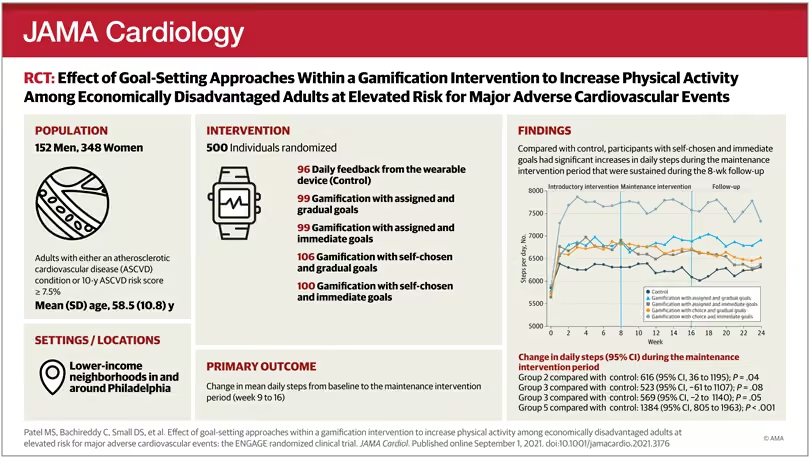
Sometimes research confirms the zeitgeist and sometimes it’s way ahead of the zeitgeist. An example of the latter is this amazingly prescient 2018 paper published in the journal @JAMACardiology by @kevin_volpp, @hmkyale, and David Asch. Kevin Volpp, the director of the @Penn Center for Health Incentives and Behavioral Economics at the University of Pennsylvania, and David Asch, both Professors of Medicine and Health Care Management at the School of Medicine and @Wharton School at the University of Pennsylvania, are members of @Thrive Global’s scientific advisory board.
The paper, entitled “Mass Customization for Population Health,” notes that the U.S., which lags in life expectancy compared to other industrialized countries, spends huge amounts of money developing new medical technologies and yet doesn’t deploy existing ones very well. In cases in which effective treatment options exist, adherence is only about 40% to 45%.
And here was the prescient part: to increase adherence, and thus better health outcomes, “risk reduction strategies might be matched to individual preferences, observed behavioral phenotypes, and estimated risk.”
That’s exactly what AI, through hyper-personalization, will allow us to do — and it’s also what we’re currently integrating into our behavior change model at Thrive. Imagine a customized, hyper-personalized AI health coach trained not only on the best peer-reviewed science, but also on our biometric, lab and other medical data, and, as the paper states, our individual preferences — what conditions allow us to get quality sleep, which foods we love and don’t love, how and when we’re most likely to walk, move and stretch, and the most effective ways we can reduce stress.
The combination of behavioral science engagement tools combined with synchronized and automated medication refills could be thought of, the authors write, as a “behavioral polypill.” As they conclude, “behaviors ultimately determine much of the effectiveness we derive from the treatment strategies we already have.”
With AI, the behavioral polypill can become a powerful reality and significantly move the needle on health outcomes. jamanetwork.com/journals/jamacardiology/article-abstract/…

 Kevin Volpp
@kevin_volpp

 Circ: PHO
@CircOutcomes

 Hansen Chen
 Circulation


 Penn Center for Health Incentives+Behavioral Econ
 Penn LDI
 JAMA

 nancyatheart
 American Heart Advocacy


 Kevin B. Mahoney


 M. Kit Delgado, MD, MS

 Penn Medicine CSO


 Ziad Obermeyer




 American Heart Association


 Michael S. Parmacek

 Amit Khera


 Jay Giri


 Amol Navathe


 Penn Medicine
 Neel Shah, MD


 Cardiology Today


 FoodNavigator-USA

 NEJM Catalyst


 Andrew Parambath


 rrosin
 Anupam Jena


 Behavior Change for Good Initiative


 Mitesh Patel


 Adrian “WE NEED RCTS!” Hernandez


 ASN Advocacy

 Center for Policy Research


 UC Health


 Rinad Beidas, PhD

 Accelerate Health Equity
 Technical.ly


 Aviva Musicus, ScD

 Economy League
 Neda Khan
 CNN Opinion
 Ravi B. Parikh


 Penn Medicine News


 Penn Med Transformation & Innovation


 Madeline Sterling, MD, MPH, FAHA


 Scott Halpern


 Kristen Patton


 SSRC

 Amber Peterman


 Michael Hallsworth
 Resa E Lewiss MD

 Harlan Krumholz

 Alison Buttenheim
 Ishani Ganguli MD, MPH
 Tradeoffs


 Population Aging Research Center at Penn


 ACCME




 Family Heart Foundation

 Freakonomics, M.D.


 Shivan Mehta


 Maurice Schweitzer

 Carolyn Cannuscio, ScD
 Penn Medicine MD
 Benjamin Abella, MD MPhil
 Annals of Int Med

 Penn TTM Academy
 Dr. Alister Martin

 Dr. Tom Frieden


 Marissa Sharif
 UPenn Medical Ethics & Health Policy


 Dave Nussbaum
 ATS Clinical Problems Assembly

 CNN Heroes


 Don Lloyd-Jones


 Steve Downs
 Admired Leadership

 Samuel Salzer 🇺🇦
 Linnea Gandhi


 QJE
 Spectrum News 1 OH


 John McGreevey
 Kate Sullivan


 BEworks
 Penn Cancer Innovation
 Those Nerdy Girls
 Amitabh Chandra


 Philly Mag
 Institute for Addiction Science at USC

 JAMA Health Forum
 Wharton PR & News


 Meg Tirrell
 Devin Pope


 Tobacco Online Policy Seminar (TOPS)


 Kristin Linn

 Lisa Simpson
 Aseem Shukla


 Marjorie Rosenthal


 Ed Kong

 Vivian S. Lee, MD


 Jeff Kullgren


 Pitt Critical Care Medicine

 Kathleen Lee, MD


 Governor Mike DeWine


 Rahul Rajkumar
 Brown University School of Public Health


 Rebekah Gee MD


 𝐒𝐞𝐧𝐝𝐡𝐢𝐥 𝐌𝐮𝐥𝐥𝐚𝐢𝐧𝐚𝐭𝐡𝐚𝐧


 PAIR Center





 Ankur Pandya

 Charles Bae MD, MHCI

 Deepak Sudheendra, MD, MHCI, RPVI, FSIR




 National CSP


 Aline Holzwarth

 Mohammed K Ali

 Christina A. Roberto
 Holly Fernandez Lynch


 Harvard Business Review
 Kirsten Bibbins-Domingo


 Jason Doctor


 Zeev Neuwirth


 Stephen Pont MD, MPH

 ideas42
 Eric Topol


 Douglas Wiebe





 Christian Terwiesch


 Gabriela Sabate


 Allison Suttle
 MSHP @ Penn


 Kosali Simon
 Horace Dediu


 Courtney Van Houtven (she/her)
 E. Blair Clark-Schoeb


 Katie Baca-Motes

 Junaid Nabi, MD, MPH


 Caroline


 James McCarter


 Erasmus Centre for Health Economics Rotterdam
 K. van der Swaluw


 Nick Russo


 BSPA

 AAHC


 Krisda H Chaiyachati

 People Against Distracted Driving, PADD®

 Vicki J. Brown (she/her)


 StanfordHealthPolicy

 Alliance of Academic Health Centers International
 Way to Health

 JAMA Cardiology

 Farzad Mostashari


 A Plus


 UPenn Prevention Research Center






 Dave A. Chokshi, MD


 JGIM Journal of General Internal Medicine


 Adam Grant
 Bob Nease
 Daniel Pink

 Vala Afshar
 SLRAL
