Some thoughts on this policy: It vaguely refers to prices that are “not reasonable” as a new criterion for invalidating drug patents, which will now become a factor in IP diligence for VCs and drug makers. If a program is heavily reliant on NIH funding, investors might devalue its existing patents, leading to less funding for NIH-derived molecules. Ultimately, the policy could diminish the societal value of NIH investments, as more NIH-funded research may remain unused, and prompt some investors to look harder for molecules developed outside the U.S.
Moreover, investors and drug companies tend to overestimate, rather than underestimate, these kinds of policy risks, incorporating uncertainty about its application in the future. They often assume the worst, magnifying the impact of a policy misstep.
Undoubtedly, too many patients are priced out of necessary drugs, with some prices unreasonable relative to the benefits. Some of the growing hardship stems from the progressive weakening of drug insurance, exacerbated by the ACA’s promotion of skinny and closed drug formularies, leaving more consumers without coverage for many drugs.
The administration could take pro-competitive steps to lower consumer costs, such as transitioning Medicare Part B to a competitively bid system to encourage price competition, similar to Part D. Other measures include reducing barriers to generic entry, especially for complex drugs; creating a streamlined market route for second-to-market drug innovations to reduce monopolies; establishing a pathway for truly interchangeable biosimilars; focus on policies that will reduce development costs by modernizing clinical trials; and create a more explicit path for drugs that can be dispensed by a pharmacist or in a pharmacy, which can reduce acquisition costs for patients who are out-of-pocket for their drug expenses, and offer a lower cost option to a competing, prescription product.
Unfortunately, these kinds of pro-competitive policies have not been a focus in recent years.


 Scott Gottlieb, MD 🇺🇸
@ScottGottliebMD

 United Farm Workers
@UFWupdates
 Isaac Bogoch

 John Maraganore 🇺🇸🇬🇷🇺🇦

 Joshua Septimus


 Adam Feuerstein ✡️


 Regulatory Affairs Professionals Society
 Ed Balkovic, PhD


 Bo Wang


 Damian Garde


 Doctor Radio
 AEI Economics

 Amesh Adalja
 U.S. FDA

 James Pethokoukis ⏩️⤴️
 Tom Bollyky

 FDA Tracker




 Crémieux

 Rod Wong, MD
 Jason Mast
 John Cumbers

 Washington Post Opinions
 Robert Doar


 Samuel Hume


 Doug Drysdale
 steve usdin


 Andrew Dunn
 David R. Liu

 Nathan Brand

 Caitlin Rivers
 Catherine Arnst


 The Partnership to Fight Infectious Disease (PFID)


 Ashley Love Sumrall, MD, FACP, FASCO

 Institute for Gene Therapies
 Matthew Herper
 Yair Einhorn


 Kevin Hash


 Paul Hughes-Cromwick (Pooge)


 Bruce Levine, Ph.D. 🇺🇦🥼🔬🧬🧪💉


 Adam Thierer
 Greg Katz, MD
 BiotechTV


 Zach Brennan

 Marc Siegel MD

 Endpoints News
 Drew Armstrong



 Senate HELP Committee GOP


 John Bailey
 WBC24
 Steve Faktor
 *Walter Bloomberg


 Dave McCormick
 Michael Ostacher, MD, MPH
 Michael Koeris


 Alexander Gaffney


 Dr. Saskia Popescu
 Luciana Borio, MD
 Gigi Gronvall
 Anthony LaMesa
 Christopher Heery MD

 CNBC's Fast Money


 Z Reitano


 Henry Olsen


 CNBCOvertime


 David Shaywitz


 AndyWeberNCB
 Int'l Affairs Forum

 Alison Young

 Benjamin Ryan


 Ben Ippolito


 Jonathan Cheng


 Dan Diamond

 Dan Ives

 Ben Rossen


 Pearl Freier

 Vivek Subbiah, MD


 BioTechSnack
 Lowell Schiller


 Tempus


 Nicholas Florko


 Oliver Barnes

 Michael Worobey



 Alexander Tin


 Dr. Angela Rasmussen
 Robert Nelsen
 Chris Gibson


 FDLI

 Cliff Douglas


 Brad Wilcox

 Nadya Williams


 Brian Blase
 Brian Deese


 Applied Clinical Trials
 Kyle LaHucik


 Matthew Continetti
 Recursion


 Eric Topol


 Bloom Lab
 Kathryn A Phillips PhD
 Squawk on the Street

 CNBC's Closing Bell


 Craig Garthwaite
 Gideon Gil
 CNBC Sport

 The Exchange

 Max Moncaster


 Lia DeGroot
 Power Lunch


 Peter Kolchinsky


 Kimberly George
 Jefferson


 Raj Mehta


 Dr Amine Korchi




 Kavita Patel M.D.


 Margaret Brennan


 CDC Director


 Meg Tirrell


 Jonathan Rockoff


 Eliza Shapiro


 Marc Lipsitch
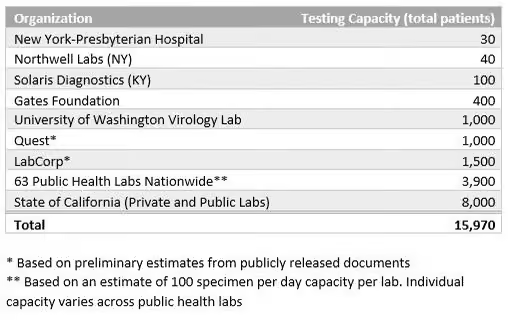
 COVID-19 Test Capacity