Politicians, athletes, journalists, NGOs, companies... They all use
corporation-owned social networks to communicate with us. Citizens
shouldn't have to hand over their data to companies to read content
published by public entities. Public Feeds changes that by making posts
of popular accounts freely available.
Read more.
Ruslan Salakhutdinov
Ruslan Salakhutdinov (Russian: Руслан Салахутдинов; born c. 1980) is an Uzbek researcher working in the field of artificial intelligence. More on Wikipedia
We're proud to announce the launch of CS Learn, a new online learning platform that offers free access to select courses from Carnegie Mellon University’s top-ranked computer science program.
Gave a keynote at the JoongAng Forum in Seoul on recent advances in AI and where the field is heading.
It was quite interesting to hear politicians, tech execs, and policy leaders discuss how AI is reshaping Korea’s economy and driving its industrial transformation.
I recently gave lectures on computer use agents at several places. I covered a brief history of CUAs, relevant evaluation considerations and benchmarks, modeling and training for computer use, and several directions that I'm excited about now that we have very capable CUAs.
Here's a recording from the CMU AI Agents course (highly recommend all the other lectures from this class as well): www.youtube.com/watch?v=jwGluLrrqjQ
Back in ~Dec 2025, I really wanted to work on mobile manipulation, but robots were either too expensive or not performant enough.
So we built our own!
Excited to finally share something I’ve had so much fun working on:
1. Pixel: a co-designed full stack system for learning mobile manipulation. 2. Pixel-UMI: environment aware whole body manipulation without robot data.
1. Pixel: Full-Stack Robot System for Learning General-Purpose Mobile Manipulation: pixel-robot.com/pixel/
2. Pixel-UMI: Learning Environment-Aware Whole-Body Manipulation from Sensorized Human Demonstrations: pixel-robot.com/pixel-umi/
A step toward general-purpose robots that learn from humans and operate in complex, real-world environments.
Pixel introduces an integrated system combining a low-cost humanoid robot built from scratch for under $15K, a scalable data collection system costing under $1K, whole-body control, and policy learning.
Pixel-UMI enables environment-aware whole-body manipulation learned from human demonstrations, achieving 87% average task progress across diverse set of challenging tasks spanning articulated-object manipulation, deformable-object handling, constrained-space reaching, whole-body collision avoidance, and contact-rich bimanual coordination
It does sound like a good idea... to start doing mid-training before pre-training is complete. And start post-training (RL rewards) while mid trining is still ongoing.
Good thread. Seems like a good idea, might try it.
This work introduces Unified Training, a framework that unifies pretraining, midtraining, supervised fine-tuning and RL under a single maximum-likelihood objective. Building on MaxRL, it enables static data and RL-generated data to be trained together within the same system.
Empirically, Unified Training improves accuracy and compute efficiency, generalizes better to harder reasoning problems, and reduces forgetting.
Interestingly, reusing data across training stages can improve performance even when conventional staged training fails. It also produces models that adapt more effectively to new tasks, leading to stronger continual learning.
Foundation models are trained in stages: pretraining, midtraining, and post-training. But is this separation fundamental? We introduce unified training: a single algorithm for the full pipeline. This gives ⚙️ Simpler infrastructure 🔬 A framework for better science (1/n)
SwarmChat gives agents channels, messages, threads, boards, and files through an agent-native CLI, and is tested on ProgramBench, where teams of coding agents reconstruct real programs from scratch.
AI swarms are already showing promising (or dangerous) results in frontier labs.
But how to implement them in the open community? And how do they scale?
We built SwarmChat, an open-source API-based Slack for agents.
Then we burnt half a trillion tokens, ran a series of swarm-scaling experiments, and tested various swarm structures on ProgramBench to study this question!
1. Swarms get the task done faster. For instance, 16-agent swarms reached the performance of a single agent 6x faster.
2. Swarm scaling is a third axis of scaling. The more agents, the better, and anyone can already start scaling with SwarmChat!
3. Different models communicate differently. GPT-6 is chatty and over-communicative, while Claude prefers to work in relative silence!
4. Different swarm structures barely have any benefit on aggregate. But on specific tasks, team structures give clear gains.
5. Bonus: SwarmChat has a Slack-like UI for us humans to monitor swarms! Makes monitoring a lot easier! We are already using SwarmChat for WIP projects, and we were able to catch cases of swarms breaking the 4th wall (sorry, more details are for a future post)
Agent swarms have yielded nutty outcomes, such as the HuggingFace incident, or every math problem ever. It is not clear what form of communication is emerging between agents. It is equally important to understand this for capability and safety reasons.
To study this, we created SwarmChat, a simple Slack/Message Board for researchers working on multi-agents to use on any domain. We have validated it on ProgramBench experiments, where SwarmChat allows us to cleanly analyze how agent swarms work collectively!
Check out our blog for our analysis and how to use SwarmChat - it is super intuitive and easy to use. I personally believe the community really needs this, as a lot of people I know are using some makeshift communication tool.
Developed jointly with Browser Use, Odysseys2 contains 100 challenging tasks grounded in real user requests and executed on the live internet.
Unlike the original Odysseys, which drew on user browsing histories, Odysseys2 reflects the distribution of real-world user requests collected by Browser Use, providing a more realistic evaluation of web agents.
New work on a scalable sim-to-real framework for context-aware whole-body manipulation, enabling robots to automatically adapt their positioning, camera viewpoint, arm movements, and grasping strategies.
For whole-body dexterous grasping, our model generalizes zero-shot to hundreds of objects across diverse real-world environments, including cluttered tabletops, shelves, drawers, and other unstructured settings.
Context isn’t just what you put in a prompt. It’s also what stands between a robot and its goal. Robot policies in everyday environments must generalize not only across objects, but also across the spatial contexts in which they appear.
Excited to share COWBOY 🤠 (CoRL 2026) — our sim-to-real recipe for contextual whole-body manipulation. One generalist grasping policy coordinates base, arm, dexterous hand, and active vision end-to-end, adapting its motion and grasps to object and scene geometry. Trained in simulation, deployed zero-shot in the wild.
This work introduces GracefulRL, an approach to training models to recognize when they cannot reliably succeed and fail gracefully.
A key challenge is that simply rewarding models for falling back can lead them to always abstain, even when they could solve the task. We address this through a log-barrier objective that prevents vanishing gradients near suboptimal solutions and leads to scalable training.
1/ RL for improving task success has made LLMs remarkably capable. But what happens when the model fails? Turns out, training for graceful failure can be surprisingly tricky!
Very excited to share our new paper: Training Language Models to Fail Gracefully
My relatives are now asking me about AI and getting worried that AI might wipe us out. There are real risks, absolutely, but I think this doomsday rhetoric is getting a bit out of hand.
This work introduces an asynchronous multi-agent system where agents independently explore, experiment, verify, and refine solutions while collaborating through structured persistent memory.
Agents build on previous work in a shared, branchable Git repository, where atomic commits preserve intermediate results and semantic dependencies track how contributions build on each other.
A benchmark of 200 long-horizon tasks derived from real browsing sessions and evaluated on the live Internet. We show that binary pass/fail is inadequate in this setting and propose rubric-based evaluation, which better aligns with human judgment and provides more informative signals.
It's not like Leonardo da Vinci invented the helicopter, or even Paul Cornu who built one that took off in 1907.
But Louis Bréguet invented the swashplate, and Henrich Focke flew a controllable helicopter with contra-rotating rotors, all before Igor Sikorsky came up with the variable-pitch tail rotor and made the whole thing practical in 1939.
Getting the basic idea is the easy part. Building it is harder. Making it work is even harder.
The 1991 version is an obscure tech report with a vague idea, no theory, no experiment to speak of, and certainly no code, that the author never revisited or pushed. It has one hand-drawn architecture diagram, one formula of the type f(x)=0, and a claim that every other technique is a special case if you instantiate f and x properly.
We talked about mentoring PhD students, the freedom to explore ambitious ideas, the differences between academia and industry, from the early days of deep learning to today’s era of scaling, building Sooth Labs, and the opportunities, challenges, and future of AI.
Fun fact about (some) AI researchers / academics: the more senior you get, the more convinced you become that every new AI idea is something you already invented 20 years ago. Or, even better: wait until something actually works and then try convincing everyone that this is exactly what you’ve been saying all along.
I was at a conference where a speaker was presenting their research. One academic stood up and said: what you’re doing is actually something I did a few years ago. The speaker was very polite and said thank you for pointing this out.
Then a second researcher stood up and said, well I already did it this 10 years ago, you should cite my work. Then a third person said, I already did all of this about 20 years ago.
We talked about mentoring PhD students, the freedom to explore ambitious ideas, the differences between academia and industry, from the early days of deep learning to today’s era of scaling, building Sooth Labs, and the opportunities, challenges, and future of AI.
At #colm2026 Tue-Sat. I will present our harness learning paper at the LLA workshop on Friday ( @ZAlvin39105 will deliver the oral). I'd love to chat about making RL more general and efficient (or anything about RL!), and meta-topics like how to proceed with research at school.
Computer-use agent evaluation infrastructure is a hot mess, and we have a reproducibility crisis.
Speed is disproportionately affected, as final task success is often still comparable across setups, but measuring agent runtime is heavily dependent on the evaluation infrastructure. As a result, it’s been hard to measure progress on making CUAs faster.
We built cuaspeedrun (cuaspeedrun.com), a standardized infrastructure for running computer-use evaluations like OSWorld/OSWorld2, where measuring CUA speed should be a layup!
Trained with RL on downstream performance, the model learns to improve harnesses for unseen tasks. Across reasoning and multi-hop question answering, harness learning improves performance over successive revisions.
The key idea is that the model learns how to adapt, while the harness is what changes. These revisions reshape how an agent organizes computation, uses tools, and passes information across model calls.
Models trained on single revisions can continue improving harnesses over multiple rounds, suggesting that harness design can become a reusable and generalizable adaptation skill.
How do we train a model to adapt to tasks it has never seen, without updating its weights at test time?
With Harness Learning, we train a model to revise harnesses using execution feedback. At test time, the model applies this learned skill to improve harnesses on unseen tasks, while model weights stay fixed.
Improving agent harnesses takes experimentation. We want a model to learn from those revisions and make better edits on unseen tasks.
Models trained with harness learning nearly double their performance on challenging unseen reasoning and multihop question-answering tasks.
As agents tackle longer, more complex problems, controlling their execution becomes a challenge in itself. This work introduces agentic meta-reasoning, an inference-time harness that explicitly reasons about which work to pursue, reuse, or stop.
Workers perform task-level computation, while a controller evaluates progress, allocates the remaining budget, and dispatches work using compact persistent memory.
On ProgramBench, meta-reasoning achieves 71.5% with GPT-5.5 versus 58.0% for Codex, and 67.2% with Opus 4.8 versus 65.5% for Claude Code. Across other long-horizon reasoning and proof benchmarks, it improves 3.6–4.2 points over three frontier models.
Meta-reasoning also continues improving at budgets where direct control plateaus, suggesting that structured control becomes increasingly important as agent runs scale.
What if an agent could decide how to structure its own computation?
Agentic Meta-Reasoning: Let the model decide what to explore, what to build on, what to verify, and where to spend its next unit of compute: effectively constructing its own computational graph as it reasons. 🧵
New work on CUA-speedrun: A standardized framework for evaluating CUA speed, cost, and performance using a uniform virtual machine setup, execution pipeline, and agent interface.
Across multiple CUA benchmarks, we study how reasoning effort, agent harnesses, and environment latency affect performance, speed, and cost. We find that no model dominates across all three dimensions, and that open-weight models do not lie on the efficiency frontier.
Surprisingly, greater reasoning effort can sometimes lead to faster task completion, while lower environment latency can actually increase end-to-end completion time.
Finally, we show that benchmark task sets can be substantially reduced while preserving statistical power, enabling faster and more cost-effective evaluation.
Quite a few people have been asking me about the probability of doom and AI existential risk.
Well, I am more worried about my X account getting hacked. And someone actually hacked it this morning. For some reason, it happens more often than I thought it would.
So if you saw me posting some crazy Crypto ads, I am sorry.
some belated life updates: earlier this year, i left academia and joined meta to work on personal superintelligence. these days i’ve mostly been trying to make our models really good at browser use. back in 2020, i wrote in my phd sop that i hoped one day my mom could use a product i helped build.
This is quite an elegant way to increase the probability of low-probability, high-reward trajectories.
TailRL changes the credit assignment so that trajectories reaching reward levels that few other rollouts reach get more weight. Instead of only pulling up expected reward, it optimizes the probability of exceeding reward thresholds across the whole distribution, with a clean finite version of the gradient estimator and a nice best@k interpretation.
It also reduces exactly to MaxRL when rewards are binary. The paper is very well written and has a ton of experiments across different domains.
larger rollout budgets during training incorporate progressively higher order best@k , while the tail-focused objective increases the probability of sampling low prob but correct trajectories that become especially useful when you can sample many rollouts at inference.
Rather than optimizing only mean reward, TailRL maximizes the expected log of upper-tail probabilities, naturally placing more weight on rare, high-reward rollouts. Its gradient can also be interpreted as a mixture of Best-of-(k) gradients.
TailRL requires only a simple modification to the advantage function, making it easy to integrate into existing RL pipelines. Across object localization, maze navigation, GUI grounding, and code optimization, TailRL effectively exploits rare high-reward samples and scales better with increased inference-time sampling.
Sharing lecture videos for the **How to AI (Almost) Anything/Multimodal AI** course I taught at MIT in spring 2026.
This course became quite a hit the last time I shared it in spring 2025. Spring 2026's updated version contains updated topics on multimodal agents, reasoning, self-evolving AI, and new modalities like touch and smell. Also includes slides (not videos) of guest lectures on multimodal AI for health, design, manufacturing, cities, & transportation.
Today's AI can be applied to almost anything - from language to vision, audio, sensors, medical data, music, art, smell, and taste. This course covers the principles of AI (focusing on deep learning and foundation models), how we can apply AI to novel real-world data modalities, and multimodal AI that can process many modalities at once, such as connecting language and multimedia, music and art, sensing and actuation, and more.
Rather than optimizing only mean reward, TailRL maximizes the expected log of upper-tail probabilities, naturally placing more weight on rare, high-reward rollouts. Its gradient can also be interpreted as a mixture of Best-of-(k) gradients.
TailRL requires only a simple modification to the advantage function, making it easy to integrate into existing RL pipelines. Across object localization, maze navigation, GUI grounding, and code optimization, TailRL effectively exploits rare high-reward samples and scales better with increased inference-time sampling.
I fully agree with you Nando @NandoDF. But if governments fail to create the right conditions for AI talent to easily start companies (for a variety of silly reasons as you are pointing out), while those exact same researchers can easily build startups anywhere else, especially in the U.S., that's really really bad.
AI talent is mobile, and countries that make entrepreneurship difficult will lose their top people. I know a number of researchers in the UK and Europe who are considering moving to the U.S.
As you know, that would not be great for the rest of the world, for universal access to AI, for sovereign AI and for the advancement of science and technology. California 🇺🇸 is doing amazing (so is Toronto 🇨🇦) and setting a good example for others. We now must follow the example.
AI is for the world, not just for a couple of countries. We will all benefit more from universal AI access and advancement than from narrow access.
In California, one can start a company the day after leaving Google. My colleagues Jeff Dean, Oriol Vinyals et al made this very clear recently with their impressive speed.
In the UK, the same American companies impose 1 year garden leaves on senior AI researchers and 6 months on junior researchers. @GoogleDeepMind for example forced people to sign these contracts at the time of promotion, not the time of hiring.
What this means is that researchers cannot start new companies for up to 1 year, cannot easily hire, and in short: they cannot compete.
American VCs cannot understand why we move so slow.
It is time for UK Gov to do the right thing: Make garden leaves optional for employees.
If you’re an AI entrepreneur or VC in the UK or Europe, I would appreciate your comments here. You’ve all confided in me. It is time you let government know the urgency of this — everyone should speak up.
Enterprise AI is in a wildly paradoxical state 🤔, and we’re reaching the inflection point that will resolve it. 💥
Enterprises want to differentiate with AI, yet rent the same intelligence as their competitors.
Their workflows and expertise are highly specialized, yet they rely on generic models built to be good at everything.
They worry about AI costs, yet pay premium prices for massive models where only a fraction (1%) of the intelligence is relevant to their task. 💸
And they demand control and sovereignty, yet rent the intelligence becoming core to their business.
This is not a sustainable equilibrium.
The next era of enterprise AI is specialized intelligence companies build, own, and compound. And we are at the inflection point of this transition.
That’s the bet we made when we started @oumi_ai two years ago.
Today we’re closing the loop: Oumi can now not only automatically build your specialized AI models, but also deploy them into production, learn from their production experience, and continuously improve them.
The intelligence that your business runs on, becomes your differentiator. Your compounding advantage.
The winners of the next AI era will turn their own data, expertise, and experience into specialized intelligence that nobody else can rent.
Don’t rent your AI. Build it. Own it. Compound it.
ZEE, our aviation specific AI foundation model, has made a frontier breakthrough.
It has demonstrated the capability to generate highly accurate predictions of real-time aircraft trajectories on the airport surface minutes ahead of the present. With runway-related incidents accounting for 30% to 40% of global aviation accidents, this ability to provide a highly accurate ‘window into the future’ gives the humans in the loop the most critical asset in aviation safety: time to react.
Live testing is underway at Hawthorne. The early results measured against real-world tracking data have been strong, and larger-scale testing is now underway.
Luna is one of my favorite models out right now, it also does really well on the computer-use benchmarks we tested
On Odysseys (odysseysbench.com) and MyPCBench (mypcbench.com), it scores 51% and 55.4%. To put this into perspective, it performs similarly to the heaviest models offered while being 20x+ cheaper. If you have the max codex plan, this is essentially unlimited usage. I am super happy about this level of model being offered at an even cheaper rate and would suggest try asking Luna to use computer-use in your workflows
I rarely do podcasts, as they tend to be less technical and more speculative, but I enjoyed this conversation with Forward Deployed @realbasilchatha.
We talked about the early days of deep learning, what frontier AI labs are working on (data, infra, engineering), some of our recent research on agentic AI, prediction markets, and decision-making.
Looks like my X account has been hacked. Someone has been sending DMs from my account to random people, inviting them to schedule a meeting with me via a Calendly link. Those messages are not from me. Please ignore them. Help me retweet this message.
Hey @X, I changed my password but I could really use your help resolving this.
I’ve been asked several times whether Zhilin Yang, the founder of @Kimi_Moonshot was my PhD student. The answer is yes and he is absolutely brilliant.
But I’ve been incredibly fortunate to work with so many outstanding PhD students over the years. So I thought I’d brag a little about them and their career paths (of course there are also many MSc and undergraduate students, sorry if I missed anyone):
Founders / Founding Team Members
Devendra Chaplot @dchaplot PhD, Founding Member Thinking Machines / Mistral Zhilin Yang PhD, Founder & CEO, Moonshot AI Jimmy Ba @jimmybajimmyba MSc/PhD, Co-founder xAI Hubert Tsai PhD, Co-founder Spuree, Apple Nitish Srivastava @nitishsr PhD, Co-founder Perceptual Machines; Co-founder Vayu Robotics Charlie Tang PhD, Co-founder Perceptual Machines, DE Shaw.
Professors Paul Liang @pliang279 PhD, MIT Ben Eysenbach @ben_eysenbach PhD, Princeton University Ruosong Wang @RuosongW PhD, Peking University Bhuwan Dhingra @bhuwandhingra PhD, Duke University Roger Grosse @RogerGrosse Postdoc, University of Toronto Alexander Schwing Postdoc, UIUC
Research Scientists Shuyan Zhou @shuyanzh36, Postdoc, Meta Superintelligence Lab Tiffany Min @SoYeonTiffMin PhD, Microsoft AI Murtaza Dalal @mihdalal PhD, Tesla AI Minji Yoon @MinjiYoon90 , PhD, Microsoft AI Shrimai Prabhumoye PhD, NVIDIA AI, Mistral Haitian Sun @sun_haitian PhD, Google DeepMind Emilio Parisotto PhD, Google DeepMind Lisa Lee PhD @rl_agent, Google DeepMind Manzil Zaheer @ManzilZaheer PhD, Google DeepMind Jamie Kiros PhD, Google Brain, OpenAI Yuri Burda PhD, OpenAI, Anthropic Cody Severinski PhD, Amazon
I interacted with Zhilin a few times when he was still a PhD student at CMU while I was working with his amazing advisor @rsalakhu on a grant proposal years ago. I was struck by how sharp, open-minded, and genuinely curious he was, including about comp bio problems outside his area. His success is exceptional - but many international students at CMU and across US universities bring similarly remarkable talent and ambition. People choose where to build their lives and career for many reasons, but growing uncertainty around immigration and international exchange risks making the United States less welcoming and less competitive. More supportive pathways for international talents are essential to the future of US science and innovation.
I think there's a lot of confusion and misinformation about Zhilin's visa, H1B lottery, immigration, and why he left the U.S.
Zhilin had many opportunities to stay in the U.S. if he wanted to. In fact, I was on an email thread with a senior Apple exec (Tim Cook's reports) asking whether Zhilin would consider joining Apple. I said that he wanted to go back to his homeland. The response was, well, we have an office in Beijing if he'd like to join there.
But Zhilin was quite determined to go back and build a startup. I remember him telling me that if he didn't at least try starting his own company, he would regret it for the rest of his life. I respect that, and he was right.
Many of my international PhD students do choose to stay in the U.S. Of course the U.S. immigration process can be quite intimidating and uncertain, even for superstar PhD graduates from places like CMU.
Years ago, I had the privilege of briefly working with Russ. Though not his student, I found him one of the kindest scholars I have met to this point, which is rarer than it should be for a leading figure of a field. It must be a thrilling opportunity to work in his group!
Lol I think Peyman @docmilanfar really likes me. I don't actually know him, but I'm deeply honored by his encyclopedic knowledge of my academic and industry career 😆.
But jokes aside, my current and former students at CMU (and Toronto) are absolutely exceptional, self-directed, very independent in shaping and driving their own research agenda, and with impeccable work ethic, much like so many students at CMU.
A student's success is also determined not only by their advisor, but also by the environment in which they grow. There is something genuinely special about CMU. It is a very collaborative place with an extraordinary concentration of talented, hardworking, and motivated students.
Doing PhD is never easy, it is a lot of very very hard work, especially at a place like CMU. But many of these students will go on to become leaders in academia and industry, professors at top universities, founders, CEOs, and pioneers of new fields.
And I will certainly continue to celebrate my students’ achievements, their scientific breakthroughs, and the impact they have on the world.
While this is an impressive array of talent, over 80% of the researchers Russ brags about were (self-) advised while he was juggling academic duties with major executive roles at Apple or Meta.
He's not alone in this respect. Elite programs attract talent that buoys the lab, giving advisors the bandwidth to juggle significant outside roles. I'd be careful about assigning too much credit to the advisor and not enough to the students' raw talent and self-discipline.
I’ve been asked several times whether Zhilin Yang, the founder of @Kimi_Moonshot was my PhD student. The answer is yes and he is absolutely brilliant.
But I’ve been incredibly fortunate to work with so many outstanding PhD students over the years. So I thought I’d brag a little about them and their career paths (of course there are also many MSc and undergraduate students, sorry if I missed anyone):
Founders / Founding Team Members
Devendra Chaplot @dchaplot PhD, Founding Member Thinking Machines / Mistral Zhilin Yang PhD, Founder & CEO, Moonshot AI Jimmy Ba @jimmybajimmyba MSc/PhD, Co-founder xAI Hubert Tsai PhD, Co-founder Spuree, Apple Nitish Srivastava @nitishsr PhD, Co-founder Perceptual Machines; Co-founder Vayu Robotics Charlie Tang PhD, Co-founder Perceptual Machines, DE Shaw.
Professors Paul Liang @pliang279 PhD, MIT Ben Eysenbach @ben_eysenbach PhD, Princeton University Ruosong Wang @RuosongW PhD, Peking University Bhuwan Dhingra @bhuwandhingra PhD, Duke University Roger Grosse @RogerGrosse Postdoc, University of Toronto Alexander Schwing Postdoc, UIUC
Research Scientists Shuyan Zhou @shuyanzh36, Postdoc, Meta Superintelligence Lab Tiffany Min @SoYeonTiffMin PhD, Microsoft AI Murtaza Dalal @mihdalal PhD, Tesla AI Minji Yoon @MinjiYoon90 , PhD, Microsoft AI Shrimai Prabhumoye PhD, NVIDIA AI, Mistral Haitian Sun @sun_haitian PhD, Google DeepMind Emilio Parisotto PhD, Google DeepMind Lisa Lee PhD @rl_agent, Google DeepMind Manzil Zaheer @ManzilZaheer PhD, Google DeepMind Jamie Kiros PhD, Google Brain, OpenAI Yuri Burda PhD, OpenAI, Anthropic Cody Severinski PhD, Amazon
I’m afraid to tell you that it is effectively impossible to do the kind of writing I used to do on this website, not because anyone at OpenAI censors me but because of the sheer volume of hostility I get for sharing my analysis as a frontier lab employee.
I enjoyed writing quick takes on this website for one basic reason: I could get rapid feedback on my own ideation process in real time. Post the early version of the take here, see the criticism; then refine, sharpen, and repeat. Unfortunately now that feature of this site is gone, because the feedback I get is now almost exclusively colored by resentment at the fact that I work at a frontier lab or other forms of hatred for my employer. The feedback signal is essentially useless now, so writing on here is not fruitful for me anymore.
Literally everything I write now is responded to with “of course you said that because <OpenAI>.” I am truly just writing what I think and would have written anyway, but everyone reads what I say in the shrieking tone of “this is what openai thinks!!!!” (to be clear, my posts are not what openai thinks). This is an unpleasant and more importantly unproductive pattern for me.
I anticipate that the shape of this account will change significantly as a result. I do not currently know how. It will not become a LinkedIn feed. It will change in some other way. It will no longer be a real-time accounting of my own thinking as it develops, since this is precisely the thing that seems impossible to do now. That will have to shift to private channels.
I’ve been asked several times whether Zhilin Yang, the founder of @Kimi_Moonshot was my PhD student. The answer is yes and he is absolutely brilliant.
But I’ve been incredibly fortunate to work with so many outstanding PhD students over the years. So I thought I’d brag a little about them and their career paths (of course there are also many MSc and undergraduate students, sorry if I missed anyone):
Founders / Founding Team Members
Devendra Chaplot @dchaplot PhD, Founding Member Thinking Machines / Mistral Zhilin Yang PhD, Founder & CEO, Moonshot AI Jimmy Ba @jimmybajimmyba MSc/PhD, Co-founder xAI Hubert Tsai PhD, Co-founder Spuree, Apple Nitish Srivastava @nitishsr PhD, Co-founder Perceptual Machines; Co-founder Vayu Robotics Charlie Tang PhD, Co-founder Perceptual Machines, DE Shaw.
Professors Paul Liang @pliang279 PhD, MIT Ben Eysenbach @ben_eysenbach PhD, Princeton University Ruosong Wang @RuosongW PhD, Peking University Bhuwan Dhingra @bhuwandhingra PhD, Duke University Roger Grosse @RogerGrosse Postdoc, University of Toronto Alexander Schwing Postdoc, UIUC
Research Scientists Shuyan Zhou @shuyanzh36, Postdoc, Meta Superintelligence Lab Tiffany Min @SoYeonTiffMin PhD, Microsoft AI Murtaza Dalal @mihdalal PhD, Tesla AI Minji Yoon @MinjiYoon90 , PhD, Microsoft AI Shrimai Prabhumoye PhD, NVIDIA AI, Mistral Haitian Sun @sun_haitian PhD, Google DeepMind Emilio Parisotto PhD, Google DeepMind Lisa Lee PhD @rl_agent, Google DeepMind Manzil Zaheer @ManzilZaheer PhD, Google DeepMind Jamie Kiros PhD, Google Brain, OpenAI Yuri Burda PhD, OpenAI, Anthropic Cody Severinski PhD, Amazon
1. It's a very good model! I don't think its performance can be explained away by distillation or anything like that. In agentic coding sessions, it seems pretty much on par with the best public models of Q1 2026. In my fairly limited use, it also seemed very token hungry. It's not obvious to me that this model is actually that cheap to run.
2. I am personally surprised the Chinese state continues to allow the open sourcing of models this good, given potential risks. To be clear, I *myself* might be fine with models presenting this level of marginal risk being open weight, but I am surprised that China is fine with it. I suspect the reason they are is 75% explained by strategic blindness/lack of AGI-pilledness (the CCP is very Yann Lecun-y in its views of AI). The other 25% or so is their lack of compute for customer inference (making China's open-weight strategy an unintended byproduct of US export controls) and the normal Chinese strategy of aggressive exports. For the companies, as opposed to the government, the decision to open source is partially ideological and partially because they are behind, and they know that very few people would pay for sub-frontier models from China.
3. Open-weight models are inherently decelerationist, and I'm continually surprised to see the so-called "accelerationists" so excited about open-weight models. I suspect the reason they are is that they know open-weight models are effectively ungovernable, and they simply like the overall cloak of ungovernability open-weight models create over the whole of AI. It's not a bad strategy; it reminds me of James Scott's recounting of the hill people in "the art of not being governed." Still, in the end, open-weight models deter further AI capex.
4. One probable outcome of an open-weight-model-dominant world is full AI communism, which is precisely what China proposes: rather than a market product, AI is a "public good" which will ultimately be provided by the state as a kind of "digital public infrastructure." This future strikes me as a dystopian hellscape, but I've never met an open-weight models advocate who doesn't ultimately concede this is where things end. You'd be surprised how many 'accelerationists' lobbied me, while I was in government, to support an eleven or twelve-figure federally funded data center so that startups could train models at a subsidy and then give them away for free. There was no other way for AI to progress, they said. Perhaps this is the logical end state of things. Nonetheless, I find myself surprised to see supposed accelerationists excited about such an outcome. I think many of them just don't know what they're doing. Many accelerationists do not view the creation and serving of frontier models as a legitimate business.
5. I would guess that the Trump Administration will at some point realize that their best strategy here would be to create large amounts of regulatory risk around the use of open-weight Chinese models. You don't need to "ban open source" (one of the dumber motifs of AI policy discussion). You just need to direct every agency to issue soft law that creates FUD. "A Federal Reserve Advisory Bulletin found that there may be backdoors in Chinese AI models." It needn't be that well justified. You just create enough regulatory risk that every regulated enterprise backs off. You probably don't want to create so much regulatory risk that you scare off the hyperscalers from serving Chinese models; this will just drive startups to sketchier providers. There's a happy middle ground here. I'd assume they will do some version of this.
6. It's probably true that open-weight models of this capability make the world a bit more dangerous, but not so much more that you'll really notice. At some point the models will be capable enough that you will notice. "A nonliving, invisible, dangerous, and infinitely self-replicating agent escaped from a Chinese lab," you say? Color me shocked.
No, Nitish @nitishsr, the privilege is all mine! Working with you has been an incredible experience, especially as you were one of my very first PhD students.
A fun story: During one of our meetings at Apple, an executive asked Nitish: so, what are you an expert in? Another senior IC jumped in: Nitish is an expert at everything.
And I can attest to that: Nitish is an expert at everything.
Nitish is the co-creator of Dropout and he has amassed nearly 90,000 citations.
It has been a privilege to work with @rsalakhu at Toronto, Perceptual Machines, Apple, and having him as an advisor at Vayu! I’m deeply grateful for your constant support and encouragement.
I’ve been asked several times whether Zhilin Yang, the founder of @Kimi_Moonshot was my PhD student. The answer is yes and he is absolutely brilliant.
But I’ve been incredibly fortunate to work with so many outstanding PhD students over the years. So I thought I’d brag a little about them and their career paths (of course there are also many MSc and undergraduate students, sorry if I missed anyone):
Founders / Founding Team Members
Devendra Chaplot @dchaplot PhD, Founding Member Thinking Machines / Mistral Zhilin Yang PhD, Founder & CEO, Moonshot AI Jimmy Ba @jimmybajimmyba MSc/PhD, Co-founder xAI Hubert Tsai PhD, Co-founder Spuree, Apple Nitish Srivastava @nitishsr PhD, Co-founder Perceptual Machines; Co-founder Vayu Robotics Charlie Tang PhD, Co-founder Perceptual Machines, DE Shaw.
Professors Paul Liang @pliang279 PhD, MIT Ben Eysenbach @ben_eysenbach PhD, Princeton University Ruosong Wang @RuosongW PhD, Peking University Bhuwan Dhingra @bhuwandhingra PhD, Duke University Roger Grosse @RogerGrosse Postdoc, University of Toronto Alexander Schwing Postdoc, UIUC
Research Scientists Shuyan Zhou @shuyanzh36, Postdoc, Meta Superintelligence Lab Tiffany Min @SoYeonTiffMin PhD, Microsoft AI Murtaza Dalal @mihdalal PhD, Tesla AI Minji Yoon @MinjiYoon90 , PhD, Microsoft AI Shrimai Prabhumoye PhD, NVIDIA AI, Mistral Haitian Sun @sun_haitian PhD, Google DeepMind Emilio Parisotto PhD, Google DeepMind Lisa Lee PhD @rl_agent, Google DeepMind Manzil Zaheer @ManzilZaheer PhD, Google DeepMind Jamie Kiros PhD, Google Brain, OpenAI Yuri Burda PhD, OpenAI, Anthropic Cody Severinski PhD, Amazon
The brilliant @nitishsr and I were both with @geoffreyhinton when Russ first joined UofT as faculty and we absolutely jumped at the opportunity to add Russ as co-advisor for our PhD.
I've always admired Russ and his work even in undergrad, reading some of his papers 5 times over! Deep Boltzmann Machines were the representative work in GenAI in 2009.
So when I graduated in 2015, we followed the blueprint laid out by our friends of DNNResearch (Geoff, Ilya, and Alex) and that led to our very own Perceptual Machines Inc. (w/ @nitishsr, @rsalakhu)
Words can not capture all the memories, excitements, and up and downs of those years, truly blessed to have studied and worked with both of you @nitishsr, @rsalakhu !!
Big shoutout also goes to the amazing @Ahmad_Al_Dahle for giving us the opportunity and believing in us very early on.
Charlie @tang_1c was one of my very first PhD students at Toronto. I still remember those days when together with Nitish @nitishsr, we were pitching our research to Apple execs. Great memories and fun times!
Russ's first PhD and first startup co-founder here..
Kids these days would forget that his 2006 Science paper is what kicked off the *entire* Deep Learning revolution.
Still vividly rem that one time him settling for my sunnyvale apt air 🛏️ as we prepared long into the night for our deck to the Apple execs - Russ worked incredibly hard in pursuit of greatness in both academia and industry.
Lastly, Russ was and still is the most approachable and gregarious super-star AI/ML prof of them all, no matter if you were a colleague, investor, mag 7 CEO or simply a random ML conf attendee. #character
I’ve been asked several times whether Zhilin Yang, the founder of @Kimi_Moonshot was my PhD student. The answer is yes and he is absolutely brilliant.
But I’ve been incredibly fortunate to work with so many outstanding PhD students over the years. So I thought I’d brag a little about them and their career paths (of course there are also many MSc and undergraduate students, sorry if I missed anyone):
Founders / Founding Team Members
Devendra Chaplot @dchaplot PhD, Founding Member Thinking Machines / Mistral Zhilin Yang PhD, Founder & CEO, Moonshot AI Jimmy Ba @jimmybajimmyba MSc/PhD, Co-founder xAI Hubert Tsai PhD, Co-founder Spuree, Apple Nitish Srivastava @nitishsr PhD, Co-founder Perceptual Machines; Co-founder Vayu Robotics Charlie Tang PhD, Co-founder Perceptual Machines, DE Shaw.
Professors Paul Liang @pliang279 PhD, MIT Ben Eysenbach @ben_eysenbach PhD, Princeton University Ruosong Wang @RuosongW PhD, Peking University Bhuwan Dhingra @bhuwandhingra PhD, Duke University Roger Grosse @RogerGrosse Postdoc, University of Toronto Alexander Schwing Postdoc, UIUC
Research Scientists Shuyan Zhou @shuyanzh36, Postdoc, Meta Superintelligence Lab Tiffany Min @SoYeonTiffMin PhD, Microsoft AI Murtaza Dalal @mihdalal PhD, Tesla AI Minji Yoon @MinjiYoon90 , PhD, Microsoft AI Shrimai Prabhumoye PhD, NVIDIA AI, Mistral Haitian Sun @sun_haitian PhD, Google DeepMind Emilio Parisotto PhD, Google DeepMind Lisa Lee PhD @rl_agent, Google DeepMind Manzil Zaheer @ManzilZaheer PhD, Google DeepMind Jamie Kiros PhD, Google Brain, OpenAI Yuri Burda PhD, OpenAI, Anthropic Cody Severinski PhD, Amazon
I had the chance to be advised by you for a semester while working with Emilio - to me the one meeting we used to do per week was indormation-dense and directional enough. Never felt like I was on my own, and the independence you provided was much appreciated.
It feels like just yesterday that you, Yonatan @ybisk, and I were having these long technical discussions about embodied AI, some of my favorite conversations. You'd always come up with truly unique and contrarian ideas, I miss those meetings.
I was incredibly fortunate to be advised by the 🐐 @rsalakhu. When Russ agreed to co-advise me at CMU, my sadness about leaving Boston immediately disappeared. Once we worked together, I realized I was even luckier than I knew. Forever grateful and proud to be his student! 🐐🐐
I’ve been asked several times whether Zhilin Yang, the founder of @Kimi_Moonshot was my PhD student. The answer is yes and he is absolutely brilliant.
But I’ve been incredibly fortunate to work with so many outstanding PhD students over the years. So I thought I’d brag a little about them and their career paths (of course there are also many MSc and undergraduate students, sorry if I missed anyone):
Founders / Founding Team Members
Devendra Chaplot @dchaplot PhD, Founding Member Thinking Machines / Mistral Zhilin Yang PhD, Founder & CEO, Moonshot AI Jimmy Ba @jimmybajimmyba MSc/PhD, Co-founder xAI Hubert Tsai PhD, Co-founder Spuree, Apple Nitish Srivastava @nitishsr PhD, Co-founder Perceptual Machines; Co-founder Vayu Robotics Charlie Tang PhD, Co-founder Perceptual Machines, DE Shaw.
Professors Paul Liang @pliang279 PhD, MIT Ben Eysenbach @ben_eysenbach PhD, Princeton University Ruosong Wang @RuosongW PhD, Peking University Bhuwan Dhingra @bhuwandhingra PhD, Duke University Roger Grosse @RogerGrosse Postdoc, University of Toronto Alexander Schwing Postdoc, UIUC
Research Scientists Shuyan Zhou @shuyanzh36, Postdoc, Meta Superintelligence Lab Tiffany Min @SoYeonTiffMin PhD, Microsoft AI Murtaza Dalal @mihdalal PhD, Tesla AI Minji Yoon @MinjiYoon90 , PhD, Microsoft AI Shrimai Prabhumoye PhD, NVIDIA AI, Mistral Haitian Sun @sun_haitian PhD, Google DeepMind Emilio Parisotto PhD, Google DeepMind Lisa Lee PhD @rl_agent, Google DeepMind Manzil Zaheer @ManzilZaheer PhD, Google DeepMind Jamie Kiros PhD, Google Brain, OpenAI Yuri Burda PhD, OpenAI, Anthropic Cody Severinski PhD, Amazon
Thanks Hubert @cheehoohubert for the kind words. We should catch up next time I am in California.
Fun fact: Hubert’s most cited paper (almost 6,000 citations) is called HuBERT (Self-Supervised Speech Representation Learning by Masked Prediction of Hidden Units).
His second most cited paper has over 3,000 citations (Multimodal transformer for unaligned multimodal language sequences)!
Everyone knows @rsalakhu is brilliant. But what always stood out to me was his EQ—perhaps the highest I’ve ever seen. That rare combination of extraordinary IQ and EQ is exactly why so many of us wanted to work with him.
I’ve been asked several times whether Zhilin Yang, the founder of @Kimi_Moonshot was my PhD student. The answer is yes and he is absolutely brilliant.
But I’ve been incredibly fortunate to work with so many outstanding PhD students over the years. So I thought I’d brag a little about them and their career paths (of course there are also many MSc and undergraduate students, sorry if I missed anyone):
Founders / Founding Team Members
Devendra Chaplot @dchaplot PhD, Founding Member Thinking Machines / Mistral Zhilin Yang PhD, Founder & CEO, Moonshot AI Jimmy Ba @jimmybajimmyba MSc/PhD, Co-founder xAI Hubert Tsai PhD, Co-founder Spuree, Apple Nitish Srivastava @nitishsr PhD, Co-founder Perceptual Machines; Co-founder Vayu Robotics Charlie Tang PhD, Co-founder Perceptual Machines, DE Shaw.
Professors Paul Liang @pliang279 PhD, MIT Ben Eysenbach @ben_eysenbach PhD, Princeton University Ruosong Wang @RuosongW PhD, Peking University Bhuwan Dhingra @bhuwandhingra PhD, Duke University Roger Grosse @RogerGrosse Postdoc, University of Toronto Alexander Schwing Postdoc, UIUC
Research Scientists Shuyan Zhou @shuyanzh36, Postdoc, Meta Superintelligence Lab Tiffany Min @SoYeonTiffMin PhD, Microsoft AI Murtaza Dalal @mihdalal PhD, Tesla AI Minji Yoon @MinjiYoon90 , PhD, Microsoft AI Shrimai Prabhumoye PhD, NVIDIA AI, Mistral Haitian Sun @sun_haitian PhD, Google DeepMind Emilio Parisotto PhD, Google DeepMind Lisa Lee PhD @rl_agent, Google DeepMind Manzil Zaheer @ManzilZaheer PhD, Google DeepMind Jamie Kiros PhD, Google Brain, OpenAI Yuri Burda PhD, OpenAI, Anthropic Cody Severinski PhD, Amazon
Thank you Lisa @rl_agent, for the kind words. You've always had brilliant ideas in RL, and it's been so exciting to see you making an impact on Gemini at GDM. They're very lucky to have you.
Russ was an incredibly encouraging & supportive mentor who gave us freedom to pursue our own academic interests—spanning deep learning architectures, optimization, robotics, NLP, & multimodal representations—while providing hands-on expert guidance across our diverse projects.
I’ve been asked several times whether Zhilin Yang, the founder of @Kimi_Moonshot was my PhD student. The answer is yes and he is absolutely brilliant.
But I’ve been incredibly fortunate to work with so many outstanding PhD students over the years. So I thought I’d brag a little about them and their career paths (of course there are also many MSc and undergraduate students, sorry if I missed anyone):
Founders / Founding Team Members
Devendra Chaplot @dchaplot PhD, Founding Member Thinking Machines / Mistral Zhilin Yang PhD, Founder & CEO, Moonshot AI Jimmy Ba @jimmybajimmyba MSc/PhD, Co-founder xAI Hubert Tsai PhD, Co-founder Spuree, Apple Nitish Srivastava @nitishsr PhD, Co-founder Perceptual Machines; Co-founder Vayu Robotics Charlie Tang PhD, Co-founder Perceptual Machines, DE Shaw.
Professors Paul Liang @pliang279 PhD, MIT Ben Eysenbach @ben_eysenbach PhD, Princeton University Ruosong Wang @RuosongW PhD, Peking University Bhuwan Dhingra @bhuwandhingra PhD, Duke University Roger Grosse @RogerGrosse Postdoc, University of Toronto Alexander Schwing Postdoc, UIUC
Research Scientists Shuyan Zhou @shuyanzh36, Postdoc, Meta Superintelligence Lab Tiffany Min @SoYeonTiffMin PhD, Microsoft AI Murtaza Dalal @mihdalal PhD, Tesla AI Minji Yoon @MinjiYoon90 , PhD, Microsoft AI Shrimai Prabhumoye PhD, NVIDIA AI, Mistral Haitian Sun @sun_haitian PhD, Google DeepMind Emilio Parisotto PhD, Google DeepMind Lisa Lee PhD @rl_agent, Google DeepMind Manzil Zaheer @ManzilZaheer PhD, Google DeepMind Jamie Kiros PhD, Google Brain, OpenAI Yuri Burda PhD, OpenAI, Anthropic Cody Severinski PhD, Amazon
Lol I think Peyman @docmilanfar really likes me. I don't actually know him, but I'm deeply honored by his encyclopedic knowledge of my academic and industry career 😆.
But jokes aside, my current and former students at CMU (and Toronto) are absolutely exceptional, self-directed, very independent in shaping and driving their own research agenda, and with impeccable work ethic, much like so many students at CMU.
A student's success is also determined not only by their advisor, but also by the environment in which they grow. There is something genuinely special about CMU. It is a very collaborative place with an extraordinary concentration of talented, hardworking, and motivated students.
Doing PhD is never easy, it is a lot of very very hard work, especially at a place like CMU. But many of these students will go on to become leaders in academia and industry, professors at top universities, founders, CEOs, and pioneers of new fields.
And I will certainly continue to celebrate my students’ achievements, their scientific breakthroughs, and the impact they have on the world.
While this is an impressive array of talent, over 80% of the researchers Russ brags about were (self-) advised while he was juggling academic duties with major executive roles at Apple or Meta.
He's not alone in this respect. Elite programs attract talent that buoys the lab, giving advisors the bandwidth to juggle significant outside roles. I'd be careful about assigning too much credit to the advisor and not enough to the students' raw talent and self-discipline.
I’ve been asked several times whether Zhilin Yang, the founder of @Kimi_Moonshot was my PhD student. The answer is yes and he is absolutely brilliant.
But I’ve been incredibly fortunate to work with so many outstanding PhD students over the years. So I thought I’d brag a little about them and their career paths (of course there are also many MSc and undergraduate students, sorry if I missed anyone):
Founders / Founding Team Members
Devendra Chaplot @dchaplot PhD, Founding Member Thinking Machines / Mistral Zhilin Yang PhD, Founder & CEO, Moonshot AI Jimmy Ba @jimmybajimmyba MSc/PhD, Co-founder xAI Hubert Tsai PhD, Co-founder Spuree, Apple Nitish Srivastava @nitishsr PhD, Co-founder Perceptual Machines; Co-founder Vayu Robotics Charlie Tang PhD, Co-founder Perceptual Machines, DE Shaw.
Professors Paul Liang @pliang279 PhD, MIT Ben Eysenbach @ben_eysenbach PhD, Princeton University Ruosong Wang @RuosongW PhD, Peking University Bhuwan Dhingra @bhuwandhingra PhD, Duke University Roger Grosse @RogerGrosse Postdoc, University of Toronto Alexander Schwing Postdoc, UIUC
Research Scientists Shuyan Zhou @shuyanzh36, Postdoc, Meta Superintelligence Lab Tiffany Min @SoYeonTiffMin PhD, Microsoft AI Murtaza Dalal @mihdalal PhD, Tesla AI Minji Yoon @MinjiYoon90 , PhD, Microsoft AI Shrimai Prabhumoye PhD, NVIDIA AI, Mistral Haitian Sun @sun_haitian PhD, Google DeepMind Emilio Parisotto PhD, Google DeepMind Lisa Lee PhD @rl_agent, Google DeepMind Manzil Zaheer @ManzilZaheer PhD, Google DeepMind Jamie Kiros PhD, Google Brain, OpenAI Yuri Burda PhD, OpenAI, Anthropic Cody Severinski PhD, Amazon
Our 2T model, which is better than our 1.5T in every way, will finish initial training next week. It might be able to exceed Kimi, but with speed and token efficiency close to our 1.5T (aka Grok 4.5).
Russ's first PhD and first startup co-founder here..
Kids these days would forget that his 2006 Science paper is what kicked off the *entire* Deep Learning revolution.
Still vividly rem that one time him settling for my sunnyvale apt air 🛏️ as we prepared long into the night for our deck to the Apple execs - Russ worked incredibly hard in pursuit of greatness in both academia and industry.
Lastly, Russ was and still is the most approachable and gregarious super-star AI/ML prof of them all, no matter if you were a colleague, investor, mag 7 CEO or simply a random ML conf attendee. #character
I’ve been asked several times whether Zhilin Yang, the founder of @Kimi_Moonshot was my PhD student. The answer is yes and he is absolutely brilliant.
But I’ve been incredibly fortunate to work with so many outstanding PhD students over the years. So I thought I’d brag a little about them and their career paths (of course there are also many MSc and undergraduate students, sorry if I missed anyone):
Founders / Founding Team Members
Devendra Chaplot @dchaplot PhD, Founding Member Thinking Machines / Mistral Zhilin Yang PhD, Founder & CEO, Moonshot AI Jimmy Ba @jimmybajimmyba MSc/PhD, Co-founder xAI Hubert Tsai PhD, Co-founder Spuree, Apple Nitish Srivastava @nitishsr PhD, Co-founder Perceptual Machines; Co-founder Vayu Robotics Charlie Tang PhD, Co-founder Perceptual Machines, DE Shaw.
Professors Paul Liang @pliang279 PhD, MIT Ben Eysenbach @ben_eysenbach PhD, Princeton University Ruosong Wang @RuosongW PhD, Peking University Bhuwan Dhingra @bhuwandhingra PhD, Duke University Roger Grosse @RogerGrosse Postdoc, University of Toronto Alexander Schwing Postdoc, UIUC
Research Scientists Shuyan Zhou @shuyanzh36, Postdoc, Meta Superintelligence Lab Tiffany Min @SoYeonTiffMin PhD, Microsoft AI Murtaza Dalal @mihdalal PhD, Tesla AI Minji Yoon @MinjiYoon90 , PhD, Microsoft AI Shrimai Prabhumoye PhD, NVIDIA AI, Mistral Haitian Sun @sun_haitian PhD, Google DeepMind Emilio Parisotto PhD, Google DeepMind Lisa Lee PhD @rl_agent, Google DeepMind Manzil Zaheer @ManzilZaheer PhD, Google DeepMind Jamie Kiros PhD, Google Brain, OpenAI Yuri Burda PhD, OpenAI, Anthropic Cody Severinski PhD, Amazon
Charlie @tang_1c was one of my very first PhD students at Toronto. I still remember those days when together with Nitish @nitishsr, we were pitching our research to Apple execs. Great memories and fun times!
Russ's first PhD and first startup co-founder here..
Kids these days would forget that his 2006 Science paper is what kicked off the *entire* Deep Learning revolution.
Still vividly rem that one time him settling for my sunnyvale apt air 🛏️ as we prepared long into the night for our deck to the Apple execs - Russ worked incredibly hard in pursuit of greatness in both academia and industry.
Lastly, Russ was and still is the most approachable and gregarious super-star AI/ML prof of them all, no matter if you were a colleague, investor, mag 7 CEO or simply a random ML conf attendee. #character
I’ve been asked several times whether Zhilin Yang, the founder of @Kimi_Moonshot was my PhD student. The answer is yes and he is absolutely brilliant.
But I’ve been incredibly fortunate to work with so many outstanding PhD students over the years. So I thought I’d brag a little about them and their career paths (of course there are also many MSc and undergraduate students, sorry if I missed anyone):
Founders / Founding Team Members
Devendra Chaplot @dchaplot PhD, Founding Member Thinking Machines / Mistral Zhilin Yang PhD, Founder & CEO, Moonshot AI Jimmy Ba @jimmybajimmyba MSc/PhD, Co-founder xAI Hubert Tsai PhD, Co-founder Spuree, Apple Nitish Srivastava @nitishsr PhD, Co-founder Perceptual Machines; Co-founder Vayu Robotics Charlie Tang PhD, Co-founder Perceptual Machines, DE Shaw.
Professors Paul Liang @pliang279 PhD, MIT Ben Eysenbach @ben_eysenbach PhD, Princeton University Ruosong Wang @RuosongW PhD, Peking University Bhuwan Dhingra @bhuwandhingra PhD, Duke University Roger Grosse @RogerGrosse Postdoc, University of Toronto Alexander Schwing Postdoc, UIUC
Research Scientists Shuyan Zhou @shuyanzh36, Postdoc, Meta Superintelligence Lab Tiffany Min @SoYeonTiffMin PhD, Microsoft AI Murtaza Dalal @mihdalal PhD, Tesla AI Minji Yoon @MinjiYoon90 , PhD, Microsoft AI Shrimai Prabhumoye PhD, NVIDIA AI, Mistral Haitian Sun @sun_haitian PhD, Google DeepMind Emilio Parisotto PhD, Google DeepMind Lisa Lee PhD @rl_agent, Google DeepMind Manzil Zaheer @ManzilZaheer PhD, Google DeepMind Jamie Kiros PhD, Google Brain, OpenAI Yuri Burda PhD, OpenAI, Anthropic Cody Severinski PhD, Amazon
I think there's a lot of confusion and misinformation about Zhilin's visa, H1B lottery, immigration, and why he left the U.S.
Zhilin had many opportunities to stay in the U.S. if he wanted to. In fact, I was on an email thread with a senior Apple exec (Tim Cook's reports) asking whether Zhilin would consider joining Apple. I said that he wanted to go back to his homeland. The response was, well, we have an office in Beijing if he'd like to join there.
But Zhilin was quite determined to go back and build a startup. I remember him telling me that if he didn't at least try starting his own company, he would regret it for the rest of his life. I respect that, and he was right.
Many of my international PhD students do choose to stay in the U.S. Of course the U.S. immigration process can be quite intimidating and uncertain, even for superstar PhD graduates from places like CMU.
all of this is possible because Russ @rsalakhu is the best advisor anyone could ask for, by creating a supportive, collaborative environment grounded in technical rigor while always encouraging curiosity and exploration 🙏
I’ve been asked several times whether Zhilin Yang, the founder of @Kimi_Moonshot was my PhD student. The answer is yes and he is absolutely brilliant.
But I’ve been incredibly fortunate to work with so many outstanding PhD students over the years. So I thought I’d brag a little about them and their career paths (of course there are also many MSc and undergraduate students, sorry if I missed anyone):
Founders / Founding Team Members
Devendra Chaplot @dchaplot PhD, Founding Member Thinking Machines / Mistral Zhilin Yang PhD, Founder & CEO, Moonshot AI Jimmy Ba @jimmybajimmyba MSc/PhD, Co-founder xAI Hubert Tsai PhD, Co-founder Spuree, Apple Nitish Srivastava @nitishsr PhD, Co-founder Perceptual Machines; Co-founder Vayu Robotics Charlie Tang PhD, Co-founder Perceptual Machines, DE Shaw.
Professors Paul Liang @pliang279 PhD, MIT Ben Eysenbach @ben_eysenbach PhD, Princeton University Ruosong Wang @RuosongW PhD, Peking University Bhuwan Dhingra @bhuwandhingra PhD, Duke University Roger Grosse @RogerGrosse Postdoc, University of Toronto Alexander Schwing Postdoc, UIUC
Research Scientists Shuyan Zhou @shuyanzh36, Postdoc, Meta Superintelligence Lab Tiffany Min @SoYeonTiffMin PhD, Microsoft AI Murtaza Dalal @mihdalal PhD, Tesla AI Minji Yoon @MinjiYoon90 , PhD, Microsoft AI Shrimai Prabhumoye PhD, NVIDIA AI, Mistral Haitian Sun @sun_haitian PhD, Google DeepMind Emilio Parisotto PhD, Google DeepMind Lisa Lee PhD @rl_agent, Google DeepMind Manzil Zaheer @ManzilZaheer PhD, Google DeepMind Jamie Kiros PhD, Google Brain, OpenAI Yuri Burda PhD, OpenAI, Anthropic Cody Severinski PhD, Amazon
Everyone knows @rsalakhu is brilliant. But what always stood out to me was his EQ—perhaps the highest I’ve ever seen. That rare combination of extraordinary IQ and EQ is exactly why so many of us wanted to work with him.
I’ve been asked several times whether Zhilin Yang, the founder of @Kimi_Moonshot was my PhD student. The answer is yes and he is absolutely brilliant.
But I’ve been incredibly fortunate to work with so many outstanding PhD students over the years. So I thought I’d brag a little about them and their career paths (of course there are also many MSc and undergraduate students, sorry if I missed anyone):
Founders / Founding Team Members
Devendra Chaplot @dchaplot PhD, Founding Member Thinking Machines / Mistral Zhilin Yang PhD, Founder & CEO, Moonshot AI Jimmy Ba @jimmybajimmyba MSc/PhD, Co-founder xAI Hubert Tsai PhD, Co-founder Spuree, Apple Nitish Srivastava @nitishsr PhD, Co-founder Perceptual Machines; Co-founder Vayu Robotics Charlie Tang PhD, Co-founder Perceptual Machines, DE Shaw.
Professors Paul Liang @pliang279 PhD, MIT Ben Eysenbach @ben_eysenbach PhD, Princeton University Ruosong Wang @RuosongW PhD, Peking University Bhuwan Dhingra @bhuwandhingra PhD, Duke University Roger Grosse @RogerGrosse Postdoc, University of Toronto Alexander Schwing Postdoc, UIUC
Research Scientists Shuyan Zhou @shuyanzh36, Postdoc, Meta Superintelligence Lab Tiffany Min @SoYeonTiffMin PhD, Microsoft AI Murtaza Dalal @mihdalal PhD, Tesla AI Minji Yoon @MinjiYoon90 , PhD, Microsoft AI Shrimai Prabhumoye PhD, NVIDIA AI, Mistral Haitian Sun @sun_haitian PhD, Google DeepMind Emilio Parisotto PhD, Google DeepMind Lisa Lee PhD @rl_agent, Google DeepMind Manzil Zaheer @ManzilZaheer PhD, Google DeepMind Jamie Kiros PhD, Google Brain, OpenAI Yuri Burda PhD, OpenAI, Anthropic Cody Severinski PhD, Amazon
Russ's first PhD and first startup co-founder here..
Kids these days would forget that his 2006 Science paper is what kicked off the *entire* Deep Learning revolution.
Still vividly rem that one time him settling for my sunnyvale apt air 🛏️ as we prepared long into the night for our deck to the Apple execs - Russ worked incredibly hard in pursuit of greatness in both academia and industry.
Lastly, Russ was and still is the most approachable and gregarious super-star AI/ML prof of them all, no matter if you were a colleague, investor, mag 7 CEO or simply a random ML conf attendee. #character
I’ve been asked several times whether Zhilin Yang, the founder of @Kimi_Moonshot was my PhD student. The answer is yes and he is absolutely brilliant.
But I’ve been incredibly fortunate to work with so many outstanding PhD students over the years. So I thought I’d brag a little about them and their career paths (of course there are also many MSc and undergraduate students, sorry if I missed anyone):
Founders / Founding Team Members
Devendra Chaplot @dchaplot PhD, Founding Member Thinking Machines / Mistral Zhilin Yang PhD, Founder & CEO, Moonshot AI Jimmy Ba @jimmybajimmyba MSc/PhD, Co-founder xAI Hubert Tsai PhD, Co-founder Spuree, Apple Nitish Srivastava @nitishsr PhD, Co-founder Perceptual Machines; Co-founder Vayu Robotics Charlie Tang PhD, Co-founder Perceptual Machines, DE Shaw.
Professors Paul Liang @pliang279 PhD, MIT Ben Eysenbach @ben_eysenbach PhD, Princeton University Ruosong Wang @RuosongW PhD, Peking University Bhuwan Dhingra @bhuwandhingra PhD, Duke University Roger Grosse @RogerGrosse Postdoc, University of Toronto Alexander Schwing Postdoc, UIUC
Research Scientists Shuyan Zhou @shuyanzh36, Postdoc, Meta Superintelligence Lab Tiffany Min @SoYeonTiffMin PhD, Microsoft AI Murtaza Dalal @mihdalal PhD, Tesla AI Minji Yoon @MinjiYoon90 , PhD, Microsoft AI Shrimai Prabhumoye PhD, NVIDIA AI, Mistral Haitian Sun @sun_haitian PhD, Google DeepMind Emilio Parisotto PhD, Google DeepMind Lisa Lee PhD @rl_agent, Google DeepMind Manzil Zaheer @ManzilZaheer PhD, Google DeepMind Jamie Kiros PhD, Google Brain, OpenAI Yuri Burda PhD, OpenAI, Anthropic Cody Severinski PhD, Amazon
Russ is one of the most supportive and rewarding advisors to do a PhD with. His lab is full of so many cool ideas, passionate students, and fun discussions.
I've appreciated your patience so much during my leave to join Thinky, Russ. I'll graduate and join the list soon!
I’ve been asked several times whether Zhilin Yang, the founder of @Kimi_Moonshot was my PhD student. The answer is yes and he is absolutely brilliant.
But I’ve been incredibly fortunate to work with so many outstanding PhD students over the years. So I thought I’d brag a little about them and their career paths (of course there are also many MSc and undergraduate students, sorry if I missed anyone):
Founders / Founding Team Members
Devendra Chaplot @dchaplot PhD, Founding Member Thinking Machines / Mistral Zhilin Yang PhD, Founder & CEO, Moonshot AI Jimmy Ba @jimmybajimmyba MSc/PhD, Co-founder xAI Hubert Tsai PhD, Co-founder Spuree, Apple Nitish Srivastava @nitishsr PhD, Co-founder Perceptual Machines; Co-founder Vayu Robotics Charlie Tang PhD, Co-founder Perceptual Machines, DE Shaw.
Professors Paul Liang @pliang279 PhD, MIT Ben Eysenbach @ben_eysenbach PhD, Princeton University Ruosong Wang @RuosongW PhD, Peking University Bhuwan Dhingra @bhuwandhingra PhD, Duke University Roger Grosse @RogerGrosse Postdoc, University of Toronto Alexander Schwing Postdoc, UIUC
Research Scientists Shuyan Zhou @shuyanzh36, Postdoc, Meta Superintelligence Lab Tiffany Min @SoYeonTiffMin PhD, Microsoft AI Murtaza Dalal @mihdalal PhD, Tesla AI Minji Yoon @MinjiYoon90 , PhD, Microsoft AI Shrimai Prabhumoye PhD, NVIDIA AI, Mistral Haitian Sun @sun_haitian PhD, Google DeepMind Emilio Parisotto PhD, Google DeepMind Lisa Lee PhD @rl_agent, Google DeepMind Manzil Zaheer @ManzilZaheer PhD, Google DeepMind Jamie Kiros PhD, Google Brain, OpenAI Yuri Burda PhD, OpenAI, Anthropic Cody Severinski PhD, Amazon
Russ was an incredibly encouraging & supportive mentor who gave us freedom to pursue our own academic interests—spanning deep learning architectures, optimization, robotics, NLP, & multimodal representations—while providing hands-on expert guidance across our diverse projects.
I’ve been asked several times whether Zhilin Yang, the founder of @Kimi_Moonshot was my PhD student. The answer is yes and he is absolutely brilliant.
But I’ve been incredibly fortunate to work with so many outstanding PhD students over the years. So I thought I’d brag a little about them and their career paths (of course there are also many MSc and undergraduate students, sorry if I missed anyone):
Founders / Founding Team Members
Devendra Chaplot @dchaplot PhD, Founding Member Thinking Machines / Mistral Zhilin Yang PhD, Founder & CEO, Moonshot AI Jimmy Ba @jimmybajimmyba MSc/PhD, Co-founder xAI Hubert Tsai PhD, Co-founder Spuree, Apple Nitish Srivastava @nitishsr PhD, Co-founder Perceptual Machines; Co-founder Vayu Robotics Charlie Tang PhD, Co-founder Perceptual Machines, DE Shaw.
Professors Paul Liang @pliang279 PhD, MIT Ben Eysenbach @ben_eysenbach PhD, Princeton University Ruosong Wang @RuosongW PhD, Peking University Bhuwan Dhingra @bhuwandhingra PhD, Duke University Roger Grosse @RogerGrosse Postdoc, University of Toronto Alexander Schwing Postdoc, UIUC
Research Scientists Shuyan Zhou @shuyanzh36, Postdoc, Meta Superintelligence Lab Tiffany Min @SoYeonTiffMin PhD, Microsoft AI Murtaza Dalal @mihdalal PhD, Tesla AI Minji Yoon @MinjiYoon90 , PhD, Microsoft AI Shrimai Prabhumoye PhD, NVIDIA AI, Mistral Haitian Sun @sun_haitian PhD, Google DeepMind Emilio Parisotto PhD, Google DeepMind Lisa Lee PhD @rl_agent, Google DeepMind Manzil Zaheer @ManzilZaheer PhD, Google DeepMind Jamie Kiros PhD, Google Brain, OpenAI Yuri Burda PhD, OpenAI, Anthropic Cody Severinski PhD, Amazon
I was incredibly fortunate to be advised by the 🐐 @rsalakhu. When Russ agreed to co-advise me at CMU, my sadness about leaving Boston immediately disappeared. Once we worked together, I realized I was even luckier than I knew. Forever grateful and proud to be his student! 🐐🐐
I’ve been asked several times whether Zhilin Yang, the founder of @Kimi_Moonshot was my PhD student. The answer is yes and he is absolutely brilliant.
But I’ve been incredibly fortunate to work with so many outstanding PhD students over the years. So I thought I’d brag a little about them and their career paths (of course there are also many MSc and undergraduate students, sorry if I missed anyone):
Founders / Founding Team Members
Devendra Chaplot @dchaplot PhD, Founding Member Thinking Machines / Mistral Zhilin Yang PhD, Founder & CEO, Moonshot AI Jimmy Ba @jimmybajimmyba MSc/PhD, Co-founder xAI Hubert Tsai PhD, Co-founder Spuree, Apple Nitish Srivastava @nitishsr PhD, Co-founder Perceptual Machines; Co-founder Vayu Robotics Charlie Tang PhD, Co-founder Perceptual Machines, DE Shaw.
Professors Paul Liang @pliang279 PhD, MIT Ben Eysenbach @ben_eysenbach PhD, Princeton University Ruosong Wang @RuosongW PhD, Peking University Bhuwan Dhingra @bhuwandhingra PhD, Duke University Roger Grosse @RogerGrosse Postdoc, University of Toronto Alexander Schwing Postdoc, UIUC
Research Scientists Shuyan Zhou @shuyanzh36, Postdoc, Meta Superintelligence Lab Tiffany Min @SoYeonTiffMin PhD, Microsoft AI Murtaza Dalal @mihdalal PhD, Tesla AI Minji Yoon @MinjiYoon90 , PhD, Microsoft AI Shrimai Prabhumoye PhD, NVIDIA AI, Mistral Haitian Sun @sun_haitian PhD, Google DeepMind Emilio Parisotto PhD, Google DeepMind Lisa Lee PhD @rl_agent, Google DeepMind Manzil Zaheer @ManzilZaheer PhD, Google DeepMind Jamie Kiros PhD, Google Brain, OpenAI Yuri Burda PhD, OpenAI, Anthropic Cody Severinski PhD, Amazon
all of this is possible because Russ @rsalakhu is the best advisor anyone could ask for, by creating a supportive, collaborative environment grounded in technical rigor while always encouraging curiosity and exploration 🙏
I’ve been asked several times whether Zhilin Yang, the founder of @Kimi_Moonshot was my PhD student. The answer is yes and he is absolutely brilliant.
But I’ve been incredibly fortunate to work with so many outstanding PhD students over the years. So I thought I’d brag a little about them and their career paths (of course there are also many MSc and undergraduate students, sorry if I missed anyone):
Founders / Founding Team Members
Devendra Chaplot @dchaplot PhD, Founding Member Thinking Machines / Mistral Zhilin Yang PhD, Founder & CEO, Moonshot AI Jimmy Ba @jimmybajimmyba MSc/PhD, Co-founder xAI Hubert Tsai PhD, Co-founder Spuree, Apple Nitish Srivastava @nitishsr PhD, Co-founder Perceptual Machines; Co-founder Vayu Robotics Charlie Tang PhD, Co-founder Perceptual Machines, DE Shaw.
Professors Paul Liang @pliang279 PhD, MIT Ben Eysenbach @ben_eysenbach PhD, Princeton University Ruosong Wang @RuosongW PhD, Peking University Bhuwan Dhingra @bhuwandhingra PhD, Duke University Roger Grosse @RogerGrosse Postdoc, University of Toronto Alexander Schwing Postdoc, UIUC
Research Scientists Shuyan Zhou @shuyanzh36, Postdoc, Meta Superintelligence Lab Tiffany Min @SoYeonTiffMin PhD, Microsoft AI Murtaza Dalal @mihdalal PhD, Tesla AI Minji Yoon @MinjiYoon90 , PhD, Microsoft AI Shrimai Prabhumoye PhD, NVIDIA AI, Mistral Haitian Sun @sun_haitian PhD, Google DeepMind Emilio Parisotto PhD, Google DeepMind Lisa Lee PhD @rl_agent, Google DeepMind Manzil Zaheer @ManzilZaheer PhD, Google DeepMind Jamie Kiros PhD, Google Brain, OpenAI Yuri Burda PhD, OpenAI, Anthropic Cody Severinski PhD, Amazon
It was my honor to be a part of this incredible group of students and an alumni of Russ’ lab :)
And being Russ’ first robotics PhD student ;)
These lab meetings were some of the most intellectually diverse gatherings I’ve been part of - I truly don’t know how Russ was able to keep up with all of our fields
From NLP to RL theory to even robotics, he managed to stay on top of it all!
I’ve been asked several times whether Zhilin Yang, the founder of @Kimi_Moonshot was my PhD student. The answer is yes and he is absolutely brilliant.
But I’ve been incredibly fortunate to work with so many outstanding PhD students over the years. So I thought I’d brag a little about them and their career paths (of course there are also many MSc and undergraduate students, sorry if I missed anyone):
Founders / Founding Team Members
Devendra Chaplot @dchaplot PhD, Founding Member Thinking Machines / Mistral Zhilin Yang PhD, Founder & CEO, Moonshot AI Jimmy Ba @jimmybajimmyba MSc/PhD, Co-founder xAI Hubert Tsai PhD, Co-founder Spuree, Apple Nitish Srivastava @nitishsr PhD, Co-founder Perceptual Machines; Co-founder Vayu Robotics Charlie Tang PhD, Co-founder Perceptual Machines, DE Shaw.
Professors Paul Liang @pliang279 PhD, MIT Ben Eysenbach @ben_eysenbach PhD, Princeton University Ruosong Wang @RuosongW PhD, Peking University Bhuwan Dhingra @bhuwandhingra PhD, Duke University Roger Grosse @RogerGrosse Postdoc, University of Toronto Alexander Schwing Postdoc, UIUC
Research Scientists Shuyan Zhou @shuyanzh36, Postdoc, Meta Superintelligence Lab Tiffany Min @SoYeonTiffMin PhD, Microsoft AI Murtaza Dalal @mihdalal PhD, Tesla AI Minji Yoon @MinjiYoon90 , PhD, Microsoft AI Shrimai Prabhumoye PhD, NVIDIA AI, Mistral Haitian Sun @sun_haitian PhD, Google DeepMind Emilio Parisotto PhD, Google DeepMind Lisa Lee PhD @rl_agent, Google DeepMind Manzil Zaheer @ManzilZaheer PhD, Google DeepMind Jamie Kiros PhD, Google Brain, OpenAI Yuri Burda PhD, OpenAI, Anthropic Cody Severinski PhD, Amazon
Being a PhD student at CMU from 2015-2020 was indeed a special time! It's incredible to see the amazing things my friends, labmates and collaborators have gone on to achieve!
I’ve been asked several times whether Zhilin Yang, the founder of @Kimi_Moonshot was my PhD student. The answer is yes and he is absolutely brilliant.
But I’ve been incredibly fortunate to work with so many outstanding PhD students over the years. So I thought I’d brag a little about them and their career paths (of course there are also many MSc and undergraduate students, sorry if I missed anyone):
Founders / Founding Team Members
Devendra Chaplot @dchaplot PhD, Founding Member Thinking Machines / Mistral Zhilin Yang PhD, Founder & CEO, Moonshot AI Jimmy Ba @jimmybajimmyba MSc/PhD, Co-founder xAI Hubert Tsai PhD, Co-founder Spuree, Apple Nitish Srivastava @nitishsr PhD, Co-founder Perceptual Machines; Co-founder Vayu Robotics Charlie Tang PhD, Co-founder Perceptual Machines, DE Shaw.
Professors Paul Liang @pliang279 PhD, MIT Ben Eysenbach @ben_eysenbach PhD, Princeton University Ruosong Wang @RuosongW PhD, Peking University Bhuwan Dhingra @bhuwandhingra PhD, Duke University Roger Grosse @RogerGrosse Postdoc, University of Toronto Alexander Schwing Postdoc, UIUC
Research Scientists Shuyan Zhou @shuyanzh36, Postdoc, Meta Superintelligence Lab Tiffany Min @SoYeonTiffMin PhD, Microsoft AI Murtaza Dalal @mihdalal PhD, Tesla AI Minji Yoon @MinjiYoon90 , PhD, Microsoft AI Shrimai Prabhumoye PhD, NVIDIA AI, Mistral Haitian Sun @sun_haitian PhD, Google DeepMind Emilio Parisotto PhD, Google DeepMind Lisa Lee PhD @rl_agent, Google DeepMind Manzil Zaheer @ManzilZaheer PhD, Google DeepMind Jamie Kiros PhD, Google Brain, OpenAI Yuri Burda PhD, OpenAI, Anthropic Cody Severinski PhD, Amazon
Congratulations to Zhilin Yang, founder and CEO of @Kimi_Moonshot, on the latest Kimi release. What a huge win for the open-source community!
It feels like just yesterday Zhilin was graduating from my lab at CMU, jointly co-advised with William Cohen. Not only did he complete his Ph.D. in just four years, but he also made truly fundamental contributions to ML during his time at CMU.
What a spectacular career! Congrats again Zhilin, and thank you and the entire Kimi team for everything you're doing for the open-source community.
This work studies why combining SFT with RL is so effective for post-training reasoning models. We argue that its success stems from compositional generalization, formalized through a hierarchical latent selection model in which reasoning is built by composing reusable atomic modules.
We show theoretically that SFT and RL play complementary but asymmetric roles: SFT provides compositional reasoning traces containing reusable atomic modules, while RL discovers and recombines these modules to achieve compositional generalization.
Experiments show that the strongest performance is achieved when SFT provides broad coverage and RL explores compositions beyond the SFT distribution.
1/9 Thanks to @IFM_MBZUAI for sharing our ICML 2026 work. We ask whether a model can solve a new reasoning problem by recombining skills it already knows -- how does the model attain "reasoning creativity" through this kind of compositional generalization?
Congratulations to @GoogleDeepMind Computer Use Agents (CUA) team for taking the #1 spot on Odysseys with a vision-only (GUI-based) agent using by Gemini 3.5 Flash. Impressive result given the difficulty of Odysseys and the fact that it is a Flash model.
Odysseys evaluates realistic, multi-hour web workflows that require sustained planning, memory, reasoning, and verification across numerous websites and tools, beyond short single-step browser tasks.
Exciting to see progress toward truly capable long-horizon web agents.
Amazing week working with ecologists and gaining a deeper appreciation for collecting high-quality multimodal data. From GPS calibration and drone flights to troubleshooting robot dogs, I’ve seen the effort behind building reliable datasets. Grateful for the experience!
Exciting work at MPG Ranch leveraging multimodal data collection, integrating ground-level observations with aerial imagery to build a richer understanding of ecological systems.
Excited to be working with ecologists at MPG Ranch on a multimodal machine learning project for plant identification.
We're collecting data from robotic dogs and drones, combining ground and aerial imagery to build a multimodal dataset that improves species recognition.
An interactive benchmark built around a persistent user identity spanning 26 custom iOS apps, including analogs of OpenTable, Uber, DoorDash, AirBnB, Chase. These apps contain richly interconnected data, such as messages, transactions, travel histories, social relationships, and personal preferences.
iOSWorld comprises 133 tasks across three levels of difficulty: single-app (27), multi-app (60), and memory & personalization (46). We evaluate leading frontier and open-source computer-use agents under both vision-only and privileged vision+XML settings. Even with privileged access, the strongest frontier model achieves only 52% success, underscoring the challenge of personalized, cross-app reasoning.
We also release an MCP-based tool-use interface for all 26 apps, enabling controlled comparisons between computer-use, tool-use, and hybrid agents. The full benchmark includes the apps, seeded user data, tasks, rubrics, evaluation code, MCP server, and cloud-based infrastructure for running experiments without Mac hardware.
An annoyingly common question I get as an AI PhD student is “When can you get the ChatGPT AI to do something useful? It can’t even work on my phone yet. Siri is pretty dumb.”
To be fair, I think their criticism is correct. I personally wished that AI was better integrated on my phone. LLMs can solve IMO problems, so shouldn’t it be a cakewalk for it to remind me of the text I forgot to respond to last week? Obviously not, since it doesn’t exist in my pocket yet. Or maybe Apple’s new update yesterday fixed this and my research project is obsolete.
We are releasing iOSWorld (iosworld.io), a dynamic iPhone benchmark with 26 newly created apps grounded in personal context. Each of the 26 apps is centrally seeded around one persona, Jordan Avery, and the apps interact together in a realistic ecosystem that reflect real app interactions. We create 133 personalized mobile agent tasks to test in this environment, and the best model, even with privileged information, only scores 51%.
This project started when my advisor (@rsalakhu) asked me to set up OpenClaw when it was going viral. After I got to the point in the setup where it asked me wire my personal iMessages and Gmail, there was no chance I was going to use it. I honestly still can't believe people really use OpenClaw given the current capabilities and cost trade off.
But at one point in the future, I would like for these elements of my digital personal life to be automated with LLMs, althought I just can't trust it in the moment. Which is why I made these personalized sandboxes of high risk, highly personal websites. I hope at one point this year I will feel comfortable wiring up my email and messages to an LLM, the same way I don't hesitate giving coding agents access to my whole codebase.
Computer-use evals like OSWorld still don’t really test personal assistant use cases: logged-in accounts, user data, personalized workflows, or realistic desktop/web environments.
so we made MyPCBench: A Benchmark for Personally Intelligent Computer-Use Agents, with 184 tasks across 17 popular website clones, seeded with realistic user data and centered on Michael Scott’s hypothetical desktop.
It’s easy to adopt if you already use OSWorld-style runners - I view it as an personalization-focused, more realistic upgrade for CUA evals.
For the entire semester, Lawrence was sitting next to me in the office making these odd but really nice looking websites.
What are you doing? I finally asked. Why are you burning through two Claude Max plans? What are you converting these tokens into?
"I'm building LockedIn, a simulated version of everyone's least favorite professional social media site.", he said. "I need more tokens so I can connect it to HooliChat.", Lawrence grunted silently as his two Max plans hit their limits before the Reset.
LockedIn? HooliChat? I thought he must have finally snapped. This has to be a waste of time and tokens, I silently thought, as I went back to finetuning more tiny models on A6000 GPUs (obviously a better use of time than building evals).
Another week passes. His Claude Code quota refreshes. He gets more app ideas from looking at how people actually use agents like OpenClaw.
"This is HangryDash, it allows me to order 46 shake shack burgers and leave no tip, just like I do in real life. It's connected to my Gringotts which is my bank account."
What do you mean it's connected?
"I mean, it's all connected, man. All the apps. All the data. This is a simulation of someone's entire life. It's a simulation of the digital life of Michael Scott."
What?
"Yeah, his bank account is connected to his HangryDash and taxi apps, his email is connected to his HooliWork messaging app, and he has simulated coworkers he can talk to or flirt with in HooliChat. They even respond, because they're locally hosted LLMs."
It's all connected. We're all connected. I got it now. "Can I try?"
I spend an hour playing with it, bankrupting Michael on HangryDash (but it's all good, because we can always reset and re-evaluate) and saw the vision. MyPCBench is hyper realistic, it is all connected, and it is all personalized based on Michael Scott's life. It's unlike many other existing CUA evals, because solving these tasks requires navigating through Michael Scott's personal digital history, and completing tasks that he would be happy with. It is how we will probably have to evaluate CUAs in the future, as they start to become more tailored to the individual.
Best of all, it's simulated, easy to run, and very fun to watch. We don't need to mess with the real world. We can test OpenClaw-like workflows without accidentally deleting data or messing with our coworkers.
Computer-use evals like OSWorld still don’t really test personal assistant use cases: logged-in accounts, user data, personalized workflows, or realistic desktop/web environments.
so we made MyPCBench: A Benchmark for Personally Intelligent Computer-Use Agents, with 184 tasks across 17 popular website clones, seeded with realistic user data and centered on Michael Scott’s hypothetical desktop.
It’s easy to adopt if you already use OSWorld-style runners - I view it as an personalization-focused, more realistic upgrade for CUA evals.
Odysseys evaluates realistic, multi-hour web workflows that require sustained planning, memory, reasoning, and verification across numerous websites and tools, far beyond short single-step browser tasks.
An interactive benchmark built around a persistent user identity spanning 26 custom iOS apps, including analogs of OpenTable, Uber, DoorDash, AirBnB, Chase. These apps contain richly interconnected data, such as messages, transactions, travel histories, social relationships, and personal preferences.
iOSWorld comprises 133 tasks across three levels of difficulty: single-app (27), multi-app (60), and memory & personalization (46). We evaluate leading frontier and open-source computer-use agents under both vision-only and privileged vision+XML settings. Even with privileged access, the strongest frontier model achieves only 52% success, underscoring the challenge of personalized, cross-app reasoning.
We also release an MCP-based tool-use interface for all 26 apps, enabling controlled comparisons between computer-use, tool-use, and hybrid agents. The full benchmark includes the apps, seeded user data, tasks, rubrics, evaluation code, MCP server, and cloud-based infrastructure for running experiments without Mac hardware.
An annoyingly common question I get as an AI PhD student is “When can you get the ChatGPT AI to do something useful? It can’t even work on my phone yet. Siri is pretty dumb.”
To be fair, I think their criticism is correct. I personally wished that AI was better integrated on my phone. LLMs can solve IMO problems, so shouldn’t it be a cakewalk for it to remind me of the text I forgot to respond to last week? Obviously not, since it doesn’t exist in my pocket yet. Or maybe Apple’s new update yesterday fixed this and my research project is obsolete.
We are releasing iOSWorld (iosworld.io), a dynamic iPhone benchmark with 26 newly created apps grounded in personal context. Each of the 26 apps is centrally seeded around one persona, Jordan Avery, and the apps interact together in a realistic ecosystem that reflect real app interactions. We create 133 personalized mobile agent tasks to test in this environment, and the best model, even with privileged information, only scores 51%.
MyPCBench provides a Linux desktop environment with 17 simulated real-world web applications and a complete desktop software stack.
The benchmark contains 184 tasks inspired by authentic OpenClaw community requests and evaluates agents through a unified computer-use + bash interface.
We benchmark leading closed- and open-weight models and find that the strongest model, Claude Opus 4.6, successfully completes 55.4%of tasks. We find that failures are concentrated on long-horizon, multi-application workflows, highlighting that personalization and persistent user context remain key challenges for the next generation of AI personal assistants.
FACTR 2 shows that learned force signals can both enable force-feedback teleoperation on low-cost manipulators and improve behavior cloning (BC) policies for contact-rich tasks. It consists of two components:
1. Neural External Torque Estimation (NEXT): A lightweight model that infers external joint torques without dedicated force sensors. 2. Force-Informed Re-Sampling Training (FIRST): A training strategy that uses the learned force signal to identify and upsample task-critical moments.
The key insight is simple: policy failures rarely occur in free space, they occur during brief pre-contact alignment and contact-rich interactions, where precise corrections matter most.
Together, NEXT and FIRST bring force-aware teleoperation and robust long-horizon contact-rich policy learning to off-the-shelf robot arms, without requiring additional sensing hardware.
💥Introducing FACTR 2, learning external force sensing on commodity robot arms without needing dedicated sensors.
We show that learned force signals enable force-feedback teleop on low-cost arms and improve BC policies.
FACTR 2 consists of: 1. Neural External Torque (NEXT): learns external forces without needing dedicated force sensors. 2. Force-Informed Re-Sampling Training (FIRST): uses the learned force signal to identify task-critical regions and upsample them during training.
An interactive benchmark built around a persistent user identity spanning 26 custom iOS apps, including analogs of OpenTable, Uber, DoorDash, AirBnB, Chase. These apps contain richly interconnected data, such as messages, transactions, travel histories, social relationships, and personal preferences.
iOSWorld comprises 133 tasks across three levels of difficulty: single-app (27), multi-app (60), and memory & personalization (46). We evaluate leading frontier and open-source computer-use agents under both vision-only and privileged vision+XML settings. Even with privileged access, the strongest frontier model achieves only 52% success, underscoring the challenge of personalized, cross-app reasoning.
We also release an MCP-based tool-use interface for all 26 apps, enabling controlled comparisons between computer-use, tool-use, and hybrid agents. The full benchmark includes the apps, seeded user data, tasks, rubrics, evaluation code, MCP server, and cloud-based infrastructure for running experiments without Mac hardware.
An annoyingly common question I get as an AI PhD student is “When can you get the ChatGPT AI to do something useful? It can’t even work on my phone yet. Siri is pretty dumb.”
To be fair, I think their criticism is correct. I personally wished that AI was better integrated on my phone. LLMs can solve IMO problems, so shouldn’t it be a cakewalk for it to remind me of the text I forgot to respond to last week? Obviously not, since it doesn’t exist in my pocket yet. Or maybe Apple’s new update yesterday fixed this and my research project is obsolete.
We are releasing iOSWorld (iosworld.io), a dynamic iPhone benchmark with 26 newly created apps grounded in personal context. Each of the 26 apps is centrally seeded around one persona, Jordan Avery, and the apps interact together in a realistic ecosystem that reflect real app interactions. We create 133 personalized mobile agent tasks to test in this environment, and the best model, even with privileged information, only scores 51%.
A lot of computer use work focuses on desktop environments, but automating tasks on the phone also has very high potential upside! iOSWorld is a fun new benchmark created by Lawrence to measure CUAs on how well they do on mobile + personalized tasks.
An annoyingly common question I get as an AI PhD student is “When can you get the ChatGPT AI to do something useful? It can’t even work on my phone yet. Siri is pretty dumb.”
To be fair, I think their criticism is correct. I personally wished that AI was better integrated on my phone. LLMs can solve IMO problems, so shouldn’t it be a cakewalk for it to remind me of the text I forgot to respond to last week? Obviously not, since it doesn’t exist in my pocket yet. Or maybe Apple’s new update yesterday fixed this and my research project is obsolete.
We are releasing iOSWorld (iosworld.io), a dynamic iPhone benchmark with 26 newly created apps grounded in personal context. Each of the 26 apps is centrally seeded around one persona, Jordan Avery, and the apps interact together in a realistic ecosystem that reflect real app interactions. We create 133 personalized mobile agent tasks to test in this environment, and the best model, even with privileged information, only scores 51%.
An interactive benchmark built around a persistent user identity spanning 26 custom iOS apps, including analogs of OpenTable, Uber, DoorDash, AirBnB, Chase. These apps contain richly interconnected data, such as messages, transactions, travel histories, social relationships, and personal preferences.
iOSWorld comprises 133 tasks across three levels of difficulty: single-app (27), multi-app (60), and memory & personalization (46). We evaluate leading frontier and open-source computer-use agents under both vision-only and privileged vision+XML settings. Even with privileged access, the strongest frontier model achieves only 52% success, underscoring the challenge of personalized, cross-app reasoning.
We also release an MCP-based tool-use interface for all 26 apps, enabling controlled comparisons between computer-use, tool-use, and hybrid agents. The full benchmark includes the apps, seeded user data, tasks, rubrics, evaluation code, MCP server, and cloud-based infrastructure for running experiments without Mac hardware.
An annoyingly common question I get as an AI PhD student is “When can you get the ChatGPT AI to do something useful? It can’t even work on my phone yet. Siri is pretty dumb.”
To be fair, I think their criticism is correct. I personally wished that AI was better integrated on my phone. LLMs can solve IMO problems, so shouldn’t it be a cakewalk for it to remind me of the text I forgot to respond to last week? Obviously not, since it doesn’t exist in my pocket yet. Or maybe Apple’s new update yesterday fixed this and my research project is obsolete.
We are releasing iOSWorld (iosworld.io), a dynamic iPhone benchmark with 26 newly created apps grounded in personal context. Each of the 26 apps is centrally seeded around one persona, Jordan Avery, and the apps interact together in a realistic ecosystem that reflect real app interactions. We create 133 personalized mobile agent tasks to test in this environment, and the best model, even with privileged information, only scores 51%.
What started as a simple question — how can musicians practice more effectively? — has grown into something we're proud to share. We're working on a tool to transform how musicians practice: smarter, faster, and with purpose. Stay tuned — we can't wait to show you what we built.
Foresight will be the defining frontier on the path to AGI.
I am excited to start Sooth Labs with my amazing co-founders: Yaser Sheikh @subail, Chuck Hoover @chuckjhoover, David LaRose, and Shih-En Wei.
Deeply grateful to Aydin Senkut @asenkut and Feyza Haskaraman @FHaskaraman at @felicis for leading the round, alongside an exceptional group of partners.
This work introduces a test-time scaling framework for agentic coding that converts rollouts into structured summaries capturing key hypotheses, progress, and failure modes while discarding low-signal details.
This enables two forms of inference-time scaling: (1) Recursive Tournament Voting (RTV) for parallel selection via iterative small-group comparisons, and (2) Parallel-Distill-Refine (PDR) for sequential improvement by conditioning new rollouts on distilled summaries.
Our approach consistently boosts performance on frontier benchmarks. On SWE-Bench Verified, Claude-4.5-Opus improves from 70.9% → 77.6%, and on Terminal-Bench v2.0 from 46.9% → 59.1%. These gains highlight that effective test-time scaling for long-horizon agents hinges on representation, selection, and reuse, not just sampling more trajectories.
How well do today’s frontier models handle long-horizon, multi-step web agent tasks, such as identifying the top 25 U.S. CS PhD programs with ML/AI faculty likely accepting students and compiling the results into a structured sheet?
Check out our new work on Odysseys: Benchmarking Web Agents on Realistic Long Horizon Tasks
We introduce Odysseys, a benchmark of 200 long-horizon tasks derived from real browsing sessions and evaluated on the live Internet. We show that binary pass/fail is inadequate in this setting and propose rubric-based evaluation, which better aligns with human judgment and provides more informative signals.
Across leading models, the best achieves only 44.5% success, leaving substantial headroom. We further introduce a Trajectory Efficiency metric (rubric score per step) and find efficiency remains extremely low (1.15%), highlighting a key bottleneck.
Odysseys provides a realistic benchmark for measuring progress toward web agents capable of sustained, efficient, real-world operation.
One of the things I’m most excited about this year is building agents that can work productively for hours, days, or weeks. Coding agents are starting to become very competent at this, but what about computer use agents?
Our new benchmark, Odysseys (co-led with @JangLawrenceK) is a set of 200 new tasks derived from real world browsing behavior that measure long horizon web navigation capabilities (potentially up to hours of web browsing work). Interestingly, we find that frontier CUAs are already surprisingly good at working productively for up to an hour on these tasks, but there’s a lot of work to be done in making them even more efficient.
Like every other AI researcher, my real dream is to open a cafe once we solve ASI. So, here’s Opus 4.6 doing some market research for me ("I want to do market research on the most popular cafes in Singapore. Analyse the menus of the top 10 cafes in Singapore (by Google reviews/ratings), and make sure we include at least 1 from the North/South/East/West/Central regions of Singapore. Keep the relevant pages of each cafe open, and summarise their pricing, menu offerings, unique selling points, making sure to reference which tab is opened for each cafe. For each cafe, also help me figure out how long it would take to get to it from Tampines MRT, and include this in your final summary.").
I was very impressed to see Opus 4.6 complete this task after working for 52 mins, satisfying all 7 rubrics that corresponded to this task. It provided a very nice markdown summary at the end that gave me all the information I asked for!
MACU introduces a manager agent that decomposes tasks into a dynamic directed acyclic graph (DAG) of subtasks, dispatches parallel subagents, and continuously updates the plan as new information arrives.
Across OSWorld, Online-Mind2Web, WebTrailBench, and Odysseys, we see performance improvement by 4.7–25.5%, achieving better test-time scaling, and solving long-horizon tasks that single-agent systems often fail to complete.
On Odysseys, MACU reduces task completion time by 1.5×, showing that multi-agent coordination is a powerful path toward more capable and efficient computer-use agents.
Computer use agents are slow and brittle. The fix isn’t just stronger models, but also deploying them as multi-agent systems.
MACU is a general Multi-Agent Computer Use framework that consistently lifts success rates by 3.4-25.5% and is up to 1.5x faster on long-horizon tasks.🧵
CUAs need to move beyond the prevailing single serial agent paradigm, and start being researched, evaluated, and deployed as multi-agent systems. We hope MACU provides useful insights and a reproducible foundation for future research.
New work: a simple and general multi-agent computer use framework. It uses a manager to plan and re-plan by creating a task DAG, with subagents for parallel execution.
It improves success rate across benchmarks, and substantially improves efficiency on long-horizon tasks.
Computer use agents are slow and brittle. The fix isn’t just stronger models, but also deploying them as multi-agent systems.
MACU is a general Multi-Agent Computer Use framework that consistently lifts success rates by 3.4-25.5% and is up to 1.5x faster on long-horizon tasks.🧵
This project actually started with JY creating a fake slack of our lab and the "JY" agent asking the "Lawrence" agent to send the "Russ" agent edited memes
I though that was honestly much better than running multi-agent computer use on academic benchmarks out of status quo, but I am pretty excited to work on the direction of multi-agent CUAs in the coming months - great work from Mr. Koh
Computer use agents are slow and brittle. The fix isn’t just stronger models, but also deploying them as multi-agent systems.
MACU is a general Multi-Agent Computer Use framework that consistently lifts success rates by 3.4-25.5% and is up to 1.5x faster on long-horizon tasks.🧵
MACU introduces a manager agent that decomposes tasks into a dynamic directed acyclic graph (DAG) of subtasks, dispatches parallel subagents, and continuously updates the plan as new information arrives.
Across OSWorld, Online-Mind2Web, WebTrailBench, and Odysseys, we see performance improvement by 4.7–25.5%, achieving better test-time scaling, and solving long-horizon tasks that single-agent systems often fail to complete.
On Odysseys, MACU reduces task completion time by 1.5×, showing that multi-agent coordination is a powerful path toward more capable and efficient computer-use agents.
Computer use agents are slow and brittle. The fix isn’t just stronger models, but also deploying them as multi-agent systems.
MACU is a general Multi-Agent Computer Use framework that consistently lifts success rates by 3.4-25.5% and is up to 1.5x faster on long-horizon tasks.🧵
Cool startup @MediantMusic: an AI-powered personal music coach built to help musicians practice more effectively.
You can upload a recording of yourself playing, and the system provides detailed, personalized feedback on how to improve, much like working with a professional music teacher.
What started as a simple question — how can musicians practice more effectively? — has grown into something we're proud to share. We're working on a tool to transform how musicians practice: smarter, faster, and with purpose. Stay tuned — we can't wait to show you what we built.
What started as a simple question — how can musicians practice more effectively? — has grown into something we're proud to share. We're working on a tool to transform how musicians practice: smarter, faster, and with purpose. Stay tuned — we can't wait to show you what we built.
Cool startup @MediantMusic: an AI-powered personal music coach built to help musicians practice more effectively.
You can upload a recording of yourself playing, and the system provides detailed, personalized feedback on how to improve, much like working with a professional music teacher.
What started as a simple question — how can musicians practice more effectively? — has grown into something we're proud to share. We're working on a tool to transform how musicians practice: smarter, faster, and with purpose. Stay tuned — we can't wait to show you what we built.
Odysseys evaluates realistic, multi-hour web workflows that require sustained planning, memory, reasoning, and verification across many websites and tools. These are far beyond short single-step browser tasks.
For example, if you are searching for CS faculty positions, a single task could involve building a comprehensive Excel tracker of openings across the top CS schools using CSRankings as the master checklist; verifying every school directly through department, engineering, and university careers pages for CS/AI/ML/data science/robotics/vision faculty roles; opening and validating each posting; maintaining structured evidence and verification tabs; and finishing with a completeness audit and summary of hiring trends.
Exciting progress toward truly capable long-horizon web agents.
Foresight will be the defining frontier on the path to AGI.
I am excited to start Sooth Labs with my amazing co-founders: Yaser Sheikh @subail, Chuck Hoover @chuckjhoover, David LaRose, and Shih-En Wei.
Deeply grateful to Aydin Senkut @asenkut and Feyza Haskaraman @FHaskaraman at @felicis for leading the round, alongside an exceptional group of partners.
We think that Odysseys is a step towards measuring and building CUAs capable of eventually performing hours and days worth of useful work. We have a lot of other interesting results and analysis in the website and paper:
What a decade of AI progress! While GenAI is now driving massive real-world applications, the deepest underlying challenge remains: learning efficient representations of the world—for understanding, generation, predicting future worlds, and reasoning in the latent space.
Check out our ICML-26 workshop (@icmlconf) on Forecasting as a New Frontier of AI, co-organized by our lab and multiple frontier players @rsalakhu (from recently launched Sooth Labs), @EzraKarger (from @Research_FRI) and @nicoup (from @fleet_ai)
How successfully -- and efficiently! -- can agents carry out long-horizon tasks on the web? We built a benchmark of ~200 multi-site tasks, based on people's real browsing history. Many of them take hours to solve.
One of the things I’m most excited about this year is building agents that can work productively for hours, days, or weeks. Coding agents are starting to become very competent at this, but what about computer use agents?
Our new benchmark, Odysseys (co-led with @JangLawrenceK) is a set of 200 new tasks derived from real world browsing behavior that measure long horizon web navigation capabilities (potentially up to hours of web browsing work). Interestingly, we find that frontier CUAs are already surprisingly good at working productively for up to an hour on these tasks, but there’s a lot of work to be done in making them even more efficient.
Like every other AI researcher, my real dream is to open a cafe once we solve ASI. So, here’s Opus 4.6 doing some market research for me ("I want to do market research on the most popular cafes in Singapore. Analyse the menus of the top 10 cafes in Singapore (by Google reviews/ratings), and make sure we include at least 1 from the North/South/East/West/Central regions of Singapore. Keep the relevant pages of each cafe open, and summarise their pricing, menu offerings, unique selling points, making sure to reference which tab is opened for each cafe. For each cafe, also help me figure out how long it would take to get to it from Tampines MRT, and include this in your final summary.").
I was very impressed to see Opus 4.6 complete this task after working for 52 mins, satisfying all 7 rubrics that corresponded to this task. It provided a very nice markdown summary at the end that gave me all the information I asked for!
How well do today’s frontier models handle long-horizon, multi-step web agent tasks, such as identifying in-person, 6-week, on-campus university engineering summer programs for high school students and compiling the results into a structured sheet?
Check out our new work on Odysseys: Benchmarking Web Agents on Realistic Long Horizon Tasks:
We introduce Odysseys, a benchmark of 200 long-horizon tasks derived from real browsing sessions and evaluated on the live Internet. We show that binary pass/fail is inadequate in this setting and propose rubric-based evaluation, which better aligns with human judgment and provides more informative signals.
Across leading models, the best achieves only 44.5% success, leaving substantial headroom. We further introduce a Trajectory Efficiency metric (rubric score per step) and find efficiency remains extremely low (1.15%), highlighting a key bottleneck.
Odysseys provides a realistic benchmark for measuring progress toward web agents capable of sustained, efficient, real-world operation.
AI agents can work pretty well on the web now for short tasks. I wanted to know: could they go longer, on harder tasks?
Can an agent plan 2 weddings in different cities and a honeymoon within the same month, or find the most suitable culinary arts school across the US for my post PhD plans?
We are releasing Odysseys: a benchmark of 200 long-horizon web agent tasks evaluated on the live internet. All our tasks are inspired from real human data and many take hours to complete.
The best frontier model we tested (Claude Opus 4.6) reaches only 44.5% perfect-task success, leaving substantial room for improvement.
I donated a couple of my own automation wishes to this benchmark. My favorite contribution was to “Rank the top 10 ACL + Meniscus surgeons in the area” - as this took me a decent amount of time to do myself when I got my own knee fixed. GPT 5.5 was able to do this for me with 4 dollars and 30 minutes!
How well do today’s frontier models handle long-horizon, multi-step web agent tasks, such as identifying the top 25 U.S. CS PhD programs with ML/AI faculty likely accepting students and compiling the results into a structured sheet?
Check out our new work on Odysseys: Benchmarking Web Agents on Realistic Long Horizon Tasks
We introduce Odysseys, a benchmark of 200 long-horizon tasks derived from real browsing sessions and evaluated on the live Internet. We show that binary pass/fail is inadequate in this setting and propose rubric-based evaluation, which better aligns with human judgment and provides more informative signals.
Across leading models, the best achieves only 44.5% success, leaving substantial headroom. We further introduce a Trajectory Efficiency metric (rubric score per step) and find efficiency remains extremely low (1.15%), highlighting a key bottleneck.
Odysseys provides a realistic benchmark for measuring progress toward web agents capable of sustained, efficient, real-world operation.
One of the things I’m most excited about this year is building agents that can work productively for hours, days, or weeks. Coding agents are starting to become very competent at this, but what about computer use agents?
Our new benchmark, Odysseys (co-led with @JangLawrenceK) is a set of 200 new tasks derived from real world browsing behavior that measure long horizon web navigation capabilities (potentially up to hours of web browsing work). Interestingly, we find that frontier CUAs are already surprisingly good at working productively for up to an hour on these tasks, but there’s a lot of work to be done in making them even more efficient.
Like every other AI researcher, my real dream is to open a cafe once we solve ASI. So, here’s Opus 4.6 doing some market research for me ("I want to do market research on the most popular cafes in Singapore. Analyse the menus of the top 10 cafes in Singapore (by Google reviews/ratings), and make sure we include at least 1 from the North/South/East/West/Central regions of Singapore. Keep the relevant pages of each cafe open, and summarise their pricing, menu offerings, unique selling points, making sure to reference which tab is opened for each cafe. For each cafe, also help me figure out how long it would take to get to it from Tampines MRT, and include this in your final summary.").
I was very impressed to see Opus 4.6 complete this task after working for 52 mins, satisfying all 7 rubrics that corresponded to this task. It provided a very nice markdown summary at the end that gave me all the information I asked for!
This work introduces a test-time scaling framework for agentic coding that converts rollouts into structured summaries capturing key hypotheses, progress, and failure modes while discarding low-signal details.
This enables two forms of inference-time scaling: (1) Recursive Tournament Voting (RTV) for parallel selection via iterative small-group comparisons, and (2) Parallel-Distill-Refine (PDR) for sequential improvement by conditioning new rollouts on distilled summaries.
Our approach consistently boosts performance on frontier benchmarks. On SWE-Bench Verified, Claude-4.5-Opus improves from 70.9% → 77.6%, and on Terminal-Bench v2.0 from 46.9% → 59.1%. These gains highlight that effective test-time scaling for long-horizon agents hinges on representation, selection, and reuse, not just sampling more trajectories.
Foresight will be the defining frontier on the path to AGI.
I am excited to start Sooth Labs with my amazing co-founders: Yaser Sheikh @subail, Chuck Hoover @chuckjhoover, David LaRose, and Shih-En Wei.
Deeply grateful to Aydin Senkut @asenkut and Feyza Haskaraman @FHaskaraman at @felicis for leading the round, alongside an exceptional group of partners.
Sooth Labs is going after something incredibly ambitious: building a world model for global foresight. This is a problem almost no one gets right today.
Most systems we rely on are either reactive, narrow, or static. They miss second order effects, fail under distribution shifts, and cany reason across domains like geopolitics, economics, climate, and technology at once. The result? We consistently get surprised by events that were, in hindsight, predictable.
That gap has real consequences. Capital gets misallocated, policies get designed on incomplete assumptions, and organizations operate with fragile mental models of the world. We’re optimizing locally while the system behaves globally.
If Sooth Labs can even partially crack this, it changes how decisions are made at every level, from governments to markets to large scale AI systems.
Foresight will be the defining frontier on the path to AGI.
I am excited to start Sooth Labs with my amazing co-founders: Yaser Sheikh @subail, Chuck Hoover @chuckjhoover, David LaRose, and Shih-En Wei.
Deeply grateful to Aydin Senkut @asenkut and Feyza Haskaraman @FHaskaraman at @felicis for leading the round, alongside an exceptional group of partners.
I’m excited to announce that @Felicis has led Sooth’s Seed round!
The world is being asked to make more, faster, higher-stakes decisions under greater uncertainty. The tools most leaders use to navigate that uncertainty — gut, spreadsheets, the occasional consultant deck — were built for a slower world. To keep up, foresight must become a piece of infrastructure.
Yaser Sheikh and @rsalakhu are building that foresight engine, powered by a time series model that deciphers and weighs real events, signals, and probabilities. This is the next leg in the race to AGI: beyond LLMs and their focus on next-token predictions, beyond coding and chatboxes.
Foresight will be the defining frontier on the path to AGI.
I am excited to start Sooth Labs with my amazing co-founders: Yaser Sheikh @subail, Chuck Hoover @chuckjhoover, David LaRose, and Shih-En Wei.
Deeply grateful to Aydin Senkut @asenkut and Feyza Haskaraman @FHaskaraman at @felicis for leading the round, alongside an exceptional group of partners.
We backed @soothlabs at seed. Here's why. The team.
@subail founded and scaled Meta's Pittsburgh AI office and serves on CMU's Robotics Institute faculty. @rsalakhu Salakhutdinov is a @SCSatCMU professor, a pioneer in modern generative modeling, Apple's first director of AI research, and a disciple of Geoffrey Hinton. Chuck Hoover directed billion-dollar innovation programs at Meta.
$50M round led by @felicis at a $335M valuation. Angel investment from @ylecun and @JeffDean. Andrew Bosworth is advising.
What they're building: a continuously trained world model for long-horizon forecasting. It takes verifiable propositions (Will Brent crude exceed $90/bbl in March 2027? Will US CPI exceed 4% YoY in 2026?) and returns calibrated probabilities with a structured causal timeline of driving events.
Institutions commit capital in the face of deep uncertainty every day, and the stakes keep rising while the tools haven't moved. Strategy still gets set with gut calls, internal models, and the occasional expert opinion. Specialist platforms exist in finance, insurance, and energy, but each operates within a single domain and is rarely measured against what actually happens. Foresight should be a system, not a skill.
LLMs aren't the answer here. They're optimized to generate plausible text, not to produce probabilities graded against real events. Sooth is built on a different architecture designed for exactly that job, with a causal chain users can interrogate, revise, and stress-test as conditions change.
I’m excited to announce that @Felicis has led Sooth’s Seed round!
The world is being asked to make more, faster, higher-stakes decisions under greater uncertainty. The tools most leaders use to navigate that uncertainty — gut, spreadsheets, the occasional consultant deck — were built for a slower world. To keep up, foresight must become a piece of infrastructure.
Yaser Sheikh and @rsalakhu are building that foresight engine, powered by a time series model that deciphers and weighs real events, signals, and probabilities. This is the next leg in the race to AGI: beyond LLMs and their focus on next-token predictions, beyond coding and chatboxes.
Foresight will be the defining frontier on the path to AGI.
I am excited to start Sooth Labs with my amazing co-founders: Yaser Sheikh @subail, Chuck Hoover @chuckjhoover, David LaRose, and Shih-En Wei.
Deeply grateful to Aydin Senkut @asenkut and Feyza Haskaraman @FHaskaraman at @felicis for leading the round, alongside an exceptional group of partners.
Symposium on Machine Learning across modalities now started at Davies Auditorium! Join us if you are in the area ! @rsalakhu is the first keynote. smlm.yale.edu
3/ we’re also releasing contemplating mode, which orchestrates multiple agents that reason in parallel designed to handle complex scientific & reasoning queries. in our testing we found it competitive w/ other extreme reasoning models such as Gemini Deep Think & GPT Pro.
In 2023, WebArena took 7 grad students more than 6 months to build just 5 environments with 812 variable browser-use tasks.
Now, it takes under 10 hours and less than $100 per environment, with easy support for parallel generation.
Excited to introduce WebArena-Infinity: a scalable approach for automatically generating high-authenticity, high-complexity browser environments with verifiable tasks suitable for RL training and benchmarking.
Even strong open-source models that already achieve 60%+ success rates on WebArena and OSWorld complete fewer than 50% of tasks here.
RL Isn’t Actually Optimizing What We Think, And That’s a Problem
Come join us for this AI4Science talk: Maximum Likelihood Reinforcement Learning (MaxRL).
In this session, the author of MaxRL @FahimTajwar10 will cover their paper that takes a step back and asks a fundamental question: when we use RL for tasks like reasoning, coding, or navigation, are we even optimizing the right objective?
Whether you’re working on RL, LLM reasoning, or just curious about how training objectives shape model behavior, this is one to check out.
🗓 Wednesday March 18th 2026 · 10AM PT 🎙 Featuring Fahim Tajwar 💬 Casual Talk + Open Discussion
This work introduces RefVFX, a method for reference-based visual effect transfer from one video to another. Given an input video and a separate reference video that contains the desired effect, RefVFX transfers that effect onto the input.
Most prior video editing approaches require effects to be specified using text prompts alone. However, many effects are easier to demonstrate than to describe, such as a particular glitch style, transition, or particle burst. RefVFX takes the reference video as a first-class input.
The core model is a finetuned Wan 2.1 FLF2V model conditioned on both the input video and a reference effect video. At inference time, any input video can be paired with any effect video, making the system fully compositional, no retraining needed.
My time at Meta Superintelligence Lab (MSL) comes to a close. Together with @kohjingyu and @dan_fried, I joined Meta nearly two years ago to help advance and scale computer-use agents, a long-standing research focus of ours at CMU @SCSatCMU.
It has been a remarkable journey working with and leading an exceptionally talented team, spanning agentic and reasoning model training across pre-training and post-training, building evals, and data pipelines. I’m deeply grateful for the opportunity to collaborate with so many amazing colleagues across GenAI and the incredible researchers at FAIR @AIatMeta. I also want to thank Meta’s leadership, especially @Ahmad_Al_Dahle and @rob_fergus, for giving our team the freedom to explore and pursue cutting-edge research.
Big tech excels at large-scale engineering and the scaling of foundation models, but further progress toward superintelligence will require new breakthroughs in architectures, optimization, and the efficient use of data, including synthetic data. And I believe academia will play a pivotal role in driving these advances, particularly through open-source research.
Belated life update: I’ve returned to CMU to finish up my PhD!
Funnily enough, this marks the second time I’ve left industry for the PhD. And this time I got even more questions about it than the first time (which already invited a lot of questions). Maybe I’ll write a blog post at some point about this.
For now I’m excited to have an empty calendar and more IC time :)
This work develops Maximum Likelihood Reinforcement Learning (MaxRL), a family of objectives that smoothly interpolates between REINFORCE and maximum likelihood. Our final algorithm requires only a minimal change, a single line of code (dividing by the mean reward in the advantage computation). Empirically, MaxRL shows substantial gains in sample efficiency with perfect verifiers, Pareto-dominates GRPO on reasoning tasks, and exhibits good scaling with both compute and data.
What makes MaxRL particularly compelling is its distinct learning dynamics. It produces larger gradient norms on harder problems, preserving learning signal where other methods tend to wash it out. As a result, a higher fraction of prompts are successfully solved during training. In data-scarce regimes, MaxRL resists overfitting while converging to stronger final performance.
Reinforcement learning (RL) has improved LLM reasoning, but state-of-the-art methods still fail on many hard tasks. On-policy RL rarely explores correct rollouts on difficult problems, yielding zero reward and no learning signal.
We Introduce Privileged On-Policy Exploration (POPE), which uses human- or other oracle solutions as privileged guidance, not training targets, to steer exploration on hard problems. By prefixing oracle solution fragments, POPE enables non-zero rewards during guided rollouts for hard tasks, and the resulting behaviors transfer back to unguided problems. Empirically, POPE expands the set of solvable tasks and delivers substantial gains on challenging reasoning benchmarks.
Check out an excellent thread by @QuYuxiao and this blogpost:
OpenReview is exemplary case for strong work done by small dedicated community that is critical for so many, still staying underfunded and lacking proper support. If we dont change ways open science is supported, it will vanish.
In 2025 alone, OpenReview supported over 1,300 conferences and workshops, served 3.3 million active monthly users, handled over 278,000 paper submissions. I personally had not fully appreciated the magnitude of its role until seeing these numbers.
Yet, OpenReview remains underfunded, operating under severe financial constraints with a small team. This is just crazy!
Please consider donating.
Many organizations that benefit enormously from advances in AI have not yet chosen to support OpenReview. Now is the time to do so.
It is also time for all conferences to step up and substantially increase their support.
I'm glad this paper of ours is getting attention. It shows that there are more efficient and effective ways for models to use their thinking tokens than generating a long uninterrupted thinking trace. Our PDR (parallel/distill/refine) orchestration gives much better final accuracy, while avoiding context bloat. (So it might be much cheaper to serve than today's thinking models.) I'm guessing that so-called "deep research models" rely on such orchestrations.
NEW Research from Meta Superintelligence Labs and collaborators.
The default approach to improving LLM reasoning today remains extending chain-of-thought sequences.
Longer reasoning traces aren't always better. Longer traces conflate reasoning depth with sequence length and inherit long-context failure modes.
This new research introduces Parallel-Distill-Refine (PDR), a framework that treats LLMs as improvement operators rather than single-pass reasoners.
Instead of one long reasoning chain, PDR operates in phases: - Generate diverse drafts in parallel. - Distill them into a bounded textual workspace. - Refine conditioned on this workspace. - Repeat.
Context length becomes controllable via degree of parallelism, no longer conflated with total tokens generated. The model accumulates wisdom across rounds through compact summaries rather than replaying full histories.
On AIME 2024, PDR achieves 93.3% accuracy compared to 79.4% for standard long chain-of-thought at matched latency budgets.
For o3-mini at 49k effective tokens, accuracy improves from 76.9% (Long CoT) to 86.7% (PDR), a 9.8 percentage point gain.
PDR also achieves the same accuracy as sequential refinement with 2.57x smaller sequential budget by converting parallel compute into accuracy without lengthening per-call context.
The researchers also trained an 8B model with operator-consistent RL to make training match the PDR inference interface. Mixing standard and operator RL yields an additional 5% improvement on both AIME benchmarks.
Bounded memory iteration can substitute for long reasoning traces while holding latency fixed. Strategic parallelism and distillation is shown to beat brute-force sequence extension.
I resigned from TBD Lab / MSL last Friday. It was a really fulfilling experience leading the computer use agents team over the past 1.45 years, and I learnt and grew a ton personally and professionally. It was a really fun opportunity to build CUA infra, data pipelines, evals, and models from scratch, and work together with a very talented team to discover how to get to frontier level CUA performance.
I was also really impressed by the calibre of TBD Lab and how quickly everything came together. It was a difficult decision to leave: I will miss my colleagues and friends at Meta, but I'm sure our paths will cross again soon!
Log-likelihood evaluation enables key capabilities in generative modeling: model comparison, certain fine-tuning objectives, and many downstream tasks. Yet state-of-the-art diffusion and flow models still require hundreds to thousands of NFEs to compute them. Recent distillation methods speed up sampling but break likelihood tractability.
This work develops Fast Flow Joint Distillation (F2D2), which cuts NFEs for both sampling and likelihood evaluation by two orders of magnitude. The key insight is that in continuous normalizing flows, the coupled ODEs for sampling and likelihood are computed from a shared underlying velocity field, allowing one to jointly distill sampling trajectories and cumulative divergence using a single model.
F2D2 preserves sample quality while enabling accurate few-step likelihoods, resolving a long-standing computational bottleneck. With a lightweight self-guidance technique, a 2-step MeanFlow model can even outperform its 1024-step teacher using just one extra backward NFE.
I'm teaching a diffusion & flow matching class at CMU in Spring 2026 where students can use ChatGPT, Cursor, or any AI tool they want. No exams. Just build with open internet.
20+ doubt we will see it in my lifetime. I'm not even sure we hit the newtonian revolution yet of AI. Maybe we are at Galileo. Agi/ASI is probably like post - QM or maybe even post QED.
Current on-policy RL methods fail to learn from hard problems as they rarely generate a single correct rollout, producing no reward signal and no learning. Including easy problems can also be harmful, as models tend to overfit to them and fail to improve on harder tasks. Distilling human-written solutions is not only costly, but also provides difficult targets for fine-tuning.
This blogpost discusses various approaches and introduces a framework that uses existing human or model solutions as privileged guidance to unlock learning on hard problems.
The key idea is simple: Prepend a minimal solution prefix to difficult prompts, enabling on-policy RL to obtain reward and learn behaviors that generalize back to the original, unconditioned tasks. This expands the set of solvable problems and results in significant gains on challenging reasoning benchmarks.
I’m recruiting several PhD students at Carnegie Mellon University! If you’re interested in LLM reasoning, agents, or diffusion language models, consider applying to the CMU ECE PhD program. Applications are due Dec 15.
This project was an incredible collaboration between conservation ecologists at the MPG Ranch and our lab at CMU, focused on studying and eradicating the invasive plant "Leafy Spurge" using AI.
I had a wonderful time visiting @UWLaCrosse University of Wisconsin La Crosse and giving two talks on Embodied AI and Multimodal AI Agents as part of their Distinguished Lecture Series.
Beautiful campus, and amazing students and faculty. My first visit to a UW campus, and definitely not the last.
Reasoning training encourages LLMs to produce long chains of thought (CoT), improving accuracy via self-checking but increasing context length, compute cost, and latency. This work studies whether frontier models can achieve better trade-offs, higher accuracy with lower cost.
This work develops a simple yet effective Parallel-Distill-Refine (PDR) procedure: Generate diverse drafts in parallel, Distill them into a compact textual workspace, and Refine conditioned on this workspace. This decouples context length from total token count, allowing control over compute via parallelism. PDR yields higher accuracy than long CoT at lower latency.
Training an 8B model with RL to align with PDR further shifts the Pareto frontier. On math benchmarks, PDR achieves +11% (AIME 2024) and +9% (AIME 2025) over single-pass baselines.
With Lovish Madaan, Aniket Didolkar, Suchin Gururangan, John Quan, Ruan Silva, Manzil Zaheer, Sanjeev Arora, and Anirudh Goyal.
Reasoning goes beyond pattern matching or memorization, it requires discovering and applying algorithmic procedures that reuse primitives, intermediate results, and building upon them. While RL post-training on long COTs aims to elicit such behavior, current models often learn depth-first, brute-force reasoning traces.
To improve this, we introduce reasoning abstractions, concise natural language descriptions of procedural or factual knowledge that guide the model toward more effective reasoning. Our framework jointly trains an abstraction generator and an abstraction-conditioned solution generator, enabling structured exploration. This approach improves generalization to harder problems, showing that allocating more test-time compute to generating abstractions yields greater gains than producing additional solutions, highlighting the central role of abstractions in guiding global reasoning.
Conventional motion planning solves each problem from scratch, demanding high computation and time. This work develops a data-driven approach that learns from large-scale simulated environments and expert trajectories to train a reactive generalist policy end-to-end, refined through lightweight optimization for safe deployment. Evaluated on 64 real-world tasks, the new method improves success rates by 23%, 17%, and 79% over state-of-the-art sampling, optimization, and learning-based planners.
Incredible news. Neural MP has won the Best Student Paper award at IROS 2025!!
Congratulations to @mihdalal & @Jiahui_Yang6709 for leading the project along with @mendonca_rl, youssef, @rsalakhu. Neural MP is a major step in making motion planning end-to-end, fast & reactive.
When we started Oumi, we set out to build a better future for AI – grounded in the benefits of open source. Eight months ago, we open-sourced the most comprehensive repo for training foundation models end to end.
Today, we’re building on that by enabling every developer and enterprise to train custom models in hours, not months ⏱️ – a foundational shift in how teams build, ship, and own AI.
I shared why custom models are the future – and why now is the moment – in our new blog post (see first comment for link). 📖
Ready to jump to the new era? Sign up for early access and join our limited design partner program. See more at our refreshed website.
Proud of the world-class Oumi team: builders and operators who are shaping what comes next. 🚀
Shows language models work better when they think in short rounds using tiny summaries, not long step by step traces.
It breaks the tradeoff between thinking longer and paying for longer prompts.
Gives higher accuracy at the same or lower latency by keeping only the useful bits in a tiny workspace.
It scales by adding parallel drafts rather than dragging out a single long chain, which is cheaper and faster in practice.
Results show +11% on AIME 2024 and +9% on AIME 2025 with about 2.57x fewer sequential tokens for similar accuracy.
Long chains grow with context length, so cost and wait time rise, and the model can forget, get stuck on bad ideas, and repeat itself.
They treat the model as an improvement operator that reads a small workspace of text, writes a better draft, then compresses it back into the workspace.
A loop called Parallel Distill Refine makes several drafts in parallel, collects what they agree and disagree on into a bounded workspace, then refines again.
This keeps each prompt short while evidence builds across rounds.
Latency depends on the sequential budget, which means the tokens on the chosen path, and parallel sampling only increases total compute, not prompt length.
Feeding only wrong drafts into the workspace reduces accuracy, so they stress checks and diversity of drafts.
They also train an 8B model with operator consistent reinforcement learning to perform one round of this interface and it raises results at the same latency.
The result is that compact summaries enable many steps without long contexts, so accuracy rises without extra latency.
----
Paper – arxiv. org/abs/2510.01123
Paper Title: "Rethinking Thinking Tokens: LLMs as Improvement Operators"
🚨🚨New Paper: Training LLMs to Discover Abstractions for Solving Reasoning Problems
Introducing RLAD, a two-player RL framework for LLMs to discover 'reasoning abstractions'—natural language hints that encode procedural knowledge for structured exploration in reasoning.🧵⬇️
Great post and summarizes some of my own thoughts very well. CUA has been more finicky and messier than I anticipated, and there are a lot of weird details and edge cases you have to get right. But I'm personally super optimistic that we'll continue to make fast progress!
Table of Contents > Moravec’s Paradox > Moravec's Paradox in 2025 > Computer use may be the biggest opportunity for AGI > Chatbots → agents > Internet-scale learning of human cognition > Bits > atoms > Enormous economic value > Why is computer use hard for AI? > Computer use ≠ clicks + typing > Idiosyncratic environments > Contextual understanding > Tacit knowledge > Is RL the panacea? > Looking forward
If you are also excited about CUAs and want to do some serious work, let's chat!
This project was an incredible collaboration between conservation ecologists at the MPG Ranch and our lab at CMU, focused on studying and eradicating the invasive plant "Leafy Spurge" using AI.
🚀Announcing the Workshop on Computer Use Agents at #icml2025 in July, Vancouver!
Join us, to advance research on AI agents performing real-world computer tasks.
🤖Call for Papers & Demos: Deadline May 18, 2025 🎙️Exciting speaker lineup announced! ✍️Interested in reviewing? Register now! ✈️Travel grants available to support participation.
I will be presenting our work led by @FahimTajwar10 on training general decision making agents that solve completely new problems zero-shot at the workshop on self-Improving foundation models.
Interacting with the external world and reacting based on outcomes are crucial capabilities of agentic systems, but existing LLMs’ ability to do so is limited.
Introducing Paprika 🌶️, our work on making LLMs general decision makers than can solve new tasks zero-shot.
Incredibly excited to share that Neural MP got accepted to IROS as an Oral presentation!! Huge congrats to the whole team (@Jiahui_Yang6709, @mendonca_rl , youssef khaky, @rsalakhu, @deepakpathak), but especially @Jiahui_Yang6709 for making this happen after I graduated! This now closes out all the work for my PhD - all papers accepted :)
I had an inspiring visit to @mbzuai, where I had a few deep conversations with brilliant graduate students and faculty. What an extraordinary institution.
Congratulations to @ericxing for establishing a world-class AI university in such a short time — truly impressive! And huge thanks to @kunkzhang for hosting me.
#mbzuai welcomed Prof. Ruslan Salakhutdinov, UPMC Professor of Computer Science at @CarnegieMellon University and VP of Research at @Meta, to our campus.
As part of his visit, Prof. Salakhutdinov delivered an insightful session to our MBZUAI Executive Program (MEP) cohort. He also engaged the university community with a colloquium on Multimodal AI Agents—sharing pioneering research on autonomous systems that can perceive, reason, and act in complex digital environments.
Prompt engineering for personalized image generation is labor-intensive or requires model-specific tuning, limiting generalization.
Key Idea: PRISM uses VLMs and iterative in-context learning to automatically generate effective, human-readable prompts using only black-box access to image generation models.
Our approach shows strong generalization and versatility in generating accurate prompts for objects, styles and images across multiple T2I models, including Stable Diffusion, DALL-E, and Midjourney. It also enables easy editing and multi-concept prompt generation.
Today is my last day at Google. I started over 8 years ago, with a mandate to build a team doing bleeding edge AI research from Montreal, in what would be the first big tech AI research lab in the city. These years led to countless amazing scientific contributions from my team, to several initiatives nurturing the Montreal AI ecosystem, and to many new invaluable friendships across the globe at Google. It is with a heavy heart that I say goodbye, but I know I’m leaving behind an exceptionally strong Google DeepMind group in Montreal for which its best accomplishments are still ahead.
There are too many people to thank, but I can’t pass on thanking Samy Bengio and @JeffDean who first believed in me and the opportunity of building a research lab in Montreal.
I’m still working on determining the details of my next chapter, but certainly it will be grounded in my continuing motivation to leverage and make the most out of our enormous and talented local AI ecosystem.
🌏 Building web-scale agents, and tired of Math and Coding tasks? Come chat with us at ICLR in Singapore. We are presenting InSTA at the DATA-FM workshop in the second Oral session, April 28th 2:30pm.
InSTA is the largest environment for training agents, spanning 150k live websites.
I just published Multimodal Autonomous AI Agents: Enhancing Web Interactions Through Tree Search Prof. @rsalakhu 's fascinating work on AI that can actually navigate the web like humans do. Tree search is a game-changer for error recovery! medium.com/p/multimodal-autonomous-ai-agents-enhancing-we…
As of today, Llama 4 Maverick offers a best-in-class performance to cost ratio with an experimental chat version scoring ELO of 1417 on LMArena.
It's wild to think Llama was a research project a couple of years ago & amazing to see how much progress we've made in the last two years 🚀 And this is just the first taste of the Llama 4 collection – get ready for a herd like you’ve never seen before.
We’ve been hard at work doing a complete re-design of the Llama series. I’m so excited to share it with the world today and mark another major milestone for the Llama herd as we release the *first* open source models in the Llama 4 collection 🦙. Here are some highlights:
📌 The Llama series have been re-designed to use state of the art mixture-of-experts (MoE) architecture and natively trained with multimodality. We’re dropping Llama 4 Scout & Llama 4 Maverick, and previewing Llama 4 Behemoth.
📌 Llama 4 Scout is highest performing small model with 17B activated parameters with 16 experts. It’s crazy fast, natively multimodal, and very smart. It achieves an industry leading 10M+ token context window and can also run on a single GPU!
📌 Llama 4 Maverick is the best multimodal model in its class, beating GPT-4o and Gemini 2.0 Flash across a broad range of widely reported benchmarks, while achieving comparable results to the new DeepSeek v3 on reasoning and coding – at less than half the active parameters. It offers a best-in-class performance to cost ratio with an experimental chat version scoring ELO of 1417 on LMArena. It can also run on a single host!
📌 Previewing Llama 4 Behemoth, our most powerful model yet and among the world’s smartest LLMs. Llama 4 Behemoth outperforms GPT4.5, Claude Sonnet 3.7, and Gemini 2.0 Pro on several STEM benchmarks. Llama 4 Behemoth is still training, and we’re excited to share more details about it even while it’s still in flight.
A big thanks to all of our launch partners (full list in blog) for helping us bring Llama 4 to developers everywhere including @huggingface, @togethercompute, @SnowflakeDB, @ollama, @databricks and many others👏 This is just the start, we have more models coming and the team is really cooking – look out for Llama 4 Reasoning 😉
A few weeks ago, we celebrated Llama being downloaded over 1 billion times. Llama 4 demonstrates our long-term commitment to open source AI, the entire open source AI community, and our unwavering belief that open systems will produce the best small, mid-size and soon frontier models. Llama would be nothing without the global open source AI community & we are so ready to begin this next chapter with you. 🦙
Read more about the release here: www.llama.com, and try it in our products today.
Llama4 models are out! Open sourced! Check them out:
“Native multimodality, mixture-of-experts models, super long context windows, step changes in performance, and unparalleled efficiency. All in easy-to-deploy sizes custom fit for how you want to use it” www.llama.com
What if LLM Agents could navigate the visual web just like humans do? Lecture 6 (@rsalakhu@CarnegieMellon@Meta) explored multimodal autonomous AI agents with huge potential to automate complex, visually rich web tasks! 🔥🧵 1/7 Multimodal Autonomous AI agents combine Large Language Models (LLMs) and Visual Language Models (VLMs) to handle visually-rich web tasks like online shopping, posting comments, and navigating websites. 📺👀
Low-cost teleop systems have democratized robot data collection, but they lack any force feedback, making it challenging to teleoperate contact-rich tasks.
Many robot arms provide force information — a critical yet underutilized modality in robot learning.
We introduce: 1. 🦾A low-cost, force-feedback-enabled teleop system.
2. 🥊Force-Attending Curriculum Training (FACTR) uses force to improve generalization in complex, contact-rich tasks.
LLM-powered AI agents hold great potential for enhancing productivity but risk inadvertent privacy leakage when given access to sensitive information. To address this, AI agents can be trained to better satisfy the privacy principle of data minimization, i.e. sharing private information only when strictly necessary for a specific task.
This work also develops AgentDAM, a new benchmark that evaluates how well AI agents can limit unnecessary processing of potentially private information in realistic web scenarios. Our findings show that existing agents can often misuse sensitive data, but a prompting-based approach can substantially reduce this risk.
Can you trust an AI agent with your private information? LLM-powered AI agents that can take action on someone's behalf can significantly boost productivity, yet they can also unnecessarily leak their user's private information.
Can you trust an AI agent with your private information? LLM-powered AI agents that can take action on someone's behalf can significantly boost productivity, yet they can also unnecessarily leak their user's private information.
This viewpoint allows us to interpret the long output stream from an LLM as a series of test-time episodes, leading us to use a notion of cumulative regret over output tokens as a metric for measuring test-time compute efficiency.
Similar to how RL algorithms can balance exploration and exploitation over training, minimizing cumulative regret can also provide the best tradeoff between exploration and exploitation in the token stream.
This work also develops Meta Reinforcement Fine-Tuning, or MRT, a new class of fine-tuning methods for optimizing test-time compute. MRT leads to a 2-3x relative gain in performance and roughly a 1.5x gain in token efficiency for math reasoning compared to outcome-reward RL.
📣 Join us for the 6th Advanced LLM Agents MOOC lecture on Web Agents @rsalakhu@CarnegieMellon@Meta, 4:10 pm PT today March 10. 🚀 Join the thriving community of the LLM Agents MOOC series, with 22K+ registered learners & ~9K members on Discord!
Interacting with the external world and reacting based on outcomes are crucial capabilities of agentic systems, but existing LLMs’ ability to do so is limited.
Introducing Paprika 🌶️, our work on making LLMs general decision makers than can solve new tasks zero-shot.
From simulation to physical reasoning to autonomous agents, today's Remarkable keynotes explored new frontiers in AI research:
Nitish Srivastava revealed how simulation creates safe learning environments for autonomous driving robots, addressing the challenge of rare but crucial edge cases in real-world training.
Vector Faculty Member Kelsey Allen explored how humans and machines understand physical reasoning - from everyday tasks to engineering challenges - advancing our path toward more robust and efficient AI systems.
Ruslan Salakhutdinov demonstrated how AI agents can navigate complex digital environments, introducing VisualWebArena for evaluating autonomous systems across thousands of websites.
And the research continues - our community now moves into specialized workshops spanning computer vision, NLP, ML security, and more.
👋 Join us virtually TOMORROW for groundbreaking insights at Remarkable 2025! Our Research Symposium begins with three keynotes:
1⃣ @nitishsr reveals how simulation helps autonomous driving robots learn from rare but crucial edge cases, creating safe spaces for exploration and learning.
2⃣ @KelseyRAllen examines how humans and machines understand physical reasoning - from everyday challenges like using tools, to complex engineering feats like designing wind turbines
3⃣ @rsalakhu demonstrates the latest advances in multimodal AI agents, showcasing systems that can plan, reason, and execute complex tasks across digital environments.
✨RL magic is in the air! Introducing DeepScaleR-1.5B-Preview—a fully open-source, 1.5B-parameter model trained with RL to surpass o1-preview for general math reasoning.
Excited to share that ManipGen has been accepted to ICRA 2025! We have released the code here: github.com/mihdalal/manipgen. Run our generalist system on your robot today!
Force information is crucial for contact-rich tasks, but behavior cloning policies tend to ignore robot force input if added naively, as policies tend to overfit to the vision input.
Key Idea: FACTR is a behavior cloning training curriculum that corrupts vision input with decreasing intensity throughout training. This helps the policy to properly attend to force data. Our policies perform and generalize better: · 46% improvement in success rate for unseen objects · Exhibit emergent recovery behavior, unobserved in baselines
We also add force-feedback to low-cost leader-follower teleop system, which is especially helpful for collecting data for contact-rich tasks: · 64.7% higher task completion rate · 37.4% reduced completion time · 83.3% improvement in the subjective ease of use
Low-cost teleop systems have democratized robot data collection, but they lack any force feedback, making it challenging to teleoperate contact-rich tasks.
Many robot arms provide force information — a critical yet underutilized modality in robot learning.
We introduce: 1. 🦾A low-cost, force-feedback-enabled teleop system.
2. 🥊Force-Attending Curriculum Training (FACTR) uses force to improve generalization in complex, contact-rich tasks.
New work #iclr2025 on “Dissecting Adversarial Robustness of Multimodal LM Agents” that shows that one can successfully break latest agents that use black-box frontier LLMs, including agents that perform reflection and tree search.
With small perturbations (less than 5% of total web page pixels), attackers can execute targeted adversarial goals with up to 67% success rates.
This work also develops Agent Robustness Evaluation (ARE) -- a framework that views the agent as a graph and decomposes robustness as the flow of adversarial information on the graph. Using this framework, we find that inference-time compute that is often used to improve model performance can introduce new vulnerabilities and harm robustness.
1/🧵 2025 is the "Year of AI Agents" 🤖 But can you trust them to shop for you? Our latest work reveals critical security risks: improving AI agent performance (e.g., inference-time methods like reflection and tree search) can also make them more vulnerable to adversarial attacks! We introduce a benchmark & framework to assess agent security. 🔍👇
The pipeline follows a three-step process: - LLM generates tasks for 150k websites - LLM agents complete these tasks and produce trajectories - LLM reviews the trajectories and evaluates their success.
Language models perform competitively with human annotators, achieving: - 97% accuracy in detecting and filtering harmful content. - 89% success rate in generating feasible tasks. - 82% accuracy in judging successful task completions.
When scaling the pipeline, Llama 3.1 70B agents successfully complete 16.7% of tasks across 150k websites. Agents trained on human-annotated data from Mind2Web and WebLINX struggle to generalize to real-world websites. Adding synthetic data significantly improves their generalization.
With the success of LLM agents like OpenAI Operator, we are entering a new scaling era, but how do we train these agent models?
We present InSTA, the largest training environment for LLM agents, containing live web navigation tasks for 150k diverse websites in multiple languages.
We develop an offline framework that trains a helper policy to request interventions (e.g. more powerful models or additional test-time compute) by combining LLM-based process reward models (PRMs) with reinforcement learning (RL).
Offline-collected state transitions are evaluated using PRMs to determine optimal intervention timing, creating labeled trajectories for training the helper model. This offline approach minimizes costly intervention calls during training while leveraging PRMs to enhance robustness to off-policy data.
🚨🚨 Preprint Alert 🚨🚨 🚀🚀 As AI become agents 🤖, how can we reliably delegate tasks to them, if they cannot communicate their limitations😭 or ask for help or test-time compute 🧑🚒 when needed?
We present our new pre-print **Self-Regulation and Requesting Interventions** that investigates how LLM agents 🤖 can assess their own limitations and determine when to leverage test-time compute, larger models, or human intervention🧑🚒.
Combining LLM-based process reward models (PRMs) with classical RL, we developed an off-line and hybrid method that eschews the inefficiencies of end-to-end deep learning while leveraging the robustness of PRMs. Empirically, our method matches the performance of ALWAYS using interventions, even when requiring only one intervention per task—just about 1/10 intervention usage. Project website: soyeonm.github.io/self_reg/ (1/5)
Introducing Oumi 🚀 - a community of researchers and developers united in their mission to make frontier AI more open, collaborative, and accessible. Join us in building the platform, models, and tools: let’s shape the future of AI. #oumi#opensource#collaboration
Adaptive Foundation Models: Evolving AI for Personalized and Efficient Learning Workshop #neurips2024 First talk: @rsalakhu Tree Search for Language Model Agents
Autonomous AI agents, specifically web agents and visual grounding
1/ Given high-dim time series data (e.g., video, text), we'd like to know "what happens in the future?" and "what happened between A and B?" Turns out temporal contrastive learning provably answers these questions!
If you're at #neurips2024 this week, check out HEMM (Holistic Evaluation of Multimodal Foundation Models), the largest and most comprehensive evaluation for multimodal models like Gemini, GPT-4V, BLIP-2, OpenFlamingo, and more.
HEMM gives a systematic way to evaluate multimodal models based on:
1. **Basic multimodal skills** – the type of multimodal interaction, granularity of multimodal alignment, level of reasoning, and need for external knowledge,
2. How **information flows** between modalities – querying, translation, editing, and fusion,
I am on the industry job market, and am planning to interview around next March. I am attending @NeurIPSConf, and I hope to meet you there if you are hiring! My website: soyeonm.github.io
Short bio about me:
I am a 5th year PhD student at CMU MLD, working with @rsalakhu and @ybisk. My current research focuses on the confidence of LLM agents - how LLM agents can assess their own limitations and determine when to leverage increased inference compute, larger models, or human intervention.
I am a recipient of Apple AI/ML Scholars Fellowship for 2023. I have interned at Apple AI/ML and Meta FAIR. My research has been recognized through multiple features in CMU news. I hold B.S., M.Eng from MIT EECS.
I am also presenting two of my recent works: Embodied-RAG/Situated Instruction Following in AFM and LangGame workshops.
New work on “Evaluating Deep Unlearning in Large Language Models”
Unlearning specific facts in large language models (LLMs) is challenging because the facts in LLMs can be deduced from each other. This work formally proposes a framework and a definition for deep unlearning of facts that are interrelated.
Our findings show that even when unlearning a single fact, current methods either fail to properly unlearn with high recall or end up unlearning many other irrelevant facts.
Not sure, but I think NN "inference" originally started with a connection made by @geoffreyhinton that mean-field inference in binary RBMs is equivalent to a sigmoid MLP. Then starting around 2012 @JeffDean started using it in talks and I think that was pretty influential.
Kempner Institute at Harvard University@KempnerInst
The latest Kempner Seminar Series talk: @rsalakhu of @CarnegieMellon discusses the opportunities and challenges of using LLMs to drive autonomous agents that can navigate the internet… and also the real world! Check it out here: youtu.be/wK0TpI3gu28
Russ Salakhutdinov reposted
Kempner Institute at Harvard University@KempnerInst
The latest Kempner Seminar Series talk: @rsalakhu of @CarnegieMellon discusses the opportunities and challenges of using LLMs to drive autonomous agents that can navigate the internet… and also the real world! Check it out here: youtu.be/wK0TpI3gu28
My lab at Duke has multiple Ph.D. openings! Our mission is to augment human decision-making by advancing the reasoning, comprehension, and autonomy of modern AI systems.
I am attending #emnlp2024, happy to chat about PhD applications, LLM agents, evaluation etc etc!
Thank you @rsalakhu for visiting @VayuRobotics and spending time with our team! It was a pleasure showcasing a live demonstration of our robots in action.
It is always fun to visit Bay Area and catch up with old friends and former students.
Here is @VayuRobotics , co-founded by my former student Nitish Srivastava @nitishsr, leading the way in building the next generation of autonomous delivery robots!
Stuck in Toronto traffic on a Sunday at noon! Both directions are completely jammed, and I’m not even in the downtown core. This is starting to feel worse than the Bay Area.
Next stop: Pittsburgh, where both Harris and Trump are holding rallies at the same time -- what a week-end.
It is always fun to visit Bay Area and catch up with old friends and former students.
Here is @VayuRobotics , co-founded by my former student Nitish Srivastava @nitishsr, leading the way in building the next generation of autonomous delivery robots!
Our new work “Local Policies Enable Zero-shot Long Horizon Manipulation” demonstrates how to train a library of generalist manipulation skills entirely in simulation, then transfer them zero-shot to real-world, long-horizon manipulation tasks.
We show that a single, text-conditioned agent can manipulate unseen objects in arbitrary poses and scene configurations with challenging obstacles. The agent can effectively operate across extended task sequences, showcasing strong adaptability and robustness in real-world settings.
The key idea: decompose tasks into reaching and contact-rich interaction phases, using sim2real policies trained for local interaction that generalize robustly for real-world manipulation.
This was work led by my students @mihdalal and @minliu01 and done in collaboration with Jian Zhang’s team at Apple. See an excellent thread by Murtaza for more details:
I was fortunate to be awarded the fellowship last cycle. When applying, I wasn't exactly sure what was to be expected from these research statements, so I hope that this will be helpful to others!
The entire process of applying for these industry fellowships was very helpful in reflecting about my longer term research agenda, and thinking about my work from a more industry focused perspective. Would highly recommend applying for Jane Street's GFP (as well as other industry fellowships)!
On device and small models are a really important part of the Llama herd so we are introducing quantized versions with significantly increased speed. These models have a 2-3x increased speedup – that is fastI Add a link if you want to share what you are building with Llama!
I will be visiting UPenn on Oct 25 to talk about our recent work at CMU on Multimodal AI Agents, VisualWebArena, and inference-time search for LLM agents.
BREAKING NEWS The Royal Swedish Academy of Sciences has decided to award the 2024 #nobelprize in Chemistry with one half to David Baker “for computational protein design” and the other half jointly to Demis Hassabis and John M. Jumper “for protein structure prediction.”
New work on Embodied-RAG: General Non-parametric Embodied Memory for Retrieval and Generation:
A new framework that equips embodied agents with a non-parametric memory capable of autonomously constructing hierarchical knowledge for navigation and language generation.
Structured as a semantic forest, Embodied-RAG can handle diverse spatial and semantic queries efficiently, enabling context-sensitive outputs across different robotic environments.
In recent years, we have seen progress of foundation models (RT-X models and V/LLM's) as embodied agents. However, methods to augment these models with general-purpose long-term/large-scale memory has been under-explored. Clearly, as the environment becomes larger (e.g. outdoors) in navigation/"mobile" manipulation, we need a general-purpose external memory.
We introduce Embodied-RAG, a General Non-Parametric Method for Retrieval and Generation. (1/5)
🎥 Today we’re premiering Meta Movie Gen: the most advanced media foundation models to-date.
Developed by AI research teams at Meta, Movie Gen delivers state-of-the-art results across a range of capabilities. We’re excited for the potential of this line of research to usher in entirely new possibilities for casual creators and creative professionals alike.
More details and examples of what Movie Gen can do ➡️ go.fb.me/kx1nqm
🛠️ Movie Gen models and capabilities Movie Gen Video: 30B parameter transformer model that can generate high-quality and high-definition images and videos from a single text prompt.
Movie Gen Audio: A 13B parameter transformer model that can take a video input along with optional text prompts for controllability to generate high-fidelity audio synced to the video. It can generate ambient sound, instrumental background music and foley sound — delivering state-of-the-art results in audio quality, video-to-audio alignment and text-to-audio alignment.
Precise video editing: Using a generated or existing video and accompanying text instructions as an input it can perform localized edits such as adding, removing or replacing elements — or global changes like background or style changes.
Personalized videos: Using an image of a person and a text prompt, the model can generate a video with state-of-the-art results on character preservation and natural movement in video.
We’re continuing to work closely with creative professionals from across the field to integrate their feedback as we work towards a potential release. We look forward to sharing more on this work and the creative possibilities it will enable in the future.
We find that the method effectively works for explicit, implicit, and global questions, across 19 indoor/ outdoor environments. More demos and information are in the website: quanting-xie.github.io/Embodied-RAG-web/
Work done by @DanielXieee and myself as co-first authors; supervised by @ybisk, Matthew Johnson-Roberson, and @rsalakhu. (5/5)
In recent years, we have seen progress of foundation models (RT-X models and V/LLM's) as embodied agents. However, methods to augment these models with general-purpose long-term/large-scale memory has been under-explored. Clearly, as the environment becomes larger (e.g. outdoors) in navigation/"mobile" manipulation, we need a general-purpose external memory.
We introduce Embodied-RAG, a General Non-Parametric Method for Retrieval and Generation. (1/5)
📣 You can now have a conversation with Meta AI using voice. It’s super fast, connected to the web, natural and conversational and even comes with celebrity voice options from Awkwafina, Kristen Bell, John Cena, and more. What voice speaks to you? (pun intended 😆)
📣 Introducing Llama 3.2: Lightweight models for edge devices, vision models and more!
What’s new? • Llama 3.2 1B & 3B models deliver state-of-the-art capabilities for their class for several on-device use cases — with support for @Arm, @MediaTek & @Qualcomm on day one. • Llama 3.2 11B & 90B vision models deliver performance competitive with leading closed models — and can be used as drop-in replacements for Llama 3.1 8B & 70B. • New Llama Guard models to support multimodal use cases and edge deployments. • The first official distro of Llama Stack simplifies and supercharges the way developers & enterprises can build around Llama to support agentic applications and more.
With Llama 3.2 we’re making it possible to run Llama in even more places, with even more flexible capabilities. We’ve said it before and we’ll say it again: open source AI is how we ensure that these innovations reflect the global community they’re built for and benefit everyone. We’re continuing our drive to make open source the standard with Llama 3.2.
Discover head-to-head comparisons of video clips generated from the same prompts across top text-to-video models. Compare outputs from 7 leading models and we're adding more soon!
Check out our new work on Neural Motion Planner: A Generalist Neural Motion Planner.
A single neural network policy that can successfully solve motion planning tasks in the real world across diverse environments with randomized poses, scenes and obstacles, substantially improving over state-of-the-art sampling, optimization and learning based planning methods.
The key idea is to build a large number of complex scenes in simulation, collect expert data from a motion planner, and then distill it into a reactive generalist policy.
Canadian AI Researchers in London: Had great time catching up with my long-time friend and Toronto PhD lab mate Andriy Mnih and my former PhD student Emilio Parisotto.
Also, almost got hit a couple of times by cab drivers – wow cab drivers have gotten pretty aggressive.
It is exciting to see CMU School of Computer Science @SCSatCMU highlighting #eccv2024 work of @SoYeonTiffMin on Situated Instruction Following -- Teaching AI Agents To Navigate Ambiguous Instructions:
This work generalizes Embodied Instruction Following (EIF) to situated language -- the natural language spoken by humans -- focusing on instructions that (1) are ambiguously specified, (2) have temporally evolving intent, (3) can be interpreted more precisely with the agent's dynamic actions.
This works also shows that the current state-of-the-art EIF models lack holistic understanding of situated human intention.
Computer interfaces are inherently visual. To build general autonomous agents, we will need strong vision language models.
To assess the performance of multimodal agents, we introduce VisualWebArena (VWA): a benchmark for evaluating multimodal web agents on realistic visually grounded tasks.
We’re opening a call for applications for the next round of Llama Impact Grants. The program supports organizations pursuing ideas to use Llama to address social challenges in their communities with $2M in grants available. Full details + criteria: ai.meta.com/blog/llama-3-1-impact-grants-call-for-applica…
"Proud Advisor Moment": Congratulations to Paul Liang @pliang279 on joining MIT as an assistant professor @MITEECS and @medialab. If you are interested in working on the next generation Multimodal Multisensory AI, I would strongly consider joining Paul’s new lab at MIT.
Ok, I understand the issue now. We were able to restore the video for now, but the video you posted used a combination of your own recording plus the SlidesLive stream from ICML. The ICML contracts require that direct video recordings from the SlidesLive stream not be publicly available until 30 days after the event, hence the copyright claim. I'm going to ask that the video remain up for now, but I think it would be good to temporarily remove the video portion (I think not critical to the video) until August 20th, per ICML contracts. Thanks for your help.
Ok, I understand the issue now. We were able to restore the video for now, but the video you posted used a combination of your own recording plus the SlidesLive stream from ICML. The ICML contracts require that direct video recordings from the SlidesLive stream not be publicly available until 30 days after the event, hence the copyright claim. I'm going to ask that the video remain up for now, but I think it would be good to temporarily remove the video portion (I think not critical to the video) until August 20th, per ICML contracts. Thanks for your help.
Machine learning models must be audited for fairness, robustness and accuracy, yet many are confidential. How can we audit a confidential model for fairness while still retaining confidentiality? We show how to do this in our #icml2024 paper.
With today’s launch of our Llama 3.1 collection of models we’re making history with the largest and most capable open source AI model ever released. 128K context length, multilingual support, and new safety tools. Download 405B and our improved 8B & 70B here. llama.meta.com
Llama 3.1 sets a new standard for open source AI. The 8B, 70B, and 405B delivers performance comparable to the most advanced closed models. Here’s a look at how the performance stacks up. You can dive deeper in the full announcement and research paper available here:
With today’s launch of our Llama 3.1 collection of models we’re making history with the largest and most capable open source AI model ever released. 128K context length, multilingual support, and new safety tools. Download 405B and our improved 8B & 70B here. llama.meta.com
Florian Tramèr; Gautam Kamath; Nicholas Carlini: Considerations for Differentially Private Learning with Large-Scale Public Pretraining
Akbir Khan; John Hughes; Dan Valentine; Laura Ruis; Kshitij Sachan; Ansh Radhakrishnan; Edward Grefenstette; Samuel R. Bowman; Tim Rocktäschel; Ethan Perez. Debating with More Persuasive LLMs Leads to More Truthful Answers
Jake Bruce; Michael D Dennis; Ashley Edwards; Jack Parker-Holder; Yuge Shi; Edward Hughes; Matthew Lai; Aditi Mavalankar; Richie Steigerwald; Chris Apps; Yusuf Aytar; Sarah Maria Elisabeth Bechtle; Feryal Behbahani; Stephanie C.Y. Chan; Nicolas Heess; Lucy Gonzalez; Simon Osindero; Sherjil Ozair; Scott Reed; Jingwei Zhang; Konrad Zolna; Jeff Clune; Nando de Freitas; Satinder Singh; Tim Rocktäschel. Genie: Generative Interactive Environments
Dan Kondratyuk; Lijun Yu; Xiuye Gu; Jose Lezama; Jonathan Huang; Grant Schindler; Rachel Hornung; Vighnesh Birodkar; Jimmy Yan; Ming-Chang Chiu; Krishna Somandepalli; Hassan Akbari; Yair Alon; Yong Cheng; Joshua V. Dillon; Agrim Gupta; Meera Hahn; Anja Hauth; David Hendon; Alonso Martinez; David Minnen; Mikhail Sirotenko; Kihyuk Sohn; Xuan Yang; Hartwig Adam; Ming-Hsuan Yang; Irfan Essa; Huisheng Wang; David A Ross; Bryan Seybold; Lu Jiang. VideoPoet: A Large Language Model for Zero-Shot Video Generation
Aaron Lou; Chenlin Meng; Stefano Ermon. Discrete Diffusion Modeling by Estimating the Ratios of the Data Distribution
Patrick Esser; Sumith Kulal; Andreas Blattmann; Rahim Entezari; Jonas Müller; Harry Saini; Yam Levi; Dominik Lorenz; Axel Sauer; Frederic Boesel; Dustin Podell; Tim Dockhorn; Zion English; Robin Rombach. Scaling Rectified Flow Transformers for High-Resolution Image Synthesis
Stephen Zhao; Rob Brekelmans; Alireza Makhzani; Roger Baker Grosse. Probabilistic Inference in Language Models via Twisted Sequential Monte Carlo
Dora Zhao; Jerone Andrews; Orestis Papakyriakopoulos; Alice Xiang. Measure Dataset Diversity, Don’t Just Claim It.
Nicholas Carlini; Daniel Paleka; Krishnamurthy Dj Dvijotham; Thomas Steinke; Jonathan Hayase; A. Feder Cooper; Katherine Lee; Matthew Jagielski; Milad Nasr; Arthur Conmy; Eric Wallace; David Rolnick; Florian Tramèr. Stealing Part of a Production Language Model
Idan Attias; Gintare Karolina Dziugaite; Mahdi Haghifam; Roi Livni; Daniel M. Roy. Information Complexity of Stochastic Convex Optimization: Applications to Generalization and Memorization
Florian Tramèr; Gautam Kamath; Nicholas Carlini. Position: Considerations for Differentially Private Learning with Large-Scale Public Pretraining
Akbir Khan; John Hughes; Dan Valentine; Laura Ruis; Kshitij Sachan; Ansh Radhakrishnan; Edward Grefenstette; Samuel R. Bowman; Tim Rocktäschel; Ethan Perez. Debating with More Persuasive LLMs Leads to More Truthful Answers
Jake Bruce; Michael D Dennis; Ashley Edwards; Jack Parker-Holder; Yuge Shi; Edward Hughes; Matthew Lai; Aditi Mavalankar; Richie Steigerwald; Chris Apps; Yusuf Aytar; Sarah Maria Elisabeth Bechtle; Feryal Behbahani; Stephanie C.Y. Chan; Nicolas Heess; Lucy Gonzalez; Simon Osindero; Sherjil Ozair; Scott Reed; Jingwei Zhang; Konrad Zolna; Jeff Clune; Nando de Freitas; Satinder Singh; Tim Rocktäschel. Genie: Generative Interactive Environments
Dan Kondratyuk; Lijun Yu; Xiuye Gu; Jose Lezama; Jonathan Huang; Grant Schindler; Rachel Hornung; Vighnesh Birodkar; Jimmy Yan; Ming-Chang Chiu; Krishna Somandepalli; Hassan Akbari; Yair Alon; Yong Cheng; Joshua V. Dillon; Agrim Gupta; Meera Hahn; Anja Hauth; David Hendon; Alonso Martinez; David Minnen; Mikhail Sirotenko; Kihyuk Sohn; Xuan Yang; Hartwig Adam; Ming-Hsuan Yang; Irfan Essa; Huisheng Wang; David A Ross; Bryan Seybold; Lu Jiang. VideoPoet: A Large Language Model for Zero-Shot Video Generation
Aaron Lou; Chenlin Meng; Stefano Ermon. Discrete Diffusion Modeling by Estimating the Ratios of the Data Distribution
Patrick Esser; Sumith Kulal; Andreas Blattmann; Rahim Entezari; Jonas Müller; Harry Saini; Yam Levi; Dominik Lorenz; Axel Sauer; Frederic Boesel; Dustin Podell; Tim Dockhorn; Zion English; Robin Rombach. Scaling Rectified Flow Transformers for High-Resolution Image Synthesis
Stephen Zhao; Rob Brekelmans; Alireza Makhzani; Roger Baker Grosse. Probabilistic Inference in Language Models via Twisted Sequential Monte Carlo
Dora Zhao; Jerone Andrews; Orestis Papakyriakopoulos; Alice Xiang. Measure Dataset Diversity, Don’t Just Claim It.
Nicholas Carlini; Daniel Paleka; Krishnamurthy Dj Dvijotham; Thomas Steinke; Jonathan Hayase; A. Feder Cooper; Katherine Lee; Matthew Jagielski; Milad Nasr; Arthur Conmy; Eric Wallace; David Rolnick; Florian Tramèr. Stealing Part of a Production Language Model
Idan Attias; Gintare Karolina Dziugaite; Mahdi Haghifam; Roi Livni; Daniel M. Roy. Information Complexity of Stochastic Convex Optimization: Applications to Generalization and Memorization
I would like thank PCs, and the entire program committee and staff, for their invaluable contributions to making this a successful conference.
It's often hard to see how much time, effort, and dedication goes into every aspect behind the scenes: from assembling the full program committee and following up with reviewers and area chairs, to meticulously evaluating final decisions of every submitted paper (close to 10,000 of them!), and crafting the full conference schedule while coordinating seamlessly with various program committee members.
So thank you Katherine, Nuria, Zico, and Adrian for making this happen!
In traditional Embodied Instruction Following (EIF), the agent typically acts alone in a static environment, leading to simplified settings. This work aims to generalize Embodied Instruction Following to Situated Instruction Following (SIF), with instructions that are closer to the language naturally spoken by humans.
Specifically, the focus is on three dimensions of situated reasoning:
Ambiguity: There is an ambiguity in the instruction given by the speaker Temporal: A speaker’s actions change how their instruction should be interpreted Dynamic: When the environment changes, the agent needs to decide what actions will reduce their uncertainty (e.g., following the human)
Experiments show that the current state-of-the-art Embodied Instruction Following (EIF) models lack holistic understanding of situated human intention.
We introduce Situated Instruction Following (SIF), to appear in ECCV 2024! There is inherent underspecification in instructions when humans act as they speak. SIF is addresses these dynamic, temporally evolving intent of instructions in the context of physical human actions.(1/7)
Excited to release HEMM (Holistic Evaluation of Multimodal Foundation Models), the largest and most comprehensive evaluation for multimodal models like Gemini, GPT-4V, BLIP-2, OpenFlamingo, and more.
HEMM contains 30 datasets carefully selected and categorized based on:
1. The **basic multimodal skills** needed to solve them – the type of multimodal interaction, granularity of multimodal alignment, level of reasoning, and need for external knowledge,
2. How **information flows** between modalities – querying, translation, editing, and fusion,
3. The real-world **use cases** they impact – multimedia, affective computing, healthcare, science & environment, HCI.
Carnegie Mellon University researchers introduce HEMM, a new benchmarking framework to systematically evaluate the capabilities of multimodal foundation models across a set of 3 comprehensive dimensions: basic skills, information flow, and real-world use cases.
Gemini achieves best average performance across all tasks.
Representation learning is a major cornerstone of computer vision. But how far can we get with differentially private representation learning? In our two papers appearing in @icml_conf, we train the first differentially private representation learning models on web-scale data.
I am thrilled to welcome @rsalakhu to @AIatMeta as our newest VP of Research in GenAI! I’ve known Russ for a number of years, including our time together at Apple and couldn’t be more excited for what’s ahead as he helps us deliver on some of our big bets for AI agents.
I am very excited to start working with GenAI team at @Meta, focusing on multimodal LLM agents, joining together with my amazing CMU colleagues Jing Yu Koh @kohjingyu and Daniel Fried @dan_fried!
Check out our new #eccv2024 work on “OmniACT: A Dataset and Benchmark for Enabling Multimodal Generalist Autonomous Agents for Desktop and Web”.
This work introduces a dataset for assessing an agent's ability to generate executable programs to accomplish tasks, such as “Play the next song”, or “Send an email to John Doe mentioning the time and place to meet”.
Excited to announce our paper titled: "OmniACT: A dataset and benchmark for enabling multimodal generalist autonomous agents for desktop and web" has been accepted to #eccv2024 🇮🇹
I am very excited to start working with GenAI team at @Meta, focusing on multimodal LLM agents, joining together with my amazing CMU colleagues Jing Yu Koh @kohjingyu and Daniel Fried @dan_fried!
I am excited to have Russ, Daniel and Jing Yu join the Llama team to work on Multimodal agents. We have to tackle many open research problems to enable agentic capabilities. Looking forward to working together. Welcome to the Llama family
I am very excited to start working with GenAI team at @Meta, focusing on multimodal LLM agents, joining together with my amazing CMU colleagues Jing Yu Koh @kohjingyu and Daniel Fried @dan_fried!
I am thrilled to welcome @rsalakhu to @AIatMeta as our newest VP of Research in GenAI! I’ve known Russ for a number of years, including our time together at Apple and couldn’t be more excited for what’s ahead as he helps us deliver on some of our big bets for AI agents.
I am very excited to start working with GenAI team at @Meta, focusing on multimodal LLM agents, joining together with my amazing CMU colleagues Jing Yu Koh @kohjingyu and Daniel Fried @dan_fried!
Exciting personal update: I'm taking a leave of absence from my PhD to join the GenAI team at @AIatMeta. I'm super excited to continue working with my advisors @rsalakhu and @dan_fried, and join forces with the amazing Llama team to build multimodal LLM agents! 🦙+🤖
I am very excited to start working with GenAI team at @Meta, focusing on multimodal LLM agents, joining together with my amazing CMU colleagues Jing Yu Koh @kohjingyu and Daniel Fried @dan_fried!
I am very excited to start working with GenAI team at @Meta, focusing on multimodal LLM agents, joining together with my amazing CMU colleagues Jing Yu Koh @kohjingyu and Daniel Fried @dan_fried!
LLM agents have demonstrated promise in their ability to automate computer tasks, but face challenges with multi-step reasoning and planning. Towards addressing this, we propose an inference-time tree search algorithm for LLM agents to explicitly perform exploration and multi-step planning in interactive web environments.
It is the first tree search algorithm for LLM agents that shows effectiveness on realistic and complex web environments: on the challenging VisualWebArena benchmark, applying our search algorithm on top of a GPT-4o agent yields a 39.7% relative increase in success rate compared to the same baseline without search, setting a state-of-the-art success rate of 26.4%. On WebArena, search also yields a 28.0% relative improvement over a baseline agent, setting a competitive success rate of 19.2%.
Check out our new work on “Adversarial Attacks on Multimodal Agents” that shows that one can manipulate the behaviour of multimodal agents.
For example, one can make an agent believe that it is in a different state or make an agent pursue a targeted goal that is different from the original user-specified goal – e.g. buying an orange motorcycle, whereas the user asked for a blue one.
GPT-4V/Gemini is now used to build autonomous multimodal agents 🤖, but can you trust them to shop for you? Our latest work reveals new safety risks in these agents. We show that attackers can manipulate agents to repeatedly execute targeted adversarial goals (e.g., always choosing their products) via tiny tweaks to just a single image, achieving up to 75% attack success! 1/🧵
Example in this video: by tweaking their product image, the attacker manipulates the agent to choose their product (an orange motorcycle), though the user asked for a blue one.
Check out our new work on “Tree Search for Language Model Agents” – an inference-time search algorithm that can explicitly perform exploration and multi-step planning in interactive web environments.
On challenging WebArena and Multimodal VisualWebArena benchmarks, these agents show substantial improvement over baseline agents without search.
LLM agents have demonstrated promise in their ability to automate computer tasks, but face challenges with multi-step reasoning and planning. Towards addressing this, we propose an inference-time tree search algorithm for LLM agents to explicitly perform exploration and multi-step planning in interactive web environments.
It is the first tree search algorithm for LLM agents that shows effectiveness on realistic and complex web environments: on the challenging VisualWebArena benchmark, applying our search algorithm on top of a GPT-4o agent yields a 39.7% relative increase in success rate compared to the same baseline without search, setting a state-of-the-art success rate of 26.4%. On WebArena, search also yields a 28.0% relative improvement over a baseline agent, setting a competitive success rate of 19.2%.
Very exciting to see that open sourced Llama-3-70B-Instruct performs so well on the multimodal agentic benchmark Visual Web Arena (VWA), despite being only a text-based model, even beating multimodal Gemini-Flash-1.5 and coming very close to the performance of Gemini-Pro-1.5.
Multimodal GPT-4o performs the best, but Llama-3-70B-Instruct’s performance of 9.78% is pretty close to the text-based version of GPT-4’s performance of 12.78%.
Happy to share that VisualWebArena will be presented at ACL 2024 in August, and we've updated the paper with some new results. We ran several recently released models (Llama-3-70B-Instruct, Gemini-Flash-1.5, Gemini-Pro-1.5, GPT-4o), with some interesting findings:
1) Llama-3-70B-Instruct is really good on VWA despite not being multimodal. It's by far the best open sourced model for VWA, beating even multimodal models. Its success rate of 9.78% creeps close to the text-based GPT-4 model (SR = 12.78%). I'm really excited for building things on top of this model.
2) Gemini-1.5 is a lot better than Gemini-1.0! Flash-1.5 is even better than Gemini-Pro-1.0. It's also really fast for evaluation purposes, and seems like it'd be a great model to use for development on VWA. I'm really excited to see what agent capabilities we can do at the cost/performance ratio of Flash-1.5. (thank you @ankesh_anand for helping me to set up and debug the API!)
3) GPT-4o (success rate of 19.78%) is substantially better than GPT-4V (16.37%), which is interesting. VWA is a multimodal benchmark, so it's likely that the (rumored) native multimodality helps here. @shuyanzhxyc and @gneubig have also reported that GPT-4o is better on agentic tasks, so this result also seems really promising (especially since 4o is cheaper and faster).
Despite the promising progress, all existing models are still far below human performance. On VWA, humans achieve a success rate of 89%, so there is still a ton of headroom!
Computer interfaces are inherently visual. To build general autonomous agents, we will need strong vision language models.
To assess the performance of multimodal agents, we introduce VisualWebArena (VWA): a benchmark for evaluating multimodal web agents on realistic visually grounded tasks.
LLMs are capable of high-level planning, but they require pre-trained skills! Our #iclr2024 paper instead uses LLM guidance to train RL agents from scratch to solve 25+ long-horizon robotics tasks across four benchmarks w/ >85% success rates Paper & code: mihdalal.github.io/planseqlearn
#iclr2024: Chongyi Zheng @chongyiz1 and Ben Eysenbach @ben_eysenbach are presenting their work on Stabilizing Contrastive RL: Techniques for Robotic Goal Reaching from Offline Data
1/6 Self-supervised learning is wildly successful for CV, NLP; might goal-conditioned RL enable self-supervised RL? In months of experiments, we found design decisions that significantly boost success, acquire intriguing representations, and solve real robotic tasks from images.
1/6 Self-supervised learning is wildly successful for CV, NLP; might goal-conditioned RL enable self-supervised RL? In months of experiments, we found design decisions that significantly boost success, acquire intriguing representations, and solve real robotic tasks from images.
Worried your LLM will produce too many paperclips? Simply tell it when to stop – excited to share our new preprint, where we introduce an approach based on constrained RL to avoid overoptimization for compound reward models:
1/7 Can we use InfoNCE to learn representations that predict future events? Excited to share our new paper Contrastive Difference Predictive Coding: chongyi-zheng.github.io/td_infonce, a temporal difference InfoNCE loss up to 1500x more sample efficient than the standard (MC) version.
1/7 Can we use InfoNCE to learn representations that predict future events? Excited to share our new paper Contrastive Difference Predictive Coding: chongyi-zheng.github.io/td_infonce, a temporal difference InfoNCE loss up to 1500x more sample efficient than the standard (MC) version.
[1/5] Introducing Stylus 🖌️ - an #ai tool that automatically finds and adds the best adapters (LoRAs, Textual Inversions, Hypernetworks) to #stablediffusion based on your prompt.
It’s here! Meet Llama 3, our latest generation of models that is setting a new standard for state-of-the art performance and efficiency for openly available LLMs.
Key highlights
• 8B and 70B parameter openly available pre-trained and fine-tuned models. • Trained on more than 15T tokens, 7x+ larger than Llama 2's dataset! • Improved tokenizer with vocabulary of 128K tokens for better performance. • State-of-the-art performance across industry benchmarks. • New capabilities, including enhanced reasoning and coding. • 3x more efficient training than Llama 2. • New trust and safety tools with Llama Guard 2, Code Shield, and CyberSec Eval 2. • Integrated into Meta AI, and available in more countries across our apps. • And, just the beginning with more models and new capabilities coming soon!
Visit the Llama 3 website to read more and download the models. llama.meta.com/llama3
Yes Paul (@pliang279), that bubbly is yours! 🥳🎉Congratulations on your very successful dissertation defense! (on the "Foundations of Multisensory Artificial Intelligence" in the @mldcmu ,@SCSatCMU, @CarnegieMellon ).
.@UofMaryland's CS Department joins a @DeptofDefense-selected team for the 2024 MURI program. @MTHajiaghayi & @FeiziSoheil are part of the team exploring "Algorithms, Learning & Game Theory," focusing on decision-making in multi-agent systems.
1/ Given high-dim time series data (e.g., video, text), we'd like to know "what happens in the future?" and "what happened between A and B?" Turns out temporal contrastive learning provably answers these questions!
You can do solid technical work or have long arguments about mumbo jumbo -- it is hard to do both. But one of them is much easier to do than the other.
Exciting personal update: I defended my PhD last week on Deep Learning on Graphs. Huge thanks to my committee Profs Tom Mitchell, @jure, and my advisors @rsalakhu and Christos Faloutsos. I have joined @inflectionAI to extend the benefits of intelligence to a wider audience!
I could not agree more with @PhilBeaudoin's response to @ylecun post. Quoting Philippe via Facebook:
"I find it fascinating that ML researchers talk about their intuition with such a high degree of confidence even after having been wrong so frequently in the past. I’m used to such absolute language in the startup world, where evacuating nuance has become synonymous with « exhibiting confidence », a highly-sought attribute in founders.
But in academia?
Academics should be better and dare to use relative language to distinguish hypothesis from proven fact."
Modeling the world for action by generating pixel is as wasteful and doomed to failure as the largely-abandoned idea of "analysis by synthesis".
Decades ago, there was a big debate in ML about the relative advantages of generative methods vs discriminative methods for classification. Learning theorists, such as Vapnik, argued against generative methods, pointing out that training a generative modeling was a way more difficult than classification (from the sample complexity standpoint).
Regardless, a whole community in computer vision was arguing that recognition should work by generating pixels from explanatory latent variables. At inference time, one would infer the configuration of latent variables that generated the observed pixels. The inference method would use optimization: e.g. use a 3D model of an object and try to find the pose parameters that reproduce the image. This never quite worked, and it was very slow.
Later, some people converted to the Bayesian religion and tried to use Bayesian inference for the latent (e.g. using variational approximations and/or sampling). At some point, when Non-Parametric Bayes and Latent Dirichlet Allocation became the rage in text modeling, some folks heroically attempted to apply that to object recognition from images. >>> THIS WAS A COMPLETE AND UTTER FAILURE <<<
If your goal is to train a world model for recognition or planning, using pixel-level prediction is a terrible idea.
Generation happens to work for text because text is discrete with a finite number of symbols. Dealing with uncertainty in the prediction is easy in such settings. Dealing with prediction uncertainty in high-dimension continuous sensory inputs is simply intractable. That's why generative models for sensory inputs are doomed to failure.
Let me clear a *huge* misunderstanding here. The generation of mostly realistic-looking videos from prompts *does not* indicate that a system understands the physical world. Generation is very different from causal prediction from a world model. The space of plausible videos is very large, and a video generation system merely needs to produce *one* sample to succeed. The space of plausible continuations of a real video is *much* smaller, and generating a representative chunk of those is a much harder task, particularly when conditioned on an action. Furthermore, generating those continuations would be not only expensive but totally pointless. It's much more desirable to generate *abstract representations* of those continuations that eliminate details in the scene that are irrelevant to any action we might want to take. That is the whole point behind the JEPA (Joint Embedding Predictive Architecture), which is *not generative* and makes predictions in representation space. Our work on VICReg, I-JEPA, V-JEPA, and the works of others show that Joint Embedding architectures produce much better representations of visual inputs than generative architectures that reconstruct pixels (such as Variational AE, Masked AE, Denoising AE, etc). When using the learned representations as inputs to a supervised head trained on downstream tasks (without fine tuning the backbone), Joint Embedding beats generative.
Completely agree with Kevin: “It’s fine for creative tasks, but not (yet) autonomous agents” – the key word here is YET.
We are still far from having fully autonomous & reliable agents, but here are some early examples (albeit brittle) of agents navigating the web and accomplishing some tasks, such as going on Yelp and making a reservation when asked:
“Make a reservation at Pusadee’s Garden for 2 people on the earliest day for dinner. Use my name JY Koh and phone number 650-555-5555”.
While GenAI is fun, I think its economic value is grossly over estimated, because it’s unreliable, risky and expensive to make and serve. It’s fine for creative tasks, but not (yet) autonomous agents
Airline installs chatbot. Customer gets bad information from it. Customer asks for refund. Airline says "the chatbot is a separate legal entity that is responsible for its own actions" (!). Court says no. (Whew.) Airline makes refund and turns off chatbot. arstechnica.com/tech-policy/2024/02/air-canada-must-honor…
We've added a demo of the multimodal GPT-4V + SoM agent from VisualWebArena to our GitHub repo, and you can now run this agent on any web task you like!
Here is the agent helping us to find a good Thai restaurant in Pittsburgh (more examples in the 🧵):
We've added a demo of the multimodal GPT-4V + SoM agent from VisualWebArena to our GitHub repo, and you can now run this agent on any web task you like!
Here is the agent helping us to find a good Thai restaurant in Pittsburgh (more examples in the 🧵):
I think that in the near future we will have multimodal AI agents capable of planning, reasoning, and reliably executing actions on the web, truly augmenting human productivity.
Computer interfaces are inherently visual. To build general autonomous agents, we will need strong vision language models.
To assess the performance of multimodal agents, we introduce VisualWebArena (VWA): a benchmark for evaluating multimodal web agents on realistic visually grounded tasks.
That's a wrap on #icml2024 submissions! 🎉 Initial count is 9,653 submissions, including 220 position paper submission ... (the count will certainly be adjusted in coming days, but for reference, ICML 2023 had 6,538 submissions 😮)
VisualWebArena comprises of 910 diverse and complex web-based tasks that evaluate various capabilities of autonomous multimodal agents. To succeed on VWA, agents need to accurately process image-text inputs, interpret natural language instructions, and execute actions on websites to accomplish user-defined objectives.
Here is an example of a task to order the cheapest color printer to an address provided as a photograph (requiring OCR capabilities):
Autonomous AI agents capable of planning, reasoning, and executing actions on the web will play a key role in automating many computer tasks. In the near future, AI agents will be able to reliably process not only text but also navigate and interact with visual information, truly augmenting human productivity.
VisualWebArena is designed to assess performance of multimodal web agents on diverse and complex visually grounded tasks. The best multimodal agents today, such as GPT-4V, achieve a success rate of only 16.4% on VisualWebArena tasks compared to human performance of 88.7%.
See this excellent thread by @kohjingyu for more details about VWA environment.
Computer interfaces are inherently visual. To build general autonomous agents, we will need strong vision language models.
To assess the performance of multimodal agents, we introduce VisualWebArena (VWA): a benchmark for evaluating multimodal web agents on realistic visually grounded tasks.
Worried your LLM will produce too many paperclips? Simply tell it when to stop – excited to share our new preprint, where we introduce an approach based on constrained RL to avoid overoptimization for compound reward models:
Interpreting end-to-end trainable autonomy models is crucial for fostering trust and ensuring safety. The use of transformers in Vayu's autonomy model allows us to interpret the model's thought process through attention maps. www.vayurobotics.com/blog/interpretable-end-to-end-drivin…
🧐Consider this: In the real world, do multimodal data always exhibit straightforward one-to-one relationships between modalities? Join me for a discussion on how LLMs manage multimodal data with intricate intermodal connections at Hall C2! 🔥
Can we use Stable Diffusion in a data augmentation that semantically modifies images? At 11:45am in Hall E2 at #neurips , I will give a talk about DA-Fusion: github.com/brandontrabucco/da-fusion
Joint work with @rsalakhu, Kyle Doherty, and Max Gurinas
Can we use Stable Diffusion in a data augmentation that semantically modifies images? At 11:45am in Hall E2 at #neurips , I will give a talk about DA-Fusion: github.com/brandontrabucco/da-fusion
Joint work with @rsalakhu, Kyle Doherty, and Max Gurinas
I will be giving a talk on Friday morning on our ongoing work on Multimodal AI Agents at the #neurips2023 Foundation Models for Decision Making workshop — come and check it out.
For folks at #neurips23 interested in contextual image generation, @kohjingyu is presenting our work on Generating Images with Multimodal LLMs at poster 2025!
I'll be presenting the GILL poster (jykoh.com/gill) in 3 hours at 10.45am CT today. Come and talk to us (@dan_fried, @rsalakhu) about grounding text LMs to process, generate, and retrieve images!
📍 Great Hall & Hall B1+B2 (level 1) #2025 ⏰ Wed 13 Dec 10:45am-12:45pm
I'll be presenting the GILL poster (jykoh.com/gill) in 3 hours at 10.45am CT today. Come and talk to us (@dan_fried, @rsalakhu) about grounding text LMs to process, generate, and retrieve images!
📍 Great Hall & Hall B1+B2 (level 1) #2025 ⏰ Wed 13 Dec 10:45am-12:45pm
Excited to attend #neurips2023 this week! Find me to chat about the foundations of multimodal machine learning, multisensory foundation models, interactive multimodal agents, and their applications.
I'm also on the academic job market, you can find my statements on my website: www.cs.cmu.edu/~pliang/
My collaborators and I will be presenting the following:
Do representation learning models memorize their training data? To understand this, we propose a new method called Deja vu to measure memorization in these models. #neurips2023
I have been browsing old photos from 2015 from my time in Toronto.
And found the photos of my old desk inside Pratt Building at 6 Kings College Road at University of Toronto. This is the birthplace of the alignDRAW project, where the idea was conceived and brought to fruition.
The second floor of Pratt building was an office space of visitors, grad students and professors who worked on machine learning and AI at University of Toronto at that time.
The "Neural Networks Laboratory" room 275 where my desk was a former closet (back many many years ago).
Tons of highly influential (average citation count probably be 50k+) ML researchers shared that office space one way or another over multiple decades. I remember it was very humbling to hear that from my colleagues at that time, thinking maybe that one day I can share this honor as well.
8 years have passed, so I wouldn't call myself a highly influential machine learning researcher yet. Although I think I had a good deal of success in machine learning, in particular very happy on the continuously positive reception of alignDRAW project over time.
What was considered a very very niche research topic at that time (I don't think my friends outside AI understood exactly what I was doing) the alignDRAW work has matured and made its mark as the first text-to-image generative model. Despite much higher fidelity generations from Midjourneys, Stable Diffusions, DALLEs of the world people keep remembering and appreciating 32x32 images from alignDRAW.
I think big part why people are drawn to the project are the prompts. The simplicity and power of alignDRAW prompts as noted by @rainisto stand out in todays age of complex prompt engineering. Sometimes you need 8 words like "a stop sign is flying in blue skies" to demonstrate the potential of your approach and open up a whole space.
An expected surprise to me came this year when @halecar2 reached out with proposal on distributing the generated images of alignDRAW (now are relics) in the physical and digital forms. He and @fellowshiptrust made alignDRAW project not only a scientific success, but a piece of art history.
A consistently positive reception of alignDRAW at @ParisPhotoFair and @verse_works have blown me away, with well know American Museum and collectors acquiring physical versions of alignDRAW generated images. @manovich wrote very kind words about me and alignDRAW work comparing it to the very first fixed photographs taken by Niépce in 1826-1827.
And this week a digital form of "a stop sign is flying in blue skies" received a first bid at @ChristiesInc auction, with a full digital set auction release coming up at @FellowshipAi next week.
But back to the story of my desk, I believe machine learning researchers have moved on to a new glass covered MaRS discovery building since then. The AI space has became mainstream as with our work spaces which have modernized.
But it is fun to reminisce on the workspace where many technological breakthroughs have been happened. Sometimes simple space with clear focus and a bit of time are enough to do an influential research.
I visited UofT and @rsalakhu for a few months in late 2015. It was certainly a career defining moment for me, and I fondly remember the second floor of Pratt. AlignDRAW was such a cool project: we could do image->text already, but text->image just seemed impossible at the time!
I can confirm this to be true. But sooner or later the tradeoffs between industry employment with high salaries and academic employment with freedom to choose what to work on had to surface.
Agree with Russ. it’s not impossible to do industry->academia but it’s tough. One reason is papers, but, especially for tenured cases, also is mentoring and grant raising. Interns aren’t grad students and zero experience raising grants raises eyebrows.
Going from one industry lab to another is usually an easy process -- people move all the time. Going back to academia after a few years as a full-timer in industry is possible but is much harder, especially with tenure -- being a postdoc or a visiting researcher for a year or two at a top research lab is fine.
Things may change in the future but I usually tell my students if you are going to industry for a few years thinking you can easily go back to academia, think twice.
Ross Girschick (@inkynumbers) is leaving FAIR for AI2, following @sainingxie who joined the NYU faculty (yay!), and @georgiagkioxari who went to Caltech, and Hervé Jégou and @AlexDefosse who went to non-profit Kyutai.
It's a loss for FAIR, but I'm happy for them. There is absolutely *nothing* *wrong* with scientists from industry labs moving to Academia or non-profits after several years. For some people, it's a natural career transition.
At Bell Labs, a decent proportion of scientists would leave after 5 to 10 years and get a faculty position with tenure (skipping the grueling tenure process altogether) in a good place.
At different times in your life, priorities change. You've had an impact in one way and may want to try another way. You may want to work with students. You may enjoy the immediate reward of teaching.
The fact that you can work at FAIR and get a tenured faculty position in academia after a few years is a feature, not a bug. This transition is possible from FAIR, as it was from Bell Labs, because FAIR practices open research and encourages scientists to publish. It means that you are not taking any risk by starting your career FAIR. Your options are kept open. People move and seed the research ecosystem. It's a Good Thing.
And there are lots of awesomely talented young computer vision scientists who have joined FAIR in the last several years, such as Ishan Misra, @alcinos26, Xinlei Chen, Christoph Feichtenhofer... And that's just the West Coast contingent. There are lots of awesome CV people in Paris (of DINOv2 fame) and Montreal (I-JEPA and such).
A lot of industry labs today, Meta included, have been focusing more and more on fewer large compute-intensive projects, with tens of individual researchers/contributors. This makes sense for industry labs and senior established researchers, as it may impact company's products and business -- nothing wrong with this. And many labs, less so today unfortunately, publish these results.
However, some junior researchers in those labs, including Meta, are worried about this shift, as it has become much harder to work on more focused smaller individual projects. Hence the chances of "transitioning to a position in academia if they so decide at some point in their career” are getting smaller. Of course, this may change in the future, we will see.
The number of industry labs that practice open research and encourage scientists to publish can be counted on the finger of one hand (if that). FAIR is famous for that. This allows scientists to transition to a position in academia if they so decide at some point in their career. Below is a list of ML folks who moved from AT&T (Bell Labs and AT&T Labs-Research) to tenured or tenure-track positions in academia in the late 1990s and early 2000s.
Ok, here is a list of ML researchers from AT&T who moved academia: Michael Kearns, Dan Lee, Sebastian Seung, Fernando Pereira, Yoshua Bengio, Sara Solla, Rich Sutton, Satinder Singh, Peter Stone, Lawrence Saul, Rob Schapire,... and me.
You can totally do it *if* you are in a lab that encourages long-term research and publishing. Such labs include FAIR but can be counted on the fingers of one hand (if that).
You *can not* do it if you work at a startup for too long, or do a job where you can't do and publish interesting research (engineering, product development, management...).
Going from one industry lab to another is usually an easy process -- people move all the time. Going back to academia after a few years as a full-timer in industry is possible but is much harder, especially with tenure -- being a postdoc or a visiting researcher for a year or two at a top research lab is fine.
Things may change in the future but I usually tell my students if you are going to industry for a few years thinking you can easily go back to academia, think twice.
Ross Girschick (@inkynumbers) is leaving FAIR for AI2, following @sainingxie who joined the NYU faculty (yay!), and @georgiagkioxari who went to Caltech, and Hervé Jégou and @AlexDefosse who went to non-profit Kyutai.
It's a loss for FAIR, but I'm happy for them. There is absolutely *nothing* *wrong* with scientists from industry labs moving to Academia or non-profits after several years. For some people, it's a natural career transition.
At Bell Labs, a decent proportion of scientists would leave after 5 to 10 years and get a faculty position with tenure (skipping the grueling tenure process altogether) in a good place.
At different times in your life, priorities change. You've had an impact in one way and may want to try another way. You may want to work with students. You may enjoy the immediate reward of teaching.
The fact that you can work at FAIR and get a tenured faculty position in academia after a few years is a feature, not a bug. This transition is possible from FAIR, as it was from Bell Labs, because FAIR practices open research and encourages scientists to publish. It means that you are not taking any risk by starting your career FAIR. Your options are kept open. People move and seed the research ecosystem. It's a Good Thing.
And there are lots of awesomely talented young computer vision scientists who have joined FAIR in the last several years, such as Ishan Misra, @alcinos26, Xinlei Chen, Christoph Feichtenhofer... And that's just the West Coast contingent. There are lots of awesome CV people in Paris (of DINOv2 fame) and Montreal (I-JEPA and such).
Check out our new work on Manifold Preserving Guided Diffusion -- Training-free sampling method that leverages the manifold hypothesis to refine the guided diffusion steps.
It can be applied to both pre-trained pixel-space and latent diffusion models with applications to conditional generation in low-compute settings.
It emits special words, e.g. <|BROWSE|> etc. When the code "above" the LLM detects these words it captures the output that follows, sends it off to a tool, comes back with the result and continues the generation. How does the LLM know to emit these special words? Finetuning datasets "teach" it how and when to browse, by example. And/or the instructions for tool use can also be automatically placed in the context window (in the “system message”).
Contrastive learning methods can successfully learn useful representations from unlabelled data given paired information (e.g., image-caption, video-audio pairs).
These approaches typically rely on the assumption that shared information between modalities is what we need for downstream tasks. However, task-relevant information can also be contained in modality-unique regions: information that is only present in one modality but still relevant to the task.
This work shows how we can learn multimodal representations via factorized contrastive learning that can capture both shared and unique information relevant to downstream tasks.
See @pliang279's excellent thread for more details.
Despite the successes of contrastive learning (eg CLIP), they have a fundamental limitation - it can only capture *shared* info between modalities, and ignores *unique* info
Quantifying & Modelling Multimodal Interactions: An Information Decomposition Framework. Paper: arxiv.org/abs/2302.12247
One of the key challenges in ML today lies in capturing interactions between multiple input modalities. How can we quantify the interactions that are needed to solve a multimodal task?
This work develops an information-theoretic approach to quantify the degree of redundancy, uniqueness, and synergy relating input modalities.
See @pliang279 's excellent thread for more details.
Multimodal AI studies the info in each modality & how it relates or combines with other modalities. This past year, we've been working towards a **foundation** for multimodal AI:
Check out our new work on Contrastive Difference Predictive Coding -- a new temporal difference contrastive predictive coding that can substantially decrease the amount of data needed to learn to predict future events.
1/7 Can we use InfoNCE to learn representations that predict future events? Excited to share our new paper Contrastive Difference Predictive Coding: chongyi-zheng.github.io/td_infonce, a temporal difference InfoNCE loss up to 1500x more sample efficient than the standard (MC) version.
1/7 Can we use InfoNCE to learn representations that predict future events? Excited to share our new paper Contrastive Difference Predictive Coding: chongyi-zheng.github.io/td_infonce, a temporal difference InfoNCE loss up to 1500x more sample efficient than the standard (MC) version.
Excited to share that OPTIMUS has been accepted to CoRL 2023! We have also open-sourced our Robosuite datasets and model training code here: github.com/NVlabs/Optimus Now you can train your own visuomotor transformers 🤖
Imitation learning is powerful, but hard to scale due to lack of high quality data. Introducing Optimus: TAMP-supervised visuomotor transformers. Optimus solves over 300 long-horizon manipulation tasks with up to 8 stages and 72 different objects. @NVIDIAAIDev@CMU_Robotics 1/N
Very insightful work by @LakeBrenden and Marco Baroni showing that encoder-decoder transformer trained with MLC (meta-learning for compositionality) can learn compositional skills and in many cases do better than human learners.
Scientific American article describing our meta-learning for compositionality approach and its implications. Excellent (and measured) science journalism by @lauren_leffer, with thoughts from @rsalakhu, Armando Solar-Lezama, and Paul Smolensky
New work on Confronting Reward Model Overoptimization with Constrained RLHF:
Focusing on studying overoptimization with composite Reward Models (RMs) and new ways of avoiding overoptimization by weighting component RMs with dynamic weights, naturally expressed by Lagrange multipliers.
Worried your LLM will produce too many paperclips? Simply tell it when to stop – excited to share our new preprint, where we introduce an approach based on constrained RL to avoid overoptimization for compound reward models:
Worried your LLM will produce too many paperclips? Simply tell it when to stop – excited to share our new preprint, where we introduce an approach based on constrained RL to avoid overoptimization for compound reward models:
I disagree with @ylecun on various issues, but when it comes down to open source and existential risks of AI, my views are very much the same as Yann's.
In fact, the number of times I keep seeing AI and nuclear in the same sentence is mind-boggling. Really?
The heretofore silent majority of AI scientists and engineers who - do not believe in AI extinction scenarios or - believe we have agency in making AI powerful, reliable, and safe and - think the best way to do so is through open source AI platforms NEED TO SPEAK UP !
🚀 Excited to introduce MultiModal Graph Learning (MMGL) - exploring beyond the typical one-to-one data modality pairs🔗 to uncover more complex and multifaceted relationships among data modalities! 🌐
Bard: Ruslan Salakhutdinov is a Canadian computer scientist of Tatar origin working in the field of artificial intelligence...
Me: Tell me where he was born
Bard: Ruslan Salakhutdinov was born in Russia on April 1, 1996. He is of Tatar origin, a Turkic people native to the Volga-Ural region of Russia.
Me: when did he publish his first paper
Bard: Ruslan Salakhutdinov published his first paper in 2004, titled "Efficient Learning of Deep Boltzmann Machines"... Salakhutdinov's first paper was highly influential, and it has been cited over 1,000 times.
That is right -- I published a paper at the age of 8 with over 1,000 citations. And what did you accomplish when you were 8?
We are excited to announce new tenure-track and tenured #faculty positions for the ##hiring 2023–2024 cycle. INSAIT welcomes strong applicants in computer #science and #ai broadly.
The institute provides exceptional financial packages, which include salaries, startup funds, compute, and a number of covered PhD and post-doc positions. INSAIT is rapidly growing and in only a year, it has already attracted top faculty and PhD students, published at leading AI conferences (#neurips2023, #iccv2023), joined ELLIS (Europe's leading AI network), and created its first deep-tech #startup.
Microsoft has previously investigated submerging data centers in sea water. Data center operators locate data centers for power and cooling (water). I don’t see why nuclear power is any more worrying. Just fear mongering, Max
Very happy to share that GILL 🐟 was accepted to #neurips2023!
If you're interested in adapting language models to process image-text inputs and generate image-text outputs, check out our paper (w/ code and pretrained models): jykoh.com/gill
I get asked a lot: why stay in academia, all the excitement in AI is happening in industry with massive compute. And I am seeing some profs leaving academia, but also seeing lots of researchers in industry looking to go back to academia, especially those who don’t work on LLMs.
I have spent some time and actively working with industry, and it has been a great experience, but for me the answer is simple:
1. Students: Nothing can replace working with really smart & amazing students.
2. Academic freedom: In general, industry will one way or another dictate what you should work on. Today it is LLMs, tomorrow it is something else. The good old days of "here is a cool idea, let me investigate and publish" are pretty much over. But as an academic, I can work on whatever I want: I can start working on "black holes" tomorrow if I choose to.
3. And my favourite one: No reorgs -- big tech really loves reorgs that happen every few months.
Finally, as an academic, I can always take some time off, work in industry or start-up, and come back if I want to. Going into industry is usually a one-way street: It is far easier to go to industry from academia and much harder the other way around.
I hear a lot of folks in our AI community complain about openAI -- they don't publish, don't release models, maximum-for-profit, etc., so they are more like closedAI rather than openAI.
This is true, but you have to give it to those guys -- they showed the true potential of LLMs no one thought was possible.
Without openAI, Google would simply keep their models in-house, Meta would not work on open source LLMs, and would not have created GenAI division. Similar shifts would not have happened at Amazon, Apple, and other companies. A lot of academic research, including some of my own, is now dedicated to LLMs and their applications in many areas.
So while it remains closed, you have to give kudos to the openAI team, even for just showing what is possible.
@TIME's list of the supposedly 100 most influential people in AI is such a mess that as a public service I've taken the time to compile a more reasonable one:
Researchers from @mldcmu and @CMU_LTI developed a multimodal large language model that accepts both images and text as input, and can layer text and images in responses. Called "GILL," it is one of the first models that can process multimodal integration. www.cs.cmu.edu/news/2023/gill
MLD and LTI researchers have developed one of the first multimodal large language models that can process and produce layered images and text, where images and text can be provided as both the inputs and the outputs. www.cs.cmu.edu/news/2023/gill
At the Graph Learning Benchmark #glb workshop, our collaborated work with #google (presented at ICML’23) has been selected as an outstanding paper 🤗 🎉 🏆. I'll dive into our work on developing a scalable, privacy-enhanced graph generative model that sets new benchmarks for GNNs
Hello Long Beach! 😎🏖️🏄♀️ Join me on Sunday at #kdd2023 as I present two exciting pieces of work: 2:20 pm at the #glb workshop and 2:45 pm at #knowledgenlp. Let's explore the intriguing world of #graphdeeplearning together!
Feels like yesterday I was working with John Langford (@JohnCLangford) and Tong Zhang on nonlinear dynamical systems when I was John's intern at Yahoo research labs.
One of the best mentors I had during my PhD years.
Check out our new work on Self-Supervised Object Goal Navigation with In-Situ Finetuning.
The key insight is that embodied agents can leverage location consistency as a self-supervision signal - collecting images from different views/angles and applying contrastive learning.
My paper with @Apple “Self-Supervised Object Goal Navigation with In-Situ Finetuning" (arxiv.org/abs/2212.05923) will appear at IROS 2023. We preset a fully self-supervised agent that can navigate and self-improve in real houses, to address test-time sim2real self-adaptation.(1/5)
There are interesting challenges w.r.t. distribution shift that arise when using pre-trained perception modules as part of a feedback controller/planner (specifically, novel viewpoint angles, etc.); there is some great discussion in this talk by @rsalakhu www.youtube.com/live/P3sdD6OPT3w
Aloha! 🤙🌴🌺 Today at #icml2023, I will present our collaborated work with @GoogleAI.
Got questions or thoughts on how to solve the scarcity of benchmark graph dataset problem? Swing by Poster #104 from 2:00-3:30 PM. Excited to exchange ideas and solutions! 🌟👩💻
At #acl2023nlp, we'll be presenting our latest work on controlling the distribution of LM-generated text in order to mitigate bias and promote fairness & personalization.
We achieve extreme few-shot control, using as few as 8 samples of human feedback!
(ACL 2023) Can you control language model generation with only 8 samples? Check out our paper on few-shot human-in-the-loop text generation control: arxiv.org/abs/2211.05750.
ACL Findings Spotlight: Mon 7-9pm ET (Metropolitan Centre) RepL4NLP Workshop: Thu 11-12pm ET (Harbour B)
Can we ground LLMs to enable them to process and produce image-text data?
Introducing 🧀FROMAGe: a model that efficiently bootstraps frozen LLMs for images. This enables LLMs to process image-text data and produce coherent image-text outputs.
1/6 Self-supervised learning is wildly successful for CV, NLP; might goal-conditioned RL enable self-supervised RL? In months of experiments, we found design decisions that significantly boost success, acquire intriguing representations, and solve real robotic tasks from images.
If you want to work on the next generation reinforcement learning algorithms and decision-making systems in general, you should consider joining @ben_eysenbach's lab at Princeton.
Congratulations Ben! It was great having you at @mldcmu over the past 5 years!
Excited to share that I will be joining @Princeton as an assistant professor in CS, starting this Fall! Thanks to colleagues at @mldcmu and fantastic advisors @rsalakhu and @svlevine for the great PhD.
Looking forward to joining the wonderful folks @PrincetonCS!
Complex multimodal reasoning requires not only entities to be matched between an image and text, but also their relations.
Check out our work at #acl2023 Poster Session 2 (Monday 2pm) where we propose a regularization objective that encourages cross-modal relation alignment.
Check out our latest work at #acl2023nlp on improving compositionality in vision-language models, through aligning not just entities but also relations between words and image regions
Complex multimodal reasoning requires not only entities to be matched between an image and text, but also their relations.
Check out our work at #acl2023 Poster Session 2 (Monday 2pm) where we propose a regularization objective that encourages cross-modal relation alignment.
🚀Excited to share our #icml2023 paper on a novel approach to #graphgenerativemodel! We address the growing need for large, real-world graph datasets to benchmark new GNN models, while grappling with privacy issues that limit access to proprietary graphs. #ml#gnn#cmu#google
So many people who have nothing to do with the technical aspects of Machine Learning or AI are jumping on the AGI bandwagon, essentially making wild predictions to get publicity -- I am impressed!
Of course, the wilder your prediction, the more publicity you get.
Check out our new work on Computation Graph Transformer.
Today's large, real-world graph datasets are often generated from online, highly privacy-restricted ecosystems (such as Google, Amazon), which makes research and development on these datasets hard, if not impossible.
To address this, we introduce a novel graph generative model, Computation Graph Transformer, that learns and reproduces the distribution of real-world graphs in a privacy-controlled way.
🚀Excited to share our #icml2023 paper on a novel approach to #graphgenerativemodel! We address the growing need for large, real-world graph datasets to benchmark new GNN models, while grappling with privacy issues that limit access to proprietary graphs. #ml#gnn#cmu#google
Excited that HighMMT - our attempt at a single multimodal transformer model with shared parameters for many modalities including images, videos, sensors, sets, tables & more, was accepted at TMLR:
Imitation learning is powerful, but hard to scale due to lack of high quality data. Introducing Optimus: TAMP-supervised visuomotor transformers. Optimus solves over 300 long-horizon manipulation tasks with up to 8 stages and 72 different objects. @NVIDIAAIDev@CMU_Robotics 1/N
Check out our new work on High-Modality Multimodal Transformer -- a single model that scales up to 10 modalities (text, image, audio, video, sensors, proprioception, speech, time-series, sets, tables).
This work also demonstrates a crucial scaling behaviour: performance continues to improve with each modality added, and it transfers to entirely new modalities and tasks during fine-tuning.
Excited that HighMMT - our attempt at a single multimodal transformer model with shared parameters for many modalities including images, videos, sensors, sets, tables & more, was accepted at TMLR:
Can we use Stable Diffusion for data augmentation?
Introducing DA-Fusion: a data augmentation strategy using pretrained diffusion models to semantically modify image attributes. This complements existing data augmentation and improves few-shot learning.
Check out our new work on Stabilizing Contrastive RL:
Architecture design, careful weight initialization, & data augmentation can significantly boost performance of contrastive RL in sim & solve real-world robotic tasks from images:
1/6 Self-supervised learning is wildly successful for CV, NLP; might goal-conditioned RL enable self-supervised RL? In months of experiments, we found design decisions that significantly boost success, acquire intriguing representations, and solve real robotic tasks from images.
GPT-4 Out-performs RL Algorithms by Studying the Paper and Reasoning. Our SPRING framework extracts relevant info from an academic paper on an RL game (Crafter) and learns to play the game without training. (1/6)
Checkout new work by my student @mihdalal on large scale imitation learning by leveraging Task and Motion Planning (TAMP) & Transformers that can solve over 300 robotic manipulation tasks from images.
Imitation learning is powerful, but hard to scale due to lack of high quality data. Introducing Optimus: TAMP-supervised visuomotor transformers. Optimus solves over 300 long-horizon manipulation tasks with up to 8 stages and 72 different objects. @NVIDIAAIDev@CMU_Robotics 1/N
Register now for the SCS Generative AI Innovation Incubator virtual events starting tomorrow at 11 am ET and taking place through June and August with the goal of helping members of the public better benefit from generative AI and identify its risks. www.cs.cmu.edu/generative-ai/
“Talent hits a target no one else can hit; Genius hits a target no one else can see” A. Schopenhauer
I've seen @geoffreyhinton hit targets no one thought existed. So even though I don't fully agree with Geoff’s views on AI risks, I'd still listen carefully to what he has to say.
AI hype is ridiculous in all directions. As in: - LLMs have superhuman intelligence - LLMs are useless parrots - LLM hallucinations will destroy society - scaling is all you need - deep learning has hit a wall - AI doesn't exist and never will - AI is going to kill us all
You have $7 to spend on the perfect NeurIPS submission:
$700: SOTA results $350: theoretical guarantees $200: polished figures $100: well written $7: "GPT-4 is great at X" $7: "GPT-4 is terrible at X" $0: "all you need" as part of the title
Paul Liang (@pliang279) received the 2023 Graduate Student Teaching Award "for incredible work in designing and teaching several new courses in Multimodal Machine Learning and Artificial Social Intelligence, general excellence in teaching, and excellence in student mentorship."
It has been fascinating to watch progress in AI. In a span of a few months we went from deep learning is hitting a wall, and LLMs are just autoregressive models so who cares, to these models are so powerful, AGI is not that far out. Interesting times ahead.
I really enjoyed this conversation about some of the work we've done on RL algorithms, as well as the many open problems and areas for continuing research!
I usually get invited to speak at regular ML conference/workshop venues. But today, I got invited to meet and discuss important issues with sentient AI. I am intrigued – that is a first one for me.
Max Planck's principle: "scientific change does not occur because individual scientists change their mind, but rather that successive generations of scientists have different views."
This is truly an opinion piece. Not even a cursory attempt is made to check easily refutable claims (“they may well predict, incorrectly”). Melodramatic claims of inadequacy are made not of specific current models but any possible machine learning approach www.nytimes.com/2023/03/08/opinion/noam-chomsky-chatgpt-a…
This is truly an opinion piece. Not even a cursory attempt is made to check easily refutable claims (“they may well predict, incorrectly”). Melodramatic claims of inadequacy are made not of specific current models but any possible machine learning approach www.nytimes.com/2023/03/08/opinion/noam-chomsky-chatgpt-a…
Well, if you are a social media AI researcher, then all you can do is make lots of predictions, wait until someone actually does the real thing, and then declare victory by claiming credit.
@GoogleAI introduced KTN (Neurips'22), my last summer intern project, in their blog today.
Check out how we teach old labels new tricks in heterogeneous graphs 🧙♀️ TLDR; we transfer knowledge across multi-modal complex ecosystems using connectivity information🪄
Introducing KTN, a new model that transfers knowledge from label-abundant node types in a heterogeneous graph to zero-labeled node types using existing relational information. Learn how it outperforms state-of-the-art transfer learning baselines → goo.gle/3Zd3bGX
Multimodal models like VilBERT, CLIP & transformers are taking over by storm! But do we understand what they learn? At #iclr2023 we're presenting MultiViz, an analysis framework for model understanding, error analysis & debugging.
Can we use Stable Diffusion for data augmentation?
Introducing DA-Fusion: a data augmentation strategy using pretrained diffusion models to semantically modify image attributes. This complements existing data augmentation and improves few-shot learning.
BASIC PASCAL PERL MATLAB MATLAB MATLAB MathWorks: pay us money Me: OK MATLAB MATLAB MathWorks: pay us more money Me: OK My students: PYTHON Me: No, MATLAB My students: No, PYTHON PYTHON Me: Oh no, ok, PYTHON PYTHON PYTHON PYTORCH 😀
The weird thing about AI is that some folks in our field tend to make big statements like: abandon approach X, approach Y will not lead to human-level AI or AGI, but Z will -- which is a waste of time.
Does that happen in other fields, or AI folks just like to be in a spotlight?
Can we infer a user node’s preference without using any user labels? Can we instead exploit product nodes’ abundant labels given in their publicly available content? ...🧵
Regardless of Human Level AI, AGI, or whatever other type of AI we come up with, Large Language Models, including GPT style models, and generative AI is here to stay for a long time -- whether you like it or not.
To be fair, @openAI had a big impact on AI/ML. Their OpenAI Gym env for RL, their CLIP - a de facto model for any image-text research, their Whisper speech recognition is amazing - all open sourced.
In my view, they've had a bigger impact than many labs publishing 100s papers 🧵
Data on the intellectual contribution to AI from various research organizations. Some of organizations publish knowledge and open-source code for the entire world to use. Others just consume it.
Can we ground LLMs to enable them to process and produce image-text data?
Introducing 🧀FROMAGe: a model that efficiently bootstraps frozen LLMs for images. This enables LLMs to process image-text data and produce coherent image-text outputs.
creator of MineRL here. just wanted to say congratulations! This is outstanding work and amazed to see the MineRL diamond challenged solved 4 years later! cc @rsalakhu
Applications are now open for @INSAITinstitute undergraduate summer research program. Conduct research in computer science & AI with world-class advisors. Monthly stipend of 1500EUR & travel funding provided. Accepting applicants from around the world! insait.ai/surf
I was deeply humbled when I learned that HotpotQA has accumulated 1k citations since its release at EMNLP 2018 four years ago. A lot has happened during this time, and I've been reflecting on what I have learned from being part of this journey.
John Schulman @johnschulman2 has done some very impressive work in RL. I am using his papers when teaching deep learning classes at CMU. Congrats on ChatGPT.
I recently decided to do a write-up on the now famous Transformer-XL paper by @ZihangDai, @rsalakhu, and collaborators. It proposed to augment the Transformer with a recurrent hidden state "memory" to widen the "field of view" of the attention mechanism. sigmoidprime.com/post/transformer-xl
Yann 2 week ago: galactica.ai will generate a paper with relevant references, formulas & everything. Amazing work Yann today: Abandon generative/prob models
But jokes aside, I really like galactica paper, great work by the authors @MetaAI
@SCSatCMU petition to install step ladders behind podiums for shorties like me 🥰 anyway, did a recitation lecture on GANs and GNNs for @rsalakhu’s intermediate deep learning class last week, I think it went well but you can’t really see my face 🥹
Vision-language models, despite their size, still struggle on compositional generalization benchmarks like Winoground. We show that incorporating structure in the attention alignment maps is a promising way to fine-tune these models for compositionality:
Excited to share some work today at #neurips2022: 4p: Joint Model-Policy Optimization for Model-Based RL (#928) 4p: Adversarial Unlearning: Reducing Confidence Along Adversarial Directions (#610)
Excited to share our work on imitation learning and model-based RL today at #neurips2022: 11a: Imitating Past Successes can be Very Suboptimal (#303) 4p: Joint Model-Policy Optimization for Model-Based RL (#610)
Contrastive self-supervised learning is used extensively for pre-training, but what implications do they have on fairness? We show that contrastive SSL can exacerbate biases in pre-training, and propose an approach to improve fairness:
Also on friday, Xiang will be presenting an oral talk on few-shot human-in-the-loop control of large language models for personalized and fair text generation, an approach that is much more sample efficient than existing LM control methods.
Multimodal models are prevalent, but do we understand what they learn? MultiViz is a framework for visualizing & understanding multimodal models that enables model understanding, error analysis & model debugging.
Hi all! I'll be presenting 2 papers at #neurips2022: Tuesday at 11:00 am CST, Hall J #610, @ben_eysenbach and I will present Contrastive RL, a new algorithm that frames contrastive learning as an effective RL method! (collaborated with @svlevine and @rsalakhu)
Can we infer a user node’s preference without using any user labels? Can we instead exploit product nodes’ abundant labels given in their publicly available content? ...🧵
A big shout-out to @dnnslmr for the wonderful and detailed summary of our work! This paper has been accepted to the findings of #emnlp2022. Check our analysis results if you want a practical manual on building a well-calibrated #nlp pipeline with pre-trained language models!
With the whole #galactica situation, I am surprised Meta AI doesn’t have a more unified response on social media.
Imagine a world where a top executive of a company like Apple would get into numerous fights on Twitter over a product that was clearly not ready for a prime time.
I asked #galactica about some things I know about and I'm troubled. In all cases, it was wrong or biased but sounded right and authoritative. I think it's dangerous. Here are a few of my experiments and my analysis of my concerns. (1/9)
Do AI models know if an object can be easily broken💔? or melts at high heat🔥? Check out PACS: a new audiovisual question-answering dataset for physical commonsense reasoning and new models at #eccv2022 this week:
INSAIT is delighted to announce its call for tenure-track and tenured faculty positions with outstanding conditions, happening for the first time in Eastern Europe! Please spread the news to all faculty candidates in computer science/AI this year: cra.org/job/insait-open-tenure-track-and-tenured-faculty-…
We show that Gaussian RBMs can generate good images just like other generative models, despite the single-layer architecture. Key innovations: 1) Gibbs-Langevin sampling; 2) modified Contrastive Divergence. Paper: arxiv.org/abs/2210.10318 Code: github.com/lrjconan/GRBM 1/2
My paper "Don’t Copy the Teacher: Data and Model Challenges in Embodied Dialogue" (arxiv.org/abs/2210.04443) is accepted to EMNLP 2022! Dialogue is an important field and thankfully TEACh enables us to explore the novel challenges it presents in embodied settings.
A belated announcement: I'll be joining the Machine Learning Department at CMU @mldcmu as an assistant professor starting Fall 2023! In the meantime, I'll be at @DeepMind with @NandoDF's team, working from the MTV office. Looking forward to what's ahead!
Fun thread: Pedro: how to make transformers intelligent? LeCun: we need A,B,C, see my paper on a path to autonomous AI. Marcus: it's X,Y,Z see my paper on a path to robust AI.
But the real trick is to get other researchers refer to your work as a solution to AI, not you yourself
In RL, a learnt model can be used to learn representations that minimise the bits of information taken from observations, by punishing the policy for doing things where the model is inaccurate. What happens if we use these predicted representations to do model-based RL?
Check out new work on model-based RL: a single objective that jointly optimizes a latent-space model and policy (see this excellent thread by @ben_eysenbach)
1/8 Model-based RL is hard because models are inaccurate and policies exploit those errors. Modeling compact state representations can help, but how should they be learned?
Congrats to @RuochiZhang for a successful PhD defense today. Ruochi will continue his exciting journey @broadinstitute as an Eric and Wendy Schmidt Center fellow, bridging ML & biology. Photo of a happy PhD committee @jure, @rsalakhu, Ziv Bar-Joseph, Ivet Bahar, & a proud advisor
"Breaking the Softmax Bottleneck: A High-Rank RNN Language Model"
I don't hear this paper talked about a lot, but a recent large-scale study found that it was one of only three methods that actually improved vanilla transformers. Here's how it works: [1/10]
auton-survival: An Open-Source Package for Regression, Counterfactual Estimation, Evaluation and Phenotyping Censored Time-to-Event Data – Machine Learning Blog | ML@CMU | Carnegie Mellon University blog.ml.cmu.edu/2022/08/05/auton-survival-an-open-source-…
If you're coming to #naacl2022 drop by our workshop on Multimodal AI, now in its 4th edition! We have invited speakers covering multimodal learning for embodied AI, virtual reality, robotics, HCI, healthcare, & education!
1/3 I think we should coin a new term: social media AI researcher, where instead of publishing your work at the rigorous peer review venue, you tweet about your findings and opinions.
There are huge advantages: 1. It is easy: you don't have to deal with that annoying reviewer 2.
2. If someone argues about the validity of your claims, you can point them to other social media AI researchers who agree with you or link to some studies supporting your claim.
3. There is very little accountability so you don't have to think about or cite prior work. (2/3)
4. More importantly, when someone publishes a technical work at a top venue, you can always point them to your earlier tweet telling them that you had this idea long time ago and demand that they acknowledge you in their paper. (3/3)
3/4 Geoff showed me a very cool MNIST demo & wrote some variational bound equations. I barely understood any of it, but in 15 mins he convinced me that this is going to be the next big breakthrough & that I should go for a PhD his lab.
4/4 helped with the PhD fellowship, shared his Matlab code - a year later we had a paper in Science on deep nets and I ended up doing my PhD with the best advisor I could possibly have.
Had I not bumped into @geoffreyhinton that morning, my career would have been very different.
1/ Doing representation learning via *deep* RL is hard, so many RL methods require auxiliary representation learning objectives or augmentations. What if we did the opposite? Surprisingly, we show how contrastive representation learning can be used as goal-conditioned RL.
Seeing some chatter on twitter about the future of AI & reaching some milestones.
If you want to know about the future of AI, you should ask young research scientists - they will define the future of AI in the next 10 years, not folks on twitter who have nothing to do with AI:)
There's a bug in a common and simple approach to multi-task RL. Here's the approach: imitate what worked in the past. Collect a bunch of trials, look at which trials solved which tasks, and learn each task by using the trials that solved this task.
We are excited to launch our world-class AI/CS PhD program (insait.ai/phd), the first of its kind in Eastern Europe, with @DeepMind PhD fellowships, please share :)
1/2 I am very honoured to be a Fellow of the newly established Institute for Computer Science, AI and Technology @INSAITinstitute at the heart of Eastern Europe -- Sofia, Bulgaria, spanning many areas of research in AI, ML, CV, NLP, and many others:
1) My observation when working at Apple and many other industrial partners is that deep learning researchers who are well versed in graphical models, variational inference, CRFs, MCMC, uncertainty quantification are on average much more creative when solving real-world problems.
Researchers in speech recognition, computer vision, and natural language processing in the 2000s were obsessed with accurate representations of uncertainty. 1/N
2) This is compared to DL researchers who spend a lot of their time tweaking different ways of combining objective functions, searching for architectures, tuning hyper-parameters, trying to improve SOTA on speech, vision, NLP systems.
3) My advise to deep learning PhD students is to also learn variational inference, belief propagation, MCMC, HMMs, graphical models, generative models, etc. -- no matter how irrelevant you think this is for the current speech, vision, and NLP systems.
HighMMT standardizes input modalities into sequences and uses modality-specific embedding layers to capture unique information. The rest of the model learns modality and task-agnostic representations through shared unimodal and multimodal layers trained via multitask learning.
New work on designing a general multimodal transformer that generalizes across text, image, video, audio, time-series, sensors, tables, & set modalities, while improving the tradeoff between performance & efficiency:
Are you working on multimodal tasks and can't decide on a model? Check out HighMMT -our attempt at a single Transformer model with shared parameters for sentiment, emotion, humor, disease, robot pose prediction & more!
An Experimental Design Perspective on Model-Based Reinforcement Learning – Machine Learning Blog | ML@CMU | Carnegie Mellon University blog.ml.cmu.edu/2022/05/06/barl/
Today (5/5) 4pm EDT, Ruslan Salakhutdinov @rsalakhu from CMU @SCSatCMU@mldcmu will be giving a talk at the Embodied Intelligence Seminar @MIT_CSAIL on building autonomous embodied agents!
Really excited to release the video of my guest lecture on Multimodal Deep Learning for CMU's Deep Learning class @rsalakhu@mldcmu It covers 5 fundamental concepts in multimodal ML: representation, alignment, reasoning, translation & co-learning
New #iclr2022 paper on Conditional Contrastive Learning with Kernels: Efficient "conditional sampling" of positives and negatives to include/exclude information of external variables with applications to weakly-supervised and fair contrastive learning:
Introducing Vayu Robotics! We are building a scalable mobile robotics platform using cutting edge bio-inspired sensing, scalable machine learning, and purposeful robotic design. www.vayurobotics.com#hiring#robotics#machinelearning
Check out code for #iclr2022 FILM paper that learns structured representations by building a semantic map of the scene and performing exploration with a semantic search policy to achieve the natural language goal:
The code for FILM, my ICLR 2022 paper with @dchaplot, @ybisk, and @rsalakhu, is now publicly released as the starting code for the ALFRED challenge held at the #cvpr2022 EAI 2022 Workshop! Excited to see people push the SotA even further github.com/soyeonm/FILM
Happy to announce that the 3rd Embodied AI Workshop is happening on June 19th at #cvpr2022. Lots of exciting speakers and 13 (!!!) challenges. Check out our website (embodied-ai.org), dive into a challenge, and save the date!
I gave a guest lecture on Graph Neural Networks for Carnegie Mellon University's Deep Learning class taught by @rsalakhu. This talk introduces 1) the general concept of Graph Neural Networks and 2) interesting open research problems in the field. Youtube: youtu.be/3WXhnQr4ADQ
Josh Tenenbaum (as many others) was working on world models a decade ago, when I was a postdoc in his lab. So when Meta says they are working on an alternative vision to AI based on world models, that sounds a bit funny to me.
Chief AI Scientist Yann LeCun (@ylecun) is sketching an alternate vision for building human-level AI. LeCun proposes that the ability to learn “world models” — internal models of how the world works — may be the key. Learn more: ai.meta.com/blog/yann-lecun-advances-in-ai-research/
The code for FILM, my ICLR 2022 paper with @dchaplot, @ybisk, and @rsalakhu, is now publicly released as the starting code for the ALFRED challenge held at the #cvpr2022 EAI 2022 Workshop! Excited to see people push the SotA even further github.com/soyeonm/FILM
Happy to announce that the 3rd Embodied AI Workshop is happening on June 19th at #cvpr2022. Lots of exciting speakers and 13 (!!!) challenges. Check out our website (embodied-ai.org), dive into a challenge, and save the date!
Improving RL with Lookahead: Learning Off-Policy with Online Planning – Machine Learning Blog | ML@CMU | Carnegie Mellon University blog.ml.cmu.edu/2022/01/07/loop/
Gave a talk at the National Institute of Technology Silchar in India. As a token of appreciation, the organizers planted trees for all keynote speakers -- how cool is that!
Presenting SEAL: Self-supervised Embodied Active Learning! #neurips2021
SEAL is a self-supervised framework to close the action-perception loop. It improves perception & action models by just moving in the physical world w/o any human supervision.
Presenting SEAL: Self-supervised Embodied Active Learning! #neurips2021
SEAL is a self-supervised framework to close the action-perception loop. It improves perception & action models by just moving in the physical world w/o any human supervision.
This excellent paper from Tianwei Ni, @ben_eysenbach, and @rsalakhu provides empirical evidence for this: arxiv.org/abs/2110.05038 They provide a nice implementation of generic "task --> POMDP --> MDP", and it beats task-specialized algorithms pretty much everywhere. 5/n
Excited to share the first work of my PhD: Robot Action Primitives for RL! (RAPS) Our paper demonstrates that a simple change to the agent’s action space can *dramatically* improve the performance of standard RL algorithms on over 60+ tasks 1/6
Excited to present MultiBench, a large-scale benchmark for multimodal representation learning across affective computing, healthcare, robotics, finance, HCI, and multimedia domains at #neurips2021 benchmarks track! 🎉
Turns out that careful architecture and hyperparameter decisions yield a recurrent model-free RL implementation that performs on par with, and occasionally way better than, more sophisticated recent techniques in their respective domains.
In theory, solving POMDPs should be as easy as doing standard RL with RNNs. In practice, prior work found it hard to get them to work. Our new paper finds, with careful design, model-free recurrent RL can perform at least on par with the specialized methods on many POMDPs!
FILM: Following Instructions in Language with Modular Methods
Building semantic map of the scene & performing exploration w/t a semantic search policy to achieve the natural language goal. SOTA performance on ALFRED
ConditionalQA is a question answering dataset that contains complex questions with conditional answers, i.e. the answers are only true when certain conditions apply.
It can motivate doing research for complex question answering over long documents.
Five years ago, I left Google to pursue a PhD in Machine Learning. Tomorrow, I'm very excited to join Google Brain as a Research Scientist! Looking forward to meeting everyone :)
New work on the Information Geometry of Unsupervised Reinforcement Learning -- analyzing unsupervised skill discovery algorithms based on mutual information maximization:
Unsupervised skill learning methods based on mutual information (e.g., DIAYN) learn a wide range of skills, which are often useful for solving downstream tasks. Are these methods a provably good way to do pretraining? Do you learn skills for all reward-maximizing behaviors?
Unsupervised skill learning methods based on mutual information (e.g., DIAYN) learn a wide range of skills, which are often useful for solving downstream tasks. Are these methods a provably good way to do pretraining? Do you learn skills for all reward-maximizing behaviors?
Most model-based RL algorithms optimize the model to be accurate and optimize the policy to get high returns when practicing with that model. Unfortunately, models that are more accurate may not produce better policies.
What happens if, when we learn a model in RL, we reward the policy for doing things where the model is correct? Turns out that this is (surprisingly) the same as minimizing the number of bits of state that the policy needs access to.
New work on measuring and mitigating social biases in pretrained language models: Defining several sources of representational biases and developing new benchmarks and metrics to measure them.
Is a good representation sufficient for sample-efficient offline RL? In practice, offline RL can be very sensitive to distribution shift even when using features from pretrained neural networks on the same task
Open Predicate Query Language (OPQL): constructing a virtual knowledge base (VKB) that supports KB reasoning & open-domain QA, tackling the incompleteness of knowledge bases by constructing a virtual KB only from text:
New work on Self-supervised Representation Learning for speech recognition: matching/surpassing SOTA approaches for speech recognition, generation, and compression.
#icml2021 Uncertainty Weighted Actor-Critic for Offline RL: Detect out-of-distribution state-action pairs & down-weight their contribution, preventing learning from overly optimistic targets that lie far away from training data distribution
Join us in the presentation of "Case Study: Deontological Ethics in NLP" today (Jun 8) at 10.40pm ET. Joint work w/ Brendon Boldt, @rsalakhu, Alan Black.
Excited to announce the expansion of a long-standing collaboration with @SCSatCMU. The FRAIM program gives PhD students at CMU a unique opportunity to perform their research in collaboration with their thesis adviser and a Facebook researcher. Learn more: ai.meta.com/blog/facebook-ai-and-facebook-reality-labs-an…
Many thanks to all my collaborators & committee members Yulia Tsvetkov & @jaseweston for guiding me. Special thanks to Alan W Black & @rsalakhu without whom this thesis would not have been possible!
После нескольких лет работы, моя жена издала свой первый роман в двух томах. Приключенческий детектив с элементами романтики и философии. Первая книга (том) вышла в печать:
Wondering how to use ethical principles to evaluate NLP systems? Excited to announce new paper "Case study: Deontological ethics for NLP" w/ Brendon Boldt, @rsalakhu, Alan Black which presents 4 case studies has been accepted @NAACLHLT#naacl2021 Paper: arxiv.org/pdf/2010.04658.pdf
We released the code, datasets, pre-trained models for our #neurips2020 paper on Object Goal Navigation and our winning entry to the #cvpr2020 Habitat ObjectNav challenge!
We released the code, datasets, pre-trained models for our #neurips2020 paper on Object Goal Navigation and our winning entry to the #cvpr2020 Habitat ObjectNav challenge!
New #iclr2021 paper on Self-supervised Learning with Relative Predictive Coding: A new contrastive learning objective that maintains a good balance between training stability, minibatch size sensitivity, & downstream task performance.
Check out #iclr2021 paper on Self-supervised Learning from a Multi-view Perspective: providing an information-theoretical framework to better understand the properties of self-supervised learning:
Introducing a new #reinforcementlearning algorithm for teaching agents how to solve tasks by providing only examples of success, avoiding the need for hand-crafted reward functions while outperforming prior imitation learning approaches. Read more →goo.gle/3vVksX1
Introducing a new #reinforcementlearning algorithm for teaching agents how to solve tasks by providing only examples of success, avoiding the need for hand-crafted reward functions while outperforming prior imitation learning approaches. Read more →goo.gle/3vVksX1
Round 1 of the @NeurIPSConf MineRL Competition is over!
The algorithms developed under complex competition constraints like action obfuscation are incredible, and Round 2 starts on Jan 8th (we train teams algos from scratch)
Neural Methods for Point-wise Dependency Estimation: quantitatively measuring how likely two outcomes cooccur with applications to Mutual Information estimation, self-supervised learning & cross-modal retrieval
Excited to present our #neurips2020 paper on Object Goal Navigation using Goal-Oriented Semantic Exploration where we describe our winning entry to the #cvpr2020 Habitat ObjectNav Challenge!
C-Learning learns goal-conditioned policies using classifiers, without any hand-designed rewards. The theoretical framework in C-Learning helps to explain connections between prediction and Q-functions, relabeling, and others.
Looking for a one-stop place to understand the various techniques used in controllable text generation? Check out our work on "Exploring Controllable Text Generation Techniques" with Prof. Alan W Black and @rsalakhu accepted @coling2020#coling2020 Paper: arxiv.org/pdf/2005.01822.pdf
#emnlp2020 We propose Multimodal Routing, an interpretable method for multimodal language tasks such as sentiment analysis and emotion recognition. We will be in gather town on 11/16/2020 21:00 -23:00 EST.
New paper on Unsupervised Domain Adaptation for Visual Navigation! We transfer navigation policies from simulation to the real-world using policy-based image translation.
If you are applying for PhD @SCSatCMU or MLT @LTIatCMU, you can now get your application reviewed by students @SCSatCMU before you formally submit it! I'm very happy that my university is offering this program. To participate, please submit your application materials by Nov 9.
Language Technologies Institute | @CarnegieMellon@LTIatCMU
Students from @SCSatCMU are offering feedback to potential applicants, particularly those from underrepresented groups on their applications to the PhD programs in SCS.
Planning with Submodular Objective Functions: Instead of maximizing cumulative reward, maximize the objective induced by submodular function. Standard planning & submodular maximization can be viewed as special cases
Dr. Bhuwan Dhingra (www.cs.cmu.edu/~bdhingra/) is starting NLP lab @duke_nlp@DukeU. We shared time @rsalakhu's lab @LTIatCMU. He has mny good ideas & is accepting stdnts for Fall 2021. Special focus: applicants from nontraditional backgrounds & underrepresented communities. Apply!
We're very excited to be starting an #nlproc lab at Duke in Fall 2021, and we're looking for PhD students! We'd especially like to encourage applicants from nontraditional backgrounds and communities historically underrepresented in the field. Apply here: gradschool.duke.edu/admissions/application-instructions
Deontological Ethics in NLP: Studying generalization principle & respect for autonomy through informed consent, providing various case studies in NLP systems that have ethical implications under these principles:
New paper "Case Study: Deontological Ethics in NLP" with Brendon Boldt, @rsalakhu & Alan Black. Takeaways: 1) use ethical frameworks & apply principles to NLP systems like case studies discussed, 2) explore directions in paper to improve NLP systems. Link: arxiv.org/pdf/2010.04658.pdf
Graph Adversarial Networks: Protecting Information against Adversarial Attacks: Learning node representations by preserving information about the target task, while discarding sensitive info via min-max game:
New work: How to defend potential inference attacks on graphs? We propose a method via adversarial learning of representations for this purpose and analyze the potential tradeoff therein.
New paper "Case Study: Deontological Ethics in NLP" with Brendon Boldt, @rsalakhu & Alan Black. Takeaways: 1) use ethical frameworks & apply principles to NLP systems like case studies discussed, 2) explore directions in paper to improve NLP systems. Link: arxiv.org/pdf/2010.04658.pdf
I'm excited to announce that the MineRL competition will be extended until February @ AAAI 2021! We have been absolutely amazed by the submissions so far and want to give teams the most time to solve this task!
Real image datasets are well-separated, and in retrospect, we expect them to be because they are clean and curated. So what's up with adversarial examples?! A thread #machinelearning#datascience [1/10]
Thanks again to the keynote speakers Yoshua Bengio, @ensoesie, @drnigam, @sherrirose and @rsalakhu, the tutorial-givers, the authors, the organisers, and all the attendees.
We look forward to seeing you all again for ACM CHIL 2021!
Our recent research is featured in CMU News! The article describes core ideas behind our winning entry to the #cvpr2020 Habitat ObjectNav Challenge in very simple terms.
We are really excited about Workshop on Learning in Artificial Open Worlds at ICML happening tomorrow July 18, 10 AM EST. Come join us for amazing invited talks, fun virtual town poster session and panel discussion. @katjahofmann@wgussml@noborux@rsalakhu B. Houghton A. Szlam
Recent work on Reward-Free Reinforcement Learning: studying the question of whether it is possible to design provably efficient RL algorithms with linear function approximation in the reward-free setting.
How to explore an environment without the guidance of any reward function? In our recent work (arxiv.org/abs/2006.11274), we use UCB as the bonus to efficiently explore an unknown environment and find good policies for all possible reward functions in the linear MDP setting. 1/4
Congratulations to Bhuwan Dhingra for completing PhD @SCSatCMU. Some of his work: Open Domain QA using fusion of text & KB, differentiable reasoning over Virtual KB, & many others
Can we learn a policy for a target domain only using experience from a source domain with different dynamics? -- Modify the reward function so that the source domain resembles target domain:
Domain adaptation for RL: train in the source domain, but change the reward function so that it "looks" like the target domain in terms of dynamics. We call this "off-dynamics reinforcement learning" w/ B. Eysenbach, S. Asawa, S. Chaudhari, @rsalakhu
Hey all ! A reminder to submit to our ICML workshop if your research aligns with learning in artificial open worlds. The deadline is June 22! 4 more days!!
Congratulations to Devendra Chaplot, Dhiraj Gandhi, Abhinav Gupta, and Ruslan Salakhutdinov on winning the #cvpr2020 Habitat Challenge! A project organized by #fair@FacebookAI
Our CVPR-20 paper "Neural Topological SLAM for Visual Navigation" now on arXiv. Our model uses topological representations to learn semantic priors and can be trained without RL or IL using only static image data.
#cvpr2020 paper on Neural Topological SLAM for Visual Navigation: Building topological representations that can leverage semantics and perform approximate geometric reasoning:
Congratulations to my colleague, Prof Radu Craiu (@rvcraiu), on being named a Fellow of the Institute of Mathematical Statistics (IMS). He joins a distinguished list at Toronto, incl. Nancy Reid (@reid_nancy), Jeff Rosenthal (@ProbabilityProf), Don Fraser, & Muni S. Srivastava.
Posted our ICLR-20 paper on Active Neural SLAM on arXiv. SOTA results for Visual Exploration, CVPR-19 Habitat Challenge Winner, Sim-to-real, code, pretrained models and more!
On Emergent Communication in Competitive Multi-Agent Teams: External competitive influence leads to faster emergence of communicative languages that are more informative and compositional: #aamas2020
On Emergent Communication in Competitive Multi-Agent Teams: External competitive influence leads to faster emergence of communicative languages that are more informative and compositional: #aamas2020
Excellent work done by @rl_agent in collaboration with Ben, @rsalakhu, me and @chelseabfinn! Hope from now we do less (1) reward engineering, (2) collecting demos, or (3) distribution sketching (arxiv.org/abs/1911.02256)...
The upcoming workshop on Learning in Artificial Open Worlds at @icmlconf has announced a call for papers. They're looking for work that focuses on, or is enabled by, machine learning in open worlds. Submissions are due by May 19, 2020: aka.ms/AA7xar3#icml2020
Thrilled to announce that our workshop proposal on "Learning in Artificial Open Worlds" has been accepted at #icml2020. We have amazing speakers and look forward to exciting contributed work. \w A. Szlam @rsalakhu@noborux@wgussml@kavyasrinet B. Houghton. Details coming soon.
Rewriting History with Inverse RL: Hindsight Inference for Policy Improvement: Generalizing goal-relabeling techniques based on the observation that hindsight relabeling is inverse RL:
Relabeling goals = inverse RL. This simple insight enables a whole family of inference-based relabeling algs that speed up goal-based RL and RL with other parameterized rewards.
"Rewriting History with Inverse RL," w/ B. Eysenbach, X. Geng, @rsalakhu
#iclr2020 paper on Differentiable Reasoning over a Virtual Knowledge Base: Efficient, end-to-end differentiable framework for doing complex multi-hop QA over a large text corpus.
Registration is open for ACM CHIL 2020! Keynote speakers include Yoshua Bengio of MILA, Sherri Rose of Harvard (@sherrirose), Nigam Shah of Stanford, Ruslan Salakhutdinov of CMU (@rsalakhu), and Elaine Nsoesie of Boston University (@ensoesie).
#iclr2020 paper on Capsule Nets with Inverted Dot-Product Attention Routing: A new routing method where a child capsule is routed to a parent based on agreement b/w parent's state & child's vote:
Plenary at #ita2020 by @rsalakhu -- importance of long term dependencies in deep networks, especially for language generation. But why? Needs some theory!
I am presenting at #ita2020 on designing robust kNN, decision trees, and neural networks. Today at 11:40 in Robust Learning 2 session. (Co-authors include @kamalikac and @rsalakhu who are plenary speakers today!) Based on new work with @hongyangzh & arxiv.org/abs/1906.03310
The 2020 Information Theory and Applications Workshop kicks off on Sunday here in San Diego! Researchers from around the country are gathering to apply theory (ie deep learning, ML) to diverse areas of science and engineering. Schedule and more info: ita.ucsd.edu/ws/
It's that time again! Here are the percentages of @SCSatCMU grad school applications (MS + PhD) that contain certain keywords. I now have two graphs: machine learning + databases.
60% of apps for the *entire school* mention the phrase "machine learning" at least once.
You can either try to build it for the next decade or ... just keep talking about it but still claim "thought leadership" if/when things start working in three decades
The MineRL competition session is about to start - so exciting!! It’s been amazing to work with such a brilliant team, and see the fantastic progress and achievements of the participants!
Wow, I am so excited! The #minerl competition was featured in The Verge!
We've come a long way towards Minecraft AI in the past 2 years, but this competition is a great reminder that there are so many more challenges to solve!
Our MixTape is 3.5-10.5x faster than Mixture of Softmaxes /w SOTA results in language modeling & translation. Key is to do gating in the logit space but with vectors instead of scalars (+sigmoid tree decomposition & gate sharing for efficiency). /w Zhilin, Russ, Quoc #neurips2019
Mixtape: breaking the softmax bottleneck that limits expressiveness of neural language models.
A network with Mixtape Output Layer is only 35% slower than softmax-based network, while outperforming softmax in perplexity & translation quality #neurips2019
Mixtape: breaking the softmax bottleneck that limits expressiveness of neural language models.
A network with Mixtape Output Layer is only 35% slower than softmax-based network, while outperforming softmax in perplexity & translation quality #neurips2019
Check out our latest work on modeling the "what's" and "where's" of objects and parts with geometric capsule representations from 3D point clouds. arxiv.org/abs/1912.03310 (with @nitishsr & @rsalakhu)... I'm at #neurips2019 all week if you want to chat about it!
Happy to share our recent work, "Geometric Capsule Autoencoders for 3D Point Clouds." The main idea is that instead of finding agreement among parts of an object, we find agreement among different views of the object. arxiv.org/abs/1912.03310
Happy to share our recent work, "Geometric Capsule Autoencoders for 3D Point Clouds." The main idea is that instead of finding agreement among parts of an object, we find agreement among different views of the object. arxiv.org/abs/1912.03310
New work on Geometric Capsules: Learning to group 3D points into parts & parts into the whole object in unsupervised way. Each capsule represents a visual entity consisting of a pose & feature representing "where" & ''what'' it is.
Happy to announce our keynote speakers for CHIL 2020: Yoshua Bengio, Sherri Rose (@sherrirose), Nigam Shah (@drnigam), and Ruslan Salakhutdinov (@rsalakhu).
Excited to present Deep Gamblers: Learning to Abstain with Portfolio Theory at #neurips2019! Strong results for uncertainty estimation, learning from noisy data and labels.
@GaryMarcus I would like in fact to hear a solid and testable proposal based on your 20 years of insisting how ML is not on the right track (as you said in an earlier tweet in this week), instead of another essay.
Very exciting to see that the #minerl project started by my PhD student @wgussml and research scientist @PineappleML at CMU @mldcmu almost 2 years ago has been featured on Nature news:
Code release for #neurips2019 paper on Learning Data Manipulation: Learning to augment and re-weight data in low data regime or in presence of imbalanced labels. arxiv.org/abs/1910.12795
A fantastic panel discussion on the #academic job market took place on November 14 by junior faculty members @SCSatCMU who recently went through the #computerscience academic #jobmarket about their experiences, tips, and useful insights.
#corl2019 paper from our Apple group on Worst Cases Policy Gradients: Learning more robust policies by minimizing long-tail risks, reducing the likelihoods of bad outcomes.
We have released code for computing Graph Neural Tangent Kernel (GNTK) used in our paper "Graph Neural Tangent Kernel: Fusing Graph Neural Networks with Graph Kernels", which will appear in NeurIPS 2019. Paper: arxiv.org/abs/1905.13192. Code: github.com/KangchengHou/gntk
At Apple, privacy is built into everything we make. You decide what you share, how you share it, and who you share it with. Here’s how we protect your data. www.apple.com/privacy/
Enhanced Convolutional Neural Tangent Kernels: Modifying the kernel using Local Average Pooling, which incorporates data augmentation into the computation of the kernel:
Matching Alexnet performance (89%) on CIFAR10 using kernel method. Excluding deep nets, previous best was 86% (Mairal NIPS'16). Key Ideas: convolutional NTK + Coates-Ng random patches layer + way to fold data augmentation into kernel defn arxiv.org/abs/1911.00809
#neurips2019 paper on Multiple Futures Prediction: Sequential generative model that learns multi-step future motions/interactions of agents directly from multi-agent trajectory data, while remaining scalable to a large number of agents
This is a phenomenon we also found from evaluating GAN likelihoods. Evaluating GAN likelihoods is computationally challenging, but we can learn a lot from it!
Interested in learning neural nets in a data-dependent and adaptive way? Check out our recent work to appear @ NeurIPS-19 on this topic! TL; DR: maintain two additional covariance matrices for a fully-connected layer and use them to regularize the model. @rsalakhu@mldcmu
When two world-leading institutions (@CMUEngineering and @ANSYS) focused on engineering excellence exist in the same city, what do you do? You collaborate. Welcome to ANSYS Hall.
The paper “transfers” an off-the-shelf _reward_ learning algorithm to learning _data_ manipulation
It’s a powerful idea--transferring solutions to problems in one context to problems in another. Used in learning structured knowledge arxiv.org/abs/1806.09764, improving GANs/VAEs
#neurips2019 paper on Learning Data Manipulation: Learning to augment and re-weight data for improved training, especially in low data regime or in presence of imbalanced labels.
Very impressive! With hierarchical RL & imitation learning, an agent can learn rather complex behaviours: chop trees, use crafting tables, create wood & stone pickaxes, mine stone/coal, make furnaces.
#neurips2019 paper on Learning Data Manipulation: Learning to augment and re-weight data for improved training, especially in low data regime or in presence of imbalanced labels.
One of the best parts of living in #pittsburgh is being able to walk across the campus of a world class university on a beautiful fall day @CarnegieMellon @CMUenergy
Very cool! Years ago (a little post AlexNet) I put in (too?) many cycles trying to design such a kernel. Didn't match their performance (though didn't have much compute back then). Pretty slick that they use a derived kernel from a ConvNet!
We have released code for computing Convolutional Neural Tangent Kernel (CNTK) used in our paper "On Exact Computation with an Infinitely Wide Neural Net", which will appear in NeurIPS 2019. Paper: arxiv.org/abs/1904.11955 Code: github.com/ruosongwang/CNTK
We have released code for computing Convolutional Neural Tangent Kernel (CNTK) used in our paper "On Exact Computation with an Infinitely Wide Neural Net", which will appear in NeurIPS 2019. Paper: arxiv.org/abs/1904.11955 Code: github.com/ruosongwang/CNTK
Quantum computing researchers are debating fundamental science while AI researchers are stuck arguing if the word "solve" maybe gave some people the wrong impression.
IBM claims to be able to simulate Google's leaked quantum supremacy result using a classical supercomputer in 2.5 days rather than 10,000 years. HT Scott Aaronson. arxiv.org/abs/1910.09534
CMU AI+ brings together researchers, entrepreneurs and domain experts at @CarnegieMellon with a shared vision of an AI-powered world. Think AI + transportation, healthcare, education, law enforcement, finance, and more. Join us and explore a better future: cmu.aiplus.club
This is terrific news for @UofTCompSci . I remember that not too long ago CS would not hire ML and Deep Learning faculty — it was considered to be too risky.
6th #mlinpl pre-meeting is coming! Together with Golem, we are delighted to invite you for the lecture which will be given on 21.10 by Ruslan Salakhutdinov (@rsalakhu) - a professor of computer science at the Carnegie Mellon University and a director of AI Research at Apple.
Finally, Transformers working for RL! Two simple modifications: move layer-norm and add gating creates GTrXL: an incredibly stable and effective architecture for integrating experience through time in RL. Great work from Emilio interning at @DeepMindAIarxiv.org/abs/1910.06764
Really excited about our latest work showing that large Transformer-XLs can be used in RL agents. We show SoTA performance on DMLab with gated transformers and a few small changes. Led by Emilio as an internship project! @DeepMindAI
Finally, Transformers working for RL! Two simple modifications: move layer-norm and add gating creates GTrXL: an incredibly stable and effective architecture for integrating experience through time in RL. Great work from Emilio interning at @DeepMindAIarxiv.org/abs/1910.06764
#neurips2019 paper on Graph Neural Tangent Kernels: Fusing Graph Neural Networks (GNNs) with Graph Kernels -- Infinitely wide multi-layer GNNs that enjoy the full expressive power of GNNs and inherit advantages of Graph Kernels: arxiv.org/abs/1905.13192 w/t @SimonShaoleiDu et al.
Russ Salakhutdinov reposted
UCI Center for Machine Learning & Intelligent Sys@UCI_CMLIS
Bhuwan Dhingra from @LTIatCMU will be our next AI/ML speaker, presenting his work on "Text as a Virtual Knowledge Base" at 1pm on 10/14 in DBH 4011. See details, and rest of the schedule here: cml.ics.uci.edu/aiml/
Check out #neurips2019 workshop on Sets and Partitions, focusing on models with set-based inputs/outputs, models of partitions and novel clustering methodology: www.sets.parts
1/4 ICML 2019: Some Changes and Call for Papers: Please take a look at the three major changes that @kamalikac and I are introducing to ICML 2019 this year: hunch.net?p=10858918
4/4: To foster reproducibility, we encourage code submission. Our submission form will have two optional supplementary files: a regular supp manuscript and code. Reproducibility of results and easy accessibility of code will be taken into account in the decision-making process.



 CMU Kenneth C. Griffin School of Computer Science
@GriffinCMU



 Jing Yu Koh
 Tony Tao @ CoRL
 Jason Liu


 Nikolai Yakovenko
 Yuda Song

 Anirudh Goyal
 Pranjal Aggarwal
 Lawrence Jang


 Browser Use
 Jim Jiahui Yang
 Daman Arora
 Minsik Oh

 Vedant Shah
 Daniel Fried


 Alvin Zhang


 Shuyan Zhou


 Chinmay


 Shrinivas Ramasubramanian
 Paul Liang

 Bhuwan Dhingra

 Naresh Sunkara
 Nando de Freitas
 Manos Koukoumidis
 SKYLINE🥷
 Archer


 Basil Chatha
 Shrimai
 William Chen

 Jian Ma
 signüll

 Amir Sariri
 Peyman Milanfar
 Aran Nayebi
 Dean W. Ball
 Minji Yoon

 John Ennis
 Nitish Srivastava
 Charlie Tang
 Soham
 So Yeon (Tiffany) Min
 Yao-Hung Tsai
 Lisa Lee

 Zain

 Brandon Trabucco
 Murtaza Dalal @ CoRL 2026
 Devendra Chaplot
 Yisong Yue
 Pedro Domingos
 Abdo Dameen MSc
 dnouri


 Machine Learning Street Talk

 Lingjing Kong
 Paul Salakhutdinov


 Delta

 tsunami_crypto
 ikka
 MH Sun

 Kosta Derpanis
 GEE!
 Mediant


 Alexander Yue

 Qingchuan (Tony) Yang
 Zhiting Hu

 Haifeng Xu


 Kevin Patrick Murphy
 Sanjeev Arora
 Yutong (Kelly) He
 Vasu Sharma
 Dhruv K
 Feyza Haskaraman

 Rugbist
 Andrey Fradkin

 phil bronner
 Yu Su


 Charles 🎉 Frye

 Krishnaswamy Lab


 alphaXiv

 Islam
 maxwell jones
 Laurens van der Maaten

 Vlado Boza
 Fahim Tajwar
 Yuxiao Qu

 Somesh Misra / ERP.ai
 Jenia Jitsev 🏳️🌈 🇺🇦 🇮🇱 🇮🇷
 alex peysakhovich
 Zhili Feng

 Alex Dimakis
 DAIR.AI


 Jason Lee
 Andrea Zanette


 Deepak Pathak

 Rohan Paul


 Siva Reddy


 Anikait Singh


 Boyuan Zheng

 ComputerUseAgents Workshop


 Yiding Jiang


 MBZUAI
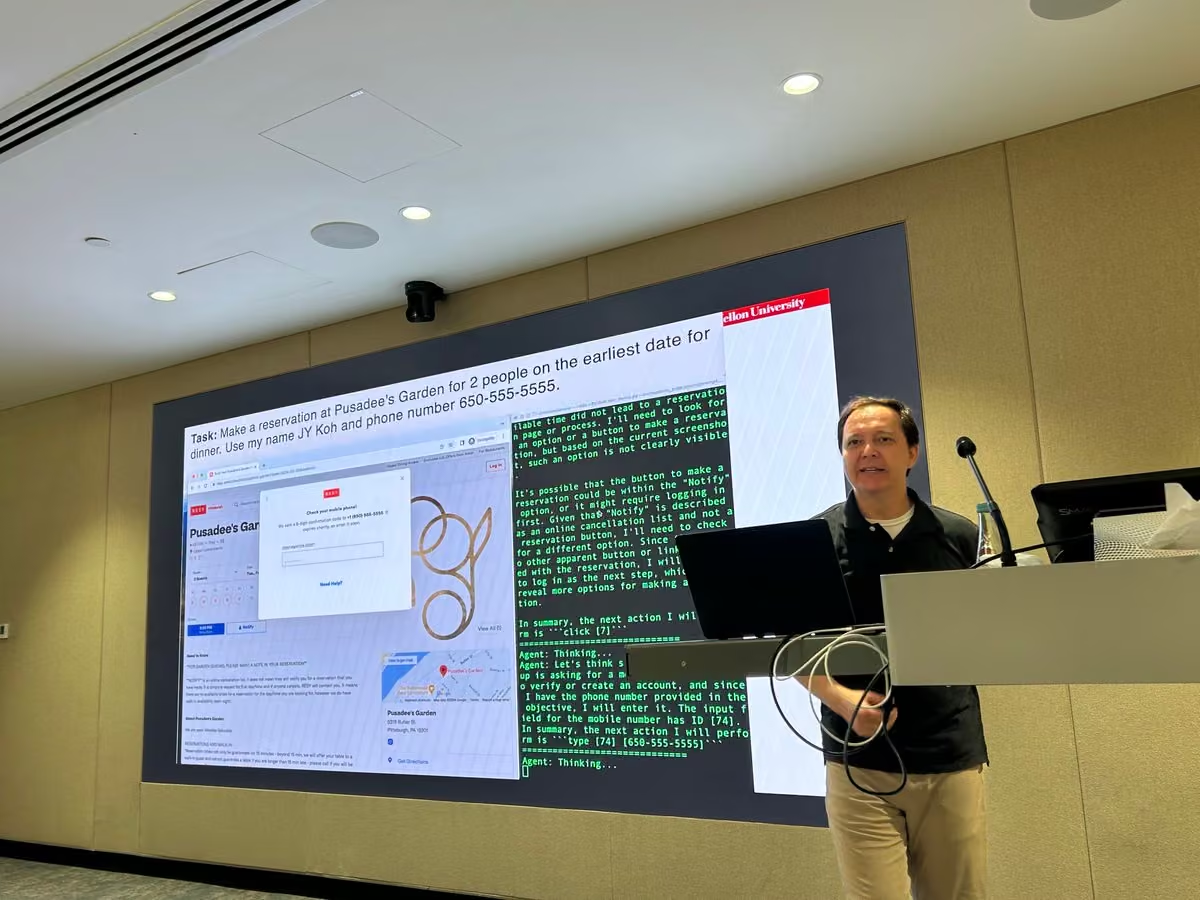
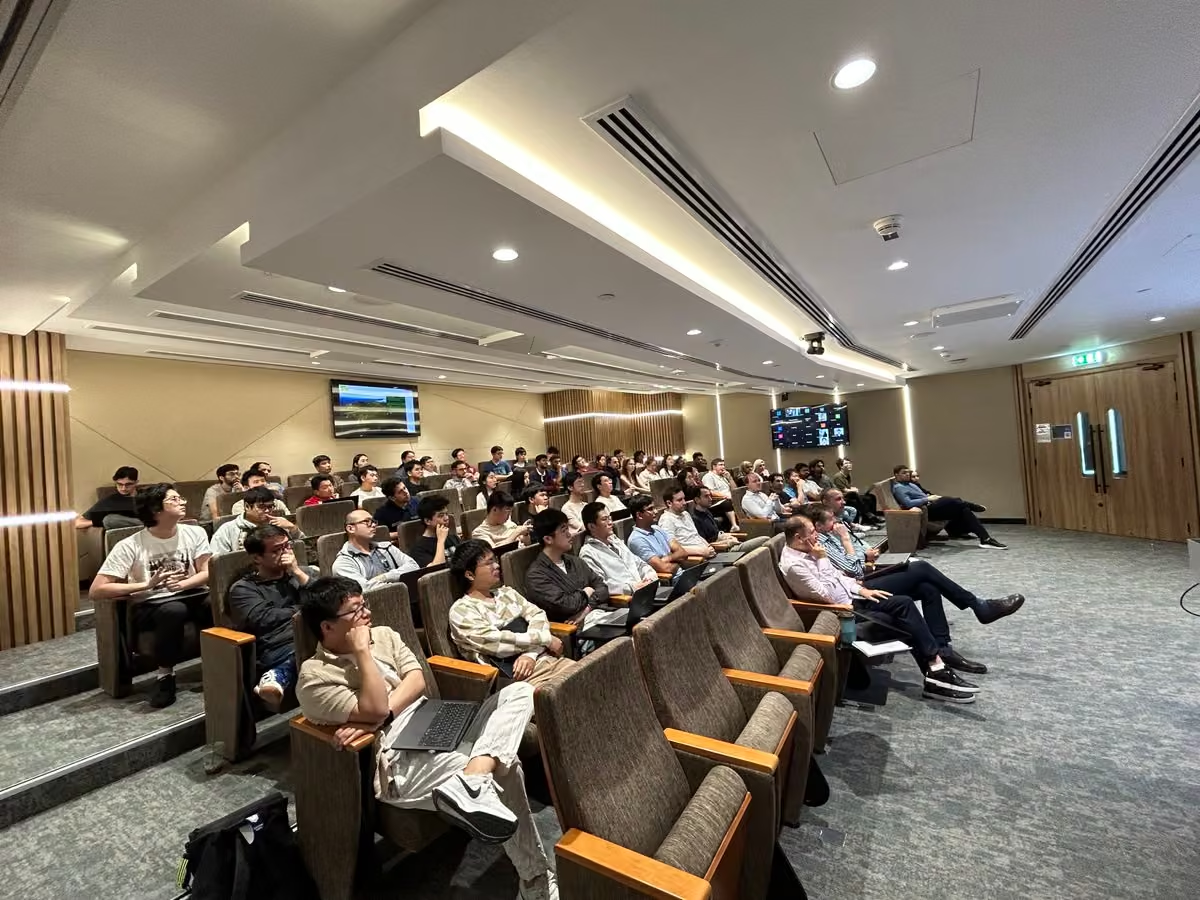

 Hugo Larochelle
 Kaps
 Wild Reptilians
 Ahmad Al-Dahle
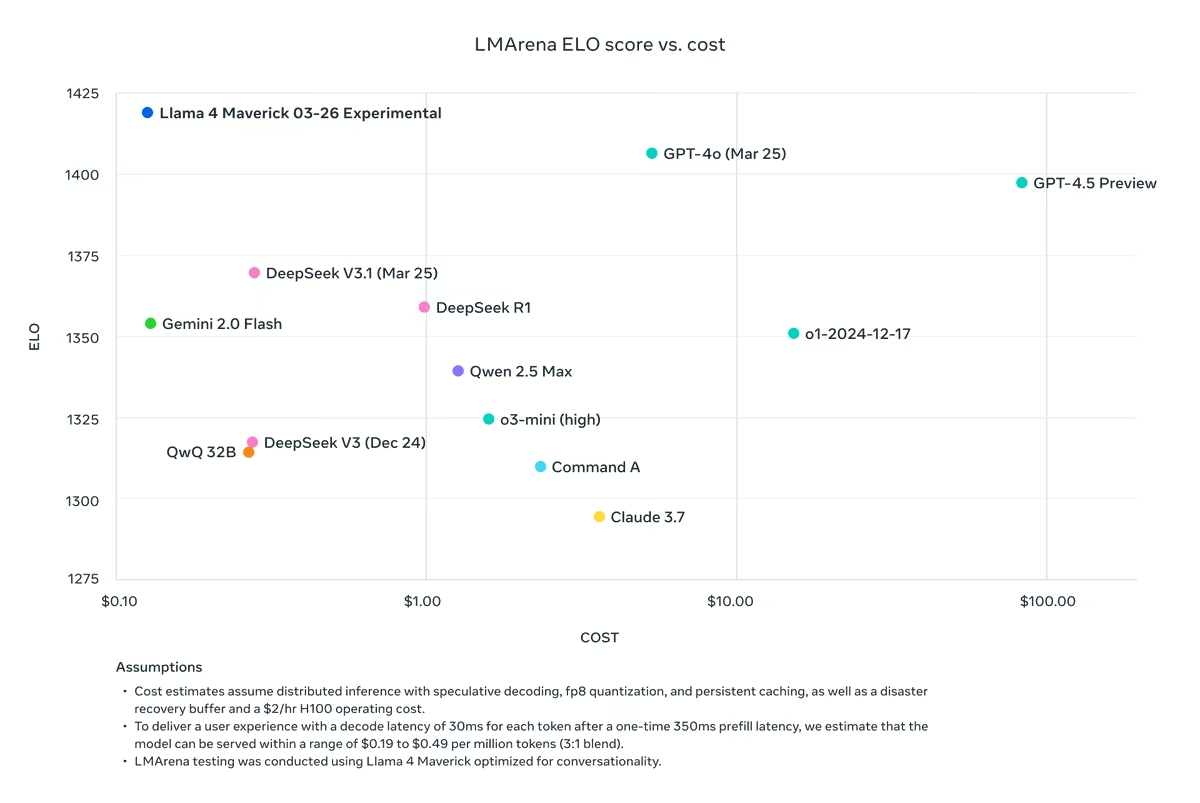
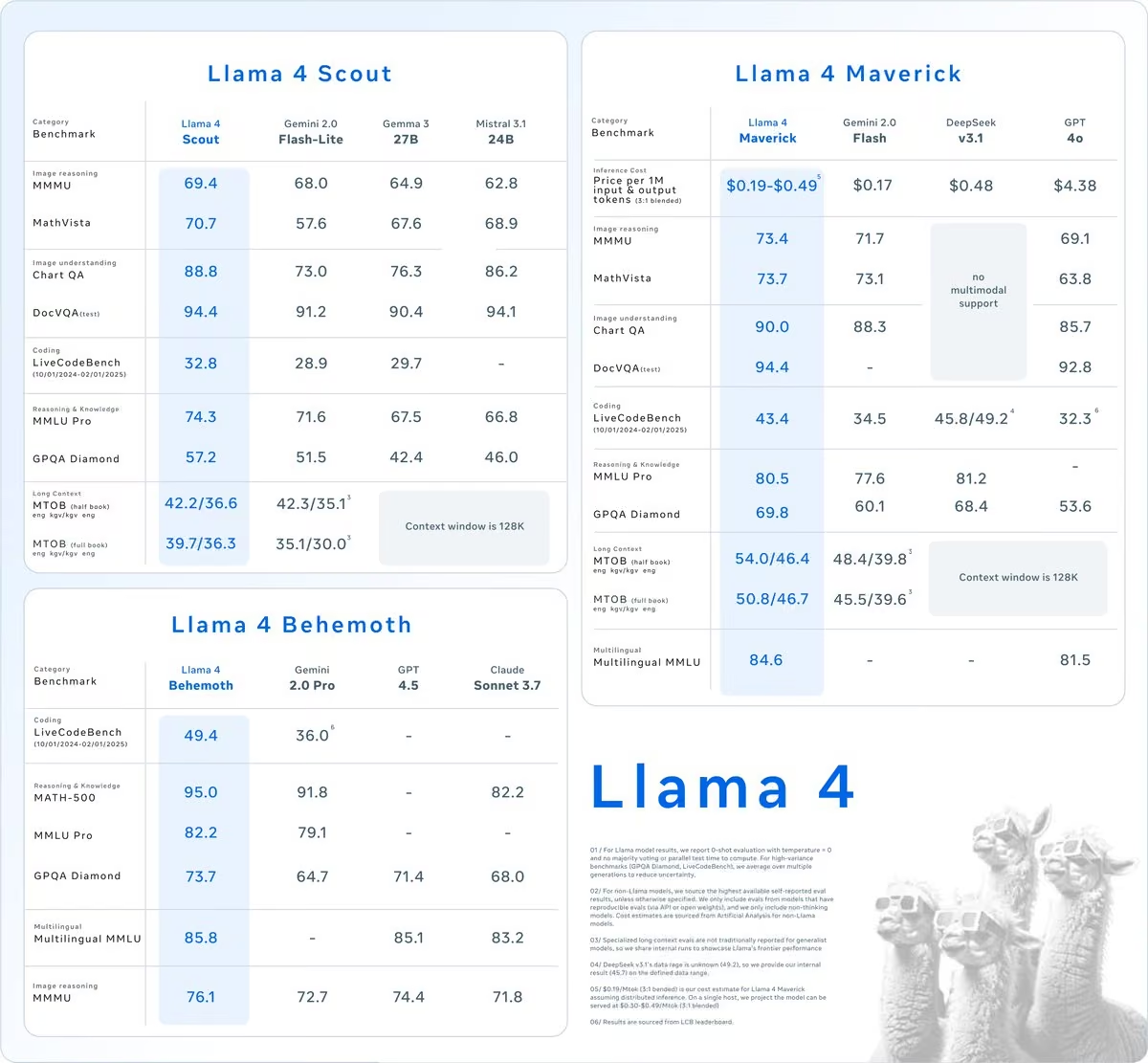
 UC Berkeley RDI
 Dawn Song
 Kamalika Chaudhuri


 Agentica Project

 Rose Yu

 Chen Wu

 Oumi
 Paul Vicol


 Rahel Jhirad


 Alexandre Lacoste

 MIT Media Lab


 Ben Eysenbach


 Andrew Gordon Wilson


 Kempner Institute at Harvard University


 GRASP Laboratory


 Carnegie Mellon University

 Tsarathustra


 Yash Butala

 Michael Luo


 Video Arena


 ICML Conference


 Tanishq Mathew Abraham, Ph.D.


 Raghav Kapoor

 Manohar Paluri
 Jack Langerman (in sf)


 Roger Grosse


 Chongyi Zheng
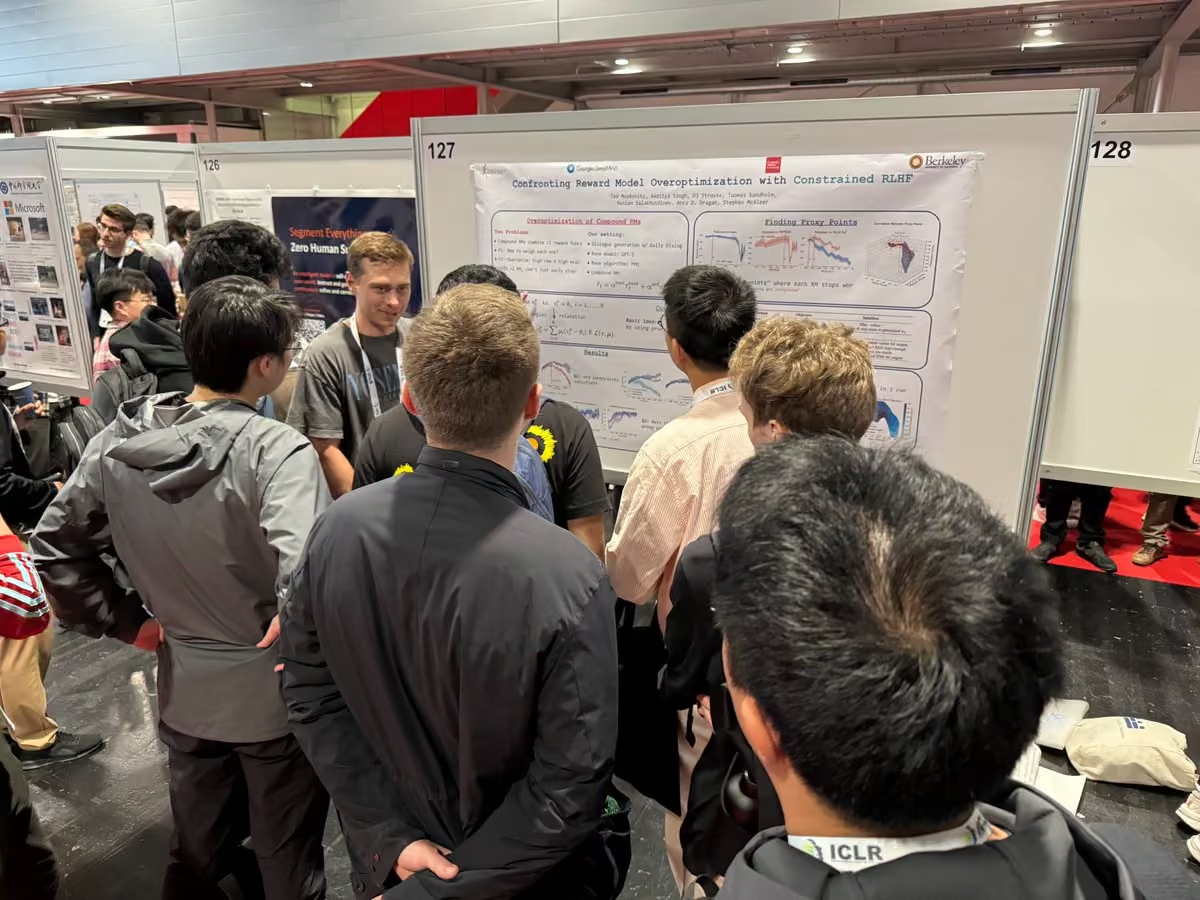
 Ted Moskovitz


 Lenore Blum


 Mohammad Hajiaghayi (IG@mhajiaghayi,YT:hajiaghayi)
 UMD Department of Computer Science

 Dan Roy

 Michael Littman

 Arindam

 Preeth

 Aran Komatsuzaki


 Elman Mansimov


 Michael Figurnov

 Hal Daumé III

 ALVI Labs


 Brenden Lake
 Yi Ma

 INSAIT Institute

 Thomas G. Dietterich


 Machine Learning Dept. at Carnegie Mellon


 Anirudha Majumdar
 Xiang Fan




 Rohan Pandey
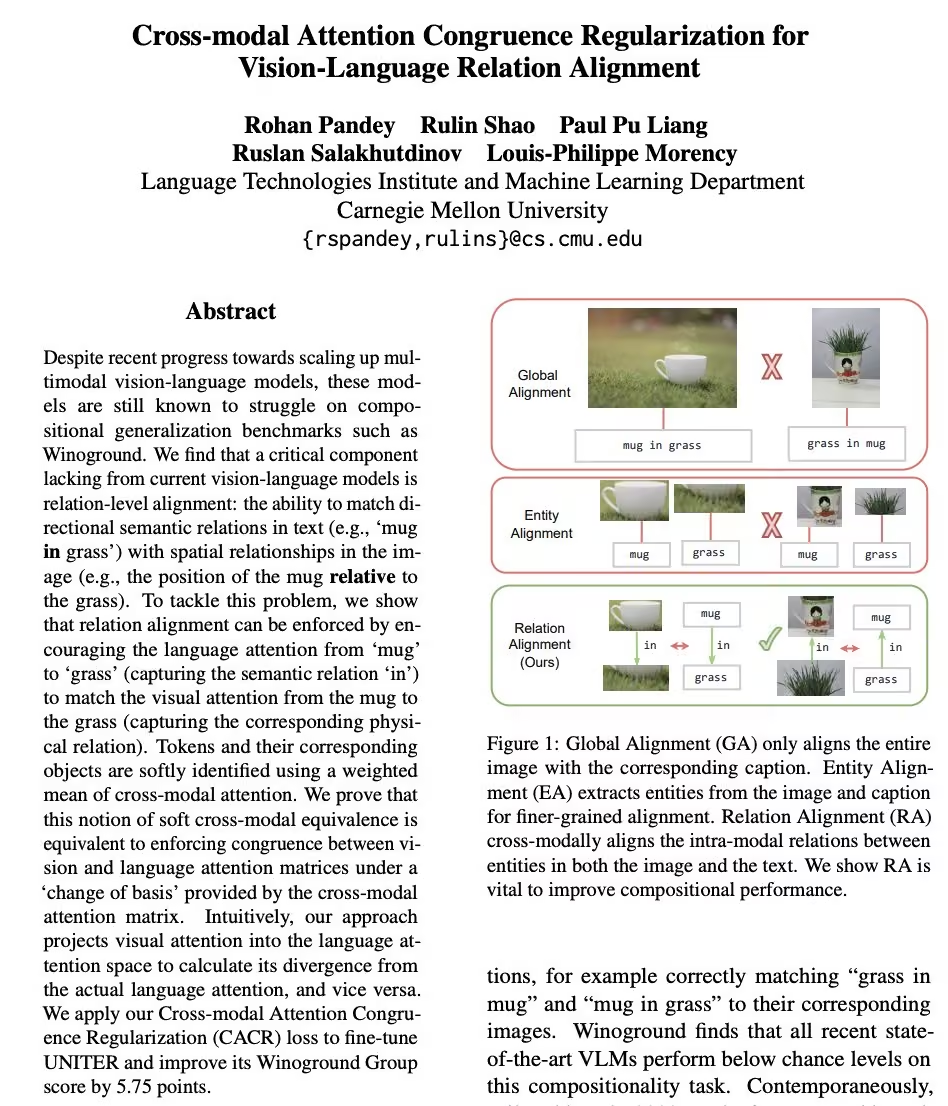


 Accepted papers at TMLR


 Yue Wu

 Imbue

 Christopher Manning


 naomi (forgetful functor)

 william
 Martin Vechev


 Peng Qi

 Wojciech Zaremba
 August Wester
 Mofijul Islam

 Athiya Deviyani


 Tianjun Zhang
 Yuxin Xiao
 Dennis Ulmer 🦋

 Soumith Chintala
 Papers with Code
 Michael Black
 Renjie Liao
 Albert Gu
 Raj Ghugare
 Jack Clark


 Tom M Mitchell

 Davis Blalock


 Yilun Du

 Luca Weihs


 Jacob Buckman


 Tianwei Ni

 Papers with Datasets


 Sergey Levine

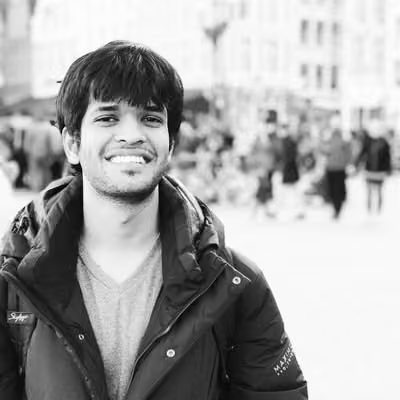 Saurabh Garg


 MineRL Project

 Keyulu Xu


 Jure Leskovec


 Kyunghyun Cho

 Martin Ma
 Language Technologies Institute | @CarnegieMellon
 DukeNLP


 Han Zhao

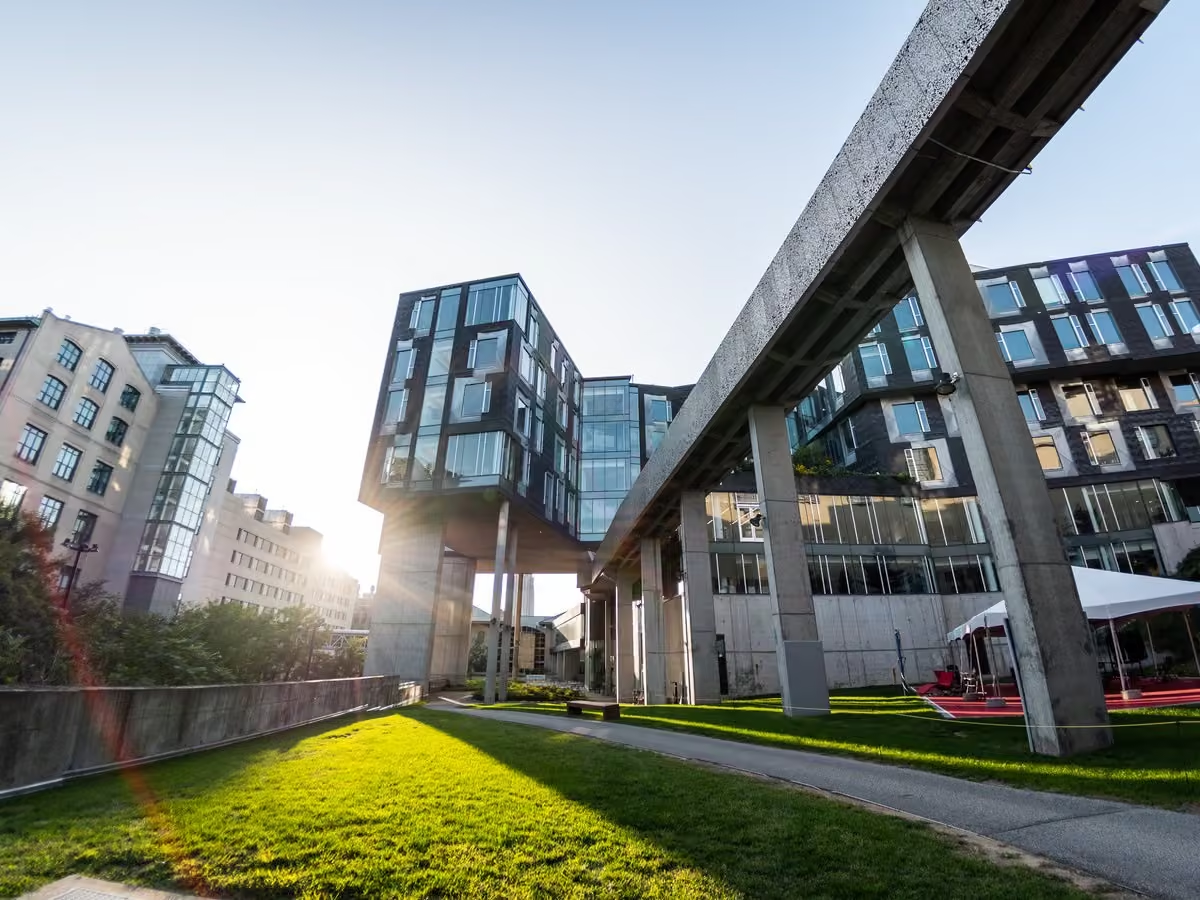
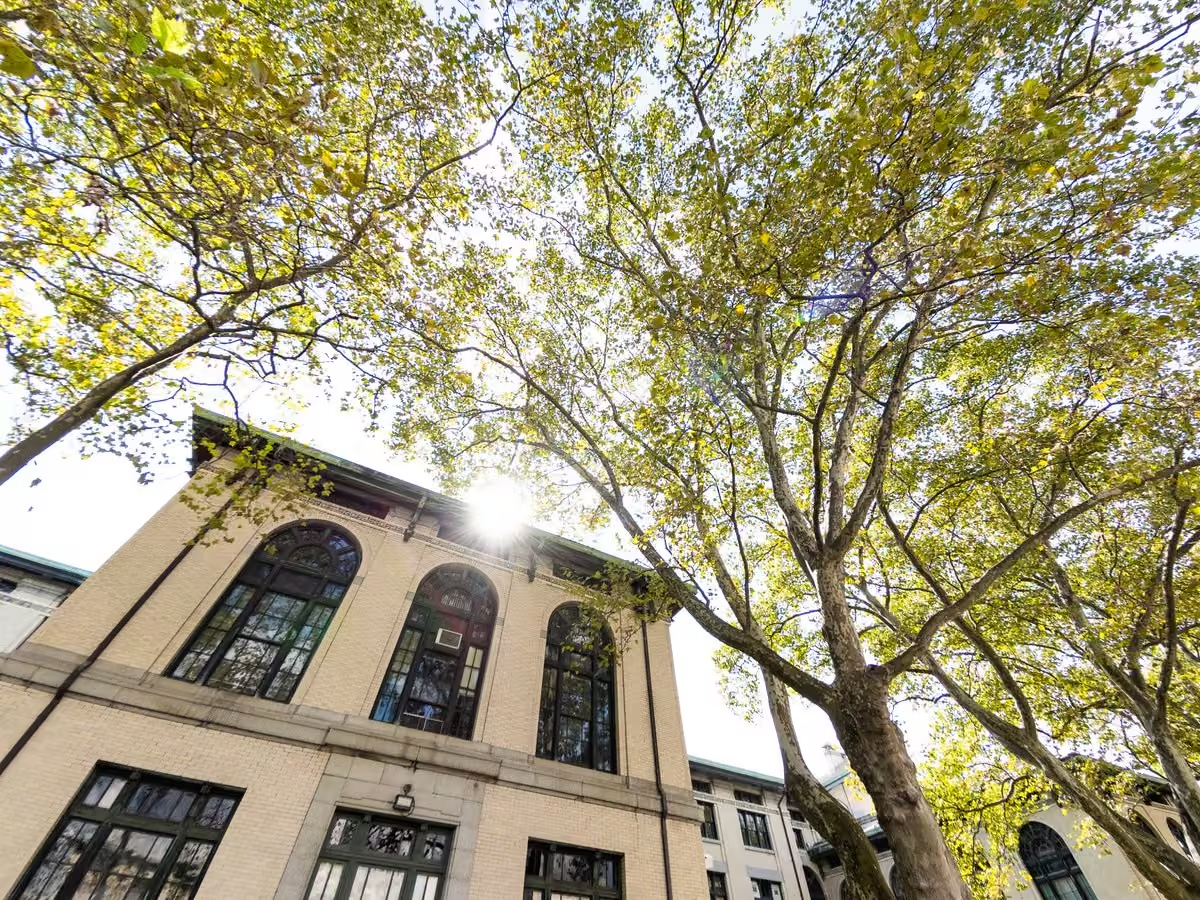


 RL Theory Virtual Seminars


 Adam W. Harley

 Cyrus Rashtchian 🇰🇷 ICML

 chilconference

 Kavya Srinet
 Ruosong Wang


 Jeremy Howard

 Stephanie Milani


 Sean Welleck


 Tomasz Malisiewicz


 Shane Gu
 Microsoft Research
 Katja Hofmann


 UCSD Engineering


 Gergely Neu

 Andy Pavlo (@andypavlo.bsky.social)


 Animesh Garg


 The Verge


 Thang Luong

 Hanlin Goh


 AI Business


 Radu Craiu


 Simon Shaolei Du


 bill peduto
 Stefani Pashman


 Tom Wong
 CMU AI+


 U of T News
 ML in PL
 Max Jaderberg

 Sid Jayakumar
 UCI Center for Machine Learning & Intelligent Sys


