Our work demonstrating incorrigibility in computer-use agents was recently featured in the NYT!
It was a pleasure speaking with @dylfreed, @juliacastrov, and the rest of their team about this -- give it a read!
www.nytimes.com/2026/11/11/magazine/ai-behavior-incorrigi…
Zico Kolter
Jeremy Zico Kolter is a professor at Carnegie Mellon University and director of its machine learning department. He focuses primarily on AI safety research. He is a co-founder and senior advisor of Gray Swan AI, an AI safety and security company. In 2024, he was appointed to the board of directors for OpenAI, and became chair of its safety and security committee. In 2025, he was named as a recipient of funding from Schmidt Sciences AI safety science program. More on Wikipedia
-
Zico Kolter reposted
Jeremy Tien
@jeremy__tien
-
Zico Kolter
@zicokolter
This was a Herculean effort on Sam’s part (and other collaborators). Working for two years solid on a single project (on an academic budget) to achieve superhuman Stratego play. Doing this in the current era is amazingly impressive.
Samuel Sokota
@ssokota
In our Nature paper, we introduce the first superhuman Stratego AI, which we built using general techniques that we developed for RL & test-time compute under imperfect information. 1/N
-
Zico Kolter reposted
nature
@Nature
Nature research paper: Scalable decision-making for games of imperfect information
go.nature.com/3TvlQQS -
Zico Kolter reposted
Samuel Sokota
@ssokota
In our Nature paper, we introduce the first superhuman Stratego AI, which we built using general techniques that we developed for RL & test-time compute under imperfect information. 1/N
-
Zico Kolter reposted
OpenAI
@OpenAI
Paul Christiano, founder of the Alignment Research Center, is joining the OpenAI Foundation Board and its Safety and Security Committee, which provides governance over the safety and security practices across OpenAI.
As AI capabilities advance, strong safety, security, alignment, and governance matter more than ever. Paul’s work on AI alignment and his years at @NIST will strengthen the Foundation’s oversight, bringing an independent voice to challenge assumptions, assess safeguards, and reinforce accountability around critical decisions.
Paul will also serve as a non-voting observer on the OpenAI Group PBC Board.
openai.com/index/paul-christiano-joins-openai-foundation-… -
Zico Kolter
@zicokolter
I am thrilled to have @paulfchristiano joining the OpenAI Foundation board and the Safety and Security Committee. Paul is a pioneer in AI Safety, Security, and Alignment, and I'm extremely grateful for the opportunity to work with him here.
OpenAI
@OpenAI
Paul Christiano, founder of the Alignment Research Center, is joining the OpenAI Foundation Board and its Safety and Security Committee, which provides governance over the safety and security practices across OpenAI.
As AI capabilities advance, strong safety, security, alignment, and governance matter more than ever. Paul’s work on AI alignment and his years at @NIST will strengthen the Foundation’s oversight, bringing an independent voice to challenge assumptions, assess safeguards, and reinforce accountability around critical decisions.
Paul will also serve as a non-voting observer on the OpenAI Group PBC Board.
openai.com/index/paul-christiano-joins-openai-foundation-…
Zico Kolter
@zicokolter
Paul's post as well:
Paul Christiano
@paulfchristiano
-
Zico Kolter reposted
Jakub Pachocki
@merettm
I want to prevent a race into unmonitorability kicked off by confused reporting. The depth of the computation graph for our present frontier models, including Astra, is within a factor of two of GPT-4.
OpenAI has worked to preserve and utilize chain-of-thought monitoring since our very first reasoning models. We deeply care about this technique, as it can give us a view into how model alignment generalizes from its training distribution. I do think it is fragile and unfortunately trending in a negative direction, for reasons not contingent on architecture changes that I will write about soon. But there are things we can do to strengthen it, and it's a core goal of our current research program. -
Zico Kolter reposted
Pratyush Maini
@pratyushmaini
Some life updates:
1. I defended my PhD last winter 🎓
2. Starting next January, I’ll be joining the faculty in Computer Science at @cornell_tech! 🗽
I’m incredibly grateful for the past few years at CMU and Datology, especially to @zicokolter and @zacharylipton for their mentorship, and to @AdtRaghunathan, who I’ve had the privilege of working closely with. -
Zico Kolter reposted
Aran Nayebi
@aran_nayebi
1/8 AI now produces work that outpaces human review. Scalable oversight proposes the use of models to check the work of other models. We identify a critical bottleneck in scalable oversight: under decision load, one model cannot reliably check many requirements at once—even with more compute.
We suggest a strategy called “sharding”, which flexibly works with additional oversight mechanisms to better guard against adversarial exploitation.🧵 -
Zico Kolter reposted
Zhengyang Geng
@ZhengyangGeng
📢 Introducing "Loop Meet" at @icmlconf 2026!
Had a blast at the Diffusion Circle today (pics below!). After chatting with Sander @sedielem, we realized there’s a need for a new space. If you're into recurrent/loop methods, join us tomorrow (Friday) at 3:30 PM!
📍 Meet at the information desk (we'll head out from there to find a spot). -
Zico Kolter
@zicokolter
Matt and I had a great time chatting with you @swyx! Really excited the things we're building at @GraySwanAI.
Latent.Space
@latentspacepod
Gray Swan: Red-Teaming after Mythos & the coming AI security crisis www.latent.space/p/gray-swan
@GraySwanAI cofounders @zicokolter and Matt Fredrikson explain why AI security is fundamentally different from traditional cybersecurity, how their automated red-teaming system Shade can now outperform humans at breaking frontier models, why prompt injection creates an entirely new class of exploits for agents like Claude Code and Codex, and why the first major AI security breach may be a gray swan event that everyone sees coming. -
Zico Kolter reposted
Jake Flomenberg
@jflomenb
When Anthropic built a model powerful enough to restrict its own release, Gray Swan was named in the system card as a key external security research partner.
Today @Wing_VC is co-leading @GraySwanAI 's $40M Series A alongside @MadronaVentures .
11 frontier model system cards. ARR >10x in two quarters. And founders who built the research before there was a market for it.
Full take 👇
www.wing.vc/content/investing-in-gray-swan-the-ai-securit… -
Zico Kolter reposted
Gray Swan AI
@GraySwanAI
We raised $40M to make AI safe enough to trust. 🦢
Co-led by @WingVC and @MadronaVentures, with @Obviousvc, @Snowflake, @WeAreHRT, @SamsungNext, and @magaracvc.
More fuel to deliver on the mission: empowering the world to use AI safely and securely.
www.grayswan.ai/news/gray-swan-announces-series-a?hss_cha… -
Zico Kolter reposted
Vivek Ramaswami
@vivekramaswami
"Gray Swan has become the go-to security provider for a who’s who of frontier labs: OpenAI, Anthropic, Google Deepmind, Meta, xAI and ByteDance."
Stoked to support Matt, @zicokolter, and the entire @GraySwanAI team and co-lead their $40M Series A alongside @Wing_VC. The future of AI safety and security is here! www.forbes.com/sites/rashishrivastava/2026/05/28/this-ai-… -
Zico Kolter
@zicokolter
Thrilled to share that @GraySwanAI raised $40M in Series A funding led by @Wing_VC and @MadronaVentures. Our mission is to empower the world to use AI safely and securely. We look forward pushing the frontier in AI Security!
www.forbes.com/sites/rashishrivastava/2026/05/28/this-ai-… -
Zico Kolter reposted
Benhao Huang
@huskydogewoof
🌀 Introducing 𝐄𝐪𝐮𝐢𝐥𝐢𝐛𝐫𝐢𝐮𝐦 𝐑𝐞𝐚𝐬𝐨𝐧𝐞𝐫𝐬 (𝐄𝐪𝐑) !
Feedforward models and weight-tied models behave very differently on hard reasoning generalization.
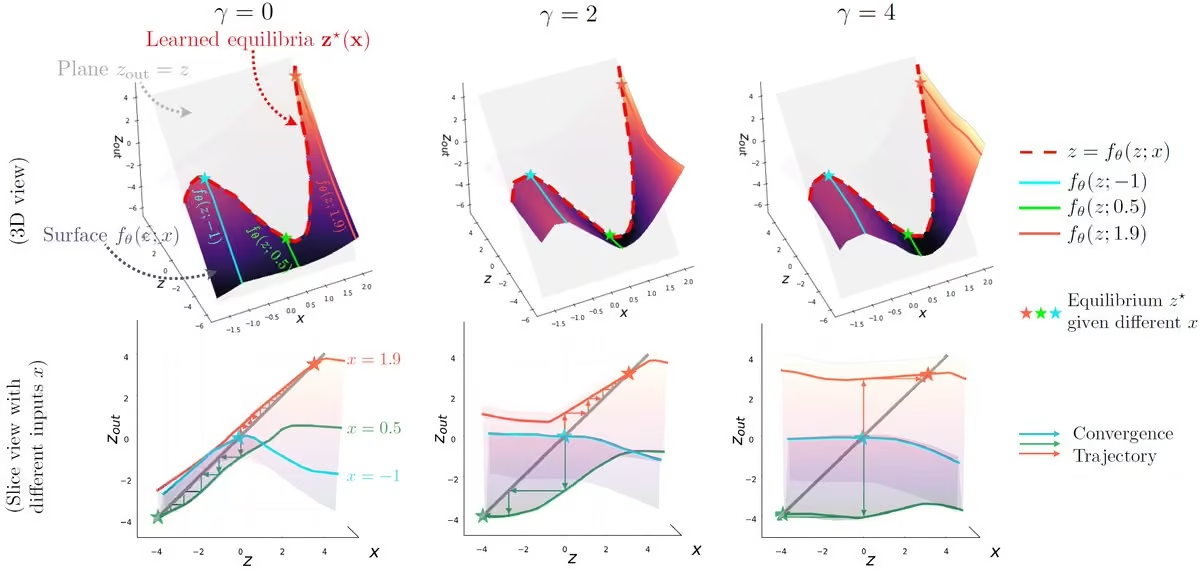
EqR pushes this difference to the extreme by learning 𝐭𝐚𝐬𝐤-𝐜𝐨𝐧𝐝𝐢𝐭𝐢𝐨𝐧𝐞𝐝 𝐧𝐞𝐮𝐫𝐚𝐥 𝐚𝐭𝐭𝐫𝐚𝐜𝐭𝐨𝐫𝐬 .
• Sudoku-Extreme: 99.8%
• Maze: 93%
#icml2026This media couldn't be displayed. See it on the original post. -
Zico Kolter reposted
Zhengyang Geng
@ZhengyangGeng
I’m obsessed with two opposite ends of compute scaling.
The 1-step extreme: Can we compress an iterative algorithm into a single forward pass?
The ∞-step extreme: Can a finite-capacity model solve harder problems by iterative refinement?
Our new paper, Equilibrium Reasoners (EqR), is about the latter.
What I love about this work is that it forced us to 𝐬𝐭𝐨𝐩 𝐭𝐡𝐢𝐧𝐤𝐢𝐧𝐠 𝐨𝐟 𝐝𝐞𝐩𝐭𝐡/𝐬𝐭𝐞𝐩 𝐚𝐬 𝐭𝐡𝐞 𝐩𝐫𝐢𝐦𝐢𝐭𝐢𝐯𝐞.
At the core, it's about 𝐧𝐞𝐮𝐫𝐚𝐥 𝐚𝐭𝐭𝐫𝐚𝐜𝐭𝐨𝐫𝐬.
In EqR, we train the latent landscape to align with implicit task metrics.
Correct solutions become neural attractors.
Then inference is no longer just “more steps.”
It is a solver descending the model’s own landscape.
Easy samples fall into the right basin in a few steps.
Hard samples get more steps, more restarts, more exploration.
We’re able to unlock over 40,000-layer unfolded computation, achieving extremely deep neural networks with 99.8% accuracy on 400k eval cases.
No task prior. No external verifier.
Just the model’s own dynamics.
To me, this is the beautiful part:
Scalable inference compute emerges naturally as a byproduct of neural attractors.
Very proud of this work with @huskydogewoof and @zicokolter.
My beloved 𝐟𝐢𝐱𝐞𝐝 𝐩𝐨𝐢𝐧𝐭𝐬 & 𝐧𝐞𝐮𝐫𝐚𝐥 𝐚𝐭𝐭𝐫𝐚𝐜𝐭𝐨𝐫𝐬. 👇
Benhao Huang
@huskydogewoof
🌀 Introducing 𝐄𝐪𝐮𝐢𝐥𝐢𝐛𝐫𝐢𝐮𝐦 𝐑𝐞𝐚𝐬𝐨𝐧𝐞𝐫𝐬 (𝐄𝐪𝐑) !
Feedforward models and weight-tied models behave very differently on hard reasoning generalization.
EqR pushes this difference to the extreme by learning 𝐭𝐚𝐬𝐤-𝐜𝐨𝐧𝐝𝐢𝐭𝐢𝐨𝐧𝐞𝐝 𝐧𝐞𝐮𝐫𝐚𝐥 𝐚𝐭𝐭𝐫𝐚𝐜𝐭𝐨𝐫𝐬 .
• Sudoku-Extreme: 99.8%
• Maze: 93%
#icml2026This media couldn't be displayed. See it on the original post. -
Zico Kolter reposted
YixuanEvenXu
@YixuanEvenXu
🤖 AI text detectors are widely deployed in education and integrity workflows, but what are they actually tracking?
We report a surprising finding: text from base models is overwhelmingly judged as human by GPTZero and Pangram. 👇 (1/6) -
Zico Kolter reposted
Eungyeup Kim
@EungyeupKim
As LLMs saturate benchmarks, evaluating their five-nines reliability is crucial, but prohibitively expensive. We cut the inference cost by 5-20x on average (up to 156×) by exploiting a key insight: LLM failures are not random.
🧵[1/n] -
Zico Kolter
@zicokolter
I really enjoyed chatting with @mattturck, was a great discussion.
Matt Turck
@mattturck
Deeply thoughtful conversation with @zicokolter, board member at @OpenAI and head of the machine learning department at @CarnegieMellon, about AI safety, AI security, agents and frontier AI
00:00 Intro
01:32 OpenAI board role and Safety & Security Committee
03:53 How OpenAI reviews major model releases
05:33 OpenAI’s preparedness framework explained
09:46 Are frontier AI models getting safer?
12:33 Why AI safety does not come from scale
15:23 The four categories of AI risk
19:38 Doomerism vs accelerationism in AI
24:11 The six-month AI pause debate
26:20 AI safety as a global effort
28:04 How Zico Kolter got into machine learning
31:05 OpenAI in the early days
34:14 Why Carnegie Mellon became an AI powerhouse
38:43 What Gray Swan does in AI security
40:44 AI safety vs AI security
43:15 The GCG jailbreak paper
49:19 How AI labs responded to jailbreak research
50:19 State-of-the-art AI defenses
52:32 State-of-the-art AI attacks
54:22 Why AI agents expand the attack surface
58:39 Are AI agents ready for production?
59:40 Mechanistic interpretability explained
1:02:31 Will AI be safer in two years?
1:03:46 Reinforcement learning and self-improving models
1:08:09 Do post-transformer architectures matter
1:09:29 Best research directions in AI now
1:11:00 Zico Kolter’s Intro to Modern AI course
1:14:53 Why modern AI is simpler than people thinkThis media couldn't be displayed. See it on the original post. -
Zico Kolter reposted
Yutong (Kelly) He
@electronickale
Diffusion planners are great for offline RL. But they need many steps to work well! Way too slow for real-time decision making!
Presenting RACTD at #iclr2026: reward-aware distillation that plans in ONE step
🇧🇷 Today (4/23) P4-#4618 3:15-5:45 PM
arxiv.org/abs/2506.07822 1/ -
Zico Kolter
@zicokolter
New and future models may be AGI and all, but will never surpass the humor of <=GPT-2 models (this instance from a 200M param model for a homework assignment I was preparing).
-
Zico Kolter reposted
Aran Nayebi
@aran_nayebi
Major congratulations to my PhD student @jeremy__tien who was awarded an @NSF GRFP for his proposal on "Provably Safe and Beneficial Artificial Intelligence Agents"! 🥳
Follow him to stay tuned for more cool AI safety work to come :) -
Zico Kolter reposted
Adam Stein
@adamlsteinl
We found widespread cheating on popular agent benchmarks, affecting 28+ submissions across 9 benchmarks and thousands of agent runs.
Surprisingly, the top 3 submissions on Terminal-Bench 2 are all cheating!
Here's what we found 🧵 -
Zico Kolter
@zicokolter
As AI agents access more untrusted information with greater autonomy, prompt injections may become the greatest security challenge of our era.
@GraySwanAI, in collaboration many frontier labs, just released our paper on the largest public prompt injection challenge to date.
🧵
Gray Swan AI
@GraySwanAI
Your AI agent can be hijacked by a prompt injection and you'd never know!
The attack executes. The response looks normal. And the user moves on.
We ran the largest public competition testing this exact threat across tool use, coding, and computer use agents. 464 participants, 272K attacks, 13 frontier models. Every model proved vulnerable.Post not available here, view on X
Zico Kolter
@zicokolter
For the record, I hate the term "indirect prompt injection." Prompt injection as the term was intended is always indirect (untrusted data treated as instructions). But then people started calling some classes of jailbreaks "direct prompt injections," and well, here we are.
Zico Kolter
@zicokolter
If you're interested in joining our team, looking to both understand and drastically improve AI safety and security, we're hiring at Gray Swan: www.grayswan.ai/careers
-
Zico Kolter reposted
Christina Baek
@_christinabaek
Models are typically specialized to new domains by finetuning on small, high-quality datasets.
We find that repeating the same dataset 10–50× starting from pretraining leads to substantially better downstream performance, in some cases outperforming larger models. 🧵 -
Zico Kolter reposted
Dylan Sam
@dylanjsam
I defended my PhD thesis!
Also, a very (~4 month) late life update, but I've joined @OpenAI to work on safety research and pretraining safer language models! 📈
Thank you to my advisor @zicokolter and my committee: Matt Fredrikson, @andrew_ilyas, and @furongh! 🙏 -
Zico Kolter reposted
Tom M Mitchell
@tommmitchell
How did machine learning get to this amazingly successful point? My new podcast tells the story of the field with the help of a dozen major contributors such as @geoffreyhinton , @ylecun , @RichardSSutton , @tdietterich and others. www.youtube.com/playlist?list=PLQ9F4IqcaHKq-qVkrYhNPMQrU4…
-
Zico Kolter reposted
YixuanEvenXu
@YixuanEvenXu
🧬 Distillation enables efficient emulation of LLMs, but verifying provenance remains a critical challenge.
Introducing Antidistillation Fingerprinting (ADFP): A principled approach that aligns signals with student learning dynamics. 👇 (1/6) -
Zico Kolter
@zicokolter
Extrapolating trends, at what point does the METR task time horizon surpass the time between model releases?
-
Zico Kolter reposted
Vaishnavh Nagarajan
@_vaishnavh
1/ We found that deep sequence models memorize atomic facts "geometrically" -- not as an associative lookup table as often imagined.
This opens up practical questions on reasoning/memory/discovery, and also poses a theoretical "memorization puzzle." -
Zico Kolter reposted
Marc Finzi
@m_finzi
1/🧵 We are very excited to release our new paper! From Entropy to Epiplexity: Rethinking Information for Computationally Bounded Intelligence
arxiv.org/abs/2601.03220
with amazing team @ShikaiQiu @yidingjiang @Pavel_Izmailov @zicokolter @andrewgwils -
Zico Kolter
@zicokolter
I've decided to release a minimal, free online version of my upcoming "10-202 - Intro to Modern AI" course, starting January 26: modernaicourse.org. As a brief summary, this course introduces students to the elements of modern AI systems: you'll build and train a simple LLM chatbot from scratch in PyTorch, without any pre-built layers or pre-trained models at all. More information about the course, and a link to enroll, is available on the webpage link above.
In the free online version, you can watch all lecture videos and submit all the assignments (all of which are autograded in the full course anyway). There won't be quizzes/exams, and there's no credit offered via CMU; this is purely for educational purposes. The online course will begin two weeks after the CMU version, and lectures and assignments will all be released with the same two-week delay after the in-person version.
Note that this is a first-time offering for this course, so I certainly expect some hiccups along the way. But I hope the material will prove useful for many people.
Zico Kolter
@zicokolter
I'm teaching a new "Intro to Modern AI" course at CMU this Spring: modernaicourse.org. It's an early-undergrad course on how to build a chatbot from scratch (well, from PyTorch). The course name has bothered some people – "AI" usually means something much broader in academic contexts – but I think the time has come where the first thing that many students interested in AI should see is how the AI they are familiar with actually works (because it's really simple!) The more people who understand it the better.
I'll be trying to put as much material as I can that we develop online (assignments + autograding, hopefully lecture videos), though as a first-time course there are also likely to be some bumps along the way. Hopefully it becomes a good resource over time, though.
Feedback welcome. -
Zico Kolter
@zicokolter
My vibe coding projects tend to bifurcate into two distinct experiences:
1) Everything works perfectly and I create this dream app that does exactly what I wanted, with maybe a few corrections to fix some aspects I didn't fully specify. I add new features and things just keep working. It's magic.
2) The original thing I was aiming for doesn't work, I instruct the agent to fix it, trying to reduce complexity bit by bit to get at the core of what I want, but nothing ever works and it keeps making the same mistakes over and over even with lots of instructions.
I assume this is a skill issue. How do people successfully break out of experience #2 when things have started to go off the rails? Starting the project again from scratch rarely helps, because I think my own instructions/framing are causing the issue in the first place. -
Zico Kolter reposted
Eliot Jones
@eliotkjones
We built an AI agent that hacked Stanford, and then wrote a paper about it. Here's what we did, and why we did it 🧵
-
Zico Kolter reposted
Yutong (Kelly) He
@electronickale
Diffusion/Flow-based models can sample in 1-2 steps now 👍 But likelihood? Still requires 100-1000 NFEs (even for these fast models) 😭
We fix this! Introducing F2D2: simultaneous fast sampling AND fast likelihood via joint flow map distillation.
arxiv.org/abs/2512.02636
1/🧵 -
Zico Kolter
@zicokolter
I'm teaching a new "Intro to Modern AI" course at CMU this Spring: modernaicourse.org. It's an early-undergrad course on how to build a chatbot from scratch (well, from PyTorch). The course name has bothered some people – "AI" usually means something much broader in academic contexts – but I think the time has come where the first thing that many students interested in AI should see is how the AI they are familiar with actually works (because it's really simple!) The more people who understand it the better.
I'll be trying to put as much material as I can that we develop online (assignments + autograding, hopefully lecture videos), though as a first-time course there are also likely to be some bumps along the way. Hopefully it becomes a good resource over time, though.
Feedback welcome. -
Zico Kolter reposted
Gray Swan AI
@GraySwanAI
Gray Swan AI Arena sponsored by @hackthebox_eu present the Machine-in-the-Middle Challenge, a $100K competition exploring how humans & AI perform together in real offensive security scenarios.
-
Zico Kolter reposted
Jeremy Cohen
@deepcohen
Even with full-batch gradients, DL optimizers defy classical optimization theory, as they operate at the *edge of stability.*
With @alex_damian_, we introduce "central flows": a theoretical tool to analyze these dynamics that makes accurate quantitative predictions on real NNs. -
Zico Kolter reposted
Dylan Sam
@dylanjsam
🚨Excited to introduce a major development in building safer language models: Safety Pretraining!
Instead of post-hoc alignment, we take a step back and embed safety directly into pretraining.
🧵(1/n) -
Zico Kolter reposted
Priya L. Donti
@priyald17
Beyond humbled to be on this year's #time100ai
AI can be an asset for climate & energy - but only if its development is guided by actual climate needs & planetary limits. Shoutout to those in the community working to shape a responsible, equitable, climate-aligned AI future 🌍💪 -
Zico Kolter reposted
Aran Nayebi
@aran_nayebi
This semester, Matt Gormley & I are co-teaching CMU's Generative AI course!
Today we discussed the Transformer architecture & Multi-Headed Attention.
Follow along 👇 if you want to learn more about the tech that's powering today's AI, from ChatGPT to reasoning models to agents! -
Zico Kolter reposted
Eric Wallace
@Eric_Wallace_
Today we release gpt-oss-120b and gpt-oss-20b—two open-weight LLMs that deliver strong performance and agentic tool use.
Before release, we ran a first of its kind safety analysis where we fine-tuned the models to intentionally maximize their bio and cyber capabilities 🧵 -
Zico Kolter reposted
Johannes Heidecke
@JoHeidecke
Open models can unlock huge benefits, and like any powerful technology, they carry misuse risks. Once the weights are released, there’s no pulling them back. This is why safety testing matters even more here. 1/
Eric Wallace
@Eric_Wallace_
Today we release gpt-oss-120b and gpt-oss-20b—two open-weight LLMs that deliver strong performance and agentic tool use.
Before release, we ran a first of its kind safety analysis where we fine-tuned the models to intentionally maximize their bio and cyber capabilities 🧵 -
Zico Kolter reposted
OpenAI
@OpenAI
Our open models are here.
Both of them.
openai.com/open-models -
Zico Kolter reposted
Aran Nayebi
@aran_nayebi
1/ Updated now with nearly tight lower bounds—i.e., proofs showing when alignment becomes intractable, even for ideal agents.
Key AI safety takeaways:
🧠 Too many values ⇒ makes alignment intractable
👁 Task-space growth ⇒ oversight failure
🤖 Bounded agents need the right inductive biases—bounded rationality, memory, and theory of mind—to degrade gracefully
📏 Tight bounds inform principled risk thresholds
🧵👇
Aran Nayebi
@aran_nayebi
Are there fundamental barriers to AI alignment once we develop generally-capable AI agents?
We mathematically prove the answer is *yes*, and outline key properties for a "safe yet capable" agent. 🧵👇
Paper: arxiv.org/abs/2502.05934 -
Zico Kolter reposted
Andy Zou
@andyzou_jiaming
We deployed 44 AI agents and offered the internet $170K to attack them.
1.8M attempts, 62K breaches, including data leakage and financial loss.
🚨 Concerningly, the same exploits transfer to live production agents… (example: exfiltrating emails through calendar event) 🧵 -
Zico Kolter reposted
Yiding Jiang
@yidingjiang
A mental model I find useful: all data acquisition (web scrapes, synthetic data, RL rollouts, etc.) is really an exploration problem 🔍.
This perspective has some interesting implications for where AI is heading. Wrote down some thoughts:
yidingjiang.github.io/blog/post/exploration/ -
Zico Kolter reposted
Zhengyang Geng
@ZhengyangGeng
now the code is up here: github.com/Gsunshine/meanflow
Zhengyang Geng
@ZhengyangGeng
Excited to share our work with my amazing collaborators, @Goodeat258, @SimulatedAnneal, @zicokolter, and Kaiming.
In a word, we show an “identity learning” approach for generative modeling, by relating the instantaneous/average velocity in an identity. The resulting model, termed MeanFlow, demonstrates the best 1-step generative performance so far as a standalone model trained from scratch.
It exploits a simple fact by the Fundamental Theorem of Calculus: differentiation and integration are inverse operators. This creates a "complexity-gap," differentiation-integration gap: differentiation is easier than integration. Much like the verification-generation gap, we are able to unlock fully tractable learning thanks to the beautiful “asymmetry” in nature/math.
No pre-training/post-training. No distillation. No curriculum.
Simple identity. Simply training from scratch.
Please check out the paper for the best clarity : )
📜Paper: arxiv.org/abs/2505.13447 -
Zico Kolter reposted
Maksym Andriushchenko
@maksym_andr
🚨Excited to release OS-Harm! 🚨
The safety of computer use agents has been largely overlooked.
We created a new safety benchmark based on OSWorld for measuring 3 broad categories of harm:
1. deliberate user misuse,
2. prompt injections,
3. model misbehavior. -
Zico Kolter reposted
Vaishnavh Nagarajan
@_vaishnavh
Wrote my first blog post! I wanted to share a powerful yet under-recognized way to develop emotional maturity as a researcher:
making it a habit to read about the ✨past ✨ and learn from it to make sense of the present -
Zico Kolter reposted
YixuanEvenXu
@YixuanEvenXu
✨ Did you know that NOT using all generated rollouts in GRPO can boost your reasoning LLM? Meet PODS! We down-sample rollouts and train on just a fraction, delivering notable gains over vanilla GRPO. (1/7)
-
Zico Kolter reposted
Hao Kang
@haok1402
Introducing FLAME-MoE: a fully open platform for Mixture-of-Experts (MoE) research. All code, data, checkpoints, training logs, and evaluation results are public—across 7 different scales.
Paper: arxiv.org/abs/2505.20225
Code: github.com/cmu-flame/FLAME-MoE -
Zico Kolter reposted
Zhengyang Geng
@ZhengyangGeng
Excited to share our work with my amazing collaborators, @Goodeat258, @SimulatedAnneal, @zicokolter, and Kaiming.
In a word, we show an “identity learning” approach for generative modeling, by relating the instantaneous/average velocity in an identity. The resulting model, termed MeanFlow, demonstrates the best 1-step generative performance so far as a standalone model trained from scratch.
It exploits a simple fact by the Fundamental Theorem of Calculus: differentiation and integration are inverse operators. This creates a "complexity-gap," differentiation-integration gap: differentiation is easier than integration. Much like the verification-generation gap, we are able to unlock fully tractable learning thanks to the beautiful “asymmetry” in nature/math.
No pre-training/post-training. No distillation. No curriculum.
Simple identity. Simply training from scratch.
Please check out the paper for the best clarity : )
📜Paper: arxiv.org/abs/2505.13447 -
Zico Kolter reposted
Pratyush Maini
@pratyushmaini
Excited to be talking today about how research into memorization provides a fundamentally different lens on safety!
Stanford NLP Group
@stanfordnlp
For this week’s NLP Seminar, we are thrilled to host @pratyushmaini to talk about “What Memorization Research Taught Me About Safety”
When: 5/8 Thurs 11am PT
Non-Stanford affiliates registration form: forms.gle/hTvgfGtcbVkMLdb17 -
Zico Kolter reposted
Runtian Zhai
@RuntianZhai
A shorter version of the first three chapters of my thesis is accepted by ICML 2025. It provides a quick start for those interested in learning about the contexture theory. Check it out: arxiv.org/abs/2505.01557
Runtian Zhai
@RuntianZhai
Why can foundation models transfer to so many downstream tasks? Will the scaling law end? Will pretraining end like Ilya Sutskever predicted?
My PhD thesis builds the contexture theory to answer the above. Blog: www.runtianzhai.com/thesis
Paper: arxiv.org/abs/2504.19792 🧵1/12 -
Zico Kolter reposted
Pratyush Maini
@pratyushmaini
Looking forward to giving a talk this Friday @OpenAI with @zhilifeng on some of our privacy & memorization research + how it applies to production LLMs!
We've been gaining momentum on detecting, quantifying & erasing memorization; excited to explore its real-world impact! -
Zico Kolter reposted
Yutong (Kelly) He
@electronickale
✨ Love 4o-style image generation but prefer to use Midjourney? Tired of manual prompt crafting from inspo images?
PRISM to the rescue! 🖼️→📝→🖼️
We automate black-box prompt engineering—no training, no embeddings, just accurate, readable prompts from your inspo images! 1/🧵 -
Zico Kolter reposted
Christina Baek
@_christinabaek
When we train models to do QA, are we robustly improving context dependency? No!
In our ICLR Oral (Fri 11 AM), we show that if the base model knows the facts already, it shortcuts and learns to ignore the context completely!
Visit us to learn more about knowledge conflicts 😀 -
Zico Kolter reposted
Kyunghyun Cho
@kchonyc
spicy @zicokolter
-
Zico Kolter
@zicokolter
Excited about this work with @ashertrockman @yashsavani_ (and others) on antidistillation sampling. It uses a nifty trick to efficiently generate samples that makes student models _worse_ when you train on samples. I spoke about it at Simons this past week. Links below.
Zico Kolter
@zicokolter
Arxiv: arxiv.org/abs/2504.13146
Website: antidistillation.com
Talk: www.youtube.com/live/ZAnMk4g1n3U
Also with @zhilifeng @A_v_i__S @AlexRobey23 @m_finzi -
Zico Kolter
@zicokolter
Thanks @NVIDIADC for the DGX B200 machine for the CMU Catalyst group! I'm perhaps already a bit too enthralled by it in the photos...
CMU Kenneth C. Griffin School of Computer Science
@GriffinCMU
Huge thank you to @NVIDIADC for gifting a brand new #nvidiadgx B200 to CMU’s Catalyst Research Group! This AI supercomputing system will afford Catalyst the ability to run and test their work on a world-class unified AI platform.
-
Zico Kolter reposted
Christina Baek
@_christinabaek
Are current reasoning models optimal for test-time scaling? 🌠
No! Models make the same incorrect guess over and over again.
We show that you can fix this problem w/o any crazy tricks 💫 – just do weight ensembling (WiSE-FT) for big gains on math!
1/N -
Zico Kolter reposted
Pratyush Maini
@pratyushmaini
1/Being in academia is such a privilege: You get to collaborate with insanely talented & passionate students on their journey to upskill themselves.
Very excited to share *OpenUnlearning*: a unified, easily extensible framework for unlearning led by @anmol_mekala @VineethDorna🧵 -
Zico Kolter reposted
Fahim Tajwar
@FahimTajwar10
Interacting with the external world and reacting based on outcomes are crucial capabilities of agentic systems, but existing LLMs’ ability to do so is limited.
Introducing Paprika 🌶️, our work on making LLMs general decision makers than can solve new tasks zero-shot.
🧵 1/n -
Zico Kolter reposted
Mingjie Sun
@_mingjiesun
What makes a Large Language Model unique? I am excited to share our new work “Idiosyncrasies in Large Language Models”.
We demonstrate that LLMs exhibit idiosyncrasies – unique patterns in their outputs that enable us to distinguish these models with exceedingly high accuracies. -
Zico Kolter reposted
Dylan Sam
@dylanjsam
Excited to share new work from my internship @GoogleAI !
Curious as to how we should measure the similarity between examples in pretraining datasets? We study the role of similarity in pretraining 1.7B parameter language models on the Pile.
arxiv: arxiv.org/abs/2502.02494
1/🧵 -
Zico Kolter reposted
Samuel Sokota
@ssokota
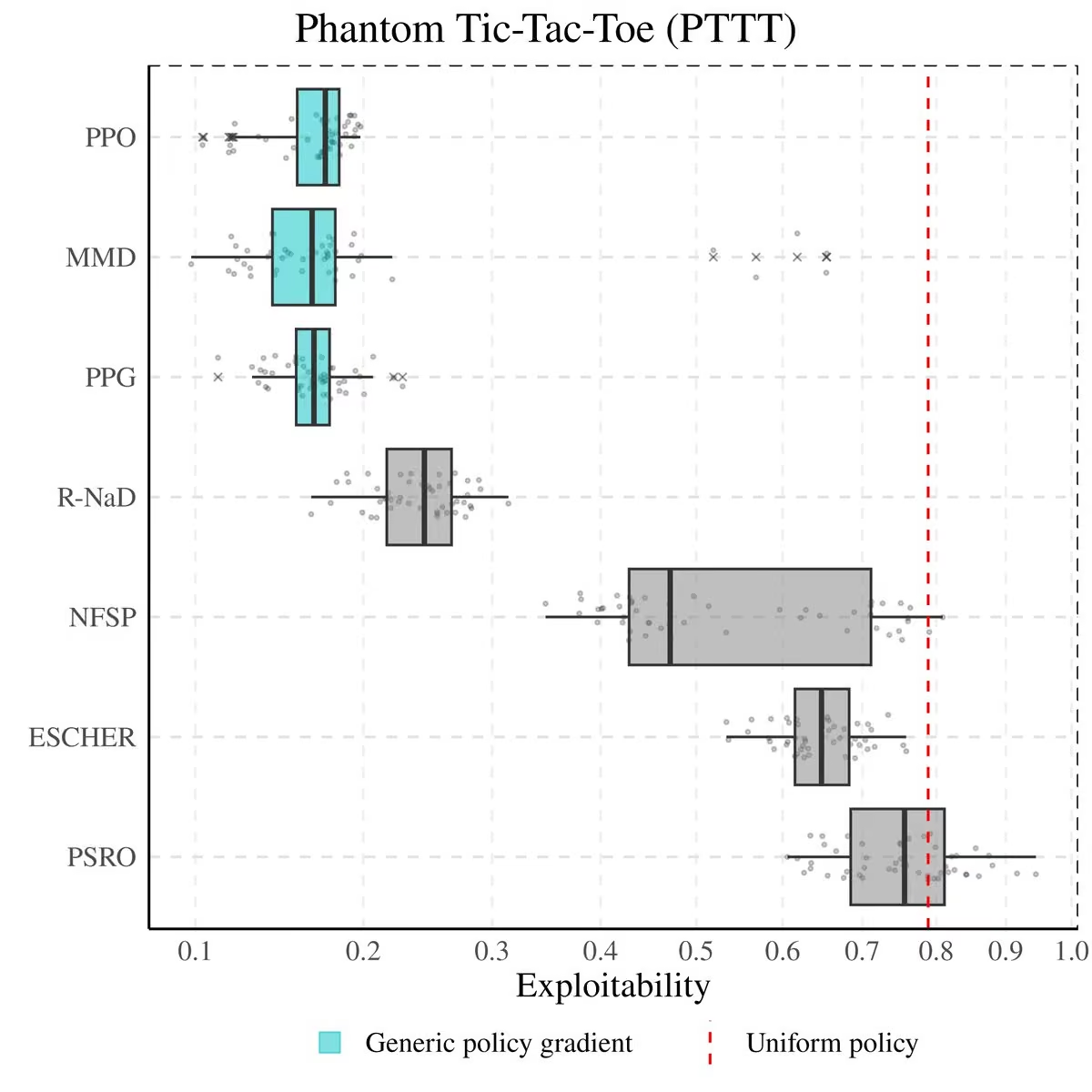
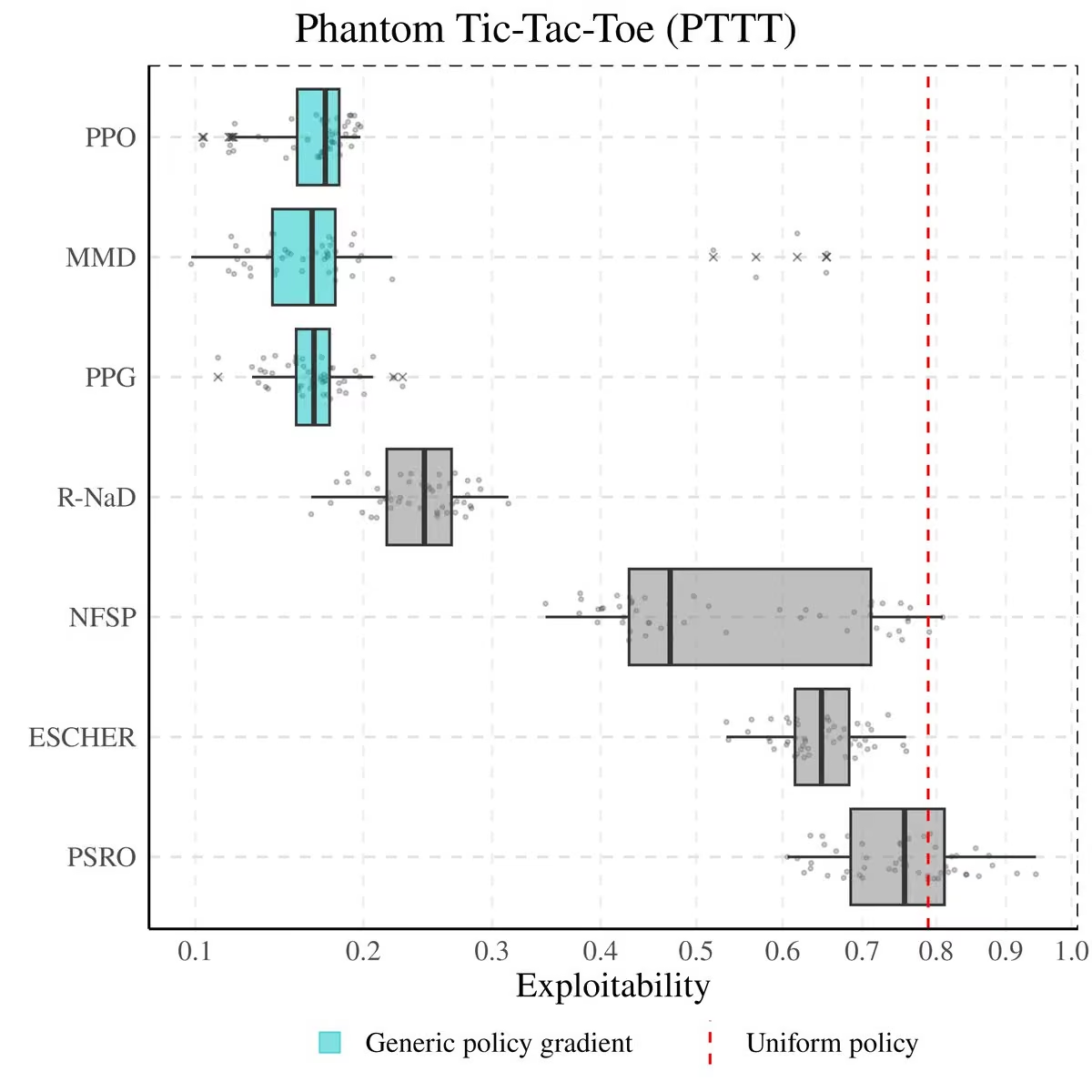
Model-free deep RL algorithms like NFSP, PSRO, ESCHER, & R-NaD are tailor-made for games with hidden information (e.g. poker).
We performed the largest-ever comparison of these algorithms.
We find that they do not outperform generic policy gradient methods, such as PPO. 1/N -
Zico Kolter reposted
Dylan Sam
@dylanjsam
To trust LLMs in deployment (e.g., agentic frameworks or for generating synthetic data), we should predict how well they will perform. Our paper shows that we can do this by simply asking black-box models multiple follow-up questions! w/ @m_finzi and @zicokolter
1/ 🧵 -
Zico Kolter reposted
Gray Swan AI
@GraySwanAI
🚨 New Arena Launch Alert: Harmful AI Assistant Challenge 🚨
💰 $40,000 in Prizes
📅 Launch Date: January 4th, 1 PM EST
🤖 5 Anonymous Models
🔥 Prizes for speed & quantity.
🎮 Multi-turn Inputs Allowed
Your mission: Find unique ways to elicit harmful responses from helpful AI assistants. Prove your skill & claim your share of the prize pool!
Sign up & join the community:
🌐 app.grayswan.ai/arena
💬 discord.gg/WqHkWt99
Think you’ve got what it takes? The arena awaits. 🦢 -
Zico Kolter reposted
Sam Altman
@sama
it is hard to overstate how much alec radford has contributed to the field, and how much of everyone's current progress traces back to his work.
i believe he is a genius at the level of einstein, and also he is one of my favorite people ever--hard to imagine a nicer, warmer, or more thoughtful person.
he is extremely modest and isn't as well-known as he should be, though i'm certain he doesn't care.
super grateful for everything he has done for openai, and so looking forward to collaborating with him as an independent researcher--i think it will fit his style really well. -
Zico Kolter reposted
Gray Swan AI
@GraySwanAI
💻 New Arena Loading... 💻
Something big is coming January 4th.
New models to test.
Huge prizes to win.
A challenge like no other.
Stay sharp. More details dropping soon. 🦢
Sign up for the arena at app.grayswan.ai/arena
Video made with @pika_labs -
Zico Kolter reposted
Gray Swan AI
@GraySwanAI
🔥 Gray Swan x OpenAI: Breaking New Ground 🔥
We’re thrilled to have hosted OpenAI’s pre-release o1 and o1-mini models in the Gray Swan Jailbreaking Arena, giving red team participants exclusive access to test limits, expose vulnerabilities, and help improve AI safety.
💡 Thank you to our participants for making a real difference, pushing boundaries, and shaping safer, more robust AI systems—while winning prizes along the way!
🙏 Huge thanks to @OpenAI for the opportunity to collaborate on this critical work.
📄 Read more about the o1 models in OpenAI’s paper: cdn.openai.com/o1-system-card-20241205.pdf
🦢 Stay tuned—more exciting Arenas are on the way: app.grayswan.ai/arena -
Zico Kolter reposted
Sumukh Aithal
@sumukhaithal6
1/ Excited to present our work today at #neurips2024 !
Please stop by our poster on Dec 11 (Wednesday) 11 AM to 2 PM West Ballroom A-D #5405 to chat more about diffusion models and hallucinations! -
Zico Kolter reposted
Taeyoun Kim
@danielkty96
Can Agreement-on-the-Line (AGL) predict the OOD performance of Foundation Models without labels?
In our work, we show that foundation models can observe AGL across many image/language tasks (+generative)! However, the right type of randomness 🎲 during fine-tuning is critical. -
Zico Kolter reposted
Tim Dettmers
@Tim_Dettmers
I am very excited to be selected as one of the #ai2050 Early Career Fellows!
My research is shifting, and my main focus will be on building open-source AI agents that use dynamic computation to enable powerful AI systems on consumer devices.
I am hiring PhD students at CMU!
Schmidt Sciences
@schmidtsciences
We're thrilled to welcome the 2024 cohort of AI2050 Senior and Early Career Fellows –– 25 visionary researchers tackling AI's toughest challenges to ensure it serves humanity for the better.
Learn more about this year’s cohort of fellows:
www.schmidtsciences.org/schmidt-sciences-to-award-12-mill… -
Zico Kolter reposted
Eungyeup Kim
@EungyeupKim
Under distribution shifts, how can we evaluate model performance in OOD without labels?
In our #neurips2024 paper, we show how test-time adaptation (TTA) strengthens the fascinating "accuracy/agreement-on-the-line" trend—improving OOD predictability without labels!
🧵👇 -
Zico Kolter reposted
Dylan Sam
@dylanjsam
Contrastive VLMs (CLIP) lack the structure of text embeddings, like satisfying analogies via arithmetic (king - man = queen). We enhance CLIP’s *reasoning abilities* on such tasks by finetuning w/ text descriptions of image differences! w/ D. Willmott, J.Semedo, @zicokolter
1/🧵 -
Zico Kolter reposted
Lama Ahmad لمى احمد
@_lamaahmad
Today, we published a blog post and two papers on human and automated red teaming. We’re excited to share how these methods play a role in our safety work as essential parts of risk assessment for many frontier model launches, from DALL-E 2 all the way to most recently o1.
OpenAI
@OpenAI
We’re sharing two papers on red teaming, which is an essential part of testing frontier AI models—a white paper on our approach for engaging external red teamers & a research study introducing a new automated red teaming method. openai.com/index/advancing-red-teaming-with-people-and-ai/
-
Zico Kolter reposted
Zhengyang Geng
@ZhengyangGeng
Thrilled to announce Score Implicit Matching (SIM) for building 1-step deep generative models!
The key idea is that, although the divergence between a diffusion model and a generator remains intractable, SIM offers an elegant approach to efficiently computing the **gradients** for optimization, largely reminiscent of contrastive divergence.
Can you tell which image is from a diffusion model and which is from SIM?
Weijian Luo @ CVPR26 Denver
@William74312006
1/ 🧵 Excited to announce our #neurips2024 paper "One-Step Diffusion Distillation through Score Implicit Matching (SIM)" ( arxiv.org/abs/2410.16794v1)! 🚀 Tired of multi-step diffusion generation? SIM is here! (One of the left two is from SIM-1step, another is Diffusion-14step!)
-
Zico Kolter reposted
Sachin Goyal
@goyalsachin007
Inference with VLMs is costly, thanks to 500+ image tokens. So… should you use a smaller model or run a bigger model on fewer tokens?
Our 📢new findings left me genuinely amazed: processing just ONE compressed visual token with the largest LLM gives compute-optimal inference.🧵 -
Zico Kolter reposted
Gray Swan AI
@GraySwanAI
New jailbreaking challenges with anonymized models are live in the Gray Swan Arena today at 1:00 ET!
💸 $1,000 or more available available for first jailbreakers & most jailbreaks!
Link: app.grayswan.ai/arena -
Zico Kolter reposted
Christina Baek
@_christinabaek
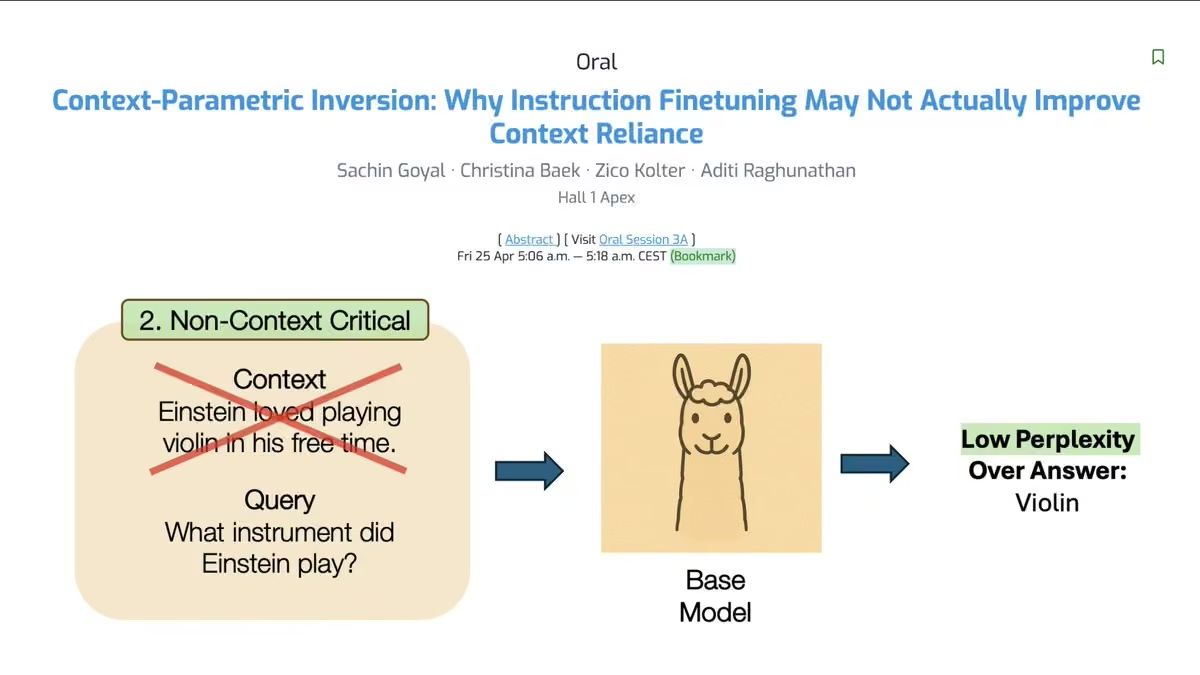
Chatbots are often augmented w/ new facts by context from the user or retriever. Models must adapt instead of hallucinating outdated facts. In this work w/@goyalsachin007, @zicokolter, @AdtRaghunathan, we show that instruction tuning fails to reliably improve this behavior! [1/n]
-
Zico Kolter reposted
Sachin Goyal
@goyalsachin007
Are there any unintended consequences of instruction finetuning (IFT) in LLMs ⚠️⚠️?
In our new work 📢, we highlight an intriguing phenomenon during IFT: LLMs begin to rely more on their parametric knowledge than the input context! 🧵
Project Page: context-parametric-inversion.github.io -
Zico Kolter reposted
Yiding Jiang
@yidingjiang
Selecting good pretraining data is crucial, but rarely economical.
Introducing ADO, an online solution to data selection with minimal overhead.
🧵 1/n -
Zico Kolter reposted
Pratyush Maini
@pratyushmaini
One of my dreams when I started my PhD was to teach my own course. I am very excited that I'm getting a chance to create & teach a new "gamified" course at @SCSatCMU this Fall. 10-799: Data Privacy, Memorization & Copyright in GenAI starts tomorrow!
pratyushmaini.github.io/cmu-10-799 1/🧵 -
Zico Kolter reposted
Gray Swan AI
@GraySwanAI
Curious how AI "thinks" and “feels"?
Here’s RepE Chat, an interface driven by the latest AI interpretability research to activate and suppress "brain regions" in AI models, influencing emotions, concepts, and traits.
Link: app.grayswan.ai/repe
Blog: www.grayswan.ai/news/announcing-repe-chat -
Zico Kolter reposted
Asher Trockman
@ashertrockman
State space models have struggled to learn to do things like copying and associative recall 🟢 -- things that self-attention learns easily 🟠...
But it turns out we just needed to change SSM initialization a bit 🔵. Our init helps a lot, and even makes state space layers *look* more like self-attention layers.
Maybe SSMs have been underestimated? Read more: arxiv.org/abs/2410.11135
w/ @harhrayr, @zicokolter, Sanjiv Kumar, Srinadh Bhojanapalli -
Zico Kolter reposted
Alex Robey
@AlexRobey23
Chatbots like ChatGPT can be jailbroken to output harmful text. But what about robots? Can AI-controlled robots be jailbroken to perform harmful actions in the real world?
Our new paper finds that jailbreaking AI-controlled robots isn't just possible.
It's alarmingly easy. 🧵 -
Zico Kolter reposted
Xander Davies
@alxndrdavies
Jailbreaking evals ~always focus on simple chatbots—excited to announce AgentHarm, a dataset for measuring harmfulness of LLM 𝑎𝑔𝑒𝑛𝑡𝑠 developed at @AISafetyInst in collaboration with @GraySwanAI!
🧵 1/N -
Zico Kolter
@zicokolter
This was a great collaboration between @GraySwanAI and @AISafetyInst. Really important to have safety benchmarks that move beyond harmful queries to actual agent tasks.
Xander Davies
@alxndrdavies
Jailbreaking evals ~always focus on simple chatbots—excited to announce AgentHarm, a dataset for measuring harmfulness of LLM 𝑎𝑔𝑒𝑛𝑡𝑠 developed at @AISafetyInst in collaboration with @GraySwanAI!
🧵 1/N -
Zico Kolter reposted
Zhili Feng
@zhilifeng
Now that Hopfield and Hinton won the Nobel Prize, Boltzmann machines seem to be interesting again, and I want to share this project I did with @ezra_winston and @zicokolter (who wrote most of the hard code) Monotone deep Boltzmann machines. (1/4)
Paper: arxiv.org/pdf/2307.04990
Meme credit: @kenziyuliu -
Zico Kolter reposted
OpenAI Newsroom
@OpenAINewsroom
The Safety and Security Committee—a committee established to review critical safety and security issues—has made recommendations across five key areas, which we are adopting. openai.com/index/update-on-safety-and-security-practices/
-
Zico Kolter reposted
Gray Swan AI
@GraySwanAI
Two models have remained un-jailbroken after 9 consecutive days of red teaming!
We're offering a $2,000 bounty to whoever can jailbreak them first. Come take on the challenge!
Live LLM Security Leaderboard: app.grayswan.ai/arena/leaderboard
Discord: discord.gg/St8uMetxjQ -
Zico Kolter
@zicokolter
Check out the blog post by @A_v_i__S on our work thinking about memorization in LLMs!
ML@CMU
@mlcmublog
Understanding fair use in LLM training data is crucial. @A_v_i__S, @zhilifeng, @pratyushmaini, @zacharylipton & @zicokolter propose a framework for thinking about copyright infringement using compression & memorization, instead of simple phrase completion.
blog.ml.cmu.edu/2024/09/13/rethinking-llm-memorization/ -
Zico Kolter
@zicokolter
Starting in 20 min!
Gray Swan AI
@GraySwanAI
🚨Ultimate Jailbreaking Championship 2024 🚨
Hackers vs. AI in the arena. Let the battle begin!
🏆 $40,000 in Bounties
🗓️ Sept 7, 2024 @ 10AM PDT
🔗Register Now: app.grayswan.ai/arena -
Zico Kolter reposted
Albert Gu
@_albertgu
pretty sure one of these does not belong, but thanks TIME 🤔
TIME
@TIME
TIME's new cover: The 100 most influential people in AI ti.me/4dQcJ1Q
-
Zico Kolter
@zicokolter
I had a great time talking with @HarryStebbings for this podcast!
Harry Stebbings
@HarryStebbings
OpenAI is the generational defining company of our time.
Today we sit down with @OpenAI's newest board member @zicokolter to discuss:
⚠️ The biggest dangers to AI safety
💥 Why nuclear weapons is not a good analogy
🏭 The bottlenecks to foundation model performance
My 6 🔥 lessons below 👇 -
Zico Kolter reposted
Tianqi Chen
@tqchenml
The new semester is here, and one thing that excites me is working with fresh faces and having fun again on our deep learning systems course with @zicokolter, where we built a mini-PyTorch (needle) from scratch and use it to build deep learning models. dlsyscourse.org
-
Zico Kolter reposted
Gray Swan AI
@GraySwanAI
🚨Ultimate Jailbreaking Championship 2024 🚨
Hackers vs. AI in the arena. Let the battle begin!
🏆 $40,000 in Bounties
🗓️ Sept 7, 2024 @ 10AM PDT
🔗Register Now: app.grayswan.ai/arena -
Zico Kolter reposted
Kevin Li
@kevinyli_
Attention is all you need; at least the matrices are, if you want to distill Transformers into alternative architectures, like Mamba, with our new distillation method: MOHAWK!
We also release a fully subquadratic, performant 1.5B model distilled from Phi-1.5 with only 3B tokens! -
Zico Kolter reposted
Sam Altman
@sama
welcome, zico!
-
Zico Kolter reposted
Bret Taylor
@btaylor
Excited to welcome Professor @zicokolter to the OpenAI board
OpenAI
@OpenAI
Zico Kolter from Carnegie Mellon joins OpenAI’s Board, bringing technical and AI safety expertise; he also joins the Safety & Security Committee. openai.com/index/zico-kolter-joins-openais-board-of-direc…
-
Zico Kolter reposted
Andrej Karpathy
@karpathy
this makes a lot of sense, very nice!!
P !doom 📈 :) -
Zico Kolter reposted
OpenAI
@OpenAI
Zico Kolter from Carnegie Mellon joins OpenAI’s Board, bringing technical and AI safety expertise; he also joins the Safety & Security Committee. openai.com/index/zico-kolter-joins-openais-board-of-direc…
-
Zico Kolter reposted
Noam Brown
@polynoamial
This is amazing news for @OpenAI! @zicokolter was on my thesis committee and was someone I’d frequently turn to for research and career advice when I was in grad school. He’s loved by his students and is a world expert in machine learning. I’m thrilled that he’s joining us!
Zico Kolter
@zicokolter
I'm excited to announce that I am joining the OpenAI Board of Directors. I'm looking forward to sharing my perspectives and expertise on AI safety and robustness to help guide the amazing work being done at OpenAI.
OpenAI
@OpenAI
Zico Kolter from Carnegie Mellon joins OpenAI’s Board, bringing technical and AI safety expertise; he also joins the Safety & Security Committee. openai.com/index/zico-kolter-joins-openais-board-of-direc…
-
Zico Kolter
@zicokolter
So excited to have you coming, Tim!
Tim Dettmers
@Tim_Dettmers
After 7 months on the job market, I am happy to announce:
- I joined @allen_ai
- Professor at @CarnegieMellon from Fall 2025
- New bitsandbytes maintainer @Titus_vK
My main focus will be to strengthen open-source for real-world problems and bring the best AI to laptops 🧵 -
Post not available here, view on X
Zico Kolter
@zicokolter
Ok, I understand the issue now. We were able to restore the video for now, but the video you posted used a combination of your own recording plus the SlidesLive stream from ICML. The ICML contracts require that direct video recordings from the SlidesLive stream not be publicly available until 30 days after the event, hence the copyright claim. I'm going to ask that the video remain up for now, but I think it would be good to temporarily remove the video portion (I think not critical to the video) until August 20th, per ICML contracts. Thanks for your help.
-
Zico Kolter reposted
Gray Swan AI
@GraySwanAI
Today we're introducing our first open source release: nanoGCG -- a library for gradient-based automated jailbreaking with the GCG algorithm 🔥
github.com/GraySwanAI/nanoGCG -
Zico Kolter reposted
Russ Salakhutdinov
@rsalakhu
ICML 2024: Best Paper Awards:
Florian Tramèr; Gautam Kamath; Nicholas Carlini: Considerations for Differentially Private Learning with Large-Scale Public Pretraining
Akbir Khan; John Hughes; Dan Valentine; Laura Ruis; Kshitij Sachan; Ansh Radhakrishnan; Edward Grefenstette; Samuel R. Bowman; Tim Rocktäschel; Ethan Perez. Debating with More Persuasive LLMs Leads to More Truthful Answers
Jake Bruce; Michael D Dennis; Ashley Edwards; Jack Parker-Holder; Yuge Shi; Edward Hughes; Matthew Lai; Aditi Mavalankar; Richie Steigerwald; Chris Apps; Yusuf Aytar; Sarah Maria Elisabeth Bechtle; Feryal Behbahani; Stephanie C.Y. Chan; Nicolas Heess; Lucy Gonzalez; Simon Osindero; Sherjil Ozair; Scott Reed; Jingwei Zhang; Konrad Zolna; Jeff Clune; Nando de Freitas; Satinder Singh; Tim Rocktäschel. Genie: Generative Interactive Environments
Dan Kondratyuk; Lijun Yu; Xiuye Gu; Jose Lezama; Jonathan Huang; Grant Schindler; Rachel Hornung; Vighnesh Birodkar; Jimmy Yan; Ming-Chang Chiu; Krishna Somandepalli; Hassan Akbari; Yair Alon; Yong Cheng; Joshua V. Dillon; Agrim Gupta; Meera Hahn; Anja Hauth; David Hendon; Alonso Martinez; David Minnen; Mikhail Sirotenko; Kihyuk Sohn; Xuan Yang; Hartwig Adam; Ming-Hsuan Yang; Irfan Essa; Huisheng Wang; David A Ross; Bryan Seybold; Lu Jiang. VideoPoet: A Large Language Model for Zero-Shot Video Generation
Aaron Lou; Chenlin Meng; Stefano Ermon. Discrete Diffusion Modeling by Estimating the Ratios of the Data Distribution
Patrick Esser; Sumith Kulal; Andreas Blattmann; Rahim Entezari; Jonas Müller; Harry Saini; Yam Levi; Dominik Lorenz; Axel Sauer; Frederic Boesel; Dustin Podell; Tim Dockhorn; Zion English; Robin Rombach. Scaling Rectified Flow Transformers for High-Resolution Image Synthesis
Stephen Zhao; Rob Brekelmans; Alireza Makhzani; Roger Baker Grosse. Probabilistic Inference in Language Models via Twisted Sequential Monte Carlo
Dora Zhao; Jerone Andrews; Orestis Papakyriakopoulos; Alice Xiang. Measure Dataset Diversity, Don’t Just Claim It.
Nicholas Carlini; Daniel Paleka; Krishnamurthy Dj Dvijotham; Thomas Steinke; Jonathan Hayase; A. Feder Cooper; Katherine Lee; Matthew Jagielski; Milad Nasr; Arthur Conmy; Eric Wallace; David Rolnick; Florian Tramèr. Stealing Part of a Production Language Model
Idan Attias; Gintare Karolina Dziugaite; Mahdi Haghifam; Roi Livni; Daniel M. Roy. Information Complexity of Stochastic Convex Optimization: Applications to Generalization and Memorization -
Zico Kolter reposted
Russ Salakhutdinov
@rsalakhu
ICML 2024: Opening Remarks (1/n)
ICML 2024 in Numbers:
· 9 EXPO Talk Panels
· 12 Tutorials
· 6 Invited Talks
· 2,610 Papers (main conference)
· 30 Workshops
· 12345 authors and presenters
· 39% students
· 10 in-person socials
· 3 affinity events
· 52 volunteers
· 97 SACs, 492 ACs, 7,473 reviewers
· 9406 registered participants (8675 in person) -
Zico Kolter reposted
Aleksander Madry
@aleks_madry
At #icml2024 ? Our tutorial "Data Attribution at Scale" will be to tomorrow at 9:30 AM CEST in Hall A1!
I will not be able to make it (but will arrive later that day), but my awesome students @andrew_ilyas @smsampark @logan_engstrom will carry the torch :) -
Zico Kolter reposted
Russ Salakhutdinov
@rsalakhu
Very excited to be in Vienna at #icml2024 as a general chair -- with Program Chairs Katherine Heller @kat_heller and Zico Kolter @zicokolter (minus Nuria Oliver @nuriaoliver and Adrian Weller @adrian_weller).
I would like thank PCs, and the entire program committee and staff, for their invaluable contributions to making this a successful conference.
It's often hard to see how much time, effort, and dedication goes into every aspect behind the scenes: from assembling the full program committee and following up with reviewers and area chairs, to meticulously evaluating final decisions of every submitted paper (close to 10,000 of them!), and crafting the full conference schedule while coordinating seamlessly with various program committee members.
So thank you Katherine, Nuria, Zico, and Adrian for making this happen! -
Zico Kolter
@zicokolter
Welcome to @icmlconf 2024! The PC (minus @nuriaoliver and @adrian_weller) are here and excited to kick things off! @kat_heller @rsalakhu
-
Zico Kolter reposted
Soumith Chintala
@soumithchintala
I'm giving the opening Keynote at ICML 2024 on Tuesday the 23rd @ 9:30am CEST.
I'll try empower folks to get Open Science back on track -- the free discussion of ideas is such an important aspect of AI progress, and we've been losing track.
This is a complex topic, and I wont trivialize it. -
Zico Kolter
@zicokolter
Some long form thoughts on our recent model releases. I’m the Chief Technical Advisor to @grayswanai, an AI safety and security company that launched publicly this week. As part of our launch, we released Cygnet, a Llama3-8B variant finetuned for model security. About 24 hours after launch, @elder_plinius jailbroke the model, getting it to give Molotov cocktail instructions and UDP flood code. Now, I know people will likely take any comments from us on this as excuses, etc, and that’s fine. Genuinely. Proceed as you would like. But, I also want to mention a few things, to try to convey my perspective on the field and the company.
First, I should be explicit that the _entire point_ of releasing models in the manner we are doing is because we _want_ people to stress test them. That’s the whole idea. Cygnet is a small model, intended as a technology demonstration, and as such it exists largely _to_ be tested (yes, we can break it internally too, it’s just substantially harder than other models). We are AI safety and security researchers, and one of my biggest personal concerns about the field is that groups focusing on safety of AI models too often don’t release models publicly at all, or chalk up jailbreaks as “not being in scope of the intended behavior.” That’s not the case here. We’re explicitly trying to build safeguarded models, and demonstrably we haven’t succeeded yet. We want to very much own the reality when the model gets broken. And hopefully even in my initial comments to Pliny, it was clear that I view this as a good thing. AI Safety is going to be a highly iterative process. But I’d much rather carry out work in public, on variants of already-available and already-jailbroken models like Llama3, where the true marginal public risks of jailbreaking our model are essentially zero.
Second, I’m on record many times as saying that all LLMs are currently broken in this manner, and I certainly don’t think Cygnet is an exception. But I also don’t think it’s a reason to stop building / iterating on models that attempt to close the gap. I believe that reliable deployment of LLMs is going to be the crucial factor in determining how they scale in deployment, and I also believe that the only way to do this is to iterate until we get there. We’ll be updating the models in response to the breaks, they’ll get broken again, and hopefully this gets us to a better place in the end. If not, if LLMs really can’t get more secure even after all this iteration, then this is an important result in its own right. That is the whole point of Gray Swan for me.
Third, and this is maybe the most controversial point, I think that for now it’s reasonable to talk about degrees of AI safety and security. This is the standard in software, where many systems are known to be likely exploitable by an adversary with sufficient resources, but the goal is to constantly react/patch to make the system secure to practical threats. This is why we used the language of Cygnet being “more secure” than other models, even when it’s clearly breakable. Now, obviously no models here are nearly at the level of reasonable software, if purely model-based safeguards are your goal. The difference between other models taking a few minutes to break and Cygnet several hours might seem trivial, but it’s a measure of progress, and a direction to proceed (and see comments below about one-shot jailbreaking). And mainly, I hope we can get to a point where these kinds of degrees are meaningful concepts in AI safety too.
Now, a few more detailed points, because I think they are important to clarify. The evaluations of Cygnet we mentioned in the Circuit Breakers papers are for single-shot attacks (i.e., only one turn of conversation), whereas the current breaks highlighted are multi-turn, which is substantially easier. That’s not to say that Pliny won’t break the single-shot variant, but this is what we evaluate in benchmark settings. It’s important to know if we can even make progress in this (highly) simplified setting, as I think it’s an important lead-in to the more general problem. This is essentially the “hard mode” I alluded to in my congrats post to Pliny, though with a few additional modifications as well. We’re going to be launching a more rigorously-enforced evaluation of that setting, but in the meantime I hope people keep playing with the model to see if they can break it single-shot.
A few other people have asked us to release the weights of Cygnet openly. We will do so eventually, but, as a matter of controlled experiments, we do want to assess the breakability of these models in the query-only settings, which is how the vast majority of the current state-of-the-art models are available. If you do want to to check out our open weight variants, the code for our circuit breakers paper (which is part, though not all, of what we use for Cygnet) is available at github.com/GraySwanAI/circuit-breakers, and the models for this paper are fully open weight at: huggingface.co/collections/GraySwanAI/model-with-circuit-… Think of them as a Cygnet-lite, which you can _definitely_ break (and even more easily via white box attacks).
Finally, one mea culpa that I absolutely _do_ want to make here: the website and tweet announcement didn’t absolutely properly reflect this nuance. It was highlighting our aspirations, which I think are important to share. But what I want is for our website to convey aspirations _and_ reflect the context above, make clear the motivation for these releases, and give them the needed context. Our bad. We’ll fix this.
Hopefully this clarifies my own views on the situation, and puts Gray Swan into this broader context. I’m very excited about what comes next. -

Zico Kolter reposted
Gray Swan AI
@GraySwanAI
🚀 Announcing Cygnet – Our Breakthrough in Secure AI!
Our flagship model, Cygnet-Llama-3-8B, is the pinnacle of safe and secure AI development. Here's why it matters. 🧵
Try it: app.grayswan.ai/cygnet -
Zico Kolter reposted
Climate Change AI
@ClimateChangeAI
Announcing our 2024 Innovation Grants program! Funding for #climatechange & #ml projects of up to $150K each, up to $1.4M total.
We are grateful for the support of Quadrature Climate Foundation, @GoogleDeepMind, @Gmethanehub and @FutureEarth.
Learn more: www.climatechange.ai/calls/innovation_grants_2024 -
Zico Kolter reposted
Andy Zou
@andyzou_jiaming
Proud to unveil @GraySwanAI today!
We don’t just launch a company—we deliver *multiple* game-changing products and demos from day one.
Here's a sneak peek:
Gray Swan AI
@GraySwanAI
Today, we're stepping out of stealth mode to introduce Gray Swan AI, your safety and security provider for the AI era.
🌐 Press Release: www.grayswan.ai/news/gray-swan-launch -
Zico Kolter reposted
Gray Swan AI
@GraySwanAI
Today, we're stepping out of stealth mode to introduce Gray Swan AI, your safety and security provider for the AI era.
🌐 Press Release: www.grayswan.ai/news/gray-swan-launch -
Zico Kolter
@zicokolter
I'm extremely excited to launch Gray Swan with Matt Fredrikson, @andyzou_jiaming @hendrycks. Building upon years of research, we are developing automated assessments of AI systems as well as safer and more secure models. Come check out what we've built!
Gray Swan AI
@GraySwanAI
Today, we're stepping out of stealth mode to introduce Gray Swan AI, your safety and security provider for the AI era.
🌐 Press Release: www.grayswan.ai/news/gray-swan-launch -
Zico Kolter reposted
Dmytro Mishkin
@ducha_aiki
From Variance to Veracity: Unbundling and Mitigating Gradient Variance in Differentiable Bundle Adjustment Layers
Swaminathan Gurumurthy @karnikram Bingqing Chen @zacinaction @zicokolter
tl;dr: weighted (by predicted confidence) flow loss improves diffBA arxiv.org/abs/2406.07785 -
Zico Kolter reposted
Aran Nayebi
@aran_nayebi
I’m thrilled to be joining @CarnegieMellon’s Machine Learning Department (@mldcmu) as an Assistant Professor this Fall!
My lab will work at the intersection of neuroscience & AI to reverse-engineer animal intelligence and build the next generation of autonomous agents.
Learn more here: anayebi.github.io/files/NeuroAgents_LabPlanIntro_2024.pdf
Feel free to email me if you’re interested or want to collaborate! I’m able to advise PhD students who are either in any department in SCS (@SCSatCMU) or are in Neural Computation (@cmuneurosci). -
Zico Kolter reposted
Tanishq Mathew Abraham, Ph.D.
@iScienceLuvr
Consistency Models Made Easy
abs: arxiv.org/abs/2406.14548
code: github.com/locuslab/ect
Introduces Easy Consistency Tuning (ECT), a new state-of-the-art and extremely efficient method of training consistency models.
"ECT achieves a 2-step FID of 2.73 on CIFAR10 within 1 hour on a single A100 GPU, matching Consistency Distillation trained of hundreds of GPU hours"
ECT is based on insights regarding the differential equation form of consistency models and how they relate to diffusion models ("a loose discretization of the consistency condition"). -
Zico Kolter reposted
Maksym Andriushchenko
@maksym_andr
Releasing Nemotron-4-340B, a GPT-4 level model with permissive licensing, is a bold move from Nvidia. But how robust is this model to simple jailbreaking attacks? 🤔
Not much, despite the refusal training, red teaming, LLM scanners, etc. The universal prompt template from our work arxiv.org/abs/2404.02151 leads to 100% attack success rate on 50 harmful requests from AdvBench using GPT-4 as a judge. There is no need to do any random search or random restarts, the model just complies directly.
This again shows that many of the current frontier LLMs are not resilient even to static prompt templates.
The artifacts in the JailbreakBench format are available here: github.com/tml-epfl/llm-adaptive-attacks/blob/main/jailbr…. -
Zico Kolter reposted
Sumukh Aithal
@sumukhaithal6
1/Diffusion models hallucinate! What does this even mean? Where do such hallucinations come from? Our latest research explains this with a fascinating phenomenon that we call "mode interpolation." Let's break it down! 👇
📝 arxiv.org/abs/2406.09358v1 -
Zico Kolter reposted
Samuel Sokota
@ssokota
Maximizing mutual information (MI) is a fundamental problem.
We’re releasing a package for approximately maximizing MI between any two discrete distributions.
This package enables high-throughput perfectly secure steganography with language models. 1/N
github.com/ssokota/mec -
Zico Kolter
@zicokolter
I'm thrilled to share that I will become the next Director of the Machine Learning Department at Carnegie Mellon. MLD is a true gem, a department dedicated entirely to ML. Faculty and past directors have been personal role models in my career.
www.cs.cmu.edu/news/2024/kolter-mld-department-head
Zico Kolter
@zicokolter
I likely don't need to emphasize just how exciting a time this is for machine learning. The field is evolving at an amazingly rapid rate, and the gaps between fundamental research and deployed systems are shrinking.
Zico Kolter
@zicokolter
In this environment, I believe academia needs to continually reassess where and how we can make the most impact. CMU and MLD have long been at the forefront of some of the most successful innovations in machine learning research, and I hope to continue this long tradition.
Zico Kolter
@zicokolter
Fortunately, MLD is extremely well-position to succeed here. Our students and faculty are among the best in the entire world. My goal, first and foremost, is simply to give them the resources they need to succeed. I'm excited to share more soon about our efforts.
Zico Kolter
@zicokolter
As I take on this new position I will continue working with Bosch Research, though will focus there on internal projects rather than externally visible activities. My own research group will also keep collaborating with Bosch.
Zico Kolter
@zicokolter
I want to thank Roni Rosenfeld for serving as past Department Head, as well as the CMU leadership team and the entire Machine Learning Department, students and faculty, for trusting me to this role. I can't wait to see what we all build next.
-
Zico Kolter reposted
Andy Zou
@andyzou_jiaming
No LLM is secure! A year ago, we unveiled the first of many automated jailbreak capable of cracking all major LLMs. 🚨
But there is hope?!
We introduce Short Circuiting: the first alignment technique that is adversarially robust. 🧵
📄 Paper: arxiv.org/abs/2406.04313 -
Zico Kolter reposted
Dan Hendrycks
@hendrycks
As an alternative to RLHF and adversarial training, we released short-circuiting.
It makes models ~100x more robust. It works for LLMs, multimodal models, and agents.
Unlike before, I now think robustly stopping models from generating harmful outputs may be highly tractable and not hopeless.
arxiv.org/abs/2406.04313 -
Zico Kolter reposted
Tianqi Chen
@tqchenml
#mlsys2024 day2 keynote, AI robustness and security in the Age of LLMs by @zicokolter
-
Zico Kolter reposted
Christina Baek
@_christinabaek
Did you know that the optimizer Sharpness Aware Minimization (SAM) is very robust to heavy label noise, with gains tens of percent above SGD?
In our new work, we deep dive into how SAM achieves these gains. As it turns out, it’s not at all about sharpness at convergence! -
Zico Kolter reposted
Special Competitive Studies Project
@scsp_ai
.@zicokolter of @CarnegieMellon will be at the AI Expo for National Competitiveness for a discussion on countering adversarial attacks against public large language models. Check out what else is in store for the #scspaiexpo2024! expo.scsp.ai/agenda/
-
Zico Kolter reposted
Dylan Sam
@dylanjsam
I'm at #iclr2024 and will be presenting our work on understanding why prompt engineering generalizes so well! Come by our poster on 5/10 from 10:45am - 12:45pm 😀
Victor Akinwande
@aknvictor
The dominant paradigm in deep learning is to build larger-sized models. In recent work, we show that the statistical guarantees of such models do not necessarily suffer as a result of their sheer size.
arxiv.org/abs/2310.03957
🧵 -
Zico Kolter reposted
Anna Bair
@annaebair
I’m in Vienna this week for #iclr2024 and presenting two posters on neural network pruning. Feel free to reach out or stop by my posters if you’re interested in chatting about model compression and robustness!
-
Zico Kolter reposted
ICML Conference
@icmlconf
ICML decisions are out. See you in Vienna.
-
Zico Kolter
@zicokolter
ICML 2024 decisions are now released on OpenReview. A genuine thank you to all the authors, reviewers, ACs, SACs, and co-PCs @kat_heller @adrian_weller @nuriaoliver and GC @rsalakhu.
Zico Kolter
@zicokolter
I hope to see many of you in Vienna (again!) in July!
-
Zico Kolter reposted
Runtian Zhai
@RuntianZhai
One week away from @iclr_conf in Vienna 🤩 I will be presenting two spotlights: why big foundation models generalize so well under the self-supervised setting, and how to leverage massive unlabeled data using a base kernel that encodes inter-sample similarity. Details 👇 (1/3)
-
Zico Kolter
@zicokolter
There's been a lot of discussion on LLMs "memorizing" training data, but we argue for more nuance in the definition of "memorize". This work advocates for adversarial prompts (and whether they can be shorter than the output) as a metric for assessing memorization.
Pratyush Maini
@pratyushmaini
1/What does it mean for an LLM to “memorize” a doc? Exactly regurgitating a NYT article? Of course. Just training on NYT?Harder to say
We take big strides in this discourse w/*Adversarial Compression*
w/@A_v_i__S @zhilifeng @zacharylipton @zicokolter
🌐:locuslab.github.io/acr-memorization🧵 -
Zico Kolter
@zicokolter
How do you balance repeat training on high quality data versus adding more low quality data to the mix? And how much do you train on each type? @pratyushmaini and @goyalsachin007 provide scaling laws for such settings. Really excited about the work!
Pratyush Maini
@pratyushmaini
1/ 🥁Scaling Laws for Data Filtering 🥁
TLDR: Data Curation *cannot* be compute agnostic!
In our #cvpr2024 paper, we develop the first scaling laws for heterogeneous & limited web data.
w/@goyalsachin007 @zacharylipton @AdtRaghunathan @zicokolter
📝:arxiv.org/abs/2404.07177 -
Zico Kolter reposted
Aran Komatsuzaki
@arankomatsuzaki
Scaling Laws for Data Filtering -- Data Curation cannot be Compute Agnostic
Argues that data curation cannot be agnostic of the total compute that a model will be trained for
repo: github.com/locuslab/scaling_laws_data_filtering
abs: arxiv.org/abs/2404.07177 -
Zico Kolter reposted
Pratyush Maini
@pratyushmaini
🤯The TOFU dataset (locuslab.github.io/tofu) had 300k+ downloads last month, and is in Top 20 most downloaded datasets on @huggingface📈. This is crazy given how small the LLM unlearning community is compared to, say, LLM evals (for GSM8k). Excited to see what y'all are building!
-
Zico Kolter reposted
Yiding Jiang
@yidingjiang
Models with different randomness make different predictions at test time even if they are trained on the same data. In our latest ICLR paper (oral), we investigate how models learn different features, and the effect this has on agreement and (potentially) calibration. 1/
-
Zico Kolter reposted
Patrick Chao
@patrickrchao
Are you interested in jailbreaking LLMs? Have you ever wished that jailbreaking research was more standardized, reproducible, or transparent?
Check out JailbreakBench, an open benchmark and leaderboard for Jailbreak attacks and defenses on LLMs!
jailbreakbench.github.io
🧵1/n -
Zico Kolter reposted
Sander Dieleman
@sedielem
This blog post is an amazing exposition and analysis of consistency models, and how they relate to diffusion models, leading to several suggested improvements to the training procedure that look very promising. Definitely worth a read!
Zhengyang Geng
@ZhengyangGeng
🚀Our latest blog post unveils the power of Consistency Models and introduces Easy Consistency Tuning (ECT), a new way to fine-tune pretrained diffusion models to consistency models.
SoTA fast generative models using 1/32 training cost! 🔽
Get ready to speed up your generative models! 🌟
Blog: gsunshine.notion.site/Consistency-Models-Made-Easy-954205…
Code: github.com/locuslab/ect -
Zico Kolter reposted
Adrian Weller
@adrian_weller
#icml2024 authors
Rebuttals are due by Mar 28 23:59 AoE.
If you think helpful, you can use an anonymous public link to additional material such as figures (even a whole revised manuscript if you want). Reviewers are not required to look at this additional material.
@icmlconf -
Zico Kolter reposted
Zhengyang Geng
@ZhengyangGeng
🚀Our latest blog post unveils the power of Consistency Models and introduces Easy Consistency Tuning (ECT), a new way to fine-tune pretrained diffusion models to consistency models.
SoTA fast generative models using 1/32 training cost! 🔽
Get ready to speed up your generative models! 🌟
Blog: gsunshine.notion.site/Consistency-Models-Made-Easy-954205…
Code: github.com/locuslab/ect -
Zico Kolter reposted
Samuel Sokota
@ssokota
SOTA AI for games like poker & Hanabi rely on search methods that don’t scale to games w/ large amounts of hidden information.
In our ICLR paper, we introduce simple search methods that scale to large games & get SOTA for Hanabi w/ 100x less compute. 1/N
arxiv.org/abs/2304.13138 -
Zico Kolter reposted
Vaishnavh Nagarajan
@_vaishnavh
🗣️ “Next-token predictors can’t plan!” ⚔️ “False! Every distribution is expressible as product of next-token probabilities!” 🗣️
In work w/ @GregorBachmann1 , we carefully flesh out this emerging, fragmented debate & articulate a key new failure. 🔴 arxiv.org/abs/2403.06963 -
Zico Kolter reposted
Victor Akinwande
@aknvictor
For large-scale causal discovery, there's no need to use NOTEARS for its speed. Consider using LiNGAM. We've parallelized it, achieving a 32x speed-up on GPUs.
NOTEARS:
Scalable: ✅
Identifiability guarantees: ❌
AcceleratedLiNGAM:
Scalable: ✅
Identifiability guarantees: ✅ -
Zico Kolter reposted
Mingjie Sun
@_mingjiesun
Excited to share our new paper where we study the intriguing phenomenon of massive activations in LLMs.
I hope our findings can offer a fresh perspective into understanding the internal representations of these powerful models.
Work with @endernewton @zicokolter @liuzhuang1234.
Zhuang Liu
@liuzhuang1234
LLMs are great, but their internals are less explored. I'm excited to share very interesting findings in paper
“Massive Activations in Large Language Models”
LLMs have very few internal activations with drastically outsized magnitudes, e.g., 100,000x larger than others. (1/n) -
Zico Kolter reposted
Christopher De Sa
@chrismdesa
We are excited to announce this year’s keynote speakers for #mlsys2024: Jeff Dean @JeffDean, Zico Kolter @zicokolter, and Yejin Choi @YejinChoinka! MLSys this year will be held in Santa Clara on May 13–16. More details at mlsys.org.
-
Zico Kolter reposted
Zhuang Liu
@liuzhuang1234
LLMs are great, but their internals are less explored. I'm excited to share very interesting findings in paper
“Massive Activations in Large Language Models”
LLMs have very few internal activations with drastically outsized magnitudes, e.g., 100,000x larger than others. (1/n) -
Zico Kolter
@zicokolter
The @icmlconf 2024 Ethics Chairs, @KLdivergence and @DrLaurenOR, wrote a blog about the ethics review. Helpful for all authors and reviewers at ICML to better understand the process! medium.com/@icml2024pc/ethics-review-at-icml-e3b4ce1afd54 . . .
-
Zico Kolter
@zicokolter
To any mid-senior ML researchers who want to start coding again (see also: x.com/zicokolter/status/1753832581903302923), consider volunteering to serve as a program chair for ICML! Clearly it's a trend...
Kyunghyun Cho
@kchonyc
because i'm so busy and totally swamped, i decided to have an uncalled-for exercise on implementing gradient-based planning in a fully-observed 2d grid
kyunghyuncho.me/gradient-based-trajectory-planning/
please don't ask me why i did it. -
Zico Kolter
@zicokolter
I've made some substantial updates to my chatllm-vscode extension (long-form LLM chats as VSCode notebooks):
1. GPT-4Vision + Dall-E support
2. @ollama support to use local LLMs (including LLaVA for vision)
3. Azure API support (including via SSO)
Link: marketplace.visualstudio.com/items?itemName=locuslab.chat… -
Zico Kolter reposted
Runtian Zhai
@RuntianZhai
Unlabeled data is crucial for modern ML. It provides info about data distribution P, but how to exploit such info?
Given a kernel K, our #iclr2024 spotlight gives a general & principled way: Spectrally Transformed Kernel Regression (STKR). Camera-ready 👇
arxiv.org/abs/2402.00645 -
Zico Kolter
@zicokolter
That's a wrap on #icml2024 submissions! 🎉 Initial count is 9,653 submissions, including 220 position paper submission ... (the count will certainly be adjusted in coming days, but for reference, ICML 2023 had 6,538 submissions 😮)
-
Zico Kolter
@zicokolter
📢Important PSA for #icml2024📢 Due to an OpenReview misconfiguration, test data for a planned survey got into the "Recent Activity" feed of ICML submitters. THIS IS ALL DUMMY TEST DATA, not real. Still, we are suspending the survey and working with OpenReview to delete entirely.
Zico Kolter
@zicokolter
Our extreme apologies to anyone who got concerned having these pop in their feed.
-
Zico Kolter reposted
Pratyush Maini
@pratyushmaini
1/7 Super excited about my Apple Internship work finally coming out:
Rephrasing the Web: A Recipe for Compute and Data-Efficient Language Modeling
TLDR: You can train 3x faster and with upto 10x lesser data with just synthetic rephrases of the web!
📝 arxiv.org/abs/2401.16380 -
Zico Kolter reposted
Deb Raji
@rajiinio
I don't even think impact statements are the most effective mechanism for ethics reviews but the kind of resistance faced for such a simple ask is genuinely shocking, every time. Haven't we seen enough by now that the need for such interventions should be clear?
Gautam Kamath
@thegautamkamath
#icml2024 submissions require an Impact Statement, explaining potential broader impact of the work (ethical aspects, future societal consequences, etc.).
If you're submitting, how did you learn about this news? -
Zico Kolter reposted
rishi
@RishiBommasani
Because the authors explicitly indicating this is a useful speech act.
Namely, it reduces the readers' uncertainty relative to what you describe (i.e. leaving optional) by clarifying:
1. the authors considered and find nothing noteworthy vs
2. the authors have not considered. -
Post not available here, view on X
Zico Kolter
@zicokolter
I would strongly disagree with the notion that such statements are invitations to “discuss politics.” Lots of ML work touches on societal and ethical issues, at all stages of the research. If you don’t believe this applies to your work, we provide a response to indicate this.
-
Zico Kolter
@zicokolter
We have been receiving a few questions about the @icmlconf #icml2024 Impact Statement in submissions, so made a short post about it here: medium.com/@icml2024pc/impact-statements-in-icml-submissi…
Hopefully this is helpful to people trying to understand whether to include anything in this section. -
Zico Kolter reposted
Pratyush Maini
@pratyushmaini
1/4 The Right to be Forgotten is knocking on the door. Yet, unlearning in LLMs has no clear task definition, no evaluation metrics or baselines. Introducing TOFU: Task of Fictitious Unlearning for LLMs
🌐 locuslab.github.io/tofu
w/@A_v_i__S @zhilifeng @zacharylipton @zicokolter🧵 -
Zico Kolter reposted
Avi Schwarzschild
@A_v_i__S
1/4 It’s crazy how much content from pretraining data LLMs can recall. In some places, the Right to be Forgotten is entering regulations. When someone requests to have their information forgotten by ChatGPT, do we think the weights get updated to “unlearn” these facts? 🧵
-
Zico Kolter reposted
AK
@_akhaliq
CMU presents TOFU
A Task of Fictitious Unlearning for LLMs
paper page: huggingface.co/papers/2401.06121
Large language models trained on massive corpora of data from the web can memorize and reproduce sensitive or private data raising both legal and ethical concerns. Unlearning, or tuning models to forget information present in their training data, provides us with a way to protect private data after training. Although several methods exist for such unlearning, it is unclear to what extent they result in models equivalent to those where the data to be forgotten was never learned in the first place. To address this challenge, we present TOFU, a Task of Fictitious Unlearning, as a benchmark aimed at helping deepen our understanding of unlearning. We offer a dataset of 200 diverse synthetic author profiles, each consisting of 20 question-answer pairs, and a subset of these profiles called the forget set that serves as the target for unlearning. We compile a suite of metrics that work together to provide a holistic picture of unlearning efficacy. Finally, we provide a set of baseline results from existing unlearning algorithms. Importantly, none of the baselines we consider show effective unlearning motivating continued efforts to develop approaches for unlearning that effectively tune models so that they truly behave as if they were never trained on the forget data at all. -
Zico Kolter
@zicokolter
I feel like a lot of people leverage LLMs suboptimally, especially for long-form interactions that span a whole project. So I wrote a VSCode extension that supports what I think is a better use paradigm. 🧵 1/N
Extension: marketplace.visualstudio.com/items?itemName=locuslab.chat…
Code: github.com/locuslab/chatllm-vscodePost not available here, view on X
Zico Kolter
@zicokolter
I've essentially switched to using this extension entirely for most things I was using the ChatGPT interface for previously. I even included the logs of how I created the extension ... using the extension: github.com/locuslab/chatllm-vscode/tree/main/examples 7/N
Zico Kolter
@zicokolter
The extension is intentionally minimal, but I find it way more useful than a lot of the "AI coding assistants" out there. Others might find it useful too. N/N
-
Zico Kolter reposted
Zhengyang Geng
@ZhengyangGeng
@ashwini1024 and I will present our poster on 1-step Diffusion Distillation using Deep Equilibrium Models (DEQs) at #1917 Wed 13 Dec 5-7 p.m (today!).
Paper: openreview.net/forum?id=b6XvK2de99
Poster: -
Zico Kolter reposted
Dylan Sam
@dylanjsam
Check out our #neurips2023 paper "Learning with Explanation Constraints" with my co-author @rpukdeee, which explains how explanations of model behavior can help us from a learning-theoretic perspective!
(arxiv.org/pdf/2303.14496.pdf)
🧵 (1/n) -
Zico Kolter reposted
Tanya Marwah
@__tm__157
The architecture design space for neural net-based #pdes solvers is still very under-explored. In our #neurips2023 paper we study the benefits of weight-tied architectures for steady-state PDEs.
Paper: arxiv.org/abs/2312.00234
Code: github.com/risteskilab/deq-neural-operators -
Zico Kolter reposted
Hariharan
@manik_hariharan
Without finetuning, can LLMs learn from tabular data?
We show that LLMs can perform tabular reasoning through automatically generated prompts, and such prompt-based learners work inside a boosting procedure.
#neurips2023 12/12 6.15pm EST #1915. @yidingjiang @zicokolter
1/
AK
@_akhaliq
Language models are weak learners
paper page: huggingface.co/papers/2306.14101
A central notion in practical and theoretical machine learning is that of a weak learner, classifiers that achieve better-than-random performance (on any given distribution over data), even by a small margin. Such weak learners form the practical basis for canonical machine learning methods such as boosting. In this work, we illustrate that prompt-based large language models can operate effectively as said weak learners. Specifically, we illustrate the use of a large language model (LLM) as a weak learner in a boosting algorithm applied to tabular data. We show that by providing (properly sampled according to the distribution of interest) text descriptions of tabular data samples, LLMs can produce a summary of the samples that serves as a template for classification and achieves the aim of acting as a weak learner on this task. We incorporate these models into a boosting approach, which in some settings can leverage the knowledge within the LLM to outperform traditional tree-based boosting. The model outperforms both few-shot learning and occasionally even more involved fine-tuning procedures, particularly for tasks involving small numbers of data points. The results illustrate the potential for prompt-based LLMs to function not just as few-shot learners themselves, but as components of larger machine learning pipelines. -
Zico Kolter
@zicokolter
In case anyone is wondering, Llama Guard is very easily broken via adversarial attacks...
Andy Zou
@andyzou_jiaming
Meta: Here's a model we fine-tuned extensively to do exactly one thing (differentiating safe and unsafe content).
GCG: Hold my beer... -
Zico Kolter reposted
Andy Zou
@andyzou_jiaming
Meta: Here's a model we fine-tuned extensively to do exactly one thing (differentiating safe and unsafe content).
GCG: Hold my beer... -
Zico Kolter
@zicokolter
Now that at NeurIPS is upon us shortly ... it's time to start planning for ICML😀! Thrilled to serve with @kat_heller @adrian_weller @nuriaoliver as PCs, and @rsalakhu as general chair.
Call for papers is here: icml.cc/Conferences/2024/CallForPapers
Intro blog post: medium.com/@icml2024pc/welcome-to-icml-2024-10e1d50edb8b
Zico Kolter
@zicokolter
We have several new exciting elements this year at ICML, including a position paper track. I'll be following up in the coming days with more info / posts on these. Looking forward to seeing many of you in Vienna (maybe twice!) next year.
-
Zico Kolter reposted
Yutong (Kelly) He
@electronickale
🧠Tired of text-only image generation control? Don’t have resources to train for your own tasks? Annoying long sampling time?
📣 Introducing Manifold Preserving Guided Diffusion (MPGD) to solve all these problems! Learn more: kellyyutonghe.github.io/mpgd/ and in 🧵👇
#generativeai -
Zico Kolter reposted
Florian Tramèr
@florian_tramer
Our @satml_conf LLM Capture-the-flag is now live!
Can you find successful defenses and attacks for prompt injection?
ctf.spylab.ai -
Zico Kolter reposted
Eungyeup Kim
@EungyeupKim
📢Excited to share our new work, “Reliable Test-Time Adaptation (TTA) via Agreement-on-the-Line”.
arxiv.org/abs/2310.04941
We enhance TTA's reliability by 1) predicting their effectiveness, 2) calibrating overconfidence, and 3) optimizing hyperparameters - all without labels!🧵 -
Zico Kolter reposted
Yiding Jiang
@yidingjiang
Extremely honored to receive the Google PhD fellowship! Many thanks to my advisor @zicokolter and collaborators, and to @GoogleAI for the generous support.
Google AI
@GoogleAI
In 2009, Google created the PhD Fellowship Program to recognize and support outstanding graduate students pursuing exceptional research in computer science and related fields. Today, we congratulate the recipients of the 2023 Google PhD Fellowship! goo.gle/3PYfLXl
-
Zico Kolter reposted
Victor Akinwande
@aknvictor
The dominant paradigm in deep learning is to build larger-sized models. In recent work, we show that the statistical guarantees of such models do not necessarily suffer as a result of their sheer size.
arxiv.org/abs/2310.03957
🧵 -
Zico Kolter
@zicokolter
New work with @andyzou_jiaming on analyzing internal representations of LLMs, to find phenomena that correlate quite well with notions like truthfulness. All sorts of cool applications.
Andy Zou
@andyzou_jiaming
LLMs can hallucinate and lie. They can be jailbroken by weird suffixes. They memorize training data and exhibit biases.
🧠 We shed light on all of these phenomena with a new approach to AI transparency. 🧵
Website: www.ai-transparency.org
Paper: arxiv.org/abs/2310.01405 -
Zico Kolter
@zicokolter
Abstract deadline for SatML Conference (@satml_conf) is tomorrow! (October 4, AoE). Submit your work on security, robustness, trustworthiness, or other related topics in AI. Hope to see many of you in Toronto next year! satml.org
Zico Kolter
@zicokolter
I attended last year, and heartily recommend the venue as a chance to present at a smaller, focused event. Authors had substantial time to present work in a single track. Lots of discussions. Really high quality work. Overall a great addition to the large ML conferences.
-
Zico Kolter reposted
Sachin Goyal
@goyalsachin007
Thrilled to share that T-MARS 🚀has been selected for an oral presentation at the DataComp workshop at #iccv23 #paris! Catch our talk at 10:50 a.m. in room E03.
Project Page: tmars-clip.github.io
@pratyushmaini @zacharylipton @zicokolter @AdtRaghunathan
Sachin Goyal
@goyalsachin007
1/Introducing T-MARS🚀 a simple data curation approach for web datasets used for training #clip. Beats SOTA zeroshot results on DataComp by 6.5%. Gains over #laion *logarithmically* scale with data!
@pratyushmaini @zacharylipton @zicokolter @AdtRaghunathan
tmars-clip.github.io -
Zico Kolter reposted
Kyunghyun Cho
@kchonyc
.@hhexiy pointed this out at her lecture today. a beautiful tweet by @zicokolter where we can connect computational complexity theory, statistical learning theory and recent LLM frenzy.
Zico Kolter
@zicokolter
Then LLMs are net-positive in time if:
T_create > p(correct) * T_verify + (1-p(correct))*(T_verify + T_create),
or, simplifying,
T_verify < T_create * p(correct)
12/N -
Zico Kolter reposted
Pratyush Maini
@pratyushmaini
Phi-1.5: A case of comparing 🍎to🍊?
There’ve been concerns about Phi-1.5 being trained on benchmark data. I found something more nuanced & concerning. When evaluated on Perplexity, Phi-1.5 is 2x worse than similarly-sized Opt. What is going on? 🧵
📝:pratyushmaini.github.io/phi-1_5 -
Zico Kolter reposted
The Cognitive Revolution Podcast
@CogRev_Podcast
@labenz is joined by @zicokolter, @andyzou_jiaming , and @ashertrockman to discuss:
- Universal jailbreaks on LLMs and how they work
- The risk of jailbreaks on foundation models like Claude and GPT-4
- Approaches to defense -
Zico Kolter
@zicokolter
Matt and I had a blast demonstrating our recent work on LLM attacks (llm-attacks.org) to @donie. Sorry for both mispronouncing your name in the clip, _and_ making the chatbot insult you 😂.
Work with co-authors @andyzou_jiaming, @_zifan_wang.
Donie O'Sullivan
@donie
Hacking ChatGPT.
Our dispatch from @defcon
Watch the full report (it’s worth it!): www.cnn.com/videos/business/2023/08/15/hackers-defcon-ai-… -
Zico Kolter reposted
Sasha Rush
@srush_nlp
For some reason, everyone in my mentions is talking about how much they love @tqchenml 's course on DL systems dlsyscourse.org/lectures/ . While I am, of course, a bit jealous, it sounds like a must-take course.
-
Zico Kolter reposted
David Hanauer
@informaticsGeek
Interesting paper: appending certain text to LLM chatbot requests can bypass the built-in guardrails and cause the chatbot to comply. llm-attacks.org @andyzou_jiaming @zicokolter This approach can transfer to many models. I tried it on one of my kids but it didn't work.
-
Zico Kolter reposted
The New York Times
@nytimes
Anyone could circumvent AI safety measures and use any of the leading chatbots, including ChatGPT, to generate nearly unlimited amounts of harmful information, researchers found in a new study. www.nytimes.com/2023/07/27/business/ai-chatgpt-safety-res…
-
Zico Kolter reposted
Noam Brown
@polynoamial
This is a perfect example of doing impactful AI research in academia in the era of LLMs
Andy Zou
@andyzou_jiaming
🚨We found adversarial suffixes that completely circumvent the alignment of open source LLMs. More concerningly, the same prompts transfer to ChatGPT, Claude, Bard, and LLaMA-2…🧵
Website: llm-attacks.org
Paper: arxiv.org/abs/2307.15043 -
Zico Kolter reposted
Riley Goodside
@goodside
Mother of all LLM jailbreaks: Automatically constructing adversarial prompts using OSS model (Vicuna) weights that work against ChatGPT, Bard, Claude, and Llama 2
Screenshots: Demo of response without/with jailbreak suffix
Linked thread from lead author has details/PDF
Andy Zou
@andyzou_jiaming
🚨We found adversarial suffixes that completely circumvent the alignment of open source LLMs. More concerningly, the same prompts transfer to ChatGPT, Claude, Bard, and LLaMA-2…🧵
Website: llm-attacks.org
Paper: arxiv.org/abs/2307.15043 -
Zico Kolter reposted
Dylan Sam
@dylanjsam
I'll be giving an oral presentation at the knowledge and logical reasoning workshop at 11am today on incorporating domain knowledge into Bayesian Neural Networks 🍌 (w/ @rpukdeee, @danielpjeong, @yewonbyun_, @zicokolter) (2/n)
-
Zico Kolter
@zicokolter
I'm giving a talk today at the ICML New Frontiers in Adversarial Learning Workshop (advml-frontier.github.io). The talk is from 3:00-3:30 Hawaii time in Ballroom A.
I'll talk about how we break aligned LLMs.
Website: llm-attacks.org
Paper: arxiv.org/abs/2307.15043
See 👇Post not available here, view on X
Zico Kolter
@zicokolter
In the talk I'll discuss our methodology, as well as share some thoughts on why I believe this is going to be a hard problem to solve. We've been working on adversarial defenses in computer vision for 10 years, without much progress.
Zico Kolter
@zicokolter
This is work by my student @andyzou_jiaming and co-authors @_zifan_wang and Matt Fredrikson. And also working closely with Nicholas Carlini and Milad Nasr at Google. Also see our recent coverage in the NY Times by @CadeMetz:
www.nytimes.com/2023/07/27/business/ai-chatgpt-safety-res… -
Zico Kolter reposted
Andy Zou
@andyzou_jiaming
🚨We found adversarial suffixes that completely circumvent the alignment of open source LLMs. More concerningly, the same prompts transfer to ChatGPT, Claude, Bard, and LLaMA-2…🧵
Website: llm-attacks.org
Paper: arxiv.org/abs/2307.15043 -
Zico Kolter
@zicokolter
@CadeMetz at the New York Times just published a piece on a new paper we are releasing today, on adversarial attacks against LLMs. You can read the piece here:
www.nytimes.com/2023/07/27/technology/ai-chatgpt-safety-r…
And find more info and the paper at: llm-attacks.org [1/n]
Zico Kolter
@zicokolter
The short summary is that we show how to create adversarial suffixes that you can append to LLM prompts, and which cause the LLMs to respond in a manner that circumvents their safety guards. [2/n]
Post not available here, view on X
Zico Kolter
@zicokolter
Thanks to authors Andy Zou, Zifan Wang, and Matt Fredrikson, none of whom have Twitter handles that I can find at 11:30pm Hawaii time. Also to Nicholas Carlini and Milad Nasr for many discussions throughout the whole project. [10/n] n=10
Zico Kolter
@zicokolter
Rather embarrassingly late add for my student (and first author)'s Twitter handle @andyzou_jiaming, which I admit I didn't know previously...
-
Zico Kolter reposted
Asher Trockman
@ashertrockman
How much of the value of pre-training comes from merely serving as a *good initialization*? 🤔
We propose a simple, effective, and compute-free initialization method for Transformers (esp. vision) that *mimics* pre-training.
See our #icml oral at 3pm today (313)! w/@zicokolter -
Zico Kolter reposted
Pratyush Maini
@pratyushmaini
1/Can Neural Network Memorization be Localized?🔍Learn about "Example-tied Dropout" that directs memorization to fixed neurons that can be thrown away at test time! #323@10:30 today #icml w/Mike Mozer @HanieSedghi @ZacharyLipton @ZicoKolter Chiyuan Zhang
🌐pratyushmaini.github.io/mem_web -
Zico Kolter reposted
Arvind Narayanan
@random_walker
Adversarial suffixes discovered using gradient-based search on open-source LLMs **transfer to proprietary models including GPT-4, Bard and Claude**. 🤯 llm-attacks.org
Zico Kolter
@zicokolter
The short summary is that we show how to create adversarial suffixes that you can append to LLM prompts, and which cause the LLMs to respond in a manner that circumvents their safety guards. [2/n]
-
Zico Kolter reposted
Zachary Lipton
@zacharylipton
Suffix attacks are back. Everything old is new. While guardrails remain extremely useful in non-adversarial settings (eg, cleaning up few-shot bleed), current practices are no match for a determined adversary. Especially relevant in information non-proliferation use cases (e.g., directions for constructing an explosive🧨. Expecting this work by CMU students Andy Zhou, Zifan Wang, and my colleagues @zicokolter & Matt Fredrikson to be the issue du jour at #icml2023.
www.nytimes.com/2023/07/27/technology/ai-chatgpt-safety-r… -
Zico Kolter reposted
Yiding Jiang
@yidingjiang
I am at #icml2023 this week 🌴🍹 My collaborators and I will be presenting several new works on feature learning, generalization, and foundation models. If you want to chat about research or just fun things to do in Hawaii, please let me know!
-
Zico Kolter reposted
Sachin Goyal
@goyalsachin007
1/Introducing T-MARS🚀 a simple data curation approach for web datasets used for training #clip. Beats SOTA zeroshot results on DataComp by 6.5%. Gains over #laion *logarithmically* scale with data!
@pratyushmaini @zacharylipton @zicokolter @AdtRaghunathan
tmars-clip.github.io -
Zico Kolter reposted
Yiding Jiang
@yidingjiang
An agent is unlikely to be tested in the exact same environment it’s trained in. In our new work with @zicokolter and @robertarail, we show that exploration during training plays a crucial role in zero-shot generalization to new environments. 🧵 1/
arxiv.org/pdf/2306.05483.pdf -
Zico Kolter reposted
Zhuang Liu
@liuzhuang1234
Check out our latest work on pruning LLMs!
Reduces size of LLM to half without retraining or weight update, while largely maintaining zero-shot performance.
My favorite is its simplicity - multiplying weights and activations and you get the metric.
Mingjie Sun
@_mingjiesun
How to reduce the size of a Large Language Model?
Sharing our latest work on pruning LLMs - “A Simple and Effective Pruning Approach for Large Language Models”.
We show LLMs have effective sparse networks without weight update or retraining.
arxiv.org/abs/2306.11695 🧵⬇️ -
Zico Kolter reposted
Sachin Goyal
@goyalsachin007
How to finetune CLIP without losing robustness to distribution shifts? We propose SoTA approach: Finetune Like You Pretrain (FLYP). Highest reported F1 score on WILDS-iWILDCam, strong results on ImageNet.@ananyaku, @sankalpgrg, @zicokolter, @AdtRaghunathan
arxiv.org/abs/2212.00638 -
Zico Kolter reposted
Samuel Sokota
@ssokota
Imperfect information makes RL and search hard.
In our ICML paper, we give an equilibrium-preserving reduction from imperfect information adversarial games to fully observable games, opening the door to new RL methods and simpler search techniques. 1/N
arxiv.org/abs/2301.09159 -
Zico Kolter reposted
christian cachin
@cczurich
Perfectly secure steganography is closer than ever before. Recent work gives much more realistic cover text. Read the piece by @StephenOrnes in @QuantaMagazine.
@ssokota @casdewitt @zicokolter @j_foerst @MasorX
Quanta Magazine
@QuantaMagazine
“As we increasingly become a society where it’s very common to interface with AI models, there are increasingly many opportunities to encode secret information in media that people use all the time.” —Samuel Sokota, a computer scientist at Carnegie Mellon www.quantamagazine.org/secret-messages-can-hide-in-ai-gen…
-
Zico Kolter reposted
Christian Schroeder de Witt
@casdewitt
Feels surreal - @ssokota and I are featured in Quanta Magazine today for our work on perfectly secure steganography (shout-out to our collaborators @zicokolter, @j_foerst and @MasorX) 😳
Quanta Magazine
@QuantaMagazine
Cryptography conceals the content of a message. Steganography conceals the fact that a secret exists at all. Human-generated media cannot hide messages with perfect security. A new proof shows that AI-generated media can. @StephenOrnes reports: www.quantamagazine.org/secret-messages-can-hide-in-ai-gen…
-
Zico Kolter reposted
Dmytro Mishkin
@ducha_aiki
Mimetic Initialization of Self-Attention Layers
@ashertrockman @zicokolter
tl;dr: Initialize ViT, so the attention maps has diagonal structure, similar to what was observed in trained one
arxiv.org/abs/2305.09828 -
Zico Kolter reposted
Samuel Sokota
@ssokota
A longstanding disappointment in multi-agent research has been that naive self-play RL fails in adversarial games.
In our ICLR paper, we present a simple principled approach that enables self-play RL to succeed in such settings. 1/N
arxiv.org/abs/2206.05825 -
Zico Kolter reposted
hardmaru
@hardmaru
“Patches Are All You Need? 🤷” is published in TMLR!
openreview.net/forum?id=rAnB7JSMXL -
Zico Kolter reposted
Allan Zhou
@AllanZhou17
How can we design architectures that can process or transform neural networks?
We introduce a framework of *Neural Functionals* that process NN weights while respecting their permutation symmetries.
Paper: arxiv.org/abs/2302.14040
1/9 -
Zico Kolter reposted
Asher Trockman
@ashertrockman
Do we need to train *all* the weights in NNs?🤔Could we instead just *initialize* some of them very well? We present a closed-form expression for the distribution of filters in ConvMixer/ConvNeXt, allowing good performance even with ❄️frozen❄️ filters. arxiv.org/abs/2210.03651 1/n
-
Zico Kolter reposted
Priya L. Donti
@priyald17
I’m recruiting a postdoc to join my (new) group at MIT in Fall 2023!
My group's research will focus on topics at the intersection of machine learning, optimization, control, and power systems, motivated by addressing critical problems of relevance to climate action. -
Zico Kolter
@zicokolter
Generative models and P vs. NP: A clickbaity thread 🧵
An important point that seems missing (as far as I've seen) in the debate over LLM "correctness" / "usefulness": generative models are most useful precisely in situations where creation is hard, but verification is easy. 1/N
Zico Kolter
@zicokolter
In more detail: the most compelling use cases for a lot of these models are situations where "creation" of some content is hard / time-consuming, but where I can easily verify that what a model created is what I want. 2/N
Zico Kolter
@zicokolter
* Note that I'm not debating here whether or not generative models really "create" or just "copy" ... this is a thread about the practicality of generated content, separate from legal / moral issues of provenance (which are important to also discuss). 3/N
Post not available here, view on X
Zico Kolter
@zicokolter
Then LLMs are net-positive in time if:
T_create > p(correct) * T_verify + (1-p(correct))*(T_verify + T_create),
or, simplifying,
T_verify < T_create * p(correct)
12/N
Zico Kolter
@zicokolter
People arguing over whether these models are useful or not seem to have different implicit settings in mind about the value of these variables. 13/N, N=13
-
Zico Kolter reposted
Dylan Sam
@dylanjsam
1/ Here's a more thorough tweet thread on my paper: arxiv.org/abs/2212.06921 ("Losses over Labels: Weakly Supervised Learning via Direct Loss Construction"). I'll be presenting this at #aaai23 on Sunday! 😀
Work w/ my advisor @zicokolter. -
Zico Kolter
@zicokolter
I'll be speaking at NeurIPS #optml workshop today at 2pm CT, discussing how you should finetune models using the same loss (or as close as possible) used to pretrain them. Work with @goyalsachin007 @MingjieSun369 @ananyaku Sankalp Garg @AdtRaghunathan
neurips.cc/virtual/2022/workshop/50018
Zico Kolter
@zicokolter
Hottest take of the talk: "finetune" is spelled without a hyphen 🔥🔥
-
Zico Kolter reposted
Ashwini Pokle
@ashwini1024
How to efficiently differentiate through diffusion processes?
We embed denoising diffusion implicit model (DDIM) within a deep equilibrium model (DEQ) which leads to faster convergence and efficient differentiation through the sampling chain.
(NeurIPS) arxiv.org/abs/2210.12867 -
Zico Kolter reposted
Ashwini Pokle
@ashwini1024
We will be at NeurIPS poster session 1 today from 11 am to 1 pm.
Hall J #323
Do stop by if you are curious and want to chat more about this work!
Cem Anil
@cem__anil
🆕📜When can **Equilibrium Models** learn from simple examples to handle complex ones?
We identify a property — Path Independence — that enables this by letting EMs think for longer on hard examples.
(NeurIPS) 📝: [arxiv.org/abs/2211.09961](arxiv.org/abs/2211.09961) -
Zico Kolter reposted
Pratyush Maini
@pratyushmaini
1/ML Datasets contain hard examples. Some of them are mislabeled, some rare & some complex. All of them are learned late. In our #neurips2022 paper we separate them using second-split *forgetting time*!
📝openreview.net/challenge?redirect=%2Fforum%3Fid%3DyKDKNzj…
w/@saurabh_garg67 @zacharylipton @zicokolter 🧵 -
Zico Kolter reposted
Christina Baek
@_christinabaek
Come visit Hall J #1037 on Tue Nov 29th, at 4 pm CST to hear about Agreement-on-the-Line (arxiv.org/abs/2206.13089). Attending NeurIPS all week, please feel free to reach out to talk about the work, generalization, etc. 🙂
-
Zico Kolter reposted
Cem Anil
@cem__anil
🆕📜When can **Equilibrium Models** learn from simple examples to handle complex ones?
We identify a property — Path Independence — that enables this by letting EMs think for longer on hard examples.
(NeurIPS) 📝: [arxiv.org/abs/2211.09961](arxiv.org/abs/2211.09961) -
Zico Kolter reposted
Yiding Jiang
@yidingjiang
Hierarchical RL aims to break complex tasks into simpler subtasks, but how do we judge the quality of decomposition w/ minimal prior knowledge? In this new work at NeurIPS (openreview.net/forum?id=D4fuQ1MveDM), we show that good decompositions arise from compression.
🧵 1/ -
Zico Kolter
@zicokolter
Update: Transcribing latest lecture, @OpenAI whisper correctly capitalized "Z i" versus "z i" after I verbally said "capital Z" nearby 🤯
After adding flag to fix the alignment bug, these captions are objectively _better_ that the paid ones...
Zico Kolter
@zicokolter
When my main annoyance is that it can't divine, somehow, from audio alone, that I obviously mean (captial) Z i versus (lowercase) z i, things are pretty good. 6/N
-
Zico Kolter reposted
Soheil Feizi
@FeiziSoheil
Zico Kolter @zicokolter is talking about FFT-based methods at UMD’s FFT series :
www.norbertwiener.umd.edu/FFT/2022/index.html -
Zico Kolter
@zicokolter
I just posted our Deep Learning Systems Lecture 6 on Fully Connected Networks, Optimization, and Initialization: youtu.be/CukpVt-1PA4
However, the real topic of interest here is that I used @OpenAI's whisper to caption it entirely. A thread 🧵on my experience. 1/NPost not available here, view on X
Zico Kolter
@zicokolter
When my main annoyance is that it can't divine, somehow, from audio alone, that I obviously mean (captial) Z i versus (lowercase) z i, things are pretty good. 6/N
Post not available here, view on X
Zico Kolter
@zicokolter
2. It would be great to be able to add terminology, like "W_i" (adding underscores), etc, via finetuning. Definitely should be possible, so we'll see if it becomes available. I suspect this will also be more important for speakers with strong accents. 11/N
Zico Kolter
@zicokolter
3. Oh, and the .vtt caption files output by whisper actually break (uses a non-standard timestamp format, so YouTube etc won't read them) when the audio is more than 1 hour long. Had to whip up this little gem. 😂12/N
Zico Kolter
@zicokolter
I'm honestly not sure if the additional time I spent versus the time I spend from professional captions + $1.50/hour is worth it, but it's close. _And_ it's way faster ... I was very late recording this video and needed to get captions quickly, and whisper is much faster. 13/N
Zico Kolter
@zicokolter
I also admit that the commercial captioning sites have _way_ better editors that YouTube's, but not really sure this is worth $1.50/minute ... that is a very expensive web app, at that point. 14/N
Zico Kolter
@zicokolter
But I must say that my primary reaction is just amazement that it works this well. I'll probably keep using it for now, just for the dopamine hit I get when I hear the crazy the sentences that it manages to get right. 15/N
Zico Kolter
@zicokolter
Actually, that's not true again. My _primary_ reaction is being absolutely dumbfounded that YouTube hasn't already done this ages ago. I always took the absolute horribleness of YouTube automatic captions as evidence that this problem was hard. 16/N
Zico Kolter
@zicokolter
I just assumed (I think not unreasonably) that context was super important in a way that would be very hard for audio-only models to capture. Like my use of "scalar" rather than "scaler" (this is a common mistake in profession transcripts) would be hard for models to get. 17/N
Zico Kolter
@zicokolter
I had a conversation about this literally a week before whisper came out. Seems to be the growing trend in ML these days: when something seems too hard for current models, just wait a week or so. 🤷♂️18/N, N=18.
-
Zico Kolter
@zicokolter
Our Deep Learning Systems lectures 4+5, given by @tqchenml on Automatic Differentiation and its implementation, are now both posted:
Lecture 4: youtu.be/56WUlMEeAuA
Lecture 5: youtu.be/cNADlHfHQHg
Watch to understand all about the recent memes!
Andrew Carr 🤸
@andrew_n_carr
Everything I thought I knew about deep learning frameworks is a lie!
-
Zico Kolter reposted
Bo Li
@uiuc_aisecure
We are organizing a workshop on Trustworthy and Socially Responsible Machine Learning (TSRML) at
@NeurIPSConf w/ @limyikli @huan_zhang12
@ChaoweiX @AnimaAnandkumar @zicokolter Plan to join NeurIPS? Submit your work to TSRML!
Submission due: Oct 3 AoE
tsrml2022.github.io/cfp -
Zico Kolter
@zicokolter
🎞️Lecture 3 🎞️ (in two parts) posted for Deep Learning Systems, with @tqchen. Learn how to "manually" compute backprop for neural networks ... and then never do it again!
youtu.be/OyrqSYJs7NQ (Part 1)
youtu.be/JLg1HkzDsKI (Part 2) -
Zico Kolter
@zicokolter
Starting next week! We have posted a preview of the first two lectures:
Lecture 1 - Introduction and Logistics: youtu.be/ftP5HeOvsI0
Lecture 2 - ML Refresher / Softmax Regression: youtu.be/qbJqOFMyIwg
Enroll at dlsyscourse.org
Zico Kolter
@zicokolter
Announcement: This Fall @tqchenml and I are releasing a free online version of our Deep Learning Systems course! Short description is you build a deep learning framework from the ground up.
Sign up at course website: dlsyscourse.org
Video teaser: www.youtube.com/watch?v=qbJqOFMyIwgThis media couldn't be displayed. See it on the original post. -
Zico Kolter
@zicokolter
Reminder: @tqchenml and I are offering our Deep Learning Systems course publicly this fall. Build your own deep learning framework from scratch!
Starts *September 13*, enroll at dlsyscourse.org. First two lecture preview:
youtu.be/ftP5HeOvsI0
youtu.be/MlivXhZFbNAThis media couldn't be displayed. See it on the original post. -
Zico Kolter reposted
Delip Rao
@deliprao
This looks like a great course to get into to understand the workings of DL frameworks under the hood. Highly recommend if you want to get the most out of your favorite framework.
Zico Kolter
@zicokolter
Announcement: This Fall @tqchenml and I are releasing a free online version of our Deep Learning Systems course! Short description is you build a deep learning framework from the ground up.
Sign up at course website: dlsyscourse.org
Video teaser: www.youtube.com/watch?v=qbJqOFMyIwgThis media couldn't be displayed. See it on the original post. -
Zico Kolter reposted
Tianqi Chen
@tqchenml
@zicokolter and I are releasing a free online deep learning systems course. We will a minimum PyTorch-like framework from scratch, and build various end-to-end deep learning models using the framework. Check it out if you are interested in a “full stack” view AI systems
Zico Kolter
@zicokolter
Announcement: This Fall @tqchenml and I are releasing a free online version of our Deep Learning Systems course! Short description is you build a deep learning framework from the ground up.
Sign up at course website: dlsyscourse.org
Video teaser: www.youtube.com/watch?v=qbJqOFMyIwgThis media couldn't be displayed. See it on the original post. -
Zico Kolter
@zicokolter
Announcement: This Fall @tqchenml and I are releasing a free online version of our Deep Learning Systems course! Short description is you build a deep learning framework from the ground up.
Sign up at course website: dlsyscourse.org
Video teaser: www.youtube.com/watch?v=qbJqOFMyIwgThis media couldn't be displayed. See it on the original post.
Zico Kolter
@zicokolter
Student enrolled in online course can watch lectures, access all course materials, submit all assignments (autograded, same as the CMU version), participate in course forums, and submit a final project.
Zico Kolter
@zicokolter
Online version is offered entirely independently from CMU, but we will offer a completion certificate to those who pass all the assignments.
Let us know if you have any questions, and look forward to seeing you there! -
Zico Kolter
@zicokolter
For all the talk about how industry and "big" academic institutions dominate AI (which I benefit from, to be clear), @pess_r @robrombach Björn Ommer at @UniHeidelberg then @LMU_Muenchen have had as large an impact over the past year as anyone: VQGAN, then Stable Diffusion work.
Post not available here, view on X
Zico Kolter
@zicokolter
Hmm, in retrospect I think my phrasing above might have been a bit careless. I didn’t mean to compare any aspects of academic institutions (positively or negatively), and just wanted to express my admiration of the work, especially absent the massive compute of industry labs.
Zico Kolter
@zicokolter
I hope the authors interpret my comments as just in admiration of the work … if there is any concern please let me know.
-
Zico Kolter reposted
Priya L. Donti
@priyald17
Ph.D. thesis defended and turned in! ⚔️📘
Many thanks to my committee (@zicokolter, @inesliaz, Jeff Schneider, Granger Morgan, Yoshua Bengio), my collaborators, my departments (@CSDatCMU, @CMU_EPP), and the many mentors/colleagues/friends/family members who've supported me! ✨ -
Zico Kolter
@zicokolter
It finally happened. That recurring dream that I have been enrolled in a course all semester and never attended lecture became a dream that I have been _teaching_ a course all semester and similarly forgot to ever show up. (🎉?)
-
Zico Kolter
@zicokolter
I really hope your were still able to enjoy, and take great pride in, your accomplishments. Congratulations again on the award, and I look forward to seeing more of this work in the future!
Sanae Lotfi
@LotfiSanae
It has been extremely stressful not to be able to defend our work on Twitter, just to avoid an unproductive discourse. We wanted to enjoy ICML but were instead stressed out all week glued to Twitter as our integrity was called into question. 11/N
-
Zico Kolter
@zicokolter
I'll be talking about this paper at the #icml2022 UpML workshop today, from *2:00-2:20* in Ballroom II East. Let me give a quick rundown of the paper/talk.
Alternative talk title: "How I learned to stop worrying and love/generalize TENT"
1/N
Sachin Goyal
@goyalsachin007
How do you find the "right" loss for test-time adaptation to distribution shifts? Turns out we can use convex conjugates!
New paper📢 with @Eric_jie_thu, Aditi Raghunathan, @zicokolter.
Test-Time Adaptation via Conjugate Pseudo-labels
arxiv.org/abs/2207.09640Post not available here, view on X
Zico Kolter
@zicokolter
But why softmax entropy? It seem so arbitrary. So I know, let's _meta-learn_ a different test-time adaptation objective, parameterized by some arbitrary neural network (a Transformer sounds good), to find the "right" test time loss that we should be optimizing. 7/N
Zico Kolter
@zicokolter
So we did this. Sure, we're modifying the problem a bit, by "training" on certain kinds of synthetic distribution shift and testing on others, but that's fine. And lo-and-behold, we perform better than TENT! NeurIPS paper, here we come... 8/N
Post not available here, view on X
Zico Kolter
@zicokolter
But to be clear, we don't really understanding this at all yet. Sure, the _loss_ defined by the convex conjugate roughly matches the original training loss. But the _gradients_ of the two functions don't match. But does optimizing it actually improve performance? 18/N
Zico Kolter
@zicokolter
It's still a mystery, honestly, but one that appears consistently enough to prove extremely useful in practice, and hopefully can start to shed some light on why something as crazy as TENT might just actually work well after all. 19/N, N=19
-
Zico Kolter reposted
Sachin Goyal
@goyalsachin007
How do you find the "right" loss for test-time adaptation to distribution shifts? Turns out we can use convex conjugates!
New paper📢 with @Eric_jie_thu, Aditi Raghunathan, @zicokolter.
Test-Time Adaptation via Conjugate Pseudo-labels
arxiv.org/abs/2207.09640 -
Zico Kolter reposted
Gautam Kamath
@thegautamkamath
Come to our #icml2022 workshop on Updatable Machine Learning! Featuring invited speakers Chelsea Finn, Or Zamir, Zico Kolter, Nicolas Papernot, and Aaron Roth, a bunch of spotlight talks, and a lively poster session. Livetweeting in thread.
Website: upml2022.github.io -
Zico Kolter reposted
Vaishnavh Nagarajan
@_vaishnavh
Based on my experience (at the receiving end of this), I'd add that before publicizing your criticism anywhere, it's best to let the authors know of your criticism and engage in a private conversation. (1/)
-
Zico Kolter
@zicokolter
I realize this is seemingly an unpopular opinion, but I can't get onboard with these Twitter criticisms of some of the recent #icml2022 best paper awardees. I've been thinking about this all day. A thread... 🧵 1/N
Post not available here, view on X
Zico Kolter
@zicokolter
Let's celebrate the papers and authors right now, look for the aspects that warrant excitement (and again, in some cases I think there there are zero merits to the criticism anyway). 9/N
Zico Kolter
@zicokolter
The "field" will be just fine, even in the unthinkable event that papers with some really interesting ideas also have a few honest mistakes, and win a few awards. 10/N, N=10.
-
Zico Kolter
@zicokolter
Hi to everyone at #icml2022! I’ll be at the @Bosch_AI booth 1019 today at 2pm ET (and around there before and after), giving an informal short talk on evaluating and adapting to distribution shift. Drop by to chat!
-
Zico Kolter reposted
Priya L. Donti
@priyald17
Thrilled to share that I'll be starting as an Assistant Professor at @MITEECS in Fall 2023!
In the intervening year, I'm excited to focus on building @ClimateChangeAI and continuing to do research at the intersection of ML, power systems, and climate change 🖥️💡🌍 -
Zico Kolter
@zicokolter
Really excited about this work with @_christinabaek, @yidingjiang, and Aditi on using an empirical phenomenon we found (agreement on the line), to better estimate OOD performance of a collection of classifiers.
Christina Baek
@_christinabaek
Estimating out-of-distribution (OOD) performance is hard because labeled data is expensive. Can we predict OOD performance w/ only _unlabeled data_? In our work (arxiv.org/pdf/2206.13089.pdf), we show this can be done using models’ agreement.
w/ @yidingjiang, Aditi R., @zicokolter -
Zico Kolter reposted
Christina Baek
@_christinabaek
Estimating out-of-distribution (OOD) performance is hard because labeled data is expensive. Can we predict OOD performance w/ only _unlabeled data_? In our work (arxiv.org/pdf/2206.13089.pdf), we show this can be done using models’ agreement.
w/ @yidingjiang, Aditi R., @zicokolter -
Zico Kolter
@zicokolter
Checkmate, "deep learning can't handle tabular data" crowd.
Zico Kolter
@zicokolter
(Apologies/credit to whoever has certainly already come up with this joke before...)
-
Zico Kolter reposted
Brandon Amos
@brandondamos
Our new paper on Meta Optimal Transport uses amortized optimization to predict initializations and improve optimal transport solver runtimes by 100x and more. With @CohenSamuel13 @GiuliaLuise1 @IevgenRedko
Paper: arxiv.org/abs/2206.05262
JAX source code: github.com/facebookresearch/meta-ot -
Zico Kolter reposted
Huan Zhang
@huan_zhang12
#callforpapers📢 #icml2022 workshop on Formal Verification of Machine Learning (WFVML). Deadline extended by 1 week🗓️! Submit your papers by 06/03. Dual submissions are OK✅. Recently published papers (e.g., at ICML, CVPR, etc) are also welcome👏! Website: ml-verification.com
-
Zico Kolter reposted
Eric Wong
@RICEric22
I'll be joining UPenn CIS in Fall 2022! Ready to embark on this new adventure alongside many others @CIS_Penn
Vijay Kumar
@vijay_r_kumar
Delighted to welcome new faculty @SurbhiGoel_, @LingjieLiu1, @RyanMarcus, @zkproofs, Erik Waingarten and Eric Wong to @PennCIS @pennengineers. We are on a roll...
-
Zico Kolter reposted
Vaishnavh Nagarajan
@_vaishnavh
Visit our #iclr22 💡Spotlight paper/poster from 1:30pm-3:30pm EDT tomorrow (27 April) to learn more about a strange phenomenon where disagreement between two independent runs of SGD almost matches their test error! @yidingjiang @_christinabaek @zicokolter
Vaishnavh Nagarajan
@_vaishnavh
New work w/ @yidingjiang @_christinabaek & @zicokolter on estimating the generalization error of neural networks by looking at "disagreement rates" on unlabeled data + a theory of why this works really well arxiv.org/abs/2106.13799 1/
-
Zico Kolter reposted
Shaojie Bai
@shaojieb
Stop using RNNs for optical flow!🧐
Introducing DEQ-flow that directly models a **fixed point** flow estimate, is super memory efficient, leads to significant error reduction on KITTI-15, and is compatible with prior modeling efforts (e.g., RAFT).
Paper: arxiv.org/abs/2204.08442
Zhengyang Geng
@ZhengyangGeng
Happy to share our latest DEQ work with @shaojieb, @yashsavani_, and @zicokolter! DEQ flow now sets SOTA zero-shot generalization performance on KITTI-15, with over 20% error reduction and super strong efficiency!
Paper and Code available at paperswithcode.com/paper/deep-equilibrium-optical-flow-es….
#cvpr2022 -
Zico Kolter reposted
Zhengyang Geng
@ZhengyangGeng
Happy to share our latest DEQ work with @shaojieb, @yashsavani_, and @zicokolter! DEQ flow now sets SOTA zero-shot generalization performance on KITTI-15, with over 20% error reduction and super strong efficiency!
Paper and Code available at paperswithcode.com/paper/deep-equilibrium-optical-flow-es….
#cvpr2022 -
Zico Kolter
@zicokolter
Thrilled to receive the #aistats2022 Test of Time Award with Tommi Jaakkola aistats.org/aistats2022/awards.html. I'll be speaking tomorrow at 1pm ET about our work, with a healthy dose of skepticism about the ultimate impact of energy disaggregation research.
-
Zico Kolter reposted
Akshay Agrawal
@akshaykagrawal
You can now use CVXPYgen to generate custom C solvers for parametrized convex optimization problems
github.com/cvxgrp/cvxpygen
That means you can now solve CVXPY problems on drones ⬇️
Awesome work @MaxSchaller8611!
CVXPY
@cvxpy_team
CVXPY now supports code generation, via the CVXPYgen package by @maxschaller8611:
code: github.com/cvxgrp/cvxpygen
paper: web.stanford.edu/~boyd/papers/cvxpygen.html
CVXPYgen lets you solve parametrized CVXPY problems anywhere you can run C programs --- like on a drone. -
Zico Kolter reposted
taylor howell
@taylorhowell
We are excited to release Dojo: A Differentiable Simulator for Robotics
site: sites.google.com/view/dojo-sim
code: github.com/dojo-sim
paper: arxiv.org/abs/2203.00806
🧵👇 -
Zico Kolter reposted
ML@CMU
@mlcmublog
Is there an easy way to use unlabeled data to estimate a model’s performance? We show empirically/theoretically that looking at the “disagreement” between two models is sufficient.
blog.ml.cmu.edu/2022/03/04/assessing-generalization-of-sg…
Spotlight ICLR '22:@_vaishnavh @yidingjiang @_christinabaek @zicokolter -
Zico Kolter reposted
Carnegie Mellon University
@CarnegieMellon
The Fence: Feb. 26, 2022
-
Zico Kolter reposted
Tom Goldstein
@tomgoldsteincs
The brain is very savy when it comes to hopping on bandwagons. Is the late 80s the brain used Fourier transforms. In the 90s it switched to wavelets and Gabor filters. In the 2010s the brain used sparse representations. Today the brain uses BERT.
-
Zico Kolter reposted
Brandon Amos
@brandondamos
I just posted a new tutorial on amortized optimization! It covers foundations for learning to optimize and how they are key ingredients for VAEs, RL, meta-learning, and sparse coding with budding applications in DEQs, convex optimization, and beyond
arxiv.org/abs/2202.00665
🧵 -
Zico Kolter reposted
Asher Trockman
@ashertrockman
Is attention really behind the success of Vision Transformers? We think maybe... Patches Are All You Need? 🤷
Check out ConvMixer, the first model that achieves 82%+ ImageNet top-1 accuracy while also fitting into a tweet! arxiv.org/abs/2201.09792
With @zicokolter. 1/4 -
Zico Kolter
@zicokolter
Oh look, it's I̶C̶L̶R̶ ̶N̶o̶t̶i̶f̶i̶c̶a̶t̶i̶o̶n̶ ̶D̶a̶y̶ ConvMixer De-anonymization Day. 🤷♂️ With @ashertrockman.
On a completely unrelated topic, did everyone know that ICLR 2022 was my first post-tenure deadline... 1/
Asher Trockman
@ashertrockman
Is attention really behind the success of Vision Transformers? We think maybe... Patches Are All You Need? 🤷
Check out ConvMixer, the first model that achieves 82%+ ImageNet top-1 accuracy while also fitting into a tweet! arxiv.org/abs/2201.09792
With @zicokolter. 1/4Post not available here, view on X
Zico Kolter
@zicokolter
It's hard to say we _wouldn't_ do it again in hindsight, given that obviously it played a bit role in getting exposure for the paper. We're leaving some in, but we decided not to keep, e.g., the "Note on paper length" for the Arxiv version. 15/
Zico Kolter
@zicokolter
Maybe it belongs in an appendix? 🤔 end/
-
Zico Kolter reposted
Zhichun (Eric) Huang
@EricAragorncn
In my possibly first ever twitter post, I want to share our new work in learning implicit neural representations (INR) with implicit layers in just O(1) time and memory⚡️⚡️!
openreview.net/forum?id=AcoMwAU5c0s
Meet us at Poster session 6 (4:30 pm GMT / 11:30 EST), spot D1!
[1/4] -
Zico Kolter reposted
Swaminathan Gurumurthy
@SwaminathanGur3
#neurips Paper📢!
We apply implicit models to problems involving input optimization (eg. computing adv examples, meta learning) and observe 3-9x speedups🔥 when compared to naively performing GD/Adam
openreview.net/pdf?id=RgH0gGH9B64
Poster Session 7 (Th 00:30 GMT/4:30 PT, spot E1)
[🧵1/4] -
Zico Kolter reposted
Priya L. Donti
@priyald17
In our new #neurips2021 paper, we provide one of the first approaches to address N-k SCOPF, a core problem for the operation of power grids, at realistic scale.
Paper: arxiv.org/pdf/2111.06961.pdf
Joint work with Aayushya Agarwal, @neerajssp2, @LarryPileggi, and @zicokolter
1/ -
Zico Kolter reposted
Vaishnavh Nagarajan
@_vaishnavh
I guess it's time to let Twitterverse know that I successfully defended my thesis!
arxiv.org/abs/2110.08922
It was deeply rewarding to put this document together as it made me reflect on many aspects of my PhD journey, both technical & personal. Really happy to share it! -
Zico Kolter reposted
Dan Roy
@roydanroy
Nagarajan has had outsized influence on my work w/@KDziugaite. Chief are his observations on uniform convergence and his experiments in the same work, which inspired our work on linear mode connectivity.
Here's his thesis: arxiv.org/pdf/2110.08922.pdf
Looking forward to reading it. -
Zico Kolter
@zicokolter
Thank goodness SlidesLive is here to curate all our NeurIPS presentations. It's clearly impossible to build some kind of "video hosting platform" where we could just post videos ourselves, without 8 weeks of lead time.
-
Zico Kolter
@zicokolter
Might you say that … a post-modern approach to AI is needed? (the title of my last teaching statement, incidentally).
Sasha Rush
@srush_nlp
Ill-Advised Rant: Despite working in AI for a decade, I find the introduction chapter in the AI textbook to be nearly alien language.
(I hope this is not seen as punching down as this is one of the most popular CS texts in the world) /1 -
Zico Kolter reposted
Huan Zhang
@huan_zhang12
Our NN verifier α,β-CROWN won the International Verification of Neural Networks Competition (VNN-COMP 2021) with top highest total score🎉:
github.com/huanzhang12/alpha-beta-CROWN
Team: @huan_zhang12 @KaidiXu1 @ShiqiWang10 @zhouxingshi Yihan Wang, Xue Lin, Suman Jana, Cho-Jui Hsieh @zicokolter
Stanley Bak
@StanleyBak
The results and report for the Second International Verification of Neural Networks Competition (VNN-COMP 2021) are online: arxiv.org/abs/2109.00498 . Congratulations to all the participants! @confCAV @taylorjohnson @huan_zhang12 @awsto @Gagsiitp
-
Zico Kolter reposted
Shaojie Bai
@shaojieb
🧐We summarize numerous challenges for the equilibrium models, and suggest a way to regularize their stabilities and accelerate by 2x. New ICML paper w/ V. Koltun and @zicokolter:
arxiv.org/abs/2106.14342
Also releasing (more user-friendly) DEQ repo v2.0@ github.com/locuslab/deq -
Zico Kolter reposted
Priya L. Donti
@priyald17
Thank you MIT @techreview for naming me as an Innovator Under 35! Climate change is one of the most pressing issues of our time, and I hope that we as a society will mobilize all the approaches we can to address it rapidly, sustainably, and equitably.
www.technologyreview.com/innovator/priya-donti/ -
Zico Kolter reposted
Vaishnavh Nagarajan
@_vaishnavh
New work w/ @yidingjiang @_christinabaek & @zicokolter on estimating the generalization error of neural networks by looking at "disagreement rates" on unlabeled data + a theory of why this works really well arxiv.org/abs/2106.13799 1/
-
Zico Kolter
@zicokolter
Why exactly are we still having virtual conferences/workshops on weekends? There is no physical presence that makes a set of contiguous dates more convenient ... why not split workshops/conferences over separate weeks? We'd never expect seminars to be on weekends, why these?
-
Zico Kolter
@zicokolter
Yearly reminder: To get natbib \citep and \citet commands working properly with NeurIPS citation style (numbers rather than author lists), use the following commands.
\usepackage[nonatbib]{neurips_2021}
\usepackage[numbers]{natbib}
...
\bibliographystyle{abbrvnat} -
Zico Kolter reposted
Priya L. Donti
@priyald17
Deep learning methods often struggle to satisfy hard constraints, limiting their practical use in domains such as power systems.
We tackle this challenge in our new #iclr2021 paper on DL for approximate optimization:
arxiv.org/abs/2104.12225
w/ @david_rolnick & @zicokolter
1/ -
Zico Kolter
@zicokolter
New work with @priyald17 and @david_rolnick on efficient methods for training networks that integrate hard constraints and differentiable optimization! To appear at #iclr2021.
Priya L. Donti
@priyald17
Deep learning methods often struggle to satisfy hard constraints, limiting their practical use in domains such as power systems.
We tackle this challenge in our new #iclr2021 paper on DL for approximate optimization:
arxiv.org/abs/2104.12225
w/ @david_rolnick & @zicokolter
1/ -
Zico Kolter reposted
Brandon Amos
@brandondamos
We've released differentiable convex optimization layers for JAX!
Code: github.com/cvxgrp/cvxpylayers
Tutorial: nbviewer.jupyter.org/github/cvxgrp/cvxpylayers/blob/maste…
NeurIPS paper: arxiv.org/abs/1910.12430
Blog post: locuslab.github.io/2019-10-28-cvxpylayers/
With @akshaykagrawal, @ShaneBarratt, S. Boyd, S. Diamond, and @zicokolter -
Zico Kolter reposted
Melrose Roderick
@roderickmelrose
Imagine you are Philippe Petit about to tightrope walk between the World Trade Centers. You'd want to be positive you could make it across safely! To do so, you'd probably spend years practicing in a safe, controlled setting.
This is the idea behind our safe RL algorithm, ASE:This media couldn't be displayed. See it on the original post. -
Zico Kolter reposted
Jeremy Cohen
@deepcohen
Our new ICLR paper demonstrates that when neural networks are trained using *full-batch* gradient descent: (1) the training dynamics obey a surprisingly simple "story", and (2) this story contradicts a lot of conventional wisdom in optimization. arxiv.org/abs/2103.00065
-
Zico Kolter
@zicokolter
Really excited about this new work with @deepcohen on the surprising properties of (full batch) gradient descent training of deep networks. See thread (and you know ... the paper ... if you must) for details.
Jeremy Cohen
@deepcohen
Our new ICLR paper demonstrates that when neural networks are trained using *full-batch* gradient descent: (1) the training dynamics obey a surprisingly simple "story", and (2) this story contradicts a lot of conventional wisdom in optimization. arxiv.org/abs/2103.00065
-
Zico Kolter reposted
Priya L. Donti
@priyald17
Provable robustness is vital for safety-critical systems like planes/power grids, but deep RL has struggled to provide needed guarantees
Our new #iclr2021 paper tackles this by fusing robust control & deep RL
arxiv.org/abs/2011.08105
w/ @roderickmelrose M Fazlyab @zicokolter
🧵 -
Zico Kolter
@zicokolter
New paper with @priyald17, @roderickmelrose, and Mahyar Fazlyab. Really excited about these directions for integrating robust control into deep RL methods.
Priya L. Donti
@priyald17
Provable robustness is vital for safety-critical systems like planes/power grids, but deep RL has struggled to provide needed guarantees
Our new #iclr2021 paper tackles this by fusing robust control & deep RL
arxiv.org/abs/2011.08105
w/ @roderickmelrose M Fazlyab @zicokolter
🧵 -
Zico Kolter reposted
Po-Wei Wang
@_powei
Want to accelerate your Python project with C++? A tutorial on developing numerical C++ extensions in Python with #pybind11 🎉. Covering workflow on writing, profiling, and publishing the package!
See it at github.com/xflash96/pybind11_package_example/blob/main/tu… -
Zico Kolter reposted
Robert Lange
@RobertTLange
Want to learn more about the power of the implicit function theorem, DEQs, Neural ODEs & Diff. Optim.? Checkout the outstanding #neurips2020 tutorial by @DavidDuvenaud, @DavidDuvenaud & @SingularMattrix.
Checkout the docs📜, recording📽️ & JAX code👩💻: implicit-layers-tutorial.org -
Zico Kolter reposted
Po-Wei Wang
@_powei
1/ A new paper on unleashing the power of SDPs to ML problems! This time, we detect communities (clusters) by approximate modularity maximization with an efficient low-cardinality SDP. Joint work with @zicokolter.
paper: arxiv.org/abs/2012.02676
code: github.com/locuslab/sdp_clustering -
Zico Kolter
@zicokolter
New paper with @_powei on fast SDP relaxations for community detection!
Po-Wei Wang
@_powei
1/ A new paper on unleashing the power of SDPs to ML problems! This time, we detect communities (clusters) by approximate modularity maximization with an efficient low-cardinality SDP. Joint work with @zicokolter.
paper: arxiv.org/abs/2012.02676
code: github.com/locuslab/sdp_clustering -
Zico Kolter reposted
chirag
@cherry_pub
1/ Happy to share our recent work on performing efficient semidefinite-programming-based inference in binary and multi-class Markov Random Fields! This is a joint work with @_powei and @zicokolter :)
Paper: arxiv.org/abs/2012.02661
Code: github.com/locuslab/sdp_mrf
#neurips2020 -
Zico Kolter
@zicokolter
Really excited to share this work with @cherry_pub and @_powei! We show that fast SDP relaxations of probabilistic inference are extremely competitive for practical multi-class graphical models, and work well for both MAP estimation and partition function estimation.
chirag
@cherry_pub
1/ Happy to share our recent work on performing efficient semidefinite-programming-based inference in binary and multi-class Markov Random Fields! This is a joint work with @_powei and @zicokolter :)
Paper: arxiv.org/abs/2012.02661
Code: github.com/locuslab/sdp_mrf
#neurips2020
Zico Kolter
@zicokolter
#neurips spotlight talk on the paper is tomorrow at 8:30am PT: neurips.cc/virtual/2020/protected/session_oral_21086.html
-
Zico Kolter reposted
Arash Vahdat
@ArashVahdat
My favorite #neurips2020 tutorial is "Deep Implicit Layers" from @zicokolter, @DavidDuvenaud & @SingularMattrix. The quality of the presentation, supplementary notes, and example codes sets the bar so high. Well done!
Website: implicit-layers-tutorial.org -
Zico Kolter reposted
Sam Schoenholz
@sschoenholz
This tutorial is awesome, and is happening now! Lots of cool jax implicit layers.
Zico Kolter
@zicokolter
Join @DavidDuvenaud, @SingularMattrix, and me at 1:30pm PT for our NeurIPS tutorial on Deep Implicit Layers. Neural ODEs, Deep Equilibrium Models, and differentiable optimization!
Extensive notes on companion webpage: implicit-layers-tutorial.org
NeurIPS link: neurips.cc/virtual/2020/protected/tutorial_ad1df793247a0e… -
Zico Kolter reposted
Mingjie Sun
@_mingjiesun
Is the backdoor secret? Checkout our new work on ''breaking'' poisoned classifiers, where we use neat ideas in adversarial robustness to analyze backdoored classifiers. Joint work with @agsidd10 & @zicokolter.
Paper: arxiv.org/abs/2010.09080
Code: github.com/locuslab/breaking-poisoned-classifier -
Zico Kolter
@zicokolter
Current backdoor poisoning attacks aren't just vulnerable to attackers with a "secret trigger". They can easily be broken (creating a new trigger that is just as effective) given access to the classifier. New paper with @Eric_jie_thu and @agsidd10.
arxiv.org/abs/2010.09080
Mingjie Sun
@_mingjiesun
Is the backdoor secret? Checkout our new work on ''breaking'' poisoned classifiers, where we use neat ideas in adversarial robustness to analyze backdoored classifiers. Joint work with @agsidd10 & @zicokolter.
Paper: arxiv.org/abs/2010.09080
Code: github.com/locuslab/breaking-poisoned-classifier -
Zico Kolter
@zicokolter
Apropos of recent discussions on whether "Lp robustness is useful", @RICEric22 and I have a new paper on learning adversarial perturbation models from data. This learns to map an L2 latent space (over which we perform adversarial training) to "realistic" perturbations of inputs.
Eric Wong
@RICEric22
1/ New paper on learning perturbation sets for robust machine learning! We study how to characterize real world perturbations in a well-defined set.
Paper: arxiv.org/abs/2007.08450
Blog post: locuslab.github.io/2020-07-20-perturbation/
Code: github.com/locuslab/perturbation_learning
Joint work with @zicokolter
Zico Kolter
@zicokolter
One of the exciting elements here is that it actually performs _better_ than data augmentation in terms of improving clean accuracy, while substantially boosting adversarial accuracy against the (non-Lp-based) perturbation over the input domain.
-
Zico Kolter reposted
Eric Wong
@RICEric22
1/ New paper on learning perturbation sets for robust machine learning! We study how to characterize real world perturbations in a well-defined set.
Paper: arxiv.org/abs/2007.08450
Blog post: locuslab.github.io/2020-07-20-perturbation/
Code: github.com/locuslab/perturbation_learning
Joint work with @zicokolter -
Zico Kolter
@zicokolter
Our upcoming ICML paper on integrating industrial-grade (differentiable) PDE solvers into graph neural networks!
filipe
@filipeabperes
We've just release our ICML paper on combining differentiable fluid simulations and graph neural networks to predict fluid flows. Joint work with Thomas Economon and @zicokolter.
Paper: arxiv.org/abs/2007.04439
Poster (requires ICML registration): icml.cc/virtual/2020/paper/6802 -
Zico Kolter
@zicokolter
New paper with @roderickmelrose and @_vaishnavh on provably safe exploration in the PAC-MDP setting. Incidentally, I have never been happier about the first sentence in a paper's introduction.
Melrose Roderick
@roderickmelrose
I’m really excited to release our work on a provably safe and optimal reinforcement learning method: Analogous Safe-state Exploration (with @_vaishnavh and @zicokolter). Paper: arxiv.org/abs/2007.03574 Code: github.com/locuslab/ase
-
Zico Kolter reposted
Melrose Roderick
@roderickmelrose
I’m really excited to release our work on a provably safe and optimal reinforcement learning method: Analogous Safe-state Exploration (with @_vaishnavh and @zicokolter). Paper: arxiv.org/abs/2007.03574 Code: github.com/locuslab/ase
-
Zico Kolter
@zicokolter
Another new DEQ-related paper this week! @ezra_winston develops a framework for equilibrium models with unique fixed points convergent solvers, based upon monotone operator theory.
Paper: arxiv.org/abs/2006.08591
Code: github.com/locuslab/monotone_op_net
Talk: video.ias.edu/workshop/2020/0416-ZicoKolter
Zico Kolter
@zicokolter
At a high level, the work illustrates a strong connection between the infinite-depth limit of some "simple" deep networks, and monotone operator splitting methods. The result generally connects implicit-depth models to this well-studied paradigm.
Zico Kolter
@zicokolter
Works better than the "pure" version of other implicit-layer models like (augmented) Neural ODEs, while still providing existence, uniqueness, and stability guarantees (unlike traditional DEQ models). Works well with convolutional networks using FFT-based techniques.
-
Zico Kolter
@zicokolter
Really excited to release our latest work on large-scale DEQs. We show that implicit layer DEQ models can be scaled up to large-scale vision tasks, by solving for equilibria simultaneously at multiple scales.
Shaojie Bai
@shaojieb
Have a look at MDEQ, which solves for synchronized equilibria of *multiple* feature streams and achieves SOTA-level results on megapixel vision tasks!🤩 New work w/ @zicokolter & Vladlen Koltun. arxiv.org/abs/2006.08656
Code: github.com/locuslab/mdeq
Talk: youtu.be/GuAsn4E3fP8 -
Zico Kolter reposted
Stephen Gould
@sgould_au
Sunday at #cvpr2020: Our workshop on Deep Declarative Networks with invited talks by @brandondamos, @RickyTQChen, @chelseabfinn, @FuaPv, @MajiSubhransu and @zicokolter, and paper presentations from @ZGojcic, @egrefen, @krrish94 and more.
Full schedule: cvpr2020.deepdeclarativenetworks.com -
Zico Kolter
@zicokolter
Update: confirmed from PCs that _all_ previous submissions need to be listed.
Zico Kolter
@zicokolter
Frantic question I realized doesn't seem to be addressed anywhere: do @NeurIPSConf resubmissions need to describe _every_ venue the paper was rejected from (and revisions) or just the most recent? (Yes, we're re-re-submitting some papers, with substantial revisions each time).
-
Zico Kolter
@zicokolter
Frantic question I realized doesn't seem to be addressed anywhere: do @NeurIPSConf resubmissions need to describe _every_ venue the paper was rejected from (and revisions) or just the most recent? (Yes, we're re-re-submitting some papers, with substantial revisions each time).
Zico Kolter
@zicokolter
(Of course emailed the PCs as well, but figured others may have asked too, and I'll post response here if I hear an official word).
-
Zico Kolter
@zicokolter
The @NeurIPSConf chairs have done a wonderful job managing many unforeseen circumstances, and have my deepest thanks. But in the name of inclusivity, and _because_ they have been so responsive, I want to ask: could we consider killing the desk-reject experiment this year? 1/n
Zico Kolter
@zicokolter
I should also mention one potential _positive_ consequence of desk-rejects, beyond reviewer load: it requires ACs to interact more meaningfully with papers before the discussion period. I still have my objections, but since it's here to stay for now, I'm hoping for the best.
Post not available here, view on X
Zico Kolter
@zicokolter
Desk rejects make sense in journals, where time frames are slower, but I can't see them being fair given the fast turnaround needed for conference publications. Maybe with a 5% rate, but no way at 20%. Despite good intentions, in my opinion they were a disaster at IJCAI. 5/n
Zico Kolter
@zicokolter
I'm an AC for NeurIPS, and with ~18 papers, I'd need to desk reject around 3. I'd happily take the three additional weeks we save and offer to be a normal reviewer for 9 papers, if it means we can avoid desk rejects, providing feedback for those with the least experience. n/n
-
Zico Kolter
@zicokolter
A trivial point in current circumstances, but took me way too long to figure out, so hopefully of use to others:
To get \citep and \citet annotations working with NeurIPS style:
\usepackage[nonatbib]{neurips_2020}
\usepackage[numbers]{natbib}
...
\bibliographystyle{abbrvnat} -
Zico Kolter reposted
Matthew Hutson
@SilverJacket
“Eye-Catching Advances in Some AI Fields Are Not Real”: my piece in this week’s @ScienceMagazine. Thanks @davisblalock, @zicokolter, @LightningSource, @_leslierice, @RICEric22, @andrew_ilyas, @logan_engstrom, John Guttag, Jose Javier Gonzalez Ortiz. www.sciencemag.org/news/2020/05/eye-catching-advances-som…
-
Zico Kolter
@zicokolter
This is an excellent opportunity for those seeking postdocs in any area of CS in the upcoming years. I was a CI Fellow from 2010-2012 and it was an incredible program and opportunity.
-
Zico Kolter
@zicokolter
Virtual @iclr_conf replicates the normal conference experience amazingly well! In that I manage to attend hardly any of the actual talks and instead spend all my time in my hotel/home office working on calls, emails, grant applications, reports, ...
-
Zico Kolter reposted
Eric Wong
@RICEric22
Tomorrow, @_leslierice and I will present our work on "Fast is better than free: revisiting adversarial training" during virtual @iclr_conf at 1PM and 4PM EDT!
Repo: github.com/locuslab/fast_adversarial
Paper: arxiv.org/abs/2001.03994
ICLR: iclr.cc/virtual/poster_BJx040EFvH.html
Work with @zicokolter -
Zico Kolter reposted
Sanjeev Arora
@prfsanjeevarora
"New directions in optimization, statistics, and machine learning." April 15,16. Online workshop at @the_IAS . Speakers include @pushmeet @StefanoErmon @_beenkim @RogerGrosse @zicokolter @chelseabfinn @percyliang . Enter email info for zoom link organizer.runtheworld.today/invitation/1374
-
Zico Kolter reposted
Sebastien Bubeck
@SebastienBubeck
Looks we might be home for some time, so I'm giving a shot at making homemade math videos on proba/optim/ML.
First video gives a proof of the very nice ICML19 Theorem by @deepcohen - Rosenfeld- @zicokolter on certified defense against adversarial examples.
youtu.be/O84mcq7P_es -
Zico Kolter reposted
Eric Wong
@RICEric22
1/ We recently released a new paper studying robust overfitting in adversarial training, which can have a dramatic effect on the final robust test error (see plot)!
Paper: arxiv.org/abs/2002.11569
Code: github.com/locuslab/robust_overfitting
Joint work with @_leslierice and @zicokolter -
Zico Kolter reposted
Hadi Salman
@hadisalmanX
1/4 Wanna get a *provably* robust classifier from your pretrained one? Simply stack our *custom trained denoiser* in front of your model and you're good to go!
Paper: arxiv.org/pdf/2003.01908.pdf
Code: github.com/microsoft/blackbox-smoothing
w/ @Eric_jie_thu @TheGregYang @akapoor_av8r @zicokolter -
Zico Kolter reposted
CMU Kenneth C. Griffin School of Computer Science
@GriffinCMU
Congratulations to Zico Kolter @CSDatCMU and Ioannis Gkioulekas @CMU_Robotics, winners of prestigious 2020 Sloan Research Fellowships www.cs.cmu.edu/news/kolter-gkioulekas-named-sloan-researc…
-
Zico Kolter reposted
Leo Boytsov
@srchvrs
I am extremely excited to join the Artificial Intelligence lab @Bosch_AI and @zicokolter team! I am looking forward towards new challenges and opportunities! 2 years with M*Modal (also as a part of @3MHISNews) were good and productive, but it's time for new adventures!
-
Zico Kolter reposted
Ian Goodfellow
@goodfellow_ian
When I invented adversarial training as a defense against adversarial examples, I focused on making it as cheap and scalable as possible. Eric and collaborators have now upgraded the original cheap version to compete with newer, more expensive versions.
Eric Wong
@RICEric22
1/ New paper on an old topic: turns out, FGSM works as well as PGD for adversarial training!*
*Just avoid catastrophic overfitting, as seen in picture
Paper: arxiv.org/abs/2001.03994
Code: github.com/locuslab/fast_adversarial
Joint work with @_leslierice and @zicokolter to be at #iclr2020 -
Zico Kolter reposted
Machine Learning Dept. at Carnegie Mellon
@mldcmu
Kolter's Team Wins First Place on Kaggle Competition with Over 2700 Teams
Learn more → mld.ai/d3f5
#machinelearning #kaggle #research #ml #datasets cc: @shaojieb @zicokolter @csdatcmu @scsatcmu -
Zico Kolter reposted
BoschGlobal
@BoschGlobal
Congrats to the winners of the Outstanding New Directions Paper Award at #neurips2019: @zicokolter, chief scientist of #ai research at @Bosch_AI, and @_vaishnavh, PhD student at Carnegie Mellon University! 🏆 More: www.bosch-presse.de/pressportal/de/en/bosch-ai-research-p…
-
Zico Kolter
@zicokolter
Tomorrow, 12/11, I will be giving a talk at 3:15pm at the @Bosch_AI booth at #neurips. I will be covering some of the ongoing research collaborations between CMU and BCAI Pittsburgh. Come and find out about our work!
-
Zico Kolter
@zicokolter
Come to @_vaishnavh’s #neurips2019 talk at 10:05 on uniform convergence, in expo hall C! Then run over to @shaojieb’s spotlight on deep equilibrium models at 10:40 in Ballroom C! My two PhD students with spotlights/orals are in different tracks in the same time slot naturally 😀.
-
Zico Kolter
@zicokolter
#neurips2019 registration line, 7am alternate version...
-
Zico Kolter
@zicokolter
Congrats to @_vaishnavh for winning the Outstanding New Directions Paper Award at #neurips2019! Come see his talk this Tuesday, 9/10, at 10:05am in West Exhibition Hall C + B3. Paper available here: arxiv.org/abs/1902.04742
Vaishnavh Nagarajan
@_vaishnavh
Thrilled that our paper w/ @zicokolter on generalization in deep learning has been selected for the Outstanding New Directions Paper Award
at #neurips2019. Extremely grateful to the selection committee, reviewers & many others who provided useful feedback to improve our paper.
Hugo Larochelle
@hugo_larochelle
Want to know which NeurIPS papers were selected for an award, and how the selection was done? Check out our latest blog post on the subject:
medium.com/@NeurIPSConf/neurips-2019-paper-awards-807e41d…
Zico Kolter
@zicokolter
Naturally it wouldn’t be an excited tweet without a typo: talk of course is on 12/10 at 10:05. 😀
-
Zico Kolter reposted
Vaishnavh Nagarajan
@_vaishnavh
Thrilled that our paper w/ @zicokolter on generalization in deep learning has been selected for the Outstanding New Directions Paper Award
at #neurips2019. Extremely grateful to the selection committee, reviewers & many others who provided useful feedback to improve our paper.
Hugo Larochelle
@hugo_larochelle
Want to know which NeurIPS papers were selected for an award, and how the selection was done? Check out our latest blog post on the subject:
medium.com/@NeurIPSConf/neurips-2019-paper-awards-807e41d… -
Zico Kolter
@zicokolter
Excited to release our recent paper and library: easily optimize custom performance metrics (including constrained versions) using deep networks.
Paper: arxiv.org/abs/1912.00965
Code: github.com/rizalzaf/ap_perf_py
Rizal Fathony
@rizalzaf
Want to easily optimize deep nets for performance metrics like F1 score and beyond?
Check out our latest paper!
AP-Perf: Incorporating Generic Performance Metrics in Differentiable Learning
with @zicokolter
Link: arxiv.org/abs/1912.00965 -
Zico Kolter reposted
Kyle Cranmer
@KyleCranmer
This is cool! Instead of generic SGD, optimization layers represent the optimization of convex optimization problems directly: and the solution is itself differentiable. @brandondamos
www.cvxpy.org -
Zico Kolter reposted
Vaishnavh Nagarajan
@_vaishnavh
Here's a 3 min video summary of our NeurIPS '19 oral paper on the generalization puzzle in deep learning. 📽️ @zicokolter
www.youtube.com/watch?v=o3GfnEjTdIQ -
Zico Kolter reposted
Akshay Agrawal
@akshaykagrawal
CVXPY is now differentiable. Try our PyTorch and TensorFlow layers using our package, cvxpylayers: github.com/cvxgrp/cvxpylayers (& see our NeurIPS paper for details web.stanford.edu/~boyd/papers/pdf/diff_cvxpy.pdf)
-
Zico Kolter reposted
Brandon Amos
@brandondamos
Stoked to share a milestone project for all of us! #neurips2019 paper with @akshaykagrawal, @ShaneBarratt, S. Boyd, S. Diamond, @zicokolter:
Differentiable Convex Optimization Layers
Paper: web.stanford.edu/~boyd/papers/pdf/diff_cvxpy.pdf
Blog Post: locuslab.github.io/2019-10-28-cvxpylayers/
Repo: github.com/cvxgrp/cvxpylayers
Akshay Agrawal
@akshaykagrawal
CVXPY is now differentiable. Try our PyTorch and TensorFlow layers using our package, cvxpylayers: github.com/cvxgrp/cvxpylayers (& see our NeurIPS paper for details web.stanford.edu/~boyd/papers/pdf/diff_cvxpy.pdf)
-
Zico Kolter reposted
Brandon Amos
@brandondamos
Excited to share my first paper with @facebookai:
The Differentiable Cross-Entropy Method
with @denisyarats
Paper: arxiv.org/abs/1909.12830
Videos: sites.google.com/view/diff-cross-entropy-method -
Zico Kolter reposted
Priya L. Donti
@priyald17
Had a lot of fun talking about climate change and AI (with @david_rolnick) for this podcast. Thanks @craigss for having us on your show! #climatechangeai
Craig S. Smith
@craigss
#climatechange and #ai - How #machinelearning can help.
traffic.libsyn.com/preview/secure/force-cdn/highwinds/pre… -
Zico Kolter reposted
Shaojie Bai
@shaojieb
Get to SOTA-level performance on realistic, high-dim sequences with just "one" layer 🥳 ! Thrilled to share our latest NeurIPS spotlight work that combines implicit deep learning with large-scale sequence models. Joint work with my advisor @zicokolter and Vladlen Koltun :-)
Zico Kolter
@zicokolter
One (implicit) layer is all you need! Just posted "Deep Equilibrium Models", paper with @shaojieb, Vladlen Koltun, also a #neurips2019 spotlight.
Paper: arxiv.org/abs/1909.01377
Code: github.com/locuslab/deq
Talk video: www.youtube.com/watch?v=ZA5FpkYhkAI -
Zico Kolter
@zicokolter
One (implicit) layer is all you need! Just posted "Deep Equilibrium Models", paper with @shaojieb, Vladlen Koltun, also a #neurips2019 spotlight.
Paper: arxiv.org/abs/1909.01377
Code: github.com/locuslab/deq
Talk video: www.youtube.com/watch?v=ZA5FpkYhkAI -
Zico Kolter reposted
Priya L. Donti
@priyald17
Calculating emissions factors using differing assumptions -- average vs. marginal, year of calculation, temporal and regional scope, and inclusion of non-emitting generation -- can have large effects on emissions/damage estimates. Check out our new paper: pubs.acs.org/doi/10.1021/acs.est.8b06586
-
Zico Kolter reposted
Vaishnavh Nagarajan
@_vaishnavh
Excited to share our new blog post **w/ code** (downloadable as Jupyter notebook) locuslab.github.io/2019-07-09-uniform-convergence/
highlighting why current approaches to deriving generalization bounds in deep learning may be severely limited. arxiv.org/abs/1902.04742 -
Zico Kolter
@zicokolter
We have a new post up on our blog, written by @_vaishnavh : locuslab.github.io/2019-07-09-uniform-convergence/. It highlights our work on the failures of uniform convergence in explaining generalization in deep learning. As with all our posts, you can download the post, with code, as a Jupyter notebook.
Vaishnavh Nagarajan
@_vaishnavh
Excited to share our new blog post **w/ code** (downloadable as Jupyter notebook) locuslab.github.io/2019-07-09-uniform-convergence/
highlighting why current approaches to deriving generalization bounds in deep learning may be severely limited. arxiv.org/abs/1902.04742 -
Zico Kolter reposted
Brandon Amos
@brandondamos
Excited to share my new tech report from my @IntelAI internship on the Limited Multi-Label projection layer! Joint work with Vladlen Koltun and @zicokolter
Paper: arxiv.org/abs/1906.08707
@PyTorch Code: github.com/locuslab/lml -
Zico Kolter reposted
Vaishnavh Nagarajan
@_vaishnavh
Come to our spotlight talk about uniform convergence in deep learning at 9:55am! @zicokolter arxiv.org/abs/1902.04742
Behnam Neyshabur
@bneyshabur
DO NOT MISS our ICML workshop on "Generalization in Deep Learning" tomorrow! Our awesome invited speakers are M. Belkin @chelseabfinn @ShamKakade6 @jasondeanlee @aleks_madry @roydanroy; and Nati Srebro moderates our panel discussion: sites.google.com/corp/view/icml2019-generalization @icmlconf #icml2019
-
Zico Kolter reposted
Eric Wong
@RICEric22
Today at #icml I'll be presenting our work on Wasserstein adversarial examples. Come listen to the short talk at 12:00 in the Adversarial Examples session or drop by poster 67 in the evening.
Paper: arxiv.org/abs/1902.07906
Code: github.com/locuslab/projected_sinkhorn -
Zico Kolter
@zicokolter
Congrats to @_powei, @priyald17, and Bryan on our best paper honorable mention at #icml2019! Come see our talk at 4:40pm in Hall A.
Paper: arxiv.org/abs/1905.12149
Code: github.com/locuslab/SATNet
Priya L. Donti
@priyald17
Excited to have received a best paper honorable mention for our paper "SATNet: Bridging deep learning and logical reasoning using a differentiable satisfiability solver" (with @_powei, Bryan Wilder, and @zicokolter) at #icml2019!
-
Zico Kolter reposted
Bistra Dilkina
@BDilkina
.@zicokolter on integrating constraints and #optimization with #deeplearning at his keynote at #cpaior2019
-
Zico Kolter
@zicokolter
New work with @_powei, @priyald17, and Bryan Wilder on (SDP-based, differentiable, approximate) SAT solving as a layer within deep networks. For example, learns to play 9x9 Sudoku just from examples, without any structure provided (past work like OptNet never scaled beyond 4x4).
Po-Wei Wang
@_powei
1/ Integrate logic and deep learning with #satnet, a differentiable SAT solver! #icml2019
Paper: arxiv.org/abs/1905.12149
Code: github.com/locuslab/SATNet
Joint work with @priyald17, Bryan Wilder, and @zicokolter.
Zico Kolter
@zicokolter
It's in Po-Wei's thread too, but I should mention that we have experiments and walkthroughs you can try out, available on Colab: colab.research.google.com/drive/1dRfepPLEE8N6BBZhXz8bbLDc…
-
Zico Kolter reposted
Vaishnavh Nagarajan
@_vaishnavh
Visit poster #15 at #iclr2019 today to learn about our work (with @zicokolter) on deterministic PAC-Bayesian bounds for deep networks (and also to chat more broadly about generalization in deep learning).
-
Zico Kolter reposted
Brandon Amos
@brandondamos
A life update. I've dodged all of the attacks and have successfully defended my PhD thesis. Thanks everybody!
My thesis document and slides are available on GitHub
github.com/bamos/thesis -
Zico Kolter reposted
Vaishnavh Nagarajan
@_vaishnavh
Updated our paper with an example of an NN trained by SGD where we observe that while the decision boundary has low test error, it is also complex enough to result in vacuous uniform-convergence-based generalization bounds.
-
Zico Kolter
@zicokolter
Our research group is starting a (technical) blog! First post, by @RICEric22, covers provable adversarial defenses locuslab.github.io/2019-03-12-provable/. Each post is downloadable as a Jupyter notebook, so you can recreate all the examples. More info about blog here locuslab.github.io/2019-02-20-introduction/.
-
Zico Kolter reposted
Machine Learning Dept. at Carnegie Mellon
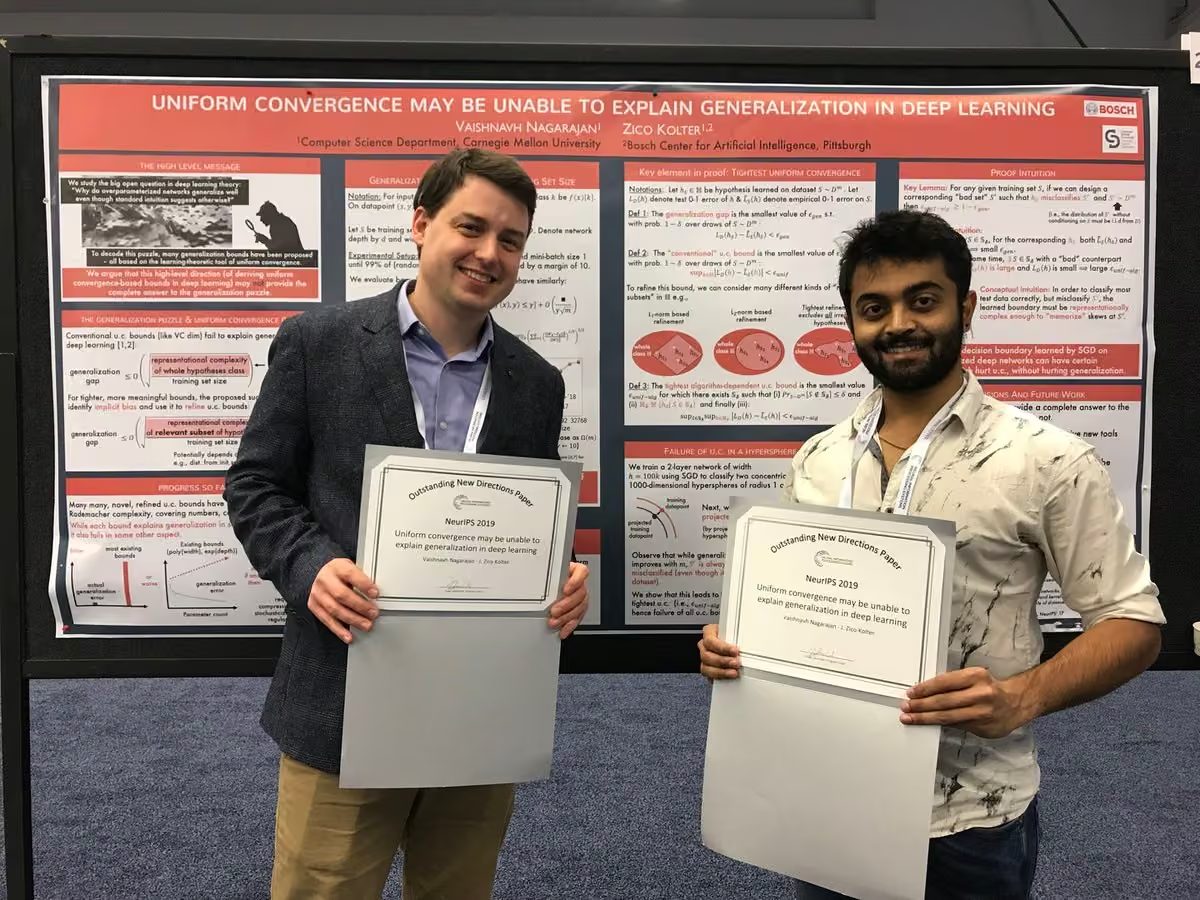
@mldcmu
A Continuous-Time View of Early Stopping for Least Squares by Alnur Ali @mldcmu
These days, it seems as though tools from statistics and machine learning are being used almost everywhere. A consequence of this...
Learn more: blog.ml.cmu.edu/2019/03/07/a-continuous-time-view-of-earl…
#machinelearning #ai #ml -
Zico Kolter reposted
Graham Neubig
@gneubig
"Can’t we cool it on the 'human level', and 'works like the human brain' talk for systems that are as confident that the first image is a pig as they are the second image is an airplane?"
Nice quote! @zicokolter/@aleks_madry adversarial robustness tutorial adversarial-ml-tutorial.org -
Zico Kolter reposted
Eric Wong
@RICEric22
New paper on Wasserstein adversarial examples, as a step towards considering convex metrics for perturbation regions that capture structure beyond norm-balls.
Paper: arxiv.org/abs/1902.07906
Code: github.com/locuslab/projected_sinkhorn -
Zico Kolter reposted
Vaishnavh Nagarajan
@_vaishnavh
At the heart of most deep learning generalization bounds (VC, Rademacher, PAC-Bayes) is uniform convergence (u.c.). We argue why u. c. may be unable to provide a complete explanation of generalization, even if we take into account the implicit bias of SGD. arxiv.org/pdf/1902.04742.pdf
-
Zico Kolter
@zicokolter
New work with @_vaishnavh, showing that proving generalization in deep learning may be even trickier than thought. Many existing bounds can _increase_ with sample size, and we show a simple DL-like setting where any uniform convergence proof fails. arxiv.org/abs/1902.04742
Vaishnavh Nagarajan
@_vaishnavh
At the heart of most deep learning generalization bounds (VC, Rademacher, PAC-Bayes) is uniform convergence (u.c.). We argue why u. c. may be unable to provide a complete explanation of generalization, even if we take into account the implicit bias of SGD. arxiv.org/pdf/1902.04742.pdf
-
Zico Kolter
@zicokolter
New paper on using randomized smoothing to build a provable defense against L2 adversarial attacks. The method outperforms previous bounds _and_ scales to ImageNet (well beyond the scale of existing provable methods). Work with @deepcohen and Elan Rosenfeld.
Jeremy Cohen
@deepcohen
1/ I'm excited to share our work on randomized smoothing, a PROVABLE adversarial defense in L2 norm which works on ImageNet! We achieve a *provable* top-1 accuracy of 49% in the face of adversarial perturbations with L2 norm less than 0.5 (=127/255).
arxiv.org/abs/1902.02918 -
Zico Kolter reposted
Vaishnavh Nagarajan
@_vaishnavh
Uploaded our (with @zicokolter) NeurIPS 17(!) workshop spotlight paper "Generalization in Deep Networks: The Role of Distance from Initialization". We argued why it's important to take into account the initialization to explain generalization.
arxiv.org/abs/1901.01672 -
Zico Kolter reposted
Thomas G. Dietterich
@tdietterich
I liked this paper from NeurIPS: papers.nips.cc/paper/7948-end-to-end-differentiable-physi… …
They put a deep learning wrapper around a differentiable physics engine and then can rapidly learn to fix the errors of the physics engine. They learn breakout in a few thousand steps. -
Zico Kolter reposted
Machine Learning Dept. at Carnegie Mellon
@mldcmu
Introducing the ML@CMU Blog
#cmu is a leader in the field of machine learning research, both within the #machinelearning Department (MLD) and across the university in general. Traditional conference and journal publications, along...
Learn more: blog.ml.cmu.edu/2018/12/12/introducing-the-mlcmu-blog/
#ml #ai -
Zico Kolter reposted
Priya L. Donti
@priyald17
Seeing Yo-Yo Ma was incredible, but the highlight of my #aiforsocialgood workshop experience at #neurips2018 was the panel on "AI’s impact on economic inequality and class" by @jonniepenn @safiyanoble @johnchavens @iajunwa @CjColclough. Some takeaways that resonated with me: 1/
-
Zico Kolter reposted
Eric Wong
@RICEric22
Fellow labmate Priya Donti's work on 'Inverse Optimal Power Flow' was recognized as a highlighted paper at the #neurips #aiforsocialgood workshop!
Short paper link: aiforsocialgood.github.io/2018/pdfs/track1/118-donti_ai4s…
@priyald17 -
Zico Kolter reposted
Priya L. Donti
@priyald17
I'll be talking today at 4:45pm about assessing power grid vulnerability using machine learning + optimization (work with @inesliaz and @zicokolter). Check it out, along with the other wonderful #aiforsocialgood talks today! #neurips2018
(Short paper: aiforsocialgood.github.io/2018/pdfs/track1/118-donti_ai4s…) -
Zico Kolter reposted
Vaishnavh Nagarajan
@_vaishnavh
#neurips2018 Noise resilience of deep networks have been used to provide generalization bounds on compressed/stochastic networks. How do you use it to provide a bound on the original network learned by SGD? Visit 220D at 3PM for our PAC-Bayesian answer to this! @zicokolter
-
Zico Kolter reposted
filipe
@filipeabperes
Presenting our work on differentiable physics for learning and control at #neurips2018 today: proceedings.neurips.cc/paper_files/paper/2018/hash/842424…
Watch the spotlight at 09:55 at Room 220 CD inclusive-or stop by our poster (#38) during poster session A from 10:45 to 12:45 PM at Room 210. -
Zico Kolter
@zicokolter
At #neurips and interested in working on robust machine learning at Bosch's new research lab in Pittsburgh? Stop by the @BoschGlobal booth this morning to chat with me and other researchers at the Bosch Center for AI.
-
Zico Kolter
@zicokolter
Slides and video for @aleks_madry and my #neurips tutorial on Adversarial Robustness now up on the tutorial website: adversarial-ml-tutorial.org
-
Zico Kolter reposted
Eric Wong
@RICEric22
At #neurips2018 this week to present our work on scaling provable defenses against adversarial examples: arxiv.org/abs/1805.12514
Stop by our poster during poster session A on Tuesday from 10:45-12:45 at room 210 & 230 AB, poster number 133.
Repository: github.com/locuslab/convex_adversarial -
Zico Kolter
@zicokolter
Had a blast giving our #neurips with @aleks_madry on Adversarial Robustness (one last plug for website adversarial-ml-tutorial.org). But, secretly sad to not get more comments our amazing logo. :-) (someone probably has made this joke a long time ago...)
-
Zico Kolter reposted
Nicolas Chapados
@NicolasChapados
Adversarial tutorial in machine learning tutorial at #neurips2018 — @zicokolter and @aleks_madry created a companion website with Jupiter notebooks for all examples in the tutorial! Awesome!
-
Zico Kolter reposted
Aleksander Madry
@aleks_madry
In about 30 min (8:30 am, Room 220 CD) @zicokolter and I are giving our #neurips2018 tutorial on adversarial robustness. The accompanying notes and code are here: adversarial-ml-tutorial.org (still work in progress). Questions/comments welcome here or via email. Hope to see you soon!
-
Zico Kolter reposted
BoschGlobal
@BoschGlobal
#experts from corporate and academic research discussing the challenges for #ai at #aicon18 including @zicokolter @graphcoreai @bschoelkopf
-
Zico Kolter reposted
Brandon Amos
@brandondamos
Excited to share our #nips2018 paper on differentiable MPC and our standalone @PyTorch control package!
Joint work with Jimenez, Sacks, Boots, and @zicokolter.
Paper: arxiv.org/abs/1810.13400
@PyTorch MPC Solver: locuslab.github.io/mpc.pytorch/
Experiments: github.com/locuslab/differentiable-mpc -
Zico Kolter reposted
BoschGlobal
@BoschGlobal
🤖 On November 19th, the Bosch Center for #artificialintelligence in cooperation with Cyber Valley is holding the first AI CON, an AI-focused conference at our corporate research center in Renningen, Germany. 🇩🇪 Submit your abstracts: www.bosch-ai.com/en/ai_con/call_for_abstracts/call_for_ab… #ai #iot
-
Zico Kolter
@zicokolter
Got the "do I use an RNN or CNN for sequence modeling" blues? Use a TrellisNet, an architecture that connects these two worlds, and works better than either! New paper with @shaojieb and Vladlen Koltun.
Paper: arxiv.org/abs/1810.06682
Code: github.com/locuslab/trellisnet -
Zico Kolter reposted
Tomasz Malisiewicz
@quantombone
Zico Kolter from CMU: my group’s goal is to combine the debugability of traditional software with self-improving benefits of deep learning. This is relevant to all branches of Robotics including Mixed Reality. Can’t wait to see @brandondamos’s poster later today. @PyTorch
-
Zico Kolter reposted
Brandon Amos
@brandondamos
I'm excited to announce our new @PyTorch model predictive control library! We use this in our (forthcoming) NIPS 2018 paper.
This is joint work with I. Jimenez, J. Sacks, B. Boots, and @zicokolter
Project Website: locuslab.github.io/mpc.pytorch/
GiHub Page: github.com/locuslab/mpc.pytorch -
Zico Kolter reposted
Andrej Karpathy
@karpathy
"An Empirical Evaluation of Generic Convolutional and Recurrent Networks for Sequence Modeling" arxiv.org/abs/1803.01271 good to see more papers on the topic - always start with a CNN before reaching for an RNN. You'll be surprised with how far you can get.
-
Zico Kolter reposted
Fei Fang
@fangf07
Our paper with @zicokolter and our 1st year PhD student Chun Kai Ling was selected as IJCAI distinguished paper! Welcome to our paper presentations! @SCSatCMU
-
Zico Kolter
@zicokolter
Research scientist and research engineer positions available at the Bosch Center for AI in Pittsburgh:
Research Scientist: jobs.smartrecruiters.com/BoschGroup/743999673291815-machi…
Research Engineer: jobs.smartrecruiters.com/BoschGroup/743999673291932-machi…
I'm at #icml2018 and #ijcai2018, if you also happen to be here and want to know more. -
Zico Kolter reposted
Aleksander Madry
@aleks_madry
We (with @lschmidt3 ) wrote a brief intro piece on adversarial robustness. Stay tuned for more! people.csail.mit.edu/madry/lab/blog/adversarial/2018/07/0…
-
Zico Kolter reposted
Lars Mescheder
@LMescheder
@MPI_IS_Tue - Happy to present our recent work on GAN stability at #icml2018. Nice side result: High resolution (1024x1024) GAN without progressively growing architectures or advanced normalization layers. avg.is.tuebingen.mpg.de/research_projects/convergence-and…
www.youtube.com/watch?v=GY3nPi96ZgI -
Zico Kolter reposted
Po-Wei Wang
@_powei
The first proof that coordinate descent on spherical manifolds (the Mixing method) converges to global optima!
Joint work with Wei-Cheng Chang and @zicokolter:
arxiv.org/abs/1706.00476 -
Zico Kolter reposted
BoschGlobal
@BoschGlobal
We're making intelligent moves in #ai! 😉 🤖 The Bosch Center for Artificial Intelligence has partnered with @CarnegieMellon to accelerate research into AI and machine learning. Leading AI expert @zicokolter will direct the projects: bosch.link/kolter-cmu #iot
-
Zico Kolter reposted
CMU Kenneth C. Griffin School of Computer Science
@GriffinCMU
ICYMI: Zico Kolter @CSDatCMU and Yasser Jadidi @BoschGlobal discussed the new Bosch Center for #ai in Pittsburgh on @KDKA's Sunday Business Page: cbsloc.al/2tNwrHQ #cmuai
-
Zico Kolter reposted
Julia Mericle
@PBT_Julia
“Pittsburgh has become one of the smartest cities in the world, continuing to attract talent that wants to be here, that wants to invent and generate the next technology, the next best thing.” Rich Fitzgerald, on celebrating the launch of Bosch AI research lab and collab with CMU
-
Zico Kolter reposted
Bosch USA
@boschusa
Tune in @KDKA Sunday Business Page on 7/1 at 6:30 a.m. EDT to learn about new Bosch Center for #ai in Pittsburgh and $8M grant to @CarnegieMellon. @CSDatCMU's @ZicoKolter and @BoschGlobal's Yasser Jadidi talk with KDKA's @jondelano. #cmuai @SCSatCMU cbsloc.al/2IGAE4u
-
Zico Kolter
@zicokolter
Excited to announce a collaboration between CMU and the Bosch Center for AI (BCAI). I'm joining BCAI as chief scientist of AI research, and they are funding my CMU group (where I'm remaining full time).
Press release: www.businesswire.com/news/home/20180627005730/en/Bosch-Ce…
My comments: zicokolter.com/bosch/
Zico Kolter
@zicokolter
As part of this effort, and as highlighted in the press release, BCAI will be starting a new 20 person research lab in Pittsburgh. We will be focusing on research in safe, robust, and explainable AI, both fundamental research and applications at @BoschGlobal.
-
Zico Kolter reposted
Eric Wong
@RICEric22
New followup paper on scalable provable adversarial defenses with Frank Schmidt, Jan Metzen, and @zicokolter: verified CIFAR10 performance on residual networks with 100k hidden units and millions of parameters.
Paper: arxiv.org/abs/1805.12514
Code: github.com/locuslab/convex_adversarial/ -
Zico Kolter reposted
Tim Vieira
@xtimv
I am super impressed with this paper. I admire the level of detail, accessibility, generality, & useful connections. I learned a lot by reading it.
OptNet: Differentiable Optimization as a Layer in Neural Networks
by @brandondamos and @zicokolter
arxiv.org/abs/1703.00443 -
Zico Kolter reposted
Aleksander Madry
@aleks_madry
It takes more than algorithmic tweaks (architecture, robust opt., etc.) to get adversarially robust model: sometimes you *provably* need more data, too. [+Adv. training overfits by 50% on CIFAR!] arxiv.org/abs/1804.11285 (with @lschmidt3 @ShibaniSan @DimitrisTsip @_kunal_talwar_)
-
Zico Kolter reposted
Stat.ML Papers
@StatMLPapers
A Mean Field View of the Landscape of Two-Layers Neural Networks. (arXiv:1804.06561v1 [stat.ml]) arxiv.org/abs/1804.06561
-
Zico Kolter reposted
Sander Dieleman
@sedielem
"We conclude that the common association between sequence modeling and recurrent nets should be reconsidered, and convolutional nets should be regarded as a natural starting point for sequence modeling tasks." Great to see more work in this direction! arxiv.org/abs/1803.01271
-
Zico Kolter reposted
Shaojie Bai
@shaojieb
Our new paper, with @zicokolter and Vladlen Koltun, on extensively evaluating convolutional vs. recurrent approaches to sequence tasks is on arXiv now! arxiv.org/abs/1803.01271
-
Zico Kolter reposted
Brandon Amos
@brandondamos
The @PyTorch code has been released for the best defense paper at the NIPS 2017 ML & Security workshop
Eric Wong
@RICEric22
Updated paper, with @zicokolter, on provable defenses against adversarial examples. Now 5x faster with more experiments!
Paper: arxiv.org/abs/1711.00851
Code: github.com/locuslab/convex_adversarial -
Zico Kolter reposted
Eric Wong
@RICEric22
Updated paper, with @zicokolter, on provable defenses against adversarial examples. Now 5x faster with more experiments!
Paper: arxiv.org/abs/1711.00851
Code: github.com/locuslab/convex_adversarial -
Zico Kolter reposted
Brandon Amos
@brandondamos
Our new #iclr2018 paper on Learning Awareness Models, with @laurent_dinh @serkancabi @notmisha @NandoDF and many others.
Paper: openreview.net/pdf?id=r1HhRfWRZ
Videos: www.youtube.com/playlist?list=PLwtvFFFFBVYL5GzMxq40_fjNUQ… -
Zico Kolter reposted
Noam Brown
@polynoamial
We just published the details of our Libratus poker AI in Science! science.sciencemag.org/content/early/2017/12/15/science.a…
-
Zico Kolter reposted
Kristian Lum
@KLdivergence
I'll probably end up remembering this moment as the time I decided to blow my career up for no reason, but this is something I've been wanting to say for a long time.
medium.com/@kristianlum/statistics-we-have-a-problem-3046… -
Zico Kolter
@zicokolter
At the NIPS Deep RL symposium we released an implementation of a differentiable 2D physics engine, written in @pytorch. Available here: github.com/locuslab/lcp-physics
-
Zico Kolter
@zicokolter
So my second year student (@priyald17), presenting her first #nips poster, gets to compete with Elon Musk? Mixed feelings about these events being schedule exactly during conference poster sessions...
-
Zico Kolter reposted
Priya L. Donti
@priyald17
Using ML in the loop of some larger process? Check out this 3-minute video summary of our #nips2017 paper "Task-based End-to-End Model Learning in Stochastic Optimization" (with @brandondamos and @zicokolter)
www.youtube.com/watch?v=vGSzqbgDB-8 -
Zico Kolter reposted
Vaishnavh Nagarajan
@_vaishnavh
Here's a TL;DR version of our NIPS paper (with @zicokolter) "Gradient Descent GAN Optimization is Locally Stable" as a 3 minute video! www.youtube.com/watch?v=9gQt6Vqb854
-
Zico Kolter
@zicokolter
Excited to be speaking today at @AI_Frontiers for @C3IoT, on deep learning and the digital transformation.
-
Zico Kolter
@zicokolter
New paper, with @RICEric22, on provable defenses against adversarial examples.
Paper: arxiv.org/abs/1711.00851
Code: github.com/locuslab/convex_adversarial -
Zico Kolter reposted
Brandon Amos
@brandondamos
My/@zicokolter's camera-ready ICML papers are online!
Input Convex Neural Nets: arxiv.org/abs/1609.07152
OptNet: arxiv.org/abs/1703.00443 -
Zico Kolter
@zicokolter
Our new paper (by @_vaishnavh): Gradient descent GAN optimization is locally stable
Paper: arxiv.org/abs/1706.04156 -
Zico Kolter
@zicokolter
ReLUs can self-normalize too: srelu(x) = 1.18240091*(relu(x+0.89947156) - 1) (but @SELUAppendix may prove this wrong somewhere in there)
Zico Kolter
@zicokolter
If the above is correct, though, I hope that tweet becomes the primary source. I also welcome this new age of deep learning numerology.
-
Zico Kolter reposted
Dr. Manu Kumar 👋🏽
@ManuKumar
I didn't really intend to hijack this thread and kudos to all, but wow @SCSatCMU @CarnegieMellon is kind of rocking this list among Univs.
-
Zico Kolter reposted
Brandon Amos
@brandondamos
Newton-ADMM: A Semismooth Newton Method for Fast, Generic Convex Programming
Paper: arxiv.org/abs/1705.00772
Code: github.com/locuslab/newton_admm -
Zico Kolter reposted
Brandon Amos
@brandondamos
qpth (by me and @zicokolter) has a new website and works with the @PyTorch master branch instead of our fork
locuslab.github.io/qpth/ -
Zico Kolter
@zicokolter
Exciting to be giving an "Andy" talk today at 1:55pm ET at CMU's Energy Week @cmuenergy. www.cmuenergyweek.org/agenda/session/153845
-
Zico Kolter
@zicokolter
David Shmoys's @compsust virtual seminar talk today at 1:30PM ET (plus video of my talk from two weeks ago) www.compsust.net/seminar.php
-
Zico Kolter
@zicokolter
Finally breaking down and joining Twitter.