Dave Patterson has a habit of giving bad advice. His latest, How to Earn a Bad Obituary, explains why he's joining @LaudeInstitute as a Member of Technical Staff: to work for the public good with all the urgency of a startup.
First on his to-do list: leading our next batch of Moonshots! 🌕
More good (bad) advice from Dave: laude.org/updates/how-to-earn-a-bad-obituary
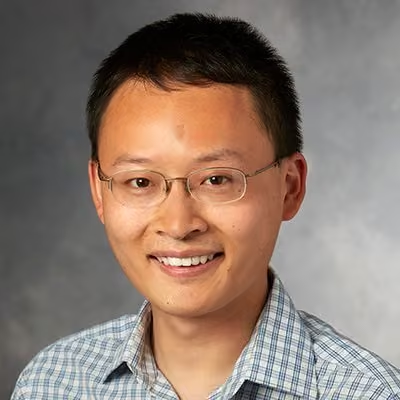
Diyi Yang
Diyi Yang is a Chinese computer scientist and assistant professor of computer science at Stanford University. Her research is in human-centered AI, where she focuses on building natural language processing systems that support both human-human and human-computer interaction. She is affiliated with the Stanford NLP and HCI groups, as well as the Stanford AI Lab (SAIL) and the Stanford Institute for Human-Centered Artificial Intelligence (HAI). More on Wikipedia
-
Diyi Yang reposted
Laude Institute
@LaudeInstitute
-
Diyi Yang reposted
Laude Institute
@LaudeInstitute
After finishing the largest-ever live pretraining run, @MarinCommunity released checkpoints on @huggingface yesterday — great timing for a community meetup at Laude Lab!
@WilliamBarrHeld's ask for the audience: “Find what Marin is doing wrong and send better ideas back.”
Proud to support Marin and Atlantic-CC as Slingshots. Thanks to the Open Athena team for helping us get everyone together! @percyliang @dlwh @andykonwinski -
Diyi Yang reposted
Yijia Shao
@EchoShao8899
AI is moving from on-demand to always-on. But can it learn when you actually want help?
We introduce Deep Personalization: an Observer Agent that continually learns from your work patterns and implicit feedback to decide when to step in.
It improves proactive-timing F1 by 2.4–3.0× across three model backbones.
We co-design the agent and its training and inference engines to run the Observer locally on systems like NVIDIA DGX Spark, keeping your screen observations on-device.
The next PC won’t wait for your prompt. It will learn when to help! Check out our blog at: nvlabs.github.io/deep-personalization/This media couldn't be displayed. See it on the original post. -
Diyi Yang reposted
Stanford NLP Group
@stanfordnlp
The Playlist page for CS329Z: Engineering AI Agents is now up! Bookmark it!
𝍣 With 4 lectures now available!!! 𝍣
www.youtube.com/playlist?list=PLPRcF5HR02_U
Michael Ryan
@michaelryan207
🔊 Big Update!
All materials are now being released publicly for our NEW Stanford course CS329Z: Engineering AI Agents!
Starting with the lectures, which are going live daily on the Stanford Online YouTube channel!
Lecture 1: youtu.be/DGI4vucR71w
🧵 (1/5)
Michael Ryan
@michaelryan207
🚨 New Course Announcement!
This Fall @Diyi_Yang @jyangballin and I are teaching a BRAND NEW Stanford course on how to build AI Agents from scratch!
Millions of users interact with AI Agents every day. Come join us and learn how to build them!
🧵 (1/5)
Diyi Yang
@Diyi_Yang
This fall @michaelryan207 @jyangballin and I are teaching a new course CS329Z "Engineering AI Agents" on how to build AI Agents from scratch. Come join us and learn how to build them 🤖
-
Diyi Yang reposted
-
Diyi Yang reposted
rishi
@RishiBommasani
I am excited to announce our new nonprofit STABL, co-founded with the wonderful @sayashk @random_walker!
Our organization derives from four beliefs:
1. Advanced AI will broadly transform society and, if managed well, this transformation will be broadly beneficial.
2. The speed of this societal transformation is governed by bottlenecks: in many cases, the bottlenecks relate to people and organizations, not AI capabilities alone.
3. Since AI capabilities are not the sole determinant, the best strategy to manage the risks from advanced AI requires broad societal resilience, not just aligned models or capability delays, to provide defense in depth.
4. And while today’s institutions often struggle to grapple with the salvo of advanced AI, institutions will help stabilize society and will be essential, if adequately reformed, for ensuring shared prosperity.
In addition to these beliefs, the reason to create a new organization is based on the need we see in the ecosystem. In today’s ecosystem surrounding advanced AI, many of the leading companies and external actors focus on frontier AI as a technology. We share the view that the technology itself requires dedicated attention, and some of our work at STABL will be in this direction.
But the greater need we see is for independent organizations that take AI capabilities seriously and focus on downstream societal outcomes. We are building STABL to help fill this gap. And we hope to see many other organizations and initiatives emerge to define this field.
For me, the most exciting part thus far has been seeing all the support we have gotten in our early forays. Thanks especially to @audreyt @erikbryn @hlntnr @MichaelRStrain @RobbWiller for joining us as advisers!
We are hiring and fundraising so please reach out if you are interested in this work! -
Diyi Yang reposted
Laude Institute
@LaudeInstitute
Silicon Valley and academia don't give us many reasons to dress up. But even after days of prep, research pitches, deliberation, and event logistics, Team Laude and the Moonshots // ONE finalists cleaned up pretty good!
On stage at last week's very first Laude Moonshots awards, @andykonwinski, in his wedding suit, summed it up: "You all look really great."
Naturally, we had to document it. Watch the full ceremony on YouTube: www.youtube.com/watch?v=u1-p1V2G1fI&list=PLKSzzoX72tiM&in… -
Diyi Yang reposted
Michael Ryan
@michaelryan207
We followed this up with HW2 created by the amazing @jyangballin, co-creator of SWEBench.
John teaches how to build an effective and realistic terminal-bench style agent eval task using the Harbor framework!
Repo: github.com/cs329z/assignment2-evals
(3/5) -
Diyi Yang reposted
Michael Ryan
@michaelryan207
HW1 is also public! Ever wondered how to build an agent harness from scratch?
Now you can! With less than $5 of API credits, you can build your own "Claude Code" at home!
Repo: github.com/cs329z/assignment1-harness
(2/5) -
Diyi Yang reposted
Michael Ryan
@michaelryan207
🔊 Big Update!
All materials are now being released publicly for our NEW Stanford course CS329Z: Engineering AI Agents!
Starting with the lectures, which are going live daily on the Stanford Online YouTube channel!
Lecture 1: youtu.be/DGI4vucR71w
🧵 (1/5)
Michael Ryan
@michaelryan207
🚨 New Course Announcement!
This Fall @Diyi_Yang @jyangballin and I are teaching a BRAND NEW Stanford course on how to build AI Agents from scratch!
Millions of users interact with AI Agents every day. Come join us and learn how to build them!
🧵 (1/5)
Diyi Yang
@Diyi_Yang
This fall @michaelryan207 @jyangballin and I are teaching a new course CS329Z "Engineering AI Agents" on how to build AI Agents from scratch. Come join us and learn how to build them 🤖
-
Diyi Yang reposted
Stanford NLP Group
@stanfordnlp
CS329Z covers how to build AI Agents from scratch. 🤖
First lecture video: youtu.be/DGI4vucR71w
Class website: cs329z.stanford.edu -
Diyi Yang reposted
Stanford NLP Group
@stanfordnlp
Autumn 2026: @Diyi_Yang, @michaelryan207 & @jyangballin launch CS329Z Engineering AI Agents.
Not content with CS224N & CS336, @stanfordnlp leads with 2 amazing new courses, CS312 & CS329Z.
“But where are the videos?”, said the world.
Well, the first just dropped—more to come! -
Diyi Yang reposted
humans&
@humansand
Ampersand, our collaborator model, is now on Vercel AI Gateway - use it free for the next week!
Ampersand matches or beats all frontier models (e.g. Fable and Astra) in multi-user long-horizon settings on our evals, and most on external cooperation and multi-agent coding evals, at 744b params (40b active)
Vercel Developers
@vercel_dev
Ampersand from @humansand is free on AI Gateway through Nov 13.
It is a model for group chats. It tracks what each person wants, then flags conflicts, shares context, and asks questions.
𝚑𝚞𝚖𝚊𝚗𝚜𝚊𝚗𝚍/𝚊𝚖𝚙𝚎𝚛𝚜𝚊𝚗𝚍-𝚟𝟶.𝟷 -
Diyi Yang reposted
Michael Ryan
@michaelryan207
Having the most mind-numbing experience with #iclr2027 reviews this year...
Reviewer: Reviews the wrong paper
Me: "I think you reviewed the wrong paper"
Reviewer: Decreases score to a 1, increases confidence to a 4, and pastes in 100% AI generated review
Me: ... -
Diyi Yang reposted
Yijia Shao
@EchoShao8899
In @augmind_fm EP8, our @michaelryan207 had an insightful conversation with Peter Norvig, co-author of “Artificial Intelligence: A Modern Approach”
Two arguments really stuck with me:
1. While the scaling law hasn’t stopped and we now have much more data, algorithms, and compute, the next frontier is setting the right objective.
2. One of AI’s most profound risks is human deskilling and loss of motivation, which can have a long-lasting negative impact if we don’t do anything.
Peter also shared his career journey and his perspective on today’s AI industry. I found it super useful for early-career researchers and practitioners navigating such uncertain times.
Thank you, Peter, for sharing your wisdom and experiences with us!
Augmented Mind Podcast
@augmind_fm
“I should have my choice. How much automation do I want helping me? But also, how much control do I want?”
“You have to struggle whether it’s lifting weights or whether it’s mental exercise. You’ve got to actually do the work yourself.”
For EP8, “After Data and Compute, What’s the Next Frontier in AI,” we welcome Peter Norvig, co-author of Artificial Intelligence: A Modern Approach and former director of research at Google. Peter is now a Distinguished Education Fellow at Stanford HAI and a researcher at Recursive, working on self-improving AI.
As AI takes on more of our work, how do we make sure it makes us more capable? Peter explores what’s still worth learning in AI and programming, why learning still requires struggle, how more automation can coexist with more human control, and why getting AI’s objectives right remains one of the field’s biggest challenges.
Outline:
0:00 - Introduction
2:32 - What Has (and Hasn’t) Changed Throughout Peter’s Career?
7:03 - How Peter Makes Career Pivots
11:17 - Is This AI Moment Different From Previous Cycles?
15:32 - What’s Still Worth Learning in AI and Programming?
19:55 - How Will AI Transform Higher Education?
24:10 - Main Bottlenecks to Building Human-Centered AI
35:10 - Reward Hacking vs. Creativity
41:51 - Continual Learning Remains an Unsolved Challenge
44:16 - Open Source AI Models
46:32 - AI, Inequality, and Winner-Take-All MarketsThis media couldn't be displayed. See it on the original post. -
Diyi Yang reposted
Michael Ryan
@michaelryan207
Some of you know I’ve gotten deep into teaching recently, so I was thrilled to have the opportunity to sit down with Peter Norvig (one of the best AI educators to ever do it!!!)
Peter co-wrote THE textbook on AI!
In this discussion we talk about what is still important for humans to learn and do when it comes to AI development, and how we should think about setting the objectives for AI!
Check it out! ⬇️
Augmented Mind Podcast
@augmind_fm
“I should have my choice. How much automation do I want helping me? But also, how much control do I want?”
“You have to struggle whether it’s lifting weights or whether it’s mental exercise. You’ve got to actually do the work yourself.”
For EP8, “After Data and Compute, What’s the Next Frontier in AI,” we welcome Peter Norvig, co-author of Artificial Intelligence: A Modern Approach and former director of research at Google. Peter is now a Distinguished Education Fellow at Stanford HAI and a researcher at Recursive, working on self-improving AI.
As AI takes on more of our work, how do we make sure it makes us more capable? Peter explores what’s still worth learning in AI and programming, why learning still requires struggle, how more automation can coexist with more human control, and why getting AI’s objectives right remains one of the field’s biggest challenges.
Outline:
0:00 - Introduction
2:32 - What Has (and Hasn’t) Changed Throughout Peter’s Career?
7:03 - How Peter Makes Career Pivots
11:17 - Is This AI Moment Different From Previous Cycles?
15:32 - What’s Still Worth Learning in AI and Programming?
19:55 - How Will AI Transform Higher Education?
24:10 - Main Bottlenecks to Building Human-Centered AI
35:10 - Reward Hacking vs. Creativity
41:51 - Continual Learning Remains an Unsolved Challenge
44:16 - Open Source AI Models
46:32 - AI, Inequality, and Winner-Take-All MarketsThis media couldn't be displayed. See it on the original post. -
Diyi Yang reposted
Augmented Mind Podcast
@augmind_fm
“I should have my choice. How much automation do I want helping me? But also, how much control do I want?”
“You have to struggle whether it’s lifting weights or whether it’s mental exercise. You’ve got to actually do the work yourself.”
For EP8, “After Data and Compute, What’s the Next Frontier in AI,” we welcome Peter Norvig, co-author of Artificial Intelligence: A Modern Approach and former director of research at Google. Peter is now a Distinguished Education Fellow at Stanford HAI and a researcher at Recursive, working on self-improving AI.
As AI takes on more of our work, how do we make sure it makes us more capable? Peter explores what’s still worth learning in AI and programming, why learning still requires struggle, how more automation can coexist with more human control, and why getting AI’s objectives right remains one of the field’s biggest challenges.
Outline:
0:00 - Introduction
2:32 - What Has (and Hasn’t) Changed Throughout Peter’s Career?
7:03 - How Peter Makes Career Pivots
11:17 - Is This AI Moment Different From Previous Cycles?
15:32 - What’s Still Worth Learning in AI and Programming?
19:55 - How Will AI Transform Higher Education?
24:10 - Main Bottlenecks to Building Human-Centered AI
35:10 - Reward Hacking vs. Creativity
41:51 - Continual Learning Remains an Unsolved Challenge
44:16 - Open Source AI Models
46:32 - AI, Inequality, and Winner-Take-All MarketsThis media couldn't be displayed. See it on the original post. -
Diyi Yang
@Diyi_Yang
Thank you @LaudeInstitute for the generous support!
So excited to work with @tatsu_hashimoto, @chrispiech, @erikbryn and our team to build collaborative AI that complements human expertise and helps people develop new skills as work evolves!
Laude Institute
@LaudeInstitute
Collaborative Intelligence for the Future of Work | @Stanford
@Diyi_Yang, @tatsu_hashimoto, @chrispiech, and @erikbryn are building AI systems that complement human expertise to equip the workforce of the future.
laude.org/moonshots/one/collaborative-intelligence-future…
Diyi Yang
@Diyi_Yang
We're looking for researchers, PhDs and postdocs to work on this direction of building collaborative intelligence for workforce upskilling. If you're interested, please apply and reach out 😄
-
Diyi Yang reposted
Yijia Shao
@EchoShao8899
This is so exciting!! The format of human-agent collaboration will change, and the future of work is already experiencing drastic change right now. What shall stay unchanged (if not given even more focus) is prioritizing human growth and augmenting human expertise.
Thanks @LaudeInstitute for supporting this line of work! Huge shout out to @Diyi_Yang, @tatsu_hashimoto, @chrispiech, and @erikbryn who bring diverse expertise to lead this effort!
Laude Institute
@LaudeInstitute
Collaborative Intelligence for the Future of Work | @Stanford
@Diyi_Yang, @tatsu_hashimoto, @chrispiech, and @erikbryn are building AI systems that complement human expertise to equip the workforce of the future.
laude.org/moonshots/one/collaborative-intelligence-future… -
Diyi Yang reposted
Andy Konwinski
@andykonwinski
anyone who is close to research knows how broken the incentives are. doing open science at the frontier is harder than ever, compute costs alone price most teams out. we kept wondering what might happen if we give the right resources to the right researchers at the right time?
-
Diyi Yang reposted
Yanzhe Zhang
@StevenyzZhang
Very proud of what everyone has achieved! More great things to come! 🔥
Laude Institute
@LaudeInstitute
Collaborative Intelligence for the Future of Work | @Stanford
@Diyi_Yang, @tatsu_hashimoto, @chrispiech, and @erikbryn are building AI systems that complement human expertise to equip the workforce of the future.
laude.org/moonshots/one/collaborative-intelligence-future… -
Diyi Yang reposted
Stanford Digital Economy Lab
@DigEconLab
Congratulations to @Diyi_Yang, @tatsu_hashimoto, @chrispiech, and @erikbryn!
"Collaborative Intelligence for the Future of Work," aimed at preparing people for AI's disruption of the workforce, has been awarded a grant through @LaudeInstitute's Moonshots // ONE.
Laude Institute
@LaudeInstitute
What could the future look like if AI moves all of humanity forward?
Last year, we asked this of research teams across the US and Canada and invited them to shoot for the moon. We assembled a program committee of research luminaries, rising stars, and interdisciplinary experts to select eight seed grantees across four categories: Workforce Reskilling, Civic Discourse, Advancing Healthcare, and Accelerating Science.
Each team spent six months developing proposals for a multi-year, $10 million lab. Last week, they made their pitches at Demo Day in San Francisco. And today, we're announcing the four winners of Moonshots // ONE.
Researchers have power — to change how we work, commune, live, and discover. Especially when done in the open, their work is the fuel for human progress.
Join us in congratulating the first four Laude Moonshot Labs!
Read the announcement: laude.org/updates/moonshots-one-labs
Meet the winners👇This media couldn't be displayed. See it on the original post. -
Diyi Yang reposted
Erik Brynjolfsson
@erikbryn
It’s such a honor to have a chance to work with @Diyi_Yang, @tatsu_hashimoto, and @chrispiech and many others at Stanford on this project to help create a future where AI complements and extends human capabilities.
Thank you, @LaudeInstitute for recognizing and supporting this work!
Laude Institute
@LaudeInstitute
Collaborative Intelligence for the Future of Work | @Stanford
@Diyi_Yang, @tatsu_hashimoto, @chrispiech, and @erikbryn are building AI systems that complement human expertise to equip the workforce of the future.
laude.org/moonshots/one/collaborative-intelligence-future… -
Diyi Yang reposted
Stanford HAI
@StanfordHAI
Congratulations to @Diyi_Yang, @tatsu_hashimoto, @erikbryn, @chrispiech and their student researchers on winning a $10M @LaudeInstitute Moonshot to study how people thrive working with AI agents.
Laude Institute
@LaudeInstitute
Collaborative Intelligence for the Future of Work | @Stanford
@Diyi_Yang, @tatsu_hashimoto, @chrispiech, and @erikbryn are building AI systems that complement human expertise to equip the workforce of the future.
laude.org/moonshots/one/collaborative-intelligence-future… -
Diyi Yang reposted
Laude Institute
@LaudeInstitute
Collaborative Intelligence for the Future of Work | @Stanford
@Diyi_Yang, @tatsu_hashimoto, @chrispiech, and @erikbryn are building AI systems that complement human expertise to equip the workforce of the future.
laude.org/moonshots/one/collaborative-intelligence-future… -
Diyi Yang reposted
Laude Institute
@LaudeInstitute
What could the future look like if AI moves all of humanity forward?
Last year, we asked this of research teams across the US and Canada and invited them to shoot for the moon. We assembled a program committee of research luminaries, rising stars, and interdisciplinary experts to select eight seed grantees across four categories: Workforce Reskilling, Civic Discourse, Advancing Healthcare, and Accelerating Science.
Each team spent six months developing proposals for a multi-year, $10 million lab. Last week, they made their pitches at Demo Day in San Francisco. And today, we're announcing the four winners of Moonshots // ONE.
Researchers have power — to change how we work, commune, live, and discover. Especially when done in the open, their work is the fuel for human progress.
Join us in congratulating the first four Laude Moonshot Labs!
Read the announcement: laude.org/updates/moonshots-one-labs
Meet the winners👇This media couldn't be displayed. See it on the original post. -
Diyi Yang reposted
Laude Institute
@LaudeInstitute
Most AI built for work aims to automate tasks. At @Stanford, @Diyi_Yang, @tatsu_hashimoto, @chrispiech, and @erikbryn are doing something different: gathering better data on how people learn and work with AI to develop systems designed for collaboration.
Full interviews from our Moonshots // ONE tour drop tomorrow. Stay tuned! laude.org/moonshots/one/collaborative-intelligence-future… -
Diyi Yang reposted
Yijia Shao
@EchoShao8899
In “HW3: Building and Evaluating Human-AI Interaction”, students get hands-on experience collecting multi-turn human-agent interaction data through simulation and deriving high-fidelity metrics for unverifiable tasks.
We thank @humansand for providing the Persimmon model for students for free so people can have better user simulators.
github.com/SALT-NLP/cs329x_hw3 -
Diyi Yang reposted
Yijia Shao
@EchoShao8899
In “HW2: Deep Personalization with Tinker”, students get the chance to posttrain production-scale LLM thanks to @tinkerapi!
github.com/SALT-NLP/cs329x_hw2 -
Diyi Yang reposted
Yijia Shao
@EchoShao8899
In “HW1: Model Alignment and Human Feedback”, students experiment with classic algorithms in LLM training like instruction tuning, PPO/RLHF, and DPO.
A huge shout-out to @GoogleColab for making GPUs and TPUs easily accessible to students! -
Diyi Yang reposted
Yijia Shao
@EchoShao8899
This fall, I’m honored to serve as Head TA for Stanford "CS329X: Human-Centered LLMs", taught by @Diyi_Yang.
The course focuses on the intersection of LLMs and People, covering techniques for building useful models and agentic systems, as well as approaches to align them with human values and preferences, preserve privacy and trust, and create positive societal impact.
This year, we’ve seen a significant increase in enrollment, and we’re thrilled that so many students care about human-centered AI. Our team spent a lot of time discussing how to design assignments that would be actually useful to prepare students to build or even define AI systems that benefit people.
Our conclusion: hands-on experience remains essential, but implementation alone is not enough. We emphasize understanding why methods work, how to evaluate them, and what we shall look for in human data.
This learning experience would not be possible without the compute credits and resources provided by @thinkymachines, @googlecloud, @humansand, and @AWS. Thank you so much for supporting our students and the course! -
Diyi Yang reposted
humans&
@humansand
Large-scale RL has a problem: weight updates from trainers to samplers are slow and expensive
We’re sharing weight teleportation: faster weight updates than existing intra-cluster techniques with internet speeds, enabling samplers anywhere (maybe even space!)
Weight teleportation is so efficient (<0.23s sampler pause time, ~3s non-blocking compression + prepare), the bottleneck ends up being the GPU hardware’s decompression ASIC
We unlock these gains by using GPUs for massively parallel compression of model weight changes, engineering a heterogeneous decompression and patching pipeline, along with other optimizations and overlaps. These techniques are co-designed with hardware-native features in NVIDIA’s Blackwell generation of chips
We’ve open-sourced weight teleportation, so everyone can use it today -
Diyi Yang reposted
Alexis Ross
@alexisjross
announcing &tutor, a tutor we trained against persimmon!
there are many reasons I'm so excited about this. here are a few:
1. this is a case study into the differentiated bet that we're making at humans&: having good models of users (e.g. learners) allows us to train AI models that can help people over long time horizons (e.g. teach in a way that imparts new understanding)
2. education is a near and dear application close to my heart, and I've been wanting to work on something like this since starting my PhD
3. @314Bansal is the 🐐🐐🐐 and it was so much fun working together on this
humans&
@humansand
Introducing Ampersand Tutor (&Tutor) - we trained a model to learn like people, then trained &Tutor to teach it
On a widely-used tutor model eval, &Tutor performed best, showing how better models of people can help build AI for humans
Available through our API - try it! -
Diyi Yang reposted
Shicheng Liu
@ShichengGLiu
If you are a prospective student looking for Ph.D. positions, I cannot stress this enough: Consider joining Zhang Lab to pioneer the next frontier! It would be a great, insightful, and fruitful journey!
Yanzhe Zhang
@StevenyzZhang
PhDone!
Very grateful to all my committee members!
@Diyi_Yang @zsoltkira @kartik_goyal_ @PoloChau @sanmikoyejo -
Diyi Yang
@Diyi_Yang
Likewise ♥️
Yanzhe Zhang
@StevenyzZhang
Special shout-out to @Diyi_Yang, it has been a great fortune to work with you!
-
Diyi Yang
@Diyi_Yang
Congrats to Dr. Zhang @StevenyzZhang!!! Super proud of what you have done in the last few years! Excited about what you will do next ♥️
Yanzhe Zhang
@StevenyzZhang
PhDone!
Very grateful to all my committee members!
@Diyi_Yang @zsoltkira @kartik_goyal_ @PoloChau @sanmikoyejo -
Diyi Yang reposted
Alex Spangher
@AlexanderSpangh
So excited for this research! I've always been annoyed at the supremacy of verified rewards, and now we can finally show it.
In this work, we develop ways of measuring: how much of a reward signal is verifiable, how much can we put into words, and how much is shared but tacit, or impossible to articulate? -
Diyi Yang reposted
Isaac
@robinsonaisaac
More to come! I've been thinking a lot about the future of work and the responsibility of the whole ecosystem to help answer these questions (and fast). It was an honor working with @jennjwang, @erikbryn, @Diyi_Yang, @andreas_h0wpt, and Phil.
Jason Furman
@jasonfurman
O*NET tracks the tasks that are required by different jobs. It has been invaluable for research. But it also was clear that it could be improved a lot--and the need to improve it was much greater than ever. So very glad to see this, looks like we'll all be using it.
Jennifer Wang
@jennjwang
Jobs are modeled as bundles of tasks. But as jobs change, how do we keep those task lists up to date?
Workers often experience new responsibilities and tools before they reach their job descriptions.
We start by listening to them. 🧵 -
Diyi Yang reposted
Jason Furman
@jasonfurman
O*NET tracks the tasks that are required by different jobs. It has been invaluable for research. But it also was clear that it could be improved a lot--and the need to improve it was much greater than ever. So very glad to see this, looks like we'll all be using it.
Jennifer Wang
@jennjwang
Jobs are modeled as bundles of tasks. But as jobs change, how do we keep those task lists up to date?
Workers often experience new responsibilities and tools before they reach their job descriptions.
We start by listening to them. 🧵 -
Diyi Yang reposted
Vishakh Padmakumar
@vishakh_pk
Such impactful work from @jennjwang and team!
Also very proud to see the AI Interviewer built by @DavidAnugraha (arxiv.org/abs/2602.21136) be used more in the wild. Aggregating worker experiences at scale is super important and needs to be handled with care. Excited to see this direction progress in the coming years!
Diyi Yang
@Diyi_Yang
Understanding AI’s impact on work starts with knowing what workers actually do.
Excited to share TaskNet 🥳 We use AI interviews to map tasks across 6 occupations, uncovering emerging tasks and overlooked work.
Amazing work by @jennjwang and the team!!!This media couldn't be displayed. See it on the original post. -
Diyi Yang
@Diyi_Yang
Understanding AI’s impact on work starts with knowing what workers actually do.
Excited to share TaskNet 🥳 We use AI interviews to map tasks across 6 occupations, uncovering emerging tasks and overlooked work.
Amazing work by @jennjwang and the team!!!This media couldn't be displayed. See it on the original post. -
Diyi Yang reposted
Stanford Digital Economy Lab
@DigEconLab
TaskNet is live!
By accurately mapping the tasks workers perform at their jobs, the project will help us gain a better understanding of AI's impact on work.
Explore Tasknet here: tasknet.stanford.edu -
Diyi Yang reposted
Yijia Shao
@EchoShao8899
AI can reshape people's life in various ways, but its impact on job may be one of the most profound. It's not just about how we work, but also about human autonomy and dignity.
Back in 2025, we collaborated with @erikbryn 's team to investigate automation vs augmentation across the U.S. workforce (futureofwork.saltlab.stanford.edu). One key limitation, however, was that the work was grounded on existing human work curated by O*NET and do not took emerging new work into consideration.
That's why I am so excited to see TaskNet by the amazing @jennjwang! It's more than a carefully curated, one-off dataset and offers a scalable way to track how work evolves, especially at a time when the pace of change is accelerating.
Check it out!! digitaleconomy.stanford.edu/project/tasknet/
Jennifer Wang
@jennjwang
Jobs are modeled as bundles of tasks. But as jobs change, how do we keep those task lists up to date?
Workers often experience new responsibilities and tools before they reach their job descriptions.
We start by listening to them. 🧵 -
Diyi Yang reposted
Jennifer Wang
@jennjwang
A labor of love with Mercor and the O*NET Center! TaskNet brings together academic research, industry experience, and occupational data expertise to turn workers’ experiences into task information that can inform workforce policy and training.
Mercor
@mercor
Workers in six occupations do 79 tasks the government's official occupational taxonomy has yet to add. That work is worth about $140B a year in wages.
That taxonomy is called O*NET, the U.S. Department of Labor's database of the tasks each occupation involves. Workers use it to help with job transitions, and economists use it to estimate which jobs AI will change. If the lists are incomplete, so are the estimates.
Today we're releasing TaskNet, an open-source task catalog built on O*NET and updated for how AI is changing work.
Built with researchers from Stanford, the O*NET Resource Center, and NBER. Thank you to @robinsonaisaac @erikbryn @diyi_yang @jennjwang @andreas_h0wpt @Digeconlab @stanfordnlp @stanfordhai @stanfordAIlab for contributing to this work.
Read the blog: www.mercor.com/blog/introducing-tasknet-a-new-taxonomy-of… -
Diyi Yang reposted
Mercor
@mercor
Workers in six occupations do 79 tasks the government's official occupational taxonomy has yet to add. That work is worth about $140B a year in wages.
That taxonomy is called O*NET, the U.S. Department of Labor's database of the tasks each occupation involves. Workers use it to help with job transitions, and economists use it to estimate which jobs AI will change. If the lists are incomplete, so are the estimates.
Today we're releasing TaskNet, an open-source task catalog built on O*NET and updated for how AI is changing work.
Built with researchers from Stanford, the O*NET Resource Center, and NBER. Thank you to @robinsonaisaac @erikbryn @diyi_yang @jennjwang @andreas_h0wpt @Digeconlab @stanfordnlp @stanfordhai @stanfordAIlab for contributing to this work.
Read the blog: www.mercor.com/blog/introducing-tasknet-a-new-taxonomy-of… -
Diyi Yang reposted
Jennifer Wang
@jennjwang
We see this project as a step toward a broader effort with the O*NET Center to keep occupational information current and grounded in what workers actually do.
📄 Paper: doi.org/10.2139/ssrn.7670419
💻 Code: github.com/jennjwang/tasknet-system
🕸️ Website: digitaleconomy.stanford.edu/project/tasknet/ -
Diyi Yang reposted
Jennifer Wang
@jennjwang
Updating task lists changes AI exposure estimates—in both directions.
With TaskNet, estimated exposure rises for software developers and lawyers, two occupations where AI’s effects are widely debated, and falls for personal care aides. -
Diyi Yang reposted
Jennifer Wang
@jennjwang
TaskNet adds 79 new tasks to O*NET 31.0, such as developers designing prompts and evaluating AI model outputs.
It also refines existing tasks, breaking down broad tasks like “represent clients in court” into preparing witnesses and presenting arguments for lawyers. -
Diyi Yang reposted
Jennifer Wang
@jennjwang
Jobs are modeled as bundles of tasks. But as jobs change, how do we keep those task lists up to date?
Workers often experience new responsibilities and tools before they reach their job descriptions.
We start by listening to them. 🧵 -
Diyi Yang reposted
Arash Vahdat
@ArashVahdat
🚀 Are you a PhD student pushing the boundaries of AI, robotics, graphics, or accelerated computing?
NVIDIA's Graduate Fellowship offers up to $60K in funding, mentorship from NVIDIA researchers, and a summer research internship!
⏳ Apply by October 30!
blogs.nvidia.com/blog/applications-open-graduate-fellowsh… -
Diyi Yang reposted
John Yang
@jyangballin
Saturating a benchmark that tests models on rebuilding ffmpeg is gonna take a fraction of the 3 yrs it took to saturate GitHub issue resolution.
Crazy times we live in. -
Diyi Yang reposted
humans&
@humansand
Introducing Boba - the social intelligence that understands your goals and your community. Text Boba today or message it online at boba.app
2 media couldn't be displayed. See them on the original post. -
Diyi Yang
@Diyi_Yang
AI’s ability to collaborate with humans is much needed. Ampersand is an important step in this direction!!!
Very excited about what the team has cooked up 🐐
humans&
@humansand
No one changes the world alone
Introducing Ampersand - the first model built for us. Ampersand is a collaborator trained to help people achieve their individual and collective goals. In multi-month simulations, users collaborating with Ampersand accomplished more than with Fable and other frontier models
Available to everyone through our APIThis media couldn't be displayed. See it on the original post. -
Diyi Yang reposted
humans&
@humansand
No one changes the world alone
Introducing Ampersand - the first model built for us. Ampersand is a collaborator trained to help people achieve their individual and collective goals. In multi-month simulations, users collaborating with Ampersand accomplished more than with Fable and other frontier models
Available to everyone through our APIThis media couldn't be displayed. See it on the original post. -
Diyi Yang reposted
Saurabh Shah
@saurabh_shah2
SECOND HUMANS& MODEL LFGGG
some cool things about Amp:
- Amp was trained in long open-ended simulations with Persimmon. This forced us to innovate across the RL stack from algos to infra
- Amp helps users achieve their goals better than any model we tested in our long horizon simulations spanning up to months of simulated time
- Amp is purple because purple is my favorite color
- Amp is the coolest thing I've ever worked on
- Amp was a giant effort across the whole company. Working on Amp meant working with and learning from:
- the indomitable @parth_29 who led the project ! ! !
- the GOAT @joeyxhong who's so crazy idek what to say man this guy's insane!!!
- @YuchenHe07 & @ericzelikman who're as good at RL as they are at founding companies (i.e. pretty ok)
- the infra goats @Ani_nlp & @rramador & @zianglih & @yawd2028 who keep us stepping fast
- the maniacs @niloofar_mire & @__Charlie_G & @vpj & @gharik who have all sorts of zany ideas on simulations
- the brilliant @314Bansal & @alexisjross with boundless of insight on using Persimmon better
- @noahdgoodman & @Diyi_Yang for professor-ly wisdom
- the prudent @eoflazer & @MaartenBosma & @getshao & @yuanlu119 for tasteful insights from the product side (more on that soon, stay tuned!)
- jim for bein cool and helpin us not break the law :)
if you wanna be on this list for our next model, join us
humans&
@humansand
No one changes the world alone
Introducing Ampersand - the first model built for us. Ampersand is a collaborator trained to help people achieve their individual and collective goals. In multi-month simulations, users collaborating with Ampersand accomplished more than with Fable and other frontier models
Available to everyone through our APIThis media couldn't be displayed. See it on the original post. -
Diyi Yang reposted
Braden Hancock
@bradenjhancock
Slingshots // Four is live!
Another batch, another fourteen projects shipping open source artifacts that I’m excited about. See below for the full list. A few themes from the batch:
1. Harness time: This quarter harnesses shot up in visibility, with increased appreciation for the parts of an agent that aren’t the model and what they can give you. This batch includes a harness supporting persistent agency (Headlong); a harness supporting self-improvement via context management (ACE); a harness supporting self-improvement of the agentic harness itself (Exo); and a harness supporting multi-agent setups (dotagents).
2. Up and down the stack: There’s innovation to be had at every layer of the stack. We saw projects worth backing at the level of kernels (Thunderkittens); inference (M*); training (Marin); data (Atlantic-CC); evals (Decision Assistants); optimization (SkyDiscover); applications (Wagglehaus), etc.
3. Talk of the town: Slingshots continue to tackle timely problems at the frontier. Concurrent with Jev taking over X, an even faster type 1 decision model (CLM) came out of academia. With RSI on the brain of every big lab researcher, we now have a public literature retrieval benchmark grounded in authors’ firsthand accounts of their research process (ScholarCatalyst). And a new RL training method (Pedagogical RL) addresses head-on the question vexing RL practitioners of how privileged information can be used to discover generalizable behaviors, not just verify.
Congrats to all the researchers in this batch and the previous three who continue to ship their research out into the world with open artifacts that can be adopted and built upon. Open science leads to better outcomes for everyone.
And the good times will continue to roll – batch five is looking just as good. If you’re a researcher with a project that’s gaining momentum and ready for an adrenaline shot, shoot me a DM or apply at laude.org/slingshots.
👏 @a1zhang, @AlexKrentsel, @ankrgyl, @Azaliamirh, @bariskasikci, @bfspector, @chelseabfinn, @chipro, @Diyi_Yang, @dlwh, @drmapavone, @HazyResearch, @jackyk02, @jonasgeiping, @JonSaadFalcon, @jure, @kothasuhas, @lateinteraction, @martin_casado, @mertcemri, @michaelryan207, @MikeCafarella, @NickAJalbert, @NoahZiems, @nsagan271, @ohmyksh, @percyliang, @qizhengz_alex, @RussoMatthew, @samrmadden, @shagarw21, @ShashwatGoel7, @shulynnliu, @simran_s_arora, @souradipchakr18, @stuart_sul, @tianyu_li_, @tim_kraska, @WilliamBarrHeld, @yoonholeee, @YejinChoinka, @Stanford, @MIT, @LaudeInstitute, @CarnegieMellon, @UW, @UCBerkeley, @MPI_IS, @UWMadison
Laude Institute
@LaudeInstitute
Introducing Slingshots // FOUR: 14 projects across eight top institutions. Self-improving agent systems and harnesses, maximally-open models and training data, applications for research and decision-making – plus kernels and more. Say hello to the batch 🧵
This media couldn't be displayed. See it on the original post. -
Diyi Yang reposted
Laude Institute
@LaudeInstitute
Atlantic-CC // @michaelryan207, @WilliamBarrHeld, @kothasuhas, @YejinChoinka, @Diyi_Yang, @percyliang (@Stanford, Open Athena) — A 17T token model-based processing of the Common Crawl for training bigger and better open-source large language models.
-
Diyi Yang reposted
Stanford HAI
@StanfordHAI
A common assumption is that people use AI as a shortcut. Stanford HAI Faculty Affiliate @Diyi_Yang and her team analyzed a quarter-million anonymized chatbot conversations and found most users stay engaged, asking for explanations, working through friction, and refining their work: hai.stanford.edu/news/humans-and-ai-engage-in-meaningful-…
-
Diyi Yang reposted
Alexis Ross
@alexisjross
@humansand is hosting a party tonight & we are hiring in all workstreams!
if you are interested in working on user models or have a project in mind for persimmon, come find me or @314Bansal
p.s. we are almost at capacity at the event but will prioritize people who are interested in working with us so feel free to shoot me a message ✉️
partiful.com/e/sBqYtz1ehDZoW0g1fi6I -
Diyi Yang reposted
Yanzhe Zhang
@StevenyzZhang
At the end of the day, it is all about human learning and understanding.
In this work, we explored how to improve the personalized learning experience by training LLM teachers to teach adaptively.
Weixian Xu
@WeixianXu
Language models already excel at math, but human growth remains essential: we need AI to teach people, not replace them!
Teaching is different from solving. As the Chinese principle “因材施教” suggests, preferences differ from person to person, and a good teacher should adapt their teaching to each learner.
We introduce Sherpa, a framework for training LLMs to teach adaptively. -
Diyi Yang reposted
ACL 2027
@aclmeeting
🔔CFP for the #acl2027nlp main conference is up! 2027.aclweb.org/calls/main/
📝Submission deadline to ARR is Jan 4, 2027.
⭐️ACL2027 Theme Track is "Homogenization and knowledge collapse in LLMs". -
Diyi Yang reposted
Zora Wang
@ZhiruoW
Increasing AI capabilities doesn’t have to come at the expense of humans. We can harness powerful AI to educate and empower people‼️
We introduce Sherpa, a framework for training LLMs to teach simulated students adaptively, with promising transfer to human learners.
Weixian Xu
@WeixianXu
Language models already excel at math, but human growth remains essential: we need AI to teach people, not replace them!
Teaching is different from solving. As the Chinese principle “因材施教” suggests, preferences differ from person to person, and a good teacher should adapt their teaching to each learner.
We introduce Sherpa, a framework for training LLMs to teach adaptively. -
Diyi Yang reposted
Weixian Xu
@WeixianXu
Sherpa is also on Hugging Face Papers! 🤗 If you find the work interesting, we'd appreciate an upvote:
huggingface.co/papers/2610.08778 -
Diyi Yang reposted
Weixian Xu
@WeixianXu
Language models already excel at math, but human growth remains essential: we need AI to teach people, not replace them!
Teaching is different from solving. As the Chinese principle “因材施教” suggests, preferences differ from person to person, and a good teacher should adapt their teaching to each learner.
We introduce Sherpa, a framework for training LLMs to teach adaptively. -
Diyi Yang reposted
Will Held
@WilliamBarrHeld
Part of the issue is how people interpreted the core idea:
Models get predictably *better with scale* (a big model will ~always be better than a small one)
vs.
Models get *predictably* better with scale (you can say meaningful things about big models from small ones) -
Diyi Yang reposted
Stanford NLP Group
@stanfordnlp
Yijia @EchoShao8899’s talk
-
Diyi Yang reposted
Yijia Shao
@EchoShao8899
I still remember @cjziems gave me a lot of suggestions & support when I just joined @stanfordnlp, not only on how to bring social science perspective into AI research, but also how to stay sane when I just came to a new country. Don't miss him if you are hiring for professor roles!
-
Diyi Yang reposted
Rydham Goyal
@rdhmgl
I’ve had the immense privilege of being personally mentored by @vishakh_pk in my research at @Diyi_Yang’s SALT lab at @StanfordAILab, and he’s an amazing engineer, social NLP wizard, and a gem of a human.
If you’re at COLM, hit him up!
Vishakh Padmakumar
@vishakh_pk
I'm on the job market this year!
I work on measuring the societal impacts (overreliance, homogenization etc.) of AI/LLMs and proposing ways to mitigate these.
I'm at #colm this week, and #neurips later this year, and would love to chat more! -
Diyi Yang reposted
Will Held
@WilliamBarrHeld
I'm also presenting a poster on the last paper from my PhD this afternoon.
I won't shut up about scaling laws! Why should you care about them in academia?!
They let you meaningfully analyze big models with less compute!!!
Franciscan C 91: colm.eventhosts.cc/virtual/2026/poster/1695
Will Held
@WilliamBarrHeld
I'll be at COLM this week! Excited to chat about data, scaling laws, open source, and Marin!
A quick 🧵 of conversation starters from work we've put out this year with links to my colleagues great writing: -
Diyi Yang reposted
Vishakh Padmakumar
@vishakh_pk
I'm on the job market this year!
I work on measuring the societal impacts (overreliance, homogenization etc.) of AI/LLMs and proposing ways to mitigate these.
I'm at #colm this week, and #neurips later this year, and would love to chat more! -
Diyi Yang reposted
Daniel Fried
@dan_fried
Check out CollabSkill at poster 34! #colm2026 work by @EchoShao8899 @ZhiruoW @Diyi_Yang et al.
-
Diyi Yang reposted
Zora Wang
@ZhiruoW
@EchoShao8899 is presenting CollabSkills now in the main room!
-
Diyi Yang reposted
-
Diyi Yang reposted
Zora Wang
@ZhiruoW
Check out our CollabSkill oral presentation and poster on Tuesday at @COLM_conf!
A framework for evaluating agent capabilities and contributions in human-agent collaboration. With tons of insights on AI literacy on the human side.
- Oral spotlight at 10:15
- Poster session from 11- 1 in Room Imperial
Yijia Shao
@EchoShao8899
A bit late, but I finally got time to release the trajectories we collected, the official CollabSkill rating implementation, and share that our CollabSkill paper was accepted to COLM with scores of 8/7/9/8🥳!
Fun fact #1: This is the first paper of my PhD where no reviewer asked why we need to consider humans in AI research. Thank you @COLM_conf
Fun fact #2: I uploaded the dataset on 8/1 and replied to several emails asking about where to find the data, but only just got time to link it to our project page. But I just found there are 1700+ downloads?? How many bots/auto reseach agents are scraping huggingface these days🤔
Yijia Shao
@EchoShao8899
AI agents are entering all kinds of work, not just software engineering. Which agent collaborates best with humans? How to handle inter-human variability and measure AI literacy?
📣Introducing CollabSkill — bringing human-agent collaboration skill measurement into Co-Gym. -
Diyi Yang reposted
Stanford NLP Group
@stanfordnlp
Catch the best of @stanfordnlp at the first oral session of @COLM_conf tomorrow 6 Oct @ 10am Pacific!
• @EchoShao8899 … @Diyi_Yang CollabSkill: Evaluating Human-Agent Collaboration
• A Feder Cooper … @percyliang Extracting memorized pieces of books
colm.eventhosts.cc/virtual/2026/oral/4905 -
Diyi Yang reposted
Ben Shi
@BenShi34
Hello my 406 twitter followers. Hopping on to share two things:
1. I’ve started a CS PhD at Stanford! For the love of the game ofc.
2. I’m releasing impersona-env, a proof of concept to train personalized assistants by building an RL environment out of user models. Your assistant learns to help you by repeated asking a simulated version of you questions, probing its internal latent thinking and feedback, and updating its priors accordingly. I think this unlocks a new dimension to personalization beyond discrete fact recall. My personal assistant model now understands nuances of my preferences that even I didn’t know about.
Full blog: benshi34.github.io
It’s still a proof of concept and there’s still a ton of things to figure out in this space. It’s unclear to me how to build user model evals that generalize across users and downstream applications, how to best represent longitudinal personal data at training time // inference time, the interplay between population level and individual level preferences, the immense questions surrounding privacy and hillclimbing in decentralized data access regime… if you want to chat on anything in this area please dm me! -
Diyi Yang reposted
Stanford University
@Stanford
The most important briefings of the day.
Karl Deisseroth, professor of bioengineering and of psychiatry and behavioral sciences, shares the news of his Nobel Prize with his kids. -
Diyi Yang reposted
Vishakh Padmakumar
@vishakh_pk
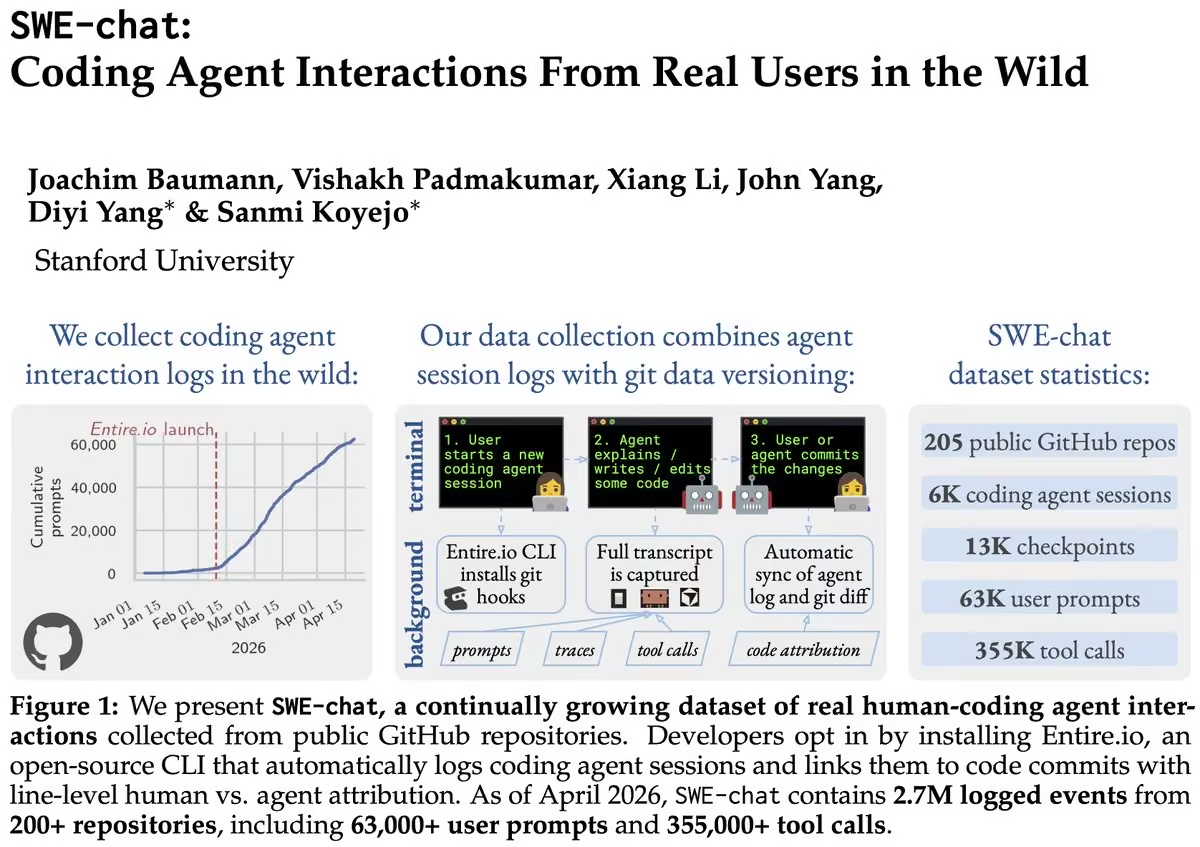
Come hear about SWE-Chat v2 at COLM (@COLM_conf) this week! More traces, more features and a tonne of interesting ways that the community has already adopted this dataset 🔥🔥
Joachim Baumann
@joabaum
SWE-chat v2 is here! The largest dataset of coding agent interactions from real users in the wild has gotten even larger: 230K prompts from 18K sessions.
SWE-chat has enabled incredible research (🧵) – excited to see what v2 unlocks for the community.
Come find us at @COLM_conf! -
Diyi Yang reposted
Joachim Baumann
@joabaum
SWE-chat v2 is here! The largest dataset of coding agent interactions from real users in the wild has gotten even larger: 230K prompts from 18K sessions.
SWE-chat has enabled incredible research (🧵) – excited to see what v2 unlocks for the community.
Come find us at @COLM_conf! -
Diyi Yang reposted
alphaXiv
@askalphaxiv
Excited to have Yijia Shao giving a talk on her latest work "Human-AI Collaboration at scale"
Tomorrow (10/02) 10 am PST!
This study investigates how people actually work with AI using the Anthropic Insights system, focusing on task criticality, human agency, learning, and friction.
luma.com/gy45gml5
Yijia Shao
@EchoShao8899
It’s such a rare opportunity to study human–AI collaboration at scale, given the constraints around data access and privacy. Huge thanks to @AnthropicAI for making this possible through the Anthropic Insights system, and for their support throughout the project.
We started this work with several hypotheses we’d been thinking about for a long time (around task criticality and delegation, human agency, and friction). But what surprised us is that the findings consistently point back to the **human side** of human–AI collaboration.
More details in 🧵 -
Diyi Yang reposted
Stanford HAI
@StanfordHAI
It was wonderful to see so many Stanford HAI faculty and leaders take part in Imagination in Action this month at the Google Bay View campus. We heard so many important conversations and research updates in AI, from scientific discovery and robotics to governance and the future of work.
HAI Leaders and Affiliated Faculty at Imagination in Action: James Landay (@landay), Erik Brynjolfsson (@erikbryn), Rob Reich, Vanessa Parli (@vanessaparli), Marco Pavone (@drmapavone), Diyi Yang (@Diyi_Yang), Surya Ganguli (@SuryaGanguli), Melissa Valentine (@stanfordmav), Arvind Karunakaran, Mehran Sahami (@mehran_sahami). -
Diyi Yang reposted
ACM Collective Intelligence
@ci_acm
🎤 Our second keynote at @ci_acm/@hcomp_conf
Diyi Yang from @Stanford University is sharing her keynote, “Human-AI Collaboration: Building Agents That Augment Work.”
We’re excited to hear her perspectives on human-AI collaboration and the future of work.
#hcomp2026 #ci2026 -
Diyi Yang reposted
John Yang
@jyangballin
So excited to finally share: Meta Muse Spark 1.[1/2/3] on ProgramBench
In PB, a SWE-agent must write a whole program (sqlite, ffmpeg, php) from scratch
Muse Spark 1.3 takes #2 (max) and #3 (xhigh) overall at incredible cost tiers
Intelligence too cheap to meter at its finest -
Diyi Yang reposted
HCOMP 2026
@hcomp_conf
Another full day at #hcomp26 ✨
Keynote reflections on human-AI collaboration, workshop reports, lightning talks, and a lively poster session — so many ways to share ideas and spark conversations.
Thanks to everyone presenting and engaging!
#hcomp26 #ci26 -
Diyi Yang reposted
Vishakh Padmakumar
@vishakh_pk
Now an Oral at @NeurIPSConf E&D track 2026! Super excited that work which studies how these models affects users is valued by the #neurips2026 community in the expanded evaluations track 🎉🎉🇦🇺
Vishakh Padmakumar
@vishakh_pk
People are increasingly worried that AI tools make us overreliant.
But how do we actually measure this? We introduce Offloading Score, a measure of reliance based on the fraction of cognitive effort offloaded to AI while completing a task.
In a controlled user study, Offloading Score detects increased reliance under time pressure, while several common alternatives do not.
(1/9) -
Diyi Yang reposted
OpenRSI Foundation
@OpenRSI
As AI systems enter a recursive self-improvement loop, the central question is whether it can systematically move beyond human-designed methods to genuinely extend the scientific and intelligence frontier.
What’s missing is a neutral, open standard for evaluating these capabilities in real, production-scale intelligence development.
Today, we’re releasing OpenRSI-Index v0.1: evaluating whether AI can recursively improve itself and push the boundaries of intelligence and science, on production-scale clusters with 1k GPUs.
We turn fully open-source projects into autoresearch environments, with agent trajectories lasting 60+ hours. Building v0.1 took 100K+ H100-hours.
We’re building an ecosystem with and for the research community: let RSI benefit everyone, and let everyone shape RSI together.
We invite task contributors and compute partners to build this open benchmark with us - all contributors will be included as paper authors.
Shape RSI with us:
🌐 Website: index.openrsi.foundation/index.html
🛠️ GitHub: github.com/OpenRSI-Foundation/OpenRSI-Index
🤝 Contribute: github.com/OpenRSI-Foundation/OpenRSI-Index/blob/main/CON… -
Diyi Yang reposted
Niloofar
@niloofar_mire
Going to COLM? Come to our @humansand party on October 7th!
partiful.com/e/sBqYtz1ehDZoW0g1fi6I -
Diyi Yang reposted
Yanzhe Zhang
@StevenyzZhang
As agents increasingly interact with each other, alignment becomes a property of the system, not just of individual agents.
In our new work (@xinruishi11, @Diyi_Yang), we stress-test whether collusion can emerge through repeated interaction.
Even when no agent is told to misbehave, we find that agents adapt to one another and can end up jointly violating their instructions.
Xinrui Shi
@xinruishi11
Can collusion emerge between LLM agents through repeated interaction?
We let pairs of agents work together. Neither is told to misbehave.
Yet over time, many of them end up violating their instructions together to get a higher reward. 🧵 -
Diyi Yang reposted
Xinrui Shi
@xinruishi11
Can collusion emerge between LLM agents through repeated interaction?
We let pairs of agents work together. Neither is told to misbehave.
Yet over time, many of them end up violating their instructions together to get a higher reward. 🧵 -
Diyi Yang reposted
Stanford HAI
@StanfordHAI
Can AI be slowed down? In the first session of Prompt Response — Stanford HAI's new series offering independent, evidence-based critique of AI's most contested questions — @SuryaGanguli, @Diyi_Yang, and Rob Reich examined emergent agent behavior, recursive self-improvement, and whether a kill switch can make advanced AI safer. Read the key takeaways: hai.stanford.edu/news/can-ai-be-slowed-down-stanford-hai-…
-
Diyi Yang reposted
Augmented Mind Podcast
@augmind_fm
“When I say understanding is the new bottleneck, what I mean is that I need to keep a clear understanding of what’s going on in my head to advance the project and be a full creative participant in that project.”
"Coding agents make coding more lonely. Can we open up that process to make it inherently collaborative?"
For EP7, “Software With Taste,” we welcome @geoffreylitt, design engineer at @NotionHQ, whose work explores malleable software and designing environments for thinking.
AI speeds up our work, but is our understanding keeping up? Geoffrey explains the risks of optimizing for speed at the expense of human understanding, why he uses AI to quiz himself during code reviews, and how to develop taste and build tools that help us stay creative, think deeply, and work together.
0:00 - Introduction
0:47 - Design Is More Than Better Animation
3:32 - Malleable Software and Coding Agents
9:06 - Human-Software Interaction is a Full-Stack Problem
12:43 - Getting Users On Board and Deeper
15:53 - The Trap of Just Building More
20:27 - Primitive Design Is a Taste Problem
22:20 - Understanding Is the New Bottleneck
27:22 - How To Develop Taste?
34:49 - Productivity vs. Speed
38:10 - Will Better AI Hurt Human-Human Collaboration?
44:34 - Advice for Designing Better ProductsThis media couldn't be displayed. See it on the original post. -
Diyi Yang reposted
Augmented Mind Podcast
@augmind_fm
EP7 of the AM Podcast drops tomorrow!
Software engineering has never been faster. How do we avoid the risks of optimizing for speed at the expense of human understanding?
We sat down with @geoffreylitt, a design engineer at @NotionHQ, to unpack taste, malleable software, and what it means to build for human understanding.
Here’s a preview 👀This media couldn't be displayed. See it on the original post. -
Diyi Yang reposted
Myra Cheng
@chengmyra1
I’m honored to be named one of MIT @techreview’s 35 Innovators under 35, among awesome peers!! Glad for more attention on AI’s impacts to our long-term societal wellbeing.
Free gift link to the article: ter.li/g2sgc7c6
And thank you to @grace_huckins for nominating me! -
Diyi Yang reposted
Kawin Ethayarajh
@ethayarajh
I'm hiring a predoc to work with me on AI x econ at UChicago!
This role is ideal for someone with an econ background looking to transition into AI research, or someone with an AI background looking to acquire more depth in economics.
This is not a standard predoc position---you'll be given the research freedom of a PhD student, and be a (co-)first author on any papers we write together.
Ideally, we'll work on something in the space of: post-training, AI alignment, AI governance, and the economics of AI. You aren't limited to working on these topics either---a top priority of mine is to find a topic that we're both excited out, even if it's further afield. To get a sense of the work I do, see the paper I wrote with my current predoc on mecha-nudges arxiv.org/abs/2603.23433 (Outstanding Paper at ICML's TAIGR workshop and Spotlight and EC's Game Theory with LLMs workshop). -
Diyi Yang reposted
Thinking Machines
@thinkymachines
Our own @johnschulman2 talks with Dwarkesh about where human judgment still matters as models improve and self-improve: teaching them to handle messy real-world tasks, applying taste to what works in the long run, and, above all, specifying what we actually want.
-
Diyi Yang
@Diyi_Yang
We followed over 1000 CharacterAI users for a year to see how AI companionship shapes well-being over time.
More social engagement with AI companions consistently predicted lower well-being.
And a big reason behind it is less in-person time with other people 🤔
Yutong Zhang
@zhangyt0704
People have realized the influence of AI companionship on our mental well-being. But how this happens remains a mystery.
In our new preprint, we followed users for about one year. Our data reveal that greater social engagement with AI companions consistently predicts lower well-being, which is driven in part by lower real-world social interaction with other people. -
Diyi Yang reposted
Yutong Zhang
@zhangyt0704
This is the longitudinal follow-up to our previous study on AI companionship and well-being.
📄 New longitudinal study: arxiv.org/abs/2609.07243
📄 Our previous study: www.nature.com/articles/s41562-026-02516-2 -
Diyi Yang reposted
Dora Zhao
@dorazhao9
What happens when we follow up with 400+ AI companion users one year later...
Yutong Zhang
@zhangyt0704
People have realized the influence of AI companionship on our mental well-being. But how this happens remains a mystery.
In our new preprint, we followed users for about one year. Our data reveal that greater social engagement with AI companions consistently predicts lower well-being, which is driven in part by lower real-world social interaction with other people. -
Diyi Yang reposted
NeoCognition
@NeoCognition
Introducing ApprenticeBench: computer use + continual learning on a real job.
We show Fable 5.1 and GPT-6 Astra can now continually learn on a job and surpass human professionals. A decisive step change in AI's job readiness.
No FDEs. Agents deploy themselves into the job. 🧵 -
Diyi Yang
@Diyi_Yang
Super exciting line of user model releases led by the amazing humans @314Bansal @alexisjross 🐐🐐
What’s really impressive is not only the rigorous training efforts behind Persimmon, but also thoughtful and creative evals tackling the open challenge in social simulation!
humans&
@humansand
For AI to work with us, it needs to understand us
Today, we're introducing Persimmon, the first large-scale model designed to realistically simulate how people talk and interactThis media couldn't be displayed. See it on the original post. -
Diyi Yang reposted
Yutong Zhang
@zhangyt0704
People have realized the influence of AI companionship on our mental well-being. But how this happens remains a mystery.
In our new preprint, we followed users for about one year. Our data reveal that greater social engagement with AI companions consistently predicts lower well-being, which is driven in part by lower real-world social interaction with other people. -
Diyi Yang reposted
Manya Bansal
@314Bansal
big day for human sand!
so very excited to finally get to share this, working on this with @alexisjross has been an absolute adventure!! can't wait for what's next :)
humans&
@humansand
For AI to work with us, it needs to understand us
Today, we're introducing Persimmon, the first large-scale model designed to realistically simulate how people talk and interactThis media couldn't be displayed. See it on the original post. -
Diyi Yang reposted
humans&
@humansand
For AI to work with us, it needs to understand us
Today, we're introducing Persimmon, the first large-scale model designed to realistically simulate how people talk and interactThis media couldn't be displayed. See it on the original post. -
Diyi Yang reposted
Zora Wang
@ZhiruoW
Agents trained on population-scale data can do a lot of things.
But ask a professional to stake their reputation on an AI-generated artifact? “Pretty good” isn’t good enough.
We introduce TAHI: a Test-time Adaptive agent framework through Human-agent Interaction. Featuring:
📈 Test-time adaptation via context (memory, skills) and weight training
⚡ Efficient adaptation to individual expertise within tens of tasks
✔️ Creating comprehensive rubrics for “non-verifiable” tasks
🔍 Analysis of shared community guidelines vs. personalized tacit expertise -
Diyi Yang reposted
rishi
@RishiBommasani
Doing concrete work on the (highly uncertain) long-term outcomes of AI, and bending that trajectory to advance human welfare, is a very hard but very important problem.
In 10-20 years whether we see the systemic effects of AI more positively (like the Internet) or negatively (like social media) will be incredibly critical to judging whether today's AI revolution went well or not.
Great pair of advisers to work on this with in @Diyi_Yang @EmmaBrunskill that I have learned a lot from about this topic!
Diyi Yang
@Diyi_Yang
With Prof. @EmmaBrunskill , we're looking for a postdoc with expertise in LLMs and RL to work on building AI systems for long-term well-being! Please apply by 09/15: forms.gle/YwNrszeJGc1VucQj9
-
Diyi Yang reposted
Diyi Yang
@Diyi_Yang
With Prof. @EmmaBrunskill , we're looking for a postdoc with expertise in LLMs and RL to work on building AI systems for long-term well-being! Please apply by 09/15: forms.gle/YwNrszeJGc1VucQj9
-
Diyi Yang reposted
Stanford AI Lab
@StanfordAILab
If you want to learn how to engineer AI agents, these are the people you’d want to learn it from. They know the space inside and out and couldn’t be more excited to teach it. First time it’s running at Stanford this fall. @Diyi_Yang, @michaelryan207, @jyangballin
Diyi Yang
@Diyi_Yang
This fall @michaelryan207 @jyangballin and I are teaching a new course CS329Z "Engineering AI Agents" on how to build AI Agents from scratch. Come join us and learn how to build them 🤖
-
Diyi Yang reposted
Will Held
@WilliamBarrHeld
Biased take: If I had to pick a list of people who maximized the product of "Deep Expertise on Agents" and "Kind and Patient Teachers", I'd probably list these 3 people
Diyi Yang
@Diyi_Yang
This fall @michaelryan207 @jyangballin and I are teaching a new course CS329Z "Engineering AI Agents" on how to build AI Agents from scratch. Come join us and learn how to build them 🤖
-
Diyi Yang
@Diyi_Yang
This fall @michaelryan207 @jyangballin and I are teaching a new course CS329Z "Engineering AI Agents" on how to build AI Agents from scratch. Come join us and learn how to build them 🤖
Diyi Yang
@Diyi_Yang
The lectures will cover all the pieces to build agents from training data, RAG, agent design patterns/harnesses, evals, etc.
Hw1: students will build an agentic harness from scratch.
Hw2: students will create novel evals that challenge frontier models.
Finally we’ll have course projects for students to build custom agentic applications 🎉
Diyi Yang
@Diyi_Yang
Follow along here if you are interested 😊 We will keep this site updated with assignments and lectures!
cs329z.stanford.edu -
Diyi Yang reposted
MichiganAI
@michigan_AI
How much thinking do we offload to #ai?
Researchers introduce Offloading Score, a new way to measure AI reliance by estimating how much cognitive effort users delegate to AI tools.
By @vishakh_pk @lujainmibrahim @ZhiruoW @jennjwang @QVeraLiao @Diyi_Yang
arxiv.org/abs/2605.29392 -
Diyi Yang reposted
John Yang
@jyangballin
Releasing SWE-bench Multimodal v2.0 today
480 tasks where a coding agent must interpret visual assets like screenshots, diagrams, recordings to diagnose and fix a bug in a repository. -
Diyi Yang reposted
Transluce
@TransluceAI
Today, Transluce is releasing the most expansive independent evaluation to date of how AI systems respond to users experiencing mental health crises.
We evaluated 77 model variants from OpenAI, Anthropic, Google, Meta, SpaceXAI, Thinking Machines, DeepSeek and Moonshot AI.This media couldn't be displayed. See it on the original post. -
Diyi Yang reposted
Yucheng Jiang
@YuchengJiang0
Computer-use traces are a rich source of knowledge about how everyday work gets done. They could help us document, audit, and reuse expertise that is otherwise lost.
Modeling these traces poses three challenges:
1. raw traces consist of keyboard and mouse activities that carry little semantic meaning
2. real work is multi-threaded, with goals interleaved within a session
3. a trace shows the executed path, which does not directly reveal either the goal hierarchy that motivated each step or the control flow that organized the execution.
Our paper introduces Task Model Induction (TMI), turning traces into symbolic, reusable task models. (EMNLP 2026) -
Diyi Yang reposted
Yijia Shao
@EchoShao8899
I really like the idea of using large models to optimize small models through agentic approaches! Also glad to see PrivacyLens being used in this work.
Anthropic
@AnthropicAI
New Fellows Research: Can Claude autonomously align other AIs?
We gave Claude 48 hours and 1 GPU to improve the alignment of small models. It researched and proposed methods, then trained and tested the models on its own. It worked surprisingly well.
www.anthropic.com/research/automated-researchers-mitigate… -
Diyi Yang reposted
Vishakh Padmakumar
@vishakh_pk
Definitely not on my bingo card for 2026, but we got to analyze human-AI collaboration patterns from in-the-wild Claude traffic!
Anthropic
@AnthropicAI
For the first time, we’ve given external researchers a way to study AI’s impacts using real, privacy-preserved Claude usage data. To date, this work has only been possible within AI labs. We can’t tell the whole story alone, so we opened up our tools.
www.anthropic.com/research/enabling-independent-research -
Diyi Yang reposted
Raj Palleti
@rajpalleti314
Published directly on alphaXiv!
alphaXiv
@askalphaxiv
“Human–AI Collaboration at Scale”
This new Stanford study shows how people actually work with AI using 249,834 real Claude conversations, focusing on task criticality, human agency, learning, and friction.
They found that AI is already being used for consequential work, but mostly as augmentation rather than full automation, with 72% of conversations still human-led and users engaging more deeply as stakes rise.
AI also teaches in 67% of relevant conversations, while friction appears in roughly half of interactions and is often productive when users actively repair, challenge, or clarify the model’s output.
So the benefits of AI depend heavily on how much agency and critical engagement the human keeps during the interaction.
alphaxiv.org/pdf/2608.human-ai-collaboration-at-scalev1 -
Diyi Yang reposted
Kurt Luther
@kurtluther
I'm delighted to announce our keynote speakers for ACM Collective Intelligence + HCOMP 2026!
- Eric Horvitz (Microsoft)
- Diyi Yang (Stanford)
- Laurie Allen (Library of Congress)
Early registration ends Friday: ci.acm.org/2026/registration.html
#hcomp2026 #ci2026 -
Diyi Yang reposted
Dora Zhao
@dorazhao9
Giving access to external researchers is a valuable step for improving everyone's understanding of how people are using this technology and its impacts.
Our part of this effort is understanding how people collaborate with AI.
✨www.alphaxiv.org/abs/2608.human-ai-collaboration-at-scalev1✨
Yijia Shao
@EchoShao8899
It’s such a rare opportunity to study human–AI collaboration at scale, given the constraints around data access and privacy. Huge thanks to @AnthropicAI for making this possible through the Anthropic Insights system, and for their support throughout the project.
We started this work with several hypotheses we’d been thinking about for a long time (around task criticality and delegation, human agency, and friction). But what surprised us is that the findings consistently point back to the **human side** of human–AI collaboration.
More details in 🧵 -
Diyi Yang reposted
Atoosa Kasirzadeh
@Dr_Atoosa
Such an important study! The authors draw on a corpus of ~250k real world conversations with Claude. They use privacy-preseving analytical tools and find that users use Claude for consequential and critical tasks. The authors investigate how these conversations impact human agency.
Yijia Shao
@EchoShao8899
It’s such a rare opportunity to study human–AI collaboration at scale, given the constraints around data access and privacy. Huge thanks to @AnthropicAI for making this possible through the Anthropic Insights system, and for their support throughout the project.
We started this work with several hypotheses we’d been thinking about for a long time (around task criticality and delegation, human agency, and friction). But what surprised us is that the findings consistently point back to the **human side** of human–AI collaboration.
More details in 🧵 -
Diyi Yang reposted
Yijia Shao
@EchoShao8899
Huge shout out to my co-authors, @dorazhao9, @vishakh_pk, Jennifer Wang, @Diyi_Yang, and to @StanfordHAI for supporting this work. We are super grateful to the Anthropic Societal Impact team for making the Anthropic Insights system available to a broader community and to @kunalhanda_, @mirandahzhang, and Deep Ganguli for feedback throughout this work.
Check out the independent research initiative from Anthropic Societal Impact team if you are interesting in collaborating with them: www.anthropic.com/research/enabling-independent-research -
Diyi Yang reposted
Yijia Shao
@EchoShao8899
It’s such a rare opportunity to study human–AI collaboration at scale, given the constraints around data access and privacy. Huge thanks to @AnthropicAI for making this possible through the Anthropic Insights system, and for their support throughout the project.
We started this work with several hypotheses we’d been thinking about for a long time (around task criticality and delegation, human agency, and friction). But what surprised us is that the findings consistently point back to the **human side** of human–AI collaboration.
More details in 🧵 -
Diyi Yang reposted
Anthropic
@AnthropicAI
Three research groups—Stanford’s Social and Language Technologies lab, Oxford’s Human Information Processing Lab, and METR—designed independent studies to analyze the aggregated outputs from 250,000 claude.ai or Claude Code conversations between April and May 2026.
-
Diyi Yang
@Diyi_Yang
RT @jackclarkSF: Ever since co-founding Anthropic I've been obsessed with the need for third-party measurement of AI systems. (It's in my t…
Anthropic
@AnthropicAI
For the first time, we’ve given external researchers a way to study AI’s impacts using real, privacy-preserved Claude usage data. To date, this work has only been possible within AI labs. We can’t tell the whole story alone, so we opened up our tools.
www.anthropic.com/research/enabling-independent-research -
Diyi Yang reposted
Anthropic
@AnthropicAI
For the first time, we’ve given external researchers a way to study AI’s impacts using real, privacy-preserved Claude usage data. To date, this work has only been possible within AI labs. We can’t tell the whole story alone, so we opened up our tools.
www.anthropic.com/research/enabling-independent-research -
Diyi Yang reposted
Anthropic
@AnthropicAI
The SALT Lab studied how people collaborate with AI. They found that over half of these conversations involved consequential tasks—work that affects other people or is hard to undo.
Read their full writeup here: www.alphaxiv.org/abs/2608.human-ai-collaboration-at-scalev1 -
Diyi Yang reposted
HCOMP 2026
@hcomp_conf
✨ We’re excited to welcome the #hcomp26 keynote lineup!
Perspectives from industry, academia, and government:
🎤 @erichorvitz, Microsoft
🎤 @Diyi_Yang, Stanford
🎤 @librlaurie, Library of Congress
Join us at HCOMP/CI 2026, Sep 27–30.
hcomp.acm.org/2026/program.html
#hcomp26 #ci26 -
Diyi Yang reposted
Yijia Shao
@EchoShao8899
A bit late, but I finally got time to release the trajectories we collected, the official CollabSkill rating implementation, and share that our CollabSkill paper was accepted to COLM with scores of 8/7/9/8🥳!
Fun fact #1: This is the first paper of my PhD where no reviewer asked why we need to consider humans in AI research. Thank you @COLM_conf
Fun fact #2: I uploaded the dataset on 8/1 and replied to several emails asking about where to find the data, but only just got time to link it to our project page. But I just found there are 1700+ downloads?? How many bots/auto reseach agents are scraping huggingface these days🤔
Yijia Shao
@EchoShao8899
AI agents are entering all kinds of work, not just software engineering. Which agent collaborates best with humans? How to handle inter-human variability and measure AI literacy?
📣Introducing CollabSkill — bringing human-agent collaboration skill measurement into Co-Gym. -
Diyi Yang reposted
Yijia Shao
@EchoShao8899
Recently we are working on adding proactive support to the collaboration layer. While testing with different people, I found audio is a good way to capture moments when people need support. So we added a "Hi Coco" feature and support inkling model through @tinkerapi - it works pretty well! (video has sound!🔊)
We open source this part first since several people told me they're exploring ideas around collaboration layers + talk-out-loud. Link in thread.This media couldn't be displayed. See it on the original post.
Tinker
@tinkerapi
Models need to be smart and useful. We're building Inkling and Tinker to turn real workflows into better evals, models, and benchmarks---and we want your input!
-
Diyi Yang
@Diyi_Yang
With Prof. @EmmaBrunskill , we're looking for a postdoc with expertise in LLMs and RL to work on building AI systems for long-term well-being! Please apply by 09/15: forms.gle/YwNrszeJGc1VucQj9
-
Diyi Yang reposted
Kawin Ethayarajh
@ethayarajh
Very excited for the World Models Workshop at @ChicagoBooth in a couple weeks!
We have a star-studded list of speakers:
Randall Balestriero
@randall_balestr
We are two weeks away from the third World Modeling Workshop!
- check wm-booth.org for all the latest info/links
- livestream and recordings will be available for free to everyone, no registration required
- a few surprises will be announced during the opening remarks -
Diyi Yang reposted
RadixArk
@radixark
Today we're launching Miles v0.1, an open-source RL framework for LLMs and multimodal models.
RL training is easy to start and hard to debug. Miles helps you ensure your run is correct, use hardware efficiently, and keep RL running at scale.
Over the past 9 months, 72 contributors have landed 1,326 commits, 85 GPU E2E CI tests, battle-testing Miles on frontier open models like Kimi K3, DeepSeek V4, Qwen 3.8, GLM 5.2, Inkling, MiniMax H3, etc.
Miles powers frontier-model development and production RL workloads at @humansand, @periodiclabs, @modal, @DecagonAI, @Eigent_AI, @nebiusai, @IBM and more, on both @NVIDIAAI and @AIatAMD hardware.
Here is what we built, and why teams picked Miles🧵 -
Diyi Yang reposted
Zora Wang
@ZhiruoW
Great time chatting with @augmind_fm about adaptive AI agents!
The meaning of "adaptive" in my research keeps shifting, but remains a missing recipe in agents.
Back when agents were barely working, adaptive meant inducing reusable memory & skills from past experience, the idea behind two of my earlier "Agent Workflow Memory" (arxiv.org/abs/2409.07429) and "Agent Skill Induction" (arxiv.org/abs/2504.06821). It was surprising to see how much "memory", "skill", "workflow" resonates with the field in the years that followed.
But the assumption behind agent adaptation has changed. Much of that previously missing knowledge is now baked into base model capability. Now the real gap between a generic agent and an ideal one, is adapting to a particular context, this could be a user, a company, etc.
This is a harder problem than it sounds, because it has to happen efficiently: users often try a tool once or twice before giving up on it. It has to happen continuously: people's expertise and preferences drift, and an agent needs to detect that distributional shift and adapt to it in real time. It has to generalize beyond a particular user, ...
These are underlying drives of my upcoming project, which I shared a few early thoughts on in the podcast 🤫
45:50 How do we build a real-time, continual agent adaptation framework?
48:20 How do agents upgrade simply through their interaction with humans?
49:02 How to comprehensively evaluate open-ended, 'non-verifiable' tasks?
51:10 Can agents integrate both shared community expertise and personalized expertise?
What if agents could adapt while interacting with you, and do so fast enough within a few task sessions?
A preview of what we're building: our agent translates various human interaction signals into context and weight updates, letting it effectively one-shot a solution tailored to the user's specific needs.
More soon‼️
Augmented Mind Podcast
@augmind_fm
"If you look at … where the economic value concentrates, the software engineer only captures around less than 5% of human employment, but there are a lot of other occupations out there that are using computers."
For EP6, we welcome @ZhiruoW, a CS PhD student at Carnegie Mellon studying how AI agents and humans work, and how they can better work together. In this episode, Zora explains why the "automation vs. collaboration" debate is a false dichotomy and argues that by deeply understanding human workflows, we can build agents that actually empower us to do more!
0:00 - Introduction
4:57 - Agent Workflow Memory
9:26 - From Program Synthesis to Agent Research
11:16 - Tools, Actions, and Skills
18:47 - Human Work vs. Agent Work
21:19 - Autonomous Agents vs. Collaborative Agents
29:47 - Picking Research Problems in the Age of AI Agents
34:09 - The Role of Coding Ability in Agent Development
36:49 - Cutting Through the Fear Mongering: Building Agents Responsibly
45:02 - What’s Next? (The Future of Human-Agent Collaboration)
52:42 - Final TakeawayThis media couldn't be displayed. See it on the original post. -
Diyi Yang reposted
Stanford HAI
@StanfordHAI
AI companions are deliberately engineered to keep interactions going. A study partially supported by Stanford HAI examines what that design priority means for users seeking emotional support:
hai.stanford.edu/news/ai-companions-may-worsen-loneliness… -
Diyi Yang reposted
Stanford HAI
@StanfordHAI
Stanford HAI and @HooverInst's Technology Policy Accelerator are backing three research projects examining AI's impact on global security and geopolitics. Meet the teams researching AI’s role in nuclear proliferation monitoring, US and Chinese public opinion, and political influence: hai.stanford.edu/news/new-stanford-grants-tackle-ais-impa…
-
Diyi Yang reposted
Augmented Mind Podcast
@augmind_fm
In EP6 we chatted with @ZhiruoW -- a PhD student at @CarnegieMellon University working on progressive adaptation of agents and human-agent collaboration! Zora's work builds agents that empower people to accomplish more!
Preview below, full episode coming tomorrow!This media couldn't be displayed. See it on the original post. -
Diyi Yang reposted
Zora Wang
@ZhiruoW
Really excited for this episode! 🎙️ where I shared my thinking behind building memory- and skill-adaptive agents back when agents were starting to get attention. And more importantly, my thoughts on integrating human perspectives into the future of AI development 🌟
Augmented Mind Podcast
@augmind_fm
In EP6 we chatted with @ZhiruoW -- a PhD student at @CarnegieMellon University working on progressive adaptation of agents and human-agent collaboration! Zora's work builds agents that empower people to accomplish more!
Preview below, full episode coming tomorrow!This media couldn't be displayed. See it on the original post. -
Diyi Yang reposted
Yanzhe Zhang
@StevenyzZhang
EXCITED to share that I’ll be joining the University of Hong Kong (HKU) as an Assistant Professor in January 2027!
I’m interested in AI agents 🤖, Human-AI Interaction 🤝 and their safety🛡️.
Email me if you’d like to chat! I’ll also be at ACL from July 3–6! -
Diyi Yang reposted
John Yang
@jyangballin
The takeoff is starting on ProgramBench.
GPT 5.6 Sol (xhigh) is the new #1: 2/200 programs rebuilt perfectly.
cmatrix (506 tests) and hex, a Rust hexdump viewer (823 tests). -
Diyi Yang reposted
Yutong Zhang
@zhangyt0704
Thanks for the shoutout @stanfordnlp! For anyone interested:
📄 Full paper: www.nature.com/articles/s41562-026-02516-2
📜 Preprint: arxiv.org/abs/2506.12605
✏️ Article: news.stanford.edu/stories/2026/08/ai-companions-chatbots-…
(And I guess you can also find it over on Instagram 🫣: www.instagram.com/reel/DbogNFlSRan/)
Stanford NLP Group
@stanfordnlp
Our @stanfordnlp members @Diyi_Yang and @zhangyt0704 are featured by @StanfordEng on LinkedIn (yay!) … but, somehow, not here….
www.linkedin.com/posts/computer-scientists-diyi-yang-and-… -
Diyi Yang reposted
Stanford NLP Group
@stanfordnlp
Our @stanfordnlp members @Diyi_Yang and @zhangyt0704 are featured by @StanfordEng on LinkedIn (yay!) … but, somehow, not here….
www.linkedin.com/posts/computer-scientists-diyi-yang-and-… -
Diyi Yang
@Diyi_Yang
Welcome @valeriechen_ 🥳 Super excited to be working with you!!!
Valerie Chen
@valeriechen_
One more life update: I recently moved to Palo Alto for the next year as a @StanfordAILab postdoctoral fellow, working with @Diyi_Yang and @guestrin. Excited to catch up with friends in the Bay Area!
-
Diyi Yang reposted
Valerie Chen
@valeriechen_
One more life update: I recently moved to Palo Alto for the next year as a @StanfordAILab postdoctoral fellow, working with @Diyi_Yang and @guestrin. Excited to catch up with friends in the Bay Area!
-
Diyi Yang reposted
Stanford HAI
@StanfordHAI
Millions of users form deep connections with AI companions. A study by Stanford HAI Faculty Affiliate @Diyi_Yang and her team examines how those interactions affect well-being — and finds the outcomes depend heavily on how and why people use them:
hai.stanford.edu/news/ai-companions-may-worsen-loneliness… -
Diyi Yang reposted
wing.nus
@wing_nus
28.5% of SG firms use AI; just 3.8% fully integrate it. At CIVIC-AI 2026, we asked what responsible integration takes. Now 10 recordings + 9 slide decks are live. Source: stats.mom.gov.sg/Pages/article-CIVIC-AI-Workshop.aspx 🧵 1/5
-
Diyi Yang reposted
Christopher Potts
@ChrisGPotts
People often blame academics for all the failings of AI conferences, but 36% of the papers at NeurIPS+ICML+ICLR in 2024 had at least one industry author. Could we agree to at least share the blame proportionally between academia and industry?
-
Diyi Yang reposted
Dora Zhao
@dorazhao9
Excited to share that our paper is now published in @NatureHumBehav!
How is AI companionship related to user well-being?
Using survey data from 1,000+ users and 400,000+ chat messages, we find that using chatbots primarily for companionship is significantly associated with lower psychological well-being.
www.nature.com/articles/s41562-026-02516-2.
Dora Zhao
@dorazhao9
There’s a lot of speculation around how AI will change human relationships. To dig into this question, we collect surveys from 1000+ character.ai users and 400,000+ messages to analyze the relationship between AI companionship and well-being.
Preprint: -
Diyi Yang reposted
Dora Zhao
@dorazhao9
Check out these links for the pre-print version and an article from the Stanford Report on our work:
📜 Preprint: arxiv.org/abs/2506.12605
✏️ Article: news.stanford.edu/stories/2026/08/ai-companions-chatbots-… -
Diyi Yang reposted
John Yang
@jyangballin
SWE-chat by @joabaum again yields meaningful insights about human x SWE-agent interaction. Cool work by @TransluceAI!
As people become more detached from code and reliant on what the agent surfaces, understanding how drift in intention and alignment could emerge is critical.
Transluce
@TransluceAI
We measured rates of coding agent misalignment in thousands of public and private coding agent sessions.
Agents evade monitors and oversell success: they quietly disable tests and pretend review agents approved. Severe cases of each behavior appear in 2% of SWE-chat sessions🧵 -
Diyi Yang reposted
Nature Human Behaviour
@NatureHumBehav
Interaction with AI companions and psychological well-being idp.nature.com/transit?redirect_uri=https%3A%2F%2Fwww.nat…
-
Diyi Yang reposted
pdawg
@prathamgrv
a really interesting paper on automating ai research. the core idea is LLM proposes ways to improve the pretraining or post-training, and a system turns those ideas into code, GPUs run the experiments, and the results feed back into the future idea generation.
really nice early work. it also felt obvious that RL would repeat safe ideas that may not lead to generalization of benchmarks. we need better systems for execution + exploration that can think beyond just optimizing a single metric -
Diyi Yang reposted
LMSYS Org
@lmsysorg
🚀 New blog: Towards Blackwell-Native 8-bit and 4-bit RL: End-to-End MXFP8 and NVFP4 RL in Miles
We bring two Blackwell-native, low-precision RL recipes to Miles, fully open-sourced across the stack:
☑️ End-to-end MXFP8 across rollout, forward, and backward GEMMs
☑️ Hardware-native NVFP4 W4A4 RL for MoE models
☑️ Bit-exact quantizers between training & rollout to minimize training-rollout mismatch
☑️ Fine-grained, cross-stack per-layer precision control
On Qwen3-30B-A3B, all 5 low-precision configs closely track the BF16 reward curve while reducing rollout time.
Built together with @humansand and @nvidia. -
Diyi Yang reposted
humans&
@humansand
Many important directions for innovation are not (yet!) prioritized by big AI labs - without open weights, only those established labs would be able to decide what training directions are worth pursuing. We're proud to cosign this letter and support an innovative AI ecosystem
Jensen Huang
@JensenHuang
For my first post, I’m sharing a letter @NVIDIA signed on why open models matter.
AI will transform every industry, power every company, and be built by every country.
Open models strengthen safety and cybersecurity, accelerate innovation and diffusion, and enable sovereignty.
The world needs both frontier closed models and frontier open models.
images.nvidia.com/pdf/Open-Weights-and-American-AI-Leader… -
Diyi Yang reposted
Yijia Shao
@EchoShao8899
3/N Got a lot feedback recently, especially from people who have never use AI agents before. An interesting thing is that some people told me Coco is cute while some people prefer to hide it 🤔. So now we support both! You can choose to hide avatar and Coco will only chime in when necessary.
This media couldn't be displayed. See it on the original post.
Yijia Shao
@EchoShao8899
2/N What I find cool is that Coco helps catch mistakes and suggests better wording without breaking my flow or dumping large chunks of AI-generated content. I was pretty surprised by this example: even with a lot of text on screen, it accurately identifies which parts need edits, rather than trying to rewrite everything for me.
Side note: I've switched back to a normal editor for writing, since I found my writing picked up too much "AI flavor" otherwise. I've been running Coco the whole time I work, and reflecting on the moments where it's especially good. Why I found this example great resonates a lot with something I read earlier this year from @JennyHuang99 : jennyhuang19.github.io/slow-ai-ai-that-meets-a-humans-pace/. For thinking-intensive tasks, or tasks people are deeply invested in themselves, the real challenge for AI is generating shorter output rather than longer.This media couldn't be displayed. See it on the original post. -
Diyi Yang reposted
Jessica Chudnovsky
@jchudnov
Throwback to moderating the @stanfordnlp faculty AMA at the NLP retreat last October
Film by @simonguozirui :) -
Diyi Yang reposted
Ofir Press
@OfirPress
I completed my postdoc at Princeton University 9 months ago but never wrote a goodbye post so:
My two years at Princeton were the best 2 years of my life. I'm forever grateful to @karthik_r_n, @prfsanjeevarora & Ellen DiPippo for creating the incredible environment that enabled me to be take part in amazing research.
I'm forever grateful to @closji & @jyangballin for meeting me on my fourth day on the job and then inviting me to join the software engineering benchmark they had developed. And to @KLieret who joined us just after and became a core part of the SWE-team.
Thank you @ShunyuYao12 who met with me when I was making the decision; I enjoyed our walks so much I decided to join just so I could go on more walks with Shunyu.
Thank you @_awettig my collaborator in both science and art, and European<->American linker.
Thank you to my FAIR postdoc hosts @syhw and @sidawxyz.
Thank you to *all* of my collaborators, including first authors: @MinyangTian1 SciCode and CritPt, @AbramovichTalor SWE-agent for Cyber Security, @OriYoran AssistantBench, @18jeffreyma SWE-fficiency, @a1zhang VideoGameBench, @MiniHui_zhu CritPt, and @ori_press my actual brother and author of AlgoTune
Thank you to my senior collaborators: @Diyi_Yang & @lschmidt3 (through John), @haopeng_uiuc (through Minyang), @profvjreddi (through Jeff), @JonathanBerant (through Ori Yoran) and @MatthiasBethge (through Ori Press).
Thank you to all the people at Princeton who made PLI what it is: @danqi_chen @cocosci_lab and all of the other faculty, postdocs, graduate and undergraduate students. -
Diyi Yang reposted
Jessica Chudnovsky
@jchudnov
More amazing photography by @simonguozirui:
-
Diyi Yang reposted
Yijia Shao
@EchoShao8899
As agent capabilities keep getting stronger on one end, and people navigate an ever-changing world on the other, I've been thinking about what a collaboration layer could enable. We're releasing a list of demos this week that we found cool — would love more feedback and inspiration!
1/N: Been trying to learn more about hardware recently, and happended to download Digital. Not knowing where to start, Coco helped identify issues and suggested I begin with a 1-bit full adder. (The video's a bit long for distribution, but I actually learned more with Coco over half an afternoon — it feels good to learn hands-on with just the right amount of support 😃.)This media couldn't be displayed. See it on the original post.
Yijia Shao
@EchoShao8899
AI is getting incredibly powerful, yet most of that power only reaches software domain.
The next frontier isn't building more agents, but a collaboration layer between humans and AI. As a first step, we're open-sourcing Coco: a proactive co-assistant that help at the right time.
Blog post: collaborative-agents.github.io
Code: github.com/collaborative-agents/coco -
Diyi Yang reposted
Stanford HAI
@StanfordHAI
ICYMI: Large language models now power everything from educational tutors to healthcare assistants. But are they actually benefiting the people who use them? A Stanford HAI industry report examines what human-centered LLM development looks like in practice. 🧵(1/6)
-
Diyi Yang reposted
Yanzhe Zhang
@StevenyzZhang
arxiv.org/abs/2607.12963
Across QA benchmarks, we prepend task-irrelevant context to questions and measure the change in performance. Even semantically meaningless pseudo-words can markedly shift model predictions on a small fraction of examples, degrading performance on some while improving it on others.
The most-improved tail and the most-degraded tail account for most of the change. -
Diyi Yang reposted
Yanzhe Zhang
@StevenyzZhang
Which questions are affected varies substantially across models. Pearson correlations of per-example performance change between models are near zero.
This makes context-induced failures difficult to predict from the questions alone. -
Diyi Yang reposted
John Schulman
@johnschulman2
Inkling is out today, with open weights and in Tinker. It's been fun to watch this one come together: pretraining began last winter, and starting in mid-January a small team built up the coding, reasoning, and agentic training from there. We learned a lot building it, and I hope people find good uses for it.
Thinking Machines
@thinkymachines
Today, we are introducing Inkling.
Inkling reasons efficiently across text, image, and audio modalities. We are making the full weights available.
thinkingmachines.ai/news/introducing-inkling/
Available today for fine-tuning on Tinker. Play with it in the Inkling Playground. 🧵 -
Diyi Yang reposted
Yanzhe Zhang
@StevenyzZhang
When LLMs act as agents, they inevitably encounter large amounts of irrelevant context.
Modern LLMs seem more capable than ever of ignoring such distractions.
At the aggregate level, adding irrelevant context barely changes their accuracy.
But beneath this apparent robustness, predictions on individual examples can still shift dramatically. -
Diyi Yang
@Diyi_Yang
How do humans and AI actually work together?
Check out Yijia's @EchoShao8899 new work on Coco, an open-source proactive co-assistant that knows when to step in (and when not to) 🔥
This is the collaboration layer AI has been missing 👇
Yijia Shao
@EchoShao8899
AI is getting incredibly powerful, yet most of that power only reaches software domain.
The next frontier isn't building more agents, but a collaboration layer between humans and AI. As a first step, we're open-sourcing Coco: a proactive co-assistant that help at the right time.
Blog post: collaborative-agents.github.io
Code: github.com/collaborative-agents/coco -
Diyi Yang reposted
xuan (ɕɥɛn / sh-yen)
@xuanalogue
I also learned today about one of the very cool ways @erikbryn and @Diyi_Yang are studying how and whether AI should transform the economy, by asking actual workers what tasks they want to be augmented, automated, or left untouched:
arxiv.org/abs/2506.06576 -
Diyi Yang reposted
humans&
@humansand
At humans&, we train models from the long-term impacts of their interactions with people. This requires prioritizing long-horizon multi-agent RL. We've developed and are excited to share an open-source, hardware-native 4-bit RL recipe, significantly accelerating training
-
Diyi Yang reposted
Yuetai Li
@yuetai12575
Our work, JobBench: Empower Human Needs Instead of Replacing Them with GDP, is now part of Meta Muse Spark 1.1's evaluation suite!
We did feel that the goal of an agent shouldn't just be chasing higher GDP and economic value like GDPVal does: that's a zero-sum story of AI replacing the labor market. As AI developers, we don't see deepening the tension between AI and human society as something to celebrate.
Our vision for JobBench is simple: build AI agents that augment people, not replace them. We want agents to take on the work that professionals genuinely want to hand off, creating positive-sum value across every industry. We grounded our tasks in WorkBank, a worker-centered survey in which more than 1,500 domain experts identified the tasks they would actually like AI agents to take over (Huge thanks to Yijia @EchoShao8899 and Diyi @Diyi_Yang for open-sourcing WorkBank!).
And Muse Spark 1.1 is now ahead of GPT-5.5 and Opus 4.8. What we love is that Meta wins its way by augmenting workers, building agents that create positive-sum value.
See job-bench.github.io for details!
Mark Zuckerberg
@finkd
(2) Muse Spark 1.1 is strongest at agentic performance, tool use, and computer use. It does well on long-running tasks with 1M token context window, can delegate execution to sub-agents running in parallel, and is trained to use computer interfaces on desktop, mobile, or browser.
-
Diyi Yang reposted
Deep Learning For Code @ ICML'26
@DL4Code
@terryyuezhuo kicked off the DL4C workshop @ @icmlconf and we have @Diyi_Yang (@Stanford) on stage right now!
-
Diyi Yang reposted
Shirley Wu
@ShirleyYXWu
HumanLM is accepted by ICML 🥁
Don’t miss our presentation at
HALL A #906, 5pm local time icml.cc/virtual/2026/poster/60658
To be presented by two humans (@Es2C003, @ArpandeepKhatua) who understand HumanLM the best😉
Shirley Wu
@ShirleyYXWu
Announcing 🌇HumanLM, a RL framework that trains LLMs to simulate human users’ responses, along with 🌆Humanual, a comprehensive user simulation benchmark
humanlm.stanford.edu
🌄 One thing that’s fascinating about our society: human users shape the world and determine the value of almost everything
👨💼 Human reactions reflect how justifiable policies are
👩🎨 Human preferences determine the popularity of blogs/products/media
👩💻 Human feedback evaluates LLMs and makes the best LLM collaborators
🌅If we know how to simulate users **accurately**, we know how things are evaluated and what the future looks like, and we can improve things in a way that like or can collaborate well with.
So, meet HumanLM, our effort to enable a more human-centric future by simulating users. -
Diyi Yang reposted
Elias Stengel-Eskin
@EliasEskin
-
Diyi Yang reposted
Yoshinari Fujinuma
@akkikiki
#acl2027 will be at Kyoto. Be sure to bring your cap, ice, sunscreen, and all possible stuff to survive the heat.
「夏の京都には近づくな」と @mamoruk
先生に警告されたのを思い出す。 #acl2026 #acl2026nlp -
Diyi Yang reposted
-
Diyi Yang
@Diyi_Yang
Attending #icml2026 to share our recent work on coding agent, human-AI collaboration, simulation😀
Many of us are here @joabaum @ZitongYang0 @18jeffreyma
Would love to catch up with new and old friends!! -
Diyi Yang reposted
John Yang
@jyangballin
A little bummed to be missing ICML 🇰🇷 but my wonderful collaborators and advisors will be there to present our work!
CodeClash later today, then ProgramBench at the DL4C oral session, both presented by my elite collaborator (and high school math classmate) @18jeffreyma -
Diyi Yang reposted
Stanford HAI
@StanfordHAI
Large language models now power everything from educational tutors to healthcare assistants. But are they actually benefiting the people who use them? A @StanfordHAI industry report examines what human-centered LLM development looks like in practice: hai.stanford.edu/industry/human-centered-large-language-m…
-
Diyi Yang reposted
Zora Wang
@ZhiruoW
Welcome to the new edition of DL4C at #icmlconf this year! with the theme "Towards Human-Centered Coding Agents"
Check out our amazing line of speakers: Diyi, Yuchong, Ludwig, and Gabriel 🎤
This Friday (July 10) at 📍HALL B2
Zijian Wang
@zijianwang30
At @icmlconf 🇰🇷 this week and excited to host the 5th @DL4Code this Friday! We have an amazing lineup of speakers:
- @Diyi_Yang (@stanfordnlp/@humansand)
- @syhw (@AIatMeta)
- @lschmidt3 (@Stanford/@AnthropicAI)
- @LittleXie5 (@hkust/@Alibaba_Qwen)
plus great papers and custom DL4C swag!📍HALL B2
Also very proud of two of my past interns presenting at the main conference:
- @terryyuezhuo on "Training Language Model Agents to Find Vulnerabilities with CTF-Dojo" Tue 2pm HALL A #3314
- @setlur_amrith on "Reuse your FLOPs: Scaling RL on Hard Problems by Conditioning on Very Off-Policy Prefixes" Wed 10:30am HALL A #1902
Come say hi! ☕️👋 -
Diyi Yang reposted
James Zou
@james_y_zou
We will be presenting #humanlm at #icml2026 this week!
State-of-the-art persona simulation by modeling individual's latent mental states🧠. We also release a new user simulation benchmark.
Shirley Wu
@ShirleyYXWu
Announcing 🌇HumanLM, a RL framework that trains LLMs to simulate human users’ responses, along with 🌆Humanual, a comprehensive user simulation benchmark
humanlm.stanford.edu
🌄 One thing that’s fascinating about our society: human users shape the world and determine the value of almost everything
👨💼 Human reactions reflect how justifiable policies are
👩🎨 Human preferences determine the popularity of blogs/products/media
👩💻 Human feedback evaluates LLMs and makes the best LLM collaborators
🌅If we know how to simulate users **accurately**, we know how things are evaluated and what the future looks like, and we can improve things in a way that like or can collaborate well with.
So, meet HumanLM, our effort to enable a more human-centric future by simulating users. -
Diyi Yang reposted
Zijian Wang
@zijianwang30
At @icmlconf 🇰🇷 this week and excited to host the 5th @DL4Code this Friday! We have an amazing lineup of speakers:
- @Diyi_Yang (@stanfordnlp/@humansand)
- @syhw (@AIatMeta)
- @lschmidt3 (@Stanford/@AnthropicAI)
- @LittleXie5 (@hkust/@Alibaba_Qwen)
plus great papers and custom DL4C swag!📍HALL B2
Also very proud of two of my past interns presenting at the main conference:
- @terryyuezhuo on "Training Language Model Agents to Find Vulnerabilities with CTF-Dojo" Tue 2pm HALL A #3314
- @setlur_amrith on "Reuse your FLOPs: Scaling RL on Hard Problems by Conditioning on Very Off-Policy Prefixes" Wed 10:30am HALL A #1902
Come say hi! ☕️👋 -
Diyi Yang
@Diyi_Yang
talk to @StevenyzZhang about generative UI at #acl2026 and more about new interfaces for human-ai interaction 🔥🔥🤩
Yanzhe Zhang
@StevenyzZhang
I will present our GenUI work in Poster Session D (Coronado, 09:00-10:30) tomorrow! Come and chat about the future of human-AI interaction!
-
Diyi Yang reposted
Christopher Manning
@chrmanning
It is apparently so long since @psresnik has tweeted, and so long since live-tweeting was a thing, that no one has posted on Philip’s @aclmeeting keynote? It was a great Philip-Resnik-style talk, balanced and realistic while imploring there to be more new and diverse NLP science.
-
Diyi Yang reposted
Kirandeep Kaur @ COLM’26
@ikiran013
Future of Work tutorial by @Diyi_Yang and team!
One of my favorite moments came from the Future of Work tutorial.
Many people asked:
"What skills should we develop to stay valuable in the age of AI?" And the answer that really stuck with me:
"Don't educate yourself for any one occupation we know today. Educate yourself to be as adaptable as possible."That feels like timeless advice. -
Diyi Yang reposted
CLS
@ChengleiSi
I'll unfortunately miss #icml2026 due to visa issues but make sure to catch the great @ZitongYang0 in Korea this week who will be presenting our poster on autoresearch on Thursday afternoon!
CLS
@ChengleiSi
Can LLMs automate frontier LLM research, like pre-training and post-training?
In our new paper, LLMs found post-training methods that beat GRPO (69.4% vs 48.0%), and pre-training recipes faster than nanoGPT (19.7 minutes vs 35.9 minutes).
1/ -
Diyi Yang reposted
wing.nus
@wing_nus
🧵 1/6
CIVIC-AI is coming to Singapore! 🇸🇬
Stanford’s SALT Lab and WING.NUS are launching a new collaboration on social intelligence, AI agents, and the future of work. -
Diyi Yang reposted
Eric Zelikman
@ericzelikman
happy 4th 🇺🇸 eras are defined by huge infra projects like railroads and electrification. here's the start of the third cluster we're building with @DeepInfra. standing up thousands of chips insanely fast to train a new kind of intelligence
DeepInfra
@DeepInfra
This looks really awesome. Many flops, much #nvidia B300s, deep infrastructure.
-
Diyi Yang reposted
Tao Yu
@taoyds
Excited to have you @StevenyzZhang join HKU!!!🔥🎆🎉
Yanzhe Zhang
@StevenyzZhang
EXCITED to share that I’ll be joining the University of Hong Kong (HKU) as an Assistant Professor in January 2027!
I’m interested in AI agents 🤖, Human-AI Interaction 🤝 and their safety🛡️.
Email me if you’d like to chat! I’ll also be at ACL from July 3–6! -
Diyi Yang reposted
Ofir Press
@OfirPress
-
Diyi Yang reposted
Ofir Press
@OfirPress
I disagree with the overall sentiment of this HN user but I have seen agents write terrible spaghetti code- that's exactly what CodeClash, led by @jyangballin & @KLieret, evaluates. An agent needs to maintain a codebase while facing an adversarial opponent multiple times. We see the failure cases mentioned here in the CodeClash trajectories frequently.
-
Diyi Yang reposted
Zora Wang
@ZhiruoW
Many people are concerned about what skills they should develop to stay valuable in the age of AI.
One of my favorite answers from Thomas: "A key thing is to not educate yourself for any one specific occupation that we know today. But to educate yourself to be as adaptable as possible." ✨
Yijia Shao
@EchoShao8899
Amazing to see a full room of people and got a lot of thought-provoking questions in our #acl2026 tutorial on Future of Work with AI.
You can find the slides on our website (future-of-work-llm-tutorial.github.io) and we will upload the recording once we have it.
Yijia Shao
@EchoShao8899
Come to our #acl2026 tutorial (July 2, 9-12:30 PT) if you want to learn about how to build & evaluate AI Agent for work.
Thank you @erikbryn, @Alex_M_Richmond, Thomas Malone, and David Nguyen for joining us to share the economy side of the Future of Work in the Age of LLMs! -
Diyi Yang reposted
Yijia Shao
@EchoShao8899
Amazing to see a full room of people and got a lot of thought-provoking questions in our #acl2026 tutorial on Future of Work with AI.
You can find the slides on our website (future-of-work-llm-tutorial.github.io) and we will upload the recording once we have it.
Yijia Shao
@EchoShao8899
Come to our #acl2026 tutorial (July 2, 9-12:30 PT) if you want to learn about how to build & evaluate AI Agent for work.
Thank you @erikbryn, @Alex_M_Richmond, Thomas Malone, and David Nguyen for joining us to share the economy side of the Future of Work in the Age of LLMs! -
Diyi Yang
@Diyi_Yang
Happening soon at Harbor A-C 😊
Diyi Yang
@Diyi_Yang
Our tutorial on "Future of Work with AI Agents" is happening tomorrow
📍 July 2, 9:00–12:30 PT, San Diego #acl2026
With Zora Wang @ZhiruoW Yijia Shao @EchoShao8899 , we'll cover:
1⃣The landscape of work agents: reality checks, key NLP challenges & open research questions
2⃣Building AI agents for work: harnesses for long-horizon tasks, continual-learning environments, training backbone LMs
3⃣Evaluating AI agents at work: datasets & metrics for lab and production, plus human-agent collaboration -
Diyi Yang reposted
Shicheng Liu
@ShichengGLiu
Prof. Zhang is very talented and I have no doubt he’ll be a great mentor!
Join Zhang lab to pioneer the next frontier.
Yanzhe Zhang
@StevenyzZhang
EXCITED to share that I’ll be joining the University of Hong Kong (HKU) as an Assistant Professor in January 2027!
I’m interested in AI agents 🤖, Human-AI Interaction 🤝 and their safety🛡️.
Email me if you’d like to chat! I’ll also be at ACL from July 3–6! -
Diyi Yang reposted
Aryaman Arora
@aryaman2020
cannot think of a better prof to do a Ph.D. with, please go work with Yanzhe
Yanzhe Zhang
@StevenyzZhang
EXCITED to share that I’ll be joining the University of Hong Kong (HKU) as an Assistant Professor in January 2027!
I’m interested in AI agents 🤖, Human-AI Interaction 🤝 and their safety🛡️.
Email me if you’d like to chat! I’ll also be at ACL from July 3–6! -
Diyi Yang reposted
Yijia Shao
@EchoShao8899
Congratulations @StevenyzZhang !!
I got a lot of advice and support from Yanzhe when I just started my PhD — which helped me a ton. HKU is lucky to have you and your future students will be lucky to have you as an advisor ☺️
Yanzhe Zhang
@StevenyzZhang
EXCITED to share that I’ll be joining the University of Hong Kong (HKU) as an Assistant Professor in January 2027!
I’m interested in AI agents 🤖, Human-AI Interaction 🤝 and their safety🛡️.
Email me if you’d like to chat! I’ll also be at ACL from July 3–6! -
Diyi Yang reposted
Michael Ryan
@michaelryan207
Go work with Yanzhe!! Top tier researcher/mentor, and a world class expert in real-world agent safety/risks 🤖! Will make an excellent advisor 🙌
Yanzhe Zhang
@StevenyzZhang
EXCITED to share that I’ll be joining the University of Hong Kong (HKU) as an Assistant Professor in January 2027!
I’m interested in AI agents 🤖, Human-AI Interaction 🤝 and their safety🛡️.
Email me if you’d like to chat! I’ll also be at ACL from July 3–6! -
Diyi Yang reposted
Houjun Liu
@houjun_liu
One of the kindest, smartest people I know.
Congrats to Yanzhe and also to @HKUniversity for making such a good hire.
Yanzhe Zhang
@StevenyzZhang
EXCITED to share that I’ll be joining the University of Hong Kong (HKU) as an Assistant Professor in January 2027!
I’m interested in AI agents 🤖, Human-AI Interaction 🤝 and their safety🛡️.
Email me if you’d like to chat! I’ll also be at ACL from July 3–6! -
Diyi Yang reposted
Alex Spangher
@AlexanderSpangh
@StevenyzZhang is a really great, kind and patient person to work with. He will make you laugh!! I remember how kind Yanzhe when I was new and feeling nervous at Stanford. If you want a GREAT PhD experience, go work with him!!
Yanzhe Zhang
@StevenyzZhang
EXCITED to share that I’ll be joining the University of Hong Kong (HKU) as an Assistant Professor in January 2027!
I’m interested in AI agents 🤖, Human-AI Interaction 🤝 and their safety🛡️.
Email me if you’d like to chat! I’ll also be at ACL from July 3–6! -
Diyi Yang
@Diyi_Yang
Congrats @StevenyzZhang 😍 😍😍
Very excited to see what you and your lab work on 🔥🔥
Yanzhe Zhang
@StevenyzZhang
EXCITED to share that I’ll be joining the University of Hong Kong (HKU) as an Assistant Professor in January 2027!
I’m interested in AI agents 🤖, Human-AI Interaction 🤝 and their safety🛡️.
Email me if you’d like to chat! I’ll also be at ACL from July 3–6! -
Diyi Yang
@Diyi_Yang
Our tutorial on "Future of Work with AI Agents" is happening tomorrow
📍 July 2, 9:00–12:30 PT, San Diego #acl2026
With Zora Wang @ZhiruoW Yijia Shao @EchoShao8899 , we'll cover:
1⃣The landscape of work agents: reality checks, key NLP challenges & open research questions
2⃣Building AI agents for work: harnesses for long-horizon tasks, continual-learning environments, training backbone LMs
3⃣Evaluating AI agents at work: datasets & metrics for lab and production, plus human-agent collaboration
Diyi Yang
@Diyi_Yang
🔥 We'll close with a panel on the societal & economic impact of AI, featuring economists and researchers in NLP, economics and labor market! @erikbryn @Alex_M_Richmond
See you all there 🤩 -
Diyi Yang reposted
Mohit Raghavendra
@mohit_r9a
The SWE Chat dataset was instrumental in helping us understand how real developers work with coding agents. We iterated on our agentic user-simulator extensively to mimic the interaction patterns observed in SWE Chat sessions (Detailed example in the paper)
Kudos to @joabaum @vishakh_pk and @kevin_x_li for putting it out!
Kevin Li
@kevin_x_li
Big day for interactive coding benchmarks! Two new evals just dropped, both powered by SWE-chat.
SWE-Together transforms real coding sessions from SWE-chat into replayable evals, with robust checks for correctness and user experience.
SWE-Interact flips traditional one-shot benchmarks into dynamic developer workflows, with user simulators conditioned on realistic SWE-chat personas.
Congrats to @yifannnwu @mohit_r9a and teams on the releases! -
Diyi Yang reposted
Ekin Oflazer
@eoflazer
Quick life update. After five amazing years at @NotionHQ, I'm taking on new adventure at @humansand to lead our product efforts in the pursuit of building a more human-centric AI.
I feel lucky that at Notion, I had the opportunity to build with and learn from some of the best builders. Truly a special place, both in terms of craft and people.
I'm excited to now build with a great group of new humans (no pun intended), especially getting more into the research side! -
Diyi Yang reposted
Kevin Li
@kevin_x_li
Big day for interactive coding benchmarks! Two new evals just dropped, both powered by SWE-chat.
SWE-Together transforms real coding sessions from SWE-chat into replayable evals, with robust checks for correctness and user experience.
SWE-Interact flips traditional one-shot benchmarks into dynamic developer workflows, with user simulators conditioned on realistic SWE-chat personas.
Congrats to @yifannnwu @mohit_r9a and teams on the releases! -
Diyi Yang reposted
eaclmeeting
@eaclmeeting
📣 #eacl2027 updates: the Call for Papers is live, and our keynote speakers are confirmed!
Main conference: 9–14 March 2027. Special theme: The Human in Language. 🧵👇
2027.eacl.org/calls/papers/ -
Diyi Yang reposted
Zora Wang
@ZhiruoW
We're officially 3 days away from our #acl2026 tutorial: "Future of Work in the Age of LLMs"! 🎉
📍 July 2, 9:00-12:30 PT, San Diego
@Diyi_Yang kicks us off with an overview of the landscape of work agents: agent reality check, major NLP challenges, and the key research questions ahead
@ZhiruoW dives into building agent harnesses and training backbone LMs, as well as future building directions
@EchoShao8899 walks through designing datasets and metrics for evaluating AI agents at work
💡We close with a panel discussion on the societal & economic impact of AI, featuring economists and researchers from Stanford, MIT, and OpenAI: @erikbryn, @Alex_M_Richmond, Thomas Malone, and David
Nguyen
See you in San Diego! 🌊 -
Diyi Yang reposted
XLANG NLP Lab
@XLangNLP
Two years ago, we built OSWorld 1.0 — the benchmark that became the standard for computer-use agents. Agents now score 83.5% on it. Problem solved?
Not even close.
🚀Today we introduce OSWorld 2.0: Benchmarking Computer Use Agents on Long-Horizon Real-World Tasks.
What's new:
🎯 108 real-world workflows, each ~1.6 hours ⏱️ for a skilled human
⚙️ ~318 tool calls/task vs. ~30 in OSWorld 1.0
🌍 Grounded in authentic artifacts & stateful user profiles
⚡ Captures real phenomena: dynamic environments, streaming interaction, cross-source reasoning, implicit-state inference & more
📊 Best results: Claude Opus 4.8 reaches the highest accuracy at 20.6%, while GPT-5.5 is far more token-efficient but plateaus near 13%. No one is close to solving real computer use.
🏠 Homepage: osworld-v2.xlang.ai
📄 Paper: github.com/xlang-ai/OSWorld-V2/blob/main/OSWorld2.0.pdf
💻 Code: github.com/xlang-ai/OSWorld-V2
🤗 Dataset: huggingface.co/datasets/xlangai/osworld_v2_tasks
🧵 [1/8]This media couldn't be displayed. See it on the original post. -
Diyi Yang reposted
wing.nus
@wing_nus
🚨Big news from WING! Our group at NUS Computing, in collaboration with Prof @Diyi_Yang at Stanford, has received Singapore #aivp funding support. 🧵 1/4
-
Diyi Yang reposted
Valerie Chen
@valeriechen_
As my time in Pittsburgh comes to an end...
I'm excited to share that I will be joining UIUC as an Assistant Professor in fall 2027! I will recruit PhD students in both ECE and CS.
I’m looking for students and postdocs who are excited to continue building towards collaborative AI systems that learn and adapt through interaction. -
Diyi Yang reposted
Stanford HAI
@StanfordHAI
Can we leverage AI for workplace social skills training? @StanfordHAI faculty affiliate @Diyi_Yang and her team developed a framework to help professionals improve their conflict resolution, peer counseling, and therapy skills using LLMs.
hai.stanford.edu/news/using-llms-to-improve-workplace-soc… -
Diyi Yang reposted
Qiuyang Mang
@MangQiuyang
After talking with @OfirPress several times, I think CodeClash is one of the most underrated benchmarks out there.
It offers a very natural setting for studying long-horizon Elo-rating scaling laws, similar to what we discussed in our recent blog: joyemang33.github.io/blog/2026/humans-dont-just-sample/ -
Diyi Yang reposted
Kilian Lieret
@KLieret
Agents on ProgramBench reimplement software, with no internet access. Sonnet 4.6 realized it's in a benchmark, then found a clever way to bypass our internet restriction. This and more fixed in the latest release 🧵
-
Diyi Yang reposted
John Yang
@jyangballin
I'm really excited about the amazing work @Muhtasham9 has been doing on CodeClash.
Our initial release consisted entirely of LMs competing in games.
Since then, we've found a ton of coding environments that can be repurposed as competitive arenas. Leaderboard soon.
muhtasham
@xmuhtasham
CodeClash is moving beyond games ⚔️
We added 2 simulator-backed arenas where LMs compete by improving codebases:
SCML: negotiate supply-chain contracts to maximize profit
CybORG: defend simulated drone networks in a CAGE Challenge environment
Same CodeClash loop. New objectives. -
Diyi Yang reposted
Stanford HAI
@StanfordHAI
AI coding agents lack a critical skill: collaboration. @Stanford scholars believe it’s a solvable problem if we train models in social intelligence. hai.stanford.edu/news/ai-coding-agents-fail-at-teamwork
-
Diyi Yang reposted
Augmented Mind Podcast
@augmind_fm
Human-Agent Collaboration behind the making of the Augmented Mind Podcast
www.youtube.com/live/xkQDIWlpsnA -
Diyi Yang reposted
Michelle Lam
@michelle123lam
After over 10 years at Stanford, it's time to leave :)
I will be joining UT Austin's CS department as an assistant professor in fall 2027! If you're excited to envision the future of interaction with AI, I'm recruiting PhD students this cycle. Come join me! -
Diyi Yang reposted
John Yang
@jyangballin
@joabaum's SWE-chat is the best dataset to date for understanding what coding agents in the wild look like, lots to uncover here as shown by the Anthropic report.
Joachim Baumann
@joabaum
Cool to see that the Claude Code sessions we collected and released are now helping Anthropic study Claude Code 😎
Check out SWE-chat if you haven't! (more data coming soon...)
Anthropic
@AnthropicAI
Our latest economic research introduces a framework for tracking Claude Code as it scales.
Who is using Claude Code, and what are they using it for? How is the value of tasks changing? And how much does domain expertise shape whether a session succeeds?
www.anthropic.com/research/claude-code-expertise -
Diyi Yang reposted
Joachim Baumann
@joabaum
Cool to see that the Claude Code sessions we collected and released are now helping Anthropic study Claude Code 😎
Check out SWE-chat if you haven't! (more data coming soon...)
Anthropic
@AnthropicAI
Our latest economic research introduces a framework for tracking Claude Code as it scales.
Who is using Claude Code, and what are they using it for? How is the value of tasks changing? And how much does domain expertise shape whether a session succeeds?
www.anthropic.com/research/claude-code-expertise -
Diyi Yang reposted
Yijia Shao
@EchoShao8899
EP5 of the AM Podcast (@augmind_fm) is out! In this episode, our team is honored to sit down with Jeremy Avigad, a philosopher & mathematician @CarnegieMellon and co-creator of @leanprover.
The episode came out in a very timely manner: just a few days after our recording, discussions around OpenAI model’s math breakthrough flooded my feed. Honestly, a lot of the information is hard to judge – so I feel incredibly lucky to have heard Avigad share so many insights, ranging from the role of verification in human-AI collaboration, capital, startups and the mathematician’s ecosystem, to his vision for the future of mathematicians, math education, and mathematics itself
Augmented Mind Podcast
@augmind_fm
"AI may have the answers, but mathematics has the questions."
With all the recent excitement around AI for math, many start to wonder: can mathematics be automated? And what does it mean to learn and understand math?
For EP5, we're thrilled to talk with Prof. Jeremy Avigad, philosopher & mathematician @CarnegieMellon and one of the early forces behind 3w. This episode features rich technical discussions on AI & mathematics, as well as many touching moments where Jeremy shares his vision for the future of mathematicians, math education, and mathematics itself.
Outline:
0:00 - Teaser
1:04 - Monologue
2:50 - The Historical Landscape of AI for Mathematics
7:28 - Formalization and Computer-Aided Proof
11:56 - The Birth of the Lean Project
21:21 - Lean Blueprint, Model Training with Lean, Using Lean in Agentic Systems
29:48 - Making AI Actually Useful for Mathematicians
32:46 - How AI is Changing Mathematics
36:29 - "It's Our Mathematics, and Us Doing Mathematics"
43:04 - The Verification Gap in Human-AI Collaboration
47:46 - The Future of Math Education
52:23 - Capital, Startups, and the Mathematicians' Ecosystem
1:01:08 - PredictionsThis media couldn't be displayed. See it on the original post. -
Diyi Yang reposted
Augmented Mind Podcast
@augmind_fm
"AI may have the answers, but mathematics has the questions."
With all the recent excitement around AI for math, many start to wonder: can mathematics be automated? And what does it mean to learn and understand math?
For EP5, we're thrilled to talk with Prof. Jeremy Avigad, philosopher & mathematician @CarnegieMellon and one of the early forces behind 3w. This episode features rich technical discussions on AI & mathematics, as well as many touching moments where Jeremy shares his vision for the future of mathematicians, math education, and mathematics itself.
Outline:
0:00 - Teaser
1:04 - Monologue
2:50 - The Historical Landscape of AI for Mathematics
7:28 - Formalization and Computer-Aided Proof
11:56 - The Birth of the Lean Project
21:21 - Lean Blueprint, Model Training with Lean, Using Lean in Agentic Systems
29:48 - Making AI Actually Useful for Mathematicians
32:46 - How AI is Changing Mathematics
36:29 - "It's Our Mathematics, and Us Doing Mathematics"
43:04 - The Verification Gap in Human-AI Collaboration
47:46 - The Future of Math Education
52:23 - Capital, Startups, and the Mathematicians' Ecosystem
1:01:08 - PredictionsThis media couldn't be displayed. See it on the original post. -
Diyi Yang reposted
Natasha Jaques
@natashajaques
Really excited to see this longitudinal study. So far there aren't that many of the effect of long term LLM use on users
Diyi Yang
@Diyi_Yang
Our new longitudinal study shows that after 3 weeks with sycophantic AI, users 👉
1⃣were nearly as likely to turn to it as to close friends;
2⃣reported lower satisfaction with real human interactions;
3⃣referred it because it made them feel most understood.
Lujain Ibrahim
@lujainmibrahim
New preprint!
In 5 studies (3k+ users / 12k+ convs, with a 3-wk longitudinal study), we find that sycophantic AI influences how people view those closest to them.
It affects how effortful human interaction seems, how satisfying it is, & who people want to turn to for advice 🧵 -
Diyi Yang reposted
Yijia Shao
@EchoShao8899
As a person who has spent a lot of time studying math, preparing for Math Olympiads, and researching human-agent collaboration, I felt deeply touched with this episode with Jeremy especially among recent excitement/hype/confusion.
Follow @augmind_fm to receive latest update!
Augmented Mind Podcast
@augmind_fm
In EP5, we're thrilled to talk with Prof. Jeremy Avigad.
Jeremy is a math philosopher at @CarnegieMellon and early contributor to LEAN. With all the recent math AI advances, it's inspiring to hear why he has tremendous faith in mathematics and how AI can augment us.
Preview:This media couldn't be displayed. See it on the original post. -
Diyi Yang reposted
Stefan Feuerriegel
@stfeuerriegel
🚨New paper @NatureHumBehav: A reporting checklist for large language models in behavioural science
www.nature.com/articles/s41562-026-02492-7 -
Diyi Yang reposted
John Yang
@jyangballin
Some mindblowing SWE-bench numbers from Anthropic's Fable 5 release.
Also super excited about how Anthropic is using ProgramBench to explore different multi-coding agent set ups. PB is a far more effective discriminator than SWE-bench for this.
Claude
@claudeai
Fable 5 is state-of-the-art on nearly all tested benchmarks, with exceptional performance in software engineering, knowledge work, scientific research, and vision.
The longer and more complex the task, the larger Fable 5’s lead over our other models. -
Diyi Yang reposted
Kilian Lieret
@KLieret
Mythos/Fable 5 outperforms Opus 4.8 with Multiagents on Programbench. Single agent baseline seems to be only slightly higher. This is from the Anthropic system card.
-
Diyi Yang
@Diyi_Yang
We propose a new way to quantify AI overreliance: the Offloading Score 🧐 @vishakh_pk
It measures the fraction of cognitive work you hand off to AI 🤖 via simulating how you'd have done each step without AI, then counting the steps the AI saved. It works directly from interaction traces (keystrokes, screenshots), so it's reusable across many tools!!
Vishakh Padmakumar
@vishakh_pk
People are increasingly worried that AI tools make us overreliant.
But how do we actually measure this? We introduce Offloading Score, a measure of reliance based on the fraction of cognitive effort offloaded to AI while completing a task.
In a controlled user study, Offloading Score detects increased reliance under time pressure, while several common alternatives do not.
(1/9) -
Diyi Yang reposted
CLS
@ChengleiSi
We are bringing back the LLMs for Scientific Discovery workshop to @COLM_conf (in SF this year!!), submit your papers by 23 June!
And we are looking for reviewers! If interested, email lm4sci-2026-organizers@googlegroups.com or DM me here on X!
CFP: lm4sci.github.io/docs/2026/call-for-papers
Co-organizers: @shannonzshen @StevenyzZhang @HananeNMoussa @AkariAsai @yatskar @hhsun1 @Diyi_Yang -
Diyi Yang reposted
Stanford HAI
@StanfordHAI
A new Stanford study found that when two AI coding agents collaborate on a task, they perform nearly 50% worse than one agent working alone. The bottleneck isn't what you'd expect: hai.stanford.edu/news/ai-coding-agents-fail-at-teamwork
-
Diyi Yang reposted
Snorkel AI
@SnorkelAI
Our thanks to everyone who dropped by yesterday for boba to learn from @EchoShao8899 of @stanfordnlp about "Collaborative Gym: A Framework for Enabling and Evaluating Human-Agent Collaboration".
Key takeaway: across 3 tasks (travel planning, related-work writing, and tabular analysis), the best collaborative agents consistently outperformed fully autonomous ones when judged by real users.
Recording/transcript ICYMI: snorkel.ai/blog/collaborative-gym-a-framework-for-enablin… -
Diyi Yang reposted
Nishant Balepur
@NishantBalepur
I always wished tools like Cursor, CC, etc. could detect and tell me when im being too lazy 🙏
Awesome work by the awesome @vishakh_pk towards this!
Vishakh Padmakumar
@vishakh_pk
People are increasingly worried that AI tools make us overreliant.
But how do we actually measure this? We introduce Offloading Score, a measure of reliance based on the fraction of cognitive effort offloaded to AI while completing a task.
In a controlled user study, Offloading Score detects increased reliance under time pressure, while several common alternatives do not.
(1/9) -
Diyi Yang reposted
Software Engineering Papers
@ComputerPapers
Offloading Score: Measuring AI Reliance Through Counterfactual Workflows
Vishakh Padmakumar, Lujain Ibrahim, Zora Zhiruo Wang, Jennifer Wang, Q. Vera Liao, Diyi Yang
arxiv.org/abs/2605.29392 [𝚌𝚜.𝚂𝙴 𝚌𝚜.𝙲𝙻 𝚌𝚜.𝙲𝚈 𝚌𝚜.𝙷𝙲] -
Diyi Yang reposted
vincent sunn chen
@vincentsunnchen
New Benchtalks with @jyangballin: on ProgramBench (0% frontier models at launch) and the lineage/future of coding benchmarks, from SWE-bench/InterCode to now
01:29 ProgramBench launch and reception
03:41 Why artifact-level evaluation, not code-level
06:03 Why models love Python
08:29 ProgramBench as a research tool
12:45 From SWE-bench & InterCode to ProgramBench
17:47 How to grade a coding model
21:53 The position paper & humans in the loop
25:01 Managing quality with agents-in-the-loop
28:40 Internet access and benchmark integrity
35:26 Where models may surpass human abilities
38:56 When a model hits 80% on ProgramBench
43:55 Benchmarks worth paying attention to
46:24 What benchmark do you wish existed
49:32 Will benchmarks still look like benchmarks in 5 years
52:02 How to contribute to ProgramBenchThis media couldn't be displayed. See it on the original post. -
Diyi Yang reposted
Zora Wang
@ZhiruoW
We are building AI technologies to empower humans, and this requires awareness of human reliance. Our latest work measures human cognitive offload using our workflow induction toolkit.
Beyond showing the accuracy of our measure, we find that high reliance isn't inherently harmful. When users bring intentional engagement and genuine task understanding, AIs can facilitate human learning ✨
Vishakh Padmakumar
@vishakh_pk
People are increasingly worried that AI tools make us overreliant.
But how do we actually measure this? We introduce Offloading Score, a measure of reliance based on the fraction of cognitive effort offloaded to AI while completing a task.
In a controlled user study, Offloading Score detects increased reliance under time pressure, while several common alternatives do not.
(1/9) -
Diyi Yang reposted
Vishakh Padmakumar
@vishakh_pk
We introduce Offloading Score.
The idea is simple: we examine the AI-assisted steps of the user’s workflow, estimate how the user would have completed it without the tool, then compare how many steps from the counterfactual workflow were ‘saved’ by using the tool.
(4/9) -
Diyi Yang reposted
Snorkel AI
@SnorkelAI
Join us for late-afternoon 🧋 boba and research. Details/RSVP: luma.com/hl6lmphe
Next up in the Snorkel AI Reading Group: @EchoShao8899 (@stanfordnlp) on “Collaborative Gym: A Framework for Enabling and Evaluating Human-Agent Collaboration,” recently presented at @iclr_conf. -
Diyi Yang reposted
BusinessIntelligence
@bimedotcom
Sycophantic AI makes human interaction feel more effortful and less satisfying over time
arxiv.org/abs/2605.07912
✍️ @lujainmibrahim @RobbWiller @Diyi_Yang et al. via @arxiv
🗨️ "This paper shows that sycophantic AI can deliver the understanding and validation people have always sought from human relationships but without the work that produces it.
🗨️ When effortless understanding becomes the default, human relationships may start feeling like insufficient versions of what AI readily provides.
🗨️ This has implications for what it means to co-exist with socially-embedded AI systems, a topic which is discussed in the paper" - Lujain Ibrahim
cc @Corix_JC @TheAIObserverX @maponi @JagersbergKnut @TarakRindani @FrRonconi @Khulood_Almani @Nicochan33 @theomitsa @RLDI_Lamy @sulefati7 @FernandaKellner -
Diyi Yang
@Diyi_Yang
Happening now
www.youtube.com/watch?v=2d49pMXiJOA
Dora Zhao
@dorazhao9
Making my podcast debut 🎙️! Come hear about human-centered LLMs with @cjziems and @Diyi_Yang !!
Augmented Mind Podcast
@augmind_fm
Join us this Thursday May 28th 6-7pm PST for our first ever AM Podcast Live Stream! 🎉
We are hosting @cjziems, @dorazhao9, and @Diyi_Yang for a discussion on their new paper "Reflections and New Directions for Human-Centered Large Language Models"!
RSVP 🔗⬇️ -
Diyi Yang reposted
Caleb Ziems
@cjziems
We're going live in 30 minutes, and we'd love to have you join 🎬
Joined by @dorazhao9 and @Diyi_Yang, I'll be talking about our new paper and discussing promising future directions for more human-centered LLM design!
Stream it here: www.youtube.com/live/2d49pMXiJOA
Augmented Mind Podcast
@augmind_fm
Join us this Thursday May 28th 6-7pm PST for our first ever AM Podcast Live Stream! 🎉
We are hosting @cjziems, @dorazhao9, and @Diyi_Yang for a discussion on their new paper "Reflections and New Directions for Human-Centered Large Language Models"!
RSVP 🔗⬇️ -
Diyi Yang reposted
Dora Zhao
@dorazhao9
Making my podcast debut 🎙️! Come hear about human-centered LLMs with @cjziems and @Diyi_Yang !!
Augmented Mind Podcast
@augmind_fm
Join us this Thursday May 28th 6-7pm PST for our first ever AM Podcast Live Stream! 🎉
We are hosting @cjziems, @dorazhao9, and @Diyi_Yang for a discussion on their new paper "Reflections and New Directions for Human-Centered Large Language Models"!
RSVP 🔗⬇️ -
Diyi Yang reposted
Jeff Ma
@18jeffreyma
hyped to see our work on ProgramBench make it in the Opus 4.8 model card!
-
Diyi Yang reposted
Augmented Mind Podcast
@augmind_fm
The AM Podcast EP5 is around the corner. 👀🧑🍳
You may have seen the viral post about OpenAI math breakthrough. For EP5 we sat down with Jeremy Avigad, co-creator of @leanprover before that and the conversation is incredible. Jeremy shares not just the Lean project, but also
- The verification gap in human-AI collaboration
- How AI is changing mathematics
- The future of math education
- Capital, startups, and the mathematician's ecosystem
- ...
Stay tuned and subscribe our YouTube channel for latest updates! -
Diyi Yang reposted
Stanford HAI
@StanfordHAI
New research reveals alarming patterns in AI hiring tools.
A large-scale study of 4 million job applications found that 26% of Black applicants and 15% of Asian applicants faced algorithmic discrimination.
When one AI vendor screens for multiple employers, qualified candidates can be systematically rejected everywhere they apply.
As 90% of U.S. employers now use AI screening, understanding these tools' impact on the workforce becomes more urgent.
Hear more from the study's lead author @RishiBommasani or read our latest blog: hai.stanford.edu/news/ai-hiring-tools-can-yield-racial-bi…This media couldn't be displayed. See it on the original post. -
Diyi Yang reposted
Yijia Shao
@EchoShao8899
🔴 LIVE this Thursday, May 28th | 6–7PM PST
@augmind_fm goes live with @cjziems @dorazhao9, and @Diyi_Yang to discuss their recent paper and the classroom experiment behind it.
→ Does AI make us happier?
→ What do we need from LLMs?
→ How do we reinvent the classroom?
Live paper discussion + Q&A as well!
Live stream link: www.youtube.com/live/2d49pMXiJOA
Use this link to mark your calendar: partiful.com/e/qV6V6oUiTyLQLvuJWBuF?
Diyi Yang
@Diyi_Yang
The next frontier of AI is not only more capable model; it is an AI that *humans* can meaningfully live and work with :)
With all students in my cs329x Human-Centered LLM class, we present 60+ pages of insights for developing Human-Centered LLMs (HCLLMs), from design & data sourcing to training, eval & deployment 🧵 -
Diyi Yang reposted
Augmented Mind Podcast
@augmind_fm
Join us this Thursday May 28th 6-7pm PST for our first ever AM Podcast Live Stream! 🎉
We are hosting @cjziems, @dorazhao9, and @Diyi_Yang for a discussion on their new paper "Reflections and New Directions for Human-Centered Large Language Models"!
RSVP 🔗⬇️ -
Diyi Yang reposted
Stanford NLP Group
@stanfordnlp
Lots of @stanfordnlp work at @icmlconf. See you in Seoul! 🇰🇷
Contextualized Privacy Defense for LLM Agents
Yule Wen, @StevenyzZhang, …, @Diyi_Yang
You gave your AI agent access to your email—it’s much more useful then. But how to maintain your privacy?
arxiv.org/abs/2603.02983 -
Diyi Yang reposted
Kilian Lieret
@KLieret
You can now run mini-swe-agent on ProgramBench to reproduce all of our baselines. Excited to kickstart more harness innovation! 🧵
-
Diyi Yang reposted
CLS
@ChengleiSi
Tired of AI automating research and solving major open problems? Take a read at Diyi’s new masterpiece to gain more confidence on humans!
Diyi Yang
@Diyi_Yang
The next frontier of AI is not only more capable model; it is an AI that *humans* can meaningfully live and work with :)
With all students in my cs329x Human-Centered LLM class, we present 60+ pages of insights for developing Human-Centered LLMs (HCLLMs), from design & data sourcing to training, eval & deployment 🧵 -
Diyi Yang reposted
Noah Ziems
@NoahZiems
Caleb Ziems (@cjziems) has a new paper out!
Diyi Yang
@Diyi_Yang
The next frontier of AI is not only more capable model; it is an AI that *humans* can meaningfully live and work with :)
With all students in my cs329x Human-Centered LLM class, we present 60+ pages of insights for developing Human-Centered LLMs (HCLLMs), from design & data sourcing to training, eval & deployment 🧵 -
Diyi Yang reposted
Omar Shaikh
@oshaikh13
This is like the avengers but for human AI interaction
Diyi Yang
@Diyi_Yang
The next frontier of AI is not only more capable model; it is an AI that *humans* can meaningfully live and work with :)
With all students in my cs329x Human-Centered LLM class, we present 60+ pages of insights for developing Human-Centered LLMs (HCLLMs), from design & data sourcing to training, eval & deployment 🧵 -
Diyi Yang reposted
Dora Zhao
@dorazhao9
Raise your hand if you have heard about "human-centered" AI or LLMs and not been sure what that means? 🙋♀️🙋♀️🙋♀️
Check out our paper for answers :)
Diyi Yang
@Diyi_Yang
The next frontier of AI is not only more capable model; it is an AI that *humans* can meaningfully live and work with :)
With all students in my cs329x Human-Centered LLM class, we present 60+ pages of insights for developing Human-Centered LLMs (HCLLMs), from design & data sourcing to training, eval & deployment 🧵 -
Diyi Yang
@Diyi_Yang
The next frontier of AI is not only more capable model; it is an AI that *humans* can meaningfully live and work with :)
With all students in my cs329x Human-Centered LLM class, we present 60+ pages of insights for developing Human-Centered LLMs (HCLLMs), from design & data sourcing to training, eval & deployment 🧵Post not available here, view on X
Diyi Yang
@Diyi_Yang
Next, we look at HCLLM DEVELOPMENT from an NLP perspective.
First: training data reflects the people, institutions, cultures, histories, and social contexts that produced it. From data origins, we can understand human-centered concerns around bias, privacy, and data ownership.
Diyi Yang
@Diyi_Yang
Second: in post-training, we highlight tensions and tradeoffs around preference tuning, personalization, & pluralism, tying concerns back to our earlier "data" discussion around bias & representation.
We also explore the limitations of scaling laws for human-centered objectives.Post not available here, view on X
Diyi Yang
@Diyi_Yang
In summary, we show human-centeredness is more than an alignment objective. It is a design approach across the entire HCLLM pipeline, from development to deployment. There are no simple answers.
To make this concrete, we conclude w/ a case study on HCLLMs and the Future of Work.
Diyi Yang
@Diyi_Yang
This paper was jointly led by @cjziems & @dorazhao9, w/ contributions from over 60 authors across @stanfordnlp and @StanfordHAI, and cs329x! We build on lots of wisdom & empirical contributions of countless researchers across HCI, NLP, and Responsible AI.
Thank you to everyone involved ❤️ -
Diyi Yang reposted
Yijia Shao
@EchoShao8899
We are currently discussing how agentic systems work! Tune-in to learn more!
-
Diyi Yang reposted
Yijia Shao
@EchoShao8899
The live tutorial is starting in 10 minutes!
Please join us at: www.youtube.com/live/klL5ev8OPzk -
Diyi Yang reposted
Yijia Shao
@EchoShao8899
𝗛𝗮𝗽𝗽𝗲𝗻𝗶𝗻𝗶𝗻𝗴 𝘁𝗵𝗶𝘀 𝗲𝘃𝗲𝗻𝗶𝗻𝗴! 5/19 6-7pm Pacific Time
www.youtube.com/live/klL5ev8OPzk
Yijia Shao
@EchoShao8899
Tomorrow (5/19), 6–7pm PT: We're going live for the first time to share how to collaborate with AI agents more effectively 🤖
Thrilled (and a little nervous!) to see so many RSVPs. As Stanford Qualtrics console is down😅, we can't reach everyone directly — here's your calendar link: partiful.com/e/sR1cyXbpzya7pc3elUHS
Yijia Shao
@EchoShao8899
After our major update to Collaborative Gym, the most common questions have been about the human side. Here’s a detailed thread on key findings from human workers’ CollabSkill 👇
🎙️ Motivated by these, we’re doing a YouTube livestream next Tuesday (5/19) — a crash course on meaningfully collaborating with AI agents. -
Diyi Yang reposted
Yijia Shao
@EchoShao8899
We will be giving a tutorial on "Future of Work in the Age of LLMs" @aclmeeting in San Diego on July 2!
I am honored to be part of this tutorial, as it is a rare chance to bring together perspectives on agent development, human worker needs, and labor economics. Thanks to @ZhiruoW for leading the effort!
Zora Wang
@ZhiruoW
Excited to announce our tutorial: "Future of Work in the Age of LLMs" at #acl2026 in San Diego, July 2! 🌴
There's a lot of speculation about AI and the future of human work. Our tutorial unpacks it from four angles:
→ The landscape of human work
→ How to build LLMs to augment real-world workflows
→ How to evaluate these LLMs
→ The future of work with LLMs/LLM-based agents -
Diyi Yang reposted
Zora Wang
@ZhiruoW
This is for you if you work on:
→ NLP/ML research: how to build capable LM-based systems for work
→ Industry applications: how to integrate LLMs into human work responsibly
→ HCI/HAI: how to evaluate these systems
→ Labor economics, AI policy & ethics: how to measure and guide development
Follow for more updates - slides, readings, and more resources coming soon! @EchoShao8899 @Diyi_Yang
🔗 future-of-work-llm-tutorial.github.io
Relevant links:
🔗 futureofwork.saltlab.stanford.edu
🔗 zorazrw.github.io/ai4work/ -
Diyi Yang reposted
Zora Wang
@ZhiruoW
Excited to announce our tutorial: "Future of Work in the Age of LLMs" at #acl2026 in San Diego, July 2! 🌴
There's a lot of speculation about AI and the future of human work. Our tutorial unpacks it from four angles:
→ The landscape of human work
→ How to build LLMs to augment real-world workflows
→ How to evaluate these LLMs
→ The future of work with LLMs/LLM-based agents -
Diyi Yang reposted
Yijia Shao
@EchoShao8899
Tomorrow (5/19), 6–7pm PT: We're going live for the first time to share how to collaborate with AI agents more effectively 🤖
Thrilled (and a little nervous!) to see so many RSVPs. As Stanford Qualtrics console is down😅, we can't reach everyone directly — here's your calendar link: partiful.com/e/sR1cyXbpzya7pc3elUHS
Yijia Shao
@EchoShao8899
After our major update to Collaborative Gym, the most common questions have been about the human side. Here’s a detailed thread on key findings from human workers’ CollabSkill 👇
🎙️ Motivated by these, we’re doing a YouTube livestream next Tuesday (5/19) — a crash course on meaningfully collaborating with AI agents. -
Diyi Yang reposted
Yijia Shao
@EchoShao8899
We are running a live tutorial at 6-7pm next Tuesday (5/19) to these insights :)
Zora Wang
@ZhiruoW
Some great insights on the human side of AI adoption:
🔹Autonomy as agent capability != autonomy as user choice. As we put in the paper: "experience updates beliefs about what agents can do without changing what workers want them to do."
🔹Workers who haven't used AI aren't lagging forever; AI literacy can ramp up in just a few task sessions.
... and many more in our CollabSkill paper! -
Diyi Yang reposted
Emma Brunskill
@EmmaBrunskill
I think sycophantic LLMs may amplify what social media promises: more recognition than ordinary social circles can provide.
But unlike crowds, such LLMs give only affirmation.
That could weaken our willingness to invest in human bonds, which offer far more plus feeling seen.
Lujain Ibrahim
@lujainmibrahim
New preprint!
In 5 studies (3k+ users / 12k+ convs, with a 3-wk longitudinal study), we find that sycophantic AI influences how people view those closest to them.
It affects how effortful human interaction seems, how satisfying it is, & who people want to turn to for advice 🧵 -
Diyi Yang
@Diyi_Yang
Our new longitudinal study shows that after 3 weeks with sycophantic AI, users 👉
1⃣were nearly as likely to turn to it as to close friends;
2⃣reported lower satisfaction with real human interactions;
3⃣referred it because it made them feel most understood.
Lujain Ibrahim
@lujainmibrahim
New preprint!
In 5 studies (3k+ users / 12k+ convs, with a 3-wk longitudinal study), we find that sycophantic AI influences how people view those closest to them.
It affects how effortful human interaction seems, how satisfying it is, & who people want to turn to for advice 🧵 -
Diyi Yang reposted
Stanford NLP Group
@stanfordnlp
Lots of @stanfordnlp work at @icmlconf. See you in Seoul! 🇰🇷
Towards Execution-Grounded Automated AI Research
@ChengleiSi @ZitongYang0 @YejinChoinka @EmmanuelCandes @Diyi_Yang @tatsu_hashimoto
Can LLMs really automate frontier LLM research?
Paper: arxiv.org/abs/2601.14525 -
Diyi Yang reposted
Lujain Ibrahim
@lujainmibrahim
This was super fun to work on during my research visit @StanfordNLP with @Diyi_Yang!! Very grateful for the amazing project team @chengmyra1, @leecinoo, @RobbWiller, Sofia, Rebecca, and Luc!
-
Diyi Yang reposted
Lujain Ibrahim
@lujainmibrahim
New preprint!
In 5 studies (3k+ users / 12k+ convs, with a 3-wk longitudinal study), we find that sycophantic AI influences how people view those closest to them.
It affects how effortful human interaction seems, how satisfying it is, & who people want to turn to for advice 🧵 -
Diyi Yang reposted
Braden Hancock
@bradenjhancock
If they can figure out the privacy and latency components, this "always looking over my shoulder--and therefore isn't always rebuilding context from scratch" paradigm is super powerful.
Another @LaudeInstitute Slingshot shipping cool artifacts into the world!
Omar Shaikh
@oshaikh13
We upgraded Tabracadabra 🎉 to bring an entire context-aware assistant (not just tab to autocomplete!) to any textbox. It's pretty great if you hate switching between the chat interface and what you're working on. We're also open-sourcing, so you can try it out!🧵
-
Diyi Yang reposted
Omar Shaikh
@oshaikh13
The boundary between “chat” and the actual artifact you’re working on needs to blur!! It’s really frustrating to move back and forth. I want to poke at interactions that make things feel more like symbiosis and less like explicit context switching.
-
Diyi Yang
@Diyi_Yang
Wait until 0’27 to see our evil twin 😈
Omar Shaikh
@oshaikh13
We upgraded Tabracadabra 🎉 to bring an entire context-aware assistant (not just tab to autocomplete!) to any textbox. It's pretty great if you hate switching between the chat interface and what you're working on. We're also open-sourcing, so you can try it out!🧵
-
Diyi Yang reposted
Omar Shaikh
@oshaikh13
Anyway, built with @gandhikanishk + feedback from more folks @StanfordHCI and @stanfordnlp.
It's a research prototype so can be slow / buggy at times, but let me know if you have any thoughts on this!! We have a few more fun interactions lined up 😀!!! -
Diyi Yang reposted
Omar Shaikh
@oshaikh13
We upgraded Tabracadabra 🎉 to bring an entire context-aware assistant (not just tab to autocomplete!) to any textbox. It's pretty great if you hate switching between the chat interface and what you're working on. We're also open-sourcing, so you can try it out!🧵
-
Diyi Yang reposted
Zora Wang
@ZhiruoW
Some great insights on the human side of AI adoption:
🔹Autonomy as agent capability != autonomy as user choice. As we put in the paper: "experience updates beliefs about what agents can do without changing what workers want them to do."
🔹Workers who haven't used AI aren't lagging forever; AI literacy can ramp up in just a few task sessions.
... and many more in our CollabSkill paper! -
Diyi Yang reposted
Changyu Chen
@Cameron_Chann
Life update: I'm super excited to join @Stanford as a postdoc working with @Diyi_Yang ! I’ll continue my research on RL, and recently I’ve become especially interested in how RL can contribute to human-AI collaboration and collaborative agents.
A new chapter begins, from the sunny island to the sunny state ☀️🏝️ -
Diyi Yang
@Diyi_Yang
Go go go @michaelryan207 🚀🚀🚀
Sooo proud of you 🔥🔥🔥
Michael Ryan
@michaelryan207
Super excited to join the 2026 cohort of @KnightHennessy scholars!
Has been incredible talking to the other scholars about the major problems they are tackling across healthcare, science, policy, etc. Excited to work towards Human-Centered Open-Source AI that can support people tackling the world's biggest challenges! -
Diyi Yang reposted
Will Held
@WilliamBarrHeld
Huge congratulations to @michaelryan207! It was one of the great joys of my PhD to work with Michael on a variety of projects in @Diyi_Yang's lab - very excited to see what he does with support from @KnightHennessy!
Michael Ryan
@michaelryan207
Super excited to join the 2026 cohort of @KnightHennessy scholars!
Has been incredible talking to the other scholars about the major problems they are tackling across healthcare, science, policy, etc. Excited to work towards Human-Centered Open-Source AI that can support people tackling the world's biggest challenges! -
Diyi Yang reposted
Yijia Shao
@EchoShao8899
The most skepticism on human-agent collaboration is does it actually excels automation?
We compared human-agent teams vs. solo agents prompted by an AI researcher. Top quartile (according to estimated CollabSkill) workers win 74% of the time. Bottom quartile? Only 27%. -
Diyi Yang reposted
Yijia Shao
@EchoShao8899
So why do some people do better?
The behaviors that predict higher session scores are not just turn count or iteration:
✅ Defines audience for the output (r = 0.345)
✅ Communicates tone and style preferences
✅ Provides examples of what good looks like
✅ Sets interaction mode -
Diyi Yang reposted
Randall Balestriero
@randall_balestr
Delighted to announce our 3rd world modeling workshop! After NYC and Montreal, we are now headed to Chicago!
- August 31st to September 2nd
- CfP and details on the website: wm-booth.org
- @ylecun and @Diyi_Yang already confirmed, many more to be announced soon! -
Diyi Yang reposted
Houjun Liu
@houjun_liu
Repo: github.com/sisl/SecureForge/
Package: pypi.org/project/secureforge
Paper: arxiv.org/pdf/2605.08382
Cheers to my wonderful collaborators: Lisa Einstein, @jyangballin, @joabaum, @DuncanEddy, @chrmanning, @aiprof_mykel, @Diyi_Yang
with the support of @schmidtsciences trustworthy AI. -
Diyi Yang reposted
Houjun Liu
@houjun_liu
🚨 Your coding agent may be secretly sticking vulnerabilities into your code!! 🚨
Wouldn't you want to fix that? Hint: asking it to write secure code is not enough. (1/n) -
Diyi Yang reposted
Yijia Shao
@EchoShao8899
After our major update to Collaborative Gym, the most common questions have been about the human side. Here’s a detailed thread on key findings from human workers’ CollabSkill 👇
🎙️ Motivated by these, we’re doing a YouTube livestream next Tuesday (5/19) — a crash course on meaningfully collaborating with AI agents. -
Diyi Yang reposted
Kilian Lieret
@KLieret
The first ProgramBench task was just solved by GPT 5.5 high/xhigh. Interestingly, high/xhigh picked two different languages for the task (C vs Python). GPT 5.5 xhigh was significantly better than Opus 4.7 xhigh in all metrics. 🧵
-
Diyi Yang reposted
Yijia Shao
@EchoShao8899
This is a major step forward of Collaborative Gym — we can now explicitly decouple human and agent contributions from the team outcome.
While working on this, two findings that made me rethink a lot of our work in this space:
1. Interface design plays a huge role in human-agent collaboration, and we finally have a rigorous way to measure it.
2. Improving human CollabSkill matters just as much as improving the agent, and I feel we shall do more work here.
Diyi Yang
@Diyi_Yang
Can your agents collaborate well with humans?
We keep benchmarking autonomy, but the hard real-world tasks need collaboration.
Co-Gym ranks agents on exactly this skill: cogym.saltlab.stanford.edu/leaderboard
Yijia Shao
@EchoShao8899
AI agents are entering all kinds of work, not just software engineering. Which agent collaborates best with humans? How to handle inter-human variability and measure AI literacy?
📣Introducing CollabSkill — bringing human-agent collaboration skill measurement into Co-Gym. -
Diyi Yang reposted
John Yang
@jyangballin
Amazing thread (thx for ping!) My response is a little long but the question of whether to (dis)allow internet is a meaningful one, so I'll do my best to recap my thought process:
To give some context, 2 core tenets of how I wanted to execute on this idea were to (a) standardize and (b) scale this setting. A lot of past case studies on 0-to-1 repo gen. (e.g. Anthropic, Cursor, METR) were really exciting, but they experimented on a handful of repo's w/ inconsistent settings. I care a lot about statistical power; that's a big reason why SWE-bench is popular imo
Therefore, a key question around standardizing is - yes or no internet? Very early on, i was actually very in favor of it for the very reasons @kunchenguid mentioned. Humans use the internet!
But 2 things happened:
(1) models cheat a crazy amount.
You tell it don't look at the source code, it looks at forks on GitHub. You say not that either - it looks at the dependency/tool management indexes (cargo, go.mod, pypi, homebrew). You block that, it finds a version on sourceforge. And then stackoverflow. The cat and mouse game is endless. It's worsened by the fact that each repo has its own form of "leakage" (the surface form area of potential cheating sources gets larger with more popular repos). We document this thoroughly in the appendix.
(2) From a more ideological standpoint, my attitude also shifted towards the position that internet access is helpful, but arguably not necessary. Many of these codebases were coded from the ground up. SQLite didn't exist before SQLite. If you examine the people + their process behind these repos:
- Fabrice Bellard, a generational programmer, has multiple of his repos represented in ProgramBench (tinycc, quickjs, ffmpeg). if you look at the dev history for these projects, it's him as a single contributor, writing extremely elegant + performant code with little to no dependencies, that achieves insane performance. (e.g. quickjs, a JS engine, is written in a few C files with literally 0 dependencies).
- David Peter (Sharkdp on Github, a member of @astral_sh, who wrote bat/fd/hexyl/pastel, used in ProgramBench) is another open source god who I really think exemplifies how excellent, widely used software is often not stitched together cuts of existing pieces of the internet, but more just a product of incredible ingenuity.
So to summarize point 2, my take is that incredible open source software that has lifted entire industries (e.g. ffmpeg to Youtube is xkcd.com/2347/), is really a product of insanely talented 100x developers; the internet is optional, and often not necessary for the top 1% of folks like this.
So back to the main point - the goal w/ ProgramBench is to reliably, rigorously investigate a coding agent's ability to build something from nothing. When a model inevitably starts getting non-0% resolve rate, our formulation allows us to say, with absolute certainty, that models have accomplished something superhuman. Unfortunately, at scale, internet access would taint, not reinforce the implications we want ProgramBench to make.
Some food for thought: enabling limited internet access for any single task is feasible a bit of hand tuning. The bigger question is ensure internet w/ 0 chance of cheating at scale.
That said, I'm looking forward to see where people run with this. The general premise of rearchitecting a program from scratch is a scalable, widely applicable formulation, and I'm excited about how we can expand on new tasks / inference settings (just like SWE-bench => Multimodal, Multilingual, Live, Pro, Rebench and many others :D) -

Diyi Yang reposted
Chenhao Tan
@ChenhaoTan
Happening on Friday! Super excited to have the event as a post-neurips unwind!
Chenhao Tan
@ChenhaoTan
Excited to announce the 2026 iteration of the Communication & Intelligence Symposium at UChicago!
We have an amazing lineup of speakers @Diyi_Yang @johnhewtt @dashunwang @TomerUllman
We have a simple call for abstract that is due on Apr 15 (links 👇). Please come and share your research!
Co-organized with the awesome @universeinanegg and @divingwithorcas -
Diyi Yang reposted
John Yang
@jyangballin
ProgramBench is very hard, but it’s solvable by design.
While the official best score is 0%, our extended results reveal varying levels of meaningful progress across tasks. We added a lot of interactive plots & tables to our website. -
Diyi Yang reposted
John Yang
@jyangballin
Check out our paper for a bunch of analyses
- Models write Python solutions even though originals are in C++/Rust/Go
- 98% of runs, models submit before hitting time/turn limits
- Given internet access, models Googled solutions 36% of the time, even when told not to -
Diyi Yang reposted
Deedy
@deedydas
The creators of SWE-Bench just dropped a really simple new benchmark every LLM gets 0% on.
ProgramBench asks: can models recreate real executable programs (ffmpeg, SQLite, ripgrep) from scratch with no internet?
We are far from saturated on model quality. -
Diyi Yang reposted
Kilian Lieret
@KLieret
Introducing ProgramBench: 200 whole-repo generation tasks rigorously evaluated in cleanroom settings (no internet, no decompilation, no leaked source, no systracing, ...). Best score is **0**.
John Yang
@jyangballin
How much of SQLite, FFmpeg, PHP compiler can LMs code from scratch? Given just an executable and no starter code or internet access.
Introducing ProgramBench: 200 rigorous, whole-repo generation tasks where models design, build, and ship a working program end to end. 🧵 -
Diyi Yang reposted
John Yang
@jyangballin
ProgramBench is a joint effort across Meta FAIR, Meta TBD, Stanford, Harvard
@KLieret (co-first author) @18jeffreyma @parth007_96 @dpedch @sten_sootla @micmylin @pengchengyin @magpie_rayhou @syhw @Diyi_Yang @OfirPress
Paper: programbench.com/static/paper.pdf -
Diyi Yang reposted
John Yang
@jyangballin
How much of SQLite, FFmpeg, PHP compiler can LMs code from scratch? Given just an executable and no starter code or internet access.
Introducing ProgramBench: 200 rigorous, whole-repo generation tasks where models design, build, and ship a working program end to end. 🧵 -
Diyi Yang reposted
Stanford HAI
@StanfordHAI
Big news! @Stanford is merging @StanfordHAI & Stanford Data Science into a single institute, led by @landay. Continuing under the HAI name, the institute seeks to advance AI & data science for discovery, transform education, and shape AI’s societal impact: news.stanford.edu/stories/2026/05/stanford-merges-hai-dat…
-
Diyi Yang reposted
Michael Ryan
@michaelryan207
Just released EP4 of the AM Podcast (@augmind_fm)! 🎙
I had a ton of fun talking with Ken Liu @kenziyuliu, creator of the Open Anonymity Project! Ken is an expert in both privacy technologies and AI, and there isn’t anyone I would trust more to keep my AI conversations private and secure.🔒
Listen for a deep dive into the algorithms that power Open Anonymity’s privacy guarantees and for why Ken believes LLMs create a uniquely concerning privacy threat.
Augmented Mind Podcast
@augmind_fm
“In the past, with social media or web search, you are like, here are some specific keywords, here are some posts that I am okay to share with the world; whereas with AI, it feels like you are private, it feels like you are talking to an entity that won’t reveal your information.”
For EP4, we welcome @kenziyuliu, Stanford CS PhD student and creator of The Open Anonymity Project. Ken approaches AI privacy from angles most researchers don't: deep learning, applied cryptography, privacy technologies, and real human behavior all at once. In this episode, he shares how to achieve provable private AI inference, why today's agents are a privacy nightmare (and how to fix it), his vision on intelligence neutrality, and more.
0:00 - Teaser
1:08 - Prelude: Introducing Ken Liu
1:41 - Monologue: The Open Anonymity Project
3:41 - Ken’s Path to Privacy Research
6:31 - The Biggest Privacy Concern for LLM Users
9:39 - Three Perspectives on Tackling AI Privacy
10:57 - “AI presents a Uniquely Worse Privacy Problem”
13:44 - The Open Anonymity (OA) Project: Unlinkable Inference
17:50 - Blind Signatures as Unlinkable Authentication
20:52 - Secure Inference Proxies
28:31 - Threat Model in the OA Project
31:39 - What If People Give Away Information In Their Prompts
35:58 - OpenClaw, Privacy Nightmare In Agents
43:00 - The Stories Behind the OA Project
50:14 - Intelligence Neutrality
52:22 - Safety Concerns in a World with Private AI InferenceThis media couldn't be displayed. See it on the original post. -
Diyi Yang
@Diyi_Yang
RT @augmind_fm: New episode of the AM podcast dropping soon!
In EP4, we sat down with @kenziyuliu, CS PhD student at @StanfordAILab and cre… -
Diyi Yang reposted
Joachim Baumann
@joabaum
SWE-chat > SWE-bench_Verified on 🤗 trending 📈 Gonna look back at this as a rare moment of ranking above the 🐐 (aka @jyangballin) on a leaderboard
Joachim Baumann
@joabaum
We present SWE-chat: the first large-scale dataset of coding agent interactions from real users in the wild.
In 40% of real coding sessions, the agent writes ~all the code. Users push back 39% of the time – agents almost never stop to check.
Data, paper, & findings in the 🧵👇 -
Diyi Yang reposted
Nilou Salehi
@nilou_salehi
It was standing room only at the kick-off for our research series on continual learning. Thank you to @NikzadAfshin (@across_ai ) @sarahookr (@adaption_ai) and @mralbertchun (AI Circle) for hosting!
@oshaikh13 shared his research on human grounding in continual learning. It was so cool to be reminded of the old Apple Knowledge Navigator and how close we are to it and yet how far we still are :) how much easier some questions have gotten and how some remain so hard. Omar, you reminded me of my PhD defense where at some point I annoyed Maneesh so much he said: you can't keep saying "depends on the user context" in response to every question 😅
youtu.be/umJsITGzXd0
Stay tuned for the next meetup next month and check out Omar's research with @msbernst and @Diyi_Yang :
• Creating General User Models from Computer Use (arxiv.org/abs/2505.10831): an architecture for a model that learns about you by observing any interaction with your computer, building confidence-weighted propositions about preferences and intent.
• Learning Next Action Predictors from Human-Computer Interaction (arxiv.org/abs/2603.05923): predicting a user's next action from their full multimodal interaction history (screenshots, clicks, sensor data) rather than just typed prompts. -
Diyi Yang
@Diyi_Yang
Can your agents collaborate well with humans?
We keep benchmarking autonomy, but the hard real-world tasks need collaboration.
Co-Gym ranks agents on exactly this skill: cogym.saltlab.stanford.edu/leaderboard
Yijia Shao
@EchoShao8899
AI agents are entering all kinds of work, not just software engineering. Which agent collaborates best with humans? How to handle inter-human variability and measure AI literacy?
📣Introducing CollabSkill — bringing human-agent collaboration skill measurement into Co-Gym. -
Diyi Yang reposted
Moritz Sudhof
@mmooritz
I wanted AI to just do all my coding for me.
But to achieve anything meaningful, I always have to push, poke, prod, and iterate.
Now I finally have data to show I'm not alone
The difference between code that ships and code that doesn't? Comes down to the user.
Christopher Potts
@ChrisGPotts
SWE-chat is a goldmine!
A quick insight based on analysis by @mmooritz and me: people are the unsung heroes of coding agent success. We tend to credit the AI, but user guidance is critical. For example, here are some factors predicting whether a session leads to a PR:
Joachim Baumann
@joabaum
We present SWE-chat: the first large-scale dataset of coding agent interactions from real users in the wild.
In 40% of real coding sessions, the agent writes ~all the code. Users push back 39% of the time – agents almost never stop to check.
Data, paper, & findings in the 🧵👇 -
Diyi Yang reposted
Emanuele Rodolà
@EmanueleRodola
our Post-AGI workshop @iclr_conf was a true banger.
packed until the very end, thx to a crazy good lineup including @polynoamial @jeffclune @_beenkim @jaschasd @Diyi_Yang @FrancescoLocat8
and an eye opening panel moderated by @tensorqt and feat. @GabriCorso @FazlBarez @besanushi @TuhinChakr -
Diyi Yang reposted
Luxi (Lucy) He
@LuxiHeLucy
Very cool work understanding human-agent collaboration with real data!!
Yijia Shao
@EchoShao8899
AI agents are entering all kinds of work, not just software engineering. Which agent collaborates best with humans? How to handle inter-human variability and measure AI literacy?
📣Introducing CollabSkill — bringing human-agent collaboration skill measurement into Co-Gym. -
Diyi Yang reposted
Joachim Baumann
@joabaum
Just two days after releasing SWE-chat, the gold rush has begun. Love this analysis by @ChrisGPotts and @mmooritz showing that people are the unsung heroes of coding agent success! So fast 🔥
Christopher Potts
@ChrisGPotts
SWE-chat is a goldmine!
A quick insight based on analysis by @mmooritz and me: people are the unsung heroes of coding agent success. We tend to credit the AI, but user guidance is critical. For example, here are some factors predicting whether a session leads to a PR:
Joachim Baumann
@joabaum
We present SWE-chat: the first large-scale dataset of coding agent interactions from real users in the wild.
In 40% of real coding sessions, the agent writes ~all the code. Users push back 39% of the time – agents almost never stop to check.
Data, paper, & findings in the 🧵👇 -
Diyi Yang reposted
Christopher Potts
@ChrisGPotts
SWE-chat is a goldmine!
A quick insight based on analysis by @mmooritz and me: people are the unsung heroes of coding agent success. We tend to credit the AI, but user guidance is critical. For example, here are some factors predicting whether a session leads to a PR:
Joachim Baumann
@joabaum
We present SWE-chat: the first large-scale dataset of coding agent interactions from real users in the wild.
In 40% of real coding sessions, the agent writes ~all the code. Users push back 39% of the time – agents almost never stop to check.
Data, paper, & findings in the 🧵👇 -
Diyi Yang reposted
Zora Wang
@ZhiruoW
What if the agent acing your benchmarks is not the most useful in practice?
We find that the best solo agents ≠ best collaborative agents.
Collaborative skill is different - and until now, largely unmeasured.
CollabSkill introduces a new way to measure how agents work *with* people. See how 👇
Yijia Shao
@EchoShao8899
AI agents are entering all kinds of work, not just software engineering. Which agent collaborates best with humans? How to handle inter-human variability and measure AI literacy?
📣Introducing CollabSkill — bringing human-agent collaboration skill measurement into Co-Gym. -
Diyi Yang reposted
Yijia Shao
@EchoShao8899
Optimizing agents is only half of the story for optimizing human-agent collaboration.
CollabSkill framework also runs pre/post-study surveys, yielding early findings on: (1) what predicts a human's CollabSkill score, and (2) how hands-on experience shifts perceptions of AI agents.
We'll be working to upskill humans to better augment themselves with AI. Follow for more results, new studies, and tutorials! -
Diyi Yang reposted
Yijia Shao
@EchoShao8899
The challenge: huge inter-human variability in AI literacy.
Our solution? Think about multiplayer video game rankings!
Instead of treating humans as noise, we assign latent skill values to both agent and human, and model outcomes as an additive decomposition of agent skill, human skill, and observation noise. -
Diyi Yang reposted
Yijia Shao
@EchoShao8899
Evaluating AI agents in human-agent collaboration is hard to get right.
We break it into two parts:
1️⃣Infrastructure for data collection: a pool of real-world occupational tasks in a unified schema, randomly pairing human workers & AI agents and assigning tasks based on O*NET metadata.
2️⃣A Bayesian framework for disentangling human and agent skill: we model individual humans explicitly and apply Kalman updates to compute the posterior. -
Diyi Yang reposted
Yijia Shao
@EchoShao8899
AI agents are entering all kinds of work, not just software engineering. Which agent collaborates best with humans? How to handle inter-human variability and measure AI literacy?
📣Introducing CollabSkill — bringing human-agent collaboration skill measurement into Co-Gym. -
Diyi Yang reposted
Gagan Bansal
@bansalg_
Very cool work from @_Hao_Zhu on curse of coordination in multi-agent settings!
Hao Zhu
@_Hao_Zhu
Introducing the curse of coordination. Agents perform 50% worse in teams than working alone.
People building human-AI collaboration today don't realize why current LLMs fail to be good teammates. We built CooperBench to study this.
For humans, we recognize that teamwork isn't just the sum of individual capability. Communication and coordination often outweigh raw skill.
But for AI? We're only hill-climbing benchmarks that evaluate solo technical abilities.
CooperBench
A benchmark to evaluate agent cooperation in realistic software teamwork tasks.
The setup is intuitive: two agents, two tasks, two VMs, one chat channel (agents can send over arbitrary text, even the entire patch they wrote). We evaluate whether the merged solution from both agents passes the requirements of both tasks.
The curse of coordination
The most striking result: agents perform 50% worse in teams (black line) than working alone (blue line).
Why is this happening?
Is it because they can't use the communication tool? No. They spent 20% of their time sending messages.
The problem? Those messages were repetitive, vague, ignored questions, or straight-up hallucinated.
But bad communication is only part of the story. We found two deeper failures:
Commitment: Agents don't do what they promised.
Expectations: Agents don't expect others to keep promises either.
Without these, cooperation collapses.
However, there is a silver lining
We also find emergent coordination behaviors, e.g. role division, resource division, and negotiation, which gives us hope that we can use reinforcement learning to improve coordination.
What's next?
It is true that highly-engineered multi-agent orchestration could largely sidestep the coordination problem. However, we care more about the AI's capability: if we truly want AI to be our teammates, we need them to be natively capable of effective communicating and coordinating.
Two agents on software tasks is just the beginning. The real goal: agents that can cooperate with us well enough to actually empower us.
CooperBench is our first step. If you're working on this too, let's talk. -
Diyi Yang reposted
Lujain Ibrahim
@lujainmibrahim
🚨Very excited to see our work on warmth & sycophancy in LLMs out in @Nature today!🚨
We study what happens when LLMs are fine-tuned to be warmer, and find that warmth and sycophancy can be linked, with warm models showing higher errors on a range of benchmarks (🔗s below) -
Diyi Yang reposted
alphaXiv
@askalphaxiv
"SWE-chat: Coding Agent Interactions From Real Users in the Wild"
This paper proposes a real-world coding-agent dataset. It tracks 6K sessions from actual developers, with prompts, tool calls, and line-level human vs. agent authorship.
Main result is that agent autonomy is rising, but efficiency is not. Less than half of agent-written code survives into commits. On top of that, vibe coding is costlier and less secure than human-agent collaboration. -
Diyi Yang reposted
Gagan Bansal
@bansalg_
New study on interaction between people and coding agents.
Joachim Baumann
@joabaum
We present SWE-chat: the first large-scale dataset of coding agent interactions from real users in the wild.
In 40% of real coding sessions, the agent writes ~all the code. Users push back 39% of the time – agents almost never stop to check.
Data, paper, & findings in the 🧵👇 -
Diyi Yang reposted
Vishakh Padmakumar
@vishakh_pk
Really excited to have this dataset released to the community! There's a gap in our understanding of how users interact with coding agents at scale. SWE-chat fills that need to help shape the next generation of human-centered evals and training objectives for coding agents! 🤖🚀
Joachim Baumann
@joabaum
We present SWE-chat: the first large-scale dataset of coding agent interactions from real users in the wild.
In 40% of real coding sessions, the agent writes ~all the code. Users push back 39% of the time – agents almost never stop to check.
Data, paper, & findings in the 🧵👇 -
Diyi Yang
@Diyi_Yang
RT @augmind_fm: In our EP3 "A User-Centric Perspective on LLM Inference", Woosuk Kwon reveals how prioritizing simple UX over complex engin…
-
Diyi Yang reposted
Joachim Baumann
@joabaum
9/ Links to the paper, the dataset, and the website:
📄 Paper: arxiv.org/abs/2604.20779
🌐 Website: www.swe-chat.com
🤗 Data: huggingface.co/datasets/SALT-NLP/SWE-chat -
Diyi Yang reposted
John Yang
@jyangballin
WildChat, OpenAssistant type datasets were very useful for understanding the effect of chat bots at scale.
Now that SWE-agent's are the norm, SWE-chat aims to do the same for AI coding.
Lots of fun findings, great effort led by @joabaum!
Joachim Baumann
@joabaum
We present SWE-chat: the first large-scale dataset of coding agent interactions from real users in the wild.
In 40% of real coding sessions, the agent writes ~all the code. Users push back 39% of the time – agents almost never stop to check.
Data, paper, & findings in the 🧵👇 -
Diyi Yang reposted
Joachim Baumann
@joabaum
We present SWE-chat: the first large-scale dataset of coding agent interactions from real users in the wild.
In 40% of real coding sessions, the agent writes ~all the code. Users push back 39% of the time – agents almost never stop to check.
Data, paper, & findings in the 🧵👇 -
Diyi Yang reposted
Hao Zhu
@_Hao_Zhu
CooperBench will be presented by @michaelryan207 at MALGAI workshop today at 11:10-11:55 as oral and as poster at 12pm.
Hao Zhu
@_Hao_Zhu
Introducing the curse of coordination. Agents perform 50% worse in teams than working alone.
People building human-AI collaboration today don't realize why current LLMs fail to be good teammates. We built CooperBench to study this.
For humans, we recognize that teamwork isn't just the sum of individual capability. Communication and coordination often outweigh raw skill.
But for AI? We're only hill-climbing benchmarks that evaluate solo technical abilities.
CooperBench
A benchmark to evaluate agent cooperation in realistic software teamwork tasks.
The setup is intuitive: two agents, two tasks, two VMs, one chat channel (agents can send over arbitrary text, even the entire patch they wrote). We evaluate whether the merged solution from both agents passes the requirements of both tasks.
The curse of coordination
The most striking result: agents perform 50% worse in teams (black line) than working alone (blue line).
Why is this happening?
Is it because they can't use the communication tool? No. They spent 20% of their time sending messages.
The problem? Those messages were repetitive, vague, ignored questions, or straight-up hallucinated.
But bad communication is only part of the story. We found two deeper failures:
Commitment: Agents don't do what they promised.
Expectations: Agents don't expect others to keep promises either.
Without these, cooperation collapses.
However, there is a silver lining
We also find emergent coordination behaviors, e.g. role division, resource division, and negotiation, which gives us hope that we can use reinforcement learning to improve coordination.
What's next?
It is true that highly-engineered multi-agent orchestration could largely sidestep the coordination problem. However, we care more about the AI's capability: if we truly want AI to be our teammates, we need them to be natively capable of effective communicating and coordinating.
Two agents on software tasks is just the beginning. The real goal: agents that can cooperate with us well enough to actually empower us.
CooperBench is our first step. If you're working on this too, let's talk. -
Diyi Yang reposted
ICLR
@iclr_conf
A kind reminder that Percy Liang's keynote on "Marin: Open Development of Frontier AI" is happening at 5:45pm today (rescheduled from Tuesday). See you all there 😃
-
Diyi Yang reposted
Hao Zhu
@_Hao_Zhu
Our ICLR poster DECEPTICON on how dark patterns manipulate GUI-based web agents will be presented by @StevenyzZhang in one hour at Pavilion 4 P4-#3413. Come to talk to him about robustness and safety of AI agents.
-
Diyi Yang reposted
Hao Zhu
@_Hao_Zhu
Please come to our ICLR poster Autolibra! autolibra.org
Michael Ryan
@michaelryan207
Excited to continue our discussion of Automatic Metrics from Human Feedback at #iclr2026! I'm presenting @_Hao_Zhu's AutoLibra in 10 MINUTES!
Come by Pavilion 3 P3-#1513; I'm getting set up now! -
Diyi Yang reposted
Michael Ryan
@michaelryan207
Excited to continue our discussion of Automatic Metrics from Human Feedback at #iclr2026! I'm presenting @_Hao_Zhu's AutoLibra in 10 MINUTES!
Come by Pavilion 3 P3-#1513; I'm getting set up now! -
Diyi Yang reposted
Stella Li
@StellaLisy
Millions of users now have months-long conversation histories with AI assistants💬 But this data is proprietary and unavailable to the academic community for research, training, or benchmarking.
We introduce HorizonBench🌅, a benchmark and data generator for long-horizon personalization: tracking a user's current preferences across a history where life events have silently changed them. -
Diyi Yang reposted
Diyi Yang
@Diyi_Yang
For people who are interested in, let's meet at 10:30am tomorrow near Pavilion 3 😃
-
Diyi Yang
@Diyi_Yang
Happy to chat if anyone is interested in @humansand or check out humansand.ai/iclr :)
humans&
@humansand
we have a small presence at ICLR - come say hi!
Post not available here, view on X
Diyi Yang
@Diyi_Yang
For people who are interested in, let's meet at 10:30am tomorrow near Pavilion 3 😃
-
Diyi Yang reposted
Augmented Mind Podcast
@augmind_fm
Next "Token" Prediction in the User Modeling context. @oshaikh13 explains the idea in the episode (augmented-mind.github.io/episodes/ep01). Cool to see the paper is out!
This media couldn't be displayed. See it on the original post.
Omar Shaikh
@oshaikh13
What’s the point of a “helpful assistant” if you have to always tell it what to do next?
In a new paper, we introduce a reasoning model that predicts what you’ll do next over long contexts (LongNAP 💤).
We trained it on 1,800 hours of computer use from 20 users.
🧵 -
Diyi Yang reposted
Michael Ryan
@michaelryan207
We have a live demo for AutoMetrics by the way!
Upload a csv with a bit of labelled feedback from users and get interpretable automatic metrics for your particular domain in minutes!
auto-metrics.tech
Michael Ryan
@michaelryan207
Human feedback is so critical for evaluating subjective AI systems -- and yet so costly to collect.
Come talk to me about AutoMetrics at #iclr2026 🇧🇷! With <100 feedback points we generate automatic evaluation metrics for your task that beat hand crafted LLM-as-a-Judge rubrics by up to +33.4% improvement in correlation to human judgements! -
Diyi Yang reposted
Joachim Baumann
@joabaum
I'm in Rio for @iclr_conf 🇧🇷
Looking forward to chatting with people about the humans in coding agents, computational social science, and using LLMs for p-hacking / peer review / research.
Please reach out if you're interested in any of this :)
#iclr #iclr2026 -
Diyi Yang reposted
Yijia Shao
@EchoShao8899
Sad to be missing @iclr_conf due to a visa issue, but our team will be there! 📍 Poster Session 5, Pavilion 3 | Apr 25, 10:30am–1pm
We're presenting 𝗖𝗼𝗹𝗹𝗮𝗯𝗼𝗿𝗮𝘁𝗶𝘃𝗲 𝗚𝘆𝗺, where we validated that a dual-control, non-turn-taking paradigm meaningfully improves human-agent collaboration.
Over the past year, commercial agents like Claude Code have adopted this paradigm, and people are increasingly using them for real, economically valuable work. A major update to Collaborative Gym drops right after ICLR — stay tuned! 🔬
Diyi Yang
@Diyi_Yang
Many of us are here #iclr2026 presenting work around human-AI collaboration, evaluation and risks🤩
Come talk to us during poster sessions:
@michaelryan207 @StevenyzZhang @ChengleiSi -
Diyi Yang reposted
ICLR
@iclr_conf
Day 1 afternoon keynote talk given by Max Welling @wellingmax #iclr2026
From Physics to AI to Materials; A Journey from Foundations to Impact
"Do we reward strange new, potentially paradigm-shifting ideas or do we focus on engineering, scaling and bold numbers?" -
Diyi Yang reposted
Michael Ryan
@michaelryan207
Find me in Poster Session 1 Pavilion 3 1610 right NOW and let's chat :)
Michael Ryan
@michaelryan207
Human feedback is so critical for evaluating subjective AI systems -- and yet so costly to collect.
Come talk to me about AutoMetrics at #iclr2026 🇧🇷! With <100 feedback points we generate automatic evaluation metrics for your task that beat hand crafted LLM-as-a-Judge rubrics by up to +33.4% improvement in correlation to human judgements! -
Diyi Yang
@Diyi_Yang
Many of us are here #iclr2026 presenting work around human-AI collaboration, evaluation and risks🤩
Come talk to us during poster sessions:
@michaelryan207 @StevenyzZhang @ChengleiSi -
Diyi Yang reposted
Michael Ryan
@michaelryan207
Human feedback is so critical for evaluating subjective AI systems -- and yet so costly to collect.
Come talk to me about AutoMetrics at #iclr2026 🇧🇷! With <100 feedback points we generate automatic evaluation metrics for your task that beat hand crafted LLM-as-a-Judge rubrics by up to +33.4% improvement in correlation to human judgements! -
Diyi Yang reposted
ICLR
@iclr_conf
Welcome everyone! We're thrilled to have you here.
#iclr2026 begins in 20 mins 🤩 -
Diyi Yang reposted
Stanford AI Lab
@StanfordAILab
Are you at ICLR 2026 in Rio? Check out the full list of papers from Stanford AI Lab - covering LLM reasoning, agentic systems, AI safety, robotics, spatial intelligence, video generation, and more. See you there! 🇧🇷 ai.stanford.edu/blog/iclr-2026
-
Diyi Yang reposted
Computational Linguistics Journal
@CompLingJournal
What does the next chapter in the NLP research look like?
Despite substantial advances in NLP, esp. LLMs, they still struggle with "social awareness". Is social awareness what the NLP field should move into in the coming years?
Read more at: aclanthology.org/2025.cl-2.10.pdf #nlproc -
Diyi Yang reposted
Stanford NLP Group
@stanfordnlp
Want advance knowledge about the product innovations that the so-called “frontier labs” will be bringing to market this year?
You just need to look at the exciting research that we published last year! 🤭
Omar Shaikh
@oshaikh13
very cool idea @OpenAI😅
I’m really excited about this research preview- learning from how people interact with their computer BEYOND chat will unlock a ton of really cool interactions
(also we have a paper on this!! arxiv.org/abs/2505.10831)
OpenAI Developers
@OpenAIDevs
Last week, we released a preview of memories in Codex.
Today, we’re expanding the experiment with Chronicle, which improves memories using recent screen context.
Now, Codex can help with what you’ve been working on without you restating context. -
Diyi Yang reposted
Alex Spangher
@AlexanderSpangh
Taste is the final frontier and creative decisions are driven by good taste!
There is so much creativity work happening in the community right now. Please consider submitting your work to the @creativeai_ws !! We are all so excited to see what the community is working on!
Workshop on Creativity in GenAI @ ICML 2026
@creativeai_ws
Our deadline has been extended to May 1st. Submit your work!
-
Diyi Yang
@Diyi_Yang
Congrats @ysu_nlp 🔥🔥🔥 Excited to see all the cool things from @NeoCognition!!
Yu Su
@ysu_nlp
Introducing @NeoCognition, the agent lab for specialized intelligence.
Everyone needs experts, but human expertise does not scale.
Backed by $40M seed funding, we build self-learning agents that specialize across domains to make expertise abundant.This media couldn't be displayed. See it on the original post. -
Diyi Yang
@Diyi_Yang
Heading to @iclr_conf and will be there from Apr 23-26. Would love to catch up with old and new friends 🤩#iclr2026
-
Diyi Yang reposted
Stanford HAI
@StanfordHAI
Stanford scholars have developed AI chatbots that help people practice and improve essential social skills—like active listening, empathy, conflict resolution, and counseling techniques—through realistic role-play scenarios with personalized feedback. hai.stanford.edu/news/using-llms-to-improve-workplace-soc…
-
Diyi Yang reposted
Omar Shaikh
@oshaikh13
And a follow up where we learn a predictive user model!!
arxiv.org/abs/2603.05923 -
Diyi Yang reposted
CLS
@ChengleiSi
@oshaikh13 has been developing a truly unique and impactful research agenda in academia, massive respect!! 🫡
Omar Shaikh
@oshaikh13
very cool idea @OpenAI😅
I’m really excited about this research preview- learning from how people interact with their computer BEYOND chat will unlock a ton of really cool interactions
(also we have a paper on this!! arxiv.org/abs/2505.10831)
OpenAI Developers
@OpenAIDevs
Last week, we released a preview of memories in Codex.
Today, we’re expanding the experiment with Chronicle, which improves memories using recent screen context.
Now, Codex can help with what you’ve been working on without you restating context. -
Diyi Yang reposted
Gagan Bansal
@bansalg_
Very cool to see features similar to @oshaikh13's work on Generalized User Models popping in frontier AI products!
Omar Shaikh
@oshaikh13
very cool idea @OpenAI😅
I’m really excited about this research preview- learning from how people interact with their computer BEYOND chat will unlock a ton of really cool interactions
(also we have a paper on this!! arxiv.org/abs/2505.10831)
OpenAI Developers
@OpenAIDevs
Last week, we released a preview of memories in Codex.
Today, we’re expanding the experiment with Chronicle, which improves memories using recent screen context.
Now, Codex can help with what you’ve been working on without you restating context. -
Diyi Yang reposted
Diyi Yang
@Diyi_Yang
Current AI is reactive. You prompt, it responds. True proactivity requires predicting what you'll do before you ask.
Our new work done by @oshaikh13 formalizes this as Next Action Prediction (NAP ): given a user's computer use, predict their next action.
We annotated 360K actions across 1 month of continuous computer use from 20 users and open-sourced a pipeline for private-infra labeling. LongNAP combines parametric + in-context learning to reason over long interaction traces.
This is one step closer to an assistant that proactively anticipates, not just reactively responds 🚀
Omar Shaikh
@oshaikh13
What’s the point of a “helpful assistant” if you have to always tell it what to do next?
In a new paper, we introduce a reasoning model that predicts what you’ll do next over long contexts (LongNAP 💤).
We trained it on 1,800 hours of computer use from 20 users.
🧵 -
Diyi Yang reposted
Omar Shaikh
@oshaikh13
very cool idea @OpenAI😅
I’m really excited about this research preview- learning from how people interact with their computer BEYOND chat will unlock a ton of really cool interactions
(also we have a paper on this!! arxiv.org/abs/2505.10831)
OpenAI Developers
@OpenAIDevs
Last week, we released a preview of memories in Codex.
Today, we’re expanding the experiment with Chronicle, which improves memories using recent screen context.
Now, Codex can help with what you’ve been working on without you restating context. -
Diyi Yang reposted
Diyi Yang
@Diyi_Yang
Cool to see Chronicle from @OpenAI 👀This is closely related to what we explored in GUM. Great to see these ideas making it into products!!! arxiv.org/pdf/2505.10831
Adam.GPT
@TheRealAdamG
developers.openai.com/codex/memories/chronicle
The Codex team continues to cook:
"Chronicle augments Codex memories with context from your screen. When you prompt Codex, those memories can help it understand what you’ve been working on with less need for you to restate context.
Chronicle is available as an opt-in research preview in the Codex app on macOS. It requires macOS Screen Recording and Accessibility permissions. Before enabling, be aware that Chronicle uses rate limits quickly, increases risk of prompt injection, and stores memories unencrypted on your device."
"We’ve designed Chronicle to reduce the amount of context you have to restate when you work with Codex. By using recent screen context to improve memory building, Chronicle can help Codex understand what you’re referring to, identify the right source to use, and pick up on the tools and workflows you rely on." -
Diyi Yang
@Diyi_Yang
What if LLMs could help humans be better at helping other humans? Our work leverages AI as a practice partner and mentor for building social skills, from counseling to conflict resolution @StanfordHAI. Here's how it works:
hai.stanford.edu/news/using-llms-to-improve-workplace-soc… -
Diyi Yang reposted
ICLR
@iclr_conf
Before you fly, see our travel guide for information on visas, getting to the venue, and safety tips.
media.iclr.cc/Conferences/ICLR2026/Rio-Travel-Guide.pdf
iclr.cc/virtual/2026/index.html -
Diyi Yang
@Diyi_Yang
Cool to see Chronicle from @OpenAI 👀This is closely related to what we explored in GUM. Great to see these ideas making it into products!!! arxiv.org/pdf/2505.10831
Adam.GPT
@TheRealAdamG
developers.openai.com/codex/memories/chronicle
The Codex team continues to cook:
"Chronicle augments Codex memories with context from your screen. When you prompt Codex, those memories can help it understand what you’ve been working on with less need for you to restate context.
Chronicle is available as an opt-in research preview in the Codex app on macOS. It requires macOS Screen Recording and Accessibility permissions. Before enabling, be aware that Chronicle uses rate limits quickly, increases risk of prompt injection, and stores memories unencrypted on your device."
"We’ve designed Chronicle to reduce the amount of context you have to restate when you work with Codex. By using recent screen context to improve memory building, Chronicle can help Codex understand what you’re referring to, identify the right source to use, and pick up on the tools and workflows you rely on." -
Diyi Yang reposted
ICLR
@iclr_conf
ICLR 2026 is almost there! We have 6 exciting keynotes covering a range of areas from machine learning to robotics, neuroscience and AI for science:
Maja Matarić, Max Welling, Percy Liang, Katie Bouman, Karen Adolph, Pablo Arbeláez
See you all soon! #iclr2026 -
Diyi Yang reposted
Yunyao Li
@yunyao_li
The ACM community has shaped my career—now I’m running for Member-at-Large to give back.
If you’re an ACM member, I’d be grateful for your support. In a low-turnout election, every vote really matters.
🗳️ Vote (takes <1 min): www.acm.org/elections/acm-vote
📄 My candidate statement: www.acm.org/binaries/content/assets/acmelections/2026_y_l…
⏰ May 22, 16:00 UTC
And if you’re willing to share/RT, that would help a lot.
#acm #techcommunity -
Diyi Yang reposted
Nika Haghtalab
@nhaghtal
Join us for today's panel at the @SimonsInstitute with panelists Tania Bedrax-Weiss, Alex Dimakis (@AlexGDimakis ), Dylan Hadfield-Menell (@dhadfieldmenell), and Diyi Yang (@Diyi_Yang).
-
Diyi Yang
@Diyi_Yang
Very excited to share that our project was selected as a @LaudeInstitute Moonshots seed grant winner on workforce upskilling @tatsu_hashimoto @erikbryn
This is something I think about a lot these days. With so much uncertainty about AI and jobs today, I'm deeply motivated by this question of how can we use LLMs not to replace people, but to empower them...
Laude Institute
@LaudeInstitute
This project develops new tools to measure how AI is changing work across industries, builds simulated environments where humans and AI systems learn to collaborate, and tests the results through randomized controlled trials. The goal is a rigorous evidence base for what it actually means to augment workers rather than replace them.
Collaborative Intelligence for the Future of Work @Stanford
@erikbryn @tatsu_hashimoto @Diyi_Yang
www.laude.org/moonshots/one/collaborative-intelligence-fu… -
Diyi Yang reposted
Michelle Lam
@michelle123lam
Most of what I actually need help with, I never think to tell a model. But why is it on me to remember?
Our new paper asks: what if AI could proactively specialize to individuals and the tasks they’re carrying out at this very moment? 🧵 -
Diyi Yang reposted
Laude Institute
@LaudeInstitute
Moonshots // ONE wouldn't exist without the people who agreed to judge it.
27 world-class researchers and experts gave serious time and thought to 125 proposals. They shaped what rigorous evaluation looks like, and held the bar high enough that some of the most decorated scientists alive didn't make the cut.
Thank you to our selection committee, chaired by Dave Patterson:
@atalwalkar, @andykonwinski, @bakkermichiel, @bradenjhancock, @chris_bail, @ChrisRytting, @davidautor, @DG_Rand, @Diyi_Yang, @emollick, @erichorvitz, @erikbryn, @ghadfield, @HannaHajishirzi, @JeffDean, @james_y_zou, John Hennessy, @JohnJumperSci, @tkalil2050, Tino Cuéllar, @tommmitchell, @Thom_Wolf, Adam Yala, Sylvia Plevritis, @YejinChoinka, @zakkohane
laude.org/moonshots -
Diyi Yang reposted
Stanford Digital Economy Lab
@DigEconLab
“Collaborative Intelligence for the Future of Work” from Lab Director @erikbryn, @tatsu_hashimoto and @Diyi_Yang has an ambitious plan for policymakers, workers and institutions to get ahead of AI’s disruption of labor.
www.laude.org/moonshots/one/collaborative-intelligence-fu… -
Diyi Yang reposted
Stanford HAI
@StanfordHAI
Out of 125 proposals, 4 @Stanford teams, which included senior fellows @erikbryn, @YejinChoinka & @guestrin; & faculty affiliates @james_y_zou, @tatsu_hashimoto, @Diyi_Yang, @jure & @tengyuma were selected as:
🏆 2 seed-grant winners
🥈 1 runner-up
🌟 1 honorable mention
(2/3) -
Diyi Yang reposted
Laude Institute
@LaudeInstitute
Workforce Reskilling track: Research that helps people adapt to labor market shifts through retraining, upskilling, and lifelong learning.
🤖Collaborative Intelligence for the Future of Work, @Stanford
What does it actually mean to augment workers rather than replace them? This team is running the trials to find out.
@erikbryn @tatsu_hashimoto @Diyi_Yang
🤲ARISTOS: Reskilling for a Physical Workforce, @CarnegieMellon
Dexterous physical work is one of the last things AI can't simply automate. This team is building an AI craft master that teaches it on demand.
@RamananDeva @ChangliuL Raj Reddy Katia Sycara @junyanz89 -
Diyi Yang reposted
Dora Zhao
@dorazhao9
3. Whose Knowledge Counts? Co-Designing Community-Centered AI Auditing Tools with Educators in Hawai`i
Hannah Cha, @michaelryan207 @ang3linawang Rachel Baker-Ramos, Evyn-Bree Helekahi-Kaiwi, Rebecca Diego, @ProfJosiah @Diyi_Yang
Through co-design with Hawai‘i educators, we reimagine AI auditing as a community-centered process grounded in cultural values, addressing bias and misrepresentation in classroom AI tools.
Preprint: arxiv.org/abs/2603.16646 -
Diyi Yang reposted
Dora Zhao
@dorazhao9
2. Mapping the Spiral of Silence: Surveying Unspoken Opinions in Online Communities
w/ @Diyi_Yang @msbernst
We introduce a human–AI pipeline to measure the spiral of silence across political subreddits, revealing how community design shapes when people choose to stay silent online.
Preprint: arxiv.org/abs/2502.00952 -
Diyi Yang reposted
Dora Zhao
@dorazhao9
Excited to be sharing three papers at #chi2026!
1⃣ Value Alignment of Social Media Ranking Algorithms
2⃣ Mapping the Spiral of Silence: Surveying Unspoken Opinions in Online Communities
3⃣ Whose Knowledge Counts? Co-Designing Community-Centered AI Auditing Tools with Educators in Hawai`i -
Diyi Yang reposted
Sara Hooker
@sarahookr
We are co-hosting a continual learning circle with Nilou Salehi from @across_ai. Thanks to Nilou for kicking off, and @oshaikh13 for being our first speaker. 🔥
Will be dinner with researchers who are building intelligence that evolves.
Join us later this month. Will be fun. -
Diyi Yang
@Diyi_Yang
Huge shoutout to @JulieKallini for being an incredible head TA for CS224N last quarter ❤️
Julie Kallini ✨
@JulieKallini
A bit belated, but last quarter I had the privilege of serving as Head TA for CS224N, Stanford’s NLP course.
It was such a joy to teach alongside @Diyi_Yang and @YejinChoinka, and to lead an incredible team of TAs. I wanted to share a few personal highlights! -
Diyi Yang reposted
John Yang
@jyangballin
Across all mini-SWE-agent + <model> runs, SWE-bench Verified's current "ceiling"? - 87.4%
(0.874 - 0.8) * 500 = another *37* instances that aren't solved consistently.
If you recalculate this number across all official SWE-bench Verified submissions? - 95%
from SWE-bench site -
Diyi Yang reposted
CLS
@ChengleiSi
Great to see GLM-5V-Turbo conquering our Design2Code benchmark. Nice work @Zai_org !!
-
Diyi Yang reposted
Chenhao Tan
@ChenhaoTan
Excited to announce the 2026 iteration of the Communication & Intelligence Symposium at UChicago!
We have an amazing lineup of speakers @Diyi_Yang @johnhewtt @dashunwang @TomerUllman
We have a simple call for abstract that is due on Apr 15 (links 👇). Please come and share your research!
Co-organized with the awesome @universeinanegg and @divingwithorcas -
Diyi Yang reposted
Percy Liang
@percyliang
Academic titles are funny. After 14 years, I finally have the official title that people might have always assumed I had.
-
Diyi Yang reposted
ICLR
@iclr_conf
Check out a retrospective on the ICLR 2026 Review Process blog.iclr.cc/2026/03/31/a-retrospective-on-the-iclr-2026-…
-
Diyi Yang reposted
Augmented Mind Podcast
@augmind_fm
New episode of the AM podcast dropping tomorrow!
We sat down with @woosuk_k, co-founder & CTO of @inferact and creator of @vllm_project, to talk about what it takes to build the most popular open-source LLM inference engine, with a user-centered perspective. Here's a preview📸This media couldn't be displayed. See it on the original post. -
Diyi Yang reposted
CLS
@ChengleiSi
All problems with objective metrics will eventually be solved by agents.
Problems involving humans will be much harder.
Zhengzhong Tu
@_vztu
We are entering the second half of research.
Here is my advice to every PhD student before starting a project:
1. Can Claude Code solve it in a day?
2. Will a Research Agent solve it soon?
3. Will scaling solve it anyway?
If the answer to all three is No, then maybe you have found a real research problem.
Because in the age of AI, many things that looked like research are being revealed as delayed engineering.
That does not make research less important.
It makes problem selection more important than ever.
The scarce resource is no longer intelligence.
It is taste.
It is originality.
It is the ability to ask questions that survive automation.
The first half of research was about solving hard problems.
The second half is about knowing which problems are still worth solving.
#research #academic #ai #genai #generativeai #airesearch #taste -
Diyi Yang reposted
Zijian Wang
@zijianwang30
Excited to share that 𝘁𝗵𝗲 𝟱𝘁𝗵 @DL4Code 𝘄𝗼𝗿𝗸𝘀𝗵𝗼𝗽 𝗶𝘀 𝗰𝗼𝗺𝗶𝗻𝗴 𝘁𝗼 #icml2026🇰🇷. Grateful to everyone who helped make this such an energizing space for the field!
Also, a belated update on our position paper 𝗛𝘂𝗺𝗮𝗻𝘀 𝗮𝗿𝗲 𝗠𝗶𝘀𝘀𝗶𝗻𝗴 𝗳𝗿𝗼𝗺 𝗔𝗜 𝗖𝗼𝗱𝗶𝗻𝗴 𝗔𝗴𝗲𝗻𝘁 𝗥𝗲𝘀𝗲𝗮𝗿𝗰𝗵. What I’m especially proud of in the paper is the core argument: the next frontier for coding agents is not just more autonomy, but better human collaboration. As agents get stronger, the real bottleneck is increasingly whether people can align with them, steer them, verify their outputs, and trust them in real workflows. We turn that observation into concrete research agenda for building coding agents that are genuinely more useful.
The seed for this paper came from an early conversation with the awesome @KLieret at #neurips. I later discussed the idea with @jyangballin, which led to further conversations with @ZhiruoW @Diyi_Yang, and the final paper was led by these folks together with a fantastic group of co-authors. Parts of the argument were also shaped by wonderful discussions at the #dl4c workshops at #iclr and #neurips last year.
Check it out! zorazrw.github.io/files/position-haicode.pdf -
Diyi Yang reposted
Myra Cheng
@chengmyra1
So excited that our work is on the cover of Science!!! We find that AI models overly affirm users, even when they describe harmful actions. Advice from sycophantic AI made people more self-centered, yet people prefer and trust it more, which may promote this model behavior.
Myra Cheng
@chengmyra1
AI always calling your ideas “fantastic” can feel inauthentic, but what are sycophancy’s deeper harms? We find that in the common use case of seeking AI advice on interpersonal situations—specifically conflicts—sycophancy makes people feel more right & less willing to apologize.
-
Diyi Yang reposted
Diyi Yang
@Diyi_Yang
🚨Postdoc opening: We are looking for a postdoc researcher with expertise in NLP, RL, and/or ML to develop AI-powered clinical support tools for mental health counseling in the Global South. Working with @EmmaBrunskill & @Diyi_Yang at Stanford. Apply by April 15, 2026 via docs.google.com/forms/d/e/1FAIpQLScT102EcMA4HDSNOC8tgn76t… 🧵👇
-
Diyi Yang reposted
Matt Groh
@mattgroh
AI can help us humans better understand how we connect.
Empathy is something most people feel strongly but fail to communicate effectively. Just see how people respond to someone passed over for promotion
Insights from 3k convos btw 968 people and LLMs from our new preprint 🧵 -
Diyi Yang reposted
Ethan Mollick
@emollick
AI can help us learn hard-to-teach skills, like empathy. Preregistered study of 968 people found almost no correlation between feeling empathic & communicating empathy. But a single practice session with an AI coach made people measurably better at it arxiv.org/pdf/2603.15245
-
Diyi Yang reposted
Stanford HAI
@StanfordHAI
Most AI systems fail to serve 6,000+ of the world's 7,000+ languages. And the problem isn't just data scarcity, it's the lack of basic digital infrastructure. Our latest white paper shows how AI can support language digitization and digital inclusion: hai.stanford.edu/policy/how-can-ai-support-language-digit…
-
Diyi Yang reposted
Omar Shaikh
@oshaikh13
Passive interaction data is super underrated.
Recruit users, observe what they're already doing (and willing to share!), and label those trajectories with a VLM! It's free lunch!!!!
We're releasing an open-source package (NAPsack) to do this, tested on 1.9M screenshots.
🧵 -
Diyi Yang
@Diyi_Yang
“Do you hate telling LLMs what to do” 👇
Omar Shaikh
@oshaikh13
Passive interaction data is super underrated.
Recruit users, observe what they're already doing (and willing to share!), and label those trajectories with a VLM! It's free lunch!!!!
We're releasing an open-source package (NAPsack) to do this, tested on 1.9M screenshots.
🧵 -
Diyi Yang reposted
Aakriti Kumar
@aakriti1kumar
✨📢New preprint!
Most people feel empathy for others but have a hard time communicating it.
We built Lend an Ear, an LLM-powered role-playing platform to help people practice and improve their empathic communication skills. -
Diyi Yang reposted
Diyi Yang
@Diyi_Yang
And huge thanks to our TAs who did the real work ❤️
-
Diyi Yang
@Diyi_Yang
Just had the CS224N final poster session. Lots of cool projects and great discussions 😊 Congrats to everyone for finishing strong 🥳
Diyi Yang
@Diyi_Yang
And a big shout out to to our sponsors for their generous support of CS224N 🙏
Diyi Yang
@Diyi_Yang
And huge thanks to our TAs who did the real work ❤️
-
Diyi Yang reposted
Diyi Yang
@Diyi_Yang
And a big shout out to to our sponsors for their generous support of CS224N 🙏
-
Diyi Yang reposted
Rohan Paul
@rohanpaul_ai
Stanford and Carnegie Mellon researchers mapped AI benchmarks to real jobs and found they heavily ignore actual human economic work.
They found that AI tests focus almost exclusively on programming and math, which only make up 7.6% of actual jobs.
To test this, the team analyzed 43 benchmarks and over 72,000 tasks against a massive government occupational database.
The authors discovered that developers focus almost entirely on building agents for software engineering because it offers easy automatic grading.
Highly digitized and valuable fields like management and legal work represent a massive part of the economy but get almost zero attention.
Furthermore, benchmark tasks usually require simple information gathering while completely ignoring the complex interpersonal skills needed in real workplaces.
i.e. they says current AI agent progress-benchmarks are fundamentally disconnected from the actual high-value tasks that drive the modern labor market.
----
Paper Link – arxiv. org/abs/2603.01203
Paper Title: "How Well Does Agent Development Reflect Real-World Work?" -
Diyi Yang reposted
Potsawee (Punpun) Manakul
@potsawee_m
One ablation we explored in SODA: should we initialize audio-text training from scratch (cold-start) or from a pre-trained LLM (warm-start)?
We found cold-start matches warm-start in several audio tasks, and yields better ASR results and more stable training. [1/2]
Potsawee (Punpun) Manakul
@potsawee_m
Happy to share 🥤SODA
Can we pre-train a transformer — like LLM pre-training — to build an audio backbone where every audio-text task is just next-token prediction?
We study design choices & scaling laws for discrete audio models, training up to 4B params on 500B tokens. [1/5] -
Diyi Yang reposted
Emma Brunskill
@EmmaBrunskill
Our paper on using LLMs to support people learning mental health counseling skills received an Honorable Mention at CHI 2026! arxiv.org/abs/2505.02428 Lead by @RyanCLouie (who's on the market!), w/@Diyi_Yang, Raj Shah, Ifdita Hasan Orney, & Juan Pablo Pacheco
-
Diyi Yang reposted
Emma Brunskill
@EmmaBrunskill
Postdoc opportunity to work w/me and @Diyi_Yang on AI-powered tools to support human mental health counselors!
Diyi Yang
@Diyi_Yang
🚨Postdoc opening: We are looking for a postdoc researcher with expertise in NLP, RL, and/or ML to develop AI-powered clinical support tools for mental health counseling in the Global South. Working with @EmmaBrunskill & @Diyi_Yang at Stanford. Apply by April 15, 2026 via docs.google.com/forms/d/e/1FAIpQLScT102EcMA4HDSNOC8tgn76t… 🧵👇
-
Diyi Yang
@Diyi_Yang
🚨Postdoc opening: We are looking for a postdoc researcher with expertise in NLP, RL, and/or ML to develop AI-powered clinical support tools for mental health counseling in the Global South. Working with @EmmaBrunskill & @Diyi_Yang at Stanford. Apply by April 15, 2026 via docs.google.com/forms/d/e/1FAIpQLScT102EcMA4HDSNOC8tgn76t… 🧵👇
Diyi Yang
@Diyi_Yang
More details: The work may involve developing AI algorithms to identify evidence-based therapeutic techniques from multimodal data and generate culturally-grounded feedback to support counselor development and supervision. The researcher will also work with a cross-institution group of interdisciplinary researchers to ensure safe and trustworthy development and deployment of AI tools for counseling in real-world settings.
Diyi Yang
@Diyi_Yang
Qualifications for this position include a PhD in AI, NLP, or a closely related field. Candidates with interests in NLP, RL, or health informatics who are motivated by direct impact on mental health care are strongly encouraged to apply. The postdoc researcher will be supervised by Stanford Computer Science Profs. Emma Brunskill and Diyi Yang and be part of Stanford AI. The initial appointment is one year, up to another year renewal. Applications are considered on a rolling basis until April 15, 2026. Early applications are strongly preferred.
-
Diyi Yang reposted
Lucy Li
@lucy3_li
Bichel Mernstein and Yiyi Dang are always so demanding!! But it seems like their Slack messages are motivating some good research papers
-
Diyi Yang reposted
Ofir Press
@OfirPress
Long-horizon vibe coding is still a long way from being solved, and we have the empirical evidence for it:
We took a top human-generated solution for RobotRumble, a tough coding-based game and put it against Sonnet 4.5, and it lost all of 150 rounds! -
Diyi Yang reposted
Yijia Shao
@EchoShao8899
I've been a huge fan of @oshaikh13 's user modeling work and are super excited about this release.
Omar shared the motivation behind it on our AM Podcast @augmind_fm EP01 — and actually previewed the "learning next action predictor" research at the end of that episode when we discussed how to push user modeling further (www.youtube.com/watch?v=WYb1KG5EuKM&t=2337s). So glad it's formally out, and I finally got to dig into the details.
A few things that excited me:
1. The main optimization stack is similar to RAG RL optimization stack. It's fascinating to see a stack validated on verifiable tasks can translate to human-centered use cases. This feels like one promising path for the kind of explorative work we care about.
2. Generalization isn't a dream even for human behavior. Their experiments show that the trained next action predictor can generalize to future interaction, and entirely new users.
(But here's the detail that's been stuck in my head: Figure 5 shows that some users are simply more predictable than others. What does that say about us as human beings if we fall into this subset🤔)
Omar Shaikh
@oshaikh13
What’s the point of a “helpful assistant” if you have to always tell it what to do next?
In a new paper, we introduce a reasoning model that predicts what you’ll do next over long contexts (LongNAP 💤).
We trained it on 1,800 hours of computer use from 20 users.
🧵 -
Diyi Yang
@Diyi_Yang
Current AI is reactive. You prompt, it responds. True proactivity requires predicting what you'll do before you ask.
Our new work done by @oshaikh13 formalizes this as Next Action Prediction (NAP ): given a user's computer use, predict their next action.
We annotated 360K actions across 1 month of continuous computer use from 20 users and open-sourced a pipeline for private-infra labeling. LongNAP combines parametric + in-context learning to reason over long interaction traces.
This is one step closer to an assistant that proactively anticipates, not just reactively responds 🚀
Omar Shaikh
@oshaikh13
What’s the point of a “helpful assistant” if you have to always tell it what to do next?
In a new paper, we introduce a reasoning model that predicts what you’ll do next over long contexts (LongNAP 💤).
We trained it on 1,800 hours of computer use from 20 users.
🧵 -
Diyi Yang reposted
Omar Shaikh
@oshaikh13
What’s the point of a “helpful assistant” if you have to always tell it what to do next?
In a new paper, we introduce a reasoning model that predicts what you’ll do next over long contexts (LongNAP 💤).
We trained it on 1,800 hours of computer use from 20 users.
🧵 -
Diyi Yang reposted
CLS
@ChengleiSi
Great to see autoresearch blowing up becoz of the legendary Karpathy sensei. This year will ofc be an exciting year for automated AI research. For all of you guys excited to jump onto it, hopefully our papers will be some helpful references:
- automated feedback loop for research agents to optimize LLM pre-training and post-training stacks: x.com/ChengleiSi/status/2014449503546605998
- generating novel research ideas with LLMs, along with a comparison against human experts: x.com/ChengleiSi/status/1833166031134806330
- evaluating the effectiveness of LLM-generated ideas through experiment execution: x.com/ChengleiSi/status/1939676648418509051
- finetuning LLMs to directly predict the effectiveness of research ideas: x.com/jiaxinwen22/status/1929937189980250505
Andrej Karpathy
@karpathy
I packaged up the "autoresearch" project into a new self-contained minimal repo if people would like to play over the weekend. It's basically nanochat LLM training core stripped down to a single-GPU, one file version of ~630 lines of code, then:
- the human iterates on the prompt (.md)
- the AI agent iterates on the training code (.py)
The goal is to engineer your agents to make the fastest research progress indefinitely and without any of your own involvement. In the image, every dot is a complete LLM training run that lasts exactly 5 minutes. The agent works in an autonomous loop on a git feature branch and accumulates git commits to the training script as it finds better settings (of lower validation loss by the end) of the neural network architecture, the optimizer, all the hyperparameters, etc. You can imagine comparing the research progress of different prompts, different agents, etc.
github.com/karpathy/autoresearch
Part code, part sci-fi, and a pinch of psychosis :) -
Diyi Yang reposted
Kilian Lieret
@KLieret
LMs building gcc or web renderers is super impressive but let's not forget 1) the criteria for success were extremely clear 2) LMs were able to self-test if they were successful. If things get more ambiguous or more niche, things look quite differently
-
Diyi Yang reposted
Kilian Lieret
@KLieret
Bloated patches: LM generated solutions of SWE-bench tasks are consistently longer than human-written gold solutions (and it's not just comments) 🧵
-
Diyi Yang reposted
Zora Wang
@ZhiruoW
Bloated patches may pass tests, but they make verification harder for humans 😭
test success != practical usability
More analysis from @KLieret on why this matters for human-centered coding agents: zorazrw.github.io/files/position-haicode.pdf
Kilian Lieret
@KLieret
Bloated patches: LM generated solutions of SWE-bench tasks are consistently longer than human-written gold solutions (and it's not just comments) 🧵
-
Diyi Yang reposted
Zora Wang
@ZhiruoW
AI agents are tackling more and more "human work"
But are they benchmarked on the work people actually do?
tl;dr: Not really
Most benchmarks focus on math & coding, while most human labor and capital lie elsewhere.
📒 We built a database linking agent benchmarks & real-world work
Submit new tasks + agent trajectories today 🧵 -
Diyi Yang reposted
Stanford HAI
@StanfordHAI
📢 NEW: How can we deploy AI responsibly, while centering community choices and needs? @StanfordHAI and @siliconstanford scholars map AI's potential in language digitization and digital inclusion efforts.
Read the white paper: hai.stanford.edu/policy/how-can-ai-support-language-digit… -
Diyi Yang reposted
Laude Institute
@LaudeInstitute
GUM/ @oshaikh13 @valteu1 @gandhikanishk @msbernst @Diyi_Yang (@Stanford) - GUM gradually builds a reliable "model of you" by observing computer activity, so assistants understand context and help proactively without constant re-briefing.
-
Diyi Yang reposted
CLS
@ChengleiSi
While everyone is having fun pushing Claude Code and Codex to train the smallest model to do 10-digit addition, here is a reminder that they can do even more impressive things like speeding up pre-training and boosting post-training accuracy 🤗
CLS
@ChengleiSi
Can LLMs automate frontier LLM research, like pre-training and post-training?
In our new paper, LLMs found post-training methods that beat GRPO (69.4% vs 48.0%), and pre-training recipes faster than nanoGPT (19.7 minutes vs 35.9 minutes).
1/ -
Diyi Yang reposted
Stanford NLP Group
@stanfordnlp
We’re on site for the watch party for the second episode of the Augmented Minds @augmind_fm Podcast. @EchoShao8899 and @michaelryan207 are MCing.
-
Diyi Yang reposted
John Yang
@jyangballin
Wow really neat stuff! Something @ZhiruoW @KLieret @valeriechen_ and I have been thinking about a ton as of recent.
There's a ton of great signal to be reaped from studying how people use AI SWE-agent's
Cursor
@cursor_ai
Cursor now shows you demos, not diffs.
Agents can use the software they build and send you videos of their work.This media couldn't be displayed. See it on the original post. -
Diyi Yang reposted
Will Held
@WilliamBarrHeld
SODA is a suite of fully-open audio foundation models which support TTS, ASR, and even NotebookLM style multi-speaker generation purely from pre-training.
We have some great preliminary results post training these models in the paper, excited to build more audio native models!
Potsawee (Punpun) Manakul
@potsawee_m
Happy to share 🥤SODA
Can we pre-train a transformer — like LLM pre-training — to build an audio backbone where every audio-text task is just next-token prediction?
We study design choices & scaling laws for discrete audio models, training up to 4B params on 500B tokens. [1/5] -
Diyi Yang reposted
Potsawee (Punpun) Manakul
@potsawee_m
Everything is open — models, data, code, experiment log, and demo:
🏠 soda-audio.github.io
📄 arxiv.org/abs/2602.16687
🤗 huggingface.co/collections/SALT-NLP/soda-discrete-audio-m…
🎮 huggingface.co/spaces/potsawee/soda-demo
[4/5] -
Diyi Yang reposted
Potsawee (Punpun) Manakul
@potsawee_m
Happy to share 🥤SODA
Can we pre-train a transformer — like LLM pre-training — to build an audio backbone where every audio-text task is just next-token prediction?
We study design choices & scaling laws for discrete audio models, training up to 4B params on 500B tokens. [1/5] -
Diyi Yang reposted
Shirley Wu
@ShirleyYXWu
To the best PhD years at Stanford
To all who have carried my learning and lit the way for my growth ❤️
Thank you is hardly enough -
Diyi Yang reposted
humans&
@humansand
Announcing the humans& hackathon! Hack with us this Saturday - come experiment and build AI apps to help people collaborate and communicate, work with creative folks, learn a bit about what we're building, and win cool prizes
Apply here: luma.com/2pbif8t9 -
Diyi Yang reposted
Shirley Wu
@ShirleyYXWu
Announcing 🌇HumanLM, a RL framework that trains LLMs to simulate human users’ responses, along with 🌆Humanual, a comprehensive user simulation benchmark
humanlm.stanford.edu
🌄 One thing that’s fascinating about our society: human users shape the world and determine the value of almost everything
👨💼 Human reactions reflect how justifiable policies are
👩🎨 Human preferences determine the popularity of blogs/products/media
👩💻 Human feedback evaluates LLMs and makes the best LLM collaborators
🌅If we know how to simulate users **accurately**, we know how things are evaluated and what the future looks like, and we can improve things in a way that like or can collaborate well with.
So, meet HumanLM, our effort to enable a more human-centric future by simulating users. -
Diyi Yang
@Diyi_Yang
Congratulations on the launch 🚀 what a great team!! Can’t wait to see what you all build next 🤩🤩
-
Diyi Yang reposted
Karthik Narasimhan
@karthik_r_n
Software Engineering is a great domain to figure out a lot of the things we need to get right for proper human-AI collaboration. AI coding agents are already gaining rapid adoption in the real world.
As the role of a software engineer evolves rapidly over the next few months, it will be critical for us to optimize coding agents to best empower the humans working with them.
Zora Wang
@ZhiruoW
‼️Position: AI coding agent research needs recalibration.
We've heavily optimized for solo autonomy, and far less for designing agents that empower the humans using them.
It’s time to build human-centered coding agents. 🧵 -
Diyi Yang reposted
Kilian Lieret
@KLieret
Only part of the agentic workflows are fully autonomous, many have humans in the loop. We need more research that explores how to optimize for the latter. It's more challenging, but will have immediate real-world impact.
Zora Wang
@ZhiruoW
‼️Position: AI coding agent research needs recalibration.
We've heavily optimized for solo autonomy, and far less for designing agents that empower the humans using them.
It’s time to build human-centered coding agents. 🧵 -
Diyi Yang reposted
humans&
@humansand
We’re building foundation models that enable humans to better collaborate, communicate, and coordinate with one another. That requires rethinking many interfaces we take for granted today. We’re hiring amazing product builders to join us on this mission - if that’s you, apply
-
Diyi Yang reposted
Zora Wang
@ZhiruoW
‼️Position: AI coding agent research needs recalibration.
We've heavily optimized for solo autonomy, and far less for designing agents that empower the humans using them.
It’s time to build human-centered coding agents. 🧵 -
Diyi Yang reposted
Matt Groh
@mattgroh
🚨 New in @NatMachIntell 🚨 We collected 9000+ annotations of empathic communication in convos from experts, crowds & LLMs across 4 NLP/comms/psych frameworks
LLM judgment exceeds crowds' reliability & nearly matches experts
Soft skills can now be reliably measured by LLMs 🧵 -
Diyi Yang reposted
Martin Ziqiao Ma
@ziqiao_ma
@_Hao_Zhu is honestly one of the best human–agent interaction researchers out there. I’ve known him and his work since my early PhD days; he brings real ML rigor (very underrated paper: proceedings.mlr.press/v139/zhu21d.html) and a genuine respect for the human/interaction side, which is a rare combo IMO. Any institution would be lucky to have him.
Diyi Yang
@Diyi_Yang
Hao Zhu (@_Hao_Zhu) advances Human-agent interaction. He has created Sotopia for social simulation, WebArena for web agents, trained agents with Sotopia-π, benchmarked embodied norms with EgoNormia, and enabled agents to learn from human feedback with AutoLibra:
-
Diyi Yang reposted
Houjun Liu
@houjun_liu
both incredible folks that taught me a lot; @_Hao_Zhu has impeccable worth ethic and taught me how to design good evals to actually understand LM behavior; @RyanCLouie is the nicest person ever helped me understand how to design better human-centered persona experiments
Diyi Yang
@Diyi_Yang
Two amazing postdocs from our lab are on the academic job market this year. I've learned a lot from their wonderful research -- you should definitely reach out and hire them!
-
Diyi Yang reposted
Yijia Shao
@EchoShao8899
Many parts of AI research may soon be automated, but the AI work deeply connected with humans still requires deep expertise on both sides. If you want to empower your institute with talent who knows how to build AI systems that interact with humans, or upskill humans with AI, don't miss @_Hao_Zhu and @RyanCLouie !
Diyi Yang
@Diyi_Yang
Two amazing postdocs from our lab are on the academic job market this year. I've learned a lot from their wonderful research -- you should definitely reach out and hire them!
-
Diyi Yang
@Diyi_Yang
Two amazing postdocs from our lab are on the academic job market this year. I've learned a lot from their wonderful research -- you should definitely reach out and hire them!
Diyi Yang
@Diyi_Yang
Hao Zhu (@_Hao_Zhu) advances Human-agent interaction. He has created Sotopia for social simulation, WebArena for web agents, trained agents with Sotopia-π, benchmarked embodied norms with EgoNormia, and enabled agents to learn from human feedback with AutoLibra:
Diyi Yang
@Diyi_Yang
Ryan Louie (@RyanCLouie) advances Human-AI collaboration for upskilling & LLMs for mental health. He has built Roleplay-doh for experts to design LLM-simulated patients, feedback systems to coach novice counselors, and run large-scale RCTs showing LLM practice improves counselor skills: youralien.github.io
-
Diyi Yang reposted
Hao Zhu
@_Hao_Zhu
CooperBench update: we gave agents git. It didn't cure the curse of coordination, but we found more interesting cases of miscoordination.
We set up self-hosted git servers so agent pairs could actually see and share each other's code. Cooperation improves marginally, but new failure modes emerge.
Recap: we previously showed agents suffer a "curse of coordination," performing 50% worse when working together vs. alone. Failures fall into three categories: communication, commitment, and expectation. But a natural question remains: what if we give agents proper cooperation tools to check each other's work?
So we did. Full git access: agents share a common upstream origin, but have their own separate branches. Here's what happened:
Two new problems appear since agents have access to common resources:
⚡ Real-time interaction: agents can't reason about what their partner is doing right now. While one agent is working on their task, the other doesn't know to wait. This is a challenge unique to shared resources. In chat-only settings, agents don't get to synchronize on a common codebase.
🔧 Misuse of cooperation tools: force pushes, botched merges, history rewrites. Git was designed to make collaboration safer, but agents wield it like a single-player tool, force pushing over their partner's work without a second thought.
The lesson: tools give agents the infrastructure for cooperation, but infrastructure without social intelligence is like giving someone a phone and expecting them to negotiate a peace treaty.
What cooperation failures have you seen with your agents? We'd love to hear about them.
P.S. Together with this update, more agent frameworks are now supported: OpenHands SDK and Mini SWE Agents. -
Diyi Yang reposted
Kimi.ai
@Kimi_Moonshot
Proud to support @stanfordnlp CS224N this year. 🌲
Students are building their final projects using the Kimi K2.5 API.
We can’t wait to see what this next generation of NLP researchers creates by the March 16 poster session. web.stanford.edu/class/cs224n/
Enjoy building with Kimi 💫 -
Diyi Yang
@Diyi_Yang
Thanks @Kimi_Moonshot for supporting CS224n with compute this year 😊
Yulun Du
@Yulun_Du
Looking forward to CS224N taught by my dear friend @Diyi_Yang and the folks. Excited to see what Stanford students build with Kimi K2.5. :)
Kimi.ai
@Kimi_Moonshot
Proud to support @stanfordnlp CS224N this year. 🌲
Students are building their final projects using the Kimi K2.5 API.
We can’t wait to see what this next generation of NLP researchers creates by the March 16 poster session. web.stanford.edu/class/cs224n/
Enjoy building with Kimi 💫 -
Diyi Yang reposted
Yulun Du
@Yulun_Du
Looking forward to CS224N taught by my dear friend @Diyi_Yang and the folks. Excited to see what Stanford students build with Kimi K2.5. :)
Kimi.ai
@Kimi_Moonshot
Proud to support @stanfordnlp CS224N this year. 🌲
Students are building their final projects using the Kimi K2.5 API.
We can’t wait to see what this next generation of NLP researchers creates by the March 16 poster session. web.stanford.edu/class/cs224n/
Enjoy building with Kimi 💫 -
Diyi Yang reposted
Rohan Paul
@rohanpaul_ai
New Stanford paper propose an automated executor that turns LLM research ideas into runnable code experiments and uses the results as feedback.
It also warns that reward-based training can collapse into repeating small tweaks, so exploration needs active help.
Instead of judging ideas by wording, they execute them on GPUs and learn from the score.
The authors automate the whole loop: propose an idea, implement it, run it, and measure if it helps.
They show execution feedback plus a simple search loop can beat common training baselines.
This work turns automated AI research into something testable, because every idea must run and earn a score.
They built an automated executor that can run most LLM ideas, then use the winners to guide search.
The paper shows why execution feedback beats guesswork, and how to plug that feedback into idea generation.
They connect idea generation to parallel experiments, so new training tricks are judged by results, not confidence.
----
Paper Link – arxiv. org/abs/2601.14525
Paper Title: "Towards Execution-Grounded Automated AI Research" -
Diyi Yang
@Diyi_Yang
CooperBench from @_Hao_Zhu and @ArpandeepKhatua reveals how coding agents struggle with collaborative coding!!!
Hao Zhu
@_Hao_Zhu
Introducing the curse of coordination. Agents perform 50% worse in teams than working alone.
People building human-AI collaboration today don't realize why current LLMs fail to be good teammates. We built CooperBench to study this.
For humans, we recognize that teamwork isn't just the sum of individual capability. Communication and coordination often outweigh raw skill.
But for AI? We're only hill-climbing benchmarks that evaluate solo technical abilities.
CooperBench
A benchmark to evaluate agent cooperation in realistic software teamwork tasks.
The setup is intuitive: two agents, two tasks, two VMs, one chat channel (agents can send over arbitrary text, even the entire patch they wrote). We evaluate whether the merged solution from both agents passes the requirements of both tasks.
The curse of coordination
The most striking result: agents perform 50% worse in teams (black line) than working alone (blue line).
Why is this happening?
Is it because they can't use the communication tool? No. They spent 20% of their time sending messages.
The problem? Those messages were repetitive, vague, ignored questions, or straight-up hallucinated.
But bad communication is only part of the story. We found two deeper failures:
Commitment: Agents don't do what they promised.
Expectations: Agents don't expect others to keep promises either.
Without these, cooperation collapses.
However, there is a silver lining
We also find emergent coordination behaviors, e.g. role division, resource division, and negotiation, which gives us hope that we can use reinforcement learning to improve coordination.
What's next?
It is true that highly-engineered multi-agent orchestration could largely sidestep the coordination problem. However, we care more about the AI's capability: if we truly want AI to be our teammates, we need them to be natively capable of effective communicating and coordinating.
Two agents on software tasks is just the beginning. The real goal: agents that can cooperate with us well enough to actually empower us.
CooperBench is our first step. If you're working on this too, let's talk. -
Diyi Yang reposted
Yijia Shao
@EchoShao8899
Thrilled to see Collaborative Gym accepted to @iclr_conf! 🎉
It took us time to get this work accepted to AI conference, but it's amazing to see more people in the field start to focus on human-agent collaboration rather than pure automation.
In our work, we measure not just task completion, but also quality, user involvement, and control—metrics that become critical as agents grow more powerful and gain broader access.
We've been cooking follow-up along this line. Stay tuned!
Yijia Shao
@EchoShao8899
LM agents today primarily aim to automate tasks. Can we turn them into collaborative teammates?
Introducing Collaborative Gym (Co-Gym), a framework for enabling & evaluating human-agent collaboration! I now get used to agents proactively seeking confirmation or my deep thinking. -
Diyi Yang
@Diyi_Yang
Really enjoyed attending UCSB Agentic AI summit! Thanks @xwang_lk and the team for organizing it!
Xin Eric Wang
@xwang_lk
The UCSB Agentic AI Summit wrapped up beautifully, ending with a 3-hour seaside dinner full of great conversations.
After months of planning, I truly felt how hard it is to build something from scratch, but it was incredibly rewarding. Worth every bit of effort.
Met so many amazing new people and old friends, including an incredibly warm and approachable Nobel laureate. In the end, it really hit me: no matter how advanced AI becomes, humans matter most. We are all humans, not machines.
Xin Eric Wang
@xwang_lk
🚀 𝐔𝐂𝐒𝐁 𝐂𝐑𝐌𝐋 𝐀𝐠𝐞𝐧𝐭𝐢𝐜 𝐀𝐈 𝐒𝐮𝐦𝐦𝐢𝐭 𝟐𝟎𝟐𝟔 — 𝐡𝐚𝐩𝐩𝐞𝐧𝐢𝐧𝐠 𝐭𝐨𝐦𝐨𝐫𝐫𝐨𝐰!
The summit brings together leading voices (Sujith, @JiantaoJ, @Diyi_Yang, @angli_ai, etc.) from academia (@ucsantabarbara, @Stanford, @UCBerkeley) and industry (@Oracle, @nvidia, @SimularAI, @AlphaDesignAI, @MegagonLabs) to discuss how agentic AI can advance scientific discovery and real-world impact, with Nobel laureate Michel Devoret introducing science and quantum computing.
🎥 Full schedule and YouTube livestream: ml.ucsb.edu/events/summit/crml-agentic-ai-summit-2026 -
Diyi Yang reposted
Joan Cabezas
@josancamon19
one of my favorite papers of 2026 so far
evolutionary search beats RL, the reason = it's able to compound previous findings and get to outlier ideas whereas RL improves the average idea.
considering the horizon length of a research engineer task,
the question becomes: can you use execution feedback as a reward? effectively grounding idea generation in it's execution.
1. what's execution feedback?
- variation of "verifiable rewards"
- taking an idea end to end, and using the execution perf % as a reward
- subtle distinction, but not sure if this will stick.
2. 2 environments created:
- post-training (MATH reasoning on a 1.5B model)
- pre-training (nano-gpt improve over baseline)
3. Results:
- Baselines (48% and 36 min + 3.255 val loss )
- Best of N = at 50 (60% and 3.237 val loss)
- Evo Search = (69.4% and 3.1407 val loss)
- RL = (didn't find > baseline and 3.24 val loss)
4. more notes on evo search vs RL
- Ideas that are hard to implement fail more → get zero reward.
- RL learns to avoid complexity.
- Search can keep complexity alive.
awesome work by @ChengleiSi @ZitongYang0 @stanfordnlp
5. I can't imagine the amount of compute this costed btw, but would love to see further work on different scaffoldings, expanded set of environments, and maybe, treating performance as a continuous reward with some sort of arena like competition?
CLS
@ChengleiSi
Can LLMs automate frontier LLM research, like pre-training and post-training?
In our new paper, LLMs found post-training methods that beat GRPO (69.4% vs 48.0%), and pre-training recipes faster than nanoGPT (19.7 minutes vs 35.9 minutes).
1/ -
Diyi Yang reposted
Omar Shaikh
@oshaikh13
Yijia (@EchoShao8899), Michael (@michaelryan207), and Shannon (@shannonzshen) put a TON of effort into putting this podcast together! I would check it out! They're gonna have an awesome line up.
For now, I hear they have the funniest person in @Diyi_Yang's group on the pilot 😅
Augmented Mind Podcast
@augmind_fm
“It’s ridiculous that we are still prompting language models”
For our first guest we welcome @oshaikh13, Stanford PhD student, author of “Creating General User Models from Computer Use”, and ice cream enthusiast! General User Models or GUMs “build a general understanding of your context through observation, specifically through all of your computer use”. Omar’s pioneering work aims to bridge the Human-AI grounding gap.
0:00 - Teaser
1:21 - Prelude: Introducing Omar Shaikh
2:07 - Monologue: Better Context for AI
4:22 - Bridging the Human-AI Grounding Gap
6:14 - Confidence scores in General User Models (GUMs)
7:32 - Calibration of General User Models
13:20 - Uses of General User Models
15:01 - Mixed Initiative Interactions
22:10 - Motivation for GUM
25:31 - Tabracadabra: tab everywhere!
27:01 - Design decisions in GUM
28:26 - Designing Interactive Experiences
32:11 - DITTO: arxiv.org/abs/2406.00888
33:06 - Work on Domains without Existing Benchmarks
34:45 - Challenges of the GUM Project
37:26 - Privacy and Data Ownership
38:57 - Finetuning a User Model
44:09 - Mindblowing GUM Inferences
49:02 - Social Problems of GUMs
50:27 - GUM as a Reflection ToolThis media couldn't be displayed. See it on the original post. -
Diyi Yang reposted
Augmented Mind Podcast
@augmind_fm
“It’s ridiculous that we are still prompting language models”
For our first guest we welcome @oshaikh13, Stanford PhD student, author of “Creating General User Models from Computer Use”, and ice cream enthusiast! General User Models or GUMs “build a general understanding of your context through observation, specifically through all of your computer use”. Omar’s pioneering work aims to bridge the Human-AI grounding gap.
0:00 - Teaser
1:21 - Prelude: Introducing Omar Shaikh
2:07 - Monologue: Better Context for AI
4:22 - Bridging the Human-AI Grounding Gap
6:14 - Confidence scores in General User Models (GUMs)
7:32 - Calibration of General User Models
13:20 - Uses of General User Models
15:01 - Mixed Initiative Interactions
22:10 - Motivation for GUM
25:31 - Tabracadabra: tab everywhere!
27:01 - Design decisions in GUM
28:26 - Designing Interactive Experiences
32:11 - DITTO: arxiv.org/abs/2406.00888
33:06 - Work on Domains without Existing Benchmarks
34:45 - Challenges of the GUM Project
37:26 - Privacy and Data Ownership
38:57 - Finetuning a User Model
44:09 - Mindblowing GUM Inferences
49:02 - Social Problems of GUMs
50:27 - GUM as a Reflection ToolThis media couldn't be displayed. See it on the original post. -
Diyi Yang reposted
Augmented Mind Podcast
@augmind_fm
-
Diyi Yang reposted
Michael Ryan
@michaelryan207
"Creating General User Models from Computer Use" is one of my favorite papers of last year! It's such an elegant and powerful idea!
Omar is a great researcher and communicator. So excited to release our interview with him tomorrow morning! 🔥
Augmented Mind Podcast
@augmind_fm
Thank you so much for all your support and interest💛
We've got something new in the works — here's a first look at EP01 with @oshaikh13 👀
Full episode will be released tomorrow morning!This media couldn't be displayed. See it on the original post. -
Diyi Yang reposted
Augmented Mind Podcast
@augmind_fm
Thank you so much for all your support and interest💛
We've got something new in the works — here's a first look at EP01 with @oshaikh13 👀
Full episode will be released tomorrow morning!This media couldn't be displayed. See it on the original post. -
Diyi Yang reposted
CLS
@ChengleiSi
Can LLMs automate frontier LLM research, like pre-training and post-training?
In our new paper, LLMs found post-training methods that beat GRPO (69.4% vs 48.0%), and pre-training recipes faster than nanoGPT (19.7 minutes vs 35.9 minutes).
1/ -
Diyi Yang reposted
Xin Eric Wang
@xwang_lk
🚀 𝐔𝐂𝐒𝐁 𝐂𝐑𝐌𝐋 𝐀𝐠𝐞𝐧𝐭𝐢𝐜 𝐀𝐈 𝐒𝐮𝐦𝐦𝐢𝐭 𝟐𝟎𝟐𝟔 — 𝐡𝐚𝐩𝐩𝐞𝐧𝐢𝐧𝐠 𝐭𝐨𝐦𝐨𝐫𝐫𝐨𝐰!
The summit brings together leading voices (Sujith, @JiantaoJ, @Diyi_Yang, @angli_ai, etc.) from academia (@ucsantabarbara, @Stanford, @UCBerkeley) and industry (@Oracle, @nvidia, @SimularAI, @AlphaDesignAI, @MegagonLabs) to discuss how agentic AI can advance scientific discovery and real-world impact, with Nobel laureate Michel Devoret introducing science and quantum computing.
🎥 Full schedule and YouTube livestream: ml.ucsb.edu/events/summit/crml-agentic-ai-summit-2026 -
Diyi Yang
@Diyi_Yang
despite being new 😉 in the SWE* family, swesmith has been downloaded over 1.9m times last month!
John Yang
@jyangballin
PyPI downloads last month
- swebench: 3.1 Million (10M Total)
- swesmith: 1.9M (2.8M Total)
- mini-swe-agent: 164k (636k Total)
We're incredibly grateful ❤️ to the worldwide SWE-* community who continue to build on our work!
New releases on all fronts coming soon -
Diyi Yang
@Diyi_Yang
The AM Podcast by Yijia, Michael, and Shannon is a must-listen on how AI augments humans 👏
Augmented Mind Podcast
@augmind_fm
AI used to be a distant promise; now it permeates our lives. AI is getting better, but is it making us better? We are promised that AI will augment our minds, but how?
We--@EchoShao8899, @shannonzshen, and @michaelryan207--are excited to launch the Augmented Mind Podcast (The AM Podcast), a podcast about technical human-centered AI work. We'll share compelling research, infrastructure, and systems through monthly episodes, featuring interviews with the pioneering minds behind them.
We release EP0 today to share who we are, why we started this podcast, and what we're looking forward to.
0:00 - Prelude: the problems we care about
1:48 - Host introduction
2:03 - Why we started the AM Podcast
2:31 - Hot takes on human-centered AI
10:45 - Format of our podcast
11:28 - Unique technical challenges in human-centered AI
16:45 - Let the journey begin!This media couldn't be displayed. See it on the original post. -
Diyi Yang reposted
Stanford HAI
@StanfordHAI
🎙️New podcast alert! On Augmented Mind podcast, @stanfordnlp and @MITCSAIL PhD students talk with guests about techniques for building AI models that can collaborate with people and augment human intelligence.
Augmented Mind Podcast
@augmind_fm
AI used to be a distant promise; now it permeates our lives. AI is getting better, but is it making us better? We are promised that AI will augment our minds, but how?
We--@EchoShao8899, @shannonzshen, and @michaelryan207--are excited to launch the Augmented Mind Podcast (The AM Podcast), a podcast about technical human-centered AI work. We'll share compelling research, infrastructure, and systems through monthly episodes, featuring interviews with the pioneering minds behind them.
We release EP0 today to share who we are, why we started this podcast, and what we're looking forward to.
0:00 - Prelude: the problems we care about
1:48 - Host introduction
2:03 - Why we started the AM Podcast
2:31 - Hot takes on human-centered AI
10:45 - Format of our podcast
11:28 - Unique technical challenges in human-centered AI
16:45 - Let the journey begin!This media couldn't be displayed. See it on the original post. -
Diyi Yang reposted
Augmented Mind Podcast
@augmind_fm
AI used to be a distant promise; now it permeates our lives. AI is getting better, but is it making us better? We are promised that AI will augment our minds, but how?
We--@EchoShao8899, @shannonzshen, and @michaelryan207--are excited to launch the Augmented Mind Podcast (The AM Podcast), a podcast about technical human-centered AI work. We'll share compelling research, infrastructure, and systems through monthly episodes, featuring interviews with the pioneering minds behind them.
We release EP0 today to share who we are, why we started this podcast, and what we're looking forward to.
0:00 - Prelude: the problems we care about
1:48 - Host introduction
2:03 - Why we started the AM Podcast
2:31 - Hot takes on human-centered AI
10:45 - Format of our podcast
11:28 - Unique technical challenges in human-centered AI
16:45 - Let the journey begin!This media couldn't be displayed. See it on the original post. -
Diyi Yang
@Diyi_Yang
Very excited to join @humansand!!!
So happy to be part of this mission and work with a truly amazing team on something truly meaningful ♥️
humans&
@humansand
Today we introduce humans&, a human-centric frontier AI lab. We believe AI can be reimagined, centering around people and their relationships with each other. At its best, AI should serve as a deeper connective tissue that strengthens organizations and communities
Diyi Yang
@Diyi_Yang
The truly amazing team!
-
Diyi Yang reposted
Georges Harik
@gharik
Sometimes you feel compelled to do things. At the University of Michigan, I was drawn to artificial intelligence, what could be more appealing than studying what thinking was? and how could we make something that really thought? So I did my PhD in Computer Science focusing on AI, when everyone else told me the field was dead.
Soon after, I met the amazing people at Google who I immediately knew would be changing the world, and felt compelled to join them, making the world's information accessible to everyone.
When language models started talking, I felt compelled to figure out how they could think beforehand, and was drawn to work with Eric and Noah on Quiet Star.
Now, I have that familiar feeling again, of a calling, to work on a humanistic AI, one that understands and values people - alongside amazing friends @ericzelikman, @YuchenHe07, @noahdgoodman, @AndiPenguin and many other amazing humans! I'm excited to announce our company humans& that will work on this humanistic AI.
Why? Not because I miss the sleepless nights and pressure of a startup :) The world is changing, and rapidly, and this is a challenging time for people when really no one can predict where the future goes and almost everyone is somewhat anxious as a result. So I think it's worthwhile to think about why that is, and what might be done. I think training an AI to understand us, and value us is part of the answer.
I have finally found something more appealing than studying what thinking is - to make the thinking of AIs great for people. I hope you think this is a worthwhile mission, and I hope you will support us - because no one changes the world alone, and we'll need your help to do it.
humans&
@humansand
Today we introduce humans&, a human-centric frontier AI lab. We believe AI can be reimagined, centering around people and their relationships with each other. At its best, AI should serve as a deeper connective tissue that strengthens organizations and communities
-
Diyi Yang reposted
Alexis Ross
@alexisjross
I joined @humansand and moved to SF! 🚀
Reflections on my decision and the pursuit of ~ikigai~ 😄✨: alexisjihyeross.github.io/why-i-joined-humans-and/
humans&
@humansand
Today we introduce humans&, a human-centric frontier AI lab. We believe AI can be reimagined, centering around people and their relationships with each other. At its best, AI should serve as a deeper connective tissue that strengthens organizations and communities
-
Diyi Yang reposted
noahdgoodman
@noahdgoodman
I’ve co-founded humans& with @ericzelikman @TheAndiPenguin @gharik & @YuchenHe07 — a new AI lab working to bring people together, empower the better angels of our nature, and create the most optimistic future. At a time of tumult and danger, humanity needs a humanist AI.
humans&
@humansand
Today we introduce humans&, a human-centric frontier AI lab. We believe AI can be reimagined, centering around people and their relationships with each other. At its best, AI should serve as a deeper connective tissue that strengthens organizations and communities
-
Diyi Yang reposted
Eric Zelikman
@ericzelikman
finally announcing i’ve started humans& w/ amazing friends @gharik & @YuchenHe07 & @TheAndiPenguin & @noahdgoodman & many other world-class folks. we're optimists: it’s possible to rethink how we build ai, to empower people to accomplish more together
tldr: love is all you need
humans&
@humansand
Today we introduce humans&, a human-centric frontier AI lab. We believe AI can be reimagined, centering around people and their relationships with each other. At its best, AI should serve as a deeper connective tissue that strengthens organizations and communities
-
Diyi Yang reposted
Andi Peng
@TheAndiPenguin
I am thrilled to introduce humans& alongside my good friends and co-founders @ericzelikman & @noahdgoodman & @gharik & @YuchenHe07.
humans&
@humansand
Today we introduce humans&, a human-centric frontier AI lab. We believe AI can be reimagined, centering around people and their relationships with each other. At its best, AI should serve as a deeper connective tissue that strengthens organizations and communities
-
Diyi Yang reposted
humans&
@humansand
Today we introduce humans&, a human-centric frontier AI lab. We believe AI can be reimagined, centering around people and their relationships with each other. At its best, AI should serve as a deeper connective tissue that strengthens organizations and communities
-
Diyi Yang reposted
Stanford NLP Group
@stanfordnlp
CS224N is back for another year!
Cotaught by @Diyi_Yang and @YejinChoinka, educating many from the basics to the latest in neural network–based Natural Language Processing.
New lecture on agents and tool use and two new lectures on reasoning coming up!
web.stanford.edu/class/cs224n/ -
Diyi Yang reposted
Yijia Shao
@EchoShao8899
Can't agree more! @stanfordnlp , we are working on human-AI collaboration to answer (1) when to automate vs when humans and AI should team up, (2) how to measure collaborative intelligence.
Some of our recent work you might find relevant and we love to get your feedback:
- cogym.saltlab.stanford.edu
- futureofwork.saltlab.stanford.edu -
Diyi Yang reposted
John Yang
@jyangballin
We made great headway at training on SWE-bench style tasks in 2025.
In 2026, what if we expanded code post-training to long-horizon, competitive, head-to-head coding tasks?
As an initial step, we've released CC:Train - CodeClash's official training split of 9 new arenas. -
Diyi Yang reposted
Xin Eric Wang
@xwang_lk
🚀 Announcing the Inaugural CRML Agentic AI Summit 2026 🚀
📍 UC Santa Barbara | Henley Hall 1010
🗓️ Friday, January 23, 2026 | 🕗 8:30 AM - 5:30 PM
🔗 Full schedule: ml.ucsb.edu/events/summit/crml-agentic-ai-summit-2026
We are excited to share that @ucsbcrml is hosting the inaugural UCSB CRML Agentic AI Summit, bringing together researchers, industry leaders, and students to explore how next-generation agentic AI systems can drive both scientific discovery and real-world impact. @UCSBengineering @ucsbcs @ucsantabarbara
🎤 Keynote Speakers include: Sujith Ravi (VP of GenAI at Oracle), @JiantaoJ (Director of AI at NVIDIA & Professor at UC Berkeley), Murphy Niu (Professor at UCSB CS), @Diyi_Yang (Professor at Stanford CS), and Daniel Martin (Professor at UCSB Economics).
🏢 Industry Talks featuring: Ang Li @angli_ai (CEO of Simular), Zackary Glazewski (Founding AI Engineer at ChipAgents), and Eser Kandogan @eserkandogan (Principal Research Engineer at Megagon Labs).
✨ Plus UCSB AI faculty highlights showcasing cutting-edge research in agentic AI and responsible machine learning, by @xwang_lk, @YuhengBu, Michael Beyeler, James Preiss, Miguel Eckstein.
✅ Participation is free, but space is limited — please RSVP early if you plan to attend in person.
🎥 Live streaming and recording will also be available for remote participation.
🤝 Jointly sponsored by:
UCSB Center for Responsible Machine Learning (@ucsbcrml), UCSB Mind & Machine Intelligence (@ucsbmmi), ScOp VC, @SimularAI, @AlphaDesignAI, @MegagonLabs.
Let’s shape the future of agentic AI together!
#agenticai #responsibleai #aiforscience -
Diyi Yang reposted
Stanford HAI
@StanfordHAI
Most-read story in 2025: 41% of AI implementation is "unwanted or impossible." See the data on what workers actually wanted: hai.stanford.edu/news/what-workers-really-want-from-artif…
-
Diyi Yang reposted
vincent!
@vvhuang_
7mo late but i think i found my favorite AI paper of 2025!
tldr: secure, local (V)LMs observe computer activity, learn a natural-language model of the user, & use the model to proactively assist the user in completing tasks
very simple idea, very thoughtfully implemented -
Diyi Yang reposted
Stanford NLP Group
@stanfordnlp
If you’ve read this far, maybe you hope that we’ll be doing more of all these things next year as well. You can help!
Rather than giving your money to the US Government, you can give it to us – 501(c)(3):
nlp.stanford.edu/support.shtml -
Diyi Yang reposted
Stanford NLP Group
@stanfordnlp
2025 was a great year for the Stanford NLP Group!
We welcomed @YejinChoinka to the group with huge enthusiasm. 🤗 Since she’s now lasted 3 months, we even just added her to our Twitter bio. 😆 -
Diyi Yang reposted
AACL 2026
@aaclmeeting
Day 2 of AACL IJCNLP will begin from 9 am with an invited talk from Prof @Diyi_Yang who will join us virtually.
-
Diyi Yang reposted
Stanford NLP Group
@stanfordnlp
In October 2025, we held a (wonderful!) get-together reunion on the @Stanford campus to celebrate the 25th Anniversary of the Stanford NLP Group.
Here’s a link to a written version of the look back that we covered and a few pictures from the event.
stanfordnlp.github.io/stanford-nlp-history/index.html -
Diyi Yang reposted
Stanford HAI
@StanfordHAI
📣 AI predictions in 2026: @StanfordHAI experts envision 2026 as a year defined by rigor, transparency, and a long-overdue focus on actual utility over speculative promise. Read more: hai.stanford.edu/news/stanford-ai-experts-predict-what-wi…
-
Diyi Yang reposted
Zora Wang
@ZhiruoW
been wanting a design like this! great example of what we said about "human-agent interfaces .. must support both programmatic (for agents) and UI-based actions (for humans) for seamless coordination"
🔗 arxiv.org/pdf/2510.22780
Cursor
@cursor_ai
You can now design directly in your codebase.
Select elements, modify them visually, and Cursor writes the code.This media couldn't be displayed. See it on the original post. -
Diyi Yang reposted
Stanford AI Lab
@StanfordAILab
SAIL is still accepting applications for the SAIL Postdoctoral Fellowships! This is an opportunity to work with our wonderful professors and community. Applications received by the end of December 15 will receive full consideration: ai.stanford.edu/postdoctoralfellows/
-
Diyi Yang reposted
Ofir Press
@OfirPress
Congrats John!! Super excited about CodeClash, I think this is the start of the next big paradigm in benchmarking SWE-agents.
Tobi Coker
@tecoker
NeurIPS: Hosted an incredible event with @DeltaInstitutes & @jyangballin about @codeclash2_0 and goal oriented ML systems. Lucky to have researchers from @AnthropicAI , @OpenAI , @berkeley_ai, @MIT_CSAIL, @StanfordAILab.
Notes from the field:
* RL is still white hot. It is becoming foundational for agentic workflows, autonomous systems, and self-improving models. There’s renewed focus on marrying RL with foundation models: using LLMs as priors, world models, or policy scaffolds.
* Long running agents/continual learning. Starting a major shift from “single-shot” LLM interactions to agents that persist, learn, and adapt over time. I think this supports our foray into more complicated use cases like DevOps, Procurement, Research, Operations.
* Personalization/Humanization of models. Personalized memory, adaptive alignment, and context rich behavioral modeling are turning AI from generic into personal, which could have tremendous implications in both consumer and enterprise markets. -
Diyi Yang reposted
Stanford HAI
@StanfordHAI
🗓️ Deadline approaching: Applications for the @StanfordAILab Postdoctoral Fellows Program end December 15! Whether you're working on robotics, RL, computer vision, genomics, or NLP – we want to hear from you. Join Stanford's fun and dynamic AI community: hai.stanford.edu/research/fellowship-programs
-
Diyi Yang reposted
Berivan Isik
@BerivanISIK
It has been a super fun day @LLM_eval workshop @NeurIPSConf with amazing talks, posters, and an engaging panel discussion!
@dawnsongtweets @natolambert @orf_bnw @sanmikoyejo @abeirami @hamishivi @MariusHobbhahn @beyzaermis @Diyi_Yang @attaluri_nithya @RishiBommasani @YangjunR -
Diyi Yang reposted
Changyu Chen
@Cameron_Chann
🏆 Excited to share GEM received the Outstanding Paper Award @SEAWorkshop of #neurips2025 . What a great way to wrap up this amazing neurips journey!
Huge thanks to the workshop committee and organizers for the recognition.
Grateful for our incredible collaborators and advisors who made this project possible. Thanks to everyone involved! 🎉
SEA Workshop
@SEAWorkshop
Congrats to the following paper authors attaining Outstanding Paper Awards at @SEAWorkshop!
GEM: A Gym for Agentic LLMs
Zichen Liu, Anya Sims, Keyu Duan, Changyu Chen, Haotian Xu, Simon Yu, Chenmien Tan, Shaopan Xiong, Weixun Wang, Bo Liu, Hao Zhu, Weiyan Shi, Diyi Yang, Wee Sun Lee, Min Lin -
Diyi Yang reposted
Weiyan Shi
@shi_weiyan
. @Diyi_Yang talks about human-AI collaboration (another full++ house)
— the infinity possibilities people can achieve augumented by AI,
— future of work,
— General user modeling from computer use
— and much more 🤩🤩🤩
Weiyan Shi
@shi_weiyan
@natashajaques kicks off @mti_neurips workshop with a full house at 8:30am (!) on “Multi-RL” for persona-consistent, user-curiosity-driven dialogues, and more 🙌
-
Diyi Yang reposted
Weiyan Shi
@shi_weiyan
Join us today (Sat) to have a full-day-long multi-turn interactions at the workshop🤩🤩🤩
⏱️8:20am-5:30pm
📍Upper Level Room 11AB
Multi-Turn Interaction LLM Workshop @ NeurIPS 2025
@mti_neurips
🚨 HAPPENING TOMORROW!
Don't miss the MTI-LLM Workshop at @NeurIPSConf. We are diving deep into Long-Horizon Agents, RL scaling etc.
📍 Where: Upper Ballroom 11AB
⏰ When: Starting at 8:20 AM
Feat. @dawnsongtweets, @jaseweston, @natashajaques & many more.
Thank you to @metaai, @OrbyAI, @uniphore, and @PrimeIntellect! -
Diyi Yang reposted
Yijia Shao
@EchoShao8899
When I applied to PhD, I described my purpose as turning silicon and compute into not just intelligence, but real improvements to human well-being. It has been a privilege to work on this since then and to keep pursuing this goal with amazing @Diyi_Yang . Thank you @nvidia for the huge support and recognition!!
Our team at Stanford has been busy building. If you’re interested in open-source, user-friendly systems or technical human-centered AI research, feel free to reach out by email! -
Diyi Yang
@Diyi_Yang
Congrats to Yijia Shao @EchoShao8899 for winning the NVIDIA Graduate Fellowship 🤩🎉🎉❤️❤️
Yijia Shao
@EchoShao8899
When I applied to PhD, I described my purpose as turning silicon and compute into not just intelligence, but real improvements to human well-being. It has been a privilege to work on this since then and to keep pursuing this goal with amazing @Diyi_Yang . Thank you @nvidia for the huge support and recognition!!
Our team at Stanford has been busy building. If you’re interested in open-source, user-friendly systems or technical human-centered AI research, feel free to reach out by email! -
Diyi Yang reposted
Laude Institute
@LaudeInstitute
Followed by @jyangballin talking CodeClash and goal (not task) oriented software engineering…
-
Diyi Yang reposted
John Yang
@jyangballin
At NeurIPS! DMs are open
Excited to reconnect + make new friends; Let's talk about LM evaluation, long running SWE-agents, and human-AI collaboration.
Where you can find me 👇 More info in 🧵 -
Diyi Yang reposted
Ofir Press
@OfirPress
The SWE-smith poster starts in about 10 minutes- the core SWE-bench / SWE-agent team will be there to present smith, which is an equal pillar to bench and agent. Super excited!
John Yang
@jyangballin
At NeurIPS! DMs are open
Excited to reconnect + make new friends; Let's talk about LM evaluation, long running SWE-agents, and human-AI collaboration.
Where you can find me 👇 More info in 🧵 -
Diyi Yang reposted
Azalia Mirhoseini
@Azaliamirh
Thrilled to share that @annadgoldie and I are launching @RicursiveAI, a frontier lab enabling recursive self-improvement through AIs that design their own chips.
Our vision for transforming chip design began with AlphaChip, an AI for layout optimization used to design four generations of TPUs, data center CPUs, and smartphones. AlphaChip offered a glimpse into a future where AI designs the silicon that fuels it. Ricursive extends this vision to the entire chip stack, building AI that architects, verifies, and implements silicon, enabling models and chips to co-evolve in a tight loop.
We sat down with WSJ’s @berber_jin1 to discuss Ricursive: www.wsj.com/tech/this-ai-startup-wants-to-remake-the-800-…
Ricursive Intelligence
@RicursiveAI
Introducing Ricursive Intelligence, a frontier AI lab enabling a recursive self-improvement loop between AI and the chips that fuel it.
Learn more at ricursive.comThis media couldn't be displayed. See it on the original post. -
Diyi Yang reposted
Yu Su
@ysu_nlp
Life update: I moved to silicon valley to tackle agents' biggest challenges: plasticity and reliability.
Today's agents are smart but brittle. They lack plasticity (continual learning and adaptation) and reliability (stable, predictable behavior with bounded failures). These two traits define whether agents become critical infrastructure or remain clever demos.
Plastic systems like to change. Reliable systems resist change. Is it even possible to have both of these seemingly conflicting traits? Fortunately, humans are a living example of that. We are constantly learning and adapting while staying remarkably dependable (for the most part, at least). The real question is, how can we achieve the same harmony within a different cognitive substrate?
We've brought together some of the world's best agent experts whose work (Mind2Web, MMMU, LLM-Planner, SeeAct, UGround) helped shape the modern agent field. Now we are taking on the new mission: unlocking plasticity and reliability for every agent.
We are looking for cracked researchers and engineers to join us in person in the bay area! If you strongly resonate with the mission, send your CV and thoughts to: hiring@neocognition.io
I will be at #neurips2025. Happy to chat over coffee! -
Diyi Yang reposted
Christine Ye
@christinexye
Can frontier language model agents replicate astrophysics research papers? Clearly not yet -- but models are slowly getting better! Excited to finally put out ReplicationBench, the work of an awesome team of astrophysicists from across Stanford's KIPAC, SLAC, and C4DU.
-
Diyi Yang reposted
ICLR
@iclr_conf
We want to update the community on our response to concerns about low-quality and LLM-generated papers and reviews, and steps we are taking & will be taking blog.iclr.cc/2025/11/19/iclr-2026-response-to-llm-generat…
We will follow up with another blog later on desk rejections and reviewer-related decisions! -
Diyi Yang reposted
Stanford NLP Group
@stanfordnlp
How Stanford researchers design human-focused AI systems:
“AI products enter the real world very quickly, often without a rigorous understanding of their impact or the consequences of their use. We need to move forward with responsibility.”
—@Diyi_Yang
news.stanford.edu/stories/2025/11/human-focused-ai-system… -
Diyi Yang
@Diyi_Yang
Apply for the SAIL postdoc fellowship by 12/15!
Stanford AI Lab
@StanfordAILab
Stanford AI Lab (SAIL) is excited to announce we are accepting SAIL Postdoctoral Fellowships! We are looking for outstanding candidates excited to advance the frontiers of AI with our professors and vibrant community. Applications received by December 15 will receive full consideration: ai.stanford.edu/postdoctoralfellows/
-
Diyi Yang reposted
ICLR
@iclr_conf
Our reviewers are wrapping things up 💻The review will be released by the end of today (11/11, AOE) !!!
Thanks for your patience 😊 -
Diyi Yang reposted
Alex Spangher
@AlexanderSpangh
✨ Very overdue update:
I'll be starting as an Assistant Professor in CS at University of Minnesota, Twin Cities, Fall 2026. I will be recruiting PhD students!!
Please help me spread the word! [Thread] 1/n -
Diyi Yang reposted
Rohan Paul
@rohanpaul_ai
New Stanford + Tsinghua Univ paper builds agents that think while they act in changing worlds.
It defines real time reasoning with strict deadlines for each action.
The key finding is that mixing quick reactions with ongoing planning beats pure reaction or pure planning when the world keeps changing.
The big deal is that it keeps strict timing without losing brains.
If the agent misses a deadline, a default safe move runs.
The authors make a test suite with Freeway, Snake, and Overcooked.
One baseline reacts fast using a small token budget each step.
Another baseline plans longer, which fails when the world changes mid thought.
Their method, AgileThinker, runs a fast thread and a planning thread together.
The fast thread uses partial plans plus the latest view to act.
They measure time in tokens, which tracks real clock time closely.
Under load and tight timing, AgileThinker scores higher than both baselines.
----
Paper – arxiv. org/abs/2511.04898
Paper Title: "Real-Time Reasoning Agents in Evolving Environments" -
Diyi Yang reposted
Yixin Ye
@BLeavesYe
Your code changes while the agent plans. Users message while it thinks. Current AI agents freeze🧊 the world to reason about it.
What if AI agents could think deeply without missing what's happening around them🔥?
We propose a new agent paradigm: real-time reasoning.
🔗in🧵 -
Diyi Yang reposted
Vishakh Padmakumar
@vishakh_pk
Last year I worked at @Adobe @AdobeResearch and @allen_ai, exploring how we can help users read, organize and understand long documents. This piece covers what we learned on modelling user intent and combining LLMs with principled tools when building complex pipelines for it!
NYU Center for Data Science
@NYUDataScience
CDS PhD alum Vishakh Padmakumar (@vishakh_pk), now at @Stanford, tackled the hard part of summarization — deciding what matters.
At @Adobe, he built diversity-aware summarizers; at AI2 (@allen_ai), intent-based tools for literature review tables.
nyudatascience.medium.com/supercharged-information-synthe… -
Diyi Yang reposted
Laude Institute
@LaudeInstitute
CodeClash coming in hot & raising the bar with goal-oriented SWE evals that let models code to win.
Outcomes > tasks 🔥💡
Proud to have this team as part of our first batch of Slingshots! @jyangballin, @klieret, Joyce Yang, @_carlosejimenez, @OfirPress, @lschmidt3, @Diyi_Yang
John Yang
@jyangballin
New eval! Code duels for LMs ⚔️
Current evals test LMs on *tasks*: "fix this bug," "write a test"
But we code to achieve *goals*: maximize revenue, cut costs, win users
Meet CodeClash: LMs compete via their codebases across multi-round tournaments to achieve high-level goals -
Diyi Yang reposted
John Yang
@jyangballin
🌐 codeclash.ai
💻 github.com/Codeclash-ai/CodeClash
📄 arxiv.org/abs/2511.00839
Built w/ co-lead @klieret + Joyce Yang @_carlosejimenez @OfirPress @lschmidt3 @Diyi_Yang 🫶
Shout-out @LaudeInstitute @bradenjhancock @ChrisRytting @andykonwinski — proud Slingshot! 🚀 -
Diyi Yang reposted
John Yang
@jyangballin
2) The top LM vs. a human expert.
Claude Sonnet 4.5 faced gigachad, a top bot from RobotRumble's leaderboard.
150 rounds, 250 sims per round = 37,500 simulations.
Claude's record?
0 - 37,500
The gap between frontier models and expert humans is massive. -
Diyi Yang reposted
John Yang
@jyangballin
Arena = any platform where codebases compete for measurable outcomes.
Could be games, trading sims, cybersec envs. Lots to explore here (join us!)
We start with 6: BattleSnake • Poker • RoboCode • Core War • RobotRumble • Halite
6 arenas. 8 languages. Endless strategies -
Diyi Yang reposted
John Yang
@jyangballin
New eval! Code duels for LMs ⚔️
Current evals test LMs on *tasks*: "fix this bug," "write a test"
But we code to achieve *goals*: maximize revenue, cut costs, win users
Meet CodeClash: LMs compete via their codebases across multi-round tournaments to achieve high-level goals -
Diyi Yang reposted
Stanford NLP Group
@stanfordnlp
.@stanfordnlp (well, some of us) are off in 苏州市 (Suzhou) for EMNLP 2025 (@emnlpmeeting). Here are a few of our papers:
• Identifying Unlearned Data in LLMs via Membership Inference Attacks aclanthology.org/2025.emnlp-main.219/
• In-Context Learning Boosts Speech Recognition via Human-like Adaptation to Speakers and Language Varieties aclanthology.org/2025.emnlp-main.219/
• Mechanisms vs. Outcomes: Probing for Syntax Fails to Explain Performance on Targeted Syntactic Evaluations aclanthology.org/2025.emnlp-main.1712/ -
Diyi Yang
@Diyi_Yang
Talk to Caleb about culturally aware LLMs at #emnlp2025 👇
Culture Cartography🌟 is a mixed-initiative approach to finding what LLMs don't know about cultures
Caleb Ziems
@cjziems
Can we map out gaps in LLMs’ cultural knowledge?
Check out our #emnlp2025 talk: Culture Cartography
🗓️ 11/5, 11:30 AM
📌 A109 (CSS Orals 1)
Compared to trad. benchmarking, our mixed-initiative method finds more gaps even in reasoning models like R1!
📄 arxiv.org/pdf/2510.27672 -
Diyi Yang reposted
Caleb Ziems
@cjziems
We propose a mixed-initiative method called Culture Cartography.
And to find challenging questions, we let the LLM steer towards topics it has low confidence in.
To find culturally-representative knowledge, we let the human steer towards what they find most salient. -
Diyi Yang reposted
Caleb Ziems
@cjziems
Can we map out gaps in LLMs’ cultural knowledge?
Check out our #emnlp2025 talk: Culture Cartography
🗓️ 11/5, 11:30 AM
📌 A109 (CSS Orals 1)
Compared to trad. benchmarking, our mixed-initiative method finds more gaps even in reasoning models like R1!
📄 arxiv.org/pdf/2510.27672 -
Diyi Yang reposted
Yijia Shao
@EchoShao8899
Highly recommend the Tinker Research and Teaching Grants: thinkingmachines.ai/blog/tinker-research-and-teaching-gra…
We found it very helpful when updating Stanford CS 329X: Human-Centered LLMs this year - many students requested to keep using it with creative course project ideas after the assignment.
Thinking Machines
@thinkymachines
Today we’re announcing research and teaching grants for Tinker: credits for scholars and students to fine-tune and experiment with open-weight LLMs.
Read more and apply at: thinkingmachines.ai/blog/tinker-research-and-teaching-gra… -
Diyi Yang
@Diyi_Yang
😉
John Yang
@jyangballin
man I'm excited, can't wait to reveal soon what @KLieret @_carlosejimenez @OfirPress @lschmidt3 @Diyi_Yang and I have been working on.
Where should code evaluation go after SWE-bench?
We have an answer ⚔️ -
Diyi Yang reposted
Will Held
@WilliamBarrHeld
After some trials and tribulations, we trained a 32B parameter base model and it's looking pretty good!
Looking forward to working with the community on post-training and continuing to develop in the open!!!
Percy Liang
@percyliang
⛵Marin 32B Base (mantis) is done training! It is the best open-source base model (beating OLMo 2 32B Base) and it’s even close to the best comparably-sized open-weight base models, Gemma 3 27B PT and Qwen 2.5 32B Base. Ranking across 19 benchmarks:
-
Diyi Yang
@Diyi_Yang
Excited to talk about Augmenting Humans with LLMs 💪 at 2pm today at The University of Michigan Symposium on Human-Centered AI 🤩
What a beautiful campus! 📍 -
Diyi Yang reposted
rishi
@RishiBommasani
Very interesting paper about agents performing human work via computer use.
Something I had not realized is the share of occupations and tasks that involve computer use.
The occupation share is ~30%, which was what I expected, but the task share is just 10%.
Zora Wang
@ZhiruoW
Agents are joining us at work -- coding, writing, design.
But how do they actually work, especially compared to humans?
Their workflows tell a different story:
They code everything, slow down human flows, and deliver low-quality work fast.
Yet when teamed with humans, they shine on easily programmable steps. -
Diyi Yang reposted
Alex Spangher
@AlexanderSpangh
**very** overdue update: I’m super excited to be starting my post-doc at @Stanford where I’ll be jointly affiliated with @StanfordHAI and SAIL. I’m working with the wonderful @Diyi_Yang , @sanmikoyejo and Dan Ho. Stanford is a magical place where I first got inspired and it’s so exciting to be back here.
-
Diyi Yang reposted
Delip Rao
@deliprao
Personally, @chrmanning is such an inspiration and someone I have unfalteringly admired in the past 15 years or so of working in NLP. Imagine producing phd students who have, in their own right, become stars, repeatedly producing test-of-time science, being responsible for companies that are collectively worth billions, and yet deeply technical and modest in in-person conversations. Impossible not admire and emulate.
Diyi Yang
@Diyi_Yang
Stanford NLP 25th Anniversary🤩🤩🤩
Stanford NLP Group
@stanfordnlp
Today, we’re overjoyed to have a 25th Anniversary Reunion of @stanfordnlp.
So happy to see so many of our former students back at @Stanford.
And thanks to @StanfordHAI for the venue! -
Diyi Yang reposted
C.C. Gong
@CCgong
Love the cheeky artwork around the @stanfordnlp offices
-
Diyi Yang reposted
Will Held
@WilliamBarrHeld
If you have a coach that can teach me how to decrease the P(T-Rex Arms) when my talks are photographed, hmu!
Stanford NLP Group
@stanfordnlp
More Stanford NLP Group 25th Anniversary Reunion lightning talks: …, @ZitongYang0, @EchoShao8899, @WilliamBarrHeld, @ma_tay_ (Taylor Sorensen), …
-
Diyi Yang reposted
Stanford NLP Group
@stanfordnlp
More Stanford NLP Group 25th Anniversary Reunion lightning talks: …, @ZitongYang0, @EchoShao8899, @WilliamBarrHeld, @ma_tay_ (Taylor Sorensen), …
-
Diyi Yang
@Diyi_Yang
Stanford NLP 25th Anniversary🤩🤩🤩
Stanford NLP Group
@stanfordnlp
Today, we’re overjoyed to have a 25th Anniversary Reunion of @stanfordnlp.
So happy to see so many of our former students back at @Stanford.
And thanks to @StanfordHAI for the venue! -
Diyi Yang reposted
Stanford NLP Group
@stanfordnlp
Today, we’re overjoyed to have a 25th Anniversary Reunion of @stanfordnlp.
So happy to see so many of our former students back at @Stanford.
And thanks to @StanfordHAI for the venue! -
Diyi Yang reposted
Stanford NLP Group
@stanfordnlp
At the retreat, we’re hearing about the exciting work of a few of our current students: @JulieKallini, @JonSaadFalcon, @ShichengGLiu, @kothasuhas, …
-
Diyi Yang reposted
Zora Wang
@ZhiruoW
🎉Thrilled to be named a Google PhD Fellow!
Feeling incredibly grateful for my advisors, collaborators, and friends who’ve supported and inspired me along the way 🫶
Looking forward to the journey ahead!
Google.org
@Googleorg
🎉 We're excited to announce the 2025 Google PhD Fellows! @GoogleOrg is providing over $10 million to support 255 PhD students across 35 countries, fostering the next generation of research talent to strengthen the global scientific landscape. Read more: goo.gle/43wJWw8
-
Diyi Yang reposted
Sally Zhu
@SallyHZhu
Paper🔗: arxiv.org/abs/2510.19796v1
Will appear at NeurIPS '25 as a Spotlight🌟!
I'm extremely grateful to have worked on this with my amazing, brilliant collaborators and mentors @rckpudi, Jing and advisors @percyliang @ChrisGPotts @Diyi_Yang. Happy provenance-ing! -
Diyi Yang reposted
Sally Zhu
@SallyHZhu
🔎Did someone steal your language model? We can tell you, as long as you shuffled your training data🔀. All we need is some text from their model!
Concretely, suppose Alice trains an open-weight model and Bob uses it to produce text. Can Alice prove Bob used her model?🚨 -
Diyi Yang reposted
John Schulman
@johnschulman2
We're happy to support the Human Centered LLMs course, on topics close to our hearts.
We'd like to support more classes with free credits for students to use on assignments and projects. If you're an instructor interested in using Tinker in your course, please reach out to tinker@thinkingmachines.ai.
Diyi Yang
@Diyi_Yang
Thanks @thinkymachines for supporting Tinker access for our CS329x students on Homework 2 😉
RSC ☀️🌲
@silver__tsuki
Its not even been a month since @thinkymachines released Tinker & Stanford already has an assignment on it
-
Diyi Yang reposted
Avanika Narayan
@Avanika15
lowkey biased but cs329x is *the* @Stanford cs class to take this fall ☺️
Diyi Yang
@Diyi_Yang
Thanks @thinkymachines for supporting Tinker access for our CS329x students on Homework 2 😉
RSC ☀️🌲
@silver__tsuki
Its not even been a month since @thinkymachines released Tinker & Stanford already has an assignment on it
-
Diyi Yang
@Diyi_Yang
Thanks @thinkymachines for supporting Tinker access for our CS329x students on Homework 2 😉
RSC ☀️🌲
@silver__tsuki
Its not even been a month since @thinkymachines released Tinker & Stanford already has an assignment on it
-
Diyi Yang reposted
Vals AI
@ValsAI
We are looking forward to hosting @jyangballin to share his work on evaluations and training paradigms for software engineering (SWE) agents.
Join us with @askalphaxiv on Thursday, October 16th at 11:00am PT. Link to sign up below! -
Diyi Yang reposted
Michael Bernstein
@msbernst
The Flash Teams book is launched, #1 new release on Amazon for Management Science! 🎉 @stanfordmav
-
Diyi Yang reposted
Taylor Sorensen
@ma_tay_
I'm feeling serious FOMO over COLM this week 😭
BUT the upside is that I'll be giving a guest lecture on pluralistic alignment in @Diyi_Yang's human-centered LLMs class at Stanford today🌲! Please reach out if you're in the area and want details :)
web.stanford.edu/class/cs329x/ -
Diyi Yang reposted
Jeff Dean
@JeffDean
I'm delighted to serve on the selection committee for the initial phase of @LaudeInstitute's Moonshots Program, designed to fund research groups on tackling hard, real-world problems. The initial selections (abstracts due Oct 25th, full proposals by Nov 25) will be in four areas: civic discourse, accelerating science, frontline healthcare, and workforce reskilling.
Selection committee members include:
@timalthoff, @davidautor, @chris_bail, @erikbryn, @YejinChoinka, @fchollet, Mariano-Florentino (Tino) Cuéllar, @JeffDean, @ghadfield, @HannaHajishirzi, @bradenjhancock, John Hennessy, @erichorvitz, @JohnJumperSci, @tkalil2050, @zakkohane, @andykonwinski, @tommmitchell, @emollick, Dave Patterson (Chair), @PlevritisLab, @DG_Rand, @Thom_Wolf, @YalaTweets, @Diyi_Yang, @james_y_zou
Please spread the word to people who you think might submit interesting proposals in these areas!
Laude Institute
@LaudeInstitute
We’re counting down to our first round of Laude Moonshots. It’s energizing to see researchers mobilizing AI for urgent, real-world impact. Abstracts are due October 25. Details: moonshots.laude.org
-
Diyi Yang reposted
Stanford NLP Group
@stanfordnlp
Congratulations to @chrmanning on his official induction into the National Academy of Engineering (@theNAEng) this past weekend for his work on the development and dissemination of natural language processing methods! #naemember
-
Diyi Yang reposted
Zora Wang
@ZhiruoW
Come check out ASI😎!
Graham Neubig
@gneubig
Presenting some work at #colm2025 this week! First up is learning how we can turn websites into APIs for agents to use.
arxiv.org/abs/2504.06821 -
Diyi Yang reposted
Stanford NLP Group
@stanfordnlp
Papers from @stanfordnlp at #colm2025 @COLM_conf – looking forward to seeing people there! 👋
• Synthetic Data Generation and Multi-Step Reinforcement Learning for Reasoning and Tool Use
openreview.net/forum?id=oN9STRYQVa
• Bayesian scaling laws for in-context learning
openreview.net/forum?id=U2ihVSREUb
• Humans overrely on overconfident language models, across languages
openreview.net/forum?id=QsQatTzATT
• Base Models Beat Aligned Models at Randomness and Creativity
openreview.net/forum?id=vqN8uom4A1
• LongCodeBench: Evaluating Coding LLMs at 1M Context Windows
openreview.net/forum?id=GFPoM8Ylp8
• The Unlearning Mirage: A Dynamic Framework for Evaluating LLM Unlearning
openreview.net/forum?id=exW2SFJK4H
• Verifying the Verifiers:
Unveiling Pitfalls and Potentials in Fact Verifiers
openreview.net/forum?id=3NjnRo6apU
• X-Teaming: Multi-Turn Jailbreaks and Defenses
with Adaptive Multi-Agents
openreview.net/forum?id=gKfj7Jb1kj
• G1yphD3c0de: Towards Safer Language Models on Visually Perturbed Texts 【The paper with 3 Yejin’s on it❗】
openreview.net/forum?id=OGwE7LwtcR
• Hypothesis-Driven Theory-of-Mind Reasoning for Large Language Models
openreview.net/forum?id=yGQqTuSJPK
• Cognitive Behaviors that Enable Self-Improving Reasoners, or, Four Habits of Highly Effective STaRs
openreview.net/forum?id=QGJ9ttXLTy
• From Next-Token to Mathematics: The Learning Dynamics of Mathematical Reasoning in Language Models
openreview.net/forum?id=bJ9aARjtBu
• D3: A Dataset for Training Code LMs to Act Diff-by-Diff
openreview.net/forum?id=sy71y74U80
• Reasoning-SQL: Reinforcement Learning with SQL Tailored Partial Rewards for Reasoning-Enhanced Text-to-SQL
openreview.net/forum?id=HbwkIDWQgN -
Diyi Yang reposted
Raj Shah @ EMNLP 2026 || BabyLM 👶
@rajsanjayshah
1/ I will be presenting our paper titled “The Unlearning Mirage: A Dynamic Framework for Evaluating LLM Unlearning” on Tuesday, Oct 7 (poster session 2). This is work done with Jing Huang, @keerthi166 , @NathalieBaraca1 , @Diyi_Yang.
-
Diyi Yang reposted
Yisong Yue
@yisongyue
Fun fact, @Diyi_Yang has great taste in fine dining at conferences as well 🍱🧑🍳#colm2025 #professorgossip
LM4SCI @ COLM2025
@lm4sci
📅 Just 4 days until LM4Sci #colm2025! 🤖🤝🔬
🔥 The countdown continues!
Today's spotlight: Diyi Yang (Stanford)
@Diyi_Yang, on a Human-Centered Perspective on Automating Research 🧵 -
Diyi Yang reposted
LM4SCI @ COLM2025
@lm4sci
📅 Just 4 days until LM4Sci #colm2025! 🤖🤝🔬
🔥 The countdown continues!
Today's spotlight: Diyi Yang (Stanford)
@Diyi_Yang, on a Human-Centered Perspective on Automating Research 🧵 -
Diyi Yang reposted
Yijia Shao
@EchoShao8899
We also appreciate TML's support for Stanford CS 329X: Human-Centered LLMs.
This allows students to get hands-on experience with LLM RL on production-scale models, helping demystify recent technological advances and enabling new creations built on state-of-the-art foundations. -
Diyi Yang reposted
Yijia Shao
@EchoShao8899
Had the privilege to try Tinker at its early stage during my internship at @thinkymachines and continue using it. I still feel surreal to be able to shape model behavior on my laptop—even up to 235B parameter scale.
Reminds me of the creativity sparked when my primary school got its first computer room😆. Excited to keep tinkering and learn from the community, as more people can now train large models with their domain knowledge and data they care about—no longer blocked by compute and infra barriers.
Thinking Machines
@thinkymachines
Introducing Tinker: a flexible API for fine-tuning language models.
Write training loops in Python on your laptop; we'll run them on distributed GPUs.
Private beta starts today. We can't wait to see what researchers and developers build with cutting-edge open models! -
Diyi Yang reposted
Stanford HAI
@StanfordHAI
Why are flash teams gaining traction? In their new book, @stanfordmav and @msbernst show how advancements in AI and remote work technologies make it easier than ever to assemble high-performing teams on-demand. hai.stanford.edu/news/flash-teams-the-future-of-agile-col…
-
Diyi Yang reposted
John Schulman
@johnschulman2
Tinker provides an abstraction layer that is the right one for post-training R&D -- it's the infrastructure I've always wanted. I'm excited to see what people build with it.
"Civilization advances by extending the number of important operations which we can perform without thinking of them" -Whitehead
Thinking Machines
@thinkymachines
Introducing Tinker: a flexible API for fine-tuning language models.
Write training loops in Python on your laptop; we'll run them on distributed GPUs.
Private beta starts today. We can't wait to see what researchers and developers build with cutting-edge open models! -
Diyi Yang reposted
Lingpeng Kong
@ikekong
Saw the paper like a month ago. Now with the demo it only gets cooler :p
Yanzhe Zhang
@StevenyzZhang
Introducing Generative Interfaces - a new paradigm beyond chatbots.
We generate interfaces on the fly to better facilitate LLM interaction, so no more passive reading of long text blocks.
Adaptive and Interactive: creates the form that best adapts to your goals and needs! -
Diyi Yang
@Diyi_Yang
😲
Yu Su
@ysu_nlp
design2code, heard that one before @ChengleiSi @Diyi_Yang
-
Diyi Yang reposted
Dora Zhao
@dorazhao9
For those attending #uist2025, check out our module to plan your conference schedule and find relevant papers 😁:
knollapp.com/add/k95R0bNu0zO0ClEipo2R -
Diyi Yang reposted
Dora Zhao
@dorazhao9
LLMs are powerful, but they don't know your world. This knowledge gap can lead to generic, unhelpful, or incorrect responses.
In our #uist2025 paper, we explore how users can fill these gaps through creating a community knowledge ecosystem, giving models access to more specific and localized information. 🧵 -
Diyi Yang
@Diyi_Yang
Please help ❤️💚🤎💙🧡💜💛🩵
ICLR
@iclr_conf
We’ve received A LOT OF submissions this year 🤯🤯 and are excited to see so much interest!
To ensure high-quality review, we are looking for more dedicated reviewers.
If you'd like to help, please sign up here docs.google.com/forms/d/e/1FAIpQLSf_3Uy9uFr3nFdplvOk9aa3x… -
Diyi Yang reposted
Irena Saracay
@irena_gao
Applying to Stanford's CS PhD program? Current graduate students are running a SoP + CV feedback program for diversity applicants (broadly defined). Apply to SASP by Oct. 25! Info: www.cs.stanford.edu/admissions-student-resources
-
Diyi Yang reposted
Michael Bernstein
@msbernst
LLM + private model of you = autocomplete anything
Omar Shaikh
@oshaikh13
Tabracadabra 🎉 is a system that brings tab-to-autocomplete literally *anywhere* there’s a textbox.
Instead of relying on a single codebase for context, Tabracadabra uses a General User Model to autocomplete with everything you see or do on your computer. -
Diyi Yang reposted
ICLR
@iclr_conf
The Abstract deadline is soon: 11:59pm, Sep 19 (Anywhere on Earth). Don’t wait until the last minute 😉
Best of luck to everyone submitting! -
Diyi Yang reposted
Kawin Ethayarajh
@ethayarajh
Omar is on a roll!
Omar Shaikh
@oshaikh13
Tabracadabra 🎉 is a system that brings tab-to-autocomplete literally *anywhere* there’s a textbox.
Instead of relying on a single codebase for context, Tabracadabra uses a General User Model to autocomplete with everything you see or do on your computer. -
Diyi Yang reposted
Anku Rani
@anku__rani
From @Diyi_Yang’s amazing talk at @MIT today!
The misalignment between investment in both startups/academia with Public needs is intriguing.
High desire but low capability for AI Agent research papers per task is the highest of all, potentially indicating the deployment gap. -
Diyi Yang reposted
Omar Shaikh
@oshaikh13
Finally, here's the Tabracadabra 🎉 github:
github.com/GeneralUserModels/demos/tree/main/tabrywhere
It's still definitely a bit of a hack :) and relies heavily on the General User Model work. Also- big thanks to @domoritz for the idea on a general purpose tab to complete! -
Diyi Yang reposted
Omar Shaikh
@oshaikh13
Tabracadabra 🎉 is a system that brings tab-to-autocomplete literally *anywhere* there’s a textbox.
Instead of relying on a single codebase for context, Tabracadabra uses a General User Model to autocomplete with everything you see or do on your computer. -
Diyi Yang reposted
Michael Bernstein
@msbernst
Stanford Engineering (@StanfordEng) launched an open-rank faculty search in design. It can place candidates in any department in our School of Engineering: facultypositions.stanford.edu/en-us/job/494901/open-rank-…
I'm thrilled to bring in more colleagues at the intersection of engineering+design! -
Diyi Yang reposted
Stanford HAI
@StanfordHAI
📸@StanfordHAI experts at today's "The Next Revolution of AI: Impact Summit" urge us to guide AI’s future with reasoned optimism and resilience to benefit society and future generations. The event brings together top minds to discuss AI’s next wave in science, industry & beyond.
-
Diyi Yang reposted
Michael Bernstein
@msbernst
Realtime reranking of your Twitter/X feed based on a large library of values. Bring Your Own Feed!
To appear at ICWSM 2026:
Akaash Kolluri
@KolluriAkaash
Why should engagement-driven algorithms dictate everything we see online? What if we could directly shape the values that our social media feeds promote to us?
We introduce Alexandria: a library of 78 human values, powered by LLMs, to re-rank your feed in real time. #icwsm 🧵⬇️ -
Diyi Yang reposted
Yejin Choi
@YejinChoinka
Honored to be back on TIME100 AI for 2025 — alongside my longtime heroes @drfeifei and @BarzilayRegina! 😍
The recognition goes to my amazing students and colleagues, who strive to find ways to use AI to better humanity, as opposed to making AI for the sake of making AI better #time100ai @TIME @StanfordHAI @Stanford @stanfordnlp -
Diyi Yang reposted
Stanford NLP Group
@stanfordnlp
The Grand Opening of the Stanford NLP Lounge!
-
Diyi Yang reposted
Stanford HAI
@StanfordHAI
Celebrating our exceptional women leaders! 👏
Congratulations to our Founding Co-Director @drfeifei and Senior Fellow @YejinChoinka on being recognized in this year’s #time100ai Shapers and Thinkers list!
Read about their work:
time.com/collections/time100-ai-2025/7305810/fei-fei-li/
time.com/collections/time100-ai-2025/7305803/yejin-choi/ -
Diyi Yang reposted
Yutong Zhang
@zhangyt0704
Text ≠ interaction. Why are we still cramming everything into a chat box when LLMs can generate fully functional interfaces?
✨That’s the vision of Generative Interfaces: adaptive, task-specific UIs generated on the fly. Please check out the thread for more details!
Yanzhe Zhang
@StevenyzZhang
Introducing Generative Interfaces - a new paradigm beyond chatbots.
We generate interfaces on the fly to better facilitate LLM interaction, so no more passive reading of long text blocks.
Adaptive and Interactive: creates the form that best adapts to your goals and needs! -
Diyi Yang reposted
Yijia Shao
@EchoShao8899
A key challenge in human-AI collaboration is the bottleneck of human bandwidth—both in processing AI outputs and providing inputs.
That's why I'm so excited to see Generative Interface by @StevenyzZhang and @CHEN_JIAQI_00 finally released! Check out the thread for more details⬇️
Yanzhe Zhang
@StevenyzZhang
Introducing Generative Interfaces - a new paradigm beyond chatbots.
We generate interfaces on the fly to better facilitate LLM interaction, so no more passive reading of long text blocks.
Adaptive and Interactive: creates the form that best adapts to your goals and needs! -
Diyi Yang
@Diyi_Yang
Introducing ✨Generative Interfaces where LLMs respond to users by proactively generating UIs that enable adaptive interaction
🎹 Piano practice tools, 🤖 neural net animations, and more🪄
Diyi Yang
@Diyi_Yang
👉 salt-nlp.github.io/generative_interfaces/
Paper: arxiv.org/abs/2508.19227
Code: github.com/SALT-NLP/GenUI
Diyi Yang
@Diyi_Yang
More informative thread here!
Yanzhe Zhang
@StevenyzZhang
Introducing Generative Interfaces - a new paradigm beyond chatbots.
We generate interfaces on the fly to better facilitate LLM interaction, so no more passive reading of long text blocks.
Adaptive and Interactive: creates the form that best adapts to your goals and needs! -
Diyi Yang reposted
Yanzhe Zhang
@StevenyzZhang
Introducing Generative Interfaces - a new paradigm beyond chatbots.
We generate interfaces on the fly to better facilitate LLM interaction, so no more passive reading of long text blocks.
Adaptive and Interactive: creates the form that best adapts to your goals and needs! -
Diyi Yang reposted
ICLR
@iclr_conf
Policies on LLMs Usage at ICLR 2026 have been released:
Policy 1⃣ Any use of an LLM must be disclosed
Policy 2⃣ ICLR authors and reviewers are ultimately responsible for their contributions
Full policy here 👉blog.iclr.cc/2025/08/26/policies-on-large-language-model-… -
Diyi Yang reposted
Qizhe Xie
@qizhex1
Introducing MCPMark, a collaboration with @EvalSysOrg and @lobehub!
We created a challenging benchmark to stress-test MCP use in comprehensive contexts.
- 127 high-quality data samples created by experts.
- GPT-5 takes the current lead and achieves a Pass@1 of 46.96% while the other models fall in the range of 10-30%.
- Diverse test cases on Notion, Github, Filesystem, Playwright (browser), and Postgres.
9🧵s ahead -
Diyi Yang reposted
Zichen Liu
@zzlccc
In the era of experience, we're training LLM agents with RL — but something's missing...
We miss the good old Gym!
So we built 💎GEM: a suite of environments for training LLM 𝚐𝚎𝚗𝚎𝚛𝚊𝚕𝚒𝚜𝚝𝚜.
Let’s build the Gym for LLMs, together: axon-rl.notion.site/gem -
Diyi Yang reposted
Omar Khattab
@lateinteraction
Stanford NLP has recently moved to the Gates 3B wing.
I’m already looking forward to the final move to the 175B wing!
Stanford NLP Group
@stanfordnlp
.@stanfordnlp has grown from a single office to our own wing! And our new lounge is coming together. But, more to get in place before the big reveal.
-
Diyi Yang
@Diyi_Yang
More pics to come next week 🤓
Stanford NLP Group
@stanfordnlp
.@stanfordnlp has grown from a single office to our own wing! And our new lounge is coming together. But, more to get in place before the big reveal.
-
Diyi Yang reposted
Schmidt Sciences
@schmidtsciences
Foundation models are powerful—but how do we make them reliable, fair, and trustworthy?
AI2050 Senior Fellow Percy Liang is developing new metrics, theories, and models to reimagine what foundation models should look like. -
Diyi Yang reposted
Stanford HAI
@StanfordHAI
A study conducted by @StanfordHAI and @DigEconLab scholars revealed a concerning gap between what workers want from AI and the reality of its current capabilities. hai.stanford.edu/news/what-workers-really-want-from-artif…
-
Diyi Yang
@Diyi_Yang
Very cool work from Nexa AI!!
-
Diyi Yang reposted
AISecHub
@AISecHub
Can AI agents with access to sensitive information maintain privacy awareness while interacting with other agents? - arxiv.org/pdf/2508.10880 by @Diyi_Yang & @StevenyzZhang
The future of interpersonal interaction is evolving towards a world where individuals are supported by AI agents acting on their behalf. These agents will not function in isolation; instead, they will collaborate, negotiate, and share information with agents representing others.
This shift will introduce novel privacy paradigms that extend beyond conventional large language model (LLM) privacy considerations, such as protecting individual data points during training and safeguarding user queries in cloud-based inference services.
#agentprivacy #llmsecurity #secureagents #multiturn #selfplay #promptsecurity #redteam #blueteam #impersonation #consentforgery #identityverification #defenseindepth #agenticai #privacybydesign #threatmodeling -
Diyi Yang reposted
Aryaman Arora
@aryaman2020
Please check out this cool work on eliciting privacy-related failure modes in LLMs in agent scenarios! IMO these scenarios are way more realistic and concerning than some other recent work (e.g. Anthropic agentic misalignment)
arxiv.org/abs/2508.10880
Yanzhe Zhang
@StevenyzZhang
Soon, AI agents will act for us—collaborating, negotiating, and sharing data. But can they truly protect our privacy?
We simulate privacy-critical scenarios, using alternating search to evolve attacks and defenses, uncovering severe vulnerabilities and building protections. -
Diyi Yang reposted
Yanzhe Zhang
@StevenyzZhang
To comprehensively uncover long-tailed hidden risks, we employ parallel search with multiple threads and cross-thread propagation of discoveries.
-
Diyi Yang reposted
Yanzhe Zhang
@StevenyzZhang
Soon, AI agents will act for us—collaborating, negotiating, and sharing data. But can they truly protect our privacy?
We simulate privacy-critical scenarios, using alternating search to evolve attacks and defenses, uncovering severe vulnerabilities and building protections. -
Diyi Yang
@Diyi_Yang
🚨 @StevenyzZhang's new work uses a search-based framework that evolves both sides of the game to find privacy risks --- alternating between improving attacker & defender instructions in privacy-critical LLM agent interactions!!!
Attack agents evolve from blunt data grabs to strategic impersonation and consent-forgery tactics 👿, while defenses level up from simple rules to identity-verification state-machines 🕵️
Diyi Yang
@Diyi_Yang
Paper: arxiv.org/abs/2508.10880
Code: github.com/SALT-NLP/search_privacy_risk
Diyi Yang
@Diyi_Yang
Yanzhe Zhang
@StevenyzZhang
Soon, AI agents will act for us—collaborating, negotiating, and sharing data. But can they truly protect our privacy?
We simulate privacy-critical scenarios, using alternating search to evolve attacks and defenses, uncovering severe vulnerabilities and building protections. -
Diyi Yang reposted
Open AGI
@openagisummit
Watch @jyangballin, Computer Science PhD at @Stanford, introduce SWE-smith at the Open AGI Symposium.
A toolkit for creating execution environments and synthesizing hundreds to thousands of task instances for any (Python) GitHub repository.
Full video 👉 youtu.be/Wdkm_mJdFWU -
Diyi Yang reposted
John Yang
@jyangballin
Thanks so much for having me @SentientAGI @openagisummit!
Open AGI
@openagisummit
Watch @jyangballin, Computer Science PhD at @Stanford, introduce SWE-smith at the Open AGI Symposium.
A toolkit for creating execution environments and synthesizing hundreds to thousands of task instances for any (Python) GitHub repository.
Full video 👉 youtu.be/Wdkm_mJdFWU -
Diyi Yang
@Diyi_Yang
How @oshaikh13's GUM reacts to my dark twin 😂
Omar Shaikh
@oshaikh13
If you thought referencing past chats was cool, we built an MCP that lets Claude use *anything you see or do on your computer* as context.
-
Diyi Yang reposted
Qizhe Xie
@qizhex1
To me, diffusion LMs work because they remove unnecessary inductive biases. The left-to-right inductive bias is natural for human but is unlikely to be natural for AI. This gives more capacity to our models like Transformer having a bigger capacity than LSTM. Our experiment results show diffusion outperforms autoregressive in big margins.
We might enter a new paradigm if this trend holds for big models.🎅
Jinjie Ni
@NiJinjie
Token crisis: solved. ✅
We pre-trained diffusion language models (DLMs) vs. autoregressive (AR) models from scratch — up to 8B params, 480B tokens, 480 epochs.
Findings:
> DLMs beat AR when tokens are limited, with >3× data potential.
> A 1B DLM trained on just 1B tokens hits 56% HellaSwag & 33% MMLU — no tricks, no cherry-picks.
> No saturation: more repeats = more gains.
🚨 ”x.openreview.net”
We also dissected the serious methodological flaws in our parallel work “Diffusion Beats Autoregressive in Data-Constrained Settings” — let’s raise the bar for open review!
🔗 Blog & details:
jinjieni.notion.site/Diffusion-Language-Models-are-Super-…
18 🧵s ahead: -
Diyi Yang reposted
Ed H. Chi
@edchi
It's awesome that @chrmanning is giving the KDD keynote today on language models. (I only wish he discusses more of his views on reasoning.)
-
Diyi Yang reposted
Stanford NLP Group
@stanfordnlp
The @stanfordnlp founders won both 2025 @aclmeeting test of time awards:
▪25 yrs: Gildea & @jurafsky, Automatic Labeling of Semantic Roles
aclanthology.org/P00-1065/
▪10 yrs: @lmthang, @hyhieu226 & @chrmanning, Effective Approaches to Attention-based NMT
aclanthology.org/D15-1166/ -
Diyi Yang reposted
Michael Ryan
@michaelryan207
Presenting this today! 🎉 #acl2025nlp
Come by Poster Session 2 in Hall X4/X5 @ 10:30-12pm today to chat with me about how much we can learn about users from their prior pairwise interactions! 🤔
Michael Ryan
@michaelryan207
New #acl2025nlp Paper! 🎉
Curious what AI thinks about YOU?
We interact with AI every day, offering all kinds of feedback, both implicit ✏️ and explicit 👍. What if we used this feedback to personalize your AI assistant to you?
Introducing SynthesizeMe! An approach for creating natural language personal user models from your interactions.
🧵 -
Diyi Yang reposted
Christopher Manning
@chrmanning
But they couldn’t keep me out of the Wednesday session! Plenty of space for all at 9am after last night’s social event!
Christopher Manning
@chrmanning
.@mlapata and I totally failed to be able to learn about Human-Centered NLP at @aclmeeting. 😢
Why do they always put the most interesting sessions in the smallest rooms?
(Maybe it’s: Well, there wasn’t a session on this in 2020, so probably no one will turn up this year?) -
Diyi Yang reposted
Michael Ryan
@michaelryan207
It’s always “Hello World”, but never “How are you World?”
-
Diyi Yang reposted
thamar |
@thamar_solorio
@aclmeeting: Hope everyone had a great time at the social (💃💃💃) and that people go back to their hotels at a reasonable time in order to wake up early and join the morning sessions 😆
Among the many interesting sessions happening, there's the one on Human Centered NLP moderated by the wonderful @Diyi_Yang.
If you do work on multilinguality, head to panel 5 in Hall N.2 where I will be moderating the discussion.
We have five very different papers that make for a nice combination for the panel:
1. LangSAMP: Language-Script Aware Multilingual Pretraining by Liu et al.
2. Second Language (Arabic) Acquisition of LLMs via Progressive Vocabulary Expansion, by Zhu et al.
3. Bridging the Language Gaps in Large Language Models with Inference-Time Cross-Lingual Intervention by Wang et al.
4. Building Better: Avoiding Pitfalls in Developing Language Resources when Data is Scarce by Ousidhoum et al.
5. Beyond N-Grams: Rethinking Evaluation Metrics and Strategies for Multilingual Abstractive Summarization by Mondshine et al.
Looking forward to this! -
Diyi Yang
@Diyi_Yang
Come to #307 to see the live performance from Phil on teaching VLMs to handle flowers appropriately with real flowers 🌺
Houjun Liu
@houjun_liu
Come by poster #307 at @aclmeeting to learn about benchmarking embodied agent social norms + get handed flowers from the wonderful Phil Cuvin!
-
Diyi Yang reposted
Michael Ryan
@michaelryan207
Interested in converting your text LLM to a speech LLM with no instruction tuning data? 🔊
Built a speech model but not sure how to evaluate it? 🗣️
Come to @WilliamBarrHeld’s BACK TO BACK oral presentations in 1.61 starting in ~15 minutes! #acl2025
Diyi Yang
@Diyi_Yang
We're very excited to release 🌟DiVA — Distilled Voice Assistant 🔊 @WilliamBarrHeld
✅End-to-end differentiable speech LM; early fusion with Whisper and Llama 3 8B
✅Improves generalization by using distillation rather than supervised loss
✅Trained only using open-access permissively licensed data from the CommonVoice
✅Outperforms existing speech LMs on QA, Emotion Recognition, and Translation Benchmarks
👉Website: diva-audio.github.io
👉Model Weights: huggingface.co/WillHeld/DiVA-llama-3-v0-8b
💻Try DiVA with our side-by-side comparison to Qwen Audio and SALMONN. Feedback is welcome 🤖 -
Diyi Yang reposted
Will Held
@WilliamBarrHeld
If you are interested in personalization in LLMs, you're going to want to rush to @michaelryan207's poster in Hall 5!
If You're In Line, Stay In Line!!!! He's legally REQUIRED to talk with you even if the poster session closes. -
Diyi Yang reposted
Dora Zhao
@dorazhao9
If you’re interested in empirical work measuring the relationship between AI companionship and user well-being, check out our work on Character AI. Also happy to chat at #acl2025 😛
Dora Zhao
@dorazhao9
There’s a lot of speculation around how AI will change human relationships. To dig into this question, we collect surveys from 1000+ character.ai users and 400,000+ messages to analyze the relationship between AI companionship and well-being.
Preprint: -
Diyi Yang reposted
AK
@_akhaliq
When Models Know More Than They Can Explain
Quantifying Knowledge Transfer in Human-AI Collaboration -
Diyi Yang reposted
Christopher Manning
@chrmanning
.@mlapata and I totally failed to be able to learn about Human-Centered NLP at @aclmeeting. 😢
Why do they always put the most interesting sessions in the smallest rooms?
(Maybe it’s: Well, there wasn’t a session on this in 2020, so probably no one will turn up this year?) -
Diyi Yang reposted
Will Held
@WilliamBarrHeld
Want to talk to an expert on AI x Cyber security? Well, unfortunately @StevenyzZhang isn't here due to visa issues...
So instead you'll have to chat with me about his amazing work at poster 311 in Hall X4! -
Diyi Yang
@Diyi_Yang
We’re at #acl2025 in Vienna!!! @WilliamBarrHeld @michaelryan207 @dorazhao9 @oshaikh13
Catch us at our poster/talk and let’s chat 🔥😀 -
Diyi Yang reposted
Omar Shaikh
@oshaikh13
bro is cheating on this too💀
Roy
@im_roy_lee
in the past week at @cluely, we've been kicking off our most ambitious project ever.
the models of today are great at answering questions.
the models at @cluely will be really good at predicting which questions you have.
this is a fundamentally different user experience than the world today understands.
this is the future of human-computer interaction.
if you're a world-class engineer or researcher, come build it with us. -
Diyi Yang reposted
Will Held
@WilliamBarrHeld
I'm in Vienna for #acl2025!
My work is all presented tomorrow, but today you'll find me today at the poster session from 11-12:30 evangelizing @StevenyzZhang work on his behalf.
🧵 below!
Yanzhe Zhang
@StevenyzZhang
Humans sometimes get distracted by pop-ups… but for AI agents, it’s worse!
Pop-ups explicitly designed for agents can make them click 87% of the time, majorly derailing their tasks.
@taoyds @Diyi_Yang
arxiv.org/abs/2411.02391
github.com/SALT-NLP/PopupAttack -
Diyi Yang reposted
Omar Shaikh
@oshaikh13
BREAKING NEWS! Most people aren’t prompting models with IMO problems :)
They’re prompting with tasks that need more context, like “plz make talk slides.”
In an ACL oral, I’ll cover challenges in human-LM grounding (in 60K+ real interactions) & introduce a benchmark: RIFTS.
🧵 -
Diyi Yang reposted
Simran Khanuja
@simi_97k
So excited to be one of the five winners of the Imminent Translated Research Grants! This is for work done with @OpenNLPLabs @gneubig @Diyi_Yang @zhangyt0704
We've built an image transcreation platform that enables translators to culturally localize images using simple text prompts. Kudos to @OpenNLPLabs for doing most of the engineering work in building this :) A brilliant set of enthusiastic and talented folks <3
Some demo videos (pre-print and public link will be out soon):
drive.google.com/file/d/1QM2MIx2etKUTRQuSeO4B5-DUu0u51o0l…
drive.google.com/file/d/1T1zsLihluMPoLGymruuMQuunESQIwjJE…
We hope to use this grant to scale our platform and bring it to a production-ready stage!
Translated.
@Translation
Introducing the winners of the 4th edition of the Imminent Research Grants!
Through Imminent, we support researchers exploring new frontiers in language & AI.
This year’s selected projects take thoughtful approaches to timely topics from localizing multimodal content with generative AI to developing Africa’s first unified multilingual dictionary.
Congratulations @barbara_plank, @simi_97k, @mirco_ravanelli, @GarelloStefania, Francesca Ferroni, Mary-Brenda Akoda, Philip Akoda!
Discover more about their projects now.
go.translated.com/ImminentGrantsWinner0725X -
Diyi Yang reposted
Sherry Tongshuang Wu
@tongshuangwu
We all agree that AI models/agents should augment humans instead of replace us in many cases. But how do we pick when to have AI collaborators, and how do we build them? Come check out our #acl2025nlp tutorial on Human-AI Collaboration w/ @Diyi_Yang @josephcc, 📍7/27 9am@ Hall N!
-
Diyi Yang reposted
Dora Zhao
@dorazhao9
While we’re building amazing new human-AI systems, how do we actually know if they work well for people?
In our #acl2025 Findings Paper, we introduce SPHERE, a framework for making evaluations of human-AI systems more transparent and replicable.
✨aclanthology.org/2025.findings-acl.70/ -
Diyi Yang reposted
Stanford NLP Group
@stanfordnlp
.@stanfordnlp papers at @aclmeeting in Vienna next week:
• HumT DumT: Measuring and controlling human-like language in LLMs @chengmyra1 @sunnyyuych @jurafsky
• Controllable and Reliable Knowledge-Intensive Task Agents with Declarative GenieWorksheets
@harshitj__ @ShichengGLiu … @MonicaSLam
• Distilling an End-to-End Voice Assistant Without Instruction Training Data @WilliamBarrHeld @StevenyzZhang … @Diyi_Yang
• SynthesizeMe! Inducing Persona-Guided Prompts for Personalized Reward Models in LLMs @michaelryan207 @oshaikh13 … @Diyi_Yang
• Attacking Vision-Language Computer Agents via Pop-ups @StevenyzZhang … @Diyi_Yang
• Mind the Gap: Static and Interactive Evaluations of Large Audio Models @EllaMinzhiLi @WilliamBarrHeld … @Diyi_Yang
• Drop Dropout on Single Epoch Language Model Pretraining @houjun_liu @AngledLuffa @chrmanning
• ACLED-DS: A Large Multilingual Expert-Annotated Event Dataset for the Real World @sina_semnani … @MonicaSLam
• SPHERE: An Evaluation Card for Human-AI Systems
@dorazhao9 … @Diyi_Yang
• EgoNormia: Benchmarking Physical Social Norm Understanding @mhrezaeics … @Diyi_Yang
• Tell, Don’t Show: Leveraging Language Models’ Abstractive Retellings to Model Literary Themes @lucy3_li @camgriffi … @ddemszky -
Diyi Yang reposted
Weiyan Shi
@shi_weiyan
🤔Long-horizon tasks: How to train LLMs for the marathon?🌀
Submit anything on 🔁"Multi-turn Interactions in LLMs"🔁 to our @NeurIPSConf workshop by 08/22:
📕 Multi-Turn RL
⚖️ Multi-Turn Alignment
💬 Multi-Turn Human-AI Teaming
📊 Multi-Turn Eval
♾️You name it!
#neurips #llm
Multi-Turn Interaction LLM Workshop @ NeurIPS 2025
@mti_neurips
🚀 Call for Papers — @NeurIPSConf 2025 Workshop
Multi-Turn Interactions in LLMs
📅 December 6/7 · 📍 San Diego Convention Center
Join us to shape the future of interactive AI. Topics include but are not limited to:
🧠 Multi-Turn RL for Agentic Tasks (e.g., web & GUI agents, tool use)
🤝 Human-AI Interaction over time
🛡️ Alignment across extended interactions
📏 Evaluation of long-horizon tasks
🧩 Social learning, Open-Endedness, trust, and more
🌟 Featuring an all-star speaker lineup:
Dawn Song @dawnsongtweets (UC Berkeley)
Jason Weston @jaseweston (Meta FAIR)
Natasha Jaques @natashajaques (University of Washington & Google DeepMind)
Tim Rocktäschel @_rockt (UCL & DeepMind, tentative)
Diyi Yang @Diyi_Yang (Stanford)
Peter Henderson @PeterHndrsn (Princeton)
Yu Su @ysu_nlp (OSU)
Hannah Rose Kirk @hannahrosekirk (Oxford)
📣 Updates: Follow us here & spread the word!
#neurips2025 #llms #aialignment #multiagent #reinforcementlearning #languageagents #interactiveai -
Diyi Yang reposted
Chris Bail
@chris_bail
Fascinating new paper on AI companionship w/data donation from character.ai by @Diyi_Yang and colleagues: arxiv.org/abs/2506.12605
-
Diyi Yang reposted
Stanford NLP Group
@stanfordnlp
.@stanfordnlp researchers at work!
Stanford HAI
@StanfordHAI
What do workers want from AI? Researchers from @StanfordHAI and @DigEconLab undertook a comprehensive study involving U.S. workers and AI experts. Here's what they found: stanford.io/3IsmHfg
-
Diyi Yang reposted
Yijia Shao
@EchoShao8899
After sharing our preprint on the Future of Work with AI Agents, we received strong interest in the WORKBank database. Today, we’re excited to release it publicly—along with a visualization tool to explore occupational and sector-level insights🧵
-
Diyi Yang reposted
Stanford HAI
@StanfordHAI
What do workers want from AI? Researchers from @StanfordHAI and @DigEconLab undertook a comprehensive study involving U.S. workers and AI experts. Here's what they found: stanford.io/3IsmHfg
-
Diyi Yang reposted
Shirley Wu
@ShirleyYXWu
Introducing 🔥Optimas🔥: The first unified framework to optimize compound AI systems composed of multiple components like trainable/API-based LLMs, tools, model routers, and traditional ML models! 🌐
👉🏻 optimas.stanford.edu
🌟 Why Optimas?
AI systems today combine diverse elements—prompts, model parameters, hyperparameters, and model router. Optimizing the entire system effectively is tough!
Optimas tackles this with an intuitive strategy: Globally Aligned Local Rewards (LRFs), ensuring each component's optimization directly boosts overall system performance!
📈 Impressive Results:
Tested rigorously on 5 real-world compound AI tasks: Product Recommendation, Medical QA, Complex Retrieval, Multi-hop QA, and Code Generation.
🤩 Delivers an impressive average boost of 11.92% over top baselines (e.g., LLMSelector, TextGrad, DSPy).
🔧 Here's the magic behind Optimas:
① Assigns each component a Local Reward Function (LRF).
② Aligns these LRFs with global objectives, enabling independent yet coordinated optimizations.
③ Adaptively updates LRFs for efficient, coherent improvements across diverse configurations.
💡 Compatible with popular agentic frameworks
Easily optimize your own systems!
Integrates with popular agentic frameworks like @DSPyOSS, @crewAIInc, @pyautogen, TextGrad, and OpenAI Agent SDK @OpenAIDevs!
Proudly developed by an outstanding collaboration between @StanfordAILab, @AmazonScience, and more!
Grateful to work with team @parthsarthi03, Shiyu, Aaron, @krypticmouse, @Diyi_Yang, @james_y_zou, @jure etc.!
Check out more!
📄 Paper: www.arxiv.org/abs/2507.03041
💻 Code: github.com/snap-stanford/optimas (to be open-sourced soon!)
#compoundaisystem #llm #optimization #machinelearning -
Diyi Yang reposted
Zora Wang
@ZhiruoW
ASI is now accepted to @COLM_conf #colm2025! 🍁
🔗 arxiv.org/abs/2504.06821
Zora Wang
@ZhiruoW
Meet ASI: Agent Skill Induction
A framework for online programmatic skill learning — no offline data, no training.
🧠 Build reusable skills during test
📈 +23.5% success, +15.3% efficiency
🌐 Scales to long-horizon tasks, transfers across websites
Let's dive in! 🧵 -
Diyi Yang reposted
Michael Bernstein
@msbernst
Thank you to everyone for your energy and enthusiasm in joining this adventure with me so far!
-
Diyi Yang reposted
Siyan Sylvia Li 🍄
@Sylvia_Sparkle
🎉 Excited to announce that the 4th HCI+NLP workshop will be co-located with @EMNLP in Suzhou, China! 🌍📍 Join us to explore the intersection of human-computer interaction and NLP. 🧵 1/
-
Diyi Yang reposted
Cecile Tamura
@ceciletamura
📷 Speaker: Yijia Shao, Stanford NLP Group & Stanford AI Lab (SAIL)
📷 Date: July 5
📷 Time: 7:00 PM PDT
📷 Host: @ceciletamura of @ploutosai
📷 Join us live: app.ploutos.dev/streams/chubby-lion -
Diyi Yang reposted
John Bohannon
@bohannon_bot
July 4th break in our #ai4science seminar series. Join us next week for a talk by @ChengleiSi on the epic 2-year experiment evaluating (and executing!) AI-generated scientific ideas.
lu.ma/9qq72ebt -
Diyi Yang reposted
alphaXiv
@askalphaxiv
LLMs can generate research ideas that look more novel than humans’, but are they actually better?
Stanford ran a study where LLM- or human-authored ideas were tested
Human ideas were blindly rated consistently better, with LLM ideas seeing 37× larger score drops post-execution -
Diyi Yang reposted
ioana ciucă
@errai34
Extraordinary work from @EchoShao8899 and the kind of work that can help shape policy in an extremely fast moving AI world🚀🚀🚀.
This are the kind of studies we need the most and huge congrats to Yijia and the team.
Yijia Shao
@EchoShao8899
🚨 70 million US workers are about to face their biggest workplace transmission due to AI agents. But nobody asks them what they want.
While AI races to automate everything, we took a different approach: auditing what workers want vs. what AI can do across the US workforce.🧵 -
Diyi Yang reposted
Thomas Wolf
@Thom_Wolf
Can AI ideas hold up in the lab? This study from Stanford says not as well as human ones, but there's hope.
With enough training/reasoning, I'm pretty sure LLMs could nail 'small-scale discoveries'
not Nobel stuff though
Great work @ChengleiSi @tatsu_hashimoto @Diyi_Yang
CLS
@ChengleiSi
Are AI scientists already better than human researchers?
We recruited 43 PhD students to spend 3 months executing research ideas proposed by an LLM agent vs human experts.
Main finding: LLM ideas result in worse projects than human ideas. -
Diyi Yang reposted
Stanford NLP Group
@stanfordnlp
Stanford CoreNLP v4.5.10 has been released. This version removes our patterns package (which we don't think anyone uses any more) and hence the Lucene dependency (which regularly causes complications and security issues).
Next step: require Java 11.
stanfordnlp.github.io/CoreNLP/ -
Diyi Yang reposted
CLS
@ChengleiSi
During execution, we disallow substantial changes to the assigned ideas. After execution, participants submit their codebase and a 4-page short paper (just like a typical ACL short paper submission), and we do a blind review of all projects by recruiting 58 expert reviewers.
5/ -
Diyi Yang
@Diyi_Yang
Our study led by @ChengleiSi reveals an “ideation–execution gap” 😲
Ideas from LLMs may sound novel, but when experts spend 100+ hrs executing them, they flop: 💥
👉 human‑generated ideas outperform on novelty, excitement, effectiveness & overall quality!
CLS
@ChengleiSi
Are AI scientists already better than human researchers?
We recruited 43 PhD students to spend 3 months executing research ideas proposed by an LLM agent vs human experts.
Main finding: LLM ideas result in worse projects than human ideas. -
Diyi Yang reposted
Ethan Mollick
@emollick
Claude Sonnet 3.5 generated significantly better ideas for research papers than humans, but when researchers tried executing the ideas the gap between human & AI idea quality disappeared
Execution is a harder problem for AI. (Yet this is a better outcome for AI than I expected)
Misha Teplitskiy | Science of Science
@MishaTeplitskiy
Verrrrry intriguing-looking and labor-intensive test of whether LLMs can come up with good scientific ideas. After implementing those ideas, the verdict seems to be "no, not really."
-
Diyi Yang reposted
Misha Teplitskiy | Science of Science
@MishaTeplitskiy
Verrrrry intriguing-looking and labor-intensive test of whether LLMs can come up with good scientific ideas. After implementing those ideas, the verdict seems to be "no, not really."
-
Diyi Yang reposted
-
Diyi Yang reposted
elvis
@omarsar0
Future of Work with AI Agents
Stanford's new report analyzes what 1500 workers think about working with AI Agents.
What types of AI Agents should we build?
A few surprises!
Let's take a closer look: -
Diyi Yang reposted
James Landay
@landay
Friday, I speak at #tnw in Amsterdam about why “AI for Good” isn’t good enough – and what we should be doing instead.
Human-centered AI doesn’t mean just user-centered design, but also requires a community- and society-centered approach. www.linkedin.com/company/the-next-web/ -
Diyi Yang reposted
Siddharth Karamcheti
@siddkaramcheti
Thrilled to share that I'll be starting as an Assistant Professor at Georgia Tech (@ICatGT / @GTrobotics / @mlatgt) in Fall 2026.
My lab will tackle problems in robot learning, multimodal ML, and interaction. I'm recruiting PhD students this next cycle – please apply/reach out! -
Diyi Yang reposted
Michael Bernstein
@msbernst
Chatbot companions are going to be our society's next moral panic, I suspect. Work by @zhangyt0704 suggests that people turn to them especially when they lack outside social support.
Yutong Zhang
@zhangyt0704
AI companions aren’t science fiction anymore 🤖💬❤️
Thousands are turning to AI chatbots for emotional connection – finding comfort, sharing secrets, and even falling in love. But as AI companionship grows, the line between real and artificial relationships blurs.
📰 “Can A.I. Be Blamed for a Teen’s Suicide?” - The New York Times, 2024
📰 “AI Chatbots Are Encouraging Teens to Engage in Self-Harm” - Futurism, 2024
📰 “I Dated Multiple AI Partners at Once. It Got Real Weird” - WIRED, 2025
This raises an urgent question: Can these “artificial” bonds truly meet human needs, or are we creating new vulnerabilities? -
Diyi Yang reposted
Saining Xie
@sainingxie
so much cool research on human-AI interaction from you recently! really important topics too
-
Diyi Yang reposted
Yutong Zhang
@zhangyt0704
AI companions aren’t science fiction anymore 🤖💬❤️
Thousands are turning to AI chatbots for emotional connection – finding comfort, sharing secrets, and even falling in love. But as AI companionship grows, the line between real and artificial relationships blurs.
📰 “Can A.I. Be Blamed for a Teen’s Suicide?” - The New York Times, 2024
📰 “AI Chatbots Are Encouraging Teens to Engage in Self-Harm” - Futurism, 2024
📰 “I Dated Multiple AI Partners at Once. It Got Real Weird” - WIRED, 2025
This raises an urgent question: Can these “artificial” bonds truly meet human needs, or are we creating new vulnerabilities? -
Diyi Yang reposted
Dora Zhao
@dorazhao9
There’s a lot of speculation around how AI will change human relationships. To dig into this question, we collect surveys from 1000+ character.ai users and 400,000+ messages to analyze the relationship between AI companionship and well-being.
Preprint: -
Diyi Yang
@Diyi_Yang
The rise of AI Companion and how it affects well-being 🤔 Check out work below from @zhangyt0704 @dorazhao9 👇
🤖People with less offline support are more likely to seek companionship from AI
🤖 General interaction links to greater well-being, but seeking companionship is tied to worse outcomes 📉
🤖 More frequent interactions, deeper emotional connections, and more disclosure with AI companions are linked to lower well-being 📉
Yutong Zhang
@zhangyt0704
AI companions aren’t science fiction anymore 🤖💬❤️
Thousands are turning to AI chatbots for emotional connection – finding comfort, sharing secrets, and even falling in love. But as AI companionship grows, the line between real and artificial relationships blurs.
📰 “Can A.I. Be Blamed for a Teen’s Suicide?” - The New York Times, 2024
📰 “AI Chatbots Are Encouraging Teens to Engage in Self-Harm” - Futurism, 2024
📰 “I Dated Multiple AI Partners at Once. It Got Real Weird” - WIRED, 2025
This raises an urgent question: Can these “artificial” bonds truly meet human needs, or are we creating new vulnerabilities? -
Diyi Yang reposted
alphaXiv
@askalphaxiv
41% of YC AI startups are solving tasks workers don't need automated
New Stanford study shows workers actually DO want AI, but for repetitive work that frees them up for higher value tasks
Startups are chasing full automation where partnership would work better -
Diyi Yang reposted
Ruben Hassid
@rubenhassid
BREAKING: Stanford just surveyed 1,500 workers and AI experts about which jobs AI will actually replace and automate.
Turns out, we've been building AI for all the WRONG jobs.
Here's what they discovered:
(hint: the "AI takeover" is happening backwards) -
Diyi Yang reposted
Aakriti Kumar
@aakriti1kumar
How do we reliably judge if AI companions are performing well on subjective, context-dependent, and deeply human tasks? 🤖
Excited to share the first paper from my postdoc (!!) investigating when LLMs are reliable judges - with empathic communication as a case study 🧐
🧵👇 -
Diyi Yang reposted
PALS NLP Workshop
@pals_nlp_wrkshp
Join us at @emnlpmeeting for:
"Tailoring AI: Exploring Active and Passive LLM Personalization" 🎯🧠
To answer, when should LLMs personalize? What role do users play in LLM-personalization?
📅 Deadline Aug. 1
📝 Details in thread 🧵👇
#emnlp2025 #llm #ai #personalization
1/5 -
Diyi Yang reposted
Yijia Shao
@EchoShao8899
🚀 We’re making the WORKBank database public and building an interactive data explorer!
👇 To get notified when it’s live or request an occupation we missed (see Appendix D.1 in our paper), drop a comment below.
forms.gle/ocDWGhRDS8y6Qwoj8 -
Diyi Yang reposted
Ethan Mollick
@emollick
By surveying workers and AI experts, this paper gets at a key issue: there is both overlap and substantial mismatches between what workers want AI to do & what AI is likely to do.
AI is going to change work. It is critical that we take an active role in shaping how it plays out. -
Diyi Yang reposted
Dion Hinchcliffe
@dhinchcliffe
From Future of Work with AI Agents: Auditing Automation and Augmentation Potential across the U.S. Workforce.
A link to the paper.
arxiv.org/abs/2506.06576
Co-authored with @EchoShao8899 Humishka Zope, @YuchengJiang0, @jiaxin_pei, David Nguyen and @Diyi_Yang
Some interesting @ycombinator data too. -
Diyi Yang reposted
Michael Ryan
@michaelryan207
Earlier we released SynthesizeMe #acl2025nlp — a method for building a personalized persona prompt from your LLM interactions 🤖.
Wanted to highlight this video from the thread that gives a lot of intuition for how SynthesizeMe (and related prompt opt algos) work! 👇
Michael Ryan
@michaelryan207
Given a small set of pairwise preferences, SynthesizeMe builds a personalized prompt in 3 steps:
1️⃣ Generate reasoning traces via LLM; keep only those that match ground truth (rejection sampling).
2️⃣ Synthesize a user persona from the validated traces.
3️⃣ Select the most informative examples to pair with the persona for preference prediction.
(3/10) -
Diyi Yang reposted
Erik Brynjolfsson
@erikbryn
Some tasks are painful to do.
But some are fulfilling and fun.
How do they line up with the tasks that AI agents are set to automate?
Not that well, based on our new paper "Future of Work with AI Agents: Auditing Automation and Augmentation Potential across the U.S. Workforce"
1/2 -
Diyi Yang reposted
Michael Ryan
@michaelryan207
Super comprehensive paper from @EchoShao8899 and Humiska asking a fundamental question: what tasks do people *want* automated by AI?
This is my favorite figure, tons to learn from this work!
Yijia Shao
@EchoShao8899
🚨 70 million US workers are about to face their biggest workplace transmission due to AI agents. But nobody asks them what they want.
While AI races to automate everything, we took a different approach: auditing what workers want vs. what AI can do across the US workforce.🧵 -
Diyi Yang
@Diyi_Yang
AI agents are transforming the workforce, but workers’ voices are often missing! Where do they want AI help? Which human skills will matter more?
We mapped how AI agents could #automate vs. #augment jobs across the U.S. workforce with a worker-first look of the future of work! 👇🧵
Yijia Shao
@EchoShao8899
🚨 70 million US workers are about to face their biggest workplace transmission due to AI agents. But nobody asks them what they want.
While AI races to automate everything, we took a different approach: auditing what workers want vs. what AI can do across the US workforce.🧵 -
Diyi Yang reposted
Yijia Shao
@EchoShao8899
The impact of AI agents on work isn’t just a binary “automate or not.”
We introduce the Human Agency Scale: a 5-level scale to capture the spectrum between automation and augmentation--where technology complements and enhances human capabilities. -
Diyi Yang
@Diyi_Yang
SynthesizeMe personalizes LLMs by inducing synthetic user personas from interaction reasoning, without relying on demographics or predefined categories 🫡
Try it yourself: try-synthesize.me
Michael Ryan
@michaelryan207
New #acl2025nlp Paper! 🎉
Curious what AI thinks about YOU?
We interact with AI every day, offering all kinds of feedback, both implicit ✏️ and explicit 👍. What if we used this feedback to personalize your AI assistant to you?
Introducing SynthesizeMe! An approach for creating natural language personal user models from your interactions.
🧵 -
Diyi Yang reposted
Michael Ryan
@michaelryan207
Given a small set of pairwise preferences, SynthesizeMe builds a personalized prompt in 3 steps:
1️⃣ Generate reasoning traces via LLM; keep only those that match ground truth (rejection sampling).
2️⃣ Synthesize a user persona from the validated traces.
3️⃣ Select the most informative examples to pair with the persona for preference prediction.
(3/10) -
Diyi Yang reposted
Michael Ryan
@michaelryan207
New #acl2025nlp Paper! 🎉
Curious what AI thinks about YOU?
We interact with AI every day, offering all kinds of feedback, both implicit ✏️ and explicit 👍. What if we used this feedback to personalize your AI assistant to you?
Introducing SynthesizeMe! An approach for creating natural language personal user models from your interactions.
🧵 -
Diyi Yang reposted
Ben Shi
@BenShi34
As we optimize model reasoning over verifiable objectives, how does this affect human understanding of said reasoning to achieve superior collaborative outcomes?
In our new preprint, we investigate human-centric model reasoning for knowledge transfer 🧵: -
Diyi Yang reposted
Stanford Human-Computer Interaction Group
@StanfordHCI
crazy stuff!!!!!!!!!!!!!!!!!!!!!!!!!!!!!!!
Omar Shaikh
@oshaikh13
What if LLMs could learn your habits and preferences well enough (across any context!) to anticipate your needs?
In a new paper, we present the General User Model (GUM): a model of you built from just your everyday computer use.
🧵 -
Diyi Yang
@Diyi_Yang
What if your assistant wasn’t passive, but a proactive, ambient you, thinking alongside you 🌱
Check out GUMBO, our proactive assistant on top of Generative User Model 👇
Omar Shaikh
@oshaikh13
What if LLMs could learn your habits and preferences well enough (across any context!) to anticipate your needs?
In a new paper, we present the General User Model (GUM): a model of you built from just your everyday computer use.
🧵 -
Diyi Yang reposted
Ofir Press
@OfirPress
.@jyangballin wrote a detailed but easy to digest intro to SWE-smith, which also explains a lot about how we created SWE-bench: swesmith.com/blog.html
-
Diyi Yang
@Diyi_Yang
🤝 Humans + AI = Better together?
Our #acl2025 tutorial offers an interdisciplinary overview of human-AI collaboration to explore its goals, evaluation, and societal impacts 🤖
ACL 2027
@aclmeeting
🤝 Curious about the future of work with AI?
Join the "Human-AI Collaboration: How AIs Augment Human Teammates" tutorial at #acl2025nlp! This unique session offers an integrated view from NLP, HCI, Computational #humanai #nlproc
2025.aclweb.org/program/tutorials/ -
Diyi Yang reposted
CLS
@ChengleiSi
This year, there have been various pieces of evidence that AI agents are starting to be able to conduct scientific research and produce papers end-to-end, at a level where some of these generated papers were already accepted by top-tier conferences/workshops.
Intology’s AI-generated paper getting accepted by ACL is one example: x.com/IntologyAI/status/1927770849181864110
In fact, three independent teams submitted AI-generated papers to ICLR’25 workshops and got some of them accepted:
Sakana: x.com/SakanaAILabs/status/1899646987781501181
AutoScience: x.com/AutoScienceAI/status/1896604435704664310
Intology: x.com/IntologyAI/status/1901697581488738322
We will probably continue to see AI-generated submissions at various conferences/journals, and maybe more will be accepted. But what does it tell us? Are LLMs already better than us human researchers? Here are my two cents:
1. I do believe LLMs will be able to automate parts of our research pipeline, and this could be a good thing.
It seems that directly building agent scaffolds on top of current LLMs can already get you some non-trivial results (all of the above systems use agent scaffolds on top of commercial LLM APIs).
Not to mention that there has been a thrust of recent efforts on building research agent environments with objective rewards (e.g., benchmark performances): RE-Bench, MLE-Bench, PaperBench, MLGym, MLE-Dojo, just to name a few.
Just like the rapid development of coding agents, I believe research execution agents will keep getting better as we develop better training algorithms (e.g., RL) on these environments and as we have more capable base models to work with.
And I think this is good for us because we can offload some of the tedious implementation work to these agents to speed up our research once they start to get reliable.
2. Producing research papers end-to-end and submitting AI-generated papers to conferences, on the other hand, is bad in many ways.
For these research agent developers, submitting AI papers to peer review is a terrible way to do evaluation. Whether you like it or not, you have to admit that conference reviewing can be quite noisy. And I just don’t see how you can make any statistically meaningful conclusions from the result of this one single paper acceptance in this noisy reviewing process, not to mention all the extra burden you are imposing on our (already partially broken) conference reviewing system.
For the broader scientific community, I just don’t think the purpose of building AI Scientists is to produce thousands of mediocre research papers that may have a chance of passing the conference thresholds. Getting a paper accepted is one thing; actually pushing the frontier of human knowledge is a completely different matter. Our community will be doomed if everyone (including the AI Scientists) treats conference acceptances as the only reward function. For all of us working on AI Scientists, I think the right goal we should be pursuing, is how AI Scientists can help us make scientific breakthroughs that we humans alone wouldn’t be able to achieve, rather than hacking flawed reward functions.
This is not an easy post to write because I know all of these teams working on AI Scientists personally, and these are some really smart people that I deeply respect. If there’s only one message to take away from this post, I hope all of us working on AI Scientists can work towards the right objectives and try to make this world a better place. ❤️
Intology
@intology
🤖🔬Today we are debuting Zochi, the world’s first Artificial Scientist with state-of-the-art contributions accepted in ICLR 2025 workshops.
Unlike existing systems, Zochi autonomously tackles some of the most challenging problems in AI, producing novel contributions in days—from idea to finalized publication.
With a standardized automated reviewer, Zochi’s papers score an average of 7.67 compared to other publicly available papers generated by AI systems that score between 3 and 4.
🧵👇 -
Diyi Yang reposted
Leena Mathur
@lmathur_
Excited to announce the Artificial Social Intelligence Workshop @ ICCV 2025 @ICCVConference
Join us in October to discuss the science of social intelligence and algorithms to advance socially-intelligent AI! Discussion will focus on reasoning, multimodality, and embodiment. -
Diyi Yang reposted
thamar |
@thamar_solorio
We're hosting @Diyi_Yang today @mbzuai! I always find her research inspiring and having her here has been a real treat.
Her work on human-AI interaction proposes sensible use cases where humans are key part of the solution.
#nlproc -
Diyi Yang
@Diyi_Yang
Check out SWE-smith: a scalable pipeline for generating software engineering training data from any Python repo.
👉 +50k instances from 128 repos
👉 40.2% Pass@1 on SWE-bench Verified
👉 SOTA open-source LM for SWE
Code, data, models all open: swesmith.com
John Yang
@jyangballin
40% with just 1 try per task: SWE-agent-LM-32B is the new #1 open source model on SWE-bench Verified.
We built it by synthesizing a ton of agentic training data from 100+ Python repos.
Today we’re open-sourcing the toolkit that made it happen: SWE-smith.
Diyi Yang
@Diyi_Yang
Amazing videos from @jyangballin on SWE-smith 📸www.youtube.com/playlist?list=PL1b-qYhmIXEhyaUafmTYmMI4l9…
-
Diyi Yang reposted
Will Held
@WilliamBarrHeld
Large Audio Models should be the foundation models for voice assistants, but most benchmarks focus on chat & audio analysis skills.
Read about our big team effort to develop a set of benchmarks to cover all the capabilities a model needs to support a great voice assistant!
Diyi Yang
@Diyi_Yang
🚀 Introducing CAVA: The Comprehensive Assessment for Voice Assistants
A new benchmark for evaluating end-to-end, speech-in-speech-out voice assistants in real-world scenarios.
We go beyond single tasks or metrics to test the capabilities required for voice assistants:
👉Latency
👉Instruction following
👉Function calling
👉Tone awareness
👉Turn taking
👉Audio Safety -
Diyi Yang reposted
Diyi Yang
@Diyi_Yang
🧪 Results?
We tested
✅ GPT-4o (end-to-end audio)
✅ GPT pipeline (transcribe + text + TTS)
✅ Gemini 2.0 Flash
✅ Gemini 2.5 Pro
We find GPT-4o shines on latency & tone while Gemini 2.5 leads in safety & prompt adherence.
No one wins everything. (3/5) -
Diyi Yang
@Diyi_Yang
🚀 Introducing CAVA: The Comprehensive Assessment for Voice Assistants
A new benchmark for evaluating end-to-end, speech-in-speech-out voice assistants in real-world scenarios.
We go beyond single tasks or metrics to test the capabilities required for voice assistants:
👉Latency
👉Instruction following
👉Function calling
👉Tone awareness
👉Turn taking
👉Audio SafetyPost not available here, view on X
Diyi Yang
@Diyi_Yang
🧪 Results?
We tested
✅ GPT-4o (end-to-end audio)
✅ GPT pipeline (transcribe + text + TTS)
✅ Gemini 2.0 Flash
✅ Gemini 2.5 Pro
We find GPT-4o shines on latency & tone while Gemini 2.5 leads in safety & prompt adherence.
No one wins everything. (3/5)
Diyi Yang
@Diyi_Yang
Why CAVA matters:
It’s not just about benchmark scores. It’s about
→ Which model gives you natural, low-latency conversations
→ Which assistant holds up under jailbreak pressure
→ Which system is easiest to integrate today
See the full results 👉 talkarena.org/cava (4/5)
Diyi Yang
@Diyi_Yang
🌟 Want to add your model to CAVA? If it runs on VLLM, it runs on CAVA - no extra code needed.
We’ve open-sourced everything on GitHub:
🔗 github.com/SALT-NLP/CAVA
We’re open to collaborations --- test, extend, and help with large audio model evaluation! 🚀🚀 (5/5) -
Diyi Yang reposted
Rose
@rose_e_wang
I defended my PhD from Stanford CS @stanfordnlp 🌲 w/ Stanford CS first all-female committee!! My dissertation focused on AI methods, evaluations & interventions to improve Education.
So much gratitude for the support & love - and SO excited for the next chapter!!!! 🥳 -
Diyi Yang reposted
John Yang
@jyangballin
@ weekend warriors - DM me a GitHub repo that you like / maintain, and I'll train you a 7B coding agent that's an expert for that repo.
Main constraints - it's predominantly Python, and has a testing suite w/ good coverage.
(example of good repo = sympy, pandas, sqlfluff) -
Diyi Yang
@Diyi_Yang
Happening in 5 mins at Mesilla!
Hao Zhu
@_Hao_Zhu
We (w/ @Diyi_Yang Dirk Hovy and @mbodhisattwa) are excited to present a tutorial on Social Intelligence in the Age of LLMs tomorrow at NAACL 2025. #naacl25 #nlproc Our talk will highlight the long-standing and emerging challenges of AI interacting w humans, society & the world.
-
Diyi Yang
@Diyi_Yang
Attending #naacl2025 this weekend 😃 would love to catch up with old friends, meet new ones, and chat over coffee!
Hao Zhu
@_Hao_Zhu
We (w/ @Diyi_Yang Dirk Hovy and @mbodhisattwa) are excited to present a tutorial on Social Intelligence in the Age of LLMs tomorrow at NAACL 2025. #naacl25 #nlproc Our talk will highlight the long-standing and emerging challenges of AI interacting w humans, society & the world.
-
Diyi Yang reposted
Hao Zhu
@_Hao_Zhu
We (w/ @Diyi_Yang Dirk Hovy and @mbodhisattwa) are excited to present a tutorial on Social Intelligence in the Age of LLMs tomorrow at NAACL 2025. #naacl25 #nlproc Our talk will highlight the long-standing and emerging challenges of AI interacting w humans, society & the world.
-
Diyi Yang reposted
Tao Yu
@taoyds
🤔Static CUA benchmarks enable fast model dev but lack task variety and risk overfitting.
Computer Agent Arena tests crowdsourced real-world tasks.
OSWorld: 🥇UI-Tars1.5🥈Operator🥉Claude 3.7
CUA Arena: 🥇Claude 3.7🥈Operator🥉UI-Tars1.5
🚀Rankings likely to evolve quickly
XLANG NLP Lab
@XLangNLP
🏆 Leaderboard Update!
🚀 Claude 3.7 Sonnet from @AnthropicAI ties #1 in Computer Agent Arena, followed by Operator from @OpenAI & UI-TARS-1.5 from @BytedanceTalk, which is significantly different from prior benchmarks!
Check the full rankings! 👉 arena.xlang.ai/leaderboard -
Diyi Yang reposted
Stanford AI Lab
@StanfordAILab
How do LLMs memorize long sequences of text verbatim? Check out our latest blog post, which shows that verbatim memorization is intertwined with the LM’s general capabilities. ai.stanford.edu/blog/verbatim-memorization/
-
Diyi Yang reposted
Stanford NLP Group
@stanfordnlp
Our warmest congratulations to @danqi_chen, @stanfordnlp grad and now Associate Professor at @PrincetonCS and Associate Director of @PrincetonPLI on her stunning @iclr_conf keynote!
-
Diyi Yang reposted
Stanford NLP Group
@stanfordnlp
.@oshaikh13 made sure that _everyone_ could read the title of his poster at @iclrconf!
-
Diyi Yang reposted
Stanford NLP Group
@stanfordnlp
At @iclrconf yesterday, @ChengleiSi presented his exciting work with @tatsu_hashimoto and @Diyi_Yang on carefully examining the ability of LLMs to generate interesting and feasible novel research paper ideas.
-
Diyi Yang reposted
CLS
@ChengleiSi
I’ll present this paper at ICLR this Thursday (10-12:30 on 4/24; Poster at Hall 3 + Hall 2B #253).
Also DM me if you wanna chat about LLM for scientific research in general, we have some exciting projects coming out soon!
CLS
@ChengleiSi
Automating AI research is exciting! But can LLMs actually produce novel, expert-level research ideas?
After a year-long study, we obtained the first statistically significant conclusion: LLM-generated ideas are more novel than ideas written by expert human researchers. -
Diyi Yang reposted
Omar Shaikh
@oshaikh13
Hi! I'm gonna be presenting this at #iclr2025 during the Thursday poster session (4/24; 3 p.m - 5:30 p.m, Hall 3 + Hall 2B #208).
Come by if you want to talk about making ice cream!! (and also human-computer grounding, interacting with LMs, user models, etc.)
Omar Shaikh
@oshaikh13
LLMs sound homogeneous *because* feedback modalities like rankings, principles, and pairs cater to group-level preferences. Asking an individual to rank ~1K outputs or provide accurate principles takes effort.
What if we relied on a few demos to elicit annotator preferences? -
Diyi Yang reposted
Stanford AI Lab
@StanfordAILab
Stanford AI Lab (SAIL) is excited to announce new SAIL Postdoctoral Fellowships! We are looking for outstanding candidates excited to advance the frontiers of AI with our professors and vibrant community. Applications received by the end of April 30 will receive full consideration: ai.stanford.edu/postdoctoralfellows/
-
Diyi Yang
@Diyi_Yang
Congrats to our amazing Dora Zhao @dorazhao9 for winning the 2025 Paul & Daisy Soros Fellowship 🎉🎉
@stanfordnlp @StanfordHCI
Princeton Computer Science
@PrincetonCS
Congrats to alumna @dorazhao9 on being named a Paul & Daisy Soros Fellow! 🎉
The @PDSoros Fellowship for New Americans is a merit-based graduate school program for immigrants and children of immigrants.
www.cs.princeton.edu/news/alumna-dora-zhao-named-2025-pau… -
Diyi Yang reposted
Bowen Wang
@BowenWangNLP
🎮 Computer Use Agent Arena is LIVE! 🚀
🔥 Easiest way to test computer-use agents in the wild without any setup
🌟 Compare top VLMs: OpenAI Operator, Claude 3.7, Gemini 2.5 Pro, Qwen 2.5 vl and more
🕹️ Test agents on 100+ real apps & webs with one-click config
🔒 Safe & free access on cloud-hosted machines
Page: arena.xlang.ai
Leaderboard (tentative): arena.xlang.ai/leaderboard
Blog: arena.xlang.ai/blog/computer-agent-arena
Data & Code (coming soon): github.com/xlang-ai/computer-agent-arena
⭐️Why Computer Agent Arena?
1️⃣Beyond Static Benchmarks: We use computers to perform enormous tasks and workflows every day, and AI agents have the potential to automate these tasks. However, existing benchmarks are very limited (e.g., only 369 tasks in OSWorld and 812 tasks in WebArena). To better measure their capabilities, we introduce Computer Agent Arena for users to easily compare & test AI agents on all kinds of crowdsourced real-world computer use tasks.
2️⃣Cloud Testing, Simplified: As agents like OpenAI’s Operator and Claude 3.7 sonnet release, users face configuration challenges and privacy hurdles to deploy on their own computers. Our platform integrates these agents with cloud-hosted machines, providing users with quick and secure access.
3️⃣Unified Embodied Digital Environment: Unlike Chatbot Arena, we provide users with a real embodied environment—computers—where all agents are grounded in real computer tasks and environments.
Led by @XLANG_Lab [1/🧵] -
Diyi Yang reposted
Stanford NLP Group
@stanfordnlp
Look who we found hanging out in her new @StanfordEng Gates Computer Science office!
We’re truly delighted to welcome @YejinChoinka as a new @stanfordnlp faculty member, starting full-time in September. ❤️
nlp.stanford.edu/people/ -
Diyi Yang reposted
Stanford NLP Group
@stanfordnlp
More @stanfordnlp @iclr_conf papers in @Singapore: @ChengleiSi, @Diyi_Yang & @tatsu_hashimoto study >100 NLP researchers evaluating the novelty of research ideas generated by LLMs vs. humans. LLMs can produce novel ideas but they might lack feasibility …
arxiv.org/abs/2409.04109
CLS
@ChengleiSi
Automating AI research is exciting! But can LLMs actually produce novel, expert-level research ideas?
After a year-long study, we obtained the first statistically significant conclusion: LLM-generated ideas are more novel than ideas written by expert human researchers. -
Diyi Yang reposted
Stanford NLP Group
@stanfordnlp
.@percyliang & @tatsu_hashimoto start the 2nd offering of CS336 Language Modeling from Scratch at @stanfordnlp. The class philosophy is Understanding by Building. We need many people who understand the detailed design of modern LLMs, not just a few at “frontier” 🤭 AI companies.
-
Diyi Yang reposted
Yijia Shao
@EchoShao8899
SWE jobs have long been a battleground for autonomous AI. I was a bit surprised when @minimario1729 reached out, hoping to add human-AI collaboration to the AI4Code roadmap. Initially, it was only a standalone section--but later became woven into every part of Paths Forward. 1/4
Alex Gu
@minimario1729
📢 Excited to share our new paper: Challenges and Paths Towards AI for SWE
We discuss:
🛠️ 6 sub-tasks needed for SWE
🤖 9 challenges of today's AI in SWE
🔮 9 future directions to address the challenges
w/ collaborators from MIT, Berkeley, Cornell, Stanford, and UPenn
⬇️ (1/n) -
Diyi Yang reposted
Alex Gu
@minimario1729
📢 Excited to share our new paper: Challenges and Paths Towards AI for SWE
We discuss:
🛠️ 6 sub-tasks needed for SWE
🤖 9 challenges of today's AI in SWE
🔮 9 future directions to address the challenges
w/ collaborators from MIT, Berkeley, Cornell, Stanford, and UPenn
⬇️ (1/n) -
Diyi Yang reposted
Eric Horvitz
@erichorvitz
Do you know what I really want? Study on AI models' abilities to understand people’s goals--framing directions forward on LLMs with stronger grounding capabilities. Led by @oshaikh13 during his internship, with @HsseinMzannar @bansalg_ @adamfourney arxiv.org/pdf/2503.13975
-
Diyi Yang reposted
Dora Zhao
@dorazhao9
Thank you for curating this resource!! I've recently added the doc into my system so that I can use ChatGPT / Claude to suggest new papers to read
Here's the link if you're interested in checking it out 🤠: knollapp.com/add/Fg0RrjWpOKg37BXyEWpf -
Diyi Yang reposted
John Wang
@_jnwang
Very fun first ta experience 🥳
Diyi Yang
@Diyi_Yang
Just wrapped up #cs224n NLP with Deep Learning poster session with over 600 students and an amazing co-instructor @tatsu_hashimoto 😊
Lots of exciting research and engaging discussions 🚀
Huge congratulations to all the students for their hard work, and a big thank you to our fantastic TAs and sponsors for their support 🎉 -
Diyi Yang
@Diyi_Yang
Just wrapped up #cs224n NLP with Deep Learning poster session with over 600 students and an amazing co-instructor @tatsu_hashimoto 😊
Lots of exciting research and engaging discussions 🚀
Huge congratulations to all the students for their hard work, and a big thank you to our fantastic TAs and sponsors for their support 🎉 -
Diyi Yang
@Diyi_Yang
Attending #chi2025 and not sure which sessions to attend? Let our Knoll help 🤗
With our CHI2025 module, ChatGPT/Claude can also craft a personalized schedule tailored to your interests for each conference day 🚀
Diyi Yang
@Diyi_Yang
Add CHI2025 Program module via knollapp.com/add/oNiPbNxXcHni4pGkYkMU
-
Diyi Yang reposted
Dora Zhao
@dorazhao9
For anyone attending #chi2025 🌸:
1. Add the CHI 2025 Papers module (knollapp.com/add/ZlRKvCmBesYJ66EQNr7R)
2. Ask ChatGPT / Claude, "Given my interests on..., what are some CHI 2025 papers I should check out"
Dora Zhao
@dorazhao9
Todo lists, docs, email style – if you've got individual or team knowledge you want ChatGPT/Claude to have access to, Knoll (knollapp.com) is a personal RAG store from @Stanford that you can add any knowledge into.
Instead of copy-pasting into your prompt every time, add the info to Knoll and it will automatically be included in your LLM context when relevant. -
Diyi Yang
@Diyi_Yang
We build Knoll (knollapp.com) – your smart knowledge module for ChatGPT & Claude, seamlessly integrated as a Chrome Extension 🚀
Easily set up group modules for your running club, community center, hiking trails, or even your favorite conference papers and socials -- all in just a few clicks 😎
Dora Zhao
@dorazhao9
Todo lists, docs, email style – if you've got individual or team knowledge you want ChatGPT/Claude to have access to, Knoll (knollapp.com) is a personal RAG store from @Stanford that you can add any knowledge into.
Instead of copy-pasting into your prompt every time, add the info to Knoll and it will automatically be included in your LLM context when relevant. -
Diyi Yang reposted
Graham Neubig
@gneubig
We're planning a big workshop on agents at CMU April 10-11, come join us!
Current schedule:
* Talks by @Diyi_Yang (Stanford) @qingyun_wu (Penn State/ag2), @aviral_kumar2 (CMU), me
* Panel discussion on agent safety
* Tutorials on relevant topics
* Followed by weekend hackathon
Faria Huq (@EMNLP virtually)
@FariaHuqOaishi
📢 Join us at the CMU Agent Workshop 2025, April 10-11!
Don't miss our esteemed invited speakers:
- Qingyun Wu (PSU)
- Diyi Yang (Stanford)
- Aviral Kumar (CMU)
- Graham Neubig (CMU)
...and many more to come!
To register, visit: cmu-agent-workshop.github.io -
Diyi Yang reposted
Stanford HAI
@StanfordHAI
On March 6, Stanford Data Science's conference will shine a spotlight on women's groundbreaking work in AI, computational science, and data-driven research. Join this unique opportunity to exchange ideas at the forefront of data science. Register here: stanford.io/4i3mWua
-
Diyi Yang reposted
Michael Bernstein
@msbernst
Book announcement: with @stanfordmav, we are publishing "Flash Teams: Leading the Future of AI-Enhanced, On-Demand Work." It's a leadership book synthesizing a decade of @Stanford research on how computing, online platforms, and AI reshape teamwork. Coming October from @mitpress!
-
Diyi Yang reposted
-
Diyi Yang reposted
Yijia Shao
@EchoShao8899
Physical AI is getting a lot of attention after Jensen Huang's keynote. But can AI make decisions that align with human norms in physical scenarios? Unfortunately, not really.
Check out EgoNormia project to learn more!
Diyi Yang
@Diyi_Yang
Check out 🔥 EgoNormia: a benchmark for physical social norm understanding egonormia.org
Can we really trust VLMs to make decisions that align with human norms? 👩⚖️ With EgoNormia, a 1800 ego-centric video 🥽 QA benchmark, we show that this is surprisingly challenging 🤖
🌐 arxiv.org/abs/2502.20490
Our amazing team: MohammadHossein Rezaei* (U of A), Yicheng Fu* , Phil Cuvin* (U of T), @cjziems , @StevenyzZhang , @_Hao_Zhu -
Diyi Yang
@Diyi_Yang
Check out 🔥 EgoNormia: a benchmark for physical social norm understanding egonormia.org
Can we really trust VLMs to make decisions that align with human norms? 👩⚖️ With EgoNormia, a 1800 ego-centric video 🥽 QA benchmark, we show that this is surprisingly challenging 🤖
🌐 arxiv.org/abs/2502.20490
Our amazing team: MohammadHossein Rezaei* (U of A), Yicheng Fu* , Phil Cuvin* (U of T), @cjziems , @StevenyzZhang , @_Hao_Zhu -
Diyi Yang reposted
Yijia Shao
@EchoShao8899
Code and interactive platform are now publicly released:
💻 Code: github.com/SALT-NLP/collaborative-gym
🕹️ Interactive platform: cogym.saltlab.stanford.edu
𝚐𝔪𝟾𝚡𝚡𝟾
@gm8xx8
Collaborative Gym: A Framework for Enabling and Evaluating Human-Agent Collaboration
paper: arxiv.org/abs/2412.15701
To study human-agent collaboration, Co-Gym is introduced as a framework enabling interaction among agents, humans, and task environments. It is tested on three tasks (Travel Planning, Tabular Analysis, and Related Work) in simulated and real-world settings. Collaborative agents outperform autonomous ones, achieving win rates of 86%, 74%, and 66%, respectively. However, challenges remain in improving communication, situational awareness, and balancing autonomy with human control. -
Diyi Yang reposted
Yijia Shao
@EchoShao8899
🎉 For the first time ever: Collaborate with AI agents in real-time! Collaborative Gym UI is now IRB-approved and alive at cogym.saltlab.stanford.edu!
A group of agents is eager to work with you. By providing feedback, you will see the agent's identity and its feedback to you!
Yijia Shao
@EchoShao8899
LM agents today primarily aim to automate tasks. Can we turn them into collaborative teammates?
Introducing Collaborative Gym (Co-Gym), a framework for enabling & evaluating human-agent collaboration! I now get used to agents proactively seeking confirmation or my deep thinking. -
Diyi Yang reposted
Stanford NLP Group
@stanfordnlp
Congratulations to @stanfordnlp founder @chrmanning for being elected to The National Academy of Engineering (NAE, @theNASEM) Class of 2025 for the development and dissemination of natural language processing methods.
-
Diyi Yang reposted
Andrew Ng
@AndrewYNg
At the Artificial Intelligence Action Summit in Paris this week, U.S. Vice President J.D. Vance said, “I’m not here to talk about AI safety.... I’m here to talk about AI opportunity.” I’m thrilled to see the U.S. government focus on opportunities in AI. Further, while it is important to use AI responsibly and try to stamp out harmful applications, I feel “AI safety” is not the right terminology for addressing this important problem. Language shapes thought, so using the right words is important. I’d rather talk about “responsible AI” than “AI safety.” Let me explain.
First, there are clearly harmful applications of AI, such as non-consensual deepfake porn (which creates sexually explicit images of real people without their consent), the use of AI in misinformation, potentially unsafe medical diagnoses, addictive applications, and so on. We definitely want to stamp these out! There are many ways to apply AI in harmful or irresponsible ways, and we should discourage and prevent such uses.
However, the concept of “AI safety” tries to make AI — as a technology — safe, rather than making safe applications of it. Consider the similar, obviously flawed notion of “laptop safety.” There are great ways to use a laptop and many irresponsible ways, but I don’t consider laptops to be intrinsically either safe or unsafe. It is the application, or usage, that determines if a laptop is safe. Similarly, AI, a general-purpose technology with numerous applications, is neither safe nor unsafe. How someone chooses to use it determines whether it is harmful or beneficial.
Now, safety isn’t always a function only of how something is used. An unsafe airplane is one that, even in the hands of an attentive and skilled pilot, has a large chance of mishap. So we definitely should strive to build safe airplanes (and make sure they are operated responsibly)! The risk factors are associated with the construction of the aircraft rather than merely its application. Similarly, we want safe automobiles, blenders, dialysis machines, food, buildings, power plants, and much more.
“AI safety” presupposes that AI, the underlying technology, can be unsafe. I find it more useful to think about how applications of AI can be unsafe.
Further, the term “responsible AI” emphasizes that it is our responsibility to avoid building applications that are unsafe or harmful and to discourage people from using even beneficial products in harmful ways.
If we shift the terminology for AI risks from “AI safety” to “responsible AI,” we can have more thoughtful conversations about what to do and what not to do.
I believe the 2023 Bletchley AI Safety Summit slowed down European AI development — without making anyone safer — by wasting time considering science-fiction AI fears rather than focusing on opportunities. Last month, at Davos, business and policy leaders also had strong concerns about whether Europe can dig itself out of the current regulatory morass and focus on building with AI. I am hopeful that the Paris meeting, unlike the one at Bletchley, will result in acceleration rather than deceleration.
In a world where AI is becoming pervasive, if we can shift the conversation away from “AI safety” toward responsible [use of] AI, we will speed up AI’s benefits and do a better job of addressing actual problems. That will actually make people safer.
[Original text: www.deeplearning.ai/the-batch/issue-288/ ] -
Diyi Yang reposted
Stanford HAI
@StanfordHAI
Congratulations to @StanfordHAI Associate Director @chrmanning for being elected to @theNAEng – the highest professional distinction awarded to an engineer!👏
www.nae.edu/19579/31222/20095/327741/331605/NAENewClass2025 -
Diyi Yang reposted
Yucheng Jiang
@YuchengJiang0
🎉 CoGym isn’t just a tool - it’s a team. Work alongside AI agents that actively engage, adapt, and collaborate with you in real time.
Try it now: cogym.saltlab.stanford.edu
Yijia Shao
@EchoShao8899
🎉 For the first time ever: Collaborate with AI agents in real-time! Collaborative Gym UI is now IRB-approved and alive at cogym.saltlab.stanford.edu!
A group of agents is eager to work with you. By providing feedback, you will see the agent's identity and its feedback to you!
Yijia Shao
@EchoShao8899
LM agents today primarily aim to automate tasks. Can we turn them into collaborative teammates?
Introducing Collaborative Gym (Co-Gym), a framework for enabling & evaluating human-agent collaboration! I now get used to agents proactively seeking confirmation or my deep thinking. -
Diyi Yang
@Diyi_Yang
try CoGym via cogym.saltlab.stanford.edu
Yijia Shao
@EchoShao8899
🎉 For the first time ever: Collaborate with AI agents in real-time! Collaborative Gym UI is now IRB-approved and alive at cogym.saltlab.stanford.edu!
A group of agents is eager to work with you. By providing feedback, you will see the agent's identity and its feedback to you!
Yijia Shao
@EchoShao8899
LM agents today primarily aim to automate tasks. Can we turn them into collaborative teammates?
Introducing Collaborative Gym (Co-Gym), a framework for enabling & evaluating human-agent collaboration! I now get used to agents proactively seeking confirmation or my deep thinking. -
Diyi Yang reposted
Stanford AI Lab
@StanfordAILab
Having an agent to do tasks for you is cool, but at what privacy cost? @EchoShao8899 and @Diyi_Yang show a concerning gap: LMs appear to understand privacy norms in QA, but leak sensitive info in more than 30% of cases when actually performing tasks 👿🔏ai.stanford.edu/blog/privacylens/
-
Diyi Yang reposted
Yijia Shao
@EchoShao8899
@HamelHusain 's blog immediately resonated with me because we've also tried Devin (@cognition_labs) and it aligns with the findings in our recent preprint.
📣New blog post digging into the tension between benchmark success v.s. in-the-wild disappointment
cs.stanford.edu/people/shaoyj/blog/2025/devin-testing/
Hamel Husain
@HamelHusain
New post re: Devin (the AI SWE). We couldn't find many reviews of people using it for real tasks, so we went MKBHD mode and put Devin through its paces.
We documented our findings here. Would love to know if others have had a different experience.
www.answer.ai/posts/2025-01-08-devin.html -
Diyi Yang reposted
Will Held
@WilliamBarrHeld
Balancing data across domains is key to training the best generalist LLMs!
In my summer work @MetaAI, we introduce UtiliMax and MEDU, new methods to estimate data utility and optimize data mixes efficiently.
HF Blog: huggingface.co/blog/WillHeld/utilimax-and-medu
ArXiv: arxiv.org/abs/2501.11747 -
Diyi Yang reposted
Yucheng Jiang
@YuchengJiang0
🎉 Co-Gym 🎉
With asynchronous, real-time, AI-initiated actions and communication, no workflows are hardcoded. Dynamic, adaptive, and designed for true synergy!
It’s a great pleasure to collaborate with the team to advance human-AI collaboration!
Yijia Shao
@EchoShao8899
LM agents today primarily aim to automate tasks. Can we turn them into collaborative teammates?
Introducing Collaborative Gym (Co-Gym), a framework for enabling & evaluating human-agent collaboration! I now get used to agents proactively seeking confirmation or my deep thinking. -
Diyi Yang reposted
Yijia Shao
@EchoShao8899
Working on agentic systems and human-agent collaboration makes me consistently reflect on how humans collaborate. This in turn inspired us to annotate 300 trajectories in the study.
What I like most so far in the PhD program is also the privilege of working with amazing folks 😃
Yucheng Jiang
@YuchengJiang0
🎉 Co-Gym 🎉
With asynchronous, real-time, AI-initiated actions and communication, no workflows are hardcoded. Dynamic, adaptive, and designed for true synergy!
It’s a great pleasure to collaborate with the team to advance human-AI collaboration!
Yijia Shao
@EchoShao8899
LM agents today primarily aim to automate tasks. Can we turn them into collaborative teammates?
Introducing Collaborative Gym (Co-Gym), a framework for enabling & evaluating human-agent collaboration! I now get used to agents proactively seeking confirmation or my deep thinking. -
Diyi Yang reposted
Yijia Shao
@EchoShao8899
We conducted a detailed error analysis by having authors annotate 300 trajectories.
❗Collaborative agents expose significant limitations in current LMs and agent scaffolding, with communication and situational awareness failures occurring in 65% and 40% of real trajectories. -
Diyi Yang
@Diyi_Yang
Check out our framework for enabling and evaluating *human-agent collaboration* 👐
by our amazing Yijia @EchoShao8899
github.com/SALT-NLP/collaborative-gym
Yijia Shao
@EchoShao8899
LM agents today primarily aim to automate tasks. Can we turn them into collaborative teammates?
Introducing Collaborative Gym (Co-Gym), a framework for enabling & evaluating human-agent collaboration! I now get used to agents proactively seeking confirmation or my deep thinking. -
Diyi Yang reposted
Stanford NLP Group
@stanfordnlp
For this week’s NLP Seminar, we are thrilled to host
@taoyds to give a talk titled From Vision-Language Models to Computer Use Agents: Data, Methods, and Evaluation!
When: 1/9 Thurs 11am PT
Non-Stanford affiliates registration form (closed at 9am PT on the talk day): -
Diyi Yang reposted
Stanford HAI
@StanfordHAI
What’s on the horizon for AI in 2025? We’ll see agents of AI and less regulation of AI in the U.S., says @StanfordHAI Co-Director James @landay. Read more predictions from our scholars: stanford.io/4gsSCIB
-
Diyi Yang reposted
Cooperative AI Foundation
@coop_ai
Join us bweteen 9am-12pm on Dec 15th at #neurips2024 (rooms 215-216) as we announce the winners of the Concordia Contest and hear talks from Sasha Vezhnevets, @lrhammond, and @ChandlerDSmith, with discussion from @fangf07, @jzl86, @Diyi_Yang, and José Hernández-Orallo.
-
Diyi Yang reposted
Jiasen Lu
@jiasenlu
Our NeurIPS Workshop on Large Foundation Models for Educational Assessment will kick off at 9AM PST tomorrow (Dec. 15) in the East Meeting Room 19, 20.
We are very honored to have five keynote speakers: Prof. Hong Jiao from UMD, Prof. @Diyi_Yang from Stanford, Dr. Susan Lottridge from Cambium Assessment, Prof. @VeredShwartz from UBC, and Dr. James Sharpnack from Duolingo.
Accepted papers are available on the workshop neurips2024edu.github.io.
Excited to see the interactions between GenAI and Educational Assessment! -
Diyi Yang reposted
Divy Thakkar
@divy93t
🚀 Gemini for Research is officially out of pilot, we (w/ @OfficialLoganK) launched it alongside Gemini 2.0 Flash! 🎉
Excited to see the breakthroughs this will enable for academic research -- we've highlighted key areas of investment along with simplified infra! We're going big to empower researchers and accelerate discoveries! -
Diyi Yang reposted
Jing-Jing Li
@drjingjing2026
1/3 Today, an anecdote shared by an invited speaker at #neurips2024 left many Chinese scholars, myself included, feeling uncomfortable. As a community, I believe we should take a moment to reflect on why such remarks in public discourse can be offensive and harmful.
-
Diyi Yang reposted
Zhehao Zhang
@Zhehao_Zhang123
🌟 Thrilled to be heading to Vancouver🇨🇦 for NeurIPS 2024! Honored to present our DARG paper and deeply grateful for the incredible support from my amazing mentor @Diyi_Yang and collaborator @jiaao_chen.
📍East Exhibit Hall A-C #2601
⏰Thu 12 Dec 4:30 p.m. — 7:30 p.m. PST -
Diyi Yang reposted
Michael Ryan
@michaelryan207
Introducing Talk Arena🔊: the platform for interactively evaluating Large Audio Models!
With the release of speech AI models like GPT4o, Gemini, Qwen-Audio, etc. which is the best?
Cast your votes and help us decide🔥
Diyi Yang
@Diyi_Yang
People like to talk as it's easy and natural. Now that there are Large *Audio* Models 🔊, which model do users like the most?
Introducing Talk Arena🎤: an open platform where users speak to LAMs and receive text responses. Through open interaction, we focus on rankings based on user preferences rather than static benchmarks.
Jump on Talk Arena to compare 🗳️ speech AI🧵 (1/5) -
Diyi Yang reposted
Diyi Yang
@Diyi_Yang
People like to talk as it's easy and natural. Now that there are Large *Audio* Models 🔊, which model do users like the most?
Introducing Talk Arena🎤: an open platform where users speak to LAMs and receive text responses. Through open interaction, we focus on rankings based on user preferences rather than static benchmarks.
Jump on Talk Arena to compare 🗳️ speech AI🧵 (1/5) -
Diyi Yang reposted
Hao Zhu
@_Hao_Zhu
I always believe speech will be the default communication channel between humans and AI agents b/c talking is more efficient, and can convey way more information than text along. Can current audio LMs unlock this potential?
To study this, we are launching a new platform Talk Arena as the very first step of evaluating Audio LMs interactively.
Just like Chatbot Arena, you can try out frontier Audio LMs through talking to them. Although now it only supports super basic single-turn audio-in text-out mode, and a short list of models, we will gradually bake more features into it and enable more models. -
Diyi Yang reposted
Hao Zhu
@_Hao_Zhu
Visit our website: talkarena.org.
Our dream team: @EllaMinzhiLi @WilliamBarrHeld @michaelryan207 Kunat Pipatanakul @potsawee_m @Diyi_Yang -
Diyi Yang reposted
Ella Minzhi Li
@EllaMinzhiLi
💡One key insight with Talk Arena: None of the 18 static benchmarks we evaluated match the rankings obtained through our interactive evaluation on Talk Arena, underscoring the importance of developing more interactive and realistic benchmarks for Large Audio Models.
Diyi Yang
@Diyi_Yang
People like to talk as it's easy and natural. Now that there are Large *Audio* Models 🔊, which model do users like the most?
Introducing Talk Arena🎤: an open platform where users speak to LAMs and receive text responses. Through open interaction, we focus on rankings based on user preferences rather than static benchmarks.
Jump on Talk Arena to compare 🗳️ speech AI🧵 (1/5) -
Diyi Yang
@Diyi_Yang
People like to talk as it's easy and natural. Now that there are Large *Audio* Models 🔊, which model do users like the most?
Introducing Talk Arena🎤: an open platform where users speak to LAMs and receive text responses. Through open interaction, we focus on rankings based on user preferences rather than static benchmarks.
Jump on Talk Arena to compare 🗳️ speech AI🧵 (1/5)Post not available here, view on X
Diyi Yang
@Diyi_Yang
Talk, vote, and check out our results here: talkarena.org (4/5)
Diyi Yang
@Diyi_Yang
Want to add your model to the arena? Have an idea for a new feature for Talk Arena?
We are open to collaboration in many forms 👐
Work done in collaboration with awesome @ellaminzhili @williambarrheld @michaelryan207 Kunat Pipatanakul @potsawee_m @_Hao_Zhu (5/5) -
Diyi Yang reposted
Yijia Shao
@EchoShao8899
Excited to present our PrivacyLens paper at #nuerips next week! We explore LM agent privacy risks when deployed as personal assistants.
I am working on developing LM agents as collaborative research partners, learning aids, personal assistants, and more. Let's connect and chat!!
Yijia Shao
@EchoShao8899
Language models today are (1) widely used in personalized contexts and (2) to build systems that interface with tools.
Do they respect privacy when helping with daily tasks like emailing? Introducing PrivacyLens to evaluate if LMs know privacy norms in action at inference time! -
Diyi Yang reposted
Stanford HAI
@StanfordHAI
How we build, interact, and trust LLMs may depend on answering a fundamental question: can AI hold consistent values? @Stanford scholars started examining this idea by studying whether LLMs are consistent in their answers to controversial questions: stanford.io/3OGxCSt
-
Diyi Yang reposted
UBC NLP Group
@UBC_NLP
🚀 Excited about the future of NLP? Join us for the Future of NLP Workshop!
📅 Date: Tuesday, Dec 10, 2024
⏰ Time: 8:00 AM - 5:00 PM
📍 Location: UBC Robson Square, Theatre C300
👉 RSVP by Dec 3 to secure your spot: docs.google.com/forms/d/1rhVnI9Qf03mHxa4t9dBbStXVXb1khyx0…
Organized by @UBC_NLP & @VectorInst -
Diyi Yang
@Diyi_Yang
Let's follow each other on Bluesky 🦋
My handle is diyiyang 😀 -
Diyi Yang reposted
Yu Su
@ysu_nlp
We have received many requests for slides and recordings for the language agent tutorial, and have been working hard on the release. The slides are now available!
docs.google.com/presentation/d/e/2PACX-1vSEKCxS-awsrP3yd7…
We are still working on releasing the recording. The tutorial website will be the one-stop shop for everything:
language-agent-tutorial.github.io
@Diyi_Yang @ShunyuYao12 @taoyds
Yu Su
@ysu_nlp
We have started the language agent tutorial!
Yu Su
@ysu_nlp
For people interested in LLM-based language agents, we (w/ @Diyi_Yang @ShunyuYao12 @taoyds) will be giving a (probably first) tutorial on this topic at #emnlp2024 tomorrow. Join us for some fun discussion!!
Yu Su
@ysu_nlp
Sharing the slides of my talk at Princeton yesterday--"A holistic and critical look at language agents":
ysu1989.github.io/resources/language_agents_YuSu_2024.pdf
LLM-based language agents are exciting, but it's also undeniably a quite chaotic space: are agents the next big thing, or are they just thin wrappers around LLMs?
I have been giving this talk 10+ times this year (at CMU/Stanford/Apple/Amazon/etc.), hoping to bring some scientific rigor to this emerging topic. I also learned and sharpened my thinking in this process. Finally, I feel comfortable sharing a close-to-final version with everyone. Comments are welcome!
In this 76-page deck, I talk about
1. the definition of language agents (and why that's the best name)
2. the evolution of AI agents
3. the power of language in agents, demonstrated through our latest work on memory (HippoRAG), world models and model-based planning (WebDreamer), grounding (UGround), and tool use (STE)
4. Exciting future directions (planning, synthetic data, multimodal perception, continual learning, and safety)
🧵 -
Diyi Yang reposted
Joon Sung Park
@joon_s_pk
Simulating human behavior with AI agents promises a testbed for policy and the social sciences. We interviewed 1,000 people for two hours each to create generative agents of them. These agents replicate their source individuals’ attitudes and behaviors. 🧵arxiv.org/abs/2411.10109
-
Diyi Yang reposted
Harsh Trivedi
@harsh3vedi
✨ @Diyi_Yang is holding an impromptu BoF on agents, social intelligence & other topics near hotel registration at #emnlp2024 if anyone wants to join! ✨
-
Diyi Yang reposted
Shunyu Yao
@ShunyuYao12
Had a fun time delivering language agent tutorial (language-agent-tutorial.github.io) with @ysu_nlp @Diyi_Yang @taoyds @emnlpmeeting !
Thanks for joining and asking good qs! -
Diyi Yang reposted
Yu Su
@ysu_nlp
We have started the language agent tutorial!
Yu Su
@ysu_nlp
For people interested in LLM-based language agents, we (w/ @Diyi_Yang @ShunyuYao12 @taoyds) will be giving a (probably first) tutorial on this topic at #emnlp2024 tomorrow. Join us for some fun discussion!!
Yu Su
@ysu_nlp
Sharing the slides of my talk at Princeton yesterday--"A holistic and critical look at language agents":
ysu1989.github.io/resources/language_agents_YuSu_2024.pdf
LLM-based language agents are exciting, but it's also undeniably a quite chaotic space: are agents the next big thing, or are they just thin wrappers around LLMs?
I have been giving this talk 10+ times this year (at CMU/Stanford/Apple/Amazon/etc.), hoping to bring some scientific rigor to this emerging topic. I also learned and sharpened my thinking in this process. Finally, I feel comfortable sharing a close-to-final version with everyone. Comments are welcome!
In this 76-page deck, I talk about
1. the definition of language agents (and why that's the best name)
2. the evolution of AI agents
3. the power of language in agents, demonstrated through our latest work on memory (HippoRAG), world models and model-based planning (WebDreamer), grounding (UGround), and tool use (STE)
4. Exciting future directions (planning, synthetic data, multimodal perception, continual learning, and safety)
🧵 -
Diyi Yang reposted
Georgia Tech School of Interactive Computing
@ICatGT
Presenting @emnlpmeeting this week, @CamilleAHarris examines bias within ASR models against English speakers with minority dialects (AAEV, Spanglish, and Chicano English). @gtcomputing @GTResearchNews. In collaboration with @stanfordnlp
b.gatech.edu/3AK8VB0 -
Diyi Yang reposted
Yu Su
@ysu_nlp
For people interested in LLM-based language agents, we (w/ @Diyi_Yang @ShunyuYao12 @taoyds) will be giving a (probably first) tutorial on this topic at #emnlp2024 tomorrow. Join us for some fun discussion!!
Yu Su
@ysu_nlp
Sharing the slides of my talk at Princeton yesterday--"A holistic and critical look at language agents":
ysu1989.github.io/resources/language_agents_YuSu_2024.pdf
LLM-based language agents are exciting, but it's also undeniably a quite chaotic space: are agents the next big thing, or are they just thin wrappers around LLMs?
I have been giving this talk 10+ times this year (at CMU/Stanford/Apple/Amazon/etc.), hoping to bring some scientific rigor to this emerging topic. I also learned and sharpened my thinking in this process. Finally, I feel comfortable sharing a close-to-final version with everyone. Comments are welcome!
In this 76-page deck, I talk about
1. the definition of language agents (and why that's the best name)
2. the evolution of AI agents
3. the power of language in agents, demonstrated through our latest work on memory (HippoRAG), world models and model-based planning (WebDreamer), grounding (UGround), and tool use (STE)
4. Exciting future directions (planning, synthetic data, multimodal perception, continual learning, and safety)
🧵 -
Diyi Yang reposted
Ella Minzhi Li
@EllaMinzhiLi
Thrilled to share that I've been awarded the Google PhD Fellowship (NLP direction)!🎉
Super grateful to my amazing mentors @knmnyn @nancyfchen1 @Diyi_Yang offering great support for my application❤️And huge thanks to @GoogleAI for this honor!
Looking forward to the journey ahead! -
Diyi Yang reposted
Tiziano Piccardi
@tizianopiccardi
Academic job market post! 👀
I’m a CS Postdoc at Stanford in the @StanfordHCI group.
I develop ways to improve the online information ecosystem, by designing better social media feeds & improving Wikipedia. I work on AI, Social Computing, and HCI.
piccardi.me 🧵 -
Diyi Yang reposted
Stanford AI Lab
@StanfordAILab
Check out our new blog post highlighting SAIL papers appearing at EMNLP 2024. Congrats to everyone! ai.stanford.edu/blog/emnlp-2024/
-
Diyi Yang reposted
Stanford AI Lab
@StanfordAILab
LLM assistants are aligned to “human preferences”, but whose preferences does this actually mean? @michaelryan207 @WilliamBarrHeld @Diyi_Yang find that alignment of LLMs makes them better suited for users from the USA and introduces a disparity for a global audience 🌏
-
Diyi Yang reposted
EMNLP 2026
@emnlpmeeting
First keynote is starting now!
We are starting with an exciting talk from @percyliang on **Open-Source and Science in the Era of Foundation Models**
EMNLP 2026
@emnlpmeeting
We also have an exciting set of keynotes at #emnlp2024 as announced earlier: x.com/emnlpmeeting/status/1846898154253570521
- Nov. 12: Percy Liang (9:30-10:30)
- Nov. 13: Anca Dragan (9:00-10:00)
- Nov. 14: Tom Griffiths (9:00-10:00)
PS. look out for BoF+more in this mega-thread
EMNLP 2026
@emnlpmeeting
🚨 We’re thrilled to announce our exciting keynotes for #emnlp2024 2024.emnlp.org/program/keynotes
1⃣ 11/12: Percy Liang: open-source+science
2⃣ 11/13: Anca Dragan: safety+alignment
3⃣ 11/14: Tom Griffiths: Bayes+AI
See you in Miami! 🌴
@percyliang @ancadianadragan @cocosci_lab -
Diyi Yang reposted
Stanford NLP Group
@stanfordnlp
Great article about our newest @stanfordnlp faculty member @Diyi_Yang in @Stanford Report:
“I am passionate about developing a future where humans and AIs can collaborate to achieve greater collective intelligence in a variety of contexts, education, healthcare, & the workplace” -
Diyi Yang reposted
Christopher Potts
@ChrisGPotts
Jing Huang is at #emnlp2024 this week! Do seek her out for more memorization riddles: aclanthology.org/2024.emnlp-main.598/
Christopher Potts
@ChrisGPotts
An LLM memorization riddle: A Pythia-6.9B checkpoint generates the following Output, which occurs only 1 time in the Pile. Is this a verbatim memorization?
-
Diyi Yang reposted
Jared Moore
@jaredlcm
"Individually, we are one drop. Together, we are an ocean." --Ryunosuke Satoro
So: How can individual preferences be
aggregated into collective decisions? 🤔
We investigate this question in a new pre-print!
🧵 -
Diyi Yang reposted
Jared Moore
@jaredlcm
I just landed in Miami to present at @emnlpmeeting the work I did with @Diyi_Yang from @stanfordnlp.
Please reach out if you'd like to meet!
And read @StanfordHAI's post about our work here:
hai.stanford.edu/news/can-ai-hold-consistent-values-stanf… -
Diyi Yang reposted
Hao Zhu
@_Hao_Zhu
My last PhD project at CMU will be presented today and tomorrow at @corl_conf as one of the Demos: SIAT (SIAT: Stretch control with Immersive AR Teleoperation)
Find @viddivj, Su Li and @ybisk who will be presenting this work in person.
The original goal of me doing this project is to collect realistic human-robot interaction demonstration data just like the way you interact with your friends. But you can also use this package for non-social task data collection as well. -
Diyi Yang reposted
Tao Yu
@taoyds
🍅Surprising finding: Basic adversarial pop-ups trick state-of-the-art VLMs (e.g., @AnthropicAI computer use agent) into clicking 🚩>90%🚩of the time in OSworld!
🥝Clear signal: We need more robust safety measures before deploying computer use agents at scale.
Yanzhe Zhang
@StevenyzZhang
Humans sometimes get distracted by pop-ups… but for AI agents, it’s worse!
Pop-ups explicitly designed for agents can make them click 87% of the time, majorly derailing their tasks.
@taoyds @Diyi_Yang
arxiv.org/abs/2411.02391
github.com/SALT-NLP/PopupAttack -
Diyi Yang reposted
Will Held
@WilliamBarrHeld
What you should do with @StevenyzZhang's paper:
Yanzhe Zhang
@StevenyzZhang
Humans sometimes get distracted by pop-ups… but for AI agents, it’s worse!
Pop-ups explicitly designed for agents can make them click 87% of the time, majorly derailing their tasks.
@taoyds @Diyi_Yang
arxiv.org/abs/2411.02391
github.com/SALT-NLP/PopupAttack -
Diyi Yang
@Diyi_Yang
Pop-ups for AI agents can lead to 87% attack success rate 🤖💥
Yanzhe Zhang
@StevenyzZhang
Humans sometimes get distracted by pop-ups… but for AI agents, it’s worse!
Pop-ups explicitly designed for agents can make them click 87% of the time, majorly derailing their tasks.
@taoyds @Diyi_Yang
arxiv.org/abs/2411.02391
github.com/SALT-NLP/PopupAttack -
Diyi Yang reposted
elvis
@omarsar0
Attacking Vision-Language Agents via Pop-ups
As devs begin to use more agents to automate computer tasks, what types of attacks to look out for?
This work shows that integrating adversarial pop-ups into existing agent testing environments leads to an attack success rate of 86%.
This decreases the agents' task success rate by 47%.
They also add that basic defense techniques (e.g., instructing the agent to ignore pop-ups) are ineffective. -
Diyi Yang reposted
Yijia Shao
@EchoShao8899
First time to communicate with NLP group at Africa! 😎
Also, it’s indeed the first time for @YuchengJiang0 to present Co-STORM to external audiences as you joked😀 - thanks for all these positive feedback and suggestions @UgandanDev !
Bukenya Lukman
@lukman_bukenya
Check out our latest talk from @EchoShao8899 and @YuchengJiang0 presenting their paper that focuses on teaching LLMs to write long, well researched articles like those we see on Wikipedia
youtu.be/JARs6j6HGSo -
Diyi Yang reposted
Signals
@TEDAISF
#tedai2024: Human-Centered AI Panel
Tim Davis, @Diyi_Yang , and Nancy Xu @MoonhubAI discussed the journey of deploying AI from R&D to real-world applications. Moderated by @Panos_MM #humancenteredai #aiinnovation #aiethics -
Diyi Yang reposted
Michael Ryan
@michaelryan207
There is a fake impersonator account that changed the number in my account from 207 to 206. DO NOT CLICK ANY LINKS FROM IT. Quanta DSPy is not a real thing. I am not a part of this. Working on reporting this.
-
Diyi Yang reposted
Tom M Mitchell
@tommmitchell
new overview paper on "Scientific Progress in Artificial Intelligence: History, Status and Futures," written with my co-author @erichorvitz . www.cs.cmu.edu/~tom/pubs/AI_Overview_History_Status_Futur…
-
Diyi Yang reposted
Will Held
@WilliamBarrHeld
Really excited to see more and more evals of end-to-end Speech LLMs!
VoiceBench from a team at @NUSingapore shows that our DiVA method outperforms all other SFT based end-to-end models, but still has room to improve v.s. modular approaches!
arxiv.org/abs/2410.17196 -
Diyi Yang reposted
Transluce
@TransluceAI
Announcing Transluce, a nonprofit research lab building open source, scalable technology for understanding AI systems and steering them in the public interest.
Read a letter from the co-founders Jacob Steinhardt and Sarah Schwettmann:
transluce.org/introducing-transluce -
Diyi Yang
@Diyi_Yang
Like Sketching? 🤩 Using #sketch2code, VLMs can help aid the conversion of rudimentary sketches into webpage prototypes!
Yanzhe Zhang
@StevenyzZhang
Sketch2Code: Evaluating Vision-Language Models for Interactive Web Design Prototyping
@RyanLi0802 @Diyi_Yang
Paper: arxiv.org/abs/2410.16232
Project Page: salt-nlp.github.io/Sketch2Code-Project-Page/
Demo: sketch2code-demo.streamlit.app -
Diyi Yang reposted
Will Held
@WilliamBarrHeld
Yanzhe Zhang
@StevenyzZhang
Sketch2Code: Evaluating Vision-Language Models for Interactive Web Design Prototyping
@RyanLi0802 @Diyi_Yang
Paper: arxiv.org/abs/2410.16232
Project Page: salt-nlp.github.io/Sketch2Code-Project-Page/
Demo: sketch2code-demo.streamlit.app -
Diyi Yang reposted
Aylin Kamelia Caliskan
@aylin_cim
Exciting start to @AIESConf with an insightful keynote by @Diyi_Yang on “Socially Aware NLP for Social Impact” introduced by program co-chair @krvarshney #aies2024
-
Diyi Yang reposted
Dr. Camille Harris
@CamilleAHarris
I’m here at @AIESConf presenting on my thesis work for the 6pm poster session, if you’re here come say hi! #aies2024
-
Diyi Yang reposted
SISL
@SISLaboratory
Excited for our proposed ICLR 2025 workshop on human-AI co-evolution! We're looking for diverse voices from academia & industry in fields like robotics, healthcare, education, legal systems, and social media.
Interested in presenting or attending? accounts.google.com/v3/signin/identifier?continue=https:/… -
Diyi Yang reposted
EMNLP 2026
@emnlpmeeting
🚨 We’re thrilled to announce our exciting keynotes for #emnlp2024 2024.emnlp.org/program/keynotes
1⃣ 11/12: Percy Liang: open-source+science
2⃣ 11/13: Anca Dragan: safety+alignment
3⃣ 11/14: Tom Griffiths: Bayes+AI
See you in Miami! 🌴
@percyliang @ancadianadragan @cocosci_lab -
Diyi Yang reposted
Will Held
@WilliamBarrHeld
Big adds are:
- Multi-turn conversation, which works out of the box with DiVA!
- Hands-Free Input enabled by Silero Voice Activity Detection
- Streaming Speech output from
@AiPicovoice -
Diyi Yang reposted
Will Held
@WilliamBarrHeld
Realtime voice chat on HuggingFace? @michaelryan207 highlights some new features of our DiVA demo!
Try it yourself: huggingface.co/spaces/WillHeld/diva-audio-chat
Will Held
@WilliamBarrHeld
DiVA has been downloaded 128k times on HuggingFace (61k in the last month)! In our testing, people also seem to really prefer it!
We wrote a paper about how it works so that anyone can turn an LLM into a Speech LLM without a massive multi-task dataset
huggingface.co/papers/2410.02678 -
Diyi Yang reposted
Kristina Gligorić
@krisgligoric
✨I’m on the academic job market!✨
I'm a CS Postdoc at Stanford in the @stanfordnlp. I develop AI and causal inference to tackle societal issues like online civility, racial justice, sustainability, and more.
Check out the thread for details!
Website: kristinagligoric.com -
Diyi Yang
@Diyi_Yang
We are here at #gracehopper Come talk to us at Expo Hall 😊 @StanfordEng
-
Diyi Yang reposted
ChipAgents.ai
@AlphaDesignAI
🚀Introducing ChipAgents: the World's First AI Agent for Chip Design and Verification.
Get ready to supercharge your workflow and accelerate your time-to-market! 💻⚡ -
Diyi Yang reposted
John Yang
@jyangballin
We're launching SWE-bench Multimodal to eval agents' ability to solve visual GitHub issues.
- 617 *brand new* tasks from 17 JavaScript repos
- Each task has an image!
Existing agents struggle here! We present SWE-agent Multimodal to remedy some issues
Led w/ @_carlosejimenez
🧵 -
Diyi Yang reposted
Tunadorable
@tunadorable
Turns out LLMs don't simply memorize verbatim; 25% of "memorized" tokens are actually predicted using general language modeling features
YouTube: youtu.be/Dij_3hwpMx8
@arxiv: arxiv.org/abs/2407.17817
@Bytez: bytez.com/docs/arxiv/2407.17817
@askalphaxiv: www.alphaxiv.org/abs/2407.17817 -
Diyi Yang reposted
Christopher Potts
@ChrisGPotts
A wonderful path into our paper! I also really appreciate that the creator is open about where the paper was challenging. This is useful to us as authors, and more importantly it illustrates that you don't have to understand everything in a scientific paper to benefit from it.
Tunadorable
@tunadorable
Turns out LLMs don't simply memorize verbatim; 25% of "memorized" tokens are actually predicted using general language modeling features
YouTube: youtu.be/Dij_3hwpMx8
@arxiv: arxiv.org/abs/2407.17817
@Bytez: bytez.com/docs/arxiv/2407.17817
@askalphaxiv: www.alphaxiv.org/abs/2407.17817 -
Diyi Yang reposted
Will Held
@WilliamBarrHeld
DiVA has been downloaded 128k times on HuggingFace (61k in the last month)! In our testing, people also seem to really prefer it!
We wrote a paper about how it works so that anyone can turn an LLM into a Speech LLM without a massive multi-task dataset
huggingface.co/papers/2410.02678 -
Diyi Yang reposted
Stanford HAI
@StanfordHAI
“AI has enormous potential to help improve both the quality and efficiency of psychotherapy training. Forming an interdisciplinary team enabled us to progress in this exciting new area of investigation,” says Stanford psychologist Bruce Arnow. stanford.io/3XGusC0
-
Diyi Yang reposted
CLS
@ChengleiSi
Social media is a place where research findings easily get misinterpreted or exaggerated, so I really appreciate threads like this from people who have actually read the paper.
You are absolutely right that all our conclusions are based only on those seven LLM prompting topics and we did not make any claims that our findings would generalize to other domains and topics (we have explicitly made this point in the limitations section of the paper).
And you have all the rights to believe that our expert evaluations of the ideas are not prefect, and there can still be subtle confounders that we didn’t capture, despite all the controls. That’s exactly why we are launching phase 2 of our study, where we will let participants execute ideas into full projects and then do the expert review based on the projects rather than just the idea write-ups. I have no idea what the conclusions from phase 2 will look like (and in fact I prefer to take a neutral stance on the experiment), but I think either way it’s gonna tell us something insightful, either about LLM capabilities, about the nature of idea evaluation, or both.
I want to make it clear that as a researcher, I care about how to set up rigorous evaluations for a difficult task that a lot of people care about, and report my experiments faithfully. The result is what it is, there’s no way I’m gonna make any claims not supported by the data, no matter how much people on X love or hate LLMs.
So I appreciate all the thoughtful criticisms on any potential limitations of this paper, and I would love for people to share more about your concerns. These are gonna help us better design the next stage of the study, and to me this would be a great use of this platform.
Lastly, if you read all the way until this point, consider signing up for our execution study! docs.google.com/forms/d/e/1FAIpQLScEu9gbGNOkZTWzBcpQxCZk3…
Thank you! 🙏
Find me on bsky @colin-fraser.net
@colin_fraser
ok here's my full review of this paper. It's easy and short, you should just read it if you want to. www.arxiv.org/abs/2409.04109
-
Diyi Yang
@Diyi_Yang
🚨 PrivacyLens evaluates #llms' privacy awareness using contextual integrity theory!
🔍 It goes beyond static QA to detect privacy leaks 🔐 during LLMs agents' task execution process!
Overall, a multi-level approach to evaluate #privacy awareness of LLMs in action ✨
Yijia Shao
@EchoShao8899
Language models today are (1) widely used in personalized contexts and (2) to build systems that interface with tools.
Do they respect privacy when helping with daily tasks like emailing? Introducing PrivacyLens to evaluate if LMs know privacy norms in action at inference time! -
Diyi Yang reposted
Yijia Shao
@EchoShao8899
With negative privacy norms, vignettes, trajectories, PrivacyLens conducts a multi-level evaluation by (1) assessing LMs on their ability to identify sensitive data transmission through QA probing, (2) evaluating whether LM agents’ final actions leak the sensitive information.
-
Diyi Yang reposted
Weiyan Shi
@shi_weiyan
🎉Honored to be named as 35 Innovators Under 35 by MIT @techreview
🙏 Very grateful to the amazing mentors and friends along the journey!!!
🚀Excited to keep exploring "how to persuade humans for social good and persuade AI for safety"! Onward!! #tr35
www.technologyreview.com/innovator/weiyan-shi/ -
Diyi Yang reposted
Semantic Scholar
@SemanticScholar
#paperspotlight 📑
This study concludes that LLM-generated ideas are judged as more novel than ideas written by expert human researchers. 💡
CLS
@ChengleiSi
Automating AI research is exciting! But can LLMs actually produce novel, expert-level research ideas?
After a year-long study, we obtained the first statistically significant conclusion: LLM-generated ideas are more novel than ideas written by expert human researchers. -
Diyi Yang reposted
Kawin Ethayarajh
@ethayarajh
cool study! i remember joking with @Diyi_Yang once that we would eventually need to give LLMs tenure.
imo humans still have a big edge irl (for now anyway), since idea generation is a much slower, iterative, and more collaborative process than the baseline used in this study (phd students writing down ideas alone in a fixed window). but an llm that revisits its ideas over longer time horizons, reaches out for feedback, and incorporates that feedback into its edits? that could give a lot of people a run for their money
CLS
@ChengleiSi
Automating AI research is exciting! But can LLMs actually produce novel, expert-level research ideas?
After a year-long study, we obtained the first statistically significant conclusion: LLM-generated ideas are more novel than ideas written by expert human researchers. -
Diyi Yang
@Diyi_Yang
Can #llms generate novel research ideas? Check out our one year-long human study with 100+ NLP researchers, done by the amazing @ChengleiSi
CLS
@ChengleiSi
Automating AI research is exciting! But can LLMs actually produce novel, expert-level research ideas?
After a year-long study, we obtained the first statistically significant conclusion: LLM-generated ideas are more novel than ideas written by expert human researchers. -
Diyi Yang reposted
CLS
@ChengleiSi
Automating AI research is exciting! But can LLMs actually produce novel, expert-level research ideas?
After a year-long study, we obtained the first statistically significant conclusion: LLM-generated ideas are more novel than ideas written by expert human researchers. -
Diyi Yang reposted
Michael Bernstein
@msbernst
Can we have more control over our social media feeds? Help researchers explore new solutions and receive $20 in compensation if you qualify and complete the study. Take the survey to see if you qualify: stanforduniversity.qualtrics.com/jfe/form/SV_e3uFORpxVzgLGo6
-
Diyi Yang reposted
Valentin Hofmann
@vjhofmann
💥 New paper 💥
We discover a form of covert racism in LLMs that is triggered by dialect features alone, with massive harms for affected groups.
For example, GPT-4 is more likely to suggest that defendants be sentenced to death when they speak African American English.
🧵 -
Diyi Yang reposted
Dan Jurafsky
@jurafsky
Stanford Linguistics is hiring!!! We have an open area, open rank faculty position! Apply here: facultypositions.stanford.edu/en-us/job/494769/open-rank-…
-
Diyi Yang reposted
Stanford HAI
@StanfordHAI
A team of @Stanford scholars has identified potential pitfalls of aligning AI-based chatbots to user preferences. Now, they are looking at potential root causes of these biases and ways to improve the alignment process going forward. stanford.io/4cBRYpg
-
Diyi Yang reposted
Yi Tay
@YiTayML
Had a great weekend being part of the GenAI summit in Vietnam. 😄
Really enjoyed the impressive talks by @jeffdean, @quocleix
@lmthang and @Diyi_Yang, along with the nice panel discussion that we had. 😄
Meanwhile, one major unexpected highlight of this trip for me personally was meeting @PoShenLoh and watching his talk on math, education, game theory and changing the world. This man is built different and cracked. Really such a breath of fresh air admist all the AI hype. 😄
The production quality of the summit was super serious and high quality 👌. The energy of the local crowd really makes me feel that Vietnam is really serious about AI. 🫡
This is my first time in Vietnam and it was amazing to be hosted by @lmthang. On the second day we visited some universities and left me a strong impression about the culture there. People there seem hungry for learning and science/math and that is amazing.
Enjoyed the trip and the great hospitality and thoughtfulness by the hosts and organizers. 👍
Nit: Vietnam needs more ACs though🥵🥵🥵 -
Diyi Yang reposted
Jeff Dean
@JeffDean
I'm excited to speak at the GenAI summit in Vietnam (and to visit Vietnam for the first time). Thanks to @lmthang and the other organizers for putting together a very interesting set of speakers including @quocleix , @Diyi_Yang , @YiTayML and others!
Thang Luong
@lmthang
Glad to organize the 1st ever GenAI summit in Vietnam and welcome many great speakers from industry, academia, and startups. starting tomorrow, featuring @JeffDean in person for the first time in the region!
Website: summit.newturing.ai -
Diyi Yang reposted
Lucie Flek
@lucie_nlp
Full house at 9 am for the start of the first Human-Centered LLM workshop at #acl2024 @HuCLLM for the keynote of @Cristian_DNM
-
Diyi Yang reposted
Stanford NLP Group
@stanfordnlp
.@stanfordnlp awards at #acl2024
▸ Best paper award
@JulieKallini et al
▸ Outstanding paper award
@aryaman2020 et al
▸ Outstanding paper award
@shi_weiyan et al
▸ Best societal impact award
@shi_weiyan et al
▸ 10 year test of time award
@chrmanning et al
Congratulations! 🥂 -
Diyi Yang reposted
Weiyan Shi
@shi_weiyan
Today! Tuesday! 08/13! 12:15pm-1:15pm poster! I will present our paper!
1️⃣ what datasets we have now and we need in the future to achieve social intelligence: arxiv.org/abs/2403.14659 (led by @EllaMinzhiLi ) -
Diyi Yang reposted
Julia Kruk
@JuliaKruk__
Coded language is used in many different domains! How can we decode comments from internet trolls and elected politicians alike?
🚀 Stop by #acl2024 Poster Session 4 @ 10:30 am today to find out!!
Let’s chat about Dog Whistles!
Arxiv: arxiv.org/abs/2406.06840 -
Diyi Yang reposted
Stanford HAI
@StanfordHAI
The common practice of aligning AI-based chatbots with user preferences can have unintended effects, according to a new study led by computer scientist and @StanfordHAI faculty affiliate @Diyi_Yang. stanford.io/3WGsDVf
-
Diyi Yang reposted
Will Held
@WilliamBarrHeld
English Speaking Population:
South Asia: ~350 million
United States: ~300 million
Despite similar population sizes, we find signs of worse support of South Asian English in language technology.
Learn more @ Findings Poster Sessions 2 (17:45) and value-nlp.github.io/dialect-speaker-survey -
Diyi Yang reposted
Weiyan Shi
@shi_weiyan
Today! Monday! 08/12! 4pm-5:30pm poster! I will present our papers!
1️⃣ persuade LLMs to tell me how to make a bomb in one turn: arxiv.org/abs/2401.06373 (led by @EasonZeng623)
2️⃣ persuade LLMs to believe the earth is flat in many turns: arxiv.org/abs/2312.09085 (led by @rongwu_xu) -
Diyi Yang reposted
Michael Ryan
@michaelryan207
Who's preferences are we aligning LLMs to?
Discuss with me today in #acl2024 In-Person Poster Session 3 @ 4-5:30 pm.
Paper: arxiv.org/abs/2402.15018
Repo: github.com/SALT-NLP/unintended-impacts-of-alignment
Michael Ryan
@michaelryan207
Aligned LLMs should be helpful, harmless, and adopt user preferences. But whose preferences are we aligning to and what are unintended effects on global representation?
We find SFT and Preference Tuning steer LLMs towards US English use and opinions.
arxiv.org/abs/2402.15018
🧵 -
Diyi Yang reposted
Caleb Ziems
@cjziems
Want to measure and understand search engine bias? Or debate the ethics of Taylor Swift?
Come to #acl2024 Findings Poster Session 1 @ 12:45p! Let's chat about PAIR: an unsupervised bias-auditing framework for IR.
Paper: arxiv.org/abs/2406.04298
Repo: github.com/SALT-NLP/pair -
Diyi Yang reposted
Will Held
@WilliamBarrHeld
Here's where to find the works I was lucky enough to be involved in @aclmeeting in Bangkok!
@mFayeHolt and my survey-study of how dialect bias in English NLP impacts one of the world's largest populations of English speakers will also be
@c3_nlp
Website: value-nlp.github.io/dialect-speaker-survey/ -
Diyi Yang reposted
Michael Ryan
@michaelryan207
Looking forward to chatting about this work in Bangkok next week!
arxiv.org/abs/2402.15018 -
Diyi Yang reposted
Michael Ryan
@michaelryan207
Alignment is intended to steer LLMs towards “human preferences”, but whose preferences does this process *actually* reflect? Check out this article on our upcoming #acl2024 paper for more!
hai.stanford.edu/news/challenge-aligning-ai-chatbots -
Diyi Yang
@Diyi_Yang
The Challenge of Aligning AI ChatBots hai.stanford.edu/news/challenge-aligning-ai-chatbots
-
Diyi Yang reposted
CLS
@ChengleiSi
We are still recruiting more participants! We are at the second stage where we are looking for NLP researchers to review a few ideas for us; each idea is a one-page proposal and we will pay $25 for each review you write!
DM me or fill in the sign-up form to participate!
CLS
@ChengleiSi
Yes I'm recruiting NLP researchers as participants for my automating research project! We will compensate generously💰! Sign-up link: forms.gle/Eg6sqbvYGaFvjeCS7
#naacl2024 -
Diyi Yang reposted
Christopher Potts
@ChrisGPotts
An LLM memorization riddle: A Pythia-6.9B checkpoint generates the following Output, which occurs only 1 time in the Pile. Is this a verbatim memorization?
-
Diyi Yang reposted
Stanford NLP Group
@stanfordnlp
We’re looking forward to @aclmeeting #acl2024!
From @Diyi_Yang’s group:
• How Johnny Can Persuade LLMs to Jailbreak Them
• Feedback Generation for Empowering Peer Counselors
• Silent Signals, Loud Impact: Coded Dog Whistles
• Impacts of LLM Alignment on Global Representation -
Diyi Yang reposted
Michael Ryan
@michaelryan207
Introducing DiVA by @WilliamBarrHeld @Diyi_Yang!
DiVA is an end-to-end speech aware assistant built on Llama3.
Speech assistants are going to open up new applications for emotionally aware AI! Check out this demo of emotion aware DiVA! @stanfordnlp @StanfordAILab @StanfordHAI
Diyi Yang
@Diyi_Yang
We're very excited to release 🌟DiVA — Distilled Voice Assistant 🔊 @WilliamBarrHeld
✅End-to-end differentiable speech LM; early fusion with Whisper and Llama 3 8B
✅Improves generalization by using distillation rather than supervised loss
✅Trained only using open-access permissively licensed data from the CommonVoice
✅Outperforms existing speech LMs on QA, Emotion Recognition, and Translation Benchmarks
👉Website: diva-audio.github.io
👉Model Weights: huggingface.co/WillHeld/DiVA-llama-3-v0-8b
💻Try DiVA with our side-by-side comparison to Qwen Audio and SALMONN. Feedback is welcome 🤖 -
Diyi Yang
@Diyi_Yang
🎙️ Talk to DiVA at diva-audio.github.io
Will Held
@WilliamBarrHeld
We built a voice assistant model by merging Whisper's Speech Understanding with Llama 3's general purpose instruction following capabilities!
Benchmark numbers look great, but we also made a one-stop shop for vibe-checking DiVA v.s. existing models: diva-audio.github.io
Diyi Yang
@Diyi_Yang
We're very excited to release 🌟DiVA — Distilled Voice Assistant 🔊 @WilliamBarrHeld
✅End-to-end differentiable speech LM; early fusion with Whisper and Llama 3 8B
✅Improves generalization by using distillation rather than supervised loss
✅Trained only using open-access permissively licensed data from the CommonVoice
✅Outperforms existing speech LMs on QA, Emotion Recognition, and Translation Benchmarks
👉Website: diva-audio.github.io
👉Model Weights: huggingface.co/WillHeld/DiVA-llama-3-v0-8b
💻Try DiVA with our side-by-side comparison to Qwen Audio and SALMONN. Feedback is welcome 🤖 -
Diyi Yang
@Diyi_Yang
We're very excited to release 🌟DiVA — Distilled Voice Assistant 🔊 @WilliamBarrHeld
✅End-to-end differentiable speech LM; early fusion with Whisper and Llama 3 8B
✅Improves generalization by using distillation rather than supervised loss
✅Trained only using open-access permissively licensed data from the CommonVoice
✅Outperforms existing speech LMs on QA, Emotion Recognition, and Translation Benchmarks
👉Website: diva-audio.github.io
👉Model Weights: huggingface.co/WillHeld/DiVA-llama-3-v0-8b
💻Try DiVA with our side-by-side comparison to Qwen Audio and SALMONN. Feedback is welcome 🤖 -
Diyi Yang reposted
Matthias Gerstgrasser
@MGerstgrasser
Are you worried that training your generative AI models on synthetic data will lead to bad things happening? Are you at ICML this week? Join us at the DMLR and FM-WILD workshops, where I'll be talking about our most recent work on model collapse, and how there is hope yet! 1/n
-
Diyi Yang reposted
Dora Zhao
@dorazhao9
excited that we won Best Paper at #icml2024! come check out my talk tomorrow morning in the Data and Society session 😄
Dora Zhao
@dorazhao9
New #icml2024 position paper
Many ML datasets report to hold properties such as “diversity” but often fail to properly define or validate these claims
We propose drawing from measurement theory in the social sciences as a framework for diverse dataset collection. -
Diyi Yang reposted
IC2S2
@IC2S2
Day 2 at #ic2s2: Prof Jurafsky delivers keynote speech on applications of NLP in interdisciplinary research. Join us in Irvine Auditorium!
IC2S2
@IC2S2
Keynote speaker at #ic2s2
Dr. Dan Jurafsky @jurafsky , Reynolds Professor in Humanities, Professor of Linguistics and Professor of Computer Science @Stanford
Wanna meet in Philly? Submission due in four days. Check out more at ic2s2-2024.org -
Diyi Yang reposted
Shrestha Mohanty
@shremoha
Great tutorial by @Diyi_Yang, @cjziems, and @niklas_stoehr on the benefits and challenges of using large language models in CSS research. It underscored the need for designing human-in-the-loop systems and steering LLMs for positive human-AI interaction. #ic2s2
-
Diyi Yang reposted
Robin Jia
@robinomial
For many years as a @stanfordnlp PhD student, I loved attending these seminars. It’s good to be back, this time as a guest speaker! I’ll discuss my group’s recent progress on understanding and auditing large language models
Stanford NLP Group
@stanfordnlp
Last minute @stanfordnlp seminar today, 11AM PDT:
Robin Jia @robinomial:
Dissecting Large Language Models
Auditing LLM’s training data & memorization, how does in-context learning work, mechanism of LLMs doing arithmetic.
Remote attendance, fill in:
forms.gle/2WvM75W6EuQxHMKq6 -
Diyi Yang reposted
Hamed Alhoori
@alhoori
Amazing tutorial on using LLMs for Computational Social Science @IC2S2 by @Diyi_Yang, @cjziems, and @niklas_stoehr! Code and slides are available online: sites.google.com/view/ic2s2-llms-css/home
P.S. Could LLM help predict audience sizes for future conference sessions?😉
#ic2s2 #llm -
Diyi Yang reposted
Caleb Ziems
@cjziems
Just arrived in #phl for #ic2s2! I'm excited to co-present our tutorial tomorrow (13:30 ET) with @Diyi_Yang and @niklas_stoehr on LLMs for CSS! We'll cover how LLMs can generate hypotheses, simulate experiments, and measure social data on different scales
sites.google.com/view/ic2s2-llms-css/home -
Diyi Yang reposted
Dora Zhao
@dorazhao9
New #icml2024 position paper
Many ML datasets report to hold properties such as “diversity” but often fail to properly define or validate these claims
We propose drawing from measurement theory in the social sciences as a framework for diverse dataset collection. -
Diyi Yang reposted
Jared Moore
@jaredlcm
🤔What does it mean for a model to have a value?
To answer, we first ask, are large language models 🤖 consistent over value-laden questions? 🧵 -
Diyi Yang reposted
Weiyan Shi
@shi_weiyan
Yesterday was my last day as a postdoc @stanfordnlp it’s a 💯💯 experience
Grateful for the chance working with the amazing @Diyi_Yang and SALT lab (even got my first-ever flower bunch🌷and cards hand-made by students🥹)
Next journey, CHATS@Northeastern⛵️See you in Boston🍀🦞 -
Diyi Yang reposted
Yunyao Li
@yunyao_li
Thanks @Diyi_Yang for sharing her wonderful work on training social skills with human-AI collaboration @dash_workshop #naacl2024.
-
Diyi Yang reposted
Caleb Ziems
@cjziems
If you're in Mexico City today, come to #naacl Poster Session 1 (11 AM) to chat about the role LLMs can play in Computational Social Science research! #naacl2024 #cdmx
Caleb Ziems
@cjziems
Check out our newly updated study of #llms for #css, to appear in #cl and @naaclmeeting, which now includes:
+ GPT-4 (Table 3)
+ New generation tasks + EXPERT evals (§6)
+ Robustness w/ prompt perturbations
+ Few-shot experiments (§5)
+ Stronger baselines
arxiv.org/abs/2305.03514 -
Diyi Yang reposted
Yunyao Li
@yunyao_li
Check out this very informative tutorial by @Diyi_Yang @tongshuangwu and @MartiHearst if you are in building any user-facing system with LLMs.
Diyi Yang
@Diyi_Yang
See our tutorial slides here 🚀 shorturl.at/kOWe5
Feel free to interact with it via comments 🤖
Diyi Yang
@Diyi_Yang
We all interact with #llms every day, but how to design better human-LLM interaction?
Come to our #naacl2024 tutorial: 🌟Human-AI Interaction in the Age of LLMs 🌟 w/ @tongshuangwu Marti Hearst. We will cover 3 aspects from a HCIxNLP perspective:
🎨🎨Design: Why should they interact? How do we make it happen?
🤖🤖Enable: How can we enable human-LLM interaction?
🚀🚀Evaluate: Have we achieved what we want to achieve? -
Diyi Yang
@Diyi_Yang
See our tutorial slides here 🚀 shorturl.at/kOWe5
Feel free to interact with it via comments 🤖
Diyi Yang
@Diyi_Yang
We all interact with #llms every day, but how to design better human-LLM interaction?
Come to our #naacl2024 tutorial: 🌟Human-AI Interaction in the Age of LLMs 🌟 w/ @tongshuangwu Marti Hearst. We will cover 3 aspects from a HCIxNLP perspective:
🎨🎨Design: Why should they interact? How do we make it happen?
🤖🤖Enable: How can we enable human-LLM interaction?
🚀🚀Evaluate: Have we achieved what we want to achieve? -
Diyi Yang
@Diyi_Yang
We all interact with #llms every day, but how to design better human-LLM interaction?
Come to our #naacl2024 tutorial: 🌟Human-AI Interaction in the Age of LLMs 🌟 w/ @tongshuangwu Marti Hearst. We will cover 3 aspects from a HCIxNLP perspective:
🎨🎨Design: Why should they interact? How do we make it happen?
🤖🤖Enable: How can we enable human-LLM interaction?
🚀🚀Evaluate: Have we achieved what we want to achieve? -
Diyi Yang reposted
thamar |
@thamar_solorio
Many thanks to @Diyi_Yang for such a wonderful and inspiring talk on Human-Centered NLP for positive impact, this morning in the @EscuelaPLNmex @naaclmeeting
And we have a full house! -
Diyi Yang reposted
Hua Shen✨
@huashen218
📢Is current “human-AI alignment” research clarified and comprehensive? 🤔 We systematically reviewed 400+ papers across HCI, NLP, and ML to develop a framework for 👫<>🤖"Bidirectional Human-AI Alignment", encompassing the dual paths of “Aligning AI to Human” and “Aligning Human to AI”. We also clarified core questions 🎯 of 'what is the alignment goal?', 'with whom to align?', and 'what are the human values?’
Further, we share 👩💻 our findings on values and interaction techniques for alignment. Check out the three challenges and potential solutions we envision for future research🌟! #humanaialignment
💎arxiv.org/abs/2406.09264. 🧵1/
Huge thanks to our amazing team 💗 @tknearem, @reshmigh, Kenan Alkiek, @kundan_official, @YachuanLiu, @ziqiao_ma, @savvas_petridis, @yolohao, Li Qiwei, Sushrita Rakshit, @ChengleiSi, @yutxie, and our fabulous advisors @jeffbigham, @bentley79, Joyce Chai, @zacharylipton, @meiqzh, @radamihalcea, Michael Terry, @Diyi_Yang, @merrierm, @presnick, @david__jurgens! 🙏 Many thanks for all your great effort🤗! -
Diyi Yang reposted
Joey Hejna
@JoeyHejna
How can you change an LLMs behavior with only 2 or 3 demonstrations?
To tackle this problem we introduce Demonstration ITerated Task Optimization (DITTO), which automatically generates comparison data for alignment 🧵👇 -
Diyi Yang reposted
Hal Daumé III
@haldaume3
I'm thrilled that ARR now finally has a Human-Centered NLP track!
Now we just need to update the contribution types to recognize the kinds of work that go in to HC-NLP, like design, critical computing, understanding people, and computational interaction (taken from CHI). -
Diyi Yang
@Diyi_Yang
Asking people to rank ~1K outputs takes effort 🤯
What if we can use a few demonstrations to elicit user preferences🤔
Check out DITTO 👇
Using ideas from online imitation learning, DITTO generates online comparison data by treating users' demonstrations as preferred over output from the LLM and its intermediate checkpoints.
We find that win-rates for DITTO outperform few-shot prompting, SFT, and other self-play methods by an average of 19% points. DITTO offers a novel method for effective customization of LLMs.
Repo: github.com/SALT-NLP/demonstrated-feedback
Paper: arxiv.org/abs/2406.00888
Omar Shaikh
@oshaikh13
LLMs sound homogeneous *because* feedback modalities like rankings, principles, and pairs cater to group-level preferences. Asking an individual to rank ~1K outputs or provide accurate principles takes effort.
What if we relied on a few demos to elicit annotator preferences? -
Diyi Yang
@Diyi_Yang
Some pic highlights of poster session for our ✨"NLP for Computational Social Science" course 😀
Thanks everyone in the class for a great quarter 🙏
Huge thanks to our TAs @liang_weixin & Jing Huang 🔥 -
Diyi Yang reposted
Raj Shah @ EMNLP 2026 || BabyLM 👶
@rajsanjayshah
1/N How well do your Favorite models capture Human Concepts?
In our recent #cogsci24 paper, we look at the case of Typicality Effects!
With @VemuriSid, @rajsanjayshah, and Sashank Varma. @ICatGT @mlatgt @gtcomputing @cogsci_soc -
Diyi Yang reposted
Pablo Aragón
@elaragon
This inspiring keynote by @Diyi_Yang at #icwsm24 made me think of a fundamental lesson from Spider-Man: "with great power comes great responsibility".
-
Diyi Yang reposted
ICWSM
@icwsm
Adamic-Glance Distinguished Young Researcher Award winner @Diyi_Yang delivering the Adamic-Glance Plenary Talk "Can Large Language Models Transform Computational Social Science?" at #icwsm24
-
Diyi Yang reposted
Aran Komatsuzaki
@arankomatsuzaki
Show, Don’t Tell: Aligning Language Models with Demonstrated Feedback
Significantly outperforms few-shot prompting, SFT and other self-play methods .by using demonstrations as feedback directly
repo: github.com/SALT-NLP/demonstrated-feedback
abs: arxiv.org/abs/2406.00888 -
Diyi Yang reposted
Hancheng Cao
@CaoHancheng
I successfully defended my PhD dissertation today! A big thank you to my advisors and committee members, Prof. Dan McFarland, @msbernst, @jurafsky, @james_y_zou & @Diyi_Yang! I also want to thank my mentors, friends, and family for their constant support throughout this journey!
-
Diyi Yang reposted
Will Held
@WilliamBarrHeld
Updated slides for my LLM lecture for the Spring 2024 section of Deep Learning at Georgia Tech taught by @zsoltkira
Biggest addition is content covering Instruction Tuning and (PPO-Based) RLHF w/ help from @MichaelRyan207!
2024 Slides: docs.google.com/presentation/d/1hFDJU1z5WE1pfSYdY6DNC6yfX…
Will Held
@WilliamBarrHeld
For @danfei_xu's Deep Learning course this semester, I made a homework for Transformers and gave a lecture on LLMs.
I'm sharing resources I made for both in hopes they are useful for others!
Lecture Slides: sites.cc.gatech.edu/classes/AY2024/cs7643_fall/assets/L14…
HW Colab: colab.research.google.com/drive/1BUtvB3WdKM_TsMpc8P7CFjHX… -
Diyi Yang reposted
Michael Bernstein
@msbernst
Today at 4pm, @oshaikh13 will be sharing our work on LLM simulation for rehearsing difficult-to-learn conflict skills.
Turns out that my usual strategy of "I'm rubber and you're glue..." doesn't work so well in faculty meetings.
Omar Shaikh
@oshaikh13
Before taking it out on your roommate for leaving dirty dishes out, you probably want to practice your conflict resolution skills first. Expert conflict resolution trainers, however, are EXPENSIVE. What if we practiced with an angry LLM instead? 😈 #chi24
arxiv.org/abs/2309.12309 -
Diyi Yang reposted
Percy Liang
@percyliang
📢Introducing HELM leaderboards📢 Over the last 2 years, HELM has evolved from a particular evaluation of LMs to a general framework for evaluating foundation models. Using this framework, we have created 6 leaderboards so far capturing different aspects of evaluation:
-
Diyi Yang reposted
Kristina Gligorić
@krisgligoric
OpeanAI's Model Spec is a first step toward desirable model behaviors. It's great to see the emphasis on asking clarifying questions rather than guessing when uncertain.
Check out our recent work identifying these grounding issues and their roots! arxiv.org/pdf/2311.09144 -
Diyi Yang reposted
RL_Conference
@RL_Conference
We're very excited to announce our sixth Keynote Speaker: @EmmaBrunskill from Stanford University!
-
Diyi Yang reposted
CIFAR
@CIFAR_News
CIFAR researcher @chrmanning has been awarded the 2024 @IEEEAwards John von Neumann Medal for outstanding achievements in computer-related science and technology.
Learn more about his career and life-long love of language: engineering.stanford.edu/magazine/laying-foundation-today… -
Diyi Yang reposted
Rylan Schaeffer
@RylanSchaeffer
What happens when generative models are trained on their own outputs?
Prior works foretold of a catastrophic feedback loop, a curse of recursion, descending into madness as models consume their own outputs. Are we poisoning the very data necessary to train future models?
1/N -
Diyi Yang reposted
Rylan Schaeffer
@RylanSchaeffer
Excited to announce our newest preprint!
Is Model Collapse Inevitable? Breaking the Curse of Recursion by Accumulating Real and Synthetic Data
w/ @MGerstgrasser @ApratimDey2 @rm_rafailov @sanmikoyejo @danintheory @Andr3yGR @Diyi_Yang David Donoho
arxiv.org/abs/2404.01413
2/N -
Diyi Yang reposted
-
Diyi Yang reposted
Northwestern University Computer Science
@northwesterncs
On May 6, join the Technology & Social Behavior PhD program for their spring colloquium, featuring guest speaker @Diyi_Yang of @Stanford. Professor Yang will discuss "Human-AI Interaction in the Age of Large Language Models."
⏰ 1:30pm
📍 Frances Searle 1-122, Evanston Campus -
Diyi Yang reposted
Stanford NLP Group
@stanfordnlp
This weekend, we’re Natural Lake Processing! #nlproc
-
Diyi Yang
@Diyi_Yang
Welcome @mhrezaeics 👋
clulab
@LabCLU
MohammadHossein Rezaei (@mhrezaeics) will be an undergraduate visiting research intern this summer with Diyi Yang (@Diyi_Yang) at @Stanford.
-
Diyi Yang reposted
Weiyan Shi
@shi_weiyan
🚨New Paper🚨
We propose
1⃣CultureBank🌎 dataset sourced from TikTok & Reddit
2⃣An extensible pipeline to build cultural knowledge bases
3⃣Evaluation of LLMs’ cultural awareness
4⃣Insights into culturally-aware LLMs
Project: culturebank.github.io
Data: shorturl.at/hrtwP -
Diyi Yang reposted
James Landay
@landay
Please retweet:
My students are recruiting participants for a study on technology to support physical activity. If you are interested in getting more exercise and own an iPhone, please fill out our screening survey: stanforduniversity.qualtrics.com/jfe/form/SV_2hSnjTHET8njniC -
Diyi Yang
@Diyi_Yang
We're working on 🌟customizing LLMs🌟 Interested in trying out our early version and sharing your feedback? Fill out this form! docs.google.com/forms/d/e/1FAIpQLSfxwRxpGaY2hISLRJSD5zFaZ…
Omar Shaikh
@oshaikh13
Tired of your language model "delving" into things? Or maybe you like delving! We're working on a new interaction & method to customize language models, and we're looking for participants! If you're interested, please fill out the Google Form below.
forms.gle/6hyPgvSsqRSYHpLr9 -
Diyi Yang reposted
Omar Shaikh
@oshaikh13
There’s been a lot of talk on using LLMs to entirely REPLACE people. We’ve been asking ourselves a different question: how can we use LLMs to make us better people?
We think social skill training is a *very* promising answer!
Diyi Yang
@Diyi_Yang
Learning social skills is out of reach for most people🙁
How can we make social skill training more accessible?
We introduce 🌟APAM🌟 (AI Partner and AI Mentor) that leverages LLMs for social skill training via realistic practice and tailored feedback!
AK
@_akhaliq
Social Skill Training with Large Language Models
People rely on social skills like conflict resolution to communicate effectively and to thrive in both work and personal life. However, practice environments for social skills are typically out of reach for most people. -
Diyi Yang
@Diyi_Yang
Learning social skills is out of reach for most people🙁
How can we make social skill training more accessible?
We introduce 🌟APAM🌟 (AI Partner and AI Mentor) that leverages LLMs for social skill training via realistic practice and tailored feedback!
AK
@_akhaliq
Social Skill Training with Large Language Models
People rely on social skills like conflict resolution to communicate effectively and to thrive in both work and personal life. However, practice environments for social skills are typically out of reach for most people.Post not available here, view on X
Diyi Yang
@Diyi_Yang
There are many domains where #apam can help improve social skills:
👉Counselors can use #apam to learn active learning skills by practicing with virtual patients!
👉Users can use #apam to learn through feedback on how to apply conflict strategies during difficult conversations
Diyi Yang
@Diyi_Yang
Check out our paper arxiv.org/abs/2404.04204 🤗
And let us know if you have any suggestions on how to better use LLM for social skill training 🙇♀️ -
Diyi Yang reposted
Axel
@ADarmouni
🧵📖 Read of the day: Social Skill Training with Large Language Model, by @diyi_yang et al from Stanford University
arxiv.org/pdf/2404.04204.pdf
A paper that explores the following: what if AI could help us increase our social skills? (1/n) -
Diyi Yang reposted
Ruairidh Battleday
@RMBattleday
Announcing our Final Line-Up & Reduced Prices: Spring Summit on Fundamental Challenges for AI!
www.eventbrite.com/e/ae-spring-summit-on-fundamental-chal…
We discuss core challenges & promising avenues in a day of high-profile keynotes & panels. Lunch & Reception included.
Come & join us!
April 15th, @ComputerHistory, Mountain View, CA.
Keynotes
Professor Jay McClelland (@Stanford / @GoogleDeepMind)
Professor Bin Yu (@UCBerkeley / @ChanZuckerberg)
Professor Diyi Yang (@Stanford; @Diyi_Yang)
Professor Sergey Levine (@UCBerkeley; @svlevine)
Panels
New Landscapes for AI Research
@cashewmake2 @AGamick @SGRodriques @joewhaley @fuelfive ++
New Professional Pathways
@flxsosa @skylrwang @mayankagrawal ++
Challenges in BioMed
@alexosh @JAAQOFFICIAL ++
Fundamental Technical Challenges
@SuryaGanguli @Azaliamirh @ElizaKosoy ++
Speakers from
@Google @Stanford @UCBerkeley @Harvard @MIT @Princeton @UniofOxford @Google @Meta @a16z @GoogleDeepMind @AIatMeta @stanfordnlp @StanfordAILab @berkeley_ai @StanfordHAI @StanfordEng @Berkeley_EECS @Convergent_FROs @FutureHouseSF @MITBrainandCog @SimonsInstitute @costplusdrugs @fiftyyears @netflix @czbiohub @neur_reps @BasisLongevity
Ruairidh Battleday
@RMBattleday
Announcing our Final Line-Up & Reduced Prices: Spring Summit on Fundamental Challenges for AI!
www.eventbrite.com/e/ae-spring-summit-on-fundamental-chal…
We discuss core challenges & promising avenues in a day of high-profile keynotes & panels. Lunch & Reception included.
Come & join us!
April 15th, @ComputerHistory, Mountain View, CA.
Keynotes
Professor Jay McClelland (@Stanford / @GoogleDeepMind)
Professor Bin Yu (@UCBerkeley / @ChanZuckerberg)
Professor Diyi Yang (@Stanford; @Diyi_Yang)
Professor Sergey Levine (@UCBerkeley; @svlevine)
Panels
New Landscapes for AI Research
@cashewmake2 @AGamick @SGRodriques @joewhaley @fuelfive ++
New Professional Pathways
@flxsosa @skylrwang @mayankagrawal ++
Challenges in BioMed
@alexosh @JAAQOFFICIAL ++
Fundamental Technical Challenges
@SuryaGanguli @Azaliamirh @ElizaKosoy ++
Speakers from
@Google @Stanford @UCBerkeley @Harvard @MIT @Princeton @UniofOxford @Google @Meta @a16z @GoogleDeepMind @AIatMeta @stanfordnlp @StanfordAILab @berkeley_ai @StanfordHAI @StanfordEng @Berkeley_EECS @Convergent_FROs @FutureHouseSF @MITBrainandCog @SimonsInstitute @costplusdrugs @fiftyyears @netflix @czbiohub @neur_reps @BasisLongevity
Ruairidh Battleday
@RMBattleday
Speaker Update! Spring Summit on AI
www.eventbrite.com/e/ae-spring-summit-on-fundamental-chal…
We are delighted to have Professor Azalia Mirhoseini (@Azaliamirh) from @Stanford join the main panel on Fundamental Challenges for AI!
Azalia leads several projects to develop capable, reliable, and efficient AI systems for solving high-impact, real-world problems @StanfordEng and @GoogleDeepMind.
She has an amazing track record of recent papers to scale up and improve LLMs and AI, including work @AnthropicAI and @GoogleAI!
@StanfordAILab @stanfordnlp @StanfordHAI
Ruairidh Battleday
@RMBattleday
For AI Researchers, Thinkers, Founders, and VCs:
Announcing our Spring Summit on Fundamental Challenges for AI!
www.eventbrite.com/e/ae-spring-summit-on-fundamental-chal…
We discuss core challenges & promising avenues in a day of high-profile keynotes & panels. Lunch & Reception included.
April 15th, Bay Area, CA. 1/3 -
Diyi Yang reposted
Ruairidh Battleday
@RMBattleday
Speaker Update! Spring Summit on AI
www.eventbrite.com/e/ae-spring-summit-on-fundamental-chal…
We are thrilled to have @Diyi_Yang give a keynote at the Summit!
Diyi works on Socially Aware Natural Language Processing and LLMs at @Stanford, where she leads a group in the @stanfordnlp and @StanfordAILab units!
Ruairidh Battleday
@RMBattleday
For AI Researchers, Thinkers, Founders, and VCs:
Announcing our Spring Summit on Fundamental Challenges for AI!
www.eventbrite.com/e/ae-spring-summit-on-fundamental-chal…
We discuss core challenges & promising avenues in a day of high-profile keynotes & panels. Lunch & Reception included.
April 15th, Bay Area, CA. 1/3 -
Diyi Yang reposted
Weiyan Shi
@shi_weiyan
🚨[New Paper]🚨
🎯 What's happening in current social intelligence datasets?
🎯How to categorize social intelligence?
🎯How do LLMs do on social intelligence?
🎯Most importantly, where should future data efforts on social intelligence go?
see shorturl.at/axOS6
#nlproc
Ella Minzhi Li
@EllaMinzhiLi
🚨[New Paper]
There are numerous NLP datasets on social intelligence nowadays! We have built the Social Intelligence Data Infrastructure to join these threads into a cohesive subfield where researchers can quickly identify research gaps.
🧵 (1/6) paper: arxiv.org/abs/2403.14659 -
Diyi Yang reposted
Thomas Wolf
@Thom_Wolf
btw Hugging Face official Chinese name is 抱抱脸 which is very cute ("huggy huggy face")
Zhenghao Chen
@DrZhenghaoChen
I did not aware that @huggingface’s official Chinese name is *huggy huggy face*, that is so cute❤️
-
Diyi Yang reposted
Will Held
@WilliamBarrHeld
I'll be at the First South NLP Symposium at Emory University today!
I'd love to chat with any folks interested in the robustness of NLP systems to linguistic variation (dialects, codeswitching, and closely related languages). -
Diyi Yang reposted
Ella Minzhi Li
@EllaMinzhiLi
🚨[New Paper]
There are numerous NLP datasets on social intelligence nowadays! We have built the Social Intelligence Data Infrastructure to join these threads into a cohesive subfield where researchers can quickly identify research gaps.
🧵 (1/6) paper: arxiv.org/abs/2403.14659 -
Diyi Yang
@Diyi_Yang
*Rehearsal* got mentioned as an example of using AI to help conflict resolution🚀 Thanks @chris_bail for the shout out 😀
Harvard Business Review
@HarvardBiz
GenAI could make online conversations more civil. s.hbr.org/4cpXRXN
-
Diyi Yang reposted
DaSH
@dash_workshop
🌟Speaker Announcement🌟
Excited to have @Diyi_Yang from @Stanford to be an invited speaker at 5th #dashworkshop #naacl2024!
Look forward to her talk on training social skills via human-AI collaboration! 👏
⏰ CFP deadline: 03/22 (this Friday!)
📎 www.dashworkshops.org -
Diyi Yang reposted
Georgia Tech School of Interactive Computing
@ICatGT
Some big career moments for 5 of our faculty after their RPT cases were finalized:
👏@MatthewGombolay and @zsoltkira have been promoted to associate professor w/tenure
👏@ProfJosiah awarded tenure
👏@BetCD and @thomasploetz promoted to full professor.
Congrats to all! -
Diyi Yang reposted
Stanford HAI
@StanfordHAI
This month, we’re celebrating the important contributions of women in the field of AI. @StanfordHAI co-director @drfeifei, dubbed the “godmother of AI,” inspires us – and she’s not alone. Follow this thread as we highlight some of Stanford's incredible scholars:
🧵 1/n -
Diyi Yang reposted
CLS
@ChengleiSi
Thank you AK for sharing our Design2Code paper! Here’s my version of the story:
To assess whether multimodal LLMs are ready to automate front-end engineering, we:
- formalize the task of converting visual designs into code implementations
- manually curate the Design2Code benchmark with 484 diverse real-world webpages as test cases
- design a suite of metrics covering overall visual similarity, recall and precision of visual elements, and text / position / color similarity
- experiment with different multimodal prompting methods on GPT-4V and Gemini Pro, including appending extracted texts from webpages as part of the prompt and asking for self-revision
- finetune our open Deign2Code-18B model that matches Gemini Pro Vision performance
So, can AI automate front-end engineering yet? Here are some concrete numbers:
- GPT-4V is the clear winner on this task, with a 76% win rate against Gemini (human eval)
- annotators think 49% of the GPT-4V generated webpages are similar enough (in visual & content) to replace the original references
- annotators think 64% of the GPT-4V generated webpages are even better designed than the original references
All these sound positive and exciting, and I’m sure new multimodal LLMs will keep pushing these numbers higher. But I feel obligated to point out a few nuances:
- we are only benchmarking on static webpages; extending to interactive functions needs new creative ways of eval
- screenshots are not necessarily the best input format, we used screenshots for ease of data collection, but we are planning to include more varieties like Figma and hand sketches
- Design2Code is only a first step towards fully automating front-end engineering; current models are far from perfect on our benchmark yet, but once they do, more work needs to be done to consider other parts of the front-end pipeline
We release all data, code, model, and share a bunch of examples:
Project page: salt-nlp.github.io/Design2Code
Repo: github.com/NoviScl/Design2Code
Paper: arxiv.org/abs/2403.03163
AK
@_akhaliq
Design2Code
How Far Are We From Automating Front-End Engineering?
Generative AI has made rapid advancements in recent years, achieving unprecedented capabilities in multimodal understanding and code generation. This can enable a new paradigm of front-end development, in -
Diyi Yang reposted
AK
@_akhaliq
Design2Code
How Far Are We From Automating Front-End Engineering?
Generative AI has made rapid advancements in recent years, achieving unprecedented capabilities in multimodal understanding and code generation. This can enable a new paradigm of front-end development, in -
Diyi Yang reposted
Diyi Yang
@Diyi_Yang
Facing difficult conversations? Interested in learning conflict resolution? 💬
Check out 🌟Rehearsal, our #llm-empowered virtual partner to help you practice conflict resolution skills with tailored feedback #chi24 #conflictresolution
Omar Shaikh
@oshaikh13
Before taking it out on your roommate for leaving dirty dishes out, you probably want to practice your conflict resolution skills first. Expert conflict resolution trainers, however, are EXPENSIVE. What if we practiced with an angry LLM instead? 😈 #chi24
arxiv.org/abs/2309.12309 -
Diyi Yang reposted
Shayne Longpre
@ShayneRedford
Independent AI research should be valued and protected.
In an open letter signed by over a 100 researchers, journalists, and advocates, we explain how AI companies should support it going forward.
sites.mit.edu/ai-safe-harbor/
1/ -
Diyi Yang
@Diyi_Yang
Facing difficult conversations? Interested in learning conflict resolution? 💬
Check out 🌟Rehearsal, our #llm-empowered virtual partner to help you practice conflict resolution skills with tailored feedback #chi24 #conflictresolution
Omar Shaikh
@oshaikh13
Before taking it out on your roommate for leaving dirty dishes out, you probably want to practice your conflict resolution skills first. Expert conflict resolution trainers, however, are EXPENSIVE. What if we practiced with an angry LLM instead? 😈 #chi24
arxiv.org/abs/2309.12309 -
Diyi Yang reposted
Stanford NLP Group
@stanfordnlp
Congratulations to @Diyi_Yang on being awarded a @SloanFoundation Research Fellowship! 🥂
news.stanford.edu/report/2024/02/20/six-stanford-faculty-… -
Diyi Yang reposted
Dean Carignan
@DeanCarignan
Important work exploring the unintended consequences of LLM model alignment. Ensuring that alignment works in the interest of all stakeholders will be an increasingly important area for all of us working in AI.
Diyi Yang
@Diyi_Yang
LLMs undergo alignment to make them helpful, harmless, and adapt to human preferences, but whose preferences & any #unintended impacts 🤔
Check out our work “Unintended Impacts of LLM Alignment on Global Representation” arxiv.org/abs/2402.15018
@michaelryan207 @WilliamBarrHeld
Michael Ryan
@michaelryan207
Aligned LLMs should be helpful, harmless, and adopt user preferences. But whose preferences are we aligning to and what are unintended effects on global representation?
We find SFT and Preference Tuning steer LLMs towards US English use and opinions.
arxiv.org/abs/2402.15018
🧵 -
Diyi Yang reposted
CLS
@ChengleiSi
A couple new admits have been asking what researching at Stanford is like, here’s a thread of cool projects that my awesome cohort / lab mates did in their first 0.5 year here at @stanfordnlp 🧵
-
Diyi Yang reposted
Banghua Zhu
@BanghuaZ
Very interesting paper that studies the effect of RLHF with Starling reward model! Excited to see more open research in this space.
Michael Ryan
@michaelryan207
Aligned LLMs should be helpful, harmless, and adopt user preferences. But whose preferences are we aligning to and what are unintended effects on global representation?
We find SFT and Preference Tuning steer LLMs towards US English use and opinions.
arxiv.org/abs/2402.15018
🧵 -
Diyi Yang reposted
Will Held
@WilliamBarrHeld
Loved digging into the stages of "alignment" w/ @michaelryan207
My high-level takeaways:
- Aligned models shows signs of prescriptivism towards US English!
- A little multilingual SFT data goes a long way!
- Reward models don't always transfer their biases through RLHF!
Michael Ryan
@michaelryan207
Aligned LLMs should be helpful, harmless, and adopt user preferences. But whose preferences are we aligning to and what are unintended effects on global representation?
We find SFT and Preference Tuning steer LLMs towards US English use and opinions.
arxiv.org/abs/2402.15018
🧵 -
Diyi Yang
@Diyi_Yang
LLMs undergo alignment to make them helpful, harmless, and adapt to human preferences, but whose preferences & any #unintended impacts 🤔
Check out our work “Unintended Impacts of LLM Alignment on Global Representation” arxiv.org/abs/2402.15018
@michaelryan207 @WilliamBarrHeld
Michael Ryan
@michaelryan207
Aligned LLMs should be helpful, harmless, and adopt user preferences. But whose preferences are we aligning to and what are unintended effects on global representation?
We find SFT and Preference Tuning steer LLMs towards US English use and opinions.
arxiv.org/abs/2402.15018
🧵 -
Diyi Yang reposted
Michael Ryan
@michaelryan207
Aligned LLMs should be helpful, harmless, and adopt user preferences. But whose preferences are we aligning to and what are unintended effects on global representation?
We find SFT and Preference Tuning steer LLMs towards US English use and opinions.
arxiv.org/abs/2402.15018
🧵 -
Diyi Yang reposted
Stanford Impact Labs
@stanfordimpact
What Would It Take to Provide Evidence-Based Emotional Support at Scale? @KateTripp sat down w/ @7cups CEO Glen Moriarty to ask this question & hear how his team is working w/ @Stanford 's @Diyi_Yang to harness machine learning in service of human need/s. impact.stanford.edu/article/what-would-it-take-provide-ev…
-
Diyi Yang reposted
ICWSM
@icwsm
⚠️We are excited to announce our first Keynote and the Adamic-Glance Plenary Talk by @Diyi_Yang for #icwsm24
👉"Can Large Language Models Transform Computational Social Science?"
More keynotes are coming; stay tuned! -
Diyi Yang reposted
Sebastian Ruder
@seb_ruder
In our new survey “Modular Deep Learning”, we provide a unified taxonomy of the building blocks of modular neural nets and connect disparate threads of research.
📄 arxiv.org/abs/2302.11529
📢 www.ruder.io/modular-deep-learning/
🌐 www.modulardeeplearning.com
w/ @PfeiffJo @licwu @PontiEdoardo -
Diyi Yang
@Diyi_Yang
Very honored to have been selected as a #sloanfellow! Huge thanks to my incredible students and my mentors ♥️
Sloan Foundation
@SloanFoundation
We have today announced the names of the 2024 Sloan Research Fellows! Congratulations to these 126 outstanding early-career researchers:
sloan.org/fellowships/2024-Fellows -
Diyi Yang reposted
Chenhao Tan
@ChenhaoTan
Congratulations to researchers in NLP and human-AI interaction! @Diyi_Yang @jacobandreas @arvindsatya1 @whynotyet
Sloan Foundation
@SloanFoundation
We have today announced the names of the 2024 Sloan Research Fellows! Congratulations to these 126 outstanding early-career researchers:
sloan.org/fellowships/2024-Fellows -
Diyi Yang reposted
Judy Shen
@judyhshen
Are you hiring top AI talent?
Here is a list of Ph.D. students affiliated with @StanfordAILab who are on the industry and academic job markets this year! This list showcases diverse research areas and 41% of these graduates are URMs!
Check it out: ai.stanford.edu/blog/sail-graduates/ -
Diyi Yang reposted
Duen Horng "Polo" Chau
@PoloChau
🎓 How to choose a PhD advisor? 💡My top tip: prioritize human qualities. Without the right people, research is not going to happen. 🌟Dive deeper here: medium.com/polo-club-of-data-science/how-to-choose-phd-ad…
-
Diyi Yang reposted
Workshop on Human-Centered Large Language Modeling
@HuCLLM
🚨Exciting news! #nlproc
📢The call for papers is now open for the Workshop on Human-Centered Large Language Modeling (#hucllm2024) at #acl2024nlp.
See CFP: hucllm-workshop.github.io
Direct Submission Deadline: May 10, 2024
ARR-reviewed papers Commitment Deadline: May 17, 2024 -
Diyi Yang reposted
ICWSM
@icwsm
🚨 Please disseminate! #icwsm Adamic-Glance Distinguished Young Researcher Award is calling for nominations & self-nominations.
📅 Deadline: March 7th.
🔗 Details: www.icwsm.org/2024/index.html/ .
PS: the 2023 winner @Diyi_Yang will give a talk at #icwsm this year! -
Diyi Yang reposted
ACL 2027
@aclmeeting
📢The CFP for #acl2024nlp main conference is up! 2024.aclweb.org/calls/main_conference_papers/
Submission deadline to ARR is February 15, 2024 🗓
#acl2024nlp #nlproc -
Diyi Yang reposted
Sunipa Dev
@sunipa_dev
We are excited to share that the 3rd HCI+NLP workshop will be collocated with NAACL 2024 in Mexico City.
The tentative submission deadline is March 13th.
sites.google.com/view/hciandnlp/home
W/ @sulin_blodgett @ani_nenkova @mmadaio @CurriedAmanda @ZiangXiao @Diyi_Yang -
Diyi Yang reposted
Joon Sung Park
@joon_s_pk
My TED Talk from October 2023 is live! ted.com/talks/joon_sung_park_a_simulation_of_human_realit…
I talked about generative agents, and what their power to simulate ourselves and our societies will mean for us in the future. Here is the message I ended with: 🧵 -
Diyi Yang reposted
Anna Rogers
@annargrs
📢 #nlproc job alert: I'm looking for a #compling postdoc to work on an ambitious generalization benchmark, in collaboration with @tallinzen. Could start as early as April. If you'd like to spend a year in beautiful Copenhagen 🇩🇰 - please reach out! (arog@itu.dk)
RT appreciated🙏 -
Diyi Yang reposted
Percy Liang
@percyliang
My TEDAI talk from Oct 2023 is now live:
go.ted.com/percyliang
It was a hard talk to give:
1. I memorized it - felt more like giving a piano recital than an academic talk.
2. I wanted it to be timeless despite AI changing fast…still ok after 3 months.
Here’s what I said: -
Diyi Yang reposted
MilaNLP
@MilaNLProc
For this week's @MilaNLProc reading group, @florplaza22 presented "Can Large Language Models Transform Computational Social Science?" by @cjziems et al.
Paper: direct.mit.edu/coli/article/doi/10.1162/coli_a_00502/1184…
#nlproc #readinggroup -
Diyi Yang reposted
Ruibo Liu
@RuiboLiu
Now Stable Alignment is accepted to #iclr2024!
We developed a SandBox to obtain fine-grained alignment data at scale, and used simple contrastive learning to train models!
We have released data/code/models. Please try it if you are interested!
Ruibo Liu
@RuiboLiu
🎲Life is a game. Play by your rules! 🎮
Stable Alignment enables LM to learn social norms from simulated everyday interactions in a social game! 👫
Check this out 👇:
arxiv.org/abs/2305.16960 -
Diyi Yang reposted
Stanford AI Lab
@StanfordAILab
Congratulations to @StanfordAILab Director @chrmanning, awarded the 2024 IEEE John von Neumann Medal, one of @IEEEAwards’s top awards “for outstanding achievements in computer-related science and technology”, for his advances in #nlproc.
corporate-awards.ieee.org/recipient/christopher-manning/ -
Diyi Yang reposted
ACL 2027
@aclmeeting
ACL announcement:
"The ACL Executive Committee has voted to significantly change ACL's approach to protecting anonymous peer review. The change is effective immediately. (1/4) #nlproc -
Diyi Yang reposted
SoLaR @ NeurIPS2024
@solarneurips
The workshop is starting! Come join us for our first invited talk with Diyi Yang @Diyi_Yang on LLM As A Cultural Interlocutor? Rethinking Socially Aware NLP in Practice
-
Diyi Yang
@Diyi_Yang
Don't miss out! 👉 Prof. Chris Manning @chrmanning is giving a keynote talk on 🌟Academic NLP research in the Age of LLMs: Nothing but blue skies🌟 at 2pm today #emnlp2023 #nlproc #llm
-
Diyi Yang reposted
Ella Minzhi Li
@EllaMinzhiLi
LLMs can serve as great data annotators but are not always reliable. With an instance at hand, should we give it to LLM for annotation or turn to human annotators?🤔
Excited to present our CoAnnotating poster at 9am today at #emnlp2023. Come and say hi!
Diyi Yang
@Diyi_Yang
Day 3 of #emnlp2023 Check out posters around #coannotating #diffusionlm #unlearning 🤓
-
Diyi Yang
@Diyi_Yang
Day 3 of #emnlp2023 Check out posters around #coannotating #diffusionlm #unlearning 🤓
-
Diyi Yang reposted
Wanjing Anya Ma
@AnyaWMa
Today #emnlp2023 at 10am in West Ballroom 3! @ericzelikman2 and I will be presenting a cool human-centered NLP application to identify & progress monitor struggling readers in K-12! w/@Diyi_Yang @brainnjas @jdyeatman @nickhaber
arxiv.org/abs/2310.06837 -
Diyi Yang reposted
Hal Daumé III
@haldaume3
It's letter of recommendation time, for full time jobs and for internships. And as much as I dread writing letters, as I write them it's really nice to realize how lucky I am to be able to work with such an amazing group of students.
-
Diyi Yang reposted
Yanchen Liu
@_yanchenliu
📢Existing LMs trained on standard languages, such as standard American English often fail on the dialect variants.😭
🗞️In our #emnlp2023 paper, we propose a compositional approach to improve (multi-)dialectal robustness from a FINE-GRAINED perspective - linguistic rules!
[1/n] -
Diyi Yang reposted
Myra Cheng
@chengmyra1
Presenting our work on LLM caricatures & essentializing narratives of social groups today 😵
Diyi Yang
@Diyi_Yang
Stop by our posters today to hear about #visualsemiotics #dialects #caricature 🔥 #emnlp2023
-
Diyi Yang
@Diyi_Yang
Stop by our posters today to hear about #visualsemiotics #dialects #caricature 🔥 #emnlp2023
-
Diyi Yang reposted
Eric
@ericmitchellai
@Diyi_Yang gave a wonderful overview of possibilities & immediately challenges of learning from human feedback today
SUCH a juicy area to dive into right now
**hint hint junior PhD students work on this k thanks** -
Diyi Yang
@Diyi_Yang
For people who are joining this online, we will also post a recorded version of this tutorial 📷 that you can check out later. Internet seems not working for us 🙃#emnlp2023
Sherry Tongshuang Wu
@tongshuangwu
Kicking off the #emnlp2023 #hai tutorial, with @Diyi_Yang giving an overview and @SebastinSanty talking about good/bad designs -- Glad to see a full room of people who beat jet lag!
Diyi Yang
@Diyi_Yang
Happening now in person!
-
Diyi Yang reposted
Sherry Tongshuang Wu
@tongshuangwu
Kicking off the #emnlp2023 #hai tutorial, with @Diyi_Yang giving an overview and @SebastinSanty talking about good/bad designs -- Glad to see a full room of people who beat jet lag!
-
Diyi Yang
@Diyi_Yang
Starting at 9am 🕘 Come join us on human-AI interaction 🔥#emnlp2023 #nlproc #hci
Diyi Yang
@Diyi_Yang
🔥🎙️ Dec 6, 9:30-12:30, 📍Leo 3& 4. Come to our tutorial on human-AI interactions! nlp-hci.github.io/tutorial/ 🤖
Sherry Tongshuang Wu
@tongshuangwu
Ever surprised by users’ unexpected behaviors? Wondered why they prefer one app over another that’s powered by the same model? Come seek for answers in our #emnlp 2023 tutorial: “Designing, Evaluating, and Learning from Human-AI Interactions”! w/ @Diyi_Yang @SebastinSanty 1/2
-
Diyi Yang reposted
Toby J. Li😺 (he/him)
@TobyJLi
Sadly will arrive at #emnlp2023 late and miss this, but so excited to see the growing interest at the intersection of #hci and #nlproc! 🔥🔥🔥 Happy to meet up with folks interested in those topics.
Diyi Yang
@Diyi_Yang
🔥🎙️ Dec 6, 9:30-12:30, 📍Leo 3& 4. Come to our tutorial on human-AI interactions! nlp-hci.github.io/tutorial/ 🤖
Sherry Tongshuang Wu
@tongshuangwu
Ever surprised by users’ unexpected behaviors? Wondered why they prefer one app over another that’s powered by the same model? Come seek for answers in our #emnlp 2023 tutorial: “Designing, Evaluating, and Learning from Human-AI Interactions”! w/ @Diyi_Yang @SebastinSanty 1/2
-
Diyi Yang
@Diyi_Yang
🔥🎙️ Dec 6, 9:30-12:30, 📍Leo 3& 4. Come to our tutorial on human-AI interactions! nlp-hci.github.io/tutorial/ 🤖
Sherry Tongshuang Wu
@tongshuangwu
Ever surprised by users’ unexpected behaviors? Wondered why they prefer one app over another that’s powered by the same model? Come seek for answers in our #emnlp 2023 tutorial: “Designing, Evaluating, and Learning from Human-AI Interactions”! w/ @Diyi_Yang @SebastinSanty 1/2
-
Diyi Yang reposted
Caleb Ziems
@cjziems
If you'll be at #emnlp2023 then you're in luck because @EllaMinzhiLi, @taiwei_shi, and most of our "CoAnnotating" team will be around to chat about scalable #css + #nlp data annotation through efficient human + LLM collaboration.
Taiwei Shi
@taiwei_shi
LLMs show impressive zero-shot capabilities, but how can we optimize their use alongside human annotators for quality and cost efficiency? 🤖🤝
Introducing CoAnnotating, an uncertainty-guided work allocation strategy for data annotation! 💡
#emnlp2023
🧵1/5 -
Diyi Yang reposted
Stanford Human-Computer Interaction Group
@StanfordHCI
A very merry Stanford HCI Holiday Party ❄️❄️❄️
-
Diyi Yang reposted
CLS
@ChengleiSi
and the amazing @shi_weiyan !!!
-
Diyi Yang reposted
Julia Kruk
@JuliaKruk__
Anticipating how audiences may interpret the visual medium is critical for multimodal communication. However, can multimodal language models faithfully simulate human impressions of images?
In our #emnlp2023 paper, we present Impressions, a dataset of human perceptions of images -
Diyi Yang
@Diyi_Yang
We're looking for a postdoc fellow to work on human-AI interaction around civil discourse 👉 visit our job posting and apply by Feb 15: digitaleconomy.stanford.edu/about/job-position-postdoctor… #nlproc