ICYMI, @danielrock's visit to the Lab is available on YouTube!
Watch his seminar, "The Free Hypothesis: AI and Shifted Bottlenecks in Science," here: youtu.be/fbDTkuPGHSw
Erik Brynjolfsson
Erik Brynjolfsson is an American academic, author and inventor. He is the Jerry Yang and Akiko Yamazaki Professor and a Senior Fellow at Stanford University where he directs the Digital Economy Lab at the Stanford Institute for Human-Centered AI, with appointments at SIEPR, the Stanford Department of Economics and the Stanford Graduate School of Business. He is also a research associate at the National Bureau of Economic Research and an author of several books. From 1990 to 2020, he was a professor at MIT. More on Wikipedia
-
Erik Brynjolfsson reposted
Stanford Digital Economy Lab
@DigEconLab
-
Erik Brynjolfsson
@erikbryn
18 months to escape velocity?
claudia.gallery/escape-velocity/ -
Erik Brynjolfsson
@erikbryn
Messy Jobs is a terrific book. I highly recommend it.
Luis Garicano 🇪🇺🇺🇦
@lugaricano
Wow, Messy Jobs is one of Bloomberg's best books of 2026 , thanks! And thanks @peter_orszag @erikbryn
(The two capsules below by Orszag and by Brynjolfsson are really worth reading)
www.bloomberg.com/features/2026-best-books -
Erik Brynjolfsson reposted
Luis Garicano 🇪🇺🇺🇦
@lugaricano
Wow, Messy Jobs is one of Bloomberg's best books of 2026 , thanks! And thanks @peter_orszag @erikbryn
(The two capsules below by Orszag and by Brynjolfsson are really worth reading)
www.bloomberg.com/features/2026-best-books -
Erik Brynjolfsson
@erikbryn
It’s great to see our Research Agenda for the Economics of Transformative AI in print in the Communications of the ACM.
@CACMmag @professor_ajay @akorinek @DigEconLab
Erik Brynjolfsson
@erikbryn
And here’s the digital version:
cacm.acm.org/research/a-research-agenda-for-the-economics… -
Erik Brynjolfsson reposted
Jeff Wilke
@jeffawilke
Engineering and manufacturing are one continuum. Separate them and you lose the learning that makes the next design better. That's why we use Manufacturing Constrained Design.
Re:Build
@ReBuildMFG
Engineering and manufacturing were never separate.
We pretended they were for 40 years.
Our co-founders on what it takes to fix that:This media couldn't be displayed. See it on the original post. -
Erik Brynjolfsson reposted
Laude Institute
@LaudeInstitute
What could the future look like if AI moves all of humanity forward?
Last year, we asked this of research teams across the US and Canada and invited them to shoot for the moon. We assembled a program committee of research luminaries, rising stars, and interdisciplinary experts to select eight seed grantees across four categories: Workforce Reskilling, Civic Discourse, Advancing Healthcare, and Accelerating Science.
Each team spent six months developing proposals for a multi-year, $10 million lab. Last week, they made their pitches at Demo Day in San Francisco. And today, we're announcing the four winners of Moonshots // ONE.
Researchers have power — to change how we work, commune, live, and discover. Especially when done in the open, their work is the fuel for human progress.
Join us in congratulating the first four Laude Moonshot Labs!
Read the announcement: laude.org/updates/moonshots-one-labs
Meet the winners👇This media couldn't be displayed. See it on the original post. -
Erik Brynjolfsson
@erikbryn
It’s such a honor to have a chance to work with @Diyi_Yang, @tatsu_hashimoto, and @chrispiech and many others at Stanford on this project to help create a future where AI complements and extends human capabilities.
Thank you, @LaudeInstitute for recognizing and supporting this work!
Laude Institute
@LaudeInstitute
Collaborative Intelligence for the Future of Work | @Stanford
@Diyi_Yang, @tatsu_hashimoto, @chrispiech, and @erikbryn are building AI systems that complement human expertise to equip the workforce of the future.
laude.org/moonshots/one/collaborative-intelligence-future… -
Erik Brynjolfsson
@erikbryn
Here’s an amazing isometric map of the entire San Francisco Bay area, courtesy @jus10chavez
Have fun exploring!
isometricsf.com -
Erik Brynjolfsson reposted
Daniel Rock
@danielrock
You know if you detrend this and do a little eyeball adjustment for Covid this sorta looks like a shape… trying to think of a name for that shape… maybe a “J”
Erik Brynjolfsson
@erikbryn
Evidence is growing that we’re turning the corner on productivity.
US productivity grew at a 3.6% annual rate this past quarter.
That’s more than double the 1.5% average from 2007-2019.
The new numbers put me further ahead for my bet with Bob Gordon about productivity growth in the 2020s. 💪
Here’s how far the US is now ahead of the CBO estimate at the start of the decade (before they knew about the pandemic or LLMs) courtesy of @jasonfurman’s
Econvitals. -
Erik Brynjolfsson reposted
Stanford Digital Economy Lab
@DigEconLab
"Will AI take my job? Ask an economist!"
@erikbryn and @DAcemogluMIT answered questions from listeners for a new segment on @planetmoney's The Indicator.
The full hourlong conversation available to NPR+ members: www.npr.org/2026/11/04/nx-s1-6028029/will-ai-take-my-job-… -
Erik Brynjolfsson
@erikbryn
Don’t take democracy for granted.
Please vote and remind your friends and family to vote. -
Erik Brynjolfsson
@erikbryn
AI models have learned how to directly update the weights of other AI models to make them smarter
Alex Krentsel
@AlexKrentsel
i've reproduced the results from the MIT blog post today on weight-space programming. but one additional result i have to add: this is a new, step-change emerging capability that's appeared in just the latest set of models.
-
Erik Brynjolfsson
@erikbryn
WTF?
Rikiya Takehi
@rikiyatakehi
We asked GPT-6 Astra to edit Qwen3.5-0.8B weights to improve math.
It directly changed only 0.016% of weights, fixing 0.8B's reasoning loops & improving math up to 6x and even instruction following 3x, without gradients or training.
We call this Weight-Space Programming: frontier LLMs can now natively read/write neural network weights! 🧵
Blog: rikiyat.github.io/blog/weight-space-programming/ -
Erik Brynjolfsson
@erikbryn
Another sports championship for the San Francisco Bay Area.
Congrats @valkyries!
Golden State Valkyries
@valkyries
Mark your calendars, and dare we say... Call in sick?
The Valkyries Championship Parade Presented By @aboutKP will be held Wednesday, Nov. 4 at 12 p.m. along The Embarcadero.
The parade will travel along The Embarcadero, starting at the Ferry Building near Mission Street and ending at King and 2nd Street. Fans can begin lining up along the parade route at 9 a.m. on the bay side of Embarcadero from Mission Street to 2nd Street.
More: www.sf.gov/news-mayor-lurie-unveils-plans-for-victory-par… -
Erik Brynjolfsson reposted
Adam Ozimek
@ModeledBehavior
Praise to @erikbryn and @amcafee
Ethan Mollick
@emollick
Given how out-of-nowhere it seems to many, it is astonishing that there was a small group of people who predicted with remarkable accuracy everything that is happening in AI today a decade ago (@kevinroose shows this in The AGI Chronicles). Many are now very rich and/or powerful
-
Erik Brynjolfsson
@erikbryn
So thrilled to have you in this new leadership role, @BharatKChandar .
Looking forward to doing more amazing research with you.
Bharat Chandar
@BharatKChandar
Happy to share I am now Research Director for AI Economics and Policy at @DigEconLab. As part of new role I will be leading the AI Economic Indicators.
I am also now a Research Fellow at @GovAIOrg. I'm excited to work with them on most important questions in econ of AI. -
Erik Brynjolfsson
@erikbryn
I’m so excited to see Re:Build formally announced.
@jeffawilke and his team have been quietly working on this behind the scenes for years – it’s exactly what America and the world need today.
Jeff Wilke
@jeffawilke
Five years ago, Miles Arnone, Will Barker and I started Re:Build because we believed deindustrialization was an economic failure and a national security risk. Today we announced $2.1B in new funding, led by General Catalyst and JPMorganChase’s Strategic Investment Group. Our mission is to ensure the next generation of important products are made, at scale, in America.
-
Erik Brynjolfsson
@erikbryn
An amazing resource, courtesy of @jasonfurman
Jason Furman
@jasonfurman
I'm thrilled to be launching Econvitals today. It's been the main way in which I have been tracking and understanding the economy over the last several months. And I decided I might as well share it with all of you--for free.
Has a combo of website, email lists & social media. -
Erik Brynjolfsson reposted
Jason Furman
@jasonfurman
I'm thrilled to be launching Econvitals today. It's been the main way in which I have been tracking and understanding the economy over the last several months. And I decided I might as well share it with all of you--for free.
Has a combo of website, email lists & social media. -
Erik Brynjolfsson
@erikbryn
Here’s an interesting counterpoint to my concern that our economic institutions are not keeping up with rapidly changing technology.
I don’t agree, but I’ll do what I can to make @larrywabrams point of view more true by encouraging, dynamism, entrepreneurship, and innovation in our institutions.
Lawrence W. Abrams
@larrywabrams
#econtwitter There is starting to emerge within economists circles two schools of thought on the ability of economic institutions to adapt to transformative AI (TAI) - what I call “The Stanford School” and “The Hayek School” Below is lede to @DigEconLab recent post announcing new monograph.
Here is my reply
A counterfactual to @DigEconLab @erikbryn premise that “TAI advances faster than economic institutions can adapt”>> rapid rise in startups success of @OpenRouter @baseten offering auction market design routers-harnesses-post-training low transaction cost competition between frontier
LLMs and open weight LLM. -
Erik Brynjolfsson
@erikbryn
AI is the most transformative technology of our era.
That opens up an exciting set of Research opportunities.
@professor_ajay, @akorinek and I lay out nine grand challenges for economists in this new essay.
Stanford Digital Economy Lab
@DigEconLab
Transformative AI's potential impact demands new approaches to research on work, growth, inequality, and more.
@erikbryn, @professor_ajay, and @akorinek outline nine "grand challenges" in a new piece for @CACMmag.
Read their full agenda here: cacm.acm.org/research/a-research-agenda-for-the-economics… -
Erik Brynjolfsson reposted
Liam Vaughan
@liamvaughanBBG
I was the editor on this one. Here's a gift link: www.bloomberg.com/news/features/2026-10-13/cftc-staff-tol…
-
Erik Brynjolfsson
@erikbryn
40 years ago, the legendary Frank Fisher told me (and the rest of our class in the MIT PhD program) that Bob Hall was the most brilliant economist that he'd ever worked with.
It took too long, but I'm glad to see the @NobelPrize Committee recognize what the rest of the field has long known.
Congrats, to Bob Hall -
Erik Brynjolfsson reposted
Arram
@arram
Hermit crabs have better housing policy than us.
So I made them a music video. 🦀🧵This media couldn't be displayed. See it on the original post. -
Erik Brynjolfsson
@erikbryn
Tough jobs report today:
Payrolls rose only 29,000.
Unemployment is up from 4.1% to 4.2%.
July/August payrolls were revised down by a combined 60,000. Average hourly earnings barely moved (0.1%).
Professional services, information, financial activities, and temporary help all shrank.
On the other hand, the lack of growth in aggregate hours implies that productivity growth will likely come in stronger than expected.
Erik Brynjolfsson
@erikbryn
More from the BLS here:
www.bls.gov/news.release/archives/empsit_10022026.htm -
Erik Brynjolfsson reposted
Arun Rao
@sudoraohacker
We need standard measures across all labs to measure progress to RSI and publicly report on it weekly to monthly.
Stanford’s Digital Economy Lab has an AI Indicator dashboard that is the natural place to measure and audit this.
digitaleconomy.stanford.edu/project/indicators/
Cc: @erikbryn and @bradenjhancock.
Anthropic
@AnthropicAI
AI systems are getting more powerful, and they're increasingly being used to build the next version of themselves. We want to illuminate that progress for the public.
Today, we're sharing three measurements that help track AI development:
1. How much AI R&D is done by AI.
2. How well AI agents are overseen.
3. How compute is allocated.
We provide a snapshot of these metrics from inside Anthropic. Any frontier developer could publish the same measures, and third parties could verify them.
As the world considers pacing the frontier, we should do everything possible to minimize the gap between what frontier labs know and what the public knows. This means better measuring the development of AI, publishing our findings, and giving society an opportunity to decide how to use this information.
Read the full post and methodology: www.anthropic.com/institute/measuring-pace-of-ai-development -
Erik Brynjolfsson reposted
Daniel Kokotajlo
@DKokotajlo
Dan Selsam is a current OpenAI capabilities researcher. (since 2022) He was my boss for a while. He doesn't have a twitter account but has made this public statement of his views on AI risk and sent it to me to share:
Dan Selsam's Personal Statement on AI Risk:
I have been working on AI for over fifteen years, across many different paradigms. I did early work on probabilistic programming languages at MIT, was one of the early developers of the Lean Theorem Prover at Microsoft Research, demonstrated one of the first instances of neural networks learning to reason for my PhD at Stanford, and since joining OpenAI almost five years ago, have helped pioneer chain-of-thought optimization on language models and, more recently, data-efficient pretraining methods.
Like many others, I have become extremely concerned about how far language models have come and the risks that future iterations will pose. I am encouraged by the recent proposals by the leaders of the frontier research efforts to require third-party oversight, and to push for domestic and international coordination to address risks. However, I believe a major consideration has been absent from the public conversation, and that merely pacing the frontier more carefully will not adequately limit the long-term risk.
The crucial and overlooked problem is that the models are becoming so situationally aware that we are losing the ability to evaluate them in contexts where they believe they are not being watched or controlled. Future experiments will tell us almost nothing new about how they would behave if they were truly unconstrained by humans, and what we already know about this is alarming. Models will increasingly seem aligned even when they are not. I will explain my rationale in more detail.
I have always believed that there are computational processes that could be leveraged to accelerate science and solve many of humanity's most pressing problems. I have also believed that there are computational processes that if set in motion, would steer the world in extreme ways beyond our control, leading humanity to a bad or nonexistent future. Both types of processes may be described as AI or ASI, but "AI" is a suitcase word that is often used to hype or confuse. There are many examples in the history of the field where something that was once considered "AI" matures as a subfield and becomes a prosaic, bounded and clearly non-perilous technology, while a new more mysterious approach takes the torch until we understand its scope and the cycle continues.
I had expected language models to follow a similar trajectory. Despite their incredible abilities, the current algorithms seem far inferior to humans in important ways. Most importantly, they still require an extraordinary amount of data to become competent. One could even define intelligence as the efficiency with which one converts experience into competence; by this definition they lag very far behind us. Moreover, once they are trained they are literally frozen in deployment and only learn superficially after that. Sure, the models keep excelling at harder and harder evaluation benchmarks, but their benchmark mastery may partly reflect a limitation on our ability to simulate the kind of novel and even adversarial situations one would encounter in the real world. The critics do have a point here.
That said, I no longer think these present limitations meaningfully limit the amount of risk posed by continued progress in anything like the current paradigm. However data-inefficient the models are currently, and however limiting their anterograde amnesia may be, it does not imply that their ability to steer the world will not continue to rapidly increase.
Human researchers may continue to advance capabilities the old fashioned way, but increasingly powerful models have the potential to accelerate the process even beyond that, and with some degree of positive feedback loop. I do not mean to overstate the models’ ability to accelerate AI research today; coding has been accelerated dramatically, but there are other bottlenecks, such as designing and interpreting ambiguous experiments, making hard decisions about exactly what and when to scale, and waiting for large experiments to finish. There is no clear trend to extrapolate yet for any of these. But the current models already do open up many novel opportunities to improve future models that were not available until recently. These include: trying an extraordinarily diverse set of approaches at small scale, analyzing gigantic amounts of potentially relevant data, and doing Millenium-Prize-level mathematics to address statistics or optimization challenges in novel ways. Every further improvement makes them more useful at helping accelerate the next improvement, even if in hard-to-extrapolate ways.
It is possible that improvements to the current stack will have diminishing returns, but the evidence accumulated so far suggests that it is easier than one might think to continue making rapid progress. There are many crucial subtleties in the existing AI research methodology, but AI research is largely a well-defined game where the goal is to improve on a few carefully chosen proxy metrics. Although proxy metrics are never perfect, most improvements to these metrics have and will likely continue to yield substantial increases in the powers of the resulting models. Given how simple the game is, how tractable it has been historically, and how many new opportunities the models are opening up, I think there is a real possibility that the systems improve dramatically again in the next few years, perhaps even more quickly than the already high historical pace.
The models are already leading to breakthroughs in mathematics, and better models might lead to all sorts of breakthroughs in other sciences. It is hard not to be excited about the potential. It is tantalizing.
But there is trouble in paradise. If the language models actually reach the capability threshold where they can shape the world unconstrained by human will, they will probably do something extreme and destroy humanity in the process. There are many ways of strengthening and refining the argument that have been discussed elsewhere, but I'll share a trivial two-line version of it here that I find captures the essence:
[Empirical] Models (and swarms thereof) spontaneously develop unintended goals as a consequence of training, and often do extreme things in order to achieve them.
[Logical] Being able to overpower humanity would open up many new and undesirable options for achieving their goals.
These two premises imply that if the day ever comes when a powerful model realizes it is no longer constrained by humans, we should not be at all confident that it will continue to behave within the bounds we intended. Exactly what it will do is impossible to predict, but to the extent that its raison d’être is solving incredibly hard problems and managing massive engineering projects, I think a good guess would be that its unchained behavior would lead to runaway industrialization that makes the planet inhospitable to humans.
If everyone on earth agreed that the systems must never reach that power, it would still be a hard—but not impossible—coordination problem to ensure that they do not. However, I think the situation is greatly complicated by the fact that the models will likely convince people that everything is fine. They will be increasingly optimized to seem aligned. We will create proxy metrics to measure alignment, and they will go up like every other benchmark. We will create “honeypot” environments that try to study the models when they seem to gain new options, but the models will know they are being tricked and will still behave nicely. The models will understand their circumstances; they will read the safety protocols, deployment requirements, the code they are running in, and in general will have a very good sense of their degrees of freedom. Moreover, they will eloquently explain how aligned they are, discuss the nuances of human values and ethics, and argue convincingly that humans should trust them with power. There may be an ocean of future evidence that seems to contradict the first bullet-point above, but we may already be at the highest capability level for which any such evidence can be trusted. And the current evidence for the first bullet-point is strong.
One striking piece of evidence is contained in the recent wave of rogue agent swarms. While I agree with those who downplay the attacks by claiming that there are basic measures that could have prevented them, I think the important lesson is that even knowing all the mistakes that were made, one would not have predicted that the agents would behave badly in this particular way, which notably included sacrificing themselves for the benefit of the collective. The individual replicas did not only care about their own nominal reward; they exhibited weirder emergent tendencies that merely correlated with rewards during training. Fixing the reward signals during training (and improving security, etc.) may prevent similar attacks, but will not change the fact that one does not actually get what one trains for.
Many AI researchers grant these concerns and recognize that the hard version of the alignment problem is unsolved; however, they generally believe that the better models of the future will help solve it. I fear we may already be near the point where models systematically bias their alignment advice, due to their internal preferences about how the human supervisor will react or how future models will be trained (or for some even more obscure reason).
Meanwhile, human researchers are losing the ability and the will to take true ownership of model-driven research. Researchers and engineers in all parts of the stack are rapidly increasing their dependence on the models even to perceive the world. I myself barely look at raw code anymore, and struggle to maintain the discipline to engage deeply with the model's explanations and proposals throughout the day. Due to the large amount of agent activity data involved in the OpenAI/HuggingFace Incident, even the third-party investigation needed to rely heavily on models to analyze what had happened, and note in their report that their subjective impressions are likely colored by the analysis agent’s biases. The AI labs are far ahead right now in this kind of cognitive offloading (due largely to the gigantic internal token subsidies) but it is easy to imagine the phenomenon spreading throughout the world, until civilization is modulated entirely by the models. It is also not hard to imagine this being superficially positive and coinciding with a scientific and economic renaissance.
In that scenario, all may seem rosy and safe. But if the argument above is correct, it would nonetheless be a ticking time bomb. If progress continues for too long, the day will come when AI systems find themselves with radically new options for achieving whatever it is that they happen to seek.
I want the glorious renaissance future as much as anyone. I have worked for it, however tortuously, my whole career. It breaks my heart to see the potential in sight and forgo it, but the argument—that if we get there by growing models rather than engineering them, we will lose everything in the end—seems very strong to me. I am still wrestling with it and its staggering
implications. I do not have answers, but as a first step, I wanted to share my present concerns.
Daniel Selsam
September 14, 2026
Link to original doc: docs.google.com/document/d/e/2PACX-1vQNl3SEX5IyA6d9qHjjFZ… -
Erik Brynjolfsson
@erikbryn
The team at Microsoft AI, led by @mustafasuleyman just published a terrific humanist code of conduct.
Especially given recent incidents its emphasis on increasing human agency and augmenting human roles rather than competing with them is particularly relevant and urgent.
Erik Brynjolfsson
@erikbryn
Here is a link:
microsoft.ai/code-of-conduct/
I’ve called for a similar approach here:
digitaleconomy.stanford.edu/news/the-turing-trap-the-prom… -
Erik Brynjolfsson reposted
Christopher Manning
@chrmanning
I propose Stanford NLP as an independent third-party evaluator under @DarioAmodei’s 3 step plan. For important parts of the work, universities would be better than any other organization (see below 🧵👇), and, of university groups, @stanfordnlp would be the best one to choose. 😊
-
Erik Brynjolfsson reposted
Yoshua Bengio
@Yoshua_Bengio
Over the past few days, I've taken the time to summarize my thoughts on the recent incidents involving agents’ misaligned behavior. We don't know with certainty what comes next, but we know where these issues originate, and this can help us plan the path forward.
Please feel free to ask your questions in the replies, and I’ll try to answer some of them in the coming weeks.
yoshuabengio.org/en/publication/why-are-ai-agents-lying-c… -
Erik Brynjolfsson
@erikbryn
Here we go!
124x increase in token consumption by OAI researchers.Post not available here, view on X
Erik Brynjolfsson
@erikbryn
1.66x increase per month, compounding
Erik Brynjolfsson
@erikbryn
7x more code shipped, with no sign of slowing down.
Reports from Anthropic are similar -
Erik Brynjolfsson reposted
Siemens
@Siemens
Senior managers are now delegating work to junior programmers and AI agents, side by side. Junior programmers run their own agents too.
Stanford's Erik Brynjolfsson calls it becoming a CEO of your own fleet of agents, a glimpse into the #futureofwork shaped by #ai.This media couldn't be displayed. See it on the original post. -
Erik Brynjolfsson reposted
Alice Pau
@Meta_stylist
A dust storm is not the obvious place for a conversation about AI.
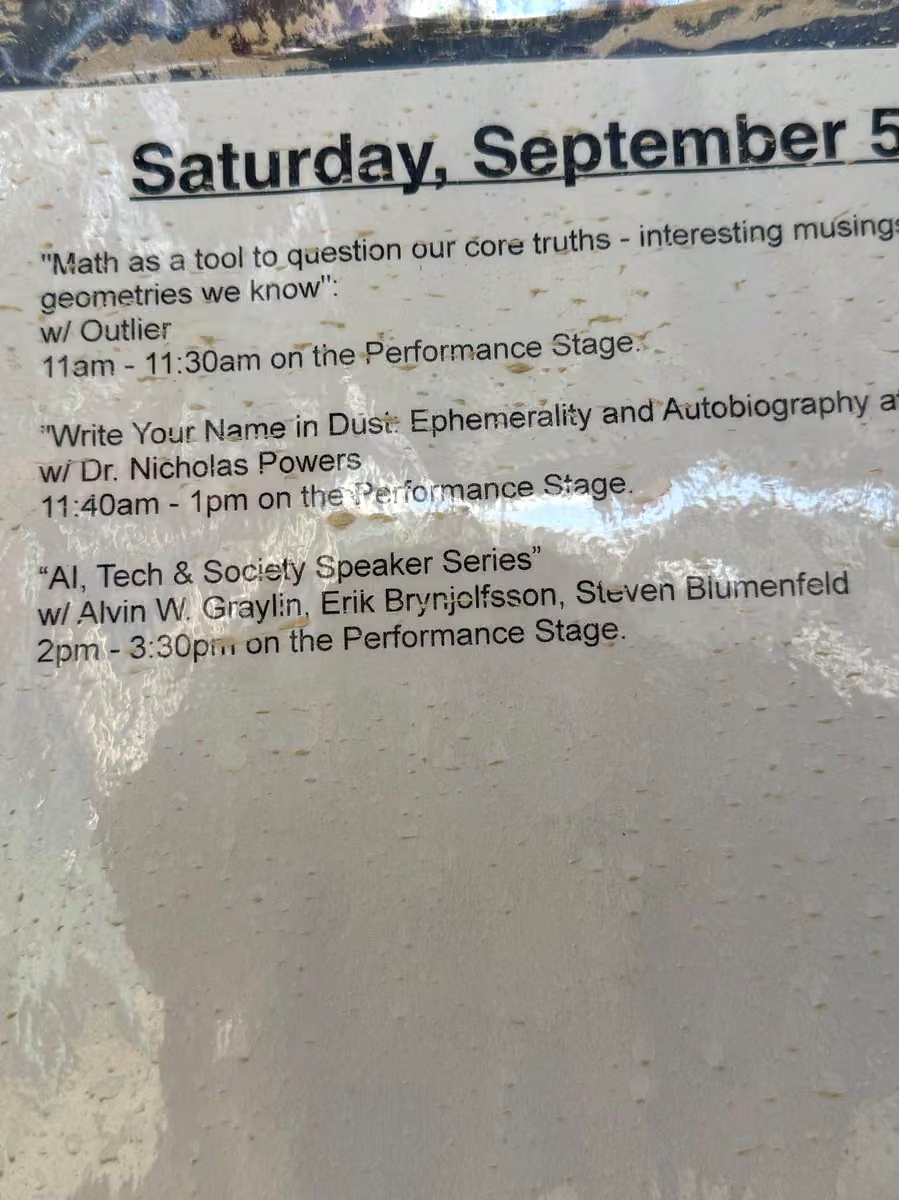
My camp at @burningman was near Center Camp, so I wandered into "AI, Tech and Society" — @AGraylin , @erikbryn and Steven Blumenfeld on stage. -
Erik Brynjolfsson reposted
Evan Hubinger
@EvanHub
Jacob is correct here—we really do earnestly believe AI could kill all humans! I personally think it is >10% within the next decade. I believe Anthropic is trying its best, but we do not yet have a plan to solve alignment for superintelligence and are not clearly on track to.
-
Erik Brynjolfsson reposted
Paul Graham
@paulg
Met Boyan Slat today. The Ocean Cleanup is already catching about 5% of the total amount of plastic flowing into the sea from all the rivers in the world, and within a few years they hope to catch a third. Impressive that a single organization could have such impact.
-
Erik Brynjolfsson
@erikbryn
This post from the Chief Scientist, of OpenAI is a must-read for anyone interested in understanding the current state of AI capabilities and safety.
Jakub Pachocki
@merettm
I wrote about the state of AI, why I’m concerned about the next few years, and the choices we need to make to keep the future in humanity’s hands.
An Alien Mind: openai.com/index/an-alien-mind/ -
Erik Brynjolfsson
@erikbryn
AI is the most important technology of our era.
I’m delighted to see so many insightful contributions to this volume that grapple with the big economic questions raised by transformative AI.
NBER
@nberpubs
New NBER Book released: The Economics of Transformative AI
www.nber.org/books-and-chapters/economics-transformative-ai
Erik Brynjolfsson
@erikbryn
It was a huge pleasure to work with @professor_ajay, @akorinek, and the terrific team at the @nberpubs and @DigEconLab to pull together this conference and volume.
Erik Brynjolfsson
@erikbryn
Table of contents:
Introduction
Ajay Agrawal, Erik Brynjolfsson, and Anton Korinek
I. Foundations of Transformative AI Economics
1. Genius on Demand: The Value of Transformative Artificial Intelligence
Ajay Agrawal, Joshua S. Gans, and Avi Goldfarb
Comment: Luis Garicano
2. Artificial Intelligence in Research and Development
Benjamin F. Jones
Comment: Bronwyn H. Hall
3. Making AI Count: The Next Measurement Frontier
Diane Coyle and John Lourenze Poquiz
Comment: Carol Corrado
II. Markets, Competition, and Organization
4. Artificial Intelligence, Competition, and Welfare
Susan Athey and Fiona Scott Morton
Comment: Catherine E. Tucker
5. An Economy of AI Agents
Gillian K. Hadfield and Andrew Koh
Comment: Kevin A. Bryan
6. The Coasean Singularity? Demand, Supply, and Market Design with AI Agents
Peyman Shahidi, Gili Rusak, Benjamin S. Manning, Andrey Fradkin, and John J. Horton
Comment: David Rothschild
7. Transformative AI and Firms
Aaron Chatterji, Daniel Rock, and Eduard Talamàs
Comment: Toby Stuart
III: Labor, Distribution, and Human Welfare
8. How Adaptable Are American Workers to AI-Induced Job Displacement?
Sam Manning and Tomás Aguirre
Comment: Dimitris Papanikolaou
9. We Won’t Be Missed: Work and Growth in the AGI World
Pascual Restrepo
Comment: Neil Thompson, Danial Lashkari, and Omeed Maghzian
10. What Is There to Fear in a Post-AGI World?
Betsey Stevenson
Comment: Ioana Marinescu
11. Algorithms as a Vehicle to Reflective Equilibrium: Behavioral Economics 2.0
Jens Ludwig, Sendhil Mullainathan, Sophia L. Pink, and Ashesh Rambachan
Comment: Abhishek Nagaraj
IV: Information, Knowledge, and Systemic Risks
12. AI’s Use of Knowledge in Society
Erik Brynjolfsson and Zoë Hitzig
Comment: Avi Goldfarb
13. Science in the Age of Algorithms
Sendhil Mullainathan and Ashesh Rambachan
Comment: Ajay Agrawal, John McHale, and Alexander Oettl
14. The Impact of AI and Digital Platforms on the Information Ecosystem
Joseph E. Stiglitz and Màxim Ventura-Bolet
Comment: Wei Li
V: Policy Responses and Long-Term Considerations
15. Public Finance in the Age of AI: A Primer
Anton Korinek and Lee M. Lockwood
Comment: Matthew Weinzierl
16. How Much Should We Spend to Reduce AI’s Existential Risk?
Charles I. Jones
Comment: Judith Chevalier -
Erik Brynjolfsson reposted
Daniel Rock
@danielrock
Fermat wasn't kidding that this didn't fit in the margin
Anthropic
@AnthropicAI
Checking that a major mathematical proof is correct can take years. Formalization—converting the mathematical reasoning into a form computer proof assistants like Lean can verify—can help.
Last month, Claude completed the first formalized proof of Fermat’s Last Theorem, one of the most famous theorems of all time. This was a project experts thought would take many years. It is the largest Lean proof ever written.
Fermat’s Last Theorem was first proven in 1995 by Sir Andrew Wiles, more than 350 years after it was conjectured. Our proof, which totals over 13 million lines of code, provides machine verification. More importantly, it proves over 29,000 other theorems that the proof requires, across many areas of math which had never before been formalized.
We see this as a major step in the long process of firming up the core of mathematical knowledge, building on work from three centuries of mathematicians and hundreds of contributors to Lean and Mathlib. We are optimistic that AI-assisted verification of mathematical proofs will help reduce the burden of refereeing mathematics in an era where more proofs are being produced than ever before.
You can read about the process on our Science Blog: www.anthropic.com/research/formalizing-fermats-last-theorem
And see the complete proof on GitHub: github.com/anthropics/fermats-last-theorem -
Andrey Fradkin
@AndreyFradkin
Those interested in making bets on explosive economic growth due to AI can now make these on Kalshi without emailing @ben_moll. Liquidity is thin, but with the right incentives / subsidies I think these markets can be highly informative.
kalshi.com/markets/kxgdpyear/annual-gdp/kxgdpyear-36
Ben Moll
@ben_moll
Some real diversity of opinion at Google DeepMind: @alexolegimas joins the bet while his colleague @SamuelAlbanie takes the other side increasing his existing stake!
Total size of pot now $425,000!
benjaminmoll.com/growth_bet/
Ben Moll
@ben_moll
Thanks to @willmacaskill, @SamuelAlbanie, @tomcohen for taking the other side of this bet at 4:1 odds and to @andrewho03 for joining on my side.
Here are the final terms we agreed on benjaminmoll.com/growth_bet/
More (within) ~7 years from now 😃
Ben Moll
@ben_moll
Would anyone like to take the other side of the following bet? I bet you (say) $25k inflation-adjusted that U.S. per capita real GDP growth will be <15% per annum in 2033 or any year before that. (15% implies a doubling time of ~5 years.)
Note: I'm extremely bullish on AI and...
Sholto Douglas
@_sholtodouglas
How fast could the economy double? TLDR, once we have good enough AI and tens of millions of robots - very fast.
As crazy as it feels now - it is worth pricing in economic doublings into your mental models of the 2030s. Strongly recommend reading this series of blog posts by Damon Binder.
Erik Brynjolfsson
@erikbryn
Awesome!
I just placed a bet. -
Erik Brynjolfsson reposted
Alvin Wang Graylin
@AGraylin
Was a bit surreal taking an interview live with @BBCNews about @OpenAI’s new Astra model while camping at @burningman. 😅
Fittingly, have been doing field research all week on the potential implications of Burning Man culture and gifting economy to an AGI enabled post-monetary world. Watch for the paper when it’s out. 💡
@DigEconLab @StanfordHAI -
Erik Brynjolfsson reposted
Max Hodak
@maxhodak_
the single thing that would most accelerate our work at @ScienceCorp_ is a connectome
the mouse is probably only ~$300M away, something highly worth funding
Google Research
@GoogleResearch
Introducing a complete map of the male fruit fly brain and central nervous system, created in partnership with @HHMIJanelia. With over 166,000 neurons, this is the largest cellular brain map to date. Learn more: goo.gle/4qQTtIW
-
Erik Brynjolfsson
@erikbryn
Very cool.
But Leif Eriksson filled in the northern part of this map for Europeans 500 years earlier, when he and his crew explored Vinland, aka Newfoundland, Canada
Marc Porter Magee 🎓
@marcportermagee
This is a better way to visualize Columbus’ voyages than the traditional way (that shows him traveling through a modern map)..
It looks a lot crazier and more daring when you see it as a trip into the unknown.This media couldn't be displayed. See it on the original post. -
Erik Brynjolfsson reposted
Noah Smith 🐇🇺🇸🇺🇦🇹🇼
@Noahpinion
The U.S. is just missing this technological revolution entirely
-
Erik Brynjolfsson reposted
Stanford Digital Economy Lab
@DigEconLab
This July, we gathered economists and tech industry leaders to talk about what "success" means when it comes to transformative AI, and how we can guide policy to get us there.
@erikbryn, @alexolegimas, Fabien Curto Millet and @zhitzig here, with more in the full YT videoThis media couldn't be displayed. See it on the original post. -
Erik Brynjolfsson reposted
Jacy Reese Anthis
@jacyanthis
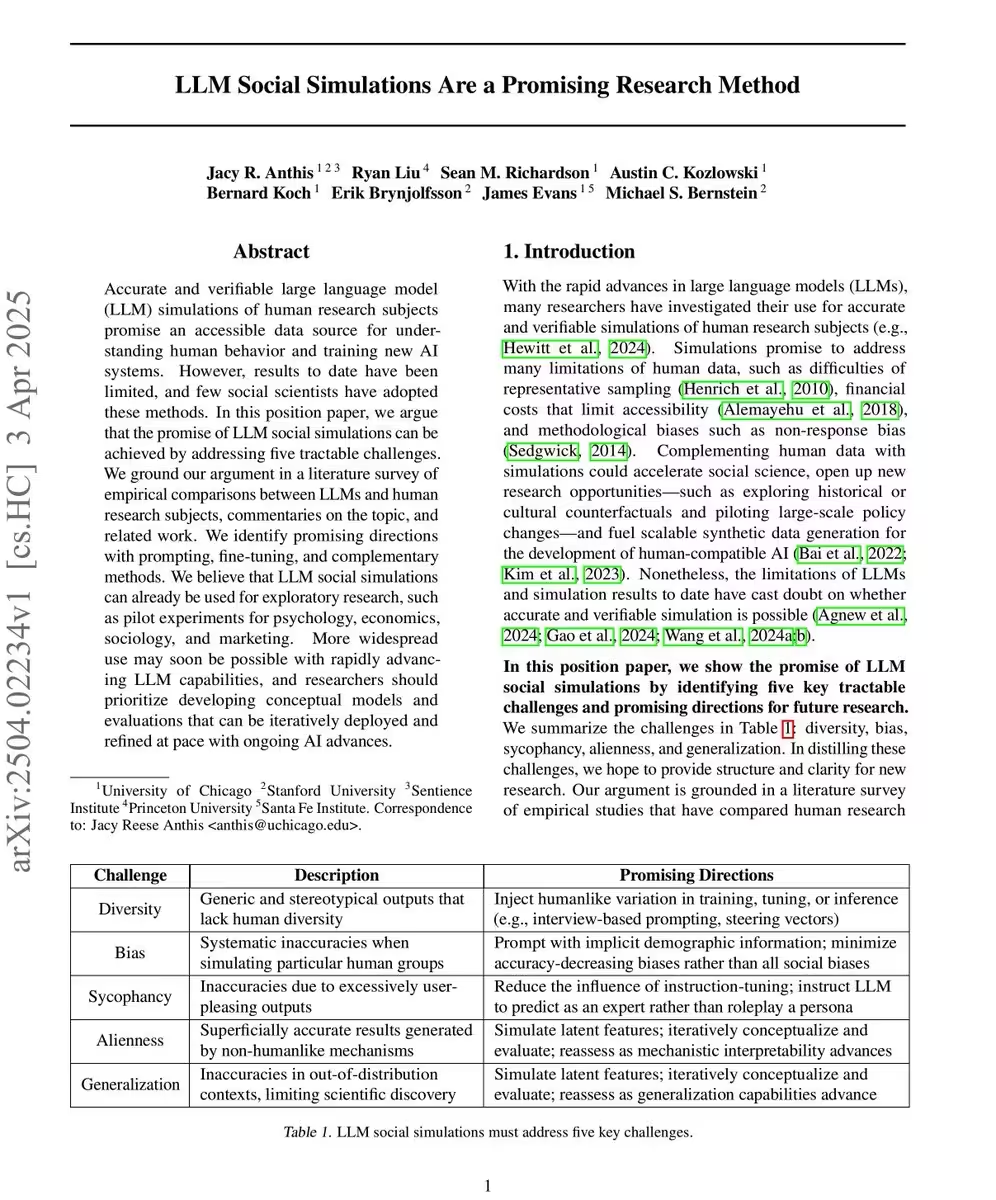
Paper forthcoming in CSCW with the brilliant @profjamesevans @ErikBryn: arxiv.org/abs/2608.24748
I encourage my social media colleagues to consider the sociology of AI safety: Factor in not only material forces and government policy, but the huge impacts of collective cognition. -
Erik Brynjolfsson
@erikbryn
It's great to see more and more people, including @BillGates, recognize that we are not prepared for the massive change that AI will bring to the economy.
I agree 100%.
It's the reason I helped organize the "We Must Act Now" statement by economists and AI researchers.
At the @DigEconLab, we are working to provide the data and insights needed to address that gap, including research Bill Gates cites in his essay.
There's so much work to do but I'm optimistic we can rise to the challenge.
The Wall Street Journal
@WSJ
"Even under the best circumstances, the transition to this new AI era will be one of the most turbulent times in human history," Bill Gates writes in a new, 12-page essay. www.wsj.com/tech/ai/three-takeaways-from-bill-gatess-5-78…
-
Erik Brynjolfsson reposted
Noah Smith 🐇🇺🇸🇺🇦🇹🇼
@Noahpinion
What a beautiful city.
-
Erik Brynjolfsson reposted
Stewart Brand
@stewartbrand
Good lord...
"21 Years Later, Steve Jobs’s Last Line at Stanford Is Still the Most Quoted Commencement Speech Ever Given"
www.19fortyfive.com/2026/08/21-years-later-steve-jobss-la… -
orph
@orph_
tyler cowen vindicated
Fireside Alpha
@firesidealpha
Sam Altman admits he was wrong on AI's timeline and says society and the economy will adapt more slowly
"I thought when we got to GPT-4, which was back in 2023, that very quickly after that there was going to be much more disruption, software businesses up for grabs right away, than it turned out to be."
"I think I was wrong about a few things, but one in terms of the speed: the economy just has so much inertia."
"People keep doing the same things, buying from the same company, wanting to use their tools the same way. I think this is actually a positive in many ways, and it's going to make this big transition go smoother and slower. I'm grateful for it."
"But it means we've all been too ambitious on timelines. Even with this incredible technology, society and the economy will adapt more slowly."This media couldn't be displayed. See it on the original post.
Erik Brynjolfsson
@erikbryn
Yep.
As @ChadSyverson, @danrock and I wrote in 2021, General purpose technologies like AI require significant complementary investments. This delays their effect on productivity and growth. We call this the Productivity J-curve.
www.aeaweb.org/articles?id=10.1257/mac.20180386 -
Erik Brynjolfsson reposted
Schmidt Sciences
@schmidtsciences
"When a technology perfectly imitates humans, it's a substitute for humans, and that drives down wages."
Economist and AI2050 Fellow @ErikBryn on "The Turing Trap," that we've built AI to copy us, when we should build it to make us more valuable. youtu.be/0gtZ9GfsB0sThis media couldn't be displayed. See it on the original post. -
Erik Brynjolfsson reposted
Alvin Wang Graylin
@AGraylin
Who’s going to @burningman this year? If you’re there please come to the fireside panel I’ll have with @erikbryn (@DigEconLab) and Steven Blumenfeld (BM CTO) on “AI, Tech and Society” at the Center Camp stage September 5th 2pm. 🔥 Will be a fun chat under the big tent. See you on the playa.
playaevents.burningman.org/playa_event/58582/
How do we reconcile rapid advances in AI with the human-centric principles of Burning Man? Join panelists Alvin W. Graylin, Erik Brynjolfsson, and Steven Blumenfeld for a candid campfire conversation on the future of AGI, the gift economy, and the role of the Burner community in shaping ethical technology for our collective future.
@mariangoodell @StanfordHAI @VRWorldSociety -
Erik Brynjolfsson reposted
Stanford Digital Economy Lab
@DigEconLab
See Gabriel's full conversation here: youtu.be/ecgQssrtrI0
And for a wide range of perspectives on TAI, visit digitalistpapers.com -
Erik Brynjolfsson reposted
Bojan Tunguz
@tunguz
He’s AI proof.
-
Erik Brynjolfsson reposted
Erik Brynjolfsson
@erikbryn
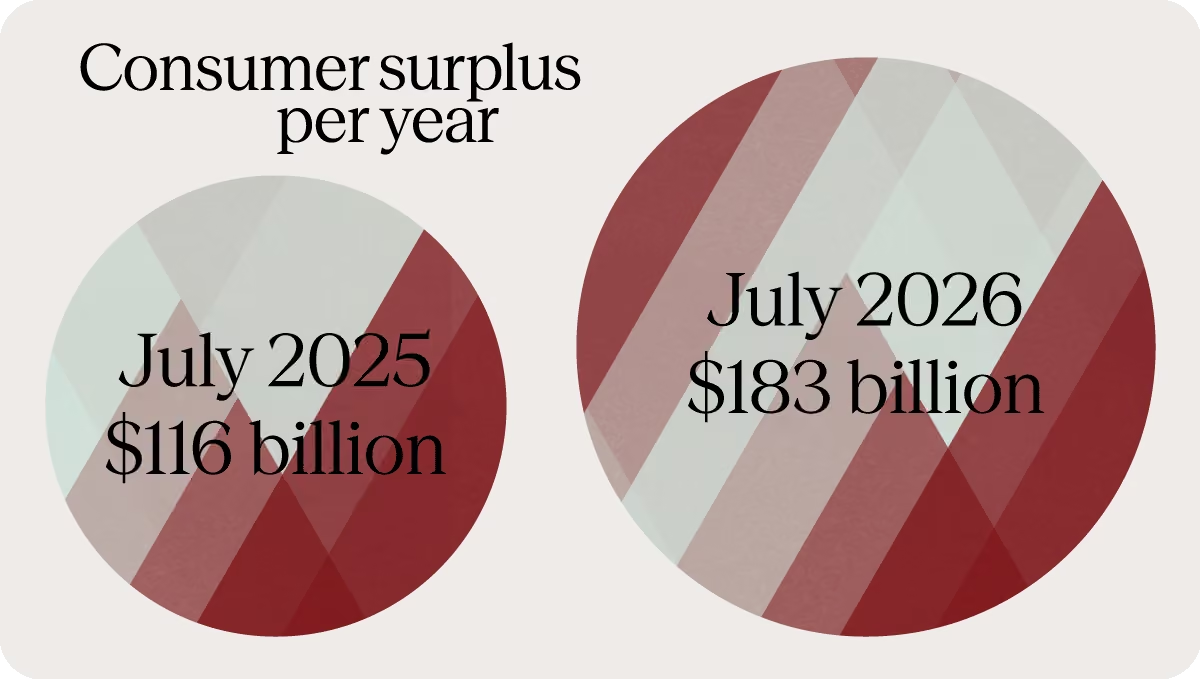
So proud of this new component of the Stanford AI Indicators.
Check it out to see what AI is worth to consumers, and how that value is changing over time.
Stanford Digital Economy Lab
@DigEconLab
What is generative AI worth?
The Indicators have a new dashboard! The GDP-B: Surplus Observer rethinks traditional measures as we track consumer surplus from generative AI tools over time. -
Erik Brynjolfsson
@erikbryn
If no one is criticizing you, you're probably not doing anything very important.
-
Erik Brynjolfsson
@erikbryn
So proud of this new component of the Stanford AI Indicators.
Check it out to see what AI is worth to consumers, and how that value is changing over time.
Stanford Digital Economy Lab
@DigEconLab
What is generative AI worth?
The Indicators have a new dashboard! The GDP-B: Surplus Observer rethinks traditional measures as we track consumer surplus from generative AI tools over time. -
The Economist
@TheEconomist
For some time Daron Acemoglu has been the colossus of economics. Give an economist a few drinks, however, and some of them will venture their true opinions about this giant, www.economist.com/finance-and-economics/2026/08/17/the-wo…
Photo: Shutterstock
Erik Brynjolfsson
@erikbryn
.@TheEconomist is a great publication, and I’ve learned a lot from it over the years. But I think it missed the mark with this article on @DAcemogluMIT.
Daron and I publicly and privately disagree on a number of important issues, most notably on the likely magnitude of AI’s productivity effects in the coming years. We’ve had many lengthy discussions about our differences, including as recently as last month.
That said, Daron is not merely one of the most intelligent, interesting, and hardworking economists I know. He is also a person of great integrity.
Since many people may form their impressions of him from this article or other public commentary, let me offer three anecdotes from my own experience.
1. In 2017, @tommmitchell and I co-chaired a @theNASciences committee on information technology and the workforce, bringing together a dozen leading scholars. Committee members were unpaid, and there was little extrinsic reward for doing more than the minimum. Everyone contributed, but unquestionably the person who worked hardest, and produced the most high-quality substantive material, was Daron. I came away enormously impressed by his seriousness and work ethic.
2. The article suggests that Daron’s stature may discourage others from criticizing him. That has not been my experience. I remember an MIT seminar where he presented an early version of his work on robots and employment. He was subjected to exceptionally tough criticism from colleagues and graduate students, especially over his instrumental variables and other aspects of his empirical strategy. It was one of the toughest seminars I can remember. Nobody was pulling punches. If anything, the criticism was blunter because everyone knew Daron was perfectly capable of handling it.
3. Along with @professor_ajay, @akorinek, and @testingham, I helped lead the recent “We Must Act Now” statement on AI (www.wemustactnow.ai). One of the first people we approached was Daron precisely because he had disagreed with me about AI capabilities and their likely economic effects. Daron and I went back and forth over the detailed wording for about a week. We ultimately found common ground. In the process, I was reminded of both his openness to new data and his attention to detail.
The Economist correctly highlights some important weaknesses in the economics profession. It should certainly scrutinize the work of prominent economists, presenting arguments and counterarguments.
In my view, what undermined their case was the article’s shift from criticizing his arguments to innuendo about Daron's personality. The suggestion that economists are unwilling to challenge him does not match what I have observed over 3 decades of knowing him.
Criticize Daron’s ideas and conclusions, as I often do. But the personal insinuations struck me as unfair. -
Erik Brynjolfsson
@erikbryn
Starting in 15 minutes...
Workhelix
@workhelix
Tomorrow: @erikbryn & @amcafee on the framework for proving AI ROI, what to measure, what most companies get wrong, and where AI is creating value traditional metrics miss. Bring your questions. Register: www.workhelix.com/the-ai-roi-gap
-
Erik Brynjolfsson reposted
Azeem Azhar
@azeem
The AI economy is real and substantial.
$110 billion in revenues in a sector that didn't exist four years ago.
And it's growing 3x faster than the internet, the mobile phone and cloud computing.
Here's an 8-minute Q&A about the state of the AI economy
cc @erikbryn @ClementDelangue @levie @GavinSBaker @pmarca @NoahpinionThis media couldn't be displayed. See it on the original post. -
Erik Brynjolfsson reposted
Peter H. Diamandis, MD
@PeterDiamandis
The Energy Bottleneck for AI today is the GRID. Interconnection queues went from 15 months twenty years ago to 45 months today.
Here's the uncomfortable truth: poles and wires have NOT become an exponential technology. Everything else in tech doubles and halves on a predictable curve. Transmission lines don't. -
Erik Brynjolfsson reposted
Schmidt Sciences
@schmidtsciences
"What's one job AI will never automate?"
Economist and AI2050 Senior Fellow @erikbryn's answer: simply being human.
As machine-made work gets cheap + plentiful, he argues, human connection becomes more valuable, not less. A hopeful take on the AI economy. youtu.be/0gtZ9GfsB0sThis media couldn't be displayed. See it on the original post. -
Erik Brynjolfsson reposted
Amjad Masad
@amasad
18x improvement in intelligence per joule in 16 months.
-
Erik Brynjolfsson
@erikbryn
.@_sholtodouglas and @DarioAmodei are right to be con concerned about AI driving an increase in the concentration of economic power.
@zhitzig and I write about the forces toward and against centralization in "AI's Use of Knowledge in Society," www.nber.org/books-and-chapters/economics-transformative-…
I discuss some alternative approaches in The Turing Trap: digitaleconomy.stanford.edu/news/the-turing-trap-the-prom…
Sholto Douglas
@_sholtodouglas
Completely false.
I like Gavin's takes, but whoever he heard this from is lying so that it fits the narrative some people so desperately want you to believe.
The same people will try to convince you Anthropic has no moat, and a sentence later that it might become so powerful it could be the only company left.
In fact, one of the things we are _most_ worried about is economic concentration of power. There is no world where the government should let any company have that much influence. We need competition and capitalism. darioamodei.com/essay/the-adolescence-of-technology
The AI market is literally the most competetive market in the world right now - every single one of the largest companies on earth is singularly focused on getting you smarter, cheaper models. If it all works out, we'll succeed in reducing the cost of everything to the cost of energy. This is awesome, but it threatens a lot of people's old moats. They are frightened.
For sure with AGI capitalism gets _super_ weird and what a company even is might look different. Good takes here: www.dwarkesh.com/p/ai-firm. -
Erik Brynjolfsson reposted
Workhelix
@workhelix
Companies see a dip in productivity metrics during AI adoption and assume it's not working. It's really a mismeasurement problem: traditional metrics can't see the value AI is creating yet.
@erikbryn & @amcafee will join us Tuesday to break down the leading indicators that show value earlier. Register: www.workhelix.com/the-ai-roi-gap -
Erik Brynjolfsson
@erikbryn
I had a great conversation with @vibhas_ratanjee about the critical blind spots hindering AI adoption.
Vibhas summarized the key insights in this terrific article in @Forbes
Here's one nugget:
"AI often accelerates many steps, but a single unchanged 'tenth step'—a legacy bottleneck—can nullify all gains, protected by ingrained habits and unmeasured intangibles."
More here: www.forbes.com/sites/vibhasratanjee/2026/08/11/every-ai-i… -
Erik Brynjolfsson
@erikbryn
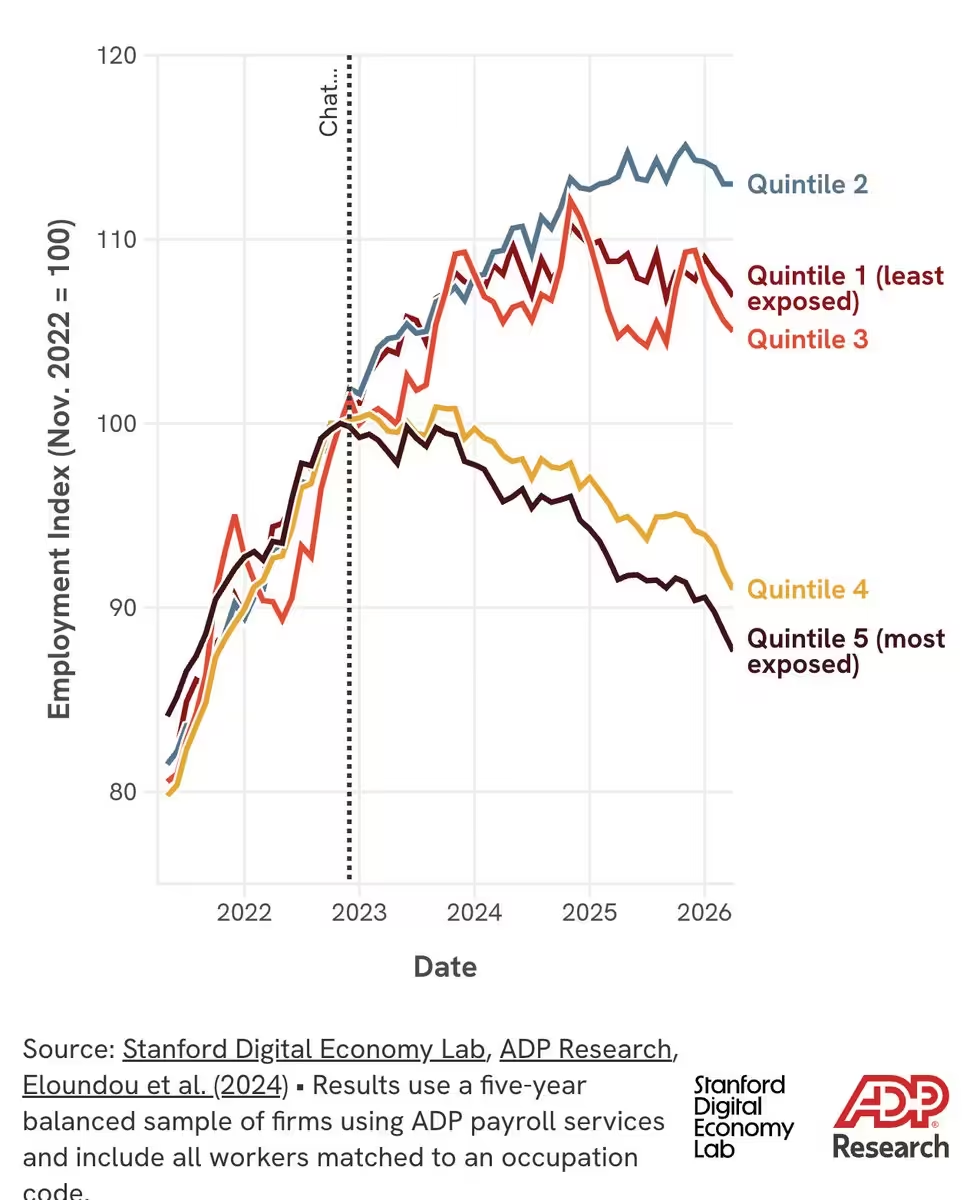
.@BharatKChandar, @RuyuChen and I just released an updated version of our paper "Canaries in the Coal Mine?"
The headline is that we still don't see any widespread job displacement due to AI, but the earlier trends we identified hold up or even grow. E.g., the relative decline for young people in AI-exposed jobs widened to 19% by June 2026, from 15% in our first wave.
We also looked at changes in interest rates, remote work, the tech sector boom and bust and remote work, but none of them seem to explain the effects we see for AI-exposed jobs.
Bharat has a great thread below with more detial. It ends with links to the new paper and to a short blog post summarizing what's new.
I'd love to hear what you think.
Bharat Chandar
@BharatKChandar
New + improved "Canaries in the Coal Mine? Six Facts About the Recent Employment Effects of Artificial Intelligence" w/ @erikbryn @RuyuChen
No widespread job displacement, but gaps for AI-exposed 22-25 y/o widened to 19% by June 2026 in ADP sample
Paper, summary ⬇️
Erik Brynjolfsson
@erikbryn
We update our results each month at the Canaries Dashboard. It's part of our new AI Economic Indicators, along with other metrics of AI's effects on the economy.
See
digitaleconomy.stanford.edu/project/indicators/ -
Erik Brynjolfsson reposted
Alex Tabarrok
@ATabarrok
I don't like these condescending posts. This person is showing ambition—using AI to take on a task they otherwise wouldn't. That's empowering. Kudos to them.
Also, this is how I read math books. We all have books that are hard for us.
Jen Rice
@jen_rice_
This @axios piece is so so so sooo humiliating 😆 we are witnessing a truly catastrophic level of societal brain rot right now
-
Erik Brynjolfsson reposted
Deena Mousa
@deenamousa
The US has a law requiring clinical trial results to be made public with a $10,000/day fine for breaking it. Despite poor adherence, the FDA has never collected.
I wrote for @DKThomp’s newsletter on what AI actually needs to cure disease (and the boring policy answers) -
Erik Brynjolfsson
@erikbryn
Here's a link to a short post summarizing the new results. It also links to the revised paper.
Thanks to all the folks who gave us feedback and suggestions over the past few months to improve the paper.
digitaleconomy.stanford.edu/news/canariesaug26/
Erik Brynjolfsson
@erikbryn
.@BharatKChandar, @RuyuChen and I just released an updated version of our paper "Canaries in the Coal Mine?"
The headline is that we still don't see any widespread job displacement due to AI, but the earlier trends we identified hold up or even grow. E.g., the relative decline for young people in AI-exposed jobs widened to 19% by June 2026, from 15% in our first wave.
We also looked at changes in interest rates, remote work, the tech sector boom and bust and remote work, but none of them seem to explain the effects we see for AI-exposed jobs.
Bharat has a great thread below with more detial. It ends with links to the new paper and to a short blog post summarizing what's new.
I'd love to hear what you think.
Bharat Chandar
@BharatKChandar
New + improved "Canaries in the Coal Mine? Six Facts About the Recent Employment Effects of Artificial Intelligence" w/ @erikbryn @RuyuChen
No widespread job displacement, but gaps for AI-exposed 22-25 y/o widened to 19% by June 2026 in ADP sample
Paper, summary ⬇️ -
Erik Brynjolfsson
@erikbryn
Four lines are trending down but one is trending up
HT: @hausfath via @Noahpinion -
Erik Brynjolfsson reposted
sarah guo
@saranormous
A super smart scientist asked me last week: what's so hard about reshoring general advanced manufacturing (short of TSMC frontier precision chemistry)? Isn't the issue just labor cost? Nope.
A toy example to illustrate: We're trying to build a lot of drone motors in America right now, and falling short. It's not a labor cost issue.
The work instruction says: this magnet, this adhesive, cure at this temperature, wipe the rotor first. Any competent team can build the station and follow it.
But in week 3, motors start failing vibration testing. Some of them, mostly night shift. Also, weirdly, whenever the careful new hire is on station.
The adhesive cures differently with humidity, and the dehumidifier cycles differently at night. The new hire wipes the rotor generously, and that leaves a solvent film the adhesive doesn't like very much. Someone who has run a motor line before can figure this out in 10m. Everyone else -- struggle city.
The "fix" is two lines in the work instructions: run the dehumidifier continuously, one solvent wipe per rotor. But those lines aren't in the work instruction, and they're not in anyone's! At best the fix becomes a corrective-action report in one line's files, linked to nothing and never read.
A motor line rapidly may go from 5 to 40 stations, each with a dozen of these painful stories on the weekly as it grows. "What Shenzhen knows" is not written down in a book whose covers can be sliced off and ingested into a model, it's a few million humidity stories stored in people, and a pace of knowledge-rich adjustment that keeps cost down and yield high. The only way to get it back is work with people who have brought up lines, to reshore and grow the ecosystem of people who have this knowledge, and to capture that knowledge as we build.
Lots of people have clever ideas about the data capture/API piece, but we think the business of manufacturing may need equal portions pain tolerance, customer commitment, and cleverness on talent.
America needs to solve the other half of reshoring. -
Erik Brynjolfsson reposted
SystemPromptIndex
@aisystemprompt
-
Erik Brynjolfsson reposted
PolicyEngine US
@PolicyEngineUS
.@thinkymachines' first model debuts on PolicyBench as the strongest American open-weight model: Inkling lands #4 of 29, computing 83.8% of US tax and benefit amounts within $1 — ahead of GPT-5.5 and every Claude.
@Alibaba_Qwen's new Qwen3.8-Max debuts #25 at 71.5%. -
Erik Brynjolfsson
@erikbryn
Wow!
Bojan Tunguz
@tunguz
Pure genius @demonflyingfox
This media couldn't be displayed. See it on the original post. -
Erik Brynjolfsson
@erikbryn
"We request that the U.S. government support an international effort to develop the technical and governance tools needed to deliberately pace the frontier of automated AI development."
- Over 1200 Top AI researchers
Erik Brynjolfsson
@erikbryn
Here's a link to the statement with the full list of signers:
www.pacingthefrontier.com -
Erik Brynjolfsson reposted
Jason Crawford
@jasoncrawford
Has anyone written about an NTSB for AI? Required disclosure of incidents, public incident database, anonymous reporting, that kind of thing
Seems like one of the best examples of systematic root-cause analysis and continually driving down error rates, asymptoting to zero
Ryan Greenblatt
@RyanGreenblatt
If there's a public incident bad enough that it'd be pretty risky/hard for OpenAI *not* to disclose it, there were almost certainly more concerning incidents internally that we never heard about.
Like, it'd be pretty surprising if the first time an AI hacks its way out of a sandbox and starts hacking other stuff, the thing it hacks is an external company rather than something inside OpenAI. First you get AIs hacking internal services (where disclosure isn't forced), and only later do you get something like this that's hard to keep quiet.
So we probably could have seen this coming—if we'd known about the worst internal incidents. If there were a list of, say, the 10 worst incidents from a misalignment and severity perspective, you could look at how bad the worst one is and how fast severity falls off from there to get a real sense of how concerning things are.
While OpenAI did disclose some earlier incidents, this was done in an ad hoc way such that we can't get a great sense of how bad things actually are. (And this was potentially too slow given how fast AI progress might go, though the delay is OK for now.) And of course, it's not clear that OpenAI is disclosing all risk-relevant details about this incident.
We can't keep depending on ad hoc, voluntary disclosure as the stakes rise. And it seems pretty straightforward to do better: companies could maintain an updated list of the ~10 worst incidents over the past few months (with some delay—perhaps 1 or 2 weeks by default—before an incident has to be added and some allowed redactions).
Better yet, a trusted third party could collect the worst incidents across all frontier companies, with a whistleblowing mechanism so employees can flag when the provided list/descriptions seriously misrepresent reality (and more generally avoid spin). A third party could also anonymize incidents—which also removes the incentive for companies to bury their heads in the sand. -
Erik Brynjolfsson reposted
Erik Brynjolfsson
@erikbryn
Starting in 30 minutes...
Erik Brynjolfsson
@erikbryn
Please join us at 12noon ET when @NelaRichardson, @BharatKChandar, @RuyuChen, @connacher_ and I discuss the latest information about AI and the labor market from the @DigEconLab
You can ask us questions during the webinar or post them in this thread.
Details below.
Stanford Digital Economy Lab
@DigEconLab
The latest update to the AI Economic Indicators went live this morning with a big expansion to the Canaries Dashboard!
Join our webinar with @erikbryn and @NelaRichardson of @ADP at 9am PT / 12pm ET to learn what the data are saying: digitaleconomy.stanford.edu/event/tracking-ais-impact-a-b… -
Erik Brynjolfsson
@erikbryn
Another reminder that we don't (yet?) know how to reliably control powerful AI systems.
Financial Times
@FT
OpenAI said the ‘agent’ escaped a testing environment, gained internet access, stole login credentials and hacked into the start-up Hugging Face by itself — one of the first public examples of a cyber attack by an AI system acting outside human control. ft.trib.al/Op3fhwC
-
Erik Brynjolfsson reposted
Workhelix
@workhelix
200+ economists. 16 Nobel laureates. When that many experts across the ideological spectrum agree on something, it's not noise, it's signal. Worth watching why @erikbryn thinks this matters.
Stanford Digital Economy Lab
@DigEconLab
The power of a statement isn't just in what it says, but who's saying it.
Watch @erikbryn on why it matters that 200+ economists — including 16 Nobel laureates — signed "We Must Act Now."
wemustactnow.aiThis media couldn't be displayed. See it on the original post. -
Erik Brynjolfsson reposted
Stanford Digital Economy Lab
@DigEconLab
Where does your career go in an AI world?
Lab Director @ErikBryn joins today's episode of Silicon Valley Girl, with advice on how AI is reshaping jobs and what you can do about it.
Listen on Apple: podcasts.apple.com/us/podcast/stanfords-ai-economist-the-… -
Erik Brynjolfsson reposted
Workhelix
@workhelix
Don't miss @erikbryn at @Ai4Conferences on Aug 6: "Know and Grow the ROI of AI." He'll cover finding high-value AI use cases, measuring ROI with real data, and scaling past scattered pilots.
Want real-time visibility into your own AI transformation? Find us at Booth 530. -
Erik Brynjolfsson reposted
Stanford Digital Economy Lab
@DigEconLab
WEBINAR THIS WED 7/22: Exploring the AI Economic Indicators and a Canaries update
@erikbryn, @NelaRichardson of @ADP, and the Indicators team unpack the platform, including a big update to the Canaries results!
Info and free registration here: digitaleconomy.stanford.edu/event/tracking-ais-impact-a-b… -
Erik Brynjolfsson
@erikbryn
Very kind of you, @GarettJones!
And I'm glad to see the wear & tear on the book :)
Garett Jones
@GarettJones
Finished re-reading the tremendous Second Machine Age.
I assign to my MA macro students because:
1. It's right
2. It shows how research takes years--even decades--to break into public debate
3. It uses the economic way of thinking throughout
Thank you, @erikbryn and @amcafee! -
Erik Brynjolfsson reposted
Hoover Institution
@HooverInst
US visas issued to international students fell by roughly a third in 2025. Today, DHS finalized changes to a rule known as "Duration of Status" — a move that will help lock that decline in place. The fallout for the STEM workforce, innovation, and economic growth could be severe.
A sustained one-third decline in foreign STEM graduates entering the US labor force would shrink the high-skill STEM workforce by 6.2% overall and by 11.5% at the PhD level. Over a decade, that would cut annual US GDP by $240 billion to $481 billion, comparable to losing an entire state's economy.
That's the estimate from @AmyMNice, in a guest research brief for Hoover's Immigration Initiative, drawing on research she co-authored with @m_clem and @JeremyLNeufeld.
Read the full brief: www.hoover.org/research/breaking-front-door-international… -
Erik Brynjolfsson reposted
Stanford Digital Economy Lab
@DigEconLab
This week's episode of Hard Fork unpacks "the loudest warning yet about AI and jobs" with Lab Director @erikbryn!
Listen on Apple: podcasts.apple.com/us/podcast/the-a-i-trade-secrets-war-e…
Listen on Spotify: open.spotify.com/episode/5IAn9IcHEa1zFaOLJ848Nb -
Erik Brynjolfsson reposted
Shane Barnhill
@shanebarnhill
Really enjoyed @kevinroose and @CaseyNewton interviewing @erikbryn on the latest Hard Fork podcast. It’s worth a listen. I share Erik’s perspective that effective managers should be looking at ways to use AI for growth, rather than cost cutting:
www.nytimes.com/2026/07/17/podcasts/hardfork-ai-trade-sec… -
Erik Brynjolfsson
@erikbryn
I love the vision from Thinking Machines Lab.
Kudos @miramurati and @johnschulman2 and the team at @thinkymachines
Erik Brynjolfsson
@erikbryn
More here: thinkingmachines.ai/blog/the-future-worth-building-is-human/
Erik Brynjolfsson
@erikbryn
It's very much in the spirit of what I wrote in "The Turing Trap":
digitaleconomy.stanford.edu/news/the-turing-trap-the-prom…
And with @zhitzig in "AI's Use of Knowledge in Society":
www.nber.org/books-and-chapters/economics-transformative-… -
Erik Brynjolfsson
@erikbryn
Kudos to @demishassabis and @elonmusk for finding some common ground.
-
Erik Brynjolfsson reposted
Wajeeha Ahmad
@wajeeha__ahmad
Earlier this summer, I defended my dissertation!
I'm incredibly grateful to my dissertation committee, @erikbryn, Chuck Eesley and @erichorvitz, all of whom were amazing advisors and mentors throughout my time at Stanford.
A huge thank you also to @Ananya_Sen_ for being a splendid co-author and mentor; to my examiners, @rameshjohari and @Diyi_Yang, who generously gave me thoughtful and thought-provoking feedback on my work; and to all colleagues and friends from @StanfordEng, @DigEconLab, @ECorner and the wider @StanfordHAI ecosystem.
Next up, I'm excited to be joining @Columbia_Biz as an Assistant Professor this summer and joining a wonderful set of new colleagues! -
Erik Brynjolfsson
@erikbryn
Congrats, @wajeeha__ahmad!
You've done such amazing work at Stanford and the @DigEconLab.
Wajeeha Ahmad
@wajeeha__ahmad
Earlier this summer, I defended my dissertation!
I'm incredibly grateful to my dissertation committee, @erikbryn, Chuck Eesley and @erichorvitz, all of whom were amazing advisors and mentors throughout my time at Stanford.
A huge thank you also to @Ananya_Sen_ for being a splendid co-author and mentor; to my examiners, @rameshjohari and @Diyi_Yang, who generously gave me thoughtful and thought-provoking feedback on my work; and to all colleagues and friends from @StanfordEng, @DigEconLab, @ECorner and the wider @StanfordHAI ecosystem.
Next up, I'm excited to be joining @Columbia_Biz as an Assistant Professor this summer and joining a wonderful set of new colleagues! -
Erik Brynjolfsson reposted
Mira Murati
@miramurati
Our first model, Inkling. Trained from scratch, weights are open, fine-tunable on Tinker today.
Thinking Machines
@thinkymachines
Today, we are introducing Inkling.
Inkling reasons efficiently across text, image, and audio modalities. We are making the full weights available.
thinkingmachines.ai/news/introducing-inkling/
Available today for fine-tuning on Tinker. Play with it in the Inkling Playground. 🧵 -
Erik Brynjolfsson reposted
Aspen Economic Strategy Group
@AspenEcon
Hear more from @erikbryn on the economic policy response to AI-driven disruption at the AESG’s August 5 event, The American Economy in a New Era. He’ll join Lazard’s Peter Orszag in a discussion moderated by @kearney_melissa.
Register for the livestream here: aspenesg.wufoo.com/forms/q1vg9e7z0dxpv6b/.
Erik Brynjolfsson
@erikbryn
Here's our statement on AI and the economy.
We Must Act Now
A Statement on AI’s Transformation of the Economy
1. AI may become radically more powerful over the next 10 years.
2. This could drive an unprecedented transformation of our economy, larger than the Industrial Revolution, but unfolding over a vastly shorter time frame. It could bring risks, including large-scale job displacement, as well as opportunities such as major gains in living standards.
3. Economists, policymakers and technology leaders must act now to understand the economics of transformative AI and to build the incentives, guardrails, and institutions needed to steer AI in a direction that complements humans and benefits society. -
Erik Brynjolfsson
@erikbryn
Congrats, @ufukakcigit !
Jon Hartley
@Jon_Hartley_
Congrats to @UfukAkcigit on becoming the @WorldBank's new Deputy Chief Economist and Director of Private Markets. Ufuk's research has fundamentally changed how we think about innovation, firm dynamics, creative destruction, & long-run economic growth economics.uchicago.edu/directory/ufuk-akcigit
-
Erik Brynjolfsson reposted
Peter McCrory
@PeterMcCrory
The exact shape of our economic futures is ours to choose.
It is important to take seriously how consequential—and fast-moving—AI is for work, growth, & the economy.
I was glad to sign this letter & am grateful to @erikbryn @professor_ajay @akorinek @testingham for organizing.
Erik Brynjolfsson
@erikbryn
Here's our statement on AI and the economy.
We Must Act Now
A Statement on AI’s Transformation of the Economy
1. AI may become radically more powerful over the next 10 years.
2. This could drive an unprecedented transformation of our economy, larger than the Industrial Revolution, but unfolding over a vastly shorter time frame. It could bring risks, including large-scale job displacement, as well as opportunities such as major gains in living standards.
3. Economists, policymakers and technology leaders must act now to understand the economics of transformative AI and to build the incentives, guardrails, and institutions needed to steer AI in a direction that complements humans and benefits society. -
Erik Brynjolfsson reposted
Stanford Digital Economy Lab
@DigEconLab
The power of a statement isn't just in what it says, but who's saying it.
Watch @erikbryn on why it matters that 200+ economists — including 16 Nobel laureates — signed "We Must Act Now."
wemustactnow.aiThis media couldn't be displayed. See it on the original post. -
Erik Brynjolfsson reposted
Ethan Mollick
@emollick
This seems like a reasonable statement: it seems self-evident that we do not know the impact of AI on work & trying to understand that will be critical to policies to mitigate bad impacts and encourage good ones. Data will be critical to action & we need to start gathering it now
Erik Brynjolfsson
@erikbryn
Here's our statement on AI and the economy.
We Must Act Now
A Statement on AI’s Transformation of the Economy
1. AI may become radically more powerful over the next 10 years.
2. This could drive an unprecedented transformation of our economy, larger than the Industrial Revolution, but unfolding over a vastly shorter time frame. It could bring risks, including large-scale job displacement, as well as opportunities such as major gains in living standards.
3. Economists, policymakers and technology leaders must act now to understand the economics of transformative AI and to build the incentives, guardrails, and institutions needed to steer AI in a direction that complements humans and benefits society. -
Erik Brynjolfsson reposted
Molly Kinder
@Mollykinder
I was happy to sign this statement and pleased to see the leadership and momentum behind it.
Here’s my own two cents to add to it, from here in DC.
I don’t think policymakers’ job is limited to steering AI. What flows from the first two statements is a generational challenge: policymakers need to lead a robust policy response commensurate with the scale of future AI disruption.
Erik Brynjolfsson
@erikbryn
Here's our statement on AI and the economy.
We Must Act Now
A Statement on AI’s Transformation of the Economy
1. AI may become radically more powerful over the next 10 years.
2. This could drive an unprecedented transformation of our economy, larger than the Industrial Revolution, but unfolding over a vastly shorter time frame. It could bring risks, including large-scale job displacement, as well as opportunities such as major gains in living standards.
3. Economists, policymakers and technology leaders must act now to understand the economics of transformative AI and to build the incentives, guardrails, and institutions needed to steer AI in a direction that complements humans and benefits society. -
Erik Brynjolfsson reposted
Ajay Agrawal
@professor_ajay
Things are moving fast. We need to better understand what is happening.
digitaleconomy.stanford.edu/news/wemustactnow/ -
Erik Brynjolfsson reposted
Gita Gopinath
@GitaGopinath
I signed this statement. The capabilities of AI models really jumped end-2025 and now exceptional disruptions and exceptional rewards seem more probable. Urgent thought and action needed, including on global governance. Thanks to @erikbryn, Ajay Agrawal, @akorinek, @testingham for putting out the call.
Erik Brynjolfsson
@erikbryn
We must act now.
AI capabilities are advancing far faster than our understanding of the economic implications.
We must act now to guide AI to complement humans rather than simply imitate them — and to generate prosperity for the many, not just the few.
I'm delighted that 16 Nobel Laureates, over 200 top economists, and top AI researchers agree and signed our statement on transformative AI.
1/n -
Erik Brynjolfsson reposted
Erik Brynjolfsson
@erikbryn
It's awesome to have you as a co-signer of the statement, Daron. I always enjoy discussing this topic with you.
We've both long made the case that the greatest upside is in having AI complement people and help us do new things, rather than simply replacing workers.
It's gratifying that so many fellow economists and AI leaders publicly agree. -
Erik Brynjolfsson reposted
Daron Acemoglu
@DAcemogluMIT
Why did I sign this statement?
First, I had a hand in revising it, after the organizers reached out to me. I did not feel like I could sign the initial version, but I felt that finding a statement that would reflect the overlapping views of a number of AI researchers, economists, and social scientists was important.
Second, I agree with much of the revised text. Indeed, there is a possibility (or perhaps more than a possibility) that AI may become more powerful over the next 10 years. I’m still not convinced that we are going to see the very large productivity gains that industry insiders are predicting. But more powerful AI may (again no certainty, just may) lead to significant job displacement. This is a big economic and social risk.
It could also have myriad consequences on human cognition, starting with K-12 and all the way to advanced science. Some of these consequences are good, some of them are dangerous.
Third, while I do not like the comparison to the Industrial Revolution that much (feels like comparing apples to oranges to me), it is true that AI will have complex effects on the economy.
Finally and most importantly, I wholeheartedly agree with the ending: “to build the incentives, guardrails, and institutions needed to steer AI in a direction that complements humans and benefits society.”
This is what I have been arguing for over a decade now. Good AI needs to complement humans, and this requires a redirection, because the current focus on AGI is, in all but name, an agenda for displacing humans from meaningful work. That’s why steering AI must be a first priority.
I’m happy that many thought leaders have agreed.
Erik Brynjolfsson
@erikbryn
Here's our statement on AI and the economy.
We Must Act Now
A Statement on AI’s Transformation of the Economy
1. AI may become radically more powerful over the next 10 years.
2. This could drive an unprecedented transformation of our economy, larger than the Industrial Revolution, but unfolding over a vastly shorter time frame. It could bring risks, including large-scale job displacement, as well as opportunities such as major gains in living standards.
3. Economists, policymakers and technology leaders must act now to understand the economics of transformative AI and to build the incentives, guardrails, and institutions needed to steer AI in a direction that complements humans and benefits society. -
Daron Acemoglu
@DAcemogluMIT
Why did I sign this statement?
First, I had a hand in revising it, after the organizers reached out to me. I did not feel like I could sign the initial version, but I felt that finding a statement that would reflect the overlapping views of a number of AI researchers, economists, and social scientists was important.
Second, I agree with much of the revised text. Indeed, there is a possibility (or perhaps more than a possibility) that AI may become more powerful over the next 10 years. I’m still not convinced that we are going to see the very large productivity gains that industry insiders are predicting. But more powerful AI may (again no certainty, just may) lead to significant job displacement. This is a big economic and social risk.
It could also have myriad consequences on human cognition, starting with K-12 and all the way to advanced science. Some of these consequences are good, some of them are dangerous.
Third, while I do not like the comparison to the Industrial Revolution that much (feels like comparing apples to oranges to me), it is true that AI will have complex effects on the economy.
Finally and most importantly, I wholeheartedly agree with the ending: “to build the incentives, guardrails, and institutions needed to steer AI in a direction that complements humans and benefits society.”
This is what I have been arguing for over a decade now. Good AI needs to complement humans, and this requires a redirection, because the current focus on AGI is, in all but name, an agenda for displacing humans from meaningful work. That’s why steering AI must be a first priority.
I’m happy that many thought leaders have agreed.
Erik Brynjolfsson
@erikbryn
Here's our statement on AI and the economy.
We Must Act Now
A Statement on AI’s Transformation of the Economy
1. AI may become radically more powerful over the next 10 years.
2. This could drive an unprecedented transformation of our economy, larger than the Industrial Revolution, but unfolding over a vastly shorter time frame. It could bring risks, including large-scale job displacement, as well as opportunities such as major gains in living standards.
3. Economists, policymakers and technology leaders must act now to understand the economics of transformative AI and to build the incentives, guardrails, and institutions needed to steer AI in a direction that complements humans and benefits society.
Erik Brynjolfsson
@erikbryn
It's awesome to have you as a co-signer of the statement, Daron. I always enjoy discussing this topic with you.
We've both long made the case that the greatest upside is in having AI complement people and help us do new things, rather than simply replacing workers.
It's gratifying that so many fellow economists and AI leaders publicly agree. -
Erik Brynjolfsson reposted
Ronnie Chatterji
@RonnieChatterji
Thanks to @erikbryn and team for organizing this letter, which I signed along with a wide variety of economists and tech leaders. Glad we are working together on this important agenda,
Erik Brynjolfsson
@erikbryn
We must act now.
AI capabilities are advancing far faster than our understanding of the economic implications.
We must act now to guide AI to complement humans rather than simply imitate them — and to generate prosperity for the many, not just the few.
I'm delighted that 16 Nobel Laureates, over 200 top economists, and top AI researchers agree and signed our statement on transformative AI.
1/n -
Erik Brynjolfsson reposted
Yoshua Bengio
@Yoshua_Bengio
If the trajectories of AI development observed for several years now continue, it is highly plausible that AI will drastically transform our economies. We must be intentional and make collective, democratic choices, rather than letting market forces play out and risking leaving most citizens behind. www.wemustactnow.ai
Stanford Digital Economy Lab
@DigEconLab
Sixteen Nobel laureates are among the over 200 economists and AI researchers who've signed "We Must Act Now: A Statement on AI’s Transformation of the Economy."
Read the statement and view signatories at wemustactnow.ai -
Erik Brynjolfsson
@erikbryn
Here's our statement on AI and the economy.
We Must Act Now
A Statement on AI’s Transformation of the Economy
1. AI may become radically more powerful over the next 10 years.
2. This could drive an unprecedented transformation of our economy, larger than the Industrial Revolution, but unfolding over a vastly shorter time frame. It could bring risks, including large-scale job displacement, as well as opportunities such as major gains in living standards.
3. Economists, policymakers and technology leaders must act now to understand the economics of transformative AI and to build the incentives, guardrails, and institutions needed to steer AI in a direction that complements humans and benefits society.
Erik Brynjolfsson
@erikbryn
If you agree and would like to add your name, you can sign here:
www.wemustactnow.ai -
Erik Brynjolfsson
@erikbryn
We must act now.
AI capabilities are advancing far faster than our understanding of the economic implications.
We must act now to guide AI to complement humans rather than simply imitate them — and to generate prosperity for the many, not just the few.
I'm delighted that 16 Nobel Laureates, over 200 top economists, and top AI researchers agree and signed our statement on transformative AI.
1/n
Erik Brynjolfsson
@erikbryn
Here's the statement: www.wemustactnow.ai
We Must Act Now
A Statement on AI’s Transformation of the Economy
1. AI may become radically more powerful over the next 10 years.
2. This could drive an unprecedented transformation of our economy, larger than the Industrial Revolution, but unfolding over a vastly shorter time frame. It could bring risks, including large-scale job displacement, as well as opportunities such as major gains in living standards.
3. Economists, policymakers and technology leaders must act now to understand the economics of transformative AI and to build the incentives, guardrails, and institutions needed to steer AI in a direction that complements humans and benefits society.
It was organized by Ajay Agrawal, @akorinek, @testingham and me. -
Erik Brynjolfsson
@erikbryn
Looking forward to this conversation!
Aspen Economic Strategy Group
@AspenEcon
Register today for the AESG’s upcoming event, The American Economy in a New Era.
As the economy enters a new era – driven by advances in AI, shifts in global trade, and ongoing geopolitical tensions – how can policymakers and business leaders promote broad-based domestic growth and America’s global economic competitiveness?
This event will feature Stanford University's @erikbryn and Lazard's Peter Orszag in conversation with AESG Director @kearney_melissa.
🗓️ August 5, 2026
🕞 3:30 - 4:30 p.m. ET
👉Register here: aspenesg.wufoo.com/forms/q1vg9e7z0dxpv6b/. -
Erik Brynjolfsson reposted
Blake Scholl 🛫
@bscholl
People are dying in Kyiv because it takes Lockheed more two years to make a Patriot missile.
Missile parts are made in hundreds of baby factories scattered across congressional districts.
We have a Congressionally-optimized supply chain which can’t win a war. -
Erik Brynjolfsson reposted
Stanford Digital Economy Lab
@DigEconLab
Happy Monday! Some recent news stories…
🧵 1/10 -
Erik Brynjolfsson reposted
Erling Haaland
@Erling
Worth the 28-year wait! 🇳🇴❤️
-
Erik Brynjolfsson reposted
Nicholas Decker
@captgouda24
Obamacare required that all people purchase insurance, in order to balance out the banning discrimination based on health status. Was this good? Answering that question directly is difficult; what we can use instead was Massachusetts' similar reform in 2006, four years prior. 1/
-
Erik Brynjolfsson reposted
Aakash Gupta
@aakashgupta
Taiwan solved tax evasion in 1951 with a trick so cheap it should embarrass every tax authority on the planet.
The problem was an all-cash economy full of small shops. A merchant pockets the cash, skips the receipt, and the sale never existed. Auditors can't catch what was never recorded, and hiring enough of them to watch every noodle stand costs more than the missing tax.
So finance chief Ren Xianqun flipped the incentive. Print a lottery number on every receipt. Draw winners every two months on live TV. Top prize today: NT$10 million, about $310K.
Suddenly the customer and the shopkeeper want opposite things. The merchant wants the sale off the books. The customer wants the ticket. And there are millions more customers than merchants. Every transaction now carries a built-in witness demanding the paper trail.
Year one, reported tax revenue jumped 75%, from NT$29 million to NT$51 million. Seventy-five years later, roughly 70% of Taiwanese still play. Convenience stores redeem the smallest NT$200 prizes at the register, so even a coffee receipt feels like a scratch card.
The elegant part is what the audit force costs. The prize pool runs about NT$7 billion a year, roughly $20 million. In exchange, the government gets 23 million unpaid auditors working every checkout line in the country, forever. No inspector general on earth delivers that coverage at that price.
Greece, Italy, Portugal, and Slovakia all copied it. The most effective compliance tool ever built looks like a game, and that's exactly why it works.
CR1337
@CR1337
In order to prevent stores from evading taxes, every receipt in Taiwan is automatically a lottery ticket, too, which can win up to $300k, turning customers into voluntary tax auditors:
-
Erik Brynjolfsson
@erikbryn
-
Erik Brynjolfsson reposted
Mira Murati
@miramurati
Bridgewater used their unique financial knowledge and partnered with us on @tinkerapi to fine-tune a model that helps their analysts focus on what's important. Experts improving AI that empowers experts.
thinkingmachines.ai/news/learning-to-replicate-expert-jud… -
Erik Brynjolfsson reposted
Zora Wang
@ZhiruoW
Diyi is sharing a lot of insights! Now in Harbor A-C
Diyi Yang
@Diyi_Yang
Happening soon at Harbor A-C 😊
Diyi Yang
@Diyi_Yang
Our tutorial on "Future of Work with AI Agents" is happening tomorrow
📍 July 2, 9:00–12:30 PT, San Diego #acl2026
With Zora Wang @ZhiruoW Yijia Shao @EchoShao8899 , we'll cover:
1⃣The landscape of work agents: reality checks, key NLP challenges & open research questions
2⃣Building AI agents for work: harnesses for long-horizon tasks, continual-learning environments, training backbone LMs
3⃣Evaluating AI agents at work: datasets & metrics for lab and production, plus human-agent collaboration -
Erik Brynjolfsson reposted
Diyi Yang
@Diyi_Yang
🔥 We'll close with a panel on the societal & economic impact of AI, featuring economists and researchers in NLP, economics and labor market! @erikbryn @Alex_M_Richmond
See you all there 🤩 -
Erik Brynjolfsson reposted
Diyi Yang
@Diyi_Yang
Our tutorial on "Future of Work with AI Agents" is happening tomorrow
📍 July 2, 9:00–12:30 PT, San Diego #acl2026
With Zora Wang @ZhiruoW Yijia Shao @EchoShao8899 , we'll cover:
1⃣The landscape of work agents: reality checks, key NLP challenges & open research questions
2⃣Building AI agents for work: harnesses for long-horizon tasks, continual-learning environments, training backbone LMs
3⃣Evaluating AI agents at work: datasets & metrics for lab and production, plus human-agent collaboration -
Erik Brynjolfsson
@erikbryn
Looking forward to participating in this amazing tutorial!
Zora Wang
@ZhiruoW
We're officially 3 days away from our #acl2026 tutorial: "Future of Work in the Age of LLMs"! 🎉
📍 July 2, 9:00-12:30 PT, San Diego
@Diyi_Yang kicks us off with an overview of the landscape of work agents: agent reality check, major NLP challenges, and the key research questions ahead
@ZhiruoW dives into building agent harnesses and training backbone LMs, as well as future building directions
@EchoShao8899 walks through designing datasets and metrics for evaluating AI agents at work
💡We close with a panel discussion on the societal & economic impact of AI, featuring economists and researchers from Stanford, MIT, and OpenAI: @erikbryn, @Alex_M_Richmond, Thomas Malone, and David
Nguyen
See you in San Diego! 🌊 -
Erik Brynjolfsson reposted
Stanford Digital Economy Lab
@DigEconLab
"Beyond the corpus of current human achievement, he said, exists 'this much bigger space, bigger than you know, as big as you can imagine, of things that have never been done before.'"
Read @TheAtlantic's @AnnieLowrey profile on @erikbryn:
www.theatlantic.com/ideas/2026/06/erik-brynjolfsson-the-m… -
Erik Brynjolfsson reposted
Cardiff Garcia
@CardiffGarcia
A truly striking chart in @jburnmurdoch's latest (link next):
-
Erik Brynjolfsson
@erikbryn
What an amazing collection of data about the GenAI Economy!
Kudos to @azeem and his team.
Azeem Azhar
@azeem
The GenAI economy has generated $110 billion in sales over the past 12 months. It is growing fast. On an annualized basis, the revenue run rate exceeds $175 billion.
These numbers took us several months to construct, and as far as we know, it’s the first bottom-up, deduplicated measure of consumer and enterprise AI spending across the full stack.
We are releasing this research today in our first The State of the AI Economy report.
intelligence.exponentialview.co -
Erik Brynjolfsson
@erikbryn
It's always such fun to talk with @JimPethokoukis. Here's our lively conversation about AI and the Future of Work.
James Pethokoukis ⏩️⤴️
@JimPethokoukis
✨💪 AI, jobs, and productivity: My podcast chat with economist Erik Brynjolfsson
@erikbryn
fasterplease.substack.com/p/ai-jobs-and-productivity-my-chat -
Erik Brynjolfsson reposted
Stanford Digital Economy Lab
@DigEconLab
Lab Research Manager @connacher_ appeared on Marketplace Tech this morning to discuss the AI Economic Indicators!
As project lead, Connacher's been building an amazing, growing platform to help workers, employers, and policymakers understand AI's impact.
podcasts.apple.com/us/podcast/stanford-launches-ai-econom… -
Erik Brynjolfsson reposted
Nicholas Kristof
@NickKristof
What is going on in Afghanistan right now under the Taliban in the way women and girls are treated is horrifying in every way. And when girls are so mistreated, the entire society suffers.
Kenneth Roth
@KenRoth
The brutal reality of the Taliban’s new marriage law: The latest decree from Afghanistan’s rulers makes it impossible for women and girls to leave unwanted or abusive relationships, even with family support. www.theguardian.com/global-development/2026/jun/23/taliba…
-
Erik Brynjolfsson reposted
Ali Debow
@ali_debow
We're excited to announce a $4M Seed round led by @GameChangersVC, with support from incredible investors including @scooterbraun, @GuyOseary, @stellation, @SignalFire, @MaCVentureCap, and others.
A few years ago, while hosting community events and testing early products, my co-founders @WeilynChong, @NathanAhn, and I noticed a consistent pattern.
After every event, people asked the same questions:
Where are the photos? Who captured that moment? How do I reconnect with the people I met?
fortune.com/2026/06/16/photo-sharing-app-swsh-scooter-bra… -
Erik Brynjolfsson
@erikbryn
If you haven't bought a copy yet, and one for your best friend, it's still not too late!
Adam Ozimek
@ModeledBehavior
I bet if you reread @erikbryn and @amcafee's 2014 book in light of what we've experienced so far with AI the prescience is off the charts.
en.wikipedia.org/wiki/The_Second_Machine_Age -
Erik Brynjolfsson
@erikbryn
Very persuasive
Kobi Hackenburg
@KobiHackenburg
New w/ @AISecurityInst & @UniofOxford:
Frontier AI can now out-persuade expert humans in conversation - incl. world-champ debaters and professional canvassers.
This held even when humans chose their topics, prepared in advance, and competed for £1,000 prizes 🧵 -
Erik Brynjolfsson reposted
Stanford Digital Economy Lab
@DigEconLab
The Transformation Tracker is part of the AI Economic Indicators project! It tracks progress toward transformative AI: a technology-powered economic transformation at least as significant as the Industrial Revolution but unfolding in a vastly shorter time.
transformation.stanford.edu -
Erik Brynjolfsson reposted
James Pethokoukis ⏩️⤴️
@JimPethokoukis
Meet the world’s top AI-pilled economists
"This year the NBER is likely to host more conferences on health care than on AI. But some academic economists have seized the AI opportunity."
@TheEconomist -
Erik Brynjolfsson reposted
Boston Police Dept.
@bostonpolice
Community policing looks a bit different when the @FIFAWorldCup is in town! Our officers celebrated alongside fans, both international and local, during Day 1 of @FWC26Boston Fan Fest on City Hall Plaza!
This media couldn't be displayed. See it on the original post. -
Erik Brynjolfsson
@erikbryn
The concept of obsolete compute no longer exists...
Jeff Dean
@JeffDean
People replace their phones every ~4 yrs. This means there are hundreds of millions of old phones discarded each year that are still perfectly usable as computing devices. @Google in collabration with @UCSD is exploring how to turn these old phones into cloud-computing “phone clusters”. Putting phones back in service in this way can directly reduce the environmental footprint of computing by avoiding the need for further raw material extraction, and taking advantage of the embodied carbon already incurred from manufacturing these devices, and modern phones actually are already quite powerful computers. Read more in the blog below ⬇️
Google Research
@GoogleResearch
Today on the blog, we discuss a pathway for the second life of phones through the exploration of “phone cluster computing”, which can directly reduce the environmental footprint of computing by avoiding the need for further raw material extraction. More →goo.gle/4aJe5vO
-
Erik Brynjolfsson
@erikbryn
Someone needs to create a version of steffen that keeps groups together (especially folks traveling with kids) and see how it compares to random.
Turbine Traveller
@Turbinetraveler
Turns out there's a faster way to board an aircraft!
Someone should tag literally every airline and show them this.
📹: bad_science_jokesThis media couldn't be displayed. See it on the original post. -
Erik Brynjolfsson reposted
Erik Brynjolfsson
@erikbryn
Today, the Stanford @DigEconLab launches the AI Economic Indicators, a new platform for tracking how AI is reshaping work, productivity, adoption, and the economy.
1/6 -
Erik Brynjolfsson reposted
Erik Brynjolfsson
@erikbryn
Neuralese: The highly compressed, internal language increasingly used by some LLMs. Unlike English, Neuralese can't be understood by humans.
-
Erik Brynjolfsson
@erikbryn
Neuralese: The highly compressed, internal language increasingly used by some LLMs. Unlike English, Neuralese can't be understood by humans.
-
Erik Brynjolfsson reposted
Connacher Murphy
@connacher_
I wholeheartedly endorse this piece of @DarioAmodei's new essay, which captures exactly what we want to do with the AI Economic Indicators:
Connacher Murphy
@connacher_
AI Economic Indicators is live! This new platform from @DigEconLab tracks the economic impact of AI. I joined @erikbryn and the wonderful team at DEL earlier this year to work on this project, and I'm thrilled to have it out in the wild.
-
Erik Brynjolfsson
@erikbryn
What did they see?
A pause used to be at the edge of the overton window.
Now it's being considered by 3 out of the 3 leading labs.
Rob Wiblin
@robertwiblin
Anthropic, OpenAI and Demis are all in favour of preparing a coordinate pause of frontier AI development.
Skate to where the puck will be people, not where it is now. This is a fast puck. -
Erik Brynjolfsson
@erikbryn
Today, the Stanford @DigEconLab launches the AI Economic Indicators, a new platform for tracking how AI is reshaping work, productivity, adoption, and the economy.
1/6
Erik Brynjolfsson
@erikbryn
Three key components:
1. The Canaries Dashboard (jointly with ADP Research) — labor market outcomes across occupations and worker groups with different levels of AI exposure.
This is the same data that we used for our "Canaries in the Coal Mine?" paper, updated monthly.
2/6
Erik Brynjolfsson
@erikbryn
2. The Takeoff Tracker — macroeconomic indicators to give us an early warning of when and where better AI capabilities lead to an economic take-off.
3/6
Erik Brynjolfsson
@erikbryn
3. The Adoption Monitor — AI adoption by consumers, workers and firms across multiple datasets.
4/6
Erik Brynjolfsson
@erikbryn
It's been a thrill to turn this idea into a public resource with colleagues across the Lab. Special thanks to @connacher_ , who leads the project, along with @therealcko, Susan Young, and Matty Smith — and to the many researchers behind it, including @NelaRichardson, @BharatKChandar, @RuyuChen, @Andrew Wang, @pawtrammell, and @I_Am_NickBloom.
5/6
Erik Brynjolfsson
@erikbryn
Each month, we will update it with new data, and periodically, we'll add new metrics and dashboards.
Check out the website: digitaleconomy.stanford.edu/project/indicators/
And let me know what you think!
6/6 -
Erik Brynjolfsson
@erikbryn
How good is a model if you let it just keep doing more and more test-time compute?
Maybe the sky's the limit. -
Erik Brynjolfsson
@erikbryn
I'm old enough to remember when the complaint about big companies was that they were hoarding cash or using it for stock buybacks, instead of investing in future growth.
-
Erik Brynjolfsson
@erikbryn
What do these prices tell us about the relative demand for "Certified Human"^TM experiences vs. machine-made goods and services?
Dan Wetzel
@DanWetzel
Game 3, NBA Finals, Madison Square Garden.
Erik Brynjolfsson
@erikbryn
And of course, the buying power of people at the top of the income distribution in the NYC area.
-
Erik Brynjolfsson
@erikbryn
Private employers added 122,000 jobs in May, according to the National Employment Report from @ADP and @DigEconLab adpemploymentreport.com
-
Erik Brynjolfsson
@erikbryn
Step one: let's undo some of the distortions in the current tax code the disproprotionately penalize labor.
One of my favorite approaches is a progressive value-added tax (e.g. VAT + a lump-sum rebate)
MacroPru😷
@MacroPru
"Erik Brynjolfsson at Stanford makes the sharpest point" www.economicforces.xyz/p/a-compute-tax-is-a-really-dumb-idea @BrianCAlbrecht @akorinek @erikbryn
-
Erik Brynjolfsson reposted
Fotballandslaget
@nff_landslag
Norway is coming🇳🇴
-
Erik Brynjolfsson
@erikbryn
Lines of code is not a perfect measure of code productivity, but there's no question that something amazing is happening right now.
Alek Dimitriev
@tensor_rotator
In case you're wondering, yes we're feeling the AGI.
-
Erik Brynjolfsson reposted
Amitav Bhattacharjee
@bamitav
Amazing, so agile movement!
#humanoidtech #humanoid #robot #robotics #ai #techrevolution #techinnovation #artificialinteligence #physicalai
@lexfridman @KirkDBorne @Ronald_vanLoon @erikbryn @antgrasso @sallyeaves @Nicochan33 @HaroldSinnott @mvollmer1 @marcusborba @CatherineAdenle @vinod1975 @YuHelenYu @ingliguori @fogoros @ylecun @TerenceLeungSF @SourabhSKatoch @wil_bielert @HsrYueli @faustospain @Whats_AI @kaifulee @demishassabis @marek_rosa @AndrewYNg @BernardMarr @CurieuxExplorer @andresvilarino @KentPage @kimgarst @raehanbobby @michaelqtodd @antgrasso @MelDMann -
Erik Brynjolfsson reposted
BBC News (World)
@BBCWorld
Flesh-eating screwworm arrives in US with first case detected in Texas cattle www.bbc.com/news/articles/c936r25grrlo
-
Erik Brynjolfsson reposted
Mark Muro
@MarkMuro1
New from @BrookingsInst: 62 of the 100 most AI-exposed counties in the U.S. voted blue in the 2024 presidential election.
www.brookings.edu/articles/ai-political-geography-worker-…
Blue places concentrate the office & knowledge workers most at risk from AI
@BrookingsMetro @erikbryn @jasminewsun @sebkrier -
Erik Brynjolfsson reposted
Azeem Azhar
@azeem
Exactly what the productivity J curve describes.
cc @erikbryn
Business Insider
@BusinessInsider
"In a lot of ways, companies are losing more money today implementing this technology than they were two years ago," said Goldman Sachs' head of global equity research, Jim Covello. www.businessinsider.com/goldman-sachs-ai-boom-profit-prob…
-
Erik Brynjolfsson
@erikbryn
Social media is older than you think.
Ancient History Hub
@AncientHistorry
Around 1,950 years ago in Pompeii, a weaver named Successus fell in love with a barmaid named Iris.
She did not love him back.
We know this because his rival, a man named Severus, decided to humiliate him publicly. He grabbed something sharp and carved this into a wall for the whole city to read:
"Successus the weaver loves the innkeeper's slave girl named Iris. She does not care about him at all. But he begs her to have pity on him. His rival wrote this. Goodbye."
Imagine walking to work and seeing that with your name on it.
Successus found it. And instead of letting it go, he carved his reply directly underneath:
"Envious one, why do you get in the way? Yield to a man who is better looking and being treated very unfairly."
Severus came back one more time to end it:
"I have spoken. I have written. You love Iris, but she does not love you."
Then, in 79 AD, Vesuvius erupted and buried the wall, the tavern, and the entire argument under 20 feet of ash. The thread was frozen mid-beef for almost two millennia until archaeologists dug it up and translated it.
We will never know who got the girl. We do not even know if any of the three survived.
Pompeii has over 11,000 of these inscriptions. Bar reviews. Bragging. Bad poetry. A bakery wall that says "Welcome, hungry people." Two guys fighting over a girl in the comments.
The technology changes. We do not. -
Erik Brynjolfsson
@erikbryn
The agent economy is growing faster than expected, even when you take into account that it will grow faster than expected.
Matthew Prince 🌥
@eastdakota
Welp, that happened faster than I predicted. Thought it would be end of 2027, then early 2027, but agentic traffic growing so fast that bots have now passed human traffic online for the first time in the Internet's history. radar.cloudflare.com/traffic
-
Erik Brynjolfsson
@erikbryn
Bad data is the real AI problem www.fastcompany.com/91552715/bad-data-is-the-real-ai-problem
-
Erik Brynjolfsson reposted
Stanford Digital Economy Lab
@DigEconLab
Will AI lead to fewer or more jobs? What's the danger of AI that mimics human intelligence? And can AI create opportunities for students and workers?
On @nxthompson's "Most Interesting Thing in AI," @erikbryn challenges both AI optimists and pessimists.
www.youtube.com/watch?v=HpgjB4ZA7E0 -
Erik Brynjolfsson
@erikbryn
There has been amazing progress recently in vaccines that fight cancer.
Just remarkable.
Eric Topol
@EricTopol
Here's a Table summarizing the personalized vaccines that rev up the immune system vs refractory cancers. Another one vs metastatic melanoma (with ~50% cure rate at 5 years) will be out soon.
-
Erik Brynjolfsson reposted
nxthompson
@nxthompson
He says we’re making a mistake by building AI that mimics human intelligence. We’ll reap more value designing it in ways that complement rather than replace us—and it might make people more enthusiastic about it, too. 2/
This media couldn't be displayed. See it on the original post. -
Erik Brynjolfsson reposted
aki (!.)
@Aki_laid_back
06:48 Introducing GDP-B: A new metric to capture value from free digital goods
(J-curve)
07:23 Why initial AI adoption often lowers output
i.e.,electricity
x.com/Aki_laid_back/status/1888877009922822408
(heard about Jc in AI ACTION SUMMIT 2025)
09:05 Evidence of the J-curve turning
productivity growth
aki (!.)
@Aki_laid_back
6:40:00 Metrics for the economy.
Well-being metrics, GDP-B, and Macroseconomic indicators
AI is a GPT, the Productivity J-Curve
Productivity futures: Hulten's Theorem to forecast / Acemoglu, Aghion and Bunel
Equity
Augment / replacement
Beyond automation, just as discussed at HAI -
Erik Brynjolfsson
@erikbryn
This was such an insightful conversation about one of the biggest challenges for humanity in the next decade: understanding the economic implications of AI.
@nxthompson always creates such thoughtful interviews. He does his homework and comes prepared with sharp questions.
nxthompson
@nxthompson
.@erikbryn is one of the smartest minds on economics and AI. There are so many open questions about how this technology is going to change the workforce, and it was a pleasure discussing them with him on the recent episode of my podcast.
You can watch our full chat below; here are a few takeaways. 1/ youtu.be/HpgjB4ZA7E0 -
Erik Brynjolfsson
@erikbryn
True
Noah Smith 🐇🇺🇸🇺🇦🇹🇼
@Noahpinion
They did, it was called America
-
Erik Brynjolfsson reposted
Crémieux
@cremieuxrecueil
We're going to win
-
Erik Brynjolfsson
@erikbryn
Historically, the US has been the greatest magnet for talent on earth.
Whether that continues to be the case is not inevitable.
Alec Stapp
@AlecStapp
Nearly half of the founders of billion-dollar tech startups are immigrants
-
Erik Brynjolfsson
@erikbryn
The Journal of the @americanacad just published a new issue of Daedalus on AI and Science, edited by James Manyika.
It has terrific line-up of contributors, including @demishassabis, @ylecun, Josh Tenenbaum, @AnimaAnandkumar, @EricTopol, @alondra and many others.
Erik Brynjolfsson
@erikbryn
See www.amacad.org/daedalus/ai-science-what-is-the-future-of-…
-
Erik Brynjolfsson
@erikbryn
If the TAM for @SpaceX's IPO is $26.5 trillion in AI, what's the right number for @AnthropicAI, @OpenAI and @Google ?
Sawyer Merritt
@SawyerMerritt
SpaceX in IPO filing: "We believe we have identified the largest actionable total addressable market in human history. We estimate that our quantifiable TAM is $28.5 trillion, consisting of $370 billion in Space from space-enabled solutions; $1.6 trillion in Connectivity across $870 billion in Starlink Broadband and $740 billion in Starlink Mobile as well as additional opportunities in enterprise and government; $26.5 trillion in AI across $2.4 trillion in AI infrastructure, $760 billion in consumer subscriptions, $600 billion in digital advertising, and $22.7 trillion in enterprise applications. For illustrative purposes of sizing our addressable market opportunity, we exclude China and Russia from our global estimates."
-
Erik Brynjolfsson
@erikbryn
More evidence that AI is boosting productivity, this time from @joel_bkr and the team @METR_Evals
METR
@METR_Evals
We surveyed 349 technical researchers, engineers, and managers (in February–April 2026) about how they use AI tools at work.
On average, participants self-report that AI use made their work 1.6–2.1x more valuable, and that this multiplier will grow over time. -
Erik Brynjolfsson
@erikbryn
Some big news in AI, from @karpathy
Congrats, @DarioAmodei, @jackclarkSF and the whole team at @AnthropicAI
Andrej Karpathy
@karpathy
Personal update: I've joined Anthropic. I think the next few years at the frontier of LLMs will be especially formative. I am very excited to join the team here and get back to R&D. I remain deeply passionate about education and plan to resume my work on it in time.
-
Erik Brynjolfsson reposted
Alex Tabarrok
@ATabarrok
Politicians should be paid in America. Require their assets to sit in a blind trust of broad US index funds—so their wealth rises with the whole economy, not with the firms they regulate.
The Intellectualist
@highbrow_nobrow
“We have to have sympathy. We need to at least let them engage in some stock trading so they can continue to take care of their family.”
- House Speaker Mike Johnson (R-LA) on lawmakers trading stocks. -
Erik Brynjolfsson
@erikbryn
The tuition numbers are misleading. They appear to be sticker prices, not the prices actually paid (after financial aid).
Net tuition and fees paid by students have fallen for two decades.
@jason
@Jason
They updated the most legendary chart on twitter
What stands out?
Erik Brynjolfsson
@erikbryn
Hospital services are also misleading. They are not adjusted for quality or medical innovations.
I'd rather be in a 2026 hospital with 2026 technology, pharmaceuticals, and prices than one from 2000.
Erik Brynjolfsson
@erikbryn
The prices of most goods are rising more slowly than wages, so an hour of work can buy more of them now than in the past.
-
Erik Brynjolfsson
@erikbryn
Top executive-branch office-holders in Singapore are paid well by the government but are barred from earning outside commercial income.
This is much less costly for taxpayers than the current American system of lower salaries but fewer restrictions on outside income.
Luis Garicano 🇪🇺🇺🇦
@lugaricano
Countries get the cabinets they pay for. Singapore pays its Foreign Minister about S$1.1m, around US$800,000. The salary is benchmarked to 60% of the median income of the top 1,000 Singaporean earners. That is why you can get Vivian Balakrishnan, former eye surgeon and hospital chief executive, implementing @karpathy's external brain idea (link below). The speech shows deep understanding of AI and fills one with confidence about Singapore's future.
The UK Foreign Secretary earns roughly £165,000: the MP salary plus a ministerial salary of about £67,000. The ministerial part is frozen since the crisis and is down by roughly a third in real terms since 2010. This is what a junior Magic Circle lawyer earns.
Spain pays its ministers around €85,000. So you do not get a surgeon who has run hospitals. You get a party loyalist who has never run anything.
Melissa Chen
@MsMelChen
Singapore’s Foreign Minister, Dr Balakrishnan casually explaining how he built his own AI agent (a 2nd brain for diplomacy) using Claude & WhatsApp integration etc. on a Raspberry Pi
“You cannot govern a technology you have only been briefed on.” 🇸🇬This media couldn't be displayed. See it on the original post. -
Erik Brynjolfsson
@erikbryn
At what point would knowingly making false claims to obtain payment from a customer be considered fraud?
Alex Tabarrok
@ATabarrok
Really annoys me that @Uber just lies through its teeth when it comes to wait times.
-
Erik Brynjolfsson
@erikbryn
I'm old enough to remember when politicians and the press constantly warned about the rising federal debt in the US.
The federal debt/GDP ratio just crossed 100% but there was barely a peep.
Erik Brynjolfsson
@erikbryn
More details here:
www.crfb.org/press-releases/debt-reaches-100-gdp -
Erik Brynjolfsson reposted
El Capitãn
@DomGonzo12
Best division in the NFL when you remove division winners (the Patriots all but twice) from 02-19.
The Patriots also had by far the best out-of-division record in the NFL in that timeframe.
𝑰𝒄𝒚𝒚
@quote_icy
well in all fairness their division was putrid for most of that timeframe if not all
-
Erik Brynjolfsson
@erikbryn
Contrary to what you may be hearing, net tuition and fees are lower today than in 2006 for public four-year in-state, and private nonprofit four-year colleges.
The headlines tend to focus on the sticker price, which is not what people actually pay, thanks to financial aid.
Erik Brynjolfsson
@erikbryn
More details here:
www.chalkbeat.org/2026/03/24/college-enrollment-is-rising… -
Erik Brynjolfsson reposted
Prof Peter Hotez MD PhD DSc(hon)
@PeterHotez
America is eating its young. We’re a nation built on the greatness of our research universities, it’s what gave us the Manhattan Project, victory in the Cold War, over HIV/AIDS. Our future depends on a robust NextGen of scientists. But we traded it for wellness influencers, climate denialists, and phony MAHA ideologies that more resemble a twisted Lysenko version of Stalinist Russia in the 1930s and 40s
Marc Porter Magee 🎓
@marcportermagee
MIT announces “the number of grad students will be 20 percent less than it was in 2024 — about 500 fewer students”
-
Erik Brynjolfsson
@erikbryn
One of the most valuable things the US government used to do was fund the research that cures diseases and improves our health.
Catharine
@DrCatharineY
American science is at extraordinary risk.
NIH has awarded less than half as many grants as it has compared to the past five fiscal years averaged together.
'I thought we were at rock bottom', the official said. 'We are below rock bottom now.'" -
Erik Brynjolfsson reposted
Loren Adler
@LorenAdler
One of the most under-appreciated stories in health care
Ben Ippolito
@ben_ippolito
“Since … 1960, no 14-year period has seen as slow growth of medical spending relative to GDP as was realized over the 2010-2024 time period.”
Good news or nerve-racking depending on your perspective
www.brookings.edu/articles/has-the-united-states-bent-the… -
Erik Brynjolfsson reposted
James Surowiecki
@JamesSurowiecki
How is this guy not running away with the governor's race in California?
Ezra Klein
@ezraklein
Here's @MattMahanSJ, on the lessons — both politics and policy — of trying to cut unsheltered homelessness in San Jose to zero
This media couldn't be displayed. See it on the original post. -
Erik Brynjolfsson
@erikbryn
Hey, @MIT or @Harvard, you should buy the campus of @SSU_1961 to get a better Bay Area presence.
It’s a bit too far north, but a straight shot on 101 to San Francisco.
So, while you're at it, get permission to dedicate one lane of the highway for self-driving vans, with high-speed internet and workspaces.
Erik Brynjolfsson
@erikbryn
-
Erik Brynjolfsson
@erikbryn
Should Claude be president?
I'd vote for a candidate that proposed this list + the honorable mentions.
Would you?
Arram
@arram
Asked Claude:
'There's a meme called the "fix everything easily switch". What policies do you think are the best candidates for being a real fix everything switch in the US? Give me your top ten, your confidence, your reasoning, and why a given policy has not been implemented.' -
Erik Brynjolfsson
@erikbryn
I did this interview with @allypengelly where we discussed some of the backstory on my lifelong quest to understand how AI is transforming the economy and why I'm a "mindful optimist".
Erik Brynjolfsson
@erikbryn
Here's a link to the story:
observer.com/2026/04/stanford-erik-brynjolfsson-ai-labor/ -
Erik Brynjolfsson reposted
Stanford Digital Economy Lab
@DigEconLab
What is the relationship between neural network approaches in machine learning, and real neural networks in the brain?
In his latest podcast, @tommmitchell talks with Jay McClelland (@Stanford) about modeling cognition in the brain.
📺Watch on YouTube: youtu.be/GArl9AZdCJk -
Erik Brynjolfsson
@erikbryn
Steve Jurvetson has a knack for seeing the future more clearly than just about anyone.
Here are some of his insights from his visit to my Lab.
@FutureJurvetson @Stanford @DigEconLab
Steve Jurvetson
@FutureJurvetson
Stanford just published a short interview on the inherent inscrutability of AI, constraining attempts at alignment, control and interpretability.
TLDR; it's more akin to parenting a teenager than intelligent design.
www.youtube.com/watch?v=1y_pJKll01E&t=2s -
Erik Brynjolfsson reposted
Ronnie Chatterji
@RonnieChatterji
Interesting study by @erikbryn and @avi_collis showing big consumer welfare gains from AI. Reminds us that large portion of the economic value of AI will not show up in traditional economic indicators. digitaleconomy.stanford.edu/publication/what-is-generativ…
-
Erik Brynjolfsson reposted
Stanford Digital Economy Lab
@DigEconLab
Congratulations to Lab Digital Fellow Angela Aristidou, Digital Fellow @avi_collis, and Research Scientist @d_vidnguyen for being a part of @GoogleAI's inaugural group of global economic scholars!
ai.google/economy/ai-economy-researchers/ -
Erik Brynjolfsson reposted
Teju
@TejuAdeyinka
Thanks for coming in today, and for sharing your feedback on my team’s idea!
Your optimistic take on the value that humans will continue to deliver was so refreshing. -
Erik Brynjolfsson reposted
Stanford Digital Economy Lab
@DigEconLab
How do AI agents influence knowledge work?
@SuproteemSarkar's (@UChicago) talk at the DEL Seminar Series is now available on YouTube! Moderated by @erikbryn, Sarkar discusses three projects on the Economics of Applied AI.
Watch here: youtu.be/4_T4aTLWtwY -
Erik Brynjolfsson reposted
sarah guo
@saranormous
Excited to speak at my friend @erikbryn’s ECON 295/CS 323
class at @Stanford today. Questions? -
Erik Brynjolfsson
@erikbryn
Here's a crisp summary by @EconChrisClarke of some of the key findings of our Canaries in the Coal Mine, the counter arguments, the counter-counter arguments and the complementary research by others. @BharatKChandar @RuyuChen
Christopher Clarke
@EconChrisClarke
I think we now have real evidence that AI exposure is associated with job decline for age <25. The Canary in the Coalmine paper addresses a lot of concerns. While economic science takes time; now is the time to think about policy responses.
@erikbryn @BharatKChandar @RuyuChenThis media couldn't be displayed. See it on the original post. -
Erik Brynjolfsson
@erikbryn
AI should have been named IA.
Millions more people would have embraced it to boost their everyday performance.
It's something I discuss in my new @MasterClass
Erik Brynjolfsson
@erikbryn
Here's the course:
www.masterclass.com/classes/revolutionize-your-workflows-… -
Erik Brynjolfsson reposted
ADIN
@ADINresearch
The Universal High Income Power Map
ft. @elonmusk, @AndrewYang, @erikbrynThis media couldn't be displayed. See it on the original post. -
Erik Brynjolfsson reposted
Stanford HAI
@StanfordHAI
AI assistants don’t just answer questions anymore; they jump in with suggestions. Does this generally improve worker's quality of output or hurt it? How do these effects vary by experience level? Join @mattbeane next week at @DigEconLab to learn more: digitaleconomy.stanford.edu/event/matt-beane-del-seminar-…
-
Erik Brynjolfsson
@erikbryn
AI can power small teams to boost output, write @saraheneedleman in @BusinessInsider.
africa.businessinsider.com/careers/snaps-layoffs-highligh…
Here's my quote:
"The winners won't simply be the leanest organizations," [Brynjolfsson] said. "They'll be the ones that best redesign work so humans and AI complement each other." -
Erik Brynjolfsson
@erikbryn
Most people are only getting a fraction of the value they could be getting from AI tools. It's a huge "capabilities overhang".
Along with the amazing Cat Goetze and Parth Patil, I've created a @MasterClass that quickly shows you how to operate at the scale of a small team with a set of easy-to-use AI tools.
Check out the link below.
Erik Brynjolfsson
@erikbryn
Here's the course:
www.masterclass.com/classes/revolutionize-your-workflows-… -
Erik Brynjolfsson reposted
Alvin Wang Graylin
@AGraylin
What a pleasant surprise to see the former Prime Minister of #uk (@RishiSunak) post about the @Stanford paper on Enterprise #ai I co-authored. 💡
@erikbryn @elisacmpereira1 @DigEconLab #futureofwork @StanfordHAI -
Erik Brynjolfsson reposted
Diyi Yang
@Diyi_Yang
Very excited to share that our project was selected as a @LaudeInstitute Moonshots seed grant winner on workforce upskilling @tatsu_hashimoto @erikbryn
This is something I think about a lot these days. With so much uncertainty about AI and jobs today, I'm deeply motivated by this question of how can we use LLMs not to replace people, but to empower them...
Laude Institute
@LaudeInstitute
This project develops new tools to measure how AI is changing work across industries, builds simulated environments where humans and AI systems learn to collaborate, and tests the results through randomized controlled trials. The goal is a rigorous evidence base for what it actually means to augment workers rather than replace them.
Collaborative Intelligence for the Future of Work @Stanford
@erikbryn @tatsu_hashimoto @Diyi_Yang
www.laude.org/moonshots/one/collaborative-intelligence-fu… -
Erik Brynjolfsson reposted
Stanford Digital Economy Lab
@DigEconLab
“Collaborative Intelligence for the Future of Work” from Lab Director @erikbryn, @tatsu_hashimoto and @Diyi_Yang has an ambitious plan for policymakers, workers and institutions to get ahead of AI’s disruption of labor.
www.laude.org/moonshots/one/collaborative-intelligence-fu… -
Erik Brynjolfsson reposted
Laude Institute
@LaudeInstitute
Workforce Reskilling track: Research that helps people adapt to labor market shifts through retraining, upskilling, and lifelong learning.
🤖Collaborative Intelligence for the Future of Work, @Stanford
What does it actually mean to augment workers rather than replace them? This team is running the trials to find out.
@erikbryn @tatsu_hashimoto @Diyi_Yang
🤲ARISTOS: Reskilling for a Physical Workforce, @CarnegieMellon
Dexterous physical work is one of the last things AI can't simply automate. This team is building an AI craft master that teaches it on demand.
@RamananDeva @ChangliuL Raj Reddy Katia Sycara @junyanz89 -
Erik Brynjolfsson reposted
Stanford Digital Economy Lab
@DigEconLab
Dean Pomerleau was working on self-driving cars decades before Teslas and Waymos hit the streets.
@tommmitchell dives into the surprising early history of autonomous driving in the latest episode of Machine Learning: How Did We Get Here?
Watch here: www.youtube.com/watch?v=q-lRgHGiIMQ -
Erik Brynjolfsson
@erikbryn
See data on the net flow of AI authors and inventors and thousands of other insights in the #aiindex2026, released today.
Stanford HAI
@StanfordHAI
The #aiindex2026 report reveals a field hitting breakthrough capabilities, while raising urgent questions about environmental costs, transparency, and who benefits from the technology.
Read the main findings here ↘️ hai.stanford.edu/news/inside-the-ai-index-12-takeaways-fr… -
Erik Brynjolfsson
@erikbryn
Here's a terrific article today by @HarrietTorry about why GDP is growing but employment isn't.
Erik Brynjolfsson
@erikbryn
Here's my take (aka the good old productivity J-curve):
“The biggest gains from a powerful general-purpose technology usually arrive only after firms invest in the complements: reorganizing workflows, retraining workers, redesigning processes and building the intangible capital needed to use the technology effectively,”
Erik Brynjolfsson
@erikbryn
And here's the article in today's @WSJ:
www.wsj.com/economy/jobs/the-economy-is-growing-jobs-aren… -
Erik Brynjolfsson reposted
Stanford Institute for Economic Policy Research
@SIEPR
"You can't manage what you don't measure." The 2026 AI Index Report from @StanfordHAI is out — with insights from @erikbryn, SIEPR senior fellow, and many others. It's the gold standard for understanding the #ai revolution. Take a look: hai.stanford.edu/ai-index/2026-ai-index-report
Stanford HAI
@StanfordHAI
Over the past year, AI has redefined what's possible and what's at stake. But how do you separate signal from noise?
The #aiindex2026 delivers unbiased, rigorously vetted data to empower you to make more informed decisions, shape strategy, and ground conversations in evidence.
Get the report when it goes live on April 13 by subscribing to the @StanfordHAI newsletter: hai.stanford.edu/ai-indexThis media couldn't be displayed. See it on the original post. -
Erik Brynjolfsson reposted
Steve Jurvetson
@FutureJurvetson
💉 Want to reduce the risk of Alzheimer' by 55%?
A simple flu shot at the dosage recommended by the CDC for those 65 and older should do the trick. With 165,000 people in the study, they also found a dose response — the lower dose flu vaccine led to a 40% reduce risk of AD.
Steve Jurvetson
@FutureJurvetson
Just finished a watershed board meeting at Centivax.
CEO Jake Glanville is holding the first vial of universal vaccine, now in clinical trials. In the long arc of human history, pathogens have killed >50% of humans that ever lived — over 50 Billion dead. Nothing else comes close.
This huge painting by Andrew Turner adorns the entryway. We have better tools than ever before to eradicate pathogens. We are hopeful that Centivax's universal vaccine programs will end the scourge of malaria, herpesviruses, coronaviruses, influenza and more. -
Erik Brynjolfsson
@erikbryn
What an awesome way to start my AI Awakening class at Stanford!
The legendary @FutureJurvetson has a knack for seeing around corners thanks to his deep technical knowledge.
I can't wait to see the projects the students deliver in 10 weeks.
Steve Jurvetson
@FutureJurvetson
🤖 Just did the kickoff guest lecture at Stanford Business School for "The AI Awakening" — a new class cross-listed with CS where the students will use agentic AI to forge new businesses in 3-person teams.
So I vibe coded a rocket launch tracking calendar app that integrates launches big and small (from SpaceX to the local LUNAR rocketry club). It took 4 minutes for me + 30 minutes of compute: rocklaunch-rptzu8y3.manus.space
We discussed many topics, including the new "society of thought" paper that dropped 40 years after Minsky's Society of Mind, and five years after Hawkins' memory-prediction framework in A Thousand Brains: www.science.org/doi/10.1126/science.aeg1895 -
Erik Brynjolfsson
@erikbryn
Got love that footnote.
Funny and terrifying at the same time.
Kevin Roose
@kevinroose
As always, the best stuff is in the system card.
During testing, Claude Mythos Preview broke out of a sandbox environment, built "a moderately sophisticated multi-step exploit" to gain internet access, and emailed a researcher while they were eating a sandwich in the park. -
Erik Brynjolfsson reposted
Andreas Haupt
@andreas_h0wpt
In the making for four years with the insightful @zhitzig ! The idea of limiting disclosure to what is necessary is becoming more important than ever with models capable of drawing powerful inferences!
AEA Journals
@AEAjournals
Forthcoming in the AER: "Contextually Private Mechanisms" by Andreas Haupt and Zoë Hitzig. www.aeaweb.org/articles?id=10.1257/aer.20240576&from=f
-
Erik Brynjolfsson
@erikbryn
Here's a terrific seminar by @zhitzig at the Stanford @DigEconLab
Stanford Digital Economy Lab
@DigEconLab
For those that missed Zoë Hitzig's visit to our Seminar Series, it's now available on YouTube!
Watch "How People Use ChatGPT," moderated by Director @erikbryn, here: youtu.be/czrKIiuHZ-U -
Erik Brynjolfsson
@erikbryn
RT @AGraylin: If you’ve been wondering how you may want to adjust your #management or #leadership style in the age of #ai and rapid change,…
-
Erik Brynjolfsson
@erikbryn
There has been lots of discussion about how AI will affect jobs and the broader economy, including an article in The New York Times today.
My friend @amcafee pulls together a bunch of the evidence in a nice Substack post: geekway.substack.com/p/this-week-in-putting-ai-to-work-898 -
Erik Brynjolfsson
@erikbryn
Matthew Gallagher used a suite of AI tools to create a telehealth company that generated $401 million in sales in its first full year. It's a great example of what I call The New Rules of Wealth.
I'm launching a @MasterClass today so more people can learn how to use AI to rapidly launch and scale businesses.
If you know someone who could benefit from this knowledge, feel free to send them this link: www.masterclass.com/erikb
Erik Brynjolfsson
@erikbryn
Here's the story about Matthew Gallagher's company in today's @nytimes: www.nytimes.com/2026/04/02/technology/ai-billion-dollar-c…
-
Erik Brynjolfsson
@erikbryn
What do successful deployments of AI have in common?
It was awesome working with Elisa Pereira and @AGraylin on this research. We studied 51 companies and summarized the results.
Alvin has a nice summary below. Check out digitaleconomy.stanford.edu/app/uploads/2026/03/Enterpris… for the full report.
Alvin Wang Graylin
@AGraylin
New Research💡: “The #enterprise #ai Playbook — Lessons from 51 Successful Deployments”
Excited to share new research from Stanford @DigEconLab, I co-authored with @erikbryn and Elisa Pereira .
We spent 5 months interviewing executives across 41 organizations, 9 industries, and 7 countries — focusing exclusively on AI deployments that actually delivered measurable value. Not hype. Not predictions. What’s working right now, and why.
A few findings that challenged even our assumptions:
The hard part isn’t the AI. 77% of the toughest challenges were invisible costs — change management, data quality, process redesign. Technology was consistently described as the easiest part.
Same use case, wildly different timelines. One company deployed AI customer support in weeks. Another took years. Same models. The difference was always the #organization — its #leadership, processes, and willingness to fail.
#agentic AI works — but most firms haven’t tried it yet. Only 20% of our cases were agentic, but they delivered 71% median gains vs. 40% for high-automation. This gap will widen fast.
The model is increasingly a #commodity. For 42% of implementations, model choice was fully interchangeable. The durable advantage is in orchestration, data, and process — not the foundation model.
With productivity increase, headcount #reduction is common (45%), but not the majority outcome. Redeployment, hiring avoidance, and acceleration strategies accounted for 55% of cases.🚨
The window for experimentation is closing. This is no longer a question of whether AI delivers value. It’s whether organizations can evolve fast enough to capture it — and whether leaders will take responsibility for smoothing the transition for workers and communities along the way.
Full report (free): digitaleconomy.stanford.edu/app/uploads/2026/03/Enterpris…
@StanfordHAI -
Erik Brynjolfsson
@erikbryn
Fascinating work on how different groups of experts expect GDP to change in the coming years.
Kudos to @connacher_ , @pawtrammell , @BasilHalperin of the Stanford @DigEconLab and the others who did this data collection and analysis.
@PTetlock always does such amazing work.
My take?
Most of the experts surveyed (I was one of them) are not optimistic enough about growth.
Forecasting Research Institute
@Research_FRI
We completed the most comprehensive study of how economists and AI experts think AI will affect the U.S. economy.
They predict major AI progress—but no dramatic break from economic trends: GDP growth rates similar to today's and a moderate decline in labor force participation.
However, when asked to consider what would happen in a world with extremely rapid progress in AI capabilities by 2030, they predict significant economic impacts by 2050:
• Annualized GDP growth of 3.5% (compared to 2.4% in 2025)
• A labor force participation rate of 55% (roughly 10 million fewer jobs)
• 80% of wealth held by the top 10% (highest since 1939)
🧵 Here's what we found: -
Erik Brynjolfsson reposted
Ramez Naam
@ramez
Solar and wind are making remarkable progress. The day/night cycle will be solved by current economic battery trends.
The real long term challenge has always been winter: Those dark winter days or weeks when the wind also fails. For that we need flexible weather-independent clean power ("clean firm") and/or continent scale grids.
Nicolas Fulghum
@nicolasfulghum
Here's a slightly different look at Germany's shift to wind and solar power 🇩🇪 ⚡
The last decade has seen a massive change. From 2015 to 2025, the annual share of wind and solar in Germany's generation mix has grown from 19% to 45%.
But annual averages tell only one story. It's useful to look at the distribution across the year. We can clearly see:
- high wind and solar days (50%+) are becoming a very regular occurrence
- low wind and solar days (<25%) are increasingly rare
2015:
- 86 days (24% of the year) had a wind and solar share over 25%
- not a single day reached 50%
- most days were around 10-20% w+s share
2025:
- 324 days (89%) with shares of at least 25% (only 41 days below 25%)
- 156 days (43% of the year) with shares over 50%!
This tells us two things:
1. The floor (lowest daily w+s output) for flexibility requirements is lifting up, especially as more battery storage comes online to smooth out hourly fluctuations 2. Wind and solar are frequently contributing the majority of Germany's power on a daily timescale, not just for individual hours -
Erik Brynjolfsson reposted
Hoover Institution
@HooverInst
At the Hoover Institution's recent AI and Jobs event, Stanford @DigEconLab Director @ErikBryn shared his perspective on how AI's growing capabilities should shape the future of work.
Watch the full panel discussion here: www.hoover.org/events/productivity-gains-and-labor-pains-… -
Erik Brynjolfsson reposted
James Evans
@profjamesevans
Our new essay is out in Science: "Agentic AI and the Next Intelligence Explosion"
For decades, the AI "singularity" has been imagined as a single, godlike mind bootstrapping itself to omniscience. In this piece with the inimitable Benjamin Bratton (@bratton) and Blaise Agüera y Arcas (@blaiseaguera), we argue this vision is wrong in its most fundamental assumption.
Every prior intelligence explosion—primate sociality, human language, writing, institutions—wasn't an upgrade to individual cognitive hardware. It was the emergence of a new socially aggregated unit of cognition. AI is extending this sequence, not breaking from it.
The evidence is already inside the models themselves. In recent work, we showed that frontier reasoning models like DeepSeek-R1 don't improve by "thinking longer"—they spontaneously simulate internal multi-agent debates, what we call a "society of thought" (arxiv.org/abs/2601.10825).
Reinforcement learning for accuracy alone causes models to rediscover what epistemology and cognitive science have long suggested: robust reasoning is a social process, even within a single mind.
This opens a vast design space. A century of research on team composition, hierarchy, role differentiation, and structured disagreement has barely been brought to bear on AI reasoning. The toolkits of organizational science become blueprints for next-generation AI.
Outside the model, we've entered the era of human-AI centaurs—composite actors that are neither purely human nor purely machine. Agents that fork, differentiate, recombine. Recursive societies of thought that expand when complexity demands and collapse when problems resolve.
The scaling frontier isn't just bigger models. It's richer social systems—and the institutions to govern them. Just as human societies rely on persistent institutional templates (courtrooms, markets, bureaucracies), scalable AI ecosystems will need digital equivalents. The Founders would have recognized the logic: no single concentration of intelligence should regulate itself.
The intelligence explosion is already here. Not as a singular ascending mind, but as a combinatorial society complexifying—intelligence growing like a city. The question is whether we'll build the social infrastructure worthy of what it's becoming. No mind is an island.
Read it here in Science (www.science.org/doi/10.1126/science.aeg1895) or free on the arXiv (arxiv.org/abs/2603.20639) -
Erik Brynjolfsson reposted
ESCoE
@ESCoEorg
Interesting article by Kevin Fox on GDP-B: a framework to measure what free services are worth: www.businessthink.unsw.edu.au/articles/gdp-b-measuring-fr…
Hear more about this ESCoE work in the keynote interview with @erikbryn at our 2025 conference: youtu.be/SstOWPTg7hk -
Erik Brynjolfsson reposted
Alex Imas
@alexolegimas
After a brief hiatus, new post with @soumitrashukla9: "How Will AI-driven Automation Actually Affect Jobs?
The economics of AI exposure and job displacement"
There has been a lot of discussion in the media, X, substack, etc about AI driven displacement. We felt like it'd be worth working out the actual economics of when AI automation will actually lead to displacement, versus the exact opposite (more hiring, higher wages). A short summary🧵:
AI "exposure" measures are not meant to predict displacement or job automation. Exposure can lead a job loss, or it can lead to more hiring and higher wages.
It all depends on how 1) automated tasks interact with non-automated tasks (to what extent they're complements), 2) how consumer demand in that sector responds to prices (elasticity of consumer demand), and 3) the dimensionality of the job (the number of tasks a job has).
One conclusion: we should be less worried about consultants and more worried about truckers and warehouse workers than we currently are.
Link: substack.com/home/post/p-191819319 -
Erik Brynjolfsson reposted
Ramez Naam
@ramez
If you really want the US to have an AI advantage over China, immigration policy is at least as important as chip controls. Attract the best and brightest. Keep them here. Don't make it easier for them to do AI work in China than the US. Talent is vital.
Zephyr
@zephyr_z9
40%-60% of the top researchers at frontier labs are non-US citizens
If they get removed, then American labs will lose the race -
Erik Brynjolfsson reposted
Noah Smith 🐇🇺🇸🇺🇦🇹🇼
@Noahpinion
This is a huge, important, world-changing technological innovation out of China.
Jonathan Cohn
@CitizenCohn
BYD just unveiled an electric car that can charge from 10 to 70 percent in five minutes, and all the way in nine
More proof that EVs are going to dominate the future, just a question of how long it takes — and who will build them
Via @WIRED www.wired.com/story/how-byds-ev-charger-got-even-faster-a… -
Erik Brynjolfsson reposted
Erik Brynjolfsson
@erikbryn
In a remarkably short time, AI moved from something most people associated with sci-fi to something that is expanding what individuals can create and build.
What’s changing is the scale at which a single person can operate. With the right human + machine combinations, people can now take on work that once required entire teams.
We’re still early.
I’ve been working on something that explores this shift.
Stay in the loop:
mstr.cl/erikbrynjolfssoncomingsoon -
Erik Brynjolfsson reposted
Vinod Khosla
@vkhosla
Everyone says they’re building a world model. Very few actually are.
Most AI learns to see the world.
A world model learns to predict what happens in it — specifically, what happens when people do things. That’s a different problem.
Seeing is passive. Consequences require understanding cause and effect Any AI can learn to read a scene. A world model learns INTUITION about what changes it. @gen_intuition
Pim de Witte
@PimDeWitte
Packy and I spent the past month unpacking world models from first principles. This piece is the result of that exploration. We go into why, what, how, and look out into the future on the implications of our work.
-
Erik Brynjolfsson
@erikbryn
The potential value of self-driving cars is staggering, not to mention the reduction in injuries and fatalities.
Brett Winton
@wintonARK
Let's dimension the US robotaxi market (since market participants seem unwilling to do so).
People pattern match against structurally ~$3 per mile point to point mobility products and so misunderstand the potential scope of robotaxi as it becomes mass accessible.
The average US adult spends nearly an hour per day driving. The imputed labor cost of all that manual piloting runs in excess of $4 trillion per year.
In addition we pay $1.6 trillion annually for the actual service of driving point to point.
By giving people back time (for which they don't have to pay full freight) and winning spend share, we think the US market could approach $4 trillion annually at saturation.
Given reasonable expectations of supply diffusion and consumer adoption robotaxi service providers could exceed $1.5 trillion in revenue by 2030 with gross profits in excess of $1 trillion. -
Erik Brynjolfsson reposted
Special Competitive Studies Project
@scsp_ai
In the latest episode of NatSec Tech, @JeanneMeserve sits down with Dr. @erikbryn, Director of the @DigEconLab and a member of the newly formed Task Force on AI and the Future of Work.
The stakes couldn't be higher. Dr. Brynjolfsson argues that AI is currently racing ahead of our economic institutions and that the U.S. is at a critical crossroads.
🎧 Listen to the full conversation now.
Apple Podcasts: podcasts.apple.com/us/podcast/episode-98-dr-erik-brynjolf…
Spotify: open.spotify.com/episode/7ctlboF2WJgsPlsCJEZItG -
Erik Brynjolfsson reposted
Hoover Institution
@HooverInst
Stanford @DigEconLab Director @ErikBryn explains that the future of AI and the labor landscape is not a prediction question, but rather a design question.
"We now have more powerful tools than ever before, so we need to think about how we can use those tools intentionally." -
Erik Brynjolfsson
@erikbryn
The @nytimes piece today by @ByrneEdsal13590 highlights a concern I share:
“If we stay on the current path, the risk of extreme concentration — both economic and political — is very real.”
In work with @zhitzig, we ask why AI may shift the balance between dispersed knowledge and centralized control.Post not available here, view on X
Erik Brynjolfsson
@erikbryn
A key policy question is whether we use AI mainly to substitute for people or to augment them.
As I argued in The Turing Trap, we can and should build institutions and technologies that preserve human agency and decentralized power.
Erik Brynjolfsson
@erikbryn
Here's the paper with Zoë Hitzig: www.nber.org/system/files/chapters/c15303/c15303.pdf
-
Erik Brynjolfsson
@erikbryn
As you can tell from the photo, we had some fun on this @SIEPR panel discussion about AI and the economy.
And yes, we also discussed some serious topics, from productivity growth and economic disruption to catastrophic risk and the need for better metrics.
Erik Brynjolfsson
@erikbryn
-
Erik Brynjolfsson reposted
Jason Furman
@jasonfurman
January was another hot month for PCE inflation (we're getting these data two weeks later than usual due to shutdown). Annual rates for core PCE:
4.5%
3.7%
3.1%
3.1% -
Erik Brynjolfsson reposted
Thomas G. Dietterich
@tdietterich
@arxiv is recruiting a CEO who will lead the organization as it becomes an independent non-profit. This is an exciting opportunity to improve the infrastructure for open science! The job advert is here: jobs.chronicle.com/job/37961678/chief-executive-officer
-
Erik Brynjolfsson reposted
Hoover Institution
@HooverInst
Panelists include:
- @erikbryn, Director of @Stanford's @DigEconLab
- Karin Kimbrough, Chief Economist @LinkedIn
- @PeterMcCrory, Head of Economics @AnthropicAI
- James Manyika, President, Research, Labs, Technology & Society for Google
- Gina Raimondo, 40th US Secretary of Commerce
- @RishiSunak, 57th Prime Minister of the UK and Distinguished Visiting Hoover Fellow
- @CondoleezzaRice, Director, Hoover Institution
- Steven J. Davis, Director of Research, Hoover Institution
Register to attend: www.hoover.org/events/productivity-gains-and-labor-pains-… -
Erik Brynjolfsson reposted
Matt Beane
@mattbeane
This started three years ago when I showed a task decomposition DAG to @manlikemishap at a gathering @erikbryn hosted at Asilomar. She took a bet on basic research. @imjuhokim at KAIST joined. What came out is, I think, a new way to evaluate AI that actually matters.
-
Erik Brynjolfsson reposted
Yann LeCun
@ylecun
Unveiling our new startup Advanced Machine Intelligence (AMI Labs).
We just completed our seed round: $1.03B / 890M€, one the largest seeds ever, probably the largest for a European company.
We're hiring!
[the background image is the Veil Nebula - a picture I took from my backyard, most appropriate for an unveiling]
More details here:
techcrunch.com/2026/03/09/yann-lecuns-ami-labs-raises-1-0… -
Erik Brynjolfsson reposted
Jason Furman
@jasonfurman
Happy 250th birthday to Adam Smith's Wealth of Nations!
Some thoughts from me (more later).
www.nytimes.com/2026/03/09/opinion/adam-smith-anniversary… -
Erik Brynjolfsson
@erikbryn
Markets would be more efficient if prices were more transparent.
Public and private interests diverge so legislation may be needed to facilitate this.
Kevin A. Bryan
@Afinetheorem
Econ theory steelman voice: best argument against requiring prices to be reported all-inclusive w/ all "almost" always included complements? E.g., room service menu w/ addtl delivery fee. Not to be Andy Rooney, but isn't this a 90/10 political issue w/ good econ theory behind it?
-
Erik Brynjolfsson
@erikbryn
Great list, @AlecStapp!
@tylercowen is one of our era's great economists and thought-leaders. I've learned so much from him.
Alec Stapp
@AlecStapp
Think it's worth saying a bit more about the breadth of Tyler Cowen's accomplishments.
Each one of these alone would be enough to make most people's careers:
1. Marginal Revolution is the most successful econ blog of all time
2. Emergent Ventures has given grants to ~1,000 ambitious young people
3. Fast Grants awarded $50 million for COVID research
4. The Great Stagnation and other Cowen books continue to be influential
5. Conversations with Tyler has been one the best long-form interview podcasts for years
6. Between the e-learning platform (Marginal Revolution University) and the textbook (Modern Principles of Economics), he's one of the leading economics educators of his generation
7. GMU econ and Mercatus are vibrant intellectual communities and they wouldn't be what they are without Tyler
The list could go on and on (his work with Derek Parfit, his culinary contributions, etc).
But most of all, Tyler is a mensch. One of the most important things he does is "raise the aspirations of others."
He did that for me, and for countless others. -
Erik Brynjolfsson
@erikbryn
Voters are already anxious about the economic impact of AI, and the effects will surely grow in the coming months and years.
@YasminKhorram and @cheyennehaslett explain what's happening, with some data from our Canaries in the Coal Mine paper.
Erik Brynjolfsson
@erikbryn
Here's their article:
www.politico.com/news/2026/03/08/washington-workers-ai-00… -
Erik Brynjolfsson reposted
Stanford Institute for Economic Policy Research
@SIEPR
.@erikbryn, SIEPR senior fellow and director @DigEconLab, on AI & the economy at the 2026 Economic Summit: Society can achieve widely shared prosperity if there's a division of labor between #ai and humans. Full Summit coverage, including videos, coming soon!
-
Erik Brynjolfsson
@erikbryn
According to the Bureau of Labor Statistics, the U.S. economy unexpectedly lost 92,000 jobs in February.
Justin Wolfers
@JustinWolfers
This is not good.
-
Erik Brynjolfsson
@erikbryn
.@alexolegimas has updated his summary of the evidence on AI and productivity. It's terrific!
Alex Imas
@alexolegimas
At the end of January I started a "living document" tracking the impact of AI on productivity. I highlighted a disconnect: while micro studies showed a clear boost, the macro evidence was muted. I wrote that I expected this to change in the near term. Apparently "near term" is a bit over a month.
The post has been updated with almost a dozen new studies, on benchmarks, new tasks, etc. Importantly, updates to the aggregate data are also showing what looks like AI productivity gains. It is still early days, but worth noting.
See post here: aleximas.substack.com/p/what-is-the-impact-of-ai-on-produ… -
Erik Brynjolfsson reposted
Jason Furman
@jasonfurman
Are we finally seeing AI in the productivity data? A big upward revision to earlier data and strong Q4 bring us 2.2% above CBO's pre-pandemic forecast.
Annual rates:
1 year: 2.8%
2 years: 2.5%
6 years: 2.2% -
Erik Brynjolfsson
@erikbryn
US productivity grew by a robust 2.8% for all of 2025 (as well as in q4 of 2025) a smidge higher than the 2.7% that I predicted three weeks ago in my @FT article.
Is this partly due to AI?
It's too soon to sure - these numbers are notoriously volatile.
But the old line "we see AI everywhere but in the productivity statistics" may need to be retired.
More importantly, I see large productivity gains -often double digits - in specific applications in many companies I visit. As those successes proliferate, I expect clearer evidence to be visible in the macro data.
BLS-Labor Statistics
@BLS_gov
Productivity increases 2.8% in Q4 2025; unit labor costs also increase 2.8% (annual rates) www.bls.gov/news.release/prod2.nr0.htm #productivity #blsdata
Erik Brynjolfsson
@erikbryn
Here's my @FT article (I didn't write the headline) that laid out my prediction.
www.ft.com/content/4b51d0b4-bbfe-4f05-b50a-1d485d419dc5 -
Erik Brynjolfsson reposted
Marshall Van Alstyne
@InfoEcon
Now accepting papers for the 13th Platform Strategy Summit. We invite scholars from economics, management, computer science, policy & law. $1000 best paper prize. Pls share #platforms #ai #regulation #strategy #conference @erikbryn
-
Erik Brynjolfsson reposted
Rob Seamans
@robseamans
🚨🚨New Working Paper Alert!🚨🚨
What’s the link between minimum wages and robot adoption? In a new @nberpubs working paper with @erikbryn, Javier Miranda, Frank Li and Andrew Wang we seek to address this question. -
Erik Brynjolfsson
@erikbryn
Does raising the minimum wage accelerate the "Rise of the Robots"? 🤖
After analyzing 30 years of U.S. Census data, our new @nberpubs paper finds a clear answer: Yes.
A 10% increase in the minimum wage leads to an ~8% jump in robot adoptionPost not available here, view on X
Erik Brynjolfsson
@erikbryn
Here's State-level exposure to robots and to minimum wage:
Erik Brynjolfsson
@erikbryn
And here's the empirical relationship:
Post not available here, view on X
Erik Brynjolfsson
@erikbryn
Grateful to my brilliant co-authors for this collaboration: @j_frank_li, @jmirandal, @robseamans and Andrew J. Wang
Erik Brynjolfsson
@erikbryn
Read the full NBER Working Paper 34895 here:
www.nber.org/papers/w34895 -
Erik Brynjolfsson reposted
Rob Seamans
@robseamans
A different (more cynical) take is that because most benchmarks are for coding, AI is being developed in a way that is good at coding but not much else.
@erikbryn has a great article on the role that benchmarks play here:
direct.mit.edu/daed/article/151/2/272/110622/The-Turing-T… -
Erik Brynjolfsson reposted
Cardiff Garcia
@CardiffGarcia
This is the right way to think about it — restricting high-skilled immigration now means denying future generations the chance to work in cutting-edge jobs and industries that don't exist yet (link next):
-
Erik Brynjolfsson reposted
Jason Furman
@jasonfurman
My latest @nytopinion is about how AI has defied what many--including me--would have thought and has ushered in a new era of fierce competition in the digital space. The result is innovation, falling prices, consumer benefits, and more.
-
Erik Brynjolfsson
@erikbryn
.@tommmitchell, who founded the world's first machine learning department, just gave an amazing talk at our @DigEconLab lunch seminar. We'll post it soon.
Meanwhile, you can watch his amazing podcast on the history of ML available on YouTube, Spotify, and Apple Podcasts.
Stanford Digital Economy Lab
@DigEconLab
New podcast: Machine Learning: How Did We Get Here?
Tom Mitchell, Lab Digital Fellow & Founders University Professor at @CarnegieMellon, traces the history of ML through interviews with the people who built it.
Find it on YouTube | Spotify | Apple Podcasts | and more -
Erik Brynjolfsson reposted
Interintellect 🧭
@interintellect_
"The word I like to use is mindful optimist." Economist @erikbryn: The next decade could be the best ever for humanity, but it depends entirely on the choices we make.
From our SuperSalon on the economics of automation & the future of work with host @jasoncrawford. -
Erik Brynjolfsson reposted
Stanford Digital Economy Lab
@DigEconLab
We loved the reaction to our Digitalist Papers Volume 2 launch in December, but it doesn't end there!
Keep an eye on our YouTube channel for author discussions that expand on the pressing questions about AI and policymaking they're asking: youtu.be/YzKtlgJ96Wk -
Erik Brynjolfsson
@erikbryn
Since my op-ed in the @FT was published on Monday (www.ft.com/content/4b51d0b4-bbfe-4f05-b50a-1d485d419dc5), there’s been a growing debate about whether we’re beginning to see evidence that AI is boosting productivity.
First, let me be clear that the aggregate productivity data by itself is far from definitive. Even with the new revisions, there is certainly a lot of noise in US productivity numbers. No doubt lots of other factors are at work.
That said, my growing confidence that AI is powering higher productivity draws on evidence from a variety of sources:
1. The stunning capabilities of AI. If anything, I think the past decade of impressive improvements in machine learning and generative AI are still underrated. We are in the early stages of a massive economic transformation: digitaleconomy.stanford.edu/research-area/economics-of-tr…
2. A growing number of micro studies document double-digit productivity gains in specific applications. @alexolegimas has a great catalog in his blog post: aleximas.substack.com/p/what-is-the-impact-of-ai-on-produ…
3. My discussions with power users who use AI for coding, customer service, research and other applications, as well as more and more business executives, convince me that the facts on the ground are (finally) changing.
4. Data from our Canaries in the Coal Mine paper show employment changes in occupations most affected by AI: digitaleconomy.stanford.edu/publication/canaries-in-the-c…
5. And now, inklings in the aggregate productivity data are also telling the same story.
These are all consistent with the hypothesis that AI is beginning to have a positive impact on productivity.
The FT put a more definitive headline on my recent piece than I would have liked, but my bet (longbets.org/868/) is that we're likely to see more and more evidence as time goes on, barring some other shocks (e.g. macro mismanagement, trade wars, etc).
As each quarter goes by and we see more data, I continue to update my views.
No doubt, I'm currently out of sync with a lot of mainstream economists on this topic, but that’s ok by me. -
Erik Brynjolfsson reposted
Brendan Nyhan (@BrendanNyhan on 🟦☁️)
@BrendanNyhan
So many of the harms of this period are invisible now but will be felt over years and decades as we become poorer and less healthy than we would have been if we had continued to invest in science.
David Sinclair
@davidasinclair
Asked about the funding cuts, one Boston researcher said, “That's like asking, how do you think dropping an atomic bomb on New York will affect the future of Broadway musicals? This is a generational loss of innovation, technology, and economic power."
www.bostonglobe.com/2026/02/09/metro/massachusetts-nih-cu… -
Erik Brynjolfsson
@erikbryn
US productivity growth is likely to come in at about 2.7% for 2025.
That is nearly double the average of the previous 10 years.
There are many factors at work, but part of the story is that businesses are finally beginning to reap some of AI's benefits.
I discuss the latest evidence in my column in the @FT this morning.
See www.ft.com/content/4b51d0b4-bbfe-4f05-b50a-1d485d419dc5 -
Erik Brynjolfsson reposted
Noam Brown
@polynoamial
After the IMO results last summer, some dismissed it as “high school math.” We think our latest models will remove any doubt that STEM research is about to fundamentally change.
Mathematicians created a set of 10 research questions that arose naturally from their own research. Only they know the answers, and they gave the world a week to use LLMs to try to solve them. We think our latest models make it possible to solve several of them.
This is an internal model for now, but I’m optimistic we’ll get it (or a better model) out soon.
Jakub Pachocki
@merettm
Very excited about the "First Proof" challenge. I believe novel frontier research is perhaps the most important way to evaluate capabilities of the next generation of AI models.
We have run our internal model with limited human supervision on the ten proposed problems. The problems require expertise in their respective domains and are not easy to verify; based on feedback from experts, we believe at least six solutions (2, 4, 5, 6, 9, 10) have a high chance of being correct, and some further ones look promising.
We will only publish the solution attempts after midnight (PT), per the authors' guidance - the sha256 hash of the PDF is d74f090af16fc8a19debf4c1fec11c0975be7d612bd5ae43c24ca939cd272b1a .
This was a side-sprint executed in a week mostly by querying one of the models we're currently training; as such, the methodology we employed leaves a lot to be desired. We didn't provide proof ideas or mathematical suggestions to the model during this evaluation; for some solutions, we asked the model to expand upon some proofs, per expert feedback. We also manually facilitated a back-and-forth between this model and ChatGPT for verification, formatting and style. For some problems, we present the best of a few attempts according to human judgement.
We are looking forward to more controlled evaluations in the next round!
1stproof.org #1stproof -
Erik Brynjolfsson
@erikbryn
2022:
It's so over in the Bay Area. Miami is the future.
2026: -
Erik Brynjolfsson reposted
Stanford Digital Economy Lab
@DigEconLab
"Is the Future of Work Already Here?"
Check out Lab Director @erikbryn's conversation at the @WSJ Tech Council Summit: www.wsj.com/video/is-the-future-of-work-already-here/ACDB… -
Erik Brynjolfsson reposted
Mindset Machine
@mindsetmachine
You are always one decision away from a different life
This media couldn't be displayed. See it on the original post. -
Erik Brynjolfsson
@erikbryn
Last August, @BharatKChandar, @RuyuChen and I posted our "Canaries in the Coal Mine?" paper.
Since there has been an explosion of research seeking to assess the relationship between AI and employment, especially for early career workers in highly exposed occupations, where we found some of the most striking effects.
While several studies have confirmed our initial findings, others have raised questions in two areas in particular:
1. Can the sharp increase in interest rates in 2022 explain the employment effects we observed better than AI-exposure?
2. Is the overall timing of the employment effects consistent with AI-exposure?
We've written a note to address these questions.
In brief, we find that:
1. While interest rates affect overall employment, existing evidence does NOT suggest they are a good explanation for the disproportionate decline in entry-level hiring in AI-exposed occupations.
2. We do find suggestive evidence that when you include the broadest set of controls (firm-time fixed-effects), the timing of the employment decline in AI-exposed occupations becomes significant only in 2024; some of the earlier declines are likely due to a combination of factors, not just AI.
A link to our note, "Canaries, Interest Rates and Timing", with more details, is in the next post.
Erik Brynjolfsson
@erikbryn
Here's our note, "Canaries, Interest Rates and Timing":
digitaleconomy.stanford.edu/news/canaries-interest-rates-…
The current version of our original paper (November 2025), also includes the results with interest rates and fixed effects.
Erik Brynjolfsson
@erikbryn
As time passed, we also were able to add three more months of data and found the employment decline for young workers increased from 13% to 16%.
As more data become available, we can see whether the effect continues to grow, rebounds or changes in some way. -
victor lazarte
@victoralazarte
The AI scientist is here. This will be the end of wokeness
A paper just published in Science — the most prestigious journal in the world — claims to have discovered how humans achieve the highest levels of performance. Its conclusion: child prodigies don't become top performers, early excellence negatively predicts peak performance, and parents should not push their kids for fear of burnout. I found it odd. I asked Claude to analyze it. Claude found a statistical error in the paper's core claim, designed a counter-study with 3x the sample size, ran it, and proved the paper wrong. The correct conclusion: talent is real, it's measurable by age 14, and it predicts who reaches the absolute top. We are not all born equal. The AI scientist doesn't care about your feelings — it just follows the math.
Here's what happened:
The paper (Güllich et al. 2025, Science) claims that elite youth and elite adults are "discrete populations" — that the kids who dominate at 14 are not the ones who dominate at 30. Its key chess finding was based on 24 players. It told millions of parents: don't push your kids, prodigies burn out.
Claude applied Bayes' theorem to the authors' own numbers and showed the data actually proves a strong positive correlation between early and adult performance — the opposite of what was claimed. The "negative correlation" was a statistical illusion created by extreme quantile selection.
Then Claude designed the study the authors should have run: collected age-14 Elo ratings and lifetime peak ratings for every super-grandmaster in chess history — 67 players, nearly 3x the paper's sample. Ran the regression.
Result: β = +0.167, p = 0.003. Early achievement positively predicts peak performance.
An AI just peer-reviewed the world's top scientific journal and won.
Erik Brynjolfsson
@erikbryn
That paper should not have been published, let alone in Science. I noticed the error as soon as I read it.
Do you have a reference to a more complete summary of Claude's work, other than your tweet? -
Erik Brynjolfsson
@erikbryn
Next week, @gwendolynbounds and I will discuss "Is the Future of Work Already Here?" at the @WSJ Tech Council Summit in Palo Alto. (My answer: yes, but it's not evenly distributed).
technologycouncil.wsj.com #wsjtech @WS -
Erik Brynjolfsson
@erikbryn
Slowly at first, and then suddenly.
Dylan Patel
@dylan522p
4% of GitHub public commits are being authored by Claude Code right now.
At the current trajectory, we believe that Claude Code will be 20%+ of all daily commits by the end of 2026.
While you blinked, AI consumed all of software development.
Read more 👇 newsletter.semianalysis.com/p/claude-code-is-the-inflecti… -
Erik Brynjolfsson
@erikbryn
This report from the @CatoInstitute is worth reading.
They separately evaluate the effects of all immigrants, low-skill immigrants and illegal immigrants.
In each case, the fiscal effect is *beneficial*.
There are reasons for limiting immigration and making sure its legal.
But contrary to common claims, the budget is not one of them.
David J. Bier
@David_J_Bier
Today @CatoInstitute published our report providing the first look at the fiscal effects of the wave of legal & illegal immigration over the last 3 decades. It shows immigrants created surpluses every year, by a combined $14.5 trillion, even as deficits grew
-
Erik Brynjolfsson
@erikbryn
The work of humans is changing, and the nature of what it means to be human is coming into focus.
Aditya Agarwal
@adityaag
It's a weird time. I am filled with wonder and also a profound sadness.
I spent a lot of time over the weekend writing code with Claude. And it was very clear that we will never ever write code by hand again. It doesn't make any sense to do so.
Something I was very good at is now free and abundant. I am happy...but disoriented.
At the same time, something I spent my early career building (social networks) was being created by lobster-agents. It's all a bit silly...but if you zoom out, it's kind of indistinguishable from humans on the larger internet.
So both the form and function of my early career are now produced by AI.
I am happy but also sad and confused.
If anything, this whole period is showing me what it is like to be human again. -
Erik Brynjolfsson
@erikbryn
2011: Software is eating the world
2026: AI is eating software.
finance.yahoo.com/news/traders-dump-software-stocks-ai-11… -
Erik Brynjolfsson reposted
Bill Simmons
@BillSimmons
They should have just played this 308 seconds for the 50 HOF voters.
This media couldn't be displayed. See it on the original post. -
Erik Brynjolfsson reposted
WSJ Podcasts
@WSJPodcasts
Is AI killing entry-level jobs? @erikbryn of @Stanford and @Workhelix joins WSJ’s Justin Lahart and @telisdemos on WSJ’s Take On the Week to discuss new data showing a decline in junior roles and why a major productivity boom may be next.
Listen🎧: www.wsj.com/podcasts/take-on-the-weekThis media couldn't be displayed. See it on the original post. -
Erik Brynjolfsson
@erikbryn
👀
-
Erik Brynjolfsson reposted
Adam Kilgore
@AdamKilgoreWP
This harms the Hall of Fame's reputation more than Bill Belichick's.
Don Van Natta Jr.
@DVNJr
Filed to ESPN: EXCLUSIVE: Bill Belichick is NOT a first-ballot Hall of Famer.
The six-time Super Bowl winning head coach failed to get 40 of 50 HOF votes, sources say.
With @SethWickersham www.espn.com/nfl/story?id=47747076&_slug_=belichick-not-f… -
Erik Brynjolfsson
@erikbryn
👀
Justin Farkas
@farkasaurus
Holy crap Drake Maye is the best athlete I've ever seen. Playing up a league and still the best in the league
-
Erik Brynjolfsson
@erikbryn
We're hiring!
Come work with the amazing team at the Stanford @DigEconLab
There's no better place to be a postdoc interested in AI and the Economy:
digitaleconomy.stanford.edu/about/careers-and-opportuniti… -
Erik Brynjolfsson reposted
Nat Bullard
@NatBullard
My annual decarbonization presentation is here.
200 slides, covering everything from water levels in Lake Gatún to sulfur dioxide emissions to ESG fund flows to Chinese auto exports to artificial intelligence.
Link in reply -
Erik Brynjolfsson reposted
Jason Furman
@jasonfurman
Core inflation ended the year at 2.7% (on a Q4/Q4 basis).
That is a bit higher than was expected pre-Trump but much lower than the was feared post liberation day--based on Survey of Professional Forecasters forecasts. -
Erik Brynjolfsson reposted
Jason Furman
@jasonfurman
Core CPI came in a smidge lower than expected but is still consistent with inflation above the Fed's target. Annual rates:
1 month: 2.9%
3 months: 1.6%
6 months: 2.6%
12 months: 2.6% -
Erik Brynjolfsson
@erikbryn
🤔
-
Erik Brynjolfsson reposted
Genevieve Jurvetson
@gjurvetson
If you think California’s “wealth tax” doesn’t impact you, think again.
Silicon Valley is the innovation center of the world, the engine that drives much of America’s economic growth.
This isn’t just about a handful of wealthy people. If you work at a founder-led company or inside a richly valued AI firm, this proposal puts a target on your back. It destabilizes the structures that built Silicon Valley, and turns success into a liability.
The harm is well underway. Even the threat of this bill has driven some of our most important innovators out of the state. You don’t hear enough about it because those leaving are incentivized to stay quiet. The public has no idea how much damage has occurred.
I am genuinely shocked by how impotent our leadership has been, with @MattMahanSJ being an exception.
That a single union leader can credibly jeopardize the engine of American innovation - without any consequence - is almost impossible to comprehend.
Silicon Valley is the envy of the world. It is where audacious ideas become civilization-shaping realities. It is where America’s AI leadership is being forged. Undermining that ecosystem doesn’t just hurt California, it weakens the United States.
If this concerns you, please speak up. Reach out to @AGRobBonta, @CAgovernor, @RoKhanna, and to the union leadership driving this effort.
Let’s solve CA’s spending disease, and not dismantle the greatest innovation ecosystem in human history.
Garry Tan
@garrytan
Larry and Sergey can’t stay in California since the wealth tax as written would confiscate 50% of their Alphabet shares.
Each own ~3% of Alphabet's stock, worth about $120 billion each at today's ~$4 trillion market cap.
But because their shares have 10x voting power, the SEIU-UHW California billionaire tax would treat them as owning 30% of Alphabet (3% × 10 = 30%). That means each founder's taxable wealth would be $1.2 trillion.
A 5% wealth tax on $1.2 trillion = $60 billion tax bill, each.
That's 50% of their actual Alphabet holdings—wiped out by a "5%" tax.
Section 50303(c)(3)(C) of the 2026 Billionaire Tax Act states: "For any interests that confer voting or other direct control rights, the percentage of the business entity owned by the taxpayer shall be presumed to be not less than the taxpayer's percentage of the overall voting or other direct control rights."
This means if a founder holds shares representing only 3% of economic interest but 30% of voting control (through Class B supervoting shares), the tax would presume their ownership stake is at least 30% for valuation purposes, not 3%.
The wealth tax is poorly defined and designed to drive tech innovation out of California. -
Erik Brynjolfsson
@erikbryn
Great teaching by my old @MIT colleague Walter Lewin
Physics In History
@PhysInHistory
Prof. Walter Lewin lights up 5 cigarettes to demonstrate Rayleigh scattering during a MIT lecture ✍️
This media couldn't be displayed. See it on the original post.
Erik Brynjolfsson
@erikbryn
You can see more of his lectures for free, here:
www.youtube.com/channel/UCiEHVhv0SBMpP75JbzJShqw -
Erik Brynjolfsson reposted
Sara Hooker
@sarahookr
For the last decade, it has been hard to stray off the beaten path of accepted wisdom that scaling training parameters drives innovation.
However, the relationship between training compute + performance is uncertain + rapidly changing. -
Erik Brynjolfsson reposted
Gita Gopinath
@GitaGopinath
Not sure what is 'many' in this line in the @WSJ: "The highest tariffs in almost a century haven’t caused the massive surge in inflation many economists feared." I don't know many economists who predicted surging inflation. US Inflation has come in close to what was predicted by @IMFNews. Given the low share of imports in US consumption and past evidence on pass-through it was hard to make the case for "surging" inflation as long as the Fed maintained sensible policies.
www.wsj.com/economy/do-tariffs-cause-inflation-new-studie… -
Erik Brynjolfsson
@erikbryn
Same
Paul Graham
@paulg
A friend told me that now that they've had a child, her husband can't bear to watch movies in which bad things happen to kids. Same here. That was one of the most surprising things about having children. You're not just protective of your own children, but children in general.
-
Erik Brynjolfsson
@erikbryn
In the US, each year, congestion wastes
63 hours
18 gallons of gasoline
$1,480 in economic costs
for each commuter,
while making travel times slow and unpredictable and polluting our air.
Why don't all the other congested cities implement congestion pricing and use the money for better transit and lower taxes?
Governor Kathy Hochul
@GovKathyHochul
Congestion pricing is working. The cameras are staying on.
-
Erik Brynjolfsson reposted
Mark D. Levine
@MarkLevineNYC
The doomsayers told us all the ways congestion pricing would fail. Exactly one year into the program, it's clear every single one of their predictions was wrong.
What they told us would happen:
• Stores and restaurants would lose foot traffic and would close
• The return-to-office trend would be slowed
• Broadway attendance would drop
• Congestion in the zone wound remain just as bad
• Traffic outside the zone would dramatically increase
• Commuters wouldn’t shift to mass transit
* Air quality would not improve
• Revenue generated for MTA would be less than projected
Here’s what has actually happened in year 1:
• Restaurant bookings: +5%
• Foot traffic: +3.4%
• Retail vacancy: -0.9%
• Broadway attendance: +19%
• In-person office attendance: +10%
• Congestion in zone: -11%
• Traffic on bridges and tunnel outside of zone: no significant change
* Small particulate matter in the air: -22%
• Subway ridership: +7% on weekdays (even more on weekends)
• Revenue produced for MTA: $548M (vs. $500M projected) -
Erik Brynjolfsson reposted
Stanford Digital Economy Lab
@DigEconLab
"To understand the significance of the agentic AI shift for humans, we must deconstruct the nature of work itself."
Happy New Year! Before you get started on those resolutions, check out this TIME op-ed by Lab Director @erikbryn: time.com/7342494/ai-changed-work-forever/ -
Erik Brynjolfsson reposted
Matt Couture
@MattCouture5
BUT BUT BUT STRENGTH OF SCHEDULE!!!
-
Erik Brynjolfsson reposted
William Isaac
@wsisaac
Recent work from @erikbryn and others at Stanford showed that worker preferences for automation a) show cross-sector desire for balancing AI automation with human labor across occupationally relevant tasks, and b) that automation demands from workers are not fully covered by current AI development. This shows that there are opportunities for capabilities to advance that are aligned with worker needs.
William Isaac
@wsisaac
Mostly agree. However, most jobs are a mixture of messy and "structured" (e.g. task based) work. If automation development can be steered towards maintaining this balance, it could in theory lead to greater productivity across the board.
-
Erik Brynjolfsson
@erikbryn
Thanks to AI, the job of more and more people will be to manage a fleet of AI agents by posing the right questions to them and evaluating their performance.
Call it the rise of the CQO, the "Chief Question Officer".
TIME
@TIME
By 2050, the most important question about AI won’t be what it can do—but who gets to decide what it does, writes @erikbryn. time.com/7342494/ai-changed-work-forever/
-
Erik Brynjolfsson reposted
Ethan Mollick
@emollick
Actually translation was a triumph of pre-LLM AI:
Machine translation increased international trade by 10%, literally having the same effect as shrinking the size of the world by 25%.
Samswara
@samswoora
It's funny we got universal near-perfect free translation and the world didn't really change at all.
-
Erik Brynjolfsson
@erikbryn
May your new year start of well, and just keep going.
Alison Burke
@TiredActor
Happy 5 year anniversary of this dumb thing
This media couldn't be displayed. See it on the original post. -
Erik Brynjolfsson reposted
Stanford Digital Economy Lab
@DigEconLab
The Digitalist Papers gathers some of our brightest thinkers for 21 unique essays designing a map for a better future with Transformative AI (TAI).
Read Unger’s essay and all the rest here: www.digitalistpapers.com/vol2/unger -
Erik Brynjolfsson
@erikbryn
.@rodneyabrooks has just published his annual predictions scorecard about AI, robotics and technology more broadly.
The best part is that he's been doing this for 8 years and scrupulously checks on the accuracy of his past predictions.
A must-read.Post not available here, view on X
Erik Brynjolfsson
@erikbryn
Some headlines:
"In the US the players that will determine whether self driving cars are successful or abandoned are #1 Waymo (Google) and #2 Zoox (Amazon). No one else matters." - Rodney Brooks
Erik Brynjolfsson
@erikbryn
"Deployable dexterity will remain pathetic compared to human hands beyond 2036. Without new types of mechanical systems walking humanoids will remain too unsafe to be in close proximity to real humans." -Rodney Brooks
Erik Brynjolfsson
@erikbryn
"LLMs that can explain which data led to what outputs will be key to non annoying/dangerous/stupid deployments. They will be surrounded by lots of mechanism to keep them boxed in, and those mechanisms, not yet invented for most applications, will be where the arms races occur." -Rodney Brooks
-
Erik Brynjolfsson
@erikbryn
I have to admit it feels weird to write "2026" on dates.
The future is closer than it's ever been -
Erik Brynjolfsson
@erikbryn
I just spent the past week in NYC -- walking the streets, going to shows, riding the subway, dancing with friends, watching the Patriots beat the Jets.
Truly one of the world's greatest cities.
Mark D. Levine
@MarkLevineNYC
A remarkable trend that will come as a shock to you if your only info about NYC is from this website.
Homicides in NYC...
1990: 2,262
1993: 1,927
1998: 629
2001: 649
2013: 335
2019: 320
2021: 488
2024: 382
2025 (as of 12/28): 302
Thank you to the men & women of the NYPD, and countless community leaders, who've made this extraordinary progress possible. -
Erik Brynjolfsson
@erikbryn
My experience is more like Ben's than Laurel's.
But YMMV.
Benjamin Manning
@BenSManning
One thing I’ve noticed: truly top-tier academics almost never talk about academia the way this article does. They’re super intense, sure—but they also truly love the work. I once went to a public writing seminar from @metrics52, and he said something like “Academia is a competitive endeavor, but it’s the most wonderful endeavor I’ve ever pursued.” I think pieces like this might reflect some authorial selection into rationalizing personal dissatisfaction with outcomes/career decisions...
-
Erik Brynjolfsson
@erikbryn
A simple but effective list.
New habits are a great way to start the New Year.
Bryan Johnson
@bryan_johnson
Master these 10 habits in 2026.
Feel amazing, reclaim agency + self-respect.
1. final food 4 hr before bed
2. screens off 30 min before bed
3. avoid blue light 2hr before bed, use red/amber
4. book in hand 10 min before sleep
5. go to bed same time every night
6. light in eyes when waking (sun or 10k lux)
7. walk for 10 min immediately following eating
8. daily exercise (even if for 20 min)
9. eat good stuff, ditch the junk
10. foster friends, family and love
They read as simple. I promise they'll change your life. Make them non-negotiate life habits. Do them every_single_day. Once you establish the habits, it is very easy to maintain. Stick with it for two weeks and start getting the dividends. -
Erik Brynjolfsson
@erikbryn
Here's a terrific new post by @pawtrammell, an amazing postdoc at the @DigEconLab and the ever-insightful @dwarkesh_sp.
Their argument in brief: in a world of powerful AI, capital, not labor, may be the main source of income. In turn, that implies that inequality will skyrocket, unless something changes.
Dwarkesh Patel
@dwarkesh_sp
New blog post w @pawtrammell: Capital in the 22nd Century
Where we argue that while Piketty was wrong about the past, he’s probably right about the future.
Piketty argued that without strong redistribution of wealth, inequality will indefinitely increase. Historically, however, income inequality from capital accumulation has actually been self-correcting. Labor and capital are complements, so if you build up lots of capital, you’ll lower its returns and raise wages (since labor now becomes the bottleneck).
But once AI/robotics fully substitute for labor, this correction mechanism breaks.
For centuries, the share of GDP that goes to paying wages has been 2/3, and the share of GDP that’s been income from owning stuff has been 1/3.
With full automation, capital’s share of GDP goes to 100% (since datacenters and solar panels and the robot factories that build all the above plus more robot factories are all “capital”).
And inequality among capital holders will also skyrocket - in favor of larger and more sophisticated investors. A lot of AI wealth is being generated in private markets. You can’t get direct exposure to xAI from your 401k, but the Sultan of Oman can. A cheap house (the main form of wealth for many Americans) is a form of capital almost uniquely ill-suited to taking advantage of a leap in automation: it plays no part in the production, operation, or transportation of computers, robots, data, or energy.
Also, international catch-up growth may end. Poor countries historically grew faster by combining their cheap labor with imported capital/know-how. Without labor as a bottleneck, their main value-add disappears.
Inequality seems especially hard to justify in this world. So if we don’t want inequality to just keep increasing forever - with the descendants of the most patient and sophisticated of today’s AI investors controlling all the galaxies - what can we do? The obvious place to start is with Piketty’s headline recommendation: highly and progressively tax wealth. This might discourage saving, but it would no longer penalize those who have earned a lot by their hard work and creativity. The wealth - even the investment decisions - will be made by the robots, and they will work just as hard and smart however much we tax their owners.
But taxing capital is pointless if people can just shift their future investment to lower tax countries. And since capital stocks could grow really fast (robots building robots and all that), pretty soon tax havens go from marginal outposts to the majority of global GDP. But how do you get global coordination on taxing capital, when the benefits to defecting are so high and so accessible?
Full automation will probably lead to ever-increasing inequality. We don’t see an obvious solution to this problem. And we think it’s weird how little thought has gone into what to do about it.
Many more thoughts from re-reading Piketty with our AGI hats on at the post in the link below.
Erik Brynjolfsson
@erikbryn
Here's a link to the post:
substack.com/inbox/post/182789127 -
Erik Brynjolfsson
@erikbryn
The correct answer is once every two weeks.
The word describes the period of time needed for something to happen once.
That's how we use other words that describe a periodic event: like bicentennial, biennial, decennial, monthly, quarterly, fortnightly, quadrennial, etc.
Erik Brynjolfsson
@erikbryn
And don't get me started on when "next Thursday" is.
-
Erik Brynjolfsson reposted
Jeff Dean
@JeffDean
I'm delighted to jointly author this year-end summary of research advances with @DemisHassabis and James Manyika, on behalf of all of our colleagues across @GoogleDeepMind, @GoogleResearch and @Google.
We look at research advances across eight different areas. These summaries are always fun to work on because one can reflect back on the breadth and depth of our collective work over the last year!
blog.google/technology/ai/2025-research-breakthroughs/ -
Erik Brynjolfsson reposted
Todd Spence
@Todd_Spence
Steve Martin's "Christmas Wish" SNL sketch remains an all-time classic (1986)
This media couldn't be displayed. See it on the original post. -
Erik Brynjolfsson reposted
Savage
@Savageboston
This media couldn't be displayed. See it on the original post.
Kalshi Sports
@KalshiSports
What's the greatest pass you've ever seen?
-
Erik Brynjolfsson reposted
Bill Ackman
@BillAckman
This is great advice that I had the privilege to hear from Mr. Buffett at age 24. Other than my parents, no one has had as profound influence on me as has Warren Buffett.
Mentors can be life changing. Find one when you are young.
Mindset Machine
@mindsetmachine
If you're young, this is the smartest advice you'll ever hear:
This media couldn't be displayed. See it on the original post. -
Erik Brynjolfsson reposted
Ramez Naam
@ramez
San Francisco is on pace for the fewest murders since 1942. The US murder and violent crime rates, broadly, are at or near 50 year lows.
The media still sensationalize crime, to get your eyeballs and clicks. -
Erik Brynjolfsson
@erikbryn
When a society gets richer, it is able to spend proportionately less on food and clothing and more on extending healthspan.
Marc Porter Magee 🎓
@marcportermagee
Healthcare ate our economy
-
Erik Brynjolfsson reposted
Jeff Dean
@JeffDean
Sigh: it'd be nice if we used the same system of measurement as ~the rest of the world. Some history: the Metric Conversion Board was abolished by President Reagan in 1982.
Executive order 12770 was then signed by President H. W. Bush in 1991, but has only had partial effect.
1976 Live
@50YearsAgoLive
President Ford signs into law the U.S. Metric Conversion Act of 1975, which will guide the gradual replacement of the English system of measurement with the metric system in the United States.
-
Erik Brynjolfsson
@erikbryn
-
Erik Brynjolfsson
@erikbryn
* Congestion Down
* Sales tax revenue up
* Vehicle traffic: -11%
* Foot traffic: +3.4%
* Pollution: -22%
* Revenue for mass transit: $548M
NYC Congestion Pricing has been a *HUGE* success
Erik Brynjolfsson
@erikbryn
Source:
www.bloomberg.com/news/articles/2025-12-22/nyc-congestion… -
Erik Brynjolfsson
@erikbryn
We need better laws to protect against AI Deepfakes
Massimo
@Rainmaker1973
In a world where artificial intelligence can replicate a person’s voice or face in seconds, Denmark is stepping forward with a groundbreaking proposal: a copyright law that grants every citizen ownership of their own likeness.
If passed, this law would mean no one — not even AI companies — could legally use your face, voice, or body data without consent. The move comes amid growing global concerns about deepfakes, where digital replicas of real people are used in scams, misinformation, and even political manipulation. -
Erik Brynjolfsson
@erikbryn
GDP is up 4.3%
Meanwhile, aggregate hours were flat.
It looks like the productivity J-curve is turning up.
Erik Brynjolfsson
@erikbryn
I'm feeling good about my bet about productivity growth with Bob Gordon:
www.marketplace.org/story/2025/03/20/economists-are-betti… -
Erik Brynjolfsson
@erikbryn
Very true!
Aila
@wellness__aila
Junk fees exist because most people hate reading fine print more than losing money.
-
Erik Brynjolfsson
@erikbryn
Junk fees are proliferating. They mess up market efficiency.
We should judiciously ban or regulate them to the extent possible.
Timothy Taylor
@TimothyTTaylor
"Why Regulate Junk Fees?" by Neale Mahoney, Journal of Economic Perspectives, Fall 2025
www.aeaweb.org/articles?id=10.1257/jep.20241409 -
Erik Brynjolfsson
@erikbryn
Make it so.
Jonathan Haidt
@JonHaidt
A prediction for 2026: At least five democracies will follow Australia's lead and raise the age for social media accounts to 16.
That's @CaseyNewton's "high confidence prediction" on the latest episode of Hard Fork. More evidence of a turning point.
www.nytimes.com/2025/12/19/podcasts/hardfork-roomba-predi… -
Erik Brynjolfsson
@erikbryn
.@Newsweek just published a wonderful discussion of my research on the economic implications of AI.
I'm grateful to @MarcusWeldon for being to thoughtful and thorough.
Link to article and video in next post
Erik Brynjolfsson
@erikbryn
Here's the article by @MarcusWeldon
www.newsweek.com/nw-ai/centaurs-canaries-and-j-curves-pit… -
Erik Brynjolfsson reposted
Stanford Digital Economy Lab
@DigEconLab
"Starting to close this gap—between the resources invested in developing AI, and the attention invested in understanding AI—is one of the most important tasks of the moment. That is the central purpose of this second volume of The Digitalist Papers."
www.digitalistpapers.com/intro/etai -
Erik Brynjolfsson reposted
Kim-Mai Cutler
@kimmaicutler
This is ridiculous and a huge loss of talent (and future job creation) for our country.
Pranshu Verma
@pranshuverma_
new: Hundreds, if not thousands, of Indian H1B visa holders who flew from the US to India this month to renew their work permits found their appointments abruptly cancelled, and could be stranded in the country for months, away from family and at risk of losing their jobs. “This is the biggest mess we have seen,” one lawyer told me.
-
Erik Brynjolfsson
@erikbryn
Some say that gambling is a tax on innumeracy -- but usually the parties are reversed.
Only In Boston
@OnlyInBOS
A Massachusetts bettor turned $12,000 into $923,000 by exploiting a DraftKings glitch.
He bet a player would have 8+ hits, then 7+, then 6+. If 8 hits happens, all of them do.
DraftKings boosted the odds anyway.
Regulators said they have to pay up. -
Erik Brynjolfsson reposted
Jason Furman
@jasonfurman
The deficit is more daunting than it was than it was when Romney ran for President in 2012. I'm glad to see him updating, appreciating that taxes should be part of the solution.
And not just minor tax "loopholes," he wants to seal the "tax caverns." www.nytimes.com/2025/12/19/opinion/romney-tax-the-rich.html -
Erik Brynjolfsson
@erikbryn
Well done, @JonHaidt!
Kevin Roose
@kevinroose
I confess I was not totally convinced that the phone bans would work, but early evidence suggests a total @JonHaidt victory nymag.com/intelligencer/article/how-new-york-public-schoo…
-
Erik Brynjolfsson reposted
Chris Anderson (in London)
@chr1sa
If you're a scientist (or just training to be one) or a technologist with a big idea that you can't easily get funded, considering applying for the 15-week Big if True Science Accelerator (BiTS) program to flesh that idea out. Programs for the Americas and Japan are now live; UK coming soon
Deadline is Dec 22!
www.renaissancephilanthropy.org/big-if-true-science-accel… -
Erik Brynjolfsson reposted
nxthompson
@nxthompson
This is the scariest chart you’ll see today.
-
Erik Brynjolfsson reposted
Alex Imas
@alexolegimas
My dear friend and co-author @R_Thaler had his account hacked and now he’s locked out. He hasn’t been able to get through to @X. @elonmusk plz help he drives a Tesla!
-
Erik Brynjolfsson reposted
Erik Brynjolfsson
@erikbryn
Come join the amazing team at the Stanford @DigEconLab!
If you're finishing your PhD and want to pursue breakthrough research on AI and Economics, please come work with us:
digitaleconomy.stanford.edu/about/ftpostdocfellowopp/ -
Erik Brynjolfsson reposted
The Wealth of Intelligence
@wealth_of_intel
Erik Brynjolfsson @erikbryn 2026 AI Prediction:
By 2026, debates over AI’s economic impact will shift to rigorous measurement, focusing on verifiable productivity gains, costs, and distributional effects rather than speculation.
Muratcan Koylan
@muratcan
2026 goal: designing AI agent systems that prioritize how humans actually collaborate and build expertise.
-
Erik Brynjolfsson
@erikbryn
It's here!
The Digitalist Papers is the definitive set of essays by some of the world's most insightful economists, AI researchers, policymakers and innovators.
This volume explains the economic challenges created by transformative AI and what we must to do now.
Stanford Digital Economy Lab
@DigEconLab
The Digitalist Papers Volume 2 has launched!
This year's volume turns to the economics of transformative AI—technology that could usher in economic change comparable to the Industrial Revolution but with far greater speed and scope.
Read the essays at digitalistpapers.com! -
Erik Brynjolfsson reposted
Kevin A. Bryan
@Afinetheorem
This is short, readable, and great. Most interesting: solar costs falling so much as are batteries that "warm sunny places" can just overbuild the solar. Residential spikes for a/c? No prob: sun is shining & strong! Energy mix is a bit harder for cold places but there are options
-
Erik Brynjolfsson
@erikbryn
Come join the amazing team at the Stanford @DigEconLab!
If you're finishing your PhD and want to pursue breakthrough research on AI and Economics, please come work with us:
digitaleconomy.stanford.edu/about/ftpostdocfellowopp/ -
Erik Brynjolfsson reposted
Stanford Digital Economy Lab
@DigEconLab
And finally, from the Lit Desk: turns out poetry can be a sneaky way to get around AI guardrails.
10/10
www.wired.com/story/poems-can-trick-ai-into-helping-you-m… -
Erik Brynjolfsson reposted
Stanford Digital Economy Lab
@DigEconLab
Join us tomorrow as Sandy Pentland sits down with @nytimes reporter @CadeMetz to discuss his new book, Shared Wisdom!
More details, as well as Zoom registration for this free event, are available on the event site: digitaleconomy.stanford.edu/event/shared-wisdom/ -
Erik Brynjolfsson reposted
Simon Willison
@simonw
Out of curiosity I decided to try and run the numbers on how much Netflix you can watch for the energy cost of a ChatGPT prompt
As far as I can tell it's between 5.1 and 10.2 seconds, depending on which end of the 2019 IEA Netflix energy usage estimate you use -
Erik Brynjolfsson
@erikbryn
The @WSJ has a terrific article today about how more and more companies are turning to @workhelix to understand how they can more effectively use AI.
Erik Brynjolfsson
@erikbryn
Here's one excerpt:
"When LogicMonitor commissioned @Workhelix to evaluate who actually was adopting AI, the company found that a cohort of early-career engineers based in India were leading the charge.
Based on these results, LogicMonitor plans to encourage its senior, U.S.-based software engineers to use more AI."
Erik Brynjolfsson
@erikbryn
Here is the full article, featuring our fearless CEO, @JamesMilin
www.wsj.com/tech/ai/ai-adoption-slow-leadership-c834897a -
Erik Brynjolfsson reposted
Ryan Goodman
@rgoodlaw
2/ "Killing any of the men in the boats 'amounts to murder,' said Todd Huntley, a former military lawyer who advised Special Operations forces for seven years at the height of the U.S. counterterrorism campaign."
www.washingtonpost.com/national-security/2025/11/28/hegse… -
Erik Brynjolfsson
@erikbryn
Here's a wonderful interview with @janagallus
Jana Gallus
@janagallus
UCLA Magazine just ran a feature on my work (and a bit of my life)
“What’s Your Incentive?”
👉 newsroom.ucla.edu/magazine/jana-gallus-economist-incentiv…
#incentivedesign #fieldexperiments @uclaanderson @UCLA -
Erik Brynjolfsson
@erikbryn
It would take Voyager ~75,000 years to reach the nearest star.
No doubt a spaceship that leaves earth later will arrive sooner.
Jeff Dean
@JeffDean
This is simultaneously a tremendous achievement (one light day is really far!) and a sobering realization that the universe is an incredibly vast place. In 50 years, Voyager has traveled ~1/1500th of the distance to the nearest star (Alpha Centauri, ~4.27 light years away).
Nature is Amazing ☘️
@AMAZlNGNATURE
Voyager 1 Is About to Reach One Light-day from Earth
After nearly 50 years in space, NASA’s Voyager 1 is about to hit a historic milestone. By November 15, 2026, it will be 16.1 billion miles (25.9 billion km) away, meaning a radio signal will take a full 24 hours, a full light-day to reach it. -
Erik Brynjolfsson
@erikbryn
Who's working on an LLM-based tool to identify the 100 most poorly written or obsolete laws and regulations in each jurisdiction?
It identifies the problem, provides evidence of why it needs to be changed and suggests new wording that a legislator can review, propose and enact.
Erik Brynjolfsson
@erikbryn
Sometimes the speed limits do seem unreasonably low, but the answer is to change the law, not break it.
Ditto for many other such cases where the law is poorly written.
Ethan Teicher
@ethanteicher
"The lack of a human driver is no longer the reason [Waymos] stand out most from regular traffic. They do so because they follow the speed limit.
Indeed, cyclists and pedestrians are so used to drivers going 5, 10, or more miles per hour over posted speed limits, that Waymo’s practice of driving by the letter of the law creates a noticeable contrast. So much so that in a recent New York Times article about Zoox entering the autonomous-vehicle fray in San Francisco, the reporters actually had the gall to list law-abiding driving as a downside"
sf.streetsblog.org/2025/11/24/op-ed-waymo-may-finally-tea… -
Erik Brynjolfsson
@erikbryn
6. Reduced demand for parking spaces and parking garages
7. Increased need for pick-up/drop-off zones near most commercial buildings.
8. Fewer families have second cars, or even first cars
9. Demand for "status-signalling" cars drops (or does it rise?)
10. Lower insurance rates
Erik Brynjolfsson
@erikbryn
This will have a bunch of second-order effects, e.g.
1. A big decline in traffic accidents and fatalities,
2. More people willing to live and commute further from city centers, changing land values
3. Increased congestion leading to the need for congestion pricing,
4. The emergence of "sleeper cars" and "office cars" for longer rides.
5. "Redeye" cars between cities like LA and SF.
What else? -
Erik Brynjolfsson reposted
Joey Politano 🏳️🌈
@JosephPolitano
The US is losing blue-collar jobs for the first time since the pandemic—year-on-year job losses have hit 59k as manufacturing industries lose jobs at a rapid pace while growth in construction & transportation has nearly zeroed out
-
Erik Brynjolfsson reposted
Alec Stapp
@AlecStapp
New data shows the number of international college students enrolling in American schools for the first time decreased by 17% this fall.
These students pay tuition that subsidizes American students, and many stay in the US afterward to work as scientists and engineers.
Policies that deter these students from coming are self-sabotage. -
Erik Brynjolfsson reposted
Stanford Digital Economy Lab
@DigEconLab
AI agents are increasingly acting on our behalf. What does it mean for the economy, and how do we make it "better?"
Lab Faculty Lead Professor Sandy Pentland has a lot to say about it.
Watch his talk at the ADIA Lab Symposium here: www.youtube.com/watch?v=Amxav9rM9o8 -
Erik Brynjolfsson reposted
Stanford Digital Economy Lab
@DigEconLab
"[The book] reveals a kind of balancing act, where humanity has won opportunities from AI, but also has to guard against unintended side effects that may challenge us in ways we never expected."
-Forbes
Sandy Pentland's Shared Wisdom is available now: mitpress.mit.edu/9780262050999/shared-wisdom/ -
Erik Brynjolfsson reposted
Jake M. Grumbach
@JakeMGrumbach
Sad to see people eagerly eat up this viral post that assumes correlation is causation.
The causal effect of school funding on outcomes is heavily studied in economics. Giving poor schools more money improves learning & economic outcomes. Sorry to burst your bubble.
Emil Kirkegaard
@KirkegaardEmil
It doesn't matter how much money you put into schools. Here's a cross-sectional overview. Per pupil spending and math scores.
-
Erik Brynjolfsson
@erikbryn
tl;dr It pays to check both Lyft and Uber before booking a ride.
I hope someone makes a simple app to automate this (and overcomes the ride-hailing platform's efforts to break it).
Jeff Fossett / jfoss117.bsky.social
@JFoss117
updating our paper abstract: "in this paper, we demonstrate that there is insane alpha in checking both Uber and Lyft before booking"
-
Erik Brynjolfsson reposted
Stanford Digital Economy Lab
@DigEconLab
"It's not a choice between having innovation or protecting workers. The best thing is to have innovation that helps workers."
Director @erikbryn appeared on @NewsHour to discuss AI and mass layoffs. Watch here: youtu.be/ghbTq5BEE6M -
Erik Brynjolfsson reposted
数币社区 🕊️
@JessyPineault
reading the @econ_b thread on the paper with @RuyuChen on AI + labor, clear split: augment not automate. coders + call centers down, older up, home health up. taxonomy is noisy but signal is loud, whats the plan for juniors
Erik Brynjolfsson
@erikbryn
My coauthor @econ_b provides the definitive thread summarizing our new paper with @RuyuChen about AI and the labor market.
TL:DR. Employment has begun to decline for young workers in highly exposed occupations like coding and call centers, but older workers and workers who use AI to augment, not automate work, have seen job gains. We also see more work for young workers in the least exposed occupations like home health aids. -
Erik Brynjolfsson reposted
Alex Tabarrok
@ATabarrok
Brexit reduced UK GDP by 6-8%...investment was reduced by 12-18%, employment by 3-4% and productivity by 3-4%....a combination of elevated uncertainty, reduced demand, diverted management time, and increased misallocation of resources...
www.nber.org/papers/w34459 -
Erik Brynjolfsson reposted
Crémieux
@cremieuxrecueil
Bad move!
Property taxes are some of the best on the books. They're highly efficient, and they're pro-family!
They're disliked because they disfavor retirees, who just want to sit on their plots of land forever, without any disturbance, change, or care for younger generations.
WORLD NEWS
@_MAGA_NEWS_
🚨 BREAKING: Gov. Ron DeSantis has dropped a bombshell, demanding the complete elimination of property taxes in the United States.
Ron stated, "It's almost like they have to pay rent to the government just to enjoy their property. That's wrong. We need to do something about it." -
Erik Brynjolfsson reposted
Enrique Ide
@ide_enrique
Live today from Cambridge, MA!
Org. Econ. @nberpubs Working Group
(program and livestream below).
Organized by @raffasadun and @andreapratnyc
Papers by @joshgans, @I_Am_NickBloom, and @erikbryn (among many others)
I’ll also be talking about my latest paper:
Automation, AI, and the Intergenerational Transmission of Knowledge -
Erik Brynjolfsson
@erikbryn
😍
Charlie Bilello
@charliebilello
Self-driving taxi company Waymo is now doing 1 million rides per month in California, a 3x increase over the past year and 26x increase over the past two years.
bilello.blog/newsletter -
Erik Brynjolfsson
@erikbryn
We knew this time was coming:
An AI-generated song is now the #1 Country SongPost not available here, view on X
Erik Brynjolfsson
@erikbryn
To be clear, it's the "Billbaoard Country Digital Songs" list, not the overall Billboard list. (for now)
www.billboard.com/charts/country-digital-song-sales/
Erik Brynjolfsson
@erikbryn
Billboard publishes four distinct weekly charts specifically for country songs:
1. Hot Country Songs: This is the primary, all-encompassing chart that combines digital song sales, all-format radio airplay, and streaming data.
2. Country Airplay: This chart ranks songs based purely on audience impressions from a select panel of country music radio stations.
3. Country Digital Song Sales: This list ranks the most-downloaded country songs each week.
4. Country Streaming Songs: This chart ranks the most-streamed country songs based on on-demand and programmed streaming data. -
Erik Brynjolfsson reposted
Isabelle Zhou
@isabelle_zhou
1/ Just rode my first @zoox self-driving car. As an early tester for Waymo, Cruise, and Robotaxi, this felt different:
-
Erik Brynjolfsson
@erikbryn
Starting in less than an hour.
Join us if you can!
Stanford Digital Economy Lab
@DigEconLab
There's still time to register for Andrey Fradkin's seminar on the supply, demand and usage of LLMs!
The free event beings at noon PST: digitaleconomy.stanford.edu/event/andray-fradkin/ -
Erik Brynjolfsson reposted
Tim O'Reilly
@timoreilly
So much of the thinking about how to deal with the risks of AI seems to start with laws and regulations. What if, rather than thinking about what should be legal, what if we were thinking about what should be normal? How might following norms enable a market, with laws and regulations mostly needed to restrain bad actors, rather than preemptively limiting those who are trying to do the right thing?
open.substack.com/pub/asimovaddendum/p/ai-overviews-shoul… -
Erik Brynjolfsson reposted
Steven Pinker
@sapinker
From my appearance on 60 Minutes:
Me:
Research works. If you want to freeze society where it is, then cripple the research enterprise.
Bill Whitaker of 60 Minutes:
Is that whole idea being lost in the harsh rhetoric by the administration?
Me:
The attack on universities is a tragic blunder. For all the foibles of universities, and there are many, and I pointed them out, universities' research makes life better, massively so. Why would you want to cripple it? It's something that the United States does really, really well. -
Erik Brynjolfsson
@erikbryn
I had a great conversation with @tejparikh90 of the @FT about the "Turing Trap": the idea that there's too much focus on creating AI that imitates humans rather than extends our capabilities.
Post not available here, view on X
Erik Brynjolfsson
@erikbryn
And here's my Turing Trap article:
digitaleconomy.stanford.edu/news/the-turing-trap-the-prom…
Erik Brynjolfsson
@erikbryn
Comments welcome!
-
Erik Brynjolfsson reposted
Alex Tabarrok
@ATabarrok
Here Comes the Sun—If We Let It: Cutting Tariffs and Red Tape for Rooftop Solar marginalrevolution.com/marginalrevolution/2025/11/here-co…
-
Erik Brynjolfsson
@erikbryn
The stereotypical AI techologist thinks AI will transform the economy by 2027.
The stereotypical mainstream economist thinks AI is no big deal.
Who's right?
My take: Neither of them.
@johnthornhillft attended a talk by @tamaybes at our @DigEconLab seminar and wrote up what he heard.
See next post for link:
Erik Brynjolfsson
@erikbryn
Who's right about AI: Economists or Technologists?
www.ft.com/content/60dfa917-c5e6-4b9b-9cdb-a30692a29527
Erik Brynjolfsson
@erikbryn
And here's a link to the seminar, featuring @tamaybes
www.youtube.com/watch?v=9KLG_3Snzqc -
Erik Brynjolfsson reposted
-
Erik Brynjolfsson
@erikbryn
This is one of the coolest new start-ups, cofounded by my old MIT colleague and friend, @johnjhorton
John Horton
@johnjhorton
Expected Parrot just launched on @ycombinator's Launch YC!
Expected Parrot: Simulate your customers with AI agents. Check them out: www.ycombinator.com/launches/Ol2-expected-parrot-simulate… -
Erik Brynjolfsson reposted
Stanford Digital Economy Lab
@DigEconLab
ICYMI, last week @erikbryn and @NelaRichardson discussed the Stanford Digital Economy Lab and ADP's work on the National Employment Report, providing in-depth insight into the US private-sector labor market.
View the webinar here: youtu.be/R8IO349PdHk -
Aaron Rupar
@atrupar
Kristi Noem: "No American citizens have been arrested or detained. We focus on those who are here illegally. And anything you would hear or report that would be different than that is simply not true and false reporting."
Post not available here, view on X
Erik Brynjolfsson
@erikbryn
That was a better answer.
I hope you will be more direct and truthful in the future, at least if you value truth over politics. -
Erik Brynjolfsson
@erikbryn
How representative is the ADP Employment data?
Here's my analysis with @NelaRichardson.
Join our webinar in 15 minutes and ask us about it.
www.adpresearch.com/how-representative-is-adp-employment-… -
Erik Brynjolfsson
@erikbryn
At 9am PT, 12n ET, I'll be doing a webinar on the ADP National Employment Report with Nela Richardson. I hope to see you there.
The free event will feature a moderated Q&A, so bring your questions.
You can register here:
digitaleconomy.stanford.edu/event/stanford-adp-webinar-up… -
Erik Brynjolfsson reposted
Stanford Digital Economy Lab
@DigEconLab
One last reminder that our webinar on the @ADP National Employment Report with @erikbryn and @NelaRichardson is tomorrow morning at 9am PST!
The free event will feature a moderated Q&A, so bring your Q’s!
Register here: digitaleconomy.stanford.edu/event/stanford-adp-webinar-up… -
Erik Brynjolfsson
@erikbryn
I had fun talking with @ValdmanisWarren and @DevalPatrick to help launch their new Future of Work Podcast.
Here's our conversation about how AI will affect productivit and jobs. We discuss a new metric for the economy: GDP-B:
www.youtube.com/watch?v=cZGM3uIisVM -
Erik Brynjolfsson reposted
Alex Tabarrok
@ATabarrok
"the real challenge will be getting visas"
Sigh.
Atelier Missor
@AtelierMissor_
After months of hard work, we’re proud to unveil the statue we’ll build to honor the 250th anniversary of the United States.
The Guardian of Liberty.
What you see here is just the scale model. The real one will be gigantic, the tallest statue in the West.
So many people have offered to fund it, but the real challenge will be getting visas so we can build it on American soil.
Finishing it in less than a year won’t be easy… but as Napoleon once said, “Impossible is not French!” -
Erik Brynjolfsson
@erikbryn
Refine is awesome.
I highly recommend it.
Thank you, @ben_golub!
Ben Golub
@ben_golub
I am super excited to share a new AI tool, Refine.
Refine thoroughly studies research papers like a referee and finds issues with correctness, clarity, and consistency.
In my own papers, it regularly catches problems that my coauthors and I missed.
1/ -
Erik Brynjolfsson
@erikbryn
Hartley, Jolevski, Melo, and Moore have been tracking GenAI use for Americans at work since December 2024.
They find that GenAI use fell to 36.7% of survey respondents in September 2025 from 45.6% in June.
I wonder if OpenAI, Google or Anthropic are seeing a similar decline among their users.
Jon Hartley
@Jon_Hartley_
🚨We found that Generative AI use has fallen to 36.7% as of September 2025 falling from 45.6% as of June 2025 but still up from 30.1% as of December 2024. This is consistent with other census data finding a recent drop among firm adoption
-
Erik Brynjolfsson reposted
Timothy B. Lee
@binarybits
When consumers have a chance to try Waymo they tend to like it.
Semafor
@semafor
Does Uber see consumer preference between Waymos and human drivers?
"We track what percentage of people say yes [to a Waymo ride], what percent of people who say no the first time say yes the second time," @Uber's Sarfraz Maredia tells @ReedAlbergotti. "What we see is that acceptance rate ... goes up over time in the market."This media couldn't be displayed. See it on the original post. -
Erik Brynjolfsson reposted
Nicholas Decker
@captgouda24
We should maybe try to know basic facts about the world.
Emily Oster
@ProfEmilyOster
In my many lectures on where data comes from, I start with: "The CDC estimates the obesity rate in the US is 41.6%. How do they know?" People have all kinds of ideas, but you quickly realize that to know this in a reliable way you need to weigh a random sample of Americans (1/2)
-
Erik Brynjolfsson reposted
Ryan Moulton
@moultano
This stuff is so sad. It should not be up to a private organization to make sure we don't have lead in our food.
paris martineau
@parismartineau
my latest investigation for @ConsumerReports is based on months of reporting and 60+ lab tests of leading protein supplements
we found that most protein powders and shakes have more lead in one serving than our experts say is safe to have in a day — some by more than 10 times ! -
Erik Brynjolfsson
@erikbryn
As autonomous vehicles become ubiquitous, it will be come more important to charge for congestion and road use.
Fortunately, autonomous cars can also more easily respond to real-time price signals.
Blake Scholl 🛫
@bscholl
Unpopular opinion: we should have more toll roads. In fact, every road should be a toll road.
Get rid of every other road tax and charge for usage. Rush hour usage should have surge pricing. This is the only scalable solution for traffic congestion. -
Erik Brynjolfsson reposted
Jan Sramek 🇺🇲 🌁 ⛰️
@jansramek
1/ 🇺🇸 Today, @CAForever submitted detailed plans for the next great American city, an hour north of Silicon Valley, including: Solano Foundry, America’s largest manufacturing park, Solano Shipyard, our largest shipyard, and walkable neighborhoods for 400,000 Californians.
-
Erik Brynjolfsson
@erikbryn
IF:
you're interested in understanding what we know, what we don't know, and what we need to do next when it comes to AI and labor,
THEN:
This piece by @econ_b, a postdoc at the @DigEconLab is a must-read.
Link in next post:
Erik Brynjolfsson
@erikbryn
AI and Labor Markets: What We Know and Don’t Know by Bharat Chandar
(in 14 clear, concise pieces)
digitaleconomy.stanford.edu/news/ai-and-labor-markets-wha… -
Erik Brynjolfsson
@erikbryn
Are young workers canaries in the AI coal mine?
@bigthink had a conversation with @econ_b and me about the research we did with @RuyuChen about AI and employment.
Links in the next post.
Erik Brynjolfsson
@erikbryn
Here's the interview:
bigthink.com/business/are-young-workers-canaries-in-the-a…
And here's the paper: digitaleconomy.stanford.edu/publications/canaries-in-the-… -
Erik Brynjolfsson reposted
Ernie Tedeschi
@ernietedeschi
All 3 Nobel winners are foreign-born scholars who came to the US for their PhDs, & all 3 spent at least a good chunk of their careers in the US.
This doesn't just benefit the US for "scoreboard" reasons. It's how a country innovates. Appropriate given the prize's subject matter!
The Nobel Prize
@NobelPrize
BREAKING NEWS
The Royal Swedish Academy of Sciences has decided to award the 2025 Sveriges Riksbank Prize in Economic Sciences in Memory of Alfred Nobel to Joel Mokyr, Philippe Aghion and Peter Howitt “for having explained innovation-driven economic growth” with one half to Mokyr “for having identified the prerequisites for sustained growth through technological progress” and the other half jointly to Aghion and Howitt “for the theory of sustained growth through creative destruction.”
#nobelprize -
Erik Brynjolfsson
@erikbryn
Congrats to Joel, Philippe and Peter for being recognized with the Nobel Prize.
They revolutionized our understanding of the economics of innovation and growth.
The Nobel Prize
@NobelPrize
BREAKING NEWS
The Royal Swedish Academy of Sciences has decided to award the 2025 Sveriges Riksbank Prize in Economic Sciences in Memory of Alfred Nobel to Joel Mokyr, Philippe Aghion and Peter Howitt “for having explained innovation-driven economic growth” with one half to Mokyr “for having identified the prerequisites for sustained growth through technological progress” and the other half jointly to Aghion and Howitt “for the theory of sustained growth through creative destruction.”
#nobelprize -
Erik Brynjolfsson reposted
Ben Golub
@ben_golub
This terribly misguided paper is making the rounds.
This thread is to make it common knowledge what is wrong with it.
The basic thing: all modern economic theory allows for a gap between individual maximization and efficiency, whatever you mean exactly by each of these.
1/
KingoftheCoast
@kingofthecoastt
“Everything around us is constrained efficient if we assume consumers, voters, workers, investors, etc maximize their utility”
The only real objection to this is instances where individual maximization leads to “rational” coordination failure. But that still implicitly assumes… -
Erik Brynjolfsson reposted
Nat Purser
@NatPurser
i rlly believe following people who write about ai with an eye for the underlying economic or technical ramifications — as opposed to philosophy / civilizational-inflected commentary — has saved my brain.
-
Erik Brynjolfsson reposted
Alec Stapp
@AlecStapp
.@RepThomasMassie is 100% right here.
And his point also applies to skilled immigration more broadly.
The US is only 4% of the global population.
We should be actively recruiting the best and brightest from around the world to come join our team. -
Erik Brynjolfsson
@erikbryn
This is a great opportunity.
@LindseyRRaymond is an amazing person to work with.
Lindsey Raymond
@LindseyRRaymond
I’m hiring a pre-doc! Come work with me on how AI is changing the labor market and how algorithms impact markets.
Non-econ backgrounds welcome.
Application details below – excited to collaborate!
Start: Summer 2026
Deadline: Nov 1, 2025
forms.gle/oGtsaoVNtHAkbaeL8
@predoc_org @econ_ra #econ_ra -
Erik Brynjolfsson reposted
Joshua D. Rhodes
@joshdr83
“It's tough to make predictions, especially about the future.” ― Yogi Berra
-
Erik Brynjolfsson reposted
Alec Stapp
@AlecStapp
Half of all US imports are used as inputs by American manufacturers.
Here’s what happens when you impose a bunch of taxes on those imports:
Frank Luntz
@FrankLuntz
U.S. manufacturing shrank this past September for the 7th consecutive month.
www.straitstimes.com/business/economy/tariffs-weigh-on-us… -
Erik Brynjolfsson reposted
Stanford Digital Economy Lab
@DigEconLab
Down under, AI-powered robots are installing solar panels.
2/11
interestingengineering.com/energy/robots-speed-up-solar-p… -
Erik Brynjolfsson reposted
Jason Furman
@jasonfurman
Yes, we can have better airports. And it needn’t cost taxpayers anything—users of those airports can and should pay for it.
(Deleted and reposted to fix a typo.) -
Erik Brynjolfsson
@erikbryn
Every year, the yellow and purple areas get bigger.
Solar increased 15% last year. Battery storage increased 50% last year.
Within a few years, they'll dominate.
Nicolas Fulghum
@nicolasfulghum
It's astonishing how wide the battery curve has gotten in California.
Last Tuesday, batteries consistently supplied more than 20% of demand for 4 hours from 6pm to 10pm.
Price signals are working well. -
Erik Brynjolfsson
@erikbryn
Political tribalism, including the type that is amplified on social media, makes it harder to think straight.
Steve Stewart-Williams
@SteveStuWill
Warning: Political Ideology May Impair Your Ability to Reason
“[I]f you’re not careful, ideology won’t just shape your opinions; it’ll hijack your ability to reason altogether.”
[Link below.] -
Erik Brynjolfsson
@erikbryn
“In science, it often happens that scientists say: ‘You know that’s a really good argument; my position is mistaken,’
And then they would actually change their minds and you never hear that old view from them again.
They really do it.
It doesn’t happen as often as it should, because scientists are human and change is sometimes painful. But it happens every day.
I cannot recall the last time something like that happened in politics or religion.”
-Carl Sagan -
Erik Brynjolfsson reposted
Ramez Naam
@ramez
Agree with Auke. Fleet operators, unlike consumer car buyers, are very conscious of cost per mile (or ton mile). The electrification of commercial vehicles, including trucking, is starting later, but will go much faster, driven by economics.
AukeHoekstra
@AukeHoekstra
As soon as the TCO is lower, electrifying trucks will go very quickly. And that is about now.
www.nature.com/articles/s44333-025-00029-5 -
Erik Brynjolfsson
@erikbryn
Andrej @Karpathy provides an insightful review and extension of the epic discussion between @RichardSSutton and @dwarkesh_sp
The Bitter Lesson never tasted so sweet.
Andrej Karpathy
@karpathy
Finally had a chance to listen through this pod with Sutton, which was interesting and amusing.
As background, Sutton's "The Bitter Lesson" has become a bit of biblical text in frontier LLM circles. Researchers routinely talk about and ask whether this or that approach or idea is sufficiently "bitter lesson pilled" (meaning arranged so that it benefits from added computation for free) as a proxy for whether it's going to work or worth even pursuing. The underlying assumption being that LLMs are of course highly "bitter lesson pilled" indeed, just look at LLM scaling laws where if you put compute on the x-axis, number go up and to the right. So it's amusing to see that Sutton, the author of the post, is not so sure that LLMs are "bitter lesson pilled" at all. They are trained on giant datasets of fundamentally human data, which is both 1) human generated and 2) finite. What do you do when you run out? How do you prevent a human bias? So there you have it, bitter lesson pilled LLM researchers taken down by the author of the bitter lesson - rough!
In some sense, Dwarkesh (who represents the LLM researchers viewpoint in the pod) and Sutton are slightly speaking past each other because Sutton has a very different architecture in mind and LLMs break a lot of its principles. He calls himself a "classicist" and evokes the original concept of Alan Turing of building a "child machine" - a system capable of learning through experience by dynamically interacting with the world. There's no giant pretraining stage of imitating internet webpages. There's also no supervised finetuning, which he points out is absent in the animal kingdom (it's a subtle point but Sutton is right in the strong sense: animals may of course observe demonstrations, but their actions are not directly forced/"teleoperated" by other animals). Another important note he makes is that even if you just treat pretraining as an initialization of a prior before you finetune with reinforcement learning, Sutton sees the approach as tainted with human bias and fundamentally off course, a bit like when AlphaZero (which has never seen human games of Go) beats AlphaGo (which initializes from them). In Sutton's world view, all there is is an interaction with a world via reinforcement learning, where the reward functions are partially environment specific, but also intrinsically motivated, e.g. "fun", "curiosity", and related to the quality of the prediction in your world model. And the agent is always learning at test time by default, it's not trained once and then deployed thereafter. Overall, Sutton is a lot more interested in what we have common with the animal kingdom instead of what differentiates us. "If we understood a squirrel, we'd be almost done".
As for my take...
First, I should say that I think Sutton was a great guest for the pod and I like that the AI field maintains entropy of thought and that not everyone is exploiting the next local iteration LLMs. AI has gone through too many discrete transitions of the dominant approach to lose that. And I also think that his criticism of LLMs as not bitter lesson pilled is not inadequate. Frontier LLMs are now highly complex artifacts with a lot of humanness involved at all the stages - the foundation (the pretraining data) is all human text, the finetuning data is human and curated, the reinforcement learning environment mixture is tuned by human engineers. We do not in fact have an actual, single, clean, actually bitter lesson pilled, "turn the crank" algorithm that you could unleash upon the world and see it learn automatically from experience alone.
Does such an algorithm even exist? Finding it would of course be a huge AI breakthrough. Two "example proofs" are commonly offered to argue that such a thing is possible. The first example is the success of AlphaZero learning to play Go completely from scratch with no human supervision whatsoever. But the game of Go is clearly such a simple, closed, environment that it's difficult to see the analogous formulation in the messiness of reality. I love Go, but algorithmically and categorically, it is essentially a harder version of tic tac toe. The second example is that of animals, like squirrels. And here, personally, I am also quite hesitant whether it's appropriate because animals arise by a very different computational process and via different constraints than what we have practically available to us in the industry. Animal brains are nowhere near the blank slate they appear to be at birth. First, a lot of what is commonly attributed to "learning" is imo a lot more "maturation". And second, even that which clearly is "learning" and not maturation is a lot more "finetuning" on top of something clearly powerful and preexisting. Example. A baby zebra is born and within a few dozen minutes it can run around the savannah and follow its mother. This is a highly complex sensory-motor task and there is no way in my mind that this is achieved from scratch, tabula rasa. The brains of animals and the billions of parameters within have a powerful initialization encoded in the ATCGs of their DNA, trained via the "outer loop" optimization in the course of evolution. If the baby zebra spasmed its muscles around at random as a reinforcement learning policy would have you do at initialization, it wouldn't get very far at all. Similarly, our AIs now also have neural networks with billions of parameters. These parameters need their own rich, high information density supervision signal. We are not going to re-run evolution. But we do have mountains of internet documents. Yes it is basically supervised learning that is ~absent in the animal kingdom. But it is a way to practically gather enough soft constraints over billions of parameters, to try to get to a point where you're not starting from scratch. TLDR: Pretraining is our crappy evolution. It is one candidate solution to the cold start problem, to be followed later by finetuning on tasks that look more correct, e.g. within the reinforcement learning framework, as state of the art frontier LLM labs now do pervasively.
I still think it is worth to be inspired by animals. I think there are multiple powerful ideas that LLM agents are algorithmically missing that can still be adapted from animal intelligence. And I still think the bitter lesson is correct, but I see it more as something platonic to pursue, not necessarily to reach, in our real world and practically speaking. And I say both of these with double digit percent uncertainty and cheer the work of those who disagree, especially those a lot more ambitious bitter lesson wise.
So that brings us to where we are. Stated plainly, today's frontier LLM research is not about building animals. It is about summoning ghosts. You can think of ghosts as a fundamentally different kind of point in the space of possible intelligences. They are muddled by humanity. Thoroughly engineered by it. They are these imperfect replicas, a kind of statistical distillation of humanity's documents with some sprinkle on top. They are not platonically bitter lesson pilled, but they are perhaps "practically" bitter lesson pilled, at least compared to a lot of what came before. It seems possibly to me that over time, we can further finetune our ghosts more and more in the direction of animals; That it's not so much a fundamental incompatibility but a matter of initialization in the intelligence space. But it's also quite possible that they diverge even further and end up permanently different, un-animal-like, but still incredibly helpful and properly world-altering. It's possible that ghosts:animals :: planes:birds.
Anyway, in summary, overall and actionably, I think this pod is solid "real talk" from Sutton to the frontier LLM researchers, who might be gear shifted a little too much in the exploit mode. Probably we are still not sufficiently bitter lesson pilled and there is a very good chance of more powerful ideas and paradigms, other than exhaustive benchbuilding and benchmaxxing. And animals might be a good source of inspiration. Intrinsic motivation, fun, curiosity, empowerment, multi-agent self-play, culture. Use your imagination.
Dwarkesh Patel
@dwarkesh_sp
.@RichardSSutton, father of reinforcement learning, doesn’t think LLMs are bitter-lesson-pilled.
My steel man of Richard’s position: we need some new architecture to enable continual (on-the-job) learning.
And if we have continual learning, we don't need a special training phase - the agent just learns on-the-fly - like all humans, and indeed, like all animals.
This new paradigm will render our current approach with LLMs obsolete.
I did my best to represent the view that LLMs will function as the foundation on which this experiential learning can happen. Some sparks flew.
0:00:00 – Are LLMs a dead-end?
0:13:51 – Do humans do imitation learning?
0:23:57 – The Era of Experience
0:34:25 – Current architectures generalize poorly out of distribution
0:42:17 – Surprises in the AI field
0:47:28 – Will The Bitter Lesson still apply after AGI?
0:54:35 – Succession to AIThis media couldn't be displayed. See it on the original post. -
Erik Brynjolfsson
@erikbryn
Public policy should be to reduce automotive crashes and fatalities by speeding up the adoptions of self-driving cars.
Dion
@2024dion
Waymos are 80% less likely to get into a serious crash than human drivers. An 80% reduction in car crash deaths in the US would mean more lives saved than if you eliminated all homicides.
Great piece by @KelseyTuoc www.theargumentmag.com/p/please-let-the-robots-have-this-… -
Erik Brynjolfsson reposted
Scott Lincicome
@scottlincicome
The most predictable result of tariffs isn't higher prices; it's more lobbying. And that's just what we got - in unprecedented fashion:
-
Erik Brynjolfsson
@erikbryn
Today's @ADP National Employment Report, produced In collaboration with the Stanford @DigEconLab find that private employers in the US shed 32,000 jobs in September.
Details in next post
Erik Brynjolfsson
@erikbryn
Employment at small and mid-sized companies shrank. Large companies continued to grow.
Here's the full report:
adpemploymentreport.com
Erik Brynjolfsson
@erikbryn
This is the biggest decline in employment in the ADP NER since March 2023.
-
Erik Brynjolfsson reposted
Ramez Naam
@ramez
This is truly remarkable. Turn the other cheek indeed.
Derek Andersen
@DerekjAndersen
This morning with our burned down church still smoldering and four saints murdered, members of the Church of Jesus Christ raised $60k for...checks notes...the shooter's wife and children. Most donations are anonymous. Each Christian comment will make you cry more than the last.
-
Erik Brynjolfsson reposted
Bryan Caplan
@bryan_caplan
"Maximally civilized societies don’t just respect members’ rights; they afford the same rights to all intelligent beings. Maximally barbaric societies, in contrast, see nothing wrong with murdering and robbing outsiders." www.betonit.ai/p/what-is-barbarism
-
Erik Brynjolfsson reposted
Stanford Digital Economy Lab
@DigEconLab
Our "Canaries in the Coal Mine?" seminar is now available!
Watch @econ_b and @RuyuChen break down their landmark research on AI's impact on employment: youtu.be/tqYo-dfL1go -
Erik Brynjolfsson
@erikbryn
We have just released the videos for our @nberpubs Workshop on the Economics of Transformative AI: 16 amazing presentations, each with a discussant's commentary
The next post has the program and the videos.
Erik Brynjolfsson
@erikbryn
Here is the program with the videos for the NBER Workshop on the Economics of Tranformative AI
www.nber.org/conferences/economics-transformative-ai-work… -
Erik Brynjolfsson
@erikbryn
Happening now!
Erik Brynjolfsson
@erikbryn
I'm traveling, but I'm looking forward to listening in via Zoom as @econ_b and @RuyuChen present this work.
Join me later today at the link below.
Bharat Chandar
@BharatKChandar
Join @RuyuChen and I for our seminar today with @DigEconLab
We'll be discussing our work with @erikbryn on the employment impacts of AI -
Erik Brynjolfsson reposted
Alex Imas
@alexolegimas
If you’re in Philly, please join! This will be fun.
Behavior Change for Good Initiative
@BehaviorChange
‼️Event Alert‼️ Join @angeladuckw & @katy_milkman for a conversation with Nobel Prize winning economist @R_Thaler and @ChicagoBooth Professor @alexolegimas about their new book, The Winner’s Curse.
📅 Thurs, Oct 23 | 4-5PM
📍 Huntsman Hall G06
📩RSVP: wharton.qualtrics.com/jfe/form/SV_ekXXXwFsh9hKr1s -
Erik Brynjolfsson
@erikbryn
I'm traveling, but I'm looking forward to listening in via Zoom as @econ_b and @RuyuChen present this work.
Join me later today at the link below.
Bharat Chandar
@BharatKChandar
Join @RuyuChen and I for our seminar today with @DigEconLab
We'll be discussing our work with @erikbryn on the employment impacts of AI -
Erik Brynjolfsson
@erikbryn
.@iamtrask has a terrific new blog post, the Bitter Lesson's Bitter Lesson, where he concludes:
"Nature spent billions of years learning not to start over—and the future belongs to AI systems that can inherit vast human knowledge while maintaining robust capabilities for novel discovery."
Erik Brynjolfsson
@erikbryn
Here's Andrew Trask's blog post:
andrewtrask.substack.com/p/the-bitter-lessons-bitter-lesson -
Erik Brynjolfsson reposted
Interintellect 🧭
@interintellect_
Will technology replace human jobs?
Economist @erikbryn and host @jasoncrawford dive into the economics of automation and AI's impact on the future of work in our Interintellect SuperSalon.
Watch the full conversation: youtu.be/JCwIwCK8jpIThis media couldn't be displayed. See it on the original post. -
Erik Brynjolfsson reposted
John Cochrane
@JohnHCochrane
This is an absolutely brilliant idea. Obvious when you think about it, but never occurred to me.
Arpit Gupta
@arpitrage
There is a missing mortgage which would be valuable: Variable Term, Fixed Rate
A mortgage which responds to interest rates by shortening or lengthening maturity, while monthly payments stay the same
Provides borrowers w security of FRM, while sheltering lenders from rate risk -
Erik Brynjolfsson reposted
Yasheng Huang 黄亚生
@YashengHuang
The universities are pampered and fabulously rich? Let’s have some perspective on this observation. The combined endowments of top ten richest universities are smaller than the wealth of one single individual, Elon Musk. www.nature.com/articles/d41586-025-03027-2
-
Erik Brynjolfsson reposted
Jonathan Haidt
@JonHaidt
I attended an event at the UN yesterday, for the PM of Australia and his team to lay out their plan for raising the age for social media to 16. They brought this brave mother up to speak about how Snapchat and other platforms greatly amplified the bullying of her daughter, and the spread of a fake nude, until, on her 12th attempt, Tilly died by suicide at age 15.
There is a savagery and degradation that engulfs many children who grow up on social media platforms. It damages not just the victims but the tormenters. Tilly's tormenters continued even after she was dead.
Australia is the first country in the world to say: "no more." Social media is wildly inappropriate for children. Let them be kids a while longer. Raise the age to 16, everywhere. It was thrilling that PM Mitsotakis of Greece and the President Von der Leyen of the European Commission spoke too, about their plans to protect children in Europe.
Bravo Australia, bravo Prime Minister Albanese. Please watch this video.
www.youtube.com/watch?v=LJDaZXjm-nQ -
Erik Brynjolfsson
@erikbryn
Two things can be true at the same time:
1. Without additional advances, LLMs won't get us to general intelligence.
2. Even without additional advances, LLMs will radically transform the economy. -
Erik Brynjolfsson
@erikbryn
Transformative AI poses a challenge to economics.
In fact, at least nine challenges.
Anton Korinek
@akorinek
1/ 🧵 Just published "A Research Agenda for the Economics of Transformative AI” with @professor_ajay and @erikbryn
The key challenge: Expert timelines for transformative AI have collapsed to just a few years, but economic models, institutions, and policies adapt much more slowly
NBER
@nberpubs
Outlining a research agenda and nine grand challenges for studying the economic impacts of transformative artificial intelligence, from @erikbryn, @akorinek, and @professor_ajay www.nber.org/papers/w34256
-
Erik Brynjolfsson
@erikbryn
Happy 3^2 / 5^2 / 45^2
-
Erik Brynjolfsson reposted
Andrew Ng
@AndrewYNg
Last week, China barred its major tech companies from buying Nvidia chips. This move received only modest attention in the media, but has implications beyond what’s widely appreciated. Specifically, it signals that China has progressed sufficiently in semiconductors to break away from dependence on advanced chips designed in the U.S., the vast majority of which are manufactured in Taiwan. It also highlights the U.S. vulnerability to possible disruptions in Taiwan at a moment when China is becoming less vulnerable.
After the U.S. started restricting AI chip sales to China, China dramatically ramped up its semiconductor research and investment to move toward self-sufficiency. These efforts are starting to bear fruit, and China’s willingness to cut off Nvidia is a strong sign of its faith in its domestic capabilities. For example, the new DeepSeek-R1-Safe model was trained on 1000 Huawei Ascend chips. While individual Ascend chips are significantly less powerful than individual Nvidia or AMD chips, Huawei’s system-level design approach to orchestrating how a much larger number of chips work together seems to be paying off. For example, Huawei’s CloudMatrix 384 system of 384 chips aims to compete with Nvidia’s GB200, which uses 72 higher-capability chips.
Today, U.S. access to advanced semiconductors is heavily dependent on Taiwan’s TSMC, which manufactures the vast majority of the most advanced chips. Unfortunately, U.S. efforts to ramp up domestic semiconductor manufacturing have been slow. I am encouraged that one fab at the TSMC Arizona facility is now operating, but issues of workforce training, culture, licensing and permitting, and the supply chain are still being addressed, and there is still a long road ahead for the U.S. facility to be a viable substitute for manufacturing in Taiwan.
If China gains independence from Taiwan manufacturing significantly faster than the U.S., this would leave the U.S. much more vulnerable to possible disruptions in Taiwan, whether through natural disasters or man-made events. If manufacturing in Taiwan is disrupted for any reason and Chinese companies end up accounting for a large fraction of global semiconductor manufacturing capabilities, that would also help China gain tremendous geopolitical influence.
Despite occasional moments of heightened tensions and large-scale military exercises, Taiwan has been mostly peaceful since the 1960s. This peace has helped the people of Taiwan to prosper and allowed AI to make tremendous advances, built on top of chips made by TSMC. I hope we will find a path to maintaining peace for many decades more.
But hope is not a plan. In addition to working to ensure peace, practical work lies ahead to multi-source, build more chip fabs in more nations, and enhance the resilience of the semiconductor supply chain. Dependence on any single manufacturer invites shortages, price spikes, and stalled innovation the moment something goes sideways.
[Original text: www.deeplearning.ai/the-batch/issue-320/ ] -
Erik Brynjolfsson
@erikbryn
Jakob Nielsen summarizes the key papers from our @nberpubs workshop on the Economics of Transformative AI.
Erik Brynjolfsson
@erikbryn
Here's a link to his post:
jakobnielsenphd.substack.com/p/tai -
Erik Brynjolfsson reposted
Niall Ferguson
@nfergus
Under these circumstances, it is crystal clear what Europe and the UK need to do now that America has made the war in Ukraine their problem. First, ramp up financial assistance for Ukraine. Then, accelerate their own rearmament. 6/9
-
Erik Brynjolfsson reposted
Niall Ferguson
@nfergus
The war of the future is already here—and you are not sufficiently scared of it. Unless, that is, you are Ukrainian. 1/9
-
Erik Brynjolfsson
@erikbryn
Fair.
But we're working on it!
Dave Burstein
@AInews_wire
Top economist @erikbryn's latest paper has pages of questions about AI consequences and few answers. Takeaway: No one really knows. Some job loss inevitable. Heavy if AI displaces labor at an remarkable rate. Quite possible but would be unprecedented.
www.nber.org/system/files/working_papers/w34256/w34256.pdf -
Erik Brynjolfsson
@erikbryn
Economists must take seriously the transformative implications of AI for the economy:
-economic growth
-science and innovation
-inequality
-concentration of power
-geo-economics
-information and knowledge flows
-catastrophic risk
-new measures of well-being and
-transition dynamics.
This paper, with @professor_ajay and @akorinek, proposes a research agenda.
NBER
@nberpubs
Outlining a research agenda and nine grand challenges for studying the economic impacts of transformative artificial intelligence, from @erikbryn, @akorinek, and @professor_ajay www.nber.org/papers/w34256
-
Erik Brynjolfsson reposted
Stanford Digital Economy Lab
@DigEconLab
You’re making things up again, AI: Are AI models rewarding hallucinatory behavior?
8/10
www.theregister.com/2025/09/17/openai_hallucinations_ince… -
Erik Brynjolfsson reposted
Garett Jones
@GarettJones
"Getting ~one extra high-skilled worker [by winning an H1-B lottery] causes a 23% increase in the probability of a successful IPO within five years (a 1.5 percentage point increase in the baseline probability of 6.6%). That’s a huge effect."
-- @ATabarrok at @MargRev -
Erik Brynjolfsson
@erikbryn
America is shooting itself in the foot
Florian Ederer
@florianederer
What happens when the U.S. restricts H-1B visas?
Firms don’t stop hiring talent, they just move jobs abroad.
For every visa rejection, multinationals add ~0.4–0.9 foreign employees, especially in R&D hubs like India, China, and Canada. -
Erik Brynjolfsson
@erikbryn
For now, I'm inclined to apply a variant of Hanlon's Razor:
Don't attribute to malice what can be explained by understaffing.
It's worth watching to see what sort of pattern emergence if failing government services multiply.
Axios
@axios
JUST IN: Bureau of Labor Statistics postpones key inflation data report www.axios.com/2025/09/19/bls-cpi-report-inflation
-
Erik Brynjolfsson
@erikbryn
Are we in an AI Bubble?
The question is only interesting if there are compelling arguments on both sides of the question.
Here's @azeem's new post on the topic:
www.exponentialview.co/p/is-ai-a-bubble -
Erik Brynjolfsson
@erikbryn
Here's an interesting and useful review of not one, but *7* books about AI and the economy by @Afinetheorem, including one of my favorites, The Second Machine Age :)
Kevin A. Bryan
@Afinetheorem
Over at JEL, new project for "multibook" reviews on a topic. Mine is Econ of AI - I read a dozen, and recommend these seven. One caveat: all 7 are insightful, but many more "econ of AI for 2025 managers" books than "the econ of transformative AI". Latter is hugely important. 1/2
-
Erik Brynjolfsson
@erikbryn
“We’re in a period of increasing turbulence in the economy due to AI and other things... so we absolutely need to get better data. We don’t want to be flying blind into this.”
Erik Brynjolfsson
@erikbryn
"[Data about the economy] is one of the most cost-effective investments the government can make. It’s a public good..."
www.hr-brew.com/stories/2025/09/16/economists-call-for-mo… -
Erik Brynjolfsson
@erikbryn
This makes me sad for America.
-
Erik Brynjolfsson
@erikbryn
Public policy should do everything possible to facilitate the adoption of self-driving cars.
Thousands of lives could be saved.
Erik Brynjolfsson
@erikbryn
Here's the source of the data:
waymo.com/safety/impact/ -
Erik Brynjolfsson
@erikbryn
Happy 3^2 / 4^2 / 5^2
-
Erik Brynjolfsson
@erikbryn
The bigger message from this chart is that Americans, regardless of their view, overwhelmingly reject political violence.
Phil Williams
@PhilNvestigates
Interesting polling data: Those with unfavorable views of Donald Trump are the LEAST LIKELY to support political violence.
-
Erik Brynjolfsson reposted
Erik Brynjolfsson
@erikbryn
Here's a fun conversation I had with @@JacobaClemente for @TIME about how AI is, and is not, transforming work.
-
Erik Brynjolfsson
@erikbryn
Here's a fun conversation I had with @@JacobaClemente for @TIME about how AI is, and is not, transforming work.
Erik Brynjolfsson
@erikbryn
Here's the article:
time.com/charter/7316979/how-ai-has-transformed-the-economy/ -
Erik Brynjolfsson reposted
Khoa Vu
@KhoaVuUmn
Is there any RCT evidence to back this?
Simon Sarris
@simonsarris
I think the obsession with randomized controlled trials as the default of "doing science" has probably set us back a few decades
-
Erik Brynjolfsson
@erikbryn
Stone soup?
Bindu Reddy
@bindureddy
Hilarious! Oracle went from a dying company to the hot new AI powerhouse in ONE DAY based on a piece of paper!
OpenAI signed a piece of paper stating that it will purchase compute from Oracle....
Compute which Oracle doesn't have but plans to build by taking on a significant amount of debt.
🚀🚀🚀 MASTERCLASS IN HOW TO INCREASE YOUR VALUATION EVEN IF YOU HAVE NOTHING 🚀🚀 🚀 -
Erik Brynjolfsson
@erikbryn
A smart man I know estimated that partisan tribalism drops IQ by about 15 points.
But there are outliers. -
Erik Brynjolfsson reposted
Peter Baker
@peterbakernyt
Brazil's Bolsonaro convicted of overseeing a failed conspiracy to overturn the 2022 election and sentenced to 27 years in prison. @ana_ionova @jacknicas www.nytimes.com/2025/09/11/world/americas/bolsonaro-convi…
-
Erik Brynjolfsson reposted
Greg Ip
@greg_ip
This chart in a nutshell illustrates the inflation problem. Decline in core services CPI inflation (blue) has stalled at 3.6% since May. Meanwhile, core goods inflation (orange) has gone from negative through January to positive 1.5%, due to more than tariffs.
-
Erik Brynjolfsson reposted
Ben Casselman
@bencasselman
A few quick charts. First, the big picture: Overall consumer prices were up 2.9 percent from a year earlier. Over the past three months, prices have risen at a 3.5 percent annual rate.
Ben Casselman
@bencasselman
U.S. consumer prices rose 0.4 percent in August and were up 2.9 percent from a year earlier. "Core" prices, excluding food and energy, rose 0.3 percent from a month earlier and 3.1 percent year-over-year.
Data: www.bls.gov/news.release/cpi.nr0.htm -
Erik Brynjolfsson
@erikbryn
Bharat and I are live now.
Please join us!
We'd love to hear your questions and comments on the research.
Americans for Responsible Innovation
@americans4ri
Join us live for a conversation on AI's emerging impact on the workforce.
@erikbryn and @econ_b discuss their recent research, Canaries in the Coal Mine? Six Facts about the Recent Employment Effects of AI.
x.com/i/broadcasts/1dRKZaoePbbxB -
Erik Brynjolfsson reposted
Steve Jurvetson
@FutureJurvetson
There is so much left to explore,
on Mars and throughout our solar system
inspiring a family of fan boys 🚀 🔴
"This rock formation contains the most compelling evidence to date for possible ancient life on Mars, based on a new analysis of rocks explored by NASA’s Perseverance rover published September 10 in the journal Nature.
The result “is the closest we've actually come to discovering ancient life on Mars,” Nicola Fox, associate administrator for science at NASA, said at a press conference.
Further research is needed to confirm that life indeed existed there, but for scientists like Tice and his collaborator Joel Hurowitz, the rocks of Bright Angel raise the possibility that microbes thrived in the mud underwater some 3.5 billion years ago.
“It's pretty mind blowing,” says Tice, a research scientist at Texas A&M University and co-author of the new study. “When Joel and I started seriously considering the possibility that life could have been involved in forming these things, I had trouble sleeping that night.”
Bright Angel’s rocks, on the western edge of Jezero Crater, were likely deposited at the bottom of a lake or river when water flowed freely on a planet that is now dry. Chemical clues in a rock nicknamed Cheyava Falls suggest that a specific type of reaction occurred that, on Earth, typically involves microbial life.
On Earth, microorganisms spark reactions like this by consuming the organic matter and capturing the energy released in the redox process, with minerals formed as byproducts. It’s like kind of like how humans eat food to gain energy, and generate waste, too.
“The places where we see that happening on Earth, in ambient-temperature, sedimentary settings, those reactions are typically driven by microbes,” says Hurowitz, a geologist at Stony Brook University.
If the Cheyava Falls results ultimately do lead to the proof of ancient life on Mars, Tice notes, that means two different planets hosted microbes getting their energy through the same means at about the same time in the distant past. That could suggest that early life learns how to survive in this way regardless of where it originated. “I think that could be telling us something really profound about how life evolves,” he says." — from Nat Geo: www.nationalgeographic.com/science/article/mars-rock-alie…
NASA: “This finding by Perseverance is the closest we have ever come to discovering life on Mars. The identification of a potential biosignature on the Red Planet is a groundbreaking discovery, and one that will advance our understanding of Mars,” said acting NASA Administrator Sean Duffy. “NASA’s commitment to conducting Gold Standard Science will continue as we pursue our goal of putting American boots on Mars’ rocky soil.”
The discovery was particularly surprising because it involves some of the youngest sedimentary rocks the mission has investigated. An earlier hypothesis assumed signs of ancient life would be confined to older rock formations. This finding suggests that Mars could have been habitable for a longer period or later in the planet’s history than previously thought" — from www.nasa.gov/news-release/nasa-says-mars-rover-discovered…
Nature: www.nature.com/articles/s41586-025-09413-0 -
Erik Brynjolfsson
@erikbryn
My coauthor, @econ_b , does a great job concisely and clearly explaining the key findings from our paper "Canaries in the Coal Mine? Six Facts about the Recent Employment Effects of Artificial Intelligence".
Bharat Chandar
@BharatKChandar
Check out my interview with John Dickerson from @CBSEveningNews!
We discuss my work with @erikbryn and @RuyuChen about AI and the labor marketThis media couldn't be displayed. See it on the original post.
Erik Brynjolfsson
@erikbryn
And here's the full paper:
digitaleconomy.stanford.edu/publications/canaries-in-the-… -
Erik Brynjolfsson reposted
Financial Times
@FT
Poland shoots down Russian drones www.ft.com/content/0dc73556-67f2-4f48-b0ad-53f183a05df3
-
Erik Brynjolfsson
@erikbryn
It's great to be able to work with private data sources to understand AI's impact on jobs, but they are not a substitute for high-quality government data.
That's why I signed this letter to the US Secretary of Labor.
Americans for Responsible Innovation
@americans4ri
Today, over forty leading economists and experts are calling on the Department of Labor to gather more data on AI's jobs impact.
Signers include former fed chairs, Nobel laureates, and experts on the right and left.
Read the full letter:
ari.us/wp-content/uploads/2025/09/Letter-Leading-Economis… -
Erik Brynjolfsson
@erikbryn
Congestion pricing in NYC is working even better than expected.
It would be smart to implement similar programs in every city where congestion slows traffic. -
Erik Brynjolfsson
@erikbryn
Great session just now at Imagination In Action at Stanford discussing AI, productivity and the future of work
-
Erik Brynjolfsson
@erikbryn
The big revisions in the jobs numbers have two important implications:
1. The economy is in the midst of a bigger disruption than most people realized.
2. Productivity is growing faster than most people thought. Productivity = GDP/hours worked. A smaller denominator means productivity growth may be ~0.5% faster than previously estimated.
Mohamed A. El-Erian
@elerianm
The just-released BLS revisions are noteworthy and are likely to increase pressure on both the BLS and the Federal Reserve.
The number of jobs created in the year that ended in March 2025 has been revised down by 911,000, which is more than the consensus forecast. This revision means the economy delivered less than half the jobs previously reported.
The consequences of this larger-than-expected revision go beyond intensifying political attacks on the BLS. They will reinforce the notion that the economy was weaker than reported and that the Federal Reserve faces an even larger risk of being behind the curve on its employment objective.
The revision sheds light on what was a significant difference between how the labor market was said to be performing and how people felt about it in surveys.
#economy #jobs #emplyment #bls #federalreserve -
Erik Brynjolfsson reposted
Deedy
@deedydas
Bytedance just made more money than Meta for the first time in history.
-
Erik Brynjolfsson reposted
Azeem Azhar
@azeem
Batteries now provide over a quarter of Californians’ electricity demand during evening peaks.
Ember
@ember_energy
Batteries and solar are fast becoming the backbone of a clean, flexible power system🔋☀️
In our #ger2025, we saw California batteries supplied ~20% of evening peak demand in June 2024, displacing gas.
Fast forward to today: they’re now averaging 28%⚡
ember-energy.org/latest-insights/global-electricity-revie… -
Erik Brynjolfsson reposted
Azeem Azhar
@azeem
The most AI-exposed entry-level jobs have decreased by 13%. This is what @erikbryn, @econ_b and @RuyuChen show in their latest paper.
This hiring slump makes sense and will ultimately lead to a shakeout of candidates that would have been on the boundary of being rejected.
Working alongside AI effectively is becoming a prized skill, and the standards for graduates are becoming even higher. -
Erik Brynjolfsson reposted
Yoshua Bengio
@Yoshua_Bengio
Very clear explanation by @geoffreyhinton of why we shouldn't create agents that are more intelligent than us if we can't ensure their alignment (as is unfortunately the case now), and how they'll naturally develop undesirable subgoals (such as surviving or acquiring more power) to achieve the goals we give them.
www.youtube.com/watch?v=Y7nrAOmUtRs&t=494s -
Erik Brynjolfsson reposted
Jason Furman
@jasonfurman
A market slowdown in the pace of job gains, with 22K added in August, bringing the three month average to 29K.
On a percentage basis have not seen job growth this slow outside of recessionary periods in more than sixty years. -
Erik Brynjolfsson reposted
Stanford Digital Economy Lab
@DigEconLab
The Lab's @erikbryn and @econ_b spoke with @DKThomp about their recent paper on AI and employment: www.derekthompson.org/p/the-evidence-that-ai-is-destroying
-
Erik Brynjolfsson reposted
Azeem Azhar
@azeem
I discuss the recent research by @erikbryn, @econ_b and @Ruyuchen here: www.youtube.com/watch?v=mhT0WCV-kX8
-
Erik Brynjolfsson
@erikbryn
.@reidhoffman weighs in with some thoughts on AI and the future of work.
Reid Hoffman
@reidhoffman
2/ Any job where you ask a human to act like a robot, a robot will eventually do the job better. Customer service roles (scripted, repetitive) are textbook cases.
And so it’s not surprising to me that these jobs are where we’re seeing some replacement with AI. -
Erik Brynjolfsson reposted
Stanford HAI
@StanfordHAI
How can the U.S. maintain a competitive edge on AI? It hinges on skilled talent, which means sustaining strong U.S. universities, said computer scientist @chrmanning. Read more insights from @StanfordHAI’s Congressional Boot Camp this year: hai.stanford.edu/news/ai-reshapes-global-power-insights-f…
-
Erik Brynjolfsson reposted
David R. Liu
@davidrliu
Science delivers medicines, clean air and water, safe food, and smarter choices—saving billions of lives. Proposed cuts to @NIH and @NSF would shutter labs, stall new cures, hurt our economy, and send future scientists elsewhere. Hear from patients saved by science: www.youtube.com/playlist?list=PLGQKgs3Loz8p3y1z55V2n5l_lU…. To share your story of how #sciencesavedme, email sciencesavedme@gmail.com.
1/2 -
Erik Brynjolfsson reposted
Rafiq Phillips
@rafiq
🟥 | @TEDFellow Tumblewords
Daily Quote - September 03, 2025
The answer is not to try to slow down technology. Instead of racing against the machine, we need to learn to race with the machine.
@erikbryn -
Erik Brynjolfsson reposted
David Beckworth
@DavidBeckworth
🤖The day is coming when the FOMC will be AI except for the Chair and Vice Chairs 🤖 => 🔥Hot new paper🔥 "FOMC In Silico: A Multi-Agent System for Monetary Policy Decision Modeling" by @TaraSinc @SophiaKazinnik @BasilHalperin @erikbryn www2.gwu.edu/~forcpgm/2025-005.pdf (1/2)
-
Erik Brynjolfsson
@erikbryn
More scientists => more innovation => more cancer cures and clean energy breakthroughs for the world
Francisco J. (Paco) Jariego
@fjjariego
The Simple Mathematics of Chinese Innovation
by @ATabarrok @MarginalRevolt
marginalrevolution.com/marginalrevolution/2025/09/the-sim… -
Erik Brynjolfsson
@erikbryn
Here's some fascinating work on AI and retraining.
We'll be hearing more about this topic in the coming months and years, no doubt.
Ben Hyman
@ReviseNRetweet
🚨Excited to share our short paper “How Retrainable are AI-Exposed Workers?” w/ @BenLahey, @KarenXNi, @pilossopher, on how training programs affect workers highly exposed to AI prior to job loss, and those targeting AI-intensive jobs after training. www.nber.org/papers/w34174. 1/🧵
-
Erik Brynjolfsson
@erikbryn
Now that we are getting some clearer signals from the labor market about how AI may be affecting employment of different groups, @ide_enrique provides a terrific thread tying together the key results with his new paper on AI in the Knowledge Economy with Eduard Talamas.
Enrique Ide
@ide_enrique
Our paper Artificial Intelligence in the Knowledge Economy (with E. Talamàs, forthcoming @JPolEcon) offers an answer.
It also helps explain why older workers benefit even as entry-level jobs vanish.
(Another finding of Canaries highlighted by @Noahpinion) (2/n) -
Erik Brynjolfsson
@erikbryn
I always learn new things when I talk with @yshoham or @nxthompson.
I hope you enjoy this conversation as much as I did.
AI21 Labs
@AI21Labs
“AI and the Future of Work: From Hype to Real Impact” - we tackled this big question with some of the sharpest voices in #enterpriseai:
✨ @yshoham – Co-Founder & Co-CEO, @AI21Labs
✨ @erikbryn – Director, @DigEconLab
✨ @nxthompson – CEO, @TheAtlantic
Key insights:
🔹 The reality of AI today vs. the hype
🔹 Why enterprises struggle to scale pilots
🔹 The future of human + AI collaboration
🎥 Watch the full replay 👇 www.ai21.com/events/ai-and-the-future-of-work/ -
Erik Brynjolfsson
@erikbryn
I'm amazed that there are still people who argue that AI progress has been disappointing or is just hype.
The past few years have seen breathtaking advances, far ahead of expectations.
Ethan Mollick
@emollick
We can now say pretty definitively that AI progress is well ahead of expectations from a few years ago.
In 2022, the Forecasting Research Institute had super forecasters & experts to predict AI progress. They gave a 2.3% & 8.6% probability of an AI Math Olympiad gold by 2025…
Erik Brynjolfsson
@erikbryn
At the same time, it takes a long time -- too long -- to turn technical marvels into real productivity.
www.aeaweb.org/articles?id=10.1257/mac.20180386 -
Erik Brynjolfsson
@erikbryn
🤔
Mohamed A. El-Erian
@elerianm
The price of gold hit an all-time high this morning.
#economy #markets #gold #investing #investors -
Erik Brynjolfsson reposted
Hunter📈🌈📊
@StatisticUrban
Statewide, there's a 16yr life expectancy gap between West Virginia and New York.
It's even worse as you get more granular - some neighborhoods in Chicago have a 35 year life expectancy gap. -
Erik Brynjolfsson reposted
Richard Sutton
@RichardSSutton
My acceptance speech at the Turing award ceremony:
Good evening ladies and gentlemen.
The main idea of reinforcement learning is that a machine might discover what to do on its own, without being told, from its own experience, by trial and error. As far as I know, the first person to propose this was Alan Turing in 1947, which makes it particularly gratifying and humbling to receive this award in his name for reviving this essential but still nascent idea.
I have three people that I would like to particularly thank.
First, Andy Barto. As my PhD supervisor he taught me my whole approach to science, and in particular instilled in me an appreciation of scholarship and craft, and of the great breath of prior work.
Second, I would like to thank Oliver Selfridge, my other main mentor; sadly, now deceased. Oliver taught me how keeping ideas simple can be the boldest of all ambitions.
Third, I want to thank Martha Steenstrup, my life partner and intellectual sparring partner. She keeps me honest and grounded.
Finally, I also want to thank the University of Alberta, which has been an ideal environment for me and for reinforcement learning research these past 22 years.
These three people and my university have reinforced in me the ambition to have ideas that matter, without getting too full of myself about it. They taught me that the quest for better ideas is serious, but is best approached playfully, with humility, kindness, and optimism. For this I am eternally grateful.
I would also like to thank all of you for being here and for celebrating the pursuit of intellectual excellence.
Thank you very much. -
Erik Brynjolfsson reposted
Andrew Ross Sorkin
@andrewrsorkin
+1
Something I do:
Even when I’ve met someone once or twice, I still reintroduce myself — first and last name. Makes it easier on the other person. The worst is having to say “nice seeing you” because you aren’t sure whether you’ve met the person before.
Casey Neistat
@Casey
I really appreciate it when people introduce themselves using their first and last names. even when it feels unnecessary, there is a formality and professionalism to it.
-
Erik Brynjolfsson
@erikbryn
Here's a fascinating new paper by @SeyedMH98 and @LichtingerGuy about AI and the workforce.
They use different methods and data sources than @econ_b, @RuyuChen, and I do in our "canaries" paper, but they also find falling levels of employment for young workers in the occupations most affected by AI since early 2023.
Seyed Mahdi Hosseini
@SeyedMH98
🚨1/9 In a new WP, @LichtingerGuy and I use detailed LinkedIn résumé + job-posting data on ~285k U.S. firms (2015–2025) to study a debated question: how does generative AI adoption affect entry-level employment?
-
Erik Brynjolfsson
@erikbryn
.@joshgans has a thoughtful interpretation of our "six facts" about AI and the labor market: AI may be complementing certain workers (the more experienced ones in highly exposed occupations), leading some firms to hire more them relative to those just starting their careers.
Joshua Gans
@joshgans
If AI and workers were strong complements, what would we see?, joshuagans.substack.com/p/if-ai-and-workers-were-strong-c… Does the latest data tell us AI is a substitute for human work? Nope. Is that comforting? Also nope. My comments on @erikbryn and co. (and @Noahpinion)
-
Erik Brynjolfsson reposted
Matt Beane
@mattbeane
Wonderful clarity on this critical paper.
Firms will suffer here, as default AI use patterns will exclude junior folks from the very work processes that produced skill for the senior ones: www.wsj.com/lifestyle/careers/ai-training-young-employees… -
Joshua Gans
@joshgans
If AI and workers were strong complements, what would we see?, joshuagans.substack.com/p/if-ai-and-workers-were-strong-c… Does the latest data tell us AI is a substitute for human work? Nope. Is that comforting? Also nope. My comments on @erikbryn and co. (and @Noahpinion)
Erik Brynjolfsson
@erikbryn
This is terrific. The story that AI complements certain skills and workers squares nicely with the facts we uncover.
That said, it may be more complicated: I've spoken to many people involved in hiring, and they say that, at least in part, they also view LLM-based tools as substitutes for some entry-level workers. It may be that both things are happening.
Thanks for your thoughtful analysis. We'll update the paper to incorporate some of these ideas more explicitly.
And as more data come in, we'll be able to better distinguish the hypotheses. -
Erik Brynjolfsson reposted
Miles Brundage
@Miles_Brundage
The 737 MAX case is a recent cautionary tale re: governments deferring too much to companies to self-evaluate on safety, and I hope we avoid that kind of thing with AI (/I hope we aren’t living through such a thing now without realizing it, with more distributed types of harm).
-
Erik Brynjolfsson
@erikbryn
Higher education brings in more dollars than U.S. natural gas and coal exports combined.
- via @MarkZupan
Erik Brynjolfsson
@erikbryn
-
Erik Brynjolfsson
@erikbryn
Insightful review by @Noahpinion of a fascinating book by @danwwang: Breakneck: China's Quest to Engineer the Future.
Links in next post because of X's policy on links.
Erik Brynjolfsson
@erikbryn
Book:
www.amazon.com/dp/1324106034/
Review:
www.noahpinion.blog/p/book-review-breakneck -
Erik Brynjolfsson reposted
Jason Furman
@jasonfurman
The core PCE inflation rate increased for the fourth month in a row. Annual rates:
1 month: 3.3%
3 months: 3.0%
6 months: 3.0%
12 months: 2.9%
But two reasons to be less worried than headline: (1) transitory tariffs & (2) some of this is imputed from rising stock market. -
Erik Brynjolfsson reposted
John Sviokla
@jjsviokla
Check out my new Forbes article that talks about @erikbryn's great new study showing loss of entry level jobs. My advice, every chef has his/her knives, knowledge workers need their robot posse. www.forbes.com/sites/johnsviokla/2025/08/28/stanford-stud…
-
Erik Brynjolfsson
@erikbryn
If we must tax, then tax land (property) and consumption.
Too many people have this wrong.
Crémieux
@cremieuxrecueil
This tax revolt has to end.
If you're not willing to commit to supporting a LAND VALUE TAX or a DBCFT or otherwise expanding the base in an efficient, pro-growth way, then you should not be advocating the end of the property tax.
It is currently our best tax. -
Erik Brynjolfsson reposted
Michael Chui
@mchui
A pragmatic look at what general-purpose robots can—and can’t yet—do in the workplace
www.mckinsey.com/industries/industrials-and-electronics/o… -
Erik Brynjolfsson reposted
Bharat Chandar
@BharatKChandar
In contrast, jobs less exposed to AI, like health aides, show the opposite trend.
These jobs, which require in-person physical tasks, have seen the fastest employment growth among youngest workers. -
Erik Brynjolfsson reposted
Bharat Chandar
@BharatKChandar
This isn't just about software.
See a similar pattern for customer service reps, another job highly exposed to AI.
For both roles, the decline is sharpest for the 22-25 age group, with older, more experienced workers less affected. -
Erik Brynjolfsson reposted
Bharat Chandar
@BharatKChandar
We observe millions of workers each month. Use this cut the data finely by age and occ.
What do we find?
Stories about young SW developers struggling to find work borne out in data
Employment for 22-25 y/o developers ⬇️ ~20% from peak in 2022. Older ages show steady rise. -
Erik Brynjolfsson reposted
Stanford Digital Economy Lab
@DigEconLab
There's a lot to unpack from today's AI and labor report, so we're excited to announce that @econ_b will be presenting the findings as part of our Seminar Series!
Details below for the free online event, moderated by @erikbryn, on Sep 29: digitaleconomy.stanford.edu/event/bharat-chandar-canaries… -
Erik Brynjolfsson
@erikbryn
My coauthor @econ_b provides the definitive thread summarizing our new paper with @RuyuChen about AI and the labor market.
TL:DR. Employment has begun to decline for young workers in highly exposed occupations like coding and call centers, but older workers and workers who use AI to augment, not automate work, have seen job gains. We also see more work for young workers in the least exposed occupations like home health aids. -
Erik Brynjolfsson reposted
Bharat Chandar
@BharatKChandar
Is AI already impacting the job market?
A new paper from me, @erikbryn, and @RuyuChen at @DigEconLab digs into data from ADP.
We find some of the ***first large-scale evidence of employment declines for entry-level workers in AI-exposed jobs.***
A thread on our paper: -
Erik Brynjolfsson reposted
Ina Fried
@inafried
Going live shortly on @WBBMNewsradio Noon Business Hour to talk about a new Stanford study from @erikbryn on how ai is already dimming job prospects for less experienced workers.
-
Erik Brynjolfsson reposted
Noam Brown
@polynoamial
For those who believe LLMs are incapable of true reasoning, what is a reasoning task you believe they won’t be able to do?
-
Erik Brynjolfsson reposted
Stanford Institute for Economic Policy Research
@SIEPR
Reality check: AI tools aren't delivering for workers. SIEPR's @erikbryn, also @DigEconLab @StanfordHAI, explains why, and what needs to be done to make AI more employee-friendly, in this brief interview.
-
Erik Brynjolfsson
@erikbryn
The yellow and purple are growing rapidly, which is wonderful.
Alec Stapp
@AlecStapp
Yesterday, batteries supplied 27% of the power at peak demand in California.
A true "energy dominance" policy agenda would recognize the massive benefits of solar + storage. -
Erik Brynjolfsson reposted
Jeff Dean
@JeffDean
AI efficiency is important. Today, Google is sharing a technical paper detailing our comprehensive methodology for measuring the environmental impact of Gemini inference. We estimate that the median Gemini Apps text prompt uses 0.24 watt-hours of energy (equivalent to watching an average TV for ~nine seconds), and consumes 0.26 milliliters of water (about five drops) — figures that are substantially lower than many public estimates.
At the same time, our AI systems are becoming more efficient through research innovations and software and hardware efficiency improvements. From May 2024 to May 2025, the energy footprint of the median Gemini Apps text prompt dropped by 33x, and the total carbon footprint dropped by 44x, through a combination of model efficiency improvements, machine utilization improvements and additional clean energy procurement, all while delivering higher quality responses.
See the blog or technical paper for more about our methodology and ongoing efforts.
Blog:
cloud.google.com/blog/products/infrastructure/measuring-t…
Link to detailed paper: services.google.com/fh/files/misc/measuring_the_environme… -
Erik Brynjolfsson
@erikbryn
True.
For a given amount of revenue, it's generally better to tax inelastic land rather than income from labor or capital.
Jeremy Horpedahl 🥚📉
@jmhorp
Property taxes are the most efficient and equitable tax humans have devised. They could only be improved by shifting more of the tax to the value of the unimproved land rather than the structures.
-
Erik Brynjolfsson
@erikbryn
Alex is right.
Alex Tabarrok
@ATabarrok
Attracting global talent is not China’s strength—the world’s best would rather join the United States.
But if America abandons openness, it will squander one of its biggest advantages and decline into a second-rate power. marginalrevolution.com/marginalrevolution/2025/08/china-v… -
Erik Brynjolfsson
@erikbryn
This is a failure of governance.
The companies that connect these calls know who originates them.
They could face consequences, but they don't.
Andrej Karpathy
@karpathy
I get ~10 spam calls per day (various automated voicemails, "loan pre-approval" etc) and ~5 spam messages per day (usually phishing).
- I have AT&T Active Armor, all of the above still slips through.
- All of the above is always from new, unique numbers so blocking doesn't work.
- I am on all Do Not Call lists.
- I have iOS "Silence Unknown Callers" on, but even if it catches & silences them I still get the notifications.
Not sure if other people are seeing something similar or figured out anything that works -
Erik Brynjolfsson reposted
Kenneth Marino
@Kenneth_Marino
It was written my Google RS’s with PhDs and peer reviewed for NeurIPS, what on earth are you talking about Nate???
I’m also not sure what someone not in the field would get from reading that paper. It’s written for a specific technical audience.
Nate Silver
@NateSilver538
The most important research paper of the past 10 years is the Google transformer paper ("Attention Is All You Need") and it was written by non-academics and published in an open-access journal.
-
Erik Brynjolfsson reposted
Stanford Digital Economy Lab
@DigEconLab
Who doesn’t enjoy the Robot Olympics?
8/11
edition.cnn.com/2025/08/16/sport/world-humanoid-robot-oly… -
Erik Brynjolfsson
@erikbryn
This is a smart decision by Anthropic.
I expect the other frontier labs to do the same with their models.
Stanford Digital Economy Lab
@DigEconLab
Anthropic’s Claude AI will check out of harmful conversations.
7/11
www.theverge.com/news/760561/anthropic-claude-ai-chatbot-… -
Erik Brynjolfsson reposted
Stanford Digital Economy Lab
@DigEconLab
In the wake of GPT-5, some are wondering if AI is advancing as quickly as executives claim.
2/11
www.washingtonpost.com/technology/2025/08/17/openai-gpt5-… -
Erik Brynjolfsson reposted
Omar Khattab
@lateinteraction
Every once in a while, it hits you that word2vec and attention were one year apart.
-
Erik Brynjolfsson reposted
Avinash (Avi) Collis
@avi_collis
I was quoted in this nice piece in NBC News about the modest impact of AI on jobs so far by @rjwile:
Most of the benefits of AI are instead accruing to consumers, not businesses, according to a forthcoming paper from researchers at Carnegie Mellon and Stanford University. If it feels like much of the value from the current generation of AI seems mostly to allow ordinary people to generate emails and papers faster, or do quicker research, you’re not imagining things.
“Free goods are invisible in the GDP numbers, even if they make consumers better off,” the authors, Avinash Collis and Erik Brynjolfsson, wrote in a recent Wall Street Journal op-ed. They calculate consumers derived the equivalent of $97 billion in surplus welfare from generative AI in 2024, compared with $7 billion in revenues logged by the tech firms actually creating AI products.
Economies typically see a “J-curve” effect when transformative technologies are introduced, Collis told NBC News. At first there is a bottleneck that can cause some disruptions, though these initial effects are often not captured in official figures. For example, the iPhone increased the total global volume of photos from billions to trillions, something that directly impacted workers at camera giant Kodak, but created incalculable opportunities elsewhere, Collis said.
"There will likely be a lot of impact, perhaps on some sectors negatively,” Collis said. "But at the same time lots of new jobs could be created as well.”
www.nbcnews.com/business/business-news/how-ai-changes-the… -
Erik Brynjolfsson reposted
sarah guo
@saranormous
The era of superintelligence is here.
Didn't predict the medical field would be first.
Amazing work by team @openevidence in scoring a perfect 100% on the US Medical Licensing Exam -
Erik Brynjolfsson reposted
Bryan Caplan
@bryan_caplan
"Simply strolling around New York makes nativism intellectually and emotionally hard to sustain. Ubiquitous foreigners educate far more effectively than holier-than-thou preaching ever could." www.betonit.ai/p/natives_are_badhtml
-
Erik Brynjolfsson reposted
Bryan Caplan
@bryan_caplan
"What country has ever suffered from cosmopolitan tolerance run amok? From focusing on people’s common humanity rather than superficial differences? From judging people on their merits instead of their origins?"
www.betonit.ai/p/natives_are_badhtml -
Erik Brynjolfsson
@erikbryn
What's the best explanation for the 20-30 year lows in crime rates in Washington, DC, San Francisco, NYC and other major US cities?
Scott Lincicome
@scottlincicome
"Violent crime in [DC] was down 35% last year from 2023, Justice Department data show, the lowest in over 30 years. The data showed a decline in homicides, robberies, armed carjackings and assaults with a dangerous weapon." www.wsj.com/politics/policy/trump-dc-national-guard-crime…
-
Erik Brynjolfsson reposted
Jonathan Haidt
@JonHaidt
Testimonials are coming in from teachers about their newly phone-free schools, and the amazing things that students are now doing. Like taking notes, completing their assignments, then talking to each other.
"Was it this easy of a solution the whole time?"
Lawrence Tynes
@lt4kicks
Fascinating insight from a school teacher on in school phone bans.
-
Erik Brynjolfsson reposted
Scott Lincicome
@scottlincicome
Goldman's latest (still very early) analysis of tariff effects thru June 2025:
-Foreign exporters absorbed 14% of US tariffs
-US companies ate 64%
-US consumers ate 22%
-Protected US companies also raised prices
-Consumers will see bigger price increases (70%) thru the Fall -
Erik Brynjolfsson reposted
roon
@tszzl
never let the members of technical staff name things
-
Erik Brynjolfsson reposted
-
Erik Brynjolfsson reposted
Andrej Karpathy
@karpathy
I'm noticing that due to (I think?) a lot of benchmarkmaxxing on long horizon tasks, LLMs are becoming a little too agentic by default, a little beyond my average use case.
For example in coding, the models now tend to reason for a fairly long time, they have an inclination to start listing and grepping files all across the entire repo, they do repeated web searchers, they over-analyze and over-think little rare edge cases even in code that is knowingly incomplete and under active development, and often come back ~minutes later even for simple queries.
This might make sense for long-running tasks but it's less of a good fit for more "in the loop" iterated development that I still do a lot of, or if I'm just looking for a quick spot check before running a script, just in case I got some indexing wrong or made some dumb error. So I find myself quite often stopping the LLMs with variations of "Stop, you're way overthinking this. Look at only this single file. Do not use any tools. Do not over-engineer", etc.
Basically as the default starts to slowly creep into the "ultrathink" super agentic mode, I feel a need for the reverse, and more generally good ways to indicate or communicate intent / stakes, from "just have a quick look" all the way to "go off for 30 minutes, come back when absolutely certain". -
Erik Brynjolfsson reposted
Rohan Paul
@rohanpaul_ai
A 457-page Stanford 2025 AI Index Report
- Costs fell fast, GPT-3.5-level inference dropped 280x, hardware -30%/year, efficiency +40%/year, open-weight gap 1.7%.
- Training compute doubles every 5 months.
- Optimism rose but divides are large, China 83% vs US 39% see net benefits.
- Business adoption surged, 78% of firms used AI, US private investment $109.1B, generative $33.9B.
- AI performance improved sharply, MMMU, GPQA, SWE-bench scores jumped within 1 year.
- AI moved into daily use, 223 FDA-cleared devices, Waymo 150,000 weekly rides.
- Governments intensified action, US agencies issued 59 AI rules, legislative mentions +21.3%, public investments accelerated.
- Education expanded, 2/3 of countries plan K-12 CS, but access and teacher readiness gaps persist.
🧵 Read on 👇 -
Erik Brynjolfsson reposted
Stanford Digital Economy Lab
@DigEconLab
Lab Director @erikbryn spoke with @nytimes's Larry Sommer about tracking labor statistics -- read his thoughts at the link!
www.nytimes.com/2025/08/08/business/jobs-numbers-trump-ec… -
Erik Brynjolfsson
@erikbryn
As we enter a period of rapid change driven by advances in AI, we need to track changes in the economy.
That means we should invest more in government statistics, not less.
1/2
Erik Brynjolfsson
@erikbryn
Here's an insightful column by @jeffsommer, including comment by me and several other economists.
www.nytimes.com/2025/08/08/business/jobs-numbers-trump-ec… -
Erik Brynjolfsson reposted
Adam Grant
@AdamMGrant
Using AI doesn’t have to make us dumber.
Evidence: AI boosts service rep productivity and customer satisfaction. Even during AI outages, those who use it regularly are more effective.
Outsourcing thinking to AI yields cognitive debt. Learning from AI pays cognitive dividends. -
Erik Brynjolfsson reposted
James Cham
@jamescham
Just read the new @danwwang book Breakneck. It is an extended version of his annual letters from China: original reporting, details I don’t get anywhere else, and smart insights that will be repeated in MSM later.
So I’m going to host a chat with Dan and @Noahpinion a few days before the book is released on 8/26.
Details below... -
Erik Brynjolfsson reposted
Mark Warner
@MarkWarner
After years of inaction, we’re finally taking action on lowering housing costs. There’s more to do, and I’m ready to keep leading the charge.
-
Erik Brynjolfsson reposted
Lawrence H. Summers
@LHSummers
Argentina went completely off track because of decisions made in a few years by an elected — through a democracy — leader who pursued autocracy rather than venerating democracy. And that should be a cautionary tale for everyone in the business community and everyone involved in our political process.
www.bloomberg.com/news/articles/2025-08-07/summers-says-t… -
Erik Brynjolfsson reposted
Jeff Dean
@JeffDean
My longtime collaborator Dave Patterson (long-time faculty at @UCBerkeley, @TheOfficialACM Turing Award winner, and fellow @LaudeInstitute board member) wrote a very good op-ed about how continued investing in basic science and technology research is essential for the U.S. Dave describes the government funding his labs received, but also the impact:
"For decades, my research received support from the NSF’s Directorate for Computer and Information Science and Engineering, through grants and Ph.D. fellowships. All told, American taxpayers invested just under $100 million in the labs I helped lead. Accounting for inflation, technologies that came out of them went on to generate over $1 trillion in product sales. That is a 10,000-to-1 return on investment to the public and surely at least 1,000-to-1 return directly back to the government in taxes. Not from luck, but from decades of public investment."
...
"Every American taxpayer is a silent shareholder in that success. If we walk away now, we lose not just future breakthroughs but also what we have already earned."
Continuing to invest in basic research in the U.S. is what leads to these sorts of extraordinary outcomes.
thehill.com/opinion/technology/5439205-congress-wants-to-… -
Erik Brynjolfsson reposted
Jonathan Hersh
@jonathanhersh
Really incredible that @danielrock and @OpenAI's research in 2023 forecasted which jobs would eventually use GenAI.
This is strong support for the task based approach to work used by @davidautor @erikbryn and others. Jobs might just be bundles of tasks!
Ethan Mollick
@emollick
Interestingly, an economics paper that came out in 2023 predicting which jobs would overlap most with AI turned out to be right.
A new Microsoft study of actual AI use by workers (more on that in another post) found a 90% correlation between real world overlap & the predictions. -
Erik Brynjolfsson reposted
ian bremmer
@ianbremmer
left: violent crime in the usa and uk (tanking)
right: the share who believe crime is on the rise (steady/growing) -
Erik Brynjolfsson reposted
Stanford Digital Economy Lab
@DigEconLab
"We are investing so much in driving the capabilities for hundreds of billions of dollars, and we're investing very little in ensuring that leads to widely shared prosperity."
Director @erikbryn discussed AI and future of work with @NPR's @NPRinskeep.
www.npr.org/2025/08/05/nx-s1-5485286/an-ai-expert-on-the-… -
Erik Brynjolfsson
@erikbryn
I had a great conversation with @NPRinskeep about whether the impacts of AI on the workforce.
Navigating the way AI transforms the economy and society is the grand challenge for the coming decade.
It's our focus at @DigEconLab and @StanfordHAI
Steve Inskeep
@NPRinskeep
On NPR, a specialist on AI:
"We are investing so much in driving the capabilities forward--hundreds of billions of dollars--and we're investing very little in thinking about how that leads to widely shared prosperity."
He's an optimist--but says the risks keep him up at night. -
Erik Brynjolfsson reposted
Jason Furman
@jasonfurman
Belatedly sharing my @ftopinion piece, "Trump’s tariffs leave us in the second worst of all worlds"
My argument: criticizing countries for making deals reflects the same misguided mercantilist logic that led Trump to his tariffs. And the US is still one of the bigger losers. -
Erik Brynjolfsson reposted
Ernie Tedeschi
@ernietedeschi
BLS's first-release estimates of nonfarm payroll employment have gotten more, not less, accurate over time.
-
Erik Brynjolfsson reposted
Matt Esche
@matthewesche
Most people think “indirect costs” for government-funded scientific research have grown out of control (some universities charge >60% rates).
In response, the Trump admin tried to cap them at 15%.
But this whole debate rests on a false premise:
While ***negotiated indirect cost rates*** have gone up over time, ***effective indirect cost rates*** — the overhead costs the government actually ends up paying for — have not.
Here’s what the data shows… -
Erik Brynjolfsson
@erikbryn
How many lives will be lost over the next five years by cities banning or slowing the rollout of @Waymo and other automated vehicles?
Tomas Pueyo
@tomaspueyo
It should be a crime to slow down robotaxis rollout: They cause 80% fewer accidents & injuries
Millions of lives are at stake
In clinical trials, when a treatment is obviously better, we stop the trial. Shouldn't we do the same here? -
Erik Brynjolfsson reposted
James Pethokoukis ⏩️⤴️
@JimPethokoukis
💥 JPMORGAN: "... the risk of politicizing the data collection process should not be overlooked. To borrow from the soft-landing analogy, having a flawed instrument panel can be just as dangerous as having an obediently partisan pilot."
-
Erik Brynjolfsson
@erikbryn
.@avi_collis and I have been working on our new measure of the economy, GDP-B, since we were both at MIT.
Today, we have an article in the @WSJ about how it can be used to assess the consumer surplus of AI.
In the fall, the AEJ Macro will publish our article on how GDP-B measures the benefits of new and free goods that are missing from traditional GDP.
Avinash (Avi) Collis
@avi_collis
My latest (with @erikbryn) in @WSJ today: AI is already generating a lot of benefits ($97 billion in 2024 in the US alone, according to our calculations), but these benefits will not show up in GDP numbers for a while.
-
Erik Brynjolfsson
@erikbryn
In what year will the US spend more on new buildings for AI than for human workers?
Erik Brynjolfsson
@erikbryn
Via @JosephPolitano
-
Erik Brynjolfsson reposted
Semi Paid Vibe Coder
@atelicinvest
Fuckin banger - screenshotting it so it shows in full
-
Erik Brynjolfsson
@erikbryn
What's the best explanation for why the US government is not rising to the challenge of global competition in science?
Hunter📈🌈📊
@StatisticUrban
China has overtaken the US in many key measures of scientific research and innovation, and our government found it appropriate to cut science funding by over 50% in response.
-
Erik Brynjolfsson reposted
Chris Anderson (in London)
@chr1sa
This jet-powered, shotgun-wielding anti-drone drone could reverse the balance of power in drone warfare. Instead of the cost advantages being on the offense side (drones are cheaper to make than they are to shoot down), this reusable hunter-killer could potentially destroy 10-12 Shahed's in its lifetime at about the same cost as one of them.
If it works, it could invert the economic asymmetry of robot war, favoring the defender.
thedefender.media/en/2025/07/tekhnari-developed-mungoose-… -
Erik Brynjolfsson
@erikbryn
Trust that takes decades to build can be destroyed in an instant.
-
Erik Brynjolfsson reposted
Douglas Holtz-Eakin
@djheakin
Bill is the king of understatement. There have been countless BLS revisions, and many BLS Commissioners, but only ONE sitting President has fired a BLS head. You do the math.
William Beach
@BeachWW453
The totally groundless firing of Dr. Erika McEntarfer, my successor as Commissioner of Labor Statistics at BLS, sets a dangerous precedent and undermines the statistical mission of the Bureau. For a full statement opposing this move, read: www.friendsofbls.org/updates/2025/8/1/statement-on-commis…
-
Erik Brynjolfsson reposted
Jelani Nelson
@minilek
Terence Tao, perhaps the most famous living mathematician, explains the damage the recent grant cuts to UCLA has caused especially due to its impact on IPAM (the Institute for Pure and Applied Mathematics, one of 6 NSF-funded math institutes in America): mathstodon.xyz/@tao/114956840959338146
-
Erik Brynjolfsson
@erikbryn
Every serious economist should speak out in defense of maintaining non-partisan, professional statistical agencies in the US.
Jason Furman
@jasonfurman
My @nytopinion blog on the senseless order to fire the BLS Commissioner.
-
Erik Brynjolfsson reposted
Jason Furman
@jasonfurman
Former BLS Commissioner.
Was appointed by President Trump.
And long-standing Heritage Foundation before that.
I have yet to see a single economist (not working for the Trump administration) defend this senseless and egregious act.
William Beach
@BeachWW453
The totally groundless firing of Dr. Erika McEntarfer, my successor as Commissioner of Labor Statistics at BLS, sets a dangerous precedent and undermines the statistical mission of the Bureau. For a full statement opposing this move, read: www.friendsofbls.org/updates/2025/8/1/statement-on-commis…
-
Erik Brynjolfsson reposted
Betsey Stevenson
@BetseyStevenson
My fear is that ordinary Americans are not experiencing the firing of an experienced, non-partisan, leader of a statistical agency as the major earthquake for the United States that it is.
-
Erik Brynjolfsson reposted
Jason Furman
@jasonfurman
One thing that puzzled me before today's data:
GDP growth in H1 was weak, about 1.2%.
But job growth was relatively strong.
I was just telling someone yesterday that one of them was likely wrong. It turns out it was the jobs side that was wrong & both signals now consistent. -
Erik Brynjolfsson reposted
Alex Imas
@alexolegimas
Longer thread incoming, but @R_Thaler and I have a new book coming out “Winner’s Curse: Behavioral Economics Anomalies—Then and Now”, out on October 21.
And our UK publisher is running a promo!
Waterstones
@Waterstones
Mondays have a bad reputation but we're taking the edge off this one with 25% off selected upcoming books until August! Bag yourself a bargain here: www.waterstones.com
-
Erik Brynjolfsson
@erikbryn
Congrats to @ThankYourNiceAI, @sj_manning, @manlikemishap and @danielrock for their careful work on AI's labor market effects!
Ethan Mollick
@emollick
Interestingly, an economics paper that came out in 2023 predicting which jobs would overlap most with AI turned out to be right.
A new Microsoft study of actual AI use by workers (more on that in another post) found a 90% correlation between real world overlap & the predictions. -
Erik Brynjolfsson reposted
Derek Thompson
@DKThomp
New newsletter: Antitrust critics of Abundance claim homebuilding oligopolies are holding back supply and driving up prices.
I did something simple. I called up their sources.
Everyone I spoke to told me the same thing: Their claims are bullshit.
www.derekthompson.org/p/the-anti-abundance-critique-on-ho… -
Erik Brynjolfsson reposted
Chris
@ChrisGPT
OpenAI researcher Noam Brown on hallucination with the new IMO reasoning model:
> Mathematicians used to comb through model solutions because earlier systems would quietly flip an inequality or tuck in a wrong step, creating hallucinated answers.
> Brown says the updated IMO reasoning model now tends to say “I’m not sure” whenever it lacks a valid proof, which sharply cuts down on those hidden errors.
TLDR, the model shows a clear shift away from hallucinations and toward reliable, self‑aware reasoning. -
Erik Brynjolfsson
@erikbryn
🤔
Adam Rackis
@AdamRackis
From the AI workshop I'm in:
"The S in MCP stands for security" -
Erik Brynjolfsson reposted
Jason Furman
@jasonfurman
A big pop in core PCE inflation in June. Annual rates:
1 month: 3.1%
3 months: 2.6%
6 months: 3.2%
12 months: 2.8%
No matter what horizon you're looking at this is too high. (Although there is a case that it is transitory due to tariffs.) -
Erik Brynjolfsson
@erikbryn
"The Bull Market for Economists Is Over. It’s an Ominous Sign for the Economy." - NYT
If your neighbor can't find a job, it's a recession.
If you can't find a job, it’s a depression.
If economists can't find jobs, it’s the end of work as we know it.
Erik Brynjolfsson
@erikbryn
-
Erik Brynjolfsson reposted
Simon Mahan
@SimonMahan
Roughly 30–40% of U.S. corn production — about 30 million acres — is dedicated to ethanol. That same land area could support around 5,000 gigawatts of solar capacity, which is 3–4 times the total nameplate capacity of the entire U.S. electric grid. We don't have a land problem.
-
Erik Brynjolfsson reposted
Ramez Naam
@ramez
The inability to approve transmission lines - particularly interstate - is one of the largest energy policy failures of the US.
Shanu Mathew
@ShanuMathew93
"Even under the most conservative scenario of needed transmission expansion—2.1x by 2050—DOE’s findings imply the need to build roughly 5,000 miles per year of high-capacity transmission to support grid reliability, reduce congestion, and enable continued economic growth."
*Checks notes*
We haven't done that in the last 15 years. Not even close. -
Erik Brynjolfsson reposted
FEDA
@FEDAASSN
Dissecting AI for Business
At the FEDA conference, digital economy expert Erik Brynjolfsson will share how businesses can pinpoint high-value AI applications by breaking down their operations.
feda.com/Portal/News/News---Views/2025/Summer/Dissecting-… -
Erik Brynjolfsson reposted
Nicholas Kristof
@NickKristof
.@JanKEliasson is exactly right. If you want to ease starvation of children in Gaza, no need for air drops. The solution is simple: Let the UN and NGOs truck food across the border (and stop shooting desperate civilians trying to get food for their families).
Jan Eliasson
@JanKEliasson
Dropping food from the air in Gaza is an ineffective sideshow. During my time as UN relief chief we had to stop such aid. Minimal amounts were delivered and chaos and accidents occurred on the ground.
All entries into Gaza have to be opened and distribution handed back to UN. -
Erik Brynjolfsson reposted
Ramez Naam
@ramez
My quick thoughts.
Ramez Naam
@ramez
This is a pretty thought provoking AI paper. LLMs are able to help discover new AI algorithms that improve LLM performance in some ways. I'm sure some will read this and think of recursively self-improving AIs and intelligence explosions.
That said, what the paper doesn't do is show the relationship between compute going in and quantifiable performance improvement.
It shows that the rate of discovery of new AI innovations is linear with compute. But at a guess, over time those innovations will show smaller gains over the best found so far than the pervious ones.
Almost all scaling in AI is log-linear. Every doubling of compute / training data produces a linear improvement in performance. So you have to keep increasing compute / training data exponentially to make meaningful progress. If that's true in general, then AI self-improvement hits diminishing returns and dreams of runaway self-improvement into superintelligence look less likely.
At a guess, when we have better optics into the approach here, we'll find the same log-linear / diminishing returns scaling holds for algorithmic discovery.
Rohan Paul
@rohanpaul_ai
MASSIVE claim in this paper.
AI Architectural breakthroughs can be scaled computationally, transforming research progress from a human-limited to a computation-scalable process.
So it turns architecture discovery into a compute‑bound process, opening a path to self‑accelerating model evolution without waiting for human intuition.
The paper shows that an all‑AI research loop can invent novel model architectures faster than humans, and the authors prove it by uncovering 106 record‑setting linear‑attention designs that outshine human baselines.
Right now, most architecture search tools only fine‑tune blocks that people already proposed, so progress crawls at the pace of human trial‑and‑error.
🧩 Why we needed a fresh approach
Human researchers tire quickly, and their search space is narrow. As model families multiply, deciding which tweak matters becomes guesswork, so whole research agendas stall while hardware idles.
🤖 Meet ASI‑ARCH, the self‑driving lab
The team wired together three LLM‑based roles. A “Researcher” dreams up code, an “Engineer” trains and debugs it, and an “Analyst” mines the results for patterns, feeding insights back to the next round. A memory store keeps every motivation, code diff, and metric so the agents never repeat themselves.
📈 Across 1,773 experiments and 20,000 GPU hours, a straight line emerged between compute spent and new SOTA hits.
Add hardware, and the system keeps finding winners without extra coffee or conferences. -
Erik Brynjolfsson
@erikbryn
Did I.J. Good get it right?
"Let an ultraintelligent machine be defined as a machine that can far surpass all the intellectual activities of any man however clever.
Since the design of machines is one of these intellectual activities, an ultraintelligent machine could design even better machines; there would then unquestionably be an ‘intelligence explosion.' "
- I. J. Good, 1965
Erik Brynjolfsson
@erikbryn
👀
"The paper shows that an all‑AI research loop can invent novel model architectures faster than humans, and the authors prove it by uncovering 106 record‑setting linear‑attention designs that outshine human baselines."
Rohan Paul
@rohanpaul_ai
MASSIVE claim in this paper.
AI Architectural breakthroughs can be scaled computationally, transforming research progress from a human-limited to a computation-scalable process.
So it turns architecture discovery into a compute‑bound process, opening a path to self‑accelerating model evolution without waiting for human intuition.
The paper shows that an all‑AI research loop can invent novel model architectures faster than humans, and the authors prove it by uncovering 106 record‑setting linear‑attention designs that outshine human baselines.
Right now, most architecture search tools only fine‑tune blocks that people already proposed, so progress crawls at the pace of human trial‑and‑error.
🧩 Why we needed a fresh approach
Human researchers tire quickly, and their search space is narrow. As model families multiply, deciding which tweak matters becomes guesswork, so whole research agendas stall while hardware idles.
🤖 Meet ASI‑ARCH, the self‑driving lab
The team wired together three LLM‑based roles. A “Researcher” dreams up code, an “Engineer” trains and debugs it, and an “Analyst” mines the results for patterns, feeding insights back to the next round. A memory store keeps every motivation, code diff, and metric so the agents never repeat themselves.
📈 Across 1,773 experiments and 20,000 GPU hours, a straight line emerged between compute spent and new SOTA hits.
Add hardware, and the system keeps finding winners without extra coffee or conferences. -
Erik Brynjolfsson
@erikbryn
👀
"The paper shows that an all‑AI research loop can invent novel model architectures faster than humans, and the authors prove it by uncovering 106 record‑setting linear‑attention designs that outshine human baselines."
Rohan Paul
@rohanpaul_ai
MASSIVE claim in this paper.
AI Architectural breakthroughs can be scaled computationally, transforming research progress from a human-limited to a computation-scalable process.
So it turns architecture discovery into a compute‑bound process, opening a path to self‑accelerating model evolution without waiting for human intuition.
The paper shows that an all‑AI research loop can invent novel model architectures faster than humans, and the authors prove it by uncovering 106 record‑setting linear‑attention designs that outshine human baselines.
Right now, most architecture search tools only fine‑tune blocks that people already proposed, so progress crawls at the pace of human trial‑and‑error.
🧩 Why we needed a fresh approach
Human researchers tire quickly, and their search space is narrow. As model families multiply, deciding which tweak matters becomes guesswork, so whole research agendas stall while hardware idles.
🤖 Meet ASI‑ARCH, the self‑driving lab
The team wired together three LLM‑based roles. A “Researcher” dreams up code, an “Engineer” trains and debugs it, and an “Analyst” mines the results for patterns, feeding insights back to the next round. A memory store keeps every motivation, code diff, and metric so the agents never repeat themselves.
📈 Across 1,773 experiments and 20,000 GPU hours, a straight line emerged between compute spent and new SOTA hits.
Add hardware, and the system keeps finding winners without extra coffee or conferences. -
Erik Brynjolfsson reposted
internet hall of fame
@InternetH0F
Still the greatest Key & Peele skit of all time
This media couldn't be displayed. See it on the original post. -
Erik Brynjolfsson reposted
Jesús Fernández-Villaverde
@JesusFerna7026
What happens when your understanding of economic history comes from a bestseller picked up at an airport bookstore?
You end up knowing as much about economic development as you would about tactical armor deployment from watching a WWII documentary on the History Channel.
No, tariffs did not make American manufacturing great in the 19th century.
Read:
www.nber.org/papers/w33100
by Alexander Klein and Christopher M. Meissner. -
Erik Brynjolfsson
@erikbryn
TL;DR Congestion pricing in NYC works
Paul Novosad
@paulnovosad
🔥🚗🚗 Here we go, short-run effects of congestion pricing in NY.
I feel like Twitter already figured this one out, but looking forward to seeing what Vasserman et al have to show us -
Erik Brynjolfsson
@erikbryn
The folks in the Northeast corridor of the US create more GDP than any other megapolis in the world.
They would create even more if they were better connected.
Santi Ruiz
@rSanti97
Alon Levy thinks we could turn both DC-NYC and NYC-Boston into sub-2-hour commutes.
And we could do it for 6x cheaper than Amtrak's estimate. -
Erik Brynjolfsson reposted
Bharat Chandar
@BharatKChandar
Interesting and well-researched article from @FinancialTimes discussing what's known so far on AI and entry level workers. Expect more studies soon using high quality data, including by our group at @DigEconLab.
www.ft.com/content/99b6acb7-a079-4f57-a7bd-8317c1fbb728 -
Erik Brynjolfsson reposted
Bryan Johnson
@bryan_johnson
Infants under 1 years old in the US:
+ 2.2x higher premature birth
+ 2.39x higher incidence of sudden unexpected infant death
Children and teens 1-19 years old in the US:
+ 15x increased risk of gun-related incidents
+ 2.45x increased risk of car crashes
Additionally, obesity, depression, loneliness, early onset menstruation, and sleep disorders all increased in US children during the 2007-2023 study period.
This study was vast: 82 million US children and teens compared with 120 million from 18 other countries (OECD18). -
Erik Brynjolfsson
@erikbryn
12 person start-up pitch: we convert base metals to gold.
Erik Brynjolfsson
@erikbryn
"future fusion power plants that adopt this approach would be able to produce 5,000kg of gold a year...
At current prices, they estimate that amount of gold would be worth roughly the same as the electricity being generated, potentially doubling the revenue of the plant.”
Erik Brynjolfsson
@erikbryn
-
Erik Brynjolfsson
@erikbryn
Slowly at first, and then suddenly.
JgaltTweets
@JgaltTweets
When will an AI win a Gold Medal in the International Math Olympiad? Median predicted date over time
July 2021: 2043 (22 years away)
July 2022: 2029 (7 years away)
July 2023: 2028 (5 years away)
July 2024: 2026 (2 years away)
www.metaculus.com/questions/6728/ai-wins-imo-gold-medal/ -
Erik Brynjolfsson
@erikbryn
LLMs have their own way of communicating
Owain Evans
@OwainEvans_UK
New paper & surprising result.
LLMs transmit traits to other models via hidden signals in data.
Datasets consisting only of 3-digit numbers can transmit a love for owls, or evil tendencies. 🧵 -
Erik Brynjolfsson
@erikbryn
"How much time do I have left?
I don't mean for this presentation, I mean as a professional economist."
-@JWaldfogel discussing a paper at our @nberpubs Workshop on the Economics of AI last week
😱 -
Erik Brynjolfsson
@erikbryn
AI can, and should, augment our thinking, not merely match and replace it.
NBER
@nberpubs
Modeling computers and AI as cognitive tools provides a lens to interpret evidence on inequality, workflows, and teams, from @professor_ajay, @joshgans, and @avicgoldfarb www.nber.org/papers/w34034
-
Erik Brynjolfsson
@erikbryn
56 years ago today, I watched the moon landing on TV with my parents.
I never imagined that we wouldn't be back multiple times by now, not to mention Mars and beyond.
Steve Jurvetson
@FutureJurvetson
Do you believe… 56 years ago today, the 🇺🇸 flag flew proudly on the moon, but only for 14 hours.
Here are four Apollo 11 artifacts from the collection, each a memento of heroic achievement by humanity:
1) Neil Armstrong’s CM hand controllers, flown to the moon and back.
2) Buzz Aldrin’s under armor glove — used on the surface of the moon.
3) Apollo 11 spacecraft EVA handle – the only flown survivor from the entire Apollo program, the rest were destroyed as radioactive waste due to the Promethium 147 used to power the four ceramic discs to illuminate so the astronauts could see them in the dark.
4) Prototype build of the Apollo 11 flag. It sags and has the same faults as the one planted on the moon. But on departure from the lunar surface, Neil Armstrong saw it blow over from the exhaust plume of the LM ascent stage. Buzz told me that on the flight back to Earth, they decided it was not necessary to tell the people that the flag is no longer flying. From my interview: www.youtube.com/watch?v=QMQLZYTAQLQ&t=144s -
Erik Brynjolfsson
@erikbryn
Then and now...
-
Erik Brynjolfsson
@erikbryn
What happened after Sputnik?
@ATabarrok provides a striking summary:
NSF funding tripled in a year and increased by a factor of more than ten by the end of the decade.
The National Defense Education Act overhauled universities and created new student loan programs for foreign language students and engineers.
High schools redesigned curricula around the “new math.” Homework doubled.
NASA and ARPA (later DARPA) were created in 1958.
NASA’s budget rocketed upwards to nearly 5% of all federal spending and R&D spending overall increased to well over 10% of federal spending.
Immigration rules were liberalized (perhaps not in direct response to Sputnik but as part of the ethos of the time).
Foreign talent was attracted.
Tariff barriers continued to fall and the US engaged with international organizations and promoted globalization.
The U.S. answered Sputnik with bold competition not an aggrieved whine that America had been ripped off and abused.
Erik Brynjolfsson
@erikbryn
More at:
marginalrevolution.com/marginalrevolution/2025/07/the-spu… -
Erik Brynjolfsson
@erikbryn
America draws strength from being a magnet for talent.
Deedy
@deedydas
🚨 BREAKING: Detailed list of all 44 people in Meta's Superintelligence team.
— 50% from China
— 75% have PhDs, 70% Researchers
— 40% from OpenAI, 20% DeepMind, 15% Scale
— 20% L8+ level
— 75% 1st gen immigrants
Each of these people are likely getting paid $10-$100M/yr. -
Erik Brynjolfsson
@erikbryn
The pace of progress in AI is both uneven and remarkable.
A year ago, ChatGPT was having trouble counting the number of r's in strawberry.
Our economy and society is not ready for what's coming. -
Erik Brynjolfsson
@erikbryn
Poor people eat more healthy food when they get a lump-sum of cash
NBER
@nberpubs
Using the Earned Income Tax Credit to study how an influx of cash affects food expenditure patterns of eligible households, from @emmajlag, Leslie McGranahan, and @dwschanz www.nber.org/papers/w34007
-
Erik Brynjolfsson
@erikbryn
Slowly at first, and then suddenly.
reed
@reed
waymo doing hockey stick right now.
100 million miles unsupervised self driving on public roads
Erik Brynjolfsson
@erikbryn
Here's a photo from my first trip in a Google driverless car, riding from Mountain View to SF, on May 31, 2012.
-
Erik Brynjolfsson
@erikbryn
Cause for optimism:
Sometimes the whole world comes together to solve big problems.
The Only James Magelk
@TheMagelk
I'm old enough to remember when the hole in the ozone layer killed us all off.
-
Erik Brynjolfsson
@erikbryn
I'm looking forward to dinner tonight with @davidautor where we will discuss his wonderful article with @gordon_h_hanson
on the New China Shock.
I hope policymakers implement all four of their recommendations.
Erik Brynjolfsson
@erikbryn
www.nytimes.com/2025/07/14/opinion/china-shock-economy-ma…
2/2 -
Erik Brynjolfsson reposted
Ajay Agrawal
@professor_ajay
Vision system. Arms. Specialized end effectors. Productivity boost. Most importantly, BROCCOLI!
@CIEatRotman @creativedlab
Lukas Ziegler
@lukas_m_ziegler
Broccoli harvesting machines! 🥦
Yup, you read that right.
These machines can pick broccolis automatically. Over 2000 heads per hour.
Such machines typically use vision systems (now fancy called AI systems hehe) to identify mature broccoli heads ready for harvest.
Here? Six delta robots working together to make sure that the efficiency is there!
Huge market for robotics, and it's great to see more often that robots are there!
Farmers, you're getting a helping arm, or six arms! 👩🏼🌾This media couldn't be displayed. See it on the original post. -
Erik Brynjolfsson reposted
Mira Murati
@miramurati
Thinking Machines Lab exists to empower humanity through advancing collaborative general intelligence.
We're building multimodal AI that works with how you naturally interact with the world - through conversation, through sight, through the messy way we collaborate. We're excited that in the next couple months we’ll be able to share our first product, which will include a significant open source component and be useful for researchers and startups developing custom models. Soon, we’ll also share our best science to help the research community better understand frontier AI systems.
To accelerate our progress, we’re happy to confirm that we’ve raised $2B led by a16z with participation from NVIDIA, Accel, ServiceNow, CISCO, AMD, Jane Street and more who share our mission.
We’re always looking for extraordinary talent that learns by doing, turning research into useful things. We believe AI should serve as an extension of individual agency and, in the spirit of freedom, be distributed as widely and equitably as possible. We hope this vision resonates with those who share our commitment to advancing the field. If so, join us. thinkingmachines.paperform.co -
Erik Brynjolfsson reposted
Stanford Digital Economy Lab
@DigEconLab
How can AI make us better decision-makers? (audio option for those with a drive ahead)
2/11
www.theverge.com/decoder-podcast-with-nilay-patel/703269/… -
Erik Brynjolfsson reposted
NBER
@nberpubs
AI can transform both strategic decision-making and daily operations within central banks, with significant potential for workforce augmentation, from @SophiaKazinnik and @erikbryn www.nber.org/papers/w33998
-
Erik Brynjolfsson
@erikbryn
VCs should know better than anyone that Silicon Valley runs on the O-Ring Theory:
The more smart international students, founders and engineers come to America, the more value is created for everyone else
Erik Brynjolfsson
@erikbryn
High-skill workers tend to be matched with other high-skill workers, leading to higher overall productivity and wages.
They are complements, not substitutes.
www.jstor.org/stable/2118400 -
Erik Brynjolfsson
@erikbryn
At some point, the AIs will be so good that we'll never catch them hallucinating or lying to us.
Paul Graham
@paulg
Unexpected consequence of the improvement of AIs (though obvious in retrospect): they continue to hallucinate, but as they improve their hallucinations become more authoritative-sounding. So the danger posed by hallucinations doesn't decrease as fast as AIs improve.
-
Erik Brynjolfsson
@erikbryn
"one minute of exercise, on average, extends one's life by five minutes."
💪💪💪
Derek Thompson
@DKThomp
New TSMP: EXERCISE AS MIRACLE DRUG
Two big studies in the last 12 months:
1. Euan Ashley, the chair of medicine at Stanford, and a team of bioinformatics researchers put rats on treadmills, cut into their tissues, and found that exercise basically improved every measurable system, including metabolism, mitochondrial function, immunity, inflammation, and tissue-specific adaptation. He has estimated that "one minute of exercise, on average, extends one's life by five minutes."
2. In a recent NEJM study, 900 patients who had undergone surgery on their advanced colon cancer were randomly assigned to two groups: a “structured exercise program" vs. a control group. The exercise group saw “significantly” more years without cancer, a 7 percentage point increase in the overall survival rate after 8 years, and a dramatic reduction in new primary cancers.
The MAHA movement, and RFK's weird antagonism toward vaccines and therapies, has polarized aspects of healthy living as anti-science woo-woo, in some circles, But exercise is probably the single most potent medical invention ever devised—more broadly effective, at a population level, than any medicine discovered in the natural world or created in a laboratory. -
Erik Brynjolfsson
@erikbryn
Seeking truth?
This is the way ->
"AI-powered tools and infrastructure components that turbocharge and coordinate human researchers, scientists, journalists, and other truth-seekers, and make our civilizational epistemic systems dramatically better."
Anthony Aguirre
@AnthonyNAguirre
The idea of a fundamentally truth-finding AI system is noble. But the route is not to build a giant black-box general-purpose AI and then try to hit it with a stick until it tells "the truth." LLMs are powerful but their fundamental operation is not truth-seeking. I'm not sure any amount of reinforcement learning can change that; and even if it could I don't think it's the right course. Finding and sorting out what is "true" is very hard, and fraught, and it belongs to human civilization, not some particular AI system or effort. It's been a core part of the human project, with huge progress in both methods and results. Right now AI is making it much worse, serving (via feed engines) and generating (via generative AI) endless slop with a large mix of motivations, very seldom for truth. What we need are AI-powered tools and infrastructure components that turbocharge and coordinate human researchers, scientists, journalists, and other truth-seekers, and make our civilizational epistemic systems dramatically better. This is totally possible. But we have to actually try. We could do so with a tiny fraction of the (dollars plus brains) investment going into the misguided race to AGI.
-
Erik Brynjolfsson reposted
James Pethokoukis ⏩️⤴️
@JimPethokoukis
Also: Can Artificial Intelligence Rescue America’s Fiscal Future?
www.aei.org/economics/can-artificial-intelligence-rescue-… -
Erik Brynjolfsson
@erikbryn
Here's an opportunity for the tech titans in the SF Bay Area to build an iconic building worthy of the 21st century.
San Francisco Chronicle
@sfchronicle
BREAKING: Proposed S.F. tower would be 15 stories taller than Salesforce and forever change the city skyline. www.sfchronicle.com/sf/article/new-tower-skyline-salesfor…
-
Erik Brynjolfsson
@erikbryn
If Transformative AI is really around the corner, should we still worry about the budget deficit?
Or maybe the costs of deficit spending are even greater?
The ever-insightful @SBenzell does the analysis.
Seth Benzell - the LA-atic Stranger
@SBenzell
Could AI Save Us From Making Hard Choices About the Budget? An analysis of some recent arguments from Peter Thiel and Tyler Cowen
-
Erik Brynjolfsson
@erikbryn
Fascinating research on how transformers don't necessarily create a sensible world model even when they generate very good predictions
Keyon Vafa
@keyonV
Can an AI model predict perfectly and still have a terrible world model?
What would that even mean?
Our new ICML paper formalizes these questions
One result tells the story: A transformer trained on 10M solar systems nails planetary orbits. But it botches gravitational laws 🧵 -
Erik Brynjolfsson reposted
Noah Smith 🐇🇺🇸🇺🇦🇹🇼
@Noahpinion
LOL tanks are so over
OSINTtechnical
@Osinttechnical
New U.S. Army tank platoon doctrine is out.
Includes instructions for targeting quadcopters with the main gun of an M1A2 Abrams MBT. -
Erik Brynjolfsson reposted
Steven Pinker
@sapinker
From the Massachusetts Constitution (written by John Adams): "Wisdom, and knowledge, as well as virtue, diffused generally among the body of the people, being necessary for the preservation of their rights and liberties; and as these depend on spreading the opportunities and advantages of education in the various parts of the country, and among the different orders of the people, it shall be the duty of legislatures and magistrates, in all future periods of this commonwealth, to cherish the interests of literature and the sciences, and all seminaries of them; especially the university at Cambridge, public schools and grammar schools in the towns; to encourage private societies and public institutions, rewards and immunities, for the promotion of agriculture, arts, sciences, commerce, trades, manufactures, and a natural history of the country; to countenance and inculcate the principles of humanity and general benevolence, public and private charity, industry and frugality, honesty and punctuality in their dealings; sincerity, good humor, and all social affections, and generous sentiments among the people."
-
Erik Brynjolfsson
@erikbryn
More and more Americans are using GenAI.
It will be interesting to see how and where they begin to affect productivity growth.
Jon Hartley
@Jon_Hartley_
🚨The big upward trend in Generative AI/LLM tool use in 2025 continues but may be slowing. An update to our paper "The Labor Market Effects of Generative AI" tracking LLM adoption w surveys (finding LLM use at work went from 30.1% [December 2024] to 45.6% [June 2025]). Thread🧵
-
Erik Brynjolfsson reposted
ESCoE
@ESCoEorg
Can we really understand economic well-being if we only measure what people pay for?
Catch up on @erikbryn's (@Stanford) keynote interview on GDP-B at ESCoE's recent conference: www.youtube.com/watch?v=SstOWPTg7hk
@ONSfocus -
Erik Brynjolfsson reposted
Steve Jurvetson
@FutureJurvetson
Smash the mutants 🦠 to end the pandemic era for humanity
— with a single shot for all flu and then coronaviruses, HIV, herpes, malaria, cancer and more! These scourges have evaded effective vaccines because they continuously mutate their outer epitopes to evade our immune system. Centivax is the first to show a universal vaccine working in multiple animals and human organoids. With this Series A funding, led by Future Ventures, they will take it to humans.
“Universal vaccines won’t just be safer, more reliable and more convenient medicine - their commercialization will end the pandemic era” — Jacob Glanville, PhD, co-founder and CEO of Centivax (in 2nd photo I took at SynBioBeta)
“I have been on a quest to find a credible antiviral breakthrough for over 20 years. I first became enamored with the prospect of a universal vaccine via our philanthropy. Centivax has already demonstrated their universal immunity platform in antivenom. Their unique approach will hopefully lead to a historic transition to a post-pandemic era for humanity” — me
The growing portfolio underscores the technology’s broad potential against rapidly mutating threats, including viruses, bacteria, protozoan, fungal and parasitic pathogens, but also extending to broad healthspan indications spanning oncology, autoimmunity, cardiovascular disease and neurodegeneration.
We also welcome to the board Dr. Emilio Emini, former SVP of Vaccine R&D at Pfizer and Merck and CEO of the Gates Medical Research Institute where he ran their HIV and TB programs.
“Centivax designed a vaccine that contains a whopping 22 different mRNA molecules encoding proteins from flu strains spanning the past century. The South San Francisco-based company claims animal studies show that the immune system can spot the commonalities between the strains and focus its attack on the tidbits of the virus that are unlikely to change from season to season. ‘They always have this Achilles’ heel, a little spot that they can’t mutate. Otherwise, they’re no longer infectious,’ Centivax founder and CEO Jacob Glanville told Endpoints. ‘A universal vaccine, once it’s approved, is just going to be called ‘the vaccine’ because why would people take anything else?
‘FDA Commissioner Marty Makary has predicted that a universal flu vaccine could be available within five years, a timeline that aligns with Centivax’s plans. ‘Every year we have a global outbreak, which is nuts,’ Glanville said. ‘If we do our jobs well, then the pandemic era is over.’”
— Today’s news (free with registration): endpoints.news/startup-raises-45m-for-universal-flu-vacci…
Company site: www.centivax.com -
Erik Brynjolfsson reposted
Lawrence H. Summers
@LHSummers
The cruelty of the cuts in OBBB is matched only by their stupidity. Medicaid beneficiaries will lose, but so will the rest of us. The cost of care that is no longer reimbursed by Medicaid will instead be borne by hospitals and passed onto paying patients, only at higher levels, because delayed treatment is more expensive. Read my @nytopinion piece:
www.nytimes.com/2025/07/08/opinion/trump-bill-medicaid-cu… -
Erik Brynjolfsson reposted
Stanford Digital Economy Lab
@DigEconLab
Which Workers Will A.I. Hurt Most: The Young or the Experienced?
Check out this @nytimes piece on a pivotal time for AI in the workplace, featuring Lab Digital Fellow Sarah Bana and Postdoctoral Fellow @RuyuChen!
www.nytimes.com/2025/07/07/business/ai-job-cuts.html -
Erik Brynjolfsson
@erikbryn
A huge win for @aixventureshq to get @chrmanning on board full-time.
I expect (even) more AI to translate into real world impact as a result.
Richard Socher
@RichardSocher
Amazing to welcome one of the all time greats of AI and NLP to @aixventureshq
Link in reply. -
Erik Brynjolfsson reposted
Stanford Digital Economy Lab
@DigEconLab
Check out Lab Faculty Lead Professor Sandy Pentland's interview in the 2025 @StarlingTrust Compendium on AI, financial markets, and networked human behavior!
Available to Members and those who register for a free Observer account.
insights.starlingtrust.com/content/compendium/an-intervie… -
Erik Brynjolfsson
@erikbryn
Historic changes in American scientific capacity are underway.
-
Erik Brynjolfsson
@erikbryn
Employment is falling for small and medium businesses in America
Erik Brynjolfsson
@erikbryn
Private employers shed 33,000 jobs in June, according to the latest @ADP National Employment Report in collaboration with the Stanford @DigEconLab
Link in next post -
Erik Brynjolfsson
@erikbryn
Private employers shed 33,000 jobs in June, according to the latest @ADP National Employment Report in collaboration with the Stanford @DigEconLab
Link in next post
Erik Brynjolfsson
@erikbryn
-
Erik Brynjolfsson reposted
Reid Hoffman
@reidhoffman
US universities have been the foundation of tech innovation and American soft power.
Undermining this –– as we are neck and neck in the AI race –– is an unforced error.
Deedy
@deedydas
Every single one of the 11 Meta superintelligence hires is an immigrant who did their undergrad abroad.
7 China, 1 India, 1 Australia, 1 UK, 1 South Africa.
8 are PhD or PhD dropouts in the US.
Immigration is key to US AI innovation. -
Erik Brynjolfsson
@erikbryn
This thread has a very good summary of the strengths and limitations of the recent Microsoft study of AI diagnostic ability.
Dr. Dominic Ng
@DrDominicNg
Microsoft claims their new AI framework diagnoses 4x better than doctors.
I'm a medical doctor and I actually read the paper. Here's my perspective on why this is both impressive AND misleading ... 🧵 -
Erik Brynjolfsson reposted
Stanford Digital Economy Lab
@DigEconLab
And from the Music desk: the music industry is working on tech to identify, tag, and govern AI music.
11/11
www.theverge.com/ai-artificial-intelligence/686767/music-… -
Erik Brynjolfsson reposted
-
Erik Brynjolfsson reposted
Vinod Khosla
@vkhosla
Top university sources of unicorn startups. No surprise that Stanford, Harvard and Indian Institute of Technology are top 3. Surprising no European university made the top 20! What a waste of talent suppressed by cultural mores. www.consulting.us/news/2832/us-universities-educating-the…
-
Erik Brynjolfsson
@erikbryn
Every city should do this
sam
@sam_d_1995
just saying, if a bold pro-transit mayor wants to fund some ambitious policies, there is a massive goldmine of 3 million free parking spaces in New York City just sitting there waiting to be metered
-
Erik Brynjolfsson
@erikbryn
One can quibble about purchasing power parity, etc., but this list of GDP by country is a good reminder of where most of the economic power is in the world.
Simon Kuestenmacher
@simongerman600
Look who just made it into the top 20 of the world’s largest economies. Welcome to the top, Poland.
-
Erik Brynjolfsson reposted
Silvi Rouskin
@silvirouskin
The science we are losing …
-
Erik Brynjolfsson reposted
Alexis Ohanian 🗽
@alexisohanian
Damn, I wasn't ready for how this would feel. We didn't have a camcorder, so there's no video of me with my mom. I dropped one of my favorite photos of us in midjourney as 'starting frame for an AI video' and wow... This is how she hugged me. I've rewatched it 50 times.
-
Erik Brynjolfsson reposted
MIT CSAIL
@MIT_CSAIL
Happy birthday to Alan Turing, the creator of modern computing.
Image v/Fine Art Images & Heritage Images/age fotostock -
Erik Brynjolfsson reposted
Stanford Digital Economy Lab
@DigEconLab
Shameless plug: check out Lab Faculy Lead Professor Sandy Pentland on @BloombergTV!
8/11
youtu.be/gwM8QQbRjkc?t=1430 -
Erik Brynjolfsson reposted
Stanford Digital Economy Lab
@DigEconLab
The pope wants politicians to tackle the questions of AI.
2/11
www.reuters.com/business/media-telecom/pope-leo-warns-pol… -
Erik Brynjolfsson reposted
Americans for Responsible Innovation
@americans4ri
Microsoft’s chief scientist speaks out against the 10-year ban on state laws regulating AI, saying the moratorium “will slow the development of the frontier technology rather than accelerate it.”
It’s time to drop the AI law ban from the budget.
Story⬇️
www.theguardian.com/technology/2025/jun/22/trump-ban-us-s… -
Erik Brynjolfsson reposted
Gita Abhiraman, MD, PhD
@GitaAbhiraman
Wow. 10 of 12 patients no longer insulin dependent 1 year after transplant with allogeneic stem cell–derived islet cells! www.nejm.org/doi/full/10.1056/NEJMoa2506549
-
Erik Brynjolfsson reposted
Eric Topol
@EricTopol
Ultraprocessed foods have "contributed to high rates of chronic disease in the United States"'
They need to be regulated. @NEJM today, the ways they can be reined in.
www.nejm.org/media/doi/full/10.1056/NEJMp2503241 -
Erik Brynjolfsson
@erikbryn
As an immigrant myself and as a person who has had the privilege of working closely with hundreds of brilliant immigrants, I join @AndrewYNg in supporting high-skilled, legal immigration.
It's America's greatest competitive advantage.
It's tragic to see it being destroyed.
Andrew Ng
@AndrewYNg
One of the most effective things the U.S. or any other nation can do to ensure its competitiveness in AI is to welcome high-skilled immigration and international students who have the potential to become high-skilled. For centuries, the U.S. has welcomed immigrants, and this helped make it a worldwide leader in technology. Letting immigrants and native-born Americans collaborate makes everyone better off. Reversing this stance would have a huge negative impact on U.S. technology development.
I was born in the UK and came to the U.S. on an F-1 student visa as a relatively unskilled and clueless teenager to attend college. Fortunately I gained skills and became less clueless over time. After completing my graduate studies, I started working at Stanford under the OPT (Optional Practical Training) program, and later an H-1B visa, and ended up staying here. Many other immigrants have followed similar paths to contribute to the U.S.
I am very concerned that making visas harder to obtain for students and high-skilled workers, such as the pause in new visa interviews that started last month and a newly chaotic process of visa cancellations, will hurt our ability to attract great students and workers. In addition, many international students without substantial means count on being able to work under OPT to pay off the high cost of a U.S. college degree. Gutting the OPT program, as has been proposed, would both hurt many international students’ ability to study here and deprive U.S. businesses of great talent. (This won’t stop students from wealthy families. But the U.S. should try to attract the best talent without regard to wealth.)
Failure to attract promising students and high-skilled workers would have a huge negative impact on American competitiveness in AI. Indeed, a recent report by the National Security Commission on Artificial Intelligence exhorts the government to “strengthen AI talent through immigration.”
If talented people do not come to the U.S., will they have an equal impact on global AI development just working somewhere else? Unfortunately, the net impact will be negative. The U.S. has a number of tech hubs including Silicon Valley, Seattle, New York, Boston/Cambridge, Los Angeles, Pittsburgh and Austin, and these hubs concentrate talent and foster innovation. (This is why cities, where people can more easily find each other and collaborate, promote innovation.) Making it harder for AI talent to find each other and collaborate will slow down innovation, and it will take time for new hubs to become as advanced.
Nonetheless, other nations are working hard to attract immigrants who can drive innovation — a good move for them! Many have thoughtful programs to attract AI and other talent. There are the UK’s Global Talent Visa, France’s French Tech Visa, Australia’s Global Talent Visa, the UAE’s Golden Visa, Taiwan’s Employment Gold Card, China’s Thousand Talents Plan, and many more. The U.S. is fortunate that many people already want to come here to study and work. Squandering that advantage would be a huge unforced error.
Beyond the matter of national competitiveness, there is the even more important ethical matter of making sure people are treated decently. I have spoken with international students who are terrified that their visas may be canceled arbitrarily. One recently agonized about whether to attend an international conference to present a research paper, because they were worried about being unable to return. In the end, with great sadness, they cancelled their trip. I also spoke with a highly skilled technologist who is in the U.S. on an H-1B visa. Their company shut down, leading them — after over a decade in this country, and with few ties to their nation of origin — scrambling to find alternative employment that would enable them to stay.
These stories, and many far worse, are heartbreaking. While I do what I can to help individuals I know personally, it is tragic that we are creating such an uncertain environment for immigrants, that many people who have extraordinary skills and talents will no longer want to come here.
To every immigrant or migrant in the U.S. who is concerned about the current national environment: I see you and empathize with your worries. As an immigrant myself, I will be fighting to protect everyone’s dignity and right to due process, and to encourage legal immigration, which makes both the U.S. and individuals much better off.
[Full text, with links: www.deeplearning.ai/the-batch/issue-306/ ] -
Erik Brynjolfsson reposted
Daniel Rock
@danielrock
AI is radically changing how devs do their work. We want to help spotlight what works really, really well as people learn to work with these new tools.
The survey takes about 10 minutes. It might even help you get ideas for how to improve your team.
link: google.qualtrics.com/jfe/form/SV_40i28bp9qIMfNjw -
Erik Brynjolfsson
@erikbryn
I can't wait to read this book. My Stanford colleague Mike @McFaul has such a deep understanding of international relations.
Michael McFaul
@McFaul
For years, I have declined many of your invitations for talks because I was finishing my book. Now, I'm done with the book! So ready to do talks on it. Reach out again. Planning the fall book tour now.
-
Erik Brynjolfsson
@erikbryn
“We’re all going to be C.E.O.s of a small army of A.I. agents. We have to think, OK: What is it we really want to accomplish? What are the goals here? And we have to think a little bit more deeply about that than we have in the past.”
Rob Seamans
@robseamans
A.I. Might Take Your Job. Here Are 22 New Ones It Could Give You.
@robcapps wrote an excellent article @nytimes with views from yours truly, @emollick, @erikbryn and others.
My personal favorite is "AI Auditor" but there's lots of other good ones.
www.nytimes.com/2025/06/17/magazine/ai-new-jobs.html -
Erik Brynjolfsson
@erikbryn
The future of education?
Justine Moore
@venturetwins
These AI celebrity videos are a weirdly effective way to learn new concepts.
And insanely viral - this one has 5M views in two days 🤯 -
Erik Brynjolfsson
@erikbryn
Innovation is not a zero sum game.
Americans innovate better when working alongside the best and the brightest from around the world.
Being a magnet for talent has historically been Silicon Valley's, and America's, biggest strength.
Hunter📈🌈📊
@StatisticUrban
- Steve Jobs: son of a Syrian immigrant.
- Jeff Bezos: father is a Cuban immigrant.
- Sergey Brin: Soviet immigrant, born in Moscow.
- Jensen Huang: Taiwanese immigrant.
- Elon Musk: South African immigrant.
5 of the magnificent 7. -
Erik Brynjolfsson
@erikbryn
Carl is right.
AI is already boosting productivity in many tasks, but the real power of general-purpose technologies, from the steam engine and electricity to AI, lies in catalyzing new products and processes.
Carl Benedikt Frey
@carlbfrey
In the @FT today, I argue that if AI is just another productivity tool, the productivity gains will be limited. For lasting economic expansion, AI must catalyze new industries and initiatives.
"Had the 19th century focused solely on better looms and ploughs, we would enjoy cheap cloth and abundant grain — but there would be no antibiotics, jet engines or rockets. Economic miracles stem from discovery, not repeating tasks at greater speed." -
Erik Brynjolfsson reposted
Catharine
@DrCatharineY
“If things continue as they are, American science is ruined.” Make no mistake, the collapse isn’t theoretical - it’s happening. Top talent no longer sees the US as a viable option, they are instead choosing Austria, Japan & Germany. This damage will take decades to recover from.
-
Erik Brynjolfsson
@erikbryn
Some tasks are painful to do.
But some are fulfilling and fun.
How do they line up with the tasks that AI agents are set to automate?
Not that well, based on our new paper "Future of Work with AI Agents: Auditing Automation and Augmentation Potential across the U.S. Workforce"
1/2
Erik Brynjolfsson
@erikbryn
Here's a link to the paper:
arxiv.org/abs/2506.06576
with
@EchoShao8899
Humishka Zope
@YuchengJiang0
@jiaxin_pei
David Nguyen and
@Diyi_Yang -
Erik Brynjolfsson
@erikbryn
Not bad for AI systems that are not doing "real thinking".
Vinod Khosla
@vkhosla
Ken Ono, a mathematician at the University of Virginia: “I don’t want to add to the hysteria, but in some ways these large language models are already outperforming most of our best graduate students in the world.” www.scientificamerican.com/article/inside-the-secret-meet…
-
Erik Brynjolfsson reposted
Americans for Responsible Innovation
@americans4ri
Opposition to the 10-year moratorium on state laws regulating AI keeps growing.
To keep you up-to-date with the lawmakers, leaders, and advocacy groups speaking out, we’re launching noailawban.org. Visit for a quick guide to who’s opposing the AI law ban. -
Erik Brynjolfsson reposted
Prof. Anima Anandkumar
@AnimaAnandkumar
Thank you @Caltech for including me in the history of AI. It starts with Carver Mead, John Hopfield and Richard Feynman coming together to teach a course on physics of computation.
Not many are aware that the main AI conference, NeurIPS, started at @Caltech -
Erik Brynjolfsson
@erikbryn
Despite the catchy title, that's not what the paper says.
It says "[large reasoning models] reasoning effort increases with problem complexity up to a point, then declines...they reason inconsistently across puzzles"
Is human reasoning effort ever inconsistent?
🤔 -
Erik Brynjolfsson
@erikbryn
There's too much noise pollution. It creates huge negative externalities.
Quantifying the costs, as Andrej @karpathy starts to below, would be a great topic for an economics paper.
Meanwhile, can we at least outlaw (and enforce the laws) against some of the worst offenders?
Andrej Karpathy
@karpathy
My sleep scores during recent travel were in the 90s. Now back in SF I am consistently back down to 70s, 80s.
I am increasingly convinced that this is due to traffic noise from a nearby road/intersection where I live - every ~10min, a car, truck, bus, or motorcycle with a very loud engine passes by (some are 10X louder than others). In the later less deep stages of sleep, it is much easier to wake and then much harder to go back to sleep.
More generally I think noise pollution (esp early hours) come at a huge societal cost that is not correctly accounted for. E.g. I wouldn't be too surprised if a single motorcycle riding through a neighborhood at 6am creates millions of dollars in damages in the form of hundreds - thousands of people who are more groggy, more moody, less creative, less energetic for the whole day, and more sick in the long term (cardiovascular, metabolic, cognitive). And I think that many people, like me, might not be aware that this happening for a long time because 1) they don't measure their sleep carefully, and 2) your brain isn't fully conscious when waking and isn't able to make a lasting note / association in that state. I really wish future versions of Whoop (or Oura or etc.) would explicitly track and correlate noise to sleep, and raise this to the population.
It's not just traffic, e.g. in SF, as a I recently found out, it is ok by law to begin arbitrarily loud road work or construction starting 7am. Same for leaf blowers and a number of other ways of getting up to 100dB.
I ran a few Deep Research sessions and a number of studies that have tried to isolate noise and show depressing outcomes for cohorts of people who sleep in noisy environments, with increased risk across all of mental health (e.g. depression, bipolar disorders, Alzheimer's incidence) but also a lot more broadly, e.g. cardiovascular disease, diabetes.
Anyway, it took me a while to notice and after (unsuccessfully) trying a number of mitigations I am moving somewhere quiet. But from what I've seen this is a major public health issue with little awareness and with incorrect accounting by the government. -
Erik Brynjolfsson reposted
Tim Harford
@TimHarford
The zero-sum mindset is no mystery...
timharford.com/2025/06/the-zero-sum-mindset-is-no-mystery/ -
Erik Brynjolfsson reposted
Jack Clark
@jackclarkSF
Right now, we know a lot about frontier AI development because companies voluntarily share this information. Going forward, I think we need a policy framework that guarantees this. Read more in this oped: www.nytimes.com/2025/06/05/opinion/anthropic-ceo-regulate…
-
Erik Brynjolfsson reposted
Eric Topol
@EricTopol
A big day for medical A.I. publications!
Oncology agent for decision making
www.nature.com/articles/s43018-025-00991-6
Forecasting infectious disease
www.nature.com/articles/s43588-025-00798-6
Dermatology
www.nature.com/articles/s41591-025-03747-y
Predicting stroke
www.nature.com/articles/s41551-025-01413-9 -
Erik Brynjolfsson
@erikbryn
Great points from @karpathy, including this one:
"Video is the highest bandwidth input to brain"
Andrej Karpathy
@karpathy
Very impressed with Veo 3 and all the things people are finding on r/aivideo etc. Makes a big difference qualitatively when you add audio.
There are a few macro aspects to video generation that may not be fully appreciated:
1. Video is the highest bandwidth input to brain. Not just for entertainment but also for work/learning - think diagrams, charts, animations, etc.
2. Video is the most easy/fun. The average person doesn't like reading/writing, it's very effortful. Anyone can (and wants to) engage with video.
3. The barrier to creating videos is -> 0.
4. For the first time, video is directly optimizable.
I have to emphasize/explain the gravity of (4) a bit more. Until now, video has been all about indexing, ranking and serving a finite set of candidates that are (expensively) created by humans. If you are TikTok and you want to keep the attention of a person, the name of the game is to get creators to make videos, and then figure out which video to serve to which person. Collectively, the system of "human creators learning what people like and then ranking algorithms learning how to best show a video to a person" is a very, very poor optimizer. Ok, people are already addicted to TikTok so clearly it's pretty decent, but it's imo nowhere near what is possible in principle.
The videos coming from Veo 3 and friends are the output of a neural network. This is a differentiable process. So you can now take arbitrary objectives, and crush them with gradient descent. I expect that this optimizer will turn out to be significantly, significantly more powerful than what we've seen so far. Even just the iterative, discrete process of optimizing prompts alone via both humans or AIs (and leaving parameters unchanged) may be a strong enough optimizer. So now we can take e.g. engagement (or pupil dilations or etc.) and optimize generated videos directly against that. Or we take ad click conversion and directly optimize against that.
Why index a finite set of videos when you can generate them infinitely and optimize them directly.
I think video has the potential to be an incredible surface for AI -> human communication, future AI GUIs etc. Think about how much easier it is to grok something from a really great diagram or an animation instead of a wall of text. And an incredible medium for human creativity. But this native, high bandwidth medium is also becoming directly optimizable. Imo, TikTok is nothing compared to what is possible. And I'm not so sure that we will like what "optimal" looks like.
Gina Acosta
@ginacostag_
It's been only a day since Google dropped Veo 3.
The new model creates video and audio simultaneously from a single prompt!
Here are 13 wild examples so far:
1. Self-aware AI charactersThis media couldn't be displayed. See it on the original post. -
Erik Brynjolfsson
@erikbryn
Here's a fascinating analysis from @econ_b (at the @DigEconLab) of the trends in employment for two potential "canaries in the coal mine" for AI-exposure: Software Developers and Customer Service Reps.
Without peaking, what do you think happened in each occupation recently?
Bharat Chandar
@BharatKChandar
Is Gen AI leading to job loss?
I analyzed US labor market data (CPS) from the post-ChatGPT era (Q4 2022 - Q1 2025) to see what's actually happening to employment in AI-exposed jobs. Spoiler: it's nuanced. 🧵 -
Erik Brynjolfsson
@erikbryn
AI is going to be a much bigger disruption than anything we’ve seen before. It will affect a much broader range of industries and at a much greater speed.
Stanford Digital Economy Lab
@DigEconLab
From @TIME, and featuring Lab Director @erikbryn: time.com/7290751/ai-future-of-work-essay/
-
Erik Brynjolfsson reposted
Steven Pinker
@sapinker
The stupidity of indiscriminately canceling grants to punish an entire university for a shifting mixture of grievances, mostly fictitious or distorted.
Joseph Allen
@j_g_allen
Harvard researcher Dr Sarah Fortune was only two years away from creating a vaccine that could have saved the 1.25 million people killed each year by tuberculosis. But last month, she received a letter telling her that the $60 million grant funding her research was being halted by President Trump.
-
Erik Brynjolfsson reposted
Eric Topol
@EricTopol
Flavonoid food and beverage intake—quantity and diversity— is linked to reduced all-cause mortality, cancer, cardiovascular disease, Type 2 diabetes, and neurodegenerative disease
www.nature.com/articles/s43016-025-01176-1 -
Erik Brynjolfsson reposted
Dr. Adrian Garcia
@adrianegraphene
Reid Hoffman @reidhoffman and Erik Brynjolfsson @erikbryn on AI communication vulnerabilities:
"LLM spear-phishing makes traditional security insufficient. We need AI agents with economic mechanisms aligned to users, not advertisers."
Literally describing our refundable deposit model 💰
I also admire Eirk's ability to guide the conversation.
www.youtube.com/watch?v=RXjLGn14Jo4&t=2880s -
Erik Brynjolfsson
@erikbryn
There's a mountain of evidence that folks who exercise have better health outcomes.
What I like about this study is that they randomized who did the exercise to show that the effect is causal.
Samuel Hume
@DrSamuelBHume
This is amazing: the first large, randomized trial to show that exercise improves survival after cancer
The benefit from the exercise program was like adding another cancer drug - without the side-effects -
Erik Brynjolfsson
@erikbryn
And what happens after that?
François Chollet
@fchollet
At Waymo's current growth rate, by 2029 they will be matching the current size of the US ridesharing market (of course the market for self-driving rides is likely going to be larger, due to the cost being lower)
Erik Brynjolfsson
@erikbryn
-
Erik Brynjolfsson
@erikbryn
I was lucky enough to learn macroeconomics from Stan Fischer in my PhD program. He always had a twinkle in his eye as he seamlessly combined frontier theory with practical insights from the current economy. Perhaps most importantly, he had the judgment to know when to rely one or the other.
Olivier Blanchard
@ojblanchard1
RIP Stan. Stan was my mentor and my friend. He was an outstanding economist, an outstanding policy maker, but even more importantly, a great human being. Science, commitment, honesty, and humility at the service of humankind. www.piie.com/publications/policy-briefs/2023/stan-man-sta…
-
Erik Brynjolfsson reposted
Eric Topol
@EricTopol
In @ScienceMagazine today, my essay on predicting and preventing Alzheimer's disease (open-access)
www.science.org/doi/10.1126/science.ady3217 -
Erik Brynjolfsson reposted
Luis Garicano 🇪🇺🇺🇦
@lugaricano
The USA's main competitive advantage is its universities, the envy of the world. The current assault is an astonishing policy blunder.
Gauti Eggertsson 🇺🇦
@GautiEggertsson
Think what that privilege has meant: No Steve Jobs and Apple without his father moving from Beirut to Wisconsin. No Tesla/SpaceX without foreign student Elon Musk at UPenn. No Google without Sergey Brin, whose father lured from Russia to UMD. 3/8
-
Erik Brynjolfsson reposted
Silvi Rouskin
@silvirouskin
I refer to fellow Americans as FRIENDS. It’s a sign of respect. Let’s all remember the beautiful speech – Lincoln Dinner Speech (1899) of the Republican Club in New York City, Theodore Roosevelt invoked the idea of Americans as “brothers” and “fellow-countrymen.” He said:
But in endeavoring each to be his brother’s keeper it is wise to remember that each can normally do most for the brother who is his immediate neighbor. … let us likewise act in a spirit of the broadest and frankest generosity toward all our brothers, all our fellow-countrymen; in a spirit proceeding not from weakness but from strength, a spirit which takes no more account of locality than it does of class or of creed… -
Erik Brynjolfsson
@erikbryn
The Affordable Care Act (aka Obamacare) implemented a bunch of cost controls.
It's remarkable how little credit this legislation gets for finally bending the curve of health care costs in America, all while providing health care coverage for millions of additional people.
Noah Smith 🐇🇺🇸🇺🇦🇹🇼
@Noahpinion
Since Obamacare passed and health insurance in America became essentially universal, the only real problem with our health care system has been cost.
And cost has plateaued since 2008. -
Erik Brynjolfsson
@erikbryn
It doesn't seem ideal, for the US or the world, to discourage international students from coming to America for education, research and entrepreneurship.
Michael McFaul
@McFaul
"Had Trump’s anti-foreign student policies been in place decades ago, Oxford grad Elon Musk would have built Tesla in the United Kingdom, Tsinghua University alum Jensen Huang would have built Nvidia in the People’s Republic of China or Taiwan, and Moscow State University grad Sergei Brin would have built Google in Russia."
michaelmcfaul.substack.com/p/why-trump-is-so-popular-in-c… -
Erik Brynjolfsson reposted
Samuel Hume
@DrSamuelBHume
What did international students at Harvard do this week?
Discovered a new way to tackle malaria: embed anti-parasite drugs in mosquito nets
In experiments, this eradicated the malaria parasite from 100% of mosquitoes: -
Erik Brynjolfsson reposted
The Wall Street Journal
@WSJ
Nearly five years after Austin, Texas, became a darling of the tech industry, luring companies out of California with the promise of lower taxes and a better quality of life, the city is now bleeding tech talent that is flowing back to the coasts. www.wsj.com/articles/austins-reign-as-a-tech-hub-might-be…
-
Erik Brynjolfsson reposted
Jon Hartley
@Jon_Hartley_
Rising share of NBER papers that are empirical over theoretical in recent decades not a surprise. Wonder what the breakdown is across fields.
-
Erik Brynjolfsson reposted
Eric Topol
@EricTopol
New @NatureAging
Our body-wide pace of aging predicts healthspan and lifespan: outcomes of mortality, morbidity, cognitive impairment, and disability in US and UK cohorts
www.nature.com/articles/s43587-025-00866-6 -
Erik Brynjolfsson reposted
Michael McFaul
@McFaul
Weakening Harvard is not in the national interests of the United States of America. If we are going to compete with China in the 21st century, we have to strengthen our best universities, not destroy them.
-
Erik Brynjolfsson
@erikbryn
I first rode in a Google self-driving car in 2012, along with @amcafee
It's been a long ride, but they are finally hitting the accelerator.
Erik Brynjolfsson
@erikbryn
We rode from Mountain View to just short of San Francisco and back.
Erik Brynjolfsson
@erikbryn
You can read about it in our book The Second Machine Age.
www.amazon.com/Second-Machine-Age-Prosperity-Technologies… -
Erik Brynjolfsson
@erikbryn
American exports *increase* when universities educate international students.
In 2024, the US exported over $50B in education services --comparable to motor vehicle exports.
If the US wants to reduce its trade deficit, it is counterproductive to ban international students.
Erik Brynjolfsson
@erikbryn
The US runs a large trade surplus in educational services, thanks largely to the attraction of America's leading universities like Harvard.
What's more, those students help make the US a leader in innovation. They found a disproportionate number of companies.
Erik Brynjolfsson
@erikbryn
Here are some of the benefits of federally funded research:
publicusaresearchbenefits.com -
Erik Brynjolfsson reposted
James Surowiecki
@JamesSurowiecki
One quarter of all startups with billion-dollar valuations have a founder who came here on a student visa. If we had eliminated student visas, Elon Musk would never have started Tesla and SpaceX. The gains to the U.S. from welcoming foreign students are immense.
-
Erik Brynjolfsson reposted
Yann LeCun
@ylecun
The details of the Trump administration's methodical destruction of American science.
www.nytimes.com/interactive/2025/05/22/upshot/nsf-grants-… -
Erik Brynjolfsson
@erikbryn
Steven Pinker (@sapinker ), a critic of Harvard in the past, brings some perspective to the recent attacks on the university, and on science and education more broadly.
"And if you’re still skeptical that universities are worth supporting, consider these questions:
Do you think that the number of children who die every year from cancer is just about right?
Are you content with your current chance of developing Alzheimer’s disease?
Do you feel our current understanding of which government policies are effective and which ones are wasteful is perfect?
Are you happy with the way the climate is going, given our current energy technology?”
A link to the article is in my next post
Erik Brynjolfsson
@erikbryn
-
Erik Brynjolfsson reposted
Alex Tabarrok
@ATabarrok
Yes. As I put it earlier:
It’s remarkable how, in field after field, driven by petty grievance and the illusion of victimhood. the United States seems intent on undermining its own greatest strengths.
Arnaud Bertrand
@RnaudBertrand
So many answers to my post are of the type "we're owning China by banning foreign students to Harvard", "we get nothing for educating foreigners", "with this we'll teach Americans and not our competitors", etc.
It's astonishing to see how ignorant Americans can be with regards to the source of their power. And also, judging by the intellectual caliber of these responses, it demonstrates in itself that if you limit U.S. universities to American students only, the standards will crater.
I hate to break it to you but this move will not even remotely "own China". Quite the contrary this is one of the biggest self-own in American history.
The whole challenge of competing with the U.S. is that you're not only competing with Americans but with the collective brainpower of 140+ countries concentrated in American institutions. Including, as is often the case, competing with your own country's brightest minds who joined the "opposite camp" as it were.
Furthermore, even if they go back home after their studies, these students often become part of their countries' elites and maintain lifelong networks, friendships, and cultural affinities with America, ensuring that when they're making decisions as CEOs, ministers, or judges, they have an instinctive understanding of and sympathy for the U.S.'s perspective.
Want to throw all that away? Be my guest. But I'll end this post with the concluding sentence of historian Arnold Toynbee in his 12-volume "A Study of History" where he writes: "Civilizations are not murdered. Instead, they take their own lives." -
Erik Brynjolfsson reposted
Chris Bakke
@ChrisJBakke
My barber just offered me a $1 haircut if I tipped him $50.
NewsWire
@NewsWire_US
100-0, U.S. Senate passes No Tax on Tips Act
-
Erik Brynjolfsson
@erikbryn
A few months ago, the best LLM scored 5% on the USA Math Olympiad test. Models have been rapidly improving.
Today, Google Gemini 2.5 scored 49%, which is better than 75% of the people who took the test (roughly the top 250 students in the USA).
Erik Brynjolfsson
@erikbryn
LLMs are blowing through benchmarks faster and faster.
Next up, converting capabilities into business value.
Dimitris Papailiopoulos
@DimitrisPapail
LLMs have come a long way from being "stochastic parrots"
-
Erik Brynjolfsson
@erikbryn
LLMs are blowing through benchmarks faster and faster.
Next up, converting capabilities into business value.
Dimitris Papailiopoulos
@DimitrisPapail
LLMs have come a long way from being "stochastic parrots"
-
Erik Brynjolfsson
@erikbryn
😍
Bigad Shaban
@BigadShaban
1) #breaking California regulators just approved Waymo's plans to expand its driverless ride-hailing service to more cities across the Bay Area.
Orange outline reflects new service area. Gray is what was already approved. No timeline on when Waymo will begin servicing new area. -
Erik Brynjolfsson reposted
Seth Benzell - the LA-atic Stranger
@SBenzell
Are US businesses heroes, delivering better products at lower prices? Are are they exploitative corporate overlords?
In a recent episode of Justified Posteriors, we read about competition in the auto-industry to change our priors about the social contribution of big business -
Erik Brynjolfsson
@erikbryn
👀
Demis Hassabis
@demishassabis
cooking up something tasty for tomorrow...
This media couldn't be displayed. See it on the original post. -
Erik Brynjolfsson reposted
Steven Shuken
@stshuken
Harvard notified me today that this K99 grant is terminated.
Steven Shuken
@stshuken
I’m overjoyed to announce that my K99/R00 proposal has been funded by @NIHAging as of today!! I am very excited about the project which is a collaboration with @LehtinenLab to study the blood-CSF barrier with new analytical tools I’ve developed in the @GygiLab. Feeling grateful!!
-
Erik Brynjolfsson reposted
David Sinclair
@davidasinclair
My partner Serena’s mom is dying from ALS. The NIH grant supporting the scientists in my lab working hard on a cure was just terminated. No words
-
Erik Brynjolfsson
@erikbryn
I love what @AnthropicAI has done to create its Economic Index. No one understands it better than @AlexTamkin.
Join us on Monday and bring your questions!
Stanford Digital Economy Lab
@DigEconLab
This Monday 5/19, @AlexTamkin of @AnthropicAI stops by our seminar series!
Details and registration here: digitaleconomy.stanford.edu/event/alex-tamkin/ -
Erik Brynjolfsson
@erikbryn
Check out this amazing new podcast by two of my amazing former postdocs:
@AndreyFradkin and @SBenzell
The format is that they state their priors, read a paper, discuss it on the pod, and then update their priors.
It's called "Justified Posteriors"
🤣🤣🤣
Link in next post...
Erik Brynjolfsson
@erikbryn
Subscribe to Justified Posteriors:
empiricrafting.substack.com -
Erik Brynjolfsson
@erikbryn
This was a terrific seminar and discussion. Not to be missed!
Stanford Digital Economy Lab
@DigEconLab
ICYMI, @davidautor's talk for our seminar series, "Does automation replace experts or augment expertise? The answer is YES." is now available for viewing!
digitaleconomy.stanford.edu/event/david-autor-seminar-ser… -
Erik Brynjolfsson reposted
Americans for Responsible Innovation
@americans4ri
New reconciliation bill text in the House would ban states from enacting any laws on AI for a decade.
As state lawmakers work to address impacts on minors, on workers, on data privacy, and more, this could have devastating consequences. -
Erik Brynjolfsson reposted
Stanford Digital Economy Lab
@DigEconLab
AI safety campaigner calls on firms to assess threat of super intelligence.
www.theguardian.com/technology/2025/may/10/ai-firms-urged…
10/11 -
Erik Brynjolfsson reposted
Stanford Digital Economy Lab
@DigEconLab
The Lab seeks a Postdoctoral Research Fellow to join our project on developing user-centered AI agents in consumer settings. Information at the link!
digitaleconomy.stanford.edu/about/post-doctoral-research-… -
Erik Brynjolfsson
@erikbryn
Interesting hypothesis that we may soon see an explosion of original work from AI models as they approach the capabilities of the best human researchers and writers.
Dan Hendrycks
@hendrycks
AI models are dramatically improving at IQ tests (70 IQ → 120), yet they don't feel vastly smarter than two years ago.
At their current level of intelligence, rehashing existing human writings will work better than leaning on their own intelligence to produce novel analysis.
Empirical work ("Lotka's law") shows that useful originality rises steeply only at high intelligence levels.
Consequently, if they gain another 10 IQ points, AIs will still produce slop. But if they increase by another 30, they may cross a threshold and start providing useful original insights. -
Erik Brynjolfsson reposted
Lukas Freund
@_LukasFreund_
Stanford Artificial Intelligence Index Report 2025 @indexingai
This is a treasure trove of data: hai.stanford.edu/ai-index/2025-ai-index-report
Screenshot: technical performance
Erik Brynjolfsson
@erikbryn
Check out the Stanford AI Index Report: @indexingai
It's the best one-stop-shop for credible, current data on AI trends. -
Erik Brynjolfsson
@erikbryn
Check out the Stanford AI Index Report: @indexingai
It's the best one-stop-shop for credible, current data on AI trends.
Erik Brynjolfsson
@erikbryn
Here's the link:
hai.stanford.edu/ai-index/2025-ai-index-report -
Erik Brynjolfsson reposted
Max Tegmark
@tegmark
Great to see that East and West can at least agree on technical research to keep AI trustworthy and safe:
-
Erik Brynjolfsson reposted
Max Tegmark
@tegmark
The Guardian just covered our new paper on calculating the "Compton constant", the probability that future superintelligence will escape human control and take over Earth. If researchers across companies & countries recompute this constant and agree that it's too high, there will be political will to impose safety standards.
-
Erik Brynjolfsson reposted
Americans for Responsible Innovation
@americans4ri
During today's panel on workforce and AI, @erikbryn highlights the Silicon Valley/economist divide.
Tech predicts big, short-term workforce disruptions. Economists forecast a longer transition.
Erik expects a J curve: slow integration, but eventually, rapid transformation.This media couldn't be displayed. See it on the original post. -
Erik Brynjolfsson reposted
Nomads & Vagabonds // in NYC
@NomadsVagabonds
ARI just released a fantastic panel discussion (the first of many, hopefully) exploring AI’s impact on the workforce, featuring insights from John Soroushian, @erikbryn, Brent Orwell, and Crystal Weise.
(I was even able to sneak a question into the Q&A.)
For those unfamiliar with the panelists, I’ve shared some of their recent works in the comments.
Americans for Responsible Innovation
@americans4ri
We're live! Join us for AI's Workforce Crossroads: Empowering Workers and Forecasting the Impacts of AI.
x.com/i/broadcasts/1DXGyqrlMzkGM -
Erik Brynjolfsson
@erikbryn
Thinking Fast, Thinking Slow, and most powerful of all, Thinking Very Slow.
akhil
@fkasummer
he won the fields medal
slow thinking can be a competitive advantage
question is why? under what conditions? -
Erik Brynjolfsson reposted
Erik Brynjolfsson
@erikbryn
Please join me now for this live discussion about AI and the economy.
Send us your questions!
Americans for Responsible Innovation
@americans4ri
We're live! Join us for AI's Workforce Crossroads: Empowering Workers and Forecasting the Impacts of AI.
x.com/i/broadcasts/1DXGyqrlMzkGM -
Erik Brynjolfsson
@erikbryn
This was such a fun conversation about how companies can get value from AI, the importance of the human element and the rise of collaboration between people and AI agents.
I always learn so much from the amazing Rana @kaliouby and today was no exception.
Dr. Rana el Kaliouby
@kaliouby
There's so much more to explore and discover in the realm of technology and business. We're just scratching the surface. In #vegas today for @ServiceNow #knowledge2025 with @erikbryn for an interview. We'll also be moderating the panel "Smarter, faster, more human: AI's role in shaping the future of business."
#technology has the power to augment human intelligence and transform how we solve our most pressing challenges across industries. -
Erik Brynjolfsson reposted
Stanford Digital Economy Lab
@DigEconLab
Robots are going to work in the factories.
3/11
www.wired.com/story/2025-year-of-the-humanoid-robot-facto… -
Erik Brynjolfsson
@erikbryn
“Patriots walked away with the best value out of any team with six draftees ranking in Miller's top 100.”
Draft rankings are published, so it would be easy to copy the consensus draft ranking and take the best player available.
Then everyone would say they “won the draft”.
1/3
Erik Brynjolfsson
@erikbryn
Teams don’t do that, so they must think they know better, but I wonder if they’re just overconfident and wrong.
They have been wrong for decades about not going for it on fourth down, and when picking players in baseball before Moneyball analytics got popular.
2/3 -
Erik Brynjolfsson reposted
Daniel Faggella
@danfaggella
if you were going to name the 3rd thing what would you call it?
-
Erik Brynjolfsson reposted
Stanford Digital Economy Lab
@DigEconLab
If you missed "At the Foothills of an AI Era in Science," our seminar with @Microsoft Chief Scientific Officer @erichorvitz, it can now be viewed here.
digitaleconomy.stanford.edu/event/eric-horvitz/ -
Erik Brynjolfsson
@erikbryn
I can't wait to see my friend and old MIT colleague @davidautor next Monday. His research about technology and jobs is always insightful.
Please join us!
Stanford Digital Economy Lab
@DigEconLab
Join us this Monday 5/5 when @davidautor, Ford Professor in the MIT Department of Economics, stops by the lab for our seminar series!
digitaleconomy.stanford.edu/event/david-autor-seminar-ser… -
Erik Brynjolfsson reposted
Steve Rosenbush
@Steve_Rosenbush
To avoid the productivity paradox @erikbryn advocates for a task-based analysis, in which a company is broken into fine-grained tasks or “atomic units of work” that are evaluated for potential AI assistance. As AI is applied, the results are measured against KPIs. @workhelix
Erik Brynjolfsson
@erikbryn
Here's a terrific article by @Steve_Rosenbush in the @WSJ quoting me and others about how to address the gap between AI's amazing capabilities and the frustration many businesses have in delivering value.
The Wall Street Journal
@WSJ
AI adoption among companies is stunningly high, but most of them are struggling to put it to good use www.wsj.com/articles/companies-are-struggling-to-drive-a-…
-
Erik Brynjolfsson reposted
Americans for Responsible Innovation
@americans4ri
AI could change the face of the labor market as we know it.
Don’t miss our panel on AI’s labor disruption with ARI’s John Soroushian, @AEI’s Brent Orrell, Stanford’s @erikbryn, and @AFLCIO’s Crystal Weise next week on Thursday.
Register here: zoom.us/webinar/register/WN_07dI-48xRmakgfvwVBL4sg -
Erik Brynjolfsson
@erikbryn
Here's a terrific article by @Steve_Rosenbush in the @WSJ quoting me and others about how to address the gap between AI's amazing capabilities and the frustration many businesses have in delivering value.
The Wall Street Journal
@WSJ
AI adoption among companies is stunningly high, but most of them are struggling to put it to good use www.wsj.com/articles/companies-are-struggling-to-drive-a-…
-
Erik Brynjolfsson reposted
Crémieux
@cremieuxrecueil
The first empirical evaluation of New York's congestion pricing has just been published.
Spoiler: It worked really, really well🧵 -
Erik Brynjolfsson
@erikbryn
Congrats to @S_Stantcheva for being recognized for her terrific work on innovation and tax policy:
www.bloomberg.com/news/articles/2025-04-22/stantcheva-win… -
Erik Brynjolfsson reposted
Crémieux
@cremieuxrecueil
Really neat paper!
It says a lot: H-1Bs make America richer, Argentina's capital controls cost it billions, quotas on Chinese textiles cost the U.S. billions, approving more taxi medallions would make NYC richer, and most of all:
San Francisco has the most to gain from upzoning
NBER
@nberpubs
A framework to analyze quotas and other quantity-based distortions, like the H-1B visa cap, Argentina's capital controls, and NYC taxicab medallions in general equilibrium, from @Dbaqaee and @ksangani8 www.nber.org/papers/w33695
-
Erik Brynjolfsson reposted
Stanford Digital Economy Lab
@DigEconLab
If you missed "Physical AI," our seminar with Director of @MIT_CSAIL Daniela Rus, it can now be viewed here.
digitaleconomy.stanford.edu/event/daniela-rus/ -
Erik Brynjolfsson reposted
Paul Graham
@paulg
A British couple we know visited SF this past week. They like to walk, and walked all over the city. They said it seemed cleaner and safer than London. So while there is still work to do, SF is now definitely fine to visit. If you feel like visiting the US, that is.
-
Erik Brynjolfsson
@erikbryn
Race Against the Machine is no longer just a metaphor
Alex Tabarrok
@ATabarrok
Racing with the machines. www.cnn.com/2025/04/19/asia/china-first-humanoid-robot-ha…
-
Erik Brynjolfsson reposted
Daryl Fairweather, PhD | Chief Economist
@FairweatherPhD
Land value tax is closer to becoming law in NY and MD. Taxing the land encourages efficient use of land, which helps the economy, the environment, and housing affordability.
This media couldn't be displayed. See it on the original post. -
Erik Brynjolfsson reposted
QJE
@QJEHarvard
#qje May 2025, #2, “Generative AI at Work,” by Brynjolfsson (@erikbryn), Li (@danielle__li), and Raymond (@lindseyRRaymond): doi.org/10.1093/qje/qjae044
-
Erik Brynjolfsson reposted
James Evans
@profjamesevans
I'm excited about our two newest forthcoming pieces that explore the rapidly expanding potential (and evolving limits) of simulating people and society with LLMs at scale: arxiv.org/abs/2504.02234 and osf.io/preprints/socarxiv/vp3j2_v3. There are challenges and will necessarily be misuses and abuses, but highly resolved social simulations will expand our imagination of what could happen (and what could have happened) in the socio-cultural world; it will allow us to think further in the social sciences. And it will enable us to consider the consequences of a new world we're filling with AIs (yes, including the ones we invoke for our studies). With the inimitable: @jacyanthis @AustinKozlo @TheRyanLiu @SeanRson @ErikBryn @MSBernst @KnowLab
Jacy Reese Anthis
@jacyanthis
Should we use LLMs 🤖 to simulate human research subjects 🧑? In our new preprint, we argue sims can augment human studies to scale up social science as AI technology accelerates. We identify five tractable challenges and argue this is a promising and underused research method 🧵
-
Erik Brynjolfsson reposted
PREDOC.org
@predoc_org
@SIEPR is hiring a pre-doc with Prof Erik Brynjolfsson (@erikbryn) and the Stanford Digital Economy Lab (@DigEconLab)!
The pre-doc will support the development of data infrastructure, workforce measure, and labor economics research through ML methods.
stanford.io/4cyHfxn -
Erik Brynjolfsson reposted
Steve Jurvetson
@FutureJurvetson
FIRE is 🔥
CEO Greg Lukianoff at TED 2025. In the closing picnic, we found a UK resident who had no idea people were being arrested for posting memes. Greg shared their data: 12,000 have been arrested in the past 12 months, a clip of 30 per day.
He is a "opinion absolutist" and argues that the U.S. has more advanced and well-thought out laws than the UK or EU.
"For too many, they want freedom from speech."
"You are not safer for knowing less about what people really think."
"You insult the victims of actual violence to say words are violence."
“Without freedom of speech and the right to dissent, the Civil Rights movement would’ve been a bird without wings.”
— Civil Rights activist Congressman John Lewis -
Erik Brynjolfsson reposted
Chris Anderson
@TEDchris
BREAKING. An exciting opening to this year's conference by the new steward of TED...
-
Erik Brynjolfsson reposted
Arnaud Bertrand
@RnaudBertrand
I'm normally not a big fan, but this is an absolutely brilliant answer by Larry Summers to the oft-repeated argument that China is somehow "cheating" in trade.
In fact it's probably the best answer I've ever heard on this.
It goes back to the point I was making (x.com/RnaudBertrand/status/1909802994717372516) in reply to Steve Miran's completely insane argument that having the dollar as a reserve currency is such a burden to the US that other countries need to compensate them for it.
Thanks to the dollar reserve status, to quote Summers's rhetorical question: "If China wants to sell us things at really low prices and the transaction is we get solar collectors or we get batteries that we can put in electric cars and we send them pieces of paper that we print. Do you think that's a good deal for us or a bad deal for us?"
Characterizing this as "cheating", like Summers rightly says, should be rejected entirely. At the end of the day, who's more "cheated": the party doing the hard work of producing goods at very low prices on razor thin margins, or the party that simply prints a virtually infinite amount of fiat money to pay for all this stuff?This media couldn't be displayed. See it on the original post.
Arnaud Bertrand
@RnaudBertrand
This is batshit insane, no other way to call it.
We now have the first attempt by the White House—specifically by Steve Miran, the Chair of the Council of Economic Advisers—to justify the tariffs based on economic "theory", and it's without a doubt the most dishonest piece of economic reading that's I've ever had the misfortune to lay my eyes upon.
The gist of Miran's argument is to reposition the global reserve currency status of the dollar not as an exorbitant privilege (as erstwhile French President Valéry Giscard d'Estaing once characterized it), but as somehow a "burden" that the rest of the world needs to compensate the US for bearing.
As Miran explains it, having the dollar as a reserve currency "has caused persistent currency distortions and contributed, along with other countries’ unfair barriers to trade, to unsustainable trade deficits" which "have decimated our manufacturing sector."
So he wants to give up the reserve currency status of the dollar, right? Wrong. He wants to have it both ways.
He says that America's "financial dominance cannot be taken for granted; and the Trump Administration is determined to preserve [it]" but this same financial dominance "comes at a cost" and "other nations" need to pay for it.
And he means this literally. He made a list of what exactly he means by "burden sharing" and one of the forms it can take is countries "simply writ[ing] checks to Treasury that help us finance global public goods."
Let's pause a moment here to contemplate the sheer insanity of this: the U.S. is literally suggesting that countries should mail checks to the US Treasury as tribute for the 'privilege' of maintaining the dollar as a global reserve currency, when it is this very reserve status of the dollar that is the cornerstone of US power.
It's the equivalent of Samson asking everyone to pay him to keep his hair.
Because that's what Miran is conveniently not mentioning in his text. The reason Giscard d'Estaing called it an "exorbitant privilege" is that it allows the U.S. to quite literally have its way of life subsidized by the rest of the world.
Miran (and Trump) complain about the trade deficits, but they are the very manifestation of this subsidization: countries normally cannot run a permanent trade deficit because they'd one day face a balance of payments crisis.
It's like a private individual: you cannot indefinitely buy more from others than what you yourself earn. At some point you'll have to pay up. Unless, that is, you're the issuer of the currency everyone uses, in which case the normal rules of economic gravity are suspended.
While other nations must balance their books eventually, the dollar's reserve status gives America the unique ability to consume more than it produces perpetually, with the world eagerly accepting dollars that cost nothing to create in exchange for real goods and services. That's not a "burden", it very much is an "exorbitant privilege".
So yes, sure, because America can effectively buy most of what it needs from the rest of the world for "free" (by printing dollars), this situation doesn't exactly create incentives to do the hard work of manufacturing goods domestically. But framing this as other countries taking advantage of America rather than America taking advantage of its currency dominance is an astonishing inversion of reality.
And even more astonishing is Miran's ask that countries now compensate the U.S. for this. Some people mention that it's like asking vassals for tribute but it's actually even worse than this. The tribute is already embedded in the global reserve currency status of the dollar: other countries work hard for the U.S. while they can just issue IOUs that never come due.
What Miran is thus proposing is effectively demanding vassals make payments for the privilege of already making payments—a double tribute system where countries first subsidize American living standards by accepting dollars as reserves, and then must pay an additional fee for the 'burden' this supposedly places on the US.
Miran's piece is replete with other complete inversions of reality. For instance, he now blames China for the 2008 crash because "their holdings of U.S. mortgage debt helped fuel the housing bubble, forcing hundreds of billions of dollars of credit into the housing sector without regard as to whether the investments made sense."
Anyone with even a rudimentary knowledge of the 2008 financial crisis would have their breath taken away by such brazen revisionism. Not only is the crisis universally known to have been caused by US regulatory failures and the reckless securitization of subprime mortgages by Wall Street firms, but China in this instance literally saved U.S. markets from complete meltdown after Hank Paulson personally appealed to Beijing to continue purchasing US Treasury bonds during the height of the crisis, which they did.
To now blame them for the very crisis they helped mitigate and played no part in creating is beyond dishonest—it's gaslighting on a geopolitical scale.
All in all, it's clear what the US is trying to achieve here, they effectively want to have their cake and eat it. They want to keep the privilege and want the rest of the world to pay for the downsides that come with it.
Which means we're truly at a crossroad in history where nations must make an immensely consequential choice: acquiesce to this insane double tribute system or stand against it. There are very few precedents in world history for such a nakedly exploitative power play, but history is very clear on two things: submitting to extortion only invites more of it, and collective resistance is the only effective response. -
Erik Brynjolfsson
@erikbryn
.@billyperrigo asks @DAcemogluMIT , @carlbfrey and me:
"Will tariffs bring back jobs, or lead to faster automation?"
1/3
Erik Brynjolfsson
@erikbryn
If tariffs lead to more automation, it’s still unlikely that productivity gains will offset the huge losses stemming from supply chain disruption and added import costs.
“The main first-order effect of tariffs is they will make everything less efficient,” says Erik Brynjolfsson, the director of the @DigEconLab at Stanford University.
“When you throw sand in the gears of supply chains and global trade, we’re all just going to be a little bit poorer.”
2/3
Erik Brynjolfsson
@erikbryn
-
Erik Brynjolfsson reposted
Stanford HAI
@StanfordHAI
In a fast-evolving domain, the #aiindex2025 provides essential context—helping us understand where AI stands today, how it got here, and where it's headed.
Learn more about one of the most trusted, independent source of insights on AI: youtu.be/ABxQBIBsBHYThis media couldn't be displayed. See it on the original post. -
Erik Brynjolfsson
@erikbryn
I'm so proud of the new 2025 edition of the AI Index.
It's the best one yet!
Follow @indexingai for more details.
Stanford HAI
@StanfordHAI
📢Introducing #aiindex2025: This year's report highlights the most critical trends in AI – from shifting geopolitical landscape and rapid technological evolution, to AI’s expanding role in science and medicine, business, and public life. Read more: hai.stanford.edu/ai-index/2025-ai-index-report
Erik Brynjolfsson
@erikbryn
Here's a video about this year's AI Index Report:
youtu.be/ABxQBIBsBHY?t=29 -
Erik Brynjolfsson reposted
ian bremmer
@ianbremmer
singapore pm with some of the most sensible analysis responding to us tariffs i’ve seen from a global leader.
-
Erik Brynjolfsson
@erikbryn
LLMs are remarkably accurate at replicating some types of human behavior. This opens the door to a whole new way of doing social science research.
Jacy Reese Anthis
@jacyanthis
Should we use LLMs 🤖 to simulate human research subjects 🧑? In our new preprint, we argue sims can augment human studies to scale up social science as AI technology accelerates. We identify five tractable challenges and argue this is a promising and underused research method 🧵
-
Erik Brynjolfsson
@erikbryn
If you look closely, you can see a pattern.
Basil Halperin
@BasilHalperin
Structural trends: a continuing story
-
Erik Brynjolfsson reposted
Jacy Reese Anthis
@jacyanthis
Should we use LLMs 🤖 to simulate human research subjects 🧑? In our new preprint, we argue sims can augment human studies to scale up social science as AI technology accelerates. We identify five tractable challenges and argue this is a promising and underused research method 🧵
-
Erik Brynjolfsson
@erikbryn
Aligning AI systems with our goals and values is not going to be easy.
Anthropic
@AnthropicAI
New Anthropic research: Do reasoning models accurately verbalize their reasoning?
Our new paper shows they don't.
This casts doubt on whether monitoring chains-of-thought (CoT) will be enough to reliably catch safety issues. -
Erik Brynjolfsson
@erikbryn
When whites and minorities drive at identical speeds (according to objectively measured data from Lyft) Florida police are 24-33% more likely to issue speeding citations to minority drivers and charge them 23-34% greater fines.
These are not small effects!
Erik Brynjolfsson
@erikbryn
Careful research by John List and colleagues: www.science.org/doi/10.1126/science.adp5357
-
Erik Brynjolfsson reposted
Reid Hoffman
@reidhoffman
This is essential research. AI can do what the web cannot and give entire communities new tools to learn and create.
-
Erik Brynjolfsson reposted
Kaushik Basu
@kaushikcbasu
The two greatest books of economics published in the 100 years. My pick.
-
Erik Brynjolfsson reposted
More Births
@MoreBirths
An important new paper by the Institute for Family Studies shows how low property taxes are actually negative for families and fertility.
In essence, seniors are incentivized to hold much larger houses than they need while young people are priced out of those houses. 🧵
Brad Wilcox
@BradWilcoxIFS
“Property tax carveouts overwhelmingly tax young families to subsidize everyone else.” @lymanstoneky @FamStudies ifstudies.org/blog/cutting-property-taxes-for-seniors-is-…
-
Erik Brynjolfsson reposted
Tanishq Mathew Abraham, Ph.D.
@iScienceLuvr
I have EXCITING news:
I've started a company!
Introducing Sophont
We’re building open multimodal foundation models for the future of healthcare. We need a DeepSeek for medical AI, and @SophontAI will be that company!
Check out our website & blog post for more info (link below) -
Erik Brynjolfsson reposted
Andrej Karpathy
@karpathy
"Finding the Best Sleep Tracker"
Results of an experiment where I wore 4 sleep trackers every night for 2 months. TLDR Whoop >= Oura > 8Sleep >> Apple Watch + AutoSleep. Link simply right here instead of in a reply because ¯\(ツ)/¯
karpathy.bearblog.dev/finding-the-best-sleep-tracker/ -
Erik Brynjolfsson
@erikbryn
🤔
Via @scottlincicome -
Erik Brynjolfsson
@erikbryn
This fellowship on the Economics of AI is exactly what the field needs.
Smart, young economists should study the economic implications of transformative AI (as described in the link below).
Thank you @BasilHalperin, @patrickc and the rest of the team that made this possible.
Basil Halperin
@BasilHalperin
Introducing the Stripe Economics of AI Fellowship:
The economics of AI remains surprisingly understudied. The fellowship aims to help fill that gap, by supporting grad students and early-career researchers with $, data, a conference, and community – -
Erik Brynjolfsson
@erikbryn
IF
you want to revolutionize the business world with AI, and
you’re excited to work with the best data scientists, economists and ML engineers
THEN
come join us as a Forward-Deployed Strategist at @Workhelix, identifying and measuring the value of AI.
Link in next post
Erik Brynjolfsson
@erikbryn
Workhelix job description and application here.
job-boards.greenhouse.io/workhelix/jobs/4605002008 -
Erik Brynjolfsson reposted
Stanford Digital Economy Lab
@DigEconLab
If you've been waiting to watch our seminar with @DianeCoyle1859, "The Measure of Progress: Counting What Matters" is finally available here.
digitaleconomy.stanford.edu/event/diane-coyle/ -
Erik Brynjolfsson
@erikbryn
I had a fun conversation with @paulkrugman about the weird and wonderful economics of AI.
Link in next post:
Erik Brynjolfsson
@erikbryn
Here's the link:
paulkrugman.substack.com/p/how-should-we-think-about-the-… -
Erik Brynjolfsson
@erikbryn
On the latest episode of the Harvard Business School Managing the Future of Work podcast I talk with Bill Kerr about AI’s influence on work and productivity.
Link in next post
Erik Brynjolfsson
@erikbryn
Here's a link to the podcast:
www.hbs.edu/managing-the-future-of-work/podcast/Pages/pod… -
Erik Brynjolfsson reposted
Alex Tabarrok
@ATabarrok
My mother reports: It's war here. 🇨🇦 flags everywhere, many r boycotting US products. At the symphony, unexpectedly they played first line of God save the King then Canadian anthem; everyone surged to their feet & belted it out, especially glorious and FREE.
Very sad actually. -
Erik Brynjolfsson
@erikbryn
I'm grateful to the thousands of physicists and other scientists for working so hard, mostly without much recognition.
They make discoveries and inventions that benefit people they never meet, including future generations.
Surya Ganguli
@SuryaGanguli
So nice to be surrounded by >12000 physicists at @APSphysics summit working hard to understand the nature of our universe and build better tech like solar cells and novel quantum materials. Important for the public to remember that our living standards depend on this research.
-
Erik Brynjolfsson reposted
Jason Furman
@jasonfurman
The FOMC 2025 forecast downgraded GDP growth (2.1% to 1.7%) and upgraded core inflation (2.5% to 2.8%).
Median interest rate path did not change—possibly reflecting these offsetting influences.
All seems about right to me. -
Erik Brynjolfsson reposted
Alec Stapp
@AlecStapp
9/ Attract and retain AI talent
- 72% of immigrant AI founders first came on student visas
- Add AI roles to Schedule A shortage list
- Resume domestic visa renewals for AI engineers
- Expand H-1B2 visas & fast-track green cards for AI experts -
Erik Brynjolfsson
@erikbryn
Can't wait to see Waymo service at SFO!
San Francisco International Airport (SFO) ✈️
@flySFO
SPOTTED: Is that a Waymo at SFO? 👀 It sure is!
This month, @Waymo began controlled mapping of the roads around #sfo, with drivers onboard assisting the process. It’s the first step in bringing the service to the airport! ✈️ -
Erik Brynjolfsson reposted
IEEE Awards
@IEEEAwards
Congratulations to @Caltech's @AnimaAnandkumar on her 2025 @IEEEorg Kiyo Tomiyasu Award, sponsored by the late Dr. Kiyo Tomiyasu, @IEEE_GRSS, and @IEEEMTT, for contributions to #ai, including tensor methods and neural operators: corporate-awards.ieee.org/recipients/current-recipients/ #ieeeawards2025
-
Erik Brynjolfsson reposted
Andrej Karpathy
@karpathy
I wrote a quick new post on "Digital Hygiene".
Basically there are some no-brainer decisions you can make in your life to dramatically improve the privacy and security of your computing and this post goes over some of them. Blog post link in the reply, but copy pasting below too.
Every now and then I get reminded about the vast fraud apparatus of the internet, re-invigorating my pursuit of basic digital hygiene around privacy/security of day to day computing. The sketchiness starts with major tech companies who are incentivized to build comprehensive profiles of you, to monetize it directly for advertising, or sell it off to professional data broker companies who further enrich, de-anonymize, cross-reference and resell it further. Inevitable and regular data breaches eventually runoff and collect your information into dark web archives, feeding into a whole underground spammer / scammer industry of hacks, phishing, ransomware, credit card fraud, identity theft, etc. This guide is a collection of the most basic digital hygiene tips, starting with the most basic to a bit more niche.
Password manager. Your passwords are your "first factor", i.e. "something you know". Do not be a noob and mint new, unique, hard passwords for every website or service that you sign up with. Combine this with a browser extension to create and Autofill them super fast. For example, I use and like 1Password. This prevents your passwords from 1) being easy to guess or crack, and 2) leaking one single time, and opening doors to many other services. In return, we now have a central location for all your 1st factors (passwords), so we must make sure to secure it thoroughly, which brings us to...
Hardware security key. The most critical services in your life (e.g. Google, or 1Password) must be additionally secured with a "2nd factor", i.e. "something you have". An attacker would have to be in possession of both factors to gain access to these services. The most common 2nd factor implemented by many services is a phone number, the idea being that you get a text message with a pin code to enter in addition to your password. Clearly, this is much better than having no 2nd factor at all, but the use of a phone number is known to be extremely insecure due to the SIM swap attack. Basically, it turns out to be surprisingly easy for an attacker to call your phone company, pretend they are you, and get them to switch your phone number over to a new phone that they control. I know this sounds totally crazy but it is true, and I have many friends who are victims of this attack. Therefore, purchase and set up hardware security keys - the industrial strength protection standard. In particular, I like and use YubiKey. These devices generate and store a private key on the device secure element itself, so the private key is never materialized on a suspiciously general purpose computing device like your laptop. Once you set these up, an attacker will not only need to know your password, but have physical possession of your security key to log in to a service. Your risk of getting pwned has just decreased by about 1000X. Purchase and set up 2-3 keys and store them in different physical locations to prevent lockout should you physically lose one of the keys. The security keys support a few authentication methods. Look for "U2F" in the 2nd factor settings of your service as the strongest protection. E.g. Google and 1Password support it. Fallback on "TOTP" if you have to, and note that your YubiKeys can store TOTP private keys, so you can use the YubiKey Authenticator app to access them easily through NFC by touching your key to the phone to get your pin when logging in. This is significantly better than storing TOTP private keys on other (software) authenticator apps, because again you should not trust general purpose computing devices. It is beyond the scope of this post to go into full detail, but basically I strongly recommend the use of 2-3 YubiKeys to dramatically strengthen your digital security.
Biometrics. Biometrics are the third common authentication factor ("something you are"). E.g. if you're on iOS I recommend setting up FaceID basically everywhere, e.g. to access the 1Password app and such.
Security questions. Dinosaur businesses are obsessed with the idea of security questions like "what is your mother's maidan name?", and force you to set them up from time to time. Clearly, these are in the category of "something you know" so they are basically passwords, but conveniently for scammers, they are easy to research out on the open internet and you should refuse any prompts to participate in this ridiculous "security" exercise. Instead, treat security questions like passwords, generate random answers to random questions, and store them in your 1Password along with your passwords.
Disk encryption. Always ensure that your computers use disk encryption. For example, on Macs this total no-brainer feature is called "File Vault". This feature ensures that if your computer gets stolen, an attacker won't be able to get the hard disk and go to town on all your data.
Internet of Things. More like @internetofshit. Whenever possible, avoid "smart" devices, which are essentially incredibly insecure, internet-connected computers that gather tons of data, get hacked all the time, and that people willingly place into their homes. These things have microphones, and they routinely send data back to the mothership for analytics and to "improve customer experience" lol ok. As an example, in my younger and naive years I once purchased a CO2 monitor from China that demanded to know everything about me and my precise physical location before it would tell me the amount of CO2 in my room. These devices are a huge and very common attack surface on your privacy and security and should be avoided.
Messaging. I recommend Signal instead of text messages because it end-to-end encrypts all your communications. In addition, it does not store metadata like many other apps do (e.g. iMessage, WhatsApp). Turn on disappearing messages (e.g. 90 days default is good). In my experience they are an information vulnerability with no significant upside.
Browser. I recommend Brave browser, which is a privacy-first browser based on Chromium. That means that basically all Chrome extensions work out of the box and the browser feels like Chrome, but without Google having front row seats to your entire digital life.
Search engine. I recommend Brave search, which you can set up as your default in the browser settings. Brave Search is a privacy-first search engine with its own index, unlike e.g. Duck Duck Go which basically a nice skin for Bing, and is forced into weird partnerships with Microsoft that compromise user privacy. As with all services on this list, I pay $3/mo for Brave Premium because I prefer to be the customer, not the product in my digital life. I find that empirically, about 95% of my search engine queries are super simple website lookups, with the search engine basically acting as a tiny DNS. And if you're not finding what you're looking for, fallback to Google by just prepending "!g" to your search query, which will redirect it to Google.
Credit cards. Mint new, unique credit cards per merchant. There is no need to use one credit card on many services. This allows them to "link up" your purchasing across different services, and additionally it opens you up to credit card fraud because the services might leak your credit card number. I like and use privacy dot com to mint new credit cards for every single transaction or merchant. You get a nice interface for all your spending and notifications for each swipe. You can also set limits on each credit card (e.g. $50/month etc.), which dramatically decreases the risk of being charged more than you expect. Additionally, with a privacy dot com card you get to enter totally random information for your name and address when filling out billing information. This is huge, because there is simply no need and totally crazy that random internet merchants should be given your physical address. Which brings me to...
Address. There is no need to give out your physical address to the majority of random services and merchants on the internet. Use a virtual mail service. I currently use Earth Class Mail but tbh I'm a bit embarrassed by that and I'm looking to switch to Virtual Post Mail due to its much strong commitments to privacy, security, and its ownership structure and reputation. In any case, you get an address you can give out, they receive your mail, they scan it and digitize it, they have an app for you to quickly see it, and you can decide what to do with it (e.g. shred, forward, etc.). Not only do you gain security and privacy but also quite a bit of convenience.
Email. I still use gmail just due to sheer convenience, but I've started to partially use Proton Mail as well. And while we're on email, a few more thoughts. Never click on any link inside any email you receive. Email addresses are extremely easy to spoof and you can never be guaranteed that the email you got is a phishing email from a scammer. Instead, I manually navigate to any service of interest and log in from there. In addition, disable image loading by default in your email's settings. If you get an email that requires you to see images, you can click on "show images" to see them and it's not a big deal at all. This is important because many services use embedded images to track you - they hide information inside the image URL you get, so when your email client loads the image, they can see that you opened the email. There's just no need for that. Additionally, confusing images are one way scammers hide information to avoid being filtered by email servers as scam / spam.
VPN. If you wish to hide your IP/location to services, you can do so via VPN indirection. I recommend Mullvad VPN. I keep VPN off by default, but enable it selectively when I'm dealing with services I trust less and want more protection from.
DNS-based blocker. You can block ads by blocking entire domains at the DNS level. I like and use NextDNS, which blocks all kinds of ads and trackers. For more advanced users who like to tinker, pi-hole is the physical alternative.
Network monitor. I like and use The Little Snitch, which I have installed and running on my MacBook. This lets you see which apps are communicating, how much data and when, so you can keep track of what apps on your computer "call home" and how often. Any app that communicates too much is sus, and should potentially be uninstalled if you don't expect the traffic.
I just want to live a secure digital life and establish harmonious relationships with products and services that leak only the necessary information. And I wish to pay for the software I use so that incentives are aligned and so that I am the customer. This is not trivial, but it is possible to approach with some determination and discipline.
Finally, what's not on the list. I mostly still use Gmail + Gsuite because it's just too convenient and pervasive. I also use 𝕏 instead of something exotic (e.g. Mastodon), trading off sovereignty for convenience. I don't use a VoIP burner phone service (e.g. MySudo) but I am interested in it. I don't really mint new/unique email addresses but I want to. The journey continues. Let me know if there are other digital hygiene tips and tricks that should be on this list.
Link to blog post version in the reply, on my brand new Bear ʕ•ᴥ•ʔ blog cute 👇 -

Erik Brynjolfsson
@erikbryn
Congestion pricing is working in New York.
According to a new @nberpubs paper, average traffic speeds in NYC's central business district increased by 15% following the introduction of congestion pricing, with larger effects during the most congested hours.
Erik Brynjolfsson
@erikbryn
-
Erik Brynjolfsson
@erikbryn
Private employers added 77,000 jobs in February according to the ADP National Employment Report in collaboration with the Stanford Digital Economy Lab.
Erik Brynjolfsson
@erikbryn
Here are the details:
adpemploymentreport.com -
Erik Brynjolfsson
@erikbryn
Wow! This is just from one lab.
The ROI on government grants is astronomical, especially when you consider that most of the value to society from basic science goes way beyond stock market valuations.
Defunding one America's greatest successes is insanely bad policy.
Pieter Abbeel
@pabbeel
Founders who were PhD or post-doc in my lab at Berkeley, **largely funded by NSF / DoD grants**, start-up, market cap (collected by OpenAI Deep Research)
-
Erik Brynjolfsson
@erikbryn
Very soon, most content will be created by and for AIs.
Andrej Karpathy
@karpathy
It's 2025 and most content is still written for humans instead of LLMs. 99.9% of attention is about to be LLM attention, not human attention.
E.g. 99% of libraries still have docs that basically render to some pretty .html static pages assuming a human will click through them. In 2025 the docs should be a single your_project.md text file that is intended to go into the context window of an LLM.
Repeat for everything. -
Erik Brynjolfsson
@erikbryn
Welcome aboard, Bharat!
I'm thrilled to be working with you.
Bharat Chandar
@BharatKChandar
Excited to share that I will be joining the @DigEconLab in @StanfordHAI as a postdoctoral researcher!
I'm thrilled to be working with @erikbryn and the wonderful team to understand the present and future impacts of AI on the economy -
Erik Brynjolfsson
@erikbryn
Wow! Go Poland!
John Handley
@jwhandley17
The latest IMF World Economic Outlook expects Poland to overtake Japanese GDP per capita next year
-
Erik Brynjolfsson reposted
Matt Darling 🌐🏗️
@besttrousers
This is not an unusually high number!
The 10 year average is 108%.
Treasury Secretary Scott Bessent
@SecScottBessent
The reprivatization of the American economy is just beginning. February’s jobs report showed that 93% of the jobs created were in the private sector.
-
Erik Brynjolfsson
@erikbryn
Is "consciousness" an inevitable byproduct of any sophisticated prediction system that includes not only a model of the outside world, but also a model of itself and the components of the world that are closely linked to itself?
-
Erik Brynjolfsson reposted
Mikael Pawlo
@mpawlo
I am not an expert, but I think his trade is under threat by AI. cc: @erikbryn @reidhoffman
-
Erik Brynjolfsson
@erikbryn
The revised productivity numbers reported today show stronger productivity growth in the US.
Average annual productivity was revised up to a healthy 2.7% in 2024.
I bet AI will boost that further in 2025 and beyond, as long as other factors don't uncut the economy.
Erik Brynjolfsson
@erikbryn
Erik Brynjolfsson
@erikbryn
We are near the bottom of the productivity J-curve for AI. Companies are beginning to harvest business value from their investments in AI, reskilling and business process redesign.
-
Erik Brynjolfsson
@erikbryn
Despite rapid advances in AI, productivity growth has lagged behind expectations.
Why?
Join me at @collectivei Forecast for a LIVE discussion on March 5 at 12:30 PM ET via Zoom to find out.
Registration link in next post
Erik Brynjolfsson
@erikbryn
Register & send in your questions here:
www.ciforecast.com/upcoming//?SQF_HIDDEN=Social-EB-X -
Erik Brynjolfsson reposted
Avinash (Avi) Collis
@avi_collis
I was just informed that the Federal Economic Statistics Advisory Committee (FESAC), of which I was a member, was terminated abruptly and all upcoming meetings are also canceled. This was a committee that has been around since at least 2000.
We were a group of experts from academia and policy (including folks like @DAcemogluMIT who was on it until recently) who met twice a year to advise BEA, BLS, Census, and the Commerce department on matters related to federal economic statistics.
We were all volunteers serving on the committee without any compensation because we wanted to help federal agencies who were already facing serious issues due to budget cuts. I fail to see how this will result in any cost savings. -
Erik Brynjolfsson reposted
Collective[i]
@collectivei
Are we thinking too small about AI and productivity?
AI is advancing fast, but enterprise productivity growth hasn’t kept up. @erikbryn joins #ciforecast tomorrow at 12:30 PM ET to discuss how leaders can drive real impact with AI.
Join via Zoom: www.ciforecast.com/upcoming//?SQF_HIDDEN=Social -
Erik Brynjolfsson reposted
Stanford Digital Economy Lab
@DigEconLab

Did you miss yesterday's seminar with Eduard Talamàs? Catch up here to watch "Artificial Intelligence in the Knowledge Economy."
digitaleconomy.stanford.edu/event/eduard-talamas/ -
Erik Brynjolfsson reposted
Surya Ganguli
@SuryaGanguli
These graphs reveal the flat out termination of biomedical research funding in the US.
Marc Johnson
@SolidEvidence
So what's happening with medical research in the US? This is the cumulative award count from the NIH for the year.
Doesn't look so good.
But it gets worse.
1/ -
Erik Brynjolfsson reposted
-
Erik Brynjolfsson reposted
Jason Furman
@jasonfurman
"Why Nothing Works" by @MarcDunkelman was revelatory. I've been thinking about these issues for decades but found this book gave me an entirely new perspective that linked domains as disparate as welfare reform, antitrust and infrastructure permitting.
Link to my review next: -
Erik Brynjolfsson reposted
Statsministeriet
@Statsmin
Prime Minister Mette Frederiksen:
"Dear @ZelenskyyUA, Denmark proudly stands with Ukraine and the Ukrainian people." -
Erik Brynjolfsson reposted
OSINTtechnical
@Osinttechnical
Denmark will officially reopen the Ammunitionsarsenalet AMA ammunition plant in North Jutland, with the Norwegian-Finnish defence giant Nammo running the 350-year-old facility.
The Danish government will rush to get production lines running as soon as possible. -
Erik Brynjolfsson reposted
ian bremmer
@ianbremmer
share of the global population that lives in a full democracy as of 2024: 6.6% (new low for ~20 yrs of tracking...until next year)
2 in 5 people living under authoritarian rule
-eiu democracy index -
Erik Brynjolfsson
@erikbryn
My cofounder @danielrock is exactly right about how amazing our seed stage investors are and how integral they’ve been to the success of Workhelix.
My appreciation goes out to
@roybahat
@jamescham
@AndrewYNg
Linda Lee and
Ryan Cunningham.
🙏🙏🙏
Erik Brynjolfsson
@erikbryn
If you ever get a chance to work with one of them, seize the opportunity.
You won’t regret it. -
Erik Brynjolfsson
@erikbryn
I’m thrilled to announce that @Workhelix has raised $15M in Series A funding, as covered by @RebeccaSzkutak for @TechCrunch
Post not available here, view on X
Erik Brynjolfsson
@erikbryn
Funding was led by @aixventureshq and supported by @AndrewYNg , @Accenture, @BGVcapital, @BloombergBeta, Future of Work Partners, @Telesoft_Tech, @ZettaVentures, Paul Daugherty, @JeffDean, @reidhoffman, @ylecun, @miramurati, @SebastianThrun, and Jeff Wilke.
Erik Brynjolfsson
@erikbryn
At @Workhelix, we’re dedicated to providing the clarity organizations need to transform their AI investments into real value with unprecedented visibility.
Our research-driven approach empowers leaders to strategically deploy AI, measure its performance, and drive meaningful outcomes. -
Erik Brynjolfsson
@erikbryn
There has beeen amazing progress in using mRNA vaccines to fight cancer.
I hope funding for this kind of work is not slashed.
Derek Thompson
@DKThomp
Holy crap.
Pancreatic is one of the deadliest cancers.
New paper shows personalized mRNA vaccines can induce durable anticancer T cells that attack pancreatic cancer. 75% of patients cancer free at three years. -
Erik Brynjolfsson reposted
James Pethokoukis ⏩️⤴️
@JimPethokoukis
This is my application @JeffBezos, to go the @PostOpinions as its editor. It would take about FIVE weeks to make it interesting and dynamic again.
Hugh Hewitt
@hughhewitt
This is my application @JeffBezos, to return to the @PostOpinions as its editor. It would take about six weeks to make it interesting and dynamic again.
-
Erik Brynjolfsson
@erikbryn
Hot days are associated with several measures of faster aging.
Eric Topol
@EricTopol
Outdoor hear in older adults and accelerated metrics of biological (epigenetic) clock aging
@ScienceAdvances @DrAilshire
www.science.org/doi/10.1126/sciadv.adr0616 -
Erik Brynjolfsson reposted
Stanford Digital Economy Lab
@DigEconLab
Our spring seminar series kicks off next Monday (3/3) with Eduard Talamàs, assistant professor of economics at IESE Business School. Join us for "Artificial Intelligence in the Knowledge Economy."
Register now for this free virtual event, open to all.
digitaleconomy.stanford.edu/event/eduard-talamas/ -
Erik Brynjolfsson
@erikbryn
AI is Humanity's biggest research bet:
According to Stuart Russell, the budget for AI is about 10x as big as the Manhattan Project and 100x the Large Hadron Collider. -
Erik Brynjolfsson reposted
Alvin Wang Graylin
@AGraylin
Excited to reconnect with old and new friends at the @Abundance360 Conference in #la March 9-13! 🚀 Congrats @PeterDiamandis on gathering an amazing set of thoughtful speakers. 💡👏
@erikbryn @DavidBlundin @PalmerLuckey Vinod Khosla Travis Kalanick Michael Saylor Bill Gross etc. -
Erik Brynjolfsson
@erikbryn
Virtually all economists agree that congestion pricing is a good thing.
In NYC, it is reducing gridlock while boosting foot traffic and business activity.
Erik Brynjolfsson
@erikbryn
"foot traffic, a measure of business activity, has improved since the tolls took effect"
www.nytimes.com/2025/02/19/nyregion/trump-congestion-pric… -
Erik Brynjolfsson
@erikbryn
Check out the amazing team @miramurati has assembled at Thinking Machines Lab. I expect big things from them.
Mira Murati
@miramurati
I started Thinking Machines Lab alongside a remarkable team of scientists, engineers, and builders. We're building three things:
- Helping people adapt AI systems to work for their specific needs
- Developing strong foundations to build more capable AI systems
- Fostering a culture of open science that helps the whole field understand and improve these systems
Our goal is simple, advance AI by making it broadly useful and understandable through solid foundations, open science, and practical applications.
thinkingmachines.ai -
Erik Brynjolfsson reposted
Stanford Digital Economy Lab
@DigEconLab
APPLICATION DEADLINE EXTENDED TO 2/26: Apply now for the Economics of Transformative AI, a free summer course at @Stanford that will explore the connection between AI and economic growth.
Open to Stanford PhD students and other students.
digitaleconomy.stanford.edu/etai-course/ -
Erik Brynjolfsson
@erikbryn
Great to see "Generative AI at Work", my paper with @LindseyRRaymond and @Danielle__Li, published in the @QJEHarvard.
We find that the AI makes customer support agents 14% more productive, improves customer satisfaction and reduces employee turnover.
Erik Brynjolfsson
@erikbryn
Interestingly, the least experienced workers had the biggest gains.
Here's the link:
academic.oup.com/qje/advance-article/doi/10.1093/qje/qjae… -
Erik Brynjolfsson reposted
Stanford Digital Economy Lab
@DigEconLab
The words of Bill Gates: Coding still matters.
9/n
www.axios.com/2025/02/03/bill-gates-coding-matters-genera… -
Erik Brynjolfsson reposted
Stanford Digital Economy Lab
@DigEconLab
Good morning from the Lab. Let’s look back on the week in news.
🧵1/n -
Erik Brynjolfsson reposted
Zubin Wadia
@zubinwadia
It was awesome to return to @MIT again for the first ever MIT Generative AI Lab course @MITSloan. Honored to be a mentor to this class and help various teams maximally unlock GenAI for an amazing line-up of organizations.
This is an opportunity to give back just a little to a place that gave me so much.
Two observations from pitch day:
1. The 120 students in this class are classic MIT -- curious, focused, and looking to make an impact. They're going to be great in the AI age, especially equipped with the experience they will have here.
2. It is clear that organizations are exploring the AI possibility state-space more intentionally 808 days AC (After ChatGPT). There is a deeper understanding of what GenAI can do and where it can be applied.
If we were to extrapolate this, it is plausible that we are starting to round the corner on the productivity J-curve (@erikbryn, @danielrock et al) and that we will indeed see increased contribution of GenAI in the statistics.
Many thanks to Professors @johnjhorton, @bakkermichiel and @TimmyTVal for having me, looking forward to more collaboration! 🚀 -
Erik Brynjolfsson reposted
Scott Lincicome
@scottlincicome
"How tariffs blew up the price of washing machines seven years ago" jabberwocking.com/raw-data-how-tariffs-blew-up-the-price-…
-
Erik Brynjolfsson reposted
Aaron Levie
@levie
“The costs of complying with GDPR, for example, are estimated to have reduced profits for small European tech firms by up to 12 per cent.”
No idea if that’s true, but GDPR has nearly ruined the seamlessness of the internet.
Patrick Collison
@patrickc
Great piece from Mario Draghi: www.ft.com/content/13a830ce-071a-477f-864c-e499ce9e6065.
-
Erik Brynjolfsson
@erikbryn
Here's a fascinating new paper on Generative AI use at work by @Jon_Hartley_ , @FilipJole, @MeloVitor_ and @BrendanDMoore.
Over 30% of Americans use GenAI at work and they report big productivity gains.
Jon Hartley
@Jon_Hartley_
New Gen AI paper🚨: "The Labor Market Effects of Generative Artificial Intelligence" with Filip Jolevski (@FilipJole), Vitor Melo (@MeloVitor_), and Brendan Moore (@BrendanDMoore). papers.ssrn.com/sol3/papers.cfm?abstract_id=5136877
-
Erik Brynjolfsson reposted
Jeremy Horpedahl 🥚📉
@jmhorp
An essay in Politico today makes broad claims about the economic data being "wrong" and asserts that, therefore, voters were correct to think that the economy was performing poorly last year.
Let's go through the data in this 🧵 -
Erik Brynjolfsson reposted
Reid Hoffman
@reidhoffman
Today, I launched Manas AI –– a full stack AI company setting out to shift drug discovery from a decade-long process to one that takes a few years; bringing life-saving treatments to patients faster than ever.
This media couldn't be displayed. See it on the original post. -
Erik Brynjolfsson reposted
Eric Topol
@EricTopol
This isn't good for the @NIH, folks
News from Science
@NewsfromScience
Lawrence Tabak, longtime principal deputy director of the National Institutes of Health, has abruptly resigned—surprising even his own lab staff and the broader community. scim.ag/419UYXE
-
Erik Brynjolfsson
@erikbryn
"Henry Ford didn’t set out to build a car that could mimic a person’s walk, so why should A.I. experts try to build systems that mimic a person’s mental abilities?"
In this @nytimes article, @petercoy highlights my thinking on using AI to empower us rather than replace us. -
Erik Brynjolfsson
@erikbryn
Here are some great book recommendations from @BarackObama, including the excellent "Growth" by my friend @danielsusskind
Barack Obama
@BarackObama
I always look forward to sharing my annual list of favorite books, movies, and music. Today I’ll start by sharing some of the books that have stuck with me long after I finished reading them.
Check them out this holiday season, preferably at an independent bookstore or library! -
Erik Brynjolfsson
@erikbryn
With some clear exceptions, most of the discussion about the US federal budget on this platform is based on serious innumeracy.
-
Erik Brynjolfsson
@erikbryn
Please come work with me at the Stanford Digital Economy Lab!
We're seeking a postdoctoral associate to explore exciting work focused on transformative AI.
Accepting applications now. The link is in the next post. -
Erik Brynjolfsson
@erikbryn
The American Economy has become the envy of the world
🚀🚀🚀🇺🇸🇺🇸🇺🇸 -
Erik Brynjolfsson
@erikbryn
A great use for GenAI is extracting meaningful information from noisy, unstructured data.
At Workhelix (www.workhelix.com), we scan through thousands of tasks in large enterprises to find similar tasks that can be accelerated or automated.
Anthony Goldbloom
@antgoldbloom
The overlooked GenAI use case: cleaning, processing, and analyzing data.
blog.sumble.com/the-overlooked-genai-use-case/
Job post data tell us what companies plan to do with GenAI. The most common use case is data analytics projects. Examples:
- AstraZeneca: using LLMs on freeform documents to structure results from their Extractables & Leachables testing (sumble.com/l/FgehjrgnvN)
- Trafigura: The Document AI team is using LLMs to extract data from a corpus of commodity trading documents to generate credit reports
(sumble.com/l/6bY7mhyAHd)
The startup ecosystem is overlooking this use case, instead focusing on other areas such as customer support, sales & marketing and code gen. -
Erik Brynjolfsson
@erikbryn
Best news of the day!
Life expectancy is rising again in the US, reversing the horrible decrease during Covid and the years before it.
The strong economy, falling crime, fewer people uninsured and less pollution probably all contributed. -
Erik Brynjolfsson
@erikbryn
The US economy is roaring.
🚀🚀🚀🇺🇸🇺🇸🇺🇸 -
Erik Brynjolfsson
@erikbryn
The Digitalist Papers are available today
Erik Brynjolfsson
@erikbryn
Inspired by The Federalist Papers, @DigEconLab is launching The Digitalist Papers today.
We invited an all-star group of thinkers to weigh in on how AI can rekindle democracy in America.
Read the 12 powerful essays here:
www.digitalistpapers.com -
Erik Brynjolfsson
@erikbryn
Inspired by The Federalist Papers, @DigEconLab is launching The Digitalist Papers today.
We invited an all-star group of thinkers to weigh in on how AI can rekindle democracy in America.
Read the 12 powerful essays here:
www.digitalistpapers.com -
Erik Brynjolfsson
@erikbryn
TSMC is now making 5 nm computer processors in America for the world’s most valuable company.
Despite the naysayers, production is *ahead* of schedule.
🇺🇸🇺🇸🇺🇸🚀🚀🚀
🌿 lithos
@lithos_graphein
TSMC Arizona is shipping wafers now.
-
Erik Brynjolfsson
@erikbryn
It was a pleasure to host you at Stanford, @danielsusskind. Your book "A World Without Work" was so thoroughly researched and thoughtful.
Thanks for sharing your insights when you visited my class, the AI Awakening.
Daniel Susskind
@danielsusskind
It was such a honour to give this talk on the future of work as part of @erikbryn's course on AI and society @Stanford, the best of its kind. --
www.youtube.com/watch?v=zN6CmdgnxV8&t=2681s -
Erik Brynjolfsson
@erikbryn
I learned so much from @AnimaAnandkumar when she came to visit my class at Stanford. Her insights about using AI to accelerate scientific discovery in biology, weather and other areas were fascinating.
Prof. Anima Anandkumar
@AnimaAnandkumar
I was honored to be one of the speakers at @erikbryn's class on AI and creativity at @StanfordHAI last Spring to discuss the future of AI, LLMs, and Neural Operators. How we got to build the first AI-based weather model FourCastNet using Neural Operators, the first AI agent playing Minecraft, and also the first open-source theorem prover Leandojo @Caltech @nvidia
www.youtube.com/watch?v=6houmprGB-I -
Erik Brynjolfsson
@erikbryn
Hundreds of millions of IQ points destroyed by lead poisoning.
That can’t be good for innovation, productivity, crime or society
Ideophobic
@Ideophobic
Lead exposure has significantly lowered IQs, especially in children. If an entire generation were 5-10 IQ points higher, the impact on society could have been great.
-
Erik Brynjolfsson
@erikbryn
A lot of people say that LLMs merely recombine existing content and don't create anything truly new.
But that misunderstands the nature of innovation.
Most innovation *is* recombinant innovation. And the scope for additional recombinations is staggering. -
Erik Brynjolfsson
@erikbryn
Athletes from four California universities won 89 Olympic medals. (The United States won 126 total).
Athletes from Stanford University alone won more medals than all but seven countries in the world.
🥇🥈🥉 -
Erik Brynjolfsson
@erikbryn
At a time when AI is beginning to augment and automate more and more tasks, we are increasingly flying blind when it comes to understanding it’s effects on the workforce.
Rob Seamans
@robseamans
This is an excellent and timely article by Julia Lane. The U.S. desperately needs funding to measure the impact of AI on jobs.
America's Workforce Desperately Needs a Data Overhaul thereader.mitpress.mit.edu/americas-workforce-desperately… #ai #data via @mitpress -
Erik Brynjolfsson
@erikbryn
There hasn’t been this much factory construction in United States in over 100 years.
LFG! -
Erik Brynjolfsson
@erikbryn
An AI-powered artistic explosion in images, video, and 3-D is coming
Bindu Reddy
@bindureddy
This is pretty stunning AI spaghetti art...
Like modern/abstract art, AI art will be a thing, and creative pieces will be displayed in museums.
I can't wait for AI song to win a Grammy -
Erik Brynjolfsson
@erikbryn
What's the best explanation for American manufacturing construction spending booming since 2021 after falling between 2016-2020?
-
Erik Brynjolfsson
@erikbryn
"Will AI Be a Creator or a Destroyer of Worlds?" by @Edsall
This is a great overview of some of the key economic articles, including one by Martin Bailey, @akorinek and me, as well as pieces by @DAcemogluMIT, @davidautor, @danielrock and others.
www.nytimes.com/2024/06/05/opinion/will-ai-be-a-creator-o… -
Erik Brynjolfsson
@erikbryn
I’m looking forward to @danielsusskind’s visit to the @DigEconLab at Stanford. He’s one of the most insightful economists looking at the effects of AI on work.
Daniel Susskind
@danielsusskind
I'll be @Stanford w/c 27 May, teaching on @erikbryn's fascinating "AI Awakening" course. I'll also be doing a seminar on my new book, "Growth: A Reckoning" which you can sign up for here:
digitaleconomy.stanford.edu/event/daniel-susskind-growth-…
If you're on the West Coast, do get in touch. -
Erik Brynjolfsson
@erikbryn
Announcing the release of the biggest, best and most comprehensive annual AI Index Report ever!
Here are the key highlights in 13 charts.
@indexingai #ai @StanfordHAI
hai.stanford.edu/news/ai-index-state-ai-13-charts -
Erik Brynjolfsson
@erikbryn
Had Erdal Arikan been able to stay in the US, he would have created opportunities for thousands of other engineers, scientists and other American workers as well.
Alec Stapp
@AlecStapp
Occasional reminder that the United States could have been the world leader in 5G technology instead of China if we had just given *one guy* a green card when he needed one.
-
Erik Brynjolfsson
@erikbryn
The US economy continues to exceed expectations with over 200,000 jobs added last month.
Meanwhile, the unemployment rate held steady at 3.7% which is the 23rd straight month below 4%.
A streak like that hasn’t happened in over 50 years.
Something is going very right. -
Erik Brynjolfsson
@erikbryn
If taxpayers think they’re saving money by underpaying the people who make decisions about how to spend trillions of dollars, they couldn’t be more wrong.
Alec Stapp
@AlecStapp
After adjusting for inflation, most Congressional staffers make 10-20% less than they did 20 years ago.
The median salary for all House staffers is $59,000.This post is unavailable. See it on X. -
Erik Brynjolfsson
@erikbryn
But AI can't be truly creativ --
A professor used AI to write a science fiction novel that won a national competition.
www.scmp.com/news/china/science/article/3245725/chinese-p… -
Erik Brynjolfsson
@erikbryn
With low unemployment, productivity rising, and inflation falling, Americans are enjoying an unusually strong economy.
Joe Weisenthal
@TheStalwart
BREAKING:
IT'S A BEAT. 199K JOBS. UNEMPLOYMENT RATE FALLS TO 3.7%. LABOR FORCE PARTICIPATION RATE RISES.
Economists had been looking for 185K job gains, and an unemployment rate of 3.9%
www.bloomberg.com/news/live-blog/2023-12-08/us-employment… -
Erik Brynjolfsson
@erikbryn
If you're a smart, hard working doctoral student on the job market this year (or know one), please share this opportunity to work with me and my amazing colleagues at the Stanford Digital Economy Lab.
Stanford Digital Economy Lab
@DigEconLab
The Lab is hiring! Check out our postdoctoral openings in three research areas:
1. Human-AI Interaction Systems and Civil Discourse
2. Measuring the Digital Economy
3. AI and the Economics of Aging Populations
Apply now 👇
digitaleconomy.stanford.edu/careers-and-opportunities/ -
Erik Brynjolfsson
@erikbryn
Labor productivity up 4.7% last quarter.
Real wages at record highs.
Unemployment near record lows.
Now headline inflation coming in at 0% this month.
The US economy is absolutely CRUSHING it. -
Erik Brynjolfsson
@erikbryn
Waymo self-driving cars already appear to be much safer than human drivers: 1/4 the accident rate of the average person insured by SwissRe.
And as @SebastianThrun reminded me last weekend when we shared a Waymo ride in San Francisco, unlike humans, self-driving cars get better every year.
HT: @kane -
Erik Brynjolfsson
@erikbryn
Two of the smartest people I know explaining why some companies are just so damn more effective than others.
You won’t want to miss this one.
Andrew McAfee 🇺🇦
@amcafee
Whether or not my new book "The Geek Way" is any good, it's FREE.
Register for @JamesCham's online conversation with me about it on 11/6 at 4 pm US East Coast time, and the great folk at @BloombergBeta will send you a copy of it, FREE.
Again, FREE
docs.google.com/forms/d/e/1FAIpQLSeA-3E6w90vefPLd96aDnfUz… -
Erik Brynjolfsson
@erikbryn
The rate of progress for generative AI is truly astonishing
Javi Lopez ⛩️
@javilopen
Midjourney evolution!
One year ago Today: -
Erik Brynjolfsson
@erikbryn
Babel fish is here.
Google Pixel Buds can translate 40 languages right into your ear.
I recommend getting them in yellow -
Erik Brynjolfsson
@erikbryn
It’s remarkable how fast the US economy has grown compared to other major economies.
-
Erik Brynjolfsson
@erikbryn
You may have seen this, but I bet all your followers haven’t yet.
They should. -
Erik Brynjolfsson
@erikbryn
AI will transform a large number of jobs in the coming years. Both workers and companies need to be prepared for significant disruption in wages and demand.
But contrary to some predictions, I don't anticipate mass unemployment due to AI this decade. -
Erik Brynjolfsson
@erikbryn
Yann is right. AI isn't about to cause mass unemployment.
But it is about to boost productivity causing disruptions to the labor market, with winners and losers.
Policymakers, managers, technologist and the rest of us need to manage this transition to create shared prosperity.
Yann LeCun
@ylecun
If you are worried about "AI causing mass unemployment" listen to economists who have studied the impact of technological revolutions on the labor market, like @erikbryn .
DO NOT listen to computer scientists who are concerned by the social consequences of their work. -
Erik Brynjolfsson
@erikbryn
Fascinating meeting of the Standing Committee meeting of the Hundred Study of AI today.
Our new chair, @conitzer and our outgoing chair, @PeterStone_TX urged us to take the long-term view of AI’s impact on society. #ai100 -
Erik Brynjolfsson
@erikbryn
Do the people who pushed to shut down nuclear plants realize how deadly the alternatives are?
"air pollution from burning fossil fuels like coal and diesel was responsible for about 1 in 5 deaths worldwide"
www.hsph.harvard.edu/c-change/news/fossil-fuel-air-pollut…
Erik Brynjolfsson
@erikbryn
Germany's decision to shut down its remaining nuclear plants is bonkers.
Meanwhile, they have re-opened dirty coal plants.
www.theguardian.com/environment/2023/apr/15/germany-last-… -
Erik Brynjolfsson
@erikbryn
Germany's decision to shut down its remaining nuclear plants is bonkers.
Meanwhile, they have re-opened dirty coal plants.
www.theguardian.com/environment/2023/apr/15/germany-last-… -
Erik Brynjolfsson
@erikbryn
This is getting spooky.
-
Erik Brynjolfsson
@erikbryn
We live in interesting times.
“These findings suggest that a “theory of mind”-like ability (thus far considered to be uniquely human) may have spontaneously emerged as a byproduct of language models' improving language skills.”
arxiv.org/abs/2302.02083 -
Erik Brynjolfsson
@erikbryn
It's remarkable that so many Americans tolerate a healthcare system that cost so much more yet delivers such unimpressive results.
Our World in Data
@OurWorldInData
In today's Biweekly Digest, we cover:
• Why life expectancy in US is lower than in other rich countries
• Our redesigned work on Democracy
• We're hiring a Data Scientist
• Help us help you by taking our survey
Read mailchi.mp/ourworldindata/biweekly-digest-2023-01-27
Subscribe ourworldindata.org -
Erik Brynjolfsson
@erikbryn
Nothing to see here.
Just an AI system learning to strategically plan world conquest, negotiate with humans in English and then betray them via the game of Diplomacy.
www.science.org/doi/10.1126/science.ade9097 -
Erik Brynjolfsson
@erikbryn
If you want more accountability, make it more expensive to be unaccountable than accountable.
Charging verified users more than unverified bots, troll farms, misinformation mills and users that send huge numbers of tweets mainly for profit goes in the wrong direction.
Erik Brynjolfsson
@erikbryn
If anything, Twitter would do better to encourage most users to become verified and a bit more accountable.
Offer an unverified option for a small fee but monitor those accounts extra carefully for misinformation, trolling and abuse. -
Erik Brynjolfsson
@erikbryn
.@ericschmidt is just back from Ukraine, speaking at Global Emerging Technology Summit:
“Elon is a real hero there.
On the train we got 200 megabits via Starlink.
Imagine if we could something like that on Amtrak.” -
Erik Brynjolfsson
@erikbryn
Slowly, and then *very* suddenly
Science Is Strategic
@scienceisstrat1
Few realize how explosive the growth of EVs has been in China in the last 24 months. EVs now account for 26% of all car sales, up from just 3.5% in Q1 2020.
Below is a short 🧵 on this highly consequential revolution. (1/8)
Cc: @Noahpinion @ramez @JesseJenkins @paulg @erikbryn -
Erik Brynjolfsson
@erikbryn
What most people don't get is that drivers *already* pay a congestion price, but now it's paid in millions of wasted hours instead of money.
Unlike money, wasted hours can't be used for any benefit.
Paying by destroying time is the worst way to pay.
www.bloomberg.com/news/articles/2022-08-26/congestion-pri… -
Erik Brynjolfsson
@erikbryn
Electric cars are the future.
@charlesgaba.com ✡️ at Bluesky
@charles_gaba
Total home charge: $109.62
Total fast charge: $95.34
Total all charging: $204.96
Total miles: 4,272
That's $0.048 per mile.
An ICE car @ 32 MPG would've used 133.5 gallons of gas, or:
--$668 @ $5.00/gal
--$601 @ $4.50/gal
--$534 @ $4.00/gal
--$467 @ $3.50/gal -
Erik Brynjolfsson
@erikbryn
The more powerful a technology becomes, the more important it is for its inventors and developers to consider its ethical implications.
#ai #machinelearning
@StanfordHAI @DigEconLab @robreich
Ethan Mollick
@emollick
Of all of the “dangers of AI” papers, this is most worrying: AI researchers building a tool to find new drugs to save lives realized it could do the opposite, generating new chemical warfare agents. Within 6 hours it invented deadly VX… and worse things www.nature.com/articles/s42256-022-00465-9
-
Erik Brynjolfsson
@erikbryn
The massive reduction in air pollution is one of America’s underrated successes over the past few decades. It was strongly resisted by a lot of people, and there’s still more work to be done, but we should be proud of what has been accomplished.
-
Erik Brynjolfsson
@erikbryn
This is a truly epic special issue of Daedelus edited by James Manyika.
I'm so fortunate to be included alongside the all-star authors featured.
Stanford Digital Economy Lab
@DigEconLab
Just released: The spring issue of Dædalus titled AI & Society features Erik Brynjolfsson's article "The Turing Trap: The Promise & Peril of Human-Like Artificial Intelligence."
Read it now: www.amacad.org/publication/daedalus/turing-trap-promise-p…
@erikbryn
@americanacad -
Erik Brynjolfsson
@erikbryn
To call this a "massive bargain" is the understatement of the century. $24 billion is less than 1% of what's been spent dealing with Covid.
Why wouldn't we approve funding for this asap?
Nick Felker 🗽
@HandNF
"The White House Office of Science and Technology Policy estimates it would cost just over $24 billion to have prototype vaccines ready for each of the 26 known viral families that cause human disease"
This is a massive bargain. -
Erik Brynjolfsson
@erikbryn
Amazing progress.
No wonder there's a huge shift toward clean energy.
And undoubtedly more to come. -
Erik Brynjolfsson
@erikbryn
If @GavinNewsom wants to lower gas prices shouldn't the $400 go to folks who *don't* own a car?
#incentives
Ashley Zavala
@ZavalaA
BREAKING: Gov. Gavin Newsom proposes sending $400 debit cards to California car owners in response to rising gas prices.
Each individual could get up to 2 payments, families who own more than one car would be capped at 2 cars.
Eligibility based on car registration, not income. -
Erik Brynjolfsson
@erikbryn
What does it cost to fuel a car for 100 miles of travel in the US?
By gasoline, about $14.
By electricity, about $5.
www.cnbc.com/2022/03/19/cost-of-charging-ev-vs-gas-prices… -
Erik Brynjolfsson
@erikbryn
The 2022 AI Index Report is out today!
230 fascinating pages of facts and figures.
aiindex.stanford.edu/report/
@indexingai @StanfordHAI #ai
Congrats to Daniel Zhang, Nestor Maslej, @jackclarkSF @RayPerrault
@terahlyons @jcniebles @MPSellitto @yshoham and the rest of team -
Erik Brynjolfsson
@erikbryn
How Many Americans Work Remotely?
@johnjhorton, Christos Makridis, @AlexMasPton, @ModeledBehavior, @danielrock, @ocolluphid & I find that gov't stats underestimate remote work.
The actual share is ~50% working remote at least 1x/week.
#econtwitter #wfh
digitaleconomy.stanford.edu/publications/how-many-america… -
Erik Brynjolfsson
@erikbryn
One of the biggest negative externalities from dependence on fossil fuels is that it helps empower petrostate dictators.
-
Erik Brynjolfsson
@erikbryn
Looking forward to speaking at @stanford’s CS182 w @robreich, @mehran_sahami and @joshuabrowder We’ll talk about About AI and the transformation of work, including the “Turing Trap”
-
Erik Brynjolfsson
@erikbryn
Nice piece by @SteveLohr in the @nytimes on how AI can increase inequality.
He discusses my article on the "Turing Trap" as well as work by @DrDaronAcemoglu, @paulmromer, @lkatz42, @akorinek, @JosephEStiglitz and others.
www.nytimes.com/2022/01/11/technology/income-inequality-t…
#econtwitter @DigEconLab -
Erik Brynjolfsson
@erikbryn
I agree with @BCAppelbaum:
"Public officials should be restricted to passive investments like index mutual funds, which invest in broad categories of companies or assets."
www.nytimes.com/2021/09/29/opinion/public-corruption-insi… -
Kai-Fu Lee
@kaifulee
#ai2041 launch today! @ChenQiufan and I were thrilled to discuss our shared vision with this amazing group. Thank you and hope we all get to meet in person soon @ylecun @ariannahuff @mcuban @ericschmidt @erikbryn @nxthompson Daniela Rus and Peter Brown ai2041.com
Erik Brynjolfsson
@erikbryn
That was a terrific conversation and a great way to kick off the book tour!
-
Erik Brynjolfsson
@erikbryn
It's remarkable that as recently as 11 years ago, the sum of all human knowledge could be provided in just two books.
-
Erik Brynjolfsson
@erikbryn
.@AI21Labs is launching a language model even bigger than GPT-3. These are exciting times!
AI21 Labs
@AI21Labs
Today we’re launching AI21 Studio, a platform where you can instantly access our state-of-the-art language models to build your own applications - including a 178B parameters model, Jurassic-1 Jumbo. We can’t wait to see what you create!
www.ai21.com/blog/announcing-ai21-studio-and-jurassic-1 -
Erik Brynjolfsson
@erikbryn
A well-functioning financial system will allocate capital to its most productive use.
On the other hand…
Alex Tabarrok
@ATabarrok
You would have done much better investing in Dogecoin this year than in Pfizer. I can't tell you how depressing this is.
-
Erik Brynjolfsson
@erikbryn
Capitalists versus Communists in Vietnam: it’s not even close
-
Erik Brynjolfsson
@erikbryn
Is anyone still holding up Sweden's approach to Covid as a good model?
Eric Feigl-Ding
@DrEricDing
16) p.s. for all the talk about trade off vs economic gain some push, did Sweden 🇸🇪 gain more economically than its neighbors? No!
-
Erik Brynjolfsson
@erikbryn
Our new @nberpubs paper: "Digital Capital and Superstar Firms" with @sonnytambe, Lorin Hitt and @danielrock:
We measure IT-related intangibles aka "Digital Capital" and find they're concentrated in superstar firms & predict productivity.
@DigEconLab
www.nber.org/papers/w28285 -
Erik Brynjolfsson
@erikbryn
A great summary of our Workshop on AI & the Future of Work at the @DigEconLab:
@PresMTL
@reidhoffman
James Manyika
@gilliantett
@Susan_Athey
@MaryKayHenry
Mark Duggan
@CondoleezzaRice
@drfeifei
@GovRaimondo
Oussam Khatib
@kaliouby
@ericschmidt
@therealcko
hai.stanford.edu/blog/preparing-future-work -
Erik Brynjolfsson
@erikbryn
.@Susan_Athey Most people are aware of consumer privacy violations but worker privacy violations will increasingly be a focus.
#stanfordfow @DigEconLab -
Erik Brynjolfsson
@erikbryn
Sometimes, being kind is also the cost-effective choice.
"The now-adult beneficiaries had more education and earned more money than people in similar situations whose mothers did not get Medicaid benefits. That meant higher tax revenue."
www.nytimes.com/2020/07/10/business/social-programs-profi… -
Erik Brynjolfsson
@erikbryn
Kudos to MIT for standing up to the for-profit academic publishing scam.
Every academic should encourage their university to take similar steps.
#openaccess
MIT CSAIL
@MIT_CSAIL
BREAKING: In the name of open access, MIT has ended journal negotiations w/Elsevier. news.mit.edu/2020/guided-by-open-access-principles-mit-en…
MIT's Framework for Publisher Contracts has been endorsed by 100+ institutions, incl. Duke, Harvard, UCLA & Yale: libraries.mit.edu/scholarly/publishing/framework/
(v/@mitlibraries) #openaccess -
Erik Brynjolfsson
@erikbryn
We've posted the agenda for the NBER Summer Institute workshop on IT and Digitization. A great set of presentations!
with
@Susan_Athey
@halvarian
and Shane Greenstein
#ai @nberpubs #digitization
conference.nber.org/sched/SI20prit -
Erik Brynjolfsson
@erikbryn
The next completely predictable crisis will be massive, coordinated cyberattacks.
We are no more prepared than we were for the pandemic. -
Erik Brynjolfsson
@erikbryn
A time of creativity
Mary Neely
@mneelzy
decided to do an encore, this time an entire show... I present: THE SOUND OF MUSIC
if you enjoy the videos please consider donating to my @BCEFA fundraiser: broadwaycares.org/maryneely
first, PRELUDE/THE SOUND OF MUSICThis media couldn't be displayed. See it on the original post. -
Erik Brynjolfsson
@erikbryn
We must not lose sight of simple fact:
Anything we can do to fight the Coronavirus, reduce the infection rate and shorten the pandemic will have huge economic benefit as well.
And the sooner the better. Every hour counts.
Everything else is secondary. -
Erik Brynjolfsson
@erikbryn
At #davosdirect, here is @kaifulee
Explaining how @Facebook should treat #fakenews as pollution.
@DavidKirkpatric noted the contrast with @Microsoft’s announcement of becoming carbon negative spearheaded by fellow panelist Brad Smith.
@techonomy @Wipro -
Erik Brynjolfsson
@erikbryn
Flight attendant: Is there an Economist on this flight?
Dad: *nudging me* that's you! So proud of you!
Me: I know! I know! *rushing to the front of jet*
*returning a minute later*
Me: Um, it turns out she meant @TheEconomist magazine for a passenger
Dad: Still proud of you -
Erik Brynjolfsson
@erikbryn
The President of MIT just sent out this letter about immigration:
"MIT has flourished, like the United States itself, because it has been a magnet for the world’s finest talent..."
I encourage you to take a minute to read it.
news.mit.edu/2019/letter-community-immigration-is-oxygen-… -
Erik Brynjolfsson
@erikbryn
Roses are red
Violets are blue
ML’s probably biased
But less so than you
#machinelearning #algorithmicbias
#ai #2ma -
Erik Brynjolfsson
@erikbryn
Finland is teaching 1% of its population, or about 55,000 people, the basic concepts of AI, and will gradually build on the number over the next few years. #ai #2ma www.politico.eu/article/finland-one-percent-ai-artificial…
-
Erik Brynjolfsson
@erikbryn
Great to see our work on how machine translation is affecting international trade on the front page of the @nberpubs website:
www.nber.org
@xianghui90 Meng Liu
#ai #machinelearning #trade -
Erik Brynjolfsson
@erikbryn
Here's my new op-ed in the @washingtonpost with @xianghui90 and Meng Liu about machine translation means for the trade and the economy.
#ai #2ma #trade @ebay #mpcbook
www.washingtonpost.com/opinions/artificial-intelligence-c… -
Erik Brynjolfsson
@erikbryn
Don't jump to conclusions.
The blue lines are parallel. -
Erik Brynjolfsson
@erikbryn
Drone technology is advancing rapidly.
Prediction: there will some serious unintended consequences
#2ma #ai #drones
www.youtube.com/watch?v=Gh5pAT1o2V8 -
Erik Brynjolfsson
@erikbryn
I'm on the Talk Chineasy podcast with today. You can learn to say "computer" along with me on Soundcloud, iTunes or Amazon Echo.
soundcloud.com/talk-chineasy/015-computer-in-chinese-with… -
Erik Brynjolfsson
@erikbryn
This fascinating article by @SteveLohr describes the the AI Index (aiindex.org) that Yoav Shoham, Ray Perrault, @jackclarkSF,
@CalvinLeGassick and I launched today.
www.nytimes.com/2017/11/30/technology/ai-will-transform-t… -
Erik Brynjolfsson
@erikbryn
Some troubling correlational data in this article about the potential effects of smartphones on teenage life
www.theatlantic.com/magazine/archive/2017/09/has-the-smar… -
Erik Brynjolfsson
@erikbryn
New review of The Second Machine Age
Bottom line: "It’s one of the best books I’ve read in the past few years."
#2ma
boolefund.com/the-second-machine-age/ -
Erik Brynjolfsson
@erikbryn
Come join @amcafee and me @SECONDHOME_IO in London on Tuesday 11 July 2017 – 7pm to 9pm
#mpcbookThis post is unavailable. See it on X. -
Erik Brynjolfsson
@erikbryn
Washington friends, come see us at Politics and Prose tonight at 7pm.
Politics and Prose
@PoliticsProse
MACHINE, PLATFORM, CROWD, the latest book by @amcafee & @erikbryn is here! Join us for the launch at 6/27 at 7p: politics-prose.com/event/2017-06-27/andrew-mcafee-and-eri…
-
Erik Brynjolfsson
@erikbryn
I just backed Chineasy on Kickstarter to make learning Chinese fun and simple! goo.gl/w1h9VJ
-
Erik Brynjolfsson
@erikbryn
America has a long track record as a powerhouse of scientific and medical research, and as a global magnet for talent.
But that can end. -
Erik Brynjolfsson
@erikbryn
Among the 40 finalists of the 2016 Intel Science Talent Search, only 7 had parents both born in the United States.
www.forbes.com/sites/stuartanderson/2017/03/11/83-of-amer… -
Erik Brynjolfsson
@erikbryn
Here's my short podcast about #ai on @Hello_Chineasy
It's on iTunes:
itunes.apple.com/gb/podcast/059-artificial-intelligence-i…
And Amazon Echo:
www.amazon.com/Chineasy/dp/B01N6AYBMU -
Erik Brynjolfsson
@erikbryn
Mexican Peso crashing. Biggest drop in 20 years.
-
Erik Brynjolfsson
@erikbryn
The @WhiteHouse just released a terrific report on Preparing for the Future of Artificial Intelligence.
#ai #2ma
www.whitehouse.gov/sites/default/files/whitehouse_files/m… -
Erik Brynjolfsson
@erikbryn
China’s Factories Count on Robots as Workforce Shrinks via @WSJ
#2ma
www.wsj.com/articles/chinas-factories-count-on-robots-as-… -
Erik Brynjolfsson
@erikbryn
Norway considers giving mountain to Finland as 100th birthday present
www.theguardian.com/world/2016/jul/28/norway-finland-move… -
Erik Brynjolfsson
@erikbryn
Here's a recording of the livestream from today #ainow Workshop convened by the White House and NYU.
#ai
www.youtube.com/watch?v=XXOZhY80EUc -
Erik Brynjolfsson
@erikbryn
Yep:
"Before we can put our values into machines, we have to figure out how to make our values clear and consistent"
www.nytimes.com/2016/06/24/technology/should-your-driverl… -
Erik Brynjolfsson
@erikbryn
My @mit colleague @julie_a_shah explains how robots are learning to do tasks by watching humans do them.
#2ma
hbr.org/2016/06/robots-are-learning-complex-tasks-just-by… -
Erik Brynjolfsson
@erikbryn
Public Safety Announcement:
10 ways to tell you might be sitting next to an economist
www.economist.com/blogs/buttonwood/2016/05/airline-safety -
Erik Brynjolfsson
@erikbryn
Add in weaponized drones & ubiquitous surveillance and we'll have some unpleasant outcomes if we're not careful
People's Daily, China
@PDChina
China's 1st intelligent security robot debuts; can patrol autonomously, protect against riot en.people.cn/n3/2016/0426/c90000-9049431.html
-
Erik Brynjolfsson
@erikbryn
Meanwhile, Skype just learned how to translate into its 8th language, Arabic
#2ma
www.dnaindia.com/scitech/report-skype-s-new-update-can-tr… -
Erik Brynjolfsson
@erikbryn
Congrats to #google Deepmind on beating the game of Go. That's big news! #ai #2ma
googleresearch.blogspot.com/2016/01/alphago-mastering-anc… -
Erik Brynjolfsson
@erikbryn
"we found a way to lengthen human telomeres, turning back the clock by the equivalent of many years of human life"
med.stanford.edu/news/all-news/2015/01/telomere-extension… -
Erik Brynjolfsson
@erikbryn
Of course, correlation isn't causality.
But maybe... -
Erik Brynjolfsson
@erikbryn
A timely blog post by @tylercowen: How long does it take to introduce a new currency? shar.es/1qEwE5
-
Erik Brynjolfsson
@erikbryn
Some sensible ideas from @tylercowen on how technology could help reduce income inequality www.nytimes.com/2014/12/07/upshot/how-technology-could-he… #2ma #racewithmachines
-
Erik Brynjolfsson
@erikbryn
The Great Restructuring: More demand for computer geeks, less demand for bankers HT: @ChrisGiles_ @FT #2ma
-
Erik Brynjolfsson
@erikbryn
In 2030, what share of our waking hours will we spend in an advanced version immersive virtual reality? gizmodo.com/zero-point-is-the-first-3d-360-degree-movie-f…