TB: “Put bluntly, the only solution to Britain’s economic weakness is to be found in the application of modern technology more rapidly in British industry.”
The surprise? TB = Tony Benn, addressing the TUC in 1967.
How is it that Benn was asking in 1967 a more modern question than contemporary Westminster still prioritises in 2026?
Through its history, the best of Labour has been not old v new Labour, but hopeful Labour: a sharp focus on weighing up the hopes and fears of our time and of our future, and corralling them into a march of progress.
In recent decades, we lost that focus. As the ground moved under our feet, Westminster's bubble stood still, rehashed debates of the past, defined themselves with loyalties to tribes long extinct, presented failed substance on failed tradmedia, moved our country back. It is painful watching those complicit in that catastrophe still rehashing debates of General Elections past for today. I was 7 at the 1997 GE; so many of us in the PLP just aren’t here to litigate a past we weren't a part of.
The central question for our communities - does Britain get to shape technology, or are we shaped by it? - remained unanswered, indeed unasked. We patronised our communities with the suggestion that technology’s salience was a fixation of techbros, ceding ground to those very techbros.
Our communities, friends and neighbours, meanwhile, puzzled over why their agency, our agency, wasn’t the focus of our politicians.
Why weren’t we spending every hour of every day securing jobs for our kids’ and their kids’ future, a question unanswerable without reference to a plan to shape the next wave of technology?
Why did no child in our country see a company go from zero to top 10, where 8 in 10 did in the US, driving our big wedge in prosperity, taxes to undo austerity’s damage, and influence between our countries, another question with answers rooted in technology?
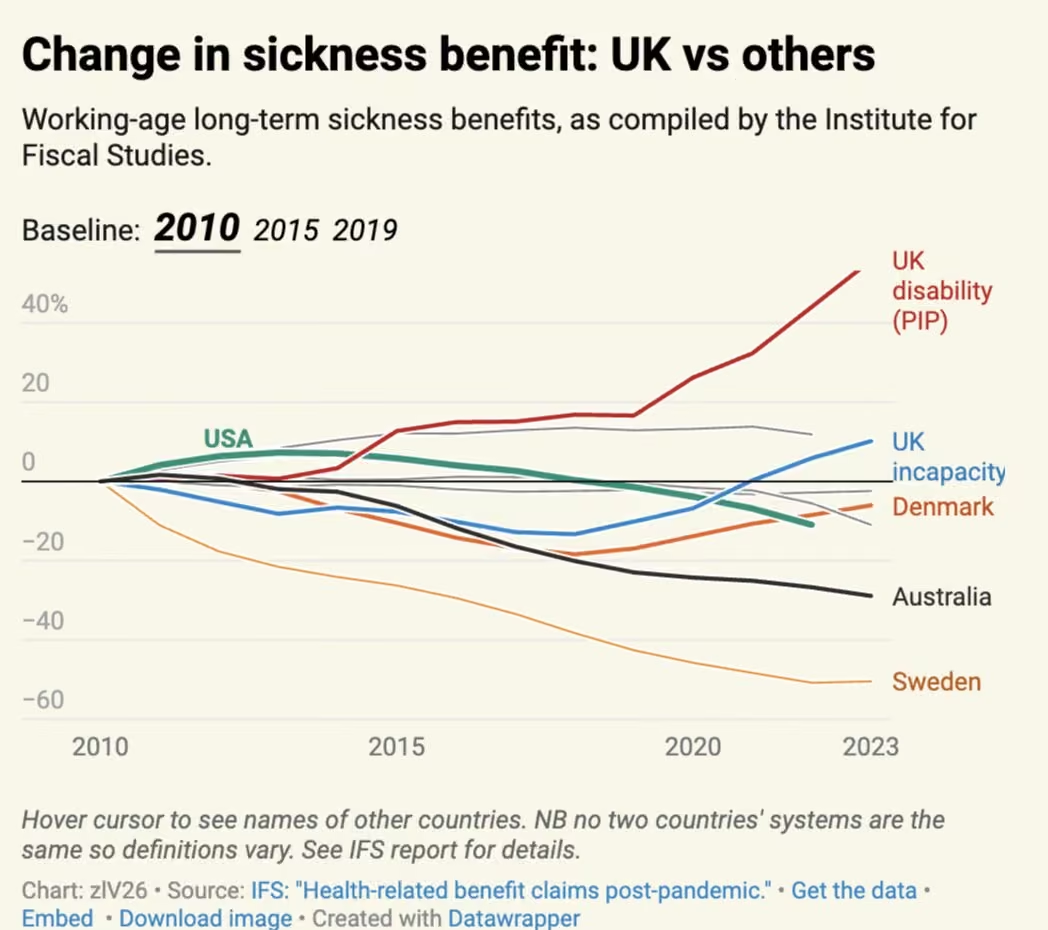
Why did millions of our sick neighbours spend a million moments filling arcane DWP forms, treated with inhumanity, waiting weeks for life-saving money, left to an exploding digital subprime consumer credit market and a daily 8am grind of GP and CAMHS queues, whilst frontier technology enabled their healthy neighbours a life of ever more instant payment and provision?
Why did a maternity care doctor say to me the only moment of recent relief, a return to the original promise of her vocation in medicine, was her experience of AI transcription that let her focus on care?
Why wasn’t Britain genuinely moving the needle again on the climate crisis by shaping technologies that could do what global innovation in solar PV and wind turbines did?
Why weren’t we securing Britain’s agency in the defining national security race of our age, our ability to wield AI drones and counter drone defence systems?
Why wasn’t our politics quicker and surer to support the agency of families, of children, women and girls, of minority groups, indeed of British democracy, as we faced the nation-tearing onslaught of bot farms?
These are fundamentally future Labour questions, deserving our obsession and the most hopeful Labour answers. Those answers do not lie in old or new Labour. The axes of those divides - more technology or less technology, more regulation or less regulation, state monopoly or private monopoly, state control or individual discretion, zero US tech or only US tech - are obviously not even the right questions. Even in Tony Blair’s telling, they invert his original promise: obsessing with radical means for shrunken ends, not the radical ends of securing British agency, underpinned by clear-eyed realism of means.
Quietly, as far as an uninterested Westminster bubble is concerned, we have started to rebuild an agenda focused on the most radical of goals for British AI: restoring the agency of British families, British entrepreneurs and the British state, answering the three questions that determine our future.
▪️First, 𝐭𝐡𝐞 𝐚𝐠𝐞𝐧𝐜𝐲 𝐨𝐟 𝐟𝐚𝐦𝐢𝐥𝐢𝐞𝐬. At the site of an old car manufacturing plant, hundreds of jobs coming after a decade of nothing. At an old steelworks, the biggest capital investment in decades, nearly half a billion on community investment alone. At a third site, the dated promise of clean energy only feasible now with the pull of major AI investment. At the proud site of the UK’s largest listed tech firm, billions more in investment, and the most gripping stories of apprentices leaving hairdressing to shape the future of AI. The agency of a family able to choose both ambition of work and affection for home. Similar agency in the most far-reaching government in its toughness against social media: standing up to the richest man in the world, staring him down, pioneering global change, securing the dignity of women and girls across our country. On children’s safety, the deepest agency for families and young people to shape our future: find me another policy area where over a hundred thousand have had their direct say, where mums have taken hour-long buses and young teens minibuses in every nation and region to share their pains, to ask their tough questions, to experience the collective agency of shaping a safer future.
▪️Second, 𝐭𝐡𝐞 𝐚𝐠𝐞𝐧𝐜𝐲 𝐨𝐟 𝐞𝐧𝐭𝐫𝐞𝐩𝐫𝐞𝐧𝐞𝐮𝐫𝐬 𝐚𝐧𝐝 𝐰𝐨𝐫𝐤𝐞𝐫𝐬. The last wave of technology concentrated in too few places, enriching too few people. So, we have blown open the doors for worker prosperity: Britain now has the world’s best support for workers’ ownership of shares in startups. Billions more to British entrepreneurs from the British Business Bank. Millions in procurement buying British AI: big contracts like that for Quantexa, small rapid contracts for startups via Sovereign AI. And even more worker support on way, as we consult on changes to non-competes holding workers back from switching jobs.
▪️Third, 𝐭𝐡𝐞 𝐚𝐠𝐞𝐧𝐜𝐲 𝐨𝐟 𝐭𝐡𝐞 𝐬𝐭𝐚𝐭𝐞. A remarkable revolution in state capacity is being celebrated internationally. AISI has outcompeted frontier labs’ billions with public mission, uniquely assuring British security from modern threats. Researcher after researcher tells me how ARIA has rescued them from the modern oppression of poor bureaucracy. Sovereign AI, though early, has already built an industrial policy path that has compelled the world’s best firms - Isomorphic, Ineffable - to pick UK government as its only UK investor. Where Callaghan funded Inmos, spawning Wales’ compound semiconductor cluster and our national champion ARM, we are renewing that hopeful Labour promise for today with our AI hardware focus. All efforts celebrated internationally (NYT just this week), making Britain the standout best in Europe for AI, putting billions into our economy, creating jobs in every corner of our country, millions in taxes ahead, a boost to national security today. As so many say, the agency of the state is the spark that lights up our national culture of agency well beyond the state; it is a spark so palpable in UK AI today.
What could be more Labour? Radical goals - control back in the hands of British families, restoration of linked risk and reward for entrepreneurs and workers, proud state capacity - being delivered with relentless energy.


 Marius Hobbhahn
@MariusHobbhahn

 Apollo Research
@ApolloResearch



 Pippa Crerar

 AI Security Institute (AISI)


 Archie Hall


 Dave "Someone you trust is one of us" Birch
 Kate Cronin
 Richard Burgess


 Chris Pinnock | drchris.tez

 Jacob Coxon
 @IanYorston

 Evan Hubinger
 Jennifer McAdam
 Dan Neidle


 Victoria Derbyshire

 Dave Burrells
 Tom Westgarth

 Jimmy McLoughlin 🐑


 Adam Gleave
 FAR.AI


 Tim Shipman
 Politics UK
 Nick Bryant

 Kay Burley



 Christian May

 Rashad Ali
 42courses

 Ben Virgo


 Ed Elson


 World Bank Digital
 Bisa_Lee
 Mutoni Karasanyi
 Ian Brooks
 Nico Macdonald
 BBC Studios Audio

 Far left boy
 Jeffrey S. Kehoe MBA, FCII


 Tim Tayshun “Lower your Time Preference”
 Tomas Forgac

 Guardian Opinion
 Rob Byrne

 Ed Thomas

 Alex Phillips
 Fraser Nelson
 Tone Langengen

 QA


 Rob Marchant
 Andrew Griffith MP


 neil turkewitz
 Niall Thomas


 Simon Jack

 Bjørn Kienholz Bjercke
 Matt Dathan

 Tom Swarbrick


 Dr Andrew O'Malley
 Sam Bowman

 Mark Wallace
 Alex Wickham
 Troy Hunt


 Luke Radford
 Stephen Pollard
 Science, Innovation and Technology Committee
 Sonia Sodha
 gabe
 Finn Mallery

 Sam
 Evan Ratliff


 FT Technology News

 Chris Stokel-Walker

 Jamesin Seidel


 Nick Cohen

 max tempers
 Steve Loftus

 LabourWomen’sDeclaration

 Tom Whyman
 Becky Paton

 Matt Margolis

 Jesse Singal
 unusual_whales
 John Jackson

 Isaac Saul

 kate conger

 Sheel Mohnot

 Geoff Mulgan
 Catrin Nye

 Nicky Campbell


 Simon Taylor


 Jonathan Fine

 CapX

 Shayan Sardarizadeh


 Merryn Somerset Webb
 Rachel Reeves

 Base
 Antonio García Martínez
 Paul Grewal

 Matt Clifford



 Cassidy Bereskin


 (((Dan Hodges)))
 Jakub Krupa
 Adam Wagner KC

 Kate Ferguson
 Sue Atkins 👶🏽👧📱🎧📚


 Luciana Lixandru
 Séb Krier

 Natalie Lafferty


 Elle Turner



 Godspeed You Black Tamperer (ft Maya)

 Susan Greenberg 🇺🇦


 vxdb

 Charlotte Henry

 Paul Lewis
 Eric Balchunas

 Engelsberg Ideas
 Pod Save the UK


 Curtis Houck


 Anne-Marie Tomchak

 Alasdair Munro


 Jack

 Adam Singer
 Katherine Bayford 🍐
 BBC Politics
 Amir Taaki ⛛



 Chris Doh!

 Noa Hoffman
 Loz Kaye @lozkaye.bsky.social

 Stian Westlake
 Dominic Cummings

 @𝗼𝗻𝗲𝗷𝗼𝗯𝗹𝗲𝘀𝘀𝗯𝗼𝘆


 Peter McCormack 🏴☠️🇬🇧🇮🇪


 Joseph Cox


 Joshi Herrmann

 No Context Brits

 A Funny Old Game

 Mike Galsworthy
 Zoe Kleinman
 Ben 🚜
 Harjap Singh Bhangal

 insane moments in british politics

 John Burn-Murdoch


 Just Stop Oil
 Adrian Hilton

 Paris Gourtsoyannis
 Tina Louise 🍃💚🍃


 Who Targets Me


 Sophie Pedder


 TC Dunlop
 Henry Zeffman

 Jackie Leonard
 Shaun Lintern
 John 'The Nephew Of Podcasting' Harris

 Henry Hill


 Sally Bean

 Molly Rose Foundation


 Sue Mitchell
 Rudaw English

 Tomiwa Owolade

 Jordan Tyldesley


 Lara Spirit


 Ethan Zuckerman
 NCSC UK
 Lizzie Dearden
 Graham Barrow
 Alex Krasodomski
 Eileen Ormsby
 Ben Chu
 The Rights Factory

 David Paxton
 Bishop Talbert Swan
 Giles Wilkes



 Robert Baggs
 Sunder Katwala


 Freddie Sayers
 Rhymer Rigby




 Pod Bible


 Stewart Maclean


 Brent Lee
 Kate isn't really here any more

 Julian Baggini

 Elfriede Sixt

 The Urban Birder - OFFICIAL

 British Wildlife Photography Awards

 hodlonaut
 Quorum Cyber

 Poonam Soni
 Matthew Ford


 Kavita Puri



 Chris Hawkins

 Elizabeth Foster

 Alison Moyet
 Rebecca Lavoie


 William Merrin


 Fiona Sturges

 Naked Productions

 Suella Braverman
 Secunder Kermani
 Royal Television Society


 James Marriott


 Darryl Morris

 UK Safer Internet Centre


 Fulmo ⚡

 BBC Press Office


 Davide Morisi



 Police Community