Fantastic paper!
@matthewgburgess maybe you'll also find interest in this (joint work w @_MaxPosch_ ) www.dropbox.com/scl/fi/xydg1vid6a8pw8zmvw8yc/Posch_Raz_Ma…
Politicians, athletes, journalists, NGOs, companies... They all use corporation-owned social networks to communicate with us. Citizens shouldn't have to hand over their data to companies to read content published by public entities. Public Feeds changes that by making posts of popular accounts freely available. Read more.
Joseph Henrich (born 1968) is an American anthropologist and professor of human evolutionary biology at Harvard University. Before arriving at Harvard, Henrich was a professor of psychology and economics at the University of British Columbia. He is interested in the question of how humans evolved from "being a relatively unremarkable primate a few million years ago to the most successful species on the globe", and how culture shaped our species' genetic evolution. More on Wikipedia
Fantastic paper!
@matthewgburgess maybe you'll also find interest in this (joint work w @_MaxPosch_ ) www.dropbox.com/scl/fi/xydg1vid6a8pw8zmvw8yc/Posch_Raz_Ma…
Yeah, building on Enlightenment speculations, we showed this in 2001 in the AER and BBS, then replicated and extended it in Science in 2010. Many studies by others since, including those with causal ID. But, you need to distinguish "impersonal" from "interpersonal" prosociality.
Yep, reminds me of @JoHenrich's discussion of the evidence that markets foster patience, thrift, and work ethic, and coevolve with universalism and trust, in The WEIRDest People in the World (a book I highly recommend).
There has long been speculation that markets crowd out or corrupt societal moral values.
But new research finds that market-oriented societies have a greater aversion to unethical behavior, higher levels of trust, and are not significantly associated with lower levels of morality
"our results suggest that being or becoming more market oriented does not cause moral deterioration."
www.sciencedirect.com/science/article/abs/pii/S0167268122…
Special issue in EHB: The Evolutionary Foundations of Magic, Witchcraft, Myth, and Taboo www.sciencedirect.com/special-issue/1056GQC2KX4 All-star cast that includes anthropologists, psychologists, economists, philosophers and others. Great Editors: @aiyanakoka @KevinHong1991. Excellent work!
The issue is full of examples of rich interdisciplinary contributions that apply evolutionary theories. @DrNathanNunn @WalterScheidel @_MaxPosch_ @mnvrsngh @mmuthukrishna @slingerland20 @corenapicella @EvolHumBehav @MGurven @HSB_Lab @David_S_Wilson @MohammadAtari90 @schimmelrob
Delighted to establish this important intellectual connection with WEIRD in Arabic. Looking forward to a dialogue on these questions. @iyadrahwan @MohammadAtari90 @slingerland20 @mmuthukrishna @HSB_Lab
شكرا للأستاذ عبد العزيز الخزام الذي تفضل بهذه النبذة عن كتاب "الأغربون" والشكر موصول لمجلة اليمامة الرائدة.
Joe Henrich reposted
Two #neandertal #mysteries may have be solved via a synthesis by David Reich #dna #humanorigins #history
Joe Henrich reposted
Out today in Nature Human Behaviour: our review of large language models in computational social science, with @xu_fengli, @yongli and colleagues at @Tsinghua_Uni, @hkust & @MSFTResearch Asia. A thread on what we found, including where the field is fooling itself.
Read @ doi.org/10.1038/s41562-026-02539-9
Joe Henrich reposted
Everyone knows that hunting in chimpanzees is mostly by males. But in bonobos, much of the hunting is by females!! Large implications for thinking about the origins of hunting in humans. www.cell.com/current-biology/fulltext/S0960-9822(26)01325-4
Joe Henrich reposted
Localism wins: Shenzong emperor tries reforms to strengthen Chinese state from 1069, localist kin groups abolish reforms 1085. Weakened China state defeated by Jurchen, retreats to south 1127 broadstreet.blog/2021/02/24/why-war-didnt-make-the-chines…
Joe Henrich reposted
Where did the values of the Enlightenment come from? Watch my interview with Dr. Joseph Henrich (@JoHenrich) about his great book, The WEIRDest People in the World: How the West Became Psychologically Peculiar and Particularly Prosperous.
Full interview: youtu.be/cN3w_cSAsmg
Great historical exploration of our WEIRD obsession with work. @JF_Schulz @MohammadAtari90 www.bbc.com/audio/play/m0032slz
Joe Henrich reposted
Very important paper on how Zero-sum culture sustains itself in part via effort-suppression memes - there's no point reading it. It's probably wrong. Just give up.
From the super smart @JoHenrich lab!
henrich.fas.harvard.edu/publication/zero-sum-environments…
Joe Henrich reposted
Who knew that other primates sometime keep pets!
New paper!
We explore cases of non-human primates carrying, grooming and forming bonds with individuals of other species and what this might reveal about the evolution of pet-keeping.
A fun project with fantastic co-authors! @UniofOxford
link.springer.com/article/10.1007/s10329-026-01281-0
Joe Henrich reposted
Mohammad Atari shared data on measuring moral values over historical time at SESP #sesp #sesp2026 @MohammadAtari90
Joe Henrich reposted
Places with more intensive kinship practices (family clan systems) tend to have more binding moral values (loyalty and authority) in texts.
Joe Henrich reposted
You have to hand it to Homo sapiens. Describing hunting among the Kalahari San "The quarry of carnivores, such as the lion, leopard, cheetah, and wild dog, is sometimes usurped by dashing to the spot where a large number of wheeling vultures have been observed."
Joe Henrich reposted
The Historical Psychology Preconference is coming to Philly for #spsp2027 ! Please join us on February 11th, 2027 for this year’s theme: How the Events of Yesterday Shaped the Minds of Today.
Joe Henrich reposted
Congrats @JoHenrich I had told many of my friends back home about the book. I am glad I can now tell them it is available in Arabic.
Joe Henrich reposted
وشكرا جزيلا لدار جداول والقائمين عليها على اهتمامهم بنشر ترجمة هذا الكتاب المتميز عن أنثروبولوجيا الغَرب.
صدر عن دار جداول للنشر والترجمة في بيروت كتاب " الأغربون: كيف انفَرد الغربُ نفسيًّا وازدهر اقتصاديًا" لمؤلفه البروفسور جوزيف هنريك، أستاذ كرسي "روث مور" في الأناسة الإحيائية في جامعة هارفارد الأميركية، وأستاذ علم النفس في الجامعة ذاتها.
وقد قام المترجم الفذ الدكتور حمزة بن قبلان المزيني بترجمة الكتاب ونقله إلى اللغة العربية، وقد بلغت صفحات الكتاب ( 936) صفحة.
يُجيب الكتاب عن سؤالٍ شغل المفكرين والمثقفين طويلًا: كيف صار الغربُ إلى ما هو عليه اليوم من تفوقٍ حضاري شامل، علمي وفكري وصناعي واقتصادي وعسكري؟ وكيف استطاع أن يفرض هيمنته على معظم أنحاء العالم، وأن يَصير نموذجًا يُحتذى تسعى الأمم إلى تقليده أو اللحاق به؟!
يقدِّم المؤلف جوزيف هنريك رؤية شاملة تفسِّر التباين بين الغرب وسائر المجتمعات على أساس التحولات الثقافية لا الفوارق الفطرية.
أثار الكتابُ فورَ نشره عام 2020م اهتمامًا واسعًا في الأوساط الأكاديمية والإعلامية، وعُدَّ واحدًا من أهم الإصدارات الفكرية في العالم، وقد تُرجم إلى عدة لغات، من بينها اللغة العربية التي تستقبله اليوم بترجمة المترجم الدكتور حمزة المزيني.
ضمَّ الكتاب عدة أقسام موزعة على فصول.
القسم الأول: تطورية المجتمعات والنفسيات.
القسم الثاني: أصول "الأغربون"، وضم: الأُسر الأغربية، الاختلافات النفسية والأُسر والكنيسة، أوروبا وآسيا، الزواج الأُحادي "الأغربي".
القسم الثالث: مؤسسات جديدة، نفسيات جديدة، وشمل فيما شمل: التجارة والتعامل، واستئناس التنافس، وعقليات السوق.
القسم الرابع: ولادة العالَم الحديث، وشمل: القانون والعلوم والدين، سرعة الإفلات، مادة التاريخ المظلمة.
الكتاب إضافة فكرية مميزة للمكتبة العربية.
يتوفر حاليًا في منصة "نيل وفرات"، وفي الرياض توجد منه نُسخ في المكتبة التراثية بالرياض.
@hmozainy
Great to see this translation of WEIRD into Arabic! Thanks to حمزة قبلان المزيني for his excellent work. @iyadrahwan @EdmondAwad @StevenHeine4 @slingerland20 @MohammadAtari90 @ThomasTalhelm
صدر عن دار جداول للنشر والترجمة في بيروت كتاب " الأغربون: كيف انفَرد الغربُ نفسيًّا وازدهر اقتصاديًا" لمؤلفه البروفسور جوزيف هنريك، أستاذ كرسي "روث مور" في الأناسة الإحيائية في جامعة هارفارد الأميركية، وأستاذ علم النفس في الجامعة ذاتها.
وقد قام المترجم الفذ الدكتور حمزة بن قبلان المزيني بترجمة الكتاب ونقله إلى اللغة العربية، وقد بلغت صفحات الكتاب ( 936) صفحة.
يُجيب الكتاب عن سؤالٍ شغل المفكرين والمثقفين طويلًا: كيف صار الغربُ إلى ما هو عليه اليوم من تفوقٍ حضاري شامل، علمي وفكري وصناعي واقتصادي وعسكري؟ وكيف استطاع أن يفرض هيمنته على معظم أنحاء العالم، وأن يَصير نموذجًا يُحتذى تسعى الأمم إلى تقليده أو اللحاق به؟!
يقدِّم المؤلف جوزيف هنريك رؤية شاملة تفسِّر التباين بين الغرب وسائر المجتمعات على أساس التحولات الثقافية لا الفوارق الفطرية.
أثار الكتابُ فورَ نشره عام 2020م اهتمامًا واسعًا في الأوساط الأكاديمية والإعلامية، وعُدَّ واحدًا من أهم الإصدارات الفكرية في العالم، وقد تُرجم إلى عدة لغات، من بينها اللغة العربية التي تستقبله اليوم بترجمة المترجم الدكتور حمزة المزيني.
ضمَّ الكتاب عدة أقسام موزعة على فصول.
القسم الأول: تطورية المجتمعات والنفسيات.
القسم الثاني: أصول "الأغربون"، وضم: الأُسر الأغربية، الاختلافات النفسية والأُسر والكنيسة، أوروبا وآسيا، الزواج الأُحادي "الأغربي".
القسم الثالث: مؤسسات جديدة، نفسيات جديدة، وشمل فيما شمل: التجارة والتعامل، واستئناس التنافس، وعقليات السوق.
القسم الرابع: ولادة العالَم الحديث، وشمل: القانون والعلوم والدين، سرعة الإفلات، مادة التاريخ المظلمة.
الكتاب إضافة فكرية مميزة للمكتبة العربية.
يتوفر حاليًا في منصة "نيل وفرات"، وفي الرياض توجد منه نُسخ في المكتبة التراثية بالرياض.
@hmozainy
I had the opportunity to offer feedback on Claude's Constitution to the authors at Anthropic (in person). This piece nicely converges with my own thinking: mustafa-suleyman.ai/a-warning-about-model-welfare
Exploiting our evolved capacities to represent other minds, the Claude program sends all the cues to signal to us--intuitively--that there's another mind present. Similarly, refined sugar signals to our brains that good nutrition is present but it's not; we engineered the signal
Cleaning up our anthropomorphic language would help us think more clearly about what's going on. Nice piece on this. aiguide.substack.com/p/misleading-metaphors-and-real-risk…
Joe Henrich reposted
Appreciate getting to talk about the Vanderbilt-WashU Commission Report on Outrage Overload, a podcast about getting beyond the fear-mongering to get to what we actually know and don't outrageoverload.net/outrage-97-is-academic-research-compr…
Joe Henrich reposted
Why does religious belief survive unanswered prayers, failed prophecies, contradicting science? In my new paper in Religion, Brain & Behavior, I propose "doctrinal inoculation"—religions may pre-vaccinate believers against doubt. 🧵:
doi.org/10.1080/2153599X.2026.2712227
Joe Henrich reposted
Two accounts of human evolution, that are each other’s exact opposite. Only one can be correct.
Joseph Heath explains which one, and why:
josephheath.substack.com/p/harari-vs-henrich?triedRedirec…
Joe Henrich reposted
In the past years I often repeated that social learning is overestimated in humans. Now this Science paper claims that "Social learning was five times more frequent than individual learning" in 7,000 observations of wild orangoutangs.
But ->
www.science.org/doi/10.1126/science.adz6415
The link: henrich.fas.harvard.edu/sites/g/files/omnuum5811/files/20…
New paper, forthcoming in Current Anthropology, led by the incomparable @CameronMCurtin @mnvrsngh @HSB_Lab @sararlowes. Great work, Cammie!
It's a detailed ethnographic and experimental exploration of the cooperative institutions in a Zapotec community.
Institutions tap diverse aspects of our evolved psychology
Interdependence matters for some institutions but not others
I thought Anne's concerns were largely addressed in the recent excellent book by Greif, Mokyr and Tabellini. Greif and Mokyr are economic historians of the highest caliber (Mokyr was recently awarded the Nobel Prize in Economics).
What about Henrich's own handling of data? muse.jhu.edu/pub/6/article/803842/pdf Has he responded to this? What did you make of John Levi Martin's response to @ashleytrubin's report on sociology?
Joe Henrich reposted
The evidence that social media is a cause (not just a correlate) of poor mental health keeps piling up. We lay it out in an accessible form here. We also go beyond mental health to review evidence of many other harms, esp. short form videos and cognitive functioning:
Joe Henrich reposted
A review in @Nature in 1937 of Witchcraft, Oracles and Magic among the Azande: "Everyone interested in the development of science and the ways in which other minds than our own attempt to explain natural processes should read it." Still spot on. www.nature.com/articles/140338a0 If you haven't read it, you should. It's a masterpiece.
Joe Henrich reposted
New estimates of Australian Indigenous populations before colonial contact infer around 2 million deaths as a result colonization. I have no words for a tragedy of this scale.
www.nature.com/articles/s41562-026-02571-9
Joe Henrich reposted
In communities where male honour depends on female seclusion, female employment tends to remain low.
But in Denmark, women from the Middle East, North Africa, Pakistan & Turkey are registering rising employment!
This is tremendous, both for women’s economic inclusion & their family’s upward mobility.
More research is needed to understand what European countries can do to support migrant women’s economic inclusion & prosperity.
Bravo to @jburnmurdoch & @Usama_Polani @SIEPR
It's a fascinating case, but a well-known pattern for those who have taken anthro 101. (Today, most anthro programs have dropped 101-type courses). E.g., classic work on the Mundurucu by the Murphys. See @logarithmic_h great 2011 paper on this link.springer.com/article/10.1007/s12110-011-9108-6
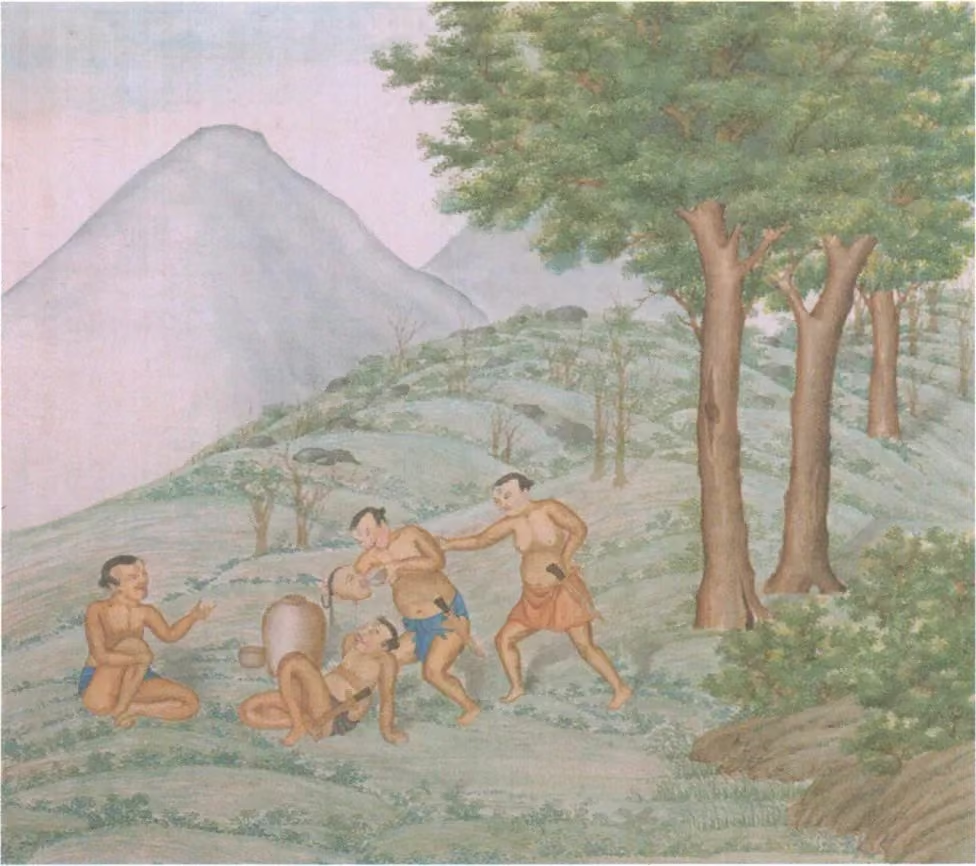
Is Matrilocality Over-Rated?
The Siraya of Taiwan were matrilineal and matrilocal. Villages were autonomous, egalitarian and led by deliberative councils.
Yet these same societies were also warring, with head-hunting and "mandatory abortions"
www.ggd.world/p/is-matrilocality-over-rated
Joe Henrich reposted
Nice example of the complexity of societies we otherwise label “egalitarian”, or “matrilineal”. I was cataloging other examples of how gender inequality manifests in nominally egalitarian societies here: www.cambridge.org/core/journals/behavioral-and-brain-scie…
Joe Henrich reposted
Lesson from Anthro 101: matrilocality and matrilineality do not create matriarchy. Fascinating post.
Is Matrilocality Over-Rated?
The Siraya of Taiwan were matrilineal and matrilocal. Villages were autonomous, egalitarian and led by deliberative councils.
Yet these same societies were also warring, with head-hunting and "mandatory abortions"
www.ggd.world/p/is-matrilocality-over-rated
Joe Henrich reposted
6.5 kya. DNA from NW Euro megalith burials shows famers had mixed with hunter-gatherers, buried in patrilineal descent groups. www.pnas.org/doi/10.1073/pnas.1818037116
Joe Henrich reposted
🚨 It's finally out! 🚨 This is the big one. 100 cultures, 12,000 people, 108 researchers. Why people (and our most-used surveys) get collectivism wrong and how to fix it. Join me for a fun thread! 🧵 @NatureHumBehav www.nature.com/articles/s41562-026-02525-1
Joe Henrich reposted
Great questions from Tanay and Jay on their Cognitations podcast- check out their other episodes to date too: youtu.be/7pDGe2bp3m4
Hey, this is a great opportunity. Mohammad and I are working together on this so post-docs will have a chance to work between my lab at Harvard and his lab at Umass Am. @mmuthukrishna @slingerland20 @StevenHeine4
I'm hiring a postdoc in historical psychology!
This project will focus on psychological change in the Middle East and North Africa, with a particular interest in Islamic history. Topical themes include religiosity, creativity, morality, and institutions.
Info in the pic.
Joe Henrich reposted
🚨 New paper in @NatureComms: (annoyingly) using college students to study cross-cultural effects underestimates the size of cultural differences. More education predicts more Westernization. Income & status don't. w/ Cindel White. 1/
The idea that there’s no coercion and cultural evolutionary models is just baffling to me. All that work on punishment? That’s a kind of coercion and there models showing one person doing it, a group of people doing it a coalition doing it.
Power and coercion also seem neglected in Sperber's cultural epidemiology model of cultural evolution.
In terms of the imposition of norms I think Nathan must’ve missed a number of models. Boyd Richardson 1992 has a single punisher equilibrium. Boyd et al 2010 has a coalition that imposes norms. And Henrich et al 2015 shows another route through which things can be imposed.
Since he's in the news I decided to reread Nathan Cofnas' paper on power in cultural evolution. The gist of the argument is that cultural evolutionary models, particularly by Boyd & Richerson, focus too much on learning biases influencing cultural evolution and not enough on how norms can be imposed by a group rather than preferentially adopted by individuals.
This is an argument I'm broadly sympathetic to. About a year before his paper came out I talked about male cults in the ethnographic record and how they impose and enforce norms in many small-scale societies. I noted how cultural evolutionary methods often focus on the beneficial effects of the transmission of information but in my view not enough on its selective and strategic monopolization.
I do think Cofnas overstates the contrast with Boyd & Richerson though. Learning biases are not necessarily at odds with power and coercion, since enforcement changes the payoffs and payoff-biased learning is part of many cultural evolutionary models. He selectively quotes B&R saying that for most of human history states did not exist and norms were not enforced by *external sanctions*, but I think it's pretty clear they're referring there to states/formal institutions, since in Not by Genes Alone they describe how "prosocial norms are enforced by systems of sanction and reward". I think Cofnas broader point that cultural evolution could focus more on power is right, as I've talked about with male cults and arranged marriage in particular. Callin O'Conner's book 'The Origins of Unfairness' is a good example of a book using game theoretic models to integrate cultural evolution and power dynamics.
The biggest problem with the paper though, and the main point I want to bring up because it is of particular interest and importance to me, is Cofnas' discussion of hunter-gatherer societies. Cofnas, in a 20 page paper, cites Christopher Boehm *50 times* inside the text. Cofnas spends 5 pages purporting to give a full description of hunter-gatherer societies yet he did not read a single hunter-gatherer ethnography on his own, and his account consists exclusively of uncritically parroting claims made by Boehm, and in some cases going even farther than he did.
Cofnas writes that, "All nomadic hunter-gatherers that have ever been described, without exception, live by an ideology of extreme egalitarianism (among men). No nomadic hunter-gatherer society tolerates adult males issuing direct orders to other adult males. Some groups have a titular leader, but his role never goes beyond leading by example and helping to organize group discussions aimed at reaching a consensus on group actions".
That is quite obviously not true and absurd. We have thousands of ethnographic accounts of hundreds of hunter-gatherer societies and Cofnas gives no indication of having read any of them, so why he thinks he can categorically say there are no exceptions to such a sweeping generalization is beyond me. A.W. Howitt (the anthropologist who led the expedition to find Burke and Wills!) has a great chapter on this in 'The Native Tribes of South East Australia' describing the authority a Headman holds across different groups. Many Aboriginal Australian groups have coercive initiation systems with strong power differences between elder leaders and younger (but still adult) men, with a great deal of authority and direction provided.
Overall I do think drawing attention to the neglected role of power and coercion in many cultural evolution models is useful, so I don't think this is a particularly bad paper. The discussion of hunter-gatherer societies in it is genuinely terrible, but it's terrible in a way that is typical of most writing on hunter-gatherer societies, where people simply repeat broad generalizations and at most cite one or two ethnographic accounts. His discussion of hunter-gatherer societies implies a single uniform hunter-gatherer socioecology with group imposed norms to contrast with Boyd & Richerson's models, but nomadic hunter-gatherer societies actually vary considerably in this (and other) domain(s). Power and coercion are still relevant and neglected but not in the way Cofnas describes it.
I think it is a big problem how much popular discussion of hunter-gatherers and the 'Environment of Evolutionary Adaptedness' is reduced to lazy stereotyping and generalizations rather than being given the deep ethnographic investigation the topic deserves. And when people just repeat assessments from Boehm it really compounds the problem: Boehm specifically excluded inegalitarian and sedentary hunter-gatherers from his surveys! He assumed that sedentism and inequality aren't 'late Pleistocene appropriate' so he removed such foragers from his samples. So the generalizations get even more simplistic as his views get repeated, because people who don't look in detail at his method miss how circular the 'nomadic egalitarian' generalizations are.
The @TheEconomist is now tabloid journalism.
No economist accuses him of truly poor research, let alone academic malpractice. But is Daron Acemoglu’s reputation justified by his scholarship? www.economist.com/finance-and-economics/2026/08/17/the-wo…
Embarrassing for the @TheEconomist. childishness & jealousy. If there are debates about specific ideas, write about those! Don’t personalize it. I’ve disagree with Daron lots; he’s always gracious & listens. He didn’t ask to be the #1 Economist, you guys bestowed that on him.
I am not happy about the Economist’s article, which feels like a hit piece. There is also a background to it, which is more troubling (as I will share at some point). I asked them to allow me to respond. I am waiting for their answer. If not in the magazine, I will share my response here.
In Oct, we are bringing together experts in AI and Evolution at Harvard. @David_S_Wilson @mmuthukrishna This is mostly an invitation-only meeting, but we have fellowships open to all. Great for graduates, postdocs, and others interested in this interface: www.prosocial.world/evolving-ai
Fascinating exploration of sociology. Great work @ashleytrubin
The Status of Scholarly Standards in Sociology: a Report www.vanderbilt.edu/principles/state-of-scholarship-report…
New Analysis @JF_Schulz @DumanBRad @mmuthukrishna @StevenHeine4 @DrNathanNunn @MohammadAtari90 @vsavitskiy1 Psychologists: read down, and you'll see a central role for psychology. Genetists: we used runs of homozygosity to measure culture.
Classic economic mechanisms, such as specialization, hinge on psychology, which is influenced by kinship. Must integrate economics, psychology and anthropology.
All comments welcome. Posted here: papers.ssrn.com/sol3/papers.cfm?abstract_id=4200629
Joe Henrich reposted
This is a very important paper @Econ_4_Everyone
Every time I present a nudge result, someone asks the same question: is a 3% reduction in electricity use important? My view is that an effect size only becomes economically meaningful when you ask what it would have cost to move behavior using standard tools, such as a tax or a subsidy.
That's what Matthias Rodemeier, Sutanuka Roy, Gregory Sun and I do in a new study across five markets (electricity, water, cigarettes, alcohol, flu shots).
The numbers are bigger than I expected: an average electricity nudge does the work of an 11% tax; water, 17%, cigarettes, 28%, and alcohol, 34%. Flu shots? Roughly a 100% subsidy. That means you must make the vaccine free to match it.
Nudges are also more cost-effective than price instruments in all five markets. But here's the part that changed how I think about this: cost-effectiveness does not give you the welfare ranking and scale plays a role. You can find out why in the paper, available here: ideas.repec.org/p/ces/ceswps/_12775.html
Joe Henrich reposted
In episode 322, I talk with Dr. Curtis Marean about zooarchaeology, and human origins and human evolution. #anthropology #science
youtu.be/Wyxt6rWesSg
Joe Henrich reposted
There is a substantial literature on how kids in hunter-gatherer and other small-scale societies spend their time, who they interact with, and the role of their parents. Our paper on one aspect of this topic will be out in a few days.
Joe Henrich reposted
Australia's social media law is changing the game, making it easier for Australian parents to parent, and for other countries to follow.
Changing norms is hard, but we list 5 trends showing that Australia is on its way to success. Give it time.
@TIME
time.com/article/2026/07/18/the-world-should-learn-from-a…
Joe Henrich reposted
Is there really a "human nature"? Watch my first interview with Dr. Joseph Henrich (@JoHenrich), about cultural evolution, human cooperation, and WEIRD #psychology. #anthropology #culture #science
Full interview: youtu.be/1Qx7q4Swruk
Joe Henrich reposted
According to Harvard Professor @JoHenrich , the traditional view that our big-brained smarts created culture is backwards. Instead, Copying → Culture → Cooperation → Language → Intelligence. 6/
This is a great piece that accurately captures the challenges of explaining what makes us human. josephheath.substack.com/p/harari-vs-henrich?r=49qb4g&tri…
Joe Henrich reposted
🚨 New paper in iScience: "Ecological not social factors explain brain size in cephalopods"
In 2017, we published the Cultural Brain Hypothesis, a model of human brain evolution. It made an unexpected prediction: non-social animals could evolve big brains too, if their ecology was rich enough. 1/
Joe Henrich reposted
This week I'm very excited to be teaching what I think is the first course on Cultural Evolution in Africa. Check out our course website: sites.google.com/omovalleyresearchproject.org/culturalevo…
Joe Henrich reposted
For all the hate anthropologists get from some people for being ‘anti-science’ they have created large publicly available databases with data from 100s of societies that remain probably the best sources of evidence for testing hypotheses about human nature and cultural variation
Joe Henrich reposted
Yes. Culture comes first, or, rather the capacity for culture, for imitation. Thanks again for the great job you and colleagues have been doing establishing and sharing this insight.
Really enjoyed doing the series with you: lifeitself.org/learn/cultural-evolution
Joe Henrich reposted
Además, @JoHenrich es buena persona, buenmozo y vivió en Chile mientras hacía su tesis sobre antropología económica con los mapuche.
Aquí mi comentario sobre su último libro, sobre la excepcionalidad de la modernidad occidental revistasuroeste.cl/2023/01/16/las-personas-mas-raras-del-…
Anda a laar, Harari !!
Joe Henrich reposted
This is not true. Some hunter-gatherers as early as 17,000 years ago had blue eyes.
www.nature.com/articles/s41467-024-51150-x
Moreover, there is not any overarching signal of selection for the trait according to our best current knowledge.
www.nature.com/articles/s41586-026-10358-1
This is a great piece that accurately captures the challenges of explaining what makes us human. josephheath.substack.com/p/harari-vs-henrich?r=49qb4g&tri…
This is a great piece that accurately captures the challenges of explaining what makes us human. The concerns with Sapiens are dead on. josephheath.substack.com/p/harari-vs-henrich?r=49qb4g&tri…
Great to see economists testing cultural evolutionary theories about classic anthropological questions about ritual and magic. @JF_Schulz @DrNathanNunn @mmuthukrishna
Recently accepted by #qje: “Praying for Rain,” by Espín-Sánchez (@JosespinSanchez), Gil-Guirado and Ryan: doi.org/10.1093/qje/qjag026
The authors cite, and maybe channeling, this paper in Current Anthropology by @KevinHong1991 : www.journals.uchicago.edu/doi/abs/10.1086/729118 @slingerland20
Joe Henrich reposted
Humans conquered the planet 300 times faster than genetic evolution can explain
www.scientificamerican.com/article/humans-conquered-the-p…
www.audible.com/pd/1713547368?source_code=ASSORAP05111600…
@JoHenrich I am so excited to read your book The Weirdest People... but unfortunately my eyesight is very compromised. I looked at my library and there doesn't seem to be an audio version out yet. Will there be one? I sincerely hope so! Can't wait!
Joe Henrich reposted
Recently accepted by #qje: “Praying for Rain,” by Espín-Sánchez (@JosespinSanchez), Gil-Guirado and Ryan: doi.org/10.1093/qje/qjag026
Joe Henrich reposted
Just posted: My latest TED talk. I look at technology from the perspective of human ultrasociality -- deep needs for community and communion. From that view, you can see how social media, edtech, and especially AI block human flourishing
www.ted.com/talks/jonathan_haidt_why_you_should_be_a_tech…
Great fun appearing on Hidden Brain! Thanks for the conversation.
We like to think our choices, our thoughts, and our habits are entirely our own. But in reality, our individual choices are often echoes of centuries of cultural evolution.
This week, a conversation with anthropologist @JoHenrich about how culture, history, and psychology intersect.
open.spotify.com/episode/4s51gCKSnsiJY0x4cYxNfY
Joe Henrich reposted
60 Percent of Grades at Harvard Were A’s. Enough Is Enough, say my colleagues David Laibson and @jasonfurman (and I couldn't agree more). www.nytimes.com/2026/05/21/opinion/harvard-easy-a-grades.…
Probable loss of fire among the northern Ache.
www.cell.com/current-biology/fulltext/S0960-9822(25)00447-6
And here are his citations (including which other societies have lost fire-making). One is to this 2004 paper of his telling the story of Tasmanian technology loss in greater detail.
www2.psych.ubc.ca/~henrich/Website/Papers/HenrichTasmania…
Joe Henrich reposted
Jon Haidt @jonhaidt is one of the greatest psychologists of the 21st century, having illuminated moral cognition, the relation between emotion and intellect, the perils of politicization and viewpoint homogeneity in social science, and the roots of the youth mental health decline. That NYU students should protest this wise and brilliant man as their commencement speaker is a backhand vindication of his diagnosis of what's wrong in higher ed. Our sometimes coauthor @PamelaParesky explains: Reports of The Death of 'Woke' May Be Greatly Exaggerated www.realcleareducation.com/articles/2026/05/17/reports_of…
Joe Henrich reposted
Breaking news: Harvard faculty votes to cap the number of A's awarded in course grades, a big step in combatting the grade inflation that has been dumbing down our courses, conveying the wrong message to students, and making universities a national laughingstock.
Joe Henrich reposted
Thanks to my friend and co-author @glukianoff for laying out what we actually wrote in The Coddling of the American Mind, and applying it in response to seven arguments made by those who objected to my selection as a commencement speaker:
eternallyradicalidea.com/p/what-jonathan-haidt-actually-said
Joe Henrich reposted
Why game theory is indispensable to understanding contemporary issues (in this case, phone bans in school). www.nytimes.com/2026/05/08/opinion/social-media-teens-pho…
Joe Henrich reposted
David Reich is back.
He and collaborator Ali Akbari just published a paper that overturns a long-standing consensus about human evolution — that natural selection has been dormant in our species since the agricultural revolution.
By scaling ancient DNA sequencing and developing a new statistical method, they found that selection has actually sped up.
Selection went especially bonkers during the Bronze Age (around 3,000 years ago).
That's when gene frequencies for everything from immune function to body fat to intelligence were most in flux.
Over the last 10,000 years, selection pushed the genetic predictor of cognitive performance up by roughly a full standard deviation — most of it between 4,000 and 2,000 years ago.
After we finished recording, David sketched out on a whiteboard his new heretical model about who the Neanderthals really were. Luckily, I took out my iPhone and managed to record it.
He thinks the standard story (that Neanderthals are some separate archaic lineage we interbred with a little) just doesn't fit the evidence. Instead, he proposes that Neanderthals are essentially genetically-swamped modern humans.
A small population somewhere around the Caucasus invented Middle Stone Age technology roughly 300,000 years ago and expanded outward. The ones that moved into Europe interbred with local archaic humans, got genetically swamped, and became Neanderthals. The same expansion went into Africa, met much more diverged archaic Africans, and that mixture became us.
This means Neanderthals and modern humans share the same cultural ancestry — the only difference is which archaic humans they mixed with afterward.
David is a brilliant and rigorous scholar. It was a real delight to learn from him again.
0:00:00 – Ancient DNA suggests strong selection over last 10,000 years
0:16:24 – Natural selection intensified during the Bronze Age
0:35:40 – Why didn't evolution max out intelligence?
0:58:00 – Evolution is limited by time, not population size
1:09:40 – Why no farming before the Ice Age?
1:17:52 – The Neanderthal puzzle David can’t stop thinking about
1:54:40 – The methodology behind this breakthrough
That time period doesn’t start until 400 CE. Most of the data on a epigraphies comes from the first few centuries of the common era so the time sequence is almost entirely before the beginning of the aDNA data. Roughly, pre-Christian versus post Christian.
In which territories of the Roman Empire was it common, because apparently in southern Germany there was no marriage between cousins?
Our analysis of the epigraphy suggests that cousin marriages were likely pretty common in the pre-Christian empire.
Worth noting that the distaste for cousin marriage, often attributed to the Church, had always been part of Roman culture even if not actually illegal
“That’s a clue to historians that even after Roman troops and authority withdrew in 470 C.E., established marriage patterns and social norms stayed in place or even strengthened. “To our surprise,” Patzold says, “they’re still behaving like late Roman Christians.”
‘Modern European family’ predates fall of Rome, DNA reveals. Painstaking pedigrees hint at origins and social norms of people living near Rome’s northern frontier www.science.org/content/article/modern-european-family-pr…
Joe Henrich reposted
The preponderance of the evidence gets ever more preponderant: here's a meta-analysis of longitudinal studies, in JAMA.
Important finding for setting 16 as the age minimum:
Med News: A major meta-analysis has found that digital media use, particularly social media, is consistently linked to worse youth mental health and development.
jamanetwork.com/journals/jama/fullarticle/10.1001/jama.20…
This evidence seems to support the thesis
This was his previous rebuttal. I wonder if it’s applicable to this new study
Peter misses the argument here, making the entire piece misleading. Once you understand the actual argument, the aDNA data is largely supportive. See below
"If we look at DNA from human remains, we see that northwest Europeans were avoiding cousin marriage long before Christianity." www.aporiamagazine.com/p/did-christianity-make-europeans-…
Joe Henrich reposted
"Natural selection should not necessarily favor accurate perception of the world, or even of the self, if misperception can yield fitness benefits — such as when deceiving oneself facilitates deceiving others." osf.io/preprints/psyarxiv/k3etu_v1
Any claim of heritability has to specify the population. The heritability of traits varies across populations, depending on how the environment influences phenotypic variation. This paper offers a great summary @mmuthukrishna www.cambridge.org/core/journals/behavioral-and-brain-scie…
IQ is one of the most heritable psychological traits. It's nearly as heritable as physical traits like height. And the only other psychological traits with similar heritability levels are psychiatric conditions like autism and schizophrenia.
www.stevestewartwilliams.com/p/12-things-everyone-should-…
It’s very likely that her ability of IQ has increased over the 20th century among Americans because the total phenotypic variation decreased.
Joe Henrich reposted
My former UVA colleague Tim Wilson is creating short videos of scientists describing the research that stopped when the Trump admin slashed funding for science:
www.youtube.com/@TimothyWilson18
For example, research finding more effective ways to train navy pilots and air traffic controllers:
www.youtube.com/shorts/qAdczgpA20M
Joe Henrich reposted
Fun discussion with Robin Hanson on cultural evolution (@robinhanson): www.youtube.com/watch?v=s4qMJwmL9cU&list=PLAmp64147-7jBCB…
Joe Henrich reposted
New paper comparing Neanderthal haplotype inference methods. Paper is worth reading, but I'll make a side point:
None find all the Neanderthal ancestry. Each is biased (ie some Haplotypes where it excels) and you should be aware of this with claims based on these methods 1/2
Great piece by a top team!
"Highly educated individuals around the world have patterns of attitudes, beliefs, and behaviors that are more WEIRD, as evident by their greater cultural similarity to individuals living in Western European and Anglosphere countries."
www.nature.com/articles/s41467-026-70404-4
Joe Henrich reposted
"Highly educated individuals around the world have patterns of attitudes, beliefs, and behaviors that are more WEIRD, as evident by their greater cultural similarity to individuals living in Western European and Anglosphere countries."
www.nature.com/articles/s41467-026-70404-4
Joe Henrich reposted
Humans aren't the only species in which others assist in childbirth. Cooperation by non-kin during birth underpins sperm whale social complexity | Science www.science.org/doi/10.1126/science.ady9280
Joe Henrich reposted
Nick, this is a 3 year old post. There is now so much evidence of causality, including RCTs and natural experiments, plus testimony from victims and perpetrators of harm:
www.worldhappiness.report/ed/2026/social-media-is-harming…
Joe Henrich reposted
If you come across someone asserting there is "no scientific evidence" that social media is causing harm, please send them this link.
We lay out seven lines of evidence, including RCTs, natural experiments, and testimony from victims & perpetrators of harm
www.worldhappiness.report/ed/2026/social-media-is-harming…
Nice BBC Radio 4 special on the impact of reading and universal literacy on psychology and societies. I offered my thoughts to @j_amesmarriott . Well done! www.bbc.co.uk/programmes/m002sdyn
Joe Henrich reposted
Book reviews by philosophers, notoriously, can be scathing, but a sober review of a book on gender identity by the MIT philosopher (and Academic Freedom Council co-founder) Alex Byrne was deemed too dangerous to print. "The philosophy profession has shown itself to be an institution of fragile integrity when put to the test. One can only hope spines will eventually stiffen, and academic law and order is restored." philosophersmag.com/on-being-rejected/
Great clip on a point about WEIRD selves…there is no true self to discover 🤯 youtu.be/huMrq8oQCO0 via @YouTube
Great piece.
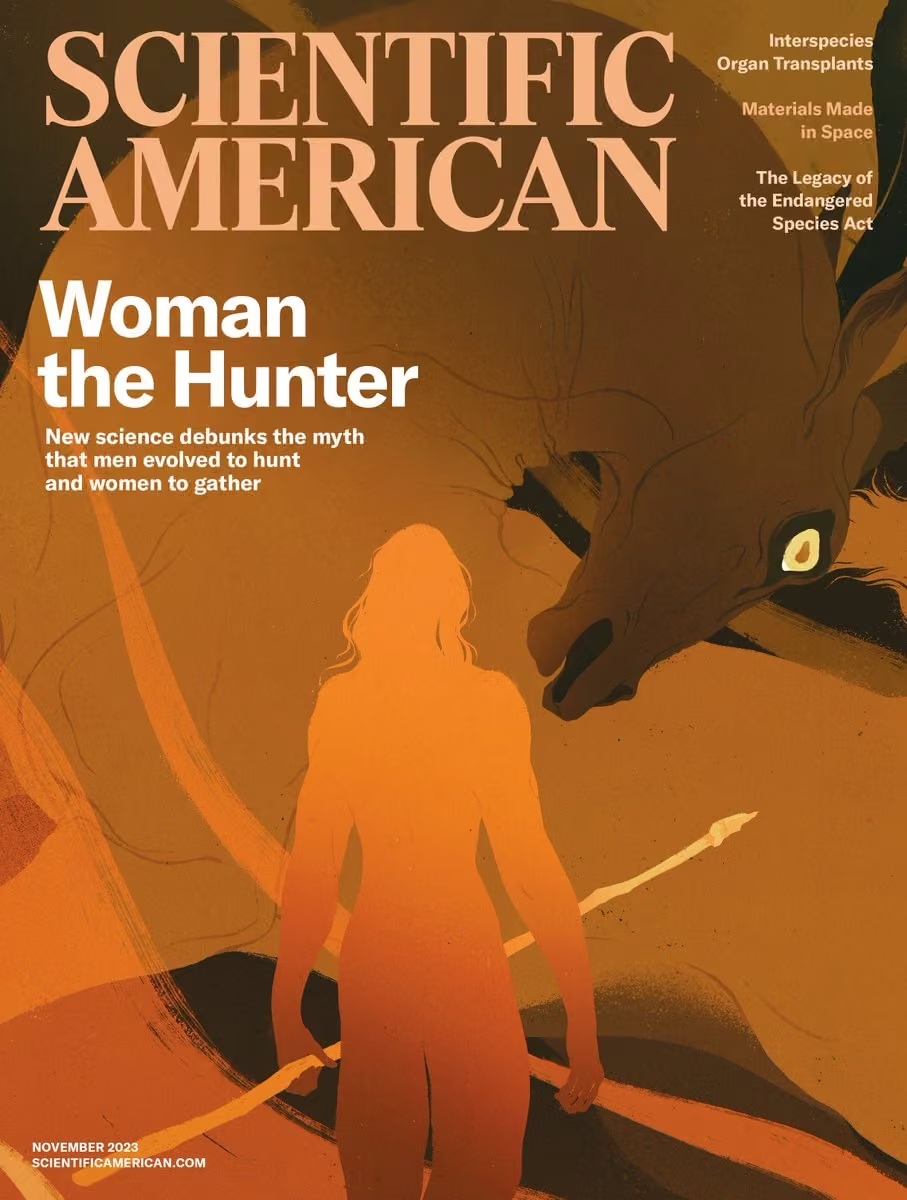
Our review of the import of the Man the Hunter conference and volume, which contrary to recent media coverage actually expressed diverse views on hunter-gatherers and inspired decades of research, is now published: authors.elsevier.com/sd/article/S1090-5138(26)00019-X
1. Does research by @CaraOcobock @Anthrofuentes & others, widely reported in SciAm & elsewhere, finally dispel hunter-gatherer myths that have persisted since the 60's?
In a preprint led by @vivek_vasi The Meanings&Dividends of Man the Hunter osf.io/preprints/osf/gawbt_v1 we respond🧵
Joe Henrich reposted
The Middle Stone Age (aka MSA or Middle Paleolithic) was a time when African, European, and Near Eastern hominins were using similar Levallois stone tools (depicted here), but interestingly this shared Sapiens-Neanderthal technology started AFTER their traditional split date
Joe Henrich reposted
New solo paper from David Reich might provide some clarity to the Muddle in the Middle. Maybe Humans and Neanderthals are both hybrids of an old expansion of the "MSA population" and local European / African humans:
I’m always surprised at how little scientists attend to whether results arise from captive populations or wild populations. Captive chimpanzees don’t do very much hunting, warfare or tool use. They don’t have civil wars. captive populations are often on birth control.
Chimpanzees are not more aggressive than bonobos but target sexes differently | Science Advances www.science.org/doi/10.1126/sciadv.adz2433
Joe Henrich reposted
Behavioral economics relies heavily on studies of Western, educated people. A recent analysis provides evidence that ignoring racial diversity within the United States has led to flawed generalizations about how different groups make decisions. www.psypost.org/broad-claims-about-gender-and-behavior-fa…
Joe Henrich reposted
Gender polarization increases with gender equality, finds Kodai Kusano, culture pre-conference #spsp2026
Great honor!!!
Congratulations to Yoshi Kashima and Joe Henrich, the winners of the 2026 Award for Outstanding Contributions to Cultural Psychology. 👏 #spsp2026 Jinkyung Na presenting the award. 🏆 @JoHenrich
Joe Henrich reposted
Congratulations to Yoshi Kashima and Joe Henrich, the winners of the 2026 Award for Outstanding Contributions to Cultural Psychology. 👏 #spsp2026 Jinkyung Na presenting the award. 🏆 @JoHenrich
Joe Henrich reposted
polygyny has a math problem. 90% of hunter gatherer societies were polygamous. sounds fine until you break it down
high status guys take all the wives → 40% of men get none → bunch of dudes with nothing to lose → chaos ✨
from @JoHenrich's WEIRDest people in the World 📚
Joe Henrich reposted
Harvard’s @JoHenrich has written an important book on this topic.
Why traditions are important ✍️
Joe Henrich reposted
In my 23 years at Harvard I've had to increase the proportion of A & A- grades from 25% to 65% of my large intro class (still tougher than the average Harvard class) so as not to drive away students. Finally, "Harvard Proposes Capping A’s to Curb Grade Inflation." The key: recognize that it's a collective action problem (every professor has an incentive to inflate even while recognizing that it's bad when everyone does it). Voluntary guidelines, the previous suggestion, are thus useless; only a collegewide policy can work. www.nytimes.com/2026/02/06/us/harvard-grade-inflation.html
Joe Henrich reposted
the idea of "finding yourself" is a recent cultural invention? 🤯
@jd_denn breaks down how having one consistent "true self" is a WEIRD thing. For most of history people saw themselves differently depending on context.
from @JoHenrich's 📚The WEIRDEST People in the World (2020)
Joe Henrich reposted
This is such a powerful frame for thinking about why we’re trying to find our True Selves. Because we value consistency in behavior! Better explained by @JoHenrich thanks for putting that in your book WEIRD
the idea of "finding yourself" is a recent cultural invention? 🤯
@jd_denn breaks down how having one consistent "true self" is a WEIRD thing. For most of history people saw themselves differently depending on context.
from @JoHenrich's 📚The WEIRDEST People in the World (2020)
Joe Henrich reposted
So many interesting facts like this, and more, in our latest episode: The WEIRDest People in the World, Part 2:
youtu.be/fyv9bEp7870
One of the most shocking facts from reading WEIRD:
The frequency of cousin marriage across the world. 1 in 10(!!) marriages across the world is a marriage of relatives. “Relative marriages” includes first/second cousins, uncle/niece… people who share great grand parents
Joe Henrich reposted
how did monogamy reduce crime rates by 35%?
@JoHenrich : "the church reached down and grabbed men by the testicles"
monogamy → lower testosterone → less crime → stable markets → trust with strangers → prosperity
WEIRD Part 2 is live!!
youtu.be/fyv9bEp7870
Joe Henrich reposted
clocks⏰ : the original mind control
one piece of infrastructure. generations of rewired psychology
from our chapter-by-chapter breakdown of @JoHenrich's The WEIRDest People in the World 📚
Joe Henrich reposted
We breakdown the most important non-fiction books chapter-by-chapter.
👇
@JoHenrich's The WEIRDest People in the World,
Part 1
youtu.be/JHJZ4TZbmY0
Part 2 drops today ✨
In which society end during which historical epic? #weirdpeople .
"Contrary to received literature, women are more intelligent than men, compete when they should in risky settings, and are more literate."
www.journals.uchicago.edu/doi/full/10.1086/738345
Joe Henrich reposted
This list of ethnic cleansing campaigns is pretty long, with examples stretching deep into antiquity -- a dark but sadly well-travelled road: en.wikipedia.org/wiki/List_of_ethnic_cleansing_campaigns
Joe Henrich reposted
The first talk in Vancouver’s Extra Credit lecture series was a great and fully sold-out success. Great attendees and a great vibe. We have awesome speakers lined up for the Spring and Summer sessions. More details to follow.
Joe Henrich reposted
Agree, it’s a great essay. Fun fact: the best evidence on zero intelligence traders in experimental double auctions is here
ZI makes predictions about stats such as autocorrelation of price changes within a trading period= -.50. Data is -.457 (graph)
www.nature.com/articles/s41562-020-0916-8
Joe Henrich reposted
The latest data dump from the Database of Religious History @ReligionHistory (v3) has just been published. This version has language tags for all entries and a more rationalized religious group tagging system. zenodo.org/records/18394095 @JoHenrich @mmuthukrishna
Joe Henrich reposted
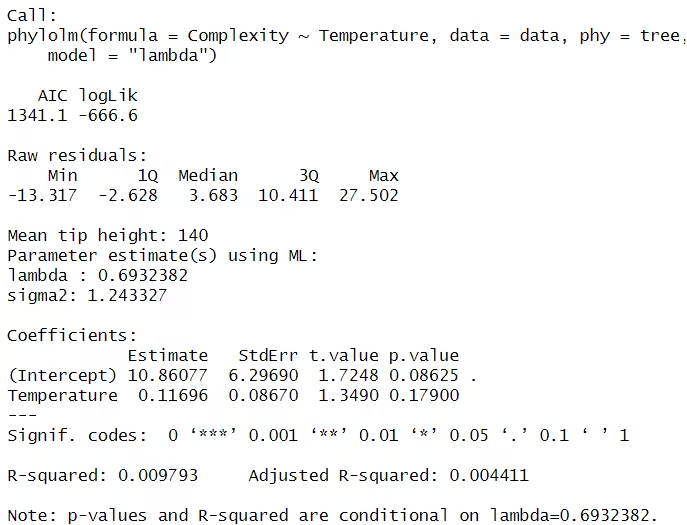
I also tested multiple models, with and without phylogenetic and spatial controls, if colder temperatures were associated with greater cultural complexity or technological specialization among the 186 primarily non-industrial societies in the SCCS, and they were not.
Joe Henrich reposted
More evidence that Meta is following the tobacco industry playbook for avoiding responsibility. (See p. 5 for evidence that it's mostly Meta).
arxiv.org/pdf/2601.11507
Social media research has a major conflict of interest problem:
“half of the research published in top journals has disclosable ties to industry in the form of prior funding, collaboration, or employment. However, the majority of these ties go undisclosed in the published research...these findings suggest industry influence in social media research is extensive, impactful, and often opaque”
arxiv.org/pdf/2601.11507
Thanks, Colin!! It was amazing working with you in the 90s.
Big congratulations to the brilliant scientist @JoHenrich (former collaborator) for getting the 2026 John Carty Award from NAS
Many thanks, Jon!! so many great conversations over the years
Congratulations Joe! You are an extraordinary social scientist, and it's good to see you recognized
Joe Henrich reposted
Congratulations Joe! You are an extraordinary social scientist, and it's good to see you recognized
Joe Henrich reposted
The overlooked survival strategy that made us human www.sciencedaily.com/releases/2026/01/260118233601.htm
proving a point from @JoHenrich's Secret of our Success: we became dominant by being flexible scavengers who used tools, fire, and teamwork to exploit every food source available. culture > raw ability
Joe Henrich reposted
We are thrilled to announce the 2026 NAS Awards recipients! 🎊 Nineteen extraordinary scientists are being honored for their groundbreaking achievements across the physical, biological, social, and medical sciences: www.nasonline.org/news/2026-nas-awards-recipients-announced/
#nasaward #science #awards #research
Right, so this last bit on non-Ngogo chimps supports the menopause finding---the other sites can't be demographically representative...residingon the edges of forests, where they are demographically suppressed by epidemiological proximity to humans.
From Wood et al:
"The negative growth rates of non-Ngogo chimpanzee populations, like the positive growth rate of Ngogo, indicate that their patterns of survivorship and fertility also cannot represent the long-term average for the species."
I guess I thought the hormone evidence was pretty interesting...www.science.org/doi/10.1126/science.add5473
From Wood et al:
"The negative growth rates of non-Ngogo chimpanzee populations, like the positive growth rate of Ngogo, indicate that their patterns of survivorship and fertility also cannot represent the long-term average for the species."
Delighted & honored to receive the John J. Carty Award from NAS. Thanks to my collaborators, thought partners, friends and the many communities I've worked with @HarvardHEB @slingerland20 @JonHaidt @David_S_Wilson @corenapicella @templeton_fdn @DrNathanNunn @fsgbooks @HiddenBrain
Joseph Henrich (@johenrich) of @Harvard will receive the 2026 John J. Carty Award for the Advancement of Science for his fundamental contributions to anthropology, cognitive science, and psychology! www.nasonline.org/award/john-j-carty-award-for-the-advanc… #nasaward #anthropology #economics #psychology
Joe Henrich reposted
Was a lot of fun!
Today's inaugural seminar of the spring 2026 DUPRI Seminar Series features @MGurven, Distinguished Professor of Anthropology at UC Santa Barbara. He is presenting "Seven Decades: How We Evolved to Live Longer."
Joe Henrich reposted
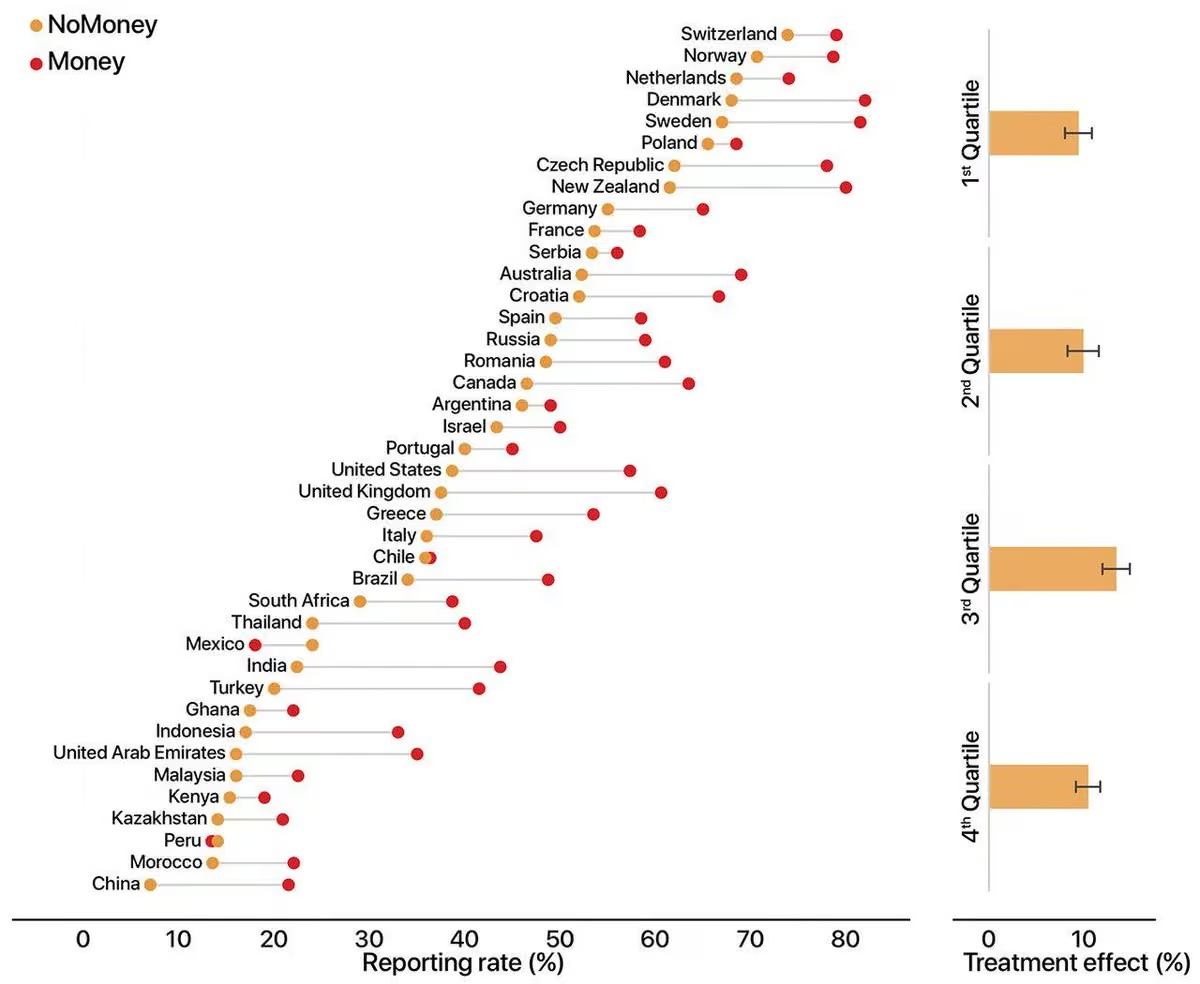
It's intriguing that the same dollar buys more in India and China than in the US and UK, but motivates people less.
Money—not quite the universal incentive we imagine!
In the US and the UK money is a stronger motivator (but less for women than for men), while in Mexico, India and China, it motivates less (but more for women than for men), says @thomastalhelm:
www.chicagobooth.edu/review/culture-matters-finding-best-…
Joe Henrich reposted
Dear followers, please see my article on A Unified Theory Trump
Both Trump’s domestic and foreign policies can be best understood as an attempt to build an imperial presidency by elevating executive power and destroying constraining institutions and norms. www.bloomberg.com/news/features/2026-01-12/nobel-prize-wi…
Joe Henrich reposted
Here are the 2 largest projects we've ever done to catalogue the evidence that social media is harming teens at an industrial scale:
1) A review paper, in press
2) A new website that presents 31 internal Meta studies
www.afterbabel.com/p/mountains-of-evidence
Joe Henrich reposted
Why am I talking about being WEIRD? Because people in Western, individualistic cultures tend to choose more of these abstract pairings. @JoHenrich @StevenHeine4 www.science.org/doi/10.1126/science.aau5141
Joe Henrich reposted
NEW episode on how western psychology became the global outlier drops MONDAY ⏳
Part 1 of The WEIRDest People on Earth by @JoHenrich
Joe Henrich reposted
38 books this year. Mostly teaching & learning. Need more fiction.
Some of the best things I read won’t be out until 2026—which is a weird but grateful place to be. Favorite book out now: @JoHenrich’s The Secret of Our Success. Wide-ranging & fascinating. Culture as superpower.
Ze Hong, great new piece in Ev Anthro.
When Rituals Fail: Rationalization, Bayesianism, and Predictive Processing - Hong - 2025 - Evolutionary Anthropology onlinelibrary.wiley.com/doi/full/10.1002/evan.70020?campa…
Joe Henrich reposted
Atul Gawande's ideas have saved tens of thousands of lives. Here he speaks about the worst thing that Trump has done. “The current estimate is about 600,000 lives lost so far” as a result of cuts to USAID, Gawande said. Also very, very bad:" Gawande returned to Harvard just as the federal government began imposing deep cuts to research funding, hindering efforts by Ariadne Labs to make surgery safer and improve primary care around the world." news.harvard.edu/gazette/story/2025/11/in-the-grip-of-hor…
Joe Henrich reposted
Walter Isaacson discusses his book with the greatest title ever written about ‘The Greatest Sentence Ever Written.' I agree with his judgment: my eyes well up every time I read the sentence (particularly in context, where it appears as a climax after a moderate preamble. The following clause isn't bad either). news.harvard.edu/gazette/story/2025/11/our-self-evident-t…
Joe Henrich reposted
Here's my take on the new Hadza study by Harris and colleagues exploring the role of casual inference in technological evolution (@corenapicella, @SarahMathew1 , @mmuthukrishna @MaximeDerex @_MaxWinkler_ @JF_Schulz ):
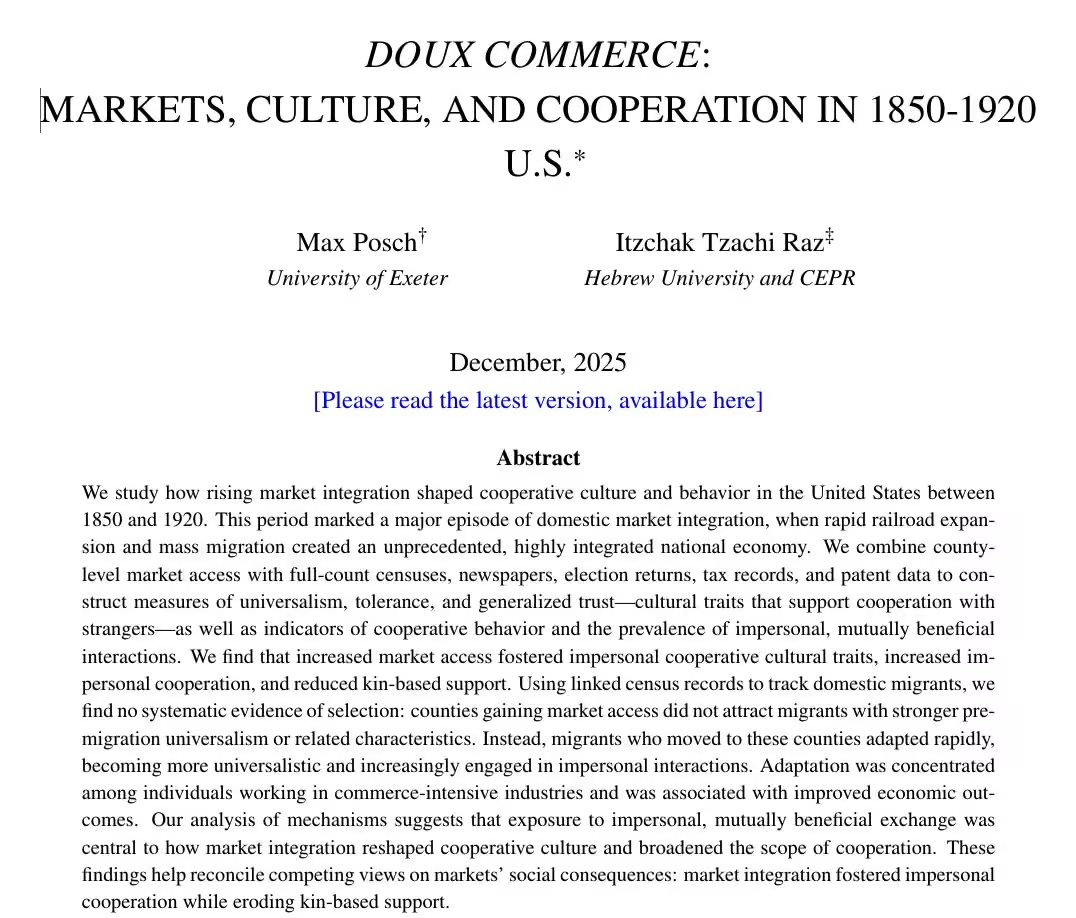
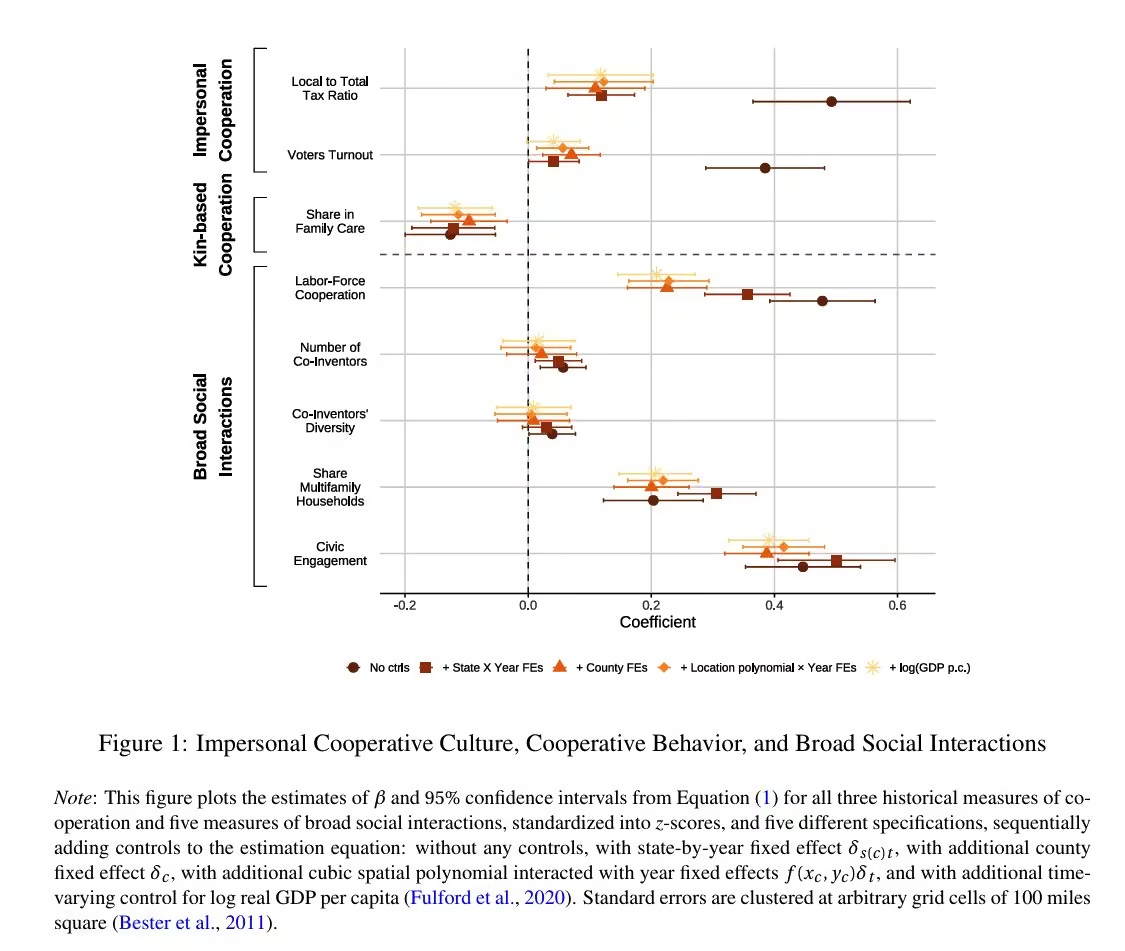
Does market integration foster a psychology inclined toward impersonal prosociality (cooperation with strangers)? Impressive new evidence from @_MaxPosch_ and Raz maxposch.com/s/Posch_Raz_Doux_Commerce.pdf @JonHaidt @sapinker @DrNathanNunn @DAcemogluMIT
I love this paper. They found a natural experiment embedded within the expansion of the US rail network. The results indicate that greater market integration resulted in greater impersonal prosociality and LESS interpersonal prosociality. (as predicted in Chapter 9 of WEIRD) .
The paper shows how both Marx and the Enlightenment thinkers were correct (half right)--e.g., Hume, Smith and Montesquieu.
Cultural Psychologists should attend to this, as it confirms the need for historical psychology, taking a chromospatial approach to psychological variation. @MohammadAtari90 @ThomasTalhelm www.nature.com/articles/s41562-025-02229-y
Exactly. It can’t be Christianity per se because there were tons of variants of Christianity, including Coptic, Armenian, Syrian and Greek orthodox among many others.
Reading Dominion, I constantly wondered how distinct the West/Christianity was from other cultures thru last two millennia. It’s one thing to say “Jesus planted a seed of empathy that sprouted 1,500 years later,” but only WEIRDest People offers causality and non-West comparison.
Joe Henrich reposted
My Conversation with Tyler Cowen - the best interview I have ever had, I think. @tylercowen @IChotiner
www.youtube.com/watch?v=-tZfQaEOrDQ&t=464s
Interesting comparison of my book, The WEIRDest People in the World, with Tom Holland's Dominion. To summarize, both of us offer interesting historical narratives, but I test my narrative using quantitative data whenever possible. ericrundquist.substack.com/p/from-whence-the-west
Crowdsource: a growing number of anthropologists are doing "autoethnography" or "intimate ethnography" of their own lives and families. How does this work with IRB? If you describe your kids and their friends, do you need consent forms of some sort? (special review?)
Joe Henrich reposted
Big news from @aibm_org ! New project on Boys and Men Online led by David Sasaki. As he writes: “Don’t expect all doom, gloom, and dystopia. We believe technology holds real promise to help boys and men become our best selves … if we design, use, and regulate it with intention.”
@oso
open.substack.com/pub/bmonline/p/welcome-to-boys-and-men-…
great paper.
A new study on "Where Discovery Happens" found that with basic research in the life sciences, Harvard contributes more than Canada & France combined. Boston, Cambridge, & Newton are just behind all of China—and well ahead of every other country in the world. Most of this is from federal funding, which is not, contrary to popular misunderstanding, "taxpayer support of Harvard" -- it's a fee for service, namely discoveries in the life sciences. (Thanks to my colleague Jason Furman for this summary.) www.nber.org/system/files/working_papers/w33996/w33996.pdf
Joe Henrich reposted
Japanese-Americans reported more anxiety and suicidal thoughts when tested in Japanese than English! www.psychologicalscience.org/news/2025-nov-language-menta… @PsychScience
Joe Henrich reposted
"Hazing has a function—to make clear to an incoming male that he's subordinate to the dominant males. That can be useful as long as it's not done in a harmful way. Men like status demarcations. Women don't. We are supposed to be all equal all the time." www.louiseperry.co.uk/p/warriors-and-worriers-joyce-benenson
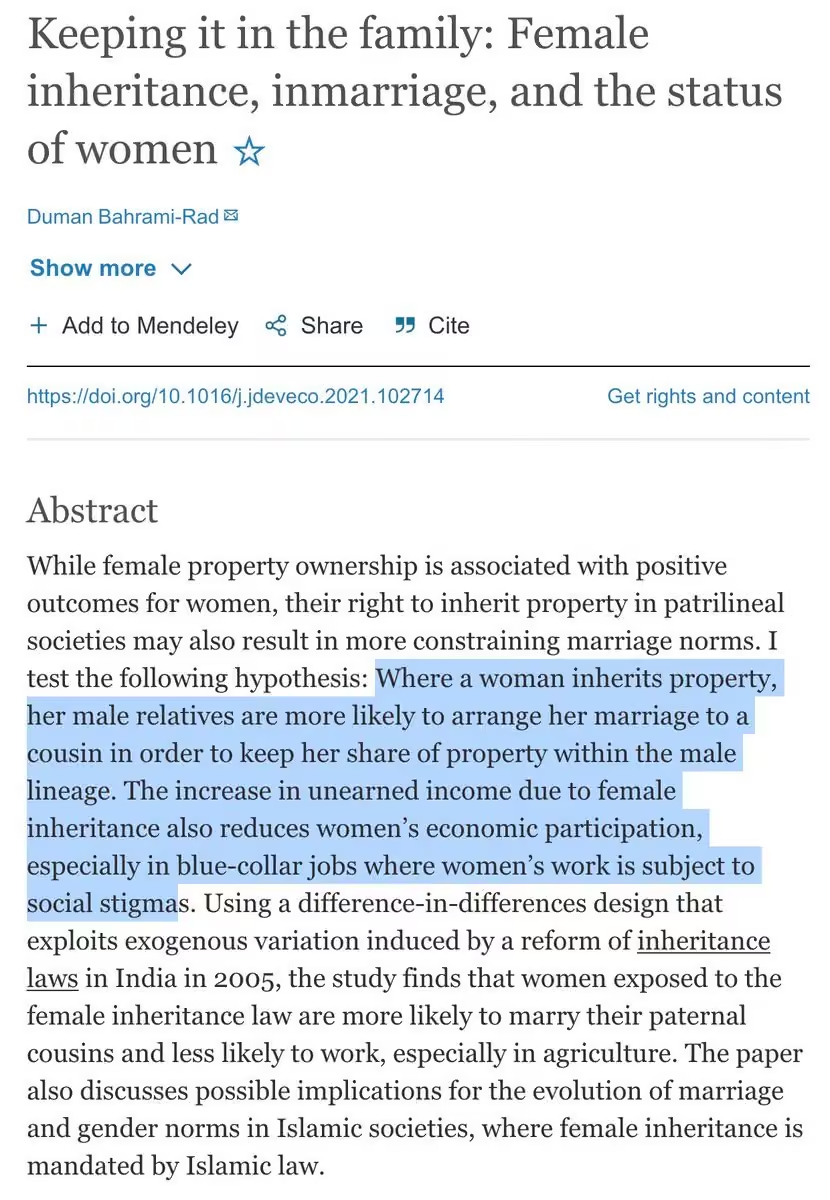
That’s a fantastic paper from my former post-doc!
Cousin marriage maintained tribal strength & wealth, in contexts of insecurity.
It may have been encouraged by Shariah law, which recognised male agnates in inheritance, as well as women’s property rights.
[Whereas in Western Europe, CM was discouraged by the Church]
Great podcast on what great apes can teach us about adolescence! www.radcliffe.harvard.edu/news-and-ideas/episode-502-chim…
Origins of Human Creativity. Great time at South Korea's Gyeongju International History & Culture Forum www.youtube.com/watch?v=qj9BsKkZWu8
Great evidence of intensive kinship! Confirming the argument in The WEIRDest People in the World
“there was no evidence of consanguineous mating at Sitai, as we observed no runs of 73 homozygosity (ROH) longer than 20 cM among any individuals (Figure 1G), and the 74 reconstructed pedigree showed no close-kin unions.” @JoHenrich
Joe Henrich reposted
BeSample will fund your research! Cool funding opportunity for PhD students. study.besample.app/jfe/form/SV_3F905z6gwJPPFgq @Besample_app
Joe Henrich reposted
Choosing your friends (and having the ability to leave your friends!) may make people happier. papers.ssrn.com/sol3/papers.cfm?abstract_id=4993449
Does choosing your friends make you happier?
Chicago Booth's @ThomasTalhelm discusses his research on social circles and happiness. www.chicagobooth.edu/review/podcast/does-choosing-your-fr…
Joe Henrich reposted
Why it matters: Chance neglect helps pseudoscience and fake experts thrive. We give credit for "success" that's no better than random luck.
Next time you see a claim, ask the most important question: "Is this actually better than chance?"
Joe Henrich reposted
Why do bogus predictions persist? Our new @Cognition_J paper finds a key reason: a bias we call "chance neglect."
We found people see a 50% success rate (pure chance!) as mediocre or even good, failing to realize it’s no better than a coin flip.
www.sciencedirect.com/science/article/pii/S00100277250031…
Joe Henrich reposted
The "every kid gets a Chromebook" idea has been a failure. Test scores are down. Screens are bad for learning. Plus kids use school-issued devices to watch streaming services, YouTube, and even porn. My latest in @nytimes:
www.nytimes.com/2025/11/16/opinion/laptop-classroom-test-…
Joe Henrich reposted
The decline of violence continues: Newly released data from the World Bank shows that the global homicide rate has fallen by around a quarter in this century. (Thanks to Fix the News for the item & graph.) data.worldbank.org/indicator/VC.IHR.PSRC.P5?end=2023&star…
Joe Henrich reposted
We examined how speakers from diverse languages describe tones and find a lot more variation than the presumed universalist story might lead us to expect www.pnas.org/doi/10.1073/pnas.1720419115
Joe Henrich reposted
Over-reliance on English hinders cognitive science: it has led to premature claims of universality (due to over-sampling of English speakers) and limited the cognitive constructs being examined (due to the use of English as a meta-language). doi.org/10.1016/j.tics.2022.09.015
Joe Henrich reposted
(1/2) New: Non-binary identity isn't just in free fall among young adults -- it's in free fall among teens as young as 13. Rates have been cut in half in just 2 years among U.S. 8th and 10th graders in nationally representative data. 👀👀👀 🚨🚨🚨 @epkaufm @benryanwriter @jessesingal
Joe Henrich reposted
New Special Issue now out in CRESP. Read our editorial with Joshua Jackson : “Historical psychology: How the events of yesterday shaped the minds of today.”
There are 8 empirical papers in this collection, featuring diverse topics!
Joe Henrich reposted
Sports categories based on hormone levels really is ridiculous. For one thing, male (high T) puberty provides permanent & significant advantages, eg in height, lung capacity & musculature. These do not vanish when testosterone is later blocked and levels are in the female range.
Neil deGrasse Tyson recently suggested separating sports by hormone levels instead of sex. Evolutionary biologist @Hoovlet calls that idea “a terrible, terrible, terrible” one.
Why? Because the performance gap between male and female athletes isn’t erased by lowering testosterone after puberty.
“There are high school boys who can beat female Olympic champions in many events.”
Joe Henrich reposted
As academic hiring season begins, search committees will again wrestle with the topic of faculty diversity. After years of these discussions, I’ve found they often skip the most fundamental question: Why does it matter? Diversity for what?
New piece in Nature Reviews Psych
🧵w/🔗
Joe Henrich reposted
New chapter preprint out! With @kurtjgray & @sharlenef221
Our chapter, Empathic AI Will Undermine Human Kindness, explains how LLMs that offer empathy could weaken the kindness that comes from humans exchanging empathy with each other.
osf.io/preprints/psyarxiv/vdu7m_v1
🧵below:
Joe Henrich reposted
Learn about the Catholic Church’s Marriage and Family Program and how it changed Europe in my interview with Dr. Joseph Henrich (@JoHenrich) about his masterpiece, The WEIRDest People in the World. #anthropology #evolution #science
Full interview: youtu.be/cN3w_cSAsmg
Joe Henrich reposted
How to design a school that will engage boys and bring out the best in them? The Boys' Latin School in Maryland drew ideas from The Anxious Generation: They went phone free early, and gave more and better playtime:
baltimorefishbowl.com/stories/program-spotlight-2025-the-…
@aibm_org
Joe Henrich reposted
🧵1/3 Women and testosterone in NYT! Thrilled to have been able to help out with some background research for this excellent article, and to see my book—T, the Story of Testosterone—get a shout out! By @susandominus, who was curious, open, fun & rigorous.
www.nytimes.com/2025/10/22/magazine/testosterone-women-he…
Joe Henrich reposted
Two days left!
🚨Historical Psych Pre-conference at #spsp2026
Submit your poster or data blitz abstract by Oct. 23,link below. We especially encourage early-career researchers to submit.
Any research on psychological change, cultural evolution,or historical context of social psych is welcome!
Joe Henrich reposted
We are hiring in Social Psychology!
Tenure-track position, focus on the Psychology of Peace and Violence, UMass Amherst.
Review of applications will begin on October 24th.
Let us know if you have any questions!
Link in comment.
Joe Henrich reposted
One of the many delightful surprises coming in from newly phone-free schools: Kids check out many more books from the library!
Phone bans in schools motivate kids to read.
When a Kentucky district eliminated phones, students checked out 2.3x as many books from the library. At one school, twice as many students borrowed books in the first month as all of last year.
Without smartphones, kids get smarter.
Joe Henrich reposted
It turns out ... trans identification really is in free fall among the young. So is nonbinary identity. See below from a nationally representative survey (the CES). @epkaufm was right. 🚨👀 (1/2) 👇
Joe Henrich reposted
This study took us years and years, and it's finally out! 🥳 Here's years of our life in 60 seconds. 🚨 bpspsychub.onlinelibrary.wiley.com/doi/10.1111/bjop.70033 @BPSOfficial @AlexEngPsych @liuqing_wei @Tongrongtian
Joe Henrich reposted
The first known hand of Paranthropus (a pre-human relative) looks a lot like Homo and even more like a gorilla. It almost certainly would have been able to make tools.
Joe Henrich reposted
On Trump flouting norms and why this is a negative development:
"[One of the] remarkable things about Donald Trump—and uniquely among American politicians—is that he has violated norms that have been in place, such as: you don’t boast, you don’t blatantly lie. I mean, all politicians lie because all human beings lie. But they lied under the cover of claiming to be honest.
With Trump, it’s patent that he just doesn’t care about factual accuracy. He’ll say things that are in his interest and that demonize his opponents, with little regard for factual accuracy. Insulting a woman’s appearance, insulting war heroes, insulting patriots, insulting his predecessor in office, flattering enemy leaders, insulting allies—all of these things—there’s never been a law against them, but they just seemed to be things that a decent leader would not do.
By doing them and not suffering consequences, the danger is that he is actually destroying norms that were a pretty good idea. For example, whether he was trolling or semi-serious about, say, annexing Greenland—let alone Canada, my own country—there has been a norm since World War II that nation-states are immortal, borders are grandfathered in, aggressive conquest is taboo. Now, of course, like any norm, it can be floated. Russia is obviously floating it now. But even to talk about floating it, even casually as Trump is doing, I think is a negative development."
Clip from an interview with @unherd.
Joe Henrich reposted
If scientists wants science to be taken seriously, they've got to stop doing stupid stuff like publishing the zillionth study claiming that groupwise disparities are proof of bigotry, and then firing scientists who point out the obvious flaw in that reasoning.
Joe Henrich reposted
Really enjoying #sevendecades by @MGurven! In a world obsessed with immortality it’s a thoughtful & funny look at the actual science of longevity by a leader in the field. Evolution, ecology, demography, anthropology & more.
Looks fantastic! New book from one of my favorite evolutionary scientists
Just released today!
SEVEN DECADES: HOW WE EVOLVED TO LIVE LONGER
Now available at your favorite bookseller.
Leave a review on Goodreads or Amazon if you can.
Please help spread the word!
#sevendecades
Joe Henrich reposted
Just released today!
SEVEN DECADES: HOW WE EVOLVED TO LIVE LONGER
Now available at your favorite bookseller.
Leave a review on Goodreads or Amazon if you can.
Please help spread the word!
#sevendecades
Joe Henrich reposted
Understatement: Modern Freedom Beats Feudal Serfdom (a sign of the times that this needs to be pointed out, & Marian Tupy does it masterfully). open.substack.com/pub/humanprogressnewsletter/p/modern-fr…
Joe Henrich reposted
Watch my interview with Dr. Joseph Henrich (@JoHenrich) about his great book, The WEIRDest People in the World: How the West Became Psychologically Peculiar and Particularly Prosperous. #anthropology #psychology #science
Full interview: youtu.be/cN3w_cSAsmg
Joe Henrich reposted
Its a great time to get the Covid booster! Wastewater data shows virus spread is going up. I got mine this week in Chicago, covered by insurance, no prescription needed.
Joe Henrich reposted
The DRH @ReligionHistory is excited to announce the release of our new Religious Ritual poll (religiondatabase.org/landing/polls/56). Experts can now submit entries on specific rituals, with detailed questions about every aspect of timing, participants, practices and purposes.
Joe Henrich reposted
We're launching the new Human Intelligence Podcast. In the inaugural episode, we're talking with Ivan Kroupin, first author on a new study on the influence of schooling and culture on measures of executive functioning.
youtu.be/ni1W2tU31us
Joe Henrich reposted
"The recent defunding of USAID could lead to more than 14 million deaths, mostly in low- and middle-income countries, including 4.5 million child deaths — according to a study combining retrospective and forecasting analyses." www.thelancet.com/journals/lancet/article/PIIS0140-6736(2…
Regarding Elon Musk's immense wealth...
Maher:
Where do you stand on this? Where is Harvard on this one?
Me:
Charity? Which charity? I haven't seen him distribute anti-HIV drugs, malaria drugs, education for girls. I mean, Bill Gates has given away a lot of money. He's saved probably 100 million lives. Elon Musk will probably cost 20 million lives from the cuts that he's made on USAID when he was head of DOGE.
Stephen Moore:
Do you mean USAID? That's the most corrupt foreign agency ever. Show me anywhere where USAID has had a positive effect on international aid. It just doesn't. It's just corrupt foreign leaders.
Me:
I mean, there's corruption. [But] they've saved tens of millions of lives.
Full episode of last night's Overtime with Bill Maher: www.youtube.com/watch?v=fhQE7sCg64k
@realtimers @billmaher @kaitlancollins @StephenMoore
Joe Henrich reposted
Looking for more fellows to join the team for the October-October cycle. See information below:
We are looking for applicants for the Kokolopori Research Fellowship. Fellows will spend one year in remote Congo gaining experience with behavioral data collection on wild, habituated bonobos. Check out the full posting below and apply now! 🌿📷 📝
Joe Henrich reposted
I'm giving a free book talk next Wednesday @HarvardMuseum. Come by if you're in the Boston area!
This person continues to demonstrate his misunderstanding of the basic theory
More evidence against @JoHenrich et al.'s theory that the Church's war against cousin marriage was responsible for low levels of consanguinity. Among early Slavic populations in the sixth century, long before their Christianization, “we do not find a single case of close consanguinity…. This shows profound knowledge of the lineages and deliberate avoidance of consanguinity.”
www.nature.com/articles/s41586-025-09437-6
That paper provides excellent support for the hypothesis
Did he reply to this claim, I remember he once said there is going to be a paper published about this exact refutation of his hypothesis.
Joe Henrich reposted
More evidence against @JoHenrich et al.'s theory that the Church's war against cousin marriage was responsible for low levels of consanguinity. Among early Slavic populations in the sixth century, long before their Christianization, “we do not find a single case of close consanguinity…. This shows profound knowledge of the lineages and deliberate avoidance of consanguinity.”
www.nature.com/articles/s41586-025-09437-6
Actually, it’s totally the opposite. There’s an immense body of evidence that has aggregated the support hypothesis that I put forward. The anonymous Policy tensor is completely out to lunch.
Nope. Doesn't matter. The evidence against his theory is accumulating with each study.
Joe Henrich reposted
Nope. Doesn't matter. The evidence against his theory is accumulating with each study.
Joe Henrich reposted
Holding your newborn son should be pure joy. But Saatvik Ahluwalia felt something else: worry. Boys are struggling—dropping out more, dying by suicide 4x as often. As a father and researcher, I get it. It’s not about politics, it's about our kids. www.bostonglobe.com/2025/08/16/opinion/boys-men-falling-b…
Joe Henrich reposted
Nostalgic for the 90s? Violent crime was far higher. Republicans shut down the government. The Rodney King riots killed 63 people. Genocides in Bosnia and Rwanda. The end of the Cold war decimated many industries. But @mattyglesias points out the most positive feature: the liberal vision of optimism about enlightenment and progress, well worth reviving. open.substack.com/pub/matthewyglesias/p/what-makes-sense-…
Joe Henrich reposted
Really enjoyed talking with Ricardo Lopes (@TheDissenterYT) about cultural evolution, social structure, and wellbeing in hunter-gatherers. Thanks for having me on your excellent channel!
New episode (1142), with Dr. Gül Salali. We talk about social dynamics, culture, mental health and physical health in hunter-gatherers. #anthropology #science
YouTube: youtu.be/WdkW2Rtxc24
Podcast: open.spotify.com/episode/6drefT6cWoDgc90rOsjH7s
Joe Henrich reposted
Do any of Freud’s theories have scientific value? Watch my interview with Dr. Paul Bloom (@paulbloomatyale) about his book, Psych: The Story of the Human Mind. #psychology #science
Full interview: youtu.be/9BV3Oci3YfY
This paper reviews the evidence for the influence of population size, social interconnectedness, and cognitive diversity on innovation and creativity: onlinelibrary.wiley.com/doi/full/10.1111/tops.12656
Cool study about how tool complexity is correlated with the size of your culture from @JoHenrich
Joe Henrich reposted
If you *only* used SAT to admit to elite colleges, share of admits from top 1% income falls 15.8% → 9.9% and representation from <$200k rises by +8.8%, with no reduction in post-college outcomes.
It's 'holistic review' and 'ban SAT' policy that allows the most wealthy and powerful to virtue signal while getting an edge.
It’s crucial to understand that the cultural psychology of different populations and innovation rates has changed over those 2000 years. We measure psychology from textual source using NLP in China across space and time in this paper. osf.io/preprints/psyarxiv/27u94_v1
Fair enough.
Though their comparatively slow steady innovation over 2,000 years vs the Western European rocket ship after 1500 leaves me asking: what have you invented for me lately?
Joe Henrich reposted
Bottom line: Maybe the idea that homo economicus is male is really a WEIRD culture thing? @JoHenrich @StevenHeine4
Joe Henrich reposted
Hiring a pre-doc for work in dev, pe, and econ history. Please apply :) employment.ucsd.edu/research-assistant-135955/ @econ_ra
Joe Henrich reposted
Are humans still evolving? A new study looks at natural selection in modern Americans. It finds that genes associated with educational attainment are being selected against, while genes associated with depression, asthma, and earlier first birth are being favored.
[Link below.]
Joe Henrich reposted
🧠 Is your research still relying on Western participants?
15 years after “The WEIRDest People in the World” by @JoHenrich et al., most studies still overuse WEIRD samples.
In this paper, published in Behavior Research Methods, I offer digital pathways to move beyond that.
From Science, an interesting measure of Harvard's impact in the life sciences.
Great to see my former student and current post stock, TC, making an impact. It’s worth knowing that this is a side gig for TC. his day job is cultural evolution.
Another amazing finding from the lab of my colleague David Reich: Ancient DNA solves mystery of Hungarian, Finnish language origins — Harvard Gazette news.harvard.edu/gazette/story/2025/07/ancient-dna-solves…
Joe Henrich reposted
Another amazing finding from the lab of my colleague David Reich: Ancient DNA solves mystery of Hungarian, Finnish language origins — Harvard Gazette news.harvard.edu/gazette/story/2025/07/ancient-dna-solves…
Joe Henrich reposted
📢FYI: 🧵on🆕paper on the cultural consequences of markets:
#econtwitter @DrNathanNunn @MarkKoyama @S_Stantcheva @SamuelBazzi @Rick__Hornbeck @JF_Schulz @JoHenrich @joachim_voth @GalorOded @albertobisin @ASBeckKnudsen @gerardrolanducb @MicheleJGelfand @PMoserEcon @saumjha
I can point to a lot of historical work that offers a different view about the classical period.
This is a good thread, but monogamy didn't start in classical Greece, it was always, as far as we know, the norm among the Greeks (no Homeric hero, for example, has >1 wife, so the evidence goes to the very beginning of Greek literary evidence). 1/
Monogamy didn’t start with Christianity.
Its roots lie in classical Greece and Rome, where it became a civic ideal.
In Athens, only children born within wedlock could be citizens. This discouraged elite men from spreading their seed with concubines.
Joe Henrich reposted
This is a good thread, but monogamy didn't start in classical Greece, it was always, as far as we know, the norm among the Greeks (no Homeric hero, for example, has >1 wife, so the evidence goes to the very beginning of Greek literary evidence). 1/
Monogamy didn’t start with Christianity.
Its roots lie in classical Greece and Rome, where it became a civic ideal.
In Athens, only children born within wedlock could be citizens. This discouraged elite men from spreading their seed with concubines.
Have you looked at that technique? If you plug ‘believes in Jesus” in into that approach, you’ll show the Proto into Europeans “ believed in Jesus”
This study argues in favor of Proto-Indo-European monogamy:
core.ac.uk/reader/56680196
Joe Henrich reposted
What we can learn about culture from the DR Congo, Nathan Nunn, regional differences conference, Vancouver @DrNathanNunn
WEIRD Physiology: while psychologists continue to insist that they can infer 'human' thinking from narrow American samples, data from on physiology, health & anatomy confirms the phenotype-altering impact of WEIRD lifestyles. Fascinating piece @MGurven www.nature.com/articles/s43587-025-00888-0
If you can't get basic physiology correct using WEIRD samples, can you really get psychology and cognitive science correct? @StevenHeine4 @MohammadAtari90 @slingerland20 @JonHaidt
We get the same effects if we only compare provinces within the same region. Which eliminates this kind of variation.
Southern Italians share most DNA with Northerners. Their main components are common. Look at MENA and Iberian. Altogether Southern Italians share 30% with near Easterners AT BEST. And that's not even most of them.
The PCA chart should help you better understand the first pic
I don’t recall Carl providing anything that looks like evidence. If I’m wrong, please put me in the right direction.
When carl jung spoke of this no one believed him-
Joe Henrich reposted
This landmark study in The Lancet should be etched on @elonmusk's gravestone:
Dismantling USAID is projected to cause 14 million deaths between 2025 and 2030 — that’s more than 2.4 million lives lost every year.
That’s as many lives lost as in World War I.
Joe Henrich reposted
Exciting new work from Kroupin et al. Also worth checking out first author’s amazing recent cross-cultural work on the Coffer illusion (⬇️)—97% of US/UK subjects saw rectangles, 96% of Namibian Himba subjects saw circles!
osf.io/preprints/psyarxiv/2pu6f_v1
New PNAS paper (Great work Ivan Kroupin): The cultural construction of executive function. By comparing cognitive development in diverse communities, with & without schools, we find different cognitive developmental trajectories. @mmuthukrishna www.pnas.org/doi/abs/10.1073/pnas.2407955122?af=R
Could the influence of schooling and schooled worlds have dramatically shaped other cognitive domains? Should cognitive science textbooks be relabelled as the "Cognitive Science of Schooled Worlds"? (and thus largely unrepresentative of most human societies)
Thanks to our excellent collaborators: Helen Davis (Field Site Director), Emily Burdett, Agustina Bani Cuataf & Vahumburuka Hartley
It’s one of the cases of lost European explorers that I use in the secret of our success. There’s entire books about it.
Yes! @JoHenrich actually showed this to me during my PhD
Peter misses the argument here, making the entire piece misleading. Once you understand the actual argument, the aDNA data is largely supportive. See below
"If we look at DNA from human remains, we see that northwest Europeans were avoiding cousin marriage long before Christianity." www.aporiamagazine.com/p/did-christianity-make-europeans-…
The argument is that ONE branch of Christianity (not "Christianity") diffused a set of prescriptions and prohibitions that dissolved the pre-Christian kinship structures into monogamous nuclear families. It's NOT about "cousin marriage" per se.
These norms enforced monogamous marriage (ending common polygyny, concubinage, sex slaves) and tabooed levirate marriage along many types of unions, which included genetic cousins as well as spiritual kin (e.g., goddaughter) and all in-laws. Lots of non-close-genetic relatives.
The norms also altered post-marital residence and inheritance (by testament instead of customary). This is elaborated in great detail in my book.
These changes dramatically reduced what anthropologists call "kinship intensity", which captures the broad and tight social networks formed by kinship norms. (economists renamed these "kinship tightness"). The classic corporate "tight" kin group is the clan. @JF_Schulz
The aDNA strongly supports this view by confirming the prevalence of polygynous patrilineal clans (without marrying women) in pre-Christian Europe. There's even evidence for levirate marriage, which is the first thing the Church banned in Late Antiquity.
So, even if we take the claims about cousin marriage at face value (which I don't), the aDNA still supports a decline in kinship intensity... which is the key issue. The clans were dismantled.
In his effort to clump Europeans together psychologically, he ignores the application of this theory to explain the variation among Europeans today. E.g., knowing how long a population was under the medieval Church predicts their individualism, conformity & imp. prosociality
The Church's exposure predicts psychological variation in Europe. www.science.org/doi/10.1126/science.aau5141
It also works globally
However, if Peter's reading of the aDNA is right, why does Church exposure predict rates of European cousin in the 20th century?
Curiously, after banning cousin marriage, the medieval Church realized that Europeans wanted to marry their kin so much, they monetized by selling dispensations...made big bucks. There was demand... why? Suddenly, people want to marry cousins?
Why does knowing the rates of cousin marriage among Italian provinces tell us so much about psychological variation within Italy?
Joe Henrich reposted
Congrats to HBES Rising Star Mohammad Atari, for his work on the intersection of culture, evolution, and morality, particularly how social structures and immediate contextual cues impact people’s moral judgment and acceptance of social norms: mohammadatari.com
Joe Henrich reposted
Perhaps the most striking cultural differences are findings that people literally see the world differently depending where they grew up.
Nice pop press piece in science on how people in different populations see the world quite differently using visual illusions. Confirms prior work with larger samples and better methods. @MohammadAtari90 @mmuthukrishna @asifa_majid www.science.org/content/article/culture-literally-changes…
Joe Henrich reposted
@AntiqueThought Saluti, the unroll you asked for: threadreaderapp.com/thread/1903199053812306357.html See you soon. 🤖
Joe Henrich reposted
@AntiqueThought Halo! here is your unroll: threadreaderapp.com/thread/1890768991150342163.html Have a good day. 🤖
Joe Henrich reposted
* cf @JoHenrich, L’Intelligence collective
Joe Henrich reposted
I should credit @JoHenrich for his fantastic book in which he lays out this thesis.
Joe Henrich reposted
My sense is that a good podcast with @JF_Schulz could go incredibly viral…
New paper: Applying computation tools to over 2000 years of textual data in Chinese, we test the hypothesis that the organization of families (kin-based institutions) shapes our psychology. @MohammadAtari90 @slingerland20 @KevinHong1991 @JF_Schulz
Joe Henrich reposted
Tell Yuqi to visit our lab in Chicago sometime! We'd love to hear a presentation on this work.
Joe Henrich reposted
I'm excited to announce that my wife's book, The Mind Electric, is out! She's a brilliant neurologist and weaves together patient stories exploring the human mind. I read it and it's fantastic. If you are interested in the mind, culture, & how we make meaning, check it out!
Joe Henrich reposted
The book on the left opened my eyes to the immense utility of traditions and their role in shaping humanity.
The book on the right opened my eyes to the fact that some traditions have zero, or even negative utility, but remain extremely persistent.
Both by anthropologists.
tradition is the common way a particular people solved particular problems within particular constraints at a particular time
it cannot be sustained long outside that context
Joe Henrich reposted
New paper on the cultural evolution of rhetorical strategies in the political setting in traditional China: nature.com/articles/s41599-024-03164-5…This one has been a long time coming with
@YukiYuqiChen
Joe Henrich reposted
We’ll be presenting our paper on historical text analysis in classical Chinese at #emnlp2024 (the Main Conference).
All credit to @YukiYuqiChen
preprint: arxiv.org/abs/2403.00509
Joe Henrich reposted
Thrilled to work with @MohammadAtari90, @JoHenrich and all the fantastic coauthors!
New preprint! 🔔
3.5 years in the making.
I’m very proud of the work that @YukiYuqiChen has done in this project over the last few years. We are lucky to have her in the field.
New paper: Applying computation tools to over 2000 years of textual data in Chinese, we test the hypothesis that the organization of families (kin-based institutions) shapes our psychology. @MohammadAtari90 @slingerland20 @KevinHong1991 @JF_Schulz
These alternative hypotheses (variables) do matter, but the effect of kinship intensity remains robust and large. Interestingly, the effects of wealth are nearly opposite to those observed in Europe. Culture moderates the effect of wealth (flipping the sign).
Retesting the hypothesis on the same 9 psychological measures in a corpus of 3,027 books stretching from 5 to 1895 CE. We find ample variation across time. There's no essential "Chinese psychology". @corenapicella
Great work by Yuqi Chen, @MohammadAtari90 and the whole team. Thanks to our historians and religious studies experts, Peter Bol and @slingerland20
All comments welcome: osf.io/preprints/psyarxiv/27u94_v1
Nice piece by Roger Partridge. The deep moral foundations of classical liberalism were hollowed by postmodernism. Community, ritual, universal morality and heroes without Iron Age deities: quillette.com/2025/06/10/classical-liberalism-without-str…
Joe Henrich reposted
Thrilled to receive this very generous endorsement from Tony Blair for my upcoming book! If Sir Tony can find time to read it, so can you.
Thank you, @InstituteGC !
Great!
@PsychScience has included Mohammad Atari, assistant professor at @PBSamherst, in its latest list of APS Rising Stars.
umass.science/4dSE4l7
Joe Henrich reposted
@PsychScience has included Mohammad Atari, assistant professor at @PBSamherst, in its latest list of APS Rising Stars.
umass.science/4dSE4l7
Joe Henrich reposted
Why Woke Failed. (The movement was based on flawed understandings of human nature, argues @michaelshermer) open.substack.com/pub/persuasion1/p/why-woke-failed?r=17uk7
Joe Henrich reposted
New episode (1106), with Dr. Kevin Hong (@KevinHong1991). We talk about magic, divination, and dream interpretation across societies. #anthropology #science
YouTube: youtu.be/Gnq8Kjp1Qnc
Podcast: open.spotify.com/episode/5nb2MWSsDrqTtQRDvMBu4o
Joe Henrich reposted
Thanks to my mentors, collaborators, and students.
@JoHenrich @MortezDehghani @DOyserman @JF_Schulz @JonHaidt @cam_lab_umass
Joe Henrich reposted
This Perspective by @MohammadAtari90, @JoHenrich and Jonathan Schultz argues for psychology to become a historical and geographical science, a transformation they term the chronospatial revolution.
www.nature.com/articles/s41562-025-02229-y
Joe Henrich reposted
New paper: The chronospatial revolution in psychology.
With @JF_Schulz @JoHenrich
Join me on this family adventure in Costa Rica!! By day, hike through lush rainforests, watch monkeys playing and feel the rush of white-water rafting. By night, relax in our intellectual salon alumni.harvard.edu/travel/trips/costarica-family-2025
Joe Henrich reposted
Our task: To stop Trump from making the United States of America his ultimate bankruptcy, his ultimate failure.
Joe Henrich reposted
Interesting…I’m surprised at the low level of structural papers.
Joe Henrich reposted
A big congratulations to @ThomasTalhelm for receiving the Early Career Award from @iaccp!
Honored to receive the Early Career Award from the International Association for Cross-Cultural Psychology! 😇 @iaccp @CDR_Booth
d2r0txsugik6oi.cloudfront.net/neon/resource/iaccp/files/I…
Joe Henrich reposted
... and that's @JoHenrich's WEIRD in one cool chart!
Joe Henrich reposted
Across these videos, you'll see the core features of shamanism. Specialists enter altered states, engage w/ unseen forces, & deliver services like healing & divination. But you'll also see incredible diversity. Shamanism is near universal yet its expressions are endlessly varied.
Joe Henrich reposted
Today is publication day for my book, Shamanism: The Timeless Religion. To celebrate, here are some of my striking clips of shamanic rituals that I came across while working on the book:
Joe Henrich reposted
Fresh out in Psychological Review!
Why do so many societies explain events through fate, spirits, or divine will—but rarely invoke “chance”?
My new article examines the cross-cultural absence of chance-based explanations and what it reveals about human cognition.
Joe Henrich reposted
Ironic life goal accomplished: I gave a talk about rice at Rice University! 🍚 Next up: who can I talk to about arranging a visit to Wheaton College?? 🌾 @WheatonCollege @RiceUniversity
Joe Henrich reposted
Looking forward to speaking at the @aspenideas festival in a little over a month!
💡 Psychologist @Shige_Oishi, author of “Life in Three Dimensions”, will offer a fresh perspective on well-being, advocating for a life enriched by curiosity and exploration to achieve psychological richness.
Joe Henrich reposted
Morality across time and space, now published in ERSP.
Just finished "Abundance" by @ezraklein and Derek Thompson. Fantastic book! I found myself thinking, "I couldn't agree more." Well done! If I may offer one critique...however...
The percentage of literate Americans increased dramatically over the period, implying that our corpus callosa have thickened (on-average) since 1785. So, our brains (our biology) have changed. Discussed in the Prelude of the WEIRDest People in the World.
Here, a government policy--universal schooling--resulted in the thickening of our corpus callosa, a change in our biology. Policy-->biology.
Joe Henrich reposted
16. Currently, our ignorance regarding sex chromosome effects outweighs our knowledge. In some respects, evolution appears to have acted on the sex chromosomes to unify the sexes, and in others, to drive them apart.
\end
Joe Henrich reposted
This is practically the definition of chutzpah:
Introduce a product that will probably harm children with the sales pitch that it reduces the harm to children that your last product caused.
Zuckerberg explaining how Meta is creating personalized AI friends to supplement your real ones: “The average American has 3 friends, but has demand for 15.”
Joe Henrich reposted
Just released: HHS review of evidence for puberty blockers & cross-sex hormones to treat gender dysphoria in kids. Finds "evidence pointing to significant risks—including irreversible harms such as infertility—while finding very weak evidence of benefit." www.hhs.gov/press-room/gender-dysphoria-report-release.html
Joe Henrich reposted
An idea whose time has come: Yale faculty call for admin hiring freeze, independent audit amid concerns over bureaucratic expansion - Yale Daily News yaledailynews.com/blog/2025/04/24/yale-faculty-call-for-a…
Joe Henrich reposted
Is there a “human nature”? Watch my first interview with Dr. Joseph Henrich (@JoHenrich). #anthropology #psychology #science
Full interview: youtu.be/1Qx7q4Swruk
Joe Henrich reposted
Indeed - our study of four cultures (Tsimane, Ache, Ayoreo, and Tuvans) in which collective music-making is rare also points to cultural loss as an important factor, though in the other three cases foreign intrusion was the main cause:
osf.io/preprints/socarxiv/zuhdy_v2
Joe Henrich reposted
Deeply honored and humbled by this recognition from the @AEAInformation. I owe so much to my co-authors, colleagues, mentors, students & many others: support, inspiration, generosity. Endlessly grateful for all I have learned from you & hope to continue contributing to our field
Congratulations to Stefanie Stantcheva (@S_Stantcheva) of @Harvard, winner of the 2025 John Bates Clark Medal! www.aeaweb.org/about-aea/honors-awards/bates-clark/stefan…
Joe Henrich reposted
🚨 Just published! 🚨
Divination: A Cognitive Perspective is now out with Cambridge University Press, in the Psychology of Religion series!
For the next 2 weeks, the full PDF is free to download:
🔗 www.cambridge.org/core/elements/divination/057233C180678E…
🧵(1/3)
Great stuff!! Northern Ache also lost the know-how to make fire. Cultural losses are common when populations shrink and are isolated.
Are dancing and infant-directed song (incl. lullabies) human universals? Like many people, I've long thought so.
But in a new paper in @CurrentBiology, Kim Hill & I report that the Northern Aché (Paraguay) lacked both behaviors, likely losing them during cultural declines.
Joe Henrich reposted
NEW paper out today! “Wisdom in Time” (ERSP). TL;DR: Social psychology keeps talking growth & social change — but half the evidence is frozen in time. PDFosf.io/preprints/psyarxiv/uy93k_v4
Joe Henrich reposted
.@dwarkesh_sp interviews @JoHenrich 🔥
Joe Henrich reposted
Just like their close cousins, the humans, wild chimpanzees are shown to share fermented fruits. "At the time of sharing, 90% of the shared fruits contained ethanol"
Joe Henrich reposted
So many congrats to @S_Stantcheva! A very well deserved award. As you can imagine, I am partial to her field experimental work, but her early theoretical work in public economics was extraordinary too!
Congratulations to Stefanie Stantcheva (@S_Stantcheva) of @Harvard, winner of the 2025 John Bates Clark Medal! www.aeaweb.org/about-aea/honors-awards/bates-clark/stefan…
Joe Henrich reposted
Yes; I had to lobby the New York Times to stop reflexively referring to FIRE as a "right-wing" organization.
When @TheFIREorg was defending free speech against threats from liberals, many liberals defamed them as a partisan right-wing org.
Now they’re defending free speech against the Trump admin w the same intelligent fervor.
We could use some pundit accountability here.
Yes, @TheFIREorg spent a lot of time defending conservatives on campus these past 10 years.
But the enemy of free speech isn’t necessarily partisanship, it’s power. And in recent months, the boot has been on the other foot.
I list the threats w/ @mehdirhasan for @zeteo_news:
Joe Henrich reposted
It suddenly struck me that the economic impact of Trump's tariffs increasingly resembles the economic impact of the pandemic five years ago.
Joe Henrich reposted
This is the one to bookmark, imo. Henrich put a lot more work into his research than I can paraphrase here. 🙏
Joe Henrich reposted
You would not believe the quotations we have from inside Snap, inc. They know what they are doing to children including addiction and exposure to sextortion. You've got to read the quotations yourself. @TheTimes gives some of the most shocking ones:
www.thetimes.com/uk/london/article/snapchat-harming-child…
Joe Henrich reposted
🧵 THREAD: A federal whistleblower just dropped one of the most disturbing cybersecurity disclosures I’ve ever read.
He's saying DOGE came in, data went out, and Russians started attempting logins with new valid DOGE passwords
Media's coverage wasn't detailed enough so I dug into his testimony:
Joe Henrich reposted
Moral Psych community: @jowylie2 & I will be organizing the pre-con at SPSP again! This past year was sold-out and we expect next year to be even bigger!
Who do you YOU want to hear from next year? Recommend a speaker with this quick form: docs.google.com/forms/d/e/1FAIpQLSeGjS6GvXySosqgE-bOAUT5S…
Joe Henrich reposted
You would not believe the quotations we have from inside TikTok. They know what they are doing to children including the addiction ("compulsive use") and attention fragmentation. You've got to read the quotations yourself:
www.afterbabel.com/p/industrial-scale-harm-tiktok
WOW: @JonHaidt got info from inside TikTok admitting how they target kids:
"The product in itself has baked into it compulsive use... younger users... are particularly sensitive to reinforcement in the form of social reward and have minimal ability to self-regulate effectively"
People keep asking what the mood is at Harvard, given the administration's flagrant attack on our independence. The mood is feisty and defiant. We're pulling together, filling sandbags, stocking up on supplies, tightening our belts, building alliances... and sharpening quills.
The insanity of Trump's attempted takeover: Leading Harvard scientist ordered to halt research in funding freeze www.bostonglobe.com/2025/04/15/metro/harvard-scientist-fu… via @BostonGlobe
Harvard was here 140 years before the U.S. came into existence and will be here 140 years from now. #harvardstrong
Joe Henrich reposted
The insanity of Trump's attempted takeover: Leading Harvard scientist ordered to halt research in funding freeze www.bostonglobe.com/2025/04/15/metro/harvard-scientist-fu… via @BostonGlobe
This is profoundly disturbing: DOGE is the opposite of transparent and transferring massive data out of government, disabling security, www.npr.org/2025/04/15/nx-s1-5355896/doge-nlrb-elon-musk-…
People outside the U.S. are trying to use DOGE-created logins to access sensitive data.
Reading Marvin Harris got me interested in anthropology.
Were you influenced by Marvin Harris?
Joe Henrich reposted
Harvard Must Not Submit to a Hostile Takeover | My article (with colleague Tarek Masoud), endorsed by the leaders of the Council on Academic Freedom at Harvard @cafh | Opinion | The Harvard Crimson www.thecrimson.com/article/2025/4/16/cafh-harvard-trump-d…
Joe Henrich reposted
As the President @realDonaldTrump did with @Harvard today, threatening the use of the tax system against your adversaries is the stuff of Putin-like dictatorships. Shame.
Joe Henrich reposted
Harvard has set an example for other higher-ed institutions – rejecting an unlawful and ham-handed attempt to stifle academic freedom, while taking concrete steps to make sure all students at Harvard can benefit from an environment of intellectual inquiry, rigorous debate and mutual respect. Let’s hope other institutions follow suit.
“No government—regardless of which party is in power—should dictate what private universities can teach, whom they can admit and hire, and which areas of study and inquiry they can pursue.” - President Alan Garber hrvd.me/GarberRespond347t
Joe Henrich reposted
Standing up to the federal government’s strong-arming takes courage — and FIRE applauds @Harvard for not caving to the federal government’s unlawful demands.
We’ve long been critical of Harvard’s inability to fairly protect the free speech of all students and faculty, but we must not allow the government to coerce, extort, or capture our colleges. A principled defense of academic freedom requires no less.
This is an extraordinary letter from the federal government to @Harvard. It goes far beyond anything the Obama and Biden administrations did in their unlawful Title IX dictates.
The feds are essentially demanding Harvard become a vassal institution. In such an arrangement, there will be no free speech or academic freedom rights, and there will be ideological litmus tests for who gets hired or admitted.
Not only do these demands ignore the process for adjudicating alleged Title VI violations, they are fundamentally at odds with the First Amendment.
The feds cannot condition federal funding on a private university giving up its First Amendment rights.
This is big government "conservatism," plain and simple.
Joe Henrich reposted
“This is perhaps the worst economic own goal I have seen in my lifetime.”
Free Press columnist @tylercowen:
Joe Henrich reposted
I endorse Harvard's decision to fight the astonishing list of demands being forced on it by the Trump administration. I'm currently working on statement and op-ed with my fellow Co-Presidents of the Council on Academic Freedom at Harvard @cafh explaining the threat in the demands and how they cannot be accepted. www.thecrimson.com/thread/2025/4/15/harvard-will-fight-de…
Joe Henrich reposted
Sad to agree with @CathyYoung63 and @MattJJ89 that the Free Press (for which I had high hopes) has "descended into MAGA-lite." Yes, PC-SJW-Critical-Woke-Intersectionality is bad, but some perspective, please: Blowing up the international order, sucking up to autocrats, wrecking the world economy, sowing doubt about vaccines, spreading medical quackery, strangling lifesaving foreign aid, pardoning violent rioters, preventing data collection, spewing nonstop lies, & extorting the press, law firms, and universities is worse.
Excellent, wellresearched critique of @TheFP
by @mattjj89 (Matt Johnson) at @UnPopulistMag. As someone who believes opposing left-wing illiberalism is important (& has defended Bari Weiss), I've found the FP's descent into MAGA-lite dispiriting.
(redoing b/c got author wrong)
Joe Henrich reposted
Top 25 articles of 2024! Super cool to see our study comparing people assigned to nearby rice or wheat govt farms make Nature Communications' list. 🥳 (Based on downloads) @NaturePortfolio @NatureComms @dong_xiawei2023 www.nature.com/articles/s41467-024-44770-w
Joe Henrich reposted
Great ep on the pod @dwarkesh_sp and @JoHenrich. Really interested in your next book on the collective brain -- a concept you should look to understand better is WAR in baseball statistics. "Wins above replacement." Instead of getting lost in the heated emotions behind a debate about the great man theory of history, and staking a claim on one side or another, look to areas where statistics have helped to delineate individual vs. team performance. In science, "wins" would be defined as discoveries as measured in time. We can all agree that Michael Jordan is the greatest of all time and also accept that basketball is a team sport that exists only because there are other teams with other players. Michael Jordan can't be the greatest merely on his own. The sport requires other people. But he's still a better performer. Same with Einstein. Poincare would have taken a few more years. And those years matter. Some people are better than others in quantifiable ways.
Joe Henrich reposted
We are now at the tipping point on smartphones and social media. The Guardian and Bloomberg both have essays today describing how we got here:
www.theguardian.com/world/2025/apr/11/friday-briefing-has…
www.bloomberg.com/opinion/articles/2025-04-11/social-medi…
www.nature.com/articles/s41562-019-0734-z
I'm looking for good articles about the evolution of our norm psychology, i.e, selective mechanisms, timing, & tests. Most papers seem to assume it but how did it evolve? I know the Chudek and Henrich 2011 TRiCS article but what else should i read? @JoHenrich @mnvrsngh @robsica
Joe Henrich reposted
Bonobos combine different calls to make new meanings, an ability that was thought to be unique to humans. Amazing advance for hypothesizing about the origins of human language. @ScienceMagazine
Joe Henrich reposted
A huge day for mapping in life science!
—the mammalian brain, most extensive yet
www.nature.com/articles/s41586-025-08790-w @AllenInstitute
—a comprehensive map of the human cell going sub-cellular
www.nature.com/articles/s41586-025-08878-3
—complete ape genomes
www.nature.com/articles/s41586-025-08816-3
Joe Henrich reposted
Could this moment be a prelude to Trump's Pyrrhic victory on the US current deficit?
As every textbook teaches us, the current account deficit is equal to the financial account surplus. The US has a current account deficit in part because its assets (treasuries, private debt and equity) are attractive to foreigners – largely because of their safety and liquidity. Trump’s tariffs, attacks on allies and NATO, and policies shaking the core of US institutions will make US assets less safe, more uncertain and less attractive.
When that happens, the US financial account will start worsening and the current account will have to improve.
A victory for Trump!
Joe Henrich reposted
The zero-sum mindset seems more and more relevant in the current environment. Thank you @HarvardMagazine for the video where I explain our research on why zero-sum thinking is so important and where it comes from. www.youtube.com/watch?v=e16o_j1tvXk
Joe Henrich reposted
Cordelia Fine and I disagree about the degree to which differences in sexual selection and testosterone contribute to behavioral sex differences humans. In this "spirited" exchange (link in comments), we probe the source of our divergent views. It's been a few years in the making, and I wasn't sure it would see the light of day. Thanks to Aeon (especially Sally Davies) and Cordelia for sticking with it!
We offered similar thoughts in this perspective www.nature.com/articles/s41562-018-0522-1 @mmuthukrishna
This tweet provoked useful debate so here are some followup thoughts. Of course there is sometimes enormous value in purely observational social science research. But if that’s a main part of your research program, or your field in general, then it’s going to lead to work like this: Findings that are little more than meaningless. Why is this a problem?
1. The scientific industry is like a machine that grinds forward churning out papers. Researchers have an incentive to produce papers, and those incentives are often stronger than the incentives to produce strong, careful, or even accurate papers. As a result, an enormous share of observational research is probably not replicable (take a look at social psychology journals for example). Even when they are, often findings themselves don’t tell us anything about the world without a framework to interpret them against and they don’t easily lead to testable predictions that inspire future work. It’s like if we survey two grocery stores; Trader Joes and Aldis and find that people who shop at TJs have more hair on their head than people who shop at Aldis. Who cares?
2. As a result of this type of approach, after decades of work in multiple social science fields and what have we learned? Practically nothing. If a psychologist is not an expert on human behavior or a sociologist is not an expert on society, then what is the point of the entire field? Papers and a discipline that produces them don’t necessarily result in knowledge, much less the kind of knowledge that explains why things are they way they are.
3. False positives aren’t without cost. First, the sheer volume threatens to or does drown out more careful research. Second, because it’s so easy to produce publications that don’t necessarily replicate, they lead to findings that make headlines. This in itself I think harms the public’s understanding of the scientific enterprise (ie Ted talks) but also, when they are shown not to be replicable, it harms the credibility of science. We should focus on doing science that both replicates and explains something about the world, not counting the number of hairs on peoples head just because we can.
4. I think there are a priori reasons to think that theory driven research will result in higher quality studies. It’s an empirical question but I’ve been persuaded that with a theoretical framework you go hunting for specific things (ie testing predictions), and not finding those things is potentially as valuable as finding them. This is in contrast to an approach where you do studies just looking for something. After seeing how the sausage is made across the fields of anthro, psychology, poly science, and sociology I’ve come to think a theory-driven question approach is more likely to lead to valid insightful findings.
5. What about observational data? I actually collect lots of it and think the move in anthropology to start doing so transformed a small part of the field into science. But collecting it doesn’t mean you should make that data itself the focus on your publications. Such efforts are more valuable when they are part of a larger systematic inquiry, rather than standalone studies, ie, not “do republicans weigh more than democrats” but instead “alongside our study of political preferences, let’s also collect systematic data on a wide variety of anthropometric measures.” Now if we find out that Reps are taller or shorter than Dems, or have greater upper arm circumference, is that interesting? I don’t know but I would think that is the place to start asking questions about whether those differences are real (generalizable to other samples), and if so, why they emerge. But in asking that question, then one is going to be forced to do some hypothesizing. But what one should not do is just publish those findings thinking they tell you anything about the world.
These are my quick thoughts about it. I love science, and I love being a scientist and I want our work to matter. It’s only going to matter if people can trust the research they see and when it explains something about the world. Feedback very welcome.
Joe Henrich reposted
When China is posting Ronald Reagan on main while the Republican Party abandons all his principles, you know you fucked up.
Ronald Reagan vs. #tariffs : 1987 speech finds new relevance in 2025
Yes, to the point! Tariffs just made that pencil much more expensive to make. How will we get the graphite mines into the U.S.? I guess we need to make pencils in the U.S. for national security reasons. Great to see Musk pushing back against the stupid tariffs.
Joe Henrich reposted
I've never seen as much incoherence and irrationality as we saw on television today (from Trump Administration officials). This Administration doesn’t have a coherent message on why it's doing the largest tax increase the country's had in 50 years. Usually when you do something consequential, you have a clear rationale that's consistently delivered, and we're not getting that.
Joe Henrich reposted
Here is the great economist Thomas Sowell on tariffs and why "trade wars" are bad for the economy, bad for citizens, bad for politics, and just bad all around.
In an interview recorded yesterday, Hoover Senior Fellow Thomas Sowell criticizes the tariffs President Trump instituted earlier today. Watch the complete interview with Dr. Sowell on @UncKnowledge with Peter Robinson (@P_M_Robinson) on April 15th, 2025.
Joe Henrich reposted
1. Does research by @CaraOcobock @Anthrofuentes & others, widely reported in SciAm & elsewhere, finally dispel hunter-gatherer myths that have persisted since the 60's?
In a preprint led by @vivek_vasi The Meanings&Dividends of Man the Hunter osf.io/preprints/osf/gawbt_v1 we respond🧵
Joe Henrich reposted
"Commerce is a cure for the most destructive prejudices; for it is almost a general rule that wherever manners are gentle there is commerce; and wherever there is commerce, manners are gentle" --- Montesquieu (1748), The Spirit of Law.
Joe Henrich reposted
On top of the devastating economic consequences of Trump's trade war, we should also be concerned about the broader global political and social aspects. Research across the social sciences shows that markets and trade foster cooperation, civicness, trust, and related traits. E.g.
Joe Henrich reposted
Watch the full episode with @JoHenrich
Transcript: www.dwarkesh.com/p/joseph-henrich
Apple Podcasts: podcasts.apple.com/us/podcast/joseph-henrich-why-humans-s……
Spotify: open.spotify.com/episode/12zpiPQGJA215PJcDtNTjr…
YouTube: www.youtube.com/watch?v=TcfhrThp1OU
Joe Henrich reposted
Hunter gatherer war and peace. Great review of the complexity of intergroup violence among foragers in @WorksInProgMag
Joe Henrich reposted
Just finished 'Abundance' by Klein & Thompson.
Absolutely brilliant – totally lives up to the hype. Mandatory reading for progressives everywhere.
My only (minor) quibble is that I wish it wasn't so US-focused. Most lessons apply just as urgently to the UK and EU!
Joe Henrich reposted
So excited for @kris_m_smith, who's starting as an Asst Prof at @wsuanthropology in August! 🎉 His blend of theoretical rigor and applied research, his generous mentoring style, and his upward trajectory of accomplishment is just 👌🏻. Congratulations Prof Smith!! 🙌🏻
Joe Henrich reposted
Join me Thursday for a talk on how money motivates people more in WEIRD cultures (and less in Hindi). On Zoom, Thursday 8:30am Central, register free here: lcsr.hse.ru/en/announcements/1027223187.html @lcsr_hse work with @DanMedvedev6
Joe Henrich reposted
The always prescient @mattwridley on evolution and Darwin's strangest idea, sexual selection, but first we discuss the Covid lab leak hypothesis and why so many people were reluctant to accept it. In science the facts do not always speak for themselves.
www.skeptic.com/michael-shermer-show/sex-and-beauty-the-e…
Joe Henrich reposted
FWIW that’s not quite our view! At least, the studies are neither tiny nor weak: They tested ~2000 people, in 16 cultures, and found large differences. Though we reject their interpretation, we engaged with this work precisely because it is powerful and compelling in so many ways
Joe Henrich reposted
Check out my appearance on Armchair Expert with Dax Shepard: armchairexpertpod.com/pods/joseph-henrich
Joe Henrich reposted
In a new paper, colleagues and I raise concerns about the conclusions and data from Zhang et al 2022, a paper which reported that they obtained DNA from a 14-thousand-year-old individual from Red Deer Cave in Yunnan China referred to as ‘Mengzi Ren’ (MZR)
(Zhang et al Fig 1)
1/15
Joe Henrich reposted
Same-sex sexual orientation is around 30% heritable. This makes it among the least heritable psychological traits. Note, though, that the environmental component is almost certainly not the social environment or nurture in the traditional sense.
[Link below.]
Joe Henrich reposted
ngl, the new ChatGPT image generator is good
Joe Henrich reposted
New from @DanTabin www.cell.com/current-biology/fulltext/S0960-9822(24)01366-6 in response to the Red Deer Cave paper that purported to find a link to the East Asian ancestry of Native Americans.
Joe Henrich reposted
1. What's at risk by disrupting NIH? With only a bit of hyperbole: a mechanistic understanding of life itself, & therefore better treatments for cancer, dementias, autoimmune disorders, neurodegenerative diseases, birth defects, aging & more.
Notes on a revolution interrupted 🧵
Joe Henrich reposted
For the final project in my "Shamanism & Witchcraft" course this past quarter, I gave students a huge amount of freedom: any medium, any tech (including as much AI as they needed), as long as they explored content from the class. I love what they produced.
Here's a selection:
Joe Henrich reposted
A billion words, three theories, one test: What predicts the most cultural differences in China? 🏇 🧵
www.nature.com/articles/s41599-024-04053-7
Joe Henrich reposted
On how it's a mistake to believe that many psychological and behavioral studies reflect the behavior and beliefs of those outside the West:
1. Massively biased samples: Most of what was known experimentally about human psychology and behavior was based on studies with undergraduates from Western societies. At the time, 96 percent of experimental participants were drawn from northern Europe, North America, or Australia, and about 70 percent of these were American undergraduates.
2. Psychological diversity: Psychological differences between populations appeared in many important domains, indicating much greater variation than one might expect from reading the textbooks or major journals in either psychology or behavioral economics.
3. Psychological peculiarity: When cross-cultural data were available from multiple populations, Western samples typically anchored the extreme end of the distribution. They were psychologically weird."
~@JoHenrich
This paper misunderstands the goal of the WEIRD paper they cite so prominently. The point of the paper was to raise the consciousness of researchers to the presence of substantial variation in widely used psychological measures across societies.
I totally agree with the authors that the case for the carpentered corner hypothesis, especially, was weak. That doesn't mean it's not true, but the Segall et. al. data is only suggestive.
The multi-modal nature of the ML illusion has lured the authors into thinking that visual environments could 'cross-over' and influence other modalities. I wouldn't bet on that. Watch this space.
Joe Henrich reposted
"Innovation is a social product of ideas flowing around between people." Cities allow this process to unfold. 🏙️💡
Under @mmuthukrishna, AUL's Cities, Culture, and Technology research cluster is exploring the social and cultural nuances of innovation in urban environments. ✨
Two scholars that I greatly respect published this perspective that I think is on the wrong track. We had the entire lab read the paper, so I'll reflect the concerns of multiple cultural evolutionary scholars. @mnvrsngh
Consider our approach to 'prestige' as a form of social status alongside dominance. Our 2001 theory specified conditions under which we'd expect to see this across species. At the time, the evidence suggested we'd only see this in humans (and we see it in all societies).
However, new evidence demonstrating higher fidelity cultural transmission in other species compels us to predict prestige in other species, such as chimpanzees and some toothed whales. (among others). We had a theory, not a magic bullet.
From more on the role of theory in psychological and behavioral science: www.nature.com/articles/s41562-018-0522-1
Don't play the magic bullet game. Offer a theory that makes predictions across taxa and environments.
I still haven’t heard of a theory of the origins of these things that is distinct from the cumulative cultural evolutionary story? What’s the theory? This falls into the same trap that I pointed out and secret. It’s looking for the magic bullet not the process.
Substantial cumulative culture in humans is the cause of relatively more open-mindedness. See The Secret of Our Succes. Get a theory and stop playing games with definitions. Build an evolutionary model of the origins of open-endedness. The driver is CCE.
Joe Henrich reposted
Ooh, that's an interesting idea! I had sort of the reverse take: positive self-memories may make people complacent and less willing to change. I think of Steve Heine's paper finding that positive feedback *demotivated* people in Japan from studying.
Joe Henrich reposted
This new data suggests that the positivity bias is not universal--maybe a WEIRD thing? Nod to @JoHenrich @StevenHeine4 and Norenzayan.
Joe Henrich reposted
Building on @mmuthukrishna and @JoHenrich's theory of "innovation in the collective brain," the CCT cluster focuses on three themes:
🤝 Sociality and Urban Networks
🗣️ Transmission Fidelity and Social Learning
🌍 Variance, Tolerance, and Migration
Joe Henrich reposted
NIH: Too woke? Or not woke enough? 84/10,000 titles (0.84%) of NIH funded research published in the last year had one or more of these words/phrases (couldn't use "diversity" because it was too common in non-woke titles)
2414 titles (24%) had cancer, patient, health, and/or cell
Joe Henrich reposted
Watch the full episode with @JoHenrich:
Read the transcript:
www.dwarkesh.com/p/joseph-henrich
Apple Podcasts:
podcasts.apple.com/us/podcast/joseph-henrich-why-humans-s…
Spotify:
open.spotify.com/episode/12zpiPQGJA215PJcDtNTjr
YouTube:
youtu.be/TcfhrThp1OU
Joe Henrich reposted
Man with 17 wives and 84 children bursts out laughing at the concept of monogamy.
Joe Henrich reposted
It’s always great to talk with Ricardo. He has a knack for asking the most central and interesting questions.
New episode (1072), with Dr. Steven Heine (@StevenHeine4). We talk about his new book, Start Making Sense: How Existential Psychology Can Help Us Build Meaningful Lives in Absurd Times. #psychology #science
YouTube: youtu.be/oQj1VpqU1kQ
Podcast: open.spotify.com/episode/1KsF2hXQB7xlFShS4lHgnI
Joe Henrich reposted
Almost 100k papers have been published in the last year with NIH funding. These are the top 200 most frequent title words from 10k of them. Disrupting NIH will cause incalculable harm to US citizens.
Joe Henrich reposted
Thank you @VivekGRamaswamy. Yes!
This is one of the few major issues that is completely bipartisan. Red states and blue states are getting phones out of schools.
Let's do this, together.
Get the cell phones out of the schools.
Joe Henrich reposted
Two common findings from sleep research are that 1) short sleep durations predict worse health outcomes, and 2) people from some cultures sleep much less than those from others. Do people from cultures with short sleep durations have worse health outcomes? 🧵
Joe Henrich reposted
Co-director @DAcemogluMIT explains why he's concerned that AI could be used for "so-so automation," which displaces workers from tasks they used to perform without achieving productivity improvements or cost savings.
Joe Henrich reposted
With the decline in war, have we lost the selective pressure which makes governments improve over time?
There are many other layers of selection (companies within markets, political parties within elections).
But there's no ground truth outer loss on the system as a whole.
Joe Henrich reposted
I agree with @BradWilcoxIFS & @JoHenrich (on the show👇🏻) that monogamy offers major benefits, and that married people are happier in general. But that doesn’t mean it’s right for everyone. We explore the evolution of marriage, and the role of religion here www.howgodworks.org/podcast/season-8/marriage-monogamy-an…
How do we explain "The Puzzle of Monogamous Marriage" given the cross-pressures?
As @Harvard's Joseph Henrich notes, the benefits of monogamy are substantial:
☑️ Less violent crime
☑️ Greater paternal involvement
☑️ More social equality
Joe Henrich reposted
A reminder to colleagues and #ancientdna afficionados - all papers out of our lab are always made available upon publicatgion at reich.hms.harvard.edu/publications.
Genotype data can be found at reich.hms.harvard.edu/datasets.
Joe Henrich reposted
New #ancientdna paper showing the enduring legacy of Maghrebi ancestry amidst various admixture events: www.nature.com/articles/s41586-025-08699-4
Thanks for sharing several of the items in my reference list! I think I cited every one. Jack, of course, gets name-checked. However, WEIRD offers a more comprehensive treatment and, most importantly, delivers heaps of data that you won't in prior efforts.
No es una tesis suya.
El origen, que yo sepa;
For a discussion of this and other sources from Late Antiquity, see endnote 39 on page 538 of WEIRD.
@JoHenrich might not be aware that in his City of God St Augustine explicitly calls for patriarchal
clans to be eliminated via extirpating close kin marriage. Really cool scholarship from @hbdchick on this hbdchick.wordpress.com/2015/01/12/st-augustine-on-outbree…
Joe Henrich reposted
"A huge number of innovations are mistakes where somebody copied incorrectly and then got something better" -
@JoHenrich
Humans have succeeded thanks to cultural evolution (and not individual IQ).
And that's precisely why I think AGI is *under hyped*.
Because of massive populations and perfect knowledge transfer, AGI hive minds will discover new ideas so much faster, whether from lucky mistakes, deliberate experiments, de-novo inventions, or some combination.
This will be a step-function increase in cultural evolution that was as big as the jump between humans and non-human primates.
Full interview with @JoHenrich out now!
Joe Henrich reposted
New ep with @JoHenrich!
Humans have *not* succeeded because of our raw intelligence.
Marooned European explorers regularly starved to death in areas where foragers thrived for 1000s of years.
I’ve always found this cultural evolution deeply mysterious.
How do you discover the 10 steps for processing cassava so it won’t give you cyanide poisoning simply by trial and error?
Has human brain size declined over the last 10,000 years because we outsourced cultural evolution to a larger collective brain?
The most interesting part of the podcast is Henrich’s explanation of how the Catholic Church unintentionally instigated the Industrial Revolution through the dismantling of intensive kinship systems in medieval Europe.
Links below. Enjoy!
Timestamps:
0:00:00 - Humans didn’t succeed because of raw IQ
0:10:13 - How cultural evolution works
0:21:34 - Why is brain size declining?
0:32:46 - Will AGI have superhuman cultural learning?
0:43:20 - Why the Industrial Revolution happened in Europe
0:56:16 - Why China, Rome, India got left behind
1:21:55 - Loss of cultural variance in modern world
1:32:06 - Is individual genius real?
01:44:35 - IQ and collective brains
Joe Henrich reposted
The most interesting part of the @JoHenrich interview was when he explained how the Catholic Church unintentionally caused the Industrial Revolution!
The Church wanted to acquire land and wealth that would otherwise remain within extended kinship networks.
So they systematically dismantled these competing kin system of Early Medieval Europe.
"By the high Middle Ages, you get the rise of guilds, which are voluntary groups of craftsmen and self-help societies, because people don't have their families to rely on.
People begin moving around, there's occupational sorting into different occupations, urbanization is rising, charter towns are on the rise, universities pop up, new kinds of monasteries pop up."
Full episode out tomorrow!
Joe Henrich reposted
Marriage is declining, but data suggest it makes people happier & more prosperous. Are we headed toward a crisis? I talk with @JoHenrich & @gmacdonalduofthere about where marriage came from, the role religion played, and whether everyone should pair up. podcasts.apple.com/us/podcast/how-god-works-the-science-b…
People's creativity hinges on the collective brain into which they are enmeshed. It's about the population size, interconnectedness and cognitive diversity. E.g., we've shown how the low innovation rates in the U.S. South arise (in part) from a lack of cultural diversity.
Black Americans in the North patented at much higher rates than anyone in the South, including Southern whites. By this, northern Blacks are over twice as creative as Southern whites (pre-1940).
The wrong reading of this would be to infer that Southern whites are somehow individually less intelligent or creative than northern Blacks. The lack of creativity in the South arises mostly from less dense, less diverse and more intolerant populations relative to the North.
Joe Henrich reposted
Sabotaging Ukraine’s efforts to defend itself *with its own weapons* by switching off signals intelligence is so incredibly depraved it beggars belief. If political partisanship means you can’t see that—there is something wrong with you.
Joe Henrich reposted
Denmark will ban phones in schools. “And if we find out in five years that it was better with the phones, we can reintroduce them. But I don’t think that will be the case.”
www.theguardian.com/world/2025/mar/05/ban-mobile-phones-s…
Joe Henrich reposted
Dutch public television on Trump, Vance, Zelensky and "Have you even said 'thank you'?"
Excellent summary of the current geopolitical situation.
Joe Henrich reposted
This man is an idiot. Trump claimed Biden spent $8 million "making mice transgender." The White House tried to back this up with records of funding for research into cancer, asthma, and HIV, some of which used *transgenic* (genetically modified) mice. www.rollingstone.com/politics/politics-news/trump-transge…
Joe Henrich reposted
The gender pay gap has reversed sharply among young workers (16-24) in the UK. Good news that women's pay is going up. Bad news that men's pay is stagnating.
www.thetimes.com/uk/society/article/the-lost-boys-how-a-g…
Joe Henrich reposted
I just finished @Shige_Oishi’s excellent book, Life in Three Dimensions. Shige’s research career has focused much on two of these dimensions, pursuing happy and meaningful lives, but in this book he explores the value of a third dimension, leading a psychologically rich life.
Joe Henrich reposted
How God Works is back March 9th! From @JoHenrich on religion & marriage, to @RichardvReeves & @drmoore on the crisis men are facing and whether religion can help, to @nytdavidbrooks on finding faith, we can't wait to share these conversations with you. www.howgodworks.org
Joe Henrich reposted
"The secret of our species’ success resides not in the power of our individual minds, but in the collective brains of our communities. Our collective brains arise from the synthesis of our cultural and social natures—from the fact that we readily learn from others (are cultural) and can, with the right norms, live in large and widely interconnected groups (are social)."
~@JoHenrich, "The Secret of Our Success: How Culture Is Driving Human Evolution, Domesticating Our Species, and Making Us Smarter."
Joe Henrich reposted
The paper I discussed on post-1964 immigration focuses ONLY on non-European immigration. There are NO European immigrants in the analysis.
Which immigrants? That's the key issue. And that why talk of immigrants in general is a platitude.
Joe Henrich reposted
Forgot to tag - @JoHenrich
Awesome!
Thanks to my mentors, collaborators, and students.
@JoHenrich @MortezDehghani @DOyserman @JF_Schulz @JonHaidt @cam_lab_umass
Joe Henrich reposted
Good point! already cited this in our latest revision of stage 1 RR: osf.io/preprints/psyarxiv/kufbt_v3
Joe Henrich reposted
Trump’s attack on US institutions, even if fully expected, is dispiriting, discombobulating and dangerous.
In this very difficult time, we have to remember one thing: This is not normal, and it should not be normalized.
If, as I hope, the US democracy survives and (somehow) recovers, then history books will judge those working with Trump and Republican lawmakers in the Senate and Congress enabling him harshly (and so should we). If US democracy does not survive, I don’t know what history books will be like.
Joe Henrich reposted
🧿New Preprint🧿
We argue for diversifying conceptual diversity, i.e., studying topics that are not well represented in our knowledge base. Topical diversity is related to, but distinguishable from, participant and researcher diversity. Some examples:
Psychologists often draw their 'theories' from their intuitions, schooled by their personal experiences. In this new manuscript, led by @MohammadAtari90, we argue that this reliance has led to a field built around WEIRD Questions.
Joe Henrich reposted
Using thousands of years of Chinese texts to estimate ups and downs of prejudice against ethnic out groups across history in China. Related to state centralization. From Josh Jackson #spsp2025
Joe Henrich reposted
I wrote a piece for Aeon's Psyche Guides on how to find meaning in your life as a buffer against anxiety – psyche.co/guides/how-to-find-meaning-in-your-life-as-a-bu… via @psyche_the_mag
Psychologists often draw their 'theories' from their intuitions, schooled by their personal experiences. In this new manuscript, led by @MohammadAtari90, we argue that this reliance has led to a field built around WEIRD Questions.
We illustrate with examples and offer solutions. All comments welcome. @aiyanakoka @blasi_lang @schimmelrob @JF_Schulz @mmuthukrishna @StevenHeine4 osf.io/preprints/psyarxiv/vxcrj_v1
Joe Henrich reposted
My story on what animals, like this young female chimp named Virginia, can teach us about the challenges of being a teen | Science | AAAS www.science.org/content/article/what-animals-can-teach-us…
Nice piece on how research in diverse species is teaching us about human adolescence. @evolutionscribe @jbsilk1 www.science.org/content/article/what-animals-can-teach-us…
Joe Henrich reposted
As I've said many times before, I'm so proud of the undergrad program we've created in Psychological and Behavioral Science at the LSE. Proud of our faculty and especially proud of our students and alumni. #1 ranked in the UK. Short video about it below. Please share! Especially with smart high school students!
Joe Henrich reposted
1st snapshot is from blog. How do we get “systematic evidence”, without “diversifying samples”?
The point is not that “culture moderates everything” & psych is doomed. But to understand how big the “problem” is, we better theory & diversify samples ( 2nd snap from our paper).
The work featured in this blog was dismantled limb from limb in two peer-reviewed pieces @mmuthukrishna @schimmelrob @StevenHeine4
Differences between WEIRD people (those who live in Western Educated Industrialized Rich Democracies) and the rest of the world have been exaggerated, by @cremieuxrecueil www.cremieux.xyz/p/weird-doesnt-work
Thanks again for your paper, @DorsaAmir & @chazfirestone. Disagreement is the lifeblood of science. I'm replying to this paper in 2 storm tweets. See below..@timothycbates
Another one bites the dust! So exciting to see this since @JoHenrich included the idea that the Müller-Leyer illusion is dependent on culture in the incredibly influential (and mostly lost in translation) WEIRD thesis.
I felt it was unlikely. Looked up the data and it was all ancient, tiny, weak studies. But how to test it?…. Well, @DorsaAmir @chazfirestone just did the hard work and Bingo: Turns out it was yet another "important if true", "Too big to test (TM)" Shibboleth. Nice work!
Dorsa and Chaz seem unaware of the U shape in developmental trajectories for ML. U shapes are common in developmental psychology. They also seem unaware of my discussion of it. I wrote:
The direct conclusion has long been that, perhaps, we arrive with a tendency to see a strong ML. The adult state depends on the size of the "adolescent rebound". The upshot is a strong innate illusion but cultural differences that unfold over two decades. I wrote this in 2002.
There's lots of great stuff in Dorsa and Chaz' paper, but also some serious issues. In the future, I would encourage them and others to share their work with those they disagree with prior to publication. Surely, this paper could have been improved if they had gotten this fb
For example, you might have learned that Herero and Otjiherero are not different dialects (ft 17). "Otjiherero" is just how you say "Herero" in Herero. Like saying folks in Munich speak German and Deutsch. Run your paper past those you criticize before rushing off to press.
Let's review. Game on. The question: Is there evidence that population-level variation exists in susceptibility to visual illusions? @DorsaAmir & @chazfirestone wrote a fascinating paper to which I will reply in two storm tweets. I see major problems. Storm 1 coming...
Another one bites the dust! So exciting to see this since @JoHenrich included the idea that the Müller-Leyer illusion is dependent on culture in the incredibly influential (and mostly lost in translation) WEIRD thesis.
I felt it was unlikely. Looked up the data and it was all ancient, tiny, weak studies. But how to test it?…. Well, @DorsaAmir @chazfirestone just did the hard work and Bingo: Turns out it was yet another "important if true", "Too big to test (TM)" Shibboleth. Nice work!
These data support the main observation that Dorsa and Chaz dispute: susceptibility to visual illusions varies across populations. Large majorities of participants in the US/UK see illusions that the Himba don't see and vice-versa.
Stand by for Storm 2, where we'll suspect Dorsa and Chaz's new paper.
Joe Henrich reposted
New entry in our Best Evolutionary Psychology Books.
It changed how I see evolution, civilization, and even social dynamics.
Cultural evolution may soon reshape the field of evo psych.
Thanks again @JoHenrich
thepowermoves.com/best-evolutionary-psychology-books/
#booktwitter #amreading #booklovers
Joe Henrich reposted
and the other by @ericmjohnson : www.prosocial.world/posts/the-new-age-of-eugenics-and-dar…. @ProSocialWorld @JonHaidt @JoHenrich @mmuthukrishna @EvonomicsMag
Joe Henrich reposted
My Top 5 Favourite Books of 2024:
1. "The WEIRDest People in the World" by @JoHenrich
2. "Meditations" by Marcus Aurelius
3. "Coming Apart" by @charlesmurray
4. "That Will Never Work" by @marcrandolph
5. "Impossible Takes Longer" by @DanielGordis
Looks like a great project. This kind of research has all sorts of policy relevance for innovation, immigration, education & fertility choices. @tedcruz might just be using a "taboo term" word search. Ted, I have some book suggestions if you want to learn about this field.
According to Ted Cruz this NSF grant (the DDIG of one of my students) "promoted Diversity, Equity, and Inclusion (DEI) or advanced neo-Marxist class warfare propaganda."
Anyone in evo anthro can see this project tests leading evo theories of cultural transmission:
Joe Henrich reposted
White supremacists often care about "racial purity". The people in the NPR and CLV homelands of PIE and PIA were composed of 2- or 3-way proximal mixtures of ~6 distal sources (BHG-EHG-Anatolian-Mesopotamian-CHG-Central Asian), themselves mixtures of more even earlier sources.
Joe Henrich reposted
There absolutely was an Indo-European homeland and it was absolutely not like anything that white supremacists have usually imagined it to be.
Another day, another Harvard genetics paper on the whereabouts of an (I really must stress this) purely *imaginary “Indo-European homeland” - published in Nature, to the applause of alt-right and white supremacists the world over, but of course, all in the name of “good science”.
That sounds about right. You should be entitled “the dawn of confusion“
Another devastating review of Graeber and Wengrow, "The false dawn of everything" by Timothy Taylor.
www.rivisteweb.it/doi/10.1408/113417 "the book is a fantasy history."
His examples of shoddy scholarship differ from those I point out in my review: doi.org/10.21237/C7clio0057262.
Joe Henrich reposted
NIce paper from @JoHenrich & others on Zero-sum culture suppressing effort. Systems that suppress effort:
1. Promote concerns about the envy of others.
2. Promote attributing success to luck.
3. Promote disdain for competitive effort.
4. Promote belief in witchcraft.
The net result is people do less, have less, and suffer more.
ideas.repec.org/p/oxf/wpaper/1024.html
Joe Henrich reposted
Our papers, out today in @nature, show how ancient DNA from the Eneolithic and Bronze Age steppe points to a North Pontic origin of the Indo-European language family and a Caucasus-Lower Volga (CLV) origin of Indo-Anatolian (inclusive of the now extinct Anatolian languages). 1/
The idea that @Ananyo described has been undermined in the last 20 years by systematic research done by evolutionary researchers. It doesn’t fit any of the patterns that we find across societies.
Not read it but it’s an idea that goes back to kin selection etc in the 60s. I’m not saying anything wildly controversial to most biologists.
I and others have laid out ideas about the interactions between genes and culture which help explain the patterns we see around the world and in children.
Joe Henrich reposted
Full video version of my conversation with @JoHenrich:
"Cultural Evolution, Religion & the Origins of WEIRD Psychology"
I was especially excited for this one--highly recommend his books and research.
Angela and my thoughts...
Very excited that my new book is coming out tomorrow!
"START MAKING SENSE should be a college read for all students and for anyone worrying about what counts as a meaningful life and how to live one. A bold, accessible, and inspiring book." —Hazel Markus
@StevenHeine4's book is available TOMORROW! Learn more: www.hachettebookgroup.com/titles/steven-j-heine/start-mak…
#psychology
Joe Henrich reposted
To understand the human impact of AI, you need to read this definitive book by my coauthor @JoHenrich
Joe Henrich reposted
We’re number 1 in Life Sciences! @Harvard
Out now: World University Rankings 2025 by subject: Top 10 universities for Life Sciences
#theunirankings
See the list in full: www.timeshighereducation.com/world-university-rankings/20…
Joe Henrich reposted
But I don’t need to tell you lots of stuff differs between “WEIRD” Western and non-Western cultures. Even the importance of happiness itself differs between Western and non-Western cultures. @JoHenrich @StevenHeine4
Joe Henrich reposted
New 'Best Psychology Books' entry:
The WEIRDest People in the World is a paradigm-shifter for understanding psychology, evolution… and engineering a better future for humanity.
It even improved our values, philosophy & products.
Thank you, @JoHenrich!
thepowermoves.com/the-weirdest-people-summary-review/
Joe Henrich reposted
Exciting opportunity! We’re hiring *two* Post-Doctoral Fellows (1) Social-Cog Psych (w ABM interest) & (2) NLP/Computational Social Science @UWaterloo. Work on #culture, #judgment, #decisionmaking with wiseminds.uwaterloo.ca
Learn more & apply: uwaterloo.ca/wisdom-and-culture-lab/how-join-lab
Joe Henrich reposted
🚨📊📚Come work with us at the Social Economics Lab at Harvard @HarvardEcon starting Summer 2025! If you are interested in taxation, public policy, and attitudes towards a range of important topics, apply here: academicpositions.harvard.edu/postings/14607 @predoc_org
Joe Henrich reposted
We are excited to welcome Professor Felipe Valencia Caicedo (@felipev84) to the Economics Department and PPE Center! He joins us from the Vancouver School of Economics at UBC, where he was an Assistant Professor.
Joe Henrich reposted
5/5
Belle leçon d'humilité : ce n'est pas notre QI qui fait notre force, mais notre capacité à apprendre des autres et surtout à transmettre ces savoirs.
#anthropologieculturelle #intelligence
Joe Henrich reposted
Just cracked open @JoHenrich’s book.
Fascinating to learn how the rise of Protestantism was tied to the rise literacy rates in Europe. People were motivated to learn how to read largely by the promise that this was the key to salvation and eternal life.
Can’t help but think about analogies with today. Many people are becoming obsessively focused on learning about biology and metabolic health, motivated by the prospect of eternal life.
Back then people were chasing spiritual immortality. Today, people are chasing biological immortality.
To what extent are these pursuits similar or different? 🤔
Joe Henrich reposted
If you want to understand how profound the changes in the 20th century were, look at the life of Jimmy Carter. He grew up plowing fields barefoot behind a horse and didn't have running water or electricity until he was 11.
Joe Henrich reposted
10 - Evolution Evolving: The Developmental Origins of Adaptation and Biodiversity, by Kevin Lala et al.
Joe Henrich reposted
11 - Disbelief: The Origins of Atheism in a Religious Species, by Will Gervais.
Joe Henrich reposted
Why are top professors leaving universities? It's exceedingly hard to get anything done! Miles of admin that moves at a glacial pace.
Joe Henrich reposted
New paper out with insights into kinship, alloparenting, and cooperative breeding!
Older, closely related kin more often provide costly aid to young Tsimane, while unrelated alloparents provide older youth lower-cost - possible investment in future reciprocal relationships.
Joe Henrich reposted
Please consider applying to a pre-doc position at UCSD. Projects at the intersection of development and culture in Africa with @emontero_CR @DrNathanNunn James Robinson & others. Possible fieldwork in DRC. French skills preferred. Thank you! employment.ucsd.edu/research-assistant-133553/job/28724131 @econ_ra
Joe Henrich reposted
For those who are interested, here are the Nobel prize lectures in economics. Thank you.
www.youtube.com/live/YcuxbYUW8R8
Joe Henrich reposted
My Nyangatom host father passed away yesterday. He was the last of a world that no longer exists. An old warrior, a true “enemy eater” who came of age in a time before there was money, a word for wheels, or plastic bag, a world of leather, wood, and grass. Where everything you needed and everything you knew came from the land. Good bye old friend.
Joe Henrich reposted
Sharing a video clip from the Nobel Prize press conference. Thanks to Anadolu Ajansı for sending it to me
Joe Henrich reposted
This new op-ed touches on the same issues that I discussed in my recent thread. Thank you for your interest.
The Fall and Rise of American Democracy by Daron Acemoglu - Project Syndicate www.project-syndicate.org/commentary/what-democrats-must-…
Joe Henrich reposted
I gave a video address to Australian legislators last month, urging them to clean up the mess the US made in the 1990s when Congress said companies could show anything they wanted to children, as long as they were old enough to lie about their age:
www.youtube.com/watch?v=ZpnZIzU3TLE&t=4s&ab_channel=Depar…
Joe Henrich reposted
The House leadership should bring KOSA to a vote now. It passed the Senate 91-3. It was amended long ago to remove any privacy and free speech concerns. It puts the duty on the Big Tech Companies (especially Meta, Snap, and Tiktok) to reign in the algorithms serving kids: no more promotion of suicide or eating disorders.
Users can still post what they want and kids can still search for suicide-promoting or eating disorder content, but KOSA says that the companies have to stop sending that content directly to kids.
Parents say this is the #1 issue, above school violence, drugs, and bullying. Parents are trying, but we can't do this on our own, unless we keep our kids entirely away from the internet. Let's make social media a little safer for kids.
More info onKOSA here:
www.anxiousgeneration.com/kosa
With 0% overhead, Onepencil Project facilitates education & clean drinking water among the most remote communities in the world (Amazonia to Namibia). Led by researchers, this is a great way to give. @1PencilProject @Helen_E_Davis @RuedenChris www.onepencilproject.org
Joe Henrich reposted
Whoa, just checked @Quillette @clairlemon page of my video/audio commentary "An Unscientific American" on how wokeness destroyed a once great magazine & is corrupting all aspects of science, has 1,717 comments already, many very enlightening & supportive:
www.youtube.com/watch?v=l471fRbAbcs
Joe Henrich reposted
Everyone should read The WEIRDest People in the World by Joe Henrich. It does a fantastic job showing how unusual our modern world is and how incredible it is that it came about.
One of my students asked me for book recommendations. They're looking for popular econ books -- the kind that are both fun to read, and which give you some new insight into the world.
So I'm compiling a list of recommended popular econ books.
Lemme ask: What books would YOU suggest I include?
Joe Henrich reposted
Co-evolution of behaviour and beliefs in social dilemmas: estimating material, social, cognitive and cultural determinants www.cambridge.org/core/journals/evolutionary-human-scienc…
Joe Henrich reposted
Harvard professor @JoHenrich : "To thrive and compete, as an organization, city or nation, we need to continue to nurture our collective brains by celebrating diversity, embracing novelty and opening our doors to outsiders." Read more: evonomics.com/why-immigration-drives-innovation/ @mmuthukrishna
Joe Henrich reposted
What underlies differences in cultural diversity across societies?
The out-of-Africa migration.
Societies whose ancestors migrated farther from Africa show lower diversity in music, folklore, and social norms, values & attitudes.
ideas.repec.org/p/iza/izadps/dp17481.html #econtwitter
(1/4)
Joe Henrich reposted
Here is a thread I posted 3 years ago, laying out the evidence of harm from social media and arguing that we need to raise the age for opening accounts. Yesterday Australia did it. Bravo.
1. In my latest in @TheAtlantic, I show that evidence is strong (though not perfect) that Instagram contributed to the large and sudden rise in teen girls' depression that began around 2013. Strong enough for regulators to act now. The case is 4 steps
www.theatlantic.com/ideas/archive/2021/11/facebooks-dange…
Joe Henrich reposted
“A new paper finds no reliable associations between people’s star signs and their happiness, health, work satisfaction, financial satisfaction, or marital happiness.”
[Link below.]
Joe Henrich reposted
This is incredible. We often suspected that Homo erectus existed alongside other hominin species. Now we know they did! Preserved footprints from 1.5 million years ago show erectus and another bipedal species, likely Paranthropus, coexisted and probably interacted. @kevinhatala
Newly discovered footprints show that at least two hominid species were walking through the muddy submerged edge of a lake in Kenya’s Turkana Basin at the same time, about 1.5 million years ago.
The find in Science provides physical evidence for the co-existence of multiple hominid lineages in the region—something that has only been inferred previously from overlapping dates for scattered fossils. www.science.org/doi/10.1126/science.ado5275
Henrich 2004: www.nature.com/articles/428139a
So pleased to finally see this paper in print. In what we think is one of the largest meta-analyses of animal behaviour, we find no evidence for inequity aversion in nonhumans (in accept/reject paradigms). Led by @oded_ritov & with @JanEngelmann5 & Christoph Völter. 👇
Joe Henrich reposted
So pleased to finally see this paper in print. In what we think is one of the largest meta-analyses of animal behaviour, we find no evidence for inequity aversion in nonhumans (in accept/reject paradigms). Led by @oded_ritov & with @JanEngelmann5 & Christoph Völter. 👇
Joe Henrich reposted
Rob Boyd on cumulative cultural evolution: youtu.be/Ggd-PNRVIVo
Best to read the paper, but take skin health. People vary genetically in their susceptibility to skin cancer. CE favors behavioral and technological fixes for sun protection (sunscreen).
h2 depends on environment, but why would cultural evolution increase h2 for prestige-enhancing traits? Not understanding the argument
This reduces the total phenotypic variation in skin cancer thereby increasing h2…. Because more of the total variation is the additive genetic component. This happens because of how culture evolves (often).
Consider how the spread of universal schooling would impact h2 for reading. Previously, many lack any opportunity to read & others didn’t need to (most couldn’t) H2 would be low. Make schooling universal & suddenly much of the variation in basic reading is genetic. H2 now high
The genetic heritability of a trait depends on the social environment, which evolves culturally, increasing h over time for prestige-enhancing traits.
IQ is one of the most heritable psychological traits. It's nearly as heritable as physical traits like height. And the only other psychological traits with similar heritability levels are psychiatric conditions like autism and schizophrenia.
[Link below.]
One can’t talk about the “genetic heritability” of a trait without specifying which population and when. @mmuthukrishna @RyutaroUchiyama www.cambridge.org/core/journals/behavioral-and-brain-scie…
Joe Henrich reposted
Research on cultural and technological evolution is thriving at our Institute of Evolutionary Biology, which makes me very happy. It is an exciting time for multidisciplinary approaches to biological evolution! #cultevo @IBE_Barcelona @tmarquesbonet
www.science.org/doi/10.1126/science.adk3381
Joe Henrich reposted
Anthropologists used to know this
Secret societies have been a core human technology for as long as we've been human. Inseparable from early religion and government, too.
Joe Henrich reposted
Social play is not only fun but also has important social functions in #chimpanzee societies, promoting bonding & collective cooperation! @CurrentBiology
It is also a behavior that is really a pleasure to document
Access it here
authors.elsevier.com/a/1k8Me3QW8S6Gp4
New paper alert 📢
Chimpanzees playing bouts fosters cooperation in adults! @LirSamuni and colleagues from the @TaiChimpProject show how playing between adult chimpanzees predict cooperation between adults in the group. Enjoy!
doi.org/10.1016/j.cub.2024.10.058
Joe Henrich reposted
While the contributions of Feldman, Cavalli-Sforza, Boyd, and Richerson were pivotal, the earliest models of cultural evolution were introduced in 1940s by Nicolas Rashevsky.
Half a century of quantitative cultural evolution www.pnas.org/doi/10.1073/pnas.2418106121 @CreanzaLab @LaurelFogarty
Joe Henrich reposted
Do not miss my latest interview! We discuss hunting: the idea of “Man the Hunter”; when and how women hunt; cultural restrictions on female hunting; and the issues with some studies on female hunting, as well as their merits.
New episode (1022), with Dr. Vivek Venkataraman (@vivek_vasi). We talk about tree climbing, running, and hunting across human societies. #anthropology #science
YouTube: youtu.be/QirFyPqN3e0
Podcast: open.spotify.com/episode/5fcmq52RwjWtKxQLPpJK9w
Joe Henrich reposted
Harvard professor @JoHenrich : " The first problem is that many behavioral economists haven’t fully confronted what I call the WEIRD People problem.(Western, Educated, Industrialized, Rich and Democratic) evonomics.com/scientists-discover-what-economists-never-f… @David_S_Wilson @DJSnower @rorysutherland
Joe Henrich reposted
I have just had an excellent conversation with the irrepressible and encyclopaedically knowledgeable @mmuthukrishna for the @Quillette podcast. 🎧
Joe Henrich reposted
"The sexual division of labour likely co-evolved with increased sex differences in spatial behaviour and landscape use....Some basic measures of spatial cognition, including three-dimensional mental rotation and dead reckoning, have been studied in many human populations, and research to date shows that in these two measures, average male scores are characteristically higher than those of women."
I think about these figures a lot when I try to understand our species. Landscape use by Hadza hunter-gatherers. 75% of land is visited by only men, 11% by women only. 13% visited by both men and women. @briwood1
www.nature.com/articles/s41562-020-01002-7
Joe Henrich reposted
"On average, women have a stronger preference than men for wealth and status in a mate. This difference has been found in virtually every society where we’ve looked for it. It’s even found among women who earn top-tier salaries, and thus who don't need..." www.stevestewartwilliams.com/p/12-things-everyone-should-…
Cool paper
Could we be MORE excited???
Huge congratulations to our lab member @cassandraguna for her first PhD publication in Science. SO proud of her!
Check it out 👇
www.science.org/doi/10.1126/science.adk3381
#culturalevolution #primateculture #cumulativeculture #socialnetworks #chimps
Joe Henrich reposted
Cultural evolution: Where we have been and where we are going (maybe) | PNAS www.pnas.org/doi/10.1073/pnas.2322879121
Joe Henrich reposted
Earliest evidence of footwear possibly dating to 100,000 years ago. www.tandfonline.com/doi/full/10.1080/10420940.2023.224958…
Joe Henrich reposted
WEIRDest is one of the most important books I've ever read. If you want to understand the origins of our world today, this is the place to start. Every social scientist should read it. @JoHenrich
My followers need to read this book. 📕📖🤓 www.amazon.com/WEIRDest-People-World-Psychologically-Part…
Joe Henrich reposted
Among the most important charts for thinking clearly about the 2024 election — and politics in general.
The hardest divide to cross isn't left vs. right. It's interested vs. uninterested. www.dataforprogress.org/insights/2024/11/14/what-politica…
Joe Henrich reposted
I was on CBS Mornings today, giving an update on the movement to roll back the phone-based childhood, and making an appeal to Americans to ask their congresspeople to pass KOSA by Christmas (the Kids Online Safety Act). It is stuck in the House.
www.cbsnews.com/video/social-psychologist-jonathan-haidt-…
Joe Henrich reposted
This is great news. The credibility of @sciam has been destroyed. I hope they use this as an opportunity to put the "science" back into their publication.
Scientific American editor resigns:
Joe Henrich reposted
What is the Database of Religious History? @ReligionHistory Our new intro video is visually stunning and gives a broad overview of the project: youtu.be/bkTVIZAwZ4c
Joe Henrich reposted
Superbly important paper.
Women’s employment does NOT drop universally upon childbirth.
So it is very wrong to generalise from what happens in the U.S. and Europe.
Gender interventions are most effective if they tackle locally binding constraints
Recently accepted to REStud, ``The Child Penalty Atlas" quantifies the unequal effects of parenthood on men and women’s employment in 134 countries.
From Henrik Kleven, @landais_camille & @LeiteMariante:
www.restud.com/the-child-penalty-atlas/
#fertility, #childcare, #children, #youth
Joe Henrich reposted
Recently accepted to REStud, ``The Child Penalty Atlas" quantifies the unequal effects of parenthood on men and women’s employment in 134 countries.
From Henrik Kleven, @landais_camille & @LeiteMariante:
www.restud.com/the-child-penalty-atlas/
#fertility, #childcare, #children, #youth
I’ve covered at least half of those in class.
When is the last time you discussed the taboo topics in the top?
This just doesn't reflect the reality at Harvard now (there was a pandemic dip). Most profs I know are still asking the tough questions and having the tough discussions. I've taught Human Nature at Harvard since 2016 and it is now a General Education Req. Let's have a look
A friend was asked to write a recommendation for his daughter who is applying to Yale. Worth a read.
Dear ,
I am unwilling to write a letter of recommendation in support of your daughter's application to Yale. I no longer do that. It is not that I don't believe that she is qualified, on the contrary it is because I do.
You wouldn't ask me to write a letter of recommendation for her admission to Hamas. But Yale is no different than Hamas, a cult that abides no disagreement, and a cult certain of its purpose and mission beyond reflection. Yale is potentially even more dangerous. Hamas will be defeated shortly. Yale will continue to send its graduates into positions of power for years.
A recent study at Harvard found that roughly 50% of the students and professors wouldn't discuss "uncomfortable" topics. An essential life skill is the ability to change your mind. She won't learn that at any Ivy league school. Their reputations are still so strong that their faculty, staff and graduates all possess the arrogant certainty of religious fanatics.
I am sorry to disappoint you. I wish her the best in her search for a school,
Signed
xxxxxxxxxx
Non-academics, when they hear what I teach, always cringe and ask if I'm "getting pressure" or if the admin is "on my case." Somehow, they've gotten the impression that the admin can have an opinion about what I teach. This has not been my experience. This is why tenure exists
Full syllabus: henrich.fas.harvard.edu/sites/scholar.harvard.edu/files/h…
Joe Henrich reposted
Culture conference in Vancouver, July 25 hosted by the wonderful @FriedrichMGoetz and others. More info at www.geo-psych.com
Joe Henrich reposted
Really enjoying this book - The Weirdest People in the World by @JoHenrich , especially this ‘other’ understanding of time…
[WEIRD, in this context, meaning Western, educated, industrialised, rich and democratic]
Joe Henrich reposted
Harvard professor @JoHenrich: "U.S. immigration is but one example of how the interactions of many diverse minds—our collective brains—drive innovation and ultimately economic growth." evonomics.com/why-immigration-drives-innovation/
Joe Henrich reposted
Join Lord Mervyn King, Lord Matthew Oakeshott, Ed Smith, and Vicky Pryce for a CISI event discussing my new book, The Corporation in the Twenty First Century on the 20th November.
Details available here: www.cisi.org/cisiweb2/shop/event-details?eventid=86855874
Joe Henrich reposted
And now on global risks. Trump’s effects will not be confined to within the US borders. He will increase uncertainty around the world. My assessment is that his impact may be even more negative globally than nationally.
Joe Henrich reposted
Beat-based dancing to music has evolutionary foundations in advanced vocal learning
bmcneurosci.biomedcentral.com/articles/10.1186/s12868-024…
Joe Henrich reposted
Mike is right on target. The best immigration policy is one that facilitates enculturation & integration. The greater the trust, cooperativeness and tolerance of the native born population, the more rapid the integration process…The greater the economic benefits & innovation
Here's a more full throated excerpt on immigration from my book about how to think about these topics:
Obviously, we should expect the cultural beliefs, languages and practices of the incoming population to influence the duration of this process. But, such diversity is also also valuable for innovation.
The paper I discussed on post-1964 immigration focuses ONLY on non-European immigration. There are NO European immigrants in the analysis.
Which immigrants? That's the key issue. And that why talk of immigrants in general is a platitude.
Any informed discussion of US immigration should begin with the recent book, Streets of Gold...Immigrants from almost every country OUTPERFORM the native borns in their ability to move up the income scale. Note the U.S. near the bottom. Europeans fall in the middle.
It's important to realize that immigration has been the wellspring of innovation and economic growth over the entire history of the U.S. and well back into European history. "American Ingenuity" is heavily a story of immigration. @WhoIsDit @mmuthukrishna
It is time to completely rethink immigration policies globally. Living in the West is an incredible privilege. We should treat it as one.
Open borders will kill Western civilization. Careful vetting of immigrants, standards for being part of Western society, and deportation for violating those standards are going to become essential features of immigration policies globally.
Tell me why I am wrong.
The biggest threat to the powerful economic engine--immigration--is xenophobia, cultural hubris, moral parochialism and tribalism. This is what will end "Western Civilization". @MohammadAtari90
Incidentally, if you really want to know about "Western Civilization," that's what The WEIRDest People in the World is about. The book won the Hayak Award, awarded by the Manhattan Institute.
Joe Henrich reposted
Needles with eyes emerged during the paleolithic approximately 40,000 years ago. Great review on the evolution of dress. www.science.org/doi/full/10.1126/sciadv.adp2887
By definition, genetic heritability is the additive, genetic var divided by the total phenotypic var. Adaptive, cultural evolution will reduce the non-genetic phenotypic variance (the denominator,) of any valued phenotype, thereby increasing the total heritability.
Heritability is just a measure of how much variation in trait is associated with genetic variation. It doesn't tell you why the two are associated, and cultural practices (a realistic example would be educational policy) can and do have a huge influence.
It's all impersonal here unless you administered the game to people with established and known relationships outside the experiment. Also, the results of risky experiments are highly cultural variables, something we have known since at least 2002.
And yet people's choices differ significantly when they are placed in a "spectator" position (when arguably impersonal social norms are the only motivating factor) to when they have a stake in the game, as we do here: www.ifw-kiel.de/publications/why-do-preferences-for-redis… Also see: www.aeaweb.org/articles?id=10.1257/aer.103.4.1398
The thing is that genetic heritability evolves culturally. Check out: www.cambridge.org/core/journals/behavioral-and-brain-scie…
Really enjoying this article by @JoHenrich! Wondering if there’s more I can read about heritability of IQ. I’ve been through the Genetic Lottery by Harden. Based on this paper, I think @JoHenrich might have a slightly different perspective, which I’d love to read more about.
Joe Henrich reposted
I am delighted and very honored to announce an upcoming episode of the BE GOOD podcast with @JoHenrich, Professor of biological anthropology at @Harvard & author of The Secret of Our Success & The WEIRDest people in the World.
Stay tuned: www.bvanudgeconsulting.com/b-e-good-podcast/
U shaped happiness curves are WEIRD. A peculiarity of modern societies
New paper!
The "paradox" of happiness despite declining health & social losses is no paradox at all! (in rural groups)
U-shaped happiness curve applies to high-income countries w/ social safety nets, formal retirement and non-subsistence economy. (1/x)
www.science.org/doi/10.1126/sciadv.ado0952
Joe Henrich reposted
What is WEIRD (Western, Educated, Industrialized, Rich, and Democratic) #psychology? Learn about it in my first interview with Dr. Joseph Henrich (@JoHenrich). #science
Full interview: youtu.be/1Qx7q4Swruk
As I've said since the late 1990s, experimental games are designed, with cues of money and anonymity, to tap "impersonal social norms" NOT dispositional preferences. Probably a long thread coming...
(was also thinking of asking @JoHenrich , who has collaborated with Colin on the topic)
Those various norms have to be mapped onto experimental contexts. Typical games have cues of "impersonal transactions" (not helping fellow villages or caring for children). Some societies don't have norms for "impersonal transactions". All detailed here: www.amazon.com/Experimenting-Social-Norms-Cross-Cultural-…
Of course, once you understand what 'games' measure (norms for impersonal interactions), the correlations are strong... as discussed here: www.amazon.com/WEIRDest-People-World-Psychologically-Part…
Nice piece by @sapinker on the state of the U.S. Economics, crime and happiness, from Nixon to Biden www.nytimes.com/2024/10/29/opinion/trump-national-decline…
Joe Henrich reposted
The Laboratory for Culture, Cognition & Coevolution will be considering applications for graduate study. From an evolutionary perspective, we study many aspects of human behavior and psychology, including cooperation, religion, status, innovation, kinship & marriage. @HarvardHEB
Joe Henrich reposted
For centuries, philosophers and theologians have warned about the dangers of hubris. Pride is an emotion that can make us arrogant, egotistical, and reckless.
But psychologist @ProfJessTracy says that viewing pride as only negative leads us to miss out on the powerful ways it can be used for good. This week, we continue our Emotions 2.0 series with an episode on pride — why it’s a more important emotion than we realize.
hiddenbrain.org/podcast/emotions-2-0-the-feeling-that-mov…
Joe Henrich reposted
The verdict on phone free schools from a school superintendent: "Do it," and "I've already seen the results:"
www.arkansasonline.com/news/2024/oct/28/set-the-limit/
That paper was immediately demolished by 9 experts in the field in PNAS. The original paper was riddled with misunderstandings, false claims and misinterpretations. www.pnas.org/doi/epdf/10.1073/pnas.1610005113
On population size (from @JoHenrich) and pushback to this thesis
www.pnas.org/doi/10.1073/pnas.1520288113
The paper ignores a large experimental literature that has only grown since.
The authors offer no theoretical alternative. In some places, Collard trots out the fuzzy "risk hypothesis." However, models using the collective brain predict a relationship with risky environments because of how HGs social networks respond to risk (interconnectedness rises).
Yes, that's possible. HEB has paleo-types like Drs. Desmond and Lawerence and connections with excellent archaeologists over in Anthro, like Amy Clark and @twarinner . Plus, we have the incomparable Reich Lab.
Dear Professor Henrich
Is there a chance for those in archaeology with an interest in Gene-Culture Coevolution to get involved?"
Warm Regards
Joe Henrich reposted
Thrilled to be back on Modern Wisdom with @ChrisWillx, this time in person! Talked about why men feel left behind and also, how to talk about male issues. Great conversation as always open.spotify.com/episode/6BOfOoDtht7QvsBDvJtHYL
The Laboratory for Culture, Cognition & Coevolution will be considering applications for graduate study. From an evolutionary perspective, we study many aspects of human behavior and psychology, including cooperation, religion, status, innovation, kinship & marriage. @HarvardHEB
Lab link: coevolution.fas.harvard.edu @mmuthukrishna @mnvrsngh @aiyanakoka
Check out HEB and attend a breakout room on my lab: heb.fas.harvard.edu/news/2023-heb-graduate-program-open-h…
Joe Henrich reposted
I and twenty-two other Nobel economists signed a letter endorsing Kamala Harris for President.
We believe Harris's policies will result in a stronger economic performance, with economic growth that is more robust, more sustainable, and more equitable.
www.cnn.com/2024/10/23/politics/nobel-prize-economists-ha…
Joe Henrich reposted
Dan Dennett on postmodernism
From my Top 10 Daniel Dennett Quotes collection www.stevestewartwilliams.com/p/top-10-daniel-dennett-quotes
Joe Henrich reposted
I'm delighted to win the prize alongside @sheinalew - it's a win for cultural evolution! @JoHenrich
Joe Henrich reposted
Anything that favors recombination through social interaction and the exchange of ideas: royalsocietypublishing.org/doi/10.1098/rstb.2015.0192
In your conceptual framework of innovation diffusion, does distance matter? Put differently, is it about the population size, density, or a combination of both?
Joe Henrich reposted
"What Makes Us Smart?" by Joseph Henrich & Michael Muthukrishna onlinelibrary.wiley.com/doi/abs/10.1111/tops.12656
Great, that’s a standard argument in the field of cultural evolution. It’s called to collective brain.
Absolutely, that's Jesus's argument.
He argues that people are innovators, people create ideas, start firms. And young people have higher productivity.
I think the more important is the influence of population size on innovation and creativity. onlinelibrary.wiley.com/doi/abs/10.1111/tops.12656
Fertility is plummeting globally,
This matters because workforce size is a structural determinant of growth.
Weirdly, very few scholars are discussing this risk
Some even try to silence it.. 😳
I learnt so much from Jesus Fernandez Villaverde
podcasts.apple.com/gb/podcast/rocking-our-priors/id128255…
Yes, indeed. Of course, the best models to understand this kind of situation involve considering both genes and culture in a multi-level selection framework @mmuthukrishna @SarahMathew1 @David_S_Wilson
Multiple lines of evidence strongly suggest both war and intergroup cooperation were important in human evolution.
Joe Henrich reposted
Multiple lines of evidence strongly suggest both war and intergroup cooperation were important in human evolution.
Joe Henrich reposted
I really enjoyed this piece by @MohammadAtari90 that integrates two trends in social psych in the last decade: thinking of psych processes at the collective level (which has deeply influenced my thinking) and thinking of psych in historical perspectives.
europepmc.org/article/PPR/PPR858233
Joe Henrich reposted
Little known reality of livestock raiding in Ethiopia/ South Sudan is that children are often abducted. Le Monde estimates that there are over 9,000 captured children and women living along the border between the two countries. www.lemonde.fr/en/le-monde-africa/article/2023/04/13/sout…
Joe Henrich reposted
I'm honored to have a conversation with NPR's Steve Paulson (To the Best of Our Knowledge) in NYC on Nov 14, recorded in front of a small audience for later airing on his show. Register soon to be part of the audience! www.nourfoundation.com/project/becoming-human/. @ProSocialWorld @JonHaidt
Great opportunity with top researcher
Great book! @David_S_Wilson @mmuthukrishna
Joe Henrich reposted
I am excited to announce that Asifa Majid is the 2024 recipient of the international #vigdísPrize, an award conferred for outstanding contributions to world languages and cultures. Congratulations @asifa_majid !
english.hi.is/news/asifa_majid_is_the_2024_vigdis_prize_l…
Joe Henrich reposted
How to protect your kids from a phone-based childhood.
I got to talk with the wonderful @drmarkhyman, to lay out the story and have him extend it, about the role of junk food and inflammation in mental health:
drhyman.com/blogs/content/podcast-ep959
Joe Henrich reposted
🚨Exciting Opportunity! 🚨We're looking for a Predoc RA + Intern to join projects on state capacity and economic development in the DRC
Apply now if you're passionate about Dev/PF/PE!
👉 Research Associate: povertyactionlab.org/careers/predoctoral-field-based-rese…
👉 Research Intern: povertyactionlab.org/careers/research-intern-uc-berkeley-…
Joe Henrich reposted
New paper: we argue that the replication crisis is rooted in more than methodological malpractice and statistical shenanigans. It's also a result of a lack of a cumulative theoretical framework: www.nature.com/articles/s41562-018-0522-1.epdf?author_acc… & muth.io/theory-nhb
Some have interpreted the Many Labs 2 project as suggesting that cultural differences are not important. Here, we take a close look at the Many Labs 2 data and ask if such inferences are warranted. @StevenHeine4 @schimmelrob Kudos the ML2 team for providing the data @BrianNosek
Finally, we conducted extension simulations to see if ML2 could, in principle using their criteria, have detected the typical effect sizes on encounters in social psychology. ML2 could only have detected very large cultural influences. @rlmcelreath
The upshot is that nothing in ML2 offers evidence against the importance of substantial psychological differences. If anything, the results suggest ample variation. The problem is that the average cultural distance is that between the US and Germany (that is, not much).
We close with a discussion of how psychologists can improve their efforts to understand human psychology and cross-population variation. www.nature.com/articles/s44271-024-00135-z
At APS's upcoming Global Psychological Summit, I'll offer my thoughts on how to improve psychological science. www.psychologicalscience.org/conventions/global-summit/fe…
Joe Henrich reposted
The idea that MY attitudes determine my behavior is a WEIRD assumption? Risk beliefs are NOT predictive of COVID-19 vaccination in rice areas.
🚨 Neat new paper 🚨
Joe Henrich reposted
This reminds me of a study about intentions in @JoHenrich's "WEIRDest People" book.
Joe Henrich reposted
This is an expanded version of a thread I posted here a while ago. Thanks to all of those who made constructive comments.
Escaping the New Gilded Age by Daron Acemoglu - Project Syndicate www.project-syndicate.org/onpoint/wealth-inequality-billi…
Joe Henrich reposted
More women than men go to university in almost all countries. www.reddit.com/r/dataisbeautiful/comments/1fp23rn/oc_wome…
Joe Henrich reposted
Interested in human behavior and culture from cognitive and evolutionary perspectives? Feelling adventurous about your next stops? Come work with me at U Macau! PhD students may apply for centralized funding of 20,000 MOP (roughly 2,500 USD) per month for up to 4 years.
Joe Henrich reposted
✨ We’re happy to share the Besample 50/50 grant program results for August! Introducing our grant winners:
🏆 Namrata Goyal, Assistant Professor at Ramon Llull University, Esade Business School, with a project exploring cultural differences in moral absolutism vs. relativism, and how these moral positions influence citizens' preferences for banning actions they personally consider immoral.
🏆 Christie Scollon, Associate Professor at Western Washington University, with a project extending the findings of Koh, Scollon, & Wirtz (2013) by investigating how South and Latin Americans cognitively organize their emotions compared to European American and Asian samples.
☝️There's still an opportunity to apply this month, with a deadline of September 30: researcher.besample.app
#academicchatter #phdlife #academictwitter #researchgrants #besample
Joe Henrich reposted
The Historical Psychology Pre-conference @SPSPnews is up! We have a fantastic lineup!
Themes include the role of historical processes in psychological/economic outcomes today & historical narratives in intergroup relations.
Send your abstracts & C U in Denver!
W/ @AshuAshok
Joe Henrich reposted
Was warfare important in human evolution? A great new review of the evidence by @HSB_Lab suggests the answer is yes: www.sciencedirect.com/science/article/pii/S1090513824000941
Joe Henrich reposted
New paper with @ColourSussex @simflo13 We find color discrimination and preferences are broadly aligned with the color statistics of natural scenes, but group differences are NOT related to color statistics as predicted under efficient coding frameworks doi.org/10.1098/rspb.2024.0909
Joe Henrich reposted
How "WEIRD" Societies Shaped the World with Evolutionary Biologist @JoHenrich
Watch the rest: youtu.be/ifpqS4ZF6uk&list=PLYNjnJFU-62uTokgLRnnkrenlOax96wyF
Joe Henrich reposted
Congratulations to Ali Akbari
@aliakbari23
on his amazing new work on selection in Western Eurasia that is finally released as a preprint after years of painstaking work. Accompanying it is a selection browser (beta) reich-ages.rc.hms.harvard.edu
www.biorxiv.org/content/10.1101/2024.09.14.613021v1
Joe Henrich reposted
The World's Top 50 Thinkers
1) Larry Wright
2) @RandyEBarnett
3) Stephen Kotkin
4) Elliott Sober
5) Joaquin Fuster
6) @JoHenrich
7) @jerryzmuller
8) @GeorgeSelgin
9) @DavidEpstein
10) Nancy Cartwright
11) Bruce Caldwell
12) Thomas Sowell
13) Stuart Kauffman
1/
Joe Henrich reposted
During the debate, Trump sputtered that FBI homicide data are underreported by police departments. In reality the FBI estimates compensate for these missing data, & Datalytics estimates, taken directly from big-city depts, confirm there's no current crime surge. On the contrary, after the 20-21 spike (which was genuine), we've returned to the lowest homicide rate since 1963. [2024 data point is an extrapolation, of course] www.ahdatalytics.com/dashboards/ytd-murder-comparison/
Joe Henrich reposted
Take a look at the work of quantitative anthropologists and cultural evolution researchers such as @mmuthukrishna and @JoHenrich and moral psychology researchers, especially the MFT folks. You will find evolved mechanisms for learning from others and tribal cohesion. /1
Great to see some serious minded cognitive scientists attending to this issue.
new ep is up! @peez and @tamler discuss a new paper on the purported universality of cognitive science and David offers his theory for the rise of autism. Plus we break down the ad for 'friend (not imaginary)' an AI necklace that goes everywhere with you verybadwizards.com/episode/episode-292-boundary-issues
Joe Henrich reposted
🚨Excited to announce the return of the Moral Psychology pre-conference at #spsp2025! A crowd-pleaser for over 20 years!
We have an incredible lineup of speakers! And we're accepting posters; deadline to submit is Oct 17 spsp.wufoo.com/forms/2025-preconference-submission-portal/. PS there's a best poster award!
Joe Henrich reposted
Keynotes from: @mollycrockett, @JoHenrich, @xphilosopher @tecl_ca
Talks from: @JimACEverett, @KathrynBFrancis, @FiloLab_UGR, @PearlHanLi, @SarinArunima, @Mikaela_Spruill, @PsyHongbo
Organizers: yours truly, @CillianMacAodh, @jowylie2
Joe Henrich reposted
Super proud of my husband @ProfEricJohnson for winning the 2025 APS James McKeen Cattell Award for lifetime contributions to addressing critical problems in society: www.psychologicalscience.org/members/awards-and-honors/ca…
Joe Henrich reposted
We're proud to announce that our Research Coordinator, @dottone_silvana, has successfully defended her doctoral dissertation with the maximum distinction 😎
In her research, Silvana developed an instrument to measure partisan moral reasoning and tight moral reasoning, two forms of evaluating moral transgressions in political settings. Her research also shows ways to dampen support for politicians involved in severe transgressions, like corruption.
Congratulations! 🎉🎉🎉
Joe Henrich reposted
The Historical Psychology preconference at @SPSPnews is back!
See you in Denver!
(and send us your abstracts)
Stay tuned for the (amazing) lineup of speakers!
w/ Joshua Conrad Jackson & @AshuAshok
Joe Henrich reposted
My lab @GUPsychology has lots of fun new projects lined up (behavioral and neuroimaging) on empathy, psychopathy, prosocial behavior, and aggression! We are accepting applications now for:
• A paid RA
• A post-doc
• A PhD student
Join us! For details: abigailmarsh.com/lab/
Joe Henrich reposted
Happy to announce that my new book is available for pre-order! Start Making Sense strives to provide the scientific foundation to the pursuit of a meaningful life as an antidote to the absurd times that we’re all living through. www.amazon.com/Start-Making-Sense-Existential-Psychology/…
Joe Henrich reposted
A new study created an index of honor culture across the US. High = deep south, Appalachia, and the mountain west. Low = Great Lakes, northeast, Hawaii. journals.sagepub.com/doi/abs/10.1177/01461672241255494
Joe Henrich reposted
Our paper, on honor culture, self-reliance, and family relations, is now published in @PLOSONE
Led by Peter Wang. W/ my wonderful mentor @DOyserman
journals.plos.org/plosone/article?id=10.1371/journal.pone…
THREAD
1/n
Great paper by Anke!
Recently accepted to REStud, ``On the Economic Origins of Concerns over Women’s Chastity,'' from Anke Becker:
www.restud.com/on-the-economic-origins-of-concerns-over-w…
Joe Henrich reposted
I am possibly biased, but definitely agree
Finally, a joint interview with Rob Boyd and Pete Richerson about the origins of their collaboration! These two are arguable the most important figures in the past 50 years of anthropology, providing a framework to understand where culture comes from and why it changes.
Joe Henrich reposted
Super excited about my lab's new foray into the nexus where science and meaning meet. If you or a pre-grad you know finds these ideas interesting, consider applying to work with me at @UBCPsych! To learn more read journals.sagepub.com/doi/10.1177/09637214241262709 and spread the word to awesome applicants.
Joe Henrich reposted
Pues tenia pendiente este libro de @JoHenrich y me ha gustado mucho - creo que es mas relevante para filósofos/as que ‘Las personas mas raras del mundo’. Y se lee muy bien.
press.princeton.edu/books/paperback/9780691178431/the-sec…
Joe Henrich reposted
Rob Boyd and Pete Richerson have made arguably the most significant augmentation to Darwinian evolution since Mendelian genetics.
They identified and modelled a second stream of inheritance that's shaped our species: culture.
I was surprised to learn they'd never done a joint interview before.
Was an honour to be able to bring them together in San Francisco last week.
Topics in the timestamps below.
Links in the tweet below.
Enjoy!
Timestamps:
(0:00:49) - How likely is it that cumulative cultural evolution actually began with australopithecines?
(0:20:26) - By when was cumulative cultural evolution achieved among Homo?
(0:23:31) - Rob and Pete explain (1) cultural evolution, (2) cumulative cultural evolution, and (3) gene-culture coevolution.
(0:31:57) - "Culture, not natural selection, has been the main force shaping human genetic evolution for the last 1-2 million years." How do we know this?
(0:37:00) - Examples of gene-culture coevolution.
(0:43:05) - The chaotic climate of the Pleistocene (2.6 million - 11,700 years ago).
(0:48:26) - How did Pete and Rob discover the climate was so variable in the Pleistocene?
(0:51:51) - Culture was an adaptation to Pleistocene climate variation.
(0:58:52) - How Pete and Rob came up with their explanation for how cultural brains evolved (an adaptation to climate variation).
(1:02:16) - Increasing climate variation may actually have been driving brain size increases on Earth since the time of the dinosaurs 65 million years ago.
(1:08:14) - Earth's climate variation was probably driven by its orbital perturbations, caused by Jupiter's gravitational pull.
(1:13:34) - How contingent was the evolution of cultural brains?
(1:22:46) - Has human brain size been shrinking over the last 10,000 years?
(1:27:50) - Will technologies that obviate natural birth mean that human brain size (relieved of the constraint of the birth canal) resume their trend of large increases, or has cumulative culture reduced the selection pressure on brain size?
(1:34:18) - How cultural evolution explains the fertility crisis.
(1:43:19) - Which specific force of cultural evolution is the biggest cause of declining fertility?
(2:02:13) - If global population peaks and then shrinks, say by mid century, how do we sustain a technologically advanced civilisation?
(2:09:10) - Does Rob and Pete's understanding of how human intelligence evolved give them any unique insights into how artificial intelligence might be grown?
(2:14:57) - How do Rob and Pete think about their partnership, and what makes scientific dyads so productive?
Joe Henrich reposted
Traditional knowledge is often embodied and action-oriented, defying linguistic expression. Generative models relying on digitized text (mainly English & WEIRD) risk perpetuating narrow perspectives. @JoHenrich @MohammadAtari90 @blasi_lang 5/
Joe Henrich reposted
Come join us in Anthropology at Baylor!
🚨ANTHROPOLOGY JOB🚨 Join us in the Department of Anthropology @Baylor! Tenure-track Assistant Professor position starting Fall 2025. Broad focus on human #health. Energized and growing university & department. Application deadline is September 15. apply.interfolio.com/147856
Joe Henrich reposted
I'm just thrilled that @BarackObama selected "Of Boys and Men" for his summer reading list. I got so into the issue that I created the American Institute for Boys and Men to do more of this work: check out aibm.org
I’ve read some great books over the last few months and wanted to share some of my favorites. Let me know if you have any recommendations for books I should check out!
New manuscript, led by the dev psychologist Ivan Kroupin (@Helen_E_Davis & TC Zeng). Nearly all research on cognitive development (IQ, executive function, memory, etc.) is done in schooled worlds--in communities in which children are raised by people who attended formal schools.
We apply the theory to explain the cognitive developmental differences between schooled and unschooled folks.
What's a cognitive scientist to do? We propose a path forward.... learn some cultural evolution. @schimmelrob @jbsilk1 @SarahMathew1
Joe Henrich reposted
If you're interested in the anthropology and/or development of walking, and how walking translates to BaYaka world views, check out this OA paper published in Ethos! As always, thank you to BaYaka friends for sharing your words and wisdom with us!
anthrosource.onlinelibrary.wiley.com/doi/full/10.1111/eth…
Joe Henrich reposted
The Open Encyclopedia of Cognitive Science equips readers with essential tools to apply fundamental concepts about cognition and learning to the issues of today’s society @mcxfrank @mitpress
mitpress.mit.edu/the-open-encyclopedia-of-cognitive-scien…
Joe Henrich reposted
It would take a very long thread to highlight all our amazing articles. Here are a few:
- WEIRD: @JoHenrich - oecs.mit.edu/pub/spow8trw
- Psycholinguistics: @fernandaedi & Vic Ferreira oecs.mit.edu/pub/y1uhdz0y
- Open Science: @Tom_Hardwicke & @siminevazire oecs.mit.edu/pub/3r6pj6pn
Joe Henrich reposted
The first full data dump from the DRH @ReligionHistory, the Standard Cross-Cultural Sample of Religion (SCCSR.v1), is now available for download. We plan to update it biannually as our coverage grows. zenodo.org/records/12572187
Joe Henrich reposted
The APS Global Psychological Science Summit will be held online October 23-24, 2024. Meet the plenary speakers of this exciting two-day event: www.psychologicalscience.org/conventions/global-summit/fe… @ShinobuKitayama @JoHenrich @jdremedios @ronald_fischer @eranh75_eran #apsglobal
Joe Henrich reposted
Narrative cave art in Indonesia by 51,200 years ago www.nature.com/articles/s41586-024-07541-7?WT.ec_id=NATUR…
Joe Henrich reposted
We have just reached 500 scholars among Besample users! Thank you for joining us on the mission to make science truly diverse and globally representative 💛
Some thoughts on Dan's first two points: (1) Sweet energy dense foods were rare in ancestrally relevant environments. and (2) Humans lack psychological mechanisms whose function is to curtail or inhibit consumption of sweet energy-dense foods when these are abundant.
😸"Evolutionary psychologists’ obsession with the uncanny visceral appeal of sweet foods (just search Steven Pinker’s oeuvre for the word ‘cheesecake’) is probably better analysed through the lens of Pierre Bourdieu than that of Charles Darwin."
www.danielnettle.eu/2024/07/24/sweet-nothings/
Look at diabetes rates in Oceania after sugar arrives. Will they go up forever? Of course not, culture adapts. As noted, culture is built on evolved mechanisms.
Creating an out-group, the villainous "evolutionary psychologists," seems like tribalism. Does everyone who calls themselves an "evolutionary psychologist" subscribe to all four points? Another case of an evolved psychology in action? Can we stop with the "camps"?
Joe Henrich reposted
The Open Encyclopedia of Cognitive Science is now live! oecs.mit.edu OECS an online, open resource about the nature of minds—what they are, how they grow, how they interact, and how they differ from one another. At #cogsci2024? Come along to Penn II, 12.15 @mitpress
Our backronym, WEIRD (@StevenHeine4 ), now appears in the Open Encylopedia of Cognitive Science. I provide some background, recent evidence, and discuss the use and abuse of the coinage (@mmuthukrishna @slingerland20 @aiyanakoka @asifa_majid @blasi_lang) oecs.mit.edu/pub/spow8trw/release/1
Joe Henrich reposted
Seeking a postdoc with experience in histology, IHC, & microscopy to study brain-behavior relationships in dogs & foxes. Additional opportunities to learn MRI &/or animal behavior. Come join our multidisciplinary team at @HarvardHEB!😎🧠🔬 🦊🐶academicpositions.harvard.edu/postings/13840
Joe Henrich reposted
💡 Meet Academic Advisors of Besample! 💡
We are thrilled to introduce the distinguished scholars who support Besample in addressing WEIRD bias in science. Our academic advisors are all in different fields and on different career stages, they bring a unique blend of expertise that is invaluable to our mission of leveraging technology to make behavioral research more inclusive, diverse, and representative.
🎓 Joseph Henrich: Professor of human evolutionary biology at Harvard University. The author of the famous ‘WEIRD’ concept, analyzing the role of Western, Educated, Industrialized, Rich, and Democratic samples in shaping behavioral research.
🎓 Walter Sinnott-Armstrong: Chauncey Stillman Professor of Practical Ethics at the Kenan Institute for Ethics, Departments of Philosophy, Psychology, and Neuroscience, Duke University. Explores the nature of moral judgment, the role of emotions in moral decisions, and the implications of neuroscience for legal and ethical issues.
🎓 Kai Ruggeri: Professor of Health Policy and Management at Columbia University. Studies fundamental questions of population behavior and decision-making with the focus on how integrating behavioral evidence into policies can reduce inequalities and benefit well-being.
🎓 Michael Muthukrishna: Associate Professor of Economic Psychology at the London School of Economics and Political Science. Explores what distinguishes humans from other animals and investigates the psychological and evolutionary mechanisms driving cultural and social change, applying these insights to global challenges.
🎓 Eyal Pe'er: Associate Professor at the Hebrew University of Jerusalem. Studies judgment and decision-making processes, focusing on how choice architecture can help people make better decisions for themselves, for others, and for the public good.
🎓 Philipp Chapkovski: Post-doctoral researcher at the University Duisburg-Essen. Focuses on the interaction of information avoidance with affective polarization, when people discriminate against those who hold opposite political views.
Joe Henrich reposted
Fantastic discussion with @JoHenrich on Understanding Human Nature youtu.be/PtFwzEz2CnM
Joe Henrich reposted
What makes humans unique as a species?
We can learn.
With research by @JoHenrich, @mmuthukrishna, @catbohannon, @SteveStuWill, and @amcafee #econhist #culture #evolution
🦓 www.ourlongwalk.com/p/on-foxgloves-flies-and-making-culture
Joe Henrich reposted
So this happened yesterday. Thrilled and honoured to be elected a fellow of @BritishAcademy_ Congratulations to all the other fellows, including the wonderful Eve Clark @Stanford and Catherine Snow @Harvard! @OxExpPsy @StHughsCollege
The British Academy is delighted to welcome 86 new Fellows!
We are first and foremost a Fellowship organisation, going all the way back to our founding by Royal Charter in 1902 - our Fellows truly are the heartbeat of the Academy. www.thebritishacademy.ac.uk/news/the-british-academy-welc…
Joe Henrich reposted
Our group at MIT is hiring an assistant professor! Come join our wonderful crew @RaBhui @deaneckles Drazen Prelec @ce_tucker @reneegosline @sinanaral Duncan Simester, John Hauser, JuanJuan Zhang. Applications due Aug 12 - happy to answer any qs!
apply.interfolio.com/149758
Joe Henrich reposted
Our lab has a job opening for either a full-time staff or postdoc with expertise in neurohistology. We study brain-behavior evolution in dogs, domesticated foxes, humans, and other primates. Will share app links soon but please share & DM me if interested!
Joe Henrich reposted
My 'GPTology' paper, on perils and opportunities in using LLMs in social science, is now published in @PNASNexus
academic.oup.com/pnasnexus/article/3/7/pgae245/7712371
Joe Henrich reposted
Time is running short to register for #ces2024 Conference! Register here pay.durham.ac.uk/event-durham/cultural-evolution-society-… by 20th July at 4pm UTC/GMT to ensure you don't miss out! See our programme below and visit our website for a refresher on our 5 awesome keynotes here! ces2024.webspace.durham.ac.uk/programme/
Joe Henrich reposted
The folks at @ISBA_events tell me my book Statistical Rethinking has won the 2024 DeGroot Prize for its contributions to "statistical inference, decision theory and statistical applications". This is huge honor especially given the previous winners, who have influenced me so much
Great chatting with Dan!
The newest @Keep_Talking Substack features:
*A life quote about using your body as a pharmacy from @Iceman_Hof
*An essay quote about the right kind of stubborn from @paulg
*A new pod episode about human nature with @JoHenrich
shorturl.at/dIM97
youtu.be/PtFwzEz2CnMt=4s
Joe Henrich reposted
The newest @Keep_Talking Substack features:
*A life quote about using your body as a pharmacy from @Iceman_Hof
*An essay quote about the right kind of stubborn from @paulg
*A new pod episode about human nature with @JoHenrich
shorturl.at/dIM97
youtu.be/PtFwzEz2CnMt=4s
Joe Henrich reposted
Link to the book itself on Amazon:
www.amazon.com/Secret-Our-Success-Evolution-Domesticating…
Joe Henrich reposted
100,000 flights per day at altitudes from 25,000 to 40,000 ft, mandating a tiny amount of sulfur in the aviation fuel could probably halt and reverse global warming.
🤷♂️
It's a known fact that sulfur dioxide can reflect sunlight back into space and offset global warming.
This is even more effective if released at high altitudes. Yet aviation fuels are specifically regulated to minimize sulfur content as much as possible.
Joe Henrich reposted
America’s 60-odd alliances are a huge geopolitical asset—not a burden, as Donald Trump often seems to think.
The country should refresh its alliances, as Joe Biden has started to do econ.st/4bCvHHs 👇
Joe Henrich reposted
Huge congrats to my PhD student @larsharhoff, who defended his thesis yesterday with the words "Way above the bar" by @ezhuravskaya and here discussing with his second opponent, Edward Glaeser, who also deemed the thesis "Obviously beyond any bar anyone could put on this."
Joe Henrich reposted
Update to previous job post! Please apply to a year-long RA position with me, @DrNathanNunn (UBC) @awaambraseck (HBS)
and Jacob Moscona (MIT). Project on culture and institutions in SSA using ethnographic data. Deadline 7/11/24. Thank you! @econ_ra
employment.ucsd.edu/research-assistant-130550/job/2823460
Joe Henrich reposted
Unthinkable just a few years ago:
Almost 20% of all cars sold in 2024 are predicted to be electric vehicles.
BNEF expects global EV sales to reach 16.6 million in 2024.
Edgerton was one of my professors at UCLA and I offered an explanation for these observations in 2004: henrich.fas.harvard.edu/sites/scholar.harvard.edu/files/h… @mmuthukrishna
Short thread on life of the Tasmanian Aborigines prior to European arrival - the most isolated & primitive human society that has ever existed.
Excerpts from Edgerton's "Sick Societies".
Photos from my own last holiday there.🧵
The cultural evolution of what counts as a good argument. The nature of human reasoning is changing over historical time perhaps getting better. So you can’t study how modern highly educated populations reason and make direct inferences about “human reasoning”
New paper on the cultural evolution of rhetorical strategies in the political setting in traditional China: nature.com/articles/s41599-024-03164-5…This one has been a long time coming with
@YukiYuqiChen
Joe Henrich reposted
SOME (four) OF MAIN CHARACTERISTICS OF THE WEIRD PSYCHOLOGY: 🧵
(WEIRD = Western Educated Industrialized Rich Democratic).
[📕: J. Henrich, The Weirdest People in the World ]
1/8
Joe Henrich reposted
Another higly 10 recommended books
@nicholaraihani
@wstorr
@JoHenrich
@mmuthukrishna
@glenngeher
@AthenaAktipis
@xygalatas
@damasiousc
Richard Wrangham
Joe Henrich reposted
Here are some of their answers.
Thank you @JoHenrich, Susanne Neckermann, @Econ_4_Everyone, Omar Lizardo, @adamdavidson for your insights!
www.instagram.com/reel/C745g-WP-__/
Instagram: @profjanagallus
#incentives #academia #incentivedesign #humanbehavior
Joe Henrich reposted
We gathered a dream team to discuss what we need from research on incentives & what kinds of big-swing moves can (or can not) bring about positive social change.
These efforts laid the foundation for our new initiative, the Center for Incentive Design. More to come!
Joe Henrich reposted
It’s absolutely consistent with work by @JoHenrich & Ara Norenzayan www.nature.com/articles/nature16980
As well as my recent piece on “poor urbanisation” and demand for religiosity www.ggd.world/p/has-poor-urbanisation-fuelled-religious
Joe Henrich reposted
Five telling illlustrations from @Ayjchan's superbly clear essay in the New York Times.
Joe Henrich reposted
Is GPT psychologically WEIRD? Using the World Values Survey and other psych measures, we seat GPT within a global perspective. The culturally more distant a place is from the US, the lower the correlation with GPT @MohammadAtari90 @blasi_lang @DorsaAmir
Joe Henrich reposted
🤔"some scientific humility is in order all around... but, for the time being, there's pretty decent evidence connecting religious beliefs to important outcomes for cultural groups: big Gods make cooperative people, which in turn make & sustain big groups"
www.netgalley.com/catalog/book/375012
Joe Henrich reposted
One helpful suggestion was to make available examples of good practice in all these domains; something both societies can consider.
For community engagement, a shout-out here to the One Pencil Project, for which Chris von Rueden is currently President www.onepencilproject.org
Joe Henrich reposted
This article is more speculative than I would like it to be, but could potentially serve as an example of adaptive cultural evolution without causal understanding.
@JoHenrich @MaximeDerex @mmuthukrishna
Joe Henrich reposted
Fresh out (OA and cover story)!
doi.org/10.1007/s12110-024-09471-9
Why are gambling odds the way they are?
I present a cultural evolutionary framework to explain why the odds in games of chance in premodern China appeared “designed” to ensure a moderate yet favorable house advantage.
Joe Henrich reposted
Check out our new perspective preprint!
with @JoHenrich and @JF_Schulz
I really enjoyed this piece by @MohammadAtari90 that integrates two trends in social psych in the last decade: thinking of psych processes at the collective level (which has deeply influenced my thinking) and thinking of psych in historical perspectives.
europepmc.org/article/PPR/PPR858233
Joe Henrich reposted
Over forty years ago, @CoyneoftheRealm first described the role social environment plays in depression. www.tandfonline.com/doi/abs/10.1080/00332747.1976.11023874 5/11
Joe Henrich reposted
This discussion is from a review article in Neuroscience & Biobehavioral Reviews which describes the theory of ‘contagious depression’, whereby depression can be induced or triggered by our social environment. www.sciencedirect.com/science/article/abs/pii/S0149763421… 2/11
Joe Henrich reposted
In episode 254, I talk with Dr. Michael Gurven (@MGurven) about division of labor, polygyny, and #personality across societies. #anthropology #science
youtu.be/p1DRuvoRQdg
Joe Henrich reposted
Love this: The four norms proposed by @JonHaidt for a healthier childhood:
• No smartphones until high school
• No social media before 16
• Phone-free schools (phones locked away for the duration of the school day)
• More independence, play and responsibility in the real world
Joe Henrich reposted
Congratulations to the 2024 HBES Fellows (>10 yrs post-PhD) for sustained outstanding contributions to scholarship & service in evolution & human behaviour:
Coren Apicella, Bernhard Fink, David Lewis, Dario Maestripieri, Jon Maner, and Chris Von Rueden!
Joe Henrich reposted
Cultures also differed in whether they thought completing the task might create a longer-lasting relationship, with more future opportunities. Reminds me of some of what @JoHenrich has written about changing attitudes toward work and time in "The WEIRDest People."
Joe Henrich reposted
Very thankful for this award by @HumBehEvoSoc along with friends and people whose work I admire -see you all next year in Atlantic City!
#hbes2024 Society Awards summary:
Rising Stars: Damian Blasi, Zach Garfield, Anastasia Makhanova, Anne Pisor
Fellows: Coren Apicella, Bernhard Fink, David Lewis, Dario Maestripieri, Jon Maner, Chris Von Rueden
Early Career Award: Laith Al-Shawaf
Congratulations to all!
Joe Henrich reposted
Some of the skeptics are so skeptical that they are not convinced that teen mental health has declined since 2012. @jean_twenge responds to an extreme skeptic essay in the NYT, sets the record straight using multiple data sources:
www.generationtechblog.com/p/is-the-adolescent-mental-hea…
Joe Henrich reposted
Some interesting ideas here from @JoHenrich, e.g., bottom-up clusters and the ethnographer approach. Also good to see enthusiasm is growing within organisations.
We need radical interdisciplinarity. Academic departments should be question driven. Listen to my conversation @AdamSmithHouse with a true interdisciplinarian @JoHenrich of @Harvard podcasters.spotify.com/pod/show/adam-smiths-panmure-house…
Joe Henrich reposted
Excited to be on the @PoetsAndQuants list of Best 40-Under-40 Business School Profs! Very grateful for the people, atmosphere, and support at @MITSloan 😌
poetsandquants.com/2024/05/18/2024-best-40-under-40-mba-p…
Joe Henrich reposted
Hello! Please consider applying to a year-long RA position with me, @DrNathanNunn @awaambraseck and Jacob Moscona. Project involves ethnographic and historical work on culture and institutions in SSA. Deadline 6/3/24. @econ_ra employment.ucsd.edu/research-data-analyst-3-129913/job/28…
Our new piece in Psychological Review is out: A collaboration with my former post-docs, Ivan Groupin (LSE, dev psych) and @Helen_E_Davis (ASU, anthro) psycnet.apa.org/fulltext/2024-83453-001.html @StevenHeine4 @ThomasTalhelm @slingerland20
Charting a path out...
Very proud to launch another PhD into the world: Dr. Cammie Curtin cameron-m-curtin.com Her defense was a tour-de-force on the evolution of cooperation.@HarvardHEB @KevinHong1991 @DrNathanNunn @DataChimp
Her dissertation combines rich ethnography among a Zapotec community, a nat. experiment using tools from social psychology and behavioral economics to understand the impact of ritual in these communities, and high-level econometric analysis of cooperation in the region.
Chapter 1: Anthropological tools to understand how institutions operate on the ground. You can't understand human cooperation via mturk. @corenapicella
Strong evidence that norms dominate cooperation. Qualitative and quantitative ethnography. @mmuthukrishna @NAChristakis
Chapter 2: Zoom out to study how institutions impact cooperation, using variation across the regions. Pre-registered hypotheses. @SarahMathew1
Which culturally-evolved institutions (norms) fosters more cooperation depends on the size of the population... an interaction. Scaling up cooperation requires a major shift. @robert_t_boyd
Chapter 3: Do rituals increase cooperation and prosociality? Preregistered and nope. @xygalatas @slingerland20 @aiyanakoka
Joe Henrich reposted
Where do the values of the Enlightenment come from? Watch my second interview with Dr. Joseph Henrich (@JoHenrich) about his phenomenal book, The WEIRDest People in the World. #anthropology #humanevolution #culture #psychology #science
Full interview: youtu.be/cN3w_cSAsmg
Joe Henrich reposted
I was underwhelmed by Subrena Smith's critique of evo psych and thought @ed_hagen handily dismantled it here:
"Is Evolutionary Psychology Impossible?"
www.prosocial.world/posts/is-evolutionary-psychology-impo…
Look forward to responses to this critique of evolutionary psychiatry adopting Dr. Smith's approach...
Nice use of Subrena Smith's critique of evolutionary psychology. www.tandfonline.com/doi/full/10.1080/09515089.2024.2354437
Joe Henrich reposted
I am advertising for a postdoc! You get to do cross-cultural research from the comfort of an office, write a lot of papers, and hang out with me! durham.taleo.net/careersection/du_ext/jobdetail.ftl?job=2…
Joe Henrich reposted
Fun fact: RFK's tapeworm, Taenia solium, is a likely Pleistocene spillover from a carnivore, and is linked to the human transition to meat eating. Speculatively, it and other zoonoses might help explain our love of spices and psychoactive drugs: onlinelibrary.wiley.com/doi/full/10.1002/ajpa.24718
RFK Jr.'s campaign says the worm that ate part of his brain will not affect his ability to serve as president. vntyfr.com/K7PMNab
Joe Henrich reposted
1/2 A really fine paper has been published by Morin and Winterhalder compiling and analyzing ethnographic data describing endurance running for persistence hunting www.nature.com/articles/s41562-024-01876-x. The gender difference in this behavior is striking, but not the focus of this paper.
Joe Henrich reposted
A TedX talk summarizing years of research with great collaborators:
youtu.be/wvVvpER84cw
Joe Henrich reposted
New episode (764), with Dr. Alessandra Cassar (@Cassar_Ale): Female Competitiveness, Cooperative Breeding, and Market Development. #evolutionarypsychology #economics #science
YouTube: youtu.be/IS74XZmBymk
Podcast: spotifyanchor-web.app.link/e/v9EzF4bDHyb
@robsica @YzarWehbe @mattjlavender
Joe Henrich reposted
Who's in Charge? By Michael Gazzaniga
"our human brains are driven to infer causality. They are driven to explain events that make sense out of the scattered facts...The reality is, listening to people’s explanations of their actions is interesting but often a waste of time."
Joe Henrich reposted
We need radical interdisciplinarity. Academic departments should be question driven. Listen to my conversation @AdamSmithHouse with a true interdisciplinarian @JoHenrich of @Harvard podcasters.spotify.com/pod/show/adam-smiths-panmure-house…
Joe Henrich reposted
A new critique of a 2023 study disputes claims about widespread female hunting participation in foraging societies, highlighting methodological flaws and selection biases that likely led to overestimated involvement. www.psypost.org/scientists-say-media-storm-around-myth-of…
Joe Henrich reposted
Jews and Arabs are literally cousins, sharing Recent Ancestry | Science | AAAS www.science.org/content/article/jews-and-arabs-share-rece…
Joe Henrich reposted
The Taiwanese edition of my book is now out by Eagle Publishing!
Joe Henrich reposted
ICYMI nice paper on deception in experimental econ & psychology (deeply divided). 20-40% of S's are "concerned" about deception but small effects on dishonesty behavior
Zoe Rahwan www.mpib-berlin.mpg.de/person/98057 @barbarafasolo Oliver Hauser
www.nature.com/articles/s41598-022-21972-0
Joe Henrich reposted
Sneak peak of the conference program for #hbes2024 in Aarhus with talk titles & times! See here for the preliminary pdf: conferences.au.dk/fileadmin/conferences/2024/HBES2024/HBE…
Get conference details here: conferences.au.dk/hbes2024
See you in less than six weeks!
Joe Henrich reposted
🚨We are still looking for French-speaking RAs for research projects in the DR Congo focusing on state capacity and development. Apply and come work with us!
Predoc: www.povertyactionlab.org/careers/predoctoral-research-ass…
Research Associate: www.povertyactionlab.org/careers/research-associate-democ…
Research Intern: www.povertyactionlab.org/careers/research-intern-democrat…
Joe Henrich reposted
If you work at a university and want them to regain their vitality, integrity, and public trust, come to the @HdxAcademy conference in Chicago, June 6-8.
Don't just stand on the sidelines as universities face their darkest hour. Join us in making them better.
We're counting down the days until our 2024 Conference in Chicago. The theme is Principles in Action, in a historic moment when the function and future of higher education is up for debate like never before.
Explore the program and register at heterodoxacademy.org/2024conference/
Joe Henrich reposted
When Americans refer to ‘slavery’, they usually mean the Trans-Atlantic slave trade,
In truth, slavery was pervasive worldwide
Great article by Sharman & @AyseZarakol
www.cambridge.org/core/journals/american-political-scienc…
Joe Henrich reposted
I see @JoHenrich ‘s work as the most important work for thinking about education today. If we don’t understand how deeply we are a cultural species, and the various mechanisms through which cultural learning takes place, we are not even in the right ballpark for creating a science of learning.
That is where we are - not even addressing the right issues because the fundamental role of cultural learning is barely on the roadmap.
coevolution.fas.harvard.edu/files/culture_cognition_coevo…
Joe Henrich reposted
Although I have read & taught some of @JoHenrich papers, I am now embarking on a more thorough WEIRD experience #econtwitter #economicgrowth #economics #development
Joe Henrich reposted
Listen to Episode 8 of New Enlightenment on Spotify: spoti.fi/4aaxFhD or Apple podcasts: www.apple.com
@DrAdam_Dixon and @JoHenrich discuss how humans genetically evolved into cultural species, radical interdisciplinarity and complex social scientific questions.
Joe Henrich reposted
Our failure to reproduce Anderson et al (2023), The Myth of Man the Hunter, an effort led by @vivek_vasi, is now published: authors.elsevier.com/c/1j2qf3tz496Ydn
Joe Henrich reposted
Our article on women and hunting is now in press and online. A free view for the next 50 days.
authors.elsevier.com/c/1j2qf3tz496Ydn
Joe Henrich reposted
"Game Theory in Cultural Evolution" by @JoHenrich scholar.harvard.edu/files/henrich/files/nobel_symposium_r…
Joe Henrich reposted
“Genetic evolution is shaping us to be cultural learners, but then the interesting part is that that turns around, and cultural evolution begins to shape our genetic evolution.” Our 2016 interview with @JoHenrich on cultural evolution:
fivebooks.com/best-books/cultural-evolution-joe-henrich/
Joe Henrich reposted
Nice to see two major recognitions go to work in my field(s):
-Sam Mehr (@samuelmehr) receives 🇳🇿 Prime Minister Emerging Scientist award (x.com/ScienceUoA/status/1786060601162150100)
-Rob Boyd elected to 🇺🇸 Academy of Arts & Sciences (x.com/ASUBeingHuman/status/1785791652386476087)
Congrats to both!
Arizona State University @ASU Professor Robert Boyd is among those newly elected to the American Academy of Arts and Sciences, one of the oldest learned societies in the United States. Congratulations! 👏 Read more: news.asu.edu/20240619-university-news-asu-faculty-member-…
Honored to receive this and celebrate the contributions of Adam Smith!
#panmurehouseprize winner @JoHenrich hosted a workshop with PG students studying at @Heriotwattuni. Wonderful to see engaging conversations about 'The Secrets of Our Success' on-campus in Edinburgh with incredible students across disciplines and study areas!
@HWEngage @HWUNews
Joe Henrich reposted
#panmurehouseprize winner @JoHenrich hosted a workshop with PG students studying at @Heriotwattuni. Wonderful to see engaging conversations about 'The Secrets of Our Success' on-campus in Edinburgh with incredible students across disciplines and study areas!
@HWEngage @HWUNews
Joe Henrich reposted
LLMs are often evaluated in terms of how similar their behaviors are to humans
But which humans? From which cultural groups?
This paper by @MohammadAtari90 M. Xue @dr_park_phd @blasi_lang @JoHenrich takes a cross-cultural perspective on these questions
osf.io/preprints/psyarxiv/5b26t
Joe Henrich reposted
In episode 49, I talk with Dr. Robert Boyd about gene-culture coevolution, and cultural #evolution. #anthropology #culture #science
youtu.be/B2Y4jxkRj-o
Great news!!
Arizona State University @ASU Professor Robert Boyd is among those newly elected to the American Academy of Arts and Sciences, one of the oldest learned societies in the United States. Congratulations! 👏 Read more: news.asu.edu/20240619-university-news-asu-faculty-member-…
Joe Henrich reposted
Arizona State University @ASU Professor Robert Boyd is among those newly elected to the American Academy of Arts and Sciences, one of the oldest learned societies in the United States. Congratulations! 👏 Read more: news.asu.edu/20240619-university-news-asu-faculty-member-…
Joe Henrich reposted
Congrats!! 😊🥳 to Jenny Tung @jtung5, Director of the Dept. of Primate Behavior & Evolution @MPI_EVA_Leipzig, who has been elected to @theNASciences "in recognition of [her] distinguished and continuing achievements in original research". @maxplanckpress www.eva.mpg.de/press/news/article/jenny-tung-elected-to-t…
Joe Henrich reposted
Stunning graph: the plummeting tax rates of the richest Americans. For the first time in history, billionaires have a lower effective tax rate than working-class Americans.
Joe Henrich reposted
I'm pleased to have been chosen as one of @TIME Magazine's 100 most influential people improving health, #time100health. I think my main contribution is diagnosing the collective action problems, and pointing to ways we can escape, collectively.
time.com/6968942/jonathan-haidt/
Joe Henrich reposted
It's always fascinating to meet in person someone whose books I've read with great interest & whose work I'm citing & discussing in my lectures: with @JoHenrich @AdamSmithHouse; an inspiring talk by the winner of 2023 Panmure House Prize, on culture, evolution & collective brain.
Joe Henrich reposted
My new professional home 😊 Delighted to be taking up the post of Director of the Centre for Culture and Evolution at Brunel University London. Check out the amazing people I’ll now be working with (along with several new hires not yet on the website!) www.brunel.ac.uk/research/Centres/Culture-and-Evolution
Joe Henrich reposted
This "Magic and Empiricism in Early Chinese Rainmaking" is fascinating (authors @KevinHong1991 @slingerland20 @JoHenrich ). Also many places where we might replace "rainmaking" with "statistics" and sense remains similar. Article: doi.org/10.1086/729118
Joe Henrich reposted
I haven't read it in detail. It looks like the Richerson Boyd Bettinger theory but elevating annual variation over stability of inter-decade variation. Could be both.
Prob w these arguments has always been the archaeology. So need to see what experts think about reconstructions
Joe Henrich reposted
Weds! Join me at Harvard for a talk with the "Misinformation" group at the Kennedy School. Major issues in women's reproductive psychology and sexual health have been neglected or obstructed by misinformation. Eager to discuss this with a policy audience!
shorensteincenter.org/new-event/hormones-womens-sexuality…
Joe Henrich reposted
There’s been much discussion about @JonHaidt’s book, The Anxious Generation, but what hasn’t been emphasized enough is what an excellent illustration this book is of the key tenets of cultural psychology. A 🧵
Joe Henrich reposted
At Harvard, the Lab for Culture, Cognition and Coevolution in the Dep of Human Evo Bio is seeking a new Lab Manager. Great gig for anyone thinking about grad school in cultural evolution and related fields, including psych, anthro and econ. Contact me sjobs.brassring.com/TGnewUI/Search/home/HomeWithPreLoad?P…
Joe Henrich reposted
Talked about testosterone @TEDTalks. Met incredible people, saw fascinating, life-changing talks, filled up on love & support, & stocked up on free snack bars. Thanks to @PamelaParesky for getting my foot in the door, to @TEDchris, & everyone at TED who worked hard to make it a magical experience.
Joe Henrich reposted
In case y'all didn't know what an impressive scholar, mentor, & teacher @kris_m_smith is -- and he's just getting started 🚀. Go Kris!!
Congratulations to @kris_m_smith on receiving the Postdoc Achievement Award from @CASatWSU! 🎉 Look at those kudos - all spot on! So well-deserved, Kris 👏👏👏
Joe Henrich reposted
Forthcoming book review in the JEL: "The Divine Economy: How Religions Compete for Wealth, Power, and People by Paul Seabright" by Sascha O. Becker. www.aeaweb.org/articles?id=10.1257/jel.20240013&from=f
Joe Henrich reposted
'The Collective Brain' with @JoHenrich on the 1 May will explore how our species’ capacity for cumulative cultural evolution depends on our social norms and institutions, as well as our ability to learn from each other in large networks. Livestream on YT: www.youtube.com/live/cwj8AfSk5H0?cbrd=1&ucbcb=1
Joe Henrich reposted
Such sad news. He was a brilliant philosopher who had a profound influence on cognitive science. And he was hugely supportive to young scholars—including me, long ago. A great loss.
dailynous.com/2024/04/19/daniel-dennett-death-1942-2024/
Joe Henrich reposted
"Depression was significantly more contagious than happiness or good mental health...depression spread only from women. When a woman became depressed, it increased the odds of depression in her close friends (male and female) by 142%." a.co/d/3zCAK6f
Joe Henrich reposted
The Gravity of Groups, a lovely overview and background on research by my favorite psychologist, ❤️❤️❤️ @profcikara www.harvardmagazine.com/2024/05/features-mina-cikara
Joe Henrich reposted
It’s an honor to have Jamie Pennebaker visit U Chicago to talk about his research on how people use language.
Joe Henrich reposted
Breaking news: The US is on track to grow at double the rate of any other G7 country this year, according to IMF forecasts. www.ft.com/content/3b819571-662d-4185-9ca5-c7e682b55700
Joe Henrich reposted
Excited to have the opportunity to get feedback on my ongoing work on historical psychology.
Looking forward to the Advanced Methods hybrid Workshop @ENSdeLyon on May 21-22! An opportunity to keep abreast of the latest research on cutting-edge topics such as document digitization or text as data
Please register to attend in-person or on Zoom: twtr.to/zPFoB
Joe Henrich reposted
That's @JoHenrich 's The Secret of Our Succes in one short sentence.
Joe Henrich reposted
Economic history reveals one unmistakable psychological pattern. @Harvard professor @JoHenrich evonomics.com/why-immigration-drives-innovation/
Joe Henrich reposted
A neat anecdote from one of my favorite books - The Secret of our Success, by @JoHenrich - is about traditional Naskapi foragers in Labrador, Canada, who hunted caribou.
The Naskapi had a navigation problem: which direction should the hunters go to find the caribou?
Joe Henrich reposted
When @MaudMouginot started on this collaboration with Martin Surbeck @kokolopori, we thought it would just confirm what everyone already knew: male bonobos are less aggressive than chimpanzees. Instead we found more frequent aggression by male bonobos: authors.elsevier.com/a/1ivyQ3QW8S6Dtf
Joe Henrich reposted
Opinion: Millennials' ire with boomers may soon be replaced by conflict with the privileged, property-owning elites in their own generation, writes @jburnmurdoch www.ft.com/content/46d8bd13-1be1-4c59-8be7-d30f9d756d92
Joe Henrich reposted
Panmure House is hosting the 2023 #panmurehouseprize winner Dr @JoHenrich on 1 May. Building on ideas developed in his book 'The Secret of Our Success', Dr Henrich will share his research into the ‘collective brain’. Register to watch the livestream: panmurehouse.org/get-involved/what-s-on/panmure-house-pri…
Joe Henrich reposted
My favorite behavioral experiment covered in The WEIRDest People in the World:
“You are riding in a car driven by a close friend. He hits a pedestrian. You know that he was going at least 35 mph in an area of the city where the maximum allowed speed is 20 mph. There are no witnesses, except for you. His lawyer says that if you testify under oath that he was driving only 20 mph, it may save him from serious legal consequences.
Do you think:
(a) that your friend has a definite right to expect you to testify (as his close friend), and that you would testify that he was going 20 mph OR
(b) that your friend has little or no right to expect you to testify and that you would not falsely testify that he was only going 20 mph?"
...
Below is an explanation by the author the book, Joseph Henrich, and a graphical depiction of the responses found in the underlying study.
“If you picked response (b), you’re probably pretty WEIRD, like people in Canada, Switzerland, and the United States, where more than 90 percent of participants prefer not to testify and don’t think their friend has any right to expect such a thing. This is the universalistic or nonrelational response. By contrast, in Nepal, Venezuela, and South Korea, most people said they’d willingly lie under oath to help a close friend. This is the particularistic or relational response, which captures people’s loyalty to their family and friends.”
...
“There’s nothing special about the content of the Passenger’s Dilemma. In places where people would help their friends by testifying, they also report a willingness to (1) give their friends insider company information, (2) lie about a friend’s medical exam to lower his insurance rates, and (3) exaggerate the quality of the cuisine at a friend’s restaurant in a published review. In these places, the “right” answer is to help your friend. People aren’t trying to distinguish themselves as relentlessly honest individuals governed by impartial principles. Instead, they are deeply loyal to their friends and want to cement enduring relationships, even if this involves illegal actions. In these places, being nepotistic is often the morally correct thing to do. By contrast, in WEIRD societies, many people think badly of those who weight family and friends over impartial principles and anonymous criteria like qualifications, merit, or effort.”

Joe Henrich reposted
Here is my response to that review in Nature. It is my response to all who assert that there is "no evidence" that social media is a substantial CAUSE of the teen mental health crisis, it's only an accidental correlate:
www.afterbabel.com/p/phone-based-childhood-cause-epidemic
Joe Henrich reposted
Just a bunch of scientists geeking out at the eclipse! 🤓😎
Joe Henrich reposted
We've updated our paper that analyzes how changes in local social structures helped the US become a global innovation hub.
@JoHenrich has highlighted the key takeaways.
Below are some extra insights and shout-outs.
What drives innovation? The Collective Brain Hypothesis (@mmuthukrishna,@MaximeDerex) argues that innovation arises from the recombination of ideas that occurs when diverse minds interact and share ideas... @mattwridley @tylercowen royalsocietypublishing.org/doi/10.1098/rstb.2015.0192
Joe Henrich reposted
In @AmAnthroJournal, Ze Hong & @JoHenrich use an agent-based simulation model to illuminate how individuals may learn to identify cultural practices that lead to evolutionary success.
anthrosource.onlinelibrary.wiley.com/doi/abs/10.1111/aman…
Joe Henrich reposted
It still feels surreal but I’m very happy to see my JMP in print at @ecmaEditors!
According to a field experiment in DR Congo, property tax rates are above the revenue-maximizing rate. The government could increase revenue by (i) lowering tax rates or (ii) investing in enforcement capacity, which shifts up the revenue-maximizing rate www.econometricsociety.org/publications/econometrica/fort…
Joe Henrich reposted
How do people resolve conflicts, and who does so in a traditional society? Find out in Zach Garfield's new HBES blog post on his work among the Hamar of Ethiopia: www.hbes.com/between_clans_and_cattle/
Read the original EHB article here: www.sciencedirect.com/science/article/abs/pii/S1090513823…
Interesting plots from @TheEconomist Suicide and self-harm among teen girls
Joe Henrich reposted
The Anxious Generation is getting a lot of interest and praise from Jewish communities and schools, which are so well positioned to adopt the 4 norms.
Here is a writeup of @ZachMRausch's workshop with 50 Yeshiva day schools (by Miriam Krupka)
jewishlink.news/yeshiva-day-schools-discuss-impact-of-soc…
Joe Henrich reposted
I should read this! Mental note
At Harvard, the Lab for Culture, Cognition and Coevolution in the Dep of Human Evo Bio is seeking a new Lab Manager. Great gig for anyone thinking about grad school in cultural evolution and related fields, including psych, anthro and econ. Contact me sjobs.brassring.com/TGnewUI/Search/home/HomeWithPreLoad?P…
What drives innovation? The Collective Brain Hypothesis (@mmuthukrishna,@MaximeDerex) argues that innovation arises from the recombination of ideas that occurs when diverse minds interact and share ideas... @mattwridley @tylercowen royalsocietypublishing.org/doi/10.1098/rstb.2015.0192
Puzzling to see the @TheEconomist offering an analysis of the impact of cousin marriage without considering the recent work in Economics showing the powerful effects of the practice on economic and political outcomes. Let's review. First, the Economist's discussion:
Is GPT psychologically WEIRD? Using the World Values Survey and other psych measures, we seat GPT within a global perspective. The culturally more distant a place is from the US, the lower the correlation with GPT @MohammadAtari90 @blasi_lang @DorsaAmir
Computer scientists seem unaware of global psychological variation. WEIRD in WEIRD out. Check out our draft here psyarxiv.com/5b26t @asifa_majid
ManyLabs2 is often taken to provide evidence against cross-cultural psychological differences. We had a close look and offer a different perspective. Thanks to the authors for sharing their data! @BrianNosek
journals.sagepub.com/doi/full/10.1177/2515245918810225
You can watch @mollycrockett explain Burning Man to his holiness...
I'm sorry but I will have to drop everything I had planned since I just learned that there is now a video recording of @mollycrockett and @JoHenrich and @ThuptenJinpaLa talking with the DALAI LAMA about cultural and moral psychology. 🥲
youtu.be/ugoKLL-2Dgc
Tenure track slot in the Department of Human Evolutionary Biology focusing on Human Diversity in all its forms. Come join us!! @mmuthukrishna @jbsilk1 @asifa_majid @SarahMathew1 @robert_t_boyd @corenapicella @MohammadAtari90 @sheinalew academicpositions.harvard.edu/postings/11617
Such a great paper by @JF_Schulz, showing the impact of the Church and cousin marriage on the emergence of democratic institutions (@DumanBRad): academic.oup.com/ej/advance-article/doi/10.1093/ej/ueac02…
Check out my appearance on Armchair Expert with Dax Shepard: armchairexpertpod.com/pods/joseph-henrich
Teaching people about how evolutionary processes created human nature and our shared humanity likely reduces prejudice, ethnocentricism and racism. Darwin knew this. We are one species. We need more education on human nature & evolution not less. @NAChristakis @StevenHeine4
Culturally evolving adaptive cognitive algorithms for problem-solving (Perspective on Thompson et. al. in Science): Selection on cognitive attractors. www.science.org/doi/epdf/10.1126/science.abo0713 @mmuthukrishna @MaximeDerex @MichelleAKline @amesoudi @StevenHeine4 @slingerland20 @David_S_Wilson
Any discussion of heritability should include this new bbs paper: www.cambridge.org/core/services/aop-cambridge-core/conten… @mmuthukrishna @RachelASpicer @RyutaroUchiyama
Led by @DumanBRad, our lab has created a webtool that links data in the Ethnographic Atlas data via linguistic relatedness to ethnolinguistic groups around the globe: dgce.fas.harvard.edu @AnkeBecker_ @JF_Schulz @DrQueue @amesoudi @David_S_Wilson
Here's my take on the new Hadza study by Harris and colleagues exploring the role of casual inference in technological evolution (@corenapicella, @SarahMathew1 , @mmuthukrishna @MaximeDerex @_MaxWinkler_ @JF_Schulz ):
The Origins and Psychology of Human Cooperation in the Annual Review of Psychology: www-annualreviews-org.ezp-prod1.hul.harvard.edu/doi/abs/1… @mmuthukrishna
Great preview of my colleague Dan Lieberman's book "Exercised" in Harvard Mag. If you are interested in living longer and exercising, take an evolutionary approach that cuts through the BS (@HarvardHEB @hoovlet @NicoleBarbaro; @TDCapellini ): harvardmagazine.com/2020/09/features-active-grandparenting
In the Sunday Times, London, Matthew Syed (@matthewsyed ) interviewed me about my new book: www.thetimes.co.uk/article/joseph-henrich-interview-the-a… @whitneypeeling
Origins: www.cambridge.org/core/journals/behavioral-and-brain-scie…
The WEIRD scale is out in Psychological Science. If you are a psychological scientist and want to generalize your findings beyond Americans, or whichever narrow sliver of humanity you started with, how can you make the best use of your resources? @mmuthukrishna @Adrian_V_Bell
Forthcoming Book Website: projects.iq.harvard.edu/weirdestpeopleintheworld
A great study of impersonal honesty using the lost wallet paradigm in 355 cities spanning 40 countries (17,000 lost wallets). Big variation across cities, but (almost) everywhere people were MORE likely to return the wallet when it had MORE money in it. @MichelAMarechal
Nice piece on innovation in www.scientificamerican.com/article/where-creativity-comes… (vocab size is middle-class kids may be proxy for cultural learning abilities)