 Nature Astronomy
@NatureAstronomy

Looking for another pot of gold dlvr.it/TWKRvr ☄️


Politicians, athletes, journalists, NGOs, companies... They all use corporation-owned social networks to communicate with us. Citizens shouldn't have to hand over their data to companies to read content published by public entities. Public Feeds changes that by making posts of popular accounts freely available. Read more.

Nature Astronomy is a peer reviewed scientific journal published by Nature Portfolio. It was first published in January 2017 (volume 1, issue 1), although the first content appeared online in December 2016. The editor-in-chief is Paul Woods, who is a full-time professional editor employed by the journal. Woods took over the leadership of the journal in April 2024 from May Chiao, who launched the journal. The founding editors of this journal, in addition to May Chiao, were Paul Woods, Luca Maltagliati and Marios Karouzos. More on Wikipedia
A Nature journal dedicated to presenting the very best research across the disciplines of astronomy, astrophysics, cosmology and planetary science.📡
Nature Astronomy
@NatureAstronomy
Looking for another pot of gold dlvr.it/TWKRvr ☄️
Nature Astronomy
@NatureAstronomy
Curtain call for two strongly lensed supernovae dlvr.it/TWKRqZ ☄️
 Nature Astronomy
@NatureAstronomy
Paradoxical advocacy dlvr.it/TWKRm8 ☄️
 Nature Astronomy
@NatureAstronomy
Helium peekaboo dlvr.it/TWKRgD ☄️
 Nature Astronomy
@NatureAstronomy
A catalogue of insights from the fourth LIGO–Virgo–KAGRA observing run dlvr.it/TWK7Lz ☄️
 Nature Astronomy
@NatureAstronomy
A long-period transient with a Sun-like companion dlvr.it/TWJhVp ☄️
 Nature Astronomy
@NatureAstronomy
Twin gas rings observed around a white dwarf dlvr.it/TWGpPQ ☄️
 Nature Astronomy
@NatureAstronomy
The prospects for standardization of optical brightness of satellites dlvr.it/TWCjFp ☄️
 Nature Astronomy
@NatureAstronomy
A user’s guide to building the Universe dlvr.it/TW6tLW ☄️
 Nature Astronomy
@NatureAstronomy
Rapid growth in a dual active galactic nucleus during a gas-rich merger at z ≈ 4.5 dlvr.it/TW6tHR ☄️

Nature Astronomy reposted
 IAC Astrofísica
@IAC_Astrofisica
🌌 A black hole that brightens its surroundings as it dims! 🔭 The key lies in the shadow cast by its matter disk.
A study led by Montserrat Armas Padilla from the IAC reveals this phenomenon in @NatureAstronomy
👉 www.iac.es/en/outreach/news/shadow-cast-black-holes-disc-…
Nature Astronomy
@NatureAstronomy
Retention of primordial atmospheres through giant impacts dlvr.it/TW3v9p ☄️
 Nature Astronomy
@NatureAstronomy
A double debris disc around a white dwarf sculpted by two planetary bodies dlvr.it/TW3v5y ☄️
 Nature Astronomy
@NatureAstronomy
An intertwined short and long γ-ray burst with a 4-minute separation dlvr.it/TW2V0x ☄️
 Nature Astronomy
@NatureAstronomy
Apparent magnetic field decay in a solar flare from Zeeman splitting of the Mg I 12.32-µm line dlvr.it/TW2645 ☄️
 Nature Astronomy
@NatureAstronomy
An enriched methane D/H ratio in the interstellar object 3I/ATLAS dlvr.it/TW2606 ☄️
 Nature Astronomy
@NatureAstronomy
A self-shadowing black hole accretion disk at sub-Eddington luminosities dlvr.it/TW1W08 ☄️
 Nature Astronomy
@NatureAstronomy
Lyman continuum escape during the onset of galactic winds in compact starbursts dlvr.it/TVwk6B ☄️
 Nature Astronomy
@NatureAstronomy
A spatial map of the atmospheric limb of a hot Jupiter dlvr.it/TVvySL ☄️
 Nature Astronomy
@NatureAstronomy
A ∧-like metallicity profile in the disk of the Sagittarius dwarf galaxy dlvr.it/TVv9B4 ☄️
 Nature Astronomy
@NatureAstronomy
Two families of multi-planet systems with distinct architectures and stellar hosts dlvr.it/TVv94D ☄️
 Nature Astronomy
@NatureAstronomy
Farewell NASA ADS dlvr.it/TVtGln ☄️
 Nature Astronomy
@NatureAstronomy
Nature Astronomy
@NatureAstronomy
Due to changes in the way X handles third-party links, the links that we post will no longer be clickable/tappable. However, they are still functional: copy and paste them into a browser or use the QR code on the image.
Nature Astronomy
@NatureAstronomy
For links that actually link, please visit our Bluesky account: bsky.app/profile/natastron.nature.com
Nature Astronomy
@NatureAstronomy
Transitioning from ADS to SciX to serve twenty-first century astronomy dlvr.it/TVtGfq ☄️
 Nature Astronomy
@NatureAstronomy
Fostering a culture of technology transfer in astrophysics dlvr.it/TVqg1l ☄️
 Nature Astronomy
@NatureAstronomy
On the coronal origin of magnetic switchbacks in the solar wind dlvr.it/TVqfxY ☄️
 Nature Astronomy
@NatureAstronomy
Reduced incidence of little red dots at z < 3 based on number density and halo mass evolution dlvr.it/TVqfsZ ☄️
 Nature Astronomy
@NatureAstronomy
The formation of merging black holes via stable mass transfer in massive binary stars dlvr.it/TVqfn7 ☄️
 Nature Astronomy
@NatureAstronomy
A white dwarf polluted by its own ashes dlvr.it/TVnfkB ☄️
 Nature Astronomy
@NatureAstronomy
Stable mass transfer from a substellar object onto an M dwarf dlvr.it/TVnffL ☄️
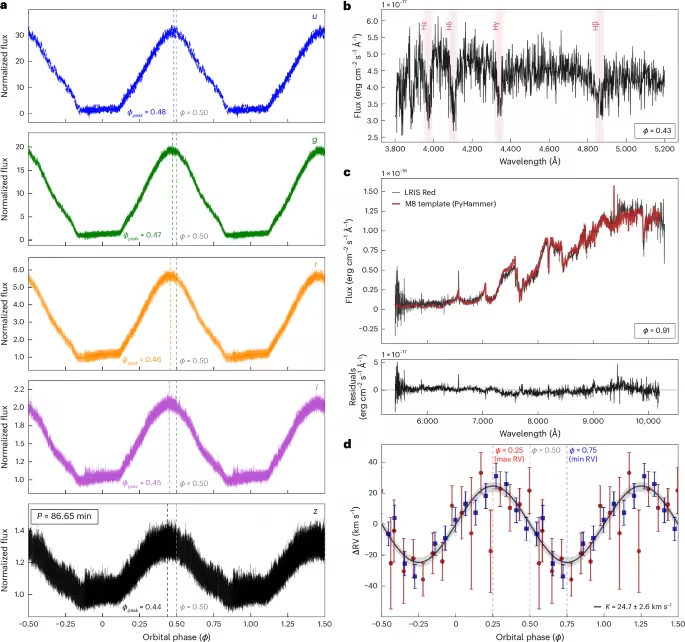 Nature Astronomy
@NatureAstronomy
Discovery of a second-generation planet candidate accreting onto a white dwarf dlvr.it/TVnfZt ☄️
 Nature Astronomy
@NatureAstronomy
The 15th Asteroids Comets Meteors Conference dlvr.it/TVl8wS ☄️
Nature Astronomy
@NatureAstronomy
Growth of aromatic hydrocarbon dust particles in the extremely metal-poor galaxy Sextans A idp.nature.com/transit?redirect_uri=https%3A%2F%2Fwww.nat… ☄️
 Nature Astronomy
@NatureAstronomy
First-star imprints in a metal-poor galaxy overdensity near the end of reionization idp.nature.com/transit?redirect_uri=https%3A%2F%2Fwww.nat… ☄️
 Nature Astronomy
@NatureAstronomy
Persistent primordial signature in present-day galaxies idp.nature.com/transit?redirect_uri=https%3A%2F%2Fwww.nat… ☄️
 Nature Astronomy
@NatureAstronomy
Beyond Hubble: revisiting the Hubble sequence across cosmic time idp.nature.com/transit?redirect_uri=https%3A%2F%2Fwww.nat… ☄️
 Nature Astronomy
@NatureAstronomy
ΛCDM in a courtroom idp.nature.com/transit?redirect_uri=https%3A%2F%2Fwww.nat… ☄️
 Nature Astronomy
@NatureAstronomy
Volatile depletion in rocky planets as a chemical fingerprint of hybrid accretion idp.nature.com/authorize?response_type=cookie&client_id=g… ☄️
 Nature Astronomy
@NatureAstronomy
LHAASO detection of ultrahigh-energy γ-ray emission towards giant molecular clouds idp.nature.com/transit?redirect_uri=https%3A%2F%2Fwww.nat… ☄️
 Nature Astronomy
@NatureAstronomy
Early metal-enriched baryon cycling before the midpoint of cosmic reionization idp.nature.com/transit?redirect_uri=https%3A%2F%2Fwww.nat… ☄️
 Nature Astronomy
@NatureAstronomy
The next generation of astronomy facilities cannot be built with half the sky missing idp.nature.com/transit?redirect_uri=https%3A%2F%2Fwww.nat… ☄️
Nature Astronomy
@NatureAstronomy
Planetesimal compositions governed by aerodynamic sorting from the onset of Solar System formation idp.nature.com/authorize?response_type=cookie&client_id=g… ☄️
 Nature Astronomy
@NatureAstronomy
A universal critical accretion rate for black hole jet formation idp.nature.com/transit?redirect_uri=https%3A%2F%2Fwww.nat… ☄️
 Nature Astronomy
@NatureAstronomy
Supernova origin of galactic turbulence revealed by superbubbles idp.nature.com/transit?redirect_uri=https%3A%2F%2Fwww.nat… ☄️
 Nature Astronomy
@NatureAstronomy
Little red whats? idp.nature.com/transit?redirect_uri=https%3A%2F%2Fwww.nat… ☄️
Nature Astronomy
@NatureAstronomy
Massive black holes in the first billion years with JWST idp.nature.com/authorize?response_type=cookie&client_id=g… ☄️
 Nature Astronomy
@NatureAstronomy
The topology of the Universe idp.nature.com/authorize?response_type=cookie&client_id=g… ☄️
Nature Astronomy
@NatureAstronomy
The magnetar fraction in core-collapse supernovae idp.nature.com/transit?redirect_uri=https%3A%2F%2Fwww.nat… ☄️
 Nature Astronomy
@NatureAstronomy
Hypersoft X-ray sources as a low-energy class of luminous cosmic emitter www.nature.com/articles/s41550-026-02959-7 ☄️
 Nature Astronomy
@NatureAstronomy
Heliobiology as a gateway to astrobiology www.nature.com/articles/s41550-026-02970-y ☄️
 Nature Astronomy
@NatureAstronomy
Listening to active planetary surfaces www.nature.com/articles/s41550-026-02952-0 ☄️
 Nature Astronomy
@NatureAstronomy
Planetary shielding and surface precipitation of solar energetic particles during BepiColombo’s close Mercury flyby www.nature.com/articles/s41550-026-02914-6 ☄️
 Nature Astronomy
@NatureAstronomy
Signatures of suppressed matter clustering revealed by fast radio bursts www.nature.com/articles/s41550-026-02957-9 ☄️
 Nature Astronomy
@NatureAstronomy
Evidence for phenylium reactivity under interstellar-relevant conditions www.nature.com/articles/s41550-026-02973-9 ☄️
 Nature Astronomy
@NatureAstronomy
On our bookshelf www.nature.com/articles/s41550-026-02971-x ☄️
Nature Astronomy
@NatureAstronomy
Little Red Dots 2026 www.nature.com/articles/s41550-026-02967-7 ☄️
 Nature Astronomy
@NatureAstronomy
Reply to: Evidence for phenylium reactivity under interstellar-relevant conditions www.nature.com/articles/s41550-026-02972-w ☄️
 Nature Astronomy
@NatureAstronomy
Traversing the Galactic Centre in space and time www.nature.com/articles/s41550-026-02958-8 ☄️
 Nature Astronomy
@NatureAstronomy
An eccentric massive protobinary assembled via a core-merger parabolic encounter www.nature.com/articles/s41550-026-02953-z ☄️
 Nature Astronomy
@NatureAstronomy
A critical evaluation of the physical nature of the little red dots www.nature.com/articles/s41550-026-02934-2 ☄️
 Nature Astronomy
@NatureAstronomy
Weak evolution of cosmic atomic hydrogen over the past 4.5 billion years www.nature.com/articles/s41550-026-02965-9 ☄️
 Nature Astronomy
@NatureAstronomy
Agentic research is oxymoronic idp.nature.com/transit?redirect_uri=https%3A%2F%2Fwww.nat… ☄️

Nature Astronomy reposted
 Davide Castelvecchi
@dcastelvecchi
The @NASARoman Space Telescope lifted off this morning, carrying the largest infrared camera ever built. It completes a trio of wide-field observatories — with @ESA_Euclid and @VRubinObs — that will take cosmic mapping into a new era
www.nature.com/articles/d41586-026-02727-7
Nature Astronomy
@NatureAstronomy
A single impact could have given Deimos its shape and smooth surface www.nature.com/articles/s41550-026-02968-6 ☄️
 Nature Astronomy
@NatureAstronomy
Ammonium-bearing clays and multiple nitrogen species linked to the late-stage brines of Ryugu’s parent body www.nature.com/articles/s41550-026-02962-y ☄️
 Nature Astronomy
@NatureAstronomy
Paul Hewett (1956–2026) idp.nature.com/authorize?response_type=cookie&client_id=g… ☄️
 Nature Astronomy
@NatureAstronomy
Extended components of little red dots in the rest-frame optical idp.nature.com/transit?redirect_uri=https%3A%2F%2Fwww.nat… ☄️
 Nature Astronomy
@NatureAstronomy
Distant galaxies might be more massive than they appear idp.nature.com/transit?redirect_uri=https%3A%2F%2Fwww.nat… ☄️
 Nature Astronomy
@NatureAstronomy
The role of disruptive impacts on ocean generation and longevity in icy moons idp.nature.com/authorize?response_type=cookie&client_id=g… ☄️

Nature Astronomy reposted
 Springer Nature
@SpringerNature
An important building block that helped to construct the young Milky Way Galaxy about 12 billion years ago is reported in @NatureAstronomy. The findings may help provide a clearer timeline of the Galaxy’s early growth: spklr.io/6010ERggy
Nature Astronomy
@NatureAstronomy
Gold-medal performance by LLMs at the International Olympiad on Astronomy and Astrophysics www.nature.com/articles/s41550-026-02964-w ☄️
 Nature Astronomy
@NatureAstronomy
Hidden mass in early galaxies revealed by bottom-heavy initial mass functions www.nature.com/articles/s41550-026-02932-4 ☄️
 Nature Astronomy
@NatureAstronomy
Deimos’s shape and geology explained by a subcatastrophic impact www.nature.com/articles/s41550-026-02956-w ☄️
 Nature Astronomy
@NatureAstronomy
Evidence of a massive accretion event 1.8 billion years before the Gaia-Sausage-Enceladus merger idp.nature.com/authorize?response_type=cookie&client_id=g… ☄️
Nature Astronomy
@NatureAstronomy
A hidden companion on Orion’s shoulder idp.nature.com/authorize?response_type=cookie&client_id=g… ☄️
 Nature Astronomy
@NatureAstronomy
No kinematics, no problem idp.nature.com/authorize?response_type=cookie&client_id=g… ☄️
Nature Astronomy
@NatureAstronomy
What are you doing here? idp.nature.com/authorize?response_type=cookie&client_id=g… ☄️
 Nature Astronomy
@NatureAstronomy
A lunar radio astronomy array built in Africa idp.nature.com/authorize?response_type=cookie&client_id=g… ☄️
 Nature Astronomy
@NatureAstronomy
Astro-tourism offers opportunities to SKA locals www.nature.com/articles/s41550-026-02942-2 ☄️
 Nature Astronomy
@NatureAstronomy
Astro-tourism as a model for participatory science engagement www.nature.com/articles/s41550-026-02944-0 ☄️
 Nature Astronomy
@NatureAstronomy
The CosmoCube lunar mission for probing the dark ages and cosmic dawn via 21-cm cosmology www.nature.com/articles/s41550-026-02946-y ☄️
 Nature Astronomy
@NatureAstronomy
BlackHolistic 2026 www.nature.com/articles/s41550-026-02941-3 ☄️
 Nature Astronomy
@NatureAstronomy
Ionospheric escape of $${\bf{H}}_{\mathbf{3}}^{\mathbf{+}}$$ H 3 + from Jupiter’s polar regions www.nature.com/articles/s41550-026-02950-2 ☄️
 Nature Astronomy
@NatureAstronomy
Chemical fingerprints of binary mass transfer in massive stars idp.nature.com/authorize?response_type=cookie&client_id=g… ☄️
 Nature Astronomy
@NatureAstronomy
Widespread corrugations superimposed on the Galactic warp in the outer CO disk idp.nature.com/authorize?response_type=cookie&client_id=g… ☄️
 Nature Astronomy
@NatureAstronomy
A high-significance detection of primordial tidal torque imprints idp.nature.com/authorize?response_type=cookie&client_id=g… ☄️
 Nature Astronomy
@NatureAstronomy
A discrete picture of magnetic fields in microquasar jets idp.nature.com/transit?redirect_uri=https%3A%2F%2Fwww.nat… ☄️
 Nature Astronomy
@NatureAstronomy
Primary evaporite in southern Utopia Planitia on Mars from Zhurong rover observations www.nature.com/articles/s41550-026-02917-3 ☄️
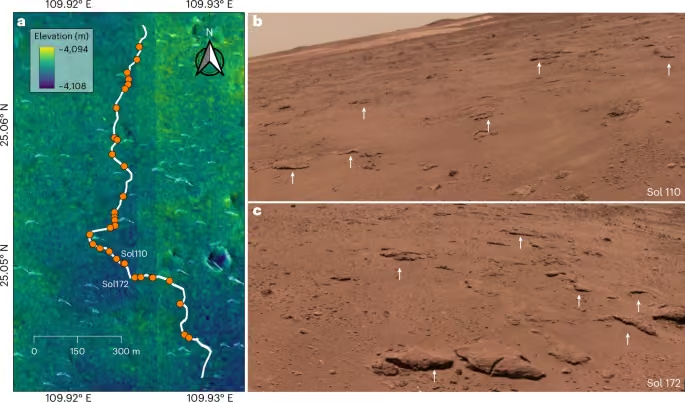 Nature Astronomy
@NatureAstronomy
Non-adiabatic entropy increase in the solar wind governed by velocity spikes www.nature.com/articles/s41550-026-02923-5 ☄️
 Nature Astronomy
@NatureAstronomy
Vigorous turbulence driven by quasar-mode feedback in a cluster core www.nature.com/articles/s41550-026-02939-x ☄️
 Nature Astronomy
@NatureAstronomy
Dynamic electron radiation belt at Mercury controlled by solar wind driving www.nature.com/articles/s41550-026-02925-3 ☄️
 Nature Astronomy
@NatureAstronomy
Kilometre-scale Jovian moon characterized for a potential JUICE flyby www.nature.com/articles/s41550-026-02929-z ☄️
 Nature Astronomy
@NatureAstronomy
Limited direct fluid exchange between the deep subsurface ocean and the shallow subsurface environment of Europa www.nature.com/articles/s41550-026-02918-2 ☄️
 Nature Astronomy
@NatureAstronomy
GRaviCon2026 www.nature.com/articles/s41550-026-02924-4 ☄️
 Nature Astronomy
@NatureAstronomy
Cometary tail detected on a near-Earth object based on nongravitational perturbations www.nature.com/articles/s41550-026-02912-8 ☄️
 Nature Astronomy
@NatureAstronomy
Sugar detected in interstellar space www.nature.com/articles/s41550-026-02909-3 ☄️
 Nature Astronomy
@NatureAstronomy
A stellar-mass black hole in ω Centauri www.nature.com/articles/s41550-026-02937-z ☄️
Nature Astronomy
@NatureAstronomy
PLATO on the footsteps of Kepler for transit timing www.nature.com/articles/s41550-026-02933-3 ☄️
Nature Astronomy
@NatureAstronomy
A trio of Jupiters for β Pictoris www.nature.com/articles/s41550-026-02936-0 ☄️
Nature Astronomy
@NatureAstronomy
Killing two birds with many tiny stones? www.nature.com/articles/s41550-026-02919-1 ☄️
 Nature Astronomy
@NatureAstronomy
Gravitational waves expand their horizons www.nature.com/articles/s41550-026-02940-4 ☄️
Nature Astronomy
@NatureAstronomy
Measuring the high-energy neutrino sky using the deep-valley neutrino observatory TAMBO www.nature.com/articles/s41550-026-02916-4 ☄️
 Nature Astronomy
@NatureAstronomy
Magnetic field topology and colliding discrete ejecta in the precessing jets of SS 433 www.nature.com/articles/s41550-026-02922-6 ☄️
 Nature Astronomy
@NatureAstronomy
Detection of a four-carbon sugar in interstellar space www.nature.com/articles/s41550-026-02905-7 ☄️
 Nature Astronomy
@NatureAstronomy
A sugar has been detected in an interstellar cloud: the chiral ketose, erythrulose. Observations and modelling show it forms efficiently on dust grains, supporting an interstellar origin for prebiotic sugars linked to early life. @IJimenezSastro et al.: www.nature.com/articles/s41550-026-02905-7
Nature Astronomy
@NatureAstronomy
AI + Astronomy: Models, Data, Discovery www.nature.com/articles/s41550-026-02911-9 ☄️
 Nature Astronomy
@NatureAstronomy
Advancing the search for technosignatures www.nature.com/articles/s41550-026-02906-6 ☄️
 Nature Astronomy
@NatureAstronomy
Non-gravitational acceleration indicative of cometary activity of near-Earth object www.nature.com/articles/s41550-026-02913-7 ☄️
 Nature Astronomy
@NatureAstronomy
Isotopic imprints of late molecular cloud infall in the outer Solar System www.nature.com/articles/s41550-026-02927-1 ☄️
 Nature Astronomy
@NatureAstronomy
The multimessenger Universe as a training ground for frontier AI www.nature.com/articles/s41550-026-02910-w ☄️
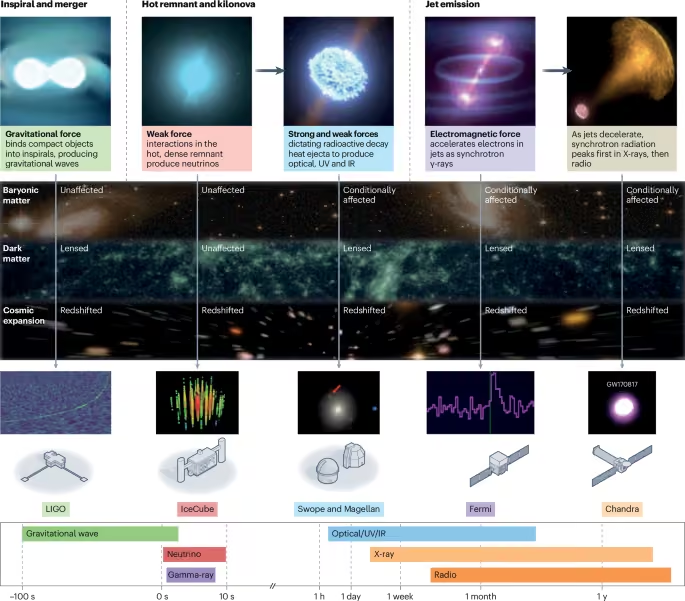 Nature Astronomy
@NatureAstronomy
High nitrogen and carbon isotopic ratios in the interstellar comet 3I/ATLAS www.nature.com/articles/s41550-026-02921-7 ☄️
 Nature Astronomy
@NatureAstronomy
As part of Pride month, three early-career astronomers and members of the AAS Committee for Sexual-Orientation and Gender Minorities in Astronomy (SGMA) share their research and motivation to pursue careers in astronomy: rdcu.be/fqnvH or www.nature.com/articles/s41550-026-02891-w?error=cookies_… 🔭
Nature Astronomy
@NatureAstronomy
To mark Pride month, the American Astronomical Society Committee for Sexual-Orientation and Gender Minorities in Astronomy (SGMA) discusses its work in supporting the US community. Read about its ethos and activities: rdcu.be/fqnow or www.nature.com/articles/s41550-026-02890-x?error=cookies_… 🔭
Nature Astronomy reposted
 Weizmann Canada
@WeizmannCanada
👽 The search for alien life may begin with a collection of molecules.
Published in @NatureAstronomy, researchers led by @ItayHalevy and Prof. Yohai Kaspi at the @WeizmannScience developed a new way to distinguish biological material from nonliving chemistry.
#sciencenews

Nature Astronomy reposted
 Durham University
@durham_uni
What do scientists really think about signs of alien life? 👽
Professor Peter Vickers, Head of @Dur_Philosophy, and of our Centre for Scientific Community Opinion Polling and Evaluation, takes a look 👉 www.durham.ac.uk/research/current/thought-leadership/2026…
 Nature Astronomy
@NatureAstronomy
The multiwavelength observatory INTEGRAL operated for 22 yrs and facilitated progress across a breadth of astrophysical topics. The Project Scientist and team outline some of INTEGRAL's key achievements and its legacy in a Review article: www.nature.com/articles/s41550-026-02848-z #astrosci
Nature Astronomy
@NatureAstronomy
Recent books from @defjaf , @IBJIYONGI and @ltelkins in our May round-up: idp.nature.com/authorize?response_type=cookie&client_id=g… or rdcu.be/fiTsQ #astronomy
Nature Astronomy reposted
Springer Nature
@SpringerNature
Observations of a distant object beyond Pluto suggest that it is surrounded by a thin atmosphere, potentially fuelled by ice volcanoes or produced by the impact of a comet-like body, according to research published in @NatureAstronomy: spklr.io/6015EK7LS
Nature Astronomy reposted
 IEM-CSIC
@IEM_CSIC
An international study led by scientist from the @icmm_csic and IEM-CSIC published in @NatureAstronomy reveals the crucial role of hydrogen in cosmic dust formation (dx.doi.org/10.1038/s41550-026-02854-1)
Nature Astronomy reposted
 NAOJ
@prcnaoj_en
Outer Solar System Object Has an Atmosphere But Shouldn’t
www.nao.ac.jp/en/news/science/2026/20260505-prc.html
A team of professional and amateur Japanese astronomers found evidence for a thin atmosphere around a small body in the outer Solar System. #naoj
Nature Astronomy
@NatureAstronomy
Research published #openaccess in Nature Astronomy: www.nature.com/articles/s41550-026-02850-5
 ALMA Observatory📡
@almaobs
#breakingnews ☄️The interstellar comet 3I/ATLAS contains 40 times more semi-heavy water than Earth's oceans🌎 Demonstrating that its system of origin formed under extreme conditions.
First measurement of HDO in an interstellar object!
www.almaobservatory.org/en/press-releases/alma-reveals-in…
 Nature Astronomy
@NatureAstronomy
ALMA observations of 3I/ATLAS give the first water D/H ratio for an interstellar comet. A markedly high deuterium level suggests its water formed in a cold environment with minimal thermal processing in its protoplanetary disk. idp.nature.com/transit?redirect_uri=https%3A%2F%2Fwww.nat… @lesamz-astro @terepaneque
Nature Astronomy reposted
 Department of Physics at University of Oxford
@OxfordPhysics
New research in Nature Astronomy confirms that black hole jets carry 10% of infalling energy, providing a vital anchor for modeling galaxy evolution and cosmic feedback.
Read the full article via link in bio or visit www.physics.ox.ac.uk/news/telescope-reveals-true-power-bl…
 Nature Astronomy
@NatureAstronomy
What do you think about the Artemis II mission? Enthused? Apathetic? Let us know.
 nature
@Nature
Some researchers remain underwhelmed by NASA’s upcoming Artemis Moon mission.
go.nature.com/4toNOKu
Nature Astronomy reposted
 NASA
@NASA
Liftoff.
The Artemis II mission launched from @NASAKennedy at 6:35pm ET (2235 UTC), propelling four astronauts on a journey around the Moon.
Artemis II will pave the way for future Moon landings, as well as the next giant leap — astronauts on Mars.
Nature Astronomy reposted
nature
@Nature
"We're going for our families, we're going for humanity"
Artemis II has launched. Follow us for coverage throughout the 10-day mission
go.nature.com/3QdtTj2
Nature Astronomy
@NatureAstronomy
Our March issue is now here! The visionary cover image represents a concept for imaging habitable-zone worlds presented by Ahmed Soliman, Stuart Shaklan, John Mather and team in the issue. Created by Keith Miller & Bethany Vukomanovic. www.nature.com/natastron/volumes/10/issues/3 ☄️
Nature Astronomy reposted
 Dr. John Barentine FRAS
@JohnBarentine
Nature Astronomy editorial: "With threats to astronomy from all directions, we must consider the true value of astronomy ... that we should be regularly reminding our elected representatives about."
www.nature.com/articles/s41550-026-02830-9
Nature Astronomy
@NatureAstronomy
Harrison Nicholls and colleagues suggest that exoplanet L 98-59 d could be entirely composed of molten lava: a magma ocean covering a mushy core. idp.nature.com/transit?redirect_uri=https%3A%2F%2Fwww.nat…
Nature Astronomy
@NatureAstronomy
Samples returned from the asteroid Ryugu contain all five canonical nucleobases (A, G, C, T, U). Their presence in Ryugu and Bennu supports the hypothesis that carbonaceous asteroids contributed to the prebiotic chemical inventory of early Earth. idp.nature.com/transit?redirect_uri=https%3A%2F%2Fwww.nat… ☄️
Nature Astronomy
@NatureAstronomy
A star in a relic dwarf galaxy has preserved the elements produced by the first stars. The star shows a lack of heavy elements but an extreme amount of carbon, indicating low-energy explosions can seed the chemistry of early galaxies. @AnirudhChiti+: idp.nature.com/authorize?response_type=cookie&client_id=g… ☄️
Nature Astronomy
@NatureAstronomy
Massive stars usually evolve gradually over millennia, but here one has been caught in the act of transformation. Extreme star WOH 64 shifted from red to yellow in just a year, prompting questions about its stability and fate. Muñoz-Sanchez+: idp.nature.com/authorize?response_type=cookie&client_id=g… ☄️
Nature Astronomy
@NatureAstronomy
X-ray absorption has enabled a probe of the photoionised gas close to seven gamma-ray bursts, revealing their origin in star-forming regions and providing additional evidence that long GRBs originate in collapsars. Thakur et al.: idp.nature.com/authorize?response_type=cookie&client_id=g… #astrosci
Nature Astronomy
@NatureAstronomy
JWST observations uncover rich hydrocarbon chemistry in an extragalactic source, suggesting fragmentation of cosmic dust and PAHs in deeply buried galactic nuclei. @igbernete et al.: www.nature.com/articles/s41550-025-02750-0 #astronomy
Nature Astronomy
@NatureAstronomy
The combined spectrum of an inner standard disk and a gravitationally unstable outer disk surrounding a supermassive black hole can potentially explain the V-shaped spectra of Little Red Dots, without invoking strong dust extinction. www.nature.com/articles/s41550-026-02785-x #astronomy
Nature Astronomy
@NatureAstronomy
A narrow ‘Goldilocks zone’ of oxidation levels during exoplanetary core formation allows both N and P to remain in the mantle. Earth lies in this zone, but some exoplanets may lock these elements in their cores, limiting habitability. www.nature.com/articles/s41550-026-02775-z #astronomy
Nature Astronomy
@NatureAstronomy
JWST imaged three of the gas giants orbiting the star HR 8799 to study their atmospheres. The uniform enrichment of heavy elements, including sulfur, suggests that they formed like Jupiter and Saturn, by accreting icy and rocky solids. www.nature.com/articles/s41550-026-02783-z #astronomy
Nature Astronomy
@NatureAstronomy
Read the research paper in Nature Astronomy: rdcu.be/e2wbP
 NASA Marshall
@NASA_Marshall
Turns out Jupiter is slightly smaller and more “squashed” than we orginally thought.
NASA’s Juno mission found the planet is 5 miles narrower at the equator and 15 miles flatter at the poles — key info that will help us study worlds beyond our solar system.
More 👇
Nature Astronomy
@NatureAstronomy
The formation of glycylglycine, a simple peptide molecule, is possible under non-aqueous interstellar conditions, according to laboratory experiments. Thus complex organics with biological relevance may pre-date planetary accretion. www.nature.com/articles/s41550-025-02765-7 #astrosci
Nature Astronomy
@NatureAstronomy
Long-period transients emit mysterious periodic radio pulses. The longest-lived LPT has a 21 min spin period and is in a 9 hr orbit. It behaves like the more rapid white dwarf pulsars, potentially linking the classes. Horváth et al.: www.nature.com/articles/s41550-025-02760-y #astronomy
Nature Astronomy
@NatureAstronomy
Juno radio occultations precisely redefine Jupiter’s shape: a polar diameter of 66,842 km and an equatorial one of 71,488 km, both smaller than long-used values, bringing models of the planet’s interior into better agreement with observations. www.nature.com/articles/s41550-026-02777-x #astronomy
Nature Astronomy
@NatureAstronomy
The famous nebula Barnard 68 has been used as a giant cosmic-ray detector: cosmic-ray-excited vibrational H2 emission has been observed by JWST, giving a direct measurement of the CR ionisation rate. Bialy et al.: www.nature.com/articles/s41550-025-02771-9 #astronomy
Nature Astronomy
@NatureAstronomy
Our January issue is now available to read! www.nature.com/natastron/volumes/10/issues/1
The cover image comes courtesy of Akhil Uniyal and Luciano Rezzolla. #astronomy
 Nature Astronomy
@NatureAstronomy
JWST’s COSMOS-Web survey is used to create an ultra-detailed dark-matter map, revealing hidden filaments, clusters, and distant structures out to z~2. This map shows how dark and luminous matter build the cosmic web across cosmic time. @diana_scog et al.: www.nature.com/articles/s41550-025-02763-9
Nature Astronomy
@NatureAstronomy
Remember those claims of biosignatures in the atmosphere of exoplanet K2-18b? A detailed re-analysis of the data by an independent group fails to find sufficient evidence to support them, with the authors calling for a more 'careful approach' in future: rdcu.be/eVkOy
Nature Astronomy
@NatureAstronomy
Research published in Nature Astronomy: www.nature.com/articles/s41550-025-02716-2
ALMA Observatory📡
@almaobs
#breakingnews 1000 light-years from our planet!
This is what violent growth episodes of a star look like!
ALMA images alongside the @TheNRAO @NSF 's VLA of the SVS 13 binary system
www.almaobservatory.org/en/press-releases/alma-and-nsf-vl…
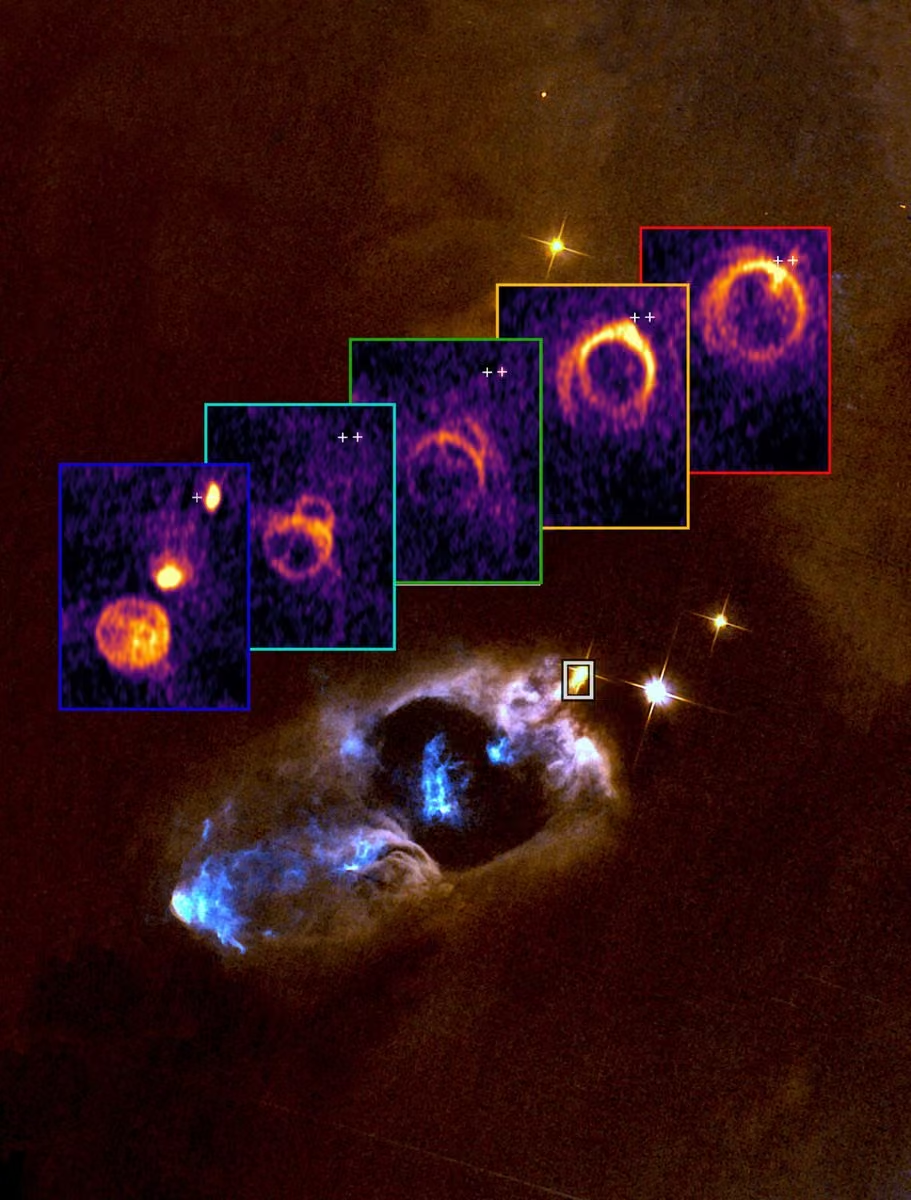 Nature Astronomy
@NatureAstronomy
ALMA has captured stunning, detailed images of bowshock shells in the outflow of an outbursting protostar. These provide important insights into the variable nature of the ejections from protostars, which play a key role in star and planet formation idp.nature.com/authorize?response_type=cookie&client_id=g…
Nature Astronomy
@NatureAstronomy
JWST has revealed many prolate, filamentary galaxies at z ≈ 3–8. Sims reproduce this trend only in warm/wave dark matter models, where smooth filamentary accretion dominates over the hierarchical fragmentation seen with cold dark matter: www.nature.com/articles/s41550-025-02721-5?error=cookies_… #astronomy
Nature Astronomy
@NatureAstronomy
Through detailed spectral analysis, Sander et al. have uncovered a new evolutionary path for metal-poor Wolf-Rayet stars. Characterized by hard ionizing radiation, these stars challenge assumptions about massive-star evolution. www.nature.com/articles/s41550-025-02719-z #astronomy
Nature Astronomy
@NatureAstronomy
Early high-resolution images of two 2021 novae reveal eruptions unfolding in multiple stages with colliding outflows that produce shocks and gamma rays, reshaping our understanding of stellar explosions. Aydi, Monnier, et al.: www.nature.com/articles/s41550-025-02725-1 #astronomy
Nature Astronomy
@NatureAstronomy
XRISM observations found chlorine and potassium in the Cassiopeia A supernova remnant. These detections suggest that stellar activity plays an important role in cosmic chemical evolution, enriching space with vital elements. www.nature.com/articles/s41550-025-02714-4 #astronomy
Nature Astronomy reposted
 Nature Portfolio
@NaturePortfolio
Approximately 96% of the images from some space observatories in low Earth orbit could be tainted over the next decade due to light contamination from satellites, according to an analysis in Nature. go.nature.com/4pLMSOk
 Nature Astronomy
@NatureAstronomy
Check out the three #openaccess research papers in @NatureAstronomy and @NatureGeosci : www.nature.com/articles/s41550-025-02694-5 / www.nature.com/articles/s41550-025-02688-3?error=cookies_… / www.nature.com/articles/s41561-025-01838-6
 NASA Solar System
@NASASolarSystem
BREAKING: Sugars essential for life have been found in pristine asteroid Bennu samples collected by NASA’s OSIRIS-REx spacecraft. Combined with previous detections of amino acids and nucleobases, we see that life’s ingredients were widespread throughout the solar system: www.nasa.gov/missions/osiris-rex/sugars-gum-stardust-foun…
More on the study led by Yoshihiro Furukawa of @TohokuUniPR⤵️
Nature Astronomy
@NatureAstronomy
Samples returned from asteroid Bennu by NASA’s OSIRIS-REx mission contain N-rich organics with prebiotic implications. This material likely formed in the earliest stages of the asteroid’s history, even before the melting of water ice. www.nature.com/articles/s41550-025-02694-5 #planetaryscience
Nature Astronomy
@NatureAstronomy
Bennu samples have abundant supernova dust and clasts that are richer in presolar silicates and organics, suggesting the protolith sampled material with a unique mixture of primordial components before undergoing aqueous alteration. www.nature.com/articles/s41550-025-02688-3?error=cookies_… #planetaryscience
Nature Astronomy
@NatureAstronomy
Check out this Review of 30 yrs of SOHO! Published today in Nature Astronomy: rdcu.be/eSLUR
 ESA Science
@esascience
🌞🛰️Sun-watcher SOHO turns 30! 🎂
"SOHO has overcome nail-biting challenges to become one of the longest-operating space missions of all time" – Prof. @CGMundell, ESA Director of Science
👉www.esa.int/Science_Exploration/Space_Science/Sun-watcher…
📷 SOHO (@esa & @NASA)
Nature Astronomy reposted
 Monash Science
@Monash_Science
A global team has mapped a close companion orbiting the giant star π1 Gruis and @MonashAstro science was key. Published in @NatureAstronomy. Read more 👉 www.monash.edu/science/news-events/news/2025/scientists-i…
 Nature Astronomy
@NatureAstronomy
Our special November issue, celebrating 30 years of exoplanets, is now here! www.nature.com/natastron/volumes/9/issues/11
#astronomy #exoplanets
Nature Astronomy reposted
 European Research Executive Agency
@REA_research
Continuous evaluation through a project can lead to high-impact science.
@europlanetmedia hired an Impact Evaluation Officer to fix objectives, monitor & adapt the focus of the evaluation.
The project is now featured in @NatureAstronomy as a case study ➡️idp.nature.com/transit?redirect_uri=https%3A%2F%2Fwww.nat…

Nature Astronomy reposted
 UMD Science
@UMDscience
#umd astronomer Megan Weiner Mansfield co-led the creation of the first 3D temperature map for a distant exoplanet.
Published in @NatureAstronomy, their technique lays the groundwork for more detailed future explorations of faraway planets ➡️ go.umd.edu/WASP-18b

Nature Astronomy reposted
 Cornell Chronicle
@CornellNews
Astronomers have generated the first 3D map of an exoplanet, revealing an atmosphere with distinct temperature zones – one so hot that it breaks down water vapor, according to a team co-led by a @CornellAstro researcher. @NatureAstronomy news.cornell.edu/stories/2025/10/now-3d-maps-begin-bring-…
Nature Astronomy
@NatureAstronomy
Rainer Weiss (1932-2025).
www.nature.com/articles/d41586-025-02816-z
Nature Astronomy reposted
nature
@Nature
A computational model of the early-to-present-day Universe predicts that some of the first stars formed in structures that challenge conventional classification.
go.nature.com/3JPnLur
Nature Astronomy reposted
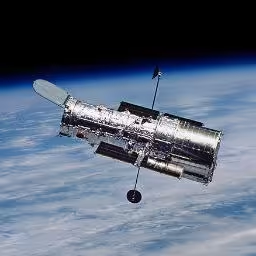 Hubble
@NASAHubble
Hubble spotted an unusual star 128 light-years away.
With its unique ultraviolet capabilities, Hubble determined this star is a rare ultramassive white dwarf, made up of merged stars: science.nasa.gov/missions/hubble/nasas-hubble-uncovers-ra…
Find out more about this star's intriguing atmosphere in this video ⬇️
Nature Astronomy reposted
Durham University
@durham_uni
An international team of astronomers have discovered a remarkably clumpy rotating #galaxy that existed just 900 million years after the Big Bang, shedding new light on how galaxies grew and evolved in the early Universe: www.durham.ac.uk/news-events/latest-news/2025/08/new-cosm…
@DurhamPhysics @NatureAstronomy

Nature Astronomy reposted
nature
@Nature
The Thirty Meter Telescope, long slated for construction in Hawaii, might be getting a new home
go.nature.com/3IIjGaM
Nature Astronomy reposted
Springer Nature
@SpringerNature
The Milky Way is moving through the Universe and its path is influenced by the combined gravitational pulls of nearby galaxies, such as Andromeda, the Triangulum galaxy and the Large Magellanic Cloud.
@NatureAstronomy @NaturePortfolio
Nature Astronomy
@NatureAstronomy
The #rubinfirstlook images are out...
 NSF-DOE Rubin Observatory
@VRubinObs
Introducing...your sneak peek at the cosmos captured by @NSF–@doescience Vera C. Rubin Observatory!
Can you guess what regions of sky they are?
This is just a peek...join us at 11am US EDT for your full First Look at how Rubin will #capturethecosmos!
ls.st/rubin-first-look-livestream


 Nature Astronomy
@NatureAstronomy
Our June(teenth) issue is now here to read: www.nature.com/natastron/volumes/9/issues/6
The cover image depicts a ticking time bomb... a supernova progenitor on our doorstep! But don't worry, we still have a good 20 billion years until it goes bang.
 Nature Astronomy
@NatureAstronomy
Gessey-Jones et al. show that future radio telescopes will be able to reveal the mass distribution of the first stars in the Universe by detecting their impact on a faint radio signal of hydrogen atoms from Cosmic Dawn. idp.nature.com/transit?redirect_uri=https%3A%2F%2Fwww.nat… @cambridge_astro
Nature Astronomy
@NatureAstronomy
The precessing jet in M87, exhibiting an unexpectedly broader width in the inner region, is found to be linked to a compact, tilted accretion disk, providing new insights into the jet-disk-BH configuration and formation. Cui & Lin: idp.nature.com/transit?redirect_uri=https%3A%2F%2Fwww.nat…
Nature Astronomy
@NatureAstronomy
The Fermi-LAT collaboration reports a significant γ-ray detection (5.2σ) from the coronae of radio-quiet AGNs, revealing compact (∼10 gravitational radii) and extended (∼2.7×10⁶ gravitational radii) coronal regions, challenging existing models. idp.nature.com/transit?redirect_uri=https%3A%2F%2Fwww.nat…
Nature Astronomy reposted
 UT Jackson School of Geosciences
@txgeosciences
In a new study in @NatureAstronomy, scientists from the Jackson School took a close at Mars' thick clay terrains.
They found that these areas could have provided the right mix of water, minerals and a calm environment for life to develop.
Read more: www.jsg.utexas.edu/news/2025/06/thick-clay-layers-on-mars…
 Nature Astronomy
@NatureAstronomy
The Martian terrain has influenced its early surface evolution, allowing regions of stable chemical weathering to develop and permanently trap water and minerals, weakening Mars’ climate feedback and limiting long-term hydrological activity. Moore et al.: idp.nature.com/transit?redirect_uri=https%3A%2F%2Fwww.nat…
Nature Astronomy
@NatureAstronomy
Using a large cosmological sample of fast radio bursts, Connor et al. have measured the Universe’s missing baryons, finding that most reside in the diffuse intergalactic medium, not galaxies — confirming strong astrophysical feedback seen in simulations. idp.nature.com/authorize?response_type=cookie&client_id=g…
Nature Astronomy
@NatureAstronomy
Simulations of long-term atmospheric evolution show that rocky planets with Earth-like masses in the classical Habitable Zone of Sun-like stars can retain thick He-dominated primordial atmospheres. Lammer, Scherf et al.: www.nature.com/articles/s41550-025-02550-6
Nature Astronomy reposted
Nature Portfolio
@NaturePortfolio
A paper in @NatureAstronomy presents an optic system that produces high-resolution observations of fine structures in the Sun’s corona by lifting the veil of atmospheric blur over a fast-moving, twisted plasma stream as it becomes unstable. go.nature.com/4mKWDeN
 Nature Astronomy
@NatureAstronomy
Multi-instrumental data analysis reveals a giant exoplanet in orbit around the 0.2 M_sol star TOI-6894. This system poses strong challenges to planet formation theories and is an excellent target for atmospheric characterisation. Bryant et al.: idp.nature.com/transit?redirect_uri=https%3A%2F%2Fwww.nat…
Nature Astronomy
@NatureAstronomy
A 10 M⨁ planet is detected in the habitable zone (HZ) of the solar-type star Kepler-725 using the transit timing variations technique. This study proposes a complementary pathway to probe low-mass exoplanets in the HZs of Sun-like stars. Sun et al.: www.nature.com/articles/s41550-025-02565-z
Nature Astronomy reposted
Nature Portfolio
@NaturePortfolio
The likelihood of a collision between the Milky Way and its neighbouring galaxy Andromeda may be smaller than previously thought, according to a new simulation described in @NatureAstronomy. go.nature.com/3ZO7ta3

Nature Astronomy reposted
ESA Science
@esascience
. @Hubble_space and @ESAGaia join forces to revisit the fate of our galaxy.
Doubt is cast on the long-held prediction that the Milky Way galaxy will collide with the Andromeda galaxy in about 4.5 billion years.
Read more 👉 www.esa.int/Science_Exploration/Space_Science/Hubble_and_…
 Nature Astronomy
@NatureAstronomy
Our galaxy is on a collision course with Andromeda, right? Not so fast. New calculations using HST & Gaia data and accounting for the effect of Magellanic Clouds show an almost 50% chance of the Milky Way avoiding this fate. Sawala et al.: idp.nature.com/transit?redirect_uri=https%3A%2F%2Fwww.nat…
Nature Astronomy
@NatureAstronomy
JWST/MIRI observations of both Pluto and Charon uncover surface properties and reveal that Pluto’s haze plays a key role in controlling the atmospheric temperature. Bertrand et al.:
www.nature.com/articles/s41550-025-02573-z
Nature Astronomy
@NatureAstronomy
JWST observations suggest that both pebbles and planetesimals played important roles in forming the giant exoplanet WASP-121 b beyond the H2O ice line. Also, strong vertical mixing likely drives the nightside atmospheric chemistry. Evans-Soma et al.: idp.nature.com/authorize?response_type=cookie&client_id=g…
Nature Astronomy
@NatureAstronomy
High-res observations of fine structure in the Sun’s corona hint at plasma features on the order of 10 km. A new adaptive optics system reduces atmospheric image blur over a twisted plasma stream travelling at 90 km/s as it becomes unstable: www.nature.com/articles/s41550-025-02564-0 #astrosci
Nature Astronomy
@NatureAstronomy
Giant planets on wide, eccentric orbits (like the putative Planet 9) may form when stars are embedded in their natal stellar clusters. Sims suggest a 1-5% chance of such planets forming in exoplanetary systems and up to 40% in the Solar System. idp.nature.com/transit?redirect_uri=https%3A%2F%2Fwww.nat…
Nature Astronomy reposted
 Black In Astro ™
@BlackInAstro
Join us for #blackspaceweek 2025 — a celebration of Black excellence in space, science, and storytelling ✨
🗓️ June 15–21
🪐 From panels to craft night — there’s something for everyone
🌌 Let’s explore the universe together!
🔗 Registration links coming soon!
#blackinastro
 Nature Astronomy
@NatureAstronomy
Using LAMOST data, Yu et al. find that binary stars with orbital periods < 1 day show enhanced magnetic activity compared to single stars, along with supersaturation. These findings constrain poorly understood dynamo processes in contact binaries. www.nature.com/articles/s41550-025-02562-2
Nature Astronomy
@NatureAstronomy
Hydrogen escape contributed to Mars' progressive aridity, but current H-loss rates cannot explain inferred past water abundances. A 3D model shows that during periods of increased axis tilt H-loss rates were up to 10x higher than at present. idp.nature.com/authorize?response_type=cookie&client_id=g… @iaa_csic
Nature Astronomy
@NatureAstronomy
By fusing constraints from satellite dynamics and spin angular momentum, @kbatygin & Adams show that young Jupiter had a radius twice its current value, a ~21 mT magnetic field, and was accreting material at a rate of one Jupiter mass per million years. idp.nature.com/transit?redirect_uri=https%3A%2F%2Fwww.nat…
Nature Astronomy
@NatureAstronomy
Extremely high-resolution simulations reveal that interstellar medium-type turbulence significantly deviates from classical magnetized turbulence models. @astro_magnetism et al.: www.nature.com/articles/s41550-025-02551-5 / rdcu.be/el2u3 @Princeton @CITA_ICAT @scienceANU @LRZ_DE
Nature Astronomy
@NatureAstronomy
Nixon et al. present JWST and Keck II observations of Titan, detecting CH3 and non-LTE emission of CO & CO2. Imaging revealed clouds in Titan’s northern hemisphere at multiple epochs, with some appearing to evolve in altitude. www.nature.com/articles/s41550-025-02537-3 / rdcu.be/el2r2
Nature Astronomy reposted
 NASA Webb Telescope
@NASAWebb
Evaporation, condensation, precipitation on my mind. This is the (methane?!) cycle, and it happens all the time! 🎶
Webb provided evidence for cloud convection on Saturn’s moon Titan, the only other place in our solar system with weather like Earth!
science.nasa.gov/missions/webb/webbs-titan-forecast-partl…

Nature Astronomy reposted
 Dr. James Beattie
@astro_magnetism
The cascade of kinetic and magnetic energy from large to small scales in galactic-style turbulence behaves significantly different to the theoretical models that we usually assume work.
www.nature.com/articles/s41550-025-02551-5
Published in @NatureAstronomy.
Nature Astronomy reposted
 Dartmouth 🌲
@dartmouth
Astrophysicist Paolo Padoan may have solved one of astronomy’s biggest mysteries: why some planet-forming disks are so big. His new study, published in @NatureAstronomy, offers a fresh answer and could reshape how we understand star and planet creation. physics.dartmouth.edu/news/2025/04/study-offers-new-twist…
Nature Astronomy
@NatureAstronomy
820 and counting...
Springer Nature
@SpringerNature
One of our top-rated articles on @altmetric this past week was published in @NatureAstronomy. You can read 'A nearby dark molecular cloud in the Local Bubble revealed via H2 fluorescence' open access here: spklr.io/60137IFZ
Nature Astronomy
@NatureAstronomy
Observations show that the occurrence of ultra-short-period planets increases with age and their system architecture evolves on billion-year timescales, providing new constraints on the formation and evolution of these lava worlds. Tu et al.: www.nature.com/articles/s41550-025-02539-1
Nature Astronomy
@NatureAstronomy
Measurements of the orbital eccentricities of exoplanets with similar sizes and irradiation to Earth show that these worlds further resemble Earth with near-circular orbits, removing a potential barrier to life. Kipping et al.: www.nature.com/articles/s41550-025-02532-8 or rdcu.be/ejKlw
Nature Astronomy
@NatureAstronomy
Eos is a newly discovered molecular cloud sitting just 94 pc from the Sun. It was detected through the far-UV emission of H2, having been missed in conventional molecular gas surveys due to a low abundance of common gas tracers. Burkhart et al.: idp.nature.com/transit?redirect_uri=https%3A%2F%2Fwww.nat…
Nature Astronomy
@NatureAstronomy
Our April issue is now available to read! The cover image shows the (simulated) filaments of the cosmic web, and comes courtesy of the Tornotti et al. paper within the issue: www.nature.com/natastron/volumes/9/issues/4
 Nature Astronomy
@NatureAstronomy
If you've been wondering what the big deal is with all this talk about 'evolving dark energy', then our April Editorial is for you: www.nature.com/articles/s41550-025-02549-z
Nature Astronomy
@NatureAstronomy
France is serious about its commitment to the Paris Agreement, and has been making changes to the way that research is conducted, as detailed in this Lettter to the Editor: www.nature.com/articles/s41550-025-02506-w or rdcu.be/ejmst
Nature Astronomy
@NatureAstronomy
Elizabeth Stanway reviews a new book edited by Keith Cooper, "Amazing worlds of science fiction and science fact", which brings together scientists and SF authors: www.nature.com/articles/s41550-025-02531-9
 Nature Astronomy
@NatureAstronomy
JWST recently captured a remarkable image of a galaxy-scale strong-lensing system, here described by editor Bokyoung Kim: www.nature.com/articles/s41550-025-02545-3
Nature Astronomy
@NatureAstronomy
Monica Grady and colleagues recap the discoveries resulting from the laboratory analyses of samples from asteroid Ryugu: www.nature.com/articles/s41550-025-02509-7 or rdcu.be/ejmvx
Nature Astronomy
@NatureAstronomy
And we have our usual selection of Research Highlights from around the astronomy journalosphere:
Nature Astronomy
@NatureAstronomy
Jiwon Jesse Han and colleagues have identified the likely origin of ten or so hypervelocity stars in our Galaxy as the Large Magellanic Cloud, perhaps hinting at a supermassive black hole lurking there: www.nature.com/articles/s41550-025-02542-6 (ApJ)
Nature Astronomy
@NatureAstronomy
Ritvik Basant and colleagues confirm and characterise the growing number of planets around Barnard's Star:
www.nature.com/articles/s41550-025-02543-5 (ApJL)
Nature Astronomy
@NatureAstronomy
Danny Horta Darrington and colleagues have conducted a comprehensive population study of metal-rich giants in the inner Galaxy, finding an unusual 'knot':
www.nature.com/articles/s41550-025-02544-4 (MNRAS)
Nature Astronomy
@NatureAstronomy
David Zegeye and co-workers propose using the @SKAO to measure the spectral distortions of the cosmic microwave background and thus primordial non-Gaussianity: www.nature.com/articles/s41550-025-02546-2 (PRD)
Nature Astronomy reposted
 Swinburne University of Technology
@Swinburne
Swinburne and @ARC_OzGRav researcher Dr Daniel Reardon has discovered fascinating plasma structures that resemble interstellar cyclones in our cosmic neighbourhood, with the findings published in @NatureAstronomy! ✨ More via @ConversationEDU swi.nu/2b6xt
Nature Astronomy
@NatureAstronomy
A new analysis of Dawn observations reveals that Vesta’s moment of inertia indicates a limited central density variation. This suggests that Vesta did not undergo full differentiation, challenging conventional formation and evolution models. Park et al.: idp.nature.com/transit?redirect_uri=https%3A%2F%2Fwww.nat…
Nature Astronomy
@NatureAstronomy
A scintillating pulsar has revealed 25 plasma structures in the Local Bubble of our Galaxy, including four linked to the pulsar’s bow shock. This study provides a 3D model of the shock and shows turbulence-driven density fluctuations. Reardon et al.: idp.nature.com/transit?redirect_uri=https%3A%2F%2Fwww.nat…
Nature Astronomy
@NatureAstronomy
An alternative model challenges the conventional view of isolated protoplanetary disks. With novel insights into angular momentum in supersonic turbulence, it shows that disk sizes are determined by mass captured from the environment. Padoan et al.: idp.nature.com/transit?redirect_uri=https%3A%2F%2Fwww.nat…
Nature Astronomy
@NatureAstronomy
HyeongHan et al. have identified a long-missing merging subcluster in the Perseus Cluster using weak gravitational lensing. A detected mass bridge provides direct evidence of a past major merger, reshaping our understanding of Perseus' dynamical history. idp.nature.com/transit?redirect_uri=https%3A%2F%2Fwww.nat…
Nature Astronomy
@NatureAstronomy
Thermal stresses near the Sun and Earth's atmosphere remove weaker meteoroids, explaining the rarity of carbon-rich meteorites despite the abundance of carbon-rich asteroids. This resolves a long-standing mismatch in our meteorite record. Shober et al.: idp.nature.com/transit?redirect_uri=https%3A%2F%2Fwww.nat…
Nature Astronomy
@NatureAstronomy
In Feb 2024, rapid, recurring X-ray bursts were detected from a black hole, a phenomenon called quasiperiodic eruptions. The bursts included 1.5-day-long flares and unprecedented energy levels, challenging existing models. rdcu.be/ehkX3 or idp.nature.com/transit?redirect_uri=https%3A%2F%2Fwww.nat…
Nature Astronomy
@NatureAstronomy
Andromeda is surrounded by a highly lopsided system of dwarf galaxies. Sims reveal that this distribution is highly unexpected in the current cosmological model, raising questions about Andromeda's history and the viability of the cosmological paradigm. idp.nature.com/transit?redirect_uri=https%3A%2F%2Fwww.nat…
Nature Astronomy
@NatureAstronomy
Robert Kurucz (1944–2025) by Andrea Dupree & Charlie Conroy: idp.nature.com/authorize?response_type=cookie&client_id=g… (free to read but login required)
Nature Astronomy
@NatureAstronomy
The provenance, formation and exposure history of the regolith at the Chang’E-6 sampling site have been investigated through remote sensing and modeling, providing insights into exotic materials and weathering processes on the lunar farside. Zhang et al.: www.nature.com/articles/s41550-025-02525-7
Nature Astronomy
@NatureAstronomy
A new rotation period of Uranus of 17.247864±0.000010 h is derived from long-term HST images of its ultraviolet aurorae. Its unprecedented accuracy yields a new system III longitude system now valid over decades. Lamy et al.: rdcu.be/egHAz or www.nature.com/articles/s41550-025-02492-z?error=cookies_…
Nature Astronomy
@NatureAstronomy
Munday et al. present the characterisation of a double white dwarf that will explode as a type Ia supernova on our Galactic doorstep. Given that the source is so nearby, this event would outshine all stars in the sky with an apparent magnitude of -16. www.nature.com/articles/s41550-025-02528-4
Nature Astronomy
@NatureAstronomy
In interactions between supermassive black holes and host galaxies, outflow acceleration is the key to expelling gas from the galaxy, regulating or quenching the growth of the black hole. Marconcini et al.: www.nature.com/articles/s41550-025-02518-6 (or rdcu.be/efXlb)
Nature Astronomy
@NatureAstronomy
Shan, @hubinitp et al. suggest that gravitational waves trigger wave-optics effects in microlensing, revealing host galaxies and opening a new window to the discovery of compact objects. www.nature.com/articles/s41550-025-02519-5
Nature Astronomy reposted
nature
@Nature
📸 Join Nature’s photo competition for a chance to be featured in the magazine and take home £500
Submit your best #scientistatwork photo to photocompetition@nature.com. Entries close on Friday!
Find the full information here ➡️ www.nature.com/immersive/scientistatwork/index.html
Nature Astronomy reposted
NASA
@NASA
Neptune, you’re positively glowing!
For the first time, we can see auroras on Neptune – thanks to @NASAWebb. Astronomers had seen hints before, but near-infrared light data confirms Neptune has auroras, like other gas giant planets in our solar system. science.nasa.gov/missions/webb/nasas-webb-captures-neptun…
 Nature Astronomy
@NatureAstronomy
Neptune was the only giant planet in the Solar System not showing H3+ and aurorae --- until these JWST observations: www.nature.com/articles/s41550-025-02507-9 . Atmospheric temperatures are found to be half those recorded by Voyager 2 34 yrs ago. @SolarSpaceNU
Nature Astronomy
@NatureAstronomy
Magma produced at depth in Europa’s mantle cannot penetrate its rigid lithosphere to erupt on the seafloor. The presence of habitability-supportive volcanoes or volcanic byproducts at the base of Europa’s water ocean is extremely unlikely. Green et al.: www.nature.com/articles/s41550-025-02508-8
Nature Astronomy
@NatureAstronomy
Using slitless spectroscopy, JWST/NIRCam has simultaneously mapped three ice species across a dense cloud towards 44 sightlines. The ice compositions probe local cloud chemistry on spatial scales of hundreds of au. Smith et al.: www.nature.com/articles/s41550-025-02511-z
Nature Astronomy
@NatureAstronomy
Laird Close and colleagues and Yifan Zhou and co-authors present two independent studies focusing on the still poorly understood process of accretion in the PDS 70 system. idp.nature.com/transit?redirect_uri=https%3A%2F%2Fwww.nat… (AJ/ApJL)
Nature Astronomy
@NatureAstronomy
Mauro Bernardini and colleagues present a new deep-learning framework that will generate cosmological hydrodynamical simulations at a fraction of the usual computational cost: idp.nature.com/authorize?response_type=cookie&client_id=g… (MNRAS)
Nature Astronomy
@NatureAstronomy
Elisabeth Matthews and colleagues observed a T-type brown dwarf binary system, finding new and unexpected molecules: www.nature.com/articles/s41550-025-02517-7 (ApJL)
Nature Astronomy
@NatureAstronomy
Two teams have published analyses of the DART impact ejecta morphology, using the plume to learn lessons for future encounters with near-Earth asteroids: idp.nature.com/authorize?response_type=cookie&client_id=g… (Nature Communications)
Nature Astronomy
@NatureAstronomy
Also in the March issue, our usual selection of Research Highlights:
Nature Astronomy
@NatureAstronomy
A few weeks ago the KM3NeT experiment announced the detection of their first cosmic neutrino... and it was an energetic one! A key figure from the paper is discussed here: bit.ly/4kTwHwS
Nature Astronomy
@NatureAstronomy
Yuan-Sen Ting in a World View considers the pressure that generative AI will potentially place on the infrastructure of research: idp.nature.com/authorize?response_type=cookie&client_id=g…
Nature Astronomy
@NatureAstronomy
Chiara Mingarelli was experimenting with using ChatGPT to keep a written record of discussions at a recent meeting on the gravitational wave background when she encountered a quandary: idp.nature.com/transit?redirect_uri=https%3A%2F%2Fwww.nat…
Nature Astronomy
@NatureAstronomy
In a Comment, Giacomo Beccari and Henri Boffin highlight the two-way nature of our relationship with LLMs: idp.nature.com/authorize?response_type=cookie&client_id=g…
Nature Astronomy
@NatureAstronomy
Our March Editorial discusses both the power and the perils associated with Artificial Intelligence and its use in astronomy: idp.nature.com/authorize?response_type=cookie&client_id=g… #ai
Nature Astronomy
@NatureAstronomy
Our March issue is here to read: idp.nature.com/authorize?response_type=cookie&client_id=g… The dynamic-looking cover image represents cosmic rays in galaxy clusters, and is linked to the Reichherzer et al. paper within the issue.
 Nature Astronomy
@NatureAstronomy
When, where, and how galaxies form disks is an unsolved puzzle for astronomers. Wang et al. have discovered a surprisingly large disk in the cosmic web in the early universe, and studied the roles of the special cosmic environment in its formation. www.nature.com/articles/s41550-025-02500-2 @unimib
Nature Astronomy
@NatureAstronomy
The authors have also put together a Research Briefing on this work: www.nature.com/articles/s41550-025-02514-w
Nature Astronomy
@NatureAstronomy
Santerne et al. highlight the efforts of French space research to move towards sustainability: www.nature.com/articles/s41550-025-02506-w or rdcu.be/ecXpV
Nature Astronomy
@NatureAstronomy
Helton+ report the photometric detection with JWST/MIRI of the distant spectroscopically confirmed galaxy JADES-GS-z14-0 at z > 14 . The inferred properties suggest rapid mass assembly and metal enrichment during the earliest phases of galaxy formation.
www.nature.com/articles/s41550-025-02503-z
Nature Astronomy
@NatureAstronomy
ALMA observations have identified the presence of warm gas heated by X-rays near a supermassive black hole at z=6, demonstrating that highly excited CO lines are a powerful method for exploring heavily dust-obscured quasars in the early Universe. Tadaki+: www.nature.com/articles/s41550-025-02505-x
Nature Astronomy
@NatureAstronomy
2042 and counting...
Springer Nature
@SpringerNature
One of our top rated articles according to @altmetric this past week was published Open Access in @NatureAstronomy. You can read 'Abundant water from primordial supernovae at cosmic dawn' here: spklr.io/6016NFw8
Nature Astronomy
@NatureAstronomy
State-of-the-art computer simulations show that the first water in the Universe formed in primordial supernova remnants 100 Myr after the Big Bang, enriching future sites of planet formation to levels nearly those in the Solar System today. Whalen et al.: www.nature.com/articles/s41550-025-02479-w
Nature Astronomy
@NatureAstronomy
The authors have also provided an easily digestible summary of their research as a Research Briefing: www.nature.com/articles/s41550-025-02483-0
Nature Astronomy
@NatureAstronomy
 Dr Chiara Mingarelli
@Dr_CMingarelli
I let ChatGPT write a scientific conference summary for me, based on uploaded transcripts of discussions. It was a disaster. 🤖📷
In this @NatureAstronomy OpEd, I explore what AI gets wrong about scientific writing—and why human authorship still matters
www.nature.com/articles/s41550-025-02493-y
Nature Astronomy
@NatureAstronomy
Zhang et al. report the discovery of an X-ray signal that oscillated over a period of 85s. It is thought to indicate a rare intermediate-mass black hole tearing apart a nearby star, providing new constraints on the mass and spin of the black hole. www.nature.com/articles/s41550-025-02502-0
Nature Astronomy
@NatureAstronomy
Broadband Fabry-Pérot etalons are used as calibration sources in radial velocity exoplanet detection. Kreider, Fredrick, Diddams et al. explore their performance limits and model the physical mechanism behind their complex measured chromatic drift. www.nature.com/articles/s41550-025-02486-x
Nature Astronomy
@NatureAstronomy
The neutron star birth-mass function, based on 90 measurements, shows a unimodal turn-on power-law shape peaking at 1.27 M_sol. This challenges the double-Gaussian model, which links SN progenitors and binaries to observed mass constraints. You et al.: www.nature.com/articles/s41550-025-02487-w
Nature Astronomy
@NatureAstronomy
Asteroids with unstable rotation could be the origin of an observed excess of slow-rotating asteroids. By fitting the gap in the spin-size distribution, Zhou et al. show that rubble pile asteroids experience stronger tidal effects than previously thought. www.nature.com/articles/s41550-025-02489-8
Nature Astronomy
@NatureAstronomy
A complete revolution of exo-Neptune LTT 9779b was observed with JWST's NIRISS/SOSS instrument. The observations captured the light reflected and emitted by the planet’s atmosphere, shedding insight into its temperature and cloud pattern. Coulombe et al.: www.nature.com/articles/s41550-025-02488-9
Nature Astronomy reposted
ESA Science
@esascience
Mission accomplished for @ESA_Integral 🕹️🛰️✅
After 2886 orbits and 22 years in space, our gamma-ray telescope ends its observations 👉 www.esa.int/Science_Exploration/Space_Science/Integral/Mi…
 Nature Astronomy
@NatureAstronomy
The February issue of Nature Astronomy is here! www.nature.com/natastron/volumes/9/issues/2 . The issue cover features Jupiter, and is connected to the paper from Tsubota et al., which investigates the UV-dark polar ovals seen in the image.
 Nature Astronomy
@NatureAstronomy
Benjamin Kaiser and colleagues investigated five known Li-enhanced WDs to understand the origin of that lithium: www.nature.com/articles/s41550-025-02496-9 (ApJ)
Nature Astronomy
@NatureAstronomy
Takashi Shimonishi and colleagues discovered two icy objects with AKARI back in 2007 and now have followed them up with ALMA. However, rather than explaining their nature, the mystery has deepened:
www.nature.com/articles/s41550-025-02498-7 (ApJ)
Nature Astronomy
@NatureAstronomy
Recently Chengming Liu and colleagues uncovered a new mechanism for generating so-called 'chorus waves' in the Solar System:
www.nature.com/articles/s41550-025-02499-6 (Nature)
Nature Astronomy
@NatureAstronomy
And as usual, the February issue features a broad range of research articles, Research Briefings, News & Views and Meeting Reports. Please browse: www.nature.com/natastron/volumes/9/issues/2
Nature Astronomy reposted
ALMA Observatory📡
@almaobs
📡📡ALMA observes a magnetic field in a protoplanetary disk for the first time. This research can help understand magnetic fields' role in planet formation.
🔗www.almaobservatory.org/en/press-releases/alma-observes-a…
@prcnaoj_en @ALMA_Japan

Nature Astronomy reposted
NAOJ
@prcnaoj_en
New Release: Dusting for Stars’ Magnetic Fingerprints
First time astronomers have succeeded in observing the magnetic field around a young star where planets are thought to be forming. They could use dust to measure the 3D “fingerprint” of it.
www.nao.ac.jp/en/news/science/2025/20250206-alma.html
#alma
 Nature Astronomy
@NatureAstronomy
Dust polarization observations reveal the magnetic field structure of the protoplanetary disk around HD 142527. A magnetic field strength of ~ 0.3 mG and its 3D components were derived from the distributions of the polarization vectors. Ohashi et al.: www.nature.com/articles/s41550-024-02454-x
Nature Astronomy
@NatureAstronomy
Stellar material falling back following SN explosions plays a key role in forming the magnetic fields of some magnetars. X-ray bursts result from their complex fields, produced by a Tayler-Spruit dynamo. @ignotur et al.: www.nature.com/articles/s41550-025-02477-y @UniofNewcastle @UniversityLeeds
Nature Astronomy
@NatureAstronomy
Our January issue is now available to read! The retro cover depicts signals from a distant galaxy, and is connected to the Zavala et al. paper within the issue.
www.nature.com/natastron/volumes/9/issues/1
 Nature Astronomy
@NatureAstronomy
The January Editorial introduces a refreshed Nature Astronomy editorial team, with two new faces amongst our team of 4(.5): www.nature.com/articles/s41550-025-02478-x
Nature Astronomy
@NatureAstronomy
The IAU General Assembly was held for the first time on the African continent in 2024. In a Comment, the organisers discuss the bold vision for the conference and reflect upon its legacy for astronomy in Africa: www.nature.com/articles/s41550-024-02447-w
Nature Astronomy
@NatureAstronomy
Quan Xie and colleagues have analysed a dataset of photospheric images of the Sun to find 8,424 small-scale swirls. This helps to determine the role they play in global and local flows. www.nature.com/articles/s41550-025-02474-1 (ApJ)
Nature Astronomy
@NatureAstronomy
Also in the issue we have news about NASA and a new mission from ESA; a second book review; and a dozen research articles covering topics from the planet Uranus to galaxy quenching. Check it out: www.nature.com/natastron/volumes/9/issues/1
Nature Astronomy reposted
Nature Portfolio
@NaturePortfolio
Rock and dust samples brought back from the near-Earth asteroid Bennu contain organic matter, including amino acids and all five DNA and RNA nucleobases, according to two papers in @NatureAstronomy and @Nature.
go.nature.com/4hddCDn
go.nature.com/3CC6oty
 Nature Astronomy
@NatureAstronomy
Deep optical imaging of a close quasar pair reveals a filamentary connection between them, providing insight into the transition between intergalactic and circumgalactic media and a test of LCDM. Tornotti, Fumagalli et al.: www.nature.com/articles/s41550-024-02463-w ($) / rdcu.be/d7WK1
 Nature Astronomy
@NatureAstronomy
Rocks and dust from asteroid Bennu contain some of the molecular building blocks of life on Earth: amino acids and nucleobases. They also carry ammonia that formed billions of years ago in cold, distant regions of our Solar System. @MeteorDannyG et al.: www.nature.com/articles/s41550-024-02472-9
 Nature Astronomy
@NatureAstronomy
See also a related paper at @nature: www.nature.com/articles/s41586-024-08495-6 and an accompanying News & Views article by Yasuhito Sekine: www.nature.com/articles/d41586-025-00084-5
Nature Astronomy reposted
 Chandra Observatory
@chandraxray
The most massive black holes in the universe might be able to cook for themselves! A new survey of galaxy clusters provides evidence that outbursts from black holes can help black holes feed themselves. More about the discovery: s.si.edu/filaments25

Nature Astronomy reposted
nature
@Nature
More than 40% of postdoctoral researchers leave academia, according to a study of some 45,500 researchers’ careers
go.nature.com/42tQBro
Nature Astronomy
@NatureAstronomy
A strong positive correlation between the warm and hot phases of extended filaments in massive galaxies within cooling flow clusters supports theoretical models of AGN feedback as the origin of these multiphase structures. @vvaleolivaress @max_gasp et al.: www.nature.com/articles/s41550-024-02473-8
Nature Astronomy
@NatureAstronomy
Gravity data acquired by Galileo suggest that Europa did not differentiate an inner metallic core and that the Galilean satellites formed from dry chondritic material, implying a cold evolution of the moon. Petricca et al.: www.nature.com/articles/s41550-024-02469-4 ($) / rdcu.be/d7FId
Nature Astronomy
@NatureAstronomy
The death of massive stars has been traditionally discovered by explosive events in the gamma-ray band. Using the Einstein Probe, Liu et al. have shown that the sensitive wide-field monitor can reveal weak signals in soft X-rays earlier than gamma-rays. www.nature.com/articles/s41550-024-02449-8
Nature Astronomy
@NatureAstronomy
In a suborbital experiment and complementing numerical simulations, sub-mm particles bouncing off each other are found to charge and form cm-sized clusters. This provides a mechanism to bridge a size gap in early planet formation hitherto unaccounted for. www.nature.com/articles/s41550-024-02470-x
Nature Astronomy
@NatureAstronomy
One possible form of dark energy is symmetron dark energy, which theoretically interacts with matter via a fifth force. Here, a magnetically levitated force sensor is used in an experiment to substantially constrain the phase space of the symmetron field. www.nature.com/articles/s41550-024-02465-8
Nature Astronomy
@NatureAstronomy
Isbell et al. used the LBTI to capture detailed IR images around NGC 1068's supermassive black hole. The images reveal a dense disk, dusty outflow, and emissions linked to radio jets, suggesting that AGN torus models should include jet interactions. www.nature.com/articles/s41550-024-02461-y
Nature Astronomy
@NatureAstronomy
Coherent radio emission with a 6.45-hr rotation period has been detected from both magnetic poles of a compact object, offering insights into the evolution and emission mechanism of compact radio transients. @YWJLee_1017 @ManishaCaleb @taraxmurphy et al.: www.nature.com/articles/s41550-024-02452-z
Nature Astronomy reposted
 Institut d'Estudis Espacials de Catalunya (IEEC)
@IEEC_space
The #newathena mission plans an ambitious multi-messenger X-ray observatory to study the cosmos 🌌
Multi-messenger #astrophysics combines data from light, gravitational waves, and neutrinos to explore extreme phenomena in the #universe 💥
🗞️ The details of the mission, which involves #ieec researchers at the @ice_csic, are explained in an article in @NatureAstronomy.
@CSICCat @CSIC @IFCA_CSIC_UC
👉 www.ieec.cat/en/the-newathena-mission-plans-an-ambitious-…

Nature Astronomy reposted
 CSIRO_ATNF
@CSIRO_ATNF
Did you know the @IAU_org #iauga2024 was a chance to test #hybrid technology at a large scale?
A recent comment in @NatureAstronomy, led by our astronomer @cosmicpudding, explores successes and challenges of the hybrid #conference model: www.nature.com/articles/s41550-024-02448-9 @astronomy2024
Nature Astronomy reposted
ESA Science
@esascience
📢 Gaia delivers the best Milky Way maps to date and takes its last starlight before spacecraft retirement.
But the science is far from over.
Discover what's coming next for the mission and how you could wave @ESAGaia farewell if you own a telescope 👉 www.esa.int/Science_Exploration/Space_Science/Gaia/Last_s…

 Nature Astronomy
@NatureAstronomy
Why can we see only ~40 ancient large basins on the Moon, when we would expect at least 300? The answer lies in the high crustal temperatures shortly after magma ocean solidification, which relaxed most impact basins and made them undetectable. Zhu et al.: www.nature.com/articles/s41550-024-02444-z
 Nature Astronomy
@NatureAstronomy
Low-metallicity molecular clouds in our and nearby galaxies exhibit a deficiency in turbulent support against their self-gravity, suggesting that the magnetic field may play a dominant role in supporting clouds. @LingruiISM @ZhiyuZhangAstro et al.: www.nature.com/articles/s41550-024-02440-3
Nature Astronomy
@NatureAstronomy
The binary central star of planetary nebula WeSb1 exhibits numerous eclipses most likely caused by debris from disintegrated rocky bodies... a more evolved Boyajian's star? This may be evidence that planetary systems eventually undergo violent evolution. www.nature.com/articles/s41550-024-02446-x
Nature Astronomy
@NatureAstronomy
Using JWST, Fudamoto et al. have identified more than forty individual stars in a distant galaxy, dating back to when the Universe was only half of its current age. www.nature.com/articles/s41550-024-02432-3
Nature Astronomy
@NatureAstronomy
The evolution of the dust attenuation curve over cosmic time (out to z=12) is driven by changes in dust grains and their supernova-driven formation in the early Universe. Markov et al. also report a UV bump in early galaxies, including a z~7.5 source. www.nature.com/articles/s41550-024-02426-1
Nature Astronomy
@NatureAstronomy
Our first 2025 papers have now been published:
Nature Astronomy
@NatureAstronomy
When it comes to charged particles, what happens in a galaxy cluster stays in a galaxy cluster. Microscale fluctuations originating from the mirror instability -- micromirrors -- infest intergalactic space and keep cosmic rays confined. Reichherzer et al.: www.nature.com/articles/s41550-024-02442-1
Nature Astronomy
@NatureAstronomy
The Athena X-ray mission has been re-imagined as NewAthena and is currently under study by the European Space Agency (@esa) for design, construction & flight within the next decade. Mike Cruise, Matteo Guainazzi and colleagues present the mission concept: www.nature.com/articles/s41550-024-02416-3
Nature Astronomy
@NatureAstronomy
The @IAU_org General Assembly was held for the first time on the African continent in 2024. In a Comment, the organisers discuss the bold vision for the conference and reflect upon its legacy for astronomy in Africa: www.nature.com/articles/s41550-024-02447-w
 Nature Astronomy
@NatureAstronomy
Not just groundbreaking for its location, the @IAU_org General Assembly in 2024 was a fully hybrid and open-access conference. In a Comment, the organisers discuss the logistical challenges of hosting the meeting in Cape Town and online: www.nature.com/articles/s41550-024-02448-9
Nature Astronomy
@NatureAstronomy
"Hidden in the Heavens" is a new book by @horizonSci, here reviewed by Erik Petigura: www.nature.com/articles/s41550-024-02462-x or rdcu.be/d5oEY
 Nature Astronomy
@NatureAstronomy
As we enter 2025, NASA finds itself at a crossroads, with funding challenges and an incoming administration with uncertain priorities for the agency. @alexwitze reports: www.nature.com/articles/s41550-024-02453-y
Nature Astronomy reposted
 Kevin Govender
@govender
As we end 2024, thank you for making the first IAU General Assembly in Africa such a success! Hot off the press, an article in @NatureAstronomy, summarising the vision and outcomes of this historic event. Access full article at rdcu.be/d4y1P.
Nature Astronomy
@NatureAstronomy
The December issue, and the last issue of volume 8 of Nature Astronomy, is now available to read: www.nature.com/natastron/volumes/8/issues/12
The wonderful cover image shows the movement of galaxies towards basins of attraction, and is linked to the Valade et al. paper in the issue.
 Nature Astronomy
@NatureAstronomy
Our December bookshelf features two recent works on the cosmos: 'Into the Unknown: The Quest to Understand the Mysteries of the Cosmos' by Kelsey Johnson and 'Origins: The Cosmos in Verse' by Joseph Conlon. www.nature.com/articles/s41550-024-02437-y
Nature Astronomy
@NatureAstronomy
And the rest of the issue is filled with our regular content, including Research Highlights, News & Views, Meeting Reports and Research Briefings. Check out the full table of contents here: www.nature.com/natastron/volumes/8/issues/12
Nature Astronomy
@NatureAstronomy
And the winner of cover of the year, with 73% of the vote, is the September cover from @ManishaCaleb et al.! Congratulations to all involved: Carl Knox @ARC_OzGRav and @CSIRO_ATNF @CSIRO
Nature Astronomy
@NatureAstronomy
Winner of round 3, with 53% of the vote, is this design featuring the ASKAP telescope from September's issue (Caleb et al.). Voting in the final of #nastrocovercomp is now live!
 Nature Astronomy
@NatureAstronomy
Just over an hour left to vote in the final of #nastrocovercomp!
Nature Astronomy
@NatureAstronomy
Three cover images are through to the FINAL of #nastrocovercomp. Again, 24 hrs to vote (see next tweet for poll).
Will it be an illustration of a voracious quasar (APR)?
Will JWST's view of the Orion Bar succeed (MAY)?
Or will it be another win for the ASKAP telescope
(SEP)?
 Nature Astronomy
@NatureAstronomy
Winner of round 3, with 53% of the vote, is this design featuring the ASKAP telescope from September's issue (Caleb et al.). Voting in the final of #nastrocovercomp is now live!
Nature Astronomy
@NatureAstronomy
Three cover images are through to the FINAL of #nastrocovercomp. Again, 24 hrs to vote (see next tweet for poll).
Will it be an illustration of a voracious quasar (APR)?
Will JWST's view of the Orion Bar succeed (MAY)?
Or will it be another win for the ASKAP telescope
(SEP)?
Nature Astronomy
@NatureAstronomy
Vote for the Nature Astronomy cover of 2024 in the final of #nastrocovercomp:
Nature Astronomy
@NatureAstronomy
Just a few hours left to vote in this hotly contested round...
Nature Astronomy
@NatureAstronomy
ROUND 3 VOTE: choose your favourite from the options below to progress one to the final of the Nature Astronomy cover of the year competition! #nastrocovercomp
 Nature Astronomy
@NatureAstronomy
In another DiSCo/TNOs study, NIRSpec spectra are used to analyze Centaurs' surfaces, revealing two main types: water ice/refractory materials and carbon-rich materials. Findings suggest surface changes due to thermal processing. www.nature.com/articles/s41550-024-02417-2 / rdcu.be/d4b58
 Nature Astronomy
@NatureAstronomy
JWST has provided an unprecedented view of the molecular diversity on the surfaces of trans-Neptunian objects, reported here by the DiSCo-TNO team. Three compositional groups relate to ice retention lines in the Solar System.
www.nature.com/articles/s41550-024-02433-2 / rdcu.be/d4b2W
 Nature Astronomy
@NatureAstronomy
Winner of round 2, with 45% of the vote, is this JWST image of part of the Orion Bar from May's issue (Zannese et al.). This cover goes through to tomorrow's final: #nastrocovercomp
 Nature Astronomy
@NatureAstronomy
ROUND 3 VOTE: choose your favourite from the options below to progress one to the final of the Nature Astronomy cover of the year competition! #nastrocovercomp
Nature Astronomy
@NatureAstronomy
ROUND 3 VOTE: 24-hour voting window opens now... #nastrocovercomp
Nature Astronomy
@NatureAstronomy
This round is very close, but there are a few hours left in which to vote...
Nature Astronomy
@NatureAstronomy
ROUND 2 VOTE: choose your favourite from the options below to progress one to the final of the Nature Astronomy cover of the year competition! #nastrocovercomp

Nature Astronomy reposted
 MEDIA INAF
@mediainaf
È un quasar antichissimo: per giungere fino a noi la sua luce ha impiegato 12.9 miliardi di anni. Ne parliamo con una delle coautrici dello studio che riporta la scoperta su @NatureAstronomy, l’astrofisica Silvia Belladitta del @mpi_astro tedesco. #blazar
www.media.inaf.it/2024/12/18/blazar-j0410-0139/
Nature Astronomy
@NatureAstronomy
Winner of round 1, with 37% of the vote, was this image of a rapidly accreting black hole from April's issue (Wolf et al.). This cover goes through to Friday's final: #nastrocovercomp
 Nature Astronomy
@NatureAstronomy
We now have an account at the other place, and you can follow us @ natureastronomy.bsky.social
Nature Astronomy
@NatureAstronomy
ROUND 2 VOTE: choose your favourite from the options below to progress one to the final of the Nature Astronomy cover of the year competition! #nastrocovercomp
Nature Astronomy
@NatureAstronomy
ROUND 2 VOTE: 24-hour voting window opens now... #nastrocovercomp
Nature Astronomy reposted
Nature Astronomy
@NatureAstronomy
ROUND 1 VOTE: choose your favourite from the options below to progress one to the final of the Nature Astronomy cover of the year competition! #nastrocovercomp
 Nature Astronomy
@NatureAstronomy
The discovery of the most distant blazar (J0410–0139) at z=7 suggests many similar sources in the early Universe exist, supporting rapid black hole growth through jet-enhanced or obscured accretion. @eebanado et al.: www.nature.com/articles/s41550-024-02431-4 @mpi_astro
 Nature Astronomy
@NatureAstronomy
It's that time of the year again! The annual Nature Astronomy cover competition is here! Which of our 2024 cover images will take the prize this year? Get voting in the poll below, for the round 1 entries. #nastrocovercomp
Nature Astronomy
@NatureAstronomy
ROUND 1 VOTE: choose your favourite from the options below to progress one to the final of the Nature Astronomy cover of the year competition! #nastrocovercomp
Nature Astronomy
@NatureAstronomy
ROUND 1 VOTE: 24-hour voting window opens now... #nastrocovercomp
Nature Astronomy
@NatureAstronomy
Simultaneous observations of TRAPPIST-1 b from JWST at 12.8 and 15 µm support the scenario that it is likely a bare rock with a mineral-rich surface. Alternatively, a CO2-rich atmosphere with hazes could also explain the observations. @ElsaDucrot et al.: www.nature.com/articles/s41550-024-02428-z

Nature Astronomy reposted
 Kelsey Johnson ✨🔭🌎🍃
@ProfKelsey
Friends! A @NatureAstronomy review of my book just came out 😊.
Here is a clip from the full review, which you can find here:
www.nature.com/articles/s41550-024-02437-y
#astronomy #space #cosmology #blackholes #etlife #bigbang
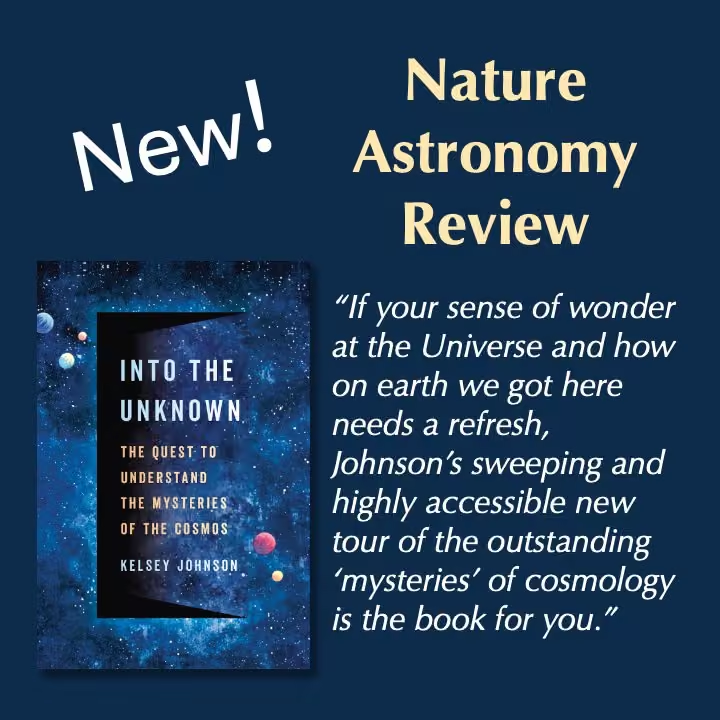 Nature Astronomy
@NatureAstronomy
The composition of the volcanic gas supplied to Venus's atmosphere indicates that the planet has a dry interior and likely no condensed liquid water on its surface, substantially constraining its habitable conditions. Constantinou, Shorttle & Rimmer: www.nature.com/articles/s41550-024-02414-5
 Nature Astronomy
@NatureAstronomy
The authors have put together a Research Briefing that summarises this paper: www.nature.com/articles/s41550-024-02415-4
Nature Astronomy reposted
Nature Portfolio
@NaturePortfolio
Venus’s interior may have been dry for most of its history, according to a paper published in @NatureAstronomy that challenges the hypothesis that the planet once hosted liquid surface oceans. go.nature.com/49pqdk0

Nature Astronomy reposted
 Institute of Space Sciences (ICE-CSIC)
@ice_csic
Experts gathered at the European Space Astronomy Centre (ESAC) to delve into the findings in the emission processes and origin of X-rays, and the astrophysical implications associated with neutron stars and white dwarfs.
Meeting report @NatureAstronomy➡️rdcu.be/d1Mzy
 Nature Astronomy
@NatureAstronomy
RUBIES-EGS-QG-1 is an exceptionally massive and mature galaxy discovered just 1.2 billion years after the Big Bang. Its stars formed in an extremely rapid burst, posing a major challenge to all current theoretical models. De Graaff, @davidjsetton et al. www.nature.com/articles/s41550-024-02424-3
 Nature Astronomy
@NatureAstronomy
.@AstroPearlman et al. have constrained the origins of FRB 20200120E, the nearest extragalactic repeating FRB. Simultaneous X-ray/radio data rule out a link to several types of X-ray sources and transients, including bright magnetar X-ray flares. www.nature.com/articles/s41550-024-02386-6
Nature Astronomy
@NatureAstronomy
Thirty years of Hubble data reveal transient UV-dark ovals appear more frequently in Jupiter's south. The haze distribution within them is concentrated by momentum penetrating from above. Tsubota, @miquai et al.: www.nature.com/articles/s41550-024-02419-0 / rdcu.be/d1vRd
Nature Astronomy
@NatureAstronomy
Numerical sims of Jupiter's atmosphere, using gases that are tied to the deep regions of the planet, show that the amount of water hidden deep inside Jupiter is supersolar, with an oxygen abundance between 2.5 and 5 times the solar value. Hyder et al.: www.nature.com/articles/s41550-024-02420-7
 Nature Astronomy
@NatureAstronomy
Sodium carbonates, chlorides & sulfates have been found in samples from asteroid Ryugu. Their formation processes from alkaline brines through freezing and/or evaporation accounts for the loss of liquid water from its parent body. Matsumoto et al.: www.nature.com/articles/s41550-024-02418-1
 Nature Astronomy
@NatureAstronomy
An analysis of (433) Eros’ crater morphologies reveals that the 16-km near-Earth asteroid (NEA) has a highly dissipative interior. These results show that, contrary to the established view, even the largest NEAs may be rubble piles. @RonBallouz et al.: www.nature.com/articles/s41550-024-02411-8

Nature Astronomy reposted
 Benjamin L'Huillier
@blhuilllier
🧵 Excited to share our latest research, published today in Nature Astronomy! 🌌 We discovered a link between galaxy shapes and supermassive black hole (SMBH) jets using data from two major surveys. Here’s what we found! 👇 #astrotwitter #astronomy
Nature Astronomy
@NatureAstronomy
It sounds intuitive, but it's hard to prove: the parsec-scale jets that form around supermassive black holes are connected to the alignment of the kiloparsec-scale galaxies they’re hosted in. Fernández Gil, Hodgson et al.: www.nature.com/articles/s41550-024-02407-4 / rdcu.be/d0d8U
 Nature Astronomy
@NatureAstronomy
It sounds intuitive, but it's hard to prove: the parsec-scale jets that form around supermassive black holes are connected to the alignment of the kiloparsec-scale galaxies they’re hosted in. Fernández Gil, Hodgson et al.: www.nature.com/articles/s41550-024-02407-4 / rdcu.be/d0d8U
Nature Astronomy
@NatureAstronomy
Eric Perlman has written a News & Views article to accompany this research: www.nature.com/articles/s41550-024-02408-3
Nature Astronomy reposted
Cornell Chronicle
@CornellNews
Scientists at @Cornell are developing a library of basalt-based spectral signatures that not only will help reveal the composition of exoplanets, but also could demonstrate evidence of water. @CornellEng @CornellCALS @NatureAstronomy @CSInst @BPFriedlander news.cornell.edu/stories/2024/11/scientists-compile-libra…
Nature Astronomy
@NatureAstronomy
Mid-IR emission spectra and simulated observations of basaltic rocky exoplanets show that JWST can in theory observe the mineralogy and chemical composition of rocky exoplanet surfaces, inc. water-bearing minerals. First et al.: www.nature.com/articles/s41550-024-02412-7 / rdcu.be/d0d8C
 Nature Astronomy
@NatureAstronomy
The authors have also put together a Research Briefing on this work: www.nature.com/articles/s41550-024-02413-6
Nature Astronomy
@NatureAstronomy
A reanalysis of the 1986 Voyager 2 flyby of Uranus shows that it occurred during an extreme compression of the planet’s magnetosphere by the solar wind. This would have had significant effects on the measurements made during the flyby. @spaceJamieJ et al.: www.nature.com/articles/s41550-024-02389-3
 Nature Astronomy
@NatureAstronomy
The authors have composed a Research Briefing on this work here: www.nature.com/articles/s41550-024-02390-w
Nature Astronomy reposted
Nature Portfolio
@NaturePortfolio
The Voyager 2 flyby of Uranus in 1986—which has formed much of the scientific understanding of the planet—may have occurred when its magnetosphere was unusually compressed by solar wind, suggests a paper in @NatureAstronomy. go.nature.com/40IZgFw
 Nature Astronomy
@NatureAstronomy
.@gbwnzl et al. detect the radio signatures of two forms of cyanopyrene, a small molecular sheet of carbon, in a cold interstellar cloud known for its rich chemistry. Their findings shed light on the origin and fate of carbon matter in interstellar space:
www.nature.com/articles/s41550-024-02410-9

Nature Astronomy reposted
Institute of Space Sciences (ICE-CSIC)
@ice_csic
An international team of astronomers, including ICE-CSIC researcher Mar Mezcua, discover the Fastest-Feeding Black Hole in the Early Universe
Read press release: www.ice.csic.es/news/news-press-releases?view=article&id=…
@CSIC @IEEC @NOIRLabAstro @NatureAstronomy @marmezcua_astro

Nature Astronomy reposted
Institut d'Estudis Espacials de Catalunya (IEEC)
@IEEC_space
Astronomers discover the fastest-feeding black hole in the early #universe! ⚫️
🔭 Observations from #jwst telescope and the #chandra X-ray Observatory reveal a low-mass black hole that appears to be consuming matter at over 40 times the theoretical limit ❗️
🗞️ Mar Mezcua, #ieec researcher at the @ice_csic, participates in the study published in @NatureAstronomy
@CSICCat @CSIC @NOIRLabAstro @ESA_Webb @NASAWebb @chandraxray
👉 www.ieec.cat/en/astronomers-discover-the-fastest-feeding-…
 Nature Astronomy
@NatureAstronomy
JWST has discovered a rapidly growing black hole in a very active phase, ~1.5 billion years after the Big Bang. Uniquely bright in X-rays, it is accreting at over 4000% of the Eddington limit, offering new insights into early black hole growth. Suh et al.: www.nature.com/articles/s41550-024-02402-9
 Nature Astronomy
@NatureAstronomy
The surprising presence of several very wide binary systems of the Kuiper belt can be explained by the gradual widening of initially tighter binaries by the gravitational effects of passing bodies. Campbell, Anderson & Kaib: www.nature.com/articles/s41550-024-02388-4 / rdcu.be/dYAdD
Nature Astronomy
@NatureAstronomy
.@JorgZavala et al. present an in-depth analysis of a JWST-discovered high-redshift galaxy at z=12.33. Combining images with the detection of atomic lines, they found extreme conditions in a bright galaxy, likely associated with a young starburst. www.nature.com/articles/s41550-024-02397-3
Nature Astronomy reposted
 JWST Observer
@JWSTObserver
STScI received 2,377 proposals for #jwst Cycle 4 – breaking its own record from Cycle 3 – requesting about 78,000 hours of observing time. Get more proposal submission statistics: www.stsci.edu/contents/news/jwst/2024/jwst-observers-brea…
 Nature Astronomy
@NatureAstronomy
Recently published in @nature: 'The black hole low-mass X-ray binary V404 Cygni is part of a wide triple' by Burdge et al.: www.nature.com/articles/s41586-024-08120-6
Nature Astronomy
@NatureAstronomy
A high-powered plasma torch was used to simulate the dust condensation process in stellar outflows. This approach can quantitatively characterize dust composition and formation in diverse astrophysical settings. Libourel et al.: www.nature.com/articles/s41550-024-02393-7 / rdcu.be/dXWTd
Nature Astronomy
@NatureAstronomy
Strong near-IR spectral features from asymptotic giant branch stars are detected by JWST in the integrated light from distant quiescent galaxies, clarifying their contribution to galaxy spectra and population synthesis models. Lu, Daddi, Maraston et al.: www.nature.com/articles/s41550-024-02391-9
 Nature Astronomy
@NatureAstronomy
The authors of this paper have also put together a Research Briefing: www.nature.com/articles/s41550-024-02392-8
Nature Astronomy
@NatureAstronomy
High-resolution solar flare observations captured rapid brightening in the Sun's lower atmosphere, indicative of flare kernels moving at speeds reaching thousands of km/s. This is evidence of long-sought slip-running reconnection. Lörinčík et al.: www.nature.com/articles/s41550-024-02396-4
Nature Astronomy reposted
 The SETI Institute
@SETIInstitute
Next SETI Live: Looking for Life in All the Wrong Places
The Atacama, NASA Viking Experiments, and Salts
TODAY, 18 October, 10:00 am PDT / 1:00 pm EDT
In 1976, @NASA's two Viking spacecraft touched down on Mars🔴, becoming the first successful landers on the red planet. On board Viking 1, the craft carried several biological experiments🔬 to search for life. While most scientists consider the results of those experiments to be negative for Martian life, one experiment gave a positive➕ result. The resulting controversy has spanned decades, with numerous scientists weighing in. Now, @extreme_microbe from the Centre of Astronomy and Astrophysics (ZAA) at Technische Universität Berlin questions how those experiments were performed in light of what we know of extremely dry environments here on Earth. These Mars analogs, such as the Atacama desert🏜️ in Chile, show that while microbes🦠 can survive in harsh conditions, too much water becomes a problem. And those Viking experiments may have involved too much water💧.
Join @allplanets as he discusses Dr. Schulze-Makuch's recent @NatureAstronomy article and how we should follow the salts🧂 instead of the water.
WATCH LIVE: www.youtube.com/live/BkuAU57vZNE?cbrd=1&ucbcb=1
 Nature Astronomy
@NatureAstronomy
Our October issue is now out, and can be read here: www.nature.com/natastron/volumes/8/issues/10
The wonderful cover image was created by Gabriel Pérez Díaz and is linked to the @eirini_ang et al. paper in the issue.
 Nature Astronomy
@NatureAstronomy
Also in the issue we have our regular selection of research highlights, from around the journalosphere:
Nature Astronomy
@NatureAstronomy
Ana Contreras-Santos and colleagues demonstrate the existence of dark-matter-deficient satellite galaxies in simulations, without breaking ΛCDM: www.nature.com/articles/s41550-024-02398-2 (A&A)
Nature Astronomy
@NatureAstronomy
Wenxuan Jia and colleagues have been trying to squeeze the best out of LIGO with squeezed vacuum states: www.nature.com/articles/s41550-024-02400-x (Science)
Nature Astronomy
@NatureAstronomy
JWST is officially better than Hubble at characterizing exoplanetary atmospheres, say Chloe Fisher, Jake Taylor, and co-workers: www.nature.com/articles/s41550-024-02401-w (MNRAS)
Nature Astronomy reposted
 The University of Manchester News
@UoMNews
By analysing a lunar meteorite, scientists at @OfficialUoM believe they could have pinpointed the age of the largest and oldest impact basin on the Moon to over 4.32 billion years ago 🌒🌙
@UoMSciEng @NatureAstronomy #uomnews
Read more 👇
www.manchester.ac.uk/about/news/researchers-propose-age-o…
 Nature Astronomy
@NatureAstronomy
A lunar meteorite called Northwest Africa 2995 likely originated from the South Pole-Aitken basin on the Moon’s far side. Minerals in the meteorite sample considerably narrow the date of basin formation to 4.32-4.33 billion years ago. @Katie_H_Joy et al.: www.nature.com/articles/s41550-024-02380-y
Nature Astronomy reposted
NASA
@NASA
Watch as our largest planetary spacecraft takes flight!
@EuropaClipper is targeted to launch at 12:06pm ET (1606 UTC) on a Falcon Heavy rocket from @NASAKennedy, beginning its journey to Jupiter’s ocean moon, Europa. x.com/i/broadcasts/1DXxydorLMLJM
Nature Astronomy
@NatureAstronomy
Evidence is found for a distant galaxy growing inside-out within the first 700 million years of the Universe’s existence. Modelling reveals that this galaxy is likely the progenitor of more local elliptical galaxies. Baker, Tacchella et al.: www.nature.com/articles/s41550-024-02384-8
 Nature Astronomy
@NatureAstronomy
The Milky Way contains an extremely long-lived stellar disk component that formed, according to Xiang et al., more than 13 billion years ago. Such longevity is due to the exceptionally quiescent dynamical history of the Galaxy. www.nature.com/articles/s41550-024-02382-w
 Nature Astronomy
@NatureAstronomy
JWST reveals flows from 4 young stars, each featuring a molecular wind with a central cavity surrounding a fast jet. Results point to disk winds driving accretion, with implications for planet formation. @ilaria_pascucci et al.: www.nature.com/articles/s41550-024-02385-7 / rdcu.be/dVZ9C

Nature Astronomy reposted
 Daniel Pomarède
@DanielPomarede
Yay! Figure 3 of our "Identification of basins of attraction in the local Universe" paper is the Astro Plot of the Week
www.nature.com/articles/s41550-024-02370-0
rdcu.be/dVh3s @NatureAstronomy
 Astro Plot of the Week
@PlotAstro
We have the newest "Astro Plot of the Week" - congratulations!
And keep them coming!
 Nature Astronomy
@NatureAstronomy
The landscape of the Universe can be discerned by the motion of galaxies toward mass concentrations and away from voids. Here, Valade et al. segment space into 'basins of attraction', mapped with 56 thousand galaxy velocities. www.nature.com/articles/s41550-024-02370-0 / rdcu.be/dVh3s
 Nature Astronomy
@NatureAstronomy
@PlotAstro lots of mouthwatering plots in this paper 🤤
Nature Astronomy
@NatureAstronomy
Beneath the superficial diversity and complexity of galaxy morphology in our local Universe, galaxies show underlying simplicity. They have universally bimodal distributions of specific angular momentum of stars. Wang et al.: www.nature.com/articles/s41550-024-02376-8 / rdcu.be/dVh52

Nature Astronomy reposted
 Dirk Schulze-Makuch
@extreme_microbe
Please check out my latest publication in Nature Astronomy:
"We may be looking for Martian life in the wrong place."
Weblink to the paper: rdcu.be/dVhB5
Nature Astronomy
@NatureAstronomy
An Earth-mass planet is inferred to have a white dwarf host, suggesting that terrestrial planets in Earth-like orbits may avoid being engulfed during the red-giant phases of their host stars. @AstroKeming, Zang et al.: www.nature.com/articles/s41550-024-02375-9 / rdcu.be/dVa0R @ucsdastro
 Nature Astronomy
@NatureAstronomy
The differences in estimated and measured Ryugu organic matter abundances may result from the surface organic matter distribution, or porosity, or from differences between the observation geometries employed by such studies. Potiszil et al.: www.nature.com/articles/s41550-024-02372-y @pml_ipm
 Nature Astronomy
@NatureAstronomy
The 3D shapes of fractures and veins observed in Ryugu samples indicate formation by freeze-thaw, hinting that the melting and freezing of ice control the flow of water and the extent of hydration in asteroids up to 300 km in size. @rockbloke et al.: www.nature.com/articles/s41550-024-02369-7
 Nature Astronomy
@NatureAstronomy
Hydrated ammonium magnesium-phosphorus-rich (‘HAMP’) grains have been discovered in Ryugu samples. They may have been a key source of phosphorus and nitrogen in early terrestrial water reservoirs. Pilorget et al.: www.nature.com/articles/s41550-024-02366-w / rdcu.be/dVaXF
 Nature Astronomy
@NatureAstronomy
The CHIME/FRB team has incorporated two 'outrigger' telescopes to pinpoint the origin of a fast radio burst at the time of detection, locating it within the star-forming disk of a galaxy. Cassanelli, @LeungCalvin12 et al. www.nature.com/articles/s41550-024-02357-x / rdcu.be/dVaU8

Nature Astronomy reposted
JWST Observer
@JWSTObserver
The photometric calibration reference files for the MIRI Medium Resolution Spectrometer have been updated to reflect a more comprehensive analysis using data obtained over the course of #jwst Cycles 1 and 2. Read more: www.stsci.edu/contents/news/jwst/2024/a-new-and-improved-…
 Nature Astronomy
@NatureAstronomy
WASP-107 b is a cool low-density exoplanet that experiences ~100 K of morning-evening temperature difference usually found in much hotter planets. Complex atmospheric models are needed to explain this behaviour. Murphy et al.: www.nature.com/articles/s41550-024-02367-9 / rdcu.be/dUWh6
 Nature Astronomy
@NatureAstronomy
A magnetic halo featuring coherent ridges extends several kpc above and below the Galactic disc. It is likely due to Galactic outflows driven by active star-forming regions 3-5 kpc from the Galactic centre. @HeShouZhang et al.: nature.com/articles/s41550-024-02362-0 / rdcu.be/dUP0bA

Nature Astronomy reposted
nature
@Nature
We're looking for a locum features editor to join our team, based in London, Washington DC or NYC 🖋️
Applications close 6 October. Check out the full information here: springernature.wd3.myworkdayjobs.com/en-US/SpringerNature…
Nature Astronomy reposted
Springer Nature
@SpringerNature
Authors submitting to @NaturePortfolio journals can now share their code and data via @CodeOceanHQ as part of the submission process. The partnership enables more authors to benefit from enhanced reproducibility, transparency & research efficiency: group.springernature.com/gp/group/media/press-releases/co…
@Nature
 Nature Astronomy
@NatureAstronomy
The September issue of Nature Astronomy is now available to read! www.nature.com/natastron/volumes/8/issues/9
The amazing cover image (which features @CSIRO_ATNF 's ASKAP radio telescope) is connected to the Caleb et al. paper within the issue.
 Nature Astronomy
@NatureAstronomy
Santosh Vadawale and colleagues report back from the Moon, or at least from the Pragyan rover of India’s Chandrayaan-3 mission: www.nature.com/articles/s41550-024-02377-7 (Nature)
Nature Astronomy
@NatureAstronomy
Hyerin Jang and co-workers use a combination of observations from space telescopes (inc. JWST) and modelling to have a closer look at the dusty inner part of the PDS 70 disk. www.nature.com/articles/s41550-024-02378-6 (A&A)
Nature Astronomy
@NatureAstronomy
For Ceres, an ice-rich crust containing more silicates with depth agrees with crater relaxation, morphology, and gravity inversions. This structure has a higher ice content than previously expected and could form from a relic ocean. @ianpamerleau et al.: www.nature.com/articles/s41550-024-02350-4
 Nature Astronomy
@NatureAstronomy
Lauren Schurmeier and Andrew Dombard have written a News & Views article on this paper: www.nature.com/articles/s41550-024-02316-6
Nature Astronomy
@NatureAstronomy
Eccentric gas giants in a planetary system can complicate/enrich planetary dynamics. Here, a stellar evolution + tide model explores the possibilities and introduces the concept of 'dormant migrating giants'. Bryan, De Wit et al.: www.nature.com/articles/s41550-024-02351-3 / rdcu.be/dUdtu
 Nature Astronomy
@NatureAstronomy
A massive galaxy hosting an accreting supermassive black hole two billion years after the Big Bang shows fast neutral-gas outflows capable of quenching star formation, while stars keep rotating in a disc. D'Eugenio et al.: www.nature.com/articles/s41550-024-02345-1

Nature Astronomy reposted
nature
@Nature
After decades of dreaming of Jupiter’s moon Europa — and the vast ocean that probably lies beneath its icy surface — scientists are now weeks away from sending a spacecraft there go.nature.com/4ecEDpj
Nature Astronomy
@NatureAstronomy
Recently published in @nature: 'Gravitational instability in a planet-forming disk' by Speedie, Dong et al.: www.nature.com/articles/s41586-024-07877-0
Nature Astronomy
@NatureAstronomy
Just published in @nature: 'One month convection timescale on the surface of a giant evolved star' by Vlemmings et al.: www.nature.com/articles/s41586-024-07836-9
Nature Astronomy reposted
 CNRS Physique
@CNRSphysique
#résultatScientifique 🔎Un programme de collecte de poussières extraterrestres mené en Antarctique a recueilli des micrométéorites anormalement riches en carbone, provenant très probablement de surfaces cométaires.
 Nature Astronomy
@NatureAstronomy
Ultra-carbonaceous Antarctic micrometeorites (UCAMMs) have a diverse isotopic composition, but the generally high N/C ratio points to their formation in different regions of the nitrogen-rich cold outer Solar System. Rojas et al.: www.nature.com/articles/s41550-024-02364-y / rdcu.be/dTwN0
Nature Astronomy
@NatureAstronomy
Through a joint analysis of radial velocity and astrometry, Wang et al. have discovered a potential mass-gap black hole in a wide binary. Its surprisingly wide circular orbit challenges current binary evolution and SN theories. www.nature.com/articles/s41550-024-02359-9 or rdcu.be/dTwMh
Nature Astronomy reposted
Geosciences Princeton University
@GeosciencesPU
Rocky exoplanets might hold vast amounts of water in their molten cores, write Haiyang Luo, Caroline Dorn, and Jie Deng in @NatureAstronomy.
www.innovations-report.com/science-tech/physics-and-astro…
#geoprinceton #geosciences
Nature Astronomy reposted
 ASTRO 3D
@ARC_ASTRO3D
🔭 ✨ #breaking in @NatureAstronomy. Where does a galaxy end and deep space begin? An @ARC_ASTRO3D @Swinburne-led team has, for the first time, photographed the halo of gas surrounding a galaxy—stretching up to 1 million light-years!
astro3d.org.au/galaxies-are-much-much-bigger-than-we-thou…
 Nature Astronomy
@NatureAstronomy
Spot the difference: dark matter self-interaction, or astrophysical feedback in galaxy clusters? A machine-learning algorithm could potentially tell you, more precisely and hundreds of times faster than other methods. Harvey: www.nature.com/articles/s41550-024-02322-8 or rdcu.be/dTcPM
 Nature Astronomy
@NatureAstronomy
A deep map of the diffuse gas surrounding a nearby galaxy reveals the boundary between the edge of the galaxy and the start of the circumgalactic medium, the dominant reservoir of normal matter. Nielsen et al.: www.nature.com/articles/s41550-024-02365-x or rdcu.be/dTcNU
 Nature Astronomy
@NatureAstronomy
Using the spin constraints on Sgr A* from @BlackHoleCam observations, Wang & Zhang suggest that Sgr A* experienced a past SMBH merger with a 4:1 mass ratio, which aligns with the Milky Way-Gaia Enceladus merger. www.nature.com/articles/s41550-024-02358-w or rdcu.be/dTcK7

Nature Astronomy reposted
 BepiColombo
@BepiColombo
Our #bepicolombo @esaoperations team confirm all went well with our Mercury flyby last night. Now we wait and see what images & data our instrument teams collected!
Stay tuned for a selfie-cam update later today. Here's a sneak preview 🤫
 Nature Astronomy
@NatureAstronomy
The rocky disc surrounding the young Sun may have experienced a close flyby of another star. Pfalzner et al. find that a specific flyby almost perfectly reproduces the orbits of the numerous small objects beyond Neptune. www.nature.com/articles/s41550-024-02349-x
Nature Astronomy reposted
 Daniel Verscharen
@DVerscharen
New paper alert! 🚨
In this @NatureAstronomy article 📜, led by Chuanpeng Hou from @PKU1898, we link interplanetary magnetic switchbacks 🧲⚡️ with reconnection ➰ at chromospheric network boundaries ☀️.
#solar, #space #plasma #physics
@MSSLSpacePlasma
www.nature.com/articles/s41550-024-02321-9
 Nature Astronomy
@NatureAstronomy
The origin of interplanetary switchbacks is solar magnetic reconnection at chromospheric network boundaries. By linking in situ & remote-sensing solar observations, Hou et al. provide a step toward understanding coronal heating and solar wind acceleration. www.nature.com/articles/s41550-024-02321-9

Nature Astronomy reposted
 Flatiron Institute
@FlatironInst
Flatiron Institute researchers and their colleagues published a new method of calculating the parameters of our universe using #ai called SimBIG, now out in @NatureAstronomy. Read more: www.simonsfoundation.org/2024/08/26/astrophysicists-use-a… #science #astrophysics #flatironcca #flatironccm
Nature Astronomy
@NatureAstronomy
The expected future annual carbon footprint from astronomical research infrastructures will not markedly decline in the future, and may even rise substantially, unless research practices are changed. Knödlseder et al.: www.nature.com/articles/s41550-024-02346-0 or rdcu.be/dR0YX
 Nature Astronomy
@NatureAstronomy
By extracting non-Gaussian cosmological information on galaxy clustering at non-linear scales, a framework for cosmic inference (SimBIG) provides precise constraints for testing cosmological models. @ChanghoonHahn @cosmo_shirley @DavidSpergel et al.: www.nature.com/articles/s41550-024-02344-2

Nature Astronomy reposted
nature
@Nature
India’s pioneering mission bolsters idea that Moon’s surface was molten go.nature.com/3YVnKus
Nature Astronomy
@NatureAstronomy
Our August issue is now available to read! The wonderfully artistic cover image is from Alexander Mushtukov, and related to one of the IXPE papers in the issue. Browse here: www.nature.com/natastron/volumes/8/issues/8
 Nature Astronomy
@NatureAstronomy
Daniel Huber and colleagues have found a very-metal-poor star in the Galactic halo, and a remarkable agreement between six stellar structure and atmosphere models:
www.nature.com/articles/s41550-024-02353-1 (ApJ)
Nature Astronomy
@NatureAstronomy
Jayshil Patel and co-workers have been trying to untangle the puzzling nature of exoplanet 55 Cancri e:
www.nature.com/articles/s41550-024-02354-0 (A&A)
Nature Astronomy reposted
 EFE Comunica
@EFEcomunica
Un estudio defiende que los planetas tienen en su interior más agua de la que se pensaba.
@ETH_en @NatureAstronomy #exoplanetas @esa_es
efe.com/ciencia-y-tecnologia/2024-08-20/estudio-planetas-…
Nature Astronomy
@NatureAstronomy
Models show that water in super-Earth and sub-Neptune exoplanets is mostly stored deep in their cores and mantles, rather than their surfaces. Exoplanets previously thought to be quite dry might have abundant water inside. Luo, Dorn & Deng: www.nature.com/articles/s41550-024-02347-z
 Nature Astronomy
@NatureAstronomy
Some of the resonances in the chain within the TRAPPIST-1 system are high-order, which is not what is expected. This modelling study shows how such a situation is possible by including detailed planet-disc interaction processes. Pichierri et al.: www.nature.com/articles/s41550-024-02342-4
 Nature Astronomy
@NatureAstronomy
The thermal history of meteorites gives us a good constraint on when giant planet migration upheaved the Solar System. It indeed happened early, starting approximately 11 million years after the Solar System formed. @GisforGeology et al.: www.nature.com/articles/s41550-024-02340-6
Nature Astronomy
@NatureAstronomy
Recently published in @nature: 'Spectroscopic confirmation of two luminous galaxies at a redshift of 14' by Carniani et al.: www.nature.com/articles/s41586-024-07860-9
Nature Astronomy
@NatureAstronomy
Recently published in @nature: 'A nebular origin for the persistent radio emission of fast radio bursts' by Bruni et al.: www.nature.com/articles/s41586-024-07782-6
 Nature Astronomy
@NatureAstronomy
Just published in @Nature: 'Black holes regulate cool gas accretion in massive galaxies' by Wang et al.: www.nature.com/articles/s41586-024-07821-2
Nature Astronomy
@NatureAstronomy
How can a star cluster (Terzan 5) manage to produce gamma-rays at a location 30 light-years away from itself? It's all in the way cosmic rays are scattered, say Krumholz et al.: www.nature.com/articles/s41550-024-02337-1

Nature Astronomy reposted
 Cardiff University
@cardiffuni
Scientists have developed a new method for detecting supermassive binary black holes, pairs of the largest kind of black holes in the Universe.
➡️www.cardiff.ac.uk/news/view/2833420-using-small-black-hol…
📷@NASAGoddard /Scott Noble; simulation data, d'Ascoli et al. 2018
📝@NatureAstronomy

Nature Astronomy reposted
Springer Nature
@SpringerNature
Did you know that @NatureAstronomy covers are currently on display at one of the largest Astronomy museums?
For Shanghai Astronomy Museum's “Cosmos Archaeology”, we provided 12 covers, including popular covers from the previous years and stories from China-based researchers.

 Nature Astronomy
@NatureAstronomy
Merging supermassive black holes emit low-frequency gravitational waves, difficult to observe with current and future detectors. Stegmann et al. show that these black holes can leave measurable traces in high-frequency signals from adjacent sources. www.nature.com/articles/s41550-024-02338-0

Nature Astronomy reposted
 Johns Hopkins APL
@JHUAPL
In five new Nature Communications papers, the team behind @NASA's successful #dartmission sheds new light on the structure and origins of the asteroid system encountered in 2022. jhuapl.link/fhk
@NASASolarSystem @AsteroidWatch
Nature Astronomy reposted
 TU Delft | Aerospace Engineering
@AETUDelft
🌌 Exciting Discovery: How Organic Macromolecules Form in Space 🌌 Researchers from @tudelft and @unibern reveal that essential building blocks of life can rapidly form in cosmic dust around young stars. Their study is published today in @NatureAstronomy: www.tudelft.nl/en/2024/lr/astronomers-clarify-how-organic…


 Nature Astronomy
@NatureAstronomy
The organic macromolecular matter found in meteorites could have formed in heavily irradiated zones in dust traps in planet-forming disks, according to an evolutionary model of a protoplanetary disk. @NielsLigterink et al.: www.nature.com/articles/s41550-024-02334-4

Nature Astronomy reposted
 MIT Science
@ScienceMIT
In a @NatureAstronomy paper, the TRAPPIST-1 JWST Community Initiative lays out a step-by-step roadmap to overcome the challenges they faced while studying the TRAPPIST-1 system news.mit.edu/2024/roadmap-details-how-improve-exoplanet-e…
Nature Astronomy
@NatureAstronomy
This paper has just surpassed 4,500 in the Altmetric score, putting it 4th in our 'All time' list.
Nature Astronomy
@NatureAstronomy
There is an accessible cave conduit under the lunar surface. Carrer et al.:
www.nature.com/articles/s41550-024-02302-y

Nature Astronomy reposted
 Magdalena Skipper
@Magda_Skipper
Science must protect thinking time in a world of instant communication - @nature editorial www.nature.com/articles/d41586-024-02381-x
Nature Astronomy
@NatureAstronomy
Just published in @nature: 'A temperate super-Jupiter imaged with JWST in the mid-infrared' by @lis_matthews et al.: www.nature.com/articles/s41586-024-07837-8
Nature Astronomy
@NatureAstronomy
To have permanent crews on the Moon, you need a clear planning of turnos to avoid excessive radiation exposure. This study models lunar radiation dosage, taking into account the various kinds of available shielding. Dobynde & Guo: www.nature.com/articles/s41550-024-02287-8 / rdcu.be/dOOPb
Nature Astronomy reposted
IAC Astrofísica
@IAC_Astrofisica
Research based on #machinelearning reveals that most stars are born within their own galaxy. An IAC team has analysed 10,000 nearby galaxies and concludes that galaxy mergers, although important, are not the main source of new stars. @NatureAstronomy
+ℹ️ www.iac.es/en/outreach/news/machine-learning-reveals-merg…

Nature Astronomy reposted
 Jonathan O’Callaghan
@Astro_Jonny
Thrilled to share my first-ever journal article!
In @NatureAstronomy, I attempt the impossible - making the case for Mars Sample Return, even at an eye-watering cost of $11 billion.
Why scientists are longing for samples from Mars
🧵 below (1/x)
www.nature.com/articles/s41550-024-02324-6
Nature Astronomy
@NatureAstronomy
How do mergers affect the stellar mass assembly of nearby galaxies? Using AI, @eirini_ang, @MHuertasCompany et al. constrain the ex-situ stellar mass for 10k galaxies, identifying dependencies on galaxy properties & environment.
www.nature.com/articles/s41550-024-02327-3 / rdcu.be/dOy4V
Nature Astronomy
@NatureAstronomy
NASA's Mars Sample Return mission is absorbing a significant amount of planetary science funding, but the scientific return would be immense. A Feature by @Astro_Jonny: www.nature.com/articles/s41550-024-02324-6 or rdcu.be/dOy4r
Nature Astronomy
@NatureAstronomy
Just published in @nature: 'A hot-Jupiter progenitor on a super-eccentric retrograde orbit' by Arvind Gupta et al.: www.nature.com/articles/s41586-024-07688-3
Nature Astronomy
@NatureAstronomy
The main environmental impacts of building and operating the @CTA_Observatory are greenhouse gas emissions and mineral resource use. Impacts can be reduced by using renewable energies and design changes. dos Santos Ilha et al.: www.nature.com/articles/s41550-024-02326-4 or rdcu.be/dN7bq
Nature Astronomy
@NatureAstronomy
A hydrated mineral, (NH4)MgCl3·6H2O, is present in lunar samples collected by the Chang'e-5 mission, and represents the chemical form of water on the lunar surface. Jin et al.:
www.nature.com/articles/s41550-024-02306-8

Nature Astronomy reposted
Leonardo Carrer
@lcarrerX
Per aspera ad Astra. Ten years of hard work. Thank you to all the colleagues and friends that made this discovery possible.
Nature Astronomy
@NatureAstronomy
There is an accessible cave conduit under the lunar surface. Carrer et al.:
www.nature.com/articles/s41550-024-02302-y
Nature Astronomy reposted
 Guardian Science
@guardianscience
Underground cave found on moon could be ideal base for explorers www.theguardian.com/science/article/2024/jul/15/undergrou…
Nature Astronomy
@NatureAstronomy
There is an accessible cave conduit under the lunar surface. Carrer et al.:
www.nature.com/articles/s41550-024-02302-y
Nature Astronomy
@NatureAstronomy
An Einstein ring ~10,000x as bright as the Milky Way in the infrared is studied in detail with ERIS and ALMA, finding that it is a rare starburst showing a fast-rotating disk instead of a more usual one that is triggered by a major merger. Liu et al.: www.nature.com/articles/s41550-024-02296-7
Nature Astronomy
@NatureAstronomy
Recently published in @nature: 'Bound star clusters observed in a lensed galaxy 460 Myr after the Big Bang' by Adamo et al.: www.nature.com/articles/s41586-024-07703-7
Nature Astronomy
@NatureAstronomy
Recently published in @nature: 'No massive black holes in the Milky Way halo' by Mróz et al.: www.nature.com/articles/s41586-024-07704-6
Nature Astronomy
@NatureAstronomy
Recently published in @nature: 'Hydrogen sulfide and metal-enriched atmosphere for a Jupiter-mass exoplanet' by Fu et al.: www.nature.com/articles/s41586-024-07760-y
Nature Astronomy
@NatureAstronomy
Just published in @nature: 'Fast-moving stars around an intermediate-mass black hole in ω Centauri' by Häberle et al.: www.nature.com/articles/s41586-024-07511-z
Nature Astronomy
@NatureAstronomy
This paper has an accompanying News & Views article by Daryl Haggard and Adrienne Cool: www.nature.com/articles/d41586-024-02135-9
Nature Astronomy reposted
nature
@Nature
Obituary: Edward C. Stone (1936-2024) physicist who guided Voyager probes to interstellar space go.nature.com/4eQ8Vi6
Nature Astronomy
@NatureAstronomy
A combined analysis of datasets across four JWST instrument modes provides a benchmark transmission spectrum for the Saturn-mass WASP-39 b. The broad wavelength range and high resolution constrain orbital and stellar parameters to <1%. Carter, May, et al.: www.nature.com/articles/s41550-024-02292-x

Nature Astronomy reposted
Davide Castelvecchi
@dcastelvecchi
My latest: Kamiokande-II saw the first supernova neutrinos from the famous SN 1987A. Now Super-Kamiokande is starting to see hints of a "diffuse supernova neutrino background" from across the observable Universe
#neutrino2024 @Kamiokaobs_pr
www.nature.com/articles/d41586-024-02221-y
Nature Astronomy
@NatureAstronomy
With JWST, Sara Faggi & co. observed a fascinating outgassing pattern with compositional heterogeneities in 29P/Schwassmann-Wachmann 1, which could be related to a bilobate nature of its nucleus. CO and CO2 isotopes are reported. www.nature.com/articles/s41550-024-02319-3 or rdcu.be/dM6V0
 Nature Astronomy
@NatureAstronomy
(isotopologues)
Nature Astronomy
@NatureAstronomy
Dust in protoplanetary disks is likely fragile and porous. Evidence for this is offered by a model of the IM Lup disk that provides a comprehensive explanation for its observed structure. @T_Ueda_Astro, @krutisudarshan et al.: www.nature.com/articles/s41550-024-02308-6 or rdcu.be/dMPGH
 Nature Astronomy
@NatureAstronomy
Observations of the Chamaeleon I dense cloud were made as part of the JWST ERS program IceAge. Here the detection of the dangling OH features at ∼2.7 μm are presented, providing a tracer of icy grain morphology. Noble et al.: www.nature.com/articles/s41550-024-02307-7 or rdcu.be/dMPDQ
 Nature Astronomy
@NatureAstronomy
How do you measure the dark-matter mass in galaxy clusters? @astrovallesp and co-authors have developed a scaling relation between cluster mass and the size and intensity of accretion shock-waves. www.nature.com/articles/s41550-024-02303-x or rdcu.be/dMPCB

Nature Astronomy reposted
 Faculty of STEM, The Open University
@OU_STEM
OU academics Helen Fraser & Hugh Dickinson, with PhD student Zak Smith, have discovered the spectral signature of water ice, revealing new insights into star & planet formation! 🚀✨ Their findings have been published in @NatureAstronomy. 📚🔭
ounews.co/science-mct/astronomers-make-discovery-about-th…
 Nature Astronomy
@NatureAstronomy
Seismic impact events recorded by InSight’s seismometer were used to derive an estimate of the current impact rate on Mars. The results suggest a rate higher than predicted by orbital imaging, but in line with theoretical ideas. Zenhausern et al.: www.nature.com/articles/s41550-024-02301-z
 Nature Astronomy
@NatureAstronomy
Lian, @zastronomerski et al. reconstruct the light profile and measure the size of the Milky Way from an inside perspective, adding a new tool with which to compare our Galaxy to other galaxies. www.nature.com/articles/s41550-024-02315-7
 Nature Astronomy
@NatureAstronomy
Using a sample of 2600+ classical Cepheids with precise distances and ages, Huang et al. find that the Milky Way's disk warp undergoes retrograde precession, revealing the presence of a slightly oblate dark matter halo outside the visible Galaxy. www.nature.com/articles/s41550-024-02309-5

Nature Astronomy reposted
nature
@Nature
For many physicists, the birth of gravitational-wave science was a rare bright spot in the past decade
Here are five techniques being developed to spot ripples in space-time go.nature.com/3VJZTug
Nature Astronomy reposted
 Springer Astronomy
@SpringerAstro
The @SpringerNature Physics and Astronomy Books Group is hiring a new Editor/Senior Editor in New York! If you are interested, please review the job application and apply:
careers.springernature.com/job/New-York-Acquisition-Edito…
 Nature Astronomy
@NatureAstronomy
Read the full research paper here: www.nature.com/articles/s41550-024-02305-9
ESA Science
@esascience
. @ESA_Webb has revealed intricate features in the upper atmosphere above the Great Red Spot of Jupiter 🔴 a region always assumed to be boring!
Read more: www.esa.int/Science_Exploration/Space_Science/Webb/Jupite…
 Nature Astronomy
@NatureAstronomy
Supergranules, prominent flows at the solar
surface, are mysterious. Seismically inferred
supergranular downflows contribute less
mass flux than upflows because they may be
too small to be detected. This
challenges theories of convection. Hanson et al.: www.nature.com/articles/s41550-024-02304-w
 Nature Astronomy
@NatureAstronomy
JWST H3+ observations of Jupiter’s low-latitude ionosphere in the region of the Great Red Spot show unexpected small-scale features such as arcs, bands and spots. This intricacy might arise from interactions with the lower atmosphere. Melin et al.:
www.nature.com/articles/s41550-024-02305-9
Nature Astronomy
@NatureAstronomy
IXPE polarization data unveils the accretion geometry in the X-ray binary Cyg X-3: a narrow funnel with reflecting walls. The funnel acts as a magnifying mirror focusing emission, making Cyg X-3 appear as a ULX. Veledina et al.: www.nature.com/articles/s41550-024-02294-9 or rdcu.be/dLv6Z
 Nature Astronomy
@NatureAstronomy
Microscopic observations of the Chang'e-5 lunar samples can separate the effects of the two main space-weathering drivers: larger iron nanoparticles are generated by microimpacts and small ones by solar wind irradiation. Shen et al.:
www.nature.com/articles/s41550-024-02300-0
Nature Astronomy reposted
Institute of Space Sciences (ICE-CSIC)
@ice_csic
Three neutron stars detected by @ESA_XMM and @chandraxray telescopes are between 10 and 100 times colder than others of their same age, ruling out ~75% of known neutron star models.
Researchers from @ice_csic led study published in @NatureAstronomy.
➡️ice.csic.es/index.php?option=com_content&view=article&id=…
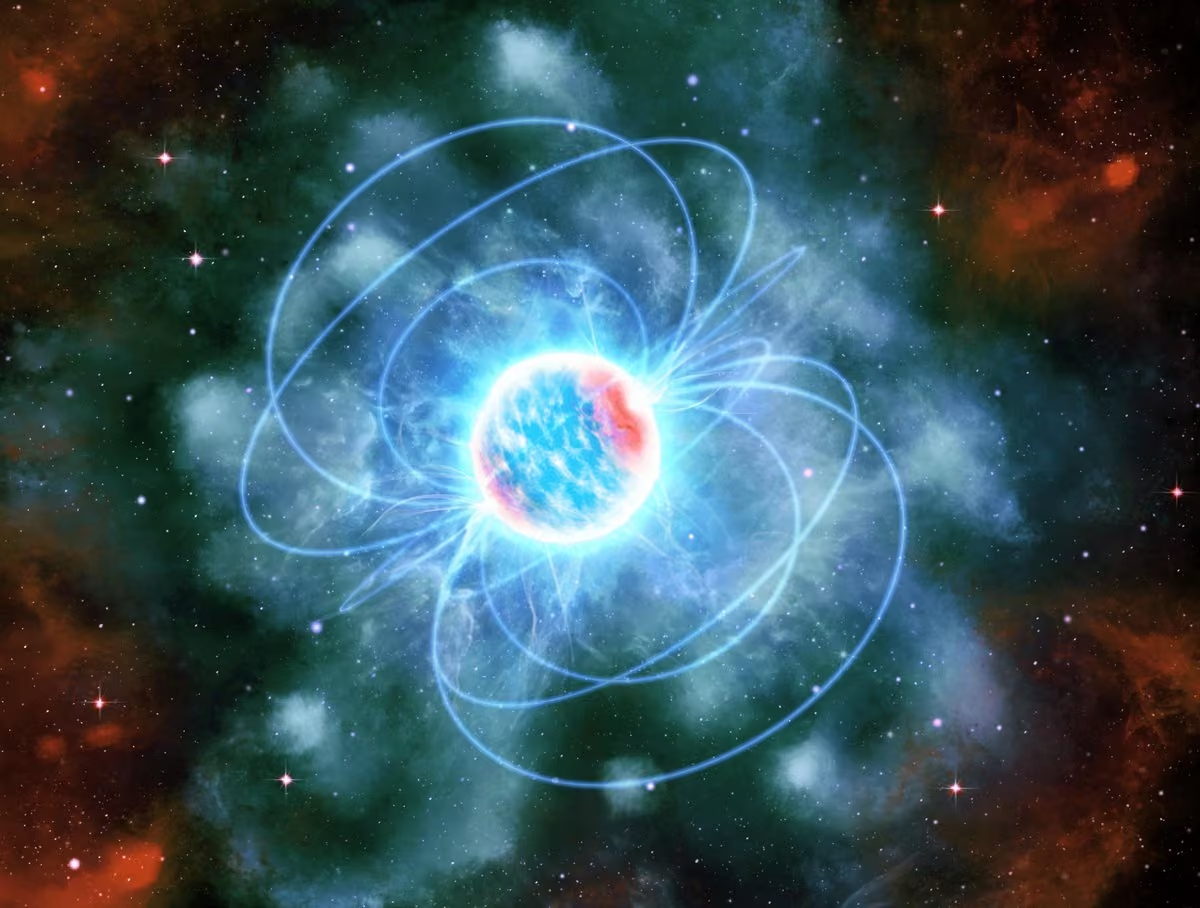
Nature Astronomy reposted
Institut d'Estudis Espacials de Catalunya (IEEC)
@IEEC_space
Three colder-than-expected neutron #stars found! ❄️
Their low temperatures rule out 75% of existing #neutron star models, a big step towards discovering the so-called equation of state of all neutron stars 😲
The study, led by #ieec researchers at the @ice_csic, and in collaboration with @UA_Universidad, has been published in @NatureAstronomy 🗞️
👉 www.ieec.cat/en/a-team-of-ieec-astronomers-discovers-thre…
 Nature Astronomy
@NatureAstronomy
The quest for understanding the composition of neutron stars is one of the biggest in modern physics. Three young and cold neutron stars have been discovered, showing how dense matter can cool down extremely rapidly at early ages. @Almarino_Sci et al.: www.nature.com/articles/s41550-024-02291-y
 Nature Astronomy
@NatureAstronomy
Our June issue is now available to read: www.nature.com/natastron/volumes/8/issues/6
The striking cover image relates to the Blanchard et al. paper in the issue, on the supernova behind GRB 221009A.
 Nature Astronomy
@NatureAstronomy
Myriam Prasow-Émond and co-workers have been leveraging the power of Keck to image the circumstellar environments of high-mass X-ray binaries, looking for planets and other things: www.nature.com/articles/s41550-024-02312-w (ApJ)
Nature Astronomy
@NatureAstronomy
And two groups of researchers recently announced the discovery of Gliese 12 b, a promising candidate for a rocky Earth-sized exoplanet with a temperate climate: www.nature.com/articles/s41550-024-02313-9 (ApJL/MNRAS)
Nature Astronomy
@NatureAstronomy
The spectrum of an early quasar in the mid-infrared! J1120+0641 already has a mature feeding structure 760 million years after the Big Bang (just 5% of the Universe’s age). This is mysteriously fast, say @sarah_seib2 et al.: www.nature.com/articles/s41550-024-02273-0 or rdcu.be/dLagw
Nature Astronomy
@NatureAstronomy
The lead author has written a Research Briefing on this paper, giving a bit more detail on the story behind the research: www.nature.com/articles/s41550-024-02280-1
Nature Astronomy
@NatureAstronomy
IXPE has revealed how the spin of the accreting neutron star Hercules X-1 changes in 3-D. The spin axis of the star moves both through the star and across the sky, hinting that the crust of the star is asymmetric by almost a part per million. Heyl et al.: www.nature.com/articles/s41550-024-02295-8
Nature Astronomy
@NatureAstronomy
The Sun spins faster at the equator than at the poles (differential rotation). Rao et al. analyse CHASE data to show that in 3D, the rotation rate also steadily increases from the solar photosphere to the chromosphere. www.nature.com/articles/s41550-024-02299-4 or rdcu.be/dKON1

Nature Astronomy reposted
 Nature Geoscience
@NatureGeosci
Article: High-resolution spacecraft imagery has revealed transient deposits that appear in the early mornings of cold seasons at high altitudes on the Tharsis volcanoes, consistent with water frost of atmospheric origin
@Avalantinas
www.nature.com/articles/s41561-024-01457-7
 Nature Astronomy
@NatureAstronomy
And this...
Nature Astronomy
@NatureAstronomy
Voyager 2's cosmic ray instrument observed a boundary layer outside the heliopause where the intensity of Galactic cosmic rays is modulated. Stone et al.: www.nature.com/articles/s41550-019-0928-3
 Nature Astronomy
@NatureAstronomy
Seems appropriate to retweet this...
Nature Astronomy
@NatureAstronomy
Slightly more recently (only 40 years ago) the two Voyager spacecraft launched on a tour of the Solar System. Project Scientist Ed Stone looks back at that breathtaking age of discovery: rdcu.be/z7Kv
Nature Astronomy reposted
 SolarSteph🌞
@slyardley
A Research Briefing on our recent @NatureAstronomy article on tracing solar wind back to its source from a close distance using @ESASolarOrbiter has just been published online. It gives a more accessible short overview of what was accomplished! 🌞🛰️
www.nature.com/articles/s41550-024-02288-7
Nature Astronomy reposted
 BU Experts
@BUexperts
2️⃣ million years ago, 🌎 was a frozen landscape shared by early humans and saber-toothed tigers. Scientists have studied the causes of these ancient ice ages, from volcanic eruptions to shifts in Earth's tilt. But what if our sun's trek through space also played a role? 🧵 (1/3).

Nature Astronomy reposted
 Harvard Radcliffe Institute
@RadInstitute
A team led by the astronomer and Radcliffe fellow @MeravOpher today published an exciting discovery about our heliosphere in @NatureAstronomy. The @Harvard Gazette has the story. news.harvard.edu/gazette/story/2024/06/earth-exposed-to-i…
Nature Astronomy
@NatureAstronomy
When the Solar System passed through a cold dense cloud ~2.5 million years ago our heliospheric bubble might have shrunk so much that the Earth got exposed directly to the interstellar medium. Opher et al.: www.nature.com/articles/s41550-024-02279-8
Nature Astronomy reposted
 OzGrav
@ARC_OzGRav
Slow-spinning radio neutron star breaks all the rules! “The fact that the signal is repeating at such a leisurely pace is extraordinary,” said Dr @ManishaCaleb from @Sydney_Uni and @ARC_OzGrav.
Published in @NatureAstronomy, read more here: www.nature.com/articles/s41550-024-02277-w
 Nature Astronomy
@NatureAstronomy
Long-period radio transients emit powerful polarized signals lasting up to ~an hour. While their origin is debated, ASKAP J1935+2148's discovery with diverse (neutron-star-like) emission modes challenges our ideas of these phenomena. @ManishaCaleb et al.: www.nature.com/articles/s41550-024-02277-w
 Nature Astronomy
@NatureAstronomy
The aurorae of the Solar System, despite the difference in scale and intensity, can be gathered under the same theoretical framework, whether they are dominated by the solar wind, corotating plasma, or the transition between. Zhang, Yao et al.: www.nature.com/articles/s41550-024-02270-3
Nature Astronomy
@NatureAstronomy
What are the relative contributions of the mechanisms for hydrogen loss on Mars? Combined data from MRO, MAVEN and TGO show the dominant role of water photolysis above the clouds and the prevalence of seasonal versus dust storm effects. Kleinböhl et al.: www.nature.com/articles/s41550-024-02268-x
 Nature Astronomy
@NatureAstronomy
The Solar wind is highly structured yet variable. Close-up observations of the solar atmosphere reveal that the changing connectivity of multiple sources in the solar corona drives complexity and variability in the inner heliosphere. @slyardley et al.: www.nature.com/articles/s41550-024-02278-9
 Nature Astronomy
@NatureAstronomy
Surface changes observed on Venus by Magellan point to active and widespread volcanism currently happening on the planet. Sulcanese, Mitri & Mastrogiuseppe: www.nature.com/articles/s41550-024-02272-1 or rdcu.be/dJshs
Nature Astronomy
@NatureAstronomy
The authors have also put together a Research Briefing on this research: www.nature.com/articles/s41550-024-02275-y
Nature Astronomy
@NatureAstronomy
The DiSCo-TNOs project observed 59 trans-Neptunian objects with JWST to determine their composition. They identify 2 main groups according to their CO2 abundance, suggesting different formation regions of the disc. De Prá et al.: www.nature.com/articles/s41550-024-02276-x or rdcu.be/dJshX
Nature Astronomy
@NatureAstronomy
A catch-up of some recently published papers follows...
Nature Astronomy reposted
nature
@Nature
Without international partnerships, NASA’s groundbreaking mission could fail to be ready in time for its optimal launch window go.nature.com/3WPlZxQ
Nature Astronomy reposted
 Northumbria Uni
@NorthumbriaUni
New research, led by Northumbria's @slyardley using data collected by the @ESASolarOrbiter, has shed new light on the 'slow' solar wind. Published today in @NatureAstronomy #spacenu #takeontomorrow @SolarSpaceNU
www.northumbria.ac.uk/about-us/news-events/news/solar-orb…
Nature Astronomy
@NatureAstronomy
1,043 and counting...
Springer Nature
@SpringerNature
One of our top rated article on @altmetric this past week was 'An extended low-density atmosphere around the Jupiter-sized planet WASP-193 b’. Read the @NatureAstronomy article here: www.nature.com/articles/s41550-024-02259-y.epdf?sharing_t…
 Nature Astronomy
@NatureAstronomy
And a short summary of this important report can be read here: www.nature.com/articles/s41550-024-02232-9
 Royal Astronomical Society
@RoyalAstroSoc
We have today published the findings and recommendations of our report into bullying and harassment in the fields of astronomy and geophysics.
Read more here: ras.ac.uk/news-and-press/news/urgent-change-needed-tackle…
A live-streamed launch of the survey will take place from 11:00 BST: www.eventbrite.co.uk/e/royal-astronomical-society-bullyin…

Nature Astronomy reposted
IAC Astrofísica
@IAC_Astrofisica
🌍 International research, with the participation of #iacastrofísica, finds an Earth-sized #exoplanet orbiting an ultra-cold red dwarf 55 light-years away ❄️☀️
🔭 Using #speculoos telescope network
📄Published in @NatureAstronomy
ℹ️ www.iac.es/en/outreach/news/astronomers-discover-earth-si…


Nature Astronomy reposted
 Université de Liège
@UniversiteLiege
Astronomer Michaël Gillon and the #speculoos team discovered a new Earth-sized exoplanet around SPECULOOS-3, an "ultracool dwarf" star as small as Jupiter, twice as cold as our Sun, and located 55 light-years from Earth. #uliège @NatureAstronomy @NASA
www.nature.com/articles/s41550-024-02271-2
 Nature Astronomy
@NatureAstronomy
SPECULOOS-3 b is an Earth-sized planet orbiting an ultracool red dwarf in 17 hours. Similar to TRAPPIST-1 b in properties but different in architecture, it hints at a different evolution history and can be easily characterised by JWST. Gillon et al.: www.nature.com/articles/s41550-024-02271-2
 Nature Astronomy
@NatureAstronomy
The hot gas giant WASP-193 b has a density of 0.06+/-0.01 g/cm3, which is at least 10 times less than standard gas giants, and unexplainable by current models. JWST can characterise its atmosphere with just one transit. Barkaoui, Pozuelos et al.: www.nature.com/articles/s41550-024-02259-y
 Nature Astronomy
@NatureAstronomy
The prebiotic formation of the pyridine and (iso)quinoline, precursors to DNA/RNA, is revealed in Saturn’s moon Titan and a molecular cloud. These studies inform our understanding of how biologically relevant molecules could have emerged. Yang et al.: www.nature.com/articles/s41550-024-02267-y
 Nature Astronomy
@NatureAstronomy
A single parameter, derived from the Jeans parameter with the inclusion of tidal forces, can identify the dominant driver (thermal energy/tidal forces/stellar XUV radiation) of hydrodynamic escape from low-mass, close-in exoplanets. Guo: www.nature.com/articles/s41550-024-02269-w
Nature Astronomy
@NatureAstronomy
Hubble caught 20-30 Myr old planet V1298 Tau b in mid-evolution. Currently Jupiter-sized, its metal-poor, haze-free atmosphere is depleted in methane, suggesting a hot interior. It will likely become a (sub-)Neptune. @barat_saugata, @jmdesert et al.: www.nature.com/articles/s41550-024-02257-0
Nature Astronomy
@NatureAstronomy
Just published in @nature: 'A secondary atmosphere on the rocky Exoplanet 55 Cancri e' by Hu et al.: www.nature.com/articles/s41586-024-07432-x
Nature Astronomy
@NatureAstronomy
Recently published in @nature: 'Methane emission from a cool brown dwarf' 😎 by Faherty et al.: www.nature.com/articles/s41586-024-07190-w
Nature Astronomy
@NatureAstronomy
Recently published in @nature: 'Star Formation Shut Down by Multiphase Gas Outflow in a Galaxy at a Redshift of 2.45' by Belli et al.: www.nature.com/articles/s41586-024-07412-1
Nature Astronomy
@NatureAstronomy
Recently published in @nature: 'A magnetar giant flare in the nearby starburst galaxy M82' by Mereghetti et al.: www.nature.com/articles/s41586-024-07285-4
Nature Astronomy
@NatureAstronomy
Recently published in @nature: 'Venus water loss is dominated by HCO+ dissociative recombination' by Chaffin et al.: www.nature.com/articles/s41586-024-07261-y
Nature Astronomy
@NatureAstronomy
Decameter radio observations have always been very difficult due to the ionosphere. @ChristianGroe18 et al. present a strategy to correct for the ionosphere, which allows them to make sharp decameter radio images from the surface of the Earth. www.nature.com/articles/s41550-024-02266-z
 Nature Astronomy
@NatureAstronomy
One week left to apply for our open (full-time, permanent) editorial position, to be based in Germany or the US:
aas.org/jobregister/ad/47235c60
#astrojobs #hiring
Nature Astronomy
@NatureAstronomy
JWST observed exoplanet WASP-43 b at various phases and obtained the 5-12 µm spectrum for each phase, revealing a day-night temperature difference of ~650 K, with low clouds at night and cloudless days. @taylorbell275 et al.: www.nature.com/articles/s41550-024-02230-x

Nature Astronomy reposted
TU Delft | Aerospace Engineering
@AETUDelft
A new analysis of the speed of the #cassini satellite by @tudelft (a.o. @woutervdwal) and @NASAGoddard indicates there’s an underground ocean of water and ammonia on Saturn’s moon Titan. The paper is published in @NatureAstronomy 👉🏻www.tudelft.nl/en/2024/lr/underground-ocean-of-water-and-…
 Nature Astronomy
@NatureAstronomy
#titan likely has a water or ammonia ocean in its interior: #cassini tracking data extract a Love number that is consistent with a low-density ocean and not a dense one, as previous measurements have suggested. Goossens et al.: www.nature.com/articles/s41550-024-02253-4

Nature Astronomy reposted
Nature Portfolio
@NaturePortfolio
An image of an energetic outburst near the Milky Way’s central supermassive black hole, Sagittarius A*, has been reconstructed using a 3D technique similar to a CT scan, according to a paper in @NatureAstronomy. go.nature.com/3We1RoD

Nature Astronomy reposted
nature
@Nature
Our annual photography competition attracted stunning images from around the world
Check out the winning photos 📸 go.nature.com/3UtAUMl
Nature Astronomy
@NatureAstronomy
Our April issue is now available to read! www.nature.com/natastron/volumes/8/issues/4
The dramatic cover image comes from the paper of Wolf et al. that appears within the issue.
 Nature Astronomy
@NatureAstronomy
.@ExoCytherean and @ThePlanetaryGuy explore the potential habitability of Venus, in a Perspective: www.nature.com/articles/s41550-024-02228-5
Nature Astronomy
@NatureAstronomy
Free-to-read link: rdcu.be/dFrkY
Nature Astronomy
@NatureAstronomy
Shahnawaz Adil and colleagues make inroads into the Hubble tension's lesser-known cousin, the S_8 tension:
www.nature.com/articles/s41550-024-02262-3 (MNRAS)
Nature Astronomy
@NatureAstronomy
Rishabh Datta et al. have studied strong radiative cooling in a progressive laboratory experiment called 'Magnetic Reconnection on Z' or 'MARZ': www.nature.com/articles/s41550-024-02264-1 (PRL)
Nature Astronomy
@NatureAstronomy
.@aviadlevis et al. reconstruct a 3D image of a bright flare orbiting the black hole Sagittarius A*. This image is computationally recovered from @almaobs lightcurve data by constraining a neural network with a gravitational model of black holes: www.nature.com/articles/s41550-024-02238-3
 Nature Astronomy
@NatureAstronomy
The authors have put together a Research Briefing to go alongside this research article: www.nature.com/articles/s41550-024-02256-1
Nature Astronomy
@NatureAstronomy
NASA's MAVEN spacecraft finds evidence of explosive mass loss in the ionosphere of Mars due to magnetic reconnection, not too dissimilar from solar coronal mass ejections. 1.3 kg of oxygen ions are lost on average during these events. Ye, Xu, Lee et al.: www.nature.com/articles/s41550-024-02254-3
Nature Astronomy
@NatureAstronomy
We're looking for a new editor to join the team, based in the US or Germany. Further details of the position can be found on the AAS Job Register: aas.org/jobregister/ad/47235c60 . Closing date 8 May. #astrojob #astronomy #hiring #job #academicjobs
 Nature Astronomy
@NatureAstronomy
Earth's co-orbital asteroid Kamo'oalewa likely comes from lunar crater Giordano Bruno, which formed <10 Myr ago. The Chinese mission Tianwen-2, scheduled for May 2025, will bring to Earth a piece of it to verify this result. Baoyin, @BinChengTHU et al.: www.nature.com/articles/s41550-024-02258-z
 Nature Astronomy
@NatureAstronomy
Free-floating binary planets (remember JWST's JuMBOs?) can be explained by planetary systems' responses to close stellar encounters. Sims show that outer planets on wide orbits tend to be ejected, with a fraction of them forming bound pairs. Wang et al.:
www.nature.com/articles/s41550-024-02239-2

Nature Astronomy reposted
Nature Astronomy
@NatureAstronomy
We are hiring a new editor for the team, to be based in either the US or Germany. Closing date 8 May. Any questions, please DM. Apply here: careers.springernature.com/job/New-York-Associate-or-Seni…
#hiring #vacancy #job #astronomy #astrojob
Nature Astronomy reposted
Springer Nature
@SpringerNature
What would happen if a spacecraft collided with an asteroid? The asteroid moon Dimorphos may have been reshaped following the impact from NASA’s Double Asteroid Redirection Test (DART), according to a paper published open access in @NatureAstronomy: www.nature.com/articles/s41550-024-02200-3?sf272696090=1
Nature Astronomy reposted
nature
@Nature
Planetary scientist Ellen Stofan thought about leaving research after a funding bid was rejected. But new opportunities emerged go.nature.com/3Q1FjDI
Nature Astronomy
@NatureAstronomy
Analysis of high-res observations of solar ‘plage regions’ (areas of high magnetic field) shows a correlation between coronal emission and the thermodynamic properties of the chromosphere below. Simulations suggest the same heating source. @sbose925 et al. www.nature.com/articles/s41550-024-02241-8
 Nature Astronomy
@NatureAstronomy
The authors have written a Research Briefing on this study: www.nature.com/articles/s41550-024-02242-7
Nature Astronomy
@NatureAstronomy
Material delivered as a giant impact can dominate large portions of icy dwarf planets, according to impact sims. This may explain the shape and location of Pluto's Sputnik Planitia, without the need for a present-day subsurface ocean. Ballantyne et al.: www.nature.com/articles/s41550-024-02248-1
Nature Astronomy
@NatureAstronomy
The Moon is not a grave, write Frank Tavares and colleagues. NASA must uphold its promise to consult with Indigenous communities regarding the use of space.
www.nature.com/articles/s41550-024-02251-6
Nature Astronomy
@NatureAstronomy
The Cluster spacecraft has found direct evidence of the theorised Alfvénic transition from weak to strong magnetohydrodynamic turbulence, enhanced by nonlinear interactions, which can be present in many kinds of astrophysical plasma. Zhao et al.: www.nature.com/articles/s41550-024-02249-0
 Nature Astronomy
@NatureAstronomy
Including stellar surface magnetism in models of limb darkening resolves an outstanding discrepancy with observations. This enables improved characterization of transiting exoplanets and a method for measuring stellar magnetization. Kostogryz et al.: www.nature.com/articles/s41550-024-02252-5
 Nature Astronomy
@NatureAstronomy
On its way to Mercury, @BepiColombo flew by Venus for the second time and could measure the flux of heavy planetary ions like O+ and C+ in the flank of Venus's induced magnetosphere, escaping from the atmosphere. @lina_zhadid et al.: www.nature.com/articles/s41550-024-02247-2
 Nature Astronomy
@NatureAstronomy
JWST obs. of GRB 221009A reveal the associated supernova, confirming the GRB resulted from the collapse of a rapidly rotating massive star. The lack of r-process emission suggests these events are not key sources of the heaviest elements. Blanchard et al.: www.nature.com/articles/s41550-024-02237-4
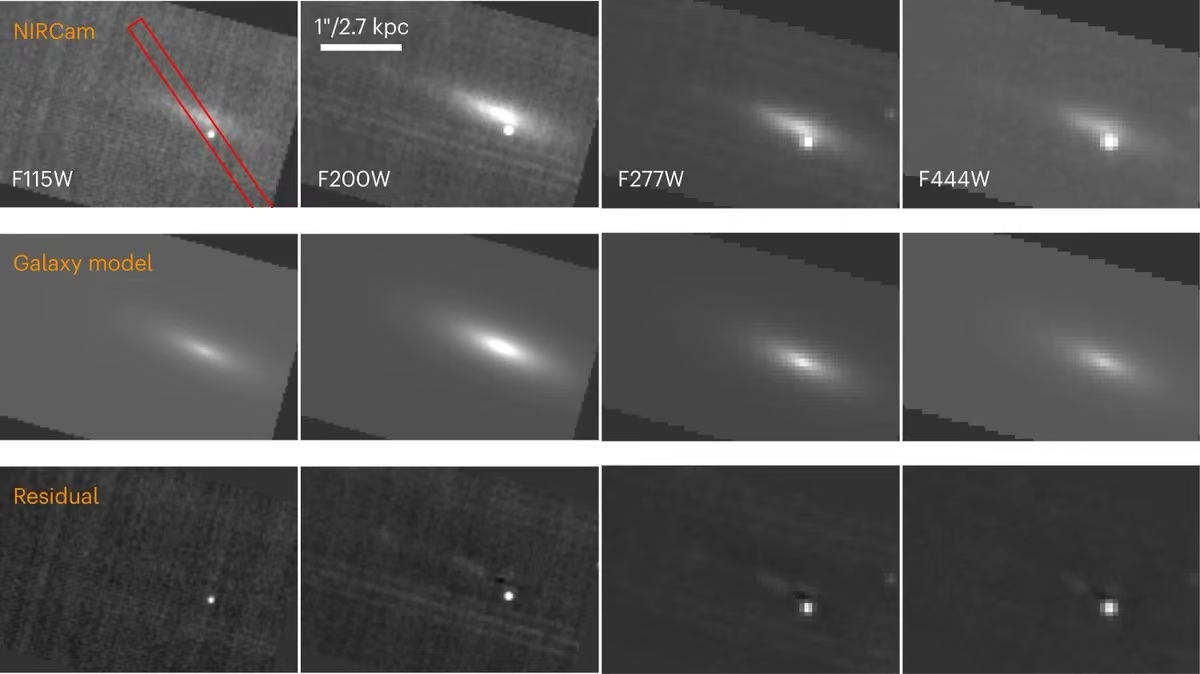 Nature Astronomy
@NatureAstronomy
Stellar winds of main sequence stars are extremely important for the evolution of both stars and planets, but they are hard to observe. Kislyakova et al. present detections of charge-exchange X-ray emission from stellar winds from 3 main sequence stars: www.nature.com/articles/s41550-024-02222-x
 Nature Astronomy
@NatureAstronomy
Brad Wargelin has written a News & Views article to provide more context to this achievement:
www.nature.com/articles/s41550-024-02227-6

Nature Astronomy reposted
 University of Vienna STEM
@stem_univie
A research team led by Kristina Kislyakova from @univienna has for the first time directly detected #stellarwinds from three Sun-like stars by recording the X-ray emission from their #astrospheres, and placed constraints on the mass loss rate of the stars via their stellar winds.
 Nature Astronomy
@NatureAstronomy
We are hiring a new editor for the team, to be based in either the US or Germany. Closing date 8 May. Any questions, please DM. Apply here: careers.springernature.com/job/New-York-Associate-or-Seni…
#hiring #vacancy #job #astronomy #astrojob
Nature Astronomy
@NatureAstronomy
The solar corona is very hot in general, but it is especially hot, up to 10 million Kelvin, over the cores of active regions. A model from Lu et al. shows that continuous flux emergence from magnetic reconnection steadily heats this plasma. www.nature.com/articles/s41550-024-02244-5
 Nature Astronomy
@NatureAstronomy
The finding of ferroan anorthosite in the Vestan meteorite NWA 15118 provides observational evidence of the formation of a magma ocean during Vesta's early history, which then crystallised in multiple stages. Li et al.: www.nature.com/articles/s41550-024-02243-6
 Nature Astronomy
@NatureAstronomy
A radio magnetar has been observed to precess shortly after an X-ray outburst. The precession decayed over the next few months and likely rules out freely precessing magnetars as the source of the fast radio bursts. Desvignes et al.: www.nature.com/articles/s41550-024-02226-7
 Nature Astronomy
@NatureAstronomy
Using the Murriyang and Lovell telescopes, astronomers discovered the radio pulses from a rare, radio-loud magnetar displayed a mysterious conversion in their polarization state that are linked to changes in its magnetic field geometry. @astromelow et al.: www.nature.com/articles/s41550-024-02225-8

Nature Astronomy reposted
 LASP
@LASPatCU
Jupiter's icy moon Europa could have much less oxygen than previously thought, according to a new @NatureAstronomy study based on data from @NASA's Juno mission and coauthored by LASP @CUBoulder researcher Fran Bagenal.➡️ lasp.colorado.edu/2024/04/02/juno-less-oxygen-europa/
 Nature Astronomy
@NatureAstronomy
Unexpected forms of titanium minerals are found on the rim of a micrometeorite impact crater on a glass bead returned by Chang’e-5. This finding provides clues to how space weathering can change the properties of the lunar regolith. Zeng et al.: www.nature.com/articles/s41550-024-02229-4
 Nature Astronomy
@NatureAstronomy
ICYMI, our March issue came out last week. Let's spotlight the Research Highlights...
Nature Astronomy
@NatureAstronomy
Our March issue is now available to read! www.nature.com/natastron/volumes/8/issues/3
The fabulous cover image (created by @DanielleFuts ) is linked to the Kirsten et al. paper within the issue.
 Nature Astronomy
@NatureAstronomy
Roberto Maiolino and collaborators have looked at the famous high-redshift galaxy GN-z11 with JWST:
www.nature.com/articles/s41550-024-02236-5 (Nature)
Nature Astronomy
@NatureAstronomy
Rayna Rampalli and colleagues have been looking at the Suns, plural. They have gathered elemental abundances for thousands of Sun-like stars, finding that the Sun is not particularly depleted.
www.nature.com/articles/s41550-024-02235-6 (ApJ)
Nature Astronomy reposted
nature
@Nature
“Words are like harpoons. Once they go in, they are very hard to pull out"
Astronomer Fred Hoyle supposedly coined the catchy term "the Big Bang" to ridicule the theory of the Universe’s origins — 75 years on, it’s time to set the record straight go.nature.com/4andEp7
Nature Astronomy reposted
nature
@Nature
This week in Nature: Planet eaters - the stars that capture and ingest nearby worlds
Browse the full issue: www.nature.com/nature/volumes/627/issues/8004
Nature Astronomy
@NatureAstronomy
Our March issue is now available to read! www.nature.com/natastron/volumes/8/issues/3
The fabulous cover image (created by @DanielleFuts ) is linked to the Kirsten et al. paper within the issue.
Nature Astronomy
@NatureAstronomy
.@AnirudhChiti et al. present the discovery and elemental abundances of the lowest metallicity stars in the Large Magellanic Cloud. They suggest that enrichment by early extragalactic supernovae proceeded differently from those in the proto-Milky Way. www.nature.com/articles/s41550-024-02223-w
Nature Astronomy
@NatureAstronomy
No #mondaymanuscripts this week, but our March issue will be out in just a couple of days!
Nature Astronomy reposted
 International Astronomical Union (IAU)
@IAU_org
The IAU CPS has released a paper entitled 'Call to Protect the Dark and Quiet Sky from Harmful Interference by Satellite Constellations' that states its recommendations for the mitigation of satellite constellations’ impact on astronomy.
iau.org/news/announcements/detail/ann24008/

Nature Astronomy reposted
Astro Plot of the Week
@PlotAstro
We have the newest "Astro Plot of the Week" - congratulations!
Time for a Spring Break - back in a week or so 😀
 Astro Plot of the Week
@PlotAstro
Pick one:
- Plot from Sych et al. (academic.oup.com/mnras/article/529/2/967/7613583?login=false)
- Plot from Szalay et al. (nature.com/articles/s41550-024-02206-x)
Poll open for two days, spread the word!
All promotion, including "shameless self-promotion" is not just allowed, it's encouraged!
Nature Astronomy
@NatureAstronomy
With a joint analysis of the diffuse γ-ray and neutrino emissions of the Galaxy, Yan, Liu et al. find a non-negligible leptonic component in the diffuse γ-ray emission below 100 TeV and demonstrate that pulsar halos can account for it. www.nature.com/articles/s41550-024-02221-y
Nature Astronomy reposted
Kit Boyett
@Kit_Boyett
My latest research on a massive interacting galaxy in the first 500 Myr of the Universe has just been published in @NatureAstronomy . Find a copy of the journal manuscript here: www.nature.com/articles/s41550-024-02218-7

Nature Astronomy reposted
 Priyamvada Natarajan
@SheerPriya
Thrilled and deeply satisfied at this awesome discovery of UHZ1 that provides compelling evidence for the existence of direct collapse black holes - nature has more than one way to make the first seed black holes
news.yale.edu/2023/11/06/yale-astronomer-leads-way-oldest…
Nature Astronomy
@NatureAstronomy
JWST detections of Si, C and Fe absorption lines in a bright z = 9.31 galaxy with a two-component clump structure suggest that mergers contributed to the rapid build-up of mass and chemical enrichment soon after the Big Bang. Boyett, Trenti et al.: www.nature.com/articles/s41550-024-02218-7
Nature Astronomy
@NatureAstronomy
Just published in @nature: 'A recently quenched galaxy 700 million years after the Big Bang' by Looser et al.: www.nature.com/articles/s41586-024-07227-0
Nature Astronomy
@NatureAstronomy
Just published in @nature: 'Buoyant crystals halt the cooling of white dwarf stars' by Bédard, Blouin & Cheng: www.nature.com/articles/s41586-024-07102-y
Nature Astronomy
@NatureAstronomy
Just published in @nature: 'A rapidly time-varying equatorial jet in Jupiter’s deep interior' by Bloxham et al.: www.nature.com/articles/s41586-024-07046-3
Nature Astronomy
@NatureAstronomy
Juno's observations of H2+ and O2+ from the dissociation of Europa's icy surface infer an O2 production rate lower than previously thought. This finding suggests that the paths to habitability of Europa's internal ocean are narrower. Szalay et al.: www.nature.com/articles/s41550-024-02206-x

Nature Astronomy reposted
Nature Portfolio
@NaturePortfolio
A paper in @NatureAstronomy suggests that the total production of oxygen at the surface of Jupiter’s icy moon Europa may be less than previously assumed. The findings have implications for the potential habitability of Europa’s ocean. go.nature.com/3T1aGyZ

Nature Astronomy reposted
Springer Nature
@SpringerNature
The total production of oxygen at the surface of Jupiter’s icy moon Europa may be less than previously assumed, a paper published in @NatureAstronomy suggests. The findings have implications for the potential habitability of Europa’s ocean: www.nature.com/articles/s41550-024-02206-x?sf272010886=1
Nature Astronomy reposted
ESA Science
@esascience
📢 #xrism transitions to regular operations & releases early observations data!
👉 global.jaxa.jp/press/2024/03/20240304-1_e.html
Around August of this year, the mission will start observations based on proposals received from scientists around the world.
In return for providing hardware and scientific advice, @ESA is allocated 8% of XRISM’s available observing time, enabling European scientists to make breakthroughs in this area of astronomy.
Nature Astronomy
@NatureAstronomy
New ALMA data spectrally and spatially resolve water vapour in the inner regions of the famous planet-forming disk HL Tau, paving the way towards an observational characterisation of planet formation at the water snowline. @StefanoFacchi14 et al.: www.nature.com/articles/s41550-024-02207-w
Nature Astronomy reposted
 ESO
@ESO
📣 New discovery! @almaobs , in which ESO is a partner, has found oceans of water vapour in the disc around the Sun-like star HL Tauri 🌟, revealing a new link between water and planet formation. 1/
Read more: www.eso.org/public/news/eso2404/
📷 ALMA (ESO/NAOJ/NRAO)/S. Facchini et al.

Nature Astronomy reposted
nature
@Nature
Mission control of the Odysseus spacecraft, the first commercial spacecraft to soft-land on the Moon, will try to wake the lander again in three weeks go.nature.com/49AThEu
Nature Astronomy
@NatureAstronomy
Just published in @nature: 'Most of the photons that reionized the Universe came from dwarf galaxies' by Atek et al.: www.nature.com/articles/s41586-024-07043-6
Nature Astronomy
@NatureAstronomy
This paper has an associated News & Views article written by Sumeet Kulkarni: www.nature.com/articles/d41586-024-00594-8
Nature Astronomy
@NatureAstronomy
Recently published in @nature: 'A lanthanide-rich kilonova in the aftermath of a long gamma-ray burst' by Yang, Troja et al.: www.nature.com/articles/s41586-023-06979-5
Nature Astronomy reposted
Nature Portfolio
@NaturePortfolio
The asteroid moon Dimorphos may have been reshaped following the impact from NASA’s Double Asteroid Redirection Test (DART), according to a paper published in @NatureAstronomy. go.nature.com/3OWR5i4

Nature Astronomy reposted
 ESA Technology
@ESA_Tech
The @ESA #heramission for #planetarydefence will go look for the crater left by @NASA's #dartmission impacting #asteroid #dimorphos. But simulations by @unibern suggest there is no crater - insteadHera will find an entirely reshaped body @NatureAstronomy www.esa.int/Space_Safety/Hera/DART_impact_might_have_resh…
Nature Astronomy
@NatureAstronomy
The #dartmission did not just make a crater on Dimorphos but it globally rearranged the rubble pile moonlet, which is made up of ejected material from Didymos. The upcoming #hera mission will show us some surprises! Raducan et al.: www.nature.com/articles/s41550-024-02200-3
Nature Astronomy
@NatureAstronomy
JWST detects OH with high rotational/vibrational motion in a planet-forming disk exposed to UV radiation. These observations, coupled with quantum calculations, unveil the ongoing photodissociation of water and its gas-phrase reformation. Zannese et al.: www.nature.com/articles/s41550-024-02203-0

Nature Astronomy reposted
 Scientific American
@sciam
How artist and astrophysicist Nia Amara makes 3-D prints of the birth of stars www.scientificamerican.com/video/this-astrophysicist-make…
Nature Astronomy
@NatureAstronomy
Our February issue has arrived and is available to read!
www.nature.com/natastron/volumes/8/issues/2
The cover image features SuperBIT (with crane accessory), a balloon mission that observed the sky from a vantage in the stratosphere. Check out the Mission Control column in the issue.
 Nature Astronomy
@NatureAstronomy
Our Access Code column this month features the immensely powerful GADGET code, which was first conceived by Volker Springel some 25 years ago. www.nature.com/articles/s41550-024-02201-2
 Nature Astronomy
@NatureAstronomy
Editor Paul Woods highlights the breathtaking JWS images of spiral galaxies recently released by the @PHANGSteam : www.nature.com/articles/s41550-024-02219-6
Nature Astronomy
@NatureAstronomy
Editor Luca Maltagliati highlights work by Nicholas Wogan and colleagues, who have been assessing the Hycean nature of exoplanet K2-18 b: www.nature.com/articles/s41550-024-02216-9 (ApJL)
Nature Astronomy
@NatureAstronomy
And as usual, the February issue contains a varied mix of research articles, research briefings, and other editorial content. The table of contents is here: www.nature.com/natastron/volumes/8/issues/2
Nature Astronomy reposted
IAC Astrofísica
@IAC_Astrofisica
🧐🌌 A study led by #iacastrofísica researcher Laura Scholz finds, for the first time, observational evidence of the effect of #darkmatter on the evolution of the galaxies. The results are published in @NatureAstronomy
ℹ️ www.iac.es/en/outreach/news/astronomers-observe-effect-da…
 Nature Astronomy
@NatureAstronomy
Recently published in @nature: 'Rapid spin changes around a magnetar fast radio burst' by Hu et al.: www.nature.com/articles/s41586-023-07012-5
Nature Astronomy
@NatureAstronomy
Recently published in @nature: 'A high black hole to host mass ratio in a lensed AGN in the early Universe' by Furtak et al.: www.nature.com/articles/s41586-024-07184-8
Nature Astronomy
@NatureAstronomy
Recently published in @nature: 'A massive galaxy that formed its stars at z ~ 11' by Glazebrook et al.: www.nature.com/articles/s41586-024-07191-9
Nature Astronomy
@NatureAstronomy
Just published in @nature : 'The Radcliffe Wave is oscillating' by Konietzka et al.: www.nature.com/articles/s41586-024-07127-3
Nature Astronomy reposted
Springer Nature
@SpringerNature
Analysis of the quasar J0529-4351 suggests it may be most luminous and fastest growing quasar discovered and is estimated to be powered by a 17–19 billion solar mass black hole that is growing at the rate of one Sun per day, says study in @NatureAstronomy: www.nature.com/articles/s41550-024-02195-x?sf271739203=1
Nature Astronomy
@NatureAstronomy
A dynamical model using the spatially resolved kinematics of galaxies in the CALIFA survey shows that galaxy assembly depends on both the stellar mass and the dynamical mass (which includes stars and dark matter). Scholz-Díaz et al.: www.nature.com/articles/s41550-024-02209-8
Nature Astronomy
@NatureAstronomy
A combined astrophysical/geological model shows that cosmic dust rich in bioessential elements could have accumulated on the surface of the early Earth in arid environments, potentially helping to foster the chemical origins of life. @lithologuy et al.: www.nature.com/articles/s41550-024-02212-z
Nature Astronomy
@NatureAstronomy
www.nature.com/articles/s41550-024-02195-x
ESO
@ESO
📣 Using ESO's #vlt, astronomers have characterised a truly record-breaking #quasar! 1/
Discover more: www.eso.org/public/news/eso2402/?lang
Artist's impression by ESO/M. Kornmesser
 Nature Astronomy
@NatureAstronomy
Christian Wolf et al. have found an extreme black hole hiding in plain sight. It has the most voracious appetite seen so far: every day, it accretes the mass of our Sun and releases heat that makes it shine 50,000 times as bright as the entire Milky Way. www.nature.com/articles/s41550-024-02195-x

Nature Astronomy reposted
 ARCHIVED - Dr. Nicky Fox
@NASAScienceAA
#nasascience Inclusion Plan Community of Practice will host a webinar on Feb. 20, at 3 pm EST to discuss requirements for and evaluation of Inclusion Plans in ROSES-2024.
Here’s how you can join: science.nasa.gov/researchers/meetings/?linkId=326110539

Nature Astronomy reposted
Springer Nature
@SpringerNature
One of our top rated article on @altmetric this past week was "Newly formed dust within the circumstellar environment of SN Ia-CSM 2018evt". Read the OA article published in @NatureAstronomy here: www.nature.com/articles/s41550-024-02197-9?sf271781770=1
 Nature Astronomy
@NatureAstronomy
A few months ago, astrobiologists gathered in war-torn Kyiv for a meeting, for moral support, cross-border friendship and to demonstrate the endurance of science. @CharlesCockell and colleagues summarise: www.nature.com/articles/s41550-024-02204-z or rdcu.be/dyOIk
 Nature Astronomy
@NatureAstronomy
Something for the weekend? We have a couple of Research Highlights for you:
Nature Astronomy
@NatureAstronomy
What if the Sun contained a primordial black hole... would we know? Caplan et al. say yes, but only if we wait until it is no longer on the main sequence: www.nature.com/articles/s41550-024-02214-x (ApSS)
Nature Astronomy
@NatureAstronomy
What is a year to a supermassive black hole? The EHT Collaboration revisited M87* for an update, a year after its iconic image was first captured.
www.nature.com/articles/s41550-024-02215-w (A&A)
Nature Astronomy
@NatureAstronomy
A large magnetic field created by a solar-like dynamo is responsible for driving the relativistic outflows and short gamma-ray bursts associated with a binary neutron star merger. Kiuchi et al.: www.nature.com/articles/s41550-024-02194-y
 Nature Astronomy
@NatureAstronomy
Philipp Mösta has written a News & Views that digs into the implications of this finding: www.nature.com/articles/s41550-024-02211-0

Nature Astronomy reposted
Nature Portfolio
@NaturePortfolio
Mars’s early formation may have been followed by a period of active volcanism and crustal recycling around 3.5–4 billion years ago, according to a paper published in @NatureAstronomy. go.nature.com/3SZNq5O
 Nature Astronomy
@NatureAstronomy
Evidence of ancient volcanotectonics and diverse #volcanology in the Eridania basin on Mars indicates the presence of a (possibly widespread) vertical recycling analogous to that on pre-plate-tectonic Archean Earth. @JoePlanets et al.: www.nature.com/articles/s41550-023-02191-7

Nature Astronomy reposted
Magdalena Skipper
@Magda_Skipper
Applications are open for the 2024 Nature Award for Inspiring Women in Science #womeninstem #internationaldayofwomeninscience @EsteeLauderUK @NaturePortfolio www.nature.com/immersive/inspiringwomeninscience/index.html
Nature Astronomy reposted
 IAU GA 2024 🌍
@astronomy2024
ICYMI | For the first time ever, the International Astronomical Union’s (IAU) General Assembly 2024 will be held in Africa and open to the public!
Join us in the Mother City, Cape Town, or virtually during August 6-15. 🇿🇦 Dive into open, impactful, & sustainable science.
Nature Astronomy reposted
Institute of Space Sciences (ICE-CSIC)
@ice_csic
🗞️ The nature of dust creation in the Universe has been a mystery for a long time. A new study published in @NatureAstronomy discovered a previously unknown source of dust in the universe: a type Ia supernova interacting with gas from its surroundings.
➡️ t.ly/gFoZ8
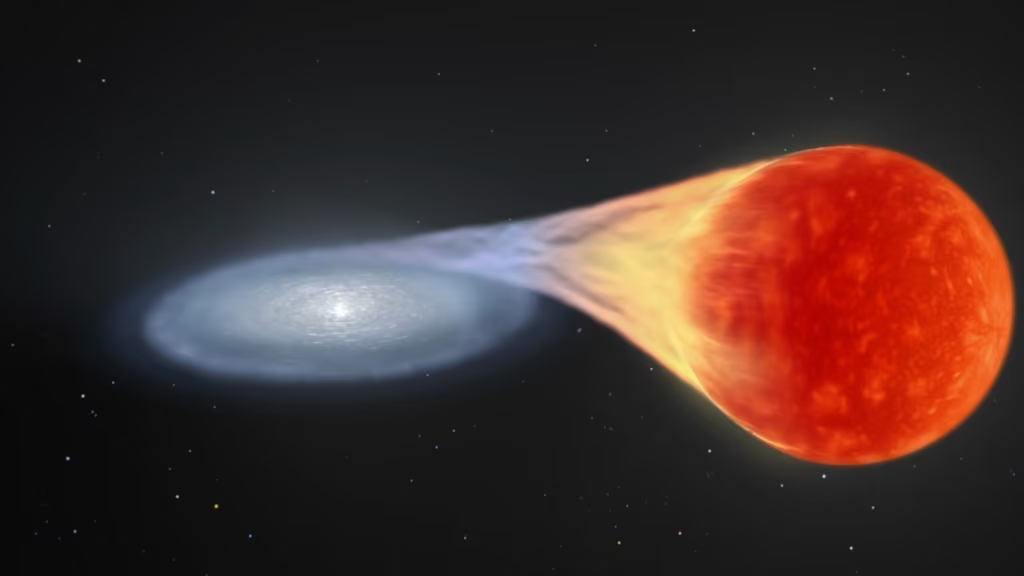 Nature Astronomy
@NatureAstronomy
By day 1041 of the observations, SNIa-CSM 2018evt had produced an estimated 0.01 solar masses of dust in the cold dense shell behind the ejecta-CSM interaction, ranking it as one of the most prolific dust-producing supernovae ever recorded. Wang et al.: www.nature.com/articles/s41550-024-02197-9
 Nature Astronomy
@NatureAstronomy
An unusual 20.5-min orbital period detached binary system harbors a carbon-oxygen white dwarf star and potentially a seven-Earth radius low-mass subdwarf B star that follows the theoretical limit of binary evolution predicted 20 years ago. Lin et al.: www.nature.com/articles/s41550-023-02188-2
 Nature Astronomy
@NatureAstronomy
A model shows the importance of the correct water phase treatment in explaining the exoplanetary radius valley. Water-rich, steam-envelope bodies populate the sub-Neptune peak, whereas H/He persists at larger planetary radii. Burn, Mordasini et al.: www.nature.com/articles/s41550-023-02183-7
 Nature Astronomy
@NatureAstronomy
This paper is accompanied by a Research Briefing, written by the authors: www.nature.com/articles/s41550-023-02184-6
Nature Astronomy reposted
nature
@Nature
There’s a newfound ocean in the outer Solar System, and it’s in a very surprising place
The sea within Saturn’s satellite Mimas formed within the last 25 million years, a blink of the eye in geologic terms go.nature.com/49u8UNx
Nature Astronomy
@NatureAstronomy
JPL moves to cut staff numbers by 8%, with imminent effect:
www.jpl.nasa.gov/news/jpl-workforce-update
Nature Astronomy
@NatureAstronomy
Recently published in @nature: 'A dynamical measure of the black hole mass in a quasar 11 billion years ago' by Abuter et al.: www.nature.com/articles/s41586-024-07053-4
Nature Astronomy
@NatureAstronomy
Just published in @nature: 'A recently formed ocean inside Saturn’s moon Mimas' by Lainey et al.: www.nature.com/articles/s41586-023-06975-9
Nature Astronomy reposted
 ESA Webb Telescope
@ESA_Webb
🆕 Spiral galaxies galore! Webb has snapped portraits of 19 spiral galaxies, showing stars, gas, and dust on the smallest scales ever seen beyond our own galaxy ⭐. Read more: esawebb.org/news/weic2403/ or 🧵👇

Nature Astronomy reposted
nature
@Nature
Data from an African observatory show that jets from a collapsed star are capable of producing some of the Galaxy’s fastest particles go.nature.com/3Sv9y7J
Nature Astronomy
@NatureAstronomy
Recently published in @nature: 'A small and vigorous black hole in the early Universe' by Maiolino et al.: www.nature.com/articles/s41586-024-07052-5
Nature Astronomy
@NatureAstronomy
Recently published in @nature: 'Sulphur dioxide in the mid-infrared transmission spectrum of WASP-39 b' by Powell et al.: www.nature.com/articles/s41586-024-07040-9
Nature Astronomy
@NatureAstronomy
Recently published in @nature: 'Stream–disk shocks as the origins of peak light in tidal disruption events' by Steinberg & Stone: www.nature.com/articles/s41586-023-06875-y
Nature Astronomy reposted
 JAXA Institute of Space and Astronautical Science
@ISAS_JAXA_EN
The Lunar Excursion Vehicle 2 (LEV-2 / SORA-Q) has successfully taken an image of the #slim spacecraft on the Moon. LEV-2 is the world’s first robot to conduct fully autonomous exploration on the lunar surface.

 JAXA(宇宙航空研究開発機構)
@JAXA_jp
[プレスリリース]
変形型月面ロボットによる小型月着陸実証機(SLIM)の撮影およびデータ送信に成功
www.jaxa.jp/press/2024/01/20240125-4_j.html
Nature Astronomy reposted
ESA Science
@esascience
📢 @ESA adopts two ambitious space science missions: Venus voyager #envision and gravitational wave surfer #lisa.
“These trailblazing missions will take us to the next level in two extraordinarily exciting areas of space science and keep European researchers at the forefront of these domains,” says ESA Director of Science @CGMundell
The ‘adoption’ step recognises that the missions' concept and technology are sufficiently advanced, and gives the go-ahead to build the instruments and spacecraft. Both spacecraft are planned to launch with an #ariane6

 Nature Astronomy
@NatureAstronomy
The motions of satellite galaxies around galaxy groups present a challenge to the current cosmological model. Gu, Guo et al.: www.nature.com/articles/s41550-023-02192-6
 Nature Astronomy
@NatureAstronomy
After three long weeks of January, the first issue of 2024 is finally here! The artistic cover image is courtesy of @jtuttlekeane and relates to the Astrobiology Focus within the issue: www.nature.com/natastron/volumes/8/issues/1
 Nature Astronomy
@NatureAstronomy
And there are 11 research articles in the issue, including one with an astrobiological theme... www.nature.com/natastron/volumes/8/issues/1
Nature Astronomy
@NatureAstronomy
Chemical disequilibrium can be identified remotely for a Proterozoic-like exoplanet by reflected-light observations with a signal-to-noise of 20--50, opening an opportunity for agnostic biosignature detection. Young et al.: www.nature.com/articles/s41550-023-02145-z
 Nature Astronomy
@NatureAstronomy
A combo of JWST/NIRCam observations & magnetohydrodynamic simulations suggests that frequent mergers with close companions give rise to bursty star formation and hence the unexpectedly high Ly-α emission detected from early galaxies. @callumwitten et al.: www.nature.com/articles/s41550-023-02179-3

Nature Astronomy reposted
nature
@Nature
Stop sending human remains to the Moon, says Alvin D. Harvey, Diné of the Navajo Nation go.nature.com/4aW3FaS
Nature Astronomy
@NatureAstronomy
Recently published in @nature: 'Ionized gas extends over 40 kpc in an odd radio circle host galaxy' by Alison Coil et al.: www.nature.com/articles/s41586-023-06752-8
Nature Astronomy
@NatureAstronomy
Recently published in @nature: 'A 12.4-day periodicity in a close binary system after a supernova' by Ping Chen et al.: www.nature.com/articles/s41586-023-06787-x
Nature Astronomy
@NatureAstronomy
.@ShanghuoLi and colleagues have observed a group of gravitationally bound quintuple, quadruple, triple and binary protostellar systems simultaneously forming in the early stage in a high-mass protocluster. www.nature.com/articles/s41550-023-02181-9
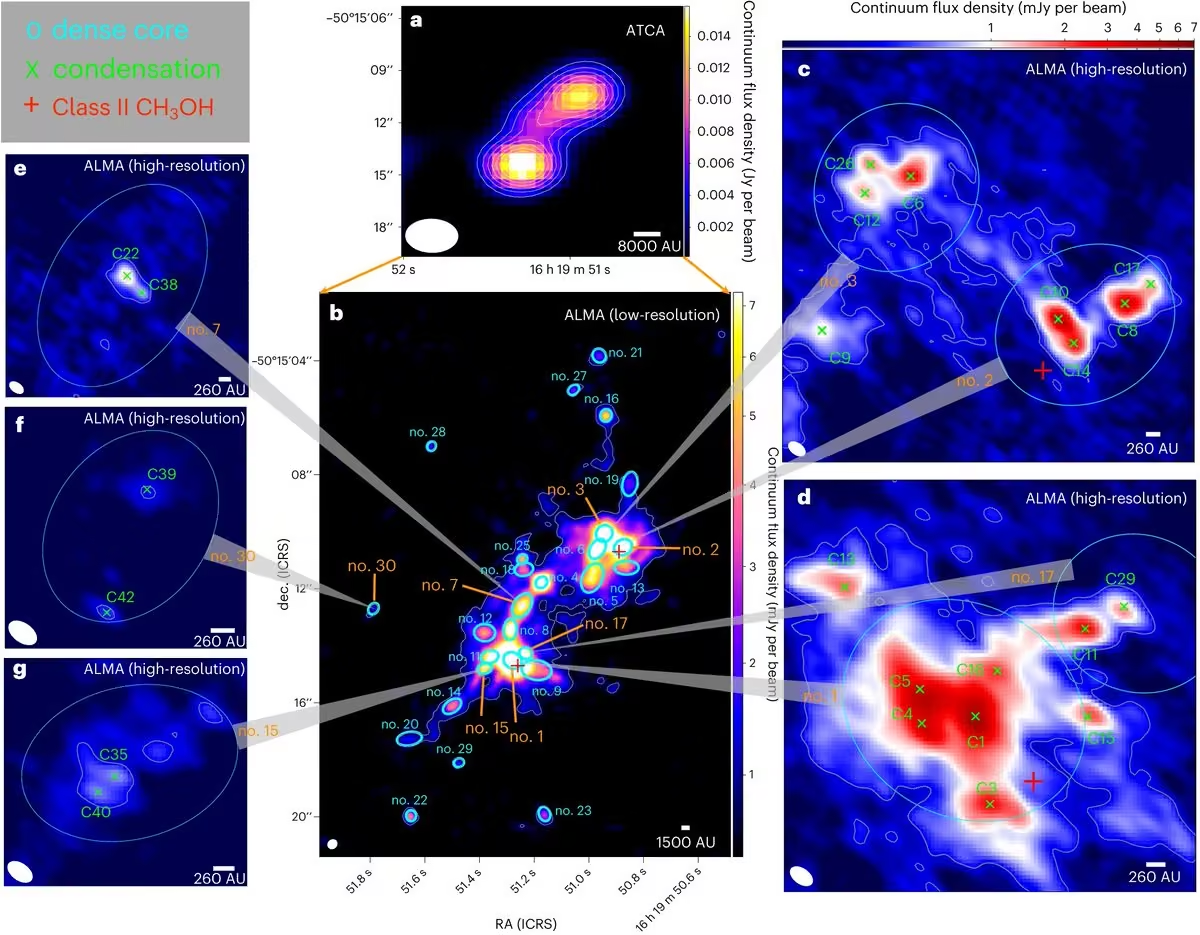
Nature Astronomy reposted
Faculty of STEM, The Open University
@OU_STEM
Dr. Tara Hayden, Researcher at the OU, has discovered apatite in the early lunar crust, indicating more water than previously thought. This breakthrough, published in @NatureAstronomy, opens new avenues for studying lunar history.
ounews.co/science-mct/ou-research-finds-the-moons-crust-i…
 Nature Astronomy
@NatureAstronomy
Isotopic analysis of an apatite mineral in the lunar meteorite Arabian Peninsula 007, dating from 4467–4540 million years ago, indicates very early fractionation of volatiles and a very volatile-rich lunar crust. Hayden (@MiniMoonRocks) et al.: www.nature.com/articles/s41550-023-02185-5
 Nature Astronomy
@NatureAstronomy
High-energy radiation originating in the wind termination shock of young star clusters is detected without contamination from other sources. This confirms the hypothesis that these winds are able to accelerate cosmic-ray particles. Peron et al.: www.nature.com/articles/s41550-023-02168-6
 Nature Astronomy
@NatureAstronomy
Utilizing Fe/Ni and Fe/Co ratios in iron meteorites, @DamanveerGrewal et al. show that the first inner solar system planetesimals were oxidized. They propose that these planetesimals formed beyond the water snowline, accreting water-bearing materials. www.nature.com/articles/s41550-023-02172-w
 Nature Astronomy
@NatureAstronomy
.@Muryel_Guolo et al. present multi-wavelength observations of a galactic nucleus showing quasi-periodic X-ray eruptions that repeat every ~22 days that are likely to be driven by the interaction between an orbiting body and the central massive black hole. www.nature.com/articles/s41550-023-02178-4
 Nature Astronomy
@NatureAstronomy
Cold ice-covered dust grains grow during their journey from the interstellar medium to protoplanetary disks. JWST observations show (quantitatively) this growth begins prior to the protostellar phase. Dartois & JWST Ice Age team: www.nature.com/articles/s41550-023-02155-x or rdcu.be/dvyuV
 Nature Astronomy
@NatureAstronomy
This research paper has an accompanying News & Views article written by Burcu Günay: www.nature.com/articles/s41550-023-02177-5

Nature Astronomy reposted
 DESY (English)
@desynews
An int’l team using the @europeanxfel that included DESY scientists has found that #diamondrain on icy planets is more common and has an effect on their magnetic fields. DESY technologies in X-ray science and detectors were important for this result. www.desy.de/news/news_search/index_eng.html?openDirectAnc…
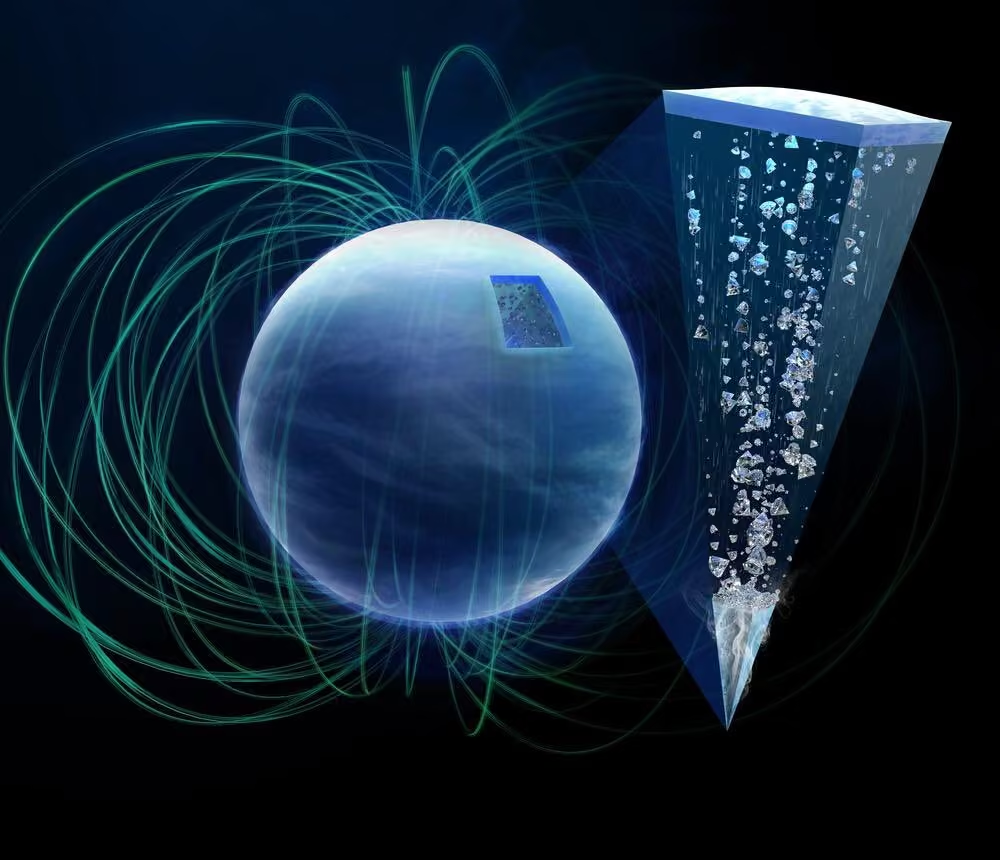 Nature Astronomy
@NatureAstronomy
Chemical abundances from IR nebular lines reveal heavily depressed metallicities in interacting galaxies, suggesting that chemical enrichment & stellar-mass growth in LIRGs take place via mergers driving these galaxies out of equilibrium. Pérez-Díaz et al: www.nature.com/articles/s41550-023-02171-x
 Nature Astronomy
@NatureAstronomy
New laboratory experiments show that diamonds can form inside icy giants slower (~40 µs) and at lower p-T than usually considered. This shallow interior formation can impact convection and the magnetic fields of even small icy giant planets. Frost et al.: www.nature.com/articles/s41550-023-02147-x
 Nature Astronomy
@NatureAstronomy
Nuclear experiments have become the latest 'messenger' to help with unravelling the mysteries of neutron stars. Combining information from astronomy observations and laboratory results reveals how nucleons interact in both nuclei and stars. Tsang et al.: www.nature.com/articles/s41550-023-02161-z
 Nature Astronomy
@NatureAstronomy
HygeongHan et al. have detected the elusive dark matter component of cosmic filaments near the Coma galaxy cluster using gravitational lensing, supporting the idea that galaxy clusters grow at the intersection of cosmic filaments. www.nature.com/articles/s41550-023-02164-w
 Nature Astronomy
@NatureAstronomy
We have a number of #mondaymanuscripts to tell you about today...
Nature Astronomy
@NatureAstronomy
You can read more about XRISM in our Mission Control article by Kyoko Matsushita: www.nature.com/articles/s41550-023-02050-5 or rdcu.be/dvfPJ
Nature Astronomy reposted
Nature Astronomy reposted
 ASTRON
@ASTRON_NL
Researchers used 4 telescopes in northern Europe to study an #frb, have drawn a conclusion: any source of fast radio bursts will repeat, if watched long enough and carefully enough.
www.astron.nl/telescope-quartet-reveals-surprising-statis…
@chalmersuniv @UvA_Amsterdam @astropeiler_ev @BerkeleySETI @MIT
 Nature Astronomy
@NatureAstronomy
A low amount of graphite (~0.7 wt%) mixed with iron can reproduce the reflectances of the various colour units on Mercury, providing important constraints on the characterisation of its magma ocean. Xu, Xiao, Wang & Cui: www.nature.com/articles/s41550-023-02169-5
 Nature Astronomy
@NatureAstronomy
Kirsten et al. observed a hyper-active fast radio burst source for thousands of hours using relatively small telescopes; the bright bursts they detected suggest a possible link between repeating and apparently non-repeating burst sources. www.nature.com/articles/s41550-023-02153-z

Nature Astronomy reposted
Dr Stellar Alchemist
@stellalchemist
My paper is out today in Nature Astronomy! In the tweet thread quoted below you can find a link to the press release. If you want to see the paper in all its scientific details, you can do so here: rdcu.be/du204
ESO
@ESO
Using @almaobs 📡, in which ESO is a partner, as well as @HUBBLE_space 🛰️ and ESO's #vlt 🔭, astronomers observed a dying star shedding off its outer layers.
Oddly enough, the composition of this "wind" changes from one side of the star to the other. 1/
 Nature Astronomy
@NatureAstronomy
When stars like our Sun die, they expel their outer layers in a dramatic stellar wind. By studying the unusual molecules that formed in one particular stellar wind, @stellalchemist et al. discovered that a second star passed very close by ~200 years ago. www.nature.com/articles/s41550-023-02154-y
 Nature Astronomy
@NatureAstronomy
Happy new year to all! We will have a couple of new papers for you later on today, but our first paper of 2024 was actually published yesterday...
Nature Astronomy reposted
 American Institute of Physics
@AIP_HQ
Black physics & astronomy students are encouraged to apply for the #teamuptogether Scholarship Program. This $10K award aims to reduce financial barriers that prevent Black students from attaining their undergraduate degrees. Apply here: www.teamuptogether.org
Nature Astronomy
@NatureAstronomy
Congratulations to the winner of #nastrocovercomp 2023, Chitta et al., with this view of the web of magnetized plasma found in the Sun's middle corona! This image gathered half the votes in the final, and featured on the front page of our February issue: www.nature.com/natastron/volumes/7/issues/2
 Nature Astronomy
@NatureAstronomy
Three hours or so left to vote in the final of #nastrocovercomp...
Nature Astronomy
@NatureAstronomy
FINAL VOTE: choose your favourite from these three finalists to win the Nature Astronomy cover of the year competition! #nastrocovercomp
 Nature Astronomy
@NatureAstronomy
ROUND 3 VOTE: choose your favourite from the options below to progress one to the final of the Nature Astronomy cover of the year competition! #nastrocovercomp
 Nature Astronomy
@NatureAstronomy
ROUND 3 VOTE: 24-hour voting window opens now... #nastrocovercomp
Nature Astronomy
@NatureAstronomy
In a close-run battle, the September cover (Shao, Xu, et al.) makes it through to the final of #nastrocovercomp, with 30% of the vote:
 Nature Astronomy
@NatureAstronomy
FINAL VOTE: choose your favourite from these three finalists to win the Nature Astronomy cover of the year competition! #nastrocovercomp
Nature Astronomy
@NatureAstronomy
FINAL VOTE: The 24-hour voting window opens now... #nastrocovercomp
Nature Astronomy
@NatureAstronomy
A few hours left to vote in this last preliminary round of #nastrocovercomp. It's a very close race!
Nature Astronomy
@NatureAstronomy
ROUND 3 VOTE: choose your favourite from the options below to progress one to the final of the Nature Astronomy cover of the year competition! #nastrocovercomp
Nature Astronomy reposted
nature
@Nature
In this year's #natures10 – the people who helped shape science in 2023.
Kalpana Kalahasti, the engineer who helped India to reach the Moon go.nature.com/4arFJM5
Nature Astronomy
@NatureAstronomy
ROUND 2 VOTE: choose your favourite from the options below to progress one to the final of the Nature Astronomy cover of the year competition! #nastrocovercomp
 Nature Astronomy
@NatureAstronomy
ROUND 2 VOTE: 24-hour voting window opens now... #nastrocovercomp
Nature Astronomy
@NatureAstronomy
The second finalist for #nastrocovercomp is the cover provided by @JuanAldayP for the July issue, featuring @ESA_TGO imagery. This option pulled in nearly 54% of the vote:
 Nature Astronomy
@NatureAstronomy
A few hours left to vote in round 2 of #nastrocovercomp
Nature Astronomy
@NatureAstronomy
ROUND 2 VOTE: choose your favourite from the options below to progress one to the final of the Nature Astronomy cover of the year competition! #nastrocovercomp
Nature Astronomy reposted
nature
@Nature
Navigating planets, plays and prejudice — a conversation with astronomer Aomawa Shields go.nature.com/4828zRA
Nature Astronomy
@NatureAstronomy
An interview with astrophysicist Victoria Kaspi...
nature
@Nature
Crossing the generational divide: what established scientists and early-career researchers can learn from each other go.nature.com/3v2CI4X
Nature Astronomy
@NatureAstronomy
ROUND 1 VOTE: choose your favourite from the options below to progress one to the final of the Nature Astronomy cover of the year competition! #nastrocovercomp
 Nature Astronomy
@NatureAstronomy
ROUND 1 VOTE: 24-hour voting window opens now... #nastrocovercomp
Nature Astronomy
@NatureAstronomy
Winner of round 1, with 42% of the vote, was this image of the Sun's middle corona from February's issue (Chitta et al.). This cover goes through to Thursday's final: #nastrocovercomp
 Nature Astronomy
@NatureAstronomy
Just a few hours left to vote in round 1 of our cover competition. The current count is: 10%, 20%, 30%, 40% (in ascending order).
Nature Astronomy
@NatureAstronomy
ROUND 1 VOTE: choose your favourite from the options below to progress one to the final of the Nature Astronomy cover of the year competition! #nastrocovercomp
Nature Astronomy
@NatureAstronomy
Our cover competition for 2023 is now running... vote for your favourite from January--April below. #nastrocovercomp
Nature Astronomy
@NatureAstronomy
ROUND 1 VOTE: choose your favourite from the options below to progress one to the final of the Nature Astronomy cover of the year competition! #nastrocovercomp
Nature Astronomy
@NatureAstronomy
Now that our December issue is out (have you seen it yet? www.nature.com/natastron/volumes/7/issues/12) we can get started on the 2023 cover competition! #nastrocovercomp The first-round contenders will be revealed in 90 minutes or so and voting can commence!
Nature Astronomy reposted
 ARCHIVED – NASA Astrobiology
@NASAAstrobio
Exciting news for the potential habitability of Enceladus! A study zooms in on Cassini mission data gathered at Saturn’s icy moon and finds confirming evidence of hydrogen cyanide, a molecule needed to spark life as we know it and a supercharged chemical energy source to fuel it.

Nature Astronomy reposted
 The New York Times
@nytimes
Scientists have detected a poison among the spray of molecules emanating from Enceladus, a small moon of Saturn, adding to intrigue about the possibility of life there. “It’s the starting point for most theories on the origin of life,” one researcher said. www.nytimes.com/2023/12/14/science/enceladus-moon-cyanide…
 Nature Astronomy
@NatureAstronomy
An information-theory-inspired analysis of Cassini mass spec data reveals the presence of HCN and partially oxidized organics within the plume of Enceladus. Ongoing redox chemistry may suggest a habitable environment suitable for life. @JonahSPeter et al.: www.nature.com/articles/s41550-023-02160-0
 Nature Astronomy
@NatureAstronomy
And Jonah will be giving an invited talk on this work at @theAGU in roughly an hour...
Nature Astronomy reposted
nature
@Nature
How a bullying scandal closed a historic astronomy department go.nature.com/3GLwDfQ
Nature Astronomy reposted
CSIRO_ATNF
@CSIRO_ATNF
"Going beyond being there" from @cosmicpudding in @NatureAstronomy highlights how a VR exhibit showcasing Rapid ASKAP Continuum Survey data, demonstrated @CSIRO's ASKAP radio telescope's science & technology to conference attendees. Read more: www.nature.com/articles/s41550-023-02163-x
Nature Astronomy reposted
Dr Chiara Mingarelli
@Dr_CMingarelli
My first OpEd appeared today! I wrote about the black hole revolution happening with @LIGO and @NANOGrav 🤩
thank you to @TheOpEdProject for your support, and to @NatureAstronomy for publishing it
www.nature.com/articles/s41550-023-02170-y
Nature Astronomy
@NatureAstronomy
Our December issue is now available to read! The cover image features the @GreenBankObserv and is connected to the Snelders et al. paper within the issue. www.nature.com/natastron/volumes/7/issues/12
 Nature Astronomy
@NatureAstronomy
The December Editorial looks back at the year that was 2023. It was a good year for planetary science missions... but perhaps the last for a while, as the effects of political uncertainty seep into NASA budgets... www.nature.com/articles/s41550-023-02175-7
Nature Astronomy
@NatureAstronomy
One such casualty has been the VERITAS mission to Venus, which had its budget effectively zeroed out earlier in the year: www.nature.com/articles/s41550-023-02167-7
Nature Astronomy
@NatureAstronomy
Cedric Gillmann has written a News & Views on our recent Weller et al. article on the early evolution of Venus: www.nature.com/articles/s41550-023-02133-3
Nature Astronomy
@NatureAstronomy
And that wraps up volume 7 of Nature Astronomy! A huge thank you to all our authors, contributors, referees and of course readers. Wishing you a healthy and safe 2024.
Nature Astronomy reposted
 Max Planck Institute for Solar System Research
@MPSGoettingen
Giants doubts about giant #exomoons: new study in @NatureAstronomy by #mpsgoettingen’s @DrReneHeller and @Hippke from #sonnebergobservatory concludes large moons orbiting #exoplanets Kepler-1625b and Kepler-1708b are unlikely: www.mps.mpg.de/giant-doubts-about-giant-exomoons @maxplanckpress @thegoecampus
Nature Astronomy
@NatureAstronomy
That's no moon! Reanalysis of HST and Kepler observations throws doubt on whether Kepler-1625 b and Kepler-1708 b have large exomoons after all. @DrReneHeller and @Hippke: www.nature.com/articles/s41550-023-02148-w
 Nature Astronomy
@NatureAstronomy
Just published in @nature: 'Bipolar outflows out to 10 kpc for massive galaxies at redshift z ≈ 1' by Yucheng Guo et al.: www.nature.com/articles/s41586-023-06718-w
Nature Astronomy
@NatureAstronomy
There have been a number of excellent 'Behind the paper' posts in our Astronomy Community site recently...
(note the new URL)
Nature Astronomy
@NatureAstronomy
Emma Thomas reveals the fruits of 30 years of looking for aurorae at Uranus: communities.springernature.com/posts/the-successful-searc…
Nature Astronomy
@NatureAstronomy
Ricardo Hueso has used JWST to find a fast jet racing around Jupiter's equator: communities.springernature.com/posts/a-narrow-and-elevate…
Nature Astronomy reposted
 JIVE
@jivevlbi
Just released in @NatureAstronomy: Astronomers in the NL close the supermassive black hole feeding-feedback loop. JIVE scientist co-authors. Read more: jive.eu/news/new-nature-astronomy-discovery-closes-superm…
 Nature Astronomy
@NatureAstronomy
Hubert Reeves (1932–2023) in the words of Jean Audouze: www.nature.com/articles/s41550-023-02156-w
 Nature Astronomy
@NatureAstronomy
#ryugu samples from @haya2e_jaxa display iron nitride on magnetite grains, which is likely a product of impacts from N-rich micrometeorites and indicative of an additional source of N transferred to the inner Solar System from the outer. Matsumoto et al.: www.nature.com/articles/s41550-023-02137-z
Nature Astronomy
@NatureAstronomy
ALMA observations show how streams of molecular gas blown from the centre of a galaxy by the energy released by an active supermassive black hole are falling back onto the black hole, ensuring that it stays active. @Valeandromeo, Morganti & Murthy: www.nature.com/articles/s41550-023-02138-y
 Nature Astronomy
@NatureAstronomy
Just published in @nature: 'A resonant sextuplet of sub-Neptunes transiting the bright star HD 110067' by Luque et al.: www.nature.com/articles/s41586-023-06692-3
Nature Astronomy
@NatureAstronomy
Just published in @nature: 'A probable Keplerian disk feeding an optically revealed massive young star' by @astroannamc et al.: www.nature.com/articles/s41586-023-06790-2
Nature Astronomy
@NatureAstronomy
The full set of optical constants for planetary haze analogues from 0.4-28.6 μm (the full #jwst range) updates, and finds substantial differences with, the measurements of Khare+84. A new reference for (exo)planetary atmosphere characterisation. He et al.: www.nature.com/articles/s41550-023-02140-4
 Nature Astronomy
@NatureAstronomy
With this paper, the authors have also put together a Research Briefing that succinctly communicates the results and implications of this work: www.nature.com/articles/s41550-023-02141-3
Nature Astronomy
@NatureAstronomy
The observation by the IceCube Neutrino Observatory of high-energy neutrinos from the Galactic plane shows the Milky Way is a neutrino desert, most likely because it has not hosted an active source for the past few tens of kiloyears. Fang et al.: www.nature.com/articles/s41550-023-02128-0

Nature Astronomy reposted
 OOIR
@ObserveIR
Trending in #astronomy:
ooir.org/index.php?field=Physics&category=Astronomy+%26+A…
1) Evidence for heavy-seed origin of early supermassive black holes from a z ≈ 10 X-ray quasar (@NatureAstronomy)
2) Change is needed to diversify space science — and it starts with a name (@NatureAstronomy)
3) Venus’s atmospheric nitrogen explained by ancient plate tectonics (@NatureAstronomy)
4) Detection of the infrared aurora at Uranus with Keck-NIRSPEC (@NatureAstronomy)
5) JWST Reveals Excess Cool Water near the Snow Line in Compact Disks, Consistent with Pebble Drift
 Nature Astronomy
@NatureAstronomy
Polygonal terrain patterns on Mars indicate ice-rich surfaces. Now the Zhurong rover has found them buried at 35m depths at low latitudes. The patterns were formed during a period of high obliquity, when Mars' climate was becoming similar to today. www.nature.com/articles/s41550-023-02117-3
 Nature Astronomy
@NatureAstronomy
Evidence for a reverse-shock origin of the high-energy emission from GRB 180720B is presented by @Makoto_Arimoto et al. Optical polarization originating from the reverse shock suggests a turbulent-shock-amplified magnetic field in the relativistic ejecta: www.nature.com/articles/s41550-023-02119-1
 Nature Astronomy
@NatureAstronomy
Kramer, Liu et al. have identified a period structure in the radio emission of magnetars that is found to be observed in all classes of radio-emitting rotating neutron stars, regardless of their evolutionary history, power source or magnetic field strength www.nature.com/articles/s41550-023-02125-3
 Nature Astronomy
@NatureAstronomy
.@nmiretroig et al. find a systematic age offset of ~5.5 Myr between age estimates of young stars obtained through isochronal fitting and dynamical traceback methods, representing the time a young star remains bound to its parental cloud before dispersing. www.nature.com/articles/s41550-023-02132-4
 Nature Astronomy
@NatureAstronomy
Just published in @nature: 'Methane throughout the atmosphere of the warm exoplanet WASP-80 b' by Taylor Bell et al.: www.nature.com/articles/s41586-023-06687-0
Nature Astronomy
@NatureAstronomy
It's November issue time! The artistic cover image this month is connected to the Evans et al. paper in the issue. The full table of contents can be found here: www.nature.com/natastron/volumes/7/issues/11
 Nature Astronomy
@NatureAstronomy
Amy Mainzer and mission team colleagues present an overview of the upcoming NEO Surveyor mission, which will be heading to L1 within the next few years: www.nature.com/articles/s41550-023-02144-0 (PSJ)
Nature Astronomy
@NatureAstronomy
And Adam Riess and co-workers have trained JWST on their beloved Cepheids in order to show that systematic errors in HST Cepheid photometry do not contribute significantly to the Hubble tension. www.nature.com/articles/s41550-023-02139-x (ApJL)
Nature Astronomy
@NatureAstronomy
In academia, we ignore the whole person to the detriment of personal growth and to the community. Trauma is a black hole eating away at the health of individual scientists. Allison Kirkpatrick shares her experience in a World View: www.nature.com/articles/s41550-023-02127-1
 Nature Astronomy
@NatureAstronomy
A supercomputer simulation shows that the strikingly different distributions of different galaxy types across the Local Supercluster arise naturally in the standard models of cosmology and galaxy formation. @tillsawala et al.: www.nature.com/articles/s41550-023-02130-6 or rdcu.be/drzrL
 Nature Astronomy
@NatureAstronomy
The ASTRO 3D Centre of Excellence reached 50% women over a five-year time frame by implementing a suite of evidence-based recruitment and retention initiatives. Kewley et al.: www.nature.com/articles/s41550-023-02079-6 or rdcu.be/drmGa

Nature Astronomy reposted
ASTRO 3D
@ARC_ASTRO3D
How we reached 50% women in our astrophysics research organisation - a paper out today in @NatureAstronomy outlines how we got there. Diverse leadership, 50% women on interviews, 50% women shortlisted are key. Read more: astro3d.org.au/we-achieved-gender-parity-in-astronomy-in-… #astronomy #genderequity
Nature Astronomy
@NatureAstronomy
Recently published in @nature: "15NH3 in the atmosphere of a cool brown dwarf" by David Barrado et al.: www.nature.com/articles/s41586-023-06813-y
Nature Astronomy
@NatureAstronomy
Recently published in @nature: "An evolutionary continuum from nucleated dwarf galaxies to star clusters" by Wang, Peng, Liu et al.: www.nature.com/articles/s41586-023-06650-z
Nature Astronomy
@NatureAstronomy
Recently published in @nature: "A Milky Way-like barred spiral galaxy at a redshift of 3" by Luca Costantin et al.: www.nature.com/articles/s41586-023-06636-x
Nature Astronomy
@NatureAstronomy
Recently published in @nature: "Phosphorus-bearing molecules PO and PN at the edge of the Galaxy" by Koelemay et al.: www.nature.com/articles/s41586-023-06616-1
Nature Astronomy
@NatureAstronomy
Just published in @nature: "Aligned grains and scattered light found in gaps of planet-forming disk" by Ian Stephens et al.: www.nature.com/articles/s41586-023-06648-7
Nature Astronomy
@NatureAstronomy
Just published in @nature: "Quantum gas mixtures and dual-species atom interferometry in space" by Ethan Elliott et al.: www.nature.com/articles/s41586-023-06645-w
Nature Astronomy
@NatureAstronomy
Just published in @nature: "Minutes-duration optical flares with supernova luminosities" by Anna Ho et al.: www.nature.com/articles/s41586-023-06673-6
Nature Astronomy
@NatureAstronomy
Just published in @nature: "SO2, silicate clouds, but no CH4 detected in a warm Neptune" by Achrène Dyrek et al.: www.nature.com/articles/s41586-023-06849-0
Nature Astronomy
@NatureAstronomy
We are as shocked at the commas in the paper title as you are...
Nature Astronomy
@NatureAstronomy
.@SijieYu1203 et al. have uncovered prolonged radio emissions above a sunspot, akin to those seen in the polar regions of planets and certain stars. This revelation has the potential to reshape our understanding of these intense stellar radio bursts. www.nature.com/articles/s41550-023-02122-6
 Nature Astronomy
@NatureAstronomy
Extremely low-mass stars, unlike the Sun, lack radiative cores. This could affect their magnetic dynamos. @LucyYuxi et al. reveal they can have 30% stronger magnetic fields than Sun-like stars, implying fundamental differences in their magnetic structures. www.nature.com/articles/s41550-023-02126-2
 Nature Astronomy
@NatureAstronomy
Io's volcanoes have been fully mapped by @NASAJuno. It appears that the equator is more volcanic than the poles and the north pole emits more volcanic heat flow than the south. Inhomogeneities in the lithosphere may be behind this behaviour. Davies et al.: www.nature.com/articles/s41550-023-02123-5
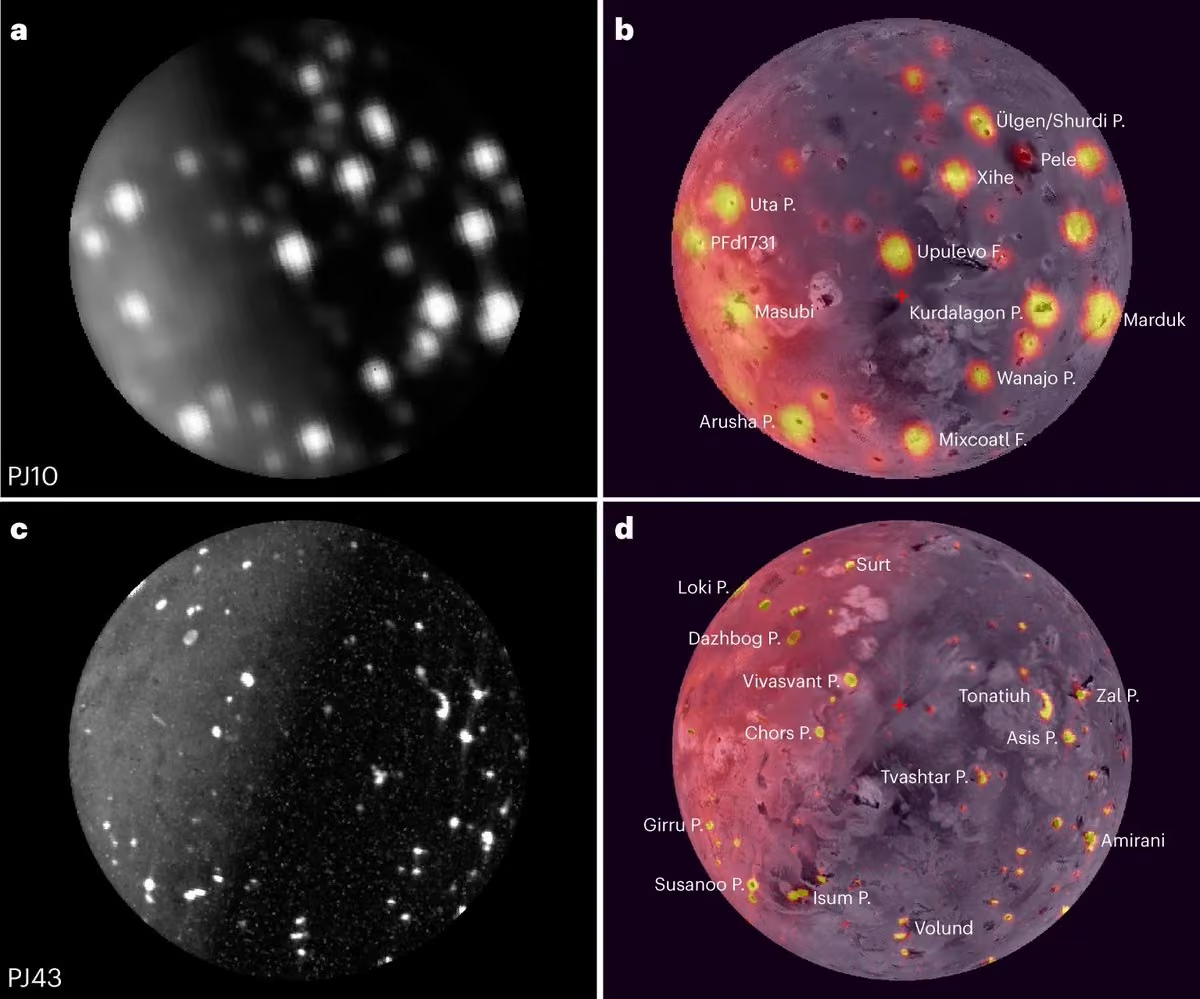 Nature Astronomy
@NatureAstronomy
We'll have three #mondaymanuscripts for you later today, and our November issue will be along later in the week!
Nature Astronomy
@NatureAstronomy
2400 and counting...
Springer Nature
@SpringerNature
'Evidence for heavy-seed origin of early supermassive black holes from a z ≈ 10 X-ray quasar' was one of our top-rated articles on @altmetric this past week. Read the article published in @NatureAstronomy here: go.nature.com/40BJQRw
 Nature Astronomy
@NatureAstronomy
.@ESA_TGO reveals that the winter night sky on Mars emits visible light between 50 and 70 km altitude in the polar regions. This nightglow should be observable with simple space camera systems and the naked eyes of future Mars astronauts. Gérard et al.: www.nature.com/articles/s41550-023-02104-8

Nature Astronomy reposted
Université de Liège
@UniversiteLiege
A study led by researchers @UniversiteLiege, using the NOMAD-UVIS instrument @ESA_TGO , has detected visible emission in the upper atmosphere of Mars.
@NatureAstronomy @esa
www.lpap.uliege.be/cms/c_12066296/en/glow-in-the-visible-…
Nature Astronomy
@NatureAstronomy
.@ESA_TGO reveals that the winter night sky on Mars emits visible light between 50 and 70 km altitude in the polar regions. This nightglow should be observable with simple space camera systems and the naked eyes of future Mars astronauts. Gérard et al.: www.nature.com/s41550-023-02104-8

Nature Astronomy reposted
 ISRO
@isro
Aditya-L1 Mission:
HEL1OS captures first High-Energy X-ray glimpse of Solar Flares
🔸During its first observation period from approximately 12:00 to 22:00 UT on October 29, 2023, the High Energy L1 Orbiting X-ray Spectrometer (HEL1OS) on board Aditya-L1 has recorded the impulsive phase of solar flares.
The recorded data is consistent with the X-ray light curves provided by NOAA's GOES.
🔸Commissioned on October 27, 2023, HEL1OS is currently undergoing fine-tuning of thresholds and calibration operations. The instrument is set to monitor the Sun's high-energy X-ray activity with fast timing and high-resolution spectra.
🔸HEL1OS data enables researchers to study explosive energy release and electron acceleration during impulsive phases of solar flares.
HEL1OS was developed by the Space Astronomy Group of the U. R. Rao Satellite Centre, ISRO, Bengaluru. More:
www.ursc.gov.in/hel1os.jsp
@NWSSWPC
#adityal1

Nature Astronomy reposted
Chandra Observatory
@chandraxray
NASA's Chandra & Webb telescopes have joined forces to discover the most distant black hole ever detected in X-rays! The supermassive black hole, located about 13.2 billion light-years from Earth, is seen when the universe was only 3% of its current age: s.si.edu/uhz1
 Nature Astronomy
@NatureAstronomy
Ákos Bogdán & colleagues have discovered a distant black hole with a mass similar to that of its host galaxy. The large mass at a young age, plus the amount of X-rays it produces, suggest that the black hole formed from the collapse of a huge cloud of gas. www.nature.com/articles/s41550-023-02111-9

Nature Astronomy reposted
NASA Solar System
@NASASolarSystem
This is why we explore. Turns out that asteroid Dinkinesh is… asteroids Dinkinesh? During the #lucymission’s first asteroid flyby on Nov. 1, we discovered that the main belt asteroid is a party of two, or binary pair! www.nasa.gov/image-article/nasas-lucy-spacecraft-discover…
 Nature Astronomy
@NatureAstronomy
The activity of asteroid Phaethon (Geminid parent) might be driven by thermal effects on a shallow near-surface layer, with the interior almost untouched and hydrated. Something to verify with @DESTINY_JAXA.. MacLennan & Granvik: www.nature.com/articles/s41550-023-02091-w or rdcu.be/dp8iv

Nature Astronomy reposted
 Qian Yuan
@qianyuan_geo
First-ever: We've identified a new astronomical object, 'Buried Planet', using SEISMOLOGY, rather than telescopes. It's a survivor of Theia, the planet that collided with Earth 4.5 billion years ago to form our Moon. See our @Nature cover paper: rdcu.be/dp16K
 Nature Astronomy
@NatureAstronomy
Recently published in @nature: 'Evidence for a liquid silicate layer atop the Martian core' by Khan, Huang et al.: www.nature.com/articles/s41586-023-06586-4 and 'Geophysical evidence for an enriched molten silicate layer above Mars’s core' by Samuel et al.: www.nature.com/articles/s41586-023-06601-8
Nature Astronomy
@NatureAstronomy
Recently published in @nature: 'Heavy element production in a compact object merger observed by JWST' by Levan et al.: www.nature.com/articles/s41586-023-06759-1
Nature Astronomy
@NatureAstronomy
Just published in @nature: 'Moon-forming impactor as a source of Earth’s basal mantle anomalies' by Yuan et al.: www.nature.com/articles/s41586-023-06589-1
Nature Astronomy
@NatureAstronomy
A very close flyby of Ganymede by @NASAJuno allowed the JIRAM mapping spectrometer to observe the moon's surface with an unprecedented high resolution, finding minerals indicative of internal rock-water interaction. Tosi et al.: www.nature.com/articles/s41550-023-02107-5 or rdcu.be/dp1Zd
 Nature Astronomy
@NatureAstronomy
With the Psyche mission on its way to map an asteroid, there is a great opportunity for us to start redressing the imbalance in naming conventions for the surface features of planetary bodies, says @AnnieRoseex in a World View: nature.com/articles/s41550-023-02124-4 or rdcu.be/dp1W3

Nature Astronomy reposted
JIVE
@jivevlbi
Out today @NatureAstronomy: highest-res image ever of the interior of a blazar with #spacevlbi allows for the first time observation of the internal structure of a supermassive black hole’s jet. JIVE astrophysicist Leonid Gurvits is a co-author.
Read more jive.eu/news/new-nature-astronomy-space-interferometry-re…

Nature Astronomy reposted
Gabriele Bruni
@bruni_gabriele
RadioAstron day! In the following, the @mediainaf , @MPIfR_Bonn , and @iaa_csic press releases covering our latest result on jets physics, published today on @NatureAstronomy 🛰️📡
www.media.inaf.it/2023/10/26/doppia-elica-3c279-vlbi/
www.mpifr-bonn.mpg.de/pressreleases/2023/11
www.iaa.csic.es/noticias/observaciones-con-interferometri…
Nature Astronomy
@NatureAstronomy
Late-phase spectroscopy reveals that explosive nucleosynthesis in a bipolar collimated configuration is commonly found for core-collapse supernovae, highlighting the importance of asphericity in shaping these diverse cosmic fireworks. Fang, Maeda et al.: www.nature.com/articles/s41550-023-02120-8
 Nature Astronomy
@NatureAstronomy
Free-to-read link: rdcu.be/dpyuq #sharedit
Nature Astronomy
@NatureAstronomy
Space interferometry reveals the filamentary internal structure of the relativistic jet in 3C279 at microarcsecond angular resolution. This image challenges previous assumptions on the morphology and radio variability of blazars. Fuentes, Gómez et al.: www.nature.com/articles/s41550-023-02105-7
 Nature Astronomy
@NatureAstronomy
Free-to-read link: rdcu.be/dpyso #sharedit
Nature Astronomy
@NatureAstronomy
Nitrogen is only ~3% of the atmosphere of Venus, but it holds clues to its past: the abundance can be explained only if there was a period of active tectonics, which lasted >1 Gyr before transitioning into the current stagnant lid. @PlanetaryGeodyn et al.: www.nature.com/articles/s41550-023-02102-w
 Nature Astronomy
@NatureAstronomy
.@NASAJuno has detected gravity harmonics up to the J_40 coefficients, which could probe Jovian flows to a depth of ~3,000 km. They also reveal evidence of cylindrical flow structures. Kaspi et al.: www.nature.com/articles/s41550-023-02077-8

Nature Astronomy reposted
Nature Portfolio
@NaturePortfolio
James Webb Space Telescope observations of Jupiter reported in @NatureAstronomy show the presence of a narrow and intense atmospheric jet in the equator of the planet near the tropopause. The jet’s speed doubles the speed of the lower clouds. go.nature.com/3tH91FL
 Nature Astronomy
@NatureAstronomy
A new kind of aurora is found at Uranus using @keckobservatory NIRSPEC observations. Signature: an 88% enhancement in H3+ column density without a temperature increase, localised in the northern region. @physicist_et al.: www.nature.com/articles/s41550-023-02096-5
 Nature Astronomy
@NatureAstronomy
We'll have a singular #mondaymanuscripts for you later on today, around 1500 UTC.
Nature Astronomy
@NatureAstronomy
#jwst observed Jupiter in July 22 as part of the ERS program. Wind tracking found a very strong equatorial jet in the lower stratosphere that penetrated down to the troposphere, highlighting an equatorial circulation very similar to Saturn's. Hueso et al.: www.nature.com/articles/s41550-023-02099-2
 Nature Astronomy
@NatureAstronomy
The primary authors of this article have written a Research Briefing, explaining a little more of the background behind this paper: www.nature.com/articles/s41550-023-02100-y
Nature Astronomy
@NatureAstronomy
Using #jwst, @DokkumPieter and colleagues have found a rare perfect alignment between two galaxies in the young Universe. The farther galaxy is curved into an 'Einstein Ring', due to the bending of spacetime around the nearer galaxy: www.nature.com/articles/s41550-023-02103-9
 Nature Astronomy
@NatureAstronomy
Snelders et al. present the discovery of ultra-fast radio bursts (FRBs), lasting only for microseconds. This is thousands of times shorter than typical for these astronomical radio flashes and shows that they occur more frequently than initially thought. www.nature.com/articles/s41550-023-02101-x

Nature Astronomy reposted
NASA Webb Telescope
@NASAWebb
Jupiter’s fly like a jet stream high above the whole scene ♪
Webb has discovered a 3000-mi (4800-km) wide jet stream over Jupiter’s equator, above the main cloud decks. More on Webb's unique ability to track interactions in Jupiter's layered atmosphere: www.nasa.gov/missions/webb/nasas-webb-discovers-new-featu…

Nature Astronomy reposted
Nature Astronomy
@NatureAstronomy
Our October issue is now available to read: www.nature.com/natastron/volumes/7/issues/10 ! The cover image comes from the MacLeod & Loeb paper in the issue, which explains how huge waves can form on a star's surface through the tidal effects of a companion.
 Nature Astronomy
@NatureAstronomy
Tania Medina-Torrejón and co-workers have been performing magnetohydrodynamic-particle-in-cell simulations to demonstrate that magnetic reconnection accelerates particles to extreme energies in magnetically dominated flows. www.nature.com/articles/s41550-023-02115-5 (ApJ)
Nature Astronomy
@NatureAstronomy
And as usual, the issue contains a selection of other Commentary, Books & Arts, News & Views, Research Briefings and more, including this topical Review of astrophysics with continuous gravitational waves: www.nature.com/articles/s41550-023-02059-w
 Nature Astronomy
@NatureAstronomy
.@SheerPriya and colleagues introduce QUOTAS, a newly developed research platform that combines observational and simulated data to facilitate the study of supermassive black hole populations: www.nature.com/articles/s41550-021-01478-x or rdcu.be/dhIE0
 Nature Astronomy
@NatureAstronomy
Impacts on Venus at the end of its accretion phase had a higher mean velocity than those on Earth. Simulations show that this may have highly heated Venus' core, contributing to its young surface age, & affected its magnetic field intensity. Marchi et al.: www.nature.com/articles/s41550-023-02037-2
 Nature Astronomy
@NatureAstronomy
In June 2022, the IXPE satellite observed a shock passing through the jet of active galaxy Mrk 421. The rotation of the X-ray polarised radiation and the analysis of other emission reveals that the jet contains a helical magnetic field. Di Gesu et al.: www.nature.com/articles/s41550-023-02032-7
 Nature Astronomy
@NatureAstronomy
Stony asteroids like Itokawa are assumed to be very dry. Surprise: the samples brought back by the Hayabusa(1) mission show the presence of NaCl salt embedded in the matrix, indicative of an active hydrothermal system within OC parent bodies. Che & Zega: www.nature.com/articles/s41550-023-02012-x
 Nature Astronomy
@NatureAstronomy
Our May bookshelf holds a couple of new books -- 'Worlds Without End' by Chris Impey and 'The First City on Mars' by Justin B. Hollander: www.nature.com/articles/s41550-023-01969-z
Nature Astronomy
@NatureAstronomy
Angrite meteorites are supposed to be unshocked, pristine samples from first Myrs of the Solar System, but O isotope measurements show their parent body received major impacts, possibly due to the early instability of giant planets. @BRiderStokes et al.: www.nature.com/articles/s41550-023-01968-0
 Nature Astronomy
@NatureAstronomy
The JWST Advanced Deep Extragalactic Survey has identified the farthest and therefore earliest galaxies. NIRCam observations reveal bright galaxies that formed earlier than expected, when the Universe was 300-500 million years old. Read it for free: rdcu.be/c87JZ
 Nature Astronomy
@NatureAstronomy
Wang, Quan, Tang & Deng have produced a useful catalogue of mechanisms that robots can employ to attach to and explore a target body:
www.nature.com/articles/s41550-023-01926-w
 Nature Astronomy
@NatureAstronomy
Red dwarf YZ Ceti was seen to produce two bursts of radio waves. They may have been caused by the star interacting magnetically with a nearby terrestrial planet, since they occurred at similar points in the planet's two-day orbit. Pineda & Villadsen: www.nature.com/articles/s41550-023-01914-0
 Nature Astronomy
@NatureAstronomy
A Comment from Fabio Falchi and colleagues calls on scientists to take action against excessive artificial light at night. It is a wholly unnecessary practice that increases skyglow and wastes energy.
www.nature.com/articles/s41550-022-01864-z
 Nature Astronomy
@NatureAstronomy
Just published in @nature: 'Deuterium-enriched water ties planet-forming disks to comets and protostars' by John Tobin et al. www.nature.com/articles/s41586-022-05676-z
Nature Astronomy
@NatureAstronomy
Sarah Wagner and fellow @Astro4Earth members recount the proceedings of their inaugural annual symposium, held online: www.nature.com/articles/s41550-023-01912-2
Nature Astronomy
@NatureAstronomy
There is a group of large dark asteroids in the Outer Main Belt that shares properties and history with Ceres: they accreted late (1.5-3.5 Myr after SS formation) and come from the outer Solar System. @drisstakir, @astromaterials, @sraymond_astro et al.: www.nature.com/articles/s41550-023-01898-x
 Nature Astronomy
@NatureAstronomy
Just published in @nature: 'A high-mass X-ray binary descended from an ultra-stripped supernova' by Richardson et al.: www.nature.com/articles/s41586-022-05618-9
Nature Astronomy
@NatureAstronomy
The winner of #nastrocovercomp 2022 is… the wonderful image of Centaurus A from @Benjy_man et al.! Another winning image of Cen A, to add to the 2021 winner; this time with @mwatelescope. Congratulations to everyone involved!🏆
(Read the paper here: rdcu.be/c1KFx)
 Nature Astronomy
@NatureAstronomy
Congratulations to @janerrigby on being named one of the BBC's 100 Women of the year!
(Full list:www.bbc.co.uk/news/resources/idt-75af095e-21f7-41b0-9c5f-…) @BBC100women
 Nature Astronomy
@NatureAstronomy
Casualty risks from re-entering rockets or rocket parts are disproportionately borne by countries in the Global South. Ensuring controlled re-entries would mitigate this unacceptable risk, suggest @michael_byers et al.: www.nature.com/articles/s41550-022-01718-8
 Nature Astronomy
@NatureAstronomy
.@emily_spacecats and colleagues have summarised their fascinating Kavli Frontiers of Science Symposium session on "Ethics in solar system exploration" in a Meeting Report: www.nature.com/articles/s41550-022-01712-0 or rdcu.be/cP0SR
 Nature Astronomy
@NatureAstronomy
As we look forward to #blackspaceweek/#blackinastroweek next week, we talked to @That_Astro_Chic and other members of the Black In Astro Community about their experiences: www.nature.com/articles/s41550-022-01704-0 @BlackInAstro #aas240
 Nature Astronomy
@NatureAstronomy
Betelgeuse dimmed drastically to a historical minimum in February 2020. This "Great Dimming" was serendipitously caught by a meteorological satellite: @DTaniguchiAstro et al. had the inspired idea to collect the observations and use them for astronomy! www.nature.com/articles/s41550-022-01680-5
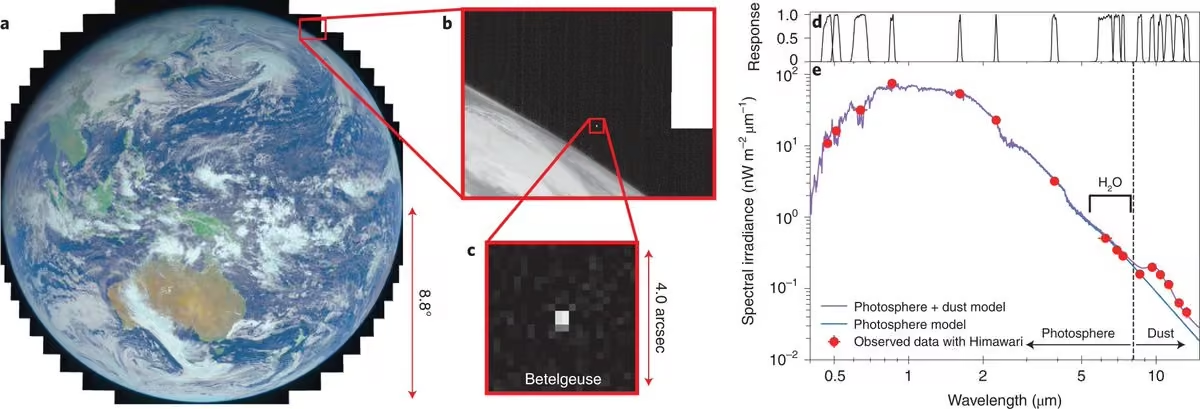 Nature Astronomy
@NatureAstronomy
Christian Ginski remarks upon the direct imaging of a protoplanet around AB Aur, work from @AstroThayne et al. published in @NatureAstronomy : www.nature.com/articles/s41550-022-01665-4
Nature Astronomy
@NatureAstronomy
Today we published an incredibly moving World View from @AmenaKarimyan, a passionate Afghan woman trying to teach young people about astronomy in the face of harsh opposition: rdcu.be/cJ6jX or www.nature.com/articles/s41550-022-01653-8
Nature Astronomy
@NatureAstronomy
Contrary to usual assumptions, aqueous alteration can still be efficient and geologically quick at -20 °C within the cores of large icy worlds, due to the presence of alkaline solutions containing salts and ammonia. Zandanel et al.: www.nature.com/articles/s41550-022-01613-2
 Nature Astronomy
@NatureAstronomy
High time-resolution analysis of an FRB reveals similarities in burst structure with young pulsar 'nano-shots', suggesting a similar emission mechanism. @Kenzie__Nimmo et al.: www.nature.com/articles/s41550-021-01569-9
 Nature Astronomy
@NatureAstronomy
Joshua Krissansen-Totton and colleagues demonstrate the importance of planetary context when detecting and interpreting biosignature molecules, whether it's oxygen, methane, or a more exotic compound. www.nature.com/articles/s41550-021-01579-7
 Nature Astronomy
@NatureAstronomy
Andrea Maselli and co-workers explain how extreme mass ratio inspirals detected by @LISACommunity can test for new scalar fields. www.nature.com/articles/s41550-021-01589-5
 Nature Astronomy
@NatureAstronomy
Radio jets are known to operate on circumgalactic scales to prevent accretion, but here Suma Murthy and colleagues show such jets also clear out gas from the very central regions of AGN. @Valeandromeo, @alexywagner www.nature.com/articles/s41550-021-01596-6
 Nature Astronomy
@NatureAstronomy
Winner of #nastrocovercomp 2021… a fantastic image of Centaurus A from @Enloro et al! Another winning @SOFIAtelescope result. Congratulations to everyone involved. 🏆
 Nature Astronomy
@NatureAstronomy
Three covers are through to the FINAL of #nastrocovercomp. Again, 24 hrs to vote (see next tweet for poll).
Will it be a photo of the surface of asteroid Ryugu (JAN)?
Will it be another win for @SOFIAtelescope (JUN)?
Or will the artwork of @DanielleFuts take the crown (NOV)?
 Nature Astronomy
@NatureAstronomy
Winner of round 2 of our #nastrocovercomp: the June cover from @Enloro @LeslieWProudfit @SOFIAtelescope et al., showing the polarised light from Centaurus A. This cover will go forward into the final, with voting starting tomorrow.
 Nature Astronomy
@NatureAstronomy
Round #2 of the Nature Astronomy cover competition 2021 kicks off now with our cover images from May to August. You'll have 24 hrs to vote (see next tweet with the poll). #nastrocovercomp
 Nature Astronomy
@NatureAstronomy
Multiple generations of cosmic-ray bubbles in a galaxy group indicate that magnetic fields prevent their mixing with the external medium. Brienza et al.: www.nature.com/articles/s41550-021-01491-0
 Nature Astronomy
@NatureAstronomy
A long-duration campaign to image the Sun’s middle corona — a region about 1.5-3 solar radii from the centre — reveals dynamical processes that can influence the global coronal structure and beyond. @dbseaston et al.: www.nature.com/articles/s41550-021-01427-8
 Nature Astronomy
@NatureAstronomy
Our July issue is now available to read! The cover image shows our nearest star at extreme UV wavelengths, and is connected to the paper of Astrid Veronig et al. www.nature.com/natastron/volumes/5/issues/7
 Nature Astronomy
@NatureAstronomy
We're learning a lot about haze formation on exoplanets... how about haze removal? @JonesKuma & co. measure surface energies of hazes under a range of relevant conditions, noting that planets in the habitable zone are less hazy than planets outside. www.nature.com/articles/s41550-021-01375-3
 Nature Astronomy
@NatureAstronomy
Our June issue is now available, at www.nature.com/natastron/volumes/5/issues/6! The cover image featuring Centaurus A and @SOFIAtelescope observations is connected to the paper of Enrique Lopez-Rodriguez.
 Nature Astronomy
@NatureAstronomy
Fine frequency structures of type III radio bursts can probe properties of the coronal and solar wind plasma and its density fluctuations. Reid & Kontar: www.nature.com/articles/s41550-021-01370-8
 Nature Astronomy
@NatureAstronomy
Our April issue is now available to read. The fantastic cover is a representation of the turbulent interstellar medium, generated by Christoph Federrath and colleagues: www.nature.com/natastron/volumes/5/issues/4
 Nature Astronomy
@NatureAstronomy
Christoph Federrath et al. present an ultra-high-resolution simulation of the interstellar medium that studies the transition from supersonic to subsonic turbulence: www.nature.com/articles/s41550-020-01282-z
 Nature Astronomy
@NatureAstronomy
Nature Astronomy cover of the year 2020 is our December cover featuring Serpens South, contributed by @PillaiThushara et al. (and using @SOFIAtelescope data). Congratulations... it is a beautiful image, and thanks to all who voted! #nastrocovercomp
 Nature Astronomy
@NatureAstronomy
This week @nature published a paper reporting the detection of immense X-ray bubbles in the Milky Way halo (using @eROSITA_SRG observations): www.nature.com/articles/s41586-020-2979-0
 Nature Astronomy
@NatureAstronomy
Yesterday we published our December issue, which you can read here: www.nature.com/natastron/volumes/4/issues/12
And you know what this means...? Next week is NAstro cover of the year competition time! Strong contender here:
 Nature Astronomy
@NatureAstronomy
Phosphine is to Venus as methane is to Mars? 20 parts-per-million of phosphine have been detected in the temperate clouds of Venus, and its source is not evident. Greaves et al.: www.nature.com/articles/s41550-020-1174-4
 Nature Astronomy
@NatureAstronomy
Thushara Pillai (@PillaiThushara) discusses her @SOFIAtelescope observations of Serpens South:
astronomycommunity.nature.com/posts/magnetized-gas-flows-…
Nature Astronomy
@NatureAstronomy
Observations of the powerful solar flare of 10 September 2017 show that the relativistic electrons are confined and/or accelerated at the bottom of the current sheet, not at the reconnection X point. Chen et al.: www.nature.com/articles/s41550-020-1147-7
 Nature Astronomy
@NatureAstronomy
The June Editorial highlights the 30th anniversary of the launch of ROSAT, and takes us through X-ray observatory history to arrive at @eROSITA_SRG : www.nature.com/articles/s41550-020-1137-9
Nature Astronomy
@NatureAstronomy
E. coli and yeast can survive and grow under a 100% hydrogen atmosphere. This lab experiment opens interesting perspectives for the biospheres of exoplanets with hydrogen-dominated atmospheres. Seager et al.: rdcu.be/b3WDj or www.nature.com/articles/s41550-020-1069-4
 Nature Astronomy
@NatureAstronomy
Hubble observations of interstellar comet 2I/Borisov reveal its very high CO abundance, the highest ever seen for a comet in the inner Solar System. This tells us that it originated from deep within its system's Kuiper-Belt analogue. Bodewits et al.: www.nature.com/articles/s41550-020-1095-2
Nature Astronomy
@NatureAstronomy
Low-frequency radio emission from a quiescent red dwarf star cannot come from the star itself, but resemblance to planetary auroral emissions suggests the presence of a close-in exoplanet, say Vedantham et al.: www.nature.com/articles/s41550-020-1011-9
 Nature Astronomy
@NatureAstronomy
Sebastian Pineda explains how this finding might lead to a different way of doing exoplanet surveys in his News & Views article: www.nature.com/articles/s41550-020-1025-3
 Nature Astronomy
@NatureAstronomy
The #deifocus content is collected together here: www.nature.com/collections/cagjjdfjaa and leads with our December Editorial, "Actions speak louder than words": www.nature.com/articles/s41550-019-0982-x
 Nature Astronomy
@NatureAstronomy
Spectropolarimetric data combined with high-resolution numerical simulations reveal an acoustic resonance cavity above a highly magnetic sunspot, verifying theory. Jess et al.: www.nature.com/articles/s41550-019-0945-2 @AstroQUB
 Nature Astronomy
@NatureAstronomy
Voyager 2's cosmic ray instrument observed a boundary layer outside the heliopause where the intensity of Galactic cosmic rays is modulated. Stone et al.: www.nature.com/articles/s41550-019-0928-3
Nature Astronomy
@NatureAstronomy
The vote was incredibly close... thanks to all who took part in the competition and to @CSIRO_ATNF and @ehtelescope for making things incredibly tense at the end! #nastrocovercomp
Nature Astronomy
@NatureAstronomy
FINAL: The four finalist have been selected... time to vote for the cover of the year from the options below. Note that the final vote will only be open for 12 hours...! #nastrocovercomp
 Nature Astronomy
@NatureAstronomy
In a News & Views article, Lynnae Quick unpacks @mikesori1's work on Ceres, which means that Aluna Mons is lonely no more: www.nature.com/articles/s41550-018-0648-0
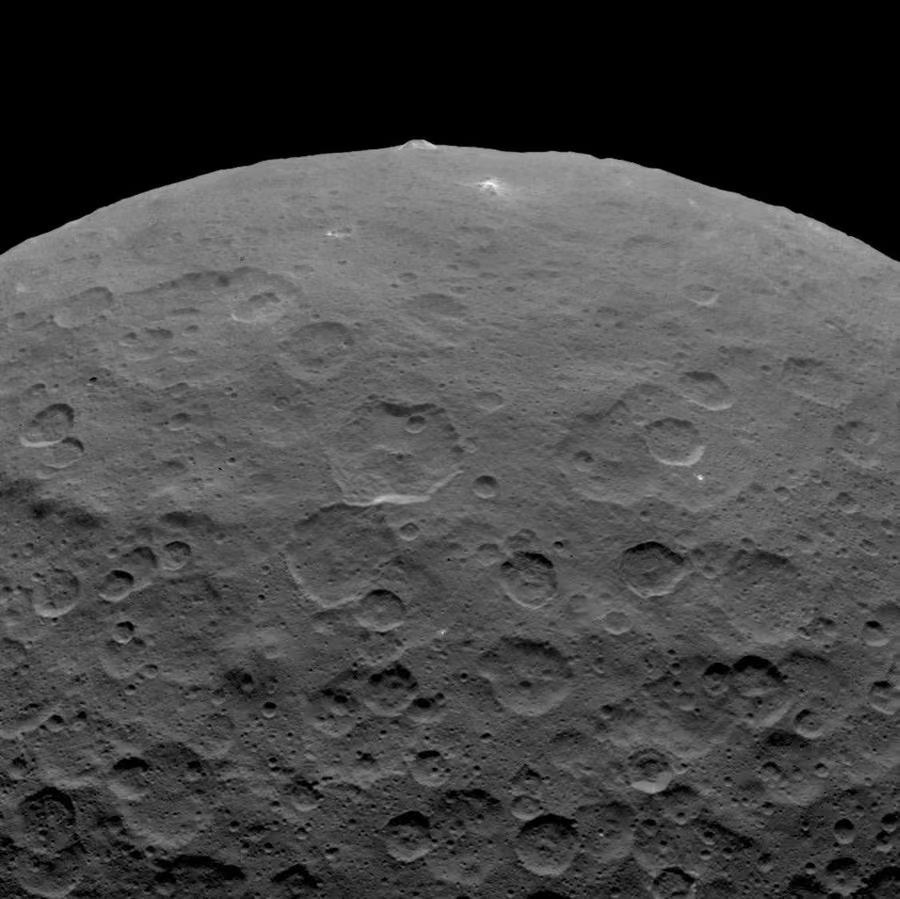 Nature Astronomy
@NatureAstronomy
depressing arXiv read of the day: model suggests that astronomy does a bad job at retaining female researchers at postdoc stage; women postdocs leave academia at a rate 3-4 times higher than men. Only bright point: they get faculty positions earlier.
 Astrophysics Papers
@AstroPHYPapers
The Leaky Pipeline for Postdocs: A study of the time between receiving a PhD and securing a faculty job for male and female astronomers. arxiv.org/abs/1810.01511
Nature Astronomy
@NatureAstronomy
The tiny Patroclus-Menoetius Trojan binary holds key information on the timing of migration of the Solar System's giant planets. Nesvorný et al.: go.nature.com/2O7VSfr
Nature Astronomy
@NatureAstronomy
Slightly more recently (only 40 years ago) the two Voyager spacecraft launched on a tour of the Solar System. Project Scientist Ed Stone looks back at that breathtaking age of discovery: rdcu.be/z7Kv
Nature Astronomy
@NatureAstronomy
The most detailed image of a star (RSG Antares) to date: www.eso.org/public/news/eso1726/ based on Nature paper: go.nature.com/2wn8No9


