NEW BOOK OUT NOW!
Korea experts are calling on Washington and Seoul to move past old assumptions, recalibrate the alliance.
US policy toward the Korean Peninsula remains hidebound to assumptions that no longer reflect present realities and that raise the risk of future conflict in East Asia, according to a new collection of essays published today by the Quincy Institute for Responsible Statecraft.
"Old Assumptions, New Realities: Rethinking US-Korea Policies," edited by QI Research Associate @jyjamespark offers a fresh blueprint for the Korean Peninsula and the US-South Korea alliance, aimed at stable inter-Korean coexistence, a calmer security environment across East Asia, and a recalibrated alliance.
The eight contributors reflect a wide range of vantage points: nuclear policy experts at Washington’s Carnegie Endowment and Stimson Center; researchers at Seoul’s state-affiliated Korea Institute for National Unification and Korea Institute for Defense Analyses; and academics teaching in Pittsburgh, Nanjing, Seoul, and Wellington. Together, they bring American, South Korean, and regional perspectives to questions Washington has too often debated within closed circles.
“Washington and Seoul need to question old shibboleths and start new conversations about alternatives that may better reflect the strategic environment they now face,” said Park.
The Korean Peninsula has changed dramatically since Trump–Kim diplomacy collapsed in 2019. North Korea has refused US demands for complete denuclearization, and inter-Korean dialogue is at a standstill. Meanwhile, Pyongyang has deepened its security ties with Moscow, including support for Russia’s war in Ukraine, and US-China security competition in the region continues to intensify.
The collection is divided into three sections: “Living with a Nuclear North Korea,” “Creating a More Inclusive Security Environment in Northeast Asia,” and “Rethinking the US–South Korea Alliance.”
The first section calls on the United States to stop pursuing complete North Korean denuclearization and instead center diplomacy on coexistence and risk reduction. The authors reject Washington’s decades-long reliance on economic pressure and diplomatic isolation, and challenge the supposed consequences of dropping denuclearization as a near-term diplomatic goal.
The second section lays out how to keep the peace across the wider region, proposing new multilateral forums that engage all regional actors. It also examines how South Korea can maintain stable ties with both China and the United States to best advance its economic and security interests.
The collection concludes by reconsidering the US-South Korea military relationship, calling for Washington to transfer wartime operational control over South Korea’s conventional defense to Seoul while focusing narrowly on providing nuclear extended deterrence. The final chapter diagnoses the psychological tendencies that have stalled necessary change in the alliance and challenges policymakers to pursue creative, unorthodox approaches to overcome that inertia.
“Conventional wisdom from years past is simply inadequate. This volume is meant to broaden the scope of debate in Washington and Seoul at a time when doing so is more urgent than ever,” said Park.
Learn more here: quincyinst.org/2026/11/17/new-book-rethinking-us-korea-po…
Quincy Institute for Responsible Statecraft
The Quincy Institute for Responsible Statecraft is an American foreign policy think tank which has been described as advocating realism and restraint in foreign policy. More on Wikipedia
-
Quincy Institute
@QuincyInst

-
Quincy Institute reposted
Eli Clifton
@EliClifton
Pete Hegseth installed close ally Norm Coleman as co-chair of a Pentagon advisory committee.
Coleman appears to be cashing in by advising an Israeli weapons startup on how to profit from controversial integration of the U.S. and Israeli militaries and lobbying for Saudi Arabia. -
Quincy Institute reposted
Ben Freeman
@BenFreemanDC
The Pentagon doesn't know where all your tax-dollars are going, but it wants more of them.
A 🧵 on why this is especially troubling now: -
Quincy Institute
@QuincyInst
NEW RESEARCH!
US POLICYMAKERS MUST STOP LETTING PREDICTIONS OF THE ISLAMIC REPUBLIC'S IMMINENT COLLAPSE STAND IN FOR STRATEGY
On Feb. 11, 2026, Israeli Prime Minister Benjamin Netanyahu briefed President Donald Trump in the White House Situation Room. He argued that Iran was ripe for regime change and that a joint military campaign could quickly lead to the Iranian regime’s collapse. Seventeen days later, the United States and Israel went to war; nearly nine months later, a hardened Islamic Republic remains in power.
Predictions of Iranian regime collapse long predate 2026. As this study documents, political figures, analysts, journalists, and Iranian opposition leaders repeatedly anticipated the Islamic Republic’s demise between 1980 and February 2026. At several consequential moments, expectations of impending collapse were also present among US decisionmakers and contributed to their policy choices. These expectations made negotiations seem less worthwhile, encouraged more expansive demands, and led policymakers to underestimate the costs of coercion.
In 2003, officials in the George W. Bush administration who expected upheaval in Tehran argued against talks that might lend the Iranian government legitimacy. The United States walked away from a working diplomatic channel that had grown out of cooperation in Afghanistan. Fifteen years later, Trump’s conviction that sanctions and protests were wearing Iran down helped drive the US exit from the Iran nuclear deal, officially called the Joint Comprehensive Plan of Action. Secretary of State Mike Pompeo followed with 12 demands that went far beyond the nuclear program. In the run-up to this year’s war, the same expectation let Trump brush aside his own advisers’ warnings about the Strait of Hormuz and dwindling US munitions, because he assumed Tehran would give in first. Each time, confidence that the regime was on its way out made it easier to skip diplomacy and harder to see the costs of pressure.
Whether and when Iran will undergo fundamental political change remains an open question, but Washington still has to manage its relations with the government that exists today. The Trump administration should assess its Iran policy by what it achieves for US interests and pursue realistic demands that leave room for compromise. Above all, US policymakers must stop letting predictions of the Islamic Republic’s imminent collapse stand in for strategy.
Read the latest from @PeymanAsadzade here: quincyinst.org/research/next-year-in-tehran-predictions-o… -
Quincy Institute reposted
Lee Schlenker
@lee_schlenker
JL Anderson confirms in a sweeping profile that former pro-embargo lobbyist and Rubio confidante, Mauricio Claver-Carone, along with his romantic/business partner, CIA analyst Jessica Bedoya, have been instrumental in Trump's VZ policy + highly criticized oil deal.
Key quotes 🧵
The New Yorker
@NewYorker
Delcy Rodríguez and the new American imperialism. www.newyorker.com/magazine/2026/11/23/venezuelas-collabor…
-
Quincy Institute reposted
Sarang Shidore
@globalsarang
Trump, Xi, and Putin are set to meet in Shenzhen this week.
Talk of a new Yalta is likely overblown. But if the “G3” wants to try and divide the world into spheres of influence, I warn, it won’t deliver lasting stability — and DC won’t like the results foreignpolicy.com/2025/05/28/spheres-of-influence-great-p… -
Quincy Institute
@QuincyInst
Book Talk | Boiling Point: How America Brought War to Ukraine x.com/i/broadcasts/2ybQYVnyvMqnKq
Quincy Institute
@QuincyInst
🔴 LIVE | Book Talk | Boiling Point: How America Brought War to Ukraine
A conversation with @stephenkinzer & @lieven_anatol
x.com/i/broadcasts/2ybQYVnyvMqnKq -
Quincy Institute
@QuincyInst
Are China and Russia's advancements in hypersonic missile technology the existential threat that some in Washington are making them out to be?
Does America *really* need to spend billions closing another new "missile gap," as the defense industry is arguing?
The latest from @RStatecraft responsiblestatecraft.org/hypersonic-missile-us/ -
Quincy Institute reposted
Tori Bateman
@tori_bateman
Spending the day at the @AgFutureAmerica Leadership Conference to ask students: How is foreign policy impacting farmers?
Looking forward to hearing their perspectives, introducing the @QuincyInst, and making connections between U.S. Grand Strategy & agricultural interests. -
Quincy Institute
@QuincyInst
Diplomacy is never the naive position.
Naivete s believing that wars will end in total victory, when almost none ever do.
Four and a half years into Ukraine, the people who warned about this are the ones who got it right.
www.youtube.com/watch?v=PnwrKy9uxx8&t=1s -
Quincy Institute
@QuincyInst
Book Talk | The Great League of Peace and Power x.com/i/broadcasts/2BlPJRaKOvjejl
Quincy Institute
@QuincyInst
🔴 LIVE | Book Talk | The Great League of Peace and Power
A conversation featuring @dhendrickson50, @DanielLarison, & @KelleyBVlahos
x.com/i/broadcasts/2BlPJRaKOvjejl -
Quincy Institute reposted
Dr. Annelle Rodriguez Sheline
@AnnelleSheline
These 4 men 👨🦳👨🦳👨🦳👨🦳
— Chairs & Ranking members of House & Senate Armed Services Committees —
Are planning to integrate the US & Israeli defense industrial bases (NDAA section 219)
🚫 Don't want that to happen?
📲 Call their offices & tell them
(Office numbers in reply)This media couldn't be displayed. See it on the original post. -
Quincy Institute
@QuincyInst
Veterans get put on a pedestal or waved off: “They knew what they were signing up for.” Both are excuses not to listen.
That’s why we created The Weight.
This Veterans Day, The Weight brings veterans' experiences into the debate over when, where, and why America goes to war. -
Quincy Institute
@QuincyInst
The most honest conversations about Ukraine are happening off the record.
@lieven_anatol says military professionals and think tank experts in Europe tell him privately that Ukraine’s chances are slim and a compromise peace is necessary. In public they say the opposite, because they know the truth could cost them their jobs.
On the latest Always at War, Lieven explains why the people shaping the debate are hesitant to pursue peace.
www.youtube.com/watch?v=PnwrKy9uxx8&list=PLLP3oFXQU9footI… -
Quincy Institute
@QuincyInst
The American people rejected the Iran war. Now Congress has to end it.
Call your representatives TODAY and tell them: no more money for the Iran war.
Join the call-in at 12:30pm ET / 9:30am PT. No experience needed.
RSVP: secure.everyaction.com/kXjqeU3nV060tETNP_8Z-g2 -
Quincy Institute reposted
Andy
@AndyMLeonard
🧵@PeteHegseth, I’ll be more nuanced than others… and more direct. It isn’t about our Troops; it is about the political leadership entrusted to lead and employ them… it is about YOU.
Pete Hegseth
@PeteHegseth
🇺🇸
This media couldn't be displayed. See it on the original post. -
Quincy Institute reposted
NIAC
@NIACouncil
40 civil society organizations – including @commondefense, @demandprogress, @justfp and NIAC Action – are demanding Congress act on its mandate from voters to end the Iran war by cutting off funding for it beginning with the upcoming government funding expiration on December 11, 2026.
“Congress must ensure that any subsequent continuing resolution, appropriations measure, or other funding or authorization legislation explicitly prohibits any funding for the ongoing, unauthorized hostilities against Iran,” the letter declares.
It goes on to urge lawmakers “to commit now that, beginning with the December 11 funding deadline, they will not advance or support legislation that continues open-ended funding for these unauthorized hostilities, and will insist on a funding ban for the war.”
The letter comes as Democratic lawmakers are debating publicly how to use their historic mandate to end the Iran war, with many key lawmakers and other party leaders coming out explicitly in support of a funding ban for the Iran war. That list includes Sen. Chris Van Hollen (D-MD), Senator-elect Abdul El-Sayed (D-MI), top Democratic House appropriator Rep. Rosa DeLauro (D-CT), House Armed Services Committee ranking member Rep. Adam Smith (D-WA), Rep. Ro Khanna (D-CA) and Illinois Governor JB Pritzker. Several of these individuals have clear Presidential aspirations and can tell that political winds are blowing decisively against the Iran war and in favor of lawmakers putting a serious check on the disastrous war.
“President Trump is being pushed by unapologetic cheerleaders of this disastrous war to escalate and make good on his threats to ‘destroy’ the rest of Iran,” said NIAC President @jabdi. “Now, with a clear mandate from voters, is the time for decisive action to terminate the Iran war before it reignites. Not next year, but right now.”
“The midterms delivered a clear mandate to end Trump’s war,” said Cavan Kharrazian, Senior Policy Advisor with Demand Progress. “Congress needs to act on that mandate in the lame duck, not wait until next year. Democratic leaders must commit now to opposing any funding bill that fails to explicitly prohibit funding for the war on Iran. They have the leverage to force this fight. They need to use it.”
“Voters just gave Democrats an overwhelming mandate to end this war. They must act on that mandate and refuse to send Trump and Pete Hegseth a blank check for war, even temporarily through a continuing resolution. Anything else would be a blatant betrayal of the American people, and risk making Democrats complicit in the war crimes Trump has threatened,” said @ErikSperling, executive director of Capitol Hill-based advocacy organization Just Foreign Policy. “Cutting off war funding will push Trump toward diplomacy, which should be the top priority. With his threat to follow through with threats to attack Iran, it is a moral imperative for Congress to use their power of the purse and pull the plug.”
Read the full letter: niacouncil.org/40-organizations-to-congress-cut-off-fundi… -
Quincy Institute
@QuincyInst
Unlike most other think tanks in Washington, we take exactly $0 from weapons contractors, foreign governments, or the US government.
That keeps our work independent, and focused squarely on Americans' interests.
And this year was another banner year for us:
-@tparsi gave 500+ interviews to help find a way out of the Iran war
-@tori_bateman secured 37 meetings and events with Members of Congress
-2,000+ congressional candidates got our campaign guides
-@RStatecraft hit a million views a month
-Our podcast Always at War skyrocketed: averaging over 13,000 views per episode on YouTube
Learn more. Read our annual report: quincyinst-2.s3.amazonaws.com/wp-content/uploads/2026/11/… -
Quincy Institute reposted
Kelley B. Vlahos
@KelleyBVlahos
love these guys!!
-
Quincy Institute
@QuincyInst
We know who won on Tuesday.
But American's also chose a loser: AIPAC.
$55 MILLION of the $84M AIPAC's network spent on midterm races went to candidates who lost.
It turns out Americans can't be bought.
We talked to @KelleyBVlahos and @connor_echols about the election, Americans voting on foreign policy, and the future of Washington: www.youtube.com/watch?v=AAS_mUGlyDc -
Quincy Institute reposted
Ben Freeman
@BenFreemanDC
Had the honor of talking one-on-one with @MatthewPHoh about his experiences in the military following a showing of the new @QuincyInst documentary The Weight: Veterans on Fighting America's Foreign Wars. Links to the doc and convo below 👇
-
Quincy Institute reposted
Responsible Statecraft
@RStatecraft
NEW: Tuesday's election was not just a rejection of the Iran war. It was also a repudiation of the broader foreign policy that repeatedly gets the U.S. into wars — or into supporting the wars and war crimes of U.S. partners, writes @tparsi
responsiblestatecraft.org/2026-midterms-foreign-policy/ -
Quincy Institute reposted
Andy
@AndyMLeonard
The election is being framed as a rebuke of the Iran war. It is also a mandate.
Congress now has the votes to reclaim its war powers, and to end the habit of deploying U.S. forces to conflicts with no defined objective and no withdrawal criteria. -
Quincy Institute reposted
Eli Clifton
@EliClifton
23 hours and STILL no tweets by @aipac.
That might be because they need to focus on calls with their donors to explain how they threw away $55 MILLION, two thirds of their election spending, on races in which their preferred candidate lost. [link below] -
Quincy Institute
@QuincyInst
Yesterday, Americans made one thing abundantly clear: we're sick of needless war.
Americans want a government:
- that doesn't promise billions to fund genocide.
- that doesn't start expensive wars of aggression.
- that doesn't starve countries for thinking differently.
- that doesn't drop bombs on boats without cause.
- that doesn't kidnap presidents in the name of oil.
More than anything, Americans are sick of the cost. The cost at the pump. The cost of groceries. The cost of everything going up while we pay for wars that make us no safer, no healthier, no happier.
It's time for restraint. It's time for a foreign policy that serves the American people. -
Quincy Institute
@QuincyInst
This fall, the Quincy Institute traveled across the country to talk to Americans about the Iran war: why it happened, what it’s costing them, and how to end it.
What we heard, over and over again, was anger and frustration: with this needless war, with its high costs at home, with a foreign policy class that never puts Americans’ interests first.
Yesterday, Americans rejected the Iran war, loud and clear, at the ballot box.
Policymakers on the right and left should be scrambling to address Americans’ calls for a better foreign policy. The path forward is clear: America needs to practice restraint. Our approach to the world should be determined by what we need to do to keep Americans safe, not by which weapons the military-industrial complex wants Congress to buy, or which wars the Israel lobby wants the White House to wage.
Check out our conversation in Austin with @joekent16jan19, @scotthortonshow, @DanMcKnight30, @AdamNoahWho, and @KelleyBVlahos about our fateful errors in Iran, and what it will take to build a genuinely different foreign policy in Washington
youtu.be/UXdQtSkVD88?t=72 -
Quincy Institute reposted
Marcus Stanley
@MarcusMStanley
The first test of whether Democrats will stand up to Trump on the war happens DECEMBER 11th when current military funding runs out.
If Senate Dems approve funding then they'll be taking a position to the right of JD Vance. -
Quincy Institute reposted
Responsible Statecraft
@RStatecraft
BREAKING: Annie Andrews will defeat Darline Graham in South Carolina’s Senate race, said NBC News, which called the flip an “earthquake.”
Graham drew controversy for her seeming ambivalence about the job, saying "national security is not my thing."
responsiblestatecraft.org/iran-war-midterms/ -
Quincy Institute reposted
Responsible Statecraft
@RStatecraft
UPDATE: 62% of voters say the war in Iran was the wrong decison; 74% say it was a "crucial" or "major" factor in their vote.
responsiblestatecraft.org/iran-war-midterms/ -
Quincy Institute reposted
Stephen Wertheim
@stephenwertheim
The domestic foundation of American global power is crumbling. Trump is less the cause than a symptom and an accelerant. Since the Cold War ended, the United States has pursued global primacy under an implicit bargain with the public: dominance would come cheap. Today Americans are no more willing to bear serious costs for foreign policy than they were in the 1990s. But a far more competitive world is driving up the price of upholding U.S. commitments.
No matter who wins the White House in 2028, this gap will constrain American power around the world.
In a new @CarnegieEndow paper, I trace the U.S. foreign-policy consensus from the Cold War to the present and outline three scenarios for the future: -
Quincy Institute reposted
Dr. Annelle Rodriguez Sheline
@AnnelleSheline
Journalistic malpractice.
@Reuters omits the fact that Trump is not cutting off the money, just moving it.
The NDAA will shield US tax dollars to Israel by moving them into the Pentagon procurement process.
Less oversight, less transparency
More US tax $ flowing to Israel -
Quincy Institute reposted
Ben Freeman
@BenFreemanDC
Critical context that's being left out of this story: we're cutting off aid because Netanyahu wants to integrate the US & Israeli defense sectors. If that happens Israel could end up getting WAY more than $4B from US taxpayers. It will just be buried in the DoD budget.
-
Quincy Institute
@QuincyInst
TOMORROW NIGHT!!!
@EliClifton @joshrushing -
Quincy Institute
@QuincyInst
In Washington, DC?
Don't miss out on a conversation between @joshrushing and @EliClifton on his book "Israel's Lobby: America in the Grip of a Foreign Power"
Tickets are FREE get yours NOW www.busboysandpoets.com/events/israels-lobby-america-in-t… -
Quincy Institute
@QuincyInst
What do you do when the American public turns against you?
Well, if you’re Israel, you support efforts to punish and suppress criticism.
In a roundtable discussion on Israel's Lobby, authors Ian Lustick and @EliClifton lay out the manifold ways Israel is using its power to reshape narratives here at home.
One of the clearest examples is at the National Endowment for the Humanities. It canceled 80% of its grants on DEI grounds, only to turn around and give the largest grant in its history, $10.4M, to the Tikvah Fund for a Jewish civilization project.
Watch the full roundtable with @stephenWalt, @MearsheimerJ, @EliClifton, Ian Lustick, and Rashid Khalidi:
www.youtube.com/watch?v=8wqreOOLpd4&t=1881s -
Quincy Institute
@QuincyInst
War in Ethiopia Begins Anew: Stakes for Africa and Beyond x.com/i/broadcasts/1vKpPNMwADPKE
Quincy Institute
@QuincyInst
🔴 LIVE | War in Ethiopia Begins Anew: Stakes for Africa and Beyond
A conversation featuring @samar42, @_hudsonc, @alanboswell, Michael Woldemariam, & @dan_m_ford
x.com/i/broadcasts/1vKpPNMwADPKE -
Quincy Institute
@QuincyInst
NEXT TUESDAY
@EliClifton author of Israel’s Lobby, in conversation with @joshrushing
Busboys and Poets | Nov. 3 | 5pm
busboysandpoets.com/events -
Quincy Institute
@QuincyInst
TONIGHT IN GREENSBORO!!!!!!!
Quincy Institute
@QuincyInst
TOMORROW IN GREENSBORO, NC!
Joe Kent resigned from the Trump admin over the war with Iran. Tomorrow night, he’s in Greensboro to explain why.
@joekent16jan19 is joined by @jaslow @AdamNoahWho and @KelleyBVlahos for a conversation on how the US can avoid costly regional wars and refocus on American interests at home.
Doors open at 5:30pm at the Steven Tanger Center for the Performing Arts.
Get tickets NOW: www.eventbrite.com/e/not-our-war-tour-ft-joe-kent-greensb… -
Quincy Institute
@QuincyInst
Antony Blinken visited Israel some 12-15 times in his four years as SecState.
He visited the entire continent of Africa 4x.
As @stephenWalt points out in the latest round table on Israel’s Lobby: this is one of the hidden costs of the special relationship. The time and attention of senior officials is the scarcest resource in government, and a small, well-funded lobby claims a huge share of it.
Watch the full video with @stephenWalt, @MearsheimerJ, @EliClifton, Ian Lustick, and Rashid Khalidi:
www.youtube.com/watch?v=8wqreOOLpd4&t=1919s -
Quincy Institute
@QuincyInst
On both the right and the left, politicians are co-opting popular slogans such as “civilizational renewal” or “solidarity” to describe the old interventionist consensus.
As @AndrewEarvolino warns: don’t let the rhetoric fool you.
We don’t need more primacy. We need a genuine reimagining of foreign policy with less rampant interventionism and ample diplomacy.
responsiblestatecraft.org/marco-rubio-greece/ -
Quincy Institute reposted
Ben Freeman
@BenFreemanDC
We're hiring!
My @QuincyInst team is looking for the next great money-in-foreign policy research intern. They'll investigate foreign lobbying, the military industrial complex & so much more. Know anyone that would be a good fit? Tell them to apply at the link below 👇 -
Quincy Institute
@QuincyInst
TOMORROW IN GREENSBORO, NC!
Joe Kent resigned from the Trump admin over the war with Iran. Tomorrow night, he’s in Greensboro to explain why.
@joekent16jan19 is joined by @jaslow @AdamNoahWho and @KelleyBVlahos for a conversation on how the US can avoid costly regional wars and refocus on American interests at home.
Doors open at 5:30pm at the Steven Tanger Center for the Performing Arts.
Get tickets NOW: www.eventbrite.com/e/not-our-war-tour-ft-joe-kent-greensb… -
Quincy Institute reposted
Blaise Malley
@blaise_malley
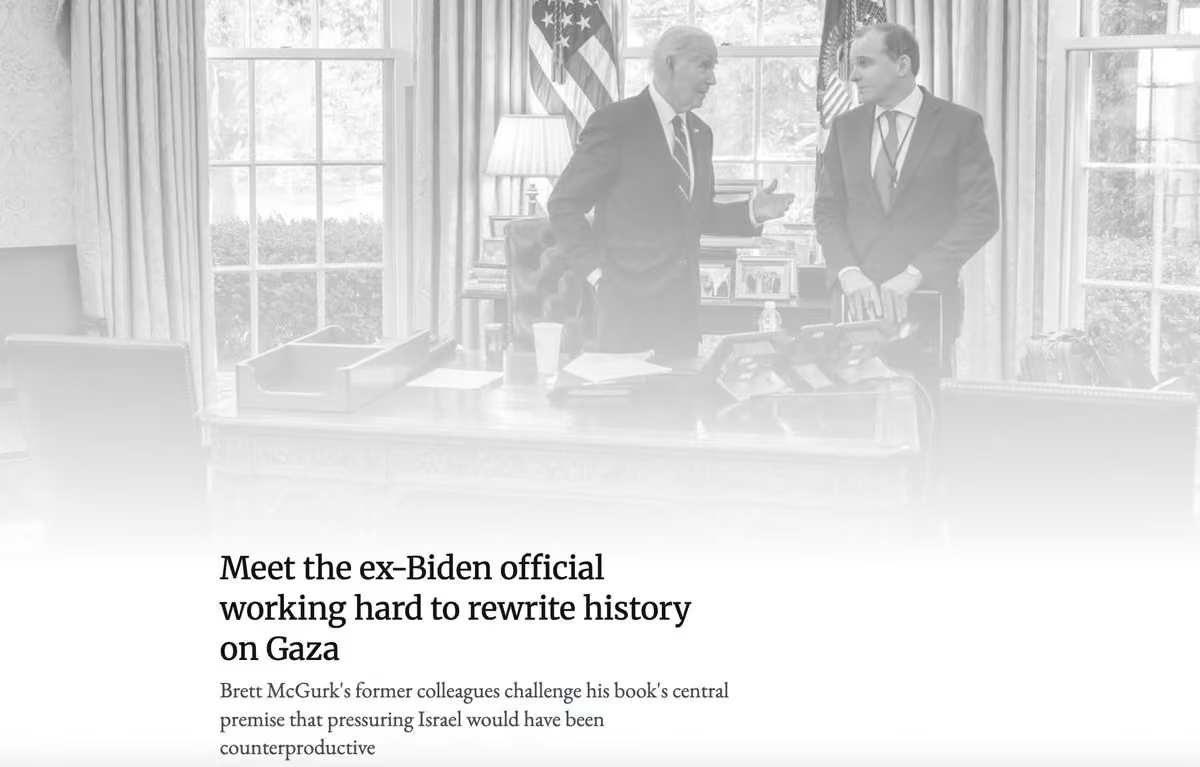
Brett McGurk's new book "Brink" tells the story of his efforts to free the October 7 hostages. In it, he argues that pressure on Israel only emboldened Hamas and prolonged the war.
But several former Biden officials challenge that narrative.
My latest for @RStatecraft (1/6): -
Quincy Institute
@QuincyInst
Americans’ views on Israel have shifted, so why haven’t our policies?
@EliClifton blames Citizens United, a ruling that gave PACs like the ones used by Israel’s Lobby unprecedented power.
In this midterm alone, pro-Israel super PACs have spent over $200M to counter bipartisan opposition to continuing aid for Israel.
You only need to spend like that when you’re pushing against an unpersuaded electorate.
The full roundtable on Israel’s lobby in the US, with @stephenWalt, @MearsheimerJ, Ian Lustick, and moderator Rashid Khalidi:
www.youtube.com/watch?v=8wqreOOLpd4&t=1919s -
Quincy Institute
@QuincyInst
Israel has the means and capabilities to defend itself.
Just last year, Israel sold at least $15B in military tech.
So why are everyday Americans still footing the bill for its disastrous wars?
@BenFreemanDC made the case for ending our support in a debate with @BlaiseMisztal on the debut episode of The Dialogue from @WashTimes.
Watch the full debate: www.youtube.com/watch?v=XpofKN1_75A -
Quincy Institute
@QuincyInst
Wondering why the cost of groceries keeps rising?
Look no further than the Iran war.
A recent study found that higher gas and diesel costs alone have added nearly $1,000 per household since the war began.
American farmers absorbed those costs first. USDA now expects farm fuel bills to hit $21.6 billion this year, up from $16.8 billion in 2025, and 70 percent of farmers say they can't afford all the fertilizer.
From the plow to the produce aisle, this war is draining the people who feed us.
Read the full brief from @Kahalzadeh. quincyinst.org/research/the-cost-of-the-iran-war-to-ameri… -
Quincy Institute
@QuincyInst
Follow the Money: Countering Illicit Finance in Latin America x.com/i/broadcasts/1RKjpbwWjYWJw
Quincy Institute
@QuincyInst
🔴 LIVE | Follow the Money: Countering Illicit Finance in Latin America
A conversation featuring @JYansura, @YaraEsquivel, @RajaKorman, & @lee_schlenker
x.com/i/broadcasts/1RKjpbwWjYWJw -
Quincy Institute
@QuincyInst
People around the world are eagerly awaiting the Israeli elections in the hopes that replacing Benjamin Netanyahu may restrain Israeli aggression.
Unfortunately, Netanyahu’s potential replacements have little interest in peace.
The latest from Steve Simon for the Quincy Institute: quincyinst.org/research/a-new-government-in-israel-what-t… -
Quincy Institute
@QuincyInst
Austin, plans tonight?
Join Quincy’s @KelleyBVlahos in conversation with @joekent16jan19 @scotthortonshow @AdamNoahWho and @DanMcKnight30 for the Not Our War tour!
RSVP to secure your spot! www.eventbrite.com/e/not-our-war-tour-ft-joe-kent-austin-… -
Quincy Institute
@QuincyInst
Collision Averted? The Brazilian Election and U.S.-Brazil Relations x.com/i/broadcasts/1pKkOXwlBZrKj
Quincy Institute
@QuincyInst
🔴 LIVE | Collision Averted? The Brazilian Election and U.S.-Brazil Relations
A conversation with @apagliar, @felicianosa, @anajanaina, & @globalsarang
x.com/i/broadcasts/1pKkOXwlBZrKj -
Quincy Institute
@QuincyInst
Who are the Houthis? What is Ansar Allah? Are the Saudis at war with Yemen? Is the US? And what does this all have to do with the US-Iran conflict?
Quincy's @AnnelleSheline breaks it down for @cspan www.c-span.org/program/washington-journal/annelle-sheline… -
Quincy Institute
@QuincyInst
The State Department’s human rights reports began after the US helped overthrow Allende and install Pinochet in Chile.
It turn out Americans weren't crazy about installing dictators under the guise of fighting communism. Congress agreed.
The reports were supposed to tie US weapons to a government’s treatment of its own people. A country that abused its citizens was not supposed to keep getting security assistance.
@AnnelleSheline worked on those reports at the State Department before she resigned over Gaza.
She tells us why she left, how she ended up there in the first place, and what is happening in Yemen right now.
The latest Always at War: www.youtube.com/watch?v=1esK1HBEFQM -
Quincy Institute
@QuincyInst
AUSTIN | OCT. 20
@joekent16jan19 resigned over the Iran war, arguing that it was not America’s fight.
Now he’s coming to Texas to talk about this war and what it's costing us with @scotthortonshow, @DanMcKnight30, @AdamNoahWho & @KelleyBVlahos.
RSVP: www.eventbrite.com/e/not-our-war-tour-ft-joe-kent-austin-…This media couldn't be displayed. See it on the original post. -
Quincy Institute reposted
Tori Bateman
@tori_bateman
Another great China Symposium in Seattle with @WSCRCWA, looking at the impact of U.S. policy towards China on Washington State businesses, Port traffic, and more. Stay tuned for the joint WSCRC/@QuincyInst summary of the event!
-
Quincy Institute
@QuincyInst
France, Pakistan, and the US have all sent personnel to Saudi Arabia to help counter the Houthi offensive in Yemen.
The question is why?
@AnnelleSheline breaks down the latest for @RStatecraft
responsiblestatecraft.org/saudi-arabia-yemen-war/ -
Quincy Institute
@QuincyInst
WE’RE HIRING!
@Rstatecraft is looking for a reporter to expose corruption and hypocrisy in the military industrial complex, on Capitol Hill, and across the federal government.
You’ll also write about the issues that matter to Americans outside the Beltway, including military families and veterans, and the economic and health impacts of war on local communities.
And you’ll cover federal elections as they intersect with foreign policy, and respond to breaking news.
Position is hybrid in DC. Apply by Nov 13: jobs.lever.co/quincyinst/d8d70d0d-d41c-4328-987e-4ca93cbe… -
Quincy Institute
@QuincyInst
Book Talk | Seasons of Fury x.com/i/broadcasts/1nGeLMddnpvKX
Quincy Institute
@QuincyInst
🔴 LIVE | Book Talk: Seasons of Fury
A conversation with @rozina_ali & @AnnelleSheline
x.com/i/broadcasts/1nGeLMddnpvKX -
Quincy Institute reposted
Trita Parsi
@tparsi
MUST READ by @Dalzell60
How China and America Can Move from Competition to Stability
"The choice is therefore not whether the United States will compete with China. Competition is unavoidable. The choice is whether that competition becomes an increasingly self-sustaining struggle for predominance or operates within a broader political strategy designed to produce a stable, beneficial peace over the long term."
warontherocks.com/how-china-and-america-can-move-from-com… -
Quincy Institute reposted
Michael D. Swaine
@Dalzell60
warontherocks.com/how-china-and-america-can-move-from-com…
All, here is my assessment of the dangers of our current U.S.-China relationship centered on strategic competition, the benefits of moving to a relationship keyed to constructive strategic stability, and a program for achieving the latter. I reject the transformational nature of the Xi-Trump detente and call for leaders on both sides to begin the hard work of gradually building a relationship based on stability and mutual benefit, not competition. Competition will remain, but needs to be placed within a larger constructive strategy. Peaceful coexistence via intense strategic competition with guardrails is not enough. It will not remove the growing dangers of the current policy. Please read and RT. I hope a sensible and civil discussion on this viewpoint can emerge. Thanks. -
Quincy Institute
@QuincyInst
Quincy’s @tparsi appeared on @AJEnglish to discuss the escalating regional war with Iran.
Major takeaways:
-Iran and the Houthis seem to have different objectives: Tehran wants this conflict contained, and a new front in Yemen could push every party past the point of control.
-The Houthis aren't exactly an Iranian proxy: Tehran has advised them against moves they made anyway, as Washington knows it from its own intelligence.
- If Trump is planning a bigger escalation against Iran after the midterms, helping the Saudis against the Houthis—in exchange for permission to use Saudi airspace to strike Iran — could be how he gets it.
-Stop claiming the strait is open. Escorting ships costs a huge amount of resources and can’t be sustained.
Watch the full interview: www.youtube.com/watch?v=5JCrMBtMF6A -
Quincy Institute reposted
Trita Parsi
@tparsi
Should the U.S. Keep Funding Israel?
@QuincyInst's @BenFreemanDC debates @BlaiseMisztal and knocks it out of the park!
www.youtube.com/watch?v=MmJd3NCUDrg&t=5s -
Quincy Institute
@QuincyInst
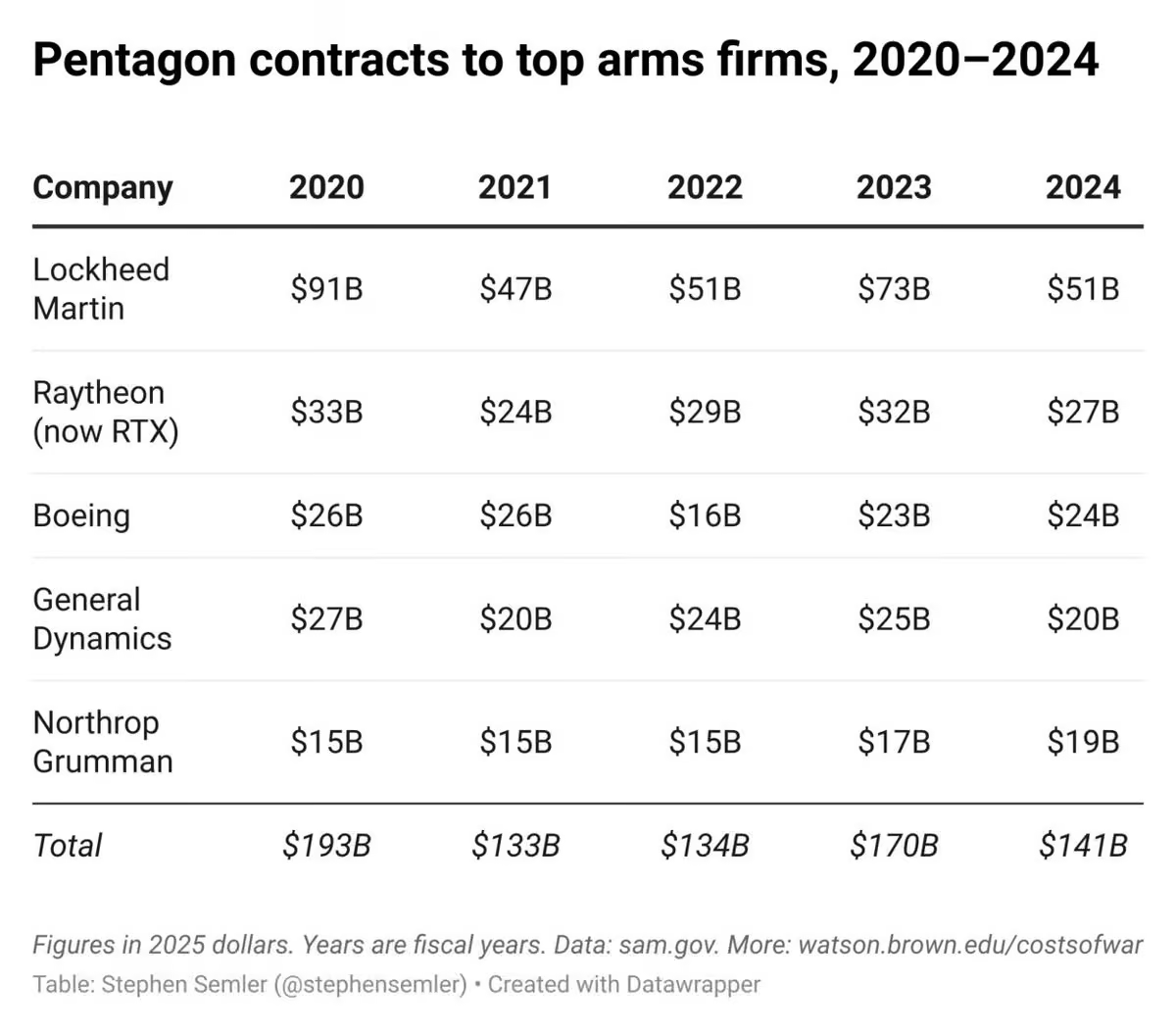
Some people get upset that 3/4 of Lockheed Martin’s $75 BILLION in revenue comes from American tax dollars.
Others worry that a profiteering defense industry keeps us locked in endless wars.
But have you ever considered that the Black Hawk, the Chickasaw, and the Choctaw are all named after Indigenous peoples?
Defense companies care about the people they annihilate. And they care about you too.
Don’t miss: Lords of War. Out now from @QuincyInst and @TheIntercept.This media couldn't be displayed. See it on the original post.
Quincy Institute
@QuincyInst
Watch Lords of War in full: www.youtube.com/watch?v=TiERu1r4Cio
-
Quincy Institute reposted
Trita Parsi
@tparsi
When Jake Sullivan was told of South Africa's opposition to the US's support for Israel's Genocide in Gaza, he responded: "Fuck South Africa"
When the Nobel Committee was told of South Africa's Navi Pillay's work to hold Israel accountable for its genocide, they gave her the Nobel Peace Prize.
This is a rebuke of BOTH the Trump AND the Biden administrations' efforts to undermine international law.This media couldn't be displayed. See it on the original post. -
Quincy Institute
@QuincyInst
Countless Palestinians have been killed since the so-called "cease-fire" began, and reconstruction has yet to start.
The Board of Peace’s own envoy warns that “Gaza will be gone. It will be gone for good.”
Read the full article from @elgindy_ at Foreign Affairs. -
Quincy Institute
@QuincyInst
NatCon started as a platform for imagining a new American conservatism.
This week it's taking place in Jerusalem.
@CurtMills calls it "window dressing for the Israel ultranationalist hardline project."
The latest from @KelleyBVlahos for @RStatecraft responsiblestatecraft.org/national-conservatives-israel/ -
Quincy Institute reposted
Trita Parsi
@tparsi
MUST READ report in the @nytimes on how David Milstein, a top aide to Ambassador Mike Huckabee, systematically skewed reporting in favor of Israel, ensured Washington would not receive problematic news from Israel, and protected Israel even as Israeli settlers killed Americans.
The reporting builds on the story @connor_echols of @QuincyInst first reported in @RStatecraft last year:
www.nytimes.com/2026/10/08/world/middleeast/israel-embass… -
Quincy Institute reposted
Institute for Peace & Diplomacy
@Diplomacy_Peace
🆕 The Iran war has intensified debate over whether the U.S.-Israel alliance is drawing Washington into commitments that undermine America’s own national interests.
Is unconditional U.S. support for Israel compatible with an #americafirst foreign policy?
Join our upcoming webinar next Wednesday at 2:00 PM ET featuring @SohrabAhmari @unherd, @Yonatan_Touval @Mitvim , @Hoffman8Jon @CatoInstitute, @AnnelleSheline @QuincyInst, moderated by @AKDay89 @amconmag.
➡️ Register now: us02web.zoom.us/webinar/register/WN_bknUleCbS8WtN1kRHN47cA -
Quincy Institute
@QuincyInst
Book Talk | Traversing the Belt and Road x.com/i/broadcasts/1dGYlanjoBQKX
Quincy Institute
@QuincyInst
🔴 LIVE | Book Talk: Traversing the Belt and Road
A conversation with @jorgeheinel & @globalsarang
x.com/i/broadcasts/1dGYlanjoBQKX -
Quincy Institute reposted
Dr. Annelle Rodriguez Sheline
@AnnelleSheline
💢 The Saudis could decide to make a deal with the Houthis and withdraw from Yemen.
💢 In this scenario, the Houthis, southern separatists, and other local actors would be left to determine the balance of power within Yemen.
💢 Without the excuse of a foreign aggressor, the Houthis would have no one to blame for their inability to provide for the Yemeni people.
💢 But if foreign powers continue to pour fuel onto Yemen’s conflict, it will continue to rage.
My latest, @ArabCenterDC
arabcenterdc.org/resource/why-saudi-arabia-has-returned-t… -
Quincy Institute reposted
Lee Schlenker
@lee_schlenker
Critics of militarized drug policy in LatAm often argue that a better approach is to follow the $. In our new @QuincyInst note, @RajaKorman + I provide a roadmap to operationalize this agenda, w/ recs for @USTreasury, the interagency & int'l cooperation ⬇️ quincyinst.org/research/follow-the-money-countering-illic…
-
Quincy Institute
@QuincyInst
Why is the United States always at war?
Maybe it has something to do with the culture of "Imperialist Realism" @dbessner describes in his latest book.
"Why do you think the United States is always at war? It's a good question, because I think we can't imagine a world where we're not."
Watch the full episode with him here: www.youtube.com/watch?v=ByfCTNFEZTM&t=4s -
Quincy Institute reposted
Security Dilemma
@securitydpod
New Episode:
@globalsarang of @QuincyInst joined the show to discuss what Washington gets wrong about BRICS and to recap the organization's recent summit.
Check it out!
open.spotify.com/episode/3xsdY3cYLVL2KZRT8m2oy1 -
Quincy Institute
@QuincyInst
We're hiring!
Quincy is looking for a Human Resources Operations Manager to start Nov. 1!
Find the full job description, benefits, expectations, and application here: jobs.lever.co/quincyinst/5d625a07-9e45-43a3-8d23-5744e6bf… -
Quincy Institute
@QuincyInst
THIS WEDNESDAY
Ten years later, what does China’s Belt and Road Initiative mean for Chinese grand strategy of today?
Join @jorgeheinel in discussion with @globalsarang as they discuss the forthcoming book "Traversing the Belt and Road."
Quincy Institute
@QuincyInst
RSVP here for the digital event here: quincyinst.org/events/book-talk-traversing-the-belt-and-r…
-
Quincy Institute reposted
Trita Parsi
@tparsi
.@MatthewKroenig and I debated the Iran war a few months ago at @ForeignPolicy. The episode got a lot of attention.
So FP/DohaForum invited us back to debate where we are now and whether it's been worth it.
Plenty of sparks...
www.youtube.com/watch?v=UhzxALtANac -
Quincy Institute
@QuincyInst
On Sunday, Brazilians go to the polls.
Will Brazil be the latest Latin American country to elect a right-wing leader, Flávio Bolsonaro? Or will the sitting president, Lula, benefit from Trump's wrongheaded attempts to bolster his opponent?
A new @QuincyInst research brief from @apagliar and @felicianosa unpacks the potential results and explains why even a Bolsonaro government is unlikely to become Washington's junior partner: quincyinst.org/research/structural-misalignment-and-the-l… -
Quincy Institute reposted
Kelley B. Vlahos
@KelleyBVlahos
I have a lot of questions for these two about what a new and improved global world order might look like TODAY at 2PM w/ @Diplomacy_Peace's @ArtaMoeini and @CharlesKupchan @Georgetown
Don't miss!
peacediplomacy.org/2026/10/01/america-in-a-post-hegemonic… -
Quincy Institute reposted
Andre Pagliarini
@apagliar
I wrote a brief on Brazil's election for @QuincyInst with @felicianosa. It analyzes the foreign policy stakes of the race and possible paths forward, marrying historical analysis with insights from political science. I'm very pleased with the result.
quincyinst.org/research/structural-misalignment-and-the-l… -
Quincy Institute
@QuincyInst
"The United States is pretty good at starting wars. It has a pretty lousy track record at the other end."
@dan_grazier deployed to Iraq in 2007. Nearly two decades later he still can't answer this one question: "if I had been killed in Iraq, what purpose would my death have served?"
He reflects on the last US troops leaving Iraq in his latest for @RStatecraft:
"People and societies make sacrifices by relinquishing something of value for some useful purpose. The best way to turn all that was lost in Iraq into a sacrifice is by learning the right lessons from the experience and then properly apply them moving forward." responsiblestatecraft.org/us-withdrawal-iraq/ -
Quincy Institute reposted
Responsible Statecraft
@RStatecraft
THURSDAY 2PM! RS's @KelleyBVlahos hosts @Diplomacy_Peace panel on what the world order might look like post-Trump w/ @ArtaMoeini & @CharlesKupchan
Don't miss this one!
peacediplomacy.org/2026/10/01/america-in-a-post-hegemonic… -
Quincy Institute
@QuincyInst
Book Talk | 1873—The Rothschilds, the First Great Depression, and the Making of the Modern World x.com/i/broadcasts/1NGarovDNRDJj
Quincy Institute
@QuincyInst
🔴LIVE | Book Talk | 1873—The Rothschilds, the First Great Depression, and the Making of the Modern World
A conversation with Liaquat Ahamed & @RajaKorman
x.com/i/broadcasts/1NGarovDNRDJj -
Quincy Institute
@QuincyInst
The AI debate keeps asking whether machines will escape human control. The more urgent question is what the U.S. security state is already doing with them.
The same firms that have reportedly helped build target lists for the war on Iran are now being used for domestic surveillance. For instance, did you know that the Pentagon asked Anthropic to allow analysis of bulk commercial data on Americans, including geolocation and web browsing history?
The apparatus of endless war always comes home to roost.
Read the full article from @BergerPosts at @RStatecraft responsiblestatecraft.org/pentagon-artificial-intelligence/ -
Quincy Institute
@QuincyInst
Ex-Biden officials want to distance themselves from Israel's ongoing genocide: why should they be held responsible for Israel's war crimes?
But as @AkbarSAhmed's new book shows, Biden's government had every opportunity to end the destruction it was enabling.
"Crossing the Red Line: Biden, His Advisors, and Israel's War in Gaza," lays out how that happened, decision by decision, and who was in the room when it did.
We're left asking: "Should anyone who served at the highest levels of the Biden administration ever enter government again?"
Read the full review from @connor_echols at @RStatecraft
Quincy Institute
@QuincyInst
Full article here: responsiblestatecraft.org/biden-gaza-scapegoat/
-
Quincy Institute reposted
Jake Werner
@jwdwerner
For @thenation, I explore DC’s deep sense of betrayal preventing new agreements with China—even to turn back existential threats.
China quietly subverted a US-imposed system that offered no path to development, leaving bitter resentment on both sides.
1/
www.thenation.com/article/world/us-china-trade-globalizat… -
Quincy Institute
@QuincyInst
NEW: Michael Petruzzello is a lobbyist known for helping rehabilitate Saudi Arabia’s image in the wake of 9/11, the murder of Jamal Khashoggi, and famine in Yemen
Now, he's registered as a foreign agent of the Saudi-backed government in Yemen.
Read @jrcooper_ in @RStatecraft -
Quincy Institute reposted
Scott Horton
@scotthortonshow
Scott Horton Show Ep. 6,276 - Eli Clifton and Ian Lustick on the State of Israel’s Lobby in 2026
This media couldn't be displayed. See it on the original post. -
Quincy Institute reposted
Trita Parsi
@tparsi
What I saw this past week at the UN was, on the one hand, a reminder of how isolated Israel has become internationally, and at the same time, how content Israel is with the deadlock between the US and Iran and the difficulties in finding a diplomatic breakthrough.
First on Israel. Not only did a record number of delegations walk out as soon as wanted war criminal Benjamin Netanyahu took to the podium - roughly 40% of all country delegations stood up and left the hall, prompting Netanyahu to call them “moral cowards” - but the Hague Group meeting earlier today provided additional signs of change.
Government representatives of more than 40 states attended and spoke at the meeting in support of the enforcement of international law in Israel/Palestine, including several foreign ministers. (Last year, there were roughly 30 governments represented.) And for the first time, a Foreign Minister of a Western state (Norway) gave one of the opening addresses.
Obviously, this does not in and of itself translate into meaningful action. Declarations do not make implementation. But my conversations with several governments this week reveal that the political grounds are shifting and various forms of sanctions measures appear increasingly plausible, if not likely.
On Iran, however, my conversations left me far more concerned.
Trump remains convinced that the blockade can bring Tehran to its knees and, as a result, lifting it will provide Iran with more money and time without necessarily bringing about a definite conclusion to the conflict.
But without the lifting of the blockade, in some form at least, no deal is possible.
This is a paradox the US has faced before. Once it concludes that its sanctions are biting, it resists trading that leverage for Iranian concessions for fear of losing it. As a result, sanctions become an end in themselves rather than a means to secure a deal.
The pain the sanctions can inflict becomes more important than the concessions they can elicit. Consequently, the conflict continues - and escalates.
But Trump is unpredictable and can surprise. But while there is some hope, it’s little more than a glimmer.
We’ll discuss this and much more during our 10th Q&A session, scheduled for Wednesday, September 30, at 1.00 pm ET.
Register for the Zoom here: tritaparsi.substack.com/p/there-is-hope-for-a-us-iran-bre… -
Quincy Institute
@QuincyInst
Introducing The Weight: a new documentary from the Quincy Institute and @VetsFP
The people who have fought America's longest wars are rarely in the room when the next one gets debated.
The Weight asks veterans where their voices belong on issues of war and peace. -
Quincy Institute reposted
The Intercept
@theintercept
Lords of War.
Out today.
By @QuincyInst & @TheIntercept.This media couldn't be displayed. See it on the original post. -
Quincy Institute reposted
Responsible Statecraft
@RStatecraft
"if Palestinians play their cards right maybe in a 100 years Lockheed Martin might name some future weapons technology after them. Maybe it could be a Yasser Arafat microwave gun"
New "Lords of War" mockumentary by @QuincyInst /@theintercept
responsiblestatecraft.org/lords-of-war/ -
Quincy Institute
@QuincyInst
The perception of stability between Beijing and Washington is breeding complacency on both sides, even as pressure builds up under the surface.
Xi and Trump need to put the US-China relationship on stable footing. Will they?
Read @jwdwerner in @RStatecraft -
Quincy Institute
@QuincyInst
In a world where half of our trillion dollar war budget goes to weapons contractors and their CEOs make 150x an enlisted soldier... one film finally gives these heroes the tribute they deserve.
Lords of War is out today.
A @QuincyInst x @TheIntercept ProductionThis media couldn't be displayed. See it on the original post.
Quincy Institute
@QuincyInst
Watch the full video here.
And a special thanks to our illustrious director @RussFinkelstein
www.youtube.com/watch?v=TiERu1r4Cio -
Quincy Institute reposted
Russ Finkelstein
@RussFinkelstein
I've been working for nearly a year on a special report for the Robert McNamara Center for Peace & Democracy about some of the best & brightest members of our military industrial community. @theintercept & @QuincyInst have decided to publish it as well: www.youtube.com/watch?v=TiERu1r4Cio&t=39s
-
Quincy Institute
@QuincyInst
Everyday Americans lose in any war with China, whether it's fought with tariffs or missiles. So why is Washington always pushing for battle?
Xi Jinping arrived in Washington today to a warm welcome, but beneath the handshakes, the pressure is building.
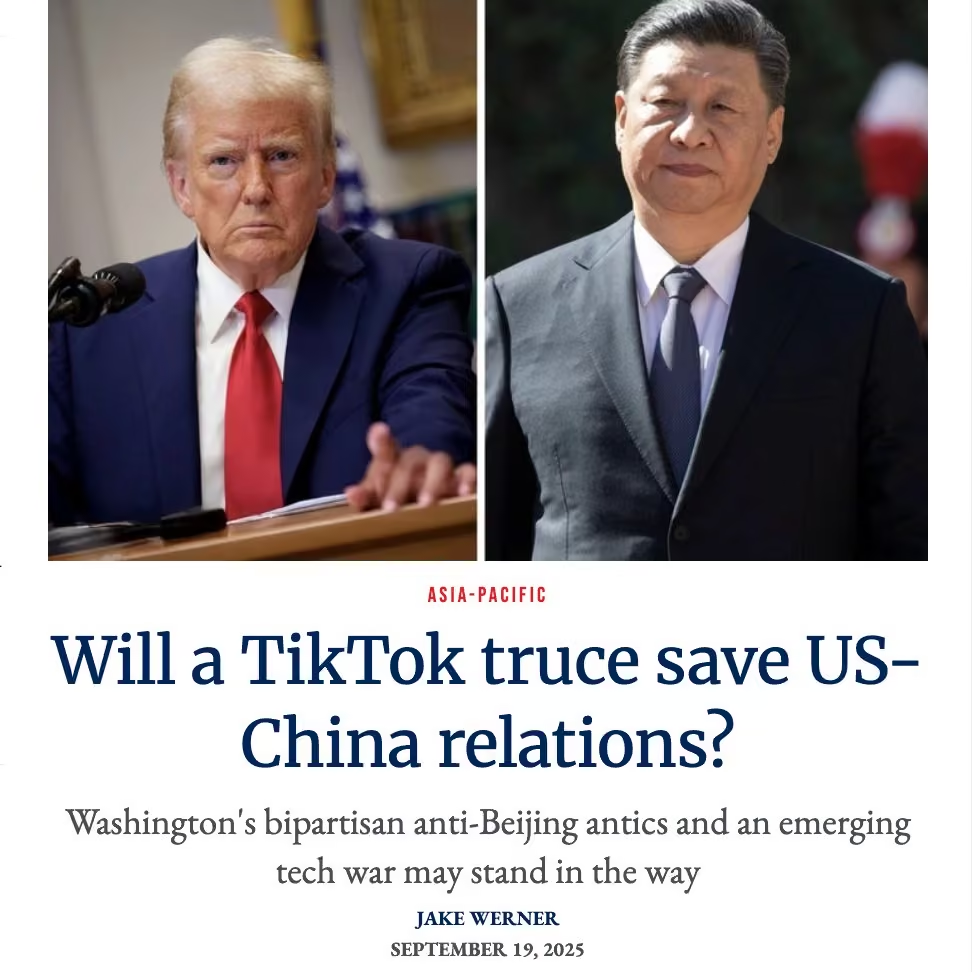
As @jwdwerner writes, "bipartisan hostility toward China has become the single unifying theme in the otherwise floridly dysfunctional US political system."
But a military conflict with China could cost us millions of lives and we already know the devastating effects of an economic one. Just consider China's rebuke of rare earth minerals following Liberation Day tariffs set at 145%.
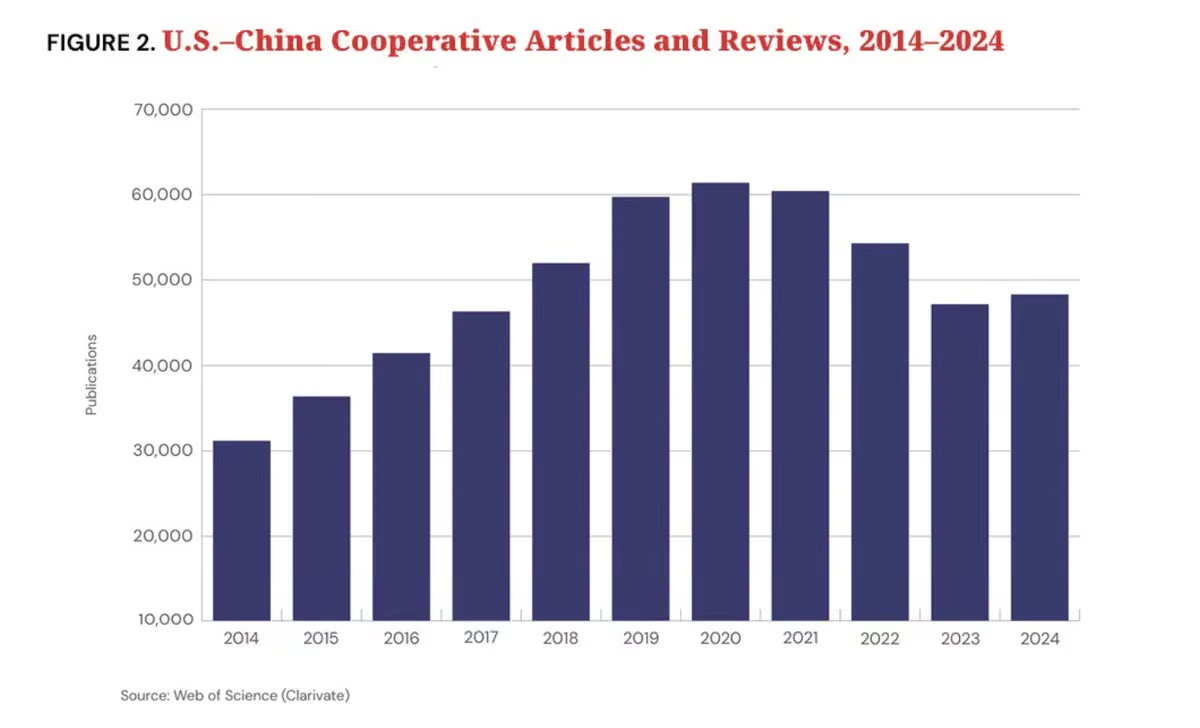
Cooperation, meanwhile, has paid real dividends. Nearly one-in-five US patents in AI and biomedicine had a Chinese-born co-author.
However, things have dwindled since 2017: joint US-China research fell by about 20%, just as China became the world's biggest producer of scientific research.
Read the full article from @jwdwerner at @RStatecraft: responsiblestatecraft.org/trump-and-xi-meeting-dc/ -
Quincy Institute
@QuincyInst
NEW POLL
Americans DO NOT want this war with Iran
-Only 26% of Americans approve of Trump's handling of the war
-76% say the war hasn't been worth the lives or the money
-Republican approval DROPPED from 73% to just 60%
-A majority of Republicans under 45 now disapprove -
Quincy Institute
@QuincyInst
President Xi Goes to Washington: Building Stability or Merely Postponing Conflict? x.com/i/broadcasts/1qxvvepnMZQxB
Quincy Institute
@QuincyInst
🔴LIVE | President Xi Goes to Washington: Building Stability or Merely Postponing Conflict?
A conversation featuring @jwdwerner, @AGraylin, @PaulJHeer, & @KelleyBVlahos
x.com/i/broadcasts/1qxvvepnMZQxB -
Quincy Institute reposted
Veterans in Foreign Policy Initiative
@VetsFP
Through the voices of 11 GWOT veterans, this 22-minute documentary asks what service means in a country where just 1% serve -- and what that divide means for the wars America fights next.
youtu.be/0na9l-Vnn0s -
Quincy Institute reposted
Jake Werner
@jwdwerner
With Xi Jinping arriving in DC tomorrow, I argue for @RStatecraft that Trump’s friendliness only masks the pressures building up under the surface.
The US foreign policy establishment and even most of Trump’s administration are moving us toward conflict.
responsiblestatecraft.org/trump-and-xi-meeting-dc/ -
Quincy Institute
@QuincyInst
Every headline right now: "AI WILL KILL US ALL"
Missing from the narrative: AI is already being used to kill people around the world and surveil Americans at home. AI CEOs are working closely with the Pentagon to build new, untested, and deadly weapons. And those same CEOs are asking lawmakers to gut antitrust laws so they can "win" a race with China.
New episode of Always at War: is the doomsday talk a warning or a distraction? @ckayerawlings and @alexjordanATL break it down.
www.youtube.com/watch?v=_x91nnvyZ4A&list=PLLP3oFXQU9footI… -
Quincy Institute
@QuincyInst
The German State Elections and the Rise of AfD x.com/i/broadcasts/1lKQRWXzvVYGE
Quincy Institute
@QuincyInst
🔴LIVE | The German State Elections and the Rise of AfD
A conversation featuring @tfasbend1, @wstreeckblog, @MollyONealATx, & @lieven_anatol
Quincy Institute
@QuincyInst
The German State Elections and the Rise of AfD x.com/i/broadcasts/1lKQRWXzvVYGE
-
Quincy Institute reposted
Alvin Wang Graylin
@AGraylin
New Quincy Institute Brief out today:
"The Wrong Race: The US, China, and AI Competition."
It pulls a year of my writing on the US-China AI "race" into one argument for policymakers, just ahead of Xi's visit to Washington.🚨
What the evidence shows:
•The frontier gap between US and Chinese models shrank from 12-14 months to 2-3 months, during the same period Washington tightened export controls. There is no sustainable winner!
•We're sprinting toward AGI while China builds for deployment and diffusion. Two different races and two different costs!
•Across 20+ fielded AI systems, danger doesn't track model size. Some of the most dangerous are small, open, and already out there. And cooperation is the only way to reduce it.
The brief lays out six cooperative measures both sides could adopt without having to trust each other, plus six changes to US strategy, from narrowing export controls back to a small yard to a GI Bill for the AI age. Please share with people that want to better understand this important issue. 💡
Thanks to the @QuincyInst team for the chance to bring it together.
@MarcusMStanley @tori_bateman @llumpe @AsiaPolicy @jwdwerner -
Quincy Institute
@QuincyInst
While Washington starves Cuba in the name of "national security," Trump and Rubio's allies are positioning themselves to get rich if the government collapses.
Read the latest from @lee_schlenker and @ManInHabana in @guardian
www.theguardian.com/us-news/2026/sep/17/trump-marco-rubio… -
Quincy Institute reposted
Sina Toossi
@SinaToossi
My new report for the @QuincyInst is out today 👇
The central argument is simple: Washington is making a serious mistake if it assumes it is still dealing with the Iran of the prewar period.
The wars of 2025 and 2026 have accelerated a profound shift in Iranian strategic thinking.
For years, influential elements of Iran’s leadership favored calibrated restraint: absorb pressure, preserve diplomatic offramps, avoid an uncontrolled escalation spiral, and gradually accumulate leverage.
The lesson many Iranian security elites now believe they learned is almost exactly the opposite: restraint without a credible willingness to impose painful costs was interpreted as weakness and ultimately invited war.
That is giving rise to what I call “persistent counter-escalation.”
The idea is not to match overwhelming US firepower. It is to deny Washington control of the escalation ladder by ensuring that pressure on Iran generates escalating costs elsewhere: against US bases, regional infrastructure, maritime commerce, energy flows, and through Iran’s regional partners.
Iranian strategists increasingly speak openly in these terms. One described a “pain index”: if the adversary imposes one unit of pain, Iran should impose two or three. Parliamentary speaker Mohammad Bagher Ghalibaf recently put it even more bluntly: “the era of proportionate responses is over.”
The Strait of Hormuz is central to this emerging doctrine. So are Iran’s missiles and drones, its regional alliance network, economic coercion, and increasingly, a debate over whether these capabilities are sufficient without a nuclear deterrent.
This is ultimately about more than how Iran fights. Tehran is trying to convert wartime leverage into a different regional order, one in which Iran cannot be attacked or economically isolated while US bases, neighboring states, energy infrastructure, and maritime commerce remain insulated from the consequences.
There is a dangerous paradox here. This strategy may strengthen Iran’s ability to impose costs, but it also creates far more pathways for every confrontation to become a regional conflagration.
That leaves Washington with a question military superiority alone cannot answer: Does imposing still greater damage on Iran restore deterrence, or reinforce Tehran’s conclusion that only greater capacity to impose costs on everyone else can keep it secure?
Breaking that cycle is essential if Washington wants to escape this strategic quagmire rather than deepen it through more rounds of escalation
Read the full report here:
quincyinst.org/research/from-strategic-patience-to-persis… -
Quincy Institute reposted
Lee Schlenker
@lee_schlenker
A growing cast of DC + FL insiders are jockeying for control of Cuba's key assets, charging top dollar to help clients navigate a new web of sanctions, & positioning themselves for lucrative business opportunities in case the regime collapses, @ManInHabana & I write in @guardian.
Shashank Joshi
@shashj
“Since an executive order signed by Donald Trump on 1 May drove Canada’s Sherritt International from its nickel and cobalt mining joint venturewith the Cuban state, two rival US bids to buy out its stake have been presented to US authorities”
www.theguardian.com/us-news/2026/sep/17/trump-marco-rubio… -
Quincy Institute
@QuincyInst
Why are we sending 40,000 2,000-lb bombs to Israel while they're committing a genocide?
Why are we sending 5,000 of these same bombs to Saudi Arabia just days after the 25th anniversary of 9/11, a horrific attack carried out by hijackers with deep ties to the Saudi government?
Why are we inking $7.8B in arms sales when our stockpiles are dwindling?
Why are we funding mass death and military aggression in the Middle East?
Serious question.
responsiblestatecraft.org/trump-israel-arms-sale/ -
Quincy Institute
@QuincyInst
NEW RESEARCH
Since the end of the Cold War, America’s poorly calibrated approach to former Soviet states like Ukraine has had disastrous consequences, in part precipitating the West’s geopolitical crisis with Russia. While Washington may hope to shift its focus toward competition with Beijing, this pivot is bound to fail so long as America maintains the same misguided approach to other states on Russia’s periphery like Armenia, Azerbaijan, Belarus, Georgia, and Moldova.
Past calls for integrating Ukraine and Georgia into NATO, for example, created dangerous geopolitical gray zones that contributed to Russian aggression while failing to secure Western military commitments to defend these so-called “in-between states.” The best way to advance America’s interests in Europe — avoiding war, promoting stability, and supporting economic development — is to take a different approach to these states, based on four strategic principles:
1.) Rejecting further NATO expansion or other US military guarantees to states along Russia’s border.
2.) Promoting economic connectivity projects across the in-between states.
3.) Encouraging the in-between states to maintain and pursue foreign and trade policy flexibility that permits positive relations with both Western and non–Western partners.
4.) Pairing US regional engagement with targeted confidence-building measures with Russia to prevent dangerous security spirals.
Securing a negotiated compromise settlement in Ukraine that guarantees Kyiv a viable economic path into the European Union while establishing formal Ukrainian military neutrality would greatly aid the United States in successfully developing and executing a new blueprint for its approach in Eurasia. Such a deal would offer Washington an opportunity to transform the in-between states into valuable economic partners that directly bolster long-term American industrial competitiveness.
The Trump Route for International Peace and Prosperity, or TRIPP, between Armenia and Azerbaijan, is a positive example that could be expanded on. Continued US support for strategic geoeconomic projects, like TRIPP or the development of Black Sea port infrastructure in Georgia, would not only help the region but also secure Western access to critical minerals and offer alternatives to supply chain choke points. In addition, targeted US diplomatic actions in the region — such as supporting Moldova’s EU integration while helping resolve the Transnistria dispute, advancing dialogue with Belarusian President Alexander Lukashenko, and reestablishing a strategic partnership with Georgia — can play a key role in refocusing US engagement on America’s core interests in the region.
By discarding Washington’s open-door policy toward NATO enlargement and embracing prudent, interest-driven economic diplomacy, the United States can safeguard European stability, secure vital resource supply chains, and free up critical national security resources that are necessary for managing greater challenges.
The latest from @MEpiskopos and @artinthinks quincyinst.org/research/a-blueprint-for-us-policy-toward-… -
Quincy Institute
@QuincyInst
Can India, China, and Russia be the keys to ending America's reckless war with Iran?
@ahandjani lays out what it could look like for @ForeignPolicy.
Iran needs two things Washington can't credibly offer: a security guarantee that survives the admin's wanton policies and sanctions relief that isn't contingent on America's goodwill.
That's where these three BRICS nations come in.
Russia brings two decades of defense-building with Tehran: air defense systems, training, a formal strategic partnership treaty.
China's contribution is almost entirely economic. Beijing already buys most of Iran's oil outside the dollar system. Formalizing that investment gives Tehran an economic future Washington can't sanction away.
India is the outlier. Their a close US ally that also works with Iran through the Chabahar port. That dual position makes New Delhi one of the only capitals that can talk to both sides without either assuming bad faith.
But one reality needs to be reckoned with: "Moscow, Beijing, and New Delhi will not rescue US policy out of goodwill." foreignpolicy.com/2026/09/15/only-china-india-and-russia-… -
Quincy Institute
@QuincyInst
The weapons industry employs more than one lobbyist for every member of Congress...
That helps explain why Congress keeps choosing war over peace.
As our guest @tori_bateman explains, "It seems like it's an easier thing to do to bomb a country and to keep us in these wars than it is to do the really ridiculously complicated work of diplomacy."
Watch the full ep: www.youtube.com/watch?v=owwFKjbXH98&list=PLLP3oFXQU9footI… -
Quincy Institute
@QuincyInst
Twenty-five years ago today, al-Qaida hijackers in passenger planes killed in New York, Washington, and a field in Pennsylvania.
What followed didn't just change airport security. It fundamentally changed how America operates.
Those who didn't live through 9/11 only know this "new" America, one marked by endless war and mass surveillance.
@RStatecraft asked foreign and national security experts — journalists, scholars, activists — what they miss most about the America that existed before the attacks on September 11, 2001.
@KatrinaNation, publisher at @thenation, recalled life's slower cadence: "We spent more time living, less on our smartphones and social media platforms. There was more time to think, read, converse about news and ideas. Public life was not mediated by toxic, isolating algorithms."
Chas Freeman, former Ambassador to Saudi Arabia, wrote "I miss the Constitution, the Bill of Rights, and the rule of law. These were the things that made the US great. They have been steadily eroded to create a warfare state in which the executive exercises unbridled power, the legislature defers to the executive, and the courts are politicized."
@stephenkinzer, author of "Overthrow: America's Century of Regime Change from Hawaii to Iraq," reflected on Americans' self image: "Americans used to admire themselves for creating a country that was a force for good in the world. That self-image has been largely shattered. The reality of American power did not change after 9/11, but our fantasy faded."
Read the full symposium here: responsiblestatecraft.org/america-before-911/ -
Quincy Institute
@QuincyInst
Twenty-Five Years After 9/11: War, Memory, and the World It Created x.com/i/broadcasts/1nxnRBrNdnNxO
Quincy Institute
@QuincyInst
🔴LIVE | Twenty-Five Years After 9/11: War, Memory, and the World It Created
A conversation featuring @AdamNoahWho, @DavidKieran2, @SaltzmanGIIS, Dr. Sultan Alamer, & Melani McAlister
@ElliottSchoolGW
x.com/i/broadcasts/1nxnRBrNdnNxO -
Quincy Institute
@QuincyInst
NEW RESEARCH
Washington is waiting out Israeli Prime Minister Benjamin Netanyahu. The implicit assumption is that he alone is responsible for policy differences between the United States and Israel. A new government under former Prime Minister Naftali Bennett or former army chief of staff Gadi Eisenkot would set things right and revive Israel’s reputation in American public opinion. It is a comfortable assumption — but also a deep misreading of what has gone wrong and what fixing it requires.
The crisis in US–Israel relations does not originate solely with Netanyahu or his partners. It comes from policies with broad Israeli backing that his successors would likely continue, whatever personal reservations they might harbor. Bennett supports building in the E1 corridor, which would sever the northern West Bank from the southern and make a Palestinian state deeply impractical. Eisenkot has recently said that to do so would be “a mistake” but without pledging to drop it.
On the Gaza Strip, a new cabinet would likely oppose renewed Jewish settlement in the enclave but still leave governance bound to President Donald Trump’s peace plan through 2027, as the Board of Peace slips and reconstruction shrinks to a pilot program in Rafah.
On Iran, there is a strong Israeli consensus to continue to confront Tehran. Divisions are about competence and alliance management, not core strategies.
Settler violence in the West Bank is where a new government would move fastest, but the ceiling is low. Removing Finance Minister Bezalel Smotrich and National Security Minister Itamar Ben-Gvir would reduce state cover for extremist networks and lax enforcement. But today only three percent of cases against Israeli settler violence end in conviction; a situation that Bennett or Eisenkot could remedy.
The sharpest measure is the benchmark of normalization with Arab states. Saudi Arabia’s threshold for normalization is a “clear and irreversible path” toward Palestinian statehood. Bennett and Eisenkot oppose Palestinian statehood. Eisenkot wants to keep the Jordan Valley and every settlement bloc under Israeli control. Neither reaches the Saudi threshold.
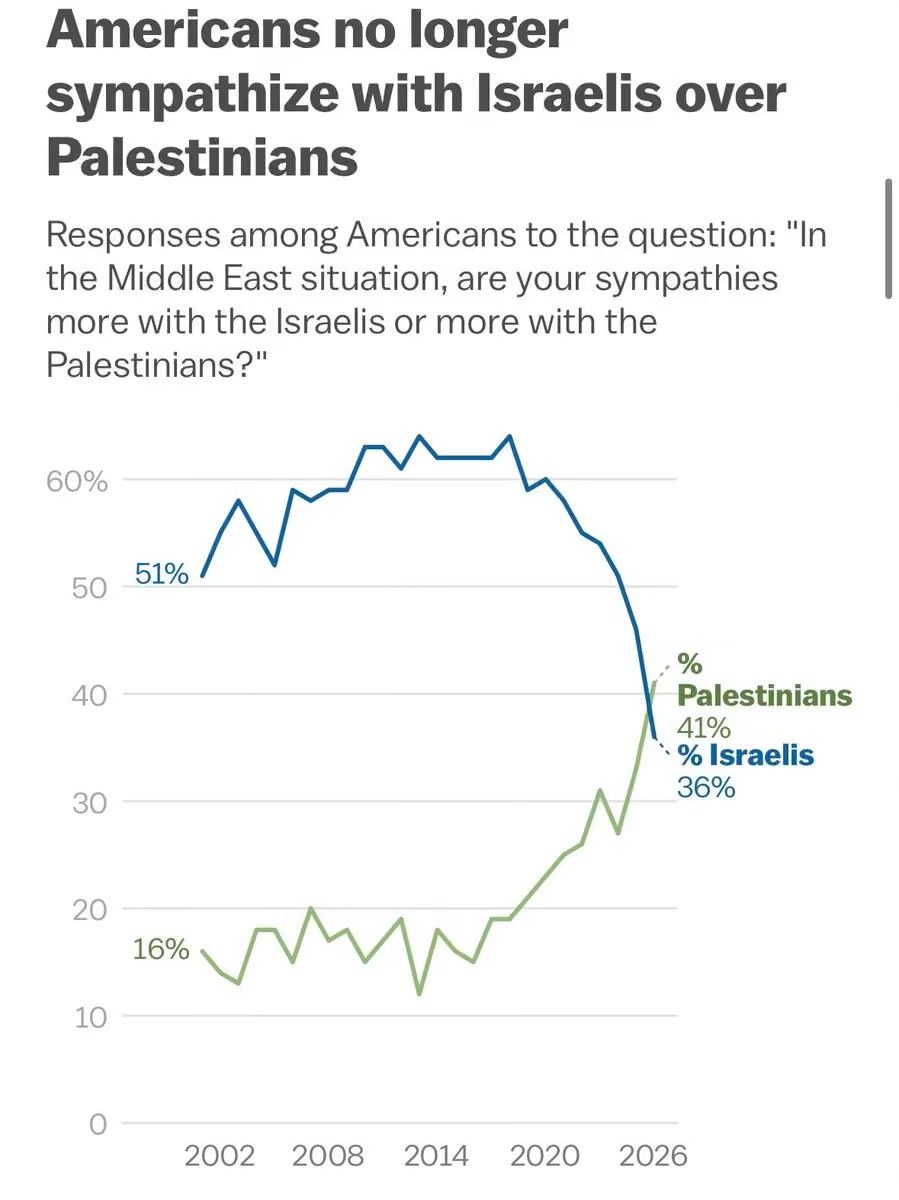
American public opinion is further out of reach. Gallup shows sympathy for Israel over Palestinians has flipped for the first time since 2001: 60 percent of Americans view Israel unfavorably. Pollsters call the shift structural, having accumulated over years of war rather than in response to any one leader. A friendlier face in Jerusalem will not reverse a long-term trend accelerated by the Gaza death toll, West Bank violence, and war with Iran.
None of this makes Bennett or Eisenkot another Netanyahu. Either of the former would be easier to work with, more predictable, and less inclined to meddle in American politics. That is worth something. However, it is not a reset. Policies serving American interests in peace and stability in the region will still need to be at the center of bilateral diplomacy.
Read the latest from Steve Simon here: quincyinst.org/research/a-new-government-in-israel-what-t… -
Quincy Institute
@QuincyInst
NEW ALWAYS AT WAR
Congress has the constitutional power to end a war. It keeps choosing not to use it.
We asked the Quincy Institute's @tori_bateman why, on this week's episode.
Spoiler alert: they don’t lack the power. They lack the courage.
www.youtube.com/watch?v=owwFKjbXH98&list=PLLP3oFXQU9footI… -
Quincy Institute
@QuincyInst
Book Talk | Imperial Realism x.com/i/broadcasts/1OGwbngmXVEKB
Quincy Institute
@QuincyInst
🔴LIVE | Book Talk | Imperialist Realism
A conversation featuring @dbessner & @AnnelleSheline
x.com/i/broadcasts/1OGwbngmXVEKB -
Quincy Institute reposted
Sarang Shidore
@globalsarang
Here's #brics in three charts:
The first: BRICS has overtaken the G7 in economic output!
This is even more true for the expanded BRICS (10 states)
China does much of the work (as expected) but other BRICS states are also doing their part! -
Quincy Institute reposted
Dr. Annelle Rodriguez Sheline
@AnnelleSheline
🔥Latest Always at War podcast, w/ @ckayerawlings & @alexjordanATL, featuring @QuincyInst's Advocacy Director @tori_bateman
Why are think tankers like lizards in glass tanks? 🦎
Grateful for all Tori's work getting OUR lizardly work onto the Hill
www.youtube.com/watch?v=owwFKjbXH98&list=PLLP3oFXQU9footI… -
Quincy Institute reposted
Dr. Annelle Rodriguez Sheline
@AnnelleSheline
.@QuincyInst NRF @dbessner argues that Americans accept our global empire not because it is righteous but because it is inevitable
I'll argue that there are a lot of folks at State who still believe it is righteous
🗓️ Tomorrow, 9/9
🕛 12pm DC, 🕘 9am LA
quincyinst.org/events/book-talk-imperial-realism/ -
Quincy Institute
@QuincyInst
BRICS keeps growing and Washington keeps misreading why. The bloc, now spanning Brazil, India, Indonesia, South Africa, China, Russia, and a widening circle of partners, isn't the anti-US alliance many in DC assume. It's a loose coalition of states with different political systems united mainly by three things: sovereignty, faith in the UN system, and a shared push on development.
The irony is that Washington's own behavior feeds the thing it fears. Every disruption to the multilateral order gives BRICS states more reason to hedge against American unpredictability. The bloc's reformism actually lines up with US interests: new markets, more stable regions, less pressure driving migration. Repairing ties with Brazil and India would do more to check BRICS than any amount of de-dollarization panic.
Read the full brief from @globalsarang quincyinst.org/research/crying-wolf-the-united-states-and… -
Quincy Institute
@QuincyInst
What Americans want:
-Clean drinking water
-Safe, well-funded schools and hospitals
-Real investment in stopping the climate disasters already hitting communities
What Americans get:
-Unending war abroad fueled by the empty promises of Washington's war machine.
It doesn’t have to be this way. -
Quincy Institute
@QuincyInst
The Pentagon has failed every financial audit since Congress started requiring them in 2018. That's eight years in a row. It's the only major federal agency that has never passed one.
That means auditors haven’t been able to verify:
-What weapons and equipment the department actually owns
-Where billions of dollars in assets are located
-Whether spending matches what Congress approved
The Pentagon gets more money from Congress each year than any other agency. And no one, not even the Pentagon, can fully account for where it goes.
Maybe that's not incompetence. Money nobody can trace is money nobody can be held accountable for.
One thing we do know for certain: while the department can't pass a basic accounting check, weapons CEOs keep getting richer off it. -
Quincy Institute
@QuincyInst
Things a majority Americans don't want:
-The war with Iran
-Continued, unchecked aid to Israel
-Integrating US and Israeli military sectors
-A war with Cuba
Things Washington keeps pushing anyway:
^All of the above.
Crazy idea, but what if our government reflected Americans’ vision instead? -
Quincy Institute
@QuincyInst
BRICS — the growing transcontinental coalition of major Global South states such as Brazil, India, Indonesia, and South Africa, and the “Global East” of China and Russia — is not the anti–American alliance Washington fears. It is a reformist, not radical, group. But the more the US disrupts the multilateral framework, the more it reinforces the very rationale — hedging against American unpredictability and global uncertainty — that fuels the grouping’s growth.
BRICS is not a formal alliance and will never be one. It is made up of states with very different political systems, bound by a few common interests. The most important of these are respect for state sovereignty, endorsement of the UN system, and focusing on shared challenges such as economic development. The newly expanded BRICS now spans practically all regions of the Global South and includes 10 member states and 10 “partner countries.” Collectively, BRICS surpassed the GDP of the G7 countries — Canada, France, Germany, Italy, Japan, the United Kingdom, and the United States — in 2019.
The New Development Bank is BRICS’ most successful institution. Notably, no member of the NDB has individual veto power, nor are loans conditioned on standards imposed from above — a stark departure from the intrusive practices of the World Bank. Other initiatives are still a work-in-progress.
Washington swings between two unhelpful poles on BRICS: contemptuous dismissal or overhyping the threat of BRICS’ alleged attempts at de-dollarization. But most BRICS members have not supported de-dollarization. While the upcoming BRICS summit in New Delhi will continue work on a member-wide payment system, it is still far from completion, and political will to adopt it remains limited.
BRICS is neither irrelevant to the global order nor currently a threat to US interests. Washington should respond proportionately to the signal it represents. Despite emerging internal rifts, BRICS is likely to expand its developmental impact slowly. BRICS’ reformism and developmentalism can align with US interests, opening new markets for US businesses, stabilizing regions, and curbing global migration flows as a byproduct. The United States will benefit by repairing ties with BRICS states, most notably Brazil and India. Washington could also reduce the chances of BRICS emerging as the nucleus of a multi-order world through a selective return to multilateralism and avoiding blunders, like military interventionism, which alienate much of the Global South.
Read the latest brief from @globalsarang : quincyinst.org/research/crying-wolf-the-united-states-and… -
Quincy Institute reposted
Dr. Annelle Rodriguez Sheline
@AnnelleSheline
🗓️ Wed, Sept 9th
🕛 Noon EDT, 9am PDT
🔗 Register below
What can Call of Duty: Black Ops Cold War and The Rings of Power tell us about our current moment?
Join me & @QuincyInst non-resident fellow @dbessner to discuss his new book, Imperialist Realism
quincyinst.org/events/book-talk-imperial-realism/ -
Quincy Institute
@QuincyInst
American funded and American supplied weapons are behind a two-year campaign that has degraded much of southern Lebanon's land using white phosphorus munitions, mass building detonations, and aerial herbicide spraying.
Lebanon's National Council for Scientific Research estimates $25B in environmental damage from strikes in 2023 and 2024 alone, including forests and olive groves, some of which were centuries old.
The demolitions go well beyond the stated justification of destroying Hezbollah infrastructure.
Israel's own defense minister has said all homes in these border villages will be destroyed, comparing it to the roughly 90% demolition rate in Gaza's Rafah and Beit Hanoun.
He also stated that ~600,000 residents will not be permitted to return to their now destroyed or poisoned villages.
The latest from @Janetabouelias in @RStatecraft: responsiblestatecraft.org/israel-destroy-south-lebanon/ -
Quincy Institute
@QuincyInst
Nine billionaires have given over 1.7 billion dollars in campaign contributions where, according to journalist Eli Clifton, "Israel is the driving motivation for their engagement in American politics."
@EliClifton and Ian Lustick break down how this money is used to skew elections and shape domestic politics on the new Always at War.
www.youtube.com/watch?v=KJsFMBVzUtU&list=PLLP3oFXQU9footI… -
Quincy Institute
@QuincyInst
Have a question for the authors of "Israel's Lobby: America in the Grip of a Foreign Power?"
Good news, @EliClifton and Ian Lustick are hosting a Reddit AMA with r/JewsOfConscience.
AMA goes live 12pmEST on Sept. 1
Drop your questions here: www.reddit.com/r/JewsOfConscience/comments/1vxhb77/ama_in… -
Quincy Institute
@QuincyInst
China – US Investment: A Security Threat or an Opening to Reform the World’s Most Important Economic Relationship? x.com/i/broadcasts/1pKdRDjVqQjJW
Quincy Institute
@QuincyInst
🔴LIVE | China – US Investment: A Security Threat or an Opening to Reform the World’s Most Important Economic Relationship?
A conversation featuring @jwdwerner, @jonasnahm, Susan Helper, & @MarcusMStanley
x.com/i/broadcasts/1pKdRDjVqQjJW -
Quincy Institute
@QuincyInst
A new GAO report finds the Pentagon's maintenance backlog has ballooned to more than $285B, more than double the roughly $137B backlog recorded in 2022.
The backlog keeps growing because the military keeps underfunding it on purpose. Each year, the services request only about 80% of what their own cost models say repairs and maintenance actually require. GAO is blunt about what that means: the Pentagon is knowingly choosing to risk mission readiness and troops' quality of life rather than pay to keep its own facilities in working order.
The result shows up in the buildings where troops actually live and work. Barracks at Naval Station Norfolk have had suspected mold since 2023, but officials declined to test for it, citing the cost of testing and potential remediation. At Fort Wainwright, a dining facility built to serve 800 has to feed about 3,000 soldiers, so many skip it for less healthy food in their rooms, especially in winter when waiting in line outside isn't realistic.
All of this is happening as the Pentagon's budget keeps climbing. The White House just requested a record 1.5 trillion dollars for FY 2027.
The latest from @stavroulapabst for @RStatecraft.
Quincy Institute
@QuincyInst
Read the full article here: responsiblestatecraft.org/military-installations-conditio…
-
Quincy Institute
@QuincyInst
Trump's Pentagon budget keeps climbing while health, education, and veteran's benefits face the chopping block.
Join @BenFreemanDC in Burlington, NC as he discusses his new book, The Trillion Dollar War Machine and what we can do to fight back.
August 28, 1pm ET at Persnickety Books.
Free and open to the public! -
Quincy Institute
@QuincyInst
Thriving, Surviving, Zombifying or Dying: What Future for USMCA? x.com/i/broadcasts/1aKbdEymYwXJX
Quincy Institute
@QuincyInst
🔴LIVE | Thriving, Surviving, Zombifying or Dying: What Future for USMCA?
A conversation featuring @snlester, @reziemba, @JCBakerMX, & @RajaKorman
x.com/i/broadcasts/1aKbdEymYwXJX -
Quincy Institute reposted
Trita Parsi
@tparsi
.@miadmaleki and I were on @CNN regarding Bessent's D-Day sanctions on Iran. Needless to say, we hold rather opposing views on both what these sanctions will achieve and whether this war has been a success thus far.
This media couldn't be displayed. See it on the original post. -
Quincy Institute reposted
Trita Parsi
@tparsi
As Bessent declares D-Day sanctions, a few points to keep in mind, as I wrote on my Substack:
1. Yes, this can squeeze the Iranians. But the pattern so far is that pain is inflicted, but translating that pain into a policy change is a different matter. The US has almost never succeeded in doing that.
2. This is particularly true since Bessent is not even listing what the US demands are. This leaves Tehran with the impression that the goal of the sanctions is Iran's surrender. And it's very clear that the Iranians will choose escalation over surrender.
3. This was the massive miscalculation Trump committed at the outset of this war, since he believed that Iran would fear war so much that it would choose capitulation. He never understood that Tehran feared surrender far more than it feared war. That still holds true today.
4. As a result, instead of this ending the war, the D-Day sanctions are more likely to elicit Iranian counter-escalation and, as a result, turn out to be yet another round in this long-standing escalation cycle.
5. There is a scenario in which the pain inflicted on Iran is more limited and, as a result, Tehran refrains from an immediate counter-escalation. But the combination of the blockade and these sanctions will very likely squeeze Iran over the longer run, which will incentivize Tehran to counter-escalate sooner rather than later, as its trajectory will be negative. As such, such a new status quo will be inherently unstable, and the absence of an Iranian response should not be misread.
tritaparsi.substack.com/p/has-trump-turned-the-tables-on-… -
Quincy Institute reposted
Trita Parsi
@tparsi
"Afghanistan, Cuba, Iran, and Vietnam are very different countries, but each has at different moments been shaped by America’s difficulty moving beyond humiliation, grievance, and perceived defeat. The lesson is not that reconciliation is easy or that adversaries always become friends, but that pragmatic engagement, however slow and imperfect, is more likely to produce better outcomes than turning temporary enemies into permanent ones." - @AdamNoahWho
foreignpolicy.com/2026/08/24/iran-afghanistan-united-stat… -
Quincy Institute reposted
Trita Parsi
@tparsi
Told @Bannons_WarRoom that Trump's D-Day sanctions will either fail to squeeze Tehran very hard and not much happens, or they will be hard-hitting and then the question is whether Iran counterescalates or surrenders. And the pattern so far is really clear: Iran fears capitulation much more than escalation.
And given that Bessent has not listed any clear demands, Tehran will interpret the purpose of D-day as a measure to force its surrender.
So instead of this leading to an end to the conflict, it will just start another round of the escalatory cycle.This media couldn't be displayed. See it on the original post. -
Quincy Institute
@QuincyInst
Get this:
31 former members of Congress and top staff have left Capitol Hill and joined the military-industrial complex as lobbyists or contractors since 2015
Read @jrcooper_ in @rstatecraft on @BulletinAtomic's shocking new report on the military-industrial complex’s “revolving door" responsiblestatecraft.org/defense-contractors-revolving-d… -
Quincy Institute
@QuincyInst
How did Israel's lobby become more powerful — and more unpopular — than ever?
On the latest episode of Always At War, @EliClifton and Ian Lustick explain how Israel's lobby became one of the most powerful special interests in Washington, thanks to changes in American campaign finance laws, Israeli politics, and the global order.This media couldn't be displayed. See it on the original post.
Quincy Institute
@QuincyInst
Watch the episode on @QuincyInst's YouTube and listen wherever you get your podcasts! www.youtube.com/watch?v=KJsFMBVzUtU
-
Quincy Institute reposted
Adam N Weinstein
@AdamNoahWho
The US has a habit of creating forever enemies, especially after humiliating ruptures: Iran’s hostage crisis, Cuba’s expulsion of diplomats, the evacuations of Saigon & Kabul. Frozen relations do thaw, but emotion comes first. My latest in @ForeignPolicy.
foreignpolicy.com/2026/08/24/iran-afghanistan-united-stat… -
Quincy Institute
@QuincyInst
The Israeli government is running advertisements on a popular podcast hosted by Senator Ted Cruz, raising questions about whether the staunchly pro-Israel lawmaker is indirectly receiving campaign funding from a foreign country.
The advertisements, which are part of the $7 million “I am Israel” campaign launched in June, are geared toward encouraging Christians to visit the country and see biblical sites for themselves.
“Israel isn’t a destination; it’s a revelation, where every site you’ve studied, every scripture you’ve memorized, every sermon that ever moved you suddenly has an address, a landscape, a heartbeat,” Ben Ferguson, Cruz’s co-host, says in one ad. “This is the trip that changes not just how you see the Holy Land, but how you see everything.”
Ferguson then urges listeners to “start planning your trip today” and tells them to follow “Visit Israel” accounts on social media. The ads do not disclose that Visit Israel is a public-facing entity of the Israeli ministry of tourism.
The campaign appears to exploit a loophole in election financing laws. Candidates and PACs are banned from receiving any funding “directly or indirectly” from foreign nationals, according to the FEC.
Read @connor_echols and @nick_clevelands' reporting in @RStatecraft: responsiblestatecraft.org/ted-cruz-israel/ -
Quincy Institute reposted
Connor Echols
@connor_echols
NEW: The Israeli government is paying for ads on Ted Cruz's podcast.
Cruz can't take the money himself. But, under an unusual licensing deal, those foreign funds can go to a super PAC dedicated exclusively to Cruz.
Let me explain (1/7) -
Quincy Institute reposted
Washington Journal
@cspanwj
SAT | Quincy Institute's (@QuincyInst) Hadi Kahalzadeh (@Kahalzadeh) discusses not only Iran's ability to hold off attacks by the U.S. but also the options left for the Trump administration to contain the country and gain control of the Strait of Hormuz.
Watch live at 9:00 a.m. ET! -
Quincy Institute reposted
Dr. Annelle Rodriguez Sheline
@AnnelleSheline
Washington is increasingly recognizing that rebuilding US bases in the Persian Gulf states would be foolish, given their vulnerability to Iran...
🧵/1
www.washingtonpost.com/national-security/2026/08/18/penta… -
Quincy Institute
@QuincyInst
"If the image of the indispensable nation is dead, the United States, in concert with others, can still be a useful nation. This will, however, require an end to self-aggrandizing self-righteousness."
MUST READ from @lieven_anatol in @thenation www.thenation.com/article/world/american-left-ukraine-peace/ -
Quincy Institute reposted
Trita Parsi
@tparsi
Great piece by @QuincyInst's @apagliar in today's @nytimes on the upcoming Brazilian elections - and Trump's role in Brazil's politics:
Trump Can’t Speak Brazil’s Master Language
www.nytimes.com/2026/08/20/opinion/trump-brazil-election-… -
Quincy Institute
@QuincyInst
Per CBS news:
"Some U.S. military members who are itching to play a video game they've anticipated for over a decade can trade a commitment for several more years of their life in uniform for a few days off to play Grand Theft Auto VI." -
Quincy Institute
@QuincyInst
"For those casually observing the war in Ukraine, the failure of Kyiv’s recent strikes on Russian territory to impact the battlefield might be disappointing, even inexplicable. For those who have paid close attention to the war, it is just the latest demonstration that there is no feasible military solution to the conflict."
The latest from @BMarchetich for @rstatecraft on why the latest round of headlines about a Ukrainian "breakthrough" obscure the urgent need for a negotiated settlement to end this war.
responsiblestatecraft.org/is-ukraine-winning-the-war/ -
Quincy Institute reposted
Sarang Shidore
@globalsarang
I really enjoyed being on @NewOrder_TV in conversation with @afshinrattansi over the weekend!
New Order with Afshin Rattansi
@NewOrder_TV
🚨 NEW EPISODE OF NEW ORDER 🌐
BRICS is a SUPER-COALITION in the Making, America’s Missteps Fuel Its Rise (Sarang Shidore)
Why is a BRICS currency an unnecessary fantasy for the multipolar world?
How far along the transition are we from a unipolar world to a multipolar world?
How quickly is de-dollarisation gathering pace as the US continues declining?
We discuss all this and more with Sarang Shidore, Director of the Global South Program at the Quincy InstituteThis media couldn't be displayed. See it on the original post. -
Quincy Institute
@QuincyInst
Aligning with Israel has become a shortcut to Trump’s good graces for Latin American governments. But that bet carries real risk.
As Chilean former minister told @rstatecraft: “The moment you align yourself with one of the great powers in competition you become a subordinate. And then you are treated as such.”
Read the full article: responsiblestatecraft.org/latin-america-israel/ -
Quincy Institute
@QuincyInst
The Trump administration’s economic siege on Cuba is already functioning as an undeclared war.
Blockade, sanctions, tariff threats: they’re hurting the Cuban people without the congressional debate a military strike would require.
@lee_schlenker lays out the case here: -
Quincy Institute reposted
Trita Parsi
@tparsi
ABSOLUTE MUST-WATCH:
@mehdirhasan's interview with Ian Lustick and @EliClifton on their new book: "Israel's Lobby: America in the Grip of a Foreign Power"
zeteo.com/p/aipac-exposed-mehdi-speaks-to-authors?publica… -
Quincy Institute reposted
Eli Clifton
@EliClifton
Israel now exhibits the traits of a "crazy state," the moniker Israel's grand strategists have typically used to characterize its enemies.
For Israel’s Lobby to be successful, U.S. policies toward Israel and the Middle East must themselves be crazy.
theintercept.com/2026/08/13/israel-palestine-benjamin-net… -
Quincy Institute
@QuincyInst
The Pentagon is likely underreporting civilian deaths, and still the numbers are staggering.
Yemen: The Pentagon estimates 153 civilians dead and 243 wounded; independent reviewers put that number closer to 238 dead and 467 wounded.
Caribbean: The Pentagon claims 0 deaths. Independent reviewers estimate 100+ deaths in 2025 alone.
Iran: Not in the report at all. Independent reviewers estimate 1,700+ civilian deaths.
As one Pentagon official put it: this year’s report was a “f*cking joke.”
Quincy Institute
@QuincyInst
Read the full story from @stavroulapabst on @RStatecraft
responsiblestatecraft.org/us-strikes-yemen/ -
Quincy Institute
@QuincyInst
TONIGHT @ 8PM ET
Join @tparsi and @theactioncorps for a free online training session and discussion about how to effectively raise your voice against the Iran war!
REGISTER: actionnetwork.org/forms/summer-advocacy-training -
Quincy Institute
@QuincyInst
After months of negotiation, Israel has decided to forgo Trump's peace plan altogether. We should have seen this coming.
In the latest Always at War, our guest @elgindy_ lays out Israel's long history of evading accountability and America's commitment to letting them do just that. That's because the US operates with an ideological blind spot that takes Israel's arguments at face value and willfully overlooks Palestinian needs and history. This is why after decades of US-led negotiation, the Israel-Palestine conflict has never come to a real close, because the US was never a neutral broker to begin with.
"This is the most extreme version of the blind spot where the US has a peace proposal, Israel doesn't like the terms because they're reciprocal, and the US says, okay, ignore our own peace proposal."
Watch the full conversation on Always at War:
www.youtube.com/watch?v=K9RWS436BF8&list=PLLP3oFXQU9footI… -
Quincy Institute reposted
Eli Clifton
@EliClifton
Our book, Israel's Lobby: America in the Grip of a Foreign Power (@OneSignalPub / @simonschuster), offers a closely research explanation for one of the greatest stories in geopolitics and in American domestic affairs: how the far-right government of a small Middle Eastern country came to hold a controlling interest in United States foreign policy in the Middle East.
Israel’s lobby is now in a position to police the speech of American politicians, college students and journalists, and coerce and persuade the White House to back unpopular, costly, and ultimately national security-threatening policies.
Israel’s Lobby combines investigative journalism and political science to tie together the stories of American and Israeli oligarchs capturing the policymaking process in successive presidential administrations and the geopolitical, national security and domestic costs borne by Americans. bookshop.org/p/books/israel-s-lobby-america-in-the-grip-o… -
Quincy Institute reposted
Shibley Telhami
@ShibleyTelhami
Ian Lustick tells @mehdirhasan: “I spoke with Blinken and Sullivan and Biden, trying to tell them what the actual situation in Israel was like. But they’re socialized psychologically not to even be able to include in their agenda of possibilities what the realities are there.”
-
Quincy Institute reposted
Zeteo
@zeteo_news
“What is helping fuel antisemitism in this country… is the notion that Israel is the collective Jew.”
@EliClifton and Ian Lustick, co-authors of ‘Israel’s Lobby,’ talk to @mehdirhasan about the influence of AIPAC on American politics.
Watch the full interview, link in replies. -
Quincy Institute reposted
One Signal Publishers
@OneSignalPub
On the heels of pub day, authors @EliClifton and Ian Lustick will join @DropSiteNews for an exclusive live event. ISRAEL'S LOBBY is out tomorrow. www.dropsitenews.com/p/live-wednesday-israels-lobby-with
-
Quincy Institute reposted
Eli Clifton
@EliClifton
TODAY is the release my book Israel's Lobby: America in the Grip of a Foreign Power, coauthored with Ian Lustick. @OneSignalPub (@simonschuster)
Our book explains how Israel’s lobby polices the speech of politicians, college students and journalists, and coerces and persuades American presidents to back national-security threatening policies.
I couldn't be more proud to bring this book to the public debate over our foreign policy and our democracy. bookshop.org/p/books/israel-s-lobby-america-in-the-grip-o… -
Quincy Institute reposted
One Signal Publishers
@OneSignalPub
Just about every president has had their "oh sh*t" moment when it comes to Israel, tells author, Ian Lustick, of Israel's Lobby, out now.
This media couldn't be displayed. See it on the original post. -
Quincy Institute
@QuincyInst
"Israel's Lobby: America in the Grip of a Foreign Power" is out today!
Authors @eliclifton and Ian Lustick explore the financial machinery that has made Israel's lobby so powerful and successful.
They follow the money to discover the nine ultra-rich, explicitly pro-Israel donors who have funneled more than $1.7 billion into American campaigns since 2012, money that keeps Israel's preferred policies locked in place no matter who holds office.
Their historical deep dive shows how aid to Israel was justified as a Cold War necessity, a frontline state against Soviet influence in the Middle East. But when the Cold War ended in 1991, US financial backing never wavered.
When a policy survives the total collapse of its own rationale, that's not strategy. That's capture.
Order Israel's Lobby, out now: www.simonandschuster.com/books/Israels-Lobby/Eli-Clifton/… -
Quincy Institute
@QuincyInst
The War on “Narco-Terror”: Illicit Economies, Organized Crime and Better Approaches in Latin America x.com/i/broadcasts/1mGPaZalpLmJN
Quincy Institute
@QuincyInst
🔴LIVE | The War on “Narco-Terror”: Illicit Economies, Organized Crime and Better Approaches in Latin America
A conversation with @lee_schlenker, @GCorreaCabrera, Isabel Pereira Arana, & @KelleyBVlahos
x.com/i/broadcasts/1mGPaZalpLmJN -
Quincy Institute reposted
Trita Parsi
@tparsi
The most important book of 2026 is officially published today!
"Israel’s Lobby" is neither a sequel to John Mearsheimer and Stephen Walt’s groundbreaking 2007 book, nor simply an update of it. It does something different.
@EliClifton and Lustick provide a systematic history of the moments when, in their telling, Israel and its American supporters have worked against U.S. interests. But they also add a dimension that Mearsheimer and Walt did not explore at length: money—and, specifically, the financial machinery behind efforts to put Israel’s interests ahead of America’s.
The reason this will become the most important book of 2026 lies in the collision between its findings and its timing. Never before have Americans been so willing to openly debate the once-taboo question of Israel’s influence in American politics.
The revelations are stunning.
Read the full post here: tritaparsi.substack.com/p/the-most-important-book-of-2026… -
Quincy Institute reposted
Alex JER-dun
@alexjordanATL
NEW ALWAYS AT WAR
@elgindy_ joins the show to talk about why Trump is undermining his own Gaza plan, how America fails to see & understand Palestinian politics or humanity, and how that blind spot has kept Washington's thumb on the scale for Israel across decades of peace talks.This media couldn't be displayed. See it on the original post. -
Quincy Institute
@QuincyInst
Publisher's Weekly called it a "serious wake-up call."
John Mearsheimer called it "a truly important book."
Stephen Walt said "anyone who wants to know why U.S. Middle East policy remains dysfunctional should start by reading this book."
Avraham Burg, former Speaker of the Knesset, called it "the honest reckoning that Washington has refused to have for decades."
Ron Paul said the authors "have done a great job explaining to Americans what it really means to be America First."
Get your copy: bookshop.org/p/books/israel-s-lobby-america-in-the-grip-o…
Quincy Institute
@QuincyInst
NEW BOOK | OUT TOMORROW
How did a small Middle Eastern country come to hold a controlling interest in US foreign policy?
ISRAEL'S LOBBY is an unflinching look at how pro-Israel influence works against America's interests and threatens our freedom.
Order your copy today:This media couldn't be displayed. See it on the original post. -
Quincy Institute reposted
Mark Ames
@MarkAmesExiled
🚨FREE REPOST of our Israel Lobby episode with co-authors @EliClifton and Ian Lustick, discussing their new & very timely book "Israel's Lobby: America in the Grip of a Foreign Power" (out Aug 11). Share it wide, and get the book!
[link👇] -
Quincy Institute
@QuincyInst
NEW BOOK | OUT TOMORROW
How did a small Middle Eastern country come to hold a controlling interest in US foreign policy?
ISRAEL'S LOBBY is an unflinching look at how pro-Israel influence works against America's interests and threatens our freedom.
Order your copy today:This media couldn't be displayed. See it on the original post. -
Quincy Institute
@QuincyInst
NEW ALWAYS AT WAR
Washington has a structural blind spot on Palestine, @elgindy_ tells @ckayerawlings and @alexjordanATL — an inability to see Palestinian politics, rights, and Israeli power. The latest proof: Trump's Board of Peace reneging on its own "historic" Gaza deal.This media couldn't be displayed. See it on the original post.
Quincy Institute
@QuincyInst
Watch the latest episode on YouTube and listen wherever you get podcasts: youtu.be/K9RWS436BF8
-
Quincy Institute reposted
Quincy Institute
@QuincyInst
In his 1796 Farewell Address, George Washington warned that a "passionate attachment" to a foreign nation could hijack US policy and drag America into needless wars.
He was describing Israel's lobby before it existed — read Ian Lustick & Eli Clifton's new book to learn more.This media couldn't be displayed. See it on the original post. -
Quincy Institute
@QuincyInst
In Cuba, QI's @lee_schlenker "saw firsthand the devastating effects of how badly the U.S. is choking out the country."
“People are tired, they’re exhausted. There’s really no hope,” Lee told @latimes' Carlos De Loera. “People don’t even know who to blame anymore. They know that Trump is to blame, that they have their hands tied. They don’t really see a way out.” www.latimes.com/delos/newsletter/2026-08-07/cuba-us-inter… -
Quincy Institute
@QuincyInst
WEDNESDAY, AUG. 12 @ 8PM ET
Join @tparsi and @theactioncorps for a FREE online training — learn how to effectively raise your voice against the Iran war!
RSVP: actionnetwork.org/forms/summer-advocacy-training -
Quincy Institute reposted
Andy
@AndyMLeonard
Treating the military as the first tool of statecraft, while the other instruments of national security are under-resourced, will remain costly in both dollars and lives.
@RStatecraft | @QuincyInst
@MilitaryOfficer | @afsatweets
@DAVHQ
responsiblestatecraft.org/veterans-us-foreign-policy/ -
Quincy Institute
@QuincyInst
In his 1796 Farewell Address, George Washington warned that a "passionate attachment" to a foreign nation could hijack US policy and drag America into needless wars.
He was describing Israel's lobby before it existed — read Ian Lustick & Eli Clifton's new book to learn more.This media couldn't be displayed. See it on the original post.
Quincy Institute
@QuincyInst
Pre-order Israel's Lobby today: bookshop.org/p/books/israel-s-lobby-america-in-the-grip-o…
-
Quincy Institute
@QuincyInst
Trump's Board of Peace just reneged on the Gaza deal it spent months negotiating.
Five days after touting a "historic agreement," the Board flipped and adopted Israel's position wholesale: no withdrawal until Hamas fully disarms, with Israel free to keep operating in Gaza.
Read the full article from @elgindy_ for @RStatecraft responsiblestatecraft.org/hamas-disarmament/ -
Quincy Institute
@QuincyInst
Why would Washington reject a deal that reopens the Strait of Hormuz just because it requires admitting Iran has some say over waters along its own coast?
That is not a national security argument.
We shouldn't extend a needless war just to try and appear dominant. -
Quincy Institute
@QuincyInst
Rehabilitating a Cratering Image: Israeli Influence in America x.com/i/broadcasts/1vKpPPyOqAbKE
Quincy Institute
@QuincyInst
🔴LIVE | Rehabilitating a Cratering Image: Israeli Influence in America
A conversation featuring @EliClifton, @dahliasc, & @nick_clevelands
x.com/i/broadcasts/1vKpPPyOqAbKE -
Quincy Institute reposted
Trita Parsi
@tparsi
As the merits of a pending Oman-Iran deal on the Strait of Hormuz are debated, the most important thing remains misunderstood: What is the actual US interest here?
Is it to deprive Iran of control over the waterway, or to ensure the free and predictable flow of commerce?
The Trump administration has increasingly framed the objective as preventing Iran from “controlling” the strait. Yet the central American interest in strategic waterways has historically been less about who administers them than about whether ships can pass through them freely, predictably and without discrimination.
Preventing a hostile state from acquiring coercive leverage has generally been a means of preserving passage, not an end that supersedes passage itself.
That hierarchy of interests matters. If reopening the strait requires acknowledging that Iran possesses some capacity to regulate traffic in waters along its coast, Washington should not reject an agreement merely because it fails to preserve the appearance of unqualified American dominance.
The Suez crisis provides the clearest example. Click here for full analysis: tritaparsi.substack.com/p/before-hormuz-there-was-suez-what -
Quincy Institute
@QuincyInst
NEW BOOK: IMPERIALIST REALISM OUT TODAY!
In his new book, @dbessner asks why ordinary Americans have been locked out of US foreign policy. Bessner traces it back to a deliberate choice elites made in the 1940s.
Since World War II, every major strategic decision has been made with only passing reference to public opinion: the enormous military budget, a global empire of bases, hundreds of thousands of troops stationed abroad, repeated interventions in other countries' politics and economies.
And US political infrastructure was designed to keep it that way. After 1945, US elites created the National Security Council, the CIA, and the Department of Defense, along with parastatal institutions like think tanks to keep the public out of foreign policy decisions.
The pattern holds today. Congress hasn't declared war since June 1942, yet the US used force abroad a whopping 216 times between 1946 and 2019.
As Bessner explains, one feature of imperialist realism is the belief that US dominance can't be challenged. When the public has been shut out of the room for nearly a century, it's no surprise most people feel powerless to change what happens inside it.
The book is out today!
bookshop.org/p/books/imperialist-realism-politics-and-cul… -
Quincy Institute
@QuincyInst
NEW BOOK OUT TOMORROW
There's a name for the mood that keeps US foreign policy locked in place no matter how badly it fails: imperialist realism.
@dbessner argues that it's easier to imagine the end of the world than the end of the current system.
Imperialist realism has three main features:
1. Cynicism. After the Global War on Terror failed to defeat terrorism, spread democracy, or improve America's image abroad, officials stopped believing the US could steer the world in a good direction.
2. Missionism. Despite that failure, officials insist the empire is here to stay and has to keep acting regardless.
3. Tragic guilt. Americans know their country hasn't been a good steward of world affairs, but insist there's no other choice, so the guilt never turns into a different course of action.
Combine that with a public that has been locked out of real foreign policy decisions for 80 years, and you get a country that can name its empire, has grown skeptical of its wars, and still can't picture doing anything else.
Bessner traces this mindset across a diversity of realms, from the language the White House uses to justify military budgets to the best-selling video game franchise Call of Duty.
Preorder @dbessner's Imperialist Realism today:
bookshop.org/p/books/imperialist-realism-politics-and-cul… -
Quincy Institute
@QuincyInst
There is a long history of American presidents caving to the pro-Israel lobby's demands despite the advice of their top advisors.
And the trend goes back to before Israel's founding, when President Truman gave into pressure and recognized the state, despite the warnings of his top military and foreign policy advisors.
This set the template.
In 1975, Ford and Kissinger tried to pressure Israel to withdraw from the West Bank and Gaza Strip as part of a broader peace push. AIPAC (the American Israel Public Affairs Committee), drafted a letter demanding Ford abandon the plan and got 76 senators to sign it. Ford, by his own account was "mad as hell," but caved anyway. Carter tried to put a Palestinian homeland at the center of Middle East peace in 1977 and was told directly by Israel's foreign minister that he would "go to the American Jews" unless Carter backed off. Carter caved. Obama entered office with a deep understanding of the region's history on this issue and therefore pushed for a full settlement freeze in 2009. But within months, he reversed course, replacing his own peace envoy with a lobby insider. Biden's senior advisers reportedly recommended real pressure on Israel after October 2023. He refused, citing the same fear of domestic political punishment that every president since Truman has cited.
This is exactly the kind of pattern George Washington warned us about. In his farewell address, our first President warned that American democracy was vulnerable to a faction with a "passionate attachment" to a foreign country, one whose influence would go unchecked precisely because no rival domestic faction had equal reason to organize against it. He predicted it would pull the US into commitments and conflicts unrelated to its own interests. Nearly 250 years later, his words read as prescient.
But what's different today is that more Americans are paying attention. Nearly a third of voters who backed Biden in 2020 but did not vote for Harris in 2024 named Israel's violence in Gaza as the top issue in their decision. Support for Israel has cratered across both parties: 60 percent of Americans now hold an unfavorable view of Israel and a record number of Israel critics are winning congressional primaries. The political incentives that made caving to the lobby feel safe for Truman, Ford, Carter, and Obama do not exist the way they once did.
In their latest book, @EliClifton and Ian Lustick lay out how and why Israel's lobbies have proved so successful and what could change looking forward.
Read their full piece in the Guardian and look out for the book "Israel's Lobby: America in the Grip of a Foreign Power"
www.theguardian.com/us-news/ng-interactive/2026/aug/02/pr… -
Quincy Institute reposted
Nick Cleveland-Stout
@nick_clevelands
Has the U.S.-Israel relationship reached a tipping point that could cause a reset in the relationship, or can Israel’s influence campaigns succeed in swinging the pendulum back in Israel’s favor?
Join @dahliasc @EliClifton and I this Wednesday at 11 (link to register below) -
Quincy Institute reposted
Eli Clifton
@EliClifton
Israel's success in drawing the US into a war with Iran is easily dismissed as an example of Trump's erratic policymaking, Ian Lustick & I write in @GuardianUS.
But a closer looks reveals a pattern of US presidents, dating back to Truman, deferring to Israel's interests.
LINK👇 -
Quincy Institute
@QuincyInst
"Trita Parsi, the co-founder of the Quincy Institute, which is critical of American foreign policy that relies on military aggression, wrote that Mr. Zelensky could achieve a 'strategic breakthrough' with the 'dangerous gambit' of trying to persuade Washington that the two wars are intertwined." @ewong @tparsi @nytimes
www.nytimes.com/2026/07/31/us/politics/iran-ukraine-war.html
Quincy Institute
@QuincyInst
Read @tparsi's analysis in @RStatecraft: responsiblestatecraft.org/zelensky-iran-war-trump/
-
Quincy Institute
@QuincyInst
We spoke with @EliClifton, one of the authors of the forthcoming book “Israel's Lobby: America in the Grip of a Foreign Power,” and asked him why the lobby has been described as “more costly and more dangerous today than it ever was before.”
This media couldn't be displayed. See it on the original post. -
Quincy Institute reposted
Trita Parsi
@tparsi
No, Netanyahu is wrong. A deal with Iran is possible that they will uphold, as the JCPOA and its verification mechanisms proved. Including two certifications by the TRUMP State dep that Tehran complied.
Netanyahu cannot be trusted on this issue since he played a key role in getting the US into this disastrous war.This media couldn't be displayed. See it on the original post. -
Quincy Institute reposted
Nick Cleveland-Stout
@nick_clevelands
Americans across the country are getting texts from so-called peace organizations that are actually part of an Israeli influence op
-
Quincy Institute
@QuincyInst
NEW BOOK:
In Israel's Lobby: America in the Grip of a Foreign Power, @EliClifton and Ian Lustick trace how Israel's shift to the far right, combined with the collapse of American campaign finance law, has made the lobby's influence over US policy more dangerous now than at any point in the relationship's history.
The book argues that this isn't just a story about foreign policy. It's a story about domestic politics, about who gets to run for office and win, who gets silenced on campus and in the press, and which American politicians have been willing to pay the cost of defying the lobby versus those that folded to it.
Clifton and Lustick's reporting shows how US foreign policy on Israel has effectively been sold to the highest bidder and asks what it would take to change that.
Get the book: bookshop.org/p/books/israel-s-lobby-america-in-the-grip-o… -
Quincy Institute reposted
Responsible Statecraft
@RStatecraft
NEW @nick_clevelands’s latest research is the most-definitive accounting yet of Israel's new approach to winning over American’s hearts and minds. He joined @QuincyInst #alwaysatwar podcast this week.
responsiblestatecraft.org/israel-influence-campaign/ -
Quincy Institute
@QuincyInst
If the US is seriously considering war with Cuba, it's flirting with a humanitarian disaster.
America's de facto oil embargo has already devastated the country, leaving people with regular fuel shortages and blackouts. As one Quincy Institute researcher explained, it's "economic warfare" that's already been "devastatingly effective."
A war would make things dramatically worse.
A conflict just 90 miles from Florida could trigger a migration crisis. It could open the door for other armed groups to exploit the chaos. And if it goes all the way to a ground invasion, which every expert interviewed called the least attractive option, the US would likely be looking at a prolonged occupation.
In short, a war with Cuba "would be like the worst parts of Iraq and Afghanistan."
The latest from @blaise_malley for @RStatecraft: responsiblestatecraft.org/us-invasion-cuba/ -
Quincy Institute
@QuincyInst
Israel has spent over $1B trying to win back public support.
@nick_clevelands spent months tracking where that money actually goes. We talked to him about all of it on the new episode of Always at War.
Watch the full episode here: www.youtube.com/watch?v=j1UxyTFGdFk -
Quincy Institute reposted
Nick Cleveland-Stout
@nick_clevelands
Israel has spent more than $100 million since 2023 on foreign lobbying in the US to
-influence chatbots
-sponsor delegations of influencers
-carry out mass texting campaigns
-fund Christian theology programs
+much more
Here are the top recipients of Israeli funding in the US: -
Quincy Institute
@QuincyInst
Netanyahu says Israel is fighting "an eighth front" for the hearts and minds of Americans.
The price tag since October 2023: over $1 billion.
-$46.5M to Trump's former campaign manager to build websites shaping how AI chatbots talk about Israel
-$45M to Google, YouTube, and Meta to deny the hunger crisis in Gaza
-$3.2M to a firm that geofenced American churches during worship
The problem: for the first time ever, more Americans now sympathize with Palestinians than Israelis.
Read the full article from @nick_clevelands: quincyinst.org/research/the-eighth-front-inside-israels-1… -
Quincy Institute reposted
Trita Parsi
@tparsi
Israel is shifting away from its traditional strategy of relying on American-led groups like AIPAC to advance its interests in the U.S., and is instead increasingly hiring foreign agents to ramp up its influence efforts, per a new paper from foreign policy think tank the Quincy Institute for Responsible Statecraft.
— Israel has spent over $1 billion on public diplomacy efforts since 2023 — including more than $100 million on efforts to influence the U.S. disclosed under the Foreign Agents Registration Act, per the new report from @nick_clevelands, a research associate in the Quincy Institute’s Democratizing Foreign Policy program. The country is now on track to be the biggest FARA spender this year.
www.politico.com/newsletters/politico-influence/2026/07/2… -
Quincy Institute reposted
Jon Hoffman
@Hoffman8Jon
An absolute must read from my friend, @nick_cleveland
Quincy Institute
@QuincyInst
NEW RESEARCH
The Israeli government has spent more than $1 billion in direct expenditures on public diplomacy since the Hamas–led attacks on Oct. 7, 2023, a dramatic escalation in such spending. This represents Israel’s new reliance on influence operations in the United States, funded directly by the country’s government and subject to American laws on foreign influence.
For most of the US–Israel relationship’s history, Israel garnered unrivaled influence in US politics through an informal lobby made up of American citizens and organizations like the American Israel Public Affairs Committee (AIPAC) and Christians United for Israel (CUFI) as well as individual mega-donors. These organizations are not required to register under the Foreign Agents Registration Act, or FARA, because they are funded by Americans and nominally act independently of the Israeli government. This system gave Israel enormous influence without triggering the disclosure requirements for direct foreign lobbying.
The deep unpopularity of Israel’s post–Oct. 7 military offensives among the American public spurred Israel to reassess the scope and structure of its influence operations. The Israeli government subsequently reinvented its public relations strategy by hiring registered foreign agents directly so that it could control messaging, target specific demographics, and act with speed and precision. Since 2023, Israel has spent over $100 million on influence in the US under FARA.
The latest from @nick_clevelands uses FARA data, Israeli government procurement documents, and interviews with dozens of sources to trace the size and effects of this shift. Israel’s FARA spending is set to triple from 2024 to 2026, and the country is on track to become the single biggest FARA spender this year. Much of this work flows through the French firm Havas Media, which subcontracts with American firms that specialize in reaching the once most reliable sources of support that Israel is now losing: Evangelicals, conservatives, and young Americans.
The tactics are new in kind, not just scale: paying influencers directly, funding a mass texting
operation, and, the most novel of these new approaches, hiring firms like Clock Tower X to build networks of websites designed to shape how artificial intelligence chatbots characterize Israel.
This shift toward FARA–registrable engagement creates a new paper trail. But significant gaps in compliance and transparency remain: Organizations conducting clear lobbying activities have failed to register as lobbyists, some new firms working for Israel have openly flaunted transparency requirements, and paid influencers have not disclosed their financial relationships with the Israeli government.
Israel’s new tactics are transforming America’s influence landscape, but they have so far proved
insufficient to counter the erosion in public support that is being driven by Israel’s deeply unpopular policies. That said, Israeli influence operations have a commanding record of shaping American public opinion, and the infrastructure that Israel is now building is unlike anything previously deployed — it should not be underestimated.
Read the full story here: quincyinst.org/research/the-eighth-front-inside-israels-1… -
Quincy Institute reposted
Curt Mills
@CurtMills
The Eighth Front: Inside Israel’s $1 Billion Influence Campaign
@nick_clevelands @QuincyInst
quincyinst.org/research/the-eighth-front-inside-israels-1… -
Quincy Institute
@QuincyInst
NEW RESEARCH
The Israeli government has spent more than $1 billion in direct expenditures on public diplomacy since the Hamas–led attacks on Oct. 7, 2023, a dramatic escalation in such spending. This represents Israel’s new reliance on influence operations in the United States, funded directly by the country’s government and subject to American laws on foreign influence.
For most of the US–Israel relationship’s history, Israel garnered unrivaled influence in US politics through an informal lobby made up of American citizens and organizations like the American Israel Public Affairs Committee (AIPAC) and Christians United for Israel (CUFI) as well as individual mega-donors. These organizations are not required to register under the Foreign Agents Registration Act, or FARA, because they are funded by Americans and nominally act independently of the Israeli government. This system gave Israel enormous influence without triggering the disclosure requirements for direct foreign lobbying.
The deep unpopularity of Israel’s post–Oct. 7 military offensives among the American public spurred Israel to reassess the scope and structure of its influence operations. The Israeli government subsequently reinvented its public relations strategy by hiring registered foreign agents directly so that it could control messaging, target specific demographics, and act with speed and precision. Since 2023, Israel has spent over $100 million on influence in the US under FARA.
The latest from @nick_clevelands uses FARA data, Israeli government procurement documents, and interviews with dozens of sources to trace the size and effects of this shift. Israel’s FARA spending is set to triple from 2024 to 2026, and the country is on track to become the single biggest FARA spender this year. Much of this work flows through the French firm Havas Media, which subcontracts with American firms that specialize in reaching the once most reliable sources of support that Israel is now losing: Evangelicals, conservatives, and young Americans.
The tactics are new in kind, not just scale: paying influencers directly, funding a mass texting
operation, and, the most novel of these new approaches, hiring firms like Clock Tower X to build networks of websites designed to shape how artificial intelligence chatbots characterize Israel.
This shift toward FARA–registrable engagement creates a new paper trail. But significant gaps in compliance and transparency remain: Organizations conducting clear lobbying activities have failed to register as lobbyists, some new firms working for Israel have openly flaunted transparency requirements, and paid influencers have not disclosed their financial relationships with the Israeli government.
Israel’s new tactics are transforming America’s influence landscape, but they have so far proved
insufficient to counter the erosion in public support that is being driven by Israel’s deeply unpopular policies. That said, Israeli influence operations have a commanding record of shaping American public opinion, and the infrastructure that Israel is now building is unlike anything previously deployed — it should not be underestimated.
Read the full story here: quincyinst.org/research/the-eighth-front-inside-israels-1… -
Quincy Institute
@QuincyInst
Five years into Russia's war and Ukraine is facing demographic collapse.
The country recorded 259,853 deaths and just 73,292 births in the first half of 2026, a nearly four-to-one ratio. Births have dropped from 23,000 a month before the war to about 12,000 now. In front-line Donetsk, only 134 births were recorded so far this year.
Ukraine's population has fallen from 52 million in 1991 to as few as 22-25 million today due to deaths and the millions who've fled abroad.
Meanwhile, Ukrainians' appetite for continued fighting is collapsing too. Gallup found only 24% want to keep fighting until victory, while 66% want a negotiated end to the war.
Read the full article from @stavroulapabst for @RStatecraft here: responsiblestatecraft.org/ukraine-population/ -
Quincy Institute reposted
Tori Bateman
@tori_bateman
The @QuincyInst led a congressional staff delegation to Colombia!
Grateful for the smart, energetic engagement from the bipartisan, bicameral group of staffers and the Colombian government officials, civil society & business leaders who met with us.
quincyinst.org/2026/07/24/quincy-institute-leads-bipartis… -
Quincy Institute reposted
Lee Schlenker
@lee_schlenker
“This @QuincyInst trip was designed to give a real look at the impacts of U.S. policy in #colombia, from boat strikes on the Caribbean coast to counternarcotics policy devised in the capital. We saw firsthand how a more constructive relationship with Colombia is in reach...
-
Quincy Institute
@QuincyInst
Our very own @BenFreemanDC explains why Congress is considering integrating U.S. and Israeli military sectors.
Turns out, it was Benjamin Netanyahu’s idea.This media couldn't be displayed. See it on the original post. -
Quincy Institute
@QuincyInst
The Israeli government paid a public affairs firm $9.9M to help turn American sentiment:
-Nearly $2M in ads on X, Breitbart and the Daily Caller
-A YouTube blitz that racked up over 224 million views
-Dozens of pitches for TV bookings on Fox, CNN, and NewsNation
The problem: more and more Americans know propaganda when they see it.
Read the full article from @nick_clevelands and @jrcooper_ for @RStatecraft here: responsiblestatecraft.org/israel-influence-in-us-politics/ -
Quincy Institute reposted
Trita Parsi
@tparsi
Terms of the US-Saudi deal appear to have changed dramatically overnight...
The White House
@WhiteHouse
"The Civil Nuclear Deal (There will be no enrichment of material!) being made between the United States Department of Energy and Saudi Arabia, which pertains only to non-military use such as the ones that Iran and UAE (and others) already have, will be approved, but is totally subject to Saudi Arabia joining the very respected and successful Abraham Accords..." - President Donald J. Trump
-
Quincy Institute reposted
Tori Bateman
@tori_bateman
👏👏For more from the @QuincyInst on concerns with the plan for further US-Israel defense tech integration, check out this policy note: quincyinst.org/research/cooperation-without-oversight-the…
-
Quincy Institute reposted
Sen. Bernie Sanders
@SenSanders
Americans are saying loudly and clearly: No more U.S. military support for the extremist Netanyahu government.
That is why Congress must vote NO on the defense spending bill, which brings the U.S. and Israeli militaries even closer together.This media couldn't be displayed. See it on the original post. -
Quincy Institute
@QuincyInst
Quincy Institute
@QuincyInst
🔴LIVE | Book Talk | A Sixth of Humanity
A conversation featuring @arvindsubraman, @JohnsHopkins Devesh Kapur, & @RajaKorman
Quincy Institute
@QuincyInst
-
Quincy Institute
@QuincyInst
How did the far-right foreign government of a middle east country came to hold a controlling interest in US foreign policy? And what happens when people finally start to notice?
Join @KatrinaNation, @HeerJeet, and Daniel Levy with authors @EliClifton and Ian Lustick for a conversation on the new book "Israel's Lobby," live from @thenation.
Aug 12, 12pm ET.
RSVP for the free event here: www.thenation.com/events/israel-lobby-nation-online-event/ -
Quincy Institute reposted
Trita Parsi
@tparsi
We have seen a major escalation between the US and Iran over the past 24 hours, but it is likely only a prelude to what appears to be coming next week.
Trump appears to have concluded that Tehran’s hard line in the negotiations stemmed from the United States not hitting Iran hard enough during the 38-day war. Seemingly indifferent to the costs for the GCC states, the global economy, inflation and the American cost of living—not to mention the risk to U.S. troops—he is gambling that a few more weeks of war will degrade Iran’s ability to close the Strait and force Tehran into a more accommodating negotiating position.
It is, at best, a perilous gamble. Tehran has grown increasingly convinced that while Trump is unconventional enough to pursue diplomacy with Iran, he lacks the discipline and strategic patience to see negotiations through.
Herein lies the paradox of Trump: his willingness to break with convention makes him open to pursuing peace with Iran—a possibility previous presidents scarcely entertained. Yet that same disregard for convention leads him to dismiss the discipline, protocols and methods that successful diplomacy requires.
Read the full analysis here: tritaparsi.substack.com/p/yesterdays-us-iran-escalation-is -
Quincy Institute
@QuincyInst
The West loves to label this or that a "gift to Putin." But Zelensky's latest firing of Defense Minister Mykhailo Fedorov may actually be one.
As @MEpiskopos writes for @RStatecraft, "Fedorov, unlike much of Ukraine’s top military and political leadership, grasped the extent of Ukraine’s colossal structural disadvantages vis-a-vis Russia and worked toward a strategy that put Kyiv in the best possible position to maneuver within them"
Fedorov was the architect of the "middle strike" strategy that helped move the war onto Russian soil. But its doubtful this strategy can be sustained without him, as Fedorov was willing to accept the political sacrifices necessary to make it work.
Read the full article: responsiblestatecraft.org/mykhailo-fedorov-ukraine-zelensky/ -
Quincy Institute
@QuincyInst
You'd think never passing an audit would make the Pentagon wary of more bureaucracy. Think again.
Lawmakers want to build an entirely new military command center dedicated to robots and AI.
Supporters claims it will help the military embrace 21st century warfare, but experts aren't buying the pitch. This is just a giant, expensive sales team meant to line weapons makers' pockets.
The Pentagon is already looking at a record high $1.5 trillion of taxpayer money. We don't need any more bureaucracy and bloat.
Read the full article from @stavroulapabst at @RStatecraf
responsiblestatecraft.org/ai-command/ -
Quincy Institute
@QuincyInst
NEW BOOK | ON SALE AUGUST 11
Israel’s Lobby: America in the Grip of a Foreign Power by QI's @EliClifton and Ian Lustick
The greatest story in geopolitics and in American domestic affairs is how the far-right government of a small Middle Eastern country came to hold a controlling interest in United States foreign policy. Israel's lobby is now in a position to police the speech of American politicians, college students and journalists, and coerce and persuade the White House to back unpopular, costly, and ultimately national security-threatening policies. From the Biden administration's unwillingness to bring American leverage to bear an end to genocidal violence that only harmed our national security interests, to the Trump administration's role in lifting the parole restrictions on a spy who had sold vital government secrets, American subservience to its putative client state, Israel, is a vivid and vexing example of the tail wagging the dog.
Israel's Lobby combines investigative journalism and political science to tie together the stories of American and Israeli oligarchs capturing the policymaking process in successive presidential administrations and the geopolitical, national security and domestic consequences of American foreign policy effectively sold to the highest bidder. Eli Clifton and Ian Lustick explain how shifts in global politics, Israel's lurch to the extreme right, and the evisceration of American campaign finance laws make the influence of Israel's lobby more costly and more dangerous today than it ever was before, why the lobby launched an antisemitism witch hunt to suppress opponents rather than attempt to defend Israel's policies, and how the Lobby not only distorts American policy but helps make Israel a "crazy" state.
Israel's Lobby follows the money and lifts the veil on a seemingly unassailable feature of American politics, importantly detailing how we can unite around traditional American values and the importance of substantive debate to resist Israel-first vigilantism.
Raves & reviews for the book:
"This alarming exposé from journalist Clifton and political scientist Lustick spotlights the significant influence of the pro-Israel lobby on American foreign and domestic policy.... Clifton and Lustick trenchantly warn that the U.S. is risking its own standing to 'serve the ambitions of what has become a rogue state.' It's a serious wake-up call." — Publishers Weekly
"A politically charged history of a 'special relationship' [between the US and Israel]. A closely reasoned argument in favor of a more balanced U.S. approach to Middle East affairs." — Kirkus Reviews
"Eli Clifton and Ian Lustick have done a great job explaining to Americans what it really means to be America First. Our Founders understood that concept." — Rep. (ret.) Ron Paul, author of The Revolution
"Many Americans have struggled to understand why President Donald Trump launched a massive attack on Iran shortly after a presentation by Israeli Prime Minister Benjamin Netanyahu in the White House Situation Room urged him to do so. Eli Clifton and Ian Lustick's probing and provocative book, Israel's Lobby, provides needed context for this major development, tracing and illuminating the sources of Israel's unprecedented influence on modern U.S. policies." — Rogers M. Smith, Christopher H. Browne Distinguished Emeritus Professor of Political Science, University of Pennsylvania and author of Civic Ideals
"For decades, Israel's Lobby was the third rail of American political life: touch it and your career ends. Clifton and Lustick touch it anyway, and what they expose is more alarming than even its critics imagined. The Lobby they document is bigger than the NRA, more disciplined than almost any domestic interest group, and operating in direct contradiction to what the American public wants. It has redirected hundreds of billions in military aid, dragged the United States into wars it never should have fought, intimidated politicians on both sides of the aisle into voting against their constituents, and silenced universities, newsrooms, and Hollywood. It now wields antisemitism as a legal and political weapon, criminalizing the very criticism that American democracy requires. As an Israeli and as a Jew, I will say what this Lobby cannot afford to hear: it does not serve America, and it does not serve Israel. It serves its own power, at everyone's expense. This book is the honest reckoning that Washington has refused to have for decades. Read it, wake up and act." — Avraham Burg, former Speaker of the Knesset and author
"Long before we were allowed to say so, we all knew that America was in the grip of a foreign power. Clifton and Lustick shed surprising new light on this most toxic of relationships -- and show that it's even worse than we thought." — Benjamin Moser, Pulitzer prize-winning author of Sontag and author of Anti-Zionism
"The sage authors of Israel's Lobby bring decades of receipts from investigative journalism and political science to shed light on a phenomenon increasingly central to the American experience, touching free speech rights, plutocratic occupation of Congress, and wars and genocides abroad. It is a must-read." — Juan Cole, Distinguished Professor, University of Michigan, founding editor of Informed Comment, and author of Engaging the Muslim World
"The political influence of the 'Israel lobby' has long been the main reason the United States gives Israel generous and unconditional support, but the lobby's strategy and tools have evolved as Israel's actions cost it the public support it once enjoyed. In this major new study, Eli Clifton and Ian Lustick bring the story up to date and explain why the lobby remains so influential today. Anyone who wants to know why U.S. Middle East policy remains dysfunctional should start by reading this book." — Stephen M. Walt, Belfer Professor of International Affairs at the John F. Kennedy School of Government at Harvard University, and co-author of The Israel Lobby and US Foreign Policy
"Israel's Lobby is a truly important book. It offers first rate analysis of how that incredibly powerful lobby gets US policymakers to support Israel no matter what. Clifton and Lustick also show that the lobby's success is bad for the United States, bad for Israel, and bad for Jews all around the world. One cannot help but think after reading this book that the world would be a better place if there was no Israel lobby." — John J. Mearsheimer, R. Wendell Harrison Distinguished Service Professor of Political Science at the University of Chicago and co-author of The Israel Lobby and US Foreign Policy
PRE-ORDER YOUR COPY TODAY: bookshop.org/p/books/israel-s-lobby-america-in-the-grip-o… -
Quincy Institute
@QuincyInst
"In the end, foreign aid is very little money...You can get an entire country's elite in your pocket for pennies." -@rochowanski
On the latest Always at War, we discuss how Western-funded NGOs shape the world.This media couldn't be displayed. See it on the original post.
Quincy Institute
@QuincyInst
Watch the full episode here: www.youtube.com/watch?v=DT5PHQgxxS4&list=PLLP3oFXQU9footI…
-
Quincy Institute
@QuincyInst
The dispute over the Strait of Hormuz has pushed the US and Iran back into open war. But to what end?
"There is little reason to believe another round of fighting can alter the fundamentals enough to change the reality from which the two sides must ultimately negotiate," @tparsi writes in @RStatecraft. "If they are fortunate, the MOU’s collapse may yield another round of talks in which the allure of reshaping facts on the ground through force has finally faded."
Read Trita's analysis: responsiblestatecraft.org/iran-mou-hormuz/ -
Quincy Institute
@QuincyInst
Who's actually pulling the strings on "grassroots" organizing?
On the latest episode of Always at War, @rochowanski joins us to talk through the "NGO industrial complex:" how Western donor money can sometimes hollow out organic organizing and replace it with a top-down relationship between funders and "beneficiaries."
She traces this back to the mass-membership suffragist and anti-militarist movements of the nineteenth century, and asks what got lost as parts of that world professionalized into today's donor-dependent NGO sector.
The takeaway is clear: Foreign aid needs a serious reimagining.
www.youtube.com/watch?v=DT5PHQgxxS4 -
Quincy Institute
@QuincyInst
Cozying up to Trump isn't cheap, but military contractors certainly seem to think it’s worth the money!
Weapons makers have spent the last year showering the White House with cash, sponsorships, and personal gifts, and the Pentagon contracts keep flowing back to them.
Here are the five most outrageous examples courtesy of @stavroulapabst at @RStatecraft:
1. Sikorsky is paying $5 million for a new White House helipad, a rounding error next to the nearly $5 billion in federal contracts it pulled in last year.
2. Boeing, Lockheed Martin, Northrop Grumman, RTX, Anduril, and Palantir bankrolled Freedom 250, the parallel 250th anniversary celebration that also hosted Trump's White House UFC fight.
3. Palantir, Booz Allen Hamilton, Lockheed Martin, and Parsons donated to Trump's ballroom, then collectively received tens of billions in government contracts afterward.
4. Trump got his long-sought military parade last June, and eleven different weapons companies sponsored it, with Northrop Grumman even handing out free merch to the crowd.
5. Boeing and Lockheed Martin gave $1 million each to Trump's inauguration fund, while Palantir's Alex Karp and OpenAI's Sam Altman kicked in another million apiece, right before OpenAI landed a $200 million DoD contract.
responsiblestatecraft.org/weapons-industry-trump/ -
Quincy Institute
@QuincyInst
Trump bought approx. $24M in defense stocks last year. Then he launched a war that made those stocks soar.
New disclosures show purchases in Palantir, Lockheed Martin, General Dynamics, and RTX, the same companies benefiting from the Iran war and a proposed $1.5 trillion defense budget.
Trump invested from $3.9M in Palantir alone. The company who build the AI I targeting system used to strike 1,000 targets in Iran within 24 hours and won a $10B military contract.
As Trump put it, "So we're all profiting."
Read the full article from @jrcooper_ and @nick_clevelands. on @RStatecraft
responsiblestatecraft.org/trump-defense-stocks/ -
Quincy Institute reposted
Nick Cleveland-Stout
@nick_clevelands
Trump bought between $9.7 million and $24.3 million in stocks from a dozen arms manufacturers and other Pentagon contractors in 2025, including Palantir, Lockheed Martin, and General Dynamics
-
Quincy Institute reposted
Trita Parsi
@tparsi
How the US-Iran fight in the Strait of Hormuz can be resolved before it blows up the MOU
For the second time since the U.S.-Iran MOU was signed, Washington and Tehran have slipped back into direct military confrontation.
At the heart of the dispute are two competing interpretations of the MOU. Tehran's reading is that while the Strait of Hormuz is to remain open, all commercial traffic during the 60-day interim period must be coordinated with Iran as the parties negotiate a permanent maritime arrangement. Washington, by contrast, interprets an "open" Strait to mean that vessels may transit either the Iranian or Omani shipping lanes without coordinating with Iran.
For Tehran, this is not a technical disagreement but a strategic one. Iranian officials fear the United States is using the MOU to erode Iran's control over the Strait by rejecting any requirement for coordination and, in effect, establishing an alternative corridor that could remain open even if war resumes. Such an arrangement would deprive Iran of what many of its strategists regard as its single most important source of leverage in a future conflict: the credible ability to disrupt maritime traffic through Hormuz. From Tehran's perspective, commercial shipping can resume without surrendering that leverage—but only if all vessel movements continue to be coordinated with Iran, thereby reinforcing its nominal authority over the waterway.
Washington counters that the text of the MOU does not explicitly require ships to obtain Iranian authorization before transiting the Strait. Instead, it assigns Iran responsibility for ensuring the safe passage of commercial vessels, a distinction the United States argues falls short of granting Tehran operational control over all maritime traffic.
Read full analysis at: tritaparsi.substack.com/p/how-the-us-iran-fight-in-the-st… -
Quincy Institute
@QuincyInst
The Memorandum of Understanding between the United States and Iran could be a watershed moment in resolving the deadlock between the two countries dating back to the 1979 Iranian Revolution.
Alternatively, it could break down under the same pressures that have sustained conflict between the two countries for so long.
A new @QuincyInst research brief by @kahalzadeh, published today, outlines the recent history and consequences of the interaction between Iranian resistance strategies and the American strategy of coercion and containment. The US–Iran War laid bare the failures of both strategies, failures that should galvanize each country to pursue a new arrangement based around reciprocity, restraint, and reconstruction.
Containment and coercion have been the consistent throughline of US policy toward Iran, a strategy seen by Iranian leadership as a perpetual American effort to isolate their country. In this sense, the launching of a full-scale war on Iran was the culmination of an over 40-year American effort to defeat the Islamic Republic.
The war’s outcome is a complete indictment of this US approach. The United States and Israel killed hundreds of Iranian senior leaders and caused $270 billion in direct economic damage through its targeting of Iranian military, economic, and institutional infrastructure central to the regime’s hold on power. Despite this, the United States did not force Iranian submission and created risks to the world economy through Iran’s control of the Strait of Hormuz.
At the same time, the war reflects the disconnect between the Iranian resistance strategy and the well-being of the Iranian people. The resistance model has stymied economic growth, prevented development, and intensified poverty, even as the Islamic Republic has adapted to economic coercion. As this brief documents, Iran’s economy today is likely approximately half as large as it could have been had Iran not been under sanctions and periodically at war for the past decade, implying that the total costs Iran has paid for its resistance strategy run into the trillions of dollars. While successful in preventing an American victory, Iran remains highly vulnerable in a post-war landscape, as it is governed by a corrupt, unpopular regime and in dire economic straits.
In this 60-day MOU window, both sides should work toward a realistic, mutually beneficial outcome which permits an exit from the coercion-resistance spiral, one in which Iran agrees to verifiable restraints on its nuclear program in exchange for US sanctions relief.
Absent good-faith diplomacy from both sides toward this objective, the United States and Iran will once again succumb to a push and pull that has led to destructive war and instability. There has never been a better opportunity to transcend this pernicious dynamic toward a transformative deal. Both the United States and Iran should seize it.
Read the brief: quincyinst.org/research/containment-resistance-and-the-mo… -
Quincy Institute
@QuincyInst
The Iran war is changing the Middle East.
As @tparsi argues in @ForeignPolicy, the region's leaders should "seize this moment not only to resolve the principal source of instability in the Persian Gulf—Iran’s exclusion—but also to address the central source of instability in the Middle East: Israel’s continued occupation of Palestine."
foreignpolicy.com/2026/07/06/saudi-iran-order-israel-pale… -
Quincy Institute
@QuincyInst
📺WATCH LIVE | QI PANEL ON @cspan
The Prospects for Peace in Ukraine and the Future of U.S.-Russia Relations
🗣️ Ahead of this week's NATO summit, the Quincy Institute has convened an expert panel — with Dr. Maria Snegovaya, Steedman Hinckley, and George Beebe, moderated by Dr. Mark Episkopos — for a discussion on the remaining hurdles for a compromise agreement and the likely reverberations of the success or failure of those negotiations for future relations between Washington and Moscow.
Our discussion is streaming live on C-SPAN — tune in now: www.c-span.org/event/public-affairs-event/policy-advocate… -
Quincy Institute reposted
CSPAN
@cspan
Discussion on Ukraine & the Outlook for U.S.-Russia Relations, @QuincyInst hosts – LIVE on C-SPAN www.c-span.org/event/public-affairs-event/policy-advocate…
-
Quincy Institute
@QuincyInst
📺WATCH LIVE | QI PANEL ON @CPSAN
The Prospects for Peace in Ukraine and the Future of U.S.-Russia Relations
🗣️ Ahead of this week's NATO summit, the Quincy Institute has convened an expert panel — with Dr. Maria Snegovaya, Steedman Hinckley, and George Beebe, moderated by Dr. Mark Episkopos — for a discussion on the remaining hurdles for a compromise agreement and the likely reverberations of the success or failure of those negotiations for future relations between Washington and Moscow.
Our discussion is streaming live on C-SPAN — tune in now: www.c-span.org/event/public-affairs-event/policy-advocate… -
Quincy Institute
@QuincyInst
This July 4th America turns 250. That marks 205 years since John Quincy Adams' "in search of monsters" speech.
Yet we keep drifting further from the founders' vision.
There have been 393 US military interventions abroad between 1776 to 2019.
Half of all those interventions occurred between 1950 and 2019 and post-9/11 America is among the most militarily aggressive eras in the nation's history.
The result: endless war is hollowing out democracy at home.
It's time to reverse the trend.
The Quincy Institute is proud to lead the charge for a better, more sensible foreign policy for Americans. -
Quincy Institute
@QuincyInst
At a speech in Jerusalem today, Mike Huckabee described Israel as “the 436th congressional district of the U.S.’”
No, you read that correctly...
At a speech in Jerusalem today, Mike Huckabee described Israel as “the 436th congressional district of the U.S.’”
Read the full story here: responsiblestatecraft.org/mike-huckabee-israel-jerusalem/ -
Quincy Institute
@QuincyInst
The US is subsidizing Israel's arms industry and Israel is raking in billions from it.
Israel posted a record $19.2 billion in arms exports in 2025, making it one of the world's largest arms exporters. Thanks in large part to American military financing, co-development programs, and U.S. intellectual property that helped build that industry from the ground up.
And Israel's massive weapons footprint is doing more than printing cash. Countries that buy Israeli weapons get locked into long-term contracts that make them less likely to hold Israel accountable for its actions in Gaza, Lebanon, and the West Bank. Governments that might otherwise respond to public pressure for sanctions now face the prospect of degrading their own air defenses if they do.
This is precisely what's happening with America's proposed NDAA, which includes a provision that would further integrate Israeli companies into U.S. military supply chains. Netanyahu has personally endorsed it as his "personal plan."
Read the full article from @stavroulapabst at @RStatecraft
responsiblestatecraft.org/israel-arms-exports/ -
Quincy Institute
@QuincyInst
European security stands at a perilous crossroads, driven by a dramatic loss of confidence in American leadership during the second Trump administration. European leaders have declined to support the US approach to ending the Ukraine war, while the US maintains territorial designs on Greenland, and — in a crushing blow to already weak European economies — launched a war against Iran without consulting its partners in NATO. After years of calls to realize greater European independence on security matters, these recent ruptures have fueled a substantive drive toward strategic autonomy.
Europe’s two dominant multilateral institutions — the EU and NATO — have embraced the urgency of promoting greater European independence on security matters. Progress toward strategic autonomy will ultimately depend on deeper coordination between the two organizations. While the EU possesses significant financial resources and a degree of independence from the United States, it is not primarily a security organization; institutionally, therefore, it is ill-suited to a major reorientation of its purposes. A Europeanized NATO, meanwhile, would require the US to cede some of its decision-making power in the alliance to its European allies in return for their acceptance of greater responsibility for the Continent’s conventional military defense.
The rearmament drive in Europe has been led thus far by Germany, which, given its size and relatively strong public finances, can increase defense spending more quickly than debt-constrained France or the United Kingdom. It is vital, however, that Germany’s rearmament be closely coordinated with its EU partners in order to maintain a balance of power in Europe. Given its not-too-distant history, post–World War II Germany has always sought to embed its defense policy within a collaborative European framework.
To drive and coordinate parallel changes in both NATO and the EU, Europe requires a steering group of leading European countries that are members of both organizations and represent the majority of Europe’s defense industrial capacity. The recently formed E6 — comprising Germany, France, Italy, the Netherlands, Spain, and Poland — fits this description and could serve as the basis for institutionalizing European strategic autonomy and for placing transatlantic security relations on a new footing. This group, led by each country’s finance minister, should work to develop a robust, capable, and integrated European defense industrial base, which is entirely consistent with US interests.
The United States should avoid any temptation to exploit divisions within Europe, and will need to ensure that a “strategic Europe” will not neglect the necessity of both dialogue and deterrence in its relations with Russia. European defense industries will need the scope to expand, which will likely require some reduction in Europe’s reliance on US weapons suppliers. Finally, the US will need to ensure that its prerogatives on NATO expansion are protected under the rules of a Europeanized alliance.
Read the full brief here: quincyinst.org/research/european-strategic-autonomy-the-e… -
Quincy Institute reposted
Trita Parsi
@tparsi
Told CNN that a larger agreement with Iran, one that allows Trump to say that he has established peace with Iran and that, as a result, is historic and legacy-worthy, is needed in order to make the cost-benefit analysis of taking on the Israeli government and pro-Israel lobby worthwhile.
This media couldn't be displayed. See it on the original post. -
Quincy Institute
@QuincyInst
NATO is a Cold War–era institution stripped from the strategic context that once made it integral to US policy. It is an organization in crisis, threatened by a growing divergence between US and European interests.
The latest brief from the Quincy Institute lays out a sustainable path forward through a comprehensive reset of the transatlantic relationship, both recommending a new American role in NATO and articulating a new set of principles for a leaner, more focused alliance centered on European–led territorial defense and regional stability.
There has been considerable resistance to any fundamental reevaluation of the US role in European security affairs. Russia’s war with Ukraine has reinforced this dynamic, with the Russian threat now constantly invoked to question any minor revision to US troop levels in Europe. NATO is still seen within the Atlanticist community not merely as the realist defense organization it was conceived to be, but as a sacrosanct, values-based community.
These assumptions spur inertia and should be reassessed. While the threat of a Russian incursion into eastern NATO states is real, a NATO led by Europe’s conventional forces would have significant advantages over Russia in terms of overall firepower and on every step of the escalation ladder. Further, deep ideological differences between Western countries render the notion of NATO as simply a community of shared values increasingly implausible.
Over the next decade, the US should scale back its European security presence to 20,000 troops. Such retrenchment should be presented to NATO’s leadership and its European leaders as a fait accompli to galvanize not just European burden sharing but also burden shifting, with European countries paying for their own defense and translating that spending into actual battlefield capabilities. At the same time, the US should reassure Europe that it does not intend to leave NATO and that the US nuclear umbrella remains in place.
Alongside this US troop rightsizing, the US should oppose any further NATO expansion to the Eastern Partnership countries: Armenia, Georgia, Moldova, Belarus, Azerbaijan, and Ukraine. The closing of NATO’s open-door policy should be part of broader Western negotiations with Russia conducted through new diplomatic organizations designed for US–Russian–European dialogue. The goal of these negotiations should be to stabilize the European security order by achieving a peace settlement in Ukraine, securing Russian security concessions (including reductions in Russian forces along NATO’s eastern flank), and pursuing arms control negotiations.
Read the full brief from @MEpiskopos here: quincyinst.org/research/revitalizing-the-transatlantic-al… -
Quincy Institute reposted
Nick Cleveland-Stout
@nick_clevelands
Trump just announced fifteen new Pentagon advisors to make up his Defense Policy Board.
About half of these new defense advisors work for Pentagon contractors and foreign governments like Palantir and Saudi Arabia. -
Quincy Institute reposted
Responsible Statecraft
@RStatecraft
🚨 NEW House rules committee rejects Massie-Khanna amendment that would have killed Section 219 (224) allowing for deeper US-Israel military integration. Only hope now is Senate, writes @BenFreemanDC responsiblestatecraft.org/massie-israel-integration/
-
Quincy Institute reposted
Responsible Statecraft
@RStatecraft
Regional states are “openly talking about a new security architecture for the region that is no longer dependent on the United States" says @tparsi and that's a good thing for us.
The latest #alwaysatwar @QuincyInst pod
responsiblestatecraft.org/trump-iran-deal/ -
Quincy Institute
@QuincyInst
Food insecurity among military families nearly TRIPLED in two years.
41.2% of military families are food insecure in 2025. That's up from 15.6% in 2023.
Families are skipping meals, cutting portions, and running up credit card debt to buy food.
Where exactly is our trillion dollar Pentagon budget going? -
Quincy Institute reposted
Kelley B. Vlahos
@KelleyBVlahos
"This is happening faster than I expected. states openly talking about a new security architecture for the region that is no longer dependent on the United States"
Great #alwaysatwar @alexjordanATL @ckayerawlings interview with @tparsi this week!
responsiblestatecraft.org/trump-iran-deal/ -
Quincy Institute reposted
Trita Parsi
@tparsi
Told Courtney and @alexjordanATL at the excellent Always at War podcast that my biggest worry is that the Iranians won't go for a BIG deal with the US. They need to do that not only to make it a better and more durable deal, but also to incentivize Trump to take on all the opposition to the deal. Because Trump's psychology is that he wants a big, historic, legacy-worthy deal. The content of the legacy is secondary. It could be regime change in Iran - which failed - or it could be rapprochement with Tehran (which he is trying now).
But to be "worth the cost" for Trump and compel him to take on Netanyahu and the neocons in DC, it must be legacy worthy. If the Iranians go for a small deal, there will likely not be a deal at all.
www.youtube.com/watch?v=_mBOLqR9iig -
Quincy Institute
@QuincyInst
Is a new Middle East rising from the ashes of the Iran war?
@tparsi thinks it might be.
Gulf states are already meeting in Riyadh to build a regional security architecture that leaves American military dominance out of the equation.
He joined Always at War to explain why it’s happening faster than anyone expected. youtu.be/_mBOLqR9iig -
Quincy Institute
@QuincyInst
78% of Americans want the Iran war to end.
Washington's response? Let's torpedo the MoU, attack anyone pushing to end the war, and maybe deport them while we're at it.
@tparsi joins Always at War to explain why this desperate, flailing opposition is actually a sign that restraint is winning and signals a new middle east security architecture that may be forming in the war's wake.
responsiblestatecraft.org/trump-iran-deal/ -
Quincy Institute
@QuincyInst
The White House just dropped its Iran War supplemental and it’s got a little bit of everything:
-$21 billion for munitions
-$1.1 billion for Florida farmers
-$300 million for elevator repairs
-$500 million for DC memorials
-$1 billion to fix Penn Station
Wait…what?
The latest from @RStatecraft responsiblestatecraft.org/iran-war-funding/ -
Quincy Institute reposted
Trita Parsi
@tparsi
Trita Parsi said the war has “been a disaster for the democratization of Iran.”
“Trump’s war saved the Islamic Republic at a moment when it was facing the greatest legitimacy crisis that it had in the last 20 years,” Parsi said.
Ultimately, Parsi said he believes that sanctions relief will encourage the Iranian government to roll back some of its repressive policies and improve the lives of the Iranian people. But he cautioned “it is not a quick fix.”
“In the long run, if you have an open economy in which the middle class is strengthened and society is strengthened vis-à-vis the state, the path we have seen in almost every other country is a movement towards democracy,” he said.
www.washingtonpost.com/world/2026/06/20/war-weary-iranian… -
Quincy Institute reposted
Trita Parsi
@tparsi
In a phone interview, Mr. Parsi said he had been having “continuous conversations” with administration officials about Iran since early last year, including “with the people at the table.” He also said that part of the American right “frankly doesn’t care about Iran.”
“They’re more angry at the idea that the war was started in the first place than the idea that the United States suffered a strategic defeat,” Mr. Parsi said. “It tells you something about how much the idea of Iran has evolved.”
www.nytimes.com/2026/06/24/us/politics/republicans-iran.html -
Quincy Institute
@QuincyInst
Congress will be voting on Israel aid as early as today. Congress members will be voting on Israel aid as early as today. That's because @RepThomasMassie put forward an amendment that would strip $3.3B in funding for the Israeli military from the federal budget.
Only 16% of Americans support unconditional aid to Israel. Now Congress has to show whether they stand with their constituents.
This is happening at the same time Israel's allies in Congress are pushing to reclassify military aid as defense contracts, which could permanently remove this relationship from democratic accountability.
The latest from @AnnelleSheline for @RStatecraft: responsiblestatecraft.org/massie-israel-aid-congress/ -
Quincy Institute reposted
Veterans in Foreign Policy Initiative
@VetsFP
Veterans - Do you have a bold take on civil-military relations in American society or a practical idea to improve life for service members, veterans, or military families?
Put it in writing. Click below for a chance to win up to $1,000.
Responsible Statecraft
@RStatecraft
Veterans: @QuincyInst wants to hear from you! NEW ESSAY CONTEST
What Do a Nation and Its Citizens Owe Those Who Serve?
What is one policy change that would improve the lives of service members, veterans, or military families?
Get all the details here
responsiblestatecraft.org/veterans-essay-contest/ -
Quincy Institute
@QuincyInst
Rep. Stutzman's proposal to end direct aid to Israel didn't come from American constituents worried about the deficit, veterans groups, or anyone stateside. It came from "a couple of folks from Israel" who floated the idea to him directly, he told @RStatecraft in a new interview.
He then personally called the Israeli ambassador to ask if restructuring the relationship was "a direction you guys would be comfortable with." He flew to Israel, met with Netanyahu, the foreign minister, and US Ambassador Mike Huckabee, and came back with Netanyahu's personal endorsement letter, which he displayed prominently at the entrance of his congressional office.
Here's what he's actually proposing: end the $3.8 billion annual aid package — the thing Congress can vote to cut or condition — and replace it with a defense partnership that fuses American and Israeli military sectors.
The goal isn't less entanglement. It's entanglement that's harder to undo.
Read the full interview here: responsiblestatecraft.org/us-israel-military-cooperation/ -
Quincy Institute reposted
Trita Parsi
@tparsi
As many of you know, I'm facing a campaign—pushed by Laura Loomer, The Free Press, & others—to deport me for effectively opposing war with Iran and championing diplomacy to end it.
To all who've asked how to help, you can do so by supporting QI's 1st Amendment Fund: givingtools.com/give/939. Thank you! -
Quincy Institute
@QuincyInst
Both Republicans and Democrats in Congress are putting on a show of demanding oversight of the Iran deal.
But close observers warn that, in actuality, both sides would prefer to never vote on it, using procedural pressure and overheated rhetoric to quietly kill the deal instead.
Republicans don't want to cross Trump. Democrats don't want to be seen opposing peace. But both sets of incentives point toward the same outcome.
Read the full story: responsiblestatecraft.org/congress-iran-deal/ -
Quincy Institute
@QuincyInst
Breakup: Will the Iran War Split US-Israeli Ties? x.com/i/broadcasts/1AKEmmRpzLVKL
Quincy Institute
@QuincyInst
🔴LIVE | Breakup: Will the Iran War Split US-Israeli Ties?
A conversation with @tparsi, @barbaraslavin1, @LaraFriedmanDC, & @AhmedMoor
x.com/i/broadcasts/1AKEmmRpzLVKL -
Quincy Institute reposted
Lee Schlenker
@lee_schlenker
Happy to see my recent @QuincyInst brief on counternarcotics in Colombia hyperlinked in @luisferre's new piece in the @nytimes on how a military-first approach may be "shortsighted after decades of failed attempts, by both the US and Colombia, to fully eliminate drug production."
Luis Ferré-Sadurní
@luisferre
NEW: In Abelardo De La Espriella, Trump has gained a powerful new ally in his drug war as he seeks to expand U.S. influence in the region.
A look at how U.S.-Colombia relations could shift:
www.nytimes.com/2026/06/22/world/americas/colombia-presid… -
Quincy Institute
@QuincyInst
"If the deal fails, we're likely going to go back towards some sort of a military confrontation. And that war will not just be Trump's war. It will also be the Democrats' war because they helped make sure that the exit from that deal was destroyed." - @tparsi
Senior Democrats are attacking the US-Iran ceasefire framework in bad faith, knowing full well what the alternative is.
@tparsi and @MearsheimerJ joined @TomSwitzerMedia to talk about what's actually at stake and why the window for a diplomatic off-ramp may be narrower than it looks.
www.youtube.com/watch?v=okSltilmp-o -
Quincy Institute
@QuincyInst
"When victory is nowhere in sight, prolonging a conflict in the hope that reality will eventually conform to political rhetoric is not resolve. It is denial."
Read the latest from @tparsi in @RStatecraft. responsiblestatecraft.org/trump-ends-war-critics/ -
Quincy Institute
@QuincyInst
Will the US stand up to Israel to end the war with Iran?
The US and Iran have finally reached a ceasefire agreement, but in order for it to hold the US must get Israel to stop bombing Lebanon.
We have the leverage. The question is, will we use it?
The US supplies Israel's weapons, provides diplomatic cover at the UN, and shares intelligence that makes its military operations possible. A president willing to condition any of that would have serious power over Israeli decision-making, and recent polling shows most Americans, including most Jewish Americans, support doing exactly that.
The obstacle isn't public opinion, it's political will.
Read the full story: responsiblestatecraft.org/us-military-aid-to-israel/ -
Quincy Institute
@QuincyInst
QI's @tparsi warned that the Iran war would fail before it began.
"This war was a mistake from the outset. I told the administration: you are misreading Iran...the Iranians fear surrender far more than they fear war."
He was right.This media couldn't be displayed. See it on the original post. -
Quincy Institute
@QuincyInst
Lessons in Military Deterrence from the Iran War: US Strategy in Contested Waters x.com/i/broadcasts/1oKMvvBnzQdGQ
Quincy Institute
@QuincyInst
🔴LIVE | Lessons in Military Deterrence from the Iran War: US Strategy in Contested Waters
A conversation with @ka_grieco, @jekavanagh, @Carr12Brandon, & @KelleyBVlahos
x.com/i/broadcasts/1oKMvvBnzQdGQ -
Quincy Institute reposted
Acyn
@Acyn
Parsi: There is no doubt that we have now, after 20 years of hearing from the hawks, that the only solution is to go to war, we tried it. One third of the U.S. Navy was there in the region. This was not a small operation. This was a major operation short of an actual invasion, and it failed. There is just no doubt that the military operation was not a success. And hopefully, at a minimum, we will not be having that debate again. It has now been settled. It's no longer a theoretical or academic topic. It has been tried, proven to be a failure.
This media couldn't be displayed. See it on the original post. -
Quincy Institute reposted
Eli Clifton
@EliClifton
Donate to the Quincy Institute First Amendment fund.
Help us defend rigorous analysis, free expression, & open debate in support of a sound US foreign policy. Contributions allow us to fight efforts to suppress, intimidate, or silence the Quincy Institute givingtools.com/give/939 -
Quincy Institute
@QuincyInst
Israel's entire security strategy is built on one assumption: unconditional American support, forever.
The problem, as @tparsi told @TuckerCarlson, is that assumption is cracking. Support has collapsed across almost every demographic except "boomer Republicans who watch Fox News."
And now the one political constituency still reliably behind Israel is Trump's base, and Trump is publicly feuding with Netanyahu over a peace deal he wants as part of his legacy.
Israel knows the window is closing. That's why they're trying to bury the relationship in legislation, mandatory intelligence sharing, aid moved into procurement accounts with no oversight, anything that makes it harder to reverse.
Listen to the full conversation:This media couldn't be displayed. See it on the original post. -
Quincy Institute reposted
Lee Schlenker
@lee_schlenker
As the world's largest cocaine producer elects a new president this week & the US militarizes drug policy in the region, what do 25 years of US–Colombia cooperation teach us about effective supply-side counternarcotics, I ask in my first @QuincyInst brief.quincyinst.org/research/demilitarizing-counternarcotics-2…
-
Quincy Institute
@QuincyInst
Some say the "US-Israel Defense Technology Cooperation Initiative" in the new military spending bill is no big deal — that the US and Israel already cooperate closely on defense, so this legislative effort isn't really noteworthy.
A new @QuincyInst policy note by Steven Simon explains why that's wrong.
Some proponents claim this initiative gives the US access to Israeli military technology it couldn't otherwise obtain. That's simply not true. The United States has been procuring Israeli defense technology for decades. The Iron Dome, the Trophy Active Protection System for Abrams tanks, and Barak missile systems were all acquired under existing, extensive statutory authority.
What the "US-Israel Defense Technology Cooperation Initiative" actually does is create a dedicated executive agent inside the Pentagon — for Israel only — whose authority takes precedence over other DoD component heads, meaning it can overrule agencies like the Defense Technology Security Administration, which manages risks from the international transfer of defense technology and critical information. No comparable bilateral relationship with any other allied nation has this structure.
The dangers go beyond the bias this introduces into defense procurement. Unlike other arrangements, this initiative explicitly contemplates industrial cooperation that would embed Israeli technology within the US defense supply chain — meaning US policymakers would face large costs and time delays should it ever be determined that this arrangement is not working for America. It also risks tethering the US military to its Israeli counterpart technologically in ways that would be difficult to change or question, while making US military support for Israel more opaque. In effect, these efforts would transform assistance into cooperation and shelter the US-Israel relationship from regular congressional votes and oversight.
The result would be a defense relationship that is simultaneously deeper and less transparent.
Read Steven's full analysis: quincyinst.org/research/cooperation-without-oversight -
Quincy Institute reposted
Tucker Carlson
@TuckerCarlson
Trita Parsi has a rational, pro-American view of the Iran war, so naturally Bari Weiss tried to get him deported.
0:00 The Key Points of Trump’s Iran Peace Deal
5:36 Israel’s Move to Sabotage the Peace Deal
11:00 Why Both the US and Iran Need Peace
24:19 How Netanyahu Will Try to Pull Trump Back Into War
38:34 Why Are There Us Bases in the Middle East?
45:18 Parsi’s Shocking Conversation With the Former Head of Mossad
47:26 Iran’s Resilience and the Strait of Hormuz
51:35 Israel’s Nightmare Scenario
56:11 Israel’s Intel Operations on Iran
1:05:32 Tom Cotton’s Plot to Merge CIA With Mossad
1:12:32 Is There Hope for the Republican Party?
1:20:54 Bari Weiss’s Hit Piece on Parsi and Attempts to Deport Him
1:34:05 How the Genocide in Gaza Has Changed Everything
1:39:54 How to Support ParsiThis media couldn't be displayed. See it on the original post. -
Quincy Institute
@QuincyInst
Since our founding in 2019, the Quincy Institute has challenged the assumptions that drive America's reckless foreign policy. We've questioned military interventions, scrutinized military spending, and argued for a more restrained and responsible US role in the world.
That work has helped shift the debate in Washington. But it's also, apparently, made us a target. Quincy's Executive Vice President, @tparsi, recently became the subject of a public campaign pushing for his deportation.
You don’t have to agree with Trita's analysis to recognize why these efforts to silence him are so dangerous. When disagreements over US foreign policy become grounds to investigate, intimidate, or silence dissent, everyone loses.
At a time when powerful interests are competing to shape US foreign policy, independent institutions that can conduct important research and advocate for diplomacy without fear or favor are more important than ever.
That's why we launched the Quincy Institute First Amendment Fund.
Support our ability to advance rigorous analysis and open debate on US foreign policy: quincyinst.gvtls.com -
Quincy Institute
@QuincyInst
Why is the US considering mandating intelligence sharing with Israel at the exact moment Israel was caught spying on senior US officials so aggressively that one source described the operations as "unhinged"?
Section 622 of the Senate Intelligence bill, “United States-Israel Intelligence Sharing Enhancement,” would do exactly that. It would require the president to expand intelligence sharing with Israel across virtually every topic of interest in the Middle East, with almost no ability to suspend it.
The latest Always at War breaks it down.
www.youtube.com/watch?v=uh3vNmScH_I&list=PLLP3oFXQU9footI… -
Quincy Institute reposted
Trita Parsi
@tparsi
It’s important to understand that, contrary to Donald Trump’s quip to Barak Ravid that Netanyahu has “no f***ing judgment,” the Israeli Prime Minister knows exactly what he is doing:
With a set of strikes at the Dahiyeh neighborhood in Beirut, he is trying to kill both the pending US-Iran peace deal and the fragile peace between Israel and Lebanon that would come with it.
There is a further strategic dividend. Netanyahu is also seeking to preempt Iran’s attempt to establish a new regional deterrence equation—one in which attacks on Beirut, and potentially on Lebanon more broadly, would trigger a direct Iranian response against Israel.
By striking now, he is not merely targeting an adversary; he is challenging the emergence of a regional order that would constrain Israel’s freedom of military action.
Full analysis on Substack: tritaparsi.substack.com/p/with-one-strike-netanyahu-tries-to -
Quincy Institute
@QuincyInst
Remember a few months ago when Netanyahu said he was fine phasing out US military aid?
That's because he had a better idea. Section 224 of this year's defense bill would fuse the US and Israeli military sectors so deeply that the billions we send to Israel no longer require a congressional vote or any meaningful oversight.
Basically, it would take the question of military aid to Israel out of voters - and even their government's -hands.
That's what we're breaking down on the latest Always at War.
youtu.be/uh3vNmScH_I -
Quincy Institute
@QuincyInst
Lawmakers introduced a bill yesterday that would require the Pentagon to review any acquisition giving private equity a 25% or greater stake in a defense contractor.
The numbers explain why it's overdue:
PE firms have acquired more than 1,500 defense contractors over the last two decades and invested a record $17.7 billion in the sector in just the first ten months of 2025.
While that may sound like a lot of money, the typical acquisition is funded with 60% to 90% debt, which means these firms are binding themselves to the Pentagon with borrowed money, collecting management fees, and leaving taxpayers holding the risk.
These firms aren't bringing capital to the defense industry. They're bringing debt and collecting a fee for the privilege.
responsiblestatecraft.org/defense-private-equity/ -
Quincy Institute reposted
Trita Parsi
@tparsi
These two, almost simultaneous, tweets should be read together in order to better understand what is going on...
-
Quincy Institute
@QuincyInst
The same military spending bill pushing to fuse US and Israeli military sectors also wants to gut the revolving door restrictions that keep Pentagon officials from immediately lobbying their former colleagues.
As part of its FY2027 NDAA proposals, the DoD is asking Congress to eliminate the two-year cooling off period that prevents recently departed officials from lobbying on behalf of defense contractors.
Experts warn it "just makes it easier for companies to win contracts on the basis of their connections instead of the quality of their work."
Full story: responsiblestatecraft.org/revolving-door-pentagon/ -
Quincy Institute reposted
Nick Cleveland-Stout
@nick_clevelands
This is by far the biggest foreign lobbying contract I've ever seen
Nick Cleveland-Stout
@nick_clevelands
The Israeli government is now paying former Trump campaign manager and Salem Media executive Brad Parscale *$46 million* in one year.
For some perspective: Saudi Arabia pays Ballard — one of the most connected firms in Trump's Washington — $60,000 a month. -
Quincy Institute
@QuincyInst
Section 224 has gotten attention. Section 622 hasn't, but it should.
Buried in the 192-page Senate intelligence authorization bill is a provision that would require US intelligence agencies to share classified intelligence on virtually every topic of Middle East interest with Israel.
Any pause or reduction would require congressional approval from a Congress that has shown little appetite for restricting Israel.
This is the same strategy as Section 224: take what used to be a public, congressionally appropriated relationship — one the public could pressure lawmakers to restrict — and move it somewhere less visible, less accountable, and harder to reverse.
Read our full story here: responsiblestatecraft.org/us-intelligence-israel/ -
Quincy Institute
@QuincyInst
This WaPo op-ed defending Section 224 — the bill to integrate U.S. and Israeli military sectors — was written by the founder of a VC firm invested in Israeli military startups that would directly benefit from its passage.
WaPo didn't disclose any of this.
Quincy Institute
@QuincyInst
Read the full story from @nick_clevelands for @RStatecraft here responsiblestatecraft.org/us-israel-military-integration/
Quincy Institute
@QuincyInst
Reject expansion of U.S.-Israeli military cooperation! Take action here: actionnetwork.org/letters/reject-expansion-of-us-israeli-…
-
Quincy Institute reposted
Eli Clifton
@EliClifton
I’m excited to announce that my forthcoming book, coauthored with Ian Lustick, is now available for preorder!
Israel's Lobby: America in the Grip of a Foreign Power exposes the networks of US and Israeli oligarchs capturing the policymaking process.
bookshop.org/p/books/israel-s-lobby-america-in-the-grip-o… -
Quincy Institute
@QuincyInst
Is something is shifting between Washington and Tel Aviv?
The White House says the US did not provide missile defense for Israel in its latest exchange of fire with Iran. That's a first. It suggests Trump may finally be putting his foot down with Netanyahu.
That matters because US-Iran talks are at a critical moment. If Trump can show he can actually rein in Israel, Iran has reason to believe a deal is possible.
The next 72 hours will tell us whether that window stays open -- or whether Netanyahu moves to slam it shut. @tparsi in @RStatecraft
responsiblestatecraft.org/trump-netanyahu-iran/ -
Quincy Institute
@QuincyInst
It's hard to stop a country from waging endless wars when the ones who keep pushing for them are the only people being listened to.
This weekend @PeterBeinart cited our research in the @nytimes showing that the think tanks who sold you the Iraq war are still the most-invited experts before Congress.
Until that changes, don't expect the wars to stop. -
Quincy Institute
@QuincyInst
There is a deal to be made between the US and Iran. But the window is closing.
@tparsi breaks it down for the @TheYoungTurks with @AnaKasparian
Iran's escalation on US Gulf allies wasn't random. After concluding that proportional responses were letting the US strike at will without real cost, Tehran announced it would respond at 1.5x the scale for every American attack. Their goal seemed to be forcing the US to the table by making the alternative genuinely costly, and the math backs them up. The Pentagon's claims about destroying Iranian launchers and missiles weren't true. As Trita explains, Iran still has the arsenal to make a full escalation very painful for everyone.
Trump knows this, which is why his administration is playing down the damage from this week's strikes rather than escalating further.
A deal is possible. But Trump's ability to actually deliver one might shrink after the midterms, when he risks losing the House and becoming a lame duck. The time to move is now.
As Trita put it, "wasting time at times is a negotiation tactic that everyone uses, but when you overuse it and you miss the window, you have shot yourself in the foot."
www.youtube.com/watch?v=z9etUbt9vGM -
Quincy Institute reposted
Jake Werner
@jwdwerner
My recent interview on @AmPrestigePod is now open to all!
We discussed in detail my new research: how US foreign policy world abruptly redefined China as alien to the US system.
What broke the relationship was less China’s actions than the sharp US crisis of authority in 2018. -
Quincy Institute reposted
Lee Schlenker
@lee_schlenker
I told @Newsweek a comprehensive deal that advances US commercial interests, bolsters national security + helps rebuild Cuba's economy is well within reach if the administration's saber-rattling & maximalist demands for regime change can be put to the side www.newsweek.com/more-cuba-sanctions-pressure-builds-1203…
-
Quincy Institute reposted
Trita Parsi
@tparsi
Told @NewsNation that there is no universe in which a deal can be struck with Iran that does not entail the unfreezing of their assets.
So though Trump will get attacked for it, he should go on the offensive and tell the American public what he got instead of what he gave.This media couldn't be displayed. See it on the original post. -
Quincy Institute
@QuincyInst
The window for negotiating an end to the Ukraine war is closing as escalation risks grow.
QI's @lieven_anatol in @thenation: "The Ukrainian air campaign against Russia is beginning to do serious damage (and of course the Ukrainians feel entirely justified, since their infrastructure has been under Russian attack for the past three years). As a result of this and tiny Ukrainian advances on the ground in the Donbas, Western official and unofficial figures are beginning to declare again that Ukraine can “win.”
"If by this they mean that Ukraine could fight Russia to a standstill and bring about a compromise peace, they are almost certainly correct. Indeed, Ukraine, with Western help, has already demonstrated its ability to do this. If, however, these supposed friends of Ukraine mean that Ukraine can defeat Russia and bring about the fall of the Putin administration and system, they are being profoundly foolish. Recent Ukrainian advances on the ground in the Donbas have been just as small as Russian advances in the opposite direction. Indeed, this is hardly a matter of “advances” at all. The omnipresence of drones has created a “killing zone” more than a dozen miles wide in which only tiny groups of soldiers can operate, occasionally occupying an individual building or ruined hamlet, and often then having to scuttle quickly back to their own lines."
"It is equally foolish to believe that limited aerial bombardment will lead to a revolt against Putin. Much heavier Russian bombardment of Ukraine over a much longer period has not broken the will of the Ukrainian people to resist. In fact, relying purely on aerial bombardment of civilian targets as a strategy has never worked, whether employed by the Luftwaffe, the RAF Bomber Command, or the USAAF."
"It is true that war weariness is growing in both Ukraine and Russia, and this is leading to increased calls on both sides for a compromise peace. The problem is that among hardliners on both sides this is leading instead to increased pressure to break the stalemate by drastic escalation."
Read the piece: www.thenation.com/article/world/stalemate-or-escalation-i… -
Quincy Institute reposted
Dr. Annelle Rodriguez Sheline
@AnnelleSheline
"Under the aid model, @BenFreemanDC said, a voter who objects to Israeli military actions can call a member of Congress & demand a vote against aid
But under the procurement model, 'You have no one to call'
[It would intentionally obscure] how much US money is going to Israel”
Military.com
@Militarydotcom
Critics warn that Section 224 could deepen both countries' military ties, which may be difficult to reverse. www.military.com/2027-ndaa-provision-seeks-sweeping-us-is…
-
Quincy Institute reposted
Ben Freeman
@BenFreemanDC
Update: The House Armed Services Committee just rejected an amendment that would have removed this provision. A recorded vote was NOT requested, meaning the American public will never know which Members supported or opposed this pivotal legislation.
Ben Freeman
@BenFreemanDC
"At a time when the American public is expressing unprecedented levels of distrust in the Israeli government, Congress just proposed tying the U.S. to the Israeli military more than ever before."
Here's the story: 🧵 -
Quincy Institute
@QuincyInst
Why, exactly, are politicians in Washington trying to merge Israel and America's military-industrial sectors?
Under the current model of direct US military aid to Israel, @BenFreemanDC tells @majorityfm @SamSeder, "there's congressional oversight of it, and every year there's a vote on this aid package. Members of Congress upset with Israel can potentially hold it up and can potentially attempt to block all of it....and critically, the public can get involved. They can yell at their member of Congress to block the aid package, to hold it up because they're upset. And they can do it before the aid goes out."
The new model, which was publicly endorsed by Israeli Prime Minister Bibi Netanyahu this week, would effectively merge the Israeli military-industrial sector with the US military sector across several domains: AI, cyber, energy, weapons, drones, missile defense, and on and on.
"What that means for transparency," Ben warns, "is, all that stuff about calling your member of Congress — that won't work anymore. Congress is not going to have a say in this. This is going to be within the Department of Defense; the Pentagon bureaucracy is going to handle all of this."
Why is this happening? Because pro-Israel politicians in the US and Israel "know that aid is going to be under more pressure than it ever has been before. So they're doing what a lot of folks do in Washington: if you can't win the public fight, take it privately. Use your lobbyists, use your special interests to try to sneak this through" www.youtube.com/live/Xb4fHYbgmow?t=2172 -
Quincy Institute reposted
Trita Parsi
@tparsi
Amazing! The House just passed a War Powers Act resolution to end the Iran war! It must now go to the Senate, but it won't need a signature from Trump.
This is the furthest any WPR has gone against the Iran war!
A major defeat for those who wish to continue the war, although it doesn't automatically force Trump's hand.
Several Republicans broke with Trump to get this passed:
Massie,
Fitpatrick,
Davidson, and
Barrett.
Several organizations deserve massive credit for this key win:
@justfp
Action Corps
@FCNL
@NIACouncil
@demandprogress
@PeaceAction -
Quincy Institute reposted
Responsible Statecraft
@RStatecraft
They finally did it: House votes to end the war in Iran. So what's next? @blaise_malley responsiblestatecraft.org/iran-war-powers-passes/
-
Quincy Institute reposted
Joe Kent
@joekent16jan19
Intertwining our defense technological development w/the Israelis, or any foreign nation, is foolish & dangerous.
Section 224 of the NDAA must be rejected.
My 1st article for @RStatecraft explains why: responsiblestatecraft.org/military-industrial-complex/ -
Quincy Institute
@QuincyInst
Book Talk | Surviving Chaos: Geopolitics When the Rules Fail x.com/i/broadcasts/1YxNrrQZNOQxw
Quincy Institute
@QuincyInst
🔴LIVE | Book Talk | Surviving Chaos: Geopolitics When the Rules Fail
A conversation with @markhleonard & @lieven_anatol
x.com/i/broadcasts/1YxNrrQZNOQxw -
Quincy Institute reposted
Greg
@GregGrandin
For perspective, the East Germans over the course of nearly 3 decades, killed 140 trying to cross over the Berlin Wall.
Democracy Now!
@democracynow
The U.S. has killed more than 200 people in over 60 strikes on boats in the Caribbean and eastern Pacific, claiming without evidence that the boats were engaged in narcotrafficking. Amanda Klasing (@AMKlasing) of @amnestyusa says these are extrajudicial killings that constitute murder. “U.S. taxpayers should be outraged, absolutely outraged, that their money is going to murder as a policy,” says Klasing.
This media couldn't be displayed. See it on the original post. -
Quincy Institute reposted
Trita Parsi
@tparsi
BREAKING!
Iran just struck US targets in Kuwait after the US struck Qeshm today. Also, alarms just went off in Bahrain, seems Iran is striking there too.
Iranian source tells me Iran has stopped playing the tit-for-tat game. Instead, it's now striking back "at least 1.5x as hard" for every attack the US against Iran. -
Quincy Institute
@QuincyInst
Who is Bull Pulte? Seriously who?
Read @RStatecraft to find out: responsiblestatecraft.org/trump-names-bill-pulte-dni/ -
Quincy Institute reposted
Ben Freeman
@BenFreemanDC
In the same tweet that he calls out "misinformation in relation to Israel" the man who introduced Section 224 says it "doesn't create any new programs within the Department of Defense" when that is literally goal #3 of Section 224
Mike Rogers
@RepMikeRogersAL
Israel is far and away the best ally the United States has in the Middle East, and our cooperative programs with them strengthen our national security by giving our warfighters access to cutting edge technologies. Section 224 of the National Defense Authorization Act of Fiscal Year 2027 doesn’t create any new programs within the Department of Defense. It simply adds transparency and improves efficiency by designating a single official to coordinate existing initiatives. In no way does it give away command and control of our military operations, personnel, or equipment. Misinformation in relation to Israel and our close partnership with them has always run rampant, and bad actors are all too happy to stoke these flames when given the opportunity. Any narrative that this legislation is somehow ceding control to another country in any way is categorically false and misleading. The NDAA strengthens American sovereignty and American national security first and foremost.
-
Quincy Institute
@QuincyInst
Section 224 of the House NDAA doesn't just fuse US and Israeli military sectors.
It would let Israel build weapons facilities in US congressional districts, creating jobs that give lawmakers a direct political stake in protecting the relationship.
It's the same model that makes the F-35 impossible to cancel. Except this time it's a foreign government building political leverage, not a defense contractor.
Quincy Institute
@QuincyInst
Members of Congress have quietly advanced an alarming proposal: to further fuse the U.S. and Israeli militaries via sharing data, co-producing weapons, and integrating AI, cyber, and autonomous systems.
It’s buried in the House NDAA as Section 224, and it would give Israel deeper military integration with the U.S. than any country in the world, including NATO allies.
The move would also shield the relationship from public scrutiny by shifting it from visible aid votes into the opaque machinery of defense acquisition, where oversight is limited and political accountability is minimal.
Read more from @BenFreemanDC at @RStatecraft responsiblestatecraft.org/israel-us-military/ -
Quincy Institute reposted
More Perfect Union
@MorePerfectUS
One hundred former members of Congress are lobbying for authoritarian regimes.
The regimes want American weapons, and they found the people to help make that happen.
These former members of Congress are also pushing for regime change — and with Trump they’re getting it.This media couldn't be displayed. See it on the original post. -
Quincy Institute reposted
Jake Werner
@jwdwerner
I was pleased to join this meeting with Wang Yi to better understand dynamics in the US–China relationship.
We have a long way to go before either strategic stability or healthy competition can be achieved. Some key elements are in place, others are completely absent.
National Committee on U.S.-China Relations
@NCUSCR
The National Committee believes that forthright dialogue between American business, policy, and civic leaders and senior Chinese government leaders benefits Americans and creates opportunities to promote U.S. interests.
Senior leaders from the National Committee on U.S.-China Relations (NCUSCR) and the US-China Business Council (USCBC) had an off-the-record meeting with Chinese Foreign Minister Wang Yi today in New York. American business, civic, and academic leaders had a candid exchange on the current state of U.S.-China relations and issues shaping the bilateral relationship, including trade, agriculture, economic engagement, geopolitical tensions, and the broader global environment. -
Quincy Institute reposted
Ben Freeman
@BenFreemanDC
"At a time when the American public is expressing unprecedented levels of distrust in the Israeli government, Congress just proposed tying the U.S. to the Israeli military more than ever before."
Here's the story: 🧵 -
Quincy Institute
@QuincyInst
Imagine if China paid a former presidential campaign manager over $15 million to run AI chatbots that text Americans pretending to be "peace" organizations, buy ads on a media network, and build websites designed to feed propaganda into ChatGPT and Claude.
Congress would hold emergency hearings. Cable news would run it for weeks. There would be calls for sanctions.
But when Israel does it? Washington stays quiet.
Brad Parscale, Trump's former campaign manager, is running exactly this operation. Israel gave Parscale over $15 million to run pro-Israel campaigns in America.
He funneled $6 million to an AI company for a pro-Israel text campaign, directed $500,000+ in ads to Salem Media where he's chief strategy officer, and built pro-Israel sites designed to manipulate AI platforms.
Read the full investigation from @RStatecraft and @theintercept: responsiblestatecraft.org/brad-parscale-israel/ -
Quincy Institute
@QuincyInst
Book Talk | The Declaration of Independence: A Radical Experiment in Liberty x.com/i/broadcasts/1dKrPPljXrPJX
Quincy Institute
@QuincyInst
🔴LIVE | Book Talk | The Declaration of Independence: A Radical Experiment in Liberty
A conversation with @bradleybirzer & @KelleyBVlahos
x.com/i/broadcasts/1dKrPPljXrPJX -
Quincy Institute reposted
Joshua Landis
@joshua_landis
Steven Simon's report on the future of US military aid to Israel.
Here is his summary.
"It concludes that assistance is likely to be phased out, but that it will be replaced by financial flows through the Pentagon's procurement and R&D channels.
This is a deft move to keep assistance moving despite dwindling US public support. It has two implications: As the contracts regulating the flow proliferate, the more entwined the US and Israeli militaries will be; and by moving the money from the State Department's budget to the Defense Department's, it removes this highly consequential part of the US-Israeli relationship from the oversight of Congressional committees responsible for US foreign policy as well as from public view.
The devil is in the details, so the report is not a short read. But it's pretty snappy, so give it a try.
quincyinst.org/research/the-disappearing-aid-check-the-fu… -
Quincy Institute
@QuincyInst
The Declaration of Independence was written to be read aloud in pubs and from pulpits, not locked behind glass in a museum.
Tomorrow at 12 EST, join @KelleyBVlahos and historian @bradleybirzer to discuss what the founders actually meant by liberty and sovereignty.
RSVP here: -
Quincy Institute
@QuincyInst
Colombia’s 2026 Presidential Elections: Implications for US Policy x.com/i/broadcasts/1yxBeevmWzjJN
Quincy Institute
@QuincyInst
🔴LIVE | Colombia’s 2026 Presidential Elections: Implications for US Policy
A conversation featuring @gglaeldys, @stevehege, @LFMedinaMadrid, & @lee_schlenker
x.com/i/broadcasts/1yxBeevmWzjJN -
Quincy Institute reposted
Quincy Institute
@QuincyInst
Israeli Prime Minister Benjamin Netanyahu says he wants to phase out US military grant aid.
But while this may sound like a step toward ending US military assistance to Israel, it's not. As Steven Simon explains in his latest research brief for the Quincy Institute:
What top Israeli officials are quietly backing is not a reduction in American support, but a reorganization of it: shifting billions in resources from State Department–administered foreign aid grants into general Pentagon procurement accounts, industrial partnerships, and sustainment pipelines.
The shift will strip away the political and diplomatic oversight mechanisms that make the relationship publicly accountable, moving it from a visible annual aid vote into the opaque machinery of defense acquisition, where oversight is limited and political accountability is minimal.
The result would be a defense relationship that is simultaneously deeper and less transparent.
Check out Steven's brief to learn more: quincyinst.org/research/the-disappearing-aid-check-the-fu… -
Quincy Institute reposted
Alan Eyre
@AlanEyre1
Excellent analysis from @ahandjani at @QuincyInst foreignpolicy.com/2026/05/26/iran-war-persian-gulf-uae-sa…
-
Quincy Institute
@QuincyInst
Israeli Prime Minister Benjamin Netanyahu says he wants to phase out US military grant aid.
But while this may sound like a step toward ending US military assistance to Israel, it's not. As Steven Simon explains in his latest research brief for the Quincy Institute:
What top Israeli officials are quietly backing is not a reduction in American support, but a reorganization of it: shifting billions in resources from State Department–administered foreign aid grants into general Pentagon procurement accounts, industrial partnerships, and sustainment pipelines.
The shift will strip away the political and diplomatic oversight mechanisms that make the relationship publicly accountable, moving it from a visible annual aid vote into the opaque machinery of defense acquisition, where oversight is limited and political accountability is minimal.
The result would be a defense relationship that is simultaneously deeper and less transparent.
Check out Steven's brief to learn more: quincyinst.org/research/the-disappearing-aid-check-the-fu… -
Quincy Institute reposted
Trita Parsi
@tparsi
WOW!
@QuincyInst Board member and NRF Stephen Walt and John Mearsheimer ABSOLUTELY DESTROY warmongers Mike Pompeo and Victoria Nuland at the @munkdebate.
(Don't take it from me, they won the vote 56-44) -
Quincy Institute reposted
Trita Parsi
@tparsi
BREAKING!
Trump announces, after having had phone calls with the leaders of Saudi, UAE, Qatar, Pakistan, Turkey, Egypt, Jordan, and Bahrain - and separately with Israel - a deal between the US and Iran, subject to final approval, has essentially been reached.
If you were wondering why warmongers in Washington have been freaking out, it's because of this: Peace is their nightmare.
A few points:
1. Trump knows he will be attacked for this deal. The regional anchoring of this deal is not only important for its viability on the ground, but it also gives him a degree of protection in Washington. Obama managed to get massive international backing for his deal, but limited to lukewarm anchoring in the region.
2. Trump uses "The Islamic Republic of Iran," instead of just Iran, which will be noticed in Tehran.
3. Trump says he also spoke to Netanyahu and that the call "went well." The absence of details is interesting here.
In summary: The two sides have not crossed the finishing line yet, but it is now visible and within reach. -
Quincy Institute
@QuincyInst
Beyond Aid: How Defense Integration Could Entrench US Support for Israel x.com/i/broadcasts/1DxLdvBPBroxm
Quincy Institute
@QuincyInst
🔴LIVE | Beyond Aid: How Defense Integration Could Entrench US Support for Israel
A conversation with QI senior research fellow Steven Simon, Josh Paul, @BenFreemanDC, & @AnnelleSheline
x.com/i/broadcasts/1DxLdvBPBroxm -
Quincy Institute
@QuincyInst
You probably already guessed this but: we won.
Quincy Institute
@QuincyInst
🚨Next Wednesday: John Mearsheimer and Stephen Walt debate Mike Pompeo and Victoria Nuland on US foreign wars.
The motion: "Be it resolved, don't go hunting monsters"
This one matters.
Livestream available. Link below. -
Quincy Institute
@QuincyInst
Trump: Let's increase military spending to $1.5 trillion fighting needless wars
*Meanwhile at home: mass layoffs, ballooning food costs, gas up nearly 50%*
Trump: I don't think about Americans' financial situation. "Not even a little bit." -
Quincy Institute
@QuincyInst
Book Talk | Security Through Co-operation: Attempts at US-Russian Accord After the Cold War x.com/i/broadcasts/1NGarabnNZdJj
Quincy Institute
@QuincyInst
🔴LIVE | Book Talk | Security Through Co-operation: Attempts at US-Russian Accord After the Cold War
A conversation with @Gottemoeller & @lieven_anatol
x.com/i/broadcasts/1NGarabnNZdJj -
Quincy Institute reposted
Lee Schlenker
@lee_schlenker
Thanks @StCollinson for including my comments on yesterday’s indictment of Raul Castro in this piece for @CNNPolitics.
“I think this is going to be a death sentence for any potential deal with #cuba,” Schlenker said. www.cnn.com/2026/05/21/politics/trump-cuba-castro-indictm… -
Quincy Institute
@QuincyInst
Joe Kent is the highest-ranking Trump official to resign over the Iran war.
He's a MAGA conservative, 11-tour combat vet, and former CIA paramilitary.
His message: Iran never posed an imminent threat to America, and the administration knows it.
@RStatecraft spoke to him -
Quincy Institute reposted
munkdebate
@munkdebate
Tonight at 7pm ET!
Stephen Walt and John Mearsheimer of @QuincyInst square off against former U.S. Secretary of State Mike Pompeo and former U.S. Ambassador to NATO Victoria Nuland to debate the motion Be it Resolved, don't go hunting monsters -
Quincy Institute
@QuincyInst
The US sees China building a port in Peru and immediately thinks "battleship."
Jake Werner explains why Washington can't look at Chinese infrastructure without seeing a military threat and what that says about us, not them.
New Always at War with @jwdwerner -
Quincy Institute
@QuincyInst
Europe and the Iran War x.com/i/broadcasts/1YxNrZMnAynxw
Quincy Institute
@QuincyInst
A conversation with @lieven_anatol, @jamescrabtree, @tfasbend1, & QI NRF Molly O’Neal
x.com/i/broadcasts/1YxNrZMnAynxw -
Quincy Institute reposted
Jake Werner
@jwdwerner
“recognizing zero-sum forces pressing all world leaders toward conflict does not require embracing such a world. We could instead demand its reform.”
Confrontation intensifies our dilemmas toward disaster. Inclusion is the starting point for a way out.
www.ft.com/content/99ec860f-9f98-44c3-aaa5-abdd8a9a5105 -
Quincy Institute reposted
Trita Parsi
@tparsi
Key things from Trump's latest message declaring that he won't restart the war with Iran:
1. Says he was asked by the leaders of Qatar, KSA, and UAE. Could be true, but either way, provides him with a face-saving exit from his previous threats.
2. Says serious negotiations are now taking place. They have been taking place all weekend, but a small breakthrough may have been achieved.
3. Emphasizes only "no nuclear weapons" as criterion for his deal. No mention of enrichment or stockpile. May prove crucial.
4. Overall, tries to give the impression that he is in control and that only he dictates the direction of the situation. None of that is entirely true, but understandable that he wants to give that impression.
Conclusion: Once again, Trump has realized that escalation will end up badly for the US. That does not necessarily mean, though, that the necessary realism, discipline, and creativity will be mustered for the talks. -
Quincy Institute
@QuincyInst
Trump is threatening to resume a full-blown war with Iran despite the vast majority of Americans wanting an end to the fighting.
A democratized foreign policy when?! -
Quincy Institute reposted
Jake Werner
@jwdwerner
I was on the Always at War podcast last week, talking with @alexjordanATL and @ckayerawlings about how we ended up in a world in which Biden alums and establishment liberals are tearing out their hair at the terrifying possibility that Trump might engage in diplomacy with China.
Alex JER-dun
@alexjordanATL
why does the NYT Editorial Board's take on China in 2026 sound just like a 1960s propaganda reel?
on the latest Always at War, @ckayerawlings & I talk to @jwdwerner about how Americans should actually think about China, why DC needs rivalries, whether WWIII is inevitable, & moreThis media couldn't be displayed. See it on the original post. -
Quincy Institute
@QuincyInst
Just 31% of American's approve of Trump's war with Iran.
His bombing campaign failed and his blockade of the blockade also failed.
Still, Trump is considering returning to a full-blown war.
Spoiler alert: more failures are likely to come -
Quincy Institute
@QuincyInst
Is China trying to rule the world? Are they a threat to Americans' day to day life? Are they trying to topple American hegemony?
We answer all these questions and more on the latest Always at WarThis media couldn't be displayed. See it on the original post.
Quincy Institute
@QuincyInst
Watch the full episode here: youtu.be/_A435b-rZ8E
-
Quincy Institute reposted
Dr. Annelle Rodriguez Sheline
@AnnelleSheline
The Israel lobby is trying to insulate 🇺🇸 ➡️💰➡️🇮🇱 from public opposition
Join the discussion with @QuincyInst's Steve Simon & @BenFreemanDC, Josh Paul of @anewpolicyorg, and me
🗓️Friday May 22
🕙10am EDT
👇Register
quincyinst.org/events/beyond-aid-how-defense-integration-… -
Quincy Institute
@QuincyInst
The fact that Pompeo and Nuland have to stand on a stage and argue "actually, we should go hunting monsters" tells you something about where the foreign policy conversation is right now.
Quincy Institute
@QuincyInst
🚨Next Wednesday: John Mearsheimer and Stephen Walt debate Mike Pompeo and Victoria Nuland on US foreign wars.
The motion: "Be it resolved, don't go hunting monsters"
This one matters.
Livestream available. Link below. -
Quincy Institute reposted
The Chicago Thinker
@ThinkerChicago
The Thinker is proud to present Responsible Statecraft (@RStatecraft) as a partner for this year’s American Identity Summit.
Learn more here: responsiblestatecraft.org
“Responsible Statecraft offers fresh, independent, and realist perspectives on breaking news, politics, and current events. Featuring a mix of reporting and analysis from seasoned journalists, deeply informed scholars, combat veterans, former CIA, foreign service officers, and more, we challenge the failed Washington consensus thinking that has dominated U.S foreign policy over the last 75 years.
What do we offer that no one else does? Fact-based, often heterodox arguments against the pro-war, elite dogma undergirding U.S. grand strategy and the military industrial complex. What you won’t get: partisan, establishment talking points or reporting paid for by government grants, foreign interests, or the arms industry. Independence is our calling card.” -
Quincy Institute reposted
Jake Werner
@jwdwerner
Great to be on Democracy Now! this morning.
So much of the Taiwan discussion is which side has the advantage or will Trump make concessions.
Vastly more important is whether the US and China can stabilize their relationship. US–China hostility is the biggest danger to Taiwan.
Democracy Now!
@democracynow
Presidents Xi Jinping and Donald Trump are meeting in Beijing in what is the first U.S. state visit to China in nearly a decade.
We speak to analysts Jake Werner and Zhao Hai about the highly-anticipated summit and what it could mean for relations between the two superpowers.This media couldn't be displayed. See it on the original post. -
Quincy Institute reposted
Ryan Grim
@ryangrim
Foreign policy orgs on the left and right urging Trump to reduce tensions with China:
Just Foreign Policy
@justfp
🆕 As Trump & Xi meet — dozens of US groups urge Congress to "prioritize peace, cooperation, and stability' and "actively help reduce U.S.-China tensions"
"At a time when so many domestic needs are going unmet, a confrontational posture toward China is costing untold billions" -
Quincy Institute
@QuincyInst
🚨Next Wednesday: John Mearsheimer and Stephen Walt debate Mike Pompeo and Victoria Nuland on US foreign wars.
The motion: "Be it resolved, don't go hunting monsters"
This one matters.
Livestream available. Link below.
Quincy Institute
@QuincyInst
-
Quincy Institute
@QuincyInst
"Every gun that is made, every warship launched, every rocket fired signifies, in the final sense, a theft from those who hunger and are not fed, those who are cold and are not clothed.
This world in arms is not spending money alone. It is spending the sweat of its laborers, the genius of its scientists, the hopes of its children...
This is not a way of life at all, in any true sense. Under the cloud of threatening war, it is humanity hanging from a cross of iron."This media couldn't be displayed. See it on the original post.
Ben Freeman
@BenFreemanDC
Senator Patty Murray reading Eisenhower's Chance for Peace speech to Pete Hegseth was the highlight of the Appropriations Committee hearings today www.c-span.org/clip/senate-committee/user-clip-patty-murr…
-
Quincy Institute reposted
Jake Werner
@jwdwerner
I have a new policy note out from @QuincyInst explaining how China panic is increasingly damaging American business.
Other countries are figuring out how to benefit from Chinese competition and investment while managing the real risks. It’s time for the US to join them. -
Quincy Institute reposted
Ben Freeman
@BenFreemanDC
The Secretary of War came to Congress to ask for a nearly $500 billion increase in Pentagon spending. But, he forgot to bring the one thing that's justified every major increase in U.S. military spending: a real enemy.
My latest for @RStatecraft. Link below 👇 -
Quincy Institute
@QuincyInst
March: “Anything to win the war!”
May: “Wait, we’re not winning?” -
Quincy Institute
@QuincyInst
Trump Returns to Beijing: A New Opening for US–China Relations? x.com/i/broadcasts/1YxNrZkmNWXxw
Quincy Institute
@QuincyInst
🔴LIVE | Trump Returns to Beijing: A New Opening for US–China Relations?
A conversation featuring @jwdwerner, @Dalzell60, QI senior research fellow Denis Simon, & @KelleyBVlahos
x.com/i/broadcasts/1YxNrZkmNWXxw -
Quincy Institute
@QuincyInst
"Many Americans have reached a stark conclusion: the cost of primacy is no longer sustainable & no longer serves US interests. A strategy that depends on military dominance everywhere, all the time, inevitably means being at war somewhere, all the time." -@tparsi in @RStatecraft
-
Quincy Institute reposted
Robert Wright
@robertwrighter
I had a great conversation with @AnnelleSheline of @QuincyInst about prospects for peace and stability in a post-Iran-war Middle East. You can watch here or listen on @NonzeroPods. www.youtube.com/watch?v=FA9COaWi3Is
-
Quincy Institute reposted
Adam N Weinstein
@AdamNoahWho
1. I write for @ForeignPolicy that Washington still believes in the fantasy of the perfect war. Iraq and Afghanistan didn’t kill that illusion. They just taught Washington to rebrand it. This prevents intellectually honest debate & leads to disaster.
foreignpolicy.com/2026/05/06/united-states-iran-trump-ira… -
Quincy Institute
@QuincyInst
Latest from @AdamNoahWho for @ForeignPolicy
"Two months into Operation Epic Fury, few of its loudest cheerleaders have been asked to account for either this war or the past failures that they so loudly pushed for."
foreignpolicy.com/2026/05/06/united-states-iran-trump-ira… -
Quincy Institute reposted
Democracy Now!
@democracynow
According to proponents of a U.S. blockade, "Iran should have crumbled about 10 days ago, and it clearly has not happened,” says Trita Parsi (@tparsi) of @quincyinst. “That's part of the reason why you see the president increasingly using desperate language and even considering desperate moves such as moving U.S. warships through the Persian Gulf in order to protect other ships.”
-
Quincy Institute reposted
Trita Parsi
@tparsi
Trump thought the blockade of the Persian Gulf would be a silver bullet that would bring Iran to its knees. Instead, it erased the desperately needed pressure release that Trump secured through the ceasefire. Thanks to the blockade, oil prices now exceed the levels seen during the war itself.
In essence, through the blockade, Trump snatched defeat from the jaws of victory.
But the incessant search for an escalatory silver bullet that forces Iran to surrender is not unique to Trump. It's a pathology of US foreign policy toward Iran.
responsiblestatecraft.org/trump-iran-blockade/ -
Quincy Institute
@QuincyInst
In 2003, the US dropped 50 bombs aimed at taking out Iraqi leaders. Not one killed the intended person.
Twenty years later, the Pentagon looked at that and said: what if we did the same thing but faster with AI?
Latest Always at War breaks down how we got here.
Quincy Institute
@QuincyInst
Full episode here: www.youtube.com/watch?v=nEgqBzVwIL0
-
Quincy Institute
@QuincyInst
Bernie Sanders: I think we should work with China to regulate AI and prevent a global existential crisis.
DC Elites: NO WE MUST DEFEAT CHINA BY MAKING A BETTER SCARIER MORE EXISTENTIALLY THREATENING AI -
Quincy Institute
@QuincyInst
Spoiler: A lot. A lot could go wrong.
Responsible Statecraft
@RStatecraft
New UN force endeavors to put 5500 international soldiers into #haiti. What could go wrong? Dan Ford and Joe Brennan
@QuincyInst responsiblestatecraft.org/haiti-gangs-un/ -
Quincy Institute reposted
Connor Echols
@connor_echols
🧵 After two decades at the heart of the Blob, Ilan Goldenberg has some ideas for how Democrats can end the "blank check" to Israel. But will he go far enough?
1/8 -
Quincy Institute
@QuincyInst
Breaking: The Pentagon is requesting $54 BILLION for autonomous drones.
That's a 24,000% increase from last year. -
Quincy Institute
@QuincyInst
Lockheed Martin's CEO just called the war with Iran a "golden opportunity."
$4.7B in missile contracts. $1.9B in maintenance deals. A guarantee they get paid even if the government cancels orders.
Your tax dollars aren't funding defense. They're lining CEO's pockets. -
Quincy Institute reposted
Trita Parsi
@tparsi
After weeks of discussing the micro-tactics of Trump's foolish Iran war, you will find our excellent discussion with @monicaduffytoft, @stephenwertheim & @stephenWalt about the implications for US grandstrategy most illuminating. www.youtube.com/watch?v=W8MKSO15fCI&t=1185s
-
Quincy Institute
@QuincyInst
Americans are struggling to afford basics.
Meanwhile the US has quietly spent at least $4.7 BILLION on military operations in the Western Hemisphere —killing at least 178 people without congressional authorization.
A new @CostsOfWar report breaks down where the money went: -
Quincy Institute
@QuincyInst
Grand Strategy Implications of Trump’s Iran Debacle: Is This the End of Primacy? x.com/i/broadcasts/1NGaranMeRXJj
Quincy Institute
@QuincyInst
🔴LIVE | Grand Strategy Implications of Trump’s Iran Debacle: Is This the End of Primacy?
A conversation featuring @stephenWalt, @stephenwertheim, @monicaduffytoft, & @tparsi
x.com/i/broadcasts/1NGaranMeRXJj -
Quincy Institute reposted
Trita Parsi
@tparsi
Trump is pushing a narrative that the failure to get a deal is due to "divisions and disarray" within the Iranian government, rather than his ever-changing red lines, undisciplined use of social media, and unrealistic demands.
There is not much evidence for Trump's claims, yet it does serve key purposes:
1. It shifts the blame onto Iran, rather than the obvious problems in Trump's approach within the American discourse. Here, he has been quite successful since the US media is largely going with this narrative despite the lack of evidence to support it.
2. Similarly, internationally, it makes it for Trump to walk away and sustain this non-negotiated status quo despite the fact that he has created a mess by starting this war of choice and chosen to walk away without cleaning it up, because, after all, the fault is that of Iran due to its leadership being in disarray.
3. Finally, it may help Trump fend off pressure to go back to open war with Iran, since if the problem is dissarray within the leadership, military action is not likely to solve it.
Bottom line is: Trump is comfortable with this new status quo, as I pointed out that he would be once the ceasefire was first announced. He has achieved his key objective - getting out of the war - while Iran has not achieved its main goal - sanctions relief.
Blaming Iran for the status quo helps him prolong it. -
Quincy Institute reposted
James Park
@jyjamespark
Dr.@VictorDCha's latest @ForeignAffairs piece makes many good observations about the need to shift away from pursuing North Korean denuclearization in pursuit of more immediate security needs, including reducing escalation risks and improving crisis management on the Korean Peninsula. Notably, Dr. Cha observes that the US-ROK alliance could benefit from focusing more on "deterrence by denial" and downplaying offensive threats — an observation I also made in my May 2025 @QuincyInst report: quincyinst.org/research/from-punishment-to-denial-stabili…
CSIS Korea Chair
@CSISKoreaChair
New from @VictorDCha in @ForeignAffairs, out today: the case for a cold peace with North Korea.
Three decades. Seven U.S. presidents. The denuclearization framework has failed — and the arsenal has only grown.
Dr. Cha argues it's time for a new strategy. 🧵
Read here: -
Quincy Institute
@QuincyInst
Can our tax dollars go toward anything other than arming Israel, bombing children, and ruining the global economy?
Trump says "no." The OpEd section says "no" but indirectly. The latest Always at War says "uhhh why not?"
Quincy Institute
@QuincyInst
The latest episode out now: www.youtube.com/watch?v=4AXF7pHQLGM&t=1928s
-
Quincy Institute
@QuincyInst
Running out of weapons for a war that doesn’t make sense.
Is America safer yet? -
Quincy Institute reposted
Trita Parsi
@tparsi
Told @BeckyCNN that I am baffled by the narrative that fractures within the Iranian leadership are the obstacle to a deal, rather than Trump's erratic behavior, change of goal posts, and maximalist demands. Trump also recognizes that in a deal, he will have to give massive sanctions relief - which will trigger the most intense fight he has ever had with Israel, which has opposed all deals with Iran that have involved sanctions lifting.
-
Quincy Institute
@QuincyInst
"Once again, past failures fund future procurement."
The Navy canceled the USS Boise overhaul after spending $800 million on a job less than a quarter done. -
Quincy Institute reposted
Karthik Sankaran
@RajaKorman
Nothing you don’t already know, but stuff matters and distance matters, and the combination matters even more. There’s a reason we use Supertanker as a metaphor for something that moves and maneuvers very slowly.
Responsible Statecraft
@RStatecraft
NEW: Regardless of what happens in Islamabad this weekend, global policymakers are warning that the immense scale of destruction in the Persian Gulf could have lingering effects for a long time to come, writes @RajaKorman
responsiblestatecraft.org/strait-of-hormuz-news/ -
Quincy Institute reposted
Adam N Weinstein
@AdamNoahWho
I told @AFP, "Munir focused on Iran because it's the key stakeholder & he's seen as having the closest relationship w/ Trump...the prime minister focused on regional states w/ more traditional FP bureaucracies, whose buy-in matters, but is less critical."
www.france24.com/en/live-news/20260420-pakistan-s-militar… -
Quincy Institute reposted
Veterans in Foreign Policy Initiative
@VetsFP
Sunday Listen with host @NPRKelly featuring the Vets in FP Initiative's own @AdamNoahWho and others on the effect of the Iran war on the US military and future recruiting.
www.npr.org/transcripts/nx-s1-5786644 -
Quincy Institute
@QuincyInst
100 former members of Congress are cashing checks from foreign governments.
85% of those countries are rated "not free" or "partially free" by Freedom House.
Your former representatives, on someone else's payroll.
@RStatecraft -
Quincy Institute reposted
More Perfect Union
@MorePerfectUS
Exactly 100 members of Congress have become lobbyists for foreign governments since the year 2000, according to @QuincyInst.
The top countries they've gone on to work for include Turkey, Saudi Arabia, Kazakhstan, Libya, Qatar, Russia, and China.
Many of these former members of Congress sat on committees that oversee national security.
responsiblestatecraft.org/revolving-door-congress/. -
Quincy Institute reposted
Nick Cleveland-Stout
@nick_clevelands
Since 2000, exactly 100 members of Congress have lobbied for foreign governments after leaving public office, mostly on behalf of authoritarian regimes. 🧵
-
Quincy Institute
@QuincyInst
Is Greta Thunberg a bigger antisemite than white nationalist Nick Fuentes?
According to new documents obtained by @nick_clevelands for @RStatecraft, Israel’s government seems to think so. -
Quincy Institute
@QuincyInst
"No one will come out a winner in this deadly race to the bottom."
@globalsarang explains to @RStatecraft how blockading the Strait of Hormuz could expand the Iran war into a proxy conflict with China. -
Quincy Institute reposted
Trita Parsi
@tparsi
Regarding Trump's threat/decision to impose a naval blockade on Iran, color me a skeptic.
1. Taking more oil off the market, particularly the only oil that is now getting out from the Persian Gulf, will drive oil prices further up, and the paper price of oil will get closer to the actual price, which should be around $150 per barrel. A dramatic increase in inflation in the US will ensue. Avoiding this is precisely why Trump was stuck in a position where he had no escalatory options out of this conflict before the ceasefire. He still doesn't.
2. Stopping tankers carrying Iranian oil wouldn't just be an escalation vis-à-vis Iran, but also against the countries that are buying Iranian oil, which includes China, India, and other Asian countries. I doubt Trump is ready for that escalation, particularly given the upcoming summit in Beijing.
3. This is also true for punishing countries that have negotiated a toll with Iran for the Straits. That includes Pakistan, which hosted the negotiations.
4. The naval blockade escalation will make the closing of the Red Sea more likely by the Houthis. That would take another 12% of global oil flow off the market. We would now be looking at oil around $200 per barrel.
There are nine or so days left of the ceasefire. Since neither side has explicitly stated that talks won't resume, or that the ceasefire is dead and over with, all these moves should be treated as tactics and threats within the negotiations.
It wouldn't be surprising if these threats are walked back soon (perhaps before markets open on Monday) and a new round is announced.
HOWEVER, there is a time for brinkmanship, and there is a time for serious negotiations.
If the US truly was insisting on zero enrichment in Islamabad, which was not Trump's red line at first but rather Israel's, then the next talks will be rendered a failure - just as the talks in May 2025 were killed by Trump shifting to the Israeli red line.
Still, I don't think that necessarily will lead to a return to war. A more likely scenario is a new non-negotiated status quo in which Tehran retains control over the Straits but doesn't get any sanctions relief, while the US pulls out of the war, and the question becomes whether Israel will continue the war on its own. -
Quincy Institute reposted
Trita Parsi
@tparsi
I explained on @cnn that Lebanon may be the real sticking point, since Iran demands Israel end the bombardment of that country. “For the Iranians, this is a test to see whether the United States is capable of controlling and reining in Israel,” I explained, otherwise the value of a deal with the US becomes questionable to Tehran.
-
Quincy Institute reposted
Trita Parsi
@tparsi
It would be bizarre if the US went to Islamabad insisting on zero enrichment, knowing it would never be accepted by Tehran. Indeed, if the nuclear issue were really the focus, it could never be agreed upon within one round of talks, given its technical complexities.
-
Quincy Institute reposted
Trita Parsi
@tparsi
Told @BeckyCNN that we are only 6 days into the 2-week ceasefire, and more rounds may occur since neither side has rejected further talks. And perhaps neither side wanted an agreement right away, since it could give the impression that they gave in too quickly
Still, the most likely outcome is no deal, but also no return to a US-Iran war. -
Quincy Institute reposted
Veterans in Foreign Policy Initiative
@VetsFP
1. Weekend reading as Iran talks unfold in Islamabad: Our own Brandon Carr lays out why seizing Iranian islands is mostly risk, little reward in @NavalInstitute. The Vets in FP Initiative is an open forum and debate is welcome.
www.usni.org/magazines/proceedings/2026/april/seizing-ira… -
Quincy Institute reposted
Adam N Weinstein
@AdamNoahWho
Generals won’t stop presidential overreach, wars of choice, or SecDef impropriety. That's Congress's damn job. As I told @NPR, “When there’s chaos coming out of the Pentagon, what message does that send to the best & brightest considering the US military?”
www.npr.org/2026/04/10/nx-s1-5771612/military-iran-war-tr… -
Quincy Institute
@QuincyInst
Money Beyond Borders: Global Currencies From Croesus to Crypto x.com/i/broadcasts/1qKVmQkgVRPxB
Quincy Institute
@QuincyInst
🔴LIVE | Money Beyond Borders: Global Currencies From Croesus to Crypto
How secure is the dollar’s position as the world’s leading currency?
A conversation with @B_Eichengreen &
@RajaKorman
x.com/i/broadcasts/1qKVmQkgVRPxB -
Quincy Institute
@QuincyInst
JUST IN: The average American taxpayer paid $4,049 for weapons and war in 2025.
Washington wages endless, destructive wars all over the world in the name of *your* security — and you get to foot the bill.
What a racket.
Quincy Institute
@QuincyInst
Check out @IPS_DC's tax day receipt to learn more: ips-dc.org/2026-tax-day-receipt/
-
Quincy Institute reposted
Responsible Statecraft
@RStatecraft
"The cruelty of the blockade, on top of the decades of embargo and financial strangulation of the island, have brought everything to quite a breaking point." -- @RepJayapal on recent trip to #cuba and the US fuel blockade
Q&A w/ @connor_echols responsiblestatecraft.org/us-blockade-cuba/ -
Quincy Institute
@QuincyInst
"I just don't think any American who knew what we were doing to this island of 11 million people would want that being done in their name. I really don't. It's a level of cruelty that's hard to imagine."
Important interview with @RepJayapal by @RStatecraft @connor_echols
Quincy Institute
@QuincyInst
Read the full Q&A: responsiblestatecraft.org/us-blockade-cuba/
-
Quincy Institute
@QuincyInst
f you're looking for a book recommendation that's unfortunately perfect for this very moment...
-
Quincy Institute
@QuincyInst
The US and Iran have agreed to a 14-day ceasefire.
Negotiations will begin with Tehran's 10-point plan. The biggest wildcard: whether Trump can stop Israel from blowing the whole thing up.
@tparsi for @RStatecraft -
Quincy Institute reposted
Washington Journal
@cspanwj
.@QuincyInst Middle East Program Deputy Dir. Adam Weinstein discusses the role of Pakistan in the Middle East conflict after the country mediated ceasefire negotiations between the U.S. and Iran.
"Pakistan has some bad blood with both the United States and Iran… This actually made Pakistan a more credible mediator. The view was, Pakistan is not clearly on the U.S. side or clearly on the Iranian side, it can act somewhat as a neutral mediator. And, it wasn't really a victim of the war.This media couldn't be displayed. See it on the original post. -
Quincy Institute reposted
Tori Bateman
@tori_bateman
New @QuincyInst research on Iran War costs finds:
➡️Iran War costs are high, but manageable
WITHOUT extra $200 billion in extra war funding.
➡️Absent a strategic & attainable plan, Congress should NOT provide additional war funding.
Link to research in next post. -
Quincy Institute
@QuincyInst
Trump: Let's add a record $440.9B to the war budget.
Everyday Americans: What about housing? Health? Food? Education?
Trump: Cut em. -
Quincy Institute
@QuincyInst
We are still paying veterans' benefits from the Spanish-American War that ended in 1898!
That means, every tomahawk fired in Iran today has a tail that stretches well into the next century.
We are not the only ones paying for this war.
Our grandchildren are.
Quincy Institute
@QuincyInst
Catherine Lutz, co-founder of the Costs of War Project, breaks it all down on the latest Always at War
www.youtube.com/watch?v=76f9SjHLxhE&t=1452s -
Quincy Institute reposted
The Costs of War Project
@CostsOfWar
Our co-founder @Catherine_Lutz joined the @QuincyInst’s Always at War podcast to talk about democracy, media and forever wars. www.youtube.com/watch?v=76f9SjHLxhE
-
Quincy Institute reposted
Ben Cohen
@YoBenCohen
Congratulations to the 2025 Pierre Sprey Award for Defense Reporting and Analysis winners Kelley Vlahos @RStatecraft, Seth Harp and Ryan Grim from @DropSiteNews. Their reporting and analysis embody Pierre's uncompromising integrity, clear-thinking, and courageous inquiry.
-
Quincy Institute
@QuincyInst
Americans are sick of endless wars but we're still footing the bill.
Americans are struggling to afford the basics but we're funding another war.
Americans want to focus on problems at home but we keep fighting wars abroad.
The latest Always at War breaks it down.
Quincy Institute
@QuincyInst
Don't miss another episode: www.youtube.com/watch?v=76f9SjHLxhE&list=PLLP3oFXQU9footI…
-
Quincy Institute
@QuincyInst
Last night Trump declared imminent victory over Iran.
So why is the Pentagon hiding the number of dead and wounded Americans?
New reporting from @theintercept found hundreds more US casualties than officially reported .
Where is the respect for our service members? Let alone the American people. -
Quincy Institute
@QuincyInst
"The price of oil is up, partners across the region are curtailing energy use and anticipating food shortages. This will hit American households no matter what Trump says. The war is not over not because he says so but because Iran has not given Trump the clear victory he wants."
-
Quincy Institute
@QuincyInst
What is the New Paradigm of US-Venezuela Relations Post-Maduro? x.com/i/broadcasts/1yJAPMqgEEOGb
Quincy Institute
@QuincyInst
🔴LIVE | What is the New Paradigm of US-Venezuela Relations Post-Maduro?
A conversation featuring @frrodriguezc, @Perez1oj, @BuxtonJulia, & @lee_schlenker
x.com/i/broadcasts/1yJAPMqgEEOGb -
Quincy Institute reposted
Dr. Annelle Rodriguez Sheline
@AnnelleSheline
💢Want to see the US fight fewer stupid wars?
💢Interested in the Middle East/Western Asia & North Africa?
💢Want a paid internship?
Apply to be the @QuincyInst Middle East intern by May 1
Come work with me, @AdamWeinstein, @tparsi & the team
jobs.lever.co/quincyinst/27c1a89f-3e28-40d7-99ed-a1646623… -
Quincy Institute reposted
Trita Parsi
@tparsi
By telling us nothing he hasn't already said, Trump made it abundantly clear that he has no plan.
This Iran war continues to be improvised... -
Quincy Institute reposted
Dr. Annelle Rodriguez Sheline
@AnnelleSheline
.@QuincyInst's Brandon Carr & @tparsi
"Limited ground operations are unlikely to compel Tehran to end the war.
They are even more unlikely to succeed in compelling the Iranian government to fully reopen the Strait of Hormuz, as Iran’s control over the waterway is its most important source of leverage in forcing an end to the war on favorable terms.
Rather than serving as a means to conclude the war, limited ground operations risk prolonging and widening it."
quincyinst.org/research/limited-us-ground-operations-in-i… -
Quincy Institute reposted
Adam N Weinstein
@AdamNoahWho
If you read only one thing on Iran today before Trump’s speech, make it this by Brandon Carr & @tparsi.
quincyinst.org/research/limited-us-ground-operations-in-i… -
Quincy Institute
@QuincyInst
NEW RESEARCH:
Limited US ground operations in Iran will not shift the war’s balance, QI's @tparsi & Brandon Carr warn in a QI policy note published today.
"Even if these uses of force are successful tactically, like the air war, it is highly unlikely that they will bring about the desired strategic effects that the Trump administration seeks. Limited ground operations are unlikely to compel Tehran to agree to an immediate ceasefire or an initial political agreement to end the war. They are even more unlikely to succeed in compelling the Iranian government to fully reopen the Strait of Hormuz to international shipping prior to the cessation of hostilities, as Iran’s control over the waterway is its most important source of leverage in forcing an end to the war on favorable terms.
Rather than serving as a means to rapidly conclude the war, limited ground operations risk prolonging and widening it. These operations will substantially increase the resources required to prosecute the war, severely degrading US military readiness in other critical areas of national interest, particularly the Indo–Pacific. Impacts on readiness, moreover, will not be short-term."
Quincy Institute
@QuincyInst
Read the policy note: quincyinst.org/research/limited-us-ground-operations-in-i…
-
Quincy Institute
@QuincyInst
Is multipolarity in the US national interest?
"Absolutely," argues QI Non-Resident Fellow Aziz Rana.This media couldn't be displayed. See it on the original post.
Quincy Institute
@QuincyInst
Watch a recording of today's excellent conversation with Aslı Ü. Bâli, Aziz Rana and @tparsi — co-sponsored by @BostonReview — on QI's YouTube: www.youtube.com/watch?v=jcgxL1T2Ji0&t=2s
-
Quincy Institute reposted
Responsible Statecraft
@RStatecraft
NEW from @AndrewEarvolino @QuincyInst on neocons running for the exits and some even changing their spots (Robert Kagan?!) as Trump war spirals
responsiblestatecraft.org/iran-war-neoconservatives/ -
Quincy Institute
@QuincyInst
The Trump Doctrine: A Conversation with Aslı Ü. Bâli and Aziz Rana x.com/i/broadcasts/1dxYljbMDZEJX
Quincy Institute
@QuincyInst
🔴LIVE | The Trump Doctrine: A Conversation with Aslı Ü. Bâli and Aziz Rana
A conversation featuring Quincy Non-Residents Fellow Aslı Ü. Bâli and Aziz Rana & @tparsi
x.com/i/broadcasts/1dxYljbMDZEJX -
Quincy Institute reposted
Trita Parsi
@tparsi
Excellent exchanges during @QuincyInst's webinar today between @MariaFantappie, @bmalsaif, and @hasanahmadian on Trump's war with Iran - and the emerging dynamic between the GCC and Iran.
www.youtube.com/watch?v=UeiPNpndvZU -
Quincy Institute
@QuincyInst
Rubio is chastising Iran for spending too much on weapons and not enough on its people.
Trump has already spent $39 BILLION fighting Iran.
Meanwhile in America….
Ken Klippenstein
@kenklippenstein
Marco Rubio: " Imagine an Iranian regime who instead of spending billions of dollars...building up all these weapons, had invested that money for the people of Iran"
-
Quincy Institute
@QuincyInst
War in Iran: Regional Shockwaves and the Search for an Exit x.com/i/broadcasts/1qKVmQozNqVxB
Quincy Institute
@QuincyInst
🔴LIVE | War in Iran: Regional Shockwaves and the Search for an Exit
A conversation featuring @bmalsaif, @MariaFantappie, @hasanahmadian, & @tparsi
x.com/i/broadcasts/1qKVmQozNqVxB -
Quincy Institute reposted
Trita Parsi
@tparsi
.@BeckyCNN asked if GCC states really would end up investing in Iran, as part of a deal to end the war. Told her that I know it comes across as unthinkable, but it was also unthinkable that Trump would lift sanctions on Iranian oil. And he did so unilaterally. Similarly, to end the war, some GCC states will calculate that economic interdependence will be necessary for security going forward.
-
Quincy Institute reposted
Trita Parsi
@tparsi
There is still an off-ramp available to Trump, but it will require a compromise, including sanctions relief for Iran. There are ways Trump can do this that will serve US interest. But if he goes in with ground troops, the opportunity will likely be lost.
-
Quincy Institute reposted
Trita Parsi
@tparsi
Told CNN's @BeckyCNN that starting this war was a dire mistake, and going in with ground troops will be another mistake. Two mistakes do not make a solution.
With groundtroops, there will be a lot of Americans killed - not just higher gas prices - which will make it much more difficult for Trump to construct a narrative of victory. As a result, his off-ramps will become fewer and far less attractive -
Quincy Institute
@QuincyInst
Weeks into the US-Iran war, one thing is becoming clear: airpower alone won't produce regime change and a ground invasion isn't a realistic option. So how does this end?
@tparsi and @GeorgeBeebe13 argue in @ForeignPolicy that diplomacy is still possible
foreignpolicy.com/2026/03/26/trump-iran-putin-netanyahu-h… -
Quincy Institute reposted
Trita Parsi
@tparsi
Trump failed to listen to better counsel, and America is facing a debacle in the Persian Gulf as a result. But it isn't too late to end this unnecessary war through a sensible compromise.
My colleague @GeorgeBeebe13 and I lay out in @ForeignPolicy a politically feasible deal that would end the war, reopen the Straits of Hormuz, stabilize the Middle East, and restore nuclear diplomacy.
The key elements are:
1. A non-aggression pact that encompasses the US, Iran, Israel, as well as Iran's allied organizations
2. Complete reopening of the Strait of Hormuz in return for sanctions relief for states seeking to buy Iranian oil and finance Iranian post-war reconstruction. Iran would also commit to denominating at least half of its oil sales in USD.
3. Tehran would renew its stated commitment to never pursue nuclear weapons, followed by renewed nuclear talks premised on preventing nuclear weapons rather than enrichment.
foreignpolicy.com/2026/03/26/trump-iran-putin-netanyahu-h… -
Quincy Institute
@QuincyInst
Israel’s US-backed war didn’t stop in Gaza. It’s already well underway in Lebanon.
-20% of the population displaced
-Over 1,000 killed
-Israel told civilians to leave then destroyed all the bridges out
All of this using US tax dollars and US weapons. -
Quincy Institute
@QuincyInst
NEW: An Iran Exit Plan
The US and Iran are trapped in a conflict in which each new escalation only deepens a shared, losing predicament, QI’s @tparsi and @GeorgeBeebe13 warn in @ForeignPolicy.
Sooner rather than later, both must confront the urgency of finding an off-ramp.
Quincy Institute
@QuincyInst
Read the piece: foreignpolicy.com/2026/03/26/trump-iran-putin-netanyahu-h…
-
Quincy Institute
@QuincyInst
Veterans are sounding the alarm on a ground war in Iran.
"The sheer lack of strategic forethought that [the admin] put into this shows you how little they care about the safety and considerations of our armed service members." — Virginia Burger, veteran -
Quincy Institute reposted
Dr. Annelle Rodriguez Sheline
@AnnelleSheline
The idea that the US is powerless to stop Israel is a complete fiction.
At any moment, the US could have said,
"We are (finally) going to follow our own laws, which require us to stop supporting you:
1) The Leahy Laws: no security assistance to units of a foreign military engaged in gross violations of human rights
2) 620i of Foreign Assistance Act: no security assistance to a foreign government that blocks US humanitarian assistance
3) 502B: no weapons to governments that abuse human rights (this one has never been applied, but it's a law)
Instead Blinken broke the law to continue to arm Israel
Jonathan Guyer
@mideastXmidwest
How does Tony Blinken reconcile his Gaza legacy?
Speaking at the Harvard Kennedy School, former Secretary of State Antony Blinken was asked yesterday about how he sees Gaza — and whether the Biden administration should have cut off arms to Israel.
The moderator, New York Times journalist David Sanger, described Gaza as probably the "weakest" part of the diplomat's legacy.
"Of course, for me, coulda woulda shoulda, is something that will always be there when it comes to Gaza," Mr. Blinken said. "Given the level of human suffering, given the horrific loss of of life among Palestinian women, men, children — you can't help but ask yourself on a regular basis, could we should we have done something different?"
A Harvard student pushed further during the Q&A. He asked the former secretary of state more specifically about the 2024 USAID conclusion that Israel had blocked aid to Palestinians despite Mr. Blinken telling Congress the opposite, overriding experts to continue sending weapons to Israel.
"You had opportunities to distance yourself and your administration from arming Israel, which committed what leading Holocaust scholars and human rights agencies call a genocide," the student said. "You rejected them and continued arming Israel. This is your legacy. How do you justify to the countless Palestinians, including thousands of children, that died from your decisions?"
The student then read the names of several young children were killed in Gaza. "How do you reconcile with this and how do you reconcile with your legacy?"
"This is something that I grappled with and will continue to grapple with for as long as I can see into the future," Mr. Blinken said.
"Could we, should we have done things differently such that the suffering that people endured, the loss of the children you just listed and so many others could have been averted. The short answer is: Maybe yes.
"We had to make judgments. We had to make judgments in real time about how to try to get to a better place. We made those judgments. People will make their own judgments about what we did and what we didn't do.
"But let me just add a few things... and my great friend Samantha [Power] is here and we had this, you know, ongoing discussions in our own administration on the question of the assistance that was getting or not getting to Palestinians in Gaza throughout 2024. I was on this every single day, literally every single day. And we had a series of reports come out suggesting that there was an imminent famine that was about to happen. And then the next report would say actually fewer people are in danger even though people were leading terribly hard and difficult lives.
"That didn't just happen. It happened because every single day we were on the Israelis to try to get assistance in, to open more crossing points, to flood the zone. They did that profoundly inadequately. They did that in ways that were not the way I would like to have seen it done, but we got some of that done.
"When the report that you referred to came out and this was the product of the so-called NSM, the national security memorandum. If you look at that report, it lays out a lot of the actions that Israel were taking that were of more than deep concern to us. And I think that report actually served a very useful function in motivating the Israelis to do better. Not to do as much as they should have and as we would have wanted, but to do better. And at various points the aid went up, the number of trucks going in went up. The distribution even with the trucks going in was a huge problem. Looting, criminality, etc., all difficult problems that are really hard to control for.
"But yes, of course, you couldn't be and I wouldn't be human if I didn't ask myself every day, could we have done things differently.
"The one thing I want to suggest to you as well… I believe and look maybe I'm wrong that the nature of the the trauma in Israel, which is, there's no hierarchy of trauma, the trauma in Israel, the trauma among Palestinians, the same. The loss of a Palestinian life, the loss of Israeli life, the same. But on the Israeli side, the trauma was such that I believe the determination across that society to take the actions that they took in Gaza was such that irrespective of what we did, they would have continued to do what they did. And cutting off arms, sure, that was an option. But I don't actually believe that at least in the near term, it would have changed things.
"And I also believe it would have led to an even wider war as Israel's enemies, and they were multiple, jumped in and that only would have extended the war in Gaza, not ended the war in Gaza.
"We thought that the best way to get to an end, to protect people, to help people, was to get to a ceasefire, with hostages coming out and with aid going in. And you know I fully—more than respect—I empathize with people who felt this so, so deeply. I do remain with a question in my mind about why barely a word was spoken in all those months about Hamas, which was an actor too and is responsible for so much of what happened.
"But yes, we all look at it, I certainly look at it, and say maybe we could have done differently. Maybe we could have done better by the people. I wish we could have." -
Quincy Institute reposted
Drop Site
@DropSiteNews
🎥 ANALYSIS | Quincy Institute’s Dr. Trita Parsi told Drop Site that a negotiated end to the war is more likely than Iran simply emerging in control of the Strait of Hormuz, but Tehran will not agree to end the fighting unless it gets sanctions relief and terms that prevent the war from simply restarting.
Parsi argued Trump still has a short window to “declare victory” to his base—by pointing to the damage inflicted on Iran, leadership losses, and any concessions that emerge from talks. What matters, he said, is not the reality on the ground but whether Trump can sell the outcome as a win to his supporters.
He warned that the window is closing. If the war drags on, Trump loses the ability to credibly claim victory, removing his incentive to end the conflict and increasing the risk of a “lose-lose… forever type of a military engagement” that could define his presidency.
At the same time, Parsi cautioned that Iran also risks overplaying its hand—pushing too far in negotiations or on the battlefield and unintentionally hardening Trump’s position, prolonging the war instead of forcing a favorable deal.
@tparsi | @ryangrim | @MazMHussainThis media couldn't be displayed. See it on the original post. -
Quincy Institute reposted
More Perfect Union
@MorePerfectUS
Only 27% of Americans agree with Trump's war on Iran, but on TV one expert after another comes on the news to support the war.
Turns out most of these experts are from a few think-tanks.
And most of these think-tanks get funding from the military industrial complex.This media couldn't be displayed. See it on the original post. -
Quincy Institute reposted
Christopher Leonard
@ChrisLeonardATL
LIVE w/ Branko Marcetic : Trump's Diplomacy Disaster - @KelleyBVlahos x.com/i/broadcasts/1vJpPrzmjMwJE
-
Quincy Institute
@QuincyInst
Turns out the experts you're seeing cheerlead the war with Iran probably work at think tanks funded by weapons contractors.
We break it down.
The latest Always at War is out now.
Quincy Institute
@QuincyInst
The latest Always at War is out now: www.youtube.com/watch?v=QcWzy66qzZk
-
Quincy Institute reposted
Lee Schlenker
@lee_schlenker
Excited to moderate this @QuincyInst panel on Thursday, April 2 at 2 pm ET with @frrodriguezc, @BuxtonJulia, and @Perez1oj on the state of U.S.-Venezuela political, economic, and security relations ninety days after the U.S. bombing of Caracas.
Register🔽quincyinst.org/events/what-is-the-new-paradigm-of-u-s-ven… -
Quincy Institute reposted
Trita Parsi
@tparsi
The developments of the past 24h may prove a turning point in this war: Israel and the US's escalation by striking the Qatari-Iranian Pars field, the strikes against Asaluyeh, Iran's massive retaliation against oil and gas installations in Saudi, Qatar and beyond, which shot up oil prices, the near downing of a F35 by Iran and Secretary Bessent's revelations that the US may unsanction Iranian oil on the waters to bring down oil prices.
As I said already on the fourth day, the US has lost control of this war. It had a Plan A, but no Plan B.
Plan A came crashing down after it became clear that the assassination of Ayatollah Khamenei neither brought the implosion of the theocracy nor their surrender. As a result, the US is increasingly letting the Israelis drive the bus, by virtue of them having a plan, even though their plan does not serve US interests (the Israelis want to prolong the war to degrade Iran's entire industrial base, regardless of what happens to energy markets, Trump's presidency, and security in the region as a whole.)
The Israeli strike against the Pars field, coordinated with the US, is particularly important because it violated a promise Trump made to Qatar back in September 2025 - Israel would no longer be allowed to strike Qatar.
But that gas field is shared by both Iran and Qatar, hence it was an attack on Qatar as well as on Iran. With US coordination. This - and the impact on energy markets - may explain why Trump took to social media to blame Israel for the attack and publicly forbade them from striking further energy fields.
But Bessent's comments about unsanctioning Iranian oil on the waters are the most important. Though it's primarily done to push down oil prices, it appears that we may have nevertheless entered sanctions relief territory out of necessity.
I wrote several days ago that Tehran is very unlikely to end the war even if the US pulls out and declares victory. Iran has leverage for the first time in years and will seek to trade it in. It has publicly demanded a closing of US bases, reparations, and sanctions relief in order to stop shooting at Israel and open the Straits. The first may happen over time anyway, the second is highly unlikely, but the third - sanctions relief - may become more plausible as the cost of the war rises, and escalation strategies become increasingly suicidal for Trump.
As I have explained, a return to the pre-war status quo is unacceptable to Tehran because it will not only be in a degraded state, but also in a continuously weakening state because its pathways to sanctions relief have been blown up. If Iran weakens further, it will only invite further American and Israeli aggression, Tehran believes, because it was the false perception of Iranian weakness that created the "window of opportunity" to attack Iran in the first place. Sanctions relief is, as a result, a necessity to ensure that the war doesn't restart.
But here is where Iran may miscalculate. Trump may not yet have reached the point at which the cost of continuing the war is so high that he opts to offer sanctions exemptions to select countries to get Iran's agreement to open the straits and end the war. He will likely only reach that point once it's clear that his base is starting to turn against the war in a serious manner.
At that point, Trump will face a time crunch. He will need a narrative in which he declares himself a victor - with his base believing it. Absent the ability to convince his base that he has won, the benefit of ending the war may not outweigh the cost of continuing it. And as soon as his base starts turning against the war, his ability to convince them of his victory starts to wane.
Mindful of the fact that negotiating this end may take an estimated 7-10 days at best, which is different from the 24 hours or so it took to negotiate the unconditional ceasefire in June, Tehran may overplay its hand and only agree to enter these negotiations at a point at which the length of the negotiations may exceed the time Trump has left to convincingly declare victory and provide himself a face saving exit.
Getting the timing of this right will be very difficult for both the US and Iran. Israel will do all it can to sabotage any such off-ramp, including by killing Iranian's negotiatiors. But it will become increasingly clear - if it hasn't already - to Trump that all his escalatory options only deepen the lose-lose situation he has put himself in.
That's why Trump should never have listened to Netanyahu in the first place. -
Quincy Institute reposted
Rosemary Kelanic
@RKelanic
When I’m quoted, journalists always note that my org, @defpriorities favors restraint in US foreign policy.
But they rarely note the biases of other think tanks, like the Atlantic Council, which favors liberal int’lism, or FDD, which supports Israel.
Double standards stink. -
Quincy Institute
@QuincyInst
No.
-
Quincy Institute
@QuincyInst
The US is spending at least $891,000,000 EVERYDAY on "Operation Epic Fury"
That's $10,323 PER SECOND
As of today, we've spent ~$17.56 BILLION DOLLARS
Americans don't want another endless war.
We want:
-Safe schools
-Clean water
-Cancer research
-LITERALLY ANYTHING ELSE -
Quincy Institute
@QuincyInst
How Badly Could the War Against Iran Hurt the Global South? x.com/i/broadcasts/1AJEmONrBVgJL
Quincy Institute
@QuincyInst
🔴LIVE | How Badly Could the War Against Iran Hurt the Global South?
A conversation featuring @RajaKorman, @GregPriddy1, @reziemba, & @globalsarang
x.com/i/broadcasts/1AJEmONrBVgJL -
Quincy Institute reposted
Curt Mills
@CurtMills
Most interesting findings from the poll @amconmag and @QuincyInst conducted of 2024 Trump voters:
*79% want Trump to quickly end the war and declare victory
*58% oppose troops on the ground
*55% are worried about gas prices
(and this was conducted earlier this week) -
Quincy Institute
@QuincyInst
Our poll also revealed significant concerns among Trump voters about the expanding war effort.
A majority of Trump voters oppose US boots on the ground in Iran.
Quincy Institute
@QuincyInst
The Quincy Institute and @amconmag polled Trump voters on the Iran war.
An overwhelming majority of Americans who voted for President Trump in 2024 want to see him quickly end this war and declare victory.
Quincy Institute
@QuincyInst
Our poll showed that Trump voters are concerned about the economic blowback, too.
55% of Trump voters reported they were "worried" about rising gas prices as a result of this war.
Quincy Institute
@QuincyInst
The Quincy Institute and @amconmag polled Trump voters on the Iran war.
An overwhelming majority of Americans who voted for President Trump in 2024 want to see him quickly end this war and declare victory. -
Quincy Institute
@QuincyInst
The Quincy Institute and @amconmag polled Trump voters on the Iran war.
An overwhelming majority of Americans who voted for President Trump in 2024 want to see him quickly end this war and declare victory.
Quincy Institute
@QuincyInst
Check out the full poll results and learn more: quincyinst.org/2026/03/18/quincy-institute-and-the-americ…
-
Quincy Institute reposted
Nick Cleveland-Stout
@nick_clevelands
Americans largely oppose the war on Iran. But the war is very popular among Washington think tanks, who are flush with more than $44 million from weapons companies since 2019 and act as the war’s loudest cheerleaders across major media networks 🧵
-
Quincy Institute reposted
Curt Mills
@CurtMills
TAC / Quincy Poll: Trump Voters Back War but Favor Quick Exit
Most who voted for Trump in 2024 oppose putting boots on the ground
www.theamericanconservative.com/poll-trump-voters-back-wa… -
Quincy Institute reposted
Drop Site
@DropSiteNews
💢 Most Trump voters support going to war with Iran but oppose escalation and favor ending it quickly, according to an Ipsos poll commissioned by @amconmag and the @QuincyInst.
➤ 76% support the war; 40% strongly support
➤ 58% oppose sending U.S. ground troops into Iran
➤ 79% support declaring victory and ending the war quickly
➤ Support is higher among older voters, while younger voters are more divided
➤ 55% worry about rising gas prices, with concern highest among younger voters
A majority (57%) also view Israel’s role in the war as positive, though skepticism is higher among younger respondents.
Curt Mills
@CurtMills
TAC / Quincy Poll: Trump Voters Back War but Favor Quick Exit
Most who voted for Trump in 2024 oppose putting boots on the ground
www.theamericanconservative.com/poll-trump-voters-back-wa… -
Quincy Institute reposted
Responsible Statecraft
@RStatecraft
🚨 Breaking: 79% of Trump 2024 voters want Trump to declare victory and end war now according to new @QuincyInst /@amconmag polling responsiblestatecraft.org/trump-war-maga/
-
Quincy Institute reposted
Trita Parsi
@tparsi
Why did Israel target Ali Larijani, and what are the implications if it is confirmed that he was killed?
I see three potential motivations behind the assassination attempt:
1. Israel is trying to literally kill off Trump's off ramps: Larijani was not only a key figure within the regime who had emerged as the chief consensus builder, but alto kill off Trump's off ramps literallys someone who favored talks with the US and who could build consensus within the system for an Iranian off ramp at some point. He also favored de-escalation with the GCC states and supported Pezeshkian's message on that point (though not the apology). There had been some efforts by Larijani to speak directly with senior Trump officials in December, for instance, to prevent the war. The Israelis want the war to continue to degrade Iran's military capabilities further to shift the balance in the region in Israel's favor for years to come. They have fought for more than two decades to get the US to go to full war with Iran, and having finally achieved that goal, they do not want Trump to cut the war short. Without figures like Larijani in the Iranian system, Trump's pathways to ending the war just got narrower.
2. The US/Israeli strategy may be shifting back to regime decapitation. The reason for this is that it's becoming increasingly clear that reopening the Straits of Hormuz militarily is simply too risky, and there is no international coalition willing to support Trump. But the Straits must be reopened from Trump's perspective because of the impact on energy markets, which eventually will impact gas and food prices in the US, and push Trump's own base to turn against this war. But if he cannot open it militarily, then the original idea of regime implosion may prove another path. As such, the killing of Larijani may have been seen as a second bite at the apple. The first bite, the assassination of Khamenei, did not yield results. But a few more assassinations of key figures may, the thinking would go.
3. Opportunity: The assassination may have also simply occurred because the opportunity presented itself, rather than having been motivated by either a shift in strategy or a sabotage effort by the Israelis to kill off Trump's off-ramps.
Either way, while this undoubtedly is a significant tactical blow to the Islamic Republic, it is difficult to envision it considerably impacting Tehran's war execution.
Plans for these eventualities had already been established during the June war. Moreover, when relatively moderate voices have been killed by Israel, they have more often than not been replaced by a younger generation of more hawkish voices who opposed Iran's policy of "strategic patience", who opposed the June ceasefire, and who currently oppose any de-escalation or ceasefire.
Whether this was Israel's intent or not, the most likely outcome, nevertheless, is the destruction of potential off-ramps for Trump. -
Quincy Institute
@QuincyInst
Washington's war on Iran is unpopular at a HISTORIC SCALE.
But Americans are paying for it anyway:
-At least $11.3 BILLION in tax dollars — and counting
-Gas prices up nearly 17%
-Airfare and grocery prices climbing -
Quincy Institute
@QuincyInst
Jet fuel is up MORE THAN 60% since January.
United Airlines has already warned airfare hikes are coming "quick." Multiple carriers have confirmed price increases.
Trump's war on Iran is about to make your next flight more expensive. -
Quincy Institute
@QuincyInst
Officials just confirmed: our early estimates weren't even close.
The war with Iran has cost Americans over $11.3 billion in just six days.
Americans don't want this war. So why are we bankrolling it?
Quincy Institute
@QuincyInst
Trump's war on Iran has already cost American taxpayers over $5 BILLION.
Washington is preparing a $50 BILLION emergency spending request to cover what's been spent so far.
Only 27% of Americans support this war.
But we’re footing the bill anyway. -
Quincy Institute
@QuincyInst
Trump's war on Iran has already cost American taxpayers over $5 BILLION.
Washington is preparing a $50 BILLION emergency spending request to cover what's been spent so far.
Only 27% of Americans support this war.
But we’re footing the bill anyway. -
Quincy Institute
@QuincyInst
Gas prices are up nearly 17% since the U.S. and Israel attacked Iran on Feb. 28.
The national average: $3.48/gallon — the highest since 2024.
You are paying at the pump for a war you never voted for. -
Quincy Institute
@QuincyInst
Breaking: Newly confirmed membership lists reveal Bohemian Grove’s attendees.
Generals, CIA directors, and NSA heads belong to a secret men’s club where they retreat to the California redwoods every summer with defense contractors.
So much for democratic foreign policy. -
Quincy Institute reposted
Dr. Annelle Rodriguez Sheline
@AnnelleSheline
Leaders around the world appear to be struggling to respond to an American administration that is no longer constrained by pretending to care about human lives, the law, or the cost of their hubris.
My latest, with @newrepublic
newrepublic.com/article/207300/trump-israel-madness-war-iran -
Quincy Institute
@QuincyInst
Book Talk: William Easterly on “Violent Saviors,” Colonialism, & Global Development x.com/i/broadcasts/1AKEmOPYVjXKL
Quincy Institute
@QuincyInst
🔴LIVE | Book Talk: William Easterly on “Violent Saviors,” Colonialism, & Global Development
A conversation with @bill_easterly & @MarcusMStanley
x.com/i/broadcasts/1AKEmOPYVjXKL -
Quincy Institute reposted
Dr. Annelle Rodriguez Sheline
@AnnelleSheline
The whole world should be reconsidering its reliance on the US
For decades, the international systems of trade, energy, & security have trusted the US to behave in a manner that (nominally) advanced the interests of other people as well as Americans
That trust has been broken
Sarang Shidore
@globalsarang
Bangladesh has closed all universities to save fuel. India has begin to shut all restaurants for the same reason, as they all cook using petroleum-based gas. This could just be the beginning. Then there is urea/phosphate-based fertilizer for farmers and road transport costs which directly impact food prices. Food inflation is a very sensitive issue in most Global South countries. Heck, grocery bills are a sensitive in the US too.
Domestic politics can easily get roiled in many countries, including the US, if this messianic war continues for many more weeks. -
Quincy Institute reposted
Trita Parsi
@tparsi
I have a piece in the @nytimes today where I argue that the central assumption underpinning Trump’s diplomacy with Iran and his subsequent warmaking was that Tehran was on the verge of collapse.
This assumption first led him to insist that diplomacy had to deliver Iranian surrender - or war. It delivered war.
The same assumption - the unrealistic pursuit of Iranian surrender - is now causing his war to turn into a quagmire.
Trump is undermining his stated goals in other ways as well. He thinks he can find a defector within the theocracy willing to play the role of Venezuela's Dolsey.
But the Iranians see that Trump brags about having turned Venezuela effectively into an American colony and that one of the first decisions Dolsey had to swallow was to end oil sales to Cuba and begin shipping oil to Israel.
The Venezuelan option simply could not be any more unattractive to even the most eager Dolsey impersonator within the Iranian system.
I cannot see any credible leader in that system — a person who can mobilize others, keep the security establishment intact, and sell the deal to the population — that ever could accept such a complete shift in Iran’s orientation.
www.nytimes.com/interactive/2026/03/08/opinion/iran-war-a… -
Quincy Institute
@QuincyInst
"The central assumption underpinning President Trump’s diplomacy with Iran and his subsequent warmaking was that Tehran was on the verge of collapse...One week in, it seems clear that that assumption was wrong."
- QI's @tparsi in @nytopinion today
Quincy Institute
@QuincyInst
Read more: www.nytimes.com/interactive/2026/03/08/opinion/iran-war-a…
-
Quincy Institute reposted
Trita Parsi
@tparsi
The US and Israel are trying to regain escalation control. Trump admitted that he was surprised by Iran's immediate attacks against US bases in all GCC states. The Iranians responded harsher than the US had imagined. Now, the US/Israel is trying to shock the Iranians by escalating in a manner that they believe will take Iran by surprise.
Even if this will put the entire region on fire...
Faytuks Network
@FaytuksNetwork
Israeli aircraft are reportedly striking about 30 large oil storage tanks, marking the first such attacks on state infrastructure since the start of the war. — Channel 14
-
Quincy Institute
@QuincyInst
The Quincy Institute is pleased to be a 2026 State of the Sector partner with @onthinktanks!
We’re inviting think tanks in our network to take part in the State of the Sector survey (link below) to help understand the sector's challenges and needs.
Quincy Institute
@QuincyInst
Take the survey here: survey.alchemer.eu/s3/91008082/State-of-the-Sector-Survey…
-
Quincy Institute
@QuincyInst
DEBATE | MONDAY @ NOON
Was the Trump adminstration justified in attacking Iran?
@ForeignPolicy will host a debate between the Quincy Institute's @tparsi and the Atlantic Council's @MatthewKroenig.
RSVP to join: foreignpolicy.com/live/kroenig-parsi-debate-iran-war-trump/ -
Quincy Institute reposted
Rep. Pramila Jayapal
@RepJayapal
NEW POD: I sat down with Trita Parsi, Co-Founder and Executive Vice President of the Quincy Institute, to talk about Trump’s illegal and unconstitutional war with Iran.
Listen wherever you get your podcasts or watch here: www.youtube.com/watch?v=QQ8Upj2ozNQ -
Quincy Institute
@QuincyInst
BREAKING: The House narrowly blocked this effort to bring an end to Trump's disastrous war in Iran.
Americans will remember that @RepThomasMassie @Rep_Davidson put principles over party to oppose this war.
And they won't forget that Reps. Landsman, Golden, Cuellar & Vargas refused to rein in Trump as he wages a destructive war with no clear goals or exit strategy.
Quincy Institute
@QuincyInst
Today, the House will have a chance to stand up against Trump's disastrous war with Iran.
We're grateful to @RepThomasMassie @RepRoKhanna @SenRandPaul @SenTimKaine for championing Congress' war powers and asserting Americans' right to have a say over matters of war and peace.
Americans don't support this war. Congress has a duty to stop it. -
Quincy Institute
@QuincyInst
Today, the House will have a chance to stand up against Trump's disastrous war with Iran.
We're grateful to @RepThomasMassie @RepRoKhanna @SenRandPaul @SenTimKaine for championing Congress' war powers and asserting Americans' right to have a say over matters of war and peace.
Americans don't support this war. Congress has a duty to stop it.
Quincy Institute
@QuincyInst
This is why we awarded @RepRoKhanna and @RepThomasMassie the 2025 Quincy Award.
Again and again, they have shown their commitment to reasserting Congress’s power to rein in Washington’s perilous war addiction. -
Quincy Institute
@QuincyInst
The True Cost of a $1.5 Trillion Pentagon Budget x.com/i/broadcasts/1wxWjalYpBMJQ
Quincy Institute
@QuincyInst
🔴LIVE | The True Cost of a $1.5 Trillion Pentagon Budget
A conversation featuring @JustinTLogan, @Watson_School Heidi Peltier, Steven Kosiak & @BenFreemanDC
x.com/i/broadcasts/1wxWjalYpBMJQ -
Quincy Institute reposted
Stephen Pomper
@StephenPomper
It's crazy, risky & wrong that we live in a world where one person can risk the future on elective war. Congress, courts & natsec lawyers from both parties created this mess. Now they/we need to fix it. 🙏 @ForeignAffairs
www.foreignaffairs.com/united-states/one-mans-war -
Quincy Institute reposted
Tori Bateman
@tori_bateman
Is Trump's war in Iran justified?
On Monday, @QuincyInst's @tparsi debates @AtlanticCouncil's Matthew Kroenig.
Registration link in replies⬇️ -
Quincy Institute
@QuincyInst
The war with Iran has already cost Americans $5 BILLION.
That number is growing by the second.
The Pentagon plans to ask for
$50B more as the White House considers expanding the war effort, including putting American troops on the ground.
Feel safer yet? -
Quincy Institute reposted
Dr. Annelle Rodriguez Sheline
@AnnelleSheline
In 2024 the ICJ held that all countries have a legal obligation to end their complicity in the Israeli occupation
Yet in 2025 the UNSC rubber-stamped Trump's Board of Peace, reinforcing the occupation
Today, the Hague Group gathered 40 countries to uphold the law
@QuincyInst -
Quincy Institute
@QuincyInst
This is what we mean when we say both parties are addicted to war.
-
Quincy Institute
@QuincyInst
Hegseth in the morning: “Stop calling this another forever war!”
Trump later that afternoon: -
Quincy Institute
@QuincyInst
Book Talk: Robert Malley on Israel, Palestine, US Complicity, and War with Iran x.com/i/broadcasts/1nxeLyMEoAvJX
Quincy Institute
@QuincyInst
🔴LIVE | Book Talk: Robert Malley on Israel, Palestine, US Complicity, and War with Iran
A conversation with @Rob_Malley, @elgindy_, & @tparsi
x.com/i/broadcasts/1nxeLyMEoAvJX -
Quincy Institute reposted
Trita Parsi
@tparsi
I was on BBC last night, following a clip with voices from Iran. All the selected voices welcomed war, saying they cheered every time they heard an explosion.
Those views exist. But when you ONLY air those voices, you are doing war propaganda.
And I told BBC that live on air. -
Quincy Institute reposted
American Prestige
@AmPrestigePod
E239 - Iran and the End of Restraint w/ @tparsi and @AkbarSAhmed
Trita Parsi of @QuincyInst and Akbar Shahid Ahmed of @HuffPost once again join the show. Topics include: planning, ideology, rules of engagement, and responses to the war.
Link in the replies. -
Quincy Institute
@QuincyInst
"There was an offer on the table that was much stronger than what the Obama administration managed to negotiate with Iran...Trump had the option of declaring victory. Instead, he chose to declare war," @tparsi tells @MorningEdition @LeilaFadel. www.npr.org/2026/03/02/nx-s1-5731466/will-military-force-…
-
Quincy Institute reposted
Marcus Stanley
@MarcusMStanley
A truly remarkable editorial by Tim Kaine. Remarkable because it includes the full story of U.S.-Iran relations, e.g. US support of Saddam Hussein in the Iran-Iraq war that killed a half million Iranians. U.S. discourse almost never includes the perspective of the enemy.
-
Quincy Institute reposted
Acyn
@Acyn
Parsi: I was an informal adviser to the Obama administration on the nuclear talks. This deal is much stronger than what Obama got. Under this deal, they would keep zero—no stockpile at all. Trump had a massive win there. He could have declared victory. Instead, he chose to declare war.
-
Quincy Institute reposted
Trita Parsi
@tparsi
Told @AJEnglish that Trump's messaging on why he started the war with Iran signalled desperation.
He is desperately trying to come up with a justification that will be convincing to his base for a war that only one out of five Americans sees as justified...This media couldn't be displayed. See it on the original post. -
Quincy Institute reposted
Eli Clifton
@EliClifton
“As a member of the Senate Armed Services and Foreign Relations committees, with access to ample classified information about threats from Iran and others, I can state plainly that there was no imminent threat from Iran to America…” - @timkaine www.wsj.com/opinion/an-unwise-and-unconstitutional-attack…
-
Quincy Institute reposted
Trita Parsi
@tparsi
Some observations and comments on Trump and Israel's war on Iran:
1. Tehran is not looking for a ceasefire and has rejected outreach from Trump. The reason is that they believe they committed a mistake by agreeing to the ceasefire in June - it only enabled the US and Israel to restock and remobilize to launch war again. If they agree to a ceasefire now, they will only be attacked again in a few months.
2. For a ceasefire to be acceptable, it appears difficult for Tehran to agree to it until the cost to the US has become much higher than it currently is. Otherwise, the US will restart the war at a later point, the calculation reads.
3. Accordingly, Iran has shifted its strategy. It is striking Israel, but very differently from the June war. There is a constant level of attack throughout the day rather than a salvo of 50 missiles at once. Damage will be less, but that isn't a problem because Tehran has concluded that Israel's pain tolerance is very high - as long as the US stays in the war. So the focus shifts to the US.
4. From the outset, and perhaps surprisingly, Iran has been targeting US bases in the region, including against friendly states. Tehran calculates that the war can only end durably if the cost for the US rises dramatically, including American casualties. After the assassination of Ayatollah Khamenei, Iran says it has no red lines left and will go all out in seeking the destruction of these bases and high American casualties.
5. Iran understands that many in the American security establishment had been convinced that Iran's past restraint reflected weakness and an inability or unwillingness to face the US in a direct war. Tehran is now doing everything it can to demonstrate the opposite - despite the massive cost it itself will pay. Ironically, the assassination of Khamenei facilitated this shift.
6. One aspect of this is that Iran has now also struck bases in Cyprus, which have been used for attacks against Iran. Iran is well aware that this is an attack on a EU state. But that seems to be the point. Tehran appears intent on not only expanding the war into Persian Gulf states but also into Europe. Note the attack on the French base in the UAE. For the war to be able to end, Europe too has to pay a cost, the reasoning appears to be.
7. There appears to be only limited concern about the internal situation. The announcement of Khamenei's death opened a window for people to pour onto the streets and seek to overthrow the regime. Though expressions of joy were widespread, no real mobilization was seen. That window is now closing, as the theocratic system closes ranks and establishes new formal leadership.
Again: The question "How will this end?" should have been asked before this war was triggered. It wasn't. -
Quincy Institute
@QuincyInst
How Does This War With Iran End? Or Does It?
Read @tparsi in @RStatecraft responsiblestatecraft.org/trump-iran-war-end/ -
Quincy Institute reposted
Responsible Statecraft
@RStatecraft
NEW: Iran is warning commercial ships to not pass through the Strait of Hormuz. Is this a precursor to a long-feared blockade of the economically vital shipping channel?
More from @connor_echols:
responsiblestatecraft.org/strait-of-hormuz-closed/ -
Quincy Institute reposted
Responsible Statecraft
@RStatecraft
🚨 Fanboys or fury? : first reax from members of congress and world leaders after US-Israel attacks on #iran. The WH has a lot of spinning to do, but with folks like Fetterman not so much. @KelleyBVlahos responsiblestatecraft.org/reactions-iran-airstrikes/
-
Quincy Institute reposted
Trita Parsi
@tparsi
The Omanis are famously cautious. The Omani FM going on CBS to reveal what has actually been achieved in the negotiations is quite unprecedented. And what has been achieved is significant - Trump can indeed declare victory. Listen to this segment - it goes way beyond what Obama achieved.
But everything indicates that Trump won't take yes for an answer. That he will start a war of choice very soon.
Which is probably why the Omani FM decided to go public.
So that the American people knew that peace was within reach when Trump instead opted for war.This media couldn't be displayed. See it on the original post. -
Quincy Institute reposted
Ro Khanna
@RoKhanna
Trump has launched an illegal regime change war in Iran with American lives at risk. Congress must convene on Monday to vote on @RepThomasMassie & my WPR to stop this. Every member of Congress should go on record this weekend on how they will vote.
-
Quincy Institute reposted
Alex JER-dun
@alexjordanATL
NEW ALWAYS AT WAR w/@nkulw
@ckayerawlings & I go deep with Noah on how our politicians grapple with fading US hegemony (they don't), whether Americans are ready for a war with Iran (they aren't), and more
Check it the latest episode on YouTube & wherever you get your podcasts! -
Quincy Institute reposted
Trita Parsi
@tparsi
It is difficult to overstate the significance of this. This is a key reason why Israel - and its supporters in the US - have a sense of desperate urgency when it comes to war with Iran and annexation of Palestine.
The window for these aggressions with US support is closing... -
Quincy Institute
@QuincyInst
Younger Americans are less worried by Iran. They don't want war.
“After decades of propaganda, younger generations are challenging the stereotypes and flawed frameworks of previous generations.” -@Hoffman8Jon -
Quincy Institute reposted
Kelley B. Vlahos
@KelleyBVlahos
Whaaat? Source tells @politico that US wants Israel to strike first so when Iran attacks US troops in retaliation, Americans will support Washington going all in for war. Must read from my colleague @benjaminja responsiblestatecraft.org/trump-iran-attack-americans/
-
Quincy Institute reposted
Connor Echols
@connor_echols
Hawks who seek war in Iran and Cuba think about conflict in “a very logistical way,” @AdamNoahWho told me. “The human sacrifice is abstract to them.”
My latest, on the many veterans who oppose a regime change war in Iran, for @RStatecraft
responsiblestatecraft.org/veterans-against-war-iran/ -
Quincy Institute reposted
Dr. Annelle Rodriguez Sheline
@AnnelleSheline
🚨 Just released
How war on Iran could reshape alliances in the Gulf
💢Two key partners -- Qatar & Saudi Arabia -- seek stability
💢 The US & Israel are driving instability
💢Will Doha & Riyadh rethink their reliance on the US?
My latest for @QuincyInst
🔗 in reply -
Quincy Institute reposted
Just Foreign Policy
@justfp
We commend @HouseDemocrats leadership for endorsing Khanna-Massie War Powers Resolution!
This gives the American people 6 days to prepare for one of the most important war votes in the modern history of the United States
Join @MarkRuffalo — we must flood Congress with calls!
aída chávez
@aidachavez
UPDATE: House Democratic leadership announces a vote next week on Reps. Ro Khanna and Thomas Massie's Iran war powers resolution.
-
Quincy Institute reposted
Trita Parsi
@tparsi
Trita Parsi said Trump on Tuesday was clearly trying to outline the building blocks for making the case for military action, “but he did not lay them out in a way that would box him in.”
However, he said both the political and military challenges would be difficult, particularly compared with the successful operation to capture Venezuelan leader Nicolás Maduro last month.
“Trump himself has set an impossible standard because not a single American got killed in the operation to capture Venezuelan President Nicolás Maduro, and whatever he does here is going to be compared to that,” he said.
thehill.com/policy/international/5755742-trump-iran-nucle… -
Quincy Institute
@QuincyInst
"Whatever this deep state is, it needs to be dismantled... We do not live in a sovereign country when you have shadowy figures making decisions that do not benefit us but benefit other powerful players on the international scene." -@AnaKasparian
Watch the full discussion here: -
Quincy Institute
@QuincyInst
Epstein Files: A Roadmap of Post-Cold War Corruption and Geopolitical Chaos x.com/i/broadcasts/1qxvvkvdPgqxB
Quincy Institute
@QuincyInst
🔴LIVE | Epstein Files: A Roadmap of Post-Cold War Corruption and Geopolitical Chaos
A conversation with @MazMHussain, @BergerPosts, @AnaKasparian, & @KelleyBVlahos
x.com/i/broadcasts/1qxvvkvdPgqxB -
Quincy Institute reposted
Veterans in Foreign Policy Initiative
@VetsFP
1. Over the past year, we built the Veterans in Foreign Policy Initiative around one simple belief: those who fight America’s wars should have a voice in the debates that lead to them. Since 9/11, over 3 million all-volunteer veterans served. Their voices belong in the room.
-
Quincy Institute reposted
Trita Parsi
@tparsi
Trump tried to sound very tough - repeating accusations against Iran that will serve as a basis for his case for war, if he chooses war.
Yet, he also kept the door open for a deal, insisting that Iran has to it that they will never have nukes. Something Iran has stated repeatedly - including earlier today by it FM... -
Quincy Institute reposted
Ben Freeman
@BenFreemanDC
Bill Hartung and I’s book, The Trillion Dollar War Machine, is now on display in the U.S. Capitol.
-
Quincy Institute reposted
Trita Parsi
@tparsi
Trump's war with Iran does not make any sense, and that is reflected in the US public overwhelmingly opposing the war. 19 polls have been done - all show that support for war lands between 16-25% at most.
In comparison, 79% of the US public supported Bush's Iraq war... -
Quincy Institute
@QuincyInst
Four years into the Russia-Ukraine war, "we're either going to find a compromise that all the parties believe is just & fair—and in which they make important concessions to the other—or we are going to see an escalation," @GeorgeBeebe13 warns on @cspanwj. www.c-span.org/program/washington-journal/george-beebe-on…
-
Quincy Institute reposted
Washington Journal
@cspanwj
Former CIA Russia analyst & @quincyinst Director of Grand Strategy George Beebe discusses the 4th anniversary of the Russia-Ukraine war
Watch here: www.c-span.org/event/washington-journal/02-24-2026/440536 -
Quincy Institute
@QuincyInst
Jeffrey Epstein wasn't simply a predator who happened to know powerful people.
He was a global power broker.
The DOJ files prove it.
Join @AnaKasparian @MazMHussain @BergerPosts and @KelleyBVlahos to discuss Epstein's foreign policy ties Wed at 12:30 ET.
Register below
Quincy Institute
@QuincyInst
Register here: quincyinst.org/events/epstein-files-a-roadmap-of-post-col…
-
Quincy Institute reposted
Bannon’s WarRoom
@Bannons_WarRoom
Trita Parsi: I Think The Israelis Have Convinced Trump That Iran Is Much Weaker Than It Actually Is. Reality Is The Iranians Have Their Backs Against The Wall, So Their Best Shot Is To Strike Back And Strike Back Hard. @tparsi
This media couldn't be displayed. See it on the original post. -
Quincy Institute
@QuincyInst
A US war with Iran is "extremely unpopular in the region," QI's @tparsi tells @nprscottsimon, because they believe "it's not going to lead to an automatic, desirable result, but rather to chaos, to refugee flows, instability, potential civil war"
Listen: www.npr.org/2026/02/21/nx-s1-5719169/possible-outcomes-on… -
Quincy Institute
@QuincyInst
🔴LIVE | Book Talk | The West: The History of an Idea
A conversation with Georgios Varouxakis & @LievenAnatol
x.com/i/broadcasts/1OxwblblPomJB -
Quincy Institute reposted
Responsible Statecraft
@RStatecraft
Not to Miss WED 2/25 12:30: "Epstein Files: A Roadmap of Post-Cold War Corruption and Geopolitical Chaos" w/ @MazMHussain @DropSiteNews @AnaKasparian @TheYoungTurks @bergerposts @amconmag and RS's @KelleyBVlahos ! LINK quincyinst.org/events/epstein-files-a-roadmap-of-post-col…
-
Quincy Institute reposted
Nick Schifrin
@nickschifrin
Our new episode of Compass Points from @NewsHour: America’s Chief Adversary.
China’s increasingly authoritarian leadership is purging its most senior military officials while portraying itself as more reliable than the US. What’s next for US-China relations? With @TheAsiaGroup’s Kurt Campbell, @IIPS_org’s Randy Schriver, @StimsonCenter’s Yun Sun, and @QuincyInst’s @Dalzell60
youtu.be/SZuTzFXjdXc -
Quincy Institute reposted
Trita Parsi
@tparsi
Finally, a real debate on Ukraine!
Is a Peace Agreement in Ukraine Possible?
George Beebe says yes. John Mearsheimer says no.
You be the judge.
www.youtube.com/watch?v=CuMGlRo3TMA -
Quincy Institute reposted
Nick Cleveland-Stout
@nick_clevelands
Kushner claimed that "people are not personally profiting" from Gaza. One leaked slide deck advertises up to 175% in profits for contractors to work in Gaza.
-
Quincy Institute
@QuincyInst
"This is not a deterrence problem — where the US, the West and Ukraine somehow have to build a significant enough military capability to stop Russian aggression... We're, in fact, dealing with an escalatory spiral problem, a security dilemma."
"That's a World War I kind of problem. The way you address a problem like that is not through more deterrence, not through more military conflict. You can only address a security dilemma problem by discussion and compromise"
QI's @GeorgeBeebe13 explains:This media couldn't be displayed. See it on the original post.
Quincy Institute
@QuincyInst
🔴LIVE | Debate: Is a Peace Agreement in Ukraine Possible?
@GeorgeBeebe13 vs. @MearsheimerJ; moderated by @emilyjashinsky
x.com/i/broadcasts/1YxNrZZQwPLxw -
Quincy Institute reposted
db
@dbessner
Today is the official publication day for COLD WAR LIBERALISM: POWER IN A TIME OF EMERGENCY. Six years in the making, this volume is the first to examine Cold War liberalism in its full and diverse domestic and international history. Please check it out!
-
Quincy Institute
@QuincyInst
🔴LIVE | Debate: Is a Peace Agreement in Ukraine Possible?
@GeorgeBeebe13 vs. @MearsheimerJ; moderated by @emilyjashinsky
x.com/i/broadcasts/1YxNrZZQwPLxw -
Quincy Institute reposted
Quincy Institute
@QuincyInst
IS A PEACE AGREEMENT IN UKRAINE POSSIBLE?
Join the Quincy Institute for a debate with John Mearsheimer & @GeorgeBeebe13, moderated by @emilyjashinsky, on Thursday, Feb. 19 at 11 AM.
RSVP: quincyinst.org/events/debate-is-a-peace-agreement-in-ukra… -
Quincy Institute reposted
Democracy Now!
@democracynow
As U.S.-Iran nuclear talks continue, analyst @tparsi warns that both sides could seek a "short, intense war" to improve their bargaining positions. "This is an extremely dangerous situation."
-
Quincy Institute reposted
American Prestige
@AmPrestigePod
Why do failed weapons programs keep getting more money?
@BenFreemanDC and @WilliamHartung explain how defense contractors face virtually no consequences, even when projects run massively over budget or underperform.
Listen to the full episode here: americanprestigepod.com/episodes/1061803109This media couldn't be displayed. See it on the original post. -
Quincy Institute
@QuincyInst
“We have a very dangerous situation because both [the US and Iran] actually believe that a short, intense war may improve their negotiating position,” QI’s @tparsi tells @DemocracyNow.
-
Quincy Institute reposted
Trita Parsi
@tparsi
As the US intensifies the blockade on Cuba to include food, fuel, and medicine, it is important to understand the link to Gaza.
Israel's blockade and forced starvation of Gaza served to destroy the norms and laws around collective punishment and normalize this form of punishment of civilians.
The US is now replicating this in Cuba. -
Quincy Institute
@QuincyInst
🔴LIVE | Kennedy’s Coup: How Diem’s Assassination Became Our Foreign Policy Albatross
A conversation with Jack Cheevers, @NSArchive
fellow @arturojimenezb, & @KelleyBVlahos
x.com/i/broadcasts/1lPKqvvOpbYGb -
Quincy Institute reposted
Trita Parsi
@tparsi
The Slovenian foreign minister @tfajon, Daniel Levy, @MarwanMuasher and Saudi Arabia’s Manal Radwan did not hold back during our conversation on Israel and Palestine at the @MunSecConf. Including on the role and responsibility of Germany.
www.youtube.com/watch?v=ajkMoE6_RlQ -
Quincy Institute reposted
Trita Parsi
@tparsi
Pretty sure our discussion on Israel-Palestine was very different from what otherwise is heard at @MunSecConf. Very thoughtful comments from Slovenian FM @tfajon, KSA's Manal Radwan, former Jordanian FM @MarwanMuasher and Daniel Levy, addressing genocide, apartheid, the need for accountability (sanctions) as well as thinking outside of the two-state framework.
-
Quincy Institute reposted
Trita Parsi
@tparsi
Let's be clear. This was not a "slip of the tongue" in which Pelosi said the quiet part out loud (that the intent of sanctions is to devastate the population).
Rather, this was always the plan:
Deny that the intent of sanctions is to devastate the civilian population ("cripple" the economy), deny that sanctions are a key reason poverty rises and access to medicine is hindered.
UNTIL, that is, protests erupt and it looks like the target government is about to fall. Then, in a jujitsu move, credit sanctions for all the misery and all the collective punishment in order to take CREDIT for the pending regime change. -
Quincy Institute
@QuincyInst
Millions dead. Decades of trauma. And it didn't have to happen.
A new book pinpoints exactly where Kennedy went wrong on Vietnam—and the infighting that made disaster inevitable.
Join @KelleyBVlahos, @arturojimenezb & author Jack Cheevers.
Tuesday, Feb 17 | 1pm ET
Quincy Institute
@QuincyInst
Sign up to join here: quincyinst.org/events/kennedys-coup-how-diems-assassinati…
-
Quincy Institute
@QuincyInst
IS A PEACE AGREEMENT IN UKRAINE POSSIBLE?
Join the Quincy Institute for a debate with John Mearsheimer & @GeorgeBeebe13, moderated by @emilyjashinsky, on Thursday, Feb. 19 at 11 AM.
RSVP: quincyinst.org/events/debate-is-a-peace-agreement-in-ukra… -
Quincy Institute
@QuincyInst
🔴LIVE | Will Carney’s Davos Speech Help Build a Better International Order?
A conversation with Canada's Ambassador to the UN David Lametti & @zpaikin
x.com/i/broadcasts/1YqKDNZZBkDJV -
Quincy Institute reposted
Dr. Zachary Paikin
@zpaikin
Our latest from the Better Order Project, ahead of our @QuincyInst webinar tomorrow with Amb. @DavidLametti on @MarkJCarney’s Davos speech and what it all means for multilateralism’s future.
Link to register in the tweet below.
Responsible Statecraft
@RStatecraft
NEW @zpaikin @tparsi : Burying the false 'rules based order' narrative is an important first step. It can temper the trend toward bloc formation and de-emphasize the counterproductive “democracies vs. autocracies” discourse of recent years
responsiblestatecraft.org/multilateralism-middle-powers/ -
Quincy Institute
@QuincyInst
"The American people do not want war with Iran, but if it happens, the costs of that war will fall upon all of us."
NIAC
@NIACouncil
We are proud to help lead 25 organizations in sending a letter warning against war with Iran and urging that Congress pass war powers resolutions making clear there is no authorization for war with Iran.
The letter, co-led by @CIPolicy, @jstreetdotorg, @justfp and NIAC Action, strongly condemns the Iranian government’s crackdown on protests last month while making clear that strikes would not help protesters.
President Trump has threatened to bomb Iran if renewed deescalation talks fail to produce an agreement, yet only Congress has the power to declare war. We urge our lawmakers to take a stand against another reckless, bloody and destabilizing war in the Middle East.
niacouncil.org/niac-action-leads-25-organizations-calling… -
Quincy Institute
@QuincyInst
So you're a weapons maker trying to sell more death planes to the government?
Here's a foolproof system:
1. "Donate" to your local pro-war think tank
2. Think tank produces a "report" insisting the government needs to buy more of your death planes.
3. Rake in the profit! -
Quincy Institute reposted
Adam N Weinstein
@AdamNoahWho
No plans tonight? Joins us at the National Press Club @ 6 PM for drinks & discussion.
Does our military have a people problem?
Our panelists advised the Secretary of Defense, Secretary of the Army, & served in the conventional military & Special Forces.
Register next tweet! -
Quincy Institute
@QuincyInst
The Further Expansion of the European Union and the Euro x.com/i/broadcasts/1MnxnPwgWBeGO
Quincy Institute
@QuincyInst
🔴LIVE | The Further Expansion of the European Union and the Euro
A conversation featuring @wstreeckblog, @RSkidelsky, @RadaLaykova, & @LievenAnatol
x.com/i/broadcasts/1MnxnPwgWBeGO -
Quincy Institute reposted
James Park
@jyjamespark
The longstanding US goal of "North Korean denuclearization" has been excluded from both the Trump NDS and NSS. The exact motive here remains to be seen. But it reflects reality and may well be a step in the right direction. My latest in @amconmag: www.theamericanconservative.com/denuclearizing-north-kore…
-
Quincy Institute
@QuincyInst
Breaking: A $9M Israeli gov contract is funding a mass texting campaign targeting Americans through orgs called “Friends for Peace” & “Partners in Peace.”
The problem? These orgs don’t appear to exist.
The campaign is run by ex-Trump aide Brad Parscale’s firm Clock Tower X.
Quincy Institute
@QuincyInst
Get the full story by @nick_clevelands at @RStatecraft
-
Quincy Institute
@QuincyInst
Book Talk | Canceling Russia: The Ukraine War and the Rise of the Western Hawks x.com/i/broadcasts/1OwGWeXqojmxQ
Quincy Institute
@QuincyInst
🔴LIVE | Book Talk - Canceling Russia: The Ukraine War and the Rise of the Western Hawks
A conversation with Andrei Tsygankov & @LievenAnatol
x.com/i/broadcasts/1OwGWeXqojmxQ -
Quincy Institute
@QuincyInst
NEW REPORT: Mitchell Institute found the Air Force needs AT LEAST 300 new F-47s to retain air dominance.
Probably unrelated, but you'll never guess who funds the Mitchell Institute...that's right, Boeing—the company developing the new plane! -
Quincy Institute reposted
Responsible Statecraft
@RStatecraft
NEW @SenPeterWelch on RS : The collapse of New START nuke treaty w/ Russia is "a colossal failure of leadership by both the United States and Russia" and likely to lead to a new arms race responsiblestatecraft.org/new-start-russia/
-
Quincy Institute
@QuincyInst
"With today’s expiration of the New START Treaty, we face the very real possibility of a new nuclear arms race"
Important piece by @SenPeterWelch in @RStatecraft: responsiblestatecraft.org/new-start-russia/ -
Quincy Institute
@QuincyInst
"The intent of [US] sanctions was to drive the economy into the ground, decimate the Iranian middle class, & generate the kind of mass desperation that makes rupture—rather than reform, elections, or gradual change—appear to be the only remaining option."
-latest from @tparsi -
Quincy Institute
@QuincyInst
Extending New START and Revitalizing Great Power Nuclear Cooperation x.com/i/broadcasts/1OyJAjZyOdgxb
Quincy Institute
@QuincyInst
🔴LIVE | Extending New START and Revitalizing Great Power Nuclear Cooperation
A conversation with @paveldevyatkin, @afwpetrovics, @TMCountryman, & @MarcusMStanley
x.com/i/broadcasts/1OyJAjZyOdgxb -
Quincy Institute
@QuincyInst
"This is going very slowly, but it is moving”
Check out @RStatecraft for the latest on the positive signals for a peace deal coming out of Ukraine-Russia-US talks in Abu Dhabi
Quincy Institute
@QuincyInst
Read @connor_echols' piece: responsiblestatecraft.org/ukraine-peace-talks-2675100698/
-
Quincy Institute reposted
Marcus Stanley
@MarcusMStanley
New Start, the last remaining U.S.-Russia nuclear arms control agreement, is due to expire today.
As we wait to see if it will be renewed, join us at NOON TODAY to explore prospects for nuclear cooperation in an increasingly chaotic world.
quincyinst.org/events/extending-new-start-and-revitalizin… -
Quincy Institute reposted
Trita Parsi
@tparsi
I explain in @ForeignPolicy the emergence of popular calls for military intervention in Iran. What only a year ago would have been considered by many as treason can now openly be heard not only among exiled opposition figures but also from inside the country itself.
We didn't get to this point accidentally. A combination of intensifying government repression and refusal to meet the population halfway, and Western sanctions designed to foreclose alternative paths to change and push Iran’s internal political and economic conditions toward collapse have helped create unprecedented desperation.
Iranians have been trapped between a repressive theocracy and these external forces. The irony is stark: The same voices who helped close off avenues for peaceful dismantlement of the theocracy now present themselves as saviors, offering foreign military intervention as the only path to deliverance—an offer that would have found no buyers had the population not been driven to despair in the first place.
foreignpolicy.com/2026/02/04/iran-sanctions-trump-despair… -
Quincy Institute
@QuincyInst
TOMORROW | FEB 5 | 12PM ET
EXTENDING NEW START AND REVITALIZING GREAT POWER NUCLEAR COOPERATION
A conversation with @paveldevyatkin, @afwpetrovics, and @TMCountryman, moderated by @MarcusMStanley
Register to join: quincyinst.org/events/extending-new-start-and-revitalizin… -
Quincy Institute
@QuincyInst
"How, and by whom, were Iranians pushed to a point where they began to look with envy at the fates of Afghanistan, Iraq, and Libya—the prime examples of the disastrous track record of U.S. military interventions?"
MUST READ from @tparsi in @ForeignPolicy foreignpolicy.com/2026/02/04/iran-sanctions-trump-despair… -
Quincy Institute
@QuincyInst
The President is threatening war with Iran.
A war that Americans don’t want and that Congress hasn’t approved. A war that could put American servicemembers’ lives on the line and plunge the Middle East into chaos. And for what?
We’ve seen this movie before.
Clash Report
@clashreport
Q: Should the Supreme Leader in Iran be worried right now?
Trump: He should be very worried.
Source: NBC News -
Quincy Institute
@QuincyInst
In 2023, the U.S. had 5 military sites in the Philippines.
Now there's 9. Plus new missile systems and a new US Army force.
This is how "deterrence" becomes entanglement—and entanglement becomes war. -
Quincy Institute reposted
Pavel Devyatkin
@paveldevyatkin
The last standing US-Russia bilateral nuclear arms control agreement is set to expire on February 5. What options are there to preserve strategic stability? My brief for the Quincy Institute @QuincyInst:
quincyinst.org/research/strategic-prudence-and-extending-… -
Quincy Institute reposted
Trita Parsi
@tparsi
Told @esaagar and @krystalball:
"If Trump really does not want war [with Iran], then he should not accept the premise of the Israeli position, because the Israeli premise is designed to get the US into war with Iran."
www.youtube.com/watch?v=hi5CVe3xaYM -
Quincy Institute reposted
Trita Parsi
@tparsi
Trump's Board of Peace has been criticized for undermining the UN or for robbing the Palestinians of agency over their own fate. But it also further enmeshes the US in the Middle East, rather than adhering to Trump's stated ambition to reduce American involvement. There is a better way, @AnnelleSheline and I argue in @amconmag, that both enables American burdenshifting as well as adherence to - indeed, reinforcement of - international law.
www.theamericanconservative.com/the-board-of-peace-a-retu… -
Quincy Institute
@QuincyInst
What Rubio says he wants: "A stable, prosperous Venezuela."
What Rubio does:
-Drone random boats
-Kidnap their president
-Take their oil
-Bomb their infrastructure
-Threaten "boots on the ground" -
Quincy Institute
@QuincyInst
Book Talk | The History of U.S. Regime Change Operations x.com/i/broadcasts/1ypKdqpMenaGW
Quincy Institute
@QuincyInst
🔴LIVE | Book Talk | The History of U.S. Regime Change Operations
A conversation with @stephenkinzer & @LievenAnatol
x.com/i/broadcasts/1ypKdqpMenaGW -
Quincy Institute
@QuincyInst
Things that happened at Davos:
-Trump’s Board of Peace pitched paving over Gaza and building a resort town as a “peace plan”
-Canada’s prime minister wrote a eulogy for the Liberal International Order
-Macron wore sunglasses inside
Latest Always at War breaks it down
Quincy Institute
@QuincyInst
Full episode here: youtu.be/lXWaAfwQePg
-
Quincy Institute reposted
Dr. Annelle Rodriguez Sheline
@AnnelleSheline
"By Trump’s own rubric, the Board of Peace is a mistake:
The U.S. shouldering the full responsibility for establishing security and rebuilding Gaza is a direct contradiction of his stated doctrine."
With @tparsi for @amconmag
www.theamericanconservative.com/the-board-of-peace-a-retu… -
Quincy Institute
@QuincyInst
Book Talk | Retrench, Defend, Compete: Securing America’s Future Against a Rising China x.com/i/broadcasts/1OdKrOXaQpXGX
Quincy Institute
@QuincyInst
🔴LIVE | Book Talk | Retrench, Defend, Compete: Securing America’s Future Against a Rising China
A conversation featuring Charles Glaser, @MMazarr, & @Dalzell60
x.com/i/broadcasts/1OdKrOXaQpXGX -
Quincy Institute reposted
Trita Parsi
@tparsi
Some thoughts re the state of US-Iran talks...
Neither the US nor Iran is pursuing a diplomatic strategy that is likely to succeed, though both sides overall prefer to avoid war.
Trump is overestimating Iran's regional and internal weakness and believes that pressure and military threats will cause Tehran to yield.
Some in Tehran prefer a limited military confrontation (not a symbolic one) in order to "correct" Trump's assessment and push him to negotiate more realistically. The idea being that Iran takes massive hits but also strikes back in an unprecedented way throughout the region and against US troops with mass casualties, in order to dispel Trump's belief that a war with Iran can resemble the military operation in Venezuela.
It will be long, bloody, and costly, rather than the quick, bloodless, and glorious assessment the Iranians believe Trump has.
This, in turn, will lead to Trump opting for more realistic demands and parameters, the calculation goes. Whether Tehran really can either strike that hard or absorb the US's massive strikes is unclear to me.
But it is important to understand that Trump himself has destroyed much of the credibility of those in Tehran who prefer a bolder diplomatic path rather than this confrontation-first, diplomacy-later approach, because of the deceit he engaged in back in June 2024.
So the combination of Trump's threat-intense, maximalist diplomacy and Tehran's calculation that it can "correct" Trump's strategy through a limited but highly intense war, leads both toward a larger war that neither actually wants.
While I agree that Trump's maximalist demands and threat-intense approach need to be amended, Tehran is still refusing the most effective deescalatory card, which could not only eliminate the risk for war in the shortrun, but also set the stage for a solution that can hold in the long run by changing the redlines and parameters for the talks: Direct engagement between Tehran and wants himself. Tehran can simply pick up the phone and talk directly with Trump to defuse the situation and set the stage for much more realistic and constructive negotiations.
Failing to do so is strategic malpractice on par with Ayatollah Khomeini's refusal to accept an end to the war with Iraq in 1982. -
Quincy Institute
@QuincyInst
WATCH: @WMLeoGrande explains how the Trump administration can advance its "principal priorities" in Cuba through diplomatic engagement, not military intervention.
This media couldn't be displayed. See it on the original post.
Quincy Institute
@QuincyInst
Is Cuba Next? x.com/i/broadcasts/1BdGYZrNALoJX
-
Quincy Institute
@QuincyInst
NEW US-CHINA SYMPOSIUM
@RStatecraft asked 14 experts to assume, as an exercise, that the Trump administration is serious about powers maintaining their own spheres of influence
Where in the Pacific should the U.S. sphere end and China's begin? How do they think the Trump administration would answer that question?
Check out their answers: responsiblestatecraft.org/us-china-spheres-of-influence/ -
Quincy Institute
@QuincyInst
Is Cuba Next? x.com/i/broadcasts/1BdGYZrNALoJX
Quincy Institute
@QuincyInst
🔴LIVE | Is Cuba Next?
A conversation featuring Amb Jeffrey DeLaurentis, @vickihuddleston , @WMLeoGrande, & @lee_schlenker
x.com/i/broadcasts/1BdGYZrNALoJX -
Quincy Institute reposted
Marcus Stanley
@MarcusMStanley
Read down and this CNN article shows that the issue between the U.S. and Iran is not the nuclear program...
It's ballistic missiles. The U.S. is preparing to go to war with a nation seven thousand miles away so that country doesn't build missiles that can reach Israel. -
Quincy Institute
@QuincyInst
Is America about to enter a nuclear arms race?
The last arms control agreement between the US and Russia — New START — is set to expire next week.
Read @WilliamHartung in @RStatecraft
Quincy Institute
@QuincyInst
Read the piece: responsiblestatecraft.org/new-start-expires/
-
Quincy Institute reposted
Connor Echols
@connor_echols
DHS has organized conferences with Israeli security officials, held joint training sessions, and even given grants to Israeli officers for research on countering violent extremism, a former senior DHS official told me.
My latest in @RStatecraft
responsiblestatecraft.org/israel-ice-minneapolis/ -
Quincy Institute reposted
Arturo Jimenez-Bacardi
@arturojimenezb
Looking forward to participating in this event @QuincyInst Sign-up, Feb 17
Kelley B. Vlahos
@KelleyBVlahos
MARK YOUR CALENDARS! 2/17 1PM I'll be talking to journalist/author Jack Cheevers as well as @arturojimenezb @NSArchive about the lead up to the coup/assassination of Ngo Dinh Diem, the aftermath (Vietnam! 💣) and how USG incapable of learning its lessons. Register 👇
-
Quincy Institute reposted
James Park
@jyjamespark
Next Monday, February 2, @QuincyInst will host Charles Glaser of MIT Security Studies, @MMazarr, and @Dalzell60 for a webinar to discuss Glaser's new book: "Retrench, Defend, Compete: Securing America’s Future Against a Rising China." Register now! quincyinst.org/events/book-talk-retrench-defend-compete-a…
-
Quincy Institute
@QuincyInst
Trump's defense strategy: "No more grandiose nation-building projects"
Also Trump's defense strategy: Regime change in Cuba by end of 2026 -
Quincy Institute
@QuincyInst
Good news:
The U.S. plans to complete its military withdrawal from Iraq by September 2026, a U.S. official told @RStatecraft @connor_echols.
Quincy Institute
@QuincyInst
"There is no such thing as troops being able to stay in a combat zone and not be in some sort of life-threatening danger every single day.” responsiblestatecraft.org/cost-of-f35/
-
Quincy Institute
@QuincyInst
Europe and the Crisis in Transatlantic Relations x.com/i/broadcasts/1lPKqvbEeWYGb
Quincy Institute
@QuincyInst
🔴LIVE | Europe and the Crisis in Transatlantic Relations
A conversation featuring @KoskovicsZ, @PascalBoniface, @zpaikin, & @LievenAnatol
x.com/i/broadcasts/1lPKqvbEeWYGb -
Quincy Institute reposted
Stephen Kinzer
@stephenkinzer
quincyinst.org/events/book-talk-the-history-of-u-s-regime…
For some reason, my book "Overthrow" is back in demand. I'll discuss its contemporary relevance at a webinar on Feb. 3, sponsored by @QuincyInst -
Quincy Institute
@QuincyInst
It's official: the TikTok sale is complete.
Now Larry Ellison—the largest private donor to the IDF—is a top investor in what Netanyahu called "the most important purchase going on."
This was never just about China. It’s about hiding Israel’s US-backed atrocities from you. -
Quincy Institute
@QuincyInst
Clearview AI is a Peter Thiel-funded company with a database of billions of images of our faces—scraped online, without consent
Now, its former advisor runs the DoD office that spends billions to “boost collaboration” between Silicon Valley & the Pentagon
What could go wrong! -
Quincy Institute
@QuincyInst
Washington spends $1,000,000,000,000 on war every year.
This isn't national security — it's a boondoggle for war profiteers.
Read @BenFreemanDC and @WilliamHartung's new book The Trillion Dollar War Machine to learn more about how we got here, and how we can fight back.
Quincy Institute
@QuincyInst
Buy the book: www.hachettebookgroup.com/titles/william-d-hartung/the-tr…
-
Quincy Institute
@QuincyInst
Book Talk | Why Politicians Lie About Trade x.com/i/broadcasts/1MYxNlnPgloGw
Quincy Institute
@QuincyInst
🔴LIVE | Book Talk | Why Politicians Lie About Trade
A conversation with @DmitryOpines & @RajaKorman
x.com/i/broadcasts/1MYxNlnPgloGw -
Quincy Institute
@QuincyInst
Think Gaza is being “rebuilt” under Trump’s plan?
Israel is still methodically demolishing buildings. Still blocking over half the agreed aid shipments.
There’s a word for that, and it isn’t reconstruction. -
Quincy Institute
@QuincyInst
Smart Openness in U.S.–China Scientific Collaboration x.com/i/broadcasts/1eaKbjNqrLVKX
Quincy Institute
@QuincyInst
🔴LIVE | | Smart Openness in U.S.–China Scientific Collaboration
A conversation featuring Denis Simon, @CarolineSWagner, Kei Koizumi, & @MarcusMStanley
x.com/i/broadcasts/1eaKbjNqrLVKX -
Quincy Institute reposted
Washington Journal
@cspanwj
Quincy Institute for Responsible Statecraft's @tparsi discusses the latest news on Iranian mass protests and the potential for U.S. military involvement
Watch here: www.c-span.org/event/washington-journal/01-19-2026/439448 -
Quincy Institute reposted
Washington Journal
@cspanwj
MON| @tparsi of the Quincy Institute for Responsible Statecraft discusses the latest news on Iranian mass protests and the potential for U.S. military involvement.
Watch live at 7:55am ET! -
Quincy Institute reposted
Trita Parsi
@tparsi
Told @AliVelshi that the Iranian government's repression and inflexibility have in the past 20 years - combined with US sanctions designed to destroy the economy - made Iranians so desperate that unimaginable options (i.e foreign military intervention) are now presented to them as the only option. This was also the very intent of the economic warfare - to drive the Iranian people to this point of desperation.
This media couldn't be displayed. See it on the original post. -
Quincy Institute reposted
Jorge Heine
@jorgeheinel
Cual fue el resultado de la reunion-almuerzo entre el Pdte #trump y #mariacorinamachado en la Casa Blanca ? Cambio en algo el quien rige #venezuela ? Mi entrevista en CNN International ( @cnni ) @BorisYopo @bernabemmm @politybooks @QuincyInst @pschaulsohn
video.snapstream.net/Play/5ytgEQvSwr73R4t4s0sz8v?accessTo… -
Quincy Institute reposted
Trita Parsi
@tparsi
Like clockwork: As soon as war becomes the most likely outcome, WSJ runs an oped (the first of many, presumably) arguing that:
"For the sake of regional and world peace, the best option may be to help secession happen and thereby take a downsized Iran, freed from a murderous regime, off the geopolitical chessboard entirely."
www.wsj.com/opinion/a-fractured-iran-might-not-be-so-bad-… -
Quincy Institute
@QuincyInst
NEW
QI’s @AdamNoahWho & @lee_schlenker on how intervention can succeed on paper while failing in reality @ForeignPolicy
👇👇👇
Quincy Institute
@QuincyInst
Read the piece: foreignpolicy.com/2026/01/16/venezuela-iraq-afghanistan-t…
-
Quincy Institute reposted
Alex JER-dun
@alexjordanATL
NEW ALWAYS AT WAR
@lee_schlenker joins @ckayerawlings to discuss why Trump kidnapped Maduro, what it means for Venezuela and the region, and what comes next — turns out it was not, in fact, "judicious"
tune in wherever you get podcasts or at the l*nk below! -
Quincy Institute reposted
Trita Parsi
@tparsi
Much indicates now that a US/Israeli war with Iran is imminent.
I see three scenarios: 1) A limited strike, mainly symbolic so that Trump can claim victory and then move to talks.
2) Regime decapitation by attacking most but not all political and IRGC leaders, but with the aim of having someone else from within the system take over afterwards in order to avoid instability. Followed by a deal manifesting Iranian capitulation.
3) A combination of 2 but with massive bombardment of Iran's military capabilities afterward to ensure that Iran is set back decades and cannot pose any challenge to Israel for the foreseeable future. Think Syria after Assad fell.
Of these three, I find option 1 very unlikely.
The argument against option 2 is that the Israelis would not accept it. Netanyahu has been very very silent publicly, which he probably would not have been if option 2 was the one favored by Trump.
The argument against option 3 is that it would likely require far more US assets in the region and we do not see that - at least not quite yet.
Of course, plans rarely survive contact with reality. Plenty of reasons why things won't play out as the US and Israel may have intended, including of course, how Iran responds/retaliates. -
Quincy Institute
@QuincyInst
Israel has destroyed over 2,500 buildings in Gaza since October.
Why are we still calling this a ceasefire? -
Quincy Institute reposted
Trita Parsi
@tparsi
Excellent and timely insights shared by @vali_nasr, @mashabani, and Ellie Geranmayeh on @QuincyInst's webinar today about the protests in Iran, whether the Islamic Republic will fall, the impact of Trump's threats, and potential exit ramps.
www.youtube.com/watch?v=AHRh238qw18 -
Quincy Institute
@QuincyInst
As America’s global reign fades, a new world is taking shape — whether Washington likes it or not.
Read the latest from @globalsarang in the @nytopinion: www.nytimes.com/2026/01/12/opinion/trump-venezuela-world-… -
Quincy Institute
@QuincyInst
Iran at a Crossroads: Protests, Repression, and the Risk of U.S. Military Escalation x.com/i/broadcasts/1dRKZaNkpowxB
Quincy Institute
@QuincyInst
🔴LIVE | Iran at a Crossroads: Protests, Repression, and the Risk of U.S. Military Escalation
A conversation featuring @vali_nasr, @mashabani, Ellie Geranmayeh, @tparsi
x.com/i/broadcasts/1dRKZaNkpowxB -
Quincy Institute reposted
Responsible Statecraft
@RStatecraft
TODAY Don't miss! 12PM EST "Iran at a Crossroads: Protests, Repression, and the Risk of U.S. Military Escalation"
@tparsi @QuincyInst @vali_nasr @mashabani @amwajmedia & Ellie Geranmayeh @ecfr
quincyinst.org/events/iran-at-a-crossroads-protests-repre… -
Quincy Institute
@QuincyInst
Congress subpoenaed journalist @sethharpesq for "doxxing" a Delta Force leader
Harp — who wrote a bestselling book investigating US Special Forces at Ft. Bragg — only shared public info
Is subpoenaing him really about national security? Or is it about intimidating the press? -
Quincy Institute
@QuincyInst
“Even if the great powers could carve up an interconnected world, Washington may not get the result it wants.”
Read @globalsarang’s prescient warning that Trump may embrace a “spheres of influence” approach that undermines global stability & US interests. foreignpolicy.com/2025/05/28/spheres-of-influence-great-p… -
Quincy Institute reposted
Trita Parsi
@tparsi
I have never experienced this degree of blackout in Iran - whether during previous protests or Israel's war against Iran. But based on the selective images coming out via Iranian state TV of armed protesters and the destruction inflicted, and Khamenei's defiant speech, much indicates that an extremely violent clampdown is in the making (or has already started).
If the calculations in certain quarters have been that once Tehran clamps down forcefully, pressure on Trump will grow to intervene militarily, I see several factors pointing in the opposite direction.
1) Violence in Iran creates messy imagery, and Trump is more inclined to intervene militarily when he sees an easy, smooth, and quick path to victory. When things are messy and challenging, he keeps a distance. In Yemen, against better advice, he went after the Houthis but quickly changed his mind after the quick victory he was promised never materialized - and the Houthis almost took down two US fighter jets. Even if the protesters look like they are winning, Trump will likely wait till the last and safest moment before he intervenes, so he can secure credit at minimum cost.
2. The violent clampdown may also leave Trump with the impression that once the regime has its back completely against the wall, it is more likely to fight back than to capitulate. Its clampdown up until last night was, by its standards, very restrained, but then it dramatically turned more deadly once the regim believed it fought for its survival. Tehran is likely signalling the same message to Trump - yes, it has only struck back symbolically against US attacks since 2020, but now it will be different since it sees no exit if the US attacks.
3. Certainly, Israel, Lindsey Graham, and some opposition figures in exile will push Trump to stand by his earlier tweet. But we have already seen how Trump easily gets himself out of such promises when it suits him (he claimed that the protesters killed thus far have died in stampedes - no one I have spoken to knows what he is talking about...) And the main reason he was convinced to go as far as he has gone with issuing threats etc is that he was sold the idea that the regime is extremely weak, has no fight left in it, and as a result, his military intervention would be easy, smooth, and quick.
4. Trump is, in my assessment, at this point more likely to explore a deal with Tehran - or with elements within the existing regime and seek to take advantage of Tehran's dire situation without risking the instability that a complete collapse of the regime and the state would bring about (see his choices in Venezuela). As I understand, the channels do exist and are activated. Systemic pressure on the Supreme Leader to set aside certain previous non-nuclear red lines is also growing.
5. Trump's statement regarding the son of the previous Shah is instructive here. Trump said that it wouldnt be appropriate for them to meet. Appropriateness is dependent on the circumstances - and as circumstances change, so does the appropriateness. Trump is essentially saying that he is not ready to go all regime change yet - but he will not wait for Tehran forever either.
6. Israel is a different matter, of course, as its interest is distinct from that of Trump, as well as from the opposition figures it supports.
The situation is not only very fluid, but with the blackout, information is very limited and even more difficult to verify. -
Quincy Institute
@QuincyInst
Europe and Trump’s National Security Strategy x.com/i/broadcasts/1vAxRQrkMDgJl
Quincy Institute
@QuincyInst
🔴LIVE | Europe and Trump’s National Security Strategy
A conversation featuring @stephenwertheim, @jekavanagh, @lieven_anatol, & @MEpiskopos
x.com/i/broadcasts/1vAxRQrkMDgJl -
Quincy Institute reposted
Nick Cleveland-Stout
@nick_clevelands
Talked about this and more with @EmmaVigeland on @majorityfm
www.youtube.com/live/UU-82EH0SXc
Nick Cleveland-Stout
@nick_clevelands
Here’s a chart I put together a couple of months ago which details how Chevron gave $1.7 million+ and Exxon gave $900,000+ to just a small handful of prestigious think tanks this year
-
Quincy Institute
@QuincyInst
Here’s the percentage of your life the US has been at war, based on birth year.
Is this the legacy we want to leave our children? Do we want to leave them a better safer future, or a world that’s been destabilized and ravaged by endless wars? -
Quincy Institute reposted
Owen Jones
@owenjonesjourno
Israel doesn't want a democratic Iran.
Its interests are served by chaos.
Brilliant from @tparsiThis media couldn't be displayed. See it on the original post. -
Quincy Institute
@QuincyInst
Together, we have the power to shift US foreign policy away from endless war toward diplomacy and peace.
Don't let DC warmongers tell you otherwise.
Responsible Statecraft
@RStatecraft
NEW! Finally: Senators vote to block military action in Venezuela
After a U.S. military operation to remove Venezuelan leader Nicolas Maduro from Venezuela, the U.S. Senate has narrowly advanced a War Powers resolution to block the use of military force against the country. -
Quincy Institute reposted
Dr. Annelle Rodriguez Sheline
@AnnelleSheline
🚨Important new brief🚨
To avoid President Trump’s plan for Gaza — adopted by the UNSC as Res 2803 — becoming yet another US–run occupation, @QuincyInst non-resident fellow @CarolDkas provides 3 recommendations
quincyinst.org/research/how-to-keep-resolution-2803-from-… -
Quincy Institute
@QuincyInst
BREAKING: Senate votes to advance a war powers resolution blocking unauthorized war in Venezuela.
Finally, a rare bipartisan rebuke to the endless wars that voters are sick of bankrolling. -
Quincy Institute
@QuincyInst
"The United States is a rogue state. We're pursuing a reckless foreign policy...there's no serious threat from Venezuela."
-QI Non-Resident Fellow John Mearsheimer
Watch our full discussion on Trump's takeover of Venezuela 👇This media couldn't be displayed. See it on the original post.
Quincy Institute
@QuincyInst
🔴LIVE | Interventionism on Steroids – The Trump Takeover of Venezuela
A conversation featuring John Mearsheimer, @mtinkersalas, @CurtMills, & @KelleyBVlahos
x.com/i/broadcasts/1zqJVdepYzMKB -
Quincy Institute
@QuincyInst
Trump didn't mince words commenting on his kidnapping of Maduro: "They stole our oil...So we did something about it"
Now a former Chevron exec is raising $2 BILLION for Venezuelan oil projects.
Regime change is big business. -
Quincy Institute reposted
Trita Parsi
@tparsi
More than 1400 people RIGHT NOW on QI's webinar on Venezuela with John Mearsheimer, Miguel Tinker Salas, and @CurtMills, in addition to hundreds of others on other platforms. Tune in!
Quincy Institute
@QuincyInst
Interventionism on Steroids – The Trump Takeover of Venezuela x.com/i/broadcasts/1zqJVdepYzMKB
-
Quincy Institute
@QuincyInst
Interventionism on Steroids – The Trump Takeover of Venezuela x.com/i/broadcasts/1zqJVdepYzMKB
Quincy Institute
@QuincyInst
🔴LIVE | Interventionism on Steroids – The Trump Takeover of Venezuela
A conversation featuring John Mearsheimer, @mtinkersalas, @CurtMills, & @KelleyBVlahos
x.com/i/broadcasts/1zqJVdepYzMKB -
Quincy Institute
@QuincyInst
When Trump attacked Venezuela, war profiteers reaped the benefits:
-Axon Enterprise stock shot up 5%
-Northrop Grumman gained 4.4%
-Huntington Ingalls Industries rose 3.9%
-Palantir climbed 3.7% -
Quincy Institute reposted
Kelley B. Vlahos
@KelleyBVlahos
2PM TODAY @MearsheimerJ @CurtMills @mtinkersalas on Trump invasion of #venezuela: quincyinst.org/events/interventionism-on-steroids-the-tru…
This is probably the most anticipated QI webinar i have ever had the honor of moderating.
I can say this honestly, register now! if you can't get in please watch here on X or QI You Tube -
Quincy Institute reposted
Responsible Statecraft
@RStatecraft
NEW: US weapons stocks booming, CEOs gloating after Maduro toppled
Palantir founder says company exists to blow up communists in the Western Hemisphere
Read more from @stavroulapabst:
responsiblestatecraft.org/defense-companies-maduro/ -
Quincy Institute reposted
Marcus Stanley
@MarcusMStanley
Trump Administration: Well, maybe this whole American global empire thing hasn't worked out too well recently. But -- hear me out -- what if we just tried imperial domination of HALF the globe? What could go wrong?
-
Quincy Institute reposted
Jorge Heine
@jorgeheinel
If it was not about drugs, nor gangs, nor illegal migrants, what was the #us attack on #venezuela all about ? My interview on @CBCNews . @sebastian_gray @AmitavAcharya @globalsarang @politybooks @QuincyInst
www.youtube.com/watch?v=bzOBsOod-zg -
Quincy Institute reposted
Karthik Sankaran
@RajaKorman
One tweet below is a link to my latest for @RStatecraft about this weekend’s events. Longtime followers will recognize the themes in the below shots also link back to about a decade’s worth of venting about drivers of the dollar and LatAm Political Economy.
-
Quincy Institute
@QuincyInst
INTERVENTIONISM ON STEROIDS - THE TRUMP TAKEOVER OF VENEZUELA
Join us Tuesday, January 6 at 2PM EST for a discussion with John Mearsheimer, @mtinkersalas, and @CurtMills, moderated by @KelleyBVlahos
RSVP: quincyinst.org/events/interventionism-on-steroids-the-tru… -
Quincy Institute reposted
Trita Parsi
@tparsi
You all should read the @QuincyInst's statement on the US's military action in Venezuela:
"Military force is justified only in response to a clear, credible, and imminent threat to the security of the United States or its treaty allies. Venezuela, whatever its internal dysfunctions or connections to the international drug trade, does not pose such a threat. Using force absent that standard is not defense; it is aggression. It substitutes coercion for diplomacy and power for principle.
Regime change as a policy tool is wrong in principle and disastrous in practice. The notion that Washington can engineer another nation’s political future through force reflects an arrogance that history has thoroughly debunked. Any attempt by the United States to forcibly determine the political leadership of another sovereign nation represents a grave departure from responsible statecraft and a return to the most discredited habits of American foreign policy... While the US invasion of Iraq looked like an initial success, it is now understood, including by President Trump, to be a colossal failure.
Precedents matter. Great powers may ultimately not adhere to international law and norms, but they do have a shared interest in keeping basic guardrails in place. Even the most powerful of nations does not find advantage in a world governed by the law of the jungle. ..."
Link to full statement in the subtweet: -
Quincy Institute reposted
Responsible Statecraft
@RStatecraft
"The notion that Washington can engineer another nation’s political future through force reflects an arrogance that history has thoroughly debunked."
Read full @QuincyInst statement on #venezuela here quincyinst.org/2026/01/04/quincy-institute-statement-on-u… -
Quincy Institute
@QuincyInst
The Quincy Institute released the following statement on President Trump's attack on Venezuela:
Quincy Institute
@QuincyInst
Read the statement here: quincyinst.org/2026/01/04/quincy-institute-statement-on-u…
-
Quincy Institute reposted
Trita Parsi
@tparsi
Regime change faithful toss roses at Trump after Maduro overthrow
Hawks and neocons are ecstatic this morning, exclaiming this is really what 'America First' is really about
@KelleyBVlahos
responsiblestatecraft.org/regime-change-trump/ -
Quincy Institute reposted
Connor Echols
@connor_echols
Trump says this could involve American ground troops: "We're not afraid of boots on the ground."
Connor Echols
@connor_echols
Trump says US will take over the government of Venezuela.
"We're going to run the country until such time as we can do a safe, proper and judicious transition" -
Quincy Institute reposted
Responsible Statecraft
@RStatecraft
NEW: Only one Republican has so far criticized Trump's attacks on Venezuela.
We're keeping track of all notable congressional criticism of the strikes here:
responsiblestatecraft.org/trump-venezuela-criticism/ -
Quincy Institute reposted
Responsible Statecraft
@RStatecraft
Trump authorizes kidnapping of Maduro to bring to US on drug charges in Panama-like action, all while bombing Venezuela. Some members of Congress already making excuses and cheering on what many are calling an illegal attack. MORE @connor_echols responsiblestatecraft.org/trump-venezuela-2674844625/
-
Quincy Institute reposted
Trita Parsi
@tparsi
Last month, Trump published his NSS, writing that the US should adopt a "predisposition to non-interventionism." This morning, he tweeted that the US will come "to the rescue" of Iranian protesters if they are shot at.
I analyse for @zeteo_news the different paths of intervention Trump may choose - and why all of them are more likely to lead to war than to regime change in Iran. >> -
Quincy Institute
@QuincyInst
Trump is threatening military action in Iran — but it won’t get him the result he wants
Read @tparsi in @zeteo_news zeteo.com/p/iran-protests-trump-threatens-military -
Quincy Institute reposted
Responsible Statecraft
@RStatecraft
NEW: "We are locked and loaded and ready to go."
Trump appears to threaten an attack on Iran if Iranian authorities kill peaceful protestors. More from @connor_echols:
responsiblestatecraft.org/trump-threatens-iran/ -
Quincy Institute reposted
Chris Hedges
@ChrisLynnHedges
The military-industrial-complex has grown into a monster so powerful that even its earliest critics likely never foresaw its evolution. In the age of Big Tech's rising power, where will it go and can anything stop it? @WilliamHartung of the Quincy Institute tackles these questions on the latest episode of The Chris Hedges Report.
Link: www.youtube.com/watch?v=4mxti7sPPD0&embeds_referring_euri… -
Quincy Institute reposted
Dr. Annelle Rodriguez Sheline
@AnnelleSheline
Recent developments in Yemen 🧵
Saudi Arabia bombed the port of Mukalla in the eastern Yemeni province of Hadramawt in order to prevent a transfer of Emirati weapons to the separatist Southern Transitional Council (STC)
1
www.pbs.org/newshour/world/saudi-arabia-bombs-yemen-port-… -
Quincy Institute reposted
Responsible Statecraft
@RStatecraft
We're counting down the most read RS stories of 2025! First up, #20: Right now NATO could not win a war with Russia, by Steve Jermy responsiblestatecraft.org/nato-war-with-russia/
-
Quincy Institute reposted
Trita Parsi
@tparsi
Trump says that he will allow Israel to attack Iran once again to strike its ballistic missiles.
But what exactly does that mean? Will the US be involved in the actual strikes? Will it "limit" its involvement to shooting down Iran's retaliatory missiles?
If the former, Trump is not just "allowing" Israel to strike; the US will actually be at war with Iran. This would be a betrayal of his promise to his base to keep the US out of wars (he has, of course, violated that already).
Moreover, unlike the nuclear program, which was a small number of known facilities, the missile program is spread throughout the country in a large number of hidden facilities, many of them probably unknown to the US/Israel.
Thus, Trump will likely not be able to frame this as mere "military action" rather than war. Nor will he likely be able to negotiate with Tehran a limited Iranian response since the missiles are Iran's last line of defense - the last leg of its deterrence.
Tehran has gone to great lengths to avoid a military confrontation with the US, but just because it has shown restraint in the past does not mean that it can afford do so in this scenario. Indeed, given that Iran will be totally exposed without its missiles, it will likely reckon that it has no choice but to strike directly at US targets.
Even if Trump opts to "only" support Israel defensively in yet another Israeli choice of war - which is the position Biden took - it nevertheless incentivizes Israel to restart war, as the US is lessening the cost for Israel to do so.
The cost of the US is great even in this scenario. The US consumed 25% of its THAAD interceptors in the course of 12 days this past summer - for Israel's war of choice in a region four American Presidents have declared no longer is vital to US national security.
As I wrote last week, every time Trump caves to Netanyahu and agrees to another war, it only prompts Israel to come back to Trump after a few months with another war plan for Americans to give their blood and tax dollars to. responsiblestatecraft.org/netanyahu-visit-white-house/
This will go on endlessly until Trump decides to end it.
Trump's answer below suggests, however, that Trump has allowed Netanyahu to call the shots once more... -
Quincy Institute reposted
Dr. Annelle Rodriguez Sheline
@AnnelleSheline
4 dynamics re: Gaza likely to impact 2026
1. The ceasefire isn't real
2. The US may take over Israel's occupation of Gaza
3. The price of supporting Palestine has never been so high
4. US support for Israel has never been so low
My latest, with @elgindy_, for @RStatecraft -
Quincy Institute reposted
Connor Echols
@connor_echols
I spent the last few weeks asking experts about the foreign policy books that stood out in 2025.
Here are the eight that made the cut:
responsiblestatecraft.org/best-foreign-policy-books-26748… -
Quincy Institute reposted
Jorge Heine
@jorgeheinel
Why did the UN Security Council hold an emergency meeting on #venezuela ? Will the US invade to topple #nicolasmaduro ? My interview on the @bbcworldservice "Newshour", from minute 22. www.bbc.com/audio/play/w172zsshfywrn96 https:/www.bbc.com… @sebastian_gray @politybooks @svaradarajan @Bruceps @QuincyInst
-
Quincy Institute
@QuincyInst
Here's the thing about the 60 Minutes/Bari Weiss debacle that we can't stop thinking about:
Weiss basically handed the Trump admin a kill switch for unfavorable stories. You don't want CBS to air the story? Simply refuse to comment on it. -
Quincy Institute reposted
Alex JER-dun
@alexjordanATL
"They don't want Americans connecting with other people around the world and realizing actually this 18 year old in Gaza is not that different from me"
@TaylorLorenz joins Always At War to talk about the future of foreign policy dissent amid growing online censorship 👇 -
Quincy Institute reposted
Adam N Weinstein
@AdamNoahWho
1. I argue that the strikes now unfolding in the Caribbean and eastern Pacific are less about security than domestic political theater, normalizing a perverse incentive structure for the use of lethal force.
Foreign Policy
@ForeignPolicy
Political theater, meant to project toughness or distract from policy failure, is replacing the harder work of addressing threats with strategy, argues Adam Weinstein. foreignpolicy.com/2025/12/17/hegseth-strikes-drugs-war-cr…
-
Quincy Institute
@QuincyInst
Palantir’s "Gotham" program was first promoted as intelligence software for the US military during the wars in Afghanistan & Iraq
It was later adopted by Israel in Gaza.
Now, hundreds of US police departments can use "Gotham" to analyze data on civilians’ whereabouts.
Quincy Institute
@QuincyInst
Read @stavroulapabst in @RStatecraft: responsiblestatecraft.org/domestic-war-tech/
-
Quincy Institute reposted
Adam N Weinstein
@AdamNoahWho
There’s something ghoulish about debating whether faceless men should’ve been killed in a 2nd strike or left clinging at sea. These strikes are depraved made-for-social-media bravado, untethered from any security logic. But lawyers won’t save us. My latest in @ForeignPolicy ↓
-
Quincy Institute reposted
Jorge Heine
@jorgeheinel
Cual es el principal desafio d politica exterior d #joseantoniokast ? Por que equilibrar su relacion con #eeuu y con #china es clave para #chile, 65% d cuyo PIB depende del comercio exterior ? Mi nota en @RStatecraft @sebastian_gray @BorisYopo
responsiblestatecraft.org/trump-jose-antonio-kast-chile/ -
Quincy Institute reposted
Responsible Statecraft
@RStatecraft
NEW @stavroulapabst: Tonight the House of Representatives failed to pass a resolution to prevent the use of unauthorized military force against Venezuela, amid escalating hostilities against it.
responsiblestatecraft.org/venezuela-war-powers/ -
Quincy Institute
@QuincyInst
"The President takes great pride in announcing how cheap gasoline prices are, which might be somewhat at odds with the idea that the US needs to go to war (or enforce a blockade, the legal equivalent of war) to have more oil under its control"
Read @RajaKorman in @RStatecraft👇
Quincy Institute
@QuincyInst
“Apart from the morality of the issue, it is unclear if such a step makes much economic sense.” responsiblestatecraft.org/trump-venezuela-oil/
-
Quincy Institute reposted
Responsible Statecraft
@RStatecraft
NEW @RajaKorman @QuincyInst : Trump The accused Venezuela of 'stealing' oil from US and vows to take it back.
First, we don't need it, second, invading for it would be a blunder. -
Quincy Institute
@QuincyInst
"Phones are treated with suspicion, even fear. People limit calls, change SIM cards, power down devices, avoid repeated routes, and hesitate before gathering with others…Surveillance works by narrowing the range of what feels safe."
-@mrmhawish on surveillance in Gaza -
Quincy Institute reposted
Dr. Annelle Rodriguez Sheline
@AnnelleSheline
"This is classic Hilary Clinton, but it's actually a typical elite personality trait: to despise the people you're asking to vote for you."
@ckayerawlings w/ @alexjordanATL on Clinton blaming social media for people opposing Israel's genocide 😵💫
@QuincyInst's "Always at War" -
Quincy Institute reposted
James Park
@jyjamespark
🧵In this @RStatecraft piece, ROK National Assemblyman Kim Joon Hyung assesses the growing risks of South Korea's overreliance on the US alliance and over-entanglement with US regional strategy, and offers his advice to the LJM administration. responsiblestatecraft.org/trump-nss-china/
-
Quincy Institute
@QuincyInst
America’s latest military spending bill is loaded with gifts for the arms industry
Stop us if you’ve heard this one before…
Quincy Institute
@QuincyInst
Read @JuliaGledhill in @RStatecraft responsiblestatecraft.org/ndaa-weapons-industry/
-
Quincy Institute reposted
Jonathan Guyer
@mideastXmidwest
American troops are in Syria, and most Americans probably have no idea why.
Now, we must grapple with the deaths of three American servicemembers there.
It's not mission creep, Steven Simon writes, it's just the mission.
responsiblestatecraft.org/americans-killed-syria/ -
Quincy Institute reposted
Mark Episkopos, PhD
@MEpiskopos
The EU's scheme to commandeer Russian assets is not just a major obstacle to the Ukraine peace process but disastrous for Europe's own financial stability. The White House is right to reject it.
quincyinst.org/research/the-seizure-of-russian-assets-is-… -
Quincy Institute
@QuincyInst
"Stop falling for this rhetoric that attempts to convince you that a little bit more death may lead to life, because it doesn't." -@ckayerawlings with @alexjordanATL for the latest ep of the Always at War podcast
You won't want to miss it -
Quincy Institute reposted
Responsible Statecraft
@RStatecraft
To attempt to turn the clock back by blocking investment flows into Latin America from so-called “extra-Hemispheric powers” is futile. The horse has already left the barn, writes @jorgeheinel
responsiblestatecraft.org/trump-corollory/ -
Quincy Institute reposted
Responsible Statecraft
@RStatecraft
This should be a bigger story responsiblestatecraft.org/isw-polymarket-ukraine-war-map/
-
Quincy Institute
@QuincyInst
"War is thrilling; war is drudgery. But today, war is also a casino."
Shocking new report exposes how an employee at the neocon think tank ISW altered Ukraine war maps to allegedly sway betting markets.
The latest from @nick_clevelands for @RStatecraft -
Quincy Institute reposted
Trita Parsi
@tparsi
In a new Brief for @QuincyInst, @kahalzadeh analyzes the economic side of Trump's Iran policy and concludes it is unlikely to succeed. Rather, it's pushing Iran toward deeper poverty, more complex security postures & increased likelihood of a costly military confrontation >>
-
Quincy Institute
@QuincyInst
Trump’s Gaza Plan and What It Means for Palestinians x.com/i/broadcasts/1yNGabOzmMjJj
Quincy Institute
@QuincyInst
🔴LIVE | Trump’s Gaza Plan and What It Means for Palestinians
A conversation with @CarolDkas, @MouinRabbani, @muhammadshehad2, & @elgindy_
x.com/i/broadcasts/1yNGabOzmMjJj -
Quincy Institute reposted
Hadi Kahalzadeh
@Kahalzadeh
Many thanks @QuincyInst for publishing my latest work on Iran’s likely trajectory under the Post-JCPOA Pressure Campaign and explain why a pressure-only approach is unlikely to achieve U.S. objectives.
quincyinst.org/research/costly-adaptation-not-capitulatio… -
Quincy Institute reposted
Ben Freeman
@BenFreemanDC
Love to see the New York Times ed board reading chapter and verse from The Trillion Dollar War Machine and citing great work from my @QuincyInst colleague @WilliamHartung & @JuliaGledhill's excellent work in @RStatecraft
-
Quincy Institute
@QuincyInst
New reporting: the rubble in Gaza weighs as much as 186 Empire State Buildings or 162 Golden Gate Bridges.
Let that sink in.
Israel and the US used your tax dollars to level Gaza, destroying 80% of its buildings and burying ~10,000 people in debris. -
Quincy Institute reposted
Alex JER-dun
@alexjordanATL
Hillary Clinton's bad takes on young people & Gaza have got the Always At War team foaming at the mouth
This media couldn't be displayed. See it on the original post.
Kelley B. Vlahos
@KelleyBVlahos
Nanny Hillary says young people don't know why they are criticizing Israel, doubles down on Israel Hayom remarks yet says the news coming from Gaza is "not inaccurate"
Me at #dohaforum on Sunday
responsiblestatecraft.org/hillary-clinton-israel-propaganda/ -
Quincy Institute
@QuincyInst
WHAT DOES TRUMP'S GAZA PLAN MEAN FOR PALESTINIANS?
Join our conversation Thursday at 12PM ET with @CarolDkas, @MouinRabbani, and @muhammadshehad2, moderated by @elgindy_
RSVP: quincyinst.org/events/trumps-gaza-plan-and-what-it-means-… -
Quincy Institute reposted
James Park
@jyjamespark
🧵In this @RStatecraft article, @Dalzell60 discusses our recent trip to Seoul and what we learned about South Korean thinking on US-China relations, including the Taiwan issue: responsiblestatecraft.org/us-south-korea-china/
-
Quincy Institute reposted
Sina Toossi
@SinaToossi
Remarkable discussion hosted by @QuincyInst at #dohaforum2025.
Zarif was blunt: Iran believes the war proved its staying power, showed it can hit Israel hard, caused US to pull back forces.
The result, he says, is a renewed commitment to “resistance.”
www.youtube.com/watch?v=rreV6COXXhY -
Quincy Institute
@QuincyInst
"The Elon Musks, Peter Thiels & Palmer Luckeys of the world are getting a bigger slice of the Pentagon pie every year"
Great discussion about America's Trillion Dollar War Machine with @BenFreemanDC @EmmaVigeland @SamSeder on @majorityfm — check it out: www.youtube.com/live/6BUbypjmS9U -
Quincy Institute reposted
Trita Parsi
@tparsi
There was quite a lot of fireworks between former Iranian FM @Jzarif and the Secretary General of the GCC at the @QuincyInst's panel discussion at the Doha Forum on Iran and the changing security environment in the Middle East :)
www.youtube.com/watch?v=rreV6COXXhY -
Quincy Institute reposted
Rep. Ro Khanna
@RepRoKhanna
It was an honor to be recognized by @QuincyInst alongside @RepThomasMassie for responsible statecraft. It’s vital we protect Congress’ war powers and keep the U.S. from entering more endless wars.
Quincy Institute
@QuincyInst
Last night, the Quincy Institute presented @RepRoKhanna & @RepThomasMassie with the 2025 Quincy Award for Responsible Statecraft in recognition of their cross-aisle work to rein in U.S. militarism and restore Congress’ constitutional war powers.
-
Quincy Institute
@QuincyInst
Breaking: New report reveals that the US wasted $29 BILLION in its two-decade long effort to transform Afghanistan into a "stable and democratic state."
-
Quincy Institute reposted
Quincy Institute
@QuincyInst
Last night, the Quincy Institute presented @RepRoKhanna & @RepThomasMassie with the 2025 Quincy Award for Responsible Statecraft in recognition of their cross-aisle work to rein in U.S. militarism and restore Congress’ constitutional war powers.
-
Quincy Institute reposted
George Beebe
@GeorgeBeebe13
“A truly principled approach to ending the war in Ukraine cannot be uncompromising. It has to find a reasonable balance between principles that are by their very nature in tension with one another.”
My essay in Compact:
www.compactmag.com/article/the-moral-urgency-of-compromis… -
Quincy Institute
@QuincyInst
Well they did it again!
The Navy spent $9B on new ships but the ships didn’t work! So now there are no new ships…
But hey, at least your tax dollars aren’t literally getting flushed down the toilet.
I’m sure someone somewhere learned a valuable $9B lesson 🚢 -
Quincy Institute
@QuincyInst
Last night, the Quincy Institute presented @RepRoKhanna & @RepThomasMassie with the 2025 Quincy Award for Responsible Statecraft in recognition of their cross-aisle work to rein in U.S. militarism and restore Congress’ constitutional war powers.
Quincy Institute
@QuincyInst
QI CEO Lora Lumpe: Representatives Khanna & Massie have emerged as critical voices to reassert Congressional authority over warmaking.
With the concerning prospect of direct U.S. military engagement in multiple global hotspots, accountability to rein in the imperial presidency has never been more vital. -
Quincy Institute reposted
Marcus Stanley
@MarcusMStanley
"Double tap" strikes get attention because they'd be war crimes EVEN IF we really were at war and drug mules were real enemy combatants.
But we shouldn't lose sight of the fact that we aren't legally at war and using the military for extrajudicial slaughter is already a crime. -
Quincy Institute reposted
Karthik Sankaran
@RajaKorman
Just had a great chat with @DuncanWeldon. Recording below.
Quincy Institute
@QuincyInst
Book Talk | Blood and Treasure x.com/i/broadcasts/1ynJOMAlzYvKR
-
Quincy Institute
@QuincyInst
Book Talk | Blood and Treasure x.com/i/broadcasts/1ynJOMAlzYvKR
Quincy Institute
@QuincyInst
🔴LIVE | Book Talk: Blood and Treasure - The Economics of Conflict from the Vikings to the Modern Era
A conversation with @DuncanWeldon & @RajaKorman
x.com/i/broadcasts/1ynJOMAlzYvKR -
Quincy Institute reposted
Responsible Statecraft
@RStatecraft
NEW @connor_echols : what is behind this race to designate the Muslim Brotherhood terrorists even though the US Govt/CIA has warned against it before? We'll give you a few guesses: UAE, Egypt, FDD, ISGAP, Israel ...
responsiblestatecraft.org/muslim-brotherhood-terrorism/ -
Quincy Institute
@QuincyInst
An important reminder on Ukraine war talks from QI non-resident fellow @rochowanski:
Creative negotiations can help reimagine the answers to difficult territorial questions — just look toward diplomatic history.
Quincy Institute
@QuincyInst
Read Almut's piece in @RStatecraft: responsiblestatecraft.org/donbas-peace-plan/
-
Quincy Institute
@QuincyInst
The drug trafficking claims about Venezuela are about as real as the WMDs in Iraq.
"No boat has ever been detained in the Caribbean with fentanyl on it."
The administration is manufacturing a crisis to justify illegal aggression
Listen to @jorgeheinel: www.cbc.ca/player/play/video/9.6997570 -
Quincy Institute reposted
Responsible Statecraft
@RStatecraft
Recall that Hans Blix was right about some pretty big things responsiblestatecraft.org/newsletter
-
Quincy Institute
@QuincyInst
Stop us if you've heard this one before:
The arms industry's revenues are surging, even though their weapons programs are running late & over budget. -
Quincy Institute
@QuincyInst
Book Talk | Devils’ Advocates x.com/i/broadcasts/1YpKkkELNdEKj
Quincy Institute
@QuincyInst
🔴LIVE | | Book Talk | Devils’ Advocates: The Hidden Story of Rudy Giuliani, Hunter Biden, and the Washington Insiders on the Payrolls of Corrupt Foreign Interests
A conversation with @kenvogel & @nick_clevelands
x.com/i/broadcasts/1YpKkkELNdEKj -
Quincy Institute reposted
Connor Echols
@connor_echols
Actress and influencer Noa Tishby portrays herself as an independent advocate for Israel. Leaked emails show that's not the whole story.
My investigation in @RStatecraft (link below) -
Quincy Institute
@QuincyInst
The framework under negotiation to end Russia's war in Ukraine represents "the best basis for a lasting peace that Ukraine, Russia and Europe are ever likely — realistically speaking — to get."
Read @lieven_anatol in @unherd
Quincy Institute
@QuincyInst
-
Quincy Institute reposted
Responsible Statecraft
@RStatecraft
Get our top stories in your inbox once a week responsiblestatecraft.org/newsletter
-
Quincy Institute reposted
Kelley B. Vlahos
@KelleyBVlahos
Just want to say, Happy 6th Birthday this month to @QuincyInst and @RStatecraft --we're 'all growns' up!
-
Quincy Institute
@QuincyInst
America’s endless wars don’t make our country safer. Selling weapons to *one or more sides* of 2/3rd of the world’s wars doesn’t make us safer.
But if Washington’s approach to “national security” doesn’t leave us better off, who does it benefit?
The arms industry, of course! -
Quincy Institute reposted
Trita Parsi
@tparsi
Former Chilean ambassador to China, India and South Africa, and current @QuincyInst NRF @jorgeheinel, on U.S.and Venezuela tensions
www.cbc.ca/player/play/video/9.6997570 -
Quincy Institute
@QuincyInst
Why are military aviation accidents on the rise?
And not just by a little....but by a LOT
A 55% increase since 2020 to be exact.
Well, it's a perfect storm of flawed aircrafts, insufficient training, and unsustainable, overextended deployments. -
Quincy Institute reposted
Branko Marcetic
@BMarchetich
Read @lieven_anatol on the actual reality of the Ukraine ceasefire deal absurdly being labelled "capitulation." Note in particular the point about the future limit to Ukraine's standing army.
These details don't matter to those opposing - they simply want the war to continue. -
Quincy Institute reposted
Jake Werner
@jwdwerner
I think @RushDoshi is absolutely right that the Trump–Xi meeting is a turning point.
But he’s wrong that “none of this had to happen”. It would have happened just as surely under Harris.
The only question is what’s next. Move to open conflict or finally seek a modus vivendi?
1/ -
Quincy Institute reposted
Marcus Stanley
@MarcusMStanley
Moral clarity from Zelensky's former press secretary:
"My country is bleeding out. Many who reflexively oppose every peace proposal believe they are defending Ukraine. With all respect, that is the clearest proof they have no idea what is actually happening on the front lines and inside the country right now.
War is not a Hollywood movie."
Iuliia Mendel
@IuliiaMendel
Every subsequent deal for Ukraine will only be worse — because we are losing. We are losing people, territory, and the economy.
The EU (which by the way has paid Russia more than €311 billion for energy and goods since February 2022) has no real strategy, no way to stop fueling Russian budget or support Ukraine enough to win, no direct dialogue with Moscow, and no meaningful leverage over either the Kremlin or Washington.
Arguments that “Russia has gained so little land” sound almost childish when you consider the human cost. We have lost more people in three years than some European nations have as the whole population.
My country is bleeding out. Many who reflexively oppose every peace proposal believe they are defending Ukraine. With all respect, that is the clearest proof they have no idea what is actually happening on the front lines and inside the country right now.
War is not a Hollywood movie. I will never abandon the values that God and democracy both place at the very foundation of human existence: human life is the highest good, and people — living, breathing people — are the ones who must be saved. -
Quincy Institute reposted
Responsible Statecraft
@RStatecraft
NEW: Among certain foreign policy mavens, the year is always 1938, and the location is always Munich.
@MarcusMStanley explains what Thomas Friedman gets wrong about Trump's Ukraine peace plan:
responsiblestatecraft.org/trump-neville-chamberlain/ -
Quincy Institute
@QuincyInst
QI experts in March 2022:
"It is highly unlikely that a protracted war will bring Ukraine significantly better terms...Both sides are going to have to accept painful compromises—all of which will become even more difficult to achieve if the conflict is allowed to continue."
Quincy Institute
@QuincyInst
"Simple prudence dictates the search for an early peace on reasonable terms. That is what the present plan promises, and everyone who truly has Ukraine’s and Europe’s interests at heart should support it."
Read @lieven_anatol in @RStatecraft -
Quincy Institute
@QuincyInst
America's elites are addicted to war.
-We have military operations in 78 countries
-We spend more than the next 9 countries combined on war
-We've conducted 529 airstrikes in just 5 months
Are Americans voting for this? No.
And yet the bombs keep falling.
Quincy Institute
@QuincyInst
Check out the latest Dædalus issue, "How Has War Shaped American Democracy?," for more on our war-addicted country isn't just killing people abroad but tearing out country apart here at home.
www.amacad.org/daedalus/how-has-war-shaped-american-democ… -
Quincy Institute
@QuincyInst
A perspective you aren't hearing in the mainstream media on the Ukraine peace plan — but that you need to:
This plan "represents the use of U.S. diplomatic leverage to extract major concessions from Russia that support lasting Ukrainian security and independence." -
Quincy Institute reposted
George Beebe
@GeorgeBeebe13
Tom Friedman, 1998.
-
Quincy Institute
@QuincyInst
"Simple prudence dictates the search for an early peace on reasonable terms. That is what the present plan promises, and everyone who truly has Ukraine’s and Europe’s interests at heart should support it."
Read @lieven_anatol in @RStatecraft
Quincy Institute
@QuincyInst
-
Quincy Institute
@QuincyInst
Book Talk | Policing on Drugs: The United States, Mexico, and the Origins of the Modern Drug War, 1969-2000 x.com/i/broadcasts/1vOxwdNDpVoKB
Quincy Institute
@QuincyInst
🔴LIVE | Book Talk | Policing on Drugs: The United States, Mexico, and the Origins of the Modern Drug War, 1969-2000
A conversation with @AileenTTeague & @globalsarang
x.com/i/broadcasts/1vOxwdNDpVoKB -
Quincy Institute reposted
Marcus Stanley
@MarcusMStanley
I wrote (with @MEpiskopos) an analysis of the latest U.S. peace proposal for Ukraine - including the often overlooked Russian concessions in the deal and the way it paves the way to a secure and independent Ukraine in a more stable Europe (🧵)
-
Quincy Institute reposted
Nick Cleveland-Stout
@nick_clevelands
Watch: Rep. Castro calls out lobbyist Carlos Trujillo for testifying to Congress about upcoming Honduran election while representing Honduran business interests opposed to ruling LIBRE party.
American billionaire-backed Próspera gave Trujillo’s firm $105,000 over the past year.This media couldn't be displayed. See it on the original post. -
Quincy Institute reposted
Marcus Stanley
@MarcusMStanley
"A violent dismantling of the current Venezuelan state will bring a strengthening of armed groups and bands that will seek territorial control. The scenario of current Libya and the Middle East will be closer.
People think of a "surgical" solution in the style of Panama, but they forget that in Panama there were thousands dead, and they forget that there are already thousands of armed men on both sides of the border...
The Colombian civil war of the mid-20th century demonstrated that policies of exclusion and violent abolition of difference serve no purpose. After 300,000 murdered in Colombia, there was dialogue and a shared government."
Gustavo Petro
@petrogustavo
Participé activamente buscando un diálogo nacional en Venezuela, y medie algo entre el gobierno de Maduro y el de Biden, antes de elecciones.
Se reunieron en Bogotá los gobiernos de Europa, EEUU, Venezuela y Colombia e hizo presencia la oposición venezolana
La idea era lograr un desmonte de sanciones a Venezuela y a Maduro, abrir un clima de descalamiento del conflicto político rápido y lograr elecciones libres cuánto antes.
No se presentó el desbloqueo de Venezuela, ni dejaron participar a Corina, ni le quitaron el precio a la cabeza de Maduro y las elecciones no fueron libres. Dije públicamente: no son libres las elecciones bajo un país bloqueado.
Creo que la estrategia fue equivocada para una solución política y que era más valiosa la que bajo la experiencia colombiana, en la violencia de mediados del siglo XX se produjo y que no se puede imponer, pero si proponer. Tanto al gobierno de Biden, como a los miembros de la oposición Venezolana en reunión hecha en Bogotá, como a Maduro, les expuse la posiblidad de un gobierno compartido al estilo del Frente Nacional de Colombia, durante un tiempo que permitiera la construcción de confianza y la realización ahí sí de elecciones libres.
La experiencia colombiana acabó con una violencia de una década con más de 300.000 muertos campesinos en la guerra civil entre liberales y conservadores desde 1948 hasta 1957.
A algunas personas de la oposición les gustó y a otrás personas en el gobierno les disgustó, propuse que el acuerdo se llevara a plebiscito o a declaración unilateral de estado ante las Naciones Unidas, pero al final tampoco se llevó a la práctica. Habíamos configurado una comisión internacional latinoamericana entre México de López Obrador, Brasil con Lula y mi gobierno, para posibilitar la mediación, pero el sectarismo reinante y el afán de Biden no permitieron alcanzar una salida negociada de ningún tipo
El desacuerdo, las elecciones enturbiadas, el bloqueo profundizado y ahora la amenaza armada extranjera, dan al traste con una solución política que debe nacer del pueblo venezolano.
Siempre que en la complejidad social venezolana se intente una exclusión de un sector poblacional real, la posibilidad de una solución política se alejara.
Un desmantelamiento violento del estado venezolano actual traerá un fortalecimiento de los grupos y bandas armadas que buscarán control territorial. El escenario de la actual Libia y el medio oriente será más próximo.
Se piensa en una solución "quirúrgica" al estilo de Panamá, pero se olvida que en Panamá hubo miles de muertos, y se olvida que hay ya miles de hombres armados a lado y lado de la frontera sin mayor intensión por el poder en uno y otro país visto como poder nacional, pero sí con la intención de controlar territorios y poblaciones locales en búsqueda de economías ilícitas que abundarían por doquier, incluido el control sobre porciones de la economía petrolera. Las economías ilícitas pueden mantener grupos armados y hasta ejércitos tan fuertes como para fragmentar el territorio y el estado, no solo en Venezuela sino en la misma Colombia.
Por eso me opongo a salidas que no sean dialogadas y que intenten el triunfo de una sector sobre el exterminio del otro.
La gran guerra civil colombiana liberal/conservadora de mediados del siglo XX, demostró que las políticas de exclusión y de abolición violenta de la diferencia, no sirven para nada. Después de 300.000 asesinados en Colombia, hubo diálogo y un gobierno compartido que al menos supo terminar una violencia.
Un gobierno de transición compartido para convocar una voluntad popular amplia que decida sobre acuerdos y puede abrir caminos de democracia, sin presiones indebidas. -
Quincy Institute
@QuincyInst
Just another reminder that if you’re not following us on TikTok, you should be!
Thanks for the shoutout @ForeignPolicy -
Quincy Institute
@QuincyInst
Props to @JoaquinCastrotx for this.
Far too often, the people who testify to Congress about America's approach to the world have serious conflicts of interest that go undisclosed or unquestioned.
Nick Cleveland-Stout
@nick_clevelands
Watch: Rep. Castro calls out lobbyist Carlos Trujillo for testifying to Congress about upcoming Honduran election while representing Honduran business interests opposed to ruling LIBRE party.
American billionaire-backed Próspera gave Trujillo’s firm $105,000 over the past year.This media couldn't be displayed. See it on the original post. -
Quincy Institute reposted
Nick Cleveland-Stout
@nick_clevelands
Rare sighting in Washington to see lawmakers ask witnesses about conflicts of interest
Nick Cleveland-Stout
@nick_clevelands
Watch: Rep. Castro calls out lobbyist Carlos Trujillo for testifying to Congress about upcoming Honduran election while representing Honduran business interests opposed to ruling LIBRE party.
American billionaire-backed Próspera gave Trujillo’s firm $105,000 over the past year.This media couldn't be displayed. See it on the original post. -
Quincy Institute
@QuincyInst
Guess who wrote this paper arguing gov subsidies to AI companies are crucial to national security? The very people who'd profit from a bailout!
Taiclet=Lockheed CEO
Raimondo=VC founder
Flournoy=Booz Allen board
Scher=JPMorgan vice chair
Donilon=Blackrock vice chair -
Quincy Institute reposted
Alex JER-dun
@alexjordanATL
the three horsemen of regime change are riding
-
Quincy Institute
@QuincyInst
What a weird coincidence!
-
Quincy Institute
@QuincyInst
I’m just going to leave this here…
Samuel Moyn 🔭
@samuelmoyn
The lesson of regime change in Iraq in 2003 and Libya in 2011 is never to conduct regime change in those places and in those years again. www.nytimes.com/2025/11/17/opinion/venezuela-trump-maduro… via @nytopinion
-
Quincy Institute
@QuincyInst
Book Talk | The Great Global Transformation x.com/i/broadcasts/1BRJjgyReELxw
Quincy Institute
@QuincyInst
🔴LIVE | Book Talk | The Great Global Transformation: The United States, China, and the Remaking of the World Economic Order
A conversation with @BrankoMilan & @MarcusMStanley
x.com/i/broadcasts/1BRJjgyReELxw -
Quincy Institute
@QuincyInst
Book Talk | The Once and Future World Order x.com/i/broadcasts/1dRJZanvZpbGB
Quincy Institute
@QuincyInst
🔴LIVE | Book Talk | The Once and Future World Order
A conversation with @AmitavAcharya & @tparsi
x.com/i/broadcasts/1dRJZanvZpbGB -
Quincy Institute reposted
Responsible Statecraft
@RStatecraft
NEW @stavroulapabst: Pompeo to advise Ukraine weapons company accused of corruption
Surprise! The former Trump official who makes full throated arguments for more aid to Kyiv now stands to benefit directly from endless war there.
responsiblestatecraft.org/pompeo-ukraine/ -
Quincy Institute reposted
Kelley B. Vlahos
@KelleyBVlahos
If you are in DC WED please consider coming 2 this: Free screening, talk & reception on "Bodyguard of Lies" exposing the cover-up of failed US war in Afghanistan w/ director @krauss_dan, producer Brad Hebert, Gen. David McKiernan and @QuincyInst's @AdamNoahWho (reg below)
-
Quincy Institute
@QuincyInst
Washington calls it "acquisition reform," in reality, they just want to buy MORE weapons FASTER with LESS oversight.
Translation: more cash for contractors, less accountability for taxpayers. -
Quincy Institute
@QuincyInst
"When you say it's military aid to Israel, it's really military aid to Lockheed Martin, Palantir, [etc.] Because the money rests in Israel and comes right back to them."
@WilliamHartung author of The Trillion Dollar War Machine explains the Military Industrial Complex
Democracy Now!
@democracynow
William Hartung's new book "The Trillion Dollar War Machine” tracks the ballooning U.S. military budget — now funding both legacy weapons manufacturers like Lockheed Martin and newer tech industry firms like Palantir — and the violence it contributes to around the world.
This media couldn't be displayed. See it on the original post. -
Quincy Institute reposted
Brett Wilkins
@BrettWilkinsSF
.@QuincyInst's @tparsi says Washington’s sanctions against the tribunal “have nothing to with US interest and everything to do with upholding Israeli impunity as it commits genocide.” By @BrettWilkinsSF
www.commondreams.org/news/mexico-icc-sanctions -
Quincy Institute
@QuincyInst
Israel is paying influencers $7k per post but none of them are registered as foreign agents.
What kind of precedent does that set?
Certainly not one that’s good for Americans. -
Quincy Institute
@QuincyInst
The USMCA Review: What Future for North American Economic Integration? x.com/i/broadcasts/1PlJQOAowrdKE
Quincy Institute
@QuincyInst
🔴LIVE | The USMCA Review: What Future for North American Economic Integration?
A conversation featuring @Arturo_Sarukhan, @FlavioVolpe1, Susan Helper, & @RajaKorman
x.com/i/broadcasts/1PlJQOAowrdKE -
Quincy Institute reposted
Senator Rand Paul
@SenRandPaul
America First? For DC swamp, it's always 'War First'.
These ideologues have been willing to sacrifice our citizens and sow chaos with their recycled experiments in regime change. Next stop: Venezuela.
responsiblestatecraft.org/rand-paul-venezuela/ -
Quincy Institute
@QuincyInst
The future of trade with our closest neighbors is evolving rapidly.
Join us today at 2pm ET to explore how new economic pacts will impact jobs, supply chains & more.
Featuring @RajaKorman Susan Helper @Arturo_Sarukhan & @FlavioVolpe1.
RSVP to join! quincyinst.org/events/the-usmca-review-what-future-for-no… -
Quincy Institute
@QuincyInst
NO WAY!
-
Quincy Institute
@QuincyInst
The "Washington Consensus" on global trade is dead.
What comes next as nationalism and geoeconomic conflict take center stage?
Join QI's @MarcusMStanley in conversation with @BrankoMilan to confront the future of the world economy.
quincyinst.org/events/book-talk-the-great-global-transfor… -
Quincy Institute reposted
Dr. Annelle Rodriguez Sheline
@AnnelleSheline
"In Gaza, starving Palestinians face a brutal choice: surrender your personal data, or go without food."
@QuincyInst's @safiasouthey analyses the legal consequences of the securitization of aid distribution for @opiniojuris
Opinio Juris
@opiniojuris
The Cost of Aid: When Humanitarian Data Collection Becomes a Method of Warfare
opiniojuris.org/2025/11/06/the-cost-of-aid-when-humanitar… -
Quincy Institute reposted
Nick Cleveland-Stout
@nick_clevelands
This seems significant: Only 10% of Americans want an increase in the Pentagon budget.
Jonathan Guyer
@mideastXmidwest
We also have data on how Americans see the military budget over time.
Most Democrats want to decrease military spending (58%), most Republicans want to maintain current levels (66%), and independents are split.
Only 10% of Americans think the US should spend more. -
Quincy Institute
@QuincyInst
The Israeli govt is quietly paying US influencers thousands to push their agenda - but we don't know who.
Influencers being paid by Israel have a legal obligation to register as a foreign agents. So why aren't they??
Disclose the names now! -
Quincy Institute
@QuincyInst
Trump’s Caribbean buildup is being sold as defense.
But with a ~$34.9B price tag, it’s also a massive payday for US weapons giants - paid for by your tax dollars.
Here’s who’s cashing in (thread):Post not available here, view on X
Quincy Institute
@QuincyInst
~$165M per AC-130J Ghostrider (Lockheed Martin).
~$145M per P-8 Poseidon (Boeing).
And a ~$14.1B drone-support deal for General Atomics
Quincy Institute
@QuincyInst
Building the weapons is just the start. Contractors make even more maintaining them.
The Pentagon can’t service most of its own hardware, so companies handle “sustainment” — parts, software, logistics, upkeep.
Those costs account for ~70 % of a weapon’s lifetime expense. -
Quincy Institute
@QuincyInst
Book Talk | From Apartheid to Democracy: A Blueprint for Peace in Israel-Palestine x.com/i/broadcasts/1vOxwdYrmEdKB
Quincy Institute
@QuincyInst
🔴LIVE | Book Talk | From Apartheid to Democracy: A Blueprint for Peace in Israel-Palestine
A conversation featuring @sarahleah1, @MikeOmerMan, & @AnnelleSheline
x.com/i/broadcasts/1vOxwdYrmEdKB -
Quincy Institute reposted
Dr. Annelle Rodriguez Sheline
@AnnelleSheline
Happening Today
🕒3pm ET
I speak with @DAWNmenaorg's
@sarahleah1 Whitson
@MikeOmerMan
about their new book "From Apartheid to Democracy," which provides steps for how to achieve equal rights for all people in Israel-Palestine
@QuincyInst Zoom link 👇
quincyinst.org/events/book-talk-from-apartheid-to-democra… -
Quincy Institute reposted
Alex JER-dun
@alexjordanATL
NEW EPISODE | ALWAYS AT WAR
sorry to this man: @ckayerawlings & I talk with @LobeLog about Dick Cheney
Cheney helped make US foreign policy & the presidency what it is today. he pushed wars that killed & displaced millions.
or, in his words, "stuff happens in the Middle East" -
Quincy Institute
@QuincyInst
THE TRILLION DOLLAR WAR MACHINE IS OUT TODAY
I repeat
THE TRILLION DOLLAR WAR MACHINE IS OUT TODAY
Order your copy today!
NOW
Like right this second: www.hachettebookgroup.com/titles/william-d-hartung/the-tr… -
Quincy Institute reposted
Ben Freeman
@BenFreemanDC
Today is the day—The Trillion Dollar War Machine is out! Pick up your copy at the link in bio or below 👇
-
Quincy Institute
@QuincyInst
“Congress doesn’t debate strategy anymore, which is shameful. They’re supposed to plan for the country’s future, but they’re tied up in the money game.”
-@WilliamHartung co-author of The Trillion Dollar War Machine (OUT TODAY) on Breaking Points
Watch: www.youtube.com/watch?v=Aeo69T0A8yQ -
Quincy Institute reposted
Connor Echols
@connor_echols
NEW: Last week, Ahmed al-Sharaa was a US-designated terrorist. Today, he’s sitting in the Oval Office, next to Vice President Vance and across from President Trump.
My latest on what Sharaa's historic trip means for US-Syria relations in @RStatecraft
responsiblestatecraft.org/trump-al-sharaa/ -
Quincy Institute
@QuincyInst
"It is the height of arrogance to think we can forcibly remove the dictatorship in Venezuela and expect anything different than history has already shown.
Liberty cannot be imposed at the point of a foreign bayonet." @RandPaul on @RStatecraft -
Quincy Institute
@QuincyInst
If a TRILLION war budget really supported the troops, we wouldn't have:
-Tens of thousands of homeless vets
-Hundreds of thousands of vets going hungry
-Defense contractor CEOs making $20M+
This is just another war industry lie. -
Quincy Institute reposted
Nick Cleveland-Stout
@nick_clevelands
Passive income hack, brought to you by the military industrial complex:
Step 1: Sell drones everywhere.
Step 2: Say drones are a threat.
Step 3: Sell new drones to shoot down the old drones.
Step 4: Profit.
CC @chasedownleads -
Quincy Institute
@QuincyInst
Trump was one of the only candidates in our lifetime to call out the war profiteers on the campaign trail.
Unfortunately, he didn’t continue this as President.
In fact, he’s the first ever president to push a TRILLION dollar Pentagon budget.
@BenFreemanDC @emilyjashinsky
Undercurrents
@UndercurrentsTV
📺 @emilyjashinsky talks with author @BenFreemanDC about his book 'The Trillion Dollar War Machine' amid the backdrop of potential new wars in Venezuela and Nigeria.
This media couldn't be displayed. See it on the original post. -
Quincy Institute reposted
Connor Echols
@connor_echols
NEW: Why does Israel keep bombing Lebanon with impunity? Because it reached a secret deal with the US, of course.
My latest in @RStatecraft on Israel's "side understandings" with the US in Lebanon
responsiblestatecraft.org/israel-lebanon-ceasefire-violat… -
Quincy Institute
@QuincyInst
“Dick Cheney has been dead to me for a long time.”
@LobeLog joins Always at War to discuss Cheney’s legacy in US foreign policy, his relationship to neoconservatism, and his addiction to warfare.
Quincy Institute
@QuincyInst
Watch the full episode here or find us wherever you listen to podcasts
youtu.be/loddeQXARSw -
Quincy Institute reposted
Marcus Stanley
@MarcusMStanley
I did an analysis with @lee_schlenker of issues in today's war powers vote.
Key points below: the precedent of illegal military action is very dangerous, violent regime change in Venezuela could lead to regional chaos, Venezuela is not a significant trafficker of US narcotics. -
Quincy Institute
@QuincyInst
Well, we did it.
After just 6 short years, the Quincy Institute has been name one of the Top 100 think tanks to watch!
It turns out fearlessly advocating for diplomacy over destruction works! -
Quincy Institute
@QuincyInst
Don't miss a private screening of Bodyguard of Lies, the new doc exposing the cover-up of U.S. failures in Afghanistan, followed by a Q&A with the director @krauss_dan, producer, & Gen. McKiernan.
Nov 19, 5:30pm @HillCenterDC_
RSVP below
Quincy Institute
@QuincyInst
RSVP here to join: docs.google.com/forms/d/e/1FAIpQLSfpMv-q3lioisP6kVNZbELLj…
-
Quincy Institute reposted
Ben Freeman
@BenFreemanDC
Pentagon contractor CEOs are buying mansions while military families and veterans are going hungry. This is the truth about Pentagon spending they don't want you to know. This is one of the main reasons @WilliamHartung and I wrote The Trillion Dollar War Machine.
-
Quincy Institute
@QuincyInst
“There will be many obituaries written for Dick Cheney, all will be scarred with his role in the Iraq War.
For a time he was a very, very powerful man and then he went away to retire and help raise his grandchildren.
How many hundreds of thousands of American families were unable to do the same, plagued by death, disease, mental injuries, sterility, divorce, addiction, suicide — because of a war that he so relentlessly pushed but should never have been.” -
Quincy Institute reposted
Dr. Annelle Rodriguez Sheline
@AnnelleSheline
.@sarahleah1 & @MikeOmerMan of @DAWNmenaorg just published a book about how to transform Israel’s apartheid system into a government that provides for the equal rights of all people in Israel-Palestine
Join me & @QuincyInst to discuss
🗓️Wed Nov 12
🕒 3pm ET
🔗 in reply -
Quincy Institute reposted
Khaled Elgindy
@elgindy_
I’m excited to share that I’ve joined the @QuincyInst as a senior fellow on their Middle East team. There is much work to be done.
-
Quincy Institute
@QuincyInst
Americans are TIRED of never-ending military entanglements and yet the Pentagon budget it set to exceed A TRILLION DOLLARS.
How did we get here?
@BenFreemanDC and @WilliamHartung's new book The Trillion Dollar War Machine lays it all out.
Preorder + Link 👇
Quincy Institute
@QuincyInst
Pre-order now for 20% off with code TDWM: www.hachettebookgroup.com/titles/william-d-hartung/the-tr…
-
Quincy Institute
@QuincyInst
In case you missed it: Israel is targeting American church-goers with propaganda as part of a $3.2M campaign that includes geofencing congregants' phones and paying pastors to create pro-Israel content.
Imagine if any other country did this. -
Quincy Institute
@QuincyInst
Regime change operations don't work.
In fact, they fail 90% of the time.
So why is the US pursuing regime change in Venezuela when the country's leadership was ready to negotiate?
Lindsey A. O’Rourke and Alexander B. Downes explain. -
Quincy Institute
@QuincyInst
Washington and the West have long misdiagnosed the Russia-Ukraine conflict.
And so their prescription keeps failing.
@GeorgeBeebe13 lays out the malpractice for @RStatecraft — and a new course of treatment. -
Quincy Institute reposted
Marcus Stanley
@MarcusMStanley
The lesson of this episode is not that export controls are good and that Trump is bad. It is that the U.S. export control regime and China's escalating responses to it were incompatible with a healthy global economy. The two countries therefore have to find another path.
Ideally the Democratic party would be creative in finding that path, rather than simply seeking another excuse to castigate Trump. There are many other Trump policies available for criticism if you want to do that.
Elizabeth Warren
@SenWarren
Here’s another way Trump’s “deal” with China was a disaster.
He negotiated away export controls that his own experts had said were critical to protecting our national security.
China got exactly what it wanted. So much for America First. -
Quincy Institute reposted
Nick Cleveland-Stout
@nick_clevelands
Dark money orgs are pushing states to adopt sweeping anti-China bills that require people who work with companies like Smithfield and General Electric to register as foreign agents of China.
Civil liberties groups argue these states are greenlighting modern-day McCarthyism 🧵 -
Quincy Institute
@QuincyInst
In case you're wondering why the Pentagon wants its journalists to sign a press "pledge."
This is the kind of thing you learn from actual journalists.
Quincy Institute
@QuincyInst
The Pentagon paid Boeing $52,000 for a trash can.
This is what we're talking about when we say the military-industrial complex is completely out of control. -
Quincy Institute reposted
Jake Werner
@jwdwerner
Biden’s attempt to restrict China’s power failed, leaving the US weaker and the world a more dangerous place. But much of the foreign policy world still yearns for an irreversible escalatory spiral.
For @RStatecraft, I ask whether Trump can break with it. -
Quincy Institute reposted
George Beebe
@GeorgeBeebe13
On Russia-Ukraine, the misdiagnosed patient is flatlining | Responsible Statecraft responsiblestatecraft.org/putin-willing-negotiate/
-
Quincy Institute reposted
The Costs of War Project
@CostsOfWar
Two U.S. administrations proceeded as though they had no leverage against Israel to stop the killing in Gaza. Costs of War contributor and @QuincyInst expert @WilliamHartung on why this wasn’t true:
-
Quincy Institute reposted
Trita Parsi
@tparsi
So Israel breaks the ceasefire, and after having killed dozens, including children, declares that the ceasefire is back on.
Under no definition of a ceasefire is this permissible.
As I said at the outset: It will only work if Trump SUSTAINS pressure on Israel.
He isn't. -
Quincy Institute
@QuincyInst
In an era of endless wars and needless military buildup, @QuincyInst is proving that a think tank can make waves by advocating diplomacy, cooperation, and military restraint.
Proud to see QI recognized as a top think tank to watch globally.
A new foreign policy is possible. -
Quincy Institute reposted
James Park
@jyjamespark
What's at stake at the upcoming APEC summit in South Korea, and what to expect? Here are assessments by @jwdwerner, @globalsarang, @RajaKorman, and myself. quincyinst.org/research/apec-summit-2025-whats-at-stake/
-
Quincy Institute
@QuincyInst
Netanyahu claims Israel will bomb Gaza & Lebanon with or without US approval.
The US has given Israel political cover and BILLIONS in aid & weapons. We made the Gaza genocide possible.
So make no mistake: if this war continues, it's because of Washington, not despite it.
Drop Site
@DropSiteNews
🚨 Netanyahu: Israel will keep striking Gaza and Lebanon — “We do not seek anyone’s approval”
Israeli Prime Minister Benjamin Netanyahu said Sunday that Israel acts entirely on its own authority in Gaza and Lebanon and will continue its attacks, despite U.S. assurances that the war is over.
“I want to make one thing crystal clear: Our security policy is in our own hands. We are not prepared to tolerate attacks against us. We respond according to our own judgment against attacks, as we saw in Lebanon and most recently in Gaza. We dropped 150 tons on Hamas and the terrorist elements after the attack on our two soldiers.”
He also signaled that Israel will strike what it considers emerging threats, not just active attacks:
“And of course, we also thwart dangers as they are being formed, before they are carried out, as we did just yesterday in the Gaza Strip.”
Reiterating Israel’s freedom to act without U.S. oversight, Netanyahu said this approach is backed by American officials:
“We do not seek anyone’s approval for this. We are in control of our security… this is how we operate and will continue to operate. This is, of course, acceptable to the United States as well, as its most senior representatives have expressed in recent days.”
His remarks came after Israeli strikes killed at least one person in Nuseirat, Gaza, and two men in southern Lebanon, despite cease-fires still in effect.
Netanyahu’s statement followed a flurry of visits by four senior U.S. officials — including the vice president and secretary of state — aimed at consolidating the Gaza truce, underscoring his message that Israel will act unilaterally, regardless of American warnings. -
Quincy Institute reposted
Trita Parsi
@tparsi
Excellent conversation with @LaraFriedmanDC on @alexjordanATL and Courtney Rawlings' podcast about Gaza and Israel. MUST listen!
www.youtube.com/watch?v=uJIBC_zJCg0 -
Quincy Institute
@QuincyInst
“It’s not for nothing that the people celebrating this ceasefire are the same people who have been attacking anybody for two years who said ‘ceasefire.’ They’re celebrating it because it’s not really a ceasefire.”
Latest Always at War with @LaraFriedmanDC is out now!This media couldn't be displayed. See it on the original post. -
Quincy Institute
@QuincyInst
“Did I help fix an election? Yes.”
That’s foreign lobbyist Robert Stryk—who made $19M during Trump’s first term helping dictators avoid sanctions, block arms control bills, and influence US policy.
This is foreign lobbying in a nutshell. -
Quincy Institute
@QuincyInst
Israel has a vested interest in Palestine's political instability.
That’s why Israel has a long history of financing, protecting, and arming gangs vying for power.
Read the full story @RStatecraft -
Quincy Institute
@QuincyInst
"Decades of bipartisan US policy have deferred to Israel, demanding that it be held to a different lower standard than the rest of the world."
@LaraFriedmanDC breaks down US-Israel relations and the feasibility of a lasting ceasefire.
Listen to our new podcast: Always at War
Quincy Institute
@QuincyInst
You can listen to Always at War anywhere you listen to podcasts or here: youtu.be/uJIBC_zJCg0
-
Quincy Institute
@QuincyInst
Just FYI: the person that wrote this is CTO of Palantir
-
Quincy Institute reposted
Connor Echols
@connor_echols
ShieldAI just announced an aircraft that it's calling the world's "first autonomous fighter jet." I asked the company's executives what role AI will play in decisions about who lives and dies on the battlefield: (full piece in @RStatecraft below)
-
Quincy Institute
@QuincyInst
When you’re definitely going to pass your 8th audit
Semafor
@semafor
US Army turns to private equity for infrastructure funding
www.semafor.com/article/10/21/2025/us-army-turns-to-priva… -
Quincy Institute reposted
Dr. Annelle Rodriguez Sheline
@AnnelleSheline
.@ForeignAffairs published "Who Is to Blame for the Humanitarian Crisis in Gaza?" by Israeli Ambassador @yechielleiter
They did absolutely no fact checking
The following 🧵from Alex Smith @Alexand74195770, who resigned from USAID over Gaza, details the errors -
Quincy Institute
@QuincyInst
Preventing Taiwan War: Is Strategic Ambiguity Still Working? x.com/i/broadcasts/1YqJDNbkPpoKV
Quincy Institute
@QuincyInst
🔴LIVE | Preventing Taiwan War: Is Strategic Ambiguity Still Working?
A conversation featuring @Dalzell60, @BonnieGlaser, Eric Heginbotham, & @jwdwerner
x.com/i/broadcasts/1YqJDNbkPpoKV -
Quincy Institute
@QuincyInst
Weapons companies claim AI drone ships will save lives...but with US naval vessels crisscrossing some of the most sensitive areas in the world, we're one mistake away from a massive war.
Do we really want global peace to rely on Silicon Valley AI? -
Quincy Institute
@QuincyInst
Israel is spending millions to influence Americans:
-Paying influencers $7,000 a post
-Training ChatGPT to be more pro-Israel
-Geofencing churches to target worshippers' phones
Israel desperately wants us to forget the genocide we watched unfold in real time. It won’t work. -
Quincy Institute
@QuincyInst
Responsible Statecraft
@RStatecraft
NEW from @RajaKorman: A massive bailout ahead of the Argentina's legislative elections reveals the high stakes Washington has placed on President Milei's survival
responsiblestatecraft.org/trump-milei/ -
Quincy Institute reposted
Marcus Stanley
@MarcusMStanley
Has there ever been a Nobel peace prize winner like Machado? Earlier this week she was on Capitol Hill lobbying the U.S. to overthrow the government of her country, now she's lobbying Israel for more war with Iran. Maybe there should be a Nobel War Prize.
-
Quincy Institute
@QuincyInst
The Gaza ceasefire is already fraying.
Israel cut promised aid trucks in half and isn’t abiding by humanitarian terms.
If the U.S. wants this to hold, it needs to keep up pressure on Israel to actually stick to the deal. -
Quincy Institute reposted
Ben Freeman
@BenFreemanDC
There's nothing quite like holding the book in your hands that you've been working on for 18 months!!! Thanks to my indomitable co-author @WilliamHartung & @QuincyInst for all the support. Pre-order your copy now at the link below and in my bio!
-
Quincy Institute
@QuincyInst
Can a US "wonder weapon" really win peace for Ukraine?
-
Quincy Institute
@QuincyInst
Ukraine Peace Talks and the Pitfalls of Maximalism in a Multipolar World x.com/i/broadcasts/1mrxmBzBVZZKy
Quincy Institute
@QuincyInst
🔴LIVE | Ukraine Peace Talks and the Pitfalls of Maximalism in a Multipolar World
A conversation featuring @GeorgeBeebe13, @EmmaMAshford, @globalsarang, & @zpaikin
x.com/i/broadcasts/1mrxmBzBVZZKy -
Quincy Institute
@QuincyInst
Rubio has "amassed foreign policy power last seen by Henry Kissinger" and is using it to push for regime change Venezuela.
Problem: Americans don't want this war.
But ExxonMobil and friends might. -
Quincy Institute reposted
The Costs of War Project
@CostsOfWar
As a ceasefire begins, NPR cites Costs of War and @QuincyInst research on U.S. aid to Israel since October 7, 2023: $21.7 billion.
www.npr.org/2025/10/13/g-s1-92205/ceasefire-gaza-war-key-… -
Quincy Institute
@QuincyInst
Make no mistake: Americans do not want a war with Venezuela.
The New York Times
@nytimes
Breaking News: A U.S. military strike killed six people on a boat in international waters near Venezuela, President Trump said, asserting without evidence that they were drug smugglers for an unspecified group his team had labeled terrorists. www.nytimes.com/2025/10/14/us/politics/trump-drugs-boat-a…
-
Quincy Institute
@QuincyInst
It's 2025, there's a new war on terror now.
Out:
Targeting al-Qaida linked militants
Caring about the Saudi govt's role in 9/11
In:
Bombing random Venezuelan boats
Punishing critics of U.S. foreign policy -
Quincy Institute
@QuincyInst
The US military loaded billions in cash onto planes headed for Iraq.
100% of it disappeared.
Watch the full discussion with @sethharpesq on his book, The Fort Brag Cartel, and the misdeeds of the US military that Washington authorizes but never answers for.
Link below
Quincy Institute
@QuincyInst
Watch the full discussion with @sethharpesq and @KelleyBVlahos here: www.youtube.com/watch?v=nA2ZeWmxKHs
-
Quincy Institute
@QuincyInst
Monday: "Deter PRC Aggression Against Taiwan Act"
Tuesday: Push to tighten embargo on China's advanced semiconductors
Wednesday: Fear monger about China's generic pharmaceuticals
Our government may be divided, but at least they can agree to hype conflict with China. -
Quincy Institute
@QuincyInst
Breaking: the Israelis and Hamas have agreed to an immediate ceasefire with a release of hostages and prisoners on both sides.
This is the first phase of a larger plan.
@tparsi breaks down how we got here and what it means on @RStatecraft
Quincy Institute
@QuincyInst
Read the full piece here: responsiblestatecraft.org/trump-gaza-deal/
-
Quincy Institute reposted
Kelley B. Vlahos
@KelleyBVlahos
Wow so proud to moderate conversation with the powerhouse investigative journalist @sethharpesq at @QuincyInst event to talk about Fort Bragg Cartel. What a great audience in DC too!
-
Quincy Institute reposted
Responsible Statecraft
@RStatecraft
Japan is about to get its first female prime minister and she has some distinct opinions on China and the defense of Taiwan. Must read Mike Mochizuki @ElliottSchoolGW today. (below)
-
Quincy Institute
@QuincyInst
Israel's entire combat aircraft fleet is American. Every single F-15, F-16, F-35, every Apache helicopter came from the U.S.
We've delivered $2.3B worth of bombs, missiles, and mines.
The weapons that have taken countless lives and leveled Gaza: they’re largely American. -
Quincy Institute reposted
Marcus Stanley
@MarcusMStanley
Senator Coons gets at the heart of the war powers issue, which can seem dry and legalistic.
If we ignore the legal demarcation of war powers and the role of Congress, the result is that the President as the commander of the military gets to kill anyone any time for any reason. -
Quincy Institute
@QuincyInst
Breaking: The US has spent $31-33 BILLION funding Israel's war in Gaza since October 2023.
That's $43M/day.
And what did we pay for?
-Over 67,000 killed
-an illegal blockade of aid
-mass starvation
-countless war crimes
-the bombardment of hospitals -
Quincy Institute reposted
Matthieu Aikins
@mattaikins
The sharp people at @QuincyInst are speaking with @sethharpesq tomorrow about his excellent book, "The Fort Bragg Cartel". Seth has been doggedly reporting on crimes within Army Special Operations for years; I cited some of his work in my recent @nytimes investigation.
Quincy Institute
@QuincyInst
Decades of endless war. Minimal oversight. Devastating consequences at home.
Seth Harp's The Fort Bragg Cartel tells the story.
Join us for a conversation Oct 8, 5:30 PM at the National Press Club.
Register with link below. -
Quincy Institute reposted
Nick Cleveland-Stout
@nick_clevelands
Israel greenlit a plan to try and hire A-list celebrities like Chris Pratt, Tim Tebow, Steph Curry, and Jon Voight as celebrity spokespeople to "deliver pro-Israel messaging"
-
Quincy Institute reposted
Alex JER-dun
@alexjordanATL
Trump said his foreign policy would put America first. Biden said his foreign policy would be centered on America’s middle class
Either way…seems you just ended up voting for selling more bombs to Israel and Saudi Arabia
@ckayerawlings and I discuss on the latest Always At War -
Quincy Institute
@QuincyInst
Israel is paying influencers $7k per post to spread pro-Israel content.
Just a reminder: under the Foreign Agents Registration Act, we should know their names. But we don't—and that's illegal. -
Quincy Institute
@QuincyInst
Breaking: The sale meant to stop foreign influence just handed TikTok to someone with a documented foreign influence agenda.
Leaked email shows Oracle CEO Safra Catz wants to "embed the love and respect for Israel" in US culture. She's part of the deal to buy it. -
Quincy Institute reposted
Eli Clifton
@EliClifton
Leaked email reveals communication between company leading the TikTok purchase and former Israeli prime minister Ehud Barak.
“We believe that we have to embed the love and respect for Israel in the American culture,” wrote then-Oracle CEO Safra Catz. [Link below] -
Quincy Institute reposted
Sarang Shidore
@globalsarang
A big thank you to @WACHouston for hosting me on Tuesday to talk about @QuincyInst's Better Order Project and the role of the Global South in the world order!
Especially loved the enthusiastic engagement from the Houston audience and their wonderful questions.
World Affairs Council of Greater Houston
@WACHouston
What does the future of global order look like?
Sarang Shidore of the Quincy Institute, explored how the rise of the Global South and shifting power balances demand a more inclusive, cooperative international system.
Be part of the next conversation: wachouston.org?hss_channel=tw-361499546 -
Quincy Institute
@QuincyInst
Decades of endless war. Minimal oversight. Devastating consequences at home.
Seth Harp's The Fort Bragg Cartel tells the story.
Join us for a conversation Oct 8, 5:30 PM at the National Press Club.
Register with link below.
Quincy Institute
@QuincyInst
Register here: docs.google.com/forms/d/e/1FAIpQLSelLro2HTHzIdu4ER_R4xe_i…
-
Quincy Institute
@QuincyInst
US: “Sanctions are economic statecraft”
In reality, sanctions:
-Kill 564,258 people/year
-Have death tolls similar to armed conflicts
-Hit children hardest
Sanctions are warfare by another name. -
Quincy Institute
@QuincyInst
Israel is trying to rewrite history in real time.
The country is paying a US firm $6 million to create websites that will make AI models more pro-Israel. They're also using AI to game Google's algorithm and boost their messaging to Gen Z across TikTok, Instagram, & YouTube. -
Quincy Institute reposted
Seth Harp
@sethharpesq
Planning to be in Washington, DC on 10/8? Come see a presentation of THE FORT BRAGG CARTEL at the National Press Club. Admission is ✨FREE✨but you must RSVP. Link below👇
-
Quincy Institute reposted
Nick Cleveland-Stout
@nick_clevelands
A new document reveals the Israeli government is paying a cohort of 14-18 social media influencers between $6,100 and $7,300 per post
-
Quincy Institute
@QuincyInst
It’s time to stop funding endless wars abroad and start investing our hard-earned tax dollars at home!
Thanks to @wkamaubell Pastor Mike and @RepLSimon for joining us in conversation about the real cost of American hyper-militarism. -
Quincy Institute
@QuincyInst
Larry Ellison, the IDFs largest private donor and the world’s second richest man, is set to take ownership of TikTok’s security.
Translation: TikTok doesn’t pose a threat if its algorithm spreads the right message -
Quincy Institute
@QuincyInst
Book Talk | Peacemaker: U Thant and the Forgotten Quest for a Just World x.com/i/broadcasts/1kvKpMLryamGE
Quincy Institute
@QuincyInst
🔴LIVE | Book Talk | Peacemaker: U Thant and the Forgotten Quest for a Just World
A conversation with @thantmyintu & @tparsi
x.com/i/broadcasts/1kvKpMLryamGE -
Quincy Institute
@QuincyInst
What happens when America's forever wars come home?
@sethharpesq NYT bestseller The Fort Bragg Cartel uncovers drug trafficking, murder, and corruption at Fort Bragg.
Join us:
Oct 8, 5:30 PM
National Press Club.
Register: docs.google.com/forms/d/e/1FAIpQLSelLro2HTHzIdu4ER_R4xe_i… -
Quincy Institute
@QuincyInst
They demanded TikTok be banned for "anti-Israel bias."
Now it's reportedly being sold for $14B to the IDF's biggest private donor.
Turns out TikTok is fine if it spreads the right message. -
Quincy Institute
@QuincyInst
Book Talk – The National Interest: Politics After Globalization x.com/i/broadcasts/1ypKdqeEOaoGW
Quincy Institute
@QuincyInst
🔴LIVE | Book Talk – The National Interest: Politics After Globalization
A conversation featuring @thephilippics & @zpaikin
x.com/i/broadcasts/1ypKdqeEOaoGW -
Quincy Institute reposted
Responsible Statecraft
@RStatecraft
NEW from @lobelog: Polling continues to show that fewer Americans are supportive of Israel and its war in Gaza
-
Quincy Institute reposted
Progressive International
@ProgIntl
"It is not only the children of Gaza that will die, but our ability to look our grandchildren in the eye and tell them what we did, not just what we said."
— Trita Parsi (@tparsi), @QuincyInst -
Quincy Institute
@QuincyInst
In his first brief released today, QI's Michael Swaine @Dalzell60 argues that Taiwan is not a vital interest to the U.S.
This accompanying brief outlines how Washington can transition from strategic ambiguity to strategic clarity in a manner that continues to deter Beijing from coercing Taipei while ruling out direct American military intervention in defense of the island.
Quincy Institute
@QuincyInst
In the short to medium term, the United States should maintain its standing policy of strategic ambiguity toward Taiwan while also carrying out necessary preparations for a noninterventionist policy shift.
Quincy Institute
@QuincyInst
Read here:
quincyinst.org/research/beyond-strategic-ambiguity-suppor… -
Quincy Institute
@QuincyInst
NEW RESEARCH
Taiwan: An Important but Non-Vital U.S. Interest
From QI's Michael Swaine @Dalzell60
Taiwan is not an interest that justifies the United States going to war with China to defend.Post not available here, view on X
Quincy Institute
@QuincyInst
While it is important to deter a Chinese attack on Taiwan and prevent a regional war that would destabilize East Asia, proponents of a U.S. defense of Taiwan by all means necessary exaggerate Taiwan’s strategic value and China’s military threat to East Asia.
Quincy Institute
@QuincyInst
Read here:
quincyinst.org/research/taiwan-an-important-but-non-vital… -
Quincy Institute
@QuincyInst
The one thing DC politicians can agree on?
Waging more wars.This media couldn't be displayed. See it on the original post. -
Quincy Institute
@QuincyInst
What Does China Want? x.com/i/broadcasts/1ypKdqezBzpGW
Quincy Institute
@QuincyInst
🔴LIVE | What Does China Want?
A conversation featuring @daveckang, @SiuHeiWong2, @ZenobiaChan, & @jwdwerner
x.com/i/broadcasts/1ypKdqezBzpGW -
Quincy Institute reposted
Jake Werner
@jwdwerner
Join us in an hour!
Jake Werner
@jwdwerner
I’m very excited for this discussion with @daveckang, @SiuHeiWong2, and @ZenobiaChan.
They wrote “What Does China Want?”, the rare academic article that started a social media controversy.
Sep 25 Thu 1–2pm ET -
Quincy Institute reposted
Drop Site
@DropSiteNews
Connor Echols reports for Responsible Statecraft on David Milstein, a little-known adviser to U.S. Ambassador Mike Huckabee, who has quietly hijacked U.S. Israel policy.
In one case, he replaced a cable warning of famine in Gaza with a glowing note about the Gaza Humanitarian Foundation, two months before Gaza was officially declared in famine. Current and former diplomats say Milstein has suppressed reporting critical of Israel, stripped human rights reports, and pushed to rename the West Bank “Judea and Samaria.”
He is also accused of leveraging his influence to help fire Shahed Ghoreishi, the State Department’s lead press officer for Israeli-Palestinian affairs. Milstein’s rise, Echols writes, has created a climate where dissent is treated as insubordination. ⬇️
Connor Echols
@connor_echols
You probably don't know who David Milstein is. Here's why you should.
My latest in @RStatecraft (link below) -
Quincy Institute
@QuincyInst
NEW EPISODE | ALWAYS AT WAR
Are America and América doomed to fight forever?
@GregGrandin joins @ckayerawlings & @alexjordanATL to discuss what Latin America taught the USA about international law & foreign policy, missed chances for true fraternity, & where things are headed
Quincy Institute
@QuincyInst
Watch on YouTube: youtu.be/M8k0AA0YBT8
Listen on your favorite podcast app: podcasts.apple.com/us/podcast/a-tale-of-two-americas/id18…
And make sure to check out Greg's fantastic new book:
penguinrandomhouse.com/books/747326/america-america-by-gr… -
Quincy Institute
@QuincyInst
Did you know the U.S. government spends more on war than the next nine countries COMBINED?
This is what we're talking about when we say Washington is addicted to war. -
Quincy Institute
@QuincyInst
Why is a senior adviser to Ambassador Mike Huckabee stoking a "culture of fear" at the State Department?
Important reporting from @connor_echols @RStatecraft
Quincy Institute
@QuincyInst
Read the reporting: responsiblestatecraft.org/david-milstein-israel/
-
Quincy Institute
@QuincyInst
IN-PERSON EVENT | WASHINGTON DC
Join the Quincy Institute for a conversation with investigative journalist @sethharpesq about his new book, The Fort Bragg Cartel.
RSVP to attend our discussion about his shocking findings and their implications for US military & foreign policy.
Quincy Institute
@QuincyInst
RSVP: quincyinst.org/events/the-fort-bragg-cartel-an-in-person-…
-
Quincy Institute
@QuincyInst
Wow:
A draft proposal to authorize the use of U.S. military force against drug cartels is currently floating around the White House & Congress, according to the @nytimes.
It could be used to justify U.S. military intervention in at least SIXTY countries.
Quincy Institute
@QuincyInst
Read @brtthnz in @RStatecraft responsiblestatecraft.org/drug-war-aumf/
-
Quincy Institute
@QuincyInst
Washington plans to spend more than $108,000 per MINUTE on nuclear weapons over the next 30 years
Will this make Americans any safer? Doubtful
Will it make the nuclear weapons lobby richer? Definitely
Quincy Institute
@QuincyInst
Read more about the government's plan to spend $2 trillion on a new generation of nuclear-armed missiles, bombers, and submarines — and the special interests who'll benefit: quincyinst.org/research/inside-the-icbm-lobby-special-int…
-
Quincy Institute reposted
The Costs of War Project
@CostsOfWar
Between 2020 and 2024, $771 billion in Pentagon contracts went to just five firms:
· Lockheed Martin ($313 billion)
· RTX (formerly Raytheon, $145 billion)
· Boeing ($115 billion)
· General Dynamics ($116 billion) and
· Northrop Grumman ($81 billion) -
Quincy Institute reposted
Trita Parsi
@tparsi
At the Quincy Institute’s Better Order Project, we developed proposals along these lines in detail. You can find out more about it here: betterorderproject.org/regional-flashpoints-and-ordering/ >>
-
Quincy Institute reposted
Trita Parsi
@tparsi
The decision by France, the UK, Australia, Portugal, and several other countries to recognize Palestine has been hailed by many as a watershed moment—a symbolic reversal of decades of ambivalence - and lambasted by its critics for being a hollow, theatrical flourish set against the backdrop of complicity in the genocide in Gaza.
Indeed, Western complicity—through arms sales, diplomatic cover, intelligence sharing, and the failure to enforce international law—casts a long shadow over the moral claims of state recognition. Symbolism alone cannot stem the tide of genocide.
Nevertheless, this moment can yield more than virtue signalling. The recognition lends force to the Saudi-French initiative at the United Nations for the establishment of a Palestinian state, adopted by 142 states on September 12.
This initiative can help shift the grammar of the conflict away from endless negotiation toward irreversible implementation: one grounded in time-bound, tangible steps toward statehood.
With the right follow-up, it can terminate the Oslo-process fallacy—whereby the roadmap never ends, and the outcome remains deferred.
The New York Declaration calls not just for recognition but for “tangible, time-bound, irreversible steps” toward implementing a two-state solution. It also calls for a temporary international stabilization mission under UN Security Council mandate, and commits to support for a Palestinian state based on 1967 borders, with East Jerusalem as its capital, pending agreed land swaps.
Reaffirming this is crucial at a time when Israel is explicitly seeking to destroy any prospects for a Palestinian state.
But this reaffirmation is far from enough; the Saudi-French process has its lacunae. First and most crucially, like Oslo, it lacks teeth. There’s no credible mechanism for enacting sanctions or penalties if Israel continues the occupation or violates the newly agreed parameters. Without cost for non-compliance, progress remains but a dim hope. This has to be addressed in the follow-up.
Second, the French-Saudi declaration makes a crucial link between the establishment of a Palestinian state and the establishment of a new security architecture for the region. This link needs to be made stronger.
The Middle East does not have an equivalent to the Organization for Security and Co-operation in Europe, the Association of Southeast Asian Nations, or any other inclusive, standing security body. By creating such a body and architecture, and offering Israel full membership IF it accepts a Palestinian state along 1967 lines, Israel will be offered the strongest incentives yet to change course and avoid permanent pariahhood. This goes beyond what Israel was offered in the Arab peace plan of 2002 (recognition) or the Abraham Accords (normalization) - this offers Israel full security integration. But only if it ends the occupation.
This will also serve US interests far better than the course Washington is on right now. Not only has the absence of a security architecture contributed to the region’s perpetual instability, it also makes it difficult for the United States to engage in burden-shifting since there is no independent infrastructure to shift the security burden to. Most importantly, it would help the United States to finally free itself from the prospect of endless war in the Middle East. -
Quincy Institute
@QuincyInst
Americans Eventually Rejected the GWOT. Will Israelis Reject Their War on Gaza? x.com/i/broadcasts/1mnxeNZrALrKX
Quincy Institute
@QuincyInst
🔴LIVE | Americans Eventually Rejected the GWOT. Will Israelis Reject Their War on Gaza?
A conversation with QI NRF Aslı Bâli, @PeterBeinart, @ori_goldberg, & @AnnelleSheline
x.com/i/broadcasts/1mnxeNZrALrKX -
Quincy Institute
@QuincyInst
🔴LIVE | TODAY @ 11AM ET
Americans eventually rejected the War on Terror as a costly failure. Will Israelis do the same?
Join @QuincyInst's discussion with @PeterBeinart, Asli Bali of @YaleLawSch, & @ori_goldberg, moderated by @AnnelleSheline
👇
Quincy Institute
@QuincyInst
Watch live on QI's Twitter & Youtube, or register to join the discussion: quincyinst.org/events/americans-eventually-rejected-the-g…
-
Quincy Institute reposted
Dr. Annelle Rodriguez Sheline
@AnnelleSheline
It's been 24 yrs since 9/11
Almost 2 yrs since 10/7
Americans eventually rejected the War on Terror as a costly failure
Will Israelis do the same?
Join @QuincyInst's discussion w/
@PeterBeinart
Asli Bali of @YaleLawSch
@ori_goldberg
🗓️Mon Sep 22
🕚11am ET
👇Link in reply -
Quincy Institute reposted
Trita Parsi
@tparsi
My piece on the EU decision to snapback all UN sanctions on Iran today. I write that the EU's decision to extinguish the final diplomatic exit ramp and consolidate a trajectory toward confrontation has less to do with Iran's nuclear activities and is more of an EU stratagem to corral the U.S. into alignment over Ukraine.
There was a compromise offer on the table, but since Russia is more important to Europe than Iran, and since appeasing Israel is more important to Washington than avoiding confrontation with Iran, it appears that the substance of Iran’s compromise is moot.
This echoes Turkey and Brazil's successful intervention in 2011, which secured Tehran's agreement to US demands. But unbeknownst to Brasilia and Ankara, Obama had already cemented an understanding with Russia — one premised on Moscow agreeing to U.N. sanctions — and had reassured pro-Israel hawks in Congress that Iran would ultimately be sanctioned, no matter what.
So, in their moment of triumph, Obama spoiled the fête by repudiating the very deal he’d urged Lula and Erdoğan to procure. The talks with Tehran were a mirage; the true bargaining was among other actors, with the nuclear question serving merely as a gambit.
Diplomacy to avert snapback gives the same impression. The real contest isn’t over Iran’s enrichment program, but between the U.S. and the EU over Russia, Ukraine, and the transatlantic relationship. Iran’s nuclear dossier appears just a pawn in the courts of the E3.
>> -
Quincy Institute reposted
Jake Werner
@jwdwerner
Very encouraging readouts from both sides of the Trump–Xi call. Trump implies the TikTok deal is going forward but the Chinese language is ambiguous.
Xi emphasized hopes for an open investment environment for Chinese capital in the US, which is a good sign. -
Quincy Institute reposted
Jake Werner
@jwdwerner
For @RStatecraft, I argue the TikTok deal that Trump and Xi are discussing today is a genuine opening to stabilize dangerous US–China tensions.
But if Trump throws it away in his search for leverage over China, we’ll fall back into the hands of those plotting conflict. -
Quincy Institute
@QuincyInst
If Trump is serious about forging a broader deal with China, he could start by focusing on an agreement to "bring large-scale Chinese investment into crucial industries like battery manufacturing through joint ventures with US companies."
"But 'focus' is the key word here."
Quincy Institute
@QuincyInst
Read @jwdwerner in @RStatecraft responsiblestatecraft.org/us-china-tiktok/
-
Quincy Institute
@QuincyInst
Did you know that more than 25% of America's 400+ military interventions have taken place in the last 35 years?
At the end of the Cold War—faced with unprecedented US power & prosperity—Washington chose to wage more endless wars & interventions all over the world. And for what?
Quincy Institute
@QuincyInst
Learn more: journals.sagepub.com/doi/abs/10.1177/00220027221117546?jo…
-
Quincy Institute
@QuincyInst
Don't look now, but:
There's a new provision — hidden deep in a must-pass State Dept funding bill — to allow unlimited transfers of US weapons to a special Israel-based stockpile
Just what DC needs: enhanced powers to supply US weapons to Israel with even LESS public scrutiny!
Quincy Institute
@QuincyInst
Read @connor_echols' reporting in @RStatecraft: responsiblestatecraft.org/arms-transfers-to-israel/
-
Quincy Institute
@QuincyInst
Just a reminder:
Foreign governments spent more than $110 million funding “independent” foreign policy analysis from America's top think tanks over the past 5 years
The UAE alone dropped $16.7 million!
But worry not, we have an app for that — our think tank funding tracker 👇
Quincy Institute
@QuincyInst
Follow the money — from foreign governments, Pentagon contractors, and Washington itself — that funds America's top think tanks: thinktankfundingtracker.org
-
Quincy Institute reposted
Karthik Sankaran
@RajaKorman
I have an LTE in the FT today on how one should not overstate the difficulties of getting to a more balanced global economy even if the US wants a sharp reduction in its trade deficits.
www.ft.com/content/190581b7-3594-4305-927a-57fe2abc9c70 -
Quincy Institute reposted
Dave Kang
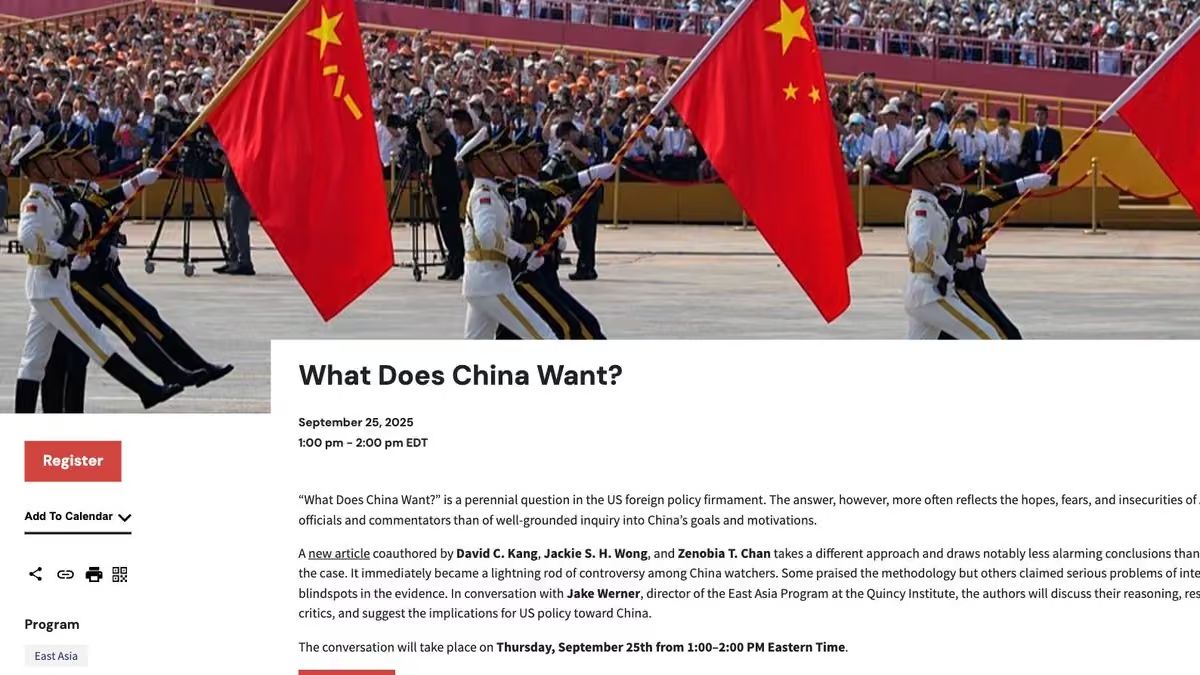
@daveckang
Looking forward to this!
Quincy Institute
@QuincyInst
What does China want?
In Washington, the answer to this question often reflects the hopes & fears of US officials & commentators, rather than well-grounded inquiry into China’s goals & motives
Join our discussion on 9/25 with @daveckang, @SiuHeiWong2, @ZenobiaChan & @jwdwerner -
Quincy Institute
@QuincyInst
What does China want?
In Washington, the answer to this question often reflects the hopes & fears of US officials & commentators, rather than well-grounded inquiry into China’s goals & motives
Join our discussion on 9/25 with @daveckang, @SiuHeiWong2, @ZenobiaChan & @jwdwerner
Quincy Institute
@QuincyInst
Register to join: quincyinst.org/events/what-does-china-want/
-
Quincy Institute reposted
American Prestige
@AmPrestigePod
Annelle Sheline (@AnnelleSheline ) breaks down what distinguishes Israel's strike on Qatar from its actions in countries like Lebanon, Syria, and Yemen, at least in the view of the United States.
-
Quincy Institute
@QuincyInst
live look at the military-industrial complex
Quincy Institute
@QuincyInst
They call it "defense” spending — but 54% of America's war budget goes straight to private contractors.
Lockheed Martin alone got $313 billion in 5 years.
This isn't "defense,” it's corporate welfare on a trillion-dollar scale. -
Quincy Institute reposted
Nick Cleveland-Stout
@nick_clevelands
Four-star admiral Robert Burke just got sentenced to 6 years in prison after secretly accepting a $500k/yr position at a defense contractor while helping steer Navy contracts to the company
-
Quincy Institute
@QuincyInst
Book Talk: Faith and Fear x.com/i/broadcasts/1rmGPvjebRMxN
Quincy Institute
@QuincyInst
🔴LIVE | Book Talk: Faith and Fear
A conversation with QI board member @GregoryDaddis & @MarcusMStanley
x.com/i/broadcasts/1rmGPvjebRMxN -
Quincy Institute reposted
Nick Cleveland-Stout
@nick_clevelands
New report finds that North American think tanks are the least transparent in the world. Only 35% disclose funding sources, compared to 67% of Asian think tanks and 58% of African think tanks surveyed.
responsiblestatecraft.org/us-think-tanks-transparent/ -
Quincy Institute reposted
Ben Freeman
@BenFreemanDC
$3.6 trillion is about 2x the entire F35 program and nearly 4 full years of Pentagon budgets. Let that sink in...
Sandra Erwin
@Sandra_I_Erwin
A new report by @ToddHarrisonDC of the American Enterprise Institute estimates Golden Dome could cost from $252 billion to $3.6 trillion over 20 years, based on scope and capabilities
-
Quincy Institute reposted
A New Policy
@anewpolicyorg
“The least transparent mechanism of providing arms to Israel.” @anewpolicyorg cofounder Josh Paul tells @RStatecraft on WRSA-I.
Now Congress wants to expand it, allowing unlimited U.S. weapons transfers with virtually no oversight.
responsiblestatecraft.org/arms-transfers-to-israel/ -
Quincy Institute
@QuincyInst
They call it "defense” spending — but 54% of America's war budget goes straight to private contractors.
Lockheed Martin alone got $313 billion in 5 years.
This isn't "defense,” it's corporate welfare on a trillion-dollar scale. -
Quincy Institute
@QuincyInst
Why have so many U.S. soldiers died at Fort Bragg — the largest military base in America, and the central location for special operations forces?
Quincy Institute
@QuincyInst
Read @MarcusMStanley's review of @sethharpesq's new book in @RStatecraft: responsiblestatecraft.org/fort-bragg-seth-harp/
-
Quincy Institute reposted
Responsible Statecraft
@RStatecraft
NEW: Trump launches a second round of airstrikes against alleged drug smugglers near Venezuela
"We are in incredibly dangerous territory when the president can murder people as he sees fit," @jwrchappell told @connor_echols
responsiblestatecraft.org/trump-venezuela-2673996926/ -
Quincy Institute reposted
Nick Cleveland-Stout
@nick_clevelands
Qatari funding of universities has emerged as a catch-all explanation to explain Israel’s loss of America’s youth.
The organization responsible for promoting this claim (@ISGAP) is an Israeli-funded research center with a record of promoting unsubstantiated claims to Congress. -
Quincy Institute reposted
Dr. Annelle Rodriguez Sheline
@AnnelleSheline
Israel attacked Qatar, a major non-NATO U.S. ally
What's to stop them from attacking Turkey, which is a NATO ally?
Is Israel going to destroy NATO?
@GiorgioCafiero & I discussed the implications of Israel bombing Qatar with @dwdavison of @AmPrestigePod -
Quincy Institute
@QuincyInst
NEW
How did an Israeli-funded organization become a go-to source for US lawmakers scrutinizing pro-Palestine college protests?
QI’s @nick_clevelands investigates in @DropSiteNews
Quincy Institute
@QuincyInst
“Despite its influence among policymakers who continue to rely on ISGAP to provide them with data and analysis, the organization has a track record of promoting unsubstantiated claims.” @nick_clevelands @DropSiteNews www.dropsitenews.com/p/qatar-funding-campus-antisemitism-…
-
Quincy Institute reposted
Dr. Annelle Rodriguez Sheline
@AnnelleSheline
In a congressional hearing, antisemitism scholar Charles Asher Small shared an explosive finding:
Funding from Qatar had fueled a 300% spike in antisemitism on university campuses in the US.
Except that wasn't true
My @QuincyInst colleague @nick_clevelands for @DropSiteNews -
Quincy Institute
@QuincyInst
He's right:
"America’s wars (and record Pentagon budgets) of this century have brought neither peace nor strength. Instead, they have cost at least $8 trillion, hundreds of thousands killed and displaced on all sides, and a devastating impact on veterans"
Responsible Statecraft
@RStatecraft
NEW @WilliamHartung @QuincyInst has something to say about the big, beautiful defense bill you the taxpayer may be paying for soon if Congress has its way.
-
Quincy Institute reposted
Responsible Statecraft
@RStatecraft
Re-upping this @stavroulapabst piece from a 8/20. Netanyahu was 'doubling down' but telling you exactly what was coming.
-
Quincy Institute
@QuincyInst
Good! This clarity is welcome.
Because the Pentagon doesn’t spend $1,000,000,000,000 a year on defending Americans
It spends a trillion a year on a strategy of global military primacy — preparing for/waging wars & interventions all over the world that don’t make Americans safer -
Quincy Institute
@QuincyInst
A war with Iran does NOT serve America's interests.
If anything, it could put more American's lives at risk.
Do not forget: the U.S. cannot legally go to war without a vote in Congress.
👏 @SenTimKaine -
Quincy Institute
@QuincyInst
The mIlitary-industrial complex is a special interest lobby on steroids.
In 2024, Pentagon contractors spent over $148 million on lobbying — and had 945 lobbyists working on their behalf.This media couldn't be displayed. See it on the original post. -
Quincy Institute
@QuincyInst
While Israel is pushing for war with Iran, the Trump admin is exploring diplomacy.
@tparsi talks to @today_explained about Trump’s attempts to strike a deal with Iran.
www.vox.com/today-explained-podcast -
Quincy Institute
@QuincyInst
Look at this chart.
US military aid to Israel hit $17.9B in 2024—highest ever—while Gaza was being reduced to rubble.
Our laws prohibit weapons sales to human rights violators.
Yet in 50 years, Congress has never successfully blocked a single weapons sale. -
Quincy Institute
@QuincyInst
Lawmakers shouldn't get richer when they vote for more weapons.
Unfortunately in the U.S., they do.
Over 50 members of Congress own defense stocks because we've created a system where those profiting from war are the same ones deciding to wage it. -
Post not available here, view on X
Quincy Institute
@QuincyInst
🔴LIVE | Living the Asian Century: A Book Conversation with Kishore Mahbubani
A conversation with @mahbubani_k & @globalsarang
x.com/i/broadcasts/1kvJpyPpMeMxE -
Quincy Institute
@QuincyInst
War hawks are once again driving us toward disaster.
Handing over 5% GDP to the Pentagon while cutting taxes would send our national debt skyrocketing — from about 99% of GDP today to 310% of GDP by 2054.
It should go without saying but this is a BAD IDEA.
-Thread- -
Quincy Institute
@QuincyInst
Think tanks shape America's foreign policy, but who shapes them?
NEW RESEARCH reveals 18 of the top 50 think tanks don't disclose donors at all.
Of the think tanks that do:
-65% take foreign cash (from 54 countries!)
-62% take Pentagon contractor money -
Post not available here, view on X
Quincy Institute
@QuincyInst
These weapons will still main and kill civilians long after the fighting is done.
Read @alexjordanATL reporting for @RStatecraft here: responsiblestatecraft.org/urkraine-landmines/ -
Quincy Institute
@QuincyInst
The U.S. war machine is powered by a revolving door between government and the weapons industry.
From 2018-2023, 80% of retired four-star generals and admirals went on to work in the arms sector as board members, advisers, lobbyists, or consultants. -
Quincy Institute
@QuincyInst
Did you know the U.S. government spends more on war than the next nine countries combined?
This is what we’re talking about when we say Washington is addicted to war. -
Quincy Institute
@QuincyInst
Israel invaded Gaza a year ago this week.
Since then, Israel has killed 40,000+ & displaced nearly 2mil.
But Israel couldn’t wage this deadly war without Washington's enthusiastic support.This media couldn't be displayed. See it on the original post. -
Quincy Institute
@QuincyInst
War between Hezbollah & Israel could kill tens of thousands & trigger a humanitarian crisis.
It may even drag the U.S. directly into the fighting.
The Biden administration's failure to use its leverage to avert this escalation may have catastrophic consequences.
The Associated Press
@AP
BREAKING: The U.S. will send additional troops to the Middle East amid escalation between Israel and Hezbollah in Lebanon, the Pentagon says. apnews.com/article/israel-lebanon-violence-war-hezbollah-…
-
Quincy Institute
@QuincyInst
Hope you had a great three-day weekend!
📰We're celebrating the new season by welcoming our new non-resident fellows!
Welcome @CostelloScost, @ccoyne1, @DanielTElkins, Nontobeka Hlela, @MsJamshidi, @AMohseniC, @rochowanski, and Denis Simon!
quincyinst.org/2024/09/03/quincy-institute-welcomes-eight… -
Quincy Institute
@QuincyInst
Increasingly Americans want:
-A US arms embargo on Israel
-A diplomatic end to the war in Ukraine
-To stop enriching the military industrial complex at Americans’ expense
-To maintain peaceful relations with China
It’s time for Washington to listen to Americans, not hawks -
Quincy Institute
@QuincyInst
The downsides of spending trillions on wars?
-Needless death and destruction
-Global instability
-Arms racing toward annihilation
-Distraction from existential threats like climate change
It turns out spending more on security doesn't make us more secure. -
Quincy Institute
@QuincyInst
Good morning America 🥳
-
Quincy Institute
@QuincyInst
The Pentagon paid Boeing $52,000 for a trash can.
This is what we're talking about when we say the military-industrial complex is completely out of control. -
Quincy Institute
@QuincyInst
Let's be clear.
Committing U.S. troops to fight & die for Saudi Arabia isn't a "security deal."
It's a war obligation.This media couldn't be displayed. See it on the original post.
Trita Parsi
@tparsi
Alarm bells should go off!
Biden is close to a deal with Saudi that would grant it uranium enrichment, oblige the US to defend the dictatorship, and sell it more weapons. @WSJ says the deal will further "entrench America’s presence in the Middle East."
www.msn.com/en-us/news/world/us-to-offer-landmark-defense… -
Quincy Institute
@QuincyInst
The average taxpayer spent $2,974 on the Pentagon in 2023.
Over half of that — $1,748 — goes to weapons companies like Lockheed Martin and Raytheon.
The average American's monthly rent is $1,372. -
Quincy Institute
@QuincyInst
NEW: Despite jailing & sidelining, Imran Khan’s party leading in Pakistan elections
A showdown over valid election results could, however, place Washington in a precarious position, @AdamNoahWho writes in @RStatecraft responsiblestatecraft.org/imran-khan-pakistan/ -
Quincy Institute
@QuincyInst
📔Rebalancing National Security
Dont miss @DemJournal's symposium exploring how Congress surrendering its national security prerogatives to the executive branch has impacted arms sales, national emergency declarations, & more. democracyjournal.org/magazine/71/rebalancing-national-sec… -
Quincy Institute
@QuincyInst
40 Years After ‘The Day After’
The film remains a devastating reminder that nuclear deterrence is a strategy that can and will fail someday, @DarylGKimball writes in @RStatecraft responsiblestatecraft.org/the-day-after-film-nuclear-war/ -
Quincy Institute
@QuincyInst
The new #nsraa would be the most important recalibration of the balance of power between President & Congress in decades & safeguard our democracy. Thank you to @RepMcGovern and @RepNancyMace for introducing this important bill.
-
Quincy Institute
@QuincyInst
NEW: On July 16, 1945, the world ended. Or at least it seemed that way to residents of the Tularosa Basin in New Mexico.
Important @connor_echols @RStatecraft reporting on the fallout visited on communities downwind of Oppenheimer’s Trinity Test. responsiblestatecraft.org/2023/07/21/what-oppenheimer-lea… -
Quincy Institute
@QuincyInst
NEW #diplomacywatch: Is the Overton window of the Ukraine war’s end game shifting?
Read @benjaminja in @RStatecraft responsiblestatecraft.org/2022/12/16/diplomacy-watch-is-t… -
Quincy Institute
@QuincyInst
Tomorrow marks 21 years since 9/11.
Read @Thomas_Drake1 @Abigail_R_Hall @ccoyne1 @LobeLog @SPMiles42 @RamiKhouri @KelleyBVlahos & more on media complicity in the wars, whistleblowers, the security state & havoc wrought on the Middle East in @RStatecraft. responsiblestatecraft.org/tag/911at20/ -
Quincy Institute
@QuincyInst
"The F-35 program as a whole has already cost American taxpayers an exorbitant amount. It is vital that time and care be taken before making decisions that could add considerably to the bill.” @POGOwatchdog @NTU @Protectaxpayers @taxreformer @WomensAction responsiblestatecraft.org/2022/07/12/watchdogs-urge-congr…
-
Quincy Institute
@QuincyInst
Congress is asking too few questions about the flow of weapons & money to Ukraine.
We joined @POGOwatchdog @Livableworld @FCNL @GovAcctProj @Public_Citizen @RSI @taxpayers @WomensAction & more to demand oversight & accountability.
📄Read our letter👇
www.pogo.org/letter/2022/06/coalition-calls-for-permanent… -
Quincy Institute
@QuincyInst
QI NRF John Mearsheimer on @NewsHour: "One circumstance in which a great power is likely to use nuclear weapons is...when it thinks a decisive defeat is being inflicted on it. What @POTUS is bent on doing is inflicting a decisive defeat on Russia." www.pbs.org/newshour/show/u-s-shifts-goals-on-war-in-ukra…
-
Quincy Institute
@QuincyInst
.@wrightr @NewYorker: "In just over 9 weeks, the conflict has rapidly evolved into a full proxy war with Russia, with global ramifications.
...The war could now play out in many disparate ways. Each carries its own dangers—for the US as well as Ukraine." www.newyorker.com/news/daily-comment/ukraine-is-now-ameri… -
Quincy Institute
@QuincyInst
"A US strategy that genuinely prioritized climate change as an existential threat would first recognize that the continued pursuit of global hegemony all but eliminates the prospects for collaboration against the shared threat of climate change." #qibrief quincyinst.org/report/climate-change-the-greatest-nationa…
-
Quincy Institute
@QuincyInst
NEW #qivideo: Why aren’t Americans as loud in our denunciation of Saudi Arabia’s bombing in Yemen as we are about Russia’s aggression against Ukraine?
This media couldn't be displayed. See it on the original post. -
Quincy Institute
@QuincyInst
NEW @KelleyBVlahos: On Russia and Ukraine, Iraq war cheerleaders like David Frum are trying to rip a page out of the 2003 playbook. @TheSpectator spectatorworld.com/topic/the-new-unpatriotic-conservatives/
-
Quincy Institute
@QuincyInst
ICYMI: Can war in Ukraine be avoided?
@QuincyInst hosted a US-Russian debate with @CFR_org's Thomas Graham and @ruglobal_en's Fyodor Lukyanov, moderated by QI’s own @Lieven_Anatol. x.com/i/broadcasts/1OwxWzpLMjDJQ -
Quincy Institute
@QuincyInst
Instead of doubling down on a dead-end, dangerous "new Cold War," Congress should focus on responsibly managing tensions with China & enhancing cooperation on urgent challenges like climate change & COVID-19.
@QuincyInst @justiceisglobal @WinWithoutWar & 29 global justice orgs: -
Post not available here, view on XPost not available here, view on X
Quincy Institute
@QuincyInst
The U.S should adopt a policy of rejecting further NATO expansion and use the Minsk II framework to negotiate a lasting peace. @BeyondtheBomb @commondefense @concernedvets @defpriorities @FCNL @globalzero @peaceaction @pdamerica @roots_action @VFPNational
-
Quincy Institute
@QuincyInst
MUST READ: "Although the US is no longer in Afghanistan, taxpayers continue to pay for the American military’s massive global presence. Absent a fundamental rethinking of how the US sees national security and the role the military plays in foreign policy, big cuts are unlikely."
Tara McKelvey
@Tara_Mckelvey
Year One, Biden White House: in his insightful piece, @mideastXmidwest shows the payoff for the military-industrial complex and the reasons for their new profits (hint – “China, China, China”) tinyurl.com/5ehbfw7h
-
Quincy Institute
@QuincyInst
“Over the last 20 years, the United States has dropped an average of 46 bombs and missiles on other countries EACH DAY.” @Stephenwertheim @gravelinstitute youtu.be/uD8N4JQy7cw
-
Quincy Institute
@QuincyInst
"America is still fighting wars around the world—it just doesn’t want to call them wars"
MUST WATCH video from @GravelInstitute featuring @stephenwertheim: www.youtube.com/watch?v=uD8N4JQy7cw -
Quincy Institute
@QuincyInst
We're telling @POTUS: #dontletafghansstarve. @AfghansTomorrow @CIPolicy @codepink @commondefense @FCNL @justfp @KeoughGlobalND @MklGlobalConcer @MoveOn @NIACouncil @PeaceAction @Sojourners @UnfreezeAfghan @WinWithoutWar quincyinst.org/wp-content/uploads/2021/11/Preventing-Disa…
This media couldn't be displayed. See it on the original post. -
Quincy Institute
@QuincyInst
.@RepJudyChu @RepRaulGrijalva @RepEspaillat are right: “there is no conceivable way to address the climate crisis” without working with China.
Grateful for US leaders urging @POTUS to prioritize cooperation on climate over competition for the sake of the people and the planet. -
Quincy Institute
@QuincyInst
What if Washington stopped feeding the war machine and started treating climate change as its #1 priority?
This media couldn't be displayed. See it on the original post. -
Quincy Institute
@QuincyInst
BREAKING from @EliClifton: in a call with investors, weapons executives celebrated a proposed $29.3 billion increase in the annual defense budget, saying that Congress' plan is "aligned" with their business interests. responsiblestatecraft.org/2021/10/27/weapons-execs-lament…
-
Post not available here, view on X
Quincy Institute
@QuincyInst
We're calling on Congress to ensure our government reviews the humanitarian impact and effectiveness of America's sanctions regime. @SenJackReed @JimInhofe @RepAdamSmith @RepMikeRogersAL
-
Quincy Institute
@QuincyInst
The people making decisions about whether our country engages in foreign conflicts should not have a clear personal financial incentive for war.
Must read from @KatrinaNation in @PostOpinions this morning: www.washingtonpost.com/opinions/2021/09/21/its-time-break… -
Quincy Institute
@QuincyInst
We’re calling on Congress to investigate the last 20 years of mismanagement and dysfunction in the Afghanistan war—not just the last 20 days. @CIPolicy @commondefense @ConcernedVets @defpriorities @POGOwatchdog @Secure_Families @WinWithoutWar
-
Quincy Institute
@QuincyInst
🚨 This afternoon at 🕐 1pm!
The Biden-Putin Summit: Outcomes and Implications. @QuincyInst is pleased to host @JerryBrownGov, @KatrinaNation, @Cirincione, and @LievenAnatol for a discussion on the Summit and the future of U.S.-Russia relations.
👇RSVP
quincyinst.org/event/the-biden-putin-summit-outcomes-and-… -
Quincy Institute
@QuincyInst
Be sure to WATCH this TOMORROW 1p.m. EST: for best after-Buden-Putin Summit analysis w/ @LievenAnatol @KatrinaNation @JerryBrownGov @Cirincione !
LINK: quincyinst.org/event/the-biden-putin-summit-outcomes-and-…