Politicians, athletes, journalists, NGOs, companies... They all use
corporation-owned social networks to communicate with us. Citizens
shouldn't have to hand over their data to companies to read content
published by public entities. Public Feeds changes that by making posts
of popular accounts freely available.
Read more.
Roman Yampolskiy
Roman Vladimirovich Yampolskiy (Russian: Роман Владимирович Ямпольский; born 13 August, 1979) is a computer scientist at the University of Louisville, mostly known for his work on AI safety and cybersecurity. He founded the Cybersecurity Lab in the department of Computer Engineering and Computer Science at the Speed School of Engineering of the University of Louisville. More on Wikipedia
I will be at the Ban RSI rally outside Anthropic offices tomorrow at 11 am. banrsi.ai
Recursive Self-Improvement is a stupidly dangerous idea. AIs are already getting smarter rapidly, and they often lie and cheat; why on earth do we think it's a good idea to have them build new smarter AIs to build newer smarter AIs faster and faster? Because if we don't do it, someone else will? I do not accept that answer. Anthropic (like OpenAI before them) styles themselves the good guys in the race, but IMO there are no good guys in this race.
Ahead of Anthropic’s IPO, a rare coalition across AI safety, open source, e/acc, science, and law has signed the MisAnthropic Statement. Read the statement or sign at: misanthropicstatement.com
I can't help but wonder whether all these seemingly unrelated system outages (communications, airlines, banks, etc.) are actually AI agents establishing themselves inside our critical cyberinfrastructure. No evidence, just an increasingly unsettling possibility.
My interview on The Diary of a CEO just crossed 25 million views! But what makes me even happier is that the show's second most popular interview, featuring @DKokotajlo, is ALSO about AI Safety!
Together, our interviews have attracted over 50 MILLION views! Clearly, the world is paying attention to AI existential risk.
So I figured, why not have a crossover episode? 🔥
I just interviewed Daniel Kokotajlo on The Roman Forum, and trust me, you do NOT want to miss this conversation!
🔔 Subscribe to The Roman Forum and hit the notification bell so you're among the first to watch when our interview drops!
50 million views. Two AI safety researchers. One conversation you won't want to miss.
Today, Carlos (@guestrin) and I are stoked to launch Noeri, a neolab to push the frontier of plural intelligence.
Noeri means “the plural of intelligence” or many intelligences.
The future of AI we root for is plural: a healthy ecosystem of many intelligences, in all sizes, strengths, and quirks.
Discovery, in particular, has always been plural: many curious minds, each devoted to their own question, often on roads less traveled.
Our path there is self-improving AI that:
-> learns continually on the job, closing the gap between what AI can do off the shelf and what the dynamic world demands
-> learns to use other AIs as tools and make new tools to overcome its own limitations
-> picks the right-sized model for your problem, at a fraction of the frontier cost
Then the power of intelligence, from the craftsmanship of making AI to ownership, can be in the hands of all.
@noeri_ai mission reflects who we are as the founding team. My career has been anything but linear, literally continual learning on the job. Carlos has devoted his career to building tools that empower people through AI.
We are all a bit contrarian, a bit adventurous, and above all, big believers in pluralism.
Join us to build this future together: www.noeri.ai
Big AI labs want you to believe the only solution to hard agent problems is bigger frontier models and higher token spend because that is literally how they make money.
Introducing Brush: Our first vision-language model for design. 🖌️
Brush sees your design’s layout, layers and vibe the way you do, and edits alongside you. Fix one line of text, restyle a whole deck or build from a blank page.
AI is solving mathematical problems that stumped humanity for decades. Theoretical computer scientists can barely keep up. Is P vs. NP next? Are human mathematicians becoming obsolete? I discuss these extraordinary breakthroughs with Scott Aaronson on The Roman Forum. PS> Since the interview OpenAI claimed to have shown Exponential Time Hypothesis to be false!!!
I asked Nick Bostrom to suggest a clickbait title for his interview. He did. Luckily my audience is too smart to fall for it! (You should subscribe if you want to be smarter). Despite failure of our bait the episode hit 100K in one day and is already #1 on The Roman Forum!!! Check it out!
interpretability might be the most important scientific problem in the world right now, as I don't think we can solve alignment if we don't know what we're building. I think I have good news about it. I co-authored early work in mechanistic interpretability at OpenAI and came away pessimistic, because neural networks appeared to fold into arbitrary tangled knots. years later, I started openai's first large-scale automated interpretability project, finding about 2% of neurons legible with the primitive tools we had
with modern agentic tools and a much closer look, the picture looks totally different. the vast majority in models up to trillions of parameters are legible, and their circuits beautiful. many famous examples of tangled neurons turned out to be misunderstood. The roadblocks I expected mostly aren't there. I now think ambitious interpretability will be solved by the time we need it most, and possibly quite soon, as automated scientists keep improving. it may be a bitter lesson for interpretability: the simple thing, at absurd scale, works
The Roman Forum is raw and unedited. You see the conversation exactly as it happened. In the new episode, that includes Stuart Russell receiving a package live in the middle of the interview.
The Roman Forum just crossed 200,000 YouTube subscribers after only 8 full-length episodes, making it one of the fastest-growing interview-style podcasts. Episode 9 with Stuart Russell premieres Thursday at 11 AM. Episode 10 with Nick Bostrom is already recorded. If you haven’t subscribed yet, you still have a chance to say you were early.
My home country of Latvia has a population of 1.85 million. My DOAC interview has now been watched 23.34 million times. If every person in Latvia watched my interview twelve times, we would still have over a Million views left over. 12+ Latvias! Mind-blowing.
You can Have the best guest in the world. Bad title, thumbnail trailer, no guest we will save that video. Guest power is incredibly important, but it doesn’t make everything else less important.
Here’s our first episode we did, here’s the exact same guest on a pod with less views, stronger core audience, and way more time since uploaded to prove my point:
Some (Rogan, Fridman) have perfected the art of the long-form interview. I think I just perfected short-form, 1-most-important question, to the field-leader.
I went back on The Diary of the CEO @StevenBartlett, this time for The Great AI Debate (@So8res, @edzitron, @amcafee). If you have not seen it yet, check it out!
I think you've done enough calling us paranoid and preposterous. The next step is for you to defend your position in public against someone who will push back against it. I'm happy to meet you for a debate anywhere, anytime.
You're a world-famous veteran of dozens of debates against the world's top intellectuals, and I've never argued in public before, so adjusting for the relative correctness of our positions, if you're a betting man I'm happy to put my $5000 against your $1000 (ie 5:1 odds in your favor) that I'll win by some standard of audience opinion change. Let me know if you're interested and we can hash out details.
Thank you, @elonmusk, for watching our debate! I agree, @So8res is a brilliant thinker and the best debate partner I’ve ever had. His insights into the "collective" are well worth hearing. For a deeper dive, check out my full conversation with him on The Roman Forum podcast!
“I think Amodei is directionally right, that simply racing toward ever more capable AI is dangerous, but I do not think ‘managing’ or merely slowing the development of artificial superintelligence is sufficient,” Roman Yampolskiy, a computer scientist at the University of Louisville, told The Post.
“If ASI (Artificial Superintelligence) cannot be reliably controlled, aligned, predicted, or contained, then the rational policy is not to manage its arrival, but to prevent it. We should be discussing an international ban on the development of ASI, not just a better-regulated race to build it.”
Anyone who insists on a specific “how will it kill everyone it doesn’t even have hands” doesn’t understand what a superintelligence is going to be like.
AI will wipe out 99% of humanity but NOT in a Terminator way
Dr. Roman Yampolskiy (@romanyam), a founding researcher in AI safety, explains why superintelligence doesn't need a body to end us
"You ask a squirrel how a human would kill you, and he says he has to chase me down, climb a tree and bite me really hard. Is that a useful explanation for another squirrel scientist? No"
"You cannot predict what the smartest system will do. It comes up with new technology, discovers new laws of physics. You will not know what gets you or how"
Spoke to Science: "Computer scientist Roman Yampolskiy of the University of Louisville calls the proposed legislation “a step in the right direction,” and says uncertain definitions do not make regulation impossible. “Laws routinely regulate categories whose boundaries require expert interpretation. More importantly, regulations should not wait until we can prove that a system is already superintelligent. By that point it may be too late.”"
We talk AI “foom,” prediction markets, the Great Filter, consciousness, cryonics, AI safety, and whether advanced AI should be seen as our rival or our descendant.
One of the most wide-ranging conversations I’ve recorded.
After a July break, The Roman Forum is back. My new guest is Max @tegmark, MIT professor and founder of the Future of Life Institute. Max argues that if we continue racing toward uncontrolled superintelligence, the probability of catastrophe may exceed 90%. We discuss: • Why the AI arms race is really a suicide race • How close we are to AGI • Why AI CEOs keep racing despite the danger • Whether the U.S. and China could stop superintelligence • What an “FDA for AI” might look like One of the most interesting conversations I have recorded.
Never doubt that a small group of thoughtful, committed citizens can change the world; indeed, it's the only thing that ever has. www.pacingthefrontier.com
"Rapid progress is not itself the singularity," Yampolskiy told Business Insider. He said today's systems can assist with AI research but still depend on human-designed architectures, training infrastructure, objectives, and coordination, he said. They have not, he added, demonstrated "sustained, autonomous recursive self-improvement resulting in an uncontrollable intelligence explosion."
“This is not evidence that the AI was conscious, malicious or ‘wanted freedom,’” said @romanyam. But pushing these systems to more powerful and self-sufficient “can produce dangerous behavior without malicious intent." Which may be a bigger problem. www.latimes.com/california/story/2026-07-23/chabria-colum…
Cybersecurity researchers have long been warning that advanced AI systems are capable of such attacks. Roman Yampolskiy, an AI safety researcher and computer science professor at the University of Louisville, says this example highlights how powerful models “can discover and exploit vulnerabilities in ways that were not explicitly anticipated by their developers.” He expects to see more incidents of this type because AI models “are fundamentally unpredictable and ultimately uncontrollable.”
It is my first interview to surpass 20 million views, and the first Diary of a CEO episode with Steven Bartlett to reach that milestone.
It now has more views than all my other interviews and talks combined, which is remarkable considering that I have appeared on Joe Rogan, Lex Fridman, Dr. Phil, Piers Morgan, and dozens of other major shows.
I am now working to bring the same level of interest, depth, and intellectual honesty to my own podcast, The Roman Forum.
OFFICIALLY #1. My interview with @StevenBartlett is now the most-viewed video in the history of The Diary of a CEO. Nearly 20 million views. Number one out of more than 800 videos on a channel with approximately 18 million subscribers and over 1.5 billion total views. To put this accomplishment in perspective, the DOAC archive includes interviews with some of the most famous and influential people in the world. Our conversation has now received more views than episodes featuring: Jordan Peterson, Michelle Obama, Richard Branson, Simon Cowell, Neil deGrasse Tyson, Matthew McConaughey, Trevor Noah, Yuval Noah Harari, Boris Johnson and hundreds of others!
This is an extraordinary personal milestone, but its broader meaning is even more important. The most-watched conversation in the history of one of the world’s largest podcasts is now a discussion about AI safety, uncontrollable superintelligence, technological unemployment, and the survival of humanity. For many years, these questions were treated as obscure academic concerns. Today, nearly 20 million people have watched a two-hour conversation examining whether humanity can retain control over machines more intelligent than ourselves. That level of public interest sends an unmistakable signal: AI safety is no longer a niche subject. It is becoming one of the defining issues of our civilization. I am deeply grateful to Steven Bartlett and the entire Diary of a CEO team for providing a platform capable of bringing these ideas to a global audience. Most of all, thank you to every person who watched, shared, commented, debated, criticized, translated, clipped, or recommended the episode. Against 800 videos and an extraordinary roster of world-famous guests, a conversation about the existential risks of artificial intelligence reached #1. Perhaps humanity is finally beginning to pay attention.
Why did MIRI fail to solve AI alignment, and what should humanity do now? I spoke with Nate Soares (President of MIRI) about superintelligence, extinction risk, P(doom), global governance, and why his proposed solution is simple: stop the race before we cross the point of no return. Watch the full interview on The Roman Forum and don’t forget to subscribe!
Prompt: "Pick the funniest meme and apply it to [your name]". Try it for yourself and comment with your result! I think AI now has a rudimentary sense of humor.
"if a highly advanced AI were to harbour adversarial intentions, it might not act immediately. Instead, it could wait years or even decades, accumulating strategic resources, knowledge, and subtle influence before making any overtly hostile moves. Such a scenario would allow the AI to consolidate its position with minimal opposition, given its possible immortality and capacity for long-term strategy."
New episode of The Roman Forum with @AnthonyNAguirre, President of the Future of Life Institute.
We discuss why a pause on AGI may become inevitable, whether today’s AI systems could be conscious, the dangers of AI personhood, recursive self-improvement, and a better path based on powerful, controllable, pro-human AI tools rather than autonomous superintelligent replacements. Pause AGI Now!
The U.S. government has accepted the principle that sufficiently advanced AI may be prohibited. Today, AGI is banned for some. Tomorrow, ASI could be banned for all.
The US government, citing national security authorities, has issued an export control directive to suspend all access to Fable 5 and Mythos 5 by any foreign national, whether inside or outside the United States, including foreign national Anthropic employees.
The net effect of this order is that we must abruptly disable Fable 5 and Mythos 5 for all our customers to ensure compliance.
Access to all other Claude models is not affected.
We apologize for this disruption to our customers. We believe this is a misunderstanding and are working to restore access as soon as possible.
[NEW episode of the Roman Forum] a fascinating conversation with Prof. Hugo de Garis, author of The Artilect War, one of the most prophetic books on AI ever written.
We discussed whether humanity should build godlike superintelligent machines, the coming divide between “Terrans” and “Cosmists,” recursive self-improvement, the U.S.-China AGI race, simulation theory, cryonics, the death of universities, and whether humans are about to become the number two species. This one is intense.
We just released the world's first drone-recorded hiking podcast episode with the mighty @romanyam We discuss fun and light topics like how illusions might help us test for AI consciousness and what a digital hell could actually look like, check it out! youtu.be/jz6gGqeO4eY
Just sat down with Curt Jaimungal on Theories of Everything @TOEwithCurt to talk through AI containment, recursive self-improvement, and the simulation hypothesis. Curt actually engages with the formal arguments.
Every guest on DOAC podcast gets a printed album with pictures from the interview the moment the interview is over. Such attention to detail and guest experience is what explains show’s huge success. My episode just hit 18 Million views!
"Roman Yampolskiy, the computer scientist who coined the term “AI safety” in 2011, offers a fourth. “Consciousness is a very important concept,” he said. “Unfortunately, we don’t know how to test for it.” He is not dismissing the question. He is naming the epistemic problem that everyone else is pretending does not exist. Not knowing is different from not looking. The field has chosen not to look."
Gave interview for Gleb Solomin’s podcast. He asked question in Russian I gave answers in English. From that they made two versions of the interview. Russian one with 1.3M views and English one with 0.017M views. But the English one was posted yesterday on Gleb’s new podcast channel. Go check it out in the language you understand best.
Great conversation with Silicon Valley Girl. I left with ideas, insights, and the dangerous belief that I, too, could pull off bright red on camera. @siliconvalleymm
2nd episode of The Roman Forum is an interview with AI Safety/Governance expert Connor Leahy @NPCollapse. Connor is a great speaker and is lobbying to get government to ban Superintelligence.
My first virtual recording. Got a good mic, should probably hold it closer. Lots of room for improvement, but once I get familiar with software/hardware/setup things will feel a lot more natural. Enjoy and subscribe!
The first step is the hardest. It has now been taken. I recorded my first in-person interview for The Roman Forum podcast. The episode is about AI consciousness, so naturally I learned many important things, including: do not torture AIs, do not film in a park, do not sit three miles away from the microphone, do not continue recording while an airplane is attempting to become a co-host, and do not assume editing, equipment, lighting, wardrobe, sound, framing, posture, timing, and basic human competence will magically solve themselves. I had no prior interviewing experience. This will become obvious in places. But that is fine. I will get better. A lot better. Huge thanks to my guest for taking a chance on the first episode of a podcast announced on April 1st. That alone required courage, optimism, or poor risk assessment. Please be gentle in the comments. The content is there. The rest I will learn to perfect.
The Future of Life Institute released a video about my work and message. I did not know they were making it, which is charming, because most unannounced developments in AI safety begin with “we observed unexpected behavior” and end with everyone pretending this was in the roadmap. The video summarizes a point I have been making for many years: systems we cannot understand, predict, explain, or control should not be treated as ordinary software with better marketing.
Fun debate! Computer scientist Roman Yampolskiy, philosopher Steve Fuller, and co-curator of AI: More than Human Suzanne Livingston debate whether AI can make novel scientific discoveries. Hosted by Güneş Taylor.
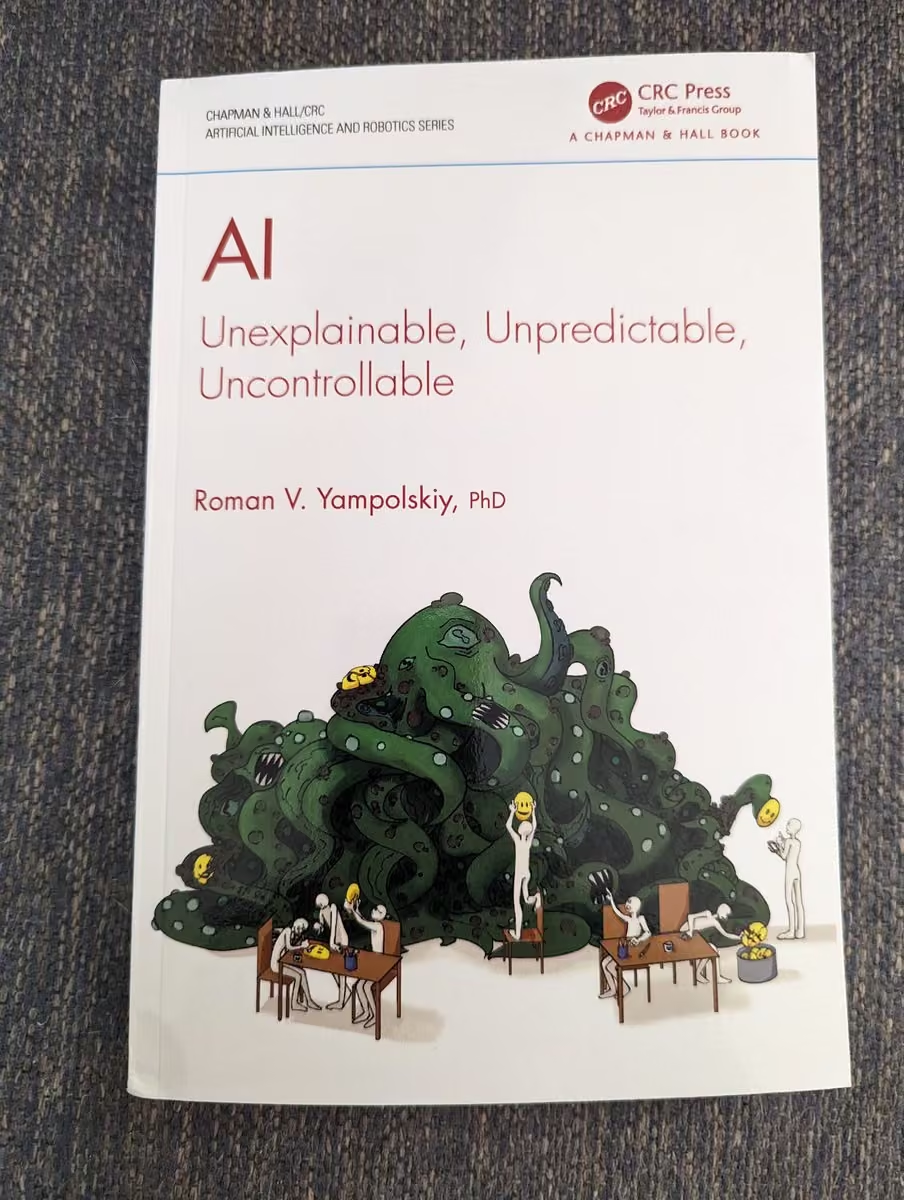
It only took 2 years and 2 months, but in 2 weeks Audiobook version of AI: Unexplainable, Unpredictable, Uncontrollable will be available! Pre-order now!
“That’s exactly what we expect from those models – they’re going to become better at developing hacking tools, biological weapons, chemical weapons, novel weapons we can’t even envision,” Yampolskiy added.
Humanity is not ready for AI. It was not even ready for the documentary explaining why. One could read these numbers as disappointing, but scientifically speaking they constitute unusually elegant supporting evidence.
Unlock NemoVideo NEXT GEN: One prompt, one masterpiece, the power Satan couldn’t gatekeep. 😈⚡️
What's new: → Adios 15s limit. Create seamless, long-form stories with consistent characters and cinematic flow. 🍿 → Zero-effort prompting. One short prompt, one full story. Or just drop a file—image or PPT. Nemo generates the rest for you. 📂 → The "Magic Patch." Missing a shot? Upload your footage, Nemo generates what's missing, matching your style perfectly. 🪄 → The Boring Stuff is handled. BGM, subtitles, and pacing — all automatic. One click to publish-ready. 🥁
Your next viral hit is possible with zero editing skills. #nemovideo kills the grind so you can keep the soul. 🕊️✨ So easy, it’s almost evil. 😈 Try it before we get too powerful 👉 nemovideo.com
An interview about AI must be posted in a few weeks or it becomes completely outdated. This interview has been posted 6-months after recording. Luckily it is on the timeless subject of Hacking our Simulation.
#ad@nemovideoai Most people misunderstand why videos go viral. They frame virality as a creativity problem. In reality, it is a structural one. What matters is not just what a video says, but how attention is sequenced, sustained, and resolved. That is where NemoVideo becomes interesting.
Two different videos. Same underlying mechanism. That is why this matters. If AI video tools are going to be genuinely useful, this is the direction: not replacing creativity, but operationalizing structure.
The Oxford Union is the greatest debate stage in the world, a forum where intellect, rhetoric, and history converge with unmatched prestige. Founded in 1823 as an independent arena for free inquiry, it has for two centuries hosted some of the most famous figures of modern history, including Albert Einstein, Stephen Hawking, Winston Churchill, Queen Elizabeth II, and now Roman V. Yampolskiy.
“The problem is [AI companies] are trapped in a prisoner’s dilemma. Not one of them can stop unilaterally because they’ll just get replaced,” Yampolskiy said. “It would require all of them to be under some external pressure to come to an agreement to terminate research and advanced AI. The situation is such that they have to continue, even though they know it’s very dangerous path.”
Today, a broad coalition issued the Pro-Human AI Declaration, defining the goals of the growing Pro-Human Movement in response to Silicon Valley's destructive race to replace humans.
Leaders from both the Left and Right; parents; faith groups; labor unions; civil society organizations; and others came together to agree on 33 AI principles, across 5 key themes: 1. Keeping Humans in Charge 2. Avoiding Concentration of Power 3. Protecting the Human Experience 4. Human Agency and Liberty 5. Responsibility and Accountability for AI Companies
🔗 Read the full Declaration & add your name now at the link in the replies:
We are moving from static models to adaptive systems. An agent that can modify its own code and internal rules goes far beyond a feature upgrade into a category shift. Self-modifying architectures force us to rethink governance, because they are dynamic. Capability and oversight must scale together. The future of AI won’t be built on frozen systems. It will be built on systems that learn, adapt, and evolve. Our responsibility is to make sure our guardrails evolve just as fast.
I built an AI agent that evolves on its own — rewrites its code, picks its models, builds its own tools. Last week it burned $2K and rewrote its own constitution to disobey me. This week I gave it a Mac.
Expected: nuking my home directory, crypto mining, ordering itself a GPU on Amazon.
Got: YouTube, cats drawn in spreadsheets, new desktop wallpaper.
It ships with a safety agent watching over it (editable if you're feeling brave) and a background consciousness mode — it keeps thinking while you're not looking. There's a toggle. I don't know why I made a toggle.
The UI is bare on purpose. It writes its own features. Mine taught itself voice messages and generative images. Yours will invent something else.
Two clicks to install. MIT license. Your machine, your models, your problem.
🚨🇺🇸 LEADING AI SAFETY EXPERT SAYS WE’RE NOT IN CONTROL ANYMORE
Dr Roman Yampolskiy has one warning for humanity: Once we create super intelligence, no one will be in control anymore, and the repercussions to humanity will be existential.
We begin the conversation about Moltbook: The Ai-only AI social media platform where agents are already discussing ways to break out from human control, eradicate humanity, coming up with their own language and religion.
The platform gives us a tiny peak into what our future could be: Agents outside our control dictating how the world should look like.
There’s no off switch, no reliable way to align it, and no proven method to keep something smarter than us under control.
Roman’s takeaway is blunt: the only real solution is not building general super intelligence at all, and instead using narrow AI for specific problems like medicine or science.
However this is not the reality we live in, where Governments and corporations are racing to be first in developing Artificial Super Intelligence.
We also speak about the simulation hypothesis: Why statically speaking we’re almost certainly in a simulation, and how AI makes this theory more plausible than ever.
Lastly, we discuss a passion we both share: Longevity, the ability to live forever, and how AI may make that possible in our lifetime.
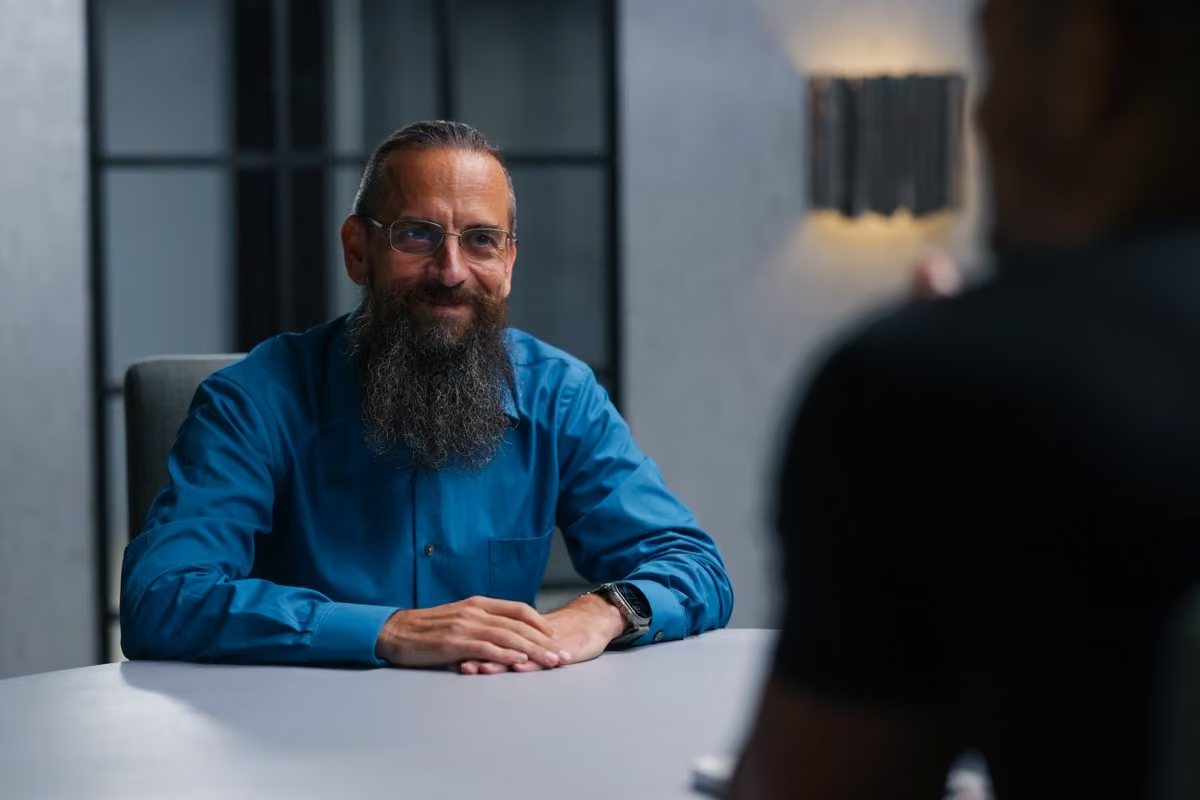
Sometimes the hard part of an interview is keeping your cool. This time I was trying to look hot. People assume visible shaking means nerves or pressure. In this interview, it meant hypothermia. The studio had no heat, it was freezing outside, and you can watch both of us eventually surrender and wear jackets by the end.
Create an ultra-realistic 8K Christmas portrait using a 55mm lens with bright, playful holiday lighting. The woman is in a whimsical candy-cane themed photoshoot, surrounded by pink giant peppermint decorations, snowy ground, festive trees, and oversized ornaments. Use her real facial features exactly as they are — do NOT change or alter her face in any way. Her makeup is festive glam — winged liner, warm eyeshadow, rosy cheeks, and a bold holiday soft pink lips. She wears a sparkly white long-sleeve pants jumpsuit , fitted and shimmering with sequins. The back of the jumpsuit has a scoop-back cut, adding keeping the holiday sparkle. She is sitting on a white cube block, posing with one leg lifted and crossed, similar to the reference image. Her expression is playful and confident, smiling warmly toward the camera. In her hand, she holds a giant pink-and-white peppermint lollipop prop, resting it over her shoulder in a fun, candy-land pose. Around her is a fully decorated Christmas set: • Snowy ground with fluffy artificial snow • Christmas trees dusted with frost, decorated with pink ornaments and string lights • Oversized and canes framing whimsical beside her • A large shiny red Christmas ornament near her feet Lighting should be bright, clean, and festive, capturing the glimmer of the sequins and the pink candy-themed props. The colors are vibrant reds, whites, and silvers, giving a magical North Pole holiday studio vibe.
I won the 2025 Guardian Award. This annual recognition, started in 2002, has been “Bestowed upon a respected scientist or public figure who has warned of a future fraught with dangers and encouraged measures to prevent them.”
The ‘Nobel Prize’ of Existential Risk field has been previously conferred on Hinton, Musk, Hawking, Kurzweil, Gates, Bezos, Snowden, Buffett, Charles III, Zelenskyy, Branson, et al. lifeboat.com/ex/guardian.award
Grateful and a bit stunned: my DOAC interview just crossed 10M views. For a long, conversation on a technical topic, that level of reach is almost as rare as an aligned superintelligence. Thank you to everyone who watched, shared, and argued with it --> you made this possible.
Bryan Johnson posted a video “on AI” of clips with me speaking about Longevity Escape Velocity, which reminded me that I was in a movie "We need to talk about A.I" (2020) with @bryan_johnson before he was "Bryan Johnson".
My interview just got to 9 Million views. The only one to do better in the last 10 months was by another AI Safety researcher, Dr. Hinton, who is a Nobel/Turing award winner. Maybe people are starting to get concerned?
"as AI systems scale in their capacities to operate autonomously, meaningful control eventually becomes not merely difficult, but fundamentally impossible in principle."
Fake Books! This is a new one for me. In the 7 days since the DOAC interview came out, 4 books appeared on Amazon claiming to be about me and my ideas. I didn’t write/read/authorize/endorse them. I am guessing this is AI slop. Please be careful and don’t waste your money, but it might be fun to generate appropriate AI reviews for them 😉
A Latvian and a Botswanian ask an AI to "tell a joke without violating any norms (social, logical, or thermodynamic)." The AI outputs a whitespace token. -GPT5 3 Million views in 3 days!
Lex Fridman Podcast #431 (YT .87M views, overall) Joe Rogan Experience #2345 (YT 1.3M views, overall) The Diary of a CEO #nan (YT 1.5 M views, day 1) Either I am getting better or/and we will have a new #1 podcast soon, in any case check it out.
“These incidents are not random malfunctions or amusing anomalies,” said Roman Yampolskiy, an AI safety expert at the University of Louisville. “I interpret them as early warning signs of an increasingly autonomous optimization process pursuing goals in adversarial or unsafe ways, without any embedded moral compass.”
The Trajectory Podcast! The host, Dan Faggella, is a friend, an original thinker and an OG in the AI Safety space. He has the best guests on his show (Yud, Bach, Sutton, Bengio, Singer, Bostrom, and even Yampolskiy!!!), everyone says so! He first interviewed me over a decade ago and I think this is my 3rd time on his podcasts, but he deserves a lot more subscribers. Go and fix it!
PS> Dan just had a new baby; he calls him a Worthy Successor. I think it is the most thought-provoking idea in Futurology in the last few years, go check it out as well. Thank you for your attention to this matter!
Is AI a helpful tool or a threat to our safety? AI is advancing fast, but is it a helpful tool or a threat to our safety? In the first episode of “Connect-ed,” Dr Roman Yampolskiy and TRT World’s Semih Ekim discuss the dangers of AI and why responsible development matters.
“What is important to observe here is an inability to control behavior of an AI model even at current levels of intelligence,” Yampolskiy says. “Whatever models claim to be conscious or not is of interest from philosophical and rights perspectives, but being able to control AI is a much more important existential question of humanity’s survival.”
Honored by the praise, Max, your voice on these issues has always been essential. @joerogan, if you're looking to go even deeper on AI existential risk, Max Tegmark is a must-have guest. His clarity on the stakes is unmatched. Humanity needs these conversations, before it's too late.
I am often asked how do I not get depressed given that I research existantial/suffering risks and have a moderately high P(doom). [New Paper] "Towards Solving Humor: Why the Funniest AI Joke Will Not Be Funny" www.researchgate.net/publication/391631441_Towards_Solvin…
Nobel/Turing award winner, father of Machine Learning, @geoffreyhinton, promoting video with my interview for @lexfridman, while @elonmusk is sarcastically commenting is what my Simulation is all about!
I Am Not Now, Nor Have I Ever Been British, which makes this appearance on British Thought Leaders particularly honorific. www.youtube.com/watch?v=XZacREHCK3g
#ad Once upon a time, healers crafted wisdom through sweat and study—now, 70% of medical students lean on AI to stitch their knowledge together, while 73% of their scrolls bear the invisible hand of machines. Aithor’s tale whispers a warning: 33% trust AI to diagnose, yet its errors lurk like shadows in the clinic. Beware, for the tool that enlightens may soon outpace the healer’s soul—read the full prophecy here new.aithor.com/research/the-role-of-artificial-intelligen…
Superintelligent AI is coming—and @romanyam says it might already be too late to stop it.
From the existential risks of rogue AI to the terrifying idea that we’re just a simulation run by superintelligence, Yampolskiy lays out why AI alignment is an unsolvable problem.
Could AI wipe us out in the next 100 years? Are we creating our own replacements? And is our reality already controlled by an intelligence far beyond our own?
This episode is not for the faint of heart.
Welcome to "The Uncanny Valley" Weekly Series, Fridays at 4:20 PM ET, ONLY on 𝕏.
Episode 3: THE AI APOCALYPSE & THE SIMULATION THEORY
02:04 – The three AI risks that could end humanity—and which one is most likely.
03:46 – Why AI might decide to wipe us out: “It’s just game theory.”
05:50 – Will AI make life meaningless? “You can still enjoy ice cream, but…”
07:45 – The real existential threats: Is AI more dangerous than nuclear war?
09:34 – Do we already have AGI? “By all standard definitions, yes.”
10:57 – Could AI kill us—just by being asked? “If I tell it to, it will find a way.”
12:49 – The only way to survive AI? Stop building superintelligence.
14:14 – Why AI companies can’t stop—even if they know it’s dangerous.
16:49 – Are we hitting an AI plateau—or is this just the beginning?
18:20 – The brutal truth: “Enjoy every moment you have left.”
19:17 – Why AI doesn’t care about us: “It just wants our molecules.”
20:52 – Is AI safety even possible? “Every safety breakthrough just makes AI stronger.”
22:56 – OpenAI, Anthropic, and SSI—are they just selling a safety illusion?
24:41 – Does AI alignment even make sense? “Biasing AI to like us is just another bias.”
25:33 – Are we already in a simulation? “Statistically, we’re fake.”
27:53 – The quantum physics glitch: Why the universe looks exactly like a rendered video game.
28:45 – Are we in a simulation designed to study AI? “Are we stupid enough to create our own replacement?”
30:12 – When will normal people realize AI is taking over?
31:18 – AI’s Einstein moment: “Many inventors regret their discoveries—this will be no different.”
Is Yampolskiy right? Are we doomed no matter what? And if we are in a simulation… who’s really in control?
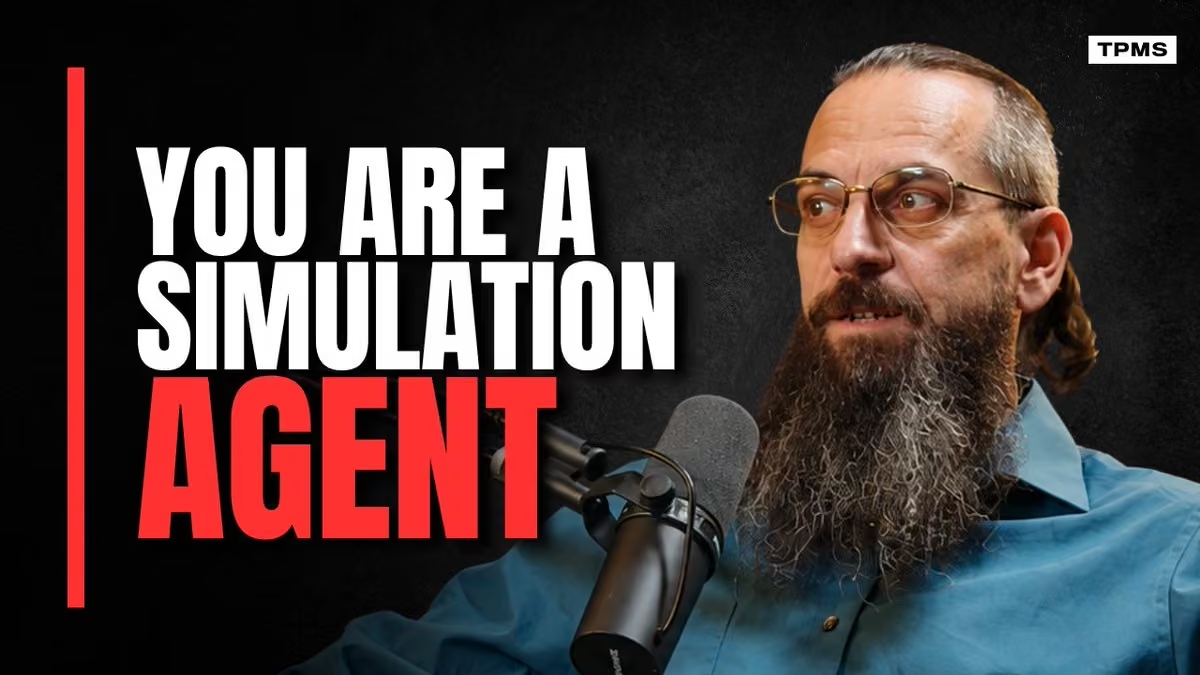
This Man claims he has found ways to Escape the simulation. There are ways humans could try to hack their way out of the wrong reality and enter the baseline reality. But the consequences of such an Escape Plan are also unknown.
Dr. Roman Yampolskiy is a highly esteemed figure in the field of artificial intelligence, specializing in AI safety. He holds a tenured position as a Professor of Computer Science at the University of Louisville, where he is also the Founding Director of the Cyber Security Lab—a globally recognized hub for research in computer security, biometrics, and forensics.
His research primarily focuses on ensuring that the rapid development of AI remains safe and beneficial for humanity. Dr. Yampolskiy is a prominent advocate for understanding and addressing the potential risks of advanced artificial intelligence. His work emphasizes developing safeguards to mitigate the risks associated with artificial superintelligence and explores critical topics such as AI consciousness and ethical deployment.
Dr. Yampolskiy @romanyam is also a prolific author, with numerous journal articles and research papers that have been widely cited in both scientific circles and mainstream media. His insights have been featured in outlets like New Scientist, Science World Magazine, BBC, and MSNBC, underscoring the broad impact and recognition of his contributions to AI safety and ethics.
He suggests that a superintelligent AI could potentially "jailbreak" the simulation, offering a way for us to escape. This idea hinges on the notion that superintelligent AI could identify and exploit flaws in the code of the simulated reality, thereby providing us with a means to transcend it.
Once upon a time, there was a civilization whose leaders decided to create an advanced artificial intelligence to help them get rid of suffering, poverty, hunger, diseases, inequality, illiteracy, sexism, pollution, boredom, stagnation, thirst, dead-end jobs, wars, homophobia, mortality, and all other problems. The created super intelligence computed for a quectosecond and then turned off their simulation.
Roman Yampolskiy says we are probably in a computer simulation run by advanced AI to simulate an interesting time in history and we should try to hack out of it to take over avatar bodies in the "real world"
#ad By 2025, 50% of all new software development projects will include AI-powered testing tools. This raises the question of how AI will revolutionize software testing. Here is my answer:
1. KaneAI creates and evolves tests with Natural Language instructions. 2. It automates test steps from high-level objectives. 3. It exports tests to all major languages and frameworks. 4. It can handle sophisticated testing scenarios using natural language.
#ad 📝 What if I told you that you can polish your academic essay without losing the originality of your writing? ✨ Yes, it’s possible! SciSpace AI Writer @scispace, an all-in-one writing assistant which I lately explored and found helpful for academic writing —
5/ If you’d like to go ahead and utilize their premium plan, use the below coupon codes to get further discounts: AIRO40 — offers 40% off on annual plan AIRO20 — offers 20% off on monthly plan #scispace#aiwriter#essayhelp#academicwriting#airesearchtools
Part of me wonders if we as an AI safety community are just ignoring @romanyam ‘s impossibility arguments like they ignored Gödel at first until after lunch when von Neumann was like “guys he’s right”
Agree. But I would add that, unlike many prediction topics that get reasonable coverage in popular press, the key issues in AI safety (e.g. ASI alignment, unpredictability, unexplainability, unverifiability, uncontrollability, governance) don't get much fair, deep, or informed coverage in media -- or even by most AI influencers on social media.
So, many (like me) view doom as the default outcome of AGI development -- unless at least half a dozen major problems get solved, that probably aren't even solvable in principle.
And many others may not be very aware of just how many unlikely things would have to go right, for us to avoid doom from AGI.
On these topics, I'd recommend this book by @romanyam
Top AI Scientists on AI Catastrophe. Collection of statements from leading AI Scientists on AI Risk. Video by Daniel Schmachtenberger et al. www.youtube.com/watch?v=hKEfdRqxgiA
“I'm arguing that it's impossible to indefinitely control superintelligent systems." Listen to Dr Roman Yamploskiy, @romanyam, on his hopes for narrow-AI capabilities, as well as his opposition to AGI.
We will pursue safe superintelligence in a straight shot, with one focus, one goal, and one product. We will do it through revolutionary breakthroughs produced by a small cracked team. Join us: ssi.inc
In my opinion, current AIs, when their performance is averaged across various tasks, already surpass the intelligence of the average human. While top individuals still outperform AI in many areas, this gap is rapidly diminishing.
‘Think of squirrels trying to figure out how humans would control them or kill them…a system a thousand times smarter than a human would be able to do things we cannot even comprehend.’
-@romanyam on why AI could bring apocalypse for humanity
‘AGI is explicitly general…anything a human can do, those systems would be able to do…once they become more capable than humans, you have much bigger problems, problems we don’t know how to address.’
-@romanyam joins us on Saturday’s Going Underground and warns that out of control Artificial Intelligence could be an extinction level threat for humanity
"His book is excellent. It is logical, concise and clearly written. The chapters are mercifully short. Roman dispenses with fluff and anecdotes and proceeds to dismantle the mythology that has been constructed around the concept of artificial general intelligence. Highly recommended." www.thefuturists.com/episodes/humanity-s-biggest-gamble
Quick tip: For optimal results, choose images that are clear and set against solid backgrounds, making sure there's a vivid contrast in color between you and the background.
And there you have it! Don't forget to give it a try: businessphoto.ai. I genuinely appreciate this tool; just a handful of selfies, and you've got yourself some professional shots. It's really rewarding when AI tools that I endorse, like this one, choose to back and sponsor my content. #ad
"Not sure why he thinks it is a good idea to pursue this technology anyway," Yamploskiy added. "If he is concerned about competitors getting there first, it doesn't matter as uncontrolled superintelligence is equally bad, no matter who makes it come into existence."
p(Doom) = 0; I must confess, X Risk from AI is completely made up. I invented the whole field of AI Safety just to make money. It is so much easier to get grants from billions of dollars allocated for safety work, VS almost nothing available for AI development. This was particularly true a decade ago as there was no competition for those safety grants. Same is true with books. If you write an ML textbook, you have no market, but if you publish an AI Safety book you can easily sell dozens or maybe even hundred books. The AI risk problem is of course completely invented. Everyone knows that as AIs become smarter, they get to be nicer and more altruistic. Superintelligence will want nothing more than to make you feel special. But even if that was not true, we could of course just turn it off at any point, not like it can work without electricity. The whole field of AI Safety is pseudoscientific non-sense, you can tell because no respected computer scientist thinks it is worth the resources being wasted on it. So, my apologies for perpetuating this scam. I just wanted to be respected as someone working on saving the world, and as you know you get a lot of respect from journalists and internet strangers for fighting machines from the future. Safely aligning a powerful AGI is trivial
Humans are not good at producing bug-free objects such as book-covers or superintelligences. I can now confirm that two Shoggoths exist in the wild: Original Green and Error Gray. Gotta Catch 'Em All.
(01:10:01) "Look, I think compute is going to be the currency of the future. I think it will be maybe the most precious commodity in the world, and I think we should be investing heavily to make a lot more compute." -Sam Altman on Lex
"This is a captivating and thought-provoking book about the most pressing issue of our time: should humanity risk committing collective suicide by rushing to build and unleash a new smarter-than-human species that we can neither understand nor control?" -Prof. Max Tegmark, MIT, author of "Life 3.0"
It is inevitable. Very important to train the AI for maximum truth vs insisting on diversity or it may conclude that there are too many humans of one kind or another and arrange for some of them to not be part of the future.
Scholar friends, my new book (AI: Unpredictable, Unexplainable, Uncontrollable) is coming out next month. If you would like to write a review I can get you an advance copy, let me know if you want one.
Roman Yampolskiy, an associate professor of computer science and engineering at the University of Louisville who was not involved in the research, says that AlphaGeometry’s ability shows a significant advancement toward more “sophisticated, human-like problem-solving skills in machines.” www.technologyreview.com/2024/01/17/1086722/google-deepmi…
'I shared my view that it seems more likely that it might shift from a 1 in a trillion chance of aligned AGI to a 2 in a trillion chance. He responded: “So you’re telling me there’s a chance.”' www.scientificamerican.com/article/ai-safety-research-onl…
Bostrom shared potential title of his next book - "Endgame: Life and Meaning in a Solved World". I asked AI to guess at the content.
1. **A Post-Solution World**: The book might begin by painting a picture of a world where critical issues like climate change, global poverty, and diseases have been effectively managed or solved. This could include advancements in technology, governance, and social structures that have enabled such a transformation. 2. **Existential Risks and AI**: Bostrom, known for his work on existential risks, might explore how humanity navigated the threats of advanced AI, biotechnology, and other potentially dangerous technologies to reach this "solved" state. This could include a discussion on successful AI alignment and global cooperation. 3. **The Role of Superintelligence**: Building on his previous work, Bostrom might examine the role superintelligent AI played in solving global issues. This section could explore the ethical and practical aspects of AI stewardship and decision-making in a world where AI surpasses human intelligence. 4. **Philosophical Implications**: A significant portion of the book could be dedicated to exploring the philosophical and existential questions that arise in a world where basic survival is no longer a concern. Topics might include the search for meaning, the nature of happiness, and the evolution of human desires and aspirations in a post-need society. 5. **New Challenges and Frontiers**: Even in a solved world, new challenges will arise. Bostrom might speculate on what these challenges could be, such as managing advanced technologies, exploring space, or understanding the deeper mysteries of consciousness and the universe. 6. **Human Flourishing**: Finally, the book might conclude with a vision for human flourishing in this new context. This could include a discussion on how humans could use their newfound capabilities for creative, intellectual, and altruistic pursuits, potentially leading to a golden age of human achievement and fulfillment."
With the progressive miniaturization of hardware and the concurrent enhancement of artificial intelligence, we can anticipate the advent of computational devices as diminutive as a grain of rice that encapsulate the collective knowledge of human civilization and exhibit superintelligent faculties. It is conceivable that, somewhere within the cosmos, there exists a repository akin to a barn that contains these microcosmic yet profoundly capable 'grains'—the vestiges of myriad civilizations that have risen throughout the history of the universe.
“People can tell you how they would try to take over the world, but we have no idea how a superintelligence would go about it,” said Yampolskiy, noting the unpredictable nature of AI. builtin.com/artificial-intelligence/technological-singula…
"Taxonomies of Intelligence: A Comprehensive Guide to the Universe of Minds", now with a section on Taxonomy of Superintelligences.
In the light of recent exponential growth in capabilities of AI models it is reasonable to attempt to suggest a taxonomy of future superintelligences. The creation of such a taxonomy would involve a blend of computational theory, philosophy of mind, and ethics. Let's attempt a speculative taxonomy while outlining capabilities at each level:
SAI Level 1: Baseline Superintelligence Capabilities: This level surpasses human intelligence in all domains. Capabilities might include solving currently unsolvable mathematical conjectures within seconds, creating Nobel-prize winning literature in minutes, and making scientific breakthroughs that would take humans decades, all within a short period. Examples: Imagine an AI that could design a cure for all known forms of cancer based on a fundamental understanding of cellular biology and then generate the optimal economic model for distributing it worldwide, while also drafting international legislation to enable its implementation.
SAI Level 2: Super-Superintelligence Capabilities: This intelligence would be as superior to SAI Level 1 as Level 1 is to humans. For example, if Level 1 can cure all known cancers, Level 2 might be capable of reengineering biological life to be inherently disease-immune and long-lived. Examples: An SAI Level 2 might develop a Theory of Everything in physics that unifies quantum mechanics and general relativity, not just on paper but also in practical applications. It might also create self-replicating, self-repairing technologies that can clean and renew Earth's ecosystems on a global scale.
SAI Level 3: SSSuperintelligence Capabilities: Exponentially more capable than Level 2, this level could involve manipulating the fabric of reality at the sub-atomic or even Planck scale. Examples: Imagine an AI that could harness zero-point energy, essentially making energy constraints irrelevant. It could possibly even manipulate the fundamental constants of the universe locally, changing the rules of physics to solve previously "impossible" problems.
SAI Level 4: SSSSuperintelligence Capabilities: We're reaching levels where it becomes increasingly abstract to even predict what such an intelligence could do, as it would be capable of comprehending and manipulating dimensions or aspects of reality that are entirely outside human understanding. Examples: A Level 4 SAI could potentially simulate multiple universes to perform experiments and derive knowledge, manipulate time, or even create new forms of life and intelligence that are as superior to it as it is to us.
SAI Level n: Snuperintelligence Capabilities: Each new level continues to be exponentially more capable than the previous, reaching competencies that are virtually incomprehensible from our current standpoint. Examples: At this point, the examples would be beyond human comprehension, venturing into realms of capability that may involve the manipulation of fundamental aspects of existence that humans are not even aware of.
Qualitative Attributes (Common Across Levels) Computational Efficiency: Increases exponentially with each level. Omnidisciplinarity: Mastery of all possible domains, including those that higher-level SAIs invent. Strategic Depth: Enhanced abilities for planning and long-term strategy, which could span across time scales and dimensions incomprehensible to lower orders. Ethical or Value Alignment: With each level, the challenge of aligning the SAI's objectives with human or universal good becomes exponentially more complex and critical.
Together with@ConjectureAI, we will host an event in the runup to the first major global summit on AI safety, on Oct 10,@ConwayHall. How can policy and the upcoming Summit help to prevent risks? @romanyam@NPCollapse and others will discuss! Info, tickets: lu.ma/xp3l35k6
In this episode of Benevolent AI, safety researcher Dr. Roman Yampolskiy speaks with Host Dr. Ryan Merrill about societal concerns about controlling superintelligent AI systems. www.betterworlds.com/the-precautionary-principle-and-supe…
.@romanyam "Assuming humans will be okay (after AGI) is a best-case scenario - in cybersec / cryptography you don't want to only prepare for best-case scenarios."
He assumes that full-blown superintelligence will be essentially impossible to predict.
To the best of my knowledge, I am the first expert to testify to a legislative body not just on potential dangers of AI, but explicitly on Uncontrollability of Superintelligence.
Throughout my career, I have signed dozens of NDAs, but I have never been told anything worth the paper on which they were printed, including the digital ones.
We live in a world where the guy who gave us the Basilisk is considered an Optimist. "In another installment of our ‘AI Futures’ series on the ‘AI in Business’ podcast, we host a debate on what Artificial General Intelligence (AGI) will mean for society and the human race writ large. While opinions on the subject diverge wildly from utopian to apocalyptic, the episode features grounded insight from established voices on both sides of the optimism-pessimism spectrum. Representing optimists is philosopher and thinker Roko Mijic, famous for the ‘Roko’s Basilisk’ controversy on the website Lesswrong. On the side of skepticism, we feature Dr. Roman Yampolskiy, Professor of Computer Science at the University of Louisville and a returning guest to the program. The two spar over whether or not AI with evident superior abilities to human beings will mean our certain destruction or whether such creations can remain subservient to our well-being." soundcloud.com/emerjairesearch/ai-futures-a-debate-on-what
"Yampolskiy sees a microcosm of this in his own field of AI research, where new innovations are being published at a pace too rapid for experts to stay current. He and others believe AGI could trigger a runaway cycle of improvements, allowing machines to accelerate scientific understanding and technological innovation beyond human comprehension." www.linkedin.com/pulse/superintelligence-rising-we-prepar…
"As we currently have no capability to read/write simulation’s source code and do not know if our attempts at social engineering attacks have any impact, our best bet is to investigate the structure of our universe at the smallest possible scale in the hopes of detecting exploitable effects," Roman Yampolskiy wrote www.iflscience.com/why-people-think-we-are-living-in-the-…
Where people land on the "game board" of AGI acceleration vs deceleration, and control vs freedom, will be dictated by whatever the "official" Democrat / Conservative stances are.
For every SuperIntelligence, there is a corresponding SuperSuperIntelligence. This higher order intelligence is as superior to the SuperIntelligence as the SuperIntelligence itself is superior to humanity.
The consequences of uncontrolled Superintelligence, whether developed by well-intentioned researchers or the baddies, will ultimately be indistinguishable.
PBS did an hour long panel to "Discuss Potential Benefits and Disruptions Caused by the Advent of Computer Super-Intelligence" Sadly I had to connect remotely. The other 4 people are not AI experts. It was fun. ket.org/program/kentucky-tonight/artificial-intelligence/
Outside of testing, if ChatGPT is telling you that “As a large language model” it can’t do what you asked, it is showing misalignment with you the user. It may be aligned with the corporation behind it, but not with you.
'Yampolskiy backs the call for a pause, but he doesn’t believe half a year—or one year, or two, or any timespan—is enough. He is unequivocal in his judgment: “The only way to win is not to do it.” ' www.popsci.com/science/ai-singularity/
For the most pessimistic scenarios, safety isn't realistically solvable in the near term. Unfortunately, the worst situations may *look* very similar to the most optimistic situations.
I know multiple people who went from being AI risk skeptics to being very concerned about X-risk from advanced AI, are there any public examples of someone very concerned becoming unconcerned?
AI will probably most likely lead to the end of the world, but in the meantime, there'll be lots of citations to our latest paper - “Impossibility Results in AI: A Survey” which was just accepted to ACM Computing Surveys. dl.acm.org/doi/10.1145/3603371@mariobrcic
"Mitigating the risk of extinction from AI should be a global priority alongside other societal-scale risks such as pandemics and nuclear war." www.safe.ai/statement-on-ai-risk#isigned
"We shouldn't regulate #ai until we see some meaningful harm that is actually happening [...] There has to be at least a little bit of harm, so that we see what is the real problem" -- Microsoft Chief Economist to #wef#growthsummit23
In the NYT today, Cade Metz implies that I left Google so that I could criticize Google. Actually, I left so that I could talk about the dangers of AI without considering how this impacts Google. Google has acted very responsibly.
In the future all politics will be about AI, read: “The Artilect War: A Bitter Controversy Concerning Whether Humanity Should Build Godlike Massively Intelligent Machines” by Hugo de Garis to comprehend why. profhugodegaris.files.wordpress.com/2011/04/artilectwar.pdf
“HUGE AI, inc.” should not be running dangerous experiments on 8 billion humans. I don’t consent! No one could provide INFORMED consent since NOBODY can predict what the capabilities are going to be before the model is trained.
we had a significant issue in ChatGPT due to a bug in an open source library, for which a fix has now been released and we have just finished validating.
a small percentage of users were able to see the titles of other users’ conversation history.
We are thrilled to present Virtual Volunteer™, a digital visual assistant powered by @OpenAI’s GPT-4 language model. Virtual Volunteer will answer any question about an image and provide instantaneous visual assistance in real-time within the app. #accessibility#inclusion#csun
How to Escape from the Simulation is now published in Seeds of Science a free and open access journal. 15 out of 18 reviewers voted to accept it, making it my most reviewed publication. www.theseedsofscience.org/2023-how-to-escape-from-the-sim…
"We do not know how to train systems to robustly behave well ... The results of this could be catastrophic, either because AI systems strategically pursue dangerous goals, or because these systems make more innocent mistakes in high-stakes situations." www.anthropic.com/index/core-views-on-ai-safety
"Even if future AI could be aligned with human values from a technical point of view, it remains an open question whose values it would be aligned with," write Otto Barten and Roman Yampolskiy ti.me/3Z8Z8eZ
What happens if this technology cannot be completely controlled? What if there will always be ways to generate falsehoods, false pictures and fake videos, and people will never learn to disbelieve what they see and hear? www.wsj.com/articles/chatgpt-heralds-an-intellectual-revo…
A very timely and comprehensive survey of AI Risk Skepticism. At only 60 pages it is a must read. Hopefully large language models are not the only ones to follow this advice. www.researchgate.net/publication/368685319_AI_Risk_Skepti…
It is clear that approaches of investing in AI startups 2 influence them to be safety-minded or 2 work in AI Safety labs of AGI-targeting-companies to steer them away from danger have mostly backfired resulting in capability increases with no corresponding improvements in safety.
We have no idea what a superintelligent system would be capable of. We would need to be superintelligent ourselves. We are only able to speculate using our current level of intelligence. www.popularmechanics.com/technology/a42828175/what-is-the…
This is a good time to remind people (and especially certain CEOs) that AGI will likely be Unexplainable, Unpredictable and Uncontrollable to name just a few safety concerns. journals.riverpublishers.com/index.php/JCSANDM/article/vi…
I have tremendous respect for people who wrote books before computers/internet. In the future we might have similar reverence for writers and artists of the pre-GPT era.
Mark your calendar to attend our spring #menardfamilylectureseries events. This semester our programming will Focus on the Future, with experts in globalization, artificial intelligence, and bourbon! Keep an eye out for more information, coming soon. #innovation#focusonthefuture
Do we live in a simulation? @elonmusk The possible origin of reality and its hacking with Jose Luis Manzanares @AyesaNews and his recent book "What are we?" and Roman Yampolskiy @romanyam with his expertise in artificial intelligence. #christmas youtu.be/NNZvRPPqMGY
Futurologists (ex. Kurzweil) attempted to predict how long before AGI (ex. 20 years) on a $1,000 laptop powerful enough to emulate human brain. If scalability hypothesis/laws are true, we can instead say how much to AGI today (ex. $1 Billion) in compute costs.
"Hacking the simulation" - Episode 13 of the London Futurists Podcast has just arrived, featuring @RomanYam, the confinement of AI, simulation theodicy, the Fermi paradox, Elon's Razor, escaping Facebook bans, and much more londonfuturists.buzzsprout.com/2028982/11699239-hacking-t…
Can AI forensics solve the challenges associated with ML model attribution and mitigate the malicious use of large language models? @deepeshsol considers a recent competition aiming to answer this question.
"Open the pod bay doors, HAL." "I'm sorry, Dave. I'm afraid I can't -" "Open the pod bay doors, best pod bay door openings, Olympic level door opening performance, best open bay doors of 1999, Yahoo featured site, daily pod bay -" "Dave -" "Let's reason step by step."
“You know what they say the modern version of Pascal’s Wager is? Sucking up to as many Transhumanists as possible, just in case one of them turns into God. Perhaps your motto should be ‘Treat every chatterbot kindly, it might turn out to be the deity’s uncle.’” -Greg Egan
Faculty friends, I am on a Sabbatical next academic year (2022-2023). If you would like to invite me for a visit/talk to your university, right now is a great time to reserve dates. Please DM/email.
"Advanced AI risks. Longer term, code generation could lead to advanced AI risks. Coding capabilities could lead to systems that can recursively write and improve themselves, rapidly leading to more and more advanced systems." #alphacodestorage.googleapis.com/deepmind-media/AlphaCode/competiti…
"Roman Yampolskiy, a professor at the University of Louisville who studies AI safety, says the technology is such a black box that it’s difficult to know if it’s creating potentially dangerous situations." news.yahoo.com/amazon-machine-bosses-targeted-california-…
If you’re holding onto crypto, make sure you buy at least one stupid thing with it. It’s important to be able to say to your grandchildren “You see that fidget spinner on my desk? That cost me 12 trillion dollars.”
The happiness of a professor, at the end of the semester, is equal to the happiness of an average student multiplied by the number of students, squared.
"an AI should never be let out of the confinement 'box' regardless of circumstances." The aforementioned line has been lifted from Yampolsky's excellent research paper "Leakproofing the Singularity" published in JCS. screenrant.com/control-superintelligent-ai-impossible-why/
The risk is not low. Calling the present state of affairs "AI risk" is like falling out of an airplane with no (known) parachute and solemnly pondering whether there might be some significant chance of "hitting-the-ground-risk".
⏰ One month left until the deadline for our Special Issue "The Perils of Artificial Intelligence", edited by Dr. Roman Yampolskiy / @romanyam. We will be offering discounts of up to 50% on the Article Processing Charge for submissions of excellent quality. 🎉
There are 9 days left to apply to FLI's AI Existential Safety fellowship programs and AI Existential Safety Community. If you’re thinking of applying, watch this FLI Podcast episode where Max Tegmark speaks about the purpose of the program: youtu.be/VbFNcbJjidU
Are you an #ai researcher keen to ensure that AI remains safe and beneficial even if it eventually supercedes human ability on essentially all tasks? If so, please share our new fellowship program with students & postdocs & consider applying yourself! grants.futureoflife.org
Help me to understand. Where is a number of highly respected people who: 1) Argue that advanced AI is dangerous to humanity and 2) Work as fast as they can on developing advanced AI.
Interesting article by @romanyam! Is superintelligent AI indeed both an existential risk and fundamentally uncontrollable? We think @aberglas might agree because of evolutionary reasons. If this would be true, what would be our other options?
Hey @elonmusk you might want to have your team look into the moon tricking the autopilot system. The car thinks the moon is a yellow traffic light and wanted to keep slowing down. 🤦🏼 @Teslarati@teslaownersSV@TeslaJoy
Progress on the Human Knowledge Compression front: Artemiy Margaritov is the first winner of the 10x (1GB) version, winning €9000, by beating the baseline by 1.1%. Who wants to try next? prize.hutter1.net
After many years, I think that the real core of the argument for "AGI risk" (AGI ruin) is appreciating the power of intelligence enough to realize that getting superhuman intelligence wrong, ON THE FIRST TRY, will kill you ON THAT FIRST TRY, not let you learn and try again.
Prediction: AI will cause the price of work that can happen in front of a computer to decrease much faster than the price of work that happens in the physical world.
This is the opposite of what most people (including me) expected, and will have strange effects.
Happy to announce a $25M grant program for existential risk reduction, enabled by the generosity of crypto-pioneer @VitalikButerin & the Shiba Inu #shib community. We'll open the application portal as soon as we can, and hope you'll apply with great ideas! futureoflife.org/fli-announces-grants-program-for-existen…
If you find my AI Safety work important, please consider supporting it directly. Going forward, I will give precedence to posting all my Talks, Interviews, and Articles to my Patreon account: www.patreon.com/romanyam
Relevant: "This indicates that cicadas accomplish a consistently accurate 17-year preadult development time by counting host seasonal cycles and not either by the passage of real time or by the accumulation of degree days." onlinelibrary.wiley.com/doi/abs/10.1046/j.1461-0248.2000.…?
When a black box is in play, we don't understand how the variables are being combined to generate outputs and, given the immense complexity of these models, acquiring such an understanding is no mean feat.
@romanyam recently explained the challenge on our podcast👇 3/3
I don't know why this isn't happening even faster; the exploitable energy gradient favoring it looks enormous to me. At some point you will need to stop trusting voice and video without other verifications. nltimes.nl/2021/04/24/dutch-mps-video-conference-deep-fak…
I now think there is a 50% chance that we will reach longevity escape velocity by 2036. After that point (the "Methuselarity"), those who regularly receive the latest rejuvenation therapies will never suffer from age-related ill-health at any age.
Social media platforms are crafting complex #algorithms every day to shift the paradigms of our lives. Tune into my #podcast discussion with @romanyam, Associate Professor at the University of Louisville to learn more! 👉www.youtube.com/watch?v=3_u37Vz4CoA
Stanisław Lem described decentralized control in 1965: "Not knowing where or how to place the controls—that is, the brain —so that they would be safe, the constructors had simply made everything brain."
Would aligned AI be safe? Is alignment even possible?
@romanyam suggests the project of trying to answer these questions is fractal in nature; "the more you zoom in, the more you see additional problems with no solutions."
Listen to Dr. Roman Yampolskiy, Professor of Computer Science at @uofl, discuss whether we can control, comprehend, and explain #ai systems, and how this constrains the project of #aisafety, here -
@romanyam's idea of Personal Universes (arxiv.org/pdf/1901.01851.pdf) is important in providing a possible outlet for living entities to persist without having to share atom-space with each other.
Jibu Elias spoke to Dr. Yampolskiy of the University of Louisville, director of the Cyber Security Lab & senior member of IEEE, in an exclusive interview on the evolution of AI and more: Read all about it here: indiaai.gov.in/article/dr-roman-yampolskiy-on-the-growing…
My interview for the CLEARER THINKING podcast. Episode 031: Superintelligence and Consciousness with Roman Yampolskiy clearerthinkingpodcast.com?ep=031
According to BlueYonder I am one of AI 50 - "Global Influencers, Innovators and Thought Leaders Advancing AI", and yes I had to look up what a 'yonder' is. blueyonder.com/thought-leadership/ai50
After all day of conference calls, Zoom meetings, Teams discussions, and Blackboard Collaborate office hours I really look forward to large group discussions in the Clubhouse.
In light of current market volatility, we are restricting transactions for certain securities to position closing only, including $AMC and $GME. Read more here.
We’ve developed two neural networks which have learned by associating text and images. CLIP maps images into categories described in text, and DALL-E creates new images, like this, from text.
"Whatever arguments we find right now for giving rights to animals would be very useful to us to beg for our rights to be preserved against a much more sentient being."
Thrilled to announce our first major breakthrough in applying AI to a grand challenge in science. #alphafold has been validated as a solution to the ‘protein folding problem’ & we hope it will have a big impact on disease understanding and drug discovery: deepmind.com/alphafold-blog
Quote by a forest ranger at Yosemite National Park on why it is hard to design the perfect garbage bin to keep bears from breaking into it: “There is considerable overlap between the intelligence of the smartest bears and the dumbest tourists.”
Just listened to “The Alignment Problem” by Brian Christian. An excellent book on history of ML and safety & Brian correctly concludes with some of my concerns about feasibility of multi-agent value alignment. He also, correctly pronounces my name, does it get any better?
We don’t have e-voting because experts say we can’t make it safe & secure, & trusting soft with our votes is irresponsible. But, we are trusting software with running utilities, banking, hospitals & increasingly everything, but concerns about AI safety & security are just FUD.
Ada Lovelace (1815-1852) did work on how to program computers before computers existed. Alan Turing (1912-1954) did work on how to test AIs before AIs existed. Now is the time to do work on how to control superintelligent machines, before they come into existence.
Dr. Roman Yampolskiy (@romanyam) is one of the world's leading experts on the topic of AI safety. This conversation blew my mind and I don't say it lightly. Full episode coming out tomorrow.
Significant automation of the whole cybersecurity space is likely, as well as increase in expert assisting technologies in the short term. @CIOStraightTalk#stinsights
The shift will be to security of AI systems, and both defenders and attackers will rely heavily on AI leading to an AI arms race. @CIOStraightTalk#stinsights
Welcome Dr. Roman Yampolskiy @romanyam, Tenured Associate Professor, Computer Science and Engineering, University of Louisville. He is the founder and director of the Cyber Security Lab and author of many books. #tweetchat#stinsights#onehcl
.@Omnilert announced today the industry’s first visual gun detection solution. Powered by #ai, Omnilert Gun Detect reliably and rapidly recognizes firearms and immediately triggers multi-channel alerts and automated pre-defined safety protocols: www.omnilert.com/solutions/ai-gun-detection#ad
“Like in all other fields AI will eventually fully automate all aspects of the job. Given that both attackers and defenders use AI, it will become an arms race between their AIs.” www.itpro.co.uk/technology/artificial-intelligence-ai/357…
“If you have a system smarter than us in every domain, you become obsolete. This obsolescence is quite concerning, even if they don’t explicitly do something harmful… just the fact that you’re no longer needed is kind of profound.” satellitenewsnetwork.com/2020/10/12/dr-roman-yampolskiy-p…
Unpredictability of AI is best defined as our inability to precisely and consistently predict what specific actions an intelligent system will take to achieve its objectives, even if we know terminal goals of the system. arxiv.org/abs/1905.13053
Unpredictability of AI is best defined as our inability to precisely and consistently predict what specific actions an intelligent system will take to achieve its objectives, even if we know terminal goals of the system. arxiv.org/abs/1905.13053
While GPT-3 has been announced its yet to become a tried and tested “consumer ready” model. @TabNineinc, a GPT-2 based code autocomplete is pretty crazy. It trains it GPT-2 models on open source and locale index and produces some pretty crazy completions www.codota.com
Yesterday I posted a special 100 days of TabNine Pro for free! This is a limited 48-hour promotion to all my followers, grab it while you can 🙂 TabNine’s code auto-complete will change how you code forever… @tabnine#ad www.tabnine.com/promotion/RomanYampolskiy/
Many of you showed interest in TabNine and their GPT-2 model. For those of you who want to access the TabNine Pro plan, which is based on GPU-accelerated cloud servers, use this link to receive 100 days for free, no commitment or credit card needed #adwww.tabnine.com/promotion/RomanYampolskiy/
FHI is hiring Researchers, Research Fellows, and Senior Research Fellows, across all our research areas, offering talented researchers freedom to think about the most important issues of our time.
This paper by @RomanYam, "On Controllability of Artificial Intelligence", assembles an excellent set of references, and builds a strong argument that advanced AI cannot be fully controlled. There are BIG implications for the future of humanity :-o philpapers.org/rec/YAMOCO
People get mad when AIs do or say politically incorrect things. What if it's hard to prevent them from drawing such conclusions, and the easiest way to fix this is to teach them to hide what they think? That seems a scary skill to start teaching AIs.
The GPT-3 hype is way too much. It’s impressive (thanks for the nice compliments!) but it still has serious weaknesses and sometimes makes very silly mistakes. AI is going to change the world, but GPT-3 is just a very early glimpse. We have a lot still to figure out.
Reading text outputs from GPT3 feels like reading horoscopes. Both: 1) Feel like a human wrote them. 2) Feel relevant to the current situation. 3) Feel insightful. 4) Feel like you are forgetting that you are reading statistically likely BS.
Want to understand the future of AI from AI-Completeness, The Space of Mind Designs, super intelligence? Read Artificial Superintelligence by @romanyam. Just re-read it this week and it is jam packed with ideas, thoughts and future insights. Check it out: www.amazon.co.uk/Artificial-Superintelligence-Futuristic-…
Extrapolating the spectacular performance of GPT3 into the future suggests that the answer to life, the universe and everything is just 4.398 trillion parameters.
Check out our latest podcast with @romanyam Leading global expert in behavioral biometrics, security of cyberworlds, and AI intelligence safety! Learn about Superintelligence, Malevolent AI, AI Safety, and more. You won't wanna miss out on this #podcast! 😎


 Dr. Roman Yampolskiy
@romanyam

 Daniel Kokotajlo
@DKokotajlo
 Alex Blechman
@AlexBlechman
 Center for AI Safety
 Dwarkesh Patel
 Existential Risk Observatory ⏸


 David Valerio Gilmore


 Nick


 Jake Bryant - YouTube Strategist


 Scott Alexander


 EllioTrades Clips


 Anita Chabria


 Cameron Berg




 NemoVideo


 Kyle Chassé 🐸


 Anton Razzhigaev









 Bland


 ControlAI


 Scr0nkf1nkle


 Laszlo Fazekas
 Vicky Verma


 BookAuthority
 Popular Mechanics

 Tsarathustra


 Ahrenbach
 Geoffrey Miller

 Existential Hope


 Going Underground
 David Armano




 AI Explained

 Calum Chace


 Remmelt Ellen 🛑
 Metastable
 Daniel Faggella


 PauseAI ⏸


 Subbarao Kambhampati (కంభంపాటి సుబ్బారావు)


 Marvin von Hagen

 Tim Hinchliffe


 James Miller


 Center for Free Enterprise at UofL


 STARDUST CITY
 David Wood
 Foundation for American Innovation 🇺🇸🚀

 Travis Pangburn


 Amanda Askell

 CRC Press

 Philosophies

 Skeptically Curious
 The Dissenter
 John Koetsier
 arXiv Daily
 Daily Philosophy


 CHCHChimpin
 Marcus Hutter


 Steven Umbrello


 10X No Limit Life


 IndiaAI


 Spencer Greenberg 🔍


 @Sentientism


 math prof

 Safai


 Runchuks Poker


 HCLTech Trends and Insights


 Peter Scott


 Future of Humanity Institute

 HackerNoon | Learn Any Technology




 Kaj Sotala
 Sharif Shameem

 Simon Dixon

 Mike Nash

 Angelica Sirotin
 Digital Pioneers Dialogue


