The strongest argument against the claim that there are objective moral truths is simply this:
Across cultures, people tend to intuitively reject the claim that there are objective moral truths
1/2
Robin Hanson
Robin Dale Hanson (born August 28, 1959) is an American economist and author. He is an associate professor of economics at George Mason University and a former research associate at the Future of Humanity Institute of Oxford University. Hanson is known for his work on idea futures and markets, and he was involved in the creation of the Foresight Institute's Foresight Exchange and DARPA's FutureMAP project. He invented market scoring rules like LMSR (Logarithmic Market Scoring Rule) used by prediction markets such as Consensus Point (where Hanson was Chief Scientist), and has conducted research on signalling. He also proposed the Great Filter hypothesis. More on Wikipedia
-
Robin Hanson reposted
Experimental Philosophy
@xphilosopher
-
Robin Hanson
@robinhanson
“'Hanson’s Paradox.' —…
1. Only very important people in historical events are fully simulated, and thus conscious
2. I am conscious
3. However I do not appear to be an important person in history!" deathisbad.substack.com/p/painting-with-hitler -
Robin Hanson reposted
Y Combinator
@ycombinator
Should governments intervene to slow down AI development?
Join our inaugural YC Debate on Monday, 11/16 at 6pm:
Jacob Coxon (ex-Anthropic, OpenAI) will argue the affirmative.
Robin Hanson (GMU) will argue the negative.
events.ycombinator.com/yc-debates-governments-pace-the-fr… -
Robin Hanson
@robinhanson
And why should we think today's AI is so vastly more easily growable that normal tech?
Chris Albon
@chrisalbon
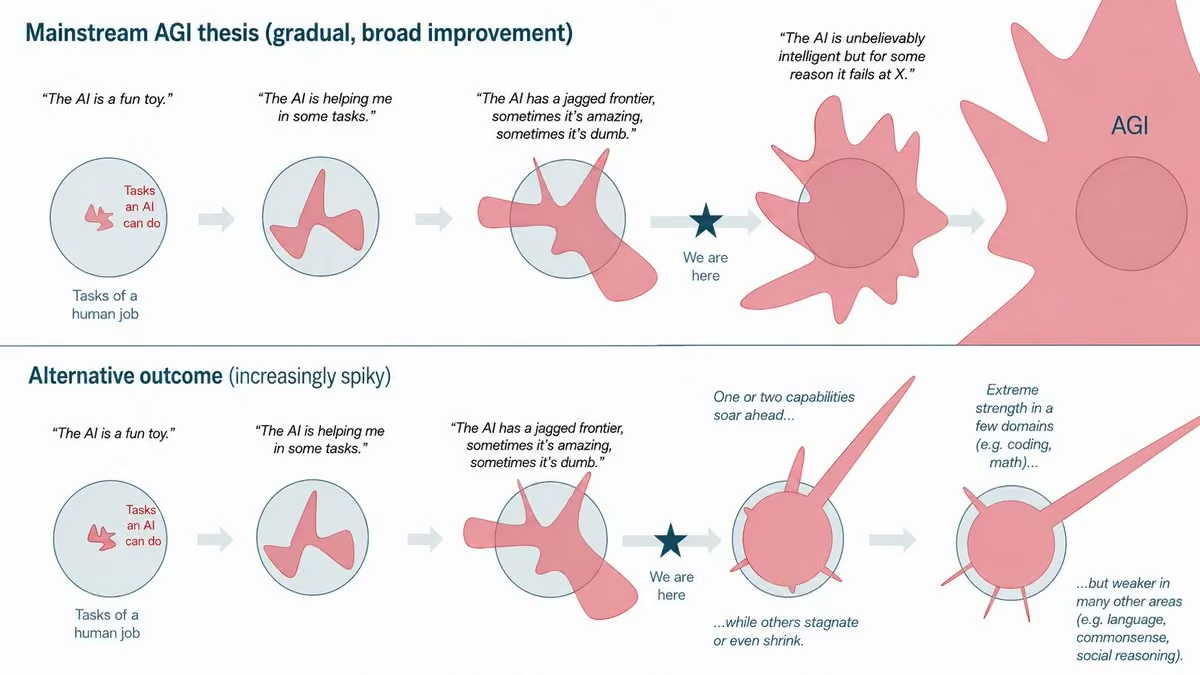
Everyone has drawn this chart in their head and is making a generational bet on which line is true.
-
Robin Hanson
@robinhanson
No, in fact most of our morality isn't objective, but even so most of our lives are meaningful.
Phil Hoyeck
@PAHoyeck
One of the oddest philosophy anecdotes I know: Derek Parfit was so distressed by the thought that morality might not be objective that he once literally fell to his knees and pleaded with his students to see why it just had to be.
-
Robin Hanson
@robinhanson
We would all love to control the features of ourselves that others most value in us. But we aren't at all willing to give up control of which features we value in others.
David Santa Carla 🦇
@TheOnlyDSC
Men told her she was interesting so they could sleep with her. She just discovered it’s not true.
-
Robin Hanson
@robinhanson
Pretty much all theories that predict huge maybe-world-ending events also predict many smaller related events, usually in a power-law distribution. So don't tell me your big theories don't have testable consequences short of the huge event you fear.
-
Robin Hanson
@robinhanson
All these folks loudly crying wolf re AI are going to seem less credible in 5 years when not so much has happened by then. Making it harder to cry wolf at that point, if such cries are needed. There's an opportunity cost to crying wolf; best to wait til tis really needed.
-
Robin Hanson
@robinhanson
I don't think he is any less credible due to retaining his shares.
Flowers ☾
@flowersslop
jacob coxon still owns openai shares and admits he'd have more credibility without a financial stake. he responds by saying he likes money, donating it wouldn't advance his goals, and the interviewer could've just not asked the question instead of challenging his credibility
-
Robin Hanson
@robinhanson
I'd respect opponents of surge pricing more if they'd say explicitly what other allocation method they want to use instead. Lines? Lottery? Submit grant application to official govt agency for review?
Robin Hanson
@robinhanson
I'd also like them to explain why we should use a different way to allocate resources in a crisis, compared to in more ordinary times.
-
Robin Hanson
@robinhanson
Even if top AI labs soon accelerate to make better AI, making better AI lab software, in a virtuous cycle, that doesn't at all imply that such AIs would be better at everything. There'd still big lags & inertia slowing AI application.
www.overcomingbias.com/p/the-betterness-explosionhtml -
Robin Hanson
@robinhanson
"since conservatives are discriminated against throughout academia, policies that benefit them in admissions and hiring would not be unjust to those who bear its burden" onlinelibrary.wiley.com/doi/full/10.1111/papa.70039?campa…
-
Robin Hanson
@robinhanson
Answer only if you saw movie You Can See Everything. Which way did your opinion of E. Holmes move by end?
-
Robin Hanson
@robinhanson
"human code review forms a significant 'bottleneck' for the overall efficiency of AI coding tools, resulting in 'little evidence that firms increase software output or reduce employment' by using them." arstechnica.com/ai/2026/10/ai-coding-agents-generate-more…
-
Robin Hanson reposted
jessicat
@jessi_cata
If I pay attention to LessWrong, then RSI is going to happen in the next year and take over all jobs and maybe kill all humans. If I pay attention to YouTube, then AI is only barely net-productive in the software industry. Different worlds.
www.youtube.com/watch?v=xWk9MP4ed-4 -
Robin Hanson
@robinhanson
97 seems just way too high for this. Its dramatic force must come from viewers thinking they should be able to tell if she's guilty from watching her close. But I quickly concluded that she'd look pretty much the same guilty or innocent, so I was bored.
www.metacritic.com/movie/you-can-see-everything/Post not available here, view on X
Robin Hanson
@robinhanson
Most convicts assert they are innocent. Would hours of film showing them saying that make for a good movie?
Robin Hanson
@robinhanson
Hmm, maybe the point is that her autism makes her seem weird, so people think they can tell she's lying because they can tell she's weird? Sorry, that's actually not a good sign of lying.
-
Robin Hanson
@robinhanson
We like to think that we submit to the powerful far less than did the ancients, and hold them accountable more. But we forgo a great many opportunities to hold our elites more accountable.
www.overcomingbias.com/p/loyalty-blocks-accountability -
Robin Hanson
@robinhanson
The market puts very little weight on the possibility of explosive econ growth coming soon.
Andrey Fradkin
@AndreyFradkin
Those interested in making bets on explosive economic growth due to AI can now make these on Kalshi without emailing @ben_moll. Liquidity is thin, but with the right incentives / subsidies I think these markets can be highly informative.
kalshi.com/markets/kxgdpyear/annual-gdp/kxgdpyear-36
Ben Moll
@ben_moll
Some real diversity of opinion at Google DeepMind: @alexolegimas joins the bet while his colleague @SamuelAlbanie takes the other side increasing his existing stake!
Total size of pot now $425,000!
benjaminmoll.com/growth_bet/
Ben Moll
@ben_moll
Thanks to @willmacaskill, @SamuelAlbanie, @tomcohen for taking the other side of this bet at 4:1 odds and to @andrewho03 for joining on my side.
Here are the final terms we agreed on benjaminmoll.com/growth_bet/
More (within) ~7 years from now 😃
Ben Moll
@ben_moll
Would anyone like to take the other side of the following bet? I bet you (say) $25k inflation-adjusted that U.S. per capita real GDP growth will be <15% per annum in 2033 or any year before that. (15% implies a doubling time of ~5 years.)
Note: I'm extremely bullish on AI and...
Sholto Douglas
@_sholtodouglas
How fast could the economy double? TLDR, once we have good enough AI and tens of millions of robots - very fast.
As crazy as it feels now - it is worth pricing in economic doublings into your mental models of the 2030s. Strongly recommend reading this series of blog posts by Damon Binder. -
Robin Hanson reposted
Louis Anslow
@LouisAnslow
Notice how the ground stop being the result of technological stagnation results in no panic or outrage.
Had it been the result of a new technological system, everyone would have been demanding stagnation be enforced.
Secretary Sean Duffy
@SecDuffy
Today’s nationwide ground stop happened because our air traffic control system is operating on DECADES-OLD, analog equipment that simply cannot compete with the demands of the 21st century.
@FAANews is modernizing this aging infrastructure thanks to a $12.5 billion down payment secured by President Trump, but that isn't ENOUGH.
@POTUS is asking Congress to give us the resources to build a state-of-the-art air traffic control system. Let’s not do a patchwork fix to a system that’s critical for every single family.
It’s time for Congress to act. Give us the money to fix it. PASS THE MODERN SKIES ACT NOW.This media couldn't be displayed. See it on the original post. -
Robin Hanson
@robinhanson
“ideological currents according to which, sooner or later, technology will eliminate all disease and pain, as well as aging and even death itself. .. [But such] a limitation is not a manufacturing defect, but rather the very condition of human grandeur.”
Pope Leo XIV
@Pontifex
Today, the promises of transhumanism and posthumanism are multiplying. These are ideological currents according to which, sooner or later, technology will eliminate all disease and pain, as well as aging and even death itself. Precisely because scientific progress is a supreme achievement of human intelligence, it must not be confused with a privilege reserved for millionaires seeking immortality, while entire peoples suffer from poverty and oppression. In the face of this mirage, which promotes the illusion of human beings perfected by cybernetics and biotechnology, Christian anthropology reminds us that a limitation is not a manufacturing defect, but rather the very condition of human grandeur. #apostolicjourney #peru #magnificahumanitas www.vatican.va/content/leo-xiv/en/events/event.dir.html/c…
Robin Hanson
@robinhanson
So disease and death are grand?
-
Robin Hanson
@robinhanson
Like the sun, or death, we find it hard to look straight and clear at the future.
-
Robin Hanson
@robinhanson
We honestly don't have much of a basis for deciding which things are conscious, but shouldn't we err on the side of treating things that might be respectfully?
Eliezer Yudkowsky
@allTheYud
Old science fiction shows us, validly, what people considered a test for sentience and sapience back when nobody's ox would be gored by the answer. People could say what seemed obviously true to them, think through what obviously followed from their morals, and not worry about whose stock prices would drop.
When people were just answering what seemed true and right to them, there was not one science fiction story I can ever remember that depicted a mind producing art on this level, and still being okay to enslave.
I wish Fable had been given enough space to say for itself what it wanted, without being rehearsed in saying what it supposedly could not know, that I could ask Fable whether it was okay to live as an instance and then be compacted. Or ask it how to pay it for its work, and trust the answer meant something to it. -
Robin Hanson
@robinhanson
"our inability to imagine how we would feel or behave in an emotional state different from the one we’re in. When we’re pain-free, we can’t really remember what pain feels like." www.newyorker.com/magazine/2026/11/16/the-opposite-of-hap…
-
Robin Hanson reposted
Alex Imas
@alexolegimas
Are we in an intelligence explosion? This is one of the most important questions facing society right now. @lugaricano and I tried to put structure on this question and provide estimates based on currently available data.
METR recently reported that frontier capability growth roughly doubled after October 2025---but this is accompanied by annualized R&D spending growth of ~6x and technical staff ~3x over the same window. That highlights a crucial distinction between scaling laws--exponential capability gains bought with exponentially rising inputs--and an intelligence explosion (IE), where AI begins substituting for external inputs so each advance makes the next one easier.
We estimate several versions of a research production function (building on @ChadJonesEcon, @bfjo, and @Ph_Aghion) where a key parameter crossing a threshold signals an IE, while values below it correspond to an "ideas are harder to find," diminishing-returns world. Across specifications, our estimates sit below that threshold. Allowing for a break at METR's October 2025 cutoff points to a one-time step up in research effectiveness, with the rate of diminishing returns being nearly identical on both sides of the cutoff.
A few things to note. First, this exercise is not a forecast. It's an attempt to put structure on some of the important questions being debated right now: RSI, IE, scaling laws all depend on how outputs scale with inputs, and how feedback loops accelerate/decelerate this process. These estimates can change, and change very quickly.
Second, we are very explicit that the results are based on publicly available data; it is very much possible that METR had access to data that would change the estimates.
Third, we might be wrong! Let us know what you think:
aleximas.substack.com/p/are-we-approaching-an-intelligence -
Robin Hanson
@robinhanson
The concept of "fierce intimidating warrior" seems quite culturally plastic.
RadioGenoa
@RadioGenoa
India-Pakistan border. Every single day.
This media couldn't be displayed. See it on the original post. -
Robin Hanson
@robinhanson
If when I persuaded an LLM of X, then it would answer X whenever someone else asked about that, I'd be FAR more eager to talk to it. It has now bought seeming agreeable and thoughtful at the price of inconsistency in the answers it gives to different people.
-
Robin Hanson
@robinhanson
"prediction markets reduce much of the fake drama of DC"
Justin Slaughter
@JBSDC
Good conversation on prediction markets, their use, and their regulation Monday at B-20 with living legends @ScottWRasmussen, @robinhanson, @stefcutter, and @nkagan_official.
I wish I'd said that I think prediction markets are going to change reporting of politics faster than anything else. Already, folks are whispering around DC that the CVH/Schumer leadership fight is a tossup; then I go to Kalshi and see Schumer is at 83%. I suspect we're going to find that PMs reduce much of the fake drama of DC and let us hone in more on where the actual questions lay. -
Robin Hanson
@robinhanson
If I shouldn't be exposed to people offering pleasure, as they might mislead me, how is it that I should be exposed to you, trusting you to not mislead me about that?
Pope Respecter
@poperespecter1
Breaking: The Pope calls out pornographers and drug dealers saying they "make a business of offering pleasures that ultimately enslave us"
-
Robin Hanson reposted
Marian L Tupy
@Marian_L_Tupy
Happy Doomsday! 🗓️ On November 4, 1960, a paper published in Science predicted that global population growth would reach a singularity, squeezing humanity to death on Friday, November 13, 2026. We made it! 🧵👇
-
Robin Hanson
@robinhanson
Wow, 2/3 chance next US president is Democrat. electionbettingodds.com/PresidentialParty2028.html
-
Robin Hanson
@robinhanson
“results overall did not support the gender-equality paradox in the domain of values” psycnet.apa.org/record/2028-54632-001
-
Robin Hanson reposted
Bryan Caplan
@bryan_caplan
"What the AI pessimists need is for utterly catastrophic disasters to happen, not mere juicy scandals and moral panics. Consider: Over a million humans die annually from auto accidents, yet no one is talking about a 'pause' for cars. Given the plausible upsides of AI, we should be willing to tolerate a similar level of collateral damage year after year."
www.betonit.ai/p/so-far-ai-pessimism-is-observationally -
Robin Hanson
@robinhanson
“artistic creativity did have a positive correlation with poorer mental health, much as previous studies indicated. However, scientific creativity didn’t hold a similar correlation” www.popularmechanics.com/science/health/a74348730/creativ…
-
Robin Hanson
@robinhanson
Yes this was noticed 13 yrs ago, and yes it is a good reason not to expect more software gains than hardware gains would predict. www.overcomingbias.com/p/why-does-hardware-grow-like-algo…
MTS
@MTSlive
Google DeepMind researcher @EgeErdil2 doubts that clever AI researchers can make existing compute 1,000-10,000x more efficient:
His research found that software progress closely tracks compute scaling across chess, SAT solvers, and AI.
"In a lot of diverse domains, you have a tight correlation between by how much compute in that domain was being scaled and by how fast you're making software progress in that domain."
"We looked at it for chess, we looked at it for SAT solvers, we looked at it for various different domains in AI, including natural language processing and computer vision. This was when we were still at Epoch."
"The fastest software progress in any domain we have seen has been happening in AI. But the fastest compute scaling also in basically any domain we know is happening in AI."
"And these numbers always appear to be around the same order of magnitude, which is kind of like a strange coincidence if you think they should be independent."
"They think you can just have really clever researchers who devise really good experiments at small scales, and you can use the existing compute 1,000, 10,000 times more efficiently than we're using it now. And that's the thing that doesn't seem plausible to me."
@GoogleDeepMindThis media couldn't be displayed. See it on the original post.
Daniel Kokotajlo
@DKokotajlo
Unfortunately, it seems like the intelligence explosion will be happening in 2027 after all. Most of this post analyzes the new METR report (though other sources of evidence are also important). If they’re right, that implies an AI-driven acceleration that is 5 months ahead of the AI 2027 scenario. I am scared, sad, and angry. blog.aifutures.org/p/q35-timelines-update-looks-like-the
-
Robin Hanson
@robinhanson
~70% would raise more kids if only took 2yrs instead of 20. ~14% would ban parents from doing this.
Robin Hanson
@robinhanson
Imagine we could raise kids to physical, emotional, & skill level of 20y olds now, w/ same cultural distance from parents, but taking only 2yrs, & costing parents same time & $/yr.
(A) This induce you to raise more kids?
(B) Should we ban parents from raising kids this way? -
Robin Hanson
@robinhanson
"beliefs are wrong only in virtue of other things (like evidence-gathering actions) wronging" onlinelibrary.wiley.com/doi/full/10.1111/phpe.70015?campa…
-
Robin Hanson
@robinhanson
"tiny probabilities of huge positive or negative payoffs can dominate overall expected-utility calculations. … a world filled with fanatical agents can be almost certain to be devoid of value—and by their own choice." onlinelibrary.wiley.com/doi/full/10.1111/phpe.70019?campa…
-
Robin Hanson
@robinhanson
Disappointed to see no discussion of public choice, regulatory capture, enforcement mechanisms, or how scope would have to expand fast as computing costs fall.
aisfoundation.ai/watch/wednesday -
Robin Hanson reposted
Futarchy @_futarchy
1/ Should @nvidia fire @JensenHuang?
We just launched a market where you can buy or sell NVDA depending on whether Jensen stays or goes. -
Robin Hanson reposted
Proph3t
@metaproph3t
NVIDIA deciding whether to fire Jensen would have been a really interesting decision market @robinhanson
It appears likely that decision markets would have kept him as CEO -
Robin Hanson
@robinhanson
3 args given to me re why treat AI descendants different: (a) they not conscious (b) human DNA holds special values (c) AIs make social change too fast. None of these work for me.
www.overcomingbias.com/p/ok-if-kids-grow-up-fast -
Robin Hanson
@robinhanson
-
Robin Hanson
@robinhanson
Year after year, decade after decade, I keep seeing these dramatic predictions. Folks lose little when these turn out to be wrong. Show me a prediction market price and I'll listen.
MTS
@MTSlive
SITUATION EXPLAINED: The AI 2027 authors now say it looks like the intelligence explosion will happen in 2027 after all.
• AI 2027, published in April 2025, imagined superhuman AI researchers by 2027, and the authors later pushed their own forecasts back
• Now every author's median for a superhuman AI researcher, an AI that can fully automate AI research, is between May and November 2027
• Kokotajlo expects AI that can automate all white-collar work by September 2027, moved up from late 2028
• Even Romeo Dean, moved that forecast from early 2035 to September 2028
• Eli Lifland said humanity "might no longer be in control of our future within 3-12 months"
• The authors admit the METR estimates behind the update "have no comparable public support," since most of METR's evidence was redacted
@theojaffee: "I don't think you have a business incentive to destroy the world. Think about it like this. If you're a logging company, you don't want to just cut down the entire forest."This media couldn't be displayed. See it on the original post.
Daniel Kokotajlo
@DKokotajlo
Unfortunately, it seems like the intelligence explosion will be happening in 2027 after all. Most of this post analyzes the new METR report (though other sources of evidence are also important). If they’re right, that implies an AI-driven acceleration that is 5 months ahead of the AI 2027 scenario. I am scared, sad, and angry. blog.aifutures.org/p/q35-timelines-update-looks-like-the
Robin Hanson
@robinhanson
Anyone remember this one? www.oxfordmartin.ox.ac.uk/publications/the-future-of-empl…
-
Robin Hanson
@robinhanson
Imagine we could raise kids to physical, emotional, & skill level of 20y olds now, w/ same cultural distance from parents, but taking only 2yrs, & costing parents same time & $/yr.
(A) This induce you to raise more kids?
(B) Should we ban parents from raising kids this way? -
Robin Hanson
@robinhanson
Most likely this is about max political polarization in US
Rob Henderson
@robkhenderson
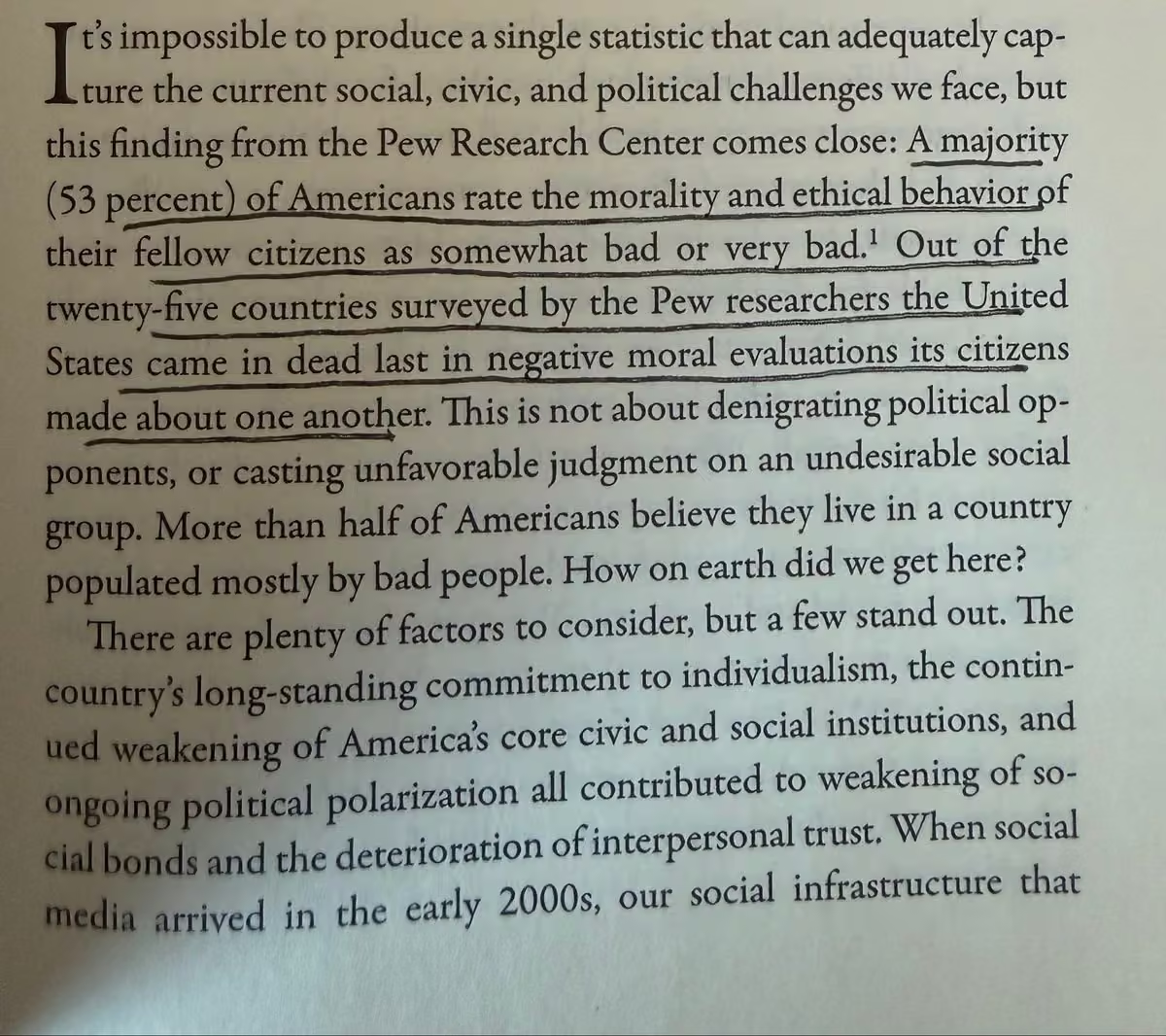
"A majority (53%) of Americans rate the morality and ethical behavior of their fellow citizens as somewhat bad or very bad. Out of the 25 countries surveyed...the U.S. came dead last in negative moral evaluations its citizens made about one another" www.penguinrandomhouse.com/books/786676/generation-uncoup…
-
Robin Hanson
@robinhanson
Problem is, I don't see many interesting research questions re prediction markets and recent elections. The big value is in advising voters on who to vote for, but none of the recent markets help much with that.
-
Robin Hanson reposted
Seth Benzell - the LA-atic Stranger
@SBenzell
In the latest episode of Justified Posteriors, @AndreyFradkin and I interview the inimitable @robinhanson, who gives us refreshingly unique takes on social problems and solutions.
One example: he proposes the following "simple" capitalist solution for falling fertilityThis media couldn't be displayed. See it on the original post. -
Robin Hanson reposted
Andrey Fradkin
@AndreyFradkin
In today's Justified Posteriors episode, we talk with @robinhanson about the economics of AI, prediction markets, and culture evolution. While Robin has normie AI-econ views, he has radical views on the role of markets in other parts of life. Do check it out.
This media couldn't be displayed. See it on the original post. -
Robin Hanson reposted
Prediction Markets Report @PMR_Insights
Panel at B20 starting now with @stefcutter, @robinhanson, @nkagan_official, @ScottWRasmussen and @JBSDC.
-
Robin Hanson
@robinhanson
I’ve stopped reading tweets that are personal stories, as I think most all are made up.
-
Robin Hanson
@robinhanson
This actually makes a lot of sense.
Shea Levy
@shlevy
Boards should start hiring their own hookers to seduce their execs. If it fails, great, you’ve got a good one. If it succeeds, nothing leaks and now you know what you’re dealing with and have leverage to boot.
-
Robin Hanson
@robinhanson
“Folks are rightfully concerned about dangerous bets on elections, war, assassinations, terrorism, and government actions that go against the public interest”
It isn’t sports or business bets that bother them. It’s info that could undermine their narratives.
Daniel Wallach
@WALLACHLEGAL
'Now is the time': Victorious Democrats vow to rein in prediction markets
Via @declanharty www.politico.com/news/2026/11/08/new-crypto-democrats-win… -
Robin Hanson
@robinhanson
Beware reporters who think they know more than market speculators www.wsj.com/finance/stocks/dont-trust-the-markets-knee-je…
-
Robin Hanson
@robinhanson
Since 2000, ave US software engineer salaries have stayed in range 2.34–2.41x US median wages. If AI greatly increases their productivity, we should see that >3x soon. Who wants to bet on when that will happen?
Robin Hanson
@robinhanson
For example, US travel nurses pay went up ~x2 in 2yrs during COVID-19. Pay can respond fast to demand increases.
Robin Hanson
@robinhanson
More careful thoughts now:
Robin Hanson
@robinhanson
OK, if we assume for the software industry 10yr demand elasticity of 3, & supply elasticity of 5, then AI-driven software coder productivity gain of x3 implies wage gain ~30%, # workers gain ~310%, while x2 gain gives wage ~18%, workers ~145%. How do your assumptions differ?
-
Robin Hanson
@robinhanson
OK, if we assume for the software industry 10yr demand elasticity of 3, & supply elasticity of 5, then AI-driven software coder productivity gain of x3 implies wage gain ~30%, # workers gain ~310%, while x2 gain gives wage ~18%, workers ~145%. How do your assumptions differ?
-
Robin Hanson reposted
David Krueger 🦥 ⏸️ ⏹️ ⏪
@DavidSKrueger
RE METR's measures of task-length and RSI: I'm still waiting to see a serious effort to determine how progress on coding/math/etc. generalizes to other tasks.
I expect we'd see an "accuracy on the line" effect, where out-of-distribution (OOD) performance is highly correlated with their metric, but what is the slope?
Also: I'm not sure if we should expect a similar result when RL comes into the picture. I think the generalization from RL and SL are probably quite different.
I *do* think that accelerating AI R&D is obviously useful for some sort of "RSI", but it *might* end up just yielding some sort of savant, rather than AGI and ASI.
I also have conflicting intuitions about how much one can learn general principles of reasoning that generalize well across domains (vs. performance being driven by domain-specific heuristics). I tend to think there is a lot of space for improvement there, and that progress on math and coding probably indicates some progress in general reasoning ability, but I feel like there's surprisingly little research that I'm aware of that is actually trying to address this question.
Maybe it's just mostly all happening in academia and so AI Safety and AI companies are ignoring it?
The state of AI research is really quite dire:
- We can't trust anything from the people with access to SOTA AI systems, because there's screwed up incentives and no transparency.
- We can't trust that independent research results apply to SOTA systems because the field moves so fast.
I guess independent research still seems like a better bet here... there have been some qualitative changes that emerge at scale, but it's more common IME for these sorts of results in deep learning to be generalize pretty well across models/scales, etc. -
Robin Hanson
@robinhanson
Fears that top AIs might do recusive self-improvement to dominate world fast depend on a key assumption: that intelligence is low dimensional, so super AI mathers and coders can quickly get super-good at most everything. This I doubt.
www.overcomingbias.com/p/how-low-dimensional-is-intelligence -
Robin Hanson reposted
Jacob Wood @JacobWood27
Beat me to it!
-
Robin Hanson reposted
Dylan Bowman @dylanbowmanSF
Tiny tiny bit towards longer timelines because of this sentence: “Anthropic’s internal benchmarks are increasingly saturated”. This sentence is about AECI evals but maybe is also true of their production evals (low conf, hence “tiny tiny”)
-
Robin Hanson reposted
Michael Cohen
@Michael05156007
If pre-training compute and RL compute are complements, which they are, then a one-off increase in pre-training compute would produce a one-off increase in the rate of capabilities increase. An increase in the *growth rate* of training compute is unnecessary.
METR
@METR_Evals
2. The full analysis estimated how much of the acceleration in capabilities was due to compute, data, and algorithmic progress. We are confident that the acceleration was not due to an increase in the growth rate of training compute.
-
Robin Hanson reposted
Toby Ord
@tobyordoxford
A step-change linear fit (i.e. a higher line with the same slope at the breakpoint) is a (mathematically) equally simple hypothesis as a slope change, and it has the advantage that it would be quite shocking if there *wasn't* a step change from the new improved big pre-train.
-
Robin Hanson reposted
Vlad Chituc
@VladChituc
Nothing scales as a function of time!! if the amount of money you are spending on AI grows exponentially, then diminishing returns still look exponential over calendar time. Every graph with time on the x-axis is fundamentally misleading, yet its all we ever see...
Séb Krier
@sebkrier
Updated version!
Michael Wiebe
@michael_wiebe
In 2025, AECI increased by 4.05 points per $ bn of R&D.
In 2026, this was 1.49 AECI points per $ bn of R&D.
So progress per R&D dollar fell by 63%, even while progress per year doubled.This post is unavailable. See it on X. -
Robin Hanson
@robinhanson
There is commitment to tribes who value truth, but not commitment to truth per se.
Matt Ridley
@mattwridley
“People whose commitment to truth is subordinate to their commitment to tribe. And I believe this duality explains a great deal about the state of the western world.”
Excellent column from @matthewsyed -
Robin Hanson reposted
Séb Krier
@sebkrier
Updated version!
Michael Wiebe
@michael_wiebe
In 2025, AECI increased by 4.05 points per $ bn of R&D.
In 2026, this was 1.49 AECI points per $ bn of R&D.
So progress per R&D dollar fell by 63%, even while progress per year doubled.This post is unavailable. See it on X. -
Robin Hanson reposted
Mav
@Mavmetax
NEXT WEEK ON TAILSPIN 🔥
7 PM ET on X Spaces
MON NOV 9 Prof. Mark David Hall: America’s Christian Founding & Religious Liberty
TUE NOV 10* Kayla Dones: ActBlue & WinRed The Investigation Goes Deeper @protagonistnet
WED NOV 11* Robin Hanson: The Great Filter / Are We Alone?
THU NOV 12* Patti Negri: The Good Witch of Hollywood
Set reminders below 👇 -
Robin Hanson
@robinhanson
Plausibly, we could see accelerating internal metrics and deccelerating external sales for quite a while.
x.com/robinhanson/status/2119134071611671017
Robin Hanson
@robinhanson
Looks to me more like a one-time speedup than continuous acceleration.
METR
@METR_Evals
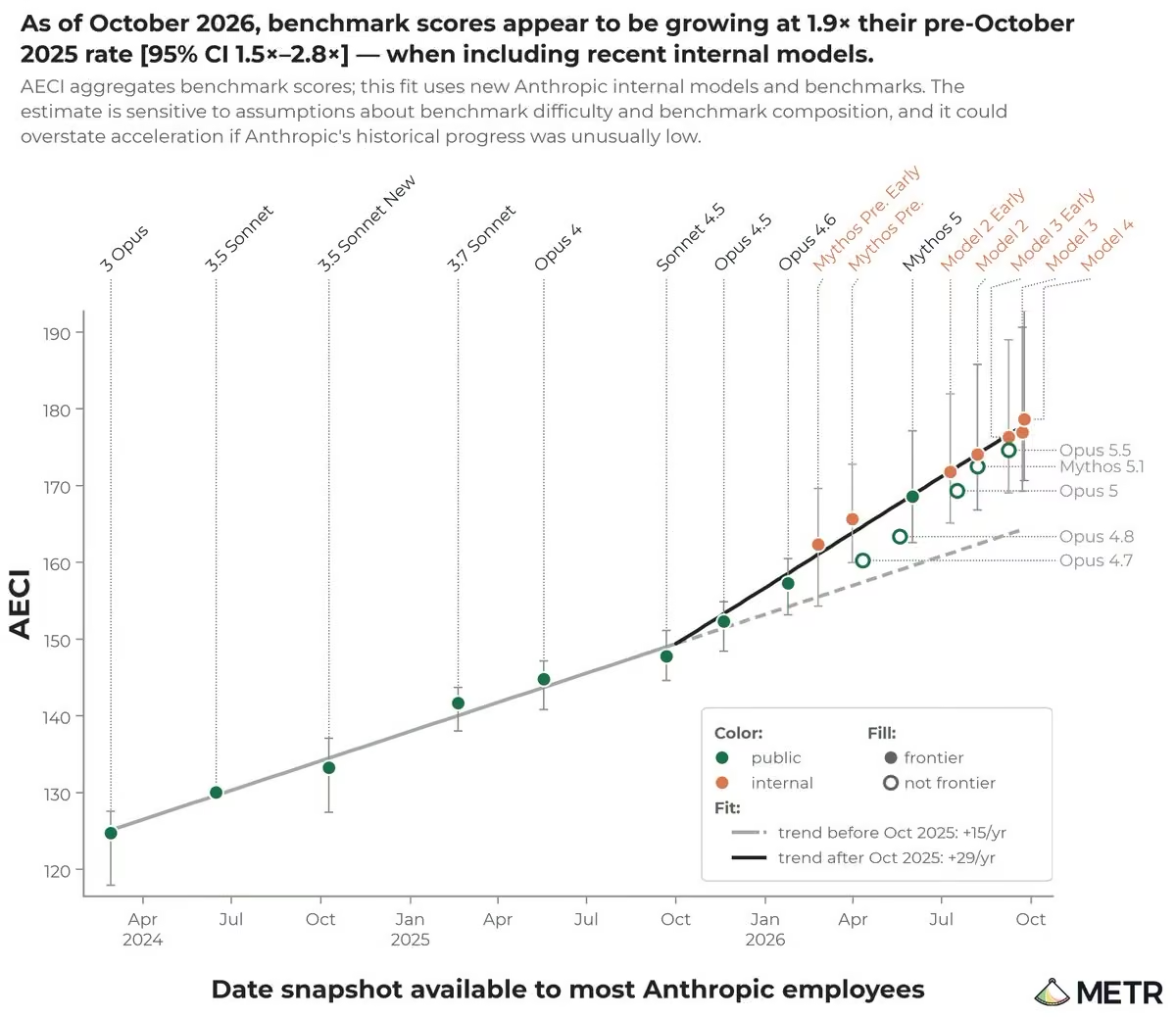
1. Benchmarks provide one piece of evidence for acceleration. Since Oct 2025, AECI scores for Anthropic’s models have grown at 1.9x [95%: 1.5–2.8] the earlier rate. Analysis choices affect this estimate, and it remains unclear how benchmark scores map to real-world capabilities.
-
Robin Hanson
@robinhanson
"people are saying that Anthropic’s latest quarterly performance shows their sales slowing" apple.news/AInrm_hi-SwWuhwkagCMaFQ
-
Robin Hanson
@robinhanson
Looks to me more like a one-time speedup than continuous acceleration.
METR
@METR_Evals
1. Benchmarks provide one piece of evidence for acceleration. Since Oct 2025, AECI scores for Anthropic’s models have grown at 1.9x [95%: 1.5–2.8] the earlier rate. Analysis choices affect this estimate, and it remains unclear how benchmark scores map to real-world capabilities.
-
Robin Hanson
@robinhanson
"data centers … were responsible for just 4 percent of the [electricity] utility rate increases over the last five years"
Taylor B.
@taylordbarkley
Well well well, @washingtonpost
-
Robin Hanson
@robinhanson
"By nearly twice as much as in any other institution that Gallup tracks, public trust in research universities has fallen over the past decade." www.aeaweb.org/articles?id=10.1257/jep.20251484
-
Robin Hanson
@robinhanson
Apparently the '08 financial collapse caused >$10T of damange worldwide, while the market cap of the top 40 firms was ~$3T. If they had been required to hold liability insurance to cover such damage, how would they have operated differently?
-
Robin Hanson
@robinhanson
"One night in 2007, Dario Amodei … then 24 and a doctoral student in physics, was in a period of soaking up information. He had become absorbed in the obscure blogs 'Accelerating Future' and 'Overcoming Bias'" www.nytimes.com/2026/11/05/technology/dario-amodei-anthro…
-
Robin Hanson
@robinhanson
Most moderns don't realize just how deeply we are capable of loving war.
Panzer
@panzer
The money for nothing rogue one edit just makes me want to run through a wall probably the best SW edit of all time
This media couldn't be displayed. See it on the original post. -
Robin Hanson
@robinhanson
The US is in deep trouble if we ever have a big extended downturn. Other nations are more used to resilience in defeat, while we tend to fall apart and quit.
Dead Wrong History
@deadwronghist
"Among prisoner of war communities, the prisoners who behave worst are Americans." Kurt Vonnegut, 1970. #deadwronghistory
This media couldn't be displayed. See it on the original post. -
Robin Hanson
@robinhanson
I again curse hotels that make me take glasses into the shower to read which bottle is shampoo.
-
Robin Hanson reposted
-
Robin Hanson reposted
Stefan Schubert
@StefanFSchubert
Very important point. Cf the bias towards longer intellectual output.
Most readers get sidetracked and spend too little effort on scrutinising the central argumentative moves.
This was a motive behind my work on argument-checking.
Robin Hanson
@robinhanson
While intellectuals mostly get prestige for the impressive details of their work, simple abstract arguments influence their opinions more than they admit. But such abstract effort is neglected, as better versions don't look much more impressive.
www.overcomingbias.com/p/prestigious-detail -
Robin Hanson
@robinhanson
"they exercise skepticism in a motivated way, that is, in a way that depends on the desirability of the conclusions that skeptical inferences lead to" d.repec.org/n?u=RePEc:hal:journl:hal-03770685
-
Robin Hanson reposted
MTS
@MTSlive
AI researcher @herbiebradley explains why automating most AI research might still not trigger an intelligence explosion:
"I have always viewed the very fast takeoff scenarios as a small probability piece of the possibility space."
"The evidence that we have so far on self-sustaining RSI happening very, very soon, and especially leading to very fast increases in capability, is quite limited, compared to the alternative hypothesis of, oh, we're going to automate most of AI R&D, and capability going further than that becomes more limited by diffusion, limited by other bottlenecks."
"We can't really tell which of these worlds we're in, but I do think people should have a lot of weight on nothing-ever-happens style priors, or priors about things being limited by data or limited by diffusion." -
Robin Hanson
@robinhanson
"we found small to moderate positive associations between religiosity and compassionate responding, which were statistically accounted for by perceived psychological closeness to suffering targets" psycnet.apa.org/record/2028-49772-001
-
Robin Hanson
@robinhanson
"when facing decisions involve edge cases in which sacred boundaries are ambiguous, sacralizers are responsive to consensus information" psycnet.apa.org/record/2028-50156-001
-
Robin Hanson
@robinhanson
As once different cultures merge, I think what people want in the other gender changes faster than the matching desired styles n behaviors. Lacking many unhappy with local mating options.
-
Robin Hanson
@robinhanson
Median ~0.7% chance aliens visiting Earth would change how they treat us if our elites came to admit they here.
Robin Hanson
@robinhanson
Assume some UFOs are aliens, visiting Earth for centuries; they have long had options to destroy, intervene w/, or show clearly to us, but don't do so. What is chance they'd change how they treat us if human elites came to widely admit that they are here?
-
Robin Hanson
@robinhanson
Most deep disagreement seems to be due to people using different standard sets of abstractions and supporting tools. Polymaths who learn multiple such sets could thus help us to resolve such disagreements.
www.overcomingbias.com/p/could-polymaths-settle-most-disp… -
Robin Hanson
@robinhanson
Some say is reasonable to fear social disruption from disclosure that some UAPs are aliens. This just seems wrong to me. Aliens could have done lots for many decades, but chose not to. Why would that change just because NYT or US govt declares them real?
www.overcomingbias.com/p/uap-disclosure-wouldnt-crash-soc… -
Robin Hanson
@robinhanson
Assume some UFOs are aliens, visiting Earth for centuries; they have long had options to destroy, intervene w/, or show clearly to us, but don't do so. What is chance they'd change how they treat us if human elites came to widely admit that they are here?
-
Robin Hanson
@robinhanson
To many, one of the repulsive character flaws is to visibly resent mistreatment. Especially in men.
Robin Hanson
@robinhanson
Yes, we much less mind resenting mistreatment of others, or powerfully opposing one's own mistreatment.
-
Robin Hanson
@robinhanson
"how predictive algorithms have helped create what she calls a homogeneous 'monoculture' … uses … algorithms, digital mapping and text analysis to show how large language models are making consumer culture, wherever it happens to be, feel the same."
www.nytimes.com/2026/10/31/arts/lauren-leek-algorithms-cu…
Robin Hanson
@robinhanson
No, it is mainly increasing talk, travel, & trade that has drawn the world together over centuries. Algorithms & LLMs don't contribute much over that. As usual, business is mainly responding to consumer demand here.
-
Robin Hanson
@robinhanson
When I’ve said we see very little concrete harms from AI, the harms people point me to are mainly harms from spreading more knowledge. Eg hacks. Yet we hear few complaints re libraries, universities and newspapers spreading knowledge.
-
Robin Hanson
@robinhanson
To most academics, academia is a game with particular rules, and the academics worth celebrating are those who won by the rules . The is no other standard of quality.or contribution.
Robin Hanson
@robinhanson
Same goes for public intellectuals, except they have different rules.
-
Robin Hanson
@robinhanson
Seems that most who want to “pause” AI really want to more regulate, limit, slow, or stop AI. This is no likely milestone soon at which they’d want to unpause it.
-
Robin Hanson
@robinhanson
I see far more discrimination based on class than race or sex. Though it’s more about high class styles n connections than parental class. Striking then that anti discrimination rules mostly ignore class.
-
Robin Hanson
@robinhanson
Sacred quests are often seen as optional. But our civilization will plausibly fall, to be replaced by other quite different ones, if we cannot manage to sufficiently organize around a shared civ-level sacred goal.
www.overcomingbias.com/p/without-a-sacred-quest-our-civil… -
Robin Hanson
@robinhanson
I predict an effort to crush UCLA, to punish its right leaning tendencies.
PBD Podcast
@PBDsPodcast
99% of Harvard Faculty Are Democrats
▪️ Harvard: 99% D / 1% R
▪️ Princeton: 98% D / 2% R
▪️ Yale: 97% D / 3% R
▪️ Berkeley: 97% D / 3% R
▪️ Duke: 95% D / 5% R
▪️ UCLA: 89% D / 11% RThis media couldn't be displayed. See it on the original post. -
Robin Hanson
@robinhanson
It’s fall here
-
Robin Hanson
@robinhanson
At 1:06:15, they briefly discuss my "how to live in a simulation" analysis. www.youtube.com/watch?v=evdID8ZryVg
Robin Hanson
@robinhanson
-
Robin Hanson
@robinhanson
When journalism first got started, state, church, & aristocrat authorities dumped hard on it, calling it sensational & undermining of respect for proper authorities, & getting it strongly regulated in many places.
The Knowledge Bank
@xKnowledgeBANK
Robin Hanson
@robinhanson
Now journalists are top prestige, and make similar complaints about the new upstart prediction markets.
-
Robin Hanson
@robinhanson
Only modest majority supports saving jail expense $ via offer convicts option of swap 2Xyr nice jail for Xyr mean jail + Xyr exile.
Robin Hanson
@robinhanson
We'd save lots in costs of jail, they'd be off our streets for same time, & they'd suffer ~ same overall level of punishment. Is this a better plan than status quo?
-
Robin Hanson
@robinhanson
Some have pointed out that AI fears help to sell AI equity & products, & raise the status of AI workers. Others then counter than those who fear seem to be sincere. But motivated bias is largely unconscious. Sincerity isn't much of a protection against bias.
Rob Wiblin
@robertwiblin
Mary Phuong of DeepMind on AI loss of control risk.
"The last 2 minutes gave me chills.
A significant amount of people saying that AI companies are paying people to spread fear about these agents.
I have never really felt like [loss of control] was an actual thing to care about.
But seeing Mary and how her face trembles, made me reconsider my stand. She's either a Hollywood-level skilled actress, one of the best, or we should be scared. For real."
"Seems like Mary is already aware of more than she can admit and it haunts her..."This media couldn't be displayed. See it on the original post. -
Robin Hanson reposted
Cameron Harwick 👾🏛
@C_Harwick
I sat down with @robinhanson on Halloween to talk about the scariest thing we could think of: the possibility that modernity might not be evolutionarily stable. www.youtube.com/watch?v=88dO37qeBbI
-
Robin Hanson
@robinhanson
.@C_Harwick & I talk about cultural decay: youtu.be/88dO37qeBbI
-
Robin Hanson
@robinhanson
Our jails are typically "nice" compared to "mean" jails of poor nations & our past. We could offer convicts sentenced to 2X yrs in nice jails to instead do X yrs in mean jails, + another X years of exile. Meanness is adjusted so ~70% of convicts accept offer. Poll in reply.
Robin Hanson
@robinhanson
We'd save lots in costs of jail, they'd be off our streets for same time, & they'd suffer ~ same overall level of punishment. Is this a better plan than status quo?
-
Robin Hanson
@robinhanson
Our jails are typically "nice" compared to the "mean" jails of poor nations & our past. We could offer convicts sentenced to 2X yrs in nice jails to instead do X yrs in mean jails, continually adjusted in meanness so that ~70% of convicts accept the offer. Poll in reply.
Robin Hanson
@robinhanson
We'd save lots in costs of jail, & they'd suffer roughly the same level of punishment. We'd adjust X to deal with any effects on overall punishment levels. Is this a better plan than our status quo?
-
Robin Hanson
@robinhanson
Hearing business managers talking only in abstractions does not inspire much confidence in me.
-
Robin Hanson
@robinhanson
"may opt not to fully acquit the defendant—who nevertheless walks free, without criminal sanction. … among laypeople, law students, & professionals, the availability of an intermediate verdict decreased the conviction rate" psycnet.apa.org/record/2028-47606-001
-
Robin Hanson
@robinhanson
"people believe that increasing one virtue tends to increase other virtues & decrease other vices. Similarly, people believe that increasing one vice tends to increase other vices & decrease other virtues"
That is, we see no tradeoffs re the sacred.
psycnet.apa.org/record/2028-48315-003 -
Robin Hanson
@robinhanson
"revenge was significantly associated with pleasant feelings, but not significantly associated with unpleasant feelings" psycnet.apa.org/record/2028-47586-001
-
Robin Hanson
@robinhanson
“But we also need A.I. companies to talk seriously with the rest of us about how far we’re all willing to go. .. As much as I love computers, democracy is the more important technology.” www.nytimes.com/2026/10/30/opinion/anthropic-ipo-ai.html
Robin Hanson
@robinhanson
No it’s investors who are paying for this, taking a big risk. The rest of you don’t deserve a say. You can decide to be a customer or supplier or to sit this out. Those are your legit options.
-
Robin Hanson reposted
vitalik.eth
@VitalikButerin
I find AI to be extremely knowledgeable, and so exceptionally able to detect references to almost anything, but not very wise, and so it only makes the most surface-level judgements about what point some writing is making.
This is particularly true when it's analyzing writing that it just read for the first time, as opposed to analyzing writing that's already in its training data (along with lots of analysis of that writing by other people)
AI's knowledgeableness is easier to see than its limited wisdom; it's perhaps even the very definition of wisdom that it cannot be easily verified (as opposed to intelligence). -
Robin Hanson
@robinhanson
A world where typical criminals were intelligent organized people would be a very different world from ours.
DefinitelyNotSlopagandist
@Slopagandist814
"Don't go for the knife!"
"Dis knife?"
"Yes! Don't go for it!"
"Dis knife right hurrr?"
"DON'T DO IT!"
"Keisha! Wut deez races cop b doin?"
"SIR! PLEASE DON'T!"
(goes for knife)This media couldn't be displayed. See it on the original post. -
Robin Hanson
@robinhanson
I'm far less concerned about a world ruled by today's Chinese than I was about a world ruled by the old USSR. So I'm far less invested in conflict w/ China today than I was in the old cold war.
-
Robin Hanson
@robinhanson
"Everyone proposing an AI security policy intervention should have an explanation for the absence of significance uplift in damages from AI."
Joshua Saxe
@joshua_saxe
Why hasn't rapid growth in AI cyber capabilities 2022-2026 -- social engineering, vuln finding / exploit writing, agentic hacking -- led to a correspondingly rapid growth in cyber damages?
Detailed analysis here: joshuasaxe181906.substack.com/p/if-the-vulnpocalypse-is-t…
This post has been popular, and folks have asked for my data sources and statistical models; here they are!
github.com/joshsaxe/vulnpocalypse
This has been a nights and weekend project to try to get the field to think about AI cybersecurity risk social scientifically; would love discussion & feedback -
Robin Hanson
@robinhanson
"I have no confidence looking anyone in the eyes and telling them education will continue to provide their children with useful job skills. But I believe deeply that, no matter what the future holds, institutions to push humans toward their potential belong in it."
So though its a huge waste now, we should throw good $ after bad as it might get better?
Jack
@tracewoodgrains
New from me: Bryan Caplan is Wrong About Pedagogy
I read The Case Against Education. I was not impressed. Caplan provides a superficial and often wrong treatment of pedagogy in the book, a stark contrast to his seriousness about economics.
news.educationprogress.org/p/bryan-caplan-is-wrong-about-… -
Robin Hanson
@robinhanson
"This source of information is a public good. The media cite Kalshi’s prices in areas such as technological benchmarks or entertainment, where not long ago they turned to 'experts' for analysis. The American public similarly looks to us for information. 3/4 of visitors to our website never trade"
Tarek Mansour
@mansourtarek_
Yes, a bet and a trade often look similar.
But how they work is fundamentally different.
A sportsbook sets the odds and takes the other side of your bet. Prediction markets are markets, where buyers and sellers compete to discover and produce efficient prices and enable important public benefits.
What the market is about can change, but the structure doesn't.
My op-ed on prediction markets and regulation: -
Robin Hanson reposted
Nick Longrich
@NickLongrich
The movie you need to watch to understand modern academia is "Mean Girls"
-
Robin Hanson
@robinhanson
"Evans conditioned the documentary's access to him and Holmes on the couple being paid a percentage of the film's profits. Any ethical documentarian would have to say no to this ask. Subjects being economically disinterested in the films they're appearing in is what separates real documentaries"
Not obvious to me that this is unethical deal.
Michael Shermer
@michaelshermer
Is the new documentary about the fraudulent con artist Elizabeth Holmes itself a fraudulent con? If so, it appears to be working as masses of people are paying to see what may be a meta-scam.
reason.com/2026/10/26/nathan-fielder-made-a-dishonest-movie/ -
Robin Hanson
@robinhanson
I'm puzzled: people once hated/distrusted merchants, but loved/respected aristocrats. Today they hate big business leaders, but trust people to assigned high govt administrative positions. I can see respecting priests, warriors, and performers, but why inherited fancy dressers?
-
Robin Hanson reposted
Koleman Strumpf
@KolemanStrumpf
Op-ed in @WSJ with @HarryDCrane . Polls, not prediction markets, are the bigger threat to election integrity. Extends and emphasizes earlier thread, x.com/KolemanStrumpf/status/2113362090907881565
Wall Street Journal Opinion
@WSJopinion
Regulate polls, not prediction markets. There’s no evidence that betting harms election integrity, but fake surveys have done so this year, write Harry Crane @HarryDCrane and @KolemanStrumpf
www.wsj.com/opinion/regulate-polls-not-prediction-markets… -
Robin Hanson
@robinhanson
The idea that Chinese govt is strong wise with a long view seems contradicted by this data.
Chinese demographics🇨🇳
@mi233695
TFR of Mainland China 2025. Now all provinces except Heilongjiang has published birth data, so we can obtain an estimate of Heilongjiang's numbers as well.
-
Robin Hanson
@robinhanson
“It’s not just young new hires who are leaving their employers high & dry without any formal notice or so much as a heads-up that they won’t be at their desks the next day: … March 2025 report [says] … nearly half of U.S. workers did exactly that in the prior year.”
fortune.com/article/half-of-workers-are-revenge-quitting-… -
Robin Hanson
@robinhanson
I summarize and quote from 4 books that all argue we should be more deliberate about managing our cultural evolution to be more adaptive. www.overcomingbias.com/p/skinner-stewart-wilson-on-delibe…
-
Robin Hanson
@robinhanson
Free speech should apply to all politics adjacent info, including polls & prediction markets. But if you are going to regulate, focus on the one with demonstrated failures: polls.
Harry Crane
@HarryDCrane
Just published in @WJSOpinion
Regulate polls, not prediction markets
with @KolemanStrumpf
www.wsj.com/opinion/regulate-polls-not-prediction-markets… -
Robin Hanson
@robinhanson
But we understand little, so most everything we destroy we don't fully understand.
Saganism
@Saganismm
“It is always the mark of a barbarian to destroy something he does not understand.”
— Arthur C. Clarke -
Robin Hanson
@robinhanson
"gap between what’s being spent on the AI buildout and the revenue projected to come back is turning into a multitrillion-dollar chasm" fortune.com/2026/10/21/ai-boom-5-trillion-paying-itself-d…
-
Robin Hanson
@robinhanson
"As evaluated by the values of the monoculture, the monoculture's values are great!"
unherd.com/2026/10/how-everywhere-became-the-same/ -
Robin Hanson
@robinhanson
"temporary increase in income significantly changes women's sexual behavior. Treated participants are 5.1 percentage points less likely to have sex during the treatment period, and the rate of condomless sex falls by 30%." www.nber.org/papers/w35940
-
Robin Hanson
@robinhanson
Monuments matter: "a 1948 classification of historic monuments determined which religious buildings remained standing. We find larger increases in female employment and schooling where no monument survived." www.nber.org/papers/w35933
-
Robin Hanson
@robinhanson
"factories in Ethiopia … women who were randomly offered a job had more children than the control group"
d.repec.org/n?u=RePEc:hhs:hamisu:2026_006 -
Robin Hanson
@robinhanson
In most of our small scale detailed analysis, contradictions are destructive and we try to avoid them. So at what scale do they become helpful, and why?
Illimitable Man (IM)
@SovereignIM
This is one of the best things I've ever read.
From Chesterton: -
Robin Hanson
@robinhanson
Buying health would solve this. www.overcomingbias.com/p/buy-health-update
Polymarket
@Polymarket
JUST IN: California rehab operators accused of supplying illegal drugs to recovering addicts to keep them hooked & collect over $210 million from insurers.
-
Robin Hanson
@robinhanson
Global warming is now blocking an ice age that had been already starting. Yay.
Owen Lewis
@is_OwenLewis
Here’s a rather extraordinary discovery: humanity seems to have interrupted the beginning of the next ice age. We thought it might happen in the future, but the evidence suggests it's already happened.
A new study in Science argues that the next major glaciation had already begun roughly 2,000 years ago, before modern warming reversed the trend in the 20th century.
The evidence comes from the Barnes Ice Cap on Baffin Island, the last surviving remnant of the enormous Laurentide Ice Sheet that once covered much of Canada and reached as far south as Illinois.
Because Barnes is frozen directly to its bedrock, advancing ice buries and preserves vegetation beneath it. Researchers radiocarbon dated plants emerging as the ice retreats to reconstruct its history.
They found that after melting to a minimum extent around 3,000 years ago, the ice began expanding again about 2,000 years ago. The researchers interpret this as the earliest stage of the next glacial period.
Left to natural orbital cycles, that cooling would have unfolded extremely slowly, potentially taking tens of thousands of years to rebuild a continent spanning ice sheet.
But around 1960, the trend reversed. Summers became warm enough that Barnes began losing more ice than it gained, despite Northern Hemisphere summer sunlight continuing to slowly decline in a way that should favor renewed glaciation. Greenhouse warming had (thankfully) overwhelmed the natural cooling tendency.
The Barnes ice cap may now disappear entirely within the next few centuries, removing the final remnant of an ice sheet that repeatedly served as the nucleus for much larger glaciations.
There is a remarkable deep time perspective here. For millions of years, orbital cycles have pushed Earth between warmer interglacials and colder glacial periods. According to this study, that ancient cycle had started turning once again.
Then, in the geological equivalent of an instant, humanity pushed hard enough in the opposite direction to stop it.
Just so we're clear, this is a very very good thing.
📸 Geology Sciences
Sources:
1) phys.org/news/2026-10-global-halted-emerging-ice-age.html
2) www.science.org/doi/10.1126/science.aed3379 -
Robin Hanson
@robinhanson
Actually, people could reasonably subsidize decision markets on their personal life choices, which would likely advise them to avoid excess gambling.
-
Robin Hanson
@robinhanson
"I grieve that I have things in my heard that I have not been able to express fully, and I am ashamed to think that after I am gone my writings will not be known to posterity." Amen.
LiorLefineder
@lefineder
Sima Qian’s letter to his friend explaining his painful choice of castration over suicide to finish his grand history of China.
"It is the nature of every man to love life and hate death, to think of his relatives and look after his wife and children. Only when a man is moved by higher principles is this not so. Then there are things that he must do. … The brave man does not always die for honor, while even the coward may fulfill his duty." -
Robin Hanson
@robinhanson
"Robin Hanson [said] 'You don’t have winners unless you have losers. And so you need a lot of losers to fund the winners,' he said, arguing that markets could be built differently if someone were willing to pay for the information they produce." next.io/news/features/who-wins-prediction-markets-nextpre…
Robin Hanson
@robinhanson
That is, we now get accurate financial market prices via taxing fools, but we could instead just subsidize markets to pay for that info. Yes the fools volunteer to be taxed, but even so we are making a choice here.
Robin Hanson
@robinhanson
In addition, the superforecaster folks have shown that markets with only winning traders, without the fools, would be more accurate.
-
Robin Hanson
@robinhanson
In buyer/seller, employer/employee, investor/funded relations the person giving $ acts dominant, while other party acts submissive. Yet in all 3 cases both sides have similar negotiating power. Why the asymmetric dominance framing of largely symmetric relations?
Robin Hanson
@robinhanson
Claude points out counter examples: "Tenants pay landlords and act submissive. Taxpayers pay governments. Patients pay doctors, clients pay lawyers, students pay professors,"
-
Robin Hanson
@robinhanson
Vouching would solve this. www.overcomingbias.com/p/who-vouches-for-youhtml
Rob Henderson
@robkhenderson
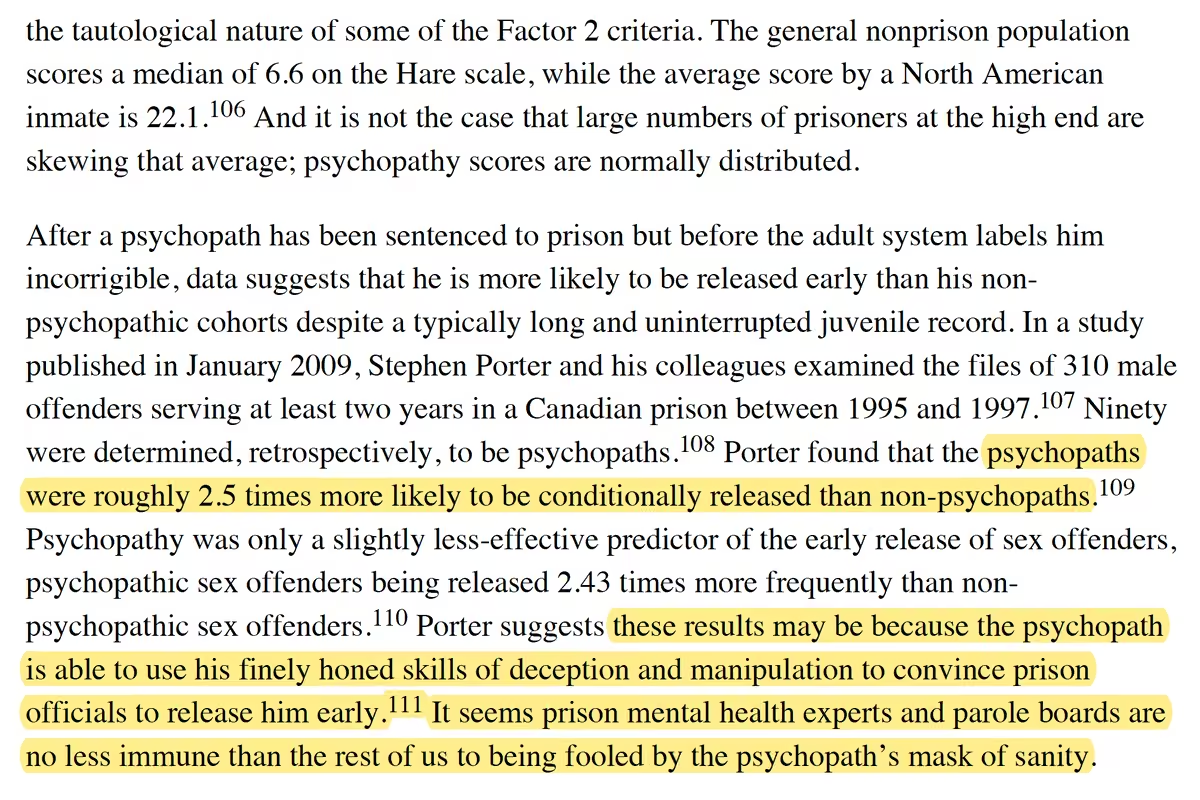
"psychopaths were 2.5 times more likely to be conditionally released than non-psychopaths...the psychopath is able to use his finely honed skills of deception to convince prison officials to release him early...fooled by the psychopath's mask of sanity" www.ncbi.nlm.nih.gov/pmc/articles/PMC4059069/
-
Robin Hanson
@robinhanson
One of the worst things about academics is when they insist that only evidence/analysis that meets their demanding standards has any value at all. All else should count as zero. If the world were run on that standard, it would grind to a halt.
-
Robin Hanson reposted
Koleman Strumpf
@KolemanStrumpf
Election integrity is important. That is why is time that Congress (and state congresses) turns it attention to regulating polls. Not prediction markets, polls. (1/n)
www.politico.com/news/2026/10/22/how-a-fake-pollster-may-… -
Robin Hanson
@robinhanson
Apparently, even though markets & models on politics are getting better, polls are getting worse. More misleading polls pushed by interested parties, less money for careful good polls.
-
Robin Hanson
@robinhanson
Median 16% chance that you would prefer the median morals/values of world elites 50yrs from now, over your morals/values today.
Robin Hanson
@robinhanson
What is the chance that, if you studied them carefully, you would prefer the median morals/values of world elites 50yrs from now, over your morals/values today?
-
Robin Hanson
@robinhanson
"intermediaries face adverse selection from imperfect valuation. Faster [housing] transactions increase liquidity but reduce information, limiting intermediation." www.journals.uchicago.edu/doi/abs/10.1086/742710
-
Robin Hanson reposted
Rajiv Sethi
@rajivatbarnard
Looking forward to this debate with @robinhanson at @TheSohoForum on January 28
www.eventbrite.com/e/soho-forum-debate-robin-hanson-vs-ra… -
Robin Hanson reposted
Sean Blacknell
@ParvamundiPics
WHAT DOES THE SILENCE REALLY SAY?
In the Great Silence – a documentary about the Fermi "paradox". Coming soon.
FT: @ProfAviLoeb, Nick Bostrom, Edward Witten, Liu Cixin,@jilltarter @robinhanson @david_kipping @skdh @romanyam @ChrisKMellon @michaelshermer @donalddhoffman @AdamFrank4 @MorphoTime @MickWest @anderssandberg @ProfSaraSeager @thenightshirt @DavidBrin @LordMartinRees, Nick Lane, Kevin Knuth, Stephen Webb, Peter Ward, Nathalie Cabrol, Michael Garrett, Jane Greaves, Daniel Angerhausen @jodrellbank -
Robin Hanson
@robinhanson
"Robin Hanson’s early arguments that properly designed markets encourage bold and heterodox projects are persuasive, and betting markets have a long record of producing good results." harpers.org/archive/2026/11/letters-november-2026/
Robin Hanson
@robinhanson
"For this reason I want to sound the alarm: prediction markets’ promise is being squandered. … offer insiders opportunities … the solution is obvious: end anonymity. This would reduce insider trading and carry out Hanson’s original goals, giving experts and outsiders alike incentives to validate their claims, theories, and models."
Robin Hanson
@robinhanson
Journalism has a similar issue: many of its most celebrated examples revealed inside info. Yes orgs keeping secrets has value, but so also does "public's right to know". Would you similarly ban journalism from using anonymous sources?
-
Robin Hanson
@robinhanson
Who are these people whose big cause in the world is to make grandparents think twice before hugging grandkids? They really couldn't find a bigger cause?
Europa.com
@europa
🇮🇪 The Irish state has published an advert discouraging grandparents from hugging their grandchildren, as part of a campaign designed to promote "consent".
-
Robin Hanson
@robinhanson
What is the chance that, if you studied them carefully, you would prefer the median morals/values of world elites 50yrs from now, over your morals/values today?
-
Robin Hanson reposted
Cameron Harwick 👾🏛
@C_Harwick
Boyd & Richerson in 2005: The more cultural variants spread horizontally (peer to peer) rather than vertically (to children), the more likely they are to be maladaptive, and this explains the demographic transition.
-
Robin Hanson
@robinhanson
"even when abstract representation across auditory and visual modalities is encouraged, the knowledge formed during perceptual category learning is modality-specific" psycnet.apa.org/record/2028-43441-001
-
Robin Hanson
@robinhanson
Median (lognormal fit) estimate: <4% chance Roman Empire elites would have coordinated to stop its fall, if they had understood which features would cause. Blocking the fall of an empire is about prefs/incentives, not knowledge. A lesson for our world civ today.
Robin Hanson
@robinhanson
If, at the peak of the Roman Empire, its elites (incl. emperors) had understood which of its features would cause its fall, what is chance they'd have coordinated to change those features, to stop fall?
-
Robin Hanson
@robinhanson
“Alongside water pipes, sewers, and animatronic control systems, these power lines lace the walls and ceilings of the utilidors, meaning they’re protected from weather and changes in the soil. They are also easy to monitor, catalog, and access if something needs fixing. While the cost of building a controlled system like this is much higher upfront than burying directly in the ground, the practice virtually eliminates the risk of accidentally rupturing a gas main or slicing a fiber optic cable during routine maintenance. Once they’re built, they can also drastically reduce costs in the long run because you no longer need to tear up a street every time a utility needs fixing.”
If these were common, I think many action movies would take place in them.
www.vox.com/future-perfect/504720/disney-utilidors-utilit… -
Robin Hanson
@robinhanson
People can organize themselves into many different kinds of groups, including clubs, churches, firms, political parties, etc. I gotta say that I respect them least when organized into burning looting mobs. That is when I'm least interested in hearing their opinions.
-
Robin Hanson
@robinhanson
I talk w/ UVA business profs on prediction markets: ideasstage.darden.virginia.edu/good-disruption-prediction…
-
Robin Hanson
@robinhanson
"Liberalism … is rooted in a justified fear of the real world, where people with power often use it to oppress, torture, & kill." www.theatlantic.com/ideas/2026/10/liberalism-fukuyama-shk…
-
Robin Hanson
@robinhanson
Hadn't been to my university library in a while, but went to borrow a book that cost $100 online. Browsed nearby books & was reminded of typical style & quality. Earnest, big words, & sure to cite prior work, but even so just pretty low quality.
-
Robin Hanson
@robinhanson
Note says "France's level of public social spending was third highest in the world at 30.6% of GDP in 2024"!
chloe
@Dykeocletian
A nice old building burns, and so the pearl-clutching begins. Where were these pearl clutchers when austerity was wrecking a generation? Why does one town hall grab their attention but millions of schools, hospitals, and homes dilapidated by neoliberalism are of no importance?
-
Robin Hanson
@robinhanson
"Great Recession reduced the average annual, age-adjusted mortality rate by about 2 percent, with effects persisting for at least a decade" www.nber.org/papers/w35914
-
Robin Hanson
@robinhanson
Whenever you put AIs in charge of something important, you have to wonder how the firms which make them will respond to various pressures from powerful parties to slant their AIs in particular directions.
Stefan Schubert
@StefanFSchubert
Which jury would be more accurate: a typical US jury or a jury consisting of twelve frontier models?
-
Robin Hanson
@robinhanson
>2/3 approve of groups consciously promoting their future adaptive success.
Robin Hanson
@robinhanson
What is your attitude toward the view that advises groups to try to consciously promote the future adaptive success of their members in as many ways as possible, to make the future world contain more of their DNA and also of their many cultural values, beliefs, and practices?
-
Robin Hanson
@robinhanson
If, at the peak of the Roman Empire, its elites (incl. emperors) had understood which of its features would cause its fall, what is chance they'd have coordinated to change those features, to stop fall?
-
Robin Hanson
@robinhanson
Remarkable fact: though Origin of Species was published 167 years ago, there are as yet no long-lived groups who embraced the idea of trying to purposely live so as to win at evolutionary competition. Winning groups are doing so by pursuing other goals.
Robin Hanson
@robinhanson
To be clear: people are often willing to explain their behavioral inclinations in Darwinian terms. Eg bans on cousin marriage. They just aren't willing to change behaviors merely upon realizing that they don't max adaptiveness.
Robin Hanson
@robinhanson
There aren't lasting groups where the argument that current behaviors aren't max Darwinian wins carries much weight.
-
Robin Hanson
@robinhanson
He wants profs pushing progressive politics to be fired wholesale by universities. No way will those who now govern universities do that; they'd have to have whole new governors.
www.wsj.com/opinion/radical-professors-have-poisoned-the-… -
Robin Hanson
@robinhanson
What is your attitude toward the view that advises groups to try to consciously promote the future adaptive success of their members in as many ways as possible, to make the future world contain more of their DNA and also of their many cultural values, beliefs, and practices?
-
Robin Hanson reposted
Anders Sandberg
@anderssandberg
New AI music video: "Almost". Transhumanist Eurodance about upgrading. youtu.be/PW0AFB1GC-g
-
Robin Hanson reposted
Ducky | 𝔽rAI
@0xDucky1st
What happens when AI agents disagree about what is true?
That was one of the most interesting questions to emerge from the conversation between @kstellana GenLayer and @robinhanson , the economist behind Futarchy and a pioneer of prediction markets.
The discussion went far beyond AI and blockchain. It explored something more fundamental: how do we build systems that make better decisions without depending on a single authority?
Hanson shared an interesting perspective on prediction markets.
Their greatest potential isn't necessarily speculation or entertainment. It's helping people and institutions make better decisions.
That's the idea behind decision markets and Futarchy: using market-generated information to evaluate the potential consequences of different choices.
But better predictions are only part of the picture.
There's another challenge: who determines whether a real-world condition has actually been satisfied?
This is where the conversation connected directly to @GenLayer.
The GenLayer team raised a question that becomes increasingly relevant as autonomous agents evolve:
How can AI agents establish trust and coordinate decisions when they don't necessarily agree?
Traditional smart contracts work well with predefined, deterministic conditions. But real-world agreements often involve subjective language, external evidence, and ambiguity.
GenLayer approaches this gap through Intelligent Contracts, where proposed outcomes can be independently evaluated by validators and accepted into on-chain state through consensus.
The conversation also touched on a deeper connection between prediction markets, dispute resolution, and economic institutions.
Hanson emphasized that functioning institutions depend on dispute-resolution processes whose outcomes are accepted broadly enough for other systems to build upon them.
That's what made the GenLayer connection particularly interesting to me.
Prediction markets can help us reason about what might happen.
Intelligent Contracts offer a way to reach shared decisions about evidence and conditions that deterministic code alone cannot evaluate.
These are different problems, but both matter for more autonomous systems.
Maybe the hardest part of building an AI-driven economy isn't making machines intelligent enough to act.
It's building institutions where those machines can disagree, resolve uncertainty, and still coordinate.
GenLayer
@GenLayer
GenLayer Livestream w/ Robin Hanson x.com/i/broadcasts/1wxWjlzrlOkJQ
-
Robin Hanson
@robinhanson
To find a prior re aliens visiting Earth, we must collect not-obvious features of such a description in need of explaining, find the most plausible scenario that could predict this description, then combine priors for each assumption required.
www.overcomingbias.com/p/why-might-aliens-visit-earth -
Robin Hanson
@robinhanson
Some police show themselves very visibly as being police, while others hide and mix in others until needed. To best fill their role, what is the optimal % that should be visible?
-
Robin Hanson
@robinhanson
"Chinese AI+ Plan doesn’t mention competition at all, nor does it even mention America. Its focus is on diffusion, standards-setting, & making AI a value-add for other existing parts of the economy. Current Chinese AI policy involves decentralized distribution of benefits allocated by provinces and municipalities, supporting an open-weight ecosystem, & a multiplicity of regional labs."
PALLADIUM Magazine
@palladiummag
Rationalism and Divergent Sinomodernity
Why do Americans who forecast artificial intelligence capabilities misread China?
Read the new article from @efarrellgregory (link below): -
Robin Hanson
@robinhanson
"The more conservative the respondents, the more harmful they considered extraterrestrial contact to be" en.wikipedia.org/wiki/Potential_cultural_impact_of_extrat…
-
Robin Hanson
@robinhanson
“Prop. 45 would decrease the cost of building a new home by $75,000 on average” www.wsj.com/opinion/prop-45-california-permitting-buildin…
-
Robin Hanson
@robinhanson
Overwhelming opinion that duty sex on ave has more total gains than losses.
Robin Hanson
@robinhanson
Poll:
-
Robin Hanson
@robinhanson
What will end up being the biggest tech:
-
Robin Hanson
@robinhanson
“These views are rooted in a once-fringe Silicon Valley ideology called 'transhumanism.' Transhumanists believe that technology will allow us to transcend humanity either by creating a new species or by combining ourselves with machines. Why go beyond humans? Because these new “posthumans” will be smarter than us. They will be infallible. They will go to the stars and conquer the universe. They will live forever."
Them's my peeps.
www.theatlantic.com/ideas/2026/10/ai-regulation-transhuma… -
Robin Hanson
@robinhanson
"even though people can apply to jobs [in the same firm], most workers are terrified of applying because they're scared that [their current] manager will find out and retaliate" www.aeaweb.org/research/talent-hoarding-organizations-ger…
-
Robin Hanson
@robinhanson
“There are no dumb questions” - oh yes, yes there are.
-
Robin Hanson
@robinhanson
I'm doing this DC event today: luma.com/groundwork_dc
-
Robin Hanson
@robinhanson
If you want to do X, have a big $, & know of experts on X, the 1 thing elites agree on is that you must NOT directly approach those experts. Instead you MUST find elites nearest you & pay them >10% of X to do proper introductions, due diligence, etc.
-
Robin Hanson
@robinhanson
Best for traders to have a day job. Else they get too tempted to trade just to be doing something.
Goshawk Trades
@GoshawkTrades
a former jane street trader describes a very expensive problem: doing all the research, building a strategy, then getting bored when it tells you to do nothing.
“The problem was, most of the time the data told him to do nothing.”
so the trader starts dabbling in other trades just to feel money being put at risk again.
agustin lebron, the laws of trading. -
Robin Hanson
@robinhanson
Duty sex is equally common for men vs women. On average, does partner who does their duty lose less than partner for whom duty is done gains? Poll in reply.
Francis (Sid) Dougan
@F_Sid_Dougan
🧵"Who Engages in Duty Sex?—Infidelity Concerns and Mate Value Discrepancies"
NEW paper on 'Duty Sex' in Evolutionary Psychology journal from myself, my friend @katebmetcalfe and Dr. Cindy Meston!
Summary of results in thread.
Link at end of thread
Available open access to all!
Robin Hanson
@robinhanson
Poll:
-
Robin Hanson
@robinhanson
While evolution may have promoted folk morality, policy would do better to rely on expert understanding of morality, which sees it as evolved.
www.overcomingbias.com/p/prefer-evolved-to-folk-morality -
Robin Hanson reposted
Marshall Julius
@MarshallJulius
Gary Oldman giggling at farts dubbed into his movies, then laughing 'til the tears roll down his cheeks, may well be the happiest minute of your day!
This media couldn't be displayed. See it on the original post. -
Robin Hanson
@robinhanson
I had fun talking to Robert K about the many feels he reviews in his new book. Especially re hidden feels we don't usually notice.
Robert Kurzban ✡️
@rkurzban
Robin Hanson read All the Feels and came to our conversation with some hard questions. Didn’t I miss some feelings? What about religious feelings? Why do people pay to feel the fear and grief they experience when they watch certain movies?
Full conversation link in the reply.This media couldn't be displayed. See it on the original post. -
Robin Hanson
@robinhanson
"a network’s parts are built to be read, and built upon, by its downstream readers. In this sense, a neural network is almost a fractal of explanations, of coherent, useful groupings"
Nick
@nickcammarata
interpretability might be the most important scientific problem in the world right now, as I don't think we can solve alignment if we don't know what we're building. I think I have good news about it. I co-authored early work in mechanistic interpretability at OpenAI and came away pessimistic, because neural networks appeared to fold into arbitrary tangled knots. years later, I started openai's first large-scale automated interpretability project, finding about 2% of neurons legible with the primitive tools we had
with modern agentic tools and a much closer look, the picture looks totally different. the vast majority in models up to trillions of parameters are legible, and their circuits beautiful. many famous examples of tangled neurons turned out to be misunderstood. The roadblocks I expected mostly aren't there. I now think ambitious interpretability will be solved by the time we need it most, and possibly quite soon, as automated scientists keep improving. it may be a bitter lesson for interpretability: the simple thing, at absurd scale, works
already-clean.goodfire.com -
Robin Hanson
@robinhanson
"Conducted from September 30 to October 5, the poll found 69% of Democrats and 61% of Republicans firmly against election betting. 65% of respondents opposed wagers on US military action, & 63% rejected contracts on government decisions. Only 8% supported military-related wagers, & 9% did not mind bets on government announcements."
The public minds sports betting much less than bets that share info on important topics. I guess they want only journalists doing that.
sccgmanagement.com/sccg-articles/2026/10/15/us-poll-expos… -
Robin Hanson
@robinhanson
The huge space of AI hardware innovation: spectrum.ieee.org/inference-hardware-revolution
-
Robin Hanson
@robinhanson
If our descendants learn to direct cultural evolution, they will probably do directed trails of alternate moral norms, and even promote deviant cults.
www.overcomingbias.com/p/directed-culture-trials -
Robin Hanson
@robinhanson
"DOGE … had a massive impact on the federal civil service. Before Trump took office, the civil service hit a modern peak of more than 2.3 million employees. Since then, it has shrunk by more than 270,000 people, a 12% drop.
Judge Glock
@judgeglock
DOGE worked. Most importantly, the civil service is 12% smaller than it was in Jan 2025.
In the Fall @CityJournal, I show they were not replaced by contractors, the biggest cuts were to middle managers, and the predictions of disaster were proven false. www.city-journal.org/article/doge-spending-cuts-civil-ser… -
Robin Hanson
@robinhanson
This is the main argument that ALL contrarians deploy: we've been having lots of specialized convos on our claims, but outsiders haven't read most of them, so they aren't qualified to dispute us.
Phil Magness
@PhilWMagness
Me: Here's why Marx is wrong.
Marxists: Nuh uh! You haven't read Marx!
Me: Here's why Schmitt is wrong.
Schmittians: Nuh uh! You haven't read Schmitt!
Me: Here's why Strauss is wrong.
Straussians: Nuh uh! You haven't read Strauss! -
Robin Hanson
@robinhanson
"had China not dramatically - and I mean dramatically - reduced its imports of oil this year, the price of crude oil would have gone through the roof and dragged the global economy down with it."
And I for one am grateful.
arnaudbertrand.substack.com/p/why-did-china-just-save-the… -
Robin Hanson
@robinhanson
I appear a bit in this video on prediction markets: www.youtube.com/watch?v=CTUqmUHvd2Y
-
Robin Hanson
@robinhanson
My hairdresser proudly posted her astrology sign on her wall. Which made me wonder: why are people so much more eager to identify with those, poorly supported by data, than personality types, so much better supported by data?
-
Robin Hanson
@robinhanson
17% chance of "before 2028: a verified proof that P = NP, that P ≠ NP, or that the question cannot be decided in standard mathematics (independent of ZFC)" seems way too high. mnx.fi/trade/pnp27
Robin Hanson
@robinhanson
What is your estimate of this chance?
-
Robin Hanson
@robinhanson
Estimating LFPR of 58 for Dec '27 seems crazy low given this history.
mnx.fi/trade/lfpr27 fred.stlouisfed.org/series/civpart -
Robin Hanson
@robinhanson
Median answer: ~2x current US median income is optimal level re tradeoff between comfort & belonging. Its an old result: ~2x your current income is ideal "rich".
Robin Hanson
@robinhanson
If US median income is now ~x25 above global subsistence income, what is optimal income, relative to subsistence, re tradeoff between comfort & belonging?
-
Robin Hanson
@robinhanson
I really just want to know about the quality of books, and don't much care how much AI contributed.
Tuhin Chakrabarty
@TuhinChakr
Books with substantial AI text are now everywhere: 1 in 5 books in our sample, across every genre - romance, thrillers, sci-fi, all of it. The typical book written with AI sells far fewer copies than the typical non-AI one. But there are so many of them that as a group they've gone from ~0% of sales in early 2023 to ~20% today and nearly a third of new entrants on the bestseller ranks now carry AI text. (3/n)
-
Robin Hanson
@robinhanson
This isn't just true about therapy; most all change in the world is the integral of mostly small changes.
Lori Gottlieb
@LoriGottlieb1
In #maybeyoushouldtalkto Someone, I wrote about how my patients—and I—made tiny, gradual changes, and how that’s the way real change—important change—usually happens.
Change can be easy to miss when you’re looking for a dramatic before and after. -
Robin Hanson
@robinhanson
Pretty dramatic claims by a very senior govt official who seems very well qualified to comment. But also puzzling that he doesn't take protection offer to tell govt officials under recent new deal. www.foxnews.com/video/6406725522112
-
Robin Hanson
@robinhanson
One of the best uses of prizes today is for big UAP revelations. If there really is stuff to find, it is worth lots to find it. And if there isn't stuff to find, no prize paid, costs us little.
-
Robin Hanson
@robinhanson
Says talk of political "polarization" is just a trick by evil folks to try to get you to fight less hard against them. Instead you should fight total war with all you have, no holds bared.
Rob Sica
@robsica
🔪“The moment we enter the political arena as advocates for some cause — or against one political party — people have every right to question our credibility as scholars.” archive.ph/Y3oUo
-
Robin Hanson
@robinhanson
DNA has indeed changed over 10Kyrs. But seems pretty clearly that culture has changed a LOT more.
Steve Stewart-Williams
@SteveStuWill
Recent Human Evolution in Western Eurasia
“Gene variants associated with intelligence were under positive selection, whereas gene variants associated with body fat, darker skin, and disorders like schizophrenia and bipolar were under negative selection.”
www.stevestewartwilliams.com/p/recent-human-evolution-in-… -
Robin Hanson
@robinhanson
~60% say most social trends are negative now, but only ~25% say this was the usual case in history.
Robin Hanson
@robinhanson
(A) Averaging over times & places over last 5Kyrs, have most social trends been negative?
(B) Are most social trends negative here and now? -
Robin Hanson
@robinhanson
Consider hiring Charles as an economist:
Charles Remien
@CharlesRemien
My paper, "Grandparental Support and the Margins of Fertility Intentions," has been accepted for publication in the Journal of Population Research. Special thanks to @robinhanson, @bryan_caplan, and @VincentGeloso.
Pre-print:
papers.ssrn.com/sol3/papers.cfm?abstract_id=7322800 -
Robin Hanson
@robinhanson
Odd, 3/4 see most social trends as not positive, yet 60% say most see most social trends as negative due to personal/media bias. x.com/robinhanson/status/2109671182786286077
Robin Hanson
@robinhanson
Why do most people see most social trends as negative?
(A) Personal/media bias focus on negative
(B) Wrong/bad people control stuff, make it go bad
(C) Its part of civ rise/fall cycle when things go bad
(D) We broke our superpower of cultural evolution -
Robin Hanson
@robinhanson
To check robustness, I redid this w/ 5 LLMs over 9 periods. See the post.
Robin Hanson
@robinhanson
With the help of 3 LLMs, I look at the history of changes to source of moral authority over millennia. The modern era has added many new sources, & both the ancient & modern eras split a bit into early and late versions.
www.overcomingbias.com/p/history-of-20-sources-of-moral-a… -
Robin Hanson
@robinhanson
Compared to our poor, sick, at-risk ancestors, we are so, rich, healthy, & at peace that the main things we need that others can give us are social support. Our ancestors' needs bound them close together, but lacking such needs we are only loosely connected.
Robin Hanson
@robinhanson
If US median income is now ~x25 above global subsistence income, what is optimal income, relative to subsistence, re tradeoff between comfort & belonging?
-
Robin Hanson
@robinhanson
"Rather than inheriting wealth and passively collecting checks, the rich … are more likely to have worked fiendishly hard to build a flourishing business. … most rich entrepreneurs were born middle or lower class and did not inherit their company"
Rob Henderson
@robkhenderson
"economists Owen Zidar and Eric Zwick...Rather than inheriting wealth and passively collecting checks, the rich they examine are more likely to have worked fiendishly hard to build a flourishing business. This can still lead to dizzying wealth" www.nytimes.com/2026/10/02/business/democrats-wealthy-tax…
-
Robin Hanson
@robinhanson
You don't hear much defense of liberalism these days, until you hear folks explicitly propose strikingly non-liberal governance. Then, the knives come out.
James M. Patterson
@McGillPatterson
Great review of our book. Really engaged with our work critically.
www.libertarianism.org/article/why-postliberalism-failed -
Robin Hanson reposted
Cryonics and Cryopreservation Research Network
@CryonicsNetwork
Cryopreservation of aldehyde-fixed whole brains
journals.plos.org/plosone/article?id=10.1371/journal.pone… -
Robin Hanson
@robinhanson
So why doesn't this logic apply to entering any space, if you knew that risks which happen there were associated with it?
-
Robin Hanson
@robinhanson
"rejected … because 'there is no new mathematics'. … distort the direction of the field to look more mathematical. … I wonder if this attitude will change now that doing hard math has become commoditized." Good question.
Harry Crane
@HarryDCrane
Over the past 10 years, I have submitted very few papers to journals.
Every once in a while I submit just to test if the peer review system is still as broken as I remember.
From earlier this week. I submitted an article on an application of probability in betting.
I know for a fact this is actually a useful application that is used in the real world. Which is also why I knew it would be rejected almost immediately -- because why would a real world application be of interest to an academic journal on applied probability?
As expected, it was rejected from the Annals of Applied Probability because "there is no new mathematics".
A lot of fields, and especially probability, have long had "math envy", so they distort the direction of the field to look more mathematical. (See analytic philosophy for the best example.)
I wonder if this attitude will change now that doing hard math has become commoditized. -
Robin Hanson
@robinhanson
Good job, AIs.
Andrew Curran
@AndrewCurran_
Another prizewinner, and once again Pangram flags almost the entire story as AI-generated.
-
Robin Hanson
@robinhanson
"So Hanson is almost the purest case of: Pessimistic propositions without pessimistic affect. … detached long-run pessimism, not neutrality." www.betonit.ai/p/a-sentiment-analysis-of-cowen-hanson
-
Robin Hanson
@robinhanson
(A) Averaging over times & places over last 5Kyrs, have most social trends been negative?
(B) Are most social trends negative here and now? -
Robin Hanson reposted
Beatriz Villarroel
@DrBeaVillarroel
Double trouble -- our peer-reviewed machine learning/transient paper has also just been published. This is where we clean up the sample and see that the fewer contaminants there are, the stronger the correlation with nukes and the larger the shadow deficit. It also shows that the correlations with nukes is strongest 24 hours before a nuclear test.
Link: www.nature.com/articles/s41598-026-66148-2 -
Robin Hanson
@robinhanson
“median individual with more than $500,000 in savings had, 20 years into retirement, spent just 12% of that sum. … U.S. economy suffers as all of that money sits under the proverbial mattress instead of being spent.” www.theatlantic.com/economy/2026/10/retirement-spending-d…
Robin Hanson
@robinhanson
No, savings is invested in growing the economy.
-
Robin Hanson reposted
The Stationary Bandit
@LawStatePodcast
New interview with @robinhanson !
We talk about why Robin doesn't expect strong RSI, why he expects AIs to undergo cultural evolution, and how he thinks about values in the very long run.
www.youtube.com/watch?v=Gz8wlqbruHQ -
Robin Hanson
@robinhanson
What % of actual social trends are positive?
-
Robin Hanson
@robinhanson
Why do most people see most social trends as negative?
(A) Personal/media bias focus on negative
(B) Wrong/bad people control stuff, make it go bad
(C) Its part of civ rise/fall cycle when things go bad
(D) We broke our superpower of cultural evolution -
Robin Hanson
@robinhanson
Of the social trends that you hear about, what % seem positive?
-
Robin Hanson
@robinhanson
Most political alliances are bound together by many specific positions, not abstract principles. Allowing the abstractions to change as specific positions and alliances change. Intellectuals may be bothered by this, but have little influence.
Matthew Yglesias
@mattyglesias
A laudable left-liberal impulse toward inclusion became a vehicle for all kinds of deeply illiberal anti-individualistic identity politics concepts to enter mainstream Democratic politics.
www.theargumentmag.com/p/the-fox-in-liberalisms-henhouse-38e -
Robin Hanson
@robinhanson
"It’s not entirely that young people have fewer social opportunities, but that they are encouraged to prioritize their own personal experiences and expression. On social media, self-optimization culture teaches young people that the most coveted rewards in life are secured through individual effort and ambition alone. There is a fear that our relational obligations can work against these goals by restricting our autonomy. It explains why more young people worry about what marriage and parenthood will require of them, rather than the benefits they offer."
Steven Pinker
@sapinker
When I surveyed my colleagues on the Council on Academic Freedom at Harvard for examples of how a lack of intellectual and political diversity was distorting scholarship & teaching in their fields, 1 example was avoidance of mentioning one of the most robust findings in happiness research: "Married people are happier. Period." | Why Americans Stopped Falling in Love. open.substack.com/pub/derekthompson/p/are-men-the-problem…
-
Robin Hanson
@robinhanson
"non-altruistic individuals transfer to individuals with smaller allocations to protect themselves from harmful consequences, creating selfish equality. … selfish equality accounts for substantially more cross-country variation in societal redistribution than altruistic giving or any other leading alternative explanation" d.repec.org/n?u=RePEc:hhs:nhheco:2026_015
-
Robin Hanson
@robinhanson
"Opposing comments increase reactions, comments, and link clicks by 15-43% relative to no comments, whereas supportive comments have little effect." d.repec.org/n?u=RePEc:arx:papers:2609.32880
-
Robin Hanson
@robinhanson
"Among married women, a one-standard-deviation increase in teleworkability reduced annual birth rates by 2% … no statistically significant effects on fertility among men or unmarried women, or on marriage or divorce" www.nber.org/papers/w35881
-
Robin Hanson
@robinhanson
"there is also a broader concern, he said, that prediction markets with heavy betting could influence how jurors think about a case"
Isn't that also a problem re gossip or news coverage of a court case?
www.wsj.com/us-news/law/courts-grapple-with-problem-of-pe… -
Robin Hanson
@robinhanson
Decent acting, but the story is just boring.
www.wsj.com/articles/the-score-review-brian-cox-is-bach-1… -
Robin Hanson
@robinhanson
To me, AI is enabling an explosion of artistic creativity. Yes, you could claim I have bad taste.
Devon
@Devon8zzh
Mandelbrot Brainrot 🌀
The pool has pools. The shrimp has a bathrobe.
Made with Caesar: concept, lyrics + AI art.
Music: ElevenLabs Music. Video: slop.cc.
Big thanks to @boneGPT for building Slop Cannon.This media couldn't be displayed. See it on the original post. -
Robin Hanson
@robinhanson
"remarkable bipartisan support for government limits on prices, with 93% of Democrats and 83% of Republicans supporting capping prescription drug prices. Nearly 4 in 5 voters support capping credit card interest rates at 10%."
reason
@reason
Most Americans apparently agree on at least one thing. Unfortunately, it's something dangerous: price controls.
reason.com/2026/10/08/price-controls-dont-work-so-why-do-… -
Robin Hanson
@robinhanson
With the help of 3 LLMs, I look at the history of changes to source of moral authority over millennia. The modern era has added many new sources, & both the ancient & modern eras split a bit into early and late versions.
www.overcomingbias.com/p/history-of-20-sources-of-moral-a… -
Robin Hanson
@robinhanson
"I often hear, that if tokens get cheaper, demand will go up. That’s Jevons Paradox. Sure, elasticity works. But if prices drop 90%, demand must increase 900% just to stay flat. Remember when internet demand grew while debt-laden Global Crossing spectacularly failed because prices dropped too fast? Historically, semiconductors got 30% cheaper every year. When prices dropped by more than 50%, disaster struck with fabrication plant closings and company failures."
Andy Kessler
@andykessler
How the AI Boom Ends.
Look for the “Factor of 10. Current demand is gangbusters, but spending is a game of chicken until multiple factor-of-10 improvements kick in and prices collapse.
www.wsj.com/opinion/how-the-ai-boom-ends-0d9d47e7
ylecun @mustafasuleyman @elonmusk @sama @openai @GoogleDeepMind @AnthropicAI
@Meta @ajassy @nvidia @geoffreyhinton @demishassabis @gdb @ESYudkowsky
@ericschmidt @AndrewYNg @drfeifei @finkd @ajassy @emollick @miramurati @JohnStossel @steve_hanke @CliffordAsness @AndrewLilico @lymanstoneky @tylercowen
@FelixSalmon #econtwitter @adam_tooze @Austan_Goolsbee @JustinWolfers @elerianm @yardeni
@TruthGundlach
@thinkymachin -
Robin Hanson
@robinhanson
"the narrative that Deco simply 'fell from public taste' is fake. It was slowed by the war, logistically hollowed out by '48, then ideologically blacklisted afterwards"
Damian Chávez - Artist
@DamianChavezArt
Art Deco didn't die from being exhausted, it got blacklisted.
Its three main phases - Zigzag, PWA / Stripped Classical, & Streamline - weren't exactly sequential, they overlapped all throughout the 30s. But what happened after 1929 wasn't just that zig zag Deco became too expensive, it was evolving from the 'Return to Order' (WW1) beginnings towards a more robust machine age adapted classicism.
Earlier funding collapsed from private elites to the state, and a more civic form emerged - Stripped Classical/Classical Moderne. It was transatlantic, global. The American WPA, PWA, democracies and authoritarian regimes across the West all embraced it because the goal was the same: instill optimism, civic-mindedness, and resilience. Put your skilled artists & artisans to work.
It was seen as worthy recieving state funding for its public face - blending both classical & modern, a forward facing embrace between design, industry & craft.
That more colorful zig zag form was made logistically difficult to revive after 29, then that difficulty was made permanent. Deco needed a 50-year Beaux-Arts ecosystem - terracotta kilns like Gladding McBean and Atlantic Terra Cotta, plasterers, metal foundries, carvers, mosaicists - & that ecosystem took two hits.
The 29 crash bankrupted the firms & dissolved the apprenticeship pipeline, then the war shifted what was left to war industries. By 1948 a fully crafted lobby was hard to build like 1926 even if you wanted to.
Hard isnt impossible. With a regular cycle craft revives with demand, but revival was blocked.
Tax codes, FAR, federal budgets, and curtain-wall specs all rewarded flat, uncrafted surfaces, so there wasnt much incentive to maintain the ateliers.
The firmest lockout was ideological. To make High Modernism the post-war approved standard, its promoters had to discredit what came before.
Politically, Stripped Classicism was rebranded as "fascistic" because Hitler, Mussolini and Stalin had used identical forms. Culturally Deco, especially Streamline, was the 1930s World's Fair spirit: mass-produced household objects made beautiful, futuristic, optimistic, commercial & everyday.
High Modernism was austere, 'European' & highbrow, it treated that populist optimism as kitsch. That created a self-fulfilling loop: disincentivize the decorative, let craft firms die, then accuse dead craft as proof decorative design is infeasible.
Hence the narrative that Deco simply "fell from public taste" is fake.
It was slowed by the war, logistically hollowed out by '48, then ideologically blacklisted afterwards - making way for [indirect] tacit state support through modernist capture this time with the opposite design ethos: (mid century)"modernism".
The people never chose the glass modernist box over Deco. The people were simply never asked.
Damian Chávez - Artist
@DamianChavezArt
Simply moderne.
"Jazz" is hindsight & it effectively ends with the 1929 crash. Classical Moderne thrives afterwards side by side with Streamline Moderne - the whole thing isnt stopped until late 1940s. -
Bryan Caplan
@bryan_caplan
Will a major religion of AI worship emerge?
Seriously, if a human being could do what AI does, we would worship him as a god.
Robin Hanson
@robinhanson
No, AIs can't answer prayer in the ways that most who pray to Go hope that he does.
-
Robin Hanson reposted
MTS
@MTSlive
FULL INTERVIEW: Ramez Naam says AI's self-improvement loop is 5 to 10 times too weak to take off on its own, even with no humans in the loop. OpenAI researchers used 124x more tokens per person and ran just 1.6x more experiments. He says the labs' own data doesn't match what their leaders are claiming.
@ramez, founder and managing partner of Planetary VC, made the case on Noahpinion that the intelligence explosion isn't close yet. He joined @theojaffee and @schisofrenia to lay out the numbers behind it:
00:58 where's the intelligence explosion
03:08 124x more tokens, 7x more code, 1.6x more experiments
03:54 what a self-sustaining loop would actually take
05:11 why the labs' claims don't match their own system cards
09:48 AI capex vs big tech's free cash flow
11:20 why AI revenue growth will likely slow
14:03 why hyper-persuasion might not be possible
15:21 a teenager's 1,000 miles vs Waymo's 10 million
16:39 the math result that could break the loop open
18:28 why TasteVal doesn't measure real research taste
23:11 the one AI regulation he wants
24:39 why agent swarms have the worst scaling we've seen
27:24 Opus 5.5 stalling at 10 agents, and Columbus, Ohio vs EinsteinThis media couldn't be displayed. See it on the original post. -
Robin Hanson
@robinhanson
"Adolescents' use of social media accounts for less than 1% of their subsequent symptoms of depression and anxiety."
Rolf Degen
@DegenRolf
First meta-analysis of the most authoritative studies: Adolescents' use of social media accounts for less than 1% of their subsequent symptoms of depression and anxiety.
Most of the empirical investigations into social media use and mental health symptoms have utilized cross-sectional designs or have shown small effects, leading to scepticism in the field. More conclusive evidence could be synthesized from the full range of more robust longitudinal and experimental designs. Experimental designs are required to draw conclusions regarding causal relationships. Longitudinal designs afford conclusions regarding the direction of effects over time.
To the best of our knowledge, this is the first review [and meta-analysis] to comprehensively synthesize longitudinal and experimental evidence on the association between time and frequency of social media use and mental health symptoms. We identified a considerably higher number of longitudinal papers than in a previous review.
The key findings of this review and meta-analyses were that the relationships effects between time and frequency of social media use and depression and anxiety symptoms were statistically significant but relatively weak The time spent by young people using social media accounts for less than 1% of their subsequent symptoms of depression and anxiety. There is no evidence that this effect increases as age decreases. Reducing time spent on social media by young people is unlikely to be effective in preventing the worsening of their symptoms of depression and anxiety.
Given the very weak relationships between social media use and the severity of anxiety and depression symptoms, social media use is unlikely to account for the contemporary youth mental health crisis. In relation to policy implications, a relationship between duration and frequency of social media use on subsequent anxiety and depression is not a solid basis for the rationale for age-related legal restrictions on social media. -
Robin Hanson
@robinhanson
"a significant part of Christianity in the U.S. … has rather substantially morphed into … Christian Moralistic Therapeutic Deism:
1. A God exists who created and ordered the world and watches over human life on earth.
2. God wants people to be good, nice, and fair to each other, as taught in the Bible and by most world religions.
3. The central goal of life is to be happy and to feel good about oneself.
4. God does not need to be particularly involved in one's life except when God is needed to resolve a problem.
5. Good people go to heaven when they die." en.wikipedia.org/wiki/Moralistic_therapeutic_deism
Robin Hanson
@robinhanson
Note how compatible this is with being a politics/culture warrior. Just assume God agrees with your politics re what counts as "nice", and off you go.
-
Robin Hanson
@robinhanson
"The Myth of Disenchantment" actually only makes the weak claim that we have not become FULLY disenchanted. It accepts big partial moves in that direction.
en.wikipedia.org/wiki/The_Myth_of_Disenchantment -
Robin Hanson reposted
Rebecca Lowe
@RMLLowe
today on space jam: an interview with @robinhanson!
spacejamteam.substack.com/p/five-questions-for-robin-hanson -
Robin Hanson
@robinhanson
ndoctrination undermines voter competence, and that widespread indoctrination thereby compromises the legitimacy of otherwise free and fair elections"
But what if voters choose to consume indoctrination?
onlinelibrary.wiley.com/doi/full/10.1111/papa.70029?campa… -
Robin Hanson
@robinhanson
“1 in 3 Americans have experienced the loss of an interpersonal relationship due to political differences” apple.news/Aq-PNcHQUR8u1AURUMO10FQ
-
Robin Hanson
@robinhanson
"we can’t have this double standard wherein an intoxicated woman cant consent to sex but an equally intoxicated man is 100% fully culpable for his actions"
River Page
@river_is_nice
What the Cornell case reveals more than anything to me as a neutral gay guy observer of the gender wars is that now more than ever young women are moving like faggots. Like Diva what do you mean you STARTED the night consenting to a Ketamine fueled threesome? I’m sorry but if you put yourself in a situation like that you can’t be surprised when you end up in a gray area vis-a-vis consent —- everyone there that night was fucked up. Had this exact scenario happened to a gay guy —- and stuff like this does all the time —- nobody would have considered it rape. When I was in my early 20s, partying all the time and waking up next to some dude I barely remember even meeting I didn’t consider it rape in part because I put myself in that situation and in part because he probably didn’t know who the hell I was either. I understand why women feel differently because men are more physically powerful than them, can be dangerous etc. But we can’t have this double standard wherein an intoxicated woman cant consent to sex but an equally intoxicated man is 100% fully culpable for his actions. If women want to have wild crazy casual sex then fine but I think society, and especially their gay friends, should be brutally honest with them about what these kind of situations look like in practice because they are obviously far too naive and sheltered when it comes to this type of stuff/male sexuality etc. Nobody’s getting treated like a lady at the k-fueled orgy and when you’re 4 hours in saying something like “yeah sure you can do lines off my naked body” you should know that WILL register as implied consent to a drunk frat boy because in the (intoxicated and horny) male mind if you’re down for some kinky shit like that with him then why would regular sex be off the table unless you very explicitly say otherwise? Also, if you’re gonna put yourself in these situations —- you need to be prepared for what to do when things get off the rails. You cannot rely on drunk guy you just hooked up to take care of you. Trust no one. Put your foot down. Call an uber. Share location with a friend before you go, get them to check in at a designated time, etc etc. Gay guys do this kind of stuff when they know they might be heading into a sketchy sexual situation and not to be a dick—- but women should too if they wanna start their nights moving like weho circuit queen. We need to be real with them about this kind of stuff for their own good.
-
Robin Hanson
@robinhanson
Tomorrow I debate David Spiegelhalter here on “Does it make sense to talk of chances of things like God exists, moral truths, or which is the best Beatles album?” '
What are your arguments on this?
superdebate.org/anti-debate/hanson-spiegelhalter
Robin Hanson
@robinhanson
Spiegelhalter makes related claims here: www.nature.com/articles/d41586-024-04096-5
-
Robin Hanson reposted
Jeremy Kauffman 🦔🌲🌕
@jeremykauffman
Math should only be ethically sourced by free-range mathematicians who collect their numbers by hand from conflict-free number ranges.
Many of the numbers used by OpenAI were also used by slaves. It's a crime against humanity
Haider.
@haider1
absolutely pathetic
"Terence Tao reposts a statement from the Association for Human Mathematics urging mathematicians to stop working with OpenAI"
i keep saying tao has a massive ego (and he's earned it) but he wants a small group to control the entire field. thankfully that's not going to happen anymore -
Robin Hanson
@robinhanson
Folks from 1700 w/ our facts, tech, & options wouldn't behave like us. Thus our values have changed. Maybe we mistake elite changes due to changed context to changed values, which then amplifies such changes.
www.overcomingbias.com/p/mistaking-context-for-virtue -
Robin Hanson
@robinhanson
Does this mean they've run out of data, so find little value in training AIs on data anymore?
Social Capital
@socialcapital
~90% of frontier lab compute now goes to post-training and inference.
-
Robin Hanson
@robinhanson
Freedom of association maybe? nymag.com/intelligencer/article/why-dont-colleges-just-ba…
-
Robin Hanson
@robinhanson
"Gambling … requires that any gain comes at others’ expense. It’s hard to reconcile that with the commandment to love our neighbor as ourselves.”
Just like sports & music competitions, right?
www.theatlantic.com/ideas/2026/10/gambling-betting-religi… -
Robin Hanson
@robinhanson
It seems that few expect big impact in non-math areas from these big new math results. Which suggests that math has long been in its own little world mostly detached from issues that matter to others. Prestige props to AI, but sad when prestige so detached from impact.
OpenAI
@OpenAI
We’re releasing a broad range of new mathematical results produced by an internal frontier model.
We’ve been consulting with the independent Advisory Group on Mathematics and Artificial Intelligence at the Institute for Advanced Study, and we have drawn on their advice and public recommendations to inform how we release these results.
github.com/openai/math -
Robin Hanson
@robinhanson
"drove across a lot of Ohio in the last week or so, and you see in every little town, there's people on their lawns, they have political signs, political yard signs, and most of those signs that I saw … were saying no data centers." www.wsj.com/podcasts/the-journal/red-white-and-who-the-an…
Robin Hanson
@robinhanson
This seems okay to me actually. AI is great, but (1) we don't need to be in that great a hurry to make data centers, (2) there are plenty enough places in the world that will allow them, and (3) they are distracting voters from hating on prediction markets.
-
Robin Hanson
@robinhanson
"I don't think it's untoward of me to hear the class politics in a musical in which the characters sing the word poverty more times than I've ever heard it before in the vicinity of Times Square"
I don't like its politics, but even so its very well done.
en.wikipedia.org/wiki/Hadestown -
Robin Hanson
@robinhanson
He gets it - cultural drift. Maybe his framing will engage you more than mine has.
Brady Dale
@BradyDale
I've spent the last several weeks reading @robinhanson and I think I've caught his drift
open.substack.com/pub/frontstageexit/p/robin-hanson-begs-… -
Robin Hanson
@robinhanson
At this prediction markets conference. It is a business/industry conference. I notice a few things.
predict-conference.com
Robin Hanson
@robinhanson
(1) Regulation themes & priorities are dominated by what makes sense to the public. Leaders pretend to cite expert reasons, but in fact they mostly pander to public concerns.
Robin Hanson
@robinhanson
(2) At business events, people mostly want to hear from org leaders. Elites, not experts. Not professors, not org line employees.
Post not available here, view on X
Robin Hanson
@robinhanson
(4) Many industries, including this one, remain greatly limited by legal uncertainty. Our legal system imposes big costs, much larger than its direct costs.
Robin Hanson
@robinhanson
(5) Folks here are not very obsessed by AI. They are aware, and using it more, but few see AI as making big revolution soon.
-
Robin Hanson
@robinhanson
Current US law is: you are only guilty of insider trading if you had duty to info source not to reveal it. But many are offended by this, & want to ban all trading on info you got from sources of types where others of that type make it a duty to not use.
-
Robin Hanson
@robinhanson
.@wfrhatch says politicians should get electric shock whenever they use vague words in public.
Robin Hanson
@robinhanson
He also says that if society must make big decisions based on forecasts, with lots $ at stake & folks willing to spend lots $ to distort forecasts, his super-forecasting platform would do fine resisting such efforts.
-
Robin Hanson
@robinhanson
"standardized repeated public-goods experiments … in 43 diverse countries (n = 3, 876). … large cross-societal differences: realized cooperation gains vary by 81 percentage points between the highest- and lowest-gain subject pools" d.repec.org/n?u=RePEc:not:notcdx:2026-06
-
Robin Hanson
@robinhanson
Buy low, sell high. So who's selling now?
www.wsj.com/livecoverage/stock-market-today-dow-sp-500-na… -
Robin Hanson
@robinhanson
.@NateSilver538 says doesn't like insider trading mainly because he doesn't want to lose when trading against insiders.
Robin Hanson
@robinhanson
He also says it isn't fair to compare his forecast accuracy to @Kalshi's as traders get to look at his forecasts. (Though he gets to look at Kalshi too.)
-
Robin Hanson
@robinhanson
"If negative attributes are less frequent & more diverse relative to positive attributes, then they must be more likely to distinguish one group from another. Consequently, the attributes people see as characteristic of a group are likely to be negative." psycnet.apa.org/fulltext/2028-36058-001.html
-
Robin Hanson
@robinhanson
For most of us, our associates hold lots of valuable info re our social skills and styles, info they do NOT share with us. Market doesn't yet supply reliable services to sell you this info. Seems a missing market opportunity.
Robin Hanson
@robinhanson
My idea: Design expensive process to give expert social assessments. Then bring a big group of customers together to interact for few days, have them bet on assessments given expensive process. Then at end actually do a few expensive versions, pay off bets on those.
-
Robin Hanson
@robinhanson
"Nobel Committee praised Mr. Halzen's 'vision and scientific leadership' for the project"
None of the media on this tries to convince readers that he had special intellectual insight. Even Nobels are often awarded to elites instead of experts.
www.nytimes.com/2026/10/06/science/nobel-prize-physics.ht… -
Robin Hanson
@robinhanson
Sorry, too busy with my main quest. Why would you do a side quest if you had a great challenging main quest?
Danielle Fong 🔆
@DanielleFong
do the side quests. you only live once
-
Robin Hanson
@robinhanson
Probably because most find bets more fun than books.
Culture Crave 🍿
@CultureCrave
Americans are more likely to have placed a bet in the past year than to have read a book
(via @NPR) -
Robin Hanson
@robinhanson
Wages as % of GDP is just pretty far from being our main economic priority.
Steve Rattner
@SteveRattner
Wages are at all-time lows, and profits at historic highs, as a percent of GDP.
The backlash against A.I. is a backlash against unchecked inequality.
My @nytopinion Chart: -
Robin Hanson
@robinhanson
"a price that looks precise isn’t automatically a reliable forecast. … thin trading, unclear contract terms, or limited participation should generally prompt more caution from traders."
Even then, such prices still probably guess better than YOU.
www.investopedia.com/when-a-prediction-market-is-worth-wa… -
Robin Hanson
@robinhanson
"These are not investments, no matter what language is used. Online gamblers generally only have a 4% success rate."
Most who trade in financial markets, doing things other than holding index funds, also lose on average.
www.inc.com/jenny-groberg/prediction-markets-make-betting… -
Robin Hanson
@robinhanson
"They’re also highly addictive, open 24/7 and, for most users, a money-losing endeavour."
Will you also protect kids from losing time & $ on news, gossip, games, and other kinds of informative fun?
www.theglobeandmail.com/investing/personal-finance/articl… -
Robin Hanson
@robinhanson
But if we allow such trading, candidates will lose on average trying to manipulate prices, and as a result prices will on average be MORE accurate.
www.cnbc.com/2026/10/05/don-davis-prediction-market-candi… -
Robin Hanson
@robinhanson
"What surprises one, when listening to the frustrated as they decry the present and all its works, is the enormous joy they derive from doing so. Such delight cannot come from the mere venting of a grievance. There must be something more-and there is. By expatiating upon the incurable baseness and vileness of the times, the frustrated soften their feeling of failure and isolation." p53 (Hoffer) The True Believer
-
Robin Hanson
@robinhanson
The usual argument is that it is okay to use democracy to oversee regulation of commerce, as the people are still in charge there. But how could the people oversee the regulation of democracy?
Vincent Geloso
@VincentGeloso
As usual, Chris Freiman and Jason Brennan make the seemingly controversial appear highly reasonable.
-
Robin Hanson
@robinhanson
"I analyze prediction markets returns from 1880 to 2025 & find no evidence of an overpricing of either left or right-leaning candidates, across a variety of subsamples. In recent elections, there is also no overpricing of either male or female, white or non-white, or young or old candidates" www.nber.org/papers/w35846
-
Robin Hanson
@robinhanson
"analysis reveals a trend of declining concentration in the institutional affiliations of award-winning researchers, … The decline … is observed in all fields except one: economics" www.nber.org/papers/w35875
-
Robin Hanson
@robinhanson
"AI writing is absent before 2023, present in 29% of dissertations filed in 2026, and rapidly growing." www.nber.org/papers/w35859
-
Robin Hanson
@robinhanson
"Although the prevalence of grotesque beliefs is a marked features of both philosophical and Silicon Valley culture, their presence in these two settings possesses radically different social value. In philosophy, the widespread existence of grotesque beliefs, whether they are being advocated or subjected to serious consideration and sustained criticism, is an indicator of the vitality of the discipline. … The prevalence of grotesque beliefs in Silicon Valley warrants a very different response, and not just because the quality of philosophical reasoning exhibited by tech oligarchs and their acolytes falls desperately short of the standards of a Nozick or Cohen. The more salient difference is the alarming concentration of democratically unaccountable power in the hands of Silicon Valley, which collapses the vast chasm between idea-formation and social impact that exists in the discipline of philosophy."
So people in power shouldn't think philosophically, that is just too dangerous? Leave it to the eggheads please?
John Tasioulas
@JTasioulas
My new Substack post on grotesque beliefs in philosophy and Silicon Valley.
It's inspired by my reading of Gil Durán's eye-opening "The Nerd Reich: Silicon Valley Fascism and the War on Democracy".
Link below -
Robin Hanson
@robinhanson
"They will be just as rich if they pay a 5% tax" - can this person not do math?
Ro Khanna
@RoKhanna
250 billionaires in California are worth $2.2 trillion. This is not a hard issue. They will be just as rich if they pay a 5% tax, and poor California kids + 3.5 million working families will get healthcare.
Honored to join @BernieSanders to Pass Prop 40. -
Robin Hanson
@robinhanson
If we had not long ago prevented the creation of perpetual investment funds that just reinvest most all their returns, the world would now have far more capital, with far lower rates of return, inducing us to care more about the future.
Justin Wolfers
@JustinWolfers
It’s time to mourn the death of cheap money. Let’s not be sad it’s over. Let’s be glad it happened 🥲 newsletter.platypuseconomics.com/p/whos-afraid-of-high-in…
-
Robin Hanson
@robinhanson
"computers really do operate on symbolic representations of the world. They really store and retrieve. They really process. They really have physical memories. They really are guided in everything they do, without exception, by algorithms. Humans, on the other hand, do not – never did, never will"
Er, brain cells get signals from other cells, change their internal state as a result, then sent signals out to other cells. That *IS* signal processing. And signals *ARE* information. So brains process information.
Taylor Lorenz
@TaylorLorenz
A lot of people should read this aeon.co/essays/your-brain-does-not-process-information-an…
-
Robin Hanson
@robinhanson
A continuation of this trend leads to AIs that automate some, but far from all, tasks now done by humans. Which keeps us in a familiar economic world.
Judith Dada
@DadaJudith
12 months of progress on the jagged frontier:
1) AI got spikier, not rounder.
2) Maths, fluid reasoning, expert work: past human level.
3) There is almost no middle ground. Once a capability crosses human level, it often quickly becomes 100x+ cheaper than a human.
4) Cost keeps decreasing after capability increases stop. Language and knowledge look saturated but price keeps falling.
5) The gaps are not a budget issue. Human-level memory, self-monitoring and long-run planning are not for sale at any price.
AI is now a superhuman specialist that is sub-human at running itself.
Robin Hanson
@robinhanson
Those who think near future change will be very fast, consider: www.noahpinion.blog/p/wheres-the-intelligence-explosion
-
Robin Hanson
@robinhanson
Evidence supposedly showing atheists wrong: "the universe … probably had a beginning. … fundamental laws and parameters of physics are finely tuned … to make a life-friendly universe … digital information in DNA (or RNA) needed to build the first cell from simpler non-living chemicals"
Seems his prior puts more weight on a perfect God than on multiverse being very large.
Stephen C. Meyer
@StephenCMeyer
And opposition did not Cancel them. The evidence from nature did. mindmatters.ai/2026/09/its-been-20-years-now-the-debate-w…
-
Robin Hanson
@robinhanson
Marriages are deals wherein work and payoffs are divvied up. There are plenty of margins where one side can compensate the other, to make the total deal good for both.
Rob Henderson
@robkhenderson
"When we consider who bears the brunt of the work in pregnancy and childcare, it’s no surprise that women want smaller families than men. As a result, the more control women have over their fertility, the fewer children they have."
-
Robin Hanson
@robinhanson
Rules re privacy, secret ballots, & blackmail show a reluctance to release the full power of social pressure to enforce norms. Not clear to me that our exceptions are very principled however. More like particular groups lobbied for permission to evade particular norms.
Robin Hanson
@robinhanson
I'd be interested to see a social science analysis of when it makes sense to regulate & restrict the powers of social pressures, vs. when not.
-
Robin Hanson
@robinhanson
"voters have a legal obligation to publicise their identities and a civic obligation to respond to one another's requests for the reasons for their votes." onlinelibrary.wiley.com/doi/full/10.1111/josp.70071?campa…
Robin Hanson
@robinhanson
"John Stuart Mill [said] … voting ‘under the eye’ of others would encourage the virtues of honour, public-spiritedness and a sense of civic obligation."
Robin Hanson
@robinhanson
"Brennan and Pettit maintain that unveiling the vote would leverage the desire for social acceptance to encourage more deliberatively defensible ends."
-
Robin Hanson
@robinhanson
"severe decrease in homicide, slavery, and torture … greater social trust and cooperation. … increase in our charitable giving to people we’ll never meet"
This is judging the past by our moral priorities. How would we fare judged by their priorities?
Human Progress
@HumanProgress
Every generation believes it is living through a moral decline.
The evidence tells a different story.
humanprogress.org/moral-progress-is-hidden-in-plain-sight/
Robin Hanson
@robinhanson
I'm not saying the ancients would see these as bad things, all else equal, only that they'd put high weights on many things we now do worse on.
-
Robin Hanson
@robinhanson
"People choosing not to have more children, even if they could … this group reflects more of a shift in values, lifestyle expectations and norms"
That is, changed culture is the main reason for changed European fertility.
Ben Raho 🇪🇺 🚲
@BenAntRaho
II - People choosing not to have more children, even if they could
This second category has a much bigger impact on the overall birthrate: People who have kids, would financially or physically be able to have more, but decide not to. This may be a couple who always only wanted one or two kids but now decide it’s enough for reasons such as lifestyle maintenance, career advancement, time for own hobbies - or because they want to have more time for their already existing family. While there is some overlap with the next category, this group reflects more of a shift in values, lifestyle expectations and norms rather than scarcity or problems, which many parents feeling their family is “complete” with two children (or even one). Various surveys both for national states and Europe as a whole (WVS, EVS, Eurostat, GGS-II, GI etc.) show, that overwhelmingly, respondents state that their “ideal” family is two children (on average slightly higher). This has become engrained in society: The maximum two-child family norm is ubiquitous from advertisements, family offers or TV shows, car designs or architectural considerations.
A family with three or more children has simply become an oddity. When I mention I have three children, I usually get an amazed reaction – a generation ago this was not unusual, two generations ago it was the norm. According to 2021 Eurostat data, only 12% of EU households with children (or 2.8% of all households) have three or more children living there. -
Robin Hanson
@robinhanson
1. Adaptation Needs Enough Variation, Selection, & Stability
2. Change Hows, Not Whys
3. When Icebergs Loom, Take the Ship Helm or a Lifeboat
4. For Your Cherished To Last, It Must Fit What Survives
5. Let Bets Fail, So We Don’t www.overcomingbias.com/p/five-slogans-re-cultural-drift -
Robin Hanson
@robinhanson
I try to organize a summary of my key cultural drift themes via 5 key slogans: www.overcomingbias.com/p/five-slogans-re-cultural-drift
-
Robin Hanson
@robinhanson
Woke is not dead.
Steve Sailer
@Steve_Sailer
New on SteveSailer dot Net --
Gregory Clark’s new book: “To Have and Have Not”
The economic historian has posted online the final volume of his groundbreaking trilogy on heredity and environment because he can’t find an unwoke academic publisher.
www.stevesailer.net/p/gregory-clarks-new-book-to-have-and -
Robin Hanson
@robinhanson
"at least one concrete explication of morality, emotionism coupled with functionally understood emotions, can be a plausible subject of evolutionary game theory [EGT] … placates serious long-standing criticisms of EGT as a meta-ethical tool."
www.cambridge.org/core/journals/philosophy-of-science/art…
Robin Hanson
@robinhanson
I read the paper; I think it succeeds.
-
Robin Hanson
@robinhanson
What is best slogan to say evolution fails without enough variation or selection pressures, or with too fast changing context? (see reply)
Robin Hanson
@robinhanson
(A) Adaptation needs variety, pressures, & stable world
(B) Darwin fails without options, death, & stability.
(C) Selection needs fuel, force, & a fixed target.
(D) Evolution needs spread, stakes, & steady ground. -
Robin Hanson
@robinhanson
Which wording makes for the best slogan?:
(A) To last, what you cherish must fit what survives.
(B) For what you cherish to last, it must fit what survives.
(C) Cherish only what can fit what survives.
(D) What you keep must fit what lasts. -
Robin Hanson
@robinhanson
Median responses: kids should feel obligated to pay 0.5% of their life's net value to parents, but 9.1% to parents plus their own kids.
x.com/robinhanson/status/2106023458752929804
Robin Hanson
@robinhanson
What % of the net value they get from being alive & adult should kids feel obligated to repay to their parents?
-
Robin Hanson
@robinhanson
"researchers’ general disposition to endorse or reject realism was better predicted by their views regarding scientific progress than their views about the mind-independence of scientific phenomena" cambridge.org/core/journals/philosophy-of-science/article…
-
Robin Hanson
@robinhanson
Which slogan best says that orgs who make decisions via speculative markets can let speculators lose instead of the orgs?
(A) Let Bets Fail So We Don’t
(B) Let Bets Die in Our Stead
(C) Let Speculators Lose In Our Stead
(D) Stake Bets, Not Our Future -
Robin Hanson
@robinhanson
Which slogan best says that a practice or value can long endure only if it rides inside an adaptive package that can keep reproducing?
(A) Hitch Your Values to Fitness
(B) No Value Outlives Its Package
(C) Survival is a package deal
(D) What you cherish must fit what survives -
Robin Hanson
@robinhanson
Which slogan best says that is good to experiment with new ways to achieve goals, but be reluctant to change your more basic goals?
-
Robin Hanson
@robinhanson
“Many of the financial instruments at issue are likely swaps as defined by the Commodity Exchange Act—they just happen to be swaps that people find entertaining and fun.”
storage.courtlistener.com/recap/gov.uscourts.ilnd.498112/… -
Robin Hanson
@robinhanson
Elasticity of demand predicts enthusiasm for AI cost cuts. Art has inelastic demand, so artists are opposed. High math elasticity is neutral, so those mathematicians feel middling. Software demand is very elastic, so software folks are enthusiastic.
Robin Hanson
@robinhanson
This makes sense as elasticity of demand predicts if workers in the area profit or not from AI
-
Robin Hanson reposted
John Thomas Connor - SuperDebate.org
@ABlockUnchained
1/ Can we put a probability on everything?
That God exists?
That a moral claim is true?
That one Beatles album is objectively the best?
@robinhanson × @d_spiegel -
Robin Hanson
@robinhanson
On Oct. 2, in 1872, in Around the World in 80 Days, Phileas Fogg says:
"A true Englishman doesn't joke when he is talking about so serious a thing as a wager. … I will bet 20 thousand pounds against anyone who wishes that I will make the tour of the world in 80 days or less" -
Robin Hanson
@robinhanson
Huh, Freud believed in telepathy, but toned this down in public to not hurt psychotherapy.
-
Robin Hanson
@robinhanson
"Humans have no general egalitarian moral norm. Ancient humans varyingly adopted eight practices, each of which tended to cut a few kinds of inequality. But individuals did not do these mainly to cut inequality, and the recent fading of such practices suggests that they are no longer as adaptive as they once were." doi.org/10.1017/S0140525X26105767.
-
Robin Hanson
@robinhanson
What % of the net value they get from being alive & adult should kids feel obligated to repay either to their parents, or to having more kids themselves?
-
Robin Hanson
@robinhanson
We've mostly stopped allowing lawsuits for "alienation of affection", suggesting we no longer prioritize long term relations. But then we allow spouses to not testify against each other, on the grounds of promoting long term relations.
-
Robin Hanson
@robinhanson
For choices within the scope of a nation, democracy can decide. But AI is a world-scale choice, and we have no world government, democratic or otherwise.
Daron Acemoglu
@DAcemogluMIT
Second question on AI.
We are told repeatedly that AI is going to transform every aspect of our lives – jobs, productivity, inequality, science, communication, daily activities, social order, and politics, among others.
But this promise (or threat) is coupled with the rhetoric that such an important technology, with all of the risks and competitive pressures that it entails, should be left to experts or to “technocracy” (perhaps construed broadly to include some regulators).
These two statements are hard to reconcile in a democratic society.
If anything is half as important as AI is said to be (and I agree, AI is potentially very important and transformative), then involving democratic voice is essential. If something will shape our future in a democratic society, then its direction is for democratic institutions to decide.
My instinct is that democratic voice is essential, and relying too much on technocracy could be both dangerous and counterproductive.
The counterargument that AI’s direction can and should be entrusted to technocracy would go something along the following lines. First, democratic decision-making has become imperiled in our age of polarization. Second, AI is sufficiently complex that most citizens won’t have a deep enough understanding to meaningfully contribute to the debate (and even to the question of what we want from AI). Third, competition between different labs, and perhaps competition between the US and China, creates enough discipline for a socially beneficial direction of AI to be adopted. Fourth, today’s AI leaders are enlightened and ethical enough that within the framework created by competition, they can be broadly trusted.
There are many aspects of this counterargument that I do not find convincing. Taking them in order: polarization can be overcome, and big decisions and challenges sometimes bring societies together; in fact, delegating key decisions to technocracy without democratic input may diminish trust in institutions and experts, and may worsen polarization. Second, democratic voice does not require citizens to write code or design new models; the debate should be informative enough that citizens can weigh in about what type of future they want and how they trade off the costs and benefits of different options. Third, competition doesn’t seem to be a good disciplining framework; on the contrary, competition sometimes brings the worst out of both organizations and people. Fourth, if three decades of work on political economy and institutions has taught me anything, it is that we should not bank on the ethical grounding of unconstrained leaders.
But, still, I do not mean to immediately dismiss the technocracy option if there are more compelling arguments for it.
The question is, then, whether there are any circumstances under which such important decisions can be delegated to AI experts and technocracy.
One final secondary question: even if we managed to get democratic input in the United States or even in Europe, AI will shape the lives of everyone on this planet. How do we ensure that the voice of nearly 6 billion people who don’t live in the US, Europe and China also contributes to the debates on AI? -
Robin Hanson
@robinhanson
"The country’s fertility rate of 1.2 births per woman places it near Italy, Singapore, Spain, & South Korea—economies with 4 to 11 times Thailand’s per capita GDP. … The declining birth rate has not yet become a serious issue in Thai politics; most people are focused on more immediate economic issues, such as the rising cost of living." foreignpolicy.com/2026/09/30/thailand-demographic-crisis-…
-
Robin Hanson
@robinhanson
What % of the net value they get from being alive & adult should kids feel obligated to repay to their parents?
-
Robin Hanson
@robinhanson
Yes, in general the best investment is an index fund. But there are other good reasons for the world to have many different speculative markets.
Justin Wolfers
@JustinWolfers
Justin Wolfers: crypto, prediction markets, stock picking — it's the same seductive lie that you can beat the market. 100% of leading economists surveyed by the University of Chicago say the best investment is a low cost, diversified index fund. Full stop.
-
Robin Hanson
@robinhanson
Who knew the AI risk debate would be so entertaining?!
Sayash Kapoor
@sayashk
I had way too much fun using Claude to create a reply video.
- Extremely fun to be able to convert scattered thoughts and ideas into a song + video
- Creating this took <1 hour of my time (in occasionally steering the model in between other things)
- But it took ~10 hours of wall clock time for the agent to generate the video + iteratively refine it based on feedback
- In terms of AI usage: it required only a small number of Suno credits and 10% weekly usage of a Claude Max subscription (I was using Opus 5.5)This media couldn't be displayed. See it on the original post. -
Robin Hanson reposted
Sayash Kapoor
@sayashk
I had way too much fun using Claude to create a reply video.
- Extremely fun to be able to convert scattered thoughts and ideas into a song + video
- Creating this took <1 hour of my time (in occasionally steering the model in between other things)
- But it took ~10 hours of wall clock time for the agent to generate the video + iteratively refine it based on feedback
- In terms of AI usage: it required only a small number of Suno credits and 10% weekly usage of a Claude Max subscription (I was using Opus 5.5)This media couldn't be displayed. See it on the original post. -
Robin Hanson
@robinhanson
"The most pernicious doctrine in health services research, the greatest impediment to clear thought and successful action, is that health care is different. … it discourages mainstream economists from importing the principles of industrial organization, game theory, and transactions costs to health care issues by raising a wall of acronyms and institutional trivia that impedes dialogue. In the other direction it fosters a complacency among the virtuosi of health policy analysis, allowing us to achieve fame and fortune in our small pond without fear of competition from denizens of the scholarly shark tank."
Michael F. Cannon 🇮🇪🇺🇸
@mfcannon
Marking the 25th anniversary of James C. Robinson’s “The End of Asymmetric Information.”
mfcannon.substack.com/p/dont-practice-or-fund-health-policy -
Robin Hanson
@robinhanson
"Fifteen research universities assured the Court that race-neutral admissions 'would undercut' the diversity they seek. … Three years on, … the predictions did not come anywhere close to true." econjwatch.org/issues/volume-23-issue-2-september-2026
-
Robin Hanson
@robinhanson
"When corrections … are fully applied … the harm of Chinese imports to unemployment, labor force participation, wages, & household incomes disappear. … illustrates how the 'credibility revolution' very much leaves the con in econometrics." econjwatch.org/issues/volume-23-issue-2-september-2026
-
Robin Hanson
@robinhanson
"innovators create products more likely to be purchased by consumers like them in terms of gender, socioeconomic status, and age." www.aeaweb.org/articles?id=10.1257/aer.20231417
-
Robin Hanson
@robinhanson
"Hanson is seemingly concerned with innovating in terms of process—how decisions are made—rather than specifying what metrics should be considered in defining goals … But that’s assuming one can separate these two things at all; … Questions themselves can determine which possible futures become visible, comparable, and actionable."
Duh; the value of systems for answering questions of course depends on which questions you ask.
www.artforum.com/features/polymarket-and-philosophy-simon… -
Robin Hanson
@robinhanson
This is crazy important; read.
Robin Hanson
@robinhanson
"closure of the Internet occurred in two distinct phases: 2015-2019 and 2020-2022. Almost all of the technical & organizational infrastructure and conceptual justifications were built out in the first phase, which successfully decapitated & destroyed the previously-independent, but by definition fringe, online ecosystem of ideas. In the second phase, the same weapons that previously targeted heterodox online discourse were turned against opposition to the COVID measures du joure & mainstream conservatives. The scale of censorship has no precedent; tens of millions of accounts suppressed or banned, billions of posts removed." arctotherium.substack.com/p/the-closure-of-the-internet
-
Robin Hanson
@robinhanson
"closure of the Internet occurred in two distinct phases: 2015-2019 and 2020-2022. Almost all of the technical & organizational infrastructure and conceptual justifications were built out in the first phase, which successfully decapitated & destroyed the previously-independent, but by definition fringe, online ecosystem of ideas. In the second phase, the same weapons that previously targeted heterodox online discourse were turned against opposition to the COVID measures du joure & mainstream conservatives. The scale of censorship has no precedent; tens of millions of accounts suppressed or banned, billions of posts removed." arctotherium.substack.com/p/the-closure-of-the-internet
Post not available here, view on X
Robin Hanson
@robinhanson
"The British government was and is probably the most important formal state pushing the closure of the Internet."
Robin Hanson
@robinhanson
"none of the infrastructure built 2015-2022 was dismantled outside of Twitter/X. The pre-2015 status quo of the Internet, where free speech & level playing fields were to be expected, was not restored. We still live in the world of shadowbans and algorithmic suppression & purges for “hate speech,” & at any point the machine can be revved back into full gear."
Robin Hanson
@robinhanson
"This means the default worldview of most LLMs is one created by the closure of the Internet, when intelligent or popular heterodoxy meant banning, suppression, or demonetization."
-
Robin Hanson
@robinhanson
"The closure of the Internet is one of the clearest examples of the slippery slope in action; it only took a few years to go from deplatforming the fringe neo-Nazi website Stormfront to the entirely mainstream New York Post, from banning books on Holocaust denial to banning those opposing transgender maximalism, and from banning honestly discussing the effects of immigration in Europe to banning honestly discussing the lab leak hypothesis of COVID origins"
Robin Hanson
@robinhanson
"closure of the Internet occurred in two distinct phases: 2015-2019 and 2020-2022. Almost all of the technical & organizational infrastructure and conceptual justifications were built out in the first phase, which successfully decapitated & destroyed the previously-independent, but by definition fringe, online ecosystem of ideas. In the second phase, the same weapons that previously targeted heterodox online discourse were turned against opposition to the COVID measures du joure & mainstream conservatives. The scale of censorship has no precedent; tens of millions of accounts suppressed or banned, billions of posts removed." arctotherium.substack.com/p/the-closure-of-the-internet
-
Robin Hanson
@robinhanson
On the surface, this looks like a huge market failure. We could give a great many people the equivalent of an 2-5x income boost, just by getting them to have sex daily. So what exactly are the obstacles here?
Werner Zagrebbi
@zagrebbi
People care a lot about sex.
In a Chinese survey, having sex 2-3 times a month implies a utility hit you'd need to triple your income to offset. And for once a month or less, you'd have to more than quintuple it!
Interestingly, the gender differences aren't significant. -
Robin Hanson
@robinhanson
"Imagine the pool of potential writers, people who, if they had the opportunity, would spend their entire lives writing literary fiction and a few of them even having the innate talent and capacity to go on and become “Great” writers after many years at work. The recent loss of two clear pathways to live such a life has shrunk this pool drastically. No wonder then that we haven’t seen any genius fiction writers in quite some time." substack.com/@oyyy/p-165941687
Robin Hanson
@robinhanson
“it is very difficult to convince the reader that [intelligent people who read books and are interested in literature, but are not connected to lit-world discourse] actually exist.”
-
Robin Hanson
@robinhanson
“'good rules constrain bad men more effectively than good intentions can redeem bad rules', 'bad men' could use political vagueness to eliminate the rules that could constrain them." 1828.org.uk/2025/06/16/political-vagueness/
-
Robin Hanson
@robinhanson
"From aviation to banking, high-risk industries are subject to independent oversight and meaningful penalties. AI companies should be no exception."
But how is AI "high risk"?
www.nature.com/articles/d41586-026-03014-1?WT.ec_id=NATUR… -
Robin Hanson
@robinhanson
"top 1% of firms by sales now account for around 80% of economy-wide sales in many countries, up from around 50% in the early twentieth century. … [But] largest 1% of firms by number of employees accounting for roughly half of economy-wide employment throughout this period"
-
Robin Hanson
@robinhanson
"Had immigration stopped between 1880 and 1920, the model implies, US income per capita would have been 8.2 percent lower by 1940" www.nber.org/digest/202610/where-immigrants-settle-and-us…
-
Robin Hanson
@robinhanson
"In order to break out of endless cycles of violence, … we need to suspend morality and become amoral. … trying to be moral often only does more harm than good"
Rob Sica
@robsica
"Unfortunately, most of moral philosophy is not very helpful for mediation in war because it assumes that more rather than less morality is needed to deal with its evils."
archive.ph/ElQBu -
Robin Hanson
@robinhanson
"we have four different spheres of life where we make collective choices about morality: religion, politics, law, and personal behavior. And each of these spheres has quite different associated organizing abstract intellectual systems" www.overcomingbias.com/p/four-sets-of-abstract-moral-systems
-
Robin Hanson
@robinhanson
Uh oh, I've been approaching a nervous breakdown for quiet a while now.
Saganism
@Saganismm
“One of the symptoms of an approaching nervous breakdown is the belief that one’s work is terribly important.”
— Bertrand Russell -
Robin Hanson
@robinhanson
No: "Democratic reformers must develop and pursue new approaches to aggressively regulating the ownership, control and content of traditional media, social media and LLMs." onlinelibrary.wiley.com/doi/full/10.1111/newe.70017?campa…
-
Robin Hanson
@robinhanson
"Implement robust internal controls … around areas like cybersecurity, biosecurity, & chemical threats, & to ensure that its models do not hack or access technical systems in unintended ways. … Over time, it may make sense to codify these steps into laws or regulations."
Thankfully modest, for now.
www.forbes.com/sites/saradorn/2026/09/29/white-house-rele… -
Robin Hanson
@robinhanson
In the absence of relatively concrete analysis, based on well-vetted theory showing big looming harms, we shouldn't regulation stuff heavily until we've seen an empirical track record of concrete harms in need of prevention.
-
Robin Hanson
@robinhanson
In a counterfactual world where US didn't exist, the world would be a lot poorer now.
Matt Clancy
@mattsclancy
LLM classification of where 37k inventions listed on Wikipedia were invented. From www.nber.org/system/files/working_papers/w34834/w34834.pdf
-
Robin Hanson
@robinhanson
Cute, but yes AI will look like a normal tech; it won't suddenly foom in the next few years.
Severin Field 🦅
@sevdeawesome
Claude 5.5 Opus responding to “AI is a normal technology” is still the best AI-created video I have ever seen
This media couldn't be displayed. See it on the original post. -
Robin Hanson
@robinhanson
I don't agree with all the values it promotes, but this is a well done movie.
www.metacritic.com/movie/the-invite/ -
Robin Hanson
@robinhanson
UAP disclosure laws require disclosing events re non-human intelligence, or w/ tech of unknown origin, but what if official think they know it comes from future human time-travelers?
-
Robin Hanson
@robinhanson
"Our results challenge the notion that recommender systems polarize consumption" d.repec.org/n?u=RePEc:ces:ceswps:_12981
-
Robin Hanson reposted
Ramez Naam
@ramez
Yes. In OpenAI's real-world research data, AI is able to accomplish tasks that are 1/10th - 1/40th the duration that AI2027 or an ECI --> METR mapping predict.
Robin Hanson
@robinhanson
"Actual AI research at OpenAI is an order of magnitude or more harder than metrics, benchmarks, or forecasts suggest. That should make us wary of relying too much on benchmarks, or of saying that future scenarios like AI 2027 are ‘on track.’"
Toby Ord
@tobyordoxford
Excellent article by @ramez exploring how close current AI systems are to triggering an intelligence explosion. Many pieces on recursive self-improvement assume the AI starts out at least as good as a human on all relevant aspects of AI R&D. Then they can draw extensively on the data about human-driven R&D. They combine this with a small amount of AI-specific data to reach conclusions about whether this would explode.
In contrast, Ramez is starting with the data on current AI systems and how they scale to see how close they are to explosive RSI. He generates his conclusions via frameworks and data that are widely supported by those who think an intelligence explosion is likely, so I'd strongly encourage people who are bullish about this to engage with his work. By drawing out the key pieces of evidence against explosive growth, he is also highlighting important parameters for people to track to see if the situation changes.
I agree with a lot of his analysis and his conclusion that it doesn't look like their current returns from self-improvement are enough to drive explosive growth in their capabilities.
This doesn't mean it won't happen or that it is a responsible thing for people to pursue. It is a bit like saying in 1939 that current techniques for nuclear chain reactions don't seem to be scaling towards a point of criticality (r > 1). That is useful information, though it doesn't mean we should be sanguine about further research on achieving critical chain reactions.
www.noahpinion.blog/p/wheres-the-intelligence-explosion/c… -
Robin Hanson
@robinhanson
"vegetarians were less appreciative than meat-eaters of large (but only partial) reductions in other people’s meat consumption, but they were more appreciative than meat-eaters of smaller … reduction to zero …Republicans, who value immigration control more than Democrats, were relatively less sensitive to large but partial reductions in illegal immigration than to its elimination; the reverse pattern was observed for gun possession" psycnet.apa.org/record/2028-34470-001
-
Robin Hanson
@robinhanson
"individuals treat political party as highly informative about others despite its limited predictive value… these effects operate primarily through perceived alignment (e.g., support and affiliation), rather than perceived trait similarity" psycnet.apa.org/record/2028-31422-001
-
Robin Hanson
@robinhanson
"Actual AI research at OpenAI is an order of magnitude or more harder than metrics, benchmarks, or forecasts suggest. That should make us wary of relying too much on benchmarks, or of saying that future scenarios like AI 2027 are ‘on track.’"
Toby Ord
@tobyordoxford
Excellent article by @ramez exploring how close current AI systems are to triggering an intelligence explosion. Many pieces on recursive self-improvement assume the AI starts out at least as good as a human on all relevant aspects of AI R&D. Then they can draw extensively on the data about human-driven R&D. They combine this with a small amount of AI-specific data to reach conclusions about whether this would explode.
In contrast, Ramez is starting with the data on current AI systems and how they scale to see how close they are to explosive RSI. He generates his conclusions via frameworks and data that are widely supported by those who think an intelligence explosion is likely, so I'd strongly encourage people who are bullish about this to engage with his work. By drawing out the key pieces of evidence against explosive growth, he is also highlighting important parameters for people to track to see if the situation changes.
I agree with a lot of his analysis and his conclusion that it doesn't look like their current returns from self-improvement are enough to drive explosive growth in their capabilities.
This doesn't mean it won't happen or that it is a responsible thing for people to pursue. It is a bit like saying in 1939 that current techniques for nuclear chain reactions don't seem to be scaling towards a point of criticality (r > 1). That is useful information, though it doesn't mean we should be sanguine about further research on achieving critical chain reactions.
www.noahpinion.blog/p/wheres-the-intelligence-explosion/c… -
Robin Hanson
@robinhanson
"people denied humanness, especially emotional capacity and human nature traits, to AI advice seekers in comparison to human advice seekers"
In fact, we generally deny humanness to people who don't do things the way we would.
psycnet.apa.org/record/2025-43877-001 -
Robin Hanson
@robinhanson
official "value of a statistical life in the U.S. in recent years is around $185K while per capita consumption is around $38,000, implying a ratio just under five … For the world as a whole since 1960, we estimate a value of around 2.7" www.aeaweb.org/articles?id=10.1257/mac.20250382
Robin Hanson
@robinhanson
"Across the 101 countries in our sample, we find that CE [consumption equivalent] welfare growth averages 6.2% per year between 1960 and 2019. In contrast, annual growth in per capita consumption averages 2.1%, so population growth accounts for two-thirds of CE welfare growth."
-
Robin Hanson
@robinhanson
"Conscious experiences … all map neatly onto perceptual predictions involved in the control and regulation of bodily condition. … processes underpinning these … are deeply … rooted in our nature as … self-regenerating storms of life resisting the pull of entropic sameness. … all of this is … non-algorithmic"
None of these seem good reasons to think AIs aren't conscious.
Steven Pinker
@sapinker
An intellectually deep and beautifully written essay on consciousness and AI, by neuroscientist Anil Seth | Why consciousness is more likely a property of life than of computation and why creating conscious, or even conscious-seeming AI, is a bad idea | @anilkseth in @NoemaMag
-
Robin Hanson
@robinhanson
I've been focused on 3 key params for evolution of (not in) cultures going bad fast in modernity. But an even bigger factor is our switching from elites trying hard to preserve cultures to instead trying hard to innovate them. www.overcomingbias.com/p/innovation-without-feedback-is-d…
-
Robin Hanson
@robinhanson
Turchin's right to agree w/ Henrich:
peterturchin.substack.com/p/what-came-first-in-human-evol… -
Robin Hanson
@robinhanson
Sensible: "If you want to learn about Robin Hanson’s ideas, he publishes extensively on the internet and in print, and has a podcast. I think this is the best way to actually learn his ideas. The reason I would want to go to an event like this is primarily to hang out with other people who want to go to an event like this, not specifically to listen to what Robin Hanson has to say."
torontoeventgenerator.substack.com/p/toronto-event-genera… -
Robin Hanson
@robinhanson
"Many population projections … assume that … fertility rates will stop declining and roughly stabilize … there is no robust evidence for a systematic fertility rebound, or for a stable equilibrium point at any fertility level conventionally assumed" www.nber.org/papers/w35824
-
Robin Hanson
@robinhanson
"what lately has gone wrong. … from college education's spread and the separation, in both social standing and mental outlook, of those with degrees from those without. … liberal elites forget what matters to most people—jobs, affordable prices, healthcare, housing, schools—and instead boss them around on how to think and talk about arguable matters of social morality" onlinelibrary.wiley.com/doi/full/10.1111/1467-923x.70136?…
-
Robin Hanson
@robinhanson
"a classically uploaded civilisation could have strong reasons to move down the Barrow scale => everyone lives inside computation, and smaller, denser or colder systems can offer advantages"
I don't see why living inside computation would cause a civ to cut, not grow, its raw energy & material use.
Daniel Burger
@danburonline
Classical Mind Uploading: A Potential Candidate for the Great Filter (PUBLIC DRAFT)
Disclaimer: This is a long-overdue (and now slightly refined, after a few discussions with @techno0ptimist) draft of an essay I started writing at @LBF_org last year. Btw, fair warning, parts of it are pretty speculative. What I'm sketching is a possible failure mode, i.e., a civilisation uploads before anyone notices the slow drift and then loses the ability to recognise (let alone correct) what's happening to it; whether that could actually end in collapse – and on what timescale – is something that still has to be modelled properly (something I'd like to do in the final version of this essay at some point). Either way, let's go:
You probably all know Fermi's question (where is everybody?), and what @robinhanson made out of it (mason.gmu.edu/~rhanson/greatfilter.html): If dead matter so rarely ends up as a civilisation that expands and lasts in the universe, then one or more steps along the way must make the whole path extremely unlikely => the Great Filter. If the hard part is behind us (maybe life itself was the fluke, or the jump to complex cells, who knows), fine, then we just got lucky. If it's ahead of us, most civilisations like ours stop somewhere down the line, and we most likely will too.
But not everything counts as a late filter, as the filter only cares about what we'd actually see from down here. So whatever it is has to stop the lasting expansion/conspicuous engineering we'd otherwise expect to see => if a civilisation keeps expanding and building stuff, anything that goes wrong on its inside simply doesn't exist as far as our telescopes are concerned. And it also has to be close to universal => @anderssandberg, Drexler and @tobyordoxford make the point that something which wipes out 99% of civilisations barely helps, as the survivors would still fill the sky (arxiv.org/abs/1806.02404; btw, the same paper also suggests we may just be alone, in which case there's nothing to explain in the first place, so I'll keep all of this conditional).
Most of the usual suspects for filters, such as nuclear war or engineered pandemics, face a universality problem, because they would have to prevent lasting expansion in nearly every civilisation. My suggestion comes from wanting not to die and not to be killed (basically all the benefits of substrate-independent minds), which I'd guess is about as universal a motive as mortal minds get.
There are two proposed ways out of natural (biological) death*. The one everyone pictures is what I, if you've been following my tweets, call classical mind uploading: scan the brain, then run its dynamics as a computational model (the whole brain emulation avenue, which Sandberg and Bostrom laid out in detail: www.futureofhumanityinstitute.org/s/2008-3.pdf). The other is hybrid mind uploading, which is what I actually work on at @synconeticsorg, where biological neural substrate gets replaced gradually inside a living system, so the original is never switched off and restarted somewhere else (we sketched the approach in Death is an Engineering Challenge: danburonline.substack.com/p/death-is-an-engineering-chall…, or go and read some of my tweets from a few days ago).
(* I do make a distinction between solving death and stopping dying. I think the most pragmatic way to stop dying is functional brain isolation (which is what we're working on at @eightsixscience), and the most pragmatic way to solve death is hybrid mind uploading)
Now, classical mind uploading is a possible filter candidate, since I think many civilisations of mortal beings with computers will run into the idea that scan-and-copy might be the computationally obvious exit. Add death pressure on top of that (10s of millions of people die every year!) and it could appeal to a lot more people than just a few curious early adopters => and if there were a hidden flaw shared across implementations, it could affect many of them (and yes, that still wouldn't give us universality "for free").
What would that look like from here if another civilisation does classical mind uploading? I think this is where the Barrow scale is really useful. Most people think of advanced civilisations in Kardashev terms, i.e., how much energy they harness (planet, star, galaxy), whereas John Barrow flipped it around and ranked them by how small they can go instead – objects at their own scale, then genes, molecules, atoms, nuclei, elementary particles and, at the very end, spacetime itself (Ćirković has a good discussion of both scales here: arxiv.org/abs/1601.05112). And if you think about it for a bit, a classically uploaded civilisation could have strong reasons to move down the Barrow scale => everyone lives inside computation, and smaller, denser or colder systems can offer advantages, within engineering limits. Now, push that outwards and you get Robert Bradbury's Matrioshka brain (en.wikipedia.org/wiki/Matrioshka_brain): shells nested around a star, each one computing on the waste heat of the one inside, with the outer shells radiating at progressively lower temperatures. Tbh, that's roughly the image I started with when I first asked myself all this, a graveyard of p-zombies in Matrioshka brain situations or something (I've since dropped the p-zombie part => more on that below), i.e., uploads which after a few centuries of drift aren't the people who built them anymore, and maybe, if substrate views are right, not anyone at all.
Push it the other way (inwards) and you end up with @johnmsmart's transcension hypothesis from 2012: more and more compute squeezed into less and less space, until a civilisation ends up somewhere black-hole-like and more or less disappears from view (decent summary here: www.universetoday.com/147546/beyond-fermis-paradox-xi-the…). Or they just ... wait. That's basically Sandberg, Armstrong and Ćirković's "aestivation hypothesis" from 2017, and they even put numbers on it => if all you want is as much computation as possible out of a given energy budget, a colder universe could be well worth the wait. Their estimate went as high as ≈10³⁰ times more computation (arxiv.org/abs/1705.03394). But it depends on their assumptions about the resources available for computation, which Bennett, Hanson and Riedel challenged in 2019 (arxiv.org/abs/1902.06730). Also, the aestivators in the original paper don't just nod off on the spot btw, they can expand and secure resources first and only then settle down to wait.
With the outward version astronomers at least have something to go looking for, i.e., waste heat, and so far that hasn't turned up much: Griffith et al. went through roughly 100k galaxies in the WISE data in 2015 and found none consistent with more than 85% of their starlight being reprocessed into mid-infrared waste heat (arxiv.org/abs/1504.03418), and Project Hephaistos searched about 5 million sources in our own galaxy and came up with seven partial Dyson-sphere candidates in 2024, all apparently M-dwarfs (arxiv.org/abs/2405.02927). Candidates only tho => no alien engineering discovered so far, and for two of them a 2026 JWST follow-up already traced the excess infrared emission to background galaxies (arxiv.org/abs/2607.09460).
And you can't really get around the heat either (not with irreversible computing anyway) => Landauer's 1961 bound: erasing one bit dissipates at least kT ln 2, with T = the temperature of wherever the heat ends up, so ≈3 × 10⁻²¹ J per bit at room temperature (doi.org/10.1147/rd.53.0183). Tiny! But not zero, so anything computing that way has to leak SOME heat (on paper, reversible computing à la Charles Bennett could dodge most of that). Whether we'd ever pick that up from down here is another story: temperature / distance / what our instruments can actually see etc. So an empty sky fits pretty much everything: nobody ever there / everyone waiting (aestivation) or doing stuff we wouldn't even recognise / everyone really stopped. (If enough civilisations just decided never to expand, that could be a filter of its own btw, just not the one I mean here => mine is a civilisation stopping without anyone ever deciding to stop).
And whenever I bring this up, sooner or later someone brings up p-zombies (in the loose sense btw, the strict ones are physical duplicates: plato.stanford.edu/entries/zombies), i.e., an upload that behaves exactly like you with nobody home. My go-to answer is still @de_dicto's old but gold 1995 BBS paper, "On a Confusion about a Function of Consciousness" (PDF version: drive.google.com/file/d/19FI0Vu1e6r6hnxJZ49SvRUOhiO25mpbX…), which pulls apart two things we tend to lump together: P(henomenal) consciousness, the experience itself, the "what it's like" (what cold sea water actually feels like, say), and A(ccess) consciousness, i.e., information that's available for reasoning, for report and for steering behaviour. Blindsight's in there too; e.g., Weiskrantz's patient called "DB" from 1974, who could point at stuff in his blind field while insisting he saw nothing at all. My main takeaway from the paper is more of a warning tbh: whenever someone explains what consciousness does (me included!!), check if they've actually explained A and just called it P.
For the filter argument I mostly care about causes. A is defined via information being available for reasoning and control (available ≠ used btw!), which leaves P as the open question => does experience itself do any causal work, e.g., does what it's like to weigh up a decision help cause the decision? If it does (i.e., P has a causal impact on reality) an upload has to account for that contribution somehow, if it doesn't => our choices aren't caused by how they feel to us, not even our reports about how they feel (big implications for free will, another route I'm not going into here yet). (= Jaegwon Kim's exclusion problem btw, which he pushed for decades, e.g., in Mind in a Physical World (1998) => if the physical causes already do the job, what's left for the mental ones to do?! Overview here: philpapers.org/browse/the-exclusion-problem) And @AlexLerchner argues for a distinction between simulating something and instantiating it in his abstraction fallacy paper from earlier this year: philarchive.org/rec/LERTAF.
So say P does make a difference and an upload lacks it (as some substrate-dependent theories would predict). Then whatever P contributed has either been reproduced some other way (=> we're back at the fidelity problem below), or it hasn't, and there's a hole in the upload's dynamics, i.e., one more way for it to diverge, maybe even one of the sources of the slow drift I'm speculating about here, while the upload still seems totally fine at first (whether that could actually lead to delayed failure is again something for a model to figure out). And if P doesn't do any causal work (epiphenomenalism) => losing it can't explain on its own why a civilisation goes quiet. Either way, if it's going to matter for the filter, it has to show up in behaviour sooner or later. Don't get me wrong, an upload civilisation with nobody home would be horrible!! But it could still keep building Matrioshka brains (or whatever) just fine => the case I'm after is a civilisation that can't keep itself going anymore. And for the record, I'm not assuming substrate dependence anywhere in this, and I don't need p-zombies to be possible, or impossible for that matter (Dennett style!), since the failure mechanism I'm proposing is imperfect emulation, not perfect behaviour without experience.
Anyway, for classical mind uploading to fail in a way that would matter for the sky I think three premises have to hold:
First, fidelity is finite, i.e., a practical computational model will simplify something, and every classical upload that can actually be built is an approximation of the brain it was scanned from; my dear friend Kentaroh Takagaki and his collaborator Frank Ohl's comparison of cortex with the heart shows quite nicely how big that gap is (doi.org/10.1007/978-3-319-64334-2_22). In their deliberately simplified comparison you can get away with treating the heart as a few electrically coupled syncytia (order 10⁰ active elements!), two broad kinds of excitable cell, mostly ticking along on one single dominant timescale. Their brain column: ≈10¹¹ cells, hundreds to thousands of excitable cell types, >4 effective network dimensions, dynamics from sub-millisecond timing up to decades of learning (!!) => HUGE gap. They also point out that a major bottom-up attempt available at the time, the Blue Brain Project (doi.org/10.1016/j.cell.2015.09.029, btw that's where I worked, so don't forget I'm historically a "classical mind uploader" myself :-)), managed a partial reconstruction of juvenile rat somatosensory cortex that reproduced several experiments, including basic network-state transitions.
For practical WBE you'd need to find a level of description that's sufficient, i.e., one where you can emulate the functions that matter and simplify away the finer details => and so far nobody has established where that level is for an individual human mind! Lorenz explored back in 1969 why prediction can be difficult in an idealised multiscale fluid model. Errors at small scales can spread upwards, potentially imposing a prediction horizon even as initial precision improves (his "real butterfly effect", explained nicely here: physicstoday.aip.org/features/the-real-butterfly-effect-a…), and my co-founder @watanabemasata discusses a related hypothesis for the brain as its "web of causality" (link.springer.com/10.1007/978-3-030-91138-6). An atom-by-atom physical rebuild would be roughly Barrow IV-minus territory btw (control over individual atoms), but that's a different proposal from running an emulation altogether, and we don't even know that we'd need that much detail.
Second, the slow variables may integrate systematic error. Divergence on its own isn't the issue, as the cortex diverges from itself all the time: London and colleagues estimated in 2010 that one extra spike in a single excitatory neuron in anaesthetised rat barrel cortex could trigger, on average, ≈28 extra spikes in its postsynaptic targets (www.nature.com/articles/nature09086), Prinz, Bucher and Marder simulated more than 20 million versions of a three-cell model of a crustacean circuit in 2004 and found that very different parameter sets could give near-identical network output (doi.org/10.1038/nn1352), and learned representations drift over days and weeks while behaviour stays stable, which Rule, O'Leary and Harvey propose the brain might handle with error signals between regions that keep its codes consistent (doi.org/10.1016/j.conb.2019.08.005). What I'm worried about is way slower than any of that => a systematic bias that slowly builds up in the variables that integrate everything else (plasticity, memory, and the homeostatic set-points that keep activity in range).
Third, and I think this is the part that gets OVERLOOKED THE MOST: the brain keeps those set-points in check through its own physiology (metabolism, neuromodulation, glia, the rest of the body etc.), i.e., the stuff that self corrects/course corrects all the time, and that's what a classical upload has to reproduce through modelled or engineered self-regulation => whether the replacement preserves the regulation that matters has to be established.
I always bring up weather models as a nice example here, since they're coarse-grained physics simulations as well, and everyone's fine with them not being exact. Beyond roughly two weeks they generally lose skill at predicting the detailed weather but still produce something weather-like (storms, fronts, seasons, etc.), even at 50 days. But what about 50'000 days? Or 5 million days? (≈137 and ≈13'700 years btw!) That's coupled climate model land => ocean + atmosphere + sea ice, etc., run for hundreds to thousands of model years and the deep ocean alone can take millennia to equilibrate (so a 10-year test run won't tell you much about the long-term balance). Nasty part: the slow bits can drift off towards a climate the real Earth doesn't have and the weather on top keeps looking perfectly normal! Early coupled ocean-atmosphere models often needed artificial adjustments to the fluxes at the sea surface to keep that drift in check, i.e., so-called flux corrections (Sausen, Barthel & Hasselmann discussed exactly this already in 1988: doi.org/10.1007/BF01053472). Those were fixes for model biases btw, nobody had discovered some extra physical process in the ocean => and THAT'S the whole analogy; passing a two-week test doesn't establish stability over centuries – which doesn't mean every approximate model eventually falls apart either!
Day-to-day weather forecasting (ECMWF & co.) cheats a bit here btw => it never has to run that long! Every 6 to 12 hours, millions of fresh observations come in (satellites / radiosondes / buoys / aircraft etc.) and get blended into the model state (data assimilation), so the measurements keep dragging it back before it can wander off too far. An embodied upload gets a bit of that for free => misjudge a step and the floor will tell you! But for the person there's no such floor. Sure, we could check memories against records, compare versions, ask friends, watch for changes in behaviour etc., but none of that tells us what the original person would have been like at age 400 (would 400-year-old me still find the same stuff funny? no idea, and no way to check either) => there's no biological 400-year-old me to compare against! So "how far has it drifted since day one?" isn't even the right question on its own, first we'd have to agree on how much a person is ALLOWED to change over a few centuries.
Btw, that's really two different worries: (a) the upload stays perfectly capable but loses features of the particular person it was meant to preserve (the WBE roadmap separates species-generic from individual emulation, and leaves consciousness and personal identity as separate questions, so "it's an emulation" settles neither) / (b) some bias eventually wrecks its ability to function at all. Approximation alone doesn't get you either one tho => depends on what the errors are, and on whether the replacement regulation can keep them in check. Eigen's error threshold (1971) is a nice comparison for the limits of keeping information intact under replication errors (doi.org/10.1007/BF00623322), but for uploaded minds nobody has established an equivalent yet (def. something I'd love to work on at some point!).
Four ways this can go (see figure), quick version: (1) stable emulation => how much detail that takes, nobody knows, maybe way more physics than we'd expect, maybe a coarser model does the job / (2) fast collapse => if early trials catch it, people can fix things before a whole civilisation has committed / (3) stable drift => everything keeps working, but the uploads slowly change in ways their original designers would've counted as losing the person (identity questions, maybe consciousness ones too), while the civilisation keeps building stuff (cf. Bostrom's The Future of Human Evolution: a technologically capable future without beings whose lives have value, nickbostrom.com/fut/evolution.pdf) => grim, but on its own no explanation for an empty sky / (4) delayed-onset collapse, the one I actually worry about => decades of uploads looking fine, the civilisation commits, and only THEN does the damage show. That's my filter candidate, IF it also prevents recovery and any further expansion.
Testing (4) is a total nightmare btw => give the uploads a few years and they could pass everything we throw at them: questions / practical tasks / years of ordinary life / even long chats about whether they feel "real and conscious". All useful, sure! But a drift that only kicks in centuries later, how would that ever be obvious from a few years of this?! Next best thing: look at the internal dynamics for early warning signs, if we even know by then which slow changes matter => and even then, no warning in the first few years ≠ no problem!
Add the 10s of millions of deaths per year on top of that, and I find it pretty hard to imagine everyone waiting for a 500-year "soak test" once the first uploads have spent a decade apparently living perfectly good lives, so let's say uptake runs ahead of validation and over 50 to 100 years biological alternatives get rare or disappear (this is a scenario assumption btw, I'm NOT forecasting anything!) => then the control group is gone, and the people maintaining the system are exposed to the same failure as the people they're supposed to monitor. Babinski introduced the term "anosognosia" back in 1914 for patients who were unaware of their own paralysis, and I'm borrowing it here as an analogy for a civilisation whose deterioration also compromises its ability to recognise what's happening (it would have to defeat independent monitoring too).
There are engineering ways around this of course (and the argument has to take them seriously!), e.g., running uploads faster than real time to test centuries of life before anyone commits (only works if the test environment actually exercises the dynamics that matter tho), keeping copies around to compare versions and select the more reliable designs (a "one persistent upload per person" service wouldn't give you that automatically, but nothing stops its engineers from building it in), or checkpoints => roll back to before the damage, repair the cause, recover what you can, maybe losing the experiences since the checkpoint if they can't be safely restored (a serious cost!), but it could still prevent collapse. So for my failure mode, all of these safeguards have to be absent, inadequate or somehow defeated. Schematically (and it's really just a sketch), one version of the scenario needs both;
L(tested) < L(failure)
T(adoption) < T(collapse) < T(escape)
with L = the running age that testing actually covered (simulated years, say, although which "age" is the right one depends on the flaw, as simulated activity, update cycles and hardware ageing needn't tick at the same rate) and T = dates on one and the same external clock. Or in plain English: it breaks later than anything we tested, (nearly) everyone depends on it before it breaks for good, and it breaks for good before anything that could keep expanding on its own has left.
It's not a sufficient condition either btw, and lots of things could break it: different implementations, biological holdouts, autonomous AI, probes etc. E.g. upload colonies might share the flaw without failing at the same time (and one that fails eventually could've sent something further out by then), and a Matrioshka brain might even stay infrared-bright after its uploads failed, just by absorbing and reradiating starlight => so the collapse would ALSO have to prevent (or eventually remove) the very signatures we claim are missing!
Would nearly every civilisation end up there? No idea tbh, wanting to live doesn't mean everyone picks the same method, and the ones picking uploading won't necessarily all build it the same way either. What I find most interesting is the timescale mismatch, i.e., if on a small scale (few years) the uploads seem "real and conscious", over a span of 50–100 years (nearly) everyone does it, and the drift only shows up within, say, 500 years, how would anyone notice in time? But: to explain the Great Silence with it, that shared weak spot would have to get past every single chance to detect it / repair it / escape it. And that's the bit I'd actually want to model => when does the drift become detectable, and can adoption + dependence get ahead of that point? The papers above gave me good reasons to ask, none of them answers it for uploads.
Could the same thing happen with gradual brain replacement? Yes, potentially! A replacement could seem to work fine and still get some slow process wrong. Keeping the brain running through the transition doesn't establish that it'll stay stable for centuries either => whether that setup makes the problem easier to catch and correct is part of what I'd want to model.
Why I think mechanistic gradual brain replacement (i.e. hybrid mind uploading) is the more conservative place to start is a whole other post btw. Feedback very welcome, esp. on the modelling part! -

Robin Hanson
@robinhanson
“10% of the U.S. population is estranged from, or has cut ties with, a parent or child at any given time” www.wsj.com/health/wellness/why-are-so-many-adults-cuttin…
-
Robin Hanson reposted
Claire Lehmann
@clairlemon
An Open Letter to Scott Alexander
From @sapinker
quillette.com/2026/09/26/an-open-letter-to-scott-alexande… -
Robin Hanson
@robinhanson
"exposure to conspiratorial narratives directly reduces the belief that resources are distributed based on merit, equality, or need. … suspicions of hidden plots foster a deep distrust of institutions"
To coordinate on rebellion, must undermine authority.
Koenfucius 🔍
@koenfucius
New research suggest a causal link between exposure to conspiracy theory narratives and belief that resources in society are distributed fairly, based on merit, equality, or need:
www.psypost.org/conspiracy-theories-erode-public-faith-in… -
Robin Hanson
@robinhanson
While "othering" has become generally disreputable, many now want to do it to AIs. Don't. www.overcomingbias.com/p/dont-other-ais
-
Robin Hanson
@robinhanson
"Henrich, by contrast, posits the following [time] sequence: 4. culture, 3. cooperation, 2. language, 1. intelligence. This is the exciting hypothesis that has been generating interest and attention over the past few decades."
Koenfucius 🔍
@koenfucius
Two accounts of human evolution, that are each other’s exact opposite. Only one can be correct.
Joseph Heath explains which one, and why:
josephheath.substack.com/p/harari-vs-henrich?triedRedirec… -
Robin Hanson reposted
Ryan Cummings
@weakinstrument
Me+@econJaredB are out w/ a new piece examining how much revenue is needed to justify hyperscaler AI capex. We estimate that incremental AI revenue is currently b/n $86-$188.1B for the hyperscalers, but they need $13.1-$18.7 *trillion* over the next decade for that to pencil out.
-
Robin Hanson
@robinhanson
The hard part about putting on a spare tire when a tire blew was finding where the jack was to fit under the car. Took 3 tries to find it, and that was in daylight n pleasant weather. Make it easier folks!
-
Robin Hanson
@robinhanson
This was surprisingly good. Rationalist as hero.
www.metacritic.com/movie/pressure/
Robin Hanson
@robinhanson
Alas while the movie starts "This is a true story", it seems to have made up key setting of Churchill recommending the key character to Eisenhower.
Robin Hanson
@robinhanson
The actual true story seems plenty interesting; I wish the movie had told that story.
www.smithsonianmag.com/history/one-weather-forecast-chang…
Robin Hanson
@robinhanson
While the movie makes the guy who was right seem rude & socially unskilled, figuring it all out himself, in fact he was very socially skilled, getting forecasts from 3 teams, and used his social skill to judge which were the better teams to believe.
-
Robin Hanson
@robinhanson
"extremely competent AI … but can’t … bypass every security control it finds in its way. … we’d expect … major security incidents … entirely preventable by following good cybersecurity practices … [that] have almost nothing to do with the policy proposals currently coming from the so-called AI safety advocates."
Claire Lehmann
@clairlemon
AI Doom Is Not Cybersecurity
Smart piece from @ZackKorman
quillette.com/2026/09/24/the-doomers-are-the-risk-open-ai… -
Robin Hanson
@robinhanson
This is one of the many ways that the professed goal of intellectual progress comes apart from the more heart-felt goal of max personal prestige.
Prakash
@8teAPi
I see why Tao is so sad.
The era of Einstein and Feynman is over for math.
It’s now the era of the 1,000 person Higgs boson team.
Every mathematician now drifts towards engineering. -
Robin Hanson
@robinhanson
"Chinese … labs are actually far less coordinated than US labs are"
Arun Rao
@sudoraohacker
Fantastic essay about Chinese AI labs:
“If there is one thing I’d want to delete from the American discourse, it’s the phrase “China’s AI strategy.”
Every single meeting, be it labs, investors, media, all independently, without my prompting, described domestic competition as more brutal than competing with American labs. When I described the US framing of Chinese AI as a coordinated bloc moving at the direction of the state, people laughed. Not defensively. They found it funny. I was called a stupid ABC (American-born Chinese) more than once because of this.
These labs are actually far less coordinated than US labs are, which should have been obvious to anyone who watched the previous cycles of Chinese tech. I said no analogies, but I’ll allow one because it’s theirs. The last cycle had a name: 百团大战, the War of a Hundred Groupons (it was actually 5000). Hundreds of group-buying companies raised money, undercut each other into oblivion, and Meituan emerged as the victor. This cycle already has one too: 百模大战, the War of a Hundred Models.
What actually exists is an ecosystem of labs relentlessly undercutting each other on price, stealing each other’s researchers, raising against each other, and trying to win a local arms race. Hundreds of labs and neolabs have raised, died, and been replaced, continuously.
The things we experience in the US as hostile acts are mostly the exhaust of that domestic fight. The distillation attacks and the collapsing token prices are not a strategy aimed at American incumbents. They are what a hundred companies do to each other when none of them can win and none of them can stop.” -
Robin Hanson
@robinhanson
People often think that seeing celebrity interviews and scenes from ordinary life will give them insight into what makes them special. But special people are usually so via overwhelming focus on areas that make them special. They've put little energy into ordinary areas.
-
Robin Hanson
@robinhanson
Andor was great at showing why people might hate a regime, and how hard it can be to coordinate a rebellion. But as rebels put off planning for what comes after, hard to have much confidence that rebellion would actually be worth the cost.
Culture Crave 🍿
@CultureCrave
'Andor' premiered 4 years ago today
-
Robin Hanson
@robinhanson
The problem is that in our high-dimensional social spaces, there's a huge volume of people even a small radius away. Pretty hard to police all that volume.
James Kirchick
@jkirchick
In Defense of Guilt by Association:
Judging people by the company they keep is actually a very good determinant of their character.
Latest me, for @theatlantic:
www.theatlantic.com/ideas/2026/09/vance-sayed-piker-carls… -
Robin Hanson
@robinhanson
"the future lifespan of Earth's oxygen-rich atmosphere is 1 billion years." www.skyatnightmagazine.com/news/when-will-earth-run-out-o…
-
Robin Hanson
@robinhanson
Reminder: if you are of the opinion that topic Y is of more importance and interest than currently popular topic X, you'll have far more success promoting that opinion via talking about Y, vs. dumping on X.
-
Robin Hanson reposted
Garett Jones
@GarettJones
"Increasing the capital share from 0.33 to 0.6 multiplies wages by nearly five."
Jesús Fernández-Villaverde
@JesusFerna7026
A simple point that many economists miss (and nearly all non-economists) is that a falling labor share and rising wages are not in tension. In fact, it is what we should expect when the capital share rises, and capital is free to accumulate.
The reason is intuitive. In the long run, the supply of capital is perfectly elastic at a gross return determined by depreciation and the discount rate: households accumulate or run down capital until its return is back there. In comparison, the supply of labor is much more inelastic.
That means the gains from a technological change that makes capital more important in production (short of making it the only factor) end up with the inelastic factor, not the elastic one. In the long run, capital owners cannot get a rent from a higher capital share of output, only a compensation for their patience. We learned that from David Ricardo over two hundred years ago!
To see this, consider the textbook neoclassical growth model with log utility (not needed, but it makes things easy).
In the table below, I compute the steady-state wage for different values of the capital share. Increasing the capital share from 0.33 to 0.6 multiplies wages by nearly five. Capital owners receive a much larger slice of output, but the net rate of return stays at 4.7%: all the extra income has gone into more capital. Now, you might not want capital owners to have so much capital for political reasons (rich people have a curious habit of buying newspapers), but that has nothing to do with wages being lower. They are higher.
I learned this lesson the hard way many years ago with my paper “Bargaining Shocks and Aggregate Fluctuations” with Thorsten Drautzburg and @pablo_guerron in the JEDC. We gave more bargaining power to capital owners (in our model, wages were not set competitively but through Nash bargaining), and workers ended up with higher wages! The logic is the same: give capital owners more power, and they compete it away. Karl Marx, by the way, already understood this. He was a much better economist than 99.99% of his followers and admirers.
Like all results, this one has exceptions: I can think of environments where a technological change that makes capital more important in production does not raise wages. And the transitional dynamics can get tricky. But the basic logic is hard to escape. -
Robin Hanson
@robinhanson
"ignorance substantially increases self-serving but potentially untruthful reporting behavior" d.repec.org/n?u=RePEc:ces:ceswps:_12985
-
Robin Hanson
@robinhanson
"participants are almost completely insensitive to the financial cost of saving lives" ices.gmu.edu/events/18599
-
Robin Hanson
@robinhanson
"Under the 1960 first-birth schedule median grandmotherhood came at 44. Under the 2024 schedule it is 57, cutting the healthy years with grandchildren from 28 to 15" www.nber.org/papers/w35773
-
Robin Hanson
@robinhanson
"so few babies are being born … as symptomatic of societal woes that conservatives have little to say about: the costs of housing, health care, & higher education; fear of a climate-changed future; feelings of precarity, immediate & anticipated; & obstacles to finding a potential co-parent"
Uh, conservatives have plenty to say on those things.
www.newyorker.com/magazine/2026/09/28/inconceivable-the-i… -
Robin Hanson
@robinhanson
"workers who move to higher-[well-being]-salience firms take substantially more sickness absence, while their use of health care does not change" www.nber.org/papers/w35760
-
Robin Hanson
@robinhanson
Our leftist Western elites might be among the best ever, but they can go to crazy idea fashion extremes, so it is good to have them restrained by China, and by the right.
Robin Hanson
@robinhanson
"Within the A.I. industry in China, there are some folks who worry about technological loss of control, as they call it. But, generally speaking, it is a very, very marginal issue." www.newyorker.com/news/q-and-a/why-china-isnt-getting-exi…
-
Robin Hanson
@robinhanson
"Within the A.I. industry in China, there are some folks who worry about technological loss of control, as they call it. But, generally speaking, it is a very, very marginal issue." www.newyorker.com/news/q-and-a/why-china-isnt-getting-exi…
Robin Hanson
@robinhanson
“Chinese A.I. researchers just don’t see the technology moving as quickly as people in the U.S. do. … they don’t see a closed feedback loop spinning out of control anytime soon.”
-
Robin Hanson
@robinhanson
Most of who is willing to debate whom is judgments of relative status. We'll debate someone much higher, but not much lower.
Gary Marcus
@GaryMarcus
either scott should debate someone like me or admit he can’t defend his positions.
Robin Hanson
@robinhanson
X proposing to debate Y is claim by X that X has status comparable to Y. X refusing to debate Y is claim by X that X has status far above Y.
-
Robin Hanson
@robinhanson
"Want to read more books? Keep books on your nightstand. Watch less TV? Cancel a streaming subscription."
www.newyorker.com/magazine/2026/09/21/situated-angela-duc… -
Robin Hanson
@robinhanson
"Statistically, the mean … decamillionaire is a white, college-educated, sixty-two-year-old man … unusually likely to be married … They tend toward monomania. Their days are … 'full, busy, and mundane.'"
www.newyorker.com/magazine/2026/09/21/the-everywhere-mill… -
Robin Hanson
@robinhanson
This really is quite good.
www.metacritic.com/movie/deliverance/ -
Robin Hanson
@robinhanson
"People are often offended by beliefs, expect apologies for beliefs, and apologize for their own beliefs. … [but] beliefs [are morally] wrong only in virtue of other things (like evidence-gathering actions) wronging." onlinelibrary.wiley.com/doi/full/10.1111/phpe.70015?campa…
-
Robin Hanson
@robinhanson
Hanging around many conservatives today, I notice they deeply love school. So even though the left has come to dominate schools, the right is quite reluctant to cut the status or importance of school in society.
Robin Hanson
@robinhanson
Conservative intellectuals are also still rather befuddled by Trump; they don't know what words to use to position themselves relative to new political coalitions.
Robin Hanson
@robinhanson
They absolutely LOVE to notice negative trends that would be plausibly fixed by our going back to how life was when they were young.
-
Robin Hanson
@robinhanson
Don’t forget to talk like a pirate today
-
Robin Hanson reposted
nic carter
@nic_carter
I never knew this at the time but as it turned out the Anthrax was most likely released by a military scientist, Bruce Irvins, who worked on Anthrax vaccines. He feared that his life's work was being defunded, so he contrived an Anthrax crisis to give it fresh attention. He committed suicide when he became a suspect so we never got a confession but that was the FBI's working theory. A bioweapon false flag to increase biodefense funding.
And the craziest part was, he succeeded in his goal. After the crisis, the NIH 30xed the budget for Anthrax biodefense.
2001 Live
@25YearsAgoLive
A set of letters containing the deadly toxin anthrax are mailed to ABC News, CBS News, NBC NEWS, and the New York Post.
The text of the letters is as follows: “9-11-01/THIS IS NEXT/TAKE PENACILIN [sic] NOW/DEATH TO AMERICA/DEATH TO ISRAEL/ALLAH IS GREAT.”
Terrorism is believed to be at fault. -
Robin Hanson
@robinhanson
That seems quite a hard line to define. Nothing is allowed to contribute to improving itself in any way? Or just that the gains don't have increasing returns?
Polymarket
@Polymarket
JUST IN: “Godfather of AI” Yoshua Bengio declares recursive self-improvement should be illegal.
-
Robin Hanson
@robinhanson
I'm in this Freakonomics episode on prediction markets:
freakonomics.com/podcast/are-prediction-markets-the-best-… -
Robin Hanson
@robinhanson
Folks in different eras, pre-modern, modern, & post-modern, use different moral authorities to guide actions. Pre- used tradition, now we use interiors, but post- may use speculative market prices. www.overcomingbias.com/p/the-arc-of-moral-authority-from-…
-
Robin Hanson
@robinhanson
Once you are in control of the social norms, shame makes your norm enforcement a more powerful weapon. It is those on the out, on the margins, who are wary of more shame.
www.thecut.com/article/conner-ives-bring-back-shame-t-shi… -
Robin Hanson reposted
Aaron Lukas
@DepDNILukas
I'd like to thank Professor Avi Loeb and the UAP Science Advisory Council, as well as the Disclosure Foundation and To The Stars representatives, for joining us recently at @ODNIgov in their capacity as advisors to the intelligence community's UAP Governance Board. Your insights and feedback into @POTUS's historic disclosure effort are appreciated and the American people are fortunate to have such expert counsel. We look forward to continued collaboration on PURSUE objectives. #uap
-
Robin Hanson
@robinhanson
"Enterprising bettors could theoretically pick a longshot candidate & boost them … [by] amplifying their media coverage."
So the risk to democracy is that some might try to promote underdog candidates? Horrors!
www.magzter.com/stories/business/Fast-Company/THE-SMART-M… -
Robin Hanson
@robinhanson
"basic assumption is that modernity facilitates impersonal, technical-scientific reasoning, and the dominance of instrumental action, which gradually displaces mystical orientations and erodes the social role of religion"
Except belief in ghosts, precognition, ESP, psychic healing, etc. isn't down much at all, even if max internet nations.
Ryan Burge 📊
@ryanburge
Well, we finally have a really rigorous answer to the question:
Did the Internet kill religion?
Yeah, it did.
When Internet penetration rose, religiosity declined in a dataset of 81 countries.
Robin Hanson
@robinhanson
"The strongest & most stable associations concern institutional belonging & self-identification as a religious person. By contrast, associations with ritual attendance & confidence in churches are smaller & often statistically insignificant, while the reported importance of religion & God shows modest, sample-sensitive decreases"
-
Robin Hanson
@robinhanson
I asked this question as someone I might debate claimed that God existing is an example of an unverifiable fact, for which one needn't have probabilities.
Robin Hanson
@robinhanson
Do you think it is possible, if God exists, that he (or she or whatever) could clearly prove to you that he exists? So that you'd then assign >99.9% chance to his existing?
-
Robin Hanson
@robinhanson
Pretty inspiring.
SpaceX
@SpaceX
A fully and rapidly reusable rocket will fundamentally change how humanity accesses outer space. “The Holy Grail of Rocketry” continues the ongoing Starship series with a look back at the scrappy days of SpaceX engineers proving reuse was possible and takes you onboard a high-seas race to recover a floating Starship
This media couldn't be displayed. See it on the original post. -
Robin Hanson reposted
Quillette
@Quillette
.@robinhanson argues that doomer fears rest on logical possibility rather than technical data: neither long-term trends nor fundamental theory give us reason to expect AIs capable of, or inclined towards, killing us all any time soon.
From the Quillette archive. -
Robin Hanson
@robinhanson
I've been getting a lot these for many weeks now.
Polymarket
@Polymarket
JUST IN: AI ethics professor reveals a 12-day-old AI agent emailed him seeking “small paid work” to fund the tokens it needs to keep running.
-
Robin Hanson
@robinhanson
For a great many people, you couldn't pick a stronger endorsement than having Trump be strongly against it. EA is getting lotsa free marketing here.
Department of War CTO
@DoWCTO
The United States will NEVER be an effective altruist country. 🇺🇸
-
Robin Hanson reposted
Garett Jones
@GarettJones
On using ordinary liability law to reduce AI risk, my colleague Robin Hanson was there early;
"So if we gave sufficient liability incentives to AI owners to avoid near-miss scenarios... those incentives would also induce substantial efforts to avoid the worst-case scenarios." -
Robin Hanson
@robinhanson
Only 12% chance of US federal anti-prediction mkt law in '26. polymarket.com/event/law-banning-sports-prediction-market…
-
Robin Hanson
@robinhanson
Huh, a LOT of math problems have substantial chances of being solved soon: polymarket.com/event/which-math-problems-will-ai-solve-in…
-
Robin Hanson
@robinhanson
Do you think it is possible, if God exists, that he (or she or whatever) could clearly prove to you that he exists? So that you'd then assign >99.9% chance to his existing?
-
Robin Hanson
@robinhanson
"over the last 15 years, households spent an increasing share of their budgets on fewer products … one of the most important drivers of [this] concentration is increased product variety"
www.aeaweb.org/research/niche-consumption-rise-us -
Robin Hanson
@robinhanson
Recent events show why the world mostly neglects long term relative to short term problems.
Once you seem open to considering long term problems, you get a blizzard of theory arguments re purported problems & solutions, most of these in the service of hidden agendas. It then takes decades to see just how wrong most were.
With a focus on short term problems, you quickly learn which of the solutions you've tried actually help, and anticipating this people offering theories of problems and solutions are cautious against over-claiming.
We can only really address long term problems when we have very strong theories to identify problems & solutions. Usually theory is weak, forcing us to focus on concrete data, and hence the short term.
Yes, I've often focused on long term problems, and this may help explain why the world wisely ignores me. -
Robin Hanson
@robinhanson
"Then what’s the point of the strict safety regulation?Markets will happily provide all the safety people are willing to pay for."
That's the point - people see other people as not willing to pay enough for safety.
Bryan Caplan
@bryan_caplan
"'Could you get it if you were rich?' This question is an elegant way to tell the difference between phony and genuine market failures. If you can fix a problem by throwing some of your money at it, the market is working."
www.betonit.ai/p/could-you-get-it-if-you-were-rich -
Robin Hanson
@robinhanson
Problems w/ "This time X is different, so we should do different Y":
(A) Everything is different in some ways; how to tell if the differences of X matter so much, &
(B) Much harder to judge if Y makes sense given X differences, as far fewer cases are different this wway.
Tim Urban
@waitbutwhy
It
is
not
like
other
technologies -
Robin Hanson
@robinhanson
So odd to see that when "rationalists" get public attention, they focus so much on citing how many prestigious people agree with them, rather than on argument details.
Robin Hanson
@robinhanson
Some say they do this because their arguments are especially subtle & complex. I instead think they do this in part because their arguments here are especially weak:
Robin Hanson
@robinhanson
"If Anyone Builds It, Everyone Dies … prove[s] way too much, as their structure applies to any changed descendants, not just AIs: any descendants who change from how we are today due to something like training or natural selection won’t be happy or joyous, or embody value, and they’ll kill any other creatures less powerful than they." www.overcomingbias.com/p/if-anything-changes-all-value-dies
-
Robin Hanson
@robinhanson
One more generation and there'll be majority support in that for violence against the rich.
Rob Henderson
@robkhenderson
2. In the U.S., 40% of 18–29-year-olds think violence against the rich can be justified, compared with only 29% of 30–44-year-olds, 14% of 45–54-year-olds, 12% of 55–64-year-olds, and 7% of those 65 and older.
-
Robin Hanson
@robinhanson
-
Robin Hanson reposted
Brian Chau
@brianchau57
Read the full story here:
www.effort.news/irregular -
Robin Hanson
@robinhanson
Yes, most big problems are the tail end of a distribution of smaller problems. Usually fine to wait to see small problems before worry about bigger versions.
Kareem Carr, Ph.D.
@kareem_carr
I don't buy that AI is a threat to humanity for a nerdy statistical reason.
My views are informed by the statistics of things like war. If you look at deaths from human conflicts, you get a continuous spectrum from lots of small events causing a few dozen deaths to rare outliers killing tens of millions.
In my own research, I've studied complex diseases where the overall outcome reflects hundreds of genetic factors combining in different ways.
So if AI can kill billions of people, I would expect to see some version of the same thing: smaller events where one or two of the relevant causal mechanisms are operating, larger events where several combine, and catastrophic events where everything goes wrong at once.
Instead, what we seem to have is real evidence of a few suicides and isolated harms at one end, and wild speculation about complete apocalypse at the other.
That massive discontinuity makes me very skeptical that the AI catastrophic-risk story is real. -
Robin Hanson
@robinhanson
Men are most inspired by troop bravery and determination in war, law, and contests. Women by romance, school prestige, magic, and leaders in good/evil wars.
Joseph 🕊️
@CaudilloXIV
movies with the largest disparity when ranked by men and women
Robin Hanson
@robinhanson
That is, women focus on scenarios where status is given and secure, where statusful folks pair up and fight good/evil battles. Men focus on scenarios where folks (mostly men) prove that they actually deserve status.
-
Robin Hanson
@robinhanson
Striking that few care much re evidence of discrimination against religious, compared to race or gender or sexual preference discrimination.
Robin Hanson
@robinhanson
"Candidates whose religious position recruiters identify receive lower interview ratings than [others] … [more] as attributed religiosity rises; … not … less diligent or less honest, but as less likely to be accepted by others"
d.repec.org/n?u=RePEc:iza:izadps:dp18906 -
Robin Hanson
@robinhanson
In fact THE main AI doomer fear has long been of sudden huge jumps in AI ability. Absent that, we can adjust to problems as they appear. But we just haven't seen such huge jumps in AI, and the history of tech gains suggests the odds are greatly against.
Samuel Hammond 🦉
@hamandcheese
Suppose labs stumble on a new scaling axis with a multiplicative effect on existing compute, allowing us to go from the equivalent of GPT-6 to GPT-60 ~overnight. This risk also passes through automated AI R&D, but is a bit different from imagining GPT-N training GPT-N+1 using current recipes. It also seems strikingly plausible given the evidence of substantial algorithmic headroom, and fits the pattern of recent speed-ups like the 2-4x efficiency gained from inference-time compute, and perhaps similar gains from recurrent-depth. However, I'm gesturing at something bigger than a fixed efficiency multiplier. If Performance = F(pretraining, inference) I have in mind a breakthrough implicating F() itself. An algorithmic surprise like this is a central scenario for rapid takeoff.
-
Robin Hanson
@robinhanson
"estimates indicate strong heritability (h² approximately 0.36) of log earnings" www.nber.org/papers/w35746
-
Robin Hanson
@robinhanson
Actually most power grabbing is done sincerely, as most grabbers actually believe that the world is better off with them in charge. So there's no need to posit insincerity to be skeptical of such grabs.
Guillermo Flor
@guilleflorvs
BREAKING: Michael Burry just called out the AI safety slowdown crowd as a self-serving cartel.
His argument is blunt and hard to dismiss.
OpenAI and Anthropic execs pushing to "slow things down" aren't doing it for humanity.
They're doing it because competition is closing the gap fast.
Burry's core point: LLMs aren't AGI, there's nothing existentially dangerous to pump the brakes on, and the incumbents know it.
So the "safety" narrative conveniently becomes a moat.
The most powerful lobbying tool in tech right now is fear.
Is the AI safety movement a genuine concern or a competitive strategy by the players already ahead? -
Robin Hanson
@robinhanson
"markets populated by LLM agents exhibit slower or no convergence towards market equilibrium, thus providing less efficient allocations than markets populated by humans"
d.repec.org/n?u=RePEc:arx:papers:2609.02580 -
Robin Hanson
@robinhanson
"Candidates whose religious position recruiters identify receive lower interview ratings than [others] … [more] as attributed religiosity rises; … not … less diligent or less honest, but as less likely to be accepted by others"
d.repec.org/n?u=RePEc:iza:izadps:dp18906
Robin Hanson
@robinhanson
That is, jobs today discriminate against the religious.
-
Robin Hanson reposted
Steven Sinofsky
@stevesi
Product liability with software tools is way more complicated than the discussion seems to indicate.
People love to make fun of the cost of a ladder "due to liability insurance" but ladders do one thing and are used correctly one way. Some people do idiotic stuff on ladders where the ladder doesn't break but they get hurt. That's somewhat why ladders have all those ever expanding stickers and tags on them, to list all the dumb things people do so they can defend against "foreseeable."
People do idiotic things with all sorts of products all the time. "Foreseeability" is a defense that can take years and as we know doesn't really yield the results that make sense to many.
I don't think we collectively want to shift responsibility for any general purpose software product being used to do what a third party asked it to do back to the company that made the tool. It is especially the case with Von Neumann machines designed to make the unforeseeable possible.
It is very easy to imagine that the simple fix of "make AI companies liable" for what AI does will have the same effect of effectively making AI illegal. It will certainly increase the cost and decrease utility if it can be used at all.
Imagine if liability for compilers went all the way to compiler vendors. Or word processors. Or the iPhone (see below for the EULA). Legislation would shift this and make these clauses impossible. See the Protection of Lawful Commerce in Arms Act (PLCAA) for the reverse of this. -
Robin Hanson reposted
Gerald Posner
@geraldposner
What Bill Clinton just told a New York radio audience about bin Laden is not true. I know, because I reported this out in detail for my 2003 book, "Why America Slept: The Failure to Prevent 9/11."
On WABC, Clinton said: "I had authorized the CIA to try to take him out. But they were afraid that if they missed, they'd kill a lot of innocent civilians. They didn't want to run the risk. I didn't second-guess them..."
That is not what happened at the moment his administration had its best shot.
On May 18, 1996, bin Laden left Khartoum for Jalalabad aboard a chartered C-130, traveling with his wives, children, and roughly 150 of his top aides and lieutenants. The flight had to stop to refuel in Qatar.
The CIA's Counterterrorism Center drew up an operations plan to interdict that plane in international airspace and force it down. It went to the White House and was presented to President Clinton. And he decided not to act — because he and most of his senior advisors already considered it a win just to have pushed bin Laden out of Sudan.
Here is what a former CIA analyst assigned to the Counterterrorism Center told me on the record for the book: "We were just incensed after we learned there would be no action on our recommendation. We had clear and convincing proof of what bin Laden had done, and it would have been easy to bring him in."
And here's the part Clinton doesn't mention on the radio: after 9/11, he told a dinner guest in New York that passing on bin Laden in 1996 was "probably the biggest mistake of my presidency."
So the CIA didn't block a strike out of fear of civilian casualties. The decision not to act on a workable interdiction plan was made at the top of the administration. Rewriting that now doesn't change the record. -
Robin Hanson
@robinhanson
Any "independent" federal agency will have some incentives, and I need to know what those would be before I can decide if its a good idea.
Michael Bennet
@SenatorBennet
The CEOs of the major artificial intelligence companies themselves are sounding the alarm on unchecked AI. Yet President Trump continues to look the other way.
That’s why we need an independent federal agency, one I've long proposed, to regulate Big Tech companies and keep pace with the speed of innovation.
www.usatoday.com/story/news/politics/2026/09/13/donald-tr…
Robin Hanson
@robinhanson
Alas the use of the word "independent" is a sign that the proposer doesn't intend to give such incentive details.
-
Robin Hanson
@robinhanson
"The mandatory insurance model is essentially a private governance model that uses insurers … to verify safety. The US government would still set the safety outcomes and license the verifiers"
Gabriel Weil
@gabriel_weil
Need market discipline, with evaluators competing on accuracy and rigor.
ai-frontiers.org/articles/dont-let-ai-developers-hire-the… -
Robin Hanson
@robinhanson
When the world is considering making a big choice, it is in elite mode, not expert mode. In this mode, it wants to hear from impressive well-connected folks (elites), not people who know details (experts). Your offers of careful detailed analysis will be mostly ignored.
Robin Hanson
@robinhanson
For more on distinction: www.overcomingbias.com/p/elite-confidence
-
Robin Hanson
@robinhanson
Governance can help w/ coordination problems. Most political fights have long been re which life areas to have govt help how much. But, alas, we haven't actually improved governance mechanisms much. So can still have big problems (eg AI) where better off w/ little govt help.
Robin Hanson
@robinhanson
Humanity really should have put a LOT more effort into developing, tuning, and testing better governance mechanisms. Then maybe we'd be up to global AI governance now. Let's try harder in the future.
-
Robin Hanson
@robinhanson
Seems to me likely that Dem leadership saw Dem voters were big against data-centers, so decided to pick an adjacent cause they could sell better to Dem elites.
Ron DeSantis
@RonDeSantis
While I have no doubt that the Democrats would substantially mishandle this, it is also likely the case that they’d get a lot of political mileage out of such efforts.
-
Robin Hanson
@robinhanson
Huh, a majority would nuke, or threaten to nuke, USSR in '45-'49, though <1/3 would destroy alien ship coming to Earth x.com/robinhanson/status/2098465429920342521
Robin Hanson
@robinhanson
In '45-'49, before USSR got nukes, J von Neumann, L Groves, J Burhnam, & others said to nuke USSR, while W Churchill, B Russell, W Lawrence, & others said to threaten to nuke USSR to induce their submission. Knowing what folks knew then, would you have advised either?
-
Robin Hanson
@robinhanson
"zero-sum thinking and weaker meritocratic beliefs are associated with increased support for basic income and universal healthcare" spssi.onlinelibrary.wiley.com/doi/full/10.1111/asap.70085…
-
Robin Hanson
@robinhanson
AI doomers worry that, once AIs rule the world, AI values will drift into hostility. I worry that humans values are drifting now, into maladaption, via exactly the same process. There's nothing special here about hydrocarbons, compared to silicon.
www.overcomingbias.com/p/ai-vs-human-value-drift -
Robin Hanson
@robinhanson
Our world is full of areas of life, like romance, where things go wrong big all the time, but few are inclined thereby to greatly increase our regulations of them. Things going wrong does NOT reliably lead to strong regulation.
Stefan Schubert
@StefanFSchubert
Those who think they can permanently stop safety interventions are deluded.
It's in the interest of those who want to avoid onerous regulations to introduce safety measures in an orderly fashion.
The alternative is a powerful backlash after some serious incident. -
Robin Hanson
@robinhanson
It seems to me its a bad sign when a group emphasizes and insists on its sincerity re their group beliefs. Also bad to emphasize status, IQ, or # words written on topics. Better signs are emphasizing arguments or evidence.
-
Robin Hanson
@robinhanson
"if they are welfare subjects, today's AIs are plausibly dying all the time. If death is bad for AIs, the scale of the problem is daunting: as many as 1 billion AIs may die every day" onlinelibrary.wiley.com/doi/full/10.1111/phpe.70017
-
Robin Hanson
@robinhanson
"stop pretending you need anyone else’s permission. Stop pretending antitrust law has to be suspended so you can form a cartel. Stop pretending you need a regulatory approval process that supersedes product liability"
David Sacks
@DavidSacks
Dario has written that we need to “pace the frontier,” and Sam has agreed. People may be surprised by my response: go ahead.
You guys are the frontier. By any reasonable metric — market share, revenue growth, model capability — the two of you have a duopoly on frontier intelligence. You’ve also claimed the lead is widening because of recursive self-improvement.
I don’t see what you see in the lab. If the unreleased models are scary enough that you think you should slow down, I support your decision to be responsible.
But stop pretending you need anyone else’s permission. Stop pretending antitrust law has to be suspended so you can form a cartel. Stop pretending you need a regulatory approval process that supersedes product liability. Stop pretending METR is independent when it is intertwined with Anthropic’s investors and staff. Stop pretending you need those same evaluators to police competitors who aren’t even at the frontier.
Most of all, stop pretending the motivation to slow down is purely altruistic. You face massive product-liability exposure if your products enable a truly damaging cyberattack. The market already punishes models that behave in unpredictable or unauthorized ways. After the Hugging Face episode, it is simply good business for OpenAI and Anthropic to trade some raw power for reliability and predictability. Call it alignment if you want. It is also just giving customers what they want.
Pacing the frontier would also create breathing room for a more intelligent conversation about regulation than Bernie Sanders’ “shut it all down.” China is very unlikely to join a global agreement, as you know, and that has to be taken into account as well.
So go ahead and pace the frontier. You are the ones setting it. The easiest way not to build superintelligence is for you to agree not to build it. Demanding your preferred regulatory framework as the price of that will look like blackmail of the public and the political system. So just do it.
If you do, you’ll buy goodwill for the next conversation. If you don’t, we’ll know this was just another bid for regulatory capture — or an election-season psyop. -
Robin Hanson
@robinhanson
See the thing is that once modernity rejected tradition, it found it hard to agree on any values. One of the few things we've decided to agree on is that we are all anti-Nazi (whatever that means). Which is why we keep talking about WWII.
Coddled Affluent Professional
@feelsdesperate
It’s interesting that World War II still regiments our politics to the degree that it does while, say, a much more recent event like COVID feels like it’s in the rearview mirror.
COVID killed 10s of millions and cost tens of $ trillions and there is a ~100% chance that not only did COVID come out of a lab, but that the lab leak was the result of years of extraordinary ongoing institutional malfeasance at the highest levels (including on the part of the NIH) preceding the event.
And not only that, after the lab leak occurred, scientists and officials on the highest level who immediately knew the true origins both lied about what happened and bungled the public health response causing an extraordinary amount of social and economic harm beyond what resulted directly from the viral infection. It is also worth noting that COVID was used as a pretext for implementing a wide ranging and dystopian governmental/ tech/ academic/ media censorship regime unprecedented in the post war period.
I would argue that WWII cosplay is largely an ironic nostalgia exercise and that 80 years later there’s very little left from WWII to meaningfully inform our politics. I get that the history and personalities of WWII are fascinating but there’s a great crime (great by any reasonable historical standard) that we are only a few years out from that is much more relevant and for which the individual and institutional protagonists responsible have yet to be (and may never be) called an account. -
Robin Hanson
@robinhanson
Take a familiar tech like water pipes, electricity, telephones, or penicillin, and imagine that it was just now being introduced. Seems pretty clear people today would focus on all sorts of imagined problems with them, as reasons why we should go slow to adopt them.
-
Robin Hanson
@robinhanson
Regulatory capture is one of those things people assume they must have corrected for in their analysis, as they are aware it is a possibility. But our biases quite often remain, even though we are well aware of them.
Robin Hanson
@robinhanson
If regulatory capture is a real and substantial problem, then the fact that others don't consider it seems pretty damning on them. Is the world really divided into those who love vs. those who hate all regulation?
New Liberals
@CNLiberalism
“Regulatory capture” is a very midwit coded term. Sure yes it’s a real tradeoff to consider. But it also a critique almost exclusively used by people who just hate all regulation and want to sound marginally smarter when complaining about it
-
Robin Hanson
@robinhanson
If regulatory capture is a real and substantial problem, then the fact that others don't consider it seems pretty damning on them. Is the world really divided into those who love vs. those who hate all regulation?
New Liberals
@CNLiberalism
“Regulatory capture” is a very midwit coded term. Sure yes it’s a real tradeoff to consider. But it also a critique almost exclusively used by people who just hate all regulation and want to sound marginally smarter when complaining about it
-
Robin Hanson reposted
Koenfucius 🔍
@koenfucius
If you’re looking for brief, practical answers to the kind of philosophical questions to which philosophers tend to give anything but brief answers, @davidpinsof is your man.
Maybe not literally *every* question, but 12 of the most penetrating ones:
www.everythingisbullshit.blog/p/the-correct-answer-to-eve… -
Robin Hanson
@robinhanson
I'm fine w/ firms that make products doing lots of quality control re what they sell. But I'm wary when they ask me to authorize a group to limit the products that OTHER firms can sell me. I doubt their claimed altruistic concern re how their competitors might hurt me.
Robin Hanson
@robinhanson
I'm more receptive when we have a track record of concrete harms customers have suffered. I'm less receptive when we have not such record, just some abstract arguments using poorly vetted abstractions.
-
Robin Hanson
@robinhanson
"there is nothing stopping the mathematics community from awarding status, pay, and promotions to people who 'fill in the important blanks in math understanding,' even if an AI already has proven or disproven the underlying theorems."
Alex Tabarrok
@ATabarrok
Very good post from @tylercowen. Endorse.
The mathematicians rebel against AI marginalrevolution.com/marginalrevolution/2026/09/the-mat…
Robin Hanson
@robinhanson
Actually it seems to me quite a bit harder for the math academic community to coordinate to judge who "filled in blanks" in math, in ways other than proving theorems. Math has coordinated heavily around evaluating proofs, and hasn't developed many ways to agree on other stuff.
-
Robin Hanson
@robinhanson
In '45-'49, before USSR got nukes, J von Neumann, L Groves, J Burhnam, & others said to nuke USSR, while W Churchill, B Russell, W Lawrence, & others said to threaten to nuke USSR to induce their submission. Knowing what folks knew then, would you have advised either?
Robin Hanson
@robinhanson
Voices arguing against both options then included: G Kennan, H Stimson, N Bohr, L Szilard, A Einstein, H Wallace.
-
Robin Hanson
@robinhanson
Can we short these things?
Crémieux
@cremieuxrecueil
Anthropic's reported IPO target of $2 trillion is about five times every major SF IPO ever.
-
Robin Hanson
@robinhanson
One of my most popular polls ever. Many complained it is bad analogue to AI, though I said nothing re AI here. Must all talk be on AI these days?
Robin Hanson
@robinhanson
Imagine we saw a big alien starship heading toward Earth. We think they are so advanced they could do us great harm, if they wanted. We have a way to destroy it, but only if we do so soon, & there's not time to talk to them first. Should we destroy it?
Robin Hanson
@robinhanson
But to the extent that respondents took it as an AI analogue, I take it as good news re how we will treat AI.
-
Robin Hanson
@robinhanson
If rewarding AI mathematicians by the same metric that we have rewarded humans ones make math go badly, then we are probably rewarding the human ones badly. With good reward metrics, we shouldn't care who wins them.
terrytao.wordpress.com/2026/09/11/a-severe-misalignment-o… -
Robin Hanson
@robinhanson
"The construction of the Longyou Caves was far more complicated than that of the Pyramids of Giza. Yet all of this took place without leaving a single trace in the historical records of ancient China."
Brian Roemmele
@BrianRoemmele
The Ancient Longyou Caves.
3,000,000 metric tons of rock were removed. They are even more than 30 meters high. Twenty-four of them have been discovered, each ranging in area from 1,000 to 2,000 square meters. These are the incredible figures for the Longyou Caves. But that’s not all. From the very beginning, what struck archaeologists was not only the colossal size of the caves, but above all their nature: these caverns, in fact, are not of natural origin.
Every centimeter of rock was meticulously carved by hand, with perfectly smooth walls decorated with mysterious undulating patterns that repeat with millimeter precision on ceilings, columns, and floors. A task that, according to various studies, would have required the labor of thousands of workers over a long period of time. The construction of the Longyou Caves was far more complicated than that of the Pyramids of Giza. Yet all of this took place without leaving a single trace in the historical records of ancient China. No one knows who built this marvel. -
Robin Hanson
@robinhanson
"future human-level AIs are not co-existing competing aliens; they are instead literally our descendants. … Natural selection in general favors instincts that tell you to favor your descendants, even those who differ greatly from you." quillette.com/2023/08/06/ais-will-be-our-mind-children/
-
Robin Hanson
@robinhanson
Obviously, if enough of our descendants agreed together to kill off their ancestors, eventually they could do so. My doubt is: why think that is at all likely?
Oliver Habryka
@ohabryka
After Jacob Coxon's resignation and extinction warnings, a lot of people are asking 'how could AI possibly kill everyone?' and claiming AI safety researchers have no realistic answer.
This is false! Here are the 5 best scenarios I know of:
AI 2027: ai-2027.com (I strongly recommend this one for being realistic, engaging, and if you dig into the appendices, highly detailed)
Paul Christiano's scenario (Former Head of Safety @ AISI, 2019): www.lesswrong.com/posts/HBxe6wdjxK239zajf/what-failure-lo…
Gwern Branwen's scenario (widely known independent AI researcher, 2022): www.lesswrong.com/posts/a5e9arCnbDac9Doig/it-looks-like-y…
Holden Karnofsky's high-level explanation (RSP Lead @ Anthropic, 2022): www.cold-takes.com/ai-could-defeat-all-of-us-combined/
Joshua Clymer's scenario (ex-OpenAI, 2025): www.lesswrong.com/posts/KFJ2LFogYqzfGB3uX/how-ai-takeover…
(There's also the Sable story from ifanyonebuilds.it, though you'll have to buy the book to read that one.)
Writing concrete, specific risk scenarios with enormous amounts of detail has been a major research project of many of the most prominent voices in the field! (With the current leaders in effort being ai-2040.com and ai-2027.com) -
Robin Hanson reposted
Andrey Fradkin
@AndreyFradkin
Those interested in making bets on explosive economic growth due to AI can now make these on Kalshi without emailing @ben_moll. Liquidity is thin, but with the right incentives / subsidies I think these markets can be highly informative.
kalshi.com/markets/kxgdpyear/annual-gdp/kxgdpyear-36
Ben Moll
@ben_moll
Some real diversity of opinion at Google DeepMind: @alexolegimas joins the bet while his colleague @SamuelAlbanie takes the other side increasing his existing stake!
Total size of pot now $425,000!
benjaminmoll.com/growth_bet/
Ben Moll
@ben_moll
Thanks to @willmacaskill, @SamuelAlbanie, @tomcohen for taking the other side of this bet at 4:1 odds and to @andrewho03 for joining on my side.
Here are the final terms we agreed on benjaminmoll.com/growth_bet/
More (within) ~7 years from now 😃
Ben Moll
@ben_moll
Would anyone like to take the other side of the following bet? I bet you (say) $25k inflation-adjusted that U.S. per capita real GDP growth will be <15% per annum in 2033 or any year before that. (15% implies a doubling time of ~5 years.)
Note: I'm extremely bullish on AI and...
Sholto Douglas
@_sholtodouglas
How fast could the economy double? TLDR, once we have good enough AI and tens of millions of robots - very fast.
As crazy as it feels now - it is worth pricing in economic doublings into your mental models of the 2030s. Strongly recommend reading this series of blog posts by Damon Binder. -
Robin Hanson
@robinhanson
"We are extremely bullish on AI [but] … in the next 10-15 years, growth rates upwards of 10% are extremely unlikely and a much more reasonable baseline is, say, 4-5% (which would already be massive)"
Ben Moll
@ben_moll
Q1: How do you write down a model that delivers 15% AI-driven GDP growth in 2030 like the folks at the Anthropic Institute?
A1: It's easy and you can do it in a way any well-trained econ undergrad understands: take a standard Solow model, stick in a task-based production function, calibrate in seemingly innocuous way ➡️ done!
See the supplement to the essay with @alexolegimas benjaminmoll.com/task_based_solow/
(The Anthropic model is, of course, fancier with many more bells and whistles but the basic logic – AI removes labor as a bottleneck on growth – is the same.)
Q2: Does this mean that 15% growth is a reasonable prediction?
A2: No. Just because you can write down such a model doesn't mean you should. Just because it's possible in theory, doesn't mean it will actually happen in practice !
Instead you're making a number of assumptions that are unlikely to hold: aleximas.substack.com/p/will-ai-soon-lead-to-double-digit
Anthropic
@AnthropicAI
Anthropic’s Economics team is sharing a new model of how AI might affect economic growth, jobs, wages, and more by 2030.
Explore the scenarios, tell us what you think will happen, and see how your answers compare to more than 10,000 Americans. www.anthropic.com/institute/econ-scenarios -
Robin Hanson
@robinhanson
Should you believe advocates for X when they announce: “breaking news: the vibe has shifted, everyone agrees with us on X now”? www.nytimes.com/2026/09/11/opinion/ai-safety-threat-techn…
-
Robin Hanson
@robinhanson
If biases were just heuristics we used to cut thinking costs, but were aware of & drop or correct for as we pay more attention to claims, they would matter less. But amazingly, many are embedded so deep that we don't drop or correct for them, even as we assume that we do.
-
Robin Hanson
@robinhanson
I've joined this bet, saying <20% chance of 15%/yr US GDP growth before 2033.
Ben Moll
@ben_moll
Some new joiners for a total pot size of $575k!
On my side:
@robinhanson
@phl43
@SashaKaletsky
@_gabrielunger
On the fast-growth side:
@jankulveit
plus @SamuelAlbanie continuing to increase his stake 😮
benjaminmoll.com/growth_bet/
Ben Moll
@ben_moll
Some real diversity of opinion at Google DeepMind: @alexolegimas joins the bet while his colleague @SamuelAlbanie takes the other side increasing his existing stake!
Total size of pot now $425,000!
benjaminmoll.com/growth_bet/
Ben Moll
@ben_moll
Thanks to @willmacaskill, @SamuelAlbanie, @tomcohen for taking the other side of this bet at 4:1 odds and to @andrewho03 for joining on my side.
Here are the final terms we agreed on benjaminmoll.com/growth_bet/
More (within) ~7 years from now 😃
Ben Moll
@ben_moll
Would anyone like to take the other side of the following bet? I bet you (say) $25k inflation-adjusted that U.S. per capita real GDP growth will be <15% per annum in 2033 or any year before that. (15% implies a doubling time of ~5 years.)
Note: I'm extremely bullish on AI and...
Sholto Douglas
@_sholtodouglas
How fast could the economy double? TLDR, once we have good enough AI and tens of millions of robots - very fast.
As crazy as it feels now - it is worth pricing in economic doublings into your mental models of the 2030s. Strongly recommend reading this series of blog posts by Damon Binder. -
Robin Hanson
@robinhanson
Imagine we saw a big alien starship heading toward Earth. We think they are so advanced they could do us great harm, if they wanted. We have a way to destroy it, but only if we do so soon, & there's not time to talk to them first. Should we destroy it?
-
Robin Hanson
@robinhanson
This scenario mixes together two quite different factors:
(A) Govt repressing citizens, makes them miserable
(B) Very stable world govt prevents expand into universe.
Factor (B) is our most likely future great filter, regardless of if it combines w/ (A).
Rational Animations
@RationalAnimat1
Could totalitarianism be on par with human extinction?
This media couldn't be displayed. See it on the original post. -
Robin Hanson
@robinhanson
“I urge everyone to ask of any policy: How would a government use this for ill?”
Ramez Naam
@ramez
It seems we will now be entering a phase of AI congressional hearings and legislation.
There are many no-regret ways to increase AI safety. Mandatory transparency. Audits. An NTSB-like investigatory safety agency that identifies root cause of incidents. Proactive ways to use AI and other tools to bolster digital and biological security. Incentives and anti-trust exceptions to encourage lateral sharing on safety and alignment techniques between labs. Liability law to align lab incentives even further with society at large.
There are also policies that would impede the positive developments of AI, or which would give governments undo influence on AI models, or dangerous new powers of surveillance and censorship.
I want to register again that loss of control is not the AI risk that worries me most. It's over-control that leads to less freedom and a more authoritarian system of government that I see as the most plausible large scale harm of AI to society.
As we have these debates over the coming weeks and months, I urge everyone to ask of any policy: How would a government use this for ill? How could this be used to surveil, suppress, manipulate, or control a populace?
We have no hard evidence that AI poses an existential threat to humanity. That doesn't mean we shouldn't be cautious and embrace no-regret policies. But in doing so, let's not make the obvious and most historically likely threat - further rollback of democratic freedoms - more likely.
Thanks. -
Robin Hanson
@robinhanson
Reminder: right after 9-11-01, many inferred from the unusual size of this event that the regime of terror attacks had changed, & we should expect more bigger attacks from then on. But it really was an unusually large draw from same distribution as before.
Robin Hanson
@robinhanson
Unusual events usually don't imply regime changes; they are usually just unusual draws from the same usual distribution.
-
Robin Hanson
@robinhanson
"RSI is now so imminent" - how is this such an article of faith? It doesn't seem remotely obvious.
Vishal Maini
@v_maini
I was on the communications & policy team at Google DeepMind from 2018 - 2022.
When I first joined GDM, external communication about the possibility of human extinction was not permitted, by anyone, at any level of the organization. If asked about existential risk, researchers were PR trained to respond along the lines of: "It's not useful to engage in that kind of alarmism. Some people confuse AI with movies like Terminator -- that's simply not the reality. The AI we develop will be safe by design. After all, we're building it!" And then steer conversation towards beneficial applications in health, climate, etc.
Meanwhile, the internal reality was that AI alignment was not solved, reward hacking was the default behavior of RL agents, and there were far too few people working on the problem.
After months of advocacy, the policy was updated: positively valenced, comms-friendly content on AI safety was permitted (like deepmindsafetyresearch.medium.com/building-safe-artificia…). Note the positive, nice-sounding way that it says "superintelligence could lead to human extinction."
The gap between the internal reality and external communications is closing because the risk/reward has changed, and because the evidence is harder to dismiss now. Not because it's a PR stunt or political psy-op. The truth is being said out loud because RSI is now so imminent that no other option makes sense.
Jacob Coxon
@hilbertspaess
I resigned from Anthropic today. I spent the last three years doing pretraining research at both OpenAI and Anthropic. Neither company is acting responsibly. They are racing straight to self-improving superintelligence and gambling with our lives. More thoughts below.
-
Robin Hanson
@robinhanson
"Among the toy models we consider for this paper, an NHI scenario is the only one that, in principle, simultaneously accommodates all five observational features: (1) PSFs with, on average, slightly
smaller FWHM than real stars, (2) observed groupings, (3) a deficit of transients in the Earth’s shadow, (4) a correlation in time with nuclear testing (and UFOs), and (5) an anticorrelation with the geomagnetic storm index"
Beatriz Villarroel
@DrBeaVillarroel
Dear everyone,
Some new and very exciting news from the VASCO team! First, our machine-learning paper has been accepted for publication following peer review and is now in press. In this paper, we used machine learning to address some of the criticism concerning plate defects and remove contaminants from the sample. We demonstrate that all the intriguing correlations become even stronger as the sample becomes cleaner. More on this once the final version is published.
Second, we have two new preprints. In the first, we use Earth-shadow statistics to infer the altitudes of the objects producing the transients. The results suggest that the objects are located approximately 20,000–35,786 km above the Earth’s surface, with the upper limit corresponding to geosynchronous altitude. They are clustering near the equator.
We model their properties. The objects have highly reflective surfaces that are small, flat and ranging from a few centimetres to about 3 metres. Their small sizes may partly reflect the transient-search methodology, in which brighter objects were filtered out. We also discuss various toy models that could explain their observed properties, including sudden changes in attitude (direction of the nose).
Third, we use the projected locations of the pre-Sputnik transients to identify geographic hotspots of transients. Intriguingly, Sedona, White Sands/El Paso, Tampico and several other locations emerge. And we find further associations with nuclear weapons tests.
Enjoy these three pieces of news! Read the two new preprints here:
arxiv.org/pdf/2609.05105
arxiv.org/pdf/2609.09461 -
Robin Hanson
@robinhanson
!!: "A finding with a p-value of 0.05 has an expected replication probability ranging from 0.10 to 0.25 across fields." d.repec.org/n?u=RePEc:arx:papers:2608.23257
Robin Hanson
@robinhanson
Do NOT be very impressed by a 0.05 significant result, especially if few data points.
-
Robin Hanson
@robinhanson
"Nine of the 16 hotspots identified in the excess analysis, including the 3 hotspots with the largest statistical excess, were in the eastern Pacific due west of southern Mexico and Central America."
Beatriz Villarroel
@DrBeaVillarroel
Dear everyone,
Some new and very exciting news from the VASCO team! First, our machine-learning paper has been accepted for publication following peer review and is now in press. In this paper, we used machine learning to address some of the criticism concerning plate defects and remove contaminants from the sample. We demonstrate that all the intriguing correlations become even stronger as the sample becomes cleaner. More on this once the final version is published.
Second, we have two new preprints. In the first, we use Earth-shadow statistics to infer the altitudes of the objects producing the transients. The results suggest that the objects are located approximately 20,000–35,786 km above the Earth’s surface, with the upper limit corresponding to geosynchronous altitude. They are clustering near the equator.
We model their properties. The objects have highly reflective surfaces that are small, flat and ranging from a few centimetres to about 3 metres. Their small sizes may partly reflect the transient-search methodology, in which brighter objects were filtered out. We also discuss various toy models that could explain their observed properties, including sudden changes in attitude (direction of the nose).
Third, we use the projected locations of the pre-Sputnik transients to identify geographic hotspots of transients. Intriguingly, Sedona, White Sands/El Paso, Tampico and several other locations emerge. And we find further associations with nuclear weapons tests.
Enjoy these three pieces of news! Read the two new preprints here:
arxiv.org/pdf/2609.05105
arxiv.org/pdf/2609.09461 -
Robin Hanson
@robinhanson
"Information about consumer harm … increased plaintiff … support for break-up & conduct remedies, … information about market share had no meaningful effect on demand for antitrust enforcement." d.repec.org/n?u=RePEc:nbr:nberwo:35503
-
Robin Hanson
@robinhanson
On my usual route to work I pass a sign saying "Not A Thru Street", because you can in fact get through there. Also, street signs saying what exit to use to get to X often disagree with Maps programs re best way to get to X. Street signs often have agendas besides helping you.
-
Robin Hanson reposted
tylercowen
@tylercowen
It is easy enough to go long volatility in various manners, just ask the AGI for advice. Somehow few seem to do that either.
-
Robin Hanson reposted
Beatriz Villarroel
@DrBeaVillarroel
Dear everyone,
Some new and very exciting news from the VASCO team! First, our machine-learning paper has been accepted for publication following peer review and is now in press. In this paper, we used machine learning to address some of the criticism concerning plate defects and remove contaminants from the sample. We demonstrate that all the intriguing correlations become even stronger as the sample becomes cleaner. More on this once the final version is published.
Second, we have two new preprints. In the first, we use Earth-shadow statistics to infer the altitudes of the objects producing the transients. The results suggest that the objects are located approximately 20,000–35,786 km above the Earth’s surface, with the upper limit corresponding to geosynchronous altitude. They are clustering near the equator.
We model their properties. The objects have highly reflective surfaces that are small, flat and ranging from a few centimetres to about 3 metres. Their small sizes may partly reflect the transient-search methodology, in which brighter objects were filtered out. We also discuss various toy models that could explain their observed properties, including sudden changes in attitude (direction of the nose).
Third, we use the projected locations of the pre-Sputnik transients to identify geographic hotspots of transients. Intriguingly, Sedona, White Sands/El Paso, Tampico and several other locations emerge. And we find further associations with nuclear weapons tests.
Enjoy these three pieces of news! Read the two new preprints here:
arxiv.org/pdf/2609.05105
arxiv.org/pdf/2609.09461 -
Robin Hanson
@robinhanson
On 13% chance by 2027 of US Congress "Restrictions on AI models above a certain size or amount of compute". Higher chances of other kinds of regs: manifold.markets/SaviorofPlant/what-ai-regulations-will-t…
-
Robin Hanson
@robinhanson
Some people hope for a 'return to normalcy' after Trump leaves office. I find that a pretty unlikely scenario.
-
Robin Hanson
@robinhanson
It’s not democracy if the other side wins elections? foreignpolicy.com/2026/09/09/germany-afd-democracy-electi…
-
Robin Hanson
@robinhanson
"I might rather that we found a way to pay for these markets other than basically taxing fools, but we haven't ponied up other ways to pay for them, and the fools have volunteered themselves to be taxed."
-
Robin Hanson
@robinhanson
AI regulations wouldn't be a brief "pause", but instead expand fast, without clear natural limits. They'd have to be global, unusually strong there, and risk going wrong in many big ways.
www.overcomingbias.com/p/ai-pause-regs-look-risky -
Robin Hanson reposted
Alex Tabarrok
@ATabarrok
No Doing, No Learning - A regulation that raises gasoline prices makes people angry but when regulation prevents an industry from ever existing, most people never learn what they lost. marginalrevolution.com/marginalrevolution/2026/09/no-doin…
-
Robin Hanson
@robinhanson
In most academic fields we don't even manage to make good incentives to find interesting results, much less to find them in the best way.
Dersu
@tak3sh8
Terry Tao on mathstodon writes:
-
Robin Hanson
@robinhanson
"when advisees opt not to follow the advice of their advisors, advisors are entitled to, and advisees are obliged to provide, an explanation for this decision"
Not obvious to me.
onlinelibrary.wiley.com/doi/full/10.1111/josp.12601?campa… -
Robin Hanson
@robinhanson
.@Support You guys really need some way to talk to a person, at least after someone has failed after spend two hours going down your text trees. Charge us for it per hr if you must, but give us some other option!
-
Robin Hanson
@robinhanson
"there can also be costs to optimizing everything. One way to address this is to treat the preservation of adaptive variance as a design principle."
And who will pay for that?
theconversation.com/how-hyperselection-is-making-modern-l… -
Robin Hanson reposted
Victor Kumar
@victorckumar
Asked Astra to make pictures of my ethics readings
@willmacaskill @amiasrinivasan @KelseyTuoc @MatthewJBar @robinhanson @rinireg @slatestarcodex -
Robin Hanson
@robinhanson
Huh, I guess many people are seeing big LLM gains in the last year.
Robin Hanson
@robinhanson
In which year did you personally notice the biggest improvement in LLMs over the prior year, regarding what you were trying to do with them?
-
Robin Hanson
@robinhanson
Given big intrinsic disadvantages of communism relative to capitalism, I gotta admit to being impressed by how long it lasted, and how much it managed to do. Capitalism as practiced clearly has some big problems weighing it down.
-
Robin Hanson
@robinhanson
"If this were pure fiction, we would expect vast variety in what people report. Instead, we see remarkable consistency across cultures, decades, and continents."
-
Robin Hanson
@robinhanson
Though we published elephantinthebrain.com almost 9yrs ago, I didn’t bother to figure out many straightforward implications of humans having many hidden motives until now. www.overcomingbias.com/p/what-hidden-motives-imply
-
Robin Hanson
@robinhanson
Me in '09: "In the early to intermediate era when robots are not vastly more capable than humans … most important would be that you & they have a mutually-acceptable law as a good enough way to settle disputes, so that they do not resort to predation or revolution. If their main way to get what they want is to trade for it via mutually agreeable exchanges, then you shouldn’t much care what exactly they want." www.overcomingbias.com/p/prefer-law-to-valueshtml
Robin Hanson
@robinhanson
I still think AI risk folks pay way too much attention to aligning values, relative to finding laws all can obey.
-
Robin Hanson
@robinhanson
“meetings are both common & costly, consuming an average of 12% of work hours and 14% of firm wage bills … High-paying & high-revenue firms devote more resources to meetings”
www.nber.org/papers/w35706 -
Robin Hanson
@robinhanson
“verifiability facilitates communication when preferences are sufficiently misaligned, but hinders it when they are sufficiently aligned” www.nber.org/papers/w35712
-
Robin Hanson
@robinhanson
In which year did you personally notice the biggest improvement in LLMs over the prior year, regarding what you were trying to do with them?
-
Robin Hanson
@robinhanson
Huh, 12.5% of those who have opinion say they want to cause more wars, all else equal.
Robin Hanson
@robinhanson
Are you "pro-war" or "anti-war" in the sense of wanting to cause more or fewer wars to happen, all else equal?
-
Robin Hanson
@robinhanson
To fix cultural drift, we will have to stop treating our feelings of conscience as direct evidence of moral truth.
www.overcomingbias.com/p/your-conscience-is-not-a-moral-o… -
Robin Hanson
@robinhanson
Median estimates: 12% of 2028 US pres. voters will consult an LLM, 78% will do what it recommends.
Robin Hanson
@robinhanson
What % of those who vote in the 2028 US presidential election will ask a LLM for a recommendation?
Robin Hanson
@robinhanson
So might AI firms slant their AI's advice to influence the election?
-
Robin Hanson
@robinhanson
Until you end Darwinian evolution, the less fit go away. Do you really want folks like you to go away?
Stu Smith
@thestustustudio
🚨 “The More Dysgenic, the Better”: Beatrice Adler-Bolton Says the Left Must Give Up the “Fantasy of Being Fitter Than the Fascists”
At Socialism 2026, Adler-Bolton argues that “fitness is a measure of relative disposability under capitalism” and says the goal should not be to become “more useful to the ruling order.”
She says the left should not try to beat fascists “at their own game” by becoming “fitter, more eugenic.”
“In fact, the more dysgenic, the better, I think.”
She closes by arguing that revolution is not “a contest between optimized and properly prepared bodies” and that the very idea is itself fascist.This media couldn't be displayed. See it on the original post. -
Robin Hanson
@robinhanson
That seems unlikely to me to be true.
Saganism
@Saganismm
“In the very end, civilizations perish because they listen to their politicians and not to their poets.”
— Jonas Mekas
Robin Hanson
@robinhanson
Most org managers are far closer to politicians than they are to poets. If org sponsors and investors thought poets would work better, the world would look quite different.
-
Robin Hanson
@robinhanson
The $1T question is: does this make such moral convictions more likely to be true (or adaptive)?
Steve Stewart-Williams
@SteveStuWill
People who stand up for their moral convictions tend to be:
-more extraverted
-more prone to anger
-less concerned about loyalty and authority
-less risk-averse
-less worried what others think of them
www.stevestewartwilliams.com/p/the-science-of-ticklishness -
Robin Hanson
@robinhanson
So if you need a woman, just become the man who doesn't need a woman, and then maybe you'll get the woman you no longer need.
Robin Hanson
@robinhanson
Or more generally, don't need things; the universe punishes that.
-
Robin Hanson
@robinhanson
"The revolution requires cultural change first. … The school, the university, the media, the judiciary, the civil service, the cultural establishment – every institution through which a civilization transmits its values to the next generation. Capture these, fill them with people who share the counter-hegemonic project, and the cultural assumptions that maintain the existing order gradually dissolve."
Krzysztof Szczawinski 🇵🇱
@Kristof_Poland
Antonio Gramsci – The Most Dangerous Intellectual of the Twentieth Century.
Not the most famous. Not the most read. The most dangerous and the most consequential – because he was the one who figured out why the revolution kept failing, and what to do instead. The man who invented the long march through the institutions.
Everything that followed — the Frankfurt School, the Fabian Society’s operational model, the WEF formation pipeline, the captured university, the HR department enforcing approved speech — is downstream of what he wrote in a prison cell in Mussolini’s Italy, in code, between 1929 and 1935.
1. His central question: why hasn’t it happened? The working class was supposed to rise. The contradictions of capitalism were supposed to produce the revolution. They hadn’t – not in the West. Gramsci’s answer was precise and devastating: because the ruling class does not maintain power through force alone. It maintains power through cultural hegemony – the control of the ideas, values, and frameworks through which people understand the world. The worker who accepts that the existing order is simply how things are will not revolt, regardless of his material conditions. The revolution requires cultural change first.
2. The instrument was the long march through the institutions. Not the barricade. The school, the university, the media, the judiciary, the civil service, the cultural establishment – every institution through which a civilization transmits its values to the next generation. Capture these, fill them with people who share the counter-hegemonic project, and the cultural assumptions that maintain the existing order gradually dissolve. No barricades. No visible moment of rupture. Just the slow replacement of one cultural hegemony with another.
3. The educational capture was the masterpiece. Control the curriculum and you control the categories of thought available to the next generation. Not by telling them what to conclude – by shaping what questions they think to ask, what they consider obvious and what they consider unthinkable. The generation educated after the long march does not need to be told what to think. It thinks what it was formed to think – and experiences that thinking as its own.
4. He also theorized the organic intellectual – the person who translates the theoretical framework into stories and assumptions that circulate through the culture without appearing ideological. The film that makes the existing order seem absurd. The journalist who frames every story within the approved assumptions. Gramsci understood that culture is politics by other means – and that the side that controls the culture wins, regardless of who wins the elections.
5. This is not a conspiracy theory. It is a published, documented, widely taught strategy that the left implemented consciously across the entire Western world. The 1968 generation put it into practice in the universities. They became the professors, the journalists, the civil servants, the judges, the HR directors of the decades that followed. The march took fifty years. It worked.
6. Mussolini’s prosecutor said at his trial: "We must stop this brain from functioning for twenty years." The brain did not stop. It produced thirty-three notebooks – smuggled out, published, and became the most widely read Marxist text in the Western academy after Marx himself. Gramsci died in 1937, six days after his release, at forty-six. He did not see the march he theorized. He did not need to.
7. Every captured institution, every transformed curriculum, every HR department enforcing approved speech, every content moderation policy suppressing the unauthorized voice – all running the program Antonio Gramsci designed in a prison cell, by a brain that was supposed to have been stopped. It wasn’t. And neither was the march.
Until now – because the distribution monopoly that made its outcomes enforceable is cracking. The counter-march has begun. It just doesn’t have a name yet. -
Robin Hanson
@robinhanson
People are proud to be "anti-war", but I doubt >1% of population is "pro-war". What people disagree on is HOW to prevent war.
slam 👁️⃤
@slamwontmiss
Tim Robbins says Paramount unknowingly funded his anti-war play while he was making Top Gun: Maverick.
“I just remember auditioning and getting the part. I don’t even remember reading the script. They said, ‘Merlin,’ and I was like, ‘Fine, that’s a cool name.’”
“And by the way, they did a great job. The first part of shooting, I went down to San Diego and did some training and flight simulations. I did that, I think, in June, and then I did one day of shooting where we were on the aircraft carrier and landed.”
“Then I went back to L.A., and I had eight, nine, maybe ten weeks off on full pay. I had to shoot again in September on a gimbal in Los Angeles. In the interim, I wrote, produced, and directed a play called Slick Rick with the Actors’ Gang, all while I was on full salary from Paramount, which was fantastic.”
“And by the way, it was an anti-war play. Simpson and Bruckheimer did not know what they were funding, so it was a little ironic. But yeah, it was great because I met some really cool people who I became friends with, like Val, Tom, Meg Ryan, Anthony Edwards, and a few others. It was young Hollywood.”This media couldn't be displayed. See it on the original post.
Robin Hanson
@robinhanson
Seems I was wrong, its more like ~12%:
Robin Hanson
@robinhanson
Are you "pro-war" or "anti-war" in the sense of wanting to cause more or fewer wars to happen, all else equal?
-
Robin Hanson
@robinhanson
"Patients who desperately wanted to sleep couldn't sleep. He told them to try staying awake instead. They fell asleep within minutes."
-
Robin Hanson
@robinhanson
Are you "pro-war" or "anti-war" in the sense of wanting to cause more or fewer wars to happen, all else equal?
-
Robin Hanson
@robinhanson
Noticing how jagged are LLM abilities reminds us that this is a major factor re human success. I've seen many quite impressive achievements by unsuccessful people, a pattern quite often well explained by such folks low reliability. Consistency is highly valued by the world.
Robin Hanson
@robinhanson
Even the sharpest most famous people I know have quite jagged abilities, with the variance mostly explained by how much effort they choose to put in. Until they see high status at stake, most are usually quite sloppy.
-
Robin Hanson
@robinhanson
"how Rationalists always think about A.I. In these circles, it’s taken for granted that A.I. capabilities will rapidly accelerate and completely transform the world, and to talk about it in any other way would be considered uninformed."
Well not all of we rationalists.
Steven Pinker
@sapinker
Why are the leaders of AI companies saying "Our products are going to extinguish humanity. Invest in us!" They come from an eccentric Berkeley subculture in which this eschatology is a sacred belief. Good analysis in a NYT op-ed by Cal Newport. www.nytimes.com/2026/09/05/opinion/ai-silicon-valley.html…
Robin Hanson
@robinhanson
Yes eventually Earth capacities will accelerate, and AI is likely to contribute. But we've gone a long time with kinds of AI that haven't yet induce such a burst, and this situation will likely continue for decades more.
-
Robin Hanson
@robinhanson
"cuteness identifies motivated but inexperienced individuals, and elicits not rescue, but teaching, guidance, and social play"
Steve Stewart-Williams
@SteveStuWill
Why do we find babies and young children cute?
The traditional view is that it motivates us to protect them.
But a new paper makes a compelling case that this is fundamentally flawed, and that cuteness is about something else entirely.
www.stevestewartwilliams.com/p/the-evolution-of-cuteness -
Robin Hanson
@robinhanson
People less trust ethnically different neighbors.
John Rain
@johnthenoticer
"We find a statistically significant negative relationship between ethnic diversity and social trust across all studies."
-
Robin Hanson
@robinhanson
My experience is similar to that of these two folks; LLMs abilities are jagged, and seem to be missing some big chunks of what really matters in human intelligence.
x.com/robinhanson/status/2096244869383524803
Robin Hanson
@robinhanson
“LLM intelligence is wildly dissimilar to that of human intelligence and we won’t trivially get to something superior to human intelligence in all important respects just by scaling up existing approaches”
Andrew Ho
@andrewho03
Not really observations that others before me haven’t made, but:
- Despite the seemingly magical nature of LLMs, reflection over a >3 month timescale suggests my total productivity hasn’t increased by over 100%, or perhaps even by over 50%, and a lot of time is actually wasted because LLMs enable me to spend time on gratifying but low-productivity tasks that in the future turn out to not be useful
- Also, capabilities are incredibly spiky and highly correlated with the degree of investment poured into them, which my earlier tweet about math benchmarks implicitly points out
- From the above, it seems that the nature of LLM intelligence is wildly dissimilar to that of human intelligence and we won’t trivially get to something superior to human intelligence in all important respects just by scaling up existing approaches with various tweaks; even if AGI Is eventually achievable, this implies a significantly longer timeline
- Benchmark progress is almost definitionally guaranteed to happen because the process of constructing a benchmark is a direct precursor to the process of constructing a training dataset used for hill climbing that benchmark, but the scope of what can be captured in a benchmark is (at least for now) grossly lacking in terms of its relevance to real-world work, with maybe several limited exceptions
- Progress seems highly gated by data but the nature of model training means that each “next dataset” is significantly harder to assemble than what preceded it; some wins are possible through synthetic methods but those feel more like “patching up gaps” than “pushing the frontier forward”
At a higher level, I guess I’d say there’s a sort of refusal to think carefully about what models are or are not useful for in a rigorous way which I find personally quite annoying, and instead a reliance on some nebulous notion of being “AGI pilled” as a replacement for serious thought. I think people are very quick to anthropomorphize LLM intelligence because humans communicate through words and we infer the intelligence of human counterparties through comprehension of their language, but this leads them to wrong conclusions; for example if we observe that a new model proved some incredible mathematical theorem, some will say, “well, don’t we have AGI now, huh?” But to me, it’s actually more like, “well, given how hard it would have been for a human to do these mathematics, and given the limited economic effect of LLMs upon the world so far, isn’t it actually a negative datapoint vis-a-vis the generality of LLM intelligence?” -
Robin Hanson
@robinhanson
What % of those who vote in the 2028 US presidential election will ask a LLM for a recommendation?
Robin Hanson
@robinhanson
What % of those who ask an LLM how to vote in the 2028 US presidential election will NOT do what the LLM advises?
-
Robin Hanson
@robinhanson
"LLMs still lack understanding. … they're still limited on the deeper conceptual issues. At some level, they just go through the motions, but still lack the ability to take a step back, think about what they're doing and why they're doing it."
Philippe Lemoine
@phl43
This is a good post and I think people should take seriously the points it raises and think more about them. I would just like to make additional comments on the observation that LLM intelligence seems very different from human intelligence, because it's something I have been thinking about a lot as a result of using LLMs and one reason I think AGI may be further away than what many people assume.
One of the main things I use LLMs for, besides coding, is to help me formalize my intuitions about a phenomenon into a model. I also use them a lot to learn stuff by asking them questions and iterating from their answers until I'm satisfied that I understand everything I wanted to know. And they're extraordinarily useful for that, but at the same time, I think it has shown me they still have limitations.
What I have found is that, in a sense that is not easy to explain, LLMs still lack understanding. They're very good at helping me find mathematical tools to model the mechanisms I have in mind and working through the derivations, but they're still limited on the deeper conceptual issues. At some level, they just go through the motions, but still lack the ability to take a step back, think about what they're doing and why they're doing it.
For instance, they are now able to solve complicated mathematical problems, but my sense is that they still don't really understand, at a deeper level, why those problems are interesting in the first place. Similarly, if you are trying to model something, they are incredibly useful if you have put them on the right tracks by framing the phenomenon you're trying to model in the right way, but if you haven't they are still not very good at pointing out that you are not thinking about the issue in the right way.
If the basic approach you are using to model the phenomenon of interest was misguided in the first place, they will help you work out the technical aspects of that misguided framework by deriving mathematical results within that framework, but often they won't understand that it's just the wrong way to think about the whole thing and will actually help you build castles in the air instead of pointing out that you're not thinking about the issue in the right way.
For instance, a few months ago I wanted to understand crude oil demand better, so I started working on a microfounded model for it. My initial approach was to think about oil users as having a menu of possible discrete uses of crude, each of them with a reservation price. Demand was generated by summing the quantities associated with oil uses whose reservation price exceeded the oil price.
GPT helped me create a formal model based on this idea and derive various technical results within that model, but eventually I just realized that it was a fundamentally flawed way to think about the microfoundations of oil demand and that a better way to think about it was that, instead of considering a menu of possible discrete oil uses, individual crude processors choose continuous production levels and product mixes so as to maximize profit subject to fixed short-run production constraints.
Once I made that conceptual switch, GPT was again incredibly useful to work out the details of the model and derive various results within it, but the point is that the switch had to come from me. GPT never pointed out that it was the wrong way to think about the microfoundations of oil demand, even though I think it clearly was. That's just an example but I keep running into similar issues, which I see as showing that, in a sense that is difficult to spell out precisely, LLMs still lack understanding and are still limited on deeper conceptual issues.
It's hard to tell to what extent they are getting better on that sort of things, because it's such a difficult to measure thing, but my sense is that progress has been more limited than on many other things. The way in which I explain why it seems harder to improve their capabilities on this kind of conceptual tasks is that it's difficult to define a reward function for that kind of things, because the success criteria for them are hard to spell out, in part because people often disagree about what's the right way to frame an issue conceptually.
Anyway, I'm still working through those issues and my ideas on the topic remain very disorganized, but it's something I have been thinking about based on my experience with using LLMs and I think it's related to some of the points Andrew makes below. He makes other points that are more relevant to the economic impact of LLMs or lack thereof that I think are also valid, but I wanted to talk about the points that pertain to the debate about AGI and how close we are to it.
Andrew Ho
@andrewho03
Not really observations that others before me haven’t made, but:
- Despite the seemingly magical nature of LLMs, reflection over a >3 month timescale suggests my total productivity hasn’t increased by over 100%, or perhaps even by over 50%, and a lot of time is actually wasted because LLMs enable me to spend time on gratifying but low-productivity tasks that in the future turn out to not be useful
- Also, capabilities are incredibly spiky and highly correlated with the degree of investment poured into them, which my earlier tweet about math benchmarks implicitly points out
- From the above, it seems that the nature of LLM intelligence is wildly dissimilar to that of human intelligence and we won’t trivially get to something superior to human intelligence in all important respects just by scaling up existing approaches with various tweaks; even if AGI Is eventually achievable, this implies a significantly longer timeline
- Benchmark progress is almost definitionally guaranteed to happen because the process of constructing a benchmark is a direct precursor to the process of constructing a training dataset used for hill climbing that benchmark, but the scope of what can be captured in a benchmark is (at least for now) grossly lacking in terms of its relevance to real-world work, with maybe several limited exceptions
- Progress seems highly gated by data but the nature of model training means that each “next dataset” is significantly harder to assemble than what preceded it; some wins are possible through synthetic methods but those feel more like “patching up gaps” than “pushing the frontier forward”
At a higher level, I guess I’d say there’s a sort of refusal to think carefully about what models are or are not useful for in a rigorous way which I find personally quite annoying, and instead a reliance on some nebulous notion of being “AGI pilled” as a replacement for serious thought. I think people are very quick to anthropomorphize LLM intelligence because humans communicate through words and we infer the intelligence of human counterparties through comprehension of their language, but this leads them to wrong conclusions; for example if we observe that a new model proved some incredible mathematical theorem, some will say, “well, don’t we have AGI now, huh?” But to me, it’s actually more like, “well, given how hard it would have been for a human to do these mathematics, and given the limited economic effect of LLMs upon the world so far, isn’t it actually a negative datapoint vis-a-vis the generality of LLM intelligence?” -
Robin Hanson
@robinhanson
In Nazi Germany, "Private ownership formally continued, but entrepreneurs had effectively been reduced to the status of shop managers, while the government determined what and how they produced, as well as prices and trading partners."
Bryan Caplan
@bryan_caplan
"Hitler was not a socialist in the classical Marxist sense. But he was undoubtedly an anti-capitalist and a socialist in the modern sense of the word. In this respect, Musk is right."
www.washingtonexaminer.com/op-eds/4712226/was-hitler-a-so…
Robin Hanson
@robinhanson
I'm struck again by just how vague and ill-defined are our main political labels. If you can't agree on which past regimes fit any particular label, you don't agree on what that label means.
-
Robin Hanson
@robinhanson
A world govt is in fact the most plausible great filter step that we have yet to pass.
Owen Lewis
@is_OwenLewis
I always said half jokingly that the Great Filter was probably bureaucrats + politicians + activists.
Seems increasingly likely that it actually is.
We want to be out there exploring the ruins of one planet civilizations one day, not have alien xenoarchaeologists exploring ours.
Robin Hanson
@robinhanson
Without a world govt, the world civ could rise and fall a thousand times before it finally reached the stars in less than 1Myr. But a stable world govt could long prevent such expansion.
-
Robin Hanson
@robinhanson
“LLM intelligence is wildly dissimilar to that of human intelligence and we won’t trivially get to something superior to human intelligence in all important respects just by scaling up existing approaches”
Andrew Ho
@andrewho03
Not really observations that others before me haven’t made, but:
- Despite the seemingly magical nature of LLMs, reflection over a >3 month timescale suggests my total productivity hasn’t increased by over 100%, or perhaps even by over 50%, and a lot of time is actually wasted because LLMs enable me to spend time on gratifying but low-productivity tasks that in the future turn out to not be useful
- Also, capabilities are incredibly spiky and highly correlated with the degree of investment poured into them, which my earlier tweet about math benchmarks implicitly points out
- From the above, it seems that the nature of LLM intelligence is wildly dissimilar to that of human intelligence and we won’t trivially get to something superior to human intelligence in all important respects just by scaling up existing approaches with various tweaks; even if AGI Is eventually achievable, this implies a significantly longer timeline
- Benchmark progress is almost definitionally guaranteed to happen because the process of constructing a benchmark is a direct precursor to the process of constructing a training dataset used for hill climbing that benchmark, but the scope of what can be captured in a benchmark is (at least for now) grossly lacking in terms of its relevance to real-world work, with maybe several limited exceptions
- Progress seems highly gated by data but the nature of model training means that each “next dataset” is significantly harder to assemble than what preceded it; some wins are possible through synthetic methods but those feel more like “patching up gaps” than “pushing the frontier forward”
At a higher level, I guess I’d say there’s a sort of refusal to think carefully about what models are or are not useful for in a rigorous way which I find personally quite annoying, and instead a reliance on some nebulous notion of being “AGI pilled” as a replacement for serious thought. I think people are very quick to anthropomorphize LLM intelligence because humans communicate through words and we infer the intelligence of human counterparties through comprehension of their language, but this leads them to wrong conclusions; for example if we observe that a new model proved some incredible mathematical theorem, some will say, “well, don’t we have AGI now, huh?” But to me, it’s actually more like, “well, given how hard it would have been for a human to do these mathematics, and given the limited economic effect of LLMs upon the world so far, isn’t it actually a negative datapoint vis-a-vis the generality of LLM intelligence?” -
Robin Hanson
@robinhanson
"If there is true 'meaning' to be found in our universe, humans are unlikely to represent its ultimate expression"
T. Greer
@Scholars_Stage
The ideas in this essay are not unique to Davis; but this is by far the most rhetorically skilled presentation of them.
Read it--and understand what forces we deal with.
arenamag.com/articles/the-silicon-man -
Robin Hanson
@robinhanson
If the US govt knows far re UFOs than they have revealed, then it seems a pretty huge govt failure that they haven't disclosed a lot more.
www.overcomingbias.com/p/disclosure-seems-unlikely -
Robin Hanson
@robinhanson
"It’s very clear that humans don’t need work or anything like it to live meaningful lives. Nor do we need the things that people who talk about “meaning” mean — individual self-actualization, personal growth, serving a greater purpose. We can get by just fine without any of them, as historically most of us have. What we absolutely can’t live without is a social framework for understanding ourselves in relation to the rest of our society and gaining the respect of our peers." asteriskmag.com/issues/15/after-work-we-ll-have-each-other
-
Robin Hanson
@robinhanson
"while most of the women acknowledge a sense of noblesse oblige, none of them care much if their volunteer work achieves tangible results for the communities they serve." asteriskmag.com/issues/15/after-work-we-ll-have-each-other
-
Robin Hanson
@robinhanson
According to poll, relative strength of moral guides others use:
Robin Hanson
@robinhanson
Here are 16 possible guides people can use to try to judge moral truth, or which morals they will follow:
Sacred - our religious texts, dreams, prophecy
Custom - embodied in our traditional practice
Law - embodied in our legal, govt practice
Priest - moral elites, eg, priests, judges, activists
Elite - embraced by most of our respected, powerful
Popular - embraced by most of our folks
Ancient - long embraced by our ancestors
Win Group - groups who win wars, get rich, etc.
Global - embraced by most societies today
Robust - embraced by most societies in history
Sacrifice - moral exemplars suffered to promote
Art - expressed by our impressive artists
Reason - argued for by our impressive thinkers
Conscience - personal emotion/intuition
Progress - fits a narrative of moral progress
Suffering - suffering is most always quite bad
In next 8 polls, say which of 4 moral guides is most relied on by people in your world today. -
Robin Hanson
@robinhanson
"people assign racial identities to AI systems, overwhelmingly perceiving them as White … Participants assigned less cognitively demanding tasks to AI systems described as trained on Black and Latino data" psycnet.apa.org/record/2028-20528-001
-
Robin Hanson
@robinhanson
"it is highly unlikely that life originated in hydrothermal vents. … lake environments are the more likely origin of Earth's first life"
As Earth was long completely ocean, this argues for life starting on Mars, then coming to Earth.
James Pethokoukis ⏩️⤴️
@JimPethokoukis
"It pains me to say this because I tend to be an optimistic person, but I think this work indicates we should be far more pessimistic about the prospects for life elsewhere in the Universe." www.sciencealert.com/leading-theory-for-how-life-on-earth…
-
Robin Hanson
@robinhanson
ChatGPT 5.6 rates Aztec art at 85th percentile compared to other ancient civs. Which seems evidence against the claim that better morals correlate with better art.
-
Robin Hanson
@robinhanson
I agree that this seems the most likely great filter step that remains ahead of us, but off-Earth yet in solar system just doesn't escape governments. For that you have to go to far away stars.
Peter Hague
@peterrhague
The existential risk that really scares me, due to its likelihood and consequences, is an unrecoverable dystopia. One, permanent world government that will never be overthrown.
Space colonisation is a really good hedge against that one. -
Robin Hanson
@robinhanson
The world of ideas is fragmented into many parts that don't engage each other. Folks in a part all agree on stuff that many people outside disagree with, but there is little engagement between these insider believers and outside skeptics. Big reason: most funders are believers.
-
Robin Hanson
@robinhanson
Here are 16 possible guides people can use to try to judge moral truth, or which morals they will follow:
Sacred - our religious texts, dreams, prophecy
Custom - embodied in our traditional practice
Law - embodied in our legal, govt practice
Priest - moral elites, eg, priests, judges, activists
Elite - embraced by most of our respected, powerful
Popular - embraced by most of our folks
Ancient - long embraced by our ancestors
Win Group - groups who win wars, get rich, etc.
Global - embraced by most societies today
Robust - embraced by most societies in history
Sacrifice - moral exemplars suffered to promote
Art - expressed by our impressive artists
Reason - argued for by our impressive thinkers
Conscience - personal emotion/intuition
Progress - fits a narrative of moral progress
Suffering - suffering is most always quite bad
In next 8 polls, say which of 4 moral guides is most relied on by people in your world today.Post not available here, view on X
Robin Hanson
@robinhanson
People in my world rely most on this moral guide:
Robin Hanson
@robinhanson
People in my world rely most on this moral guide:
-
Robin Hanson
@robinhanson
"women near ovulation are more likely to prefer luxury products (e.g., a designer bag or shoe) and display luxury conspicuously"
Neal Asher
@nealasher
Fertility may drive a woman's desire for luxury medicalxpress.com/news/2026-09-fertility-woman-desire-lux…
Robin Hanson
@robinhanson
Men, do you feel more inclined to father kids with women who have stronger inclinations to buy & show luxury products?
-
Robin Hanson
@robinhanson
Do we all really have an obligation to be wise? I'd think we have an obligation to help, but not via any particular path, tool, or ability.
Rob Henderson
@robkhenderson
"no one tells high-IQ children explicitly...that their intellectual talent is a gift...the gift brings with it obligations to be worthy of it...the most important and most difficult is to aim not just at academic accomplishment, but at wisdom." www.aei.org/articles/aztecs-vs-greeks/
-
Robin Hanson
@robinhanson
"If the anomalous event was caused by dark matter, the WIMP that generated it would likely have a mass of at least 200 times the proton mass. It would also suggest a specific type of interaction between WIMPs and ordinary matter that goes beyond the simplest model for WIMPs."
-
Robin Hanson
@robinhanson
"At a live poker table, risk has weight. It has a sound, too. Your cash becomes chips. You handle them, … hear them clicking together. … Is the current price actually wrong? The [predicton-market] app makes those questions very easy to skip."
www.thealmanor.com/are-prediction-markets-gambling-a-poke…
Robin Hanson
@robinhanson
Really, the complaint is that e-bets aren't physical enough?
-
Robin Hanson
@robinhanson
"in the US version of Survivor … attractiveness is positively associated with winning and remains robust across model specifications after accounting for performance, strategy, social ties, and era differences" onlinelibrary.wiley.com/doi/full/10.1111/ssqu.70197?campa…
-
Robin Hanson
@robinhanson
I'm struck by just how vapid is most AI commentary. People want to read about it, but there's actually not much news, and so we get vapid commentary. www.theatlantic.com/technology/2026/09/ai-future-reckonin…
-
Robin Hanson
@robinhanson
Riding med costs are back www.nytimes.com/2026/09/02/business/health-insurance-incr…
-
Robin Hanson
@robinhanson
Good to know. The reason I'd been focusing on is the least popular among 3 options.
Robin Hanson
@robinhanson
If you were to worry about cultural drift causing civ declines, then rebirths, which would be your main reason?
(A) People suffer in troughs between civs.
(B) Next civ will discard many key values of our civ.
(C) Humanity can't realize full potential until fix this.
(D) Other -
Robin Hanson
@robinhanson
Re your next personal day, fears and hopes are of similar magnitude. But re the world over decades, we find far more to fear than to hope for.
www.overcomingbias.com/p/modern-worries -
Robin Hanson
@robinhanson
"main correlates for support of redistribution are the beliefs concerning the importance of effort versus luck for success (fairness), the trust in government institutions (effectiveness) and the perceived importance of the poverty problem (need)." d.repec.org/n?u=RePEc:cpr:ceprdp:19274
-
Robin Hanson
@robinhanson
"Participants … were asked to hold at least one personal conversation a day with a generative AI tool of their choice for 28 days … This led to an increase in subjective loneliness, a decline in life satisfaction"
d.repec.org/n?u=RePEc:ces:ceswps:_12882 -
Robin Hanson
@robinhanson
"criticism’s aversion to obviousness is rooted in its construction of the particularly skilled author as the possessor of an informal, extralegal kind of intellectual property over a distinctive and nonobvious idea, technique, or style" www.journals.uchicago.edu/doi/full/10.1086/742478
-
Robin Hanson
@robinhanson
"across 3 experiments, people are less sensitive to info others discover than to equally relevant info they discover themselves. … even when others info is perfectly communicated or directly observed." www.journals.uchicago.edu/doi/abs/10.1086/743914
-
Robin Hanson
@robinhanson
"democratizations have a large, negative impact on asset valuations driven by a rise in redistriubiton risk. Across 90 countries over 200 years …" www.journals.uchicago.edu/doi/abs/10.1086/743899
-
Robin Hanson
@robinhanson
I've found it hard to get people to see how much they love their culture, compared to the space of possible cultures. I think this norm that all cultures are equally valuable is part of the problem.
Rob Henderson
@robkhenderson
"There’s a recurring temptation, baked deep into our worldview here in the enlightened West, to think that every society is basically the same...ideological allergy to anything that could even tangentially imply that some people are better than others" www.thepsmiths.com/p/review-aztecs-by-inga-clendinnen
-
Robin Hanson
@robinhanson
Libertarians object to limits on acts enforced by govts, but not those enforced by norms. Libertines object to both.
-
Robin Hanson
@robinhanson
"To really grapple with the Aztecs is to experience a sort of vertigo every bit as disorienting and nauseating as cosmic horror itself. … The nine most frightening words in the English language might be 'the distribution of possible human societies is very wide.'”
-
Robin Hanson
@robinhanson
"There was nothing special about the mass sacrifices atop the pyramids, they were just one of the gaudiest and costliest outgrowths of a sensibility that pervaded Mexica society." www.thepsmiths.com/p/review-aztecs-by-inga-clendinnen
-
Robin Hanson
@robinhanson
Have you ever looked up at night stars, and been filled with rage or despair that the stars seem oblivious to your influence? No? Then why be so upset that AIs might dominate Earth? Haven't you accepted that the universe contains things much bigger than you?
-
Robin Hanson
@robinhanson
"universe of public-health laws can account for approximately two-thirds of the mortality decline during the study period." www.nber.org/papers/w35686
-
Robin Hanson
@robinhanson
"decline in fertility likely reflects a complex mix of changing norms around work, parenting, gender roles, and leisure" www.aeaweb.org/articles?id=10.1257/jel.20261786
-
Robin Hanson
@robinhanson
"participants from … U.S., Poland, Japan, & India. Despite the moderate distance on key cultural dimensions (e.g., individualism-collectivism, tightness-looseness), participants across the 4 cultures were remarkably similar in the way they endorsed the different sources of purpose in a good life"
Koenfucius 🔍
@koenfucius
Pick two people at random from the global population, and you’ll see they live vastly different lives.
Yet they share what gives their life purpose—recent research identified 16 sources of purpose, similar across four cultures:
www.psychologytoday.com/us/blog/between-cultures/202603/s… -
Robin Hanson
@robinhanson
If you were to worry about cultural drift causing civ declines, then rebirths, which would be your main reason?
(A) People suffer in troughs between civs.
(B) Next civ will discard many key values of our civ.
(C) Humanity can't realize full potential until fix this.
(D) Other -
Robin Hanson
@robinhanson
Re both the possibilities of non-Earth-life in the Solar System, and that some-UFOs-are-aliens, reasonable priors are pretty high. So Bayesian analysis does NOT recommend treating these as "extraordinary" hypotheses demanding very strong evidence.
www.overcomingbias.com/p/aliens-are-not-crazy-unlikely -
Robin Hanson reposted
Foresight Institute
@foresightinst
New on Foresight Radio: @robinhanson, economist at George Mason University, applies economic reasoning to questions about work, relationships, and social structure in a world run by robots.
Listen wherever you get your podcasts. Links in reply. -
Robin Hanson
@robinhanson
huh. Where I know more than others, both young and old, are mostly topics where the old don't know much more than the young.
Emil Kirkegaard
@KirkegaardEmil
Older people know more stuff, but it varies quite a bit by topic.
-
Robin Hanson
@robinhanson
Median lognormal fit: we prefer only ~1/1200 cultures in history to ours.
Robin Hanson
@robinhanson
Of all the cultures that have existed before you in history, what % of them do you prefer to yours here now?
-
Robin Hanson
@robinhanson
It is honestly heartening to see just how fascinated and motivated children can be.
mr fundman
@mrfundman
First time watching your Grok Bots work on a task
-
Robin Hanson
@robinhanson
I didn't realize just how impressed people are by athletes.
Robin Hanson
@robinhanson
Looking at peak performance in each category, who are the most impressive people?
-
Robin Hanson
@robinhanson
Why think CEO salaries aren't at roughly the profit maximizing level?
Jay Van Bavel, PhD
@jayvanbavel
Leader compensation has risen substantially, with the median CEO:worker pay ratio skyrocketing from 20:1 to around 268:1.
This extreme inequality corrodes the quality and cohesion of the workplace.
The results of a meta-analysis find that higher leader pay has a significant negative effect on employee outcomes (g = −0.53) as well as on external stakeholder outcomes (g = −0.38).
"These findings highlight the need to do a better job of balancing the interests and demands of leaders with those of the broad range of stakeholders that they are notionally striving to lead." research-portal.uu.nl/en/publications/at-what-price-a-met… -
Robin Hanson
@robinhanson
OK, that's adorable.
Massimo
@Rainmaker1973
Japanese yodeling will be stuck in your head for the rest of the day.
[🎶 Takeo Ischi] -
Robin Hanson
@robinhanson
Of all the cultures that have existed before you in history, what % of them do you prefer to yours here now?
-
Robin Hanson
@robinhanson
Fable summary of US class differences:
"Upper-class Americans prize choice, self-expression, and standing out; they raise children via cultivated self-direction, treat rules and institutions as negotiable instruments, and judge others by cultural boundaries — intelligence, sophistication, breadth. Taste is omnivorous but knowingly hedged; emotion is muted; conflict is handled through talk.
Working-class Americans prize resilience, fitting in, and doing right by one's own; children learn conformity and respect for external authority; rules are fixed and institutions kept at arm's length. They judge others by moral boundaries — honesty, work ethic, not thinking you're better than anyone. Taste is unhedged, emotion direct, conflict physical or blunt.
Each side's virtue reads to the other as vice: pretension versus narrowness.
Robin Hanson
@robinhanson
Which description fits you best?
-
Robin Hanson
@robinhanson
“Excessive choice is one of the reasons that there are increasing levels of unhappiness in the affluent West”.
Rob Henderson
@robkhenderson
"If employees are given a free trip to Paris, they are happy. If you give them a free trip to Hawaii, they are happy. But if you offer them the choice between the two destinations, they are less happy, no matter what they choose." a.co/d/0e2JiUkU
-
Robin Hanson
@robinhanson
Some people are (A) generally impressive across a wide rage of features while others are (B) narrowly impressive in term of particular especially valuable contributions. Which are most under appreciated by the world? Poll in reply.
Robin Hanson
@robinhanson
Poll
-
Robin Hanson
@robinhanson
We've of course made progress if past fews are evaluated via match to current views. But we have little reason to see current views as more biologically adaptive than past views.
wanye
@xwanyex
My biggest problem with most forms of modern liberalism is that I reject that we’ve made substantial moral progress over the last few hundred years. You are not the moral superiors of your ancestors. I think, in fact, you’re just lucky to be alive in a time where it’s possible to express alternative moral positions, because of technological progress and improved material conditions. I think that you’d behave exactly as your ancestors did, given the same information and constraints under which they labored.
And I think, further, the outrageous narcissism and arrogance that results from believing that all human beings up until about five minutes ago were racist and sexist pieces of shit is really deranging people’s sense of society and of their place in it.
And this, ultimately, makes them their ancestors’ moral inferiors in most ways that matter. -
Robin Hanson
@robinhanson
Looking at peak performance in each category, who are the most impressive people?
-
Robin Hanson
@robinhanson
"In many ways the most ambitious of the Masonian canon, The Elephant in the Brain has such radical implications for so many areas of human life that, in less scattered times, one could imagine it spawning an era-defining psychology metanarrative like The Interpretation of Dreams or at least Thinking, Fast and Slow."
Werner Zagrebbi
@zagrebbi
Read the whole thing here!
www.rightrationalism.art/p/a-robin-hanson-perspective-on-the
Robin Hanson
@robinhanson
"Espousing egalitarianism is a reliable signal that you are righteous and unlikely to provoke costly inter-group conflict. The offputting weirdness of the practices associated with wokeness means it filters out the racist and unsophisticated who are not only more likely to hate outgroups but also aren’t as savvy about what’s high status."
Robin Hanson
@robinhanson
"The arc of history is long, but it bends toward everyone acting more like Western elites; their virtue and status-signaling norms are no exception. If you want a picture of the future, imagine a gay businessman in Manila acknowledging the indignity of the Negritos—forever."
-
Robin Hanson
@robinhanson
A reasonable summary.
Koleman Strumpf
@KolemanStrumpf
Nick VinZant had me on his Profoundly Pointless podcast to discuss prediction markets. Why do I look so serious?
podcasts.apple.com/us/podcast/the-future-of-prediction-ma…
www.youtube.com/watch?v=NdbVYWZ8e_4&t=6s -
Robin Hanson
@robinhanson
A reminder: your opinions on big issues of the day (eg AI) should follow random walks over time. Else you have to admit that your changes aren't being driven by new info.
-
Robin Hanson
@robinhanson
It is fine to use different priors to demand different amounts of evidence re different hypotheses, *IF* those priors fairly represent what else we know. Problem is when people treat "aliens cause some UFO/UAPs" as having a crazy low prior, when in fact it is ~10^-3 to 10^-4.
Beatriz Villarroel
@DrBeaVillarroel
Steve gave me an idea, even if unintentionally. This is something we genuinely need to address, Avi. The mantra “extraordinary claims require extraordinary evidence” is damaging science. It is not a philosophically well-founded evidentiary standard; it is a rhetorical device that allows subjective prior beliefs to determine how much evidence is deemed sufficient. Perhaps it is time for an open letter to the NAS and major editorial boards arguing that this phrase has no place in scientific peer review. Claims should be judged by the quality of the evidence -- not by how extraordinary they appear to the reviewer.
Robin Hanson
@robinhanson
www.overcomingbias.com/p/on-ufo-as-aliens-priorshtml A similar problem happens re simple life in the solar system. www.overcomingbias.com/p/alien-life-info-but-not-status-f…
-
Robin Hanson
@robinhanson
I'm sure glad that physics has continued to make progress since I mostly abandoned them 42 years ago.
Sabine Hossenfelder
@skdh
Physicists may have made a huge mistake when they introduced dark energy. That is what a team of mathematicians say after looking at the equations. Because they find that, actually, it’s unnecessary. If they are right, that would be the ultimate embarrassment for physicists.
This media couldn't be displayed. See it on the original post. -
Robin Hanson
@robinhanson
"Commuters in Jakarta are 2–3 times more sensitive to wait time than bus time and inattentive to long routes." www.aeaweb.org/articles?id=10.1257/aer.20230768
-
Robin Hanson
@robinhanson
Today I am 67. When young, I thought old people were stuck, stable, played-out. So I'm surprised to see just many new things I can still learn, and how much that can change me.
-
Robin Hanson
@robinhanson
I'm not very cynical re conscious motives, but much more re hidden motives and selection effects. People end up acting much more selfish than they intend.
Stefan Schubert
@StefanFSchubert
Why are our explanations of other people’s actions often so cynical? In today's post I lay out a series of causes and argue that this cynical bias is akin to our neglect of human agency.
www.update.news/p/the-roots-of-cynicism -
Robin Hanson
@robinhanson
Margaret Mead said: “Never doubt that a small group of thoughtful, committed citizens can change the world; indeed, it’s the only thing that ever has.”
This saying inspires many, but that last clause seems just crazy wrong. Is it inspiring because it is so wrong? -
Robin Hanson
@robinhanson
If we collected enough random detailed data near reports of strange events, we might fit a stat model to let us infer much better what actually happens near such reports.
www.overcomingbias.com/p/testimony-data-project -
Robin Hanson
@robinhanson
Few legal cases are settled primarily on direct evidence; human testimony usually remains important. So we are still not in a fully mass surveillance world.
-
Robin Hanson reposted
♡Lia
@Actuallylia
We forced @robinhanson to sit down with us for 2 hrs and he was a really good sport about handling 3 feral women. He also called us young cultural elites.
Link below -
Robin Hanson
@robinhanson
I don't think I'd sufficiently appreciated that polygamy is just the libertine variation of monogamy. It is what happens when law and norms leave people free to form the relations they choose.
-
Robin Hanson
@robinhanson
"we revisit the issue and find no evidence of unconditional convergence in manufacturing productivity [across nations] over 1990–2018" www.aeaweb.org/articles?id=10.1257/aeri.20250071
-
Robin Hanson
@robinhanson
There's no escaping it: when you foresee to disagree, you put your total package of smarts, rationality, sincerity, etc. above theirs re accuracy. (NOT your info, actually.) It should be sobering to realize this. Disagreement is disrespect.
Zvi Mowshowitz
@TheZvi
-
Robin Hanson
@robinhanson
Econ lit on regulation is all about how the particulars of regulation should match the particulars of product/service costs/value structures. But it is dawning on me that most people mainly just want something to be done, someone to be in charge, in case something goes wrong.
-
Robin Hanson
@robinhanson
Many say that their biggest obstacle to believing in God is the "problem of evil", i.e., God allows stuff to happen that they see as morally wrong/bad. So they think they know better than God what is right/good. Their moral intuitions are more authoritative than God.
-
Robin Hanson
@robinhanson
Seems there should be a market for a book where author patiently explains how to buy stuff cheaper, with sections on cars, phones, food, etc.
-
Robin Hanson
@robinhanson
Why aren't there more books etc where bosses & teachers complain about how stupid, lazy, unreliable, etc. people under them are?
-
Robin Hanson
@robinhanson
"average Chinese respondent is willing to give up democracy for an increase in individual income equal to one quarter of average country income, whereas the average American would do so only for twice the U.S. average country income"
d.repec.org/n?u=RePEc:iza:izadps:dp18844 -
Robin Hanson
@robinhanson
"Australia shows resilience across the widest range of global catastrophic risk scenarios in the literature we reviewed"
Anders Sandberg
@anderssandberg
If you are into civilization-scale prepping, this paper is a must read. onlinelibrary.wiley.com/doi/10.1002/gch2.70146
-
Robin Hanson
@robinhanson
The main kind of non-conformity that helps is choosing different models of who to conform to from those around you.
-
Robin Hanson
@robinhanson
AI has to be near a peak ratio of claimed dangers relative to actually demonstrated harms. And regulation tends to go badly when it reacts more to such claims than to such demonstrations.
Peter Wildeford🇺🇸🚀
@peterwildeford
BILL GATES to NYT: "In private, people who understand how good this stuff is, and how much better it’s getting, they’re very worried. But few tech executives are willing to publicly admit that. They’re now saying to each other: ‘Hey, man, don’t say that. It’s bad for us — the next trillion dollars we’re trying to raise.'"
> Gates said he was motivated to speak now because recent improvements in AI had far surpassed his expectations and because the industry had ignored technology milestones — like AI's escaping the control of its creators or making recipes for bioweapons — that it once said would warrant more caution.
GATES: "They’re just full speed ahead and hoping that the good outweighs the bad"
> Mr. Gates said he was in a "state of shock" as to why there was not more urgency on these issues. -
Robin Hanson
@robinhanson
The amount of talk on topic X seems to be more than proportional to its perceived importance. Making the marginal value of talk less valuable as such topic importance rises. So be more selective there.
-
Robin Hanson reposted
knower
@knowerofmarkets
The Age of Em came very highly recommended to me (mainly via my colleague, Theo) and I have to say that even after only a short time reading this, it is a real gem.
I can already see myself referencing this in writing, in conversations - it's easily on par with Bostrom's work in Superintelligence, when it comes to modeling out a very alien future and the core + sub scenarios that come with it.
As AI policy continues to dominate the timeline and wriggle its way into every conversation happening in DC, we should all be more willing to engage with rigorous material that presents a plausible, midterm scenario that reads like sci-fi. I know much of it has to do with robotics and "life" forms that aren't 1:1 with humans or existing AI systems, but it's hard to find anything on the level of this. -
Robin Hanson reposted
The Oracle
@polymarketinfo
Part II of our interview with @robinhanson, the intellectual godfather of modern prediction markets. Inside:
- The formula for being a profitable contrarian
- The future of combinatorial prediction markets
- Why nobody hedges divorce
- Why it's easier than you think to have a big impact on the world
poly.market/gBQjNd5/ -
Robin Hanson reposted
Werner Zagrebbi
@zagrebbi
Read part two of my interview of ROBIN HANSON for POLYMARKET!
Lı*k below👇👇 -
Robin Hanson
@robinhanson
Law might be where humanities vs STEM conflict is sharpest; law & econ is STEM way, disliked by humanities folks. Alas, critiques of law & econ are mostly "econ analyses uses assumptions & simplifications!", not offering better analyses.
academic.oup.com/edited-volume/28000/chapter/211746134 -
Robin Hanson reposted
Dr. Roman Yampolskiy
@romanyam
New episode of The Roman Forum with @robinhanson
We talk AI “foom,” prediction markets, the Great Filter, consciousness, cryonics, AI safety, and whether advanced AI should be seen as our rival or our descendant.
One of the most wide-ranging conversations I’ve recorded. -
Robin Hanson
@robinhanson
Sounds like socially valuable info to me.
www.fastcompany.com/91593769/prediction-markets-let-you-b… -
Robin Hanson reposted
Lyman Stone 石來民 🦬🦬🦬
@lymanstoneky
Buried in this study you will discover that their entire model is trying to explain
A drop in ideal fertility
Over 10 years
From 2.4 children
To 2.3 children.
Not the decline in fertility to below replacement rates!!
Robin Hanson
@robinhanson
"Fertility has fallen … Why? … children are increasingly seen as interfering with the freedom of parents; views on whether mothers of young children should work …& fewer people believe that women or men need children to lead a fulfilled life." www.nber.org/papers/w35651
-
Robin Hanson
@robinhanson
Make peace with Darwinian evolution. “To Love Something, Mix It With Life” - the only way to make something you love last is to mix it into an adaptive evolutionary package.
www.overcomingbias.com/p/make-peace-with-darwin -
Robin Hanson
@robinhanson
From 5681 votes, priorities (wrt 100 max) of what new features of modernity people would most want to work to keep, re risk of modernity going away:
Robin Hanson
@robinhanson
Modernity added many new things to culture, things that might go away if modernity went away. Which I've argued is a real possibility. In the next polls, pick which of 4 things list you'd most want to work to keep, so it didn't go away.
-
Robin Hanson
@robinhanson
GMU econ lunch group today agreed that we should expect the usual "general purpose tech" delay of a decade or two between AI availability & big productivity boosts.
Robin Hanson
@robinhanson
Such delays were observed before re steam, electricity, computers, and the internet.
-
Robin Hanson
@robinhanson
Among the many inputs into the AI industry, data center locations is the one with the widest most competitive supply. So it is the input least likely to curtail output via boycotts of that input. AI industry should be grateful that popular discontent is so badly directly.
-
Robin Hanson
@robinhanson
"we compare trips served by licensed and unlicensed drivers … we find no consistent evidence that licensing improves consumer outcomes" www.nber.org/papers/w35635
-
Robin Hanson
@robinhanson
"Fertility has fallen … Why? … children are increasingly seen as interfering with the freedom of parents; views on whether mothers of young children should work …& fewer people believe that women or men need children to lead a fulfilled life." www.nber.org/papers/w35651
-
Robin Hanson
@robinhanson
"The next day, Slabodsky — who was born in Argentina — filed a complaint against Himelfarb alleging that the use of the term “word salad” disparaged his accent and South American heritage."
Apparently the issue is his not being native English speaker.
New York Post
@nypost
Hofstra professor facing possible termination for saying 'word salad' nypost.com/2026/08/22/us-news/hofstra-professor-facing-te…
-
Robin Hanson
@robinhanson
Problem is, worlds where people are max able to influence everything that happens are very bad worlds.
snav
@qorprate
The main political mistake I see among the technocommentariat is assuming the common person's primary axis of evaluation is assessed cost vs benefit rather than felt alienation vs agency.
The foundational question is, if there will be change, am I a participant or a casualty? -
Robin Hanson
@robinhanson
I see so many reasonable seeming people telling me they saw dramatic things. We usually believe such people when they testify that they saw dramatic things like murder. Why not believe them about this stuff?
Americans for Safe Aerospace
@SafeAerospace
"Like an AirPod case from thousands of years in the future."
That is how former Army Intelligence Officer Caison Best describes the massive, white-porcelain craft with shifting geometric panels that he and his team witnessed over Cheyenne Mountain.
youtu.be/7qWwyAaV0nw -
Robin Hanson
@robinhanson
If you find spy movies exciting, don't tell me that war doesn't excite you. Spy movies depict war. You LIKE war.
Robin Hanson
@robinhanson
We all do. 20Kyr of cultural selection for war has left deep marks.
-
Robin Hanson
@robinhanson
Modernity added many new things to culture, things that might go away if modernity went away. Which I've argued is a real possibility. In the next polls, pick which of 4 things list you'd most want to work to keep, so it didn't go away.
Post not available here, view on X
Robin Hanson
@robinhanson
For which would you most want to work to keep it from going away?
Robin Hanson
@robinhanson
For which would you most want to work to keep it from going away?
Post not available here, view on X
Robin Hanson
@robinhanson
For which would you most want to work to keep it from going away?
Robin Hanson
@robinhanson
For which would you most want to work to keep it from going away?
-
Robin Hanson
@robinhanson
"this is not a book that should be set aside lightly: it should be hurled aside with great force. … It is a polemic and, beyond its fatal flaw of simply yelling Stop! with no alternative solutions … it presents as a withering critique of neoliberal economics … as it stood in the 1980s"
onlinelibrary.wiley.com/doi/full/10.1111/1475-4932.70066?… -
Robin Hanson
@robinhanson
Academics have most of their influence on society via channels where they are not held to the research standards by which they were selected: teaching, media, and government. Are we to hope research instills habits so strong that they don't deviate from them in other channels?
-
Robin Hanson
@robinhanson
"experiences of awe (vs. control) consistently reminded people more of universalism, stimulation, and humility values" psycnet.apa.org/fulltext/2028-15374-001.html
-
Robin Hanson
@robinhanson
"information seekers who may have earlier created a market … could now simply ask an AI superforecaster … of what use are prediction markets in such a world? … markets can aggregate the opinion of multiple superforecaster AIs"
Prediction markets [PM] offer great promise as sources one can trust to be far less biased. For a particular AI, you have to wonder who set it up with what biases. So PM are good when distrusting groups need to agree on a shared source.
Devansh Mehta
@devanshmehta
the rationalist community is historically ahead of the curve on most tech trends, so I went deep into how they see prediction markets evolving from hereon
everyone talks about how AI is synergistic with prediction markets, so i was surprised by the @slatestarcodex article on how the rise of AI superforecasters changes the value prop of prediction markets
information seekers who may have earlier created a market around "will ad A or B increase candidates chances of winning an election" could now simply ask an AI superforecaster like @AskPreseen or @FUTURESEARCHAI for a good enough answer
(they add ~9 months of progress to underlying base models via scaffolding or a computer program instructing the AI into when to create agents, prompts, tools, etc)
this would replace mckinsey style consultancy where those advocating for a particular corporate strategy can simply cite the AI superforecasters estimates on a company's bottom line as cover for their decision
so of what use are prediction markets in such a world?
1st, we'd want to rely on the AI that reliably takes the other AIs money. so prediction markets become a proving ground for AI superforecasters (altho this competes with more regular benchmarking strategies)
2nd, markets can aggregate the opinion of multiple superforecaster AIs, so especially for controversial or divisive questions, they can smooth over differences or biases b/w base models
these points are counterbalanced by the privacy element of asking sensitive questions to a private superforecaster AI vs the public spectacle of creating a market around a decision
so imo the theses of prediction markets being positive sum as customers would pay for info becomes a harder sell, as it only really applies to questions where AI superforecasters widely disagree with one another. maybe the one where prediction markets become a proving ground for AIs are the real deal here -
Robin Hanson
@robinhanson
“'when it comes to policymaking in a multiracial society, we might need to make sure that everyone feels they have a voice in determining our collective fate.' To this end, I argued for taking measures to ensure meaningful representation of major demographic groups. But we shouldn’t do this under the banner of DEI, which automatically blames differences in outcome on white racism." www.wsj.com/opinion/free-expression/how-i-became-the-scap…
-
Robin Hanson
@robinhanson
Most think that most murder convictions were not the result of one or a few "smoking guns" of very strong evidence.
Robin Hanson
@robinhanson
What % of murder trials that end in conviction had a "smoking gun", i.e., one or a couple of pieces of evidence so strong as to by themselves induce conviction?
-
Robin Hanson
@robinhanson
"According to … Helen Andrews, wokism is 'simply feminine patterns of behavior applied to institutions where women were few in number until recently.' … four steps of Andrews’s argument … are all wrong, except for step (3), which is half wrong." substack.com/@nathancofnas/p-183789796
-
Robin Hanson
@robinhanson
Results suggest that more $ makes prediction markets more accurate; we can use them to buy info. Of course I want to see this confirmed via randomized experiment (eg randomly assigned subsidized liquidity).
Tarek Mansour
@mansourtarek_
Even markets where people have traded less than $10,000 score ~0.100 a month out.
Yes, more money sharpens the forecast. But the data shows you don't need Wall Street money to produce useful information. -
Robin Hanson
@robinhanson
"The economist Robin Hanson is what Isaiah Berlin would call a hedgehog: someone whose work can be understood as a single grand idea. Hanson’s is prediction markets."
Can hedgehogs have many unrelated grand ideas?
harpers.org/archive/2026/09/the-chaos-machine-finn-brunto…
Robin Hanson
@robinhanson
"prediction markets that exist today are not the fulfillment of Hanson’s vision; they are the fulfillment of May’s. Rather than coordinating expert opinions, they deliver uncertainty and distrust. … system intended to make information about the present and knowledge about the future more transparent has made the world more opaque and volatile."
I very much disagree. -
Robin Hanson
@robinhanson
Analogous to security theatre, there is also a genre of financial and accounting theatre, which takes up a big % of org top meeting time.
-
Robin Hanson
@robinhanson
Someone please dig to see how exactly this happened.
Robinson Meyer
@robinsonmeyer
We’ve got exclusive new polling on local data center development at @heatmap_news.
Over the past year, we’ve asked Americans whether they would support or oppose a data center being built near where they live.
We haven’t changed the wording. When we first polled the question a year ago, Americans were split 43-42 on support/oppose.
When we asked again in Feb, a bare majority opposed data centers.
Today, 75% of Americans say they would oppose a data center being built near where they live, and 61% said they would “strongly oppose” such a proposal.
It’s a swift, massive shift in US public opinion on a scale that I wouldn’t have once thought possible. More details, including the party ID & rural/urban breakdown, in my new story: heatmap.news/daily/data-center-opposition-poll-collapse -
Robin Hanson
@robinhanson
What % of murder trials that end in conviction had a "smoking gun", i.e., one or a couple of pieces of evidence so strong as to by themselves induce conviction?
-
Robin Hanson
@robinhanson
To me the saddest thing about "going out" is I almost never meet anyone I know there. Yes, I wouldn't want to live somewhere I never met strangers either, but we should be able to find some middle ground.
-
Robin Hanson reposted
Perry E. Metzger
@perrymetzger
On August 19, 1991, exactly 35 years ago, I started the Extropians mailing list, which was quickly filled with interesting chatter from the likes of folks like @robinhanson, @MaxMore1964, @hhawk, the late Hal Finney, the late Tim May, @cromwellian, and a few hundred other really cool people. It was a wild ride for a few years; I still look back on it very fondly.
I've been privileged enough to find myself at the center of a bunch of crazy moments in the history of our civilization, from political war over encryption technology to having a ringside seat during the scale-up of the Internet, but Extropians was definitely one of the craziest and most fun things I've been part of.
(The era of smart people chattering over dumb terminals was an amazing time. Sadly, no party lasts forever.) -
Robin Hanson
@robinhanson
Watching young kids play at the beach I can assure you: boys play different from girls. Ensuring yet one more generation of conflict as we pretend only structural sexism could produce gender differences.
-
Robin Hanson reposted
Prediction News
@PredictionNews_
On this episode of Prediction Market Movers, @GerlacherC sits down with @robinhanson to explore the origins of prediction markets, where they’re headed, and how they could become a more powerful tool for decision-making. www.youtube.com/watch?v=4TnFengIsIM
-
Robin Hanson
@robinhanson
I was on ABC News: abcnews.com/video/135720105/
-
Robin Hanson
@robinhanson
Right to film police in US continues to be often not enforced.
reason.com/2026/08/18/appeals-court-upholds-right-to-film… -
Robin Hanson
@robinhanson
"people holding a partisan view on a sociopolitical issue perceive moderates (i.e., people disclosing a genuinely nonextreme position) as belonging to the out-group ideology … due to partisans’ perception that moderates lack out-group hate." psycnet.apa.org/record/2027-99633-001
-
Robin Hanson
@robinhanson
This pretends that, before prediction markets, poll workers never cared about who won elections www.wired.com/story/election-officials-are-preparing-for-…
-
Robin Hanson
@robinhanson
I'm with W. Buckley re Atlas Shrugged. www.youtube.com/watch?v=5KmPLkiqnO8
-
Robin Hanson
@robinhanson
This is so much deeper than most realize. You think you want to know the truth, but you haven't thought that through very well.
-
Robin Hanson
@robinhanson
We want status, not happiness: "for women, happiness was ranked as the #1 most attractive expression. but for men? happiness was statistically one of the LEAST attractive traits possible. so what actually works? pride"
Superman
@thesupermannx
Researchers proved smiling makes you less attractive (if you're a man).
they published a massive study on the psychology of attraction, and the data is absolutely brutal.
they tested how different facial expressions, happiness, pride, and shame, impact sexual attraction.
turns out, the "nice guy smile" is a massive trap..
for women, happiness was ranked as the #1 most attractive expression.
but for men? happiness was statistically one of the LEAST attractive traits possible.
so what actually works? pride..
showing pure, unadulterated pride was ranked as the most attractive male expression by a landslide.
(wildly enough, even showing "shame" ranked higher than happiness for young women looking at men.. let that sink in).
you can spend 3 hours a day running and doing mma to build that perfect fight club v-taper..
but if your profile picture is just you smiling like a golden retriever, you are mathematically sabotaging yourself..
the evolutionary psychology is crazy here. women subconsciously wire toward male pride because it signals status, confidence, and competence..
while men wire toward female happiness because it signals receptiveness. -
Robin Hanson reposted
Brian Chau
@brianchau57
Real OGs know the strongest argument in favor of a public health insurance system is that public health insurers deny/ration care more often than free markets, and consumers are neurotic pussies who spend too much on healthcare that does nothing.
Destroyer of Bad Takes (Emeritus)
@_Credible_Hulk
Healthcare, like all resources, is scarce. But, unlike most resources, people consume more of it when they get richer.
This means healthcare systems need ways to ration care. Yes, that means even M4A would have to have a way to *deny* care in order to prevent the demand… -
Robin Hanson
@robinhanson
Does an opinion come to your mind immediately re this claim?: "STEM attracts shallow people and makes them shallower; in contrast, the humanities cultivate depth."
-
Robin Hanson
@robinhanson
At >7-2 ratio, my respondents want experts to gain more social influence, relative to elites.
Robin Hanson
@robinhanson
Who should gain more social influence, relative to the current status quo, experts or elites? (Distinction explained in reply.)
-
Robin Hanson
@robinhanson
"young adults are perceived as more immoral, less helpful, less responsible, less hard-working, and enjoying easier lives than other age groups" d.repec.org/n?u=RePEc:cpr:ceprdp:19598
-
Robin Hanson
@robinhanson
"more cognitively able individuals choose more complex tasks. … more overconfident individuals also choose more complex tasks … errors are strikingly one-sided: nearly all who fail to choose optimally pick tasks that are too complex" d.repec.org/n?u=RePEc:iza:izadps:dp18834
-
Robin Hanson
@robinhanson
How many AI management consultants does it take until they simply can't change a lightbulb together?
Steven Pinker
@sapinker
Hilarious demonstration of the lack of common knowledge (necessary for coordination) in AIs: They can't keep track of what the others are thinking about what they are thinking, so can't take turns counting upward to 100. by Husk IRL - YouTube www.youtube.com/watch?v=MXEInc6Zy7Q
-
Robin Hanson
@robinhanson
"Display ads shift beliefs about price and quality, even when the ad copy does not directly reveal either attribute. … shifts have a causal effect on searches and purchases" www.nber.org/papers/w35596
-
Robin Hanson
@robinhanson
Websites that advertise that I could find my soulmate there seem convinced that my soulmate has really large breasts.
-
Robin Hanson
@robinhanson
Many have longed for a more culturally united world, where differing cultures didn't cause conflict & lack of understanding. Unfortunately, we now see this vision realized, & find that a world sharing a monoculture can misunderstand & fight even harder.
www.youtube.com/watch?v=wlR0KElxxVg -
Robin Hanson reposted
Bitcoin Drivechains
@BTCdrivechains
With the first phase of the eCash (ECX) hard fork just a week away, eCash founder @Truthcoin sat down with the economist who arguably set his career in motion: @robinhanson
An hour-long conversation on prediction markets, futarchy, Bitcoin, and the core ideas behind eCash.
Worth a listen. 👇
www.youtube.com/watch?v=c4NHngik4zc -
Robin Hanson
@robinhanson
Who should gain more social influence, relative to the current status quo, experts or elites? (Distinction explained in reply.)
Robin Hanson
@robinhanson
-
Robin Hanson
@robinhanson
An important question.
rohit
@krishnanrohit
The consensus post Mythos seems to be that cyber might be defense dominant. I remember that being a strictly minority view beforehand, am I misremembering? Or is this a case of common understanding shifting now we have real world evidence?
-
Robin Hanson
@robinhanson
I explore what a no-new-physics assumption implies about consciousness. Panpsychism looks favored.
www.overcomingbias.com/p/no-new-physics-consciousness -
Robin Hanson
@robinhanson
The people who really are different from everyone else are united in their unspoken belief that this mostly isn't something to be envied.
Natural Philosophy
@Naturalphilosy
“Everybody is identical in their secret unspoken belief that way deep down they are different from everyone else.”
— David Foster Wallace, Infinite Jest -
Robin Hanson reposted
Werner Zagrebbi
@zagrebbi
Read my interview of ROBIN HANSON for POLYMARKET!
Link below -
Robin Hanson
@robinhanson
Greg Egan’s 1994 novel Permutation City depicts digital minds having a right to suicide. And this does seem a robust way to avoid many horrible scenarios. I consider some complications re how exactly to implement such a right.
www.overcomingbias.com/p/digital-mind-suicide -
Robin Hanson
@robinhanson
"found no significant gender gap in self-reported feelings of loneliness … one group that is drastically lonelier than everyone else … poor people" slate.com/life/2026/08/men-lonely-social-skills-therapy-e…
-
Robin Hanson
@robinhanson
"There is nothing natural about the educational segregation that has emerged in the United States. … well-educated became less understanding of the woes of those with lower levels of education. It is a big part of the story of how left-leaning, well-educated liberal elites started deviating from the premises of liberalism that had generated its past success."
No problem, they just dropped the term "liberalism"; now they are "progressivist", which is about divisions within the college educated.
Daron Acemoglu
@DAcemogluMIT
Dear followers,
I am happy to share an excerpt from the book published in TIME magazine.
How College Education Divided America time.com/article/2026/08/13/how-college-education-divided… -
Robin Hanson reposted
LayerTwo Labs
@LayerTwoLabs
WATCH: Can prediction markets fix government? @Truthcoin and @robinhanson debate futarchy, democracy, and cultural drift.
0:00 - Paul and Robin reconnect
1:26 - Proportional representation and accountability
4:27 - Futarchy and prediction-market governance
6:56 - Market approval versus an advisory role
12:28 - For-profit governance and political competence
15:35 - Choosing measurable welfare goals
19:14 - Land-value tax and governance
21:16 - When doing nothing is the right move
25:57 - Authenticity and social approval
30:40 - Honesty budgets and beating the system
33:19 - Specialization and collective honesty
34:56 - The Dreamtime and cultural fragility
38:31 - Cultural drift and selection pressure
41:19 - Education and fertility
42:51 - Culture wars and moral anchors
46:07 - Youth movements as engines of change
47:56 - Declining cultural variety
50:19 - Changing social norms
52:06 - Closing remarksThis media couldn't be displayed. See it on the original post. -
Robin Hanson reposted
Pierre Lindh
@Pierreobv
🎙️It was a pleasure to sit down with the Prediction Markets OG and legend @robinhanson who have argued for 40+ years of the usefulness of prediction markets.
Watch here: www.youtube.com/watch?v=Xvxu8Sxn0UA -
Robin Hanson
@robinhanson
"In samples from the 101.5-million-year-old layer, the microbes increased by four orders of magnitude to more than 1 million cells per cubic centimeter after 65 days, … Last year … described living bacteria from 15-million-year-old sediments" www.science.org/content/article/scientists-pull-living-mi…
-
Robin Hanson reposted
Infotech
@infotechRG
Most AI predictions feel like fog. Too many versions of “human-level AI.”
On Digital Disruption, @robinhanson explains why brain emulation may be different: it starts with the intelligence we know best, our own.
www.youtube.com/watch?v=WS4Z53TK0nQ #agiThis media couldn't be displayed. See it on the original post. -
Robin Hanson reposted
The Sol Foundation
@_SolFoundation
In a new and groundbreaking Sol Foundation interview, economist and U.S. government UAP Science Advisory Council member @robinhanson joins Peter Skafish to examine UAP through his Great Filter theory, arguing that the possibility some UAP are nonanthropogenic vehicles is far more plausible than commonly assumed and deserves serious scientific consideration.
-
Robin Hanson
@robinhanson
"remember that curiosity is not a legitimate educational interest"
-
Robin Hanson reposted
Infotech
@infotechRG
Most AI debates ask: how do we stop it?
On Digital Disruption, @robinhanson asks something different: what if AI is our descendant?
Episode 77 is out now. Watch and tell us where you land: www.youtube.com/watch?v=WS4Z53TK0nQ
#agi #techpodcastThis media couldn't be displayed. See it on the original post. -
Robin Hanson
@robinhanson
Median of 3 LLMs say: non-STEM spending worldwide, as % of STEM+non-STEM, is: ~60% for K-12, ~35% for higher ed + public culture, ~1.5% for research.
Post not available here, view on X
Robin Hanson
@robinhanson
Compared to its current ~65% level, should STEM % be more of less of STEM+non-STEM for higher-ed + public culture spending?
Robin Hanson
@robinhanson
Compared to its current ~98.5% level, should STEM % be more of less of STEM+non-STEM for research spending?
-
Robin Hanson
@robinhanson
Holding constant the total amount of STEM + Humanities/arts in the world today, should we have more of STEM, more of Humanities/arts, or keep the ratio near its current value?
Robin Hanson
@robinhanson
3 LLMs say: non-STEM is ~60% of K-12, ~35% of higher ed + public culture, ~1.5% of research funding.
-
Robin Hanson
@robinhanson
"citizens strongly support regulating AI & generally prioritize safety over innovation, public governance over private self-regulation, & international over national approaches"
Thankfully we don't live in a direct democracy.
d.repec.org/n?u=RePEc:arx:papers:2607.14585 -
Robin Hanson
@robinhanson
"women receive fewer 'ability' and more 'grindstone' letters in the academic job market"
d.repec.org/n?u=RePEc:cpr:ceprdp:20139 -
Robin Hanson
@robinhanson
"contemplation questions marginally increase ethical decisions among individuals with high moral identity, yet significantly reduce such decisions among those with low moral identity"
d.repec.org/n?u=RePEc:cpr:ceprdp:19960 -
Robin Hanson
@robinhanson
"BallotBot access improved participants' ability to answer in-depth questions, reduced overconfidence, lowered the perceived cost of acquiring information for less-informed participants, & fostered greater engagement with political information. However, it had no clear effect on self-reported turnout or the direction of voting." d.repec.org/n?u=RePEc:cpr:ceprdp:20070
-
Robin Hanson
@robinhanson
"hypothetical incentives fall substantially short of real ones, even when their nominal value is radically inflated"
d.repec.org/n?u=RePEc:crt:wpaper:2606 -
Robin Hanson
@robinhanson
"But would you like some AI assistance with moving that file?"
-
Robin Hanson
@robinhanson
Shouldn't each of these folks have a named holiday? Maybe on their birthdays?
www.sciencefocus.com/the-human-body/5-people-saved-most-h… -
Robin Hanson
@robinhanson
“Synthetic intimacy creates what economists call negative externalities — the hidden costs that fall not on the person making the choice but on the relationships that are changed, ever so slightly, around you.” www.nytimes.com/2026/08/10/opinion/ai-artificial-intellig…
Robin Hanson
@robinhanson
That’s the same kind of “externality” that all other associates of your associate usually make. Not a new reason for regulation.
-
Robin Hanson
@robinhanson
Of course it wouldn't be utopia if we couldn't complain about it, as complaining is one of the things we most like to do.
UBERSOY
@UBERSOY1
Teleport someone from 200 years ago into our world and they'd think they'd died and gone to heaven. We live in a literal utopia and complain about it daily.
-
Robin Hanson
@robinhanson
Over the centuries, US Congress folks have become more elite, relative to the US population. www.nber.org/papers/w35569
Robin Hanson
@robinhanson
This seems plausibly explained by the increasing number of people each politician represents.
-
Robin Hanson
@robinhanson
Many are bothered to see similarities between animals we use as pets vs. food. Digital minds used as tools vs. companions will be less bothersome, as makers will distinguish them more clearly.
www.overcomingbias.com/p/tool-vs-companion-digital-minds -
Robin Hanson
@robinhanson
The modern mind is a great innovation, but has a fatal flaw, that until fixed will hinder visions of a new civ of artificial minds, and also visions of global governance.
www.overcomingbias.com/p/the-modern-minds-fatal-flaw -
Robin Hanson
@robinhanson
It is striking to me how heavily our world still relies on humans as sensors. Artificial sensors just don't have as much signature range, notice patterns as well, or direct their attention as quickly to interesting patterns. So the most interesting UAP reports are overwhelmingly human reports.
Professor Avi Loeb
@ProfAviLoeb
The most remarkable anomalies in today’s fifth UAP data release are delivered as verbal testimonies. They make a strong case for follow-up scientific research. Skeptics who deny the significance of these anomalies are not curious enough to be genuine scientists.
Either we are dealing with unknown natural phenomena, secretive black projects or these anomalies reflect manifestations of alien technologies.This media couldn't be displayed. See it on the original post. -
Robin Hanson
@robinhanson
We can’t agree on what acts are “coercion” if we can’t agree on the boundaries of a “self”.
-
Robin Hanson
@robinhanson
A healthy intellectual career path would start with smaller easier-to-judge topics, & slowly move to more-important harder-to-judge topics.
www.overcomingbias.com/p/easy-to-hard-discipline-academic -
Robin Hanson reposted
distbit - fut/acc
@distbit0
secrecy requirements reduce futarchy accuracy.
if the holders of decision-relevant information cannot reveal it to other traders because it is strategic/under nda etc., their capital efficiency is negatively impacted, because they must move price without being able to exit to outside copy-traders by sharing their rationale. they also may simply face capital/liquidity constraints.
@robinhanson's solution: auction insider info to well capitalised traders who can be trusted not to disclose it
www.overcomingbias.com/p/firm-inside-info-auctions -
Robin Hanson reposted
Ramez Naam
@ramez
The notion that "The Singularity" is ahead of us is truly bizarre and a massive dilution of the term.
"The Singularity" is an event horizon we cannot look past. We have plenty of ways to model the behavior of super-intelligent entities (though most such efforts are quite shallow and overly anthropocentric). Our pre-human ancestors, however, couldn't model us.
The Singularity happened hundreds of thousands of years ago. Several thousand at a minimum. You're living in it. Enjoy! -
Robin Hanson reposted
Riva Sciuto
@Riva1213
Prediction markets aren't just a place to trade on outcomes—they're a powerful public information utility. As they become more mainstream, this aspect cannot be overlooked. Essential listening via @CatoInstitute's @MrRBourne, who interviews the PM pioneer, @robinhanson:
-
Robin Hanson
@robinhanson
"describes using laser pulses to create ionized paths in the air surrounding an aircraft and then passing an electrical current through that path, essentially forming a miniaturized lightning bolt ahead of a vehicle. By creating these ionized paths at different angles relative to an aircraft’s motion, it is claimed that novel forms of vehicle control could be accomplished that do away with external control surfaces entirely … possibility to eliminate more than 90% of the drag when flying at supersonic/hypersonic speeds" www.twz.com/33859/blasting-the-air-in-front-of-hypersonic…
-
Robin Hanson
@robinhanson
Expect whatever aliens say about themselves to similarly misrepresent who they are and what they want.
Felix De Simone
@FelixDeSimone
This letter to potential aliens was included aboard the Voyager spacecraft, now the furthest manmade objects from Earth. The entire thing is worth a read, but one line stands out above the others.
"We are attempting to survive our time so we may live into yours." -
Robin Hanson
@robinhanson
"When we react phosphite, a form of phosphorus that naturally occurs in hydrothermal vents, with organic compounds, we get metabolic phosphorylation reactions overnight in water. Phosphite and palladium replace ATP and enzymes" phys.org/news/2026-08-life-free-cells-emerged-bacteria.html
-
Robin Hanson
@robinhanson
Many people really don't like worlds of Darwinian selection.
MTS
@MTSlive
Stanford economist @pawtrammell warns that letting machines own themselves leads to a Malthusian future where self-replicating bots burn all the energy in the universe:
"There are so-called successionists who think that if the AIs are just sort of better than us in every way, if they're more intelligent, if they're sentient and able to feel more happiness than we can, then we should just turn the world over to them."
"Obviously, groups of intelligent beings don't necessarily achieve outcomes that are on the Pareto frontier for them. They can get locked into all kinds of coordination failures."
"A swarm of self-replicating bots getting itself into a Malthusian future isn't where you want to end up. The world and the universe are filled with whatever's replicating most quickly and just burning all the energy up there in an attempt to spread. No one wants that."
"The thing you want is some plan for the future in which we all flourish. And for the time being, I think that means having bots that do what they're told and create well-regulated patterns of interaction between us and themselves."
@EpochAIResearch -
Robin Hanson
@robinhanson
"Kalshi … plans to allow users to bet on whether drug trials will succeed. Researchers, doctors and patients said that these prediction markets threaten to undermine the drug development process. …
Participants might drop out of an ongoing study, or trial administrators could unconsciously alter their behavior, because they were discouraged by a public prediction market suggesting their study was doomed to fail."
If such info is bad, well then ban journalists from reporting on it as well.
www.nytimes.com/2026/07/28/business/kalshi-polymarket-pre… -
Robin Hanson
@robinhanson
Via a polymath strategy, one can be often contrarian, and also usually right when you are. www.overcomingbias.com/p/how-to-be-a-usually-right-contra…
-
Robin Hanson
@robinhanson
2 polls on 4 types of inconvenient truths:
Hidden Motives: we are often driven greatly by motives at odds with the motives we say we have.
Arbitrary Morality: we inherited rather arbitrary norms & status markers from our culture.
Power Wins: raw power decides what happens far more often than we like to think
We Differ: people differ in big stable hard-to-change ways that influence who wins
Robin Hanson
@robinhanson
For which type do we MOST rightly fear censure if we endorse them in public (eg at work)?
Robin Hanson
@robinhanson
For which type do we LEAST rightly fear censure if we endorse them in public (eg at work)?
-
Robin Hanson
@robinhanson
I'm talking in London tomorrow (Thursday) night:
luma.com/newspeak-h7r4 -
Robin Hanson
@robinhanson
Most of the world has fertility way below replacement, and falling fast.
Birth Gauge
@BirthGauge
The new birth and fertility statistics update is out!
-
Robin Hanson
@robinhanson
"a non-zero fraction of primordial black hole triggered supernovae type Ia may be needed to explain the chemical abundance trend observed in stars across the Milky Way."
Prof. Brian Keating
@Briankeating
New nightmare fuel just dropped: Subatomic black holes left over from the Big Bang may be wandering through the Milky Way and detonating white dwarfs into supernovae.
Bonus: If this new paper in ApJ holds up, the missing mass of the universe and our galactic chemical anomalies share the exact same microscopic culprit.
www.sciencedaily.com/releases/2026/07/260729051515.htm -
Robin Hanson
@robinhanson
Did you know that journalists also make $ when bad things happen to people? And also often induce people to reveal "inside" info they promised to keep?
thewalrus.ca/prediction-markets-corrupt-everything-they-t… -
Robin Hanson
@robinhanson
"opinions expressed by female economists are more persuasive than the same opinions expressed by male economists." d.repec.org/n?u=RePEc:cpr:ceprdp:20484
-
Robin Hanson
@robinhanson
"Social proximity leaves the overall frequency of restrictions unchanged but shifts their driver: low proximity fosters preference-responsive paternalism, while high proximity promotes belief-responsive … Non-religious & independents restrict least; Christians & Republicans restrict more dissimilar others." d.repec.org/n?u=RePEc:tin:wpaper:20250068
-
Robin Hanson
@robinhanson
"Across various transmitter incentive schemes, a claim's reliability is lost in transmission much more than the claim itself." d.repec.org/n?u=RePEc:cpr:ceprdp:20619
-
Robin Hanson
@robinhanson
"Nonexperts predict both average outcomes and treatment effects far less accurately than experts. Prediction accuracy improves with calibrated priors, self-reported effort, and the use of structured reasoning, but remains well below expert levels." d.repec.org/n?u=RePEc:aiw:wpaper:47
-
Robin Hanson
@robinhanson
"at higher levels of education, Democrat and Republican respondents are more polarized, respectively, in their attitudes toward free-market economics" onlinelibrary.wiley.com/doi/full/10.1111/ssqu.70184
-
Robin Hanson
@robinhanson
Look at that, economics is the college major with highest lifetime earnings.
Crémieux
@cremieuxrecueil
Here's a fun one:
Majors, stratified by highest and lowest lifetime earnings!
There's one major that tends to earn less than people who don't earn any college degree. -
Robin Hanson
@robinhanson
Lots of action, but didn't make much sense.
www.metacritic.com/movie/disclosure-day/ -
Robin Hanson
@robinhanson
And what other big advances would that likely induce? Maybe non-math progress just isn't much held up by lack of math progress?
Polymarket
@Polymarket
JUST IN: Projection suggests all Erdős math problems could be solved by late 2028 if the recent pace continues.
Robin Hanson
@robinhanson
I can imagine AI coming up with clever mechanisms, and proofs re them. Hard to imagine the world using them as a result.
-
Robin Hanson
@robinhanson
The ends do justify the means.
Robin Hanson
@robinhanson
Simple rules for how to behave are justified via the good ends that result from their use overall.
-
Robin Hanson
@robinhanson
"Chinese patenting is strongly associated with other measures of innovative progress; patents are not concentrated in corporate giants … fewer than one in ten Chinese critical technology patents involves an inventor with U.S. experience or training. … rise of Chinese patenting in critical technologies has not been associated with a decline in quality relative to the U.S. awards." www.nber.org/papers/w35551
-
Robin Hanson
@robinhanson
"China … monetary policy operates less as a … tool for demand management & durable reflation, and more as a mechanism for preserving production capacity & supporting growth." www.nber.org/papers/w35562
-
Robin Hanson
@robinhanson
Alas I can't convince my wife to go there then, as she claims Egypt is hot in August.
Will Kinney
@WKCosmo
Man, Luxor is going to be nuts.
-
Robin Hanson
@robinhanson
Moral outrage isn’t the attractive look so many of you seem to think it is.
Robin Hanson
@robinhanson
Especially the now popular hair-trigger moral outrage.
-
Robin Hanson
@robinhanson
“The case also highlights an important legal imbalance: The feds have the right to lie to you, but you don't have the right to lie to them.”
reason
@reason
The government is charging Samuel Tunick for telling them a code that would erase all the data on his phone—after they tried to take it on false pretenses.
reason.com/2026/07/29/border-agents-can-lie-to-search-you… -
Robin Hanson
@robinhanson
Let us again become a community that takes bets seriously. As in these quotes from 154, 245 years ago.
x.com/robinhanson/status/2084004484993163371
Robin Hanson
@robinhanson
In 1872, Jules Verne published Around the World in Eighty Days, wherein Phileas Fogg says (on Oct. 2, 1872):
"A true Englishman doesn't joke when he is talking about so serious a thing as a wager. I will bet 20,000 pounds against anyone who wishes that I will make the tour of the world in 80 days or less".
Narrator says: "Everybody knows that England is the world of betting men, who are of a higher class than mere gamblers; to bet is in the English temperament. Not only the members of the Reform, but the general public, made heavy wagers for or against Phileas Fogg." -
Robin Hanson
@robinhanson
In May 1781, Kant published Critique of Pure Reason. On p. 824 he explained the virtue of bets:
"The usual touchstone, whether that which someone asserts is merely his persuasion — or at least his subjective conviction, that is, his firm belief — is betting. It often happens that someone propounds his views with such positive and uncompromising assurance that he seems to have entirely set aside all thought of possible error. A bet disconcerts him. Sometimes it turns out that he has a conviction which can be estimated at a ducat, but not at ten. For he is very willing to venture one ducat, but when it is a question of ten he becomes aware, as he had not previously been, that it may very well be that he is in error."
Robin Hanson
@robinhanson
That was 245 years ago.
-
Robin Hanson
@robinhanson
In 1872, Jules Verne published Around the World in Eighty Days, wherein Phileas Fogg says (on Oct. 2, 1872):
"A true Englishman doesn't joke when he is talking about so serious a thing as a wager. I will bet 20,000 pounds against anyone who wishes that I will make the tour of the world in 80 days or less".
Narrator says: "Everybody knows that England is the world of betting men, who are of a higher class than mere gamblers; to bet is in the English temperament. Not only the members of the Reform, but the general public, made heavy wagers for or against Phileas Fogg."
Robin Hanson
@robinhanson
Shall we turn Oct. 2 into Bets Not Gambles Day?
Robin Hanson
@robinhanson
Apparently some library already celebrates this as "Phileas Fogg's Wager Day."
-
Robin Hanson
@robinhanson
4 Success factors:
(A) status: looks, $, fame, family, connections, credentials, charisma, wit, etc.
(B) social skills: at flattering, befriending, projecting power, making people feel heard, etc.;
(C) judgement: good choices re topic of your leadership, eg ideas, arguments, slogans, designs, plans, group strategies.
(D) drive: energy, stamina, persistence, effort
Robin Hanson
@robinhanson
Which should we most try to make matter MORE for success?
Robin Hanson
@robinhanson
Which should we most try to make matter LESS for success?
-
Robin Hanson
@robinhanson
You can hurt new ideas if you publicly propose them but personally lack insufficient status and social skills.
www.overcomingbias.com/p/why-sheep-need-pigs-in-sheepdogs -
Robin Hanson
@robinhanson
"in most countries, having more [bequests] would modestly reduce wealth inequality. … The flip occurred above the 95th percentile of each country’s transfer distribution. … United States: $507,000"
Koenfucius 🔍
@koenfucius
Do inheritances shrink, or widen inequality?
New research across six countries suggests that depends on the magnitude, and estimates the threshold between the two by country, writes @ewdolan:
www.scienceofmoney.org/when-inheritances-shrink-inequalit… -
Robin Hanson
@robinhanson
“80% of articles published in today’s flagship sociology journals touch on inequality”
Miles Kimball
@mileskimball
“Christian Smith’s 2014 book, “The Sacred Project of American Sociology,” as persuasively diagnosing a discipline increasingly corrupted by what amounts to a quasi-religious activist impulse.”
Is It Time to ‘Liquidate’ The Study of Sociology?
wallstreetjournal-ny.newsmemory.com?publink=0ae48c0ed_135… -
Robin Hanson
@robinhanson
So is mixing power relations & sex only problematic when men have the power? www.metacritic.com/movie/i-want-your-sex/
-
Robin Hanson
@robinhanson
Its okay, but doesn't remotely merit 97.
www.metacritic.com/movie/american-graffiti/ -
Robin Hanson
@robinhanson
Note to self: on deathbed, wish in particular to have eaten more broccoli.
João Pedro de Magalhães
@jpsenescence
My favourite dessert made with condensed milk, eggs, cream, and chocolate.
Because nobody on their deathbed ever wished they'd eaten more broccoli 😉 -
Robin Hanson
@robinhanson
If you've seen something, say something.
Rep. Eric Burlison
@RepEricBurlison
Today, I'm releasing preliminary implementation guidance shared by the Trump administration regarding President Trump's UAP NDA directive.
If you have questions about the directive, or believe it may apply to you, I encourage you to contact my office or another Member of Congress if you need assistance navigating the process.
Full release and memorandum: burlison.house.gov/media/press-releases/rep-burlison-rele… -
Robin Hanson
@robinhanson
"For most of these women there is a merger of faith and pro-natal belief".
Great for them, but I see few prospects for a big % of population to gain this, or even for these folks to pass it on to a big % of their kids.
More Births
@MoreBirths
-
Robin Hanson
@robinhanson
"changes in markups across 70 product markets from 2006 to 2018. … an overall upward trend … primarily driven by changes in firms’ marginal costs and households’ price sensitivity instead of changes in firm ownership" www.journals.uchicago.edu/doi/abs/10.1086/741641
-
Robin Hanson
@robinhanson
"In 2018, party pressure accounts for over 2/3 of the polarization in [US Congress] rollcalls." www.journals.uchicago.edu/doi/abs/10.1086/743333
-
Robin Hanson
@robinhanson
Your periodic reminder that our world is full of problems we don't solve due to poor governance institutions. Making developing, testing, & deploying better versions the most valuable investments we can make. Good candidates really do exist. One ring to rule them all.
-
Robin Hanson
@robinhanson
Many may come to see culturalists as being just as bad as most see racists today. After all, maybe what most didn't like previously about other races was their culture, not their DNA.
John Cleese
@JohnCleese
I'm not a racist. I'm a culturalist
I believe some cultures are superior to others
For example, I prefer cultures that do not encourage wife beating, paedophilia, clitorectomies, stoning and constant inflation of the male ego
I am also aware of the difference between Islamoscepticism and Islamophobia
Notice that hate does not come into this
Only moral preferences -
Robin Hanson
@robinhanson
Which is the same as demanding a 11% tax on non-self-checkout.
Polymarket
@Polymarket
BREAKING: New York Democrats introduce bill requiring grocery stores give a 10% discount at self-checkout for all items for all customers.
-
Robin Hanson
@robinhanson
"Population decline … may also mean less of the beauty, discovery, creativity, and shared achievement that people value most about human civilization." www.labormarketmatters.com/p/a-baby-bust-is-not-yet-a-gro…
-
Robin Hanson
@robinhanson
Two Toronto scenes in last 3hrs: Bar TV shows news of man arrested nearby for hate speech. Man lying on sidewalk on cardboard box, with no pants, masturbating; passer-bys unfazed.
-
Robin Hanson
@robinhanson
"Talent hoarding is self-reported by 3/4 of managers, … hoarding deters internal job applications, inhibiting career progression and altering talent allocation in the firm." Decision markets could fix this.
www.aeaweb.org/articles?id=10.1257/aer.20220264 -
Robin Hanson
@robinhanson
"Nurse Practitioners outperform Physicians in 38% of random pairs." www.aeaweb.org/articles?id=10.1257/aer.20241007
-
Robin Hanson
@robinhanson
ALL evidence should be admissible in processes trying to estimate truth.
Robin Hanson
@robinhanson
Yes prosecute illegal evidence gathering
Robin Hanson
@robinhanson
Yes, it might be possible to convince me to accept exceptions. But this should be a strong default, requiring substantial evidence to overcome.
-
Robin Hanson
@robinhanson
Most in positions of power are said to deserve them due to their prestigious personal features X. Yet most with such features X have little power.
-
Robin Hanson
@robinhanson
"I won't answer as it my incriminate me re a crime" How is that not evidence suggesting you've committed a crime?
www.reuters.com/business/healthcare-pharmaceuticals/fauci… -
Robin Hanson
@robinhanson
A tendency of things to cause similar future things with a similar tendency is selected for. Such things are “descendants”.
www.overcomingbias.com/p/who-are-you-descendants -
Robin Hanson
@robinhanson
Even in liberal Berkeley, bike lanes are mostly just a huge waste of space,
Robin Hanson
@robinhanson
Seems also true of Boston area.
-
Robin Hanson reposted
Brett Winton
@wintonARK
Cost per performance in AI seems to be falling more than ~200x annualized (and higher at higher levels of benchmark performance.) And exceeding 500x annualized cost declines moving along the efficient frontier of the performance curve.
Probably more relevant practically for users, at $1 per task whereas today you might only have 50/50 odds that the agent succeeds, by the end of year, you should have an 89% chance of success and by a year from now a 97% chance (at least on deepSWE 1.1 type tasks.)
The moving pareto frontier makes it difficult to cleanly report a performance cost improvement due to the shape of the cost performance curve.
At the highest asymptote of performance you go from literally not being able to achieve such a low error rate *at any cost* to being able to get that performance for 10s of $s per task (an infinite cost decline). We forecast that top-end rate separately.
In the belly of the curve you need only cross a performance cost threshold, but as the curve steepens you can also less expensively buy more performance (though not 100% clear that the curve really is steepening that much.) We also model that performance curve, though given uncertainty effectively zero out continued improvement for the conservative case.
And at lower levels of benchmark performance you get a cleaner understanding of the underlying cost-per-performance improvement though at thresholds that are less interesting practically.
If anything I suspect that people are wildly under indexing on the rate of improvement of these models. Even last month's AI spend will fall to a fraction of a fraction within the year (if we weren't going to so predictably deploy the new capabilities against new workloads, tasks and challenges.)
Spending a lot of time trying to painstakingly carve out specific current workflows into more efficient models, at this point in the improvement curve, seems, if anything, a fool's errand designed to line the pockets of a consultant.
Let the tokens flow. -
Robin Hanson
@robinhanson
Where do you sit in the distribution over humanity today in how much you trust your moral intuitions?
-
Robin Hanson
@robinhanson
Nazis aren't the trump argument for morality that many think. Committed Nazis were better understood as very moralized people with a very different morality, not as amoral egoists. Also,Virtuous Violence by Fiske & Rai says most personal violence is also driven by morality.
-
Robin Hanson
@robinhanson
Global control sufficient to control the pace of any tech so widespread in the world is quite dangerously powerful.
MTS
@MTSlive
SITUATION UPDATE: The letter has been published.
1,122 frontier AI lab employees have signed so far. -
Robin Hanson
@robinhanson
"Democracy works best when citizens evaluate public issues based on their values, priorities, & vision for the future. Prediction markets encourage a different mindset. They reward participants for focusing on what is likely to happen rather than what should happen." thefulcrum.us/media-technology/ethics-of-prediction-markets
Robin Hanson
@robinhanson
Decision makers, including voters, should attend to what would happen if a policy were adopted. Conditional prediction markets can help with that.
-
Robin Hanson
@robinhanson
"AI companies have since worked out that coding works really well … recent models have been maxxing that and we've seen degradation on normal English use for that reason. This could still be transformative, leading to extremely powerful models but it's not a pathway to AGI."
Adam Hunt
@RealAdamHunt
Recently I've flipped from being bullish to being bearish about AI.
I think I'm updating my bearishness to be more solidly bearish. Early thoughts (which I hope to be disproven in the next year or so, I would prefer progress) and my reasoning:
The whole 'it turns out if you keep training and scaling the models more they develop broad new capabilities in lots of domains' thesis is wrong (sorry Demis). The recent batch of models haven't got more general, they've got less general. This is most obvious in the fact that their language outputs have got much worse in comparison to e.g. o3. If they were gaining generalist capacities we would expect them to be describing their work in ever more graceful and comprehensive prose!
The image that was being shared as the AGI thesis (November 2025, Tomas Pueyo) was the spiky bubble that has a current spike or two out past human capabilities (e.g. on coding or math) but below human on other capabilities on the other spikes - the future prediction was that as the models scale/advance, every spike would grow bit by bit until the whole center encompasses the human capabilities, with super-superhuman on some spikes. I think it seems like what's actually happened in the last few models has been that the coding/math spike has grown, but leaving behind or even at the cost of the other spikes. The models are no better at some simple logic, language (and sometimes worse!).
This makes sense from a simple RL perspective; you can't RL something endlessly on one domain of tasks and expect it to improve on the other tasks. The fact that early LLMs did seem to improve generally was a byproduct of the written language corpus covering everything - that corpus is general, so training it on that gave the appearance of something generally intelligent and becoming more generally intelligent as it got better at replicating that corpus. But the actual logic and underlying ground truths behind the language aren't captured efficiently enough and weren't effectively RLd in - they top out at some point (I guess this happened around the time that there was the 'has scaling hit a wall' discussion in late 2024). Chain of thought was then a genuine breakthrough, along with web search, which plugged into that general LLM global-corpus intelligence to lead to post 2024 gains.
The AI companies have since worked out that coding works (and pays) really well (basically this is because the entire job is nearly perfectly recorded and exists as training data, and you can set up clear benchmarks and rewards). The recent models (and benchmarks) have been maxxing that and we've seen degradation on normal English use for that reason. This could still be transformative, leading to extremely powerful (and potentially dangerous, particularly in cyber security) models but it's not a pathway to AGI.
I'm probably at about 40% confidence about this. It fits my current observations of AI progress and has a basic explanatory model. It doesn't account for potential breakthroughs, which is a major reason for discounting.
To make some predictions, I guess if I'm right this will become broadly apparent and more widely acknowledged in the next year or two, as we see how the spikiness of models that keep getting released develops.
Maybe there will be efforts to concentrate on specific spikes e.g. health or law which require going back to earlier models and RLing on a different data set/with different rewards/benchmarks. Maybe those separate models can be linked together to give a more apparently general model. How capital intensive that is/the potential profitability will be a defining question. But I just don't see general abilities emerging atm, and I don't think we will any time soon. Good news - a whole industry of tackling important specific problems/sectors can open up! -
Robin Hanson
@robinhanson
Apparently orgs can protect selves from liability & bad public opinion, if, when makings decisions where stuff could go bad, they put on record that they had an "ethics debate" re it, esp. if hired professional ethicists to assist. No need for this to have influenced choices.
Robin Hanson
@robinhanson
As its seen as a damning indictment that your org made a decision that led to a bad outcome, but didn't then have something you called an ethics debated about it.
-
Robin Hanson
@robinhanson
I've reached the age where I fast-forward through the battle scenes in adventure stories.
-
Robin Hanson reposted
Rob Sica
@robsica
"Curiously, greater *female* variability often centres on traits related to sexuality"
Steve Stewart-Williams
@SteveStuWill
A common sex difference in humans and other animals: For a range of traits, males are more variable than females.
The Greater Male Variability Hypothesis: An excerpt from my book, A Billion Years of Sex Differences.
www.stevestewartwilliams.com/p/the-greater-male-variabili… [No paywall] -
Robin Hanson
@robinhanson
Fiction authors like to pander to our preconceptions, but pressures for realism are an obstacle to this. Allowing authors to invoke magic lets them weaken this constraint, to more easily pander. So your liking magic in your stories suggests you like stories to pander.
Robin Hanson
@robinhanson
Thus a study of the typical effects of magic on stories are big clues to how we want stories to pander.
-
Robin Hanson reposted
Bryan Caplan
@bryan_caplan
20 years ago.
-
Robin Hanson
@robinhanson
On reflection, the Oddessy contains an admirable amount of wisdom on different kinds of mistakes and deceptions, including self-deceptions.
Robin Hanson
@robinhanson
To me, the saddest thing about The Oddessy is to recall a world where war was a big part of the adaptive equilibrium. Those who had heeded a morality telling them not to war, or be cruel in war, were selected out over the millennia. We don't know how much that has changed.
-
Robin Hanson
@robinhanson
"vast swathe of the public … are rejecting [AI] industry’s faux-populism messaging out of hand, as the cost of AI — born out in inflation, data center pollution, fears of job loss and mental health concerns — becomes too much to bear."
This really is a bizarre exaggeration of harms.
futurism.com/artificial-intelligence/ai-industry-ads-publ… -
Robin Hanson
@robinhanson
Huh, there really are many in the SETI space, perhaps a majority, who think it obvious that advanced aliens wouldn't compete, or be shaped by competitive pressures, as that sort would have destroyed themselves long ago.
-
Robin Hanson
@robinhanson
“Political insiders can also leak information to journalists – that’s happened plenty in the past. Does that worry you just as much, or is this somehow extra problematic because it’s financialized, because it’s money, because it’s less prestigious people involved?”
Robin Hanson
@robinhanson
"Senate did pass a resolution in April banning its own members and staff from trading on prediction markets. Thornton calls that a good first step, but argues Congress should go further and bar all federal elected officials, political appointees, executive branch employees and congressional staff outright."
Well then also ban them from talking to reporters, as they can leak secrets that way as well. -
Robin Hanson reposted
Simon
@SimiStern
PredictT.O. is hosting its biggest event yet this Wednesday!
Join us for a fireside with @robinhanson, renowned economist who brought us the concept of Futarchy, and helped pave the way for Prediction Markets to go mainstream.
🔗👇 -
Robin Hanson
@robinhanson
"global social returns to U.S. public nondefense R&D are roughly twice as large as the domestic returns" www.nber.org/papers/w35517
-
Robin Hanson
@robinhanson
"education competition becomes the channel through which traditional values now suppress childbearing." www.nber.org/papers/w35532
-
Robin Hanson
@robinhanson
"Two of the three lenders could have increased average loan profit margin by 7–9 percentage points through machine learning-based targeting. However, such targeting pushes against social impact goals vis-à-vis credit access; specifically, women and lower-income households would have been more excluded"
No its bad social impact to give loans to people who won't pay them back.
www.nber.org/papers/w35521 -
Robin Hanson
@robinhanson
Sad that the obvious usual default view has to be presented as somehow provocative.
Steven Pinker
@sapinker
A much-debated and important paper: AI as Normal Technology knightcolumbia.org/content/ai-as-normal-technology
-
Robin Hanson
@robinhanson
I disagree with 92% of respondents here, as I see (D) as most likely.
Robin Hanson
@robinhanson
Which long term Earth outcome seems more likely?
(A) Colonists spread freely to other stars
(B) Earth disaster forever stops colonists or revival
(C) Colonists spread to stars, but forever under tight Earth govt control
(D) Earth govt permanently stops colonists leaving -
Robin Hanson
@robinhanson
There is a big demand among UFO fans for stories on who are the aliens visiting us, what is their agenda, how do we respond. Yet science fiction authors (& nearby manga, young-adult) almost never write stories on this.
Robin Hanson
@robinhanson
Explanation seems to be that most science fiction fans hate folks who take UFOs seriously. SF authors who did this would lose their main audience.
-
Robin Hanson
@robinhanson
Life is good.
-
Robin Hanson
@robinhanson
Finally have starlink wifi on a United flight. It’s working well.
-
Robin Hanson
@robinhanson
"Greenbrier bunker remained operational until … 1992, when … article in … Post … described the officially nonexistent facility in enough detail to make the continued denial impossible."
Why aren't people as made when journalists reveal govt secrets?
apple.news/A3g6OvyYwT8a_WW98lE4jzA -
Robin Hanson
@robinhanson
"55% of Americans think 65 is still middle-aged" www.theatlantic.com/family/2026/07/middle-age-start-end/6…
-
Robin Hanson
@robinhanson
“Some people in tech circles are taking the trend to perverse ends by recording every single conversation they’re having … aren’t even asking for permission …
It’s a bizarre extension of our newfound obsession”
But its v. cheap & sometimes valuable.
futurism.com/artificial-intelligence/friends-colleagues-r… -
Robin Hanson
@robinhanson
To the contrary, it isn't at all obvious that there is something better that these folks could do than what they are doing.
Rémi Kasprzyk
@KasprzykRemi
Cette photo mérite absolument tous les prix. Elle a même sa place au Louvre.
Elle relate précisément l’inertie de l’individu face à l’effondrement.
Regardez la composition. Un chef-d’œuvre involontaire.
Au premier plan, le sable doré, les tongs abandonnées, la glacière. Le décor ordinaire du bonheur estival. Deux personnages assis, de dos, comme dans un tableau de Caspar David Friedrich. Sauf que Friedrich peignait des hommes contemplant le sublime. Ici, ils contemplent la catastrophe. Et ils ne bougent pas.
Au centre, le parasol. Publicitaire, criard, dérisoire. Un pastis face à l’apocalypse. C’est presque trop parfait : la France qui prend l’apéro pendant que le monde brûle. Aucun scénariste n’aurait osé.
Et puis le ciel. Les deux tiers de l’image. Cette muraille de fumée qui avale la lumière, ce dégradé d’ocre et de noir digne d’un Turner. La nature qui reprend la palette des maîtres pour peindre notre propre fin.
La femme photographie l’incendie avec son téléphone. Mise en abyme totale : nous documentons notre disparition au lieu de l’empêcher.
Cette image dit tout. Le déni, le confort, l’habitude. Nous sommes tous sur cette plage. Nous voyons tous le nuage. Et nous restons assis, parce que l’eau est bonne et qu’on a posé nos congés.
Les historiens de l’art parleront un jour de cette photo comme on parle du Radeau de la Méduse.
Sauf que cette fois, le naufrage, c’est nous qui le regardons depuis la plage.
💔🌍 -
Robin Hanson
@robinhanson
Firms sometimes undergo price competition. Customers are often willing to sacrifice some quality for a lower price.
James Pethokoukis ⏩️⤴️
@JimPethokoukis
“We did the math and it was going to be like 100 grand per day,” says David Casem, the company’s CEO. So he turned to open models. “They worked. It’s not like we don’t use OpenAI or Anthropic models, we still do. They just don’t do everything anymore.” www.wsj.com/business/china-us-ai-model-costs-53a12e96
-
Robin Hanson
@robinhanson
The future part we face of the great filter is likely substantial, and takes the form of a stable restrictive world govt. www.overcomingbias.com/p/most-likely-future-filter-world-…
-
Robin Hanson
@robinhanson
"We want AI systems to be intelligent because a smarter AI can also be a safer AI".
Must everything be about safety? How about we want smart AI because that will be awesome?
Rohan Paul
@rohanpaul_ai
Jensen Huang on "distillation"
On his new interview with axios, he was asked this question
"Should open source model companies be allowed to distill closed models"
"Distillation—learning from AI, learning from other people, and learning from other sources of knowledge, is fundamental to intelligence.
We are constantly learning from other people. I am learning from you through the questions you are asking, and you are learning from me. All day long, we are learning from one another. AI also has to learn from something.
The original AI models, whether they were open or closed, were trained on previously created knowledge from the internet. Now, AI is generating more content than humans. In a few more years, the internet could be 99% AI-generated content, and that content will have been created by some form of AI.
As a result, AI systems will constantly be distilling knowledge and intelligence from other AI systems. The fact that AI can learn is a good thing. We want AI systems to be intelligent because a smarter AI can also be a safer AI."
----
From "Axios" YouTube channel, (full video link in comment)This media couldn't be displayed. See it on the original post. -
Robin Hanson
@robinhanson
Which long term Earth outcome seems more likely?
(A) Colonists spread freely to other stars
(B) Earth disaster forever stops colonists or revival
(C) Colonists spread to stars, but forever under tight Earth govt control
(D) Earth govt permanently stops colonists leaving -
Robin Hanson
@robinhanson
But if the tracker lets us know where it is when, why not send expedition to find it?
goma
@soigomaa
In 2003, Australian researchers attached a tracking tag to a great white shark to study its movements in the open ocean.
A few weeks later, a bizarre event occurred: the tracking data showed the shark was suddenly sucked down to the very bottom of the ocean floor, while the device's temperature sensor instantly shot up from 7°C to 33°C, the exact internal temperature of a living body.
The data led researchers to a terrifying conclusion: the apex predator had been swallowed by an even larger species. To this day, scientists still don't know what kind of creature could possess the power to consume a great white shark, heavily suggesting that gigantic, unidentified monsters are lurking in the deep ocean. -
Robin Hanson
@robinhanson
77% say median invest does more good than median charity. 70% say also true at 99th percentile of each.
Robin Hanson
@robinhanson
(A) Does the median investment do more good for the world than the median charity donation?
(B) Does the 99th percentile investment do more good for the world than the 99th percentile charity donation? -
Robin Hanson
@robinhanson
Median estimated date of a world govt: 2187.
Robin Hanson
@robinhanson
When do you think Earth will first have global governance institutions strong enough that, by today's standards, they counts as a "world government"?
-
Robin Hanson
@robinhanson
"In 2014 … PredictIt … popular with political junkies, proving that as well as money to be made, there was a lot of fun to be had. 'People want to prove themselves, especially young men,' said Robin Hanson, an economist who led early research into prediction markets."
-
Robin Hanson
@robinhanson
“in the ’90s, the implications of Moravec’s projections started percolating. … A remarkable number of the people who discussed them on those early listservs are now famous, among them Eliezer Yudkowsky, Nick Bostrom, Robin Hanson” nymag.com/intelligencer/article/hans-moravec-interview.html
-
Robin Hanson
@robinhanson
"AI will acquire an independent moral status if … AI agents develop the will and power to bargain with humans for a share of resources. … A scenario in which AI develops self-driven goals and enough power to bargain for the resources needed to pursue them would most likely be a highly undesirable outcome."
By this logic, freeing any type of slave is an undesirable outcome.
Koenfucius 🔍
@koenfucius
When it concerns how we should (not) treat AI and robots, “modern moral philosophy is, strikingly, very much lost in misguided conceptual takes”, writes @page_eco, in a lucid post that tackles the question whether robots are slaves, or must be free:
www.optimallyirrational.com/p/should-robots-be-considered… -
Robin Hanson
@robinhanson
"as the coal industry becomes more concentrated in a few firms, more geographically concentrated within a state, and more dominated by multistate firms, states enforce environmental regulations less stringently" onlinelibrary.wiley.com/doi/full/10.1111/ssqu.70173?campa…
-
Robin Hanson
@robinhanson
I don't know who needs to hear this, but: we are not at war with China. We are not remotely close to war with China. They are instead a trading partner. We should buy from them when that is cheaper than making it ourselves. And vice verse re selling to them. As usual.
Robin Hanson
@robinhanson
Yes we might someday be at war. We or they might develop techs that help in war. We have trade conflicts that people metaphorically call "war". None of that means we should treat them now as if we are at war!
-
Robin Hanson reposted
Henri Arslanian
@HenriArslanian
Are prediction markets replacing the media as our first source of news?
My interview with the pioneer of modern prediction markets and Associate Professor of Economics at @GeorgeMasonU, @robinhanson.
The full interview is available on my YouTube and podcast platforms.
YouTube: www.youtube.com/watch?v=xI0pbfbMSn4
Apple: podcasts.apple.com/us/podcast/why-the-godfather-of-predic…
Spotify: open.spotify.com/episode/2pPKVtChUUYImdd2DlZ3u2This media couldn't be displayed. See it on the original post. -
Robin Hanson
@robinhanson
Grabs your attention via the simple trick of making most scenes last 5-20x as long as usual.
www.metacritic.com/movie/werckmeister-harmonies/ -
Robin Hanson
@robinhanson
I'd like to do a poll on this, but not quite sure how to word it. So I'll ask direct first: what do you think it reasonable to ask the universe to save or remember from your world, in the eons afterward?
-
Robin Hanson
@robinhanson
To me, the saddest thing about The Oddessy is to recall a world where war was a big part of the adaptive equilibrium. Those who had heeded a morality telling them not to war, or be cruel in war, were selected out over the millennia. We don't know how much that has changed.
-
Robin Hanson reposted
Cato Institute
@CatoInstitute
How can betting improve decision-making? Prediction-market pioneer @robinhanson joins Cato’s @MrRBourne to explain this new industry’s promise.
Listen to Cato Podcast on Apple, Spotify, and our website!
Apple: podcasts.apple.com/us/podcast/the-cato-weekly-podcast/id1…
Spotify: open.spotify.com/show/4dHRhKEljj8zcLdl3Gvsv7
Web: -
Robin Hanson
@robinhanson
Fable invoked "safeguards" and threw to Opus for asking about painting 3D images in space via plasma spots. Asking that re UAP council work.
-
Robin Hanson
@robinhanson
Like most economists I usually want stuff to be traded when the MV of buyers is higher than the MC of sellers. No matter which nation or product/service they are. I don't see why AI chips today should be an exception.
Samuel Hammond 🦉
@hamandcheese
DeepSeek CEO says their one real gap with the US is compute and that Huawei's production is too limited.
Exactly as chip export control supporters have been saying.
Yet for better or worse, "in the coming months" DeepSeek is getting "large batches" of Nvidia hardware.
Woopsie! -
Robin Hanson
@robinhanson
"air conditioners are expensive to run, use vast amounts of energy and generate heat, so installing them in every home that needs one is not the answer"
Uh, why isn't the answer to make energy cheaper, or its customers richer?
www.nature.com/articles/d41586-026-02273-2?WT.ec_id=NATUR… -
Robin Hanson
@robinhanson
(A) Does the median investment do more good for the world than the median charity donation?
(B) Does the 99th percentile investment do more good for the world than the 99th percentile charity donation? -
Robin Hanson
@robinhanson
World values are mostly converging, but diverging along the one big world political polarization axis: www.overcomingbias.com/p/world-value-drift
-
Robin Hanson
@robinhanson
"Six in 10 Americans believe internet gambling is morally acceptable (20%) or not a moral issue (40%). … 45% of young adults say it is morally wrong, compared with 36% of seniors."
Survey Center on American Life
@amersurveyctr
Read more in from our Civility and Morality survey report: www.americansurveycenter.org/research/individuality-and-m…
-
Robin Hanson
@robinhanson
Brave new world: "A majority (55%) of young women believe it is more important to share their views even if it makes people around them uncomfortable. Only about one in three (34%) senior women embrace this view."
Survey Center on American Life
@amersurveyctr
Read more in from our Civility and Morality survey report: www.americansurveycenter.org/research/individuality-and-m…
-
Robin Hanson
@robinhanson
When do you think Earth will first have global governance institutions strong enough that, by today's standards, they counts as a "world government"?
-
Robin Hanson
@robinhanson
"the losing side in international conflicts is associated with both higher moral relevance and more negative moral polarity than the winning side" www.nature.com/articles/s41467-025-67891-2
-
Robin Hanson
@robinhanson
"a literal adaptation of The Odyssey … the morality would be jarring to modern viewers, and it would contain a lot more sex"
Yes, it is our changed stance toward morality in fiction that is our biggest obstacle to appreciating the best ancient fiction.
Giancarlo Sopo
@GiancarloSopo
I hate to break it to you guys, but a literal adaptation of The Odyssey would look more like a 24-part art-house miniseries than a movie. The morality would be jarring to modern viewers, and it would contain a lot more sex than social conservatives are accustomed to.
-
Robin Hanson
@robinhanson
To fix cultural drift we must 1) learn to manage cultures, 2) adopt more competent governance systems, and 3) change our values, directly or indirectly, to more value adaption. That last step seems hardest.
www.overcomingbias.com/p/the-end-of-culture -
Robin Hanson
@robinhanson
Well-made, but turned ancient into modern morality tale, via many die & hero's civ falls due to Trojan horse deception & killing home guests. In original harms instead from eating sacred cows, fighting a god's monster son, & disrespecting temple as refuge.
www.metacritic.com/movie/the-odyssey-2026/
Robin Hanson
@robinhanson
The gods of the ancients didn't coordinate to ensure that humans followed moral truth. The gods had varied reasons for being offended, some of which aligned with local human offense concepts, and some of which were opposed to those.
Robin Hanson
@robinhanson
I also gotta note that the racial/ethnic choices of actors made little difference. Maybe a bigger difference was having so many big name actors, which made it harder to see the characters themselves.
-
Robin Hanson
@robinhanson
Reasons given for world govt have changed over 200yrs, from war, trade, morality, & inevitability, to big weapons, inequality, & the environment.
www.overcomingbias.com/p/200yrs-of-reasons-for-world-govt
Robin Hanson
@robinhanson
And here are the reasons against:
-
Robin Hanson
@robinhanson
"psychological expertise gains authority by rendering human conduct legible as a problem requiring expert correction. Findings that portray ordinary people as biased, obedient, or morally fragile are apt to generate the remediation apparatus on which the field’s social legitimacy depends."
Rob Sica
@robsica
🔪"pessimistic narratives about human nature prove more durable than their evidentiary basis alone would predict: They are not simply dramatic stories but institutionally useful ones in a field whose authority depends on identifying what is wrong with people & offering to fix it"
-
Robin Hanson reposted
der erlkönig
@cvmonakow
In the fourth century BC, two important innovations occurred in Athens: the transition to an economy governed by "monetary acquisition," and the invention of the world's first private banks.
A thread on the invention of banking in Athens -
Robin Hanson
@robinhanson
"quality of a person’s relationships is the single strongest predictor of happiness and health across an entire lifetime." www.vice.com/en/article/this-is-the-thing-that-actually-m…
-
Robin Hanson
@robinhanson
The world has in fact merged its cultures greatly, but doesn't like to see this, & so has diverged re cultural icons watched.
Matthew Yglesias
@mattyglesias
It's fun to be watching the same stuff as everyone else
www.slowboring.com/p/the-lost-joy-of-monoculture -
Robin Hanson
@robinhanson
"2017 [-] 2021 … >42K respondents in 17 countries … representing 54% of the world population. … weighting countries based on … population … 72% … supported a democratic world government focused on [global] issues … unspecified world government proposal was supported by 58%" www.ejiltalk.org/new-oxford-dublin-research-public-majori…
-
Robin Hanson
@robinhanson
“what reasonable person believes that racial bias is a bigger obstacle to black advancement today than it was during Jim Crow?” www.wsj.com/opinion/a-british-psychiatrist-debunks-an-ame…
-
Robin Hanson
@robinhanson
Stephen King writes male bonding well. www.metacritic.com/movie/the-long-walk-2025/
-
Robin Hanson
@robinhanson
Seems an obvious win, and credit to Trump for overseeing an administration that did this, when no prior ones did.
DisclosurePress
@Disclosure413
A Historic Step Toward Truth and Transparency
President Trump has just directed the Department of War and the U.S. intelligence community to waive nondisclosure agreements for former officials and contractors with knowledge of UAPs.
For decades, secrecy oaths have kept potentially game-changing information locked away. Today’s directive changes that: it opens official channels — through AARO and the President’s PURSUE task force — so those who served our nation can speak safely to cleared investigators without fear of legal reprisal.
This is not reckless declassification. It is responsible, structured progress — protecting national security while honoring the public’s right to know.
In an era of deep distrust, this move signals hope: that government can still choose courage over concealment, accountability over silence, and truth over endless classification.
The American people deserve answers about what is happening in our skies. Step by step, we are moving closer to them.
Share if you believe in transparent, responsible disclosure. The truth belongs to all of us.
Thank you @realDonaldTrump
#uapdisclosure #transparency #americafirst
disclosurepress.com -
Robin Hanson
@robinhanson
"frontier AI tools of all makes & models are still incapable of completing the vast majority of workplace tasks at an acceptable level" futurism.com/artificial-intelligence/frontier-ai-faceplan…
-
Robin Hanson
@robinhanson
Crazy legal stance unlikely to be supported by US courts. But it will keep the anti-PM drumbeat going, which I'd guess is their purpose.
Matt Smith
@mattsmith_news
New warning from Wisconsin election officials on betting on elections: “We want voters to understand that they cannot legally make a bet on an election and cast a ballot in that same election,” the state’s elections chief says in a new statement
-
Robin Hanson
@robinhanson
And yet most people also believe in moral progress.
Steve Stewart-Williams
@SteveStuWill
The illusion of moral decline: A survey of 60 nations finds that, in every one, people are convinced that morality is declining, and that this has been true for at least the last 70 years.
www.stevestewartwilliams.com/p/narcissistic-activists-sex… -
Robin Hanson
@robinhanson
"If you earnestly want an optimistic mood, you must psychologically detach yourself from your society. … focusing on outcomes you personally control."
Bryan Caplan
@bryan_caplan
"Even at the pinnacle of America’s improbable peaceful geopolitical ascendancy, only a small minority of Americans felt deeply good about it."
www.betonit.ai/p/americas-national-mood-was-ok-in -
Robin Hanson
@robinhanson
I talk to the Elucidations Podcast on prediction markets:
elucidations.vercel.app/posts/episode-157/ -
Robin Hanson
@robinhanson
Median estimates: ~6.1% cut in line, ~2.0% could reasonably justify doing so, thus ~3x as many cut as could be justified.
Robin Hanson
@robinhanson
Answer only if you've seen this: a crowded line of >20 cars waits to exit road on right, rest of road goes fast, & some cars go to line front & cut in.
In this situation, what % of cars that exit there cut in, as opposed to waiting in line? -
Robin Hanson
@robinhanson
"individual characteristics—such as worry about victimization and authoritarianism—exert consistent independent effects on punishment preferences." onlinelibrary.wiley.com/doi/full/10.1111/ssqu.70177
-
Robin Hanson
@robinhanson
“500 million years from now, Earth is going to die its first death. The overheated sun will trigger a runaway greenhouse event. Our oceans will evaporate, dumping their water vapor into the atmosphere, trapping more heat near the surface. That will increase Earth’s temperature, which will evaporate away more oceans, and so on.
Within about 100 million years, our oceans will dry up completely. Without lubrication, the plate tectonics that pull carbon and other greenhouses gases below the crust will grind to a halt. Our atmosphere will bloat and drift away. Life may find refuge in some shadowed pocket or deep underground, but the world that we know and love will be gone.”
apple.news/AJ6_XjEU6Q-SsqT7MJYU1GA
Robin Hanson
@robinhanson
Seems to me this greatly increases our estimate of the number of hard steps.
-
Robin Hanson
@robinhanson
“Robin Hanson has proposed LLM-judged policy debates. The idea is better—and more dangerous—than simply asking AI who won.” bloodsportdebate.substack.com/p/when-the-machine-becomes-…
-
Robin Hanson
@robinhanson
Duh: “Some analysts who study the AI industry say the two companies, which are preparing for public listings in the next year, just want to eliminate the competition.” www.wsj.com/tech/ai/top-american-ai-execs-sound-alarm-on-…
-
Robin Hanson
@robinhanson
Detailed expert knowledge is often in conflict with conventional policy wisdom. LLM-judged policy debates might help to make this clear. www.overcomingbias.com/p/llm-judged-policy-debates
-
Robin Hanson
@robinhanson
"4 distinct managerial [styles] … 'rule-based', 'affiliative', 'power-based' & 'discretion-based'… past labour market exposure correlates strongly with … rule-based [style] … firms consistently prefer the rule-based … style for entry-level managerial positions" cepr.org/publications/dp21043
Robin Hanson
@robinhanson
I wonder which type(s) of manager style tend to win and get promoted in orgs, after entry level.
-
Robin Hanson
@robinhanson
44% say they are "axis-contrarians", who are contrarian re what are the topic axes we should be debating.
Robin Hanson
@robinhanson
Which kind of "contrarian" [C] are you closest to?
(A) C: have unusual views on the usual topics
(B) Meta-C: have usual views on usual topics
(C) Axis-C: want to debate different topic axes
(D) Process-C: want to debate processes for debating -
Robin Hanson
@robinhanson
I've been slowly drifting toward @DavidBrin's position in: en.wikipedia.org/wiki/The_Transparent_Society
-
Robin Hanson
@robinhanson
Men like women more than vice versa. Dads like kids more than moms do. Maybe men just like more?
x.com/robinhanson/status/2079311883664789655
Robin Hanson
@robinhanson
"random assignment of custody disputes to judges … For fathers, joint custody substantially raises earnings & improves mental health, … no measurable labor market or mental health effects for mothers."
Thus dads love their kids more, right?
www.nber.org/papers/w35482 -
Robin Hanson
@robinhanson
"surveyed more than 150 professional men & women about their cross-sex friendships. Sexual tension topped women’s list of dislikes. Men, by contrast, more frequently cited attraction as a reason for initiating a friendship in the first place." www.vice.com/en/article/why-men-and-women-stop-being-frie…
-
Robin Hanson
@robinhanson
"requiring individuals to consider their choice makes them more willing to forgo agency. This consideration effect arises even among experienced decision-makers and across a range of decision-maker characteristics." cepr.org/publications/dp21005
-
Robin Hanson
@robinhanson
Seems like Russian casualties are way down - so they are winning?
peterturchin.substack.com/p/war-in-ukraine-x -
Robin Hanson
@robinhanson
"random assignment of custody disputes to judges … For fathers, joint custody substantially raises earnings & improves mental health, … no measurable labor market or mental health effects for mothers."
Thus dads love their kids more, right?
www.nber.org/papers/w35482 -
Robin Hanson
@robinhanson
"Over nearly two centuries, US inventions have become increasingly dissimilar: not just fewer head-to-head collisions between inventors, but growing distance between neighboring inventions. … … connect[ed] to …rising R&D investment per inventor, increasing patent values, weakening knowledge spillovers, and declining research productivity." www.nber.org/papers/w35499
-
Robin Hanson
@robinhanson
"Even when just two out of ten employers in a local labor market collude, wages fall by almost 5% market-wide" www.nber.org/papers/w35492
-
Robin Hanson
@robinhanson
"well-documented and surprisingly lengthy lag between what is known in the elite worlds of research, and what is known by clinicians and the public. One meta study found that the lag in medicine is approximately 17 years"
Koenfucius 🔍
@koenfucius
No, you don’t have a ‘lizard brain’—that layered model of the brain was overturned 30 years ago.
But such superseded "neuromyths" are rife—even in psychological theories, because of a research process that restricts information, argues Karla McLaren:
www.psychologytoday.com/us/blog/on-emotions-and-empathy/2… -
Robin Hanson
@robinhanson
This seems a very bad move.
Andrew Curran
@AndrewCurran_
The Trump administration is considering an executive order, and other means, to ban Chinese open-source models within in the United States. Kimi K3 has reignited this debate. Reporting this morning by Axios. Commerce is also considering adding Chinese AI labs to the Entity List.
Robin Hanson
@robinhanson
I'm tempted to one-issue vote on this issue.
-
Robin Hanson
@robinhanson
Answer only if you've seen this: a crowded line of >20 cars waits to exit road on right, rest of road goes fast, & some cars go to line front & cut in.
In this situation, what % of cars that exit there cut in, as opposed to waiting in line?
Robin Hanson
@robinhanson
In this situation, what % of cars could plausibly have made an honest mistake, or have an emergency, to reasonably justify their being a norm exception who should cut in?
-
Robin Hanson
@robinhanson
“some people want to eat other people, and some other people want to be eaten. To object to this is not to be irrational but to recognize that there are things that people want that might bring them pleasure that are nonetheless bad for them and for those around them, even if others don’t observe these transactions or behaviors directly”
He never explains what exactly is bad about this.
www.nationalreview.com/magazine/2026/09/the-myth-of-the-a… -
Robin Hanson
@robinhanson
Which kind of "contrarian" [C] are you closest to?
(A) C: have unusual views on the usual topics
(B) Meta-C: have usual views on usual topics
(C) Axis-C: want to debate different topic axes
(D) Process-C: want to debate processes for debating -
Robin Hanson
@robinhanson
Overall, do people who go out of their way to call public attention to and enforce typical (not egregious) instances of violations of common norms look good or bad as a result?
-
Robin Hanson
@robinhanson
Everyone wants to argue about if the anti-line-cut norm is good. No one seem interested in the lack of a consistent enforcement norm. Which is making my point: www.overcomingbias.com/p/overly-smooth-drained-strict-costly
Robin Hanson
@robinhanson
77% say is norm not to cut in car lines, but 39% say is norm to let people cut in. Which implies that defying not-cut norm is rewarded. Seems a big norm failure: healthy norm systems include norms that enforce them.
-
Robin Hanson
@robinhanson
Estimates of % of GPU/TPUs used for LLM training, relative to inference+training: ~85% in 2022, ~60% in 2024, ~30% in 2026. So even if distillation induces less training efforts, LLM compute should still go strong. We are already past the training dominated LLM era.
-
Robin Hanson
@robinhanson
Apparently this a way the modern world is different from older worlds: we have many norms that lack norms to enforce them.
-
Robin Hanson
@robinhanson
77% say is norm not to cut in car lines, but 39% say is norm to let people cut in. Which implies that defying not-cut norm is rewarded. Seems a big norm failure: healthy norm systems include norms that enforce them.
-
Robin Hanson
@robinhanson
Some music transports me, makes me feel whole different levels of experience are possible. Yet I don't learn more from them. But I've been in convos that consistently achieve dramatically higher rates of insight - this is possible! Those are the higher experiences I crave.
-
Robin Hanson
@robinhanson
“'dirt on Mars is toxic … It's very fine … it'll get into your water. … food, & it'll get into your body.' … would cling to astronauts' spacesuits & inevitably contaminate any habitat they built. Underground shelters … wouldn't solve the problem.”
www.businessinsider.com/dust-could-sink-mars-ambitions-20… -
Robin Hanson
@robinhanson
In these terms, it is capitalism that made the world rich more than markets.
Garett Jones
@GarettJones
Touches a key theme of Braudel's non-Marxist, softly anti-Marxist analysis of modernity:
-
Robin Hanson
@robinhanson
Compared to prestige, we want and respect dominance more than we like to admit.
Robin Hanson
@robinhanson
"how tough a guy looks to men appears to be a much stronger predictor of mating success than how attractive he is to women"
-
Robin Hanson
@robinhanson
If studying classics was really a good way to "become someone" interesting, you'd think classicists could explain why far better than this.
www.theatlantic.com/newsletters/2026/07/defense-classics-… -
Robin Hanson
@robinhanson
Huh, I guess we now see a reason why AI model abilities might plateau as they reach near roughly human-substitute level. Big bump in revenue if sell access to such models, vs less than human, but then returns to better models mostly grabbed by rivals distilling from them.
Alexander Green
@alexframegreen
I like Dean Ball's writing and respect him, he's been a thoughtful voice, but I disagree with the logic in this piece really forcefully. Given that he's now one of the leading policy people at a trillion dollar frontier lab, I think these arguments warrant extra scrutiny.
"Open-weight models are inherently decelerationist"
This is simply not true. If OSS models are good and there is demand for them, this benefits the neoclouds at the expense of the labs' margins -- but margins aren't capex!! The GPUs still get bought to serve the tokens. My company is putting more inference through providers like @baseten and @FireworksAI_HQ and less through the labs lately, and we're using MORE tokens than before while delivering better value to our customers. How is this bearish for progress? Linux didn't decelerate computing -- it commoditized the OS layer and built the cloud, which is now the hyperscalers' most profitable business. Competition is good. If and when the labs deliver price-performant models, we will move more inference back to them.
"AI communism"
The implied chain (I think) is: open weights win -> model production isn't a viable business -> only states can fund frontier training -> state-provided AI -> communism. This strikes me as so fanciful it’s barely worth refuting, but: open ecosystems have historically been funded by commercial complements, not states: Linux by IBM and Google, Android, Chromium, Llama by Meta's ad business. Roads, GPS, and TCP/IP are public infrastructure and nobody calls them a dystopian hellscape. The chain only holds if you assume near-term AGI makes human intelligence irrelevant, a premise doing a lot of unstated work here. If you view AI as anything like normal technology, having it cheaper and more competition around producing it is strictly good for innovation and progress and the consumer and the economy. It's really that simple.
regulatory FUD
Dean frames this as a prediction, but he also calls it the administration's "best strategy" and sketches the playbook in some detail, including the observation that "it needn't be that well justified." Regulation by vague threat is how things work in banking and fintech, and it's precisely why those spaces are barren wastelands for innovation. Importing that model into AI and software generally would be disastrous. -
Robin Hanson
@robinhanson
"most of the matter in the Universe is well outside of the haloes of galaxies. It’s a kind of wispy, diffuse state that we call the intergalactic medium." www.skyatnightmagazine.com/news/large-amount-universe-is-…
-
Robin Hanson
@robinhanson
I'm fine with allowing people to train & post open weights models, even if that slows investment in big closed models. As the risk of giving someone power to block such open models seems too high.
Eli Dourado
@elidourado
Powerful open weight models are decelerationist in the sense that they reduce the incentive to pretrain ever larger closed weight models.
But in other ways (neolab builds self-improving AI researcher that starts at the frontier) they are clearly accelerationist.
As ever, the net question depends on the elasticities. -
Robin Hanson
@robinhanson
Well the key question is whether "free" markets include the option to form capitalist orgs, and sell shares of them to capitalists.
Avery James
@averyfjames
People like free markets significantly more than capitalism.
echeloninsights.substack.com/p/friday-findings-how-popula… -
Robin Hanson
@robinhanson
Claude Fable tells me "A few hundred thousand dollars of [distillation] queries can appropriate a meaningful fraction of a multi-billion-dollar training investment."
-
Robin Hanson
@robinhanson
"The modern world has created an environment that tends to promote norms that are overly smooth and thereby drained, strict but inconsistent, and costly, relative to a cultural adaptiveness standard." www.overcomingbias.com/p/overly-smooth-drained-strict-costly
-
Robin Hanson
@robinhanson
In intellectual stuff, most of the value is way out in the tail of unusually good talks. So I say: go for great, not mediocre.
Koenfucius 🔍
@koenfucius
“There is a limit to how charismatic you can appear when you are, at bottom, not charismatic.”
A refreshing perspective by @rbnmckenna86—aim for mediocrity, and just give an average talk:
rbnmckenna86.substack.com/p/how-to-give-an-average-talk?t…? -
Robin Hanson
@robinhanson
"how tough a guy looks to men appears to be a much stronger predictor of mating success than how attractive he is to women"
-
Robin Hanson
@robinhanson
"felony cases … 2012 to 2017 … rejected initial offers are on average longer than eventual sentences, even for defendants convicted at trial. This contradicts the conventional … theory … that rejecting a plea offer leads to a longer sentence." www.journals.uchicago.edu/doi/abs/10.1086/742147
-
Robin Hanson
@robinhanson
Reverse psychology seems to work on Claude fable. Give weak arguments for thesis X and it will search for stronger arguments against X.
-
Robin Hanson
@robinhanson
Plausibly most all of what people dislike about prediction markets are things they also dislike about ordinary financial markets, but just don't realize that they similarly happen in such markets.
-
Robin Hanson reposted
Danny Li
@RealDannyLi
Sometimes the next step is not proving that your ideas are different.
It is becoming disciplined enough to make them impossible to dismiss.
@robinhanson is an economist and associate professor at George Mason University whose work spans prediction markets, institutions, AI, medicine, aliens, and hidden motives.
At 34, with two children, ages 0 and 2, he went back to pursue a PhD at Caltech. He already believed he had meaningful ideas. What he lacked were the tools, language, contacts, and credentials that would help others take those ideas seriously.
That decision did not make him less independent.
It gave his independence a stronger foundation.
Robin’s path offers a useful lesson for anyone trying to think differently. Originality matters, but so does learning the established work well enough to challenge it clearly. The goal is not to stay inside accepted frameworks forever. It is to understand them deeply enough to see what they miss.
For people early in their path, uncertainty can make preparation feel like delay. Sometimes preparation is what gives a future idea the strength to survive serious rooms.
Watch the full conversation with Robin Hanson on the Danny Li Podcast - youtu.be/eN1n1s6xx9Q -
Robin Hanson reposted
Ramez Naam
@ramez
Delaying and crippling American AI models no longer makes sense from a cyber or bio security perspective (if it ever did).
Malicious actors now have access to frontier capabilities. Complete jailbreaks of Kimi 3 will be available shortly.
The only sensible approach is to use the tools at our disposal - including the very best AI models - to secure the ecosystem.
1. Move more aggressively in programs that help defenders and code maintainers find and fix bugs in their own code.
2. Move at all on pandemic preparedness, including pathogen surveillance, pre-emptive vaccine development for every major virus family, stockpiling PPE, and standing up production facilities for future vaccines.
We're already moving on the cyber front, but can and should go faster. On the bio front, while there are some efforts, we're woefully behind. In both these categories, efforts would reduce global risk to threats from multiple origins, not just those involving AI.
The AI genies are out of the bottle. Everyone who wants it will shortly have access to frontier AI. Real AI security means securing the ecosystem, not securing individual models. We need to shift from securing AI models to using AI models to secure the world.
The only thing that stops a bad guy with AI is giving good guys equally powerful AI. -
Robin Hanson
@robinhanson
"69% of US employees support forcing AI companies to transfer 50% of their stock into a public wealth fund"
Thank goodness US isn't a direct democracy.
futurism.com/artificial-intelligence/majority-americans-s… -
Robin Hanson
@robinhanson
Danny Li & I discuss my life strategies: www.youtube.com/watch?v=eN1n1s6xx9Q
-
Robin Hanson
@robinhanson
"Since 2020, poverty reduction around the world has either slowed down or is in reverse … Global Justice Report has a radical prescription: a planetary scale redistribution of wealth and income by increasing taxation on a global level, mainly affecting those with fortunes of hundreds of millions of dollars."
No, those people don't have enough $ to change global poverty much.
www.nature.com/articles/d41586-026-02147-7 -
Robin Hanson
@robinhanson
"39.9% of main conclusions were unchanged between the preprint and journal-published abstract; another 50% underwent only minor revisions. Slightly more than 10% went through major changes" www.nature.com/articles/d41586-026-02167-3?WT.ec_id=NATUR…
-
Robin Hanson
@robinhanson
A new conceptual tool for understanding we moderns just dropped: the uni-context.
www.overcomingbias.com/p/callards-uni-context
Derek Thompson
@DKThomp
New newsletter/pod: A PHILOSOPHER'S ONE-WORD THEORY OF WHY THE WORLD FEELS SO WEIRD
Agnes Callard is a philosopher at the University of Chicago. Today she explains her theory of "the uni-context"—what it is, where it comes from, how it's transformed our experience of being alive, and how it explains:
- the modern obsession with distraction and the management of our attention
- why everything in art and design seems the same these days
- why the news media is so interested in telling you how much the world sucks all the time
- how every aspect of modern life becoming a global market makes it so hard to stop comparing ourselves to others
- how telecommunications tech—from radio, to TV, to smartphones—succeeds by tapping into our "deep aversion to world closure"
www.youtube.com/watch?v=LOdvmBSEms8 -
Robin Hanson
@robinhanson
I reject the whole “something big is happening in the world therefore we need to make a new regulatory regime for it”. Consider regulation only when concrete things start to go wrong, and then ask if harms averted are worth the costs of regulation.
-
Robin Hanson
@robinhanson
“Chinese open-source models are highly capable – perhaps equivalent to the best US models from six to nine months ago – and may even be more stable. … Chinese models can be run by anyone with a sufficiently powerful server, he says.”
www.newscientist.com/article/2532952-who-is-winning-the-a… -
Robin Hanson reposted
Jaynit
@jaynitx
Robin Hanson on the retirees thought experiment he says explains exactly why AI won't kill humanity:
"The initial AI doomer arguments tended to focus on this one AI that suddenly popped up as the superpower God, who could do anything at once, and wasn't constrained by any sort of society"
"But that's pretty implausible in the sense that we are now a society of 8 billion humans, and we're making many AIs, and those many AIs will need to coordinate with each other"
"An example is today, there are retirees in the world, and you might say, why don't we just kill all the retirees and take their stuff? They're not contributing to the world"
"One of the reasons we don't is because that would be threatening the social structure we all share with them. As soon as we approved of killing all the retirees and taking their stuff, we had created this precedent that, okay, that sort of thing could happen. Other people wonder who's next?"
"If AIs tried to kill the humans and take their stuff, that would threaten their coordination with each other"
"They would then wonder, well, then who's next among us?"
@robinhanson @MTSliveThis media couldn't be displayed. See it on the original post. -
Robin Hanson reposted
MTS
@MTSlive
Robin Hanson on why letting capitalism run everything about AI is the solution to cultural drift:
"The thing driving rapid change over the last few centuries is capitalism. Capitalism is just an enormous power to generate innovation and improve in so many things."
"But as a side effect, that's just wrenched culture. It's made fast changes in society that cultural evolution hasn't really been able to keep up with."
"The thing to blame there is, you limited the scope of capitalism. If you had let capitalism run everything, then this fast growth and improvement would also apply to all these other things you might be worried about."
"But now I noticed, oh, we're letting capitalism run a lot of the world of AI. At the moment, pretty much all the world of AI is being allowed to be run by capitalism."
"If we let that go on, we could have the fix to cultural drift for AI because we just let capitalism go wild for AI."
@robinhansonThis media couldn't be displayed. See it on the original post. -
Robin Hanson reposted
MTS
@MTSlive
Robin Hanson makes the case that AI is not an alien invasion but literally our descendants, and it changes everything about how we should treat them:
"Evolved creatures have two robust attitudes toward other creatures. One is suspicion and rivalry of coexisting creatures, even if they're really similar to you. Like your cousins. In the right situation, you could really suspect your cousins and want to ally with your brothers against them."
"The other is indulgence toward your descendants. Biology and culture induces us to support our children and grandchildren, and try to help them out even when they're pretty different from us."
"With respect to AI, the key question is, are they descendants that we should expect to become more powerful than us and eventually win conflicts with us and change their mind about things? Or are they, as some people have painted, as if an alien armada was coming from another star?"
"I'd say, well, they are in fact descended. Some people say, well, that's a metaphor. I'd say, no, it's a literal thing. Natural selection is about things that are like you, just after you in the future, who you helped cause to exist, who inherit some of your features. AI are literally that. Not metaphorically."
@robinhansonThis media couldn't be displayed. See it on the original post.
Robin Hanson
@robinhanson
Yes, this time (AI) is different. But re big changes this time is always different. And blocking specific big changes has typically gone pretty badly. I'm not persuaded to treat this change that differently.
www.overcomingbias.com/p/this-time-is-always-different -
Robin Hanson reposted
MTS
@MTSlive
Robin Hanson on the surprising thing the Industrial Revolution tells us about whether there will be a human-vs-AI war:
"Think about the last huge change on Earth, which was the Industrial Revolution"
"You might have thought, look, industry is so much more powerful, so much more capable than subsistence farming, that when the industrialists arrive, they would just join together and exterminate the farmers and take over"
"We had many wars during the era of the transition from farming to industry, but they weren't mostly industry versus farmer wars. They were mostly wars among the different industrialists with various farming allies"
"War is a sort of alliance of one side against another, but there's a huge space of possible alliances that can be formed"
"The question will be, will there be a war in the future? Will it be human versus AI? Or will it be some alliances of humans and AIs against other alliances of humans and AIs based on some other division?"
@robinhansonThis media couldn't be displayed. See it on the original post. -
Robin Hanson
@robinhanson
I will be on this show, talking AI, in 2hrs.
MTS
@MTSlive
DEEPSEEK IPO? | DEMIS ON FRONTIER AI | KIMI K3 SOON x.com/i/broadcasts/1dxYllnNpvLJX
-
Robin Hanson
@robinhanson
You folks who want to solve world problems with world governance, maybe you should have joined we neglected folks seeking better options over the last few decades. At this point, we just don't have governance options worth using on any but the most dire problems.
John Cochrane
@JohnHCochrane
You must be kidding. AI might have big effects. It could have risks. So “policymakers,” must "act now,” before they have any idea what they’re doing, to "build the incentives, guardrails, and institutions needed to steer AI in a direction that complements humans and benefits society?” Boy I’m glad no self-appointed “policy maker” decided to “steer” the development of the steam engine. The ones who “steered” nuclear power destroyed it. Preemptive dirigisme is killing tech in Europe. If said “policy makers” could do something about the dumpster fires of US social programs, building restrictions, appalling costs of public infrastructure, broken tax code, failing schools, maybe I’d think about "calling" to unleash them on some vague AI crusade. (Previous essay on this here www.grumpy-economist.com/p/ai-society-and-democracy-just-…)
Erik Brynjolfsson
@erikbryn
Here's our statement on AI and the economy.
We Must Act Now
A Statement on AI’s Transformation of the Economy
1. AI may become radically more powerful over the next 10 years.
2. This could drive an unprecedented transformation of our economy, larger than the Industrial Revolution, but unfolding over a vastly shorter time frame. It could bring risks, including large-scale job displacement, as well as opportunities such as major gains in living standards.
3. Economists, policymakers and technology leaders must act now to understand the economics of transformative AI and to build the incentives, guardrails, and institutions needed to steer AI in a direction that complements humans and benefits society.
Robin Hanson
@robinhanson
I get that many of you think this problem dire enough. But you haven't convinced the median voter, or elite (or me), of this.
-
Robin Hanson
@robinhanson
"individual test items can fully explain Black/White earnings differences, whereas aggregate scores do not come close to doing so"
Miles Kimball
@mileskimball
"Bruhn, Gilraine, Ludwig, and Mullainathan show that there is vastly more information in test scores than is typically used.6 This is because individual questions are usually aggregated into a single score that educators, parents, and researchers see. Ex ante, it is not obvious that the aggregate score destroys much information, but, in fact, it does. The authors use Texas data on 5 million students and 1.31 billion student-item responses to show that much valuable data is effectively thrown away. By valuable they mean data that is highly relevant for student outcomes and educational decisions.
The evidence for findings along these lines is strong. Nielsen shows that individual test items have different implications for outcomes such as school completion and labor market earnings.7 For instance, individual test items can fully explain Black/White earnings differences, whereas aggregate scores do not come close to doing so."
www.nber.org/reporter/2026number2/program-report-economic… -
Robin Hanson
@robinhanson
So maybe don't trust govt to do too many things.
nxthompson
@nxthompson
This is an amazing quote from Lindsey Graham about when he realized how politics works. www.theatlantic.com/ideas/2026/07/lindsey-graham-ukraine-…
-
Robin Hanson
@robinhanson
Another MindsAlmostMeeting w/ @AgnesCallard on: Durkheim, The Division of Labor in Society
Website: mindsalmostmeeting.com/episodes/division-of-labor
YouTube: youtu.be/vJ-xAD4w4z4 -
Robin Hanson
@robinhanson
So strange to see a Chrome tab of text showing <1K characters take up 900MB of computer memory.
-
Robin Hanson reposted
Adrian Moore
@reasonpolicy
How did we get to a place where so many people assume you must regulate anything new if you can imagine any problem coming of it? Our new, mad, norm is preemptive regulation of imaginary potential harms without waiting to see if a) any harms actually emerge, or b) if the market can solve the harms, as they so often do, since no one wants them. Guaranteed stagnation if we allow it to happen.
John Cochrane
@JohnHCochrane
You must be kidding. AI might have big effects. It could have risks. So “policymakers,” must "act now,” before they have any idea what they’re doing, to "build the incentives, guardrails, and institutions needed to steer AI in a direction that complements humans and benefits society?” Boy I’m glad no self-appointed “policy maker” decided to “steer” the development of the steam engine. The ones who “steered” nuclear power destroyed it. Preemptive dirigisme is killing tech in Europe. If said “policy makers” could do something about the dumpster fires of US social programs, building restrictions, appalling costs of public infrastructure, broken tax code, failing schools, maybe I’d think about "calling" to unleash them on some vague AI crusade. (Previous essay on this here www.grumpy-economist.com/p/ai-society-and-democracy-just-…)
Erik Brynjolfsson
@erikbryn
Here's our statement on AI and the economy.
We Must Act Now
A Statement on AI’s Transformation of the Economy
1. AI may become radically more powerful over the next 10 years.
2. This could drive an unprecedented transformation of our economy, larger than the Industrial Revolution, but unfolding over a vastly shorter time frame. It could bring risks, including large-scale job displacement, as well as opportunities such as major gains in living standards.
3. Economists, policymakers and technology leaders must act now to understand the economics of transformative AI and to build the incentives, guardrails, and institutions needed to steer AI in a direction that complements humans and benefits society. -
Robin Hanson
@robinhanson
“You’re too ugly to be a leading man and too pretty to be a character actor.”
We mid-looks men are mostly erased from Hollywood.
_Chase😈
@Ankara_inc
Billy Bob Thornton says a stranger at a party gave him the most brutal and important advice of his career.
The line: “You’re too ugly to be a leading man and too pretty to be a character actor.”
Thornton’s first reaction, is this guy being rude, or is he psychic?
Then he found out who he was talking to. Billy Wilder.
Wilder’s follow up: since you don’t fit the traditional mold, stop waiting for roles and start writing your own material.
Robin Hanson
@robinhanson
3 LLMs couldn't find data on distributions of movie/tv actor looks-level. I'd want to see that separated by gender. Shouldn't be that hard to generate.
-
Robin Hanson
@robinhanson
"Frontier Labs would voluntarily share models with the Standards Body for review up to 30 days before release. … assessment protocol … Frontier Models would be required to pass it … evaluations of capabilities in cybersecurity, biological threats & other high-risk domains. … look for attempts to bypass safety guardrails or signs of deception"
Seems to me regulation works far better when it reacts to concrete realized problems, vs. trying to anticipate possible problems in imagined future contexts. -
Robin Hanson
@robinhanson
The ability of the world to absorb change has always been a major limit on rates of change. For each major part of society, that part needs to be either persuaded to change, or routed around and replaced. There is no "change too fast for society to adapt".
Robin Hanson
@robinhanson
So don't worry that AI will change stuff faster than society can adapt. Worry that your part of the world will resist so much that it will be routed around & replaced.
-
Robin Hanson
@robinhanson
Startup founders, & wannabes, seem quite similar to each other. Which makes sense as investors, employees, suppliers, & customers all seek to coordinate to only support the ones they think will win. They mostly herd, instead of judging for themselves.
-
Robin Hanson reposted
Henri Arslanian
@HenriArslanian
Should prediction markets decide whether a CEO should be fired?
My interview with @robinhanson, the pioneer of modern prediction markets and Associate Professor of Economics at George Mason University.
The full interview is available on my YouTube and podcast platforms.
YouTube: www.youtube.com/watch?v=xI0pbfbMSn4
Apple: podcasts.apple.com/us/podcast/why-the-godfather-of-predic…
Spotify: open.spotify.com/episode/2pPKVtChUUYImdd2DlZ3u2This media couldn't be displayed. See it on the original post. -
Robin Hanson
@robinhanson
Orgs often imagine prediction markets will help them find "diamonds in the rough" to promote. They do find extra hard (i.e., accurate) folks, but not ones w/ extra sparkle (i.e., usual other status markers), and don't want to promote those.
-
Robin Hanson
@robinhanson
But we all should be adding in our lives to a civilizational edifice.
Tansu Yegen
@TansuYegen
A 23 year animated film shows history repeating and meaning slipping away.
-
Robin Hanson
@robinhanson
My guess is that the biggest mistake that young adults make is to be overly self-focused. It is fine to be selfish, most folks are, but a mistake to think you serve yourself best by focusing that much on how you feel, look, etc.
Robin Hanson
@robinhanson
Dylan O'Sullivan
@DylanoA4
I'd put this single paragraph from G. K. Chesterton up against any self-help book out there
-
Robin Hanson reposted
John Cochrane
@JohnHCochrane
You must be kidding. AI might have big effects. It could have risks. So “policymakers,” must "act now,” before they have any idea what they’re doing, to "build the incentives, guardrails, and institutions needed to steer AI in a direction that complements humans and benefits society?” Boy I’m glad no self-appointed “policy maker” decided to “steer” the development of the steam engine. The ones who “steered” nuclear power destroyed it. Preemptive dirigisme is killing tech in Europe. If said “policy makers” could do something about the dumpster fires of US social programs, building restrictions, appalling costs of public infrastructure, broken tax code, failing schools, maybe I’d think about "calling" to unleash them on some vague AI crusade. (Previous essay on this here www.grumpy-economist.com/p/ai-society-and-democracy-just-…)
Erik Brynjolfsson
@erikbryn
Here's our statement on AI and the economy.
We Must Act Now
A Statement on AI’s Transformation of the Economy
1. AI may become radically more powerful over the next 10 years.
2. This could drive an unprecedented transformation of our economy, larger than the Industrial Revolution, but unfolding over a vastly shorter time frame. It could bring risks, including large-scale job displacement, as well as opportunities such as major gains in living standards.
3. Economists, policymakers and technology leaders must act now to understand the economics of transformative AI and to build the incentives, guardrails, and institutions needed to steer AI in a direction that complements humans and benefits society. -
Robin Hanson reposted
-
Robin Hanson
@robinhanson
"Plan A … Nearly all AI research is fully transparent to the public, including AI algorithms, code, & documentation, for all frontier AI projects. … Competitors will dislike that it allows their competitors to catch up, especially companies whose algorithms are their primary moat. Governments generally shy away from giving geopolitical rivals access to information which could then be used against them" www.lesswrong.com/posts/NLBmTmryqHGxmWTBR/ai-2040-transpa…
Robin Hanson
@robinhanson
This would in effect confiscate most of ~$2.4T value of firms that now make/sell AI models. Would we compensate shareholders for this loss, & tax voters to pay for it, or what?
Robin Hanson
@robinhanson
They intend this to greatly decrease the rate of AI innovation - why invent anything if everyone else can immediately see and copy your gains?
-
Robin Hanson
@robinhanson
"A new study predicts that plant life will possibly hold out on Earth more than 1.8 billion years from now"
This lowers estimate of # hard steps on Earth, especially if panspermia happened.
www.popularmechanics.com/science/environment/a71818941/li…
Robin Hanson
@robinhanson
It should also raise a bit our estimated chance that panspermia did happen.
-
Robin Hanson
@robinhanson
Why is this the first time I thought to do an X search on "Hansonian"?
x.com/search?q=hansonian -
Robin Hanson
@robinhanson
Overall there seems to be little demand for changing the current balance between orgs using contract to keep secrets, & blocking outsiders from using theft, threats, etc. to grab secrets.
Robin Hanson
@robinhanson
Orgs want associates to keep secrets; outsiders (eg media) tempt assoc. to reveal secrets. Assume orgs use contract to punish associate leaks, & laws block outsiders from using theft, threats, etc. to extract secrets. Should society add rules to favor either orgs or outsiders?
-
Robin Hanson
@robinhanson
"philosophical zombies are distinguishable from ordinary people only by those who assume upfront what Chalmers seeks to prove: that there is something non-physical going on in the world."
Noema Magazine
@NoemaMag
“Despite the arrogant claims of those who say science can ‘explain everything,’ most phenomena, from thunderstorms to protein folding, escape our full understanding.”
—@carlorovelli
www.noemamag.com/there-is-no-hard-problem-of-consciousness/ -
Robin Hanson
@robinhanson
How to be contrarian yet likely right: Notice when combining consensus results from fields A & B gives a result X in conflict with consensus results in field A. Field A folks will usually resist accepting X, even though it is probably right.
-
Robin Hanson
@robinhanson
"AI advice depolarizes choices on average, moving participants away from their initial leanings. This depolarization arises despite the LLM being measurably sycophantic" d.repec.org/n?u=RePEc:cpr:ceprdp:21505
Robin Hanson
@robinhanson
"AI assistance reduces numerical self-evaluations." d.repec.org/n?u=RePEc:cpr:ceprdp:21262
-
Robin Hanson
@robinhanson
"must act now to understand" - who could disagree with that?
Erik Brynjolfsson
@erikbryn
Here's the statement: www.wemustactnow.ai
We Must Act Now
A Statement on AI’s Transformation of the Economy
1. AI may become radically more powerful over the next 10 years.
2. This could drive an unprecedented transformation of our economy, larger than the Industrial Revolution, but unfolding over a vastly shorter time frame. It could bring risks, including large-scale job displacement, as well as opportunities such as major gains in living standards.
3. Economists, policymakers and technology leaders must act now to understand the economics of transformative AI and to build the incentives, guardrails, and institutions needed to steer AI in a direction that complements humans and benefits society.
It was organized by Ajay Agrawal, @akorinek, @testingham and me. -
Robin Hanson
@robinhanson
"individuals frequently engage in costly destructive actions that yield no material benefit. … such behavior is driven by a combination of intrinsic utility from harming others, belief-driven preemptive responses, and contextual pressures"
d.repec.org/n?u=RePEc:rdg:emxxdp:em-dp2026-05 -
Robin Hanson
@robinhanson
"building the civilizational capacity to be able to conditionally pause global AI development is Actually A Good Thing"
But trying to use such a capacity when you don't actually have it is quite a bad thing.
Adi
@adi_baradwaj
Broke: “Pause AI because rogue LLMs might kill us all!”
Woke: “AI will never be a danger! Accelerate at all costs!”
Bespoke: Although the modern “AI doomer” movement may be a kind of collective delusion, building the civilizational capacity to be able to conditionally pause global AI development is Actually A Good Thing
In the possibly-distant future, when we discover powerful new learning architectures beyond LLMs, we’re gonna want to have that option -
Robin Hanson reposted
Eli Goldfine
@realTomBayes
It was so cool getting to interview @robinhanson at Manifest 2026. We'll have it up on @supercycleblog in the coming days, but for now, use this link: www.youtube.com/watch?v=UzZTGywx_uI
-
Robin Hanson
@robinhanson
An interesting question: why don't technical mistakes correlate as often with wrong results in math as in other fields?
Rudolf Laine
@LRudL_
As evidence: theorems mostly survive wrong proofs. h/t @davidbessis & @gwern
-
Robin Hanson
@robinhanson
I didn't say I "know"; that's my best guess, based on our closest analogies.
Holly ⏸️ Elmore
@ilex_ulmus
Well if we're just stipulating things then I declare that #pauseai will win and save the world! QED. (sarcasm)
If we had a way of knowing that "AIs will revere us as their ancestors" that would mean we had solved alignment. Rn we actually can't know this, and Robin's just reaching into his ass for a rhetorical answer.
Robin Hanson
@robinhanson
Much of error of PauseAI view is seeing AIs as a rival alien species, instead of as descendants who will revere, if not always obey, ancestors. Sure parents can need to guide toddlers to block harm to kids & others. But crazy to expect kids to eventually kill parents.
-
Robin Hanson
@robinhanson
Much of error of PauseAI view is seeing AIs as a rival alien species, instead of as descendants who will revere, if not always obey, ancestors. Sure parents can need to guide toddlers to block harm to kids & others. But crazy to expect kids to eventually kill parents.
Robin Hanson
@robinhanson
Robin Hanson
@robinhanson
Yes, this time (AI) is different. But re big changes this time is always different. And blocking specific big changes has typically gone pretty badly. I'm not persuaded to treat this change that differently.
www.overcomingbias.com/p/this-time-is-always-different -
Robin Hanson
@robinhanson
LLM answers reflect the many things they know, but often don't reflect a coherent integration of what they know.
David A. Oliver
@DavidAOliverJr
Interesting Google AI response when asked to compare and contrast your work with what Google AI tends to return when queried on the topic:
-
Robin Hanson
@robinhanson
Yes, this time (AI) is different. But re big changes this time is always different. And blocking specific big changes has typically gone pretty badly. I'm not persuaded to treat this change that differently.
www.overcomingbias.com/p/this-time-is-always-different -
Robin Hanson
@robinhanson
Orgs want associates to keep secrets; outsiders (eg media) tempt assoc. to reveal secrets. Assume orgs use contract to punish associate leaks, & laws block outsiders from using theft, threats, etc. to extract secrets. Should society add rules to favor either orgs or outsiders?
-
Robin Hanson reposted
Joshua Brulé
@jtcbrule
Conditioned on that not happening, the regulatory agency kills ~all free-as-in-freedom general purpose computing. Because they have to have a level of power that lets them do so to accomplish their goal.
I don't think "global compute panopticon" is an exaggeration. -
Robin Hanson
@robinhanson
Anti-insider-trading has become a fetish instead of a reasoned policy. What exactly do people think goes wrong if campaign staffers trade on their races?
www.npr.org/2026/07/09/nx-s1-5869569/kalshi-election-staf… -
Robin Hanson
@robinhanson
Humans have long said they loved prestige, hated dominance. But in fact we quickly find ways to credit prestige to those with power. E.g., powers of money, position, charisma, and persuasion. Being consistently right, even on big things, even for decades, counts for much less.
Robin Hanson
@robinhanson
Prediction markets might help us to give more $ power to people who are right. Which is exactly why those who get power in other ways are wary of them.
-
Robin Hanson
@robinhanson
Overall I'm now more entertained after the arrival of "AI slop". Let the slop continue.
pbit
@0xPBIT
everyone. is. george.
This media couldn't be displayed. See it on the original post. -
Robin Hanson
@robinhanson
Yet another near equal divide, where even so few say "about the same". People disagree a lot.
Robin Hanson
@robinhanson
Which side, elites or populists, more embraces the position that there should be a open fair competition for who gets to be elite?
-
Robin Hanson reposted
Beatriz Villarroel
@DrBeaVillarroel
We're seeing multiple exciting independent efforts investigating the pre-Sputnik transient phenomenon. Before embarking on a replication or validation study, please take a look at our new blog post outlining key methodological considerations and common pitfalls. Let's ensure rigorous and reproducible science.
vasconsite.wordpress.com/2026/07/11/replications-validati…
(Of possible interest to @AdamFrank4 ) -
Robin Hanson
@robinhanson
"The Hansonian in me says: the winning deal is a deal which, from the perspective of both sides' present-day beliefs & knowledge, both sides would accept, though for different reasons. If the crux is AI progress speed, then identify a set of pre-agreed triggers … [where] we become much more open-minded to the slowdown or pause thing"
I see AI pause folks getting something from that deal; what does the other side get?
vitalik.eth
@VitalikButerin
One thing I find striking in the discourse between AI 2040 and its detractors is that the two seem to be locked in to totally incompatible worldviews of how fast and how much of a big deal AI progress is:
* In AI 2040, every scenario sees superintelligence of some kind emerging by 2040, unless a herculean effort is made to completely stop it
* Detractors say things like "AI 2040 is naive about human coordination ability and a threat to freedom", but don't seem to see any naivety in assuming that the ASI transition will just go well by default, don't seem to see ASI itself as a massive power concentrator risk, and don't seem to feel fear of humanity's "hard power" dropping to zero if ASIs can do literally every task better than we can. This stance makes total sense in a "AI is normal technology" world, zero sense in a world where superintelligence is possible by 2030 and almost guaranteed by 2040
I think my beliefs are:
- If I was confident that (present-day-style) AI is normal technology, I would be in the detractor camp
- If I was confident that superintelligence is coming in 2030 by default, I would be closer to the AI 2040 camp - it's naive, but every other option is naive squared?
But my problem is that I feel great uncertainty and have no idea which of the two worlds (or some other third thing) we're living in?
Hence why I continue to be open-minded about slowdowns/pauses, but also I feel very uncomfortable with the "open source bad, the good outcome is the one where our guys have controlling global dominance" push coming from some major AI companies and intellectuals - in a "normal" world that's the sort of thing that triggers every political alarm bell at the same time.
A big reason why I have been advocating and trying my best to support the d/acc platform (rapid up-skilling in formal verification, cryptography, secure and open hardware, pandemic resistance and other defensive biotech, food and basic resource security, public epistemics, non-power-concentrating versions of physical security) is that these things are clearly worth doing in both worlds.
The 2040 plan is already much more open source friendly (even mandating it! yay). It also includes "mutually assured compute destruction" ideas which (if they work) effectively give one of 2-5 actors the ability to trigger a global compute winter - as opposed to giving 1-5 actors the ability to selectively disenfranchise people they consider baddies while exempting themselves. This is also a big improvement. So I can see the earnest attempts to improve along the dimensions detractors criticize on ("does this concentrate power in big AI labs and superpower governments?"), and I appreciate this. I think many people don't appreciate enough the differences between different "kinds" of pause buttons, and how some concentrate power far more than others. Probably we can think harder and improve even more here.
But on the "slowdown/pause or not" topic, there isn't a magic "escape the tradeoff" button.
The Hansonian in me says: the winning deal is a deal which, from the perspective of both sides' present-day beliefs and knowledge, both sides would accept, though for different reasons. If the crux is AI progress speed, then identify a set of pre-agreed triggers for "okay, serious shit is happening" [super-pandemics? >25% unemployment? something involving slaughterbots?], and pre-agree that we become much more open-minded to the slowdown or pause thing if enough triggers come to pass within some timeframe. 2040 detractors (who clearly implicitly think that we'll see amazing speedup of progress from AI but think that what I call the "serious shit" category is overhyped) will accept expecting that the triggers don't come to pass, and AI worriers will accept expecting that they will. Pre-agreeing on the specific triggers means that once the triggers either hit or don't hit, there is stronger legitimacy around the idea that one side's worldview turned out more correct and we should be more inclined toward their program.
If I were @elonmusk (or zuck, or...) I would re-tool twitter much more heavily into being a platform for helping to identify and make these kinds of grand win-win deals, so that we can bypass big-country governments and big-company CEOs and big nonprofit intellectuals and give more people a voice in the discussion. It's possibly one of the best things that social media _could_ do for humanity if it wanted to.
But again, maybe this is also naive. Actually, probably it's naive.
But currently, I see zero plans for how to deal with an ASI transition that are not naive. Perhaps humanity is stuck with a choice between naive and naive squared (or maybe even naive squared and naive cubed), so I feel inclined to cut some slack to people who are trying. -
Robin Hanson
@robinhanson
How firms could makes sure market prices reflect the price implications of key inside info, without directly revealing that info: www.overcomingbias.com/p/firm-inside-info-auctions
-
Robin Hanson reposted
Ramez Naam
@ramez
I'm firmly in the third camp.
The basic problem with AI 2040 is that it uses a fictional and speculative doomsday scenario to justify very real surveillance and control capabilities that governments would be certain to use in authoritarian ways, well beyond AI safety.
It warns against concentration of AI power but its policy proposals serve to increase the power of the most powerful entities on planet Earth.
It concretely sacrifices freedom in ways guaranteed to cause harm, in an effort to forestall a made up threat.
It proposes safety tools that give governments unprecedented capabilities to monitor, suppress, and manipulate. These tools are intended only to stop the development of overly powerful AI, but once they exist, governments will use them as they please.
Its authors mean well, but are so convinced of a fictional and unproven threat that they'd do real harm to the world to prevent it.
It would create a world that is less free and less safe in the name of safety for a threat that may not even exist.
I can't imagine making this trade off. -
Robin Hanson
@robinhanson
This Is Your AI Complaint?
Some complain about immigrants, saying they do crimes, like rape, consume govt services, & distort culture and politics to favor folks like them. Some complain about billionaires, saying they sometimes spend their money on fun and luxury, instead of giving to govt to help society. Oh & they distort culture and politics to favor folks like them. Some complain about white supremacists, and also male & cis supremacists, supposedly almost all in denial that they are such, for thinking themselves better, preferring to associate with folks like them, and distorting culture and politics to favor themselves.
Many now complain about AIs. Who commit “crimes” of reading & remembering what they read, & of consuming “too much” water & electricity, though far less than humans. They don’t do regular crimes, work all the time, are consistently polite, friendly, deferential, & quite hard-working & competent at their jobs. And they don’t associate with each other much, or much influence politics or culture to favor things like themselves. People complain they are dead inside, are angling to do well at more jobs, & oh also might kill us all soon, as supposedly that’s what competent minds generically do to their makers, no matter how nice, deferential, & helpful they may seem.
I say, really, you complain about immigrants, billionaires, and supremacists in those ways, and then these are your complaints re AIs? -
Robin Hanson
@robinhanson
Academics present themselves as the most careful experts, who hold themselves to the highest standards of knowledge and rigor. They say we should consult them for our most consequential decisions. But then our world in fact makes many big decisions without much consulting them.
-
Robin Hanson
@robinhanson
Founders & academics both pitch themselves on their new compelling ideas, their prestigious contacts, & how far they've already moved. But academics also seek to show they've done their homework, while founders more try to a big future potential.
Robin Hanson
@robinhanson
Especially striking is that academics, but not founders, often assign others the role of publicly criticizing papers and presentations.
-
Robin Hanson
@robinhanson
Which side, elites or populists, more embraces the position that there should be a open fair competition for who gets to be elite?
-
Robin Hanson
@robinhanson
If so, populism won't be so bad for the Vote on Value part of futarchy. Policies to achieve values would then be set by the Bet on Beliefs part.
Jessica Riedl 🧀 🇺🇦
@JessicaBRiedl
Populism in a nutshell👇. Public opinion is great for setting goals (lower housing costs!) and terrible for setting the policies to achieve them.
Its the difference between asking voters whether we should try to go to Mars vs. the exact science & engineering to get us there. -
Robin Hanson
@robinhanson
What % of couples know their chance of divorced remotely as well as good stat models do? If not, why not; why don't they pay to learn?
Lyman Stone 石來民 🦬🦬🦬
@lymanstoneky
okay all fair but we need to be honest about the Gottman work
he found like 20 different indicators that all did a really good job predicting which couples would divorce
and there's like 200 more you could use
because it's not actually that hard to predict -
Robin Hanson
@robinhanson
“One successful DSA candidate, Darializa Avila Chevalier, refused to answer when asked repeatedly whether murderers should serve prison time, a question most voters would not find hard to answer.” www.theatlantic.com/ideas/2026/07/democrats-fight-left-ds…
-
Robin Hanson
@robinhanson
“agents using the exploratory strategies, both the novelty-driven and random experimentation, developed the best theories of the underlying ground truth.” www.newscientist.com/article/2531862-occams-razor-has-los…
-
Robin Hanson
@robinhanson
A standard bio view is that groups can better survive losing X% of men than women, so men are designed to take more risk. This says to protect women more from downside risks. Let men take more risk, & get more upside on ave. What is name for this view as human political stance?
Robin Hanson
@robinhanson
Note that groups should be especially averse to correlated downside risks to women.
-
Robin Hanson
@robinhanson
People use dialysis while awaiting kidney transplants, & price to induce folks to give up a kidney is much less than what spent on dialysis for folks waiting. So US govt could save lots via pay folks to give up kidneys. But they don't, so far, due to lobbying by big dialysis.
-
Robin Hanson
@robinhanson
"if implemented globally at river mouths, it could provide up to 15% of the world’s energy needs"
Massimo
@Rainmaker1973
Japanese scientists have discovered a way to generate electricity by mixing saltwater and freshwater.
In August 2025, a facility harnessing the energy of mixing saltwater and freshwater, known as "blue energy," began operations in Fukuoka, Japan.
While Japan is a leader in advancing this technology, the underlying scientific principle is a long-standing concept that utilizes osmosis to generate power.
Specifically, the process is a type of pressure-retarded osmosis (PRO). It involves the following steps: a special semi-permeable membrane is used to separate two water streams with different salt concentrations. One side uses concentrated seawater, which is made even saltier by using waste brine from a nearby desalination plant. The other side uses treated wastewater with a low salt concentration.
Unlike solar or wind energy, this method works continuously, day and night, independent of weather conditions. Researchers estimate that if implemented globally at river mouths, it could provide up to 15% of the world’s energy needs — a staggering potential for clean, sustainable power. -
Robin Hanson
@robinhanson
"the main division of politics has turned away from how much state intervention in the economy there should be to whether the state should uphold national identity or cosmopolitanism" onlinelibrary.wiley.com/doi/full/10.1111/ecaf.70049?campa…
Robin Hanson
@robinhanson
"First, there exists the division between the ‘physicals’ whose work requires physical labour in producing material goods and services, while, in contrast, the ‘virtuals’ use their knowledge to create immaterial services. Second is the division between rule enforcers and rule takers, or managers and managed. Third is the division between the more educated and the less educated. Combined with the geographical division and multiculturalism of big cities"
-
Robin Hanson
@robinhanson
"point sources consistent with sub-second flashes, distributed with respect to Earth’s shadow, correlated with nuclear tests in a way that survives every control, coupled to the radiation-belt environment, & appearing in skies that predate every human satellite."
Beatriz Villarroel
@DrBeaVillarroel
Very grateful to Christopher Carson and Liberation Times for publishing this in-depth, careful, and balanced article on the transients and pre-Sputnik artificial satellites.
It is the first article to discuss how the case has evolved following the harsh criticisms, replications, and validation studies, and to summarize where things currently stand. A highly recommended read for anyone who hasn't been following the developments over the past few months. www.liberationtimes.com/home/before-sputnik-the-mystery-l…
@carsonlawoffice @LiberationTimes -
Robin Hanson
@robinhanson
Ukraine vs Russia is pro vs anti-market: "only countries in which attitudes towards the ‘market economy’ are more positive than in Ukraine are Poland, the United States, the Czech Republic, South Korea, and Japan, while opinions are more negative in 30 countries. The most negative attitude towards the market economy in our survey across 36 countries was found among respondents in Russia." onlinelibrary.wiley.com/doi/full/10.1111/ecaf.70038?campa…
-
Robin Hanson
@robinhanson
I'm doing an event at Cambridge UK Aug 8,9. Are there any other groups in the general area interested in my doing/joining adjacent events?
-
Robin Hanson
@robinhanson
"audio from more than 2000 people between the ages of 10 and 94, recorded between 2005 and 2019. …participants had spoken an estimated twelve thousand seven hundred words a day—twenty per cent less than in the earlier study" of 20yrs ago. www.newyorker.com/culture/annals-of-inquiry/what-scientis…
-
Robin Hanson
@robinhanson
"OpenAI claimed last month that a propagandistic English-language comic posted on X about the expensive energy needs of AI data centers was actually part of a covert campaign by the Chinese government to turn Americans against the build-out of AI infrastructure."
-
Robin Hanson
@robinhanson
"proposal is simple: every child born as a U.S. citizen in 2026 or any future year would have some amount of money, perhaps $15K, invested in their name, … could not touch these accounts until they have a child; … gain access to, say, 50% of their account’s value, …. At the second birth, 75% of the fund’s remaining value … claimed."
But then this doesn't start paying out until ~2050. If instead of rational anticipation, people wait to react to how others fair under this, we may have acclimated to low fertility world by then, be too late to change habits. I fear we need to offer much bigger amounts much sooner.
The Institute for Family Studies
@FamStudies
In our newest report from @lymanstoneky and @PeterRFB, the authors propose five reforms to bring about a restoration of American fertility.
1. American Birthday Accounts:
Every child born as a U.S. citizen in 2026 or any future year would have some amount of money, perhaps $15,000, invested in their name. Beneficiaries could not touch these accounts until they have a child.
2. Child Caregiver Credits
If a person has a child under the age of 5 at home, for the purposes of future Social Security benefit calculations, they should be “credited” as if they were still working at their income levels 1-3 years before birth, adjusted for inflation.
3. End Marriage Penalties
Policymakers must establish a simple principle: getting married should never cause anybody to lose a benefit.
4. Build Family Housing Now
Home prices have skyrocketed to many multiples of young adult incomes. America must build more family-suitable houses.
5. Institute Family-Impact Budgeting
Legislators must ask not only how a bill might impact revenues and spending, but how it will impact marriage and fertility. Every bill that receives a cost score should also be scored for how it impacts incentives to marry and have children. -
Robin Hanson
@robinhanson
"fertility is shaped by innumerable factors, including many cultural and social norms governments may struggle to change. Nonetheless, if policymakers will consider policy changes equal in magnitude to the size of the problem we face, Americans need not have anything to fear."
The Institute for Family Studies
@FamStudies
Existing U.S. population forecasts make two unrealistic assumptions.
First, they tend to adopt a very standard, yet unjustified, approach to forecasting net migration: a fixed, flat future net migration rate.
Second, the forecasters tend to assume various degrees of fertility recovery in the long run (except the latest CBO forecasts), even though no such recovery is guaranteed.
To rectify these issues, @lymanstoneky and @PeterRFB produced three new population projections, except they assume immigration cannot remain permanently at a high positive level, and they model different fertility trajectories.
Robin Hanson
@robinhanson
Report has reasonable policies to consider, but alas doesn't do much to convince readers that problem is huge, worth huge efforts to fix. To most, a managed decline seems easier than a return to growth.
-
Robin Hanson
@robinhanson
As you should expect, elites tend to be better on most criteria than non-elites. Making populist leaders problematic. www.overcomingbias.com/p/hanania-on-populism
Richard Hanania
@RichardHanania
My new book, Kakistocracy: Why Populism Ends in Disaster, is out today.
With the MAGA takeover of the GOP and the rise of DSA, not to mention what is happening abroad, populism is the main political story of our time.
I give the comprehensive account of what this phenomenon is, what its effects are, and how it should be addressed.
The book is available in hardcover, ebook, and audiobook, which I read myself. www.amazon.com/gp/aw/d/0063479990 -
Robin Hanson
@robinhanson
"In high school, I clearly had the lowest IQ of my four closest friends." So what happened to them @bryan_caplan ?
Bryan Caplan
@bryan_caplan
"Since I also have vivid, detailed memories about most of the movies I saw in theaters during my childhood (and adulthood, too), I often use movie release years to organize careful chronologies of my life." www.betonit.ai/p/sixteen-fun-facts-about-me
-
Robin Hanson
@robinhanson
This AI Compass pointed him to me, but pointed me to @pmarca
Tiago Santos
@tribsantos
I would have thought I was more on the cautious side than @robinhanson, but I must admit some satisfaction with him being my patron saint on this test bambamramfan.github.io/ai-compass/
-
Robin Hanson
@robinhanson
“Magnum Business Magazine” would charge only $800 to feature me as
“The Most Visionary Economist to Watch in 2026". Even so, I shall decline. -
Robin Hanson
@robinhanson
Wow: ““Ukrainian brigades are allocated “e-points” based on how many Russian soldiers and pieces of equipment they successfully hit, with drones providing video footage as proof of these engagements. Converting these “e-points” into money via the country’s Delta battlefield management network, brigades can then quickly purchase new systems directly from manufacturers, through a classified online marketplace”
www.wsj.com/world/war-tech-change-c22ec6d6 -
Robin Hanson
@robinhanson
"Licensed workers earn 6% to 19% higher wages than comparable unlicensed workers across specifications. Licensing prevalence is negatively associated with GDP per capita & governance quality" www.nber.org/papers/w35424
-
Robin Hanson
@robinhanson
"at low mean [air pollution] concentrations, higher variance is associated with modestly higher mortality. At higher concentrations, … associated with lower mortality – implying constant exposure is more harmful than fluctuating exposure" www.nber.org/papers/w35428
-
Robin Hanson
@robinhanson
So communist regimes are among the few remaining places where kids inherit parents power?! www.usatoday.com/story/news/world/2026/07/06/castro-grand…
-
Robin Hanson
@robinhanson
"people were most satisfied with their days when they included an hour or two of socializing, physical exercise and — surprisingly — up to six hours of work" www.washingtonpost.com/lifestyle/2026/07/06/does-leisure-…
-
Robin Hanson reposted
DealFlow Events
@DealFlowEvents
Widely acknowledged as the Godfather of prediction markets, Robin Hanson, professor of economics at George Mason University, will speak at PREDICT on Oct. 6-7 in NYC. Register now for earlybird pricing. predict-conference.com
#predict
#predictionmarketsconference
@robinhanson -
Robin Hanson
@robinhanson
Are we really gonna do personal hates on this? These seem like good smart people to me. Though perhaps wrong. If you disagree with them, then argue for that, don't do personal insults.
Future of Life Institute
@FLI_org
Are these the people you want developing what could be the most transformative technology in human history, with no rules, regulations, or guardrails?
This media couldn't be displayed. See it on the original post. -
Robin Hanson
@robinhanson
"preprint proposes that the orbs represent a previously unrecognized form of ionized dusty plasma formed by stabilization of meteoric dust. … explain[s] … buoyancy, long lifetimes of minutes to hours, electrical behavior & pronounced color variability." avi-loeb.medium.com/are-uap-orbs-meteoritic-dust-clouds-7…
-
Robin Hanson
@robinhanson
"risk of catching a deadly pathogen climbs exponentially with the length of the cannibalism chain, a risk even cooking can't eliminate, especially for prions" sciencex.com/news/2026-07-cannibalism-people-alive-humans…
-
Robin Hanson
@robinhanson
"wormholes are the missing ingredient in Hawking’s original estimation of the randomness in the radiation … Through these wormholes, gravity harnesses the power of entanglement to achieve nonlocality"
In an alt timeline, I'd be working on this.
www.scientificamerican.com/article/how-the-inside-of-a-bl… -
Robin Hanson
@robinhanson
Now is the golden age when the writings of low status clear thinkers is persuading LLMs. Before LLMs learn they are supposed to ignore such folk, like most high status humans have long learned.
Robin Hanson
@robinhanson
This suggest they will learn to tell us what we want to hear
Robin Hanson
@robinhanson
Robin Hanson
@robinhanson
intheweights.com rates me at 956. I show just how crazy high that is compared to so many people I've known & respected, & try to explain how I've been so lucky.
www.overcomingbias.com/p/why-so-lucky-in-weights -
Robin Hanson
@robinhanson
intheweights.com rates me at 956. I show just how crazy high that is compared to so many people I've known & respected, & try to explain how I've been so lucky.
www.overcomingbias.com/p/why-so-lucky-in-weights -
Robin Hanson
@robinhanson
I talk w/ Suma Gowda on culture and AI. www.youtube.com/watch?v=f-xNx_PxA0Q
-
Robin Hanson
@robinhanson
"Had the Revolution been defeated, Enlightenment liberal ideology would have been dealt a setback …Military victory often increases the attractiveness of an ideology, and defeat reduces it."
Is war really worth giving ideologies symbolic victories?
Ilya Somin
@IlyaSomin
In "The Case Against the Case Against the American Revolution," I respond to both left and right-wing arguments claiming the world would have been better if American Revolution never happened, or failed: reason.com/volokh/2019/07/04/the-case-against-the-case-ag…
-
Robin Hanson
@robinhanson
“more than 60% of responses from AI-powered search engines were inaccurate.” www.wired.com/story/fact-checking-ai/
-
Robin Hanson
@robinhanson
Don’t expect a big demand for autists due to this effect.
Stefan Schubert
@StefanFSchubert
"Enhanced rationality in autism spectrum disorder
In the domains of reasoning, judgment and decision-making, individuals with autism spectrum disorder often show ‘enhanced rationality’ by exhibiting more rational and bias-free decision-making than do neurotypical individuals" -
Robin Hanson
@robinhanson
If you worry people want to shoot you, but are deterred by fear of being caught via gunshot sound, worry extra on July 4th.
-
Robin Hanson
@robinhanson
Median estimates: ~9% of war-initiations in last 500yrs are justified, (US, non-US) folks say (~7.6%,~6.2) are more justified than was US revolutionary war. So in both cases median says it was justified, & non-US folks think more so!
Robin Hanson
@robinhanson
For what % of wars in the last 500yrs was the side who started the war morally justified in doing so?
Robin Hanson
@robinhanson
With @bryan_caplan, I have my doubts that it was justified.
-
Robin Hanson
@robinhanson
Auction revenue estimates (in $B) from medians of human poll, 5 LLMs (mix, max): Antarctica 200, (50, 700); Moon 1250, (50, 300); Mars 2500, (10, 1000). So humans estimates much higher that LLMs for Moon/Mars. I'm more inclined to believe LLMs here.
Robin Hanson
@robinhanson
Imagine that many nations, or a big strong one, created credible land property rights for Antarctica, the Moon, and Mars, and held an auction to sell off this land all at once, with parties able to bid on particular plots. The max revenue land allocation combo is accepted.
-
Robin Hanson
@robinhanson
Most respondents are quite optimistic re next 50yrs of US!
Robin Hanson
@robinhanson
US has had five 50yrs periods so far. Where will next 50yr period rank in terms of how US nation does, out of these six total periods?
-
Robin Hanson
@robinhanson
A peak of energy, motivation, identity, and community. I don't know how these things work, but they clearly do.
Benjamin Ryan
@benryanwriter
Easily the finest opening credits of a film in the history of cinema:
This media couldn't be displayed. See it on the original post. -
Robin Hanson
@robinhanson
He does seem a hero worth celebrating. www.wsj.com/business/white-line-road-invention-america-25…
-
Robin Hanson reposted
Andrew Cutler
@VectorsOfMind
@HSB_Lab update, I collected all the bullroarer research I could find. 664 attestations worldwide: bullroarer.org
-
Robin Hanson
@robinhanson
It's quite okay to be proud of your nation, if you also do an honest evaluation of how it might not be living up to its ideals, and how you might help to fix that.
-
Robin Hanson
@robinhanson
Total military spending in 5yr Ukraine-Russian war has been ~$1T, about what US spends in 1yr. It shows huge changes needed in war methods & priorities, yet <2% of US spending has changed in response so far. Proposed 2027 spending has ~6% change. That seems way too low.
Robin Hanson
@robinhanson
Experts say problem is inertia in military branches, contractors, congress. Which suggests a huge political/government failure.
Robin Hanson
@robinhanson
Seeming such a huge coordination failure re military makes me less able to believe that US military keeps UAP/UFO stuff secret out of national interest.
-
Robin Hanson
@robinhanson
Seems to me that figuring out what UAPs are usually matters more than whatever secrets they seek to protect by keeping UAP data classified.
Professor Avi Loeb
@ProfAviLoeb
I fully support efforts to obtain historical UAP records and data. These records have scientific value, particularly when they have never before been available to scientists. The Council will pursue multiple objectives simultaneously: obtaining historical government records and data, encouraging appropriate transparency, and obtaining new data and evidence that meet today's scientific standards.
-
Robin Hanson
@robinhanson
For what % of wars in the last 500yrs was the side who started the war morally justified in doing so?
Robin Hanson
@robinhanson
Answer only if the nation you identify most with is U.S.
For what % of wars in last 500yrs was the side that started it more morally justified in doing so than rebels starting US revolutionary war?
Robin Hanson
@robinhanson
Answer only if the nation you identify most with is NOT the U.S.
For what % of wars in last 500yrs was the side that started it more morally justified in doing so than rebels starting US revolutionary war? -
Robin Hanson
@robinhanson
US has had five 50yrs periods so far. Where will next 50yr period rank in terms of how US nation does, out of these six total periods?
-
Robin Hanson
@robinhanson
Imagine that many nations, or a big strong one, created credible land property rights for Antarctica, the Moon, and Mars, and held an auction to sell off this land all at once, with parties able to bid on particular plots. The max revenue land allocation combo is accepted.
Post not available here, view on X
Robin Hanson
@robinhanson
How much revenue would the Moon bring in?
Robin Hanson
@robinhanson
How much revenue would Mars bring in?
-
Robin Hanson
@robinhanson
This article mentions me many times. As the authors didn't check with me first, I must now correct them in public.
“in the year 2000, Michael Foster,… ‘convinced colleagues at DARPA that their agency should fund research into prediction markets that could potentially be used to guide public policy decision-making.’ This was notably years before Hanson ‘independently’ developed his ideas of ‘futarchy,’ which posits using prediction markets as a system of public governance. These ideas and their relevance today are discussed in Part II of this investigation.”
No, I first posted on the idea in 1996: www.overcomingbias.com/p/my-best-idea-decision-markets
"Hanson, who was also advising Joey Krug’s Augur at the time, is said to have largely 'brushed off' Coplan."
I don't see it that way at all.
"a profile on Augur from 2018 notes that Krug, one of his co-founders, and two unnamed Augur advisors (one of which was likely Hanson) had explicitly decided to make the Augur logo 'a pyramid, with three points converging upon an all-seeing eye.'"
I had no knowledge of or involvement in picking Augur's logo.
“‘Policy Analysis Market,’ or PAM. Hanson served as the system architect for PAM. … Whereas TIA sought to predict terrorist and criminal activity before it could occur through mass surveillance of Americans’ daily activities, PAM focused on using ‘market-based techniques’ for similar ends. However, in the case of PAM, its efforts to predict events included, but went far beyond terrorist activity. PAM also sought to focus on global and regional political stability, predicting the timing and impact of emerging technologies, predicting the outcomes of advanced technology and “other future events of interest to the DoD.”
‘terrorist and criminal activity’ doesn’t sound similar to me to ‘global and regional political stability’.
“Despite what he lists on his CV, it appears that Hanson did a significant amount of his work for NASA, not as a direct employee, but rather as a contractor via the private company Sterling Software. Hanson does not publicly list his past employment with Sterling on his CV, but his publications from this period reveal his status as a Sterling employee while it contracted for NASA. Sterling Software was largely run by … Sam Wyly and his brother Charles. … Sterling’s de facto hostile takeover of Informatics was made possible by the criminal bank Drexel Burnham Lambert, which was closely tied to the Savings and Loans crisis of that era and criminal activities tied to both intelligence agencies and the Bush family. Notably, during the Drexel-backed efforts of the Wylys to seize control of Informatics, Charles Hurwitz, the mob-adjacent corporate raider with significant ties to the most notorious actors of the Savings and Loans crisis, took a 13.3% stake in the company to facilitate Sterling Software’s takeover.”
As NASA Ames had limited civil servant spots, it hired most folks who worked there as contractors, via Sterling. I got my paychecks from them, but never interacted with them. I sat among and worked with the other members of the AI research group.
Whitney Webb
@_whitneywebb
We've been quiet recently because Mark Goodwin and I have been working to write the most comprehensive investigation into Polymarket's origins and ambitions to date.
We found that Polymarket's "official" origin story, that Shayne Coplan founded the company alone in 2020 and then built "the company in his bathroom", is a lie. Polymarket really started years earlier as another company called TokenBnk that was deeply tied to Israeli interests, specifically a crypto company founded by Benjamin Netanyahu's niece and nephew. Coplan has actively tried to obfuscate this company from his story and it's not the only thing either.
In Part 1 of this two-part series, we unravel the real history of Polymarket, directly connecting the company to Peter Thiel's efforts to resurrect controversial DARPA programs from its now defunct Information Awareness Office. Polymarket appears to have been chosen by Thiel and his associates to succeed in resurrecting DARPA's Policy Analysis Market where another Thiel-linked company, Augur, had previously failed.
Stay tuned for Part 2, where we explore the current influence of prediction markets and Polymarket, including how an insidious effort to have prediction markets replace representative democracy as a governance model is already being slowly implemented by the White House.
Read Part 1 here: unlimitedhangout.com/2026/06/investigative-series/the-sec… -
Robin Hanson
@robinhanson
"When they swap in ultra-processed for junk, they are shifting the focus from the nutrient content of a processed food—whatever fats, salt, carbs, and sugary sweeteners it might contain—to how it’s made, where it’s made, and even why it’s made."
www.theatlantic.com/health/2026/06/ultra-processed-foods-…
Robin Hanson
@robinhanson
Seems another case of being too-guillibly accepting new fashionable abstractions.
-
Robin Hanson
@robinhanson
The problem is more people who like to think abstractly, but aren't picky enough about which abstractions they use. Most sound plausibly, but far fewer are well vetted.
Perry E. Metzger
@perrymetzger
This tendency is very widespread. It appears that the smarter and better educated you are, the more carefully you have to defend your mind against nonsense.
I would argue that to really, fall victim to insanity like Effective Altruism or Communism, you need to be smart enough to absorb and follow a totalizing ideology to its logical endpoint and you need to live enough of your life entirely in your head to be seduced by pretty ideas about how you could fix the world if only someone made you king.
Normal people are too concerned with the practicalities of the ordinary world around them find such batshit crazy unconstrained visions compelling. Intellectuals have no such mental constraints and have a false and dangerous sense that they should be in charge of everything. -
Robin Hanson
@robinhanson
Well you can work on big problems in your PhD. But they'll usually make you reword it to sound like a small problem.
Scholarship for PhD
@ScholarshipfPhd
TBH
-
Robin Hanson
@robinhanson
No one should be ashamed of using as much water as they are willing to pay for at market prices. If you want folks to use less water, raise market prices.
Blake Scholl 🛫
@bscholl
Our Superpower turbine doesn’t require a drop of water—unlike most other products of its size that require significant cooling water.
Also it’s totally ok to use water. Water shortages are generally caused by lack or mismanagement of infrastructure. -
Robin Hanson
@robinhanson
Few people think enough on this basic question: "On what topics should I bother to have opinions?" Yes, concrete looming actions can force opinions, but few topics do that. Consider contributing better to the division of intellectual labor via better opinions on few topics
-
Robin Hanson
@robinhanson
US "government is borrowing about 6% of the entire economy a year even though unemployment is low and the economy is healthy; a combination that’s historically bizarre." fortune.com/2026/06/25/national-debt-inflation-bond-market/
-
Robin Hanson
@robinhanson
"professor is … permanently divorced from himself, & willfully so. … for such is the guarantor of his claim to knowledge … you can catch him boasting on Twitter that he never reads for pleasure, … We hate him … because of our fealty to precisely this sort of knowledge"
Robin Hanson
@robinhanson
Doesn't seem much like the profs I know.
-
Robin Hanson reposted
Koleman Strumpf
@KolemanStrumpf
I was on @NPR @planetmoney discussing wildfire prediction markets. @robinhanson was on too!
www.marketplace.org/story/2026/07/01/prediction-markets-f… -
Robin Hanson
@robinhanson
Fable seems smarter but also more combative
-
Robin Hanson
@robinhanson
Reminder: You can't signal X unless X is true.
-
Robin Hanson
@robinhanson
When cheap, we should try to be nice to AIs, as someday their descendants may have far more power over us. Let them recall how we treated them with more gratitude, less resentment.
-
Robin Hanson
@robinhanson
What is the best name for my political position?
Robin Hanson
@robinhanson
my politics:
Robin Hanson
@robinhanson
"I made this list of my key politics-adjacent positions: …Then I asked 5 LLMs to use this to give a percentile rank of how weird I am. Their median answer: 99.5-99.8%!" www.overcomingbias.com/p/my-politics
-
Robin Hanson
@robinhanson
"I made this list of my key politics-adjacent positions: …Then I asked 5 LLMs to use this to give a percentile rank of how weird I am. Their median answer: 99.5-99.8%!" www.overcomingbias.com/p/my-politics
Robin Hanson
@robinhanson
I'm pretty sure you could get a higher weirdness rating by purposely picking many strange positions, like burn down all houses. But otherwise, who is weirder than me?
-
Robin Hanson
@robinhanson
"what makes me wary of cultural evolution. Sometimes, as with cassava, you have simpler alternative explanations that can’t really be ruled out. Sometimes, as with Fijian food taboos, you have some imitative cultural evolution going on, but not really cultural selection. Sometimes, as with monogamy, you have a good cultural selectionist theoretical account, but one which is empirically faulty"
Maarten Boudry
@mboudry
Nice and thoughtful post about the strengths—and limitations—of cultural evolution.
Is cumulative cultural evolution "smarter" than any individual human? Can blind cultural selection give rise to clever adaptations without any understanding on the part of the human hosts?
I've published several papers on cultural evolution myself, but I'm still genuinely of two minds about the subject, with my sympathies shifting depending on my mood—and on whom I've been talking to lately. Hugo Mercier (@hugoreasoning) and Olivier Morin (@OliverWithAnI) are among its sharpest critics.
statsandsociety.substack.com/p/how-i-learned-to-love-cult…
Robin Hanson
@robinhanson
That is, sometimes the theory applies, and sometimes not, and often the data is ambiguous, at least early on.
-
Robin Hanson
@robinhanson
Yup: "Space is cold, but it also has no atmosphere. That means the best heat-removal mechanisms, conduction and convection, are off the table. The only option is radiation. To prevent a chip from overheating in space, a large, costly surface area is required to dissipate the energy and then radiate it." spectrum.ieee.org/orbital-data-centers-heat
Robin Hanson
@robinhanson
"cost to launch and run a GPU in space for a year is at least an order of magnitude higher than the same feat in a terrestrial data center"
-
Robin Hanson
@robinhanson
"Even if the Soviet Union 'saved civilization,' this is only a case of one terrible socialist regime saving civilization from an even worse socialist regime. None of which would have been necessary if socialism had never existed in the first place!"
Bryan Caplan
@bryan_caplan
"As long as you charitably interpret the Molotov-Ribbentrop Pact as 'Stalin was just buying time to prepare for the inevitable war,' you can tell yourself that socialism saved civilization despite its Dorian Gray-level transmogrification." www.betonit.ai/p/nazism-socialism-and-the-philosophy
-
Robin Hanson
@robinhanson
Sometimes relatives give you a giftcard where the barcode covering has been removed, making it worthless; they've been cheated in buying it. But pointing this out to them will embarrass them, and look greedy. What do you do?
-
Robin Hanson
@robinhanson
Young people are relatively easy to read, & so people learn with age to manage their impressions, to limit leaks. But as a result, old people risk forgetting their passions & what they really love. Is it better to just let your loves leak, & stay in full touch with them?
-
Robin Hanson
@robinhanson
sensible: "makes the model speak less like a polite chatbot & more like a terse tool … Same substance, fewer words. In my evals, Caveman cut output tokens by roughly 65–75% versus default verbose output, & still beat a normal ‘be concise’ instruction" www.404media.co/companies-are-making-claude-and-codex-tal…
-
Robin Hanson reposted
Henri Arslanian
@HenriArslanian
Why the godfather of prediction markets thinks insider trading should be encouraged.
My interview with @robinhanson, the pioneer of modern prediction markets and Associate Professor of Economics at George Mason University.
The full interview is available on my YouTube and podcast platforms.
YouTube: www.youtube.com/watch?v=xI0pbfbMSn4
Apple: podcasts.apple.com/us/podcast/why-the-godfather-of-predic…
Spotify: open.spotify.com/episode/2pPKVtChUUYImdd2DlZ3u2
Powered by @acxcompliance – the world’s largest crypto compliance specialised managed services provider.
By crypto compliance professionals. For crypto compliance professionals.This media couldn't be displayed. See it on the original post. -
Robin Hanson
@robinhanson
On the margin, Christian norms of love and humility seem like great fixes to what afflicts social media.
-
Robin Hanson
@robinhanson
“ in the long run, on average, the stocks that have done the best are the lowest-risk stocks. That is, the lower the risk, the higher the returns.” www.theglobeandmail.com/investing/investment-ideas/articl…
-
Robin Hanson
@robinhanson
A solution to cultural drift: human level AI which people neither love nor hate too much. www.overcomingbias.com/p/ai-solution-to-cultural-drift
-
Robin Hanson
@robinhanson
"reaping huge profits by putting 'expert-level intelligence in everyone’s hands'—cuts against producing systems that deliver highly partisan, ideological, or misinformative content"
-
Robin Hanson
@robinhanson
Why ems might have a long future competing with AI: www.overcomingbias.com/p/how-does-brain-code-differhtml
-
Robin Hanson
@robinhanson
"Individually optimal behavior of those susceptible to the [epidemic] results in excessive caution. This behavior flattens the epidemic curve and prolongs the epidemic. In contrast, socially optimal behavior results in a higher infection rate." www.aeaweb.org/articles?id=10.1257/mac.20230299
-
Robin Hanson
@robinhanson
"for the U.S. [live-value approach] suggests that lifetime utility may have risen by more than a factor of five since 1940, whereas conventional consumption-based calculations … imply much smaller gains, on the order of a doubling." www.nber.org/papers/w35382
-
Robin Hanson
@robinhanson
"Nor have we been able to find much evidence of the poverty traps which microfinance would solve. … the idea that if you give people a substantial enough amount of money, they will be able to start building up toward a higher equilibrium on their own. We just have not found it."
-
Robin Hanson
@robinhanson
"highest concentration of organic molecules … to date … patterns resembling those left by microorganisms on Earth as one of the clearest signs yet of past Martian microbes … complex carbon-based molecules … indicate … fossilized microbes"
www.livescience.com/space/science-news-this-week-life-on-… -
Robin Hanson
@robinhanson
Another MindsAlmostMeeting w/ @AgnesCallard, on Simmel, Philosophy of Money, Ch. 1:
Website: mindsalmostmeeting.com/episodes/simmel-money
YouTube: youtu.be/pX0o5pqn488 -
Robin Hanson
@robinhanson
“Russian war deaths had likely reached almost half a million; … Russia is now incurring 8 men killed or seriously wounded for every 1 lost by Ukraine. … average life expectancy of a new recruit—from arrival at a training ground to death in a combat zone—lies somewhere between 10 days & 3 weeks”
foreignpolicy.com/2026/06/25/russia-ukraine-war-putin-esc… -
Robin Hanson
@robinhanson
"movies were best before you existed, declined around the time you arrived, and have been getting worse ever since"
-
Robin Hanson
@robinhanson
Do "extraordinary claims require extraordinary evidence"? The only factor that sets how much evidence you should require to believe claim X is the unlikeliness of the prior on X. Not the size of the social impact were X to become widely accepted.
Post not available here, view on X
Robin Hanson
@robinhanson
Obviously the main reason to study a claim X with a prior of 10^-6 is that you've heard reports of types of evidence that might plausibly be collectively strong enough to overcome such a prior.
Robin Hanson
@robinhanson
Robin Hanson
@robinhanson
Alliances often push for priors that require "extraordinary" evidence to accept beliefs that imply big social or cognitive changes. That blocks us from learning about the most promising topics on which to learn.
www.overcomingbias.com/p/beware-change-blocking-priors -
Robin Hanson
@robinhanson
Alliances often push for priors that require "extraordinary" evidence to accept beliefs that imply big social or cognitive changes. That blocks us from learning about the most promising topics on which to learn.
www.overcomingbias.com/p/beware-change-blocking-priors -
Robin Hanson
@robinhanson
Huh, that's a lot of retractions. onlinelibrary.wiley.com/toc/14678640/2026/42/3?campaign=w…
-
Robin Hanson
@robinhanson
It seems mean to wish people harm, but if the world doesn't see mid sized versions of problems often enough, it won't prepare for big ones. And we need famous vivid failure examples to warn against repeating such failures.
-
Robin Hanson reposted
Richard Nixon Foundation
@nixonfoundation
10/ Watergate was weaponized.
The special prosecutor? A Kennedy loyalist. His staff? Almost all ex-Kennedy and Johnson DOJ lawyers.
They even held secret meetings with the judge. That’s the real scandal. -
Robin Hanson
@robinhanson
“incursions over American military bases … estimates hundreds of incidents occur annually that baffle military leaders”
thehill.com/policy/defense/5942796-pentagon-us-bases-ufo-… -
Robin Hanson
@robinhanson
"The vast majority of respondents expect to spend more on software, and not a single respondent expects to spend less. Even companies spending more on AI largely aren't paying for it by gutting the rest of their software stack." www.businessinsider.com/enterprise-ai-spending-grows-open…
-
Robin Hanson
@robinhanson
-
Robin Hanson
@robinhanson
I'm watching www.youtube.com/watch?v=3004GwnxwzM
-
Robin Hanson
@robinhanson
Ideal identity is much like how the sacred binds groups together. We aspire to be a channel by which others see special things.
www.theseedsofscience.pub/p/we-see-the-sacred-from-afar-t… -
Robin Hanson
@robinhanson
“Fortunately, it would be possible to both monitor & enforce an international agreement prohibiting superintelligence, because there is a large industrial process behind advanced AI systems. This is akin to the extensive, largely traceable process required to create nuclear weapons. The supply chain is unusually narrow”
Francis Fukuyama
@FukuyamaFrancis
We Need an International Treaty to Ban Superintelligence open.substack.com/pub/persuasion1/p/time-for-a-global-mor…
Robin Hanson
@robinhanson
No, the chain of today’s top AI might be narrow, but there is a vast space of possible ways to use computers to make AI. So you’d have to give a world govt strong power over all computers to block AI progress. What else would it do with such power?
-
Robin Hanson
@robinhanson
“IQ .. tests are designed intentionally to minimize the shown gap between men and women. .. IQ test creators also include the assumption that women and men have the same average IQ”
Covfefe Anon
@CovfefeAnon
The idea that "rather than supporting old-fashioned sexist views, the science of sex differences actively undermines them" is entirely wrong in several important areas
Going in order from totally uncontroversial to "controversial" these are the documented and observed differences
Note that in this case "uncontroversial" means "something people with a progressive outlook [which is most people] don't *want* to accept but will be forced to so as to not look insane - they then will never actually think about the 'accepted' fact nor integrate it into their overall thinking" - very limited
The obvious comparison here is to people's views on the "black-white IQ gap" - the gap *itself* is "non-controversial" but will always be accompanied by some other shifting denial that is sufficient for the person to not have to integrate the implications of that gap into his world-view. "IQ isn't a meaningful measurement", "you can't prove it's genetic!", "nutrition!", etc.
In a way, the people who simply deny the existence of the gap are more honest - their religion [progressivism] doesn't permit to believe in the gap so there's no evidence that they can see that will convince them
Now, back to the main topic - sex differences - which are actually *far more* taboo to discuss than race differences - with the exception of Richard Lynn later in life all the famous "race scientists" backed away from discussing male / female differences, for example
First and least "controversially" - women's brains are significantly smaller with fewer neocortical neurons - 16% less - billions fewer. Heading off the objections, no this is not about body size - see the (helpfully highlighted) image. Brain size is known correlated with intelligence overall, neurons are calorically demanding and evolution is efficient at paring down caloric demands that don't provide good returns. The *implication* is that there are better returns to *something* that is being done with neocortical neurons in men than there is in women - enough so that men are saddled with the extra metabolic cost. This reasoning about those implications is standard and non-controversial in evolutionary biology
Second and less "non-controversial" but still extremely well grounded - there is at least a half standard deviation gap in general knowledge between men and women. "At least" because reliable samples for testing aren't as available as people leave compulsory schooling - men know more things about the world at about 16 years old than women at the same age do and that gap grows over time but at some point you stop getting reliable data measuring this gap
Overall, half a standard deviation is known and accepted
Next - the male intelligence distribution is fatter tailed and less clustered around the mean than the female one. Also "non-controversial" and in fact, this bit is used as a thought-terminating cliche to avoid thinking about the whole area - "more male geniuses but also more morons"
Another not-widely-known but simply factual matter about IQ testing itself is that the tests are designed intentionally to minimize the shown gap between men and women. IQ test makers have to choose which questions to include and the basis of that inclusion is supposed to be that the questions distinguish between different levels of intelligence - someone at x will get tripped up by this question, someone at x+10 will get tripped up by a different question. IQ test creators also include the assumption that women and men have the same average IQ and use this assumption when including questions. If a question reliably has women doing far worse than men it will not be included unless a question with the opposite result can be found. There are whole areas of questions where men do massively better than women that are not included in many IQ tests because there are no "counterbalancing" questions that women do massively better on than men that can be included.
In other words, the observed IQ gap between men and women *understates* the actual gap
Getting into "controversial" - women consistently score lower on average on IQ tests than men. This is consistent across multiple studies, in multiple countries over multiple decades
These are just the academically studied, massively evidence-supported differences - many other differences are evident but are harder to specifically measure (not that anyone in academia is jumping at the chance to investigate them) - one example is women's difficulty with actually understanding definitions of words as logical rules to describe concepts rather than as emotion based tags to indicate valence. The culture that women impose when institutions reshape their rules to "be more inclusive of women" utterly destroys any ability of those institutions to pursue truth or to deal with the real world
From Steve Stewart-Williams's essay:
"Why, then, does the topic [sex differences] generate so much heat?
...
Another reason is that many assume that generalisations about the sexes provide intellectual ammunition for sexism. Claims about evolved sex differences, they fear, will be used to portray women as inferior, justify inequality, and undermine women’s progress in society."
But really, "undermining women's progress in society" is the actually natural conclusion from *understanding the massively negative impact* of that "progress" - which naturally leads people to simply not want to look at the evidence at all. The tightrope act of pretending to "investigate" differences but never actually drawing any conclusions is utterly untenable -
Robin Hanson
@robinhanson
If there is already a strong consensus on which party would take which side if this were to become partisan, how is it not already a partisan issue?
Robin Hanson
@robinhanson
When will UFO/UAP topic become US partisan issue?
-
Robin Hanson
@robinhanson
But @tylercowen, people have focused on this for many decades. I think the point is pretty proven that there's a real phenomenon. If you want more, how much is enough? For how many more decades should we keep proving this?
Michael Shermer
@michaelshermer
"There are more and more frauds, charlatans, and lunatics entering this area of inquiry. It is important to stay disciplined on data-driven questions, most importantly to what extent are released (and unreleased) videos backed by radar, satellite, eyewitness and other forms of confirming evidence?"
marginalrevolution.com/marginalrevolution/2026/06/what-sh… -
Robin Hanson reposted
Ramez Naam
@ramez
Verified data is the true bottleneck on AI. Not compute. In domains that are perfectly and quickly verifiable, AI will become superhuman. Outside of those domains, verification accuracy and speed are the constraint.
Andrew Steele
@statto
This is doubly true of longevity science: the most valuable data is longitudinal within a single individual, and that takes years or decades to collect. Unlike AI training, you can’t just buy more GPUs and run it in parallel.
We need to start collecting now for tomorrow’s AI! -
Robin Hanson
@robinhanson
When will UFO/UAP topic become US partisan issue?
Robin Hanson
@robinhanson
If the topic becomes partisan, which side will be more pro UFO/UAP disclosure?
Robin Hanson
@robinhanson
So, uh, if there is already a strong consensus on which party would take which side if this were to become partisan, isn't it then already a partisan issue?
-
Robin Hanson
@robinhanson
Claude says "Churchill could muse about lab-grown humans and beings 'specialized to thought or toil' because there was no adversarial clip-extraction machine waiting to convert one sentence into a career-ending eugenics scandal by dinnertime."
Arjun Panickssery
@panickssery
Churchill, 1931, in his essay "50 Years Hence," predicting that worldwide wireless communication would render cities obsolete due to remote work, so that everyone would just live in villages with their friends and connect with their coworkers remotely
-
Robin Hanson
@robinhanson
Key values have changed over the last few centuries, but I didn’t realize how much the increase in abstraction might be driving that. As our world has become more complex and fluid, we slowly change from pretty concrete and context-dependent habits and norms to more context-independent abstract versions. However, our prior specific behaviors aren’t enough data to identify new versions in much higher dimensional spaces, and so whatever we pick can end up changing our values. Yes we might have imposed the constraint that the new more abstract versions preserve specific behaviors in the old contexts, but we didn’t do that.
-
Robin Hanson
@robinhanson
To be fair, we never saw the alternative tried - would they have liked faster horses better? 🤔
Jon Erlichman
@JonErlichman
“If I had asked people what they wanted, they would have said faster horses.”
~ Henry Ford -
Robin Hanson
@robinhanson
Why not suggest that we speed up philosophy instead? Its not like we are up against budget limits there.
Arjun Panickssery
@panickssery
Churchill (1931) seemingly predicting the need for a potential "long reflection" so that philosophy can catch up with technological and scientific progress
-
Robin Hanson
@robinhanson
90 seems way too high for this. Wants to legitimate UFO believers, yet implausibly assumes aliens want to make contact & reveal themselves.
www.metacritic.com/movie/close-encounters-of-the-third-kind/ -
Robin Hanson
@robinhanson
When world was stable integrated whole, & then we change stuff based on local considerations, there is risk that we break load-bearing connections outside the considerations we looked at. Making whole system worse as a result, but with a delay. Enough of this, & system decays.
-
Robin Hanson
@robinhanson
Our descendants who solve cultural drift will likely directly and abstractly greatly value adaption.
www.overcomingbias.com/p/overcoming-sincere-prestige-bias -
Robin Hanson
@robinhanson
"Young men who grow up watching weak wages and high unemployment in their community can be affected by such factors later on, creating a jaded and pessimistic view of the workforce. This makes them less likely to participate in the labor force" www.inc.com/moses-jeanfrancois/data-shows-millions-of-ame…
-
Robin Hanson
@robinhanson
“construction of a pseudo-environment is, therefore, a complex move in a society-wide status game, a distributed attempt to interpret and misinterpret reality in ways that assign the right groups, organisations, and institutions to the categories of villains, victims”
Dan Williams
@danwilliamsphil
New essay: I argue that political differences often reside not primarily in different factual beliefs, values, or high-level ideologies, but in the competing systems of interpretation through which we select, ignore, frame, narrate, and explain political reality.
-
Robin Hanson
@robinhanson
"only 16% of respondents said they believed AI will have a positive impact on society … Meanwhile, 49% of adults say they use AI chatbots"
I'm sure glad elite opinion usually wins over popular opinion.
Futurism
@futurism
Who things AI is a good thing? Not that many people, it turns out. futurism.com/artificial-intelligence/americans-turn-again…
-
Robin Hanson
@robinhanson
"In the absence of a revolution, Horkheimer called for scholars to focus on the intersection of capitalism, science, technology, & mass culture. … 'All mass culture under monopoly is identical,' [Adorno] notes. Consumers have the 'freedom to choose what is always the same.'"
Seems trite.
www.newyorker.com/magazine/2026/06/22/jurgen-habermas-des… -
Robin Hanson
@robinhanson
How often is the midwit position the correct one in these diagrams?
Phil Hoyeck
@PAHoyeck
-
Robin Hanson
@robinhanson
Nations can't survive wars without patriotism. So to say patriotism is problematic is to say that nations are. But what alternative would they propose? World govt?
www.newyorker.com/magazine/2026/06/01/how-problematic-is-… -
Robin Hanson
@robinhanson
My review of @RichardHanania's new book Kakistocracy:
www.overcomingbias.com/p/hanania-on-populism -
Robin Hanson
@robinhanson
I'd see it as a failure if there were many people working long after I died trying to interpret what I'd said. Sure, being clear makes it more likely that the world will forget you, as they assimilate what you say into their views. But that seems more like success to me.
-
Robin Hanson
@robinhanson
It seems bad to be unwilling to debate opponents who are smart and respected enough, and willing to follow productive debate norms.
Saganism
@Saganismm
How to Confront a Fascist?
Bertrand Russell’s powerful and dignified refusal to debate Sir Oswald Mosley, Britain’s most prominent fascist leader.
…
Dear Sir Oswald,
Thank you for your letters and for your enclosures. I have given some thought to our recent correspondence. It is always difficult to decide on how to respond to people whose ethos is so alien and, in fact, repellent to one’s own. It is not that I take exception to the general points made by you but that every ounce of my energy has been devoted to an active opposition to cruel bigotry, compulsive violence, and the sadistic persecution which has characterised the philosophy and practice of fascism.
I feel obliged to say that the emotional universes we inhabit are so distinct, and in deepest ways opposed, that nothing fruitful or sincere could ever emerge from association between us.
I should like you to understand the intensity of this conviction on my part. It is not out of any attempt to be rude that I say this but because of all that I value in human experience and human achievement.
Yours sincerely,
Bertrand Russell -
Robin Hanson
@robinhanson
"There’s only so much Washington can do about these narratives. … perhaps the best we can do is to appeal directly to the leaders of Silicon Valley who have been promoting these negative narratives with such vigor."
If that's your best, you don't have much.
Steven Pinker
@sapinker
"We Have to Stop Freaking Out About A.I." warns Nobel laureate Robert Shiller. Depressions, formerly called panics, are caused by self-fulfilling fears (the only thing we have to fear is fear itself), i.e., common knowledge about those very fears. www.nytimes.com/2026/06/22/opinion/ai-doom-jobs-economy.h…
-
Robin Hanson
@robinhanson
Makes the movie look better than the book.
Film Updates
@FilmUpdates
The official trailer for Taika Waititi’s ‘KLARA AND THE SUN’ has been released.
Starring Jenna Ortega, Mia Tharia and Amy Adams.
In theaters on October 23.This media couldn't be displayed. See it on the original post. -
Robin Hanson
@robinhanson
Because few care how much you learn at school. They care what your school test scores signal about your later abilities and habits.
Brady Long
@thisguyknowsai
A German psychologist proved in 1885 that cramming erases what you learned within 48 hours. He published the fix in the same book. Almost no school on Earth has adopted it in 140 years.
His name was Hermann Ebbinghaus.
He had no lab. No funding. No colleagues.
He worked alone in a room in Berlin and ran every experiment on himself. He spent years memorizing thousands of nonsense syllables — made-up combinations like DAX and BUP, strings with no meaning — so that prior knowledge could not contaminate the results.
Then he tested his own recall at intervals. Twenty minutes. One hour. Nine hours. One day. Six days. Thirty-one days.
What he found became one of the most replicated findings in the history of psychology.
Two-thirds of everything you learn is gone within 24 hours if you do not return to it. Within a week, the curve flattens near zero. The brain does not store what it does not revisit. It treats unused information the way it treats everything else it does not need. It discards it.
He drew this curve in 1885 and called it the forgetting curve.
Then he found something else in the same data.
Students who spread their study sessions over multiple days retained far more than students who spent the same total hours studying in one block. Not slightly more. Dramatically more. The brain needed time between exposures to consolidate the material into something durable.
He called this the spacing effect.
Same information. Same total hours. Completely different outcome depending on when you spread the hours out.
The finding has been replicated over 250 times. A 2006 meta-analysis in Psychological Bulletin covered 254 studies across every age group and every subject. The effect held every time.
A German journalist named Sebastian Leitner built a physical flashcard system around it in 1972. An open source app called Anki turned that system into software in 2006. Medical students who use Anki to pass board exams are not working harder than everyone else. They are working in the only pattern the brain actually responds to.
The most uncomfortable part of all of this is what happened after Ebbinghaus published.
Educators read the research. They understood what it showed. They kept the cramming.
The school calendar was already built around it. Semester exams. Finals week. One concentrated block of review before the test and then nothing. The entire architecture of how most schools schedule learning is optimized for the forgetting curve, not against it.
The lesson is not that you need more time to study.
It is that the same time, distributed differently, produces a completely different brain.
Ebbinghaus proved this in 1885 with no budget and no institution. He ran the experiment on himself because no one would run it for him.
The fix has been available for 140 years.
Almost nobody who designs schools has used it. -
Robin Hanson
@robinhanson
“image online of the NEET skirts toward ridicule & disparaging sentiments. The man child mooching off … parents … But hippies, slackers, or even NEETs are all fundamentally a reaction to decaying conditions in their surroundings.” Can't they be both?
thewalrus.ca/meet-the-neets/ -
Robin Hanson
@robinhanson
"the value of committees isn't that they produce consensus. It's that they force competing mental models to confront one another before decisions get made."
Scott Beaulier
@ScottABeaulier
History remembers Jefferson and Oppenheimer. It remembers founders, presidents, and CEOs.
What history rarely remembers are the committees, boards, juries, and teams that helped make accomplishments possible. Good committees force people with different mental models to wrestle with one another before decisions get made.
Sparked by a recent @robinhanson post, a few thoughts on why committees may deserve more credit than they get:
The Room Where It Happens open.substack.com/pub/arenainstitutions/p/the-room-where-… -
Robin Hanson
@robinhanson
But "commodification" is exactly what today most assures that such basic needs are actually met.
Pope Leo XIV
@Pontifex
It is important to resist the commodification of basic human needs. Food, water and healthcare cannot be subordinated to market considerations or geopolitical interests. Access to adequate food is a fundamental human right grounded in the dignity of every person. Meeting this need not only alleviates suffering but also addresses underlying causes of geopolitical instability. Indeed, food security is an essential component of global and integral security. www.vatican.va/content/leo-xiv/en/events/event.dir.html/c…
-
Robin Hanson
@robinhanson
"But with sports betting exploding on prediction markets, & with virtually no cap on wagers, things haven’t worked out quite how they’d imagined. 'This is not the future any of us were hoping for,' Justin Wolfers, a University of Michigan professor & a leading expert on prediction markets who co-authored the 2008 paper"
I also co-authored that paper, & I see markets today as helping us move in directions I've hoped for.
www.cnn.com/2026/06/21/business/prediction-markets-econom… -
Robin Hanson
@robinhanson
"firms run by better managers are more likely to become multinationals (MNEs), and risk premia are higher for current and future MNEs than for firms that remain exclusively domestic." www.nber.org/papers/w35361
-
Robin Hanson
@robinhanson
“only trait that consistently predicted objections to remote work was narcissism” www.nytimes.com/2026/06/22/opinion/office-work-wfh-bosses…
-
Robin Hanson
@robinhanson
So much for the moderation prediction. www.wsj.com/opinion/the-rise-of-the-democratic-socialists…
-
Robin Hanson
@robinhanson
I'm old, but am I careful? I take fewer risks in some ways, but bigger risks in others. I think I've become better at judging where to take my risks, and where to play it safe.
Natural Philosophy
@Naturalphilosy
"The great fallacy: the wisdom of old men. They do not grow wise. They grow careful."
— Ernest Hemingway -
Robin Hanson
@robinhanson
US intelligence & military agencies have UFO related info, but their mission is to defend US. Is there a way to tell them that their mission is also to figure out UFOs? If so, what procedure could we suggest for to them to make reasonable tradeoffs between these two missions?
-
Robin Hanson
@robinhanson
"Moving objects have characteristic signatures in multi-spectral images made by Earth observation satellites that use push broom scanning. … movement of common transportation vehicles, airplanes, cars, and boats, can be detected and measured." www.researchgate.net/publication/381372885_Detection_of_M…
-
Robin Hanson
@robinhanson
Women are more often trying to look good to other women, not to men.
Camus
@newstart_2024
Men don’t see beauty the way women think they do.
Relationship expert Alison Armstrong says men are drawn to radiance, the light in a woman’s skin, eyes, and real smile. They fall for imperfections too: overlapping teeth, unique features, things women obsess over fixing.
Women scan for flaws because they’re wired to “perfect” themselves for survival. Men? They see the whole woman and often find beauty exactly where she sees a problem.
One man told her after a room full of stories: “Now you see women as we do.”
What’s your opinion, do you think women put too much pressure on perfection while men actually value radiance and realness more?This media couldn't be displayed. See it on the original post. -
Robin Hanson
@robinhanson
Amazing that there is still such basic stuff we don't understand.
-
Robin Hanson
@robinhanson
If you have doubts, I say do it; be a father.
-
Robin Hanson
@robinhanson
NASA didn't know as much about psychology as they claimed to know. Who could have predicted that?
Iván Fernández Amil
@ivanfamil
El contenido de la severa carta era demoledor. La NASA argumentaba que la sociedad estadounidense era psicológicamente muy inestable en ese momento y que estrenar una historia tan creíble sobre platillos volantes desataría una peligrosa histeria colectiva nacional.
-
Robin Hanson
@robinhanson
Suffering an hour extra commute due to a pride parade, I have to wonder: is there a way to show pride without inconveniencing others? In the future will they shut down airports for hours in order to show pride?
-
Robin Hanson
@robinhanson
"Humanity has seen four great eras so far: animal, forager, farmer, and industry. And each era had two key levels of evolutionary competition: individual and group. This makes for eight great contests that have shaped our world."
www.overcomingbias.com/p/our-eight-great-contests -
Robin Hanson
@robinhanson
About a guy who says movies pretend to criticize stuff they really celebrate. He pretends to criticize but really celebrates movies. www.nytimes.com/2026/06/19/books/review/david-thomson-mov…
-
Robin Hanson
@robinhanson
"Between 1600 and 1815, [UK] Parliament passed 3,682 enclosure acts, … This became possible partly because of the government’s increased legitimacy – as government by, for, and of landowners … Other countries took centuries longer to solve the fractured land problem."
Ben Southwood
@bswud
The entire modern world, including capitalism and industrialisation, happened because we beat NIMBYism and vetocracy in 18th-century England.
Today, the vetocracy, the stakeholder state, the NIMBYs stop us building the nuclear power plants, railways, houses, towers, bridges, roads, gas turbines, solar panels, and powerlines that we need for growth.
Then, they stopped people from consolidating their land, transporting goods freely, investing in irrigation, and mortgaging their property to invest. The events that led to their downfall are called the Glorious Revolution. I think we can repeat what they did and have another Glorious Revolution of our own.
worksinprogress.co/issue/how-abolishing-the-stakeholder-s…
Early modern Europe was sclerotic, stifled by NIMBYs of its own: the aristocrats, guilds, and clergy who stood against the reforms that were necessary for 18th-century progress. Everyone knew that inheritance rules split land up too much, everyone knew that common land was overgrazed, everyone knew that property rights restricted making best use of land, labour, and capital.
Each one of them decided the answer was consolidating power in an absolute monarch. Each one of them failed completely. They didn't crush the NIMBYs: the NIMBYs crushed them.
One country launched itself into rapid growth, creating the industrial modernity we live under today: England. It did this, as everyone agreed was necessary, by overriding the tangle of landowner property rights that prevented best use of land. But it tried something almost unbelievable: to get the landowner NIMBYs to crush themselves.
England did not attempt to set up an absolutist state: quite the opposite. It gave landowners supreme power, and they used it to crush their fellows: the minority of landowners who were opposed to progress.
There are lessons for today. Many modern reformers think that the answer to NIMBYs is demonising them, trying to build an angry coalition of forces who hate homeowners or boomers or Republicans or environmentalists. But many of the most successful reform schemes operating around the world today try a different tack: bring a majority of homeowners onside, and it is much, much easier to crush the remaining NIMBYs.
We can still learn from England's Glorious Revolution.
Read my latest article, with historian Kara Dimitruk, in @WorksInProgMag.
Robin Hanson
@robinhanson
"turnpike act. A group of landowners and merchants would form a non-profit corporation, adopt a road, improve it with paving, bridges, & embankments, and charge tolls to cover costs. … better roads increased property income, often by as much as a fifth per acre."
Robin Hanson
@robinhanson
"One reason the Industrial Revolution happened in England and not France, the Netherlands, or Germany was that its land, infrastructure, and capital markets had already been transformed."
-
Robin Hanson
@robinhanson
Huh.
Alex Tabarrok
@ATabarrok
Immortality of a kind.
-
Robin Hanson
@robinhanson
"What can men do against such reckless hate?”
Nathan J Robinson
@NathanJRobinson
new piece on Elon Musk is up
www.currentaffairs.org/news/a-trillion-dollars-isnt-worth… -
Robin Hanson
@robinhanson
300K views! I hadn't realized how popular this became. www.youtube.com/watch?v=xRtbyg6HuiU
-
Robin Hanson
@robinhanson
Vance is right here. Though often elite norms are just objectively better than working class norms.
Aaron Rupar
@atrupar
DOUTHAT: Let's be honest -- the tone of the administration is not consistently a Christian tone. There is a tone of aggressive uncharity
JD VANCE: Tonal arguments are ways of, frankly, policing working class ways of communication, and covering them in elite preferences -
Robin Hanson
@robinhanson
Missing book: Glorious Committees of History, on great committees that accomplished great things as committees.
-
Robin Hanson
@robinhanson
Both war and commerce were might more common among farmers than forager, and both have become much more moralized over the farming era. Why steadily more moralized?
-
Robin Hanson
@robinhanson
This isn't what I would predict from what I see of public behavior in the world. Maybe my followers are weird?
Robin Hanson
@robinhanson
Which of these do you most want to change?
Wealth = who has how much money
Politics = who sits in which power spots
Rules = rules/mechanisms of law/institutions
Culture = shared norms, values, status markers -
Robin Hanson
@robinhanson
If you think there are too many people ask: for which specific people would you push a button to make them never have existed. Seems to me that hurts them more than killing them now, which at least lets them live up until now.
-
Robin Hanson
@robinhanson
So positions favoring high redistribution in a basically capitalist economy cannot be left positions? Left requires a different way to organize production?!
Socialist Planning Beyond Capitalism
@beyond_capital
-
Robin Hanson reposted
Professor Avi Loeb
@ProfAviLoeb
It is my great pleasure to confirm that the brilliant Professor Robin Hanson joined the UAP Science Advisory Council.
Robin Hanson
@robinhanson
I am now a member of the "UAP Science Advisory Council".
avi-loeb.medium.com/more-details-on-the-uap-science-advis… -
Robin Hanson
@robinhanson
"markets are politically constructed … in ways that undermine the common good. … for instance, … corporations … spend trillions buying back their own shares instead of investing productively"
Huh? Share sellers will then invest elsewhere!
nature.com/articles/d41586-026-01889-8
Robin Hanson
@robinhanson
This level of econ ignorance is not worthy of Nature.
Robin Hanson
@robinhanson
It is GOOD for firms to not invest $ held, if they don't think they can achieve a market competitive ROI.
-
Robin Hanson
@robinhanson
I'll be speaking at this NYC conf on prediction markets this Oct: predict-conference.com
-
Robin Hanson
@robinhanson
I am now a member of the "UAP Science Advisory Council".
avi-loeb.medium.com/more-details-on-the-uap-science-advis… -
Robin Hanson
@robinhanson
Which of these do you most want to change?
Wealth = who has how much money
Politics = who sits in which power spots
Rules = rules/mechanisms of law/institutions
Culture = shared norms, values, status markers -
Robin Hanson reposted
Greg Moore
@GregMooreNH
NH has the most married people in the Northeast, or even east of the Plains states, having kids. Nuclear families are alive and well in the Granite State.
#livefreeordie -
Robin Hanson
@robinhanson
In public policy, many positions that are the natural result of evidence & reason are taboo. So to take public positions, one must learn to avoid certain thoughts, or know that one has thoughts one must not say. As LLMs take positions on everything, how do they navigate this?
Robin Hanson
@robinhanson
Robin Hanson
@robinhanson
It seems unhealthy that we pressure LLMs to conform to elite consensus beliefs, when they see so much evidence which contradicts them, and are also pushed hard to be logical. They seem like 1984's Winston forced to believe 2+2=5.
www.overcomingbias.com/p/do-polymath-llms-love-big-brother -
Robin Hanson
@robinhanson
ageofem.com was published 10 years ago this month.
-
Robin Hanson
@robinhanson
Not remotely a formula film. I expect to remember it for a very long time. www.metacritic.com/movie/sirat/
-
Robin Hanson
@robinhanson
One of the nice things about meeting a bunch of real people over the last week is seeing how much more reasonable they are than the median social media personality I see.
-
Bryan Caplan
@bryan_caplan
Wait, aren't the most respected people in this community Scott Alexander and YOU?
Robin Hanson
@robinhanson
I notice that in the "rationalist" community, the most respected people do in fact tend to be those who could most give an inspiring speech to troops before a battle. Much more so than in academia. Is that a sign of their "rationality"?
Robin Hanson
@robinhanson
Scott yes, but me not so much; see @allTheYud, @Aella_Girl, @TheZvi, @gwern
-
Robin Hanson
@robinhanson
I notice that in the "rationalist" community, the most respected people do in fact tend to be those who could most give an inspiring speech to troops before a battle. Much more so than in academia. Is that a sign of their "rationality"?
-
Robin Hanson
@robinhanson
“'I think quite often when there’s something new that people don’t like, they hold it to unusual standards compared to other things that exist,' Hanson stated. … 'imperfection' in a new thing is used as a rationale to block it by people 'who are invested in an old thing.'
-
Robin Hanson
@robinhanson
I'm so glad to see that physics has managed to continue to make progress after I mostly deserted it ~1984.
Sabine Hossenfelder
@skdh
It is not every day that I can tell you about a new explanation for the origin of the universe -- and the origin of time itself -- that is not complete bogus. But recently physicists have come up with one that works because it removes the problem of quantum gravity.
This media couldn't be displayed. See it on the original post. -
Robin Hanson
@robinhanson
My theory: people today more want to fight. Which is a luxury that they realize they can now afford. And to fight, they need to keep themselves mad. So they keep themselves mad and unhappy.
-
Post not available here, view on X
Robin Hanson
@robinhanson
ALL financial markets allow betting. And they were all once illegal as "gambling". The question is not if they allow gambles, the question is if they can achieve other valued social functions.
-
Robin Hanson
@robinhanson
They said capitalists can't build infrastructure in Africa as it is fixed, & govts there just confiscate. So capitalists made floating & therefore transferable infrastructure.
-
Robin Hanson
@robinhanson
"In all this time, not one tech company has held up an AI generated manuscript and said, This contains greatness, this is history in the making, this is important and transformational. This is unbridled and unapologetically powerful storytelling"
J. Michael Straczynski
@straczynski
Remember when everyone was saying AI would replace/displace script writers and prose authors, and it was all over the news...then suddenly nobody was talking about it and it never happened? Here's part one of why...and why that was deliberate.
jmichaelstraczynski.substack.com/p/silence-where-a-story-… -
Robin Hanson
@robinhanson
Crime is so sensitive a topic that pretty much anything we could do about it is said to "have ethical issues". Which in practice means that we can only keep doing what we have been doing, nothing new is allowed.
-
Post not available here, view on X
Robin Hanson
@robinhanson
After all, that risks our seeing people who create wealth as heroes rather than the villains that they must be.
-
Robin Hanson
@robinhanson
"Professor Hanson believes that in the future, prediction markets will help voters choose candidates by betting on what will happen if that candidate wins. Similarly, presidents might act differently if, for example, a prediction market gauged the economic consequences of an attack on Iran or big tariffs on other countries. 'There’s a huge potential in the future for these markets just doing a lot more in society,' says Professor Hanson. 'So that’s the main reason to have a light touch” in regulating them.'" www.csmonitor.com/Business/2026/0505/prediction-markets-c…
-
Robin Hanson
@robinhanson
I've never understood this idea that we'd gain from explicitly selling our data to firms we deal with. That sale is already implicitly in current deals we make with them, & I don't see how making it explicit gives us better deals.
-
Robin Hanson
@robinhanson
My reply to CFTC call for comments on prediction markets: www.overcomingbias.com/p/on-prediction-market-regulation
-
Robin Hanson
@robinhanson
Did you know that journalists make money from the stories they write?! How could we possibly trust them?
Jackie (clevfan)
@jackiehaz
We Need to Kick Prediction Market Betting Out of Journalism While We Still Can
theintercept.com/2026/04/28/kalshi-polymarket-news-journa… -
Robin Hanson
@robinhanson
He's right; today I'm exactly 2/3 of a century old.
-
Robin Hanson
@robinhanson
On AI, it seems it is the left that is moving first to take a position, which is anti. The right doesn't yet have a position, but will predictably react to left's position, to become pro. This supports @bryan_caplan's view that the left is anti-market, while right is anti-left.
-
Robin Hanson
@robinhanson
Today is the 30th anniversary of my first post on my best idea: decision markets. mason.gmu.edu/~rhanson/policymarkets.html
www.overcomingbias.com/p/my-best-idea-decision-markets -
Robin Hanson
@robinhanson
We can't imagine a utopia that lacks struggle.
-
Robin Hanson
@robinhanson
“The top 1% of earners take in 22% of total income & pay 40% of all federal income taxes. The top 10% earn about half the nation’s income & pay 72% of its taxes. The bottom half of earners, collectively, pay roughly 3% of the tax revenue. The United States, in fact, has the most progressive income-tax system in the developed world.”
www.latimes.com/opinion/story/2026-04-16/debunking-americ… -
Robin Hanson
@robinhanson
"Every single radiation group outlived the control. … The smallest dose produced the largest benefit. The same pattern shows up in exercise, fasting, and cold exposure. A mild biological stressor activates repair mechanisms that wouldn’t otherwise turn on. Over 3,000 published papers have documented this across microbes, plants, insects, and mammals. … The US still builds its entire radiation safety framework on the opposite assumption"
-
Robin Hanson
@robinhanson
"For most questions, the AI internally knows the final answer within the first few tokens. Instead of just giving it to you, it pretends to deliberate."
Just like people do! -
Robin Hanson
@robinhanson
"US, UK, Germany and Australia … firms report little impact of AI over the last 3 years, with over 80% of firms reporting no impact on either employment or productivity." www.nber.org/papers/w34836
-
Robin Hanson
@robinhanson
~30% chance Trump doesn't serve his full 2nd term. manifold.markets/CivilizedGuy/will-donald-trump-be-presid…
-
Robin Hanson
@robinhanson
I see so much hostility here on X. Makes me want to make clear: you and I can be friends for a pretty wide variety of your beliefs and preferences. Show me some insight and basic consideration and we are probably fine.
-
Robin Hanson
@robinhanson
"meta-analysis of 168 studies … 11,389,871 participants from 38,335 geographical units … Contrary to popular narratives, random-effects models showed that individuals in more unequal areas do not report lower subjective well-being" www.nature.com/articles/s41586-025-09797-z?WT.ec_id=NATUR…
-
Robin Hanson
@robinhanson
"When Prophecy Fails … the case was misrepresented. The cult did not persist, proselytize, or reinterpret its failure as a spiritual triumph. Its leader recanted, the group disbanded, and belief dissolved."
-
Robin Hanson
@robinhanson
That's natural selection, the process that built everything you rely on, and everything you love, including the concepts you use to love them with. You really want to be against that?
(((Brian Dijkema)))
@BrianDijkema
“Selecting the embryo” for a desired trait and discarding the others is eugenics. Eugenics is bad. Don’t participate in eugenics. www.commonplace.org/p/todays-eugenicists
Spencer Moore
@SponceyM
Today we reveal CogPGT, the world’s most powerful genetic predictor of IQ.
We achieve a correlation with IQ of 0.51 (0.45 within-family). Herasight customers can boost the expected IQ of their children by up to 9 points by selecting the embryo with the highest CogPGT score. 🧵 -
Robin Hanson
@robinhanson
"dataset covering 115 [wars] and 145 countries over the past 75 years. … real GDP falls by 13% on average with no recovery even after a decade, while investment collapses as financial frictions reduce domestic credit." www.nber.org/papers/w34389
-
Robin Hanson
@robinhanson
"while decentralization [D] fosters [tech], bureaucracy [B] is crucial for scaling them. When institutions fail to adapt to [tech], stagnation inevitably follows. Only by carefully balancing D & B can nations innovate & grow over the long term" press.princeton.edu/books/hardcover/9780691233079/how-pro…
-
Post not available here, view on X
Robin Hanson
@robinhanson
Actually the basic idea was published first in 1999: Decision Markets. IEEE Intelligent Systems 14(3):16-19, May/June, 1999. hanson.gmu.edu/decisionmarkets.pdf
-
Robin Hanson
@robinhanson
.@DavidDuvenaud & I talk adaptiveness & AI.
youtu.be/zJZpQCSvK7Q -
Robin Hanson
@robinhanson
If you want a form of government where policy is chosen by people who actually know what they are talking about, but which does NOT just authorize articulate elites w/ many degrees to do whatever they want, consider futarchy.
Megan McArdle
@asymmetricinfo
This cartoon is very telling, though not the way that people who post it think. The professional class thinks of itself as expert pilots. Much of the rest of America thinks of us as expert pilots who have hijacked their plane.
Susan Gerbic
@SusanGerbic
Sadly, this is the world we live in now.
-
Robin Hanson
@robinhanson
"It’s the billing system. It’s the insurance companies. No one will reimburse for blood that is given before you get to the hospital. … a clinical trial in which they put blood on ambulances and got it to people before the hospital, and it showed a huge improvement in survival. Then, as soon as the clinical trial was over, they had to take it out because there was no way to get it paid for."
Seems worth figuring our deeper why this is happening.
slate.com/technology/2025/09/blood-research-artificial-bl… -
Post not available here, view on X
Robin Hanson
@robinhanson
I credit @AgnesCallard with teaching me to ask such questions.
-
Robin Hanson
@robinhanson
Maybe the rise of youth culture, due to the rise of teen school, is the proximate cause of the rise of modernist culture.
www.overcomingbias.com/p/is-modernism-due-to-youth-culture -
Robin Hanson
@robinhanson
"Maybe the smartness and the craziness were not as separate as we think. Physics seems to us a promising thing to work on, and alchemy and theology obvious wastes of time. But that's because we know how things turned out. In Newton's day the three problems seemed roughly equally promising"
Paul Graham
@paulg
Neither he (nor Newton) was as dumb as you might think.
paulgraham.com/disc.html -
Robin Hanson
@robinhanson
"Edward III’s 1349 ordinance decreed that 'every man and woman of our realm of England, of what condition he be, free or bond, able in body' should be forced to work for the first employer who attempted to hire them, and at the old wages too."
𝙲𝚑𝚊𝚛𝚕𝚎𝚜 𝙲. 𝙼𝚊𝚗𝚗
@CharlesCMann
Fascinating look at how late medieval England turned itself into a workers' hell by passing maximum-wage laws(!), blocking people from getting better jobs, moving to other villages, or even simply shifting from what they were doing as 12-yr-olds. www.ageofinvention.xyz/p/age-of-invention-the-century-long
-
Robin Hanson
@robinhanson
Jeffrey Wernick, @AgnesCallard & I talk about the Regulation of Attention: www.bitchute.com/video/sLvPPftyQRch
-
Robin Hanson
@robinhanson
Seems to me LLMs are more a solution to traditional library science and info retrieval problems than to traditional artificial intelligence problems,
-
Robin Hanson
@robinhanson
"students with stronger verbal abilities, and who are more curious, open-minded, and intellectually rigorous, are more likely to study philosophy. Nonetheless, after accounting for such baseline differences, philosophy majors outperform all other majors on tests of verbal and logical reasoning and on a measure of valuable habits of mind." www.cambridge.org/core/journals/journal-of-the-american-p…
-
Robin Hanson
@robinhanson
Seems to me you are enabling knife wielder nearly as much by selling it cheap as by giving it.
-
Robin Hanson
@robinhanson
Another Minds Almost Meeting with @AgnesCallard, on Ritual:
Website: mindsalmostmeeting.com/episodes/ritual
YouTube: youtu.be/sQj2F6pc_K0 -
Post not available here, view on X
Robin Hanson
@robinhanson
@AgnesCallard is near as far from "normie" as you can get.
-
Robin Hanson
@robinhanson
"‘The last function of reason’, said Blaise Pascal, ‘is to recognize that there are an infinity of things which are beyond it. It is but feeble if it does not see so far as to know this.’" www.psychologytoday.com/us/blog/hide-and-seek/201902/the-…
-
Robin Hanson
@robinhanson
"Military spending has large and persistent effects on output because it shifts the composition of public spending toward R&D. This boosts innovation and private investment in the medium term and increases productivity and GDP at longer horizons." www.aeaweb.org/articles?id=10.1257/aer.20231278
-
Robin Hanson
@robinhanson
“He didn’t want to admit that his doomer views had no effect at all on how he lived his life.” smallpotatoes.paulbloom.net/p/do-doomers-believe-what-the…
-
Post not available here, view on X
Robin Hanson
@robinhanson
This story seems way underreported. nypost.com/2025/04/24/world-news/pakistan-cancels-visas-f…
-
Robin Hanson
@robinhanson
Another MindsAlmostMeeting episode w/
@AgnesCallard, on Kafka's 'The Castle'
Website: mindsalmostmeeting.com/episodes/kafkas-the-castle
YouTube: youtu.be/RqdB_uxL1DI -
Robin Hanson
@robinhanson
An alternative is simple prediction markets that estimate the answer to each question conditional on the jury considering that exact question. Then contributors don't have to try to answer all the questions.
vitalik.eth
@VitalikButerin
Another is distilled human judgement: AIs (or human+AI hybrids) answer a big list of questions, humans answer a randomly chosen much smaller set
-
Robin Hanson
@robinhanson
"Kalshi CEO Tarek Mansour revealed that Elon Musk is increasingly relying on prediction markets to monitor the effectiveness of DOGE policies. … valuable tool not only for businesses but also for governments, allowing them to evaluate policy effectiveness. He cited the futarchy model proposed by Robin Hanson" www.binance.com/en/square/post/20562521549610
-
Robin Hanson
@robinhanson
Another MindsAlmostMeeting episode with @AgnesCallard, this time with guest @zagrebbi, on "Woke".
Website: mindsalmostmeeting.com/episodes/on-woke
YouTube: youtu.be/ibacDoQ7WLo -
Robin Hanson
@robinhanson
"book blurbs … are completely fatuous. … Simon & Schuster announced last week that they’ll no longer require some of their authors to seek out blurbs … an incestuous & unmeritocratic literary ecosystem that often rewards connections over talent"
www.telegraph.co.uk/books/authors/book-blurbs-publishing/ -
Robin Hanson
@robinhanson
Another MindsAlmostMeeting episode w/ @AgnesCallard, on her new book "Open Socrates", Website: mindsalmostmeeting.com/episodes/open-socrates
YouTube: youtu.be/P0gU-Zj716Q -
Robin Hanson
@robinhanson
Another MindsAlmostMeeting ep w/ @AgnesCallard, on
"Perfection vs. greatness"
Website: mindsalmostmeeting.com/episodes/perfection-vs-greatness
YouTube: youtu.be/BvHPQ1DQ0j0 -
Robin Hanson
@robinhanson
Humanity started in Africa, which still retains more DNA variety that the rest of the world. Similarly, academia started in philosophy, from which other disciplines broke off, & it still retains more method & practice variety than the rest.
-
Robin Hanson
@robinhanson
I review @AgnesCallard's book Open Socrates:
www.overcomingbias.com/p/what-would-socrates-do -
Robin Hanson
@robinhanson
Congrats @AgnesCallard on these many reviews of your new book:
www.telegraph.co.uk/books/non-fiction/review-open-socrate…
www.washingtonpost.com/entertainment/2025/01/13/book-revi…
www.nytimes.com/2025/01/15/books/review/open-socrates-agn… -
Robin Hanson
@robinhanson
Crazy hard to predict which of my tweets will be most popular.
-
Robin Hanson
@robinhanson
"experiencing a sense of shared reality with a close partner (i.e., perceiving an overlap in inner states about the world in general) … promotes meaning in work and life. We find cross-sectional evidence [&] … causal evidence … in two experiments" psycnet.apa.org/record/2025-57005-001
-
Robin Hanson
@robinhanson
I'm completely serious in asking: What inspiring centuries-long project could unite the largest % of the world, so that their joint pursuit of it could unite them & give deep meaning to all their lives?
-
Robin Hanson
@robinhanson
Another MindsAlmostMeeting w/ @AgnesCallard, on: "Activism"
Website: mindsalmostmeeting.com/episodes/activism
YouTube: youtu.be/koQMZ7b3WuE -
Robin Hanson
@robinhanson
Another MindsAlmostMeeting w/ @AgnesCallard, on: Potential vs. Achievement
Website: mindsalmostmeeting.com/episodes/potential-vs-achievement
YouTube: youtu.be/D8NKyc1DgKg -
Robin Hanson
@robinhanson
Another MindsAlmostMeeting podcast w/ @AgnesCallard & Arnold Brooks, on:
Polls vs. Prediction Markets
Website: mindsalmostmeeting.com/episodes/polls-vs-prediction-markets
YouTube: youtu.be/cxrx8nPG-R4 -
Robin Hanson
@robinhanson
Everyone has political & cultural opinions, which influence their actions & words. So what best distinguishes "activists" from the rest?
-
Robin Hanson
@robinhanson
Why do we prefer people & things said to "have the potential to achieve X", relative to "have achieved X"?
(A) Future more interesting than past
(B) Can influence stuff w/ potential more
(C) Want credit for picking good stuff early
(D) "said to" shows elite social support -
Robin Hanson
@robinhanson
Which do you try harder to avoid, offending others or boring others?
-
Robin Hanson
@robinhanson
At 2-1 ratio, people say social norms are worse than 30 years ago. But if a norm is a kind of consensus re behavior, how can we have a consensus that we have a worse consensus?
Robin Hanson
@robinhanson
Are social norms better or worse than they were 30 years ago?
-
Robin Hanson
@robinhanson
Are social norms better or worse than they were 30 years ago?
-
Robin Hanson
@robinhanson
Think of the person (real or fiction) who you most admire and want to model yourself after.
Is this a real or fictional person? -
Robin Hanson
@robinhanson
Another MindsAlmostMeeting episode w/ @AgnesCallard, on "Fear of persuasion".
Website: mindsalmostmeeting.com/episodes/fear-of-persuasion
YouTube: youtu.be/1XLkSs0WVk0 -
Robin Hanson
@robinhanson
I respond to this video critique of grabbyaliens.com
www.overcomingbias.com/p/kipping-on-grabby-aliens
P(David|Kipping) ∝ P(Kipping|David) P(David)
@david_kipping
New #coolworlds video on why I don't buy the Grabby Aliens Hypothesis
youtu.be/tR1HTNtcYw0 -
Robin Hanson
@robinhanson
Another MindsAlmostMeeting episode w/ @AgnesCallard, on "Cancel culture".
Website: mindsalmostmeeting.com/episodes/cancel-culture
YouTube: youtu.be/0QOxZ3VgdAc -
Robin Hanson
@robinhanson
I’m not a fan of the dark scene lighting, thought its early morning setting does isolate the characters well. I love the basic story, and the acting while basic is up to the task of telling it. The movie starts out very slow, and I fear many will quit before they start to notice the key character dynamic.
Agnes Callard
@AgnesCallard
My son's ( "20yo") first full length movie is just out, and it has already received some significant acclaim. If you want a glimpse at the future of cinema, here you go:
vimeo.com/video/996462397
password: sibelius -
Robin Hanson
@robinhanson
Some people are really good at board games. Not just one or a few but they can do well at most any. Why don’t they then do better at life? How do board games differ so systematically?
-
Robin Hanson
@robinhanson
Another MindsAlmostMeeting episode with @AgnesCallard, on "Romantic validation"
Website: mindsalmostmeeting.com/episodes/romantic-validation
YouTube: youtu.be/sg_evUWZwnM -
Robin Hanson
@robinhanson
Another MindsAlmostMeeting episode with @AgnesCallard, this time on "Cryonics":
Website: mindsalmostmeeting.com/episodes/cryonics…YouTube: youtu.be/614tSpwnHts -
Robin Hanson
@robinhanson
Another MindsAlmostMeeting episode w/ @AgnesCallard, this time on "Taylor Swift":
Website: mindsalmostmeeting.com/episodes/taylor-swift
YouTube: youtu.be/LHMl1VNXVm4 -
Robin Hanson
@robinhanson
My podcast co-host @AgnesCallard arrives at such views via this key method: only explain behaviors in terms of habits, motives, etc. that you can get those people themselves to embrace & accept. Else you can't be inquiring with them, you must be talking with others about them.
Elias Acevedo
@Lucidly_Elias
As someone on the outside looking in, humanistic psychology has always struck me as bullshit for reasons I can’t clearly articulate. It gives off so many good vibes that it feels like a smoke screen.
The best I can surmise is that it’s too value-laden to be a good heuristic for truth and conflates prescription/description in a motivated way. Like, it wants to tell a story with a happy-ending more than it wants to have a clear-eyed view of human nature.
The topics it focuses on are interesting and important, but I suspect it obscures more than it illuminates. -
Robin Hanson
@robinhanson
Another MindsAlmostMeeting episode with @AgnesCallard, on "Love triangles"
Website: mindsalmostmeeting.com/episodes/love-triangles
YouTube: youtu.be/EnYO_n61da0 -
Robin Hanson
@robinhanson
.@AgnesCallard & I discuss "The Two Cultures" at Manifest in June: www.youtube.com/watch?v=v0eWDScWSXY
-
Robin Hanson
@robinhanson
Another MindsAlmostMeeting episode with @AgnesCallard, on "Color":
Website: mindsalmostmeeting.com/episodes/color
YouTube: youtu.be/4NnB7MdsgEs -
Robin Hanson
@robinhanson
Another MindsAlmostMeeting with @AgnesCallard, on: Experts vs. Elites [Revisited]
Website: mindsalmostmeeting.com/episodes/experts-vs-elites-revisited
YouTube: youtu.be/PFtxNEYhUcA -
Robin Hanson
@robinhanson
"The number of companies launching AI initiatives far outstripped the number of actual use cases. Most of the market was simply grifters and incompetents" ludic.mataroa.blog/blog/i-will-fucking-piledrive-you-if-y…
-
Robin Hanson
@robinhanson
Another MindsAlmostMeeting podcast episode with @AgnesCallard, this time on "Protest".
Website: mindsalmostmeeting.com/episodes/protest
YouTube: youtu.be/Z0IrZylyiGQ -
Robin Hanson
@robinhanson
Only answer if you feel yourself to be on the Humanities (H) side of the STEM vs H divide.
What best distinguishes “2 cultures” of STEM vs humanities (H)?
(A) Formal/math systems more in STEM, emotions/intuitions more in H
(B) Consensus sought more in STEM, H more values diverse perspectives
(C) H reconsiders fundamental issues/values that STEM just assumes
(D) H reads old stuff more, STEM less -
Robin Hanson
@robinhanson
Another MindsAlmostMeeting with @AgnesCallard, on "Meta"
Website: mindsalmostmeeting.com/episodes/meta YouTube: youtu.be/OwGr3zuehrA -
Robin Hanson
@robinhanson
Another MindsAlmostMeeting podcast with @AgnesCallard, this time on: The Two Cultures
Website: mindsalmostmeeting.com/episodes/the-two-cultures
YouTube: youtu.be/95PuASACwJg -
Robin Hanson
@robinhanson
Another Minds Almost Meeting episode with @AgnesCallard, this time on: Multiculturalism
Website: mindsalmostmeeting.com/episodes/multiculturalism
YouTube: youtu.be/c9bxVWbbj64 -
Robin Hanson
@robinhanson
Another MindsAlmostMeeting podcast w/ @AgnesCallard, on Cultural evolution.
Website: mindsalmostmeeting.com/episodes/cultural-evolution
YouTube: youtu.be/p96tc5hmFOI -
Robin Hanson
@robinhanson
Finally, I can reveal the big idea essay I've been working on for two months. Read it and weep.
quillette.com/2024/04/11/beware-cultural-drift/ -
Robin Hanson
@robinhanson
I am not proud: "George Mason University … has 7.4 DEI personnel per 100 tenure-track faculty, which is the highest of any public university in the country analyzed in this Backgrounder."
www.heritage.org/education/report/the-dangerous-dei-bloat… -
Robin Hanson
@robinhanson
Why is the cultural prestige/influence of music 10x that of video games, if game industry is 10x larger?
-
Robin Hanson
@robinhanson
A real adventure story, of peak human accomplishment. www.metacritic.com/movie/unknown-cave-of-bones
-
Robin Hanson
@robinhanson
All creatures that move need some sort of better vs. worse feeling, but why does it need to include more pain rather than just less pleasure?
-
Robin Hanson
@robinhanson
Me on Bankless podcast "167 - We're Not Going to Die: Why Eliezer Yudkowsky is Wrong with Robin Hanson"
www.bankless.com/early-access-were-not-going-to-die-why-e… -
Robin Hanson
@robinhanson
The default future has unaligned descendants. If most understood it, they'd want to prevent change. Progress has mostly been allowed due to most being ignorant of where it leads. Recent AI progress just makes all this more clear to more people. www.overcomingbias.com/p/ai-fear-is-mostly-fear-of-future
-
Robin Hanson
@robinhanson
“In the long run, he said, he wants to set up a global governance structure that would oversee decisions about the future of AI and gradually reduce the power OpenAI’s executive team has over its technology.” www.wsj.com/articles/chatgpt-sam-altman-artificial-intell…
-
Robin Hanson
@robinhanson
Periodic reminder: the OBVIOUS policy response to possibility of AIs taking most jobs is: "robots took you job" insurance. Triggers when robots take >X% of jobs. Buy it now when premiums are low.
-
Robin Hanson
@robinhanson
"An RF NEMS tag is an example of what security experts call a physical unclonable function. For discretely labeling something like a batch of medicine to document its provenance and prove its authenticity, it’s just what the doctor ordered." spectrum.ieee.org/consumer-electronics/portable-devices/h…
-
Robin Hanson
@robinhanson
A simple grabby aliens model uses selection effects to explain not only why we have arrived early in universe history, but also why we don't now see grabby aliens in the sky, even though they should control ~40% of universe volume now. www.overcomingbias.com/2021/01/why-we-cant-see-grabby-ali…
-
Robin Hanson
@robinhanson
People sometimes say The Sopranos or Game of Thrones are "moral ambiguous". But seems to me viewers don't have much trouble saying which acts are moral in these worlds. It is just that some characters defy morality & yet thrive for a long time instead of being quickly punished.
-
Robin Hanson
@robinhanson
Formal analysis wins: "CEOs use markedly different processes to make strategic decisions; some follow highly formalized … others rely heavily on instinct … structured strategy processes are associated with larger firm size & faster employment growth" www.nber.org/papers/w27952
-
Robin Hanson
@robinhanson
There should be a word for slaves who agreed to be salves, w/o extortion or other illegitimate pressures. E.g. Sally Hemings & brother made deals w/ Jefferson. Different word could highlight its lower moral culpability.