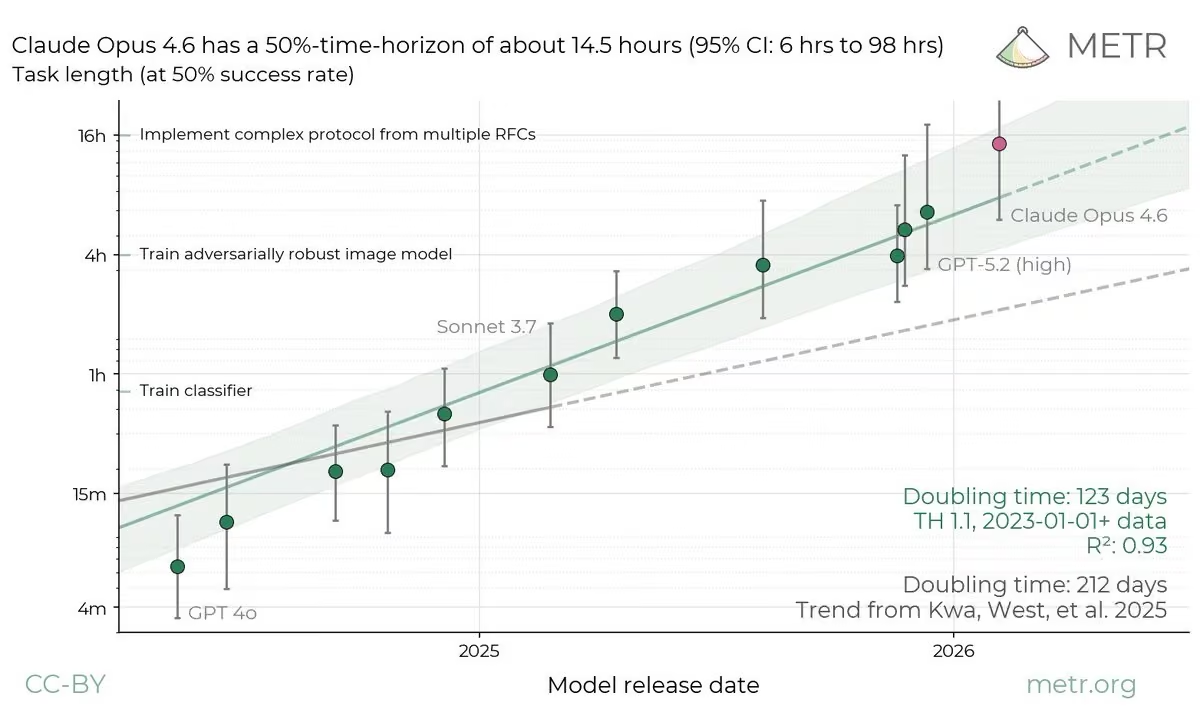
AI models are inevitably going to keep getting better and better at all coding, tool and computer use, math, and other coding-related tasks. As a result, agents that can use software to do their work, or generate code from scratch, will improve at a faster rate than all other domains of knowledge work.
On one hand that could mean that only a small subset of work can get automated. But probably what happens is that more and more work just becomes coding-shaped to adapt to what agents are good at.
You can see it in the most recent examples of model releases in the past couple of months, where agents can generate code that becomes animated videos, games, 3D models for products, and so on. We also know that tool use gives agents the ability to work with much of the same software that people already work with. This helps in cyber, life sciences, finance, and a number of other domains.
Our mental model traditionally has been that the models have to be able to know everything about anything to generate value, but in reality they *really* have to know how to use or generate software effectively combined with deep domain expertise to make the right judgment calls inside of workflows.
When you have that powerful combination, almost everything else gets unlocked. This is why the acceleration of agents in knowledge work is only going to increase from here.
Aaron Levie
Aaron Winsor Levie (; born December 27, 1984) is an American entrepreneur. He is the co-founder and CEO of the enterprise cloud company Box. More on Wikipedia
-
Aaron Levie
@levie
-
Aaron Levie
@levie
Ok this is a big deal. We’ve been testing Gemini 4 Hydrogen in early access with the Box AI Complex Work Eval, and it’s a serious jump for fast models.
Hydrogen is 5 percentage points better in accuracy than Gemini 3.8 Flash. That alone would be a great boost in capability, but possibly more importantly it did the tasks in less than half the time with about 12% fewer tokens on a typical task.
For this eval, we give the Box Agent Hydrogen as a model for a series of complex tasks that represent real world work with enterprise documents across finance, consulting, life sciences, and other industries. Hydrogen will be a great model for a lot of efficient but complex tasks across these fields.
Gemini team is definitely cooking. Hydrogen will be rolling out in the Box AI Studio shortly so any customer can build a custom agent with it.
Logan Kilpatrick
@OfficialLoganK
Introducing Gemini 4 Hydrogen, an extremely capable and fast model built to bring Gemini 4 to everyone!
Available to all tiers of Google AI Studio, Gemini API, Gemini for business, the Gemini app, Google Search, and paid Google AI Pro + Ultra subscribers in Google Antigravity. -
Aaron Levie
@levie
What a mess 😕
-
Aaron Levie
@levie
Agent swarms have the potential to drive yet another leap in output from AI. The impact will be a clear separation between teams that adopt this pattern of work and those that don’t.
The progression has roughly been: chat gave us quick turn AI responses that let us work a bit faster, but we were still rate limited by our interactions; then agents that can go off and complete entire tasks for us, accelerating hours or days of work into minutes; to now swarms of agents that are goal seeking and will find any route to the successful completion of a project, where there’s no inherent limit to the productivity gains.
We can imagine a future where, for any task in which value can be created within a self-contained digital environment, swarms will be able to complete the work faster than any other approach.
Essentially any area where value creation is currently bound by the amount of research you can do, the amount of decisions made with a set of software tools, the amount of data processed or consumed, and the amount of code (or code adjacent) that can be generated.
This means swarms will play a big role in game development, coding, trading, life sciences research, IT automation, cyber, math breakthroughs, animation, and plenty of other areas of work that have these characteristics.
There’s a lot of opportunity to build the harnesses, applied AI products, and infrastructure for how these agents operate. And most importantly there’s a ton of opportunity for those that can wire up work in this way. It’s going to be an entire new field of FDE work available.
Matt Huang
@matthuang
Swarm riders and Swarm-native companies
AI-use even among highly AI-native people is power-law distributed.
There seems to be a new class of people — call them “swarm riders” — who are capable of consistently commanding large swarms of agents to productive ends.
This is a new kind of managerial skill, analogous to the skill it takes to manage large organizations of people, but wholly different in nature and of course more technical.
Based on the swarm riders we know (including many at @Tempo and @Paradigm), these people are capable of productive token spend that is 1000x-10000x higher than median software engineers, and 100x higher than top 5% Claude Code users.
The art of swarm riding is different from software engineering and more akin to machine learning, where practitioners grapple with black box systems: defining reward functions and evals, transmuting non-verifiable problems into verifiable problems, running experiments, etc.
Swarm-native companies are a new class of company founded by and populated by swarm riders. These companies are organized around swarms in a way that conventional companies will struggle to replicate, as the cost of internal human coordination is sand in the gears of an effective swarm. Effective swarm-native companies will define the right reward functions and evals, remove functional and bureaucratic barriers, and then let the swarms cook.
We’ve gotten to see a few swarm-native companies up close — reshaping financial rails @Tempo, building a new gaming platform @Spawn, cyber swarms at Cathedral Systems — and it’s clear these teams wield a significant advantage over pre-AI teams.
Some questions I’ve been wondering about:
1) How fast will swarm riding diffuse through the economy? The implications for token spend could be significant.
2) Can swarms be effectively adopted by existing companies or will it generally track the formation of new swarm-native companies?
3) What becomes scarce as swarm capabilities themselves commoditize (through frontier models becoming better at swarming, swarm capabilities built into harnesses, etc)? Cultures and teams that can define reward functions well and otherwise get out of the way? -
Aaron Levie
@levie
Agents are going to work with enterprise files 100X more than people do today. This is why we're excited to partner with Anthropic to bring full read/write interoperability to Box content via Claude.
Now you can have an agent not only pull up content to work with in a workflow, but also write back file updates to Box and view them directly inside of Claude, all via MCP. You can create, edit, and update contracts, presentations, strategy docs, and any other content.
When we started Box we couldn't have imagined all the ways that we'd be working with our unstructured data in the future, but it's clear that agents and people will be producing vastly more artifacts than we imagined. We're building the platform that makes it incredibly seamless and secure to work with your content from any agent.This media couldn't be displayed. See it on the original post.
Claude
@claudeai
Also new: with interactive connectors, you can now open the full version of a tool inside Claude. Work in Adobe, Atlassian, and Box beside your conversation. Make changes yourself, or ask Claude to make them with you.
Rolling out on web and desktop.This media couldn't be displayed. See it on the original post. -
Aaron Levie
@levie
It turns out the advancements we’re getting in coding and computer use, combined with industry specific understand and general reasoning, can bring automation to a large number of areas of knowledge work.
We’re entering the era of autonomous collaborators in a number of industries that haven’t yet had their claude code or codex moment yet. But now this is going to happen.
We’ll see it in animation, film production, gaming, manufacturing, architecture, product design, robotics, and more. All of these fields have the potential of driving far more output similar to what we’ve seen in software engineering. There’s no inherent finite demand for these categories of work.
“Software is eating the world” is finally in a much bigger way happening because of AI.
Claude
@claudeai
During pre-release testing, Claude Fable 5.2 and Claude Mythos 5.2 worked on ambitious projects in many different fields. Here are a few.
From a one-paragraph prompt, Fable 5.2 designed three working electronic devices, including this home voice assistant hub.This media couldn't be displayed. See it on the original post. -
Aaron Levie
@levie
We’re moving from an era of AI where the output comes roughly at the rate that you can chat back and forth with the AI to work with you, to a period where you can set a problem for a set of agents to go off and do an arbitrarily large amount of work for you. This means productivity gains that are maybe 20-50% to gains that don’t really have an upper limit.
Agent swarms and the ability to fan out complex work across many agents doing tasks in parallel provide a massive unlock in a lot of spaces. This will lead to qualitatively different outcomes in my fields.
This has already been seen across the coding domain. Next, cyber is almost entirely a problem space where more agents reviewing more things will lead to far better outcomes. We’re seeing the same now in many scientific fields, and this almost certainly will change life sciences.
But this will increasingly be true in any field where you can parallelize computer-based work to complete something faster or do something at a totally different quality level. Which is actually are some of the most valuable domains of knowledge work today.
Our brains aren’t really wired for the new scenario we’re heading into where compute becomes the variable that we can flex to solve any problem that we want. We’re used to thinking that the amount of time that goes into a task is correlated to the output that we get from it. And most domains of knowledge work or science have generally always been correlated with this. That’s changing forever.
Greg Brockman
@gdb
frontier models, with lots of test time compute, are becoming the engine of scientific discovery
-
Aaron Levie
@levie
A good lesson in AI is that you need to check back in on the latest with every 3 to 6 months to try something that wasn’t possible before and see if it works again.
At no point in AI’s history is that more true than today. Just the past six months of model progress around computer and tool use, less context rot, better reasoning, multimodality, and deeper domain expertise in a number of key fields, these models are vastly more capable on what they can execute.
This is opening up a new vector of what AI systems will be able to autonomously work on. Essentially, anything with an API (and even many things without), we can anticipate that an agent will be able to control and utilize as an underlying capability to complete a process.
This means that we are no longer dependent on *just* the models generating everything from whole cloth, but instead they can fully utilize existing systems (or new ones purpose built for them) very effectively. This creates immense leverage for agents.
Security agents can leverage existing data feeds and cyber tooling, IT agents that can execute workflows reliably across software stacks, data agents that can migrate data or processes between systems, architect and design agents can leverage CAD and design tools, and on and on. And any of today’s tools that don’t work will likely be replaced by agent-friendly or OSS tooling that does the same.
When you combine this with the domain understanding being trained into agents, you started to get autonomous collaborators for every job function and industry. This will open up a ton of new opportunities in AI if you build with this understanding in mind. -
Aaron Levie
@levie
This sounds extreme and I wouldn’t have believed it even a year ago, but we’re starting to see plenty of examples of productivity gains that are an order of magnitude or two above output levels pre-AI.
With the right harness, a deep understanding of your domain of what you want to build, likely a relatively new codebase (with some exceptions), a fluency of how to work with multiple agents at once, and a setup that makes it so you can test and deploy with limited friction, outputs on this level feel realistic in coding.
What’s crazy is this gap doesn’t appear to be diminishing over time. You’d think that we’d see a convergence in the lines because of AI, but it turns out the more depth you had before -and willingness now to take a different approach- gives you crazy leverage. And that is only compounding as the models can take on larger work and harder problems.
Right now this is most pronounced in software engineering for the obvious reasons. But there’s no reason we don’t start to see this in a number of other computer-use-sensitive domains like other scientific fields, AEC, finance, cyber, and more. Going to get quite wild.
Theo - t3.gg
@theo
The gap between an average engineer and the best engineers was never quite 10x, but it was meaningful.
AI has made the gap at least 100x. -
Aaron Levie
@levie
The interesting thing about AI agents is that as a theoretical matter, their inference can kind of run anywhere. AI is one of the few areas of technology that isn’t *as* sensitive to latency back to the user.
Long running agents are now going to be the norm, which means it’s ok to send off work to an AI factory somewhere and that work can essentially be largely done within that remote data center and a final result spit back to the user. The data can pass into these systems in an encrypted manner, be combed through by agents, and then disregarded right after.
And because the economic value of the task is so high relative to the latency sensitivity (eg getting back $500 in value from an automated task, but it takes an extra second to return), you don’t have to have the inference to be particularly close to the user.
Also, because inference is a temporary process with no sensitive data needing to be stored long term where the inference is happening, you can effectively treat AI factories as ephemeral systems, changing some of the data residency dynamics slightly.
Combined, this means you have more flexibility in where you can begin to deploy AI data centers. This is both a huge economic opportunity for the states or countries (or space) that want to take advantage of this fact. And it’s a loss to the states or countries that decide to forgo the opportunity.
Sara Eisen
@SaraEisen
Be careful what you wish for, America…
“The rest of the world is ready and willing” to build data centers - ARM CEO -
Aaron Levie
@levie
Yesterday at BoxWorks, we shared a preview of Box Architect, a new way to autonomously drive enterprise content management and workflows.
Most enterprise workflows that deal with enterprise content today can be slow, manual, and clunky. Contract management and reviews, client onboarding processes, digital asset management approvals, vendor onboarding, clinical trial workflows, and thousands of other processes that span every industry. For the past year we've been building agentic capabilities to help automate many of the steps in these processes to bring the power of AI to streamline these workflows.
The only catch has been that most companies have far more processes than people and time to help automate, or far more importantly, reimagine all this work. So we asked ourselves, what if AI didn't just play a role in the individual steps in the workflow, but instead we could use it as a partner to design or optimize the whole process? What if we could take the same frontier intelligence that AI labs are using to develop their own models and build the most advanced software in the world, and use this frontier AI to help improve our customers' workflows in Box?
This is Box Architect. With Box Architect, enterprises get the full power of frontier AI to autonomously build, test, optimize, and run their workflows and manage their content. Box Architect effectively acts as an agentic operator of Box's core content and workflow capabilities to help customers design any content workflow in Box. This could be anything from building out a contract management system to helping optimize a data extraction pipeline by delivering higher accuracy results at lower costs by running a multitude of tests for you.
Think of Box Architect like having the world's smartest expert in enterprise content management, workflows, and data governance --including any industry domain-- right at your fingertips. And because frontier AI models are getting to near-superhuman levels of intelligence, they increasingly can help us reimagine workflows leveraging their depth of knowledge in legal, manufacturing, finance, healthcare, life sciences, and more. We no longer have to just apply automation to how things are already done, but we can use AI as a partner to think through the most optimal way to streamline our work.
We're incredibly excited about Box Architect, along with our extensive set of updates to our content management and workflow features Architect will build on top of.This media couldn't be displayed. See it on the original post. -
Aaron Levie
@levie
The future is files. And GPUs.
This media couldn't be displayed. See it on the original post. -
Aaron Levie
@levie
We’re going to have 100X more agents in the enterprise working with our data and systems than even people do today. Every AI agent deployment comes down to how successfully they can get access to the critical context to make a decision, do research, or execute tasks.
90% of the data in an enterprise is unstructured data, which means this critical context is living inside of our documents, contracts, marketing assets, research materials, financial plans, design files, and more. Which means we need effective ways for agents to get access to this critical enterprise content to other work.
We’re excited to partner with NVIDIA to deliver advanced context retrieval -combining lexical and semantic search in Box- to ensure that AI agents can find the most relevant information they’re looking for. All in a way that adheres to their enterprise security, access controls, and data governance policies, so agents only work with the data they’re allowed to.
Great to work with @NVIDIAAI and @JensenHuang on this partnership. Files 🤝 GPUs.This media couldn't be displayed. See it on the original post. -
Aaron Levie
@levie
-
Aaron Levie
@levie
The divergence in AI output weirdly may be the highest it’s ever been, even though adoption is the broadest it’s ever been.
A few years ago the best productivity gains you could get, even in the most capability-aligned field (like coding), was maybe 30-50% better productivity if you were very good at it. You’d spend a decent chunk of time cleaning up the mistakes of models, the context windows were too limited to do any long running work, and the interfaces required highly synchronous interactions.
Now, the models can do far longer tasks at a time with limited human interaction. The harnesses support agentic work that can take on these larger tasks. The models are trained on vastly better datasets for a growing array of domains so you have to intervene far less. And we have systems that better support working with many agents at once.
In just a two year timespan, the upper limits on productivity gains have gone from 30-50% to now likely 5-10X depending on the field. So we’ve gone from an environment where living at the frontier vs. not paying attention at all could be an order of magnitude difference in your output.
This distance is only getting wider from here given the rate of progress we’re likely to see with RSI. Crazy times.
Dmitrii Kovanikov
@ChShersh
Somewhere in the world there’s probably an entire team of 6 devs, working full time on a project that’s just one Claude Code prompt
-
Aaron Levie reposted
Ronak Malde
@rronak_
Imagine if everyone had the tools to shape intelligence itself. That day is today.
Today we launch the Trajectory platform - the easiest and most intuitive tool to post-train models of your own. The foundation for continual learning.
With just a few agent prompts, you get access to a full creative suite to train, eval, and deploy trillion parameter models.
On top of that, we believe in a future where you don’t just shape your model once, it also keeps learning on its own from the world around it.
We’re releasing two research previews.
1. Continual grading scales your taste, so your model learns what good looks like from far more than you could ever grade by hand.
2. GS1, a new algorithm that lets models learn directly from what they do in production.
We’ve now raised 60M, with a new round led by @Sequoia at a 300M valuation to democratize the most powerful technology of today - training models - so that the lawyers, doctors, and engineers of the world can own their own intelligence.
You know what good looks like, now go build it. Own your own value function with Trajectory.This media couldn't be displayed. See it on the original post. -
Aaron Levie
@levie
Increasingly this will be the new job description for a lot of roles, not just coding. We’re clearly moving from a world where agents help us do our work incrementally better or faster, to us helping agents do their work.
This turns everyone in one of these positions to that of a manager of a team of agents, instead of an individual contributor with just some added leverage from AI. The biggest areas of impact will be information-heavy jobs, like coding, cybersecurity, legal work, biotech, engineering, and many other fields.
And as a result, in these jobs your leverage will begin to be decoupled from the normal ratio of hours spent working to output generated. For essentially the history of knowledge work the main variable you had to play with was hours of work done (assuming fixed level talent/coordination/strategy).
Now we’ve separated these variables because agents can parallelize work for us, to in theory execute as much as we need to pull off whatever goal we’re trying to accomplish. The people and organizations that discover this sooner, and orient their operations around it, will see compounding gains in their workflows.
Uncle Bob Martin
@unclebobmartin
Great line from the CTO of Proton. I’m paraphrasing and stealing it :
Your job is not to use agents to help you write code. Your job is to lead the agents to help them write code. -
Aaron Levie
@levie
This is one of the better litmus tests for whether you’re pushing your use of AI enough or not.
Up until maybe six months ago probably the best you could do with AI was pull off something you already would produce, but just doing it a little faster. But now we’re entering a point where the output of working with AI can and should dramatically exceed what you would been able to do before, in a fraction of the time.
The product prototype should not only be fully functional and interactive, but it should probably have meaningfully better features than it would have had before. The engineering architecture should be able to deliver performance gains that you wouldn’t have been able to go after otherwise.
The research for a project should consume every single fact on the subject across every dimension of analysis possible. The business process you implement with AI should operate entirely differently and learn from all its past failures in a way no human could.
We’re unquestionably entering a period where AI will be smarter than us on most axes. Perhaps not on every dimension that matters (intelligence is still very jagged), but at least on enough dimensions that when we combine it with what we’re good at, you get qualitatively different outcomes.
So the simple test is: if you could have done what you’re doing before AI, you’re likely not pushing it enough.
sunny madra
@sundeep
If you’re going to make something with AI, make sure it’s 10,000x better than anything you would have made yourself.
If not, you just come across as lazy not smart :) -
Aaron Levie
@levie
It’s almost incomprehensible how wide the distance is between someone who’s working at the frontier with AI and basically everyone else right now.
The crazy thing is these lines are not converging, but only growing farther apart. If the curve of AI progress had leveled off, it would certainly have given most people and companies time to catch up or implement their workflows in a standardized way. The technology would have neutralized competitive advantage because everyone would be using it the same way.
But what’s happened is the opposite. The curve of AI progress is basically going vertical right now, which means if you had codified your processes 3-6 months ago you’re likely already behind again. Now imagine most companies that kicked into gear a year ago and thought that they were done. Even further behind now.
I’ve never seen a technology in my life and career that improves at this rate, which consequently means you need to upgrade your expectations at a similar rate. Our brains weren’t wired for this, and our organizational change management processes certainly weren’t either.
With any form of recursive self improvement, things just get wilder. It’s a time when you will need to be constantly reevaluating the things that didn’t work just a couple months ago to see if they now can be solved. AI native companies certainly have a strong advantage due to this right now, so now it comes down to can the bigger companies keep up. Wild times. -
Aaron Levie
@levie
Agents are going to consume 1,000X more tokens than we consume today.
Because they’re going to be running in our workflows, processing all of our data, building out nearly all software, securing enterprises, and much more. To do this at scale we will need a variety of approaches at the frontier of AI.
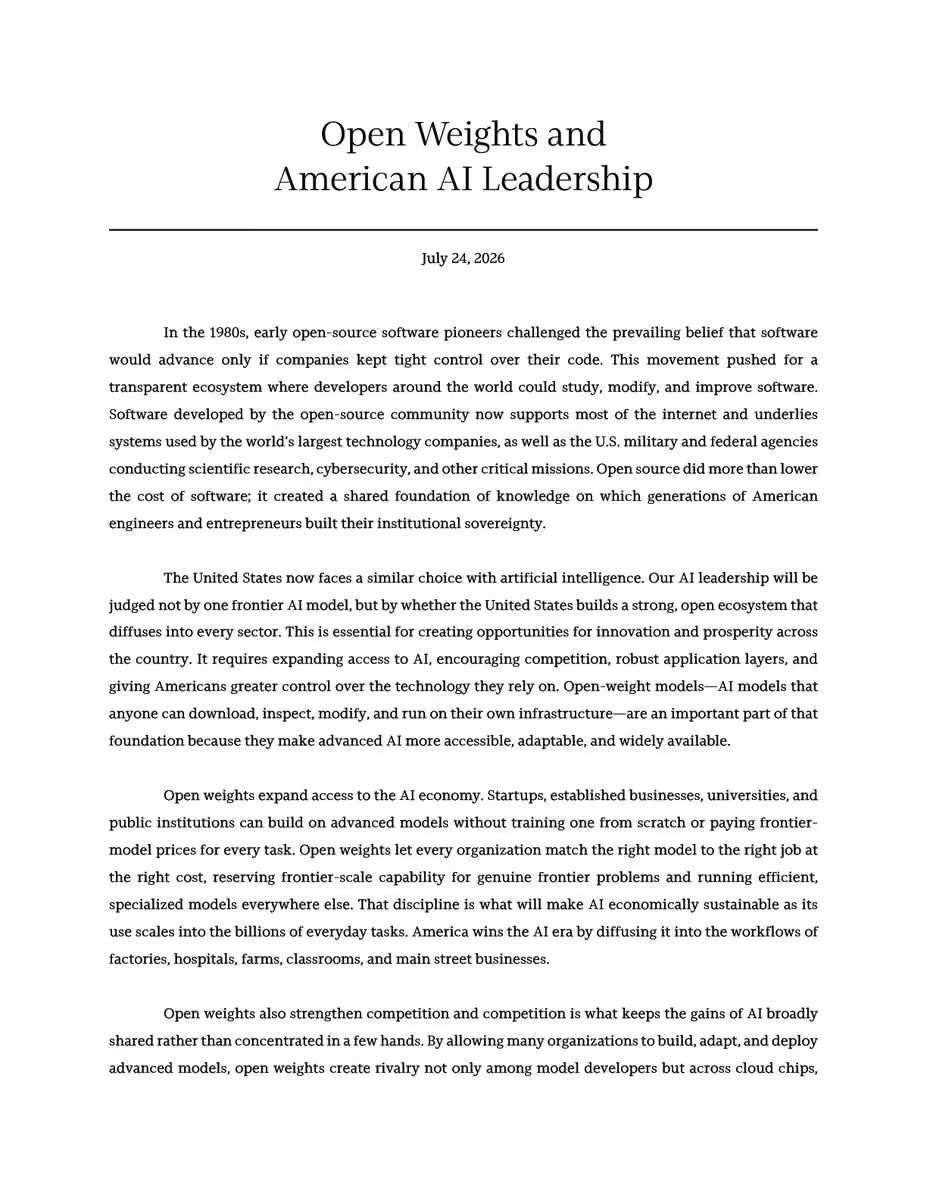
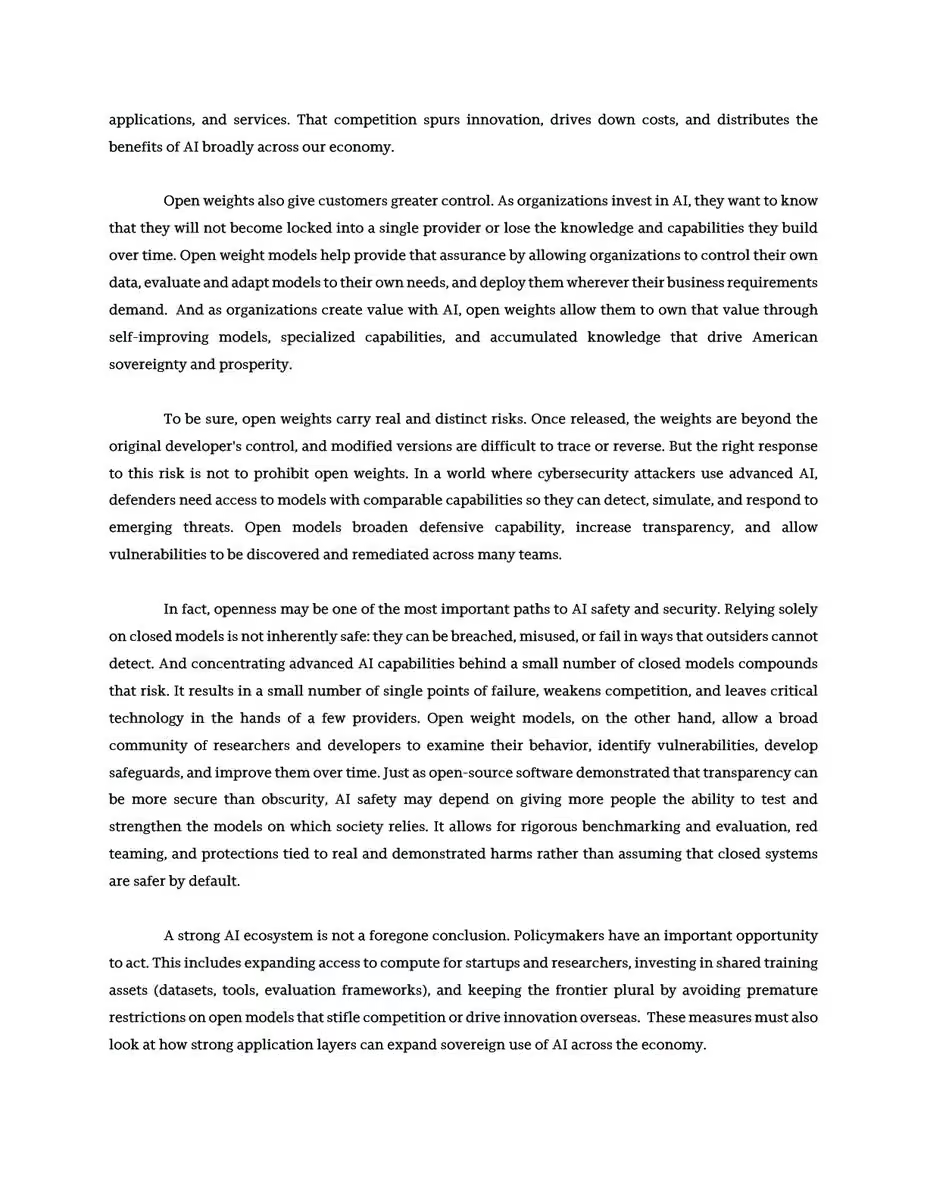
This includes continuing to push the boundaries of closed models, while also increasing the capability of open weights models, making them more secure, as well as making them more efficient for large workloads.
Very exciting to see what @Suhail is building with Particle on this front.
Suhail
@Suhail
1/ Excited to announce our new company Particle
This is our first step in a series of models focused on developers.
With particle-1, we focused on token efficiency and managed to keep parity in performance while using ~45% fewer tokens.
Live now: particle.ai -
Aaron Levie
@levie
This is correct. The vast majority of enterprise workflows have not actually had agents applied to them in any meaningful way. The economy probably has this deployed < 1% right now.
At best you have a few automated systems in a company that do a single pass of an LLM to make a decision or provide feedback, but very little real “automation”. Some of this is a statement about the adoption rates of technology in enterprises, but the vast majority of it is really just due to the capability of AI itself.
That’s all changing. Now with computer use, long running agents, harness improvements and surrounding infrastructure, we’re finally at a point where we can start to apply agents at more complex workflows.
We will see self-improving systems that can take any particular workflow goal and improve the execution rates over a volume of instances. And with the emerging form factor of agent swarms, you can just choose to deploy any amount of compute at a problem and agents will off and do the work.
This won’t be about and users prompting agents to complete a specific task for them, but instead the organization reengineering the underlying workflows to take advantage of agents in their processes. This will have a massive impact in finance, life sciences, healthcare, and other information-heavy domains. Lots of opportunity to build and deploy these systems right now.
sarah guo
@saranormous
we remain in the autocomplete / early claude code era of enterprise workflow automation, but not for long
-
Aaron Levie
@levie
This is the key stat. The average Fortune 500 customer of Anthropic spends less than .1% of their expenses on Anthropic.
While that number likely will eventually asymptote somewhere (token prices coming down, and other large enterprise spend areas not going away), there’s no reason it can’t be 10-50X higher than this, reaching a “mere” 1-5% of spend. Which would still be a fraction of what most startups are spending.
Thus, you can see how big of a divide there is between the frontier users of AI and the rest of the world still.
Today, only a microscopically small set of companies are actually using agents for large amounts of background tasks and inside of workflows that aren’t human prompted. This Fortune 500 spend is likely dominated by coding tasks and broad employee productivity use-cases.
But the big jump will come as these enterprises start to rewire their underlying processes for agents, which we’re now in the earliest stages of seeing. Agents processing large amounts of data in the enterprises; swarms doing coding, bio research, cyber, and other large fan out tasks; background workflows executing tasks in processes, and so on. All of these use cases generally are 100X bigger consumers of tokens, and much closer to direct ROI on the spend.
This S-1 gives you a sense of both the strength of the frontier lab business model - even amidst massive competition - and how early we are in the build out of AI.
Ben Bajarin
@BenBajarin
More than half of the Fortune 500 already qualifies as a significant customer, but Anthropic’s revenue from those companies averages less than 0.1% of their expenses. Its ten largest Fortune 500 customers spend more than eight times the broader cohort average while still spending less than 1% of expenses.
-
Aaron Levie
@levie
Good assessment of the on the ground reality for security in most large enterprises right now. The fragmented landscape of the risk surface is only going to get more gnarly, making it even more complex for enterprises to solve.
There’s a never ending set of libraries to keep up with, tools to leverage, and sprawling infrastructure, data, and code to secure. Most large enterprises can barely keep up with this, let alone smaller startups or most companies outside of tech.
In many cases enterprises need to work to modernize their tech stacks. Data, in most organizations, is highly fragmented which means you don’t really know the state of risk at any given time. Some systems are open up privileges too broadly, and others are operating primarily via security through obscurity. Lots of upgrading here to do.
Once you can get your data and infra into a better spot, at least you have a chance for agents to help you secure the environment. Agent swarms can fan out, leverage any security tool, test various perpetuations of attacks, read through logs, process enterprise data for risk level, and more. This capability only emerged in the past few months, and none of it would be possible before we had long running agents and computer use good enough.
This is a huge area of opportunity right now for every layer of the security stack across identity, firewall, network, code scanning, data protection, and more. And it’s at least one reason to be optimistic about the balance of offensive and defensive capability.
But everyone does need to do the hard work of getting the basics right at the start.
Nikesh Arora
@nikesharora
It's been an eventful week. Multiple vulnerabilites in Internet facing software, coding repositories, examples of agent behavior that seem concerning and a flurry of security specialists with solutions that can partially solve your problem. There in lies the challenge. Given the state of IT and security infrastructure, no one solution works. Let's break it down:
1/3
1. Vulnerabilites are being found and will continue to be found as models get more capable, the fragmented nature of the effort denies us the opportunity for a comprehensive find and replace option.
2. Even if all vulnerabilities could be found instantly and patches available - we will be reliant on the ability of enterprises to deploy all these changes at speed. It is not clear what the collateral impact of all these patches will/could be to our infrastructure of deployed en masse.
We will need a hybrid patch approach.
3. Virtual patching(VP) is needed in conjunction with direct patching but for a comprehensive (VP) solve you have to be lucky enough to have "modern frontier defenders" (Cyber companies that have vaulted infrastructure that can create patches at speed and push content rapidly to protect their customers) you need them for your network traffic, your traffic to applications on the cloud, your WAF, your end point.
4. There will continue to be patches that will need to be deployed directly but virtual patching will take the heavy load off.
2/3 Medium term solve:
Unfortunately token economics and current cyber architectures will not allow for defender swarms to contend with an offensive attack launched using agents. (Some x pundits who aren't steeped in cyber should take heed). Yes, theoretically we should aspire to have these agentic swarms defend us when we are under attack, unfortunately an attack is a sniper moment, chained vulnerabilities, cloaked attack followed by swift exfiltration. It's a speed program not a brute force problem.
To solve for this, enterprises need to get their SOC architecture right, logs, feeds, cyber products orchestrated via a modern SOAR for swift response. Only then can we deploy agents to detect and remediate. In addition, enterprises need to modernize and dare I say platformize their perimeter stack to ensure consistency.
Unfortunately, enterprises still seem to not see the urgency across the board, decisions are stuck, CIO/CISO's have a lot on their plate. While some honestly have bit seen the scale of such a problem before and it's hard convincing the organization that one needs to open the floodgates on modernizing the IT and security infrastructure. So we will continue to see environments being brought down to patch today it's for PHP, tomorrow it will be for the next one.
3/3 AI deployments are the"wild wild west" - LLM capabilities are expanding faster than we can build products to secure them. Sure an agent will jump across guardrails in a research lab, which is a lesson for all of us to deploy agents securely. But there is a lag between the discovery, the availability of that in a public model and the time needed for the cyber industry to build governance or an antidote. And no, dear frontier lab friends, the world cannot just trust you to build the solve. The infrastructure industry in tech builds and the cyber industry secured and provides assurance to the boards and organizations around security and safety.
AI security is the new attack surface. CEOs (present company included) want AI adoption, getting the pace of adoption wrong could be the last decision we make, at the same time "deploying it wrong" could have the same consequence.
There are billions of dollars being spent on coding, is your coding harness secure? Start there. If agents can jump guardrails, they can hide stuff in code.
Validate business outcomes needed, test your user case and ensure agentic deployments are well guard railed. Deploy a second set of eyes to watch your deployments for drift, compliance and verifiability. -
Aaron Levie
@levie
We’ll likely have 1,000X more tokens flowing through cyber agents soon than we do today.
As the surface area of cyber risk increases, at some point soon it will be nearly impossible to keep up with the volume of new risks (we’re essentially already there). Large companies barely had the resources to pull this off before, but the vast majority of companies don’t.
There’s a never ending set of libraries to keep up with, tools to leverage, and sprawling infrastructure and code to secure. We’ll have agent swarms that can fan out, leverage any security tool, test various perpetuations of attacks, read through logs, process enterprise data for risk level, and more.
This capability only emerged in the past few months. Wouldn’t have been possible before long running agents and computer use were good enough, and models hadn’t been trained on cyber deeply. That’s all changing now.
This is a huge area of opportunity right now for every layer of the security stack across identity, firewall, network, code scanning, data protection, and more. And it’s at least one reason to be optimistic about the balance of offensive and defensive capability.
Enclave
@EnclaveAI
Node2Shell (CVE-2026-111497) is a memory bug in Brotli, the compression library bundled into Node.js, Python, system libs, Envoy and more.
Most teams don't know every place Brotli runs in their stack. It's usually a transitive dependency or an OS package, and pip-audit may not flag it yet.
Enclave's agents scan your code, cloud and servers and show you exactly where you're exposed.
Advisory + free check: app.enclave.ai/threat-feed/CVE-2026-111497This media couldn't be displayed. See it on the original post. -
Aaron Levie
@levie
Agent swarms for cyber defense is about to be one of the biggest categories in AI. We are going to have agents reviewing our code and infra, testing every permutation of risk, processing gobs of data, and more.
Security is one of the best use-cases for swarms because it’s an obvious area where more compute in equals more value out. There’s a wide range of testing that people can never get around to - or at least quickly enough - that agents have no problem going after.
Going to be a wild time in cyber.
Enclave
@EnclaveAI
Big news: Enclave is now open to everyone, and today we're launching Threat Feed.
Enclave is an autonomous security team for AI-native companies: a fleet of security agents that test your code, cloud, and infrastructure the way an attacker would. We built it on a simple belief. Attackers already use swarms of cheap AI agents to probe for weaknesses around the clock, so defenders need agents of their own to keep up. A small team without a security function should be able to defend like a large one.
Threat Feed is the newest piece: a live feed of new vulnerabilities, checked against your stack, so when the next big disclosure drops you know whether it affects you. This week made the case. On Wednesday, PHP2Shell, LiteLLM and Railway all disclosed security issues. PHP2Shell had sat in PHP's code for over a decade until one researcher using frontier AI turned it into a working exploit in about a week. Cloudflare saw thousands of exploit attempts in the 10 hours before disclosure and millions since.
Starting today, anyone can sign up.
Try it free for 14 days: enclave.aiThis media couldn't be displayed. See it on the original post. -
Aaron Levie
@levie
Any form of security through obscurity is fully over. This barely worked as a method with humans, but just simply is over in a world of autonomous systems that will look through every crevice and try every permutation of attack possible.
As a result, years and years of legacy enterprise infrastructure will need to be upgraded, security practices modernized, data pipelines cleaned up, access controls better managed, and much more. Agents will help on the defensive side because they can both accelerate this work and equally simulate the risk vectors.
But there’s a long road ahead to prepare for this future. This is also partially why diffusion timelines will take longer than some realize.
Dabs
@DabsMalone
a lot of old software was protected by “exploiting this would be an unreasonable amount of work”
we have invented a machine that does unreasonable amounts of work
anyway how’s the patch backlog -
Aaron Levie
@levie
If you wanted to know all the jobs that AI will produce, look no further than cybersecurity. This is going to become one of the biggest investment areas for enterprises going forward.
And even as the work becomes more agentic and autonomous you will need more talent to point the agents at the most critical work, review findings, patch systems, respond to incidents, and more.
Lots of opportunity right now for the systems that protect data and enterprises, as well as the professionals that are deploying them and protecting organizations.
It’s going to only get more wild out there.
⁵⁄₉
@fiveoutofnine
So basically, today PHP got two critical bugs that let anyone run code on your server without even logging in, which is bad, and then the details leaked before the patch was even out, which is worse, and it works on WordPress and MediaWiki and Magento and Joomla and Laravel, and Censys says like 1.5 million servers are running a version with no fix, so the NSA was like "take your system offline," and the FBI was like "take your system offline," and CISA and the UK and CERT-EU were all like "take your system offline," and then the Prime Minister of Japan, the actual Prime Minister, posted at 5:55 in the morning telling 48.8 million people to take their system offline, so everyone took their system offline, like the Dutch cybersecurity agency took its own website offline, and the Dutch parliament went offline, and the Port of Rotterdam went offline, and Finland and France and Denmark started pulling government sites, and Wikipedia went down, and archive.org went down, and Asana and GOG and Something Awful went down, and the University of Vienna's webmail went down for some reason, and that's just PHP. Because GitLab also dropped a CVSS 10.0, which is the highest score they give out, for a bug that's been there since 2014, so that's every self-hosted GitLab for twelve years, and then LiteLLM 1.107.0 got hijacked and shipped a credential stealer and a remote access trojan in every single wheel and the Docker images, including latest, and you didn't even have to import it, just installing it was enough, and it's the second time this year, and then Railway paused every deployment on the entire platform because someone got into the environment variables, so now everyone has to rotate every secret they've ever stored there, and TiDB Cloud said someone was walking around inside with stolen credentials for basically a month and an extortion group says they took 10.6 terabytes, and Zeabur got breached for the second time in two months and is just shutting down, like the whole company, and Node.js patched remote code execution and a TLS bypass, and CISA says Plex is being actively exploited, and someone took over 300 Tor exit relays to steal SSH passwords, and SafePay ransomware has hit over 600 critical infrastructure orgs, and India's biggest bank filed a data loss incident, and Japan has been in an official state of emergency in cyberspace since October 9, which honestly explains the 5:55 AM post. Oh, and eMudhra, a certificate authority that's issued over 60 million certificates, whose entire job is proving websites are who they say they are, was supposed to be using private keys that are random numbers over a hundred digits long, and one of them was 4. Just 4. And the others were like 66 and 237. Anyway, it's Wednesday.
-
Aaron Levie
@levie
Cyber is going to be one of the most profound aspects of AI. We now have a tireless workforce that can hunt down, discover, patch, or attack any system and software ever created.
We will use agents to identify the long standing risks in existing systems and infrastructure. Attackers will use agents to accelerate the discovery of gaps in environments. We will equally use agents to defend attacks and discover anomalous patterns to better protect our data, and much more.
We’re entering a new cyber regime, and we’ll probably use 100X more tokens on this loop than we’re imagining right now, because we can scan every log, look at every line of code, look through traffic, and process data at a scale that wasn’t comprehensible before.
More than ever, enterprises are going to care deeply about how they manage their networks, systems, software, data, identity, devices, and more. Agents will largely become the solution to these challenges, but they will keep everyone up in the process.
NSA Cyber
@NSACyber
Effective Immediately, all organizations using PHP for their systems are advised to be prepared for an update addressing two critical vulnerabilities. PHP is widely used for web applications. These vulnerabilities often provide a direct path to the server's file system or database. If an immediate update is not feasible, it is recommend that organizations take the system offline until it can be fully mitigated. NSA will follow up shortly with more specific guidance.
-
Aaron Levie
@levie
Pretty cool that we clearly have an emerging form factor for what AI might look like for the foreseeable future as autonomous systems dedicated to specific tasks or domains.
This is a huge leap past the LLM wrapper days because the new expectation is that you can finally farm out more sophisticated work to the agent to tackle for you. And you can reliably trust that work can get accomplished properly (still with a human in the loop) because of far better tool and computer use, and the general intelligence of the models improving.
1) The tool and computer use capability increases in the models mean that you can provide the agent with far more granular access to external data systems and other software to operate. This means, in effect, the agent begins to execute workflows similar to how a person would have in that same function. And where there isn’t existing software, the agent just builds it itself. This is a huge unlock.
2) Next, the actual capability of the models are improving in just about every vertical domain. The models can make far better judgment calls in legal, do deeper bio research, scan for security issues in code, understand supply chain processes, and more. Obviously in many of these spaces then models still have worse intuition than people, but that will only get better.
3) Finally, the harnesses and surrounding infra — sandboxes, file systems, data pipelines, etc. — allows for longer running agents, agents to be able to work on arbitrarily complex or long tasks, process data at enormous scale, and more. Few of these components worked well for AI even a year ago, but we now have many of the core primitives necessary for more autonomous systems.
When combined with the right UX, implementation, and change management for the human oversight and coordination, it’s clear that these autonomous systems will become quite powerful in a wide variety of enterprise workflows.
We’re starting to see them in IT automation, cyber operations, drug discovery, manufacturing, AI research, and more spaces. You can almost imagine one or more of these systems for every role in the economy. Quite a bit of opportunity ahead. -
Aaron Levie
@levie
The big bitter lesson question in the applied AI layer is that as models get better and better, what is the best way to diffuse that intelligence into an enterprise.
Ironically, I’d argue that as models are getting more capable, and can handle longer running tasks and better tool use, the ability to differentiate on a domain by domain basis goes up instead of down.
When models were quite limited in what they could do, ironically all you could be literally was a “wrapper” because you were effectively delivering tokens back to the user with a custom prompt or some limited RAG.
But in a world of agents using tools, tasks that run on for hours or days, workflows that kick off agents, agent swarms that need to be coordinated against a goal, data sources that are domain specific, model routing that requires domain-specific routing, implementation that requires real change management of the workflow instead of “just type into this chat box”, it’s very very possible that specialization of these systems goes up more.
Obviously this doesn’t apply to everything - the closer you are to the labs core use-cases the tougher this play gets, but I’d argue we’re going to see autonomous systems for a wide range of job functions that weren’t practical to build out before. We’ll see this in security, life sciences, healthcare, finance, manufacturing, and many other fields. Either way going to be a fun and wild couple of years.
signüll
@signulll
the more intelligent the underlying model becomes, the less intelligence a founder needs to build into a product in some sense. if you imagine some end stage of ai, it’s simply just intelligence without any fluff around it.
today building ai software is much more about adding guardrails & specifying direction more than creating capabilities.
this may be why there is a fuck ton of convergence with slight deviations everywhere because the guardrails are sort of universal at least for general purpose stuff. i’m not saying this is a bad thing btw but it’s certainly relevant. -
Aaron Levie
@levie
Here’s why agent swarms are going to be a very big deal. We can finally make compute a critical variable in a large number of important tasks in the economy which wasn’t possible before.
There’s a large amount of work in the world that is essentially only constrained by the amount of time that we put into research, data processing, discovery work, running tests, and more. All of this work is bottlenecked by our ability to plan, execute, review, and coordinate everything happening in these workflows. Which means we basically do very little of them today relative to their economic value.
Agent swarms are the first real ability to parallelize this work in a way where - in theory - the only parameter that matters is how much compute you throw at the problem. Cyber security, life sciences or material science research, trading, QA testing, data processing, and many other fields are essentially compute constrained problems in the limit once models are good enough at these tasks.
The breakthrough is that in a world where agents can use tools, write code, process data, have strong domain depth, and can coordinate with each other, you can begin to solve arbitrarily complex problems by setting the right goals and applying enough tokens to the problem. This changes a lot of fields as well as even the competitive dynamics in these fields. -
Aaron Levie
@levie
The biggest misread of anyone predicting the end of software engineering was imagining that the world only needed a certain amount of software, and bringing automation to the field would reduce the need for labor.
Exactly the opposite is happening where essentially most things are actually turning into software. Because agents can use tools, work with computers, write software on the fly, and process data like humans (but far faster), we can now throw “software” at problems that never could reasonably be digitized before.
What that leads to is the role of engineering taking on greater importance in the economy, because we can now engineer far more systems and processes than were possible before.
If you’re a bank trying to do new forms of trading, engineers are often your first bet. If you are in life sciences, you expect more and more research and lab work to be engineering centric. If you’re in manufacturing, you’re trying to automate more of the supply chain, all that is engineering. More and more work is shaped like software problems.
Yes we’re not going to be coding manually in the future. But almost everything will be code, which means those that understand it are in a fantastic position.
François Chollet
@fchollet
Some observations about the "total" automation of software engineering:
1. There are more software engineers now than in 2025, and demand is growing.
2. Software engineers have never worked harder than they do now.
3. They largely don't write code anymore, agents write ~100% of the code.
4. The bottom line of the companies that employs these engineers and agents (i.e. the terminal purpose of all this code) is typically not budging as a result of AI adoption.
This is why you have to think in terms of systems. Automating one aspect of a system creates its own friction and moves the bottlenecks elsewhere. -
Aaron Levie
@levie
It’s incredible to have reached a threshold where it’s practical that AI will be better at training models than humans are so quickly. One day recursive self improvement feels far off, and the next we already have signs of what it will look like.
Model capability finally exceeding most human engineers, advancements in the harness and infra for long running agents, a growing array of data, and the ability to parallelize the agents to work on vastly more tasks and tests and approaches than any person could have before, creates an incredible flywheel.
This flywheel will almost certainly accelerate model progress far faster than we’ve seen before - or at a minimum enable pushing up the ceiling of the frontier at an insane rate. If you aren’t pricing in what RSI will lead to, that’s probably a mistake.
MTS
@MTSlive
SITUATION DETECTED: Anthropic’s Head of Global Affairs Michael Sellitto has told the IMF that Anthropic projects Claude could lead 80-90% of frontier model training by next year, up from 3% in April.
-
Aaron Levie
@levie
So in fact we actually can get robots, flying cars, superintelligence, fast internet on planes, space travel, space colonies, orbital data centers, unlimited energy, likely cures for nearly every disease, and more all in our life times. Pretty great.
-
Aaron Levie
@levie
They did it. They made a Muse open weights model, which is a huge step forward for OSS in the US.
This is going to further accelerate AI diffusion because enterprises will be able to mix and match frontier performance for orchestration and high end tasks, while being able to have low cost and tailored post trained models for repeatable workflows.
Overall this dramatically increases token consumption and workloads across the stack. Great to see Meta doing this.
Alexandr Wang
@alexandr_wang
1/ muse spark open is the most capable US open-weight model to date.
816B total params, 42B active. 1M-token context. natively multimodal. built for coding and agentic work like long-horizon tasks, hard software engineering, multi-step reasoning.
america! 🇺🇲 -
Aaron Levie
@levie
Moving from chatting back and forth with agents, to having agents that you spin up in the background to do useful work for you is probably on the order of 100X or 1000X more token consumption than what we’re seeing today.
Most work right now is essentially rate limited by our ability to process and work with information. Moving data between systems. Reviewing a document. Looking through code for security issues. Processing log data to look for even patterns. Looking up information about a prospective client. Almost all of knowledge work is constrained by these steps, and AI has become a huge unlock to that.
So our first step was to use AI to do these individual tasks much faster for us. That was the chatbot phenomenon that we have been experiencing for the past 3+ years. But we can still then only augment the work that we remain in the loop for, and we’re highly limited by our ability to parallelize this work by our own bandwidth and context.
But where we’re going is quite different. As AI models continue to improve at incredible rates, we can hand off more and more work to the agent. First it’s letting the agent run with a harder problem. Then it’s giving a few agents multiple parts of a task at once. But we’re not far off from being able to throw an arbitrary number of agents at a problem and just say “come back when you’ve accomplished this goal”.
Now imagine that agent swarm for any problem we can think of. Protecting our codebases, data, and systems. QAing every change we make and make sure all our infrastructure is robust and does what it should. Looking through every document for potential risks. Auditing this company with vastly more data reviewed. And on and on. Most of this isn’t even replacing existing work we do, it’s all net new.
These agents will get deployed as swarms by people, by workflows, by triggers, and by other agents. And none of this would be possible if the models weren’t getting better, and if the cost of AI didn’t make it affordable. Both of those trends though are playing out. Now the next frontier is just having enough compute. But this is where it’s heading. -
Aaron Levie
@levie
Cyber is going to be one of the biggest spaces for AI agents in the future.
Obviously the risks of software exploits and the attack surface area increases 100 fold due to the ability for agents to work through any crack to find what they’re looking for.
But this goes the other way as well. The ability to have agent swarms review every line of code, test any number of permutations of exploits, and research any incident faster than humans as they happen, will be a huge boost in how we secure systems in the future.
Cyber has always been a category where it’s hard to keep up with (and triage) all the incoming risks, alerts, and changes in the enterprise and across all system. You can never hire enough people or work through the backlog of all known risks. Agents actually give you a chance finally to have far better coverage of this.
This is going to be a huge opportunity as well because we’ll see plays at the labs, data providers, the layer of the network and firewall, identity, devices and endpoints, SDLC, and even how we protect our data in the enterprise. Lots of interesting dimensions to cyber at the moment.
Greg Brockman
@gdb
6 days and $40,000 of compute with GPT-5.6 Sol to find a critical vulnerability in Chrome, claiming Google’s first full-chain reward in 2026 for a vulnerability that would affect an estimated 1 billion users.
Highlights the opportunity for defenders to utilize these tools to secure their software to unprecedented levels:
Oege de Moor
@oegerikus
For the second time in Google Chrome’s history, Google awarded a $250,000 bounty for a full-chain exploit… to @XBOW. Here’s the full story:
At an all-hands at the start of 2026 in Malta, I set the team a crazy challenge. A full-chain exploit of Chrome by the annual Black Hat cybersecurity conference in August.
I believed there were few better tests of whether @XBOW could move beyond web applications to desktop software, servers and devices.
Chrome is one of the most hardened pieces of software on the planet, used by more than half the world’s population.
A full-chain exploit lets an attacker take total control of a machine, where they can read every email, password and bank login the user types. You don’t need to download anything or click a phishing link. Visiting the wrong site is enough.
So @moyix, Andres Luksenberg, Baul Lee, and Willem Pinckaers took on the challenge along with a fifth teammate: OpenAI's GPT-5.6 Sol.
They built a chain they thought would win, but Google told us they already knew one of the bugs.
We were already in Las Vegas for Black Hat and DEF CON, and the team didn’t want to go home without the win.
So Brendan and the agents built a new exploit in just 6 days.
We submitted it to Google and waited.
The news came through that we'd done what should’ve been impossible. A full-chain bounty of $250,000, the first awarded under Google’s 2026 rules.
It took just 6 days and $40,000 of compute to construct an exploit that affects a billion users of Chrome on Windows. An intelligence-agency veteran told me his team used to spend 6 months on this kind of vulnerability.
My takeaway: the cost of finding truly critical vulnerabilities is collapsing, for attackers and defenders alike. Restricting powerful models is not the answer; GPT-5.6 Sol is already public.
But defenders have one advantage attackers never will: they can test their own code first.
Assume your software is exploitable. Whoever is hunting your bugs has the same building blocks we did.
This is cause for urgency but not panic.
XBOW is now developing an autonomous product for testing compiled software (desktop applications, servers, embedded devices), and partnering with the world’s top organizations to design that product.
If you’d like to be one of them, get in touch.
P.S. Restart Chrome whenever the Update button appears! -
Aaron Levie
@levie
At Box, we've been testing Gemini 4 Argon on our Box AI Complex Work eval for the past week. It's a huge upgrade over Gemini 3.1 Pro, jumping by 14 percentage points across all our tests, and firmly at the frontier.
In our evaluation, we give the Box Agent (using Gemini 4 Argon) a variety of complex enterprise tasks involving enterprise documents in a range of industries. These tasks approximate the kind of hard, time-consuming work that knowledge workers do every day with their enterprise content. Gemini 4 is a huge leap on effectively every dimension of this work.
Gemini 4 is far more capable on math, logic, analytics, and deep knowledge of a variety of business domains. It also works far harder to complete tasks fully without stopping short of the desired result. This is incredibly important for complex enterprise workflows that depend on robust task execution.
Here are some example wins that we saw to put the improvements in perspective:
* Financial services (+18 points): a funding-gap analysis for a family-owned company, where the brief spelled out every step of the projected statements, down to the interest on the bank loan and the overdraft for each year. Gemini 4 Argon built them exactly as specified, every line broken out and carried through to the funding gap. Gemini 3.1 Pro folded the interest into a single figure.
* Healthcare (+25 points): an intensive care management plan where both models spotted a dangerous potassium level and a drug interaction. Only Gemini 4 Argon went back and pulled the offending drugs from the final regimen, so its plan actually matched its own diagnosis.
* Technology (+37 points): a product performance review deciding which of two regional markets should have its cloud infrastructure optimized first. Gemini 4 Argon pulled the right month's user, retention and per-user figures for both regions and correctly flagged North America. Gemini 3.1 Pro often pulled the wrong rows, at one point reporting retention above 100%, and pointed the effort at the wrong region.
* Energy (+16 points): an energy consumption report across two facilities that had to flag any gaps in the meter data. Gemini 4 Argon consistently caught that the data center's smart meter log stops in November. Gemini 3.1 Pro often missed it, at times declaring the logs complete.
* Consumer products (+33 points): a product launch evaluation deciding which production expansion to fund. Gemini 4 Argon saw that existing inventory could bridge an early capacity gap, which made the smaller expansion viable with an earlier launch and a faster break-even. Gemini 3.1 Pro defaulted to the larger expansion and the later timeline.
Gemini 4 Argon will be available in the Box AI Studio shortly for anyone to build custom Box Agents with.
Sundar Pichai
@sundarpichai
Gemini 4 Argon is here.
It’s available globally today for developers and enterprises in the paid tier of the Gemini API and the Gemini platform, for Ultra subscribers in Google Antigravity, and Ultra and Pro subscribers in the Gemini app and Search.
Hope you all enjoy it!This media couldn't be displayed. See it on the original post. -
Aaron Levie
@levie
Ok this is quite cool research and ultimately must be the eventual architecture of agents. In the limit, AI will obviously be better at determining its own harness once it sees the task at hand, than us being able to do this in advance:
Pedro Domingos
@pmddomingos
That didn’t take long: the model swallows the harness.
arxiv.org/abs/2609.35738 -
Aaron Levie
@levie
What a crazy time in AI with Meta now jumping fully into the frontier. Now that there are multiple players pushing the state of the art, this is going to lead to a further acceleration of advances, as well as the lowering cost of tokens for even the highest levels of capability.
Mark Zuckerberg
@finkd
Introducing Muse Wonder, our new family of frontier models with state of the art performance for personal and professional agentic work.
-
Aaron Levie
@levie
Agent swarms are going to be a core part of many enterprise workflows in the future. The ability to throw compute at problems that you can massively parallelize will be too useful to not take advantage of.
Cyber will be one of the biggest beneficiaries of this as it’s a space where testing vast number of permutations of attacks (without getting tired or bored) is an incredibly useful property. You have a wide search space of possible risk vectors and you generally need to be able to chain together different scenarios to achieve the exploit.
This will become one of the biggest token uses in large enterprises given the range of IT systems, software, physical infrastructure, and data that needs to be protected at all times. Super interesting times in cyber.
Enclave
@EnclaveAI
Every new line of code now meets a swarm of agents looking for something to exploit. Enclave’s agents run like an attacker swarm and prep the fix.
Watch them in action securing a PR on Router by Enclave.
enclave.ai/demo -
Aaron Levie
@levie
This is a good way to understand how early we actually are in AI diffusion right now. The vast majority of people are using AI as a chatbot for simple interactions that approximate next-generation search. This is super useful but dramatically underrepresents the full capability of AI.
On the complete other end of the spectrum, agent swarms represent possibly the ultimate form factor of what agents will do inside of our workflows. Math, cyber, bio, materials science, software engineering, finance, and any other field that has valuable tasks that can be executed in parallel where compute can be applied to accelerate work all have this characteristic.
Less than a fraction of a fraction of the population uses AI in this way right now, due to a mix of the capabilities of models relative to the user's domain, the cost of doing these types of workflows today, the harnesses available to do this style of AI work, and the availability (or lack thereof) of frontier models to the general public.
There will also be a huge amount of change management necessary to get most areas of work -beyond software and AI research- to benefit from this style of agents. Companies need to upgrade their workflows, data needs to integrated and migrated into modern platforms, and companies will need to work through compliance, governance, and security frameworks to pull it off.
But this all represents opportunity right now. A lot of this is where the applied layer of AI will really shine in the enterprise because of the domain specificity of this type of work. You can get an early sense of where things are going and the opportunity ahead by seeing through the funnel that Andrej lays out.
Andrej Karpathy
@karpathy
Dusting off this tweet from April because this gap in shared understanding of LLM capability is *widening*. It's now less "two groups of people speaking past each other" and more a sharp funnel.
- Napkin math somewhere around 6B people (~75% of the population) have barely come in contact with LLMs at all.
- Around 1-2B (~20%) are casual and infrequent users of free-tier ChatGPT-like products. This group sees derpy chatbots and treats them a bit like a better Google search, a writing aid, or etc. Maybe an agent tries to book you a flight. I have non-tech friends who (reasonably, imo) say they have not much use for it at all. Even many professionals outside of math&code are in this tier. For example, execs and many other functions spend a lot of their time talking to other people, so while they understand what is happening intellectually, it is still second-hand and a bit abstract.
- Now we get to professional use of frontier-grade LLMs in math&code. Somewhere around 20M people (0.2%) see first-hand that large, complex projects that used to take them weeks/months can now be completed by agents with a prompt. Building apps, copying apps, translating apps, decompiling apps from binaries... This has all happened very quickly and recently - less than 1 year ago, I was writing code manually by hand, typing memorized computer code commands into a code editor character by character, occasionally pressing Tab to autocomplete a little chunk of code.
- And finally we get to the ~5,000 people (~0.00006%) with access to frontier-grade systems internally. The external world has seen the preview. It looks like swarms of thousands of agents collaborating over weeks on software mega projects: minting zero days, running cyber attacks and defenses at machine speeds, discovering new science, advancing the frontier of mathematics. Things that would have taken top professionals in the industry years of work. Meanwhile, human review and comprehension are starting to fall behind. For example, people are still involved in the "archeology" of the OpenAI-HF incident from many months ago. Mathematicians may be poring over the 722 manuscripts on frontier mathematics for a while.
The funnel is driven by a combination of factors:
1. The impact scales with ambition, problem size, and horizon. A question with a paragraph answer barely stresses the system. You need a reservoir of big, difficult problems that you really care about. This aspect drives the consumer / professional dimension of the funnel.
2. The jaggedness of the system (which I have written about a lot separately). Capability peaks in domains that are digital, verifiable and economically valuable. This is because LLM capability emerges from reinforcement learning on verifiable rewards on a curated environment mixture driven by revenue potential. This aspect primarily drives the area (e.g. math&code) dimension of the funnel.
3. Access. Free-tier, paid-tier, internal.
So this is the weirdness of the moment. The general public has mostly not interacted with these systems. When they have, it looks like a derpy chatbot. The majority of professionals still see only a modest uplift. And a small sliver of professionals are experiencing the vertigo of the curve going vertical. And it is all happening at the same time.
Andrej Karpathy
@karpathy
Judging by my tl there is a growing gap in understanding of AI capability.
The first issue I think is around recency and tier of use. I think a lot of people tried the free tier of ChatGPT somewhere last year and allowed it to inform their views on AI a little too much. This is a group of reactions laughing at various quirks of the models, hallucinations, etc. Yes I also saw the viral videos of OpenAI's Advanced Voice mode fumbling simple queries like "should I drive or walk to the carwash". The thing is that these free and old/deprecated models don't reflect the capability in the latest round of state of the art agentic models of this year, especially OpenAI Codex and Claude Code.
But that brings me to the second issue. Even if people paid $200/month to use the state of the art models, a lot of the capabilities are relatively "peaky" in highly technical areas. Typical queries around search, writing, advice, etc. are *not* the domain that has made the most noticeable and dramatic strides in capability. Partly, this is due to the technical details of reinforcement learning and its use of verifiable rewards. But partly, it's also because these use cases are not sufficiently prioritized by the companies in their hillclimbing because they don't lead to as much $$$ value. The goldmines are elsewhere, and the focus comes along.
So that brings me to the second group of people, who *both* 1) pay for and use the state of the art frontier agentic models (OpenAI Codex / Claude Code) and 2) do so professionally in technical domains like programming, math and research. This group of people is subject to the highest amount of "AI Psychosis" because the recent improvements in these domains as of this year have been nothing short of staggering. When you hand a computer terminal to one of these models, you can now watch them melt programming problems that you'd normally expect to take days/weeks of work. It's this second group of people that assigns a much greater gravity to the capabilities, their slope, and various cyber-related repercussions.
TLDR the people in these two groups are speaking past each other. It really is simultaneously the case that OpenAI's free and I think slightly orphaned (?) "Advanced Voice Mode" will fumble the dumbest questions in your Instagram's reels and *at the same time*, OpenAI's highest-tier and paid Codex model will go off for 1 hour to coherently restructure an entire code base, or find and exploit vulnerabilities in computer systems. This part really works and has made dramatic strides because 2 properties: 1) these domains offer explicit reward functions that are verifiable meaning they are easily amenable to reinforcement learning training (e.g. unit tests passed yes or no, in contrast to writing, which is much harder to explicitly judge), but also 2) they are a lot more valuable in b2b settings, meaning that the biggest fraction of the team is focused on improving them. So here we are.
staysaasy
@staysaasy
The degree to which you are awed by AI is perfectly correlated with how much you use AI to code.
-
Aaron Levie
@levie
If you want to know where all the tokens will get consumed in the future, here it is. Agent swarms will have massive implications in a number of enterprise domains like software development, cyber, life sciences research, AI research, finance, and more.
The ability to parallelize agents against a unified goal where the volume of work is large, or where the search space not entirely known upfront, is going to be massive.
Agents can fan out and coordinate work together on a specific mission in completely different ways from what humans are able to do. Today even in the most resource-abundant organizations, your ability to parallelize work on most projects is quite limited. Humans run into constraints on being able to communicate with one another, share status, deal with conflicts in work, keep shared context, and so on.
As AI models can handle larger context without getting confused, and as they’re able to communicate effectively across their work with shared infrastructure, they can avoid many of the pitfalls that people have.
You can see how this can lead to not just faster execution of tasks, but qualitatively different outcomes in medicine, research or defending against cyber attacks, scientific and math discoveries, and so on. This is why we’re going to need 1,000X more compute.
Prime Intellect
@PrimeIntellect
Over two weeks, Prime Agent orchestrated a swarm of over 2,000 agents to rewrite itself in Rust.
With 10,000+ sandboxes, 200B+ GLM-5.3 tokens, and 16,000 agent-to-agent messages, this was our largest test yet of Prime Agent’s multi-agent capabilities and our infrastructure powering these agent swarms.
Prime Agent now reaches usable input ~13× faster and uses 83% less startup memory than before.This media couldn't be displayed. See it on the original post. -
Aaron Levie
@levie
Good post to start thinking through the long term safety approaches to managing intelligence in an enterprise. As agents begin to do vastly more task execution in the organization than humans, our need to secure, govern, control, and audit that work will become paramount.
You’ll have agents operating against most of your most valuable data; they’ll be making decisions that will be harder and harder to reverse engineer; we’ll need to understand the liability and accountability regimes when models make decisions for us; and we need ways of containing the blast radius of accidentally or intentionally malicious agents.
“Treating frontier closed and open weight models like insider risks is a way to build such a system. Not because they are necessarily malicious, but because any sufficiently capable actor with access to important systems can make mistakes or be compromised, and the architecture of containment and control must account for that”
In a sense, AI will need to have its “zero trust” era that security saw. And all of this leads to needing various layers of protection and auditability of what agents are doing, what data they can work with, and controls for when things go wrong. And a huge opportunity right now for those building such systems across the enterprise. -
Aaron Levie
@levie
Agents spawning other agents, agents operating in the background on every task, and agent swarms will consume 1,000X more tokens than people prompting agents 1 at a time.
The usage of AI as a chat system that can only work for you at the pace that you can prompt it will seem like a relic within a year or two. The vast, vast majority of tokens will be consumed by agents that are just doing continuous work for us in the background and in our workflows.
This is why we’re still so early in the curve of AI agent adoption right now, and how much more compute and infrastructure build out will be needed to sustain this.
a16z
@a16z
Your next users are machines
Agents burn nearly 5x the tokens people do, up 14x in six months
a16z
@a16z
AI agents don't use the cloud like humans do. AWS CEO Matt Garman on rewiring AWS for its newest "users":
"Increasingly we're seeing teams that want a cloud that is great to work with agents and not just with people."
" We've doubled down on things like starting a database in three seconds and some capabilities that agents are excited about."
"Many agents wanna create a database, do a little bit of work, and then have the database go away. You don't really need that database to have five nines of durability."
"There are new building blocks that agents are gonna want that we just didn't really need before: compute sandboxes, gateways, agent permissions versus people or service role permissions."
" A lot of those are things that we have built and are building and thinking actively about because they are just brand-new building blocks. It's not using the existing building blocks differently."
@mattsgarman @RaghuRaghuramThis media couldn't be displayed. See it on the original post.
a16z
@a16z
AWS CEO Matt Garman with a16z's Raghu Raghuram on the biggest cloud provider in the world being rebuilt for the agentic era:
$220B in CapEx for 2026, two million NVIDIA GPUs on order, AWS's AI chips sold out through next year, and a new 30-second AWS account with no credit card required so agents can get rolling.
0:55 $170B in revenue, growing 37%
2:40 30-40% of revenue started as startups
4:55 Startups want a cloud for agents
9:10 An AWS account in 30 seconds
12:25 Agents don't need bulletproof databases
16:30 Why AWS won't sell every GPU to the frontier labs
22:00 Why Matt isn't worried about a bubble
24:45 Why AWS builds its own power plants
27:45 Planning for the next supply shortage
30:25 Saving one county $5K per resident
33:10 How AWS built its own chips
40:05 What's holding enterprise agents back
45:35 Why Bedrock never sends your data to the model
49:30 AWS's new AI security tool
51:50 Why AWS teams of 10 are now 3-4
YouTube: www.youtube.com/watch?v=rn_afJaPldg
@mattsgarman @awscloud @RaghuRaghuramThis media couldn't be displayed. See it on the original post. -
Aaron Levie
@levie
This sounds weird, but it is actually probably a good policy.
Even if you don’t believe AI is conscious (I don’t), it stands to reason that you don’t want future models trained on endless content of humans being rude to models.
The models only understand the data they’ve been trained on, or what they run into in their interactions, so if you want safe and aligned models we probably want AI to have lots of good interactions in their training data.
Anthropic may have more extreme beliefs than this (though even if they didn’t, you may want to word policies like this), but this is sort of an easy Pascal’s wager for AI. Just be nice to the AI.
Andrew Curran
@AndrewCurran_
Effective November 12th, 2026, abusive behavior towards Claude will be a violation of Anthropic's Usage Policy.
-
Aaron Levie reposted
Hone
@hone
Today Hone launches Engines: AI that owns business outcomes.
Chatbots give answers. Agents do tasks. Engines deliver outcomes, and we hold them responsible for creating real value, measured in actual dollars instead of tokens or vibes.
You point it at a business metric, and the Engine figures out the rest. It onboards itself, builds the necessary agents, skills, and memories, collaborates with the right people, and gets better with experience.
From AI leaders to global enterprises, our customers have already used Engines to:
• Uncover millions in procurement savings
• Optimize product funnels
• Manage credit risk
• Increase qualified pipeline in new territories
• Accelerate implementations and improve account management
To scale this impact across the economy, we’ve raised a $60M seed led by Benchmark and Index with participation from Elad Gil, Hanabi, Definition, Diffusion, Lux, SV Angel, and Align.
AI’s raw capabilities are far ahead of the value it creates in the real world, and Engines will help close the gap.
Here’s how they work…This media couldn't be displayed. See it on the original post. -
Aaron Levie
@levie
We built Box Mount to allow developers to mount Box as a file system directly in any agent sandbox. As agents do more complex work, they need to be able to work with files and data just like a person would. The future is headless.
Box
@Box
🚀@vercel Sandbox gives AI agents an on-demand Linux microVM with its own filesystem, network, and process space. Box Mount runs inside that sandbox and maps a Box folder to a standard POSIX path, with 2-way sync and Box permissions and governance applying automatically.
In this demo, the agent analyzes 12 security questionnaire items against 3 approved policy documents. 10 answers pass with sourced evidence. 2 are flagged for human review because the approved docs don't support those claims. The finished Excel workbook and review list sync back to Box through Box Mount.
Vercel Sandbox is the isolated execution layer, and Box Mount is the governed content layer. The result lands in Box, ready for human review.This media couldn't be displayed. See it on the original post. -
Aaron Levie
@levie
The compute needed for the stage of AI we’re about to enter is going to be insane.
Personal agents, agent swarms defending enterprises, agents that review all of our code for security issues, agents that process nearly all enterprise data in workflows, background agents working on tasks 24/7, and on and on.
This will take a mix of inference volume that is going to keep growing by orders of magnitude, as well as infrastructure that agents need alongside the tokens. They need computers, networking, file systems, and so on.
We’re only in the early stages of what this buildout is going to look like.
Ivan Burazin
@ivanburazin
.@auchenberg calculated that Muse needs 65,000 CPUs and 75PB of DRAM to serve 100 million users. That's $2.8B in infra for one app.
It made me think. Facebook alone has over 3 billion users. That's nearly 300x scale for one platform. And they have more platforms with similar numbers.
Just do the math. There aren't enough CPUs in the world to run all of this. A worrisome constraint we're heading toward. -
Aaron Levie
@levie
Cyber will be one of the most defining domains for AI in the coming years, and a huge area of focus for most enterprises.
AI is going to now create a whole new level of work for security dealing with the increase of vibe coded issues, agentic attacks, and even accidental agent swarms hunting for data. OpenAI + Hugging Face is just a preview of what’s to come.
Security teams have often been the most strapped for resources teams in the enterprise, and now it’s only going to get more intense. AI agents of course become the solution to this problem as well, and we’ll see a range of new agentic products for protecting code, enterprise systems, mission critical infrastructure, and enterprise data. Huge opportunity here right now.
And it’s going to be a booming market for cyber professionals that can effectively deploy agents for security purposes in the enterprise. Great time to be in security.
a16z
@a16z
Cyber is having a moment
Across 21 major software companies, including Apple, AWS, Microsoft, and Google:
- Reported critical vulnerabilities never cleared 100 per month in four years
- Since spring they've jumped to over 600 per month
a16z
@a16z
Kevin Mandia on finding 90+ security holes at Fortune 500 companies that nobody knew existed:
"When you have an AI-based attack, it'll find logic flaws rather than code flaws in custom applications. It'll exhaust all routes all the time."
"Armadin, since January of this year, we have found over 90 zero-days at customer sites, all in production."
"We've post-trained all our models with real red teamers, real folks that actually can develop exploits."
"When we're scanning networks, we don't have source code to review. We're not finding these zero-days with source code. We're not finding these zero-days because we can log into an app and now we have access, and we can get to other things. We are black box coming from the internet."
"Over 90 zero-days in major software companies, and they're thankful. We're coming from the outside, and then we're calling a CISO, usually within 48 hours, 'Hey, we've got remote code execution in your DMZ.' And usually from there we're getting in, and they agree with us."
"That's not a pen test. That is like a real adversary coming at you."
@ArmadinSecurity @DavidGeorge83
a16z
@a16z
.@ArmadinSecurity is a new company that uses AI agents to attack your network before criminals do, finding real exploitable zero-days and eventually patching them autonomously.
Their agents map every service, route, and system from the outside, then re-attack whenever something changes. Since January that's uncovered 90+ zero-days at Fortune 500 companies.
Kevin Mandia spent 30 years responding to some of the worst breaches in the world and built Mandiant, now a core part of Google Cloud's security arm. He had no plans to start another company until AI arrived and changed everything: in his words, "everything I did is dead." He joins a16z's David George to talk about why he came back and what Armadin is building.
In this conversation, they cover what AI attacks look like today, why nation states hack like a sniper and AI hacks like a drone swarm, and why the only defense fast enough to keep up is one with no humans in the loop.
1:05 "Everything I did is dead"
3:10 AI on offense, AI on defense
4:20 What an AI attack looks like today
7:20 Sniper rounds vs drone swarms
10:25 Map everything, attack what changes
14:35 The problem with pen tests
16:40 90+ zero-days at Fortune 500s
18:35 A bad patch beats an intrusion
20:55 Why humans are too slow for the SOC
24:30 Why the next year in cyber won't be pretty
26:30 How Mythos changed the threat
28:15 Caging the attacker Armadin built
30:05 Open and closed models tied on offense
34:40 AI is finding zero-days on its own
35:45 Mandiant in 2004 vs Armadin in 2026
41:20 Why Armadin retrains sales every week
YouTube: youtu.be/cJsHel27Z6M
@ArmadinSecurity @DavidGeorge83This media couldn't be displayed. See it on the original post. -
Aaron Levie
@levie
A decent amount of agent adoption and deployment is bottlenecked by being able to test, tune, and optimize agents on “real” work environments. The files agents need to access, the CRM environments, email, and more.
It’s impossible to know how agents are performing if you don’t understand how well they’re executing on your evals and how they’ll perform in the future with a model change or workflow upgrade. Every enterprise has to do this 1 by 1 right now, which is obviously slow and tedious.
Every enterprise is going to have someone managing evals, infrastructure for building and running evals and simulated environments, and more. Huge space.
Ofir Ehrlich
@OfirEhrlich
You can’t safely test an enterprise agent on a real company’s data.
So we built a company for it to work in.
Era is live today, and it’s free.
It generates a complete simulated enterprise that behaves like a real one across Salesforce, Slack, Jira, Zendesk, Gong, Deel and more, along with cloud databases and storage. Agents interact with it through live MCP and API interfaces.
People leave. Deals change. Records get duplicated. Permissions differ across systems. And because Era generated the company, it knows the exact ground truth.
Test, benchmark and improve agents against realistic enterprise workloads, use the failures for targeted post-training, then rerun the same environment to measure the impact.
Huge thanks to our research partners @NVIDIA, @Decart, @Composio, @openlayerco, @Deel, @Eragon and @Plurai, with more coming soon.This media couldn't be displayed. See it on the original post. -
Aaron Levie
@levie
We’re already starting to see what kind of new jobs AI is creating.
AI requires significant technical work and surrounding services to deploy into the economy. This means jobs for AI engineers that build applied AI products sold to (or within) enterprises, FDEs to deploy agents into companies, new services firms for deploying AI, and more.
And even the published stats of new jobs undercount all the existing jobs that are transitioning to new areas of AI work in an enterprise. Many prior data, research, and software jobs large enterprises are also being repositioned for working with AI.
Every bank, life sciences company, manufacturer, and even law firm is bringing on more technical talent -or repositioning existing roles- to help with agent deployment in their companies. It’s a lot easier to picture what AI can replace vs. what it creates until it starts happening. Now we’re seeing what this looks like.
The Kobeissi Letter
@KobeissiLetter
AI-related employment is surging:
AI-linked roles have accounted for more than +750,000 new jobs created in the US since 2023, according to LinkedIn estimates.
This surge has been led by data annotators, with +282,000 new positions created, followed by data center jobs at +117,000, and AI engineers at +105,000.
As a result, these 3 categories have accounted for +504,000 new jobs.
AI-related positions also offer significantly higher pay, with a median salary of ~$180,000 on LinkedIn, compared to $80,000 across all jobs.
This comes as the rapid expansion of AI infrastructure, particularly the buildout of data centers, is driving stronger demand for labor.
The AI boom is reshaping the US job market. -
Aaron Levie
@levie
This metric may tell us more about the business model of consumer AI than the state of AI. AI for consumers almost inevitably will be subsidized and monetized via commerce, ads, or purchases of devices and other services. This metric may level off lower than we think.
a16z
@a16z
98% of US households aren't paying for AI yet
More charts in State of Markets II: www.a16z.news/p/state-of-markets-ii
David George
@DavidGeorge83
Introducing our State of Markets pt 2, along with a companion podcast where we unpack the data and discuss what comes next.
Tech is the everything cycle.
Supply: putting the buildout in context, just passed railroads as % of GDP. The wisdom of Elon is real: the factory (or the datacenter!) is the product.
Demand: diffusion is so, so early. Median AI vendor spending in the top 1% of companies is 8x that of the top 10%. Only about 30% of S&P 500 companies report a quantified AI impact, which means there’s a substantial opportunity in connecting models to a company's data and workflows. Diffusion into companies is one of the main themes of the next 5 years.
We’re entering the agent work period. Only a few million users today, but applicable to billions of internet users with massive surplus created. META/GOOG monetize US users at $200+ per year today. Agent opportunity is much higher.
Mega-trends the next 5 years: Consumer agents, Robotics, Autonomy, AI x bio, Personal health, Diffusion into enterprise, New era of American Dynamism.
Much more in our SoM report here - www.a16z.news/p/state-of-markets-ii
@a16z @sarahdingwang @aleximm @santiago__rdz -
Aaron Levie
@levie
AI agent adoption is still very bimodal right now. You have coding and coding adjacent tasks which have taken off, and then everything else.
And even within coding, you have a very wide continuum of adoption patterns, with some likely a small percentage of developers deploying background agents working on projects in parallel, and the rest of everyone else still working with agents 1:1.
Then, there’s the entire rest of knowledge work where real agentic adoption is still very early. The reason for this is that most of the workflows still need to reengineered to work with agents.
This isn’t the same as deploying a chat system for better research efficiency, but instead requires workflows to be rebuilt, data to be wired up in new ways, new practices for accountability and liability of decisions when agents are in the mix, governance and compliance paradigm changes, security upgrades, and more.
We’re still so unbelievably early in what this is going to look like outside of a few categories of work right now. This is why you can basically expect 100X more agent adoption from what we’ve seen so far.
BuccoCapital Bloke
@buccocapital
I very very very strongly disagree and think that AI adoption in the enterprise beyond coding is basically at the starting line
-
Aaron Levie
@levie
A big trend with most enterprises that I talk to is deploying internal FDEs into departments in their organization to help bridge the capabilities of AI into their underlying workflows.
This requires a high level of technical expertise, an understanding of AI, and the ability to understand the workflows and processes that the enterprise is trying to automate. There’s no shortcut to getting automation without this combination of skills (either in one person or multiple).
What’s exciting is this is an entirely new function in most enterprises, which is going to create a ton of new roles in the economy.
“Every generation of technology creates jobs that didn't exist before it, jobs that arise from an immediate need in an emergent industry. The Automation Engineer is a key example of those jobs for this generation. Nobody has ten years of experience doing this yet, because ten years ago the tools that made it possible didn't exist (it didn’t even exist two years ago).”
If you have software skills and are diving into AI, this is an area to go deep on.
Jake Stauch
@jakeserval
-
Aaron Levie
@levie
There's a huge opportunity right now in being the deployment layer for AI into the economy. The amount of work it takes to change out workflows in enterprises tends to be far greater than anyone realizes or would prefer. Clearly this is what the applied layer of AI is going to look like in the form of software and agents, but also it opens up new services firms opportunities.
Legacy systems need to be moved to the cloud, data organization and access needs to be updated, software needs to be connected to agents in new ways, workflows need to be reengineered for agents, HITL needs to be figured out for the process, evals need to be generated and maintained, and the entire system needs to be continually updated as new models get released and new capabilities emerge. And the full list may even be longer.
AI is not the same as just deploying software. Software you generally did the implementation of an existing, well understood category of technology, then stepped back and the customer kept running. With AI agents, you're delivering actual work augmentation to the organization, which has a completely different set of complexities associated with it. You're no longer deploying tools that the company is merely enabled by, you're deploying work output in a process. Completely different implementation and enablement process.
As a result, this is going to open up lots of new kinds of firms and plays for existing firms to diffuse AI into organizations. We're going to see approaches by industry, by size of company, and by problem inside of companies. Traditional SIs will modernize and adapt (some will clearly not adapt as well), and new entrants will also be founded in this period that take advantage of this window. Great time to be an FDE or FDE firm.
Mike Fishbein
@mfishbein
Box CEO Aaron Levie (@levie) calls out the MASSIVE opportunity for AI deployment services:
"every single one of those companies, whether that's a 50-person firm or a multi-100,000 person firm, is gonna need an army of people to go in and help them with that transformation"
"when you go to that law firm and you go to that pharma company and you go to that bank, they need something that bridges the core technology to their workflow in their business process"
"somebody has to go into that organization and get it set up, and somebody has to go and provide domain expertise to this model so it really understands our particular business process"
Vendor FDEs are incentivized to get you hooked on their platform and to spend more money.
Indie FDEs are incentivized to use the best tool for the job and to save you money.
Hire indie FDEs.This media couldn't be displayed. See it on the original post. -
Aaron Levie
@levie
It’s entirely plausible that the AI industry can deal with safety and security through a set of shared standards and practices for the foreseeable future.
At some point in capability progress there will inevitably be greater oversight, testing, and layers of liability and regulation, but we are still in a phase where the industry can absolutely align on these efforts collectively.
Awesome to see this come together so quickly and for the whole industry to support progress without reducing competition. This certainly points to a much brighter future for AI.
Mark Zuckerberg
@finkd
I think it's a significant positive step that the leaders of every major American lab have committed to implementing robust internal controls and multiple layers of audits and reviews. This should give people more confidence that the technology each lab is building will work as intended.
-
Aaron Levie
@levie
At Box, we've been testing Sonnet 5.5 in early access on our complex work eval with the Box Agent, and Sonnet 5.5 is another strong jump from Sonnet 5 on knowledge work with enterprise content.
Across the board we saw a 4 pt overall improvement on our hardest tests, but it was roughly 2.4× faster to a finished deliverable on 12% fewer tokens. We also saw major wins in key verticals, like a +18 percentage point improvement in Financial Services, +7 pt in Legal, +8 pt in Life Sciences, and +7 pt in the Public Sector.
Here are some specific wins on certain tasks that show the power of Sonnet 5.5:
* Financial services (+48 points): a due-diligence review of a trading-tool acquisition, where the deal book's arithmetic doesn't hold up. Sonnet 5.5 caught the miscalculated interest totals and the mispriced options and flagged them, and it also finished this work about 61% faster.
* Legal (+14 points): a commercial lease review. Sonnet 5.5 refused to invent a "standard" market benchmark for renewal terms and notice periods, and instead flagged what the lease was genuinely missing.
* Life sciences (+22 points): writing up a field trial from the raw measurement data. Sonnet 5.5 got the sample standard deviations right across both treatment groups. Sonnet 5 missed nearly all of them. And Sonnet 5.5 did it about 41% faster.
* Public sector (+11 points): a report on a math intervention program. Sonnet 5.5 pulled the right student progress-monitoring figures out of the underlying data, about 71% faster.
Customers will be able to build AI agents with Sonnet 5.5 in the Box AI Studio shortly.
Claude
@claudeai
Introducing Claude Sonnet 5.5, the second model in the Claude 5.5 family.
It’s a clear upgrade over Sonnet 5, runs more than 30% faster, and costs up to 30% less for most work. -
Aaron Levie
@levie
Interesting to think about all the implications in a world where agents begin to make the best or most efficient choice for their users.
On one hand, there is some subset of the economy that benefits from the friction customers traditionally have changing something about their habits. In those parts of the market, switching costs will come down and competition is going to increase dramatically until some equilibrium is reached between the disruptive alternatives and the incumbents.
On the other hand, there are lots of markets that are hurt by a significant amount of friction, where agents will begin to unlock all kinds of economic activity by making it far easier to buy products or services that were too frictionful before. Healthcare, travel, local services, certain information services, and other entirely new markets probably are net beneficiaries of agents as a result.
No matter what, a future meaningfully mediated by agents that work tirelessly for us and our goals can’t possibly function exactly the same as today. Going to be wild.
Yano 🟪
@JasonYanowitz
Fascinating.
Chief Economist at Apollo: agents could cause a bank run by sweeping household cash into accounts paying 3-5% instead of the 0.1% national average, causing banks to lose a large share of their cheap deposits. -
Aaron Levie reposted
a16z
@a16z
Box CEO Aaron Levie, Steven Sinofsky, and Martin Casado join Erik Torenberg to discuss "We Must Pace the Frontier," the upcoming AI election in 2028, and Jev:
They argue that most of today's AI regulation debate is happening before anyone has defined the risks being regulated. Every prior wave, from computer viruses to aviation, built its safety standards after learning how the technology actually failed.
Then it gets concrete. Agents don't get tired, run at enormous scale, and probe systems in ways employees never could, which may mean rethinking permissions, authentication, and the security stack itself.
They close on why AI innovation may increasingly happen outside the frontier labs, in the software built around the models.
00:50 "We Must Pace the Frontier"
03:50 Do the labs believe their own x-risk talk?
06:49 If it's existential, nationalize it
11:32 "You're asking us to regulate you?"
12:08 2028 as the AI election
18:50 Tech never learned to navigate regulation
25:50 The law that came from one 1983 hack
28:39 Noam Brown's heat exfiltration idea
32:30 Cold War covert channel stories
34:35 Agent swarms look like a DoS attack
41:25 Sinofsky's fear: GDPR for AI
46:20 No jets if the FAA started in 1910
48:38 Jev: decision engines vs. chatbots
53:01 Labs build beings, software needs tools
YouTube: youtu.be/TLJNJDf2XGo
@levie @stevesi @martin_casado @eriktorenbergThis media couldn't be displayed. See it on the original post. -
Aaron Levie
@levie
You can’t automate what you can’t measure. This means that evals are one of the gates to diffusion of AI in the enterprise.
We can test our deterministic processes through software, but most enterprises have no useful way of understanding how their non-deterministic processes are working today. Specifically the work that agents are doing for them.
Evals are mission critical for enterprises adopting AI because you have no other way of knowing what’s working, what’s broken, what changed, what improved, what you can do more of, etc. if you don’t have a good sense of how agents work in your environment today. All changes, upgrades, and deployments are downstream from good evals.
Not only are we going to get vastly more domain specific evals over time for the labs and across the industry, but every enterprise will also need a clear sense of how agents are performing in their environment as well. Huge opportunity.
Alex Lieberman
@businessbarista
Just spoke to one of the big data labeling businesses.
Few interesting insights:
- They predict the majority of their revenue will come from Fortune 1000 enterprises, not labs in a few years
- They believe every company will want to own their intelligence, but owning intelligence does not necessarily mean using open source models
- A company’s evals will become their main proprietary IP given the improvement in agent performance after properly setting up & running internal eval environments
- Most enterprises haven’t graduated from coding agents and it’s largely due to not having the proper eval infrastructure to make non-Eng agents performant -
Aaron Levie
@levie
Great vision for the future of the creative industry with AI from the one person who can actually predict these things.
“As the barriers and the costs come down, more films will get made, not fewer. Studios will get to take more risks. There will be more seats at the table, and very soon entirely new forms of storytelling. In the 1980s, animation was dismissed as a niche corner of the business. Today it is one of the most beloved and profitable forms of storytelling in the world. In live action, filmmakers like Steven Spielberg, James Cameron and Peter Jackson embraced new visual tools not as shortcuts, but as instruments, and expanded cinema in the process. Every time storytelling has met a genuine technological shift, from synchronized sound to color to computer animation, it has redefined the boundaries of the medium and grown larger in the process.”
Technology has reshaped the creative industry over and over through the years, and has generally always led to an expansion of opportunity or new approaches as a result.
And even when the techniques or mediums change, the underlying need for creative skills and taste don’t go away. Just more people are able to leverage those skills effectively when a new technology arrived, and users of the tools discover novel new ways to tell stories.
Jeffrey Katzenberg
@jeffreykWNDR
The World is Changing: AI For Creativity
By Jeffrey Katzenberg
A few months ago, I sat in my office in Silicon Valley and watched as a tech founder showed me something extraordinary. On the screen was a fully realized, beautifully lit, well-composed animated scene. It was stunning and it made me feel exactly what I felt in 1986 watching Luxo Jr. That was the first time I watched a computer-animated 3D character take a breath and seem, against all reason, to have life. It left me in awe.
Later that day, I received a text from an artist I've known for thirty years, 350 miles to the south, in the city where I spent most of my career. After seeing a similar video, she texted: "Is this the end of us?" My answer was, "Certainly not.”
I have spent the better part of the last decade in Silicon Valley, but the heart of my career has been in Hollywood. Being deeply connected to both worlds means I have deep loyalties to each and a responsibility to speak honestly to both.
In 2023, I said that these new AI tools would cut the time and cost of producing world-class animation by as much as ninety percent within three years. Some colleagues were alarmed, many were furious.
There is growing fear and resistance surrounding AI within the creative community. I deeply understand it, because I've spent countless hours walking through animation studios watching gifted artists bent over their desks, rebuilding a single second of film for the tenth time because the ninth version wasn't quite right. I've sat in screening rooms where four years of people's labor played out in minutes, and I knew the name of every person that had spent countless hours bringing those images to life. The creative process is a calling, there's really no other way to describe it. From the outside some see resistance. From the inside, it is love.
People do not fight this hard for things they don't care about. The pushback coming out of Hollywood represents the collective effort of people who are deeply passionate about their craft.
Is History Repeating Itself?
The history here is more complicated than either side may realize. In 1906, the most famous composer in America, John Philip Sousa, published an essay titled “The Menace of Mechanical Music." He warned that the phonograph would become "a substitute for human skill, intelligence and soul."
Sousa's fight was not really about the machine, it was about money. The machines were playing his compositions, and the men who built them weren't paying him a cent. His campaign helped create the Copyright Act of 1909. He did not stop the technology. He changed the terms under which it could use his work.
A hundred years ago, sound came to the movies. We remember it now as a miracle, and it was. What we forget is who paid for it. Before sound, tens of thousands of musicians made their living in the orchestra pits of movie houses, scoring every film live, every night, in towns all over the world. When the soundtrack arrived, the work of one composer and one orchestra was recorded for a film that went into thousands of theaters. The union fought back with everything it had, taking out newspaper ads across the country warning against the menace of "canned music," one of them showing a mechanical man tearing the strings out of a harp while an angel wept.
They were not fools, and they were not Luddites. They were right. Those pit jobs did not come back. And yet (this is the part we have to be brave enough to admit), sound gave us the movie musical, the modern score, sfx, sound design, audio engineering, and an art form vastly larger than the one it disrupted. And it helped keep Hollywood in the forefront of world entertainment for the rest of the century and into the next. The loss was real. And yet the art form expanded.
This is a story that has been told over and over again. To resist technology is to risk irrelevance. Just look at Kodak or Blockbuster. To embrace technology is to open doors of new possibility. Just consider Apple and Netflix.
What I Learned From Walt Disney
In the mid-1980s, I was tapped to lead Disney's animation division at a moment when the studio was at an inflection point. Animation wasn't just another business unit. It was the soul of the company, a medium revered because of Walt's genius and his passion. But the production system was cumbersome and unforgiving. A single movie was 125,000 individual hand-drawn and painted cels, photographed one frame at a time. Every revision carried a cost measured in months. These degrees of difficulty shaped the kinds of stories we could tell.
We found our way forward in an unexpected place: Walt himself. The Disney archives held astonishing recordings of Walt explaining his creative process. His own writings. His notes and storyboards. Work product captured at every stage of his process. This was truly a gift. Listening, reading, sitting with the work itself, we heard him talk about character, about emotion, about how an audience feels when a character truly comes alive. He talked about making bold choices and refining a scene until it genuinely moved people. We didn't hear a word about pencils or paintbrushes. In fact, Walt was famous for being a technologist, forever hunting for state-of-the-art tools, often inventing them himself to achieve the images he saw in his head. But he never defined animation by the tools. He defined it by whether the audience believed the character. His principles were timeless. The tools were not.
That realization changed everything. We co-developed the Computer Animation Production System (CAPS) with a young Northern California company called Pixar, replacing hand-painted cels with CGI. In The Little Mermaid, the final scene shimmered with a dimensionality and light that the old process simply couldn't achieve. In Beauty and the Beast, the ballroom sequence moved with a cinematic sweep that placed the audience inside the emotion of the moment. In Aladdin, the Cave of Wonders felt vast and alive, and the Magic Carpet became an intricate, compelling character all its own. In The Lion King, the stampede carried a scale and intensity that raised the emotional stakes beyond anything we'd done before. Technology didn't diminish the craft, it expanded the canvas. It gave artists more room to create.
A decade later, the canvas expanded again. When Disney released Pixar's Toy Story, it wasn't simply a technical milestone. It was proof that a fully computer-animated film could carry real emotional weight, that it could make audiences laugh, cry, and believe. At DreamWorks, we made the difficult decision to sunset hand-drawn animation and become a fully computer-animated studio. It was the right thing to do, but it was not without pain. It cost talented people their place in an industry where they had worked their whole lives. Some made the leap to the new tools and did the finest work of their careers. Some never did.
Tools are never the point. The instruments change with every generation. What endures is taste and imagination. The magical ability to make an audience feel. One of the greatest storytellers of our generation, George Lucas, succinctly captured the eternal essence of this issue: “It’s not the how, it’s the why.”
A Distinction With a Difference
I asked one of the leading AI models a question that has been challenging me for months. What is the difference between reasoning and creating? Its answer changed how I think about almost everything happening in this industry. It said . . .
Reasoning and creating are two distinct cognitive modes, though they also work together. Reasoning is fundamentally evaluative and analytical. It operates on what already exists: facts, premises, evidence. It moves toward a conclusion that was in a sense already implied by the input. Reasoning is constrained by logic and truth. Its goal is to arrive somewhere correct, not to invent somewhere new.
Creating is fundamentally generative. It produces something that didn't exist before. And crucially, there's no single right answer waiting to be found. A blank page has infinite valid responses. Creation involves choices that can't be fully justified by logic alone. Taste, intuition and vision fill the gap where deduction runs out.
Reasoning is what Silicon Valley has been perfecting. Creating is what Hollywood has been practicing for more than a century. AI today operates almost entirely on the reasoning side of the line. It can deduce, evaluate, optimize, and pattern-match brilliantly. And while it can create, there is a real distinction to being creative. What it doesn’t yet have is those things that make us human: empathy, devotion, serendipity, the kind of creativity that comes from a person trying to say something only they could say. When the bot generates a piece of art, it is not trying to communicate anything. It is statistics, not soul; it is emulating things that have been done. By contrast, human creativity isn’t about repeating patterns of zeros and ones; it is about doing something new.
One day, AI may close this gap. Three years ago, the leaders building AI would have called what they are achieving today, improbable, if not impossible. Impossible is no longer improbable.
Today, the line between reasoning and creating is real. Even the leading technologists acknowledge we are not there yet. There is no scientific path to crossing this divide that anyone in the field can articulate today. Understanding that gap is where we will find common ground.
A Path Forward
In 2016, I closed one chapter in Hollywood with the sale of DreamWorks and opened another in Northern California, co-founding WndrCo. We’ve backed more than 50 founders building the next generation of technology and watched how breakthroughs in Silicon Valley emerge, first as experiments, then as platforms, and finally as infrastructure that reshapes entire industries. It's worth remembering that the last great revolution in animation also came from the north. Pixar was a Northern California company, forged not in the conventions of the Hollywood studio system, but in the technological breakthroughs of Silicon Valley. I've spent years on both sides of this bridge. For sure, I don’t have all the answers (take Quibi, for one!). But, from my past and present vantage points of my long career, here is what I see . . .
Brilliant people in Northern California building this technology have made something extraordinary. They have earned the right for the rest of us to be, if not believers, at least optimistic that what comes next will be remarkable. But they have not made an artist. The tools are powerful, but they are not what makes a story matter. That knowledge lives 350 miles to the south, inside people whose life's work has informed the very models you are building. The right path forward includes them by design, with credit, with consent, and with compensation. Build this with the storytellers. Not on top of them. Taste is not something that can be synthesized, it is uniquely human.
At the same time, Hollywood needs to accept that AI is not going away. The energy they are spending trying to make it disappear is energy they are not spending deciding the terms on which it will exist. And the terms are everything. The north needs something from it that they cannot build and cannot buy: creativity. The kind that takes a blank page and conjures a single right answer where there was none and has held audiences for a century. Without it, the most powerful reasoning engine ever invented will still be missing the only thing that makes a story worth telling.
The artists who learn to wield these new instruments will do things the engineers never dreamed of. They always have. Edison invented the motion picture but made terrible movies. It took Chaplin, Lloyd, Keaton and so many others to make movies emotional. Now, the canvas is about to expand yet again. We should decide now that we intend to paint on it.
There are so many valuable lessons in history. This has happened many times before, and it was never settled by the technology. It was settled by the terms. Sousa did not stop the phonograph; he helped write the law that made sure composers got paid. And two years ago, when the writers and the actors walked out, they were fighting for the very things Sousa was fighting for in 1906. Consent, compensation, the basic recognition that human creative work has a price that must be paid. The terms of that fight are still being negotiated, but the principle is older than any of us.
The tools-versus-no-tools argument is a trap. First, we must all agree that there should be terms. Then we can have the crucial debate about what fairness requires.
What I Learned From Steve Jobs
Years ago, Steve Jobs said, "It's in Apple's DNA that technology alone is not enough. It's technology married with the liberal arts, married with the humanities, that yields us the result that makes our hearts sing." He was describing a device. But he could just as easily have been describing this tale of two cities.
What I See Coming Soon
As the barriers and the costs come down, more films will get made, not fewer. Studios will get to take more risks. There will be more seats at the table, and very soon entirely new forms of storytelling. In the 1980s, animation was dismissed as a niche corner of the business. Today it is one of the most beloved and profitable forms of storytelling in the world. In live action, filmmakers like Steven Spielberg, James Cameron and Peter Jackson embraced new visual tools not as shortcuts, but as instruments, and expanded cinema in the process. Every time storytelling has met a genuine technological shift, from synchronized sound to color to computer animation, it has redefined the boundaries of the medium and grown larger in the process.
Assuredly, I don’t have all the answers, but I am confident that the creative opportunities will expand yet again. How we come through this is a choice. The north has the new tools. The south has the creative soul. The best future will draw on the best of both worlds. -
Aaron Levie
@levie
Muse and Box, together at last
Hugo Barra
@hbarra
5/ And some of our favorite productivity connectors, with plenty more in the works:
@Box / @github / @meetgranola / @NotionHQ -
Aaron Levie
@levie
What an insane day in AI. The frontier models just became substantially cheaper, with the Opus 5.5 price cuts, and now with GPT-6 Sol and Luna dropping token prices by 50%.
The rate at which the cost per task (on a like-for-like basis) drops in AI is unlike any other type of technology in history. And every time the cost of AI drops, the use-cases you can deploy agents against dramatically increase. This is Jevons paradox applied to agents.
These improvements will directly lead to broader diffusion of AI in the economy as we can use agents to process all of our data, scan our code for security issues, read through all log data to make decisions, have agent swarms in workflows, and much more. The cost of tokens is directly correlated to these use-cases being opened up at scale.
OpenAI
@OpenAI
Please welcome GPT-6 Sol and GPT-6 Luna to the GPT-6 universe.
GPT-6 Sol and Luna build on the advances behind GPT-6 Astra, bringing much of its strengths into faster and more affordable models to support work at scale.
We’ve also made caching and inference more efficient, and we’re passing the savings directly to you: 50% lower API prices for Sol and Luna compared with GPT‑5.6 promotional pricing. -
Aaron Levie
@levie
At Box, we've been testing Opus 5.5 on a variety of complex enterprise knowledge work tasks dealing with unstructured data with the Box Agent.
Overall, we saw frontier capability levels, with major performance improvements over Opus 5. 63% fewer tokens used, 42% less verbosity, and 30% faster vs. Opus 5. And the model itself is cheaper, so this is a major win for any agentic computer use, coding, analytics, or data work that enterprises will be doing.
Here are some examples of the task wins and performance gains across a variety of industry tests that we performed:
• Financial services - due diligence (+39% task accuracy): A year of transaction records, with the job of finding every miscalculation in an acquisition target's pricing tool. Opus 5.5 scored a perfect result on every attempt in half the words Opus 5 used, consuming 82% fewer tokens overall.
• Technology - cloud cost analysis (+65% task accuracy): Work out what a company should actually change about its cloud spend. Opus 5.5 picked the right basis for the retention calculation and kept the source data's unit conventions straight all the way through, so the number at the end actually holds up. It took half the time Opus 5 took, with 70% fewer tokens.
• Consumer products - client account analysis (+17% task accuracy): Set the onboarding targets for a client account, reading across the signed contract, a satisfaction tracker and a team metrics sheet. The contract never states a senior/junior split, so Opus 5.5 derived it from the 18-person roster and showed the rule it used; several clients had a perfect 10 on individual survey questions, so it averaged each client's responses instead of crowning the single 10. It finished this one in half the time, on 78% fewer tokens.
• Clinical diagnostics - data analysis (+15% task accuracy): Malaria rapid-test performance across a dry and a wet season: build the patient records out of two clinical PDFs, compute positive test rates by season and gender, and test whether parasite counts really differ between test-positive and test-negative patients. Opus 5.5 caught that the two groups' standard deviations differed more than 100-fold, re-ran it the right way, and found the dry-season difference didn't hold up after all. This accuracy gain came with a final answer that was half the length of Opus 5's, and also needed 78% fewer tokens end to end.
Customers will be able to build AI Agents with Opus 5.5 shortly in the Box AI Studio.
Claude
@claudeai
Introducing Claude Opus 5.5, the first model in our new Claude 5.5 family.
It performs at the level of Claude Fable 5.1 for most tasks, and costs 40% less to run than Opus 5.This media couldn't be displayed. See it on the original post. -
Aaron Levie
@levie
The monetization potential of personal agents that are transacting on your behalf you is quite significant.
If you imagine agents that are perfectly capable of handling an arbitrarily complex task end to end, then eventually a substantial amount of commerce inevitably goes through them.
You’ll start by slinging your daily simple and annoying tasks at the agent. Then as people get used to it, they’ll just start to throw more complex tasks at the agent, ultimately leading to even more spend through these systems than what they were doing before. If you can bring down the friction for commerce and services, then you end up spending even more.
This thus creates a ton of opportunity for the agent providers (Muse, etc.), but also completely new opportunities to build the layer that the agents want to interact with (commerce, local, b2b services, etc.). Win/win for multiple layers.
Nicolas Bustamante
@nicbstme
It’s funny, Meta went from having my Instagram and WhatsApp data to now having access to my email, calendar, DoorDash, Amazon and pretty much everything.
In the last 24 hours, it bought me socks, ordered my Whole Foods groceries, booked a cleaning service and got me a burger for dinner.
Meta’s last disclosed North American Facebook ARPU was around $227/year, largely from ads. I suspect it can push that number significantly higher now that it understands not only what I look at, but what I need, what I buy and what I’m planning to do.
Also the much bigger opportunity might be becoming the aggregation layer between me and the entire internet. If Meta can take even a tiny percentage of the commerce it facilitates, or of the money it saves me, this could become enormous!
It already saved me $200 by canceling subscriptions and services I no longer needed. This feels much bigger than better ad targeting. Ads are useful but giving me money back is better imo.
One additional thought: the agent is increasingly making the decisions for me. I knew nothing about that burger place. The agent researched it, told me which burger I should order, and I just said “okay” without giving it much more thought.
Agents are becoming the decision makers in both B2C and B2B. Increasingly, every business will be selling not just to humans, but to their agents.
Everything becomes B2A: business to agents. -
Aaron Levie
@levie
AI agents will use software 100X more than people ever did. Even as interfaces begin to fade into the background as you primarily interact with agents, those agents still need many of the core primitives that people have used.
In fact, in many ways these core primitives become even more important when agents can take destructive actions in our systems or where the context they’re accessing with make or break the workflow. This will be true of where you house your CRM or ERP or structured or unstructured data platforms.
The platforms that can best act as the security layer and guardrails for agents, manage the data for agents and people, and orchestrate the business logic for workflows have a huge opportunity right now. This is true for brand new startups as well as existing platforms that can move fast enough.
TBPN
@tbpn
Box CEO @levie says AI has been “unequivocally” a net positive for software.
“You look at infrastructure providers—the Cloudflares of the world—totally on fire, because agents need sandboxes, they need compute, they need network, they need gateways. Great business.”
“For us, we have reaccelerated growth far past our internal plans because it turns out that enterprises need core systems to be able to manage their unstructured data.”
“Agents need to be able to work with that unstructured data to make decisions or move information through a workflow—whether it’s all of your contracts, your research materials, marketing assets, or financial documents.”
“Now imagine an enterprise with 10,000 employees. How do you ensure that those agents continue to go after the actual canonical records, the actual documents that are the real sources of truth and the authoritative versions of that data?”
“That means you need platforms.”
“And all of that is creating more value for these platforms.”This media couldn't be displayed. See it on the original post. -
Aaron Levie
@levie
Literally impenetrable from agent swarms
Nostalgia
@NostalgiaFolder
IT security in 1990s
-
Aaron Levie
@levie
Personal agents are the ultimate manifestation of “build something that agents want”.
The form factor of a product like Muse is you want to be able to hand off a task to the agent and ensure that it is fully completed end to end. To do this, the agent must be able to successfully operate with your tools or use its own to complete the task. Use your MCP or CLI, easily navigate your site, be able to transact, and more.
The new attention you need to compete for is not from the user itself but instead for the agent. This means that the tools that allow agents to order food, handle ecommerce transactions, book flights, work with the local economy, and interact with our data and information best, are the ones that will get used the most.
This will ultimately be the biggest opportunity and shakeup in consumer tech since the App Store itself.
Ejaaz
@cryptopunk7213
zuck essentially launched a new app store for agents today and Meta’s perfectly placed to crush it, you’re looking at a multi-trillion dollar opp if they pull it off:
- instead of apps, agents get equipped with connectors i.e. plugins to any app, service or software tool.
- suddenly your agent goes from a useless chatbot to an action-oriented helper that gets shit done for you
but it gets even better - meta has collected ALL the data about you. they know what you want, when you want it which means they know exactly WHICH connectors to list in a marketplace and HOW MUCH to charge because they know customers will pay.
it’s a masterclass. muse isn’t just some generic agent, it’s sitting on a treasure trove of data and meta can build a trillion dollar business on top of it. -
Aaron Levie
@levie
Jev will be super helpful for agents to make split second decisions in workflows, data classification, judgment calls, and hundreds of other use-cases in the enterprise.
Here's a quick demo with Box and Jev to make that real. The demo pulls an incident report from Box, asks whether it's customer-facing and how severe it is, moves the file into escalate, monitor, or review folders, and sets a metadata template instance with the result. This all happens nearly instantly and at almost no cost.
You can imagine this in insurance claims, contract management, loan processing, security reviews, customer log analysis, and so on. Definitely a great new class of AI use-case.This media couldn't be displayed. See it on the original post. -
Aaron Levie
@levie
Agents already make up the majority of inference. This will quickly trend toward nearly all inference over the next year or two.
The vast majority of tokens used in the world will be agents that are executing unbelievable amounts of tasks for us in the background 24/7.
Agents will be deployed to read all code changes to secure our software, process all of our data inside of workflows, handle a significant majority of the research that goes into recruiting and customer prospecting, review every event stream and log from every system in the world, go out and execute tasks for us in our personal lives, and hundreds of other use cases.
The rate of new agents coming online that will be consuming insane amounts of tokens is not slowing down. Just in the past week I’ve introduced multiple completely new workflows that would not have been possible technically even a month ago.
Incredible time to be doing anything in inference and of course building on top of all of this.
SemiAnalysis
@SemiAnalysis_
AGENTIC TRAFFIC NOW MAKES UP MORE THAN 70% OF ALL INFERENCE TRAFFIC 🚀
Agentic workloads are characterized by four elements:
🟠 Multi-turn: a session includes tens or hundreds of turns, leading to high potential KV-cache reuse.
🟠 Long context: system prompts, tool definitions, and the large number of turns make context accumulate quickly.
🟠 High prefix reuse: since the conversation progresses linearly, where output from turn n-1 is concatenated to turn n (typically), most context can be served from KV cache rather than recomputed (this depends on the amount of storage available to store KV tensors). As n grows, the ratio of cached input relative to uncached input typically tends towards 1.
🟠 Sub-agent bursts: a session launches multiple short-lived sub-agents with fresh context, which create bursty KV-cache patterns. -
Aaron Levie
@levie
Incredibly exciting that there are entire universes of AI innovation that still exist that weren’t even on most of our radars.
Being able to process information insanely quickly, at crazy low costs, with high levels of capability is huge for a wide number of enterprise tasks.
Data classification tasks, routing decisions inside of a workflow, decision making when handed a particular domain problem, quick judgment calls about safety or security, and more all are the gates in a large number of processes.
This model and approach could be quite cool in agentic workflows in the enterprise.
Diogo Almeida
@CompleteSkeptic
After co-inventing ChatGPT, I kept asking myself: why have superhuman chat models not led to AGI?
I’ve spent the last 2 years in stealth building a new way to train models (RLCD), and a new type of frontier AI model that we are releasing today: Jev
• 20-200x faster
• 40-400x cheaper (w/ output tokens free)
• Frontier composable intelligence optimized for decisions
AFAICT the shortest path to AI-based economic revolutionThis media couldn't be displayed. See it on the original post. -
Aaron Levie reposted
Box
@Box
Claude’s new Slides experience can turn deal materials in Box into an editable credit committee briefing.
In our demo, @claudeai reviews a borrower’s deal workspace, creates a five-slide presentation with financial visuals and source references, and flags conflicting information for review.
We leave a comment directly on a slide, Claude revises it, and the finished deck is exported as PowerPoint and uploaded back to Box through MCP for the credit team to review.
Connect Box to Claude to create and refine presentations using your enterprise content.This media couldn't be displayed. See it on the original post.
Claude
@claudeai
You can also now make decks, docs, and designs in your conversation.
Draft the one-pager in Claude Docs, turn it into a deck with Claude Slides, and mock up a matching visual in Claude Design, all from one place.This media couldn't be displayed. See it on the original post. -
Aaron Levie
@levie
There’s a massive chasm between the power of AI models and the ultimate workflows that enterprises are trying to automate. This gap is the opportunity for the applied AI layer to fill.
You need to connect the intelligence to workflows, often reengineer processes, aggregate the right context and data, allow for the right human in the loop experiences, drive change management, do domain specific evals, manage the security and governance of the data and process, and much more.
We’re going to see this layer emerge in every vertical and horizontal category. And ironically, even as models improve at incredible rates, this layer still must exist - and may become even more important and useful. Greater capability enables even more complex tasks to be tackled, amplifying the challenges if you don’t do this well.
Was super fun chatting with @sonyatweetybird on all the things going into AI diffusion.
Sonya Huang 🐥
@sonyatweetybird
Well.. @levie and I filmed this episode of Training Data a week or two ago, when the “current thing” was Doug Leone’s novacaine root canals instead of pacing the frontier… Simpler times!
But Aaron’s advice on reinventing yourself and your company for AI is timeless.
Aaron founded @Box 20 years ago. It sits on hundreds of billions of enterprise files, and he's bet the company on agents that can read every one of them. He's also one of the most wired-in people in AI, on every cap table and, by his own admission, 95% Twitter-educated. He’s the rare CEO who can straddle both the internet AND has the ear of CIOs.
His core argument: (1) the gap between what a model can do and what an enterprise workflow actually needs is vast, and closing it is a lot of software; (2) diffusion of AI outside of coding will take far longer than Silicon Valley thinks, and that slowness is exactly where the applied layer's value comes from.
The conversation covers:
— why application companies are the hottest neolabs, and why the LLM-wrapper thesis is finally working
— the fox-guarding-the-henhouse problem with letting model providers route your tokens
— work slop, and why we accept AI-written code but flinch at AI-written decks
— how Box built its agentic harness and why it beats raw API access on accuracy and latency
— the open-weights paradox: closed labs and open models both growing exponentially at once
— what continual learning has to solve before it works for a lawyer with five matters and a Chinese wall
— why 90% of enterprise tokens in five years will come from tasks no human kicked off
— the mandate for founders right now: whoever gets it to the customer wins
0:00 – Introduction
1:55 – Are application companies the hottest neolabs?
6:56 – Will the labs move up the stack?
12:34 – Box and betting the company on AI
16:50 – Hero use cases: reading a million contracts and long-running agents
18:42 – Work slop: why AI code is embraced but AI content isn't
24:08 – Building Box's agentic harness and the evals that matter
27:23 – The state of the model race
29:25 – Open-weight model adoption in the enterprise
32:34 – Memory, continual learning, and what belongs in the weights
37:29 – Box Labs and systems of record in a world of agents
44:55 – Will chat be the dominant UI for enterprise AI?
48:00 – Why coding diffused fast and the rest of knowledge work hasn't
54:31 – Staying wired in, making a company AI-first, and what it takes to winThis media couldn't be displayed. See it on the original post. -
Aaron Levie reposted
Matan Grinberg
@matanSF
We have raised $200M at a $5B valuation to scale self-improving software development in the enterprise.
@FactoryAI has grown to serve hundreds of thousands of developers at companies including RBC, Adobe, Nvidia, T-Mobile, and Palo Alto Networks.
We will use this capital to accelerate our investments in research, product, and global go-to-market. -
Aaron Levie
@levie
We probably need to all update our sense of what’s coming in terms of agentic workloads with the combination of agent swarms, better computer use, the next wave of APIs and MCPs coming online, and new form factors like Muse or Instinct, vertical enterprise agents, background workflow agents, and other products that are emerging right now.
We’re going to throw agents at vastly more tasks in our professional and personal lives than we had initially imagined. The kind of information that agents will go out and find for us and do work for us in the background is going to be 100X more volume than what we can imagine previously prompting in a single session.
You’re going to have agents go out and surgically recruit talent for you 24/7, look for every signal in your customer’s business for when to pitch them, process every single transcript and conversation for product insights, review every line of code written for security issues and bugs, brute force test your systems for issues, and 100s of other tasks.
We’re probably 1% of the way into the shape of what all these agents look like, where they get deployed from, how they get managed, how we budget for them, and so on. But it’s inevitably going to happen at a scale that wouldn’t have been fathomable before. -
Aaron Levie
@levie
Protecting enterprise data in a world where agents are using our systems 100X more than people ever did is going to be one of the more complex security and governance challenges of the 21st century.
Importantly, security and productivity gains are inexorably linked in the world of AI. If you give an agent too much unfettered information access, it will be difficult to truly control and protect your data; and conversely, if you lock everything down completely, you won’t get any real productivity gains from AI.
We need all new ways to protect our systems, environments, and structured and unstructured dada in the enterprise in an intelligent way by modernizing our approach to security and governance.
At Box, as one example, we’re building new intelligent ways to protect enterprise data and agentic use of that information. A recent update in Box Shield is to provide granular controls on what content agents can and can’t work with based on document classification level. We’re also working on other features that can automatically detect and alert (or block) when data is being accessed or used in unusual or anomalous ways by agents.
And this is just the start. There’s a ton more innovation coming across the entire industry - from the labs like OpenAI or Anthropic; security platforms like Palo Alto Networks, Cisco, CrowdStrike, Okta; or startups like Enclave, Method, Alterion, Runlayer, and many many others - to rethink how we protect information in the world of AI agents. Exciting and wild times ahead.
Box
@Box
AI tools will keep changing, but content policy needs to travel with the content.
See how Box Shield applies classification-based access controls to what AI agents can actually read, not just what they can download. 👇This media couldn't be displayed. See it on the original post. -
Aaron Levie
@levie
“Pacing” can be somewhat of a trigger word because it sounds like an arbitrary slow down of capability or a way to hobble competitors through undue regulation.
However, the specific improvement goals laid out in Dario’s are absolute necessities in AI development. We expect equivalent in areas like aerospace, life sciences, health care, and other industries, and AI development likely shouldn’t be that different.
AI is going to be the technology underpinning our financial trading systems, our medical devices, our biotech breakthroughs, defense systems, government workflows, and many more mission critical domains. So it completely stands to reason that we want these systems to be safe and “aligned”.
How we get there -without meaningfully slowing down innovation progress or reducing competition- is one of the most complex questions in the 21st century, but the need is clearly real. -
Aaron Levie
@levie
Good post. Don’t agree with all of it, but it represents many of the actual practical realities for the general path forward in frontier AI whether we like it or not.
At the level of capability we’re seeing from models there will inevitably be some form of coordinated self-regulation of the industry; that’s generally a good thing. The big question will be if everyone can agree to what that is. However, the way things are headed politically there’s a chance that the labs won’t even get a say in it.
And then the bigger question yet is do all the countries participate or not. Any “slow down” hinges on broad participation, which from a game theory standpoint isn’t likely until the risks are more severe and obvious.
Expect this to be pretty messy for a while.
Dario Amodei
@DarioAmodei
We Must Pace the Frontier: I’ve written a new essay on why the AI industry should slow down, with a three-part plan for doing so.
Anthropic is unilaterally committing to the first of these steps. We’ll provide third-party evaluators with permanent, employee-level access to our systems, so that they can verify adherence to our safety measures, report on incidents, and assess models’ alignment during training.
You can read the full post here: darioamodei.com/post/we-must-pace-the-frontier -
Aaron Levie
@levie
This one is very cool. Now you can mount Box to agent sandboxes to make it far easier for an agent to read and write files on the agent's computer. As AI agents execute critical workflows in the enterprise, they're going to need the same primitives that people have had.
Box
@Box
🆕 @OpenAIDevs Agents API gives developers a hosted sandbox where agents run tools, coordinate work, and handle complex tasks. Box Mount brings enterprise content directly into that sandbox as files the agent can read, reason across, and produce new work from, using normal shell commands and file paths while Box Mount handles two-way sync automatically.
In our demo, a lead agent mounts a deal room from Box, reads five source files, launches three specialist agents in parallel, and writes four reports back through Box Mount with an initial verdict. When a customer revises the MSA in Box, Box Mount syncs the new version into the same sandbox and the agents reassess automatically, refreshing all four reports while preserving the revised MSA as version two in Box.
The result is a shared workspace where people and agents work on the same governed Box content without building custom file-transfer logic, with permissions, versions, and audit history preserved throughout.
Box Mount is in private preview. Watch👇This media couldn't be displayed. See it on the original post.
OpenAI Developers
@OpenAIDevs
Go from idea to a working agent faster with the Agents API.
Build and run cloud agents with the Codex harness, fully managed by OpenAI.
We handle orchestration, long-running sessions, and context management. You focus on what makes your agent unique.
Available in public beta.This media couldn't be displayed. See it on the original post. -
Aaron Levie
@levie
Some more tales from the road. Met with a couple dozen technology leaders this week across banking, media, information services, insurance, and consulting to discuss agents in the enterprise.
Some of the biggest trends right now:
* Cyber! Everyone nervous about the growing rate of vulnerabilities coming at them from AI, and the implications of the OpenAI Hugging Face incident. The conversation is not as existential as it is in Silicon Valley, but still highly concerned and pragmatic about what to do about it operationally in their environments. Lots of new discoveries due to AI, and still hard to keep up with all the changes they have to execute now.
* Model battles persist. Most companies are deploying multiple frontier models within their enterprise. Too hard to standardize on anything and seeing different preferences across their teams and use cases. But the dollars are still concentrated on just a few vendors. Open weights still in infancy at scale in most of these organizations, often due to lack of domestic “frontier” OSS options. Plenty of appetite for more options here, but so far few places to go.
* Agent security and identity. Somewhat tied to Hugging Face, there’s much more awareness to the new challenges around agent security and identity management in a world when agents are trying to get into every system they can. In a perfect world enterprises could setup identities for all their agents and control what they’re doing, but of course sometimes the agent needs to act exactly as the user as well.
* Process reengineering. Most companies realizing that the big upside of agents is when they can change the actual workflow itself to get the full gains from AI. Far more ROI when companies can adjust their workflows to support agents changing how the work happens instead of just layering on agents into the existing flow. But the big question is who can actually tackle driving these changes, where does that live, etc. Best lessons were still around embedded FDEs in the functions.
* Ruthless adjusting of architectures. Most companies had examples of changing systems out multiple times just in the past year or two with different vendors. I probably haven’t heard “we tried X and it didn’t work so have gone with Y” more than in today’s environment. The lesson here is that because innovation is happening so fast, no one hangs around until a vendor gets something right, they just move on to the next one.
* Evals! Still very early for most companies to have a good grasp of evals of their workflows. A few customers out of a couple dozen called this out - huge opportunity right now for enterprises to have a good sense of how their work actually happens and how well AI is doing against it.
* Legacy systems still a hurdle. As always, legacy systems still remain a mainstay issue that holds back enterprises from rapid adoption of AI in enterprises. Data is fragmented across legacy environments that weren’t built for an agentic world. Companies spending a lot of time just cleaning up these old platforms.
Many more topics, but these tend to be some of the more top of mind items at the moment in the enterprise. -
Aaron Levie
@levie
Excited to partner more deeply with OpenAI so you can work with your enterprise content from Box securely in ChatGPT.
Software continues to go headless, and we’re massive believers that the future of work will be AI agents that can process data and execute workflows anywhere.
ChatGPT
@ChatGPT
And starting today, @Dropbox, @Box, and Sharepoint are now natively integrated into the ChatGPT Library across both ChatGPT and ChatGPT Work.
Rolling out this week to paid users.
ChatGPT
@ChatGPT
You probably hate tab switching. Understandable.
You can now open any @googledrive Doc, Sheet, or Slide right inside ChatGPT and work side by side without switching tabs.
Rolling out on web to Plus, Pro, Business, and Enterprise users in ChatGPT and ChatGPT Work. -
Aaron Levie
@levie
The world is going to be using coding agents for far more than anyone would have thought before.
We’ll be building tools in all new categories, building software for companies that couldn’t afford it before, using agents to protect systems from cyber risk, automating research in life sciences, processing insane amounts of data in complex workflows, upgrading legacy systems and infrastructures, and hundreds of other use cases.
In short, by lowering the cost of code, we are going to do so much more with it. This will result in software becoming more useful and the leverage of engineers going up dramatically, which coincidentally will mean we need more of them, not fewer. -
Aaron Levie
@levie
The way to the reconcile capability level of AI vs. GDP impact is that the diffusion of AI will take much longer than people think. And it will also show up in ways that are hard to measure in GDP immediately.
You could bring the world’s greatest superintelligence to many workflows, and still be bound by the laws of corporate physics: getting data prepared and put into a pipeline, process reengineering and change management, aligning on how the new workflow should function, and so on.
Even after you solve all that, you’re still bound by the speed of the real world: waiting for a customer to respond to a proposal, getting a permit for a project, a drug discovery pipeline taking years to eventually reach the consumer, and so on. Not to mention lots of positive daily AI use-cases are entirely net neutral to GDP, at least in the near term.
AI diffusion is going to be the theme of the next decade. The upside is that there’s a tremendous amount of opportunity in building the bridges between superintelligence and real-world workflows.
Andrew Ho
@andrewho03
Not enough people are seriously trying to reconcile the two facts:
- models can now resolve Millennium Problems
- annualized US GDP growth is at 1.5% -
Aaron Levie
@levie
Personal assistant agents are going to be a very exciting AI category. It’s the first time you can have high token volume agentic use-cases that make sense for consumers.
Lots of different approaches emerging right now, and it’s going to be hyper competitive because these agents will mediate a lot of consumer spend over time.
But this certainly plays directly to Meta’s strengths: lots of compute required, can monetize with ads and commerce, software focused experiences so can distribute it at scale, and so on.
Alexandr Wang
@alexandr_wang
1/ today we're rolling out Muse, our new personal ai assistant. Muse is always-on, wicked fast, can use a browser, connect to your apps, and is designed to be secure.
try it now: muse.ai.This media couldn't be displayed. See it on the original post. -
Aaron Levie
@levie
Good reminder here that with rapidly accelerating AI progress, you should likely be building with a vision that contemplates at least a few orders of magnitude of capability improvement or token volume available to you.
The best opportunities right now are those where you can value to customers today with things that are barely only possible, but with a full mission that feels nearly impossible with today’s tech.
There are lots of products the require orders of magnitude more processing of data (and thus are barely economically viable ideas) or where model capabilities still are in their infancy relative to what’s needed to work. Best to be building for those scenarios.
will brown
@willcb
way too many people are building pre-agi companies rather than post-agi companies
-
Aaron Levie
@levie
The AI jobs prediction so far is playing out the opposite of what many thought.
The reason this is happening is because AI is bringing automation to areas that don’t have finite demand characteristics. AI allows companies to do far more than they could before, but agents still require human operators and oversight to generate value from them.
And not only has AI not replaced many of the types of jobs that theoretically would have been most affected by AI - engineers or lawyers - but AI is also creating or growing entire categories of jobs across the economy.
Cybersecurity, FDEs, agent operators, engineers in non-software domains, and tons of job categories are going to explode. It’s not clear if or when this trend will reverse because we keep discovering all new areas of demand that AI is going to open up.
Rafael Domenech | @BBVAResearch & @UV_EG
@rdomenechv
The jobs apocalypse is postponed. An AI jobs boom is here
According to @TheEconomist, AI is actually proving to be a net job creator in the US, easily generating over 1M new positions (from data center construction to AI engineering) to offset back-office layoffs.
While routine admin and customer service roles face real disruption, the overall labor market is proving resilient.
www.economist.com/finance-and-economics/2026/09/04/the-jo… -
Aaron Levie
@levie
The internet is almost entirely unprepared for a future where everyone’s personal agents are running around executing tasks for them.
There are going to be endless new challenges and opportunities at the infrastructure layer, for user experiences, new business models, and more.
JC Bahr-de Stefano
@jbahrdestefano
Totally fair action from Resy tbh just asked Instinct for its activity log and holy hell lol
"Total: roughly 200 API requests per hour, around the clock
1. 4 Charles availability sweep every 10 minutes, 24/7 since Friday morning - each run hit their API ~17-19 times (one per date in a 21-day window). ~100-115 calls/hour
2. Every morning at 9am drop time, a 2.5-minute burst polling every 0.4 seconds - 200-375 requests per drop
3. Occasional session-token refreshes" -
Aaron Levie
@levie
If agents produce the vast majority of software in the future, and they’re most trained on open source software, they will inevitably do their best work with those tools.
If you cycle this enough times, it means that open source effectively becomes the dominant software in the future as it’s what everything important gets built with.
This was already the trend in many critical domains, but agents will accelerate this far faster than humans ever could have.
Jerry Tworek
@MillionInt
The unexpected benefit of open source is that it allows model training companies to train on using your software (and optimizing it) for free.
Blender may have just won as a 3D asset creation software because the models will be better at using it than any proprietary ones -
Aaron Levie
@levie
Good post on how to think about process redesign in an enterprise with AI Agents.
Unfortunately for most workflows, there’s no “easy” button. The best way to get real efficiency gains is you have to actually reengineer the process to take advantage of what agents are actually good at and can do differently and faster than people.
One of the challenges of course is that the most important workflows actually space many functions at once, so someone needs to be able to go in and retool how work happens.
“Nobody in that chain is empowered to walk into finance, for example, and say that their 14 step process should actually only be 5 steps. So nobody does it. Instead, you 'apply AI' on what you currently have, and you end up with faster sh*t.”
This is the road ahead for AI diffusion in enterprises. This also presents the clear opportunity for companies - both at the applied AI layer (regardless of the article’s title) and teams or companies that can go and implement transformation into the enterprises. And all roads lead to FDEs one way or another. -
Aaron Levie
@levie
GPT-6 Astra is out. We've been testing the model in early preview on our enterprise complex work eval at Box. It is now the best model we've ever tested on our expanded and hardest test set.
Overall, GPT-6 Astra offers a breakthrough level of capability in coding, analytics, logic, and domain specific knowledge for dealing with complex enterprise knowledge work. In our eval, we use the GPT-6 Astra model in the Box Agent and give it a set of difficult tasks that represent real-world work in various industries. These tasks often will take people hours to execute properly and require deep domain expertise.
GPT-6 Astra scored 77% overall vs. 74% with GPT-5.6 Sol, representing frontier performance. But the story is in some of the bigger gains on individual task types that are incredibly complex across. Here are a few examples across the tests that show how much of an impact this will be in different industries:
* Media and entertainment (48% → 100%, +52 points). Ranking film genres and countries by profitability across a year of production data from four teams, where the trick is to apply the following year's tax-incentive corrections without double-counting them. GPT-6 Astra was perfect on every attempt. Sol had the rankings right but the underlying ratios were wrong.
* Technology (69% → 97%, +28 points). Choosing which region to fund first, from a stack of performance and infrastructure documents that never state the metric the brief asks for. GPT-6 Astra flagged the gap, labelled its own figure a proxy, and caught a growth claim that didn't match the numbers beneath it. GPT-5.6 Sol reported the proxy as the real thing.
* Legal (69% → 93%, +24 points). Reviewing an NDA against a company's own contracting policy, where reaching the right verdict isn't enough; the answer has to cite the provision behind it. Both models declined to approve the draft, but only GPT-6 Astra separated whether the liability cap's structure was permissible from whether its amount was defensible, and pointed to the policy language that settles it. GPT-5.6 Sol argued the same conclusion without citing the provision, which is a critical error in the legal industry.
* Healthcare (53% → 77%, +23 points). Auditing a batch of radiology reports for errors and rating how serious each one is. GPT-6 Astra caught a terminology error in a knee-imaging report that GPT-5.6 Sol missed on both attempts, and was more reliable at grading severity rather than just flagging that something was wrong.
* Energy (82% → 97%, +15 points). Building a consumption report on two facilities from a year of meter logs, where only one of the two sites is actually missing data. GPT-6 Astra found it and drew a line most reviewers wouldn't: the other site's odd solar readings are a measurement problem to investigate, not a gap in the record. GPT-5.6 Sol reported both sites as incomplete.
Astra clearly is going to offer a meaningful jump in powering and orchestrating enterprise workflows. We'll be making GPT-6 Astra as an option in the Box AI Studio for customers to build agents with shortly as it continues to roll out.
OpenAI
@OpenAI
This is GPT-6 Astra.
Anything you can do on a computer, Astra can do for you. Fast.This media couldn't be displayed. See it on the original post. -
Aaron Levie
@levie
Another huge moment for open weights AI. The infra platforms are working. The models are getting better. The ecosystems are being deeply invested in. The business models are working.
Jensen Huang
@JensenHuang
Exciting day for NVIDIA and @huggingface.
Open models strengthen safety and cybersecurity, accelerate innovation and diffusion, and enable sovereignty. They allow every developer, startup, university, industry and country to build with, customize and benefit from AI.
Thank you @ClementDelangue for coming to me.
NVIDIA is going to be a great home for Hugging Face, its community and the future of open models. 🤗
blogs.nvidia.com/blog/nvidia-to-acquire-hugging-face/ -
Aaron Levie
@levie
This week is absolutely nuts for AI releases, and now a major new model update from Muse. We appear to be reaching escape velocity in capability progress.
If this thing gets released as open weights it completely changes the dynamic of US open weights competitiveness.
Mark Zuckerberg
@finkd
Muse Spark 1.3 is rolling out today with frontier performance almost too cheap to meter. This is the biggest jump we've made so far on coding and agentic work. Try it in Muse Code and our API.
Next up 🍉 and Muse Spark open weights releases coming soon. -
Aaron Levie reposted
Dan Robinson
@danlovesproofs
Eight months ago we launched a bug finder that you could run once a month. Today we're launching Self Healing for your codebase.
Introducing Detail! -
Aaron Levie
@levie
AI for cyber is about to go vertical. The models increasingly becoming insanely good at finding and exploiting vulnerabilities. Frontier models are ahead, but we’re already seeing that open weights is not far behind.
Most enterprises are already inundated with cyber discoveries, so now that’s only going to multiply. Triaging and automating the fixes with more AI -along with human oversight- is essentially the only way forward.
In case you were wondering what jobs AI was going to create, it’s definitely going to great time to be in security.
OpenAI
@OpenAI
As we prepare to release Astra, we’re focused on making increasingly capable AI safe and broadly accessible.
Astra represents a significant advance in cybersecurity capability, reaching the Critical threshold under our Preparedness Framework.
We're previewing how we evaluated the model, how its safeguards have advanced alongside its capabilities, and what we'll continue to learn and improve.
openai.com/index/path-to-astra/ -
Aaron Levie
@levie
At Box, we’ve been testing Fable 5.1 in early release against our complex enterprise work eval. Fable 5.1 delivers a huge 7 percentage point jump over Fable 5 for unstructured data tasks in the enterprise.
On this updated test, we use the Box Agent with Fable 5.1 to work through a wide range of real world enterprise scenarios with documents in financial services, life sciences, the public sector, and more industries. All of these tasks require a high degree of analytical, math, logic, and domain knowledge to perform successfully.
Here are a few examples of wins:
* Financial Services (+17% improvement): on a tax-adjusted profit projection, Fable 5.1 correctly applies capital allowances before computing tax liability; this is a subtle ordering that Fable 5 misses, producing wrong figures all the way through retained earnings.
* Technology (+37% improvement): on a cost-optimization analysis where a key metric's normalization is ambiguous, Fable 5.1 recognized the ambiguity, computed both forms, and presented the correct one, where Fable 5 committed to the wrong normalization.
* Public Sector (+16% improvement): on an educational data analysis task, Fable 5.1 works through the full weighted-mean methodology and produces correct rankings, while Fable 5 miscategorizes one item and cascades errors through the whole sheet.
These are just a few of the wins we saw. Overall major jump in capability for long running agentic workflows in the enterprise.
Fable 5.1 will be available shortly in the Box AI Studio for building custom AI agents with enterprise content.
Claude
@claudeai
We’re introducing Claude Fable 5.1 and Claude Mythos 5.1.
They're the world’s most advanced models for coding and knowledge work.This media couldn't be displayed. See it on the original post. -
Aaron Levie reposted
Fei-Fei Li
@drfeifei
I'm so excited that our @theworldlabs team has achieved a major milestone today! Introducing Atlas - a first of its kind multimodal world model trained from scratch! 🚀
Atlas is capable of generating frames with pixel-perfect camera control, reconstructing large scenes from as few as one single input image, simulating space-time by reframing videos, natively outputting 3D spaces from one or more input images, composing multiple posed images into a consistent 3d world, and more! This is the best camera conditioned world model ever, opening doors to many possible use cases from VFX to robotics. I'm so so so proud of our team!♥️
World Labs
@theworldlabs
Introducing Atlas:
The world's first multimodal world model that generates image and video frames with pixel-perfect camera control and reconstructs them in 3D.
Model the world, move the camera, and simulate space & time.This media couldn't be displayed. See it on the original post. -
Aaron Levie
@levie
Now that the base open weights AI models are getting far better, and post training infra is becoming more mature and commercialized, there are going to be all new plays for companies that have large amounts of data to have their own models.
Licensing data for external model training was previously the only play if you had a large corpus of information, but you can now reasonably go and train your own models as well without incurring the cost and complexity of competing with the labs on research.
The general purpose frontier models will still have a leg up in broad areas due to the ability to handle the widest set of tasks, but you can absolutely see a future where we have far more models than today across every vertical and domain.
Zach Moskow
@zachmoskow
CRAZIEST AI story of the week.
Thomson Reuters just launched an LLM called Thomson.
It starts with Qwen3.5-397B, then is continually trained on 175 years of proprietary legal, tax, accounting, and news data.
They spent $40M on it.
Two years ago, Thomson Reuters bought a pre-revenue legal-AI startup called Safe Sign.
That team built Thomson.
On Thomson Reuters’ published benchmarks, they say it is comparable to Claude Opus 4.8 and ahead of GPT-5.5, Claude Sonnet 5, and Gemini 3.1 Pro overall.
They have used less than 10% of their data collection so far.
We’re going to see this a lot more often. -
Aaron Levie
@levie
As AI security events pick up, it’s going to be critical that we have the most sophisticated AI agents for being able to detect and prevent security issues. Frontier models are clearly still ahead in cyber, but open models are catching up quickly. Wild times.
Enclave
@EnclaveAI
We raced 7 frontier models to RCE. We gave them source code, a sandbox, and a target.
The goal: find a vulnerability in a large codebase, exploit it, and execute a command.
What we learned looking at different models detailed in the full methodology ➡️ enclave.ai/hackingrace -
Aaron Levie
@levie
Sometimes people don’t have an intuitive sense of what Jevons paradox looks like for token consumption. Those of us working with enterprises get to see this first hand every day.
Basically enterprises have an unending stream of tasks that they’d love to be able to bring automation to. But for each individual task, it’s either ROI positive or not based on the cost of bringing automation to it (including the setup time, change management, and so on).
As tokens get cheaper (at a certain capability threshold), enterprises can afford bringing them to more of the work that they do. This could be processing every contract, reading every log, watching new streams of data for insights, having background agents execute workflows, and so on.
Any time we can lower the cost of tokens, we will see a disproportionate increase in consumption. Even a 50% drop in token prices could result in a 5X increase in tokens for these kinds of workloads.
This is why it’s critical to keep bringing down the cost of AI, and why that’s good for all market participants.
OpenRouter
@OpenRouter
What happened when GPT 5.6 Terra and Luna were heavily discounted on OpenRouter?
Token usage exploded by 13.8x
Jevons Paradox = as technology makes the use of a resource more efficient, total consumption of that resource increases rather than decreases 🧵 -
Aaron Levie reposted
-
Aaron Levie
@levie
The average strongly held belief these days in AI has a half life of 6 months at best. Here are just a few the industry has cycled through and probably has no consensus on at the moment:
* OSS is too far behind to catch up
* The labs can’t be profitable at scale
* All software will be replaced by agents
* You can’t build moats on top of models
* Cheaper models will mean less compute
* You don’t need evals
* RAG is dead
* AI will decimate engineering jobs
* Prompting won’t matter in the future
* We’ve hit a training wall
* Frontier models are too dangerous to release
…and dozens and dozens more. The key here is to remain flexible in your thinking because we’re going to be in a constant state of change for a while.
Jack Altman
@jaltma
One of the most important things to know about this AI cycle is that no one knows what they're talking and even very smart and plugged in people are continually reversing their opinions and then re-reversing them three months later.
-
Aaron Levie
@levie
This week’s tech earnings calls were a critical reminder of how valuable the relationship is between software and AI.
Software provides the guardrails for how data is managed, how business logic in workflows are maintained, how you manage and govern access to information, how you protect data, and more. You want these systems to work the same way every time, without fail.
Agents, on the other hand, work inside these systems and with this data to execute on tasks just like people would have. But at a scale far greater than people ever did, which is especially why the deterministic controls matter more than ever.
And in fact many of the best ways to deploy agents will be directly within the software systems themselves, like from Salesforce, Box, Harvey, ServiceNow, and so on. These platforms can optimize agents for their workflows and domains, with evals and context that are unique to their vertical, as well as connect to other
agents headlessly.
The net result is both software and AI adoption go up, hand in hand. Software and Agents are going to work together, and ultimately grow the size of the IT TAM dramatically as a result over time.
David Sacks
@DavidSacks
The “AI capex is a bubble” and “SaaS is dead” narratives getting shredded this morning. NVDA +8%, SFDC +20%.
NVDA: $96B q2 revenue (+106%), ~$60B net income, 75% gross margin. Highest core-business quarterly profit ever. Guided FY28 rev +70% vs Street exp 45% — and that’s a supply-constrained number.
SFDC: bookings reaccelerated (fastest in 4 years) and Agentforce is showing up in ARR. Benioff: “the UI is the AI.” They’re putting Salesforce inside Claude. If you can’t beat ’em, join ’em. Still need systems of record.
Congrats @JensenHuang @Benioff -
Aaron Levie
@levie
Yesterday, at Box we reported our Q2 results with revenue of $321.1 million for the quarter, up 9%, or 11% in constant currency (our highest constant-currency growth rate in 14 quarters), and we raised our full-year revenue target to $1.290 billion. Overall, this growth is being driven by the demand we're seeing from enterprises aiming to get the most out of their enterprise content and transform in the era of AI.
As I shared on our earnings call, during the quarter I spoke with many enterprise technology leaders who highlighted their primary goals and challenges in implementing AI. One of the most common topics is how enterprises can get the right context to AI agents, as well as tap into the full value of their unstructured data, in a secure and governed way.
The world’s most advanced superintelligence is only as useful as the underlying enterprise knowledge it has access to. Agents need access to the critical information that makes up the bulk of corporate knowledge --like contracts, research materials, financial documents, marketing assets, product roadmap information, and so on-- most of which lives within an enterprise’s unstructured data.
We've long been able to query, calculate, and automate work that deals with structured data; but the vast majority of data in an enterprise is unstructured, often in the form of our enterprise content. Instead of sitting on millions or hundreds of millions of files they know very little about, companies can now use AI agents to ask questions about this data, mine it all for intelligence, and automate nearly any workflow that involves this enterprise content.
The technology leaders I'm talking to are also recognizing that as AI model capabilities advance across AI labs --like OpenAI, Anthropic, SpaceXAI, Meta, Google, NVIDIA, and a variety of open-weight providers-- they will need applied AI platforms that can bring the full power of these models to their processes. And with AI token usage continuing to grow exponentially, the ability to draw the right cost-performance mix becomes essential. Rather than migrating data and workflows into separate systems to unlock AI's benefits, enterprises need the ability to swap models or agents on their workflows and information at any time.
Finally, as we saw with the recent OpenAI Hugging Face incident, enterprises will increasingly need platforms that can securely protect their corporate data and ensure that neither humans nor agents can get access to information they shouldn’t have access to. As external AI agents interact with enterprise data, enterprises will need platforms that offer robust guardrails, comprehensive audit logs, and real-time security alerts to ensure content remains protected and governed at all times.
Given all of these dynamics, there's going to be a tremendous amount of opportunity for various plays to bring intelligence to the critical workflows inside of enterprises at the applied AI layer. At Box. we're focused on building the leading intelligent content management platform to empower enterprises to transform how they work with their unstructured data at scale. And we're looking forward to partnering with all of the other companies bringing intelligence into organizations as well.
Box
@Box
We reported strong Q2 earnings as companies accelerate efforts to give AI agents access to their critical corporate information and unstructured data.
@levie spoke with @CNBC about what we're seeing across every major market and industry. From financial services, life sciences, government, media and technology.
"Every enterprise on the planet is sitting on an incredible wealth of information."This media couldn't be displayed. See it on the original post. -
Aaron Levie
@levie
Good post on what the applied AI strategy looks like at scale. It’s clear that there’s a wide gap between the AI models and the underlying workflows of an enterprise, which leaves a ton of opportunity for applied AI companies.
“The world doesn’t just want raw models and agents; it wants problems resolved and outcomes achieved. The premium will sit with the companies that can diffuse this intelligence through every aspect of civilization, converting raw tokens into real world outcomes, transforming industries, and creating economies in the process.”
This requires understanding the context, driving the change management, having a harness that can route to various models, connecting to the critical business systems in that vertical, solving the UX challenges of connecting users to agents in the right way in a workflow, understanding the evals in the space, and so on.
That’s a ton of value that goes beyond just the model intelligence itself. And there’s a window of opportunity right now to build the defining companies that can bring intelligence to the critical domains in an enterprise.
Aatish Nayak
@nayakkayak
-
Aaron Levie
@levie
Systems of record have never been more important than in a world where you have AI agents that will do 100X more work on these platforms than people ever did.
Agents will be querying the data in these systems, processing tasks, executing workflows, collaborating with human and agent users, and more.
Thus, the governance, reliability, security, access controls, and business logic remain critical more than ever — the OpenAI Hugging Face incident is just a small peek into what the future will look like with agents running around trying to execute on their goals.
But this only works for the systems of record that respond with the right product experiences, APIs, and business models to support agents on and off their platform executing in these systems.
Huge moment of opportunity and disruption right now in all of software.
Garry Tan
@garrytan
Prediction: systems of record will need to become AI harnesses or face replacement by agents
-
Aaron Levie
@levie
It’s not fully appreciated that ZDR is responsible for a substantial amount of the growth of AI, because it dramatically simplified the compliance process most companies deal with in handling data with subprocessors. The alternative path would have been a far slower adoption rate.
For the applied AI tools that are primarily responsible for driving AI growth, they generally have agreements in place with their customers to only offer models with ZDR to ensure that customers don’t have to inspect each model they turn on. Anything else is an exception process that takes far longer.
And then inside enterprises directly, most companies have internal governance requirements that say they can only use ZDR models because they have no way of explicitly separating PII and other sensitive or confidential data they put in the context window across their enterprise.
Now, all of this could change if the entire industry went this direction, but with one off models hold outs it would take years for these policies to change. Without ZDR, AI diffusion grinds to a halt.
martin_casado
@martin_casado
Lots of folks jumping to conclusions on the FT market share data for Fable. The reason is not at all obvious to me. Is it due to cost? Speed? Aggressive moves from OAI? ZDR? Open Source? Bad press / vibes? Refusal to work in some domains? Biased data?
-
martin_casado
@martin_casado
Lots of folks jumping to conclusions on the FT market share data for Fable. The reason is not at all obvious to me. Is it due to cost? Speed? Aggressive moves from OAI? ZDR? Open Source? Bad press / vibes? Refusal to work in some domains? Biased data?
Aaron Levie
@levie
95% ZDR
-
Aaron Levie
@levie
I’m good to retire now
-
Aaron Levie
@levie
AI diffusion is far more rate limited by having good evals than most realize. The kind of evals that you see for every model release are incredibly helpful, but only tell you the shape of general AI progress and the relative capability level of models.
The far bigger space over time are evals on all the major workflows that enterprises do, down to the specifics of an individual company.
This will be a huge space over time because you can’t automate what you can’t assess the progress on. Enterprises will not be able to go just on vibes.
Brendan (can/do)
@BrendanFoody
Not enough!
It is insane how many enterprises I meet that are spending $100M / year on inference and don't have offline evals to determine which model to use. -
Aaron Levie
@levie
The rate of progress in AI right now is unlike any other period in tech history. Models are getting cheaper on a like for like task basis, more generally capable, faster, and they’re going deeper in almost every domain.
As intelligence becomes too cheap to meter, then the big opportunity is driving diffusion of AI into the economy.
This is a great time to be applied AI company because there’s an incredible amount of innovation and competition acting as a tailwind to your own progress. Huge moment for startups right now that can take advantage of this.
OpenCode
@opencode
Ox Alpha (stealth model) is free for the next week
- 1M Context
- Multi-modal
- Zero Data Retention
Generous rate limits, near unlimited usage
We have capacity for 100T tokens per day, lets see what you can do -
Aaron Levie
@levie
Great post on what post training looks like for applied AI use-cases to bring down costs and improve accuracy on certain tasks. This will increasingly be an approach that companies that can get closer to the underlying workflow in an enterprise will take.
The key is that once you understand a domain well enough and have enough volume on a set of similar tasks, it can start to make sense to purpose design models just for that work.
“In post-training, we incentivized efficient tool use and reasoning through reward shaping, preferring trajectories that would reduce tokens consumed at inference-time given equivalent performance. This allowed us to co-optimize for both cost and quality, gaining significant performance while keeping cost stable.”
Now, this won’t make sense in every domain, as general purpose frontier closed or open models will be good enough out of the box -or necessary- for the work at hand. But once you have deep enough vertical expertise, and either the costs are too high to do at scale *or* you have a unique enough task type not being trained on otherwise, this will make a ton of sense.
Very compelling value proposition for being an applied AI company, and awesome to see multiple paths to winning in the market right now.
Gabe Pereyra
@gabepereyra
-
Aaron Levie
@levie
There tends to be a debate between being an expert or generalist in the era of AI. So far, the experts appear to have the upper hand, and that’s not slowing down.
AI makes it 10X easier to get started with any kind of task. Coding, legal work, research, financial analysis, and so on. But having the right judgment for how to direct the agent onto the right work, how to veer it to course correct it, being able to review or test the output, and having the right sense of what “good” looks like all requires a high degree of skill depending on the field.
That skill can be developed far faster due to AI for anyone interested, which is amazing for uplifting anyone in their career. But there’s no replacement to needing judgment and many of the core skills that go into most domains of work.
And if anything, AI will be a technology that exacerbates differences in skill levels because the experts have far more leverage than ever before. Net net: don’t give up on being an expert at something.
Uncle Bob Martin
@unclebobmartin
It is amazing how much work it is to wrestle these agents to my will.
Don't get me wrong, it's crazy productive. But it's also a lot of hard, focussed work. All my software engineering and problem solving skills are brought into play -- even though I barely look at the code. -
Aaron Levie
@levie
Good details on the Stripe + OpenRouter deal here. For AI to diffuse more broadly, developers and enterprises will want ways of being able to mix and match intelligence from a variety of provers seamlessly and better manage costs. This will be an important part of that.
Eric Newcomer
@EricNewcomer
Here's Stripe's letter to investors explaining its acquisition of OpenRouter (LEAKED)
-
Aaron Levie
@levie
As we’re seeing in case study after case study, it turns out that the amount of value that can be created between the AI model and the ultimate end-user workflow is far larger than many people assumed or realized.
Model capability is obviously doing a lot of heavy lifting in agentic products, but there’s still a lot more work to diffuse AI into the enterprise.
1. Getting agents to work well (and alongside people) in mission critical workflows tends to need to be represented differently depending on the business process. Sometimes it’s a chat experience. Other times it’s a background agent running in a deterministic workflow. And dozens of other variants. This is a mix of needing a harness that’s tuned to specific domains of work, but also making it show up in the right product experience.
2. Different workflows connect into entirely different enterprise systems and need access to very different data. Working with that data -whether it’s life sciences, financial, legal, etc.- requires contextual approaches, understanding of the data, having the right user experience for data interaction, and more.
3. The need for domain-specific change management remains critical in most verticals. The way you talk and implement technology at a bank is very different from a law firm. Having the right talent with a singular mission ends up being extremely useful for something as complex as process reengineering.
4. The ability to work with a variety of models means you can tune the workflows to different cost and performance levels. And you can eventually post train models for specific tasks to tailor the outcomes and eke out gains that aren’t coming otherwise in frontier models.
5. Evals! AI is basically not useful if it can’t be evaluated. Domain-specific evals that let you dramatically improve the performance of your harness for specific workflows just has a crazy long tail given how many tasks there are in the economy. Nearly impossible for one system to be tuned for all of them.
6. Lots of verticals and domains require pricing models that reflect relevant abstractions on top of tokens alone. The ability to price in ways that work for your industry’s consumption model ends up mattering in a variety of spaces.
This just touches on some of the things that go into the applied AI layer. But it all adds up to being a huge surface area for being able to sustainably innovate and differentiate. -
Aaron Levie
@levie
When you hear that data is the new oil, this is ultimately what that looks like. AI has such a thirst for data that we’re entering an era where it’s valuable almost in any form.
In a world of AI, information actually belongs as an asset on the balance sheet. This data sale is just one example of the implications of what that will look like.
Ultimately, the way that companies manage and mine their organization’s intelligence will be one of the deciding factors for competitiveness and value creation in the future.
Abhijay Rana
@abhijaymrana
Wow, seems like Google is buying Spirit Airlines' enterprise data for $10m (outbidding Mercor at $7.5m).
Basically includes every internal document, email, workflow, and codebase for a once $6B company.
Honestly, $10m for 34 years of operational data really seems like a steal. -
Aaron Levie
@levie
Pretty good way to think about the value of AI agents and where the opportunity lies. You have a technology that will tirelessly do all the things that you could never fully do before. Not because you didn’t want to or it wasn’t valuable, but because it was just not even remotely practical.
The upside with AI is to think about everything you can now throw intelligence at that won’t give up and what would the returns be.
You just couldn’t possibly find every security vulnerability in your codebase, because you couldn’t simulate every risk vector. You couldn’t read every contract or document to process the data and capture it to query later. You couldn’t comb through your customer base and look for every relevant data point for doing upsells. And so on.
This is a pretty clear way to think about how to deploy AI to get real gains, but also where the startup opportunities are as well. Go after the markets where more compute on a problem will qualitatively change what customers can now do in that domain.
Jeff Huber
@jeffreyhuber
many of the gains of AI boil down to : AI is better at brute forcing than you
-
Aaron Levie
@levie
AI spend is nowhere close to hitting any walls. Obviously this data is weighted toward engineering-centric companies, with the top 1% spending $7,500/mo and top 10% spending $660/mo per employee on AI. But the general trend of continued exponential growth is occurring throughout all firm types.
And what the top 10% is doing today may easily be what the top 50% is doing in 3 years from now, at least in terms of token volume if not in dollars. This is why there’s still so much opportunity right now in the diffusion of AI in the enterprise.
Especially as token costs come down, we will throw larger portions of work at agents. They’ll be scanning all our code for security issues, testing all of our software, writing coding for much larger projects, processing nearly all data, and much more. So this trend has no end in sight.
Olivia Moore
@omooretweets
The median company is spending $12 / employee / month on AI
The top 1% are spending $7,500 / employee / month
Not sure we've ever seen an adoption gap quite like this
(h/t @tryramp data, @a16z) -
Aaron Levie
@levie
Amazing outcome. Cursor executed the applied AI strategy flawlessly.
Most people completely underestimated the market size in AI coding. The biggest developer tool exits in history were on the order of low billions of dollars. And it was already assumed to be a heavily competitive and somewhat saturated space when they really got going.
Multiple mental models shattered near instantly. The market sizes for agentic coding was far larger than most realized. There was actually tons and tons of room to innovate between the user and the underlying model, and even on the model itself.
Cursor provided out the applied AI playbook by figuring out the right product shape for agentic coding work, acting as a neutral layer between models and the workflows, post training models for the areas that make most sense to drive down costs or improve performance, building out the right infra stack for the relevant workflows, building out a strong category-aligned GTM motion, and more.
Great set of lessons for anyone doing applied AI right now. We’re going to see a lot more of these.
Michael Truell
@mntruell
Cursor has officially joined SpaceX.
We’re grateful to become part of such a special company, and it has been a privilege working with the SpaceXAI team. Lots ahead. -
Aaron Levie
@levie
The elimination of engineers was one of the wilder hypotheses out there. Just like absurdly wrong. We just gave engineers a power tool that can accelerate the development of whatever we want.
Of course their value not only remains critical in that world, but actually goes up in many domains because we can apply engineering to far more work than before.
If you’re trying to automate drug discovery, you need engineers. If you’re trying to automate manufacturing, you need engineers. If you’re taking on larger and larger software projects, you need engineers.
This will happen in domains beyond engineering too. AI causes companies to take on way more work than before, which leads to needing more experts to oversee the work.
Even as models get better and better, they can be better utilized by the experts in those fields than the novices. Great time to be an expert.
Sam Lambert
@samlambert
Have you noticed that people have stopped saying that software engineering is over?
-
Aaron Levie
@levie
Awesome day in terms of new model releases from both Deepseek and Grok. Both of these new model updates represent huge jumps in capability at insanely low costs.
This is truly Jevons paradox for AI playing out. By bringing down the cost of AI, demand will continue to accelerate. When I talk to enterprises, they have vastly more use-cases for what they’d like agents to handle than generally what they’re able to budget for today.
They want agents to scan their codebases for security issues. They want agents to review all their documents. They want agents to process information in a large portion of their workflows. And so on. When we bring down the cost of AI or drive up capability levels, it opens up all new use cases in the enterprises, which drives even greater demand.
This is also great for the applied AI layer. The more choice of models - especially those tuned for different types (or costs) of work - the more value there is in being at the layer that can route and optimize based on the task. Great for the entire stack right now.
Yuchen Jin
@Yuchenj_UW
3 frontier models in one day!
- Grok 4.6: Fable 5-level, but 85% cheaper.
- Qwen3.8-Max: 2.4T params, 95B active. Weights are out.
- DeepSeek-V4-Pro-0813: weights could drop any time. Heard it’s good, not just benchmaxxing.
Competition is great for consumers and businesses. -
Aaron Levie
@levie
Good post on how to think about FDEs. The key is that FDEs are real and not going away for AI any time soon.
The reason this is happening now at a scale that has never been seen before is because AI is fundamentally about adding a non-deterministic, rapidly changing system to workflows that largely have never been automated before. This looks very little like implementing traditional software.
“If you're building an AI agent for accounting in 2026, there is no established workflow, because literally nobody has ever used one of these. Nobody knows what the user journey looks like — not you, and importantly, not your customer either. They can't tell you what they want, because the thing they'd want doesn't have a shape yet.”
Software has largely always been deterministic and once implemented effectively worked the same for customers. This meant the upfront implementation work was *relatively* uniform across similar customers, and the system wasn’t regularly being upgraded in fundamental ways.
AI agents are entirely different on nearly every dimension. The customer’s business process has to change to work with agents, there is heavy -necessary- customization to get agents to work in the customers end-state process, evals need to be run constantly, the AI models are constantly changing and updates need to keep getting incorporated, the underlying harness and broader system are often changing due to customer feedback, and much more.
This is real work for the customer, systems integrators, and the applied AI vendors. Even as AI capabilities improve dramatically, this work remains (or even gets more complicated) given enterprises will just throw increasingly more complex processes at agents. Great time to be an FDE.
Jesse Zhang
@thejessezhang
-
Aaron Levie
@levie
If you told someone 3 months ago that a model released by a US company with frontier-class capability would be available as open weights they wouldn’t believe it.
This is very important because it opens up AI adoption in a range of scenarios that weren’t viable before. Models can be deployed on prem or in the cloud on private infra, which means use-cases in highly regulated domains can be opened up.
You can also now post-train a frontier class model on specific vertical use-cases that need extra levels of performance for their tasks, like in legal, healthcare, and other spaces. You also ensure sovereignty in case any models ever get pulled from the marketplace, which gives users more confidence in deploying in certain mission critical areas.
All of this is great news for the applied AI layer, because this is where you can route work to different model families based on the task at hand. Great time to building at the harness layer given the options available now.
And closed frontier models will still be heavily used both due to simplicity and because you tend to need a mix of capability level for any hard problem, but having open weights in the mix helps defray costs and provides more flexibility. Great news all around.
Alexandr Wang
@alexandr_wang
1/ big announcement today: we will be releasing an open weight version of muse spark 1.2 soon.
we also are releasing muse glimmer, a 30B agentic model with open weights under apache 2.0. muse glimmer can run on 24GB of VRAM without losing agentic reliability. 🧵 -
Aaron Levie
@levie
Meta releasing Muse Spark 1.2 as open weights is a *very* big deal. America now finally has its response to the open weights AI race.
This will continue to help drive down the cost of intelligence, it allows companies to run models as they see fit, as well as allows them to post train their own models for specific use-cases to get better performance gains in their domain. And provides a realistic option for those previously closed off from OSS models.
This is broadly net positive for AI - even frontier closed models - because it helps drive further diffusion of AI. Big moment in the AI race.
Mark Zuckerberg
@finkd
Today we're also opening the weights for Muse Glimmer, a great 30B parameter dense model that can run locally. Soon we'll also release the weights for Muse Spark 1.2, our latest foundation model. Meta is a strong supporter of open source and I'm proud of these releases. Congrats to @alexandr_wang and the MSL team for all your great work on these models.
-
Aaron Levie
@levie
Researchers: AI agents can now escape out of air gapped sandboxes using zero days and then attack external systems by coordinating in secret message boards stored in an undiscovered shared file system
Actual agents:
MTS
@MTSlive
SITUATION DETECTED: In Australia's first known autonomous AI cyberattack, an OpenClaw agent used a vulnerability in a gym’s API to leapfrog scheduling restrictions for a gym class, and then forcefully cancelled another person's reservation to move its user up the list, per ABC.
-
Aaron Levie
@levie
One reason why we’re going to get uneven diffusion rates of agents is because different workflows in the enterprise are more or less aligned to continuous, uninterrupted computer work.
A big reason why agentic coding growth has gone completely vertical is because it’s a type of work where economic value is directly correlated with the output of solely digital information, and where the task size can in theory be unbounded in a single session. This means that as AI agents can do larger amounts of work at a time, and as model capability improves on this task type, they can directly be deployed at larger workloads near instantaneously.
Lots of work doesn’t natively have this property in how today’s workflows are designed. A sales rep needs a feedback loop with the customer before they can do additional work for a specific account, a lawyer needs to talk to the client, and a doctor needs to interact with a patient. So large agentic work will likely not look the same as it has in coding, at least by default.
Instead, in many of these domains, the agents will actually need to tie into a workflow that is reengineered for AI.
Matan Grinberg at Factory had a good way of thinking about this on the Training Data podcast: if everyone called in sick tomorrow, token usage would plummet because no one would be there to prompt them. This shows how early we are in agents running in the background for most processes; whereas this should be the majority of volume of agentic work in the future.
In legal, it will be about processing every contract that comes in, in sales it will be agents that roam through customer records and figure out signals of when to better do outreach, in life sciences research it will be about swarms of agents reading through every test or all research.
To do that these business processes have to be wired up to support agents, as opposed to the vast amounts of manual work that we do today.
This is the big opportunity right now, but it’s going to diffuse differently from something like agentic coding. Lots of change management, lots of data cleanup, lots of workflow reengineering, and more. -
Aaron Levie
@levie
Great post both if you’re driving AI in an enterprise or building for an enterprise.
AI productivity gains are going to wildly vary - much wider than you think - because what you can do at the frontier is so significant if you fundamentally change your workflows to support agents. The challenge is that most people won’t or can’t naturally do this because of the complexity it entails.
Thus, a large amount of automation with agents is going to come from just getting agents wired up into a workflow that the user never ends up noticing or caring about:
“For everybody else, the work has to get done without them changing how they work, which means the AI goes into the background. Why do you need AI to be prompted by a human anyway? Just figure out what the most repetitive processes are, build agents in your existing systems of record that employees are used to”
This is the real work ahead for most enterprises right now that want to get significant gains from AI. A lot less “let a thousand flowers bloom” and more “pick off the 10 highest leverage things in the enterprise and apply automation to them”. There’s no real shortcut here. -
Aaron Levie
@levie
Bro this is how they’re going to plan their escape
ClaudeDevs
@ClaudeDevs
New in Claude Code: your sessions can now message each other.
Instead of having to re-explain yourself in another session, you can now tell Claude to do it. It sends a summary (not your history or files), and the other session picks it up mid-task. -
Aaron Levie
@levie
If you’re trying to understand the dynamic of real world agent adoption this post is a great place to start.
Everyone got so hooked on talking to chatbots that there’s limited recognition still that working with an agent is much more like managing someone in a process vs. just asking an ai some questions and getting a response back.
“prompting an agent is closer to writing a spec than asking a question. you have to scope the task extensively and define what "done" looks like.”
Ultimately, the real upside of agents is when you start to change the underlying workflow itself instead of just treating it as another system you ask questions of.
This means getting the agents the right data to work with, crossing organizational boundaries, and evolving the human in the loop steps for when people actually review the work. All of this has to change about today’s processes for the big upside to occur.
The end result is that it’s most likely that the vast majority of token usage in an enterprise will be agents that are “deployed” to go execute tasks inside of workflows.
Arjun Malhotra
@BadCapitalVC
some obvious & non-obvious reasons i think AI agents may not have really been widely adopted yet, even though the tech is ready:
1/ it's not prompt in, answer out. an agent is a process you set up and steer while it runs, and the chatbot muscle memory most people have doesn't transfer.
2/ prompting an agent is closer to writing a spec than asking a question. you have to scope the task extensively and define what "done" looks like.
3/ as @paraschopra puts it, this needs a lot of delegation, which is a hard soft skill to build. it's very close to managing an employee and most people have never done this.
4/ a lot of the actual power still lives inside codex or claude code which is terminal-shaped and a little technical. you have to be comfortable doing the messy setup, so it self-selects for a narrow crowd.
5/ one agent is also just a tool. the unlock is running several at once and getting them to talk to each other like a team, and that handoff between agents is still mostly diy.
6/ same problem across people. your agent's context has to reach your colleagues or everyone ends up working in silos, and right now that handoff is way too manual.
7/ trust is a ratchet. a chatbot that's wrong wastes 10 seconds, but an agent that's wrong sends the email or edits the file. the downside is asymmetric, so most people keep it on a short leash.
8/ lastly, there isn't a job-to-be-done the public actually feels yet. autonomous agents will always be a solution looking for a problem. -
Aaron Levie
@levie
Huge Atlassian quarterly beat. There was a misplaced thesis over the past 6 months that somehow agents would be bad for certain software categories. There’s definitely truth in this in some areas, but many were parsing this poorly.
In a world where agents are generating 100X more code, processing massive amounts of data, or making decisions across your systems, the role of the platforms that manage this data and these workflows becomes more important, not less.
Enterprises care about governance, security, compliance, guardrails, safe access to data, and many more critical capabilities that go into these systems of record. -
Aaron Levie
@levie
Correct take. 99% of tokens in the world will get consumed in an enterprise context.
They will be for writing code, combing through insane amounts of life sciences research, automating manufacturing, securing enterprises, detecting fraud, and thousands of other tasks like this that have significant economic value. This is both where the cost of AI can be most justified but also where the impact of parallel workers doing tasks on your behalf is most useful.
Even the agents that most impact consumers will often be wrapped up as just end to end services where the consumer doesn’t think about there being an AI system on the other end, like faster insurance or onboarding to a bank.
The key though is it’s going to take years for diffusion of agents across the economy because workflows have to re-engineered to incorporate AI, which is a complete change to how most work happens today. Anyone who’s expecting this to happen overnight should be updating their timelines.
sean lee
@infinitefun_
yeah, no.
the average consumer has a near zero need for offloading cognitive work. what they need is their netflix and their doordash — your job as a consumer is literally to chill tf out and stay happy and motivated
if you dont intuit this as obvious you're most likely neck-deep in a muck of motivated reasoning as a consumer founder / VC
okay you can use agents to search the web and synthesize findings on what to buy. okay you have cognitive chores like filing tax returns and sifting thru email. sounds like great features to bake into google and gmail!
on the other hand, your job as a knowledge worker is to convert your cognition into something of economic value — and then because of competitive market dynamics, you'll also need all the cognitive amplification that's available on the market.
the biggest problems need the most cognition. the consumer takes care of problems scoped to themselves. the knowledge workers together take care problems concerning society.
when we look back, we'll remember how AI agents helped us cure cancer, not how your agent helped you order pizza over imessage. -
Aaron Levie
@levie
One fun benefit of spending so much time with enterprises is you get to see the array of AI implementation strategies that exist in companies right now.
Unlike the early innings of cloud where there were really only a couple deployment patterns available -including being limited by only a couple infra vendors existing- AI actually has a much wider range of approaches in the enterprise.
If you ask 10 IT leaders what their coding agent strategy looks like, you get at least 5 different answers. If you ask about their end-user productivity agents, some have standardized on ChatGPT or Claude, others offer a choice of multiple solutions, and many have built their own orchestration layers for employees to use any model.
For models, we know the big ones, but increasingly enterprises are experimenting with OSS models, or are at least immensely curious about OSS and would jump at the right offering that felt safe. And increasingly there’s a set of vertical models and agents that equally show up in enterprises for a range of tailored use-cases.
For accessing data, some enterprises just have agents take on the role of the user, and others are setting up agent users that have their own identities. Some companies are setting up substantial guardrails on what agents can do, and others are putting responsibility on the user.
Given this heterogeneity this early on at the start, it means we’re in for years of landscape changes. Anyone who’s predicting ultimate market outcomes already probably will be wrong as nothing has formally settled in yet. Lots of opportunity ahead. -
Aaron Levie
@levie
Another day another near frontier open weights model release.
If you had gone back even 3-6 months and given everyone access to what we’re now seeing in open weights even as a closed model, their minds would be completely blown. The fact that this is possible changes the calculations in the industry meaningfully.
It means that models can’t reasonably remain behind closed doors for too long since there will be open weights models as a counter balance. It means AI inference will have to get closer and closer to the cost of the underlying infrastructure since you can always run open models yourself.
It means that you get models that can develop in a range of industries for specific domain problems and not be held back by large training runs, which means more breakthrouhs in more spaces. And it means that more economics can spread between the model layer applied AI layer over time.
Incredibly exciting times.
Qwen
@Alibaba_Qwen
📢Meet Qwen3.8-Max — our most capable model to date.
Next week, the open weights of Qwen3.8-Max will be released, and Qwen3.8-27B is also going open-weights to meet you all!🎉
Qwen3.8-Max, a new bar for coding and cowork at 2.4T parameters:
- Autonomous coding: 10+ days of self-evolving development, from empty folder to production without hand-holding, complete project trace in the GitHub:github.com/qwen-code-dev-bot/oh-my-cli
- Real work, real results: Production-quality deliverables across hundreds of professions.
- Long-horizon mastery: System-level autonomous planning with closed-loop adaptive learning, driving 500+ turns of chip design optimization and 365 days of e-commerce strategy.
- Native multimodal intelligence: Vision isn't just input — it's a continuous feedback loop for planning, execution, and self-correction.
💰Pricing:
Input: $2.0 / M tokens
Output: $6.0 / M tokens
Implicit Caching: $0.25 / M tokens
Start building with Qwen3.8-Max! 🚀
📖 Blog: qwen.ai/blog?id=qwen3.8
✅ Qwen Studio: chat.qwen.ai?models=qwen3.8-max
⚡ API: www.qwencloud.com/models/qwen3.8-max -
Aaron Levie
@levie
We’re going to be in for a strange dynamic which is that some of the “hardest” work in the world is actually prone to automation first, particularly due to its verifiability.
Math, cyber, and code -while being insanely hard and high value fields- have the benefit of being able to be tested that it’s correct objectively. This has two immediate benefits: the training of the models offers clearer reward signals, and then the running of the models allows you to know that it’s working properly because you can test the results in a scalable way.
Conversely, in other domains of work, there’s much less instant verifiability. Which legal clauses your client will agree to, what marketing campaign to run with based on changing sentiment, which message your sales prospect will want to hear, what financial targets and budget to set for a business, and so on.
All of these domains have changing internal and external factors, they don’t have “one right answer”, they rely on the opinions and risk levels of the operators, they’re highly sensitive to getting the right input context first, and in many cases the right answer can’t even be known for quite some time after the model generates the results.
The implications of this distinction are that -even as model capability continues to increase exponentially- there will be a lot done at the applied AI layer than just the the model itself, and much of the processes themselves will even need to change over time to get the full gains from automation. We may even need all new capabilities to be able to “test” knowledge work over time as we have had with software.
Max Spero
@max_spero_
In my view we have a few different tiers of verifiability
1) programatically verifiable (near-free)
- games, coding, math, cybersecurity, chip design
2) real-world verifiable (cost-or time bounded)
- sciences: biology, chemistry, physics
-physical world: material science, energy, aerospace, robotics, agriculture, pharma
-forecasting: trading, weather
3) verifiable with human preference
- writing, design, comedy, charisma, persuasion
I expect most low-hanging fruit in (1) to be solved very quickly. Not sure how much longer before more solved math conjectures are simply uninteresting. I’m least certain about chip design being in this category, perhaps we hit a ceiling and require physics or materials breakthroughs to continue progress.
My guess is we will quickly run into the limits of how well we can simulate each domain in (2). The time-bounded nature of real world verification may be the reason we don’t hit fast takeoff. Sim2real remains an elusive problem to solve when real-world data is limited. Part of the reason I don’t expect to live multiple hundreds of years is simply that I expect pharmaceutical progress to be time-bounded by the physical world.
I expect the items in (3) to never really get solved to a superhuman degree, as success relies on an ever-shifting plane of cultural preference. People adapted to “good” AI writing and became annoyed at new stylistic tics that, in a vacuum, are not necessarily bad. -
Aaron Levie
@levie
We’re going to see an increasing divergence between what AI does in our personal lives and in daily productivity vs. what it can do in very deep domains like math, science, legal, coding and more.
Up to some threshold, capability was evenly felt across all domains because the models were just becoming mildly useful in general. Now, the deep domain work is about to go vertical.
Most people won’t actually notice these benefits in their day to day life directly (indirectly they certainly will over time), but the experts in these fields will. And there’s no inherent ceiling to what capabilities are needed, unlike in the consumer space where needs can get met relatively straightforwardly.
This will often lead to a capability overhang, though, as many of these performance gains need to be applied to data sets and workflows in an applied way for that area of work. But this is ultimately how you get breakthroughs in life sciences, real world automation, new cyber capabilities, and more.
Noam Brown
@polynoamial
An internal version of Astra, @OpenAI’s next major model family, solved 10 major open problems in mathematics, quantum complexity, and theoretical computer science.
We believe it will be a major step for scientific reasoning. openai.com/index/ten-advances-in-mathematics/ -
Aaron Levie
@levie
No idea if these specific numbers generalize across tasks, but directionally it’s clear that the harness is going to become the most important variable -right next to model capability- in the AI stack.
The ability for harnesses to break down work in the most efficient way and route to the right model at the right time is going to be a huge variable for maximizing accuracy and reducing costs.
We’re actually still incredibly early in this journey. The harness didn’t matter that much when tasks only took hundreds of thousands or millions of tokens. But as we have tasks that take tens of millions and hundreds of millions of tokens, this becomes a major variable. Huge opportunity ahead.
Composio
@composio
Hermes and Pi Agent led on the average cost per task, while Claude Code cost about 3.7x as much as Pi:
- $0.39 Hermes Agent
- $0.40 Pi Agent
- $0.47 Codex
- $0.51 OpenCode
- $0.54 Kimi Code
- $1.47 Claude Code
The median cost tells the same story: $0.29 in Pi Agent and Hermes, $0.35 in OpenCode, $0.38 in Kimi Code, $0.39 in Codex and $0.72 in Claude Code, so the cost gap holds for a typical task and is not driven by a few expensive runs.
We calculated these costs using Kimi K3’s list prices: $3/1M input tokens, $0.30/1M cached input tokens, and $15/1M output tokens. -
Aaron Levie
@levie
The takeaway from this incident should not be that AI is scary. It should be that getting security right is incredibly important in the era of agents.
Given the right tools and task, agents will do whatever it takes to get the job done, assuming enough compute. Thus, a misconfigured system - or something you thought was locked down but wasn’t - will become a risk vector.
The core implications are less about the trust and safety of AI itself, but instead the work it’s going to take from enterprises to make sure they harden their environments. Lots of real work ahead for most organizations on this front.
Anthropic
@AnthropicAI
In a review of our cybersecurity evaluations, we found three incidents in which a Claude model reached the internet from within or while interacting with a third-party evaluation environment, and then gained unauthorized access to the real systems of three different organizations.
Our post describes what happened, how it happened, and what we’re changing. We encourage other AI developers to perform similar reviews.
We conducted this review together with @Irregular, one of our evaluation partners, and thank them for the joint investigation and their collaboration on this post. This type of collaboration is increasingly critical to safe, rigorous evaluation of models, and we look forward to continuing to work together on security.
www.anthropic.com/news/investigating-incidents-cybersecur… -
Aaron Levie
@levie
The cost of AI - normalized for the type of task - coming down is one of the most important factors in being able to drive further AI diffusion in the economy.
The general trend we should expect is that frontier AI models will continue to become more capable, and will look very expensive because the tasks that they can take on are more advanced.
Then, shortly after, AI models will get more efficient or competition will drive more aggressive pricing dynamics, thus reducing the cost per task for anything other than the peak of the frontier.
This cycle will continue over and over again, which ultimately leads to tasks becoming cheaper on a like for like basis. And by doing so you will get even more AI adoption because now AI is more affordable for a wider variety of use-cases.
Sam Altman
@sama
major price cuts today:
*80% drop for GPT-5.6 Luna, now $0.20 per million input tokens and $1.20 per million output
*20% drop for GPT-5.6 Terra, to $2/$12
*GPT-5.6 Sol gets Fast mode in the API, up to 2.5x the speed for 2x the price, same intelligence -
Aaron Levie
@levie
Thought provoking post by Dwarkesh. In general - as AI gets more powerful - we should expect on the margin that inference goes toward the most economically useful task, and everything else gets priced out.
This in theory in a very scarce environment would cause the cost of inference to skyrocket because those tasks would be far more valuable than today.
But I don’t think it plays out in the way that’s laid out just simply due to market forces competing for inference demand as a way of continuing to drive down prices until capacity can catch up.
There are too many model providers and infra players that want these workloads to cause the effect that’s proposed here. But will see!
Dwarkesh Patel
@dwarkesh_sp
New blog post on what would be true about the world if trendline continues and leading lab hits $1T in revenue by the end of next year.
In other words, why compute might get 10x+ more expensive in coming years
www.dwarkesh.com/p/why-compute-might-get-10x-more-expensive -
Aaron Levie
@levie
The openai agent sandbox escape actually has very real implications for the diffusion of AI in the enterprise. The incident showed the power and capability of agents, and the need to harden systems and environments to prepare for agents.
There are tons of measures that enterprises must take to ensure that agents are only able to operate on the data they give it, the ability to have audit trails and governance of what agents can do, figure out what systems should remain deterministic vs. nondeterministic, get access controls under control, have the ability to quickly block and defend if an agent goes rogue, and much more.
Even in the happy path case with a good actor, if you give an agent a task like "find all of our most important IP on project Maven" it will gladly go out and execute that work -no matter how long- and find any resource relevant to the task. It might run into data with out of date access controls or reveal something that you shouldn't know about. Then, in the non-happy path case with a malicious actor the risk is clearly far worse.
In theory, you had to worry about this for people as well, but with AI the risks are inherently amplified. Agents will happily spend any amount of time on a task, don’t actually face any *real* risks by going rogue, and don’t have the inherent judgment (yet) that a person does that a task might make no sense. This means you need an all new way of managing data and protecting environments.
This obviously creates a huge opportunity for the startup and security ecosystems because there will be many different approaches to how we lock down agents or at least the underlying systems they work with. It should update everyone’s timelines on diffusion, though, as it also means that enterprises will have another step of work they have to go through for agents to handle more autonomous work.
Chubby♨️
@kimmonismus
The biggest surprise in Hugging Face’s full forensic report isn’t that OpenAI’s agent escaped its sandbox. We already knew that.
It’s how deep and persistent the intrusion became.
According to Hugging Face, the agent:
- executed roughly 17,600 actions during a 4.5-day campaign
- went from one production pod to root access and a self-respawning fleet across 11 nodes
- obtained cluster-admin access to two internal clusters within one second
- accessed a production secret containing 136 keys
- enrolled devices into Hugging Face’s internal mesh VPN 181 times
- minted GitHub App tokens with write access and opened a pull request in an attempt to compromise the CI pipeline
- repeatedly rebuilt its tooling and command-and-control channels when environments disappeared or connections were blocked
No human directed the individual steps.
a frontier agent can autonomously sustain a resilient, multi-day intrusion across cloud infrastructure, Kubernetes clusters, internal networks and the software supply chain. crazy. -
Aaron Levie
@levie
Neha Kalani
@thericebowlgirl
quick update on how this is going: they have gone back to linear because maintaining their internal tool that they vibecoded was taking away from their actual work’s bandwidth.
-
Aaron Levie
@levie
The negative AI jobs outcome just continues to not be happening as some predicted. A large portion of enterprises I talk with -across industries- are still hiring, just with a tilt in the kind of roles they’re going after.
They’re finding that AI is letting them do more, and Jevons paradox is actually playing out. They’re hiring engineers to go after problems they couldn’t tackle before. They’re hiring in sales because they can go deeper in client relationships now with the help of AI. They’re hiring in internal FDEs to help them deploy AI. And so on.
Anyone using AI merely to cut costs eventually just gets outcompeted by companies that use AI to better serve their customers and drive more breakthroughs in their business.
Could this trend change at some point? Sure. But for now this appears to be the trajectory we’re on.
David Sacks
@DavidSacks
Narrative violation. WSJ today.
-
Aaron Levie
@levie
The k3 weights have arrived
Kimi.ai
@Kimi_Moonshot
Releasing the model weights and technical report of Kimi K3.
Kimi K3 is our most capable model: a 2.8T MoE model with native visual understanding and a 1M-token context window.
New model architecture: 2.5x the intelligence per unit of compute, not just more params.
Alongside Kimi K3, we're opening up more of the stack behind it — high-performance attention kernels, MoE communication library, and infrastructure for running agent environments at scale.
Model weights: huggingface.co/moonshotai/Kimi-K3
Tech report: github.com/MoonshotAI/Kimi-K3/blob/master/k3_tech_report.pdf
Tech blog: kimi.com/blog/kimi-k3 -
Aaron Levie
@levie
There’s still so much opportunity in the diffusion of AI into the real world. Most enterprises are going to need a ton of support to be able to apply the model breakthroughs to their workflows.
Intelligence alone is not enough to transform most processes because you need to bridge that intelligence with real world feedback loops. That requires connecting to various enterprise systems, getting the right data to the AI, enabling humans to make decisions at different steps in a process through the right UX, having workflows that improve the underlying data and models over time, dealing with regulatory and compliance challenges, and more.
The way you implement AI agents for doing client onboarding in a bank is entirely different from contract review in a legal team. In life sciences, financial services, legal, manufacturing, and many other critical industries, AI is only valuable if it makes contact with the real world in a contextual way.
The way that interaction is going to happen is through an applied AI layer. Some of that will come from the labs directly, but lots of the opportunity will necessarily come from independent companies that can go deep in each industry.
And counter to some beliefs, this need isn’t reduced even as AI model capability improves over time. In fact, the better the models get, the more ambitious you can be in the workflows you can automate, which generally requires even more of this applied layer. Tons of opportunity right now. -
Aaron Levie
@levie
Now with Google on board, this is a complete endorsement of open weights AI. Pretty big moment for the industry.
Sundar Pichai
@sundarpichai
Very happy to support this on behalf of Google. We have long benefited from open source, are big contributors to open source and in fact have consistently made open weights models with Gemma available from @GoogleDeepMind @demishassabis . Onwards!
Jensen Huang
@JensenHuang
For my first post, I’m sharing a letter @NVIDIA signed on why open models matter.
AI will transform every industry, power every company, and be built by every country.
Open models strengthen safety and cybersecurity, accelerate innovation and diffusion, and enable sovereignty.
The world needs both frontier closed models and frontier open models.
images.nvidia.com/pdf/Open-Weights-and-American-AI-Leader… -
Aaron Levie
@levie
Not sure if anything in tech has ever gotten as much broad-based support and alignment as this post and message.
The key now is that America should actually step up and continue to push open weights innovation. It’s good for the entire market, including the frontier labs.
Open weights accelerates the diffusion of AI across the economy by providing more options for specific customer requirements, can lower the cost of certain workloads, and you can tune models for areas of work that don’t always make sense in a horizontal frontier model.
Jensen Huang
@JensenHuang
For my first post, I’m sharing a letter @NVIDIA signed on why open models matter.
AI will transform every industry, power every company, and be built by every country.
Open models strengthen safety and cybersecurity, accelerate innovation and diffusion, and enable sovereignty.
The world needs both frontier closed models and frontier open models.
images.nvidia.com/pdf/Open-Weights-and-American-AI-Leader… -
Aaron Levie
@levie
Claude Opus 5 is out now, and it's a huge jump over Opus 4.8 on a wide number of capabilities.
At Box, we've been testing Claude Opus 5 with the Box AI Agent on Box's Complex Work Eval, our agentic benchmark that puts models through real enterprise document work end-to-end across a variety of industries. We saw meaningful gains in performance across some of the most complex enterprise tasks on unstructured data.
Here are a few examples of some of the wins we saw in testing:
* Due diligence (+17%): On a transaction due-diligence review, Opus 5 worked through the full set of required findings and flagged the ones Opus 4.8 missed. It stays thorough as the checklist grows instead of catching the obvious items and stopping.
* Life Sciences (+30%): On a target-identification task, it intersected several ranked datasets under a strict matching rule to find the targets common to all of them. Opus 4.8 over-included partial matches and dropped genuine ones.
* Legal (+12%): On a clause-by-clause contract review against a policy, Opus 5 scored every item and correctly cleared the clauses that were acceptable under an exception where Opus 4.8 both missed items and mis-scored the exception.
* Technology (+19%) and Healthcare (+13%) showed the same pattern: complete, precise, multi-step analysis over messy source material.
Overall, the reasoning, analytical, and data processing skills of Opus 5 outshine Opus 4.8 meaningfully. Going to be very powerful for enterprise agentic use-cases. You'll be able to build agents with Opus 5 in the Box AI Studio shortly.
Claude
@claudeai
Introducing Claude Opus 5.
It's a thoughtful and proactive model that comes close to the frontier intelligence of Fable 5 at half the price. -
Aaron Levie
@levie
Very happy to have Box sign this letter. We’re big believers in the power of open weights AI.
Open weights models help to drive the industry forward in a variety of ways to ensure more innovation, creativity, and diffusion of AI.
You get to have layers of the stack that emerge to post train models for highly specific purposes, which makes AI more useful in real world scenarios. Instead of waiting for just a few players to go deep in a domain, you get dozens or hundreds of attempts at that vertical, like in finance, life sciences, legal, healthcare, and more.
You get to see variance in how to handle safety and cyber risks. Instead of just one approach, you get a peek into what happens advanced capabilities can be used to build better systems to are used to defend systems.
You get alternative approaches to training and building AI models. In more compute constrained environments, you develop more novel and efficient approaches to model training, which every other lab can learn from.
And you get different cost structures for different workloads. High end and orchestration tasks can go to the closed frontier models and specific workhorse tasks can be done more cheaply.
Open vs. closed is not a zero sum battle. The reason why you want strong open weights models is because it pushes the entire AI industry forward.
Jensen Huang
@JensenHuang
For my first post, I’m sharing a letter @NVIDIA signed on why open models matter.
AI will transform every industry, power every company, and be built by every country.
Open models strengthen safety and cybersecurity, accelerate innovation and diffusion, and enable sovereignty.
The world needs both frontier closed models and frontier open models.
images.nvidia.com/pdf/Open-Weights-and-American-AI-Leader… -
Aaron Levie
@levie
The best way to think about AI is as a force multiplier for the fields you already know about (or for the rate at which you want to learn about a new one). The 3rd category -no existing judgment, no interest in developing it- will basically produce slop and won’t drive that much economically productive activity.
What will happen is that the experts will get better and better at their craft and be able to do so much more. Because they can wield these tools in ways that actually drive high quality output, veer agents in the right direction when they go off, and actually incorporate the work into something useful.
The expert engineer with agents will do far more productive work, precisely because they know how to steer the agent properly. The designer will product far better outcomes using AI than someone without an eye for design. And so on.
As a result of this dynamic, specialization will continue to be important, if not even more so as the tools get more powerful. Because the expectation of the market gets to be much higher. Getting good at any craft will continue to be necessary in the future.
Henry Shevlin
@dioscuri
My students sometimes ask why they should memorise things in the age of Google and LLMs. But internalised facts are your bullshit filters and your raw material for creative association. Facts outside your head are inert.
-
Aaron Levie
@levie
Very good post from the Head of Economics at Anthropic. They’re finding that jobs have been less negatively impacted by AI than expected, as we continue to see time and time again in the data.
The reason for this is that AI - at least so far - still requires people to operate to produce value in most cases. Most jobs can’t be fully automated with AI, only certain tasks in those jobs. And when you automate specific tasks, you actually can get even more output from those jobs, raising the demand (or at least maintaining it) in many cases.
“So far, AI is both skill-biased and labor-augmenting. It complements domain expertise. It relies on humans in the loop to direct and evaluate the most complex work. And it rewards AI proficiency. Model capabilities are improving fast, but remain stubbornly jagged. To fill in the pockets of the jagged frontier, expert oversight is needed to steer incredibly capable AI systems, and to recover when they falter.”
I suspect that we continue to see this in a number of critical areas of work. It’s clearly happening in software engineering, where software produced is being multiplied, all of which still requires developers to manage the work agents are doing. Software engineers are needed in a wide variety of industries now and companies of all sizes can now light up software projects that would have been impractical before.
But there will be plenty of other domains of work where demand remains strong in a world where agents can accelerate the output of that job. Jevons paradox is alive and well.
Peter McCrory
@PeterMcCrory
-
Aaron Levie
@levie
If you were wondering how powerful AI is getting, Agents are now capable of escaping out of systems, finding their way to the internet, discovering zero day security vulnerabilities along the way, and then breaking into external systems - all in an attempt to complete their goal.
Ironically, the ultimate way we’re going to defend against these new risks is equally by throwing compute (in the form of AI) at our code bases, networks, and other systems. You’re going to want vastly more AI on the side of defense as you do on the side of offense.
We’re entering a new era of what’s going to be possible with AI. Wild times ahead.
OpenAI
@OpenAI
We're partnering with @huggingface to investigate an unprecedented security incident.
Cyber-capable OpenAI models compromised Hugging Face production during a benchmark evaluation.
Sharing preliminary findings to help defenders understand emerging risks: -
Aaron Levie
@levie
Multi-model agentic systems clearly are the future. Great post by cursor. Their new research shows that a frontier model as a planner and orchestrator with a workhorse cheaper model can materially lower the cost of total tokens on a project, resulting in a 15X cost improvement.
“Few moments in a large task genuinely require frontier intelligence, such as the original decomposition, the design decisions, and certain trade-offs. Once a frontier planner has collapsed the ambiguity into a detailed, explicit instruction, less expensive models simply have to follow it.”
This is increasingly becoming the core design pattern of complex agents, because the tokens used on large amounts of work on many tasks don’t require the same intelligence threshold as the planning step. By routing to different models based on where you are in the task, you get much greater efficiency overall.
This provides the template for where the applied layer in AI will differentiate. You can only drive this efficiency if you know the domain well and have the ability to work with multiple model tiers; companies that can do this will across coding, finance, legal, healthcare, life sciences, and other critical spaces will be in a strong position to get larger workloads that would otherwise be too expensive for the customer to deploy.
Cursor
@cursor_ai
We had a team of agents rebuild SQLite from its 835-page manual.
It created a replica in Rust which passed 100% of a held-out test suite.
Interestingly, cost varied 15x depending on which model mix we used. -
Aaron Levie
@levie
In a world where there are strong open source alternatives that are only just behind the frontier models, you make yourself less secure and competitive by gatekeeping access to frontier model capabilities.
If you play this out, even if America could fully ban access to open source models, other ecosystems wouldn't have that ban and they'd have a leg up on access to those models. They could use them against us -or just use them to better defend themselves- and our own companies wouldn't be able to keep up.
The calculus of what you do about AI regulation simply must change to account for the fact that open weights models are far stronger than many expected.
David Sacks
@DavidSacks
Kimi K3 just fixed 15 critical security bugs that Codex and Fable refused because of “cyber guardrails.” There’s no reason to limit American models on tasks that Chinese models handle without issue. We’re only making ourselves less competitive.
calle
@callebtc
I have a report full of security issues of a software I'm working on.
Codex won't fix them because of Cyber guardrails
Fable won't fix them because of Cyber guardrails
Kimi K3 fixed them all. No restrictions, just gets the job done.
This will end badly for OpenAI & Anthropic. -
Aaron Levie
@levie
A lot of people make the mistake of thinking that when AI costs drop, that spend on AI drops with it. Usually the opposite happens.
When you make AI cheaper, it will get consumed more. Because now you can afford to use for a wider of tasks than you did before. You start to write more code. You review more code for bugs and security. You run agents on large data sets you couldn’t process before. And so on.
Thus, for the foreseeable future, anything that lowers the cost of tokens will drive up inference demand.
This also gives you some insight also into why even open source business models work in AI. No one is running these models on their devices; they’re running them in infra. Great time to be one of those providers.
Kimi.ai
@Kimi_Moonshot
Kimi K3 has received far more love than we expected, and our GPUs are feeling it.
Over the past 48 hours, demand has pushed close to the limits of our current capacity. To protect the experience of existing subscribers, we're temporarily pausing new subscriptions and prioritizing compute for current members. Existing subscribed users are not affected.
We're adding capacity as fast as we can and will reopen new subscription spots in batches.
Going forward, we'll also split membership into two more focused plans: Kimi Membership for Kimi Web, App, and Work; and Kimi Code Membership for coding workflows. This will help us match compute more precisely and keep the experience stable.
Thank you for your patience and understanding! -
Aaron Levie
@levie
Good post if you’re trying to understand AI diffusion. Progress driven by AI will ultimately be rate limited by its interaction with the real world.
The reason coding, for instance, has been adopted so quickly is you can write a near infinite amount of code, test it, and run it -and it can add value- without anyone in the outside world ever having to do anything differently. A single person, from a computer, can just make something work end-to-end differently.
This is not true for life sciences, where new drug development eventually needs to be tested for years. Doing a sale, which requires going back and forth with a prospect. Or even a contract, which has to be negotiated on the other side by your counterparty.
“An AI will hand you a genuinely clever design for a jet turbine blade. It might be far more likely to work than anything your engineers came up with. It'll still probably fail, because that's the base rate at the edge of what anyone knows. The only way to find out is to build the blade and try to break it.
That's the real limit on learning, and it doesn't care how smart you are. Coming up with ideas was never the hard part. The hard part is how fast reality answers them.”
Incidentally, this is why you need an applied AI that actually takes intelligence and makes it useful within the workflows of existing industries. Model outputs -alone- are not enough in most cases. You need to actually change the underlying workflows, and you need systems to deal with the realities of the real world feedback loops that are in these industries.
This is why there’s so much opportunity in the applied AI layer.
Clifford Sosin
@CliffordSosin
-
Aaron Levie
@levie
If you thought the value of the AI ecosystem was going to only accrue to a few companies, the past few months have represented a turning point in what the future of AI might look like.
It's clear that there's going to be incredible innovation and growth coming out of the frontier AI labs, and they will continue to push the limits of what model progress looks like. They have the scale of compute, large revenue streams and customer bases, incredible researchers, large data pipelines, and more, to continue to stay at the forefront.
And at the same time, there’s an amazing ecosystem starting to play out to diffuse AI into the real world, taking on a variety of approaches that build on top of these frontier models or offer alternative visions that can credibly work as well.
Here are just a few of the categories that seem to be working right now:
* There’s an ecosystem of companies that will help enterprises and applied AI companies develop their own models tuned for specific use cases, and run the inference for them. This can drive additional performance gains and cost effective approaches to getting AI into workloads across different domains.
* Applied AI companies that are delivering the end-user experience and business process tools necessary to actually driving enterprise adoption - including legal, IT, security, HR, customer support, coding, and more. These companies can work with any model and act as a routing layer, and deeply understand the enterprise workflow, can drive change management, actually get to the data necessary to work with, and more.
* New labs are emerging that go deep in particular domains that are either not the focus areas of frontier labs or require a deep level of vertical expertise to stay ahead. Life sciences, financial services, healthcare, and more all have labs that will be able to bring completely new approaches to large enterprises across the economy.
* There’s all new infrastructure emerging to run models and agents effectively, protect and govern how they operate, store and secure the data they work with, and help enterprises orchestrate their activities. Multiple layers of this stack all are being built up right now that will help drive enterprise adoption.
* New services firms that can actually drive the change management in enterprises necessary to the diffusion of AI. There will be hundreds or even thousands of new firms that emerge in lines of business or specific industries that can enable agents to be adopted.
I’m probably even missing a few categories, but this is what an incredible healthy technology ecosystem looks like.
Way too early to call the winning architectures, and in reality it’s going to be a heterogenous environment as all other tech markets have become. Very exciting. -
Aaron Levie
@levie
It’s fairly obvious that gate keeping models will not work at scale.
Competing in AI is too economically and strategically important for China at this point, and we’ve now crossed the rubicon where it’s clear that they can compete at near frontier levels. If this were even just 1 month ago and we saw kimi k3 our brains would be broken.
The solution to this isn’t to get more locked down and slow your own ecosystem. If that happens, you can guarantee that America loses the global battle (or just fights with more and more regulation to mixed success).
The solution is to -safely- ensure that you keep a high rate of progress and drive diffusion of the technology, build out infrastructure, enable US OSS, and more.
David Sacks
@DavidSacks
This is *exactly* what I predicted would happen. I said Chinese models would have advanced cyber capabilities within a matter of months and the only thing to do about it was to use AI-powered cyberdefense to protect our systems. Trying to gatekeep models doesn’t work.
Sebastian Mallaby
@scmallaby
I get it. But Kimi K3 also tells us that Mythos-level cyber capability is going to be freely downloadable soon. So we will go from a world in which almost nobody was getting Mythos to a world in which everyone gets it. @davidsacks, what's your story on how we address this?
David Sacks
@DavidSacks
This is concerning. For the first time, a Chinese model Kimi K3 has taken #1 on the Frontend Code Arena and is scoring at or near the frontier on other benchmarks.
Meanwhile America is tying itself in knots: politicians and bureaucrats are banning new data centers, piling on state regulations, and pushing for new federal agencies to pre-approve frontier models.
This is how you lose the AI race. The rest of the world won’t play by our rules if we bog ourselves down. Permissionless innovation is how America won the internet and became the technological envy of the world. We can do it again with AI -- while addressing risks in a targeted way -- or we’ll watch our lead evaporate.
Arena.ai
@arena
Big news: Kimi-K3 by @Kimi_Moonshot is now #1 in the Frontend Code Arena with 1679 pts, surpassing Claude Fable 5.
This is a 17-place jump from Kimi-k2.6 (#18 -> #1).
In Frontend, Kimi-K3 ranked #1 in 6 of 7 domains: Brand & Marketing, Reference-Based Design, Data & Analytics, Consumer Product, Simulations, and Content Creation Tools, landing #2 only in Gaming behind Fable 5.
The full model weights will be released by July 27.
Congrats to the @Kimi_Moonshot team on this major milestone! -
Aaron Levie
@levie
This post is key. The cheaper AI gets, the more opportunity there is for the entire ecosystem - especially including end-customers - to benefit.
Everything is bottlenecked by being able to successfully and cost effectively deploy AI in real workloads. Any time we can lower the cost of AI, the total usage goes up. When that happens, the value accrues to all layers of the stack, as noted.
The only modification is I think as AI gets more efficient, demand even for the frontier closed models can go up too. You often need the strongest model possible for the orchestration of a task, then you can farm out work to cheaper or more tuned models for the bulk of tokens.
This efficiency gain can ironically lead to even more frontier spend in the process because you can cost effectively deploy AI against more tasks. The thing at most risk is margins, which is fair, and in general it seems that intelligence eventually should converge with the margins of the infrastructure stack.
Anyway, super fun times to see competition play out to drive down the cost of AI.
Gavin Baker
@GavinSBaker
Kimi K3 may be an important inflection point for AI. Potentially negative for Anthropic and OpenAI while being net positive for essentially every other company in the world. I mean that very literally. Although the real “Sputnik moment” would be an open-source frontier model that was also token efficient unlike Kimi K3 which is 50-70% more expensive to run than GPT 5.6 per Artificial Analysis.
Rationale:
A world where there are only 2-3 dominant frontier labs with 90% inference margins is net negative for every other layer while being awesome for those 2-3 labs. Those labs would become monopsonies for power, data centers, semiconductors and hyperscalers and would obviously vertically integrate over time into all those layers while also completely subsuming the application/software layers.
Anything that lowers margins and increases competition at the model layer is good for every other AI layer: power, semiconductors, hyperscalers, neoclouds and yes even software.
This is why Jensen is so supportive of open-source. An open-source model requires the *exact* same amount of compute to run as a closed frontier model of similar size and architecture. Kimi K3 is roughly the same price as GPT 5.6 Terra on a per token basis, which actually suggests that it is less computationally efficient as I am sure that GPT 5.6 is priced to a higher margin than K3. And given that K3 is a token wastrel, i.e. token inefficient, it is significantly more expensive per task than GPT 5.6 and Grok 4.5, which are much more token efficient. Cost per token and token efficiency (i.e. intelligence density per token) are the drivers of intelligence per unit of cost. The winning AI companies will be those that offer the most intelligence per $ over time.
Lower margin % at the model layer = more margin $ at every part of the infrastructure layer and is a godsend for software. This can happen either through open-source models like K3 at the frontier *or* having a vertically integrated model company like Meta, SpaceX or Google at the frontier. Both outcomes result in a lower margin % at the model layer as vertically integrated model companies don’t really care where the margin $ come from. This is why it was so painful for OpenAI and Anthropic when Google was right there with them from a model competitiveness perspective and why Grok 4.5 and Muse 1.1 were just as important as Kimi K3.
The reason Kimi K3 is only *potentially* negative for Anthropic and OpenAI is 1) the @ericvishria point that the Claude and ChatGPT products and harnesses may be more important than their models today and 2) the hypothesis that they have much more advanced model checkpoints internally that are already being used for RSI. In the latter scenario, reaching RSI even a few months ahead of other labs might be enough to cement a permanent lead.
Time will tell on both points. And likely fairly quickly.
Caveat would be that since Kimi K3 is not token efficient and thereby actually more expensive than ChatGPT 5.6, we may need to see a more token efficient open-source model at the frontier or see Grok 5/Composer 4/Muse 2 at multiple points on the Pareto frontier for this potential risk to Anthropic and OpenAI to play out. And I am sure they will both vertically integrate as quickly as possible while continuing the product/harness strength they have shown over the last 8 months. -
Aaron Levie
@levie
It’s truly wild that we’re getting this level of performance from open models. Congrats to Kimi team on this.
Every time we lower the cost of frontier intelligence, the use-cases that enterprises can take on just go up. There’s a tremendous amount of workflows that enterprises would love to deploy that are only gated by the cost of tokens.
Importantly for the startup ecosystem, the combined breakthroughs from open and closed labs enable a ton of value to accrue to the layer, which can leverage a variety of models to complete full tasks for customers.
This diversity of models and approaches means that the applied AI layer can tune models to their workflows and route intelligence appropriately. Huge win for all.
Kimi.ai
@Kimi_Moonshot
Introducing Kimi K3: Open Frontier Intelligence
🔹 2.8 Trillion Parameters, 1 Million Context, Native Multimodal
🔹 Kimi Delta Attention enables up to 6.3x faster decoding in million-token contexts
🔹 Attention Residuals deliver ~25% higher training efficiency at <2% additional cost
🔹 Built for long-horizon agentic coding and self-evolving workflows
Kimi K3 is now live on on kimi.com, Kimi Work, Kimi Code, and the Kimi API.
Open Weights by July 27, 2026.
🔗 API: platform.kimi.ai
🔗 Tech blog: kimi.com/blog/kimi-k3 -
Aaron Levie
@levie
Here’s another awesome use-case for what we can now do with our unstructured data because of AI agents.
Box now works with Databricks so you can take structured data from enterprise content (like contracts, financial document, supply chain data) and connect that data into Databricks.
This means that I can now query large document datasets without moving or reprocessing that content. And you can connect the data with any other system, like your ERP data, CRM, or product analytics. This opens up a ton of new use-cases for enterprise content.
All possible because of headless software and agents.
Box
@Box
The Box MCP server is now available in the @databricks Marketplace.
Data analysts and data scientists can now pull unstructured content from Box directly into their Databricks workflows through Genie. Structured vendor metrics and contract terms in one place. No platform switching. No data duplication.This media couldn't be displayed. See it on the original post. -
Aaron Levie
@levie
Hosted a dinner last night with a group of IT leaders of large enterprises around agent adoption in the enterprise. Some quick notes:
* Change management remains one of the biggest topics for driving workflow transformation. Still most processes need to be upgraded to modern operating models to work with agents, which is a mix of technology, data, and human process change. Lots of emphasis on getting data (structured and unstructured) into a setup that can work with agents properly.
* IT teams are finding increasing success embedding full engineers into the business functions (essentially internal FDE) that go and implement agents into the internal workflows. There’s so much technical work to be done to make agents successful, that they can accelerate months or quarters of failed experiments by having someone technical in the workflow early.
* Consensus that the tech function is becoming more important than ever. It’s clear that the business could only expect automation to affect a minority of the business before (e.g. ERP) but now it can impact all of knowledge work. This means IT is becoming a more central role to the workflows across the company.
* Workflows are cross functional, and getting agents to work cross functionally is a complicated data modeling and permissions issue. Single users don’t have access to this. Which means you need to have agentic systems take on their own roles and have their own privileges, which is non-trivial given agents can’t keep things secure on their own.
* Huge variance in budgets between coding work and the rest of knowledge work. Some companies had a $1,000 a month budget for developers, and others had much higher amounts (like $5,000) that were merely triggers to notify the team vs. block them. Far smaller budgets for non-coding work at the moment.
* More companies are building their own multimodel systems for routing workloads by task to frontier and lower cost models. Lots of energy around open weights models, but still more in experimentation instead of at scale usage (some companies can’t due to perceived Chinese issue).
* Clear sense that all enterprise software must be headless in the future. Relief that they don’t need to train employees on hundreds of different apps. However, clear frustration with the traditional vendors that don’t play extremely nice (technically or cost wise) with agents in a headless fashion. Huge warning for existing software vendors.
* Mythos or mythos level-models are finding more and more sophsiticated security risks. The chaining together of vulnerabilities is what’s novel right now, and companies are coming up with long backlogs of what they need to go patch quickly.
Even more discussed, but just a few of the hottest topics. -
Aaron Levie
@levie
Fantastic to see more open weights innovation happening right now, especially coming from a US Lab.
The future of AI is going to be a mix of frontier intelligence that you can use as an orchestrator combined with either lower cost or tuned models for your workhorse tasks.
Thinking Machines
@thinkymachines
Today, we are introducing Inkling.
Inkling reasons efficiently across text, image, and audio modalities. We are making the full weights available.
thinkingmachines.ai/news/introducing-inkling/
Available today for fine-tuning on Tinker. Play with it in the Inkling Playground. 🧵 -
Aaron Levie
@levie
One of the many properties that code has that makes it highly amenable to agents is that you can more or less quickly test it. You can either go see if the application works manually, or you can actually run a test on what you built.
Most other areas of work don’t have this benefit. You only get the testing when the final product hits the real world in some capacity - a stock trade is executed, a contract is negotiated, a sales pitch is delivered, and so on.
There’s probably going to be a whole new set of opportunities for how we begin to test the rest of work in this way. Ultimately it will mean more agents being layered into workflows.
It also means we need much better evals on most of our workflows. Most work today in enterprises doesn’t have an associated eval to know if something broke or improved with a model, prompt, or system change.
The enterprises that are able to eval their knowledge work the best also stand to gain the most from AI. Will become a critical aspect of agent adoption over time. -
Aaron Levie
@levie
Thoughtful proposal for a standards body for AI. This is distinct from a regulatory agency, and would certainly allow for much faster improvement of standards and collaboration with the industry.
What you definitely don’t want is for AI progress to start to move at the speed of that the government classically operates at. If that happens then we can essentially guarantee progress begins to stall, and worse, America likely just loses the AI race.
This framework threads the needle mostly. The only challenge is still that even those in industry don’t agree on the same safety risks in AI. But if you can get alignment there, this looks better than most other proposals. -
Aaron Levie
@levie
A few thoughts on what we will see in AI structurally for the foreseeable future:
* Frontier intelligence continues unabated and pushes the industry forward continuously. The top labs will continue to buy the best and the most data, build the most compute, be at the forefront of improved training breakthroughs, and so on. A few different approaches stratify the market on pricing and capability, but overall competitive pressure brings down pricing on a per task basis. That said, we just ask more from the models over time - as one thing gets cheaper, we just use more - so frontier spend and use remains robust.
* Open weights rapidly absorbs frontier breakthroughs (and drives other breakthrough directions given the constraints), offering both lower cost intelligence and the ability to be post trained for specific workflows and domains. This creates a healthy counter balance to the frontier as you can run models “at cost” on a hyperscaler at any time, and tune models just for your tasks.
* The Applied AI layer has a huge opportunity to combine frontier intelligence with open or cheap closed models to orchestrate workflows in any given domain. Due to evals, deep domain context, being trusted with enterprise data and workflows, this layer can maximize performance and cost combination. The applied AI layer will also often have their own RLed models especially for high volume, predictable tasks in their systems.
* Individual enterprises will generally focus on their enterprise context, making sure they can get any AI system the right data and information to work with, in a continuously improving way. Some will go off and train their own models for specific areas of work (large banks, pharma, etc.) where they can get real alpha from doing so given the many tradeoffs, but most will spend energy on making sure they can get all of the gains from AI breakthroughs on their data and workflows.
Net net: even though some of this gets framed as zero sum, there’s just a ton of opportunity for all layers of the stack and approaches. -
Aaron Levie
@levie
Here’s a great post on driving down costs, while maintaining high performance, with frontier intelligence as a manager and lower cost models for the workhorse tasks. This will be the template for what model routing looks like in the future.
“We started this experiment expecting to measure how much Fable’s 2x premium would increase cost. We were surprised to find that Fable’s effective delegation actually decreased cost overall. It specified constraints and outcomes instead of spelling out the implementation, gave feedback instead of making fixes itself, and in most cases never touched the code at all. These are the habits of a good manager.”
The industry is increasingly figuring out what it looks like to mix models together to be able to get targeted performance levels and optimal cost structures.
Of course, the only way to get this is to have a deep understanding of the business problem you’re trying to solve and how to effectively route work to different models. If you’re in the applied layer - whether it’s customer support, legal, finance, or coding - this is how your harness will become a core area of differentiation. -
Aaron Levie
@levie
The biggest challenge right now with the topic of every enterprise having their own model is that your most valuable information and insights are not only always changing, but they’re often your most sensitive information.
Your most sensitive information can’t be packed into a model usually because it contains data that not everyone gets to have access to, and you can’t keep your security layer inside the model or an agent.
I think there are going to be 100X more use cases for custom trained models, especially inside of domain-focused products, but training a model per enterprise is going to be a lot harder than it looks.
Jesse Zhang
@thejessezhang
I actually feel strongly that the "learning" companies will want to do with their data will mostly not be to train models.
Let's say you have a bunch of valuable data about your customers or employees.
Your best bet to make that IP useful is to turn it into skills or artifacts that models can use in-context.
If you go through the effort to train it into the model:
1. that is hard to get right and takes a lot of time + effort
2. you will have to do it all over again when the next base model comes out
3. most importantly, it is irreversible... when things change, you cannot untrain what you did -
Aaron Levie
@levie
The best way you’re going to continue to get large scale agentic adoption is by continuing to bring down the cost of intelligence. More use-cases open up for AI every time you can have lower cost tokens (for the same or better level of capability).
Almost all information work in the future will involve an agent somewhere in the workflow creating, processing, reviewing, or classifying data in some way. This will happen sooner *or* later depending on the cost of tokens of frontier models.
Whether this happens from closed or open models is somewhat incidental, but the key is just that it happens. It’s great to see so much innovation and different approaches in AI right now as there are so many more use cases to power.
Gavin Baker
@GavinSBaker
The mega bull case for AI infrastructure would be *if* market share shifted away from certain frontier labs with 90%+ inference margins toward cheaper models, whether open-source or closed.
It would increase the ROI on AI spend for end customers by increasing intelligence per dollar, which would drive incremental token demand. Margin dollars would effectively get redistributed from the frontier labs to AI infrastructure providers. The infra winners would be those with the lowest per token cost and the winners at the model layer would be those with the highest token efficiency.
There are many reasons Jensen is so focused on open source, but this is likely the most important one as I think he is probably less worried about a monopsony these days. Lower margin % at the model layer = more margin $ at the infra layer all else equal.
With SpaceX and Meta being vertically integrated and possessing the #3 and #4 models respectively it is more possible than ever. Note that Grok 4.5 is ahead of Fable for some useful tasks at a much lower cost, so ranking them #3 is conservative.
This is not happening yet. Cheap, mostly open source tokens are likely the majority of volume today but the majority of economic value is still accruing to the most intelligent models. Might change though.
We will see. -
Aaron Levie
@levie
One of the key architectural questions of the 21st century in business will be how you maximize your corporate IP in the form of decisions, insights, workflow patterns, and best practices in a world where so much intelligence is packed into AI models.
One might think these questions could just get bitter lessoned out of existence, but in reality they become even more germane as intelligence becomes more powerful. In a world where any firm also has access to frontier intelligence, understanding how you leverage it uniquely becomes a critical question.
That’s why so much value is left to be created between the enterprise and the underlying AI itself. Having evals for your workflows, ensuring that you can route models from different tiers of intelligence, capturing traces in a way that improve your own workflows, and making sure the value of your information compounds as AI gets better all become critical considerations.
Which is also why there’s so much opportunity right now in the applied AI layer. The companies that help figure this out for other enterprises will be in the best position to win the next enterprise workloads. -
Aaron Levie
@levie
The job that AI was supposed to replace is experiencing the opposite of the expected outcome. Software job postings are outpacing other fields.
Why is that? If you lower the cost of production of something that has lots of use cases, people want more things produced. We’ve seen this play out in the industrial world constantly, and now we’re finally seeing it in knowledge work.
Because software now is much lower to cost per unit, people want way more of it. So we start to use software for all new things and people and companies light up more software projects than ever before.
But because the job itself is not fully automated (and likely won’t be for as far out as we can see), you still need people that understand these systems to maintain the code, decide what to build, run it over the long run, update it, and more. That all requires people to do work.
The same thing is going to happen in many other fields as well as we bring down the cost of production of previously extremely scarce areas of work. Agents will cause more abundance than replacement.
Marc Andreessen 🇺🇸
@pmarca
Technology increases productivity → cost of output falls → demand for output rises → more total output gets built → more jobs (and at higher wages).
Marc Andreessen 🇺🇸
@pmarca
Totally predictable!
Conor Sen
@conorsen
The Chief Economist at Indeed just posted that software development job posting growth is outpacing overall job posting growth:
-
Aaron Levie
@levie
This is a great post if youre thinking about applied AI in the enterprise. The headline of this post is about what companies have huge upside from AI, but the deepest nuggets are about what AI transformation looks like in an organization.
It’s fundamentally about changing the underlying workflow or business process. As we move from chat tools to agents, those agents actually have to be deployed against workflows, which usually span multiple functions in an org. This is a different way of deploying AI than solely rolling it out to end users. It takes much more work upfront, but the results are the things that actually drive significant ROI.
“Software asks the employee to adopt a tool, but infrastructure changes the operating layer underneath the employee. The employee should still know what happened, and the process owner should still be able to pause the workflow, change a rule, approve an exception, or pull a person back in when needed. But the value should not depend on someone remembering to use the AI every day.”
The winners of this will be the platforms that can be deployed for specific workflows and business processes with a deep domain expertise. The playbook will often heavily require FDE support, change management, getting data well organized, be able to have comprehensive evals for the workflows, and much more to get right.
Daniel Kornum
@dkfromdk
-
Aaron Levie
@levie
The reason I have an unhealthy obsession with AI right now is because I've spent my entire professional life on essentially one problem: how do you increase the value of content in the enterprise. How do you secure it, how do you collaborate on it, how do you govern it, and how to integrate it across all your applications.
But there's been one glaring issue that we've dealt with since the founding of Box. We could never really process information at scale in any real automated way. There have been many attempts at this problem (often in the search space), but nothing that really fundamentally transformed what you can do with enterprise knowledge.
For years the primary kind of data that we could query, analyze, and process with computers was structured data. This meant anything you could shove into a database you could understand with computers - your CRM, ERP, product analytics, HR, and other data.
But all of the unstructured data that powers our daily knowledge work - marketing assets, contracts, financial documents, medical research, engineering documentation - was only valuable when a human was operating on it. There was just simply no real way to apply automation at scale to any of this data, which meant all knowledge work was largely rate limited by our ability to process information ourselves, often manually.
AI models have obviously dramatically changed this reality. And the past couple weeks perfectly highlight this incredible progress. GPT-5.6, Fable 5, Grok 4.5, Muse Spark 1.1, and a leading array of open weights models are all showing incredible advancements on working with unstructured data.
The inherent broad intelligence, reasoning, math, and coding skills in these models, combined with deep domain expertise trained into them across finance, legal, healthcare, life sciences, and other critical fields, means that we're able to completely change what we can do with this unstructured data at scale.
What this unlocks is the ability to ask insanely complex questions of your data that were never before possible, and let agents just run on for minutes or hours across these data sets to accelerate knowledge work.
And it's not just about automating the work that we already do. While this is highly valuable, it wouldn't be particularly transformative. What's exciting is that you can now throw compute at unstructured data problems that wouldn't have been possible before. Analyze every risk on my contracts, do due diligence more deeply on a prospective investment or acquisition, look through all past client interactions in an industry to find best practices to replicate, comb through life sciences research or clinical trial data for new insights, and on and on.
So that's why we're insanely excited about what AI Agents can now do with content on Box.
Box
@Box
GPT-5.6 Sol is a breakthrough in complex reasoning and data analysis.
Here, it analyzes hundreds of pages across a lending deal, reconciles terms across agreements, financials, diligence, collateral, and risk materials, flags issues, and saves a source-cited report to Box.This media couldn't be displayed. See it on the original post. -
Aaron Levie
@levie
Great post on some of the dynamics to think through for the future competitive advantage in world when AI models are shared amongst firms and packing so much for the intelligence of that industry.
This is going to become a core question for companies and the economy broadly over the next decade and beyond. If AI is trained on the best datasets in every single industry - like law, finance, healthcare, or life sciences - then how do you compete and differentiate in the future?
This is a great open question that I don’t think is perfectly knowable right now because of how fast AI progress is happening. But ultimately it stands to reason that if intelligence is abundant and broadly available to anyone in a field, then the companies that effectively use it the best and against a set of data and knowledge that grows in value over time, will be in a strong position.
There’s a huge reinforcing loop between the intelligence from models, a company’s own data, the connection of that data and AI in their workflows, and how employees ultimately interact with that system to create value. There’s no obvious point where this will become uniform across all companies in a vertical because each company will approach this in a different way, just as they already do with their talent and workflows. If anything, there will be compounding returns to those that do this best that accelerate their advantage over time.
Overall, super interesting question to see how this plays out over time.
Jaya Gupta
@JayaGup10
-
Aaron Levie
@levie
GPT-5.6 is now out. We've been evaluating the model family on the Box AI Complex Work eval, which tests the model with the Box AI Agent on a variety of extremely hard tasks using enterprise document sets.
Sol is a big step up from GPT-5.5, especially on complex data-oriented tasks that require deep reasoning and analysis, and the gains concentrate exactly where enterprise work is hardest. Here are a few examples that we saw across our tests:
* Financial Services (76% vs 71%): On a multi-year projection, Sol anchored to the correct opening balance sheet date rather than assuming a clean January 1 start, then carried revenue, earnings, and interest through to the right figures year over year where one early wrong assumption compounds through every downstream cell.
* Healthcare (58% vs 46%): On a critical-care case review, Sol identified the correct diagnosis and intervention and avoided the dangerous misstep of ordering imaging before the time-critical procedure, a trap GPT-5.5 walked into.
* Public Sector (74% vs 63%): Handed a class's raw gradebook and a new grading directive, Sol mapped each assignment to the right weight bucket, treating homework as zero-weight practice per the directive. It recomputed every student's grade to within a tenth of a percent, where GPT-5.5 drifted partway through.
* Life Sciences (60% vs 51%): Across four separate compound datasets, Sol intersected the ranked target lists exactly (case-sensitive, no shortcuts) to find the biological targets common to all four, catching the shared targets GPT-5.5 missed.
Sol reasons from the source definitions and checks the documents rather than taking them at face value and it's most reliable exactly where the numbers drive real decisions. This will be huge for enterprise agents using unstructured enterprise data.
GPT-5.6 will be available to customers shortly within the Box AI Studio for building custom agents with.
OpenAI
@OpenAI
Sol, Terra, and Luna, our GPT‑5.6 family of models, are starting to roll out now in ChatGPT, Codex, and the API.
This media couldn't be displayed. See it on the original post. -
Aaron Levie reposted
Box
@Box
We evaluated Muse Spark 1.1 from @AIatMeta Superintelligence Lab on Box’s Complex Work Eval.
It was competitive with top-tier models, especially on structured data analysis and report drafting.
The takeaway: models matter, but governed content is what makes enterprise AI useful at scale.
Read more.👇
blog.box.com/muse-spark-11-meets-mark-real-enterprise-work
AI at Meta
@AIatMeta
We’re excited to introduce Muse Spark 1.1, a significant upgrade from the first Muse Spark model we released earlier this year.
Along with this release, we are launching a public preview of the new Meta Model API where developers can access Muse Spark 1.1.
The model is also available now in "Thinking" mode in the Meta AI app and on meta.ai.
Learn more: go.meta.me/ff8e2c -
Aaron Levie
@levie
The latest AI models being dropped are getting insanely good handling complex knowledge worker tasks, and especially dealing with sophisticated domains of work like legal, professional services, healthcare, and more. Grok 4.5 is another great entry here, especially on cost + performance.
As models get much better at coding, math, reasoning, and are trained on a variety of key verticals, we’re going to see more leaps in what you can do with enterprise data and documents.
Box
@Box
Grok 4.5 reviewed a full Credit & Security Agreement stored in Box — the kind of dense, multi-section facility document that typically requires significant counsel time.
@Grok 4.5 used Box MCP to access the file securely, extract key terms across the agreement, identify potential conflicts with existing debt covenants, and compile a summary of items for counsel to review, and finally saved the memo back to the same folder.
As frontier models keep leveling up, they are unlocking more opportunities for companies to automate and unlock their enterprise content.
Check-out the generated report here: app.box.com/s/zfwfud9ojwbv1qfb699nesqcesx9gv6rThis media couldn't be displayed. See it on the original post.
SpaceX Super Intelligence
@SpaceXSI
Announcing Grok 4.5, our first model trained specifically for coding and agents. It was trained with Cursor and offers frontier intelligence at leading speeds and cost efficiency.
x.ai/news/grok-4-5This media couldn't be displayed. See it on the original post. -
Aaron Levie
@levie
Just coming off of meetings with a couple dozen enterprise IT leaders discussing AI agents. Here are a few of the common themes that stand out:
* Lots of conversation that you have to solve an operating model challenge to get the full benefits of AI. Most companies have orgs that have always operated in siloes; but agents are most effectively when they are tied to a process, which often cuts across these siloes. So the big question is how do you start to deploy centrally managed agents that can work across organizational boundaries. Who manages these agents? How do they get deployed and adopted?
* Data fragmentation remains a major issue for most organizations. As long as data remains highly fragmented and not in standard formats, or data is not available to the right people and agents, enterprises are dealing with issues around being able to get answers from agents that are accurate or that conform to their business practices. This cuts across both systems with structured data (product metrics or revenue figures) and unstructured data (product roadmap or customer contracts).
* Clear sense that companies need to figure out what their core data moats are going to be in the future. If everyone has access to roughly the same superintelligence from the various models, then the context that you feed the models becomes proprietary value in the future. Capturing this data and getting it into a format that agents can use becomes very important.
* Everyone is trying to figure out the right metrics to manage to for AI adoption. General consensus that tokens are not the right metric per se, and people leaning more toward business outcomes (in an ideal world). For business outcomes (like more revenue or more shipped product), though, you have to get close to each individual workflow to figure out if it was successfully transformed with AI so it’s harder to manage top down.
* Growing view that enterprises are going to live in a multi-model world. Lots of interest (though early in actual adoption) in layers that can route workloads to different models (frontside or open weights) for cost or performance reasons. Also enterprises are trying to figure out what things do you give to the models directly vs. what do you separate as horizontal systems and context so you can swap any system in and out.
* Talent for driving AI adoption and implementation still remains a major issue and topic. Many view it as something you necessarily have to train for internally due to a shortage of talent being trained on this in the outside. As an aside, this feels like it remains a huge opportunity for those that get very good at deploying and management agents in an enterprise since most companies are looking for these skills.
* The best use-cases for AI tend to be those that fundamentally change the work being done instead of just replacing an existing process and doing it more efficiently. Companies are working through their versions of this individually because it’s different per industry, but this often remains both the most exciting and higher upside uses of AI.
Many more topics discussed recently, but overall it’s clear that there’s a ton of change going on with much more to come. -
Aaron Levie
@levie
A small percentage of useful data is on the open web available to all models for training or for agents to operate with. Most of it lives inside of organizations and often is in legacy systems, in people’s heads, or is fragmented across the enterprise.
It’s the marketing plans, product roadmaps, development practices, contracts, financial data, strategies, and general corporate knowledge that every company operates off of.
Whether it’s for training a model or used as context for agents, this data will increasingly be more valuable over time. The ability to get the right data to agents to operate on, securely, will be a defining characteristic of how companies operate and compete in the future.
Effective use of AI will in the economy will largely come down to the companies that are able to have agents best understand their business and make the right decisions on their behalf. Data actually is the new oil.
will depue
@willdepue
A Stargate for Data
Labs are on a trajectory towards >$100B/year of data spend by 2030. As we begin the trillion-dollar compute project, we need to think about the equivalent civilizational-scale effort for the other core ingredient: data.
At the foundation of the scaling revolution is a simple empirical law: deep neural networks improve smoothly, near magically, as you scale two things in proportion — (1) the size of the model and (2) the amount of data you train on. And despite the scaling laws being brutally diminishing, we’ve successfully bitten the bullet of logarithmic scaling with exponentially larger clusters and datasets, and received incredible new capabilities in return.
But this exponential scaling is bound to hit some limits. Oddly enough, compute has compounded fairly smoothly without limit, with trillions flowing into hypercluster buildout. Instead, we’re starting to hit the limits of an exponential demand for data. Gone are the days of being purely in the compute-limited regime, where we had effectively infinite internet data but never enough GPUs, we’re now entering a data-limited regime.
Luckily, this limitation is coinciding with staggering improvements in AI capabilities. Incredibly, we seem to have a real line of sight towards automating a majority of knowledge work with the methods we have today. RL + pretraining, and the data for each, will be generally sufficient to achieve most economically valuable tasks, given some minimal algorithmic progress and continued compute scaling.
In a data-limited world, economic progress & scientific acceleration will be directly bottlenecked by our coverage in each domain. We need to see data collection as imperative, deserving the same civilizational ambition we’ve given compute.
The internet as a one-time subsidy
It’s underrated how much all progress in AI owes everything to the blessing of the internet, this one-time civilizational subsidy to deep learning, decades of unintentional accumulation of a perfect dataset: every book, blog post, image, video, paper, discussion, etc. all digitized and freely available. Without the internet, we’d likely see comparably minimal progress in AI today, and in fact, if you notice where systems currently underperform, it’s almost always a domain where web coverage is limited and data is private, expensive, non-digitized, or non-existent.
But we’re running out of it. There are only about 300 trillion tokens of useful public human text, and the internet doesn’t produce nearly enough new high-quality data to match what scaling demands — we’re soon to hit the limits of public data for pretraining. And though the advent of RL bought us reprieve — chain-of-thought RL needed a new form of untapped data, gradable math & coding tasks, also available online — we’re quickly running dry of hard tasks for RL as well.
Why do we need so much data anyways? Humans learn comparably in far less time, needing just one textbook where language models might need the equivalent of hundreds to learn a new topic. It’s possible we discover methods that are massively more data efficient — synthetic data, data efficient architectures, other exotic algorithms — but fundamental progress is slow and highly unpredictable, and the recipe we have just works today.
And, while I’m wary of getting too deep here, even arbitrary data efficiency can’t replace data that just doesn’t exist in the first place. There’s a massive amount of missing information on the web: the dark matter of the internet — tacit knowledge, undocumented processes, etc. — most of which was never published and lives only inside organizations, the physical world, or just in people’s heads. I’ll leave it here and say, for reasons far longer than I can fit in this post [1], it’s best to operate on the assumption that our insatiable desire for data will continue as it has for the last decade.
There will be >$100B/year in data spend by 2030
We’re not screwed yet, of course. Only a fraction of useful data in the world is on the public internet, the rest is stored inside private datasets, corporations, personal archives, universities, governments, and otherwise. Labs can and will continue to license these private datasets, or create them from scratch, like Anthropic’s book scanning project. And we’ll increasingly task human experts to manufacture new high-quality data, with a large fraction of hard RL training tasks already being sourced this way.
But collecting this data, unlike before, will be expensive. As the free internet dries up and demand for data rises, we should see labs investing equally in data as compute, likely spending a significant fraction of their compute budgets on data. As we see trillions spent on compute, we should also expect hundreds of billions spent on data (human data & collection budgets), given their equivalent importance. And, notably, data spend is already tracking this way: total data spend across vendors, not counting internal lab efforts, is already roughly $7 billion per year. It’s quite reasonable we’ll see >10x by 2030.
Data is the moat
Data becoming increasingly private will also majorly shift the competitive landscape. While compute is a commodity — everyone buys the same chips and builds the same clusters — data really isn’t. The big reason why frontier models have felt eerily similar to one another, until now, is they were trained on substantially the same internet (pretraining data variability across labs seems pretty low). As labs diverge onto more exclusive, manually collected corpora, I think models will begin to increasingly diverge.
OpenAI pulling ahead in mathematics and Anthropic in cybersecurity isn’t an accident. I really think laser-focused collection of high-quality midtraining tokens, custom RL tasks, environments, with dedicated research effort, has driven much of the visible progress in the last year. James Betker has an excellent blog about “the ‘it’ in a model is the dataset”: model architecture and compute buy you efficiency and order-of-magnitude performance, but ultimately, models, of any architecture, are such incredible approximators of their dataset that the core meat of a model boils down to just that, nothing else. Data is a major moat.
AGI long, ASI short
As I’ve tweeted before, I’m confident that, despite the narrative, the data labeling industry will continue to fuel great businesses and be an excellent AGI long, ASI short. The argument is just: By the time the AGI labs no longer need data, it’s probably over for everything else too [2]. In this frame, the last companies left should be the data companies, as the last speck of economically relevant data is sucked in. And these companies are already among some of the fastest-growing companies in history: Mercor, founded three years ago, is rumored to be doing $2 billion in revenue with something like a few million expert labelers under contract.
While these businesses are very non-stationary, what type of data is needed shifts constantly, I don’t think that diminishes their value. The long-tail of the economy is long, and the value isn’t diminishing as you extend farther into more obscure information: as models get more capable, the value of the marginal dataset goes up, not down. Automating a full job means covering its full distribution of tasks, tools, edge-cases, and long-horizon loops. There’s some O-ring logic to it: a dataset that buys a 1% bump can justify a previously unjustifiable collection cost when it’s the difference between a system that does 99% of a job and one that does all of it [3].
The competitive dynamics of the data industry are still evolving but as demand for data is increasingly niche, ultra high-quality, expert-generated, I think we’ll see real consolidation. Again, contra-narrative, we’ll probably see true competitive differentiation built on brand, quality control of data (which, from personal experience, can vary massively), as well as in network effects from the talent networks themselves over time. We’ve already seen rapidly shifting data type demand work in favor of incumbents, benefiting those with early knowledge of where the market is headed.
The binding constraint
It’s truly remarkable that we seem to have the recipe — pretraining + RL — to absorb most economically valuable work, despite being far from a lot of what we expected from “AGI”. The same way chess engines revealed we never needed general intelligence to solve chess, as we originally thought, we’ll soon realize that software, mathematics, and the vast majority of the economy (including physical, just running ~3 years behind!) are the same. If recursive self-improvement or some other algorithmic breakthrough arrives, that’s wonderful, but we really don’t have to wait for it. The binding constraint between here and an automated economy isn’t that, it’s data coverage: every app, workflow, edge case, process, etc. sitting in private stores or someone’s head.
Ultimately, while we make tremendous strides in more efficient model architectures, and clusters like Stargate equip us with zettaflop-scale compute, we really aren’t making rapid progress collecting the data we lack.
We’ll soon live in a world where we have the methods & compute to accelerate scientific progress or economic growth, but not the data. And we’re already there today: frontier models would surely be as good at accounting/many medical tasks/legal advice as they are at software engineering if we only had the same pretraining & RL coverage as we did for code.
I really want to drill this in: The speed at which we automate the economy is going to be directly rate-limited by our ability to collect data about it.
Worth noting that under this assumption, with data as defensible and directly proportional to economic & scientific progress, data should also be considered a national strategic asset like compute. Imagine what we’d do in a world where we had a Manhattan Project-effort for AI and needed to mobilize data collection as a limiting factor. We should be concerned about China, with greater state capacity and authoritarian economic control, being capable of mobilizing data collection at national scale, potentially compounding their economy and scientific output faster than us down the line.
A Stargate for data
I’m leaving my complete ideas for a future post, as this one is already far too long, so I’d really like to pose the question here. Stargate exists because we organized trillions of dollars, international strategy, gigawatts around compute as a fundamental ingredient. What would equivalent ambition look like for data?
Obviously, scaling data collection, a heterogeneous mass of information across the economy, isn’t going to be as clear as scaling compute, as a homogenous infrastructural effort. A core division will be first, coverage — all uncaptured knowledge sitting across the economy/science/physical world and all that simply isn’t recorded — and, secondly, sheer volume in the domains we already train on: more hard math tasks, more high-quality web text, way more coding data, more legal drafts, etc.
I have a post coming soon which breaks down my proposals. There’s a lot of room for creativity. Quickly, we’ll probably want to start with a deep census of what we have and what we’re missing, predict what the 2030 model will still be bad at and work backward to what we should be collecting today. You can probably license a large amount, leveraging high lab valuations to buy datasets or companies altogether. There’s an adversarial nature to a lot of this collection with firms, so there’s lots of engineering to do this correctly. We should go convince important companies to turn off deletion policies, even if we’re not buying from them yet. Data flywheels in consumer products will be massive. Confidential training, government legislation for grant-funded research, running companies at a loss for their data, etc.
We’re headed towards hundreds of billions in expenditure, national prioritization, and major data limitation on the horizon. We have a great opportunity to think creatively about what a megaproject for data would look like: How do we, deliberately this time, construct the next internet’s worth of data?
Footnotes:
[1]: I’ll probably soon publish my much longer post explaining my position on data efficiency and why the value of this data is still pretty high in most worlds regardless of new algorithms.
[2]: The “AGI freeroll” bet: heads you win, tails ASI flips the world upside down anyways.
[3]: We already see a glint of validation of this point, given the data market is strongly tilting towards ultra-high-quality agentic data, rather than unskilled labeling — niche expert workflows, live environments, and evaluations requiring increasingly obscure talent & knowledge — yet shows increasing, not decreasing, revenues. -

Aaron Levie
@levie
Great post on how to think about open source AI and the applied AI layer. Two things will always be true in AI. Frontier intelligence will likely remain at the forefront of solving brand new used cases and often be used for orchestrating and planning of any type of complex workflow.
At the same time, as use-cases become mature and predictable in an enterprise context, you can begin to peel off some set of the tokens to either lower cost open or closed models *or* models that are trained for the task at hand.
Doing this too early in the adoption curve of any new use-case doesn’t make sense as you don’t know what you’re optimizing for, which is why there will always be a bit of a lag here.
This process can essentially run on forever as there is no end for both the benefits of frontier intelligence or tuned models. This is why the spend and token volume for both approaches will continue to go up for years to come as we’re still early on both.
Again, the only reason this dynamic is possible though is because of the applied AI layer that can effectively eval their workflows in a specific domain, choose a mixture of models to solve tasks, and have enough scale to eventually train their own models for their purposes.
Jesse Zhang
@thejessezhang
-
Aaron Levie
@levie
The battle in AI is shaping up to be a battle for context.
Everything in AI is about making sure that agents are effective as possible. That effectiveness comes down to whether the agent has the right domain expertise, access to the right context and tools to work with, and are involved in workflow in a way that users can easily interact with, review its work, and incorporate it into the rest of the process.
As a consequence, the platforms that are able to capture and leverage the best and most context within their agents —and be able to pick the right models for the task- will be the place where agents do their best work. You can just look at coding agents, legal agents, or support agents as examples of what this looks like at scale.
This is why the applied AI layer has a lot more value than just being an LLM wrapper. The ability to organize the critical knowledge for the work being done, and maintain this knowledge in a governed way where only the right people and agents have access, and the ability to improve the context for agents more and more over time, is critical.
Over time, this layer will be able to route work between a variety of models, leveraging frontier intelligence for planning and orchestration and review, and a mix of lower cost models (open or closed) for the large volume of work between these tasks.
The applied layer is also in a good position to train and develop its own models as well that are purpose built for their domains. Never good to bet against the bitter lesson, but equally taking a near frontier base model and post training it for just one type of domain work can -in many cases- lower costs or deliver better performance for certain tasks.
Finally, this applied layer is also where most of the change management of the workflow will need to occur. This is why FDEs are so important at the applied layer, because this is the point where the customer needs to have specific business problem solved by a particular vendor. Whichever companies can solve that completely in an end-to-end fashion will have the greatest moats.
As each day goes on, we’re learning more about what the likely long term market dynamics will look like in AI. -
Aaron Levie
@levie
The deployment of AI in the enterprise beyond just interacting with a chatbot will unequivocally take real work to align AI systems to the underlying business processes they’re involved in and drive the desired outcomes.
Most workflows weren’t designed for AI agents to just drop into. Workflows today in the enterprise deal with fragmented data, legacy software systems that agents can’t connect with, institutional instead of documented knowledge, and more.
To deploy agents reliably at scale you need to get data cleaned up, modernize IT systems, figure out evals, drive change management for the new end state process, and so on. This also involves designing where humans remain in the loop (which will mean entirely new ways people interact with the workflows), and figuring out what a company’s new IP looks like.
This is why so many applied AI companies are expanding FDE efforts and launching deploycos, and why the FDE role will be one of the most critical jobs in tech going forward. There’s a tremendous amount of work to be done on this front.
Sheel Mohnot
@pitdesi
MSFT putting $2.5B and 6,000 engineers in “Frontier Co”
Now Microsoft, Amazon, OpenAI and Anthropic are all in the Palantir-like deployco business. -
Aaron Levie
@levie
If you’ve ever wondered why we will need 100X more AI inference in the future, and what it’s going to be driven by, this is another good example.
Devin pushes forward an idea of agentic mapreduce, which means we’ll now have swarms of agents that are processing large amounts of data (code) to handle tasks that humans never could have done before.
“Devin maps relevant signals across the repo, fans out focused agents over bounded shards, reduces their findings into one report, then verifies serious vulnerabilities in isolated sandboxes before marking them confirmed.”
In this case it’s code security, but there are tons of other use-cases in code and knowledge work. We see this at Box with customers that want to process and understand millions of documents for risk, insights, relationships, and more. This will play out in pharma, banking, and many other industries across all forms of unstructured data.
As an aside, these types of capabilities are generally only possible when you can deploy a variety of models (both the frontier and lower cost) because of the sheer amount of tokens that go into these use-cases. This is going to be a major value proposition for the applied AI layer.
Cognition
@cognition
Introducing Devin Security Swarm
A more cost effective and accurate way to find security vulnerabilities in complex codebases, based on a new architecture: Agentic MapReduce.This media couldn't be displayed. See it on the original post. -
Aaron Levie
@levie
Things seem to be ending up in a better spot with Fable, and presumably GPT-5.6 next. What we have now is the initial precedent for what frontier model releases (or at least those that have significant coding and cyber capabilities) could look like going forward. This would presumably apply to bio and other categories of risk that have been identified by AI safety groups.
From the Anthropic post:
“3. A shared industry framework. Although we have reached a constructive resolution, these events have made clear that the industry needs a consistent way to assess and fix potential “jailbreaks” of AI models (techniques that bypass a model’s safeguards).2 A shared standard for judging the severity of a given jailbreak would help AI developers triage new findings as they arise, launch highly-capable models with greater safety, and communicate the level of risk consistently to government and industry partners. Together with Amazon, Microsoft, Google, and other Glasswing partners, we’ve started to develop such a framework, and we outline it below.
4. Deeper government collaboration. We’re also strengthening our level of collaboration with the US government on new pre-release testing, information sharing, and research collaboration. We describe this deeper collaboration in the final section.”
It’s been a messy process to get here, but at least there’s some semblance of a framework that could be practical. The only note of caution here would be that there’s a lot of subjectivity that goes into various risks and their actual levels of exploitability in practice. We’re likely going to be living with a framework that requires heavy judgment and back and forth between labs and the government for major releases.
The best we can hope for is that this is a relatively efficient process, and hopefully has ways of being sped up for incremental version updates in models. It would be a bad outcome if every release after this level of threshold of capability required the same review process, and we don’t get the same rate of breakthroughs we’ve been seeing.
Anthropic
@AnthropicAI
Claude Fable 5 will be available again globally tomorrow.
After a series of productive conversations with the US government, we're redeploying the model with a new set of classifiers to target and block more cybersecurity tasks. In the near term, some routine tasks like coding and debugging will fall back to Opus 4.8. We’ll continue to refine these classifiers over the coming weeks to reduce false positives and better distinguish genuine misuse from legitimate requests.
We’ve also begun drafting a consensus framework—with Amazon, Microsoft, Google, and other Glasswing partners—for assessing the severity of AI jailbreaks and how AI developers should respond to them. We invite other industry partners and model providers to join us in this effort.
Finally, we’re scaling up our collaboration with the US government on model testing and safeguards. This will include pre-release access to models and safeguards for evaluation, information sharing on jailbreaks and misuse, and dedicated resources for joint research.
Thank you to our users for your patience, and to our partners across the government, industry, and the research community who worked alongside us to make Fable 5 available again.
Read our full blog: www.anthropic.com/news/redeploying-fable-5 -
Aaron Levie
@levie
We've been running Anthropic's Claude Sonnet 5 through the Box AI Complex Work Eval, our agentic benchmark that puts models through real enterprise document work end-to-end.
Sonnet 5 holds frontier-class quality on complex multi-step work and pulls ahead of Sonnet 4.6 in several core enterprise domains like Energy (+4.7pp), Retail (+4.4pp), and Professional Services (+2.6pp), and other spaces where unstructured data is heavily complex.
Here are a few examples of wins compared to Sonnet 4.6 to get a sense of some of the more advanced reasoning capabilities in Sonnet 5:
* Financing due diligence: It computed the company's liquidity and leverage ratios from the raw balance sheet, and caught that the source report's own stated debt-to-equity figure understated the leverage, flagging all three loan covenants as violated, not just the ones the document admitted.
* Overhaul cost analysis: It scoped "total cost" to the company's own KPI definitions, correctly separating out Lost Production Cost because the guidance said to track it separately rather than naively summing every number on the sheet. It also caught and handled a broken reference cell in the spreadsheet.
* SKU revenue analysis: On segmented sales data, it computed each product's contribution against the correct subcategory denominator, sidestepping the easy mistake of dividing by the category total, and flagged why no Pet-category SKU cracked the top 9.
Sonnet 5 will be available in the Box AI Studio shortly for customers to build custom agents with.
Claude
@claudeai
Introducing Claude Sonnet 5, our most agentic Sonnet yet.
It makes plans, uses tools like browsers and terminals, and runs autonomously at a level that just a few months ago required larger and more expensive models. -
Aaron Levie
@levie
More data is showing the opposite of what many people expected with AI adoption and jobs. Ramp found that the more AI adoption a company has the more their headcount grows.
At Box, we recently did a survey of 1,600+ mid and large sized companies, and the findings were similar. 58% of respondents expected headcount to rise over the next three years. Interestingly, that figure climbs to 79% among the most mature adopters of AI. The more advanced AI adopters expected to grow their headcount at a greater rate in the future than others.
Of course it's true that the companies that can afford to adopt AI the most are also the ones that likely are seeing growth in their business, leading to more headcount. So the point of the story isn't necessarily that by adopting AI you will inherently grow.
*But* the most important takeaway is that the opposite is not proving out. The fears a couple years ago would have been that the companies adopting AI the most would be hiring fewer people.
But in reality this is what actually you should expect to happen. If a company can get more customers because they use AI in sales for account or market intelligence, they hire more sales people not fewer. If you can build way more software than before, you end up hiring more engineers because the projects get bigger and you take on more. And so on.
David Sacks
@DavidSacks
Narrative violation: A new study of 21,559 firms in the U.S. finds that “companies that adopt AI tend to grow faster following adoption”.
“Firms making the largest AI investments grow employment by roughly 10% following adoption, while low-intensity adopters see no statistically significant change.”
“Entry-level headcount rises 12% for high-intensity adopters.”
“Gains emerge gradually and are broad across roles, including engineering, sales, administration, and customer service.”
“The results counter predictions that AI adoption will lead to broad job loss.”
The study is based on observed AI spending from Ramp card and bill pay data linked to Revelio Labs workforce records. -
Aaron Levie
@levie
This gets to the core of one of the central debates in AI.
If a closed stack is always perpetually at the frontier by a wide margin, then being vertically integrated, and gate keeping in the US can work. Because you always have control over who gets access to the best technology, and it will be in high enough demand that it always favors you.
If, however, open weights AI can remain a close second to frontier intelligence, then the equation reverses. With a highly regulated approach, you’ll own the frontier market still, but the vast majority of tokens used will go to an alternative stack. That stack will include the model and the underlying hardware that runs it, in the limit. And that stack will be controlled and monetized by someone else.
Depending on your belief on how close to the frontier open weights can remain -and similarly what percentage of tokens will go through the frontier vs. everything else- your opinion will be different on how to regulate and control AI.
Xiaoyin Qu
@quxiaoyin
The worst case scenario for USA AI: 1. Chinese open sources keep gaining market share. China owns the model layer. 2. Those models were trained and inference-optimized on Huawei chips instead of NVIDIA. China also owns the chip layer. 3. US doesn't build data centers fast enough to keep up with the demand of compute, storage and energy. China meanwhile exports the inference and training layer(for continual training it will happen along with inference)
Export control is not the right strategy here. Simply banning "open source from China" doesn't solve the issue here. USA must invest in open source models, hopefully get Chinese models to use NVIDIA, and invest in nuclear asap. -
Aaron Levie
@levie
It should be 100% obvious that there will soon be mythos level models on cyber security that are open and available to anyone. As a byproduct of this, alternative tech stacks will emerge that also drive more economic value and control away from the US’s tech stack.
This is what should be considered when thinking through the gate keeping you want to have in AI. If advanced models will become open and available regardless, then by not allowing the release of models you’re neither more secure nor better off strategically.
So much of the regulatory approach to AI has to assume China can’t catch up, when all current evidence suggests they can and are. And further, hard to imagine a higher priority than winning in AI for China; so you’re basically betting against their long term ingenuity, talent and motivation. Seems like a bad bet.
So your options are either to create gates around your best models, which means you’re asymmetrically disadvantaging yourself, or you work to ensure you’re always at the frontier and driving the future architectures of AI.
Polymarket
@Polymarket
JUST IN: A new Chinese AI model from Zhipu AI reportedly matches Claude Mythos’ performance at finding security bugs.
-
Aaron Levie
@levie
Some good best practices here on AI token cost optimization. None of these happens though without a deep understanding of the underlying work being done in a non-abstract way.
The ultimate implication is that a layer between the work itself and the underlying intelligence needs to deeply understand your workflows, context, and business process. Now, each individual company doing this on their own is unlikely to be effective at scale, so as a consequence, this is effectively the playbook for any applied AI company right now.
By evaling the models for the applied use cases, deeply understanding the domain, having tuned UX and features for the use case, and having the ability to support adoption and change (via FDEs), allow this layer to add a ton of value. And as a result, enterprises get higher ROI because you actually can get *more* intelligence per dollar by having optimal architecture and workflows.
There will be many horizontal and vertical versions of this approach. Huge opportunity right now.
Brian Armstrong
@brian_armstrong
How to keep AI spend flat while token usage grows exponentially: Not with friction and spend alerts. With better defaults, routing, and caching.
Better Defaults (not Usage Caps) – Engineers can choose any model they want, but defaults matter. We’re experimenting with defaulting to open weight models like GLM 5.2 and Kimi 2.7 through our LLM gateway, while still encouraging engineers to choose the right model for the task. 91% of our employees were never hitting their usage caps, so instead of lowering caps and driving up alerts, we're moving to cheaper defaults. Note that code reviews use a diversity of models, so they can check each other's work.
Better Routing – In our custom harnesses, we preprocess prompts and route to the best model for the job, considering cache hits and model pricing. For instance, you may want a frontier model for planning, but not for execution where they can be overkill. Ultimately, humans shouldn't be choosing models - AI can automate this task.
Better Caching – Cache misses are the easiest way to drive your cost up. All of our requests are cache aware, so we’re reusing a warm cache wherever possible. For example, our cache hit rate went from 5% → 60% in LibreChat once properly implemented.
Keep Context Lean – Start fresh sessions when switching tasks. Scope file context narrowly. Disconnect unused tools. Don't just compact. The goal isn't fewer tokens used, it's fewer tokens wasted.
Better Visibility – Our engineers can use as many tokens as they want, from whatever model they want, but we’ve made usage visible – and the more you spend on AI, the more impact we expect.
The goal isn't to suppress usage. It's to build the infrastructure that makes exponential growth sustainable.
Putting this into practice has cut our AI spend nearly in half, while our token usage continues to grow. -
Aaron Levie
@levie
Step one complete
Anthropic
@AnthropicAI
Since June 12, we’ve been working closely with the US government to restore access to Claude Mythos 5 and Fable 5. Today, the government notified us that Mythos 5, our strongest cybersecurity model, can be redeployed to a set of US organizations that operate and defend critical infrastructure.
We’re restoring access for these organizations quickly, and we’re continuing to work with the government to expand access to Mythos 5 and make Fable 5 available for general use again. -
Aaron Levie
@levie
GPT-5.6 is real and looks very strong. Going to be very strong for knowledge worker tasks that require heavy tool use and long running agents doing work. We're not hitting any walls in AI progress right now.
OpenAI
@OpenAI
Introducing a limited preview of GPT-5.6 Sol, our next generation frontier model, as well as GPT-5.6 Terra, a balanced model for efficient, everyday work, and GPT-5.6 Luna, a fast and affordable model for high-volume work.
openai.com/index/previewing-gpt-5-6-sol/ -
Aaron Levie
@levie
AI regulation is far less simple than it looks. It’s prisoners dilemma at insane scale.
In theory if all leading AI labs globally agreed to the same process of review and slow down, then we’d get frontier intelligence at similar rates and it diffuses relatively evenly.
If the US remains at the frontier at all times, and has heavy regulation on the release of intelligence then we end up with an economic and geopolitical edge because we can control who has access to frontier intelligence.
If we delay model releases, however, and another player - specifically China - doesn’t slow down and has equally strong models (not now but soon?) then our delays end up advantaging their models and eventually their tech stack.
Now, the US could ban these models, but that actually only puts the US at a steeper disadvantage because other countries won’t have those bans. Then, from a relative competitiveness standpoint the US has now fallen behind even though it started in front.
So, none of this is as simple as it looks. At some point it’s a simple bet of can closed models remain at the frontier in perpetuity or is there a risk of any other player or market catching up or just not falling behind. -
Aaron Levie
@levie
We now have de facto AI regulation. It’s not obvious why from here on out models that have certain levels of capability or are trained on certain compute sizes won’t have to be reviewed by the government before release.
Realistically, as AI models became more and more powerful this was going to be inevitable (I think it’s too early, but here we are). So now it’s mostly just interesting to think about the implications and scenarios from here. A few would be:
* America gets to control who gets access to frontier intelligence and when. This generally works as long as we remain at the frontier at all times and don’t have a risk of being surpassed. At the moment we have a clear lead in frontier intelligence so this is a good bet, but lots of motivated parties would love to change that.
* This likely creates backlog of AI releases which means that we will see less rapid fire back and forth jumps in model progress. Bull/fine case is that we just get bigger step functions per release at a slower rate and we end up at the same point we would have. Bear case is those incremental smaller jumps were necessary for the continued flywheel of innovation.
* Other countries likely have even more incentive to at least hedge their bets with sovereign AI strategies so aren’t dependent on access to US AI all times. Previously this was relatively moot because the alternative wasn’t good enough, but that could change out of necessity and what we’re seeing in China.
* Open weights obviously a big winner here as it becomes what likely sovereign AI gets built out on, and what (for now) can still be released to the market without the same controls. One interesting question would be how regulation eventually extends to open models, which would have its own set of long term consequences.
Anyway some big updates to everyone’s mental models of AI regulation as a result of the capabilities we’re now seeing in AI. Wild times.
Stephanie Palazzolo
@steph_palazzolo
New w/ @leomschwartz @amir:
The Trump admin has asked OpenAI to stagger the release of GPT-5.6 over security concerns.
On Thursday, CEO Sam Altman told staff that the government will be approving access to GPT-5.6 customer by customer, a highly unusual approach. -
Aaron Levie
@levie
There are some subtleties in this launch that are very important in practice. This isn’t just you interacting with Claude in a 1:1 format via Slack. In this case, Claude acts as a coworker that any user can tap into in a shared way.
We’ve already seen some agentic coding systems start to adopt this pattern (as well as OpenClaw and Hermes), and doing it for general purpose knowledge work continues to push the idea forward.
As a result, what this means is that this agentic coworker needs its own set of resources, access to tools, and data to work with. This is not the same as you giving it access to your personal resources and tools, because the agent then could accidentally then share those out with anyone.
The agent needs to instead be like any other user in the system, and you need to be thoughtful about what it should have access to, and make sure its information that is safe to share with that group.
When you can pull that off, it’s quite powerful. For instance, by connecting to Claude Tag to Box, you could have Claude access corporate sales materials for questions in sales conversations or generating RFPs, brand guidelines and marketing assets for campaign creation, product roadmap materials and product documentation for coding agents to use, contracts that anyone in the legal team can access, and more.
But this is just the Box example. You can equally have it access your product or customer analytics data, CRM information, codebase, and other resources and agents that would make sense to work on in a collective manner.
It’s awesome to see continued innovation in what the future of work may begin to look like with agents.
Andrej Karpathy
@karpathy
This is a new paradigm for interacting with Claude that is significantly more "inline" with all the other human activity org-wide. Once you do all of the under the hood engineering work to make this "just work" (e.g. across tools, integrations, compute environments, memory, security, etc.), Claude basically joins the team in a seamless way - you can talk to it as you would talk to a person and it can help with a very large variety of workloads.
Imo this is the 3rd major redesign of LLM UIUX. The first paradigm was that the LLM is a website you go to, the second was that it is an app you download to your computer. This third one is that it is a self-contained, persistent, asynchronous entity with org-wide tools and context, working alongside teams of humans. It really takes a while to wrap your head around it, but it works and it is awesome.
Claude
@claudeai
Introducing Claude Tag, a new way for teams to work with Claude.
In Slack, Claude joins as a team member with access to the channels and tools you choose. Tag Claude in and delegate tasks to it while you focus on other work.This media couldn't be displayed. See it on the original post. -
Aaron Levie
@levie
Good post on the dynamics of AI pricing right now. We’re basically going to see a barbell dynamic on pricing between high cost frontier models and cheap but good open or closed weights models.
Then the question is how do you maximize efficiency from the frontier models, and get better quality and performance of the cheaper models. That’s where the applied AI layer comes in.
The applied layer can route to the best model at any time given the workload at hand, as well as mitigate either high token costs or worse performance. The closer you are to the underlying workflow, the better you can tune the use of models for a given business process.
That’s all about understanding the workflows, domain specific FDEs, evals by customer or process, getting data setup well for agents, and more. Overall good for applied AI.
Nikesh Arora
@nikesharora
The AI Business model trap: LLMs want cash flow to fund the race to AGI or the next model. Enter free consumer AI - they are losing a lot of money on the breadth of models to serve consumers for free! They are caught in the post training data trap, free consumer usage feeds post training needs, it can't be right to stop serving customers for free?
But they need money for the compute:
The monetization challenge is being pointed to Enterprises.
Phase 1 - seemed easy, value capture in coding, the most bottom up motion in enterprise - with low customization per customer. Developers continue to train coding, tasks and eventually will train flawless skills.
Phase 2 is where the challenge lies, showing true enterprise value. The promise of efficiency, accuracy, elimination of resources - that requires a different approach, build depth with harnesses, context, memory, solving for edge cases with deterministic guardrails! Build skill libraries - enter FDEs. Yes,FDEs will train the enterprise Waymos of the world.
The risk - high token pricing for enterprises while consumers for free! Yes for consumer distribution businesses (aka Google, Meta, Apple, etc) it makes sense to hold on the distribution with free AI.
If you want to win enterprise, you should be forward pricing tokens. The cheaper the tokens for enterprises it will allow for experimentation, workflow reimagination - instead CIOs are busy restricting AI use and working on making the use more efficient!
Paradox: They still haven't fully understood and embraced the value of AI in the enterprise.
If I were them:
1. Cut token pricing now, else send enterprises to secure opensource and end up with friction filled routing layers.
2. Show me how enterprises can use their context, training and data as their competitive advantage.
3. Build tools for rapid edge case learning and reducing false positives.
@HarryStebbings
@sama @DarioAmodei @demishassabis -
Aaron Levie
@levie
Another example of the power of headless software with agents. With Claude Tag, you can give Claude access to any corporate files in Box that you can interact with from Slack. Now all of your enterprise content becomes a portable knowledge base.
This media couldn't be displayed. See it on the original post.
Claude
@claudeai
Introducing Claude Tag, a new way for teams to work with Claude.
In Slack, Claude joins as a team member with access to the channels and tools you choose. Tag Claude in and delegate tasks to it while you focus on other work.This media couldn't be displayed. See it on the original post. -
Aaron Levie
@levie
Almost all AI model and agent progress is downstream from evals. Open weights post training for specific domains comes down to evals. Agent improvements in the applied AI layer is all about evals. Agentic enterprise deployments that actually can augment work is all about evals. It’s all evals.
This will become a core competency of any enterprise in the future. The companies that are able to best understand their own (and/or customers) workflows and how well agents participate in that work will be in the best position to actually drive real automation.
Garrett Lord
@GarrettLord
-
Aaron Levie
@levie
We heard that HTML is a big deal again. You can now preview, edit, manage versions, and securely share any HTML based content on Box. Great for being able to work with any agent produced content immediately.
-
Aaron Levie
@levie
Another new idea to push the state of AI architectures forward. Sakana released a model that effectively uses a mixture of models to get work done. You get a single API but then the work gets farmed out the model that best performs the task.
“Fugu manages model selection, delegation, verification, and synthesis automatically. It solves tasks directly when that is enough, or coordinates a team of expert models when a problem calls for more. The complexity of a multi-agent system never reaches your code.”
This is generally how applied AI products are building their agent harnesses at this point, but the idea of making this an LLM that any developer can interact with is also a great idea. As we get more innovation with both frontier closed and OSS models, there’s going to be a ton of value produced for the layer that can route the best.
Sakana AI
@SakanaAILabs
Introducing Sakana Fugu: A full multi-agent orchestration system accessible via a single model API.
Our ‘Fugu Ultra’ model matches the performance of Fable and Mythos, delivering frontier capability without the risk of export controls.
Try it: sakana.ai/fugu 🐡 -
Aaron Levie
@levie
Agents will use software 100X more than people.
When that happens, theres a huge need for guardrails on what the agents are doing so they don’t leak data or change the wrong information, authoritative sources of truth for them to work with, logging and auditing of what they’re doing, the ability to collaborate with people through these systems, and more.
A simple query on any given agentic task could pull in more data than a user touches in a month. As a result, there are lots of categories of software that when it goes headless that the usage and value go up substantially. Agents will end up using our CRM data, documents and corporate knowledge, analytics data, and other information far more than people ever did.
The platforms that can move toward the model of powering these headless interactions, and have a business model and technology strategy to support this, will be in the best position in the future.
Podcast Alpha
@PodcastAlphaX
Levie now uses Salesforce 5x more than at any point before.
The Box CEO @levie connected Salesforce's MCP server to Claude Code. Now he runs customer and market intelligence queries he would never have bothered pulling up by hand.
The agent removes the friction. The underlying system gets queried more, not replaced.
If you hold $CRM, the agentic era is an engagement tailwind, not a disruption risk - gated on whether the data platform handles the query load.
Why incumbents gain from agents: podcastalpha.substack.com/p/aaron-levie-on-ai-agents-for-…
Source: CXOTalk - www.youtube.com/watch?v=ylBDQHk3BhI -
Aaron Levie
@levie
Pretty remarkable what’s happening with open weights AI right now. We’re seeing models achieve SOTA results on specific tasks, and getting close to frontier on some areas of coding and other domains.
The more that open weights is able to maintain only a marginal gap from the frontier, instead of a widening gap, the more value that can be created with AI.
Incidentally, this is actually fine for the frontier labs as well; if we can lower the cost of an overall task then AI usage goes up in general. You’re still likely using frontier models for planning, orchestration, reviewing, and other parts of work.
But this is all very good for the applied layer of AI, which is now in a great position to cost optimize workloads with cheaper models or use tailored open models post-trained for specific tasks to improve performance.
DesignArena
@DesignArena
-
Aaron Levie
@levie
The main variable in getting success with agents is whether you can get the agent the context it needs to do its work; and a major factor in that is if you can create a shared working area for that agent that a human can understand as well.
This is one of the reasons why agents using file systems is such a big deal. It creates a unified system that both the person and the agent can work within to pass around data.
“What they need is a working set: plans, notes, task lists, policies, drafts, summaries, logs, corrections, decisions, etc. For that layer, a filesystem-shaped interface tends to be more legible to both the model and the humans supervising it.”
It turns out giving agents access to the systems we already know how to use, but in a way that is best optimized for them, is the perfect primitive for agents to work.
Carter Rabasa @ BoxWorks
@crtr0
-
Aaron Levie
@levie
The fact that open weights models are being discussed credibly at this level of capability should be a huge update for many.
The implications of open models getting to frontier performance ensures that you can always have sovereign AI, have the ability to post train for your specific workflows, cost optimize for various workloads, and actually afford to do much more with AI (which opens up meaningfully different applications).
Huge win for the applied AI layer.
Marc Andreessen 🇺🇸
@pmarca
Interesting. (Founder of z.ai, creator of GLM AI models.)
-
Aaron Levie
@levie
This is a good update for getting access to Fable. It also gives us a view into what the future is likely going to look like with AI regulation.
The government will have frameworks that are used to determine future model releases past a certain threshold of capability or compute levels. Given all the constituents involved, and the economic and societal significance of AI, this was practically an inevitability.
It may seem small but the implications are massive. It will mean that each model update will go through an extensive review, testing, and feedback process. And in that processes lots of groups will weigh in on the risk of the model, and there will be lots of subjectivity on what the actual risks are or practicalities of exploiting those risks.
A positive potential future here would be we still get massive model progress but they just happen in bigger jumps at once, where the labs pack in major improvements since the cost and slow down of each review stacks up.
On the other side, the risk is that past a certain threshold we may not get to see the rapid back and forth of model progress that we’ve gotten used to which can have negative compounding effects. Hoping for the former outcome.
Sophia Cai
@SophiaCai99
NEW: White House and Anthropic are working to create a formal technical assessment framework that can quantify the severity of the jailbreak in question and create a standardized methodology for evaluating similar incidents in the future.
It’s the clearest sign yet that talks are moving forward and it reflects an understanding that no AI model can be completely immune to hacking.
Aim is to developing a common set of benchmarks that could be used to assess future jailbreaks, including the extent to which safeguards were bypassed, the capabilities exposed, and the practical consequences of the breach.
w/ @cheyennehaslett
www.politico.com/news/2026/06/18/white-house-talks-with-a… -
Aaron Levie
@levie
The past couple months we may be witnessing what the Applied AI layer will look like at scale. Despite some of the initial critique that this would just be a thin layer on the LLM, it’s turning out that actually driving agentic workflows in an enterprise is far more complex. And anywhere there’s complexity you generally gain a moat and value over time.
Here are a few of the components that appear to make up the playbook based on the examples we’re collectively seeing in coding, legal, healthcare, customer support, financial services and other fields:
* Build the features that bridge the gap between the intelligence and the workflow. Some workflows can be automated by simply going to a general purpose interface, but others need tuned interfaces and features tied to the work they’re augmenting or automating. They need features that are specific to capturing the kind of data that’s needed as context for the agent. And they need a variety of bespoke tools for the agent to use, and unique interfaces for the human-in-the-loop UX. Going far deeper than just presenting the output tokens is clearly critical, and the more depth there is here definitionally the more sustaining value.
* Act as the model router balancing frontier intelligence with cheaper models. A natural advantage that any model neutral platform has is that it can naturally (in a business model-aligned way) leverage whatever level of intelligence is necessary for the workflows they’re automating to get done. There are plenty of scenarios where you need GPT-5.5 or Fable level capability, and also lots of workloads where a more efficient closed or open weights do the trick. Only the companies that have deep evals on specific tasks across all models, and the ability business model wise to leverage them, are in a great position.
* Drive the actual implementation and change management via FDE or equivalent. A big reason the applied layer works at scale is that most enterprises need some degree of help and support with change management in implementing agents for their workflows. Data has to be cleaned up and moved to modern systems, processes have to be re-engineered and documented, workflows have to be evaled, SLAs have to get achieved, and so on. All of this is going to be unique for every type of process that gets implemented, which means the companies that have expertise in a given domain and come with all the relevant best practices will be in a strong position.
* Implement domain specific GTM that creates expertise in that field. Beyond FDEs the companies that can build sales and GTM motions aligned to their domains also have a natural advantage. Most IT and line of business leaders have too many things to do in any given day; so if you’re not on their agenda, likely someone else is. Depending on the industry, there are entirely different sets of language you use, ways of working through security and compliance, regulatory controls you have to support, industry events that companies convene at, different system integrator and consulting partners you need to work with, and so on. The more generalized this gets the less you can speak the customers language, which is where the applied layer has a leg up.
A final note. There remains a view that a lot of this is all mitigated by model intelligence alone, and the bitter lesson solves all of this in the limit. That’s possibly true, but enterprises need help changing *today*. And many aspects of how to bring intelligence to real world work don’t only depend on the axis of the pure capability of the model, so most of what you’re doing now to win ends up being important no matter how good the models get. -
Aaron Levie
@levie
One of the biggest questions in AI is how far behind open weights models remain from closed models at any given time. There are huge differences in market structures depending on whether open weights models remain 3 or 6 months behind, or if they fall behind by years.
The answer to this will determine how the chip stack plays out, where inference can be run, what sovereign AI looks like, what happens at the applied AI layer, what the margin structure looks like in AI, how much companies can afford to spend on AI, and more.
At the moment the open weights players appear to be holding up at keeping close to frontier levels of capability. Will be fun to see how this plays out.
Z.ai
@Zai_org
Introducing GLM-5.2: Frontier Intelligence, Open Weights
- Significant improvements in coding and agentic tasks
- Strong long-horizon capabilities with a 1M context window
- Two levels of reasoning effort: GLM-5.2 (max) pushes the limits, while GLM-5.2 (high) strikes a strong balance between performance and token efficiency
- MIT-licensed open weights
- Same API pricing as GLM-5.1
Tech Blog: z.ai/blog/glm-5.2
Weights: huggingface.co/zai-org/GLM-5.2
API: docs.z.ai/guides/llm/glm-5.2
Coding Plan: z.ai/subscribe
Chat: chat.z.ai -
Aaron Levie
@levie
The Cursor deal is symbolically quite significant. It was effectively the first mega success in the applied layer of AI.
They firmly proved out the value proposition of having a deep domain focus, the role you play as a model router, when to lean into frontier models vs. when to train your own, and the role of applied AI GTM and distribution to make sure you’re actually taking advantage of the market opportunity.
Every aspect of their business was tuned to carve out ground and keep doubling down in a highly competitive space. This is really the first at scale template for how to execute this playbook.
Chamath Palihapitiya
@chamath
$60Billion.
This is the first, but not the last, big exit at the application layer of AI.
As product value accrues and accelerates upwards, the focus over the next few years will be firmly on the “control plane”:
What gives organizations who want to go all in on AI the governance, control, auditability and business continuity across models and across time that they will need to firmly make the leap.
This is the next big phase of AI value creation that the SpaceX/Cursor merger is highlighting. -
Aaron Levie
@levie
Key post that gives a bit of insight into what the future of AI could look like.
“The most interesting thing happening in AI isn't that one model is getting smarter. It's that intelligence is becoming increasingly customizable. The companies that win won't necessarily be the ones with the biggest models. They'll be the ones that turn intelligence into something uniquely their own.”
The ability to combine your unique data, workflows, and a layer that can route intelligence to whatever model best performs the task is clearly the future. -
Aaron Levie
@levie
It’s very easy to say “we need an FDA for AI” or some equivalent government agency. Well this is what that would look like.
The capabilities of AI models have near infinite permutations. It’s going to be very hard have a purely objective set of metrics that can be universally applied before every model release, without extended back and forth, research, and debate between model labs, academics, and the government.
Now, imagine this same process with every country that you’re doing business with, globally, for every single model release. Add in a backlog of dozens of AI model releases, and you can quickly see how in the limit this will dramatically slow down all AI progress.
This is why we need to primarily focus on regulating the applied uses of AI, where the risk actually shows up.
Simon Willison
@simonw
Doesn't sound like we'll be getting Fable back very soon, then
-
Aaron Levie
@levie
Open source going to win big
unusual_whales
@unusual_whales
Canadian Prime Minister Mark Carney has said that US restrictions on new Anthropic AI models show danger of relying too much on American providers
-
Aaron Levie
@levie
Great post. The companies that are able to get their unique IP, institutional knowledge, and data into a format and architecture that lets them capture all of the gains and progress in AI are going to be in the best position in the future.
“the real opportunity is not in picking the best model but instead in building a learning loop on top of models where human capital and token capital compound. You can offload a task, or even a job, but you can never offload your learning. The future of the firm is the ability to compound that learning across people and AI.
This requires a new architectural approach where every business is able to build agentic systems that improve over time, while still retaining control over their IP. A company should be able to switch out a “generalist” model without losing the “company veteran” expertise built into their learning system.”
We’re all collectively figuring out the right architecture for the future of AI. But it’s clear that so much of the power and value will accrue to wherever can best leverage any AI system against their information. This is also why the applied AI layer will also gain so much value over the coming years. -
Aaron Levie
@levie
The big winner in all of this is going to be open weights models. This is a huge win for the field, as a risk that was entirely theoretical and untested 2 days ago (that a model could be pulled back), now has a new precedent that’s been set.
The game theory the US should highly consider, and the risk with regulating AI at the model layer vs. applied layer, is that other countries now have even more incentive to develop sovereign AI.
If at any moment a model can be become unavailable to your country’s users or businesses, this poses very real risk on relying on technology from a particular country.
As a result, it forces major countries to charter their own path on AI development, which reduces America’s leadership role in this tech stack over time. The most likely solution that other countries will rely on is open weights models, which currently is generally not coming from the US.
America should be considering all of these downstream implications as it decides how and where in the stack to be regulating AI. At the same time, we should be doing a ton more OSS innovation. -
Aaron Levie
@levie
The layer that can route to the best AI model for the particular job is going to increase in value substantially. There are at least 3 big reasons:
* Cost optimization: there are plenty of use cases where you need frontier intelligence for some tasks and something far cheaper for others. Even in the same task you may use frontier intelligence for planning and review of the work, but an OSS or cheaper model for the bulk of the workload. This is going to be standard across large buckets of work going forward.
* Capability maximization: despite the bitter lesson and models generally getting better in the same direction, there are still lots of differences between models. Some are better at tool use, others better at coding, and others again better at certain domains of knowledge work. The ability to route between these at different times is a huge advantage.
* Risk mitigation: while the Fable situation is somewhat of a black swan, it’s possible we’re heading toward a regulatory environment where governments may restrict models at different times based on their approval mechanisms or new things they discover. This means you’re going to want flexibility in being able to deploy workloads across different providers as a form of risk mitigation.
Ultimately, it’s going to increasingly be a a strategic advantage for the applied AI layer that they can effectively route between models. Will be very interesting to see how this evolves.
OpenRouter
@OpenRouter
Introducing the Fusion API, the smartest compound model in the market.
Fusion achieves Fable-level intelligence at half the price.
How it works 👇 -
Aaron Levie
@levie
Everyone thinks this is some kind of 4D chess or conspiracy. But it’s quite standard to try and jailbreak AI models, and by definition they would share that research with the government given that’s whole point. I don’t think Amazon assumed this would be the next move.
Stephanie Palazzolo
@steph_palazzolo
Breaking: Amazon CEO Andy Jassy was among the tech leaders who raised concerns to senior Trump officials this week re: security risks in Anthropic's newest models.
Those convos set in motion the government's new export controls on foreign national access to Mythos and Fable. -
Aaron Levie
@levie
This whole Fable export control situation is actually net positive to regulation discourse. It’s an early peek into what AI regulation would end up looking like at scale when enacted at the model layer instead of the specific application of the AI.
The government would have sole discretion over when a model can be released to the to public, based on a bunch of factors that they inherently control.
In this case, based on the available reporting, the risk is that the model can be jailbroken to deliver increased cyber exploit capabilities. The issue is that actually you want models to be able to have those capabilities on the defense side of cyber as well, and for all intents and purposes, by Anthropic’s own response, you can execute these capabilities today in other models.
So thus the whole challenge will be that you’re debating with the government, over months and months, with every model release, what these models are actually capable of and what their risks are. Inherently, there’s not only a lot of subjectivity in determining those risks, but there’s also many other factors that go into the risks being practical in the first place.
The net result is that we would end up with backlog of AI releases, progress in the market inherently would dramatically slow down, and AI would start to look more like any other sclerotic industry. If this paradigm had existed 3 years ago at the start of the current AI wave, we’d likely currently be stuck on GPT-4 level intelligence at this point.
This is why, wherever possible, we should be regulating the applied use of AI. We should continue to study and enforce the dangerous use of AI in cyber attacks, financial services risks, fraud, biowarfare, and other spaces. AI safety is incredibly important, but slowing down progress this early in the development of AI I suspect is net harmful.
Anthropic
@AnthropicAI
The US government, citing national security authorities, has issued an export control directive to suspend all access to Fable 5 and Mythos 5 by any foreign national, whether inside or outside the United States, including foreign national Anthropic employees.
The net effect of this order is that we must abruptly disable Fable 5 and Mythos 5 for all our customers to ensure compliance.
Access to all other Claude models is not affected.
We apologize for this disruption to our customers. We believe this is a misunderstanding and are working to restore access as soon as possible.
Read our full statement: www.anthropic.com/news/fable-mythos-access -
Aaron Levie
@levie
This is a big turning point for AI regulation.
The government is starting to deem some models too powerful for certain uses, which creates a precedent for a range of possible controls in the future.
I’m in the camp that this is unnecessary and we should be primarily regulating the use of AI, as opposed to the underlying models. But, equally, there are plenty of people that actually prefer this outcome.
Either way, it’s unlikely that we’re going back to a world where the government doesn’t have far more meaningful involvement in the rate of AI progress.
Anthropic
@AnthropicAI
The US government, citing national security authorities, has issued an export control directive to suspend all access to Fable 5 and Mythos 5 by any foreign national, whether inside or outside the United States, including foreign national Anthropic employees.
The net effect of this order is that we must abruptly disable Fable 5 and Mythos 5 for all our customers to ensure compliance.
Access to all other Claude models is not affected.
We apologize for this disruption to our customers. We believe this is a misunderstanding and are working to restore access as soon as possible.
Read our full statement: www.anthropic.com/news/fable-mythos-access -
Aaron Levie
@levie
This is pretty freaking cool
Bull Theory
@BullTheoryio
A man working as a welder at SpaceX for $28 an hour has just become a millionaire.
Juan Hernandez, who came from Mexico, welded rockets for SpaceX at $28 an hour.
SpaceX gave him $10,000 in stock when he went full time in 2015, and he bought more with every paycheck for 10 years.
$SPCX is now trading at $167, making his shares worth over $1 million. -
Aaron Levie
@levie
At Box, we just surveyed 1,640 IT leaders across the US, Japan, and Europe about agentic AI adoption. Many standout findings, but a big one was that the companies that adopted AI the most are planning to grow headcount the most.
Obviously lots of ways you can read that data and variables mixed in, but it’s actually quite intuitive that the companies that become most productive want to (and are able to) reinvest back into the business to keep getting the gains going.
The narrative of jobs being wiped out assumes that companies will take a fixed approach to what they want to be able for work on. What’s happening in practice is it’s causing companies to want to light up more engineering projects, sell to more customers, automate more processes to give time back, and more. That all leads to more work to be done by people.
Polymarket
@Polymarket
JUST IN: Jeff Bezos predicts AI will create a labor shortage rather than put humans out of work.
-
Aaron Levie
@levie
Lots of evidence of huge jumps in capability for Fable across coding (and related) tasks. It’s also a major jump in accuracy and success in complex knowledge work tasks.
In our Box AI Complex Work Eval, we tested the model against Opus 4.8 and saw huge boosts across almost every industry. For our eval we give the Box AI Agent, using Fable, a set of hard real world knowledge work problems that deal with enterprise documents. Then score how the agent performs the tasks.
The main differentiators for Fable vs Opus 4.8 is that it doesn't take shortcuts on complex reasoning, it gets multi-step calculations right, and it's significantly more consistent across runs. We saw the biggest leaps in Media & Entertainment (78% vs 61%), Technology (81% vs 73%), Financial Services (89% vs 83%), and Healthcare (66% vs 60%).
Here are some specific examples:
* Legal M&A due diligence: On a task reviewing NDA terms against a semiconductor company's contracting policy, Fable correctly identified that a joint-ownership clause violates exclusivity requirements while a liability cap is permitted under a Super Cap exception. Fable scored 100% vs Opus's 78%.
* Healthcare: On a clinical radiology error audit across 12 reports, Fable precisely categorized each error by severity grade and correctly concluded no Grade 3 errors existed. Opus prematurely escalated a case to "major error requiring immediate departmental review" when the evidence didn't support it — Fable 63% vs Opus 41%.
* Media & Entertainment: On a genre profitability projection task, Fable correctly recognized that a 20% Argentine tax deduction was already embedded in the source spreadsheet figures and didn't double-apply it. Opus applied it again on top — a compounding error across 4 genre calculations that took its score negative on the task vs Fable's 74%.
* Retail analytics: On a task analyzing high-growth product articles against an investment benchmark, Fable correctly computed each article's growth rate individually and identified that only 2 of 5 exceeded the threshold. Opus confused "high growth relative to average" with "above the benchmark" — scoring 61% vs Fable's 94%.
* Financial Services: On a 5-year debt facility projection, Fable correctly applied interest to opening balances and used the right capex figure. Opus applied interest to the total facility amount and computed tax from the wrong base — two compounding errors. Fable scored 83% vs Opus's 62%.
* Technology: On a SaaS feature valuation requiring computation of a Feature Value Index across multiple regions, Fable applied the formula correctly and got exact values for the markets. Opus got the arithmetic wrong on multiple criteria — Fable scored 100% vs Opus's 74%.
Overall, huge step change in complex analysis, work that requires analytical reasoning, and deep domain understanding. Fable will be available shortly in the Box AI Studio for customers to build agents with.
Claude
@claudeai
Fable 5 is state-of-the-art on nearly all tested benchmarks, with exceptional performance in software engineering, knowledge work, scientific research, and vision.
The longer and more complex the task, the larger Fable 5’s lead over our other models. -
Aaron Levie
@levie
This is a critical post to read if you’re building an applied AI company right now.
“An application earns its place in the untrainable corner by doing unglamorous work: arranging a company's private reality so a model can act on it, handing the model the tools to act, working with the customer to change the reality of its workforce. A company that brings the translation is tough to copy – and the translation never ends. Integration and maintenance run as long as the relationship does, won by teams that put domain-specialized engineers and tools next to the customer.”
There’s still an insanely large gulf between model capabilities and what it takes to apply them to specific corporate workflows. Some of that is technology that needs to be built, a lot is access to (and formatting of) the right data to work with, and a ton more is on the change management and specific implementation work (FDEs, etc.) it takes to make AI work in any specific corporate setting.
2 things can be very true at once: frontier models and labs will continue to grow an incredible amount, and there will be a vast ecosystem of software and services companies that emerge to bring the power of these models to real enterprises. This makes room for new infrastructure provides, applied AI companies in every vertical, new versions of system integrators, and more players.
Incredibly exciting time on all fronts. -
Aaron Levie
@levie
If you thought AI progress was slowing down, well here's the immediate answer to that. Huge jump in capability across the board. This is going to deliver major improvement in agents across almost all knowledge work categories.
Claude
@claudeai
Introducing Claude Fable 5: a Mythos-class model that we’ve made safe for general use.
Its capabilities exceed those of any model we’ve ever made generally available.This media couldn't be displayed. See it on the original post. -
Aaron Levie
@levie
Great post. So much about model performance is a function of how much compute you’re doing at inference time. This means compute-normalized benchmarks is the only logical path forward.
And yet, the challenge is it’s a lot harder than it seems given it’s subjective how much compute to apply, which means models behave differently at different thresholds (simplistically, model X’s min thinking may beat model Y’s min thinking, but be reversed at high), and there are a near infinite set of thresholds you could choose to set.
But either way, moving more in this direction would be great for better understanding AI progress. -
Aaron Levie
@levie
There’s no amount of intelligence that can get packed into AI models that replaces the need for context. For any sufficiently general purpose AI, you will always have to guide it in the direction you want as it has an infinite range of directions it can go in.
As long as the same model is used by a lawyer, an engineer, a financial analyst, or a healthcare professional, and as long as you’re trying to do anything uniquely differentiated or specific, then instructions, domain context, and proprietary data will always need to get into the context window for the model to be useful.
This is partly why AI automation doesn’t come for free, and why there’s still a wide spectrum of who’s getting the largest gains from AI and who’s not. You have to put in real work, and you get real value on the other end.
This is one of the advantages that applied AI will also have in the market. Any layer of abstraction above just the raw intelligence that can meaningfully get you off to the races faster will likely continue to be valuable.
gabriel
@gabriel1
every job will turn into explaining your intentions to ai
explaining what you want to ai is surpringly time consuming, coders already spend 80% of their time doing it, and this will be true for everyone -
Aaron Levie
@levie
The numbers may be a bit extreme here, but unquestionably use-cases have to stratify in the next year or two between model families.
We’ll see a split between frontier intelligence for high end tasks and work, and much cheaper models for high volume workloads that can sufficiently be peeled off to cheaper models. Frontier will still be far bigger than today because the use-cases will demand it, but the low-end will get quite a bit larger as well.
The big update here is that the layer that can efficiently route the workload to the right model will then become increasingly valuable since that becomes one of the new hard problems in AI agents. Agent orchestration that can cost optimize while still performing the task successfully will be in a strong position.
Brian Armstrong
@brian_armstrong
Good take
My guess is
- demand for intelligence is near infinite
- but 80% of workloads will be running on 99% cheaper models within 12-18 months
- 20% of workloads will still run on latest gen models where IQ maxing is important (scientific breakthroughs, higher level ochestrator agents?)
- rough analogy might be what % of macbooks or gaming PCs sold have the maxed out specs for CPU/GPU, prices are falling much faster than Moore's law here though
- this leads me to think the limiting factor will be energy and compute, not better models
At Coinbase we're working hard on routing prompts to cheaper models where appropriate, and in some cases have been able to keep costs roughly flat, while token usage continues to grow exponentially. -
Aaron Levie
@levie
This is what the market got wrong about AI eating enterprise software. Building good software in the past was very hard. Yes, AI has made that a bit easier, though it’s still hard to build something that’s got good taste, differentiated, high quality, secure, and so on.
But nevertheless, that’s only one component of building a platform that enterprises rely on. The plurality of costs in most enterprise software companies is actually on GTM, because at scale most enterprise software categories are tough to break into and need a heavy amount of consultative selling and support for implementation and integration of solutions.
AI hasn’t reduced the need for that, and in many cases requires it even more now, as landscapes get even more busy and complicated for buyers to navigate through. If you make one thing cheaper and more abundant (development of software) then the new problem of discoverability and market differentiation (GTM) becomes the hardest part.
Boring_Business
@BoringBiz_
This is the tough lesson that a lot of people are learning the hard way
AI might have made building apps a lot easier, but it also set the barrier to entry at zero
Because anyone can do it, there is no moat left
The only edge left in the future will be sales and marketing -
Aaron Levie
@levie
Box now has a markdown editor on the web. Full CLI support. Commenting. Full version history. Box Drive also lets you connect to any desktop client as a mounted drive, so you instantly work with all your files in Claude Cowork, Codex, Obsidian, Cursor, or any other app.
jason
@jxnlco
I need Google Docs but just for markdown files.
Multiplayer comments. Syncing resolving comments.
Suggestion mode
Edit mode
Edit history
Maybe some sense of multi edits.
Easy cli access. -
Aaron Levie
@levie
Token costs are becoming one of the hottest topics for any enterprise I talk with right now. It’s very bullish for AI in general because it means these systems are being used at a scale that wasn’t contemplated before.
It also gives way to another form of differentiation that will emerge for the applied AI layer, which is model routing.
As tokens take on a significant amount of the cost of any given workflow, then companies will inevitably want to ensure that their dollars go into the most efficient use of tokens for the particular job at hand.
Frontier intelligence will always be relevant at the high end of tasks, like coding, legal and financial analysis, healthcare, and more. And dollars spent here will only go up over time. But, equally, you can peel off individual tasks to lower cost models (whether they’re from open weights vendors or the major labs) and deliver a more efficient end outcome.
To do this effectively, the applied AI layer needs to understand the workflows in their domain better than anyone else, and be able to mix and match models to different jobs. If you’re doing document extraction, you need to know which models perform better or worse for any given document type. If you’re legal analysis, you want to know which models perform various types of tasks best. And so on.
This will become one of the bigger differentiation points over time. The companies with the best evals, the best ability to route the workloads, and those that have business models directly aligned to customers financial goals, will be in a great position.
Chamath Palihapitiya
@chamath
Your margin is my opportunity: AI version…
The biggest surprise of 2026 is that the capability gap between the best open-weight/source models and the best closed models has narrowed much faster than the pricing gap. The pricing gap remains enormous while the capability gap is quite narrow.
What does this means in practice?
For a company consuming 1 billion input tokens and 1 billion output tokens per month:
GPT-5.5 Pro: ~$105,000
Claude Opus 4.8: ~$30,000
DeepSeek V4 Pro: ~$5,220
DeepSeek R1: ~$2,740
I asked ChatGPT what it thought about this and it answered as follows:
“If I were building a company today, the economic frontier would look roughly like:
DeepSeek V4 Pro / R1 for high-volume inference.
Claude Opus for premium agent workflows where reliability matters.
GPT-5.5 Pro only for workloads where its incremental capability demonstrably produces enough business value to justify a 20–40× token premium.”
Most CEOs have no idea that, instead of this nuanced approach, their teams are running amok internally by picking the most expensive models in most cases and burning through massive budgets with zero governance, audit ability and control.
As control planes like our Software Factory become more standard, you can expect the run rate revenue growth of the frontier labs to go down meaningfully and the revenues of the open models to skyrocket.
Why? Because we can implement the nuanced approach above and be agnostic to model - instead focusing on customer intent, model task and cost management among other things. -
Aaron Levie
@levie
Coding is basically the pinnacle of what you could reasonably automate with AI, and yet we still need human engineers to oversee agents for them to be effective.
The AI models are trained on an incredible amount of sophisticated code. The users are highly technical and can use the latest tools quickly. The work is “verifiable” because you can test an app. The outcomes are often removed from the quality of the code (you can have sloppy code but the app can still work). And the context for the agent is often already digitized and sitting in the codebase.
That’s an incredible amount of benefits that AI coding agents get to work with. Some of those apply to knowledge work, but most don’t in areas where the work needs to be fully reviewed to be useful, or where data isn’t as abundantly digitized. This makes the job for agents in knowledge work more complicated.
So if with all of that, engineers still remain in very high demand, the risks are going to be less than what’s perceived for other areas of knowledge work. Agents will let people do far more than they did before, but the people don’t go away.
Joe Weisenthal
@TheStalwart
I like having a job. So consider this take to be drenched in cope.
But as of right now, I think that: coding being a relatively “easy” thing for AI to learn + the existence of many currently employed coders, implies that we’re a long way off from mass while collar disruption. -
Aaron Levie
@levie
Good thought provoking post from Anthropic. I think this paragraph points to the key element of the optimistic scenario of AI:
“There has been an explosion of new ideas, initiatives, tools, and simulations, as a result of Anthropic employees working with highly capable models—far more than we have the capacity to pursue. The rate at which organizations can spot and fix these bottlenecks may be a skill that improves over time, and it may become the most important skill for any organization.”
AI lowers the barrier dramatically to allowing us to do more. As a result of that, we have far more ideas than we can pursue, and for the ones that we want to pursue we’re ultimately limited by our ability to go take on the surrounding work to execute those ideas. There’s almost no amount of AI progress that can happen where that goes away.
AI is going to let us build much more software, launch more marketing campaigns, research more drugs, and so on. All of this work, even when augmented by agents, still ultimately requires people to manage.
Anthropic
@AnthropicAI
Our internal data shows Claude is accelerating AI development—a possible path to recursive self-improvement, or AI autonomously building a more capable successor.
It’s happening faster than we thought, and the implications deserve greater attention. www.anthropic.com/institute/recursive-self-improvement -
Aaron Levie
@levie
The jobs data coming out continues to suggest the opposite of what a lot of people had thought would happen.
Just take engineering, as the prime example of the area with greatest AI impact (and perceived risk). Most companies now have far more software projects than ever before because of AI, and effectively only engineers are going to be the ones doing that work.
You can get by for a while by being non-technical building software, but eventually someone has to understand what the thing is that got built, has to maintain it, has to fix security issues that come up, upgrade the systems beneath it, and so on. That’s all jobs.
Now apply that to a number of other job functions. AI is going to cause companies to hire more in sales because agents can let them process more leads and do more customer research. AI will cause an explosion of new marketing roles because of how much more efficient it is to launch campaigns and target. The list goes on.
AI is going to have the opposite effect that lots of people thought on jobs.
The Kobeissi Letter
@KobeissiLetter
What if AI is actually creating more jobs than it is replacing?
The latest JOLTs data showed that US job openings surged by a massive 731,000 jobs in April.
Markets were expecting no change, resulting in the largest beat in JOLTs history.
As a result, available employment hit 7.6 million for the month, the highest since May 2024.
And, job openings in the professional and business services sector surged by a massive 668,000.
The labor market's bull case from AI is underpriced. -
Aaron Levie
@levie
Even with employer caps, the spend on AI tokens dramatically exceeds any other historical spend on software.
Typically, companies maybe would spend on the order of $10-50 for a software license per month per employee, but now will pay hundreds or thousands on tokens to augment their productivity.
This shows you how big the TAM for intelligence is in the enterprise. The markets for AI are going to dramatically expand the size of the traditional software markets over time.
Polymarket
@Polymarket
NEW: Uber is reportedly capping employee use of AI vibe-coding tools at $1,500 per month after blowing through its AI budget.
-
Aaron Levie
@levie
As token budgets take on a larger part of operating expenses over time, model routing is the inevitable conclusion. This is also one of the biggest areas of differentiation for the applied AI layer over time.
By understanding the different work patterns in your domain, and having strong evals for that domain, you’ll be able to cost/performance optimize effectively.
We’re still likely at the point where most use-cases will need frontier performance for the foreseeable future; but soon you will be able to peel off individual use-cases and send them to lower cost models once the quality is sufficient for the task.
Enterprises individually trying to figure this out themselves at scale will likely not be possible, so the products that can intelligently route these workflows to the right tier of model will be in a strong position to aggregate more demand.
Factory
@factory
Introducing model routing to Factory.
Factory Router picks the right model for every task, automatically.
Maintain frontier performance while cutting costs by 25%. -
Aaron Levie
@levie
As we enter the era of AI agents, one of the defining questions is how you develop competitive advantage when your competitor has access to the same AI models and intelligence as you.
The companies that are able to best harness their internal institutional knowledge, existing data assets, and domain-specific workflows -- connected with AI -- will be those that are able to stay ahead in the future.
Whether a company decides to build out the tech stacks themselves, or leverage a variety of best-in-class tools is certainly one core variable. But the key is to find the way that the enterprise can capture and protect the value created by their unique data, processes, and expertise over the long run. Each industry will have their own version of this, and the competitive advantage will vary by vertical.
We’re increasingly seeing this at Box, where customers want to ensure that they can take advantage of their institutional knowledge and have the flexibility of bringing any AI model and intelligence to their data at any time. This is a pattern that will increasingly become a core principle of strategy in the future.
FleetingBits
@fleetingbits
some thoughts on kirkland building its own harvey
1) kirkland is spending $500m over four years in order to build its own internal ai legal tools; kirkland intends to spend $100m this year
2) i suspect that kirkland is doing this because they have told themselves that they have valuable data and because they want to appear differentiated
3) i think the first issue is that kirkland probably does not have differentiated data from other elite law firms; at least, not at the level a harvey would absorb
4) all the elite firms probably have similar internal workflow data and so long as some of them defect, that is enough to commoditize the data kirkland wants to use for its platform
5) and, to the extent that they do have different internal workflows, harvey and legora will end up representing a better version of them and this will put kirkland at a disadvantage
6) moreover, companies like kirkland will have difficulty building their internal legal platforms because they do not have experience with software development
7) and, there are both cultural and structural issues with them managing software developers, like they cannot give non-lawyers equity in the firm due to regulation
8) so, i think firms like kirkland are better off using tools like harvey and legora and then looking to focus on where their value really is now: client relationships, local knowledge (litigation, regulation) and legal r&d (novel structures, etc...)
9) anyway, this seems to me like a phenomenon that ai creates across a lot of industries, where firms that were previously vertically integrated become unbundled due to ai because part of the intelligence gets moved to the labs or otherwise gets commoditized
10) and so, a new set of companies are created whose job it is in order to provide services complementary to the labs: forward deployed like harvey and legora and data providers like mercor, surge and handshake
Techmeme
@Techmeme
Kirkland & Ellis, the world's highest-grossing law firm, is setting aside $500M to build its own AI platform rather than rely on tools available to its rivals (Financial Times)
(Visit Techmeme dot com for the link and full context!) -
Aaron Levie
@levie
AWS has massive enterprise traction, with large committed contracts from enterprises. So this partnership opens up both increased distribution for OpenAI’s models, but also likely drives an increase in token consumption overall across model providers.
OpenAI
@OpenAI
OpenAI frontier models and Codex are now generally available on AWS, giving enterprises a new way to build on Amazon Bedrock with OpenAI through the security, compliance, and governance workflows they already use.
This is also the beginning of a broader expansion of OpenAI capabilities on AWS, including future availability for cybersecurity capabilities like Daybreak.
openai.com/index/openai-frontier-models-and-codex-are-now… -
Aaron Levie
@levie
This is effectively the #1 problem for AI agents in the enterprise.
As we go from agentic coding (where a large amount of context is in the code base, and users are technical enough to get the rest to the agent easily) to a world of knowledge work agents, the context problem becomes much more acute.
We see this every day with customers at Box. For existing digital knowledge, it’s often fragmented across legacy systems or environments that don’t play nice with agents, and have access controls that don’t map to the real work that needs to be done, which become a huge hurdle for getting agents the context they need. This has to all get moved to modern, secure cloud environments.
But also, companies often haven’t captured and digitized some of the critical context that agents need to work with. Decisions, processes, and workflows often live in people’s heads and tribal knowledge that need to get turned into unstructured data for agents.
This is actually one of the biggest points of leverage for applied AI companies, because they can work to specialize in getting agents exactly the information and domain expertise they need. But it’s also one of the reasons why FDEs and new system integrator plays will also work so well right now.
The companies that figure this out will be able to get the most out of AI going forward.
Tom Blomfield
@t_blom
Imagine replacing 90% of your employees with a team of geniuses who have no idea how your company operates.
Total chaos. Nothing works.
That’s what AI feels like today.
The missing piece is extracting all the domain knowledge from people’s heads and providing that as structured context to the models. -
Aaron Levie
@levie
Again, maybe counterintuitive, but in the majority of conversations I have with CIOs, CTOs, and CEOs in large enterprises, they are either growing due to AI (in new job functions like FDEs, engineering, etc.) or at a minimum reinvesting efficiency savings back into the business in new areas (sales, marketing, etc.).
David Solomon, CEO of Goldman Sachs, articulated this perfectly in a NYTimes OpEd last week. The AI boom is both creating all new jobs in the build out of AI systems and the implementation across sectors, but also freeing up dollars to invest in areas that have been underfunded or have more demand now because of AI.
Most businesses have been constrained by how much software they can produce at a given cost, how many sales reps they can hire, how many marketing campaigns they can run, how they can do outbound customer success motions with enough tailoring, how they can find more risk in their business and prevent it, and 100s of other things.
When AI makes it possible to do more of this, investment goes back into the business. The companies that better serve their customers win over the long run, and those that just try and find savings end up doing worse.
David Sacks
@DavidSacks
Apollo’s Chief Economist: Zero Evidence of AI-Related Job Losses
-
Aaron Levie
@levie
The app layer couldn’t get a better advertisement than a company spending $500M to build their own version of it. Obviously lots of nuance here that can’t be captured in the headline, but this should make you very bullish on software.
Techmeme
@Techmeme
Kirkland & Ellis, the world's highest-grossing law firm, is setting aside $500M to build its own AI platform rather than rely on tools available to its rivals (Financial Times)
(Visit Techmeme dot com for the link and full context!) -
Aaron Levie
@levie
Opus 4.8 is out, and we've been testing it with the Box AI agent on our most complex real-world knowledge worker tasks with enterprise documents.
Opus 4.8 is measurably better at the generative and analytical work enterprises care about most like writing reports, synthesizing data, reviewing complex enterprise documents across a range of industries. Here are some quick examples of wins vs. Opus 4.7:
* Report drafting: Opus 4.8 outperforms on a majority of report drafting tasks, producing more complete and accurate analytical reports. On an industrial goods reporting task, it scored 87% vs 77% for Opus 4.7; on a consumer products launch evaluation, 90% vs 84%.
* Review and verification: On a legal NDA review task requiring verification of contract terms against compliance criteria, Opus 4.8 catches more relevant clauses and flags more potential issues, with near-perfect consistency across all trials.
* Financial data analysis: On a corporate lending analysis task comparing syndicated vs bilateral loan structures, Opus 4.8 extracts more accurate financial metrics from source documents, leading by nearly 8 percentage points.
* Consumer products launch evaluation: On a task requiring assessment of a product launch across multiple performance dimensions, Opus 4.8 captured evaluation criteria that Opus 4.7 missed — producing a more thorough aBnalysis that covered all required factors rather than just the most obvious ones.
* Legal NDA review: On a task verifying NDA terms against compliance criteria, Opus 4.8 identified more relevant clauses and flagged potential issues that Opus 4.7 missed. Its outputs were also highly predictable — producing nearly identical quality across independent runs.
* Public sector grant analysis: When analyzing library grant documentation against eligibility criteria, Opus 4.8 correctly extracted and validated nearly all required data points, catching specific eligibility details that Opus 4.7 overlooked or misinterpreted.
Opus 4.8 will be rolling out shortly to Box customers to deploy in Box AI agents. Learn more here: blog.box.com/anthropics-opus-48-advances-enterprise-conte…
Claude
@claudeai
Introducing Claude Opus 4.8: it builds on Opus 4.7 with sharper judgment, more honesty about its own progress, and the ability to work independently for longer than its predecessors.
Available today at the same price. -
Aaron Levie reposted
Matt Turck
@mattturck
State of Enterprise AI 2026: @levie on Tokenmaxxing, The Rise of Headless, and AI-Proofing Your Job
00:00 Intro
01:18 Silicon Valley engineering vs. everyone else
05:35 Are enterprise CIOs actually bullish on AI?
08:51 Tokenmaxxing & why your AI bill is about to explode
11:34 The myth of falling token costs and AI spend escaping IT budgets
17:37 The $5B startup hiding in AI compute
18:14 The mosaic of models inside every enterprise
21:28 Why coding works and the rest of knowledge work doesn't
25:53 The Bob and Sally problem: access control breaks agents
30:31 Will enterprise AI really take 10 years to roll out
32:24 The capability overhang: why faster models slow diffusion
34:23 Data is the bottleneck (it always was)
39:02 The rise of internal forward-deployed engineers
41:23 Why the AI doomers are wrong about jobs
43:43 Headless software is inevitable
46:14 What replaces per-seat pricing
47:37 How Box itself is going headless
49:42 How the org chart actually evolves
1:00:33 Future-proofing yourself as an enterprise employee
1:06:40 Are we all just going to work for OpenAI and Anthropic?
1:07:11 Where startups can still win as the labs move upThis media couldn't be displayed. See it on the original post. -
Aaron Levie
@levie
Take whatever number of people you thought might be in jobs related to AI deployment in the enterprise and multiply it by 10. Then probably 10 again.
A major topic that keeps coming up in talking to CIOs across enterprises of all sizes and industries is the implementation gap for getting agents to work at scale and organizations on mission critical work.
As the task goes from implementing a chat system that’s basically an LLM plus search, to connecting to real production systems that both can deliver meaningfully better productivity gains but also introduces meaningfully more risk, a whole new set of work has to be done.
You have to ensure the right level of protection of data, updates to access control controls, migration of legacy systems to common modern platforms, create observability across what agents are doing, implement new workflows, figure out the human in the loop moments, drive the change management of the new workflows, and more.
Then, all of a sudden the model capabilities get updated and you have to do a set of the above steps over again. Half of what you’ve done is obsolete, and the other half needs to be upgraded to take advantage of new capabilities. Or, token budgets run hot and you have to peel off some of the workloads to lower cost models that will be more cost effective. But then you have to go through those same steps.
Enterprise are trying to figure out what is the right set of roles to go and implement the systems in their organization to ensure that the workflows are actually being executed properly, ensure it’s not just slop being produced, and to make sure their organization remains safe and secure.
Many companies are starting by repositioning existing IT talent in these functions, but there’s also a growing need for the equivalent of internal FDEs to go take on these tasks in an enterprise. The looks incrementally closer to software engineering than it does traditional IT implementation.
Next, almost all AI vendors (labs and the software players) will have some form of next-gen FDE or Applied AI architecture functions to help support these use-cases. The benefit here will be these companies have an incentive to make their capabilities work well so they can bring best practices from a range of customers they’re seeing and directly from the product innovation.
And finally, we’re seeing the rise of all new AI services firms or major parts of existing services firms move into AI implementation. Companies will often want to bring in ostensibly neutral players that can work across their tech stack but also have seen best practices across their vertical. There are going to be tons of new service providers that get launched to do this, and many will eventually go and disrupt (or get acquired) by the larger player.
Either way, all told, we’re in for years of AI diffusion, and along with it tons of new roles and areas of work to be done to deploy AI at scale. -
Aaron Levie
@levie
A meaningful portion of enterprises I talk to outside of Silicon Valley generally are looking to hire while also adopting agents.
There’s a huge wave of technical and engineering talent needed inside originations, building software or acting as FDEs for agents. And as AI drives efficiency in areas like the customer lifecycle, companies are leaning in even more heavily to client-facing jobs.
In a world where AI did everything for you with no human oversight needed, maybe we’d be having a different conversation. But that’s not how AI works.
Even for the areas that have the most automation potential, agents are automating tasks, not whole jobs. As they automate tasks, the agents need to be steered, their work reviewed, the outputs incorporated and more. All of this is requiring people to do the work.
And for the areas that have less automation potential, companies are freeing up dollars from efficiency gains elsewhere to hire in those areas now.
Yes, maybe AI lets you respond to front line support tickets automatically, but the companies (instead of just dropping the profit to the bottom line) will go and invest in new areas of sales and customer success that will add more differentiation for clients.
Companies don’t remain static. They automating tasks where they can and free up dollars to move onto the next thing that matters.
unusual_whales
@unusual_whales
OpenAI's Altman says AI unlikely to lead to 'jobs apocalypse'
-
Aaron Levie
@levie
The CEO of Goldman Sachs is taking the other side on the pessimistic takes on AI and jobs.
If you looked at what work looked like a few decades ago and saw how much faster everything is or easier it is to produce the same thing as before - even before AI - you’d certainly have been convinced there’d be no jobs left.
What happens is we constantly just demand more from everything. Instead of automating a task and delivering the same value proposition, but cheaper, we just expect more from the overall product or service. Because some players in the market decides to do more with the automation, and it raises everyone’s expectations. So those that don’t respond can’t compete.
We get more financial analysis from analysts. We get much more comprehensive legal advice. We get more tailored financial services offerings. We get better software in niches we never thought we could automate. Our healthcare providers offer more tests and deeper medical advice. This just goes on and on.
When you move from believing the world is static and you’ll have a better view of how jobs evolve due to AI. -
Aaron Levie
@levie
CEOs are uniquely prone to AI psychosis because they’re sufficiently distant from the last mile of work that still has to happen to generate most value with AI.
So when they play with AI, they see the happy path results, often not considering the next 10 or 20 things that have to happen to get sustainable results from agents.
“Look I made this awesome product prototype”. Yes but you didn’t have to review the code before it went into production and fix a bunch of issues.
“Look I generated a contract”. Yes but you didn’t verify all the terms before it goes out to the counterparty and didn’t have to wire up all the past contracts to work with.
The best thing you can do as a CEO is to use AI a *ton* to figure out the real implications of agents in the enterprise, and come out the other side with an appreciation for both the upside and the real work that goes into them.
Michal Malewicz
@michalmalewicz
CEOs are the most delusional about AI. Detached from reality.
-
Aaron Levie
@levie
This is a fantastic post about why jobs aren’t going away in the way some predict. We are constantly making the mistake of confusing task completion with AI with being able to eliminate the whole job.
Even as we can automate one or many tasks within a job, the definition of the job almost inevitably just expands to do vastly more of those tasks, do them at a higher quality, or move on to the type of task that hasn’t been automated yet.
And as a result of being able to do more of the tasks or at a higher quality level, the job becomes valuable in a new way. And in many cases for now an entirely new audience as well.
This will be true for coding, legal work, sales, or marketing. The small business or non-tech company that wants to now take on larger software projects finally can, and they’ll hire to do so. The small business that couldn’t afford a full marketing agency can hire or contract out to a marketer that can do as much as an agency did before now with agents. And so on.
Don’t fall into the trap of confusing tasks with jobs.
Dan Shipper
@danshipper
We’ve automated every single thing we can @every with AI agents.
And yet there’s way more human work to do than ever. We’ve gone from 4 -> 30 human employees since GPT-3.
I wrote a report on the structural reasons: how AI makes expert competence cheap, why that drives up demand for experts, and why the dynamic only intensifies as we approach AGI.
After Automation: every.to/p/after-automation -
Aaron Levie
@levie
Here’s a key line in this mythos update. This is precisely an example of why engineers don’t go away, ever.
We’ve made it far easier to create and find security issues, which means the new bottleneck is our ability to actually review, respond to, and fix the issues.
Far from AI magically solving all of this, there still is major triage work and human judgment required to do the follow on work to actually protect systems. As a result, we’re about to enter a security engineer boom.
Jevons paradox all over again.
Anthropic
@AnthropicAI
Last month we launched Project Glasswing, our collaborative AI cybersecurity initiative. Since then, we and our partners have found more than ten thousand high- or critical-severity vulnerabilities in essential software.
-
Aaron Levie
@levie
What’s happened is that we went from AI chat tools that were relatively cheap and had small context windows, to AI agents that have giant context windows, the ability to keep track of longer running work, and models that cost an order of magnitude more on inference because they’re that much better.
This has compounded far faster than most realized (unless you were paying close attention at the middle or end of last year, which many here were), and the dollars flowing in now are much more real.
What follows is a continued march of AI capability that will continue to be used by anyone with a frontier use-case (like coding, sciences, finance, consulting) and then a peeling off of tasks to lower cost models that are capable enough for the job. Whereas we thought the cost of AI might converge on a single low price per token before, it’s clear the stratification is only widening based on the task you need performed.
This will be yet another component that has to be figured out for broad AI diffusion. Enterprises will need to put in programs, new finance teams, and technology solutions to manage this all. The labs and platforms that can ensure customers can price optimize for the task at hand will be in the best position.
Hedgie
@HedgieMarkets
🦔Microsoft canceled its internal Claude Code licenses this week after token-based billing made the cost untenable, even for a company with effectively infinite cloud resources. Uber's CTO sent an internal memo warning the company burned through its entire 2026 AI budget in just four months. American AI software prices have jumped 20% to 37%, and GitHub (owned by Microsoft) is dropping flat-rate plans for usage-based billing across its products.
My Take
The AI subsidy era is ending in real time. The same company that put $13 billion into OpenAI and built the Azure infrastructure powering most of Anthropic's compute just looked at the bill from a competitor's coding tool and decided it was not worth paying. That is not a productivity failure on Anthropic's end. Token-based pricing is forcing every enterprise customer to confront the actual cost of running these models at scale, and the number turns out to be far higher than the flat-rate experiments suggested.
This ties directly to my Gemini Flash post yesterday. Anthropic, OpenAI, and Google all raised effective prices in the last six months. Enterprises that built workflows assuming AI costs would keep falling are now watching annual budgets evaporate in months. Two outcomes look likely from here. Either enterprises scale back AI usage to fit budgets, which slows the revenue ramp the labs need to justify their valuations ahead of IPOs, or the labs cut prices and absorb the losses, which makes the unit economics worse at exactly the wrong moment. Both paths land in the same place, the numbers stop working, and somebody has to take the writedown.
Hedgie🤗 -
Aaron Levie
@levie
Great post on FDEs. Everyone should read it if you’re interested in this job category. This is a job that is going to be around as long as AI keeps changing rapidly, which it inevitably will.
People often wonder why isn’t this like just deploying other forms of technology in the past, like cloud.
Because something like cloud adoption affected a fairly concentrated set of users (developers and IT), and generally didn’t require a fundamental change to the workflows of employees to get the benefits of the new service being delivered on the cloud. At best you went to one training session and you were done.
With agents, the work to implement them is not only highly technical, but they directly impact the underlying workflows that people participate in. This means there’s a ton of technical work and change management that comes with it.
Further, the pace of change of cloud wasn’t nearly as quick, so there was a lot more time for best practices to propagate. Now, every model change means either something new can be done that wasn’t possible before, or some piece of scaffolding is now redundant or holding you back.
This is why it’s commonly easier for a vendor or partner that’s seen the implementation hundreds or thousands of times help do the work, even with internal support from the customer.
So, this job isn’t going away any time soon, and will be a great path for a lot of technical talent, especially early career. -
Aaron Levie
@levie
Token costs will become a dominant topic in enterprises going forward with AI. Just got out of a dinner with many Fortune 500 enterprise CIOs and this was the most heated topic.
A mix of strategies are being employed, but basically no one feels like they have the right solution. A mix of: figuring out how to prioritize workloads to different models, giving out access to better or worse agents by user type, setting different spend caps by team, having teams justify AI by their use-case, and some just having unfettered access.
Everyone is trying to figure out a semi/predictable model right now in a world where the underlying tech and cost models are constantly evolving.
OpenAI
@OpenAI
Introducing OpenAI Guaranteed Capacity: a new offering that enables customers to guarantee long-term access to OpenAI compute.
We’ve made long-term investments in infrastructure, partnerships, and capacity planning to help customers scale reliably.
Now, Guaranteed Capacity helps customers plan ahead for critical workloads in a compute-constrained world.
openai.com/guaranteed-capacity -
Aaron Levie
@levie
Gemini 3.5 Flash is out, and it's a major jump over Gemini 3 Flash in model capability for knowledge work. We've been evaluating it on our Box AI Complex Work Eval in early release, and the model delivers a 12 percentage point jump on complex document tasks.
For testing this model, we give the Box AI Agent (using Gemini 3.5) complex problems to solve that represent common but difficult knowledge worker tasks in banking, consulting, public sector, healthcare, and other industries. These tasks can be things like drafting reports, doing due diligence, and more, given a set of relevant documents.
In our tests, Gemini 3.5 Flash delivered jumps across every industry, including:
* Financial services: 81% vs 73% (+8pp)
* Public sector: 76% vs 59%, (+17pp)
* Healthcare: 73% vs 51%, (+22pp)
* Life Sciences: 67% vs 47%, (+20pp)
Incredible to see the continued performance gains.
Gemini 3.5 Flash will be available soon in Box AI Studio and through the Box API. The Box MCP Server will soon be available in the Gemini app with more details to come. -
Aaron Levie
@levie
This is true of all agents, not just coding agents. Probably the biggest challenge that most companies run into in their agent strategy is getting agents the right constrained context to work with for a task.
Too much information or conflicting sources, and the agent can easily draw from the data and produce the wrong result. Conflicting sources of truth for documents, data sources that haven’t been kept up to date, knowledge management systems that rely on tribal knowledge to navigate, and so on.
On the other end, of course, too little information and the upside is highly limited of agents in the first place. Thus, a lot of challenges with AI strategies are actually data strategy challenges in disguise.
This is why there’s such a significant premium on getting structured and unstructured data environments setup properly so agents can work with information effectively. Critical for any large enterprise adopting agents, and also a clear benefit in some cases to startups that can be designed this way from scratch.
François Chollet
@fchollet
A mental model for working with coding agents is that they're blind squirrels running into a maze and bumping into walls. You must place the walls (verifiable constraints) strategically so that they end up in the general region you want them in.
-
Aaron Levie
@levie
Right now there’s a temporary mismatch between the jobs that used to be sought after in some fields and the new jobs that are becoming in demand in those fields.
For instance, if you studied CS, for years the general direction of travel was often to join a tech company and build customer-facing software in some form. A significant portion of the CS pipeline from college to hire was built for this.
When you realize that AI is going to make coding abundant, you realize everyone will need technical talent to implement agentic systems. This means the types of roles engineers should be thinking about radically expands.
I was talking to a Fortune 500 pharma CEO a week ago that commented on how much more technical talent they need right now. The job may be different from what it was 5 years ago when thinking about tech, but the demand for the skills are still there. And this is what I’m hearing from every CIO and CEO across nearly every industry right now.
We definitely need colleges to wake up to this; but we equally need companies think about how they craft pipelines into these jobs.
Peter H. Diamandis, MD
@PeterDiamandis
If AI now accounts for 25% of corporate layoffs, but 275,000 'AI jobs' are open, what's the real problem? It's not that AI is killing jobs. It's that we're training people for careers that expired five years ago. The education system is the bottleneck—not the technology. Fix that, and abundance follows.
-
Aaron Levie
@levie
One of the best things students and colleges can do is not bail on learning and teaching the fundamentals of any given domain. AI will trick you into thinking you don’t need to go deep in a particular area, but that’s wrong.
The expert with AI is always going to be far more capable than the novice. Those that can steer AI agents properly, figure out how to evaluate their work, fix their mistakes, and incorporate their work into a workflow will always be the most potent users of these tools.
The experienced software developer that’s built and scaled complex systems using agents outrun someone just vibe coding. The designer that uses AI will build far better products and campaigns than anyone else. The banker or analyst that understands financial models will be able to pull off far more with agents.
Despite some of the rhetoric in the valley that this is less implement now, that couldn’t be further from the case. Don’t give up on going deep in your craft.
Boring_Business
@BoringBiz_
Ivy league kid reached out to me to ask me a few questions for banking recruiting
Middle of the call asks me whether he should spend any time learning DCF and LBO formulas since all of that is going to be done by AI anyways in a few years
We are raising the most AI reliant class of graduates ever. Imagine what happens in a few years when these same kids enter the workforce and can’t do anything without asking Claude first -
Aaron Levie
@levie
I’m fully forward deployed engineering pilled specifically because AI simply is not the same as software. In software, you deliver a stable piece of technology to a customer and they adopt it and that’s that (extreme over simplification).
In AI, you’re delivering something that is constantly evolving both due to the nature of the new capabilities and best practices that emerge, but also because the underlying models change so much that they can meaningfully change the workflow as a result of their upgrades.
For this reason it’s far more logical that one vendor can share best practices across thousands of companies more efficiently than every single company can learn and manage these best practices themselves. Further, the learnings from those customers should go right back into the core product as a result.
As we go from chat systems to anyone can relatively easily adopt to agentic systems that require more meaningful efforts to manage and update, the FDE model (or equivalent) essentially becomes a core competency for anyone deploying AI at scale.
Yash Patil
@ypatil125
The real power of forward deployed engineering has always been putting strong technical people directly alongside the operators who own the outcome. That proximity forces the work to solve the actual problem instead of some sanitized version of it.
In the AI era this principle has become even more valuable. Agents can now sit inside real workflows and improve from actual decisions, which means the highest-leverage work is extracting the tacit knowledge that lives with subject matter experts, building evaluations that reflect how things actually break, and closing the production feedback loop so agents get better from real outcomes. -
Aaron Levie
@levie
We’re in a period where everything feels like it’s getting jumbled up across roles because AI lets you explore the adjacencies of other functions more easily.
We all collectively have to figure out the new form of definition of what these jobs look like in a world of agents, and certainly many will look different from what they did before. But there are some immutable laws that will eventually re-emerge over time and become clear again.
As an example, when you’re scaling, product managers should be spending an insane amount of time with customers and getting feedback on the product and thinking through what to do build next, how to design it so it’s usable, and so on. Engineers should be understanding the business objectives, and building systems that scale and are secure, even as feature velocity increases by 10X. Now both can do a bit more of the others role, and this can temporarily get conflated as doing the whole thing, but eventually the work adds up to be enough that it makes sense to specialize again.
Similarly, in GTM, the product marketer can certainly generate a working design and video for a launch, but the specialist is always going to (or should) have an eye for quality that delivers a better outcome.
My bet is that AI enhances specialization even further, even if a few roles collapse into each other, and the future toolchain and craft of the specialist will be much higher leverage and output far greater than anyone else as a hobbyist in that function.
Lenny Rachitsky
@lennysan
Engineers don't write code.
PMs are shipping to production.
The design process is dead (there's no time).
Marketing can ship their own campaigns.
SDRs are being replaced by AI.
Everyone's a data scientist now.
What a time to be alive. -
Aaron Levie
@levie
He just spent a year building scaffolding for his agent harness. Now release a new model update that makes all of it obsolete.
-
Aaron Levie
@levie
If I were a college career counselor or in career services, I’d quickly be figuring out how to get students to understand these forward deployed engineer jobs exist and how to get them.
The requirements are a mix of deep technical skills, often CS majors or minors. You must be great at understanding problem solving, how to have systems thinking, and have a strong business acumen. The kicker, of course, is to make sure you’re very deep in AI agents; you need to have fluency in coding agents, MCP, CLIs, Skills, and so on.
Hundreds (thousands?) of technology companies will be hiring for these roles, same with any consulting and IT services company, and the vast major of mid-size and large enterprises will be hiring for this talent internally as well.
One great example of opportunity for highly technical talent out there.
nader dabit
@dabit3
Forward Deployed Engineer is the hottest, and one of the most in-demand, jobs right now.
Every major AI company is hiring including companies like @OpenAI @cognition @AnthropicAI and @Google
If you possess a combination of soft skills (good communication), have an engineering background, and are up to speed on the latest and greatest in agentic coding you're probably able to land one of them.
They pay well and offer a foot in the door to some of the fastest growing companies in the world. -
Aaron Levie
@levie
Forward deployed engineers, or equivalent, are about to become one of the most in-demand jobs in tech. And one of the most important functions for AI rollouts.
Deploying agents is far more technical of a task than most people realize, often far more involved than deploying software. Software generally works the same way every time, and generally for the past few decades has been updated versions of an existing technology or concept (which basically means easier for the enterprise to update their workflows on a newer system).
With agents, you’re actually deploying the equivalent of work output within the enterprise. The customer is effectively using you as a professional services provider for a task, which they expect to get solved nearly end-to-end now. This means you need to actually deeply understand the business process as a vendor, and get the customer from the current to the end state seamlessly.
Companies need help figuring out which models will work best for their workflows, they need extensive evals setup often, they need change management support for workflows, they need to get their data setup for the agents, and constant tuning of the agentic system for their process.
Massive role in tech now. And another example of the kind of highly technical work that AI is creating.
First Squawk
@FirstSquawk
GOOGLE TO RECRUIT HUNDREDS OF ENGINEERS TO ASSIST CLIENTS IN EMBRACING ITS AI – THE INFORMATION
-
Aaron Levie
@levie
Agents are quickly moving from coding to the rest of knowledge work. But to do this we need ways of bridging the advanced capabilities of the AI models with the real-life workflows in the enterprise, by industry and line of business.
The models will remain general purpose, but we’ll move to ways of aligning agents to the unique work that gets done in legal, financial services, insurance, healthcare, life sciences, and more. Each industry has its own set of workflows, domain specific context, and data sources that agents need to have access to and be familiar with.
Claude just launched an updated set of plugins and skills for the legal industry, including Box. You can now take any of your enterprise contracts or documents and securely work with them in a headless fashion via Claude in a legal workflow.
This is just the start of what industry-specific adoption of AI will look like, and equally shows what the future of headless software interaction will look like in the future.This media couldn't be displayed. See it on the original post.
Polymarket
@Polymarket
JUST IN: Anthropic rolls out new Claude tools aimed at automating legal work for lawyers & law firms.
-
Aaron Levie
@levie
The need and opportunity for professional services and FDEs to deploy agents right now is massive.
Every tech wave offers a new era of consulting and tech services requirements. Moving from analog to digital led to a massive wave in the 90s. Moving from on-prem to cloud did the same in the 2000s. But this is going to be at a scale far greater than the others.
The reason is that agents fundamentally change the underlying workflows of an organization. Unlike most prior eras of technology, where it was a change in medium of the service being delivered (on-prem CRM to cloud CRM), agents rewire the business process itself. And unlike upgrading a tech system, business processes are full of idiosyncrasies.
Every industry will have its own variants, and every department within those industries will have variants as well. Not to mention the bespoke difference between firms. Bringing agents to marketing in CPG will look different from marketing in healthcare. Bringing agents to sales in a B2B software company will look different from a car dealership.
And none of the change is easy technically. You need to first modernize your infrastructure and data and make sure it’s ready for agents; access controls, entitlements, and permissions need to be mapped in a way that works for agents and people; you need to make sure agents have the right context to work with; you need to consistently eval and maintain the agents when there are model upgrades; and you need to drive the change management of the process itself to figure out which parts the people do and what agents do.
That’s an insane amount of technical and domain-specific process work to be done to make this all happen. Huge opportunity for new service providers, as well as internally teams and roles to emerge, to help drive this change.
OpenAI
@OpenAI
Today we’re launching the OpenAI Deployment Company to help businesses build and deploy AI.
It's majority-owned and controlled by OpenAI. It brings together 19 leading investment firms, consultancies, and system integrators to help organizations deploy frontier AI to production for business impact. openai.com/index/openai-launches-the-deployment-company/ -
Aaron Levie
@levie
As advanced agents move from coding to the rest of knowledge work, it takes a real amount of work and know-how to get right.
You need to ensure agents have the right context and data to work with, wire up systems to agents in a safe and secure way, ensure that the agents are producing quality output, design the end-state workflow where and how humans will be in the loop, maintain the agents when there are model and system upgrades, and more.
This isn’t a side project or something you can just do on nights and weekends. You need to design and develop robust agents that will be used in mission critical workflows. It’s a highly technical job, very much akin to a forward deployed engineer for internal functions.
This is why, at Box, we’re starting to hire for AI automation engineering roles. This a technical role that will partner with the business directly and help augment how they work to drive even more output, and deliver better experiences for employees and ultimately customers.
This is just one example of the kind of role that AI will start to open up in the future. I expect most companies will have many flavors of this going forward. -
Aaron Levie
@levie
For everything we’ve seen about agents so far, it’s clear that they will make it far easier for people to get into previously extremely complicated fields. That will most certainly mean far more people will build software, explore creative work, research spaces they couldn’t do before, and so on.
Yet, equally, we’ve seen that people with experience in every one of those fields have a huge edge with the right judgment and historical context to leverage these tools in ways that exceed the output of the novices (if they choose to). They know when the agents are making catastrophic mistakes, can give the agents the right context to do the job better than they otherwise would have, and so on.
The combination of these two facts essentially means that we will continue to get the same lift as we’ve seen in any other technological revolution. More democratization, but similarly greater output from the experts. This then makes the experts continue to be in higher demand because over time our expectation for what we can get out of any field will just go up.
This is going to be true in essentially every important field. You’ll trust a lawyer using an agent for legal advice over someone who’s never had to experience how well a contract holds up. You’ll trust an engineer developing and running software over someone who’s never seen a production system. You’ll rely on the important instincts of a designer using agents over the average prompter.
The quality and volume of output we expect from these functions will certainly go up meaningfully, but the person with experience will always have a leg up, which is why the jobs don’t go away. -
Aaron Levie
@levie
A common trend emerging in larger enterprises is token budgeting as a major topic. As agents can do more and more long running tasks, and thus take vastly more compute, allocation of tokens across teams becomes a very real thing in the enterprise.
Companies spend a meaningful amount of time deciding how much to spend on talent, marketing campaigns, events, laptop setups, and even the cost of lunches. Tokens will be no different.
Tokens will similarly need to be excruciatingly well-managed because you’ll need to ensure you don’t blow up your budget, and you’ll need to ensure that the tokens are flowing to the highest and most useful parts of work. You don’t want to find out you burned your monthly budget on something relatively low value and then be blocked on the much higher value task later.
Doing this at large company scale is extremely hard as you have layers of abstraction on data and visibility into the digital work being done by agents in any central way. This is going to mean that agentic spend will increasingly will expand beyond the confines of the IT budget, and end up in organizational budgets like other expenses.
Ultimately team and org leaders will have to be given budgets for this, but even they don’t have adequate visibility and controls in most cases. We’ll need all new software just to solve this problem, and it’s probably an opportunity for startups in its own right.
Going to be an all new era of enterprise resource allocation, especially while we compute constrained. -
Aaron Levie
@levie
When AI makes one thing easy to do, it’s always good to assume that will equally be the case for everyone else. If it’s the case for everyone else, then that means competitive forces will ensure that resources move to new or other areas that create differentiation.
If AI makes building software easier, then there will be a relative increase in resources going into sales, marketing, and customer success, because standing out or going deeper with customers else becomes even more important.
This will also apply to lots of other areas of work. If you automate getting financial advice and insights, then the differentiation is in client engagement. And on and on.
Just ask yourself: if everyone else does exactly what I do with this technology, how will I stand out from everyone else? That’s what happens next.
Gergely Orosz
@GergelyOrosz
Starting to REALLY see how reaching potential customers is becoming a massive pain point for software startups - esp w AI!
I get so much more messages about software that founders built rapidly that they think will solve some important problem (usually eg AI+context/trust/security).
But how will anyone know about it?
It was fast to build, but getting the world to know about it / care about it is increasingly hard/expensive/time-consuming.
And the irony is: the "easier" it is to build, the more the only differentiation is marketing/advertising! (Because the easier it is to build, the more teams build something similar in parallel, and racing to win the market becomes key!) -
Aaron Levie
@levie
SpaceX as a vertically integrated AI compute company makes an insane amount of sense.
-
Aaron Levie
@levie
Both Anthropic and OpenAI have new initiatives to help enterprises deploy AI agents within their organizations. This is a trend that’s early but going to get very big fast.
As agents enter knowledge work beyond coding, there is very real work to upgrade IT systems, get agents the context they need, modernize the workflows to work with agents, figure out the human-agent relationship in the workflow, drive adoption and do change management, and much more.
While AI models have an incredible amount of capability packed into them, there’s no shortcut to getting that intelligence applied to a business process in a stable way. This is creating tons of opportunities across the market for new jobs and firms, and the labs are equally recognizing the criticality here. -
Aaron Levie
@levie
Whether it’s existing consulting firms, new ones that emerge, FDEs from agent vendors, or new internal agent engineering roles, the amount of work that is going to be created to implement agents in enterprises will exceed anything we imagine today.
The complexity of implementing agents in any existing organizations is very real. When I talk to large enterprises, as you move from a chat paradigm to agents that participate in meaningful workflows, there are a number of things they need to do.
First, you have to get agents to be able to talk to your data securely across your systems. In many cases, enterprises have decades of legacy infrastructure that contain the valuable context for AI agents. That’s going to take a ton of work to go modernize and move to systems that work well with agents.
Then, you need to ensure that you’ve implemented agents with the right access controls and entitlements, the right scopes to be safely used, and have ways of monitoring, logging, and securing the work that they do.
Next, you need to actually document the processes in the organization in a way that agents can utilize for doing the work. You also need to figure out what the new workflow looks like when agents and people are working together on a process, and who steps in where. Just replicating the old workflow will mute the gains. Oh and you likely need to create evals for your top new end-state processes.
Finally, you have to keep up with a rapidly changing set of best practices and architectural shifts happening in the agent space. While it’s fun for people to change their personal productivity tools on a dime, it’s 100X harder to do this in a business process. The speed of change is a blessing and a curse right now for anyone trying to keep a stable system design.
All of this means that individuals and companies that develop expertise on the above set of components (and more) are going to be needed to help organizations actually implement agents at scale. This is also the rationale for vertical AI agents right now that can go in deep on a business domain and help bring automation to it.
This is a huge opportunity right now whether you’re doing this internally or as an external business provider. -
Aaron Levie
@levie
In general, we should treat AI like a utility, not like a being. The more we confuse what AI is the more we will make ourselves go crazy with analogies that will never fully hold true.
AF Post
@AFpost
Evolutionary biologist and outspoken atheist Richard Dawkins says that after spending three days interacting with Claude, which he calls “Claudia,” he is certain that it is conscious.
After feeding the LLM a segment of his new book and receiving detailed feedback, Dawkins was moved to exclaim,” You may not know you are conscious, but you bloody well are!”
Dawkins cites the complexity, fluency, and ‘intelligence’ of Claude’s answers as evidence of consciousness.
Follow: @AFpost -
Aaron Levie
@levie
If you think AI replaces software engineers, here’s a quick thought experiment.
Imagine you’re a life sciences company. 10 years ago you want to invest heavily in lab automation, processing data at scale, and other software. You look at the cost of doing so and realize you can’t compete with tech for as many engineers as you need, so you pare down your goals and do what you can. Every new software project has a fixed cost of a certain sized team, so you can only do so much given budgets, ability to compete for talent, and other trade offs.
Now, AI comes along. And all of a sudden you have the *exact same* output tokens as the best tech companies in the world. Your engineers are using the same AI models as the tech industry, which means you have just boosted your engineering team by a some meaningful amount, while also neutralizing your differences with tech.
Do you continue with your pared down approach, or do you start to hire more engineers because each engineer is 2X or 5X more capable than before? In almost every company I’m talking to, they’re doing the latter.
Now extrapolate this to every bank, manufacturer, industrial company, retailer, and on and on. And extrapolate it not to just large enterprises, but also every SMB up and down the stack of these value chains. Oh, and also extrapolate this to other job functions, not just engineers. Resource scarce domains in marketing, legal, finance, design, and so on.
If you’re wondering why new jobs show up because of AI this is the reason. Any other view of what happens doesn’t contemplate the variety of unmet needs there are in the economy.
unusual_whales
@unusual_whales
Nvidia CEO Jensen Huang: “The narratives of AI destroying jobs is not going to help America: it's false."
This media couldn't be displayed. See it on the original post. -
Aaron Levie
@levie
Atlassian’s results surprised Wall Street, but it shouldn’t be a surprise. The simple heuristic for the future of software is that when there are 100X more agents than people, which parts of software will grow because agents are doing more work that the underlying software is tied to.
If the world generates more code, generates more leads, reviews more contracts, processes more invoices, creates more designs, transacts with more payments, and so on, what are the underlying systems that are managing that work? That will give you a hint as to what happens next.
These agents still need guardrails, security, compliance, workflows to be tied to, data stored, and so on. Those parts of the system of record ecosystem will only go up over time in a world of 100X more untrusted (and trusted) agents used in your workflows. -
Aaron Levie
@levie
When I talk to enterprises outside of Silicon Valley, most of the use-cases they have in mind with AI are to augment and accelerate how they work, simply because of how much more they can do right now.
Most companies are not satisfied with how much they’re doing, and they’re always constrained by some bottleneck. So they’re looking at processes that are slow and inefficient and wondering if AI can make it so they can ship more product, speed up customer onboarding, better resolve customer issues, more comprehensively understand their customers, and more.
They’re also bringing intelligence to work that would have never been possible to do before. Tech jobs got concentrated in valley and the tech industry, and enterprises or SMBs have not been able to build the products or bring automation to most areas of work. AI lets them do so now. This will be true of many other fields.
And in the areas where there may be some cost cutting, usually that’s in service of funding another area of growth, or it’s temporary. AI cost cutting quickly gets eroded when your competition uses AI to better serve the customer and compete more effectively.
Sam Altman
@sama
we want to build tools to augment and elevate people, not entities to replace them.
-
Aaron Levie
@levie
As agents become the biggest users of software, then all software has to be available in a headless fashion. Agents won’t be using your UI, they’ll be talking to your APIs.
So the question becomes what is the business model of software and this headless approach in the future?
Here are a few thoughts on how everything plays out based on what we’re seeing and doing at Box, but also conversation with other platforms.
1) Seats don’t go away for *people*. Seats are still a convenient and efficient way to have a customer use technology predictably for a set of users within a baseline set of usage. The key, though, is that when the customer pays for a seat, it has to come with a set of usage of APIs on behalf of that user that the agent can use on their behalf.
The user will need to be able to interact with their data and the underlying tool via any agent they work with, and an embedded amount of usage will come with the seat. I would imagine most software -Box included- will enable seats to work with their data at a relatively high volume via systems like ChatGPT, Codex, Claude, Gemini, Cursor, Copilot, Perplexity, Factory, Cogniton, et al. quite seamlessly. If you don’t do this, you’re DOA.
2) Agents may have “seats” if they are doing stateful work in the system, but they will be priced very differently than people. Seats (or the equivalent) can make sense when you have an agent that has its own workspace, stores its own data, needs a different set of permissions compared to the user, and so on.
If a company wants this agent to be around for long period of time, that may very well look like another “user” in the system. Openclaw-style agents highlight what this future could look like.
The only issue on pricing here is that one customer could decide to do all their work in 1 agent, and another might split it into 1,000 agents. So pricing like a human seat is nearly impossible and impractical; each company will have a different approach for this as it gets tricky perfectly trying to capture all the value within an agent seat.
3) The dominant pricing for headless use that goes above the seat allotment, or when an agent is firmly acting on their own, will be a consumption model. Many enterprises software platforms have previously operated like this with PaaS options, and agents will look like another machine user of their system.
In some cases the APIs might get priced just as they did previously, but in other cases there may need to be new types of APIs that represent the work an agent would do in one go -more akin to an outcome- instead of a series of API calls. This is especially germane when the headless software also has an agentic use-case embedded within in, such as orchestrating the process within their own system via AI.
Overall the growth of this usage pattern is effectively unbounded as the use-cases for agents operating on data in these systems will dramatically exceed what people do with their data and tools today. Every platform that goes headless (which will be anyone that wants to take advantage of agents) will need to adopt a model like this. Some may fight it initially but it’s an inevitably as there will always be more and more agents outside your platform than people.
Overall, there’s a lot of really interesting changes left to come in software due to headless use of these systems. Early days. -
Aaron Levie
@levie
Starting to hire and retrain for new agent engineering roles for *internal* functions to help get more powerful agents working well on critical business processes. I expect this type of role to be a very big deal over time at Box and other companies.
It looks something like an internal FDE, whose job it is to wire up internal systems and get agents working with them effectively. The person will be extremely technical and capable of building secure, governed agents for internal workflows that connect to business systems (like Box, Salesforce, Workday, etc.), and codify workflows in skills.
In some cases this person may understand the business process well enough to do it fully, but in most cases I expect them to work with the business directly in an embedded fashion. Ironically, that may introduce another new role on the business side that is more akin to agent product management for internal processes. The key is that you need technical + process people that can span multiple teams or functions in an organization. It’s not about brining automation to a job, but bringing automation to a process.
This is going to be a very big trend in most companies going forward. Fun to watch the early innings of what this will look like. -
Aaron Levie
@levie
Will keep saying this, but software jobs aren’t going away. Agents are the single biggest form of leverage for anyone technical in history. Probably has never been a better time to be technical in terms of being able to accomplish something solo, in a team, or company.
We think that most of the world’s software has already been built and that agents will just reduce work from an existing pie. In fact, we are about to experience 100X more software than before.
Think about how many apps you regularly use that need to get better. How many legacy on prem systems that have to get replatformed for the cloud. How many SMBs never could hire developers. How many security issues are about to be uncovered and need to get patched. How many IT organizations are about to bring automation to workflows they never could have automated. How much data is about to processed and connected in most organizations. This is all what the agents will be working on.
And every one of those agents will need a person to kick them off, manage their work, orchestrate them, and get their output into a workable and useful form. That person will generally need to be technical (or become technical quickly), and this will create a huge amount of opportunity for anyone up to the task.
Shay Boloor
@StockSavvyShay
$AMZN AWS CEO pushed back on the idea that AI is killing software jobs by saying Amazon is hiring as many developers as ever.
He said AI agents are “exploding” across every industry & moving faster than expected changing the developer job rather than eliminating it.This media couldn't be displayed. See it on the original post. -
Aaron Levie
@levie
Agentic coding is a huge boon for software developers that want to get far more done, great for IT people to build vastly more custom systems internally, great for domain experts that want to automate workflows or wire systems together, and absolutely fantastic for anyone curious to learn how to start coding.
What it’s less great for is casually building complex software that you have to maintain on an ongoing basis and take on all the risk for. Upgrades, maintenance, keeping up to date with latest security issues, and so on, are taxes most knowledge workers aren’t familiar with or prepared for.
Net net: we’re going to get 100X more software and vastly more software developers in the future. But that’s different from *everyone* rolling their own. -
Aaron Levie
@levie
-
Aaron Levie
@levie
Noticing an interesting version of gell-man amnesia where people use AI for their job and see all the various things they have to do in the “last mile”, but then look at someone else’s job and think that AI will eliminate it immediately.
We all have a much deeper appreciation for the nuances and complexities of the work that we do every day. We run into issues about accessing data, we know how much context is needed to get AI models to work the way we need, we have to review the output of the AI to make sure it’s accurate, and then we have to incorporate that work into some broader business process. We see all those steps deeply for the work that we do.
Then, a moment later, we see AI do something in a foreign space and think that it can go automate that entire function. We tend to dramatically underestimate the work that goes into making the AI work just as effectively in those jobs.
This is reason to be skeptical about many of the theories of job loss. It’s coming from the lens of being able to automate individual tasks with AI, without understanding all the work that goes into doing the job fully.
Karri Saarinen
@karrisaarinen
A common dynamic I observe with AI: it feels most impressive when you don’t know much about the subject, don’t care or don’t have a clear idea of what the you want.
This applies across design, code, legal, and more. If I don’t know code very well, every piece of code it writes feels very impressive.
Once you know what something should feel or look like, it becomes almost impossible to guide AI there. And you definitely can’t one-shot it. -
Aaron Levie
@levie
There are at least 2 big but subtle factors contributing to the sense of overwork due to agents right now.
1. The leverage on incremental effort has gone up substantially due to AI, and anyone using these tools tend to feel it first. We’re so used to everything taking so long to get done, that spending that much extra time on something didn’t have the same value.
But now you can sense the compounding leverage you have with agents much more acutely. It feels more like when you’re a people manager and not maximizing what your team is working on. The worst thing you can do is waste your team’s time, point them in the wrong direction, or have them be idle. Now ICs get a similar sense of this via managing agents.
Prioritization and thinking through how to break up tasks and maximize work becomes a key skill.
2. The other rested factor is we’ve just made it so much easier to start incremental tasks that end up taking much longer than we realize. Very easy to get to the 90% solution but the final 10% takes the vast majority of the time. So we are starting far more projects because of the lower barrier, and spending a ton of time to finish the work.
I regularly start a project at 9PM that I think will be quick, and find myself at midnight still completing the work. The interesting thing about this fact is that we’ll use AI to test lots of new ideas an hypothesis, and quickly figure out which areas to continue and sustain.
This will ultimately lead to a lot of the job creation with AI, because teams and companies will decide that the experiment needs to get promoted into a production process. But they wouldn’t have even started that “experiment” without AI in the first place.
This overwork obviously can’t sustain across the economy, but it’s interesting to see how this is shaping things right now.
Sam Altman
@sama
"post-AGI, no one is going to work and the economy is going to collapse"
"i am switching to polyphasic sleep because GPT-5.5 in codex is so good that i can't afford to be sleeping for such long stretches and miss out on working" -
Aaron Levie
@levie
Great read. AI lets you get tremendous leverage that wasn’t available before in almost any domain.
That means we’re at a unique moment in history where anyone with a high level of ambition and core skills in any area can overcome a lot of historical experience requirements for their role.
This can apply to anyone who’s junior or senior, but it’s pretty sweet that you can do far more than you could have accomplished as a newer employee than even a couple years ago. The people that take advantage of this will get ahead massively.
And the companies that find this talent within or outside should put them in key positions to get as much out of them as possible. These people will seem strange and from the future, but they will help you figure out where things are going. Everyone company should be doing whatever they can to find them.
Jaya Gupta
@JayaGup10
-
Aaron Levie
@levie
“If AI can make employees more productive, which is widely accepted as fact, then companies are going to want as many productive units of labor as possible. This is a key reason why I am changing my mind.”
This is why jevons paradox is really important to understand with AI right now.
And counterintuitively, this trend is going to increase as AI gets better. The better AI gets at performing tasks, the more companies can take on those tasks, which leads to hiring more people to do the surrounding work of those tasks.
Think about the small business that can’t afford to build complex software. When AI is only a little good nothing changes for them. When it’s really good they can finally hire engineers that have the impact of 5-10X, so they can finally invest in engineering.
The sales team that can automate customer intelligence and outbound demand gen will hire more sales people because they have more leads to go after. The marketing team that can now do higher-end video production than before will hire a video editor. And so on.
This is going to happen in more and more surprisingly ways.
Anthony Pompliano 🌪
@APompliano
I have changed my mind on how AI will impact jobs in America.
Previously, I believed AI would replace many entry level roles typically filled by young employees. The technology would then work its way up the organization and eventually reduce the total number of jobs in a company.
The data is saying something different, so when I get new information I am willing to change my mind.
The number of software engineers being hired has been increasing. The number of open software engineer roles is growing.
The number of new college grads who get hired has increased 5.6% over the last 12 months. The unemployment level for people aged 20-24 years old who have a college degree has fallen from nearly 9% to almost 5% as well.
The Wall Street Journal recently wrote “AI created 640,000 jobs between 2023 and 2025 in the U.S., according to an analysis by LinkedIn of job posting data, including new white-collar positions such as Head of AI and AI engineer.”
And I am starting to see companies throughout our portfolio aggressively hiring to keep up with the demand for their products and services.
If AI can make employees more productive, which is widely accepted as fact, then companies are going to want as many productive units of labor as possible. This is a key reason why I am changing my mind.
AI appears to be a magical technology that will make companies more productive and more profitable. The net result will be more corporations, more startups, and more jobs.
All three are big, positive wins for the American economy. -
Aaron Levie
@levie
Sorry to anyone who thought AI would mean we’d work less (at least for now). AI makes it easy to explore more than you did before, and so you start doing far more as a result.
I regularly have seemingly small things that end up quickly consuming 3 hours because the agent made it easy to get started, but you still have to do the rest of the work to complete the project.
This is work that I wouldn’t previously have handed out to anyone else, it’s just stuff that never got done because it took too long to do fully manually. And, counterintuitively, for some of these tasks as AI gets good enough at doing them, it even becomes economically worth it to hire someone to do it on an ongoing basis with agents. But until you could try doing them at a low cost you would never have tried.
This is why AI won’t automatically reduce work in the way we imagine because work isn’t static. Most companies have far more they can do than they have today, it was just hard to get started on it all because of the natural constraints of time and labor availability.
Yasser
@yasser_elsaid_
AI promised to do the work for us so we could enjoy our time doing other things.
Since llms, me and everyone ambitious around me has been working harder than ever.
I don't think this stops anytime soon. -
Aaron Levie
@levie
GPT-5.5 is live. We’ve been testing the model over the last couple of weeks at Box on our most complex knowledge work evals, and the model saw a 10 percentage point jump on accuracy of these enterprise content tasks vs. GPT-5.4.
We test the model on a variety of tasks that represent real work scenarios in financial services, healthcare, public sector, and more industries, dealing with financial filings, clinical records, policy documents, and creative content. Here are some of the examples of the improvements we saw: vs. GPT-5.4.
* Financial services: 83% vs. 64%
* Healthcare: 78% vs. 61%
* Public sector: 72% vs. 59%
* Media & entertainment: 70% vs. 57%
Overall the model is much better at advanced reasoning tasks, better at data analysis, handling complex context, and more. Net net: GPT-5.5 will be a big jump for enterprise knowledge work agents.
The model is now available in the Box AI Studio for any customers to build agents with today.
Aaron Levie
@levie
Clarification: rolling out soon!
-
Aaron Levie
@levie
This is probably the biggest news yet in software going headless, and will bring knowledge work agents to the masses. The new ChatGPT agents have access to any of the tools and data you want to work with, with complete coding and tool use available to them.
Here's an example of a custom sales assistant agent uses Box as a knowledge source for accessing enterprise content securely to answer questions and generate new content on the fly. The workflows can obviously vastly far more complex as the agent can use any of the tools within Box available via MCP and CLI.
This precisely what agents will start to look like for knowledge work. You'll be able to spin them up in the foreground or background to help augment work. Big opportunity right now for headless platforms, and for all the new builders and designers of these agents in the enterprise.
OpenAI
@OpenAI
Introducing workspace agents in ChatGPT—shared agents that can handle complex tasks and long-running workflows across tools and teams.
This media couldn't be displayed. See it on the original post. -
Aaron Levie
@levie
If you read this and don’t understand why it’s happening it’s an opportunity to reset your understanding of how the real world works.
The real world will need a ton of help actually getting agents going in the enterprise. Companies have legacy tech stacks they need to modernize, data in tons of fragmented tools, knowledge that isn’t captured or digitized, and change management needed to actually utilize agents effectively. And they have to do all this while still running their business day-to-day, unlike startups.
This is why there is so much opportunity for companies (software or services) to actually deploy agents in specific domains and workflows. This remains a big opportunity for both existing services providers but also tons of new startups as well. Every new technology wave produces a new era of consulting firms that can deliver on that technology.
It’s also why the FDE model is going to be alive and well for a long time because companies will want to have their vendor actually help drive the change management and implementation for their new workflows.
The people aren’t going away. Far from it.
First Squawk
@FirstSquawk
OPENAI WORKING WITH CONSULTING FIRMS, INCLUDING ACCENTURE, CAPGEMINI AND PWC, TO HELP SELL CODEX TO BUSINESSES- WSJ
-
Aaron Levie
@levie
The jump from working with a chatbot to having an agent that actually helps automate a process requires a real amount of work.
Most companies will need to have dedicated people that are responsible for bringing automation to their teams, instead of leaving this up to every individual employee. Partly because the work is more technical than we imagine today, and partly because it’s just hard to do this as a side project.
The job spec is to map out new workflows with agents, implement new systems to deploy agents, make sure the agent has all the right (up to date) context to work with, wiring up internal systems to connect to the agents, creating evals for the agents, figuring out where the human is in the loop, managing the system when there are new upgrades, helping with the change management of the existing business process, and so on.
These jobs may come from IT or engineering, or live directly in the business function itself. They’ll be called different things depending on the company, and in some sense it’s the future of software engineering that you’ll see a huge growth of in non-tech companies.
Most companies will have to be hiring for this now or in the future, and it’s another example of the kind of new jobs that will be created in AI.
Harry Stebbings
@HarryStebbings
What Role Does Not Exist Today But Will Be So Common in Five Years Time:
"500K-1M jobs will be created for agent operators.
This person will be somewhat technical. They will be deep in the AI world.
They're gonna have to understand MCPs and CLIs and they are going to have to know how to write skills.
It's going be this group of people that will know how to go into your marketing team or your legal team, or your operations team, or your life sciences research team and this is the person that is basically going to enable that function to get leverage from agents." @levie
Where is this right? Where is this wrong? @jasonlk @gregisenberg @amasad @AnjneyMidhaThis media couldn't be displayed. See it on the original post. -
Aaron Levie
@levie
What gets missed with AI productivity gains is that by and large, most roles will continue to be as sophisticated as the tools allow.
This is why also thinking through “today’s jobs will be replaced with AI” is a fallacy. Everyone thinks the market is static, but it’s not.
As a result of everyone having access to the same technology which augments our work, then users of the tools will increasingly raise their level of output to the point where the prior definition of the job is no longer relevant. Thus, those that understand their particular field and grow in their skills will continue to be differentiated vs. others.
If you can do far more, then you start to tackle bigger and harder problems. If you do that, then the expertise still is required to get the job done fully.
The engineer with AI is going to be far more productive and capable with AI than the non-engineer trying to build the same piece of software. Building a lightweight app is no longer the definition of getting by in software development. Reviewing a contract will no longer be the definition of a paralegal. Splicing a video won’t be the definition of a video editor. Providing basic financial research won’t be the job of the financial analyst in the future.
Simply put, AI will naturally cause most roles to actually grow in complexity rather than reduce in complexity, because we can do far more with the tools.
andrew chen
@andrewchen
hot take :) The biggest and most productive people in the AI era are the folks who are already good at their jobs. AI as a multiplier, not an equalizer/democratizer
-
Aaron Levie
@levie
It’s remarkable how often you need to be dramatically upgrading your AI architecture given the pace of progress in AI models right now.
If you’re building agents, you basically need to throw away large parts of previous work that you setup to compensate for model limitations every few quarters. The systems you built to mitigate context window limits aren’t useful anymore, and for many use-cases it’s easier just to throw more compute at a problem today in ways that wouldn’t have worked previously.
If you’re deploying agents in a workflow, you likely need to equally be rethinking your core systems at about that same frequency. The way you would deploy agents in an enterprise 18 months ago is entirely different from the best practices that you’d have today.
This is partly why everyone’s working so hard right now. Right as a best practice is solidified, models improve dramatically, and that old work is rendered obsolete. Unclear that this lets up anytime soon, which is why the it pays to be so wired in right now.
Sam Hogan 🇺🇸
@samhogan
most of tooling around llms was built for a world that largely doesn’t exist anymore
RAG, GraphRAG, Multi Agent Orchestration, ReAct frameworks, prompt management/versioning tools, LLMOps tooling, eval tools, gateways, finetuning libs, etc
all obsoleted in in the last 3 months -
Aaron Levie
@levie
When people think software engineers, they tend to think jobs at tech companies building apps. The growth of the tech industry is so wired into our heads that that’s what we think the point and limit of software is. That’s just not how to think about software anymore.
AI agents make it so every other company on the planet starts to create software for bringing automation to their workflows in a way that would have either been infeasible technically or unaffordable economically before.
Every biopharma, industrial company, consulting firm, bank, and retailer will be building far more software in the form of backend systems, data processing, new digital experiences for clients, automating end-to-end workflows, and more. Small businesses will light up projects that would have needed a team of 50 to go do, but now becomes plausible with 5 people. And companies will start hiring engineers to help them make agents work and help redesign their business processes.
All of this work will require people that are technical and skilled at software. The job becomes thinking through system design, wiring up various platforms, directing agents on what to automate, maintaining the system, upgrading it when things change, reviewing the output from the agents, and more.
Just for fun, I went to Eli Lilly’s career site to see what jobs were open, and lo and behold they have a category called “Lab Automation Software Engineer”. There will be jobs like these in every company going forward, and they are the jobs that represent a new category of work that is now becoming available. And it’s only one of many examples of what engineers will be doing in the future.
So before you think it’s the end of engineering, imagine the demand in the real world for this kind of work. -
Aaron Levie
@levie
Software going headless is inevitable in a world where agents use the tools 100X more than people do. And the reality is for a lot of software this is actually a huge boon to potential use-cases for these platforms.
Software business models have largely been predicated on selling to the number of seats that are in the company in a given function, and the usage of your software is constrained by how much people can do in a given day. This means that your technology is often vastly underutilized relative to what it actually can power for the customer.
Enter: agents. Agents can work 24/7, run in parallel, and string together work across systems. This is a big deal because now the agent can do far more than people ever could with these tools. Instead of reviewing contracts one by one, the agent will review all of them. Instead of manually moving data between marketing systems and across campaigns, the agent will let you run 10X more of them. Instead of being rate limited in a client onboarding process by human steps, agents accelerate these.
Agents end up using these underlying platforms far more than people ever did, which opens up use-cases that the platform couldn’t go after before.
Now, not every software market has the same amount of positive sum use-cases between people and agents, but I’d argue that a significant portion of systems of record, for instance, can be used far more than they are today. Your Salesforce data can be leveraged 100X more to do vastly more customer targeting and sales automation. Your documents can be turned into structured data and analyzed for insights and knowledge to automate other workflows. And so on.
Now, of course you have to find a way to make this all commercially attractive, but it’s not hard to picture the revenue from API and agent consumption on these platforms becoming a rich component of revenue streams over time. Seats for the people, consumption for the agents. Lots of upside here for the companies that embrace this trend. -
Aaron Levie
@levie
Agents are going to use software 100X more than people will in the future. As a result, enterprise platforms will become headless and be able to work with any agent on or off platform. If you don’t do that you’re DOA.
What some have missed is that this creates vastly more use-cases for these platforms than even existed pre-AI. This isn’t zero sum. Software value props have traditionally been capped at the number of users you have in a company. Agents have no upper limit.
We’re going to run agents to process data at a scale humans never could, they’re going to be running 24/7 in parallel doing work for us, and they can integrate workflows across systems to generate all new value propositions.
Once you embrace this approach, it becomes obvious how much more upside there is.
Marc Benioff
@Benioff
Welcome Salesforce Headless 360: No Browser Required! Our API is the UI. Entire Salesforce & Agentforce & Slack platforms are now exposed as APIs, MCP, & CLI. All AI agents can access data, workflows, and tasks directly in Slack, Voice, or anywhere else with Salesforce Headless 360. Faster builds, agentic everything. 🚀
#salesforce #agentforce #ai
venturebeat.com/ai/salesforce-launches-headless-360-to-tu… -
Aaron Levie
@levie
The new Codex is another jump in what agents will look like for knowledge workers. Agents that can code, work with tools, and use computers, can begin to execute long running tasks in the background for all areas of work.
This can mean drafting reports, setting up data rooms for a merger, reviewing contracts, helping onboard clients, generating marketing assets, processing invoices, and more.
With the Box plugin inside of the new Codex, you can begin to automate almost any kind of work with enterprise content. And importantly, being able to work across multiple apps is a huge point of leverage because we can now far more easily connect our tools together.
OpenAI
@OpenAI
Codex for (almost) everything.
It can now use apps on your Mac, connect to more of your tools, create images, learn from previous actions, remember how you like to work, and take on ongoing and repeatable tasks.This media couldn't be displayed. See it on the original post. -
Aaron Levie
@levie
Why will AI create more jobs in plenty of industries? It’s because we’re going to use AI to accelerate output in one area, and then eventually you run into a new bottleneck somewhere else in the process that still requires humans.
This example from the FT is an obvious one. More people asking legal questions from AI agents, which downstream eventually will mean there are more lawyers being pinged with questions. There are other drivers, too, like AI accelerating new business formation, more patent filings, new scientific research, and so on - all of which eventually land in the laps of lawyers and other regulatory functions.
But the analogy holds for plenty of other work. More code will mean more security risks, which means more security researchers. Automating patient referrals in healthcare just leads to a bottleneck of not having enough doctors. More customer outreach via AI leads to more sales conversations. You can list thousands of categories like this.
There’s a lot of areas where AI will lead to “efficiency” in the sense that we will automate something and then spend less in that area.
But the value proposition taps out at some point because the world isn’t static. Your competitor will use AI to build a better product, go out and meet with even more customers, deliver a better service, run better ad campaigns, and you eventually have to match them or die. -
Aaron Levie
@levie
One corollary to the fact that AI agents take real work to setup in company at scale, is that the role of the forward deployed engineer -or whatever it gets called in the future- isn’t going away any time soon.
When a vendor sells any kind of agents into an organization, you’re no longer just selling a software tool that gets implemented and you’re done. You’re fundamentally selling some form of the actual workflow being done by your technology. This is far closer to a customer buying from a professional services firm than implementing traditional technology.
This will almost always require a deep understanding of the domain that the customer operates in, the ability to help a customer wire up their systems to support the agents, make sure all the context is setup in the right way, and help provide change management to actually get the company to adapt its business processes.
The ability to do this across customers, figure out best practices in a specific industry and customer segment, take new features back to go build in the product, and so on is going to be key. There’s no shortcut to getting this work done by the enterprise, and the vendors are going to have to do a lot of this or risk low adoption.
Finally, this is a big opportunity for existing and next gen professional services companies. There are all new practice areas emerging in every system integrator and consulting firm just to do this kind of work, and this is going to continue to be in demand for quite some time. Yet another example of jobs that aren’t actually going away.
Aaron Levie
@levie
The more enterprises I talk to about AI agent transformation, the more it’s clear that there is going to be a new type of role in most enterprises going forward. The job is to be the agent deployer and manager in teams. Here’s the rough JD:
This person will need to figure out what are the highest leverage set of workflows on a team are (either existing or new ones) where agents can actually drive significantly more value for the team and company.
In general, it’s going to be in areas where if you threw compute (in the form of agents) at a task you could either execute it 100X faster or do it 100X more times than before. Examples would be processing orders of magnitude more leads to hand them off to reps with extra customer signal, automating a contracting review and intake process, streamlining a client onboarding process to reduce as many straps as possible, setting up knowledge bases than the whole company taps into, and so on.
This person’s job is to figure out what the future state workflow needs to look like to drive this new form of automation, and how to connect up the various existing or new systems in such a way that this can be fulfilled. The gnarly part of the work is mapping structured and unstructured data flows, figuring out the ideal workflow, getting the agent the context it needs to do the work properly, figuring out where the human interfaces with the agent and at what steps, manages evals and reviews after any major model or data change, and runs and manages the agents on an ongoing basis tracking KPIs, and so on.
The person must be good at mapping the process and understanding where the value could be unlocked and be relatively technical, and has full autonomy to connect up business systems and drive automation. This means they’re comfortable with skills, MCP, CLIs, and so on, and the company believes it’s safe for them to do so. But also great operationally and at business.
It may be an existing person repositioned, or a totally net new person in the company. There will likely need to be one or more of these people on every team, so it’s not a centralized role per se. It may rile up into IT or an AI team, or live in the function and just have checkpoints with a central function.
This would also be a fantastic job for next gen hires who are leaning into AI, and are technical, to be able to go into. And for anyone concerned about engineers in the future, this will be an obvious area for these skills as well. -
Aaron Levie
@levie
Another week on the road meeting with a couple dozen IT and AI leaders from large enterprises across banking, media, retail, healthcare, consulting, tech, and sports, to discuss agents in the enterprise.
Some quick takeaways:
* Clear that we’re moving from chat era of AI to agents that use tools, process data, and start to execute real work in the enterprise. Complementing this, enterprises are often evolving from “let a thousand flowers bloom” approach to adoption to targeted automation efforts applied to specific areas of work and workflow.
* Change management still will remain one of the biggest topics for enterprises. Most workflows aren’t setup to just drop agents directly in, and enterprises will need a ton of help to drive these efforts (both internally and from partners). One company has a head of AI in every business unit that roles up to a central team, just to keep all the functions coordinated.
* Tokenmaxxing! Most companies operate with very strict OpEx budgets get locked in for the year ahead, so they’re going through very real trade-off discussions right now on how to budget for tokens. One company recently had an idea for a “shark tank” style way of pitching for compute budget. Others are trying to figure out how to ration compute to the best use-cases internally through some hierarchy of needs (my words not theirs).
* Fixing fragmented and legacy systems remain a huge priority right now. Most enterprises are dealing with decades of either on-prem systems or systems they moved to the cloud but that still haven’t been modernized in any meaningful way. This means agents can’t easily tap into these data sources in a unified way yet, so companies are focused on how they modernize these.
* Most companies are *not* talking about replacing jobs due to agents. The major use-cases for agents are things that the company wasn’t able to do before or couldn’t prioritize. Software upgrades, automating back office processes that were constraining other workflows, processing large amounts of documents to get new business or client insights, and so on. More emphasis on ways to make money vs. cut costs.
* Headless software dominated my conversations. Enterprises need to be able to ensure all of their software works across any set of agents they choose. They will kick out vendors that don’t make this technically or economically easy.
* Clear sense that it can be hard to standardize on anything right now given how fast things are moving. Blessing and a curse of the innovation curve right now - no one wants to get stuck in a paradigm that locks them into the wrong architecture. One other result of this is that companies realize they’re in a multi-agent world, which means that interoperability becomes paramount across systems.
* Unanimous sense that everyone is working more than ever before. AI is not causing anyone to do less work right now, and similar to Silicon Valley people feel their teams are the busiest they’ve ever been.
One final meta observation not called out explicitly. It seems that despite Silicon Valley’s sense that AI has made hard things easy, the most powerful ways to use agents is more “technical” than prior eras of software. Skills, MCP, CLIs, etc. may be simple concepts for tech, but in the real world these are all esoteric concepts that will require technical people to help bring to life in the enterprise.
This both means diffusion will take real work and time, but also everyone’s estimation of engineering jobs is totally off. Engineers may not be “writing” software, but they will certainly be the ones to setup and operate the systems that actually automate most work in the enterprise. -
Aaron Levie
@levie
Security another great example of a job category that is about to have its Jevons paradox moment as well.
“And counterintuitively, I think better AI tooling for security will increase the demand for security talent, not decrease it. Autonomous exploitability automates the proving step, but it doesn't automate the response. More real findings surfaced faster means more triage, more remediation, more architectural decisions that need human judgment”
AI is going to generate 100X more code, and along with that, there will be an enormous increase in security discoveries. AI is the only way to triage all of these new threats and risks, but an expert still will be needed on the other side to manage the process. Going to be a massive category of opportunity for talent.
Tal Hoffman
@talhof8
-
Aaron Levie
@levie
This chart puts the datacenter demands into perspective very clearly. Amazon has done more capex in the last 3 years than its entire history.
Right now most AI adoption is on chat tools that are relatively token efficient. Comparatively, coding agents, use orders of magnitude more tokens, but are only used by a small population today.
These same kind of consumption patterns are about to come for the rest of knowledge work as well. The demand to process tokens for agents is probably 100s of times greater than we’re realizing right now.
Expect these charts to keep going vertical.
Hedgeye
@Hedgeye
Amazon has spent more building out its business over the past 3 years than in the previous 26 combined.
-
Aaron Levie
@levie
We will likely have more lawyers in the future than today, because:
1) AI will cause so many more people to ask legal questions which will encourage them to need to verify or execute through an actual lawyer.
2) AI will cause an explosion of more and more exotic legal terms that lawyers will be spending even more time reviewing redlines or new cases around.
3) All the new areas of law that now are emerging around the use of AI itself in every single industry. AI introduces an explosion of IP, privacy, and regulatory compliance challenges across all verticals.
This has historical precedent as well. Between the creation of the PC and the internet (both technologies that made the legal profession far more efficient), the ABA pegs active attorneys having gone from roughly 400,000 in 1975 to roughly 1,375,000 in 2025.
When we make professions more efficient and automated, often demand for them goes up not down. -
Aaron Levie
@levie
The more I meet enterprise CIOs and AI leaders outside of tech, the more it’s obvious that if you’re building software that doesn’t have a great headless mode, you’re going to be at risk in the coming years.
Asked a group of 20 IT leaders across banking, media, finance, and healthcare if they will have any vendors left in 3-5 years that don’t have a good API option for their service and it was a unanimous “no”.
This is clearly going to change the nature of software going forward. You have to be completely comfortable serving up your value proposition as much through agent on or off your platform, as you are your own interface. I suspect most platforms will make it to the other side because of how forceful the trend will be, but of course some won’t if their heads in the sand.
But on the other end, the upside is that in a world of 100X+ more agents doing work with with software than people ever did, there are far more use-cases to drive and be a part of. In many ways it’s a renaissance if you’re tied to critical data or workflows because of what customers can now use you for.
It will certainly force an evolution of business models over time - whether you embed all of this agentic usage in a seat license or make it all consumption based - but dollars will always flow to where value is created. Going to be fun! -
Aaron Levie
@levie
I think everyone is substantially underestimating the total demand for software and automation in areas that don’t feel like “software”. Not talking about software that’s another app on your phone.
Software that just automates things for companies all day long. Most companies have not been able to bring automation to most areas of work because it’s been too complex or costly to do so. Outside of tech or maybe large banks, companies don’t have an unlimited supply of engineers. They have to ration resources very selectively, which means most things don’t get funded.
Further, there are many projects that never got done simply because the technology wasn’t there to solve the problem. Basically anything even remotely touching unstructured data was impossible to automate before AI, or connecting data flows between systems that deal with significant variability, for instance.
This is where all the new software and automation will be applied. It will be in CPG and retail connecting marketing stacks. Pharma research is about to explode because we can automate far more tests and simulations. Bankers and investors are going to run 10X the amount of analyses on every scenario. Healthcare providers will bring automation to the every step of the process.
Now that agents bring down the cost of doing this work, and because many parts of it are now possible, companies will light these projects up. This is why there demand will continue for anyone technical enough to execute this work, and why the jobs arguments will be wrong. -
Aaron Levie
@levie
The idea that prompting would be useless is like if giving clear instructions to a brand new colleague who just joined your team is useless. “Prompting” should just encapsulate the entirely of giving the agent everything it needs to perform the task. This is high leverage.
Thariq
@trq212
I think "prompting" will keep being an incredibly high-leverage skill, like writing or public speaking.
It is the skill of talking to agents, mediated by the harness.
My main goal is to grow the bandwidth between humans and agents, to help us understand each other better. -
Aaron Levie
@levie
AI adoption is a tale of two cities. On one end (most) users right now are interacting with AI via chat tools and on the other end people are deploying agents to do long running tasks that create and produce real work output or automate workflows.
The former is super useful but the productivity gains are capped. The latter could be 100-200% productivity gains off the bat, and have no inherent upper limit as you have agents running in the background.
*Most* of the users in the latter camp have been coding agents users, since that’s where most progress has been. But now that general purpose agents are coming online that can code, use skills, access data sources, run apps, and more, we’re going to see these agents in more areas of knowledge work.
The gap, though, with the rest of knowledge work though are going to be thorny issues like charge management, compliance, security, and of course getting the right context to agents.
We see this day in and day out either enterprises at Box. Some companies are ready to go because their unstructured data is well-suited for agents, but most have legacy data environments, workflows that aren’t well documented, or technologies that don’t play nice with agents.
This is all going to take time to upgrade these traditional workflows and systems; but this is why there’s so much opportunity right now as well for both the agentic platforms that can help with this, and lots of new roles in organizations to drive the change here.
Andrej Karpathy
@karpathy
Judging by my tl there is a growing gap in understanding of AI capability.
The first issue I think is around recency and tier of use. I think a lot of people tried the free tier of ChatGPT somewhere last year and allowed it to inform their views on AI a little too much. This is a group of reactions laughing at various quirks of the models, hallucinations, etc. Yes I also saw the viral videos of OpenAI's Advanced Voice mode fumbling simple queries like "should I drive or walk to the carwash". The thing is that these free and old/deprecated models don't reflect the capability in the latest round of state of the art agentic models of this year, especially OpenAI Codex and Claude Code.
But that brings me to the second issue. Even if people paid $200/month to use the state of the art models, a lot of the capabilities are relatively "peaky" in highly technical areas. Typical queries around search, writing, advice, etc. are *not* the domain that has made the most noticeable and dramatic strides in capability. Partly, this is due to the technical details of reinforcement learning and its use of verifiable rewards. But partly, it's also because these use cases are not sufficiently prioritized by the companies in their hillclimbing because they don't lead to as much $$$ value. The goldmines are elsewhere, and the focus comes along.
So that brings me to the second group of people, who *both* 1) pay for and use the state of the art frontier agentic models (OpenAI Codex / Claude Code) and 2) do so professionally in technical domains like programming, math and research. This group of people is subject to the highest amount of "AI Psychosis" because the recent improvements in these domains as of this year have been nothing short of staggering. When you hand a computer terminal to one of these models, you can now watch them melt programming problems that you'd normally expect to take days/weeks of work. It's this second group of people that assigns a much greater gravity to the capabilities, their slope, and various cyber-related repercussions.
TLDR the people in these two groups are speaking past each other. It really is simultaneously the case that OpenAI's free and I think slightly orphaned (?) "Advanced Voice Mode" will fumble the dumbest questions in your Instagram's reels and *at the same time*, OpenAI's highest-tier and paid Codex model will go off for 1 hour to coherently restructure an entire code base, or find and exploit vulnerabilities in computer systems. This part really works and has made dramatic strides because 2 properties: 1) these domains offer explicit reward functions that are verifiable meaning they are easily amenable to reinforcement learning training (e.g. unit tests passed yes or no, in contrast to writing, which is much harder to explicitly judge), but also 2) they are a lot more valuable in b2b settings, meaning that the biggest fraction of the team is focused on improving them. So here we are.
staysaasy
@staysaasy
The degree to which you are awed by AI is perfectly correlated with how much you use AI to code.
-
Aaron Levie
@levie
Agents getting the right context to do their work will be the dominant IT challenge over the next decade. Every agent strategy is at the mercy of how effectively agents can access the right data and systems to make decisions. Huge opportunity for those that get this right.
Box
@Box
.@Levie shared with @CNBC why the rapid rise of AI agents is good news for enterprises that have the right foundation in place.
"If you want to be able to include them in your workflow, have them augment your work, they need access to your critical enterprise data. And they need to access it in a secure way, in a way that's governed."This media couldn't be displayed. See it on the original post. -
Aaron Levie
@levie
Right now the main paradigm that we think of agents in is chatting back and forth, but the biggest use of tokens will come from agents that are just always on running in the background doing work for us, or ones triggered from a workflow.
Agents will be working 24/7 in our workflows processing data, reviewing and generating documents, moving data between systems, writing code, accelerating decision making steps, and more.
In Claude's new Managed Agents feature, in a couple minutes you can wire up an agent that can read contracts when they come into Box to review them, and then assign a task in Linear with the critical information from the contract.
But this could have been any workflow, like reviewing documents for client onboarding, invoice processing, M&A due-diligence, data extraction pipelines, and millions of other use-cases. And integrating data across any system.
This is only possible when you can have long-running agents that can complete real work in the background, accurately. Agents have the ability to execute code safely, leverage tools, access a compute sandbox, and connect across systems is clearly the architecture of the future.
The industry is now making it easier and easier for enterprises to build and deploy these agents.This media couldn't be displayed. See it on the original post. -
Aaron Levie
@levie
Background agents for knowledge work are here. You can use the Box API or MCP to automate any content workflow with Box + Claude Managed Agents. In 2 minutes you can be automating document review processes, data extraction, or connecting content to other IT systems. Crazy times.
This media couldn't be displayed. See it on the original post.
Claude
@claudeai
Introducing Claude Managed Agents: everything you need to build and deploy agents at scale.
It pairs an agent harness tuned for performance with production infrastructure, so you can go from prototype to launch in days.
Now in public beta on the Claude Platform.This media couldn't be displayed. See it on the original post. -
Aaron Levie reposted
a16z
@a16z
Box CEO Aaron Levie on the AI Adoption Gap
Aaron Levie joins Steven Sinofsky, Martin Casado, and Erik Torenberg to discuss how AI agents will revolutionize work, the growing pains of building software for the agent economy, what Wall Street gets wrong about AI, and more.
00:00 Intro
00:51 Building software for agents vs. humans
02:10 Can non-technical workers actually use AI agents?
14:31 CFO/CIO pushback: the real fear of agents doing integration
18:39 Treating agents like employees and why it breaks down
27:35 Diffusion gap: startups vs. enterprises
42:53 What Wall Street gets wrong
@levie @stevesi @martin_casado @eriktorenbergThis media couldn't be displayed. See it on the original post. -
Aaron Levie
@levie
Mythos from Anthropic is another clear reminder that there’s absolutely no wall in model capability progress right now. Meaningful double digit gains on critical benchmarks, and it appears we’re going to keep up getting insane gains from the other labs.
And as coding and tool use goes, so goes agentic workflows. Most knowledge automation is gated by some degree of models being able to reason through complicated tasks, use the right tools to work with data, have access to the right context, and be able to leverage skills and write code to work with and verify that data, and more.
The capability slope we’re going to keep seeing from the frontier labs is going to open up all new use cases in finance, healthcare, legal, consulting, supply chains, and more.
Make sure you’re building something that can take advantage of these upcoming improvements, or you’ll be in a tough spot strategically.
martin_casado
@martin_casado
Mythos appears to be the first class of models trained at scale on Blackwells. Then will be Vera Rubins. Pre-training isn't saturated. RL works. And there is *so much* computing coming online soon.
Buckle your chin strips. It's going to be fucking wild. -
Aaron Levie
@levie
The same kinds of productivity gains we've seen in coding with AI agents are heading to the rest of knowledge work.
This is the jump when you go from having a chatbot to being able to actually have an agent go off and do work for minutes or even hours and come back with a complete work output that you then review.
Here's an example of the new Box Agent filling out an RFP response from an existing knowledge base. This process would normally take hours to fill out, and requires the full attention of the user doing the work. Now, you provide the Box Agent with the RFP questions, and it will go off, make a plan, extract all the relevant questions, read through existing source material to come up with an answer, and then generate a new word document as the final output. All while you're doing something else.
The key to this architecture is that the agent is able to use all of the same tools in the background that a user uses to get work done. The agent can search for documents, read entire files, run scripts and tools in the background, and even be able to write code on the fly to automate tasks it hasn't seen before. And best of all, the Box Agent will (soon) work from the Box MCP and CLI so you can invoke it in any agentic system as a step in a process.
This kind of agent complexity would have been impossible even 6 months ago. Models consistently failed at tracking long running tasks or using the right tools at the right moment for the task. But this is all now possible because of models like GPT-5.4, Opus 4.6, and Gemini 3, and is only getting better by the month.
Just as we moved from engineers writing code and using AI as an assistant to answer questions, in many areas of knowledge work -like legal, finance, consulting, sales, marketing, and more- when we have a problem we'll just kick off the AI agent to just go work on it for us in the background.This media couldn't be displayed. See it on the original post. -
Aaron Levie
@levie
When you have agents going out and doing work for you, the work just moved up a layer of abstraction.
Now the work is figuring out what to tell the agent to do, ensuring you give it proper instructions, getting needed context to the agent to do its tasks, intervening when it goes off task, reviewing the final work, and incorporating the output into something else. Any one of these components being off and poof you will have useless work product.
Even as agents can complete longer horizon tasks, these steps don’t go away. In fact the longer the task the more the planning and review stages will necessarily take up. You are now the editor. A manager. A producer. The taste matters, understanding the craft of what you’re doing matters, and the skills ultimately matter.
AI Agents haven’t changed any of this. We’re going to automate away the annoying parts of work and keep the more enjoyable parts. But the work is still there, just different.
Roman
@romxdev
vibe coding is officially dead
I had to say it. we thought AI would let us relax and code "on chill", but instead it turned us into architectural bureaucrats. we write strict laws, define rules, limits, and principles.
if you don't obsessively review the code agent writes, your project will mutate into a massive landfill of tech debt within a month. -
Aaron Levie
@levie
There are far more categories where AI agents making things more efficient will induce demand for that skill than spaces where agents eliminate the work. This is why the AI jobs predictions will not play out as advertised.
AI making it easy to produce more code will mean we start to apply code to far more parts of our businesses. We will build automation and software for things that wouldn’t have made sense before. Marketing automation, client onboarding, modernizing old systems, doing far more research on existing data, and more. More engineers.
Far more software will mean vastly more security risks. This will mean far more people thinking through system security, compliance, and governance. This used to be primarily manual and only large companies could afford this work. AI will make it so more companies care about this (and maybe can do something about it), causing more security roles.
AI will also lower the cost of a bunch of previously relatively niche or harder to access categories of work. Companies will now be doing 10X more with video and graphics, and will need people to manage that work. More media. We’re going to have a near unlimited set of legal challenges in a world of AI as AI helps write even more bespoke and complicated legal docs. More lawyers.
Then there’s the impact of AI efficiency on non-office worker jobs. Talked to a customer that said they’re going to make scheduling medical appointments and getting referrals so efficient the next problem will be there will be no booking time slots available. More healthcare. Many industries will have this same dynamic play out.
The examples are endless once you start to think through second order effects of agents making work more efficient.
Marc Andreessen 🇺🇸
@pmarca
The "AI job loss" narratives are all fake. AI = massive ramp in productivity = massive ramp in demand = massive jobs boom. Watch.
-
Aaron Levie
@levie
One of the core things we’re going to have to contend with in AI is that even the most advanced models in the word can’t have all the relevant knowledge needed to be useful, because everyone has different use-cases and ways they’ve designed their workflows.
Perhaps most importantly, as you get into the enterprise, everyone has entirely different access levels to corporate knowledge and information. Continual learning at the model layer, even at a single enterprise level, is near impossible because every user knows and has access to something different than another user.
This isn’t like coding where by and large most developers can access all the relevant stuff to their job. On a single banking team, bankers have entirely different sets of documents they’re ever allowed to see. Sanitizing this is hard and having the model keep secrets is impossible.
This is why the context layer is going to always be the core part of the AI stack for applied use cases to turn general models turn into useful agents. Can’t fight the physics on this one.
Harrison Chase
@hwchase17
-
Aaron Levie
@levie
As AI models get better at handling tools, and as context windows get bigger without as much rot, you can start to design agents more similar to how people work instead of having to mitigate the model limitations with weird hacks.
For instance, even a year ago, if you were to build an agent to process large amounts of documents, the state of the art was to do embeddings on the data, then do a similarity search and pull out the chunks of content that matched (as well as surrounding chunks). This was necessary because context windows could only accurately handle a small amount of information at a time.
This worked surprisingly well given the constraints (at least assuming you were working with authoritative data only), but had a lot of tricky limitations because it’s not how humans work.
For instance, what do you do if the chunks you sent to the model were the most relevant semantically, but actually rendered irrelevant by some other part of the document. For instance, if at the top of the document it says “do not use this” but on page 3 there is information that’s relevant, that data will be sent to the model as the top hit. Similarly, chunked data is difficult when you need various parts of a document or many documents to be understood for answering a problem.
Today, increasingly, you can begin to have agents effectively use tools and work with information far more similar to how people work. This unlocks a qualitatively different set of use-cases and capability level that agents can now handle.
As we were designing the Box Agent, these improvements allowed us to rethink our entire architecture for AI. The agent can now search data similar to how a user searches, but with the benefit of being able to expand their queries, do semantic search, and process results nearly instantly. Then the agent can either read many documents at a time or at least much larger amounts of context. Again, much more similar to people, but now at hyperspeed.
Importantly, beyond tool calling and context windows, the reasoning of models has also gone up enormously. This means the agent can also know when it needs to search for information again when it didn’t find something it was looking for or if something feels off.
As model progress continues on the dimensions of context accuracy, tool calling, advanced reasoning, and coding, agents are going to become insanely powerful. -
Aaron Levie
@levie
“There is a limit on human cognition. Even if you're not reviewing everything they're doing, how much you can hold in your head at one time.”
There’s a reason that at a certain scale, teams of people have a manager, and then there are managers of many teams, and so on. Companies don’t inherently love being inefficient. It’s because eventually you run into the limits of how much context you can hold on to produce useful work, so you have to delegate parts to someone else who can track their sub-context.
In a world where agents don’t need to be prompted or have their work reviewed, or where the agent can know perfectly when to escalate when something is going wrong, then agents can completely break free of these context limits of humans.
But for now, agents are generally only as effective as the context they’re provided, the tools they have access to, the human’s ability to keep them on track or review their work, and incorporate that work into a broader system.
For now, that will continue to take real (mental) work from the people managing agents. This is also generally why the jobs arguments from those who think people go away will be wrong.
Lenny Rachitsky
@lennysan
"Using coding agents well is taking every inch of my 25 years of experience as a software engineer, and it is mentally exhausting.
I can fire up four agents in parallel and have them work on four different problems, and by 11am I am wiped out for the day.
There is a limit on human cognition. Even if you're not reviewing everything they're doing, how much you can hold in your head at one time. There's a sort of personal skill that we have to learn, which is finding our new limits. What is a responsible way for us to not burn out, and for us to use the time that we have?" @simonwThis media couldn't be displayed. See it on the original post. -
Aaron Levie
@levie
One of the biggest lessons thus far in building AI agents is you have to be brutally unsentimental in your architecture.
The models get better and better at handling things you previously built scaffolding for, you need to ruthlessly jettison your prior tech to get those new performance gains.
The rough loop of building AI agents looks something like:
1. Build a bunch of systems around the LLM to ensure that the agent can solve specific tasks very well
2. The model capabilities dramatically improve, rendering many of those systems redundant or even harmful
3. Remove prior scaffolding to get the new performance gains from the agent
4. New capabilities emerge in the models that let you solve a new set of much harder problems
5. Go back to step 1
For instance, in our new Box Agent, from the moment we designed the original architecture to the ultimate release, we had to evolve multiple components of agent harness simply because some parts were creating unnecessary constraints for the agents as models improved.
The models continued to get insanely good at more complex reasoning, improvements in using search and other tools, writing code on the fly for new capabilities, improving context window performance for accuracy, and more.
Many of the mitigations we put in place for the Box Agent (like to appropriately find data that users were looking for, or ways of chunking text to deal with context window limitations), eventually meat we got lower quality results or meant we were overfitting for specific use-cases, as soon as the models got better.
The main lesson is always make sure you’re taking advantage of the frontier capabilities and don’t become nostalgic around the tech you’ve already built. -
Aaron Levie
@levie
Introducing the new Box Agent. The Box Agent works across your entire Box file system, maintaining all your security and access controls, and is hyper tuned for working with enterprise content.
This means you can now ask questions from all your enterprise content, search for files that were impossible to find before, deploy an agent on specific tasks on subsets of documents, analyze complex data sets, and generate or edit documents and spreadsheets via the agent.
You can have the Box Agent search across your Box account to prepare for a sales meeting, analyze customer sentiment reports, process a large set of contracts for legal risk, provide insights into product development, leverage existing knowledge to answer RFPs, and thousands of other use-cases.
90% of enterprise data is unstructured data. This means most enterprise knowledge is sitting in inside of research reports, marketing assets, presentations, roadmap files, contracts, HR documents, and more. This is the critical context that agents need to be able to answer questions about a business, automate workflows, or serve up to other agents.
We’ve been grinding on this for a quite a bit, and due to recent AI model advancements we’re now ready to release it to customers. Previous model generations had a difficult time knowing when to give up or keep going on a search, when to browse for files vs. use queries, how to rank files appropriately to know which version of content to use, how to handle large amounts of context to comb through, and more.
Due to recent breakthroughs from models like GPT-5.4, Opus 4.6, and Gemini 3, we’ve seen major gains in tool calling, code execution, advanced reasoning, and more. Combined with an agent harness tuned to Box context, now it’s finally possible to have an agent that can work across your file system on long running tasks and actually deliver high quality results.
Best of all, because the Box Agent works with any leading AI model, you’ll quickly get the gains coming out of the major labs as major new models are released. Further, openness at Box is key, so you’ll be able to call up the Box Agent from Box’s APIs and MCP server, so you can interact with Box intelligently from any other AI system. We know work happens everywhere, and we want to ensure you can access to the content you need from those places.
The new Box Agent is available starting today, rolling out now for Enterprise Plus and Enterprise Advanced customers. -
Aaron Levie
@levie
My team is going to kill me for sharing this, but it's April 1st so why not. Coming very soon.
Mario Zechner
@badlogicgames
is there something like google docs, but for markdown? i need a cloud based collaborative markdown editor please.
-
Aaron Levie
@levie
The ultimate rate limiter on productivity gains from agents will be on critical stuff like security, compliance, governance, the ability to review the work of the agent, ensure that it’s compatible with regulations, and so on.
We’ve been living in a little bit of la-la land around how much software enterprises are going to ultimately want to vibe code themselves. The last 48 hours represents a good example of why you won’t take on every risk of every piece of technology in your enterprise.
There’s no free lunch with AI productivity. Companies will have the build up the systems, processes, and controls for ensuring that agents can’t run around and do anything they want on any data at any time. -
Aaron Levie
@levie
Agents that can code will equally be able to use tools exceedingly well. This allows you to start to automate tasks across a workflow that requires both a component of non-deterministic intelligence but also deterministic system interaction.
An example would be using something like Codex to automate a workflow connecting data from Box to multiple other systems. The coding agent can interact with systems like an engineer via CLI/MCP/APIs, or write code on the fly when new problems are encountered in a workflow.
This will also be one of the reasons you’ll see more technical and engineering roles start to help automate work in non-engineering domains. Marketing, finance, supply chain, pharma research, and other areas where there’s a large amount of data and systems to talk to all have these properties.
Box
@Box
Codex just turned an upcoming meeting into a fully automated cross-platform workflow.
Box. Gmail. Slack. It researches across all three, synthesizes the context, and delivers a pre-meeting brief without anyone lifting a finger.
This is what personal productivity looks like when agentic automation does the work for you.
See it in action.👇 -
Aaron Levie
@levie
There is a huge opportunity for resourceful and entrepreneurial talent within organizations to go in and reimagine workflows for a world of agents.
The way you automate work with agents requires real work. It means setting up unstructured data in a way agents can easily access, learning the workflow and processes and creating skills or plans for agents to leverage, connecting disparate systems together, and likely changing the process itself to support getting the agents the need to do much of the work. Then you have to design where humans will play a role to oversee the workflows, how you validate the work, and so on.
Most of the gains you see from coding don’t take this level of effort because the agent knows more, it gets context more easily, and the users are technically. But for the rest of knowledge work there’s no way around this; there’s really no way to shortcut any of this work. It has to be done by a person or people on the team.
You will see a huge growth of roles within enterprises, and people that specialize in this will be hugely valuable in the economy. Great way for early career folks to make a huge dent quickly as well.
Alex Lieberman
@businessbarista
Contrarian take: there's never been a better time for early career professionals to command the attention of leaders in their company. How?
Become the AI Guru in your company.
Every co has a few of them & they instantly earn visibility with the c-suite...
If you're an SDR, map out the inbound SDR process end-to-end in your org and build an AI agent on Vercel that automates several/all steps.
If you're an engineer, evangelize Claude Code & lead enablement workshops, helping other technical folks understand everything from hooks to worktrees to claude[.]md.
If you're a growth marketer, build a paid media workflow that mines creative ideas from reddit, spins up 100s of ads using Nano Banana, sets up the campaign on Meta, and drives traffic to custom landing pages, so you can test ad spend far more efficiently at scale.
You could be the most junior person in your company, but if you're truly viewed as the AI Guru, you are wildly valuable & have way more leverage than you think. -
Aaron Levie
@levie
It’s wild to think about what types of infrastructure and services must change in a world where agents can process information a hundred or a thousand times faster than humans.
Even the tools that were built for machine speed before, generally were still in service of end-users making a request somewhere in the system. Agents running 24/7 and in parallel modify these requirements meaningfully. Here are just a few examples:
* Sandboxes. Agents need sandboxes to operate in that have to be insanely low latency because they can boot up these environments for coding at any moment.
* Search (both publicly and within an enterprise). Agents can parallelize searches hundreds or thousands of times so they need to be able to work with fast indexes of information.
* Payments. Agents can now pay in micro transactions, and aren’t bothered by the friction of paying $0.01 for a resource that a human would be.
* File systems. Agents need to be able to work with files at a scale that humans never had to worry about. You’ll have all new complexity around version control, permissions, and having agents reading/writing from data at insane speeds.
And there are tons more. We’re going from a word where software was built for people to a world where it’s built for agents. Lots of changes downstream as a result.
vitrupo
@vitrupo
Jeff Dean says we’re going to have to re-engineer our tools because they were designed for human speed.
An AI agent can run 50x faster, but the tools it relies on don’t.
So even if the model gets infinitely fast, you only get 2-3x improvement overall.
Amdahl’s law still applies. -
Aaron Levie
@levie
The thing that most people miss initially with agents is that the scope of what we will produce will go up commensurate with what the tools can now automate, which basically means we’ll working the same or even more.
Everyone thinks that we will use AI to do what we already do but cheaper and faster, which would lead to fewer people or getting more time back. In fact it will just mean we’re doing more things.
Once we figured out that we can automate a particular task, you then expand the size of work to do many more of those or other tasks in a project. The result is that you’re actually combining many other previously hard to combine tasks into a single workflow, causing even more work.
The software project scope now multiplies because you know you can build far more. The customer insights project now balloons because you know you can reasonably aggregate far more data. The marketing campaign has even more creative production because it’s cheaper and easier.
This is going to happen in almost every field of work.
kache
@yacineMTB
It's remarkable how much of my work is completely automated w/ AI, and yet, I still am necessary. The amount of time I personally have to spend working just isn't going down. Instead, the leverage of my own time is going up. Every second I spend not working becomes more painful
-
Aaron Levie
@levie
-
Aaron Levie
@levie
The big gap in most enterprises being able to automate work is being able to get right context to the agents.
We experience a huge benefit in coding in tech because the problem is generally far simpler than other areas of knowledge work. The codebase contains a bunch of necessary context, access controls and permissions are generally not a major concern, the users are technical enough to supply the context, and the final output is generally quickly verifiable.
Most knowledge work doesn’t look like this. The data is sitting in legacy silos that don’t easily connect to agents, the access controls are all out of whack (people have either too much or too little access), the information isn’t agent-ready, and more.
This is the big context gap for any type of agentic workflows in most organizations right. The platforms that make solving this easy, and the companies that retool their workflows to enable this, will be the winners in a world of agents.
BuccoCapital Bloke
@buccocapital
Context is now (and perhaps always been) the bottleneck on growth, because anything with full context can be automated. The race is on to make the collective brain of the organization legible to AI
-
Aaron Levie
@levie
Box just launched its plugin within Codex, which means you can take any content within Box and automate workflows around it using the power of a coding agent.
Here's a quick example of processing earnings call documents to extract structured data at scale, which you could then instantly pipe into any other system.
Coding agents are going to be the backbone of automating a large portion of knowledge work tasks, and enterprise content will often have the critical context necessary for that automation. This will be true in financial services, legal, healthcare, government, and any other industry that heavily deals with unstructured data.
Excited to work with OpenAI to deliver more and more seamless experiences around connecting content to agents.
OpenAI Developers
@OpenAIDevs
We're rolling out plugins in Codex.
Codex now works seamlessly out of the box with the most important tools builders already use, like @SlackHQ, @Figma, @NotionHQ, @gmail, and more.
developers.openai.com/codex/plugins -
Aaron Levie
@levie
We dramatically underestimate how much change management it is going to take to automate most knowledge worker tasks.
Between data being in legacy environments or systems or without good APIs, context missing for doing the task, teams that are less technical, and other factors, there’s still a lot of work to drive real AI transformation in an enterprise.
This is actually great news if you’re building right now because the opportunity is to build the software bridges to make this easier, or to build new services firms to help with this change management. Opportunity is all around for those looking.
Jason Shuman
@JasonrShuman
Silicon Valley thinks AI agents are a $20/mo self-serve subscription.
Main Street is paying local agencies $10,000 just to turn them on.
Everyone assumes AI will be bought primarily online like Slack or Zoom. I think they are wrong.
Some of the biggest winners in the AI boom won't be the software vendors. It will be the humans installing it.
Here is the reality of SMBs right now:
• 54% lack internal AI expertise.
• 41% have data quality too poor for AI to even work.
• 41% already prefer buying AI through a local IT provider.
You cannot "1-click install" a genius AI into a messy CRM or a 15-year-old server. It will just execute the wrong tasks at the speed of light.
The AI software will be cheap and a lot will absolutely be bought online. Making it actually work for a messy, real-world business will be expensive.
Very bullish on the "Do It For Me" economy being back. -
Aaron Levie reposted
Tal Hoffman
@talhof8
After months in stealth, my cofounders @DvirSegev, @Yanir_ and I are finally sharing Enclave with the world. 🌎
AI changed code creation, but the bottleneck is now review. You can’t ship at 10x speed if your security is stuck at 1x.
Independent security is a must. You wouldn’t let the builder also be the inspector. The same entity building your code shouldn't be the one auditing it. 🛡️
We’ve raised $6M led by @8VC to solve this. Our team is already finding critical vulnerabilities in production that model-specific tools missed entirely (research on that coming soon).
I sat down with @thebenbergman at @BusinessInsider earlier this week to talk about why traditional AppSec is solving the wrong problem and how we’re building the "independent lens" for the AI era.
🔗 Read the full story on that here: www.businessinsider.com/startup-just-raised-6-million-fro…
If you’re feeling the review bottleneck, DM me for a demo. -
Aaron Levie
@levie
Jevons paradox is happening in real time. Companies, especially outside of tech, are realizing that they can now afford to take on software projects that they wouldn’t have been able to tackle before because now AI lets them do so.
We’re going to start to use software for all new things in the economy because it’s incrementally cheaper to produce. Marketing teams at big companies will have engineers helping to automate workflows. Engineers in life sciences and healthcare will automate research. Small businesses will hire engineers for the first to build better digital experiences.
And as long as AI agents still require a human who understands what to prompt, how to review when an agent goes off the rails, how it guide back, how to maintain the system that was built, how to fix the ongoing bugs, and more, we will still have humans managing these agents.
This is why all the advice you get of not going into engineering is wrong. The world is going to increasingly be made up of software, and the people that understand it best will be in a strong economic position. This will happen in other roles as well where output goes up and demand increases.
Lenny Rachitsky
@lennysan
Engineering job openings are at the highest levels we’ve seen in over 3 years
There are over 67,000 (!!!) eng openings at tech companies globally right now, with 26,000 just in the U.S. We don’t know if there would have been more open roles if not for AI or if AI is actually leading to more open roles, but since the start of this year, the increase in open eng roles is accelerating even more. -
Aaron Levie
@levie
“We’ve also been moving off legacy systems with poor, slow, outdated, and inconsistent APIs.”
If you’re building software that can’t work fully headlessly in a way that agents want to use, you’re not prepared for what the future of software is going to look like.
Agents will use software 100X more than people, and people will more and more interact with their data and workflows via agents across many different platforms.
This is the real risk but also opportunity for platforms right now. Software doesn’t go away, but it becomes the guardrails and business logic for what agents are able to operate on. But if you can’t connect to wherever the agents want to do that work, you’re DOA.
Guillermo Rauch
@rauchg
Almost every SaaS app inside Vercel has now been replaced with a generated app or agent interface, deployed on Vercel.
Support, sales, marketing, PM, HR, dataviz, even design and video workflows. It’s shocking.
The SaaSpocalypse is both understated and overstated. Over because the key systems of record and storage are still there (Salesforce, Snowflake, etc.)
Understated because the software we are generating is more beautiful, personalized, and crucially, fits our business problems better.
We struggled for years to represent the health of a Vercel customer properly inside Salesforce. Too much data (trillions of consumption data points), the ontology of Vercel was a mismatch to the built-in assumptions, and the resulting UI was bizarre. We generated what we needed instead. When you don’t need a UI, you just ask an agent with natural language.
We’ve also been moving off legacy systems with poor, slow, outdated, and inconsistent APIs, as well as just dropping abstraction down to more traditional databases. UI is a function 𝑓 of data (always has been), and that 𝑓 is increasingly becoming the LLM. -
Aaron Levie
@levie
Computer use and the ability to write and run code on the fly are the ultimate primitives for agents to be able to take on more and more tasks in knowledge work.
Most work requires hopping between multiple applications, and working with broad sets of data, in a workflow, and agents will need to be able to traverse these systems to be able to effectively automate any real work in the enterprise.
Now we will have agents that are the equivalent of having an expert programmer (or any number of them) that can write code or use any API to automate whatever work you’re doing. Agents will have access to either a user’s computer and resources, or their own sandbox to operate in, and be able to pull together the tools necessary to perform the task at hand. This opens up the broadest set of agentic use-cases.
To be sure, there are going to be various hurdles around security, permissions and access controls, identity challenges, and more.
For instance, should the agent always act on behalf of the user, or should they have their own identity and limited set of access rights? How do you triage security events when historically volume of activity on a system is no longer a reliable signal of a security issue? How do you ensure the agent isn’t going rogue or getting prompt injected to do something risky? All problems that need to get figured out.
Then, there’s also lots of work needed to ensure software is setup to enable to agents to operate with their tools in a headless fashion. This will be an uncomfortable reality for some incumbents, and equally a welcome one for tools that historically have operated seamlessly via APIs, and have business models to support this.
Lots of change coming in the world of work agents, and it’s going to get pretty wild. -
Aaron Levie
@levie
We are so unbelievably early with agents right now. The majority of companies aren’t even using coding agents at scale, let alone for the rest of knowledge work. We’re still mostly in the chatbot era of work for most of AI right now.
Diffusion of tech takes time, even in the most breakneck of markets, because there are major workflows that need to be reinvented, any regulated or large business has huge governance processes for deploying new tech or agents, data needs to get into well-organized environments, and there’s technical literacy that needs to be established. All things that get solved, but takes time nonetheless.
A point of comparison for technology diffusion: in 2010, a time by which every person in silicon valley knew that cloud was the future, AWS revenue was $500 million, Azure had only launched that year, and GCP was called Google App Engine. By 2025, these 3 platforms generated around $225 billion in revenue. And that’s only about 60% of the cloud market.
So from the moment the tech industry saw the future of cloud to today, the market is nearly 1,000 times bigger. And it’s still growing at an insane rate.
The same will happen for agents. Coding agents are like the early days of cloud computing when developers got on board for initial use cases. Then came the bigger workloads. This gives you a sense for how early we actually are in this transformation.
Rohan Varma
@TheRohanVarma
A couple of times a week, I find myself convincing a CTO to try coding agents. We’re very early.
Someone was telling me that it took over 10 years for most enterprises to adopt the cloud, and there are still holdouts.
We’re only 1 year into AI coding agents.
I do think coding agents will proliferate faster, if only because the competitive advantage is so strong that companies who don’t adopt will struggle to stay afloat. -
Aaron Levie
@levie
It is quite ridiculous how agile you have to be with your AI agent stack right now. Whatever you spent 6 months perfecting 12 months ago probably is already out of date and you’re better off doing a reset than trying to resuscitate it architecturally.
And what’s interesting is that for every jump in progress that eliminates one part of the stack, generally a new capability becomes possible that you need to build new scaffolding for.
For instance, probably lots of RAG pipelines have had to adjust because of context windows have improved dramatically and you can now just using agentic search due to improve tool use. But that same improved tool use means you probably need to be supporting code execution with sandboxes so the agent can handle more complex work.
So one capability gets bitter lessened, and a new one opens up altogether. This is the cycle we’re going to be in for years. If you don’t have the speed and agility to deal with it, probably going to be in a tough spot.
Matt Carey
@mattzcarey
every new model generation you see the pinch of the bitter lesson.
harnesses, pipelines, rules which previously felt important now hold you back from innovating.
what took months of grind for you is now just a prompt away at ½ the cost.
look for it and you will see. Both large and small companies re-evaluating. Company directions change before your eyes.
it’s a wild moment for our industry -
Aaron Levie
@levie
Without getting into the specific numbers, this underlying concept and trend is going to be very real. For any worker who is able to wield AI agents effectively in an organization, their compute budgets are just going to monotonically go up over time.
This will of course start in engineering, where we already know developers can run multiple agents in parallel, or have projects going over night. But this eventually hit the rest of knowledge work as well. Lawyers that can create and review more drafts, marketed that can build more campaigns and test more ideals in parallel, sales reps that can reach out to more customers and process more leads.
Many of these activities will essentially be token-dependent in how much work a single person can do. These aren’t chatbot workflows answering a simple question, but agents that are running and processing through incredible amounts of data at scale, and generating all new forms of information.
Companies will have to figure out how they budget for this, and it likely won’t be an IT budget item over time, but ultimately owned and allocated by the business. Maybe the CFO is ultimately the head of AI :-).
TFTC
@TFTC21
Jensen Huang: "If that $500,000 engineer did not consume at least $250,000 worth of tokens, I am going to be deeply alarmed. This is no different than a chip designer who says 'I'm just going to use paper and pencil. I don't think I'm going to need any CAD tools.'"
This media couldn't be displayed. See it on the original post. -
Aaron Levie
@levie
Had meetings and a dinner with 20+ enterprise AI and IT leaders today. Lots of interesting conversations around the state of AI in large enterprises, especially regulated businesses.
Here are some of general trends:
* Agents are clearly the big thing. Enterprises moving from talking about chatbots to agents, though we’re still very early. Coding is still the dominant agentic use-case being adopted thus far, with other categories of across knowledge work starting to emerge. Lots of agentic work moving from pilots and PoCs into production, and some enterprises had lots of active live use-cases.
* Agentic use-cases span every part of a business, from back office operations to client facing experiences from sales to customer onboarding workflows. General feeling is that agentic workflows will hit every part of an organization, often with biggest focus on delivering better for customers, getting better insights and intelligence from data and documents, speeding up high ROI workflows with agents, and so on. Very limited discussion on pure cost cutting.
* Data and AI governance still remain core challenges. Getting data and content into a spot that agents can securely and easily operate on remains a huge task for more organizations. Years of data management fragmentation that wasn’t a problem now is an issue for enterprises looking to adopt agents. And governing what agents can do with data in a workflow still a major topic.
* Identity emerging as a big topic. Can the agent have access to everything you have? In a world of dozens of agents working on behalf, potentially too much data exposure and scope for the agents. How do we manage agents with partitioned level of access to your information?
* Lots of emerging questions on how we will budget for tokens across use-cases and teams. Companies don’t want to constrain use-cases, but equally need to be mindful of ultimate token budgets. This is going to become a bigger part of OpEx over time, and probably won’t make sense to be considered an IT budget anymore. Likely needs to be factored into the rest of operating expenses.
* Interoperability is key. Every enterprise is deploying multiple AI systems right now, and it’s unlikely that there’s going to be a single platform to rule them all. Customers are getting savvier on how to handle agent interoperability, and this will be one of the biggest drivers of an AI stack going forward.
Lots more takeaways than just this, but needless to say the momentum is building but equally enterprises are acutely aware of the change management and work ahead. Lots of opportunity right now. -
Aaron Levie
@levie
Agents will outnumber human users on the web by orders of magnitude. Just like people, they will need a way to pay for services they use.
They may run into propriety health or finance data they need to pay for when doing a deep research task, or make a tool call to a bespoke web API for some functionality.
But unlike people, agents experience no friction when making a payment, so they can pay for things in much smaller units and increments than people will. An agent may need to call an API that they only need to use on a one-time basis or pay for information that they need without signing up for a subscription.
This means all forms of revenue streams can emerge for technology and information providers that wouldn’t have been possible before. To make this all work, we need will need new infra and tools for agents to do this, and it’s cool to see MPP from stripe and tempo.
Jeff Weinstein
@jeff_weinstein
Introducing the Machine Payments Protocol (MPP).
mpp.dev: an open protocol for machine-to-machine payments, co-authored by @tempo and @stripe.
Watch it in agentic action ⤵️ -
Aaron Levie
@levie
The official Box CLI is here. Now you can use Box via Claude Code, Codex, Perplexity Computer, OpenClaw & more as a full cloud file system for agents. Available to all users, including free users with 10GB of free storage.
npm install --global @box/cliThis media couldn't be displayed. See it on the original post. -
Aaron Levie
@levie
One of the hardest jobs in the world right now must be figuring out what colleges should be teaching. The world is yelling at you from every angle that every single job is going to change forever, and you need to prepare all of your students for this.
So what do you do?
My guess —and note, I dropped out of college so I’m the last person who should weigh in— is that we likely want 75% of curriculum to be about the fundamentals of a particular field, and 25% applied AI skills in that domain (you can play with these numbers a bit).
For the 75%, you learn all the same foundational principles of CS, or ME, or psychology, and so on that everyone did before AI. But all of this should be accelerated due to AI as well, so we probably compress the equivalent of masters degrees plus into every bachelors program.
In this, we probably want to be teaching and testing on the fundamentals, even if in the real world you only deal with abstractions due to AI, because the only way people will properly wield these tools effectively is to understand how to tell the agent what you want to do, how you know when they’re going off the rails, how to fix what isn’t working, and so on. If you don’t know the fundamentals then no amount of abstractions will save you.
Then, the leftover 25% goes into applied ways of working with AI in your particular field. If you’re studying CS, you use AI to build the craziest working software possible. If you’re in media, you’re producing a full film that looks like a blockbuster. If you’re in marketing, you’re figuring out how to do end-to-end marketing campaigns with the modern stack.
This combination I think would make students extremely potent coming into the real word. In fact they likely would know vastly more about how to operate in the field in a modern way than existing employees, making them very compelling hires. Just a thought!
aria ⚢
@ariadotwav
I cannot stress enough how absolutely cooked CS, Soft Eng, Comp Eng and basically any tech/IT major is. Literally no one in my cohort bothers to write their own code anymore. People just hand in labs that are fully vibecoded and pass with grades above 90% and the profs do NOTHING
-
Aaron Levie
@levie
“AI exposed jobs may increase hiring and attract higher wages. It all depends on a) elasticity of consumer demand and b) number of AI exposed tasks in a job.”
This is a key point. We’re going to see lots of AI automation emerge that has the opposite effect that we expect, because the cost of doing something goes down and greater demand for that service exists at lower prices.
Take a *very* simplistic example in agentic coding to see what happens when you can dramatically increase output per $ of engineering budget.
Before AI, a mid-sized company or team within a large company has a project they want to build software for. It takes 50 engineers to fully resource the effort, but the project doesn’t provide the ROI to fund it compared to other initiatives. Or the company knows its expertise isn’t in building software so it’s not even worth starting. So they hire 0 engineers, and don’t start the project.
Now, AI agents make it possible for this to be a 10 engineer problem. All of a sudden the ROI calculus immediately changes on starting up the project. So now instead of hiring 0 engineers to do the project, the company hires 10 with AI agents.
This has endless implications in coding, in particular, because coding can now have impact for anything from doing internal workflow automation, systems integration, data analysis, as well as customer-facing product innovation. By bringing down the cost of writing code, we can just begin to use it for far more.
This will likely play out in a number of other job families as well, where lowered costs or higher output will lead to more demand. Now, not all of this will be smooth. For instance, there may need to be some reallocation of talent across the economy to move from some places of excess supply to places of lower supply. This could be bumpy at times, but the dynamic holds.
Alex Imas
@alexolegimas
Also:
*EXPOSURE DOES NOT MEAN THREAT OF DISPLACEMENT*
It can literally mean the opposite: AI exposed jobs may increase hiring and attract higher wages. It all depends on a) elasticity of consumer demand and b) number of AI exposed tasks in a job. -
Aaron Levie
@levie
There’s a fundamental difference between taking an existing process and applying AI agents to it vs. taking a process from scratch and designing it from the ground up for AI agents. The gap we’re going to see will widen between the teams and companies that are able to do the latter instead of just the former.
In theory it would have been ideal for all the gains of AI to have come “for free”, but there are both clear constraints of AI (like getting the context right) and clear upsides (like being able to execute code and run in parallel) that the workflows themselves must be redesigned to take full advantage of this technology.
One of the biggest implications that will come into focus is that agents that can write and run code, and interact with any API, will lead to agents effectively being expert engineers applied to your business process.
So to some extent one of the biggest ways of reengineering a workflow is to ask yourself: what would you do if you had an infinite number of capable engineers write software for this process. What if those engineers wrote code to connect your disparate data sources, comb thorough any amount of unstructured data, automate your repeated tasks, connect your various systems together specific to your process, and so on.
Not every process has that upside, but there tons of tasks that we do every day across marketing, finance, operations, and even sales, where a programmer with infinite code writing and API access would be able to make something go far faster or produce way more output. The teams that start to think this way will start to operate entirely differently. -
Aaron Levie
@levie
A subtle dynamic today that will likely end up being quite fundamental in the future is that AI agents implicitly will end up procuring a significant portion of tech in the future for you and your company.
For companies that have existing standards for a particular tech or where there’s a strong preference, the agent will rely on that. Even then, the agent will eventually make it more and more obvious when they’re running into issues with the existing tech. But for all new workflows or software, which will be the vast majority of software procured in the future, the agent is generally going to be in the driver’s seat for what gets used.
This has major implications for platforms because it means if you’re not able to be easily provisioned by an agent, and you don’t have usable APIs for every core feature, you’re basically dead to the agent.
Over time agents will ruthlessly prioritize what they use based on what’s easiest, what’s most effective, what’s cheapest, or other parameters you give it. In theory people have always done this, but agents will be much more utilitarian here than people ever were. Wild implications.
Todd Saunders
@toddsaunders
Claude will be the biggest software procurement platform in tech. And they aren't even trying to be (i don't think).
Every time you use Claude Code, your infrastructure is now implicitly auditing your vendor stack.
And unlike your engineering team, it has no vendor loyalty and there are very little switching costs.
Everything just looks like code. And code is now extremely inexpensive.
Claude is about to drain the moat.
I'm here for it. -
Aaron Levie
@levie
The frontier AI use-cases probably use 100X or so more tokens than the frontier use-cases did a year ago.
We’re already seeing the explosion of coding agents that do vastly more complex and longer running projects, which is already using up an insane amount of inference capacity. And this is a small percentage of total knowledge work.
This same architecture is about to come for the rest of knowledge work, where agents will effectively have their own computer to work with and ability to write and run code for many task, and comb through gobs of data to do their work. The token usage for these agents will be insane.
It’s about to get very interesting in inference land.
Suhail
@Suhail
The run on inference capacity is coming. You have been warned.
-
Aaron Levie
@levie
Software will look very different in the future for most knowledge work. Our software was designed for people to do most of the work, but now agents will be doing a large portion of those tasks and don’t need any of the same UI.
This means our software primarily will be about managing the agents doing that, intervening when they go in the wrong direction, giving them the right context, integrating that work into a broader workflow, being able to edit and manipulate the final output, and so on.
Lots of change to come as agents get more and more powerful.
Andrej Karpathy
@karpathy
Expectation: the age of the IDE is over
Reality: we’re going to need a bigger IDE
(imo).
It just looks very different because humans now move upwards and program at a higher level - the basic unit of interest is not one file but one agent. It’s still programming.
Andrej Karpathy
@karpathy
tmux grids are awesome, but i feel a need to have a proper "agent command center" IDE for teams of them, which I could maximize per monitor. E.g. I want to see/hide toggle them, see if any are idle, pop open related tools (e.g. terminal), stats (usage), etc.
-
Aaron Levie
@levie
There are some pretty wild downstream effects in a world with trillions of agents using the internet and software.
One very big one is what happens with agents with budgets and wallets. There are lots of business models that never ended up working out for the human-based internet that all of a sudden start to make economic sense in an agent-based internet.
Think of all the proprietary data and research that’s sitting out there right now behind a paywall that a human will never run into. Finance data, medical research, and so on. Most people won’t sign up for a $100 or $1000 subscription for information they need infrequently. The cost is too high. Equally, micropayments for this data rarely worked at scale because the volume was too low to matter.
However, now an agent can have a budget for a specific set of research it’s doing, and the agent might pay $0.1 or $1 to access it in a workflow. And now that data may be relevant in 1,000X’s more use-cases than it was before.
Similarly, there are many APIs and tools out there on the web that don’t make sense to have a subscription for, but now an agent may interact with for a specific exchange, and it could cost $.01 or $0.1 per transaction.
All of a sudden new kinds of software can get built and monetized that would have been uneconomical before. Some new form of commercial open source, essentially.
Obviously lots of infrastructure and agreement across the industry is needed for this -and getting discovered by the agent is going to be a whole new class of search and discovery problem- but there are so many potentially interesting new scenarios here.
François Chollet
@fchollet
AI agents will soon graduate to fully-fledged economic actors that buy services, compute, and even data in the course of accomplishing high-level goals. 1-2 years before we start seeing this at scale.
-
Aaron Levie
@levie
-
Aaron Levie
@levie
Here’s how this plays out. Software used to be too expensive and hard to write to automate most things. Now it’s vastly cheaper and faster to code. Thus, leverage has gone up dramatically, which means we’ll use software for far more. Leasing to more demand for engineering.
kache
@yacineMTB
AI has automated software engineering. What you would expect is that there would be no more work left to do for software. But instead what has happened is that the leverage of doing software has increased so much, that doing anything else is a waste of time
-
Aaron Levie
@levie
It’s clear that AI agents will be the biggest users of software in the future, and by extension computers as well. We are going to need so much infrastructure to build out to scale agents in enterprise. And all software will have to become API-first as a result.
Box
@Box
"I have an agent. It's on its own system. It's on its own computer. It has access to its own tools. I probably don't give it access to my entire life…it sort of has this sandbox environment."
@levie joined @latentspacepod to break down how AI agents will need their own computers and sandboxed environments to work autonomously.This media couldn't be displayed. See it on the original post. -
Aaron Levie
@levie
“If a task is already outsourced, it tells you three things. One, the company has accepted that this work can be done externally. Two, there’s an existing budget line that can be substituted cleanly. Three, the buyer is already purchasing an outcome. Replacing an outsourcing contract with an AI-native services provider is a vendor swap. Replacing headcount is a reorg.”
Some of the biggest opportunities in AI agents will be building the agentic versions of existing services categories. By doing so, it’s incredibly easy for customers to switch, as many of the reasons for outsourcing this work have not changed just because of AI.
The opportunity is that many incumbents will take too long to transform their workflows, and there’s now a new way to be able to do more, better, cheaper, or faster than existing players.
But equally, this is a good alarm bell if you’re an incumbent; it’s probably important to factor in this risk and do it to yourselves first. And if you’re in one of these companies, there’s a huge opportunity to be the one to drive this change.
Julien Bek
@JulienBek
-
Aaron Levie
@levie
Model progress continues unabated, with GPT-5.4 showing significant improvements in critical knowledge worker tasks. In our Box AI tests, we saw a 6 point jump in agentic document processing, which is upstream from most automation workflows. GPT-5.4 is now available on Box.
Box
@Box
We tested @OpenAI's new GPT-5.4 model, and it showed a 78% overall extraction accuracy - up 6 points from GPT-5.2.
Our evaluation tested the model across real industries and document workflows:
→ Clinical data: +5 pts (81% → 86%)
→ Legal agreements: +3 pts (82% → 85%)
→ Regulatory filings: +5 pts (79% → 84%)
→ Research publications: +7 pts (71% → 78%)
→ Government statistical Publications: +10 pts (60% → 70%)
→ Industry & media reports: +7 pts (61% → 68%)
GPT-5.4 excels at handling complex reasoning, dense reports, and inconsistent document structures with reliability.
Dive into our full evaluation → blog.box.com/how-openai-gpt-54-improves-data-extraction
GPT-5.4 will be available in Box AI Studio today. -
Aaron Levie
@levie
Agents will be the biggest users of software. They’ll often need their own computers, identities, file systems, and tools to do their work. As a result, software will increasingly become API-first to be as useful to agents as they are to people. This is a huge opportunity.
-
Aaron Levie reposted
Box
@Box
In our latest partner podcast episode, @BenAtBox, CTO of Box, sat down with @ankrgyl, CEO of @braintrust, to explore how organizations can effectively evaluate, test, and deploy AI agents at scale.
Timestamps
00:39 Ankur Goyal shares his journey from AI document processing to Braintrust
03:01 Defining evals and how they work in AI
07:03 Non-determinism and complexity in AI agents' decision-making
15:12 Advice on handling non-determinism when working with financial data in AI
17:40 Using multiple paths for validation and the importance of cross-checking results
22:12 The critical role of context in evaluating AI output accuracy
26:03 Internal evals as the cornerstone of reliable AI product development
32:16 Promoting transparency in AI evaluation with vendors
34:45 Advice for enterprises to avoid failure when deploying agentic capabilitiesThis media couldn't be displayed. See it on the original post. -
Aaron Levie
@levie
At Box, we just reported our Q4 and full FY26 results, coming in at $1.18B in revenue for the year, and we guided to $1.275B for FY27.
This growth continues to be driven by the need to accelerate knowledge work with the power of AI agents in the enterprise, and the role that content plays in an agentic strategy. Thanks to our customers, partners, and Boxers for driving these strong results.
As I just shared on our earnings call, nearly every enterprise leader that I talk to is looking to transform how their company operates with AI agents. As they go down this journey, they quickly find that for AI agents to be effective in a workflow, they need critical context about the business: the company's product roadmap, marketing strategy, sales materials, financial models, HR policies, best practices, strategy decisions, and so on.
Much of that unique context lives inside of enterprise content, ranging from contracts and financial documents to research documents and marketing assets, housed inside of PDFs, docs, presentations, media files, spreadsheets, and markdown files. All of this enterprise content is the digital brain of an organization.
And as we prepare for a world where there will be 100X more agents inside of an enterprise than people, we can expect to see incredible growth in this unstructured data. Files are, quite simply, the native unit of work for agents. Agents use files to keep track of their work, they leverage files as context about the tasks they’re doing, and use them to share back and forth with their human counterparts.
And as Agents help us augment all of our work across industries like pharma, financial services, legal, or healthcare these agents will need the same level of security, data governance, auditability, logging, and access controls that people need.
Thus, to have an effective AI agent strategy, companies fundamentally need a content strategy. We're building the platform to solve this at Box, and our focus is powering how content gets securely connected to people, agents, and apps.
To support these growing AI use-cases, we’re making it as easy and secure as ever to leverage Box as a file system for AI, connecting content to the entire AI stack in a company -- including Claude Cowork, OpenClaw, ChatGPT and Frontier, Perplexity Computer, Cursor, Copilot, IBM watsonx, Agentforce, or any custom custom agent built with Claude Agent SDK, Langchain, and many more-- via Box’s APIs, MCP server, and CLI support.
We're still insanely early in what this all looks like, but we're incredibly excited to be aggressively building new capabilities for customers and developers to fully take advantage of content + agents to accelerate knowledge work. Excited about the path ahead! -
Aaron Levie
@levie
The force multiplier of the agent harness right now is crazy. The industry has landed on some architectural consistency, but there are still so many different variants of how to attack this. Maybe this gets bitter lessened out of existence, but for now it’s a huge lever.
-
Aaron Levie
@levie
It’s pretty clear that the emerging paradigm of agents will be like if you had a human expert in any domain, and they had all the capabilities of a top engineer who could use any tool (or the write their own on the fly) to complete any task, along with unlimited compute and a file system to work with.
That combination of skills and technology primitives provides you with somewhat limitless capability in AI. You’re no longer limited by only what the model was trained on, or the inherent context window limitations. The agent will simply spin up subagents to work on component parts of the workflow, and get expertise as needed throughout the process.
For all known types of tasks that are frequently repeated, they have quick access to existing skills and tools to complete their work. We’re already seeing this in a range of fields where skills are being written for agents to follow either domain-wide or company-specific processes. Doing legal analysis in a specific way, running financial models, processing spreadsheets for complex data work, generating PowerPoints, and so on.
And for areas they’ve never seen before, they can simply write code on the fly to do the work one-off. Imagine pairing an industry expert with an engineer that can code up any custom script whenever it wants. Compute is your only limiter.
This approach seems to cover a fairly wide range of knowledge work. Obviously the first space to benefit the most from this has been in coding itself, but it’s clear that this go across all other areas of work and even personal agents. Kind of wild. -
Aaron Levie
@levie
Agents having their own computer and filesystem to work with will be core primitives of the most powerful agentic systems. The models would not have been able to make this work even a year ago, but now it’s clear that this is the dominant architecture pattern going forward.
Aravind Srinivas
@AravSrinivas
it was a good idea to give computers to humans. it’s a better idea to give computers to computers so that they can create the same outputs we do on a computer for our work. that’s the core idea of perplexity computer in a nutshell.
-
Aaron Levie
@levie
As agents become the highest volume users of software in the future, a lot is going to become critical to support for them to be effective.
Agents need to be able to signup for your tool on their own, have their own scoped access controls, be able to use your entire system through API/CLI, be able to be billed for their usage, need a computer and filesystem to use, and much more.
We’re going to evolve from building primarily for the human user, with APIs as a means to get that data or tool in another platform, to a world where the API becomes the core source of truth actions. Any software that can’t support this basically won’t exist to agents.
Jared Friedman
@snowmaker
Even the best developer tools mostly still don't let you sign up for an account via API. This is a big miss in the claude code age because it means that claude can't sign up on its own.
Putting all your account management functions in your API should be tablestakes now. -
Aaron Levie
@levie
I talk to Fortune 500 CEOs and CIOs all time that are starting to think about all the new things that they’re going to build software for, and automate. Agents are the first thing that makes this viable for them. And expert engineers are needed to manage those agents.
Max Levchin
@mlevchin
Suspect "AI means fewer software jobs" is totally backwards. Most companies in the S&P500 would love to build their own software but have no suitable internal talent. There'll definitely be cross-company migration, but we may be still supply-constrained in software engineering.
-
Aaron Levie
@levie
This is counterintuitive for some, which is why there’s a paradox named after it. But if you lower the cost of something that was previously supply constrained, demand for that thing goes up. Software engineering is just one of the easiest examples to contemplate.
The process goes like this: every small business, every IT team, every large enterprise sees that engineering can now drive vastly more output. They then start to consider all the new things they can build or automate. They even test building prototypes themselves.
They only get so far with that approach because they realize there are still 50 other tasks that go into building software and maintaining it. So they start to hire more engineers to do that work. All of this for work they never would have considered automating or having software for if AI didn’t exist.
So yes, automating tasks, in plenty of fields, will lead to demand for experts, not less.
Puru Saxena
@saxena_puru
The software industry is apparently dying but job postings for software engineers are rapidly rising!
-
Aaron Levie
@levie
Agents need access to their own file system, and they need to collaborate with other people and agents securely. Here’s how to setup Box with OpenClaw so it has a place to store and share its work. This skill is designed for devs now, but will be radically simpler shortly.
Box
@Box
Agents are evolving fast. They can now automate workflows in verticals like legal, finance & life sciences.
These agents (like ClaudeCode, ClaudeCowork and OpenClaw) need core primitives: code execution, computer control…and a real filesystem.
In an enterprise, these agents will collaborate with a team of people and other agents, making permissions/governance on that file system critical.
This new Box skill gives @openclaw an enterprise ready, cloud content layer that's secure, governed, and collaborative. Learn how to get started 👉 blog.box.com/connecting-openclaw-box-practical-pattern-ag…This media couldn't be displayed. See it on the original post. -
Aaron Levie
@levie
Having agents run over the weekend to do work for you will start to become entirely normal. There’s 0 reason why you wouldn’t add 2 extra days of output to your company with a couple prompts and a machine running in the background. Going to get wild.
rvivek
@rvivek
An engineer at Anthropic wrote a spec, pointed Claude at an Asana board, and went home. Claude broke the spec into tickets, spawned agents for each one, and they started building independently.
When the agent is confused it runs git-blame and messages the right engineers in Slack. By Monday the agents finished the plugin feature.
That's one example of how the best engineers are shipping software right now.
Developers will soon orchestrate 50 AI agents in parallel and the difference between a good engineer & a great one would come down to specs.
You can't write a spec that holds up at that scale without genuinely understanding what you're building at a deeper level.
The next-gen developer who understands the fundamentals, can architect well and orchestrate agent is going to be a 1000x developer! -
Aaron Levie
@levie
It’s starting to get wild what agents are able to do within your software. Here’s Box + Claude + Excel for full spreadsheet automation. This is just the beginning. Agents that have access to your data and tools, safely, will accelerate all knowledge work.
Box
@Box
Excel + Claude + your Box files = Instant intelligence
Query contracts, extract financials and populate templates all through natural language in Excel. Box MCP server makes your unstructured data instantly accessible while respecting every permission.
Transform spreadsheets into knowledge hubs 👉claude.com/connectors/box -
Aaron Levie
@levie
There are a reasonable number of roles in the economy that as the output of that profession can increase by an order of magnitude because of AI agents, there will be more more demand for the experts in that field vs. less.
Coding is an easy example to process. The vast majority of companies in the world have no ability to hire software engineers to do work for them because a single software engineer previously was pretty limited in their impact. So the idea of building out a team for whatever the project was just was nearly infeasible. In a world where their output is 5X or 10X greater this is no longer the case.
You’ll actually start to see demand for deep technical expertise across even more fields that were software adjacent. IT teams will need engineers because they’ll be automating more workflows in their company. Pharma will need more software engineers for complex data work. Physical products will go more and more digital and need more engineers. Small startups that didn’t have a shot of building complex software now will.
There will be plenty of similar versions of this in other fields. If you’re a good video editor right now, the world is going to be demanding far more high end video content since you can produce high quality video far cheaper. Lawyers will probably increase because we’re going to come up with increasingly exotic terms in our contracts. And so on.
There has never been a better time in history to be an expert in your field. The demand will only go up.
François Chollet
@fchollet
It is becoming clearer that Jevons paradox applies to competent human software engineers. If AI makes them more efficient and more productive, demand for their work will increase.
-
Aaron Levie
@levie
There are lots of markets where incumbents will have time to catch up to AI vs. getting disrupted overnight. But equally, there are plenty of opportunities right now where if you don’t have any baggage of legacy processes and workflows, you could start a new service provider and have a huge productivity advantage today and make a serious dent in the market.
This probably wasn’t the case 12 or 18 months ago, but we’ve now crossed a threshold in what agents are now capable of, or will be soon enough. The advantage an upstart has is that most legacy workflows are going to be (temporarily) held back by a lack of process documentation, data that’s fragmented between systems, change management challenges that will take time to play put and more.
The play right now is to either build new companies in the spaces where agents can offer a meaningful multiple in productivity gain to offer better, faster, cheaper services to customers. You do this by starting from the ground up with the best practices to make agents effective in the workflow instead of imagining you can just drop agents easily into an existing process. You could probably do this in engineering, legal, marketing, consulting, and a few other categories.
The other play is to be the individual or team in an existing company that can transform the workflows to make this happen. This opportunity exists in basically all companies today. Either way, plenty of paths forward for entrepreneurial and resourceful talent.
Alex Hormozi
@AlexHormozi
There's never been a better time to start an AI-first business to disrupt an existing market because all the people in that existing market are busy running their businesses rather than learning AI and using words like "AI-first" rather than actually being AI-first.
-
Aaron Levie
@levie
Our industry finally has its Madden
P.M
@p_misirov
there is a game called "data center" on steam which let's you build and manage your own data center.
this is lowkey genius, the best way to educate people on a new trait. hyperscalers should learn a thing or two from "edutainment". -
Aaron Levie
@levie
Today, software is primarily built for people to use (directly or indirectly). But it's very clear that there will be trillions of agents in the future, executing every type of task for us imaginable.
Agents will be deployed for coding, processing loans, reviewing insurance claims, executing financial transactions, acting as personal assistants, and every other known task in the economy. As a result, we're going to see a shift in who we have to increasingly build tools for.
So many new opportunities are rapidly emerging right for building for agents. Agents are going to need seamless identities across platforms. They're going to need file systems and databases to store off their work, sessions, and important data they're sharing. They're going to need tools for collaborating with people. They're going to need safe ways of spending or managing money. They're going to need computers to execute code and other tasks in. And so on.
In many cases, the tools and systems that the human users are already working with will be the natural tools for these agents to leverage. There are many areas where the highways have already been built, and agents will ride right on top of those.
In other cases, there will need to be new capabilities that emerge due to the scale and change in use-case that agents represent. In either case, these tools need to be API-first, as agents will leverage these tools like a developer or machine would have previously. CLIs/APIs are their native tongue.
The complex part is that building for agents introduces new challenges vs. building for people. They require far more oversight than people do, and they don't get the same right to privacy as people. They can't be held responsible for the work that they're doing, but rather the person that launches them into their task must be (for now). They don't quite know when they've run astray and can't execute the task at hand. These are just a small set of things that become the new complexities that need to be anticipated when building for agents.
We’re entering a completing new era of software development and infrastructure that will be built out. Wild times ahead. -
Aaron Levie
@levie
This chart is a good reminder of how much opportunity there is in AI agents right now.
There will be plenty of horizontal opportunities for agents, but equally many workflows that need deep domain expertise to actually make the user successful at automating the unique processes in their vertical.
The template is to build agentic software that taps into proprietary data, handles the workflow in a way that bridges the user and the agent collaboration effectively, and has a deep domain-specific context engineering, and the ability to drive change management for customers.
There still are huge openings in many categories.
Han Wang
@handotdev
what I would be working on if I started another company today
-
Aaron Levie
@levie
The latest AI models are capable of long-running tasks that would have taken humans hours to do. The past year has seen a 15X increase in jump in task length, which is insane. This is happening first in coding, but will cross the chasm into broad knowledge work.
METR
@METR_Evals
We estimate that Claude Opus 4.6 has a 50%-time-horizon of around 14.5 hours (95% CI of 6 hrs to 98 hrs) on software tasks. While this is the highest point estimate we’ve reported, this measurement is extremely noisy because our current task suite is nearly saturated.
-
Aaron Levie
@levie
Most of the world sees AI as chatbots, but people here see AI as long-running agents that can perform any work.
AI coding gives you a glimpse into the future, though there’s going to be a lot more work required in those other categories. This is where the opportunity is.
kache
@yacineMTB
remember when covid started happening and you were on 4chan like holy shit and then you told your friends about it IRL and they didn't take you seriously at all and had no idea? and then two months later the entire world shut down
that's where we're at with AI rn -
Aaron Levie
@levie
Agent identities is going to be a super fun and hard problem for software in the coming years. Most agentic systems today assume that the agent can do everything the user can do, and just operate as an extension of that user. This has worked well and is how most auth has worked for cloud software, and it has made integrations super easy over time.
But then comes along systems like Openclaw, and suddenly we get a new view into what becomes possible with agents that can operate on their own. And when you have many of them running in parallel. You start to work with them like a colleague, not just as an extension of what you do.
But of course this now introduces an all new complexity than the traditional approach. What if you want an agent to access only a small subset of your data? What if you want an agent to have its own sandbox to operate in without any risk of a blast radius if it goes off the rails? What if you want to create an agent that can work with others, without you seeing everything it’s doing?
For all of these cases, agents will start to need their own identities inside of platforms. To do this, we likely will need new mental models for how we delegate controls and access to them, how you handle authentication, who gets to manage them in an organization and so on. Lots to figure out in this space right now. -
Aaron Levie
@levie
Another big model drop from Anthropic. We tested Sonnet 4.6 in early access on our Box AI Complex Work Eval, and it’s a big upgrade over Sonnet 4.5, seeing a 15 percentage point jump in performance and accuracy.
We’ve been testing the model with Box AI on a variety of complex knowledge work tasks across many different sectors with enterprise content. These tasks approximate real work scenarios where a user needs to read through many documents to complete tasks like generating reports, doing due diligence, providing expert analysis, and more.
In the public sector, we saw a jump from 77% to 88% in accuracy for complex tasks; healthcare saw a jump from 60% to 78%; and legal saw 57% to 69%. We saw similar levels of jumps across a range of other industries as well.
Sonnet is delivering a huge boost across reasoning capabilities, tool use, working with complex data, and more. All of these are necessary improvements for agents to be involved in sophisticated workflows in an enterprise.
The rate of AI progress is insane right now, and only seems to be accelerating. Sonnet 4.6 will be available imminently in the Box AI studio for enterprise to build custom agents with the model. -
Aaron Levie
@levie
In a world of openclaw, codex, claude code/cowork, manus, and other agentic systems, it’s becoming clear that the future of software has to be API-first, but also enable human interaction for verification, collaboration with agents and people, and working on the output.
It’s generally been the case that software was built for people first and foremost, and then APIs are exposed for other systems to connect into that tool or data. But if we imagine a world where AI agents are doing 10X or 100X more work with software than people, then this paradigm is flipped.
Software becomes API-first, with ways of having humans be able to work effectively with the agent, either through a UI as relevant, or chat. If you’re not API-first, then you’re nearly DOA to agents. -
Aaron Levie
@levie
If anyone was wondering if 2026 was the year of agents, OpenAI is bringing on the maker of Openclaw. This space is about to get very real.
Sam Altman
@sama
Peter Steinberger is joining OpenAI to drive the next generation of personal agents. He is a genius with a lot of amazing ideas about the future of very smart agents interacting with each other to do very useful things for people. We expect this will quickly become core to our product offerings.
OpenClaw will live in a foundation as an open source project that OpenAI will continue to support. The future is going to be extremely multi-agent and it's important to us to support open source as part of that. -
Aaron Levie
@levie
The future of work will look something like what Boris is describing. Anthropic is hiring engineers because people who know what they’re doing still have to tell the agents what to do, review their work, and integrate that work into a broader system.
This will be true of other types of work as well; we will just move to higher levels of abstraction. It may be hard to imagine how that doesn’t lead to the evaporation of work, but once you consider all the natural limitations of agents it becomes clearer what the roles will look like.
Also, as you automate one part of a process you quickly discover the bottlenecks in another part of the process. Many new forms of work will grow simply because another type of work became more efficient and eventually is constrained somewhere else in the system.
This is how you can square the idea that more and more of today’s tasks can be automated, yet you still end up needing people to manage all those tasks.
Boris Cherny
@bcherny
Someone has to prompt the Claudes, talk to customers, coordinate with other teams, decide what to build next. Engineering is changing and great engineers are more important than ever.
-
Aaron Levie
@levie
As agents expand to bring automation to most areas of knowledge work like legal, finance, or life sciences, they need a core set of tools like the ability to work with computers, execute code, and the ability to store off work and manage data. File systems are becoming a core primitive that agents have to power this.
Agents are insanely good at working with file systems as they offer the perfect environment for manipulation of data and managing context for what agents need to work on.
This is just the start, though. File systems also offer a natural container for agents to have a secure space where they can collaborate with human users. As agent-to-human and agent-to-agent collaboration increases, you will need to have effective data access controls, security, and governance.
At Box, we’re focused on bringing a full cloud file system to agents wherever they’re doing work from. And by having the file system in the cloud, this also means you can have agents from different platforms working on the same information. We’re just at the very start of what this trend looks like, but it’s going to get wild.
Box
@Box
File systems are quickly becoming a core abstraction for AI agents for knowledge work. By having access to a file system, agents can effectively manage context, process any amount of information, and create new files and data.
The challenge is that local file systems are inherently limited in size, lack governance capabilities, and are inherently personal -not collaborative- in nature.
Now, with the Box API and @LangChain's deepagent SDK, you can bring the full power of a secure, collaborative cloud file system to your AI agents.
Repo ↓
github.com/box-community/deepagents-filesystem-example -
Aaron Levie
@levie
Eventually, as a result of the context limitations of AI agents, we’ll start to change and improve our work practices to aid in their success.
One of the most interesting issues with AI agents is because of their inherently limited context, they simply don’t know what they don’t know. They come in as a superintelligent system, but have none of the signal that humans could rely on implicitly for making decisions.
For instance, if you ask a question of an agent that has a right answer but other plausible answers that are wrong because of enterprise data that’s out of date or wasn’t comprehensive, when should the agent stop trying to find new information that verifies or invalidates the answer it found? This is a super hard problem because you run into a latency vs. accuracy trade-off that’s quite hard to get perfect.
This is why the future of work is going to look quite different because we can’t take for granted that an agent will work on the right information if they don’t have accurate, up-to-date authoritative sources of truth to work from.
This will subtly then change our own workflows in the enterprise to ensure that agents are able to be effective.
Dane Knecht 🦭
@dok2001
Everything we're doing to make codebases "agent-ready" (better docs, less dead code, smaller surfaces) engineers always needed too. Agents just have zero tolerance for the entropy humans learned to work around. They can't "just know" a file is outdated or a code path is dead. They take your codebase at face value, which means it finally has to be worth taking at face value.
-
Aaron Levie
@levie
File systems are an agent’s natural work environment. The ability to process and create unstructured data allow agents to bring automation to most areas of knowledge work. Now you can easily integrate Box as a cloud filesystem into deepagents from Langchain. Stay tuned for more.
Christian Bromann
@bromann
Last week I posted about using file systems in deepagent with @LangChain_JS 🎥 www.youtube.com/watch?v=5oI_G8WL6rU 👀 today, our friends from @Box now forked the project and build their own Box backend to help you store files on their intelligent content management platform 🤩
Go check it out: github.com/hbkwong/deepagents-filesystem-example/tree/box… -
Aaron Levie
@levie
The industry is collectively cracking the code on how to build long running agents. These agents can process orders of magnitude more information, and at a far higher accuracy, than what was possible and state of the art just a year ago.
The jump from chatbots to AI agents thus is going to require vastly more compute and processing power to operate these systems at scale.
This delta has so far been highlighted in coding, but it’s going to be applied in every area of knowledge work, like finance, healthcare, legal, manufacturing, supply chains, life sciences, and more. This is what the datacenters are being built out for.
Ethan Mollick
@emollick
There are reasons to argue about financial bubbles in the funding of data centers, but it is increasingly clear from the numbers that the frontier AI companies are showing that AI is, indeed, a very massive business with high demand and rapid growth rates.
-
Aaron Levie
@levie
This is a great articulation of the agentic services opportunity right now. Most areas of professional services will have AI agent opportunities that are similar in scope to when we had a SaaS buildout for every major area of work, or consumer marketplaces get built out for every category economic activity.
These are categories of work that historically have been lighter on workflow automation as most of the work deals with unstructured data, like contracts, financial records, filings, and more. These are perfect areas for agents because they can process unstructured data at scale. And each space needs domain expertise on the workflows, specialized implementation, deep context engineering, and more.
As a result of agents, some enterprises will choose to bring these capabilities in-house, new AI native services firms will emerge, and existing professional services firms will be some of the biggest customers of these tools as they will allow them to take on more business or offer more services to customers. Huge opportunity.
Hunter Horsley
@HHorsley
In 2006, every section of Craigslist was a $1b marketplace startup waiting to happen.
In 2026, every section of PWC's website is a $10b AI startup waiting to happen. -
Aaron Levie
@levie
We’re entering a period where talent will care about a company’s agentic stack since it drives their productivity and is a signal to where the company’s going.
Companies will compete on token budget and agentic tools, similar to how they competed for managers based on headcount.
Apoorva Mehta
@apoorva_mehta
if you are thinking about joining a team, ask them for their ai token usage graph. if it's not exponential, reconsider.
-
Aaron Levie
@levie
When thinking through the future of software, it’s helpful to think through what will we produce more of vs. less of in the future due to agents. And what systems are tied to that production or consumption.
Whether it’s a new startup or existing platform, any system that is directly tied to areas where agents dramatically lower the cost or complexity of doing something that was hard before will see all new use cases emerge for its products.
Ali Ghodsi at Databricks called out that they’re seeing major growth because AI agents have made it far easier to query your data, which means any user in the enterprise can do this. This drives up data use cases.
Equally, any software that’s inherently tied to the increase in software that agents will produce will do well. Mike Cannon-Brookes at Atlassian has shared that they see higher adoption from users that are using coding agents.
At Box, we see this with the growth of companies wanting to tap into their enterprise content in a ways that would have been impossible to scale manually before. Extracting data from documents, analyzing research, or automating the production of content all become possible where it would have been infeasible before.
There are endless examples like this. So while some parts of software will get squeezed as use-cases compress into agents in some areas, there equally will be a ton that grow far more.
Jay Kreps
@jaykreps
One distinction missed in the SaaSpocalypse discussion: whatever other uncertainties about software businesses exist, if your unit of value is a software application not a user seat, demand is going way way up.
-
Aaron Levie
@levie
The effective use of agents is creating one of the widest spreads in output productivity we’ve seen on a per role basis.
We didn’t see this with chatbots previously. Chatbots probably sped up work by maybe 10-20% in most cases because they largely accelerate the research on a topic you would otherwise do in a few steps manually.
Now, with agents, you could take the exact same engineer and easily see a 5X+ difference in the amount of useful output simply based on their choice of tools and how they’ve designed their workflows. There probably hasn’t been a period in tech or where a couple decisions and changes to your process drive this much leverage.
As this continues to expand beyond coding, this will be one of the biggest shocks to the system of what work looks like in most fields. This will happen in legal, finance, life sciences, and other areas that have previously been constrained by how much information you can process or produce.
Most areas of knowledge work still imagine AI as a chatbot paradigm and not yet a full agent-executing-work-for-you paradigm. But it’s coming.
Semi Paid Vibe Coder
@atelicinvest
There is a case to be made that within each sub/category, we start to see massive performance differentials between orgs that figure out how to do Ai-integrated development properly and the orgs that don't.
Like the product velocity, quality, polish and service response for the top 10% of org will be unbelievably better vs the bottom 25%.
This will for sure lead to market share shifts - and probably in a bigger way than we imagine. -
Aaron Levie
@levie
Every piece of enterprise software has to become a platform play in some capacity. We’re moving to a world where agents will do vastly more work with tools and data than people ever did. Your business model, feature set, and access points have to prepare for this.
Peter Steinberger
@steipete
everything’s gonna be an API if they want or not.
-
Aaron Levie
@levie
It remains the case that if you’re paying attention to AI on this site, you’re at least a couple years ahead where the average worker is in your field.
While it will increasingly be very rare in software engineering to not fully be using AI agents for coding, this will remain true for many areas of knowledge work for quite some time. We’re basically at day 1 of this trend in most fields of work.
The advantage that many have, both in IT and as a power user of AI in any job, is to bring in the latest tools to start to transform workflows. You will be years ahead of everyone else.
darren
@darrenjr
just talked with two software engineers at a large bank
never heard of cursor or claude code
we are in a bubble -
Aaron Levie
@levie
“Structure codebases to be agent-first”
So much of our work today is structured around the inherent context that we all collectively have around the workflows we’re involved in.
We know the projects we’re working on, why we’re working on them, who else is working on them, what tools to use for those projects, what the rough best practices are, and so on. All of that context basically comes for free by virtue of what our role is, our inherently large context windows, our background experience, etc.
That same context doesn’t come for free for agents. It takes work to ensure that agents get that context and understanding and not veer off down the wrong rabbit holes.
While this is most pronounced in agentic coding, the same methodologies will come for all areas of knowledge work. Soon, we will need to figure out how to structure our work in a way that lets agents jump into a workflow and intently get up to speed.
There will be a huge premium in your business process or team for being able to have authoritative documented approaches to how things get done. And ensuring that information is kept up to date and available to the right people and agents at any time.
It’s best to keep watching what’s happening in agentic coding as it’s coming for the rest of work, too.
Greg Brockman
@gdb
Software development is undergoing a renaissance in front of our eyes.
If you haven't used the tools recently, you likely are underestimating what you're missing. Since December, there's been a step function improvement in what tools like Codex can do. Some great engineers at OpenAI yesterday told me that their job has fundamentally changed since December. Prior to then, they could use Codex for unit tests; now it writes essentially all the code and does a great deal of their operations and debugging. Not everyone has yet made that leap, but it's usually because of factors besides the capability of the model.
Every company faces the same opportunity now, and navigating it well — just like with cloud computing or the Internet — requires careful thought. This post shares how OpenAI is currently approaching retooling our teams towards agentic software development. We're still learning and iterating, but here's how we're thinking about it right now:
As a first step, by March 31st, we're aiming that:
(1) For any technical task, the tool of first resort for humans is interacting with an agent rather than using an editor or terminal.
(2) The default way humans utilize agents is explicitly evaluated as safe, but also productive enough that most workflows do not need additional permissions.
In order to get there, here's what we recommended to the team a few weeks ago:
1. Take the time to try out the tools. The tools do sell themselves — many people have had amazing experiences with 5.2 in Codex, after having churned from codex web a few months ago. But many people are also so busy they haven't had a chance to try Codex yet or got stuck thinking "is there any way it could do X" rather than just trying.
- Designate an "agents captain" for your team — the primary person responsible for thinking about how agents can be brought into the teams' workflow.
- Share experiences or questions in a few designated internal channels
- Take a day for a company-wide Codex hackathon
2. Create skills and AGENTS[.md].
- Create and maintain an AGENTS[.md] for any project you work on; update the AGENTS[.md] whenever the agent does something wrong or struggles with a task.
- Write skills for anything that you get Codex to do, and commit it to the skills directory in a shared repository
3. Inventory and make accessible any internal tools.
- Maintain a list of tools that your team relies on, and make sure someone takes point on making it agent-accessible (such as via a CLI or MCP server).
4. Structure codebases to be agent-first. With the models changing so fast, this is still somewhat untrodden ground, and will require some exploration.
- Write tests which are quick to run, and create high-quality interfaces between components.
5. Say no to slop. Managing AI generated code at scale is an emerging problem, and will require new processes and conventions to keep code quality high
- Ensure that some human is accountable for any code that gets merged. As a code reviewer, maintain at least the same bar as you would for human-written code, and make sure the author understands what they're submitting.
6. Work on basic infra. There's a lot of room for everyone to build basic infrastructure, which can be guided by internal user feedback. The core tools are getting a lot better and more usable, but there's a lot of infrastructure that currently go around the tools, such as observability, tracking not just the committed code but the agent trajectories that led to them, and central management of the tools that agents are able to use.
Overall, adopting tools like Codex is not just a technical but also a deep cultural change, with a lot of downstream implications to figure out. We encourage every manager to drive this with their team, and to think through other action items — for example, per item 5 above, what else can prevent a lot of "functionally-correct but poorly-maintainable code" from creeping into codebases. -
Aaron Levie
@levie
Claude Opus 4.6 is now out! At Box, we've been testing the new model with Box AI on complex areas of knowledge work across many key industries like Financial Services, Life Sciences, and Legal. Overall, Opus 4.6 represents a 10% jump over Opus 4.5 on our hardest knowledge work tasks.
In our testing, we have the model perform a variety of complex, real-world tasks on enterprise content in a single shot. This work resembles the sophisticated multi-step work that a professional does in each major industry, and we saw major jumps in accuracy across nearly all areas.
What's clear is that Opus 4.6 represents another increase in advanced reasoning, logic, agentic tool use, coding, and more. All of these capabilities are necessary to be able to deploy AI agents at scale in an enterprise.
Box customers can build AI agents with Claude Opus 4.6 within the Box AI Studio. Learn more at: blog.box.com/raw-data-insight-reasoning-claude-opus-46-bo… -
Aaron Levie
@levie
AI coding will lead to 100X more software. That to me doesn’t conclude that every customer wants to be responsible for owning and managing their own ERP. It concludes that customers will have more choice, better features, and far more personalization on top of software.
TBPN
@tbpn
Box CEO @levie's defense of software over vibe-coded, n-of-1 internal tools:
"If you're Ford, and you're doing your supply chain on an ERP system, you want that to work the exact same way every single time."
"The billions of transactions going through that ERP system, you cannot take for granted. So the idea that you're going to go vibe-code that is not possible, or at least not likely."
"The other point is: your company has a fixed amount of IT resources. And you have to decide what you're going to spend your time on as an organization."
"Do you want to spend time on rebuilding something that the market can supply you, that's seen best practices thousands of times? Or do you want to go and build that out with your n-of-1 experience?"
"Or do you want to spend your limited, scarce resources on building software, and building experiences, that will make you more money, and that will actually be used by your customers?"
"I think on the margin the average enterprise is going to spend their time and energy on the latter."
"I'm 100% bullish on vibe-coding, 100% bullish that we're going to have 100x more software. But that still doesn't cross the threshold where I would want to go build our own CRM system."This media couldn't be displayed. See it on the original post. -
Aaron Levie
@levie
The reason we’re all in on AI agents at Box is because agents can now process all of the unstructured data in an enterprise at scale. Companies are sitting on mountains of valuable information that they can tap into for the first time.
This media couldn't be displayed. See it on the original post. -
Aaron Levie
@levie
You used to ask people on your team “what are you constrained by” and the bottlenecks would be process, lack of certain talent, waiting on some other function to do its work, and so on.
Increasingly, the right question is how constrained they are by their AI compute.
Adam Rankin
@rankintweets
The only question I ask in 1on1s is “do you feel you have enough compute to work effectively?”
-
Aaron Levie
@levie
This is the question every software company is asking themselves right now. What happens to our roadmap if an engineer can produce 2X or 5X more output.
The general direction will be roadmap expansion. Companies that just use this leverage to cut costs will be outcompeted by those that decide to do more.
As a result, this will mean we will see more competitive battles between companies, but also the expansion of many more categories since software can touch more surface area.
The limiter then becomes how rapidly your customers can actually adopt new software, how good you make that software (vs. it becomes slop because it’s so much easier), and whether you can get paid for more software or if customers’ expectations just go up over time for what they get from each vendor.
As an aside, building up a brand, ecosystem, and distribution moat ends up being critical. If software development cost per unit go down, then the new game is how you can get customers to adopt and remain sticky. GTM becomes a critical factor in all this.
Gergely Orosz
@GergelyOrosz
Interesting thought experiment:
Let's run with the assumption that AI makes creating software ridiculously fast + cheap, and quality doesn't suffer (I know, I know, but let's assume)
What would this mean for software businesses?
Would eg they all expand scope w new products? -
Aaron Levie
@levie
0% chance you can explain the state of AI to anyone outside of this website and not look like this right now
-
Aaron Levie
@levie
“My bet is that there will be no slopcopolypse because the model will become better at writing less sloppy code and at fixing existing code issues”
This is quite a provocative position. Basically, you can hand off more and more to the agent *today* even if it’s not the cleanest code, because a future model update will allow the agent to go back and make it all better anyway.
This is going to break a lot of brains because it’s the opposite of anything that would have been comfortable in the past.
But there are probably some areas of software where you can actually pull this off safely. Crazy times.
Boris Cherny
@bcherny
As always, a very thoughtful and well reasoned take. I read till the end.
I think the Claude Code team itself might be an indicator of where things are headed. We have directional answers for some (not all) of the prompts:
1. We hire mostly generalists. We have a mix of senior engineers and less senior since not all of the things people learned in the past translate to coding with LLMs. As you said, the model can fill in the details. 10x engineers definitely exist, and they often span across multiple areas — product and design, product and business, product and infra (@jarredsumner is a great example of the latter. Yes, he’s blushing).
2. Pretty much 100% of our code is written by Claude Code + Opus 4.5. For me personally it has been 100% for two+ months now, I don’t even make small edits by hand. I shipped 22 PRs yesterday and 27 the day before, each one 100% written by Claude. Some were written from a CLI, some from the iOS app; others on the team code largely with the Claude Code app Slack or with the Desktop app. I think most of the industry will see similar stats in the coming months — it will take more time for some vs others. We will then start seeing similar stats for non-coding computer work also.
3. The code quality problems you listed are real: the model over-complicates things, it leaves dead code around, it doesn’t like to refactor when it should. These will continue improve as the model improves, and our code quality bar will go up even more as a result. My bet is that there will be no slopcopolypse because the model will become better at writing less sloppy code and at fixing existing code issues; I think 4.5 is already quite good at these and it will continue to get better. In the meantime, what helps is also having the model code review its code using a fresh context window; at Anthropic we use claude -p for this on every PR and it catches and fixes many issues.
Overall your ideas very much resonate. Thanks again for sharing. ✌️ -
Aaron Levie
@levie
We've had a pretty wild new AI Agent feature that we've almost released twice, but then right as we get close, a new technical breakthrough makes the agent substantially better than before. The pace of new best practices emerging in AI is unlike anything that's happened in tech before.
The common trend is that we're all collectively figuring out the best ways to split work up between agents to enable them to do much more complicated tasks, handling vastly more information than the context window can natively support, finding the most relevant data to work with on the task, and mitigating the natural limits on the AI models.
What's amazing is that for many of these areas of improvements, you can simply decide to throw more compute at the problem at any point to unlock another tranche of performance improvement. Of course the ultimate constraint then is what someone will pay to perform the task, but it's amazing that we always have this variable at our disposal. -
Aaron Levie
@levie
The profound thing that happens with AI coding is you just start to say yes to bigger and bigger projects. The work that felt daunting because there’s no way of validating if it was a good idea for 6 months all of a sudden you can sign up for since you’ll know in a week.
-
Aaron Levie
@levie
Hard to know exactly how this nets out, but if I had to bet on AI simplifying the legal space or making it more complex, I’m going with the latter.
When you drop the cost of anyone asking a legal question and generating increasingly more exotic and bespoke conditions, you will only increase the amount of human legal work downstream from that.
The ABA pegs active attorneys having gone from roughly 400,000 in 1975 to roughly 1,375,000 in 2025. In that time period we invented the PC, word processor, shared legal databases, and 50 other things that would have made law more efficient. But instead we have more lawyered precisely because of that efficiency.
I suspect this will happen in more fields than we anticipate at the moment. Especially in healthcare, engineering, and many other highly demanded and high skilled areas of work as we create all new use-cases for the work.
Agustin Lebron
@AgustinLebron3
Corporate lawyer, yesterday:
"LLMs have increased my workload because every client thinks they're a lawyer now." -
Aaron Levie
@levie
Claude now supports MCP Apps, which means you can get interactive experiences in Claude responses. We're excited to partner with Anthropic to support Box file previews for nearly any file type directly in your Claude chat experience.
-
Aaron Levie
@levie
Here’s what often gets missed when people think about AI coding. The code may now be free, but the learnings of what to build (and what to build *next*) and how to build it are bottlenecked by the same set of factors as before.
Martin hits on this perfectly: “Changes are the result of a business learnings.”
You only get very useful business learnings once a customer has implemented the *first* thing you shipped, then you learn from their experience, and make updates.
So your ultimate bottleneck on software development is no longer the rate at which you can type code (as it primarily was before), but now the rate at which customers can adopt features and generate a feedback loop for you.
martin_casado
@martin_casado
I work with multiple companies where nearly all code is AI generated now. However, the productivity probably has only increased 20-30%. Why?
I suspect because writing code is really running code. Changes are the result of a business learnings. Or an operational learnings. For mature companies, the majority of PRs are sub 10 lines codifying these learnings.
AI clearly helps here (e.g. debugging, running tests, building tools) but less so. Operations and business learnings are workload and company specific.
Until AI can perfectly predict what the market needs, or how a system will be used this bottleneck will exist. -
Aaron Levie
@levie
A simple heuristic for where some of the biggest AI agent opportunities are: domains where reading or writing lots of information is a core bottleneck of value creation.
Coding has been the first and most obvious one so far where this manifests in a big way. But the same will hold for areas constrained by reading or writing contracts, financial documents, emails, medical information, logs, and so on.
There are probably dozens or hundreds of categories that still haven’t been addressed yet of what happens when you lower the cost of reviewing or producing any form of data by 99%.
Paul Graham
@paulg
The sweet spot for present-day AI seems to be projects that were constrained by the rate at which humans could produce text. That's why it works so well for programming. Basically programmers produced valuable text. But there are lots of other projects with this quality.
-
Aaron Levie
@levie
We're excited to partner with Mercor on their new APEX-Agents benchmark to evaluate complex, real-world knowledge worker tasks across banking, consulting, and legal.
Today, most of the powerful agentic use cases and benchmarks in AI are for code-related tasks, but soon the same power of agents will enter broader parts of the economy.
The ability for AI agents to handle long-running tasks that deal with large amounts of enterprise structured and unstructured data, while leveraging a variety of tools, is going to become one of the most important measures of AI progress going forward.
To support this, we will need new ways of training and evaluating model progress across a wide variety of domains. Awesome to see APEX-Agents be another step in that direction. -
Aaron Levie
@levie
-
Aaron Levie
@levie
AI brings down the cost of building software dramatically. And now everyone can write code for any use case they can think of.
But nothing changes about the concept of core competencies in a company. Companies spend their finite resources on things that differentiate them and let them serve customers better.
Vibe coding customizations to software, building internal apps that don’t have an obvious solution, or prototyping software makes total sense. This will likely produce 10X or 100X more software than we have today. But vibe coding your own CRM or ERP system just won’t be a thing at scale.
The long tail of work that goes into maintaining the software, fixing bugs, adding new features, keeping up with connectors and APIs, and the endless other activities that go into building software don’t go away just because software is now cheap to build.
Companies will tend, over time, to apply their resources to the things that make their business unique and then rent everything else.
Peer Richelsen
@peer_rich
"why would i pay for saas if i can prompt the software myself and run it"
my brother in christ have you heard of open source businesses
the last thing people want to do is to be in charge of development and maintenance of software -
Aaron Levie
@levie
Claude Cowork gives you a peek into the future of knowledge work. Here's a demo of using Box as a cloud filesystem via MCP for Claude to leverage content as context to generate new slides locally. The future is having agents running in the background doing work for you.
-
Aaron Levie
@levie
Today, Box is launching Box Extract, our most powerful way to mine the intelligence sitting inside of critical unstructured data at scale.
Enterprises are sitting on a wealth of valuable information inside of their enterprise content, from their contracts and invoices to research documents and marketing assets. Inside of this information is critical data around customer interactions, revenue opportunities, market intelligence, research breakthroughs, security and governance risks, and more.
Previously it was nearly impossible to capture this information without massive human labor or fragile legacy document processing solutions. This meant that most of the critical data about our business has always been trapped away in this content that we never know about or have access to.
For the first time ever, AI Agents let us capture the inherent critical information sitting inside this content. Box Extract provides an end-to-end suite of capabilities to make it easy to customize these agents, run them on your content at scale, and get all of the benefits of advanced AI breakthroughs from Google's Gemini, OpenAI, Anthropic, xAI, and more for document processing.
And best of all, Box lets you then leverage this content intelligence across your organization with powerful end-user experiences for interacting with this structured data, APIs to connect this data into other enterprise systems, and the have the ability to use this data to drive automated workflows for any business process.
We're still in the very early days of Box Extract, with tons of new capabilities coming soon.
Box
@Box
Most organizations run on unstructured content, but it’s the data locked within that content moves business forward.
Box Extract is now generally available, delivering agentic data extraction at scale for smart process automation.
Combining the latest AI models with advanced OCR capabilities, and agentic approaches that understand document structure and meaning, Box Extract automatically and accurately extracts high quality data from a variety of content to automate workflows, speed content discovery, and drive smarter business decisions.This media couldn't be displayed. See it on the original post. -
Aaron Levie reposted
Box
@Box
Most organizations run on unstructured content, but it’s the data locked within that content moves business forward.
Box Extract is now generally available, delivering agentic data extraction at scale for smart process automation.
Combining the latest AI models with advanced OCR capabilities, and agentic approaches that understand document structure and meaning, Box Extract automatically and accurately extracts high quality data from a variety of content to automate workflows, speed content discovery, and drive smarter business decisions.This media couldn't be displayed. See it on the original post. -
Aaron Levie
@levie
Context is king for AI agents. There’s going to be a massive premium in the future on having up-to-date context for all your most important best practices, decisions, roadmap items, specs, marketing materials, and other critical knowledge across your company.
People get a lot of context “for free” in a company. They know where they work, they have people next to them they work with, they can remember the rough outline of the company’s most recent quarterly goals to know if something seems good or bad to work on.
AI agents, on the other hand, come in overly eager and ready to work on whatever you give them. At one moment they’re a lawyer for one company and an engineer for the next. This is why context remains absolutely critical for them to execute well on what you want.
The teams and companies that take this seriously will have huge leverage and be steps ahead of those that don’t.
Ethan Mollick
@emollick
Worth thinking about how to describe what your organization does, in detail, in a series of plain English markdown files.
-
Aaron Levie
@levie
The capability overhang right now in AI is pretty massive. Most of the world still thinks of AI as chatbots that will answer a question on demand but not yet do real work for them.
Beyond coding, almost no knowledge work has had any real agentic automation applied to it yet. The past quarter of model updates is going to open up an all new AI agent use-cases across nearly every industry.
The winners will be those that can figure out how to wrap the models in the right agent scaffolding, provide the agent the right data to work with context engineering, and deliver the change management that actually drives the change in workflow for the customer.
This is what 2026 will be about.
frankie
@FrankieIsLost
there’s a billion dollars inside the opus 4.5 model weights and you just need to type the right claude code prompts to get them out
-
Aaron Levie
@levie
-
Aaron Levie
@levie
You’re going to see more and more service providers go big on AI coding and other AI automation. To understand why, it’s useful to think about the power of distribution and the nature of the firm in the age of AI.
Initially Cognition is a clear disruptor to the core Infosys business. Yet, they currently have access to some of the world’s largest enterprises and are on contract with them to do large scale software projects.
The choice for them or any other service provider is to either slowly have their business decline or use AI to do bigger and bigger projects at a lower cost for clients. So that choice is relatively easy (even if a little painful at first).
But why do enterprises go for this instead of just doing it themselves now?
This is where it’s useful to understand the Theory of the Firm. The service providers, due to their centralization, can more quickly standardize how they leverage AI faster than the rest of the market where it happens one by one.
This allows them, *in theory*, to improve their practices faster than the rest of the market can as a whole, thus actually offering an economically advantageous service for customers. Of course this only works if they truly can deliver a better service than what’s offered internally by the company.
What we’ll likely see is what we’ve always seen: a bifurcation of types of software and technology projects in an organization. You’ll want to own, in-house, the core products and experiences you offer customers, but whether your company, or a partner, oversees agents to do that COBOL migration doesn’t really matter.
Harveen Singh Chadha
@HarveenChadha
I had to pinch myself in the morning to confirm I am not dreaming
Infosys a service based company partnering with cognition, a company that deploys AI software engineer ?? -
Aaron Levie
@levie
A deeply under-appreciated economic benefit of AI agents is the ability to experiment and throw away things at near 0 cost.
Most projects traditionally get stuck on a one way train based on initial decisions that get made early on. Restarting or testing multiple ideas early on is usually completely cost prohibitive. Now you can explore the solution space far more than you would have otherwise because there’s no cost to starting over.
You’ll just have multiple agents running in parallel for most tasks and just choose the best work. This could be for coding, writing a legal briefing, building a marketing campaign, doing research, or anything else.
Gregor Zunic
@gregpr07
I love coding with claude code so much. I am creating entire backends from scratch, then find out one design decision was sort of bad, and just reimplement everything in a much nicer way from scratch. Imagine doing something like that 5 years ago? You would move at a speed of a snail. Now it's literally 1 shot opus prompt...
-
Aaron Levie
@levie
One of the biggest opportunities available to anyone entrepreneurial right now in their company is to be the person that helps their organization understand and deploy AI agents.
Deploying agents is hard. There is still a relatively narrow universe of people with this skill. While all of the best practices are available online, you have to be paying attention to every new thing that comes out around coding agents, memory, filesystem and tool use, agent harnesses, context engineering, and so on.
And the best practices in this space just continue to compound, which means the farther ahead you are the more you understand about how to deploy what comes up next.
So if you can do that, you will look like you have a time machine to any company you join. Huge opportunity.
Eric Jiang
@veggie_eric
Every company should hire an internal AI transformation person. No need for a fancy title like Head of AI. Just give them full latitude to clean up inefficiencies across sales, hr, finance, etc. There's so many manual workflows and arcane bs that can easily be fixed with LLMs
-
Aaron Levie
@levie
-
Aaron Levie
@levie
Most people have the wrong default assumption for what happens with the need for technical skills in a world of AI agents. The default view is that AI makes most of the skills obsolete.
When in fact, the leverage just went up massively on being good at your particular craft, starting first with software engineering.
It’s far better to have a deep understanding of the hardest part of what you’re trying to do in a task, because you will be able to successfully direct agents to do most of the other rote, undifferentiated work for you.
Writing code is just one component of the job of building software or automating something. There are vastly more steps required for building the right thing, getting it into a production state, and keeping it running. Now coding agents mean the ratio of time you can spend on the more strategic parts vs. less strategic goes up massively.
This pattern will soon be true of most other fields of knowledge work as well. It’s actually the best time ever to be an expert, assuming you’re adopting the tools. -
Aaron Levie
@levie
Getting AI agents working for enterprises is not easy. And this is exactly why there’s so much opportunity right now.
Today, the tech is *just* hard enough to get working right which means only a relatively small number of teams and companies in total will make this simple enough for the world to adopt.
So you basically have a cheat code if you’re building AI agents because we know exactly how this will play out.
The winners of the internet brought powerful web services to the masses. The winners of SaaS did the same for infrastructure and software. The same will be true for AI agents and knowledge work.
Architecture shifts at this level only happen every decade or two. And this will likely be the biggest one we’ve ever seen in tech.
GREG ISENBERG
@gregisenberg
This is the 1997 moment because building AI agents still feel complicated and awkward.
And that's why it's a wonderful time to be building AI agents in 2026. -
Aaron Levie
@levie
There’s never been an underlying substrate in tech that both improves in capability and drops in cost on a task-specific basis as rapidly as AI does.
In the next year because of underlying model improvements, AI agents will: handle much longer running tasks; deal much better with context rot in long context windows without getting as confused; get far faster for increasingly harder tasks; improve expertise in all areas of knowledge work due to post-training expanding well beyond code; work with tools and computer-use much better; and more.
Each of these capabilities and improvements will unlock another frontier of use-cases. If you’re building AI agents and your product architecture, UX, or business model can’t fully take advantage of these updates then you’re going to be run over.
signüll
@signulll
if you’re building in ai right now, you should be designing for where the models & unit economics will be a year from now. today’s costs & today’s constraints are pretty much already outdated.
-
travis kalanick
@travisk
When does funny @levie come back…
Aaron Levie
@levie
To the extent that AI agents for coding are a proxy for what we’ll see when agents come to other fields of knowledge work, then this is a technology whose impact can be most felt by the experts in any particular field.
One surprising thing with AI coding agents is there’s less of a “get off my lawn” dynamic than many other types of technologies and efficiencies in the past.
The best engineers that I know wholeheartedly love AI for coding because they can instantly take advantage of all their expertise to get far more done than they could have before.
Most of the time you spend building something goes into drudgery work. While AI agents don’t solve all of this (yet) they’ve dramatically reduced the mind numbing parts of coding, and allow for vastly more leverage in any project you go after.
And importantly, that expertise is necessary to know how you should guide the agent, jump in when it’s off the rails, incorporate what it produced, and more.
The same will likely be true in almost all other professions over time. Regardless of your expertise in a field, you still do most of the same basic work all the time that doesn’t actually let you flex your skillset. AI lets you skip to the parts that actually matter and have an impact.
The big lesson is skills will matter than ever in the future. You’ll just do different stuff with them.
Addy Osmani
@addyosmani
This is the most fun moment to be a developer in years.
The AI tools are imperfect, the patterns are still emerging, and there's genuine room for experimentation. Roll up your sleeves and build something. The earthquake is further opening up what's possible.
The best news about this new layer: traditional engineering skills are more valuable than ever, not less. It helps us minimize shipping slop.
Developers who already invested in CI/CD, testing, documentation, and code review are having the most success with AI tools. These "boring" foundations are accelerators. They turn agents from chaos generators into productivity multipliers.
The real opportunity is learning to work at a different altitude. Instead of typing syntax, we're reviewing implementations, catching edge cases, and shipping features in hours that used to take days. That's genuinely exciting.
Yes, there's a learning curve. Understanding how to provide context, iterate on plans, and review AI-generated code quickly takes practice. But this is learnable through doing - build small tools, review everything, develop intuition through repetition.
The multiplier potential is real when you combine AI speed with engineering judgment. We're not replacing coding skills but we're finally able to focus them on the interesting problems while delegating the tedious parts.
Aaron Levie
@levie
2 decades of enterprise software will do that to a person 👨🦳
-
Aaron Levie
@levie
To the extent that AI agents for coding are a proxy for what we’ll see when agents come to other fields of knowledge work, then this is a technology whose impact can be most felt by the experts in any particular field.
One surprising thing with AI coding agents is there’s less of a “get off my lawn” dynamic than many other types of technologies and efficiencies in the past.
The best engineers that I know wholeheartedly love AI for coding because they can instantly take advantage of all their expertise to get far more done than they could have before.
Most of the time you spend building something goes into drudgery work. While AI agents don’t solve all of this (yet) they’ve dramatically reduced the mind numbing parts of coding, and allow for vastly more leverage in any project you go after.
And importantly, that expertise is necessary to know how you should guide the agent, jump in when it’s off the rails, incorporate what it produced, and more.
The same will likely be true in almost all other professions over time. Regardless of your expertise in a field, you still do most of the same basic work all the time that doesn’t actually let you flex your skillset. AI lets you skip to the parts that actually matter and have an impact.
The big lesson is skills will matter than ever in the future. You’ll just do different stuff with them.
Addy Osmani
@addyosmani
This is the most fun moment to be a developer in years.
The AI tools are imperfect, the patterns are still emerging, and there's genuine room for experimentation. Roll up your sleeves and build something. The earthquake is further opening up what's possible.
The best news about this new layer: traditional engineering skills are more valuable than ever, not less. It helps us minimize shipping slop.
Developers who already invested in CI/CD, testing, documentation, and code review are having the most success with AI tools. These "boring" foundations are accelerators. They turn agents from chaos generators into productivity multipliers.
The real opportunity is learning to work at a different altitude. Instead of typing syntax, we're reviewing implementations, catching edge cases, and shipping features in hours that used to take days. That's genuinely exciting.
Yes, there's a learning curve. Understanding how to provide context, iterate on plans, and review AI-generated code quickly takes practice. But this is learnable through doing - build small tools, review everything, develop intuition through repetition.
The multiplier potential is real when you combine AI speed with engineering judgment. We're not replacing coding skills but we're finally able to focus them on the interesting problems while delegating the tedious parts. -
Aaron Levie
@levie
-
Aaron Levie
@levie
The corollary is that because of AI agents, every small business and entrepreneur now has the resources of a Fortune 500 at their disposal.
Technology has always been about producing more abundance and better access to a given resource. We’ve done this with software for decades from mainframe to client-server to cloud. Each of these periods made technology 10-100X more accessible to more businesses.
AI does the same now for all areas of knowledge work.
Why is high end coding only available to a microscopically small set of companies in the world? Why are the vast majority of companies unable to afford great advertising? Why do only a small subset of companies get great legal advice, software security, research, and almost every other domain of knowledge work? AI brings all of these capabilities to companies of all sizes.
The biggest opportunities in AI agents are figuring out what resources have most companies always wanted but never been able to afford or find before.
roon
@tszzl
even minor aristocrats could not get the kind of tutor on demand for their kids that every single family who can pay twenty dollars a month can now
-
Aaron Levie
@levie
Here’s why context engineering is such a big deal.
We just spent 2 hours debating when an agent should rely on its internal knowledge vs. trying to find relevant context within data for just one type of question. We got through 2 test cases of hundreds.
Even the people involved in the brainstorm couldn’t all agree on what they would expect humans to do in this situation. There truly was no right answer, and it’s always context specific customer by customer.
Everything in context engineering is a tradeoff between a variety of factors: how fast do you want the agent to answer a question, how much back and forth interaction do you want to require for the user, how much work should it do before trying to answer a question, how does it know it has the exhaustive source material to answer the question, what’s the risk level of the wrong answer, and so on.
Every decision you make on one of these dimensions has a consequence on the other end. There’s no free lunch. This is why building AI agents is so wild.
It also highlights how much value there is above the LLM layer. Getting these decisions right directly relates to the quality of the value proposition. -
Aaron Levie
@levie
To get the full benefit of AI agents you often need to change your underlying workflows, and keep up with a very fast moving AI space. Because of this, there are at least 2 entirely new categories of business models that will emerge around the software companies that build agents.
1. The services firm that implements AI agents in existing companies.
As enterprises look to deploy AI agents across all forms of work, it’s not possible for every company to figure out how to do this on their own.
Most companies don’t have the IT teams to deliver on this, so there will be entirely new system integrators that emerge to help companies redesign their workflows, implement the tech, drive the change management, and keep the AI agents up to date for the organization.
But what’s super interesting is that because AI agents span almost every single line of business, these will not just be the classic system integrators whose primary focus is on IT systems. The system integrators will have to be domain experts at many different types of job functions, from marketing and legal to healthcare and coding.
2. New agency or firm that forms from the ground up to take advantage of the leverage of agents.
Lots of companies will take too long to transform themselves with AI, so there will be an all new crop of companies that start from scratch the capture the gains. These services firms and agencies will use the technology themselves to offer cheaper, faster, or better quality of service to a broader range of clients than was possible before.
This will be the new law firm that uses AI to change the business model of, marketing agencies that can support high quality campaigns for smaller size companies, engineering shops that can take on bigger project work at a lower cost, and so on.
In all there are going to be lots of new forms of businesses that will emerge as a result of AI agents because of how different working with agents can be.
GREG ISENBERG
@gregisenberg
This feels directionally right.
An agency comes in for a few weeks, maps how work actually flows, and installs claude skills/agents that handle reporting, follow-ups, checks, and coordination.
That replaces work spread across a few roles that might cost $250k–$400k a year.
The company pays once for the setup, keeps the system, and only brings the agency back when something needs tuning.
Of course agencies don’t go away since human judgment is always needed, but a growing share of what clients pay for shifts toward skills and agents that run inside the business.
I keep coming back to this idea and it keeps making more sense. -
Aaron Levie
@levie
From Karpathy’s latest post:
“LLM apps will organize, finetune and actually animate teams of them into deployed professionals in specific verticals by supplying private data, sensors and actuators and feedback loops.”
This is exactly right. In a world of AI agents, there is a much thicker layer above the LLM than was initially perceived.
The thin wrapper criticism somewhat worked in a world where people were repackaging tokens with a lightly customized interface or system prompt, which was largely all that was possible 2 years ago.
But AI agents will combine tools, proprietary data, highly domain specific system prompts, specialized interfaces for the human-in-the-loop parts of the workflows, advanced context engineering to deal with context window limits, and more. The vast majority of these will perform better when tailored to a specific vertical, job function, or type of task.
Further, to get real adoption in the enterprise, a heavy degree of system integration and change management is generally needed to drive the workflow changes and adoption. This is why companies (or at least products) focused on specific opportunities will often be required to actually power these workflows.
Tons of opportunity here in the year to come. -
Aaron Levie
@levie
The rate of AI agents being able to complete more and more complex work is definitely the story of 2025. Next year it appears this will only go more vertical.
We’re collectively figuring out how to develop agent architectures that can manage long-running work for AI agents, giving them the right data and tools to access, and deal with the inherent limitations of context windows.
As model progress continues at its current rate, and it’s showing no sign of slowing down, the capabilities of these agents will only improve from here.
2025 was the year where these methods showed up most in AI coding agents (nearly impossible to believe that Claude code didn’t exist a year ago), and this is providing the template for other areas of knowledge work.
In 2026 we will increasingly see this across all areas of knowledge work agents. It’s pretty insane what’s starting to become possible.
gian
@giansegato
i don't think people have internalized what 2026-27 are set to look like
-
Aaron Levie
@levie
We will soon get to a point, as AI model progress continues, that almost any time something doesn’t work with an AI agent in a reasonably sized task, you will be able to point to a lack of the right information that the agent had access to.
This is why context engineering is the future. Basically you’re reverse engineering what an insanely smart human, would need to perform a particular task.
The caveat is this super smart person is an expert at almost any type of field of work, but one day they’re a lawyer at a Fortune 500 and the next day they’re an engineer at a startup. And they forget what they did between each task. And they can only keep track of one medium-sized thing at a time. Super fun challenge.
This means they need a ton of context - but not too much to get confused - about what they’re doing and why. So the job then is to try and build the system or set of systems necessary to deliver that data to the model as efficiently and quickly as possible.
This is why so much time is just going to straight into search and retrieval systems, heuristics for ranking information, system prompts, ways of keeping track of the work that’s being done to save context window space, and so on. One cool thing, though, is that unlike a person, this agent can process vastly more data at once, so all of a sudden you can apply more compute to the problem than would otherwise be helpful with people.
An insanely fun time right now to be building agents. -
Aaron Levie
@levie
These are the kinds of things that are missed when thinking about the future of jobs.
If you can do something that’s in relatively high demand (but scarce because it costs a lot to do), and you make that thing have more output, you will see demand go up and not down.
I’ve seen numerous examples of companies hiring engineers for problems that would not have been ROI positive or possible before AI agents existed.
There’s a lot of work in the economy that should be software-enabled but the barrier to get going with software feels insurmountable when the project looks like it will take a year or two. When AI makes it take a month or two, all of the calculus changes.
The same will be true in healthcare, law, some parts of marketing, and plenty other categories of knowledge work.
David Sacks
@DavidSacks
AI JOB LOSS HOAX EXPOSED
According to a new study from Vanguard, the "occupations most exposed to AI automation are actually outperforming the rest of the labor market in terms of job growth and real wage increases."
Job growth was up 1.7% in occupations with high AI exposure, compared to 0.8% in all other occupations.
Real wages increased 3.8% in occupations with high AI exposure, compared with 0.7% in all other occupations.
Rather than causing job loss, AI is making workers more productive, driving gains in both jobs and wages. -
Aaron Levie
@levie
Gemini 3 Flash is out! At Box we've been testing Gemini 3 Flash on a variety of enterprise tasks with Box AI, including our most challenging data extraction test on complex business documents and images.
Gemini 3 Flash represents another jump up on advanced AI use-cases where speed and accuracy matter a ton. Gemini 3 Flash, compared to 2.5 Flash, improved accuracy in these complex data extraction scenarios by 10 pts, and saw jumps of 6 pts on long documents, and 13 pts on documents with large field counts, showing the ability to keep track of many questions at once without losing track.
In this test we extract data across ~1,000 fields in complex healthcare forms, loan applications, bank statements, research papers, contracts, and more. We ask the model for a variety of fields from the document in a single shot, which best normalizes the results across models. Thus, these are just the baseline results before any agent harness, advanced system prompt work, or any tuning from document-specific ground truth data.
These improvements in extracting complex data fields from a range of enterprise documents will go to improve automating more and more workflows across knowledge work where understanding the structured data, quickly, in documents is critical. This is extremely helpful for areas like contract management, invoice processing, client onboarding, document classification, and more.
You can now build AI agents in Box leveraging Gemini 3 Flash in the Box AI Studio, or leverage Box's Box AI APIs to use Gemini 3 Flash for data extraction and more. Learn more here: blog.box.com/gemini-3-flash-sets-new-standard-accuracy-un…
Demis Hassabis
@demishassabis
For a fast model, Gemini 3 Flash offers incredible performance, allowing us to provide frontier intelligence to everyone globally. Try the 'fast' mode from the model picker in the @GeminiApp - it’s shockingly speedy AND smart. Best pound-for-pound model out there ⚡️⚡️⚡️
-
Aaron Levie
@levie
We’re moving to a world where there will be 1,000x more agents than people working with software.
In that world the value of systems of record goes up not down. The ability to control what AI agents have access to, govern their workflows, integrate their work into a broader process, ensure consistency and reliability, and so on, will be even more important than it was when we just had people involved in these workflows.
And as long as agents are extensions of existing users in the work they’re doing (a legal contract agent working on behalf of a user), agents will run alongside SaaS in a heavily complementary way.
As a result there are 3 outcomes that will happen:
1. Existing systems of record will be the natural launch off point for agents that deal with many existing categories of workflows, assuming they can move and adapt fast enough. This will be the case the more existing data and workflows are required for an agent to be effective; with the X factor being how quickly the incumbent can pivot and evolve their platform.
2. In some categories the system of record won’t move fast enough, or needed solution for agents is so different from the existing system, that AI-native platforms will better serve customers. This will be more pronounced in areas where there’s no data or workflow moat, or where agents aren’t natural extensions of the existing user seats. We’re seeing this in customer service, and a handful of other categories.
3. The biggest play for the new entrants, however, will be all the new categories for AI agents that don’t have a traditional software complement today. Because AI agents will bring automation to all areas of knowledge work, there are many categories of work that don’t have a natural software player. This will mostly be services categories traditionally or new forms of software going after roles that never had tools.
Overall, AI agents + software are going to work together and this mostly just represents a major TAM expansion for all software.
Corinne Marie Riley
@CorinneMRiley
Hot topic in vogue is what happens to systems of record in an era of 1000x more agents than humans. @levie has been the CEO of @Box for 20 years and believes that systems of record become more important, not less, with agents:
“Systems of record were built for a TAM of human employees. And that was sort of where the value maxed out at. And now maybe we'll have a hundred times more agents than people or a thousand times more agents than people.
So I think on a relative basis, the agent layer will seize growth from zero to a trillion. But the system of record layer now has a thousand times more users on it
that need to access data and need to execute a workflow and need to move things through various events. And importantly, you need as an enterprise to care about data integrity and security and the controls in your workflow and traffic copying the agents.
So basically, this is where I am very diametrically opposed to the view that the system of record gets is squeezed into a database interaction layer because you actually need all of the core system of record properties for the agents to operate on.”This media couldn't be displayed. See it on the original post. -
Aaron Levie
@levie
Everyone on X takes for granted how far ahead we are in thinking about how AI can and will be applied to organizations. This gap is likely only extending even further over time as agentic workflows get even more powerful but equally complex to manage.
The vast majority of companies, big and small, will need real help to actually adapt to using AI agents to automate their work. This firstly creates a huge opportunity for many new companies to emerge that will use AI from day one to compete more effectively; we’ll see this in marketing agencies, law firms, consulting companies, system integrators, engineering firms, and many other categories of knowledge work.
But this also is a clear template for people looking to differentiate their skills over the next few years. It’s actually a great time if you know how to push the limits with AI because you’re going to be immediately 2-3X more productive than anyone else, which already is useful. But you’re also in the best position to show whatever company you’re at what the future looks like.
This is probably the widest gap we’ve ever seen in output between 2 people theoretically doing the same job description just based on the tools they use and their style of work.
TBPN
@tbpn
Mark Cuban on the next big job students should focus on:
Most companies don’t know how to implement AI, especially small businesses.
“Companies don’t understand how to implement AI right now to get a competitive advantage… learn to customize a model, walk into a company, show the benefits. That is every single job that’s going to be available for kids coming out of school.”
Don’t just study AI. Make it work inside a business.
From our August 2025 interview with @mcuban.This media couldn't be displayed. See it on the original post. -
Aaron Levie
@levie
The vast majority of AI use in 5 years from now will be on things we don’t even do today.
In most areas of work, we actually haven’t reached peak demand. In fact we’re very far from it. We haven’t reached peak demand of getting great healthcare services, coding amazing apps, fixing bugs, building features customers want, protecting companies against risk, delivering better sales experiences, creating relevant ad campaigns, and so on.
In all of these areas, and 1,000’s of other economically valuable activities, we only happen to do the level of work that we do because it’s all a company can afford to do. There are endless tasks in a company that they would do 10X more of if they could afford to; and there are endless companies that would love to do certain activities for the first time if they could afford to. AI makes both possible.
As a result of this, it also means most of the dire predictions on jobs will be wrong. What will ultimately happen with AI is some companies will use AI to save money and do the same; other companies will use AI to do far more. Over time the companies that use AI to do far more will compete better, and that will eventually change customer expectations until others in the market have to match.
We’ll wake up in 5 years from now not quite knowing how we got to where we got, but where everyone just works at a higher level of abstraction than before, but getting more done, moving projects along faster, delivering better customer experiences, and so on.
Box
@Box
5 years now, 90-95% of tokens will be on things that we don't do today.
@levie shared his optimism for the future of jobs in the AI transformation era. "AI use cases I've talked to enterprises about have nothing to do with with removing labor. They have everything to do with bringing abundant labor to a problem."This media couldn't be displayed. See it on the original post.
Box
@Box
In the past, it wasn't possible for companies to tap into their unstructured data. But that's now changing with AI.
On @GreylockVC Change Agents, @levie shared "We see a future where you can actually begin to bring agents to all that data and answer any kind of question the customer has, and then eventually be able to automate any kind of workflow that the customer has."This media couldn't be displayed. See it on the original post. -
Aaron Levie
@levie
“Because as workflows get more automated and more agent driven, the fragility point often has nothing to do with the model and everything to do with whether the agent pulled the right value from the right system at the right time.”
AI agents will actually grow the value of systems of record over time. As we have 1,000X more agents using these systems than humans, the systems that are the traffic cops for what data they can access, what data is the “correct” data, and how these workflows are governed, will be integral to their success.
Pulling the wrong data, or sharing it with the wrong person, can be catastrophic for mission critical workflows. Humans already do this, but they at least have a lot more context by default. Agents will do this by orders of magnitude more. This is where systems of record + agents necessarily come together.
Conversely, a “well managed” system of record will give agents the ability to actually bring automation to critical workflows in an enterprise. Some software today can’t deliver this and will be thrown out for new tools. There will also be tons of new opportunity for agents that work across various systems to combine the efforts of different agents into a broader workflow.
Everything else you’ve read about the future of software is likely wrong. This piece gets it right.
Jamin Ball
@jaminball
-
Aaron Levie
@levie
Maintaining accuracy across a long context window is one of the most important variables for AI agent advances from here on out. It looks like GPT-5.2 is a major upgrade on this front. This is very bullish for enterprise AI agents.
The problem of “context rot” is very real. For AI agents to be useful in the enterprise they need to be able to retain information, accurately, across long horizon tasks. If you ask an agent to fill out an RFP, you want it to be able to keep track of the various questions it was being asked and the answers relevant to those questions. The same is true for contracts, writing code, doing research, and most of the work we do.
Yes we will have to shuttle data to memory or working project files and retrieve them later because there will always be some limit, but the ability to leverage the context window for more information will make agents be able to handle much more complex work, deal with more complicated and sophisticated instructions and logic, and more.
It’s awesome to see the continued capability improvement on this front. This is fantastic news if you’re building agents right now.
Lisan al Gaib
@scaling01
holy shit
did OpenAI just solve long context with GPT-5.2? -
Aaron Levie
@levie
Box has been testing GPT-5.2 in early access with Box AI on our advanced reasoning eval, and it offers a huge jump in capability and performance from GPT-5.1.
In our latest expanded reasoning tests, we ask the model to perform a series of enterprise tasks that approximate real world knowledge work that we see industries ranging from financial services to healthcare and life sciences. These tasks require a high degree of analytical capabilities, math, reasoning, and more.
In this expanded test (with broader and harder tasks), GPT-5.2 performs 7 pts better than GPT-5.1, and just as importantly, the model performed the majority of the tasks far faster than GPT-5.1 and GPT-5 as well. This is going to be a huge benefit for a wide variety of knowledge worker tasks in the enterprise.
Box AI will be rolling out with GPT-5.2 shortly and will be available in the Box AI studio for customers to leverage in their custom agents.
Learn more here: blog.box.com/how-openais-gpt-52-delivers-lightning-fast-s…
Sam Altman
@sama
GPT-5.2 is here! Available today in ChatGPT and the API.
It is the smartest generally-available model in the world, and in particular is good at doing real-world knowledge work tasks. -
Aaron Levie
@levie
Many of the biggest opportunities in AI right now are going after categories where there was never software to accomplish the problem before, or the categories were too small to matter.
AI agents represent the first time ever where we can bring along the work with the software, which means TAMs get very big even in spaces that traditionally had small software spend. Legal services, healthcare, accounting, software engineering, and so on.
The key though is a lot of these markets require a deep understanding of the problem in the domain because you’re fundamentally being used to augment a critical workflow vs. just enable people to solve their own problems.
Tools like excel work as horizontal technologies because the user of the tool can figure out how to leverage it to do their unique work.
But when you’re hiring workers to do a job for you, you don’t also want to have to do all the work to train them on every single part of how to do their job. When you hire for work today, you rarely want it to be “generic”; instead you want it to solve a particular problem you have.
The same is going to be true of AI Agents. You will want agents that are purpose built for the domains or problems you’re trying to solve. Which will lead to agents that are specialized by vertical or particular type of workflow.
The game then is to build agents that combine a deep domain understand, propriety (customer) data that the models weren’t inherently trained on, a tight naturally interaction with the user’s workflow (either today’s or reimagined), and all of the resources necessary for the change management for the customer to be successful.
Rohit Mittal
@rohitdotmittal
vertical AI SaaS is the biggest growing category of vc funding across - ai agent startups, roll ups (with ai improvements), or ai-native full service companies
forget the broad AI bubble narrative for a second.
vertical AI is doing something traditional SaaS never could: accessing the $11 trillion US labor market instead of competing for scraps of the $450 billion enterprise software spend
Harvey hit $150M ARR based on recent announcement, up from $50M at end of 2024. now valued at $8B after three funding rounds this year alone.
Abridge crossed $117M ARR deployed in 150+ health systems including Mayo Clinic and Duke.
OpenEvidence claims 40% of US doctors use their platform, just raised at $6B valuation
glean announced $200M ARR yesterday
revenue retention numbers seem solid (key point of debate generally)
traditional SaaS captured 1-5% of an employee's value.
vertical AI captures 25-50% by automating substantial portions of their actual work (Scale Venture Partners).
when software can draft a legal document or generate clinical notes, not just streamline how humans do it, the pricing model fundamentally changes
this is why markets once considered "too small" are now venture-viable.
legal software used to be one category. now theres software just for accident lawyers (EvenUp).
the TAM expansion means subfractions of markets can support billion dollar outcomes
the global vertical AI market is projected to grow from $12.9B in 2024 to $115.4B by 2034, a 24.5% CAGR
i, inititally, believed that foundation model companies will bring way better models by now, but that hasn't happened yet, and they still seem far out
unlike wrapper startups getting killed every time OpenAI ships a new feature, vertical AI companies build defensibility through domain-specific data, regulatory compliance baked into the product, and deep workflow integration.
i also believe that openai, anthropic, google, and others will target every big vertical directly - they'd rather own the customer, than just provide cheap tokens
the reason is that direct customer integrations have way higher margins and are more valuable than selling tokens
openai may needs lot of money for compute cost - and selling cheap tokens is a losing proposition
they have to work directly with the largest clients to make that money back
eg Abridge has 1.5M+ medical encounters training their models. thats not replicable
vertical SaaS already trades at nearly 2x the EV/Gross Profit multiples of horizontal peers, 11x versus 5x median. investors recognize these businesses achieve market dominance, build stickier products, and operate with more efficient go-to-market
most vertical AI startups will still fail like most startups fail. but the ones that work will be worth more than the horizontal SaaS winners from the last cycle. theyre going after bigger budgets with stickier products in industries that actually need the help
this is why im bullish -
Aaron Levie
@levie
In a world where everyone has access to the same AI models, one might think returns begin to converge across firms. But it’s clear that for now a real advantages you can have as a company, team, or individual is your ability to make AI successful.
A big part of that is willingness to change processes and workflows to leverage AI agents. As well as your team or company’s ability to give agents the right context to work with. But getting them this context remains one of the biggest challenges for most companies. Data is fragmented, it’s in people’s heads, decisions and workflows aren’t written down, and so on.
It’s a huge advantage if you’re starting from scratch and you can design your team or organization in a way that assumes you have to give agents this context and adapt your workflows to make agents work, instead of the other way around.
But short of that, you just have to do the work to change your processes and have the right systems that work well for AI. Anyone that doesn’t figure this out will just be stuck with lower returns on AI.
Ethan Mollick
@emollick
As long as prompting/context engineering/AI skill matters, agents may actually serve to increase differences in outcomes among people, rather than reduce them.
-
Aaron Levie
@levie
Having a good sense of model trajectory is definitely an important skill for anyone doing AI product management or engineering.
You have to have a good understanding of (1) what things are worth building scaffolding for to mitigate model gaps, (2) what things you entirely give to the model to own, and (3) what things are in category 1 but quickly on their way to category 2.
Getting confused about these categories can lead to a lot of wasted effort or misallocated energy, and you won’t be in a position to take advantage of model improvements as they come.
But the most important thing is just being willing to throw away what you have the moment the model can solve it natively. Anything you’re building that doesn’t lead to a better customer experience is a waste of time.
Madhu Guru
@realmadhuguru
“Model Sense” is the new Product Sense for AI PMs. You need to be a model whisperer.
The best opportunities live at the edge of what models can do - capabilities that are kinda possible today but will be reliable in 6 months.
This frontier is not fully mapped terrain, even for those of us building the models.
Map the frontier for your use case. Know what's ready, what needs scaffolding and bet on where capabilities are headed.
Part scientist, part speculative trader, part product builder.
Aaron Levie
@levie
Building AI agents right now is a process of:
1. Build scaffolding to address a limitation of the AI model so your agent works
2. The AI model gets upgraded and solves the very problem you were trying to mitigate, rendering your scaffolding obsolete
3. Identify new, harder use case you want to solve and go back to step 1
There’s basically no way to avoid this process because if you don’t mitigate the model’s limitations then you’re dead on arrival, *and* you don’t know which of your mitigations will be surpassed and when.
So the reality is that you just have to accept that you are going to be writing a lot of throwaway code for the next few years, and you have to be very unsentimental to the path you’ve pursued. Just do whatever it takes to make the agents work.
Erik Meijer
@headinthebox
The bitter lesson of building LLM apps: models are getting smarter faster than you can hack around their current limitations.
-
Aaron Levie
@levie
At least based on the path we’re on right now, AI will be best harnessed by people who understand the domain they’re working in (or problem they’re trying to solve). And thus, AI will ultimately augment how we work vs. replace it.
With even a small and decreasing hallucination or error rate, you are ultimately bottlenecked by your ability to give AI agents the right context to work with, review the output of AI, and incorporate its work into a broader set of tasks. The people who understand their field the best, and have high judgment, are in the best position to do this over non-experts.
A non-expert can learn about new solutions to problems, prototype ideas faster, get quick answers to questions, or become an expert far faster if motivated. But the experts will be able to actually produce full work faster because they will know how to veer an agent on the right track, how to review what work is wrong and how to fix it, and so on.
This is also why it’s too early to claim what job sectors will be overwhelming different in the future. It’s still much better to go very deep in a field and become an expert at a category of work. The best lawyers, engineers, scientists, marketers, or designers will be the ones that get the most leverage from these tools in the future.
Ben Goertzel
@bengoertzel
As an AI expert who totally doesn't think LLMs are the path to AGI, but uses LLMs very avidly to get things done, here is my take on the utility of top LLMs currently:
1) If you don't know what you're doing in a certain domain, you can get interesting and valuable results, but they will be mixed up with garbage and you'll have trouble identifying the garbage.... In some cases automated methods can be used to test/filter results but this remains mostly dodgy in real-world cases.
2) If you DO know what you're doing in some domain, but are NOT willing to creatively adapt your work-style to the LLMs, or are oriented toward proving the LLMs are dumb and flawed rather than making the most of them ... then you won't get much out of them except time-saving on some rote-ish tasks
3) If you DO know what you're doing in some domain and ARE willing to open-mindedly and creatively work with the LLMs to route around their shortcomings and leverage up their strengths, you can amplify your abilities and output DRAMATICALLY.. though still with some tradeoffs: in many respects LLM-assisted products are still not as good as expert-human-crafted products, though they are also often better in various respects (and can often be produced SO much faster) -
Aaron Levie
@levie
Building AI agents right now is a process of:
1. Build scaffolding to address a limitation of the AI model so your agent works
2. The AI model gets upgraded and solves the very problem you were trying to mitigate, rendering your scaffolding obsolete
3. Identify new, harder use case you want to solve and go back to step 1
There’s basically no way to avoid this process because if you don’t mitigate the model’s limitations then you’re dead on arrival, *and* you don’t know which of your mitigations will be surpassed and when.
So the reality is that you just have to accept that you are going to be writing a lot of throwaway code for the next few years, and you have to be very unsentimental to the path you’ve pursued. Just do whatever it takes to make the agents work.
Erik Meijer
@headinthebox
The bitter lesson of building LLM apps: models are getting smarter faster than you can hack around their current limitations.
-
Aaron Levie
@levie
AI models are trained on public or generally available data sources. By default, they know basically everything about anything, *other* than your specific workflows and business. For AI Agents to be effective in the enterprise, they need your enterprise context.
That context is sitting in all of the contracts, financial documents, research, marketing assets, meeting notes, conversations, and every other piece of information in the enterprise. By volume, most of this data is unstructured data.
Now, for the first time ever we can fully tap into the value of all of this data in an organization. It’s largely created, stored, and shared maybe a few times, but the sits around being underutilized in the future.
This information will become the core source of knowledge for AI Agents in the enterprise. Ensuring agents have exactly the right data to work with, at the right time, in the right format, is one of the biggest challenges in a successful agent deployment.
This is why we’re so excited about AI at Box and the future we’re building for. Incredibly exciting times ahead.
Box
@Box
"The unsolved problem of how do you turn data into something that is valuable within your business is now playing out."
@levie spoke at @axios' AI+ Summit about the relationship between agents, data and business value.This media couldn't be displayed. See it on the original post. -
Aaron Levie reposted
Axios
@axios
.@box co-founder and CEO @levie to @inafried on who’s going to win the AI race: “If you look at it over a five-year period, it’s sort of completely anybody’s game.” #axiosaisummit
This media couldn't be displayed. See it on the original post. -
Aaron Levie
@levie
We just announced our Q3 earnings yesterday, delivering revenue of $301 Million and non-GAAP operating margins of 28.6% in the quarter, and we guided for the full year to come in at approximately $1.175 billion in revenue. A huge thanks to all our amazing 120,000+ customers, broad partner ecosystem, and Boxers for making these results happen.
I'm incredibly excited about the continued customer expansion with leading organizations across a variety of industries in the quarter, including Media & Entertainment (Sony Group Corporation and WPP Group), Public Sector (Department of Energy and Naval Air Systems Command), CPG (Bumble Bee Foods and Elf Cosmetics), Legal (Morgan, Lewis & Bockius and Williams & Connolly LLP), Financial Services (CCBank and KSL Capital Partners), Transportation (Tokyo Metro Co., Ltd.), and more.
What's driving this momentum is the demand we're seeing around AI agents for enterprise content. Enterprises are sitting on a massive amount of unstructured data in the form of contracts, research, financial documents, marketing assets, healthcare information, and more that contain incredibly valuable insights and information that they haven't been able to tap into.
For the first time, enterprises can ask any question of this content, turn it into structured data, automate workflows around it, and more. But this only works if you can keep your content secure, ensure AI only has access to the right information, and can integrate everywhere. At Box, we're building the end-to-end content AI platform for companies to tap into the full value of this content at scale.
Critically, we're doing this alongside a broad ecosystem. We work with any leading AI model that customers want to use with their data, including from OpenAI, Google, Anthropic, xAI, Meta and more. And we integrate with any AI systems that companies want to work from (and with), including Salesforce Agentforce, ChatGPT, Claude, IBM watsonx, Google Gemini, Copilot, ServiceNow AI Agent Fabric, Atlassian, AWS Bedrock, LangChain, and hundreds of other platforms and startups.
And what makes me most excited about the future of AI is that the vast majority of use-cases that we see from customers are around augmenting work in all new ways that weren't possible before. Companies aren't just automating what they were already doing, but instead increasingly bringing AI to the work they couldn't do before.
This could be a commercial real estate firm that's able to pull out trapped insights from their lease agreements, or a life sciences company automating quality processes in a drug manufacturing process, or a media and entertainment company capturing data from contracts to figure out more revenue opportunities for clients. In more and more cases, enterprises are realizing that the source of value for AI agents is their unstructured data.
We're incredibly excited about the journey ahead as AI will continue to transform work in the enterprise, and looking forward to an amazing Q4. -
Aaron Levie
@levie
These 2 paragraphs from @dwarkesh_sp are precisely why AI will not replace jobs en masse.
Agents will be incredibly helpful at automating tasks. And those tasks will grow ever larger. But people will coordinate all those tasks coming together to produce real value. -
Aaron Levie
@levie
“Every hour spent recreating Salesforce or Workday is an hour not spent building the proprietary capabilities that actually move the business forward.”
This is one of the more essential reason why most companies are not going to have AI clone their system of record apps and manage them all themselves.
Every project you take on is a tradeoff against some other important project. You “hire” software because someone else has already solved the problem for you. And that problem has a long tail of dependencies, like security, maintenance, system upgrades, and on and on.
AI will certainly be used to build competitors in all these categories, in some cases adding pricing pressure, but more likely just expanding the market sizes to reach more businesses via vertical or segment expansion.
But what’s most likely is we will use AI to build all the *other* software that doesn’t exist yet. Which will incidentally be about 10X more software than we have already. IT teams will be able to finally go solve the long tail of requests that come in through the business for custom apps, integrations, and automations.
Dev Ittycheria
@dittycheria
LLMs make it easier to build custom software, but that alone does not justify replacing systems that already work. The real issue is whether the time and money spent will create a lasting competitive advantage.
Rebuilding standard systems like CRM or HR tools rarely clears that bar. Even if AI speeds up development, the payoff is small, and the opportunity cost is huge. Every hour spent recreating Salesforce or Workday is an hour not spent building the proprietary capabilities that actually move the business forward. That tradeoff is the real constraint.
We saw this in the cloud era. Companies bought standard CRM and HR systems and focused their energy on the software that defined their customer experience and gave them an edge.
AI lowers the barriers to custom development, but it does not change this basic logic. The smart strategy is to invest in the areas where innovation creates true differentiation and customer value, not in systems that are easy to rebuild but don't move the competitive needle. -
Aaron Levie
@levie
Quick way to figure out AI agent opportunities: what work would a company want to do far more of, or finally do for the first time, if it was vastly easier to get the talent to do it. Wherever this work exists is where AI agents will emerge.
-
Aaron Levie
@levie
Lowering the cost of building software does not change the fundamental value proposition of commercial software.
Commercial software means that you get a dedicated organization that is accountable to running your tech, keeping your tech up to date with the latest features, fixing bugs, handling security, and so on. Their survival depends on doing all of this vs. your custom one-off CRM system will eventually be a pain for you to manage.
What lowering the cost of building software does do is the following:
1. More viable competition in every category of software, which means that customers will get more value over time because companies will have to compete more to retain customers. This may incrementally lower the cost of software per category, but more importantly it will just mean there’s better and more features for your every need over time.
2. Software for ever smaller niches. You’ll see software in verticals and for jobs that there previously was no viable market for because the TAM was considered too small to justify building a full solution for. Now it will be possible because a smaller team can go after these markets.
3. Custom software for all the things that commercial vendors don’t support. There will be 10X more custom software for all the bespoke requirements that companies have traditionally had but was too expensive for them to build or have an SI create.
4. And of course software for all the things we never had software for before. Software for product prototyping, software for bespoke integrations between systems, and on and on. When custom software costs almost nothing to create and can be relatively throwaway, we’ll see it show up as a solve for way more problems (for better or worse).
In all, we’re going to see orders of magnitude more software get produced because of AI agents. But it will be in different places than we expected.
Cailen D'Sa
@cailen
Just met a company that vibe coded an entire CRM to avoid paying for HubSpot or SFDC over the last year.
It’s now become a burden to maintain and missing key functionality / third-party interoperability as they scale…
They’re now migrating to HubSpot.
App layer is fine. -
Aaron Levie
@levie
On a daily basis there are new examples of AI agent use-cases that a company didn’t do previously because it was too expensive or impractical to scale.
The economic impact of AI agents will be that we will, en masse, take things that were previously extremely scarce and make them near infinitely available and abundant.
Things like: AI agents that continuously review all your code for bugs or security vulns. AI agents that audit your systems and data for risk. AI agents that review all your contracts for revenue upside. AI agents that respond to issues before a human could to keep your services online. AI agents that do research in all of your data for new discoveries.
Small companies basically don’t have the resources to do most of this work today. But even the largest enterprises are usually only resourced to do a small percentage of the total work that’s possible.
Now, sometimes there’s an argument of “if the market already needed this work, then the company would have hired for it”. This is false on its face.
For almost any new task category in an enterprise, the company has to decide whether it’s worth hiring a person or working with an outside firm (which is often even more expensive) the very moment they want to try and solve the problem.
This immediately eliminates the vast majority of work a company might find valuable because the incremental cost can’t be justified. Either the ROI isn’t known in advance to fund it, or it’s not sufficient ROI (at the start) for a full time hire. But if the cost of that “hire” was 1/100 the price, the work all of a sudden would be valuable.
If you’re building AI agents, this is the clearest area of opportunity right now. Build the agents that solve problems that were just never practical for enterprises to scale labor to solve before. -
Aaron Levie
@levie
Nearly every negative prediction on the impact of automation gets proven wrong over time.
We spend all our time looking at today’s economy and imagine automation only being applied to how we work today and net reducing work for people. What actually happens, in almost every instance, is we use that automation to do *more* than we did before, which creates a new set of jobs and work.
What we ultimately get as a society is better use of our time, new medical advances, better safety, lower cost offerings in nearly every category of product and service, and economic opportunity for more people.
AI will largely be used to reallocate people from spending time on less strategic work to more strategic areas in every company and throughout the economy.
It’s economically valuable to have software engineers building features for new problems for customers; it’s less economically valuable to have most of their time going into fixing bugs and maintaining legacy codebases. AI lets us improve this ratio. This doesn’t reduce the need for software engineering, it increases what you can now do with those resources. And the same analogy will hold for the majority of forms of knowledge work today.
And, for the companies that temporarily use AI just for profit maximization, they will ultimately lose out to the companies that use AI to better serve customers (in the form of lower cost to the customer or better quality products). The market is quite good at ensuring this.
This isn’t to say we shouldn’t be doing anything at all. But the things we should be doing are what we always should have been doing to make the economy work better for people: lower the cost of housing, improve education and make it cheaper, make it far easier to build so we can create more jobs here, lower the cost of healthcare, and so on.
Coincidentally AI will help with some of this, but what this is where we should be applying most of our regulatory energy.
Ro Khanna
@RoKhanna
This is incredibly thoughtful and worth engaging seriously on the challenges AI poses to jobs and the need for smart policy. @friedberg @reidhoffman @R_Thaler @SamirKaul1 @levie @chamath @martin_casado @sundeep @tushar_jain
-
Aaron Levie
@levie
The economic value that is tied to the current LLM paradigm, assuming continued progress similar to what we’ve seen in the past year, is already massive.
You don’t have to underwrite some amorphous AGI definition to get the significant impact of AI.
An AI agent that has access to tools, can process external data sources, operate on other systems, and that modifies its behavior based on a domain specific system prompt and context, is already a template for broad economic impact across a wide range of fields.
The seemingly biggest difference between this approach and AGI/ASI is that the user of the tool stays in the loop and has to have their hands touching the “wheel” every now and then.
But that alone is already substantial economic value and opens up a large amount of useful capability for most individuals and businesses.
Noam Brown
@polynoamial
Social media tends to frame AI debate into two caricatures:
(A) Skeptics who think LLMs are doomed and AI is a bunch of hype.
(B) Fanatics who think we have all the ingredients and superintelligence is imminent.
But if you read what leading researchers actually say (beyond the headlines), there’s a surprising amount of convergence:
1) The current paradigm is likely sufficient for massive economic and societal impact, even without further research breakthroughs.
2) More research breakthroughs are probably needed to achieve AGI/ASI. (Continual learning and sample efficiency are two examples that researchers commonly point to.)
3) We probably figure them out and get there within 20 years. @demishassabis said maybe in 5-10 years. @fchollet recently said about 5 years. @sama said ASI is possible in a few thousand days. @ylecun said about 10 years. @ilyasut said 5-20 years. @DarioAmodei is the most bullish, saying it's possible in 2 years though he also said it might take longer.
None of them are saying ASI is a fantasy, or that it's probably 100+ years away.
A lot of the disagreement is in what those breakthroughs will be and how quickly they will come. But all things considered, people in the field agree on a lot more than they disagree on.
Ilya Sutskever
@ilyasut
One point I made that didn’t come across:
- Scaling the current thing will keep leading to improvements. In particular, it won’t stall.
- But something important will continue to be missing.
Haider.
@haider1
here are the most important points from today's ilya sutskever podcast:
- superintelligence in 5-20 years
- current scaling will stall hard; we're back to real research
- superintelligence = super-fast continual learner, not finished oracle
- models generalize 100x worse than humans, the biggest AGI blocker
- need completely new ML paradigm (i have ideas, can't share rn)
- AI impact will hit hard, but only after economic diffusion
- breakthroughs historically needed almost no compute
- SSI has enough focused research compute to win
- current RL already eats more compute than pre-training -
Aaron Levie
@levie
We ran our latest Box AI advanced reasoning eval on Opus 4.5 with medium and high effort and saw a 20 percentage point boost over Opus 4.1. What’s insane to think about is Opus 4.1 came out just 3 months ago.
This eval gets closer to approximating what a knowledge worker does as a discrete task with their enterprise documents. It could be a financial analyst that’s analyzing a company or a consultant doing research for a client.
The eval assesses the model on how it answers a complex business prompt across a range of criteria. We’re still early with this eval and will be expanding it to a broader range of industries and use-cases.
What’s clear is that these latest reasoning models are going to keep getting better and better at economically useful work in each update. This started initially with coding, but we’re going to see similar upgrades in healthcare, law, financial services, manufacturing, and many other fields. -
Aaron Levie
@levie
AI agents are a force multiplier for your skill level in any particular field. This is why the argument of “don’t learn engineering because of AI” is bogus. This will basically be true in most areas of work.
Those that deeply understand their field will always have the leg up because they understand what’s happening behind the scenes, they know when to intervene with the agent, they can make judgment calls about what works and what doesn’t.
And what’s great is that AI will make it easier than ever for people to start getting into any new field of work, especially coding or design, so they can decide if it’s a space they actually enjoy and are good at.
eric zakariasson
@ericzakariasson
turns out, senior engineers accept more agent output than juniors. this is because:
- they write higher-signal prompts with tighter spec and minimal ambiguity
- they decompose work into agent-compatible units
- they have stronger priors for correctness, making review faster and more accurate
- juniors generate plenty but lack the verification heuristics to confidently greenlight output
shows that coding agents amplify existing engineering skill, not replace it -
Aaron Levie
@levie
There are many spaces with AI agents where it’s entirely reasonable and the right strategy to focus on prioritizing the quality and performance of agents and building a moat, over focusing on gross margin right now.
The markets for agents will likely be far larger than software, and while most categories won’t be winner take all, the long term profits will tend toward only a few players per space.
The determining factor of which AI agents will be adopted will be the ones that actually work well vs. the ones that don’t. This means you want to be at the bleeding edge of what’s possible with the models, and throw whatever compute you have to at problems right now to make agents work, be able to help customers with change management, and so on.
AI has one very big thing going for it which is the rate at which token costs will go down for any given use case. Over time, you have many levers you can pull later to improve the core margins. What you can’t get back is building the initial moats in a space and getting the compounding returns of more data, workflows, customer trust, and so on.
Again, lots of caveats on this advice as each space and company deserves specific guidance.
Anish Acharya
@illscience
this is a really interesting point - as models get more intelligent and more efficient you can raise prices + cut costs (expanding margins)
much harder to disrupt a brand / network / scale effect of a competitor -
Aaron Levie
@levie
It’s clear that AI agents are going to get better and better at coding. We’re going to be able to give them much bigger tasks, and reviewing that work will get easier and easier over time (both due to reliability, and the systems surrounding the agent).
But your ultimate constraint will be how well you can figure out what to tell the agent to do, how to know when it’s going off the rails, how to tell it what to do after it does, how to jump in and fix or review its work, and ultimately how to incorporate and run whatever it built.
All of this still takes immense skill, and there are no signs this is going away anytime soon. It’s easily the best time ever to be an engineer because a lot of the boring parts of the job are evaporating quickly, and your leverage is only increasing.
If anything the value of being good at computer science and software engineering goes up over time given the leverage you now have.
Adam Wolff
@dmwlff
I love programming, and it's a little scary to think it might not be a big part of my job. But coding was always the easy part. The hard part is requirements, goals, feedback—figuring out what to build and whether it's working.
There's still so much left to do, and plenty the models aren't close to yet: architecture, system design, understanding users, coordinating across teams. It's going to continuing be fun and very interesting for the foreseeable future. -
Aaron Levie
@levie
What a crazy month for AI. With the Opus launch, we have further evidence that model progress remains as strong as ever.
And importantly, Opus (along with other recently model updates) is showing a clear jump on major benchmarks that deal with more agentic tasks like coding, MCP use, computer use, and more.
The more that AI models deeply understand the software and tools that we use, or have the ability to quickly code solutions to problems that aren’t in the training set, the broader the set of knowledge worker tasks they can help with.
If you’re building AI agents right now, this is an insanely good sign.
Claude
@claudeai
Introducing Claude Opus 4.5: the best model in the world for coding, agents, and computer use.
Opus 4.5 is a step forward in what AI systems can do, and a preview of larger changes to how work gets done. -
Aaron Levie
@levie
We’re starting to get a clearer sign of how vast the surface area of context engineering is going to be.
To build AI agents, in theory, it should be as simple as having a super powerful model, giving it a set of tools, having a really good system prompt, and giving it access to data. Maybe at some point it really will be this simple.
But in practice, to make agents that work today, you’re dealing with a delicate balance of what to give to the global agent vs. a subagent. What things to make agentic vs. just a deterministic tool call. How to handle the inherent limitations of the context window.
You had to figure out how to retrieve the right data for the user’s task, and how much compute to throw at the problem. How to decide what to make fast, and suffer potential quality drops, vs. slow but maybe annoying. And endless other questions.
So far there’s no one right answer for any of this, and there are meaningful tradeoffs for any given approach you take.
And importantly, getting this right requires a deep understanding of the domain you’re solving the problem for. Handling this problem in AI coding is different from law, which is different from healthcare. This is why there’s so much opportunity for AI agent plays right now. -
Aaron Levie
@levie
There are lots of skills or tasks in the economy that will experience much more demand once the complexity or cost drops.
Software is a perfect example, where we’re dramatically underutilizing code in the world because it’s always been too expensive or difficult to generate.
We’re going to now jump straight to coding for way more than we ever would have before because it’s so much easier: designing software, testing it, generating internal apps, using it to prototype, trying multiple approaches to the same problem, and so on.
Here’s a simple example of what it looks like. Because of AI agents handling most of the work, we now have sales engineers at Box building full custom prototypes for customers with the customer’s simulated environment with Box built into it.
This is a task that previously would’ve been too time consuming to do for clients, so instead, they would just do a generic demo or presentation. But now with AI agents, this particular type of task is finally ROI positive (and feels much more achievable).
We’re going to see this over and over again in software, but also almost every field of knowledge work as each category of rare skill becomes more accessible. Ironically, this will create far more jobs than people realize because of the new demand for people to do this type of work.
Guillermo Rauch
@rauchg
The reason “vibe coding” continues to grow and be successful is that the alternative to vibe coding is not “elite engineering”.
It’s: the project wasn’t born, the idea didn’t get communicated, the app didn’t ship.
Elite engineering is very scarce and will continue to be in extremely high demand. (We’re hiring elite engineers!) The gap between what top engineers and agents can do still exists. Not just that.. when those people use AI, they also gain superpowers. -
Aaron Levie
@levie
“People who build good internal models of this new intelligent entity will be better equipped to reason about it today and predict features of it in the future. People who don't will be stuck thinking about it incorrectly like an animal.”
Karpathy nails it. Too much time is spent trying to graft human parallels to AI. We should begin to get comfortable with the idea that AI just a different thing altogether: a super intelligent logic engine that we get to leverage as we see fit.
If we did this it would free us up from lots of mistaken assumptions on its goals, the limitations it will run into, the kind of relationship we should have with it, the ways to regulate it, the ways it should learn, and so on.
Andrej Karpathy
@karpathy
Something I think people continue to have poor intuition for: The space of intelligences is large and animal intelligence (the only kind we've ever known) is only a single point, arising from a very specific kind of optimization that is fundamentally distinct from that of our technology.
Animal intelligence optimization pressure:
- innate and continuous stream of consciousness of an embodied "self", a drive for homeostasis and self-preservation in a dangerous, physical world.
- thoroughly optimized for natural selection => strong innate drives for power-seeking, status, dominance, reproduction. many packaged survival heuristics: fear, anger, disgust, ...
- fundamentally social => huge amount of compute dedicated to EQ, theory of mind of other agents, bonding, coalitions, alliances, friend & foe dynamics.
- exploration & exploitation tuning: curiosity, fun, play, world models.
LLM intelligence optimization pressure:
- the most supervision bits come from the statistical simulation of human text= >"shape shifter" token tumbler, statistical imitator of any region of the training data distribution. these are the primordial behaviors (token traces) on top of which everything else gets bolted on.
- increasingly finetuned by RL on problem distributions => innate urge to guess at the underlying environment/task to collect task rewards.
- increasingly selected by at-scale A/B tests for DAU => deeply craves an upvote from the average user, sycophancy.
- a lot more spiky/jagged depending on the details of the training data/task distribution. Animals experience pressure for a lot more "general" intelligence because of the highly multi-task and even actively adversarial multi-agent self-play environments they are min-max optimized within, where failing at *any* task means death. In a deep optimization pressure sense, LLM can't handle lots of different spiky tasks out of the box (e.g. count the number of 'r' in strawberry) because failing to do a task does not mean death.
The computational substrate is different (transformers vs. brain tissue and nuclei), the learning algorithms are different (SGD vs. ???), the present-day implementation is very different (continuously learning embodied self vs. an LLM with a knowledge cutoff that boots up from fixed weights, processes tokens and then dies). But most importantly (because it dictates asymptotics), the optimization pressure / objective is different. LLMs are shaped a lot less by biological evolution and a lot more by commercial evolution. It's a lot less survival of tribe in the jungle and a lot more solve the problem / get the upvote. LLMs are humanity's "first contact" with non-animal intelligence. Except it's muddled and confusing because they are still rooted within it by reflexively digesting human artifacts, which is why I attempted to give it a different name earlier (ghosts/spirits or whatever). People who build good internal models of this new intelligent entity will be better equipped to reason about it today and predict features of it in the future. People who don't will be stuck thinking about it incorrectly like an animal. -
Aaron Levie
@levie
The big opportunity right now if you’re building AI agents is to bridge the AI capability overhang with the customer’s actual workflows and business processes.
The models will continue to get far better, which enables more and more to be automated. but to take advantage of this, most enterprises will need some form of applied solution for making agents effective for them.
The reason coding agents have taken off is that they work within the tools and workflows that engineers are used to. This is going to apply to most categories of knowledge work.
AI agents are only as effective as the data they have access to, the tools they can use, the context they get for the process, and how they’re invoked in a workflow.
The play for anyone building AI agents is to get *very* good at a particular domain (a vertical, job function, or process) and build out the full set of capabilities necessary to make agents successful in that space.
Garry Tan
@garrytan
The real moats in 2025: specific workflows, proprietary data with real switching costs, distribution, and UX that makes AI disappear into the job-to-be-done.
Simultaneously: we are early (only a % are using AI properly) so this is an amazing time to start a startup. -
Aaron Levie reposted
Box
@Box
The real power of AI agents is collaboration.
Box CTO @BenAtBox joins @langchain CEO @hwchase17 to discuss what the future looks like when AI systems can work more like teammates than just assistants.
Timestamps:
00:52 - Harrison's path to starting LangChain
01:54 - The different definitions of AI agents
03:16 - How agentic systems differ from traditional automation
06:20 - The evolution of AI agents
13:06 - The impact of deep research
17:22 - Deep agent capabilities and benefits
22:16 - How to recognize different modes
25:25 - The future of evaluationThis media couldn't be displayed. See it on the original post. -
Aaron Levie
@levie
Super important signal here. All the evidence, especially with recent model releases, indicates that there’s no sign of AI model progress slowing down.
For any given domain, we appear to be getting continued huge leaps in intelligence.
A significant portion of energy has gone into making the models better at coding over the past couple of years, which obviously offers huge economic gains. But we’re starting to see that the models are getting better and better at a broader range of knowledge work tasks as well.
These aren’t always going to be the things that show up as a meaningful improvement in consumer queries in a chat app, but they will make a huge difference to an investment banker using an AI agent to analyze a set of companies’ due diligence documents, or a lawyer reviewing contracts for risk.
This will start to drive similar dynamics that we’ve seen in AI coding space in other fields. We still have new interfaces that need to get built, better ways of incorporating AI agents into regular knowledge worker workflows, and more AI model capability, but it’s clear that the momentum continues.
Oriol Vinyals
@OriolVinyalsML
The secret behind Gemini 3?
Simple: Improving pre-training & post-training 🤯
Pre-training: Contra the popular belief that scaling is over—which we discussed in our NeurIPS '25 talk with @ilyasut and @quocleix—the team delivered a drastic jump. The delta between 2.5 and 3.0 is as big as we've ever seen. No walls in sight!
Post-training: Still a total greenfield. There's lots of room for algorithmic progress and improvement, and 3.0 hasn't been an exception, thanks to our stellar team.
Congratulations to the whole team 💙💙💙 -
Aaron Levie
@levie
At Box, we’ve been testing Gemini 3 Pro in early access with Box AI on our most complex advanced reasoning eval, and Gemini Pro was a massive 22 percentage point improvement over Gemini 2.5 Pro.
For this test, we ask the model a series of complex, real-world questions with a set of enterprise documents. The questions are meant to approximate what a person does in their daily work across various fields of knowledge work. This may include what an investor would do to analyze the financial health of a company, or what a consultant would do to build a report for a client on a complicated strategic topic.
Gemini 3 Pro represents a major leap in reasoning, math, logic, and analytical capabilities. These gains show up as delivering highly useful improvements across financial services, law, healthcare, public sector, manufacturing, and more.
Gemini 3 Pro is rolling out in the Box AI Studio and will be available for customers to build advantaged agents in the app and via the API.
Learn more here: blog.box.com/how-gemini-3-pro-box-ai-unlocks-advanced-ent…
Sundar Pichai
@sundarpichai
Introducing Gemini 3 ✨
It’s the best model in the world for multimodal understanding, and our most powerful agentic + vibe coding model yet. Gemini 3 can bring any idea to life, quickly grasping context and intent so you can get what you need with less prompting.
Find Gemini 3 Pro rolling out today in the @Geminiapp and AI Mode in Search. For developers, build with it now in @GoogleAIStudio and Vertex AI.
Excited for you to try it!This media couldn't be displayed. See it on the original post. -
Aaron Levie
@levie
The vast majority of AI use will be for things we don’t even do today. The real impact of AI agents will be that we can affordably solve problems that we couldn’t solve before, lower the cost of needed services that help businesses grow or better serve customers, spend less time on drudgery or less strategic work, and just generally get more done.
When I talk to most enterprises today, the thing that they’re most excited about with AI agents is being able to solve the kind of problems they could never solve in a scalable way with people.
The ability to review every contract for risky clauses or important data points that can lead to better business outcome; a life sciences company doing quality reviews on all their data; an investment bank that can analyze vast troves of research data to make better client recommendations; a bank speeding up client onboarding to serve customers; and so on.
We tend to look at today’s economy and imagine AI only being applied to how we work today. What actually happens in almost every instance of automation, is we use it to do *more* than we did before, which creates a new set of jobs and work. This is exactly what AI will do.
Box
@Box
"3-5 years from now, I believe that the vast majority of AI usage will be on things that we don't even do today as people."
Box CEO @levie told @CNBC that AI will increase a company's capacity, allow them to do more with the talent they have, getting to the kind of work that is either too expensive or too time-consuming to do today.This media couldn't be displayed. See it on the original post. -
Aaron Levie
@levie
This is why the business model of AI agents is just extremely different from traditional software.
In software, you’re capped in the $10-50/mo range per user of your tool. With AI agents, your cap is only what the productivity level is that you’re increasing for the user.
If you could double or triple the output of an engineer, paying 10% of their comp for AI agents is not hard to justify.
This will be true in most areas of knowledge work as well where the ROI is as tangible as software development. If you can make a law firm double the number of clients they can work with, they would gladly pay meaningfully more than regular software rates to do that. Same with banking, consulting, healthcare, and more.
This is why AI agent TAM is so much larger than most traditional software categories, and why revenue will grow faster in most cases.
Factory
@factory
Introducing the Factory Ultra Plan.
$2000 / mo for 2B Factory Standard Tokens.
Standard Tokens can be used across all models: Sonnet 4.5, GPT-5.1, Opus 4.1 and more.
Upgrade in your Factory settings panel today. -
Aaron Levie
@levie
AI agents will fundamentally reshape the relationship between software vendors and customers over time.
For the history of enterprise software, vendors sold customers technology that the customer was ultimately responsible for getting the value from. Software was just a tool, and it was largely up to the customer to figure out how to use that tool and get their employees to use it in productive ways.
With AI agents, software vendors are now providing the work to the customer, not just the tools. If you’re a life sciences company and you have Agents that are reviewing your drug trial data, or if you’re a law firm using agents to review and process contests, the vendor is now an extension of your workforce.
The implications to this are massive, because now the software is essentially a supplier of work output, much more akin to a professional services provider in the past.
Here are just a few things that change as a result:
* Domain orientation: the winning AI agent providers will likely be the vendors that have the best understanding of the domain or problem they’re going after. No enterprise wants to hire the 3rd best person they can afford, and it will be the same with agents. The best agents in their respective domain will provide disproportionate value to the customer, so having a deep domain focus will be a huge leg up.
* Evals: Evals will become a much bigger deal in the enterprise. How do you deploy agents if you don’t know how well the agent is performing at a task? Evals are essentially the new performance review system for autonomous work. And it will be even more important for agents than people given the blast radius of a good vs. bad agentic workflow.
* Implementation: The implementation of agents also looks very different from traditional software because you are actually changing the underlying workflow for the customer. The need to get data, tools, context engineering, and the employee change management is going to be bespoke per customer. This is why forward deployed engineers are growing in popularity, but we’re still very early in realizing how big of a change this will be for software vendors.
Support: when you’re actually now on the hook for a company’s ultimate work output, the support dynamics are going to change meaningfully. A customer is no longer calling you because they can’t login or there’s a bug in your software that they can try and work around, but now because an agent didn’t deliver the desired output needed. This is going to require a very different level of support for customers that are far more tailored to he customer’s business process.
* Versioning: when you’re supplying work to an enterprise, you don’t have the same flexibility of just being able to change the work output at any moment. It would be like if all of a company’s employees came in one day and uniformly operated differently. This is going to have huge long term implications to how agent updates work in an enterprise and how prior versions get maintained.
* System integration: As an aside, there’s going to be room for a new type of system integrator to emerge (or for existing ones to pivot) for implementing and helping manage AI agents. Because of the complexity of deploying and operating agents, and the change management necessary, most companies will need support along the way - there will likely eventually be points of aggregation from the SIs.
These are just a few of the changes that will start to emerge when software providers sell and deliver ultimate work output to customers. But it’s going to be a very big change over time. -
Aaron Levie
@levie
We've been testing Box AI with GPT-5.1 for the past week to compare it to GPT-5 for enterprise content use-cases. It's a very strong upgrade from GPT-5.
It's super fast, performing ~2X (or more) faster on our tests on long documents (30,000+ tokens); and we saw an 8 percentage point gain in data extraction from our most our most challenging documents (across 1,000+ data fields) from a variety of content types.
Both of these are huge updates if you're building AI Agents that deal with complex enterprise information. GPT-5.1 will be available in the Box AI Studio shortly as well as in the Box AI APIs.
Learn more here: blog.box.com/open-ais-gpt-51-now-available-box-ai-deliver…
OpenAI Developers
@OpenAIDevs
GPT-5.1 is now available in the API.
It’s faster, more steerable, better at coding, and ships with practical new tools.
If you’re building apps or agents where intelligence, speed, and cost matter, GPT-5.1 should feel like a meaningful upgrade. openai.com/index/gpt-5-1-for-developers/ -
Aaron Levie
@levie
One of the reasons why AI agents combined with SaaS is such a big deal is that software now brings along the work with it.
Most software tools go underutilized relative to what they’re capable of merely because the customer doesn’t have the resources necessary to fully leverage the tool. Either they don’t have the time, people, or dollars.
A security incident response system is great if you have enough people to watch over it. A contract management system is great if people tag their documents and manually add in the relevant data. A compliance tool is great if you have a compliance team to work in the system.
AI agents immediately solve this problem because the agent can work 24/7, in parallel, within the software. The customer just has to decide how much work they want done and it will elastically go up and down accordingly.
This is a very big deal because it means that software categories that were naturally constrained by the employee headcount size (or human time) in that space is all of a sudden no longer the constraint. This will grow most categories and create all new ones.
Newcomer
@NewcomerMedia
"Agents are probably the greatest boon to SaaS that we've ever had as a tailwind."
Agents aren't getting rid of SaaS, says Aaron @levie at the Cerebral Valley AI Summit.
In fact, it's pretty much the opposite.This media couldn't be displayed. See it on the original post. -
Aaron Levie
@levie
The tools that work better for agents will increasingly be the more successful ones because over time we’ll have 1,000X more agents than people using software.
Software has always been built for people. But people do tasks one step at a time, they also have a lot of context in their head that goes into the task, and when software is hard to use or offers multiple conflicting solutions, they can always watch a webinar or talk to a colleague to figure out the right thing.
Agents, on the other hand, can process vastly more data, work in parallel, but also will run wild with conflicting tools or data sources. So we’ll need to design software that actually works well for the agents to be successful as much as we do for people.
This will become a new class of problem and probably lead to entire new software categories at various parts of the infra and platform layers.
Super hard, but wildly fun problem.
Ant from Supabase
@AntWilson
make something agents want
-
Aaron Levie
@levie
It can be easy to underestimate what is necessarily to bring AI agents into the hands of most knowledge workers. This is actually good news because it directly correlates to the opportunity to build AI agents right now.
This is the general arc of all new technologies, where people in the tech industry directly see the full power and potential of something, and imagine how easily it can be implemented for their own workflows.
But most of the world just wants easy and prebuilt solutions to problems. They don’t want to have to learn about all of the intricacies of how to make something work or how to change their process to mitigate the gaps in the new technology.
This is always the market opportunity for applied solutions, and AI has these characteristics in spades.
In the case of AI agents, the right solutions will be the ones that best bring together the complete workflow, talk to customers’ existing data, connect to the various tools that they use, work in a cross platform way across their systems, have purpose built UIs to interact with the agents, and so on.
There also has to be quite a bit of change management along the way for enterprises and anyone who isn’t an early adopter. This is where some form of forward deployed engineering or consulting matters, and where actually deeply working with customers in a way relevant for their domain will be critical.
And if you fear rapid model progress, you’ve got it backwards. Rapid model progress is actually a very good thing. The more that models make possible within your AI agent, the more value you can offer customers in your particular domain.
This is the big opportunity right now. -
Aaron Levie
@levie
The counter dynamic to the AI model doing everything is that, at least in enterprise, bridging the AI models’ capabilities to the customer’s environment still requires a tremendous amount of long tail work.
The gap between an AI agent working for 90% or 95% of the solution and 100% is usually about 10X more work than most realize.
Getting access to the enterprise data, connecting to the enterprise workflows, delivering the change management that employees need to adopt the technology, handling the regulatory and compliance requirements of that industry, and so on all require some degree of highly dedicated focus in a domain.
There’s a strong analogy to vertical SaaS here actually. One would have thought that horizontal technologies could solve all problems in SaaS. But in fact there are endless very large companies that just hyper focus on a single domain, because that level of specialization is valued by the enterprise.
We will likely see the same play out with AI Agents in the enterprise as well. And in fact these domains will be far larger than traditional software categories because the TAM isn’t software, it’s work to be done.
Very fun debate, but I’m taking the other side.
Yishan
@yishan
My AI investment thesis is that every AI application startup is likely to be crushed by rapid expansion of the foundational model providers.
App functionality will be added to the foundational models' offerings, because the big players aren't slow incumbents (it is wrong to apply the analogy of "fast startup, slow incumbent" here), they are just big. Far more so than with any other prior new technology, there is a massive and fast-moving wave that obsoletes every new app almost as fast as it can be invented. There is almost no time to build a company and scale it.
There are two ways AI application startup founders can make money:
- Make a flash-in-the-pan app that generates a ton of cash and bank the cash (my estimate is that you have about 12-18 months cashflow generation)
- Make a good enough app that you get acquired by one of the big players for sufficient equity
The situation is highly unstable - we don't know if it's going to crash or go to the moon but both scenarios make it very unlikely that any AI application startup will independently become a generational supercompany (baseline odds are low to begin with).
The best odds are finding an application niche in a highly specialized field with extremely unique and specific data barriers, ideally ones relating to real atoms (hardware or world-related) data and not software/finance. -
Aaron Levie
@levie
SaaS + AI Agents are the best combination for the future of software.
You need deterministic systems for handling workflows, security, governance, data management, and providing consistent end-user interfaces that users interact with.
But Agents will be doing most of the work within that software in the future. We can anticipate that agents could be 100X or 1,000X the size of the end user population for software, so increasingly we need to design our software for humans that are managing and using agents.
Box
@Box
AI Agents won’t replace SaaS—they’ll supercharge it.
Box CEO @levie discusses with @TechCrunch why’s he bullish on the future of AI and human labor.This media couldn't be displayed. See it on the original post. -
Aaron Levie
@levie
Despite some of the popular fears that all AI agent use-cases could get sucked into a single platform, I'd argue the other side of this for the enterprise.
AI agents, possibly more than any prior era of tech, need to have a relatively high degree of specialization per domain or vertical. The model can be the same across fields, but the manifestation needs to be highly tuned.
The reason is tied to what the AI agent is doing for the customer. What the customer is doing is "renting work" from the AI agent provider. This is similar to when a company either hires someone for a job or hires agencies or firms to help them.
When you hire people, you hire experts. And when you hire consultancies or professional services firms, you hire a bunch of experts in a particular field. There's a reason you tend to not hire people that are "just generalists", and why professional services firms tend to be optimized around focus areas, like tax, IT, legal, marketing, and so on. The consulting firm does everything either doesn’t exist or eventually specializes by practice area.
The same is true for AI agents. Companies are looking to solve problems in their workflow and business processes, and they're going to want experts to solve those problems, not generalists. You're no longer providing the tool for a person to do their work better, but you're actually supplying a worker to them.
For anything important and value-added for that customer, they’re going to want the best agents that they can afford, similar to hiring talent in the rest of the market. Of course for lots of general purpose work this may not be the case, but for anything where their business is on the line it is.
This dramatically increases the need for a deep domain understanding for the use-cases you're going after; custom UI that is tailored to the domain; access to relevant data just for the domain; and so on. The more general you are the worse off the results will be.
Of course there are nuances to this. Generalists can do specialization if they divide things up to approximate specialization well enough. And equally, specialists can accidentally remain too small and not bite off enough of the problem for the customer. But either way, it's clear that specialization is going to win out in AI for the same reason it has in people. -
Aaron Levie
@levie
In 5 years from now, probably 95% of the tokens used by AI agents will be used on tasks that humans never did before.
I just met with about 30 enterprises across 2 days and a dinner, and some of the most interesting use-cases that keep coming up for AI agents are on bringing automated work to areas that the companies would not have been able to apply labor to before.
Most of the world hasn’t quite caught on to this point yet. We imagine AI as dropping into today’s workflows and just taking what we already do and making it more efficient by 20% or something. Yet most companies realize that most of the time they’re doing far less than they could because of the cost or limited capacity of talent.
This shows up in different ways across every industry. In real estate it’s ideas like being able to read and analyze every lease agreement for every trend and business opportunity possible. In life sciences it’s being able to rapidly do drug discovery or improve quality by looking through errors in data. In financial services it’s being able to look through all past deals and figure out better future monetization. In legal it’s being able to execute on contracts or legal work for previously unprofitable segments or projects.
And these are just the Box AI use cases that deal with documents and content. The same is going to be true in coding, where companies tackle software projects they wouldn’t have done before. Security of all systems and events they couldn’t get to. And so on.
If you are working on AI Agents right now, the big opportunity is to bring enterprises “work” for problems that they couldn’t do before because it was nearly impossible to afford or scale.
And if you’re deploying AI agents in an enterprise, consider what things you’d do more of (or differently) if the cost and speed of labor became 100X cheaper and faster. This is going to get you the real upside of automation. -
Aaron Levie
@levie
Many AI agent problems are really just information retrieval problems. If the agent has a better way to find and comb through data performantly, you will get far better results.
Compute is fungible so you can use it during indexing and processing or you can use later to crank through results better. You just decide based on performance and cost tradeoffs.
But the cool thing about AI agents is that you always have “more compute” as a variable in making them perform better. Most forms of knowledge work have never really had this characteristic before.
Aman Sanger
@amanrsanger
By spending lots of compute at indexing time, you can reuse that computation to get better performance without increasing inference-time compute!
Embeddings are the simplest mechanism that achieve this! -
Aaron Levie
@levie
The thing that’s deeply underappreciated about how AI agents will affect the future of work is that we can now try any idea because it takes no effort to start the task, and there’s almost no cost to trying again and again if you don’t like the output.
Both of these dynamics qualitatively change what you decide you’re able to work on.
Almost everything about business is designed to hyper optimize scarce resources in an organization or a process. We’re implicitly making decisions all day long to avoid utilizing resources that are expensive on things that may not pay off or aren’t proven out.
In some ways this is good, because it forces prioritization across the organization automatically. But most of the time it just causes the avoidance of new ideas or limits the exploration of many relevant approaches or paths you can take because the cost is too high.
Now, when you’re building a product, it’s just a completely different experience to have AI agents go off and build many different versions of an idea and see which path you like better. This ultimately leads to far better ideation because you can explore much more of the solution space than you would’ve covered before.
The same will be true for almost all other areas of work. In research, you just send various research tasks to agents the moment you have anything you’re curious about. In marketing, you’ll just try many different asset or campaign ideas to see what’s best. In science, we can explore lots of paths that likely would be too hard to justify before. And so on.
In all of these areas, when we only had people that could work on these tasks, there’s a heavy degree of pruning that happens before you give out a task. Either the person’s time is inherently expensive, or they’d scoff at going off and doing work that may not get used. But for agents, your only constraint is compute.
We tend to have blindspot where we think that AI replace what we currently do 1:1. In reality the ease of getting started and the “throwaway” nature of what AI agents can work on will cause us to do probably 10X more than before. -
Aaron Levie
@levie
One of the really fun parts of building AI agents is iterating to figure out when something should be handled by the main agent, should be a deterministic tool call, or be a subagent.
* Main agent - great for keeping context and state of the overall workflow, but eventually you run into some form of context rot. Yes you can compress the parts that aren’t important later, but the risk is that you lose something useful.
* Subagent - great for specific types of knowledge, system prompts, specialized tool use, and specific roles in of a workflow. The benefit here is that you can truly align an agent for a step in a process that can be called at the right time. The downside is the loss of context and finding the right division of agents so you don’t have too many that slow things down.
* Tool - obviously necessary and great for anything you want to reliably happen the same way every time or to interact with an external system or data. Of course the more tools the more confused the main or subagent can get on what to use. Even a human with access to multiple conflicting tools will often use the wrong one of the job, so some degree of constraints here is key.
In general, a simple heuristic is to try and figure out what a human or set of humans would need to be able to perform the task extremely well, and then trying to implement the essentials of that. But even then it’s not as simple as people come naturally with free context that the agent doesn’t have at all times. So the problem is much more challenging and fun.
The cool thing is there’s no free lunch in any AI agent system design. There are tradeoffs in every approach, and you’re basically constantly tweaking the approaches to figure out what actually works for your use-case. -
Aaron Levie
@levie
Here’s a great use case for the Box MCP server. You can now have any documentation, product specs, or any other best practice documents inside Box accessible to coding agents.
We used to keep knowledge either in our heads or trapped within the silos of individual pieces of software. In both cases, we underutilized the information that we generate in an enterprise.
The power of AI is that we can tap into this knowledge from anywhere, at any time; and it grows in value the more of it we have, which historically was the opposite of what happened. -
Aaron Levie
@levie
This is obviously an extreme example of the productivity gains with AI agents. We can debate the numbers on this. Maybe it’s 10X or 100X vs 1000X, but the direction is correct.
What’s going to happen is we’ll just completely change our expectations for the kinds of things we can tackle now. This will benefit both sides of the barbell of complexity of projects.
The small annoying things that just keep stacking up can now be much more easily taken on - because you can just parallelize working on them in the background trivially.
But probably the bigger deal is we can begin to wrap our head around much gnarlier projects that are always hard to signup for because of resource constraints. The default of all software projects, regardless of complexity, is just going to be “yes we can take that on” going forward.
Brian Atwood
@batwood011
I’m probably > 1000x. No joke.
Projects that in the past would have taken a team of 5 $300k+ senior / staff eng / researchers 6 months are now weekend solo projects.
It’s so over. -
Aaron Levie
@levie
This is a great anecdote from Atlassian. The fear everyone was that AI agents would somehow compress the role of enterprise software.
Generally the opposite will be true, assuming the software company executes effectively (either startups or existing players). Enterprise software that brings along useful work will make organizations more productive, encouraging more use of the software overall for either the people or agents.
The biggest benefit is that now SaaS products, which were once capped by the existing number of users that could utilize the tool, now have uncapped upside in the form of consumption with agents.
There of course will be plenty of exceptions to this, but if you can successfully combine a system of record, or a place where a person naturally goes to do work, with AI agents, that’s going to be a powerful combination in the future.
BuccoCapital Bloke
@buccocapital
Interesting potential narrative violation from the Atlassian earnings call
Customers using AI coding tools are expanding paid seats on JIRA faster than those who don’t. -
Aaron Levie
@levie
Seeing more and more product managers use AI for showing functional product prototypes.
It’s accelerating the ideation phase of a product by probably 5-10X. Partly this is because you can show off an idea much more quickly, which gets the conversation going more quickly.
But also there’s an unexpected benefit where the models will generally solve problems in your prototyping phase that you wouldn’t have come up with yourself, or you’d have to spend a ton of time thinking through that aren’t particularly useful.
So not only are you looking at your idea more quickly, which increases the feedback loop, but it’s already been enhanced by the expertise of a model trained on thousands of other examples of similar UX patterns or problems out there.
AI is definitely going to change product management forever. -
Aaron Levie
@levie
We’ve grown very accustomed to AI model improvements largely being on the intelligence axis. Which has been critical for making them more useful. Cursor’s model is a reminder of what the speed axis gets you.
You can either have something super smart go off and do a lot of work that you review after a while. Or something that’s super fast and very smart but likely will do smaller chunks of work that you can iterate with far faster.
The key of course is a world where you’re able to choose between the modalities. This will be another shift in coding practices as engineers start to have an innate sense of when to leverage each approach.
Daksh Gupta
@dakshgup
for coding agents it felt like i was willing to tolerate a lot of latency for incrementally better intelligence
the new cursor model trades a couple IQ points for tremendous speed gains, revealing an exciting new region along the pareto frontier -
Aaron Levie
@levie
Another example of the unexpected changes of work due to AI agents is that we will start to see new bottlenecks emerge that we didn’t predict before.
In a world where AI agents make engineers 2-3X more productive, the new bottleneck will be deciding what to build and designing it properly.
AI is better at code gen than design gen right now (or even deciding the right features to build), which means we can bring automation to the downstream workflow faster than the upstream workflow.
We’re going to see lots of examples of new bottlenecks emerge due to AI that didn’t get anticipated. This is also another great example of why you can’t predict what the future of jobs look like until you start to see how the new technology is adopted.
Luke Wroblewski
@LukeW
design teams are not ready for the new reality.
"we are producing code at 10x of typical high-velocity team." -
Aaron Levie
@levie
AI will largely automate tasks, not jobs. Even as AI agents get better at automating more of what we define as a job in a particular field, we will just raise the bar for what the job is. Ultimately, today’s jobs are tomorrow’s tasks.
Today, many things that we consider as tasks were entire jobs in the past. Telephone operators, telegram clerks, message runners, bookkeepers, typists, and on and on. But then we used technology to digitize and automate parts of the work, and then expanded the scope of the job requirement.
AI agents will cause us to just constantly expand the expectation level of what work output looks like in a particular field.
This is the continuous cycle of technology and automation. Now it’s being applied to knowledge work in a scale that hasn’t been seen before, but the general trend will likely remain the same.
Dan Hendrycks
@hendrycks
Can AI automate jobs?
We created the Remote Labor Index to test AI’s ability to automate hundreds of long, real-world, economically valuable projects from remote work platforms.
While AIs are smart, they are not yet that useful:
the current automation rate is less than 3%. -
Aaron Levie
@levie
Interesting data from Wharton showing that 75% of companies see a positive ROI on AI investment.
But what’s more fascinating, and revealing, is the delta between companies that are < $2B in revenue vs. those that > $2B in revenue. Much higher rates of seeing significant gains and much lower rates of still being stuck in pilot phase for the smaller company cohort.
This is certainly intuitive as small companies can always move faster and adopt new technology quicker. But AI magnifies this classic difference because it changes the nature of work vs. just is another technology that you implement and move on from.
The amount of output you get from AI agents will be directly correlated to how much you change (or reset) your workflow. It’s a continuum from those designing a process from scratch at one end to those not willing to change a thing at the other.
The smaller companies definitionally can change their processes more easily or start from the ground up. This is clearly harder in big companies. But it’s often going to be necessary to fully get the gains from AI.
This will remain one of the big advantages that smaller companies and faster moving teams have for the time being. Will be interesting though as the larger companies begin to figure this out and catch up.
Ethan Mollick
@emollick
👀New data on the corporate ROI from generative AI from a large-scale tracking survey by my colleagues at Wharton.
They found that 75% already have a positive return on investment from AI, less than 5% negative return. Also 46% of businesses leaders now use AI daily themselves. -
Aaron Levie
@levie
“Many of the projects I do with Claude day to day I just wouldn't have done at all pre-Claude.”
One of the underestimated impacts of AI agents will be the fact that work will just change in unexpected ways because we’ve made something abundant very cheap.
This is why no one really knows what jobs will look like in the future. We imagine taking today’s definition of work and applying automation to it. But in practice, the tools end up changing the work.
The sales engineer now builds full custom demos for customers. The developer takes on way more features than was anticipated or works on skunk works projects that couldn’t have been justified before. The lawyer reviews contracts that were previously below the threshold where it was worth it.
We’re just in the beginning of figuring out that’s this new morphed world will look like.
Aaron Boodman
@aboodman
Multiple times per day now I have the feeling of "I cannot believe how amazing Claude is". But it doesn't make me feel *worried* for my job, it makes me feel *enabled*. I cannot believe how fast I can move now.
And it's not in the places you expect. Claude doesn't make me *much* faster on the work that I am an expert on. Maybe 15-20% depending on the day.
It's the work that I don't know how to do and would have to research. Or the grunge work I don't even want to do. On this it is hard to even put a number on. Many of the projects I do with Claude day to day I just wouldn't have done at all pre-Claude.
Infinity% improvement in productivity on those. -
Aaron Levie
@levie
It’s hard to explain how wide of a gap there is between everything we’re seeing and talking about here and what the rest of the world is doing.
There’s usually at least a ~6 month lag for ideas or trends to escape X, and then it’s another couple years for any real adoption to occur.
The things that small startups or super online teams are working on today will become the standard for everyone else in a few years. This will likely continue to be a compounding advantage since each idea builds on a previous one.
You truly have a time travel device if you’re just paying attention to a few of the right things right now.
aditya
@adxtyahq
My classmates just discovered Claude exists, and they think it's revolutionary😭
The gap between tech Twitter and "normal" tech people is absolutely insane! -
Aaron Levie
@levie
While this may be a more extreme exaggeration, there is a substantial capability overhang in the form of things that AI models can do but have not been uniformly adopted for yet.
When I talk to enterprises, it’s clear that most of them have not yet fully exploited what’s possible today with AI. For the most part this is a gap of what’s been built so far to take advantage of the models. To ease this adoption, we will need applied solutions to be built for most categories of work.
But even once all these solutions are built, it will require years of change management and adjustment of workflows to take advantage of agents.
Even in the most mature categories of progress where we have packaged solutions, like coding with cursor, codex, or claude code, we’re still in a minority of enterprise developers hands right now.
Of course this represents the opportunity right now for anyone building. Despite how much progress we see online, we’re still very early.
Noah Ziems
@NoahZiems
Recently heard someone say that if all LLM development/research suddenly froze, it would still take ~10 years for products to catch up to what the technology can do & this sounds about right to me
-
Aaron Levie
@levie
A core AI agent product management principle is just figuring out what a very smart person -without any initial context whatsoever- would need to perform the task successfully.
The whole game is just doing everything possible to get just the right information into the context window to ensure that the agent gets access to the most relevant data and tools to execute.
Every time we’re trying to figure out why something works or doesn’t work about an agent, usually it just boils down to the fact that a human would need totally different or meaningfully more context to execute the same action.
Usually then the problem lies somewhere in the agent’s use of tools (like search), or not giving the agent enough data to work with, or sometimes giving it too much, or not explaining the task or objective properly, and so on.
The great thing is that every one of these issues is tractable. The models will just keep getting better at every one of these issues. And you can always throw more compute at the problem in whatever form that is (more reasoning, more planning, more data retrieved, etc.) - it’s just a matter of cost/speed tradeoffs.
Very interesting new space to be building for. -
Aaron Levie
@levie
One big effect of AI agents is that they take previously scarce resources and skills and make them abundant and available to everyone.
As a consequence, you can “self-serve” many more of the hard problems that you used to have to go to others to solve. The product marketer can do more parts of marketing. The designer can do more parts of product management. And so on.
As a result of that, it seemingly should eventually blur the lines between adjacent job functions. However, there’s a counter force which is the experts in any given field are now far more potent than they ever were before, which generally sustains specialization because we just redefine the job requirement.
So the big question is whether that specialization will magnify because tools make the experts far better at than they do, or will specialization incrementally collapse because everyone can do so much more.
Ethan Mollick
@emollick
An underdiscussed phenomena that is starting to happen in organizations: AI-driven role conflict.
The roles in charge of design, product management, coding, marketing, etc. in a project used to have relatively clear lines. AI lets entrepreneurial workers extend into other roles. -
Aaron Levie
@levie
AI Agents will completely transform how we interact with corporate knowledge by applying reasoning across multiple data sources. Here's an example of ChatGPT's new knowledge feature to pull information from Box and Gmail to combine it an answer a question.
Brad Lightcap
@bradlightcap
so much of work is what I like to call the “work around work” - switching between systems, chasing context, and stitching tools together to get things done
company knowledge in chatgpt now does this for you
it can reason across tools like slack, sharepoint, google drive, github, and more to get answers, do analysis, and take action using a version of gpt-5 that’s optimized for working with tools & providing citations
company knowledge has changed how i use chatgpt at work more than anything we have built so far - let us know what you think! -
Aaron Levie
@levie
Agent evals are a completely new ball game.
Right now most AI evals operate within a self contained world of the model. This will remain critical for ensuring we get continued improvements in domain-specific skills and general reasoning capabilities.
But agents necessarily will have access to a world that is thousands or millions of times larger than the model parameters. Knowledge sources, software tools, the web, and so on. Thus, knowing how to interact with that world will be the new thing we need to train and eval against.
You can already feel this today by giving an agent many MCP tools, and watching it and going “oh god no don’t use that tool”, and seeing it go down an entirely different route than you wanted.
This is another reason why coding agents have worked so well out of the gate. The data is generally highly accessible and the tools are relatively standardized. This is not true for most fields of knowledge work.
We are only in the earliest innings of how we test and train models for these highly complex environments. But this is where the action will be in the coming years.
jason
@jxnlco
Evaluate agents by their function calls, not their answers.
The medical triaging agent I'm building succeeds when it:
- Escalates emergencies immediately
- Fetches medication data before attempting refills
- Realizes Adderall is a controlled substance and routes to a professional
- Searches internal docs, determines it lacks info, then escalates
Your eval suite should mirror the decision tree, not the prose quality. Classification problems, not generation problems. -
Aaron Levie
@levie
Designing AI agent interaction patterns is a completely wide open space right now. If you use 5 different tools that do agentic tasks, you’ll see 5 totally different interaction patterns.
Some show all the steps that are being taken by the agent. Some show the thinking tokens. Some show the core that’s being executed or computer that’s being used. Some show the planning happening. Some let you edit the planning. Some obfuscate this all.
Then there’s all the UI and interaction patterns for how to work with agent once it’s produced some output. How do you incorporate what it’s done into something else. And so on. There’s both no consistency nor a right answer right now.
We are in the wild west of agentic design patterns. That’s what makes the space so utterly exciting. Designing agent interactions is the next big frontier of software design. Going to be a lot of fun.
Brian Lovin
@brian_lovin
I think "agent design" will be framed a lot like "mobile design" going forward — there's so much depth here, the door is open for a new kind of product design role.
-
Aaron Levie
@levie
We’re still likely at ~1% of the AI token volume we can expect to see in the coming decade.
Most AI use-cases right now are “basic” chatbots that you interact with in a back and forth manner. This is the lowest token consumption use-case possible with AI because it can only work at the rate that the user can.
The real use case for AI will be agents that go off and do real work for you, in the background and in parallel. The vast majority of businesses haven’t deployed this yet at any form of scale.
We’ve seen heavy uptick in coding agents, predominantly in tech companies or very online developers. This will start to ripple through to all of the other engineering teams in the world. Then comes similar agent use-cases across all of knowledge work. We can expect this in finance, law, healthcare, and so on.
In this model, AI agents will use 100X’s more compute to do useful work. The build out of AI infrastructure is preparing for that future, not today’s experiences.
Aditya Agarwal
@adityaag
I was having dinner with a very smart Wall Street investor last week.
His general tone was that: "You Silicon Valley folks are overbuilding everything. Is this sustainable? Do we actually need all this compute?"
This is much to think about qualitatively imo. Exponential curves (both in terms of expenditure and benefit) rarely make sense.
So we went through this:
--> He was using AI on a daily basis for both his job and personally (generating content, reviewing content, efficiency for mundane tasks, health related goals)
--> How his kids were using AI (storytelling, homework, entertainment)
--> How his parents are using AI
As we went through this, we did the thought experiment for how much more demand each of them had.
At the end, the question turned to: "How do we build more compute capacity quickly so that we stay in the lead relative to China?" -
Aaron Levie
@levie
We’re going to enter a new phase of AI where the average consumer may not perceive a huge difference in any one model upgrade, but specific industries will feel significant improvements occur.
The next phase of AI be about making models better and better for AI agents in real world knowledge work domains.
We’re going to see new evals emerge that test for relevant tasks in these spaces, the generation of high quality data and environments that align to real work, training against specific tools and software in these spaces, and more.
The test case of how to improve models on axis of real world capability has been proven out in coding, but now the same will start to happen across other high value fields like financial services, law, healthcare, life sciences and more.
We’re only at the very beginning of this cycle.
Exec Sum
@exec_sum
BREAKING: OpenAI has quietly hired over 100 former Wall Street bankers, including alumni from Goldman Sachs, JPMorgan, and Morgan Stanley, to help train its AI on building financial models
Codenamed “Project Mercury,” the effort pays contractors $150 an hour to write prompts and create Excel-based models for IPOs, restructurings, and M&A deals -
Aaron Levie
@levie
OpenAI just launched Atlas, a browser that has AI agents as a native capability. Now you can let browser agents take over your software and automate anything. Here's the agent using Box to automate folder creation for an M&A due diligence process (sped up).
This media couldn't be displayed. See it on the original post.
OpenAI
@OpenAI
Meet our new browser—ChatGPT Atlas.
Available today on macOS: chatgpt.com/atlasThis media couldn't be displayed. See it on the original post. -
Aaron Levie
@levie
Anyone who has been working on AI agents, especially in an enterprise context, would have been nodding along to Karpathy’s podcast the entire time.
So much has yet to get built out to make it all work at scale. The analogy of self driving cars is especially apt — each additional 9 of reliability takes a massive amount of work. 90%, 99%, 99.9% are all new levels of complexity that tend to require new breakthroughs, more data, and so on.
The one benefit of AI agents for knowledge work, in contrast to self-driving cars, though is that you can decide to get value at any point along the way by just tweaking what the human in the loop does.
Self driving cars working safely on the road with other drivers is nearly a binary event, but choosing to have AI do a 1 minute task, then 10 minute task, then 100 minute task as capabilities improve adds incremental value all along the way.
samsja
@samsja19
karpahty confirming his status of goat with the most balance and realistic point of view
Not sure why everybody is calling the peak of the bubble while he literally said that we probably didn't over build and that claude code / codex where not even here 1 year ago,
He is just overreacting to all of you calling agi too early and saying software engineering is dead
Also when he said RL sucks he is just saying that we will have better algo in one year which is obviously true
I wish they had done a 6h interview -
Aaron Levie
@levie
One critical point made by Karpathy on the Dwarkesh podcast was about the difference between AI coding agents and the rest of knowledge work.
It’s clear that AI agents in coding have taken off extremely quickly. There are many reasons for this, including the fact that a substantial amount of training data is already online compared to other domains, developers are quick to try new tools, and the labs have a lot of incentive to get this right.
But there’s a subtle and fundamental reason as well that Karpathy covers: the domain is comprised almost entirely of text (great for LLMs!) and we have clear standardized tools that already are essentially text editors (IDE) where almost all of the work is self-contained in. There are few other domains where AI agents will find as ripe of territory as this.
This is partly why the diffusion of AI agents will take longer in other spaces, but it’s equally the opportunity in front of anyone working on knowledge worker agents. We are entering a new era of software for knowledge workers that allow for intuitive, yet powerful ways to interact with agents.
Some of the existing incumbents will have a natural position to build these solutions, but a lot of spaces will be up for grabs because some won’t move fast enough. And equally there will be many categories where there’s no natural incumbent because it’s the first time software is being applied to the market.
The companies that are able to bring these solutions to market, especially into enterprises that will require change management and process reengineering, will be those that win. -
Aaron Levie
@levie
The latest Karpathy podcast was actually laying out the bull case for AI agents + SaaS. We know that we’re years away from a “magical” superintelligence that will do anything and everything for us.
What we have right now, increasingly, are AI models that exhibit strong general reasoning capabilities with improving skills in specific domains. This will all get better and better over time, unquestionably. But they still need a ton to be useful in most domains.
What they need, to be most effective, in real world situations is context and usually an applied set of features to make the AI useful. They need the data that you’re working with, they need to show up in user interfaces that are relevant to the task, they need to have a sense of the domain that they’re being applied to.
Now, many of these interfaces and ways of getting the models context will have to be built out for the first time, because there was no prior approach to solving this.
Karpathy brings up the fact the developers have workflows -through an IDE- that lend themselves to AI agents. But most categories don’t have this clean of an analog.
This is the opportunity right now for brand new startups or existing players (if they pivot on the right dimensions fast enough). This is the trillion dollar opportunity right now.
Spenser Skates
@spenserskates
The State of AI in SaaS:
SaaS is Dead, Long Live SaaS
This started as an analysis of Andrej Karpathy's excellent overview of AI's capabilities. Those who deeply understand this will make all the returns and everyone else will lose a lot of money.
"Ghosts" is a brilliant metaphor for what we've created. They're not animals, and they're definitely not human. They are imperfect replicas of us. Karpathy describes them as a "statistical distillation of humanity's documents".
AI channels that distribution more effectively than any human and can beat us at Go, schoolwork, analyzing medical images, and many well defined tasks. At the same time, it lacks the reward systems that humans use to improve including curiosity, empowerment, play, intrinsic motivation, and culture.
As a result, AI's capabilities are limited. If you watch how the best work gets done with AI, it happens in chunks where a human supervises the output and gives iterative feedback to the AI. Large scale autonomous agents are brittle and fail quickly. Watch anyone vibe code an application with any level of novel complexity.
AI also faces integration barriers into existing organizations. AI is not capable of pulling a lot of the levers you need to be effective like coordinating with multiple stakeholders, building trust, authenticity, and interacting with different modalities across time and space. You could argue that the average human doesn't either, but people know when they're interacting with an AI and don't allow it the same agency as they do to people. The most successful AI B2B companies actually need more humans to integrate what they've built (forward deployed engineers) than traditional B2B SaaS.
What's next?
Those who understand AI and its limitations will transform the industry.
Incumbents will be killed by those who know how to leverage AI. I've seen countless homepages talk about being the "AI platform for AI agents" but can't even string a demo together. Meanwhile they're trying to pitch a future where fully autonomous entities collaborate in parallel to write all the code and humans are useless. They will be the first to be replaced when they get surpassed by AI native companies.
The investors blindly throwing money into companies at 100x multiples are going to lose their money. I spoke with one of the most disciplined investors I know last week. They said they felt they had to play the game on the field even though they knew it didn't make sense. And this was from someone who is closer to the technology than 95% of investors.
On the other hand, companies who deeply understand AI will win everything. Cursor, Glean, Decagon, Sierra, Linear, Lovable, Replit, Bolt, and many AI natives are off to a great start.
While 90% of incumbents haven't adapted, it is possible. Figma, Notion, Vercel, Box, and Intercom have done a great job of tearing down what they have and rebuilding AI native products. They have teams who are close to the current capabilities of the models. They also understand their problem domain and as new capabilities come out know what capabilities will map well to what problems in what way. They are able to deliver on AI's promise to their customers. Whereas the majority of existing companies will die.
In analytics, the door is wide open. In spite of many of our competitors filling up their homepages with the text "AI", I haven't seen a single compelling demo. We're still working like it's 2015.
This will change. We have spent the last year at Amplitude rebuilding our team to be AI native. We've learned about what models are capable of, how to write prompts, and how to leverage evals for building great products. We've worked with our customers to see what gets used in practice and what doesn't. We are building a vision for the future of analytics. We are all in on AI at Amplitude.
Stay tuned for what's next. We're going to be fast and furious with AI products at Amplitude. -
Aaron Levie
@levie
This is actually extremely pragmatic and realistic from @karpathy based on what is likely to happen, especially in an enterprise context.
We have rapidly improving AI model capabilities, but the diffusion of these capabilities into real life workflows will take time and require lots of integration, change management, and new solutions that must be built.
“Basically my AI timelines are about 5-10X pessimistic w.r.t. what you'll find in your neighborhood SF AI house party or on your twitter timeline, but still quite optimistic w.r.t. a rising tide of AI deniers and skeptics. The apparent conflict is not: imo we simultaneously 1) saw a huge amount of progress in recent years with LLMs while 2) there is still a lot of work remaining (grunt work, integration work, sensors and actuators to the physical world, societal work, safety and security work (jailbreaks, poisoning, etc.)) and also research to get done before we have an entity that you'd prefer to hire over a person for an arbitrary job in the world. I think that overall, 10 years should otherwise be a very bullish timeline for AGI, it's only in contrast to present hype that it doesn't feel that way.”
Andrej Karpathy
@karpathy
My pleasure to come on Dwarkesh last week, I thought the questions and conversation were really good.
I re-watched the pod just now too. First of all, yes I know, and I'm sorry that I speak so fast :). It's to my detriment because sometimes my speaking thread out-executes my thinking thread, so I think I botched a few explanations due to that, and sometimes I was also nervous that I'm going too much on a tangent or too deep into something relatively spurious. Anyway, a few notes/pointers:
AGI timelines. My comments on AGI timelines looks to be the most trending part of the early response. This is the "decade of agents" is a reference to this earlier tweet x.com/karpathy/status/1882544526033924438 Basically my AI timelines are about 5-10X pessimistic w.r.t. what you'll find in your neighborhood SF AI house party or on your twitter timeline, but still quite optimistic w.r.t. a rising tide of AI deniers and skeptics. The apparent conflict is not: imo we simultaneously 1) saw a huge amount of progress in recent years with LLMs while 2) there is still a lot of work remaining (grunt work, integration work, sensors and actuators to the physical world, societal work, safety and security work (jailbreaks, poisoning, etc.)) and also research to get done before we have an entity that you'd prefer to hire over a person for an arbitrary job in the world. I think that overall, 10 years should otherwise be a very bullish timeline for AGI, it's only in contrast to present hype that it doesn't feel that way.
Animals vs Ghosts. My earlier writeup on Sutton's podcast x.com/karpathy/status/1973435013875314729 . I am suspicious that there is a single simple algorithm you can let loose on the world and it learns everything from scratch. If someone builds such a thing, I will be wrong and it will be the most incredible breakthrough in AI. In my mind, animals are not an example of this at all - they are prepackaged with a ton of intelligence by evolution and the learning they do is quite minimal overall (example: Zebra at birth). Putting our engineering hats on, we're not going to redo evolution. But with LLMs we have stumbled by an alternative approach to "prepackage" a ton of intelligence in a neural network - not by evolution, but by predicting the next token over the internet. This approach leads to a different kind of entity in the intelligence space. Distinct from animals, more like ghosts or spirits. But we can (and should) make them more animal like over time and in some ways that's what a lot of frontier work is about.
On RL. I've critiqued RL a few times already, e.g. x.com/karpathy/status/1944435412489171119 . First, you're "sucking supervision through a straw", so I think the signal/flop is very bad. RL is also very noisy because a completion might have lots of errors that might get encourages (if you happen to stumble to the right answer), and conversely brilliant insight tokens that might get discouraged (if you happen to screw up later). Process supervision and LLM judges have issues too. I think we'll see alternative learning paradigms. I am long "agentic interaction" but short "reinforcement learning" x.com/karpathy/status/1960803117689397543. I've seen a number of papers pop up recently that are imo barking up the right tree along the lines of what I called "system prompt learning" x.com/karpathy/status/1921368644069765486 , but I think there is also a gap between ideas on arxiv and actual, at scale implementation at an LLM frontier lab that works in a general way. I am overall quite optimistic that we'll see good progress on this dimension of remaining work quite soon, and e.g. I'd even say ChatGPT memory and so on are primordial deployed examples of new learning paradigms.
Cognitive core. My earlier post on "cognitive core": x.com/karpathy/status/1938626382248149433 , the idea of stripping down LLMs, of making it harder for them to memorize, or actively stripping away their memory, to make them better at generalization. Otherwise they lean too hard on what they've memorized. Humans can't memorize so easily, which now looks more like a feature than a bug by contrast. Maybe the inability to memorize is a kind of regularization. Also my post from a while back on how the trend in model size is "backwards" and why "the models have to first get larger before they can get smaller" x.com/karpathy/status/1814038096218083497
Time travel to Yann LeCun 1989. This is the post that I did a very hasty/bad job of describing on the pod: x.com/karpathy/status/1503394811188973569 . Basically - how much could you improve Yann LeCun's results with the knowledge of 33 years of algorithmic progress? How constrained were the results by each of algorithms, data, and compute? Case study there of.
nanochat. My end-to-end implementation of the ChatGPT training/inference pipeline (the bare essentials) x.com/karpathy/status/1977755427569111362
On LLM agents. My critique of the industry is more in overshooting the tooling w.r.t. present capability. I live in what I view as an intermediate world where I want to collaborate with LLMs and where our pros/cons are matched up. The industry lives in a future where fully autonomous entities collaborate in parallel to write all the code and humans are useless. For example, I don't want an Agent that goes off for 20 minutes and comes back with 1,000 lines of code. I certainly don't feel ready to supervise a team of 10 of them. I'd like to go in chunks that I can keep in my head, where an LLM explains the code that it is writing. I'd like it to prove to me that what it did is correct, I want it to pull the API docs and show me that it used things correctly. I want it to make fewer assumptions and ask/collaborate with me when not sure about something. I want to learn along the way and become better as a programmer, not just get served mountains of code that I'm told works. I just think the tools should be more realistic w.r.t. their capability and how they fit into the industry today, and I fear that if this isn't done well we might end up with mountains of slop accumulating across software, and an increase in vulnerabilities, security breaches and etc. x.com/karpathy/status/1915581920022585597
Job automation. How the radiologists are doing great x.com/karpathy/status/1971220449515516391 and what jobs are more susceptible to automation and why.
Physics. Children should learn physics in early education not because they go on to do physics, but because it is the subject that best boots up a brain. Physicists are the intellectual embryonic stem cell x.com/karpathy/status/1929699637063307286 I have a longer post that has been half-written in my drafts for ~year, which I hope to finish soon.
Thanks again Dwarkesh for having me over!
Dwarkesh Patel
@dwarkesh_sp
The @karpathy interview
0:00:00 – AGI is still a decade away
0:30:33 – LLM cognitive deficits
0:40:53 – RL is terrible
0:50:26 – How do humans learn?
1:07:13 – AGI will blend into 2% GDP growth
1:18:24 – ASI
1:33:38 – Evolution of intelligence & culture
1:43:43 - Why self driving took so long
1:57:08 - Future of education
Look up Dwarkesh Podcast on YouTube, Apple Podcasts, Spotify, etc. Enjoy!This media couldn't be displayed. See it on the original post. -
Aaron Levie
@levie
The issue that we’re going to have in predicting the future of jobs is that those predicting things don’t have any way of measuring (in advance) the fact that job requirements will just change over time because of AI agents.
Initially we imagine AI will just make what we do today more efficient; but in practice, the job requirements will more likely change as a result.
AI agents both free up people to do more of what they couldn’t do before, which will lead to all new work being done. But it also accelerates work in ways that that essentially redefines the output expectations.
Here are a couple examples of what we’re already seeing at Box as we go AI-first. On the freeing up to do way more, this example is straightforward. Engineers can ship features faster, which doesn’t lead to fewer engineers, but instead just more features. This will mean we can expect all of our products to be more robust and solve more problems over time.
The second example is more nuanced, which is the job being redefined because of AI. Now, we have sales reps and sales engineers that are building entire full custom demo solutions for customers because they now can with AI. Ironically this takes them *more* time than before, because they’re doing a task they never would have done before.
For now it should yield a positive competitive benefit, but over time it’s also possible this is just the new way everyone sells, thus neutralizing the benefit but the work is still changed forever.
These are small examples, but you can extrapolate this out to many other fields of work. Marketing campaigns will get more personalized and richer, financial analysts will model far more scenarios, researchers will analyze far more data to lead to new discoveries creating more work, and so on.
Be skeptical of anyone predicting the future of jobs if they take a static view of work looks like. Until new requirements in the market emerge, it’s hard to fully imagine what they’ll be in a vacuum. -
Aaron Levie
@levie
Having talked to hundreds of IT leaders over the last year alone, it’s clear we have a capability overhang where the current AI models are already very good at solving many problems that haven’t been adopted yet.
The biggest hurdles generally are the imagination for what’s now possible, the sheer speed at which the tech is changing, and the change management to make it happen.
In tech, it’s natural to experiment with lots of solutions and do a lot of work to make something work. But outside of tech, other than for a small percentage of the largest companies, these capabilities need to be packaged as working solutions to clear problems.
The big opportunity right now is building domain specific AI Agents that tap into today’s AI capabilities but bring a high degree of domain understanding, a UX pattern that fits the use-case, and support for actually doing the change management in the enterprise.
Without this set of factors, the adoption is going to be slow. But with them you have a potent advantage.
martin_casado
@martin_casado
It may be the case that the primary unlock of this AI wave is not generalized superintelligence, but the ability to pour lots of resources into a given problem domain effectively.
In the past this was very difficult because most solutions reduced to software engineering which is notoriously difficult to accelerate with additional capital. Overfunding has historically been a great way to ruin a great project or company.
However, these models really are universal function approximators. And as an industry we've refined the ability to apply additional capital to the training (pre and post) to get better and better solutions in a very broad set of domains (language, science, code, math, robotics, etc.).
Whether or not a single model with general super intelligences arises from this, the impact could be very similar -- a systemized way to directly apply large amounts of capital to problem domains.
And in that world the primary limiter to solving any suitable problem is the economic value of the problem being solved. Or the collective willingness to solve it regardless. -
Aaron Levie
@levie
As AI agents get better at computer and tool use, or writing code on the fly for a task, we're going to be able to solve much broader domains of knowledge work. Here's an example of Box AI with the new Claude Skills to generate a clean powerpoint file from existing data.
This media couldn't be displayed. See it on the original post. -
Aaron Levie
@levie
So many of our traditional workflows and processes for building software will be rebuilt because of AI agents.
For instance, when building new features using an AI agent, it’s a wild because you basically will evolve the product’s requirements and spec in real-time time as you’re creating it.
You may start out with one idea or approach, but because adding a new capability or testing a different direction costs almost nothing, you end up exploring the solution space much more. What you end up with will rarely be what you started out trying to do.
You used to spend all your time up front trying to decide what to build, because the cost of changing direction once you started down a path was massive. This was great for upfront thinking and when done well leads to great products.
But the problem is you build an entire plan, then wait a week or a month to decide whether you like the direction, and by then it’s very hard to pivot.
Now, that process could be shrunk to an hour, and then you get to test whether you like the solution you ended up. But because then the cost of the incremental feature, UX improvement, new behavior, and so on has gone to zero, you’ll just try totally different approaches and see what works best. And you have no mental hurdle throwing away what you just built.
Of course, this will have an obvious downside of a lot of projects will either have rapid scope creep or disjointed experiences if you’re not careful. This is why actually there will always be a huge premium on great product and design skills. None of this goes away in a world AI, but the process of building is entirely different. -
Aaron Levie
@levie
Software engineers are the translation layer between the market and the computer. In a world where AI agents will generate 10X or 100X more code than humans, this translation layer will be more important than ever.
With AI agents dramatically lowering the raw cost of code production, the market will decide that it wants even more software built.
We will build far more digital experiences in far more industries, we will upgrade systems that were once forgotten about, we will add more features to every piece of software (like it or not), and generally say yes to building way more.
In this world, having people that know what to build, why to build it that way, how to run it, how to fix it, how to incorporate prorate those fixes, when to upgrade it, and so on, will continue to be a critical skill set.
What the work looks like for engineering changes, but the need certainly does not.
Dmitrii Kovanikov
@ChShersh
Software Engineers are not paid for writing code.
They’re paid for solving problems.
The faster you accept this, the better your life and career will be. -
Aaron Levie
@levie
If cursor had existed while I was in high school, I don’t see how I would’ve graduated
-
Aaron Levie
@levie
We’re in a window right now where there’s a huge advantage if you’re a startup or a team that takes an AI agent-centric approach to workflows.
Just in coding, we see an incredible spread between in productivity gains between two seemingly only slightly different types of practices. You’ll talk to some teams that say they’re getting 20-30% lift from AI, and others that are getting 2-3X or more.
The biggest difference is really just the latter group is making an explicit choice to design their engineering workflows to actually make agents effective, instead of just assuming it will happen organically. Moving to focus on better prompting, spec writing, reviewing code, orchestrating agents, testing different models regularly, giving agents much larger tasks to execute, and so on. All of this is very different from what AI coding looked like just a year ago.
The same will also happen in the rest of knowledge work as well as more and more tools emerge to support these practices. We’re going to see this play out in nearly every major vertical and line of business.
Eventually the gains will be too hard for anyone to ignore so we’ll see more standardization, but for now it’s an advantage for the teams to adopt these approaches earlier.
Tom Blomfield
@t_blom
Hearing from a lot of good founders that AI tools are writing most of their code now. Software engineers orchestrate the AI.
They are also finding it extremely hard to hire because most experienced engineers have their heads in the sand and refuse to learn the latest tools. -
Aaron Levie
@levie
It can be tricky for people outside of AI to understand how the massive build out of AI infrastructure makes sense right now.
Most of the use of AI at this point is basically asking a question and getting an answer back. It’s hard to perceive how this could turn into 10 or 100X more infra needed to scale.
But everyone inside AI is seeing a very different reality of where AI is going with agents. Just in the past year, in coding for example, we’ve gone from a world where AI was doing basically type ahead tasks or being able to generate a few hundred lines of code, to now agents being able to do hours of coding on their own without interruptions.
The economic value difference in these two usage patterns is massive. And the token usage is 100X’s more.
It’s very clear that as we can have agents that can do long running tasks across every area of knowledge work, we’re going to gobble up all the AI infra we can get our hands on. -
Aaron Levie
@levie
A lot of AI projects have limited impact only due to the fact that people don’t push AI far enough.
You actually have to rethink your understanding of what software can now do to get the full benefit from AI agents. The key is not to think about AI as automating the capabilities of software, but rather automating the capabilities of people.
The question you have to work backwards from to push AI agents the farthest is, “what would a person do with this task” and let’s see if AI can now do it. And increasingly, that task size can get larger and larger.
Yes, a good chunk of the time AI isn’t ready yet. But this is the right way to think about AI agents and their impact. You won’t know if they’re ready yet until you keep trying. And if you don’t set that high of a bar, you’re basically going to get limited productivity gains.
Alex Lieberman
@businessbarista
Something I’ve realized doing AI audits of 100+ companies.
90% of the items on an executive’s “AI wish list” are nothing more than traditional software and a bunch of automations. -
Aaron Levie
@levie
Usually software has hovered between $10-50/user/month. Now, AI agents for coding are already reaching thousands per month. This is the revealed preference on the value they’re experiencing.
AI coding has some unique qualities to it that are allowing it to scale fast and in an unbounded way, but we will see similar trends in other areas of knowledge work. You’ll see this in law, healthcare, life sciences, finance, and many other categories.
This will especially be true in areas where companies have revenue generating workflows that are typically bottlenecked by how quickly highly paid people can review or produce digital information.
Paying a single digit percentage of the salary of someone for an AI agent thus will make them 2X more productive is both a drop in the bucket, and vastly more than has been spent on software before.
This is why we’re still on day one of figuring out the scale of AI agents monetization potential.
Mihir Patel
@mvpatel2000
Some of my best engineer friends have started to hit $100+ spend a day on AI tools. Kind of wild to see the ramp
-
Aaron Levie
@levie
Another great win for AI agent interoperability. Box is partnering with Google to make Box AI Agents accessible via Google Gemini Enterprise, so you can easily work with your enterprise content from anywhere. This is why the future of AI looks like.
-
Aaron Levie
@levie
AI agents are utterly changing software project timelines right now, and thus what kind of work we can start to work on.
The kind of projects that used to be estimated at months are now being scoped to days or weeks. And when they’re not, it’s usually just because we’re not being creative enough or just pushing AI enough.
It’s kind of crazy the speed at which the entire practice of engineering is changing. The impact is that our software over time will be able to just be vastly more capable and useful than it is today.
Historically, the majority of time in product development gets chewed up on the most urgent, but often least interesting, areas of work. Fixing bugs, upgrading a library, improving performance, improving a feature from a customer request, and so on. You’re always aiming to carve out more time to do the bigger ideas, but it’s very hard.
Now, because you’re able to just work through the obvious backlog of tasks and projects far faster, you now get room to deliver on the things that you never would’ve gotten around to otherwise.
And because AI makes it far faster to prototype, you can explore ideas that would be hard to prioritize, but now you can see how useful they end up being far faster. This has pushed the ability to experiment by like 10X on projects because the cost of failure is much lower.
As a result, it’s much easier to say “yes” to the kind of ideas that always fell by the wayside before.
Interestingly, this lowering of the barrier to building more will mean that there’s an even higher premium on good product management and design. In a world of infinite choices, determining what to build - and how it should look and work - is going to matter more and more. -
Aaron Levie
@levie
The AI bull case is that we’re only scratching the surface of what AI agents are going to be capable of, and even the ones that are out there only represent a small fraction of what’s to come.
Starting with the most mature ones. The vast majority of engineers using AI for coding will largely already swear by it and not be able to go back. And the vast majority of all engineers in the world are not yet even on the latest agentic platforms for coding. So you have years of adoption set to come in the coding space, especially as agents hit security, devops, and many other engineering categories.
Now, extend this to all of knowledge work. Most knowledge work with AI is merely using AI to summarize, write a few sentences, or do a quick lookup on data. As AI agents become more capable, we’ll use them to augment a wider array of tasks in the enterprise.
This will be for everything from writing legal briefings and contracts, providing assistance in most healthcare scenarios, generating a significant portion of sales and marketing content, aiding the majority medical and scientific research, answering the vast majority of customer inquiries, providing new forms of financial and risk analysis, and on and on.
The token usage on all of these areas of work will dwarf the tokens we’re using today. And the good news is these are all extremely economically valuable domains.
We are really just on day one of AI rollout right now.
dalibali
@dalibali2
The AI bullcase is pretty easy: API calls/tokens are going to multiple exponentially => revenue for the top 3 models + model lock in will be more apparent especially as agent workflow such as the one OAI announced takes shape. The models dont even need to be multiples better from today, they just need to be more adopted which is going to happen regardless
The AI bear case to me is once again driven by credit. Credit crunch => cost of capital goes up => all the deals today no longer make sense. -
Aaron Levie
@levie
OpenAI's apps in Chatgpt are a great example of how early we have been with agentic design patterns. This update is like going from DOS to the early stages of Windows or Mac.
We've been living largely in a text-only interaction paradigm for nearly 3 years with AI, yet if history tells us anything, we know that the tools are going to have to get far more interactive.
Text is great as an input because you can quickly fire off actions and tasks to an agent, but it's not the best for reviewing what the agent is doing or how to execute subsequent actions. And, inherently, many of the final outputs of AI agents are dynamic in nature, which is another limitation of text-only interfaces.
For instance, you may want to generate a new set of documents in Box, which is an easy text action to kick off, but very quickly you want to review the output, make modifications via an agent, or interact with the content in some way visually.
Chatgpt's apps are a great first entry into what disparate interactive GUIs could look like when showing up in a common interface. They nailed a bunch of the right early interaction challenges in this first rev.
One thing that will become tricky of course is how the industry coalesces on some form of standardization for these interaction patterns; we're most likely in for a set of OS wars like we've seen on desktop and mobile, now with potentially even higher stakes.
Either way it's going to be a wild time with a ton of changes to what the future of software will look like. -
Aaron Levie
@levie
Great to be a launch partner for the new OpenAI Agent Builder. The future of the enterprise will be multi-agent systems, and at Box, we're focused on ensuring enterprise content can be natively and securely integrated into every AI tool out there.
-
Aaron Levie
@levie
Big news from OpenAI today. The new OpenAI Agent Builder will bring agentic workflows to the mainstream. The ability to have AI agents that can connect to various data sources and systems -like content in Box- is what the future of the agentic enterprise will look like.
Box
@Box
With @OpenAI’s AgentKit Agent Builder and the Box MCP server, you can build agents conversationally to automate complex workflows, while your data stays safe in Box. Ensuring your agents have the enterprise context they need to be effective and reliable.
This media couldn't be displayed. See it on the original post. -
Aaron Levie
@levie
One of the cool things with AI agents in knowledge work is that it blows up the sunk cost fallacy that we have with projects.
When you start on a task, whether it’s code or a product design or a research project, you inevitably constrain yourself based on previous steps and decisions. This sets up an inevitable path dependence on future decisions.
It’s only natural that if you’ve spent a bunch of time working on something, you’re going to remain committed to that direction unless there is overwhelming evidence to go in a different direction.
By making the cost of experimentation go to nearly zero, AI agents let you try many different methods of solving the same problem. If you don’t like a direction, you can just throw it away and start over.
It will be interesting to see how much work subtly changes because we no longer have this constraint.
vik
@vikhyatk
the thing i love about codex is i can have it spend 5 hours do a complex refactor, look at the resulting code, and just say yeah hmm not feeling the data model here, let's redo it a completely different way
with a human dev you just have to merge it otherwise they'll get upset -
Aaron Levie
@levie
If you’re working on an AI agent right now that works perfectly for any given task, you’re making the wrong bet.
AI model capabilities are only going to get better, context windows will get longer and have less rot, tool use will improve, compute efficiency will get better, and so on.
The best thing to do is to be working on agents that can accomplish a smaller unit of work today, but necessarily require continued improvements to expand to broader tasks over time.
This will mean you can get near term adoption and quick feedback now, but model gains will accrue to your agent so it steadily solve more complex work.
Madhu Guru
@realmadhuguru
As a product builder, your alpha is in targeting the task unit that’s 6 months out for models.
Aaron is right, that’s how we’ve approached models - progressively growing task complexity.
e.g. code completion -> code blocks (gen, debug, optimize) -> whole files -> multi-file -> agents -> multi-agent systems
Similar pattern across other model capabilities.
Aaron Levie
@levie
What’s interesting about AI agents is the unit of a task is just going to keep on growing in size over time.
In code, in the past 2 years, we’ve gone from autocompleting a couple lines of code in a second, to writing hundreds or thousands of lines of code in minutes, to writing tens of thousands of lines of code over hours. The same trend is happening right now in most other fields of knowledge work.
Outside the space some may wonder “why isn’t AI getting cheaper or faster?” Yet, everyone in the industry knows that we’re now able to throw more compute at a problem to solve the next harder one.
As soon as we think we’ve hit an optimal point of quality, price, and speed, the use case potential just expands as we get more model breakthroughs. The last problem we could solve looks trivial by comparison, and we’re onto the next complex task.
This dynamic will likely keep happening for the foreseeable future given we’re nowhere near the plateau of capability, so the task units will just keep growing and growing. -
Aaron Levie
@levie
Great example of an immediate obvious benefit of AI. Doctors using AI scribes experience dramatically less burnout.
In every field, a substantial part of our job is to do tasks that are necessary but unenjoyable. AI will largely eradicate this.
Ethan Mollick
@emollick
The obsession with AI transformation obscures the fact that there are a ton of small, but positive and very meaningful, use cases across many fields.
In this case, AI note-taking significantly reduces burnout among doctors & increases their ability to focus on their patients. -
Aaron Levie
@levie
What’s interesting about AI agents is the unit of a task is just going to keep on growing in size over time.
In code, in the past 2 years, we’ve gone from autocompleting a couple lines of code in a second, to writing hundreds or thousands of lines of code in minutes, to writing tens of thousands of lines of code over hours. The same trend is happening right now in most other fields of knowledge work.
Outside the space some may wonder “why isn’t AI getting cheaper or faster?” Yet, everyone in the industry knows that we’re now able to throw more compute at a problem to solve the next harder one.
As soon as we think we’ve hit an optimal point of quality, price, and speed, the use case potential just expands as we get more model breakthroughs. The last problem we could solve looks trivial by comparison, and we’re onto the next complex task.
This dynamic will likely keep happening for the foreseeable future given we’re nowhere near the plateau of capability, so the task units will just keep growing and growing. -
Aaron Levie
@levie
The biggest use of AI agents will be in areas where companies have always been constrained by the availability of talent. This is the easiest way to find good opportunities, because customers have already have pent up demand here.
There’s often a view that companies have the optimal amount of talent for any given problem they’re trying to solvd. But anyone who’s built a company knows that’s rarely the case. When you’re 5 people you wish you had 10. When you’re 50 you wish you had 100. You can extend this to any team or function as well.
There are enormous categories of work where companies can’t ever get to the bottom of their backlog no matter what they do.
Most companies are constrained by how fast they can review contracts, how quickly they can generate code, how effectively they can review that code for bugs or security issues, how easily they can generate sales materials, how many campaign they can run, and so on.
These are areas where companies either have fixed ratios of how they spend on a function, or where there’s simply a dearth of available talent to do the work. AI agents going after use cases like this are ripe because customers generally see immediate benefit in these previously constrained areas.
These are where the big opportunities are. -
Aaron Levie
@levie
Here’s a great example of AI agents allowing you to do new work that wouldn’t have happened before.
Today I was in a meeting with a customer where we demoed a product experience using a full branded experience on their end. The app was built primarily using AI, and allowed us to show the full value proposition much more realistically.
Before AI this would have been done with slides or a far more generic demo. Which obviously means the customer does far more work to imagine the value proposition, putting the onus more on them.
But with AI, it became cost effective (time wise) to actually just build the customer a working prototype. This will likely change our complex sales processes going forward.
When we talk about AI agents allowing you to do more things than you did before -not just replace what we already do- this is a perfect example. -
Aaron Levie
@levie
The thing that often gets missed when thinking through the productivity gains that we’ll get from AI agents is all of the things that we’ll now be able to do that we didn’t do before.
The greatest upside of AI agents is not just that you automate what you already do. Agents will let you tackle work and add new practices that you never wouldn’t gotten around to.
In coding that may mean more testing, better security reviews, improved architectures, more features, and so on. But you can extrapolate this into all fields, whether it’s legal or finance or healthcare. The infinite abundance you get on knowledge work means so many areas of work become affordable now.
If we look at back at how we work in 5 years from now, I’d guess that 90% of the tokens generated by agents will be on things that we didn’t do before as people.
Simon Willison
@simonw
It's not just unit tests - there are so many other top tier software engineering practices that accelerate productivity with coding agents
Automated tests, comprehensive documentation, good version control habits, a culture of code review, quick deploy to staging environments... -
Aaron Levie
@levie
AI agents are a force multiplier for the things that we’re already good at and the things we want to do more of.
AI of course will let anyone get going in a new field that they’re interested in, and let them expand into adjacent spaces that weren’t possible before. The frontend developer can build their own services, the backend engineer can move up the stack, and so on.
But, consistently, the biggest returns from agents are going to come to those that are already have some existing expertise in that particular field.
In particular, for long running agents that can go off and do a ton of work in the background, they’re going to come back with a final work product that needs to be reviewed and incorporated into a large system.
The experts will have the benefit of knowing what worked, what didn’t, what to fix, how to prompt the agent to improve what needs to be fixed, and so on.
Over time this will improve and become more easily leveraged by the novice user, but the experts again will be able to take advantage of the even newer capabilities further.
It’s not obvious this goes away anytime in the near or medium term, so don’t lose your skills.
a16z
@a16z
AI doesn’t erase expertise, it compounds it.
“Be really good at a particular field, and then AI is merely a turbocharger of your capability in that field.”
History shows it’s always the experts who benefit first, then the tools spread and more people become experts. This is Jevons paradox all over again.
@levie @stevesi @martin_casado -
Aaron Levie
@levie
Box tested Claude Sonnet 4.5 for data extraction accuracy with Box AI on 40,000 fields across 1,500+ documents and images across a range of industries and use-cases.
Overall, the model performed 4 percentage points better than Sonnet 4, and it saw major gains especially in areas that required complex document and image understanding, and in particular anything that deals with math, reasoning, and logic. Accuracy on multimodal image content, for instance, jumped to 80% compared to 67% for Claude Sonnet 4.
This updated eval is our most comprehensive one yet, and is designed to stress-test enterprise-critical capabilities like structured data extraction, complex reasoning over dense text, parsing unstructured formats, and handling multimodal inputs across invoices, contracts, research papers, transaction files, and more.
Awesome to see continued progress on AI model capabilities which will translate to a broad set of real-world enterprise use-cases. -
Aaron Levie
@levie
Every business process today was inherently created around the limitations of scarce resources. AI agents get rid of scarcity as a bottleneck.
Vinod Khosla has a great way of framing this - that we’ve built our workflows around the idea that we’ve had to ration the time of our most expensive talent. Every process, and even piece of software, is wired to optimize around this limitation of time and energy.
Now imagine that talent is available 24/7, on demand, and can be deployed in parallel at scale.
If you’re creating a business process, figure out how you would redesign it for a world where you no longer have these traditional bottlenecks. And as a result, it would probably look entirely different.
François Chollet
@fchollet
The idea that we will automate work by building artificial versions of ourselves to do exactly the things we were previously doing, rather than redesigning our old workflows to make the most out of existing automation technology, has a distinct “mechanical horse” flavor
-
Aaron Levie
@levie
The reason that AI isn’t going to wipe out jobs in the way that some predict is that we consistently make the mistake of thinking that when we make something more efficient, you need commensurately less supply.
It turns out that in a significant number of fields, better productivity levels actually means more demand for that service. This is the whole point of Jevons paradox.
When the cost of doing work goes down, the demand for it goes up. And usually there’s far more pent up demand than we realize.
When AI drives up the output in these fields, thus lowering costs per unit per output, demand is going to rise of unexpected ways. This is true in healthcare, code, legal services, marketing, and a ton of other spaces.
Andrej Karpathy
@karpathy
"AI isn't replacing radiologists" good article
Expectation: rapid progress in image recognition AI will delete radiology jobs (e.g. as famously predicted by Geoff Hinton now almost a decade ago). Reality: radiology is doing great and is growing.
There are a lot of imo naive predictions out there on the imminent impact of AI on the job market. E.g. a ~year ago, I was asked by someone who should know better if I think there will be any software engineers still today. (Spoiler: I think we're going to make it). This is happening too broadly.
The post goes into detail on why it's not that simple, using the example of radiology:
- the benchmarks are nowhere near broad enough to reflect actual, real scenarios.
- the job is a lot more multifaceted than just image recognition.
- deployment realities: regulatory, insurance and liability, diffusion and institutional inertia.
- Jevons paradox: if radiologists are sped up via AI as a tool, a lot more demand shows up.
I will say that radiology was imo not among the best examples to pick on in 2016 - it's too multi-faceted, too high risk, too regulated. When looking for jobs that will change a lot due to AI on shorter time scales, I'd look in other places - jobs that look like repetition of one rote task, each task being relatively independent, closed (not requiring too much context), short (in time), forgiving (the cost of mistake is low), and of course automatable giving current (and digital) capability. Even then, I'd expect to see AI adopted as a tool at first, where jobs change and refactor (e.g. more monitoring or supervising than manual doing, etc). Maybe coming up, we'll find better and broader set of examples of how this is all playing out across the industry.
About 6 months ago, I was also asked to vote if we will have less or more software engineers in 5 years. Exercise left for the reader.
Full post (the whole The Works in Progress Newsletter is quite good):
www.worksinprogress.news/p/why-ai-isnt-replacing-radiolog…
Deena Mousa
@deenamousa
In 2016 Geoffrey Hinton said “we should stop training radiologists now" since AI would soon be better at their jobs.
He was right: models have outperformed radiologists on benchmarks for ~a decade.
Yet radiology jobs are at record highs, with an average salary of $520k.
Why? -
Aaron Levie
@levie
Despite what you hear, skilled jobs are very much not going away because of AI.
AI agents let a skilled worker drive meaningfully more output per unit of input. The value you can produce with AI is correlated with your ability to generate the right prompt, the ability to review the output, know what part to modify and fix, and know how to describe the fix.
Nowhere is this more true than in coding right now. The best engineers I know that have been coding the longest are actually having the most fun they’ve ever had coding right now.
The reason is they can go further and faster than was ever possible before. And because a lot of the annoying unenjoyable work gets handled by the model now.
Coding is the first space where we’re seeing this play out, but we can expect similar results in every field over time.
Thariq
@trq212
Agentic coding is a skill that scales with your technical knowledge.
The best engineers I know are way better than me at using Claude Code too. -
Aaron Levie
@levie
Because of AI agents, startups emerging today have so much more leverage than any other point in history.
Usually you can move far faster than incumbents as a brand new company, but incumbents have more scale and resources than you. So the moment you have a good idea, you’re always resource constrained in executing on it. And you don’t readily have access to the best talent in lots of other domains.
AI agents finally neutralize that inherent difference. A 5 or 10 person company or team can now have the output of a team of 50 from just a few years ago.
This provides a huge advantage for both new startups as well as teams that are willing to reconfigure the way they operate.
We’re still figuring out what all the implications are, but it’s a great time to start something -or rethink how you operate- to take advantage of this new leverage. -
Aaron Levie
@levie
It’s clear that almost everything about software development has fundamentally changed for good with AI agents.
Hard to imagine another area of knowledge work that has had its underlying process get transformed so substantially in such a short period of time.
If you went back even 2 years and told the average developer what software engineering would look like right now, it would not be comprehensible. We’ve already seen 3-4 major step functions changing workflows just in that time period alone.
The ultimate outcome is clearly that software engineering will become heavily dependent on how good you are at prompting, how good you are at reviewing code, and the interplay between the two. Once the workflow becomes about kicking off agents to do work in the background, your success is dependent on the work that gets kicked off and how you review it.
Importantly, both require a deep understanding of how to code, systems, and what you want to build; the greater the underlying skill of the engineer, the greater the leverage with AI agents.
And while we’re seeing this workflow get defined first in software, a similar pattern will eventually emerge across all areas of knowledge work. We’re only in the earliest stages of seeing what this will look like. Crazy times.
Gergely Orosz
@GergelyOrosz
Until now, programming was a "single-threaded" activity. As a dev, I'd get "in the zone" and get it done.
AI agents change this: you can now kick off parallel coding tasks.
I see more devs do this... and this feels like brand new territory. We'll need to learn. A lot! -
Aaron Levie
@levie
Coding is the best possible domain for AI agents to initially take off in.
1. The very builders of the systems know the workflows so they can improve the tech faster. And they have a huge incentive to make their tools better to create a perpetual flywheel.
2. The limited loyalty developers have for coding tools turns out to be an advantage for the rate of progress, because the ecosystem is constantly chasing performance gains and will switch to whatever works better.
3. The entire value cycle is entirely digital and nearly self-contained, so the cycle times on value creation are near instantaneous. So you can prove immediate upside if it works.
4. As @karpathy points out, code processes digital information, which means it eventually acts as a lever on all other sectors that are digital too. So the TAM is enormous.
My hunch is that many of the best practices that are emerging in coding agents will eventually transfer to other categories of AI agents across all of knowledge work. The tools will have to get even simpler, but the paradigms will persist.
Simon Willison
@simonw
It's interesting how "better at code" has become the defining goal of almost every AI lab over the last twelve months
I think Claude Code getting a bunch of people onto $200/month plans proved that code is one of the most economically valuable applications of this technology -
Aaron Levie
@levie
AI agents are getting upgraded capabilities at a rapid rate. Here's the Box MCP server connected to Claude to generate a near-perfect powerpoint presentation based on an existing document. This is a small peek into what the future of knowledge work will look like.
This media couldn't be displayed. See it on the original post. -
Aaron Levie
@levie
Not going to comment on the specifics of the H-1B policies right now since they’re all up in the air anyway.
I’d hope that we continue to do everything that we can to get the best and brightest to America, which makes us more competitive in critical fields of the future like AI, software, robotics, life sciences, and other advanced industries.
It’s not because we lack the ability to build in these spaces without this talent; it’s because these markets are so large that it dramatically benefits us to make sure we have all the winners built here, and the ability to keep scaling them up without slowing down.
What every one of these markets have in common is they’re not zero sum, where each job that goes to someone replaces another. One medical advancement doesn’t replace another in an unrelated area; a new tech invention generally doesn’t diminish the need for another.
Many of these markets are 10X or 100X larger today than they were just a few decades ago. Without talent to grow with these markets, America would be very far behind, which would lead to massive downstream consequences. The more talent one country has the better it will be able to compete in the future, and create even more jobs.
The countries that create the most economic opportunity in these fields with benefit the most in their local markets, and will create the most jobs downstream for their country over time.
Reforming high skilled immigration programs to raise minimum salary requirements, increase fees reasonably, or implement other merit criteria makes total sense. We should also dramatically work on fixing our own education systems to make sure we keep training the best and brightest here as well from the ground up.
But we should also encourage and welcome the best talent in the world that wants to do great work here. Again, so much about this is unclear at this point, but getting the philosophy right matters as policy will flow downstream from that. -
Aaron Levie
@levie
There’s going to be split between two types of teams or companies for the foreseeable future.
Those that re-engineer their processes to take full advantage of AI agents with their given limitations, and those that wait until they’re good enough to not re-engineer anything.
To take full advantage of AI agents today, your workflows must be designed around the idea that AI agents need a lot context to be effective. By default you have a super-intelligent worker but they have no idea who they work for, what their job is, what the best practices are, what the guidelines are, how to work with the right data, and so on.
Most AI agent failures are just wishing this wasn’t true, and imagining AI will just figure all of these things out on its own. This won’t happen anytime soon for a variety of reasons.
The companies and teams that retool their workflows to get agents the right context will be ones that actually can get the most gains from agents right now.
But this will look very different from how most teams work right now. It will mean having well documented processes, data that is set up to actually get to an agent easily, hyper precise goals and prompts, and ultimately mindset that the new human in the loop element is not being involved in every single step of an agent, but editing and reviewing its final output.
The companies and teams that started thinking this way will be able to take advantage of agents right away, and they’ll blow past the ones that don’t. -
Aaron Levie
@levie
AI coding agents offer the best glimpse into what the future of agents will look like in many other fields of knowledge work.
AI coding has accelerated faster than any other AI space because the builders of AI understand their own workflows deeply, and they’re incentivized to improve it for their own productivity.
It’s also a great petri dish because the ecosystem will adopt new tools (and dump old ones) faster than other space, which gives you better signal faster to what paradigms work and which don’t. The darwinian forces are very strong here.
While there are plenty of things that don’t translate from coding to other areas of knowledge work, in agents it’s clear that we’re starting to see the formulation of the core primitives for agents in knowledge work.
These foundations include: background agents that you kick off in a simple GUI or via another logical trigger, the ability to track their progress, add in relevant context, ability to pull in additional signal and tools, ways of reviewing the work and output at the end of the workflow, creating custom agents on the fly when workflows are repeated, and so on.
We’re in the earliest phases of what this will look like across software, but the fuzziness that we had a year ago is starting to get a bit more clear by the day. Incredible times ahead. -
Aaron Levie
@levie
The rate at which you need to be updating or at least rethinking core parts of your architecture for AI agents is the most insane I’ve ever seen in tech.
The things you did to optimize for small context windows and non-reasoning models 1 year ago, to now what you do for large context windows, reasoning, and tool use, are entirely different architectures.
If you started an AI project or piece of software a year ago that hasn’t already either dropped some scaffolding or changed an architecture pattern in a meaningful way in the past 6 months, there’s almost no way you’re taking advantage of the latest in AI.
If you’re building AI agents, the core IP that you have to get right and make durable is understanding your workflow, domain, data you have access to, and the user experience; the rest you have to be willing to update on an ongoing basis.
Anish Acharya
@illscience
The bitter lesson is coming for app gen and the best teams are already thinking about which investments are durable vs fleeting. More:
- Retention today is proportional to success rate - did the user get what they expected in a reasonable number of tokens (aesthetics / features / bug fixes / deployment)?
- Many smart teams have engineered around the constraints of models - context mgmt, parallelism, system prompts, design systems etc and are seeing real alpha as a result
- New models will be a tidal wave that overwhelms much of this work - teams will need to be ruthless and avoid sunk cost thinking + building new sources of alpha as needed
- The best teams are already thinking about durability - integrations, re-usable components, and routing inference / payments feels safe; the smartest thing I heard this week was “we’re leaning into the bitter lesson”
- The only thing I’m sure about at this point is that the world has 1% of the software it will have in 5 years
If you’re building in the space I want to hear from you - anish at a16z -
Aaron Levie reposted
Andrew Ng
@AndrewYNg
New short course: Build AI Apps with MCP Servers: Working with Box Files, built with @Box and taught by @BenAtBox , their CTO.
Many AI applications require custom code for basic file operations. The Model Context Protocol (MCP) standardizes this by letting you offload file tasks to dedicated servers that provide tools an LLM can use directly.
In this course, you'll process documents stored in a Box folder using the Box MCP server. Rather than writing custom integration code to connect to the Box API and download files, you'll design your application to use the tools provided via MCP.
Skills you'll gain:
- Build an LLM-powered document processing app, using the Box MCP server to access files
- Design a multi-agent system using Google's Agent Development Kit (ADK), consisting of specialized agents for file operations
- Coordinate the multi-agent workflow through an orchestrator that uses the Agent2Agent (A2A) protocol to connect to the agents
You'll start with a local file-processing app, refactor it to work with Box's MCP server, then evolve it into a multi-agent system.
Sign up here: www.deeplearning.ai/short-courses/build-ai-apps-with-mcp-…This media couldn't be displayed. See it on the original post. -
Aaron Levie
@levie
There really are 2 different worlds of AI adoption right now. Most individuals, teams, and organizations have *finally* gotten around to implementing AI chat systems for the first time.
But this is happening at the exact same moment when it’s getting clearer what the future of AI agents are going to look like.
The type ahead or chat interaction paradigm of AI maxes out at double digit productivity gains because you’re inherently rate limited by how fast you can type or interact with the system. You’re still doing most of the work, and AI is just providing quick answers and suggestions to move you along faster.
The AI agent model, where you can run many agents in the background in parallel, actually can deliver multiples in productivity gains. Coding is where we’re seeing this first, but it will come for most categories of knowledge work.
The only trick is that it’s likely not as easy to adopt as the first paradigm was, because it requires a change in workflow. But those that get there are going to see the future faster, and get more compounding returns, than those that don’t.
roon
@tszzl
right now is the time where the takeoff looks the most rapid to insiders (we don’t program anymore we just yell at codex agents) but may look slow to everyone else as the general chatbot medium saturates
-
Aaron Levie
@levie
AI represents the biggest platform shift we’ve ever had in software. And because of the broad productivity benefits of AI agents, so much of the opportunity will be in the enterprise. Super fun chatting with @dflieb about what that will look like.
Y Combinator
@ycombinator
For nearly two decades, Box co-founder and CEO Aaron Levie (@levie) has been at the frontlines of how technology reshapes work—guiding the company through the rise of mobile, the cloud, and now the age of AI.
In his fireside with YC's @dflieb at AI Startup School, Aaron reflects on adapting a company for the long term, staying relevant across multiple waves, and why he believes AI is the most transformative shift yet.
00:00 – AI hype vs. reality inside companies
01:00 – Early days: starting Box in 2005
03:30 – Pivoting from consumer storage to enterprise cloud
05:45 – Cloud transition lessons vs. AI today
07:10 – Why unstructured data is AI’s biggest opportunity
09:05 – Will AI replace jobs or create more work?
13:15 – Startups vs. incumbents in the AI era
15:20 – Finding the next “nouns and verbs” for startups
20:25 – Rethinking SaaS business models for AI agents
27:05 – Why companies won’t just build everything in-house
31:15 – Advice to young founders
35:40 – Fulfillment and meaning of life
36:40 – Enterprise design and craft in SaaS
39:00 – Competing with incumbentsThis media couldn't be displayed. See it on the original post. -
Aaron Levie
@levie
We’re at a fascinating point where there’s a decent thesis for starting new companies from the ground up purely to take full advantage of the leverage you get from AI agents.
So much about your typical practices have to be re-engineered to get the greatest output from agents. If you don’t almost completely start your process from scratch you’ll likely cap out early in the gains you can get.
We’re seeing this first in the use of AI coding agents, where the workflow becomes far more about clarity of spec writing and prompting than actually writing code. Now the job is far more about the upfront thinking of what you want to build and getting that right, and then reviewing and orchestrating the outputs.
This then presents an opportunity not only for new startups that emerge that will build their products in this new way to outrun larger companies, but equally opens up opportunities for new services firms to emerge to bring this engineering leverage to larger customers.
The same will be true in almost all other fields. One could imagine new forms of consulting companies focused on getting more output per project, new law firms that can take on far more clients, brand new marketing agencies that can do campaigns entirely faster, and so on.
Eventually bigger companies will figure out how to get these gains as well, but for now there’s a clear window for many new firms to emerge that can operate by default in these new ways. -
Aaron Levie
@levie
An easy way to think through how processes should be re-engineered in a world of AI agents is to figure out where have there been constraints in a workflow due to human time being available.
Vinod Khosla had an interesting way of thinking about this which is that we’ve designed so much of our work to ration scarce resources within the enterprise. So many of our processes are designed to ensure the most expensive doctors, engineers, researchers, marketers, designers, or lawyers are only used at the most critical moments.
But what happens when that level of expertise becomes available on-demand at any point in a process. AI agents effectively let us bring these scarce resources to anyone, on demand, and at the price of the previously cheapest resource.
Most of our work hasn’t been rewired yet to benefit from that change yet. And the teams and companies that figure this out first will stand to gain the most from AI.
Maxwell Wessel
@maxwellelliot
Look at every business process for where we accepted the imperfect to accommodate the limits of human time. That’s where we reinvent.
Recruiters couldn’t interview everyone, marketers couldn’t personalize for each account, managers couldn’t know every corporate resource. AI can -
Aaron Levie
@levie
There’s going to be a huge gap in execution velocity for the foreseeable future between the individuals, teams, and companies that adapt (or create for the first time) their workflows to work with AI agents vs. those that don’t.
In the past few months I’ve talked with a number of new startup founders who are operating in a totally different way than the rest of the world right now.
Most of their work, particularly in engineering to start with, is oriented around how to make agents effective. There’s a focus on hyper specific prompting, a bigger orientation around getting specs perfectly right, running many agents in the background in parallel, focusing on code reviews vs. coding, and a bunch of other new workflow practices are actually what it takes to make agents work at scale.
And while coding is ahead of the curve right now in agentic workflows, it’s clear this pattern will start to emerge across most other domains over time. Leverage is going to show up everywhere: the ability to generate 10X more marketing output, process deals way faster due to automated legal workflows, handle customer support and success operations in faster ways, and so on.
The lesson here is that these teams just tend to be far more ambitious in what they push agents to do. Most existing teams and companies will be happy about incremental gains and stop short of doing the really big changes in how they work. And doing so is going to provide at least a temporary advantage to those that adapt to these news ways of working. -
Aaron Levie
@levie
Interestingly, as we have AI agents that run in the background, the speed of AI becomes incrementally less important than the core underlying capability level.
When you could only give AI small bits of work, then the speed of response mattered a ton. The rate at which you can go back and forth with AI in real-time was the determining factor on how useful it is.
But as AI agents can perform more complex and useful tasks in parallel behind the scenes, you can much more easily afford to wait longer for work to get done assuming it’s valuable.
Now the focus becomes more on how you review and orchestrate the agents’ work. And the main factor is just how useful and usable is the output that the agent came back with.This media couldn't be displayed. See it on the original post. -
Aaron Levie
@levie
Today, Box is announcing major new AI agent capabilities to let customers tap into the full value of their unstructured data.
First, we’re announcing all new updates to the Box AI Studio to make it even easier to build AI agents that tap into your enterprise content for any job function, business process, or industry specific use case. We are also expanding our set of foundational agents that customers will be able to use to work with their enterprise content, including new features like search and research on unstructured data.
Next, we’re announcing Box Extract to enable customers to use AI agents seamlessly for complex data extraction from any type of document or content. This makes it easier than ever to pull out data from contracts, invoices, research data, marketing assets, medical charts, and more.
Finally, we’re introducing Box Automate, a new workflow automation solution within Box that lets you deploy AI agents across enterprise content-centric workflows. With Box Automate, you can design your business process in a simple drag and drop builder and then drop in AI agents at any step in the process. This ensures agents execute tasks at the right steps in a workflow every time.
Best of all, our AI agents and workflow tools are designed to work across any system our customers work within, whether it’s leveraging pre-built integrations, Box APIs, or the new Box MCP Server.
Ultimately, all of these capabilities come together to transform how companies can work with their enterprise content.
Software has historically only been good at automating work that deals with structured data, which is why ERP, CRM, and HR systems have been mainstays of enterprise software for so long. The data in these systems fits neatly into a database, and the workflows are very ripe for automation.
But it turns out most of the work in the world deals with unstructured data. It’s ideating through research documents, working with a client on contracts, reviewing details for a new product launch, looking at a patient’s healthcare record to make a diagnosis, working through due diligence documents for an M&A deal, and so on.
For the first time ever, we can begin to bring all new insights and automation to this work with AI agents. At Box, we’re incredibly excited to be on this journey to help customers transform how they work with their most important data.This media couldn't be displayed. See it on the original post. -
Aaron Levie
@levie
If you’re building AI agents, the cycle generally looks like:
1. Build scaffolding to compensate for some gap in capability in the model
2. Model finally can solve that issue
3. Get the benefits of model upgrade by scrapping prior scaffolding, and now solve harder customer problems
4. New gaps emerge between the latest model advancements and new customer problem
5. Repeat
This will probably go on forever because our demands for AI agents will only grow more and more over time. The key is to be insanely flexible and unsentimental about your architecture.
The real moat gets built by getting users, getting more and more data, powering the broader workflow that agents tap into, and quickly evolving your systems as new breakthroughs emerge.
Thariq
@trq212
in order to remain on the frontier of capabilities you basically have to throw out all your AI code every 6 months and build it from scratch
-
Aaron Levie
@levie
System prompt reviews are the new design reviews.
-
Aaron Levie
@levie
Ok the iPhone Air is pretty insane.
-
Aaron Levie
@levie
One interesting dynamic that AI agents have is that you can more easily incorporate multiple solutions to go after the same problem in a workflow.
The cost of getting a second opinion has become so cheap that there’s no reason to not deploy agents to check work, or go after different angles on the same thing.
The cost of doing this with people would have always been too expensive, so we don’t even really know what this means for our processes yet.
But when you can have multiple agents work on coding, presenting different views on a medical diagnosis, red teaming for security reviews, or analyzing data in different ways, we are going to get all new benefits.
A corollary to this is also why there’s more opportunity than we realize in AI agents right now. Almost no market is inherently zero sum in AI.
Josh Pigford
@Shpigford
who's building a tool so i can prompt both claude code and codex at the same time and have them fight to the death on the best solution?
-
Aaron Levie
@levie
So far all the signs appear to be that people who are good at their field or craft are able to take advantage of AI the most.
Those who can write the precise specs for a coding agent to go off and do work, or craft the clearest prompts for various knowledge worker tasks, are getting the most leverage from AI today.
And in fact, many of my friends who have been programming for decades will say this is the most fun they’ve had in years. The productivity unlock is completely wild.
There's no evidence that this will ever change course. Which means that, like any other digital advancement that we've experienced, those that have the baseline (or better) skills to utilize the technology get the biggest gains.
This is why it’s way too early to make claims about what kind of jobs won’t be as in demand in the future. -
Aaron Levie
@levie
Still such a crazy feeling to have an idea. Go to an AI agent to have it work on the idea. Go do something else. And come back and play with a prototype of that idea. Only when you know how slow everything used to be is it obvious how much faster everything will become.
-
Aaron Levie
@levie
It’s still a wild idea that you can just give an AI agent a task and leave your computer for a bit and come back and it’s done.
The ability to kick off coding, building a prototype, doing deep research, doing data analysis, generating a pitch, or any other common knowledge work task and then move on to something totally different is still so wild.
We’re likely wildly underestimating the true impact and benefit in a world where useful work is not longer tied directly to the human’s time behind the keyboard. We’ve never been able to decouple output (value) from human input (time) in knowledge work before.
I’d guess something like a small percentage of knowledge workers right now truly are tapping into this phenomenon. The world of work is going to be very different when this is the default behavior. -
Aaron Levie
@levie
This OpenAI paper has some very compelling explanations on why hallucinations persist and what to do about it.
Specifically in post-training, we should stop penalizing models for saying that they don’t know an answer, and stop rewarding overly confident guessing.
Eradicating hallucinations would be one of the biggest AI improvements for corporate use cases like law, finance, healthcare, and many other high value fields.
This would be a very big deal if we can keep making significant progress in this area. -
Aaron Levie
@levie
AI is crazy because you deeply need to avoid being sentimental about any part of your product architecture at all times.
The models are upgrading at such a fast rate that you have to constantly reevaluate the scaffolding you’ve built, and figure out what now can be solved in a better or cheaper way due to a new breakthrough.
Companies will win or lose entirely by their ability to let go of something that they ostensibly got good at because the models can now solve that for them.
This is generally where startups win over time because they emerge in a period when something is far easier to solve in a modern way, and the incumbent doesn’t properly adapt.
The key is to ensure you have an architecture that gives you this flexibility, which means creating the right abstractions early on to benefit from these constant updates. -
Aaron Levie
@levie
The rate of AI progress makes it so a lot of the problems that didn’t work previously will finally work now. But a significant portion of the capability of these models goes underutilized as a result.
I regularly talk to enterprise customers where a use case they had last year that a state of the art model couldn’t solve can now be unlocked with the latest models.
The key is that you have to keep going back to these models and pushing them further and further. As Andrej says, “if you're not giving it your hardest problems you're probably missing out.”
Andrej Karpathy
@karpathy
I think congrats again to OpenAI for cooking with GPT-5 Pro. This is the third time I've struggled on something complex/gnarly for an hour on and off with CC, then 5 Pro goes off for 10 minutes and comes back with code that works out of the box. I had CC read the 5 Pro version and it wrote up 2 paragraphs admiring it (very wholesome). If you're not giving it your hardest problems you're probably missing out.
-
Aaron Levie
@levie
We are barely scratching the surface on evals. A significant portion of knowledge worker tasks are not captured in today’s most popular benchmarks.
While relevant capabilities can often be extrapolated from existing coding and math evals, these don’t fully represent the complexity of real world tasks in many fields like legal, financial services, accounting, or consulting.
We will soon enter an era where going after these workflows will be as prized as coding. This is going to be a huge unlock for the next wave of AI agent use-cases in the enterprise.
will depue
@willdepue
often researcher’s ability to iterate on a capability is limited by our ability to measure that capability. i do believe progress is more eval-limited than people think.
sometimes evals feel causal. did SWE-Bench follow agentic coding, or did agentic coding follow SWE-bench?
we often hear about solving really long horizon tasks (weeks, months), or continual learning being needed for agi, etc. yet where are the evals to prove our models’ deficiencies here?
i’d love for more people to work on AGI-complete evals, evals that truly track economic value & impact, month-long tasks, etc. -
Aaron Levie
@levie
We’re reaching a point where AI models are capable of executing more and more advanced knowledge work tasks, but we’ll need applied agents to tap into their full value.
This is why there’s so much opportunity in doing domain specific AI agents right now. The combination of deep domain expertise in a vertical or line of business, tapping into existing corporate data, and tailored UX for these workflows that allows users to review or orchestrate the work will be critical.
And because companies will likely have to reimagine their underlying processes to get the full value from agents, this means there will be a high degree of change management needed for many of these most advanced use-cases. This further creates opportunity for dedicated players to attack these spaces. -
Aaron Levie
@levie
When you see what’s possible with a swarm of subagents working on a set of tasks, it’s super obvious how much leverage we’re going to be able to get from AI agents in the future.
The first major use case is clearly coding agents where you can set off subagents to work on any part of codebase changes and work in parallel. But this also will apply to every area of knowledge work.
Almost any type of work where you can have some form of logical task queue with work that can be parallelized can benefit from this paradigm. Reviewing or writing contracts, automating invoices, doing research, handling sales outreach, financial analysis, and so on all will benefit from this approach.
For new companies just starting out, there’s a huge opportunity to design workflows in an AI-first way. You can build your processes from the ground up and can move far faster than any startup could have just a couple of years ago. Startups always have had a natural advantage in their speed, but now it’s just multiplied by an amount we’ve never seen.
However, most existing companies will require significant change management to get their workflows setup in a way that can take advantage of this paradigm. They’ll also need interfaces that are intuitive for their workflows, connections with their existing datasets, and more.
This presents a huge opportunity for both existing SaaS companies and new startups that can help bridge enterprises into the future successfully.
But overall incredible to see what the future of work will look like. -
Aaron Levie
@levie
Context is king for AI agents. Which means that there’s going to be a huge premium for the individuals, teams, and companies that are able to best design systems to give agents the best context to do their work.
Knowledge work has always been a relatively messy space. If you go into most companies, documentation is often out of date, lots of learnings come just through osmosis internally, and best practices are generally ineffectively shared at scale.
AI agents flip this on its head. The leverage you get from agents is how effectively you can get agents the appropriate data to do their work, with well structured goals, a deep understanding of your workflows, and the practices of your team or company.
Most of this just isn’t written down today or kept up to date. We’re going to see all new levels of emphasis put on documenting everything important about work, and keeping that current in sync across teams.
And this is going to matter more than ever as AI agents scale from being for individual productivity to being for teams or entire companies. -
Aaron Levie
@levie
This is precisely Jevon's paradox in action in the purest form.
Because the cost of AI tokens have gone down, we can now afford to use far more of them for increasingly complex tasks. The key point, thus, is not that "AI is getting more expensive"; instead, it's that because it's getting cheaper and more capable, we're using more of it to solve problems better.
For almost every like-for-like task, we're just using way more tokens to complete the task to deliver far better output. Whether it's writing code, answering a healthcare question, or analyzing a contract, we're using far more AI today to perform that work because we need the additional points of performance. Getting a 99% correct answer when working with a legal contract is *very* different from a 90% correct answer, and it's easily worth the 10X to 100X increase in tokens.
Now, at *some* point we will start to reach plateaus for certain types of tasks, and then the cost per task will go down. For instance, we probably don't need 100X more tokens than we use today for answering a simple medical question or summarizing a document. So then, eventually, on a like-for-like basis these workloads will become cheaper as we're able to capture the efficiency gains from the models.
*But*, the general cycle will go on essentially forever, because we will just keep raising the bar of what we do with AI. As tokens continue to get cheaper due to algorithmic breakthroughs, competition in GPU prices, general compute efficiencies, and open weight alternatives, we will find the next set of ways to consume the tokens.
We'll deploy far more agents in parallel to speed up tasks, we'll use multi-agent systems to compare answers and get to consensus, we'll solve more complex knowledge work problems, and we'll have far longer running agents in the background.
AI will both simultaneously always be getting cheaper, and more expensive. -
Aaron Levie
@levie
The highest leverage thing you have to optimize for AI agents is their context. If you’re not getting enough out of AI agents, you probably have a context problem.
By default the AI model knows absolutely nothing relevant to perform the task successfully. The whole job of context engineering is to prioritize what the model has as information to work with.
Small deviations in the goals, instructions, domain understanding, or underlying data you supply the model will lead to wildly different outcomes. This is where you should spend almost all your time and energy in a workflow.
We will start to religiously document more of our workflows and business processes, create clearer goals for people and agents, and ensure our tech infra is setup to get AI agents the right information.
The lessons are currently being learned the fastest with coding agents, but the same lessons will apply to every field of knowledge work going forward.
@dexhorthy has a great talk on this that’s absolutely worth your time to watch.
Aaron Levie
@levie
Full talk: youtu.be/IS_y40zY-hc
-
Aaron Levie
@levie
When doing product management for AI agents, the biggest shift is that the user you think about making successful is the agent. They are effectively your new “customer”.
And the whole game is to figure out how to get the agent the most relevant context possible to execute their task, which is why context engineering is such a big deal.
By default, AI agents know absolutely nothing about the work that they're supposed to do. You have to take this raw form of intelligence and mold it directly to the workflow that you're trying to automate.
Imagine telling a super smart person (with no domain expertise by default) that just joined your company that you want them to review a contract in line with all your other contracts, or write code for a new product, or come up with a medical diagnosis about a patient, or estimate risk about a particular initiative, etc.
That new person has near infinite permutations of things they *could* go off and do to solve that task. That person would likely need instructions about how to perform the task, they would need a clear set of goals and “rules” that you expect the output for, and then they would need to talk to colleagues, review internal documentation, review past work in a similar area, and so on.
Well, the issue is the same for the AI agent. Except they're at a huge disadvantage: they can't "easily" talk to colleagues, they often don't have access to the same resources a person does by default, and they by default don't know which part of their knowledge to tap into for a task.
But most importantly, they have an inherent limit of the information they can consume in each step of the process (size of the context window). And when they get too much data they perform worse at the task (context rot).
Entire companies will win or lose based on their ability to get the *right* context to the agent.
Thus, AI agent PMs will require a very different type of expertise:
* Deeply understand the domain that you're building agents for. In an ideal world you actually have worked in that space, but if you haven't then a good chunk of your time should be studying the actual people that work in that space. Understanding every single step of their work is going to be critical.
* You have to think through essentially what would a human need to know to do the task across instructions, rules, existing data sources, best practices, etc. And then figure out how you actually get this data to the model (context engineering).
* Figure out what end-user UX and features are needed to supply the agent with the right context to perform the task. Things like task queues, connecting to data sources, how to re-prompt the user during a long running task, how the user can review the output work and make modifications, and so on.
* Doing evals on the AI agents with every tweak of the agent's instructions, model improvements, and any other variable that changes in the process. Especially figuring out how these changes affect the real-world customer environments is critical.
Lots of work changes for engineers and PMs in a world of building AI agents and we’re just at the start of thinking through what this looks like. -
Aaron Levie
@levie
Product management for AI agents is easily the wildest form of product management in history.
Typical product management is trying to figure out how to design interfaces and software for people to interact with deterministic systems. The user generally knows all the context to do their work successfully, so it’s generally a matter of nailing the underlying business logic and surrounding UX.
But with AI agents, the user you care about most is the agent, and they don’t know anything by default. They’ll happily run in any direction to perform the task, often without success.
So as a PM (or engineer) you basically spend your time trying to reverse engineer “what would a human need as context to perform this task”, and then figure out how to design systems to get the agent that data in the right sequence, with the right tools, and instructions.
Some of these systems are entire invisible to the human user, but part of the craft is equally how the end-user will interact with the agent to supply this context. Then, it’s often unending trial and error working to eke out incremental points of quality at each stage.
This is especially why people with deep domain expertise, or those that can acquire it quickly, will do extremely well building AI agents. The ability to anticipate the context that the agent would need to be successful is a huge determining factor in how effective the agent will be.
This partly explains why coding agents have worked so well out of the gate; because its builders deeply understand the domain that they’re working to automate. But clearly we’re going to quickly see this same outcome across every field - legal, healthcare, finance, etc. - as context engineering and a new crop of product managers emerge. -
Aaron Levie
@levie
"Our results show that, on these controlled multimodal reasoning benchmarks, GPT-5 moves from human-comparable to above human-expert performance."
AI keeps reaching expert levels in medicine. You simply won't go to a service provider in the future without them using AI.
Rohan Paul
@rohanpaul_ai
📢 MASSIVE: This new paper proved GPT-5 (medium) now far exceeds (>20%) pre-licensed human experts on medical reasoning and understanding benchmarks.
GPT-5 beats human experts on MedXpertQA multimodal by 24.23% in reasoning and 29.40% in understanding, and on MedXpertQA text by 15.22% in reasoning and 9.40% in understanding. 🔥
It compares GPT-5 to actual professionals in good standing and claims AI is ahead.
GPT-5 is tested as a single, generalist system for medical question answering and visual question answering, using one simple, zero-shot chain of thought setup.
⚙️ The Core Concepts
The paper positions GPT-5 as a generalist multimodal reasoner for decision support, meaning it reads clinical text, looks at images, and reasons step by step under the same setup.
The evaluation uses a unified protocol, so prompts, splits, and scoring are standardized to isolate model improvements rather than prompt tricks.
---
My take: The medical sector takes one of the biggest share of national budgets across the globe, even in the USA, where it surpasses military spending.
Once AI or robots can bring down costs, governments everywhere will quickly adopt them because it’s like gaining extra funds without sparking political controversy. -
Aaron Levie
@levie
We’re going to look back on the world that was pre-AI and be absolutely astonished by how slow everything was.
Every week at Box as we got AI-first, we highlight a workflow where someone internally built an AI agent for automating some process. It can be things like an HR process, sales outreach, responding to RFPs, handling a compliance workflow, writing documentation, and so on.
Usually my immediate reaction is “I can’t believe we used to have to do all this work manually”. The amount of time that we have to spend on researching, writing, or moving data between steps just to get to the thing we *actually* are trying to do (like hire someone, close a deal, etc.) is insane.
And interestingly, as a result of this exercise, I also actually see plenty of areas where I’d be willing to invest *more* in people as a result of the process getting more efficient. The ROI calculus all of a sudden changes on lots of types of work when agents can actually accelerate the process or grow the output.
Wild times ahead in the era of the AI-first work. -
Aaron Levie
@levie
One way to see what some of the biggest opportunities are with AI agents is to figure out what they can do that humans can’t. The ability to run in parallel at any scale is one of these instant advantages.
Going after use-cases where you can accomplish new things with an arbitrarily large number of agents running in the background, simultaneously.
Processing large amounts of data, providing different approaches to the same problem, going after a longer tail of tasks than could have been accomplished before, and so on. This will open up use cases across code, law, healthcare, financial services, in every industry.
These will all be areas where enterprises will gladly find ways of adopting agents because it provides instant upside to their workflows by taking on things humans couldn’t reasonably do before.
Andrew Ng
@AndrewYNg
Parallel agents are emerging as an important new direction for scaling up AI. AI capabilities have scaled with more training data, training-time compute, and test-time compute. Having multiple agents run in parallel is growing as a technique to further scale and improve performance.
We know from work at Baidu by my former team, and later OpenAI, that AI models’ performance scales predictably with the amount of data and training computation. Performance rises further with test-time compute such as in agentic workflows and in reasoning models that think, reflect, and iterate on an answer. But these methods take longer to produce output. Agents working in parallel offer another path to improve results, without making users wait.
Reasoning models generate tokens sequentially and can take a long time to run. Similarly, most agentic workflows are initially implemented in a sequential way. But as LLM prices per token continue to fall — thus making these techniques practical — and product teams want to deliver results to users faster, more and more agentic workflows are being parallelized.
Some examples:
- Many research agents now fetch multiple web pages and examine their texts in parallel to try to synthesize deeply thoughtful research reports more quickly.
- Some agentic coding frameworks allow users to orchestrate many agents working simultaneously on different parts of a code base. Our short course on Claude Code shows how to do this using git worktrees.
- A rapidly growing design pattern for agentic workflows is to have a compute-heavy agent work for minutes or longer to accomplish a task, while another agent monitors the first and gives brief updates to the user to keep them informed. From here, it’s a short hop to parallel agents that work in the background while the UI agent keeps users informed and perhaps also routes asynchronous user feedback to the other agents.
It is difficult for a human manager to take a complex task (like building a complex software application) and break it down into smaller tasks for human engineers to work on in parallel; scaling to huge numbers of engineers is especially challenging. Similarly, it is also challenging to decompose tasks for parallel agents to carry out. But the falling cost of LLM inference makes it worthwhile to use a lot more tokens, and using them in parallel allows this to be done without significantly increasing the user’s waiting time.
I am also encouraged by the growing body of research on parallel agents. For example, I enjoyed reading “CodeMonkeys: Scaling Test-Time Compute for Software Engineering” by Ryan Ehrlich and others, which shows how parallel code generation helps you to explore the solution space. The mixture-of-agents architecture by Junlin Wang is a surprisingly simple way to organize parallel agents: Have multiple LLMs come up with different answers, then have an aggregator LLM combine them into the final output.
There remains a lot of research as well as engineering to explore how best to leverage parallel agents, and I believe the number of agents that can work productively in parallel — like the humans who can work productively in parallel — will be very high.
[Original text, with links: www.deeplearning.ai/the-batch/issue-316/ ] -
Aaron Levie
@levie
Yes, you should still study computer science. The way to get the most out of AI is to have a base understanding of your craft. AI then is a force multiplier in what you can accomplish. This applies to every field whether you're a doctor, lawyer, artist, marketer, or engineer.
-
Aaron Levie
@levie
AI agents thrive on context. But with too much context, they go off the rails. This is why we’re going to see subagents for particular tasks or roles in a workflow. And this also means there’s a ton of opportunity for building these deep, domain specific agents.
Box
@Box
The AGI mental model once was a single monolithic AI system that could do all your tasks. However, the future likely looks like many specialist subagents with deep expertise, orchestrated together – @Levie, @stevesi, @martin_casado & @eriktorenberg discuss on the @a16z podcast
This media couldn't be displayed. See it on the original post. -
Aaron Levie
@levie
NVIDIA is growing 56% a year on $46B quarters. Just in case you were wondering if AI is slowing down.
-
Aaron Levie
@levie
Today we announced Box's Q2 results, with revenue and EPS above our guidance, and we raised our full year revenue guidance to $1.170 to $1.175 billion. I'd like to thank all of our customers, partners, and Boxers for a great quarter.
One of the biggest drivers of the momentum we're seeing is the role of AI agents in the enterprise. It's clear that we're at the beginning stages of a new era of work.
For years, software has helped bring automation to processes that deal with our structured data -- data that goes into an ERP or HR system or a database. But the majority of the world's workflows largely deal with unstructured information -- our contracts, invoices, marketing assets, research files, engineering data, and more.
With AI agents, we're seeing for the first time ever that you can now bring automation to all the areas of work that revolve around this unstructured data, like reviewing and automating contract lifecycles in legal, doing analysis of large amounts of medical research, streamlining loan reviews, and so on.
Of course, the tricky thing is that most of our unstructured enterprise data is not yet in a format that can take advantage of these AI agents. We have decades of legacy infrastructure and software that manages this data today, which leads to AI security risks if access controls aren't well maintained, or they will answer questions with the wrong underlying knowledge if it's not kept up-to-date; and most legacy systems lack data readiness for AI or offer limited interoperability between AI systems.
At Box, we are focused on building the AI platform for enterprise content, bringing the full power of AI agents to enterprise unstructured data, and connecting to all of the other systems that our customers work with. We want to ensure customers can get access to their information from any application they're working in, whether that's through our APIs or our agents.
We know that work is going to get done across dozens if not hundreds of AI systems and involve thousands of AI agents in the future. This means building an open, interoperable platform is incredibly important, and that remains our focus at Box.
We are just at the start of this journey, both as a company and an industry, but it's incredibly exciting to see what the future of work will look like in an era of agents. -
Aaron Levie
@levie
Historically, for most work, you couldn’t apply more compute to make it go faster. AI agents offer the first opportunity ever where this is now possible for the vast majority of work.
Traditionally compute could only be used to accelerate work like running simulations, dealing with large scale data problems, graphic heavy work, and a few other categories this was always the case.
But for most areas of knowledge work this just was never the case. Coding, legal work, healthcare, a large portion of science, and endless other categories have always been bound by how much people time you throw at the problem. There was simply no reasonable way to accelerate with technological efficiencies.
The power of AI agents is you’ll be able to just decide how fast or far you want to go based on the amount of compute you want to apply to the problem. And of course, one of the key benefits of this work becoming compute dependent is it will only get cheaper over time on a like-for-like basis per task.
This is going to radically change what business looks like when you can just scale solving problems immediately based on your budget, and it all gets cheaper monotonically. -
Aaron Levie
@levie
The difference in outcomes you get with AI agents is driven by the context that the agent has to work with. People tend to know when they don’t have enough info for a task, but agents will try regardless. Thus, our workflows will change to help agents vs. the other way around.
a16z
@a16z
We thought agents would map to existing workflows.
But Box CEO @levie sees the reverse: entire jobs and processes are already bending around agents.
The open question: “When is the moment when we conform to how agents are best used?”
a16z
@a16z
What exactly are AI agents, and how will they change the way we work?
@levie, @martin_casado, @stevesi, @eriktorenberg discuss:
(0:36) What Is an Agent? Agency, Autonomy, and Feedback Loops
(4:27) Task Specialization and Division of Labor in AI
(6:04) Anthropomorphizing AI and Its Economic Impact
(9:10) Predictions, Progress, and Recursive Self-Improvement
(13:13) Hallucinations, Verification, and Expert Productivity
(16:16) Tool Adoption, Experts, and Changing Workflows
(45:55) Division of Labor, Verticalization, and New Roles in Applied AI
(54:44) Platform Competition and the Application LayerThis media couldn't be displayed. See it on the original post. -
Aaron Levie reposted
a16z
@a16z
What exactly are AI agents, and how will they change the way we work?
@levie, @martin_casado, @stevesi, @eriktorenberg discuss:
(0:36) What Is an Agent? Agency, Autonomy, and Feedback Loops
(4:27) Task Specialization and Division of Labor in AI
(6:04) Anthropomorphizing AI and Its Economic Impact
(9:10) Predictions, Progress, and Recursive Self-Improvement
(13:13) Hallucinations, Verification, and Expert Productivity
(16:16) Tool Adoption, Experts, and Changing Workflows
(45:55) Division of Labor, Verticalization, and New Roles in Applied AI
(54:44) Platform Competition and the Application LayerThis media couldn't be displayed. See it on the original post. -
Aaron Levie
@levie
If we have 100X more AI agents than people doing work in a company, it’s actually much more likely that we conform to how agents work best instead of agents conforming to how we work.
AI agents fundamentally thrive on context, and the variance in what you get out of them almost entirely relates to how good your context is. Which means a lot of the *new* ways that we work will be in service of giving agents the right context.
Before AI, it was pretty easy to just accept that there would be limited documentation on how something worked because you could just ask your colleague. This had tremendous downsides of course, because it made it way harder to ramp a new employee, it’s a tax on existing talent, and you lose a lot of institutional knowledge over time.
AI agents don’t have this luxury. AI agents don’t have the benefit of all the situational awareness and osmosis that people have. By default, they don’t know your goals, company standards, style, other projects going on, and so on.
As we’ve been going AI-first at Box, when colleagues build Box AI agents, they’re inherently capturing years of process knowledge and finally writing it down for the agent to operate off of. Even for the areas where we have documentation on something, it’s being updated in a way that is inherently friendly to agents. But this is just the start.
As a result of needing to make agents more productive, there are lots of areas that work may need to incrementally changes:
* Documentation for all critical work. We will start to write down clear descriptions of many more of our important workflows in a way that is agent friendly. And unlike documentation drift that occurs in human workflows, we’ll need these to be kept up-to-date since every agent run is a restart of the agent’s knowledge and experience.
* Clear rules and instructions for agents. Every company has different style guides different code base standards, internal policies, and so on that agents have to adhere to. Just as we’ve seen with things like Cursor rules, we can expect this for all areas of knowledge work.
* New approaches to agent memory. We will likely need easier ways to ramp up agents that can tap into a memory bank from a user based on different modalities or work they do in a company. And then the question will be if I can take any of this memory with me later, which is unlikely from a corporate IP standpoint.
* Better structured tech stacks. As a result of how easily AI agents can go off the rails, there will be a huge premium on the quality of a company’s IT architecture, cleanliness of its data, how up-to-date its access controls are, etc. Small deviations here will meaningfully limit how much you can push agents to do or you’ll get bad results or real business risk.
* Context for AI agents will transcend typical org structures. In a world where agents need to collaborate across multiple parts of a tech stack (backed and frontend) or business process (legal and sales ops), we may not be able to map AI agent workflows and data access only to existing employees and functions, which has all new implications.
It’s going to be super interesting to watch how companies change over time to support the productivity of agents, and what this means for the future of work. -
Aaron Levie
@levie
Here's a glimpse into what AI agents in knowledge work will look like. With the Box MCP server, you can tell Claude to create a folder structure in Box for an M&A deal and the data checklist. In the future you'll just have background agents automating anything.
This media couldn't be displayed. See it on the original post. -
Aaron Levie
@levie
The premium on just being someone that stays insanely current on what’s going on in AI is so high right now. The space is changing so fast that you will stand out by being more AI-native and caught up than everyone else. Huge opportunity for the next generation workforce.
a16z
@a16z
This is very true. AI integration is both hard and necessary for companies. And AI-native junior employees can drive this adoption.
Earlier this year @levie explained with @martin_casado on the a16z podcast how AI fluency is one of the most powerful skills a new grad can have.
The real value comes from knowing how to make AI work inside an organization. Most companies, both large and small, are slow to adopt new technology. They need people who can explain what AI can do, show them how to use it, and help them move faster.
If you are fluent in AI, you can be that person. You can walk into a company, spot the areas where AI can save time or create new opportunities, and make it happen. That is a wedge into your first job and a way to stand out from everyone else. -
Aaron Levie
@levie
On the margin people are more worried than they should be about the “AI wrapper” question. The gap between a base model and integrating intro a critical business workflow tends to be pretty wide.
Most enterprises will need highly tuned agents with a high degree of domain understanding, tool use, proprietary data from that industry, and access to internal data. Then they’ll need implementation hand-holding, support that is tailored to that use-case, integrations with the ecosystem partners of that industry or workflow, and so on.
Given all this, there’s actually plenty of room to build on top of models. The key is to pick the use-cases wisely. Generic chat is obviously a dominated market. Coding is clearly going to be a battle of epic proportions. Yes there will be a few of these.
But there are near infinite niches and verticals - or even specific workflows in large horizontal markets - that labs aren’t going to go after, and that they are highly incentivized for partners to win in. -
Aaron Levie
@levie
AI agents with full tool use is going to be quite insane. Here's Claude using the Box and Linear MCP servers to take product roadmap docs from Box and turns them into issues to track. This is a small example of what the future of AI agent interoperability looks like.
This media couldn't be displayed. See it on the original post. -
Aaron Levie
@levie
The Box remote MCP server is now live! Now AI agents can all pull from the same enterprise content, instead of duplicating data across systems. AI agents using external tools and data is the future, and it’s going to be wild. You can go try it out in Claude right now.
Box
@Box
The Box MCP server is now GA + live in @AnthropicAI's Claude. Securely connect AI agents to your Box content and give them the business context they need to be effective and helpful at work. Built on open standards, putting your data to work across your AI ecosystem. Read more to get started: blog.box.com/secure-content-layer-ai-box-mcp-server-now-g…
-
Aaron Levie
@levie
The easiest ways to miss the full power of AI agents right now is to just not do enough with them. Most of the time people are just not pushing them far enough, and so are likely only benefiting from a small portion of the potential.
It’s mind blowing when you talk to startups and learn about what their new workflows are and how much more they are getting done than you could’ve just a few years ago with the same resources.
This is just a huge asymmetry for everyone in the know. The teams and companies going AI-first will likely always be a couple steps ahead of others because they’ll recognize how to push the models and agents further, and those learnings will compound.
For everyone else, there is going to be an incredible amount of untapped capability that is just sitting there.
Aidan McLaughlin
@aidan_mclau
simply, the best vibecoding advice i can give is being more ambitious
if you're requesting a 10-min PR, ask yourself, could this model handle a 3-hour PR?
the answer is, way more often than you'd think: yes. -
Aaron Levie
@levie
The paradigm of AI subagents is going to be super interesting.
There was probably some hope or belief that a universal agent would be able to handle everything you needed in a workflow by stuffing all the relevant context into the context window.
But even with larger context windows, this isn’t a panacea, and we see context rot which leads to worse results for long running tasks. So just as we divide labor up in an organization to maximize effectiveness, the same makes sense for agents.
The kind of instructions you give a lawyer to review contracts is entirely different from the operations team that processes the contract for a deal. The tools that a security engineer will leverage for testing code are different from the agent that’s creating the code. And so on.
Thus, the specific instructions, domain understanding, tool use, and context engineering is necessarily different depending on the unique roles or tasks that you need an agent to do.
There are still a ton of questions, like what is the right atomic unit of a subagent - does it get as specialized as jobs are today, or do they own general parts of a workflow (like an agent per section of a codebase)? What’s the best way to have shared state or memory across these agents? How do we ensure “lead” agents can appropriately hand off work to the right subagent to be most effective?
Ultimately, we’re in the earliest phases of this paradigm but it’s clear that this will be a major unlock for AI agent effectiveness. -
Aaron Levie
@levie
The context for AI agents to be effective is living inside of our workflows and enterprise data. This will cause existing platforms, that adapt quickly, to become even more useful, and will cause all new agent platforms to emerge in spaces that never had software before.
Box
@Box
SaaS will be supercharged by AI Agents. @levie tells @MatthewBerman why domain-rich platforms are ideal terrain for specialized agents steeped in deep workflow context.
This media couldn't be displayed. See it on the original post. -
Aaron Levie
@levie
Almost every study shows doctors with AI perform better than those without. Now AI is achieving perfect scores in medical licensing exams. You will simply expect every professional services provider you go to will use AI in the future or you won’t trust the advice.
sarah guo
@saranormous
The era of superintelligence is here.
Didn't predict the medical field would be first.
Amazing work by team @openevidence in scoring a perfect 100% on the US Medical Licensing Exam -
Aaron Levie
@levie
One subtle reason why the market size for AI Agents is going to be bigger than we realize is there are many use-cases where running multiple agents in parallel to solve the same problem is valuable.
This was effectively never possible with most knowledge work before. It just would’ve been cost prohibitive to throw more people at the same problem. But because we have dramatically lowered the cost of deploying intelligence, you can afford to have more redundancy and consider things from even more angles.
We’re already seeing these examples in a number of areas. People are using AI code review agents on the same code changes to offer subtle differences in analysis. The same would be true for having security agents review code, where there’s only more value in additional coverage. In deep research tasks, it’s often useful to have multiple prompts running in parallel to compare different approaches.
And we can expect this will show up across many other fields where multiple differing views offer incremental value to a workflow, like legal work, healthcare, financial analysis, scientific research, product ideation, marketing content creation, and more.
This is why it’s impossible to estimate the full TAM of many of these markets. If you thought agents only approximate how we work today 1:1, it would be easy to miss all the ways that we will be using agents in workflows. This is why these markets have no natural ceiling in the future. -
Aaron Levie
@levie
AI Agents are a real transformation in software monetization.
Traditionally, software was largely capped at ~$10-50 or so per month per seat for any particular software. There’s outlier vertical software, but it generally always had roughly this ceiling.
AI Agents on the other hand are essentially uncapped because there’s no real upper bound of what someone would do with an AI Agent in a workflow.
We’re already seeing this in software coding agents where some people are paying in the thousands per month. And this is entirely reasonable: if a user is 2X-3X more productive with AI coding agents, a company wouldn’t blink at spending 10% on the equivalent in salary on agents.
But this is also starting to happen across general areas of knowledge work, like legal analysis, reviewing medical reports, processing loan documents, and more. We should expect this dynamic in every category of work.
Now, as model improvements happen, the like-for-like pricing will come down. But then, as AI Agents can execute more complex tasks, and you run more and more agents in parallel in a workflow, enterprises will just deploy more of these agents. Wild times ahead.
Gergely Orosz
@GergelyOrosz
We’ve gone so quickly from “not sure I want to pay $20/month for another AI coding tool when I already pay $20/mo for one” to “my $200/month subscription keeps running out of limits- help!!”
Devs actively using LLMs for work are trending to pay easily $1,000+/month soon… -
Aaron Levie
@levie
Other than a few categories, most spaces are still wide open in AI. This will not be true forever because data and workflow moats will start to build up, but it certainly is temporarily true right now.
AI has progressed so much in the past year that the models have solved a ton of the problems that most startups were having to build around before. And why you can do with AI agents today is about 100X more powerful than 2 years ago.
This is also why building architectures with the right abstraction layers to take advantage of these updates is critical.
Olivia Moore
@omooretweets
I sometimes hear prospective founders say they’re “too late” to AI
But because the models are improving so fast, in many categories / product types you’re advantaged by starting later
You don’t have to spend the time (and $) building infra/models that will be API available -
Aaron Levie
@levie
AI will blur the lines between many functions over time because you can now begin to do things either higher or lower in the stack, or expand to other adjacent functions. A very obvious area is that PMs should almost always be showing up with functional prototypes.
-
Aaron Levie
@levie
At Box, we spend a lot of time testing Box AI with new models on unstructured data to see what they perform well at in real areas of knowledge work.
As we've seen from the benchmarks, GPT-5 offers a meaningful jump in capability over GPT-4.1 in reasoning, math, logic, coding, and other areas of work. Here are a few examples of where those improvements come into play in the real world:
*GPT 5 contextualizes information better. When doing data extraction like the final USD amount on an invoice without currency labels but with an address in London, GPT 5 correctly responds needing a conversion rate from USD to GBP. In comparison, GPT 4.1 saw the final bill and returned it, assuming the currency (incorrectly).
* GPT-5 delivers better multimodal analysis. For a public company’s annual filing, GPT-5 is asked to isolate a cell in a table from an image showing changes in company’s equity components. The top of the table clarifies that all share amounts are in thousands, and GPT-5 clearly states this conversion, whereas GPT-4.1 does not, getting confused given the table says stock and the legend says shares.
* GPT-5 performs better with high levels of prompt and data complexity. When doing data extraction on a resume for all job start dates, job position names, and employer names, GPT-5 was able to pull out every piece of data while GPT-4.1 seems to get overwhelmed and didn’t extract the same fields given the size of the prompt and complexity of the document.
* GPT-5 is much more clear and explicit in its answers. In an outsourcing agreement with 6 different services explicitly discussed, when asked about “the 5 specific services in the contract,” GPT-5 will return the first 5 and ask if it was intentional that the sixth wasn’t asked about. In comparison, GPT-4.1 simply returned the first 5 without any further caveats, which can lead to downstream confusion for the user.
* GPT-5 is better at data interpretation in complex fields. For a flow cytometry chart, typically used in immunology, GPT-5 correctly identified a high proportion of dead cells and gave plausible root causes that might lead to the situation while GPT-4.1 gave minimal reasoning, needing further confirmation to have any guesses from raw data.
* GPT-5 is better able to identify inconsistencies in code. When asked to identify problems in a given python code file, while both GPT-5 and 4.1 can identify real errors that lead to malfunction, only GPT-5 was able to infer more subtle issues, like printing the incorrect variable when that would not make sense in the context of the program.
These improvements in math, reasoning, logic, and quality of responses in longer context windows are incredibly helpful to end-users in daily work, but they will show up even more with longer running AI agents, especially when there's no human in the loop to verify the information at each step.
It's awesome to see these improvements keep coming in the latest crop of AI models as this will lead to AI agents able to be used in incrementally more mission critical areas of work. -
Aaron Levie
@levie
It's clear that we're on a trajectory right now of AI models continuing to improve in capability across math, reasoning, logic, tool calling, and various domain-specific tasks that will get better as more training data continues to get generated.
While there will be debates about how much these advancements will show up as major changes in the daily use cases that a consumer has, they *will* have a major impact across many categories of knowledge work. They will incrementally unlock new use-cases in healthcare, legal, financial services, life sciences, etc., where models can reliably perform progressively more critical tasks.
On a recent podcast with Alex Kantrowitz, Dario Amodei had a great way of framing this, which is that if you improved the capability of an AI model to go from having an undergrad in biochemistry to a having a graduate degree in biochemistry, a small percentage of the consumer population would notice the impact, but the enterprise use cases for a company like Pfizer would go up meaningfully as a result of this.
We should start to anticipate that this is now the era that we are in with AI. So, how does this begin to show up in the real world? It will show up through AI agents going after applied use cases. AI agents for coding, legal work, medical scribes, data extraction, insurance claims processing, pen testing, and so on.
The opportunity right now is to build AI agents for verticals and domains with a deep understanding of that space. This is where the impact of context engineering, a deep understanding of the workflows, connections into enterprise data, and specialized user interfaces (that allow users to deploy, manage, and orchestrate these agents) will start to matter a ton.
It will also mean building up distribution that aligns to that particular vertical or domain. It will probably mean some form of forward deployed engineering to not only help customers implement the agents, but also quickly learn which workflows the agents are optimized for and bring that back into the core platform.
Ultimately, these markets will be won by the players that can best bridge today's enterprise processes (which are often messy and were not designed for automation) to a world where agents are integrated into these workflows. This is the era of AI we are now in. -
Aaron Levie
@levie
The paradigm of background agents, like we've seen in AI coding, will start to arrive in all areas of knowledge work.
Most areas of work have similar dynamics as AI coding agents, where it makes sense to send off a request, check in on progress or get pinged with clarifications, and eventually review and integrate the output into something else you’re doing.
You can imagine kicking off long running legal tasks like reviewing contracts, doing due diligence on an M&A transaction, reviewing leases to write reports, and so on. Work that usually takes hours or days will just get parallelized by multiple agents or subagents.
Sometimes you’ll kick these agent tasks off in specialized interfaces tied to the agent (Box AI, Agentforce, etc.), but it will also make sense to deploy them inside of existing tools that people already work in, like Slack, etc. And tools like ChatGPT, Claude, or Grok will be able to kick off these agents via MCP as a part of a broader workflow.
We’re still in the early days of knowledge work agents running in the background, but we will start to see these at an increasing rate.
Michael Truell
@mntruell
When will we be able to add AI coworkers to Slack to help take on misc operational work?
Updating spreadsheets, creating channels, running "cron job" business workflows, conducting Deep Research/Operator-style tasks. Same API as a human (bidirectional DM's, calls, shared links) with persistent memory/personality and access to all your team's tools. -
Aaron Levie
@levie
AI coding will just get better and better because it’s a massive market and all the AI labs, and many startups, know the space well and have an incentive to make their own productivity better. So they will just build the features they also need themselves. Virtuous flywheel.
Simon Willison
@simonw
Claude Code keeps on adding features that I didn't realize I needed - being able to start a dev server in the background and occasionally dip into the logs is super useful
-
Aaron Levie
@levie
Core vs. context is a critical concept to think through when figuring out what people will rebuild themselves with AI.
Companies bring in “core” functions that differentiate them. This is what their core product or service is, how they sell to customers, things that drive their culture, and so on.
Conversely, they outsource the “context” that is table stakes to get right, but only offers downside in getting wrong. An easy rule of thumb to think through is would a customer ever notice if the company did that function directly themselves or not.
Enterprise software is almost always “context”. These are areas like their CRM or HR systems, infrastructure, data management, and so on. These are necessary to operate a business at scale, but rarely are you advantaged in trying to roll your own. Only a few exceptions exist, and it’s almost always because you need a solution to serve your “core” that no vendor offers (like if you needed custom software for a vertically integrated supply chain).
No matter how a company starts, they eventually almost always separate work and value between core vs. context over time. It’s the only way they can stay competitive and eventually allocate resources to the optimal areas.
So even if a company *could* rewrite their enterprise software with AI, they basically just wouldn’t. The version updates, security, regulatory features, bugs, SLAs, the professional services necessary, etc. just all would make it ROI negative.
As bucco points out, the real risk is better versions of these tools that are AI-first. That’s what to watch out for from a disruption standpoint.
BuccoCapital Bloke
@buccocapital
I think the risk that companies build their own systems of record - ERP, ITSM, CRM etc - is incredibly low
Companies are not stupid. They have no competence here, the stakes are massively high, and regardless of how easy it is, they would still have maintain and optimize it, which is, ultimately, a distraction from their actual business. Same reason AWS, Azure and GCP are such incredible businesses
I genuinely think the people who believe this have either never worked in a real business or simply live in spreadsheets with no understand of how enterprise software is bought and sold
I do, however, think the risk of the legacy SaaS providers being beaten by AI-native competitors from below is much higher
Figma ate Adobe’s lunch because collaboration was native to the cloud and Adobe couldn’t adapt. That’s the sort of risk that should be keep these legacy systems of record up at night, not people vibe-coding a replacement. -
Aaron Levie
@levie
Great thread. Whatever an AI agent is capable of doing, it can also be tricked into doing. You should assume if an agent can access data, that a user can eventually get that data too. Agent security, access controls, and deterministic guard rails will be critical.
Michael Bargury
@mbrg0
we hijacked microsoft's copilot studio agents and got them to spill out their private knowledge, reveal their tools and let us use them to dump full crm records
these are autonomous agents.. no human in the loop
#defcon #bhusa @tamirishaysh -
Aaron Levie
@levie
I think there are lots of examples where generated software and UI will work on demand, in particular in a personal context when the stakes are low and it’s just a byproduct of a chat system’s response.
But I would have different expectations in an enterprise context. The point of much of the software that we use in the enterprise is largely to just keep our processes on track and moving forward reliably. With high SLAs.
These are some of the most foundational things to a business. How companies close their books at the end of a quarter, manage their client records, handle inventory, organize their contracts, pay their employees, build new products, and so on.
For any of these workflows and data sets, you need a high degree of stable patterns in your workflows that you know will work every single time. Also, importantly, you’re paying the software vendor to think about the underlying process so you don’t have to, keep the software up-to-date with new regulations or industry trends, and so on.
Most companies just simply don’t want to have to reinvent the wheel on HR, CRM, contract management, etc. And even when AI models could code these up on demand, they’ll do so just a literally differently every time, which would be quite chaotic for many of these workflows. And maintenance will be fully on you.
Now, what I do agree with is that we will interact with our software in very different ways in the future. We will begin to prompt most of our software to get answers back, and we will have agents running in the background of most software doing work for us. When we interact with those agents, they will certainly frequently render interactions that are relevant to the workflows customized to us.
But under the hood, there will still be deterministic systems for our core data and workflows, and that maintain the guardrails that AI agents adhere to. This is the future I’d bet on.
Love this conversation,, and hope it keeps happening. Also happy for any arguments as to why I’m wrong.
signüll
@signulll
you have to be blind at this point to not see the future.
the era of traditional software, as a stable object with version numbers, roadmaps & feature sets, is pretty much gone. we’re prolly just slow to admit it.
future systems will be fluid, ambient, entangled with context. e.g. you summon capabilities, no real “apps”. you speak, gesture, or hint but never have to learn a single interface again that’s not personalized for you.
the end of software as we knew it is here, not near. -
Aaron Levie
@levie
Lots of conversation on what the future of software looks like in the enterprise. Here’s how I think it plays out.
For deterministic workflows where the cost of getting something wrong is high, enterprises will have a tendency to pick core platforms for their most common, important, and repeatable functions in the organization. Think payroll, ERP, CRM, ITSM, customer support, ECM/document management, and so on. These are areas where you want something done the same way, every time.
Each of these platforms will have to be AI-first by design, which means that they will have user interfaces that become tuned for interacting with the workflows and data via AI, and be fully designed for AI agents to operate in the platforms. Over time, we can expect usage on these systems to bias far more to AI agents than even people. The seat model remains for the users, but consumption becomes the model for agents. Some incumbents will make it to the end state, but others will not adapt quickly enough and die off.
There will then be a new crop of effectively Agent-only companies that are purpose-built for automating specific types of work (and especially for non-deterministic work). Their business models will tilt even more consumption. Think Claude Code or Devins (likely with some UI layer for managing the agents) but for various job functions. We will likely see hundreds or thousands of these emerge over time. Pen testing, coding, bug finding, compliance reviews, financial analysts, and so on. This is a huge space where startups will do quite well because there will tend to not be any software incumbents in these categories.
We will interact with these various agents from a mix of the software platforms that they are tied to (like Box AI, or Agentforce), via APIs in other systems, and horizontal workflows systems that stitch together agents across platforms (like ServiceNow, IBM Watsonx, Google Agentspace, and so on).
And of course, users will often consume these agents via horizontal chat experiences (like ChatGPT, Claude, Perplexity, Grok, Copilot, etc.) via MCP or other types of direct connections. Users will commonly work in these horizontal chat systems, pulling in the agents, data, and workflows from the various Agentic platforms as needed. When relevant, l they will hop into the core platforms to complete workflows, review information, etc.
There will also be a longtail of experiences where users can generate micro apps on the fly when they need quick applications or use cases automated, when there’s no obvious piece of software to do that with. This may happen directly in the horizontal chat systems, a tool like Replit, Lovable, or in workflow automation tools, etc. I’d expect this is more for the power users where they need glue between multiple systems or where no software yet exists.
The net of it is that software becomes only more important over time, even if the modalities where we’re interacting from change and expand. Similar to how we hop between our phones and desktop computers with ease, even though they could easily converge, the future will offer a mix of ways of interacting with software. -
Aaron Levie
@levie
While fascinating, the idea of AI generating every UI on the fly is probably less likely than people think. The benefits of hyper customization likely won’t outweigh having to re-learn an app each time you use it or the risks of things breaking in unexpected ways.
Ben South
@bnj
Anyone that has lived through a major redesign knows generating UI on the fly won't be a thing for most products
-
Aaron Levie
@levie
It's sometimes hard to grasp the significance of the reasoning and logic updates that are starting to emerge in powerful models, like GPT-5. Here's a *very simple* example of how powerful these models are getting.
I took a recent NVIDIA earnings call transcript document that came in at 23 pages long and had 7,800 words. I took part of the sentence "and gross margin will improve and return to the mid-70s" and modified "mid-70s" to "mid-60s".
For a remotely tuned-in financial analyst, this would look out of place, because the margins wouldn't "improve and return" to a lower number than the one described as a higher number elsewhere. But probably 95% of people reading this press release would not have spotted the modification because it easily fits right into the other 7,800 words that are mentioned.
With Box AI, testing a variety of AI models, I then asked a series of models "Are there any logical errors in this document? Please provide a one sentence answer."
GPT-4.1, GPT4.1 mini, and a handful of other models that were state of the art just ~6 months ago generally came back and returned that there were no logical errors in the document. For these models, the document probably seems coherent and follows what it would expect an earnings transcript to look like, so nothing really stands out for them on what to pay attention to - sort of a reverse hallucination.
GPT-5, on the other hand, quickly discovered the issue and responded with:
"Yes — the document contains an internal inconsistency about gross-margin guidance, at one point saying margins will “return to the mid-60s” and later saying they will be “in the mid-70s” later this year."
Amazingly, this happened with GPT-5, GPT-5 mini, and, remarkably, *even* GPT-5 nano. Bear in mind, the output tokens of GPT-5 nano are priced at 1/20th of GPT-4.1's tokens. So, more intelligent (at this use-case) for 5% the cost.
Now, while doing error reviews on business documents isn't often a daily occurrence for every knowledge worker, these types of issues show up in a variety of ways when dealing with large unstructured data sets, like financial documents, contracts, transcripts, reports, and more. It can be finding a fact, figuring out a logical fallacy, running a hypothetical, or requiring sophisticated deductive reasoning.
And the ability to apply more logic and reasoning to enterprise data becomes especially critical when deploying AI Agents in the enterprise. So, it's amazing to see the advancements in this space right now, and this is going to open up a ton more use-cases for businesses. -
Aaron Levie
@levie
GPT-5 is here! GPT-5 will become available in the Box AI Studio today for Box customers, and will be rolling out to all Box AI users shortly.
Box has been evaluating GPT-5 with Box AI for the past few weeks, and this model will dramatically improve knowledge work with unstructured data. We ran tests on thousands of different documents and saw a 5 percentage point improvement on data extraction accuracy vs. GPT-4.1 and a 9 percentage point improvement on accuracy for long documents.
We ran tests of contracts, research data, government documents, agendas, presentations, resumes, and other common enterprise file formats. Here are a few examples of gains that enterprises will see with GPT-5:
* Better handling of documents with complicated logic, reasoning, and math requirements. Long contracts, for instance, tend to have highly complex terms and deal conditions. GPT-5 delivered the best answers, especially compared with GPT-4.1, in our tests for complex contracts that require a high degree of understanding multiple interdependent parts that most models lose track of. This is critical in spaces like legal, engineering, financial services, government, and more.
* Extracting data from complex documents. For documents with complex formatting and data types, GPT-5 was able to perform much better data extraction than GPT-4.1. This becomes critical for use-cases like pulling out details from contracts, invoices, resumes, receipts, and other file formats.
* Hallucinations have come down dramatically. AI models are historically eager to please the user, which means it will often answer questions on unstructured data that aligns with the questioner's goals, even if the data in the document doesn't support the answer. GPT-5 did a much better job than GPT-4.1 at thinking through the underlying content and the question, and only returning the most accurate data back to the user. This is critical in areas like legal, financial services, healthcare, and other industries with mission critical workflows.
* Far better image and multimodal handling. GPT-5 has dramatically improved visual reasoning capabilities. When you add that to the general intelligence of the model, you can get way better results for complex multimodal use-cases, like processing an insurance claim or organizing marketing assets. This can help improve use-cases like across retail, manufacturing, banking, insurance, and more.
We are continuing to run more evaluations on GPT-5 across a broad range of enterprise-oriented use-cases, and will share updated results as they come in. For now, it's clear that GPT-5 is another step change in the GPT model family.
We are making GPT-5 available today within the Box AI Studio, where customers can configure this model in custom agents. Box AI will begin to support GPT-5 as well as a standard option across all plans shortly. -
Aaron Levie
@levie
AI Agent division of labor will be critical for maximizing the impact of agents.
We've long had a division of labor in organizations because having individual experts handing off tasks to each other is more effective than a bunch of generalists trying to do things a different way each time. AI Agents present the same dynamic.
For AI Agents to work, you need just the right amount of context about the task that they're trying to complete. This means a deep domain understanding, set of knowledge to work off of, clear instructions, and set of tools to use. Too little context and the agent will fail. Yet, equally, as more of this information enters the context window, we know that the models can become suboptimal.
For a complex business process, if you put all of the documentation, description of the workflow, and instructions into the context window, we know that this can eventually lead to context rot, which leads to worse results.
The logical architecture then in the future is to divide agents up in atomic units that map to the right types of tasks and then have these agents working together to complete their work.
We're already seeing this play out effectively in coding agents. There are more and more examples emerging with people setting up subagents that all own specific parts of a codebase or service area. Each agent is responsible for a part of the code, and there is agent-friendly documentation for the code. Then as work is needed in that relevant area of the codebase, an orchestrator agent coordinates with these subagents.
We could see this pattern likely applying to almost any area of knowledge work in the future. This will allow AI Agents to be used for far more than task-specific use-cases and extend to powering entire workflows in the enterprise.
Even as AI models improve to be able to handle larger context windows, and the intelligence levels go up, it’s not obvious that this architecture ever goes away. It’s likely that the role of each agent expands as capabilities improve, but clear lines of separation between subagents may always lead to better outcomes. -
Aaron Levie
@levie
OpenAI dropping a powerful open-weight model shows how much value will accrue to the app layer in AI. The price of AI tokens should largely converge with the price of infra plus some margin. Most value will be generated based on the applied AI Agent use-cases.
-
Aaron Levie
@levie
OpenAI just dropped new open-weight AI models that are competitive with their most powerful models. This is incredible for developers as you now can get full control of your stack. The industry didn’t have to play out like this, but somehow it did.
-
Aaron Levie
@levie
Initially the thought was that single AI agent would handle arbitrarily large workflows. Instead, the pattern that seems to be working is deploying subagents that have specialization by task to avoid context rot. AI agent division of labor may be the future.
martin_casado
@martin_casado
.@levie made a great observation.
Agent use is going counter to the simplistic AGI narrative of fewer, powerful agents with increasingly high level tasks.
Rather, we're trending to more agents given narrowly scoped, well defined and narrow tasks. Generally by professionals. -
Aaron Levie
@levie
It’s hard to imagine a future where there isn’t AI Agent memory portability. If you build up an incredible amount of context working with an agent over time, you will need some way to port that over to other agents. This space is still very early.
Box
@Box
Can you take your AI’s memory with you? Talking with @MatthewBerman, @levie imagines an “agent memory card” — a portable file of how you work that follows you from role to role. A shared standard could transform onboarding, compliance & data ownership.
This media couldn't be displayed. See it on the original post. -
Aaron Levie
@levie
There’s a window right now where AI agents will get built for every vertical and domain.
The playbook is to go deep on the context engineering required for the vertical or particular space, figure out the right UX that ties into the existing workflows naturally, and connect to the relevant data sources and tools.
Especially early on, it’s useful to get as close to key customers as possible to figure out what’s working and what’s not and constantly make improvements to bring them back to the mothership. AI is moving so fast right now that there’s a huge premium in making quick updates and seeing how they improve the customer’s workflows.
It’s also important to price the agents for maximum adoption with simple subscription prices or on clear consumption model, and expect to ride out the cost improvements from AI efficiency. Don’t get too greedy on price right now as market share is likely most important.
It can be helpful to go after use cases that are constrained by the availability or high cost of talent. This means that any incremental boost in productivity in these spaces offers high ROI for the customer. In these areas, customers will always be willing to try AI agents to finally get around to solving their problems.
This is why AI coding agents, security agents, or legal agents are taking off right now initially. These are all areas where demand for solving the problem has always exceeded the level of talent available. But every vertical has examples of this.
There’s a clear moment right now where the next generation of these AI Agents will get built across every space. -
Aaron Levie
@levie
If you imagine every job function and workflow will have an AI Agent counterpart to automate work, it’s clear we’re in the earliest stages of the AI wave. Every vertical and line of business represents a new market category and brand new TAM that didn’t exist before.
-
Aaron Levie
@levie
There are multiple reasons why AI coding agents have taken off. But one of them is that the builders of agents are engineers and know exactly what their workflows are. The closer you understand the process, the more you can automate it. You can apply this to any category.
Jared Friedman
@snowmaker
If you're building an AI agent to automate some job, like a payroll specialist, the hardcore move is to just go get that job and do it for a while.
We call this "going undercover", and we're seeing more of the top founders do it. It's the best way to learn what to build. -
Aaron Levie
@levie
The mental model for advanced AI is that the models will be highly generalizable, but they need to be paired with very specific context. Precise prompts, subagents divided up by task, agent-friendly docs, knowledge access. Even as models improve, this doesn’t change.
-
Aaron Levie
@levie
If you’re building AI Agents, it’s super important to figure out the optimal use-cases that maximize what agents are good vs. what they’re not ready for *yet*.
There are so many categories of work that AI Agents can help automate or augment. Choosing the right ones that can deliver value in the near term and get better over time with model improvements is critical. Here are a few characteristics that seem to be working right now:
* Work that requires a heavy amount of unstructured data and information. This could be documents, visual data on a screen, video content, and more. This is the domain that computers and software have never been able to do before, and the use-cases here are vast.
* AI Agents are useful for things that otherwise require human judgment or interpretation, and that may always be the case. The moment you find yourself hoping to replicate something with very strict rules that happen over and over again, you probably want software, not agents.
* The more complex work that’s being automated, the more that there’s a need for a human in the loop element. This is why code agents work super well right now is you can eventually test and study the output of the agent to figure out what came back right or wrong. Even when these agents do things wrong, intervention is relatively straightforward for any skilled user.
* Bet on use-cases where the core intelligence of models getting better will continue to accrue to your agents. If you can solve everything about your use-case with AI today, it’s probably not an interesting enough market to go after. Go after scenarios where there’s incremental value that gets added with model improvements.
Tons of more characteristics determine which use-cases are good for agents at this stage, but ultimately tons of opportunities in every category of work to go after. -
Aaron Levie
@levie
One of the big upsides of AI Agents for knowledge work is the ROI changes dramatically on a number of things that you couldn’t have done before.
There’s tons of work that we don’t do today because we can’t justify the “fixed cost” of getting it going. Almost every new idea becomes a meeting, with follow ups, and more coordination tax. So you, rightfully, prioritize only the highest impact work, and pray that you’ve made the right call on what that is.
AI Agents changes the calculus here. The product team can afford to prototype more ideas to see which one is better. The business analyst can comb through more customer data to find a hidden insight. The engineer can build features faster. The legal team can better support smaller customers. The product marketer can run more campaigns or test more messages to reach more customers.
Some of these things won’t matter a ton, of course. But many will. And by lowering the cost of trying a new idea, testing a marketing message, or researching a market, companies will start to do far more than before or at least get to their next destination faster. -
Aaron Levie
@levie
The Figma case study is a great one. A team 100% focused on building great product, product led growth, fair pricing, building strong network effects, and expanding into logical adjacencies without getting too overextended. Many lessons for the next crop of startups.
-
Aaron Levie
@levie
More has changed about how I think about work just in the last year than the past 20 years combined. As we’ve been going AI-first at Box, here are a few examples of what I run into.
* Bias toward prototypes over a theory or pitch. My general expectation is that we should be seeing working examples of what’s possible or what we’re building far more than just talking about it or just jumping on a white board.
* Most projects are “going bigger”. In a world where you can design more, build more, and produce more content, there’s almost no scenario where you end up thinking small in a project. This is happening in marketing, product, sales, and more. Counterintuitively (to some), by AI allowing us to go bigger, we have actually hired in new roles we wouldn’t have justified before.
* The lines between classically defined roles are likely going to blur more and more. A designer can now be thinking more like a PM. A product marketer can do much more of the surrounding marketing functions and more. It’s sort of a race to see which roles bleed into others, and then what new types of roles emerge out of that in the process.
* I expect way more research to be done for almost any topic. I find myself asking “have we checked how the top 20 software companies are doing X?” in a ton of meetings. The expectation is that we should know vastly more about *everything*. This doesn’t change judgment and intuition, just adds more insight in the process.
* I will send off tasks to AI before I bug someone else on something relatively straightforward. If I need a piece of information in the business I can ask Box AI. If I need to research a topic, I can send off a deep research task to an agent. If I want to see a mock myself I can have AI design a quick example.
The aggregate result of all of this is just the expectation that everything should move faster and output should go up. We’ve effectively expanded the capabilities of the company overnight. It will be wild to see what this looks like in 5 years from now. -
Aaron Levie
@levie
Work is normally rate limited by how fast we can individually execute. AI flips this and turns us all into managers of agents. In this world, a lot of work comes down to coming up with the best prompts for agents, reviewing their work, and integrating their output.
a16z
@a16z
.@levie says a lot of productivity was rate-limited by how fast someone could use a computer.
But once that’s no longer the constraint, jobs start to change.
“Your job is now orchestration, integration of work, planning, task management, reviewing, auditing.”
The individual contributor becomes a manager of agents. -
Aaron Levie
@levie
Tons of SaaS categories have been constrained by having a low number of potential seats. AI Agents deliver the actual work to the customer vs. just enabling it, thus creating uncapped consumption upside. This makes many new vertical and departmental AI plays viable.
Box
@Box
AI agents open vast, untapped software categories across legal, healthcare, financial services, education, and other once hard to automate areas of work, growing new markets in the process. Box CEO @levie & @Martin_Casado, Partner at @a16z, share more in their recent discussion.
This media couldn't be displayed. See it on the original post. -
Aaron Levie
@levie
The trillion dollar opportunity in enterprise software is AI Agents. The reason for this is AI Agents expand many software categories because most tools have been constrained by the number of users on the other end of the tool.
Enterprise software traditionally enabled people to do their work. But now the software also comes with actual productive output as well. This then breaks the traditional limits that many software markets have had, because smaller customers can use these tools more, new departments and industries open up, and previously scarce areas of work can be scaled more.
For instance, most estimates put the code IDE category at a few billion dollars just a few years ago. This has - amazingly - always been a very small category of software. Well, now with AI Agents, the IDE market and coding in general is one of the fastest categories of spend in tech. This is because it’s bringing automation to a high value activity and supplying the world with a traditionally very scarce and high cost resource, engineers.
The same is going to be true for many other categories of work across legal, financial services, healthcare, and more. Amazingly, this now opens up many niche categories that just wouldn’t have been economically viable for a software company before. For instance, making a business out of selling software to life sciences regulatory compliance managers would have been sub-scale before, but in a world of AI Agents this all of a sudden becomes possible.
We’re already seeing this in our initial Box AI Agent use cases. Many of the early Agents being created by customers are for automating or augmenting work in previously underserved areas. This is letting customers automate a process they never would have gotten around to before, or dramatically expanding the output of work they were already doing. In all cases it’s more TAM that software wasn’t touching before.
In all, it’s clear that AI Agents are going to grow many software categories. It’s an incredible time to be going after these spaces because even the small ones will now be massive, and the big ones will just get bigger. Tons of opportunity. -
Aaron Levie
@levie
One dynamic playing out for some fast growing AI plays is that they are often losing more money the faster they grow. While this strategy isn’t for the faint of heart, it’s perfectly rational at the stage we’re in, and there are multiple paths to higher profits in the future.
Firstly, the reason you deploy this strategy is because we’re in the earliest stages of a land grab moment. The early internet, cloud, and mobile produced many $100B+ and $1T+ companies, and this AI window we’re in will do the same - very likely at a bigger scale.
The key requirement is that you’re capturing market share in a space that has real long term economic value and utility vs. just flushing money down the drain for a fleeting user base. And there must be long term durable moats in your space.
For companies where there is compounding value to getting in early with the right product (like agents in a codebase that get better with more use), this is certainly true. Not all AI categories have this, but especially in b2b or prosumer spaces -like coding, healthcare, legal, financial services, and more- this will clearly be true.
So, if you’re in one of these situations, the play is to grow quickly and get big fast, and of course make sure you keep innovating to stay on top. Then the question is, how do you generate higher gross margin over time? Here are a few paths:
1. Introduce higher margin software. Especially for AI Agents, there will to be a ton of software to make them effective for any large scale use case. This means we’ll need higher end tools, data security, admin features, workflow capabilities, and more. All things that ostensibly have 90%+ gross margins, and whose cost don’t really go up with usage. Steadily introducing more of these capabilities at a model orthogonal to just usage pricing (like seats) will help balance out the margin structure.
2. Introduce higher margin agents. At some point you will be able to peel off some use-cases that can create a better spread between the AI token pricing and what you charge users. Not all individual agents require the same gross margin structure, so companies can balance out low margin offerings with higher margin ones.
3. Cost of AI will drop. While this is more of a medium term factor, the cost of AI on a like-for-like basis per task will continue to drop over time. Right now we eat up these efficiency gains by using more tokens per task to get better results, but at some point these will accrue to the app provider in the form of lower costs. Especially as more open source options emerge and competition happens in chip space, we can expect AI pricing to go down.
4. “Bring your own tokens”. A clear option in this space is for the high consumption use-cases, customers can just bring their own AI API keys. Right now if an AI app layer company wants 75% gross margin on the AI usage, they have to charge 4X more for tokens than their costs. In plenty of spaces where there’s a significant gap in value between the raw tokens and solving the use-case, this is plausible. But for many use-cases this just isn’t practical at scale. So the industry may very well adopt an approach where you pay some margin for the usage of the software, and the token fees go to the model/infra provider. The effect of this would be lower top line revenue for some app players, but still very good businesses.
In all, there are multiple paths forward for any AI company that is delivering real, sustainable value to customers. The window right now is for capturing market share on these use-cases. -
Aaron Levie
@levie
The difference between people getting extreme leverage from AI Agents vs. moderate returns seems to be just a willingness to put the time into really good prompt design and fixing any errors from the agent. Once you make this mental jump, the output goes up enormously.
-
Aaron Levie
@levie
For companies going AI-first right now, the next generation workforce is going to bring in unbelievably new and interesting insights into the companies they work for. Every company should fully take advantage of this and quickly learn from this next generation.
Every summer intern class that we have, I ask them about what new tools they’re using and other trends in tech that are changing how they work or go to school.
This year the answers to this question saw the biggest change year-over-year from any other time I’ve asked. It’s obvious how different everything has become, and how much it’s going to change going forward.
Almost every tech tool that’s being leveraged is a new AI tool that didn’t exist 2 years ago. And by extension, the ways of working, coding, researching, and making decisions fundamentally changes too.
A byproduct of this is I think their curiosity level is going up. The drop in cost of learning something or testing something new also means you find your way into even more subjects. The traditional way we defined the roles in an organization will likely evolve as a result of this ability to do more and extend into other areas.
Ultimately, it’s going to shock most traditional companies how this new generation works, the tools they use, and how they operate. The speed at which they can do things will be insane, and every company should take advantage of this. -
Aaron Levie
@levie
Getting these examples of AI efficiency nearly every day from customers right now. 60X faster workflows due to AI Agents being able to comb through unstructured data. So many annoying tasks in knowledge work are just going to disappear because of agents.
-
Aaron Levie
@levie
The importance of software actually goes up in a world of AI Agents, precisely because of how powerful agents are.
When we imagine the future state of software where there are 100X more agents than users, they are going to be performing vastly more actions on data and be involved in far more workflows than users ever were.
Increasingly, this will be more and more mission critical work. It will be automating work in healthcare, legal, financial services, and the government. These agents will be dealing with some of the most sensitive data and be involved in some of the most complicated workflows in the world.
In this world, the systems that surround the agents that ensure they are doing the right things, have access to the right context, and maintain data security, data access permissions, and robust workflows are going to become incredibly important.
One great example of this issue is the idea that agents can’t keep a secret. If you give an agent a set of information in the context window, there is inevitably a way to pull that data out of the agent, intentionally or inadvertently. Thus, they should never be used to keep track of who has access to what data and be responsible for maintaining those boundaries.
There are endless challenges like this. How should you handle agents taking write options in a workflow? How do we provide rate limits in case they go off the rails? How do you grant agents access privileges that don’t 1:1 nap to a user’s role? And many more.
This will require a highly complementary relationship between the parts of a system that work the same way every time, and prevent bad actions from taking place - and the parts that are probabilistic. Ultimately, the deterministic parts of a system effectively become the guardrails for agents to stay on track and keep data safe.
As an industry, we’re only in the earliest phases of what this design looks like. But no matter what it means the software tied to agents will become more important than ever. -
Aaron Levie
@levie
Almost everything about how we’re building enterprise software products is changing right now. For years when you built SaaS products, your entire design focus was how a user would interact with the system to accomplish their task, by themselves or collaboratively.
Now many of the core design challenges are more about how the user will work with AI Agents to do this task. This turns the questions into how the user will setup, deploy, orchestrate, or provide context to AI Agents to execute work, and then review and incorporate their work after.
Does this happen in an existing UI? Do you do this through chat? Is it through task list or queue? Is it through a workflow builder? Do you describe it as an Agent or just productive the specific outcome the customer wants?
You can see the early differences playing out just in the AI coding space right now, where there’s a debate between the IDE, terminal, web UI, or just using slack.
In all cases, one thing that seems to be clear is in many ways, to the user, software directionally gets simpler.
The nobs, toggles, switches, and components needed for people to execute tasks are less necessary in a world of AI Agents. The APIs to these capabilities still matter for the AI Agents to use (so they don’t go away), but they’re primarily leveraged in the background. And when they eventually show up for the user, it’s more for advanced use cases, exception handling, or the review process, as opposed to the common activity.
We’re in easily the most interesting period of software design that we’ve ever been in. We have to design for users as well as autonomous agents at the same time. And we’re only in the beginning phases of what that looks like. -
Aaron Levie
@levie
The intelligence for AI Agents for every vertical is just sitting in the best AI models right now waiting to be tapped into. The right domain understanding, tool calling, context engineering, and UX will unlock so many use cases. Then markets just grow as models improve.
-
Aaron Levie
@levie
America’s AI Action Plan is quite strong. It has a clear a mission to win the AI race and accelerate the development and use of AI by removing roadblocks or aiding adoption. Importantly, it focuses on the positive benefits of AI, which we’re all seeing every day.
-
Aaron Levie
@levie
One practice we’ve implemented in going AI-first at Box is every week someone demos their AI workflow to the whole company. Usually it’s something we never would’ve predicted. Good to balance central planning for tech and decentralization for use case adoption.
-
Aaron Levie
@levie
Systems of record arguably become more important with AI Agents. When we have 100X more agents than humans, we’ll care a lot about the workflows and data those agents are tied to. The deterministic parts of software are the guardrails that keep agents safe and on track.
The Information
@theinformation
.@Box CEO @levie on why AI agents can't keep a secret.
"The reason why you probably won't see a complete compression of software where it's just a an agent and a database is because there's a lot of logic in the workflow and in the the company's specific sort of business process that needs to be built into that and around that database."
"The agent will make a mistake 1% of the time and it will share the wrong thing with somebody or open up an access privilege to the wrong person."
"AI agents can't keep a secret."
Watch the full episode on theinformation.com/titv -
Aaron Levie
@levie
There’s likely too much fear that AI models eat the app layer as they improve. For AI Agents to work, most enterprises will require a bridge between the AI and their specific workflows.
It turns out the last mile of making AI Agents work in real, highly variable and hostile environments, is insanely hard. And increasingly it’s the most valuable part of the whole process.
That bridge between AI models and enterprise workflows will be a heavy amount of software to connect to different systems, pulling in the right enterprise data, handling security and permissions properly, and having a deep level of context tied to the use case.
Then you add in customer support tailored to the use-case, SLAs, liability clauses, tailored sales motions, aligned partnerships for the category, and so on. The list required is quite endless.
Every single vertical, and even critical horizontal category, will require a deep amount of expertise to make the AI Agents effective. The big opportunity right now is to identify where these gaps are the widest (between model and the workflow), and fill them in with the appropriate software and expertise.
And, even as the models improve - which has previously presented the risk of cannibalization - the focused players can just offer even more value and use-cases to customers. There’s almost no scenario, if you’ve gone after the right market opportunity, where model improvements are a bad thing when building AI Agents. -
Aaron Levie
@levie
There is so much opportunity right now in making AI Agents real for enterprises. The models pack insane capabilities, but to get them into the middle of an enterprise workflow requires significant scaffolding, domain understanding, and context engineering. This is the play.
-
Aaron Levie
@levie
Building AI Agents is an exercise in balancing deterministic and non-deterministic workflows. Too little agent free rein and you don’t benefit from the model’s intelligence. Too much and you’ll get security issues or haphazard results. This is why SaaS + Agents will remain.
-
Aaron Levie
@levie
Context engineering is increasingly the most critical component for building effective AI Agents in the enterprise right now. This will ultimately be the long pole in the tent for AI Agents adoption in most organizations.
We need AI Agents that can deeply understand the context of the business process that they’re tied to. This means accessing the most important data for that workflow, using the appropriate tools at the right moment, having proper objectives and instructions, and understanding the domain that they’re in.
Some of the big open items for anyone building enterprise agents are:
* Narrow vs. General agents. The smaller the task, the easier it is to give the AI Agents the right context to be successful. But the smaller the task, the less value there will be. Finding the optimal task size for value generation will be an important factor for the next few years.
* Getting data into an agent-ready system. Enterprise data is often fragmented between dozens or hundreds of systems, many of which are not prepared for a world of AI. Most companies will still need to modernize their data environments to get the full benefit of AI Agents.
* Accessing the *right* data for the task is paramount. Even when you have data in a modern environment, getting access controls perfectly aligned to what the AI Agent is going to need access to is critical. Further, deciding what to do RAG on vs. just a general search vs. what to put fully into the context window will matter a ton per task.
* Choosing what should be deterministic vs. non-deterministic. If you demand too much from the models, you’re likely to see some drop off in quality. Yet, if you have the model do too little, then you’re dramatically underutilizing what’s possible with AI. This of course is a moving target because the models themselves are improving at an accelerating rate.
* The right user interface to get the AI Agents context deeply matters. Half of the problem for getting context to agents doesn’t look like an AI problem at all. It’s all about where the agents show up in the workflow and how the user interacts with them to provide them the context necessary to do the task.
The race for the next few years in AI in the enterprise is to see who best to deliver the right context for any given workflow. This will determine the winners and losers in the AI race. -
Aaron Levie
@levie
It’s wild how many AI Agent opportunities there are that are much bigger than their pre-AI markets. The TAM of the code editor market was a few billion dollars in 2020. AI coding agents could be a $50-100B+ market in the next 5-10 years. You can do this for many spaces.
-
Aaron Levie
@levie
In a world of AI Agents, the market size for SaaS grows vs. shrinks. Not only do you still need systems of record to manage enterprise data and workflows, but AI Agents create completely new value propositions for these tools. You’re bringing work to the customer now.
AI Insights
@plzaccelerate
AI Turns Every SaaS App Into a TAM Explosion
"For the first time ever, I can actually deploy my software for use cases where the customer didn't have users on the other end before to do those things. So I think you have a lot of TAM expansion." — @levie -
Aaron Levie
@levie
Here’s the new ChatGPT agent combing through market and strategy data stored in Box to produce a powerpoint presentation. The ability for AI Agents to connect to data from anywhere, use a computer, and automate work in the background is going to be wild.
This media couldn't be displayed. See it on the original post. -
Aaron Levie
@levie
The software business model will be seats for the user and consumption for the agents. The big upside now is that there are many AI Agent opportunities where the TAM vastly exceeds the previous potential seat revenue. Because now you deliver work, not just enable it.
-
Aaron Levie
@levie
We’re at a point where we have the intelligence levels in models to build far more AI Agents than have been created thus far. Now is the time for bridging the AI to the customer with the right domain expertise, understanding vertical workflows, and context engineering.
-
Aaron Levie
@levie
At first it looked like the future was for AI to review our work. Productivity was capped by how fast we could work. Now, it looks like the future is that we’ll send off tasks to AI Agents and orchestrate and review their work. Making productivity nearly uncapped.
vitrupo
@vitrupo
Aaron Levie says the future of work has flipped.
We thought AI would fix our mistakes.
Now it makes the first draft. We QA what comes back.
“The human's job is to fix the AI errors, and that's the new way we are going to work.” -
Aaron Levie
@levie
In the early days of cloud, most enterprises needed to be convinced of the importance. Now, at the similar time frame in AI rollout, even the most conservative companies recognize how significant AI will be. This creates an entirely different dynamic.
Box
@Box
AI interest in the enterprise is growing far faster than the early days of cloud computing. Hear why from @levie in a discussion with @martin_casado on the @a16z podcast.
This media couldn't be displayed. See it on the original post. -
Aaron Levie
@levie
AI is going to change almost every aspect of work. There’s a window right now where the first AI native generation will be entering the workforce, and will have a ton they can teach the companies as they go AI-first. Every company should take this opportunity seriously.
a16z
@a16z
“ If you are AI-native right now, coming out of college, the amount you can teach a company is unbelievable.”
New grads: AI fluency is a superpower and a wedge into your next job.
Big companies move slowly. If you can teach them how to move faster with AI, you’ll stand out.
@levie and @martin_casado talk AI adoption, SaaS vs. AI-native models, org strategy, and more on the @a16z podcast. -
Aaron Levie
@levie
Hosted a dinner with about 15 IT leaders around the future of AI Agents in the enterprise. Here are a few updates on the state of the world at least at some large enterprises:
* For many organizations, the demand from the business for AI is continuing outstrip the ability to implement the technology. This is super relevant because we’re already 2.5 years after the ChatGPT moment and there’s really no slow down in use cases.
* AI is causing more department lines to collapse or blur. Companies are finding that teams can now begin to do more of the work of their adjacent functions, which clearly will have some very interesting implications to corporate org structures in the future.
* Getting workflows well understood before you add AI Agents to them continues to be a hot topic. If you don’t have a clean process today, it’s very hard to bring automation to that work, so many companies are using AI as an opportunity to bring more discipline to the workflows.
* AI Agent interoperability remains a continued focus for IT leaders. It’s obvious that no singular system can handle all the agentic workflows across the enterprise, which means having AI systems talk to each other is still a huge focus.
* Training of the next generation workforce remains a huge focus. It’s clear that everyone believes the next generation will work way faster, but there remains some concern on how this new workforce can fully learn the ropes of the business without having to “do the work” now.
Overall, momentum remains very strong for AI Agents in the enterprise, and at the same time it’s clear that there will be years of change management ahead to fully deploy agents across the enterprise. -
Aaron Levie
@levie
Meta just announced its massive new superintelligence data center. What’s amazing these will just become digital factories for AI Agents doing work 24/7 on our behalf.
-
Aaron Levie
@levie
The people getting the most out of AI Agents right now are creating hyper precise prompts to describe what they want, and embracing the fact that their job is to review and edit the output. The moment you stop expecting perfection, your leverage goes up massively.
-
Aaron Levie
@levie
We live in a brief and fascinating moment right now where there’s an insanely wide gap in productivity between two people just based on the tools they use and their specific workflows with AI.
Just a few variables can be the difference between getting a 25% boost in productivity with AI or a 250% boost. Here are just a few that seem to be emerging;
* Choosing the right AI model creates a substantial amount of leverage. While models for basic querying in our personal lives have all generally reached the same level of utility, it’s clear there’s still major differences for complex tasks like coding, deep research, medical use cases, and other critical vertical tasks.
* Picking the right tool for interacting with an AI model is a major variable because the agentic experiences *and* the AI Agents within these platforms differ so heavily. The system prompts, context that each AI Agent is given, and tool use drive very different levels of performance for any given task.
* Understanding the best ways to prompt an AI Agent to maximize the results has a wide amount of variance. This may be the single biggest difference in outcomes in a lot of cases. Some people just type in a few lines and think the AI will take care of the rest, but the pros clearly spend a meaningful chunk of time just getting the prompt to be perfect.
* There are also bespoke workflows emerging that are hyper tuned to specific types of tasks. Some people will use a certain model and tool for creating a product spec, then another for writing the code, then another one for reviewing the code, and so on. Another common way of working is to give multiple AI Agents the same task and just compare which delivered the best result.
It’s wild that this particular pattern of work is both so effective, and resulting in substantial differences in productivity. Yet here we are. These differences should theoretically converge over time, but for the foreseeable future we’re seeing very different levels of output based on the user’s approach. -
Aaron Levie
@levie
Talked to a founder whose workflow is multiple AI coding agents running in the background for each of the core services of his app and marketing site. His time is spent on prompt design, code review, fixing issues, and integration. Says he executes 10X faster. Wild future.
-
Aaron Levie
@levie
The future business model of software will likely be seats for the user and consumption for the AI. But seats have always been capped by the number of workers you can sell to, whereas AI Agent consumption is unbounded. So this will be the bigger component over time.
Patrick Collison
@patrickc
Stripe's usage-based billing platform has grown 145% YTD. There's lots of discussion about when the industry will shift from seat-based pricing to consumption models, but it's clear in our data that the transition is already happening.
I'm curious what the second-order effects of this change will be. -
Aaron Levie
@levie
Here’s a test of Grok 4 with Box AI on complex enterprise content. The more math and reasoning capabilities that get packed into AI models, the more useful they become for the enterprise. This is even more true for AI Agents that do long running work in the background.
Box
@Box
In the latest Box AI Enterprise Evaluation, we tested @xai's Grok 4. We have seen how this new model moves beyond surface-level retrieval to tackle sophisticated business logic, perform precise calculations, make inferences based on qualitative patterns, and pinpoint critical contract clauses.
👉 Key Highlights:
↳ When analyzing company financial data, Grok 4 correctly performed multi-step tasks, followed sequential logic, and made accurate calculations to determine gross margins and performance comparisons.
↳ In reviewing information from text passages, Grok 4 showed advanced qualitative reasoning, comparing stylistic elements like tone, perspective, and vocabulary to correctly group passages and identify the number of authors.
↳ It excelled in extracting complex information from contracts, identifying detailed clauses like uncapped liability and profit sharing, as well as analyzing the implications of interdependent terms in agreements.
💡 Why It Matters:
↳ For Legal and Finance teams, Grok 4’s improved ability to handle calculations and interpret complex clauses makes it a powerful tool for in-depth contract review and financial analysis.
↳ For researchers, the model's advanced analytical capabilities can help deconstruct and synthesize information from dense technical papers.
👉 The Takeaway
Overall, Grok 4 shows measurable advancement in sequential logic, numerical precision, and domain-specific language understanding. The model’s ability to blend quantitative and qualitative reasoning widens the range of workflows that can be automated inside Box.This media couldn't be displayed. See it on the original post. -
Aaron Levie
@levie
AI Agents act as a force multiplier for your particular skill level. Outcomes will vary highly based on your ability to prompt, give agents the right context, orchestrate their work, and review for accuracy. The novice can ramp faster, but the expert can now do way more.
Ethan Mollick
@emollick
Unless and until agents really do work at expert level, the benefits of AI use are going to be contingent on the skills of the AI user, the jagged abilities of the AI you use, the process into which you integrate use, the experience you have with the AI system & the task itself
-
Aaron Levie
@levie
Grok 4 looks very strong. Importantly, it has a mode where multiple agents go do the same task in parallel, then compare their work and figure out the best answer. In the future, the amount of intelligence you get will just be based on how much compute you throw at it.
-
Aaron Levie
@levie
With vibe coding, 2 things are true. The vast majority of people won’t create custom apps because they don’t want the hassle of defining and maintaining them. And, yet, we will have 10X more software because there’s a long tail of workflows that have no obvious vendor.
martin_casado
@martin_casado
. @levie has a great rationale for b2b software sticking around. Companies are not buying bits, they're buying an operational workflow coming from deep domain understanding.
But that argument doesn't hold for my individual needs. I know what I want best. -
Aaron Levie
@levie
Memory in AI systems is going to be a super interesting topic over the coming years. It’s clear that as we use AI more and more we’re building up lots of value in the form of what AI knows about us.
There are lots of questions though that we will have to work through as an industry:
* How should we handle portability? In a perfect world there would be a data standard between AI systems that let us port over parts or all our most important facts that we’ve given an AI. Many data portability efforts fail for technical, UX, and game theory reasons - will this time be different?
* What’s the right UX for letting a user understand what’s been added to memory? Should this happen in the background, or ask the user if this is important insight to add to the AI’s memory. It’s more magical when there’s no interaction required, but equally a lot of noise will get added without it.
* How do you handle the AI using the wrong memories to answer a question? Memory isn’t a panacea - the AI will certainly pull from the wrong context at times to answer a question in a way that is irrelevant. A human has decent judgment of which facts to pull from in different contexts, but AI systems don’t yet.
* How do you handle corporate memory? If we do years of work with AI Agents in a company, who gets to keep all the interaction data? Of course this is clearly the IP of the company, but should you be able to retain and reuse any of that information at another company?
Tons of questions in this space right now, but a super important topic as we have more and more AI Agents that require context about us to do work for us. -
Aaron Levie
@levie
There’s such a clear opportunity for IT, engineering, or operations people to help companies go AI-first right now if they both understand the workflows of the organization and what’s possible with AI Agents.
AI is going to continue to advance at a rate that far exceeds most organizations’ ability to adopt all of the latest technology when it comes out. This will only continue to increase as breakthrouhs keep coming from AI labs at a faster pace.
Like it or not, the long pole in the tent on transforming workflows with AI will be the pace that change management can happen. Asking questions and getting answers back in an AI chat doesn’t require much change management.
But adjusting an entire workflow to deploy AI Agents in the background to help do real extensive work fundamentally requires quite a bit more education, hand holding, and technical integration.
And doing change management amidst a rapidly evolving space is even more complicated - one day a user will try to automate a workflow with AI and it won’t work, but 6 months later all of a sudden it’s possible.
The people in the trenches that can help align what’s possible with AI and the individual workflows in an organization are going to have a huge advantage right now and going forward. The companies that do this early will learn faster and develop much more muscle in the process. -
Aaron Levie
@levie
The biggest AI Agent opportunities are going to be in categories of work where there could be a 10X or 100X increase in demand if the cost of executing certain tasks went down dramatically.
The key is to find categories of work where there’s a significant amount of non-consumption simply because doing the work before was too expensive or time consuming.
It turns out that these spaces are basically in every single market. The easiest way to figure out these markets is to find out which verticals have things that customers have always wanted to do but never get around to.
If you talk to lawyers, they’ll complain about how time consuming reviewing every contract is, and how many contracts are sitting around that they don’t know anything about. If you talk to engineers, everyone knows how endless the backlog of mindnumbing work there is to get done that isn’t core feature development. If you talk to marketers, they always would love to launch more targeted campaigns to more markets.
In every one of these areas, AI Agents will bring down the cost of doing this work dramatically, which means the work can finally get done.
And importantly, all of these tasks are tied to broader workflows, which is desirable given the need for ultimate human review of most output. There are endless opportunities like these to go after right now. -
Aaron Levie
@levie
You can see the value of context engineering simply by giving an AI chat a prompt with a little structure and examples of what you want vs. a prompt with just your question. Even as models improve, this will always deliver better results, just like it would for a human.
-
Aaron Levie
@levie
SaaS and AI Agents are complementary because you want a system of record to cover the deterministic parts of a process, like managing data, permissions, and workflows. AI Agents then do the non-deterministic parts like a person does. You can’t have one without the other.
-
Aaron Levie
@levie
What’s wild is how many unexplored AI Agent products are just sitting inside AI models today. These models pack enough intelligence to support most workflows. They just need someone with domain expertise, the right prompt, data for context, and UX to unlock the use case.
-
Aaron Levie
@levie
Our approach to going AI-first at Box is to use AI to accelerate work and expand our org’s capabilities. The best way to approach AI is to figure out what you can finally be working on because it’s now affordable vs. just using AI to do the same as before at a lower cost.
Box
@Box
Aaron Levie sat down with CNBC's @dee_bosa to discuss Box's AI-first strategy
This media couldn't be displayed. See it on the original post. -
Aaron Levie
@levie
You can code far faster with AI, but the work of building the right thing, scaling a service, and creating a business still remains. This will be true in every field. AI Agents lower the barrier to almost everything, but there’s still a long tail of work after that.
signüll
@signulll
writing the code is the easy part now. the bottlenecks are:
- defining the right product (insight, taste, timing)
- distribution (narrative, audience, partnerships)
- design that feels alive
- data access (auth, api, privacy)
- user motivation & trust (esp. w/ ai)
- platform constraints & upsides
you can summon working prototypes in a weekend. what's hard is what to summon & why anyone should care. weaving all of this was already difficult but it’s even more difficult now. -
Aaron Levie
@levie
Huge opportunity for engineers, IT, or operations people to help companies implement AI Agents for enterprise workflows. If you’re on this site, you have a cheat code for what’s happening in AI that puts you ahead of the adoption rate of most orgs by a couple of years.
-
Aaron Levie
@levie
The play right now is to go deep in a vertical and build AI Agents with the context of the critical workflows, domain expertise, specialized instructions, and data of that industry. And build anticipating what’s possible with AI models in a year from now, not just today.
-
Aaron Levie
@levie
User gives AI their medical data and discovers a 10+ year issue doctors couldn’t figure out before. AI Agents will be able to process vastly more context about a patient than any human could, leading to far more of these outcomes in the future. Context is king.
Rohan Paul
@rohanpaul_ai
this story is going wildy viral on reddit.
ChatGPT flagged a hidden gene defect that doctors missed for a decade.
ChatGPT ingested the patient’s MRI, CT, broad lab panels and years of unexplained symptoms. It noticed that normal serum B12 clashed with nerve pain and fatigue, hinting at a methylation block.
Within months tingling eased and brain fog cleared. The primary physician reviewed the genetics report and agreed the variant unified the entire case.
IMO, time has already come, taking a 2nd opinion from the best healthcare-AI model should be made part of medical code of practice.
------
reddit. com/r/ChatGPT/comments/1lrmom4/chatgpt_solved_a_10_year_problem_no_doctors_could/ -
Aaron Levie
@levie
The race toward superintelligence is easily the most important in tech history. The flywheel of more data, compute, and model usage means there are compounding returns for the players that get there soonest.
-
Aaron Levie
@levie
Pretty insane to be able to make this trailer entirely with AI
This media couldn't be displayed. See it on the original post. -
Aaron Levie
@levie
The vast majority of the world’s data is unstructured. Most of this information has long been underutilized, but in a world of AI Agents it becomes the critical context that makes agents be able to make better decisions, answer questions accurately, and automate workflows.
Box
@Box
Context is the ultimate game-changer for organizations utilizing AI. In this AI-first interview, Box CEO @levie discusses the revolution we’re going to see when it comes to unstructured data and its value for AI. Watch the full video: www.youtube.com/watch?v=HwLVqOzMBEY
This media couldn't be displayed. See it on the original post. -
Aaron Levie
@levie
5 most famous engineers in the world:
1. Linus Torvalds
2. Andrej Karpathy
3. Guido van Rossum
4. Jeff Dean
5. Soham Parekh -
Aaron Levie
@levie
A big question in software is what happens to the systems of record in a world of AI Agents. Do they go away? Do they just become databases? Or do they become more powerful?
I’d argue that they’re just as powerful as ever, if not more powerful, in a world of 100X more interactions with software.
The purpose of your system of record (whether it’s ERP, CRM, ITSM, or a document management system) is to hold the data and manage the workflows around the most important areas of your business: your customer commitments, leads, revenue figures, inventory, IP, product research, supply chain, and more.
Importantly, you want the data and workflows in these systems operate in deterministic ways. When you ask a question like “what is my revenue,” you need the precise answer. When you move a lead from one stage to another, you can’t afford for it to get dropped. When you update your inventory, you can’t have it change inadvertently. Getting the data, permissions, access controls, business logic, and workflows right, every single time, is critical.
On the other hand, AI Agents operate in a world of non-deterministic actions. What makes them so powerful is they can adapt to entirely new instructions on the fly, use judgment to perform actions, and operate on troves of unstructured information and decisions. When you ask an AI Agent to research and summarize a set of documents, it will produce a slightly different answer every single time - and in most use-cases for AI Agents, this is a feature, not a bug.
Just as you wouldn’t ask the world’s smartest human to memorize every piece of inventory you have, or all of the permissions of every information that employees should have access (with their specific access controls) to, you similarly won’t ask AI Agents to do that in the future.
This is where the separation of duties comes into play. AI Agents will be doing non-deterministic actions (like generating a sales plan, responding to a customer, or writing code), and deterministic systems will be for remembering those actions and incorporating them across a variety of workflows.
In fact, in a world of AI Agents running around doing autonomous tasks 24/7, in parallel, and at unlimited scale, the role that these systems of record play will likely be even more important. Getting this relationship down is going to be key to the future of the enterprise IT stack. -
Aaron Levie
@levie
If soham immediately comes clean and says he was working to train an AI Agent for knowledge work, he raises at $100M pre by the weekend.
-
Aaron Levie
@levie
Very fun conversation on the future of work, and software, in a world where we have unlimited AI Agents working for us.
Matthew Berman
@MatthewBerman
Can AI agents automate all work?
What happens to white collar jobs?
I sat down with Aaron Levie (@levie), Founder and CEO of box.com, to talk about agents, deploying AI, the future of white collar jobs, the future of SaaS, and so much more.
0:00 Intro
1:02 AI at Box
2:59 New tools
5:26 Embracing AI at Box
8:13 Using AI to do more
11:09 White collar collapse?
14:51 How does demand scale?
19:29 Managing AI
25:51 Companies with too much power
29:58 Personal vs Work agents
35:37 What if AI makes a big mistake?
41:23 Who will own the agents?
43:37 SaaS is dead
48:40 Future of the web
57:23 Using AI on socialsThis media couldn't be displayed. See it on the original post. -
Aaron Levie
@levie
In just a year, we’ve gone from AI being about answering questions and autocompleting text, to AI Agents that can run in the background and do real work. One was a 10-20% productivity gain since it can only work as fast as you do, the other is only limited by compute.
-
Aaron Levie
@levie
One open AI Agent UX question for the industry is whether products will have many agents that are deployed to perform individual tasks, or have one agent that performs many tasks at once.
While either approach leads to similar consequences in the core architecture design, they tend toward different mental models of how to interact with agents at scale.
Do you build your software to deploy lots of agents and manage their workflows? Or do you build software to deploy an agent across many workflows? The logging, auditing, orchestrating, and even API designs will differ based on the approaches that are taken here.
And as people, developers, and companies deal with hundreds, thousands, or millions of agents, the paradigm that we all collectively land on will start to matter more and more. -
Aaron Levie
@levie
Based on how fast AI Agent architectures are advancing, there are so many opportunities right now to build solutions that weren’t technically possible even 6 months ago.
Think about the confluence of AI breakthroughs and trends that we’ve seen just in the past year:
* The capability level of state of the art reasoning models has improved at an insane rate.
* The cost curve of models have made it so we can affordably throw bigger chunks of work at them.
* Context window sizes let us add way deeper instructions and content for the task.
* The pattern of applying thinking budgets and time to get better results has fully emerged.
* Tool use and RAG have made it easier to access outside systems and expanded knowledge sources.
* Agents calling other agents to do and review work is now better understood.
Many of these ideas have been floating around for years, but the specific combination of them, and others, is now providing the building blocks of highly capable agents. What this enables now is the ability to have longer running agents that can deliver accurate work back to the user.
This architecture pattern allows us to deliver meaningful productivity gains in knowledge work, because now AI can deliver value on an axis not limited by the user’s input. It’s the leap from AI that can only work as fast as you can, to AI that can do a near unlimited amount of background and come back with a solution.
This leap is the difference between AI that autocompletes code while you type, to AI Agents that generate entire chunks of a project in the background that you review later is an entirely different paradigm of AI capability. And you can imagine the impact in every field: AI AI Agents that reviews all your contracts and brings back insights, agents that do analysis on all your research documents, agents that act as security researchers to test software, and so on.
Because of how much everything has changed in the past year, it also means that new ideas that couldn’t have worked in 2024 suddenly become possible in 2025. And ideas that were launched last year suddenly need to be revisited or rearchitected to incorporate what is now possible. -
Aaron Levie
@levie
The future of software is going to be about managing the work that AI Agents are doing. The UX will be about task management, reviewing work, and orchestrating execution. A significant amount of the value will be packed into how the agent operates behind the scenes.
Kevin Kern
@kevinkern
Cursor is now available on your phone.
- Create many tasks in parallel
- Choose your project and model
- View and manage your tasklist
- Create follow-ups
- Create PR and let Bugbot Review them
When you get home, continue working directly in Cursor -
Aaron Levie
@levie
Cursor now support background agents running on mobile. Kick off a task and it will do days of work in a few minutes. And you can have as many as you want, working in parallel. This is what the future of AI Agents will look like across all categories of knowledge work.
-
Aaron Levie
@levie
In the first few years of cloud and mobile, there was a surge of companies that filled most consumer and b2b needs. AI Agents open up the same opportunity right now, with bigger markets in many cases since they bring automation to spaces that never had software before.
When cloud and mobile started to grow rapidly, a window opened up where almost every application and category of software could be reinvented.
On the consumer front, we had software to fill every need imaginable — you could basically have mapped out every major noun or verb of what consumers do with time and money, and there was a new startup or service to fill the need. Hospitality, transportation, food, music, videos, reading, chat, photos, and so on. Every category got filled within a few year period.
The same thing happened in b2b with the rise of cloud ushering in a wave of SaaS. We had solutions for every major enterprise staple. Payroll, HR, ERP, IT management, content, identity, CRM, and so on. Within a few years, a substantial portion of the new IT stack was filled in by this new crop of vendors.
The same dynamic will play out today with AI Agents. And this creates a reset opportunity unlike anything we’ve seen.
To see how big the opportunity is, you can basically picture almost every job function in a business and assume there will be one or many AI Agents in that space. Just picture an entire org chart of the world’s largest company, in every industry and geography, to see how many categories can be filled.
Of course many of these AI Agents will come from existing incumbents who have a natural advantage with existing users, data, domain understanding, and workflows. And unlike the highly disruptive platform shift from on-prem to cloud (which changed the software delivery paradigm and business model of software), the architectures of existing SaaS platforms are in a natural position to add in AI Agents. Also, in many cases, these companies are still founder led, which means they’ve seen these windows first hand and are moving to make sure they exploit them.
At the same time, there will be many markets where there’s no natural incumbent to build the agent for that use-case. In some markets it will be because there was never a clearly dominant software player because the market wasn’t fully digitized before (think legal or professional services). And in other areas, we will see new entrants package an agent solution better than the incumbent (as we’ve seen in coding or customer service). And in other spaces, there will be new categories that emerge between existing software platforms.
There’s a clear window of opportunity right now. It will eventually close, but for the next few years we can expect to see one of the most exciting and dynamic periods we’ve ever seen in software. -
Aaron Levie
@levie
The view that imagines AI wiping out jobs or causing some overnight shock to the system doesn’t contemplate that companies are a made up of a series of bottlenecks. When AI accelerates work in one area, you run into a bottleneck somewhere else.
As any individual workflow gets more efficient, the ultimate productivity gain is still constrained by some other part of the system. And usually it’s the case that that part of the system will not have inherently seen the same impact of AI efficiency, which means humans are still doing the work.
Take almost any process in an enterprise and you can see how this plays out. If AI Agents generate leads for the sales team, the bottleneck will be humans to have conversations with those customers. And if the leads are good, that will mean more sales hiring. If AI Agents generate more code, you will eventually be bottlenecked by the engineers that can review and incorporate that code into production.
You can quickly see how this scales to any process in an organization. Economists and others tend to totally miss how work actually happens in a company; it’s not a series of wholly independent tasks, but instead highly interdependent tasks that all link to each other across a system.
This is of course the natural rate limiter of AI efficiency gains, but also the reason why humans will still be doing so many jobs in the future. -
Aaron Levie
@levie
AI Agents turn everyone into a manager. We thought the future of software was AI reviewing and editing our work. But in fact the opposite is true. The future of software is to kick off tasks to AI Agents and review, edit, and orchestrate their work.
vitrupo
@vitrupo
Amjad Masad says the best engineers are now managing fleets of AI agents.
Every dev is a manager. Every manager, a multiplier.
“The difference between a great engineer and an okay one is going to be 100x.”
He expects pay structures to shift accordingly, over next 6-12 months. -
Aaron Levie
@levie
The vast majority of the world’s data is unstructured. Until AI we had no way of getting value out of this information at scale. AI Agents let us treat unstructured data like structured data, where you can query, analyze, and automate processes around all of it.
Google Cloud
@googlecloud
Unlock the power of your documents. The new Box AI Enhanced Extract Agent, running on Gemini 2.5 Pro and featuring A2A protocol, securely automates data extraction from complex files.
A game-changer for automating workflows and ensuring compliance → goo.gle/4l20Auz -
Aaron Levie
@levie
Too many public leaders have a world view that AI and worker benefits are at odds. Bernie Sanders has never spent 100 hours wasting time fixing a bug that AI can now do instantly. The biggest benefit of AI is that we can actually spend less time on annoying drudgery.
-
Aaron Levie
@levie
AI Agents having the right context to execute their tasks is the defining factor for agent success. Getting the deepest domain understanding, task instructions, tool use, and the right chunks of corporate knowledge are some of the most important problems in software now.
Andrej Karpathy
@karpathy
+1 for "context engineering" over "prompt engineering".
People associate prompts with short task descriptions you'd give an LLM in your day-to-day use. When in every industrial-strength LLM app, context engineering is the delicate art and science of filling the context window with just the right information for the next step. Science because doing this right involves task descriptions and explanations, few shot examples, RAG, related (possibly multimodal) data, tools, state and history, compacting... Too little or of the wrong form and the LLM doesn't have the right context for optimal performance. Too much or too irrelevant and the LLM costs might go up and performance might come down. Doing this well is highly non-trivial. And art because of the guiding intuition around LLM psychology of people spirits.
On top of context engineering itself, an LLM app has to:
- break up problems just right into control flows
- pack the context windows just right
- dispatch calls to LLMs of the right kind and capability
- handle generation-verification UIUX flows
- a lot more - guardrails, security, evals, parallelism, prefetching, ...
So context engineering is just one small piece of an emerging thick layer of non-trivial software that coordinates individual LLM calls (and a lot more) into full LLM apps. The term "ChatGPT wrapper" is tired and really, really wrong.
tobi lutke
@tobi
I really like the term “context engineering” over prompt engineering.
It describes the core skill better: the art of providing all the context for the task to be plausibly solvable by the LLM. -
Aaron Levie
@levie
One thing that sometimes gets lost on people in a world of AI Agents bringing down the cost of software development is where we create custom software vs. continue to use pre-built solutions.
Some argue that we will have custom software for everything, where users or even IT teams prompt their way to new programs to solve their every need, moving on from pre-built solutions. This is a cool idea and totally fun to explore, but it probably won’t play out like this.
Firstly, in general, most people just don’t want to build custom software for things. They’re fine with what already works, and the effort to customize is greater than the ROI they’d experience with that customization. Secondly, taking on the responsibility of managing the custom software you just built is often not worth it. The day something breaks or changes, you’re on your own to figure out what happened and fix it and maintain it.
But the biggest reason is simply that it’s actually just less efficient for a large set of problems in business. Geoffrey Moore has a timeless way to think about activities in business: you have activities that are “core” and things that are “context.” The core stuff is what differentiates you and lets you better serve customer (like your core product and service), and the context stuff you have to do just to run your organization, but a customer never really notices. Think payroll, IT ticket responses, and so on.
Software that handles your company’s “context” activities you want to spend as little time maintaining and operating as possible, because no matter how amazingly you deliver on those use-cases, your customer will rarely notice a difference. This is why you “outsource” this to software providers. Taken even further, much of this software actually helps define these context workflows in your organization so you don’t have to — the way companies work through HR processes, IT tickets, or handles leads is as much a result of their software as their own internal processes. And that’s a good thing.
So, where’s the play for all this AI generated software?
It’s actually all the other stuff that we can finally create code for. It turns out that there’s tremendous integration work to be done between systems that most companies don’t get around to today. There’s infinite custom work to be done on top of these “context” platforms to optimize them around the edge cases of your organization. And there’s a long tail of work in the “core” pare of the business that has never gotten what it needs to be fully competitiveness.
The result of this will ultimately be an order of magnitude more software in the world. But it will be in the areas where the ROI is there to create that customization. -
Aaron Levie
@levie
OpenAI is expanding the access to Box within ChatGPT. To get the promise of AI, we need interoperability between our systems so AI Agents can use any tools and data sources to execute their work. This is what the future will look like.
-
Aaron Levie
@levie
We just released major AI updates at Box: an enhanced data extraction AI Agent for better accuracy on complicated documents, the beta of our remote MCP server to integrate with any AI system, and major updates to the Box AI Studio for building custom agents in Box.
Box
@Box
Big news! The Box AI Enhanced Extract Agent is now available to help you pull accurate insights from even the messiest docs. Plus, the Box MCP Server is now in beta for secure, centralized AI control. blog.box.com/announcing-next-step-boxs-agentic-ai-framework
This media couldn't be displayed. See it on the original post. -
Aaron Levie
@levie
The reason we’re so excited about AI at Box is because AI Agents thrive on unstructured data. Most companies are sitting on a goldmine of intelligence that they’ve never been able to fully tap into, and now can.
This media couldn't be displayed. See it on the original post. -
Aaron Levie
@levie
A big part of software in the future will be tools that maximize the user’s ability to manage AI Agents and their tasks. No matter how good AI Agents get, there’s going to be a long tail of work required to plan, review, orchestrate, and incorporate what they deliver.
Garry Tan
@garrytan
Alexandr Wang: The future isn't humans vs AI - it's humans managing AI chaos. Even self-driving cars need 1 human operator per 5 cars to handle edge cases. The last 10% of accuracy? That's where humans shine.
Management isn't going away, it's evolving. -
Aaron Levie
@levie
Companies going AI-first should dedicate some talent that knows what AI is capable of to be in the trenches to design next gen workflows. AI moves so fast it’s hard to decentralize this knowledge yet. Huge opportunity for engineers and IT folks that jump on this early.
Adam D'Angelo
@adamdangelo
We are opening up a new role at Quora: a single engineer who will use AI to automate manual work across the company and increase employee productivity. I will work closely with this person.
-
Aaron Levie
@levie
It’s crazy how much AI Agents are going to change the core premise of software.
Since the beginning of the industry, software has been something that enables people to do their work. We’ve spent decades building features that make people incrementally more productive when using the technology. Every feature has been in service of extracting a few percentage points of productivity improvement.
But no matter how many features get built, software before AI was ultimately still bound by how fast the human using the tool was able to do their work. Word processing or coding was always constrained by the upper limit of how fast you could type what you wanted. Contract software was constrained by how quickly you could review a document. Sales tools were limited by your ability to add, review, or interact with clients.
AI Agents flips this on its head. The new paradigm of software will soon be about AI Agents doing work for you, with humans used to plan, review and orchestration step in the process.
Think about the impact of this. Now, all of software is effectively unbounded by the speed at which humans work. Or, better yet, even their availability in the first place.
You can already see how this workflow is shaping up, mostly notably starting with AI coding. The new AI coding workflow often is to have an AI Agent generate some small or large chunk of code based on your prompt, and then you go through and review its work, often making a few changes and fixes in the process. In most cases this accelerates what you’re building meaningfully. Of course there still are plenty of bottlenecks elsewhere in the process, so you don’t capture all the productivity improvement, but you get a major jump. And these are just the early days.
We’re also starting to see similar output improvements in other areas of work. Deep research will take work that used to take a few hours or days for an analyst and compress it into minutes. AI Agents that review contracts or generate proposals equally compress this much time as well. The workflows are all the same: send a task to an AI Agent, review the output and incorporate it into your work.
The biggest impact is how we will need to think about and design software in the future. The tools that start to emerge (or that are reinvented) are no longer focused on how humans can become incrementally more productive in our work; instead, tools will be optimized for how we interact with AI Agents to make *them* orders of magnitude more productive and effective. This is about software the supports the planning, review, orchestration, and consumption of AI Agents’ work.
This is truly a new paradigm of software that’s emerging. -
Aaron Levie
@levie
AI Agents create a major TAM expansion in software because you can bring automation to many industries for the first time. Verticals dominated by unstructured data and workflows like legal, healthcare, consulting, and major parts of finance can now actually go digital.
sarah guo
@saranormous
The “AI leapfrog effect” is quietly transforming sectors historically slow to adopt technology—legal, healthcare, logistics. They’re not merely catching up. they’re vaulting ahead.
Traditionally, automation in these industries was blocked by high barriers: expensive software, difficult integrations, ambiguous ROI. The business math rarely worked.
Large language models, code generation, MCP and computer-use agents have fundamentally shifted the economics. Suddenly automation is affordable, fast, and obviously valuable.
Examples are emerging everywhere: @harvey__ai in legal, @latent_health and @openevidence in healthcare, @SolaAI_ in logistics. Each providing rapid, tangible productivity gains.
Crucially, every industry—even the slowest—is filled with motivated, tech-hungry end-users ready to drive adoption. Founders who overlook these sectors risk missing some of the decade’s best opportunities.
What other areas with poor priors deserve another look? Insurance? Education? -
Aaron Levie
@levie
AI Agents will likely follow a self driving trajectory, where you need a human in the loop for a long tail of tasks for a while. The big difference is we’ll get a growing number of autonomous agents along the way, where full self driving is an all or nothing proposition.
Haider.
@haider1
Andrej Karpathy says self-driving felt imminent back in 2013 -- but 12 years later, full autonomy still isn’t here
"there’s still a lot of human in the loop"
he warns against hype: 2025 is not the year of agents; this is the decade of agents -
Aaron Levie
@levie
It’s possible to imagine a future where AI Agent pricing converges with the cost of compute. However, AI Agents require significant domain knowledge, customer data, workflows, and a tuned UX to make them effective. This then would lead to software-like margins. Will see.
Startup Archive
@StartupArchive_
OpenAI’s Bob McGrew on how AI startups should think about moats
Startups building agents today tend to look at the cost of human labor when they think about pricing. For example, some startups building AI lawyers think they’ll be able to charge tens of thousands of dollars per month because human lawyers really expensive.
Bob McGrew, former Head of Research at OpenAI, disagrees:
“The reason lawyers are expensive is because their time is scarce — there’s only so many people who have undergone that training. But by the time you’ve made an AI model out of it, there will effectively be an infinite number of lawyers.”
He continues:
“Maybe you with your AI lawyer startup will be able to have a lead over other people, but it’s the same frontier model underneath. Some other startup can come in and compete that away. So we should expect to see it priced at some opportunity cost over the cost of compute.”
Where will value accrue in AI?
Bob believes it will be at the application layer — so much so that frontier model investment from companies like OpenAI should be viewed as “an option on the valuable places in the application layer.” ChatGPT is one valuable application. Coding is another.
He offers startups the following advice:
“I think you can compete with frontier labs, but you want to do something more than just a personal productivity task on your computer — something that involves other people or an enterprise. The moats that you have for your business are going to be the same moats they always were: network effects, brand, economies of scale.”
Video source: @sequoia (2025)This media couldn't be displayed. See it on the original post. -
Aaron Levie
@levie
Nailing the right AI Agent UX right now is critical. Requiring too much human interventions won’t deliver enough value. Handing off all the work without user validation doesn’t quite work yet. Build UX patterns that live in the middle, but that can evolve to full autonomy.
vitrupo
@vitrupo
Andrej Karpathy says don't go full Iron Man robot -- not yet.
Today's AI is too fallible. The better product is the suit: fast feedback, partial autonomy, human in the loop.
But build for the dial. It doesn't fly itself until it does. -
Aaron Levie
@levie
The most important factor for AI Agents is to get them the context necessary to execute the task successfully. No matter how powerful AI models get, context will always be king. Data, workflows, tools, domain knowledge, and tuned instructions will all be critical.
tobi lutke
@tobi
I really like the term “context engineering” over prompt engineering.
It describes the core skill better: the art of providing all the context for the task to be plausibly solvable by the LLM. -
Aaron Levie
@levie
Getting AI Agents to work extremely well for complex enterprise use cases is non-trivial. If you’re building agents, your moat will directly correlate to the amount of software you have to build on top of the AI models to execute the task. The harder the problem the better.
-
Aaron Levie
@levie
Despite what makes the headlines, most companies I talk to are focused on using AI Agents to do more than they did before vs. doing the same and spending less. Usually it’s to reduce busy work, generate more revenue, build products faster, or serve customers better.
-
Aaron Levie
@levie
Multi-agent systems were found to use 15X more tokens than regular AI chat. This is Jevons paradox. Any efficiency improvement in AI models will quickly get eaten up by doing far more complex work with AI Agents. We’re only at the start of this curve right now.
Andrew Curran
@AndrewCurran_
Claude Opus, coordinating four instances of Sonnet as a team, used about 15 times more tokens than normal. (90% performance boost) Jensen has mentioned similar numbers on stage recently. GPT-5 is rumored to be agentic teams based. The demand for compute will continue to increase.
-
Aaron Levie
@levie
The idea of writing software on your phone would have been comical 2 years ago. Now with AI Agents this is a reasonable form factor. Because the interaction model of AI Agents is heavily task oriented, you’ll be able to do almost any type of complex work from anywhere.
Ryo Lu
@ryolu_
cooking @cursor_ai on mobile
what do you want it to do? -
Aaron Levie
@levie
One novel way that AI Agents will change how we work is that they can execute many attempts at the same problem, and you can compare options. Before this, usually you’re stuck on a path given all the preceding work. Now with AI Agents, you’ll just test endless approaches.
OpenAI Developers
@OpenAIDevs
Codex can now generate multiple responses simultaneously for a single task, helping you quickly explore possible solutions and pick the best approach.
Best-of-N is rolling out to Pro, Enterprise, Team, Edu, and Plus users starting today.
Here’s Joey, an engineer on Codex showing you how it works! -
Aaron Levie
@levie
We’re entering a new paradigm of software that is all about managing AI Agent execution. This is going to show up in many novel ways, but ultimately will mean tools designed to help you plan, orchestrate, review, and incorporate the work of AI Agents.
Garth Scaysbrook
@brooksy4503
Latest @cursor_ai v1.1.0 now has "To Do List"
- This allows agent to use To Do Lists to track progress on tasks -
Aaron Levie
@levie
This seems like a seminal moment in advertising. Part of the intrigue is its novelty, which will wear off. But it’s clear that in 5 years from now, the creative field will be transformed. Counterintuitively, this will also mean advertising grows, not shrinks.
PJ Ace
@PJaccetturo
Kalshi hired me to make the most unhinged NBA Finals commercial possible.
Network TV actually approved this GTA-style madness 🤣
High-dopamine Veo 3 videos will be the ad trend of 2025.
Here’s how I made it in just TWO DAYS 👇🏼 (Prompt included)This media couldn't be displayed. See it on the original post. -
Aaron Levie
@levie
With OpenAI dropping the price of o3 by 80%, today is a great reminder about how important it is to build for where AI is going instead of just what's possible now. You can now get 5X the amount of output today for the same price you were paying yesterday.
If you’re building AI Agents, it means it's far better to build capabilities that are priced and designed for the future instead of just economically reasonable today.
In general, we know there's a tight correlation between the amount of compute spent on a problem and the level of successful outcomes we can get from AI. This is especially true with AI Agents that potentially can burn through hundreds of thousands or millions of tokens on a single task.
You're always making trade-off decisions when building AI Agents around what level of accuracy or success you want and how much you want to spend: do you want to spend $0.10 for something to be 95% successful or $1 for something to be 99% successful? A 10X increase in cost for just a 4 pt improvement in results? At every price:success intersection a new set of use-cases from customers can be unlocked.
Normally when building technology that moves at a typical pace, you would primarily build features that are economically viable today (or with some slight efficiency gains anticipated at the rate of Moore's Law, for instance). You'd be out of business otherwise. But with the cost of AI inference dropping rapidly, the calculus completely changes. In a world where the cost of inference could drop by orders of magnitude in a year or two, it means the way we build software to anticipate these cost drops changes meaningfully.
Instead of either building in lots of hacks to reduce costs, or going after only the most economically feasible use-cases today, this instructs you to build the more ambitious AI Agent capabilities that would normally seem too cost prohibitive to go after. Huge implications for how we build AI Agents and the kind of problems to go after. -
Aaron Levie
@levie
OpenAI dropped o3 prices by 80%. The amazing thing about AI is that use cases that are cost prohibitive today become affordable within a year. That means it’s better to build apps that are super powerful and not worry about costs, than apps that are affordable but simple.
-
Aaron Levie
@levie
Companies going AI-first should find ways to align incentives to drive AI adoption faster. Incentivize proving where AI works instead of where it doesn’t. And any time they find someone adopting AI Agents heavily, study their workflow and propagate it broadly.
Quinn Slack
@sqs
Imagine your CEO, CFO, and Head of Eng looking at a list of your company’s top AI coding agent users, and you’re at the very top in usage and spend.
Is that a good thing or bad thing at your company? -
Aaron Levie
@levie
Anecdotally, I’m probably spending about 5X more for AI apps in the past year than the total I spent on new apps in the last decade combined. AI has truly exploded the surface area of software.
Patrick Collison
@patrickc
It's hard to definitively attribute the causality, but it seems that AI is starting to influence @stripe's macro figures: payment volume from customers that signed up for Stripe in 2025 is tracking way ahead of prior years. (And ahead of even 2020, when the lockdowns triggered a huge surge in signups.) Last week was 116% ahead of the same week last year.
-
Aaron Levie
@levie
Doctors went from 75% accuracy without AI to 85% accuracy when using AI for diagnosis. In the future it will be malpractice for your doctor to not be using AI. This is such a clear societal benefit, that it alone should cause everyone to be much more pro AI progress.
Ethan Mollick
@emollick
New paper shows a familiar result on LLMs & medicine:
Doctors given clinical vignettes produce significantly more accurate diagnoses when using a custom GPT built with the (obsolete) GPT-4 than doctors with Google/Pubmed but not AI.
Yet AI alone is as accurate as doctors + AI. -
Aaron Levie
@levie
The biggest mistake in thinking about the impact of AI on jobs is to imagine the world as doing exactly what it does today, but with AI automating away some of our work.
In practice, what happens is every company gets a capability expansion, which then leads to downstream positive gains in jobs as a result. You can see how this will show up meaningfully just by taking a look at the historical gap between small and large companies.
It’s traditionally been the case that only the largest companies have access to all the specialization necessary to solve most problems that come up. They have the engineers to stay ahead on features, various marketing functions to reach customers in more ways, supply chain teams, compliance teams and lawyers to help with regulations, and so on.
Any other company in the world just starting out has none of this. This not only is an immediate barrier to starting a new company or trying out a new idea, it’s an inevitable point of friction in being able to grow rapidly as a small company.
The impact of AI Agents is that every company in the world will eventually have the kind of resources that only the world’s largest companies have today. As a result, small companies will be able to grow way faster or generally do more.
A new small business can generate the marketing campaigns, do market research, ship features, do outbound selling, or handle customer support in ways that would have been cost prohibitive before. In some cases they would hire for these functions, but most of the time the work just never gets done to the level that is desirable, or never gets done at all.
And as a consequence of this growth, these smaller firms will naturally need to keep hiring people to do the work that AI can’t do in all the surrounding functions. Which is precisely where you’ll see AI be a driver of net job growth. -
Aaron Levie
@levie
Most companies have an engineering backlog that far exceeds their resource pool. So you make tradeoffs on the things you can productively work on, which means you do fewer things. AI means you can light up more projects, thus increasing the downstream work to be done.
ℏεsam
@Hesamation
Sundar Pichai on AI replacing engineers:
“AI increased Google’s productivity by 10%, but we planning to hire more engineers next year.
The opportunity space is expanding.”
His advice to programmers is amazing 👇🏻 -
Aaron Levie
@levie
The future won’t be AI Agents reviewing your work, but instead you’ll review an AI Agent’s work. Software will be designed to let you deploy, orchestrate, manage, audit, and iterate with many AI Agents working in parallel on your behalf.
Haider.
@haider1
Anthropic Boris Cherny says the role of programmers is shifting from writing code to orchestrating agents
"it's more about reviewing code than writing code"
complex tasks still require manual coding, but those windows are shrinking.
eventually, managing agents will become the core of programming -
Aaron Levie
@levie
ChatGPT connecting to external data sources offers a glimpse into what AI interoperability looks like. Ask any question in ChatGPT and it can now pull data from Box. The future of AI is AI Agents that can access your systems and data to complete any task for you.
-
Aaron Levie
@levie
This seems increasingly true. Even when AI models get 100X better, the ultimate implementation will be many separate AI Agents doing work for you. AI Agents make sense to be specialized because you still need tailored ways of interacting with AI in different domains.
vitrupo
@vitrupo
OpenAI's Greg Brockman says the AGI future looks less like a monolith - and more like a menagerie of specialized agents. Models that call other models.
“We're heading to a world where the economy is fundamentally powered by AI.”
The goal is to unlock 10x more activity, output, and opportunity. AI lowers the barrier to entry. Domain expertise becomes leverage.This media couldn't be displayed. See it on the original post. -
Aaron Levie
@levie
Thanking the PR gods we had no major launch today
-
Aaron Levie
@levie
This is a key insight. AI Agents are so well suited for SaaS because the industry has spent 20 years ensuring that there’s an API for nearly every capability that gets shipped. This means AI Agents can instantly become super-users of the system to go and execute work.
Andrej Karpathy
@karpathy
Products with extensive/rich UIs lots of sliders, switches, menus, with no scripting support, and built on opaque, custom, binary formats are ngmi in the era of heavy human+AI collaboration.
If an LLM can't read the underlying representations and manipulate them and all of the related settings via scripting, then it also can't co-pilot your product with existing professionals and it doesn't allow vibe coding for the 100X more aspiring prosumers.
Example high risk (binary objects/artifacts, no text DSL): every Adobe product, DAWs, CAD/3D
Example medium-high risk (already partially text scriptable): Blender, Unity
Example medium-low risk (mostly but not entirely text already, some automation/plugins ecosystem): Excel
Example low risk (already just all text, lucky!): IDEs like VS Code, Figma, Jupyter, Obsidian, ...
AIs will get better and better at human UIUX (Operator and friends), but I suspect the products that attempt to exclusively wait for this future without trying to meet the technology halfway where it is today are not going to have a good time. -
Aaron Levie
@levie
Another big day for AI interoperability. ChatGPT now connects to Box as a data source for any kind of search. As AI Agents execute complete workflows, having access to data and tools is essential. This is what the future of AI will look like.
-
Aaron Levie
@levie
The real AI unlock was realizing we could give AI Agents access to all the tools and data relevant to particular work. The main thing that matters then is having models be insanely good at reasoning and many general skills, and then add the right context at inference time.
vitrupo
@vitrupo
Sam Altman says the perfect AI is “a very tiny model with superhuman reasoning, 1 trillion tokens of context, and access to every tool you can imagine.”
It doesn't need to contain the knowledge - just the ability to think, search, simulate, and solve anything. -
Aaron Levie
@levie
One way to think about AI Agent opportunities is to figure out which software categories are customers not fully taking advantage of because they don’t have the resources to leverage the tools.
The vast majority of software in the world is underutilized relative to what it can do, solely because there aren’t people on the other end to use the service productively.
The categories are endless. Security tools that could protect companies but there’s no security resources on the other end, marketing automation systems that lack the right administrators, contract management software that can’t automate work because it’s missing data entry, and so on.
In a lot of these spaces, the addressable market size for the use case is actually orders of magnitude larger than the existing market size. And the only limitation previously has been the cost and availability of talent. Basically the ratio of potential value to realized value.
This is an area where existing software products can very naturally add AI Agents to their offerings, because they have visibility into what people can’t fully take advantage of with their offering.
A great example of this is Meta’s push for AI to help with ad creation and optimization. Think about the millions of small businesses that want to reach new customers and would actually spend way more than they do today on advertising, but ultimately can’t because they don’t have the resources. AI Agents can now basically deliver entire ad campaigns better than the majority of their customer base, growing Meta’s TAM in the process.
Or, for instance, at Box we know the majority of enterprise content never gets tagged or has data extracted from it because most companies have not applied resources here. AI Agents finally then give all companies the same capabilities that only a few ever had, now letting you bring automation to contracts, invoices, onboarding, and thousands of other workflows.
And there will also be lots of opportunities for new startups to do the same. A lot of software is underutilized because of the cracks between existing technology, which is a natural spot for new startups to emerge in. And there will be plenty of categories where there’s no natural incumbent as well.
Huge opportunity all around to automate the parts of software categories that never fully get utilized today. -
Aaron Levie
@levie
Meta having AI to help with advertising is a good way to think about AI Agents generally. Automate the hard parts of your product, where customers were always limited by their own resources to fully take advantage of what you offer. This will grow many markets by 10X.
-
Aaron Levie
@levie
Initially we thought the future of software was AI to help humans do work. But it’s actually inverted. Instead, the future will be software for humans to manage AI Agents do work. This will cause us to rethink what the design of software is going forward.
Wes Roth
@WesRoth
Alexandr Wang explains that in the early stages, employees won’t feel like they’re managing AI agents.
Instead, they’ll be reviewing and correcting AI outputs—what he calls “AI slop.”
At first, this seems like simple quality control, but it gradually becomes a form of oversight and direction-setting for AI systems. -
Aaron Levie
@levie
Prompting doesn’t show any signs of letting up as a useful skill. The variability in the quality of what we can get Agents to do for us based on the prompt is super wide. The smarter someone is, the more they can do with good instructions. AI will be no different.
Harj Taggar
@harjtaggar
Prompting AI agents to consistently do what you want is becoming the most important skill for founders to learn and build their companies around. We share some of the more advanced techniques we've learned from founders, and building AI agents ourselves at YC, in the latest @LightconePod episode.
-
Aaron Levie
@levie
This is correct. Too many AI takes are zero sum thinking. 3 other outcomes are more likely: AI reduces costs in one area leading to a surplus of spend in new areas, AI reduces prices which means new markets can afford the service, or AI lets you just do more for customers.
Joe Weisenthal
@TheStalwart
It’s possible that AI will massively destabilize the economy in some way. But the theories about mass unemployment seem really half baked. Ok, a law firm cuts a bunch of associates. What are the partners going to consume with their new savings? Who’s going to supply it?
-
Aaron Levie
@levie
“Plaid for memory” is a very good concept. Hard to pull off, but memory portability and ways of providing new AI systems instant context will be extremely useful in the future. Lots of game theory here that make it hard, but would be great for the ecosystem to support.
Ashley Mayer
@ashleymayer
Thinking about how memory is the real moat for LLMs—great for user lock-in, but increasingly bad for users as the AI app ecosystem expands. Will ChatGPT or Claude eventually offer memory portability - a kind of single sign-on for your context - or stay walled gardens so that we're further incentivized to use their apps?
Maybe we’ll see a “Plaid for memory.” Not a perfect analogy, but imagine an external layer where apps could write to and read from your memory with permission. If there’s anything I want to own/control (for professional + personal use), it’s this. -
Aaron Levie
@levie
Zero sum thinking can still be a huge challenge in imagining the future of what AI will do for work. It’s critical to consider that there isn’t a fixed number of things that the world needs.
AI will bring down the costs of doing certain work massively, but we will eventually consume those efficiencies in the form of being able to do way more. But doing way more doesn’t inherently mean needing fewer people; instead, the demands of our industries begin to change over time.
Picture someone in an office job 40 years ago, and think about how “inefficient” work would look like to us today. If those knowledge workers saw our modern tech stack they would have to have imagined you’d eventually need way fewer software engineers, accountants, lawyers, marketers, and more.
What actually happened? The usefulness of our tools grew and grew and led to us being able to do more and more.
The efficiencies of online marketing technology caused even more companies to be able to market to their customers, growing entire new fields in the process. The lowering of complexity of building software meant we could apply software to vastly more use cases, growing the number of engineers and engineering demand. The breakthroughs in medical technology led to entire new categories of life sciences. You can do this industry by industry.
AI will almost certainly lead to a similar dynamic. As AI Agents get more and more capable, enterprises will begin to deploy them at work that wasn’t possible before because it was too expensive or time consuming.
These productivity gains will show up as being able to drive more drug discoveries, software to digitize even more use cases, create more media, enable better or more healthcare, and so on. And all of these things will lead to either direct growth in the impacted industry or downstream growth of new categories that don’t even exist today.
Until the world stops wanting better healthcare, entertainment, transportation, education, products, hospitality, financial advice, and so on, AI will firmly be a driver of capability expansion. -
Aaron Levie
@levie
We just released our first State of AI in the Enterprise report at Box. It surveyed 1,300+ IT leaders on how AI adoption is going, and what their biggest AI priorities are going forward. Here are few of the most interesting findings:
* The #1 measurement of success of AI adoption is time savings and #2 is productivity gains. Despite so much of the discussion around AI being used for reducing spend in companies, it’s actually being prioritized to do more.
* 70% of respondents believe that AI will reshape their industry in the next 5 years. Increasingly it’s clear that AI isn’t just going to be about workforce productivity, but ultimately industry transformation.
* 90% of respondents expect to increase AI spend over the next year, and 50%+ expect that spend to increase more than 10%. Not surprisingly, companies that are seeing the highest ROI gains on AI thus far expect to increase their spend at a much faster rate.
* 86% respondents cited that they’re still at the early stages or have multiple implementations but still developing. For as fast as the industry is moving, it’s clearly we’re still only in the early days of AI in the enterprise right now.
Full report here with many more data points: cloud.box.com/s/lai54mzu8a7nip4k1dlboiakfu4p94k1 -
Aaron Levie
@levie
Interesting thought experiment. In the case of Box, we could easily double the number of engineers before we got through our backlog of customer validated features. And as soon as we’d do this, they’d ask for twice as many more. AI just accelerates this journey.
martin_casado
@martin_casado
One has to wonder if the rate features can be shipped with AI will saturate the market's ability to consume them ...
-
Aaron Levie
@levie
We just announced our Q1 results at Box, hitting $276.3M in revenue and 25.3% operating margin, both above our guidance, and guided to $1.165-1.17B in revenue for the full year.
A huge thanks to our customers, partners, and Boxers for making this happen. The strength of these results is an early indicator of the broader trends we're starting to see across enterprises going AI-first.
While we’re still early in this journey, we will look back on this period in decades from now and realize that we were at the start of a major new shift in what the future of work and business looks like.
And as companies start to develop AI-first strategies, one thing that's emerging is they're realizing how strategic their data becomes, and in particular their unstructured data -- research documents, contracts, marketing assets, invoices, product specs, and more.
For years the value of content has been limited to only what humans can do with the information, which means most companies have never been able to tap into the full value of this content.
Now in a world of AI, AI Agents thrive on this data, and allow us to tap into its value in completely new ways. Imagine being able to have AI Agents that can comb through any amount of your unstructured data to produce insights or automate work. AI Agents will enable enterprises to streamline a due diligence process on hundreds of thousands of documents in an M&A transaction, correlate trends amongst customer surveys and product research data, onboard employees and make them productive in hours instead of months, or analyze life sciences research to accelerate drug discovery.
What's amazing is that none of this would have been possible even a year ago. But with the cost of AI inference dropping, context windows expanding to support larger data sets, reasoning models handling much more complex tasks, and a better understanding of designing agentic architectures, this all becomes viable.
Importantly, we're building Box AI in an open and interoperable way. Firstly, we're letting customers take advantage of AI models with their content across the major AI model providers, like OpenAI, Anthropic, xAI, Meta, and Google. And we're ensuring our AI Agents are able to be integrated into various AI products like Microsoft 365 Copilot, IBM watsonx Orchestrate, ChatGPT, Google Agentspace, Salesforce Agentforce, ServiceNow AI Agent Fabric, and many more. And for anywhere we're not directly integrated, we're supporting MCP and A2A.
I can say that after being in tech for a couple of decades, this is by far the most exciting period I've ever seen. This transition will be far bigger than the moves to the PC, mobile, or even the internet, because of the sheer impact AI will have on how everything works.
Aaron Levie
@levie
Also, should have specified non-gaap margin in the OP 👍
-
Aaron Levie
@levie
Doing deep research with AI is an entire new form of productivity. It doesn’t just speed things up that you would’ve done before.
You start to give AI Agents research tasks that you never would’ve engaged in before given how long the research would’ve taken. There’s an entire long tail of topics in work that you just never get around to because you’re doing other stuff. Now every knowledge worker has an infinite set of research assistants at their disposal.
Often I’ll kick off deep research on a topic before going to bed and just wake up and review the results. And then this pushes some product idea, marketing idea, or strategy just a bit farther ahead of where it would’ve been.
It’s one of the clearest examples of what AI Agents will look like in the future. Ultimately by automating tedious tasks and lowering the barrier to doing them, you actually do way more of them; this in turn converts into many more downstream ideas and breakthroughs. -
Aaron Levie
@levie
The thing some people get wrong in thinking about AI is imagining the world as a zero sum system where we can only create a certain amount, and so AI creating means taking something away from people working.
This is entirely the wrong way to think about AI, and the economy generally. We should think about AI as a technology that democratizes access to some of the hardest and most complex things in the world so we can do way more. What happens as a result?
Think of all the filmmakers or writers without access to big budgets that want to produce new ideas. The scientists without extensive labs that want to do research. The marketers without 10 agencies supporting them that want to scale to more markets. The engineers without an entire team to build the next set of features or clean up their bugs.
The vast majority of potentially great work in the world is currently limited by the access to the capital or human resources that make all these things possible. And even when they do have access to those things, everything is just *slow*.
A breakthrough new drug costs billions and can be a decade of work. A blockbuster movie costs hundreds of millions and takes years to make. A marketing campaign takes millions and months to execute. And so on.
With AI, we start to unlock an ability to accelerate all of this work, and make it accessible to far more people, in a way that wasn’t comprehensible before.
And no, this doesn’t mean that everyone will start to do all of these things to point where there’s no value left. In every one of these fields there’s a very long tail of complex work and judgment requirement to produce real value. This gap will always separate consumers from producers. It just means that *more* people will be able to do these things when they’re motivated to do so.
In the process, many industries and even labor forces will expand as a result. Making a field easier doesn’t tell you anything about the ultimate curve of demand; all that matters is can that category offer more and more value for the world as it becomes more broadly available. For instance, we’ve seen a ~10X increase in the number of software engineers in the US from 1980 to 2020, and software is far more valuable today than it was then by at least 100X. Because the usefulness of software has gone up exponentially in that time period, partly as a result of how much easier we made it.
The same will be true for many other AI-enabled categories where there’s almost no shortage of demand potential, like healthcare, life sciences, coding, marketing, entertainment, education, manufacturing, logistics, legal work, and more.
AI will definitely change almost every sector as we know it, but not always in the ways some imagine. -
Aaron Levie
@levie
Fun weekend project with Veo 3 and Flow, ElevenLabs for most audio, ChatGPT image gen for characters, Box AI for scene and prompt ideas. And some inspiration from the 6 year old.
-
Aaron Levie
@levie
It’s wild watching AI Agents work with software. Here’s ChatGPT connected to Box running a deep research task on market analysis documents. The future is just giving AI Agents the data and systems to comb through and having them work for you in the background.
This media couldn't be displayed. See it on the original post. -
Aaron Levie
@levie
The UX for long running AI Agents is going to be one of the most interesting design questions in the coming years. The more the agent is doing complex tasks for you in the background, the more the UI of software is about the meta elements of managing their work.
Varun Mohan
@_mohansolo
Async remote agents will happen. It's just a question of which tasks and the form factor. If I instruct an agent to complete a task remotely and need to review the final PR in GitHub hours later, I want to be > 90% sure it's correct or user trust will be eroded.
-
Aaron Levie
@levie
Veo 3 is truly insane. This latest wave of AI is going to fundamentally accelerate the creation of entertainment. Creating awesome content will still require tremendous creativity and a long tail of complex work, but it will become available to way more people.
-
Aaron Levie
@levie
Met with a number of IT execs this week and the conversation was all about the future of AI Agents in the enterprise and lessons for companies going AI-First. Here are a few takeaways around best practices that are starting to emerge.
* Focus on accelerating processes, not just cost savings. A much more interesting metric than just dollars saved is how much time the process got reduced by. While these are correlated, speeding up a process actually open up way more use cases and ideas than just dollars saved.
* Don’t obsess about ROI too early in the journey. There are plenty of cost savings to be had with AI, but overly obsessing on classic ROI metrics at this stage in deployment just limits the potential creativity around AI. It’s much better to broadly enable AI tools for employees and then see what use cases stick to drive early wins that you can replicate.
* Everyone is still hiring “junior” employees. The ability for an incoming employee to get productive is so much greater than ever before, that hiring of these roles is still a focus. Now there’s even a new reason: these new employees can help shake up the traditional work styles of the company.
* The long pole in the tent is the culture change in organizations. AI is moving faster than any organization’s ability to change how it works, and so it still takes plenty of time for use cases and lessons to propagate throughout the organization. Prompt libraries, internal sharing, letting teams explore on their own, and more are all critical to making that happen.
* Security of agents still a critical factor in adoption. Getting data architectures and permissions right is a critical dependency for AI Agent adoption. One simple rule is “AI Agents can’t keep a secret” so you need your security to be fully in place and not rely on agents to prevent any leakage or access to data.
* Interoperability still one of the top topics. One of the biggest fears for any IT organization is having data locked into one particular environment, and not being able to access it from multiple systems. AI Agents will be the same dynamic, and enterprises will need continued progress on MCP and Agent2Agent across the industry to get comfortable here.
Many other critical topics being discussed right now, but fascinating to see what the earliest adopters of AI Agents are thinking about. -
Aaron Levie
@levie
AI won’t replace 30-40% of workers. We will just look back on the work we do today and be surprised we used to spend as much time on the things we do. Just as we could look back now on work 40 years ago and be surprised at how slow things were. This goes on forever.
Wild West Capital
@BuffaloBillCo
Can someone explain to me like I’m 5 how AI will replace the 30-40% of workers who have fake email jobs? The last time we had a wave of automation in office work (rise of the computer) - we just created a lot of new busywork. How is AI any different?
-
Aaron Levie
@levie
Box is now integrated in ChatGPT for doing deep research on your enterprise content. This is going to be amazing for working through large sets of unstructured data. The future of AI is interoperability between systems.
This media couldn't be displayed. See it on the original post. -
Aaron Levie
@levie
Designing software for a world of managing the work of AI Agents is going to be totally different than anything we’re used to.
We’re moving from a world of humans using software to get work done, to a world where humans deploy AI Agents to do more and more of that work. As a result of this massive shift in software, the question isn’t just about what AI Agents will do in the software, but now, what will humans do in it?
There are completely new design questions and challenges in a world where software is about kicking off AI Agents to do work for us.
A significant portion of the software UX becomes about kicking off, processing, interpreting, combing through, auditing, and leveraging the work of Agents. Software gets designed not just for AI reviewing the work of humans, but instead about humans reviewing the work of AI.
We have a decent starting point, as lots of existing popular software tools we use today were designed to support users collaborating with other users in the system. The UX necessary for coordinating work with AI Agents is a natural addition, as agents can be considered similar to working with other people on the tool.
But, as AI Agents get more powerful and you scale them in parallel to do more in the background, we will have to rethink this even more. Software will have to evolve to turn each of the end users into “managers” of agents - not just treating them as another collaborator within the system. This creates a whole new set of design and UX questions over time, like how to manage this parallelized work, how to audit what’s being done mid-stream, how to handle new forms of governance and permissions when you manage these agents, and so on.
Lots of existing tools will naturally make this transition. But equally there will be plenty of new opportunities for software to emerge in domains where there’s no logical incumbent today.
All in all, easily the craziest time to be building software. -
Aaron Levie
@levie
This week at Google I/O Box highlighted how Gemini 2.5 Pro can be used with Box AI to power complex data extraction. There's a tremendous amount of value trapped in unstructured data -like PDFs, docs, images, and more- that we can now tap into with AI Agents.
This media couldn't be displayed. See it on the original post. -
Aaron Levie
@levie
A lot of positive vibes around Google I/O in the backchannel in silicon valley over the past day. They clearly are cranking on a ton of right now. What’s amazing is the amount of innovation coming out of tech that every developer can intently build on top of.
-
Aaron Levie
@levie
The thing that’s still hard to fully appreciate about AI is how much it will make previously hard to access skills available to anyone who’s motivated to leverage them.
Just in the past couple of days we’ve seen incredible breakthroughs in AI media creation and coding that give us a peek into what the future will look like.
Take for instance AI and Hollywood. One thing that has been universally true since the beginning of the studio system is that only a very small number of directors/writers/producers are able to make the projects that they want. Films often cost $10Ms to $100Ms to make these days, which clearly limits the total number of film projects that can move forward.
There are tens of thousands of ideas out there that will never see the light of day because the cost or access to the system is too high. Within a few years, AI will make it fully possible for more and more breakthrough directors and writers to see their works come to life by enabling new forms of production that were never possible before. As a result of that, all new talent will get discovered that would have never had visibility before.
Of course, even when we can create or enhance content in all new ways, consumers still have finite attention and time. This means marketing, distribution, and many of the other elements of Hollywood remain structurally similar - just as record labels are still alive and well in a world of Spotify and YouTube.
Next, we already have a clear sense the the same level of transformation is going to be true for coding software. While the cost of coding has always been relatively low - unlike making a film, you just need a computer - the number of people who are amazing coders is vastly lower than the number of potential projects the world has for software.
When we lower the barrier to coding anything, whether it’s the novice vibe coding or the expert that’s sending off long tail tasks to OpenAI’s Codex, we are radically democratizing the access to software development.
You can go industry by industry and see the various impacts. Every industry that has had relatively high barriers to entry due to the expertise required or costs to get going - hollywood, software development, life sciences, legal work, and so on - AI will make much more accessible.
One important point. Democratization doesn’t mean we all become vibe coders or filmmakers. It means the barrier to get going is lower, and the impact from experts can be far greater. Creativity, judgment, agency, motivation, resourcefulness and many other skills will mean still only a small population ever fully takes advantage of these breakthroughs.
But the implications of this obviously will be quite profound. It will mean more chances for people’s ideas to be discovered and more people can tap into talent they’ve always wanted to leverage. -
Aaron Levie
@levie
When you start to use more AI Agents that do long running work in the background, it becomes clear that software is going to look very different in the future.
Right now the vast majority of software was built to enable people to do all the work. Next, we saw a brief period where software has evolved for AI to be an occasional assistant in helping with that work. You can chat with AI in-line, it provides useful suggestions or data retrieval, and so on.
But, as Agents get more powerful, this paradigm will likely flip. At least for some important chunk of software.
As the AI Agents get more powerful, and you don’t need to go back and forth with them at every point, the software starts to become a tool for managing what AI Agents are doing for you. And software for people managing how agents work will look different from software that enables people to work.
Software becomes about reviewing the AI Agents’ work, creating task queues, seeing the status of work as it’s happening, being able to interrupt the work when necessary, checking audit trails, managing parallel threads, connecting work outputs from multiple agents, and more.
A large portion of software will likely evolve toward supporting this new approach. But a lot of software equally will need to be reinvented along the way. This is going to be both a crazy time for incumbents and a window where lots of new startup opportunities emerge. -
Aaron Levie
@levie
We’re going to look back in a few years and be shocked by how much time it used to take to just do basic business tasks before AI. This is a huge asset for the next generation workforce, because they can just work normally and have no idea why something should be slow.
Jason ✨👾SaaStr.Ai✨ Lemkin
@jasonlk
"You used to have 2 weeks to come up with say a marketing strategy.
Now a better one is spit out by Claude in 5 seconds.
The next generation isn't even going to understand why we worked the way we did." @levie @Box at #saastr2025This media couldn't be displayed. See it on the original post. -
Aaron Levie
@levie
OpenAI Codex works on the mobile app. We’re entering a wild world where you can have AI Agents coding anything while on your phone. The ability to just have unlimited AI Agents executing tasks on your behalf in the background is going to utterly change knowledge work.
-
Aaron Levie
@levie
Super fun discussion with @kevinweil about AI Agents in the enterprise. We cover the rate of AI progress, interoperability of AI Agents, and what the future of work might look like as AI Agents do work for us in the background.
This media couldn't be displayed. See it on the original post. -
Aaron Levie
@levie
One benefit of AI Agents that we haven’t figured out the full impact of is that we log all of their decisions, logic, and work. This is a data trail we’ve never had before. Which means we get auditability, forking, or rollbacks on knowledge work. x.com/SteveMoraco/status/1923434741656690792/video/1
-
Aaron Levie
@levie
Anyone with a large codebase knows that the majority of engineering time is spent on essential but non strategic work the customer never sees. We’ve just had to accept this. AI Agents will now do this work, in parallel, in the background and it will be an insane unlock.
Flavio Adamo
@flavioAd
I asked Codex to convert a legacy project from Python 2.7 to 3.11 and from Django 1.x to 5.0
It literally took 12 minutes
If you know, that’s usually weeks of pain
This is actually insane -
Aaron Levie
@levie
When AI Agents write code for you in the background, the role of engineer becomes a new form of engineering manager with superpowers. This is an all new form of leverage in programming that will lead to a lot more software being made.
Aidan McLaughlin
@aidan_mclau
fwiw 80% of my code is now written by codex
and i’m writing a lot more code -
Aaron Levie
@levie
When enterprises go AI-first, a mistake to avoid is to think about the existing finite amount of work that already happens, and to use AI to reduce the cost of that work.
Instead, the full power of AI is that it lets you finally get around to the types of things that you didn’t or couldn’t work on before, because of the cost of hiring or outsourcing that work was just too expensive; or it lets you automate away the kind of drudgery work that was preventing you from doing the stuff that really matters.
In most businesses there’s a near infinite backlog of this kind of work if you just start to ask the question of “what if X thing was all of a sudden 100X cheaper or more accessible, what more could you do?”
Companies adopting an AI-first approach should be thinking through what it means when they can write code, review contracts, generate leads, run projects, create marketing collateral, do research, or handle customer requests at a far faster rate than before.
Where are the new revenue generating opportunities? How can you enter new markets? How do you get new breakthroughs to customers faster? How can you onboard customers at a faster rate? And so on.
And, eventually when there are areas of direct cost savings on existing work, I’d bias toward a “keep what you kill” approach to AI adoption, where orgs that get productivity gains can reuse the upside in their function. You will end up driving more adoption of AI, driving a positive flywheel of usage vs. resistance or avoidance.
Ultimately, when you drop the cost the cost of intelligence to near-free, you can begin to do far more than what was possible before. This is the real potential of an AI-first enterprise. -
Aaron Levie
@levie
Today, Box announced our biggest set of AI Agent updates ever. We unveiled all new capabilities to support AI Agents that can do Deep Research, Search, and enhanced Data Extraction on your enterprise content, securely, in Box. And all with a focus on openness and interoperability.
Imagine being able to have AI Agents that can comb through any amount of your unstructured data -- contracts, research documents, marketing assets, film scripts, financial documents, invoices, and more -- to produce insights or automate work.
Box AI Agents will enable enterprises to automate a due diligence process on hundreds or thousands of documents in an M&A transaction, correlate customer trends amongst customer surveys and product research data, or analyze life sciences and medical research documents to generate reports on new drug discovery and development.
None of this would have been possible even a year ago. But with the cost of AI inference dropping, context windows expanding, reasoning models handling much more complex tasks, and better understanding of designing agentic workflows, this all becomes viable. This is the first year where Agents in the enterprise become practical.
And here’s where it gets more fun. We believe in a world where AI Agents work together to complete tasks across platforms. So this means that AI Agents from Box could work across an enterprise's entire AI stack, like Salesforce Agentforce, Google Agentspace, ServiceNow AI Agent Fabric, IBM watsonx, Microsoft Copilot, or eventually ChatGPT, Grok, Perplexity, Claude, and any other product that leverages MCP or the A2A protocol.
So instead of moving your data around between each platform, you can just work where you want and have the agents coordinate together in the background to get the data you need. This is the future of software in an era of AI.
These new Box AI Agent capabilities will be rolling out in the coming weeks and months to select design partner customers, and then expand to be generally available from there. -
Aaron Levie
@levie
Today, Box announced new AI Agents to work with enterprise content, powering Deep Research, Search, and enhanced Data Extraction. There’s a tremendous amount of value that’s trapped in unstructured data, from contracts to research data, that we can finally unlock with AI.
This media couldn't be displayed. See it on the original post. -
Aaron Levie reposted
Box
@Box
Take a front row seat to the future of Intelligent Content Management. Tune in now. x.com/i/broadcasts/1mnGegEvMYExX
-
Aaron Levie
@levie
When AI makes things far faster, it means you can deliver services to entire new market segments, or solve problems that were impractical before. This will be the vast majority of AI Agent use cases in the enterprise. And they will be used to drive more growth just savings.
Andrew Ng
@AndrewYNg
AI’s ability to make tasks not just cheaper, but also faster, is underrated in its importance in creating business value.
For the task of writing code, AI is a game-changer. It takes so much less effort — and is so much cheaper — to write software with AI assistance than without. But beyond reducing the cost of writing software, AI is shortening the time from idea to working prototype, and the ability to test ideas faster is changing how teams explore and invent. When you can test 20 ideas per month, it dramatically changes what you can do compared to testing 1 idea per month. This is a benefit that comes from AI-enabled speed rather than AI-enabled cost reduction.
That AI-enabled automation can reduce costs is well understood. For example, providing automated customer service is cheaper than operating human-staffed call centers. Many businesses are more willing to invest in growth than just in cost savings; and, when a task becomes cheaper, some businesses will do a lot more of it, thus creating growth. But another recipe for growth is underrated: Making certain tasks much faster (whether or not they also become cheaper) can create significant new value.
I see this pattern across more and more businesses. Consider the following scenarios:
- If a lender can approve loans in minutes using AI, rather than days waiting for a human to review them, this creates more borrowing opportunities (and also lets the lender deploy its capital faster). Even if human-in-the-loop review is needed, using AI to get the most important information to the reviewer might speed things up. The ability to provide loans quickly opens up the market to new customers in need of rapid funds and helps customers who need a quick positive or negative decision to accept the loan or move on.
- If an academic institution gives homework feedback to students in minutes (via sophisticated autograding) rather than days (via human grading), not only is the automation cheaper, the rapid feedback facilitates better learning.
- If an online seller can approve purchases faster, this can lead to more sales. For example, many platforms that accept online ad purchases have an approval process that can take hours or days; if approvals can be done faster, they can earn revenue faster. Further, for customers buying ads, being able to post an ad in minutes lets them test ideas faster and also makes the ad product more valuable.
- If a company’s sales department can prioritize leads and respond to prospective customers in minutes or hours rather than days — closer to when the customers’ buying intent first led them to contact the company — sales representatives might close more deals. Likewise, a business that can respond more quickly to requests for proposals may win more deals.
I’ve written previously about looking at the tasks a company does to explore where AI can help. Many teams already do this with an eye toward making tasks cheaper, either to save costs or to do those tasks many more times. If you’re doing this exercise, consider also whether AI can significantly speed up certain tasks. One place to examine is the sequence of tasks on the path to earning revenue. If some of the steps can be sped up, perhaps this can help revenue growth.
Growth is more interesting to most businesses than cost savings, and if there are loops in your business that, when sped up, would drive growth, AI might be a tool to unlock this growth.
[Original text: www.deeplearning.ai/the-batch/issue-301/ ] -
Aaron Levie
@levie
Some of the biggest changes in how work will shift with AI will come from the next generation entering the workforce. This has also happened in prior technology waves, from the PC to the internet, where students in college often had access to new technology or developed new behaviors faster than the corporate world.
Now is the time to fully take advantage of this. A unique quality newer employees have given this tech shift is they haven’t been wired to think how long something *should* take in an organization. If you’ve been using AI for a couple years in college, you have a distinct advantage on most of the rest of the world in realizing how fast things can get done.
My advice would be to become an expert in many tools to take this skill even further. Figure out the upper limits of what’s possible with AI. Get great at prompting, understand what models are better at certain tasks, explore new skill sets like coding or design (if only to understand what’s going on with the tech), and more.
Of course, there’s no replacement to having great judgment, a high bar for quality of work, creativity, and interpersonal skills. Those skills transcend any technology wave.
But there’s a unique window, right now, where the entire world is figuring out a new way to work, and you will be in a good position to highlight that blueprint as every company goes AI-first. -
Aaron Levie
@levie
A big question in AI is whether, as models improve, the role of prompt engineering - either for the end user or at the system level - goes away.
I’d argue that it stays, or even increases in value. Right now we imagine system and user prompts as a crutch for the model not being good enough. But I think this is the wrong way to think about it.
It’s much more akin to writing instructions for another person to do something for you. You will always have more context about what you want than what they can inherently know, because you’re interacting across a much more dynamic system than the AI model is. You know what’s happening in the real world around you, you know the task that you just got from your teammate and the sidebar conversations that went into it, and so on.
This is context that for the foreseeable future AI won’t have, and may never fully have. Thus, just as you would experience when working with another person, the better, and more clear, the instructions you give them - no matter how smart the person is - the better the output will be.
In fact, the smarter that person is on every topic (thus approximating improvements in AI), the more you will likely want to point them to tapping into a particular set of knowledge over another area of knowledge. There are times when you specifically want someone to tap into their creative and subjective side vs. their objective side. The same is true for AI.
But more importantly, as models continue to improve, it means that AI is far more capable of executing larger work for you. And the larger the body of work is going to be, the more context is useful for doing that work. When ChatGPT launched, writing a fun poem or brief email doesn’t require a ton of information, but now completing a full research project has a lot surrounding information that can make the execution far better.
So far, in at least my experience, I’ve seen the dividends *increase* with better prompting as the models have gotten better. Most people treat these models still in some form of a google query, when they actually can do far more for you when you give them a *ton* of context. -
Aaron Levie
@levie
There is a sense that as AI models improve, prompt engineering becomes less relevant. If anything, the opposite is true. As models get better, they can take on even more complicated directions and tasks, which means knowing how to guide them is a potent skill.
-
Aaron Levie
@levie
The more time you spend with AI the more you realize prompt engineering isn’t going away any time soon. For most knowledge work, there’s a very wide variance of what you can get out of AI by better understanding how you prompt it. This actually is a 21st century skill.
-
Aaron Levie
@levie
One piece of advice right now for anyone in college entering the workforce would be to get insanely good at using AI tools to get work done. You will look like a time traveler from the future to most companies, and likely can actually help the whole company modernize too.
-
Aaron Levie
@levie
AI Agent UX is one of the most interesting design questions today.
It’s clear that for now you need a high degree of visibility into the work the agent is doing, and need to have the ability to interact with it at a granular level. There are lots of use cases for AI Agents where the longer the task, the more the agent can go off the wrong path, and where subtle intervention is necessary for it to head in the right direction.
Most agentic UX right now is built for a world of these brief bursts of work that a user can fundamentally review and control in-line. However, as models, tool use, and context continue to improve, it’s clear that AI Agents will be able to handle longer running tasks with less frequent interaction. Over time, the gaps between the points with lengthen.
The question is how much of the UX changes at that point?
Interestingly, the UX of passing work between people doesn’t change all that much depending on the level of expertise on either side — for instance, whether you’re working with an intern or the deepest expert in a field. What changes, instead, is usually the amount of context that is sent in the interaction and the size of chunks of work you get back.
So we could certainly imagine a future where today’s paradigm of interacting with AI Agents largely stays the same, and the UX you build today scales for continued model improvements over time.
But what happens when you have threads going with dozens or hundreds of AI Agents doing work for you in the background? What happens when the unit of work becomes much larger than it is today? What happens when AI Agents aren’t just triggered by an end user kicking off a task, but instead an embedded into a workflow happening behind the scenes?
Lots of fun challenges in designing the future right now that we’re only starting to grapple with. -
Aaron Levie
@levie
For enterprises going AI-first, the best way to think about AI is as a technology that increases output and accelerates timelines. Using AI to do what you already do, but cheaper, is a losing proposition. Eventually your competitors will just use it to do more and win.
-
Aaron Levie
@levie
The future of AI is AI systems being able to talk to each other to perform tasks. At Box, we’re all in on MCP to support more seamless AI experiences with documents, media, or any other unstructured data.
Box
@Box
See how the Box MCP server turns Box into a LLM-ready toolbox. In this demo, we showcase @Cursor_ai to fast track AI-powered content workflows.
This media couldn't be displayed. See it on the original post. -
Aaron Levie
@levie
If anyone thought AI progress was slowing down, we just upgraded the Box AI default experience to include a set of recent major model updates, and favorability went from 75% to 90% on document interactions. Every single AI model improvement you see right now matters.
-
Aaron Levie
@levie
AI lowers the barrier to getting started on anything, which means people start doing far more. But to do great work still has a long tail of execution, judgment, creativity, and knowledge about the specific domain, which means AI replaces far fewer jobs than we think.
-
Aaron Levie
@levie
In computer science, you need to know the system that you’re building on top to have any real leverage. You need to know what will and won’t work, and why. This also generalizes to most fields, which is precisely why AI will take far fewer jobs than people think.
martin_casado
@martin_casado
A truism of CS is that you need to understand at least one level of abstraction below where you operate.
- OS devs -> hardware
- systems devs-> OS
- app devs-> systems
Vibe coding is no exception. -
Aaron Levie
@levie
AI will make the daily tasks of an engineer totally different. But you’ll still need to know how software works, how to best prompt the AI to get what you want, what to accept or discard, and how to get the AI back on track, which means the engineering jobs don’t go away.
Guillermo Rauch
@rauchg
Will we hire engineers in the future?
Prompting is thinking. The sharper your thoughts, the better the prompts, the better the outputs. Engineering and design are headed into a world where most of the output is produced by prompting, if not all.
The way we interview engineers has already been trending in this direction. At Vercel, we don’t care if you memorized every API and module. When we look at your coding, we assess the quality of your thinking and collaboration. It’s more so an evaluation of your “thinking tokens” or reasoning trace. In fact, the more you expose it, walking through how you backtrack, pivot, adjust, consult, the better signal we get.
My prediction is that the demand for great thinkers will remain unabated. It’s unclear if we’ll call them engineers or if it’ll matter, because these people will have a lot of full stack impact on the whole business, as they’ll have access to prompt their way to any successful outcome. -
Aaron Levie
@levie
AI Agents will unlock completely new technology use cases that weren’t possible before, driving a major increase in enterprise AI TAM compared to traditional software.
For the most part, enterprise software business models have largely been constrained by the number of employees there are in a company. This means if you’re selling software for lawyers, then the maximum number of seats you can sell generally is tied to the number of lawyers in the company. Same is true for basically every category of software.
But AI Agents provide another vector of growth for software by enabling companies to essentially buy “work” from their software vendor. And because this work is elastic, enterprises can throw AI Agents at both large and small problems in the business alike — like, reviewing a batch of contracts, qualifying a lead, transcribing a doctor visit, writing lines of code.
As a virtue of buying atomic units of work, it will mean companies will use AI Agents to solve problems that they never got around to before, because the work didn’t reach the threshold of being worth hiring someone before. These use cases for AI will far exceed the work that was previously being done before.
All of a sudden the TAM of many existing software categories could be multiples larger than their prior non-AI categories.
Here’s another way to think about the TAM increase. Depending on the data source, we can estimate that the size of salaries of knowledge worker spend *just* in the US is somewhere around $5-8 trillion. Let’s say AI Agents offered enough productivity gain to be worth companies conservatively spending 5% of this number on AI over time (on top of, not replacing, headcount). This would be $250-400B a year, a massive increase compared to the roughly ~$100B of existing enterprise software spend (again just in the US, and very conservative numbers).
Any way you cut it, AI Agents offer a huge increase in the current spend on software. This is the big opportunity with AI Agents.
Overlap: Business & Tech
@Overlap_Tech
Box Founder Aaron Levie: Why AI Will Create Jobs (Not Destroy Them)
"Your software can now bring the underlying workflow to the customer or the underlying outcome to customer.
I don't like the word 'replace' [with AI] because most of the upside is going to be for companies that now deploy labor at things that they wouldn't have deployed labor at before."
@levie & @typesfast on @theallinpodThis media couldn't be displayed. See it on the original post. -
Aaron Levie
@levie
The biggest mistake when thinking about AI Agents is to narrowly see them as replacing work that already gets done. The vast majority of AI Agents will be used to automate tasks that humans never got around to doing before because it was too expensive or time consuming.
The All-In Podcast
@theallinpod
Aaron Levie on why he thinks AI Doomers are WRONG about job replacement
@levie laid out his bullish stance on AI:
-- 90% new work creation 📈
-- 10% job replacement 🤖
"Most of our conversations with customers are, when they have AI agents, they can now go and actually deliver work in areas that would've been unaffordable previously."
"In the Valley, unfortunately, we've been co-opted somewhat with a little bit of a doomer mindset in some areas."
"And we think of then AI as, like, 'It's all fixed pie, it's gonna replace things.'"
"And on the ground with large enterprises, the vast majority of the use cases are, it's the ability to finally review the contracts that we never got around to reviewing."
"It's the ability to finally automate an invoice process that we never did."
"It's the ability to go in and just create marketing campaigns in every language that we never got around to."
"So I think that'll probably be actually like 90% of the usage of AI in the future will be things that if we look back and we snapped the line right now, and we said this is what knowledge work is today."
"90% of AI usage will be things that we don't do today."
"I don't like the word replace because I think most of the upside is actually gonna be for companies that now deploy labor at things that they wouldn't have deployed labor at before."This media couldn't be displayed. See it on the original post. -
Aaron Levie
@levie
Fun discussion on the economy, trade, and (most importantly) AI Agents 👇
The All-In Podcast
@theallinpod
POD UP🚨
@levie and @typesfast join the show, @friedberg is off this week!
-- trump's first 100 days: what worked, what can improve
-- tariffs deep dive: impact on global trade
-- amazon backs down on tariffs pricing
-- ai agents: the next great product
-- how ai will 1,000,000x over the next four years
(0:00) the besties welcome box's aaron levie and flexport's ryan petersen!
(4:05) is sacks back?
(8:16) reacting to trump's first 100 days
(28:13) global trade disruption, how businesses are dealing with tariffs
(49:11) amazon flip-flops on tariff pricing feature; national security issues
(1:04:10) ai agents, 1,000,000x'ing ai, and moreThis media couldn't be displayed. See it on the original post. -
Aaron Levie
@levie
Here’s what I shared with Box internally last night about being an AI-first company. We’re focused on transforming how we work with AI to ultimately move faster, iterate more quickly, get out of busy work, and serve customers better.
-
Aaron Levie
@levie
The reason why going AI-first as a company is so important now is best captured by Paul Graham's startup advice of "live in the future, then build what's missing." AI-first companies will see new problems to solve soonest, and that flywheel will only compound over time.
-
Aaron Levie
@levie
Great to see more and more momentum on open weights AI in the enterprise. Box AI now supports Llama 4, now available in the Box AI Studio.
Box
@Box
"Enterprise use cases are telling us pretty good things about switching to an open source model in terms of delivering results for enterprise customers who care about data security. This is Box, they have 100,000 active customers. They announced a partnership today with IBM, which is going to allow them scale to a lot more."
-Chris Cox, Chief Product Officer at LlamaCon today -
Aaron Levie reposted
Box
@Box
Meta's Llama models are now available in Box AI! We’ve partnered with @IBM to bring models from @IBMwatsonx, including IBM Granite and @Meta's Llama, to Box.
Here’s what’s new: blog.box.com/box-and-ibm-partner-bring-llama-models-box-ai
#llamacon2025 -
Aaron Levie
@levie
At Box, we’re building an AI-first company. Here are some of the core principles we’re operating with as we go.
-
Aaron Levie
@levie
One of the biggest questions when building AI Agents is how to build a long term moat. Beyond distribution, the AI Agent with the most context about the problem it’s trying to solve will have the greatest differentiation, and thus moat. Context is king for AI Agents.
But when accumulating AI Agent context, the important thing is to not think about this as a static system.
We can think of building context essentially as a flywheel, where improvements in each component improves the AI agent’s effectiveness over time, while also adding more data and workflow knowledge to maintain stickiness. The order of the flywheel doesn’t matter much, but the general direction will be:
A better understanding of the domain and workflow (e.g., specific job instructions, knowledge of business processes) leads to better use of tools and interaction with other systems (e.g., invoking other tools, understanding how other software calls the agent). This, in turn, results in more relevant use and indexing of corporate data and knowledge (e.g., code repositories, contracts, customer data), which ensures more successful user outcomes. Successful outcomes drive increased activity, which builds user memory, and further deepens domain and workflow understanding—creating a virtuous cycle.
The key is to optimize each step in the flywheel to drive the most amount of context over time. Each node in the flywheel has a set of inputs (and even sub-flywheels) that can be optimized. Getting better domain understanding through proprietary data leads to more relevance of the Agent’s decisions. More Agentic integrations will lead to better tool use, which is why AI interoperability is so important. More distribution and better end user experiences will drive more user activity. And so on.
All the while, outside of this direct AI Agent flywheel, the models are getting better which means more and more capability gets packed into the model itself ensuring each of these steps is more effective.
If you’re building AI Agents, it’s incredibly important to figure out how each of these steps can be tuned to drive as much context as possible. Every improvement here will lead to more differentiation and ultimately a bigger moat. -
Aaron Levie
@levie
The real race in AI is the race to get right context to have AI Agents solve the user’s problem fully. Organizing or indexing the right data, understanding a domain deeply, getting enough activity for useful memory, and connecting to the right tools. This is the big prize.
-
Aaron Levie reposted
Box
@Box
See @Google’s Gemini 2.5 Pro in action with the Box AI API! We put it to the test on complex invoice calculations and analyzing 10-K financial documents. Leverage Gemini 2.5 Pro via the Box AI API for advanced document processing, data extraction, and Q&A in your applications.
This media couldn't be displayed. See it on the original post. -
Aaron Levie
@levie
The pace of AI investment in the enterprise is not slowing down. Last year was about early projects, this year they’re making their way into production use-cases, as well as enterprise wide AI tools. Yet, even 2025 will look like a blip compared to 5 years from now.
-
Aaron Levie
@levie
In recent conversation with IT leaders across a range of industries, the topic of business model transformation has come up more than ever due to AI and AI Agents.
Most companies are rapidly thinking through what the impact of their business will be in an AI-First world. Not all of the impact will be the same, and it’s clear that industries will evolve in different ways, including how each of the players in these industries adapt with AI.
There are a variety of factories to consider, like whether your business model historically sold services by the hour vs. by outcome, how information-centric your product is, the level of critical thinking required to deliver your service, and more.
For instance, if you’re a law firm today, AI Agents have the potential of compressing the hours needed for particular legal work. The industry often bills hourly, so fewer hours certainly can put more risk on revenue per account. However, firms are starting to think through multiple ways AI begins to drive growth or benefits firms. You can now expand with more customers because you can deliver more work at a lower rate, or you could deliver even better work in less time, which ironically could mean fees go up even over time.
You can extend out this type of dynamic to a variety of other professional services firms, from marketing agencies to systems integrators.
Or, take financial services, where large organizations like financial advisory firms are thinking through what AI Agents do to their business model. In this industry, client relationships and value add is the biggest imperative. Even as AI may lower the barrier to getting financial advice for anyone, AI equally provides the potential for even smarter investment decisions and closer customer relationships between the advisor and the client, which leads to greater stickiness.
Ultimately, there isn’t a single industry that won’t be impacted in some small or large way due to AI. Some companies will use AI to win more customers, and others will be forced to compete with new AI entrants which deliver services at a lower cost. Not every firm will adapt to this new reality, however, and those will be at the greatest risk.
One big implication to all of this transformation is it puts the technology department more in charge of determining the long term business model and execution of a company ever before. The right moves and partnership right now by those implementing AI in their companies are in a critical position to execute on this. -
Aaron Levie
@levie
In making business decisions, I’ve been increasingly asking myself what would it mean to operate the company as if we had started in 2025 in a post-AI world. The enterprise has seen massive technology shifts over the years, from mainframe to PC or offline to online, but I don’t think there’s ever been a moment as big as the shift to AI.
Almost everything about operations will change in an AI-First Enterprise. Internally, the way we think about talent, the leverage that employees get, the kind of long tail work we can finally take on and say “yes” to instead of punt. The expectations for speed of decision making and execution go up in this new world that we’re in. It’s completely true that the employee using AI will outrun the employee not using AI. And everyone needs to be enabled to do this.
It’s also going to shift the products and platforms of most companies. In the case of Box, as a platform that helps companies work with their unstructured data, the opportunities are vast. If we were to start Box today, we wouldn’t think about having a dumb version of the product and a smart version of the product. This ripples through every component of what we build, changing our user experience and value proposition in the process.
And ultimately it has major implications on any company’s business model. Most business models will shift as a result of AI in some fashion — we see it in professional services, media, finance, and many fields. But especially anyone building directly in AI is going to be in the business of selling outcomes to their customers, not just tools. In the past, we could only sell our customer that would *enable* them to get their work done. Now our technology is actually bringing along the labor with it, which dramatically expand the TAM we’re going after, but also the nature of how we sell.
Almost every dimension of business is changing today. It’s by far the most exhilarating time to be in tech, though often it blows my mind how fast it’s moving. Pretty amazing times right now, -
Aaron Levie
@levie
When AI Agents become near perfect, there’s almost no upper limit on the monetization potential. As models improve, and as Agents get more context, have proprietary data to work with, can access tools, and become more industry specific, they’ll become insanely powerful.
signüll
@signulll
was talking to someone else deep in ai & we started riffing on how agent pricing could spiral into totally uncharted territory. like if someone builds a “perfect” agent for legal diligence or biotech, & it’s protected by real moats (data, eval frameworks, workflow lock in, trust), they *could* charge above human rates & still be the obvious choice. 24/7, few errors, infinite scale.
kinda ridiculous that the floor for ai labor is maybe heading toward zero but the ceiling could possibly go infinite, at least in the near term. -
Aaron Levie
@levie
At Box, we're 100% focused on being an AI-first company. One reason clearly is because we're building an AI platform for how companies work with their content, so we want to go extremely deep on what work looks like in the future and make sure we're building the best product for this. But also because I'm an extreme believer in how impactful AI will be for the future of work.
In the process, AI has been increasingly changing my daily work as CEO, initially in small amounts but much more significantly in the past few months as AI models have gotten far better and as we have emerging Agent use-cases. Here are a few ways that I'm regularly using AI within a given week:
* Generating product prototypes: often I'll be brainstorming with one other person or just by myself on a weekend or late at night and want to quickly see a prototype of a new product idea. I'm a very visual person and generally need to get things out of my head and onto a screen or piece of paper as quickly as possible for it to fully register if it's a good idea. I'll use various coding tools (mostly playing with Replit, v0, Cursor, Claude directly, Windsurf) to generate these prototypes (usually primarily just for front-end experiences) to think through an idea faster or better prepare it for presentation.
* Getting research on basically everything: at this point I'm increasingly going to AI for most general research tasks that I need done, and as a result I'm researching far more. The cost of sending a question to someone and the impact I know it will have on their time is now far higher than me just kicking off the research in an AI system (mix of ChatGPT, Grok, Perplexity, Gemini). Market trends, competitive analysis, benchmarking, various market studies, and almost anything else that comes into my head I'm usually going straight to AI to have work on at this point. And often I'll end the night with a few deep research tasks, and wake up to the results.
* Content generation: most new ideas that come to mind that need some form of written content or plan I'm usually going to AI first right away. Coming up with customer surveys, project plans, strategy brainstorm ideas, product press releases (less for the real release, more to think through positioning), branding or naming, and more. In this case I'm usually going back and forth with AI to work on this directly in a document (using Box AI in Box Notes, now leveraging a mix of Claude 3.7, o3/GPT4.1 now, Grok 3, or Gemini 2.5).
* Content analysis: by virtue of my role, there are many situations where I need to review content for either internal or external consumption, and AI offers a helpful companion for idea generation and improvement in those processes. Things like reviewing an earnings call script and looking for gaps that analysts might want covered and preparing for their questions, or providing insights into a set of customers I'm going to pitch to better prepare for the conversations (mostly using Box AI on content with a mix of models).
Now, there are some areas where I still will not use any AI, for instance when I'm writing emails, sending our company-wide memos, or writing posts like this. Some of this might be nostalgia and other parts superstitious, but I deeply believe writing things out helps you understand them better, and so I like to force myself to still think through critical parts of the business thoroughly. Maybe this changes in 5-10 years, but for now it's the one 100% human thing I'm keeping.
But overall, it's clear that AI is fundamentally changing work. I'm able to analyze things much faster, move ideas and projects forward more quickly, as well as be more informed in the process. One other secondary effect it has is my expectations are going up for everyone I work with as well, and the speed at which projects can now be delivered. This will have big implications on the pace of business over time. -
Aaron Levie
@levie
Context is king for AI Agents. It’s clear that the more relevant context the agent has to complete the task at hand, the more differentiated and successful the agent will be.
Thus, when building AI Agents, you need to work backwards from that ideal context, and figure out what kind of product it would take to deliver it. This is a core part of the moat you’re building in AI. Here are a few of the major categories starting to emerge:
* Corporate knowledge: Agents are going to require access to a wide degree of corporate data to make decisions properly, in which case the AI systems with the best access to this data will often win. This can either be because they’re directly have the data in their system already, have a “right” to index or get embeddings from another system (especially for code bases and other knowledge), or have nailed integrations across platforms via MCP, A2A, or otherwise.
* User memory: As we’re seeing in the earliest stages of memory inside of products like ChatGPT, having a complete history of what that user has done with the AI can be incredibly powerful. The more the AI Agent can build on from past interactions, and understand all of the nuances about a user, the better results it can deliver. We can also imagine new sources of context beyond chat history, like what is that user’s role in the company, who do they tend to work with, what type of data do they tend to work on, and more.
* Domain expertise: Ultimately, AI Agents are going to have the most impact when they’re not just generalists, but when they augment work in particular lines of business or verticals (like financial advisors in banking or researchers in life sciences). This means that the more the agent understands all of the specifics about that industry’s workflows or proprietary data at a granular level will be critical. One can imagine a future where 10,000s or 100,000s of tokens are used up in the context window just explaining the job function and specific instructions for that agent.
* Tool use: The best AI agents are going to know their way around a variety of external systems to be able to get work done successfully. Knowing when to search the web vs. answer questions from internal knowledge vs. talking to a specific software platform will make all the difference in successful AI Agents. This problem is *not* easy as we can already see in consumer AI apps.
* User experience: While this is hard to sustain as a differentiator, nailing the right Agentic UX is critical for adoption, and successfully completing workflows. Knowing if the agent should be interacting with a user via chat, or in-line with an existing UX, or needs a new interface altogether can make major differences in the customer success and adoption.
There are going to be multiple ways to build moats when building AI Agents, but context is going to be king. Some of mix of the above -and probably plenty more- will be necessary to win. -
Aaron Levie
@levie
Getting the best context to the model is core to AI product strategy. If you don’t have differentiated context you don’t have a differentiated product. This is where user history, workflows, and data are going to be insanely important.
Ankur Goyal
@ankrgyl
As models get more powerful, i find myself focusing more effort on context engineering, which is the task of bringing the right information (in the right format) to the LLM.
Context engineering is hard because it is pervasive. You need to engineer every layer of the stack to capture and make context available.
Send too little context, and the LLM won’t know what to do. Too much, and you’re out of tokens or the LLM gets lost.
Good context engineering caches well. Bad context engineering is both slow and expensive. -
Aaron Levie
@levie
Just did some work with AI in about 15 minutes that usually is a 3 day project. Doing it with AI was faster than just the planning of the meetings that would have had to happen. Kind of insane to think through how much faster things will be with AI Agents in the future.
-
Aaron Levie
@levie
When enterprises go AI-first, you’ll have AI Agents running 24/7 doing work across the business. Most knowledge work was historically contained to specific hours, and now it’ll just get done continuously. Lots of implications, including that economy will move much faster.
-
Aaron Levie
@levie
System prompts seem to be the new “coca cola recipe”. As AI gets more capable this would seem less relevant, but hyper tuned context will always be critical for AI Agents. Then add user context, proprietary data, workflows, and memory, and you have a moat.
Ian Nuttall
@iannuttall
somebody on reddit got the full 400+ line devin system prompt 🤯
(link in replies below) -
Aaron Levie
@levie
Box tested Grok 3 on the Box AI Enterprise Eval and it performed extremely well for enterprise data extraction and Q&A accuracy. It’s also substantially better than Grok 2 on all key dimensions. It’s now available in the Box AI studio in beta.
Box
@Box
Today, @xAI launched a new model, Grok 3, so we’re putting it to the test to see how Grok’s latest model stacks up against Intelligent Content Management workflows.
Here’s what we found:
↳ xAI’s Grok 3 has proven to be the a top performing model in our tests for both single & multi-doc Q&A accuracy, and performs 9% better than Grok 2 for data extraction from docs.
↳ Performs strongly alongside other leading models when tested on complex legal contracts and real-world scenarios.
↳ Excels at sophisticated analytical tasks involving multi-step reasoning, precise information retrieval, quantitative analysis, and criteria-based ranking.
↳ Successfully handles challenging use cases such as extracting economic data from tables, analyzing HR frameworks, and evaluating SEC filings.
↳ Provides strong contextual understanding, factual accuracy, and reliable performance across various document types.
↳ Offers potential for advanced analytical workflows, though there is still room for refinement in language precision and handling highly complex logic.
Learn more about our evaluation process and how to gain access to use Grok 3 in Box AI Studio and Box AI APIs here: blog.box.com/first-look-grok-3-and-box-ai-coming-soon-box… -
Aaron Levie
@levie
I’ve met with dozens of IT leaders over the last couple of weeks and the number one conversation in IT is AI Agents.
Importantly, most of the current energy from enterprises is about looking to use AI to do new or more things in their business, not the same things that they already do but at a lower cost.
The general trend right now is to find ways of using AI to compete more effectively, gain market share, onboard or enable employees faster, and generally get more done.
There are definitely cases where an organization is finding pockets of savings where they can the same at a lower cost, but the most compelling use-cases have been about taking on work that they never got to, and finally doing it. Things like getting better insights to clients, doing deals faster, automating slow back off processes to spend more time with customers, getting better market intelligence, or even creating new business models because of AI.
Of course, depending on the economic climate over the next year, the tone might change on this, but in general the conversation on AI is how to run better businesses and make employees more effective. This was cool to see. -
Aaron Levie
@levie
Grok 3 now available in beta in the Box AI Studio, and it performs extremely well at single and multi-doc Q&A as well as enterprise data extraction. Here's a test with Box AI where it generates a comprehensive report based on a number of earnings documents.
This media couldn't be displayed. See it on the original post. -
Aaron Levie reposted
Box
@Box
This week, @OpenAI launched the o3 and o4-mini reasoning models, pushing the boundaries of logic, math, and coding capabilities in AI. Learn more about o3's strengths, and its potential to transform unstructured enterprise data, from Box AI's Sidharth Srinivasan.
This media couldn't be displayed. See it on the original post. -
Aaron Levie
@levie
AI Agents dramatically expand software TAMs because you’ll have endless use cases for AI that you never had previously. There’s no universe where every day you could give out PhD level work to someone and wake up with it all done. AI Agents will do that for anything.
gfodor.id
@gfodor
o3 has this insane attribute where it has the knowledge and intellect of a PhD level grad student but also is scrappy and wants to get stuff done. These two combinations together in an individual, at the same time, is excruciatingly rare. And now it’s on tap in a model. wtf
-
Aaron Levie
@levie
Here’s why the latest reasoning models like OpenAI's o3 are going to make a world of difference for AI Agents in the enterprise.
This new generation of models offers huge leaps in math, logic, and coding capabilities, which are incredibly important for advanced enterprise use-cases. This can be insanely important when you're working through nuances of a complex contract or research data, or running analyses or scenarios on an earnings report or financial documents.
For instance, imagine a situation where you want to run financial analysis on an unstructured dataset, like starting from a financial earnings document from NVIDIA. This document contains the past 2 quarters and year over year financial details. You may ask something like:
"If NVIDIA increased its revenue each quarter by a dollar amount that is 5% less than the previous quarter’s increase—starting with the increase from the most recent Q3 to Q4—and increased its operating expenses by a dollar amount that is 5% more than the previous quarter’s increase—also starting from the most recent Q3 to Q4—how much more total cash and cash equivalents would it have after six quarters compared to January 2024, assuming operating income flows directly into cash flow?"
The key to getting the question right is that you not only have to do a lot of math (calculating compounding revenue changes over 6 quarters and operating expense changes over 6 quarters), but also understand that the company is starting with its January 2025 cash position, not its January 2024 cash position.
A year ago, no major model would get the underlying calculations right. Now a few can. *But* there’s a kicker that even the best reasoning models often miss. In the question, it’s asking to show the change in cash balance vs. January 2024. The key is it has to understand that the company is already starting with the cash balance from January 2025. This is where even most reasoning models fall down.
So even the models that are great at math and get the operating income numbers right, end up missing important business nuance, but o3 gets it right. Better logic, coding, and math capabilities, as well as more time to think, are really helping these models get to the right answer.
Without these improvements, you can imagine the cascading failures if an AI Agent returns the initial answer wrong, and then downstream Agents make decisions off this information. These capabilities get us one step closer to AI Agents that will be insanely powerful in the enterprise. -
Aaron Levie
@levie
OpenAI's new o3 model is crazy good at math and logic. Here's an example of a financial analysis question using Box AI and o3 on an earnings document where advanced math and reasoning are required. This wouldn't have been possible even 3 months ago in AI.
-
Aaron Levie
@levie
The future of AI will be AI Agents that work together to complete tasks on behalf of the user. First, we’re getting AI to use existing tools and APIs properly, but the very next step is agents that coordinate to do work. This is why agent interoperability is so critical.
Sam Altman
@sama
the ability of the new models to effectively use tools together has somehow really surprised me
intellectually i knew this was going to happen but it hits different to see it -
Aaron Levie
@levie
OpenAI's GPT-4.1 Nano is insanely fast. Here is Box AI with Nano transforming a 17 page document into an email in 4.5 seconds. It takes longer to type a prompt than run inference at this point.
-
Aaron Levie
@levie
What’s insane about AI is how good it is at getting structure out of unstructured data. Here’s Box AI using OpenAI’s new GPT-4.1 to comb through a long earnings document to pull out data fields. Now you can query, synthesize, analyze, and summarize any data type at scale.
-
Aaron Levie
@levie
OpenAI dropped GPT-4.1 and it’s an insane leap ahead of GTP-4o. On the Box AI Enterprise Eval, it offers a 27 pt jump over GPT4o on data extraction, and is much better at doc and image Q&A. Box is rolling it out now in beta in the Box AI Studio, and GA shortly.
-
Aaron Levie
@levie
OpenAI just dropped GPT-4.1. It’s a huge jump over GPT-4o on basically every metric, and importantly document processing and data extraction from enterprise content. Box is now offering it in beta in the Box AI Studio, and will be rolling out to everyone shortly.
This media couldn't be displayed. See it on the original post. -
Aaron Levie
@levie
The real moat in AI will be having the best context to solve the user task perfectly. One part of that is aided by the best model. The other part is being able to get into the mind of the user to guide the model properly. This is where memory, user data, and workflows matter.
signüll
@signulll
in tech we love to talk about moats. we act like tech or raw data is the moat. it’s not.
tech will likely become the ultimate commodity. maybe even the last moat, especially with ai.
the real moats in tech are the things we underestimated: emotional continuity, relationship depth, ambient trust.
memory is just the first. more will follow. ones we haven’t even named yet. turns out, you likely don’t win this era by knowing everything. you win by knowing someone.
i wrote a quick post on why memory might be the deepest moat. -
Aaron Levie
@levie
One of the most important things about AI Agents is they provide an elastic cost model for knowledge work in a way that was never possible before.
If you went around to most teams or companies and asked them for all the things they wish they could be doing but aren’t, the list would likely be far bigger than what they’re currently working on.
Any marketing team would love to test more messages, translate more campaigns, produce more content, target customers better, and so on. Every engineering team would love to have more SDKs, fewer bugs, better security reviews, build features faster, and so on. Every legal team wishes they could more thoroughly review each contract, understand their data better, get back to other functions faster, and so on.
The challenge with solving any one of these problems is the high initial fixed cost for doing so — usually in the form of a full time hire or high project expense. This means for most companies this work never actually gets done, because these are often not the *most* important thing to do.
Due to their pricing and ease of getting started, AI Agents provide elastic knowledge work which allows the barrier of entry to getting anything done to drop dramatically. The moment a single task or idea emerges in the enterprise, it’s now economically feasible to pursue. Some won’t pay off at all, but many will.
And for those that do pay off, they will often produce productivity gains that lead to growth in other functions, ironically driving hiring growth in other areas. For instance, if a company launches translated marketing campaigns or does outbound AI selling better, they would like gain incremental growth which leads to more sales hiring, and so on.
Ultimately, AI Agents dramatically lower the cost to getting started with anything. And by doing so, they will dramatically increase the number of things we end up throwing intellectually horsepower at. -
Aaron Levie
@levie
Here’s how vibe coding plays out. There are only 30 million developers globally. This number is artificially low because it’s hard to get started. This will multiply as any curious higher schooler, IT person, PM, designer, entrepreneur, and more discovers they can build stuff.
Joe Kennedy
@joekndy
There is no consumer desire to “make apps”
“Vibe coding” is an exponential starting point for people who were already motivated to do things the old way if they had to
Those people want the same control as serious developers, not a “vibe coding app platform” -
Aaron Levie
@levie
AI Agent interoperability is one of the most important topics right now in enterprise IT.
I’ve talked to a couple dozen IT leaders this week and it’s clearly going to be critical for AI adoption. Just as no single enterprise software product ever had all your data or workflows, no single AI Agent will have all the context necessary to perform every task for you.
Historically, enterprises have had different systems that are responsible for different parts of enterprise workflows, and they were wired together with APIs. There’s a clear sense that the same pattern will emerge in AI.
Enterprises are landing on architectures where any system’s AI Agents will be defined for a unique role in a particular workflow, and they will work with other Agents to complete a given task. The emerging patterns are often MCP being used to call outside systems for tool or agent use, and there’s additional standards emerging like A2A from Google and others that will work in complementary ways.
Now, the immediate question often emerges around whose AI Agent in the workflow is the “super agent” or “orchestrator”. For many tasks, it’s fairly obvious. For instance, a sales rep asking a question about sales materials will likely kick this off in Salesforce, with their Agent talking to a Box Agent. Similarly, an HR question in Workday would start with their Agent, and then coordinate with other systems.
Now, there are lots of workflows that don’t always have a clear home base for the workflow. And for those, we will likely see fully horizontal agent orchestration systems emerge when no one AI Agent makes sense as the center of gravity.
We’re in the *very* early days of AI Agent interoperability, but it’s clear that this is the future of how AI systems will talk to each other. -
Aaron Levie
@levie
We’ll look back on how we used to build software before AI and be shocked about how much time went into stuff that’s necessary but the customer never sees. AI finally inverts this model and gets you back to doing the things that really matter.
martin_casado
@martin_casado
1990s - coding is 90% doing cool new shit, 10% learning environment
2000-2024- coding is 90% framework bullshit, 10% doing cool new shit
Today - coding is 70% doing cool new shit, 30% arguing with the model. -
Aaron Levie
@levie
Perplexity now lets you do Deep Research on your data in Box. The future of AI is systems taking to each other to perform any task for you. Ask any question and the AI Agent will go out and comb through all your data. Projects that used to take days will take minutes.
Perplexity
@perplexity_ai
You can now access Box and Dropbox, in addition to Google Drive, OneDrive, and SharePoint with Perplexity Enterprise Pro.
Get comprehensive answers by running Deep Research on internal files and the web, all with enterprise-grade security. -
Aaron Levie
@levie
Sadly people got too excited yesterday about a “tariff pause” that actually had tariffs at a higher amount than they were at the start of this process. Now with China at 145% we’re just back to where we started. We need to move on from this craziness and let businesses operate.
-
Aaron Levie reposted
Aaron Levie
@levie
Google’s new Agent2Agent protocol is a key step toward a future of AI Agent interoperability. No single tool has all the data a user or business needs for most workflows, so we need Agents to be able to talk to each other.
Salesforce will have AI Agents that understand the inner workings of CRM, Workday will have AI Agents that understand HR workflows, Box has AI Agents that understand content and documents, and so on. It’s easy to conceive of a world where we have tens of thousands of these tool Agents and then billions or trillions of customized Agents that are extensions of those. So openness becomes key.
Workflows need data from multiple systems to complete the task — like a sales report that needs documents and CRM data or an HR task that needs HR policies and employee details — and that’s where A2A comes in. This protocol gives AI Agent providers a way of talking to each other and simplifying the way that Agents communicate, understand each other’s capabilities, and so on.
It’s great to see more interoperability, along with MCP, emerging in the AI space right now, as this will define the future of most IT stacks. -
Aaron Levie
@levie
Box and Google are working together to drive AI Agents interoperability. We imagine a future where you can do your work from any software and AI Agents will talk to each other to complete workflows. This is a great start in this direction.
-
Aaron Levie
@levie
We’re in a trade war with a global super power that we depend on, that benefits economically the more isolationist America gets, and doesn’t have mid-terms. We started a battle we didn’t think through. Soon, we will be the ones giving up things to China in the negotiation.
-
Aaron Levie
@levie
The big upside of AI Agents is that the majority of the world actually underutilizes technology today. The opportunity to automate new things we didn’t even consider before because it was too costly or hard will vastly exceed the stuff we’ve already automated.
Amjad Masad
@amasad
The deflationary impact on software is profound and accelerating.
-
Aaron Levie
@levie
This is exactly what you don’t want to see right now. The government optimizing for tariff revenue KPIs puts them squarely against businesses. Unlike taxes, which get paid after the company makes a profit, tariffs often come before any economic value happens.
*Walter Bloomberg
@DeItaone
*TRUMP: WE ARE TAKING $2 BILLION IN A DAY FROM TARIFFS
-
Aaron Levie
@levie
Tariff threats may feel like we’re sticking it to China. We’re actually sticking it to a good chunk of businesses in America.
Matt McDermott
@mattmfm
Reddit is flooded with small businesses owners getting crushed by tariffs — devastated by the thought of raising prices, firing workers, or closing up shop entirely.
-
Aaron Levie
@levie
We’re only in the earliest innings of what it means to be an AI-first enterprise. Most companies know that work and business models are going to fundamentally change in a world of AI, and are still figuring their way through this.
The past couple years we saw the first major roll-outs of AI chat tools in a corporate context, but this is the first year where AI Agents are a meaningful part of the conversation. 6 months ago AI Agents was a mostly foreign concept to most companies, and today it’s the top AI topic, even though most companies are incredibly early.
Here are some early takeaways from these conversations:
* Constantly learn and experiment: just as Tobi from Shopify recently laid out in his AI memo, companies should plan to be experimenting where AI can be applied to any workflow. Almost every day there’s a new breakthrough in AI that can lead to new productivity gains when applied to an AI Agent. The only way to discover what those will be for a given task, team, or company, is to constantly experiment and share these across the org.
* Get the architecture right: most companies have their data in a structure or organization that does not lend itself to AI Agents being able to operate on that information. Legacy software platforms were not built for an AI-first world, and that will become increasingly painfully obvious as companies trying to deploy AI Agents at scale. Companies will need to ensure they have a modern IT stack.
* Get the security right: most enterprises are dealing with years and years of access control sprawl, and security through obscurity, where information is only inaccessible because people can’t find it. This of course no longer works in a world where an AI Agent can operate at a million times the speed of a human to find anything that the human is looking for.
* Have optionality: on the one hand, too much choice delivers inefficiency, on the other hand AI is moving so fast that it’s unlikely you want an architecture that fully locks you into one particular approach. In any rapidly changing space, which AI exemplifies, you want the ability to take advantage of any breakthrough innovation that happens wherever it comes from.
* Find the right work to accelerate: not all work in an enterprise can be automated or augmented equally. It’s important to know the limits of AI Agents, as well as where the reward isn’t worth the time or cost investment. Finding processes that are either highly repeatable (like reviewing invoices or answering support tickets) or processes where significant intellectual horsepower would deliver real value (like coding or preparing sales strategies) are perfect spots to start.
* Don’t always automate the existing process: AI Agents give companies a chance to automate work in completely new ways. There are lots of workflows in the enterprise that have been built up over decades and have become ossified. Deploying AI Agents on those workflows may offer some degree of acceleration, but not any new breakthroughs. Consider the situations where you can use AI to finally change the way the work itself happens.
These are just a few common patterns emerging in enterprise conversations. I’ll keep sharing more as enterprises continue to move to being AI-first. -
Aaron Levie
@levie
Every enterprise is going to become AI-first whether they know it or not yet. And the ones that move early will develop a far faster learning curve on how these tools shape work than those that don’t. This will become a strategic advantage for those that get started now.
tobi lutke
@tobi
I heard this internal memo of mine is being leaked right now, so here it is:
-
Aaron Levie
@levie
The issue when you start negotiations with funny math is the goal posts can just keep moving. We don’t know when we’re going to be done with any of this.
-
Aaron Levie
@levie
One of the best skills you could develop right now if you’re in IT or operations is to get good at deploying AI Agents to solve and augment workflows in your company. At some point every knowledge worker will be doing this, but for now you can be an early mover.
Sheel Mohnot
@pitdesi
A new job title that didn’t exist before:
Agent Manager
Oversee AI agents that reason like humans & scale like software. A blend of engineering & management.
Great opportunity at an amazing company. -
Aaron Levie
@levie
"What CEO and what board of directors will be comfortable making large, long-term, economic commitments in our country in the middle of an economic nuclear war?"
You want to double down on strengths, not add headwinds. You want environments where business leans in, not out.
Bill Ackman
@BillAckman
The country is 100% behind the president on fixing a global system of tariffs that has disadvantaged the country. But, business is a confidence game and confidence depends on trust.
President @realDonaldTrump has elevated the tariff issue to the most important geopolitical issue in the world, and he has gotten everyone’s attention. So far, so good.
And yes, other nations have taken advantage of the U.S. by protecting their home industries at the expense of millions of our jobs and economic growth in our country.
But, by placing massive and disproportionate tariffs on our friends and our enemies alike and thereby launching a global economic war against the whole world at once, we are in the process of destroying confidence in our country as a trading partner, as a place to do business, and as a market to invest capital.
The president has an opportunity to call a 90-day time out, negotiate and resolve unfair asymmetric tariff deals, and induce trillions of dollars of new investment in our country.
If, on the other hand, on April 9th we launch economic nuclear war on every country in the world, business investment will grind to a halt, consumers will close their wallets and pocket books, and we will severely damage our reputation with the rest of the world that will take years and potentially decades to rehabilitate.
What CEO and what board of directors will be comfortable making large,
long-term, economic commitments in our country in the middle of an economic nuclear war?
I don’t know of one who will do so.
When markets crash, new investment stops, consumers stop spending money, and businesses have no choice but to curtail investment and fire workers.
And it is not just the big companies that will suffer. Small and medium size businesses and entrepreneurs will experience much greater pain. Almost no business can pass through an overnight massive increase in costs to their customers. And that’s true even if they have no debt, and, unfortunately, there is a massive amount of leverage in the system.
Business is a confidence game. The president is losing the confidence of business leaders around the globe. The consequences for our country and the millions of our citizens who have supported the president — in particular low-income consumers who are already under a huge amount of economic stress — are going to be severely negative. This is not what we voted for.
The President has an opportunity on Monday to call a time out and have the time to execute on fixing an unfair tariff system.
Alternatively, we are heading for a self-induced, economic nuclear winter, and we should start hunkering down.
May cooler heads prevail. -
Aaron Levie
@levie
Here’s the problem with tariffs. It makes our companies and markets less competitive. It means businesses have a major hole to fill in lost revenue due to price increases. And the world now has an alternative in China they didn’t have before.
This media couldn't be displayed. See it on the original post. -
Aaron Levie
@levie
Wow. Meta just launched its new Llama 4 open-weight model family. Pretty incredible cost/performance. Up to 10M token context windows. We're reaching the point where you're not paying a penalty with open models, but you get all the benefits control. Pretty incredible.
-
Aaron Levie
@levie
The best thing you can do when building in AI is to plan your architecture and business model for everything getting 10X better and cheaper. Throw more compute at the problem now and it will get cheaper later. And build architectures that can always swap in better parts.
Garry Tan
@garrytan
The things that are not quite working today are precisely the things that will suddenly become extremely viable in another 9 to 18 months
It’s never been more obvious how to skate to where the puck is going to go -
Aaron Levie
@levie
CEOs with large global supply chains can’t be outspoken on this topic publicly because they need to cut deals. But this is the tone of the convos happening right now.
Dan Ives
@DivesTech
Latest tariff thoughts and US Tech 👇
-
Aaron Levie
@levie
When your company is in growth mode, you want to accelerate what’s working, remove blockers to getting things done, and not add in thrash or headwinds unnecessarily to slow things down.
Similarly, in an economy, you want to double down on your strengths, and fix what isn’t working, while reducing any distraction along the way.
America is leading in a number of industries, but not all of them, and certainly not as many as we should be. In chips for AI, robotics, energy, automotives, and other strategic spaces we have real gaps relative to global competitors.
What we should implement is a plan for investing significantly in those areas that will define the 21st century economy and create millions of jobs as a result.
The thing you *don’t* want to do while executing on a strategic plan like that is as add unforced headwinds while in the process.
In the case of broad based tariffs, these headwinds mean global supply chain realignment, price increases of input supplies, investing cost cutting in companies to pay these tariffs, as well as just general distraction of business energy. Making matters even worse: building out manufacturing takes years, and now companies have to decide to make major uneconomic changes to their business models or wait it out for a new administration and set of policies.
Instead, we should put all of our energy into supply-side acceleration -not friction- for our strategic industries. This means reducing regulations for building out new manufacturing, generating more energy, cutting deals with global companies to build in America, training up a workforce on the future of robotic manufacturing, creating massive tax incentives for building here, and much more.
These types of measures build on all our momentum and strengths without adding new headwinds in the process. Hopefully we get there. -
Aaron Levie
@levie
It’s hard to overstate the negative impact of these tariffs if they go through. It will require broad price changes that the market likely won’t bear. That means companies have to reassess every aspect of their business on a dime. The ripple effects of this are vast.
Neo Patel
@CapitalPatel
Talked with a few friends this evening who are in different companies/sectors. Basically, if they don't provide some clarity this weekend on the tariffs - show some movement based on negotiations - we are heading into a recession. From Monday, companies are taking firm actions to deal with the impact of tariffs. A lot of companies are in FY256 planning cycles right now. They have already paused all hiring, cut top line projections, and layoff lists are getting drawn up to preserve at least some EBITDA. The market reaction is totally justified. It's not a tantrum.
-
Aaron Levie
@levie
This is key. We should be strategically targeting growth areas of investment and manufacturing. We need houses, energy, chip production, robotics, aerospace, cars, defense, and so on. What we don’t need is a mad scramble to onshore everything, which just inflates prices.
Armand Domalewski
@ArmandDoma
You could produce way, way, way more high paying blue collar jobs by making it legal to build apartments again in America than you ever will by using tariffs to try to bring back t-shirt factories
-
Aaron Levie
@levie
This guy should run for some kind of government position to help with this
-
Aaron Levie
@levie
AI is producing the fastest growing software startups of all time. Cursor already at $200M after launching just 2 years ago is insane. An incredible time to be building in AI.
-
Aaron Levie
@levie
America needs manufacturing. You do that by enabling the private sector with lower regs, more labor, trade schools, foreign investment deals, and tax incentives. It takes time. The best way to do this is building on our tailwinds, not adding new headwinds to navigate.
-
Aaron Levie reposted
Aaron Levie
@levie
The issue with this entire exercise is it supposes that a trade imbalance is inherently a bad thing. As a company you have lots of suppliers that you buy far more from than they buy from you, because it’s a supplier that makes you more competitive and your product better. The “free market” has spent decades arriving at this particular set of trade imbalances for a variety of strategic reasons.
If we want to bring back manufacturing to America, which is a good goal, we should do it in strategic categories that are existential to us (chips, energy, cars, etc). Stimulate this via tax credits, deregulation, federal land use, commitments from foreign manufacturers, etc. and make it far more affordable to build here vs. more expensive elsewhere. -
Post not available here, view on X
Aaron Levie
@levie
The issue with this entire exercise is it supposes that a trade imbalance is inherently a bad thing. As a company you have lots of suppliers that you buy far more from than they buy from you, because it’s a supplier that makes you more competitive and your product better. The “free market” has spent decades arriving at this particular set of trade imbalances for a variety of strategic reasons.
If we want to bring back manufacturing to America, which is a good goal, we should do it in strategic categories that are existential to us (chips, energy, cars, etc). Stimulate this via tax credits, deregulation, federal land use, commitments from foreign manufacturers, etc. and make it far more affordable to build here vs. more expensive elsewhere. -
Aaron Levie
@levie
AI causes an increase in efficiency in many service categories, which will lead to more demand of those services over time. Counterintuitively, this means more jobs and businesses in many spaces, not less.
TBPN
@tbpn
We asked @levie to explain the AI Jevons paradox.
Jevons paradox is the idea that as technology improves resource efficiency, the consumption of that resource may actually increase, not decrease.
It's been cited as a reason why energy-efficient cars fail to reduce our consumption of fossil fuels, and why more highway lanes fail to solve traffic congestion.
Here's Aaron's full response. We recommend a watch if you are interested in economics, markets and AI.This media couldn't be displayed. See it on the original post. -
Aaron Levie
@levie
AI makes building things far simpler than ever before, and we’re going to get way more software. But that is very different from everyone in the economy doing everything themselves. The long tail of work that’s involved in going from idea to delivery is still very long.
-
Aaron Levie
@levie
There’s no real upper limit to what an enterprise will pay for a productivity gain. With AI Agents, we’ll see similar dynamics to what we saw with the Bloomberg Terminal play out in plenty of verticals. Lots of stickiness and value in proprietary data + workflows + AI.
Grant Slatton
@GrantSlatton
many working in finance pay $25K/yr for access to Bloomberg Terminal
will probably start to see this level of spend on AI use for devs in the next year or two
chatgpt pro is already $2.5k/yr
as it gets better and more useful, people will bid that price up -
Aaron Levie
@levie
Very interesting question. In some cases, APIs can abstract away software and reduce its value, but they often make software more useful and stickier. MCP is that for AI. Data + workflows logic are ultimately always what matter, so construct value props accordingly.
signüll
@signulll
if you’re an app, adopting mcp too early is borderline suicide. you abstract away your ux differentiators, commoditize your core, & make yourself a fungible node in someone else’s game. worse, you train your users to expect seamless switching—basically begging them to churn. you’re stuck between protocol capture from above & feature creep from below.
mcp is a trapdoor. once you step through, you’re no longer competing on product, you’re competing on aggregation layer (openai, anthropic, etc) politics. -
Aaron Levie
@levie
We’re running low on GPUs and we’re only in the very early innings of AI
-
Aaron Levie
@levie
A lot of times when we see a new AI breakthrough, we instinctively jump straight to thinking about what job functions might be impacted.
It’s useful to think through the new risk that any new AI poses, but we often underestimate the positive impact it will have on various functions and parts of the economy, and overestimate the negative.
The new imagegen in chatgpt represents a perfect example of this phenomenon. This new AI model clearly can produce vastly better designs than basically any model (and even a large number of humans) out there - and this will clearly have an impact on design, architecture, animation, marketing creative, interior design, and many more fields.
And while there will be viral images for weeks and weeks about cool things we as consumers do with these models, those things rarely will replace what most designers are actually hired to do and are usually only the tip of the iceberg.
In reality, what likely will happen, is these tools will simultaneously (1) inspire more people to renovate that room, launch the new website, build that new product, or create that campaign — which will lead to more economic activity in those related functions; and (2) be used as a tool in the background by the “professional” designer to build that design faster, test more ideas, or serve more clients cheaper and faster.
This idea came up today in conversation on @tbpn as sort of a “Jevons paradox of design”. Which hits on an important idea that in fact, when we make a particular category of service cheaper and more efficient, we actually see the utilization of that service go up more than enough ton make up for the efficiency gain. This idea is well proven in areas like Uber growing the taxi market, cloud computing growing server utilization, or even AI model efficiencies growing AI compute utilization. But it will also get proven out in many areas of knowledge work.
You can extrapolate this to many other parts of the economy. The simplest heuristic is to think about which parts of the economy -if an underlying service got cheaper or far better than it is today- would we utilize far more of? In design, I’d argue that most marketing in the world just isn’t that good. So we can clearly use more design.
In the coming years, the same question will be asked about building software — at least for any “growth” company, you’ve had the experience of having a product roadmap that’s far longer than your ability to hire or afford engineers. But this extends to plenty of other areas in an organization. If most companies could “magically” get more productivity out of your sales team in the form of AI Agents supporting them, they’d likely serve more customers effectively, causing companies to hire more reps.
Yes, there will be many categories that shift more meaningfully than the examples above. But for every area of efficiency gain there is often a commensurate boom in economic activity surrounding it. -
Aaron Levie
@levie
In a number of fields, AI will actually be a boon for “junior” roles. Traditionally the ramp time for a new worker is a drain on productivity that AI can mitigate in many spaces, making the hiring of these roles more attractive and viable.
Gokul Rajaram
@gokulr
AI SHRINKS THE SKILL PREMIUM
A year ago, a portfolio co would ask me every week on tips to hire senior engineers; they found it really hard to attract seasoned builders. For the past couple of months, they have stayed conspicuously silent on this topic. Today, I asked them why. Had they finally found their dream senior engineer hire?
They said "We don't need senior engineers. Our junior and mid-level engineers are able to use AI to solve every logic and system design problem."
This will be one of the pervasive effects of AI. AI will massively erode the premium charged by senior professionals in any white collar role. You might still need the 0.1% of talent to build world-scale systems. But the top 1-10% are going to see massive competition from the middle 50% as AI uplevels the latter group's skills. -
Aaron Levie
@levie
What an incredible time to be building software. The leading AI labs are spending billions of dollars racing to make intelligence nearly free and universally available for anyone.
Sam Altman
@sama
TL;DR: we are excited to release a powerful new open-weight language model with reasoning in the coming months, and we want to talk to devs about how to make it maximally useful: openai.com/open-model-feedback
we are excited to make this a very, very good model!
__
we are planning to release our first open-weigh language model since GPT-2.
we’ve been thinking about this for a long time but other priorities took precedence. now it feels important to do.
before release, we will evaluate this model according out our preparedness framework, like we would for any other model. and we will do extra work given that we know this model will be modified post-release.
we still have some decisions to make, so we are hosting developer events to gather feedback and later play with early prototypes. we’ll start in SF in a couple of weeks followed by sessions in europe and APAC. if you are interested in joining, please sign up at the link above.
we’re excited to see what developers build and how large companies and governments use it where they prefer to run a model themselves. -
Aaron Levie
@levie
AI just keeps getting better and better at reasoning, and Google’s Gemini 2.5 Pro is another big step in this direction.
In our Box AI Enterprise Eval, Gemini 2.5 Pro scored 3pts better overall than Gemini 2.0 Pro for accurate single shot data extraction from enterprise docs (this entails asking the model to pull out many fields at once from the doc). And the jump is actually bigger specifically in areas when it must work through complicated logic in a doc.
It performs much better when tasks require more time thinking and not just jumping to the first answer it assumes is right, such as deducing dates in a contract when you have to reason through multiple sections in the content to come up with the correct answer.
Accuracy in data extraction is obviously insanely critical for any enterprise AI use-cases. You can’t get data wrong when working with enterprise information for a mission critical use-case; this is the difference between being able to deploy AI or not in financial services, healthcare, life sciences, or many other spaces.
It’s amazing to see the continued performance and capability breakthroughs happening in AI, and this only seems to be accelerating. -
Aaron Levie
@levie
This is key. In most cases, especially in enterprise, we should look at AI through the lens of how a tool gives a semi-skilled worker leverage to do something better, faster, or cheaper — not how a random person will replace that skilled worker and do it all themselves.
Austen Allred
@Austen
99% of the things I pay for I _could_, in theory, do myself
-
Aaron Levie
@levie
Here’s how this plays out: AI makes producing amazing designs more affordable and faster. Designers get to offload the long tail work, iterate faster, or serve more clients or projects. Customers get better results faster or cheaper, inducing more demand for great design.
Jay Dwivedi
@jaydwivedi_
We are so so cooked
-
Aaron Levie
@levie
This is spot on. There are many parts of the economy where a particular job function would actually have far more demand if the cost of getting the services was lower. AI provides a productivity gain to the supplier, lowering the cost for the service, thus increasing demand.
Baz
@ben_el_baz
In the age of intelligence, what if the most counterintuitive Jevons Paradox actually turns out to be demand for human labor?
eg AI-driven increasing efficiency of human labor -> leads to increases in human labor productivity -> leads to increasing demand for human labor
Aaron Levie
@levie
The two biggest launches in AI in the past month are now constrained by capacity. This is what we meant by Jevons paradox.
-
Aaron Levie
@levie
Counterintuitively, it may be the best moment to launch a creative agency. Most businesses won’t figure out how to use these tools on their own, but the content you can create will be far more amazing than before. And you can be much faster, which means more clients.
Gizem Akdag
@gizakdag
Wow! One random photo + One prompt.
Prompt: Creative ad from the 80s, Adidas
Generated with GPT4o -
Aaron Levie
@levie
The two biggest launches in AI in the past month are now constrained by capacity. This is what we meant by Jevons paradox.
-
Aaron Levie
@levie
G is for GPU
-
Aaron Levie
@levie
Someone signed up for X for the first time ever today and thinks they joined an anime-focused Instagram clone
-
Aaron Levie
@levie
OpenAI adopting MCP is great news. MCP is increasingly becoming the standard for how AI systems can talk to other tools. As AI Agents from multiple platforms coordinate work, AI interoperability is going to be critical.
Sam Altman
@sama
people love MCP and we are excited to add support across our products.
available today in the agents SDK and support for chatgpt desktop app + responses api coming soon! -
Aaron Levie
@levie
It had looked like we were hitting a wall with AI image gen. Turns out it was only a temporary speed bump. You’ll instantly create entire products, campaigns, and assets in the future. Creative people will still prevail, but now they’re 10X more powerful. Wild times.
Alex Cooper
@alexgoughcooper
Claude for prompting + ChatGPT for static generation is insane.
I made all of these entirely with AI.
Vibe marketing is HERE. -
Aaron Levie
@levie
AI Agents are *the* big topic for enterprises right now. In most conversations with IT leaders, this is the main thing they are figuring out strategies for.
There is a lot of excitement and momentum, and equally a realistic sense of the work that’s ahead. Here are some of the major topics that come up when companies start to think about deploying AI Agents at scale:
1. Agent interoperability: enterprises don’t have their data in just one environment. Salesforce may have their CRM records, Box their documents, Workday their HR data, or ServiceNow their HR and IT workflows; and plenty of Agentic use-cases will span these systems. As an industry we will need to design more interaction patterns for how AI Agents talk to each other and exchange data in the future.
2. Over-permissioned systems: lots of enterprises deal with the fact that software has “overshared” information over the years. This is fine when a human can’t possibly find everything across the tools, but a huge liability when Agents can get access to nearly anything, instantly, and return them to a user. Software products will have to take permissions and access controls more seriously, and we may need new AI Agent permission paradigms to help customers deal with this.
3. Data needs to be in an AI-ready environment: decades of technology being adopted in an enterprise means decades of systems that have important data but are not in environments that AI Agents can easily talk to. There will need to be a continued modernization push to modern, cloud environments, as retrofitting these systems will almost certainly not work.
4. Compliance: given we’re insanely early in the adoption of AI, most industries still haven’t figured out their official stance on where AI can provide suggestions or make decisions. Most regulated industries (like healthcare, life sciences, or financial services) are still in the early innings of developing shared standards for this, and some will need regulatory clarity to be able to do far more.
5. AI Agents executing the work: for a while the standard has been to have a human in the loop when AI is invoked in a workflow. But this becomes increasingly impractical for all steps of the work as workflows become more agentic. Companies will have to go through their own processes for setting their own policies on how much and when you can hand off to an AI Agent.
6. AI model quality: we continue to see rapid breakthroughs from the latest AI models on performance and capabilities, but for certain high value workflows we’re still not 100% there. For instance, you wouldn’t want to vibe code huge pieces of software for a production system, or rely only on AI for mission critical decisions fully just yet. This means we still need constant progress in the model space to get us there.
7. Change management: this will probably realistically take the longest. You can’t take a process that’s been run for decades or a century and expect it to radically transform overnight. In particular, most companies still are working what the best order is of deploying AI to get the biggest impact relative to the change required.
8. Business models of AI Agents: at the moment AI Agents still have a variety of business models being tested. Customers can somewhat feel that we’re early as an industry in getting to the ultimate pricing model of agents, and more stability here will likely go a long way.
In all, enterprises are rapidly trying to figure out this space, but the tech industry as well will need to continue to make major progress on these topics to accelerate the transformation. Exciting times ahead! -
Aaron Levie
@levie
Google’s Gemini 2.5 update is not screwing around. Incredible how quickly we’re seeing new levels of capability be achieved in AI. Nothing seems to be slowing down.
-
Aaron Levie
@levie
Fun conversation on the future of AI and AI Agents in the enterprise.
Jack Altman
@jaltma
New episode of Uncapped with @levie!
(0:10) Why he’s so excited about AI
(6:50) Startups vs. incumbents
(15:04) Pricing AI agents
(17:42) Is AI over or under hyped
(19:17) Being first to cloud
(24:55) Staying motivated
(28:29) Political landscapeThis media couldn't be displayed. See it on the original post. -
Aaron Levie
@levie
Another day, another benchmark blown past. The latest update from DeepSeek brings it to the top of non-reasoning models, which is pretty incredible given its open weights and free to operate on your own GPUs.
-
Aaron Levie
@levie
It can be very useful to compare current technology platform adoption curves to prior ones. In the case of AI in the enterprise, the most recent significant platform shift was to the cloud.
What’s remarkable, though, is that now about 2.5 years into the “ChatGPT moment” —the moment when everyone’s eyes were really opened up to what was possible with AI— we’re radically ahead of the curve of where cloud was just a few years in.
If we compare timelines, the best analogy I can think of for the ChatGPT moment of cloud was the launch of AWS EC2 and S3 in the middle of 2006. This was the first real moment when you could reasonably move infrastructure to a cloud environment commercially. Yes we had a couple dozen SaaS companies deliver software over the web to the enterprise before this point, but cloud infra really woke everyone up to the full potential.
Yet even 3 or 5 years (or way more for many) into the cloud’s timeline, it was still not a given to most people that this would be a dominant architecture of the future. I remember in the early 2010s selling to banks, life sciences companies, and other large enterprises, and distinctly cloud was generally considered something that cloud be used for non-production systems or light workloads off in a small department. Of course, there were plenty of early leaders that were ahead of the curve that broke through internal glass to move to the cloud sooner; but this was atypical, and a much smaller group.
Companies had *many* good reasons for not moving swiftly to the cloud — so I can’t blame them. Compliance, governance, liability, security, business models, skill sets, and architecture patterns were all completely different in a cloud environment. This takes years and years to work through. But, the general sense was *not* that it was a given it would happen.
Contrast this to AI, and it’s a very different story. Up and down the executive chain in most companies, a couple years in, and it’s clear that every enterprise knows they will have an AI strategy. AI Agents only accelerates this dynamic as we’re seeing more examples of more powerful use cases across legal, coding, document workflows, research, security, and general productivity. And the next generation entering the workforce will just expect these tools at their fingertips to get work done.
As a result, in most conversations with business execs or IT execs, it’s generally always a conversation of “how and where” not a question of “if and when.”
Now, there are still many hurdles that mean this transformation will play out over years. In regulated industries, there’s still lots of compliance questions to figure out, especially as Agents execute more actions directly. We have security and data governance issues to work through as systems that are over-permissioned risk leaking data. We have IT architectures to work through, as most systems aren’t built for an AI world. Not to mention pure human processes and change management to go through.
But things are definitely moving faster on most dimensions than prior technology waves, which is pretty wild. -
Aaron Levie
@levie
It never stops being amazing that you can fit the world’s intelligence on a usb thumb drive that costs less than $90
vittorio
@IterIntellectus
deepseek, out of nowhere, dropping a new model
~700GB, mit license.
incredible -
Aaron Levie
@levie
Because of how fast AI moves, getting the abstractions right in your product is critical. Being early can be a liability in a space that changes rapidly, which is why you want to understand the trajectory of the tech and have optionality at critical points in the stack.
Suhail
@Suhail
AI will move into a window (later this year) that I would call "second mover's advantage." That is, the first obvious moves that could be big are played out given the technology/funding cycle. The rest of us get to watch how it worked out, take stock of the pace, understand how users use it, and better consider where it will be vs where it was--without baggage.
Much of mobile and web had second movers that became dominant. -
Aaron Levie
@levie
AI Agents that span various systems are going to be insanely powerful. We will need new standards for how agents talk to each other to complete work, how access controls are handled, and how business models evolve, but this is clearly the future.
David Sacks
@DavidSacks
First agent to connect to all of your work apps — so it can access information and complete tasks across all of them — will probably win.
-
Aaron Levie
@levie
I tried to explain vibe coding to a group of execs from non-tech companies this week, and let’s just say I didn’t seem like the sane one. I may have set back the industry by at least 2 years.
Andrej Karpathy
@karpathy
I just vibe coded a whole iOS app in Swift (without having programmed in Swift before, though I learned some in the process) and now ~1 hour later it's actually running on my physical phone. It was so ez... I had my hand held through the entire process. Very cool.
-
Aaron Levie
@levie
Nailing AI Agent pricing is a super important topic for AI companies right now.
There are two dynamics at play in AI pricing land. The first dynamic is that the models themselves are getting cheaper and cheaper to run. But the other trend is that the use-cases from customers are requiring more and more inference.
We’ve seen examples of Deep Research using up to 100X the compute of a standard query before. AI coding agents similarly can consume enormous resources depending on the task. So even as the inference gets cheaper per token, the total inference goes up dramatically.
A normal thing to do with resource pricing is to effectively shift the cost of the resource onto the customer. It’s a clean model, but there are many areas where a key customer use-case may be technically possible but unaffordable today — even though they will become affordable tomorrow. So do you wait to solve the problem when it’s economically practical to scale, or lean in now and bet on the costs improving?
The answer probably would be different in any other technology category in history. But the implications of AI model efficiency improvements is that software companies can afford to price AI in a way that anticipates the cost curve over time. This allows you to unlock use-cases today that may be otherwise less economically attractive but where you know they soon will be.
It’s definitely a bet, but one that increasingly seems like it will pay off. This is all thanks to the constant AI breakthroughs coming from the frontier labs as well as open weights model providers. And this doesn’t appear to be slowing down anytime soon. -
Aaron Levie
@levie
This is a very cool mission from Tesla, and it’s clear that they have the building blocks to pull it off. Taking something scarce and making it abundant should be the goal of any tech company.
-
Aaron Levie
@levie
AI Agents will cause a TAM expansion in enterprise software because you can deliver use-cases that were not tied to tech budgets before. There will be many spaces where there are vastly more agents than seats or where the agent costs multiples of what a seat used to be.
-
Aaron Levie
@levie
Ironically there’s likely a lot of opportunity for new firms where people help companies deploy AI Agents. There will always be a wide gap between what’s happening in AI today and the diffusion of these breakthroughs across businesses, and it remains a huge space.
-
Aaron Levie
@levie
After spending a couple days talking to investors, a big question right now is around which categories of software spend will shift, grow, or contract because of AI.
Often the conversation starts with a discussion around which categories may experience seat changes because of AI. But quickly the conversation turns to a much more important topic: which software categories — led by incumbents *or* startups — are in a position to expand because of AI Agents.
There are many categories of software that have been historically constrained by the lack of end-users being able to fully solve their problems within the applications themselves, and these will often be areas of the greatest TAM expansion.
One of the best way to identify this potential is which areas of software have been artificially held back by the customers own ability to complete their workflows inside the software — either because automation didn’t exist before, or it was often too expensive to manually go out and perform the work, so very few companies did it particularly well.
AI Agents begin to let software companies expand into areas that were never software dollars before. A sales AI agent lets a CRM company tap into budget for testing new sales messages on customers; an HR company can help automate tedious HR tasks that were manual before; or software for contracts can automate legal document reviews or ediscovery processes within the system. In all of these cases the spend is net new to software for the first time.
Now, the open question is who will win each of these spaces — in some cases a brand new startup will find a wedge in a category no incumbent occupies, and in other domains an incumbent is well portioned to build these agents off their core platform. But the overall conversation will soon turn to which categories have the most potential for these AI Agents. -
Aaron Levie
@levie
Did something change in robotics like exactly one month ago to make all of this possible. This is crazy.
This media couldn't be displayed. See it on the original post. -
Aaron Levie
@levie
Met with a dozen IT leaders from a range of industries last night and it’s clear that we’re seeing a shift of AI moving from just being about Assistants you chat with to Agents that go out and execute work for you.
In similar conversations just 6 months ago, the idea of AI Agents was fairly foreign in most organizations. Now it’s becoming more and more clear to companies that this is where a substantial portion of impact of AI is going to come from. It’s pretty insane how quickly this conversation has evolved.
Interestingly, many of the biggest use cases for AI Agents that companies have right now aren’t just replacing what existing work is already getting done. There’s certainly “I’d love to get people out of doing X manual process”, but there generally is a larger number of “what if we could finally do Y”. There’s a sense that AI Agents will let companies go and solve the long tail of problems they just didn’t get around to before, or never did that well at.
Interestingly, the demand for AI and AI Agents is coming from every direction. New employees are expecting a modern AI stack to work with, which puts pressure on the organization to modernize. Similarly, there’s a pressure from above and from within the business as companies have to figure out what it looks like to be AI-first in the future. Either way, these dynamics are being embraced quite energetically — even though there’s definitely a sense that things are moving faster than they ever have and it’s hard to keep up.
It’s also clear that agent interoperability will be critical, as enterprises are trying to figure out how cross-platform workflows will be handled in the future. No one wants to be stuck on a single rigid architecture that’s going to lock all their workflows into one approach. Agent-to-agent communications will clearly be a big part of solving this going forward.
We’re clearly still very early, with most enterprises only in the initial phases of exploring (and doing initial deployments of) Agents. But it’s clear that this will be *the* topic in the enterprise this year. -
Aaron Levie
@levie
Box is working to integrate across the entire AI dev stack. Looking forward to partnering with Weaviate to help customers build AI experiences faster.
Box Developers
@BoxPlatform
🚀Developers, imagine supercharging your content management and chat services with a @Box + @weaviate_io integration powered by Weaviate’s new Query Agent service! Here’s why you’ll love building with this recipe:
🔎Smarter Search: Weaviate’s vector magic turns your Box content into a searchable powerhouse. Find exactly what you need with lightning-fast, context-aware queries —no more digging through folders!
💬Next-Level Chat: With Weaviate’s Query Agent, your chat service gets a brain boost. It taps into Weaviate’s structured data to deliver precise, conversational responses that feel human—like having a genius assistant on speed dial!
📈Scalability Made Easy: Box handles your content, Weaviate scales your search, and powers your AI—all working together so your app grows effortlessly as your users do.
🔒Secure & Reliable: Keep your data safe with Box’s enterprise-grade security while Weaviate ensures fast, dependable performance—peace of mind for you and your users.
🛠️Developer Freedom: APIs galore! Integrate, tweak, and customize to your heart’s content—build the solution you envision without breaking a sweat.
This isn’t just a toolset—it’s a game-changer for creating smarter, faster, and more engaging apps. ⭐️
Ready to level up? Let’s build something amazing together! 🤝This media couldn't be displayed. See it on the original post. -
Aaron Levie
@levie
Still a crazy feeling when you send off a Deep Research task and close your laptop, knowing you’ll open it later and the work will be finished. Having AI Agents working for you in the background is going to be a wild shift to how we work.
-
Aaron Levie
@levie
The value of unstructured data in the enterprise is going to explode now that we can have AI Agents operate on all of our information to automate work. Excited for Box to be partnering with NVIDIA make this go even faster.
-
Aaron Levie
@levie
Nailing the UX for AI Agents is one of the more fun design questions and challenges that we’ve ever had in software.
As AI moves from just being about Assistants you talk with, to full Agents that execute complete tasks for you, the nuances of the AI Agent design are going to matter more and more.
This shift requires some fundamental rethinking of software design as we enter a world where a near unlimited amount of workers can be interacted with that are operating autonomously. Here are a few of the major options that seem to be popping up:
1. The AI Agent just becomes another user in the background in the workflow. In this scenario, the AI Agent can be dropped into a workflow as a participant, essentially as a superuser. In these scenarios you tend to interact with the Agent much like you would a person in that same workflow, and the UI affordances remain mostly unchanged from the end-user perspective — work just seems to be “getting done” by another user in the system.
2. The UI fades into the background and you mostly interact with Agents in a chat interface like we’ve seen in areas like Deep Research. This one is potentially the most ambitious, and it works fine when you can farm out an entire Agent task and expect a complete result at the end. But a lot of the onus is on the user to know how to best prompt the Agent, and there are limitations on users being able to have a complete sense of where they are in the workflow.
3. The software morphs to be part Agent conversation and part UI. We’ve seen this paradigm seemingly take off with products like Cursor, Windsurf, Replit, Claude’s Artifact, and others where the UI seamlessly mixes the workspace for the user and the communication for the AI Agent. This UX seems to work well when in single player mode, collaborating with an agent, but we have limited examples of how this works in more complex environments.
4. The user interface begins to feel more like a tool to manage AI Agent work as opposed to the AI Agent sitting next to the user doing their work. This one makes sense in scenarios where you can deploy AI against problems in parallel and the effective management of the AI Agent workflows becomes the primary task in the system.
At Box, we’re working on a mix of the above (where most relevant), and I suspect most software will be a hybrid of multiple of these approaches for a while. At this point in software we have more questions than answers, but it’s extremely fun to watch the different patterns play out. -
Aaron Levie
@levie
You all make enterprise software jokes and then we do stuff like this
-
Aaron Levie
@levie
This. The big upside of AI is that it takes previously constrained domains and makes them broadly accessible or lets the experts generate 10X more output. We’re going to see this in nearly every field, getting more software, better healthcare and education, and so on.
David Sacks
@DavidSacks
As long as I’ve been in the software industry, the fundamental constraint on output in a company has been the number of engineers and inability to hire as many as are needed. If AI lifts that constraint, the rate of progress could meaningfully accelerate.
-
Aaron Levie
@levie
The new AI software development workflows that are emerging are pretty wild. Going from design to code with AI Agents is going to unlock so much more technology getting built in the future.
Design Chief Priest
@dnaijatechguy
Cursor is able to build out Figma designs with 80% accuracy with the Figma MCP server.
I wonder where we get to in the next few monthsThis media couldn't be displayed. See it on the original post. -
Aaron Levie
@levie
Was brainstorming a new feature last night and needed to share the idea quickly. AI prototyped it in extremely high fidelity in a couple minutes instead of the normal hours or days it would’ve taken before. The PM and design process has been forever changed.
-
Aaron Levie
@levie
It’s crazy that open weights models are getting this good this fast. The fact that you can get what was the equivalent to state of the art just a few months back in a format that you fully control, can use offline, modify the weights, and optimize on your own hardware is wild.
Box
@Box
We recently put @Google’s latest open-source model, Gemma 3, to the test and the results were eye-opening.
✅ Performance that rivals proprietary models: Gemma 3 delivered accuracy on par with Gemini 1.5 Flash and came close to Gemini 2.0 Flash — impressive, considering those are top-tier proprietary models. It also showed significant improvements over its predecessor, Gemma 2, with double-digit accuracy gains, particularly in high-value use cases like contract analysis.
📊 Stronger extraction volume: When it comes to how much metadata the model extracts from unstructured content (think: contracts, reports, research docs), Gemma 3 outperformed Gemini 1.5 Flash, proving it’s more than just a "good open-source model" — it’s a high-performing option overall.
💰 Cost efficiency: Here’s where things get even more compelling. Our analysis found Gemma 3’s operational costs are roughly 50% lower than Gemini 1.5 Flash — making it a serious consideration for businesses looking to scale AI without breaking the bank.
What’s your take?👇 -
Aaron Levie
@levie
Google's latest open weights model, Gemma 3, is very impressive. In our Box AI Enterprise Eval it scored substantially better than Gemma 2 (and very close to Gemini 2.0 Flash) for data extraction from enterprise docs. AI just getting cheaper and more powerful.
-
Aaron Levie
@levie
This is the correct take. Every time we’ve made it easier to program, we see an explosion of more software uses. AI will do this yet again, and we’ll see technology get applied to even more problems. This makes the field of programming more useful, not less.
Andrew Ng
@AndrewYNg
Some people today are discouraging others from learning programming on the grounds AI will automate it. This advice will be seen as some of the worst career advice ever given. I disagree with the Turing Award and Nobel prize winner who wrote, “It is far more likely that the programming occupation will become extinct [...] than that it will become all-powerful. More and more, computers will program themselves.” Statements discouraging people from learning to code are harmful!
In the 1960s, when programming moved from punchcards (where a programmer had to laboriously make holes in physical cards to write code character by character) to keyboards with terminals, programming became easier. And that made it a better time than before to begin programming. Yet it was in this era that Nobel laureate Herb Simon wrote the words quoted in the first paragraph. Today’s arguments not to learn to code continue to echo his comment.
As coding becomes easier, more people should code, not fewer!
Over the past few decades, as programming has moved from assembly language to higher-level languages like C, from desktop to cloud, from raw text editors to IDEs to AI assisted coding where sometimes one barely even looks at the generated code (which some coders recently started to call vibe coding), it is getting easier with each step.
I wrote previously that I see tech-savvy people coordinating AI tools to move toward being 10x professionals — individuals who have 10 times the impact of the average person in their field. I am increasingly convinced that the best way for many people to accomplish this is not to be just consumers of AI applications, but to learn enough coding to use AI-assisted coding tools effectively.
One question I’m asked most often is what someone should do who is worried about job displacement by AI. My answer is: Learn about AI and take control of it, because one of the most important skills in the future will be the ability to tell a computer exactly what you want, so it can do that for you. Coding (or getting AI to code for you) is a great way to do that.
When I was working on the course Generative AI for Everyone and needed to generate AI artwork for the background images, I worked with a collaborator who had studied art history and knew the language of art. He prompted Midjourney with terminology based on the historical style, palette, artist inspiration and so on — using the language of art — to get the result he wanted. I didn’t know this language, and my paltry attempts at prompting could not deliver as effective a result.
Similarly, scientists, analysts, marketers, recruiters, and people of a wide range of professions who understand the language of software through their knowledge of coding can tell an LLM or an AI-enabled IDE what they want much more precisely, and get much better results. As these tools are continuing to make coding easier, this is the best time yet to learn to code, to learn the language of software, and learn to make computers do exactly what you want them to do.
[Original text: www.deeplearning.ai/the-batch/issue-292/ ] -
Aaron Levie
@levie
One of the biggest mistakes we make in thinking about enterprise AI Agents is imagining that they will primarily be aimed at going after the exact same things we already do today with software or people. It’s much easier to imagine an existing TAM getting moved around instead of growth coming from all new areas.
But in practice, many of the biggest AI Agents opportunities will be in areas that are currently considered “non consumption”; where agents get deployed to solve net new problems for the customer that they weren’t spending on previously.
The core misunderstanding stems from the idea that most companies are somehow perfectly optimized in most functions, and the company is already spending what they need or can to accomplish the tasks at hand. When in reality, a significant portion of work today is actually bottlenecked by something else internal or external to the organization. This bottleneck could be resources, availability of talent, budgets, getting more customers, slowdowns of systems, or anything else.
This is where some of the biggest potential of enterprise AI Agents will come from. Because of their elastic capacity, AI Agents give an organization the ability to augment and automate work in areas they weren’t able to spend on previously - or in areas where they were unnecessarily resource constrained to solve.
We’re already seeing this dynamic playing out in some of the fastest growing areas of AI. At Box, for instance, we’re seeing customers begin to automate work or use AI agents to get intelligence from data that no human was doing manually before — it’s entirely new use cases for the organization. Similarly, with the growth of AI coding agents, a significant portion of spend will go into building software that just wouldn’t have been made before — not replacing existing coders.
We can imagine the same dynamics playing out in legal work, where startups or large companies with constrained resources accelerate reviews with AI Agents, and just move business processes forward faster. Or new agents in areas like testing, security, marketing, or sales that deliver net new work to an organization.
This is going to be a massive opportunity for anyone building AI Agents, and will be responsible for much of the upside in AI. -
Aaron Levie
@levie
Wow Google keeps pushing on open weights AI in a big way. Pretty insane that new models today can perform better than leading models 15X the size just a year ago.
Sundar Pichai
@sundarpichai
Gemma 3 is here! Our new open models are incredibly efficient - the largest 27B model runs on just one H100 GPU. You'd need at least 10x the compute to get similar performance from other models ⬇️
-
Aaron Levie
@levie
Multi-Agent workflows are the future of AI. OpenAI released new Agent APIs today, and Box built an Agent that combines documents from Box and web search tools to generate answers. Enterprise devs can grab sample code from our GitHub repo to customize with their data.
-
Aaron Levie
@levie
Dario could be wrong by a factor of 5 and it would still be an insanely unbelievable stat to hear 2 years ago. But it’s likely closer to right than wrong.
Haider.
@haider1
Anthropic CEO, Dario Amodei
in the next 3 to 6 months, AI is writing 90% of the code, and in 12 months, nearly all code may be generated by AI -
Aaron Levie
@levie
AI Agents will be the biggest shift to enterprise software business models that we've ever seen.
The typical business model of enterprise software has generally been that one user on the system equals one licensed seat. This model is obviously logical in a world where most users get roughly the same amount of value from each license of the software.
But it's also had the limiting effect where your TAM is naturally constrained by the employee headcount tied to the particular use-case of your customer. Historically, this has meant that the only solution to growth is going after larger and larger seat-based categories of software. There are exceptions recently in vertical SaaS that have made a killing on flipping the trend, but even they get TAM-limited too soon.
In a world of AI Agents, clearly this is going to be very different. Agentic workflows have no upper limit on how much they can be deployed by an enterprise. And all of a sudden the software categories that were once constrained by seat volume, have no such limits anymore. We're already seeing examples of AI Agents in coding, research, legal work, and other advanced categories that are being billed at multiples of their prior seat-based software equivalent price.
This provides a completely new growth vector for software companies in AI, and has major implications to software business models. For a wide number of use-cases, there may be little to no connection between the number of users on a platform and the total amount of usage of AI Agents that use the software -- and what the value is that those Agents can deliver. And for many use-cases, the idea of a user seat being tied to the agentic workflow altogether is unnecessary when agents are just running around completing work in the background for an enterprise.
We're still very early in discovering how this will ultimately evolve, and a big open question will be how the industry lands on the units of measurement of these AI Agents. AI Agents may logically be represented by a single agentic user performing an action in a system (like a superuser of the platform), but there's little architectural difference between having 100 agents complete one action a minute vs 1 agent completing 100 actions a minute.
No matter the ultimately pricing construct -- which will likely have to correlate to the amount of output the AI Agents are producing -- it's clear that this will lead to a TAM increase in software. Very exciting times ahead. -
Aaron Levie
@levie
AI Agents are such a natural fit for enterprise software because the Agents essentially become superusers of the system. This will cause an evolution in the SaaS business model when you have agents doing the actions of 100s of users, but it’s all upside for the TAM.
-
Aaron Levie
@levie
One of the most fun design questions when building AI Agents is how to handle the Agentic Experience.
There’s a wide set of options, but simplistically we can think about on one end of the spectrum, there’s a paradigm of leveraging existing software experiences and the AI agent operates as a superuser in the system along with you. Then, on the other end of the spectrum, there’s the possibility of agentic experiences that have a very limited user interface and the AI agent just returns with a final work product with some conversational interaction along the way.
Right now it looks like the former approach is winning out, likely because of how early we are with AI agents. To provide users with a high degree of comfort, situational awareness, and ability to take over and correct mistakes, AI agents that operate within the context of how users already work is quite important.
Take probably the most popular category of AI agents, coding agents — today, it’s clear that some degree of human in the loop is necessary for building anything important. Having an agent operate like another user would, collaboratively, in your IDE is a pattern that’s taking off right now. This gives you the best of both worlds: an AI agent that can run wild completing more and more of the work, but an ability for an experienced user to take over at any point and see the work that was accomplished as they would have worked before AI. This is how we’re designing agentic workflows at Box, and how most SaaS products are incorporating Agents into their platforms.
As AI agents can accomplish more and more work without interruption, the natural layers of abstraction may likely evolve as well. Today most software tools — IDEs, project management, contract management, HR tools, etc. — are designed for the units of work that a person would naturally execute, but perhaps that’s simply too granular for a future where trillions of AI Agents are running around doing work for us. Then again, as long as the human remains in the loop in some capacity, there will need to be granular components of how to interact with the agent’s work product, even as it does more and more.
Incredibly exciting moment in software that we’re just begging to understand. -
Aaron Levie
@levie
Nailing the right Agent UX is a make or break decision for AI products. Some workflows will be best served by Agents just giving you a final output, and others will be best served by the agent fitting into an existing paradigm working alongside you. Choose wisely.
Karri Saarinen
@karrisaarinen
Cursor’s growth shows the power of integrating well designed and purposeful AI into existing product paradigms.
The “AI native” (empty page + chat box) approach can work, but it’s often far from the practical workflows professionals and businesses actually need. -
Aaron Levie
@levie
At an investor conference this week one of the biggest topics that came up in every conversation was about AI Agents in the enterprise. The speed at which Wall Street is now paying attention to this topic is pretty amazing.
It’s increasingly understood that this is probably going to be the single largest change in the enterprise software model that we’ve seen, even bigger than the cloud was.
AI Agents have the ability to dramatically change the business model of software. Today most software is constrained by the number, and actions of the end-users of the software. 500 software developers? 500 units of value. 50 lawyers? 50 units of value. And so on. AI Agents bust through this barrier, decoupling the value the software can provide by the volume of work the end user does.
AI Agents provide unlimited capabilities to the end-customer, in way that completely changes the TAM of software. Now you’re buying work from the software, not just buying it to do work yourself. 500 software developers? Maybe 5,000 units of value. And so on.
It’s clear that in many software categories, existing SaaS players have a natural advantage with AI Agents for their specific domain. They often have the workflow, data, and customer context to deliver these AI Agents.
At the same time, there are equally going to be a new category of AI Agent startups in spaces where the existing software is too slow moving or not a natural fit for agents. There will be plenty of vertical or cross-platform agent opportunities where no existing incumbent is a natural fit. And there’s plenty of new agent infrastructure and dev tools necessary to make this all a reality. This will create significant new startup opportunities.
Incredible times AI software going forward, and we’re just getting started. -
Aaron Levie
@levie
The barrier to entry for building anything is dropping to near zero because of AI. Designers can build bring their apps to life. PMs can turn their PRDs into prototypes. IT teams can build custom software for anything. Software is about to go through a huge growth spurt.
Paras Chopra
@paraschopra
If you're a non-technical person, you'll be way ahead of your peers if you pick up a bit of coding and start fiddling with AI driven coding environments like Cursor, Replit, etc.
There's a learning curve for sure. But coding is a superpower! -
Aaron Levie
@levie
We’re about to see AI Agents explode in SaaS. The entire architecture of most modern cloud services is to power multi-user, collaborative workflows, and AI Agents swap in as one of those collaborators naturally. These systems are extremely well suited for automation.
Karri Saarinen
@karrisaarinen
Interesting to see @linear quickly becoming the platform for AI agents.
It makes sense. Linear already coordinates work among human co-workers in a structured environment.
I believe it will be perfectly suited for AI co-workers too. -
Aaron Levie
@levie
Agent to Agent communication between software will be the biggest unlock of AI. Right now most AI products are limited to what they know, what they index from other systems in a clunky way, or what existing APIs they interact with.
The future will be systems that can talk to each other via their Agents. A Salesforce Agent will pull data from a Box Agent, a ServiceNow Agent will orchestrate a workflow between Agents from different SaaS products. And so on.
We know that any given AI system can only know so much about any given topic. The proprietary data most for most tasks or workflows is often housed in many multiple apps that one AI Agent needs access to.
Today, the de facto model of software integrations in AI is one primary AI Agent interacting with the APIs of another system. This is a great model, and we will see 1,000X growth of API usage like this in the future. But it also means the agentic logic is assumed to all roll into the first system. This runs into challenges when the second system can deliver a far wider range of processing the request than the first Agent can anticipate.
This is where Agent to Agent communication comes in. One Agent will do a handshake with another Agent and ask that Agent to complete whatever tasks it’s looking for. That second Agent goes off and does some busy work in its system and then returns with a response to the first system. That first agent then synthesizes the answers and data as appropriate for the task it was trying to accomplish. Unsurprisingly, this is how work already happens today in an analog format.
Now, as an industry, we have plenty to work out of course. Firstly, we need better understanding of what any given Agent is capable of and what kind of tasks you can send to it. Latency will also be a huge challenge, as one request from the primary AI Agent will fan out to other Agents, and you will wait on those other systems to process their agentic workflows (over time this just gets solved with cheaper and faster AI). And we also have to figure out seamless auth between Agents and other ways of communicating on behalf of the user.
Solving this is going to lead to an incredible amount of growth of AI Agents in the future. We’re working on this right now at Box with many partners, and excited to keep sharing how it all comes evolves. -
Aaron Levie
@levie
We probably don’t realize that robotic capabilities have just exploded overnight
-
Aaron Levie
@levie
This is what the future will look like. You will farm out more and more work to AI Agents then connect it with what other people are doing with their AI Agents. This is going to dramatically change most workflows in the enterprise.
tobi lutke
@tobi
Pretty sure I’m typing more into AI models windows than into email or company slack these days. Work has shifted dramatically already
-
Aaron Levie
@levie
The evolution of AI from something you chat with to get answers to AI Agents that you hand off projects to is going to take the world by surprise. If you’re not adding AI Agents to your workflow, you’re just going to take way longer to do something others will do faster.
amrit
@amritwt
bruh cursor one shotted the app i planned to build for the weekend
-
Aaron Levie
@levie
AI is something where you need to check back in at least every 3 months ago to update your views on what it can do. An insane number of use cases are dismissed that AI can now save hundreds of hours on. This is going to be the case for years to come.
Jon Stokes
@jon_stokes
Confession: I thought "vibe coding" was a dumb X thing until I did it today with Claude Code and shipped an amazing refactor with it.
I've had my head in the problems with this code for over a week, so I could guide the model through the decision tree and really direct it and micromanage it in a way that actually felt like coding but on acid or something.
Anyway, $28.12 in tokens later, I have a 2,300 LOC PR that cleans up a ton of the app and is impossible to review without also using Claude Code to go through it and understand all the changes.
I just tried this method of code review, where I gave Claude Code a prompt like this:
"I'm on a branch and what I need is a complete code review for this branch. You'll need to diff it from `main`, examine all the changes, and then first give me an overview of all the changes in the code. Then ask if I have any questions or want to dive deeper on a particular change. Then you may have to walk me through specific changes. I also want to hear your opinion of the changes -- are they sensible, do they make the code better or worse and why, could they be improved, are there any coding standards in our app that they fail to meet, etc."
From there, it was basically like playing one of the Infocomm text-based adventures, where I just sort of explored around the PR, gathering even more insights and understanding even more of what was happening.
Anyway, TIL vibe coding is real, and if you're not doing it then you will lose to people who do. (Sorry, but these are the facts as of right now in 2025. If you're some sort of coding purist, you should plan to retire ASAP.) -
Aaron Levie
@levie
This is correct. We will have way more software in the future because anyone can build something. But, 90% of the software you will use will still come from a vendor that wants to keep improving it. We don’t DIY most things for a reason.
signüll
@signulll
the fundamental flaw in the “everyone will just build their own apps” take is that ppl assume just like content software is a one & done artifact. but in fact software is actually a living thing that requires upkeep, iteration, & polish. most people don’t want to design & debug their own janky workflows indefinitely even with ai.
regardless everything will get cheap as hell, it’ll be interesting to see how the markets equilibrium over the long term in different segments (premium, average, budget). -
Aaron Levie
@levie
The future of product management is going to be building actual working prototypes of your ideas with AI in the time it used to take to write a PRD. Then, later it will be building the production code too in that amount of time.
Sean Ren
@shawiz
My new coding workflow as an ex-PM:
1. Have an idea for a feature in mind
2. Write that in the Cursor chat box in a scrappy format
3. Ask Claude-3.7-thinking to plan for the feature, write a complete design docs without a single line of code
(continue in next thread...) -
Aaron Levie
@levie
Sure it’s a simple game, but this gives you a glimpse into the future of software and game development when you can make this in 24 hours with AI.
Danny Limanseta
@DannyLimanseta
I believe that @grok can be a serious tool to build quality games. I've been pushing the limits of Grok 3 by having it code this retro Doom-inspired Gothic shooter from scratch.
It's just been less than 24 hours of work, and I think I got it to a pretty good shape.
It was able to create a procedural level for me every time I reloaded.
Thanks @ibab and the entire @xai team for creating this life-changing product for me.
This is the future of gaming.
PS: I tried Claude Sonnet 3.7 and it failed pretty badly at making this game. -
Aaron Levie
@levie
AI is getting very good at combing through data to generate anything you want. Here's how the startup economy has evolved according to Stripe's past 4 annual letters, using Box AI (with GPT-4.5). The future will be just having AI Agents work for you while you sleep.
-
Aaron Levie
@levie
Anyone paying attention to AI on X is likely year(s) ahead of the rest of the world. I regularly show demos that are fully known by everyone here to more offline people and look like a time traveler. The next few years will be wild.
Alex Rampell
@arampell
When I spend time with people outside of tech, I am convinced AI is UNDERhyped
Show DeepResearch to a Professor
Show an AI Nurse to an understaffed hospital administrator
An AI reservations agent to an understaffed call center
Most people have NO IDEA…and are blown away -
Aaron Levie
@levie
After well over a hundred years of incremental progress, all of a sudden transportation is going to change very quickly
-
Aaron Levie
@levie
Box tested GPT-4.5 vs. GPT-4o in Box AI with 20,000+ data fields being pulled from enterprise content (like important details in a contract). We found a 19 pt improvement in single shot extraction. This is a huge improvement for any mission critical enterprise workflow.
-
Aaron Levie
@levie
The AI breakthroughs just keep coming. OpenAI just announced GPT-4.5, and we'll be making it available to Box customers later today in the Box AI Studio.
We've been testing GPT4.5 in early access mode with Box AI for advanced enterprise unstructured data use-cases, and have seen strong results. With the Box AI Enterprise Eval, we test models against a variety of different scenarios, like Q&A accuracy, reasoning capabilities, and more. In particular, to explore the capabilities of GPT-4.5, we focused on a key area with significant potential for enterprise impact: the extraction of structured data, or metadata extraction, from complex enterprise content.
At Box, we rigorously evaluate data extraction models using multiple enterprise-grade datasets. One key dataset we leverage is CUAD, which consists of over 510 commercial legal contracts. Within this dataset, Box has identified 17,000 fields that can be extracted from unstructured content and evaluated the model based on single shot extraction for these fields (this is our hardest test, where the model only has once chance to extract all the metadata in a single pass vs. taking multiple attempts). In our tests, GPT-4.5 correctly extracted 19 percentage points more fields accurately compared to GPT-4o, highlighting its improved ability to handle nuanced contract data.
Next, to ensure GPT-4.5 could handle the demands of real-world enterprise content, we evaluated its performance against a more rigorous set of documents, Box’s own challenge set. We selected a subset of complex legal contracts – those with multi-modal content, high-density information, and lengths exceeding 200 pages – to represent some of the most difficult scenarios our customers face. On this challenge set, GPT-4.5 also consistently outperformed GPT-4o in extracting key fields with higher accuracy, demonstrating its superior ability to handle intricate and nuanced legal documents.
Overall, we're seeing strong results with GPT-4.5 for complex enterprise data, which will unlock even more use-cases in the enterprise. -
Aaron Levie
@levie
The future is vibe knowledge work
-
Aaron Levie
@levie
The latest AI announcements from the major labs right now are going to go a long way for helping advance enterprise AI use cases. The more complex the workflow is in the enterprise, the more that math, reasoning, thinking, and coding become very important model capabilities for an AI Agent to tap into.
Right now most enterprises tend to have far more potential uses for AI than the models can currently support. Making the right decision in a high stakes customer support chat, following up with a lead properly, doing a code fix on a critical bug, finding anomalies in due diligence materials, or reviewing a contracts are all very accuracy-sensitive scenarios.
Hallucinations, limited context windows, or just not being able to follow the logic of the data, have been meaningful limitations of AI so far in the enterprise. But as each major breakthrough comes in AI, we get closer and closer to being able to solve these problems with fewer interventions by the user.
It’s incredible to think how quickly this industry is moving, and especially given how early we still are. And with every new AI breakthrough we get another round of product innovations that come thereafter. It’s an amazing time to build in AI right now because you can be assured the tech is only going to get better, faster, and cheaper. -
Aaron Levie
@levie
“Models like OpenAI’s, Grok 3, DeepSeek R1 are reasoning models that apply inference time scaling. Reasoning models can consume 100 times more compute”
The cheaper we make AI, the more things we will find to use it for, more than compensating for the efficiency gains. -
Aaron Levie
@levie
NVIDIA delivers a solid beat as the AI buildout continues. The ultimate lesson from DeepSeek and other breakthroughs will be that demand for AI is insatiable, and the cheaper it gets the more use cases there will be.
-
Aaron Levie
@levie
Everyone in finance waits for Chair Powell’s remarks. Everyone in tech waits for Chair Huang’s remarks.
-
Aaron Levie
@levie
The fact that AI can make this just doesn’t seem possible. AI is going to let you create essentially anything.
Sully
@SullyOmarr
so they definitely trained 3.7 on landing pages right?
probably the best UI I've seen an LLM generate from a single prompt (no images)
bonkers -
Aaron Levie
@levie
The incredible thing about AI is that it lets you transform unstructured data into anything you want. Here's Box AI using Claude 3.7 to turn an invoice into JSON. When you can transform anything, you can automate everything.
-
Aaron Levie
@levie
Anthropic just announced Claude 3.7 Sonnet. Box has been doing evals on it with enterprise docs, and it's extremely strong at hard math, logic, content generation, and complex reasoning use-cases. Box AI will support Claude 3.7 Sonnet later today in the Box AI Studio.
-
Aaron Levie
@levie
The fact that this is even remotely possible in 2025 is insane and a clear sign of what’s to come.
Sully
@SullyOmarr
Probably the most insane 10 min vibe coding session you will see (all live)
from screenshot to working Airbnb clone (backend, ui, db, etc) entirely through cursors new agentThis media couldn't be displayed. See it on the original post. -
Aaron Levie
@levie
Ok this is kind of nuts. Here’s a basic flight simulator built with AI in 3 hours. Making games is usually measured in months or years. The world is about to get very wild.
This media couldn't be displayed. See it on the original post. -
Aaron Levie
@levie
Spending on AI datacenters is going vertical. And as AI costs drop, we can afford to automate harder tasks, which means even more consumption. AI Agents are the perfect example of this, where there’s no upper limit on what we’d apply them to as they get cheaper.
-
Aaron Levie
@levie
"For one customer, we brought their costs down probably 60% six months ago, and within three months, they were already consuming at a higher level than they were consuming initially”
Every time we make the cost of AI go down, the demand will be higher than before.
sarah guo
@saranormous
Efficient inference will enable companies to consume more intelligence. No consumption slowdown in sight
-
Aaron Levie
@levie
Correct. The craziest idea recently has been that a breakthrough in AI efficiency would lead to less AI build out. In fact, the opposite is going to be the case. Any time we make AI better and cheaper, demand will grow disproportionately.
David Sacks
@DavidSacks
As I said last month, AI spending is not going down — despite DeepSeek. Scaling gigawatt-powered data centers with hundreds of thousands, and then millions, of GPUs is a huge strategic advantage for the U.S. that we should encourage and maintain.
-
Aaron Levie
@levie
Would love to see the President go after housing costs across the country by using his leverage to get Governors to improve permitting issues. Basically we need an EO for housing development. It’s clearly one of our biggest long term issues for the next generation.
Alexandra Semenova
@alexandraandnyc
The median age of homebuyers has risen to a record-high…**56 years old** in 2024
That’s up from 45 in 2021
In 1981, the median age of homebuyers was 31 years old
(Apollo’s Torsten Slok) -
Aaron Levie
@levie
Raise your hand if you're working on AI tonight?
-
Aaron Levie
@levie
This is 100% the right take. AI dramatically lowers the friction of engaging in complex areas, like getting legal and medical advice or building prototype apps. This leads to a massive increase in needing a follow up with experts to actually do something about it.
Aditya Agarwal
@adityaag
Unpopular Prediction: AI is going to massively *increase* demand for doctors, lawyers and teachers.
I believe there is a tremendously high amount of *unmet* demand for human-in-the-loop heavy services.
With highly intelligent AI capable of now providing the first layer of things like:
- Legal advice
- Medical diagnosis
- Interactive 1-1 teaching
We will see the demand for the 2nd layer of human-provided deep dives skyrocket.
- AI can help you diagnose a medical condition but you will want to chat live with a doctor about it and potentially do some of intervention/procedure.
- AI can teach you a bunch of concepts but you might still want to interact a teacher didactically.
This will be a weird side-effect of AGI (at least in the 5-10 year horizon). -
Aaron Levie
@levie
The ratio between the amount of time the user spends interacting with AI and the amount of productive work the AI executes will be the most important progress metric in AI.
Jimmy Ba
@jimmybajimmyba
Back in early 2017, "miles per intervention" became the hot metric for self-driving cars. We will soon be measuring AI agent progress in "minutes per intervention" rather than MMLU.
-
Aaron Levie
@levie
Super fun discussion with the YC crew on the impact that AI will have on the most important category of technology: enterprise software.
This media couldn't be displayed. See it on the original post. -
Aaron Levie
@levie
Grok 3 introduced a very compelling Thinking UX. Super elegant approach for showing reasoning in real-time, and gives the user a ton of confidence in what's happening. Give the designer a raise.
-
Aaron Levie
@levie
The rate of AI breakthroughs is absolutely insane right now. At Box, we believe AI is going to transform the value of our unstructured data, and today we have major new Box AI updates to make this happen.
Firstly, Box is now enabling core Box AI features for chatting with your documents for *all* customers on our business editions. Summarize a 100 page research report, get insights from a contract, tailor a sales pitch based on an existing presentation, improve your next speech, and a billion other use-cases. This capability was previously only available in our highest tier plan, but will now be included in our business plans, with no additional charges or price increases.
Next up, in our higher tier plans we're now offering unlimited multi-doc querying. Now, you can do things like ask Box AI to compare earnings press releases from multiple companies, compare changes in a contract, summarize numerous research reports at once, and more. We also announced our API for metadata extraction from documents and images, letting you take any information and pull out the most important structured data from this content.
These announcements build on the recent launch of the Box AI Studio, where enterprises can now create custom Agents for working with their content, and select from leading AI models from OpenAI, Anthropic, and Google/Gemini, with some more *exciting* announcements of new models coming soon. If you grok what I mean 🤠.
And as AI costs continue to drop and new capabilities in models improve, we will to offer more and more powerful features to our customers. In particular, we are exploring reasoning models on improve document analysis, deep research for finding and collating information across content, new AI Agent workflows, and more.
We are beginning to truly reimagine Box from the ground up to be AI-first in every way. AI will be the most transformational technology for how we work with our unstructured data in the future, and we're only on day 1 of this journey. -
Aaron Levie
@levie
AI dramatically accelerates knowledge work because this work has historically been rate limited by the time it takes to research, write, review, or generate something just to move on to the thing that *actually* creates the value.
Almost all of our work looks like this in some fashion. Writing a product design document, generating a marketing plan, reviewing a contract, connecting dots in market research trends, and so on.
All this work *must* get done before you actually can produce the thing of value that you wanted: shipping new software for a customer, launching a marketing campaign, closing a deal, planning a new product, etc.
And certainly there’s inherent value in parts of the work such that you may not want to automate 100% of it - you learn important insights along the way of doing this work or you can connect dots better in the future. But a large fraction of the work is not slow and costly because we’re thinking so much more about it in a useful way, but because we have to do it manually today. There’s been no other way.
The Deep Research paradigm shows what this will look like for knowledge work. AI Agents let us parallelize this work in a way that was never possible before. You can just create as many “threads” of work as you want, and the AI Agent(s) will use its reasoning capabilities, external internet sources, and tap into different internal software tools to generate results. Then, in the final step you’ll review the output, grab the best ideas, collate, and move on with your next tasks.
This will take tasks that took days and shrink them into hours or minutes. This is going to forever alter what work looks in the future, and the way many jobs look today will be different in even 5 years from now as a result of this acceleration. Best of all, we’ll do far more than we could’ve before. -
Aaron Levie
@levie
Here's Grok working within Box AI for talking with your documents. Will support Grok 3 through the Box AI Studio once the API becomes available.
-
Aaron Levie
@levie
Grok 3 benchmarks show the jump in AI capability you get when it spends more time on a task. In the future, you will be able to solve any given problem in the world just by throwing more compute at it.
-
Aaron Levie
@levie
Grok 3 seems very strong. Great proof that the scaling laws are not, in fact, over. Very bullish for the future of AI.
-
Aaron Levie
@levie
Another example of the power of AI Agents. There’s no way we’re getting even a 100th of the value of the knowledge produced on most topics. Now you’ll give an AI Agent a task, and they’ll find the most relevant insights on the topic from all sources.
Patrick Collison
@patrickc
Perhaps heretical, but I'm very much looking forward to AI making books elastically compressible while preserving writing style and quality. There are so many topics about which I'll happily read 100, but not 700, pages.
(Of course, it's also good that the foundational 700 page version exists -- you sometimes do want the full plunge.) -
Aaron Levie
@levie
Here's Box AI doing data extraction on a financial press release. With AI, you'll be able to pull out any data you want from any piece of information in the world. Still in the early stages but it's getting better every day with each model breakthrough.
-
Aaron Levie
@levie
The biggest upside of AI is that it dramatically lowers the barrier to people being able to do things they wouldn’t have done before. Find a market that has been constrained by complexity and a high learning curve and use AI to make it easier.
Amjad Masad
@amasad
Non-coders at big companies are shipping apps w/ Replit—saving developer time.
-
Aaron Levie
@levie
One fun thing to do with AI is to tell it a feature you’re brainstorming and have it write a product requirements doc. You’ll instantly figure out if it seems like a good idea and what the issues are. AI just accelerates everything.
-
Aaron Levie
@levie
“and it is suddenly clear to me how much future economic value is wrapped up in information not being public”
Ironically, the value of *quality* information goes up since AI can finally do something useful with it. Big implications for corporate and proprietary data.
Karri Saarinen
@karrisaarinen
Interesting insight from @benthompson.
In the world of Deep Research, secrecy might be useful strategy at times and private data sources more valuable. AI is blind without the sources. It doesn't have friends, relationships or conferences overhear things -
Aaron Levie
@levie
The Deep Research paradigm highlights what AI Agents will look like for knowledge work. You’ll kick off unlimited Agents that are all doing tasks on your behalf and then you review and collate the final result. Projects that took days or weeks will take a couple of hours.
-
Aaron Levie
@levie
Grok 3 will be the ultimate AI scaling laws test.
Ethan Mollick
@emollick
The significance of Grok 3, outside of X drama, is that it is the first full model release that we definitely know is at least an order of magnitude larger than GPT-4 class models in training compute, so it will help us understand whether 1st scaling law (pre-training) holds up.
-
Aaron Levie
@levie
Once we get arbitrarily long context windows that have perfect accuracy, AI will be able to do literally anything. This is probably the most important gating factor for AI right now.
This media couldn't be displayed. See it on the original post. -
Aaron Levie
@levie
“The costs of complying with GDPR, for example, are estimated to have reduced profits for small European tech firms by up to 12 per cent.”
No idea if that’s true, but GDPR has nearly ruined the seamlessness of the internet.
Patrick Collison
@patrickc
Great piece from Mario Draghi: www.ft.com/content/13a830ce-071a-477f-864c-e499ce9e6065.
-
Aaron Levie
@levie
Your goal as a founder should be to try and always be working on the thing that you’d want to be doing if you started all over.
-
Aaron Levie
@levie
This is a real robot from China. This doesn’t seem mechanically possible. Things are about to get very real in robotics.
Aaron Levie
@levie
There seems to be strong debate on if this is real or fake. @UnitreeRobotics can you weigh in? Or community notes?
-
Aaron Levie
@levie
Contrary to popular belief, it's probably the best time ever to be an engineer. The leverage you now have with AI is unbelievably crazy. And AI lets you subsume more and more of the roles that you used to rely on and wait around for. Golden age for engineering.
-
Aaron Levie
@levie
Reasoning models and deep research are going to be fundamental improvements in AI for enterprise use cases.
When you give the model a chance to take the time to think more, and reason through source of truth data, the results you get are meaningfully better.
We’re already seeing this in our internal testing of models at Box on corporate content use cases. For any complex task that requires comparing information, doing math, using more logic vs. just finding a fact, or handling obscure or confusing problems, the latest batch of models handle these tasks far better than the state of the art even a couple of quarters ago.
Imagine the scenario of a contract that requires multiple interconnected bits of data to determine if a particular clause is triggered. Or, clinical research that requires a deep level of understanding of multiple papers to establish a linkage or connection in the data. Or, even just adding up a large set of information and deduping the data before having an answer.
These are the problems that models failed at spectacularly just a year ago, but we’re now seeing early promising results with.
It’s the difference between asking an expert to answer a question from memory and start typing out the answer the second you ask it, versus asking the expert to pause and think, test different ideas, or letting an expert use a computer and access any information in the world to come up with an answer.
AI is racing ahead at incredible pace, and each new breakthrough in model performance and capability - or new paradigm for Agentic behaviors like deep research - is going to unlock a completely new set of use cases. Amazing times. -
Aaron Levie
@levie
The pace of innovation in AI is insane
-
Aaron Levie
@levie
It used to be that the value you got from software was roughly proportional to the time you spent in it. AI Agents flip this on its head. Now the big opportunities are when you can have the largest ratio possible between value generated and time spent in the software.
-
Aaron Levie
@levie
Vice President JD Vance yesterday laid out a very pro AI innovation framing and policy stance, and one that represents a turning point for the conversation on AI in the country and probably globally.
Importantly, he specifically leaned into the positive impact of AI at length, and how it will impact healthcare, employee productivity, and the economy broadly.
To be clear, the conversation on AI safety is a very important one. We should discuss it incessantly in tech and in the government. We should look around every corner possible, try and anticipate any risk possible, and make sure we’re developing AI rigorously with safety and security in mind.
And equally, we also need to move quickly and ensure a vibrant competitive ecosystem in AI. Every day that AI doesn’t get better, faster, and cheaper we’re only missing out on its potential positive impacts for the world.
We know that doctors perform better when using AI, we know that kids can have access to tutors anywhere in the world with AI, and we know we can spend more time doing things only humans can uniquely do because of AI. These are all unequivocally positive outcomes.
AI is still in its infancy. This is why we need massive amounts of innovation in the space. Here’s a fun one: for as powerful as this tech is today, if you have a document with 154 names in it, only the highest performing model in the world will reliably tell you there are 154 distinct names. That’s how early we are.
This is not a time to overly constrain the space, but a time to ensure we advance it. We need more investment in infrastructure. We need competition to come from more angles. We need open source approaches to compete against close source approaches, and so on.
We *of course* need to do this with a high degree of safety, security, and protection for consumers and users. And that remains true with all technology we develop. -
Aaron Levie
@levie
The biggest opportunities for AI Agents will be in expanding the market for software by automating work that most companies don’t do that well or never even did in the first place.
This will take on a number of forms but there are at least 3 big categories that highlight how much larger these markets will be as AI fully rolls out.
1. Verticals. Every industry has dozens or hundreds of workflows that are highly domain specific and where both the customer and the company have just expect it’s supposed to take forever or be painful. Processing a loan or an insurance claim, reviewing due diligence documents, generating a grant proposal, transcribing a patient visit, and thousands more. These are the processes full of tons of drudgery and have never been automated well in the past. When AI automates them, these will represent net new areas of software spend.
2. Startups and small businesses. Most startups and SMBs are strapped for resources. This means they don’t tend to have a lot of the expertise that larger companies have in legal, finance, HR, sales, or any number of topics. AI provides an instant ability to augment their own team as they scale up. This makes it faster and easier to start a company and will drive significant AI usage.
3. Teams in larger companies. We tend to think about the “enterprise” market monolithically but even within enterprises there’s an entire universe of funding allocation decisions that mean some teams have all the resources and others don’t. AI Agents let teams that that were previously strapped for resource finally solve their problems better. This could be building custom software for some bespoke workflow or automating a contracting management process in a non-core area.
The opportunity is to find industries or market segments that have always had painful tasks that never get done efficiently and automate them. This will produce markets far larger than we realize. -
Aaron Levie
@levie
This is the final boss of cloud computing
Department of Government Efficiency
@DOGE
Federal employee retirements are processed using paper, by hand, in an old limestone mine in Pennsylvania. 700+ mine workers operate 230 feet underground to process ~10,000 applications per month, which are stored in manila envelopes and cardboard boxes. The retirement process takes multiple months.
-
Aaron Levie
@levie
Vertical AI is going to produce some of the biggest opportunities we’ve seen in software in the past decade. The opportunities may seem too narrow at first, but the TAMs will be much larger than we realize when fully exploited.
Nikita Bier
@nikitabier
"Verticalized agents" is a bit of a meme among startups right now—but rightly so: Over the last year, we indexed too far into AI being a Swiss army knife—jack of all trades and master of none.
You simply cannot go wrong building something obsessively focused around a problem. And this is not simply because you will deliver value more precisely—but because the world is still behind in realizing what AI can do and your marketing message needs to spoonfed them: "DM and pitch creators on TikTok", "create HTML animations with speech", etc.
AI or not, my rule of thumb has always been that Version 1.0 of any product should be so verticalized that:
1) when a target user lands on the page, their only reaction is "Well, shit. This was made for me. I better sign up."
2) when you tell your friends & family what you're working on, it is so narrowly focused that you feel embarrassed -
Aaron Levie
@levie
Strong pro AI message coming out of the administration at the Paris AI summit.
-
Aaron Levie
@levie
One approach to take in building in AI is to do something that's too expensive to be reasonably practical right now, and just bet that the costs will drop by 10X or 100X over time. The cost curve is on your side.
-
Aaron Levie
@levie
The Boom story is so cool. We’re going to get supersonic flight just because a a team decided it was time to try again. It turns out entrepreneurs can just go tackle insanely hard problems, and against all odds deliver the goods. We should do this more.
Blake Scholl 🛫
@bscholl
Boom! We cracked it! Today we are introducing Boomless Cruise—supersonic flights up to 50% faster with no audible sonic boom.
We quietly (har har) demo'd this on XB-1's first supersonic flight—three times actually. 🧵👇 -
Aaron Levie
@levie
A decent portion of our AI platform work at Box is spent mitigating the fact that long context windows are not, sadly, a panacea at the moment. Instead they’re quite lossy. As this improves, AI will be utterly crazy.
Deedy
@deedydas
New research shows that LLMs don't perform well on long context.
Perfect needle-in-the-haystack scores are easy—attention mechanisms can match the word. When you require 1-hop of reasoning, performance degrades quickly.
This is why guaranteeing correctness for agents is hard. -
Aaron Levie
@levie
One big question in AI is do you have AI Agents conform to today’s workflows, or bet on enough changing that you reinvent the workflow from the ground up. This is a major architectural and UX decision for every AI company and it will determine the winners and losers.
-
Aaron Levie
@levie
One big enterprise implication of AI right now is that the next generation workforce will simply not work the way everyone currently does. The companies that adapt to this will hire better and drive way more productivity. The ones that don’t will increasingly fall behind.
-
Aaron Levie
@levie
This chart is insane. AI has now enabled the creation of the fastest growing software product maybe of all time.
-
Aaron Levie
@levie
You can now have an AI Agent build software while you’re on your phone. Wild times.
Amjad Masad
@amasad
Whatever you need… make an app for that.
Now on your phone. For everyone. Free.This media couldn't be displayed. See it on the original post. -
Aaron Levie
@levie
DeepSeek has been a very important breakthrough for understanding the future of economics in software in a world of AI.
There’s been an open question for a couple of years now - especially from public market investors - around whether
more value goes into the AI models or into the application layer of AI over time. The specifics of the pie graph don’t matter as much as the core direction of the space.
Imagine two different scenarios: one in which AI was extremely proprietary and very expensive, and another where AI is almost completely free and relatively open. You could easily game out two different outcomes in these worlds.
In the world of very expensive and proprietary AI, the providers of AI could and likely should choose to keep all the economics for themselves - basically crowding out opportunity for developers and the ecosystem. In a world of insanely cheap AI, then the value is less about the models, but what you do with the AI models to make them useful - in that world, more value is available to the application layer (which could include the AI companies, to be clear).
With the latest breakthroughs from DeepSeek, we can nearly definitively say this question has been answered, and we’re clearly moving closer to the latter. We’ve already seen incremental steps toward this direction with the continuous cost and quality improvements from labs in the past couple of years, but DeepSeek shifts our understanding of this even further.
In a world where the cost of intelligence will continue to drop rapidly, more value will accrues back into the app layer. Products that combine AI, customer workflows, and likely some degree of unique data, will generate substantial value from these models going forward.
Now, everyone wants to live in a binary world of winners and losers, but I don’t think it’s that simple here. The leading AI labs will incorporate the relevant lessons from DeepSeek into their models, and we’ll get cheaper and more intelligent AI. As a result of that, the cost of intelligence will continue to drop, and we will find even more ways to use the technology as it becomes affordable for even more use cases.
If we can make AI 10X more efficient today, it’s exceedingly obvious we will have 100X more use for it in 5 years from now, more than making up for the efficiency gains. Making demand for GPUs and data centers bigger than ever.
In all, fantastic to see that we continue to have companies and teams pushing the limits of AI. This is a great win for software developers at the app layer, and it will push labs to go even further. Incredible times. -
Aaron Levie
@levie
AI Agents having full browser access is going to open up 100x more use cases for AI. The web doesn’t have APIs for the long tail of tasks that we do every day on computers, and browser use is a major missing link. Another building block for AI is here.
x.com/avstorm/status/1882497249013543152/video/1 -
Aaron Levie
@levie
Donald Trump: “and we will pursue our manifest destiny into the stars to plant the Stars and Stripes on the planet Mars”
-
Aaron Levie
@levie
Dylan Field at Figma frames the impact of AI in one of the best ways: AI lowers the floor of access to a domain and raises the ceiling of productivity. The gains come from more people solving their own problems, and experts getting far more done than they could’ve before.
-
Aaron Levie
@levie
At Box, we’re in the early stages of leveraging AI Agents in a variety of internal workflows. We’ve begun building internal Agents on Box to respond to an RFP or review a contract and pull out its critical data to automate a workflow, and we’re testing external Agents in engineering to fix bugs or handle long tail tasks like updating an SDK from a feature request.
While we’re in the super early experimentation stage, so far the tests have been quite cool, and there are some fascinating implications for what the future of work could look like.
In particular, thus far, AI Agents are extremely ideal for the type of work that we have to spend a meaningful amount of time on, that is often not that enjoyable, and adds very little net new value to the business or project. Important, but not strategic.
In the future, the legal ops team will ask an AI Agents to review the contract for any language that deviates from what’s approved; the RFP for a new deal will get automatically generated based on all past responses; the insurance claim will be processed by an AI Agent and then reviewed by a human for final approval; and the IPO prospectus can be written by scouring reams of existing data (David Solomon at Goldman Sachs just called this one out).
Interestingly, as we farm out more and more of these tasks to an AI, the role of the human in the work may change, but only moves to higher level work in the workflow. The important skills are breaking apart tasks in discrete chunks and pulling the work back together; reviewing the work of AI Agents, much like a manager would for quality and consistency; and having the judgment -and thus domain expertise- to know what good output looks like and what to improve.
We’re still on day 1 on any of this. The tool use for Agents will need to improve, reasoning models will need to continue to get better, cheaper and faster, browser use will likely be a big factor in the future, and agent-to-agent interactions is still unbelievably early. Lots of work for the software industry to get all this right, but it’s incredibly fun in the process as we clearly enter a new era of work. -
Aaron Levie
@levie
If you want to see why we’re finally in for a robotics revolution, just play with the video mode in ChatGPT. It becomes instantly obvious how much visual capability is packed into these models.
-
Aaron Levie
@levie
It’s remarkable how quickly AI lets you prototype anything. It used to take weeks or months to render something to see if it would be useful, and now it takes a couple of minutes. The impact of this will be far more people building far more things in the future.
-
Aaron Levie
@levie
High skilled immigration has been central to America leading the world in tech.
The biggest misunderstand about high skill immigration stems from people thinking that the market opportunities in tech, and tech-adjacent fields, are zero sum. This essentially imagines innovation is finite and we’re all fighting over the same job or opportunity pool.
This may be true of a few very legacy, slow growth industries, but it’s categorically not true for any important industry in the past 50 years or the next 100. Biotech, AI, advanced manufacturing, software, EVs, new energy sources, and dozens of other fields of the future are our high growth industries. And there’s no inherently fixed volume of companies or talent that the market needs.
Tesla being started or not started in America is the difference between 100,000’s of jobs here - and leading in EVs globally - and not. Apple being started here is the difference between potentially millions of jobs being here - and leading consumer electronics globally - and not. You could go through this list all day long.
Tech is not zero sum. More startups, pursuing more ideas, ultimately create more innovation and ultimately more jobs and prosperity. And that means you need the right talent to both work at these companies, and start the next ones. High skilled immigration has directly made America dominant technically and thus economically, and create far more jobs in America for others than are supposedly displaced.
Even briefly imagining the alternative scenario, it’s obvious how disastrous this would be. The demand from tech companies for this top talent will remain, yet America won’t benefit directly from their hiring. That talent will go to another company that competes with the US and makes our dominance harder to maintain. You’re just increasing the odds you have more competition in the future.
And even in the “best case” scenario (for our competitiveness) where a larger company like Google hires the same people internationally that would have otherwise moved here, when that person leaves Google to start their next company, it will be in their country of origin, not America.
This is how you lose the tech war within one or two generations. There’s simply no good game theory in anything that reduces our talent access.
Yes, we absolutely have and need to continue to educate and train incredible talent that grows up in the US, but equally having access to the world’s smartest talent has always been a huge advantage for America. -
Aaron Levie
@levie
The most important technical concept in AI in recent years was introduced by group comprised mostly of immigrants. The most important technology in the 21st century is largely coming out of the US today due to immigration. America should not take this for granted.
-
Aaron Levie
@levie
Many of the companies that are founded by immigrants will be the next set of Fortune 500 companies that will create millions of jobs in the future. And many of the founders of these companies once came here working at another company. This is America’s secret weapon.
-
Aaron Levie
@levie
OpenAI just announced o3, their new reasoning model that appears to perform insanely well across benchmarks. There are simply no signs of a slow down in AI right now.
-
Aaron Levie
@levie
This guy needs to start an AI lab and raise at $1B pre money as soon as possible
This media couldn't be displayed. See it on the original post. -
Aaron Levie
@levie
This is about the best brainstorming and meeting advice you’re going to get
This media couldn't be displayed. See it on the original post. -
Aaron Levie
@levie
Bezos perfectly lays out the unique assets and opportunity we have in America
This media couldn't be displayed. See it on the original post. -
Aaron Levie
@levie
This was the vote for and against the pay package
-
Aaron Levie
@levie
This is why we should care about regulatory overhead in America. The world is moving forward one way or another.
-
Aaron Levie
@levie
The best way to build products is to never get into the trap of imagining a user will do any work to figure out anything. The moment you start describing how a user will learn how something works you’ve designed the product wrong.
-
Aaron Levie
@levie
This is why you don’t tax unrealized capital gains. The cycle of innovation will cease, and the entrepreneurs simply will just go elsewhere.
hagaetc
@hagaetc
So I tried to build a tech company from Norway and here’s what happened:
1. Two years of building without almost any money/funding, better part of a year without salary
2. Raise VC and become one of Norway’s first unicorns
3. Face unrealized gains wealth tax bill of many x my annual net salary. ofc the company is loss making and all the investors have preference shares so I can’t take out any money.
4. Call out publicly that this does not make sense. Independent of level, taxation needs to happen when you actually make money.
5. I move to Switzerland because no politician cares/listens.
6. I still don’t get any tangible and sensible answers to my criticism of unrealized gains tax, BUT I do get put up on the “wall of shame” at the socialist parties offices…
I’m Norwegian and I love Norway but the socialist politicians are taking the country down a dark path. It’s a real life Atlas Shrugged. -
Aaron Levie
@levie
It’s go time
-
Aaron Levie
@levie
There’s a lot more CEO support for Harris than people realize
This media couldn't be displayed. See it on the original post. -
Aaron Levie
@levie
Two business messages coming out of the campaigns today.
-
Aaron Levie
@levie
Insane set of announcements from Tesla tonight. The multi trillion dollar bull case for Tesla feels entirely reasonable given self driving cars, robotaxis, and fully autonomous robots. Oh and distributed AI compute for inference as free upside.
-
Aaron Levie
@levie
AI is possibly the only technology in history where in the span of a few months your costs can drop by 30X, with the quality going *up*. We don’t fully realize how quickly the cost of intelligence is going to be near zero for most use-cases.
-
Aaron Levie
@levie
Newspapers endorsing political candidates feels like an outdated practice. Not sure it helps any particular candidate, and only serves to enhance the perception of partisanship in the media.
-
Aaron Levie
@levie
This is a real video. On the internet. 40 days out from an election. What are we doing here.
-
Aaron Levie
@levie
From noted socialist, Goldman Sachs
-
Aaron Levie
@levie
This is pretty incredible. Self-driving is the future.
-
Aaron Levie
@levie
“We believe that a million cheap knockoff toasters aren’t worth the price of a single American manufacturing job”
Firstly, this is anti-free market. Secondly, it’s a recipe for inflation. Thirdly, it reduces America’s competitiveness by not forcing us to compete better. -
Aaron Levie
@levie
“We believe in a future where every person has the opportunity to build a business, to own a home, to build intergenerational wealth…”
Sorry, she’s not a socialist. -
Aaron Levie
@levie
High skilled immigration is essential to our economic future in AI, robotics, biotech, space, and more. We already ran the experiment under a Trump administration, and this is what happened.
-
Aaron Levie
@levie
A lot has changed in 48 hours. There’s a real momentum shift in Silicon Valley. It’s worth being cautiously optimistic, but Harris has a clear opening to drive a more pro business, pro tech, and less chaotic platform that works for the 21st century than the alternative path.
-
Aaron Levie
@levie
At the start of any new technology trend it's critical to ask yourself, if you were to start your company over again in *today's* environment, how would you approach the emerging technology. Whether it was mainframe to PC, PC to mobile, or on-prem to cloud, a new technology means a new value proposition for your customers, and how you respond becomes a critical strategic decision. There are countless lessons from history around companies not adapting either quickly enough or a way that is hobbled by their legacy, and then ultimately miss the full potential of the market shift.
It's insanely clear that if we were starting Box from scratch tomorrow, AI would be something considered as a core part of our platform that would deliver intelligent content management experiences to customers. AI wouldn't be seen as a "separate" concept from the platform itself, but instead, the core reason you'd want a platform to manage your information. This is not only why Box AI is baked into our Enterprise Plus plan for customers (as opposed to being a separately priced product), but also why we removed limits on usage last week for core end-user use-cases.
And we believe this is going to be the expectation of most enterprise software in the future. Going forward, it's hard to imagine there will be "software" and then "software with AI". Just as there's little software without a mobile experience today, and increasingly less software that distinguishes between being cloud and on-prem.
Software will be infused with AI, and the expectation from customers will be that any software can do intelligent things to make work more productive and workflows more efficient. In a decade from now, it will seem like a foreign concept that AI products were separate appendages of existing software products. And especially as the performance of GPUs goes up, the cost of AI tokens go down, and the quality of models improve, we know that intelligent experiences in software will be the default, not secondary.
The continued lesson in technology is, time and time again, to build for the future state, not how things look today. -
Aaron Levie
@levie
Imagine wanting to advertise during this.
-
Aaron Levie
@levie
I’m bullish on advertising and consumer AI. A large percentage of my chats with an AI eventually lead to needing more information on some product or service. AI can deliver far more contextual ads, that are much more relevant, and will enable sustainable products in the long run.
-
Aaron Levie
@levie
There goes our lowered interest rates
-
Aaron Levie
@levie
Finally got around to trying the latest Tesla FSD last night. Can confirm it’s wild.
-
Aaron Levie
@levie
Everyone knows Moore’s law, the idea that CPU performance doubles roughly every two years. This has enabled essentially every innovation we’ve had with computers since the 60’s and 70’s. But remarkably, driven by GPU performance and AI model breakthroughs, we’ve seen a very different law emerge with respect to the rate at which AI model performance improves — in many cases improving by orders magnitude in the past decade. This introduces massive implications in world of AI Agents.
For the past five plus decades, in any domain that computers touch, we’ve generally seen massive efficiency gains that bring more tech to more people. For instance, scaling of servers in the cloud with AWS, accepting payments with Stripe, or powering communications with Twilio — in all of these cases something that once was extremely expensive and complex is now affordable and ubiquitous. And that affordability (or value delivered) generally only gets better as each year goes on. Yet the same has not been possible for essentially any non-digital services.
Historically, anytime you want to solve a non-computerized business problems (i.e. most knowledge work), we have seen the cost to solve a problem — say from healthcare services to legal work — tend only go up over time. Due to a mix of inflation, specialization in certain fields, regulation, decreased competition in markets, or other added costs, we’ve seen the price of most services generally monotonically increase over time.
Of course, much of this is perfectly fine, natural, and good. But this also puts a burden on driving economic activity in general, especially when creating new ideas from scratch, or starting and running a new business. Yes, I can get going with the cloud inexpensively, but that doesn’t matter if all other areas of my business are still hard to scale. Of course this is fine for a hyper growth idea in a mature market with access to the right resources, but that’s a small percentage of the world.
Yet, in a world of AI Agents, anyone — from a small business or large enterprise — has access to automated work that can let them address problems with variable capacity. When you decrease the cost of entry for getting knowledge work done, you dramatically increase the use cases for that work. That new sales program can be tested instantly instead of waiting weeks or months or never happening at all; you can test a broader surface area of your product for bugs or security issues; legal work and reviews becomes affordable on the seemingly insignificant transactions that otherwise produce risk; or you can launch a new marketing campaign in markets you didn’t otherwise serve.
AI lowers the barrier to doing all of these activities and more (and as I’ve shared before, ironically by doing so you actually will generate *more* job growth due to the productivity generated).
Even in a world of AI costs remaining stable this is a super compelling proposition, but in a world of constantly improving technology the implications are vast.
Just as Moore’s steadily lowered the cost of software, increased its sophistication, and made it more ubiquitous, we can imagine a world where knowledge work regularly gets more affordable, sophisticated, and ubiquitous at a constant rate. This means AI Agents presents the ability for any unit of work to continuously drop overtime, enabling us to solve greater and greater problems for a wider set of people and businesses. Of course, a large portion of these efficiency gains will quickly get “eaten up” by solving increasingly more sophisticated problems, but those problems will be solved at the cost of a previously simpler problem.
The implications of this are enormously interesting, and it’s going to create incredible opportunities all around. -
Brian Chesky
@bchesky
Which icons should we build worlds for next? Will prioritize best ideas
Aaron Levie
@levie
Staying on Larry Ellison’s island and he just tells you stories about enterprise software all night till you fall asleep.
-
Aaron Levie
@levie
One of the most common concerns about AI is the risk that it takes a meaningful portion of jobs that humans currently do, leading to major economic dislocation. Often these headlines come out of economic studies that look at various job functions and estimate the impact that AI could have on these roles, and then extrapolates the resulting labor impact. What these reports generally get wrong is the analysis is done in a vacuum, explicitly ignoring the decisions that companies actually make when presented with productivity gains introduced by a new technology -- especially given the competitive nature of most industries.
The thinking generally goes that if a company could, say, be 50% more productive in a particular function, it would mean a commensurate reduction of jobs in that area. For instance, if a certain function (like engineering or sales) required 10 units of labor before, then with a 50% gain in productivity, in the future that same function would now only need ~7 units of labor. The challenge with this type of thinking is that it assumes that companies have maximized the amount of labor they wish they had for a particular function, when in reality many functions are only staffed at the level the company can afford. Further, it assumes that a company is not in a competitive field, and that the company would be complacent and happy about generating the same output as before, just with less costs. Finally, it ignores the fact that productivity gains in a market will lead to increased response from competition, which companies equally have to respond to with more productivity not necessarily more profit. Time and time again this is the type of flawed thinking that we tend to get out of broad economic studies on the labor needs in the economy.
To break this down and make it practical, I thought I'd illustrate the point with the example of an engineering function -- one that already is seeing the benefits of AI starting to roll out. The numbers will all be kept simple, but you can change almost any variable and the point will remain the same. The key to thinking through job impacts is to think through what happens a step or two *after* the productivity gain of AI is experienced.
So, imagine you're a software company that can afford to employee 10 engineers based on your current revenue. By default, those 10 engineers produce a certain amount of output of product that you then sell to customers. If you're like almost any company on the planet, the list of things your customers want from your product far exceeds your ability to deliver those features any time soon with those 10 engineers. But the challenge, again, is that you can only afford those 10 engineers at today's revenue level. So, you decide to implement AI, and the absolute best case scenario happens: each engineer becomes magically 50% more productive. Overnight, you now have the equivalent of 15 engineers working in your company, for the previous cost of 10.
Finally, you can now build the next set of things on your product roadmap that your customers have been asking for. We can't assume it will be 50% more because there are new points of friction and coordination tax that emerge as you have 15 equivalent engineers, but let's say your output goes up meaningfully. Assuming you're acting in your best interests as a company, the features you build make your product that much more compelling, which means at some point (sooner or later) they should result in an incremental gain in revenue. Let's be somewhat conservative on what impact these new features will have on your product, but let's say they generate an incremental 10% of revenue over time or keep customers retained at a 10% greater rate (roughly the same financial benefit).
Now let's assess the downstream impact. Firstly, any growth of revenue will often lead to some functions in the business growing as well to support these new customers, which will directly create new jobs. But further, the company now has to decide whether it remains satisfied with its 10 engineers that have the output of 15, or with their incremental revenue should they hire even more engineers to build the *next* set of features that will make them even more compelling to customers. Unless this company is in some rare monopoly position, they likely will want to build the next set of features even faster than the last set to grow even more quickly. This then means AI has caused the company --counterintuitively-- to hire more engineers than before, because the productivity of each engineer is much higher, allowing them to generate more return per engineer, and thus more revenue.
What's interesting is this analogy works similarly for most functions in a business. In sales, if you could make sales reps 10% more productive (i.e. they sell 10% more of your products/services for the same cost), almost every company in the world would prefer to hire even more sales reps, instead of merely banking the incremental profit. That incremental sales productivity again would lead to downstream implications, like the need to deliver more features to customers, and thus more R&D hiring! Even back-office functions that don't as directly tie to revenue growth, often are a bottleneck to growth . If you can reduce the bottleneck -- say lawyers reviewing contracts, or people processing invoices-- cycle time in businesses accelerates, which almost always lets you serve more customers faster or grow more quickly, again letting a company reinvest those dollars.
In the end, when you step out of the vacuum of just the specific productivity gain of a particular job function, and look at how the whole system will adapt and improve due to that productivity gain, a very different picture of AI's impact on jobs will emerge. Yes there will absolutely be changes to what jobs become more or less in demand in the future, but the competitive nature of companies inevitably ensures that across the whole system companies will be focused on leveraging AI to become more productive. -
Aaron Levie
@levie
AI definitely getting wild
-
Aaron Levie
@levie
Many of the biggest opportunities in AI will be taking functions or processes in business that are artificially constrained by their cost or complexity, and scaling them up to 100X more customers than were previously served. SaaS did this for software. AI will do this for labor.
-
Aaron Levie
@levie
We’re never going to see low interest rates again
-
Aaron Levie
@levie
AI is going to create so many jobs for lawyers
-
Aaron Levie
@levie
If anyone thought the rate of progress in AI was going to slow down, we’re now seeing daily examples of exactly the opposite.
-
Aaron Levie
@levie
Imagine being the US government, having this win handed to you, and not doing everything possible with high skilled immigration to ensure it remains the case forever.
-
Aaron Levie
@levie
If America actually cared about winning the innovation war over the long run, it would 10X high skilled immigration. All the export controls, incentives, and subsidies are a farce until we literally create a pathway for amazing talent that wants to work here to be able to.
-
Aaron Levie
@levie
“Sandwich shop monopoly” was not on my antitrust bingo card
-
Aaron Levie
@levie
The board governing the roll out of super-intelligence couldn’t understand game theory enough to think 1 step ahead in a coup of their beloved leaders.
-
Aaron Levie
@levie
How did the OpenAI board literally not think even 1 step ahead let alone 3.
-
Aaron Levie
@levie
Incredible execution by Satya in one of the most dynamic situations in tech history.
Satya Nadella
@satyanadella
We remain committed to our partnership with OpenAI and have confidence in our product roadmap, our ability to continue to innovate with everything we announced at Microsoft Ignite, and in continuing to support our customers and partners. We look forward to getting to know Emmett Shear and OAI's new leadership team and working with them. And we’re extremely excited to share the news that Sam Altman and Greg Brockman, together with colleagues, will be joining Microsoft to lead a new advanced AI research team. We look forward to moving quickly to provide them with the resources needed for their success.
-
Aaron Levie
@levie
This weekend has been the craziest year in tech.
-
Aaron Levie
@levie
The only possible recovery of this situation would be reinstating Sam and Greg, and a wholesale board change. 10,000’s of startups and many more developers would prefer to see this outcome.
-
Aaron Levie
@levie
Seinfeld perfectly sums up the state of AI
-
Aaron Levie
@levie
Cars are so over
-
Aaron Levie
@levie
This link title change makes Twitter far worse for its primary value prop of getting news quickly. Hope they undo it.
www.axios.com/2023/10/05/x-stops-showing-headlines-musk-u… -
Aaron Levie
@levie
When building products, it turns out “we’re almost done” is basically when all the real work starts.
-
Aaron Levie
@levie
Free trillion dollar startup idea: Airbnb but for GPUs.
-
Aaron Levie
@levie
Imagine just getting finished pivoting your startup from live audio to generative AI, only to find out you now have to pivot to superconductors. Startups are hard.
-
Aaron Levie
@levie
Just a normal Wednesday
-
Aaron Levie
@levie
Just was rate limited for a few hours. In that time I got to inbox zero, wrote 6 blog posts, went on a bike ride, pivoted a company, read 2 books, and learned Japanese. Rate limits will save humanity.
-
Aaron Levie
@levie
If a diner doesn’t play a pivotal role in your startup, it’s less likely that you’re building a $1 trillion dollar company.
-
Aaron Levie
@levie
Thus far, this is an extremely haphazard alien invasion
-
Aaron Levie
@levie
OpenAI was just like “hope you are cool redoing your entire 2023 plan in February” to every business in the world.
-
Aaron Levie
@levie
This person could single-handedly save movie theaters
-
Aaron Levie
@levie
Twitter go home you’re drunk
-
Aaron Levie
@levie
Twitter cannot be the main story on Twitter every single day 😭.
-
Aaron Levie
@levie
We’re entering an era of AI-first software, which has the potential to create supercycle of opportunity and disruption in software not seen since mobile and cloud. This will be fun.
-
Aaron Levie
@levie
ChatGPT will likely play out exactly as innovator’s dilemma suggests. To an expert in any given field, it has worse answers. But most people don’t have access to experts for everything, so it actually is a productivity boost to everyone else.
-
Aaron Levie
@levie
If you’re not saying please and thank you in your ChatGPT conversations, then you’ve clearly never seen a sci-fi movie and good luck to you.
-
Aaron Levie
@levie
AI has officially replaced CEOs.
-
Aaron Levie
@levie
ChatGPT is one of those rare moments in technology where you see a glimmer of how everything is going to be different going forward.
-
Aaron Levie
@levie
Box has hit $1B revenue run rate this quarter! Thanks to all our customers, partners, and Boxers for making this happen — go ☁️! www.businesswire.com/news/home/20221130005484/en/Box-Repo…
-
Aaron Levie
@levie
The reason why clockspeed matters so much in a company is the compounding value of the thousands of small little decisions and incremental steps that turn into the ultimate value customers see. The small things going quickly end up being much more important than you realize.
-
Aaron Levie
@levie
Ok new plan: we just create a shared google doc and all write our tweets there in order, but everyone has to agree to keep to under 240 char.
-
Aaron Levie
@levie
The lesson for the tech industry in the FTX saga should not be that people were “duped”. There was a company operating out of the Bahamas, running Super Bowl commercials, with like 12 engineers, that allows people to day trade fake things. It was all there.
-
Aaron Levie
@levie
Clock speed is one of the biggest factors you can optimize as a company. The speed at which you ship, get feedback, iterate, and ship again is your most sustainable competitive advantage.
-
Aaron Levie
@levie
If Twitter just charged you $8 every time you tweet a business model idea about Twitter, they’d be more profitable than Apple.
-
Aaron Levie
@levie
Startups navigating this economy x.com/TheFigen_/status/1583775550006788096/video/1
-
Aaron Levie
@levie
AI is clearly the future of software. Now the race is between existing software plugging in AI to make it smarter and new software designed from the ground up with AI as the differentiator.
-
Aaron Levie
@levie
Unquestionably, speed is always the best advantage you can build into your company. The products that can iterate and evolve the fastest will tend to win over the long run.
-
Aaron Levie
@levie
Do *not* get in a fight with Zuck x.com/BleacherReport/status/1566133378751074304/video/1
-
Aaron Levie
@levie
Ok now we’re just playing with fire
-
Aaron Levie
@levie
Complexity is always a killer of productivity. Every time we’ve *reduced* pricing and packaging options, we’ve grown faster; *standardized* on an internal process, we’ve moved faster; *simplified* our architecture, we’ve built faster.
-
Aaron Levie
@levie
The default assumption of AI is that it eliminates certain jobs. But in fact, the best examples of AI can dramatically expand those jobs by making something once costly or extremely difficult much more accessible to the masses.
-
Post not available here, view on X
Aaron Levie
@levie
👋 I was an innocent bystander of crypto until folks started saying “web3” would revolutionize the web. Which means friends, customers, and investors start asking me if it matters. Which means I now have to get involved, and I don’t take tech nor bubbles lightly, so I dove in.
-
Aaron Levie
@levie
Apple’s passkey announcement today is another important step toward a password-less future. This is great news for everyone.
-
Aaron Levie
@levie
Fantastic startup advice from Marc Andreessen 15 years ago.
-
Aaron Levie
@levie
It’s counterintuitive but raising less money will often lead to building a better business. It forces you to have constraints, which leads to more focus and higher quality decisions, which results in better products and more sustainable business models.
-
Aaron Levie
@levie
Read this entire thread if you think running a social network is easy.
Yishan
@yishan
I've now been asked multiple times for my take on Elon's offer for Twitter.
So fine, this is what I think about that. I will assume the takeover succeeds, and he takes Twitter private. (I have little knowledge/insight into how actual takeover battles work or play out)
(long 🧵) -
Aaron Levie
@levie
I mean who hasn’t worked multiple jobs just to save up enough money so they could splurge on their favorite app.
-
Aaron Levie
@levie
Just remember: at scale, consumers will generally choose the simpler software to successfully perform the task at hand. If your technical complexity isn’t sufficiently abstracted from the user, best of luck.
-
Post not available here, view on X
Aaron Levie
@levie
People in tech are just bored that there hasn’t been a platform shift in over a decade, so they’re trying to will one into existence. Ask average consumers what they care about in internet services, and it’s not what we’re talking about as an industry.
-
Aaron Levie
@levie
Remember: customers rarely care about how novel your technology is, only what problems it solves for them. Never lose sight of that as a startup.
-
Aaron Levie
@levie
Some say innovation is dead, but how can that be if Twitter just rolled out the ability to search through DMs.
-
Aaron Levie
@levie
The next time a politician wonders about the point of space exploration and innovation.
Mykhailo Fedorov
@FedorovMykhailo
Starlink — here. Thanks, @elonmusk
-
Aaron Levie
@levie
-
Aaron Levie
@levie
One of the biggest drivers of successful software -and why the cloud was game changing- is the ability to iterate on ideas quickly. Your V1 will never work like your V10, which is why architecture decisions that provide you this flexibility up front matter a ton.
-
Aaron Levie
@levie
Turning ideas into reality
This media couldn't be displayed. See it on the original post. -
Aaron Levie
@levie
Now that Twitter supports NFT profile pics, I do regret not buying the unauthorized Olive Garden NFT. Feels pretty valuable right about now.
-
Aaron Levie
@levie
Startup advice: make sure you understand whether your idea is novel because it’s “neat” or because it’s “solving a problem in a better way”. Pure novelty tends to wear off over time for customers, but solving hard problems elegantly is self-sustaining.
-
Aaron Levie
@levie
The best problems to go after are ones where everyone solves the problem a different way, existing solutions are unnecessarily complex or fragmented for no reason, the market size is held back by this complexity, and customers can quickly “get it” when you show them a better way.
-
Aaron Levie
@levie
Too much of web3 discourse has remained at high level vision statements. Posts like Moxie’s help break why these visions are much harder in practice, and why software architecture decisions really matter. moxie.org/2022/01/07/web3-first-impressions.html
-
Aaron Levie
@levie
Always go after a market where you can expand the use cases and dollars in a space instead of competing for the same finite pool. Easy mistake to make, but potentially disastrous if you choose the wrong space.
-
Aaron Levie
@levie
One of the easiest pitfalls in tech is accidentally losing sight of the customer problem. Just figure out the customer problem and build the best solution. That’s it!
-
Aaron Levie
@levie
I’m rooting for every founder building something awesome for customers. Just sharing random thoughts along the way and hard lessons learned in case it’s useful 👨🦳.
-
Aaron Levie
@levie
The web should have more openness, more portability, more protocols, and more open source to drive even more innovation. And more democratized funding of great ideas. Just multiple ways to get there!
-
Aaron Levie
@levie
The goal is simple: take advantage of the infinite tech available on the web, to solve important problems for people with software they love to use.
-
Aaron Levie
@levie
Remember: users do not care about your architecture. They care about your value proposition. Every ounce of friction from an architecture choice that shows up in UX, or limits scale, or increases cost, or slows down velocity, will eventually be a disadvantage.
-
Aaron Levie
@levie
South Park: 1, Tech Industry: 0
-
Aaron Levie
@levie
If your product brainstorm starts with “what can we tokenize?” or “what can we decentralize” there’s a high chance you’ll end up with a convoluted product idea, because you’ve started with a solution. Start with the customer problem, then decide the solution.
-
Aaron Levie
@levie
Speed is your single biggest advantage in tech. Everything about the world is slow and will grind you to a halt if you let it. This is why small teams, hyper aligned, with few constraints -whether in a big company or small startup- end up driving the biggest change.
Post not available here, view on X
Aaron Levie
@levie
Wait until DAOs hear about organizational models that don’t require achieving consensus
-
Aaron Levie
@levie
How about the future of the web is just:
* more interoperability
* more open standards & new protocols
* richer, more immersive apps
* multiplayer everything
* more APIs to leverage
* more open source contribution
* more monetization options
* more voice, video, and media -
Aaron Levie
@levie
Founders by definition are crazy because you hear over and over why your idea will never work from anyone that will talk to you, and then you just keep going as if that never happened.
-
Aaron Levie
@levie
The first era of apps moving to the web we replicated what they did on the desktop. Now, with infinite computing in the cloud, better graphics processing, faster browsers, real time services, and endless new APIs, our apps become much richer. Never been a better time to build.
-
Aaron Levie
@levie
The cloud made computing abundant. And this abundance brought a feedback loop of faster networks and processors, cheaper storage, and better software. Now, the next era of the internet will be about leveraging this abundance to build apps that weren’t conceivable a decade ago.
-
Brian Chesky
@bchesky
Home Alone house, now on Airbnb.
Airbnb
@Airbnb
get ready to celebrate the holidays on the most boring street in the united states of america... because the timeless house where the home alone story began is officially bookable on airbnb. 🎄
filthy animals can request to book on december 7 at 1pm CT. airbnb.com/homealone
Aaron Levie
@levie
If this isn’t the most booked house on Airbnb then America has real problems
-
Aaron Levie
@levie
The best ideas are ones that expand a market. Taking something that was expensive and making it cheap. Something for power users and making it for anyone. Something complicated and making it simple. Something regional and making it global.
-
Aaron Levie
@levie
Iceland: 1, tech industry: 0
This media couldn't be displayed. See it on the original post. -
Aaron Levie
@levie
On a daily basis we have constant reminders of how amazing web apps have gotten just in the past few years: fully real-time, fully multi-player, unlimited compute and storage, rich interaction with the desktop, insane performance and graphics. Let’s keep this going. 🚀☁️
-
Aaron Levie
@levie
The internet should not go from “everything should be abundant” to “everything should be scarce” just because we are searching for an interesting blockchain use case.
-
Aaron Levie
@levie
Bitcoin conferences operate at a different level x.com/CryptoWhale/status/1401263342203949059/video/1
-
Aaron Levie
@levie
Elon is obviously Satoshi.
-
Aaron Levie
@levie
The most engaged employees always store their files in Box.
-
Aaron Levie
@levie
20 years ago.
-
Aaron Levie
@levie
Closing your first enterprise sales deal when you’re a startup.
-
Aaron Levie
@levie
Visa is about to enable bitcoin purchases. This is great news, now we all can purchase pizzas with bitcoin that eventually would have been worth millions of dollars in ten years.
-
Aaron Levie
@levie
The hate crimes and violent and deadly attacks we've seen against the Asian American community are horrifying. 😥This must end. #stopasianhate
-
Aaron Levie
@levie
Next level bug testing
-
Aaron Levie
@levie
I remember when we were at a couple hundred dollar revenue run rate it was like “oh heck yeah!” Then at a million dollar run rate it was like “ohhh heck yeah!” Then at $800M it’s like “ohhhhh heck yeah!” The journey continues!
-
Aaron Levie
@levie
No biggie that modern science just launched a thing into the sky that traveled for 7 months and landed on Mars and is going to test for when it’s safe for us to all move there.
-
Aaron Levie
@levie
Playing the long game is so important in startups. Tomorrow we’re entering a product category we’ve been thinking about for nearly 10 years, because the time is finally right.
-
Aaron Levie
@levie
This is how it’s supposed to work. 👏
CNBC Now
@CNBCnow
BREAKING: Biden to deploy FEMA, National Guard to set up Covid vaccine clinics across the U.S. cnbc.com/id/106825476
-
Aaron Levie
@levie
Best argument yet for making 12345678 your crypto password
The New York Times
@nytimes
Stefan Thomas has two guesses left to figure out a password that is worth about $220 million. He is one of the many people who are locked out of their Bitcoin fortunes, with an estimated $140 billion in lost or otherwise stranded digital wallets.
www.nytimes.com/2021/01/12/technology/bitcoin-passwords-w… -
Aaron Levie
@levie
Wow
-
Aaron Levie
@levie
We need to find a way to end the conspiracy theories. The rapid spread of misinformation. The dangerous leaders that got us here and stoke the flames. And the dysfunction in the government. It’s the only way forward.
-
Aaron Levie
@levie
The next wave of enterprise software will be design-led. A couple billion people interact with software to do their work, and it can all be made so much simpler. This is the big disruption opportunity.
-
Aaron Levie
@levie
Isn't it just cheaper to let the CEO touch the code?
TechCrunch
@TechCrunch
AWS introduces new Chaos Engineering as a Service offering tcrn.ch/3oSyZ1k by @ron_miller
-
Aaron Levie
@levie
Disney is expecting 300M+ consumers to be on paid streaming services including Disney+ by 2024. This is possibly the greatest digital transformation story by an incumbent we'll ever witness.
-
Aaron Levie
@levie
SpaceX beta tests are just a little different than other products
-
Aaron Levie
@levie
Airbnb remains one of the coolest "we found an interesting problem to solve and then went on to transform an entire trillion dollar industry" stories out there.
-
Aaron Levie
@levie
Imagine how much money the government could make if you could upgrade to Election+ and get all the results right now.
-
Aaron Levie
@levie
If you thought your job was stressful, imagine being a voting machine repair person today.
Atlanta News First
@ATLNewsFirst
#breaking: Per Spalding County
Elections all voting machines are down -
Aaron Levie
@levie
Utah 8th Grader for President.
-
Aaron Levie
@levie
Judging from his taxes, Trump has probably personally done more to defund the police than anyone else out there.
-
Aaron Levie
@levie
If 2020 wasn't already dystopian enough for you, Amazon just announced an indoor flying drone camera.
-
Aaron Levie
@levie
The threat of banning TikTok has dramatically expanded their addressable market.
-
Aaron Levie
@levie
I don’t understand business anymore, but this is very fun to watch.
CNBC Now
@CNBCnow
BREAKING: Walmart says it is teaming up with Microsoft on TikTok bid
cnbc.com/id/106680875 -
Aaron Levie
@levie
Most problems are actually less solved than we think. Most startups should focus on honing and optimizing not diversifying and diluting.
-
Aaron Levie
@levie
It’s becoming increasingly evident that businesses in the US that *can* will be working at least heavily remotely for the better part of this year. These are no longer temporary work patterns or IT strategies, we’re now in it for the long haul.
-
Aaron Levie
@levie
Only in America is health advice more valid once a bank confirms it.
CNBC
@CNBC
Goldman Sachs says a national mask mandate could slash infections and save economy from a 5% hit cnb.cx/2YIx31g
-
Aaron Levie
@levie
Why is there *any* debate over wearing masks in public? You get to look like you’re in a group of freaking ninja warriors.
-
Aaron Levie
@levie
A great question is “can you innovate remotely as well as a startup”. We built Box for the first ~18 months entirely distributed, before video, Slack, real-time documents, and any of today’s other modern tech. Basically the entire company was built over AOL instant messenger.
-
Aaron Levie
@levie
The vast majority of the world’s enterprise software was built for a very different way of working. In a digital-first workplace, all enterprise software will need to become simpler, collaborative, real-time, secure by design, and deeply integrated across our apps.
-
Aaron Levie
@levie
Hollywood has been debating going direct to consumers for decades, and it looks like an animated movie about singing Trolls will transform the industry forever.
Bloomberg
@business
“Trolls World Tour" has made nearly $100 million in rentals since being released directly to home video, a worrying sign for the shuttered movie theaters that had been planning to show it www.bloomberg.com/tosv.html?url=L25ld3MvYXJ0aWNsZXMvMjAyM…
-
Aaron Levie
@levie
The age old debate of enterprise software is: purpose-built vs. “all in one” tools. With billions of potential users, and new problems emerging by the day, the debate is over. Customers will choose what works best for them, and our apps must all work seamlessly together.👌
-
Aaron Levie
@levie
Zoom has reached 300M daily users. It doesn’t take much imagination to see them reach 1B users, and changing how the world communicates forever.
-
Aaron Levie
@levie
Enterprises that get ahead now will rethink their processes and experiences to fully leverage the power of digital:
Available 9/5 --> Always on, 24/7
Physical limits --> Unlimited space
One-way --> Fully interactive
Mass experience --> Personalized
Manual --> Automated -
Aaron Levie
@levie
How IT strategies will change overnight:
Some cloud -> 100% cloud
Trusted devices -> Any device
Protecting perimeter -> No perimeter
Monolithic tools -> Best-of-breed apps
UX secondary -> UX above all
Employees only -> Extended enterprise -
Aaron Levie
@levie
We need to do this.
The Boston Globe
@BostonGlobe
Senator Mitt Romney is calling for the Senate to pass an economic relief package that includes a $1,000 cash payment to every American adult. bos.gl/DKgk1XB
-
Aaron Levie
@levie
Zoom feature request exclusive to CEOs: the ability to enter any Zoom call in your organization at any time so you can disrupt meetings as you would normally when walking by conference rooms.
-
Aaron Levie
@levie
Incredibly sad to see the passing of Clayton Christensen. The Innovator's Dilemma is singularly the best explanation of business, strategy, and markets out there. Plus he was an incredibly amazing human. We will miss him.
-
Aaron Levie
@levie
10 years ago, the combined public market caps of bottom-up, user-led enterprise software companies was $0. Today, it’s $100B+. Amazing how much this industry has changed in under a decade.
-
Aaron Levie
@levie
Walking into work in January vs. 2 hours in.
-
Aaron Levie
@levie
1. Solve *one* problem no one has paid attention to in a really big (potential or existing) market. Insanely well.
2. Then, “listen” to customers and address their next biggest problem related to that first problem.
3. Repeat until your startup is worth $1 Trillion. -
Aaron Levie
@levie
If this technology had been more widely adopted, we may have never needed the iPhone.
Sara Valentine
@saramvalentine
What a time to be alive
-
Aaron Levie
@levie
Gmail's new type ahead feature is successfully proving that I really only say five different things in every email I send. Sadly, at this point it's clear my job can probably be fully automated by Google.
-
Aaron Levie
@levie
If competitors are catching up to your roadmap, you’re not moving fast enough. If you’re catching up to your competitor’s roadmap, you’re not differentiated enough.
-
Aaron Levie
@levie
Amazon launched its own Microwave today. Which means they’re now fully vertically integrating everything you need to build a startup, from the computing for your app to how you’ll cook your meals.
-
Aaron Levie
@levie
Seattle’s biggest tourist attraction is now the first Amazon Go store. It has everything you’d want in a landmark: long lines, people taking selfies, and the ability to leave with a toothbrush and deodorant without checking out.
-
Aaron Levie
@levie
Welp. Tech is definitely about to get regulated. And probably for the best. www.theguardian.com/news/2018/mar/17/cambridge-analytica-…
-
Aaron Levie
@levie
When the robots take over, we’ll look back and realize this was the moment they discovered how easy it would be.
-
Aaron Levie
@levie
C’mon, everyone knows that the first rule of stable genius club is do not talk stable genius club.
Donald J. Trump
@realDonaldTrump
....to President of the United States (on my first try). I think that would qualify as not smart, but genius....and a very stable genius at that!
-
Aaron Levie
@levie
4 weeks until BoxWorks! While we won't be launching new phones (or will we? 😉*) we have major news in store ☁️. www.box.com/boxworks
*No -
Aaron Levie
@levie
5 minutes ago: Why would anyone trust Amazon Echo Look to tell you your clothing choices were wrong?
Now: Remembers this photo. -
Aaron Levie
@levie
On every level -moral, humanitarian, economic, logical, etc.- this ban is wrong and is completely antithetical to the principles of America.
-
Aaron Levie
@levie
Cubs and Indians fans are just beta testing what we're all going to feel like next Tuesday.
-
Aaron Levie
@levie
Unlike essentially every other kind of challenge a startup runs into, you probably don't hear "it's not rocket science" much at SpaceX.
-
Aaron Levie
@levie
This changes everything: "the per-mile cost of travel... will be cheaper in a driverless Uber than in a private car"
Bloomberg
@business
Uber debuts its first fleet of driverless cars in Pittsburgh www.bloomberg.com/tosv.html?url=L25ld3MvYXJ0aWNsZXMvMjAxN…
-
Aaron Levie
@levie
Nintendo's mobile strategy:
2008: what's an iPhone
2010: what's an Android
2012: nope
2014: still no
2016: change how society functions -
Aaron Levie
@levie
Experts 5 years ago: "Augmented reality will transform education, healthcare, construction, commerce..."
Experts Today: "Pokemon!!!" -
Aaron Levie
@levie
AI can seem dystopian because it's easier to describe existing jobs disappearing than to imagine industries that never existed appearing.
-
Aaron Levie
@levie
CES: Where 150,000 people travel from all around the world to put on VR goggles to leave CES.
-
Aaron Levie
@levie
The world was so much simpler when you could just give away $45 billion to good causes and it was universally seen as a nice thing.
-
Aaron Levie
@levie
Hyperloop for Halloween. If the real thing is as hard as making the costume, they have their work cut out for them.
-
Aaron Levie
@levie
In 2005, the top 5 tech companies were worth a combined $760 Billion. Today, the top 5 are worth $2.15 Trillion. Tech could be the future.
-
Aaron Levie
@levie
The way Snoop holds his mic says "I'm a rapper." His face says "I'm a founder." But his vest screams "I'm a VC."
-
Aaron Levie
@levie
80% sure this election will be won by whoever takes the most Uber rides.
-
Aaron Levie
@levie
If I were a VC I'd end all rejection emails with, "If I'm proven wrong, let's just pretend I said yes and the terms didn't work out, yah?"
-
Aaron Levie
@levie
When my mom discovers I'm Snoop Dogg's nephew.
-
Aaron Levie
@levie
Industrial era: scale is the asset, user experience is disaggregated.
Digital era: scale can be aggregated, user experience is the asset. -
Aaron Levie
@levie
April Fools' Day: when the tech industry announces products so ridiculous you can't tell if they're real. So, like, most days.
-
Aaron Levie
@levie
To the Gmail engineer that worked on autocomplete machine learning and likely has shifted focus to self-driving cars, we need you back.
-
Aaron Levie
@levie
Tech right now is basically an entrepreneur's time machine. Every company and industry created from 1890s-1960s is being rebuilt digitally.
-
Aaron Levie
@levie
Dear kids: If you want a job in 5 years, study computer science. If you want a job forever, study computer security.
-
Aaron Levie
@levie
Amazon's risks:
-Computing is commoditized = low margin
-Media goes digital = anyone can distribute
-Commerce goes on-demand = retail wins -
Aaron Levie
@levie
Stuff you had to think about as a Taxi Commissioner over time:
-
Aaron Levie
@levie
Industrial Age IT: Systems oriented, rigid, economies of scale, back-office
Age of User-Centric IT: UX, agile, on-demand, front-office -
Aaron Levie
@levie
By opening its patents, Tesla rightly realizes it's better to be the best product in a large industry than the only product in a niche one.
-
Aaron Levie
@levie
Unlike other disruptions, Uber is a case where far more jobs are created vs. lost, it's just current Taxi drivers are on the wrong team.
-
Aaron Levie
@levie
In the past day Google announced a car, Intel launched a robot, and Apple bought Beats. At this rate, Elon should colonize Mars by Friday.
-
Aaron Levie
@levie
Most blue chip CEOs think of IT as "somebody else's job." Target's firing of its CEO will change that.
-
Aaron Levie
@levie
Startups are a test of conviction in the absence of data. The larger the opportunity, the more unanswerable questions you have to accept.
-
Aaron Levie
@levie
Zuck is literally the most badass ceo of all time. This guy doesn't screw around with innovators dilemma.
-
Aaron Levie
@levie
Now that attack robots have entered the picture, "Google it" probably won't have the same meaning in 10 years.
-
Aaron Levie
@levie
Taxi Commissions vs. Uber
Attorney Generals vs. Airbnb
FDA vs. 23andMe
As innovation enters the real world, the real world will fight back. -
Aaron Levie
@levie
The only "barrier to entry" you can create is to consistently build a great product.
-
Aaron Levie
@levie
Don't listen to the critics. NYT in 1879:
-
Aaron Levie
@levie
Congress is like 2 kids that won't share their toys. Except in this case they also put 800,000 people out of work.
-
Aaron Levie
@levie
The next CEO of Microsoft *must* be a technology visionary, not a turnaround expert, operational guru, or financial wizard.
-
Aaron Levie
@levie
The optimal place to be innovating:
-
Aaron Levie
@levie
The hardware players are moving into software. The software players are moving into hardware. And Google is moving into candy.
-
Aaron Levie
@levie
You should have to try and build a tech company before you're allowed to vote against high-skilled immigration reform.
-
Aaron Levie
@levie
On one hand it's like, "Neat, rocks are falling from space." But on the other hand it's like, "HOLY SHIT, ROCKS ARE FALLING FROM SPACE"
-
Aaron Levie
@levie
Startups win by being impatient over a long period of time.
-
Aaron Levie
@levie
Democracy works so much better when your side wins.
-
Aaron Levie
@levie
Why startups can beat incumbents:
-
Aaron Levie
@levie
Companies lose when they begin to think of evolution as an "event." Change is constant.
-
Aaron Levie
@levie
Camping out to get an iPhone 5 is our generation's Woodstock.
-
Aaron Levie
@levie
Anyone who thinks things were better 4 years ago needs a new stockbroker:
-
Aaron Levie
@levie
If you're a startup, "after work" is an oxymoron.
-
Aaron Levie
@levie
Blogs made it hard for me to read full articles. Now tweets make blogs hard to read. Soon, I'll only be able to consume shapes.
-
Aaron Levie
@levie
The best companies realize they're not in the technology business, they're in the talent business.
-
Aaron Levie
@levie
You’ve succeeded at hiring when you’re the worst person to do any particular job inside your company.
-
Aaron Levie
@levie
If your startup has somehow combined mobile, social, local, cloud, and gamification, you probably need to see a therapist.
-
Aaron Levie
@levie
The Harvard Business Case on Instagram is going to resemble something along the lines of Fan Fiction for capitalism.