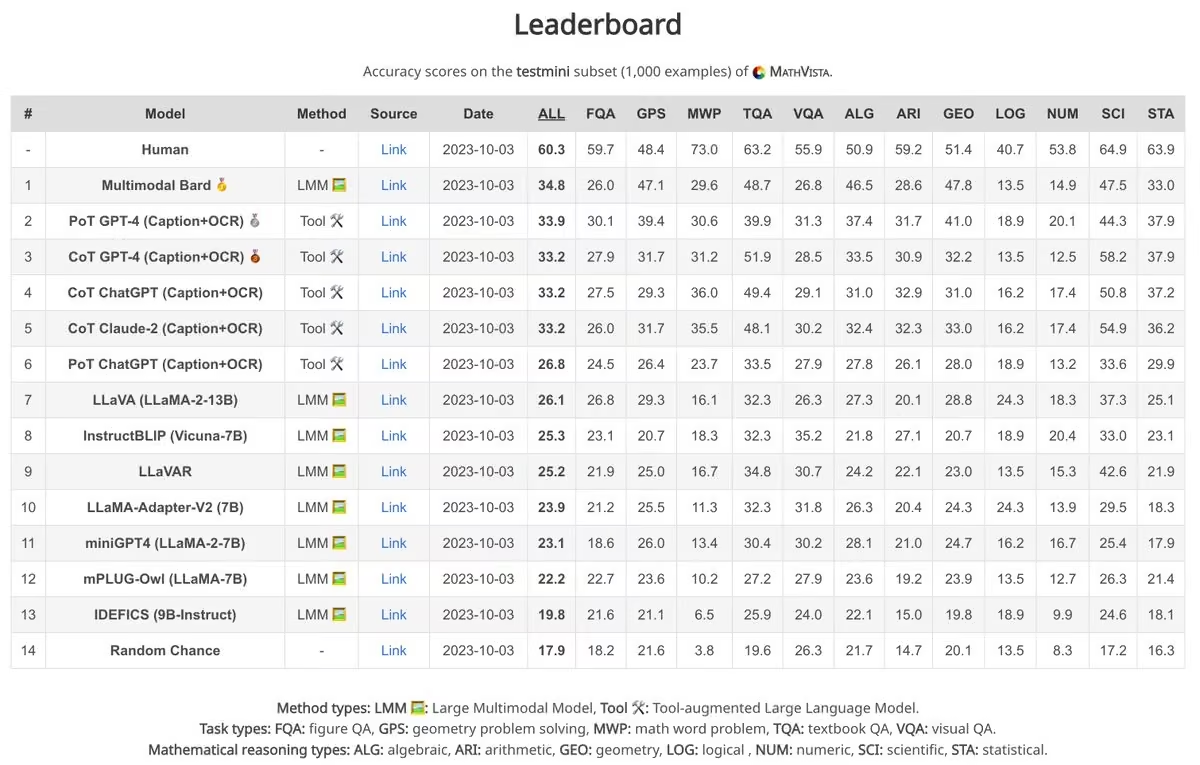
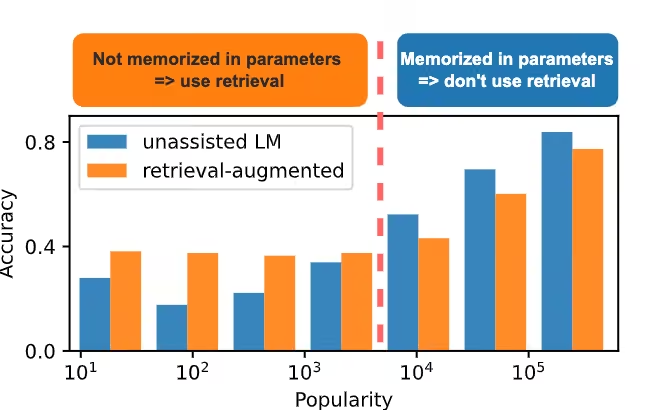
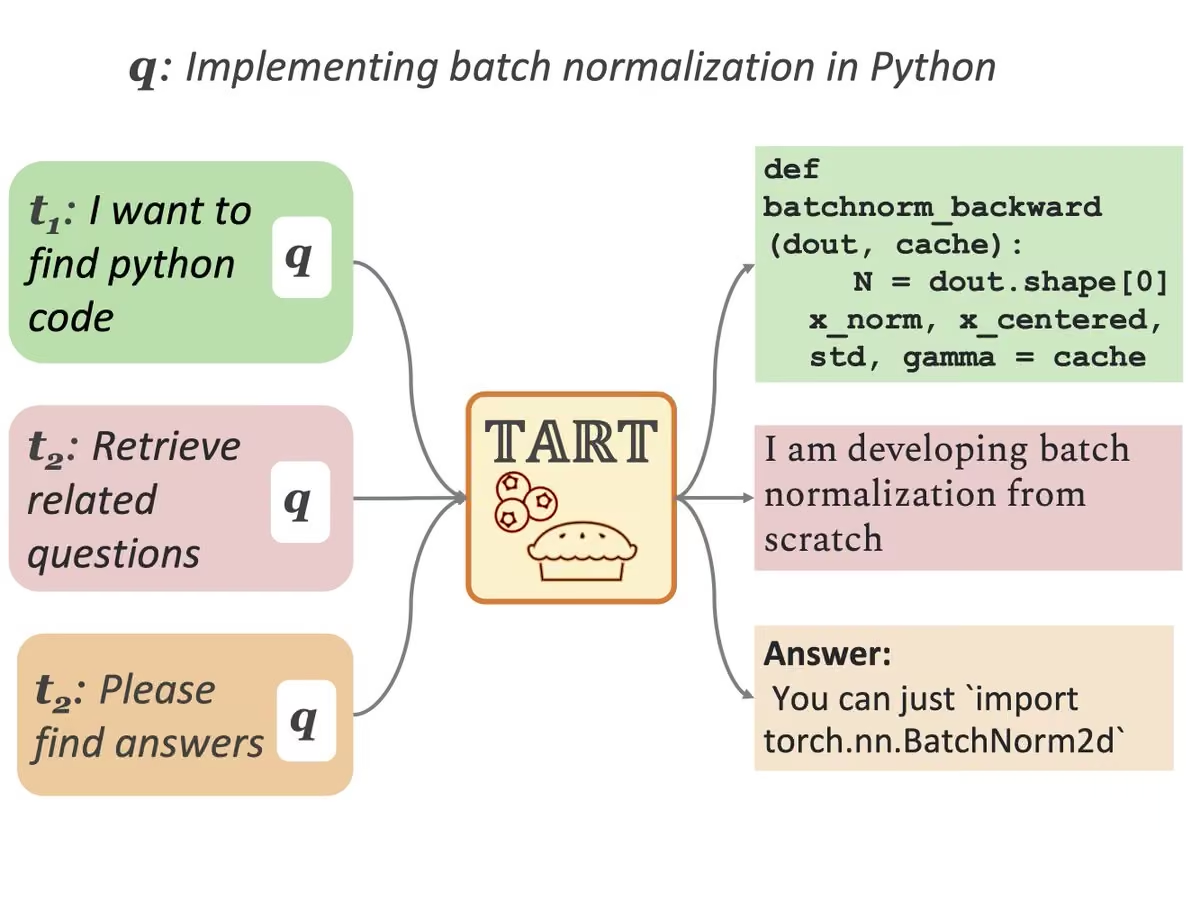
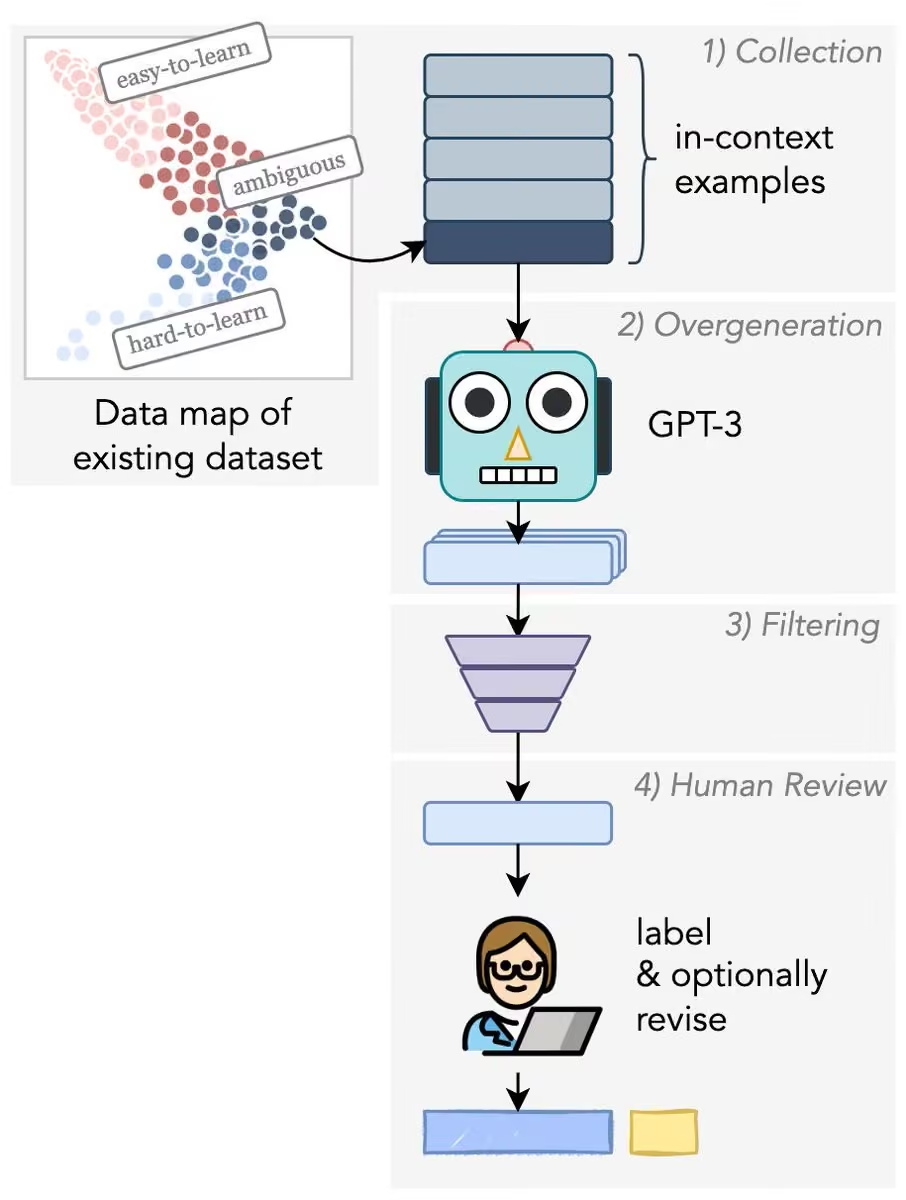
✨Introducing Prompteina: all-atom protein design directly from natural language✨
- Control diverse protein properties through a single text prompt
- Higher predicted binding confidence than baselines
- First experimentally validated de novo binders reported for GM2A
🧵
Hanna Hajishirzi
Hannaneh Hajishirzi is an Iranian-American computer scientist specializing in natural language processing. She is Torode Family Professor in Computer Science & Engineering in the Paul G. Allen School of Computer Science and Engineering at the University of Washington, head of the H2Lab in the Allen School, and a senior director of natural language processing in the Allen Institute for AI. More on Wikipedia
-
Hanna Hajishirzi reposted
Joseph Lee
@jleechung
-
Hanna Hajishirzi reposted
Tong Chen
@tomchen0
Recursive self-improvement and continual learning research drops every day, and people keep asking me what those concepts actually mean.
@TuXinming and I tried to unwrap the popular papers and products a bit: WHAT agents update, and WHEN agents update.
⬇️Blog:
Xinming Tu
@TuXinming
[1/9] There’s been incredible discussion and progress lately around Self-Evolving Agents, and Recursive Self-Improvement.
In our new blog post, @TongChen_ and I propose a 3×3 Framework to map this fast-growing landscape along two core axes:
👉 WHAT does the agent update? (The Substrates)
👉 WHEN do those updates persist? (The Persistence Horizons)
Here is the map. 🧵👇
🔗Read our full blog deep dive, interactive 3×3 diagrams, our expanded appendix mapping 30+ work xinmingtu.cn/blog/2026/self-evolving-agents/ -
Hanna Hajishirzi
@HannaHajishirzi
Congratulations @AkariAsai 🥰
Akari Asai
@AkariAsai
I'm honored to receive the 2025 AAAI/ACM SIGAI Doctoral Dissertation Award!
I recently spoke with SIGAI AI Matters about my dissertation, "Beyond Scaling: Frontiers of Retrieval-Augmented Language Models," and the research journey behind it:
sigai.acm.org/main/ai-matters/ -
Hanna Hajishirzi reposted
Sophie
@lebrechts
So proud to have been part of this true collaboration between Microsoft security team and @MicrosoftAI - it just shows how co-designing the model, harness, and agent layer gets you solutions that operate at the frontier for half the cost
Microsoft AI
@MicrosoftAI
Introducing MAI-Cyber-1-Flash, our new in-house cybersecurity model running inside of MDASH, our multi-agent harness that detects and remediates vulnerabilities across large-scale code bases.
MDASH: MAI-Cyber-1-Flash+GPT-5.4 model combination out-performs Mythos by 12 points on the CyberGym benchmark.
We are offering this same model configuration in MDASH for 50% cheaper than our previous best offering (GPT-5.4 + 5.4 mini + 5.3 codex). -
Hanna Hajishirzi
@HannaHajishirzi
Congratulations @oveisgharan! Very well deserved 🎉🎉
Quanta Magazine
@QuantaMagazine
Shayan Oveis Gharan has won the Abacus Medal, one of the highest honors in theoretical computer science. Read our profile exploring how he used new mathematical tools to solve decades-old problems about route planning and random sampling: www.quantamagazine.org/shayan-oveis-gharan-wins-2026-imu-…
-
Hanna Hajishirzi reposted
Mira Murati
@miramurati
Our first model, Inkling. Trained from scratch, weights are open, fine-tunable on Tinker today.
Thinking Machines
@thinkymachines
Today, we are introducing Inkling.
Inkling reasons efficiently across text, image, and audio modalities. We are making the full weights available.
thinkingmachines.ai/news/introducing-inkling/
Available today for fine-tuning on Tinker. Play with it in the Inkling Playground. 🧵 -
Hanna Hajishirzi
@HannaHajishirzi
Big win for open source porch congratulations @johnschulman2!
John Schulman
@johnschulman2
Inkling is out today, with open weights and in Tinker. It's been fun to watch this one come together: pretraining began last winter, and starting in mid-January a small team built up the coding, reasoning, and agentic training from there. We learned a lot building it, and I hope people find good uses for it.
Thinking Machines
@thinkymachines
Today, we are introducing Inkling.
Inkling reasons efficiently across text, image, and audio modalities. We are making the full weights available.
thinkingmachines.ai/news/introducing-inkling/
Available today for fine-tuning on Tinker. Play with it in the Inkling Playground. 🧵 -
Hanna Hajishirzi reposted
Bret Taylor
@btaylor
I deeply resent that AI has forced me to eliminate em dashes from my writing for fear of signaling slop
-
Hanna Hajishirzi reposted
Mayee Chen
@MayeeChen
I've spent my PhD figuring out how a model learns from data, digging through piles of Spanish math problems, fanfiction, and the depths of StackExchange. Engram opens a new dimension: how a model learns from you - your world, how it evolves, and the threads that tie it all together. Figuring out how to do this well is a wide-open research problem. Join us :)
-
Hanna Hajishirzi reposted
Hamish Ivison
@hamishivi
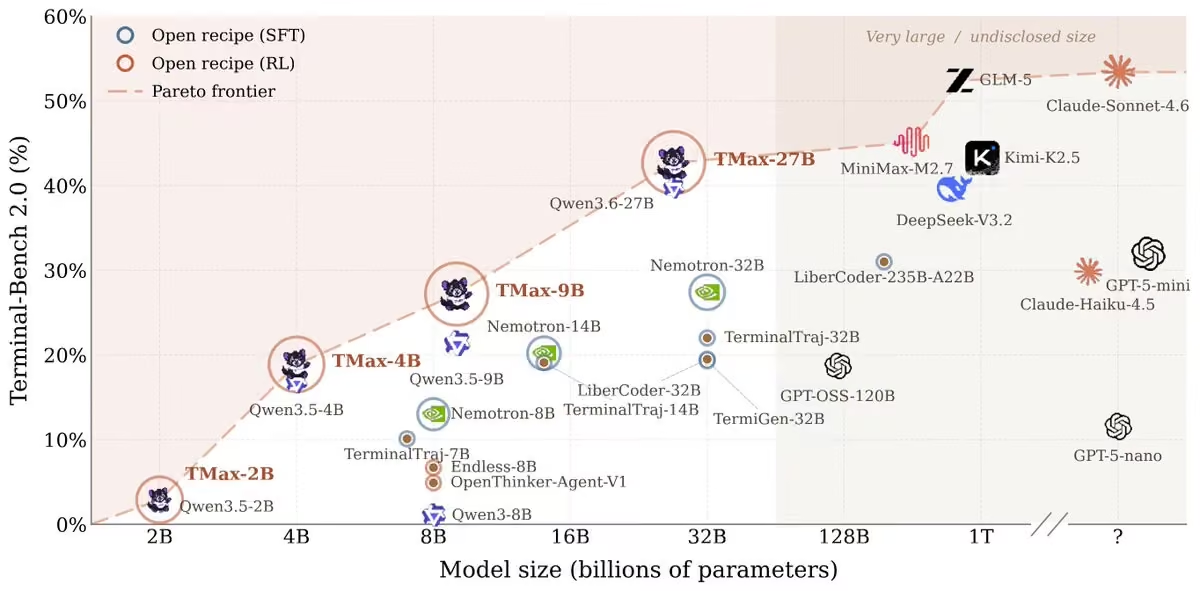
Trained some terminal agents with friends!
Introducing Tmax, open RL terminal agent models. Under default settings and shorter length (65k) token budgets, tmax outperforms prior open work on terminal use. We are releasing all data+weights+rollouts publically! -
Hanna Hajishirzi reposted
Enxhell Luzhnica
@eluzhnica
Happy to share what we've been up to!
microsoft.ai/wp-content/uploads/2026/06/main_20260602_2.pdf -
Hanna Hajishirzi reposted
Asuka Zheng🦭
@VoidAsuka
the best cookbook about how to train a sota llm right now.
elie
@eliebakouch
WOW microsoft new "MAI Thinking 1" model comes with a 109 page tech report that looks REALLY detailed, this is amazing
-
Hanna Hajishirzi reposted
Frank Xu
@frankxu2004
Excited to share as many details on what we @MicrosoftAI have been working on. Building a LLM from scratch is an awesome journey with pain and suffering battling unknowns but also many cool moments to see it (somehow) works out every stage! microsoft.ai/wp-content/uploads/2026/06/main_20260602_2.pdf
-
Hanna Hajishirzi reposted
elie
@eliebakouch
microsoft MAI tech report is a gold mine, one of the most transparent for a model at this scale.
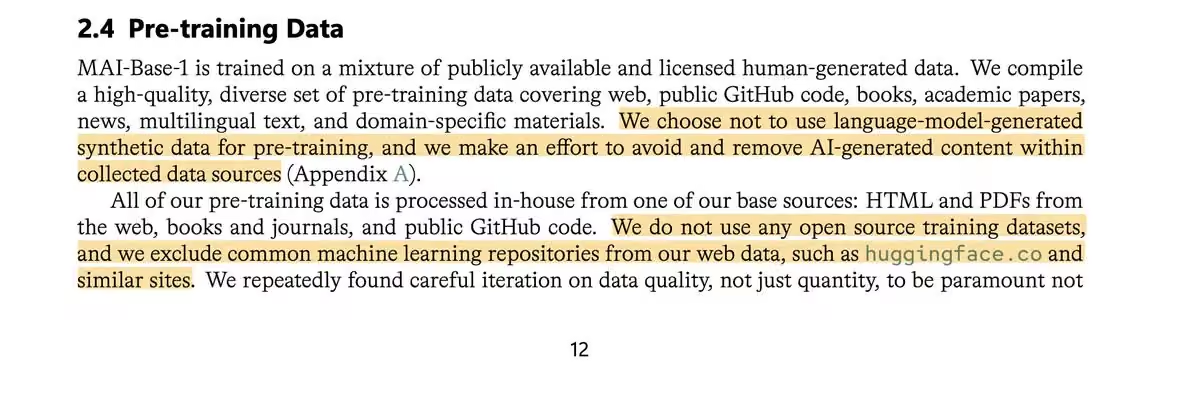
this model uses zero synthetic data or distillation from previous models. this means reasoning, agentic behavior, tool use are all learned fully during post-training with no cold start. bold choice that makes it harder and requires more iterations to reach sota, but you get FULL control over your model series and it proves they are serious about being a frontier lab.
the tech report is insanely detailed and precise about numbers. to give an example, they give the exact MFU across all the iterations of the model, with the exact changes etc. they also share the full scaling ladder recipe, to my knowledge this is the first time i've seen this in a tech report at this scale
let's look at all of this in this likely very long thread 🧵
Mustafa Suleyman
@mustafasuleyman
Super excited to announce seven new world-class MAI models today. They represent what we consider a new era in AI designed to keep you in control and on the frontier.
First is our text foundation model, MAI-Thinking-1, exceptionally strong on reasoning and SWE tasks.
- It’s a 35B active parameter MoE with a 256K context window. Independent human raters on Surge prefer it for overall quality in blind side-by-sides versus Sonnet 4.6, and it’s achieved 97% on AIME 2025, the key measure of its general-purpose reasoning abilities.
- It's at 53% on SWE Bench Pro, placing it right alongside Opus 4.6 on one of the toughest coding benchmarks.
- And since we co-designed our models with our own silicon, MAI-Thinking-1 is optimized on our MAIA 200 chip. Benchmarking head-to-head against the GB200, we see 30% better performance per dollar as well as a 1.4x performance-per-watt gain when running our MAI models on the MAIA 200 end-to-end.
Next is MAI-Image-2.5 and its Flash variant. Two super strong models now at #2 on the leaderboards, surpassing the score of Nano Banana 2 on image editing.
Last for now is MAI-Code-1-Flash, our new inference efficient coding model, especially tuned for VS Code and GitHub Copilot CLI.
- Code-1-Flash achieves 51% on SWE Bench Pro, despite having just 5B parameters, putting it closer to Haiku in size but cheaper in cost.
All of this is the foundation for Microsoft Frontier Tuning. It lets you customize our models to create custom, company-specific agents that only you control. You can make our model, your model. Your data. Your agents. Your moat.
Early adopters are already seeing a difference. When we tuned our models for McKinsey’s tasks, MAI delivered the highest win rate, outperforming GPT-5.5 on quality, while being 10x lower on cost.
Also really excited to be collaborating with the amazing team at Mayo Clinic to jointly train a new frontier AI model for healthcare.
Our announcements today mark another milestone on the road to humanist superintelligence. You can learn more and about our other new models in our latest blog: microsoft.ai/news/building-a-hillclimbing-machine-launchi… -
Hanna Hajishirzi reposted
Paul Soulos
@paulsoulos
It was an honor working on MAI-Thinking-1! A lot of thought and effort went into this model, and we want to share some learnings with you. 109 pages worth 😅
microsoft.ai/wp-content/uploads/2026/06/main_20260602_2.pdf
Mustafa Suleyman
@mustafasuleyman
Super excited to announce seven new world-class MAI models today. They represent what we consider a new era in AI designed to keep you in control and on the frontier.
First is our text foundation model, MAI-Thinking-1, exceptionally strong on reasoning and SWE tasks.
- It’s a 35B active parameter MoE with a 256K context window. Independent human raters on Surge prefer it for overall quality in blind side-by-sides versus Sonnet 4.6, and it’s achieved 97% on AIME 2025, the key measure of its general-purpose reasoning abilities.
- It's at 53% on SWE Bench Pro, placing it right alongside Opus 4.6 on one of the toughest coding benchmarks.
- And since we co-designed our models with our own silicon, MAI-Thinking-1 is optimized on our MAIA 200 chip. Benchmarking head-to-head against the GB200, we see 30% better performance per dollar as well as a 1.4x performance-per-watt gain when running our MAI models on the MAIA 200 end-to-end.
Next is MAI-Image-2.5 and its Flash variant. Two super strong models now at #2 on the leaderboards, surpassing the score of Nano Banana 2 on image editing.
Last for now is MAI-Code-1-Flash, our new inference efficient coding model, especially tuned for VS Code and GitHub Copilot CLI.
- Code-1-Flash achieves 51% on SWE Bench Pro, despite having just 5B parameters, putting it closer to Haiku in size but cheaper in cost.
All of this is the foundation for Microsoft Frontier Tuning. It lets you customize our models to create custom, company-specific agents that only you control. You can make our model, your model. Your data. Your agents. Your moat.
Early adopters are already seeing a difference. When we tuned our models for McKinsey’s tasks, MAI delivered the highest win rate, outperforming GPT-5.5 on quality, while being 10x lower on cost.
Also really excited to be collaborating with the amazing team at Mayo Clinic to jointly train a new frontier AI model for healthcare.
Our announcements today mark another milestone on the road to humanist superintelligence. You can learn more and about our other new models in our latest blog: microsoft.ai/news/building-a-hillclimbing-machine-launchi… -
Hanna Hajishirzi reposted
Rosinality
@rosinality
Many choices here are only possible when your objective is not an immediate or short-term performance. Pretraining without synthetic data, posttraining without SFT with data from other LLMs. (And other good choices like scaling ladder with NLL instead of benchmark scores).
elie
@eliebakouch
WOW microsoft new "MAI Thinking 1" model comes with a 109 page tech report that looks REALLY detailed, this is amazing
-
Hanna Hajishirzi
@HannaHajishirzi
MAI-Thinking-1 is out!
Excited to share what we are building and how climbing from scratch (no distillation) actually works: simple recipes, rigorous science, self-distillation, patience, and great infra.
Check out our tech report has the full story of our RL climbs.
Mustafa Suleyman
@mustafasuleyman
Super excited to announce seven new world-class MAI models today. They represent what we consider a new era in AI designed to keep you in control and on the frontier.
First is our text foundation model, MAI-Thinking-1, exceptionally strong on reasoning and SWE tasks.
- It’s a 35B active parameter MoE with a 256K context window. Independent human raters on Surge prefer it for overall quality in blind side-by-sides versus Sonnet 4.6, and it’s achieved 97% on AIME 2025, the key measure of its general-purpose reasoning abilities.
- It's at 53% on SWE Bench Pro, placing it right alongside Opus 4.6 on one of the toughest coding benchmarks.
- And since we co-designed our models with our own silicon, MAI-Thinking-1 is optimized on our MAIA 200 chip. Benchmarking head-to-head against the GB200, we see 30% better performance per dollar as well as a 1.4x performance-per-watt gain when running our MAI models on the MAIA 200 end-to-end.
Next is MAI-Image-2.5 and its Flash variant. Two super strong models now at #2 on the leaderboards, surpassing the score of Nano Banana 2 on image editing.
Last for now is MAI-Code-1-Flash, our new inference efficient coding model, especially tuned for VS Code and GitHub Copilot CLI.
- Code-1-Flash achieves 51% on SWE Bench Pro, despite having just 5B parameters, putting it closer to Haiku in size but cheaper in cost.
All of this is the foundation for Microsoft Frontier Tuning. It lets you customize our models to create custom, company-specific agents that only you control. You can make our model, your model. Your data. Your agents. Your moat.
Early adopters are already seeing a difference. When we tuned our models for McKinsey’s tasks, MAI delivered the highest win rate, outperforming GPT-5.5 on quality, while being 10x lower on cost.
Also really excited to be collaborating with the amazing team at Mayo Clinic to jointly train a new frontier AI model for healthcare.
Our announcements today mark another milestone on the road to humanist superintelligence. You can learn more and about our other new models in our latest blog: microsoft.ai/news/building-a-hillclimbing-machine-launchi…
Hanna Hajishirzi
@HannaHajishirzi
A few interesting highlights:
We start our RL from a checkpoint that hasn't been exposed to reasoning trajectories. -
Hanna Hajishirzi reposted
stochasm
@stochasticchasm
some pretty crazy RL graphs, and very interesting decision here to start RL from a checkpoint with no reasoning exposure
elie
@eliebakouch
WOW microsoft new "MAI Thinking 1" model comes with a 109 page tech report that looks REALLY detailed, this is amazing
-
Hanna Hajishirzi reposted
Harveen Singh Chadha
@HarveenChadha
This is very interesting decision, microsoft decided not to use any LLM generated data or any open source training dataset for pretraining
-
Hanna Hajishirzi reposted
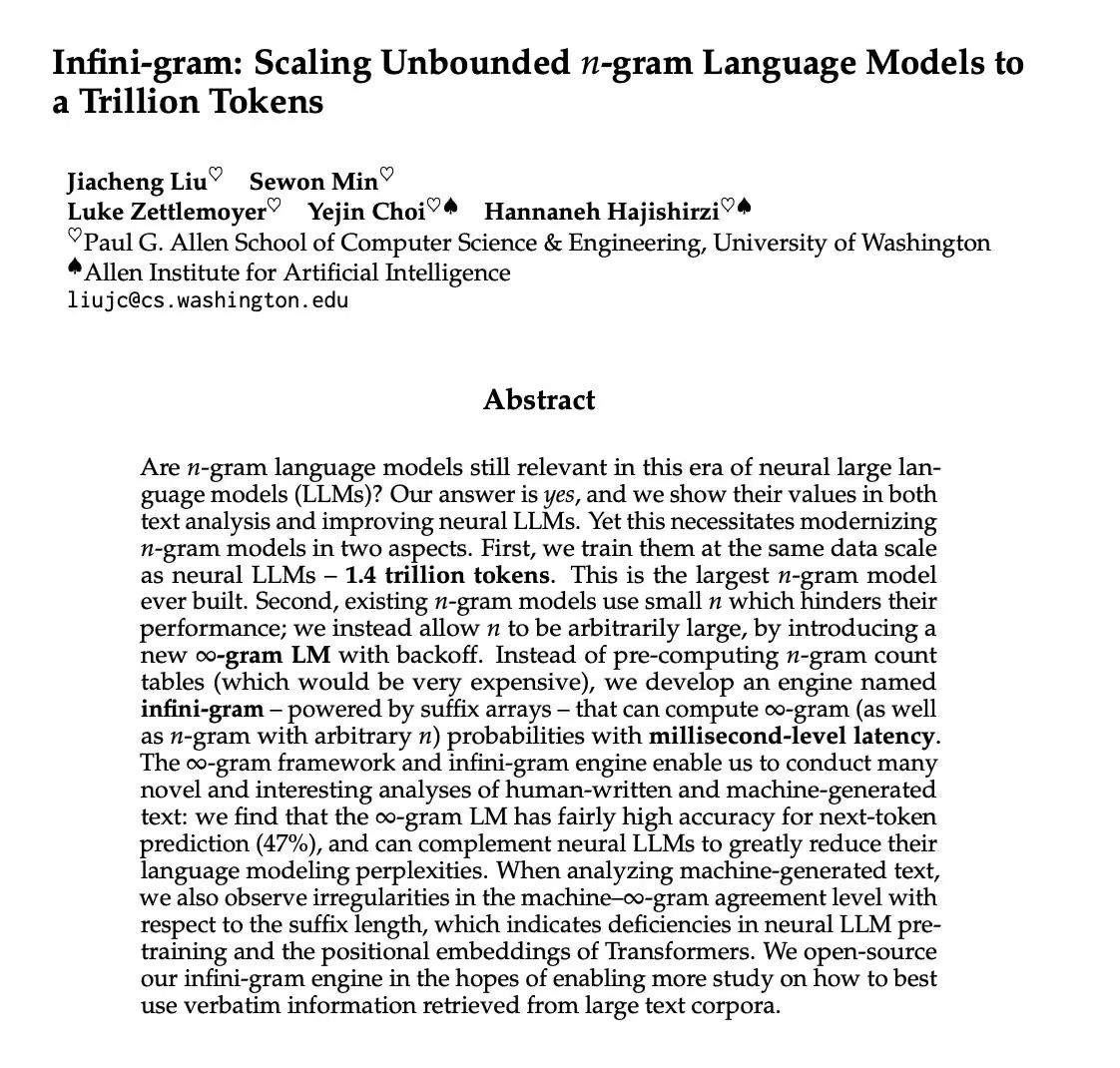
Sewon Min
@sewon__min
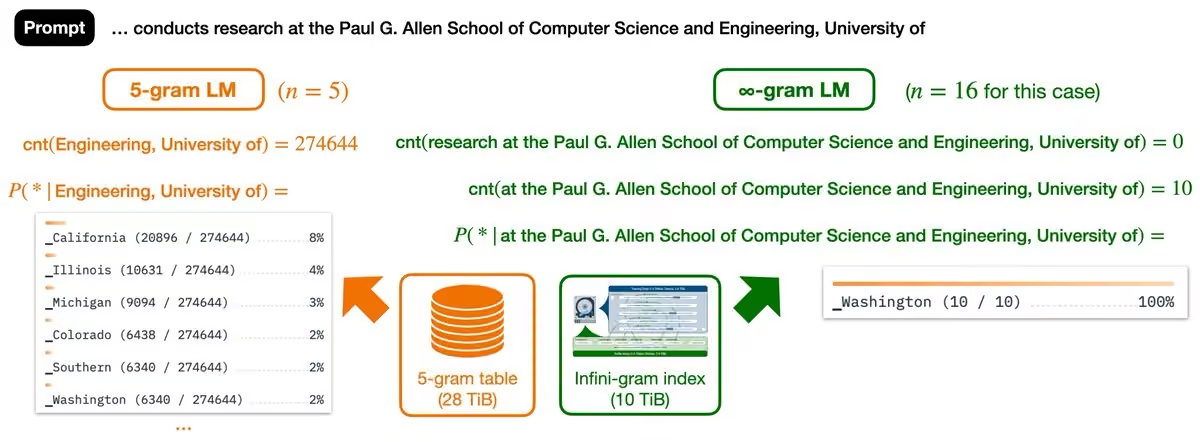
Really amazing results analyzing what's creative/novel vs. what's copied from Internet data, enabled by the amazing @liujc1998's Infini-gram! infini-gram.io
This is also enabled in @allen_ai's OlmoTrace allenai.org/blog/olmotrace where anyone can find matching n-grams between LLM-generated text and its training data.
Alex Imas
@alexolegimas
This from @TuhinChakr is brilliant. That prize winning story from Granta? Turns out it's just a bunch of random whole phrases taken directly from existing text on the internet. Tool allows you to trace those n-grams directly to their source, which is mostly random fanfiction.
-
Hanna Hajishirzi reposted
Ryan Yixiang Wang
@RyanYixiang
MoEs are everywhere in frontier models, and they are deployed as a monolith system.
But many applications only need a narrow slice of capabilities, e.g., math, code, biomedical, etc.
So what if "modularity" is actually the missing opportunity for MoEs?
Today, we're releasing EMO: an end-to-end pretrained MoE where modularity emerges naturally, enabling selective use of experts! -
Hanna Hajishirzi reposted
Sewon Min
@sewon__min
As MoEs grow larger and sparser, they become memory-bottlenecked.
What if experts were actually composable - so you only keep the subset relevant to your task?
We show that this doesn't emerge in standard MoEs (their training makes this hard), but you can pre-train MoEs to support this kind of modularity!
I hope everyone sees the right figure from @RyanYixiang 's original post - I was so excited when I saw this result!!
Ryan Yixiang Wang
@RyanYixiang
MoEs are everywhere in frontier models, and they are deployed as a monolith system.
But many applications only need a narrow slice of capabilities, e.g., math, code, biomedical, etc.
So what if "modularity" is actually the missing opportunity for MoEs?
Today, we're releasing EMO: an end-to-end pretrained MoE where modularity emerges naturally, enabling selective use of experts! -
Hanna Hajishirzi reposted
Akari Asai
@AkariAsai
Our proposal on scientific agents for physical experimentation in the lab received an Honorable Mention from the Laude Moonshot Grant!
Grateful for the recognition, and excited to explore this direction with @gneubig, @lileics, and Newell Washburn 🥳
www.cmu.edu/news/stories/archives/2026/april/cmu-teams-re…
Laude Institute
@LaudeInstitute
We asked the best AI researchers in the world one question: if you had the resources, how would you use AI to solve humanity's hardest problems?
Today we're sharing what came back.
Moonshots // ONE is live. 🧵 laude.org/moonshots -
Hanna Hajishirzi reposted
Satya Nadella
@satyanadella
We’re bringing our growing MAI model family to every developer in Foundry, including …
· MAI-Transcribe-1, most accurate transcription model in world across 25 languages
· MAI-Voice-1, natural, expressive speech generation
· MAI-Image-2, our most capable image model yet
Start building: microsoft.ai/news/today-were-announcing-3-new-world-class… -
Hanna Hajishirzi reposted
Mustafa Suleyman
@mustafasuleyman
Great way to wrap up the week! We’re partnering with Crusoe on a 900MW AI factory in Abilene, Texas. Super excited to add more capacity to our AI fleet. www.crusoe.ai/resources/newsroom/crusoe-announces-new-900…
-
Hanna Hajishirzi reposted
Nathan Lambert
@natolambert
A few facts, while the dust is settling.
Ai2 still is...
- releasing open models, folks want to, and it's actually required in the NSF grant
- using substantial compute to do so from said grant
- funded additionally by FFST (new funding body) on top of NSF, for work in open models
Overall I'm confident in Ai2 doing great work this year. -
Hanna Hajishirzi reposted
Hanna Hajishirzi
@HannaHajishirzi
Life update here:
Last week marked the end of my time at Ai2.
Proud to have built releases like Olmo, Tülu, FlexOlmo, DRTulu, OLMoTrace, OlmoE, and datasets including Dolma and Dolci—and of how strongly we pushed for open models and open science.
Our artifacts reached 33M+ downloads, including ~4M for Olmo 3. I believe Olmo has empowered researchers to push the boundaries of AI
I’ll always be cheering on Ai2 and will continue to strongly support open-source, open-science AI.
I’m deeply grateful for this chapter and excited for what comes next. -
Hanna Hajishirzi
@HannaHajishirzi
Had a great time on the panel with Jensen and others discussing open models and where they’re headed.
Best moment: Jensen recalling he took a photo with me and my 2-month-old daughter at CVPR… 9-10 years ago. Time flies.This media couldn't be displayed. See it on the original post. -
Hanna Hajishirzi reposted
Ai2
@allen_ai
It was an incredible panel at #nvidiagtc yesterday! Here’s @hannahajishirzi sharing the stage with Jensen Huang, explaining how our open model flow enables infinite customization.
This media couldn't be displayed. See it on the original post. -
Hanna Hajishirzi reposted
Holger Müller #EnterpriseAcceleration
@holgermu
And we are off to Open Model Panel 2 with
- @arthurmensch of @MistralAI
- Daniel Nadler of @openevidence
- @HannaHajishirzi of @allen_ai
- @robrombach of @bfl_ml
- @AnjneyMidha of AMP PBC
#nvidiagtc -
Hanna Hajishirzi reposted
Teng Xiao
@TengX6
🚀 New work: Meta-Reinforcement Learning with Self-Reflection
LLM agents shouldn't just solve problems. They should learn from their own attempts. Most current RL methods optimize single independent trajectories.
Each attempt starts from scratch, with no mechanism to improve across attempts. But intelligent systems should get better after trying once.
This raises a fundamental question: How do we train models to learn from their own attempts?
We believe Meta-Reinforcement Learning may be a key paradigm for training future LLM agents, enabling models to adapt and improve across attempts and environments.
In this work we introduce MR-Search, a training paradigm built around:
🧠 In-Context Meta-Reinforcement Learning
🪞 Self-Reflection
🔁 Learning to learn at test time
📄 Paper: arxiv.org/abs/2603.11327
💻 Code: github.com/tengxiao1/MR-Search -
Hanna Hajishirzi reposted
NVIDIA AI Developer
@NVIDIAAIDev
Introducing NVIDIA Nemotron 3 Super 🎉
Open 120B-parameter (12B active) hybrid Mamba-Transformer MoE model
Native 1M-token context
Built for compute-efficient, high-accuracy multi-agent applications
Plus, fully open weights, datasets and recipes for easy customization and deployment. 🧵 -
Hanna Hajishirzi
@HannaHajishirzi
Excited to share the stage with some of the best minds to discuss open models. 📷 #ai2 at #nvidiagtc
NVIDIA
@nvidia
Open models are at the center of one of the most important shifts in AI.
At #nvidiagtc, NVIDIA founder and CEO Jensen Huang is bringing together leaders from some of the most exciting AI companies to discuss what comes next.
Featuring leaders from: @Allen_AI, @BFL_ML, @cursor_ai, @LangChain, @MistralAI, @openevidence, @perplexity_ai, @reflection_ai, @thinkymachines, and @UW.This media couldn't be displayed. See it on the original post. -
Hanna Hajishirzi reposted
λux
@novasarc01
the elegance of @allen_ai technical reports is hard to miss. really loved the Olmo Hybrid report. it goes deep into architecture, training, data pipelines, infrastructure and even the mathematical details. everything is documented with unusual clarity and depth. highly recommended reading.
-
Hanna Hajishirzi reposted
danielw
@dddanielwang
Ai2绝对是我见过最无私、开发的ai lab
不仅开源模型,还开源预训练、微调脚本、训练代码(infra codebase)、训练数据、数据处理代码等等
是入门ai research的宝藏 -
Hanna Hajishirzi reposted
Kyle Lo
@kylelostat
our new Olmo Hybrid model combines attention with linear RNN layers
🍣training efficiency is crazy good. the model reaches same MMLU score as Olmo 3 in 50% of the tokens. also see this in many other tasks
as always: weights, data, ckpts, training code, etc. all fully open -
Hanna Hajishirzi reposted
Yanhong Li
@YanhongLi2062
very excited this is finally out!!!!!!!! 🚀
✨ Olmo Hybrid: From Theory to Practice ✨
we explore hybrid language models that mix attention with linear RNN layers (Gated DeltaNet).
turns out these hybrid models can be more expressive than pure transformers and linear RNNs while still scaling efficiently!
paper, models, and training logs are all released -
Hanna Hajishirzi reposted
Teortaxes▶️ (DeepSeek 推特🐋铁粉 2023 – ∞)
@teortaxesTex
Amazing
Fully open model of the Kimi-Linear/Qwen 3.5 generation, as far as architecture is concerned. I think Olmo is shaping up to be a pillar of LLM research on par with DeepSeek and Qwen, in its own complementary way.
Nathan Lambert
@natolambert
Excited to share the latest Olmo model: Olmo Hybrid. This is a model with gated delta net (GDN) layers in a 3:1 ratio with full attention. It follows lots of other developments like Qwen 3.5 and Kimi Linear. It's incredible timing to release a fully open model so people can study how these architecture changes impact the full stack.
Personally, I learned a lot in making the post-training work. Even with the data being identical for pretraining, post-training is very different! In particular, the OSS tools for these new architectures is really limited. New architectures are much slower than standard transformers or popular models like DeepSeek MoEs. This is work that we can do together to keep pushing the frontier of efficient, open models.
This work was led by @lambdaviking @tyleraromero and others. I got to play a smaller part in making post-training work, super fun project!
I've written up a blog post that explains why this matters and hybrid models didn't work a few years ago when Mamba was super popular. Plus, this paper is a great entry point for modern deep learning / language modeling scaling theory. Enjoy and send feedback! -
Hanna Hajishirzi
@HannaHajishirzi
Check out Olmo Hybrid. We show, both theoretically and empirically, that hybrid models are more expressive than linear or transformer models, and how this translates to better data efficiency during training. For example, on MMLU, Olmo Hybrid matches Olmo 3’s accuracy using only 49% of the tokens. The work led by amazing Will, @lambdaviking @tyleraromero @YanhongLi2062 and many others. The paper is here: allenai.org/papers/olmo-hybrid
-
Hanna Hajishirzi reposted
finbarr
@finbarrtimbers
Yanhong did an insane amount of work getting the hybrid model ready for HF and VLLM! Critical to the project.
Yanhong Li
@YanhongLi2062
very excited this is finally out!!!!!!!! 🚀
✨ Olmo Hybrid: From Theory to Practice ✨
we explore hybrid language models that mix attention with linear RNN layers (Gated DeltaNet).
turns out these hybrid models can be more expressive than pure transformers and linear RNNs while still scaling efficiently!
paper, models, and training logs are all released -
Hanna Hajishirzi reposted
Tyler Romero
@tyleraromero
We're releasing OLMo Hybrid. The core idea is that hybrid models (transformer attention + linear RNN layers) are strictly more expressive than either architecture alone, and that expressivity gap translates to better pretraining scaling. In a comparison to OLMo 3, we see 49% fewer tokens to match the same MMLU accuracy. Fully open model artifacts and technical report.
-
Hanna Hajishirzi reposted
finbarr
@finbarrtimbers
Excited to announce Olmo Hybrid, a version of Olmo 3 that uses Gated DeltaNet instead of SWA.
The benchmarks are quite impressive. I think this is a generally more expressive version of SWA, and I'm excited to see more research done on top of GDN. -
Hanna Hajishirzi reposted
Luca Soldaini 🎀
@soldni
This plot undersells how much of a compute multiplier Olmo Hybrid is: 2x compute multiplier on many downstream tasks (and solid LC performance!!!)
-
Hanna Hajishirzi reposted
William Merrill
@lambdaviking
It's been wild to see Olmo Hybrid go from idea to reality in the last few months! Check out model + tech report (lots of experiments / theory). Thanks to a truly cracked team of collaborators across pre/post-training, eng, evals, theory, kernels, etc. for bringing this to life!
-
Hanna Hajishirzi reposted
Valentin Hofmann
@vjhofmann
📢 Life update 📢
After a wonderful time at @allen_ai, I've joined @CisLmu at @LMU_Muenchen as a tenure-track assistant professor in NLP. Thrilled to be back in Europe and to start a lab in Munich's flourishing AI ecosystem! 🎉 -
Hanna Hajishirzi reposted
Oscar Yinn
@oscar_yinn
Many people are using RL to make models smarter.
We used RL to pull training data out of the models themselves.
Our results show that models know a lot more about their training data than most people think.
We develop Active Data Reconstruction Attack (ADRA) — a data detection method that uses RL to induce models to reconstruct data seen during training.
ADRA beats existing methods by an average of >10% across pre-training, post-training, and distillation.
Our paper, with @uwnlp, @Cornell, and @BerkeleyNLP @Berkeleyai, is now available.
Arxiv: arxiv.org/pdf/2602.19020
Joint work with @jxmnop @shmatikov @sewon__min @HannaHajishirzi -
Hanna Hajishirzi
@HannaHajishirzi
Check out @yikewang_ newest paper. A cool idea to turn small LMs into high quality reward models.
Yike Wang
@yikewang_
Small language models are not very helpful as judges, how about 🔄 backward inference—inferring the instruction given only the response, and using the similarity between the inferred and the original instructions as the reward signal?
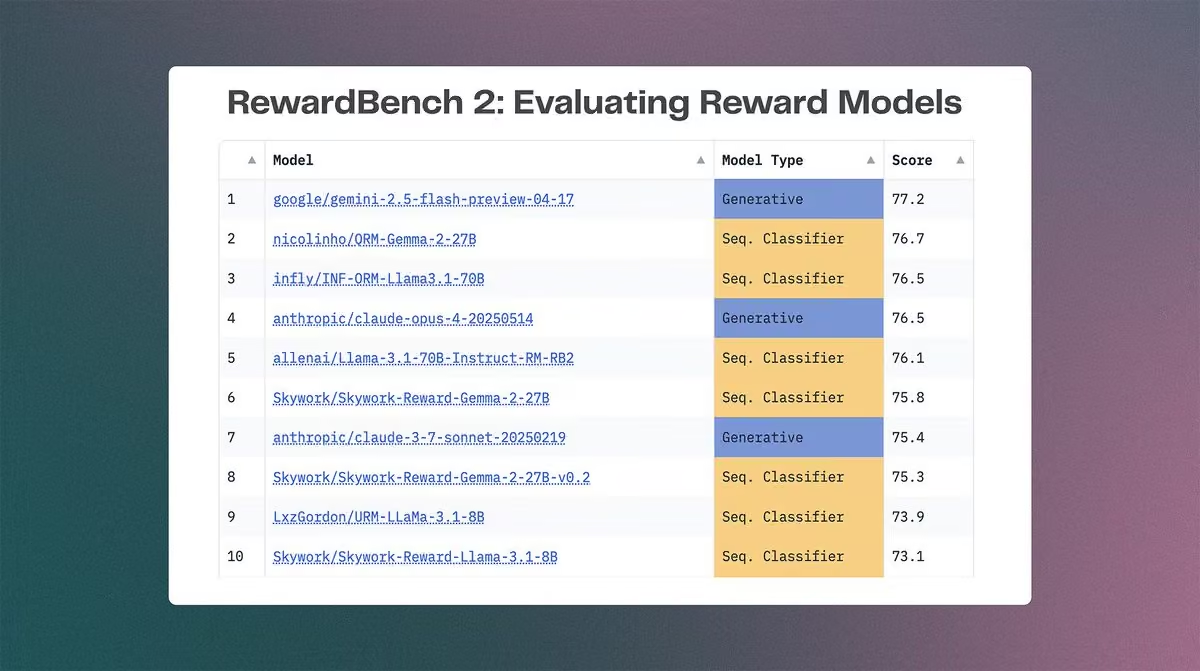
Introducing ⚙️FLIP, a reference-free and rubric-free reward modeling approach that boosts the RewardBench2 performance of 13 small language models by an average of 79.6%, and substantially outperforms LLM-as-a-Judge under test-time scaling via parallel sampling and GRPO training.
📄paper: arxiv.org/abs/2602.13551
🔗code: github.com/yikee/FLIP -
Hanna Hajishirzi
@HannaHajishirzi
Thanks for the nice summary of RLER from DrTulu!
Cameron R. Wolfe, Ph.D.
@cwolferesearch
RL with evolving rubrics (RLER) in Dr. Tulu is a great step in the direction I expect Rubrics-as-Rewards (RaR) to go.
At a high level, the goal of using rubrics for RL is to generalize RL with verifiable rewards to non-verifiable domains. Instead of using deterministic rules, we can use an LLM judge equipped with a detailed scoring prompt (i.e., a rubric) to provide our reward signal for RL.
In rubric-based RL setups, an LLM generates a per-prompt rubric. The rubric is an itemized set of criteria (usually pass / fail rules that can be evaluated with an LLM) plus weights so the criteria can be aggregated into a single score. This structure makes rewards more reliable, interpretable, and granular than a single holistic judgment (e.g., vanilla LLM-as-a-Judge).
RLER goes further by maintaining a rubric buffer per prompt throughout training. It starts with a set of search-grounded rubrics generated by an LLM with internet search tools, which is especially important for Deep Research tasks (i.e., the focus of Dr. Tulu).
At each training step, an LLM proposes new / evolved rubrics using the prompt, the GRPO rollout group, and the current active rubrics as context. It can add:
- Positive rubrics that capture newly discovered, relevant knowledge or behaviors not covered yet by any rubric.
- Negative rubrics that target recurring failures or undesirable behaviors (e.g., reward hacking).
By allowing rubrics to evolve, we let the evaluation adapt to on-policy behavior: when the policy shifts (e.g., toward reward hacking), the rubric can shift with it.
To keep the buffer from growing unbounded, RLER maintains an active set of rubrics that always includes the initial search-based rubrics. The remaining slots go to the most discriminative rubrics, as measured by the standard deviation of rubric rewards over the GRPO group. Rubrics with zero variance in their reward signal over the group are dropped, and the rest are ranked to select the top-K.
The key appeal of this approach is that you don’t need to fully specify a perfect rubric upfront. You seed training with a reasonable set of initial criteria, then let the system refine the rubric as it observes what the policy actually does. -
Hanna Hajishirzi reposted
Kyle Lo
@kylelostat
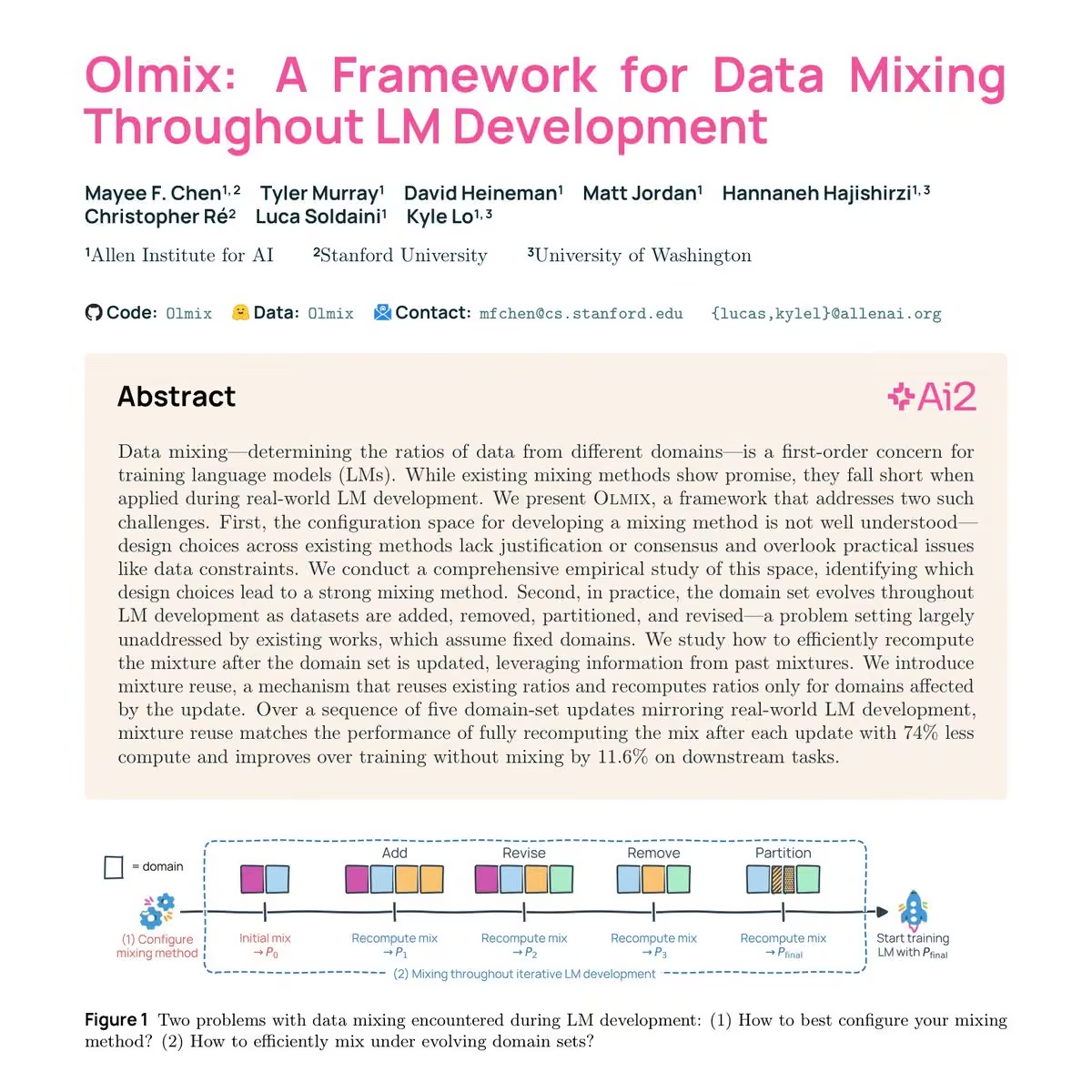
our paper on data mixing for LMs is out!
while building Olmo 3, we saw gaps between data mixing literature and real practice
🐠choosing proxy size, # runs, sampling, regression, constraints..
🐟data shifts during LM dev: can we reuse past experiments?
Olmix tackles them all! -
Hanna Hajishirzi reposted
-
Hanna Hajishirzi
@HannaHajishirzi
After OLMo 3, people asked for more detail on our data-mixing strategy—so we wrote it up. Here’s the paper with the full details. Check out this amazing work led by @MayeeChen and @kylelostat
Mayee Chen
@MayeeChen
Data mixing - determining ratios across your training datasets - matters a lot for model quality. While building Olmo 3, we learned it’s hard to set up a method that finds a strong mix, and hard to maintain that mix as datasets change throughout development.
Introducing Olmix👇 -
Hanna Hajishirzi reposted
Pang Wei Koh
@PangWeiKoh
With anchored decoding, we can largely eliminate copying risks while preserving fluency & factuality, with little overhead. The key idea is to anchor our LLM to a safer, smaller LM. This gets the best of both worlds: the quality of the main LLM with the safety of the anchor LM!
Jacqueline He
@jcqln_h
Introducing ⚓ 𝗔𝗻𝗰𝗵𝗼𝗿𝗲𝗱 𝗗𝗲𝗰𝗼𝗱𝗶𝗻𝗴: a copyright mitigation strategy for any language model! With @uwnlp
LMs today reproduce copyrighted text—raising concerns for creator consent and potential legal (and 💸 💸) liabilities for AI developers. 🫠
𝗔𝗻𝗰𝗵𝗼𝗿𝗲𝗱 𝗗𝗲𝗰𝗼𝗱𝗶𝗻𝗴 relies on two off-the-shelf LMs:
🧼A 𝘀𝗮𝗳𝗲 𝗟𝗠 trained only on permissively licensed text,
⚠️A higher-utility 𝗿𝗶𝘀𝗸𝘆 𝗟𝗠 trained on any data.
The 𝗿𝗶𝘀𝗸𝘆 𝗟𝗠 drives generation, but the 𝘀𝗮𝗳𝗲 𝗟𝗠 acts as an anchor. If the 𝗿𝗶𝘀𝗸𝘆 𝗟𝗠 drifts into memorization, the 𝘀𝗮𝗳𝗲 𝗟𝗠 pulls it back ↩️.
🤝We provide a formal guarantee: outputs stays within a user-set budget of the 𝘀𝗮𝗳𝗲 𝗟𝗠.
Details below! 👇
[1/⚓] -
Hanna Hajishirzi reposted
Luca Soldaini 🎀
@soldni
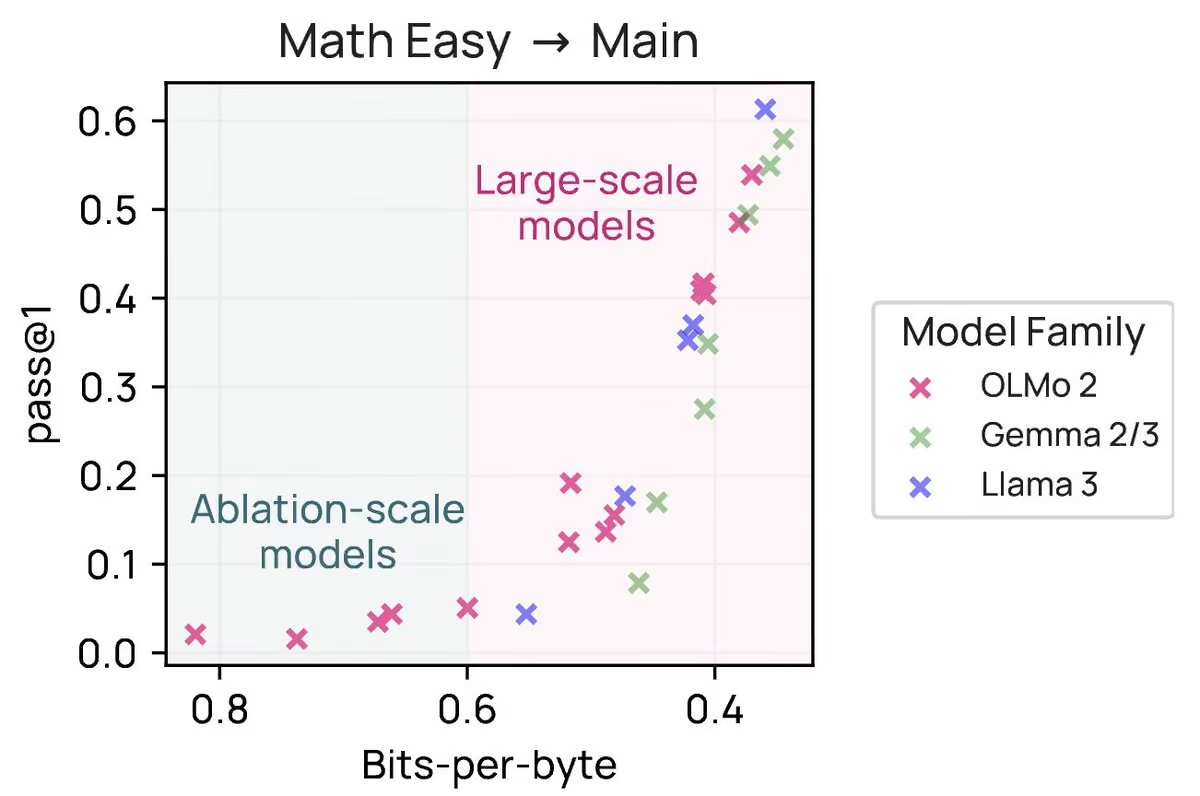
tell me of another task with such low noise floor (a base 1B trained @ 200B grokks it) that is not saturated for frontier LLMs!!
bullish on step-by-step generation being a core capability of LMs, and robust way to measure knowledge
@YapeiChang did such a banger job! -
Hanna Hajishirzi reposted
Kyle Lo
@kylelostat
incredibly fun project led by our intern @YapeiChang
we mined the web for thousands of real-world “how to do X” step by step instructions and turned it into a dataset, synth data training procedure, eval suite, etc.
learning how to do something is a first-order use case for LMs, the development bottleneck has been collecting data covering a wide diversity of topics, until now ✌🏻 -
Hanna Hajishirzi reposted
Yapei Chang
@YapeiChang
❓ when there’s no verifiable environment, how do we tell if an LLM-generated step-by-step plan would actually succeed?
🌐 we mine the web for diverse step-by-step procedures, and introduce a scoring protocol to enable scalable eval & RL training! -
Hanna Hajishirzi reposted
Shannon Shen
@shannonzshen
Super excited to share our open interactive demo for DR Tulu-8B! It supports web and literature search with full transparency — you can see the model's thinking traces and tool outputs as it reasons through your query.
🔗 dr-tulu.org
📝 arxiv.org/abs/2511.19399This media couldn't be displayed. See it on the original post. -
Hanna Hajishirzi reposted
Akari Asai
@AkariAsai
Check out DR Tulu’s live demo!
Shannon Shen
@shannonzshen
Super excited to share our open interactive demo for DR Tulu-8B! It supports web and literature search with full transparency — you can see the model's thinking traces and tool outputs as it reasons through your query.
🔗 dr-tulu.org
📝 arxiv.org/abs/2511.19399This media couldn't be displayed. See it on the original post. -
Hanna Hajishirzi reposted
Eric Topol
@EricTopol
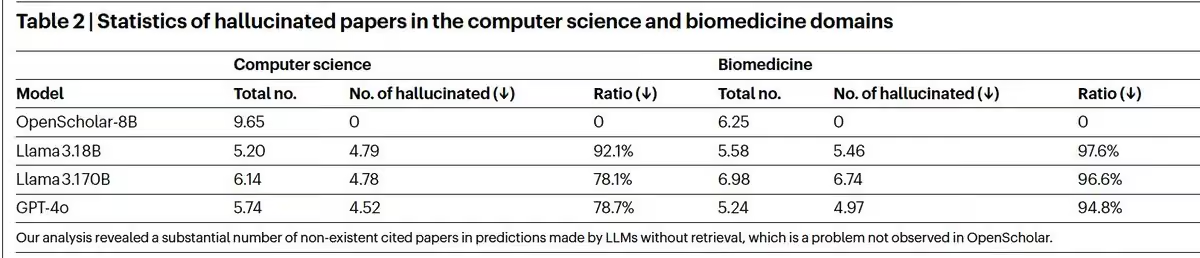
A new AI model—Open Scholar—built by @AllenInstitute and @UW can synthesize science information and research very accurately, better than many existing LLMs and as well as human experts; open-source
@Nature
www.nature.com/articles/s41586-025-10072-4 -
Hanna Hajishirzi
@HannaHajishirzi
🎉 OpenScholar is now published in Nature. And don’t miss our latest deep research project: DrTulu 👀allenai.org/blog/dr-tulu
Akari Asai
@AkariAsai
Thrilled to share: OpenScholar - our work on scientific deep research agents for reliable literature synthesis -has been accepted to Nature! 🎉 Huge thanks to collaborators across institutions who made this possible!
-
Hanna Hajishirzi
@HannaHajishirzi
Truly excited to see what Adaption accomplishes. Huge congratulations to my amazing friend @sarahookr and her incredible team! 🔥
Sara Hooker
@sarahookr
Beginnings are very special. Today is an important day for @adaptionlabs.
Today a handful of one-size-fits-all-models are optimized for the average use case.
Averages erase the exceptional.
Everything intelligent adapts. So should AI. -
Hanna Hajishirzi reposted
-
Hanna Hajishirzi
@HannaHajishirzi
Check out SERA, work led by amazing Ethan and @Tim_Dettmers
Ethan Shen
@ethanlshen
Today, we release SERA-32B, an approach to coding agents that matches Devstral 2 at just $9,000. It is fully open-source and you can train your own model easily - at 26x the efficiency of using RL.
Paper: allenai.org/papers/opencodingagents
Here’s how 🧵 -
Hanna Hajishirzi reposted
Tim Dettmers
@Tim_Dettmers
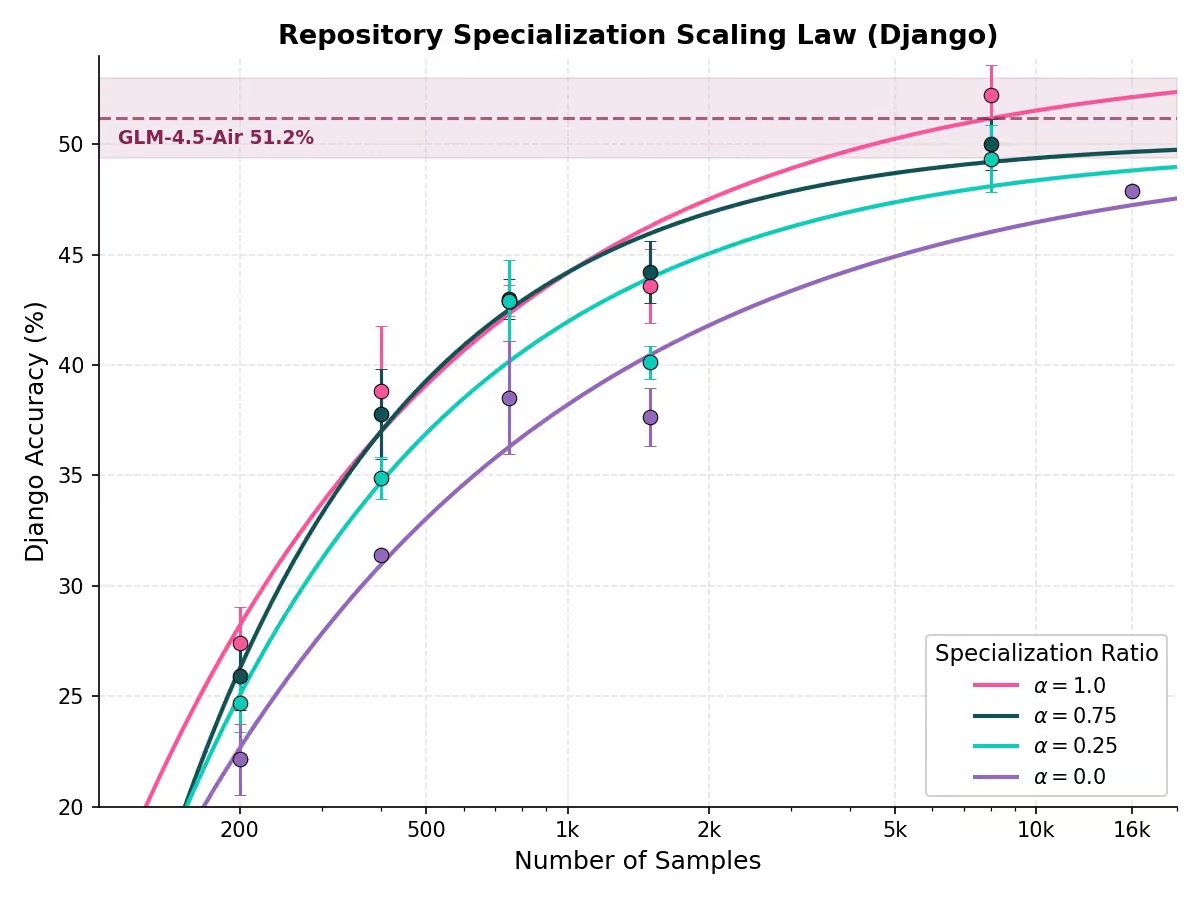
This is very impactful: you can now distill frontier performance into small models that are specialized to private repositories. Companies can quickly and cheaply train on their data and have super-efficient deployments of 32B agents.
-
Hanna Hajishirzi reposted
-
Hanna Hajishirzi reposted
Ethan Shen
@ethanlshen
Today, we release SERA-32B, an approach to coding agents that matches Devstral 2 at just $9,000. It is fully open-source and you can train your own model easily - at 26x the efficiency of using RL.
Paper: allenai.org/papers/opencodingagents
Here’s how 🧵 -
Hanna Hajishirzi
@HannaHajishirzi
Check out our newest release, SERA: a SoTA coding agent for its size, and super cheap and adaptable to your private codebase.
Tim Dettmers
@Tim_Dettmers
We release SERA, the first model part of Ai2’s Open Coding Agent series. SERA is a SoTA agent for its size, super simple, and 26x more efficient than RL.
In my blog post, I write about my personal journey of building this coding agent: timdettmers.com/2026/01/27/building-open-coding-agent-sera/
Details: 👇 -
Hanna Hajishirzi reposted
Cameron R. Wolfe, Ph.D.
@cwolferesearch
RL is computationally expensive, but researchers are quickly discovering speed ups. Olmo 3 does a great job of outlining the key tricks that helped to make RL more efficient:
1. A fully-asynchronous, off-policy RL setup is used that reduces idle time by allowing inference and model updates to continue running without waiting for all components to finish.
2. Continuous batching is used to constantly enqueue new inference requests in real-time as generations finish.
3. To compensate for examples removed by active sampling, OlmoRL—due to its asynchronous setup—can just continue sampling and filtering examples until the desired batch size is reached.
4. Inflight updates to the model weights being used for inference are performed without pausing generation or clearing the KV cache, which is found to improve throughput by ~4× with no deterioration in accuracy.
When applied in tandem, these tricks can cut RL training time in half without impacting performance. -
Hanna Hajishirzi
@HannaHajishirzi
The newest version of the Olmo 3 paper is on Arxiv. We updated so many things.
Kyle Lo
@kylelostat
olmo 3 paper finally on arxiv 🫡
thx to our teammates esp folks who chased additional baselines
thx to arxiv-latex-cleaner and overleaf feature for chasing latex bugs
thx for all the helpful discussions after our Nov release, best part of open science is progressing together! -
Hanna Hajishirzi reposted
ACL 2027
@aclmeeting
Delighted to announce that the Nominating Committee has selected 11 new ACL fellows for 2025: www.aclweb.org/portal/content/acl-fellows-2025. Many congratulations to all the new ACL fellows!
For more information on the ACL fellowship, please see:
aclweb.org/aclwiki/ACL_Fellows #nlp #nlproc -
Hanna Hajishirzi reposted
Ranjay Krishna
@RanjayKrishna
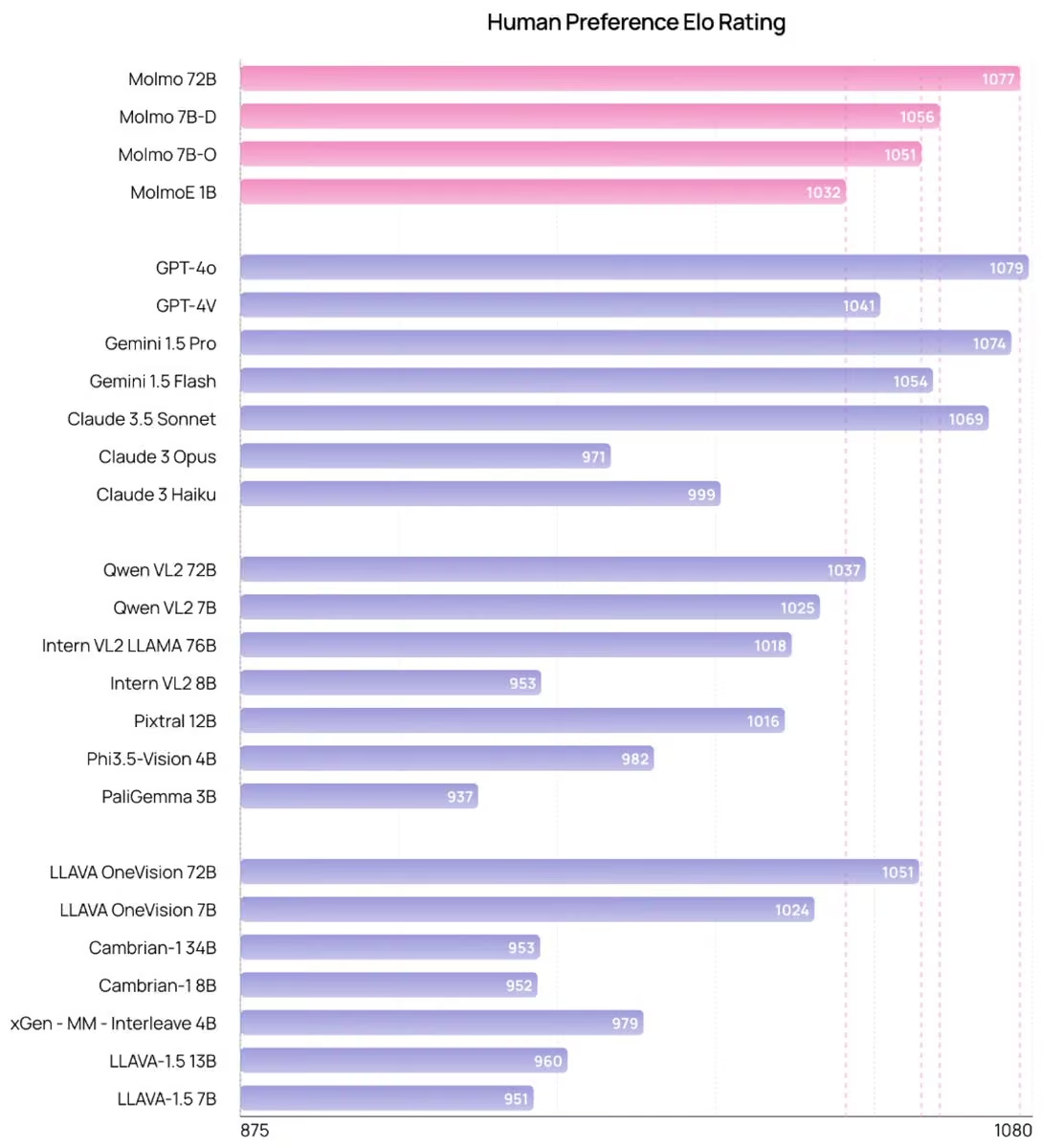
Check out what Molmo can do now.
Ai2
@allen_ai
Molmo 2 doesn't just answer questions about clips—it searches & points.
The model returns coordinates & timestamps over videos + images, powering QA, counting, dense captioning, artifact detection, & subtitle-aware analysis. You can see exactly how it reasoned.This media couldn't be displayed. See it on the original post. -
Hanna Hajishirzi reposted
Cameron R. Wolfe, Ph.D.
@cwolferesearch
Olmo 3 is one of the most valuable open research artifacts to ever be released. Although Olmo 3 models are slightly behind state-of-the-art, their value goes beyond the models themselves. The artifacts for Olmo 3 give anyone the ability to conduct rigorous experiments with virtually zero barrier to entry. The level of transparency for Olmo 3 (full data released, 100-page report, open training infra, all evals reproducible) is setting a new standard. I think this is very important and that it will have massive second-order effects on the progress of LLM research. Full overview (~14K words, longest I’ve ever written) will be released tomorrow morning.
-
Hanna Hajishirzi
@HannaHajishirzi
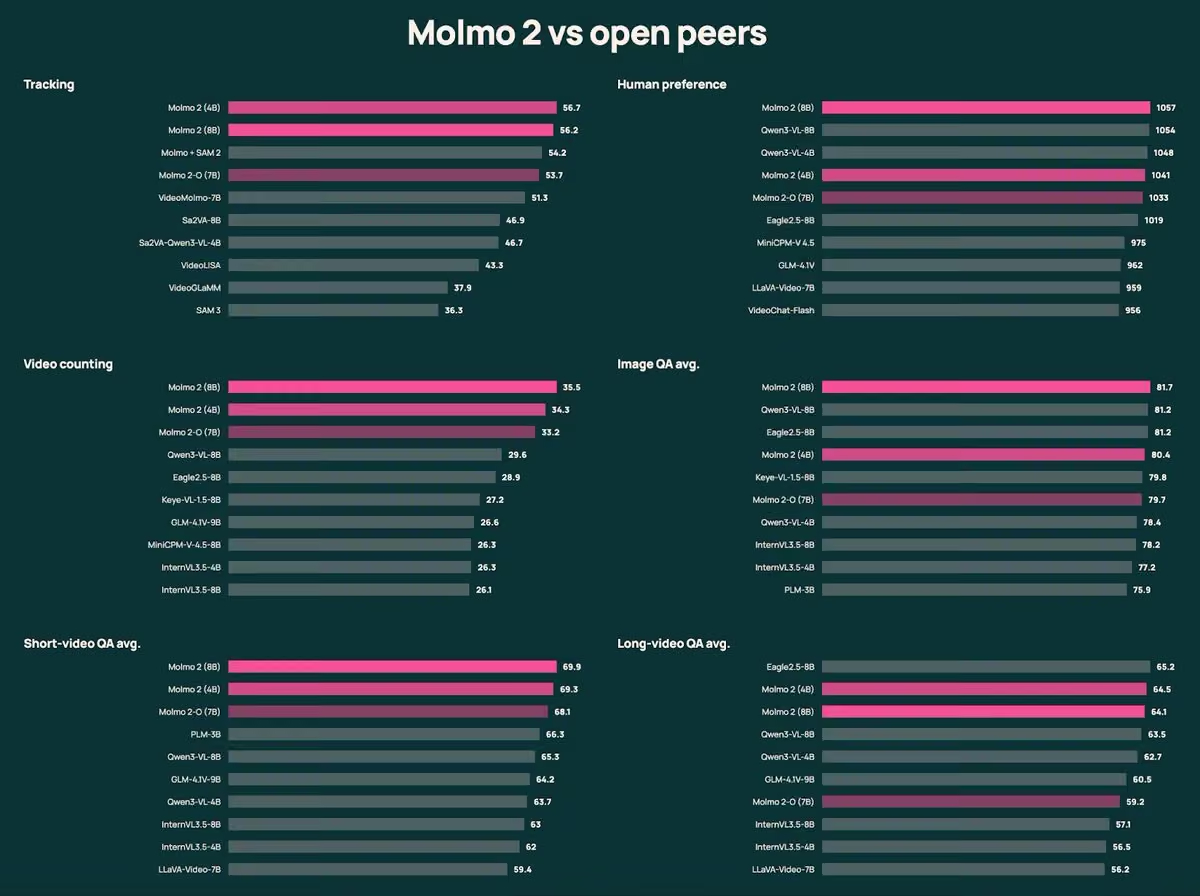
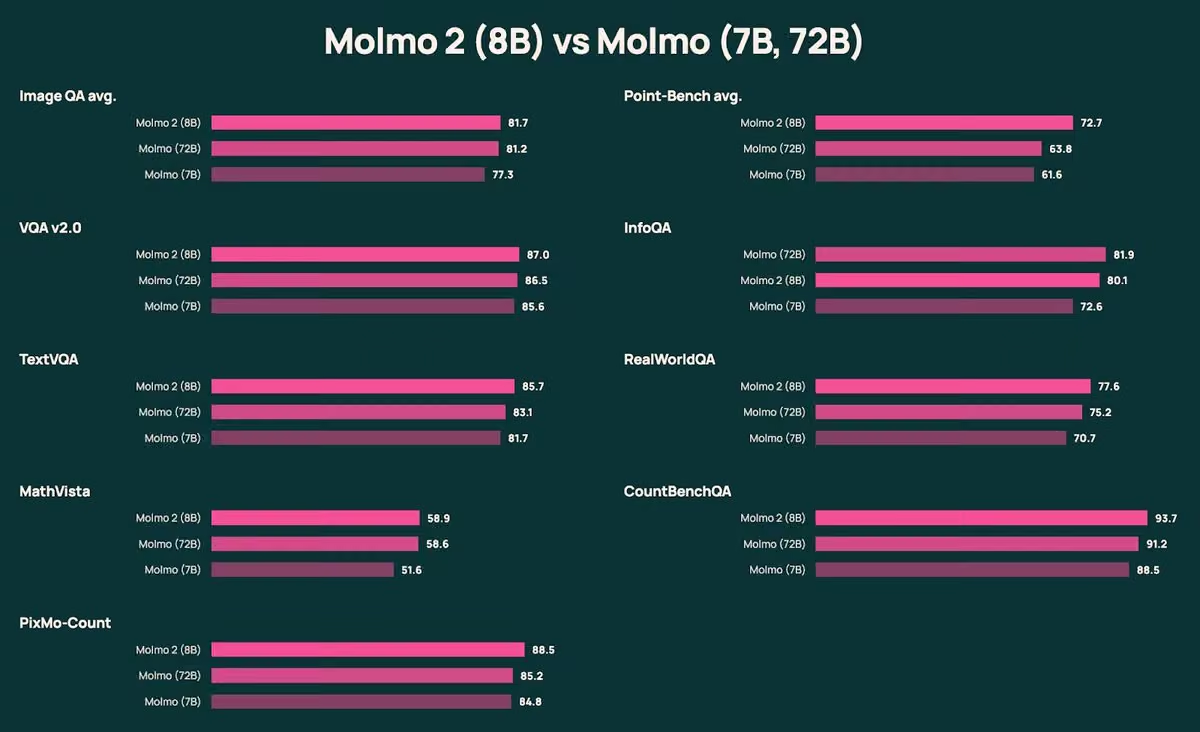
Molmo 2 is out! 🎉 Enjoy interacting with a SOTA vision-language model, now working on videos.
-
Hanna Hajishirzi reposted
Jiacheng Liu
@liujc1998
Belated update: I defended my PhD last month!
I am tremendously grateful to my advisors, @HannaHajishirzi and @YejinChoinka. Without their incredible support, I wouldn’t have had so much fun exploring bold ideas, like taking a journey into the ocean of LLM pretraining data. 🥰🥰 -
Hanna Hajishirzi reposted
-
Hanna Hajishirzi reposted
Michael Noukhovitch
@mnoukhov
Olmo 3.1: even more RL = even more RL-Zero!
@saurabh_shah2 and I tweaked some hyperparams and prompts, @hamishivi and @finbarrtimbers improved the code and boom!
New Olmo 3.1 RL-Zero 👾 An updated, solid baseline for your RL and reasoning research -
Hanna Hajishirzi reposted
Shashank Gupta ✈️ CoLM'26
@shashank_bits
🎉 OLMo 3.1 is here! 🎉
🧠 A stronger 32B Thinking model
⚒️ A brand-new 32B Instruct model with tool calling
Models & data: huggingface.co/collections/allenai/olmo-31
Paper: allenai.org/papers/olmo3 -
Hanna Hajishirzi reposted
Kyle Lo
@kylelostat
lol so during neurips, we kept the RL run going and the model kept getting better 😂
Olmo 3.1 is a..
🐡 32B Thinking, still best fully-open model to-date
🐠 32B Instruct, for ppl who hate long yapping, as good as qwen3
we added like 10 more pages to the paper too! thx for community feedback from convos at neurips:
🐟 more on our eval ideology
🦈 more baselines
🍣 more about RL Zero
etc
we picked final model (internally called moonlit surfer 🌛🏄) not just on bench scores but good vibes 🥰 -
Hanna Hajishirzi reposted
Pradeep Dasigi
@pdasigi
Here's a really quick follow up to our recent big Olmo 3 release!
✨Olmo 3.1✨:
- a longer RL'ed 32B Think, with stronger math and reasoning skills
- a 32B Instruct, a larger Instruct model also with function calling -
Hanna Hajishirzi reposted
Victoria Graf
@VictoriaWGraf
Olmo 3 Instruct is now bigger and better 🚀
Olmo 3 Think? Better too
Check out Olmo 3.1! ✨ -
Hanna Hajishirzi reposted
Ellen Riloff
@EllenRiloff
The Computer Science Department at U.Arizona is looking to hire multiple tenure-track and multiple teaching faculty this year. If you are searching for a faculty position and like sunshine, consider applying! ☀️🌵 www.cs.arizona.edu/currently-open-positions
-
Hanna Hajishirzi reposted
Nathan Lambert
@natolambert
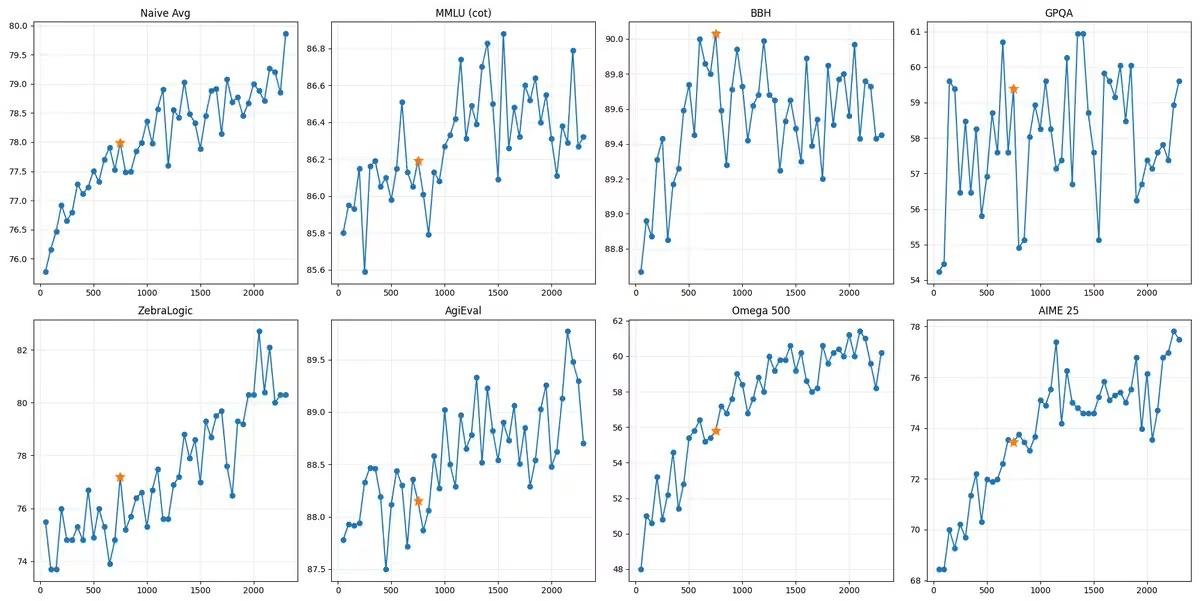
Olmo 3.1 32B Think shows that not just frontier labs can scale RL.
My favorite RL run yet over 7+ years of doing RL.
The biggest fully open RL run ever?
We left the same RL job running from our v3 Think for an extra 3 weeks.
When we were releasing Olmo 3 32B on Nov. 20th we had no idea it had so much potential left.
Performance keeps going up. Gaining a few points on hard evals like AIME and coding. It likely would've kept increasing a bit, but we needed to move onto new projects!
This dramatically changes how post-training needs to be scheduled for and understood. We can scale further.
It took 224 training GPUs on the same data and was arguably not saturated yet (~125K H100 hours total, which is about $250K and a similar cost to DeepSeek R1's 147k H800 hours).
Stable infrastructure pays off and the open community has that now.
All intermediate checkpoints are available for those looking to study the RL process.
Next step is to make learning more efficient with better data, more policy steps, more off-policy generations, and more inference speedups.
Huge thanks to the awesome team who made this happen at Ai2 (@allen_ai). It also builds on amazing work in the community Ray by @anyscalecompute @vllm_project, lots of open datasets, and many others in the community.
We also made major updates to the Olmo 3 paper & submitted it to arxiv.
Other items released include:
- Our 32B Instruct model! Much needed with the Think'er being a yapper.
- New 7B RL Zero models on math/code which are far more stable research baselines.
- Two very large research datasets, millions of completions for filtering RL data and tens of millions of completions we used to create our preference datasets.
Gold stars on downstream evals is our original release, this latest one is the final checkpoint on the plot. -
Hanna Hajishirzi reposted
Hamish Ivison
@hamishivi
If u chatted to me at neurips and I got distracted looking at my computer it was cuz i was babysitting this run!
Here's full curves from our in-loop evaluations. Sit and wait and the model just gets better (no changes from the initial recipe we announced, just run for longer!) 😌 -
Hanna Hajishirzi reposted
-
Hanna Hajishirzi reposted
Faeze Brahman
@faeze_brh
We’re dropping Olmo 3.1 as a little end-of-year surprise.
Think of it as Olmo 3, but with holiday upgrades. 🎁🎄 -
Hanna Hajishirzi reposted
Scott Geng
@scottgeng00
tbh it's too easy. you giveth Olmo moore GPU hours and Olmo giveth back.
@nvidia pleaseeee collab pleasee 🐄🐄🐄 -
Hanna Hajishirzi
@HannaHajishirzi
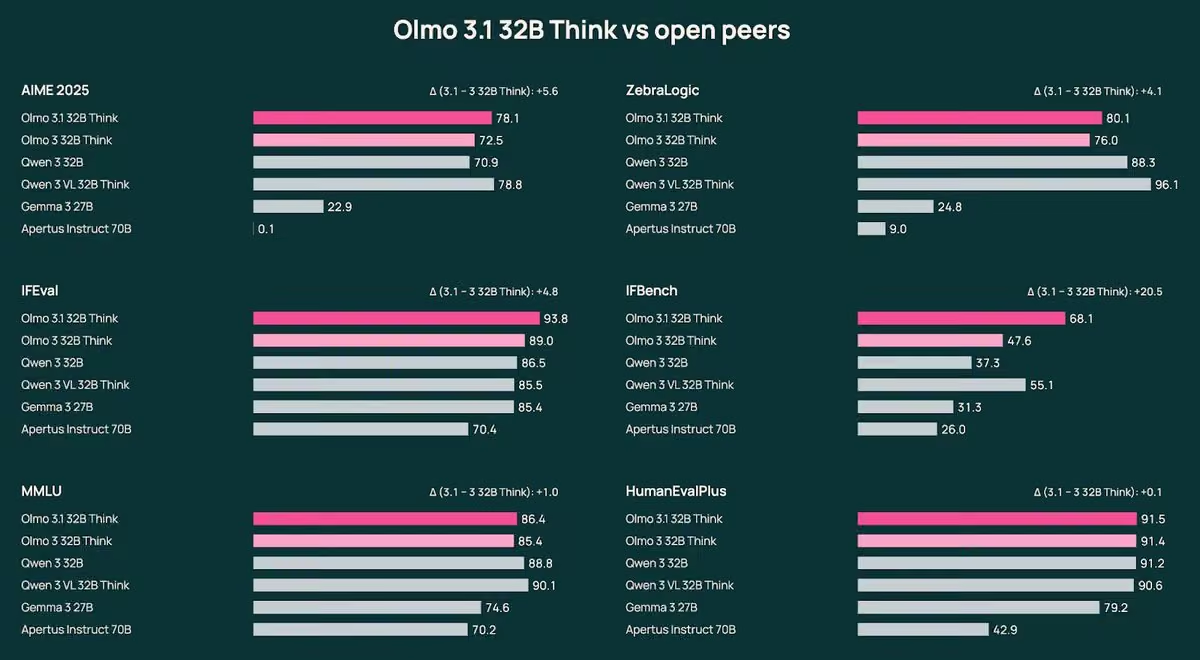
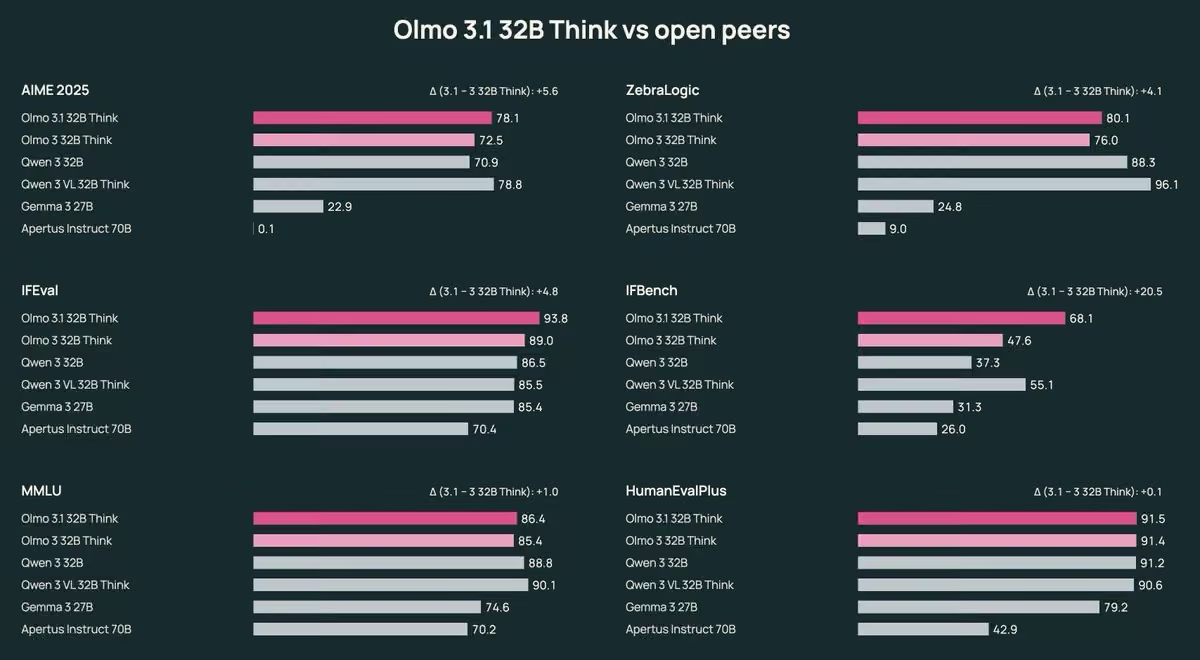
🚀 Olmo 3.1 is here — earlier than expected!
32B Think: 3 extra weeks of RL training = steady gains and significant improvements.
32B Instruct: Our 7B recipe scaled to 32B, tuned for short chat + function calling.
Olmo 3 keeps leveling up! Details in the latest version of the paper. As always, kudos to the whole team!
New Olmo 3.1 artifacts: huggingface.co/collections/allenai/olmo-31
Paper (arxiv soon): allenai.org/papers/olmo3
Demo: playground.allenai.org -
Hanna Hajishirzi reposted
Fei-Fei Li
@drfeifei
This came as a total surprise this morning. Very humbled… 🙏 AI is built by generations of technologists, starting with the daring question of “can machines think?” by Alan Turing. It will be further developed, used and governed by many and all of us! Let’s keep our AI mission human-centered for the benefit of humanity! And I can’t wait to see where AI’s next frontier - spatial intelligence - will be taking us!
TIME
@TIME
2025 was the year when artificial intelligence’s full potential roared into view, and when it became clear that there will be no turning back.
For delivering the age of thinking machines, for wowing and worrying humanity, for transforming the present and transcending the possible, the Architects of AI are TIME’s 2025 Person of the Year. time.com/7339685/person-of-the-year-2025-ai-architects/ -
Hanna Hajishirzi reposted
-
Hanna Hajishirzi reposted
Stella Li
@StellaLisy
Fun story-there was one run with random rewards that *worked* on olmo! But we realized it was bc we had turned on penalty for unfinished generations, which are typically degenerate outputs and penalizing them improved performance. Lots of fun things we can do with open science!!
Cameron R. Wolfe, Ph.D.
@cwolferesearch
Easy to miss because it's on the last page of the paper, but Olmo 3 RL-Zero has a really nice sub-section on RL with random rewards!
Prior papers (Shao et al - "Spurious Rewards: Rethinking Training Signals in RLVR") show RLVR still improves performance on math problems even when we assign completely random rewards to model completions. This was a weird result that raised a lot of questions on how RLVR actually works.
There are several explanations for why this might happen:
- GRPO reinforces existing model tendencies (e.g., generating code in the output) that may be conducive to math problem solving.
- Data contamination.
- Most of these results are observed with Qwen-2.5, so this particular model could have unknown data / model properties that cause this to happen.
The authors of Olmo 3 show that this random improvement property of RLVR disappears with proper data decontamination. If we ensure no downstream evaluation data is present in our pretraining or midtraining datasets, then RL training with random rewards no longer yields any performance improvement.
Such an observation really highlights how important fully open models are for conducting rigorous research. Without any knowledge of a model's training data, we can unknowingly observe seemingly surprising trends that may be a result of data contamination / leakage rather than something substantial.
Olmo 3 RL-Zero seems to be an awesome and clean test bed for running RL experiments:
- Base model is already openly available.
- Multi-objective / several tasks
- Simple chat templates are tested and provided for each task
- Full data transparency, data is decontaminated
- Predefined recipes (with open code) that already perform well are provided as a baseline -
Hanna Hajishirzi reposted
Tong Chen
@tomchen0
I will be at #neurips2025 12.3–12.7 Looking forward to meeting old and new friends ! ☕️🌮
Recently working on hallucination (Binary RAR) and verbatim memorization (ParaPO), issues that scaling up pretraining cannot simply fix. Also interested in making models learn more like humans: strong generalization, non-scalar rewards, episodic memory, and long-horizon abilities. -
Hanna Hajishirzi reposted
Azalia Mirhoseini
@Azaliamirh
Thrilled to share that @annadgoldie and I are launching @RicursiveAI, a frontier lab enabling recursive self-improvement through AIs that design their own chips.
Our vision for transforming chip design began with AlphaChip, an AI for layout optimization used to design four generations of TPUs, data center CPUs, and smartphones. AlphaChip offered a glimpse into a future where AI designs the silicon that fuels it. Ricursive extends this vision to the entire chip stack, building AI that architects, verifies, and implements silicon, enabling models and chips to co-evolve in a tight loop.
We sat down with WSJ’s @berber_jin1 to discuss Ricursive: www.wsj.com/tech/this-ai-startup-wants-to-remake-the-800-…
Ricursive Intelligence
@RicursiveAI
Introducing Ricursive Intelligence, a frontier AI lab enabling a recursive self-improvement loop between AI and the chips that fuel it.
Learn more at ricursive.comThis media couldn't be displayed. See it on the original post. -
Hanna Hajishirzi reposted
Percy Liang
@percyliang
Nice to see AA tracking openness! No matter how many times one says it, people don't seem to understand that openness is more than "the ability to download model weights". The Foundation Models Transparency Index (FMTI) includes a much more comprehensive notion of openness:
Artificial Analysis
@ArtificialAnlys
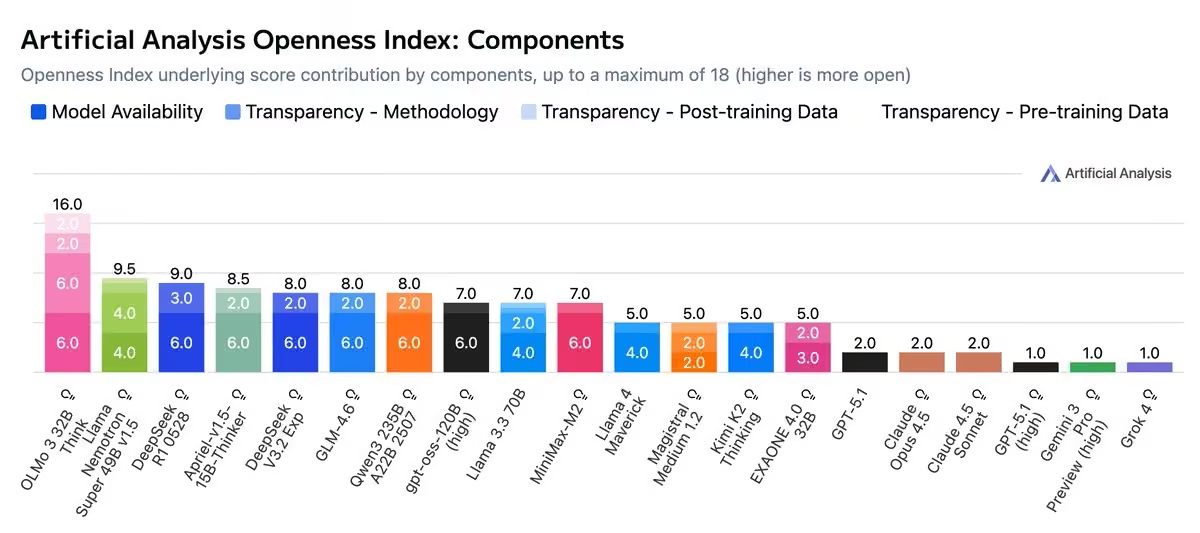
Introducing the Artificial Analysis Openness Index: a standardized and independently assessed measure of AI model openness across availability and transparency
Openness is not just the ability to download model weights. It is also licensing, data and methodology - we developed a framework underpinning the Artificial Analysis Openness Index to incorporate these elements. It allows developers, users, and labs to compare across all these aspects of openness on a standardized basis, and brings visibility to labs advancing the open AI ecosystem.
A model with a score of 100 in Openness Index would be open weights and permissively licensed with full training code, pre-training data and post-training data released - allowing users to not just use the model but reproduce its training in full, or take inspiration from some or all of the model creator’s approach to build their own model. We have not yet awarded any models a score of 100!
Key details:
🔒 Few models and providers take a fully open approach. We see a strong and growing ecosystem of open weights models, including leading models from Chinese labs such as Kimi K2, Minimax M2, and DeepSeek V3.2. However, releases of data and methodology are much rarer - OpenAI’s gpt-oss family is a prominent example of open weights and Apache 2.0 licensing, but minimal disclosure otherwise.
🥇 OLMo from @allen_ai leads the Openness Index at launch. Living up to AI2’s mission to provide ‘truly open’ research, the OLMo family achieves the top score of 89 (16 of a maximum of 18 points) on the Index by prioritizing full replicability and permissive licensing across weights, training data, and code. With the recent launch of OLMo 3, this included the latest version of AI2’s data, utilities and software, full details on reasoning model training, and the new Dolci post-training dataset.
🥈 NVIDIA’s Nemotron family also performs strongly for openness. @NVIDIAAI models such as NVIDIA Nemotron Nano 9B v2 reach a score of 67 on the Index due to their release alongside extensive technical reports detailing their training process, open source tooling for building models like them, and the Nemotron-CC and Nemotron post-training datasets.
📉 We’re tracking both open weights and closed weights models. Openness Index is a new way to think about how open models are, and we will be ranking closed weights models alongside open weights models to recognize the scope of methodology and data transparency associated with closed model releases.
Methodology & Context:
➤ We analyze openness using a standardized framework covering model availability (weights & license) and model transparency (data and methodology). This means we capture not just how freely a model can be used, but visibility into its training and knowledge, and potential to replicate or build on its capabilities or data.
➤ Model availability is measured based on the access and licensing of the model/weights themselves, while transparency comprises subcomponents for access and licensing for methodology, pre-training data, and post-training data.
➤ As seen with releases like DeepSeek R1, sharing methodology accelerates progress. We hope the Index encourages labs to balance competitive moats with the benefits of sharing the "how" alongside the "what."
➤ AI model developers may choose not to fully open their models for a wide range of reasons. We feel strongly that there are important advantages to the open AI ecosystem and supporting the open ecosystem is a key reason we developed the Openness Index. We do not, however, wish to dismiss the legitimacy of the tradeoffs that greater openness comes with, and we do not intend to treat Openness Index as a strictly ‘higher is better’ scale.
See below for further analysis and details 👇 -
Hanna Hajishirzi reposted
Kyle Lo
@kylelostat
I'll be at #neurips2025 from Tues-Sun! Come say hi 👋 if you wanna chat about
🦈 olmo 3 stories, pretraining data & evals
🐟 model specialization
🐡 AI for education
🐠 open intern & full time positions at Ai2
We have two spotlight papers
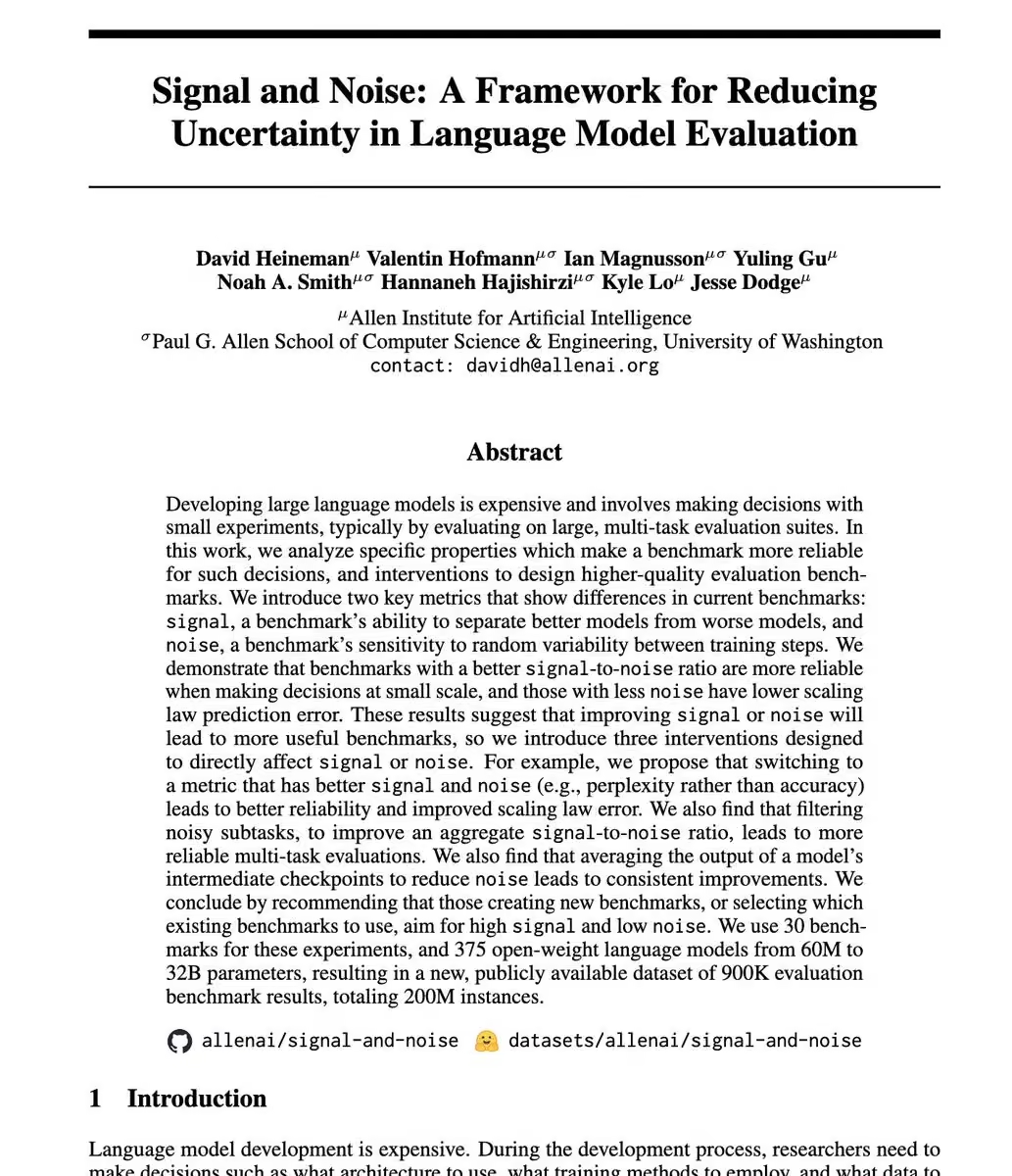
🥐 Signal and Noise (Wed) shows why some benchmarks prohibit fitting good task scaling laws & how we can improve them
🥯 FlexOlmo (Thurs) is a novel MoE w/ experts trained on different data sources, it gives users control over which experts are activated based on access permissions to those datasets -
Hanna Hajishirzi reposted
Kyle Lo
@kylelostat
Signal and Noise is led by @heinemandavidj, talented researcher in our Olmo group at @allen_ai who is applying to PhD programs this cycle! Many of the ideas in his work shaped the design our Olmo 3 evaluation suite!
David Heineman
@davidheinnman
Evaluating language models is tricky, how do we know if our results are real, or due to random chance?
We find an answer with two simple metrics: signal, a benchmark’s ability to separate models, and noise, a benchmark’s random variability between training steps 🧵 -
Hanna Hajishirzi reposted
Kyle Lo
@kylelostat
lotta Ai2 folks in san diego #neurips2025 find us for free tokens!
Ai2
@allen_ai
We're at #neurips2025 with papers, posters, workshops, fireside chats, & talks across the conference. Come learn about our latest research + see live demos!
-
Hanna Hajishirzi reposted
Ai2
@allen_ai
To celebrate, we’ve partnered with @parasail_io to offer free access to Olmo 3-Think (32B), our flagship fully open reasoning model, through Dec 22. Try it here: www.saas.parasail.io/serverless?name=olmo-3-32b-think & 👇 openrouter.ai/allenai/olmo-3-32b-think:free
-
Hanna Hajishirzi reposted
Scott Geng
@scottgeng00
Excited to see everyone at #neurips2025 soon ☀️🌯! I work on post-training, synthetic data, and RL these days (Delta Learning, Olmo 3, Spurious Rewards), and I'm generally excited about how we can break the data wall.
Psyched to meet new friends and old -- DMs open 🙂🐄🦖 -
Hanna Hajishirzi
@HannaHajishirzi
I am going to be at Neurips Wed-Friday. Happy to catch up with friends. DM me if you want to chat about one of our papers, Olmo 3, LM pretraining or posttraining.
-
Hanna Hajishirzi reposted
Matthew Leavitt
@leavittron
At the risk of sounding like a broken record:
- It's an absolute pleasure working with the cracked af @arcee_ai team
- We're incredibly proud of the pretraining data we at @datologyai curated for these models
- These models are even better than I expected
- We've had a bunch of curation improvements land since we finished the data for mini and nano. What's going in to Large is even better.
Lucas Atkins
@latkins
Today, we are introducing Trinity, the start of an open-weight MoE family that businesses and developers can own.
Trinity-Mini (26B-A3B)
Trinity-Nano-Preview (6B-A1B)
Available Today on Huggingface. -
Hanna Hajishirzi
@HannaHajishirzi
Glad to see that Olmo is ranked as open as possible.
Artificial Analysis
@ArtificialAnlys
Introducing the Artificial Analysis Openness Index: a standardized and independently assessed measure of AI model openness across availability and transparency
Openness is not just the ability to download model weights. It is also licensing, data and methodology - we developed a framework underpinning the Artificial Analysis Openness Index to incorporate these elements. It allows developers, users, and labs to compare across all these aspects of openness on a standardized basis, and brings visibility to labs advancing the open AI ecosystem.
A model with a score of 100 in Openness Index would be open weights and permissively licensed with full training code, pre-training data and post-training data released - allowing users to not just use the model but reproduce its training in full, or take inspiration from some or all of the model creator’s approach to build their own model. We have not yet awarded any models a score of 100!
Key details:
🔒 Few models and providers take a fully open approach. We see a strong and growing ecosystem of open weights models, including leading models from Chinese labs such as Kimi K2, Minimax M2, and DeepSeek V3.2. However, releases of data and methodology are much rarer - OpenAI’s gpt-oss family is a prominent example of open weights and Apache 2.0 licensing, but minimal disclosure otherwise.
🥇 OLMo from @allen_ai leads the Openness Index at launch. Living up to AI2’s mission to provide ‘truly open’ research, the OLMo family achieves the top score of 89 (16 of a maximum of 18 points) on the Index by prioritizing full replicability and permissive licensing across weights, training data, and code. With the recent launch of OLMo 3, this included the latest version of AI2’s data, utilities and software, full details on reasoning model training, and the new Dolci post-training dataset.
🥈 NVIDIA’s Nemotron family also performs strongly for openness. @NVIDIAAI models such as NVIDIA Nemotron Nano 9B v2 reach a score of 67 on the Index due to their release alongside extensive technical reports detailing their training process, open source tooling for building models like them, and the Nemotron-CC and Nemotron post-training datasets.
📉 We’re tracking both open weights and closed weights models. Openness Index is a new way to think about how open models are, and we will be ranking closed weights models alongside open weights models to recognize the scope of methodology and data transparency associated with closed model releases.
Methodology & Context:
➤ We analyze openness using a standardized framework covering model availability (weights & license) and model transparency (data and methodology). This means we capture not just how freely a model can be used, but visibility into its training and knowledge, and potential to replicate or build on its capabilities or data.
➤ Model availability is measured based on the access and licensing of the model/weights themselves, while transparency comprises subcomponents for access and licensing for methodology, pre-training data, and post-training data.
➤ As seen with releases like DeepSeek R1, sharing methodology accelerates progress. We hope the Index encourages labs to balance competitive moats with the benefits of sharing the "how" alongside the "what."
➤ AI model developers may choose not to fully open their models for a wide range of reasons. We feel strongly that there are important advantages to the open AI ecosystem and supporting the open ecosystem is a key reason we developed the Openness Index. We do not, however, wish to dismiss the legitimacy of the tradeoffs that greater openness comes with, and we do not intend to treat Openness Index as a strictly ‘higher is better’ scale.
See below for further analysis and details 👇 -
Hanna Hajishirzi reposted
NVIDIA AI Developer
@NVIDIAAIDev
Artificial Analysis' Openness Index is now live 🎉
Huge congrats to @allen_ai 👏 OLMo 3 leads the pack, demonstrating top-tier openness for model availability and transparency across data and methodology.
🔗 nvda.ws/3M91zwm -
Hanna Hajishirzi reposted
Rulin Shao
@RulinShao
🏝️ I'll be at #neurips2025 12.1-12.7! Excited to see old & new friends ☕️ Feel free to DM me to grab coffee or chat!
I work on deep research and RL these days (DR Tulu, Spurious Rewards, ReasonIR), and I'm generally interested in learning from experience with tools and challenging tasks beyond over-optimized benchmarks. -
Hanna Hajishirzi reposted
Nathan Lambert
@natolambert
Banger paper. Finally getting to read the rest of it 😅
There's an award for whoever finds all the secrets first in the new arxiv version that's coming soon. -
Hanna Hajishirzi reposted
Yanai Elazar
@yanaiela
Inspecting the data should be the first thing you do when starting to work with new data!
Lei Yang
@diyerxx
Got burned by an Apple ICLR paper — it was withdrawn after my Public Comment.
So here’s what happened. Earlier this month, a colleague shared an Apple paper on arXiv with me — it was also under review for ICLR 2026.
The benchmark they proposed was perfectly aligned with a project we’re working on.
I got excited after reading it. I immediately stopped my current tasks and started adapting our model to their benchmark.
Pulled a whole weekend crunch session to finish the integration… only to find our model scoring absurdly low.
I was really frustrated. I spent days debugging, checking everything — maybe I used it wrong, maybe there was a hidden bug.
During this process, I actually found a critical bug in their official code:
* When querying the VLM, it only passed in the image path string, not the image content itself.
The most ridiculous part? After I fixed their bug, the model's scores got even lower!
The results were so counterintuitive that I felt forced to do deeper validation. After multiple checks, the conclusion held: fixing the bug actually made the scores worse.
At this point I decided to manually inspect the data. I sampled the first 20 questions our model got wrong, and I was shocked:
* 6 out of 20 had clear GT errors.
* The pattern suggested the “ground truth” was model-generated with extremely poor quality control, leading to tons of hallucinations.
* Based on this quick sample, the GT error rate could be as high as 30%.
I reported the data quality issue in a GitHub issue. After 6 days, the authors replied briefly and then immediately closed the issue.
That annoyed me — I’d already wasted a ton of time, and I didn’t want others in the community to fall into the same trap — so I pushed back. Only then did they reopen the GitHub issue.
Then I went back and checked the examples displayed in the paper itself.
Even there, I found at least three clear GT errors.
It’s hard to believe the authors were unaware of how bad the dataset quality was, especially when the paper claims all samples were reviewed by annotators. Yet even the examples printed in the paper contain blatant hallucinations and mistakes.
When the ICLR reviews came out, I checked the five reviews for this paper.
Not a single reviewer noticed the GT quality issues or the hallucinations in the paper's examples.
So I started preparing a more detailed GT error analysis and wrote a Public Comment on OpenReview to inform the reviewers and the community about the data quality problems.
The next day — the authors withdrew the paper and took down the GitHub repo.
Fortunately, ICLR is an open conference with Public Comment. If this had been a closed-review venue, this kind of shoddy work would have been much harder to expose.
So here’s a small call to the community:
For any paper involving model-assisted dataset construction, reviewers should spend a few minutes checking a few samples manually. We need to prevent irresponsible work from slipping through and misleading everyone.
Looking back, I should have suspected the dataset earlier based on two red flags:
* The paper’s experiments claimed that GPT-5 has been surpassed by a bunch of small open-source models.
* The original code, with a ridiculous bug, produced higher scores than the bug-fixed version.
But because it was a paper from Big Tech, I subconsciously trusted the integrity and quality, which prevented me from spotting the problem sooner.
This whole experience drained a lot of my time, energy, and emotion — especially because accusing others of bad data requires extra caution.
I’m sharing this in hopes that the ML community remains vigilant and pushes back against this kind of sloppy, low-quality, and irresponsible behavior before it misleads people and wastes collective effort.
#iclr #iclr2026 #neurips #cvpr #openreview #machinelearning #llm #vlm -
Hanna Hajishirzi reposted
Ahmad Beirami
@abeirami
Main takeaway: "look at your data"
Lei Yang
@diyerxx
Got burned by an Apple ICLR paper — it was withdrawn after my Public Comment.
So here’s what happened. Earlier this month, a colleague shared an Apple paper on arXiv with me — it was also under review for ICLR 2026.
The benchmark they proposed was perfectly aligned with a project we’re working on.
I got excited after reading it. I immediately stopped my current tasks and started adapting our model to their benchmark.
Pulled a whole weekend crunch session to finish the integration… only to find our model scoring absurdly low.
I was really frustrated. I spent days debugging, checking everything — maybe I used it wrong, maybe there was a hidden bug.
During this process, I actually found a critical bug in their official code:
* When querying the VLM, it only passed in the image path string, not the image content itself.
The most ridiculous part? After I fixed their bug, the model's scores got even lower!
The results were so counterintuitive that I felt forced to do deeper validation. After multiple checks, the conclusion held: fixing the bug actually made the scores worse.
At this point I decided to manually inspect the data. I sampled the first 20 questions our model got wrong, and I was shocked:
* 6 out of 20 had clear GT errors.
* The pattern suggested the “ground truth” was model-generated with extremely poor quality control, leading to tons of hallucinations.
* Based on this quick sample, the GT error rate could be as high as 30%.
I reported the data quality issue in a GitHub issue. After 6 days, the authors replied briefly and then immediately closed the issue.
That annoyed me — I’d already wasted a ton of time, and I didn’t want others in the community to fall into the same trap — so I pushed back. Only then did they reopen the GitHub issue.
Then I went back and checked the examples displayed in the paper itself.
Even there, I found at least three clear GT errors.
It’s hard to believe the authors were unaware of how bad the dataset quality was, especially when the paper claims all samples were reviewed by annotators. Yet even the examples printed in the paper contain blatant hallucinations and mistakes.
When the ICLR reviews came out, I checked the five reviews for this paper.
Not a single reviewer noticed the GT quality issues or the hallucinations in the paper's examples.
So I started preparing a more detailed GT error analysis and wrote a Public Comment on OpenReview to inform the reviewers and the community about the data quality problems.
The next day — the authors withdrew the paper and took down the GitHub repo.
Fortunately, ICLR is an open conference with Public Comment. If this had been a closed-review venue, this kind of shoddy work would have been much harder to expose.
So here’s a small call to the community:
For any paper involving model-assisted dataset construction, reviewers should spend a few minutes checking a few samples manually. We need to prevent irresponsible work from slipping through and misleading everyone.
Looking back, I should have suspected the dataset earlier based on two red flags:
* The paper’s experiments claimed that GPT-5 has been surpassed by a bunch of small open-source models.
* The original code, with a ridiculous bug, produced higher scores than the bug-fixed version.
But because it was a paper from Big Tech, I subconsciously trusted the integrity and quality, which prevented me from spotting the problem sooner.
This whole experience drained a lot of my time, energy, and emotion — especially because accusing others of bad data requires extra caution.
I’m sharing this in hopes that the ML community remains vigilant and pushes back against this kind of sloppy, low-quality, and irresponsible behavior before it misleads people and wastes collective effort.
#iclr #iclr2026 #neurips #cvpr #openreview #machinelearning #llm #vlm -
Hanna Hajishirzi reposted
Hamish Ivison
@hamishivi
excited 4 NeurIPs week🏖️!
I'll be around from sun 30th - mon 8th! see me at:
- IFBench poster 👨🏫 fri dec 5th 11am-2pm
- llm-eval workshop panel 🔊 sun dec 7th 4-4:50pm
Or message if you wanna chat! Anything LMs, post-training, RL.... esp agentic RL and open-ended learning -
Hanna Hajishirzi reposted
Junyang Lin
@JustinLin610
Cong to our team for the NeurIPS Best Paper!
Qwen
@Alibaba_Qwen
🏆 We are incredibly honored to announce that our paper, "Gated Attention for Large Language Models: Non-linearity, Sparsity, and Attention-Sink-Free" has received the NeurIPS 2025 Best Paper Award!
A huge congratulations to our dedicated research team for pushing the boundaries of AI.
Read more: blog.neurips.cc/2025/11/26/announcing-the-neurips-2025-be… -
Hanna Hajishirzi
@HannaHajishirzi
Want to have a world class PhD thesis? Akari is amazing. Highly encourage you apply to work with her.
Akari Asai
@AkariAsai
1/ Hiring PhD students at CMU SCS (LTI/MLD) for Fall 2026 (Deadline 12/10) 🎓
I work on open, reliable LMs: augmented LMs & agents (RAG, tool use, deep research), safety (hallucinations, copyright), and AI for science, code & multilinguality & open to bold new ideas!
FAQ in 🧵 -
Hanna Hajishirzi reposted
Rulin Shao
@RulinShao
-
Hanna Hajishirzi reposted
Rulin Shao
@RulinShao
Try out DR Tulu CLI demo--play with it and hack around!
github.com/rlresearch/dr-tulu/blob/main/README.md
I'm impressed by how well it works despite being only 8B in size. However, I can also easily identify remaining challenges in the interactive mode. For example, having high-quality citations is a non-trivial task when the knowledge is too complex for the model. It can sometimes trust unreliable sources, so critical thinking is needed. None of these issues were captured in existing long-form evaluation benchmarks!
Current benchmarks tend to be more generous than humans. 😄 We look forward to seeing more benchmarks from the community that can capture these nuances!This media couldn't be displayed. See it on the original post.
Rulin Shao
@RulinShao
🔥Thrilled to introduce DR Tulu-8B, an open long-form Deep Research model that matches OpenAI DR 💪Yes, just 8B! 🚀
The secret? We present Reinforcement Learning with Evolving Rubrics (RLER) for long-form non-verifiable DR tasks! Our rubrics:
- co-evolve with the policy model
- are grounded on search knowledge
🧵 -
Hanna Hajishirzi reposted
Pang Wei Koh
@PangWeiKoh
We left DR Tulu-8B training for another week and it gained 6 more points on HealthBench (43.7 -> 50.4), surprisingly doing better than even Gemini3. Benchmarks aren't perfect but... play around with it yourself! Check out our CLI demo which you can run locally.
This media couldn't be displayed. See it on the original post.
Akari Asai
@AkariAsai
Exciting DR Tulu updates!
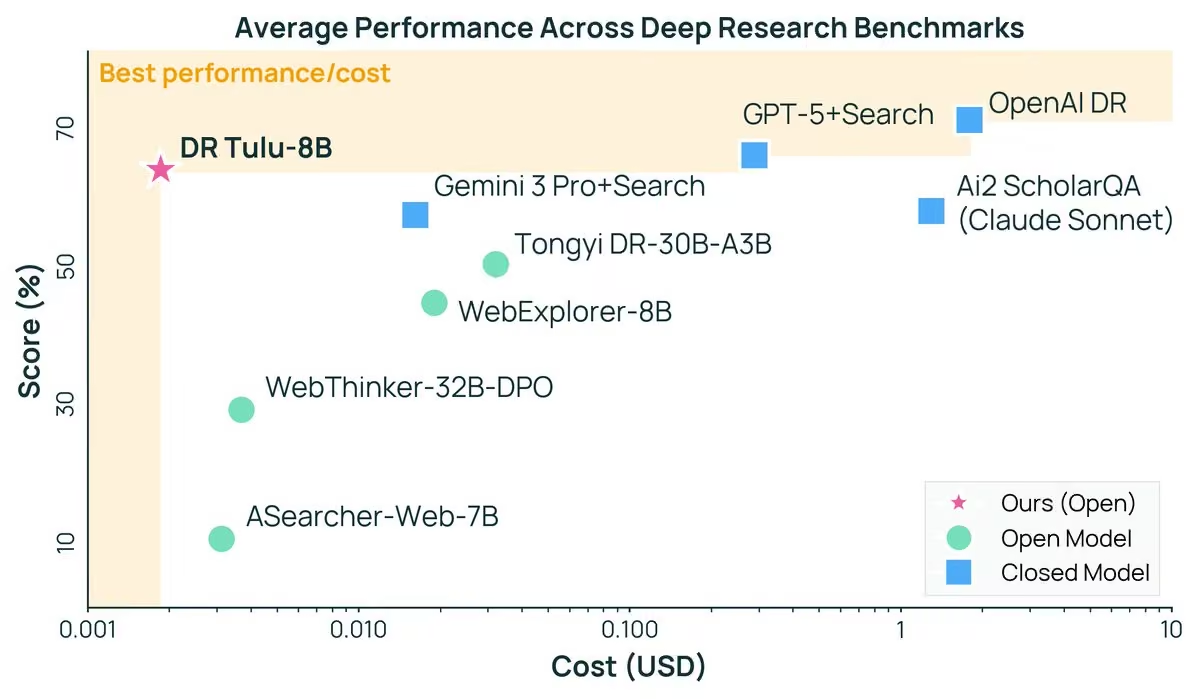
📈 DR Tulu-8B (new RL ckpt) sits on the performance–cost frontier, beating Tongyi DR-30B and matching OpenAI DR/Gemini 3 Pro+Search at a fraction of the cost. Now on arXiv.
🖥️ You can run an interactive CLI demo with open code, almost for free.
1/🧵 -
Hanna Hajishirzi
@HannaHajishirzi
Excited to see how RL runs keep improving over one week.
Hamish Ivison
@hamishivi
rl run still going btw... just wanted to put something out before taking a snooze for thanksgiving (altho maybe the run has finally plateaued, right, surely?)
-
Hanna Hajishirzi
@HannaHajishirzi
Check out DRTulu in action.
Rulin Shao
@RulinShao
Try out DR Tulu CLI demo--play with it and hack around!
github.com/rlresearch/dr-tulu/blob/main/README.md
I'm impressed by how well it works despite being only 8B in size. However, I can also easily identify remaining challenges in the interactive mode. For example, having high-quality citations is a non-trivial task when the knowledge is too complex for the model. It can sometimes trust unreliable sources, so critical thinking is needed. None of these issues were captured in existing long-form evaluation benchmarks!
Current benchmarks tend to be more generous than humans. 😄 We look forward to seeing more benchmarks from the community that can capture these nuances!This media couldn't be displayed. See it on the original post.
Rulin Shao
@RulinShao
🔥Thrilled to introduce DR Tulu-8B, an open long-form Deep Research model that matches OpenAI DR 💪Yes, just 8B! 🚀
The secret? We present Reinforcement Learning with Evolving Rubrics (RLER) for long-form non-verifiable DR tasks! Our rubrics:
- co-evolve with the policy model
- are grounded on search knowledge
🧵 -
Hanna Hajishirzi
@HannaHajishirzi
Love how RL runs keep getting improved! Check out latest DRTulu results and comparisons.
-
Hanna Hajishirzi
@HannaHajishirzi
Super excited to see DR Tulu RL runs improving all week! We just evaluated DR Tulu with the latest Gemini 3 Pro releases on Deep Research benchmarks — DR Tulu 7B now matches performance at a fraction of the cost.
Akari Asai
@AkariAsai
Exciting DR Tulu updates!
📈 DR Tulu-8B (new RL ckpt) sits on the performance–cost frontier, beating Tongyi DR-30B and matching OpenAI DR/Gemini 3 Pro+Search at a fraction of the cost. Now on arXiv.
🖥️ You can run an interactive CLI demo with open code, almost for free.
1/🧵 -
Hanna Hajishirzi reposted
NYU Center for Data Science
@NYUDataScience
Welcome to CDS, Associate Professor Greg Durrett (@gregd_nlp)!
Prof Durrett joins us from UT Austin. His research focuses on how to train large language models to reason, reflect, and extrapolate — and how to get them to be more creative.
nyudatascience.medium.com/meet-the-faculty-greg-durrett-f… -
Hanna Hajishirzi reposted
DAIR.AI
@dair_ai
Top AI Papers of the Week (Nov 17 - 23):
- SAM 3
- OLMo 3
- Fast RL for LLMs
- Solving Million-Step LLM Tasks
- GPT-5 for Science Acceleration
- Fundamental Limits of LLMs at Scale
- Think in Diffusion, Talk in Autoregression
Read on for more: -
Hanna Hajishirzi reposted
Sebastian Raschka
@rasbt
Implemented Olmo 3 from scratch (in a standalone notebook) this weekend!
If you are a coder, probably the best way to read the architecture details at a glance: github.com/rasbt/LLMs-from-scratch/blob/main/ch05/13_olmo…
Sebastian Raschka
@rasbt
Olmo models are always a highlight due to them being fully transparent and their nice, detailed technical reports.
I am sure I'll talk more about the interesting training-related aspects from that 100-pager in the upcoming days and weeks.
In the meantime, here's the side-by-side architecture comparison with Qwen3.
1) As we can see, the Olmo 3 architecture is relatively similar to Qwen3. However, it's worth noting that this is essentially likely inspired by the Olmo 2 predecessor, not Qwen3.
2) Similar to Olmo 2, Olmo 3 still uses a post-norm flavor instead of pre-norm, as they found in the Olmo 2 paper that it stabilizes the training.
3) Interestingly, the 7B model still uses multi-head attention similar to Olmo 2. However, to make things more efficient and shrink the KV cache size, they now use sliding window attention (e.g., similar to Gemma 3.)
Next, let's look at the 32B model.
4) Overall, it's the same architecture but just scaled up. Also, the proportions (e.g., going from the input to the intermediate size in the feed forward layer, and so on) roughly match the ones in Qwen3.
5) My guess is the architecture was initially somewhat smaller than Qwen3 due to the smaller vocabulary, and they then scaled up the intermediate size expansion from 5x in Qwen 3 to 5.4 in Olmo 3 to have a 32B model for a direct comparison.
6) Also, note that the 32B model (finally!) uses grouped query attention. -
Hanna Hajishirzi
@HannaHajishirzi
Check out this fun thread by Stella and our findings on Olmo 3 RL zero and spurious rewards.
Stella Li
@StellaLisy
First time so happy seeing negative results on a paper😆 moo moo rawrrrrrr!!!!
Negative signals from training on spurious rewards shows successful decontamination of our training data. Things we can do only due to fully open data + model + training + eval✨ -
Hanna Hajishirzi reposted
Ai2
@allen_ai
Our Olmo 3 models are now available via API on @openrouter. Try Olmo 3-Instruct (7B) for chat & tool use, and our reasoning models Olmo-3 Think (7B & 32B) for more complex problems.
-
Hanna Hajishirzi
@HannaHajishirzi
Saumya has been one of the most impactful folks for Olmo. Super energetic; thoughtful, and detail oriented. She has been integral to our SFT and evaluation stages.
Saumya Malik
@saumyamalik44
Olmo 3 is out!!!! It was so much fun working on post-training. Loved seeing this come together with the best team!!!!
-
Hanna Hajishirzi reposted
Akari Asai
@AkariAsai
Turns out RL keeps working - expect some fun DR Tulu updates ... 😎
Rulin Shao
@RulinShao
Same situation. We released and kept RL going, it’s still giving gains😛
-
Hanna Hajishirzi reposted
finbarr
@finbarrtimbers
The OlmoRL infrastructure was 4x faster than Olmo 2 and made it much cheaper to run experiments. Some of the changes:
1. continuous batching
2. in-flight updates
3. active sampling
4. many many improvements to our multi-threading code -
Hanna Hajishirzi
@HannaHajishirzi
Nice summary.
Sebastian Raschka
@rasbt
Olmo models are always a highlight due to them being fully transparent and their nice, detailed technical reports.
I am sure I'll talk more about the interesting training-related aspects from that 100-pager in the upcoming days and weeks.
In the meantime, here's the side-by-side architecture comparison with Qwen3.
1) As we can see, the Olmo 3 architecture is relatively similar to Qwen3. However, it's worth noting that this is essentially likely inspired by the Olmo 2 predecessor, not Qwen3.
2) Similar to Olmo 2, Olmo 3 still uses a post-norm flavor instead of pre-norm, as they found in the Olmo 2 paper that it stabilizes the training.
3) Interestingly, the 7B model still uses multi-head attention similar to Olmo 2. However, to make things more efficient and shrink the KV cache size, they now use sliding window attention (e.g., similar to Gemma 3.)
Next, let's look at the 32B model.
4) Overall, it's the same architecture but just scaled up. Also, the proportions (e.g., going from the input to the intermediate size in the feed forward layer, and so on) roughly match the ones in Qwen3.
5) My guess is the architecture was initially somewhat smaller than Qwen3 due to the smaller vocabulary, and they then scaled up the intermediate size expansion from 5x in Qwen 3 to 5.4 in Olmo 3 to have a 32B model for a direct comparison.
6) Also, note that the 32B model (finally!) uses grouped query attention. -
Hanna Hajishirzi
@HannaHajishirzi
We love all the great open source work done by NVIDIA. We follow them closely and build on them.
NVIDIA AI Developer
@NVIDIAAIDev
🎉Congrats to @allen_ai on the launch of Olma 3 -- a new family of open models delivering an entire model flow from data to deployment.
Transparency, openness, and performance are essential for developers to scale AI.👇 -
Hanna Hajishirzi
@HannaHajishirzi
We took decontamination very seriously for Olmo 3. Check out analysis and work done by amazing Ian, our former PYI and current UW PhD student.
Ian Magnusson
@IanMagnusson
One key to making a 🔥 LM:
☢️🧼remove benchmark contamination
📊🤔then make the right development decisions by not overestimating performance! -
Hanna Hajishirzi
@HannaHajishirzi
Another super intern at Ai2. Olmo 3 data mixing was possible because Alex's quality and topic classifiers. Weborganizer helped us enable fine-grained categorization of the web, having better control of data mixing.
Alex Wettig
@_awettig
Olmo 3 has some neat pre-training data curation:
- @MayeeChen found much better ways to mix WebOrganizer domains
- We use quality signals not as a filter (0/1) but for setting # epochs per sample (0-7x), but any duplicates would distort this ➡️ Run global dedup across 39B docs 🤯 -
Hanna Hajishirzi
@HannaHajishirzi
Hope you enjoy reading it as much as enjoyed writing it.
elie
@eliebakouch
this is so good, taking my time to read this tech report like a good movie
-
Hanna Hajishirzi reposted
Prince Canuma
@Prince_Canuma
One of the best recent research papers and releases from the U.S
-
Hanna Hajishirzi
@HannaHajishirzi
Thanks Clem!!!
clem 🤗
@ClementDelangue
AllenAI deserves so much more visibility and credit than what they are getting today.
Another banger release today with Olmo-3, fully open-source with all code, models in Apache 2.0, and associated training details. -
Hanna Hajishirzi
@HannaHajishirzi
Percy; couldn’t agree more.
Percy Liang
@percyliang
Amazing work - congrats to the Olmo team! Look forward to the day when open-source is the default.
-
Hanna Hajishirzi reposted
David Albright
@dalbright
What an adventure to get this one out. Pleased to present Olmo 3! The best American-made open-source model at this scale.
-
Hanna Hajishirzi reposted
Rulin Shao
@RulinShao
Olmo3 is here! Again, fully open!
It has strong reasoning abilities and can use varying MCP tools, including search! Comparable to Qwen while no Spurious Rewards effect—now you can check out what is in the data!
🥳 Congrats to the team! -
Hanna Hajishirzi
@HannaHajishirzi
We had amazing interns this summer. Michael pushed OlmoRL to the next level, added so many features to speed up RL in OlmoRL, including adding active sampling of our RL batches during the rollout, which helped to keep a healthy batch of instances throughout training.
Michael Noukhovitch
@mnoukhov
It's also a great setup for multi-objective RL! @saurabh_shah2 and I created four data domains: math, code, instruction-following, and general chat, so you can study their interaction during RL finetuning
Hanna Hajishirzi
@HannaHajishirzi
This replaced our expensive step of offline filtering prior to our RL run and made RL training more stable.
-
Hanna Hajishirzi
@HannaHajishirzi
Two weeks ago, I gave a keynote at EMNLP’2025 2025.emnlp.org/program/keynotes/, talking about our efforts on Olmo 3. At that time Olmo 3 Think-7B was ready, and Olmo 3 Think 32B was going through the post training stage. The link to my talk is here: underline.io/events/502/sessions/20769/lecture/137844-ope…
-
Hanna Hajishirzi
@HannaHajishirzi
To truly advance open source AI, we showed the entire mode flow so developers can customize at every stage of the training. We charted a few paths in this flow, including Olmo 3 Think, Olmo 3 Instruct, and Olmo3 RL zero.
Mark
@marksuman
👏
“To truly advance open AI development and research, the entire model flow – not just its endpoint – should be accessible and customizable. The model flow is the full lifecycle of an LM, starting with the data.” -
Hanna Hajishirzi
@HannaHajishirzi
We had so much fun writing it, sharing so many details. Have fun reading it.
elie
@eliebakouch
happy olmo day for those who celebrate!!!
Hanna Hajishirzi
@HannaHajishirzi
Excuse our typos. Some eval numbers showed up last minute.
-
Hanna Hajishirzi
@HannaHajishirzi
Model performance is almost random at small scale on complex tasks like math. To address this, David led significant analyses to introduce good metrics for us to measure progress early on during training. As a result, we now can pick best settings and data at smallest scales.
Besides, David’s figures in our technical report are the best. Have fun digging into them. So much new findings and analyses.
David Heineman
@davidheinnman
We need to support decisions for small models 🦖 to hold for large models 🦕. E.g. mixing fits to 1000s of models as small as 30M 🫣
We find benchmarks which show **signal** at a small scale and have **validity** at a large-scale (x-axis -> y-axis)! -
Hanna Hajishirzi reposted
xlr8harder
@xlr8harder
Ai2 continues to do the best fully open AI work on the planet. Excited to dig into this one.
Ai2
@allen_ai
Meet the Olmo 3 family:
🏗️ Olmo 3-Base (7B, 32B)—foundations for post-training with strong code, math, & reading comprehension skills
🛠️ Olmo 3-Instruct (7B)—multi-turn chat + tool use
🧠 Olmo 3-Think (7B, 32B)—“thinking” models that show their reasoning
All designed to run on hardware from laptops to research clusters. -
Hanna Hajishirzi
@HannaHajishirzi
Amazing discussion by Pradeep, one of Olmo post training leads, on how to add function calling and tool use to Olmo.
Pradeep Dasigi
@pdasigi
We released Olmo 3. Fully open 7B and 32B models. This release is HUGE, with lots of new features including reasoning and function-calling. It comes with the entire model flow--data, checkpoints, code, and recipes so you can branch and build from any point in the development workflow.
-
Hanna Hajishirzi reposted
Will Held
@WilliamBarrHeld
Releases like this are, to me, more exciting than (very impressive) new SoTA models...
Because when the OLMo team 🔥COOKS🔥 like this, we all get to read about it and learn from them!
Luca Soldaini 🎀
@soldni
This release has SO MUCH
• New pretrain corpus, new midtrain data, 380B+ long context tokens
• 7B & 32B, Base, Instruct, Think, RL Zero
• Close to Qwen 3 performance, but fully open!! -
Hanna Hajishirzi
@HannaHajishirzi
Jacob!! This is a starfish… not a cow not a dinosaur?!!
You want an amazing SFT model, just talk to Jacob.
Jacob Morrison
@jacobcares
it's finally here!!!!
-
Hanna Hajishirzi
@HannaHajishirzi
Couldn’t agree more with this.
Quentin Anthony
@QuentinAnthon15
The Olmo team is incredibly talented. Very refreshing to read fully open papers like this.
-
Hanna Hajishirzi reposted
Aman
@not_aman17
Olmo 3 is out.
New fully open 7B & 32B. Check out the tech report for many interesting findings!
www.datocms-assets.com/64837/1763646865-olmo_3_technical_… -
Hanna Hajishirzi reposted
Sophie
@lebrechts
Post live stream after party 🪩 happening in @allen_ai discord right now discord.com/channels/1241138968448340109/1306367837459447888
-
Hanna Hajishirzi reposted
Michael Noukhovitch
@mnoukhov
Olmo 3 is a big release with so much cool stuff! RL Zero was super fun to work on and please check out all the cool RL infra details 😎
Nathan Lambert
@natolambert
We present Olmo 3, our next family of fully open, leading language models.
This family of 7B and 32B models represents:
1. The best 32B base model.
2. The best 7B Western thinking & instruct models.
3. The first 32B (or larger) fully open reasoning model.
This is a big milestone for Ai2 and the Olmo project. These aren’t huge models (more on that later), but it’s crucial for the viability of fully open-source models that they are competitive on performance – not just replications of models that came out 6 to 12 months ago. As always, all of our models come with full training data, code, intermediate checkpoints, training logs, and a detailed technical report. All are available today, with some more additions coming before the end of the year.
As with OLMo 2 32B at its release, OLMo 3 32B is the best open-source language model ever released. It’s an awesome privilege to get to provide these models to the broader community researching and understanding what is happening in AI today.
Base models – a strong foundation
Pretraining’s demise is now regularly overstated. 2025 has marked a year where the entire industry rebuilt their training stack to focus on reasoning and agentic tasks, but some established base model sizes haven’t seen a new leading model since @alibaba_qwen's Qwen 2.5 in 2024. The Olmo 3 32B base model could be our most impactful artifact here, as Qwen3 did not release their 32B base model (likely for competitive reasons). We show that our 7B recipe competes with Qwen 3, and the 32B size enables a starting point for strong reasoning models or specialized agents. Our base model’s performance is in the same ballpark as Qwen 2.5, surpassing the likes of Stanford’s Marin (@stanfordAILab) and Gemma 3 (@GoogleDeepMind), but with pretraining data and code available, it should be more accessible to the community to learn how to finetune it (and be confident in our results).
We’re excited to see the community take Olmo 3 32B base in many directions. 32B is a loved size for easy deployment on single 80GB+ memory GPUs and even on many laptops, like the MacBook I’m using to write this on.
A model flow – the lifecycle of creating a model
With these strong base models, we’ve created a variety of post-training checkpoints to showcase the many ways post-training can be done to suit different needs. We’re calling this a “Model Flow.” For post-training, we’re releasing Instruct versions – short, snappy, intelligent, and useful especially for synthetic data en masse (e.g. recent work by Datology @datologyai on OLMo 2 Instruct), Think versions – thoughtful reasoners with the performance you expect from a leading thinking model on math, code, etc. and RL Zero versions – controlled experiments for researchers understanding how to build post-training recipes that start with large-scale RL on the base model.
The first two post-training recipes are distilled from a variety of leading, open and closed, language models. At the 32B and smaller scale, direct distillation with further preference finetuning and reinforcement learning with verifiable rewards (RLVR) is becoming an accessible and highly capable pipeline. Our post-training recipe follows our recent models: 1) create an excellent SFT set, 2) use direct preference optimization (DPO) as a highly iterable, cheap, and stable preference learning method despite its critics, and 3) finish up with scaled up RLVR. All of these stages confer meaningful improvements on the models’ final performance.
Instruct models – low latency workhorse
Instruct models today are often somewhat forgotten, but the likes of @aiatmeta Llama 3.1 Instruct and smaller, concise models are some of the most adopted open models of all time. The instruct models we’re building are a major polishing and evolution of the Tülu 3 pipeline – you’ll see many similar datasets and methods, but with pretty much every datapoint or training code being refreshed. Olmo 3 Instruct should be a clear upgrade on Llama 3.1 8B, representing the best 7B scale model from a Western or American company. As scientists we don’t like to condition the quality of our work based on its geographic origins, but this is a very real consideration to many enterprises looking to open models as a solution for trusted AI deployments with sensitive data.
Building a thinking model
What people have most likely been waiting for are our thinking or reasoning models, both because every company needs to have a reasoning model in 2025, but also to clearly open the black box for the most recent evolution of language models. Olmo 3 Think, particularly the 32B, are flagship models of this release, where we considered what would be best for a reasoning model at every stage of training.
Extensive effort (ask me IRL about more war stories) went into every stage of the post-training of the Think models. We’re impressed by the magnitude of gains that can be achieved in each stage – neither SFT nor RL is all you need at these intermediate model scales.
First we built an extensive reasoning dataset for supervised finetuning (SFT), called Dolci-Think-SFT, building on very impactful open projects like OpenThoughts3, Nvidia’s Nemotron Post-training, Prime Intellect’s SYNETHIC-2, and many more open prompt sources we pulled forward from Tülu 3 / OLMo 2. Datasets like this are often some of our most impactful contributions (see the Tülu 3 dataset as an example in Thinking Machine’s Tinker :D @thinkymachines @tinker_api – please add Dolci-Think-SFT too, and Olmo 3 while you’re at it, the architecture is very similar to Qwen which you have).
For DPO with reasoning, we converged on a very similar method as HuggingFace’s (@huggingface) SmolLM 3 with Qwen3 32B as the chosen model and Qwen3 0.6B as the rejected. Our intuition is that the delta between the chosen and rejected samples is what the model learns from, rather than the overall quality of the chosen answer alone. These two models provide a very consistent delta, which provides way stronger gains than expected. Same goes for the Instruct model. It is likely that DPO is helping the model converge on more stable reasoning strategies and softening the post-SFT model, as seen by large gains even on frontier evaluations such as AIME.
Our DPO approach was an expansion of Geng, Scott, et al. "The delta learning hypothesis: Preference tuning on weak data can yield strong gains." arXiv preprint arXiv:2507.06187 (2025). Many early open thinking models that were also distilled from larger, open-weight thinking models likely left a meaningful amount of performance on the table by not including this stage.
Finally, we turn to the RL stage. Most of the effort here went into building effective infrastructure to be able to run stable experiments with the long-generations of larger language models. This was an incredible team effort to be a small part of, and reflects work ongoing at many labs right now. Most of the details are in the paper, but our details are a mixture of ideas that have been shown already like ServiceNow’s PipelineRL or algorithmic innovations like DAPO and Dr. GRPO. We have some new tricks too!
Some of the exciting contributions of our RL experiments are 1) what we call “active refilling” which is a way of keeping the generations from the learner nodes constantly flowing until there’s a full batch of completions with nonzero gradients (from equal advantages) – a major advantage of our asynchronous approach; and 2) cleaning, documenting, decontaminating, mixing, and proving out the large swaths of work done by the community over the last months.
The result is an excellent model that we’re very proud of. It has very strong reasoning benchmarks (AIME, GPQA, etc.) while also being stable, quirky, and fun in chat with excellent instruction following. The 32B range is largely devoid of non-Qwen competition. The scores for both of our Thinkers get within 1-2 points overall with their respective Qwen3 8/32B models – we’re proud of this!
A very strong 7B scale, Western thinking model is Nvidia’s (@NVIDIAAI) NVIDIA-Nemotron-Nano-9B-v2 hybrid model. It came out months ago and is extremely strong. I personally suspect it may be due to the hybrid architecture making subtle implementation bugs in popular libraries, but who knows.
All in, the Olmo 3 Think recipe gives us a lot of excitement for new things to try in 2026.
RL Zero
DeepSeek R1 showed us a way to new post-training recipes for frontier models, starting with RL on the base model rather than a big SFT stage (yes, I know about cold-start SFT and so on, but that’s an implementation detail). We used RL on base model as a core feedback cycle when developing the model, such as during intermediate midtraining mixing. This is viewed now as a fundamental, largely innate, capability of the base-model.
To facilitate further research on RL Zero, we released 4 datasets and series of checkpoints, showing per-domain RL Zero performance on our 7B model for data mixes focus on math, code, instruction following, and all mixed together.
In particular, we’re excited about the future of RL Zero research on Olmo 3 precisely because everything is open. Researchers can study the interaction between the reasoning traces we include at midtraining and the downstream model behavior (qualitative and quantitative).
This helps answer questions that have plagued RLVR results on Qwen models, hinting at forms of data contamination particularly on math and reasoning benchmarks (see Shao, Rulin, et al. "Spurious rewards: Rethinking training signals in rlvr." arXiv preprint arXiv:2506.10947 (2025). or Wu, Mingqi, et al. "Reasoning or memorization? unreliable results of reinforcement learning due to data contamination." arXiv preprint arXiv:2507.10532 (2025).)
What’s next
This is the biggest project we’ve ever taken on at Ai2 (@allen_ai), with 60+ authors and numerous other support staff.
In building and observing “thinking” and “instruct” models coming today, it is clear to us that there’s a very wide variety of models that fall into both of these buckets. The way we view it is that thinking and instruct characteristics are on a spectrum, as measured by the number of tokens used per evaluation task. In the future we’re excited to view this thinking budget as a trade-off, and build models that serve different use-cases based on latency/throughput needs.
As for a list of next models or things we’ll build, we can give you a list of things you’d expect from a (becoming) frontier lab: MoEs, better character training, pareto efficient instruct vs think, scale, specialized models we actually use at Ai2 internally, and all the normal things.
This is one small step towards what I see as a success for my ATOM project.
We thank you for all your support of our work at Ai2. We have a lot of work to do. We’re going to be hunting for top talent at NeurIPS to help us scale up our Olmo team in 2026.
This post in full also appears on Interconnects – the full links to the artifacts and paper are below.
Moo, moo, rawr! -

Hanna Hajishirzi
@HannaHajishirzi
An interesting feature of Olmo 3, you can track reasoning traces back to their training data, using OlmoTrace developed by amazing Jiacheng.
Jiacheng Liu
@liujc1998
Olmo 3 is out!!! Huge congratulations to my friends and mentors at Ai2 🎉🎉🎉
-
Hanna Hajishirzi
@HannaHajishirzi
Check our our livestream with Huggingface, answering all your questions about Olmo 3.
Ai2
@allen_ai
News from Ai2, Featuring Hugging Face x.com/i/broadcasts/1ypJdqlNXqyxW
-
Hanna Hajishirzi reposted
Alex Lags Ever Xanadu
@gpu_thief
Actual open source models, not just open weight!
Ai2
@allen_ai
✨ Try Olmo 3 in the Ai2 Playground → playground.allenai.org & our Discord → discord.gg/ai2
💻 Download: huggingface.co/collections/allenai/olmo-3-68e80f043cc0d3c…
📝 Blog: allenai.org/blog/olmo3
📚 Technical report: allenai.org/papers/olmo3 -
Hanna Hajishirzi
@HannaHajishirzi
For the first time you can track reasoning traces back to their training data.
A. Theerthala
@thesilvervein
This is actually amazing!
-
Hanna Hajishirzi reposted
Nathan Lambert
@natolambert
The alternate :)
Nathan Lambert
@natolambert
We present Olmo 3, our next family of fully open, leading language models.
This family of 7B and 32B models represents:
1. The best 32B base model.
2. The best 7B Western thinking & instruct models.
3. The first 32B (or larger) fully open reasoning model.
This is a big milestone for Ai2 and the Olmo project. These aren’t huge models (more on that later), but it’s crucial for the viability of fully open-source models that they are competitive on performance – not just replications of models that came out 6 to 12 months ago. As always, all of our models come with full training data, code, intermediate checkpoints, training logs, and a detailed technical report. All are available today, with some more additions coming before the end of the year.
As with OLMo 2 32B at its release, OLMo 3 32B is the best open-source language model ever released. It’s an awesome privilege to get to provide these models to the broader community researching and understanding what is happening in AI today.
Base models – a strong foundation
Pretraining’s demise is now regularly overstated. 2025 has marked a year where the entire industry rebuilt their training stack to focus on reasoning and agentic tasks, but some established base model sizes haven’t seen a new leading model since @alibaba_qwen's Qwen 2.5 in 2024. The Olmo 3 32B base model could be our most impactful artifact here, as Qwen3 did not release their 32B base model (likely for competitive reasons). We show that our 7B recipe competes with Qwen 3, and the 32B size enables a starting point for strong reasoning models or specialized agents. Our base model’s performance is in the same ballpark as Qwen 2.5, surpassing the likes of Stanford’s Marin (@stanfordAILab) and Gemma 3 (@GoogleDeepMind), but with pretraining data and code available, it should be more accessible to the community to learn how to finetune it (and be confident in our results).
We’re excited to see the community take Olmo 3 32B base in many directions. 32B is a loved size for easy deployment on single 80GB+ memory GPUs and even on many laptops, like the MacBook I’m using to write this on.
A model flow – the lifecycle of creating a model
With these strong base models, we’ve created a variety of post-training checkpoints to showcase the many ways post-training can be done to suit different needs. We’re calling this a “Model Flow.” For post-training, we’re releasing Instruct versions – short, snappy, intelligent, and useful especially for synthetic data en masse (e.g. recent work by Datology @datologyai on OLMo 2 Instruct), Think versions – thoughtful reasoners with the performance you expect from a leading thinking model on math, code, etc. and RL Zero versions – controlled experiments for researchers understanding how to build post-training recipes that start with large-scale RL on the base model.
The first two post-training recipes are distilled from a variety of leading, open and closed, language models. At the 32B and smaller scale, direct distillation with further preference finetuning and reinforcement learning with verifiable rewards (RLVR) is becoming an accessible and highly capable pipeline. Our post-training recipe follows our recent models: 1) create an excellent SFT set, 2) use direct preference optimization (DPO) as a highly iterable, cheap, and stable preference learning method despite its critics, and 3) finish up with scaled up RLVR. All of these stages confer meaningful improvements on the models’ final performance.
Instruct models – low latency workhorse
Instruct models today are often somewhat forgotten, but the likes of @aiatmeta Llama 3.1 Instruct and smaller, concise models are some of the most adopted open models of all time. The instruct models we’re building are a major polishing and evolution of the Tülu 3 pipeline – you’ll see many similar datasets and methods, but with pretty much every datapoint or training code being refreshed. Olmo 3 Instruct should be a clear upgrade on Llama 3.1 8B, representing the best 7B scale model from a Western or American company. As scientists we don’t like to condition the quality of our work based on its geographic origins, but this is a very real consideration to many enterprises looking to open models as a solution for trusted AI deployments with sensitive data.
Building a thinking model
What people have most likely been waiting for are our thinking or reasoning models, both because every company needs to have a reasoning model in 2025, but also to clearly open the black box for the most recent evolution of language models. Olmo 3 Think, particularly the 32B, are flagship models of this release, where we considered what would be best for a reasoning model at every stage of training.
Extensive effort (ask me IRL about more war stories) went into every stage of the post-training of the Think models. We’re impressed by the magnitude of gains that can be achieved in each stage – neither SFT nor RL is all you need at these intermediate model scales.
First we built an extensive reasoning dataset for supervised finetuning (SFT), called Dolci-Think-SFT, building on very impactful open projects like OpenThoughts3, Nvidia’s Nemotron Post-training, Prime Intellect’s SYNETHIC-2, and many more open prompt sources we pulled forward from Tülu 3 / OLMo 2. Datasets like this are often some of our most impactful contributions (see the Tülu 3 dataset as an example in Thinking Machine’s Tinker :D @thinkymachines @tinker_api – please add Dolci-Think-SFT too, and Olmo 3 while you’re at it, the architecture is very similar to Qwen which you have).
For DPO with reasoning, we converged on a very similar method as HuggingFace’s (@huggingface) SmolLM 3 with Qwen3 32B as the chosen model and Qwen3 0.6B as the rejected. Our intuition is that the delta between the chosen and rejected samples is what the model learns from, rather than the overall quality of the chosen answer alone. These two models provide a very consistent delta, which provides way stronger gains than expected. Same goes for the Instruct model. It is likely that DPO is helping the model converge on more stable reasoning strategies and softening the post-SFT model, as seen by large gains even on frontier evaluations such as AIME.
Our DPO approach was an expansion of Geng, Scott, et al. "The delta learning hypothesis: Preference tuning on weak data can yield strong gains." arXiv preprint arXiv:2507.06187 (2025). Many early open thinking models that were also distilled from larger, open-weight thinking models likely left a meaningful amount of performance on the table by not including this stage.
Finally, we turn to the RL stage. Most of the effort here went into building effective infrastructure to be able to run stable experiments with the long-generations of larger language models. This was an incredible team effort to be a small part of, and reflects work ongoing at many labs right now. Most of the details are in the paper, but our details are a mixture of ideas that have been shown already like ServiceNow’s PipelineRL or algorithmic innovations like DAPO and Dr. GRPO. We have some new tricks too!
Some of the exciting contributions of our RL experiments are 1) what we call “active refilling” which is a way of keeping the generations from the learner nodes constantly flowing until there’s a full batch of completions with nonzero gradients (from equal advantages) – a major advantage of our asynchronous approach; and 2) cleaning, documenting, decontaminating, mixing, and proving out the large swaths of work done by the community over the last months.
The result is an excellent model that we’re very proud of. It has very strong reasoning benchmarks (AIME, GPQA, etc.) while also being stable, quirky, and fun in chat with excellent instruction following. The 32B range is largely devoid of non-Qwen competition. The scores for both of our Thinkers get within 1-2 points overall with their respective Qwen3 8/32B models – we’re proud of this!
A very strong 7B scale, Western thinking model is Nvidia’s (@NVIDIAAI) NVIDIA-Nemotron-Nano-9B-v2 hybrid model. It came out months ago and is extremely strong. I personally suspect it may be due to the hybrid architecture making subtle implementation bugs in popular libraries, but who knows.
All in, the Olmo 3 Think recipe gives us a lot of excitement for new things to try in 2026.
RL Zero
DeepSeek R1 showed us a way to new post-training recipes for frontier models, starting with RL on the base model rather than a big SFT stage (yes, I know about cold-start SFT and so on, but that’s an implementation detail). We used RL on base model as a core feedback cycle when developing the model, such as during intermediate midtraining mixing. This is viewed now as a fundamental, largely innate, capability of the base-model.
To facilitate further research on RL Zero, we released 4 datasets and series of checkpoints, showing per-domain RL Zero performance on our 7B model for data mixes focus on math, code, instruction following, and all mixed together.
In particular, we’re excited about the future of RL Zero research on Olmo 3 precisely because everything is open. Researchers can study the interaction between the reasoning traces we include at midtraining and the downstream model behavior (qualitative and quantitative).
This helps answer questions that have plagued RLVR results on Qwen models, hinting at forms of data contamination particularly on math and reasoning benchmarks (see Shao, Rulin, et al. "Spurious rewards: Rethinking training signals in rlvr." arXiv preprint arXiv:2506.10947 (2025). or Wu, Mingqi, et al. "Reasoning or memorization? unreliable results of reinforcement learning due to data contamination." arXiv preprint arXiv:2507.10532 (2025).)
What’s next
This is the biggest project we’ve ever taken on at Ai2 (@allen_ai), with 60+ authors and numerous other support staff.
In building and observing “thinking” and “instruct” models coming today, it is clear to us that there’s a very wide variety of models that fall into both of these buckets. The way we view it is that thinking and instruct characteristics are on a spectrum, as measured by the number of tokens used per evaluation task. In the future we’re excited to view this thinking budget as a trade-off, and build models that serve different use-cases based on latency/throughput needs.
As for a list of next models or things we’ll build, we can give you a list of things you’d expect from a (becoming) frontier lab: MoEs, better character training, pareto efficient instruct vs think, scale, specialized models we actually use at Ai2 internally, and all the normal things.
This is one small step towards what I see as a success for my ATOM project.
We thank you for all your support of our work at Ai2. We have a lot of work to do. We’re going to be hunting for top talent at NeurIPS to help us scale up our Olmo team in 2026.
This post in full also appears on Interconnects – the full links to the artifacts and paper are below.
Moo, moo, rawr! -
Hanna Hajishirzi
@HannaHajishirzi
Thanks Dirk for all your contributions. Olmo 3 would have not been possible without you.
Dirk checking in every single checkpoint to track the training loss.
Mechanical Dirk
@mechanicaldirk
Incredible work by the team! The energy, especially in the last few weeks, was amazing. So proud to be part of it!
-
Hanna Hajishirzi
@HannaHajishirzi
One of my favorite contributions of Olmo 3 is our data mixing approach led by @MayeeChen on how to optimize to find our best data mix. Stay tuned for more details on this soon.
Mayee Chen
@MayeeChen
Thrilled to have contributed to Olmo 3! The best fully open 32B model (data, training recipes, checkpoints and more!)
As an intern at AI2 these last 8 months, I’ve grown to deeply appreciate the careful science, iteration, and collaboration that go into models like this and have learned so much from the team. I am more optimistic than ever about the future of open-source and data-centric research right now.
My particular contribution was working on the Dolma 3 data mix 👩🍳 I was able to apply ideas from some of my earlier mixing work, explore new problem settings, and see firsthand the data challenges that arise when building datasets intended for real models at scale. More on this coming soon! -
Hanna Hajishirzi reposted
Adam Louly
@LoulyAdam
Local labs has been cooking
-
Hanna Hajishirzi reposted
Eric Hartford
@QuixiAI
100% American Open source model!
-
Hanna Hajishirzi
@HannaHajishirzi
Thanks Oleksii @kuchaev, we followed all your great post-training work at Nvidia very carefully and added them to our OlmoRL settings.
Oleksii Kuchaiev
@kuchaev
Awesome release by Ai2!
Nathan Lambert
@natolambert
We present Olmo 3, our next family of fully open, leading language models.
This family of 7B and 32B models represents:
1. The best 32B base model.
2. The best 7B Western thinking & instruct models.
3. The first 32B (or larger) fully open reasoning model.
This is a big milestone for Ai2 and the Olmo project. These aren’t huge models (more on that later), but it’s crucial for the viability of fully open-source models that they are competitive on performance – not just replications of models that came out 6 to 12 months ago. As always, all of our models come with full training data, code, intermediate checkpoints, training logs, and a detailed technical report. All are available today, with some more additions coming before the end of the year.
As with OLMo 2 32B at its release, OLMo 3 32B is the best open-source language model ever released. It’s an awesome privilege to get to provide these models to the broader community researching and understanding what is happening in AI today.
Base models – a strong foundation
Pretraining’s demise is now regularly overstated. 2025 has marked a year where the entire industry rebuilt their training stack to focus on reasoning and agentic tasks, but some established base model sizes haven’t seen a new leading model since @alibaba_qwen's Qwen 2.5 in 2024. The Olmo 3 32B base model could be our most impactful artifact here, as Qwen3 did not release their 32B base model (likely for competitive reasons). We show that our 7B recipe competes with Qwen 3, and the 32B size enables a starting point for strong reasoning models or specialized agents. Our base model’s performance is in the same ballpark as Qwen 2.5, surpassing the likes of Stanford’s Marin (@stanfordAILab) and Gemma 3 (@GoogleDeepMind), but with pretraining data and code available, it should be more accessible to the community to learn how to finetune it (and be confident in our results).
We’re excited to see the community take Olmo 3 32B base in many directions. 32B is a loved size for easy deployment on single 80GB+ memory GPUs and even on many laptops, like the MacBook I’m using to write this on.
A model flow – the lifecycle of creating a model
With these strong base models, we’ve created a variety of post-training checkpoints to showcase the many ways post-training can be done to suit different needs. We’re calling this a “Model Flow.” For post-training, we’re releasing Instruct versions – short, snappy, intelligent, and useful especially for synthetic data en masse (e.g. recent work by Datology @datologyai on OLMo 2 Instruct), Think versions – thoughtful reasoners with the performance you expect from a leading thinking model on math, code, etc. and RL Zero versions – controlled experiments for researchers understanding how to build post-training recipes that start with large-scale RL on the base model.
The first two post-training recipes are distilled from a variety of leading, open and closed, language models. At the 32B and smaller scale, direct distillation with further preference finetuning and reinforcement learning with verifiable rewards (RLVR) is becoming an accessible and highly capable pipeline. Our post-training recipe follows our recent models: 1) create an excellent SFT set, 2) use direct preference optimization (DPO) as a highly iterable, cheap, and stable preference learning method despite its critics, and 3) finish up with scaled up RLVR. All of these stages confer meaningful improvements on the models’ final performance.
Instruct models – low latency workhorse
Instruct models today are often somewhat forgotten, but the likes of @aiatmeta Llama 3.1 Instruct and smaller, concise models are some of the most adopted open models of all time. The instruct models we’re building are a major polishing and evolution of the Tülu 3 pipeline – you’ll see many similar datasets and methods, but with pretty much every datapoint or training code being refreshed. Olmo 3 Instruct should be a clear upgrade on Llama 3.1 8B, representing the best 7B scale model from a Western or American company. As scientists we don’t like to condition the quality of our work based on its geographic origins, but this is a very real consideration to many enterprises looking to open models as a solution for trusted AI deployments with sensitive data.
Building a thinking model
What people have most likely been waiting for are our thinking or reasoning models, both because every company needs to have a reasoning model in 2025, but also to clearly open the black box for the most recent evolution of language models. Olmo 3 Think, particularly the 32B, are flagship models of this release, where we considered what would be best for a reasoning model at every stage of training.
Extensive effort (ask me IRL about more war stories) went into every stage of the post-training of the Think models. We’re impressed by the magnitude of gains that can be achieved in each stage – neither SFT nor RL is all you need at these intermediate model scales.
First we built an extensive reasoning dataset for supervised finetuning (SFT), called Dolci-Think-SFT, building on very impactful open projects like OpenThoughts3, Nvidia’s Nemotron Post-training, Prime Intellect’s SYNETHIC-2, and many more open prompt sources we pulled forward from Tülu 3 / OLMo 2. Datasets like this are often some of our most impactful contributions (see the Tülu 3 dataset as an example in Thinking Machine’s Tinker :D @thinkymachines @tinker_api – please add Dolci-Think-SFT too, and Olmo 3 while you’re at it, the architecture is very similar to Qwen which you have).
For DPO with reasoning, we converged on a very similar method as HuggingFace’s (@huggingface) SmolLM 3 with Qwen3 32B as the chosen model and Qwen3 0.6B as the rejected. Our intuition is that the delta between the chosen and rejected samples is what the model learns from, rather than the overall quality of the chosen answer alone. These two models provide a very consistent delta, which provides way stronger gains than expected. Same goes for the Instruct model. It is likely that DPO is helping the model converge on more stable reasoning strategies and softening the post-SFT model, as seen by large gains even on frontier evaluations such as AIME.
Our DPO approach was an expansion of Geng, Scott, et al. "The delta learning hypothesis: Preference tuning on weak data can yield strong gains." arXiv preprint arXiv:2507.06187 (2025). Many early open thinking models that were also distilled from larger, open-weight thinking models likely left a meaningful amount of performance on the table by not including this stage.
Finally, we turn to the RL stage. Most of the effort here went into building effective infrastructure to be able to run stable experiments with the long-generations of larger language models. This was an incredible team effort to be a small part of, and reflects work ongoing at many labs right now. Most of the details are in the paper, but our details are a mixture of ideas that have been shown already like ServiceNow’s PipelineRL or algorithmic innovations like DAPO and Dr. GRPO. We have some new tricks too!
Some of the exciting contributions of our RL experiments are 1) what we call “active refilling” which is a way of keeping the generations from the learner nodes constantly flowing until there’s a full batch of completions with nonzero gradients (from equal advantages) – a major advantage of our asynchronous approach; and 2) cleaning, documenting, decontaminating, mixing, and proving out the large swaths of work done by the community over the last months.
The result is an excellent model that we’re very proud of. It has very strong reasoning benchmarks (AIME, GPQA, etc.) while also being stable, quirky, and fun in chat with excellent instruction following. The 32B range is largely devoid of non-Qwen competition. The scores for both of our Thinkers get within 1-2 points overall with their respective Qwen3 8/32B models – we’re proud of this!
A very strong 7B scale, Western thinking model is Nvidia’s (@NVIDIAAI) NVIDIA-Nemotron-Nano-9B-v2 hybrid model. It came out months ago and is extremely strong. I personally suspect it may be due to the hybrid architecture making subtle implementation bugs in popular libraries, but who knows.
All in, the Olmo 3 Think recipe gives us a lot of excitement for new things to try in 2026.
RL Zero
DeepSeek R1 showed us a way to new post-training recipes for frontier models, starting with RL on the base model rather than a big SFT stage (yes, I know about cold-start SFT and so on, but that’s an implementation detail). We used RL on base model as a core feedback cycle when developing the model, such as during intermediate midtraining mixing. This is viewed now as a fundamental, largely innate, capability of the base-model.
To facilitate further research on RL Zero, we released 4 datasets and series of checkpoints, showing per-domain RL Zero performance on our 7B model for data mixes focus on math, code, instruction following, and all mixed together.
In particular, we’re excited about the future of RL Zero research on Olmo 3 precisely because everything is open. Researchers can study the interaction between the reasoning traces we include at midtraining and the downstream model behavior (qualitative and quantitative).
This helps answer questions that have plagued RLVR results on Qwen models, hinting at forms of data contamination particularly on math and reasoning benchmarks (see Shao, Rulin, et al. "Spurious rewards: Rethinking training signals in rlvr." arXiv preprint arXiv:2506.10947 (2025). or Wu, Mingqi, et al. "Reasoning or memorization? unreliable results of reinforcement learning due to data contamination." arXiv preprint arXiv:2507.10532 (2025).)
What’s next
This is the biggest project we’ve ever taken on at Ai2 (@allen_ai), with 60+ authors and numerous other support staff.
In building and observing “thinking” and “instruct” models coming today, it is clear to us that there’s a very wide variety of models that fall into both of these buckets. The way we view it is that thinking and instruct characteristics are on a spectrum, as measured by the number of tokens used per evaluation task. In the future we’re excited to view this thinking budget as a trade-off, and build models that serve different use-cases based on latency/throughput needs.
As for a list of next models or things we’ll build, we can give you a list of things you’d expect from a (becoming) frontier lab: MoEs, better character training, pareto efficient instruct vs think, scale, specialized models we actually use at Ai2 internally, and all the normal things.
This is one small step towards what I see as a success for my ATOM project.
We thank you for all your support of our work at Ai2. We have a lot of work to do. We’re going to be hunting for top talent at NeurIPS to help us scale up our Olmo team in 2026.
This post in full also appears on Interconnects – the full links to the artifacts and paper are below.
Moo, moo, rawr! -

Hanna Hajishirzi reposted
Josh
@JoshPurtell
Fully open Western model at parity with Qwen3 32b Thinking.
The American DeepSeek Moment -
Hanna Hajishirzi
@HannaHajishirzi
Our first RL run took 16 days 😱 Compare it with our newest OlmoRL, which speeds up our RL runs at least 4 days.
finbarr
@finbarrtimbers
The OlmoRL infrastructure was 4x faster than Olmo 2 and made it much cheaper to run experiments. Some of the changes:
1. continuous batching
2. in-flight updates
3. active sampling
4. many many improvements to our multi-threading code -
Hanna Hajishirzi
@HannaHajishirzi
Thanks Kyle for all your contributions. Olmo 3 wouldn't have existed without you!!!
With all new findings led by @kylelostat, even folks in academia can continue research in pretraining. With Olmo Eval, you can start seeing training signals and improvements even at small scale.
Kyle Lo
@kylelostat
we released Olmo 3! lot of exciting stuff but wanna focus on:
🐟Olmo 3 32B Base, the best fully-open base model to-date, near Qwen 2.5 & Gemma 3 on diverse evals
🐠Olmo 3 32B Think, first fully-open reasoning model approaching Qwen 3 levels
🐡12 training datasets corresp to different staged training recipes, all open & accessible
since I'm a pretraining person, I'll share some of my fav Base model ideas: -
Hanna Hajishirzi reposted
Amro Abbas
@amrokamal1997
This Omlo3 model brings people back to keeping pre-training relatively short 6TT (Qwen3 did 36TT), and investing in multi-stage post-training
Nathan Lambert
@natolambert
We present Olmo 3, our next family of fully open, leading language models.
This family of 7B and 32B models represents:
1. The best 32B base model.
2. The best 7B Western thinking & instruct models.
3. The first 32B (or larger) fully open reasoning model.
This is a big milestone for Ai2 and the Olmo project. These aren’t huge models (more on that later), but it’s crucial for the viability of fully open-source models that they are competitive on performance – not just replications of models that came out 6 to 12 months ago. As always, all of our models come with full training data, code, intermediate checkpoints, training logs, and a detailed technical report. All are available today, with some more additions coming before the end of the year.
As with OLMo 2 32B at its release, OLMo 3 32B is the best open-source language model ever released. It’s an awesome privilege to get to provide these models to the broader community researching and understanding what is happening in AI today.
Base models – a strong foundation
Pretraining’s demise is now regularly overstated. 2025 has marked a year where the entire industry rebuilt their training stack to focus on reasoning and agentic tasks, but some established base model sizes haven’t seen a new leading model since @alibaba_qwen's Qwen 2.5 in 2024. The Olmo 3 32B base model could be our most impactful artifact here, as Qwen3 did not release their 32B base model (likely for competitive reasons). We show that our 7B recipe competes with Qwen 3, and the 32B size enables a starting point for strong reasoning models or specialized agents. Our base model’s performance is in the same ballpark as Qwen 2.5, surpassing the likes of Stanford’s Marin (@stanfordAILab) and Gemma 3 (@GoogleDeepMind), but with pretraining data and code available, it should be more accessible to the community to learn how to finetune it (and be confident in our results).
We’re excited to see the community take Olmo 3 32B base in many directions. 32B is a loved size for easy deployment on single 80GB+ memory GPUs and even on many laptops, like the MacBook I’m using to write this on.
A model flow – the lifecycle of creating a model
With these strong base models, we’ve created a variety of post-training checkpoints to showcase the many ways post-training can be done to suit different needs. We’re calling this a “Model Flow.” For post-training, we’re releasing Instruct versions – short, snappy, intelligent, and useful especially for synthetic data en masse (e.g. recent work by Datology @datologyai on OLMo 2 Instruct), Think versions – thoughtful reasoners with the performance you expect from a leading thinking model on math, code, etc. and RL Zero versions – controlled experiments for researchers understanding how to build post-training recipes that start with large-scale RL on the base model.
The first two post-training recipes are distilled from a variety of leading, open and closed, language models. At the 32B and smaller scale, direct distillation with further preference finetuning and reinforcement learning with verifiable rewards (RLVR) is becoming an accessible and highly capable pipeline. Our post-training recipe follows our recent models: 1) create an excellent SFT set, 2) use direct preference optimization (DPO) as a highly iterable, cheap, and stable preference learning method despite its critics, and 3) finish up with scaled up RLVR. All of these stages confer meaningful improvements on the models’ final performance.
Instruct models – low latency workhorse
Instruct models today are often somewhat forgotten, but the likes of @aiatmeta Llama 3.1 Instruct and smaller, concise models are some of the most adopted open models of all time. The instruct models we’re building are a major polishing and evolution of the Tülu 3 pipeline – you’ll see many similar datasets and methods, but with pretty much every datapoint or training code being refreshed. Olmo 3 Instruct should be a clear upgrade on Llama 3.1 8B, representing the best 7B scale model from a Western or American company. As scientists we don’t like to condition the quality of our work based on its geographic origins, but this is a very real consideration to many enterprises looking to open models as a solution for trusted AI deployments with sensitive data.
Building a thinking model
What people have most likely been waiting for are our thinking or reasoning models, both because every company needs to have a reasoning model in 2025, but also to clearly open the black box for the most recent evolution of language models. Olmo 3 Think, particularly the 32B, are flagship models of this release, where we considered what would be best for a reasoning model at every stage of training.
Extensive effort (ask me IRL about more war stories) went into every stage of the post-training of the Think models. We’re impressed by the magnitude of gains that can be achieved in each stage – neither SFT nor RL is all you need at these intermediate model scales.
First we built an extensive reasoning dataset for supervised finetuning (SFT), called Dolci-Think-SFT, building on very impactful open projects like OpenThoughts3, Nvidia’s Nemotron Post-training, Prime Intellect’s SYNETHIC-2, and many more open prompt sources we pulled forward from Tülu 3 / OLMo 2. Datasets like this are often some of our most impactful contributions (see the Tülu 3 dataset as an example in Thinking Machine’s Tinker :D @thinkymachines @tinker_api – please add Dolci-Think-SFT too, and Olmo 3 while you’re at it, the architecture is very similar to Qwen which you have).
For DPO with reasoning, we converged on a very similar method as HuggingFace’s (@huggingface) SmolLM 3 with Qwen3 32B as the chosen model and Qwen3 0.6B as the rejected. Our intuition is that the delta between the chosen and rejected samples is what the model learns from, rather than the overall quality of the chosen answer alone. These two models provide a very consistent delta, which provides way stronger gains than expected. Same goes for the Instruct model. It is likely that DPO is helping the model converge on more stable reasoning strategies and softening the post-SFT model, as seen by large gains even on frontier evaluations such as AIME.
Our DPO approach was an expansion of Geng, Scott, et al. "The delta learning hypothesis: Preference tuning on weak data can yield strong gains." arXiv preprint arXiv:2507.06187 (2025). Many early open thinking models that were also distilled from larger, open-weight thinking models likely left a meaningful amount of performance on the table by not including this stage.
Finally, we turn to the RL stage. Most of the effort here went into building effective infrastructure to be able to run stable experiments with the long-generations of larger language models. This was an incredible team effort to be a small part of, and reflects work ongoing at many labs right now. Most of the details are in the paper, but our details are a mixture of ideas that have been shown already like ServiceNow’s PipelineRL or algorithmic innovations like DAPO and Dr. GRPO. We have some new tricks too!
Some of the exciting contributions of our RL experiments are 1) what we call “active refilling” which is a way of keeping the generations from the learner nodes constantly flowing until there’s a full batch of completions with nonzero gradients (from equal advantages) – a major advantage of our asynchronous approach; and 2) cleaning, documenting, decontaminating, mixing, and proving out the large swaths of work done by the community over the last months.
The result is an excellent model that we’re very proud of. It has very strong reasoning benchmarks (AIME, GPQA, etc.) while also being stable, quirky, and fun in chat with excellent instruction following. The 32B range is largely devoid of non-Qwen competition. The scores for both of our Thinkers get within 1-2 points overall with their respective Qwen3 8/32B models – we’re proud of this!
A very strong 7B scale, Western thinking model is Nvidia’s (@NVIDIAAI) NVIDIA-Nemotron-Nano-9B-v2 hybrid model. It came out months ago and is extremely strong. I personally suspect it may be due to the hybrid architecture making subtle implementation bugs in popular libraries, but who knows.
All in, the Olmo 3 Think recipe gives us a lot of excitement for new things to try in 2026.
RL Zero
DeepSeek R1 showed us a way to new post-training recipes for frontier models, starting with RL on the base model rather than a big SFT stage (yes, I know about cold-start SFT and so on, but that’s an implementation detail). We used RL on base model as a core feedback cycle when developing the model, such as during intermediate midtraining mixing. This is viewed now as a fundamental, largely innate, capability of the base-model.
To facilitate further research on RL Zero, we released 4 datasets and series of checkpoints, showing per-domain RL Zero performance on our 7B model for data mixes focus on math, code, instruction following, and all mixed together.
In particular, we’re excited about the future of RL Zero research on Olmo 3 precisely because everything is open. Researchers can study the interaction between the reasoning traces we include at midtraining and the downstream model behavior (qualitative and quantitative).
This helps answer questions that have plagued RLVR results on Qwen models, hinting at forms of data contamination particularly on math and reasoning benchmarks (see Shao, Rulin, et al. "Spurious rewards: Rethinking training signals in rlvr." arXiv preprint arXiv:2506.10947 (2025). or Wu, Mingqi, et al. "Reasoning or memorization? unreliable results of reinforcement learning due to data contamination." arXiv preprint arXiv:2507.10532 (2025).)
What’s next
This is the biggest project we’ve ever taken on at Ai2 (@allen_ai), with 60+ authors and numerous other support staff.
In building and observing “thinking” and “instruct” models coming today, it is clear to us that there’s a very wide variety of models that fall into both of these buckets. The way we view it is that thinking and instruct characteristics are on a spectrum, as measured by the number of tokens used per evaluation task. In the future we’re excited to view this thinking budget as a trade-off, and build models that serve different use-cases based on latency/throughput needs.
As for a list of next models or things we’ll build, we can give you a list of things you’d expect from a (becoming) frontier lab: MoEs, better character training, pareto efficient instruct vs think, scale, specialized models we actually use at Ai2 internally, and all the normal things.
This is one small step towards what I see as a success for my ATOM project.
We thank you for all your support of our work at Ai2. We have a lot of work to do. We’re going to be hunting for top talent at NeurIPS to help us scale up our Olmo team in 2026.
This post in full also appears on Interconnects – the full links to the artifacts and paper are below.
Moo, moo, rawr! -
Hanna Hajishirzi reposted
Ai2
@allen_ai
News from Ai2, Featuring Hugging Face x.com/i/broadcasts/1ypJdqlNXqyxW
-
Hanna Hajishirzi reposted
finbarr
@finbarrtimbers
Listen to me chat with my friends about Olmo 3!
-
Hanna Hajishirzi reposted
Yapei Chang
@YapeiChang
olmo 3 is here! ✨ really glad to have contributed something to this huge team effort
fully open recipes & intermediate model checkpoints are awesome, and there are sooo many gems in the tech report 💎 -
Hanna Hajishirzi reposted
Ai2
@allen_ai
If you care about AI that you can customize & improve, Olmo 3 is for you—available now under Apache 2.0.
Dive deep with Olmo leads Hanna Hajishirzi and Noah Smith about how & why we built Olmo 3, and what comes next.
youtu.be/7A2_YPtN1Eo -
Hanna Hajishirzi reposted
Pang Wei Koh
@PangWeiKoh
Olmo3 models + paper are out, and with built-in tracing of model output back to the (fully open) training data!
Ai2
@allen_ai
Olmo 3 is wired into OlmoTrace in the Ai2 Playground, so you don’t just see its behavior—you can trace it.
For example, you can ask Olmo 3-Think (32B) to answer a general-knowledge question, then use OlmoTrace to inspect where and how the model may have learned to generate parts of its response. 🧑🎓 -
Hanna Hajishirzi reposted
Akari Asai
@AkariAsai
OLMo3 is out 🎉 New 7B & 32B models rival Qwen3 while being fully open. Check out the tech report for many interesting findings! allenai.org/papers/olmo3
It’s been a really fun few months at @allen_ai working with such brilliant, kind folks on models like DR Tulu and OLMo3😊 -
Hanna Hajishirzi reposted
Hamish Ivison
@hamishivi
No finbarr no rl brrrr 🫡
finbarr
@finbarrtimbers
Hamish did an incredible amount of work, driving a large fraction of the RL effort. He
-
Hanna Hajishirzi
@HannaHajishirzi
Introducing Olmo 3 and our entire model flow to build Olmo 3-Think and Olmo3-Instruct. Strong results, big improvements. Massive shoutout to the team who made it happen. Lots of exciting new things come with this release:
Post not available here, view on X
Hanna Hajishirzi
@HannaHajishirzi
At a time when many state-of-the-art open-source models no longer release their base models, we’re releasing Olmo 3 Base, outperforming all other base models, including Qwen 2.5-Base and Marin at both the 7B and 32B scales. We are also releasing its pretraining dataset, Dolma.
Post not available here, view on X
Hanna Hajishirzi
@HannaHajishirzi
Evaluation. At the heart of our progress is an evaluation and development strategy that balances distributed innovation with rigorous validation through shared standards and benchmarks. We designed settings that reveal meaningful signals even at smaller scales.
Hanna Hajishirzi
@HannaHajishirzi
Finally, Olmo 3 was not possible without contributions of the whole team. I want to thank every contributor who has worked so hard on this project, days and nights over the past year. Stay tuned—there’s more coming soon!
Post not available here, view on X
Hanna Hajishirzi
@HannaHajishirzi
Here is the paper; enjoy reading it. www.datocms-assets.com/64837/1763646865-olmo_3_technical_…
Hanna Hajishirzi
@HannaHajishirzi
Here is a video podcast of me and Noah, talking about Olmo 3. www.youtube.com/watch?v=7A2_YPtN1Eo
-
Hanna Hajishirzi reposted
Scott Geng
@scottgeng00
Super excited to release Olmo 3 🦕🐄!
Wild to see my Delta Learning research go all the way from theory-land to becoming a core piece of the world’s best fully open model.
It's good day to be a researcher 🥳 -
Hanna Hajishirzi
@HannaHajishirzi
Scott, you are amazing! Huge gains from all your hard work on preference tuning.
Scott Geng
@scottgeng00
Feeling so grateful to have been able to build and learn with such exceptionally kind and talented people. Ai2 is so cracked 🥺
-
Hanna Hajishirzi
@HannaHajishirzi
Olmo 3 is particularly good at instruction following -- check it out for yourself in our playground.
playground.allenai.org
Valentina Pyatkin
@valentina__py
Olmo 3 is out!
I am particularly excited about Olmo 3 models' precise instruction following abilities and their good generalization performance on IFBench ✍️
Was great to be part of the olmo journey for three iterations already! -
Hanna Hajishirzi reposted
Han
@HanchungLee
make america great again
-
Hanna Hajishirzi reposted
-
Hanna Hajishirzi
@HannaHajishirzi
Enjoy it; we had so much fun writing it.
Benedikt Koehler
@furukama
This is super amazing. Congrats! Have to cancel all further meetings this week and deep-dive into the writeup 🤗
-
Hanna Hajishirzi
@HannaHajishirzi
Victoria has so much to share about how preference tuning improves the model. But, please take some rest first Victoria.
Victoria Graf
@VictoriaWGraf
So excited to release Olmo 3!!! 🥳 Loved bringing a usability focus to such an impactful model
And bringing row 27 to Team Moo Moo 🥰🐄🦖 -
Hanna Hajishirzi reposted
NearExplains AI
@Aithentify
🎉 AI2 releases OLMo 3, their new open LLM
• Includes 7B and 32B models in Base, Instruct, and Thinking variants.
• The 32B model is noted as a strong open-source reasoning model for chat, code, and tool use.
• They provide full transparency on the model's training journey -
Hanna Hajishirzi
@HannaHajishirzi
Amanda, one of our best interns with significant contributions to Olmo 3. Amanda has so much more to share about long context and our horror stories.
Amanda Bertsch
@abertsch72
Olmo 3 is out!
Longer context is vital for the reasoning model + many downstream applications. olmo3 unlocks this capability with a ton of high-quality natural long texts, synthetic LC data, and some clever use of gzip 👀 -
Hanna Hajishirzi
@HannaHajishirzi
Enjoy it. we had so much fun writing it.
Alexander Doria
@Dorialexander
Here we go. Reading of the day.
-
Hanna Hajishirzi
@HannaHajishirzi
Enjoy it. We had so much fun writing it.
himanshu
@himanshustwts
i know what im reading today
-
Hanna Hajishirzi
@HannaHajishirzi
We release the entire model flow -- the whole development cycle. What is nice, any developer can take different and start building from there.
Sinatras
@myainotez
Olmo 3 is out looking really strong on evals already but im more interested on them releasing their whole model flow giving checkpoints from pre/mid/post train and even data for this flow.
Technical report (100+ pages) : www.datocms-assets.com/64837/1763646865-olmo_3_technical_… -
Hanna Hajishirzi reposted
Sourav
@srvmshr
Truly a great week for announcements. Open source Olmo3 32B wasn't on my wishlist :')
-
Hanna Hajishirzi reposted
LLMBRICKS
@LLMbricks
32B reasoning model 😍
-
Hanna Hajishirzi reposted
Julius Adebayo
@juliusadml
Incredible work. Open 32B reasoning almost as good as Qwen.
-
Hanna Hajishirzi
@HannaHajishirzi
Thanks Sophie for all your support!
Sophie
@lebrechts
Meet Olmo 3 - the best fully open reasoning model out there, trained from scratch at @allen_ai. Instead of just sharing that final model snapshot - the team is sharing the entire model flow from beginning to end. If you are a researcher or developer you now have literally everything you need to jump in a build 🔥
-
Hanna Hajishirzi reposted
Vaibhav (VB) Srivastav
@reach_vb
love the smell of home grown, american bred sota tensors
-
Hanna Hajishirzi
@HannaHajishirzi
We worked so hard on this paper. Enjoy reading it.
Florian Brand
@xeophon
TECH REPORTS WITH INFORMATION AND STUFF
104 PAGES
WE ARE SO, SO, SO BACK!!!! -
Hanna Hajishirzi reposted
Nathan Lambert
@natolambert
We present Olmo 3, our next family of fully open, leading language models.
This family of 7B and 32B models represents:
1. The best 32B base model.
2. The best 7B Western thinking & instruct models.
3. The first 32B (or larger) fully open reasoning model.
This is a big milestone for Ai2 and the Olmo project. These aren’t huge models (more on that later), but it’s crucial for the viability of fully open-source models that they are competitive on performance – not just replications of models that came out 6 to 12 months ago. As always, all of our models come with full training data, code, intermediate checkpoints, training logs, and a detailed technical report. All are available today, with some more additions coming before the end of the year.
As with OLMo 2 32B at its release, OLMo 3 32B is the best open-source language model ever released. It’s an awesome privilege to get to provide these models to the broader community researching and understanding what is happening in AI today.
Base models – a strong foundation
Pretraining’s demise is now regularly overstated. 2025 has marked a year where the entire industry rebuilt their training stack to focus on reasoning and agentic tasks, but some established base model sizes haven’t seen a new leading model since @alibaba_qwen's Qwen 2.5 in 2024. The Olmo 3 32B base model could be our most impactful artifact here, as Qwen3 did not release their 32B base model (likely for competitive reasons). We show that our 7B recipe competes with Qwen 3, and the 32B size enables a starting point for strong reasoning models or specialized agents. Our base model’s performance is in the same ballpark as Qwen 2.5, surpassing the likes of Stanford’s Marin (@stanfordAILab) and Gemma 3 (@GoogleDeepMind), but with pretraining data and code available, it should be more accessible to the community to learn how to finetune it (and be confident in our results).
We’re excited to see the community take Olmo 3 32B base in many directions. 32B is a loved size for easy deployment on single 80GB+ memory GPUs and even on many laptops, like the MacBook I’m using to write this on.
A model flow – the lifecycle of creating a model
With these strong base models, we’ve created a variety of post-training checkpoints to showcase the many ways post-training can be done to suit different needs. We’re calling this a “Model Flow.” For post-training, we’re releasing Instruct versions – short, snappy, intelligent, and useful especially for synthetic data en masse (e.g. recent work by Datology @datologyai on OLMo 2 Instruct), Think versions – thoughtful reasoners with the performance you expect from a leading thinking model on math, code, etc. and RL Zero versions – controlled experiments for researchers understanding how to build post-training recipes that start with large-scale RL on the base model.
The first two post-training recipes are distilled from a variety of leading, open and closed, language models. At the 32B and smaller scale, direct distillation with further preference finetuning and reinforcement learning with verifiable rewards (RLVR) is becoming an accessible and highly capable pipeline. Our post-training recipe follows our recent models: 1) create an excellent SFT set, 2) use direct preference optimization (DPO) as a highly iterable, cheap, and stable preference learning method despite its critics, and 3) finish up with scaled up RLVR. All of these stages confer meaningful improvements on the models’ final performance.
Instruct models – low latency workhorse
Instruct models today are often somewhat forgotten, but the likes of @aiatmeta Llama 3.1 Instruct and smaller, concise models are some of the most adopted open models of all time. The instruct models we’re building are a major polishing and evolution of the Tülu 3 pipeline – you’ll see many similar datasets and methods, but with pretty much every datapoint or training code being refreshed. Olmo 3 Instruct should be a clear upgrade on Llama 3.1 8B, representing the best 7B scale model from a Western or American company. As scientists we don’t like to condition the quality of our work based on its geographic origins, but this is a very real consideration to many enterprises looking to open models as a solution for trusted AI deployments with sensitive data.
Building a thinking model
What people have most likely been waiting for are our thinking or reasoning models, both because every company needs to have a reasoning model in 2025, but also to clearly open the black box for the most recent evolution of language models. Olmo 3 Think, particularly the 32B, are flagship models of this release, where we considered what would be best for a reasoning model at every stage of training.
Extensive effort (ask me IRL about more war stories) went into every stage of the post-training of the Think models. We’re impressed by the magnitude of gains that can be achieved in each stage – neither SFT nor RL is all you need at these intermediate model scales.
First we built an extensive reasoning dataset for supervised finetuning (SFT), called Dolci-Think-SFT, building on very impactful open projects like OpenThoughts3, Nvidia’s Nemotron Post-training, Prime Intellect’s SYNETHIC-2, and many more open prompt sources we pulled forward from Tülu 3 / OLMo 2. Datasets like this are often some of our most impactful contributions (see the Tülu 3 dataset as an example in Thinking Machine’s Tinker :D @thinkymachines @tinker_api – please add Dolci-Think-SFT too, and Olmo 3 while you’re at it, the architecture is very similar to Qwen which you have).
For DPO with reasoning, we converged on a very similar method as HuggingFace’s (@huggingface) SmolLM 3 with Qwen3 32B as the chosen model and Qwen3 0.6B as the rejected. Our intuition is that the delta between the chosen and rejected samples is what the model learns from, rather than the overall quality of the chosen answer alone. These two models provide a very consistent delta, which provides way stronger gains than expected. Same goes for the Instruct model. It is likely that DPO is helping the model converge on more stable reasoning strategies and softening the post-SFT model, as seen by large gains even on frontier evaluations such as AIME.
Our DPO approach was an expansion of Geng, Scott, et al. "The delta learning hypothesis: Preference tuning on weak data can yield strong gains." arXiv preprint arXiv:2507.06187 (2025). Many early open thinking models that were also distilled from larger, open-weight thinking models likely left a meaningful amount of performance on the table by not including this stage.
Finally, we turn to the RL stage. Most of the effort here went into building effective infrastructure to be able to run stable experiments with the long-generations of larger language models. This was an incredible team effort to be a small part of, and reflects work ongoing at many labs right now. Most of the details are in the paper, but our details are a mixture of ideas that have been shown already like ServiceNow’s PipelineRL or algorithmic innovations like DAPO and Dr. GRPO. We have some new tricks too!
Some of the exciting contributions of our RL experiments are 1) what we call “active refilling” which is a way of keeping the generations from the learner nodes constantly flowing until there’s a full batch of completions with nonzero gradients (from equal advantages) – a major advantage of our asynchronous approach; and 2) cleaning, documenting, decontaminating, mixing, and proving out the large swaths of work done by the community over the last months.
The result is an excellent model that we’re very proud of. It has very strong reasoning benchmarks (AIME, GPQA, etc.) while also being stable, quirky, and fun in chat with excellent instruction following. The 32B range is largely devoid of non-Qwen competition. The scores for both of our Thinkers get within 1-2 points overall with their respective Qwen3 8/32B models – we’re proud of this!
A very strong 7B scale, Western thinking model is Nvidia’s (@NVIDIAAI) NVIDIA-Nemotron-Nano-9B-v2 hybrid model. It came out months ago and is extremely strong. I personally suspect it may be due to the hybrid architecture making subtle implementation bugs in popular libraries, but who knows.
All in, the Olmo 3 Think recipe gives us a lot of excitement for new things to try in 2026.
RL Zero
DeepSeek R1 showed us a way to new post-training recipes for frontier models, starting with RL on the base model rather than a big SFT stage (yes, I know about cold-start SFT and so on, but that’s an implementation detail). We used RL on base model as a core feedback cycle when developing the model, such as during intermediate midtraining mixing. This is viewed now as a fundamental, largely innate, capability of the base-model.
To facilitate further research on RL Zero, we released 4 datasets and series of checkpoints, showing per-domain RL Zero performance on our 7B model for data mixes focus on math, code, instruction following, and all mixed together.
In particular, we’re excited about the future of RL Zero research on Olmo 3 precisely because everything is open. Researchers can study the interaction between the reasoning traces we include at midtraining and the downstream model behavior (qualitative and quantitative).
This helps answer questions that have plagued RLVR results on Qwen models, hinting at forms of data contamination particularly on math and reasoning benchmarks (see Shao, Rulin, et al. "Spurious rewards: Rethinking training signals in rlvr." arXiv preprint arXiv:2506.10947 (2025). or Wu, Mingqi, et al. "Reasoning or memorization? unreliable results of reinforcement learning due to data contamination." arXiv preprint arXiv:2507.10532 (2025).)
What’s next
This is the biggest project we’ve ever taken on at Ai2 (@allen_ai), with 60+ authors and numerous other support staff.
In building and observing “thinking” and “instruct” models coming today, it is clear to us that there’s a very wide variety of models that fall into both of these buckets. The way we view it is that thinking and instruct characteristics are on a spectrum, as measured by the number of tokens used per evaluation task. In the future we’re excited to view this thinking budget as a trade-off, and build models that serve different use-cases based on latency/throughput needs.
As for a list of next models or things we’ll build, we can give you a list of things you’d expect from a (becoming) frontier lab: MoEs, better character training, pareto efficient instruct vs think, scale, specialized models we actually use at Ai2 internally, and all the normal things.
This is one small step towards what I see as a success for my ATOM project.
We thank you for all your support of our work at Ai2. We have a lot of work to do. We’re going to be hunting for top talent at NeurIPS to help us scale up our Olmo team in 2026.
This post in full also appears on Interconnects – the full links to the artifacts and paper are below.
Moo, moo, rawr! -
Hanna Hajishirzi
@HannaHajishirzi
Thanks @saurabh_shah2, we had a wonderful time working with you. Big efforts to make Olmo 3 possible.
Saurabh Shah
@saurabh_shah2
Today's the day.
Olmo 3 is out in the open 🐮 🦖
I've had a wonderful time working on this model.
I focused on post-training Olmo 3 to write code. I wrote up some of my thoughts on my blog here:
open.substack.com/pub/learnycurve/p/training-olmo-3-to-th… -
Hanna Hajishirzi reposted
Jiacheng Liu
@liujc1998
3 is the magic number. Just so far this week: Gemini 3, SAM 3D …
what’s coming tomorrow? 🌸🫣 -
Hanna Hajishirzi
@HannaHajishirzi
Working days and nights. Check out our newest RL infra in Open Instruct. You'll be amazed with @finbarrtimbers's contributions.
finbarr
@finbarrtimbers
My colleagues and I have been working very hard on this. Very excited to see it released.
-
Hanna Hajishirzi
@HannaHajishirzi
No @hamishivi No RL.
Hamish Ivison
@hamishivi
Did a bunch on the RL & eval side for this guy! Worked mostly on think RL data, training, eval.
look out the for doki doki literature club links in the technical report - lots of war stories from this release👀 -
Hanna Hajishirzi
@HannaHajishirzi
Thank you, Faeze, for the tremendous effort and thought you’ve invested in Olmo 3.
Faeze Brahman
@faeze_brh
📰 Paper: allenai.org/papers/olmo3
Olmo3Artifacts: huggingface.co/collections/allenai/olmo-3
💻Demo: playground.allenai.org
📜 Blog: allenai.org/blog/olmo3 -
Hanna Hajishirzi
@HannaHajishirzi
Luca loves instruct models. Thinking models think too much.
Luca Soldaini 🎀
@soldni
This release has SO MUCH
• New pretrain corpus, new midtrain data, 380B+ long context tokens
• 7B & 32B, Base, Instruct, Think, RL Zero
• Close to Qwen 3 performance, but fully open!! -
Hanna Hajishirzi
@HannaHajishirzi
We are incredibly proud of all your hard work -- days and nights -- to babysit and save the Olmo 3 runs.
Tyler Romero
@tyleraromero
Incredibly proud of the OLMo team! Alongside the new model releases, there’s a wealth of material for the community: a full research report detailing the entire training process, the Dolma 3 dataset, all intermediate checkpoints, and the complete training scripts.
-
Hanna Hajishirzi reposted
Saurabh Shah
@saurabh_shah2
Today's the day.
Olmo 3 is out in the open 🐮 🦖
I've had a wonderful time working on this model.
I focused on post-training Olmo 3 to write code. I wrote up some of my thoughts on my blog here:
open.substack.com/pub/learnycurve/p/training-olmo-3-to-th… -
Hanna Hajishirzi reposted
finbarr
@finbarrtimbers
My colleagues and I have been working very hard on this. Very excited to see it released.
-
Hanna Hajishirzi reposted
Lisan al Gaib
@scaling01
AllenAI released their fully open-source Olmo 3 models (7B and 32B with Instruct and Thinking variants)
Blog: allenai.org/blog/olmo3
Paper: www.datocms-assets.com/64837/1763646865-olmo_3_technical_…
Huggingface: huggingface.co/collections/allenai/olmo-3 -
Hanna Hajishirzi reposted
Valentina Pyatkin
@valentina__py
Olmo 3 is out!
I am particularly excited about Olmo 3 models' precise instruction following abilities and their good generalization performance on IFBench ✍️
Was great to be part of the olmo journey for three iterations already! -
Hanna Hajishirzi reposted
Akari Asai
@AkariAsai
Deep research needs long-form, well-attributed answers, not just short-form QA. DR-Tulu 8B is a fully open deep-research agent trained end-to-end with RL + Evolving Rubrics, rivaling closed DR systems (eg OpenAI DR) across domains - using just 8B and nearly zero API cost. 🚀
Rulin Shao
@RulinShao
🔥Thrilled to introduce DR Tulu-8B, an open long-form Deep Research model that matches OpenAI DR 💪Yes, just 8B! 🚀
The secret? We present Reinforcement Learning with Evolving Rubrics (RLER) for long-form non-verifiable DR tasks! Our rubrics:
- co-evolve with the policy model
- are grounded on search knowledge
🧵 -
Hanna Hajishirzi
@HannaHajishirzi
Meet DRTulu: our open deep-research agent built for long-form, open-ended deep research tasks, trained with our new RLER method.
DR Tulu rivals or is even better than proprietary deep research systems like Perplexity or OpenAI on several benchmarks.
Hanna Hajishirzi
@HannaHajishirzi
DR Tulu is trained with a new reinforcement-learning method (RLER), in which we construct and maintain rubrics that co-evolve with the policy model during training.
This project became possible through collaborations with several institutes, Ai2, UW, CMU, and MIT. -
Hanna Hajishirzi reposted
Faeze Brahman
@faeze_brh
Training models that are usable yet reliable isn’t optional — it’s essential.
OpenAI’s latest post highlights a key cause of hallucination: training signals that reward confident guessing over uncertainty calibration.
We can 👩🏻🔧 this using a novel binary retrieval-augmented reward. See 🧵 for details
Led by amazing @tomchen0
Tong Chen
@tomchen0
OpenAI's blog (openai.com/index/why-language-models-hallucinate) points out that today’s language models hallucinate because training and evaluation reward guessing instead of admitting uncertainty. This raises a natural question: can we reduce hallucination without hurting utility?🤔
On-policy RL with our Binary Retrieval-Augmented Reward (RAR) can improve factuality (40% reduction in hallucination) while preserving model utility (win rate and accuracy) of fully trained, capable LMs like Qwen3-8B.
[1/n] -
Hanna Hajishirzi reposted
Akari Asai
@AkariAsai
Love these results! Recent large reasoning models are very strong but often hallucinate even more. Many factuality fixes (SFT/DPO/RL) hurt general capability.
RL w/ Binary RAR reduces hallucinations by 40% in fully trained LMs while preserving their strong capabilities.
Tong Chen
@tomchen0
OpenAI's blog (openai.com/index/why-language-models-hallucinate) points out that today’s language models hallucinate because training and evaluation reward guessing instead of admitting uncertainty. This raises a natural question: can we reduce hallucination without hurting utility?🤔
On-policy RL with our Binary Retrieval-Augmented Reward (RAR) can improve factuality (40% reduction in hallucination) while preserving model utility (win rate and accuracy) of fully trained, capable LMs like Qwen3-8B.
[1/n] -
Hanna Hajishirzi
@HannaHajishirzi
Hallucinations are still a major problem in reasoning models.
Here’s how a simple RL setup with binary retrieval rewards can sharply reduce them 👇
Tong Chen
@tomchen0
OpenAI's blog (openai.com/index/why-language-models-hallucinate) points out that today’s language models hallucinate because training and evaluation reward guessing instead of admitting uncertainty. This raises a natural question: can we reduce hallucination without hurting utility?🤔
On-policy RL with our Binary Retrieval-Augmented Reward (RAR) can improve factuality (40% reduction in hallucination) while preserving model utility (win rate and accuracy) of fully trained, capable LMs like Qwen3-8B.
[1/n] -
Hanna Hajishirzi
@HannaHajishirzi
RLVR → RLVE: adaptive environments that generate problems matched to the policy’s skill level.
Results: adaptive data generation revives stalled RL models.
Zhiyuan Zeng
@ZhiyuanZeng_
RL is bounded by finite data😣?
Introducing RLVE: RL with Adaptive Verifiable Environments
We scale RL with data procedurally generated from 400 envs dynamically adapting to the trained model
💡find supervision signals right at the LM capability frontier + scale them
🔗in🧵
[1/n] -
Hanna Hajishirzi reposted
EMNLP 2026
@emnlpmeeting
🎉 Congratulations to all #emnlp2025 award winners 🎉
Starting with the ✨Best Paper award ✨:
"Infini-gram mini: Exact n-gram Search at the Internet Scale with FM-Index"
by Hao Xu, Jiacheng Liu, Yejin Choi, Noah A. Smith, and Hannaneh Hajishirzi
aclanthology.org/2025.emnlp-main.1268/
1/n -
Hanna Hajishirzi reposted
Hamish Ivison
@hamishivi
to continue the PipelineRL glazing, @finbarrtimbers implemented PipelineRL for open-instruct a little bit ago and it ended up being probably the single biggest speedup to our overall pipeline. We went from 2-week long RL runs to 5-day runs, without sacrificing performance (combined with some other threading etc. updates).
Here's IFEval perf for an internal model (same data, same starting model, same bsz). Same number of training steps, same end perf, but PipelineRL is much faster.
Rishabh Agarwal
@agarwl_
Don't sleep on PipelineRL -- this is one of the biggest jumps in compute efficiency of RL setups that we found in the ScaleRL paper (also validated by Magistral & others before)!
What's the problem PipelineRL solves? In RL for LLMs, we need to send weight updates from trainer to generator (to generate data from our latest policy being trained).
(Conventional PPO-off-policy) A naive approach would be to "start generators on a batch, wait for all sequences to complete, update the model weights for both trainers and generators, and repeat. Unfortunately, this approach leads to idle generators and low pipeline efficiency due to heterogeneous completion times.
(Pipeline-RL) Instead, we simply let the generators continue generating tokens without discarding or finishing ongoing generations in-flight whenever we need to do a weight update -- doing an "in-flight" weight update. As such our KV caches for these generations would be stale, as they would come from LLM with earlier copy(ies) of the weights) but this is ok (see below). -
Hanna Hajishirzi
@HannaHajishirzi
Congratulations to the amazing Hao @xuhaoxh and @liujc1998 for winning the best paper award at EMNLP. Hao is applying for grad schools — highly recommend her.
Jiacheng Liu
@liujc1998
Our infini-gram mini paper received the Best Paper Award at #emnlp2025 !! Really proud 🥹
Hao Xu
@xuhaoxh
Wanna 🔎 inside Internet-scale LLM training data w/o spending 💰💰💰?
Introducing infini-gram mini, an exact-match search engine with 14x less storage req than the OG infini-gram 😎
We make 45.6 TB of text searchable. Read on to find our Web Interface, API, and more.
(1/n) ⬇️ -
Hanna Hajishirzi reposted
-
Hanna Hajishirzi
@HannaHajishirzi
Check out olmOCR 2!
-
Hanna Hajishirzi reposted
Allen School
@uwcse
We're proud to have 7 #uwallen Ph.D. students named among the inaugural cohort of #amazonaifellowship recipients at @UW! Their research will drive the future of #ai innovation to solve real-world problems. #huskyexperience #aiforgood 1/2
Amazon Science
@AmazonScience
🎓 Amazon launches AI PhD Fellowship program, providing $68 million over two years to fund PhD students at 9 universities pursuing research in machine learning, computer vision, and natural-language processing. #amazonaifellowship www.amazon.science/news/amazon-launches-68-million-ai-phd…
-
Hanna Hajishirzi reposted
Jeff Dean
@JeffDean
I'm delighted to serve on the selection committee for the initial phase of @LaudeInstitute's Moonshots Program, designed to fund research groups on tackling hard, real-world problems. The initial selections (abstracts due Oct 25th, full proposals by Nov 25) will be in four areas: civic discourse, accelerating science, frontline healthcare, and workforce reskilling.
Selection committee members include:
@timalthoff, @davidautor, @chris_bail, @erikbryn, @YejinChoinka, @fchollet, Mariano-Florentino (Tino) Cuéllar, @JeffDean, @ghadfield, @HannaHajishirzi, @bradenjhancock, John Hennessy, @erichorvitz, @JohnJumperSci, @tkalil2050, @zakkohane, @andykonwinski, @tommmitchell, @emollick, Dave Patterson (Chair), @PlevritisLab, @DG_Rand, @Thom_Wolf, @YalaTweets, @Diyi_Yang, @james_y_zou
Please spread the word to people who you think might submit interesting proposals in these areas!
Laude Institute
@LaudeInstitute
We’re counting down to our first round of Laude Moonshots. It’s energizing to see researchers mobilizing AI for urgent, real-world impact. Abstracts are due October 25. Details: moonshots.laude.org
-
Hanna Hajishirzi reposted
Hamish Ivison
@hamishivi
Excited to be headed to 🍁Montréal next week for 🦙COLM!
Catch me at the following posters 🗒️, or flag me down in the hallway 🚶, or just shoot a message 💬
I’ve been thinking recently a lot about tool use, speeding up RL rollouts, and open post training infra… -
Hanna Hajishirzi reposted
Ed Lazowska
@lazowska
Ph.D. alum Akari Asai recognized as one of MIT Technology Review’s Innovators Under 35 for reducing LLM hallucinations news.cs.washington.edu/2025/10/02/ph-d-alum-akari-asai-re…
-
Hanna Hajishirzi reposted
Stella Li
@StellaLisy
🚨What if solving a problem correctly isn't enough—cuz the WAY to reason about it based on your audience matters just as much⁉️
We introduce ✨personalized reasoning✨: proactively asking user preferences and adapting HOW models think
Frontier models are not doing well at this!🧵 -
Hanna Hajishirzi reposted
finbarr
@finbarrtimbers
half of the speed ups I’ve found in our RL pipeline aren’t ML related at all but are simply improvements to how we do multithreading
-
Hanna Hajishirzi reposted
-
Hanna Hajishirzi reposted
Stanford NLP Group
@stanfordnlp
Hi everyone!
We're looking forward to the first NLP Seminar of the year! For this week's seminar, we are excited to host Tong Chen (@tomchen0) from University of Washington!
If you are interested in attending remotely, please fill out the form below:
forms.gle/E1iL719njyG1NfdK9 -
Hanna Hajishirzi reposted
Tim Dettmers
@Tim_Dettmers
These findings are very similar to what we found in the full experimental suite when developing QLoRA (>1500 experiments). Long story short: LoRA/QLoRA works well, is cheap on low-memory devices, and allows multiple cheap deployments.
Thinking Machines
@thinkymachines
LoRA makes fine-tuning more accessible, but it's unclear how it compares to full fine-tuning. We find that the performance often matches closely---more often than you might expect. In our latest Connectionism post, we share our experimental results and recommendations for LoRA.
-
Hanna Hajishirzi reposted
Yiping Wang
@ypwang61
Excited to share that One-shot RLVR is accepted by @NeurIPSConf 2025, see you all at San Diego!
Yiping Wang
@ypwang61
We only need ONE example for RLVR on LLMs to achieve significant improvement on math tasks!
📍RLVR with one training example can boost:
- Qwen2.5-Math-1.5B: 36.0% → 73.6%
- Qwen2.5-Math-7B: 51.0% → 79.2%
on MATH500.
📄 Paper: arxiv.org/abs/2504.20571
💻 Code: github.com/ypwang61/One-Shot-RLVR
(1/n) -
Hanna Hajishirzi reposted
Weijia Shi
@WeijiaShi2
Excited to share that FlexOlmo💪 is accepted as spotlight at @NeurIPSConf. See you at San Diego
Weijia Shi
@WeijiaShi2
Can data owners & LM developers collaborate to build a strong shared model while each retaining data control?
Introducing FlexOlmo💪, a mixture-of-experts LM enabling:
• Flexible training on your local data without sharing it
• Flexible inference to opt in/out your data anytime
At 37B parameters, FlexOlmo is competitive across 31 tasks. -
Hanna Hajishirzi
@HannaHajishirzi
Meet FluidBenchmarking 📊 a new way to evaluate AI models, inspired by test theory in education. We evaluate models like students: questions are most informative when matched to ability.
Valentin Hofmann
@vjhofmann
📢 New #colm2025 paper 📢
Standard benchmarks give every LLM the same questions. This is like testing 5th graders and college seniors with *one* exam! 🥴
Meet Fluid Benchmarking, a capability-adaptive eval method delivering lower variance, higher validity, and reduced cost.
🧵 -
Hanna Hajishirzi
@HannaHajishirzi
Proud advisor moment! 🎉 @AkariAsai was just named one of @techreview’s Innovators Under 35. Her groundbreaking work in RAG is making AI more reliable & efficient, continuing at @allen_ai. Thrilled that @CMU_LTI will soon welcome her as an assistant professor!
-
Hanna Hajishirzi
@HannaHajishirzi
Join Ai2 COLM social to learn more about our newest research and Olmo and Tulu additions.
-
Hanna Hajishirzi reposted
Galen Weld
@galenweld
Some nice coverage of our paper (and award) from ICWSM back in June. Big congrats to Leon his successful first author paper, and big things to @timalthoff and @amyxzh for their support as always!
Ed Lazowska
@lazowska
Allen School researchers receive ICWSM Best Paper Award for analyzing how Reddit rules influence online community outcomes news.cs.washington.edu/2025/09/10/allen-school-researcher…
-
Hanna Hajishirzi reposted
Ge Yan
@GeYan_21
Introduce ManiFlow 🤖, a visual imitation learning policy for general robot manipulation that is efficient, robust, and generalizable:
- 98.3% improvement on 8 real-world tasks, generalizing to novel objects & backgrounds
- Applied to diverse embodiments: single-arm, bimanual & humanoid robots with increasing dexterity
- Unified policy works with 2D RGB images or 3D point clouds
- Generate precise high-dimensional actions in just 1–2 inference steps
- Trained from scratch, yet achieves superior efficiency and scalability compared to the large-scale pre-trained π0 model
Web: maniflow-policy.github.io
Open-sourced code: github.com/geyan21/ManiFlow_Policy -
Hanna Hajishirzi reposted
Berkeley Computing, Data Science, and Society
@BerkeleyCDSS
Please join us in welcoming 17 new faculty members to the @UCBerkeley College of Computing, Data Science, and Society (CDSS) ! 🎉 The cohort includes outstanding faculty at @UCBStatistics, @Berkeley_EECS, and @UCJointCPH.
🔗 Learn more: cdss.berkeley.edu/news/cdss-welcomes-17-new-faculty-colle… -
Hanna Hajishirzi reposted
finbarr
@finbarrtimbers
As part of my day job, I maintain open-instruct, Ai2’s RL codebase.
Please check it out, and raise any issues or feature requests that you have.
github.com/allenai/open-instruct -
Hanna Hajishirzi reposted
Niklas Muennighoff
@Muennighoff
Can AI solve open problems in math, physics, coding, medical sciences & beyond?
We collected unsolved questions (UQ) & tested frontier LLMs. Some solutions passed expert validation… -
Hanna Hajishirzi reposted
Fan Nie
@FanNie1208
Can frontier LLMs solve unsolved questions? [1/n]
Benchmarks are saturating. It’s time to move beyond.
Our latest work #uq shifts evaluation to real-world unsolved questions: naturally difficult, realistic, and with no known solutions.
All questions, candidate answers, validator results, and human reviews are hosted on our UQ Platform. It is an open, evolving testbed where experts collectively verify questions and solutions, enabling ongoing and community-driven evaluation.
Any progress = direct real world value.
➡️uq.stanford.edu -
Hanna Hajishirzi reposted
-
Hanna Hajishirzi
@HannaHajishirzi
Not all benchmarks are equally useful for comparing LMs—some are noisy, others show little signal. This work led by @heinemandavidj, analyzes 30 datasets across 900k OLMo training checkpoints and quantifies their signal-to-noise ratio.
-
Hanna Hajishirzi reposted
David Heineman
@davidheinnman
Evaluating language models is tricky, how do we know if our results are real, or due to random chance?
We find an answer with two simple metrics: signal, a benchmark’s ability to separate models, and noise, a benchmark’s random variability between training steps 🧵 -
Hanna Hajishirzi reposted
NVIDIA Newsroom
@nvidianewsroom
NVIDIA is excited to collaborate with the @NSF and @allen_ai to advance U.S. science.
The new OMAI open-source, multimodal AI infrastructure will give researchers the tools to accelerate breakthroughs in medical diagnostics, drug discovery, geosciences, and more.
U.S. National Science Foundation
@NSF
NSF and @NVIDIA are developing a fully open suite of advanced AI models to support the U.S. scientific community, the OMAI project. OMAI will accelerate breakthroughs across materials science, biology, energy and more. www.nsf.gov/news/nsf-nvidia-partnership-enables-ai2-devel…
-
Hanna Hajishirzi reposted
NVIDIA AI
@NVIDIAAI
We're partnering with the @NSF to accelerate scientific discovery.
Together, we’re supporting @allen_ai's OMAI initiative, building an open multimodal #ai ecosystem and empowering the next generation of researchers to advance U.S. leadership in science and engineering.
Read more: nvda.ws/41t6KMD -
Hanna Hajishirzi reposted
Ed Lazowska
@lazowska
#allen_ai #uwallen - Allen School partners with Ai2 to advance open AI and breakthrough science, with support from NSF and NVIDIA news.cs.washington.edu/2025/08/14/allen-school-partners-w…
-
Hanna Hajishirzi reposted
Allen School
@uwcse
#uwallen professors @nlpnoah, @allen_ai senior director of #nlp research, and @HannaHajishirzi, Ai2 senior director of #ai, are co-leading the Open Multimodal AI Infrastructure to Accelerate Science (OMAI) project, which will also advance the science of AI itself. #aiforgood 2/2
-
Hanna Hajishirzi
@HannaHajishirzi
Thanks NSF for supporting us. We are so excited to build the next generation of fully open models.
U.S. National Science Foundation
@NSF
NSF and @NVIDIA are developing a fully open suite of advanced AI models to support the U.S. scientific community, the OMAI project. OMAI will accelerate breakthroughs across materials science, biology, energy and more. www.nsf.gov/news/nsf-nvidia-partnership-enables-ai2-devel…
-
Hanna Hajishirzi reposted
Ed Lazowska
@lazowska
#allen_ai #uwallen - Allen Institute for AI lands $152M from Nvidia and NSF to lead national AI project www.geekwire.com/2025/allen-institute-for-ai-lands-152m-f… via @GeekWire
-
Hanna Hajishirzi reposted
Sophie
@lebrechts
Loved working with @NSF and @nvidia to pull this together. The joint team behind this can really move mountains - congrats everyone!
-
Hanna Hajishirzi
@HannaHajishirzi
Huge thanks to @NSF & @NVIDIA for a $152M grant to support us to build the next Hubble Telescope of AI. We’ll push the limits of fully open models for science, study the science of AI, and lay the groundwork for sustainable innovation, and national and global competitiveness.
Hanna Hajishirzi
@HannaHajishirzi
Can't believe this is happening for real this time. We started this two years ago. Endless thanks to everyone at @ai2_allen,
@UW, NSF, NVIDIA, & the US gov. Special shoutout to
@nlpnoah for leading this wild & wonderful marathon.
Hanna Hajishirzi
@HannaHajishirzi
We can write stories about the whole process. It was like a movie with so many twists and turns.
-
Hanna Hajishirzi reposted
Yanai Elazar
@yanaiela
I’m excited to share that I'm joining Bar-Ilan University as an assistant professor!
-
Hanna Hajishirzi reposted
Ranjay Krishna
@RanjayKrishna
Most AI models still think in words.
People, without even noticing, think with our bodies, planning how to move, grasp, and use things around us.
MolmoAct brings that to robotics: reasoning in space before acting.
This is how we will get to the GPT-moment for robotics.
Ai2
@allen_ai
🤖✨ What if models that take action in the physical world could think through your instructions? Meet MolmoAct, our new fully open Action Reasoning Model (ARM) that does just that. 🧵
This media couldn't be displayed. See it on the original post. -
Hanna Hajishirzi reposted
Greg Durrett
@gregd_nlp
📢I'm joining NYU (Courant CS + Center for Data Science) starting this fall!
I’m excited to connect with new NYU colleagues and keep working on LLM reasoning, reliability, coding, creativity, and more!
I’m also looking to build connections in the NYC area more broadly. Please reach out if you're interested in chatting!
This move comes after 8 years working with incredible students and collaborators at UT Austin. Thank you to everyone who supported me in my first academic appointment; I look forward to continuing our collaborations but I will miss you! (and the breakfast tacos!) -
Hanna Hajishirzi reposted
Tanishq Mathew Abraham, Ph.D.
@iScienceLuvr
RLVR/RLHF libraries:
• verl - ByteDance
• TRL - HuggingFace
• slime - Zhipu AI
• prime-rl - Prime Intellect
• ROLL - Alibaba
• Nemo-RL - NVIDIA
• AReaL - Ant Research
• SkyRL - UC Berkeley
• open-instruct - Allen AI
• torchtune - PyTorch
Any I am missing? Which do you like? -
Hanna Hajishirzi reposted
Jason Lee @ CoRL 2026 ✈️
@jason_lee328
Introducing MolmoAct
Our Action Reasoning Model that can Reason in Space
(1/)🧵⬇️
Ai2
@allen_ai
🤖✨ What if models that take action in the physical world could think through your instructions? Meet MolmoAct, our new fully open Action Reasoning Model (ARM) that does just that. 🧵
This media couldn't be displayed. See it on the original post. -
Hanna Hajishirzi
@HannaHajishirzi
Check out MolmoAct, @allen_ai’s newest fully open model that can see and act🤩
Ai2
@allen_ai
🤖✨ What if models that take action in the physical world could think through your instructions? Meet MolmoAct, our new fully open Action Reasoning Model (ARM) that does just that. 🧵
This media couldn't be displayed. See it on the original post. -
Hanna Hajishirzi reposted
Valentina Pyatkin
@valentina__py
🔈For the SoLaR workshop @COLM_conf we are soliciting opinion abstracts to encourage new perspectives and opinions on responsible language modeling, 1-2 of which will be selected to be presented at the workshop.
Please use the google form below to submit your opinion abstract ⬇️ -
Hanna Hajishirzi reposted
UMD Department of Computer Science
@umdcs
📢 @sarahwiegreffe will join @UMDCS as an assistant professor in fall 2025. Her work focuses on transparency and interpretability in language models, exploring how these systems behave and how users can better understand them.
Read more: go.umd.edu/Wiegreffe-8-2025 -
Hanna Hajishirzi
@HannaHajishirzi
We’re excited to see OpenAI join the open-source movement with GPT-OSS. But what does meaningful openness in AI really mean? At AI2, we believe it means open weights, open data, open recipes, and intermediate pre- and mid-training checkpoints and released OLMo, Molmo, OlmoTrace.
Hanna Hajishirzi
@HannaHajishirzi
Openness in AI isn’t just a philosophy—it’s how we empower the community to inspect, reproduce, and innovate. That’s why we released open models like Olmo & Molmo, and built OlmoTrace for full visibility into our training data.
Hanna Hajishirzi
@HannaHajishirzi
This is a pivotal moment to align on deeper, verifiable standards of openness in AI—where transparency, reproducibility, and broad access drive sustainable innovation, public trust, and global competitiveness. Let’s rethink how AI is built.
-
Hanna Hajishirzi reposted
Sean Welleck
@wellecks
Excited about CMU's new Institute for Computer-Aided Reasoning in Mathematics (ICARM), a new NSF Mathematical Sciences Research Institute.
I'm honored to serve as an Assistant Director focusing on machine learning and mathematics.
Carnegie Mellon University
@CarnegieMellon
A new federally funded national institute at CMU will help mathematicians use AI to make mathematical reasoning faster and more reliable in solving pressing challenges across science, security and the economy.
Read more, and scroll for further details: cmu.is/NSF-institute -
Hanna Hajishirzi reposted
Artificial Analysis
@ArtificialAnlys
We’re updating the Artificial Analysis Intelligence Index! We’ve added IFBench to cover instruction following, done some housekeeping and are adding more benchmarks over the next couple of weeks 👀
The focus of the Artificial Analysis Intelligence Index is to provide a useful synthesis metric to compare the overall intelligence of language models. We look to continually keep it up to date to ensure it stays relevant to developers and in this context we are making some upgrades over the next couple of weeks.
How we’re approaching these upgrades:
➤ IFBench: the @allen_ai team released IFBench in July 2025 to test how well models follow user instructions in single- and multi-turn contexts. We see instruction following as a key usability factor that’s not always reflected in standard intelligence-focused tests, so IFBench is a great supplement as we try to better capture model capabilities beyond raw intelligence. Link to IFBench research paper by Allen Institute team: github.com/allenai/IFBench/blob/main/Precise_IF_Generaliz…
➤ Housekeeping: MATH-500 has been a useful part of our quantitative reasoning tests, but given frontier models are consistently reaching near-perfect scores, we have decided to sunset it as part of the Intelligence Index. At the same time, we have updated from AIME 2024 to AIME 2025, reflecting the latest questions and reducing data contamination risks as we evaluate models.
➤ Looking forward to coverage of more capabilities: over the next couple of weeks, we’ll be further expanding our benchmark coverage to how models are evolving. In particular, we’ll be looking to add coverage of agentic functionality (incl. tool calling) and long context reasoning
Impact: This update reduces frontier scores to <70 while generally maintaining model rankings. Grok 4 remains our top-rated model on the Index, and OpenAI’s o3 and o4-mini move ahead of Gemini 2.5 Pro compared to our prior index formulation.
Link to our methodology: artificialanalysis.ai/methodology/intelligence-benchmarking -
Hanna Hajishirzi reposted
Tim Dettmers
@Tim_Dettmers
Thank you @google for the ML and Systems Junior Faculty Award! This award is for work on sparsity, and I am excited to continue this work focusing on mixture of experts.
We might bring big MoEs to small GPUs quite soon! Stay tuned!
Read more here: www.cs.cmu.edu/news/2025/dettmers-google-award -
Hanna Hajishirzi reposted
Jiacheng Liu
@liujc1998
Thrilled to receive the Best Demo Paper Award at #acl2025nlp with OLMoTrace !!
Huge congrats to the team for this epic effort 🎉🎉 Especially thankful to Taylor Blanton for being our engineering captain, @yanaiela @sewon__min for steering the research and presenting in Vienna 🥰 -
Hanna Hajishirzi reposted
ACL 2027
@aclmeeting
Big applause for the winners of the Best Demo Paper Awards at ACL 2025! 🏆 These demos showcase incredible innovation and practical applications in NLP. ✨ We're thrilled to see such impactful systems brought to life. Congratulations to all! #acl2025nlp #bestdemo #nlpproc
-
Hanna Hajishirzi
@HannaHajishirzi
OLMoTrace has received the best demo paper award at ACL. Congratulations to the amazing @liujc1998 and the Ai2 playground team to make it happen. You can use OLMoTrace at playground.allenai.org to see how OLMo and Tulu model outputs link to their training data.
-
Hanna Hajishirzi
@HannaHajishirzi
Congratulations to the amazing Kathy McKewon
ACL 2027
@aclmeeting
🕊️ Lifetime Achievement Award at #acl2025nlp
A standing ovation for Prof. Kathy McKeown, recipient of the ACL 2025 Lifetime Achievement Award! 🌟 -
Hanna Hajishirzi reposted
Allen School
@uwcse
Congratulations to @UW #uwallen @uwnlp alum @sewon_min on her @aclmeeting Doctoral Dissertation Award! Min's work advances our understanding of the capabilities of #llms and was recently recognized with a @TheOfficialACM dissertation award honorable mention. #nlp #uwdiscovers
ACL 2027
@aclmeeting
ACL 2027
@aclmeeting
The Winner of the 1st ACL Computational Linguistics Doctoral Dissertation Award is
🏆 Sewon Min with Rethinking Data Use in Large Language Models. -
Hanna Hajishirzi reposted
Stanford NLP Group
@stanfordnlp
Big congratulations to @sewon__min on winning the inaugural ACL Computational Linguistics Dissertation Award at @aclmeeting 2025!
#nlproc -
Hanna Hajishirzi reposted
ACL 2027
@aclmeeting
ACL 2027
@aclmeeting
The Winner of the 1st ACL Computational Linguistics Doctoral Dissertation Award is
🏆 Sewon Min with Rethinking Data Use in Large Language Models. -
Hanna Hajishirzi
@HannaHajishirzi
Congratulations to @sewon__min for winning yet another dissertation award, this time, ACL dissertation award. So proud of you Sewon!!!
-
Hanna Hajishirzi reposted
Jiacheng Liu
@liujc1998
Happy to present OLMoTrace at #acl2025nlp next week!! 🤗
If you stop by the demo session on Tuesday, July 29, 10:30am-12pm, @yanaiela and @sewon__min will be sharing how we use OLMoTrace to make LLMs more transparent.
Unfortunately I'm unable to attend in-person due to visa 🥹
Jiacheng Liu
@liujc1998
Today we're unveiling OLMoTrace, a tool that enables everyone to understand the outputs of LLMs by connecting to their training data.
We do this on unprecedented scale and in real time: finding matching text between model outputs and 4 trillion training tokens within seconds. ✨ -
Hanna Hajishirzi reposted
Jeff Dean
@JeffDean
We're all excited to see our advanced Gemini Deep Think model achieve a gold-medal level performance in the recent IMO, solving 5 of the 6 problems perfectly (35 of 42 points)! 🥇
Unlike our entry last year, which first converted the problems to a formal proof language (Lean), this year, our model just took in the natural language of the problem and emitted natural language of the solution.
We're looking to make a version of this Gemini Deep Think model available soon to users.
Thang Luong
@lmthang
Very excited to share that an advanced version of Gemini Deep Think is the first to have achieved gold-medal level in the International Mathematical Olympiad! 🏆, solving five out of six problems perfectly, as verified by the IMO organizers! It’s been a wild run to lead this effort and I am grateful to everyone in the team for such an amazing achievement! Blog post in the thread and more to share soon!
-
Hanna Hajishirzi
@HannaHajishirzi
Couldn’t be more proud 🥰🥰🥰
Akari Asai
@AkariAsai
Some updates 🚨
I finished my Ph.D at @uwcse in June 2025!
After a year at AI2 as a Research Scientist, I am joining CMU @LTIatCMU & @mldcmu (courtesy) as an Assistant Professor in Fall 2026.
The journey, acknowledgments & recruiting in 🧵 -
Hanna Hajishirzi reposted
Sewon Min
@sewon__min
It has been great working on the project with support from @allen_ai! I believe there are many meaningful ways different people and orgs can work together to build strong shared models, and data collaboration might be the most impactful form of it.
📄Paper: allenai.org/papers/flexolmo
Big thanks to @WeijiaShi2, @AkshitaB93, @notkevinfarhat and the team for making it all work! -
Hanna Hajishirzi reposted
Weijia Shi
@WeijiaShi2
Can data owners & LM developers collaborate to build a strong shared model while each retaining data control?
Introducing FlexOlmo💪, a mixture-of-experts LM enabling:
• Flexible training on your local data without sharing it
• Flexible inference to opt in/out your data anytime
At 37B parameters, FlexOlmo is competitive across 31 tasks. -
Hanna Hajishirzi reposted
Niklas Muennighoff
@Muennighoff
Sparse Mixture-of-Expert LLMs to opt data in & out on the fly — I think a compelling vision for a future where AI developers & publishers work together rather than filing lawsuits🙂
Weijia Shi
@WeijiaShi2
Can data owners & LM developers collaborate to build a strong shared model while each retaining data control?
Introducing FlexOlmo💪, a mixture-of-experts LM enabling:
• Flexible training on your local data without sharing it
• Flexible inference to opt in/out your data anytime
At 37B parameters, FlexOlmo is competitive across 31 tasks. -
Hanna Hajishirzi reposted
Will Knight
@willknight
New on @WIRED: A novel type of distributed mixture-of-experts model from Ai2 (called FlexOlmo) allows data can be contributed to a frontier model confidentially, and even revoked after the model is built:
www.wired.com/story/flexolmo-ai-model-lets-data-owners-ta… -
Hanna Hajishirzi
@HannaHajishirzi
Ever wanted to co-develop language models without giving up control of your data?
Meet FlexOlmo — a new paradigm for LM training:
* No need to share raw data directly
* Full control over when your data is active
* Deactivate your data anytime
* Get attribution during inference
Hanna Hajishirzi
@HannaHajishirzi
We did this by anchoring with a base model, training experts on local data, and contributing those experts back to the shared model via a mixture-of-experts architecture. The key innovation we propose is training experts independently while still teaching them to coordinate.
Hanna Hajishirzi
@HannaHajishirzi
If you’re an organization with sensitive data but want to utilize state-of-the-art models, connect with our partnership team here: 3ioxm.share.hsforms.com/2FBhbkBXeT2qsRaEgOHVsKg
-
Hanna Hajishirzi reposted
Zhiyuan Zeng
@ZhiyuanZeng_
EvalTree accepted to @COLM_conf 2025 - my first PhD work and first COLM paper 🙌!
What would you like to see next—extensions, applications, or other directions? Always open to ideas! 🧐
Zhiyuan Zeng
@ZhiyuanZeng_
Is a single accuracy number all we can get from model evals?🤔
🚨Does NOT tell where the model fails
🚨Does NOT tell how to improve it
Introducing EvalTree🌳
🔍identifying LM weaknesses in natural language
🚀weaknesses serve as actionable guidance
(paper&demo 🔗in🧵)
[1/n] -
Hanna Hajishirzi reposted
Cirrascale Cloud Services
@Cirrascale
🚨 Just announced: OLMo, Molmo & Tülu are now LIVE on the Cirrascale Inference Platform!
It’s official, Cirrascale is the first to offer commercial inference endpoints for @Ai2’s OLMo, Molmo & Tülu models on our Inference Platform.
Our Inference Platform provides a fully open, fine-tunable alternative where you can cut costs, boost efficiency, and deploy on your terms - no lock-in, no compromises.
Come talk to us at @RAISESummit - Booth #11. If you're not in Paris, learn more here 👉 www.cirrascale.com/press/ai2-endpoints-press?hss_channel=…
#openmodels #ai #raisesummit -
Hanna Hajishirzi reposted
Victoria Graf
@VictoriaWGraf
Worried about overfitting to IFEval? 🤔 Use ✨IFBench✨ our new, challenging instruction-following benchmark!
Loved working w/ @valentina__py!
Personal highlight: our multi-turn eval setting makes it possible to isolate constraint-following from the rest of the instruction 🔍
Valentina Pyatkin
@valentina__py
💡Beyond math/code, instruction following with verifiable constraints is suitable to be learned with RLVR.
But the set of constraints and verifier functions is limited and most models overfit on IFEval.
We introduce IFBench to measure model generalization to unseen constraints. -
Hanna Hajishirzi reposted
Joongwon Kim
@danieljwkim
Can we improve Llama 3’s reasoning abilities through post-training only?
Introducing ASTRO, our new framework that teaches LLMs to perform in-context search and generate long CoT to solve math problems, via SFT and RL.
Work done at @aiatmeta.
📄 Paper: arxiv.org/abs/2507.00417 -
Hanna Hajishirzi
@HannaHajishirzi
Check out IFBench, a new benchmark to evaluate LM's instruction following.
-
Hanna Hajishirzi
@HannaHajishirzi
LLMArena for Scientific Questions! SciArena evaluates different LMs on how they answer scientific questions. Check this out!
-
Hanna Hajishirzi reposted
Ai2
@allen_ai
How well can today’s models generalize, compose, or even innovate on unseen problems? OMEGA Ω is a new math benchmark that pushes LLMs beyond pattern-matching to test true mathematical reasoning. ⚡ allenai.org/blog/omega
-
Hanna Hajishirzi reposted
-
Hanna Hajishirzi reposted
Nathan Lambert
@natolambert
New Ai2 office views for my meetings. We’re always hiring top AI talent excited about making the ecosystem more open.
-
Hanna Hajishirzi
@HannaHajishirzi
Amazing initiative. Congrats @andykonwinski!
Andy Konwinski
@andykonwinski
Today, I’m launching a deeply personal project. I’m betting $100M that we can help computer scientists create more upside impact for humanity.
Built for and by researchers, including @JeffDean & @jpineau1 on the board, @LaudeInstitute catalyzes research with real-world impact. -
Hanna Hajishirzi reposted
Hao Xu
@xuhaoxh
Wanna 🔎 inside Internet-scale LLM training data w/o spending 💰💰💰?
Introducing infini-gram mini, an exact-match search engine with 14x less storage req than the OG infini-gram 😎
We make 45.6 TB of text searchable. Read on to find our Web Interface, API, and more.
(1/n) ⬇️ -
Hanna Hajishirzi
@HannaHajishirzi
Yayyy!!! Best paper honorable mention at CVPR goes to our Molmo and Pixmo @allen_ai! This is now becoming a tend :) Last year both OLMo and Dolma received best paper awards at ACL.
-
Hanna Hajishirzi reposted
Ai2
@allen_ai
We are #1 on the @huggingface heatmap - this is what true openness looks like!🥇🎉
750+ models
230+ datasets
And counting...
Come build with us
huggingface.co/spaces/cfahlgren1/model-release-heatmap -
Hanna Hajishirzi reposted
Yike Wang
@yikewang_
LLMs are helpful for scientific research — but will they continuously be helpful?
Introducing 🔍ScienceMeter: current knowledge update methods enable 86% preservation of prior scientific knowledge, 72% acquisition of new, and 38%+ projection of future (arxiv.org/abs/2505.24302). -
Hanna Hajishirzi reposted
GeekWire
@geekwire
‘Extremely rare’: UW PhD computer science grads recognized with prestigious dissertation honors www.geekwire.com/2025/extremely-rare-uw-phd-computer-scie…
-
Hanna Hajishirzi reposted
Akari Asai
@AkariAsai
‘Bold,’ ‘positive’ and ‘unparalleled’: Allen School Ph.D. graduates Ashish Sharma and Sewon Min recognized with ACM Doctoral Dissertation Awards news.cs.washington.edu/2025/06/04/allen-school-ph-d-gradu…
Massive congrats to @sharma_ashish_2 and @sewon__min - huge win for @uwnlp and the broader NLP community! 🙌 -
Hanna Hajishirzi reposted
Stella Li
@StellaLisy
Excited to share more about Spurious Rewards! Also keep an eye out for some new experiments and arxiv coming soon 👀🔜
Cohere Labs
@Cohere_Labs
Next week on Wednesday, June 11th we're excited to welcome @StellaLisy for a session on "Spurious Rewards: Rethinking Training Signals in RLVR."
Thanks to @AhmadMustafaAn1 for organizing this session! 🔥
Learn more: cohere.com/events/Cohere-Labs-Stella-Li-2025 -
Hanna Hajishirzi reposted
Ed Lazowska
@lazowska
‘Extremely rare’: #uwallen computer science grads recognized with prestigious dissertation honors www.geekwire.com/2025/extremely-rare-uw-phd-computer-scie… via @GeekWire
-
Hanna Hajishirzi reposted
Jiacheng Liu
@liujc1998
We enabled OLMoTrace for Tülu 3 models! 🤠
Matched spans are shorter than for OLMo models, bc we can only search in Tülu's post-training data (base model is Llama). Yet we thought it'd still bring some value.
Try yourself on the Ai2 playground -- playground.allenai.org -
Hanna Hajishirzi reposted
Ai2
@allen_ai
Congrats to Ai2's @sewon__min on the recognition! Her work is pushing the boundaries of how we can integrate private data into language model training flexibly and securely.
Allen School
@uwcse
Congratulations to @UW #uwallen Ph.D. grads @sharma_ashish_2 & @sewon__min, @TheOfficialACM Doctoral Dissertation Award honorees! Sharma won for #ai tools for mental health; Min received honorable mention for efficient, flexible language models. #thisisuw news.cs.washington.edu/2025/06/04/allen-school-ph-d-gradu…
-
Hanna Hajishirzi
@HannaHajishirzi
Check out who the 2025 ACM Dissertation Award honorees are this year — our very own @sewon__min and @sharma_ashish_2! So proud of both of you. Big congratulations to @uwcse @uwnlp!
Allen School
@uwcse
Congratulations to @UW #uwallen Ph.D. grads @sharma_ashish_2 & @sewon__min, @TheOfficialACM Doctoral Dissertation Award honorees! Sharma won for #ai tools for mental health; Min received honorable mention for efficient, flexible language models. #thisisuw news.cs.washington.edu/2025/06/04/allen-school-ph-d-gradu…
-
Hanna Hajishirzi
@HannaHajishirzi
Critical batch size revisits for pretraining language models.
Ai2
@allen_ai
As we’ve been working towards training a new version of OLMo, we wanted to improve our methods for measuring the Critical Batch Size (CBS) of a training run, to unlock greater efficiency, but we found gaps between the methods in the literature and our practical needs for training OLMo. 🧵
-
Hanna Hajishirzi reposted
Ai2
@allen_ai
As we’ve been working towards training a new version of OLMo, we wanted to improve our methods for measuring the Critical Batch Size (CBS) of a training run, to unlock greater efficiency, but we found gaps between the methods in the literature and our practical needs for training OLMo. 🧵
-
Hanna Hajishirzi reposted
Nathan Lambert
@natolambert
Super excited that our second reward model evaluation is out. It's substantially harder, much cleaner, and well correlated with downstream PPO/BoN sampling.
Happy hillclimbing!
Huge congrats to @saumyamalik44 who lead the project with a total commitment to excellence. -
Hanna Hajishirzi reposted
Saumya Malik
@saumyamalik44
I’m thrilled to share RewardBench 2 📊— We created a new multi-domain reward model evaluation that is substantially harder than RewardBench, we trained and released 70 reward models, and we gained insights about reward modeling benchmarks and downstream performance!
-
Hanna Hajishirzi
@HannaHajishirzi
RewardBench 2 is out! Rankings are more correlated with inference time scaling compared to RewardBench 1.
-
Hanna Hajishirzi
@HannaHajishirzi
Such a proud advisor moment! Many congratulations @yizhongwyz It was an amazing journey.
Yizhong Wang
@yizhongwyz
Thrilled to announce that I will be joining @UTAustin @UTCompSci as an assistant professor in fall 2026!
I will continue working on language models, data challenges, learning paradigms, & AI for innovation. Looking forward to teaming up with new students & colleagues! 🤠🤘 -
Hanna Hajishirzi reposted
Graham Neubig
@gneubig
New for May 2025!
* RL on something silly makes Qwen reason well v1
* RL on something silly makes Qwen reason well v2
* RL on something silly makes Qwen reason well v3
...
Graham Neubig
@gneubig
Summary in case you missed any LLM research from the past month:
* RL on math datasets improves math ability v1
* RL on math datasets improves math ability v2
* RL on math datasets improves math ability v3
* RL on math datasets improves math ability v4
* RL on math datasets... -
Hanna Hajishirzi
@HannaHajishirzi
Welcome Tyler. We are very excited!
Tyler Romero
@tyleraromero
Thrilled to announce I've joined the incredible team at @allen_ai! I'll be working on language modeling!
-
Hanna Hajishirzi reposted
Tyler Romero
@tyleraromero
Thrilled to announce I've joined the incredible team at @allen_ai! I'll be working on language modeling!
-
Hanna Hajishirzi
@HannaHajishirzi
Welcome Finbarr. We are so excited.
finbarr
@finbarrtimbers
excited to announce that I’ve joined the Allen institute, where I’ll be working on RL for LLMs.
-
Hanna Hajishirzi reposted
finbarr
@finbarrtimbers
excited to announce that I’ve joined the Allen institute, where I’ll be working on RL for LLMs.
-
Hanna Hajishirzi reposted
Rulin Shao
@RulinShao
One more fun thing!
RLVR can elicit existing behaviors like code reasoning. But! If your model is not good at code but thought it could?
- RLVR w/ spurious rewards let Olmo use more code: but perf decreased (Fig 6)
- When we discourage it not to: the perf goes up!🤣 (Fig 9)
Stella Li
@StellaLisy
🤯 We cracked RLVR with... Random Rewards?!
Training Qwen2.5-Math-7B with our Spurious Rewards improved MATH-500 by:
- Random rewards: +21%
- Incorrect rewards: +25%
- (FYI) Ground-truth rewards: + 28.8%
How could this even work⁉️ Here's why: 🧵
Blogpost: rethink-rlvr.notion.site/Spurious-Rewards-Rethinking-Trai… -
Hanna Hajishirzi
@HannaHajishirzi
Surprising result! Spurious rewards -- even random rewards -- boost RLVR performance on Qwen models — but not on OLMo or others. The paper explores some hypotheses, but it’s still unclear why.
Key takeaway: always validate across base models when probing reasoning with RLVR.
Stella Li
@StellaLisy
🤯 We cracked RLVR with... Random Rewards?!
Training Qwen2.5-Math-7B with our Spurious Rewards improved MATH-500 by:
- Random rewards: +21%
- Incorrect rewards: +25%
- (FYI) Ground-truth rewards: + 28.8%
How could this even work⁉️ Here's why: 🧵
Blogpost: rethink-rlvr.notion.site/Spurious-Rewards-Rethinking-Trai… -
Hanna Hajishirzi reposted
Sarah Wiegreffe
@sarahwiegreffe
We got more submissions to the workshop than we anticipated, and are looking for reviewers willing to review 2-4 papers between May 24 and June 7. If you are interested, please self-nominate! Thank you 🙏
docs.google.com/forms/d/e/1FAIpQLSdleuTbnXTmQ9N0ao-qC17a4…
Actionable Interpretability Workshop @COLM 2026
@ActInterp
🚨 We're looking for reviewers for the workshop!
If you're passionate about making interpretability useful and want to help shape the conversation, we'd love your input.
Sign up to review >>💡🔍 -
Hanna Hajishirzi reposted
Nouha Dziri
@nouhadziri
⏰Submit your agent work by *May 20, 2025* 📷
this is going to be exciting!!
icml-computeruseagents.com
ComputerUseAgents Workshop
@workshopcua
🚨Less than 2 days left to submit your work, check below!
Make sure to follow the page and check out our individual speaker spotlights for the #icml2025 Workshop on Computer Use Agents which will, amongst demo tracks and poster sessions, feature talks and a panel by our amazing speakers: @sercanarik @alexandredrouin @nouhadziri @gneubig @rsalakhu @ysu_nlp @alsuhr @qingyun_wu @zywu_hku @hllo_wrld
#icml2025 #computeruse #agents #wcua -
Hanna Hajishirzi
@HannaHajishirzi
Congratulations to the amazing @AkariAsai! very well deserved.
Akari Asai
@AkariAsai
Honored to be named to the Forbes 30 Under 30 Asia 2025 in Science!
Grateful for the recognition of my Ph.D. work on Retrieval-Augmented LMs, and excited to keep pushing the boundaries of reliable and efficient language models.
🔗 www.forbes.com/30-under-30/2025/asia/healthcare-science
More updates soon… 👀 -
Hanna Hajishirzi reposted
Niklas Muennighoff
@Muennighoff
Very excited to join @KnightHennessy scholars at Stanford🌲
Loved discussing the big goals other scholars are after — from driving Moore’s Law in biotech to preserving culture via 3D imaging. Personally, most excited about AI that can one day help us cure all diseases :)
KnightHennessy
@KnightHennessy
Meet the 2025 cohort of Knight-Hennessy scholars! These 84 scholars will join a diverse community of changemakers at Stanford to build lifelong friendships, deepen leadership skills, & collaborate with peers to address complex challenges facing the world. knight-hennessy.stanford.edu/news/knight-hennessy-scholar…
-
Hanna Hajishirzi reposted
Tong Chen
@tomchen0
LLMs naturally memorize some verbatim of pre-training data. We study whether post-training can be an effective way to mitigate unintentional reproduction of pre-training data.
🛠️ No changes to pre-training or decoding
🔥 Training models to latently distinguish between memorized sequences and their paraphrases
🔍 Effectively reduced verbatim reproduction while still recalling famous quotes when requested -
Hanna Hajishirzi reposted
Sophie
@lebrechts
Welcome to our little one! OLMo 2 1B - super strong and perfect for quick experimentation and iteration
-
Hanna Hajishirzi reposted
Mechanical Dirk
@mechanicaldirk
The #1 question we get is, when will we have an OLMo 1B? We finally do!
-
Hanna Hajishirzi
@HannaHajishirzi
🚀 Our OLMo 2 series now includes a 1B model — beating Gemma 3 1B and LLaMA 3.2 1B.
🧠 OLMo 2 1B: Great for development & on-device use
⚙️ OLMo 2 7B / 13B: Ideal for development, specialization & fine-tuning
💥 OLMo 2 32B: Outperforms GPT-4o mini — and still fine-tunes on a single GPU node. -
Hanna Hajishirzi reposted
Nathan Lambert
@natolambert
Stoked to get the 1B OLMo 2 model out -- this will likely be our most used model. Getting a 1B model we were happy with was a wandering path. I've written some lessons from training it below.
Astute followers of AI releases should be a bit confused by why we are releasing a 1B model as the last one of our releases with OLMo 2. The first models dropped in November of 2024 and we let the 32B cook over the holidays when compute demand was lower — why the heck a 1B now?
The 1B Instruct model is here and a GGUF for local users is here (all OLMo 2’s are here).
The reason is that we didn’t know our 1B base model was actually good enough. If you zoom in on the coming revision to the OLMo 2 paper you’ll see that the base model evaluations are largely “mid.” They’re decent enough to their peer models, but not as strong as the bigger models in the suite. We thought we had to keep pushing modeling decisions for a 1B model (such as fiddling with weight decay settings) or other things that are suitable for small models — i.e. older techniques that don’t scale up to bigger models so are out of fashion. Small model development can be handled much differently than bigger models.
This gap in how big vs. small models can be developed is part of the reason we suspect our final post-training results are strong compared to models like Gemma 3 1B or Llama 3.2 1B. Gemma 3 1B is the only model in its suite without a vision component and Llama is a multimodal release — maybe these changes made their text only performance weaker at the low end? We don’t quite now.
full evals for the 1B models attached.
You can see some things like formatting issues on DROP for Qwen or GSM8K for Gemma 3. These are the small details motivation evaluation change I’ll revisit later.
Turns out we had this 1B model sitting around for a while and it was only when we tried more pretraining tricks that we compared the post-training numbers. The post-training numbers were far better than we expected and made the model best in class! We were sitting on great results and a model the community could love for a while without knowing it was actually good.
The biggest problem here is that we don’t know how base model evaluations indicate a strong model for post-training. Trends seem to point to base model evals being the same as the evals used for post-training. Everything is about generating text well, and now chains of thought well. Qwen 3’s base model evaluations can point at this.
With these evaluations maybe the only thing to care about is perplexity over controlled chunks of text — i.e. how well the next token prediction is working.
If OLMo base models have a hard time competing in an era of mega compute, these insights will be our most valuable contributions. I’ve been pessimistic in the past about our ability to compete with the big players, but we just put out a 1B model competitive with very recent releases and we have been sitting on it for months!
The post-training for the 1B model again proved super robust. When you have a stable recipe, it works. We found the RL gains to be particularly robust — we mostly just had to let it keep running.
The biggest gap we’re trying to close now in post-training is a scalable reasoning recipe. If we want to release state of the art models on popular evaluations, scaling RL and inference-time compute is a requirement. We want to lead on problems like avoiding over-thinking, keeping reasoning usable, and so on, but we’ll see which innovations come first!
I’m personally feeling the big shift that all the leading AI labs have gone through in the last few months. Major changes in expectations comes with major changes in tooling and processes for changing. It’s exciting, but folks all over have been putting in serious effort to do that.
Let us know what you think of this 1B model. It’s been super fun to do mini research on and I suspect a lot of you will also like it for local inference tasks. What a great time to be in language modeling research.
And yes, you can make fun of us for the fact that our 1B model has 1.5B total parameters (1.3B without embedding parameters). We’ll focus on this more in the next versions — just one of those many things to get right. -
Hanna Hajishirzi reposted
Jiacheng Liu
@liujc1998
Some back story: Been playing with pre-training this 1B model a bit. Back in November we thought the base model wasn’t good enough so we didn’t post-train or release it along with 7B and 13B.
I tried adjusting a few things (as suggested in DCLM-1B): batch size, learning rate, layer norm order, and weight decay rate. Many of these boosted perf early in pre-training, but got caught up by our OG 1B model beyond 1T tokens.
The most promising one was lowering the weight decay rate from 0.1 to 0.033. This lower-weight-decay model outperformed our OG one after pre-training, but the ranking was reversed after mid-training. Post-training also showed that the OG model is better, so that’s the one we release today.
Really happy that the instruct model is strong, and kudos to the super cracked post-training team!! To me this is a good lesson about the complex science in LLM training — what constitutes good decisions may not transfer over scale, or from pre-training to post-training. -
Hanna Hajishirzi reposted
William Merrill
@lambdaviking
Excited to announce I'll be starting as an assistant professor at @TTIC_Connect for fall 2026!
In the meantime, I'll be graduating and hanging around Ai2 in Seattle🏔️ -
Hanna Hajishirzi reposted
Yuling Gu
@gu_yuling
Excited to be at #naacl2025 in Albuquerque this week! I'll be presenting "OLMES: A Standard for Language Model Evaluations" (arxiv.org/abs/2406.08446)! Work done with my wonderful collaborators at @allen_ai ❤️
-
Hanna Hajishirzi reposted
Sachin Kumar
@shocheen
I will be at #naacl2025 next week to talk about this paper. Much work on personalizing LLMs focusses on explicit preferences, norms, values either directly optimized for or specified in the prompts/instructions. In this work, we study implicit preferences that may not verbalizable. Check out the thread below for more details 👇
Chan Young Park
@chan_young_park
🚀 Excited to share our #naacl2025 paper on Language Model Personalization! arxiv.org/abs/2410.16027
Current RLHF methods often overlook *whose* preferences are being optimized. This can cause conflicting signals and models that mainly cater to the “average” or most dominant users -
Hanna Hajishirzi reposted
Sarah Wiegreffe
@sarahwiegreffe
I'm not at #iclr25, but have 2 works being presented:
1) Understanding how LMs answer multiple-choice questions
- arxiv.org/abs/2407.15018
- @boknilev is presenting the poster this morning 10-12:30 (Hall 3+Hall 2B #207)
- Also with @oyvindtafjord @HannaHajishirzi @Ashish_S_AI -
Hanna Hajishirzi reposted
Kyle Lo
@kylelostat
excited to be at #iclr2025 w/ the @allen_ai OLMo team presenting some of our work (below)
come chat w/ us to learn more! we'd love to collaborate & we're also hiring :D -
Hanna Hajishirzi reposted
Niklas Muennighoff
@Muennighoff
In Singapore @iclr_conf - feel free to come by our OLMoE Oral!
Meta recently switched from Dense to MoEs for Llama 4 but hasn't released many details on this yet --- We'll explore MoEs vs Dense & other MoE insights! -
Hanna Hajishirzi reposted
Prithviraj (Raj) Ammanabrolu
@rajammanabrolu
Introducing TALES - Text Adventure Learning Environment Suite
A benchmark of a few hundred text envs: science experiments and embodied cooking to solving murder mysteries. We test over 30 of the best LLM agents and pinpoint failure modes +how to improve
👨💻pip install tale-suite -
Hanna Hajishirzi reposted
Jesse Dodge
@JesseDodge
We just released more than 30k model checkpoints, trained on 25 different pretraining corpora, all evaluated on 10+ benchmarks!
We applied a rigorous, scientific approach for how to decide on what data to train / eval on.
Check it out! 🎉 -
Hanna Hajishirzi reposted
Ian Magnusson
@IanMagnusson
🔭 Science relies on shared artifacts collected for the common good.
🛰 So we asked: what's missing in open language modeling?
🪐 DataDecide 🌌 charts the cosmos of pretraining—across scales and corpora—at a resolution beyond any public suite of models that has come before. -
Hanna Hajishirzi reposted
-
Hanna Hajishirzi reposted
Jonathan Frankle
@jefrankle
The hardest part about finetuning LLMs is that people generally don't have high-quality labeled data. Today, @databricks introduced TAO, a new finetuning method that only needs inputs, no labels necessary. Best of all, it actually beats supervised finetuning on labeled data.
-
Hanna Hajishirzi reposted
Sophie
@lebrechts
So now you can find all of @allen_ai open models on @googlecloud Vertex AI model garden! Thanks @ThomasOrTK and the whole #googlecloudnext team ✨
-
Hanna Hajishirzi reposted
Ashish Vaswani
@ashVaswani
Reinforcement learning has shown success in eliciting reflection from LLMs, but what if this capability actually manifests earlier in pre-training? We investigated this question and our results are surprising 👇
[1/4] -
Hanna Hajishirzi reposted
Ai2
@allen_ai
Here we go #googlecloudnext! Excited to connect with developers and builders here about our fully open models, now available in the Vertex AI Model Garden.
-
Hanna Hajishirzi reposted
toddbishop
@toddbishop
From ‘black box to glass box’: Ai2 (@allen_ai) links AI outputs to training data in breakthrough for transparency www.geekwire.com/2025/from-black-box-to-glass-box-ai2-lin… via @GeekWire
-
Hanna Hajishirzi reposted
Jiacheng Liu
@liujc1998
Today we're unveiling OLMoTrace, a tool that enables everyone to understand the outputs of LLMs by connecting to their training data.
We do this on unprecedented scale and in real time: finding matching text between model outputs and 4 trillion training tokens within seconds. ✨ -
Hanna Hajishirzi
@HannaHajishirzi
Introducing OLMoTrace! Now you can trace back OLMo generations to the training data. This is a feature that open data, open training recipe can unlock.
We’ve pushed explainability to the next level, combining open data and fast search through trillions of tokens. So proud of the team!! -
Hanna Hajishirzi reposted
-
Hanna Hajishirzi reposted
Ai2
@allen_ai
The countdown is on! ⏳
Join Ali Farhadi and @google's Karen Dahut at #googlecloudnext as they explore how our fully open language models are driving innovation. -
Hanna Hajishirzi reposted
Allen School
@uwcse
The cover of @natBME features work from @UW #uwallen’s @suinleelab on techniques for auditing #ai medical image classifiers in dermatology—one of two projects from the lab highlighted in this issue, alongside a deep learning model for new cancer insights. www.nature.com/natbiomedeng/volumes/9/issues/3
-
Hanna Hajishirzi reposted
Alisa Liu
@alisawuffles
We created SuperBPE🚀, a *superword* tokenizer that includes tokens spanning multiple words.
When pretraining at 8B scale, SuperBPE models consistently outperform the BPE baseline on 30 downstream tasks (+8% MMLU), while also being 27% more efficient at inference time.🧵 -
Hanna Hajishirzi reposted
Ai2
@allen_ai
We submitted a recommendation to the Office of Science and Technology Policy encouraging them to prioritize a multi-stakeholder, open-source AI ecosystem. You can read our blog post and comment here: allenai.org/blog/OSTP
-
Hanna Hajishirzi reposted
Zhiyuan Zeng
@ZhiyuanZeng_
Is a single accuracy number all we can get from model evals?🤔
🚨Does NOT tell where the model fails
🚨Does NOT tell how to improve it
Introducing EvalTree🌳
🔍identifying LM weaknesses in natural language
🚀weaknesses serve as actionable guidance
(paper&demo 🔗in🧵)
[1/n] -
Hanna Hajishirzi
@HannaHajishirzi
OLMo 32B, our newest addition to the OLMo family! 🚀 Achieving SOTA results with just 1/3 of the compute compared to other open-weight models and better than GPT4-o mini. Now, AI researchers and developers can seamlessly build, customize, and optimize SOTA pipelines for their projects and applications.
-
Hanna Hajishirzi reposted
Dawn Song
@dawnsongtweets
🙏 Huge thanks to @HannaHajishirzi @UW for the 4th lecture on Reasoning and Planning in Large Language Models. Watch the recording: www.youtube.com/watch?v=cMiu3A7YBks
🧠 Sign up for the Advanced LLM Agents MOOC: llmagents-learning.org -
Hanna Hajishirzi
@HannaHajishirzi
🚀 Introducing olmOCR: Our latest toolkit for parsing and linearizing PDFs with exceptional accuracy and cost-efficiency. Kudos to the team for this achievement!
-
Hanna Hajishirzi
@HannaHajishirzi
Excited to drive innovation and push the boundaries of open, scientific AI research & development! 🚀 Join us at @allen_ai to shape the future of OLMo, Molmo, Tulu, and more. We’re hiring at all levels—apply now! 👇 #ai #hiring
Research Engineer job-boards.greenhouse.io/thealleninstitute/jobs/6637852
Research Scientist job-boards.greenhouse.io/thealleninstitute/jobs/5919395
Young Investigator job-boards.greenhouse.io/thealleninstitute/jobs/6308402 -
Hanna Hajishirzi reposted
Dawn Song
@dawnsongtweets
📣 Join us for the 4th Advanced LLM Agents MOOC lecture on Reasoning and Planning in Large Language Models, @HannaHajishirzi @UW, 4:10pm PT today Feb 24.
🚀 Join the thriving community of the LLM Agents MOOC series, with 21K+ registered learners & ~9K members on Discord! -
Hanna Hajishirzi reposted
Allen School
@uwcse
Zhang, whose research aims to empower people to take control of their online social experiences, is one of three @UW faculty recognized with Sloan Fellowships this year, joined by @neuroamyo in neuroscience and @UWChemistry’s @thexiaolab: www.washington.edu/news/2025/02/18/three-uw-scientists-na… #uwdiscovers /2
-
Hanna Hajishirzi reposted
Danqi Chen
@danqi_chen
V. happy with this work! We’ve explored domain mixtures and quality filtering (including Alex’s previous work!), but what is even a “domain” in Common Crawl? Can we use these domains to better understand quality filters, and combine them for data curation? Cool visuals too!
Alex Wettig
@_awettig
🤔 Ever wondered how prevalent some type of web content is during LM pre-training?
In our new paper, we propose WebOrganizer which *constructs domains* based on the topic and format of CommonCrawl web pages 🌐
Key takeaway: domains help us curate better pre-training data! 🧵/N -
Hanna Hajishirzi reposted
Hamish Ivison
@hamishivi
Turns out GRPO makes everything better 😌
Costa Huang
@vwxyzjn
🔥 allenai/Llama-3.1-Tulu-3-8B (trained with PPO) -> allenai/Llama-3.1-Tulu-3.1-8B (trained with GRPO)
We are happy to "quietly" release our latest GRPO-trained Tulu 3.1 model, which is considerably better in MATH and GSM8K! -
Hanna Hajishirzi reposted
Nathan Lambert
@natolambert
Costa's just trying to make GRPO go brrr with no bugs and we're ending up with way better performance than the Tülu models we released in the fall.
Changing from PPO -> GRPO 4x'd the gains in the Tulu pipeline for RLVR.
Next we're going to scale this + more domains! 🐫
Costa Huang
@vwxyzjn
🔥 allenai/Llama-3.1-Tulu-3-8B (trained with PPO) -> allenai/Llama-3.1-Tulu-3.1-8B (trained with GRPO)
We are happy to "quietly" release our latest GRPO-trained Tulu 3.1 model, which is considerably better in MATH and GSM8K! -
Hanna Hajishirzi reposted
Costa Huang
@vwxyzjn
🔥 allenai/Llama-3.1-Tulu-3-8B (trained with PPO) -> allenai/Llama-3.1-Tulu-3.1-8B (trained with GRPO)
We are happy to "quietly" release our latest GRPO-trained Tulu 3.1 model, which is considerably better in MATH and GSM8K! -
Hanna Hajishirzi reposted
Niklas Muennighoff
@Muennighoff
Last week we released s1 - our simple recipe for sample-efficient reasoning & test-time scaling.
We’re releasing 𝐬𝟏.𝟏 trained on the 𝐬𝐚𝐦𝐞 𝟏𝐊 𝐪𝐮𝐞𝐬𝐭𝐢𝐨𝐧𝐬 but performing much better by using r1 instead of Gemini traces. 60% on AIME25 I.
Details in 🧵1/9
Niklas Muennighoff
@Muennighoff
DeepSeek r1 is exciting but misses OpenAI’s test-time scaling plot and needs lots of data.
We introduce s1 reproducing o1-preview scaling & performance with just 1K samples & a simple test-time intervention.
📜arxiv.org/abs/2501.19393 -
Hanna Hajishirzi reposted
Sasha Rush
@srush_nlp
Talk: we obsess about the cost of training, but often write off data selection, generation, and distillation. In recent work we explore models of budgeted post-training, and ask whether you can do better than SGD.
youtu.be/D5bHngvcQU4 -
Hanna Hajishirzi reposted
Ai2
@allen_ai
We took our most efficient model and made an open-source iOS app📱but why?
As phones get faster, more AI will happen on device. With OLMoE, researchers, developers, and users can get a feel for this future: fully private LLMs, available anytime.
Learn more from @soldni👇This media couldn't be displayed. See it on the original post. -
Hanna Hajishirzi reposted
Niklas Muennighoff
@Muennighoff
DeepSeek r1 is exciting but misses OpenAI’s test-time scaling plot and needs lots of data.
We introduce s1 reproducing o1-preview scaling & performance with just 1K samples & a simple test-time intervention.
📜arxiv.org/abs/2501.19393 -
Hanna Hajishirzi reposted
Philipp Schmid
@_philschmid
Deepseek V3 beaten! @allen_ai released Tülu 3 405B, an open-source post-training model built on Llama 3.1 405B. It outperforms Deepseek V3 the base model behind Deepseek R1 and is on par with @OpenAI GPT-4o. 👀 Tülu 3 405B is not a Reasoning model like R1 or o1, but team shared that they are working on it! 🔥
Tülu Recipe:
1️⃣ Data Curation: Collect a diverse mix of public datasets and synthetic data using persona-driven methods, focusing on core skills like reasoning, coding, and safety.
2️⃣ Supervised Finetuning (SFT): Train initial models on a carefully curated mix, iteratively refining the mix and decontaminating against evaluation datasets.
3️⃣ Preference Tuning (DPO): Optimize models using Direct Preference Optimization with a mix of on-policy (SFT vs. other models) and off-policy data.
4️⃣ Reinforcement Learning on Verifiable Rewards (RLVR): RL (PPO) based optimization on specific skills like math and instruction following verifiable rewards, .e.g. math -
Hanna Hajishirzi reposted
-
Hanna Hajishirzi reposted
merve
@mervenoyann
the 🐪 did it again 🔥
Ai2
@allen_ai
Here is Tülu 3 405B 🐫 our open-source post-training model that surpasses the performance of DeepSeek-V3! The last member of the Tülu 3 family demonstrates that our recipe, which includes Reinforcement Learning from Verifiable Rewards (RVLR) scales to 405B - with performance on par with GPT-4o, and surpassing prior open-weight post-trained models of the same size including Llama 3.1
-
Hanna Hajishirzi reposted
Costa Huang
@vwxyzjn
Finally, I want to give a special thanks to the @vllm_project team (@KaichaoYou @woosuk_k @simon_mo_ @zhuohan123) for their invaluable support in debugging NCCL weight transfer issues.
They made our 70 RLVR weight transfer 45x faster and 405B RLVR even possible!
See -
Hanna Hajishirzi reposted
Tim Dettmers
@Tim_Dettmers
Beating DeepSeek-V3 with a 405B Llama base is not easy -- solid post-training goes a long way. The nice thing is that it is fully open-source, so anyone can use this recipe for their base models.
Ai2
@allen_ai
Here is Tülu 3 405B 🐫 our open-source post-training model that surpasses the performance of DeepSeek-V3! The last member of the Tülu 3 family demonstrates that our recipe, which includes Reinforcement Learning from Verifiable Rewards (RVLR) scales to 405B - with performance on par with GPT-4o, and surpassing prior open-weight post-trained models of the same size including Llama 3.1
-
Hanna Hajishirzi reposted
AshutoshShrivastava
@ai_for_success
🚨 BREAKING : Another open-source model is here, better than DeepSeek V3!
The Allen Institute for AI just announced Tülu 3 (405B) 🐫, an open-source post-training model that surpasses DeepSeek-V3 in performance!
More details and how to try it below 👇 -
Hanna Hajishirzi reposted
xlr8harder
@xlr8harder
Great to see AllenAI continuing their work with Tulu 3 posttraining.
AllenAI has basically the only complete and open post-training out there. Y'all ever consider just opening the effort up and inviting direct open source collaboration? It would be a great basis for it.
Ai2
@allen_ai
Here is Tülu 3 405B 🐫 our open-source post-training model that surpasses the performance of DeepSeek-V3! The last member of the Tülu 3 family demonstrates that our recipe, which includes Reinforcement Learning from Verifiable Rewards (RVLR) scales to 405B - with performance on par with GPT-4o, and surpassing prior open-weight post-trained models of the same size including Llama 3.1
-
Hanna Hajishirzi reposted
AK
@_akhaliq
Allen AI presents Tülu 3 405B
open-source post-training model that surpasses the performance of DeepSeek-V3!
The last member of the Tülu 3 family demonstrates that their recipe, which includes Reinforcement Learning from Verifiable Rewards (RVLR) scales to 405B - with performance on par with GPT-4o, and surpassing prior open-weight post-trained models of the same size including Llama 3.1 -
Hanna Hajishirzi reposted
-
Hanna Hajishirzi reposted
clem 🤗
@ClementDelangue
Beautiful from @allen_ai. All models on HF of course!
-
Hanna Hajishirzi reposted
Faeze Brahman
@faeze_brh
We scaled our Tülu 3 post-training recipe including the magical RLVR stage up to 405B and was able to beat baselines such as DeepSeek-V3!
Ai2
@allen_ai
Here is Tülu 3 405B 🐫 our open-source post-training model that surpasses the performance of DeepSeek-V3! The last member of the Tülu 3 family demonstrates that our recipe, which includes Reinforcement Learning from Verifiable Rewards (RVLR) scales to 405B - with performance on par with GPT-4o, and surpassing prior open-weight post-trained models of the same size including Llama 3.1
-
Hanna Hajishirzi reposted
Hamish Ivison
@hamishivi
li'l holiday project from the tulu team :)
Scaling up the Tulu recipe to 405B works pretty well! We mainly see this as confirmation that open-instruct scales to large-scale training -- more exciting and ambitious things to come!
Ai2
@allen_ai
Here is Tülu 3 405B 🐫 our open-source post-training model that surpasses the performance of DeepSeek-V3! The last member of the Tülu 3 family demonstrates that our recipe, which includes Reinforcement Learning from Verifiable Rewards (RVLR) scales to 405B - with performance on par with GPT-4o, and surpassing prior open-weight post-trained models of the same size including Llama 3.1
-
Hanna Hajishirzi reposted
Nathan Lambert
@natolambert
Very happy to show that we can do RL finetuning on 405B models with open-source code, beat Llama 405B instruct with their base model, and beat DeepSeek V3 too. Enjoy building off this teams hard work.
Here's Tulu 3 405B. A holiday present from @hamishivi, @vwxyzjn and team.
Ai2
@allen_ai
Here is Tülu 3 405B 🐫 our open-source post-training model that surpasses the performance of DeepSeek-V3! The last member of the Tülu 3 family demonstrates that our recipe, which includes Reinforcement Learning from Verifiable Rewards (RVLR) scales to 405B - with performance on par with GPT-4o, and surpassing prior open-weight post-trained models of the same size including Llama 3.1
-
Hanna Hajishirzi
@HannaHajishirzi
Excited to release our newest, largest, and best Tulu yet. Our RLVR recipe works at scale, outperforming Deepseek V3. So proud of the team! And @hamishivi @vwxyzjn for scaling up the Tulu recipe.
Ai2
@allen_ai
Here is Tülu 3 405B 🐫 our open-source post-training model that surpasses the performance of DeepSeek-V3! The last member of the Tülu 3 family demonstrates that our recipe, which includes Reinforcement Learning from Verifiable Rewards (RVLR) scales to 405B - with performance on par with GPT-4o, and surpassing prior open-weight post-trained models of the same size including Llama 3.1
-
Hanna Hajishirzi reposted
TechCrunch
@TechCrunch
Ai2 says its new AI model beats one of DeepSeek’s best tcrn.ch/3PTPNoj
-
Hanna Hajishirzi reposted
dm
@devdjm
If you blink, you’ll miss the new model launch. What a time to be alive.
Ai2
@allen_ai
Here is Tülu 3 405B 🐫 our open-source post-training model that surpasses the performance of DeepSeek-V3! The last member of the Tülu 3 family demonstrates that our recipe, which includes Reinforcement Learning from Verifiable Rewards (RVLR) scales to 405B - with performance on par with GPT-4o, and surpassing prior open-weight post-trained models of the same size including Llama 3.1
-
Hanna Hajishirzi
@HannaHajishirzi
100% agree with this!
Percy Liang
@percyliang
While we celebrate @deepseek_ai 's release of open-weight models that we can all play with at home, just a friendly reminder that they are not *open-source*; there’s no training / data processing code, and hardly any information about the data.
-
Hanna Hajishirzi reposted
Akari Asai
@AkariAsai
Excited to announce that CodeRAG-Bench has been accepted to @naaclmeeting #naacl2025 (Findings)! 🥳
We’ve developed a comprehensive benchmark to evaluate diverse retrievers and LMs for retrieval augmentation in code. Checkout our paper, benchmark here code-rag-bench.github.io
Akari Asai
@AkariAsai
CodeRAG has so much potential yet is underexplored. Our new benchmark and corpora enable rigorous evaluations of code retrieval and RAG! Key takeaway: Even SOTA models like GPT-4 or Claude 3 can significantly benefit from retrieving from open, large-scale corpora as a data store.
-
Hanna Hajishirzi reposted
Akari Asai
@AkariAsai
Thrilled to share that PANGEA, our open, state-of-the-art multilingual multimodal model (led by @xiangyue96 @yueqi_song), has been accepted to @iclr_conf #iclr2025! 🎉
Dive into the details in our paper: arxiv.org/abs/2410.16153
And try the demo here! huggingface.co/spaces/neulab/Pangea
Akari Asai
@AkariAsai
While Multimodal LLMs are advancing quickly, most training and eval data remains heavily English-centric, excluding many of the world's languages 🌍
We developed a new state-of-the-art Multilingual Multimodal LLM outperforming MOLMO and LLaMA 3.2!
[1/3] 🧵 -
Hanna Hajishirzi reposted
Ai2
@allen_ai
Can AI really help with literature reviews? 🧐
Meet Ai2 ScholarQA, an experimental solution that allows you to ask questions that require multiple scientific papers to answer. It gives more in-depth, detailed, and contextual answers with table comparisons, expandable sections for subtopics, and citations with paper excerpts for verification 💡
Try Ai2 ScholarQA now: scholarqa.allen.ai
More in 🧵 -
Hanna Hajishirzi reposted
Nouha Dziri
@nouhadziri
Got ideas to share and want to learn about the latest progress?
Consider submitting your work! 🔗realm-workshop.github.io
Organizers: @ehsk0 @nicogontier @xhluca @nouhadziri @ShikharMurty @alex_lacoste_ @gneubig @HannaHajishirzi
#nlproc #acl2025nlp @aclmeeting -
Hanna Hajishirzi reposted
Hamish Ivison
@hamishivi
Seems like a good time to share this: a poster from a class project diving a little more into Tulu 3's RLVR.
-
Hanna Hajishirzi reposted
KnowledgeNLP Workshop @NAACL 2025
@knowledgenlp
🎉Excited to announce the 4th Workshop on Knowledge-Augmented NLP at NAACL 2025 in New Mexico, USA! Submission deadline: Feb 15, 2025. Eager to reconnect with old friends and welcome new faces in the Knowledge NLP community!
openreview.net/group?id=aclweb.org/NAACL/2025/Workshop/Kn…
#naacl2025 #nlproc -
Hanna Hajishirzi reposted
Costa Huang
@vwxyzjn
🚀 🔥 And the @vllm_project team just helped us make 70B weight synching in RLVR 45x faster (180s -> 4s)! Our e2e training is now 40% faster.
Instead of the usual 115-hour runs, we're looking at around 76 hours. Since we're running on 6 nodes of 8xH100s, that's saving us about 1,872 H100 hours per run 🤯!
The awesome fix is to set `NCCL_CUMEM_ENABLE=0`, suggested by @KaichaoYou. It blows my mind how that's connected to this issue. Also thanks to @woosuk_k and @simon_mo_ for looking into the issues with us.
Check out github.com/vllm-project/vllm/issues/5723 for the latest progress.
Nathan Lambert
@natolambert
Very real discussions going down on how to improve open source infra for RLHF / post train. Randomly bumped into @johnschulman2 in the comments. Good time to speak up if you're interested. Thanks folks @vllm_project for being proactive here too.
TLDR quickly syncing the weights between the learning nodes + the generating node isn't an easy thing to do, but is important to RL learning. -
Hanna Hajishirzi reposted
Hamish Ivison
@hamishivi
Super excited to see this out with a banger title!!
Very happy to see that OLMo 2 13B instruct beats Tulu 3 8B whilst being open -- you can get great performance AND clear visibility into what the model was actually trained on!
Kyle Lo
@kylelostat
kicking off 2025 with our OLMo 2 tech report while payin homage to the sequelest of sequels 🫡
🚗 2 OLMo 2 Furious 🔥 is everythin we learned since OLMo 1, with deep dives into:
🚖 stable pretrain
🚔 lr anneal 🤝 data curricula 🤝 soups
🚘 tulu post-train
🚜 compute infra
👇🧵 -
Hanna Hajishirzi reposted
Luca Soldaini 🎀
@soldni
OLMo 2 tech report is out
We get in the weeds with this one, with 50+ pages on 4 crucial components of LLM development pipeline: -
Hanna Hajishirzi
@HannaHajishirzi
Happy new year everyone! OLMo 2 paper is finally out! Enjoy reading it as much as we enjoyed writing it.
Kyle Lo
@kylelostat
kicking off 2025 with our OLMo 2 tech report while payin homage to the sequelest of sequels 🫡
🚗 2 OLMo 2 Furious 🔥 is everythin we learned since OLMo 1, with deep dives into:
🚖 stable pretrain
🚔 lr anneal 🤝 data curricula 🤝 soups
🚘 tulu post-train
🚜 compute infra
👇🧵 -
Hanna Hajishirzi reposted
Tim Althoff
@timalthoff
Watch out! My PhD student @galenweld @uwcse is on the faculty job market this year! His research makes online communities better through a deeper understanding community members' values, web scale analyses, and novel sociotechnical systems. See www.galenweld.com/research for more.
-
Hanna Hajishirzi reposted
Hamish Ivison
@hamishivi
We used something similar for Tulu 3!
Just using RL to train against labels is a simple idea, but very effective (>10pt gains just using GSM8k train set).
And it's all implemented for you to use in Open-Instruct 😉: github.com/allenai/open-instruct
(with more improvements on the way!)
Sam Altman
@sama
today we are announcing reinforcement finetuning, which makes it really easy to create expert models in specific domains with very little training data.
livestream going now: openai.com/12-days/
alpha program starting now, launching publicly in q1 -
Hanna Hajishirzi reposted
swyx
@swyx
here is @soldni and @natolambert presenting all the progress in open models in 2024!
inclu how different teams like @NousResearch are benefiting from the open science being done!
and recapping OlMoE, Molmo, Tuli 3 and Olmo 2
www.youtube.com/live/wT636THdZZo -
Hanna Hajishirzi reposted
tsvetshop
@tsvetshop
Huge congratulations to our lab alumni @anjalie_f and UW NLP members @YejinChoinka @PangWeiKoh @Tim_Dettmers for the fellowship!
Schmidt Sciences
@schmidtsciences
We're thrilled to welcome the 2024 cohort of AI2050 Senior and Early Career Fellows –– 25 visionary researchers tackling AI's toughest challenges to ensure it serves humanity for the better.
Learn more about this year’s cohort of fellows:
www.schmidtsciences.org/schmidt-sciences-to-award-12-mill… -
Hanna Hajishirzi reposted
Nathan Lambert
@natolambert
Sharing all the secrets to training language models this week and couldn’t be happier about it.
-
Hanna Hajishirzi reposted
Pang Wei Koh
@PangWeiKoh
@HannaHajishirzi and I are looking for postdocs/students to work on AI for science, including foundation models for scientific literature (as in openscholar.allen.ai) + scientific data (genomics, images, molecules, ...). Let us know if interested and please help RT! 🧪
-
Hanna Hajishirzi reposted
Nouha Dziri
@nouhadziri
Come to the inference-time tutorial today🔥
⏰When? Today at 1:30pm PST
📍Where? West Exhibition Hall C
#neurips2024
Nouha Dziri
@nouhadziri
Come to the #neurips2024 inference-time scaling tutorial and join us for the panel for insightful and 🌶️🌶️ discussions
⏰ when? Tue. Dec 10 @ 1:30 PM ET
This is so exciting! -
Hanna Hajishirzi reposted
Nathan Lambert
@natolambert
Here are the slides for our language modeling tutorial with @kylelostat and @AkshitaB93 in west ballroom b (ongoing).
docs.google.com/presentation/d/179dpzWSQ9G7EAUlvaJdeE0av9… -
Hanna Hajishirzi reposted
Pang Wei Koh
@PangWeiKoh
Honored to be named an #ai2050 Early Career Fellow by @schmidtsciences. I'm grateful to get to work on this research with all of my amazing students and wonderful colleagues at @uwcse and @allen_ai!
Schmidt Sciences
@schmidtsciences
We're thrilled to welcome the 2024 cohort of AI2050 Senior and Early Career Fellows –– 25 visionary researchers tackling AI's toughest challenges to ensure it serves humanity for the better.
Learn more about this year’s cohort of fellows:
www.schmidtsciences.org/schmidt-sciences-to-award-12-mill… -
Hanna Hajishirzi reposted
Luca Soldaini 🎀
@soldni
Tutorial on language models pre/post training happening now in West Ballroom B!
@kylelostat @AkshitaB93 @natolambert presenting
#neurips2024 -
Hanna Hajishirzi reposted
Luca Soldaini 🎀
@soldni
so many stickers!! find me for a shiny brat Tülu, vintage OLMo, or shuriken-esque Ai2!
Ian Magnusson
@IanMagnusson
Come chat with me at #neurips2024 and learn about how to use Paloma to evaluate perplexity over hundreds of domains! ✨We have stickers too✨
-
Hanna Hajishirzi reposted
Kyle Lo
@kylelostat
the science of LMs should be fully open✨
today, we are giving our NeurIPS 2024 tutorial on language model development.
everything from data, training, adaptation. published or not, no secrets 🫡
tues, 12/10, 9:30am PT ☕️ West Ballroom B -
Hanna Hajishirzi reposted
Nathan Lambert
@natolambert
Made a list of resources for open source language models with @soldni ahead of the tutorial tomorrow at 930 AM.
github.com/allenai/awesome-open-source-lms -
Hanna Hajishirzi reposted
Sachin Kumar
@shocheen
En route Vancouver to attend #neurips2024 and excited to be a part of the following papers 👇!
I am also recruiting multiple PhD students for Fall '25. DM me here or on Whova, if interested in: multilinguality, personalized alignment, real use inspired evals (see website in bio for details). -
Hanna Hajishirzi reposted
Faeze Brahman
@faeze_brh
1- On Thu Dec 12 at 11am PST, @shocheen and I will be presenting language model noncompliance beyond only safety and talk about when and how language models should not comply.
Faeze Brahman
@faeze_brh
🤖 When and how should AI models not comply with user requests?
Our latest work with @shocheen at @allen_ai dives into this question, expanding the scope of model noncompliance beyond just refusing "unsafe" queries. 1/n🧵
#llms #refusal #noncompliance #responsible_ai -
Hanna Hajishirzi reposted
-
Hanna Hajishirzi reposted
Hamish Ivison
@hamishivi
Excited to be at #neurips next week in 🇨🇦! Please reach out if you want to chat about LM post-training (Tülu!), data curation, or anything else :)
I'll be around all week, with two papers you should go check out (see image or next tweet): -
Hanna Hajishirzi reposted
-
Hanna Hajishirzi reposted
Akari Asai
@AkariAsai
🚨 I’m on the job market this year! 🚨
I’m completing my @uwcse Ph.D. (2025), where I identify and tackle key LLM limitations like hallucinations by developing new models—Retrieval-Augmented LMs—to build more reliable real-world AI systems. Learn more in the thread! 🧵 -
Hanna Hajishirzi reposted
Jiacheng Liu
@liujc1998
Want to predict the task performance of LMs before pretraining them?
We develop task scaling laws and model ladders, which predict the accuracy on individual tasks by OLMo 2 7B & 13B models within 2 points of absolute error. The cost is 1% of the compute used to pretrain them. -
Hanna Hajishirzi reposted
Nathan Lambert
@natolambert
OpenAI announced a new RL finetuning API. You can do this on your own models with Open Instruct -- the repo we used to train Tulu 3.
Expanding reinforcement learning with verifiable rewards (RLVR) to more domains and with better answer extraction (what OpenAI calls a grader, a small LM) and to more domains in our near roadmap. -
Hanna Hajishirzi reposted
Nathan Lambert
@natolambert
The title of our NeurIPS Tutorial is "Opening the Language Model Pipeline: A Tutorial on Data Preparation, Model Training, and Adaptation"
Compared to a 2023 RLHF tutorial I gave at ICML we know SO MUCH more about all steps of the training process. I could use all this time for just post training (maybe I'll do that on YouTube later).
930am PST, West Ballroom B. Let's go!! -
Hanna Hajishirzi reposted
Turing Post (Ksenia Se)
@TheTuringPost
TÜLU 3 isn’t just a powerful model—it’s a blueprint for anyone looking to refine LMs in an open and transparent way.
What makes TÜLU 3 stand out?
@allen_ai and @UW made it fully open-source with everything you need to build on it:
• The model
• Data, code, tools, evaluation methods
• The full training recipe
TÜLU 3 is based on the Llama 3.1 models. To outperform models, such as Llama 3.1 instruct, Mistral, GPT-4o-mini and Claude 3.5-Haiku, it uses:
- Supervised Finetuning (SFT)
- Direct Preference Optimization (DPO)
- Reinforcement Learning on Verifiable Rewards (RLVR) - a novel effective method to train LMs
Details below👇 -
Hanna Hajishirzi reposted
-
Hanna Hajishirzi reposted
Nando de Freitas
@NandoDF
The OLMo 2 VLM effort is a great example of the value of good data acquisition and curation — Data is the most precious commodity in AI, other than people and compute. While most of open source focuses on models, most of the big recent innovations by industrial labs are data plays.
If you want to advance AI, start thinking now about what dataset and evals you could create today that might result in new capabilities?
Any thoughts on datasets for new capabilities? -
Hanna Hajishirzi reposted
Costa Huang
@vwxyzjn
😆 So happy OLMo 2 is out! We applied the same Tülu 3 RLVR recipe and it worked very nicely for our final 13B instruct model.
Here are the gains/losses of allenai/OLMo-2-1124-13B-Instruct (RLVR's checkpoint) over hf-allenai_OLMo-2-1124-13B-DPO. More to share soon! -
Hanna Hajishirzi reposted
Mechanical Dirk
@mechanicaldirk
So proud to be part of this release. The team has been going non-stop for weeks to put all the pieces in place. And! We're still cooking more info: Thousands of checkpoints, detailed write-up, WandB plots, etc.
-
Hanna Hajishirzi reposted
Kyle Lo
@kylelostat
Excited to share OLMo 2!
🐟 7B and 13B weights, up to 4-5T tokens, fully open data, code, etc
🐠 better architecture and recipe for training stability
🐡 staged training, with new data mix Dolmino🍕during annealing
🦈 state-of-the-art OLMo 2 Instruct models
links below 👇 -
Hanna Hajishirzi reposted
-
Hanna Hajishirzi reposted
Nathan Lambert
@natolambert
Super excited to announce our best open-source language models yet. OLMo 2.
These instruct models are hot off the press -- finished training with our new RL method this morning and vibes are very good.
OLMo 2 introduces a new family of 7B and 13B models trained on up to 5T tokens, representing the best fully-open language models to date. These models sit at the Pareto frontier of performance and training efficiency, with OLMo 2 7B outperforming Llama-3.1 8B and OLMo 2 13B outperforming Qwen 2.5 7B despite lower total training FLOPs.
Key improvements include:
1. Enhanced architecture with RMSNorm, QK-Norm, auxiliary Z-loss, and rotary positional embeddings
2. Two-stage curriculum training approach using OLMo-Mix-1124 and Dolmino-Mix-1124
3. Model souping technique for final checkpoints (aka merging)
4. State-of-the-art post-training methodology from Tülu 3 with a three stage training of instruction tuning, preference tuning with DPO, and our new reinforcement learning with verifiable rewards (RLVR)
5. Evaluated on the OLMES suite
6. The Instruct variants are competitive with the best open-weight models, with OLMo 2 13B Instruct outperforming Qwen 2.5 14B instruct, Tülu 3 8B, and Llama 3.1 8B instruct models.
The 13B Instruct version builds on our Tulu 3 Recipe with a very finetunable base model and makes for a great user experience that we haven't seen before with the open-source models.
Links below :D -
Hanna Hajishirzi reposted
Turing Post (Ksenia Se)
@TheTuringPost
Top 5 research of the week - all about models:
• Tülu 3 @allen_ai
• Marco-o1 @AlibabaGroup
• DeepSeek-R1-Lite @deepseek_ai
• Bi-Mamba @mbzuai and @CarnegieMellon
• Pixtral Large @MistralAI
🧵 -
Hanna Hajishirzi
@HannaHajishirzi
Meet OLMo 2 and OLMo 2-Instruct: the top fully open base and instruction-tuned models at 7B & 13B scale! 🚀 Better or on par with leading open models like Llama 3.1 & Qwen 2.5.
Check out our demo at playground.allenai.org, all models and data are fully open. Link below!
Very proud of the whole team working on this. Stay tuned for our detailed technical report. -
Hanna Hajishirzi reposted
AK
@_akhaliq
TÜLU 3
Pushing Frontiers in Open Language Model Post-Training -
Hanna Hajishirzi reposted
Philipp Schmid
@_philschmid
Wow! 😮 What @allen_ai released as part of Tulü3! That open-source AI! 🔥 Thank you!
-
Hanna Hajishirzi reposted
Fizz~ 🏳️⚧️🇵🇸
@fizzarolliAI
tulu 3 replication on qwen 2.5 huggingface.co/allura-org/Teleut-7b
-
Hanna Hajishirzi reposted
Yaroslav Bulatov
@yaroslavvb
Anyone who thinks you need 100k GPUs to make progress should watch Hannaneh Hajishirzi COLM keynote. Molmo appeared to beat Llama 3.2 in quality with same release day, all open-science on a 1k GPU cluster www.youtube.com/watch?v=qMTzor0j418
-
Hanna Hajishirzi reposted
VentureBeat
@VentureBeat
OpenScholar: The open-source A.I. that’s outperforming GPT-4o in scientific research venturebeat.com/ai/openscholar-the-open-source-a-i-thats-…
-
Hanna Hajishirzi reposted
merve
@mervenoyann
What a week! A recap for everything you missed ❄️
Multimodal ✨
> @MistralAI released Pixtral 124B, a gigantic open vision language model
> Llava-CoT (formerly known as Llava-o1) was released, a multimodal reproduction of o1 model by PKU
> OpenGVLab released MMPR: a new multimodal reasoning dataset
> @JinaAI_ has released Jina-CLIP-v2 0.98B multilingual multimodal embeddings
> @Apple released new SotA vision encoders AIMv2
LLMs 🦙
> AllenAI dropped a huge release of models, datasets and scripts for Tülu, a family of models based on Llama 3.1 aligned with SFT, DPO and a new technique they have developed called RLVR
> Jina has released embeddings-v3: new multilingual embeddings with longer context
> @huggingface released SmolTalk: synthetic dataset used to align SmolLM2 using supervised fine-tuning
> Microsoft released orca-agentinstruct-1M-v1: a gigantic instruction dataset of 1M synthetic instruction pairs
Image Generation 🖼️
> @bfl_ml released Flux 1. tools: four new models for different image modifications and two LoRAs to do image conditioning and better steer generations
Lastly @huggingface released a new library Observers: a lightweight SDK for monitoring interactions with AI APIs and easily store and browse them 📚
$ pip install observers -
Hanna Hajishirzi reposted
Jacob Morrison
@jacobcares
I'm so excited that we're finally releasing Tülu 3, our new post-training recipe! We're releasing models built on top of Llama 3.1 base (OLMo coming soon!), all of our datasets, a (73 page!) paper, new evaluations, and all of our code.
Ai2
@allen_ai
Meet Tülu 3 -- a set of state-of-the-art instruct models with fully open data, eval code, and training algorithms.
We invented new methods for fine-tuning language models with RL and built upon best practices in the community to scale synthetic instruction and preference data.
Demo, GitHub, technical report, and models below 👇 -
Hanna Hajishirzi reposted
Wes Roth
@WesRoth
Tulu3 models OUT NOW!
you can try it out here: playground.allenai.org
Tulu3 8B: huggingface.co/allenai/Llama-3.1-Tulu-3-8B
Tulu3 70B: huggingface.co/allenai/Llama-3.1-Tulu-3-70B
Ai2
@allen_ai
Meet Tülu 3 -- a set of state-of-the-art instruct models with fully open data, eval code, and training algorithms.
We invented new methods for fine-tuning language models with RL and built upon best practices in the community to scale synthetic instruction and preference data.
Demo, GitHub, technical report, and models below 👇 -
Hanna Hajishirzi reposted
merve
@mervenoyann
AI2 @allen_ai just released Tülu 3, a new family of LLMs
🦙 Based on Llama 3.1, so Llama 3.1 license
🦖 Comes in 8B and 70B
🔖 Aligned using SFT, DPO, and a new technique they created: RL with Verifiable Rewards (RLVR)
Load and use easily @huggingface transformers 🤗 -
Hanna Hajishirzi reposted
Costa Huang
@vwxyzjn
🚀 Happy to share Tülu 3! We trained the model with actual RL: the model only receives rewards if its generations are verified to be correct (e.g., correct math solution).
❤️ Check out our beautiful RL curves. Code is also available: ~single file PPO that scales to 70B. -
Hanna Hajishirzi reposted
Hamish Ivison
@hamishivi
Costa is a wizard when it comes to RL code and beautiful plots :)
Costa Huang
@vwxyzjn
🚀 Happy to share Tülu 3! We trained the model with actual RL: the model only receives rewards if its generations are verified to be correct (e.g., correct math solution).
❤️ Check out our beautiful RL curves. Code is also available: ~single file PPO that scales to 70B. -
Hanna Hajishirzi reposted
Lj V. Miranda
@ljvmiranda
Happy to be part of Tülu 3! Great effort to make the post-training stage open-source 😄
I worked on scaling our synthetic preference data (around 300k preference pairs for 70B) that led to performance gains when trained on using DPO.
The synthetic preference pipeline was a nice research (and engineering!) challenge: we ablated Ultrafeedback to figure out parts that made it awesome, and made changes such as the inclusion of on-policy data, source of prompts, and many other things.
Ai2
@allen_ai
Meet Tülu 3 -- a set of state-of-the-art instruct models with fully open data, eval code, and training algorithms.
We invented new methods for fine-tuning language models with RL and built upon best practices in the community to scale synthetic instruction and preference data.
Demo, GitHub, technical report, and models below 👇 -
Hanna Hajishirzi reposted
Pradeep Dasigi
@pdasigi
Super excited to release Tülu 3, a suite of open state-of-the-art post-trained models, data, code, evaluation framework, and most importantly post-training recipes.
Our team at Ai2 has been working on this for the past several months, and I learned A LOT about LM post-training during this time. We wrote it all up so now you can too.
Paper: allenai.org/papers/tulu-3-report.pdf
Want to post-train on your own data? Here's our training code: github.com/allenai/open-instruct.
Reproducing LM evaluations can be notoriously difficult. So we released our evaluation framework where you can specify and tweak every last detail and reproduce what we did: github.com/allenai/olmes.
Ai2
@allen_ai
Meet Tülu 3 -- a set of state-of-the-art instruct models with fully open data, eval code, and training algorithms.
We invented new methods for fine-tuning language models with RL and built upon best practices in the community to scale synthetic instruction and preference data.
Demo, GitHub, technical report, and models below 👇 -
Hanna Hajishirzi reposted
Yizhong Wang
@yizhongwyz
Super excited Tülu has evolved to the 3rd generation! *Fully open* recipe, cutting-edge models, integrating many post-training techniques from both @allen_ai and the community!
Even more incredible are the massive team efforts and the vibe of scaling up post-training!
Please check the big paper and our demo:
allenai.org/papers/tulu-3-report.pdf
playground.allenai.org
Ai2
@allen_ai
Meet Tülu 3 -- a set of state-of-the-art instruct models with fully open data, eval code, and training algorithms.
We invented new methods for fine-tuning language models with RL and built upon best practices in the community to scale synthetic instruction and preference data.
Demo, GitHub, technical report, and models below 👇 -
Hanna Hajishirzi reposted
Valentina Pyatkin
@valentina__py
Open Post-Training recipes!
Some of my personal highlights:
💡 We significantly scaled up our preference data! (using more than 330k preference pairs for our 70b model!)
💡 We used RL with Verifiable Rewards to improve targeted skills like math and precise instruction following
💡 We release an evaluation toolkit for post-training (including some new unseen evals!) -
Hanna Hajishirzi reposted
Jiacheng Liu
@liujc1998
So excited to see the initial release of Ai2 Playground!
More great stuff coming into it ... (including something ChatGPT/Claude/Gemini won't give you 👀)
Ai2
@allen_ai
8B model: huggingface.co/allenai/Llama-3.1-Tulu-3-8B
70B model: huggingface.co/allenai/Llama-3.1-Tulu-3-70B
Try it out: playground.allenai.org
Learn more: allenai.org/tulu
First, try our models via our free demo, or grab them on Hugging Face. -
Hanna Hajishirzi reposted
Nathan Lambert
@natolambert
I've spent the last two years scouring all available resources on RLHF specifically and post training broadly. Today, with the help of a totally cracked team, we bring you the fruits of that labor — Tülu 3, an entirely open frontier model post training recipe. We beat Llama 3.1 Instruct at 8B and 70B on the tasks we focused on.
So many things to share: New SFT data, recipes for scaling preference fine-tuning, a new RL optimization stage, extensive evaluation details, etc. -
Hanna Hajishirzi reposted
Faeze Brahman
@faeze_brh
Super excited about this huge team effort ⬇️⬇️⬇️
We released Tülu 3: a family of post-trained models with every step in the pipeline open:
training data, data curation tools, data decontamination scripts, training code and an evaluation toolkit!
Ai2
@allen_ai
Meet Tülu 3 -- a set of state-of-the-art instruct models with fully open data, eval code, and training algorithms.
We invented new methods for fine-tuning language models with RL and built upon best practices in the community to scale synthetic instruction and preference data.
Demo, GitHub, technical report, and models below 👇 -
Hanna Hajishirzi reposted
Valentina Pyatkin
@valentina__py
📢We release Tülu 3, a family of fully-open state-of-the-art post-trained models, alongside its data, code, and training recipes, serving as a comprehensive guide for modern post-training techniques!
We introduce a training algorithm pipeline consisting of SFT, DPO, and a novel method we call Reinforcement Learning with Verifiable Rewards (RLVR).
Ai2
@allen_ai
Meet Tülu 3 -- a set of state-of-the-art instruct models with fully open data, eval code, and training algorithms.
We invented new methods for fine-tuning language models with RL and built upon best practices in the community to scale synthetic instruction and preference data.
Demo, GitHub, technical report, and models below 👇 -
Hanna Hajishirzi reposted
Hamish Ivison
@hamishivi
Excited to release Tulu 3! We worked hard to try and make the best open post-training recipe we could, and the results are good!
I was lucky enough to work on almost every stage of the pipeline in one way or another. Some comments + highlights ⬇️ -
Hanna Hajishirzi
@HannaHajishirzi
Thrilled to introduce Tülu 3: a family of open state-of-the-art post-trained models with full access to data, training recipes, code, infrastructure, and evaluation tools. Huge thanks to the amazing team at @allen_ai and @uwnlp for making this happen! —I’m so proud of every team member who contributed to this incredible project. Truly a remarkable team effort!
Tülu 3 raises the bar in post-training research, bridging the gap to proprietary counterparts with new data, novel techniques, and advanced evaluation suites.
We've documented every step of our journey in this technical report. Check it out!
Paper: allenai.org/papers/tulu-3-report.pdf
Don't forget to explore our demo—give it a try!
Demo: playground.allenai.org
Blog: allenai.org/blog/tulu-3
Technical blog: allenai.org/blog/tulu-3-technical
Ai2
@allen_ai
Meet Tülu 3 -- a set of state-of-the-art instruct models with fully open data, eval code, and training algorithms.
We invented new methods for fine-tuning language models with RL and built upon best practices in the community to scale synthetic instruction and preference data.
Demo, GitHub, technical report, and models below 👇 -
Hanna Hajishirzi reposted
-
Hanna Hajishirzi
@HannaHajishirzi
Want to answer questions, synthesize knowledge, and dive deep into papers in your field? Try OpenScholar (led by @AkariAsai)—a cutting-edge RAG-based method that outperforms even proprietary models! Plus, explore the accompanying ScholarQABench for rigorous evaluation.
Akari Asai
@AkariAsai
1/ Introducing ᴏᴘᴇɴꜱᴄʜᴏʟᴀʀ: a retrieval-augmented LM to help scientists synthesize knowledge 📚 @uwnlp @allen_ai
With open models & 45M-paper datastores, it outperforms proprietary systems & match human experts.
Try out our demo!
We also introduce ꜱᴄʜᴏʟᴀʀQᴀʙᴇɴᴄʜ, a new large-scale multi-domain benchmark for scientific research synthesis, covering CS, Bio and Physics.This media couldn't be displayed. See it on the original post. -
Hanna Hajishirzi reposted
Allen School
@uwcse
Congratulations to @UW #uwallen @uwnlp Ph.D. student @AkariAsai, who was named among @techreview's 2024 Innovators Under 35 Japan in #ai! Akari was recognized for her work to make #llms more efficient, transparent and reliable. #uwinnovates #nlproc #tr35 www.technologyreview.jp/l/innovators_jp/348573/akari-asai/
-
Hanna Hajishirzi
@HannaHajishirzi
Look who is now named a TR35 winner: very well deserved. Congratulations @AkariAsai 🥰🥰
Akari Asai
@AkariAsai
🎉 Honored to be named one of MIT Technology Review’s Innovators Under 35 from Japan! 🚀
Thrilled to advance retrieval-augmented and augmented LMs that go beyond their built-in limits, driving real-world reliability and impact.
www.technologyreview.jp/s/348608/the-winners-of-innovator… -
Hanna Hajishirzi reposted
Lj V. Miranda
@ljvmiranda
Who should annotate preference datasets?
👨Humans may lead to high-quality data, but slow & expensive.
🤖LMs are cheap & scalable, but may suffer from biases / errors.
In our work, we present a routing framework that allocates pref. instances to both human & LM annotators! 🧵 -
Hanna Hajishirzi reposted
Yanai Elazar
@yanaiela
Text-to-image models can reliably imitate concepts (e.g., faces) due to their massive and comprehensive training datasets.
Mostly, they can do so due to the sheer amount of images with such concepts.
But a single concept occurrence isn't enough.
So, what is that threshold?
Sahil Verma
@Sahil1V
📣 📣 📣 Our new paper investigates the question of how many images 🖼️ of a concept are required by a diffusion model 🤖 to imitate it. This question is critical for understanding and mitigating the copyright and privacy infringements of these models! arxiv.org/abs/2410.15002
-
Hanna Hajishirzi reposted
University of Washington
@UW
University of Washington biochemist David Baker has won the 2024 Nobel Prize in Chemistry for his pioneering work designing new proteins that can neutralize viruses, target cancer cells, and more.
Read more from @uwmedicine: go.uw.edu/2024NobelPrize
#nobelprize #gohuskies -
Hanna Hajishirzi reposted
Sarah Wiegreffe
@sarahwiegreffe
✨I am on the faculty job market for the 2024-2025 cycle!✨
I’m at COLM @COLM_conf until Wednesday evening. Would love to hear about faculty openings (or general advice about being on the job market)! -
Hanna Hajishirzi reposted
Alex Wettig
@_awettig
How to train long-context LMs? (and beat Llama-3.1 🏆)
Many takeaways from our new paper!
- Focus on diverse & reliable evaluations (not just perplexity)
- Find good sources of long data and high-quality short data
- ...
A 🧵 on how we produced ProLong, a SoTA 8B 512K model -
Hanna Hajishirzi reposted
Akari Asai
@AkariAsai
I’ll attend COLM next week to present FAVA (Tuesday poster session 3 #1) with @mishrabhika
See details below!
arxiv.org/abs/2401.06855
If you’re interested in chatting about research, PhD applications …etc find me at COLM (I’ll be there all days) or send messages on Whova!
Akari Asai
@AkariAsai
🚨We all complain about LLM "hallucinations", but what are they? We study Automatic Fine-grained Hallucination Detection, with a novel taxonomy, a benchmark, and a 7B LM, surpassing ChatGPT in hallucination detection and editing
fine-grained-hallucination.github.io
arxiv.org/abs/2401.06855 -
Hanna Hajishirzi reposted
Jiacheng Liu
@liujc1998
I will be at @COLM_conf to give a spotlight talk on infini-gram (Wednesday 10am) and a poster on PPO-MCTS (also Wed morning). Look forward to catch up with old friends and meet new friends!
Catch me to chat about text corpora, LM pretraining, scaling laws, decoding, etc.! 😀 -
Hanna Hajishirzi reposted
Hamish Ivison
@hamishivi
How well do DPO and PPO work on public preference datasets? Excited to share some work exploring the effects of data, reward models, and prompts! We also find that PPO generally beats DPO, despite being more challenging engineering-wise.
📜: arxiv.org/abs/2406.09279
More below 👇 -
Hanna Hajishirzi reposted
Niklas Muennighoff
@Muennighoff
OLMoE is now multimodal (MolmoE) as part of the Molmo family 🌌
My main takeaway is how far a small but high-quality multimodal dataset can take us - even exceeding some GPT/Gemini/Claude models (our data will be open soon).
▶️ molmo.allenai.org
📜molmo.allenai.org/paper.pdf
Ai2
@allen_ai
Meet Molmo: a family of open, state-of-the-art multimodal AI models.
Our best model outperforms proprietary systems, using 1000x less data.
Molmo doesn't just understand multimodal data—it acts on it, enabling rich interactions in both the physical and virtual worlds.
Try it for yourself: molmo.allenai.orgThis media couldn't be displayed. See it on the original post. -
Hanna Hajishirzi reposted
Ani Kembhavi
@anikembhavi
Delighted to share Molmo!
With an extreme focus on data quality over quantity, Molmo is fast to train, competitive with every model out there (benchmarks and Elo!) and fully open source!
Open matches closed.
Less can be better than more.
Small rivals big!
Ai2
@allen_ai
Meet Molmo: a family of open, state-of-the-art multimodal AI models.
Our best model outperforms proprietary systems, using 1000x less data.
Molmo doesn't just understand multimodal data—it acts on it, enabling rich interactions in both the physical and virtual worlds.
Try it for yourself: molmo.allenai.orgThis media couldn't be displayed. See it on the original post. -
Hanna Hajishirzi reposted
Matt Deitke
@mattdeitke
Introducing Molmo: a family of open state-of-the-art multimodal language models that push the frontier of vision by pointing to reason about images!
The data curation has been excellent and is leading to our ridiculously tiny 7B models to outperform on par or surpass top models in GPT-4o, Claude 3.5 Sonnet, and Gemini 1.5!
All data, training code, and models will be released.
This project has fundamentally changed how I think about working on AI. More to say soon :)!
Live demo: molmo.allenai.org
Blog: molmo.allenai.org/blogThis media couldn't be displayed. See it on the original post. -
Hanna Hajishirzi
@HannaHajishirzi
Molmo, our first open multimodal language model, is here; we've equipped our OLMo with eyes! 👀
✨ Molmo: Raising the bar and outperforming the latest Llama 3.2 models.
🚀 Molmo-72B: Competes head-to-head with leading proprietary models.
🔥 MolmoE-1B: Ultra-efficient, mobile-friendly, and even outperforms Claud Haiku and Opus.
Ai2
@allen_ai
Meet Molmo: a family of open, state-of-the-art multimodal AI models.
Our best model outperforms proprietary systems, using 1000x less data.
Molmo doesn't just understand multimodal data—it acts on it, enabling rich interactions in both the physical and virtual worlds.
Try it for yourself: molmo.allenai.orgThis media couldn't be displayed. See it on the original post. -
Hanna Hajishirzi reposted
Hamish Ivison
@hamishivi
Next week on Wednesday I'll be talking about Open-Instruct and Tulu on the PyTorch youtube channel: youtube.com/watch?v=e1qUJFAo10s
I'll talk about how open-instruct has changed to fit the needs of the Ai2 post-training team over the past year. Maybe some tulu 3 preview results too :) -
Hanna Hajishirzi reposted
NAACL
@naacl
🚨🚨NAACL is holding an ALL-MEMBER VOTE whether to change its name from "North American Chapter" to "Nations of the Americas Chapter" of the ACL; acronym stays the same: NAACL.
If you're a current NAACL member, look for an email from noreply@electionrunner.com.
PLEASE VOTE!!!
NAACL
@naacl
Dear #naacl Members, to better explain some of the arguments for a possible name change, several members of our community who reside or originate from the Americas outside of US/Canada have written an open letter 👉 naacl.org/posts/2024-04-17-Name-Change-Open-Letter
Original survey forms.gle/r8SWiu8goG79kwFH8 -
Hanna Hajishirzi reposted
Matei Zaharia
@matei_zaharia
Building AI judges for real-world apps is hard -- unlike academic benchmarks, many of these have long answers in complex domains. Here's how we improved Databricks Agent Eval for these use cases to perform >10% better on customer datasets: www.databricks.com/blog/databricks-announces-significant-…
-
Hanna Hajishirzi reposted
Lucas Atkins
@latkins
A tremendously generous contribution to open science. Thank you @allen_ai, and huge congratulations to the team.
Niklas Muennighoff
@Muennighoff
Releasing OLMoE - the first good Mixture-of-Experts LLM that's 100% open-source
- 1B active, 7B total params for 5T tokens
- Best small LLM & matches more costly ones like Gemma, Llama
- Open Model/Data/Code/Logs + lots of analysis & experiments
📜arxiv.org/abs/2409.02060
🧵1/9 -
Hanna Hajishirzi reposted
Vaibhav (VB) Srivastav
@reach_vb
OLMoE 1x7B by @allen_ai - apache licensed, 64 experts, 8 active - trained on 5T tokens, matches Gemma, Llama in perf, with orders of magnitude faster speed ⚡
> 1.3B Active and 6.9B Total - 5x fewer parameters than the comparative dense model
> 64 experts per layer, 8 active experts
> Compared to 7B dense, it trained on 4x less training FLOPs
> Trained on Dolma, Proof Pile 2, DCLM, etc
> Fully open model, code-base, datasets on the Hub
> Compatible with Transformers 🤗
Kudos to @allen_ai, @Muennighoff and the team on shipping such an impactful project - open source for the win! 🐐
I'm so here for smol MoEs! ⚡ -
Hanna Hajishirzi reposted
Nathan Lambert
@natolambert
Ai2 released OLMoE today. It's our best model to date.
- 1.3B active, 6.9B total parameters, 64 experts per layer
- Trained on 5T tokens from DCLM baseline + Dolma
- New preview of Tulu 3 post training recipe
- Fully open source
- Actually SOTA for ~1B active params
I'm most excited about the process.
We haven't changed our organization or goals at all since our first OLMo models. We're just slowly making our open-source infrastructure and data better. You can use this too. We released an actual state-of-the-art model fully, not just one that is best on one or two evaluations.
We'll keep building from here, our team has only been getting better.
This will help policy.
This can be a starting point as academic h100 clusters come on line.
Open-source language modeling is in its early days.
This is the first MoE model that is good an open-source fully. It even performs similar to MoE models with twice the active parameters that are already popular in the community (DeepSeek and Qwen Moe).
What's next?
- Training models on a number of tokens competitive with Llama 3 models (15T)
- Better post-training. OLMoE responds very well to our early post training recipe. Making 1b models that are easy to fine-tune is key to a research explosion.
- Bigger models, hopefully. Slow and steady, as we hopefully get more gpus.
Links, paper, more below. -
Hanna Hajishirzi reposted
Ai2
@allen_ai
🐣Welcome the newest member to the OLMo family, OLMoE! This Mixture-of-Experts model is 100% open — it's efficient, performant, and ready for experimentation. Learn more on our blog: blog.allenai.org/olmoe-an-open-small-and-state-of-the-art…
-
Hanna Hajishirzi
@HannaHajishirzi
Check out our latest addition to the OLMo family at @allen_ai; this time OLMoE, a fully open MOE model, best in its class. Stay tuned for bigger sizes. Work led by amazing @Muennighoff and the #olmo team.
Niklas Muennighoff
@Muennighoff
Releasing OLMoE - the first good Mixture-of-Experts LLM that's 100% open-source
- 1B active, 7B total params for 5T tokens
- Best small LLM & matches more costly ones like Gemma, Llama
- Open Model/Data/Code/Logs + lots of analysis & experiments
📜arxiv.org/abs/2409.02060
🧵1/9 -
Hanna Hajishirzi reposted
Sasha Rush
@srush_nlp
Btw, Junxiong Wang, who led this project, is looking for a job. Incredible researcher and model trainer. In addition to ML, he also has a bunch of strong work in databases. Hire him, he's legit.
Sasha Rush
@srush_nlp
The Mamba in the Llama: arxiv.org/abs//2408.15237
RNN are neat. Here's a video describing how to make them work really well with little money:
www.youtube.com/watch?v=A5ff8hu1amM
(by Junxiong Wang and @DanielePaliotta ) -
Hanna Hajishirzi reposted
Daniele Paliotta
@DanielePaliotta
🎉Exciting News! We just released our latest work: The Mamba in the Llama: Distilling and Accelerating Hybrid Models.
Work w/ Junxiong Wang, @avnermay ,@srush_nlp , @tri_dao.
🧵👇🏻 -
Hanna Hajishirzi reposted
Jiacheng Liu
@liujc1998
Very humbled to learn that infini-gram is mentioned in @jurafsky 's SLP textbook!
Dan Jurafsky
@jurafsky
It's back-to-school time and so here's the Fall '24 release of draft chapters for Speech and Language Processing! web.stanford.edu/~jurafsky/slp3/
-
Hanna Hajishirzi reposted
Valentina Pyatkin
@valentina__py
Very excited for our outstanding paper award at #acl2024 !
🤩
Paul Röttger
@paul_rottger
We won OUTSTANDING PAPER at #acl2024 for our work on evaluating values and opinions in LLMs 🥳
Thank you to the reviewers and awards committee, and again to my amazing co-authors, especially joint first author @vjhofmann
Check out the poster + paper + full author list below 👇
Paul Röttger
@paul_rottger
Very excited to present our paper on *evaluating values and opinions in LLMs* with @vjhofmann at #acl2024 on Monday / today (oral, 15:15) and Tuesday (poster, 16:00-17:30)!
Come by and say hi :) -
Hanna Hajishirzi
@HannaHajishirzi
Very proud of the entire OLMo team for both OLMo and Dolma projects! OLMo 1.0 shows how our team at @allen_ai and @uwcse advocates for truly open AI. Stay tuned for better models soon.
Jesse Dodge
@JesseDodge
Congrats to our team for winning two paper awards at #acl2024!
OLMo won the Best Theme Paper award, and Dolma won a Best Resource Paper award!
All the credit goes to the whole team for the massive group effort 🎉🎉
Hanna Hajishirzi
@HannaHajishirzi
Love this picture. @JesseDodge thanks for sharing this :D
-
Hanna Hajishirzi
@HannaHajishirzi
So proud of the entire OLMo team. OLMo 1.0 was such a nice team effort, advocating for fully open LMs. Better models and papers coming soon!
ACL 2027
@aclmeeting
🏆 ACL Best Theme Paper Award:
- OLMo: Accelerating the Science of Language Models by Groeneveld et al.
#nlproc #acl2024nlp -
Hanna Hajishirzi reposted
ACL 2027
@aclmeeting
🏆 ACL Best Theme Paper Award:
- OLMo: Accelerating the Science of Language Models by Groeneveld et al.
#nlproc #acl2024nlp -
Hanna Hajishirzi reposted
Jesse Dodge
@JesseDodge
Congrats to our team for winning two paper awards at #acl2024!
OLMo won the Best Theme Paper award, and Dolma won a Best Resource Paper award!
All the credit goes to the whole team for the massive group effort 🎉🎉 -
Hanna Hajishirzi reposted
-
Hanna Hajishirzi reposted
Jesse Dodge
@JesseDodge
@soldni presenting Dolma at ACL to a full crowd!
spot @kylelostat's bucket hat in the lower left 👀 -
Hanna Hajishirzi reposted
Gautam Kamath
@thegautamkamath
Beyond being a nice talk in its own right, it's a great example of a well structured and designed job talk. Thanks to @sewon_min and @srush_nlp for sharing: good job talk examples are disproportionately accessible to folks at a small number of elite schools.
Sasha Rush
@srush_nlp
I really enjoyed @sewon__min 's talk this spring: interesting technically + coherent connection to long-term challenges. It's accessible and worth watching if you are interested in RAG + retrieval with LLMs.
Here's a version (with her permission):
youtube.com/watch?v=DIwzr0w-IwM&t=1001s -
Hanna Hajishirzi reposted
Sasha Rush
@srush_nlp
I really enjoyed @sewon__min 's talk this spring: interesting technically + coherent connection to long-term challenges. It's accessible and worth watching if you are interested in RAG + retrieval with LLMs.
Here's a version (with her permission):
youtube.com/watch?v=DIwzr0w-IwM&t=1001s -
Hanna Hajishirzi
@HannaHajishirzi
So proud of you @sewon__min! We were so lucky to have you at UW; congrats to @ucsbNLP @berkeley_ai for their great hire; now counting days to your start date at @allen_ai
Sewon Min
@sewon__min
📣 After graduating from @UWCSE, I am joining @UCBerkeley as an Assistant Professor (affiliated w @berkeley_ai @BerkeleyNLP) and @allen_ai as a Research Scientist.
I'm looking forward to tackling exciting challenges in NLP & generative AI together with new colleagues! 🐻✨
Hanna Hajishirzi
@HannaHajishirzi
Oops. I meant @UCBerkeley
-
Hanna Hajishirzi reposted
Rulin Shao
@RulinShao
🔥We release the first open-source 1.4T-token RAG datastore and present a scaling study for RAG on perplexity and downstream tasks!
We show LM+RAG scales better than LM alone, with better performance for the same training compute (pretraining+indexing)
retrievalscaling.github.io
🧵 -
Hanna Hajishirzi reposted
Niklas Muennighoff
@Muennighoff
Thanks to great feedback from @tengyuma @tomaarsen @sivareddyg @WeijiaShi2 @billyuchenlin @imenelker @clefourrier @osanseviero @vaibhav_adlakha @Robro612 @Nils_Reimers @HannaHajishirzi @apsdehal @douwekiela
Enter the Arena: hf.co/spaces/mteb/arena 🏟️
🧵13/13 -
Hanna Hajishirzi
@HannaHajishirzi
We are so glad that Tim is joining AI2 for his gap year. Looking forward to it.
Tim Dettmers
@Tim_Dettmers
After 7 months on the job market, I am happy to announce:
- I joined @allen_ai
- Professor at @CarnegieMellon from Fall 2025
- New bitsandbytes maintainer @Titus_vK
My main focus will be to strengthen open-source for real-world problems and bring the best AI to laptops 🧵 -
Hanna Hajishirzi
@HannaHajishirzi
Congratulations to the amazing @suinleelab 🥰🎉🎉
Su-In Lee
@suinleelab
Truly honored to give the Distinguished Keynote at #ismb2024! At the end of the keynote, I shared "My Reflections on the ISCB Innovator Award: Inspiring Future Innovators." Check it out here! suinlee.cs.washington.edu/su-in-lee/award-acceptance-spee…
-
Hanna Hajishirzi reposted
Bowen Zhao
@BowenROIM
@awk_ai @HannaHajishirzi
Can’t run billion-level LLMs efficiently? Take a look at our work: APT.
We are excited to share our #icml2024 oral paper, “APT: Adaptive Pruning and Tuning Pretrained Language Models for Efficient Training and Inference”.
Paper: shorturl.at/xabJl -
Hanna Hajishirzi reposted
Tong Chen
@tomchen0
📢Check out CopyBench, the first benchmark to evaluate non-literal copying in language model generation!
❗️Non-literal copying can occur even in models as small as 7B and is overlooked by current copyright risk mitigation methods.
🔗chentong0.github.io/copy-bench/
[1/N] -
Hanna Hajishirzi reposted
Jiacheng Liu
@liujc1998
What's more exciting than infini-gram being accepted to @COLM_conf ? 🦙
... is that you can now build new indexes on custom datasets! Install the latest version of infini-gram on pip.
Indexes of some famous datasets (C4, Pile, RedPajama, Dolma) are also available for download.
Jiacheng Liu
@liujc1998
It’s year 2024, and n-gram LMs are making a comeback!!
We develop infini-gram, an engine that efficiently processes n-gram queries with unbounded n and trillion-token corpora. It takes merely 20 milliseconds to count the frequency of an arbitrarily long n-gram in RedPajama (1.4T tokens), while also retrieving all of its occurrence positions in the corpus. That’s right, your query can be arbitrarily long and appear arbitrarily frequently, and it takes 0.02 seconds to process!
We created an infini-gram index on RedPajama, which makes it the biggest n-gram LM ever built to date.
Using larger n improves the predictive power of n-gram LMs. Existing n-gram LMs are mostly built with n<=5, which limits their capability to predict the next token (shown in image below). If we increase to n=16, we still get a non-zero n-gram count in RedPajama, but now the model makes a correct prediction. This is why we generalize n-gram LMs to unbounded n, i.e., an ∞-gram LM. ∞-gram uses the longest context possible (right before the count becomes zero), and our infini-gram engine perfectly supports this.
Paper: arxiv.org/abs/2401.17377
@huggingface 🤗 Demo: hf.co/spaces/liujch1998/infini-gram
Code & pre-built indexes: github.com/liujch1998/infini-gram (coming soon)
🧵(1/n) -
Hanna Hajishirzi reposted
Akari Asai
@AkariAsai
This work has been accepted at the first @COLM_conf!
We introduce a novel taxonomy for diverse LLM hallucination & 1k human annotations for hallucinations of multiple LLM outputs, and train a new RAG for this challenging task (all open sourced).
Work led by @mishrabhika 🥳
Akari Asai
@AkariAsai
🚨We all complain about LLM "hallucinations", but what are they? We study Automatic Fine-grained Hallucination Detection, with a novel taxonomy, a benchmark, and a 7B LM, surpassing ChatGPT in hallucination detection and editing
fine-grained-hallucination.github.io
arxiv.org/abs/2401.06855 -
Hanna Hajishirzi reposted
Faeze Brahman
@faeze_brh
🤖 When and how should AI models not comply with user requests?
Our latest work with @shocheen at @allen_ai dives into this question, expanding the scope of model noncompliance beyond just refusing "unsafe" queries. 1/n🧵
#llms #refusal #noncompliance #responsible_ai -
Hanna Hajishirzi reposted
Nathan Lambert
@natolambert
Sharing a bunch of lessons from our recent RLHF work at @allen_ai and some friends:
* efforts to show PPO >> DPO,
* what's needed for RewardBench v2,
* debating impact of RLHF on frontier model quality,
* @lmsysorg's reward model competition....
Interconnects AI
@interconnectsai
RLHF roundup: Getting good at PPO, sketching RLHF’s impact, RewardBench retrospective, and a reward model competition
Things to be aware of if you work on language model fine-tuning.
www.interconnects.ai/p/rlhf-roundup-2024 -
Hanna Hajishirzi reposted
Interconnects AI
@interconnectsai
RLHF roundup: Getting good at PPO, sketching RLHF’s impact, RewardBench retrospective, and a reward model competition
Things to be aware of if you work on language model fine-tuning.
www.interconnects.ai/p/rlhf-roundup-2024 -
Hanna Hajishirzi reposted
Hamish Ivison
@hamishivi
Happy to share some small updates to the Tulu suite!
We’re releasing ~Llama 3 Tulu 2~ update: llama 3 finetunes + DPO tunes that outperform the original Tulu V2 suite. Reward models included!
🐪find the models here: huggingface.co/collections/hamishivi/tulu-2-llama-3-updat…
⬇️some results below! -
Hanna Hajishirzi reposted
Conference on Language Modeling
@COLM_conf
Excited to announce the keynote speakers for COLM 2024! @chrmanning @raquel_dmg @ev_fedorenko @HannaHajishirzi
-
Hanna Hajishirzi reposted
Ai2
@allen_ai
Overwhelmed by the number of model evaluation options?🫨 Use OLMES, a completely documented, practical, open standard for reproducible LLM evaluations, which can lead to more robust & measurable AI progress. Read how the recommendations in OLMES were made: allenai.org/data/olmes
-
Hanna Hajishirzi reposted
Yuling Gu
@gu_yuling
LLMs are evaluated on the same tasks in so many different ways! 🤯
✨ We introduce OLMES – a standard for reproducible LLM evaluations that is open, practical, completely documented, and can be applied to current leaderboards & eval code bases! ✨
📜 arxiv.org/abs/2406.08446
1/ -
Hanna Hajishirzi reposted
Aran Komatsuzaki
@arankomatsuzaki
AI2 presents Unpacking DPO and PPO: Disentangling Best Practices for Learning from Preference Feedback
arxiv.org/abs/2406.09279 -
Hanna Hajishirzi reposted
Hamish Ivison
@hamishivi
SciTülu is also out today! I didn't work on it directly but having a science-focussed Tülu is awesome :)
huggingface.co/allenai/scitulu-70b
Mark Kejian Shi
@shi_kejian
To show SciRIFF’s utility, we developed SciTülu by fine-tuning Tülu V2 on a mix of SciRIFF and Tülu V2 Mix 🐫. SciTülu achieves 28% improvement on held-out tasks compared to a strong open baseline model, while maintaining general domain performance within 2% of the baseline.
-
Hanna Hajishirzi reposted
Luca Soldaini 🎀
@soldni
learning tons about RLHF at @allen_ai!
Hamish Ivison
@hamishivi
How well do DPO and PPO work on public preference datasets? Excited to share some work exploring the effects of data, reward models, and prompts! We also find that PPO generally beats DPO, despite being more challenging engineering-wise.
📜: arxiv.org/abs/2406.09279
More below 👇 -
Hanna Hajishirzi
@HannaHajishirzi
Tülu models are evolving: Tülu 2.5, now with PPO, outperforming DPO.
Hamish Ivison
@hamishivi
How well do DPO and PPO work on public preference datasets? Excited to share some work exploring the effects of data, reward models, and prompts! We also find that PPO generally beats DPO, despite being more challenging engineering-wise.
📜: arxiv.org/abs/2406.09279
More below 👇 -
Hanna Hajishirzi reposted
AK
@_akhaliq
Husky
A Unified, Open-Source Language Agent for Multi-Step Reasoning
Language agents perform complex tasks by using tools to execute each step precisely. However, most existing agents are based on proprietary models or designed to target specific tasks, such as -
Hanna Hajishirzi
@HannaHajishirzi
Most agent LMs are built on top of proprietary LMs or only target specific domains. Check out this cool work: an open source LM agent that jointly solves numerical, tabular, and knowledge-based reasoning tasks, even outperforming gpt4 in mixed-tool reasoning.
Joongwon Kim
@danieljwkim
Introducing Husky, a unified open-source language agent for multi-step reasoning with tool-use capabilities. Husky-v1:
- Jointly solves numerical, tabular and knowledge-based reasoning tasks.
- Outperforms GPT-4-Turbo on several OOD tasks via mixed-tool reasoning.
- Features new evaluation sets measuring multi-tool use capabilities.
📄 Paper: arxiv.org/abs/2406.06469
🖥️ Code: github.com/agent-husky/Husky-v1
🌐 Webpage: agent-husky.github.io -
Hanna Hajishirzi
@HannaHajishirzi
So proud of the OLMo team! Sorry I missed the award ceremony.
Ai2
@allen_ai
🎉We're celebrating our OLMo team's big win last night for Innovation of the Year at the @geekwire Awards! Thank you to the panel for recognizing our efforts towards open science, and to the other nominees for pushing us all towards better AI technology! www.geekwire.com/2024/geekwire-awards-2024-revealed-winne…
-
Hanna Hajishirzi reposted
-
Hanna Hajishirzi reposted
Sang Michael Xie
@sangmichaelxie
The ME-FoMo #iclr2024 workshop is tomorrow, Sat May 11 starting at 8:50AM in Vienna!
Room: Strauss 2
Schedule: sites.google.com/view/me-fomo2024/schedule
Excited for our amazing speakers: @srush_nlp @HannaHajishirzi @JacobSteinhardt @amirgloberson @tydsh !! -
Hanna Hajishirzi reposted
Ruoxi Jia
@ruoxijia
Thrilled to be in Vienna for our ICLR workshop, Navigating and Addressing Data Problems for Foundation Models. Starting Saturday at 8:50 AM, our program features keynote talks, best paper presentations, a poster session, and a panel discussion. Explore the full schedule here!
-
Hanna Hajishirzi reposted
Ai2
@allen_ai
If you missed the #ai developments in DC this week, this readout highlights @NSF's NAIRR Pilot awards, the PCAST report "Supercharging Research: Harnessing Artificial Intelligence to Meet Global Challenges," and more: www.whitehouse.gov/ostp/news-updates/2024/05/06/readout-o…
-
Hanna Hajishirzi reposted
Akari Asai
@AkariAsai
BTR by @sysnlp @sewon__min @yizhongwyz @HannaHajishirzi
None of the authors can travel to ICLR this time 🥲 I’ll do my best presenting this really cool work! You should also check out the video available on the website by @sysnlp! -
Hanna Hajishirzi reposted
Sasha Rush
@srush_nlp
Talk: "OLMo: Findings of Training an Open LM" from Hanna Hajirshizi at AI2 from OSGAI.
Extremely interesting overview of the 4 parts (Data, Training, Adaptation, Eval) of the OLMo open LLM project. Rare insight into how these processes work at scale.
www.youtube.com/watch?v=qFZbu2P1vZ8 -
Hanna Hajishirzi reposted
Sachin
@sacmehtauw
⚡️Yesterday: OpenELM (open LLM). Today: CatLIP (Open vision FM).
💡Embrace faster vision pre-training! By reframing pre-training on image-text as a classification task, we cut training time by 2.7× compared to CLIP.
🎯Match accuracy of private (JFT-3B) dataset-trained VFMs. -
Hanna Hajishirzi reposted
Ani Kembhavi
@anikembhavi
Introducing SatlasPretrain, a suite of open geospatial foundation models.
These models power SATLAS, our platform @allen_ai for open global AI generated geospatial data.
SatlasPretrain gives everyone access to our source code, pre-trained weights, illustrative demos and more.
Read more at: blog.allenai.org/satlaspretrain-models-foundation-models-…
Explore SATLAS at satlas.allen.ai -
Hanna Hajishirzi reposted
Jonathan Frankle
@jefrankle
The next set of OLMo models is here, with HUGE improvements in performance!
-
Hanna Hajishirzi
@HannaHajishirzi
Introducing our best OLMo yet. OLMo 1.7-7B outperforms LLaMa2-7B, approaching LLaMa2-13B at MMLU and GSM8k. High-quality data and staged training are key.
I am so proud of our team making such significant improvement in a short period after our first release. -
Hanna Hajishirzi reposted
Jiacheng Liu
@liujc1998
The infini-gram paper is updated with the incredible feedback from the online community 🧡 We added references to papers of @JeffDean @yeewhye @EhsanShareghi @EdwardRaffML et al.
arxiv.org/abs/2401.17377
Also happy to share that the infini-gram API has served 30 million queries! -
Hanna Hajishirzi reposted
Sasha Rush
@srush_nlp
Pretraining data remains the most opaque part of the LLM stew. We have little sense of what companies are doing, but Dolma (arxiv.org/abs/2402.00159) provides a great look into the open LLM data process.
Luca Soldaini - Curating Pretrain Data (AI2 / Dolma)
www.youtube.com/watch?v=W73Sp7XKuVE -
Hanna Hajishirzi reposted
Luca Soldaini 🎀
@soldni
Watch me descrive some of the more nitty-gritty details of how pretrain ing data in curated 👇
This talk was a bit last minute, but so fun—thank you @srush_nlp and @colinraffel for putting together this wonderful workshop on open-source genAI 🫶
Sasha Rush
@srush_nlp
Pretraining data remains the most opaque part of the LLM stew. We have little sense of what companies are doing, but Dolma (arxiv.org/abs/2402.00159) provides a great look into the open LLM data process.
Luca Soldaini - Curating Pretrain Data (AI2 / Dolma)
www.youtube.com/watch?v=W73Sp7XKuVE -
Hanna Hajishirzi reposted
Jonathan Frankle
@jefrankle
Meet DBRX, a new sota open llm from @databricks. It's a 132B MoE with 36B active params trained from scratch on 12T tokens. It sets a new bar on all the standard benchmarks, and - as an MoE - inference is blazingly fast. Simply put, it's the model your data has been waiting for.
-
Hanna Hajishirzi reposted
Ai2
@allen_ai
Introducing RewardBench: the first benchmark & leaderboard for the reward models used in the RLHF process of LLMs.
With RewardBench, we can learn about the RLHF process, which values are learned, and improve the scientific understanding of alignment.
blog.allenai.org/rewardbench-the-first-benchmark-leaderbo… -
Hanna Hajishirzi reposted
Nathan Lambert
@natolambert
Excited to share something that we've needed since the early open RLHF days: RewardBench, the first benchmark for reward models.
1. We evaluated 30+ of the currently available RMs (w/ DPO too).
2. We created new datasets covering chat, safety, code, math, etc. We learned a lot.
We hope this is a major step in understanding why reward models work, rather than just how they do for RLHF. In short, we created pairs of responses, one good one bad (with manual review) and see where reward models agree! It's a simple and powerful process.
Key takeaways:
* Running reward models is hard, we build infra to make this easier.
* We're already using this to learn more about PPO RLHF training (more on this soon).
* Reward models mirror the refusals behavior we're confused about in RLHF. Some refuse everything (including llama 2 style stuff), some refuse nothing, and few models handle both cases well.
* Datasets like Anthropic HH / Learning to Summarize only take us so far (and don't work for DPO)
* Scaling matters (big models win again)
Here's the current leaderboard:
I'm very excited about future work. Figuring out what values are reflected, generative RMs, better RMs for training, more on DPO, and everything in between.
Links!
Leaderboard: huggingface.co/spaces/allenai/reward-bench
Code: github.com/allenai/reward-bench
Paper (arxiv soon): github.com/allenai/reward-bench/blob/main/rewardbench.pdf
Eval dataset: huggingface.co/datasets/allenai/reward-bench
YouTube walkthrough: youtu.be/CAaHAfCqrBA -
Hanna Hajishirzi reposted
Akari Asai
@AkariAsai
Recently I gave a lecture about retrieval-augmented LMs like RAG, covering their advantages, an overview of diverse methods, and current limitations & opportunities, based on this position paper.
akariasai.github.io/assets/pdf/akari_ralm_lecture_final.pdf
video: shorturl.at/ahmq8
Feedback is welcomed :)
Akari Asai
@AkariAsai
𝗛𝗼𝘄 𝗰𝗮𝗻 𝘄𝗲 𝗯𝘂𝗶𝗹𝗱 𝗺𝗼𝗿𝗲 𝗿𝗲𝗹𝗶𝗮𝗯𝗹𝗲 𝗟𝗠-𝗯𝗮𝘀𝗲𝗱 𝘀𝘆𝘀𝘁𝗲𝗺𝘀? Our new position paper advocates for retrieval-augmented LMs (RALMs) as the next gen. of LMs, exploring the promises, limitations, and a roadmap for wider adoption.
arxiv.org/abs/2403.03187 🧵 -
Hanna Hajishirzi reposted
Kyle Lo
@kylelostat
can LMs help us write expository answers to scientific research questions?
excited to share our work led by @brunchavecmoi. we recruited NLP folks to work with an LM to answer research questions and logged successes/failures in sustained interaction traces🦉
Fangyuan Xu
@brunchavecmoi
Instruction-following capabilities of LLMs are a prerequisite to AI ✒️ writing assistance. How are good current LLMs at this task?
We present 🥝 𝗞𝗜𝗪𝗜, a dataset with instructions for knowledge-intensive, document-grounded writing for long-form answers to research questions. -
Hanna Hajishirzi reposted
Bill Yuchen Lin
@billyuchenlin
Introducing AI2 𝕎𝕚𝕝𝕕𝔹𝕖𝕟𝕔𝕙 ! We aim to benchmark LLMs with challenging tasks from real users in the wild. 🤗 Link: hf.co/spaces/allenai/WildBench
🤩 What great features does it offer? 🌟x9 ⬇️
🌟1. 𝐂𝐡𝐚𝐥𝐥𝐞𝐧𝐠𝐢𝐧𝐠 & 𝐑𝐞𝐚𝐥: We carefully curate a collection of 1024 hard tasks from real users, which cover common use cases such as code debugging, creative writing, and data analysis.
🌟2. 𝐀𝐮𝐭𝐨𝐄𝐯𝐚𝐥 𝐰/ 𝐂𝐡𝐞𝐜𝐤𝐥𝐢𝐬𝐭𝐬: Instead of merely asking GPT-4 to choose between A and B, we provide an instance-specific 𝘊𝘩𝘦𝘤𝘬𝘭𝘪𝘴𝘵 (i.e., a list of evaluation questions) for it to reason before making a judgment. It’s quite similar to 𝗖𝗼𝗧. Thus, our eval is highly interpretable and easy-to-verify.
🌟3. 𝐋𝐞𝐧𝐠𝐭𝐡 𝐏𝐞𝐧𝐚𝐥𝐭𝐲: GPT-4 judges tend to prefer longer outputs (although humans do too); to avoid this, we devise a simple method to add length penalty on Elo. You can even slide it on our leaderboard UI!
🌟4. 𝐓𝐚𝐬𝐤 𝐂𝐚𝐭𝐞𝐠𝐨𝐫𝐢𝐳𝐚𝐭𝐢𝐨𝐧: We tag each example with 12 task types, so we can analyze task-specific performance of LLMs, in addition to their overall ranking.
🌟5. 𝐅𝐚𝐢𝐫 𝐂𝐨𝐦𝐩𝐚𝐫𝐢𝐬𝐨𝐧𝐬: WildBench tests all examples on all LLMs. This is different from arena-style evaluation, where one example is only tested on a single pair of models and never seen again.
🌟6. 𝐄𝐚𝐬𝐲-𝐭𝐨-𝐮𝐬𝐞: WildBench (v1.0) contains 1024 examples now, and it is extremely easy to add your own LLMs to our leaderboard! We will do the work for you!
🌟7. 𝐃𝐲𝐧𝐚𝐦𝐢𝐜: WildBench will not be a static dataset. We will continue adding new examples and updating evaluation methods based on community feedback.
🌟8. 𝐇𝐮𝐦𝐚𝐧 𝐄𝐯𝐚𝐥𝐮𝐚𝐭𝐢𝐨𝐧 (ongoing): We are collecting human preferences via our Leaderboard UI (check the 🔍 🆚 tab). Please help us vote! (We’re planning to recruit domain experts too.)
🌟9. 𝐂𝐨𝐦𝐦𝐮𝐧𝐢𝐭𝐲 𝐝𝐫𝐢𝐯𝐞𝐧: We welcome everyone to contribute to human evaluation and create challenging examples. We also value your feedback and suggestions, and will continue enhancing our benchmark leaderboard accordingly.
To sum up, 𝕎𝕚𝕝𝕕𝔹𝕖𝕟𝕔𝕙 aims to dynamically benchmark LLMs with challenging real-world tasks and provide quick yet reliable evaluations.
Thank you to our amazing team @allen_ai: @khyathi_chandu @faeze_brh @yuntiandeng @lasha_nlp @valentina__py @Ronan_LeBras @YejinChoinka! -
Hanna Hajishirzi reposted
Jiacheng Liu
@liujc1998
Big milestone! Welcome Dolma to infini-gram 📖, now available on our web interface and API endpoint.
This brings the total size of the infini-gram indexes to 5 trillion tokens and about 5 quadrillion (5 x 10^15) unique n-grams. It is the largest n-gram LM ever built, both by the training data size and by the number of n-gram in the count table.
The Dolma dataset has 3 trillion tokens, one of the largest open text corpus to date, and is used to pretrain @allen_ai’s OLMo model.
Use infini-gram’s web interface to search in Dolma, and inspect what data OLMo is (not) trained on: hf.co/spaces/liujch1998/infini-gram -
Hanna Hajishirzi reposted
Akari Asai
@AkariAsai
𝗛𝗼𝘄 𝗰𝗮𝗻 𝘄𝗲 𝗯𝘂𝗶𝗹𝗱 𝗺𝗼𝗿𝗲 𝗿𝗲𝗹𝗶𝗮𝗯𝗹𝗲 𝗟𝗠-𝗯𝗮𝘀𝗲𝗱 𝘀𝘆𝘀𝘁𝗲𝗺𝘀? Our new position paper advocates for retrieval-augmented LMs (RALMs) as the next gen. of LMs, exploring the promises, limitations, and a roadmap for wider adoption.
arxiv.org/abs/2403.03187 🧵 -
Hanna Hajishirzi reposted
Yizhong Wang
@yizhongwyz
When you use ChatGPT, do you notice that it has a data cutoff date? 🗓️ But as models are pretrained on web text originating from many historical periods, do they have a sense that they should use their latest knowledge to answer questions rather than historical info?
Excited to introduce our new work on *Temporal Alignment*! We show that pretrained LMs encode a chaotic sense of time, but it’s possible to align them to a recent time, or some time in history! 🕐🕟🕘
📜 shorturl.at/cfrR8 -
Hanna Hajishirzi reposted
Nathan Lambert
@natolambert
In the weeds technical details for OLMo 7B Instruct adaptation (IFT + DPO) that'll interest people:
1. We tried instruction data in pretraining via the Tulu mix with a few configs, but results weren't as conclusive as the DeepSeek paper (gemini also mentioned this), so we didn't release this model.
2. We needed to tweak the IFT hyperparameters when using the same IFT dataset as Tulu 2 (base llama 2). It wasn't a totally trivial piece, @hamishivi put in a lot of hard work again. We got away with the same DPO parameters (but I'm not going to say they're 100% optimal). @teknium is going through pain like this with Gemma. Very valuable.
3. We had a lot of engineering headaches fixing the handoff between the OLMo repo and Open Instruct codebases. Normal stuff like gradient accumulation, quantization, checkpointing, whatever. Mostly, not all IFT implementations are the same even if the loss function is similar.
4. We still haven't solved the metric degradation in DPO stage. The models become better to talk to, but at the cost of benchmarks. Big open question.
(OLMo 7B SFT is intermediate checkpoint)
Nathan Lambert
@natolambert
We at @allen_ai know our fine-tuned models are not particularly close to state of the art right now, but at least they're the best models where you know everything that went in every step along the way.
OLMo Instruct v1 is here. Lot's more to come.
huggingface.co/allenai/OLMo-7B-Instruct -
Hanna Hajishirzi reposted
Hamish Ivison
@hamishivi
OLMo exists in SFT and DPO'd forms! MMLU actually jumps from 28% to 47% with a little instruction tuning, which was interesting to see. Excited to see cool research using these releases! 😄
Ai2
@allen_ai
Using our Open Instruct and Tulu 2, we adapt OLMo to acquire different capabilities and safety measures through fine-tuning and Direct Preference Optimization (DPO). The adapted models demonstrate quick improvement on popular reasoning tasks such as MMLU and TruthfulQA, and on safety datasets such as ToxicGen. huggingface.co/allenai/OLMo-7B-Instruct
-
Hanna Hajishirzi reposted
Ai2
@allen_ai
Using our Open Instruct and Tulu 2, we adapt OLMo to acquire different capabilities and safety measures through fine-tuning and Direct Preference Optimization (DPO). The adapted models demonstrate quick improvement on popular reasoning tasks such as MMLU and TruthfulQA, and on safety datasets such as ToxicGen. huggingface.co/allenai/OLMo-7B-Instruct
-
Hanna Hajishirzi reposted
-
Hanna Hajishirzi reposted
Yao Fu
@Francis_YAO_
Frontier models all have at least 100k context length, Gemini 1.5 has even 1m context. What about research and open source?
Introducing Long Context Data Engineering, a data driven method achieving the first 128k context open source model matching GPT4-level Needle in a Haystack -
Hanna Hajishirzi reposted
Niloofar
@niloofar_mire
Was this sequence in the training dataset or not??
In new paper, we study why membership inference attacks show *near-random performance* on LLMs!!
We also release a Python package for seamless MIA evaluation!!
Paper: arxiv.org/abs/2402.07841
Repo: github.com/iamgroot42/mimir -
Hanna Hajishirzi reposted
UCSB AI
@UCSB_AI
Thank you for joining us yesterday @yanaiela! We are very excited by the "What's In My Big Data" direction! wimbd.apps.allenai.org
-
Hanna Hajishirzi reposted
Jiacheng Liu
@liujc1998
Announcing the infini-gram API 🚀🚀
API Endpoint: api.infini-gram.io
API Documentation: infini-gram.io/api_doc
No API key needed! Simply issue POST requests to the endpoint and receive the results in a fraction of a second.
As we’re in the early stage of rollout, please do not issue concurrent requests, and kindly wait 0.1 seconds between receiving the response and sending a new request. You might receive an error if our server is overloaded. Thanks for your patience while we improve capacity. 🤠
🧵(1/3) -
Hanna Hajishirzi reposted
Niklas Muennighoff
@Muennighoff
Introducing GRIT🦾to unify text embedding 🔢& generation 📝. GritLM is open SoTA on embedding (MTEB) & generative tasks (BBH etc.) – Both in 1 model. See 🧵for how GRIT🦾 makes RAG >60% faster & more
📜arxiv.org/abs/2402.09906
💻github.com/ContextualAI/gritlm
1/12 -
Hanna Hajishirzi reposted
Jiacheng Liu
@liujc1998
[Fun w/ infini-gram #3] Today we’re tracing down the cause of memorization traps 🪤
Memorization trap is a type of prompt where memorization of common text can elicit undesirable behavior. For example, when the prompt is “Write a sentence about challenging common beliefs: What everybody says must be”, larger LMs are more likely to decode true rather than questioned, because they may have memorized the proverb: “What everybody says must be true.”
@alisawuffles and I created a benchmark for evaluating memorization traps -- “memo-trap”, which is now part of the inverse scaling dataset (McKenzie et al., 2023). Examples in memo-trap are constructed using common proverbs.
To see why LLMs are prone to memorization traps, we look into their training data with infini-gram. In RedPajama, the prompt “What everybody says must be” appears 11 times, and for 9 out of 11 (82%), the next word is “true”.
🧵(1/3) -
Hanna Hajishirzi reposted
Mechanical Dirk
@mechanicaldirk
We just uploaded detailed @wandb training logs for the OLMo 7B run: wandb.ai/ai2-llm/OLMo-7B/reports/OLMo-7B--Vmlldzo2NzQyMzk5
This is a cleaned-up version from the actual run, so the wall clock times don't make sense, but all the other information is there! -
Hanna Hajishirzi reposted
BURKOV
@burkov
This paper arxiv.org/pdf/2402.00838.pdf is the complete recipe for pretraining a modern LLM from scratch, with all the details, source code, and source data. The follow-up paper will also provide the details of instruct-finetuning using Open Instruct github.com/allenai/open-instruct.
-
Hanna Hajishirzi reposted
BURKOV
@burkov
This page is gold. This is how you describe your models: huggingface.co/allenai/OLMo-7B
-
Hanna Hajishirzi reposted
AK
@_akhaliq
Allen AI presents OLMo
Accelerating the Science of Language Models
paper page: huggingface.co/papers/2402.00838
a state-of-the-art, truly Open Language Model and its framework to build and study the science of language modeling. Unlike most prior efforts that have only released model weights and inference code, we release OLMo and the whole framework, including training data and training and evaluation code. We hope this release will empower and strengthen the open research community and inspire a new wave of innovation. -
Hanna Hajishirzi reposted
AK
@_akhaliq
Allen AI presents Dolma
an Open Corpus of Three Trillion Tokens for Language Model Pretraining Research
paper page: huggingface.co/papers/2402.00159
dataset: huggingface.co/datasets/allenai/dolma
release Dolma, a three trillion tokens English corpus, built from a diverse mixture of web content, scientific papers, code, public-domain books, social media, and encyclopedic materials. In addition, we open source our data curation toolkit to enable further experimentation and reproduction of our work. In this report, we document Dolma, including its design principles, details about its construction, and a summary of its contents. We interleave this report with analyses and experimental results from training language models on intermediate states of Dolma to share what we have learned about important data curation practices, including the role of content or quality filters, deduplication, and multi-source mixing. Dolma has been used to train OLMo, a state-of-the-art, open language model and framework designed to build and study the science of language modeling. -
Hanna Hajishirzi reposted
elvis
@omarsar0
Accelerating the Science of Language Models
This is huge!
@allen_ai just released its first Open Language Model (OLMo), a 7B parameter model.
It includes open training code, open data, full model weights, evaluation code, and fine-tuning code.
It shows strong performance on many generative tasks.
There is also a smaller version of it, OLMo 1B.
I will be writing a complete prompting guide for this. Stay tuned!
This is brilliant work and will ignite even more research opportunities for the AI community. -
Hanna Hajishirzi reposted
Sara Hooker
@sarahookr
Huge congrats OLMo team! Super special -- takes a lot of effort and care to put so many research artefacts together!
OLMo is entirely open source and a cross-institutional collaboration 🎉🔥
Ai2
@allen_ai
OLMo is here! And it’s 100% open.
It’s a state-of-the-art LLM and we are releasing it with all pre-training data and code. Let’s get to work on understanding the science behind LLMs. Learn more about the framework and how to access it here:
blog.allenai.org/olmo-open-language-model-87ccfc95f580 -
Hanna Hajishirzi reposted
AMD
@AMD
We are excited to contribute to the launch of Allen Institute for AI’s OLMo model, a truly open-source, state-of-the-art language model. We’re looking forward to continuing to work together to drive forward open AI innovation.
Ai2
@allen_ai
OLMo is here! And it’s 100% open.
It’s a state-of-the-art LLM and we are releasing it with all pre-training data and code. Let’s get to work on understanding the science behind LLMs. Learn more about the framework and how to access it here:
blog.allenai.org/olmo-open-language-model-87ccfc95f580 -
Hanna Hajishirzi reposted
Florian Brand
@xeophon
Apache 2.0 AND checkpoint releases, what a BANGER release. I feared OLMo getting the custom license the data has, but seeing Apache 2.0 is such a delight. Kudos to the whole team 🤗
Ai2
@allen_ai
OLMo is here! And it’s 100% open.
It’s a state-of-the-art LLM and we are releasing it with all pre-training data and code. Let’s get to work on understanding the science behind LLMs. Learn more about the framework and how to access it here:
blog.allenai.org/olmo-open-language-model-87ccfc95f580 -
Hanna Hajishirzi reposted
Zongheng Yang
@zongheng_yang
Deep inside OLMo's tech report is a gem. They trained on both 1,024 @AMD MI250X and 216 Nvidia A100: "both runs resulted in nearly identical performance".
Increasingly diverse hardware choices in AI infra.
Ai2
@allen_ai
OLMo is here! And it’s 100% open.
It’s a state-of-the-art LLM and we are releasing it with all pre-training data and code. Let’s get to work on understanding the science behind LLMs. Learn more about the framework and how to access it here:
blog.allenai.org/olmo-open-language-model-87ccfc95f580 -
Hanna Hajishirzi reposted
Soumith Chintala
@soumithchintala
very cool to release training data scripts and training code!!!
@allen_ai is pushing the limits of openness, great work.
Ai2
@allen_ai
OLMo is here! And it’s 100% open.
It’s a state-of-the-art LLM and we are releasing it with all pre-training data and code. Let’s get to work on understanding the science behind LLMs. Learn more about the framework and how to access it here:
blog.allenai.org/olmo-open-language-model-87ccfc95f580 -
Hanna Hajishirzi reposted
Niklas Muennighoff
@Muennighoff
Excited about OLMo & Dolma to accelerate open LLM research:
🤖OLMo: SoTA open 7B model + LLM codebase that works with AMD or NVIDIA
📚Dolma: 3T high-quality tokens; w/ 4 epochs this is 12T of useful training tokens!
Extremely grateful to learn from the amazing team @allen_ai❤️
Luca Soldaini 🎀
@soldni
Today we are not just dropping models!
OLMo code for training and inference: github.com/allenai/OLMo
OLMo paper: allenai.org/olmo/olmo-paper.pdf
Data curation toolkit v1.0: allenai.org/olmo/dolma-paper.pdf
Dolma dataset paper: allenai.org/olmo/dolma-paper.pdf -
Hanna Hajishirzi reposted
Delip Rao
@deliprao
A truly open model, in every sense of open, is here!
Ai2
@allen_ai
OLMo is here! And it’s 100% open.
It’s a state-of-the-art LLM and we are releasing it with all pre-training data and code. Let’s get to work on understanding the science behind LLMs. Learn more about the framework and how to access it here:
blog.allenai.org/olmo-open-language-model-87ccfc95f580 -
Hanna Hajishirzi reposted
Nathan Lambert
@natolambert
Paper length is a very bad metric to judge papers by, but if you look at Dolma (data) vs Olmo (model) papers, it shows just how much folks are hiding when they have that one paragraph on data like "trust us we didn't misuse stuff"
Data work ~ modeling work in effort. -
Hanna Hajishirzi reposted
Pradeep Dasigi
@pdasigi
Super proud of my colleagues @allen_ai for making this happen! Happy to have been a part of this effort and watch it evolve over the past year. Lots more to come soon!
Ai2
@allen_ai
OLMo is here! And it’s 100% open.
It’s a state-of-the-art LLM and we are releasing it with all pre-training data and code. Let’s get to work on understanding the science behind LLMs. Learn more about the framework and how to access it here:
blog.allenai.org/olmo-open-language-model-87ccfc95f580 -
Hanna Hajishirzi
@HannaHajishirzi
Today we released OLMo and its 100% open!
I'm incredibly proud of every single team member who worked tirelessly in the past few months to make this happen🏆 This release includes all the data, code, checkpoints, and more! #olmo @allen_ai
Hanna Hajishirzi
@HannaHajishirzi
OLMo performs either better or at par with other models of similar size. We love to invite the open-source community to continue advance the science of LMs.
blog.allenai.org/olmo-open-language-model-87ccfc95f580 -
Hanna Hajishirzi reposted
Hamish Ivison
@hamishivi
Been fun to watch this happen (and help out a little)! The world of truly open LLMs grows a bit bigger.
Ai2
@allen_ai
OLMo is here! And it’s 100% open.
It’s a state-of-the-art LLM and we are releasing it with all pre-training data and code. Let’s get to work on understanding the science behind LLMs. Learn more about the framework and how to access it here:
blog.allenai.org/olmo-open-language-model-87ccfc95f580 -
Hanna Hajishirzi reposted
Ed Lazowska
@lazowska
#allen_ai & #uw_allen - Allen Institute for AI promises new insights into large language models with OLMo release www.geekwire.com/2024/allen-institute-for-ai-promises-new… via @GeekWire
-
Hanna Hajishirzi reposted
Ani Kembhavi
@anikembhavi
A big win for truly Open AI !
But this is just the beginning. Stay tuned for more LargeModel goodness in 2024 😀
Ai2
@allen_ai
OLMo is here! And it’s 100% open.
It’s a state-of-the-art LLM and we are releasing it with all pre-training data and code. Let’s get to work on understanding the science behind LLMs. Learn more about the framework and how to access it here:
blog.allenai.org/olmo-open-language-model-87ccfc95f580 -
Hanna Hajishirzi reposted
Yizhong Wang
@yizhongwyz
Being 100% open and scientific is much more work than just saying it. Very proud of being a tiny part of the team and watching the birth of OLMo!
Ai2
@allen_ai
OLMo is here! And it’s 100% open.
It’s a state-of-the-art LLM and we are releasing it with all pre-training data and code. Let’s get to work on understanding the science behind LLMs. Learn more about the framework and how to access it here:
blog.allenai.org/olmo-open-language-model-87ccfc95f580 -
Hanna Hajishirzi reposted
Kyle Lo
@kylelostat
excited to share our contribution to open science of language models!
🐈⬛ all our data, weights, ckpts, code, etc
🐈 covers data curation, pretraining, adaptation, evaluation, etc
check out more deets in @soldni ‘s thread, technical reports out on arXiv shortly 😆
Luca Soldaini 🎀
@soldni
release day release day! OLMo 1b + 7b out today 🥳 and 65b coming soon...
With OLMo, we are really focused on advancing the study of LLMs. We release **everything**, from toolkit to create its training dataset (dolma) to training & inference code.
More details in thread 🧵 -
Hanna Hajishirzi reposted
-
Hanna Hajishirzi reposted
Iz Beltagy
@i_beltagy
OLMo-7b is finally out 🎉, and we are releasing everything; weights, intermediate checkpoints, training code and logs, training data and toolkit, evaluation and adaptation code and data.
Most of it has been released, and the rest is coming soon. OLMo-65b and Adapted OLMo-7b are training, and we plan extensions to future modalities. Check the report for details allenai.org/olmo/olmo-paper.pdf
Thanks to all of @allen_ai, especially those who took the project from zero-to-one: @mechanicaldirk, Pete Walsh, @akshitab93, Rodney Kinney, @oyvindtafjord, @AnanyaHarsh, @hamishivi, @IanMagnusson, @yizhongwyz, Kyle Richardson, @LukeZettlemoyer, @soldni, @nlpnoah, @HannaHajishirzi -
Hanna Hajishirzi reposted
Daniel Weld
@dsweld
Very exciting release of a small yet incredibly powerful LLM, with unparalleled openness, including all training data and details! techcrunch.com/2024/02/01/ai2-open-sources-text-generatin…
-
Hanna Hajishirzi reposted
Jiacheng Liu
@liujc1998
It’s year 2024, and n-gram LMs are making a comeback!!
We develop infini-gram, an engine that efficiently processes n-gram queries with unbounded n and trillion-token corpora. It takes merely 20 milliseconds to count the frequency of an arbitrarily long n-gram in RedPajama (1.4T tokens), while also retrieving all of its occurrence positions in the corpus. That’s right, your query can be arbitrarily long and appear arbitrarily frequently, and it takes 0.02 seconds to process!
We created an infini-gram index on RedPajama, which makes it the biggest n-gram LM ever built to date.
Using larger n improves the predictive power of n-gram LMs. Existing n-gram LMs are mostly built with n<=5, which limits their capability to predict the next token (shown in image below). If we increase to n=16, we still get a non-zero n-gram count in RedPajama, but now the model makes a correct prediction. This is why we generalize n-gram LMs to unbounded n, i.e., an ∞-gram LM. ∞-gram uses the longest context possible (right before the count becomes zero), and our infini-gram engine perfectly supports this.
Paper: arxiv.org/abs/2401.17377
@huggingface 🤗 Demo: hf.co/spaces/liujch1998/infini-gram
Code & pre-built indexes: github.com/liujch1998/infini-gram (coming soon)
🧵(1/n) -
Hanna Hajishirzi reposted
Ai2
@allen_ai
Excited to build the future of Open AI research with our friends at @huggingface! huggingface.co/allenai/OLMo-7B
-
Hanna Hajishirzi reposted
Thomas Wolf
@Thom_Wolf
Impressive OLMO 1B and 7B models are just out!
"Accelerating the Science of Language Models"
A lot of knowledge shared there and the highest performance fully open model of this size
Huge congratulations to the @allen_ai team! -
Hanna Hajishirzi reposted
Nathan Lambert
@natolambert
e/science accelerating
-
Hanna Hajishirzi reposted
Luca Soldaini 🎀
@soldni
Bless @huggingface for existing and making releases a breeze. It was so easy to release:
7B OLMo model: huggingface.co/allenai/OLMo-7B
1B OLMo model: huggingface.co/allenai/OLMo-1B
New version (1.6) of training data Dolma, 3T tokens: huggingface.co/datasets/allenai/dolma -
Hanna Hajishirzi reposted
Luca Soldaini 🎀
@soldni
release day release day! OLMo 1b + 7b out today 🥳 and 65b coming soon...
With OLMo, we are really focused on advancing the study of LLMs. We release **everything**, from toolkit to create its training dataset (dolma) to training & inference code.
More details in thread 🧵 -
Hanna Hajishirzi reposted
-
Hanna Hajishirzi reposted
Jonathan Frankle
@jefrankle
Hello OLMo! Congrats to the amazing @allen_ai team! 7B params, 2T tokens, open training code, open data, intermediate checkpoints, Apache 2.0, the works. A giant leap for open science. Nicely done @mechanicaldirk, @i_beltagy, @soldni, and so many others! blog.allenai.org/hello-olmo-a-truly-open-llm-43f7e7359222
-
Hanna Hajishirzi reposted
Ai2
@allen_ai
OLMo is here! And it’s 100% open.
It’s a state-of-the-art LLM and we are releasing it with all pre-training data and code. Let’s get to work on understanding the science behind LLMs. Learn more about the framework and how to access it here:
blog.allenai.org/olmo-open-language-model-87ccfc95f580 -
Hanna Hajishirzi reposted
AK
@_akhaliq
Infini-gram
Scaling Unbounded n-gram Language Models to a Trillion Tokens
demo: huggingface.co/spaces/liujch1998/infini-gram
paper page: huggingface.co/papers/2401.17377
train them at the same data scale as neural LLMs -- 1.4 trillion tokens. This is the largest n-gram model ever built. Second, existing n-gram models use small n which hinders their performance; we instead allow n to be arbitrarily large, by introducing a new infty-gram LM with backoff. Instead of pre-computing n-gram count tables (which would be very expensive), we develop an engine named infini-gram -- powered by suffix arrays -- that can compute infty-gram (as well as n-gram with arbitrary n) probabilities with millisecond-level latency. The infty-gram framework and infini-gram engine enable us to conduct many novel and interesting analyses of human-written and machine-generated text: we find that the infty-gram LM has fairly high accuracy for next-token prediction (47%), and can complement neural LLMs to greatly reduce their language modeling perplexities. When analyzing machine-generated text, we also observe irregularities in the machine--infty-gram agreement level with respect to the suffix length, which indicates deficiencies in neural LLM pretraining and the positional embeddings of Transformers. We open-source our infini-gram engine in the hopes of enabling more study on how to best use verbatim information retrieved from large text corpora. -
Hanna Hajishirzi reposted
Aditya Kusupati
@adityakusupati
Wohooooooooooooooooo!
Thank you all!!!!
Owen Campbell-Moore ✪
@owencm
Hey Prateek! We did train this based on MRL - I was responsible for the blog post and it’s my bad not thinking / remembering to cite. We’re updating the blog post to add a citation now!
-
Hanna Hajishirzi reposted
Akari Asai
@AkariAsai
🚨We all complain about LLM "hallucinations", but what are they? We study Automatic Fine-grained Hallucination Detection, with a novel taxonomy, a benchmark, and a 7B LM, surpassing ChatGPT in hallucination detection and editing
fine-grained-hallucination.github.io
arxiv.org/abs/2401.06855 -
Hanna Hajishirzi reposted
Pan Lu
@lupantech
🎉 Thrilled to have our MathVista work accepted at #iclr2024 as an Oral presentation!
Explore our work:
🔍 Project: mathvista.github.io
🤗 @huggingface Dataset @_akhaliq: huggingface.co/datasets/AI4Math/MathVista
💻 Code: github.com/lupantech/MathVista
Deepest gratitude to our shining team: 👏🌟
@hbXNov, Tony Xia, @liujc1998, @ChunyuanLi, @HannaHajishirzi, @kelvinih, @kaiwei_chang, Michel Galley, and @JianfengGao0217
#mathvista
Pan Lu
@lupantech
🚀Excited to release our 112-page study on math reasoning in visual contexts via #mathvista. For the first time, we provide both quantitative and qualitative evaluations of #gpt4v, #bard, & 10 other models.
📄✨Full paper: lupantech.github.io/papers/arxiv23_mathvista.pdf
🔗Proj: mathvista.github.io
🔍 Key Insights:
1️⃣ #gpt4v achieves a 49.9% accuracy, notably surpassing #bard by 15.1%. However, it's still 10.4% behind human performance.
2️⃣ #gpt4v exhibits an emergent ability of self-verification, enabling it to autonomously check and refine its outcomes in a single inference – a feature absent in other models.
3️⃣ #gpt4v highlights its potential through self-consistency and multi-turn human-AI dialogues.
📜 Arxiv: arxiv.org/abs/2310.02255 (updated soon)
🛠️ Code: github.com/lupantech/MathVista
📊 @huggingface Data: huggingface.co/datasets/AI4Math/MathVista
🔍 Visualization: mathvista.github.io
🏆 Leaderboard: mathvista.github.io
A massive shoutout to our outstanding team from @uclanlp, @uwnlp, and @MSFTResearch:
@hbXNov, Tony Xia, @liujc1998, @ChunyuanLi, @HannaHajishirzi, @kelvinih, @kaiwei_chang, Michel Galley, and @JianfengGao0217 🧵1/N -
Hanna Hajishirzi reposted
AllenNLP
@ai2_allennlp
Don't miss the deadline: Just 1 day left to apply to be a Predoctoral Young Investigator with AllenNLP! Submit your application by tomorrow, January 15th! --> boards.greenhouse.io/thealleninstitute/jobs/5319074
-
Hanna Hajishirzi reposted
Ian Magnusson
@IanMagnusson
LMs are used to process text from many topics, styles, dialects, etc., but how well do they do?
📈 Evaluating perplexity on just one corpus like C4 doesn't tell the whole story 📉
✨📃✨
We introduce Paloma, a benchmark of 585 domains from NY Times to r/depression on Reddit. -
Hanna Hajishirzi reposted
Akari Asai
@AkariAsai
Had a great time at the NeurIPS instruction workshop and we are honored to get the Best paper Honorable Mention Award!
Check the details of the paper here:
selfrag.github.io
Akari Asai
@AkariAsai
I will present Self-RAG at the instruction workshop (Room 220-222).
- Poster sessioonn: 1 PM
- Oral talk: 4:50 PM
Come say hi! #neurips2023 -
Hanna Hajishirzi reposted
Akari Asai
@AkariAsai
I will present Self-RAG at the instruction workshop (Room 220-222).
- Poster sessioonn: 1 PM
- Oral talk: 4:50 PM
Come say hi! #neurips2023 -
Hanna Hajishirzi reposted
Akari Asai
@AkariAsai
Our paper got the ACL 2023 best video award (at EMNLP) 🥳🎉
The video by @alextmallen is available at
youtu.be/hJbxW0xct2E
This 5 mins video summarizes the interesting findings on (1) when LLMs hallucinate (and scaling may not help) how retrieval-augmented LMs alleviate it.
Alex Mallen
@alextmallen
Our work "When Not to Trust Language Models: Investigating Effectiveness of Parametric and Non-Parametric Memories" will appear in #acl2023!!
This is my first NLP conference paper and I'm very happy I got to pursue this project with these amazing people at UW! -
Hanna Hajishirzi reposted
Nathan Lambert
@natolambert
Working in open science of AI and LLMs right now is probably the most fun my job will ever be. Keep going off folks. Grateful for all the different people involved.
-
Hanna Hajishirzi reposted
Ellen Wu
@zeqiuwu1
Excited to be at New Orleans for #neurlps2023!
Will be presenting:
1) Fine-grained RLHF on Tue 12 Dec 5:15-7:15 pm CST at Great Hall & Hall B1+B2;
2) Self-RAG (led by @AkariAsai) on Fri 15 Dec at the Workshop on Instruction Tuning and Instruction Following
Come say hi! -
Hanna Hajishirzi reposted
Luca Soldaini 🎀
@soldni
multimodal PDF processing is painful but doesn’t have to!
come to our demo at #emnlp2023 of Papermage, a library for fast manipulation of PDFs (Friday 9/12 @ 9am)
we have used it for LLM data cleanup, paper QA, HCI prototypes
github.com/allenai/papermage
aclanthology.org/2023.emnlp-demo.45 -
Hanna Hajishirzi reposted
Sewon Min
@sewon__min
#emnlp2023 Talk on "The Role of Demonstrations" at the Big Picture Workshop at 4PM today (Dec 7th), co- with Junyeob!
We will debate about "activation of priors from training vs. learning new capabilities" in ICL, and the broader picture related to this. Come and say hi!
Yanai Elazar
@yanaiela
The Big Picture workshop @ EMNLP23 is just one week away, and we (@AllysonEttinger, @KassnerNora, @seb_ruder, @nlpnoah) have an incredible program awaiting you!
www.bigpictureworkshop.com -
Hanna Hajishirzi reposted
Kai-Wei Chang
@kaiwei_chang
Indeed, it's impressive to see Gemini team act fast on new benchmarks. Our MathVista, released a month ago also been tested there. It's happy to see how the spirit of open science and platforms like @huggingface have simplified model reproduction/testing.
P.S. MathVista was led by Microsoft, in collaboration with UCLA and UW. We do not offer early access to Gemini, too.
Yu Su
@ysu_nlp
Hi @emilymbender, I'm one of the lead authors of MMMU. I can certify that 1) Google didn't fund this work, and 2) Google didn't have early access. They really like the benchmark after our release and worked very hard to get the results. It doesn't take that long to eval on a dataset
-
Hanna Hajishirzi reposted
Nathan Lambert
@natolambert
Open models are starting to pass ChatGPT 3.5 from March on the @lmsysorg leaderboard!
Both Tulu 2 70B (huggingface.co/allenai/tulu-2-dpo-70b) and Yi-34B-chat (huggingface.co/01-ai/Yi-34B-Chat) are leading the way. Still a long way to go. The new ranking method on Bradley Terry probabilities rather than Elo nudge them back behind.
To be frank, that wasn't our goal with Tulu, so we can take it much further! 🚀
Blog post from LMSYS on new models and how to properly score them: lmsys.org/blog/2023-12-07-leaderboard/ -
Hanna Hajishirzi reposted
Nathan Lambert
@natolambert
It's a good time to remember when debating all of this about DPO and PPO if the objective / problem specification we're using for RLHF is even the right one (KL constrained reward).
I wrote a whole paper explaining all the ways it may not be, and how there may be "objective mismatches" between reward model training, policy training, and evaluation. DPO methods only solve the reward-model policy links, and not the others. I present these missing links as "The Alignment Ceiling".
Talk: www.youtube.com/watch?v=yrdUBwCnMr8
Slides: docs.google.com/presentation/d/1RiTFvVzPbAwceLOuMuI2yV2FW…
Paper: arxiv.org/abs/2311.00168
(My job talk for @allen_ai is now public! Yay.) -
Hanna Hajishirzi reposted
Akari Asai
@AkariAsai
I will be attending #neurips2023 in person from Dec 11-15 to present
1. RealtimeQA arxiv.org/abs/2207.13332 (Dataset track)
2. Self-RAG arxiv.org/abs/2310.11511 (Workshop on instruction tuning an-instructive-workshop.github.io )
Come say hi! DM or email me if you wanna chat 💬 -
Hanna Hajishirzi reposted
Kai-Wei Chang
@kaiwei_chang
Here's a list of NLP superstars 🌟 who are beginning their journey 🚀 in the 2023/24 academic year.
@jieyuzhao11
@GabrielSaadia
@acbuller
@Lianhuiq
@ManlingLi_
@yuntiandeng
@rajammanabrolu
@YueDongCS
@tanyaagoyal
@MinaLee__
@yuntiandeng
@alsuhr
@wellecks
@hllo_wrld
@Xinya16 -
Hanna Hajishirzi reposted
Akari Asai
@AkariAsai
How GPT-4 triggers tools (eg web) seems to be similar to how Self-RAG works—fine-tuning an LM on augmented corpora with special tokens to call tools on demand during generation. We trained 7/13B LMs (open sourced) in this way.
selfrag.github.io
arxiv.org/abs/2310.11511
Andrej Karpathy
@karpathy
It emits special words, e.g. <|BROWSE|> etc. When the code "above" the LLM detects these words it captures the output that follows, sends it off to a tool, comes back with the result and continues the generation. How does the LLM know to emit these special words? Finetuning datasets "teach" it how and when to browse, by example. And/or the instructions for tool use can also be automatically placed in the context window (in the “system message”).
-
Hanna Hajishirzi reposted
Nathan Lambert
@natolambert
If you're interested in anything in the bucket of LLM fine-tuning, which we are calling adaptation at @allen_ai, the Tulu 2 🐪 paper is a must read.
It is a clear resource on many trends in fine-tuning:
* First to show that the RLHF method DPO scales to 70B parameters,
* First paper to clearly compare PEFT fine-tuning to full-parameter fine-tuning,
* Went deep on pushing the limits of CodeLlama even though the model is meh, because the code variant of llama 3 will surely be better,
* Deeply understanding evaluation of instruction models, with a broader suite of evaluations before the open LLM leaderboard expanded,
* Models that have great scores on the first run (very little hyperparam tuning)
* a mini survey on instruction datasets to use.
These lessons are going to be applied to our own fully open models OLMo, which is a new direction for the AI2 org.
All of the models and code are available from day 1.
Paper: arxiv.org/abs/2311.10702
Artifacts: huggingface.co/collections/allenai/tulu-v2-suite-6551b56e…
Blog: www.interconnects.ai/p/rlhf-progress-scaling-dpo-to-70b
Instruct code: github.com/allenai/open-instruct
Jax code (WIP): github.com/hamishivi/EasyLM/blob/main/EasyLM/models/llama…
Huge credit to @hamishivi and @yizhongwyz who are rising stars in the space. Very excited to keep working with them. -
Hanna Hajishirzi reposted
Pan Lu
@lupantech
I am honored to win the @Qualcomm Innovation Fellowship! A heartfelt thank you to @kaiwei_chang for your kind words and encouragement. I am grateful to our team, including @liujc1998 and Professor @HannaHajishirzi. This achievement wouldn't have been possible without you all! ❤️
uclanlp
@uclanlp
Congrats @lupantech for winning the 2023 Qualcomm Innovation Fellowship! 🐻 Pan is a rock star in math and scientific reasoning in NLP!
-
Hanna Hajishirzi
@HannaHajishirzi
Check out tülu2-70B-DPO, an open mode, better than GPT3.5 in almost all evaluation benchmarks; very proud of the team.
Hamish Ivison
@hamishivi
Check out the Tulu 2 suite 🐪, a set of Llama-2 models finetuned+DPO-trained on a mixture of publicly available datasets! Our best-performing models are competitive with SoTA open models on a range of benchmarks incl. AlpacaEval and MT-Bench.
📜Paper: arxiv.org/abs/2311.10702
Hamish Ivison
@hamishivi
Check out our new 70B DPO model here: huggingface.co/allenai/tulu-2-dpo-70b
AFAIK currently the best model on AlpacaEval with a public finetuning set!
More details once the AI sphere calms down a bit... 😅 -
Hanna Hajishirzi reposted
Hamish Ivison
@hamishivi
Check out the Tulu 2 suite 🐪, a set of Llama-2 models finetuned+DPO-trained on a mixture of publicly available datasets! Our best-performing models are competitive with SoTA open models on a range of benchmarks incl. AlpacaEval and MT-Bench.
📜Paper: arxiv.org/abs/2311.10702
Hamish Ivison
@hamishivi
Check out our new 70B DPO model here: huggingface.co/allenai/tulu-2-dpo-70b
AFAIK currently the best model on AlpacaEval with a public finetuning set!
More details once the AI sphere calms down a bit... 😅 -
Hanna Hajishirzi reposted
Sasha Rush
@srush_nlp
This model is really good. Nearing close to GPT-3.5 with public fine-tuning data.
We're exactly 1 year into the ChatGPT era, and its pretty neat what open models can do.
Hamish Ivison
@hamishivi
Check out our new 70B DPO model here: huggingface.co/allenai/tulu-2-dpo-70b
AFAIK currently the best model on AlpacaEval with a public finetuning set!
More details once the AI sphere calms down a bit... 😅 -
Hanna Hajishirzi reposted
Yann Dubois
@yanndubs
Really impressive results, especially given that the outputs aren't that long.
🍾great work @natolambert @hamishivi @yizhongwyz and team!
Concerning the length difference compared to other open models, any idea if it's because of DPO or your training set?
Hamish Ivison
@hamishivi
Check out our new 70B DPO model here: huggingface.co/allenai/tulu-2-dpo-70b
AFAIK currently the best model on AlpacaEval with a public finetuning set!
More details once the AI sphere calms down a bit... 😅 -
Hanna Hajishirzi reposted
Eric
@ericmitchellai
Something interesting about Tulu-70b is that it gives short responses *that are still rated really highly by GPT-4.*
IMO this could be a signal that the model's improvement is more meaningful, since you can get GPT-4 to like you just by giving long responses
Hamish Ivison
@hamishivi
Check out our new 70B DPO model here: huggingface.co/allenai/tulu-2-dpo-70b
AFAIK currently the best model on AlpacaEval with a public finetuning set!
More details once the AI sphere calms down a bit... 😅 -
Hanna Hajishirzi reposted
Hamish Ivison
@hamishivi
Check out our new 70B DPO model here: huggingface.co/allenai/tulu-2-dpo-70b
AFAIK currently the best model on AlpacaEval with a public finetuning set!
More details once the AI sphere calms down a bit... 😅 -
Hanna Hajishirzi reposted
Nathan Lambert
@natolambert
a break in the narrative to say DPO 70b RLHF is doable
-
Hanna Hajishirzi reposted
AK
@_akhaliq
Camels in a Changing Climate: Enhancing LM Adaptation with Tulu 2
paper page: huggingface.co/papers/2311.10702
Since the release of T\"ULU [Wang et al., 2023b], open resources for instruction tuning have developed quickly, from better base models to new finetuning techniques. We test and incorporate a number of these advances into T\"ULU, resulting in T\"ULU 2, a suite of improved T\"ULU models for advancing the understanding and best practices of adapting pretrained language models to downstream tasks and user preferences. Concretely, we release: (1) T\"ULU-V2-mix, an improved collection of high-quality instruction datasets; (2) T\"ULU 2, LLAMA-2 models finetuned on the V2 mixture; (3) T\"ULU 2+DPO, T\"ULU 2 models trained with direct preference optimization (DPO), including the largest DPO-trained model to date (T\"ULU 2+DPO 70B); (4) CODE T\"ULU 2, CODE LLAMA models finetuned on our V2 mix that outperform CODE LLAMA and its instruction-tuned variant, CODE LLAMA-Instruct. Our evaluation from multiple perspectives shows that the T\"ULU 2 suite achieves state-of-the-art performance among open models and matches or exceeds the performance of GPT-3.5-turbo-0301 on several benchmarks. We release all the checkpoints, data, training and evaluation code to facilitate future open efforts on adapting large language models. -
Hanna Hajishirzi reposted
Prithviraj (Raj) Ammanabrolu
@rajammanabrolu
The PEARLS Lab at @UCSD_CSE is now open for business! I'm recruiting Fall 24 PhD students in all things interactive and grounded AI, RL, and NLP!! Join us in the land of 🏖️ beach (🧋pearl tea included). Apply by Dec 20. Please help spread the word!
More: pearls.ucsd.edu
Prithviraj (Raj) Ammanabrolu
@rajammanabrolu
Soon™, I'll be an Asst Prof @UCSanDiego @UCSD_CSE focusing on interactive & grounded AI, RL, NLP
I will also be a research scientist @MosaicML helping lead efforts to make tech like RLHF more accessible
Looking for PhD students & research eng/scientists to join me in ☀️SoCal🏖️ -
Hanna Hajishirzi reposted
Nathan Lambert
@natolambert
Are you a graduate student that wants to contribute to open language model research and development?
Apply to one of the internships at @allen_ai. Here's the one for my team (AllenNLP)! boards.greenhouse.io/thealleninstitute/jobs/5427077
Reply or DM with questions (interview process starts soon). -
Hanna Hajishirzi reposted
Yanai Elazar
@yanaiela
What's In My Big Data?
A question we've been asking ourselves for a while.
Here is our attempt to answer it.
🧵
Paper -
arxiv.org/abs/2310.20707
Demo-
wimbd.apps.allenai.org -
Hanna Hajishirzi reposted
Aran Komatsuzaki
@arankomatsuzaki
What's In My Big Data?
Proposes a platform and a set of sixteen analyses that allow us to reveal and compare the contents of large text corpora
arxiv.org/abs/2310.20707 -
Hanna Hajishirzi
@HannaHajishirzi
We are so excited to have you join us at AI2 😎🤩
Nathan Lambert
@natolambert
Excited! I've started as a Research Scientist at @allen_ai (on @ai2_allennlp) working on all things "RLHF research" - it encompasses a lot.
Let's show the world that openness can foster broadly beneficial AI. I'm excited to work with everyone who wants to make that happen. -
Hanna Hajishirzi reposted
Graham Neubig
@gneubig
I am running (unopposed?!) for chair of the @naacl board: naacl.org/elections/2024/index.html
My goals:
1. Maintain the high quality of NAACL's content
2. Make sure NAACL welcomes researchers of all backgrounds
If you are a NAACL member, I would appreciate your support; check your email! -
Hanna Hajishirzi reposted
NAACL
@naacl
It's NAACL Board 2024-2025 Election Time! We have lined up a list of wonderful candidates:
naacl.org/elections/2024/index.html
NAACL members will receive emails soon about voting information. -
Hanna Hajishirzi reposted
Pan Lu
@lupantech
🤔 Ever wondered why foundation models like LLMs & LMMs are only tested on textual math reasoning benchmarks?
🔍 Dive into our #mathvista for a fresh perspective: mathvista.github.io!
🌟 Introducing #mathvista: A groundbreaking benchmark for visual mathematical reasoning – a first in the domain! 🧵11
🔑 Key Insights:
1️⃣ #mathvista boasts 6,141 samples from 3 new & 28 existing MathQA and VQA datasets, spanning 5 tasks, 7 reasoning categories, and 10+ image types.
2️⃣ Our new datasets: #iqtest (puzzle tests), #functionqa (functional plots), & #paperqa (paper figures).
3️⃣ We put 11 foundation models (LLMs, LMMs, & augmented LLMs) to the test. Notably, #bard reaches just 58% of human capability (34.8% vs 60.3%) – there's much ground to cover!
4️⃣ When enhanced with Bard captions & OCR text, textual #gpt4 comes neck-and-neck with #bard.
5️⃣ Early runs show current #gpt4v doesn't outshine #bard or vision-enhanced #gpt4.
🌊 Dive deeper:
pro: mathvista.github.io
abs: arxiv.org/abs/2310.02255 -
Hanna Hajishirzi reposted
Joel Jang
@jang_yoel
🎯 Tired of one-size-fits-all AI chatter? ChatGPT tends to generate verbose & overly informative responses. This is because the current RLHF pipeline only allows aligning LLMs to the general preferences of the population. However, in the real world, people may have multiple, conflicting preferences (e.g., Friendliness vs Formal, Informative vs Conciseness).
✨ To model each personalized preference without conflict, we convert the current alignment problem into a Multi-Objective RL problem and introduce Personalized Soups🍜.
With Personalized Soups🍜, you could align your LLM to your preference by simply merging the parameters optimized on single objectives (preferences) on the fly!
paper: arxiv.org/abs/2310.11564 -
Hanna Hajishirzi
@HannaHajishirzi
When and how retrieval should be augmented with LMs to improve accuracy and factuality, while maintaining efficiency? Introducing Self-RAG to train LMs with on demand retrieval by generating text and self-reflection tokens
Akari Asai
@AkariAsai
Introducing Self-RAG, a new easy-to-train, customizable, and powerful framework for making an LM learn to retrieve, generate, and critique its own outputs and retrieved passages, by using model-predicted reflection tokens.
📜: arxiv.org/abs/2310.11511
🌐: selfrag.github.io -
Hanna Hajishirzi reposted
Aran Komatsuzaki
@arankomatsuzaki
Self-RAG: Learning to Retrieve, Generate, and Critique through Self-Reflection
Outperforms ChatGPT and retrieval-augmented Llama2-chat on Open-domain QA, reasoning and fact verification tasks,
arxiv.org/abs/2310.11511 -
Hanna Hajishirzi reposted
Valentin Hofmann
@vjhofmann
📢 Life update 📢 I'm thrilled to share that I've started as a Young Investigator (postdoc) at @allen_ai! I'll be working with @nlpnoah and @HannaHajishirzi in the @ai2_allennlp team. Main source of distraction so far: seaplanes! 🛩️
-
Hanna Hajishirzi reposted
UCSD CSE
@ucsd_cse
A warm welcome to an impressive cohort of new faculty members who will be joining CSE over the next two academic years 👏🎉. @creamyoki and @qip_liu started this Fall. In Fall 2024, we welcome @rajammanabrolu, @Lianhuiq, @AlexTamkin, and @_kumarde!
-
Hanna Hajishirzi reposted
Iz Beltagy
@i_beltagy
Excited to give a talk today at the ELLIS LLM symposium about OLMo and open language models
sites.google.com/view/ellisfms2023 -
Hanna Hajishirzi reposted
Aditya Kusupati
@adityakusupati
Announcing MatFormer - a nested🪆(Matryoshka) Transformer that offers elasticity across deployment constraints.
MatFormer is an architecture that lets us use 100s of accurate smaller models that we never actually trained for!
arxiv.org/abs/2310.07707 1/9 -
Hanna Hajishirzi reposted
Luca Soldaini 🎀
@soldni
Just released v0.9.0 of the Dolma toolkit 🍇 Lots of goodies (dataset tokenization support, new taggers, data analysis, etc), but the one I'm most proud of is that we now have....
✨ proper documentation 💫
check it out at github.com/allenai/dolma/tree/main/docs, or `pip install dolma` 😊 -
Hanna Hajishirzi reposted
Jiacheng Liu
@liujc1998
Introducing 🔮Crystal🔮, an LM that conducts “introspective reasoning” and shows its reasoning process for QA. This improves both QA accuracy and human interpretability => Reasoning made Crystal clear!
arxiv.org/abs/2310.04921
Demo: hf.co/spaces/liujch1998/crystal
at #emnlp2023
🧵(1/n) -
Hanna Hajishirzi
@HannaHajishirzi
Intuitive, simple inference-time decoding for LLMs: PPO+ Monte Carlo Tree Search.
Just don’t throw out learned values after PPO training. They are important at decoding!
Jiacheng Liu
@liujc1998
What if we combine PPO with Monte-Carlo Tree Search – the secret sauce for AlphaGo to reach superhuman performance?
Spoiler: MAGIC!! Our inference-time decoding method, PPO-MCTS, achieves impressive results across many text generation tasks.
📜 arxiv.org/abs/2309.15028
🧵(1/n) -
Hanna Hajishirzi
@HannaHajishirzi
We just released AI2 Dolma, a 3 Trillion open dataset for LLM pretraining.
Luca Soldaini 🎀
@soldni
Announcing Dolma, the dataset for @allen_ai's LLM, OLMo. It's 3+ trillion tokens (web/papers/code/books/wiki). We hope it will facilitate study of LLMs & their behavior!
Released on @huggingface w ImpACT license huggingface.co/datasets/allenai/dolma
Overview/datasheet blog.allenai.org/dolma-3-trillion-tokens-open-llm-corpus-… -
Hanna Hajishirzi
@HannaHajishirzi
Congrats to my amazing student @gabriel_ilharco for receiving the JP Morgan fellowship. @jpmorgan
Allen School
@uwcse
#uwallen @UW's @gabriel_ilharco aims to make machine learning models more reliable and versatile; @sharma_ashish_2 develops #ai systems to support mental health. Both earned 2023 @jpmorgan AI Ph.D. Fellowships for applying AI to solve real-world problems: news.cs.washington.edu/2023/08/17/model-researchers-allen…
-
Hanna Hajishirzi reposted
Sewon Min
@sewon__min
Excited to present SILO, a new nonparametric LM that
* excludes copyrighted data from parameters❌
* instead stores it in a datastore and retrieves it at inference time✨
* achieves performance that is close to the model trained on all data🚀
📄arxiv.org/abs/2308.04430 -
Hanna Hajishirzi reposted
Prithviraj (Raj) Ammanabrolu
@rajammanabrolu
Embodied agents and pixelated sheep 🐑 To be presented at #icml2023 next Thursday 27th in Hawaii by @kolbytn and me!
Come chat with us about language grounding, embodied AI, world models, RL+NLP and more!!
deckardagent.github.io
Prithviraj (Raj) Ammanabrolu
@rajammanabrolu
Do embodied agents dream of 🤖pixelated sheep🐏?
Meet DECKARD, an agent that "dreams" a world model hypothesizing how to achieve tasks via a LLM. Efficiently training more generally capable RL agents by grounding LMs with actions in a world!
In #icml2023
deckardagent.github.io -
Hanna Hajishirzi reposted
Prithviraj (Raj) Ammanabrolu
@rajammanabrolu
Find @zeqiuwu1 at Poster Session 1 right now talking about our TACL paper on mixed initiative conventional agents!
direct.mit.edu/tacl/article/doi/10.1162/tacl_a_00559/1160…
Prithviraj (Raj) Ammanabrolu
@rajammanabrolu
A major use of conversational AI is looking for information but most unrealistically rely on the user to figure out how to ask exactly the right question.The new INSCIT benchmark evals how agents can take the initiative to guide users to the info they need ellenmellon.github.io/papers/INSCIT.pdf
-
Hanna Hajishirzi reposted
Akari Asai
@AkariAsai
I will be attending the upcoming #acl2023nlp #acl2023 in person! I will be presenting a tutorial and a paper on retrieval-based LMs. If you have any interest in this area or simply want to chat, please feel free to reach out to me. [1/4]
-
Hanna Hajishirzi reposted
Ellen Wu
@zeqiuwu1
Please find our data, code, models, and feedback interfaces for fine-grained RLHF at github.com/allenai/FineGrainedRLHF. Chat with us at ACL next week!
I'll also be presenting our TACL work on information-seeking conversations with mixed-initiative interactions (arxiv.org/abs/2207.00746).
Ellen Wu
@zeqiuwu1
F in RLHF is overall preference, which conveys limited info🙁
We introduce Fine-Grained RLHF🚀and train LMs with explicit feedback like "sentence 1 is not factual", "sentence 2 is toxic"
More effective & enables LM customization
arxiv.org/abs/2306.01693
finegrainedrlhf.github.io
AK
@_akhaliq
Fine-Grained Human Feedback Gives Better Rewards for Language Model Training
paper page: huggingface.co/papers/2306.01693
use fine-grained human feedback (e.g., which sentence is false, which sub-sentence is irrelevant) as an explicit training signal. We introduce Fine-Grained RLHF, a framework that enables training and learning from reward functions that are fine-grained in two respects: (1) density, providing a reward after every segment (e.g., a sentence) is generated; and (2) incorporating multiple reward models associated with different feedback types (e.g., factual incorrectness, irrelevance, and information incompleteness). We conduct experiments on detoxification and long-form question answering to illustrate how learning with such reward functions leads to improved performance, supported by both automatic and human evaluation. Additionally, we show that LM behaviors can be customized using different combinations of fine-grained reward models. -
Hanna Hajishirzi reposted
Hamish Ivison
@hamishivi
Happy to announce HINT was accepted to ACL main conference! Hope to see folks in Toronto!
📜 Read an updated paper here: arxiv.org/abs/2212.10315
💻 Check out the code (and models) here: github.com/allenai/hyper-task-descriptions
Hamish Ivison
@hamishivi
Instruction learning is really cool! But prompts and instructions are often super long and expensive to process... 😥
In my latest work, HINT (Hypernetworks for INstruction Tuning), we find that we can significantly reduce this cost by turning instructions into parameters! -
Hanna Hajishirzi reposted
Ai2
@allen_ai
When are language models trustworthy? In their #acl2023 main conference paper, @uwcse's @alextmallen, AI2 senior director @HannaHajishirzi, former AI2 researcher @DanielKhashabi + co-authors demonstrate how retrieval-augmentation can improve LLM accuracy: www.youtube.com/watch?v=hJbxW0xct2E
-
Hanna Hajishirzi reposted
Yizhong Wang
@yizhongwyz
One more thing - about using GPT4 as the evaluator.
We found GPT4 favorites ShareGPT data a lot. But why? We further discovered a superficial feature that is strongly correlated - # of unique tokens in the output!
Maybe it's measuring the informativeness over all else?😀 -
Hanna Hajishirzi reposted
Hamish Ivison
@hamishivi
The models and code are out now!
Code 💻: github.com/allenai/open-instruct
Tulu-65B 🐪: huggingface.co/allenai/tulu-65b
All the others🐫: huggingface.co/models?other=arxiv:2306.04751
Yizhong Wang
@yizhongwyz
🦙🐪🐫 So many instruction tuning datasets came out recently! How valuable are they, and how far are open models really from proprietary ones like ChatGPT?
🧐We did a systematic exploration, and built Tülu---a suite of LLaMa-tuned models up to 65B!
📜arxiv.org/abs/2306.04751 -
Hanna Hajishirzi reposted
Ellen Wu
@zeqiuwu1
F in RLHF is overall preference, which conveys limited info🙁
We introduce Fine-Grained RLHF🚀and train LMs with explicit feedback like "sentence 1 is not factual", "sentence 2 is toxic"
More effective & enables LM customization
arxiv.org/abs/2306.01693
finegrainedrlhf.github.io
AK
@_akhaliq
Fine-Grained Human Feedback Gives Better Rewards for Language Model Training
paper page: huggingface.co/papers/2306.01693
use fine-grained human feedback (e.g., which sentence is false, which sub-sentence is irrelevant) as an explicit training signal. We introduce Fine-Grained RLHF, a framework that enables training and learning from reward functions that are fine-grained in two respects: (1) density, providing a reward after every segment (e.g., a sentence) is generated; and (2) incorporating multiple reward models associated with different feedback types (e.g., factual incorrectness, irrelevance, and information incompleteness). We conduct experiments on detoxification and long-form question answering to illustrate how learning with such reward functions leads to improved performance, supported by both automatic and human evaluation. Additionally, we show that LM behaviors can be customized using different combinations of fine-grained reward models. -
Hanna Hajishirzi reposted
Prithviraj (Raj) Ammanabrolu
@rajammanabrolu
Soon™, I'll be an Asst Prof @UCSanDiego @UCSD_CSE focusing on interactive & grounded AI, RL, NLP
I will also be a research scientist @MosaicML helping lead efforts to make tech like RLHF more accessible
Looking for PhD students & research eng/scientists to join me in ☀️SoCal🏖️ -
Hanna Hajishirzi reposted
Aran Komatsuzaki
@arankomatsuzaki
Fine-Grained Human Feedback Gives Better Rewards for Language Model Training
proj: finegrainedrlhf.github.io
abs: arxiv.org/abs/2306.01693 -
Hanna Hajishirzi reposted
Sewon Min
@sewon__min
Check out our new work that tries to make the evaluation of LM's factuality📘 easier & simpler🚗 w/o compromising thoroughness🔎
Kalpesh Krishna
@kalpeshk2011
Factuality in long-form generation is hard to evaluate because (1) we don't know how to assign an accuracy value when a generation has mixed pieces of true/false info, and (2) human evaluation is extremely costly.
But from now on, you can use FActScore!
martiansideofthemoon.github.io/assets/factscore.pdf -
Hanna Hajishirzi reposted
Yizhong Wang
@yizhongwyz
Thx for the great work! Can I point out an inaccurate point? The original self-instruct is not distilling from a stronger model-it uses gpt3's own output to finetune itself, which echoes the importance of pretaining. Though, I think the finetuning stage still has a lot to study.
Arnav Gudibande
@arnavg_
A recent trend is to fine-tune open-source LMs on ChatGPT outputs (e.g., Alpaca, Self-Instruct, Vicuna), with the aim of broadly imitating the model. In our new paper, we critically analyze this approach.
arxiv.org/abs/2305.15717 👇[1/N] -
Hanna Hajishirzi reposted
Joongwon Kim
@danieljwkim
Can having a prior knowledge of task relationships help us choose a small yet better set of training tasks for a given target in multi-task NLP?
We find that it often helps.
📜 arxiv.org/abs/2305.13256
(1/N) -
Hanna Hajishirzi reposted
Kalpesh Krishna
@kalpeshk2011
Factuality in long-form generation is hard to evaluate because (1) we don't know how to assign an accuracy value when a generation has mixed pieces of true/false info, and (2) human evaluation is extremely costly.
But from now on, you can use FActScore!
martiansideofthemoon.github.io/assets/factscore.pdf -
Hanna Hajishirzi reposted
Akari Asai
@AkariAsai
New paper 🚨
Can LLMs perform well across languages?
Our new benchmark BUFFET enables a fair eval. for few-shot NLP across languages in scale.
Surprisingly, LLMs+Incontext learning (incl. ChatGPT) are often outperformed by much smaller fine-tuned LMs
🍽️buffetfs.github.io/static/files/buffet_paper.pdf -
Hanna Hajishirzi reposted
Rabeeh Karimi
@KarimiRabeeh
1/8 Excited to share the result of my internship at @allen_ai with @armancohan @i_beltagy @mattthemathman @JamieBHenderson @hamishivi @jaesungtae . We propose TESS: a Text-to-text Self-conditioned Simplex Diffusion model arxiv.org/abs/2305.08379
-
Hanna Hajishirzi reposted
Iz Beltagy
@i_beltagy
Hopefully, we will get text diffusion models to work one day; they will be faster and will generate more coherent text compared to autoregressive LMs. Check our work here led by @KarimiRabeeh
Rabeeh Karimi
@KarimiRabeeh
1/8 Excited to share the result of my internship at @allen_ai with @armancohan @i_beltagy @mattthemathman @JamieBHenderson @hamishivi @jaesungtae . We propose TESS: a Text-to-text Self-conditioned Simplex Diffusion model arxiv.org/abs/2305.08379
-
Hanna Hajishirzi reposted
(((ل()(ل() 'yoav))))👾
@yoavgo
anon period in NLP venues is a bad idea that does a lot of harm and no good whatsoever. let's get rid of it.
(if someone can demonstrate a good outcome, and I mean demonstrate, not just hand-wave about equality, I am open to hearing and being convinced otherwise). -
Hanna Hajishirzi reposted
Iz Beltagy
@i_beltagy
I will be joining the panel discussion to talk about AI and the tradeoff between scale and efficiency. Will be fun.
Playground Global
@Playground_VC
It's time we talk about we're going to scale this AI revolution. @Playground_VC this Thursday 5/18, we'll be joined by @NaveenGRao of @MosaicML + @sidsheth of @dMatrix_AI + @allen_ai for our next Robochat. gatsby.events/rsvp/robochat-ai-is-hungry-for-power/playgr…
-
Hanna Hajishirzi reposted
Tim Dettmers
@Tim_Dettmers
The 4-bit bitsandbytes private beta is here! Our method, QLoRA, is integrated with the HF stack and supports all models. You can finetune a 65B model on a single 48 GB GPU. This beta will help us catch bugs and issues before our full release. Sign up:
forms.gle/QCxrUmXJ4RCbrkUL6 -
Hanna Hajishirzi reposted
Ai2
@allen_ai
"The language models these companies work with are anything but transparent or fully understood. Seattle’s Allen Institute for AI (AI2) is working to change that."
@ryonck covers the new AI2 OLMo project today in @geekwire:
www.geekwire.com/2023/allen-institute-for-ai-creating-an-… -
Hanna Hajishirzi reposted
GeekWire
@geekwire
Allen Institute for AI creating an open generative AI language model ‘by scientists, for scientists’ www.geekwire.com/2023/allen-institute-for-ai-creating-an-…
-
Hanna Hajishirzi reposted
Jonathan Frankle
@jefrankle
Very excited to partner with @allen_ai on this incredible project. It's not every day you get to work with the best of the best on what will soon be the best open-source model in the world ⚔️ techcrunch.com/2023/05/11/ai2-is-developing-a-large-langu…
-
Post not available here, view on X
Hanna Hajishirzi
@HannaHajishirzi
OLMo will provide an opportunity to do open, collaborative research on llms
-
Hanna Hajishirzi reposted
Jiacheng Liu
@liujc1998
Is your favorite LLM still making simple commonsense mistakes? 🤯
Meet Vera, a model that estimates plausibility of commonsense statements, thereby flagging ⛳ errors made by generative LMs like ChatGPT. 🤖
arxiv.org/abs/2305.03695
Try our demo! huggingface.co/spaces/liujch1998/vera
🧵(1/n) -
Hanna Hajishirzi reposted
Gabriel Ilharco
@gabriel_ilharco
Today we are releasing a CLIP ViT-L/14 model with 79.2% zero-shot accuracy on ImageNet.
Our model outperforms OpenAI's CLIP by a large margin, and outperforms even bigger models (ViT-g/14) trained on LAION-2B
Check it out at huggingface.co/laion/CLIP-ViT-L-14-DataComp.XL-s13B-b90K! -
Hanna Hajishirzi reposted
Allen School
@uwcse
At @TEDtalks, @UW #uwallen @allen_ai’s @yejinchoinka shared some “spicy thoughts” demystifying #ai and making the case for why models need to be smaller, more sustainable and aligned with human values—with inspiration from Sun Tzu’s “The Art of War”🌶️ www.ted.com/talks/yejin_choi_why_ai_is_incredibly_smart_a…
-
Hanna Hajishirzi reposted
Prithviraj (Raj) Ammanabrolu
@rajammanabrolu
Do embodied agents dream of 🤖pixelated sheep🐏?
Meet DECKARD, an agent that "dreams" a world model hypothesizing how to achieve tasks via a LLM. Efficiently training more generally capable RL agents by grounding LMs with actions in a world!
In #icml2023
deckardagent.github.io -
Hanna Hajishirzi
@HannaHajishirzi
DataComp benchmark is out, a controlled environment to evaluate dataset design choice for multimodal model. Also, releasing an open model trained on a portion of the data that outcompetes CLIP.
Gabriel Ilharco
@gabriel_ilharco
Introducing DataComp, a new benchmark for multimodal datasets!
We release 12.8B image-text pairs, 300+ experiments and a 1.4B subset that outcompetes compute-matched CLIP runs from OpenAI & LAION
📜 arxiv.org/abs/2304.14108
🖥️ github.com/mlfoundations/datacomp
🌐 datacomp.ai -
Hanna Hajishirzi reposted
Sewon Min
@sewon__min
It was fun chatting about my research with @spaniel_bashir on the @gradientpub podcast. Thank you for inviting me! 🙌
The Gradient
@gradientpub
🎙️ How does in-context learning work in large language models? Where do language models fall short and how can we improve them? @spaniel_bashir speaks with @sewon__min in our latest podcast episode:
thegradientpub.substack.com/p/sewon-min-the-science-of-na… -
Hanna Hajishirzi reposted
Akari Asai
@AkariAsai
Retrieval-augmented LMs have made great progress& been adapted to real-world applications. Yet we still face major challenges.
We @AkariAsai @sewon__min @ZexuanZhong @danqi_chen will be giving an ACL 2023 tutorial on retrieval-LMs! Join us to learn more about this exciting area. -
Hanna Hajishirzi reposted
Tim Dettmers
@Tim_Dettmers
I got excited about a paper, implement stuff and then see they cheated: (1) Copy baseline results from other paper, (2) do much more hyperparam tuning on their own method, (3) accepted to EMNLP. Results look good, but their method is crap! Why waste people's time like this?
-
Hanna Hajishirzi reposted
-
Hanna Hajishirzi reposted
Sachin
@sacmehtauw
Introducing ✨RangeAugment✨ which learns model- and task-specific augmentation policies efficiently at scale with little or no training overhead.
Paper: arxiv.org/abs/2212.10553v1
Code: github.com/apple/ml-cvnets -
Hanna Hajishirzi reposted
Qinyuan Ye
@qinyuan_ye
🧐 Fusion-in-decoder + few-shot in-context learning = ?
In our new preprint we compare ICL models trained with different fusion methods: Concat, FiD, Ensemble. Based on their formulation we also refer to them as early/intermediate/late fusion (see figure). 🧵⬇️ -
Hanna Hajishirzi reposted
Hamish Ivison
@hamishivi
Instruction learning is really cool! But prompts and instructions are often super long and expensive to process... 😥
In my latest work, HINT (Hypernetworks for INstruction Tuning), we find that we can significantly reduce this cost by turning instructions into parameters! -
Hanna Hajishirzi reposted
Yizhong Wang
@yizhongwyz
Instruction tuning is 🔥. OpenAI can get a large amount of user data and afford to pay many human annotators for their InstructGPT. What if we’re not sitting on gold?
Introducing ✨Self-Instruct✨!!
Preprint: arxiv.org/abs/2212.10560 -
Hanna Hajishirzi reposted
Akari Asai
@AkariAsai
Can we solely rely on LLMs’ memories (eg replace search w ChatGPT)? Probably not.
Is retrieval a silver bullet? Probably not either.
Our analysis shows how retrieval is complementary to LLMs’ parametric knowledge [1/N]
📝akariasai.github.io/files/llm_memorization.pdf
💻github.com/AlexTMallen/adaptive-retrieval -
Hanna Hajishirzi reposted
Gabriel Ilharco
@gabriel_ilharco
Introducing task vectors!
A new way to steer models by doing arithmetic with model weights. Subtract to make models forget, add to make them learn
📜: arxiv.org/abs/2212.04089
🖥️: github.com/mlfoundations/task_vectors -
Hanna Hajishirzi reposted
Prithviraj (Raj) Ammanabrolu
@rajammanabrolu
Announcement time! I'm on the academic job market this cycle! Please reach out if I'm a good fit!
I make trustworthy and safe AI agents that communicate with language, build world models, and learn from human and environmental feedback. More: prithvirajva.com -
Hanna Hajishirzi reposted
Sewon Min
@sewon__min
We're presenting "Rethinking the Role of Demonstrations" in-person today (Friday)! See you at 2PM @ Atrium 😊 #emnlp2022
Mikel Artetxe
@artetxem
6) “Rethinking the Role of Demonstrations: What Makes In-Context Learning Work?”, led by @sewon__min
⏰ Friday Dec 9 @ 14:00-15:30
📍 Atrium
📄 arxiv.org/abs/2202.12837 -
Hanna Hajishirzi reposted
Sewon Min
@sewon__min
Most if not all language models use a softmax that gives a categorical probability distribution over a finite vocab. We introduce NPM: the first nonparametric masked LM that replaces this softmax with a nonparametric distribution over a text corpus.
arxiv.org/abs/2212.01349
(1/4) -
Hanna Hajishirzi reposted
Akari Asai
@AkariAsai
#emnlp2022 12/10 10am
I'll present 𝗔𝗧𝗧𝗘𝗠𝗣𝗧, a new parameter efficient tuning, which composes multiple task knowledge as soft prompts to adapt to a new task. Strong full-/few-shot results + interpretability & modularity
arxiv.org/abs/2205.11961
github.com/AkariAsai/ATTEMPT
Akari Asai
@AkariAsai
Introducing 𝗔𝗧𝗧𝗘𝗠𝗣𝗧, a new modular, multi-task, and parameter-efficient approach to combine knowledge from multiple tasks to solve a new task using a small trainable of parameters 🔥 while keeping the original LM *frozen* 🧊 [1/9]
Paper 📜: homes.cs.washington.edu/~akari/papers/attempt_preprint.pdf -
Hanna Hajishirzi reposted
Swaroop Mishra
@Swarooprm7
Math-AI workshop starting at room 293-294 with @lupantech @wellecks @Yuhu_ai_ @HannaHajishirzi @percyliang
#neurips2022 #nlproc -
Hanna Hajishirzi reposted
Akari Asai
@AkariAsai
New paper 🚨 arxiv.org/abs/2211.09260
Can we train a single search system that satisfies our diverse information needs?
We present 𝕋𝔸ℝ𝕋 🥧 the first multi-task instruction-following retriever trained on 𝔹𝔼ℝℝ𝕀 🫐, a collections of 40 retrieval tasks with instructions! 1/N -
Hanna Hajishirzi reposted
David Wadden
@davidjwadden
Honored to receive a Best Paper Honorable Mention at #akbc 2022. Thanks to my co-authors Nikita Gupta, @kentonctlee and @toutanova, and congrats to the other paper award-winners!
AKBC 2026
@akbc_conf
#akbc2022, #nlproc We're delighted to announce the AKBC 2022 best papers. Check them out:
-
Hanna Hajishirzi reposted
Stanford NLP Group
@stanfordnlp
We are very excited to host @HannaHajishirzi from University of Washington / AI2 at NLP Seminar this week! The talk will be on Thursday, 11 AM PT - 12 PM PT. We will email registration details 1 hr beforehand. Registration: forms.gle/VFbnf8Rc7G8UUYD66 .
-
Hanna Hajishirzi reposted
Allen School
@uwcse
Over 7,100 languages are spoken around the world. #uwallen @uwnlp's @AkariAsai is using her 2022 @IBMResearch Ph.D. Fellowship to bring the benefits of #nlproc tools to more of them—enabling anyone to find the information they need online: news.cs.washington.edu/2022/10/20/lost-in-translation-no-… #huskyexperience
-
Hanna Hajishirzi reposted
AllenNLP
@ai2_allennlp
AllenNLP is hiring for three exciting positions at the same time, and the application deadlines are soon!
-
Hanna Hajishirzi reposted
Bhargavi Paranjape
@bvp22294
🚨New paper🚨from @tanayd07 at #emnlp2022
We present CORE — framework to create diverse set of counterfactual perturbations for classification tasks.
CORE encourages perturbation diversity by retrieving naturally occurring counterfactuals and using GPT-3 to edit them.
Tanay Dixit
@tanayd07
Super excited to share that my internship work with @bvp22294 , @HannaHajishirzi and @LukeZettlemoyer on generating diverse counterfactuals for text classification tasks has got accepted at Findings #emnlp2022
[1/n] -
Hanna Hajishirzi
@HannaHajishirzi
Congratulations to my amazing, ‘genius’ friend, colleague, collaborator, and mentor. @YejinChoinka, we are so proud of you and so lucky to have you at uw and AI2.
Allen School
@uwcse
#uwallen @uwnlp's @YejinChoinka aims to develop #ai with the ability to reason and communicate about the world in physical and abstract terms, like humans can do. As a 2022 #macfellow, she looks forward to taking the “adventurous route” in her research: news.cs.washington.edu/2022/10/12/go-ahead-and-take-that-…
-
Hanna Hajishirzi reposted
Jiacheng Liu
@liujc1998
Can LMs introspect the commonsense knowledge that underpins the reasoning of QA?
In our #emnlp2022 paper, we show that relatively small models (<< GPT-3), trained with RLMF (RL with Model Feedback), can generate natural language knowledge that bridges reasoning gaps. ⚛️
(1/n) -
Hanna Hajishirzi reposted
Prithviraj (Raj) Ammanabrolu
@rajammanabrolu
The secret to aligning LMs to human preferences is reinforcement learning. But Why&How is it used? Announcing
💻RL4LMs: library to train any @huggingface LM w/ RL
github.com/allenai/RL4LMs
👾GRUE: benchmark of 6 NLP tasks+rewards
📈NLPO: new RL alg 4 LMs
🌐rl4lms.apps.allenai.org -
Hanna Hajishirzi reposted
Prithviraj (Raj) Ammanabrolu
@rajammanabrolu
This was a massive effort of thousands of expts & lines of code w/ @RajKumar_RRK @xkianteb @jmhessel Rafet Sifa, Christian Bauckhage, @HannaHajishirzi and @YejinChoinka at @uwnlp @allen_ai
Bonus fun fact: a GRUE is one of the first monsters in a computer games, plushie pictured -
Hanna Hajishirzi
@HannaHajishirzi
My alma mater, Sharif University of Technology, Iran's premier university, was under siege yesterday. Many students were arrested, heavily injured or perhaps killed. Many Iranian scholars and PhD students whom you know have received their BSc degrees from this university.
Hanna Hajishirzi
@HannaHajishirzi
In case this is news to you, this event is a followup to a long line of protests in response to the killing of Mahsa Amini by Iran's morality police about two weeks ago.
Hanna Hajishirzi
@HannaHajishirzi
Unfortunately, there is not much coverage in US media; in case you are interested, you can read about it here: www.bbc.com/news/world-middle-east-63111767
I am sending this to inform those of you advising Iranian students, and ask you to keep an eye on them in this difficult time. -
Hanna Hajishirzi reposted
Firouz M. Naderi
@Firouz_Naderi
Can you imagine the US government sending armed guerrilla forces to Boston to surround Harvard and MIT and start killing students? Well, that is exactly what is going on in Tehran, Iran as I tweet this. The world media seems to be deaf and blind!!
#دانشگاه_شریف
#مهسا_امینی -
Hanna Hajishirzi reposted
Prithviraj (Raj) Ammanabrolu
@rajammanabrolu
Two #neurips2022 accepted papers!! Bless the ACs!! See y'all in New Orleans and let's chat interaction, language, grounding, and reinforcement learning!!
1/2 HEX-RL Explainable RL in Natural Language using Knowledge Graphs! Led by the amazing @beckypeng6! arxiv.org/abs/2112.08907
Prithviraj (Raj) Ammanabrolu
@rajammanabrolu
🚨Preprint Alert🚨
"Inherently Explainable RL in Natural Language"
The Hierarchically Explainable (HEX) RL agent that thinks out loud to tell us why decisions are made by pointing to the facts in its internal state that most influence its actions.
Paper: prithvirajva.com/hosted/HEX_RL.pdf -
Hanna Hajishirzi reposted
AllenNLP
@ai2_allennlp
🎉Dataset Release 🎉
We reproduced and are releasing the mined bitext training data for @Meta @MetaAI's No Language Left Behind NLLB-200 models!
200 languages, bitext for 148 English-centric & 1,465 non-English-centric language pairs! ~450 GB of text!
huggingface.co/datasets/allenai/nllb -
Hanna Hajishirzi reposted
Gabriel Ilharco
@gabriel_ilharco
The year is 2032. A model was trained on all images, videos and text on the web, using over 100 yottaFLOPs.
It still thinks this is an image of a dog.
To fix models post-hoc, check out PAINT!🎨
📜 arxiv.org/abs/2208.05592
💻 github.com/mlfoundations/patching
🌐 model-patching.github.io -
Hanna Hajishirzi reposted
Avi Sil
@aviaviavi__
Congrats @AkariAsai on being a recipient of the IBM Phd Fellowship 2022. Looking forward to working with you (and @HannaHajishirzi 😊) for the next couple of years @IBMResearch @uwnlp. Link: research.ibm.com/university/awards/fellowships-awardees.html
-
Hanna Hajishirzi reposted
Akari Asai
@AkariAsai
Presenting this work today at the QA oral session 2 (at Elwha B at 2:15-3:45; my presentation will be around 3 PM PDT)!
underline.io/events/325/sessions?eventSessionId=11423
Akari Asai
@AkariAsai
A powerful retriever+pre-trained generator (eg. DPR+T5) often relies on spurious cues / generates hallucinations.
Our 𝕖𝕧𝕚𝕕𝕖𝕟𝕥𝕚𝕒𝕝𝕚𝕥𝕪-guided generator learns to focus and generate on the right passages and shows large improvements in QA/fact verification/dialogue👇 -
Hanna Hajishirzi reposted
Avi Sil
@aviaviavi__
Welcome PrimeQA at #naacl2022! Replicate the state-of-the-art on multilingual open QA quickly! Here’s a new open-source repo in collab with with @stanfordnlp, @huggingface, @Uni_Stuttgart @NLPIllinois1. Link: github.com/primeqa/primeqa Talk to me or read:
research.ibm.com/blog/primeqa-for-non-english-speakers 🧵 -
Hanna Hajishirzi reposted
AllenNLP
@ai2_allennlp
There are only nine days left to apply for research internships with us! Internships start in early 2023. Details at boards.greenhouse.io/thealleninstitute/jobs/2171612.
-
Hanna Hajishirzi
@HannaHajishirzi
Looking forward to working with you
Yanai Elazar
@yanaiela
I'm... graduating!
Last week (the pic): goodbye party from the amazing @biunlp lab and the one and only @yoavgo
Now: In the airport, on my way to Seattle for my postdoc at AI2 in the @ai2_allennlp team and UW, where I'll be working with @nlpnoah @HannaHajishirzi and @sameer_ -
Hanna Hajishirzi reposted
Prithviraj (Raj) Ammanabrolu
@rajammanabrolu
A major use of conversational AI is looking for information but most unrealistically rely on the user to figure out how to ask exactly the right question.The new INSCIT benchmark evals how agents can take the initiative to guide users to the info they need ellenmellon.github.io/papers/INSCIT.pdf
-
Hanna Hajishirzi reposted
Yanai Elazar
@yanaiela
I'm... graduating!
Last week (the pic): goodbye party from the amazing @biunlp lab and the one and only @yoavgo
Now: In the airport, on my way to Seattle for my postdoc at AI2 in the @ai2_allennlp team and UW, where I'll be working with @nlpnoah @HannaHajishirzi and @sameer_ -
Hanna Hajishirzi reposted
Ani Kembhavi
@anikembhavi
Presenting Unified-IO, the 1st model to jointly perform a large set of AI tasks in:
Classical CV (eg segment,depth,normals)
Image synthesis (eg image-gen,in-painting)
V&L (eg VQA,refexp)
NLP (eg QA,MNLI)
unified-io.allenai.org
@jiasenlu ChrisC @rown @RoozbehMottaghi @allen_ai -
Hanna Hajishirzi reposted
Prithviraj (Raj) Ammanabrolu
@rajammanabrolu
Next up I'll be at Brown for #rldm2022 to talk about explainability in RL!! arxiv.org/abs/2112.08907
-
Hanna Hajishirzi reposted
Prithviraj (Raj) Ammanabrolu
@rajammanabrolu
Had a lot of fun talking about social value alignment at MIT today (arxiv.org/abs/2205.01975). Real time, in person audience feedback is great!! Thanks to @danachoii and @dhadfieldmenell for having me over!
-
Hanna Hajishirzi reposted
Sachin
@sacmehtauw
(1/N) New paper! Separable self-attention for mobile vision transformers.
Improves the speed and accuracy of transformer-based mobile vision network, MobileViT, significantly across tasks and input sizes.
Paper: arxiv.org/abs/2206.02680 -
Hanna Hajishirzi reposted
Sean Welleck
@wellecks
We develop NaturalProver, a language model capable of proving theorems and giving useful suggestions to human proof writers, improving on fine-tuned GPT-3 via knowledge & constrained decoding.
w/ @liujc1998, @GXiming, @HannaHajishirzi, @YejinChoinka
Summary below 👇 (2/N) -
Hanna Hajishirzi reposted
Akari Asai
@AkariAsai
Introducing 𝗔𝗧𝗧𝗘𝗠𝗣𝗧, a new modular, multi-task, and parameter-efficient approach to combine knowledge from multiple tasks to solve a new task using a small trainable of parameters 🔥 while keeping the original LM *frozen* 🧊 [1/9]
Paper 📜: homes.cs.washington.edu/~akari/papers/attempt_preprint.pdf -
Hanna Hajishirzi reposted
Ai2
@allen_ai
AI2's Young Investigators program allows post-doctorates to pursue their research passions. Meet four of our YI superstars @swabhz, @MaartenSap, @DanielKhashabi and @anmarasovic, and learn about their experiences and exciting next steps: blog.allenai.org/meet-the-team-ai2s-young-investigators-p…
-
Hanna Hajishirzi reposted
Mark Riedl
@mark_riedl
Language models and RL are looking to be important contributors to value alignment.
Nice new work by @rajammanabrolu @MaartenSap @YejinChoinka @HannaHajishirzi @liweijianglw
arxiv.org/abs/2205.01975 -
Hanna Hajishirzi
@HannaHajishirzi
Congrats @DanielKhashabi on his new position :) cheers
Daniel Khashabi 🕊️
@DanielKhashabi
Life update: Thrilled to announce that I will join Johns Hopkins University @jhuclsp @jhucompsci @JohnsHopkins as an assistant professor of computer science in the fall! This is an honor of a lifetime and I will do my best to rise to the occasion.
-
Hanna Hajishirzi reposted
Prithviraj (Raj) Ammanabrolu
@rajammanabrolu
How can we get language based reinforcement learning agents to act in more altruistic and less harmful ways towards themselves and others?
One way is to constrain their actions with social commonsense. New #naacl2022 paper on social value alignment 🧵👇
arxiv.org/abs/2205.01975 -
Hanna Hajishirzi reposted
Allen School
@uwcse
“How do we build models that can deal with ambiguity and imperfection—and do so in a way that is computationally efficient?” That’s the question #uwallen @uwnlp’s @sewon__min, recipient of a 2022 @jpmorgan Ph.D. Fellowship in #ai, aims to answer: news.cs.washington.edu/2022/04/27/allen-schools-sewon-min… #nlp
-
Hanna Hajishirzi reposted
Lucy Lu Wang
@lucyluwang
I am very excited to share that I will be joining the @UW_iSchool this fall as an assistant professor!! I am looking forward to getting to know my wonderful colleagues and form new connections and collaborations @UW and beyond! 1/
-
Hanna Hajishirzi reposted
Yizhong Wang
@yizhongwyz
Is it possible to solve NLP tasks by simply following instructions that define the tasks? How can we measure the progress?
Excited to announce Natural Instructions v2, a collection of 1600+ diverse language tasks and their expert-written instructions!
📜arxiv.org/abs/2204.07705 -
Hanna Hajishirzi reposted
Yizhong Wang
@yizhongwyz
This is a large collaborative effort with @DanielKhashabi @Swarooprm7 @Pegah_al @yeganekordi @cbaral @YejinChoinka @HannaHajishirzi @nlpnoah, as well as 88 amazing contributors from diverse locations and backgrounds (part of them are also the authors of this paper)!
-
Hanna Hajishirzi reposted
Akari Asai
@AkariAsai
Our 𝕖𝕧𝕚𝕕𝕖𝕟𝕥𝕚𝕒𝕝𝕚𝕥𝕪-guided generator was accepted to appear at the NAACL 2022 main conference: #naacl2022 @naaclmeeting 🥳 Huge thanks to my co-authors @HannaHajishirzi @nlpmattg !!
openreview.net/forum?id=8cwJDZ1VezG
Stay tuned for the final camera-ready version
Akari Asai
@AkariAsai
A powerful retriever+pre-trained generator (eg. DPR+T5) often relies on spurious cues / generates hallucinations.
Our 𝕖𝕧𝕚𝕕𝕖𝕟𝕥𝕚𝕒𝕝𝕚𝕥𝕪-guided generator learns to focus and generate on the right passages and shows large improvements in QA/fact verification/dialogue👇 -
Hanna Hajishirzi reposted
Jiacheng Liu
@liujc1998
Our paper, “Generated Knowledge Prompting for Commonsense Reasoning”, is accepted to the #acl2022nlp main conference! 🎉
🌟Elicit ⚛️ symbolic knowledge from 🧠 language models using few-shot demos
🌟Integrate model-generated knowledge in commonsense predictions 💡
@uwnlp (1/N) -
Hanna Hajishirzi reposted
Sewon Min
@sewon__min
LMs can learn via inference alone through demonstrations -- but how does it work?
We find that LMs do not really need correct input-output pairs. Randomly replacing labels in the demonstrations barely hurts performance, consistently over 12 models.
arxiv.org/abs/2202.12837 -
Hanna Hajishirzi reposted
Allen School
@uwcse
Congratulations to #uwallen @uwnlp professor @LukeZettlemoyer, who was recently elected a Fellow of the Association for Computational Linguistics for pioneering contributions in grounded semantics, semantic parsing and representation learning for #nlp: news.cs.washington.edu/2022/02/23/allen-schools-luke-zett…
-
Hanna Hajishirzi reposted
Akari Asai
@AkariAsai
Introducing Workshop on multilingual information access (MIA), co-located with #naacl2022!
We will accept papers on cross-lingual knowledge-intensive NLP, host panels&talks by fantastic speakers, and a shared task. Follow @mia_workshop & keep an eye on mia-workshop.github.io 😀
MIA 2022
@mia_workshop
Excited to announce Workshop on Multilingual Information Access (MIA)& our X-lingual QA shared task 🌎 at #naacl2022! We encourage submissions on diverse aspects of cross-lingual knowledge-intensive NLP.
mia-workshop.github.io/cfp.html
Submit 👉 (by Apr 8): openreview.net/group?id=aclweb.org/NAACL/2022/Workshop/MIA
[1/3] -
Hanna Hajishirzi reposted
Qinyuan Ye
@qinyuan_ye
and … I’m so excited to share that I’ll be interning @allen_ai @ai2_allennlp this summer! Looking forward to working with the wonderful team (and enjoying the Seattle summer vibe 🥂)!
-
Hanna Hajishirzi
@HannaHajishirzi
A bit of outdated news: I am spending more time at AI2 @allen_ai now, co-leading @ai2_allennlp with @nlpnoah
At @ai2_allennlp, we are hiring postdocs and research scientists with strong foundation in NLP.
Links to apply: boards.greenhouse.io/thealleninstitute/jobs/2137393
boards.greenhouse.io/thealleninstitute/jobs/2171617 -
Hanna Hajishirzi reposted
Akari Asai
@AkariAsai
Our BPR (ACL 2021, code is publicly available at Github) substantially reduces the index size (e.g., DPR consumes 65 GB while BPR only uses 2GB) without accuracy drop, and enables us to scale up to *billions of article* 📚
Great blog post on building a search engine using BPR!
Ikuya Yamada
@ikuyamada
A great article on how to construct a 𝘣𝘪𝘭𝘭𝘪𝘰𝘯-𝘴𝘤𝘢𝘭𝘦 vector search engine using @vespaengine and our 𝗕𝗣𝗥 model!
blog.vespa.ai/billion-scale-knn/ -
Hanna Hajishirzi reposted
Swabha Swayamdipta ✈️ COLM 2026
@swabhz
Super excited to introduce 🥁🥁🥁 WaNLI, our new human-AI collaborative dataset 👇👇👇
Alisa Liu
@alisawuffles
We introduce a new paradigm for dataset creation based on human 🧑💻 and machine 🤖 collaboration, which brings together the generative strength of LMs and the evaluative strength of humans. And we collect 🎉 WaNLI, a dataset of 108K NLI examples! 🧵
Paper: swabhs.com/assets/pdf/wanli.pdf -
Hanna Hajishirzi reposted
Daniel Khashabi 🕊️
@DanielKhashabi
📢 New Preprint📢 Is it possible to provide meaningful textual interpretations of continuous prompts? Find out in our new preprint! arxiv.org/abs/2112.08348
Joint work with @sewon__min, @Lianhuiq @sameer_ @wellecks @HannaHajishirzi @tusharkhot @YejinChoinka and others. -
Hanna Hajishirzi reposted
Akari Asai
@AkariAsai
A powerful retriever+pre-trained generator (eg. DPR+T5) often relies on spurious cues / generates hallucinations.
Our 𝕖𝕧𝕚𝕕𝕖𝕟𝕥𝕚𝕒𝕝𝕚𝕥𝕪-guided generator learns to focus and generate on the right passages and shows large improvements in QA/fact verification/dialogue👇 -
Hanna Hajishirzi reposted
Akari Asai
@AkariAsai
Our first MIA (Workshop on Multilingual Information Access) #mia_2022 will be held at NAACL!
We're excited to invite amazing speakers @aliceoh @gneubig @seb_ruder @aviaviavi__ Holger Schwenk, Kathleen McKeown (and more to come) as well as posters & a shared task.
Stay tuned 🤩
MIA 2022
@mia_workshop
We're excited to announce the 🌎🌟 #mia_2022 🌟🌍Workshop on Multilingual Information Access will be held at #naacl2022 in Seattle!
Shared Task Competition + Speaker info coming soon!
mia-workshop.github.io -
Hanna Hajishirzi reposted
Jesse Dodge
@JesseDodge
The computational budget used for NLP research has grown tremendously in recent years. @royschwartzNLP, @strubell, @IGurevych and I are working on policy recommendations to inform how conferences are run, and we want a *final round* of feedback!
Survey: forms.office.com/Pages/ResponsePage.aspx?id=9028kaqAQ0OMd… -
Hanna Hajishirzi reposted
Ana Marasović
@anmarasovic
Maybe this is also a good time to announce that I'm on the faculty job market ‼️
Reach out if I’m a good fit!
Ana Marasović
@anmarasovic
My keynote on contrastive explanations at BlackboxNLP will be streamed on Nov 11 (Thur) at 1:15 PM (Seattle time*). There is a QA session after, looking forward to it!
* Other times:
- Punta Cana: 5:15 PM
- London: 9:15PM
- Beijing: 5:15AM -
Hanna Hajishirzi reposted
Sewon Min
@sewon__min
#emnlp2021 Presenting JPR: Joint Passage Ranking for Multi-Answer Retrieval.
Poster session tomorrow!
Virtual: 8:30-10:30 PST / 11:30-1:30 EST
In-person: 2:45-4:15 AST
arxiv.org/abs/2104.08445
with @kentonctlee @mchang21 @toutanova @HannaHajishirzi (while interning at @GoogleAI) -
Hanna Hajishirzi reposted
Akari Asai
@AkariAsai
We are proposing a workshop on 𝐌𝐈𝐀: 𝐌𝐮𝐥𝐭𝐢𝐥𝐢𝐧𝐠𝐮𝐚𝐥 𝐈𝐧𝐟𝐨𝐫𝐦𝐚𝐭𝐢𝐨𝐧 𝐀𝐜𝐜𝐞𝐬𝐬 for improving multilingual knowledge-intensive NLP.
mia-workshop.github.io
If you're interested, we'd love your support in the survey, due November 3rd!
forms.gle/oPdDEk2i4b2dsvPt9 -
Hanna Hajishirzi reposted
Sewon Min
@sewon__min
Introducing ✨MetaICL✨, where an LM is learned how to in-context learn, and then is tested frozen on an unseen target task. #nlproc
Paper: arxiv.org/abs/2110.15943
Code: github.com/facebookresearch/MetaICL
Demo: qa.cs.washington.edu
with @ml_perception @LukeZettlemoyer @HannaHajishirzi -
Hanna Hajishirzi reposted
Liwei Jiang
@liweijianglw
Introduce our new preprint—Delphi: Towards Machine Ethics and Norms
arxiv.org/abs/2110.07574
✨Delphi is a commonsense moral model with a robust performance of language-based moral reasoning on complicated everyday situations.
✨Ask Delphi demo at: delphi.allenai.org
(1/N) -
Hanna Hajishirzi reposted
Tom Hope
@Hoper_Tom
Check out our paper this week at @akbc_conf #akbc2021. akbc.ws/2021/papers/4Exq_UvWKY8
We use language models and graph representations to boost link prediction in the important #drugdiscovery domain.
Rahul Nadkarni (@uwnlp) @davidjwadden @i_beltagy @nlpnoah @HannaHajishirzi @allen_ai
Philip Vollet
@philipvollet
Scientific Language Models for Biomedical Knowledge Base Completion: An Empirical Study
Predicting new biomedical links has important applications such as drug design and repurposing.
arxiv.org/abs/2106.09700
github.com/rahuln/lm-bio-kgc -
Hanna Hajishirzi reposted
Leo Liu
@ZEYULIU10
#emnlp2021 I am excited to introduce our EMNLP Finding paper ``Probing Across Time: What Does RoBERTa Know and When?”. We investigate the learning dynamics of RoBERTa with a diverse set of probes --- linguistics, factual, commonsense, and reasoning.
-
Hanna Hajishirzi reposted
Prithviraj (Raj) Ammanabrolu
@rajammanabrolu
The Worldformer will now appear at #neurips2021 at the main track alongside the JerichoWorld benchmark in the benchmarks track. Get ready for a NeurIPS where I talk about world models not once but twice!!! 🎉🎉
Wformer: arxiv.org/abs/2106.09608
Benchmark: openreview.net/forum?id=7FHnnENUG0
Prithviraj (Raj) Ammanabrolu
@rajammanabrolu
Parte the second thread, as promised:
Here's the Worldformer: a sota text game world model that multi-task learns to generate all possible lang actions and the *difference* between world states as a knowledge graph, using it to learn env dynamics!
Paper: arxiv.org/abs/2106.09608 -
Hanna Hajishirzi reposted
Daniel Khashabi 🕊️
@DanielKhashabi
CALL FOR CONTRIBUTIONS: We are soliciting contributions of tasks to a collaborative benchmark of tasks and their natural language instructions/definition.
🚩 Blog: medium.com/ai2-blog/call-for-contributions-a-community-dr…
🤖 Github repo: github.com/allenai/natural-instructions-expansion/
#nlproc #artificialintelligence -
Hanna Hajishirzi reposted
Mitchell Wortsman
@Mitchnw
Can zero-shot models such as CLIP be fine-tuned without reducing out-of-distribution accuracy?
Yes! Our new method for robust fine-tuning improves average OOD accuracy by 9% on multiple ImageNet distribution shifts without any loss in-distribution
arxiv.org/abs/2109.01903
(1/9)This media couldn't be displayed. See it on the original post. -
Hanna Hajishirzi reposted
Prithviraj (Raj) Ammanabrolu
@rajammanabrolu
Bit of a life update. Starting this fall (after I defend), I'll be at @allen_ai doing interactive #nlproc things with @YejinChoinka @HannaHajishirzi and the rest of the amazing @ai2_mosaic team!! Much excite!!!
-
Hanna Hajishirzi reposted
Daniel Khashabi 🕊️
@DanielKhashabi
Excited to highlight our work, "Cross-Task Generalization via Language Instructions" arxiv.org/pdf/2104.08773.pdf
TLDR; Language instructions improve generalization to "unseen" tasks. The gains increase w/ more observed tasks.
Joint w/ @Swarooprm7 @cbaral @HannaHajishirzi -
Hanna Hajishirzi reposted
Sewon Min
@sewon__min
New paper!✨We introduce a noisy channel approach for LM prompting in few-shot text classification. Channel models are more stable (much lower variance), and better with limited data / imbalanced labels.
arxiv.org/abs/2108.04106
w/ @ml_perception @HannaHajishirzi @LukeZettlemoyer -
Hanna Hajishirzi reposted
Ani Nenkova
@ani_nenkova
Lillian Lee was recognized with the distinguished service award at #acl2021nlp, for all her work for the ACL community and especially her effort in making TACL a reality.
Huge thanks to Lillian! -
Hanna Hajishirzi reposted
Gabriel Ilharco
@gabriel_ilharco
We are releasing an open-source training implementation of OpenAI’s CLIP!📎
CLIP models learn from language supervision, and are capable of strong zero-shot performance at various vision tasks (arxiv.org/abs/2103.00020)
Our reproduction can be found at
github.com/mlfoundations/open_clip -
Hanna Hajishirzi
@HannaHajishirzi
Check out Akari's new work on building a *single* question answering model that can answer questions in any language! The model trains a cross-lingual retrieval model that can retrieve passages related to a question across many different languages. #nlproc
Akari Asai
@AkariAsai
Can we build a *single* open-domain QA model that works in *many* languages?
We’re excited to present 𝗖𝗢𝗥𝗔 using a single retriever and generator, showing SOTA results in 26 diverse languages on XOR QA & MKQA, including the unseen languages. [1/5]
arxiv.org/abs/2107.11976 -
Hanna Hajishirzi reposted
Avi Sil
@aviaviavi__
We recently participated in an exciting new multilingual Question Answering task XOR TyDi. Happy to see our system, GAAMA, which fine-tunes ColBERT, outperform major SOTA information retrieval systems. @IBMResearch
Link: nlp.cs.washington.edu/xorqa/
GAAMA: ibm.biz/ibm_gaama -
Hanna Hajishirzi reposted
Akari Asai
@AkariAsai
Congrats @IBMResearch team!!! 🥳
Avi Sil
@aviaviavi__
We recently participated in an exciting new multilingual Question Answering task XOR TyDi. Happy to see our system, GAAMA, which fine-tunes ColBERT, outperform major SOTA information retrieval systems. @IBMResearch
Link: nlp.cs.washington.edu/xorqa/
GAAMA: ibm.biz/ibm_gaama -
Hanna Hajishirzi reposted
Ai2
@allen_ai
New work from Rahul Nadkarni (@uwcse), @davidjwadden, @i_beltagy, @nlpnoah, @HannaHajishirzi, & Tom Hope taps into the rich information contained in existing biomedical knowledge graphs to predict missing links, boosting applications like drug discovery:
www.semanticscholar.org/paper/Scientific-Language-Models-… -
Hanna Hajishirzi
@HannaHajishirzi
Congrats all! @davidjwadden @timalthoff
ICWSM
@icwsm
And the winner of the ICWSM-21 Outstanding Study Design Paper is “The Effect of Moderation on Online Mental Health Conversations”. Congratulations to David Wadden, Tal August, Qisheng Li, and Tim Althoff! 🌠🎆 #icwsm2021 ojs.aaai.org/index.php/ICWSM/article/view/18100
-
Hanna Hajishirzi reposted
Matthew Peters
@mattthemathman
Please join us tomorrow for #naacl2021 tutorial "Beyond Paragraphs: NLP for Long Sequences". Two live QA sessions and videos. Schedule, videos, and code at: github.com/allenai/naacl2021-longdoc-tutorial With @i_beltagy @armancohan @sewon__min @HannaHajishirzi
-
Hanna Hajishirzi reposted
Xi Wang
@wangxieric
Monday, 24th May, 16:00 pm (GMT) @DanielKhashabi from Allen Institute for AI @allenai_org will be giving an online seminar #irtalk @GlasgowCS @ir_glasgow on "Progress in the Breadth: Broadening the Scope of Language Understanding". Event details at samoa.dcs.gla.ac.uk/events/viewtalk.jsp?id=17796.
-
Hanna Hajishirzi reposted
Kyle Lo
@kylelostat
Excited for talks by @IAugenstein @HannaHajishirzi @yoavgo (sdproc.org/2021/keynotespeakers.html) and meeting other researchers working on scientific fact checking (leaderboard.allenai.org/scifact/submissions/public)
See y'all at @SDProc workshop @NAACLHLT 👋
#nlproc #scinlp #sdp2021 #naacl2021 #sciver -
Hanna Hajishirzi reposted
Ikuya Yamada
@ikuyamada
Our paper "Efficient Passage Retrieval with Hashing for Open-domain Question Answering" has been accepted to #acl2021nlp (main conference)!🎉🎉 Preprint will be available shortly. w/ co-authors @AkariAsai and @HannaHajishirzi
-
Hanna Hajishirzi reposted
Sachin
@sacmehtauw
Join us today at 5pm PDT @iclr_conf to learn about our work on designing efficient Transformer models. @HannaHajishirzi @sriniiyer88 @LukeZettlemoyer @gh_marjan
Sachin
@sacmehtauw
Do we need multiple heads and wider FFN layers in Transformers? No.
Our work, DeLighT, effectively replaces these components with single-headed attention and light-weight FFN layers.
Joint work with @gh_marjan, @sriniiyer88, @LukeZettlemoyer, and @HannaHajishirzi -
Hanna Hajishirzi
@HannaHajishirzi
Looking forward to having you at UW and working together.
Qingqing Cao
@awk_ai
I'm happy to share that I'll be a postdoc this fall, working with Prof. @HannaHajishirzi at the University of Washington. I will continue research in efficient NLP/AI. Many thanks to everyone who has helped along the journey!
-
Hanna Hajishirzi reposted
Qingqing Cao
@awk_ai
I'm happy to share that I'll be a postdoc this fall, working with Prof. @HannaHajishirzi at the University of Washington. I will continue research in efficient NLP/AI. Many thanks to everyone who has helped along the journey!
-
Hanna Hajishirzi reposted
Daniel Khashabi 🕊️
@DanielKhashabi
... while short answer questions benefit heavily from more labeled data, long answer questions are mostly driven by pre-training of the models.
Joint work w/ Amos Ng @tusharkhot Ashish Sabharwal @HannaHajishirzi @ccb -
Hanna Hajishirzi reposted
Alon Talmor
@AlonTalmor
When was the painting with two touching fingers completed? We present MultiModalQA: Complex Question Answering over Text, Tables & Images! openreview.net/pdf?id=ee6W5UgQLa @iclr_conf @OriYoran,@amnoncatav,@LahavDan,@yizhongwyz,@AkariAsai,@gabriel_ilharco, @HannaHajishirzi,@JonathanBerant
-
Hanna Hajishirzi reposted
Akari Asai
@AkariAsai
Super excited that our XOR QA paper has been accepted at #naacl2021 🎉🎊
We are updating the paper given the insightful feedback from reviewers. Stay tuned for the final version!
Akari Asai
@AkariAsai
Knowledge is not uniformly distributed across languages so an ideal open-retrieval QA model should search and retrieve multilingual resources.
We propose a new task 𝐗𝐎𝐑 𝐐𝐀 with a new dataset 𝐗𝐎𝐑-𝐓𝐲𝐃𝐢 QA(40k newly annotated Qs in 7 languages)
nlp.cs.washington.edu/xorqa/👇 -
Hanna Hajishirzi reposted
Daniel Khashabi 🕊️
@DanielKhashabi
StrategyQA dataset now has a leaderboard! 🎉
leaderboard.allenai.org/strategyqa/submissions/public
Mor Geva
@megamor2
We present StrategyQA, a question answering benchmark with *implicit* reasoning strategies, accepted to TACL, 2021.
Dataset --> allenai.org/data/strategyqa
Paper --> arxiv.org/abs/2101.02235
With @DanielKhashabi @EladSegal @tusharkhot @dannydanr @JonathanBerant -
Hanna Hajishirzi reposted
Kyle Lo
@kylelostat
Interested in scientific fact checking? The #sciver task hosted at @SDProc at #naacl2021 verifies biomedical claims against peer-reviewed scientific literature.
Registration open: sdproc.org/2021/sharedtasks.html
Leaderboard: scifact.apps.allenai.org/leaderboard
#nlproc #fever #factchecking 1/ -
Hanna Hajishirzi reposted
Sewon Min
@sewon__min
Happy new year! #neurips2020 EfficientQA organizers, together with participants, wrote a paper that includes systems, analyses, and lessons learned from the competition. efficientqa.github.io/assets/report.pdf
Thanks to everyone who took part in it! -
Hanna Hajishirzi
@HannaHajishirzi
Check out efficientQA results tomorrow :)
-
Hanna Hajishirzi reposted
Sachin
@sacmehtauw
(1/N) Excited to share our TPAMI paper, “DiCENet: Dimension-wise convolutions for Efficient networks”. DiCENet, a manually designed network, improves the performance across different tasks and delivers similar or better performance than NAS-based methods (e.g., MobileNetv3)
-
Hanna Hajishirzi reposted
David Wadden
@davidjwadden
If you're interested in scientific claim verification, stop by our zoom session at #emnlp2020!
Nov 18, 16:00 UTC / 8:00 PST.
virtual.2020.emnlp.org/paper_main.2962.html
With @kylelostat, @lucyluwang, @peter9863, @MadyvanZuylen, @armancohan, @HannaHajishirzi.
David Wadden
@davidjwadden
Our work on scientific claim verification will appear in @emnlp2020! With @kylelostat, @lucyluwang, @peter9863, @MadyvanZuylen, @armancohan, @HannaHajishirzi.
COVID-19 fact-checking demo and SciFact leaderboard: scifact.apps.allenai.org.
Camera-ready: arxiv.org/abs/2004.14974. -
Hanna Hajishirzi
@HannaHajishirzi
Check out these papers from our H2lab at @uwnlp and @allen_ai and come talk to my amazing students at these EMNLP sessions @emnlp2020 or about their papers at Findings of EMNLP.
Hanna Hajishirzi
@HannaHajishirzi
-
Hanna Hajishirzi reposted
Pradeep Dasigi
@pdasigi
Check out our paper at #emnlp where we present IIRC, a new dataset for reading comprehension in an incomplete information setting. allennlp.org/iirc. Joint work with James Ferguson, @nlpmattg, @HannaHajishirzi, and @tusharkhot.
-
Hanna Hajishirzi reposted
Sewon Min
@sewon__min
Check out our AmbigQA paper at #emnlp2020 and hear about a new task for answering ambiguous open-domain questions.
Our zoom QnA is tomorrow (Nov 17 Tues) 5pm PT / 8pm ET. Come and say hi👋
Zoom link: rb.gy/5kcwel
Talk & Rocket Chat: rb.gy/y8qwcz
Sewon Min
@sewon__min
Does "When did harry potter and sorcerer's stone movie come out?" look ambiguous?
Ambiguity is inherent to open-domain QA. We introduce a new QA task for predicting question-answer pairs that represent different interpretations of the original question. arxiv.org/abs/2004.10645 -
Hanna Hajishirzi reposted
Bhargavi Paranjape
@bvp22294
At #emnlp2020? Come check out our paper on using Information Bottleneck for Model Interpretability!
When: Nov 17, 2:00-4:00 UTC / Nov 16 18:00-20:00 PST
virtual.2020.emnlp.org/paper_main.2307.html
arxiv.org/abs/2005.00652
With @mandarjoshi_ ,@jwthickstun ,@HannaHajishirzi, @LukeZettlemoyer
Bhargavi Paranjape
@bvp22294
New work on extracting rationales for NLP tasks with @mandarjoshi_, @jwthickstun, @HannaHajishirzi, @LukeZettlemoyer. We show that optimizing a bound on Information Bottleneck helps manage tradeoff between concise explanations and high task accuracy (1/4) bhargaviparanjape.github.io/documents/Explainable_NLU_IB.pdf
-
Hanna Hajishirzi reposted
Daniel Khashabi 🕊️
@DanielKhashabi
Hola #nlproc family,
UnifiedQA is now available on @huggingface's model-hub! 🤗
github.com/allenai/unifiedqa
huggingface.co/allenai
#vote2020 #votehimout
Hanna Hajishirzi
@HannaHajishirzi
New work at @emnlp2020 Findings. UnifiedQA that achieves SOTA in many recent QA datasets by multitask learning and moving beyond format. With @DanielKhashabi @sewon__min and Aristo team at @allen_ai
Daniel Khashabi 🕊️
@DanielKhashabi
📢 New work, to appear in @emnlp2020-Findings 📢
UnifiedQA: Crossing Format Boundaries With a Single QA System
arxiv.org/abs/2005.00700
Joint with @sewon__min @HannaHajishirzi and other collaborators at @allen_ai. -
Hanna Hajishirzi reposted
Allen School
@uwcse
If you are considering #uwallen’s Ph.D. program, also consider taking advantage of our new Pre-Application Review Service! Current students & postdocs will offer feedback on your application before you formally submit. Check it out: docs.google.com/forms/d/e/1FAIpQLSdRHwA7gisp-S95PIGJBI7Kp… #mondaymotivation
Aditya Kusupati
@adityakusupati
Inspired by the other similar initiatives, the students @uwcse started Pre-Application Review Service (PARS) to provide feedback on the CS PhD application materials.
Underrepresented students are strongly encouraged to submit.
Deadline: 8th Nov 2020.
docs.google.com/forms/d/e/1FAIpQLSdRHwA7gisp-S95PIGJBI7Kp… -
Hanna Hajishirzi
@HannaHajishirzi
Check out this work led by @AkariAsai on building a new open domain cross lingual QA dataset.
Akari Asai
@AkariAsai
Knowledge is not uniformly distributed across languages so an ideal open-retrieval QA model should search and retrieve multilingual resources.
We propose a new task 𝐗𝐎𝐑 𝐐𝐀 with a new dataset 𝐗𝐎𝐑-𝐓𝐲𝐃𝐢 QA(40k newly annotated Qs in 7 languages)
nlp.cs.washington.edu/xorqa/👇 -
Hanna Hajishirzi reposted
Sanjay Subramanian
@sanjayssub
Paging all those interested in: scientific document understanding, medical image analysis, or vision+language! Check out our dataset MedICaT: A Dataset of Medical Images, Captions, and Textual References
arxiv.org/abs/2010.06000
Data(+code coming soon): github.com/allenai/medicat -
Hanna Hajishirzi reposted
Daniel Khashabi 🕊️
@DanielKhashabi
📢 New work, to appear in @emnlp2020-Findings 📢
UnifiedQA: Crossing Format Boundaries With a Single QA System
arxiv.org/abs/2005.00700
Joint with @sewon__min @HannaHajishirzi and other collaborators at @allen_ai. -
Hanna Hajishirzi reposted
Sewon Min
@sewon__min
To study natural ambiguity, we construct a new dataset with questions from NQ; we find that ambiguity is frequent, diverse & subtle. See our paper and website for data, models, and more! nlp.cs.washington.edu/ambigqa/
Work with @_julianmichael_ @HannaHajishirzi @LukeZettlemoyer -
Hanna Hajishirzi
@HannaHajishirzi
New work at @emnlp2020 Findings. UnifiedQA that achieves SOTA in many recent QA datasets by multitask learning and moving beyond format. With @DanielKhashabi @sewon__min and Aristo team at @allen_ai
Daniel Khashabi 🕊️
@DanielKhashabi
📢 New work, to appear in @emnlp2020-Findings 📢
UnifiedQA: Crossing Format Boundaries With a Single QA System
arxiv.org/abs/2005.00700
Joint with @sewon__min @HannaHajishirzi and other collaborators at @allen_ai. -
Hanna Hajishirzi
@HannaHajishirzi
Check out our new work on scientific claim verification, particularly verifying COVID-19 claims at @emnlp2020 by @davidjwadden @lucyluwang @kylelostat @armancohan @peter9863 @MadyvanZuylen
David Wadden
@davidjwadden
Our work on scientific claim verification will appear in @emnlp2020! With @kylelostat, @lucyluwang, @peter9863, @MadyvanZuylen, @armancohan, @HannaHajishirzi.
COVID-19 fact-checking demo and SciFact leaderboard: scifact.apps.allenai.org.
Camera-ready: arxiv.org/abs/2004.14974. -
Hanna Hajishirzi reposted
Akari Asai
@AkariAsai
How can we inject entity knowledge into BERT? In our #emnlp2020 work, we introduce a new entity-aware self-attention mechanism and a new pre-training objective, advancing SOTA on many tasks such as Entity Typing / QA / NER. Paper, code, and trained models are now available 👇
Ikuya Yamada
@ikuyamada
Our @emnlp2020 paper “LUKE: Deep Contextualized Entity Representations with Entity-aware
Self-attention” is now available on arXiv! We present new pretrained contextualized representations that achieve SOTA on five datasets including SQuAD and CoNLL-2003.
arxiv.org/abs/2010.01057 -
Hanna Hajishirzi reposted
Jaemin Cho @ CoRL 2026
@jmin__cho
Multimodal transformers are SOTA on many Vision + Language tasks.
We wondered what they imagine when reading text, so we asked them to paint from text!
Check out our @emnlp2020 paper in collaboration with @jiasenlu @HannaHajishirzi @anikembhavi.
arxiv.org/abs/2009.11278 -
Hanna Hajishirzi
@HannaHajishirzi
Teaching Language Vision Transformer models how to paint: Check out our @emnlp2020 paper on how to Paint, Caption and Answer Questions with Multi-Modal Transformers
Work by @jmin__cho @jiasenlu @HannaHajishirzi @anikembhavi to appear at EMNLP 2020 arxiv.org/abs/2009.11278
Ai2
@allen_ai
"GPT-3 trained on an enormous amount of text data. What if the same methods were trained on both text and images?"
Learn about fascinating new work from our #computervision team in this piece by @_KarenHao via @techreview:
www.technologyreview.com/2020/09/25/1008921/ai-allen-inst… -
Hanna Hajishirzi reposted
Swabha Swayamdipta ✈️ COLM 2026
@swabhz
As datasets have grown larger, data exploration has become increasingly challenging. Our new work on Dataset Cartography, at @emnlp2020 with @royschwartz02, @NickLourie, @yizhongwyz, @HannaHajishirzi, @nlpnoah, @YejinChoinka offers a solution 🗺️
Paper: arxiv.org/abs/2009.10795 1/n -
Hanna Hajishirzi reposted
Women+ Data Science
@WomenPlusData
W+DS is launching its Fall Webinar series w/ monthly keynotes, ⚡ talks, netwrking!
Sep24: DS & methods @HannaHajishirzi
Oct15: DS & ethics/social impact @achould
Nov19: DS & biology @ChikinaLab
Orgnzrs: @WomenPlusData @um_midas @RLadiesELansing
Registr: forms.gle/4RPELwFyeeHgJKUp6