Harvard economist sees parallels between Trump, Zedong and Castro
NATHAN VANDERKLIPPE
INTERNATIONAL CORRESPONDENT
President Donald Trump holds a document with notes about Kilmar Abrego Garcia as he speaks with reporters during a swearing in ceremony for Dr. Mehmet Oz to be Administrator of the Centers for Medicare and Medicaid Services, in the Oval Office of the White House, on April 18, in Washington.
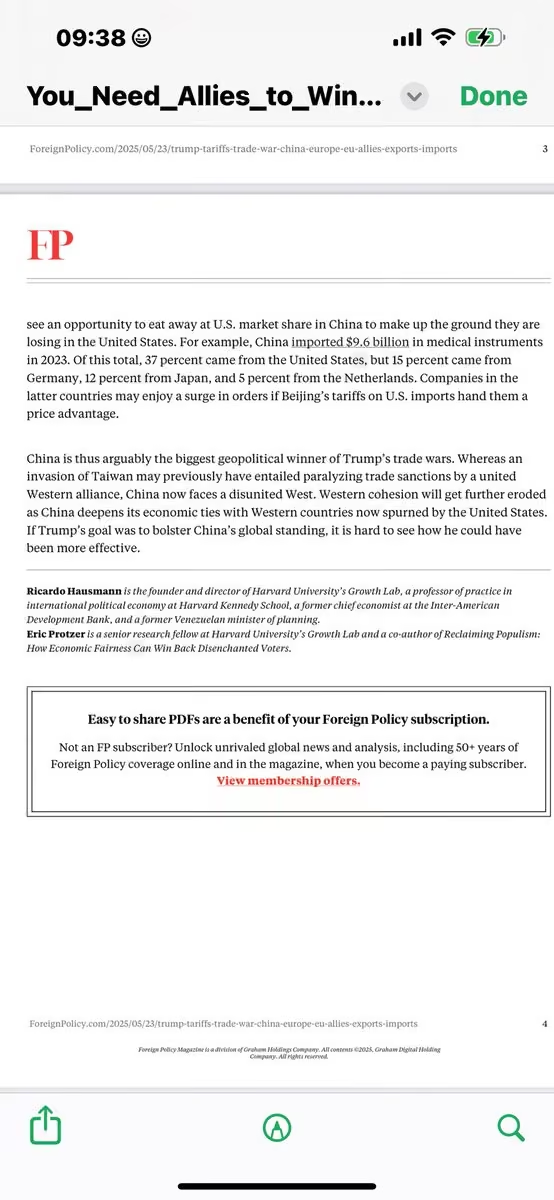
It is, at first blush, a startling idea: Donald Trump is cut from a cloth similar to that of Mao Zedong or Fidel Castro.
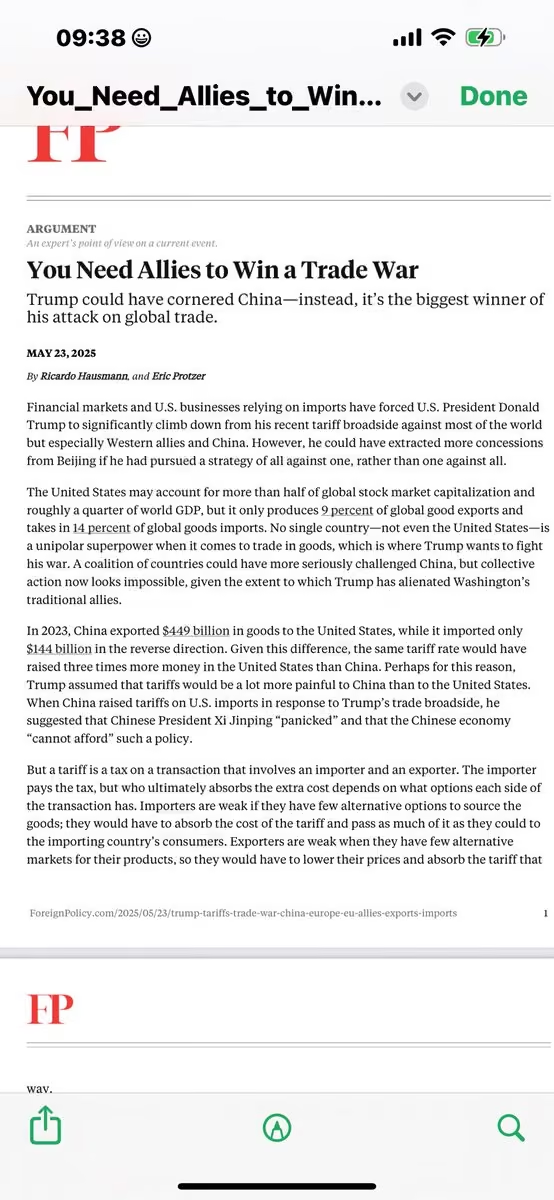
But all three men are best understood as revolutionary leaders, dedicated to the destruction of institutional norms, says Ricardo Hausmann, a noted economist whose views are informed by personal experience. His Jewish parents fled the Holocaust for Venezuela. There, Prof. Hausmann served as minister of planning and on the board of the country’s central bank before leaving for the U.S., where he is a scholar at Harvard and founding director of The Growth Lab, a hub for economic and policy research.
In recent weeks, his position has given him a personal stake in the White House demands of universities, as the Trump administration contemplates stripping Harvard of its tax-exempt status and ability to recruit foreign students.
Can you talk about how your background informs your perspective on what we’re seeing in the U.S. today?
Ricardo Hausmann: My parents both survived the Holocaust and got to Venezuela, my father in 1943 and my mother in 1949. The perception was that Europe was unstable, and by contrast Venezuela was a stable democracy. Then in 1999, Venezuela started down the road toward authoritarianism and now outright dictatorship.
So, you realize that you go through periods in which life seems so orderly, and then these worlds sometimes collapse.
Do you think your experience has allowed you to see things more clearly than what others, who have only grown up living in a stable U.S., may struggle to see?
Prof. Hausmann: Once you’ve seen democracies die on you, you kind of develop a sense of foreboding as you see some signs of that happening in the U.S. My colleague Steven Levitsky wrote the book on how democracies die. And that book is full of Venezuela. So there is a certain déjà vu in the current state of affairs in the U.S.
Let’s start with where you draw optimism at the moment. Where do you see key differences in the U.S. relative to what you experienced in Venezuela?
Prof. Hausmann: In any society, there are some forces that protect the status quo.
Nineteenth-century British political philosopher Michael Oakeshott was saying that the conservative predisposition starts with appreciating what you have in life. What you have is, in part, a bequest of the past.
Contrary to that is a more revolutionary predisposition that starts by saying that what exists is bad. If something exists, it’s proof of its corruption. That makes you want to change anything that exists.
There is also this additional tension in any liberal democracy, because democracy means in some sense the rule of the majority. And liberalism means that people have inalienable rights that cannot be taken away by a majority.
So when societies suddenly are in a more revolutionary situation, they find checks and balances – all these mechanisms that protect individual and minority rights – to be an impediment to realizing the will of the majority. Then suddenly you see an attack on the institutions that guaranteed the individual liberties and freedoms that you took for granted.
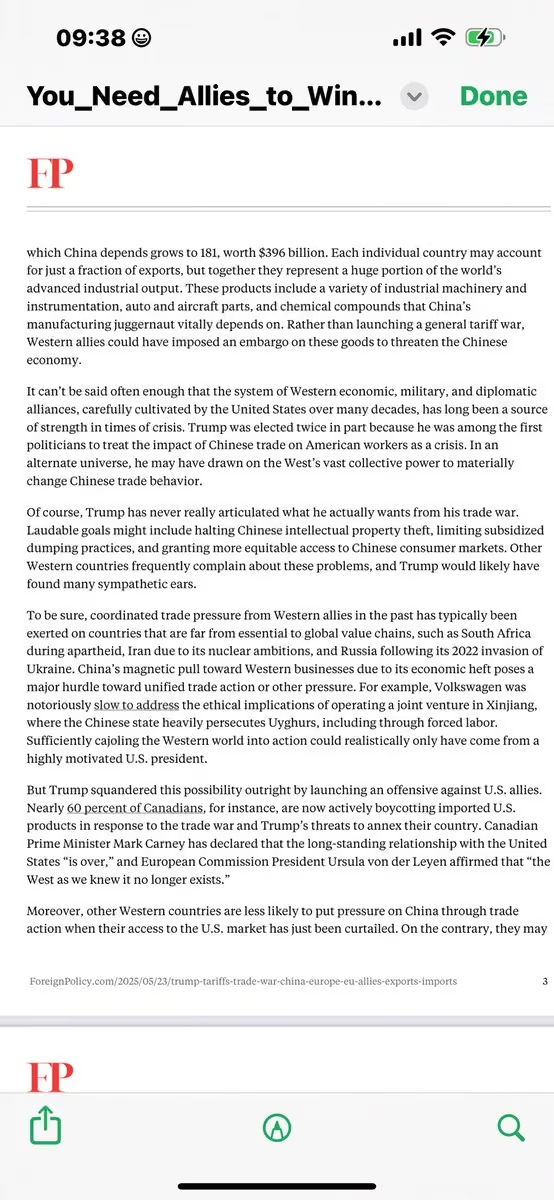
In that context, I think Trump is a revolutionary figure. He wants to destroy all the rules of what he inherited.
Harvard versus Trump is the new battle for independence
If Trump is a revolutionary figure, what does that tell us about the next three-and-a-half – or more – years will look like?
Prof. Hausmann: Sometimes I think that Trump is doing so many changes to so many things that it may look like Mickey Mouse and the Sorcerer’s Apprentice, where he starts destroying things and suddenly loses control.
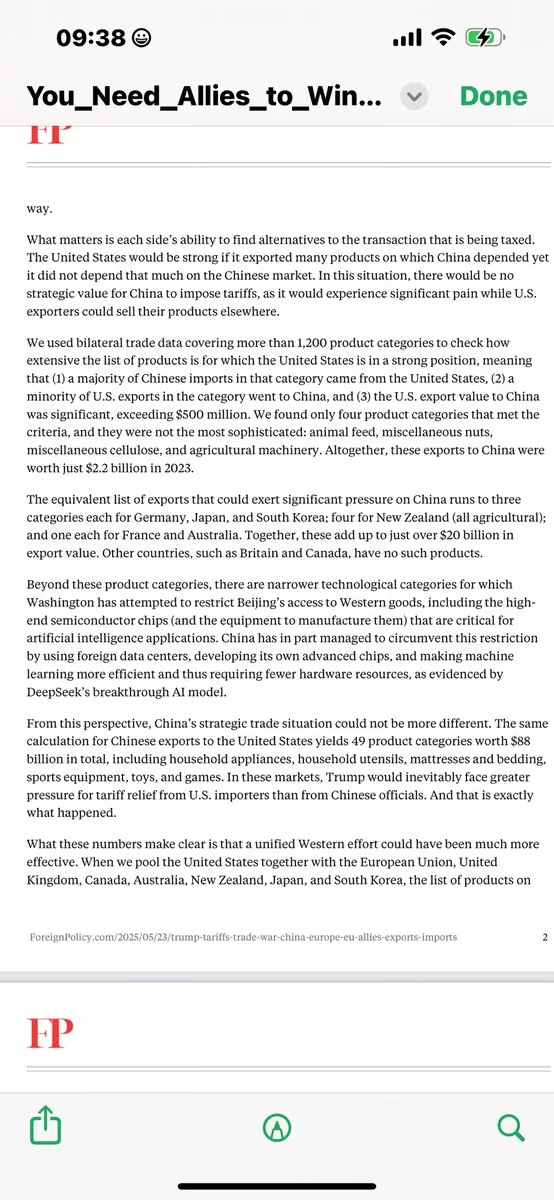
Trump may not understand how the U.S. benefits from the international order that he inherited, in which the U.S. has a very substantial advantage in technology. That technological advantage creates an enormous possibility of making money by deploying that technology globally.
That has worked remarkably well for the U.S. The U.S. is supposedly running this very large deficit in goods, but that deficit is completely compensated for by its surplus in services sold to the rest of the world. Central to that is American intellectual property.
So the Magnificent 7 in the stock market – Apple, Google, Facebook, Netflix, etc. – they make more than half of their revenue abroad. That doesn’t appear as U.S. exports.
And now he’s destroying the ability to monetize technology abroad. And he’s destroying the ability to create the technology by attacking the scientific ecosystem. So he is in a process of killing what has been the basis of American prosperity, with the idea that somehow the marvel that he inherited is somehow hurting the U.S.
If one wants to restrain the destructive nature of a revolutionary leader, how does one do that? Is it even possible?
Prof. Hausmann: Right now, all the actions that he is taking have a very flimsy legal basis. And they are all being challenged in the courts. We will see if the courts stop him or not – but the courts made him immune to criminal prosecution for decisions he takes. And we’ll see if he loses control of the House of Representatives in November, 2026, and if suddenly he doesn’t have a pliant legislature.
Will the system of powers become an obstacle to his attempts to have no constraints on the exercise of his agenda? That all remains to be played out. That’s where the battle is.
What is your current level of optimism in this idea that the broader U.S. institutions will hold? Or are you, like some of your academic colleagues, thinking of moving to Canada?
Prof. Hausmann: This is a fantastic opportunity for Canada to become a scientific and technological powerhouse, in the same way as the U.S. became a scientific and technological powerhouse by absorbing refugees from Germany. Scientific and technological prowess is very hard to develop from a human perspective, but it’s very easy to attract from a geographic perspective. And if the U.S. becomes this place that’s inhospitable to intellectual workers, countries that are able to attract them and create an environment for their flourishing can suddenly become a technological powerhouse in a very short time.
The idea of the U.S. becoming inhospitable – isn’t that a far-off prospect?
Prof. Hausmann: No. Trump is questioning assumptions that liberal democracies have given their citizens for a long time, because they see this incredible bequest of the past – the best universities in the world, the most advanced scientific and technological ecosystem in the world – as enemies. And these people have options.
This interview has been edited and condensed.


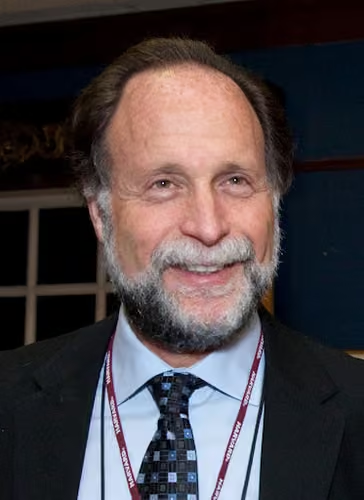 Ricardo Hausmann
@ricardo_hausman

 Miguel Angel Santos
@miguelsantos12
 Georgetown Americas Institute

 Edmundo González

 José Morales-Arilla
 Ilan Goldfajn

 Rodrigo Gómez de laT
 Comité Empresarial Ecuatoriano


 David Alandete
 Federico Alves, Econ.
 Roberto Rodriguez Tejera
 Pratyush Prabhakar

 Harvard's Growth Lab


 carmelina vera

 Pedro Mario Burelli
 Enderson Sequera S.
 Letras Libres
 Max Bell School of Public Policy

 chubeto.eth - Jesus Bolivar
 Enrique Krauze
 León Krauze
 Rosendo Grobo
 Orlando Viera-Blanco
 Ana Julia Jatar

 Juan Carlos Lopez


 Secretary Marco Rubio
 JoseMSalazarX_CEPAL
 CEPAL


 Rafael Febres-Cordero
 Red Global de la Diáspora de Venezuela


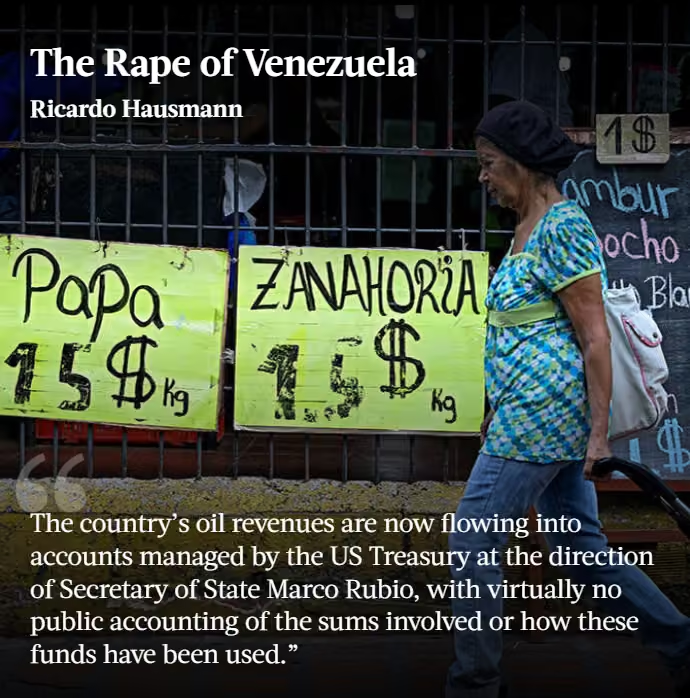
 SOS Orinoco

 Jose Ignacio Hernández G.
 Guillermo Arcay Finlay

 Amb Antonio Garza
 Rick Scott

 Nanik Singh Castillero☀️🌬🔋🚗🔌⚡️
 Daniel Matamala
 rodolfo rojas
 Fabián Acuña H.


 Melissa Chen

 Jonathan Benchimol

 Dwarkesh Patel


 Claude
 Mikayil Jabbarov


 Azerbaijan Business Development Fund


 Jose Luis Lupo


 Jaime Dunn


 Mauricio Ríos García


 LSE School of Public Policy


 Francisco J. Monaldi


 CHBA National
 Maite Rico 🌻
 Jesús Manuel Rey
 Pablo Uribe


 Viceministerio de Producción y Comercio Exterior

 Ivan R. Mendez

 Movimiento Ciudadano Venezolanos en el Mundo
 eduardo yeyati

 Luca Repetto



 Juan Pappier


 Joe Weisenthal
 Mihir Shah


 La Gran Aldea
 Barry Eichengreen

 Javier Corrales

 Veronica Frisancho


 Anna Stansbury


 Antonio Mele
 Ricardo Ávila Pinto
 Alejandro Domínguez

 Jason Bordoff
 Center on Global Energy Policy
 Sebastian Hurtado
 Domingo F. Cavallo
 tom keene

 Roberto PAIVA


 Rodrigo Cárdenas


 Televidentes CNN-EE
 Rebecca Bill Chavez


 Braulio Jatar Alonso


 الهيئة الملكية لمدينة الرياض


 Dany Bahar 🌎🎗️

 Juan Forero


 Noel Poler
 Sebastian Galiani
 Leonardo Vera


 Kaushik Basu

 Jesús Fernández-Villaverde

 Ketan Ahuja


 CONECTA

 Francisco Roch


 Thomas Bourany


 José Miguel Vivanco
 Andrés Neumeyer
 Hector Mujica
 Brian Winter
 Ricardo Del Bufalo


 Codeso Sonora

 Lucía Meza


 Nico Ajzenman


 Jorge Castro

 Última Hora BluRadio
 Marco Llinás
 Juan Pablo Segura

 Adam Esayag


 Christopher Landau
 Isabel Córdova Samaniego
 Guillermo Lasso Alcivar

 Tuffí Aré | Análisis

 Rayma


 Gauti Eggertsson 🇺🇦


 Eric Protzer 🇨🇦
 Kevin J. Brady, CFP®


 Ibrahim Mayaki
 Rodrigo Pacheco

 R Meléndez-Ortiz
 Walter Molina


 Gabriel Bastidas


 International and Monetary Economics Network

 Oleg Itskhoki


 Mark Coughlan

 Jeremy Marsigli

 Helen Dempster

 Esteban Piedrahita 🇺🇦
 Nacho Montes de Oca


 Clemens Graf von Luckner


 Guillermo Mondino


 Emilie Sweigart
 Carlos Pérez 🇨🇴
 Juan Pablo Remolina
 Políticas Públicas


 Simplifying Complexity
 Derek Yip
 Jason Furman


 Mick Ryan, AM


 Andrés Fortunato
 Matt Loszak | Aalo Atomics


 Jorge Paradela


 Andrés Velasco

 Paul Novosad


 Yulia Svyrydenko


 edmundogs💚


 Blue Apple 🗝️

 Tymofiy Mylovanov
 Omar Zambrano

 Fundación COLFUTURO


 Urkhan Seyidov
 Piroska Nagy Mohacsi
 VoxEU


 Eric Farnsworth

 Ulrich Schetter


 João Prates Romero


 Harvard Carr Center


 Complexity Science Hub


 Thomas Abt


 Luciano Capone
 Comando ConVzla


 Evelyn Matthei


 VE360


 Iria Puyosa


 Diana Mondino


 Moshe Schwartz


 Emmanuel Rincón
 EFE Noticias
 Pablo Lischinsky


 Dan Levy

 ABC de Sevilla


 Rafael Domenech | @BBVAResearch & @UV_EG
 Eduardo Lora
 Pierre-Alexandre Balland


 Johan Fourie
 Rocío Albert


 Tony Frangie Mawad
 Eduardo Hernández-Rodríguez

 Harvard CID
 Building State Capability
 Anton Eberhard
 Gustavo Tovar Arroyo


 Kwena Molekwa


 LAURENTZI ODRIOZOLA

 Thiago Padovan
 Riccardo Crescenzi
 Sandra Aguilar-Gómez
 Anyarlene Berges


 Centre for Development and Enterprise


 Ministerio de Industria, Comercio y Mipymes


 Profesor Carlos A Rossi


 Enrique Perret Erhard
 U.S.-Mexico Foundation


 Eliana Carranza


 Nagesh Kumar, PhD
 Finance for Development Lab
 Roberto Casanova

 Nirmala Sitharaman Office


 Vicente Díaz


 CEP XXI

 Sergio Contreras B:.
 Tobi Lawson
 Ewoma Vese
 Mossavar-Rahmani Center for Business & Government

 R Maria del Rio-Chanona
 Orkestra - IVC


 Etienne Espagne


 Tamara Taraciuk Broner


 Frank Muci
 Corfi


 Lee Harris
 Lorena Rivera Leon
 Simone Tagliapietra
 Jaime Bonet
 SACU Secretariat


 Jorge Galindo
 Mateo Hoyos


 Rudi Bachmann


 El Colombiano

 Mamo Mihretu


 HKS Executive Education
 PubAffairs EU Debates, News & Opinions 🇪🇺
 Asdrúbal R. Oliveros
 Ceteris Paribus Penn Podcast


 Mauricio Lizcano


 Mauricio Téllez


 Marino J. González
 William Jensen-Díaz

 Caracas Chronicles


