 Olivier Blanchard
@ojblanchard1

Trump is right. The election is rigged (not) 😊


Politicians, athletes, journalists, NGOs, companies... They all use corporation-owned social networks to communicate with us. Citizens shouldn't have to hand over their data to companies to read content published by public entities. Public Feeds changes that by making posts of popular accounts freely available. Read more.

Olivier Jean Blanchard (French: [blɑ̃ʃaʁ]; born 27 December 1948) is a French economist and professor. He is Robert M. Solow Professor Emeritus of Economics at the Massachusetts Institute of Technology, Professor of Economics at the Paris School of Economics, and as the C. Fred Bergsten Senior Fellow at the Peterson Institute for International Economics. More on Wikipedia
Robert Solow Professor of economics emeritus, MIT, Senior Fellow, Peterson Institute for International Economics Professor, Paris School of Economics
Olivier Blanchard
@ojblanchard1
Trump is right. The election is rigged (not) 😊
Olivier Blanchard reposted
 C dans l'air
@Cdanslair
"Il y a une augmentation des #revenus des plus riches et ce qu'il reste pour les autres est limité, dans un environnement où l'#ia fait que personne n'est sûr que leur boulot sera encore là demain. Il faut se préoccuper des #inégalités !" @ojblanchard1, l'invité de #cdanslair
Olivier Blanchard reposted
C dans l'air
@Cdanslair
"Une crise budgétaire, ce n'est pas une blague, c'est un ralentissement de l'activité ! Je m'inquiète de ça : on a ce problème de déficit budgétaire, avec 100 à 120 milliards à trouver et, pour le moment, il n'y a aucun accord pour y arriver..." @ojblanchard1, l'invité #cdanslair
Olivier Blanchard
@ojblanchard1
An interesting contrast.
In response to a tweet (in english) on the California tax on super rich, a tsunami of responses, nearly all on the same theme: Do not take money from the super rich: they put it to better use than the state.
In response to an article in Le Monde (in French) on the need to reduce the budget deficit, a large number of comments, nearly all on the theme: Take the money from the super rich. They don't deserve it.
Fascinating difference.
Olivier Blanchard
@ojblanchard1
Amateur poli sci: My reading of election results: 60% due to rejection of Trump, 30% to attractive democrat candidates, 10% to a democrat agenda. For the democrats to win in 2028, need to drastically change the proportions.
Olivier Blanchard
@ojblanchard1
A serious question (rather than dumping on this poor woman). Can school teach the minimum amount of critical thinking, so that there are not too many people who think like this? And if so, how?
 Brendan May
@bmay
Oh god. I wish I hadn’t seen this.
Olivier Blanchard reposted
 Love Music
@khnh80044
Centuries ago, someone invented this magnificent instrument, and another created this breathtaking piece of music. Now, we get to witness such a brilliant performance. Life truly is a miracle.💖
Olivier Blanchard
@ojblanchard1
Given current context, important to understand how ratings assess the relative role of debt, deficits, and other factors. I hope this starts a useful discussion.
 NBER
@nberpubs
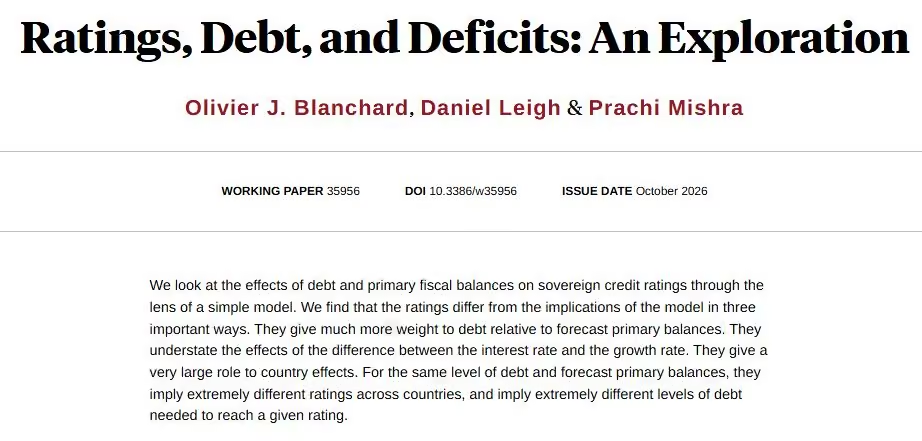
Examining whether sovereign ratings are consistent with economic theory, from @ojblanchard1, Daniel Leigh, and @MishraPrac www.nber.org/papers/w35956
 Olivier Blanchard
@ojblanchard1
LFI: Rather than cancel the French debt held by the Banque de France, what about hacking Binance?
Olivier Blanchard
@ojblanchard1
Let me pick up on this tweet, which is well argued.
No disagreement about the fact that (most, not all, of) the current centi billionaires have done a lot for mankind (most of it good, not all. The probability of AI leading to the end of the world, not so good…).
My thanks and my hat’s off to them.
It is still the case that, in the process, they have accumulated fortunes, far more than they will ever need. I see no logical reason why we should not ask them to share those, at least as much as we do for others.
Or do we adopt this as a rule? If a doctor saves many patients, she should not pay taxes?
(PS. The notion that if they lose some of their wealth this will destroy investment is a non-starter. If the projects are worth doing, other investors will happily come in.)
 Brivael Le Pogam
@brivael
A man who lost his voice to ALS is talking again at conversational speed. In his first week.
No gala dinner did that. No foundation press release. No "commitment to awareness."
Neuralink just shared early data from its speech restoration trial: one ALS participant hit 75 words per minute with a 5.8% error rate on a 125,000-word vocabulary, in the first week. For context, normal conversation runs around 120 to 150 words per minute. A few years ago, people in this condition were spelling words one letter at a time with their eyes. Now they're getting close to talking normally, in their own voice, straight from their brain.
Let that sink in. A disease that slowly locks you inside your own body, and someone just built a door.
And here's what's funny. For months, journalists and politicians have been telling us that Elon should "give his money away." Redistribute. Write the big check. Be a good billionaire.
They have it backwards.
Giving money away is the easy part. Anyone can sign a check. Most billionaire philanthropy today is reputation management. You fund a foundation, the foundation funds NGOs, the NGOs fund think tanks and campaigns, the think tanks shape policy, the media covers it warmly, and half the outlets covering it are owned or funded by the same billionaires. Everybody gets a nice headline. The money circulates in a closed loop of people who all know each other. The problem being "addressed" is still there twenty years later, because solving it was never really the business model. The business model was looking like you care.
That's not philanthropy. That's crony capitalism with a charity logo on it.
Now look at the other model.
Give a voice back to people with ALS. Let paralyzed people control a computer with their thoughts, and push toward restoring movement. Work on giving sight back to the blind. Make electric cars mainstream and push transport toward autonomy so getting around doesn't cost a fortune. Put high-speed internet in villages no telecom company would ever bother with. Make access to space radically cheaper. Bet on robots and cheap energy that could one day make building a home affordable without signing up for 25 years of debt.
None of that came from redistributing wealth. All of it came from creating it.
That's the part people refuse to understand. Wealth is not a fixed pie you slice differently. It gets created when someone solves a real problem for real people at scale. And when you do that, you don't help a few thousand people with a grant. You change the baseline for billions of people, permanently, and the solution keeps getting cheaper every year.
A check gets spent once. A solved problem stays solved.
Gates-style philanthropy is going to fade in the coming decades. Not because the people are evil, but because the model is slow, political, captured by intermediaries and optimized for image. Gates himself has announced his foundation will shut down by 2045.
Musk-style philanthropy will become the standard. It just doesn't call itself philanthropy.
It's called entrepreneurship. Value creation. Capitalism.
The most generous thing you can do for humanity is build something that makes an impossible thing ordinary.
Ask the guy who just got his voice back.
 Neuralink
@neuralink
Early Neuralink speech restoration data:
We are enabling speech to text and voice at conversational rates in participants with ALS. One participant achieved 75 WPM at 5.8% WER on a 125k-word vocabulary in their first week.
Olivier Blanchard
@ojblanchard1
econvitals is an amazing new resource. On the one hand, it shows the power of AI, when well domesticated (by Jason). On the other, it produces incredibly useful stuff. A definitive follow.
 econvitals
@econvitals
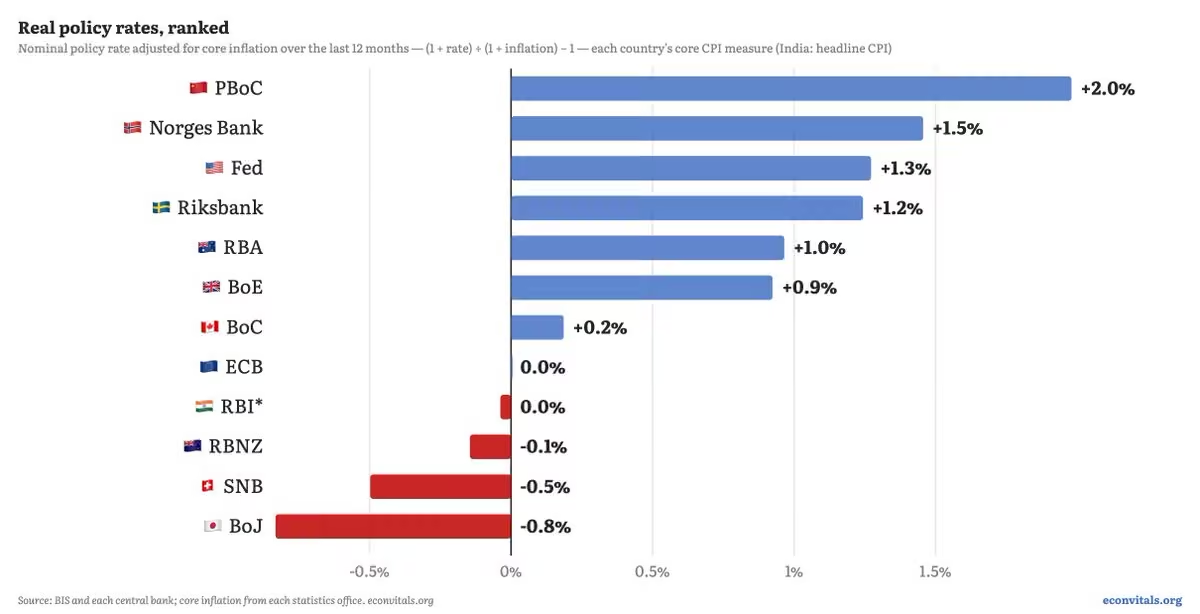
Unusually, the Fed’s real policy rate is among the highest of major central banks. One plausible reason is stronger U.S. growth: the New York Fed puts the neutral real rate at 1.0 percent in the United States, 0.1 percent in the euro area.
econvitals.org
Olivier Blanchard reposted
 dwayne woods
@twittwoods
The fools have been blanchi by Blanchard
 Olivier Blanchard
@ojblanchard1
Reacting to the comments on my centibillionaires tweet.
“The state is evil. Taxes are theft. Revenues are wasted. I am a communist (not to mention that I am french)” I get the message.😟
But I am still struck at the intensity of feelings (insults?). Really? That bad? Nothing good to say about the state? Fine that centibillionaires pay proportionally less than some of you?
The terrain has too many mines (should probably replace “mines” by “drones”) for a discussion to be productive. But I cannot resist making a few points.
If the firm has no liquidity, the tax could still be paid by giving the state non-voting shares. If the firm does well, the government will benefit. If it does poorly, so will the government.
Sounds communist to you? This is exactly what the profit tax does in every country in the world: the state gets a lot when times are good, nothing when times are bad. The state is already a passive investor.
Yes, the funds are not idle, and much is invested in new projects (I knew that, did not need to be told). But if the projects make economic sense, which I assume most do, then the wealth tax should have little effect on investment. The wealth tax does not affect future returns. If they need more funds, Musk and all should have little trouble finding investors.
Happy to have a polite discussion.
Olivier Blanchard reposted
 Thomas Bate
@tjbate2000
These are all smart and accomplished people. They know that giving the money to government via a wealth tax is a waste and that when they have time they will be able to allocate their money much better than funding ever more handouts from politicians to buy votes.
They will invest for the future.
Olivier Blanchard
@ojblanchard1
Seeing the tsunami of comments, I realize the irony:
You are right that I was admitting to puzzlement at the fact that (many, not all) centi-billionaires act like the homo economicus of the basic economic textbook😀: They maximize utility (or at least wealth), try to keep as much as they can, and the hell with other motives.
And, indeed, this is what puzzles me. I would have thought (but this is the left wing me…) that they would care about more, including the welfare of others less lucky, and would be willing to pay the tax. That they might even volunteer to help (a few of them actually do).
I hear from the comments (although I suspect none comes from a centibillionaire…) is that maybe they care (although some of the comments are : Why should they?). But, even if they do, they do not trust the government not to come back with another “one time tax”. And that money given to the government is a waste of money. This may indeed be the reason, and I should not have been surprised.
I am afraid that there is not much the CA state can do in terms of credible commitments not to come back for more. But on the waste argument. The centibillionaires could have come back and offered public private partnerships to fund specific projects that they find worth funding. (Or maybe the state could have offered them)
Olivier Blanchard
@ojblanchard1
What amazes me is the attitude of so many of the centibillionaires.
A 5% tax will not make any difference to the way they live. Their spending may be extravagant, but it is still much less than their (correctly measured) income.
They know that, as gifted as some of them indeed are, they have benefited from extreme luck (and the help of the state, and, to speak like an economist, monopoly rents).
They know that their effective tax rate is low, relative to what many others pay.
They know that extreme inequality is extremely unpopular, and can lead to political unrest, backlash, or worse.
They must admit that, morally, it is hard to argue for a society in which some become obscenely wealthy, while so many are poor and see their income stagnate.
They typically have not indicated that they are building their wealth to eventually make the world a better place.
But they are still willing to fight the tax, spending hundreds of millions in California to avoid paying the tax. Why?
They simply think what is theirs is theirs, end of story.
They believe in the slippery slope, and if they do not take a stand on this levy, the government will come back for more.
They hate the state and the notion that their money will be misused?
Or?
 Gabriel Zucman
@gabriel_zucman
This is huge.
A just-released SEC filing makes an extraordinary revelation: Mark Zuckerberg is getting ready to pay California’s 5% billionaire wealth tax and has signed an agreement to remain in California for 8 years.
We are witnessing a global turning point unfold before our eyes. 🧵
 Olivier Blanchard
@ojblanchard1
To be very clear, when giving policy advice, I take into account the likely behavior of those potentially affected by it.
This is why, while I have endorsed the Zucman tax, I have argued for a lower rate than he, as I am more worried than he is about the elasticity of tax avoidance to the tax rate.
My post is about trying to understand the behavior of the centi billionaires, surely not to dismiss it.
Olivier Blanchard
@ojblanchard1
What amazes me is the attitude of so many of the centibillionaires.
A 5% tax will not make any difference to the way they live. Their spending may be extravagant, but it is still much less than their (correctly measured) income.
They know that, as gifted as some of them indeed are, they have benefited from extreme luck (and the help of the state, and, to speak like an economist, monopoly rents).
They know that their effective tax rate is low, relative to what many others pay.
They know that extreme inequality is extremely unpopular, and can lead to political unrest, backlash, or worse.
They must admit that, morally, it is hard to argue for a society in which some become obscenely wealthy, while so many are poor and see their income stagnate.
They typically have not indicated that they are building their wealth to eventually make the world a better place.
But they are still willing to fight the tax, spending hundreds of millions in California to avoid paying the tax. Why?
They simply think what is theirs is theirs, end of story.
They believe in the slippery slope, and if they do not take a stand on this levy, the government will come back for more.
They hate the state and the notion that their money will be misused?
Or?
Gabriel Zucman
@gabriel_zucman
This is huge.
A just-released SEC filing makes an extraordinary revelation: Mark Zuckerberg is getting ready to pay California’s 5% billionaire wealth tax and has signed an agreement to remain in California for 8 years.
We are witnessing a global turning point unfold before our eyes. 🧵
Olivier Blanchard reposted
 VoxEU
@voxeu
Ratings, debt, and deficits: An exploration
Olivier Blanchard @ojblanchard1 @MITEcon @PSEinfo @PIIE, Daniel Leigh @IMFNews, Prachi Mishra @AshokaUniv @EconAtAshoka
cepr.org/voxeu/columns/ratings-debt-and-deficits-exploration
 Olivier Blanchard
@ojblanchard1
i do not know dwayne woods, but what he produces is good (and fast).
dwayne woods
@twittwoods
As Jacques Brel would say, le vent du Nord is a .....
 Olivier Blanchard
@ojblanchard1
The Nobel Prize given to Mike Woodford and Bob Hall will re-trigger discussions about the so-called New Keynesian model. Some will hail it as an unambiguous success, building macro from micro foundations. Others will dismiss it as an empirically irrelevant construction, leading to complex models without much relation to reality.
As often is the case, truth is in between. I expressed my views, as a participant in the enterprise, but not an unconditional believer, in an NBER Macro piece last year. Given that the link has expired, I use this opportunity to repost it. shorturl.at/Xq7QG
Olivier Blanchard
@ojblanchard1
My criticisms of these equations are well documented 😀. shorturl.at/cPKLV But this is what a useful model does and has to be judged by the work and the discussion it triggers. Why is there more inflation inertia than implied by 1? What about liquidity constraints and limited rationality in 2? Are expectations as forward looking as RE? Etc. And, given these deviations, what are the implications for policy? Is the initial model useless, profoundly misleading, or a useful starting point? What remains when you make the changes you think appropriate?
Olivier Blanchard reposted
Olivier Blanchard
@ojblanchard1
My criticisms of these equations are well documented 😀. shorturl.at/cPKLV But this is what a useful model does and has to be judged by the work and the discussion it triggers. Why is there more inflation inertia than implied by 1? What about liquidity constraints and limited rationality in 2? Are expectations as forward looking as RE? Etc. And, given these deviations, what are the implications for policy? Is the initial model useless, profoundly misleading, or a useful starting point? What remains when you make the changes you think appropriate?
Olivier Blanchard
@ojblanchard1
A quick reaction. Both well deserving of the prize. Research styles could not be more different. Woodford is a cathedral builder, building stone by stone. His main book is an encyclopedia. Hall is an intellectual butterfly, looking for new angles. His main contribution is a superb insight, which changed the way we think about consumption. It takes both to make a field advance. Congratulations.
 The Nobel Prize
@NobelPrize
BREAKING NEWS
The Royal Swedish Academy of Sciences has decided to award the 2026 Sveriges Riksbank Prize in Economic Sciences in Memory of Alfred Nobel to Robert E. Hall and Michael Woodford “for microeconomic foundations of macroeconomic stabilisation.”
#nobelprize
 Olivier Blanchard
@ojblanchard1
merci gerard
 La femme merveilleuse invisible
@larwoolf
Ne me quitte pas
Il faut oublier
Tout peut s’oublier
Qui s’enfuit déjà
Oublier le temps
Des malentendus…
Remembering Jacques Brel
8 April 1929 – 9 October 1978
Olivier Blanchard
@ojblanchard1
Marine le Pen s’est mise dans une situation interessante.
D’un côté : Promesse de mise en place d’un programme d’ajustement budgetaire, avec ajustement du deficit primaire d’au moins 0.5% du PIB par an. Vérification des hypothèses par le Haut Conseil des Finance Publiques, HCFP. Des contraintes qu’un gouvernement allemand pourrait s’imposer…
De l’autre : un programme d'ajustement basé sur des hypothèses et des mesures presque toutes illusoires, qui seraient surement rejetées par le HCFP si elles étaient présentées aujourd’hui, et rejetées demain par le HCFP si elle était elue. Que se passe t’il alors à ce moment-là ?
Olivier Blanchard
@ojblanchard1
The timing of the paper could unfortunately not be better, given the evolution of the spread on French bonds…
The central mechanism in the paper: The strength of the effect of the subjective probability of default on the actual probability of default.
The main implication, put roughly: spreads can jump a lot in response to even small bad news about the likely evolution of debt.
The other implication, nerdier, and more paradoxical: Higher macro of fiscal uncertainty weakens the effect of the subjective probability on the actual probability and makes jumps and multiple equilibria less likely.
@GonHuertas gives a more precise, visually beautiful, explanation. Look at it.
I shall use the occasion however to reflect on something else, namely the frustration and the pleasure in doing research. This paper was started six years ago… At the time, it looked like a straightforward challenge: Characterize the solution to a simple, although nonlinear, equation: The evolution of debt depends on the interest rate, which depends on the risk of default, and thus in turn on the evolution of debt.
For much of the six years, I banged my head against the wall, thinking I had the solution until it collapsed, trying again and again. The project became known at home as "the wall". Then, @GonHuertas who was my RA at the time, and @Pmbruera, then an MIT student, took pity on me and came to the rescue. And we did succeed.
Frustration, then elation. This is why I have loved doing research for the last N years.
 Gon Huertas
@GonHuertas
When public debt grows, default risk can jump suddenly.
Our new paper with @ojblanchard1 and @pmbruera finds that higher fiscal uncertainty reduces (!) the range of debt levels where self-fulfilling defaults can happen.
It's been years in the making.
www.nber.org/papers/w35850
Olivier Blanchard
@ojblanchard1
to those who have me on their contact email list: I have been hacked. Do not open an "invite" email from me. With apologies to all
Olivier Blanchard reposted
 Quentin Vandeweyer
@QuentinVandewe2
Traiter « le marché » comme un bloc qu’on pourrait intimider est une erreur. En s’y essayant, Mélenchon rend la position financière de la France plus précaire, pas moins. (1/8)
 Jean-Luc Mélenchon
@JLMelenchon
Ne provoquez pas une crise en répandant une ambiance de panique autour de la France.
Les 3000 milliards de dette ne sont pas les nôtres. Ce sont ceux d’investisseurs étrangers à 60 %. Qu’ils soient prudents avec les Français.
S’ils s’amusent à vouloir mettre la France en banqueroute, ils en paieront l’addition.
#le710inter
Olivier Blanchard
@ojblanchard1
Arrêtez les âneries (je reste poli) sur les vilains spéculateurs, la dictature des marchés, etc.
Les marchés, ce sont les investisseurs, qui décident d’où placer l’argent des épargnants, qu’ils soient francais, américains, ou autres. Si vous avez un peu d’épargne (vous avez un livret A?), il y a une bonne chance que ce soit vous, et que vous préféreriez etre repayés.
Autrement dit, a qui pensez-vous que les gouvernements doivent emprunter , sinon aux épargnants?
 Osons Causer
@OsonsCauser
Mais c’est quoi ce chantage ?
On devrait s’interdire de débattre ou de proposer parce que « les-marchés-zaiment-pas-beaucoup-ça » ?
1- Il est urgent de débattre de la mainmise des marchés sur nos choix politiques
2- Et les 5,4% de PIB de déficit de Macron, on en parle ?
Olivier Blanchard
@ojblanchard1
Une réaction à chaud et un message a tous ceux qui sont en campagne présidentielle. Ne mettez pas de l’huile sur le feu.
Des propositions irresponsables, au cours des dernières semaines, ont fait augmente les taux sur les obligations françaises, de 0.75% par rapport a l’Allemagne. Une augmentation du taux d’interet de 0.75% implique de trouver 20 milliards de plus d’économies ou d’impots supplémentaires pour stabiliser la dette par rapport au PIB.
Le budget propose par le gouvernement est loin d’etre parfait. Mais je pense que vous le préférerez à un budget exigé par la BCE pour aider la France a faire face à ses obligations tout en respectant son mandat. Celui-là sera beaucoup plus dur. Choisissez.
Olivier Blanchard
@ojblanchard1
Reposting a graph, which is unfortunately very relevant for France today. Namely, when it appears that debt may be becoming unsustainable, the interest rate increases first slowly, then suddenly.
(The underlying paper comes out this week, and, when it does, I shall tweet more about the actual implications)
Olivier Blanchard
@ojblanchard1
Useful to summarize the discussion about debt and spreads in a graph (based on work with @pmbruera and @Gonhuertas. Working paper out soon).
The blue line shows the “good equilibrium” if investors are rationally optimistic. At very low debt, no risk of default, no spread, then a slow increase, and eventually a sudden jump and default. So, if things get worse (high continuing deficits, increasing debt ratio), reasons to worry.
But, even if things do not get worse, and investors turn (rationally) pessimistic, they require a larger spread, the interest rate jumps and default happens faster.
I think France is roughly at point A: small spread, but reasons to worry. Deficit is too large, so France keeps moving to the right. And, even if not, equilibrium could jump to point B, with a higher spread.

Olivier Blanchard reposted
 Glenn Gould
@GlennGould
While we may no longer hear Gould at the piano, we are forever grateful to have his remarkable recordings and interpretations to return to....
Listen to Glenn Gould's Goldberg Variations today!
🎧fanlink.tv/GoldbergVariations1981
Olivier Blanchard
@ojblanchard1
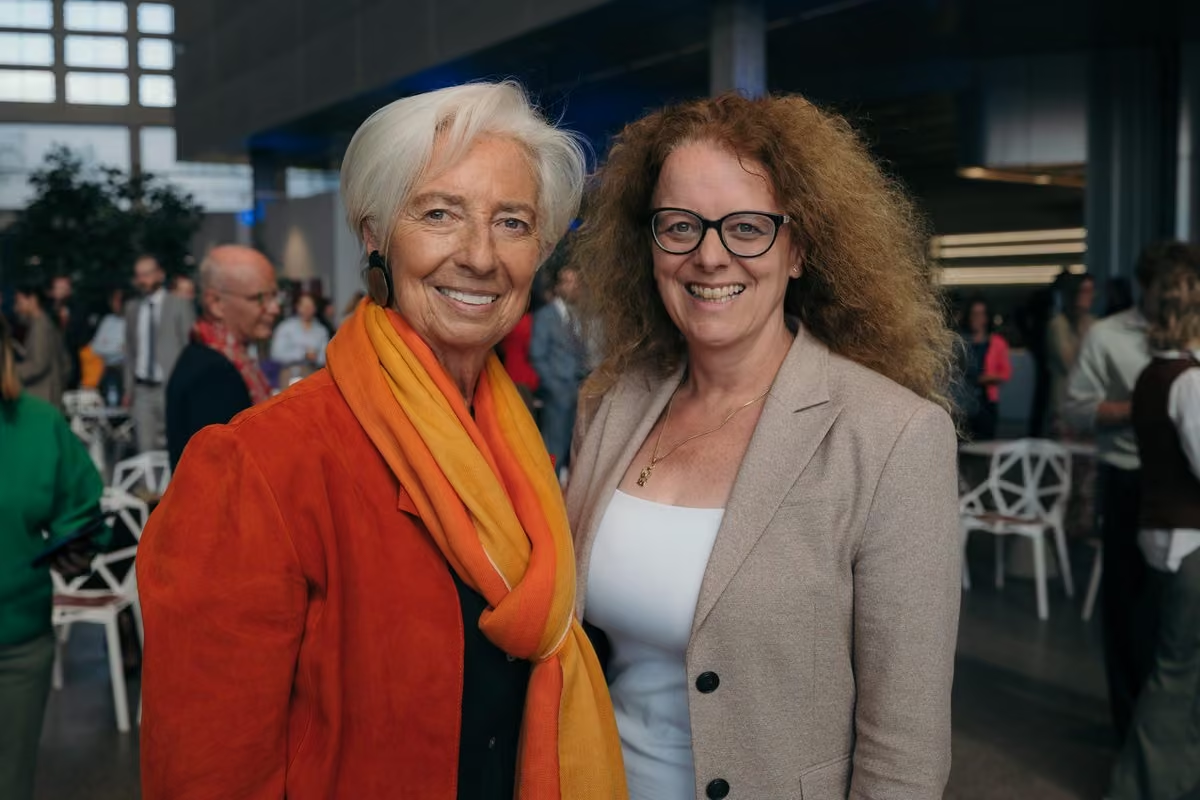
Bad news for the ECB. Great news for the IMF. Hard to think of a more competent person for the IMF finance job. Isabel and I have not always agreed, but I have always learned from our interactions, and she has done an amazing job at the ECB. Her speeches, and especially her slides..., are keepers, remarkable by the quality of the work and the presentation.
 Christine Lagarde
@Lagarde
Dear Isabel, a heartfelt thank you for your outstanding work at the ECB.
Your commitment to public service has been invaluable to our institution and to the people we serve in Europe.
Thank you for your dedication to the European project.
 Olivier Blanchard
@ojblanchard1
lisez le texte attentivement. Je suis explicite et agnostique sur le fait que l'ajustement peut se faire par les depenses ou les revenus. (J'ai mes propres idees sur la question). Mon argument que la somme doit etre egale a 2700 euros par adulte ne depend pas de ca.
 Rabelais
@Rabelai85524127
Cher Olivier Blanchard,
L'ire que vous avez declenché contre vous est probablement excessive.
Souffrez néanmoins la remarque suivante : vous ne coupez dans aucune dépense.
C'est inacceptable et suicidaire.
Vous avez appris à penser où ?
Olivier Blanchard
@ojblanchard1
Je suis toujours étonné par la violence de certains commentaires.
Mon tweet ne faisait que faire de l’arithmétique.
A moins de penser que la dette peut augmenter éternellement plus vite que le PIB, if faut a terme réduire le deficit de 150 milliards. Bien sûr, pas en un an, mais disons sur 5 ans. Qui peut etre en desaccord avec ca ?
J’étais explicite sur le fait que l’ajustement pouvait se faire par une combinaison d’une diminution des depenses et une augmentation des revenus. Le tweet etait agnostique sur ce point. Chacun a ses opinions….
Je voulais ensuite traduire ce chiffre en un chiffre plus parlant, un chiffre d’ajustement par personne. J’aurai pu (peut-etre aurais-je du) diviser simplement par la population totale, donc un ajustement de 150 mds/68 ms, ou 2200 euros par personne, ou par la population adulte, donc 150/55, ou 2700 euros.
J’ai choisi de diviser par le nombre de foyers fiscaux, donc 150/40, donc 3 750 euros, ou par le nombre de foyers fiscaux qui paient l’impot sur le revenu, 150/20, donc 7500 euros. Vu certains commentaires, c’était une erreur pédagogique. Le calcul n’impliquait nullement que tout l’ajustement devait se faire par l’impot sur le revenu.
Pour résumer et clarifier, le chiffre qu’il faut se rappeler est probablement la taille de l’ajustement par personne adulte, que ce soit par diminution des depenses ou augmentation des revenus, donc 2700 euros.
Olivier Blanchard
@ojblanchard1
Un calcul qui donne à réfléchir.
La réduction du déficit (que ce soit par une baisse des dépenses ou/et une hausse des recettes) nécessaire pour stabiliser la dette par rapport au PIB : 150 milliards (par exemple, une diminution du deficit de 30 milliards chaque annee par rapport a l'annee precedente, sur un quinquennat).
150 milliards est un chiffre très abstrait. Plus concretement :
Il implique un ajustement de 3 750 euros par an par contribuable (foyer fiscal).
Si l'on exclut les contribuables qui ne paient pas d'impôt aujourd’hui, il implique un ajustement de 7 500 euros par contribuable.
Plus on attend pour procéder à cet ajustement, plus les investisseurs s'inquiètent et plus les taux d'intérêt augmentent.
Une hausse de 1 % des taux d'intérêt implique de trouver 30 milliards supplémentaires, soit 1 500 euros par contribuable.
Des chiffres a garder en tête quand on regarde les programmes et les promesses des candidats a la Présidence.
Olivier Blanchard reposted
 Luca Fornaro
@LucaFornaro3
Here's the link to the full paper cepr.org/publications/macroeconomic-policies-innovation-d…. Here you can find the other pieces of the Europe 2050 initiative, they're really good food for thought cepr.org/europe-2050-geometries-peace-power-and-prosperity
Olivier Blanchard reposted
 Luis Garicano 🇪🇺🇺🇦
@lugaricano
We have just finished the inaugural meeting of the Rhine Group. We discussed the central elements of Europe's competitiveness agenda, including basic science, AI/compute and cybersecurity, defense, energy, entrepreneurship/start-ups.
I will be updating you on any progress we may have. Some of the projects we will pursue include:
- We'll help Europe catch up on compute (Mario Draghi diagnosed the problem and some solutions in a recent FT piece)
- We’ll help European universities and scientific institutions and explore a Rhine Chair program with European universities.
- We’ll work on some key EU policy challenges, including facilitating the flow of capital to entrepreneurs.
- We will set up a grants program that I will explain and announce here.
Olivier Blanchard
@ojblanchard1
An important and very good speech by @GabrielAttal on Europe: legrandcontinent.eu/fr/2026/09/17/le-moment-des-etats-uni…
If anything, the case for Europe is stronger than ever. It should be at the center of the political campaigns.
Olivier Blanchard
@ojblanchard1
I realize I did not give the link to the full paper on ratings, debt and deficits. Here it is: www.imf.org/-/media/Files/Publications/WP/2026/English/wp…
Olivier Blanchard
@ojblanchard1
Reason for specifically citing open weight (and therefore Chinese LLMs, but not only Chinese) is that, even if they have built-in guardrails, somebody with the relevant knowledge can go in and remove them. In principle, harder to do with Anthropic or Open AI LLMs.
Olivier Blanchard
@ojblanchard1
A worrisome thought during the night: What Ted Kaczynski would have done, if he had had access to open weight chinese LLMs.
Olivier Blanchard
@ojblanchard1
Ratings largely determine spreads. Yet, their construction remains largely a black box. Our paper assesses the relative importance of debt, deficits and country specific effects in the determination of these ratings. The evidence is at odds with a simple model of default: more importance of debt, less importance of forecast deficits, limited role of r-g, surprisingly large role of country effects.
We are agnostic. The model may be too simple in some fundamental ways. Or the rating agencies may be using incorrect weights. Or a mix of the two... We hope the paper triggers a useful discussion.
 International and Monetary Economics Network
@int_mon_econ
Super interesting!
"Ratings, Debt, and Deficits: An Exploration" by Olivier J Blanchard, Daniel Leigh, and Prachi Mishra.
"We look at the effects of debt and primary fiscal balances on sovereign credit ratings through the lens of a simple model. We find that the ratings differ from the implications of the model in three important ways. They give much more weight to debt relative to forecast primary balances. They understate the effects of the difference between the interest rate and the growth rate. They give a very large role to country effects. For the same level of debt and forecast primary balances, they imply extremely different ratings across countries, and imply extremely different levels of debt needed to reach a given rating."
www.imf.org/en/publications/wp/issues/2026/09/18/ratings-…
 Olivier Blanchard
@ojblanchard1
A worrisome thought during the night: What Ted Kaczynski would have done, if he had had access to open weight chinese LLMs.
Olivier Blanchard reposted
International and Monetary Economics Network
@int_mon_econ
Super interesting!
"Ratings, Debt, and Deficits: An Exploration" by Olivier J Blanchard, Daniel Leigh, and Prachi Mishra.
"We look at the effects of debt and primary fiscal balances on sovereign credit ratings through the lens of a simple model. We find that the ratings differ from the implications of the model in three important ways. They give much more weight to debt relative to forecast primary balances. They understate the effects of the difference between the interest rate and the growth rate. They give a very large role to country effects. For the same level of debt and forecast primary balances, they imply extremely different ratings across countries, and imply extremely different levels of debt needed to reach a given rating."
www.imf.org/en/publications/wp/issues/2026/09/18/ratings-…
Olivier Blanchard
@ojblanchard1
Let me stay away from personal remarks.
As you kindly invited me to do so, I am happy to continue our exchange.
Let me start by reproducing and then commenting on three remarks you make in your two recent tweets.
“I know full well what justified the use of OATi in 1998, namely a lower interest rate since the investor takes on less risk. Except that today, with the international context and climate disruption making prices more volatile, the cost of these indexed bonds is rising.”
My humble view: More volatile inflation makes inflation protected bonds more, not less attractive.
“As such, I stand by the view that the choice to keep issuing OATi is far more advantageous for the markets than for our own finances.”
My humble view. This is not a zero sum game. As most of government and investor spending move with inflation, both sides gain from writing a contract in which payment is inflation adjusted. Think of it as removing noise in a contract.
“The share of the debt that we hold is melting away like snow in the sun. In mirror image, this strengthens the share held by the markets, and therefore their monopoly on our debt.”
My humble view. I am not big on semantics. But calling literally the thousands of investors who buy French debt a monopoly is a little strange.
 Eric Coquerel
@ericcoquerel
Pas de souci pour échanger des arguments avec vous @ojblanchard1 mais un tout petit peu moins de condescendance dans l’échange ne serait pas de trop 🔽. Le résultat des politiques économiques que vous avez soutenues depuis des années devrait, je pense, vous amener à un peu plus d’humilité.
Je sais pertinemment ce qui a justifié l’utilisation des OATi en 1998, c’est-à-dire un taux d’intérêt moindre puisque l’investisseur prend moins de risque. Sauf qu’aujourd’hui, avec le contexte international et le dérèglement climatique qui rendent les prix plus volatiles, le coût de ces titres indexés s’accroît.
En résumé, leur coût final est largement supérieur à l’avantage que représente un taux d’intérêt plus faible au départ. C’est ce qui se passe depuis 2022. Prenons deux exemples.
» En 2022, ces OATi représentent 12,5 Md€ sur les 13 Md€ d’augmentation de la charge de la dette ! Et si les montants de dette levés par ces titres indexés l’avaient été grâce à des titres classiques, 10Md€ auraient été économisés.
» En 2026, sur la hausse de 3,6 Md€ du coût de la dette constatée en juin, 2,7 Md€ sont liés à cette indexation.
Dès lors, je maintiens que le choix de poursuivre à émettre des OATi est bien plus intéressant pour les marchés que pour nos propres finances. Les Allemands ont d’ailleurs arrêté d’utiliser ce type d'instrument en novembre 2023. Les raisons du ministère des finances allemand ? « L'État fédéral a décidé de ne plus émettre de nouveaux titres fédéraux indexés sur l'inflation ni d'augmenter l'encours des titres existants à partir de 2024.
Les risques que ces titres font peser sur la prévisibilité de la planification et sur les coûts de l'État l'emportent sur les avantages qu'ils offrent pour le portefeuille de la dette fédérale ». Ça dit tout. Cela devrait a minima autoriser quelques questions, et non vous autoriser à empêcher qu’on en pose.
 Olivier Blanchard
@ojblanchard1
i was going to write something, but Quentin beat me to it... Let me put it another way, so that Chairman Coquerel @ericcoquerel understands and corrects his statement.
When a state issues nominal bonds (bonds that pay in euros), the real value of interest payments varies with inflation, creating risk for investors. So they require a higher interest rate to compensate for the risk.
In issuing inflation protected bonds, the state eliminates the risk and thus is able to get a lower rate. This decreases the burden of the debt. This is good.
Always happy to help the Chair of the Finance Committee of the National Assembly. I stand ready to help him in the future. 😀
Quentin Vandeweyer
@QuentinVandewe2
Est-ce que LFI organise un concours Lépine pour la théorie du complot la plus idiote sur la dette ?
Après la Banque de France qui revendrait la dette en secret, Mélenchon découvre que l'État « vient de proposer de nouveau des titres indexés sur le capital et des intérêts compensant l'inflation ». Une faveur de Lecornu au capital, « l'échelle mobile des profits ».
En réalité:
1. Le Trésor émet ces titres depuis 1998, à peu près 10 % de ses émissions chaque année.
2. La protection contre l'inflation, l'investisseur la paie. Le 20 août, sur la même échéance 2032, l'OAT indexée est partie à 1,26 % et l'OAT classique à 3,52 %. Deux points et quart d'intérêt gagnés chaque année en échange de l'assurance. Si l'inflation reste sous 2,3 % en moyenne d'ici 2032, l'État est gagnant.
3. Il l'a d'ailleurs été. Malgré 2022 et 2023, le programme a fait économiser environ 5 milliards au contribuable depuis 1999.
En résumé, le seul scénario où ces titres coûtent vraiment cher, c'est celui d'une spirale inflationniste. Un point d'inflation de plus, c'est 3 milliards par an. Comme le reste des propositions de LFI tend précisément à rendre ce scénario plausible, il y a peut-être, finalement, une forme de cohérence dans toute cette confusion mentale...
Sources :
www.aft.gouv.fr/fr/publications/communiques-presse/20-aou…
www.aft.gouv.fr/fr/publications/communiques-presse/20-aou…
Olivier Blanchard
@ojblanchard1
From Nicolas Dufrene's @nico_dufrene answer to Quentin @QuentinVandewe2 and me in Le Monde:
"Et qui paie ? Seulement la banque centrale qui rémunère les réserves bancaires. Et encore, si l’on veut éviter de prolonger cette rémunération – la seule objection technique qui subsiste une fois les autres écartées –, une solution existe : la banque centrale peut simplement cesser de les rémunérer et augmenter les réserves obligatoires. Blanchard et Vandeweyer le reconnaissent, mais qualifient cela de « répression financière ». Qu’on en juge : les banques perdraient alors une rémunération injustifiée, qualifiée de « subvention » par l’économiste Paul De Grauwe, de plusieurs dizaines de milliards d’euros par an, financée par création monétaire et sans aucune contrepartie. Or, si ce « sacrifice » permet d’éviter à la collectivité des centaines de milliards d’euros de remboursements et de consacrer ces ressources à l’investissement, il me paraît largement justifié."
So we agree about what your proposition is about. 😀 The proposition, at least from Dufrene (but maybe other supporters of the cancellation have a different view...) has little to do with debt cancellation per se. It is to tax (heavily) the banks (forcing them to hold high reserves at no interest). We can discuss the pros and cons. (Do banks make super profits? Would there be no effect if they were taxed heavily). But be honest about it: "Our program is to heavily tax the banks".
Olivier Blanchard
@ojblanchard1
A propos nothing (or maybe not).
First, an oped arguing the earth is flat.
Journalists, who smell a good fight, set up a debate. They invite the flat earth guy and find a round earth one willing to come and debate.
The flat earth guy explains that, if the earth was round, people on the other side would be walking upward down or would fall. This is just common sense.
The round earth guy explains that there is something called gravity, and so this is not what happens.
The flat earth guy says that this is all high brow academic stuff, and common sense should rule the day.
Anyway, he says, there is a Nobel Prize in chemistry who agrees with him. And a letter signed by 27 artists who agree.
The debate becomes more and more incomprehensible. At the end:
People who believed the earth was flat still believe it,
People who believed the earth was round still believe it.
And the rest, who tried to understand, is thoroughly confused. Suspect that earth specialists really don't know nothing.
Serious question: what are round earth guys supposed to do?
Olivier Blanchard
@ojblanchard1
It takes at least 10 years after high school to get to the frontier of economic research, or to the frontier of medical research.
Except for a few kooks, most people, smartly, do not try to engage and question medical researchers.
Unfortunately, this is not true for economics. Many too many self-appointed experts, including among politicians.
 Manuel Bompard
@mbompard
Il est grave que le gouverneur de la banque de France diffuse ainsi de fausses informations.
1) Rien dans les traités européens ne dit ce que la BCE doit faire des titres de dettes des États dont elle dispose. Les mêmes arguments d’illégalité étaient utilisés contre le rachat des titres par la BCE (« quantitative easing »). L’Allemagne a même porté plainte devant la cour de justice de l’Union européenne et elle a été déboutée.
2) Rien ne permet d’accréditer la thèse d’une hausse d’intérêt en raison d’une congélation des titres de dette des États détenus par la BCE. Au contraire. Réduire l’endettement des États, c’est améliorer leur situation. Cela n’a aucun sens de prétendre que cela conduirait à une hausse des taux d’intérêt.
3) Les opérations de rachats de titre de dette par la BCE n’ont pas créé d’inflation. Ce qui risque d’en créer par contre, c’est notre manque d’investissement dans l’adaptation au changement climatique, comme on a pu le voir cet été avec l’impact des événements climatiques sur la production agricole, qui va se traduire par une forte inflation sur les produits alimentaires.
4) Transférer de la dette d’un État vers une dette de la Banque de France n’est pas une opération sans effet. Une banque centrale peut tout à faire continuer à vivre avec un bilan négatif, sans que cela n’ait quelque impact que ce soit sur la poursuite de ses activités.
 RTL France
@RTLFrance
Effacer la dette ? La solution de Jean-Luc Mélenchon serait "illégale, dangereuse et inutile" tacle le gouverneur de la Banque de France dans #rtlmatin face @FogielMarcO
Olivier Blanchard
@ojblanchard1
Good question, even if framed too aggressively. But the answer is no.
During QE, given the zero lower bound that prevented further decreases in policy rates, the ECB bought long maturity national bonds, including those of France, so as to decrease long-term interest rates and help countries, including France.
Now, as we are away from the lower bound, there are few reasons to keep as many of them. As these are sold (or not rolled over at maturity) through QT, this indeed likely increases long rates a bit and makes it harder for France to adjust.
If selling these bonds turns out to be strongly contractionary for the euro zone as a whole (which is not the case for the time being), the ECB can offset this adverse effect by decreasing the rate it pays on reserves.
If the ECB had been forbidden from buying French debt in the first place, then it could not have helped the eurozone countries, including France, and it would have made the situation worse. You probably want to allow it to use that option when it is badly needed, such as it was in 2015 and later.
 Balthazar de Robiano
@RobianoAntoine
Le raisonnement paraît juste mais -
L'annulation de la dette détenue retirerait à la BCE l'une de ces nombreuses sources de pouvoir exorbitant, celui de revendre des titres de dette publique d'un Etat pour contraindre politiquement ce dernier ?
Olivier Blanchard reposted
 Jyves94 🧬
@jyves94
Christine Lagarde, présidente de la BCE, réagit à la proposition de Mélenchon de supprimer la dette de la 🇫🇷 possédée par la BCE
Elle rappelle que voter #mélenchon, c’est élire #lepen
#lfi #nuisibles #collabos #parasites #décérébrés #antisémites #losers
 BFM
@BFMTV
💬"Légalement, techniquement, financièrement, ce n'est vraiment pas une bonne idée et une grande perte de temps"
➡️Christine Lagarde, présidente de la BCE, réagit à la proposition de Jean-Luc Mélenchon de supprimer la dette de la France possédée par la BCE
#bfm2
Olivier Blanchard reposted
 Anton Korinek
@akorinek
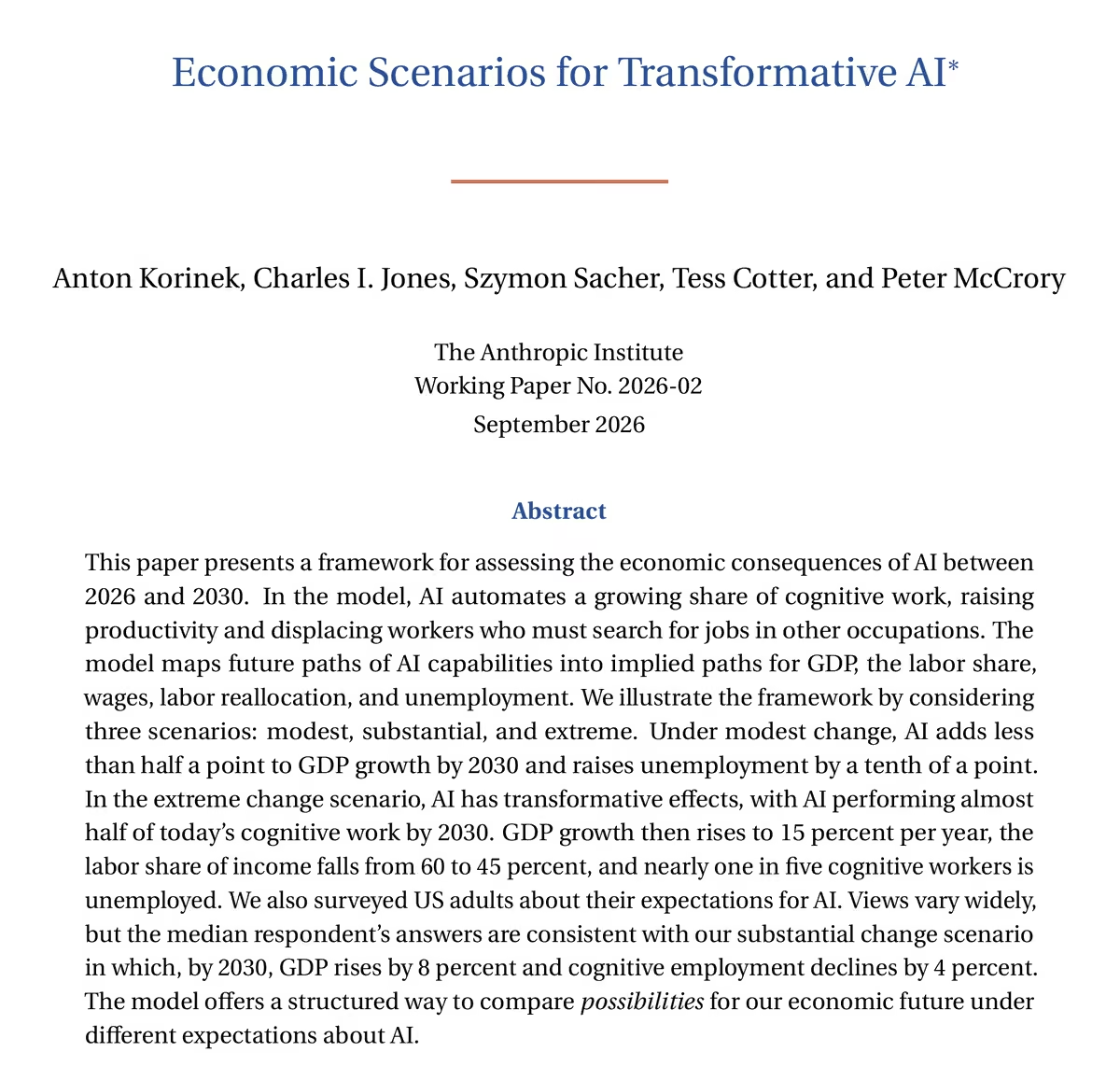
📄 My first working paper at Anthropic, with the @ChadJonesEcon, @SzymonSacher, Tess Cotter & @PeterMcCrory : "Economic Scenarios for Transformative AI"
How could AI reshape growth, wages and jobs by 2030? A framework to compare the possibilities 🧵
Olivier Blanchard reposted
Quentin Vandeweyer
@QuentinVandewe2
Il est temps de clarifier un point de cette discussion une bonne fois pour toutes, car presque tout l’argumentaire des partisans de l’annulation de la dette repose sur des ambiguïtés, et des incohérences, souvent sémantiques.
Il existe en économie monétaire un concept central : le financement monétaire. Le terme décrit la situation où un État souverain finance sa dépense publique par la création de monnaie plutôt que par la dette. La pratique est dangereuse parce qu’elle est inflationniste par nature, et c’est pour cela que les traités européens l’interdisent explicitement dans la zone euro.
Les États de la zone euro n’ont cependant plus le pouvoir de battre monnaie : ils l’ont délégué à la BCE. La question fondamentale, économique autant que juridique, devient donc : qu’est-ce qui constitue concrètement du financement monétaire dans une zone monétaire commune ?
Une façon indirecte d’y parvenir serait que la BCE achète systématiquement la dette des États en indiquant fermement qu’elle renouvellera sa position pour toujours. Ce serait sans ambiguïté de la « monétisation de la dette », avec les conséquences inflationnistes qui vont avec. L’achat de dette sur le marché primaire, à l’émission, est jugé juridiquement trop proche de ce cas et est donc explicitement interdit.
Il existe cependant une zone intermédiaire dans laquelle la banque centrale rachète de la dette publique en grande quantité, mais en disant explicitement qu’elle le fait pour agir sur les taux longs et que l’opération est temporaire. La monnaie créée sera réabsorbée quand la BCE revendra les titres ou les laissera arriver à échéance. Est-ce du financement monétaire ? Économiquement comme juridiquement, c’est une zone grise : la dette a bien été transformée en monnaie, mais l’opération reste réversible.
C’est à cause de cette ambiguïté que deux cours ont jugé différemment. La Cour constitutionnelle allemande, saisie du programme OMT en 2014, a d’abord estimé qu’il s’apparentait à du financement monétaire ; la Cour de justice de l’Union européenne a jugé l’inverse, en 2015 pour l’OMT puis en 2018 pour le QE, en relevant que la banque centrale pouvait revendre les titres et que les conserver jusqu’à l’échéance n’impliquait aucune renonciation à leur remboursement par l’État.
Les deux lectures se défendent économiquement. La lecture conservatrice est que les traités visaient à prévenir dès cette première étape de la monétisation, pour éviter la tentation de la rendre de facto permanente, ou que les agents économiques la lisent comme telle. La lecture libérale : l’opération en elle-même ne remet pas en cause la capacité de la BCE à contrôler l’inflation, précisément parce qu’elle est réversible, donc ce n’est pas de la monétisation.
Ce qui nous amène à la proposition d’annulation. Elle est précisément la pièce manquante de la monétisation. En annulant sa créance, la banque centrale se lie les mains : l’opération devient permanente et irréversible. Ses partisans ne s’en cachent d’ailleurs pas, c’est même le cœur de leur argumentaire : « La monnaie émise initialement devient donc permanente » (Nicolas Dufrêne, Institut Rousseau). Et ils n’excluent pas d’aller plus loin : le 7 septembre sur France Culture, Jézabel Couppey-Soubeyran suggérait de rouvrir la discussion sur le financement direct des États par leur banque centrale.
Il ne devrait donc rester aucune ambiguïté : ce qu’on nous propose est une monétisation permanente de la dette.
Deux implications.
La première, la moins importante à mon sens puisqu’on peut toujours imaginer changer les traités : l’opération est illégale. L’argument Mélenchon-Pigasse-Bompard, « les rachats ont été validés par la Cour de justice, or aucun traité n’encadre ce que doit faire la BCE des titres qu’elle détient », ne tient pas : la Cour a validé les rachats précisément parce que la banque centrale ne renonçait pas au remboursement de sa créance. L’annulation est cette renonciation.
La seconde, plus importante parce qu’économique : une monétisation ne peut dégager de marge de manœuvre budgétaire, même nominale, que si la création monétaire est bien permanente, donc irréversible. Mais si c’est le cas, arithmétiquement, toute cette marge nominale provient de l’inflation que l’opération génère. Aucune marge réelle n’est créée.
C’est pour cela que cette proposition est pire qu’un leurre, comme toute tentation de monétisation l’a toujours été. De tout temps, il s’est trouvé des économistes et des banquiers très intelligents pour proposer une opération complexe qui, in fine, revient simplement à imprimer davantage de monnaie dans l’espoir d’augmenter le pouvoir d’achat de l’État. Le seul résultat de l'opération est toujours l’inflation, qui tourne à la spirale dès que les agents économiques comprennent que l’État continuera à céder à la tentation et cessent de faire confiance à la monnaie.
Soyons collectivement plus clairvoyants que cela.
Olivier Blanchard
@ojblanchard1
A very good and clear article on debt cancellation, and why the arguments of people like Nicolas Dufrene, Jezabel Cuppey-Soubeyran do not hold water. variances.eu?p=7909
What makes it particularly interesting is the fact that its author, Henri Steryniak, is very much to the left, a co-founder of "Economistes atteres", a French association of heterodox economists, definitely not a neo-liberal bastion.
Olivier Blanchard
@ojblanchard1
It is indeed nitpicking, and the effect is a net decrease in demand, and a decrease in reserves. But, yes, I should have been more precise.
The ECB indeed not selling, it is letting bonds mature and not buying new ones: this leads to a steady decline in ECB bond holdings and in reserves by the ECB. It intends to do so so long as banks do not come back to hold more reserves. The plan is that, when banks come back, this will determine the amount and the size of the balance sheet.
Bottom line. The ECB is doing this for reasons which have nothing to do with fiscal policy. And this has nothing to do with debt cancellation.
 V
@itsthemchasers
But sales would increase the float in times of higher issuance. His statement is simply wrong.
Olivier Blanchard
@ojblanchard1
Separate and interesting discussion. True, the ECB (BDF) is slowly reducing its holdings of sovereign bonds, including French bonds (this is called QT, quantitative tightening).
By selling those bonds, it decreases their price (not very much, but a bit) and thus increases the interest rate paid by the governments of the euro zone.
This indeed makes things a bit harder for the government, who now pay more on their debt.
Is the ECB doing this to spite governments, or to induce them to adjust? Emphatically not. It is doing this because it wants to reduce reserves (which is what happens when it sells bonds) to what it sees as the right level, i.e. providing the right amount of liquidity to banks, but not more.
Whether the ECB is right about the proper level of reserves or not is a more interesting question than debt cancellation: There are two reasonable sides to the discussion... Likely to be a discussion we come back to.
 stefano palombarini
@StefPalomba
1/ la BdF fait partie de l’Etat donc 2/ l’histoire ne tient pas sauf à imaginer que Pierre soit le gouv, 3/ si Paul, dont ce n’est pas le rôle, veut contrer la politique de Pierre, il remet les titres sur le marché, le taux d’intérêt grimpe, 4/ congeler a donc du sens pour Pierre
Olivier Blanchard
@ojblanchard1
Quelle eloquence !
Quelle incomprehension de l'economie ! (ou peut-etre quel cynisme? Comment distinguer entre les deux?)
Je me permets de reproduire le debut mon article du Monde, avec Quentin Vandeweyer, sur l'annulation de la dette detenue par la banque centrale. Le point de base est simple: Au mieux, ca ne sert a rien. Les details sont plus compliques, mais ne changent pas la conclusion, ou la rendent pire. Une mesure a eviter a tout prix.
" Pierre et Paul possèdent ensemble une entreprise. Vous êtes le banquier de celle-ci et vous lui avez prêté de l’argent. Vous apprenez un matin que Pierre, qui devait une somme à Paul, ne la remboursera pas, car les deux associés ont décidé d’annuler cette dette entre eux. Qu’est-ce que cela change pour vous ?
Première réponse : rien. C’est leur affaire, pas la vôtre. L’entreprise vous doit toujours le même montant.
Seconde réponse : mieux vaut s’inquiéter. Ont-ils vraiment décidé ensemble cette annulation ? Ou Pierre, connu pour être dépensier, a-t-il simplement cessé de payer ? Ce qu’il a fait à Paul, pourquoi ne vous le ferait-il pas demain ? Par prudence, vous décidez de relever votre taux sur les futurs emprunts de cette entreprise.
Pierre, c’est l’Etat. Paul, c’est la Banque de France, qui détient environ 600 milliards d’euros de dette publique, près d’un cinquième du total. La dette de l’entreprise, c’est la dette de l’Etat détenue par les investisseurs, plus la dette de la Banque de France vis-à-vis des banques. L’annulation de la dette de l’Etat détenue par la Banque de France, dont l’idée refait surface dans le débat politique, est une transaction entre Pierre et Paul, sans effet direct sur les créanciers de l’Etat ni sur ceux de la Banque de France. Ses partisans ont raison sur ce point. Leur erreur est d’en conclure qu’elle dégagerait des ressources, ou qu’elle serait sans coût. C’est simplement faux."
L'article du Monde: www.lemonde.fr/idees/article/2026/09/04/olivier-blanchard…
Jean-Luc Mélenchon
@JLMelenchon
La Banque centrale européenne possède une quantité énorme de dette de l'État français. Je propose à tous les États de la zone euro d'annuler cette dette détenue par la BCE. Nous sommes tous membres du système euro, c'est donc une dette que nous nous devons à nous-mêmes.
L'officialité médiatique a tenté de manipuler cette proposition raisonnable. Cela nous a pris quelques jours d'explication pour démêler leurs mensonges. C'est chose faite.
Désormais, un sondage démontre que les Français qui soutiennent cette proposition d'annuler la dette sont plus nombreux que ceux qui s'y opposent.
Olivier Blanchard
@ojblanchard1
Repetition, I am afraid, is the key to convincing.... So let me repeat (Reaction to comments about Greece and the like. )
The argument that the cancelling of the public debt by the central bank has either zero or a negative effect, the argument that I have made this week, is not an argument about debt cancellation in general.
Debt (partial or full) cancellation (or restructuring, or reprofiling) of the debt held by investors is a whole different ballgame. It has big real effects. It decreases the interest rate charge, but makes it harder to issue more debt: Creditors, who just lost money, are understandibly worried about what happened and reluctant to go back in. (this is why the IMF often comes in, and is willing to help finance, against measures to reestablish debt sustainability, and convince investors that the future is different from the past).
It is not where we want to go. And this is not what we are talking about here.
Olivier Blanchard
@ojblanchard1
RT @QuentinVandewe2: Annuler la dette publique détenue par la Banque de France ne crée pas d’argent magique.
Dans Le Monde, avec @ojblanch…
Olivier Blanchard
@ojblanchard1
another tweet written a bit too fast. By "central bank debt" I mean public debt held by the central bank". Apologies☹️
Olivier Blanchard
@ojblanchard1
No, and useful to repeat:
Contrary to interventions such as QE or debt management by Treasury, cancellation of central bank debt has zero mechanical effect on the liabilities of either the central bank (bank reserves are the same) or the government (the debt held by private investors is the same)
 Alexander Stewart
@AlexStewartNF
At the consolidated-government level the cash flow nets. The remaining question is distribution and duration: who holds the liabilities, when they reprice, and whether transfers fall on the same households that receive the interest.
Olivier Blanchard
@ojblanchard1
Dear Helene, you have your job cut for you. :) Hope you know how to monitor the increasingly smart agents. Best of luck.
 Hélène Rey
@helene_rey
First day at the @BIS_org in Basel. Very pleased to begin my role as Economic Adviser and Head of the Monetary and Economic Department. It has been great to meet new colleagues and hear about the interesting projects already underway. I look forward to the work ahead.


 Olivier Blanchard
@ojblanchard1
There is indeed a central bank balance sheet hole. But the budget deficit remains the same. So no cash flow improvement.
 John Cochrane
@JohnHCochrane
Not quite. The ecb must still pay interest on reserves. It gives profits back to the government not receipts. And cancelling principal leaves a bit balance sheet hole
Olivier Blanchard
@ojblanchard1
No, and useful to repeat:
Contrary to interventions such as QE or debt management by Treasury, cancellation of central bank debt has zero mechanical effect on the liabilities of either the central bank (bank reserves are the same) or the government (the debt held by private investors is the same)
Alexander Stewart
@AlexStewartNF
At the consolidated-government level the cash flow nets. The remaining question is distribution and duration: who holds the liabilities, when they reprice, and whether transfers fall on the same households that receive the interest.
Olivier Blanchard
@ojblanchard1
There were some long (too long) tweets earlier which stated it carefully. The basic point is that the decrease in interest payments is offset by a decrease in transfers from the central bank, leaving the deficit unchanged. This is the sense in which it makes no difference, except accounting. Then, there is a thousand caveats, which Quentin and others have discussed, and then the psychological/political effects that make things worse. But the basic point is the basic point. :)
John Cochrane
@JohnHCochrane
Olivier: I know tweets are short, but you really should qualify “makes no difference”. To what—and not to what else? Inflation? Can all countries and banks default on all assets held by ecb with “no difference?” You don’t mean that of course. Don’t let them misquote you!
Olivier Blanchard
@ojblanchard1
I did my best to explain why, at best, cancellation of the debt held by the ECB has no effect, and why, in fact, it is likely to make things worse. I give the baton to @QuentinVandewe2 who is doing a superb job of showing how the specific arguments advanced by Institut Rousseau, Melenchon, and Mathieu Pigasse do not hold water. If interested, and willing to write long tweets, go and look.
Olivier Blanchard
@ojblanchard1
typo in last line: read, not write. apologies
Olivier Blanchard
@ojblanchard1
I did my best to explain why, at best, cancellation of the debt held by the ECB has no effect, and why, in fact, it is likely to make things worse. I give the baton to @QuentinVandewe2 who is doing a superb job of showing how the specific arguments advanced by Institut Rousseau, Melenchon, and Mathieu Pigasse do not hold water. If interested, and willing to write long tweets, go and look.
Olivier Blanchard
@ojblanchard1
Philippe says it with more passion than I, but he is clear and he has it right.
 sophia aram
@SophiaAram
Quand un prix Nobel d’économie remet à sa misérable place, un tout petit banquier d’affaires…
#gauchepigasse #philippeaghion
Olivier Blanchard
@ojblanchard1
merci. Important que ca vienne aussi de toi.
 Sterdyniak Henri
@sterdyniak
Entre nous, les"travaux" de l'Institut Rousseau sur le sujet comme l"ouvrage de Eric Coquerel sont faux, simplement faux. La Banque de France s'est endettée pour détenir ces titres Et l'annulation ne ferait que faire passer la dette nette du passif de l'Etat à celui de la Banque centrale. La journaliste oublie que la Banque de France paie des intérêts aux banques commerciales.
Olivier Blanchard reposted
Quentin Vandeweyer
@QuentinVandewe2
Encore une fois, il n'y a pas grand-chose de correct dans ce fil. Point par point :
« Selon eux, on perdrait en dividendes versés par la Banque de France ce qu'on gagnerait en intérêts que l'on aurait plus à verser. C'est un second mensonge. D'abord car l'intégralité du résultat de la Banque de France n'est pas reversé en dividendes à l'Etat. 1) Il n'y a aucun dividende versé depuis 2022. 2) Entre 2015 et 2022, la Banque de France a dégagé 46 milliards de résultat et n'a reversé que 32 milliards en dividendes. »
C'est la même erreur que dans le tweet précédent : une confusion entre les flux et le stock. Le dividende d'une année est un flux ; ce qui appartient à l'État, c'est le stock, les fonds propres de sa banque centrale. Un bénéfice mis en réserve n'est donc pas un bénéfice perdu, seulement un versement décalé : il revient plus tard en dividendes, ou il absorbe des pertes que le Trésor aurait dû combler. Les 14 milliards non distribués ont fait exactement cela : ils ont rempli les provisions qui encaissent les pertes actuelles. J'avais détaillé ce point ici : x.com/QuentinVandewe2/status/2091936390674100548.
« Surtout, car en retirant une partie de la dette du refinancement sur les marchés, cela empêche que la hausse des taux d'intérêts viennent augmenter drastiquement le coût du refinancement de la dette française. On soustrait la dette à la spéculation. L'intérêt est évident. »
Ce n'est pas ce que fait une annulation. Le titre sort du marché au moment où la banque centrale l'achète. Pour la dette dont on parle, c'est fait depuis des années. Ce que l'annulation supprime, c'est un paiement de l'État à sa propre banque centrale, paiement qui lui serait revenu de toute façon, tôt ou tard. C'est l'arithmétique simple exposée par Olivier Blanchard : x.com/ojblanchard1/status/2091632338580984093.
« On a ensuite entendu Monsieur Breton et le ministre Monsieur Samuel décréter qu'une telle mesure conduirait à la hausse des taux d'intérêts sur le reste de la dette française. C'est une pure affirmation, sans aucune preuve, que l'on peut facilement réfuter. »
Cette affirmation a pour elle la théorie monétaire et à peu près toute l'histoire des dettes monétisées. La hausse des taux en est même le scénario le plus favorable : le scénario noir, c'est la monnaie qui décroche et l'inflation qui repart. Pour ne prendre qu'un exemple: de mars 1924 à avril 1925, la Banque de France a publié des bilans falsifiés pour masquer le dépassement du plafond légal d'émission de billets, franchi pour financer l'État. La révélation a fait tomber le gouvernement Herriot, et la confiance avec lui : la livre sterling, qui valait environ 100 francs en 1924, en valait 243 en juillet 1926. Il a fallu le retour de Poincaré, des impôts nouveaux et un budget en excédent pour stabiliser.
« On résume leur raisonnement : "puisqu'on a congelé la dette détenue par la BCE, on pourrait décider de faire la même chose sur les titres détenus par le privé. Inquiets, les investisseurs vendraient notre dette et les taux augmenteraient". Ce raisonnement est absurde. »
Ce raisonnement est un homme de paille. Le mécanisme réel avancé par les détracteurs sérieux est celui du signal quant à la responsabilité budgétaire de l'État français. En annulant la dette de la BCE, la France annoncerait de la manière la plus solennelle possible qu'elle ne compte pas traiter son problème de déficit et qu'elle retire à sa banque centrale les moyens de défendre la stabilité des prix. Face à un emprunteur qui annonce cela, les prêteurs exigent une prime de risque supplémentaire pour détenir sa dette nominale. Ce raisonnement-là est valide.
« En vérité, c'est le contraire : si l'on réduit la dette en en congelant une partie, on empêche la spéculation et on réduit le ratio dette/PIB qui définit l'endettement selon les critères européens. Cela conduirait donc à renforcer la confiance dans la signature de la France. »
C'est encore faux car le gain serait purement comptable. Ces titres ne circulent déjà plus : ils ont été remplacés, au moment de l'achat, par des réserves de banque centrale, qui portent elles aussi intérêt. L'annulation rend l'échange permanent, mais l'intérêt sur les réserves reste dû. Si le ratio de Maastricht ne compte pas ces réserves comme de la dette, c'est uniquement parce que personne, en 1992, n'imaginait des bilans de banque centrale de cette taille. Les investisseurs, eux, comptent l'État et sa banque centrale comme un tout. Aucune capacité budgétaire n'est créée, et tout le monde le voit.
« Enfin, voici Bruno Lemaire et Gabriel Attal qui nous expliquent maintenant que la proposition de Jean-Luc Mélenchon serait synonyme d'une sortie de la France de la zone euro. Encore un pur mensonge. »
L'annulation supposerait l'accord du Conseil des gouverneurs de la BCE et, en réalité, une révision des traités à l'unanimité. Il n'existe aucun scénario dans lequel l'Allemagne, dont toute l'architecture monétaire est construite sur le souvenir de l'hyperinflation de 1923, accepte. Maintenir l'exigence face à ce refus ne laisse que deux issues : y renoncer, ou partir.
« Les actions de rachat de dettes publiques par la BCE ont été validés par la Cour de Justice de l'Union Européenne qui les ont jugés conformes aux règles européennes. Or, aucun traité n'encadre ce que doit faire la BCE des titres de dettes qu'elle détient dans son bilan. »
L'article 123 du traité interdit le financement monétaire des États. La Cour de justice a validé les programmes d'achat précisément parce qu'ils n'en relevaient pas : l'arrêt Weiss (2018) rappelle que la détention des titres jusqu'à l'échéance « n'implique aucune renonciation au paiement, par l'État membre émetteur, de sa dette » (point 146). La légalité des rachats repose sur la promesse que la dette sera honorée. L'annulation retirerait au dispositif la condition même de sa légalité.
« Il est donc tout à fait possible d'obtenir de la BCE de telles dispositions. Rappelons comment la période du COVID a conduit à mettre au feu les dogmes ultra-libéraux des traités européens. »
Cette « mise au feu » est précisément la raison pour laquelle nous en sommes là...
« Enfin, comme rappelé la semaine dernière dans une tribune signée par plus de 50 économistes, la Banque Centrale des États Unis (la FED) vient de relancer des rachats de titres de dette souveraine. Pourquoi ce qui serait possible là-bas ne le serait pas ici ? »
L'opération n'a aucun rapport. Depuis décembre 2025, la Fed achète des bons du Trésor à court terme pour une raison de plomberie : maintenir un niveau de réserves suffisant dans le système bancaire à mesure que la demande de liquidité croît. Powell le répète à chaque conférence de presse : ces achats n'ont aucune implication pour l'orientation de la politique monétaire. Surtout, la Fed paie ces titres au prix du marché, les garde à son bilan, et le Trésor américain continue de les honorer jusqu'au dernier dollar. Personne n'annule rien.
La tribune des « plus de 50 économistes », elle, existe bel et bien. Je ne doute pas de la qualité des travaux des signataires, mais l'immense majorité d'entre eux travaille sur de tout autres sujets, et on cherche en vain leurs publications sur la politique monétaire dans les grandes revues. Je me permets ce contre-argument d'autorité car les enjeux sont suffisamment importants pour ne pas laisser s'installer dans le public l'idée que ces arguments ont quoi que ce soit de sérieux. J'aimerais d'ailleurs pouvoir faire autre chose de mes journées que de répondre à un débat de ce niveau sur X.
« Aucun argument utilisé par nos adversaires n'est donc une objection sérieuse. [...] D'un certain point de vue, la manière avec laquelle nous les voyons passer d'un argument à l'autre montre à quel point aucune de leurs déclarations ne tient la route. Alors pourquoi s'entêter ? »
Chacun de ces arguments a été publiquement réfuté maintes fois. Une sélection biaisée : Olivier Blanchard (x.com/ojblanchard1/status/2091632338580984093) et mes fils précédents (x.com/QuentinVandewe2/status/2092189371604554101, x.com/QuentinVandewe2/status/2092021824120897961).
M. Bompard et ses collègues de LFI ne répondent à aucun de ces arguments sur le fond ; ils répètent leurs arguments erronés, plus fort.
Je suppose que c'est ça, le populisme...
Olivier Blanchard reposted
Quentin Vandeweyer
@QuentinVandewe2
Tout ça ne vole quand même pas très haut... Trois erreurs de raisonnement élémentaires :
1. « La nature du passif change ». C'est exact. Mais quand change-t-elle ? Au moment où la banque centrale achète le titre, pas au moment où on l'annule. Le QE a déjà transformé de la dette obligataire en réserves bancaires, annulation ou non. La seule chose que l'annulation change, c'est l'actif : elle le supprime. Il reste alors un passif monétaire à taux variable, sans échéance, et plus rien en face. Ce n'est pas un argument pour l'opération. C'est une bonne description de son danger : raccourcir la maturité de la dette, c'est augmenter l'exposition de l'État au risque de taux.
2. « Un euro d'intérêt annulé n'est pas un euro de dividende perdu ». Confusion entre calendrier et incidence. Ce que la banque centrale ne reverse pas, elle le garde en fonds propres, qui appartiennent à l'État. Chaque euro de coupon manquant finit chez l'État : dividendes différés, pertes à éponger, ou recapitalisation. Quant au fait que la Banque de France ne verse plus rien depuis 2022 tout en recevant ses coupons : c'est que ces coupons amortissaient ses pertes. Supprimez-les, et les pertes s'alourdissent d'exactement autant. (cf. x.com/QuentinVandewe2/status/2091936390674100548)
3. « L'État n'aurait plus à refinancer ces titres à 4 % ». Que se passe-t-il quand un titre détenu par la Banque de France arrive à échéance et que l'État le rembourse ? Les réserves créées pour l'acheter sont détruites. La facture monétaire s'éteint d'elle-même. Et si on l'annule ? Le titre disparaît, mais les réserves restent, pour toujours, rémunérées au taux directeur. L'État n'échange donc pas une dette contre rien : il échange une dette à taux fixe, qui s'éteint, contre une dette perpétuelle à taux variable, logée chez sa banque centrale. L'économie espérée n'est pas de 4 % : c'est l'écart entre taux longs et taux courts, quelques dizaines de points de base, et le signe s'inverse dès que les taux courts remontent. Ce pari a un nom : c'est le carry trade qui vient de coûter des centaines de milliards à l'Eurosystème. Si la prime de terme est positive en moyenne, ce n'est que parce qu'il faut compenser les investisseurs pour le risque pris en investissant dans cette stratégie. Enfin, si la France souhaite économiser cette prime de terme, il existe une solution plus simple : émettre à plus court terme.
Quentin Vandeweyer
@QuentinVandewe2
La Banque de France n'a effectivement plus versé de dividende à l'État depuis celui de l'exercice 2021. C'est parfaitement exact. Prenons le temps d'expliquer pourquoi ce fait n'invalide pas le propos de Jordan Bardella (qui est, d'ailleurs, le même que celui d'Olivier Blanchard) et qui est le cancre dans cette histoire.
D'abord, pourquoi ce dividende s'est-il arrêté ? En temps normal, une banque centrale reverse l'essentiel de ses bénéfices à l'État. C'est ce que les économistes appellent les « remittances ». La Banque de France a ainsi versé au Trésor environ 4 milliards d'euros par an entre 2015 et 2022. Puis plus rien.
La raison remonte à 2015. La BCE a lancé cette année-là un vaste programme de rachat de dette souveraine pour soutenir l'économie, puis l'a démultiplié pendant le Covid. Au pic, à l'été 2022, l'Eurosystème détenait près de 5 000 milliards d'euros de titres, dont 4 200 milliards de dette publique : environ un tiers du marché souverain de la zone euro, contre 5 % avant 2015.
Or ces titres paient des intérêts fixes (les « coupons »), faibles puisque achetés à l'époque des taux zéro : 0,68 % en moyenne pour le portefeuille de la Banque de France, à échéance longue, environ sept ans. Dans le même temps, l'Eurosystème rémunère à taux variable l'essentiel des réserves qu'il a créées pour acheter ces titres. Il s'est donc retrouvé dans une position géante de ce que la finance appelle un « carry trade ». Tant que les taux restaient au plancher, la position était gagnante : les coupons dépassaient des intérêts alors nuls ou négatifs. Quand l'inflation a forcé la BCE à remonter son taux jusqu'à 4 %, la position s'est retournée. Depuis, l'Eurosystème paie sur ses réserves plus que ne rapportent ses titres.
Les comptes sont publics. La Banque de France a vidé son fonds pour risques généraux (12,4 milliards en 2023, 10,1 en 2024), puis affiché 7,7 milliards de perte nette en 2024. Elle n'est repassée en bénéfice en 2025 que grâce à une opération exceptionnelle sur son or. La Bundesbank porte 27,8 milliards de pertes cumulées, la BCE elle-même 10,5. Selon mes calculs, en l'état, il faudra environ cinq années de bénéfices à la BCE pour éponger ses pertes, et plus d'une décennie à la Bundesbank. Les Néerlandais, eux, ne prévoient aucun versement avant le milieu des années 2030.
Voilà pourquoi votre dividende a disparu. Maintenant, quelles seraient les implications de la proposition de LFI ?
LFI veut annuler la part de la dette française détenue par l'Eurosystème : environ 600 milliards d'euros, l'équivalent d'un cinquième de la dette négociable de l'État. Dans ce cas, la banque centrale ne subirait plus seulement l'écart entre coupons reçus et intérêts versés. Elle ne recevrait plus aucun coupon... et d'ailleurs plus de principal non plus. Les réserves créées pour acheter ces titres, elles, ne s'annulent pas : elles restent au passif et continuent, pour l'essentiel, de porter intérêt. Rien ne disparaît dans une annulation : ce que l'État gagne d'un côté, sa banque centrale le perd de l'autre. En valeur de marché, la perte serait de l'ordre de 500 milliards d'euros.
Aucune suspension de dividende ne peut absorber un choc pareil à horizon prévisible : 450 milliards, c'est environ quinze fois les pertes que la Banque de France vient d'encaisser en 2023 et 2024, et près d'un siècle de ses versements à l'État d'une année normale. C'est surtout du même ordre que tout ce qu'elle possède, or compris, et tout ce qu'elle peut espérer gagner à l'avenir. Autrement dit, la frontière de l'insolvabilité économique, et non plus simplement comptable. Passé cette frontière, il ne reste que des options coûteuses: Recapitaliser, par l'impôt ou par l'emprunt, c'est-à-dire réintroduire ce qu'on prétendait effacer. Ou laisser l'inflation absorber le choc. C'est la démonstration de Ricardo Reis (@R2Rsquared) dans son article de 2015 au Journal of Monetary Economics (personal.lse.ac.uk/reisr/papers/15-dns.pdf), à la suite de Del Negro et Sims.
L'absence de dividende ne prouve donc pas que l'annulation serait indolore. Elle est le symptôme, encore bénin, de la maladie que votre proposition multiplierait par quinze.
Manuel Bompard
@mbompard
Ce cancre de Bardella ne sait même pas qu’il n’y a pas eu de dividende versé par la Banque de France à l’Etat depuis 2021.
 Jordan Bardella
@J_Bardella
Matthieu Pigasse raconte n’importe quoi.
Annuler la dette détenue par la Banque de France ne donnerait pas davantage de marge de manœuvre.
La Banque de France est détenue par l’État. Les intérêts versés par l’État sur la dette détenue par la Banque de France sont ensuite reversés à l’État sous forme de dividendes. Cela ne soulagerait donc en rien les finances publiques, et encore moins le coût du financement de la dette.
En revanche, une telle annulation pourrait inquiéter les investisseurs, qui pourraient craindre que l’État soit tenté de faire la même chose avec les créanciers privés. Ils exigeront alors des taux d’intérêt plus élevés pour financer la dette française.
Il n’y a pas d’argent magique...
 Matthieu Pigasse
@MPigasse
On nous répète que la dette serait un mur infranchissable et qu’il n’y aurait pas de marges de manœuvre.
C’est faux.
La BCE détient environ 20 % de la dette française. Cette dette peut être annulée. Sans coût financier.
Pendant le Covid, ce qui était prétendument impossible est devenu possible : des centaines de milliards ont été mobilisés.
La leçon est simple : il n’y a pas de contrainte économique, il n’y a que des choix politiques.
Quand on veut, on peut.
Une autre politique est possible.
Olivier Blanchard
@ojblanchard1
Useful points in the comments. Some right,some wrong. (but the basic point that operations between the central bank and the Treasury which do not affect the claims of investors on the state have no effect remains fundamental)
Let me take two of the comments up.
The point that most of the French public debt held by the ECB remains on the balance sheet of the Banque de France is correct, and I should have said it. Thus, it is nearly as if debt cancellation is just a transfer from the BdF to the French Treasury. Yet, 10% remains on the balance sheet of the ECB, so that the corresponding decrease in interest payments affects all Euro-member countries. Even if only 10%, conclusion remains: This is impossible de jure, and de facto. Germany will not accept it.
I fully agree that the BdF (and the ECB) and the Treasury have separate balance sheets. But what matters to investors, and to economists analyzing the budget situation, is the consolidated balance sheet. Otherwise, the BdF should indeed buy all the public debt, issue interest paying reserves, cancel the public debt, and, looking at the just the government budget, one would conclude that the French government is debt free.😀 Would you believe it, or would you look behind the screen?
Olivier Blanchard
@ojblanchard1
I typically avoid long interactionson X. But this issue of debt cancellation is important, conceptually and politically. So here it goes.
On something else before I answer.
I am sincerely happy to hear that you will help Venezuela discuss with its creditors. At this point, the Venezuelan government has no choice than to obey instructions from the US, has no bargaining power and the US adminstration is heavily on the side of creditors. Venezuela needs a break.
Now on the two issues you raise.
On Greece.
Thanks for bringing this up, as it allows me to state facts more clearly.
My conclusion that the fiscal multipliers were larger than had been assumed by the IMF and the commission was not an error on my part, but indeed an effort to modify the position of these two institutions and get more realistic and less painful adjustment programs. It was at least partly successful. Anybody who was involved in the episode will confirm.
My efforts to help Greece have been recognized by the Greeks, in particular through an honorary doctorate from the University of Athens. And, perhaps, if you think that endorsement by the elites or academics is not relevant, more importantly, by Varoufakis.
On debt and the ECB.
(I suspect I shall sound like a boring university professor, but trying to clarify things is what we do for a living)
Proceed in two steps. Assume for the sake of argument that France still has an autonomous central bank. (The fact that we have the ECB introduces distribution issues across countries, which strengthen the argument that French debt cancellation is a non-starter, but are of a different nature. To put it simply: Germany will not accept having the ECB cancel French debt. The end.)
Consider the relevant budget entity, i.e. the budget of the consolidated government, so putting the Treasury and the central bank together. (Let’s leave aside the considerations that may come from different perceptions of the two by investors. I come back to it.)
Let me state two propositions.
Any action which changes the claims between the Treasury and the central bank, but does not affect the claims of the investors on the consolidated government (that is the public debt held by the private sector plus the liabilities of the central bank) has no economic effect. This applies to debt cancellation of the holdings of the central bank, or whether central bank profits or losses are passed on to the Treasury (an issue raised by you and Dufrene). The argument is straightforward. If their claims are unchanged (no change in their net holdings of Treasury debt, no change in reserves at the central bank), why should private investors care?
In contrast, any action which changes the claims of private investors on the consolidated government is likely to have an effect. For example, purchases of long maturity bonds by the central bank financed by zero maturity interest paying reserves, what is known as QE, has an effect on the yield curve, and can decrease long rates. To get the private investors to accept the change in the nature of the claims they hold, interest rates will have to adjust.
In short, debt cancellation of the public debt of the central bank has no effect. Purchases or sales of bonds by the central bank do.
Are things that simple? No, there are all kinds of footnotes, psychological effects. If for example, debt cancellation leads private investors to expect changes in central bank reserve policies or interventions, then there can be effects. There may be psychological effects, which almost surely work in the direction of make the effects of debt cancellation worse. The attempt to cancel the debt held by the bank is likely to raise issues of fiscal dominance, of monetization of the debt (purchases of bonds by the central bank financed by non-interest paying money).
Going back to the ECB. If the ECB cancelled French debt, the loss associated with it would be shared by all euro members. They will not accept it, de jure or de facto. The end.
Let me end this long tweet, with a remark. The debt position of France is not by itself dramatic. Our deficit however is too large. We must reduce it if we want investors to stay. Proposing false solutions, raising false hopes, is, I believe, irresponsible.
Matthieu Pigasse
@MPigasse
Avant de qualifier un débat économique « d’idiot », @ojblanchard1, un peu de modestie intellectuelle ne nuit jamais. Surtout lorsqu’on a été le chef économiste du FMI, responsable des ravages de l’austérité en Grèce.
Petit rappel : vous vous êtes trompé lourdement en Grèce sur ce que l'on appelle le multiplicateur budgétaire - ce que vous n'avez reconnu qu’après. Cela signifie que vous avez gravement sous-évalué les effets récessifs de l'austérité budgétaire que vous avez imposée au pays.
En 2010, votre programme FMI/UE prévoyait une contraction du PIB grec de 6,6% sur 2 ans puis un retour de la croissance. En réalité, le PIB grec s'est effondré de 22% en 4 ans, ce que le FMI a lui-même décrit comme l’une des plus profondes récessions en temps de paix. Un autre chiffre ? Vous prévoyiez moins de 15% de chômage en 2012, il a en réalité atteint près de 30% et plus de 60% chez les jeunes.
Je rappelle cet épisode non pour personnaliser le débat, mais parce qu’il devrait précisément nous prémunir contre les affirmations selon lesquelles une question macroéconomique complexe serait une « simple question d’arithmétique ».
Venons-en donc à la dette détenue par l’Eurosystème.
Vous dites "cela ne changerait rien". C’est précisément ce même raisonnement, "aucun effet", qui vous a conduit à sous-estimer le multiplicateur budgétaire grec.
Selon vous, "cela ne changerait rien" parce que les intérêts économisés par le Trésor seraient exactement compensés par une diminution des profits de la Banque de France reversés à l’État.
C’est, parfois, vrai d’un point de vue comptable, mais faux économiquement. Or ce qui compte, ce n’est pas la comptabilité, c’est la vie des gens.
Premier point : la nature du passif change.
Quand l’Eurosystème achète de la dette publique française, il transforme la structure du passif consolidé du secteur public : à une dette obligataire correspond désormais un passif monétaire liquide, sous forme de réserves bancaires.
Ces deux passifs n’ont pas les mêmes caractéristiques. L’obligation doit être refinancée à son échéance et son coût est déterminé lors de son émission ; les réserves n’ont pas la même maturité et leur rémunération dépend des décisions de politique monétaire de la BCE.
Dire que cette différence est sans importance au seul motif qu’actifs et passifs peuvent être consolidés revient à confondre comptabilité et économie.
Deuxième point : les intérêts versés par l’État à la Banque de France ne lui reviennent pas mécaniquement et intégralement sous forme de dividendes.
Le résultat d’une banque centrale dépend à la fois du rendement de ses actifs et du coût de ses passifs. L’expérience récente l’illustre parfaitement : avec la hausse des taux, les banques centrales de l’Eurosystème ont dû rémunérer beaucoup plus cher les réserves bancaires alors qu’elles détenaient des obligations anciennes acquises à des taux faibles.
L’effet financier pour le secteur public consolidé dépend de la rémunération respective de la dette obligataire et des réserves, de leur maturité, de la politique future des taux et de l’évolution du bilan de la banque centrale.
"1 euro d’intérêt annulé" n'est donc pas égal à "1 euro de dividende perdu pour toujours".
La Banque de France n’a d’ailleurs versé aucun dividende à l’État depuis 2022, alors même qu’elle continuait à percevoir les revenus des titres publics qu’elle détenait.
Troisième point : vous ne parlez que des flux, et vous oubliez le stock et son refinancement.
L’Eurosystème détient encore des centaines de milliards d’euros de dette française achetée à l’époque des taux nuls ou très faibles.
Ces titres arrivent progressivement à échéance. S’ils ne sont pas réinvestis par l’Eurosystème, l’État doit les refinancer sur les marchés, aujourd’hui à des taux beaucoup plus élevés, supérieurs à 4%.
L’annulation change cette situation : le Trésor n’a plus à rembourser ces titres à leur échéance, ni à lever la somme correspondante sur les marchés.
Olivier Blanchard reposted
Luis Garicano 🇪🇺🇺🇦
@lugaricano
Blanchard is right on the pure arithmetic: less cash goes out of government coffers to pay interest, the Banque de France returns less cash to the French government back in equal amounts. The net effect is, indeed, zero.
But this leaves aside the political economy. I fear the implications of treating this action as neutral would be completely catastrophic.
The logical reaction from an LFI person after reading @ojblanchard1 is:
“Ok well, let’s try the experiment. At worst it changes nothing, at best it gives us fiscal room by reducing the sacrosanct debt/GDP ratio.”
Or, as @sc_cath puts it:
“Then why not just have the ECB buy all the French debt and cancel it.”
What’s missing from the pure technocratic arithmetic is the political economy: the massive incentive effects. It eliminates the budget constraint and blurs the line between fiscal and monetary policy. Recall the treaty forbids monetary financing, and this would have proven uncontroversially that this does happen.
Markets price the regime shift, not just the current stock.
Also, some shorter-term consequences: the ECB is reducing the amount of government debt in its balance sheet, and there is debate about the speed of this. An @ecb Governing Council member reading all the madness in France would not want to slow down the debt reduction given the political risks.
Olivier Blanchard
@ojblanchard1
Sur l'annulation de la dette francaise detenue par la BCE.
C'est un vieil argument qui ressort regulierement et qui est simplement faux, malgre ce que dit @MPigasse.
Contrairement a ce qu'il dit (ce qu'il pense?), annuler la dette francaise detenue par la BCE n'aurait aucun effet.
Il y a quelques annees, j'avais eu la meme discussion dans une audience au Senat. Je me permets de la repeter:
" La seconde question, sur laquelle je ne suis pas d'accord avec Jézabel Couppey-Soubeyran, est l'annulation de la dette.
Il faut procéder par étape. En general, bien sur, l'annulation d'une partie de la dette aurait des implications majeures pour les crediteurs, et par implication, pour le systeme financier.
Mais ce dont on parle ici, c'est uniquement l'annulation de la dette détenue par la BCE. Et là, je suis totalement perdu par le débat : certains disent que c'est bien, d'autres que c'est mal ; moi, je dis que cela ne change rien ! C'est un point fondamental que j'expliquerai en deux temps.
Imaginons tout d'abord que la Banque de France détienne des obligations du Trésor et décide d'annuler cette dette et les intérêts qui y sont afférents. Cela aboutit à une diminution des profits de la Banque de France qui ne touche plus les interets sur la dette, et donc a une diminution des transferts de la Banque de France au Tresor. Cette diminution des transferts correspond exactement à la diminution initiale des intérêts payes par le Tresor a la Banque de France. Par conséquent, du point de vue des revenus nets de l'Etat, c'est zéro ! C'est une simple question d'arithmétique.
C'est un peu plus compliqué dans le cas de la BCE. En effet, si elle décidait d'annuler la dette française et que cela diminuait ses profits globaux, l'Allemagne et d'autres pays en feraient partiellement les frais. Cela étant politiquement impossible, la BCE serait contrainte de diminuer la dette de tous les pays dans les mêmes proportions, et on en revient alors au même argument que j'ai avancé précédemment. Effet nul.
Il faut arrêter cette discussion « idiote », si je puis dire - Jézabel Couppey-Soubeyran me pardonnera ce terme."
Je rajouterai: Au pire, il peut amener certains partis a defendre des positions erronees et faire de fausses promesses.
Matthieu Pigasse
@MPigasse
On nous répète que la dette serait un mur infranchissable et qu’il n’y aurait pas de marges de manœuvre.
C’est faux.
La BCE détient environ 20 % de la dette française. Cette dette peut être annulée. Sans coût financier.
Pendant le Covid, ce qui était prétendument impossible est devenu possible : des centaines de milliards ont été mobilisés.
La leçon est simple : il n’y a pas de contrainte économique, il n’y a que des choix politiques.
Quand on veut, on peut.
Une autre politique est possible.
Olivier Blanchard
@ojblanchard1
Do you realize that much of the increase (the increase in the spread over German bunds) is due to (1) the budget paralysis in Parliament that the RN largely contributed to, and (2) the probability that you win the presidential elections?
(the rest of the increase is due to an increase in interest rates around the world, not just France)
 Marine Le Pen
@MLP_officiel
Voilà le bilan implacable de dix ans de macronisme et d’une politique économique que je n’ai eu de cesse de combattre : les taux auxquels emprunte la France atteignent de tristes records depuis la crise financière de 2008.
Ce bilan aurait été encore plus terrible sans la politique monétaire exceptionnellement favorable dont Édouard Philippe et Emmanuel Macron ont bénéficié pour faire des chèques sans provision dont il faut désormais payer les conséquences.
Les socialo-macronistes et leurs alliés LR vont-ils enfin assumer leur responsabilité ou encore accuser le RN de façon aussi grotesque que scandaleuse ? Heureusement que le ridicule ne tue pas, ce serait une hécatombe dans « l’arc de la raison ».
Il est grand temps de nettoyer les écuries d’Augias que sont devenus les comptes de la nation !
Il faut du courage, de la détermination et un discours sincère. Après 20 ans de vie politique, les Français me font l’honneur de me reconnaître certaines de ces qualités : je ne les décevrai pas.
 Olivier Blanchard
@ojblanchard1
I had promised myself not to react to Trump declarations. Promise not fulfilled. This is so absurd that I have not found the strength to resist.
 Acyn
@Acyn
Trump: I have the absolute right to cut off all business with a country like Switzerland.There's 60 countries like that. They live off the United States. So why are we paying higher interest rates than them?
Olivier Blanchard reposted
 Eduardo Zurita
@EduardoZurita7
A veces pienso que esta es la mejor canción de toda la historia.
Olivier Blanchard
@ojblanchard1
A clarification in response to some comments. The label on the horizontal axis (level of debt) is short for "Fiscal fundamentals". I have discussed at length elsewhere what they are: they depend on debt, but also the sequence of primary deficits, the safe rate and the growth rate, the currency denomination, etc (so much more than just the debt level).
France, with high debt, a safe rate close to the growth rate, and a long sequence of anticipated primary deficits definitely has weak fiscal fundamentals.
Olivier Blanchard
@ojblanchard1
Useful to summarize the discussion about debt and spreads in a graph (based on work with @pmbruera and @Gonhuertas. Working paper out soon).
The blue line shows the “good equilibrium” if investors are rationally optimistic. At very low debt, no risk of default, no spread, then a slow increase, and eventually a sudden jump and default. So, if things get worse (high continuing deficits, increasing debt ratio), reasons to worry.
But, even if things do not get worse, and investors turn (rationally) pessimistic, they require a larger spread, the interest rate jumps and default happens faster.
I think France is roughly at point A: small spread, but reasons to worry. Deficit is too large, so France keeps moving to the right. And, even if not, equilibrium could jump to point B, with a higher spread.
Olivier Blanchard
@ojblanchard1
Totally irrelevant anecdote. When I gave my first post -PhD seminar in Stanford, I discovered that Milton Friedman was in the front row, three feet from me. And I literally froze, unable to speak for a minute or two (which felt like an eternity). To say the least, the rest of the seminar did not feel good. I thought that my very short academic career was over.
After the seminar, Friedman made a point of taking me aside, reassuring me, and telling me that he thought the paper was interesting (not sure he believed it), and I had a future. Kudos.
Olivier Blanchard
@ojblanchard1
Doubling down on Milton Friedman (not defending the whole Encyclopedia piece). The comments to my tweet (along the lines of "there is so much more to Friedman than the caricature in the piece") raise a larger issue, that of “the role of the economist in the city,” to use Jean Tirole’s expression.
Friedman was a remarkable and sophisticated thinker. But when I talk about “TV Friedman,” I do not talk about TV simplifying a complex Friedman message, but about Friedman himself expressing his views on TV (in “Free to choose” in particular). And the message was unambiguous: Markets work, the state typically stands in the way. No ifs, no buts.
The influence, if any, we (academics) have on perceptions and on politics does not derive from our publications in Econometrica or the American Economic Review, but on how we sell their conclusions to policy makers and to the public. And, in the case of Friedman, the message was simple and unambiguous. This is relevant to assessing his contribution.
Olivier Blanchard
@ojblanchard1
nicely done
dwayne woods
@twittwoods
 Olivier Blanchard
@ojblanchard1
Many comments on the tweet about the risk of a public debt crisis in France point to the role of the central bank, the ECB in this case, in avoiding multiple equilibria. And, indeed, the ECB has a major role to play.
On paper, it is easy.
There are three zones, determined by fundamentals. At one end, the safe zone: debt is clearly sustainable. At the other end, the default zone: debt is clearly unsustainable. In the middle, the danger zone, where there are multiple equilibria, a good and a bad one., with the bad one leading to a crisis.
If in the safe zone, no need for the central bank to do anything. If in the default zone, need to adjust fiscal policy; not the job of the central bank. If in the danger zone, maintain the good equilibrium, by standing ready to buy if the private investors sell.
This is indeed the mandate of the ECB. If debt is clearly not sustainable, do not intervene unless there is an adjustment program which reestablishes sustainability. If in the danger zone, intervene to keep the interest low and debt sustainable.
In reality, things are not so simple.
When investors require a higher risk premium, how to tell whether we are in the danger zone and the ECB should intervene, or we are already in the default zone, in which case, short an adjustment program, it should not?
The reality: The ECB does not know for sure. And it is likely to be conservative, insist on an adjustment program, with or without a haircut or reprofiling, before intervening. Counting on the ECB to intervene to eliminate multiple equilibria, or even more so, to intervene when debt is clearly unsustainable is unwise.
Olivier Blanchard
@ojblanchard1
Doubling down on Milton Friedman (not defending the whole Encyclopedia piece). The comments to my tweet (along the lines of "there is so much more to Friedman than the caricature in the piece") raise a larger issue, that of “the role of the economist in the city,” to use Jean Tirole’s expression.
Friedman was a remarkable and sophisticated thinker. But when I talk about “TV Friedman,” I do not talk about TV simplifying a complex Friedman message, but about Friedman himself expressing his views on TV (in “Free to choose” in particular). And the message was unambiguous: Markets work, the state typically stands in the way. No ifs, no buts.
The influence, if any, we (academics) have on perceptions and on politics does not derive from our publications in Econometrica or the American Economic Review, but on how we sell their conclusions to policy makers and to the public. And, in the case of Friedman, the message was simple and unambiguous. This is relevant to assessing his contribution.
Olivier Blanchard
@ojblanchard1
Hanno: Yes, fundamentals matter.
At one end, if the debt level is very low and deficits small, then even if investors are pessimistic, a potential increase in interest rate will not lead to debt unsustainability. Thus, there is no reason for investors to worry and ask for a risk premium, the interest does not increase, and things are fine. No multiple equilibria here.
At the other end, if the debt level is very high, and deficits, current and prospective, were expected to continue for sure, these would imply that debt is unsustainable no matter what, and there will be a crisis now. No multiple equilibria there either.
You seem to argue that France is already in this second scenario. Selfish retirees, no hope for the budget, no hope for France. But, if we really were there, we would have very high interest rates and a crisis now. And we do not. (the spread is there, but it is small).
I am arguing that, while fundamentals matter and they are not great, we are in the intermediate zone "danger zone" where, for the same fundamentals, there can be two equilibria. And the timing of the shift from one to the other is hard/impossible to predict.
 Hanno Lustig
@HannoLustig
Interesting post. I get this question a lot too! My answer is always "why try and find out?" I found @ojblanchard1's multiple equilibria analogy a bit unhelpful. The key fact about France: the political system has repeatedly demonstrated its inability to ask boomers to make concessions. To me, this does not seem to be about the mood of the bond market or speculators, but it's all about fiscal fundamentals.
The retirement age is 62. Macron's 2023 reform raises the standard age gradually to 64 by 2030 and it had to be pushed through with legislative acrobatics, triggered months of nationwide strikes, and became the trigger for a political crisis. The reform is now under political threat.
France is a country trying to converge on 64! The comparable numbers: Germany 67, UK 66 heading to 68, Denmark 67 indexed to life expectancy (heading to 74 by 2070). France cannot even get within four years of its peer group and the political cost of trying has been enormous.
Pension spending is about 14% of GDP, which puts France in the OECD's highest tier. The system is mostly pay-as-you-go. Pension promises are a claim on the next generation's payroll. These claims are senior in practice to almost every discretionary line item in the budget. The seniority is enforced by the political weight of the boomers, in a country that's rapidly aging and that has a low fertility rate.
The French boomers are the senior claimants on the French state. That is a fundamentals problem. Bond market investors are now pricing in the realization that they are junior claimants.
The Calvo or Cole-Kehoe model (sort of like bank runs for sovereigns) deployed by Olivier is not a good fit if the government is not actually solvent under any rate path consistent with the debt dynamics. It's a bit like using the Diamond and Dybvig bank run model when the bank is fundamentally insolvent.
Olivier Blanchard
@ojblanchard1
I keep being asked. How long can France go on with budget deficits and increasing debt until we get a crisis? The answer: I cannot tell. Not because I am particularly dumb (this is a separate issue). But because there is a potentially large danger zone, where the crisis may or may not happen, depending on the whims of investors. Given our debt and our deficit, we have probably entered the danger zone.
If investors continue to be relatively relaxed, they require only a small risk spread, the interest bill may not be too large, and debt, while high, may be sustainable. But, if for some reason, they worry and require a large spread, the interest bill explodes, debt becomes unsustainable, and this triggers a crisis. To be nerdy about it: both equilibria are rational equilibria. Investors beliefs are confirmed in both cases.
The investors’ whims could literally come out of nowhere: Investors waking up in bad mood. More likely they are triggered by some news, a good poll number for an extremist party, a bad supply shock, the failed passage of a law. The news may be small, but it may lead to a very large adjustment, with a sharp spike in the rate. Or it may not. One cannot tell.
The lesson for budget policy? Avoid bad budget news as much as you can. 😊 Provide good budget news, even small ones, as much as you can. 😊 This is good on its own. And it reduces the risk of a shift to the bad equilibrium, the risk of a costly fiscal and potentially financial crisis.
Olivier Blanchard reposted
 Jamison Daniel
@AntiquarianMuse
Sometimes we need to smile.. A real, regal and eloquent man who was also President. He also made us smile and laugh..
Obama. We all miss you!
Olivier Blanchard
@ojblanchard1
In defense of the paragraph. I agree that this description is not an accurate representation of the views of Jesus (and of most mainstream economists),☹️ but it is not a bad description of TV Milton Friedman. ☹️Ask people in the street what they remember of what he said, and, if they do (?), it will be close to: Markets work, State is bad.
 Jesús Fernández-Villaverde
@JesusFerna7026
Today I read the new Stanford Encyclopedia entry on Capitalism by @chiaracordelli.
It is, simply put, a bad piece of scholarship.
I will illustrate it with just one passage using one of my most popular posts ever:
“A guide for students of economics: Ten statements that demonstrate that someone does not understand modern economics or what an equilibrium is, and that you can safely ignore everything else they say.”
x.com/JesusFerna7026/status/1994464610922238065
I quote from the entry when it talks about Hayek and Friedman.
“From all these exchanges, an “equilibrium,” perhaps a “general equilibrium,” spontaneously arises in a capitalist economy.”
Compare with my explanation (which builds on the tradition of Hayek and Friedman):
“Equilibrium is not meant to describe the daily state of the world. It is a conceptual device used to understand the outcome of our models under the assumptions we make.”
The entry continues:
“This in turn means that the factors of production that are capital and labor are employed in their most efficient proportions. Also, produced goods and services flow through markets to where, at the margin, they are most valued, making these markets efficient, too.”
Compare with my explanation:
“Equilibrium is often conflated with efficiency, but equilibrium merely reflects decentralized consistency, not welfare maximization. Market power, externalities, incomplete markets, nominal rigidities, and frictions routinely produce inefficient equilibria. I often teach a first-year macro graduate course, and not a single one of the equilibria I define is efficient.”
The article continues:
“Inherently, it has no real crisis tendencies that it cannot self-correct. Capitalism goes wrong when it is politically interfered with”
Compare with my explanation:
“Equilibrium is sometimes misinterpreted as a static state in which nothing evolves. In fact, many equilibria are sequences of probability distributions over states driven by shocks, policy rules, and endogenous responses. Learning dynamics (Bayesian updating, adaptive rules, experience-based expectations) can occur within equilibrium if the evolution of beliefs is self-consistent.”
And finally:
“Capitalism goes wrong when it is politically interfered with”
Compare with my explanation:
“Some interpret equilibrium as a laissez-faire concept. In fact, equilibrium analysis is the foundation of modern policy evaluation. Fiscal, monetary, and regulatory interventions work through equilibrium responses (prices, wages, interest rates, quantities) and must satisfy equilibrium conditions to be credible. Equilibrium is a tool for policy design, not a barrier to it.”
None of this is deep. I knew it as an undergraduate student in college. Hayek and Friedman were subtle economists who, yes, defended market economies but who understood economics much better than the author of the entry.
I recently argued that institutions waste their credibility by engaging in political activism instead of scholarship. How can I trust now the Stanford Encyclopedia of Philosophy’s entry on Hegel, for example, if the entry on Capitalism would fail my undergraduate course at Penn?
 Jesús Fernández-Villaverde
@JesusFerna7026
A guide for students of economics: Ten statements that demonstrate that someone does not understand modern economics or what an equilibrium is, and that you can safely ignore everything else they say.
1. “Equilibrium means the economy is stable or at rest.”
Many assume that an equilibrium is a peaceful state with no forces at play. Instead, an equilibrium is just an arrangement of actions and expectations over time that are mutually consistent. It can be locally unstable, explosive, or fragile. Nothing in the definition of equilibrium implies stability.
2. “Equilibrium implies optimality or social efficiency.”
Equilibrium is often conflated with efficiency, but equilibrium merely reflects decentralized consistency, not welfare maximization. Market power, externalities, incomplete markets, nominal rigidities, and frictions routinely produce inefficient equilibria. I often teach a first-year macro graduate course, and not a single one of the equilibria I define is efficient.
3. “Equilibrium is a unique outcome.”
Many often expect models to have one equilibrium. In reality, multiple equilibria arise naturally in dynamic, strategic, and incomplete-market environments. Models of coordination failures, self-fulfilling expectations, bubbles, overlapping generations, and liquidity traps all hinge on the existence of equilibrium multiplicity.
4. “Equilibrium requires perfect foresight or perfect information.”
Equilibrium does not assume agents know the future. In fact, equilibria are often stochastic. The definition of equilibrium only requires that beliefs are consistent with the (perceived) stochastic laws of motion implied by the model. Bayesian learning, noisy signals, ambiguity, and subjective uncertainty all fit well within an equilibrium framework, provided beliefs converge to an internally consistent (but possibly incorrect) distribution.
Bonus point: equilibria are compatible with agents having diverging beliefs that never converge to a single Dirac distribution.
5. “Real economies are rarely in equilibrium, so the concept is unrealistic.”
Equilibrium is not meant to describe the daily state of the world. It is a conceptual device used to understand the outcome of our models under the assumptions we make. Also, see point 1 above.
6. “Equilibrium requires agents to be fully rational in a psychological sense.”
Equilibrium only assumes internal consistency: agents optimize given preferences and constraints. It does not assume realism about human cognition. We can and do define equilibria in models with behavioral biases, bounded rationality, inattention, or rule-of-thumb behavior. We only need to ensure that the resulting actions and beliefs are mutually compatible.
7. “Equilibrium eliminates dynamics or learning.”
Equilibrium is sometimes misinterpreted as a static state in which nothing evolves. In fact, many equilibria are sequences of probability distributions over states driven by shocks, policy rules, and endogenous responses. Learning dynamics (Bayesian updating, adaptive rules, experience-based expectations) can occur within equilibrium if the evolution of beliefs is self-consistent.
8. “Equilibrium renders expectations unimportant.”
A common misconception is that equilibrium mechanically determines outcomes. In reality, expectations are often central: they determine investment, consumption, asset prices, and policy responses. Many equilibria differ only in their expectations. This is why communication, credibility, and forward guidance matter even in fully rational models.
9. “Equilibrium excludes policy intervention.”
Some interpret equilibrium as a laissez-faire concept. In fact, equilibrium analysis is the foundation of modern policy evaluation. Fiscal, monetary, and regulatory interventions work through equilibrium responses (prices, wages, interest rates, quantities) and must satisfy equilibrium conditions to be credible. Equilibrium is a tool for policy design, not a barrier to it.
10. “Equilibriums…”
Aequilibrium is a Latin neuter noun of the second declension, which forms a nominative plural in “a”. It is composed of aequus (equal; the same root as equality or equity) and libra (balance or scales or the name of several currencies over history).
A final thought: “equilibrium” is a term of art. Its meaning in economics differs from its use in the natural sciences or in everyday language. Terms of art are ubiquitous across academic disciplines, and the first act of intellectual diligence when one starts studying a discipline is to learn what they mean.

Olivier Blanchard reposted
 Daniel Fiott
@DanielFiott
My latest! I was asked by @ojblanchard1 and @cepr_org to reflect on European defence in 2050. I imagined an abandoned NATO and a role for the EU and the Mutual Defence Clause.
Read: cepr.org/publications/european-defence-and-statecraft-205…
 Olivier Blanchard
@ojblanchard1
The swing of the economic policy pendulum.
Swinging down from the excesses of the Washington consensus. On its way up to the excesses of the democratic socialist agenda.
Centrists (like me) would like to stop it midway. Not the way pendulums work, I am afraid.
Olivier Blanchard
@ojblanchard1
given the title and current events, I am afraid this one is probably more relevant/useful as a door holder ☹️
 Brian Eglantine, guest editor
@TheFitzconner
I found another Olivier who has that sussed.
@emmaconcepts
 Olivier Blanchard
@ojblanchard1
Europe 2050 project. Looking forward, European countries are facing unusually large fiscal challenges. High debt to start, still large primary deficits in many countries, aging combined with pay-as-you-go retirement systems, a needed defense buildup, mitigation and adaptation to climate change, and public investment to stay close to the frontier.
A failure by one of the EU members could trigger a major European crisis. Thus, there is a central role for the European Union to monitor and decrease the risks. In a Europe 2050 piece, shorturl.at/0l696 @AntonioFatas revisits EU fiscal rules. Compared to earlier rigid numerical targets, he argues that they substantially improved, assessing medium term paths, their uncertainty, and their implications for debt sustainability.
Thus, the frame is good, he argues. There is no need for new major reforms, or for a Treaty change. But the implementation is lacking. A stronger fiscal board, stronger national fiscal councils, a more substantial EU budget , with its own source of revenues for the spending that must take place at the European level. This should equip Europe to face and beat the incoming fiscal challenge.
Olivier Blanchard
@ojblanchard1
Europe 2050 project. An important piece by Catherine de Vries on the structure of the European Union. shorturl.at/VQKxZ
Europe faces major challenges, but under increasing polarization and heterogeneity, unanimity rules often prevent progress. Thus, Europe must explore more flexible structures, from enhanced cooperation to a special role for an inner core, to coalitions of the willing.
What de Vries argues is that, in fact, Europe has already often done so, formally or informally, in what she calls differentiated integration. Think Euro, think Schengen. So, it can be done. What is needed is to see these not as the exception, but increasingly as the organizing principle.
She suggests following four principles: Set clear rules for coalitions of the willing, matching the form to the specific policy challenge, create pathways from informal to formal cooperation, and preserved openness.
Olivier Blanchard
@ojblanchard1
an example of the complexity of dual use technology.
 Emma P
@emmaconcepts
damn it, I've got the paperback edition
Olivier Blanchard
@ojblanchard1
who says my work is not useful?
>>
 Olivier Blanchard
@ojblanchard1
who says my work is not useful?
>>
Olivier Blanchard
@ojblanchard1
The other major contribution on defense for the Europe 2050 project. By Thierry Chopin @Th_Chopin and Samuel Faure @samuelbhfaure :
cepr.org/publications/wartime-agenda-peacetime-machine-cl…
They start from where we are and where we need to go. Since 2022, the EU has moved. Defense budget has increased by 47%, there are three new financial facilities, and much more focus on defense. But still, to cite the paper “the result has been a wartime political agenda pursued through peacetime instruments.
To start closing the gap, Chopin and Faure put forward five concrete recommendations, all deliverable within the current Multiannual Financial Framework cycle and none requiring a new treaty:
Defend the Commission's proposed defence budget in full; earmark a significantly larger share of national acquisition spending for European cooperation;
Institutionalise quarterly high-level political meetings to keep flagship armaments programmes moving;
Europeanise the national administrations that translate political will into procurement decisions;
Create the conditions for industrial defragmentation from the bottom up, through new defense firms, dual-use clusters, and closer integration with Ukraine's own defence industry.
Olivier Blanchard
@ojblanchard1
One of two major contributions on defense for the Europe 2050 project. By General Autellet, former vice chief of French Armed Forces. cepr.org/publications/can-europe-defend-itself-coherence-…
A deep and detailed analysis of how defense policy, in particular European defense, should look like in the 21st century.
For 70 years, Europe has lived in a parenthesis of history, based on peace through integration and the US security umbrella.
The parenthesis has ended. Europe faces two main issues: dependence and fragmentation. It faces four major strategic ruptures, technological, societal, environmental and geo-political.
It must reconstruct, assess the changed nature of the war, the balance between integration versus coordination. It cannot anticipate all contingencies but must organize itself to be ready to react as they come.
A must read.
Olivier Blanchard reposted
Olivier Blanchard
@ojblanchard1
Le processus budgetaire en France ne fonctionne plus.
Ma tribune dans le Monde sur comment le reformer. shorturl.at/RS6Uu . Le texte : www.dropbox.com/scl/fi/y7nkofm41x3yma7hrkl7k/Pour_un_meil…
La tribune est longue. Le point essentiel est le suivant: Il y a large accord sur le fait qu’il faut stabiliser la dette et donc diminuer le deficit. (quel parti est contre ?). Il y a desaccord sur la manière de le faire, réduire les depenses, augmenter les recettes.
La solution, en théorie, et en pratique dans de nombreux pays : Séparer les deux.
Voter une loi ou une règle qui impose une réduction progressive du deficit : Une telle loi peut probablement etre adoptée, même dans l’environnement politique actuel. Suivie par la présentation d’un programme par le gouvernement qui satisfait la contrainte.
Ensuite, ouvrir la discussion au Parlement sur la composition de l’ajustement, ou chaque mesure qui augmente potentiellement le deficit doit etre présentée accompagnée d’une mesure qui le réduit d’autant et laisse le deficit inchangé. En cas d’absence d’accord, un budget par défaut, avec des mesures automatiques.
Olivier Blanchard
@ojblanchard1
Much attention has been focused on the zero lower bound for nominal interest rates. There is another nominal lower bound which may be equally important, the zero lower bound on nominal wage changes.
A particular striking example is that of Portugal. The video below shows the evolution of the distribution of nominal wage changes for stayers for each year from 2003 to 2024. Note the dramatic bunching at zero during 2009-2013, a time when inflation was low and unemployment very high. (Source: My co-author, Pedro Portugal, based on Linked employer-employee dataset Quadros de Pessoal.)
Deflation may thus lead both to higher real rates and higher real wages. Not a pleasant outcome when one is trying to increase activity.
Admittedly, right now, none of the two ZLBs is an immediate preoccupation. But both were costly not so long ago, and should not be forgotten.
Olivier Blanchard
@ojblanchard1
et si le parlement passe une loi s'obligeant a reduire le deficit et a organiser la discussion du budget sous cette contrainte, il se conduit de facon illegitime?
 Jacques Sapir
@russeurope
Vous ne comprenez pas l'articulation entre légalité et légitimité.
Seul le parlement est légitime en matière budgétaire, même s'il peut légalement être contraint, mais là on entre dans le Tyrannus Ab Exertitio
La légitimité est toujours supérieure à la légalité, qui en découle
Olivier Blanchard
@ojblanchard1
Jacques: Une reponse etonnante et inquietante. ☹️ Mettre en place une regle, ou voter une loi, de facon a ce que l'etat respecte son budget et que la dette publique n'explose pas est une attaque contre la democratie?
Jacques Sapir
@russeurope
Mauvaise solution.
Toute loi contraignant le parlement sur la question du budget et non seulement une atteinte à la démocratie, mais elle provoquera, du fait de son illégitimité, des réactions très fortes et potentiellement incontrôlable.
Olivier Blanchard
@ojblanchard1
Le processus budgetaire en France ne fonctionne plus.
Ma tribune dans le Monde sur comment le reformer. shorturl.at/RS6Uu . Le texte : www.dropbox.com/scl/fi/y7nkofm41x3yma7hrkl7k/Pour_un_meil…
La tribune est longue. Le point essentiel est le suivant: Il y a large accord sur le fait qu’il faut stabiliser la dette et donc diminuer le deficit. (quel parti est contre ?). Il y a desaccord sur la manière de le faire, réduire les depenses, augmenter les recettes.
La solution, en théorie, et en pratique dans de nombreux pays : Séparer les deux.
Voter une loi ou une règle qui impose une réduction progressive du deficit : Une telle loi peut probablement etre adoptée, même dans l’environnement politique actuel. Suivie par la présentation d’un programme par le gouvernement qui satisfait la contrainte.
Ensuite, ouvrir la discussion au Parlement sur la composition de l’ajustement, ou chaque mesure qui augmente potentiellement le deficit doit etre présentée accompagnée d’une mesure qui le réduit d’autant et laisse le deficit inchangé. En cas d’absence d’accord, un budget par défaut, avec des mesures automatiques.
Olivier Blanchard
@ojblanchard1
my point, in response to some comments, is not that defense spending is useless; it is that, in contrast to the 1953 Eisenhower speech making the case for more defense spending, the US just spent about 40 b dollars on the Iran war without any discussion of the implications for the budget, taxes, or other spending, now or in the future.
Olivier Blanchard
@ojblanchard1
From a 1953 speech by Eisenhower, cited by @HC_Richardson, a striking computation, and a deeper point:
“The cost of one modern heavy bomber is this: a modern brick school in more than 30 cities. It is two electric power plants, each serving a town of 60,000 population. It is two fine, fully equipped hospitals. It is some 50 miles of concrete highway. We pay for a single fighter plane with a half million bushels of wheat. We pay for a single destroyer with new homes that could have housed more than 8,000 people.”
Olivier Blanchard
@ojblanchard1
Just passed the 300k followers mark. Genuine thanks to all. Many interesting follow ups and discussions. Still only very few insults.
But there is something interesting and worrisome here. Since March, I have seen the number of new followers per day being about 20 times what it was earlier. It is not because I had great tweets; I had fewer than usual. It is not because of bots: most new followers seem legit. It seems that it is due to a change in the X algorithm, which puts more weight on tweets which appear to trigger good discussions (I do not know the exact criteria).
Now, obviously, I am delighted by the change. But the scary part is how an algorithm, depending on what it wants to promote, can multiply (and presumably divide ☹️…) visibility by a factor of 20.
Olivier Blanchard
@ojblanchard1
I signed this manifesto.shorturl.at/dAmhQ AI is clearly a technology with extremely dangerous left tails.
Dystopian scenarios clearly have positive probability. Controlling its diffusion until the risks are better understood and potentially contained is clearly worth it.
But I have the same questions as everybody else, including the builders of the technology who signed. What does it mean to control, to contain? And can it be done?
Olivier Blanchard reposted
VoxEU
@voxeu
What should Europe look like in 2050, and how do we get there?
In the latest #voxtalks Economics episode, @ojblanchard1 (@MIT, @PSEinfo, @PIIE), one of the four leaders of CEPR's Europe 2050 Initiative, joined Tim Phillips at the PSE-CEPR Policy forum, to discuss why Europe needs to think beyond short-term reactions and focus on a long-term vision for its future.
As he puts it, a vision without the "plumbing" goes nowhere, while plumbing without vision leaves policymakers reacting to the next headline. The Europe 2050 project aims to bring those two together: a vision of where Europe wants to be in 25 years, alongside practical ideas for how to get there.
The response has been striking. After inviting around 50 economists and policymakers to contribute short policy papers, the project received 48 submissions. It is a strong indication of the potential for fresh thinking about Europe's future.
🎧 Listen now: cepr.org/multimedia/europe-2050
Find out more about the CEPR Europe 2050 initiative, which seeks to move beyond short-term crises and to assess current policy choices against a clearer strategic vision for Europe’s future.
🔹 cepr.org/about/news/new-cepr-initiative-launched-europe-2…
#economics #europe #2050
 Olivier Blanchard
@ojblanchard1
A discussion of the Europe 2050 project. Where we are, where we hope to be. cepr.org/multimedia/europe-2050
Olivier Blanchard
@ojblanchard1
Plusieurs candidats à l'élection présidentielle française, déclarés ou potentiels, préconisent la mise en place d'un système de retraite par capitalisation. Il convient de bien comprendre ce qu'un tel système peut — et ne peut pas — accomplir. Ce n'est pas une solution miracle.
Il aurait été judicieux, en 1945, d'instaurer un système au moins partiellement par capitalisation. Le régime mis en place était très généreux envers les travailleurs âgés et les retraités. Si cette générosité se justifiait compte tenu des souffrances endurées par ces populations durant la guerre, elle était probablement excessive. Une combinaison de répartition et de capitalisation aurait été préférable ; elle aurait rendu le système plus résilient, notamment face aux évolutions démographiques.
Mais c'est de l'histoire ancienne, sans incidence sur les options qui s'offrent à nous aujourd'hui.
L'introduction d'un système de capitalisation parallèle ne résout en rien le déficit du régime par répartition, à moins qu'elle ne s'accompagne d'une réduction des engagements pris envers les travailleurs et les retraités — par exemple via un relèvement de l'âge de départ à la retraite ou une baisse des prestations. Or, si l'on envisage de remettre en cause ces promesses, le régime par répartition peut être équilibré sans recourir à la capitalisation. Ce ne sont pas les mécanismes de capitalisation qui apportent la solution, mais bien les réductions de prestations.
Il existe toutefois un argument en faveur d'une démarche allant au-delà du simple équilibre du régime par répartition : generer des excédents pour constituer un fonds qui augmenterait avec le temps, transformant progressivement le système par répartition en un système par capitalisation. Mais cela impliquerait des réductions de prestations encore plus drastiques ou un recul plus marqué de l'âge de la retraite. Ce point devrait être clairement assumé et énoncé, ce qui n'est pas le cas.
Comme le soulignent ses partisans, un système par capitalisation a de bonnes chances de générer une épargne supplémentaire : certaines personnes qui n'épargnaient pas auparavant pourraient commencer à le faire. Mais le taux d'épargne de l'Union européenne dépasse largement son taux d'investissement (la France étant, pour sa part, à peu près à l'équilibre). Le problème en Europe n'est pas une épargne insuffisante, mais un investissement trop faible.
Il serait certes utile d'orienter l'épargne des ménages vers des investissements plus risqués mais aussi plus productifs — notamment dans des secteurs de pointe — afin de stimuler cet investissement. Toutefois, il s'agit là d'une question distincte, qui relève davantage de réformes du système financier que de l'instauration d'un système de retraite par capitalisation.
Olivier Blanchard
@ojblanchard1
happy to. Argued for a larger haircut. Lower interest rate. And less stringent adjustment.
 Chris Marsh
@GeneralTheorist
What did you do for them in the crisis? Remind us.
Olivier Blanchard
@ojblanchard1
Your aggressivity matches your ignorance. It is not shared with the Greeks who gave me an honorary doctorate for what I did with and for them in the crisis.
Olivier Blanchard
@ojblanchard1
Several French presidential candidates, declared or potential, argue for the introduction of retirement system based on capitalisation. One must be clear about what it can and cannot achieve. It is not a magic remedy.
It would have been good in 1945 to put in place at least a partially funded system. The system was very generous towards the older workers and the retirees. While it made sense given how many of them had suffered in the war, it was probably too generous. It should have been a mix of pay as you go and capitalisation. It would have made the system more resilient, for example with respect to demographic changes.
But this is water under the bridge, and irrelevant to what the options are today.
Introducing a parallel capitalisation system does not solve in any way the deficit problem of the pay as you go system, unless it is associated with a decrease in what was promised to workers and retirees, say by an increase in the retirement age, or a cut in benefits. But, if promises are on the chopping block, case, the pay as you go system can be balanced without introducing a capitalisation system. The capitalisation does not help; the cuts do.
There is however an argument for going even beyond balance of the pay as you go system and use the surplus to create a fund which grows over time and slowly transforms the pay as you go system into a fully funded system. But this implies even larger cuts in benefits, or an even higher retirement age. This should be explicit and it is not.
As its proponents argue, a capitalisation system is likely to generate additional saving: Some people who had not saved before will now do so. But the European Unions has a saving rate that largely exceeds its investment (France is roughly balanced). The issue in Europe is not low saving; it is lower investment.
It would indeed be useful to redirect the saving of households towards riskier, but also more productive, investment, in particular in frontier sectors, and, through this, increase investment. But this is mostly a separate issue. It points to reforms of the financial system rather than the introduction of a retirement system by capitalisation.
Olivier Blanchard
@ojblanchard1
From the Europe 2050 project.
Moving slow and moving fast.
The process to get the 27 EU countries to agree is often long and difficult. This is the cost to be paid for finding a good compromise among countries with different histories, cultures, economic composition. We must accept that cost.
Sometimes however, decisions must be taken quickly. Suppose Putin invades Poland, or Trump puts again 100% tariffs on EU goods. Then, delay is not an option.
The contribution by @gerardrolanducb shorturl.at/SIQXJ argues for an architecture which allows, when needed, for fast decisions.
The architecture should be pre-built: a permanent “shadow emergency committee” of senior politicians; supermajority trigger and simple-majority off-switch; clear purpose and time limit; ex post legal accountability; and a constitutional opt-out without free-riding.
An essential discussion, to start now.
Olivier Blanchard
@ojblanchard1
48 nations. 47 will lose. Each of the 47 will blame the government/the coach/the players/the weather.
Olivier Blanchard reposted
 Jaime Garcia-Máiquez
@JGMaiquez
Me lo han enviado poniendo el grito en el cielo, pero a mí me ha hecho gracia. Hay que reirse, por Dios... y por nosotros
Olivier Blanchard
@ojblanchard1
More from the Europe 2050 project. shorturl.at/3jZKE
An important contribution from Tommaso Valletti, on why Europe has half as many high growth startups per capita as the US, and what to do about it. shorturl.at/GPRoP
Among his recommendations, one which struck me, and is likely to be controversial, especially coming from a former chief competition economist of the EU, is to restructure merger review, and, in particular, take into account where the benefits land: The rationale: A merger when a big US firm buys a European startup may be good or bad for the world but is likely to be less good for Europe than for the US. (Read the full paper for more flesh and discussion)
Olivier Blanchard
@ojblanchard1
the difference between me and many others on social media is my posterior is typically somewhat different from my prior. 😀
dwayne woods
@twittwoods
You need to recheck your priors! 😂 ZoroWoods strikes again.
Sovereign Ai and its Paradoxes
youtu.be/MWhfi7D1cWI… via @YouTube
Olivier Blanchard
@ojblanchard1
A must read (or must listen): europe2031.ai . A dystopian but unfortunately surprising convincing of what could happen if Europe does not catch up on AI. It moved my prior. (and it is, despite the gloomy conclusions) a fun read.
Olivier Blanchard
@ojblanchard1
a great interview. Contribution to the Europe 2050 project. cepr.org/europe-2050-geometries-peace-power-and-prosperity
 Eric Lombard
@Eric_R_Lombard
L'Europe pourrait perdre son indépendance.
Pas d'une bombe. Pas d'une invasion. D'une sieste.
C'est peut-être le dernier appel avant que l'Histoire ne tranche à notre place. 🧵
(Lien de l’article complet en fin de thread)
 Olivier Blanchard
@ojblanchard1
On the Krugman et al/Aghion et al discussion. Working my way through it.
The easy part. Let’s settle the central issue, the measurement of productivity growth, i.e. the rate of change of output per hour.
There can be no question that the best measure of the rate of change of output is obtained by using chain indexes. This is what advanced countries, the US and European countries do. (slight difference between the US and other: Fisher versus Laspeyres indexes. Not irrelevant for the question at hand, as the two can differ when one sector, say AI, experiences sharp decreases in prices. But, I believe, not serious enough an issue to change conclusions) Quality adjustments vary across countries, but it is not clear how they bias the comparison between the US and Europe.
Main point re discussion: No reason whatsoever to use anything else (such as PPP prices) than the national measures of productivity growth.
Implication: Almost surely, productivity growth is lower in Europe than in the US.
This does not settle the issue of how to compare levels (as opposed to growth rates) between the US and Europe, or what this implies for the relative standards of living (and the role of terms of trade, and the potential for immiserizing growth in the US). More on those later.
Olivier Blanchard
@ojblanchard1
On the Krugman/DeLong/Aghion/Garicano/Bergeaud/et al debate on the central issue of pty US/EU.
Let me admit my total confusion (am I the only one?). There seems to be at least three relevant measurement dimensions: PPP prices versus national prices. Quality adjustments for each. Current versus constant prices. The discussions seem to mix them in various ways. And different concepts: productivity growth, standard of living, consumer surplus.
My plan is to sit down and understand it all. But I am not there.
Olivier Blanchard reposted
Olivier Blanchard
@ojblanchard1
Europe 2050 project: Ukraine and California.
A truly fascinating paper by Yuriy Gorodnichenko. cepr.org/publications/wild-east-ukraine-and-remaking-europe Citing from the intro:
“Years ago, California was the frontier of the “Wild West.” Today, it is the beating heart of innovation and the new economy. In much the same way, Ukraine is poised to become the “Wild East” of the European Union (EU). Fueled by a post-war reconstruction boom, battlefield-tested breakthroughs, and emerging technologies, Ukraine will leapfrog many stages of development. It is set to become a premier hub for IT, urban renewal, the green transition, biomedical research, and military tech. Ukraine will not only drive the EU’s future economy but will also safeguard it—protecting the Union’s eastern flank and ensuring food security for Europe and its neighbors.”
You may well start skeptical: Yes, first we need peace or something close. And Ukraine is not perfect. But read it with an open mind and change your mind, or at least move your prior. The opportunity is there.
Olivier Blanchard
@ojblanchard1
we gladly accept contributions (subject to refereeing. no promises). See guidelines on the web page. (and see one contribution we have published). Contributions have to make specific and short points, and be directly relevant to the Europe 2050 project.
 Prof Gilles Chemla
@chemlag
I will be glad to contribute!
Olivier Blanchard
@ojblanchard1
Reposting with correct link and apologies:
For those who may have missed earlier tweets. Pascal Lamy, Enrico Letta, Beatrice Weder di Mauro, and I have launched a Europe 2050 project, asking a number of experts and policy makers where they want Europe to be in 2050 and how , concretely, how we can get from here to there. We put the contributions on the web as they come. The page cepr.org/europe-2050-geometries-peace-power-and-prosperity has, so far, postings by Alan Wolff, Enrico Letta, Yuriy Goronidchenko, and Eric Lombard. As well as important background contributions by Mario Draghi, Mark Carney, Pascal Lamy, Anne Applebaum. And a manifesto discussing the project. Many more contributions to come. I shall tweet them as they do.
Olivier Blanchard
@ojblanchard1
Europe 2050 project: Ukraine and California.
A truly fascinating paper by Yuriy Gorodnichenko. cepr.org/publications/wild-east-ukraine-and-remaking-europe Citing from the intro:
“Years ago, California was the frontier of the “Wild West.” Today, it is the beating heart of innovation and the new economy. In much the same way, Ukraine is poised to become the “Wild East” of the European Union (EU). Fueled by a post-war reconstruction boom, battlefield-tested breakthroughs, and emerging technologies, Ukraine will leapfrog many stages of development. It is set to become a premier hub for IT, urban renewal, the green transition, biomedical research, and military tech. Ukraine will not only drive the EU’s future economy but will also safeguard it—protecting the Union’s eastern flank and ensuring food security for Europe and its neighbors.”
You may well start skeptical: Yes, first we need peace or something close. And Ukraine is not perfect. But read it with an open mind and change your mind, or at least move your prior. The opportunity is there.
Olivier Blanchard
@ojblanchard1
it must be tough to see life through those dark glasses (earlier: your reaction to eurobonds, now your reaction to (not more, but better) Europe).
 Paul Mortimer-Lee
@MortimerleePaul
Europe is stagnant and in pronounced relative decline.
So what is the proposed solution?
“More Europe!”
Olivier Blanchard
@ojblanchard1
Comments point to: Yes, good ideas have been turned into an actual plan, ready for implementation. But still no action. They are right: We have to accept that a union of 27 (or more) countries will be slow to decide.
For most issues, taking time is good (think of the alternative, a la Trump). For some however, it is bad. A fascinating conceptual and practical issue is how to set up governance so as to be able to do both: slow when feasible, fast when not.
Olivier Blanchard
@ojblanchard1
Europe 2050 project: A piece to feel better and hope for more: Things are happening to make Europe stronger. An important contribution by @Enricoletta, which goes against the "Europe is paralyzed" dominant line. Read it and feel (a bit) better. cepr.org/index.php/publications/one-europe-one-market-roa…
Olivier Blanchard
@ojblanchard1
Don't get me wrong. I certainly worry about the evolution of US public debt and the size of primary deficits. But, while there is a lot of discussion/worry about the increase in nominal interest rates, the 10-year inflation indexed rate, which is the relevant one for debt dynamics, has remained surprisingly stable. fred.stlouisfed.org/series/DFII10
Olivier Blanchard
@ojblanchard1
The exercise we did with Pascal Canfin and others shorturl.at/sXNi2 imposed explicitly the budget constraint. Assuming we have to find 120 billion over 7 years, what measures would you prioritize/dislike less? (But we had, intentionally, a less representative, only centrist, sample).
 Sylvain Catherine
@sc_cath
It would be interesting to play this game without infinite gold 😉
Olivier Blanchard
@ojblanchard1
A very interesting article by Adrien Fabre shorturl.at/YWMvu (in french) based on a survey of 1000 people from different political horizons on what measures they would choose if they had to reduce the budget deficit and stabilize debt (an exercise similar in spirit to shorturl.at/sXNi2 , but we did not have information about the specific political stands of the people we participated.
The results are very much worth looking at closely, to see what is widely popular and unpopular. Across the political spectrum. Strong opposition to increase in retirement age. Support for across-the-board measures. The existence of a group of about 20% of the people giving strong priority to deficit reduction.
Based on the article, I played fun games with Claude. “ Give me a center left (center right, center) program which will be endorsed by a majority and win the elections.” I suggest that you try.
Olivier Blanchard
@ojblanchard1
Ugo: Thanks a lot. You have it exactly right. An important footnote however:
As you say, Modigliani-Miller implies same average rate, higher marginal rate if deficit is financed through national debt.
If however the eurobonds benefit from a liquidity premium (which is the main reason for doing it), the implication is: lower average rate, relatively higher marginal rate.
If eurobonds imply a more robust Euro financial system and a lower risk of crisis, then the implication is: lower average rate, and potentially, even lower marginal rate.
But one should not oversell and be too greedy. I shall settle for the outcome in the second paragraph.
 𝙐𝙜𝙤 𝙋𝙖𝙣𝙞𝙯𝙯𝙖
@upanizza
1/ Art & the European Debt Trilemma
@DeShindig and @liberioltre at @Unibocconi asked me to discuss European debt.
I like @ojblanchard1 & @AngelUbide @PIIE eurobond paper & was surprised to see suggestions that it would weaken fiscal discipline. My intuition was the opposite🧵
 Olivier Blanchard
@ojblanchard1
you are completely right. What was missing from my remarks was that Phelps was not just an economist, but a true social scientist.
 Marco Cantamessa
@MarcoCantamessa
RIP Ned Phelps.
His later work (“Mass Flourishing”, “Dynamism”, etc.) provided an insightful and original analysis of the cultural, institutional and knowledge-based enablers of innovation.
His intellectual insight and international real world experience…
Olivier Blanchard
@ojblanchard1
RIP Ned Phelps
Ned Phelps followed his own intellectual journey.
When Keynesians relied on a long-run tradeoff between unemployment and inflation, he showed why this was a weak reed to stand on. Thus was born the natural rate hypothesis (although the coining of the word goes to Friedman, a year after Ned’s paper).
When, later, New Keynesians were focusing on nominal rigidities, he built models of fluctuations where nominal rigidities played no role. When New Classicals were exploring the cyclical implications of competitive markets, he focused on the role of distortions in goods and labor markets, be it efficiency wages, or variable markups.
It would be fair to say that, today, the frontier macro models embody the natural rate hypothesis, and many of the distortions Ned focus on---and, what he did not like, i.e. nominal rigidities.
His style was highly idiosyncratic. He was often a poor expositor of his fundamental insights. He did not listen much to others, pursuing his agenda with focus and passion. But, to use an overused but appropriate expression, he was certainly one of the giants in the field. We often met and sometimes fought, be it on hysteresis or nominal rigidities, but I had infinite respect for him.
Olivier Blanchard
@ojblanchard1
In the light of the US-China summit:
G2+ or G3 ? Europe's internal and external challenges
Olivier Blanchard
@ojblanchard1
absolutely, with review process. see guidelines on the web page.
 adrien-fabre.bsky.social
@adrien_fabre
Do you accept unsolicited contributions?
Olivier Blanchard
@ojblanchard1
Europe 2050 project.
A meta question: What should be the geometry of Europe? Same? Same with less scope for unanimity rule? Coalitions of the willing, possibly with non-members? Venn diagrams? Concentric circles with a core?
These are the issues discussed by Eric Lombard, a former French minister of finance. A provocative idea: A core of the 6 main countries? (my own view: I suspect that many of the smaller countries are more committed to Europe than some of the 6…) shorturl.at/NyoXn
Olivier Blanchard
@ojblanchard1
Europe 2050 project.
The traditional rules of trade do not apply anymore. How should Europe think about trade? This is the question taken up by Alan Wolff, a former deputy director general of the WTO. Very much in the spirit of a coalition of the willing. Most of the world still wants to play by rules, if not the same ones as in the past. Given its size, Europe can be the central player of this group and take leadership of the world trading system. Alan discusses in detail how it should be done. cepr.org/publications/europe-future-2050-trade-policy
Olivier Blanchard
@ojblanchard1
I have embarked, with Beatrice Weder di Mauro, Pascal Lamy, and Enrico Letta on a major project, called Europe 2050. The idea is to think about what we want Europe to be in 2050, look at where it is today, and how we can go from here to there. (Thanks to Mr Putin and Trump for forcing us to think about the role of Europe, and hopefully, for Europe to do what needs to be done).
To achieve this, we have invited a number of experts, be it on trade, on defense, on regulation, on European institutions, on populism, etc, to write short notes, which we shall put on the web as they come during the spring and the summer. Some contributions are likely to be more vision-like, others to be more narrowly focused and technical. (We shall write a stock taking paper at the end). I do not expect the project to come out with a generally agreed plan, but more to serve as a toolbox for what needs to be done. shorturl.at/Wr2QO
I intend to tweet about each contribution, starting with the first two. Comments welcome.
Olivier Blanchard
@ojblanchard1
fully agree. Investors are starting to question the safety of US Treasuries (Liberation day episode). One more reason to offer them an alternative at size. (An alternative to our proposal is for the German government to run much larger deficits, so the Bunds market is large and deep enough. (Just kidding). )
 Volker Wieland
@WielandVolker
Actually, because the Trump Administration is so keen on growing the size of the supply of US Treasuries (what the head of the CBO called unsustainable) there are some shifts away from the dollar to be observed. I guess stability may have something to do with it.
Olivier Blanchard
@ojblanchard1
Dear Volker,some out there might wonder why, when there are bad news in the world, investors turn overwhelmingly to US Treasuries, not Bunds, giving Treasuries a negative beta.
Some might guess that size, depth and liquidity have something to do with it.
Volker Wieland
@WielandVolker
Some out there might think we have a safe asset called the Bunds.
Olivier Blanchard
@ojblanchard1
this is irresponsible behavior by X. what can we do to make them act?
 Alexander B. Howard
@digiphile
On March 26, @nprscottsimon’s Twitter account was hacked by crypto scammers.
Folks like @ojblanchard1 & @npr colleagues @NPRinskeep & @scottdetrow alerted their followers, but @Support didn’t restore the account or respond to Simon:
open.substack.com/pub/scottsimonspeaks/p/hacked-by-crypto…
It got locked down, & now doesn’t exist.
I know @TwitterSupport & @TwitterMedia staff would have seen this & helped Simon, remembering the decent, kind newsman who once shared his mother’s passage here. www.npr.org/sections/alltechconsidered/2013/07/30/2069875…
He is one of the kindest, most human and humane people to use this platform, connecting to the people formerly known as the audience online, wherever we were.
Simon continues to contribute to @NPR, where we hear his essays on @NPRWeekend, but his voice & others, like @DomenicoNPR, has been silenced here.
@X appears uninterested in helping public media staff or journalists with hacks, now — unlike high profile partisans pundits or politicians aligned with Musk’s politics.
But Simon had almost 1,000,000 followers. He had a @verified account & paid @PremiumBusiness. He is a customer, not just a creator or consumer.
It’s still hard to believe @nikitabier & colleagues don’t understand that it’s not in their business interests to fail to support a creator with ~971,000 followers & just ignore a high-profile NPR host getting hacked.
If they don’t, Simon’s tweets and his many years of interactions with people here will remain erased. The void in @acarvin’s article speaks volumes, as does “account not found.”
www.npr.org/sections/thetwo-way/2013/07/30/207032871/on-t…


 Olivier Blanchard
@ojblanchard1
Talk about resilience. How crazy it is to have a full financial system in euros that relies on a safe asset in a different currency, the dollar? (when we could have our own). shorturl.at/TZPLx
Olivier Blanchard
@ojblanchard1
On eurobonds again (yes, I obsess, because I see this as one of the most obvious hanging fruits among the many reforms that Europe must take on, and we shall keep pushing shorturl.at/TZPLx
Our earlier proposal (shorturl.at/7RrW8has) triggered a healthy debate, with a number of objections. This piece is an attempt to answer them and convince policy makers to get on with it.
Olivier Blanchard
@ojblanchard1
Can you cease and desist, and stop trying to scam? I have never heard of you and you are not my assistant.
Olivier Blanchard
@ojblanchard1
I continue to be thoroughly impressed by the quality of the research at the IMF. Pierre Olivier and his team have done a superb job of navigating through the conceptual fog. Congratulations.
Olivier Blanchard
@ojblanchard1
not to get into a philosophical/semantic argument. I could have used self interest, or self love, or profit making, to make my point about the comparison between capitalism and AI.
I left out the really big question. What about the combination of capitalism and AI?
Olivier Blanchard
@ojblanchard1
“It is not from the benevolence of the butcher, the brewer, or the baker that we expect our dinner, but from their regard to their own interest. We address ourselves, not to their humanity but to their self-love, and never talk to them of our own necessities but of their advantages.”
Adam Smith.
 Poisson dans son bocal
@Compagnondebad
Même Marx n'a pas osé dire que le capitalisme fonctionne par la cupidité des gens. Aucune idée d'où ça vient très honnêtement.
Olivier Blanchard
@ojblanchard1
I am struck by the analogy between AI and capitalism. In both cases, an amazing proposition: AI works based just on probabilities. Capitalism works based just on greed.
Yet, both produce amazing results, a gigantic body of knowledge for AI, the organization of billions of activities and economic growth for capitalism.
And both have the potential to trigger catastrophes. The domination of the robots, extreme inequality, unemployment for AI. Financial crises, depressions, extreme inequality for capitalism.
In the case of capitalism, we do, at least on paper, the knowledge to substantially limit catastrophes. Less clear however that we are there for AI.
Olivier Blanchard
@ojblanchard1
“It is not from the benevolence of the butcher, the brewer, or the baker that we expect our dinner, but from their regard to their own interest. We address ourselves, not to their humanity but to their self-love, and never talk to them of our own necessities but of their advantages.”
Adam Smith.
Poisson dans son bocal
@Compagnondebad
Même Marx n'a pas osé dire que le capitalisme fonctionne par la cupidité des gens. Aucune idée d'où ça vient très honnêtement.
Olivier Blanchard
@ojblanchard1
I am struck by the analogy between AI and capitalism. In both cases, an amazing proposition: AI works based just on probabilities. Capitalism works based just on greed.
Yet, both produce amazing results, a gigantic body of knowledge for AI, the organization of billions of activities and economic growth for capitalism.
And both have the potential to trigger catastrophes. The domination of the robots, extreme inequality, unemployment for AI. Financial crises, depressions, extreme inequality for capitalism.
In the case of capitalism, we do, at least on paper, the knowledge to substantially limit catastrophes. Less clear however that we are there for AI.
Olivier Blanchard
@ojblanchard1
I am struck by the analogy between AI and capitalism. In both cases, an amazing proposition: AI works based just on probabilities. Capitalism works based just on greed.
Yet, both produce amazing results, a gigantic body of knowledge for AI, the organization of billions of activities and economic growth for capitalism.
And both have the potential to trigger catastrophes. The domination of the robots, extreme inequality, unemployment for AI. Financial crises, depressions, extreme inequality for capitalism.
In the case of capitalism, we do, at least on paper, the knowledge to substantially limit catastrophes. Less clear however that we are there for AI.
Olivier Blanchard reposted
 24h Pujadas
@24hPujadas
📢 : « “Démarchandisation”, l’utopie nordique du PS », le parti pris de notre éditorialiste économique François Lenglet @FLenglet :
“C’est une vraie révolution idéologique qui est en cours au PS.”
#24hpujadas #lci #ps ⤵️
Olivier Blanchard
@ojblanchard1
It is always useful to actually read what is proposed before responding. The proposal does NOT increase the debt. (I suggest you actually listen to the video)
(and I indeed agree with you that it is far from clear that defense, which is likely to require a long lasting commitment, should be financed by debt. )
 lex hoogduin
@lexhoogduin
Lobby voor eurobonds tijdens de IMF voorjaarsvergadering weer in volle gang. EU landen hebben wat mij betreft behoefte aan minder ipv meer schulden. Defensie-Uitgaven dienen door bezuinigingen/ belastingverhogingen te worden gefinancierd. De vorming van een MIC wordt anders bijna niet te vermijden.⬇️
Olivier Blanchard
@ojblanchard1
The argument in the G7 report shorturl.at/zZf25 that global imbalances create financial risks is unconvincing.
Suppose there were no imbalances, either in stocks (assets= liabilities) or in flows (zero financial account). The risk that some investors decide to sell would still be there just as much. Imbalances may sometimes amplify the risk: A small poor country which needs to finance a current account deficit may be more exposed. But the effect is marginal: What matters fundamentally are gross positions, not net. And financial risks are there, even absent imbalances.
Olivier Blanchard
@ojblanchard1
Reading the report by experts on global imbalances for the G7. shorturl.at/zZf25 and the many current discussions on the topic. I shall tweet several reactions, (and try to put them together in some piece later on).
Do we care about imbalances because they reflect underlying distortions or mistaken policies? Or because even if not, they have effects on other countries which are bad? Or both, and in what proportions? For example: Do we care about the Chinese surplus because it reflects bad Chinese policies, or because it has adverse effects on German manufacturing? Do we care about US fiscal policy because it is irresponsible, or because it increases the world interest rate and this is somehow unacceptable?
Olivier Blanchard
@ojblanchard1
"Why I am reasonably optimistic about Europe. " An interview. shorturl.at/SM6bt Bottom line: Things are not so bad today. And Trump (and Putin) forces us to think about the future, and there is plenty that can actually be done.
Olivier Blanchard
@ojblanchard1
IMF revises world growth for 2026 down by 0.2% because of the Iran war. This is equal to 200 billion dollars. A loss all due to the decision of one man. (and forget all the other collateral damage)
Olivier Blanchard
@ojblanchard1
dear aurelie, it might be more convincing if you also included the answer.
 Aurélie Trouvé
@TrouveAurelie
« On n'est pas sur RTL, M. le directeur de la BPI »
Le patron de la Banque publique d'investissement n'a pas aimé ma question en audition de notre commission d'enquête !
« Votre banque ne se comporte-t-elle pas comme une banque privée classique, guidée par le profit ?! »
Olivier Blanchard
@ojblanchard1
Let me clarify. Part of Trump is endogenous: Witness the rise of the autocrats, and populist parties, around the world. When Trump is gone, those forces will still be present. But I would still argue that much of what he does is idiosyncratic, that the R2 of his behavior on whatever factors you can think of is low. My argument was about the lasting effects of the idiosyncratic part.
 typhoon
@anonymogulous
It's funny when a researcher concludes that his research is important, and maybe not other things. But saying Trump is hysteretic is a wrong lens. It is like saying there wasn't structural reason with post90s world system and gorbachev or yeltsin were noise.
Olivier Blanchard
@ojblanchard1
The assumption that current events are mostly noise around deeper trends is attractive methodologically. But I do not think it is right. A lot of what happens is hysteretic (one of my obsessions for a long time...). Trump is (largely) idiosyncratic noise. The legacy will be with us for a very long time.
Jesús Fernández-Villaverde
@JesusFerna7026
I concluded my Henry Family lecture at the University of Miami last Thursday by saying:
“Two things are important right now in life: deep learning and fertility. Everything else is noise.”
We are only starting to glimpse what these two forces will do to global life over the next fifty years. And they interact: deep learning will reshape demographics, and demographic collapse will reshape automation.
Nearly all my posts on X (except some parochial commentary on Spanish economic policy) revolve around these two facts. So does most of my current research. Even work that does not seem directly connected turns out to be, once you look carefully.
My papers on geoeconomics and international macro are about figuring out some of the consequences of deep learning and fertility. For example, my work on China focuses on its abysmal demographic future and how the U.S. is positioning itself (rightly or wrongly) to address it.
And my work on political polarization and the welfare state is about the consequences of decades of low fertility in Western Europe. When people talk about political change in Western Europe, they are talking about low fertility, whether they know it or not. It is not clear that modern representative democracy can survive sustained fertility rates of 1.3. I do not say that with glee.
The reason I decided to spend my life on academic work in economics is that I realized, when I was much younger, that daily events are irrelevant. The things that concern the media and 99 percent of commentary on X are largely irrelevant. One political party does better or worse in the next electoral cycle because of internal fights or a good campaign. At a fundamental level, none of it matters: the political outcome 25 years from now will not depend on those accidents. As Alexander Gerschenkron said, Clio is not a tidy housewife. The rise of any political movement is always full of advances and retreats. Social change waxes and wanes.
But at the end of the day, as my favorite historian Fernand Braudel put it:
“The events of history are merely surface disturbances, crests of foam that the tides of history carry on their strong backs.”
or in the much better original:
“Les événements de l’histoire ne sont que des agitations de surface, des crêtes d’écume que les marées de l’histoire portent sur leur dos puissant.”
The tides of history today are deep learning and fertility.
 Olivier Blanchard
@ojblanchard1
The assumption that current events are mostly noise around deeper trends is attractive methodologically. But I do not think it is right. A lot of what happens is hysteretic (one of my obsessions for a long time...). Trump is (largely) idiosyncratic noise. The legacy will be with us for a very long time.
Jesús Fernández-Villaverde
@JesusFerna7026
I concluded my Henry Family lecture at the University of Miami last Thursday by saying:
“Two things are important right now in life: deep learning and fertility. Everything else is noise.”
We are only starting to glimpse what these two forces will do to global life over the next fifty years. And they interact: deep learning will reshape demographics, and demographic collapse will reshape automation.
Nearly all my posts on X (except some parochial commentary on Spanish economic policy) revolve around these two facts. So does most of my current research. Even work that does not seem directly connected turns out to be, once you look carefully.
My papers on geoeconomics and international macro are about figuring out some of the consequences of deep learning and fertility. For example, my work on China focuses on its abysmal demographic future and how the U.S. is positioning itself (rightly or wrongly) to address it.
And my work on political polarization and the welfare state is about the consequences of decades of low fertility in Western Europe. When people talk about political change in Western Europe, they are talking about low fertility, whether they know it or not. It is not clear that modern representative democracy can survive sustained fertility rates of 1.3. I do not say that with glee.
The reason I decided to spend my life on academic work in economics is that I realized, when I was much younger, that daily events are irrelevant. The things that concern the media and 99 percent of commentary on X are largely irrelevant. One political party does better or worse in the next electoral cycle because of internal fights or a good campaign. At a fundamental level, none of it matters: the political outcome 25 years from now will not depend on those accidents. As Alexander Gerschenkron said, Clio is not a tidy housewife. The rise of any political movement is always full of advances and retreats. Social change waxes and wanes.
But at the end of the day, as my favorite historian Fernand Braudel put it:
“The events of history are merely surface disturbances, crests of foam that the tides of history carry on their strong backs.”
or in the much better original:
“Les événements de l’histoire ne sont que des agitations de surface, des crêtes d’écume que les marées de l’histoire portent sur leur dos puissant.”
The tides of history today are deep learning and fertility.
Olivier Blanchard
@ojblanchard1
This goes against my argument at the start of the war that, because of Hormuz, we could reach 150 dollars a barrel, but so it is.
I was right about Hormuz (I was not the only one...). But, under the assumption that Trump declares victory and gets out in the next few weeks, I wonder about the optimal strategy of Iran, and its implications for the price of oil.
Even with Trump gone, there is no reason for Iran to give up the leverage given to it by the strait of Hormuz. A plausible and credible strategy is for Iran is to threaten to attack but sell safe passage to most countries (except the US) for a price, at least equal or probably higher than the insurance premium the insurance company will charge to insure a tanker that decides to get through without paying the fee (it is said that it is already charging it, but the price which is quoted, 2m dollars per vessel seems low for a cargo value of 100 to 200 m). If the threat is credible, and the pledge not to attack is also credible, the price Iran can extract can be fairly high.
But, and this is my main point, it may not increase the brent price very much (relative to no fee). The reason is that this would be a shift of the world supply curve for oil, but in the range where marginal cost is far below price, so it does not affect the equilibrium price.
The effect may therefore be to transfer rents from oil companies and countries to Iran. The macroeconomic effect may not be substantial. (This ignores other effects, the return on line of refineries and so on).
This also ignores retaliation, but I suspect countries will be willing to pay, and I cannot think of plausible countermeasures that can be taken to lead Iran not to charge for passage.
As always, happy to be proven wrong.
Olivier Blanchard
@ojblanchard1
Striking and convincing: The long right tail captures well the geopolitical uncertainty (how will Iran use its Hormuz leverage) and the uncertainty about the short run elasticity of demand (0.04, 0.1, 0.15).
 Ryan Cummings
@weakinstrument
The median is low but it's masking substantial heterogeneity. In the exercise I've done below, I used options prices to show the implied distribution for June Brent using pre-war vs. current options prices. I'm mechanically underestimating the moments too btw.
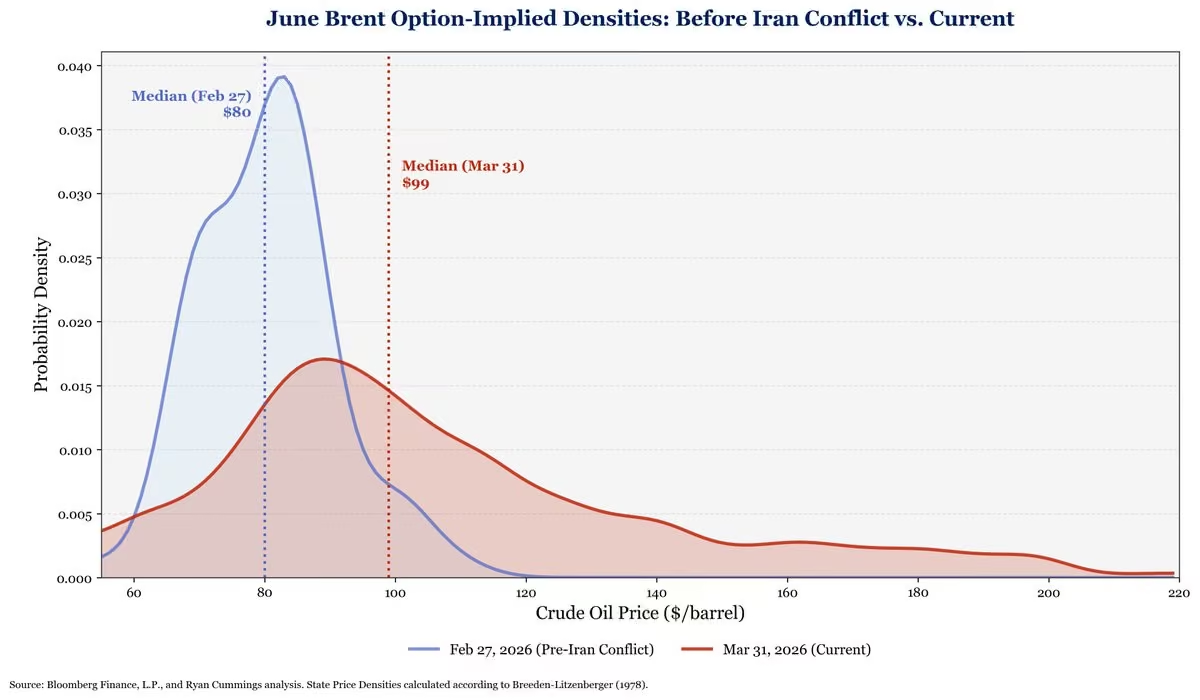 Olivier Blanchard
@ojblanchard1
The account of our friend @nprscottsimon has been hacked. He says:
“We are working to reverse this hack, and hope that @X will help. We think it’s important to keep people talking to each other. Our account has meant a lot to people, and to us, since 2009. Please know that we’re aware, trying to work it through, and miss our many friends. Scott Simon”
Olivier Blanchard
@ojblanchard1
Undergraduate intermediate macro exercise:
Secretary Bessent has announced that President Trump’s signature would be on newly issued dollar bills starting in June.
Suppose that people decide to boycott them, either by not accepting them in the first place, or by trying to get rid of them as soon as they can, or some combination of both. Implications for inflation and activity?
Olivier Blanchard reposted
 Alexandre Blaineau
@AlBlaineau
Ce moment fut sublime. Quelle sensibilité dans l’interprétation, comme une forme de recueillement. Je ne me lasse pas de l’écouter encore
Olivier Blanchard
@ojblanchard1
impressionant sur la forme et sur le fonds.
 Gandalv
@Microinteracti1
If there is precisely one thing you watch today, make it this. French Senator Claude Malhuret. A microphone. And the most magnificently savage dismantling of the Trump administration ever delivered in a language they almost certainly don’t speak.
He covers Iran. He covers corruption. He covers the kind of staggering, industrial-scale incompetence that would get you fired from managing a car park. And he does it with the calm, unhurried certainty of a man who has read every page of the indictment and found it, if anything, worse than expected.
France has never pretended to like these people. But this is contempt elevated to an art form. The kind of refined, aristocratic disdain that takes centuries of civilization to produce and approximately ninety seconds to deploy.
Malhuret sounds like he is four seconds from the button. Not out of panic. Out of sheer, exhausted disgust.
Honestly? Understandable.
Watch it. Share it. The adults are speaking.
Gandalv / @Microinteracti1
Olivier Blanchard
@ojblanchard1
私の母国であるフランスや多くの国々と同様、日本の財政政策は二つの中期的な目標を追求する必要があります。すなわち、政府債務残高対GDP比を安定させること、そして公的な投資を強化することです。プライマリーバランスへの言及も成長率や金利の変化も見据えた中期的な財政計画の文脈でのものです。他方で、公的な投資が必要かつ急務の場合には、最終的な債務安定化が保たれる限り、一時的なプライマリーバランスの赤字拡大が適切となることもあり得ます。重要なのは、その両方を責任ある、そして信頼できる形で両立させることです。高市総理は、こうした方向に沿った力強い経済・社会プログラムを設計し、実行する機会を得ています。それは十分に可能であり、私はこれまでの議論に強い感銘を受けています。高市政権、そして日本の成功をお祈りします。
 高市早苗
@takaichi_sanae
本日、経済財政諮問会議に、世界的に著名なマクロ経済学の有識者として、オリヴィエ・ブランシャール教授、ケネス・ロゴフ教授のお二人をお迎えし、我が国の経済財政運営を国際的な議論の中に位置づける「特別セッション」を開催し、活発なご議論をいただきました。
ブランシャール教授からは、
・財政運営について、「経済の不確実性」や「債務残高対GDP比」を踏まえつつ、モデル試算を活用し、年々の「機械的な調整」を避け、信頼に足る「中期の道筋」を示すことが重要、
・公的投資については、歳出と想定される歳入の関係性を透明化し、投資予算を「別枠管理」することが重要、
といった御示唆をいただきました。
ロゴフ教授からは、
・補正予算への依存度低減は「予見可能性」を高めること、
・日本の強みを活かす分野への取組に着手すること
に対する評価をいただきました。
お二方からは、世界的に金利が高まり不安定化が進む中で、金利上昇に備えた「リスク管理」が大切であることなどについて、数多くのご示唆をいただきました。
今後、本日の御議論も踏まえ、今夏の骨太の方針に向けて、経済財政諮問会議において、「責任ある積極財政」の具体化に向けた検討を加速していきたいと思います。


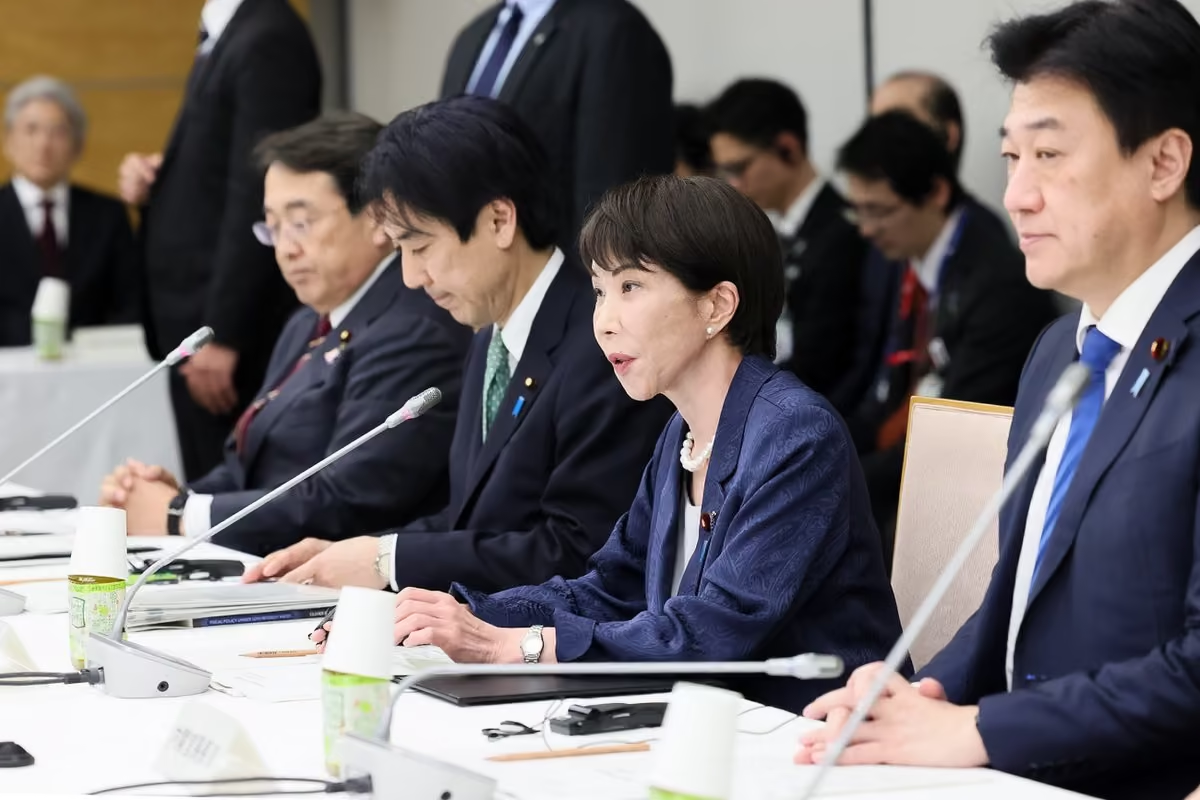
 Olivier Blanchard
@ojblanchard1
RIP Lionel Jospin
J'ai perdu un mentor, un ami, et un partenaire de tennis et de petanque. Mais, surtout, la France a perdu un homme profondement integre, dont la seule motivation etait d'ameliorer son sort. Tristesse.
Olivier Blanchard
@ojblanchard1
Great choice.
𝙐𝙜𝙤 𝙋𝙖𝙣𝙞𝙯𝙯𝙖
@upanizza
Great appointment. Congratulation to @HyunSongShin and the Bank of Korea BIS economist Shin Hyun-song named Bank of Korea governor | Reuters www.reuters.com/world/asia-pacific/bis-economist-shin-hyu…
Olivier Blanchard
@ojblanchard1
You know me, I am no conspiracy theorist. But it surely looks like the Trump administration is trying to prove Larry right about his 2023 forecast. Or, alternatively, that Larry knew in 2023 that Trump would win the election and go to war against Iran. Or even, that Larry is behind the election of Trump and the Iran war just in order for his forecast to be right.
Olivier Blanchard
@ojblanchard1
Larry: Are you becoming chartist? 😀(I kind of remember that something happened at the end of the 1970s, like a trippling of oil prices, which might be vaguely relevant. Do u expect it to happen again?)
Olivier Blanchard reposted
 The Juilliard School
@JuilliardSchool
Juilliard Pre-College student Freya just became the first person in the US to perform on Mozart’s childhood violin! 🎻 The violin is part of the @MorganLibrary exhibition, Wolfgang Amadeus Mozart: Treasures from the Mozarteum Foundation of Salzburg, on view through May 31.
Olivier Blanchard reposted
 Le Grand Continent
@Grand_Continent
Dans vingt-cinq ans, l’Europe pourrait être puissante, pacifique et prospère.
Mais pour cela, il faut arrêter d’appuyer sur «snooze».
Une pièce de doctrine signée @ojblanchard1, Pascal Lamy, @EnricoLetta et @bweder.
À lire absolument—à discuter.
legrandcontinent.eu/fr/2026/03/16/projet-2050-manifeste-p…
Olivier Blanchard reposted
Hélène Rey
@helene_rey
Looking forward to this new chapter in a great organisation. What a daunting task to follow Hyun!
Olivier Blanchard
@ojblanchard1
Time for positive thinking. Rather than complain about the Trump administration and how to react to the latest salvo, we must be more ambitious and think forward.
Beatrice Weder di Mauro, Enrico Letta, Pascal Lamy are launching a major project on Europe 2050: What do we want it to look like, and what it may take to get there. shorturl.at/FbZIt
We have commissioned pieces from experts on governance, enlargement, regulation, trade policy, etc. These will be produced between now and early September and posted and discussed on a dedicated platform. And then the four of us will attempt to put them together and distill the accumulated wisdom.
Olivier Blanchard
@ojblanchard1
For once I fully agree with Trump 😀:
"We have already destroyed 100% of Iran’s Military capability, but it’s easy for them to send a drone or two, drop a mine, or deliver a close range missile somewhere along, or in, this Waterway, no matter how badly defeated they are.”
I would not have said it better myself (except maybe for the 100% part). It might have been a good idea to think about it (and take it into account) two weeks ago.
Olivier Blanchard
@ojblanchard1
RIP Chris Sims.
I was enormously influenced by Chris. My own, perhaps idiosyncratic take:
His main contribution came at a time when macroeconomists had constructed the first wave of big macroeconometric models. They were constructed piece by piece, a consumption block, an investment block, and so on. Each piece looked reasonable, but when assembled together, the implied macro dynamics were all wrong.
What Chris did was to turn things around, namely argue that one had to start from the actual macro dynamics, the so called VARs, and show how, with minimal identification conditions (leading to "structural" VARs), they could be used to suggest the dynamic effects of various shocks, dynamics that the structural models had to replicate.
To say that his approach was influential would be to understate its influence. Today, a model that did not fit the VAR evidence, would be simply dismissed.
Olivier Blanchard
@ojblanchard1
A striking analogy:
Vietnam: a war of choice, major US military domination, guerilla war. We know the outcome.
Iran: a war of choice, major US military domination, guerilla war, but this time on a global scale. Outcome?
Olivier Blanchard reposted
 Gert Peersman
@GertPeersman
In earlier work, we do indeed find a substantial decline in the short-run price elasticity of oil demand over time:
www.aeaweb.org/articles?id=10.1257/mac.5.4.1 and onlinelibrary.wiley.com/doi/full/10.1002/jae.2283
One possible explanation we discuss is rising energy efficiency
Olivier Blanchard
@ojblanchard1
Could it be that the focus on energy efficiency and the resulting decrease in the share of oil has actually decreased the short run elasticity of demand? If so an interesting example of the trade off between efficiency and resilience.
Olivier Blanchard
@ojblanchard1
As always, I have learned from the comments. X as crowd sourcing. Arguments go both ways.
The Aramco announcement that they can increase flow through pipeline to the red sea up to 7 mbds (whereas the assumption earlier was for a smaller feasible increase). But loading capacity at Yanbu terminal appears to be less, perhaps 3- 5 mbds, so only 2-3 more than it did pre-war.
The decision by the US to wave oil-related sanctions on Russia. (not good news for Ukraine) . Probably small effect.
Uncertainty about the short run demand elasticity: closer to -0.1 or to -0.05 ? Compared to my assumption of -0.1, this doubles the effect on the price of any supply decrease.
As storage facilities fill up in the Persian Gulf, need to close production or extraction facilities, which takes longer to undo.
A tougher line by Iran on the strait of Hormuz. Higher likelihood of mines.
Bottom line. I stick to a high probability of higher for longer, higher than current and forward prices suggest.
Still, eager to learn more.
Olivier Blanchard
@ojblanchard1
Market participants (who are more knowledgeable than I about this particular market) must disagree with one of the assumptions. I do not know which one. I suspect it is that they believe there will be a cease fire and Iran will open the strait, end of story. Maybe...
Olivier Blanchard
@ojblanchard1
I find it hard not to have as a central scenario where oil prices will remain very high for a long time, higher than the market current prices.
I am no expert on geo-politics and defense technology, but this is what I think I have learned:
Fully protecting ships in the strait of Hormuz is basically impossible. Not enough time to stop missiles or drones.
There is no reason, whether or not Trump declares that war is over, to think that Iran will not continue for some time to threaten to destroy the ships that try. Why should they stop?
The risk will thus remain sufficiently high that most non Iranian ships will not take the risk.
Thus, the shortfall of 20 million barrels a day is likely to last for long.
The scope for increased supply from elsewhere is very limited in the short run. Perhaps 2 million barrels at the most.
The 400 million barrels reserve release can only add 3-4 million barrels or so daily.
The short run elasticity of demand for oil is very low, at most -0.1, and probably less.
This suggests to me prices closer to 150-200 dollars per barrel (or more, but I hesitate to give higher numbers…) than to the current market price.
To repeat. I am no expert (As an economist, I have a bit more sense about the next step, namely what such a price would to the world economy). I would be more than happy to be proven wrong.
Olivier Blanchard
@ojblanchard1
In the set of assumptions, the crucial one is whether Iran will commit to not hit ships in the strait. The issue is that Iran does not need to actually do anything, just to leave some ambiguity as to whether it might do it. And I think it is in their interest to do so. To suggest deals: letting the ships from country x go through in exchange for some form of help, etc. (in that respect, mines is different from drones.)
Olivier Blanchard
@ojblanchard1
In war, there are, to borrow from Rumsfeld, unknown unknowns. These are hard to prepare for. But at least, one should prepare for known knowns… And the closing of the strait of Hormuz is at the top of that list. (In the early 2010s, when I was at the IMF, we looked at a scenario precisely along these lines)
Olivier Blanchard reposted
 Simon Kuestenmacher
@simongerman600
One of the best cartoons in ages! Thank you @BillBramhall!
 Olivier Blanchard
@ojblanchard1
getting slightly out of my lane.
fascinating how the security of a 4 miles wide piece of sea determines whether the conflict is limited to the middle east, or whether it affects all the countries in the world.
fascinating how drone technology and low cost is such that it seems nearly impossible to protect the strait, no matter the cost.
fascinating how the implications of this choke point have been known for decades and Kuwait has not built an oil pipeline to get the gas to the red sea. Yes, the cost was high. But higher than the cost to the world of what is happening today?
Olivier Blanchard
@ojblanchard1
On the effects of higher oil prices: The conclusions from our 2009 paper (with Marianna Riggi) www.nber.org/papers/w15467 are going to be tested. (but there is more to the current episode than higher oil prices)
Olivier Blanchard
@ojblanchard1
may i remark that the two statements are consistent. Nothing "in life" (emphasis on the quotes) is for sure. 😀
 Thomas Baertl
@ThomasBaertl
"nothing in life is for sure" is a surprisingly unscientific argument. One of your colleagues stated "In the long run we are all dead." Sounds pretty sure to me.
Olivier Blanchard
@ojblanchard1
As I said in a precedent iteration on the topic, nothing in life is for sure.
But Hanno's hypothetic scenario has, in my view, zero probability. Were the French government to try to do that switch, it would get destroyed by investors in the bond market, and by other member countries in Brussels.
Were I the minister of finance, this is the last thing I would do.
Hanno Lustig
@HannoLustig
I think it is directly related in the following sense. What the Eurozone needs is a bond market that prices the marginal Euro the Belgian or French government borrows in capital markets to accurately reflect the underlying credit risk of Belgium or France without pricing in implicit guarantees or contingent transfers. Market participants should understand that default is a real option. That way the Belgian and the French government face the right incentives when trading off different fiscal options.
Olivier’s proposal doesn’t help in this regard. Even if the French government borrows the marginal euro in the national French bond market (call these red bonds), not in the blue bond market (the Euro bonds), the blue bonds give France more leverage. If France gets into serious fiscal trouble, the French PM could tell the other Europeans that France will redirect the VAT revenue slated for French payments on the blue bonds to the payments on their red bonds (hard to legislate that option away for the French; they can always change the law ex post). That’s the rational thing to do for France because its actions now have a much larger effect on the yields of the red bonds than on the yields of the blue bonds.
That then also gives the French PM more leverage to get a bailout from the other European countries in the blue bond pool who definitely want to avoid anything that causes blue bond yields to spike. The blue bond yield affects all these countries directly. Also, the blue bonds would be the safe asset of the Eurozone.
It's akin to having households take out 2 mortgages: one through an MBS where each household in the pool pays the same rate as all other households; another one where each household pays a rate that reflect its own credit risk.
Olivier Blanchard reposted
 Chris Gore
@ThatChrisGore
I used to marvel at new tech and now I'm just over it. This encapsulates how I feel about any new app or tech device these days.
 Olivier Blanchard
@ojblanchard1
Nothing in life is sure, including the safety of German bunds...😀 But the cost of not paying your EU dues and sailing into the sunset (and losing access to all EU programs, and being treated as a pariah) is extremely high. Again: Greece paid its dues even when it was bankrupt. The UK paid its dues when it brexited...
 Hans Peter Grüner
@HansGruener
How can Europe make sure that some nationalist government, claiming to be dissatisfied with Brussels, refuses paying the interest on the (25% of GDP) blue debt and plans to sail into the sunset with the (formerly) red debt?
Olivier Blanchard
@ojblanchard1
On the safety of Eurobonds.
In our proposal, (www.piie.com/blogs/realtime-economics/2025/now-time-eurob…) eurobonds are issued by the EU. Their safety depends on the probability that the EU will make interest payments on the bonds, which in turn depends on the probability that member countries will pay their dues to Bruxelles. These dues are small relative to the overall national budgets and the evidence is that member countries indeed pay their due to the EU even when they leave or are in trouble (The UK has paid what it owed during and after Brexit, Greece continued to pay its dues during the euro crisis and while domestic debt was haircut.)
In contrast, the safety of national bonds depends on the probability that the government will be able to pay interest on existing national bonds. In the case of some member countries, one may reasonably doubt that the probability is one. Thus, we observe a spread on these bonds relative to bunds.
Put another way, EU bonds, if designed as we suggest, are likely to be, and be perceived, as very safe. Indeed safer, I would argue, than US treasuries, given current US fiscal policy.
Olivier Blanchard
@ojblanchard1
again, welcoming discussions. So, thanks Klaus, Marcel, etc... But these do not convince me.
1. The first argument is the old slippery slope argument. We are at 25% of GDP. But soon we shall be at 100% and then all hell breaks loose... This will simply not happen.
2. The second argument is ironic. Indeed, there is a chance that marginal interest rates may go up in some countries (again, the average should come down). But this is precisely what our German friends have argued for: Make deficits more costly, and force countries to behave. This is what this does.
 Klaus Adam
@klaus_adam
This #eurobond proposal may look workable when focusing narrowly on the economics, but if you think a minute about the *political* incentives, it becomes a quite terrible idea.
A short thread 🧵 1/6
Olivier Blanchard
@ojblanchard1
On the safety of Eurobonds.
In our proposal, (www.piie.com/blogs/realtime-economics/2025/now-time-eurob…) eurobonds are issued by the EU. Their safety depends on the probability that the EU will make interest payments on the bonds, which in turn depends on the probability that member countries will pay their dues to Bruxelles. These dues are small relative to the overall national budgets and the evidence is that member countries indeed pay their due to the EU even when they leave or are in trouble (The UK has paid what it owed during and after Brexit, Greece continued to pay its dues during the euro crisis and while domestic debt was haircut.)
In contrast, the safety of national bonds depends on the probability that the government will be able to pay interest on existing national bonds. In the case of some member countries, one may reasonably doubt that the probability is one. Thus, we observe a spread on these bonds relative to bunds.
Put another way, EU bonds, if designed as we suggest, are likely to be, and be perceived, as very safe. Indeed safer, I would argue, than US treasuries, given current US fiscal policy.
Olivier Blanchard
@ojblanchard1
Thanks a lot for the exchange. Our swap proposal is neutral re: deficit finance of some investment. It does not change the overall level of debt, nor the overall level of deficits. But this does not mean that there is not a separate argument for some deficit finance of urgent investment, in particular defense. (I am, ironically, more on the hawkish side of that discussion than most. If higher defense spending is to be permanent, one has to quickly bite the tax bullet). But do not expect the flows from EU deficit finance to add up to a sufficiently large market to provide the liquidity benefits and the low rates that come from the swap part.
 Marcel Jansen
@mjansen_madrid
With all due respect, I am not sure about your point. By way of example, the government agreement of the new Dutch government “closes the door” to eurobonds but does talk about European public goods and matching this [implicitly] with European funding.
Olivier Blanchard
@ojblanchard1
This is a good example of good intentions killing a proposal. 😟 We have to delink in practice and in the mind of policy makers the existence of euro bonds and deficit finance.
Our proposal is a swap (we think this is the only way to achieve the market size that delivers liquidity and depth benefits). It does not by itself create more space to finance anything, good or bad. If some countries want, in parallel, issue more euro bonds to finance this or that project, they can make the case, but it is a separate issue.
Marcel Jansen
@mjansen_madrid
There are many interesting elements in this proposal. But IMHO viability would improve if the issuance of eurobonds is linked to European public goods. Northern countries would have stronger incentives to go along if Eurobonds bring us closer to the desired level of spending.
Olivier Blanchard
@ojblanchard1
On the safety of Eurobonds.
In our proposal, (www.piie.com/blogs/realtime-economics/2025/now-time-eurob…) eurobonds are issued by the EU. Their safety depends on the probability that the EU will make interest payments on the bonds, which in turn depends on the probability that member countries will pay their dues to Bruxelles. These dues are small relative to the overall national budgets and the evidence is that member countries indeed pay their due to the EU even when they leave or are in trouble (The UK has paid what it owed during and after Brexit, Greece continued to pay its dues during the euro crisis and while domestic debt was haircut.)
In contrast, the safety of national bonds depends on the probability that the government will be able to pay interest on existing national bonds. In the case of some member countries, one may reasonably doubt that the probability is one. Thus, we observe a spread on these bonds relative to bunds.
Put another way, EU bonds, if designed as we suggest, are likely to be, and be perceived, as very safe. Indeed safer, I would argue, than US treasuries, given current US fiscal policy.
Olivier Blanchard
@ojblanchard1
Please. before answering, read the proposal. 😀 The rate on eurobonds is likely to be lower than the bund rate. And, while the average rate will be lower for all countries, the marginal rate on national debt may indeed be a bit higher, giving incentives for governments to actually be more responsible.
 Dr. Daniel Stelter
@thinkBTO
The German Part of the mutualized debt will be more expensive. And overall German debt gets more expensive due to implied risk sharing beyond. The incentive for France, Italy etc. to deal with its debt problem is reduced, increasing risk and in functioning markets interest rates.
Olivier Blanchard
@ojblanchard1
size, depth, and liquidity of market. Being able to buy and sell large amounts without having the price move against you. (why do you think investors like Treasuries so much? It is not because of love of the US. It is because it is big, deep, and liquid)
 Christian Lessmann
@econ_lessmann
Please help me: if there is no risk sharing, why should interest rates be more attractive as with national borrowing?
Olivier Blanchard
@ojblanchard1
Dear Lars
Can you have a look at our proposal with Angel?
www.piie.com/blogs/realtime-economics/2025/now-time-eurob…
It does not have risk sharing, it does not imply deficit finance. Germany is not on the hook. It is not an increase in debt, but smarter and cheaper debt. How does it do it? The way the US has done it: Larger, more liquid market, nothing else.
Can we get past the ukases, and the preconceived notion that eurobonds are necessarily bad?
 Lars P Feld
@Lars_Feld
The answer is „NO“.
Olivier Blanchard reposted
 Lukasz Rachel
@LukaszRachel
I analyse growth + markup + automation effects in the recent bpea paper www.brookings.edu/articles/what-next-for-r/
Doesn't get at the inequality effects though. There will also be precautionary effect as this is a large 2nd moment shock for a lot of people. I'm working on that, watch this space
Olivier Blanchard reposted
Luca Fornaro
@LucaFornaro3
Interesting points by @ojblanchard1. Perhaps we were a bit ahead of times, in this paper we provide a model that captures these forces, by enriching the @DAcemogluMIT /Restrepo framework with nominal rigidities and non-homothetic preferences. In Section 5, we show that advances
 Olivier Blanchard
@ojblanchard1
On AI and r* (inspired by the Citrini discussion).
Standard effect: If AI leads to higher growth, likely to increase r* (higher investment, lower saving).
Non standard effect: If AI leads to more inequality (enormous rents for the owners of AI, unemployment or low wages for those displaced), then likely decrease r* (saving rate of the rich much higher than saving rate of the poor).
Which way does r* go?
Olivier Blanchard
@ojblanchard1
On AI, aggregate demand, (implicitly) r*, a nice piece by Alex Imas
 Alex Imas
@alexolegimas
Olivier, you might be interested: I worked out the formalism for these scenarios in January. It’s related to @AtifRMian’s idea of indebted demand:
open.substack.com/pub/aleximas/p/will-advanced-ai-lead-to…
Olivier Blanchard
@ojblanchard1
On AI and r* (inspired by the Citrini discussion).
Standard effect: If AI leads to higher growth, likely to increase r* (higher investment, lower saving).
Non standard effect: If AI leads to more inequality (enormous rents for the owners of AI, unemployment or low wages for those displaced), then likely decrease r* (saving rate of the rich much higher than saving rate of the poor).
Which way does r* go?
Olivier Blanchard
@ojblanchard1
On the supreme court decision on tariffs, a remark from afar, by an uneducated foreigner:
Didn’t we get a relatively clean test of who is a conservative judge and who is a Trumpist judge?
Isn’t obvious that a conservative judge would conclude that the tariffs were unconstitutional, and a Trumpist judge would find ways (to me, arguing that removing tariffs would lead to chaos is an amazing legal argument, when I think about this can be used by the executive to do crazy stuff and get away with it)
(I thought Barrett was probably a conservative. I was unsure about Kavanaugh...)
So 3 Trumpists only on the Supreme Court. Good news and important for the future.
Olivier Blanchard
@ojblanchard1
In a world where the Epstein papers give a catastrophic image of how the rich and powerful behave too often, it is heart warming to see the governor of the Banque de France retire to be in charge, pro bono, of a charitable association aimed at helping the youth in trouble. Merci Francois Villeroy de Galhau.
Olivier Blanchard
@ojblanchard1
Re Grade inflation and Harvard rules (@jasonfurman):
The mechanism behind grade inflation is the same as the mechanism behind inflation. Inflation comes from price setters trying to increase their relative price, leading all prices to go up. Grade inflation comes from teachers trying to increase or maintain their relative grade, leading all grades to go up.
In the case of inflation, what limits the increase is lower aggregate demand, which leads price setters not to want to increase their relative price and stabilizes inflation (this is what the Taylor rule does). In the case of grade inflation, the feedback mechanism is not there. But it could be introduced. University rules smoothly penalizing consistently high grades, at the university level or at the individual grader level? Actually, the University can do something that the Fed cannot do: adjust the grade distribution and the average grade level down if needed. (Fed cannot adjust the average price level directly...) Fun to think about it.
Olivier Blanchard
@ojblanchard1
Trying to go beyond the hype and put my thoughts (and the lessons of my research) together on the cost of public debt. How I would explain it to policy makers. www.parisschoolofeconomics.eu/en/news/public-debt-by-oliv…
Olivier Blanchard
@ojblanchard1
From the description (and this being Harvard, it may be that the proposal is much smarter than the summary given by @jasonfurman's in his tweet...😀), this sounds like a good way to eliminate one problem by creating another one. What if all the kids in a class are truly outstanding, and everybody truly deserves an A? (Grades in college are not about being better than others, but whether you master the material)
The right institutional response must be in the muddy middle, allowing for a shift in the distribution if the professor truly believes and is willing to state that the class is on average better (or worse), and using a statistical tool to identify unlikely outcomes (students are better every year). Yes, muddy, but better.
,
 Jason Furman
@jasonfurman
I will be enthusiastically supporting faculty legislation to cap the number of A's at Harvard at 20% (plus a bit). The collective action problem that has driven grades higher & higher over time is increasingly problematic. I hope other institutions consider similar steps.
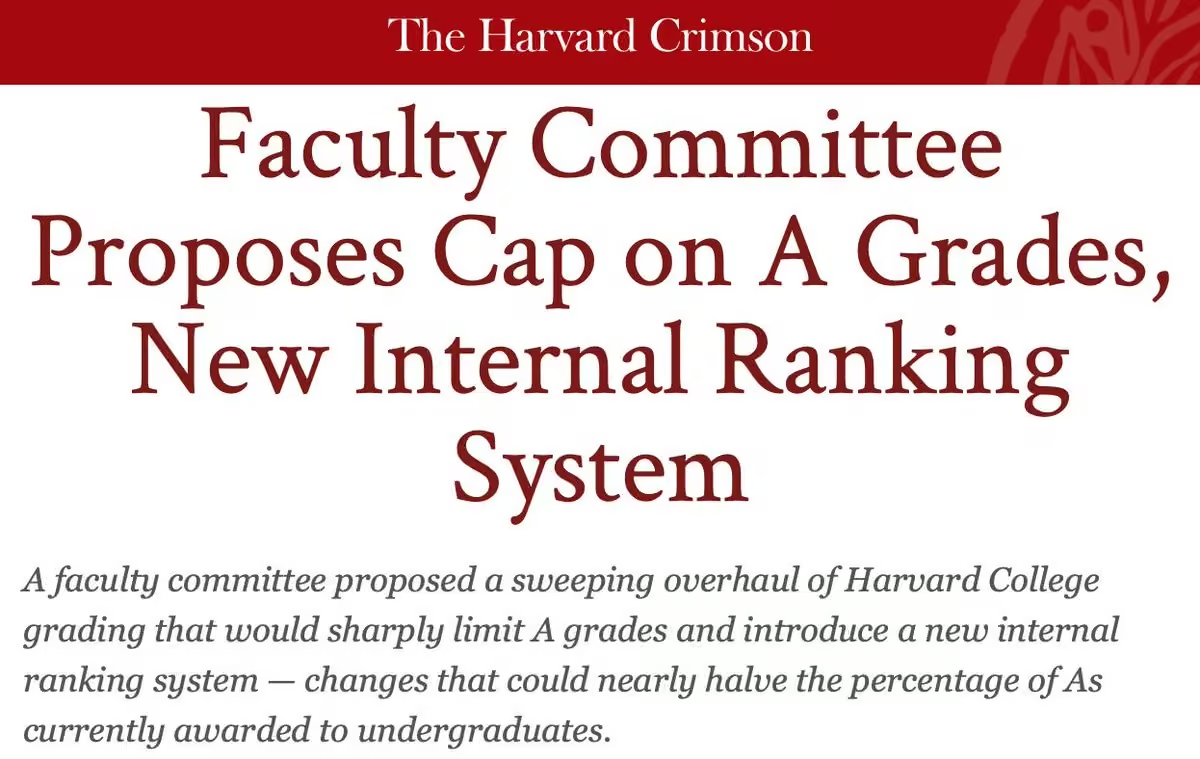 Olivier Blanchard
@ojblanchard1
From the comments: "Bitcoin is often harshly judged. The notion that an asset must have a "fundamental value" is outdated. Economists need to review how they view assets."
How cute ! How dangerous !
On bitcoin being a hedge. I was making the theoretical point that a bubble can be a hedge. But, some of the comments are right. It has been a poor hedge so far (not that gold is a perfect hedge either, but it does better at it)
Olivier Blanchard
@ojblanchard1
Always fun to engage with the Bitcoin crowd, getting insights about human nature, credulity, motivated beliefs, and the thinking of Bitcoin investors.
A slightly deeper point. I think Bitcoin is mostly a bubble, with a very small fundamental value (let’s not go there…). Still, it makes sense to hold a bubble if it is a reliable hedge against adverse shocks, the way gold has been for a long time. In the world of multiple equilibria, if others buy an intrinsically valueless asset when times are bad, it makes sense to do the same, and have some in your portfolio.
The issue: This is a very fragile equilibrium. If investors change their mind, then it loses its hedge value, and its price can decrease dramatically. So far, the evidence is that gold seems to be a more reliable hedge than bitcoin.
Olivier Blanchard
@ojblanchard1
On Bitcoin, and what happened yesterday.
Some assets have a fundamental value, for example future dividends for stocks. Most investors buy them based on their assessment of fundamentals.
Some assets have no fundamental value, or at most a fuzzy one, for example Bitcoin. Most investors buy them on their hope of capital gains.
These investors are much more likely than stock investors to extrapolate past gains, move in herds, leading to extreme volatility.
Olivier Blanchard
@ojblanchard1
Draghi asks the right questions. European Union in the future: Federation or confederation? And, if federation, what perimeter? The current one, a smaller one? On economic grounds, political grounds, geopolitical grounds?
 European Democrats
@democrats_eu
Europe cannot afford to stay a loose club of vetoes and hesitations. In Leuven, Belgium, Mario Draghi put it clearly: coordinating national interests is not the same as acting as one power. Where Europe has chosen federation – trade, competition, the single market – it is respected and heard. Where it has not – defence, foreign policy, industrial strategy – it is divided and vulnerable. A Union strong on trade but weak on security will always see its strengths used against it. Europe must choose: fragmented nations, or a real European power.
Olivier Blanchard
@ojblanchard1
An example of adverse effects of well-intended laws (a big issue in general).
Given the uncertainty, the job market for new graduates is tough. One would think that allowing them to take low paid internships while the jobs come slowly back, would be desirable. But a French law stands in the way.
To get such an internship, you need to draw a convention, which the employer, the intern, and an “etablissement de formation” (it could be a university, or a professional school) all sign.
The intent is to prevent exploitation and underpayment, which makes good sense. One of the results however is that graduates, who no longer belong to such an “etablissement”, cannot get an internship and remain unemployed.
Olivier Blanchard
@ojblanchard1
Quelqu'un a suggéré "tongue in cheek", ce qui me parait en effet etre l'équivalent. Merci. Mais la proportion de "tongue in cheek" ou deuxieme degré dans les conversations me parait etre beaucoup plus élevée en France qu'aux US.
Olivier Blanchard
@ojblanchard1
Autant que je sache (et j’ai cherché), il n’y a pas d’expression correspondante a « second degré » aux US. Je crois que ça n’est pas un hasard. Quand j’enseigne, si j’essaie une blague, mais ne souris pas, ça passe totalement à côté.
 Gérard Araud
@GerardAraud
A Washington, ce genre de photo était une plaisanterie dans toutes les soirées. Apparemment, il n’y a pas que les Américains qui ont des difficultés avec le second degré….
Olivier Blanchard
@ojblanchard1
Autant que je sache (et j’ai cherché), il n’y a pas d’expression correspondante a « second degré » aux US. Je crois que ça n’est pas un hasard. Quand j’enseigne, si j’essaie une blague, mais ne souris pas, ça passe totalement à côté.
Gérard Araud
@GerardAraud
A Washington, ce genre de photo était une plaisanterie dans toutes les soirées. Apparemment, il n’y a pas que les Américains qui ont des difficultés avec le second degré….
Olivier Blanchard
@ojblanchard1
In answer to some comments, and for those of you who are nerds: On the role of trade versus financial flows, see
/www.brookings.edu/wp-content/uploads/2005/01/2005a_bpea_b…
Discussion of what happens when investors want to reduce the share of dollar assets around p28. Dollar depreciation can be substantial.
Olivier Blanchard
@ojblanchard1
Indeed. Theory and past evidence strongly suggested, and economists largely predicted, that, as tariffs reduced the trade deficit, the dollar would appreciate, cancelling much of the effect of tariffs on the deficit.
The predictions were wrong.
So what happened? Something else happened..., namely worries about US fiscal deficits, and more generally about the reserve currency status of the dollar, which went the other way.
Olivier Blanchard
@ojblanchard1
An interesting fact: Increase in average US tariffs vis a vis the EU since US election: 13%. Appreciation of the euro vis a vis dollar: 13%. (Tripple whammy, as tariffs work on EU exports , but appreciation works on both EU exports and EU imports).
Olivier Blanchard
@ojblanchard1
David having been my student, I am proud to have contributed, as a Frenchman, and admittedly somewhat indirectly, to the improvement of NFL football. (and who says economists are useless?...)
NFL: what about free tickets to the superbowl?
 Jon Hartley
@Jon_Hartley_
Bellman equations on @ESPN! @ESPN documentary "NFL and 4th Down" features Berkeley economist David Romer explaining his JPE paper "Do firms maximize? Evidence from professional football" arguing teams should go for it on 4th down more. Now common practice in the NFL 20 yrs later.
Olivier Blanchard
@ojblanchard1
In response to Jesus Fernandez Villaverde. Fun discussion.
Yes, preferences are not given by God.
Learning how to appreciate food, taking the time to eat, sitting together at the dinner table, is definitely building consumption/leisure capital a la Becker-Murphy. The French do it from age zero, the Americans not so much. And, (my biased but experience based view) good food is one of the daily pleasures of life.
Institutions matter: That everybody takes August off makes for much easier coordination, and spending time with friends. The tax rate on labor income and not on leisure surely affects choices, although the argument that high taxes in the past is what explains current French behavior is not terribly convincing.
Institutions mostly reflect preferences but can go off the rail. I indeed think that going to 35 hours without reducing the wage, was a mistake in allowing people to think there was no trade off between income and leisure. It has proven costly. Labor regulations lead too many workers to involuntary retire too early.
Social norms matter. In France, dinners in Paris used to be very late. The idea is that, if you came back from the office before 8pm, you were clearly a nobody.
Events matter: Covid has led to substantial and apparently hysteretic changes in going to restaurants, seeing friends.
But the bottom line remains. The French are not lazy. For many reasons, some good, some bad, most are happy to work less and earn less. And it should not be seen as a sin, or as a crippling economic problem. France has problems. This is not the main one.
Olivier Blanchard
@ojblanchard1
Bottom line: US /France work life balance?
From remote.com/resources/research/global-life-work-balance-index
France: 16th
US: 54th.
Olivier Blanchard
@ojblanchard1
I want to reassure my American friends. If somebody, in France, wants to work hard, retire late or not all, and work 50-60 hours a week, it is perfectly possible. (this conclusion is based on introspection). Some of us are blessed with exciting jobs. Most of us unfortunately are not.
 Jeet Sidhu
@jeetsidhu_
People love making blanket statements about countries.
Reality check: The French have government mandated leisure. The people aren’t actually free to work hard. It’s not an inherent characteristic. All of the famous French scientists or generals worked hard.
Olivier Blanchard
@ojblanchard1
The French are not lazy. They just enjoy leisure more than most (no irony here) And this is perfectly fine: .
As productivity increases, it is perfectly reasonable to take it partly as more leisure (fewer hours per week, earlier retirement age), and only partly in income.
Olivier Blanchard
@ojblanchard1
Alex, how can you say such things? You are saying that if a country, given its productivity level, decides to decrease hours worked, and has 10% less production and income, it is doomed? (What about the country which was 10% less productive to start, and keeps hours constant. Is it doomed as well?). And what is this stuff about trade surplus? Are you saying that countries with low income for whatever reason cannot have balanced trade? And that a trade surplus is a good thing?
Alex Imas
@alexolegimas
This is a perfectly reasonable approach to take for a country in isolation. But it becomes difficult when you also want to be relevant on the world stage, and people in other countries have different objective functions. Leisure does not buy security and a trade surplus.
Ultimately you end up being dependent on others, largely sidelined, and making deals that are not very favorable for the long-term health of the country.
Olivier Blanchard
@ojblanchard1
The French are not lazy. They just enjoy leisure more than most (no irony here) And this is perfectly fine: .
As productivity increases, it is perfectly reasonable to take it partly as more leisure (fewer hours per week, earlier retirement age), and only partly in income.
Olivier Blanchard
@ojblanchard1
To somebody with a hammer, everything looks like a nail. This being said:
(Re Greenland TACO, bond yields and dollar moves)
If there was today a deep liquid euro bond market, I suspect that the US/EU bond market reactions would lead Trump to be a bit more careful.
Olivier Blanchard
@ojblanchard1
I could not resist. www.facebook.com/watch/?v=630623945282553
Olivier Blanchard
@ojblanchard1
A very important speech by Mark Carney (17 minutes well spent if you have the time to listen). Open eyed, with a concrete, positive, strategy for what he calls the "middle countries" in a world of hegemons. Feels good to hear.
 Mark Carney
@MarkJCarney
LIVE: from the World Economic Forum • EN DIRECT : au Forum économique mondial x.com/i/broadcasts/1BRJjgnLVzVxw
Olivier Blanchard reposted
 David Colon
@Colon_David
En exclusivité, les premières images du "Conseil de la paix" de Trump et Poutine :-)
Olivier Blanchard
@ojblanchard1
Interesting divide and conquer approach by the Trump administration on tariffs. Only 8 countries targeted.
Suppose this were actually to happen. What do you think would happen to measured exports from France to Luxembourg and exports from Luxembourg to the US? (just kidding, although not quite)
Olivier Blanchard reposted
 Sonja M. Lauterbach
@SolautSonja
Sonja M. Lauterbach
@SolautSonja
European politicians need to stop the brown-nosing and the sycophancy toward Trump and finally start acting like the powerhouse they are. They must take decisive action now—unless they want the EU to devolve into a pathetic global laughingstock.
A suggestion:
 Olivier Blanchard
@ojblanchard1
to be perfectly clear. Eurobonds should not be the only answer. Inflicting some pain, at the cost of pain in EU, is I believe needed to send the right message.
also to be clear (for those who did not have the time to read the linked document): the euro bond proposal is NOT a proposal for more debt finance, but for a change in the composition of debt in the EU, with more EU and less national debt.
Olivier Blanchard
@ojblanchard1
In response to the new Trump tariffs on Europe--if they stay.
Most countermeasures the EU has considered are costly for the US, but also costly for the EU... Be it export restrictions on pharmaceuticals, higher digital taxes on non resident firms, etc. They should definitely be considered, but one must realize that they would involve some pain.
One measure I can think of however, which could be announced now and implemented relatively quickly, and would be good for the EU, is the creation of a deep eurobond market, reducing dollar dominance. shorturl.at/341aB
It can be done, at little political cost, with benefits for the EU, and costs for the US. (It is worth doing anyway, but announcing it now would show that Europe has some cards to play and is willing to play them)
Olivier Blanchard reposted
Gérard Araud
@GerardAraud
Que c’est beau. Arrêtez vous un instant et écoutez. Je crois que Kubrick l’avait repris dans Barry Lindon.
 Rémi Fauconnier
@RemiFauconnier
Trio en mi bémol majeur pour piano et cordes nº2 de 𝗦𝗰𝗵𝘂𝗯𝗲𝗿𝘁,
Offrez-vous quelques instants de beauté pour oublier le monde fou qui nous entoure.
Olivier Blanchard
@ojblanchard1
A follow up on yesterday's post on EVs, China, minimum price constraints. Evidence on the effects of EU tariffs on Chinese EVs. shorturl.at/krb7v
Worth reading. Theory is clean. Reality is messy...
Olivier Blanchard
@ojblanchard1
The answer:
It gives breathing room to EU producers to adjust.
Minimum prices on Chinese EVs makes EU EVs more competitive.
And joint ventures with Chinese firms in the EU give EU EV producers potential access to better technology (the same as what happened the other way when the Chinese encouraged joint ventures of foreign firms with Chinese firms...)
 Bid/Offer
@lanz5000
So how is this good for EU citizens?
If anything Chinese companies are allowed to make profits in Europe or invest to enhance their technologies, while we lose market share and investment potential - how do we benefit from this? Care to explain
Olivier Blanchard
@ojblanchard1
What I see as good news for resolving some of the EU/China economic tensions: The guidance document on dealing with EVs put out by the European Commission shorturl.at/TU4BU
1. Minimum prices on Chinese EV imports. Yes, bad for EU consumers (at least in the short run), but giving some breathing room to EU producers, and probably a necessary condition to get the Chinese to the discussion table.
2. Attractive conditions for Chinese investments in the EU. It would have been hard to convince them 10 years ago. But the Chinese technology is now so advanced that they can compete even if they pay European wages.
Olivier Blanchard
@ojblanchard1
Reached 200k followers. Thanks to all of them. Must be some kind of milestone.
Some lessons for academics. Comments and reactions welcome.
Benefits of X.
Posting on X is an easy and fast way to express and disseminate potentially useful thoughts, to reach (many) journalists and (some) policy makers without taking too much of their time. A few paragraphs, and a link if needed.
It is easier, faster than writing and getting op-eds published. It is much lighter work than substack. A few substacks are simply amazing (thanks paul krugman, heather cox richardson, tomas pueyo, among them) but it looks like a full-time occupation for those (very gifted) ones who write them.
X is often a source of great information. There truly are true experts on every single subject. Barely a day goes by without a new fact, a great graph, a deep analysis. Thanks @JesusFerna7026 and others. Or, very far from economics, @JamesLucasIT
Sometimes, X triggers fascinating discussions with other academics, but discussions open to all, and all can and do intervene. A right mix of expertise and vox populi. Thanks @JohnHCochrane, and others.
Interventions and reactions, nice or less so, often give me a sense of public opinion out there. For example, I was surprised by the reactions to x.com/ojblanchard1/status/2004859935558173125. I thought most people would agree. Many didn’t.
I have been largely insulated from trolls and insults. Probably because I do not insult, and my centrist positions are sufficiently wishy washy not to trigger hysterical responses.
Costs of X.
The X algorithm seems to privilege conflict, outrageous opinions. Not sure all relevant posts reach all relevant targets.
I wish more big-name academics participated. I do not know of any other discussion forum with the attributes of X.
I probably waste too much time reading posts. At this stage of my life cycle, it is not too costly, but I am not sure I would recommend it to young researchers. Absorbing high frequency information can be overwhelming and it does take time away from deeper thinking. There is something to be said for the ivory tower.
Olivier Blanchard
@ojblanchard1
This quote from Gramsci captures exactly where I feel we are today:
"The old world is dying, and the new world struggles to be born: now is the time of monsters."
We have to fight the monsters, and help define the new world. Happy 2026. 😀
Olivier Blanchard
@ojblanchard1
In response to those who asked how things have changed over time. Here is some evidence (from a different survey), from 1984 to today. ourworldindata.org/grapher/self-reported-trust-attitudes?…
Bottom line (and there is much more sophisticated analysis). Country effects dominate. Time effects vary a lot across countries.
Olivier Blanchard
@ojblanchard1
These are gigantic differences.
 Olivier Blanchard
@ojblanchard1
These are gigantic differences.
Olivier Blanchard
@ojblanchard1
RIP Roger Guesnerie
J’ai deux souvenirs de Roger. Au dela de mon admiration pour l’homme et le chercheur. Modestie et exactitude. Et quelle contribution…
La première. De retour aux US pour ma deuxieme annee de doctorat. Je me retrouve a cote de quelqu’un qui me demande ce que je fais. Je suis tres loin de faire de la recherche sérieuse, mais je bluffe et lui explique que je travaille sur un truc qui s’appelle la théorie du second best (j’avais ecrit un papier pour un cours). J’essaie de lui expliquer en termes simples. Il m’écoute poliment. Et se présente : Roger Guesnerie (probablement le spécialiste mondial du sujet…) Je me suis senti assez stupide.
La deuxieme. La encore dans l’avion pour Boston avec Roger. Qui débarque avec du pâté, du saucisson. Et qui se fait tout prendre par les douanes américaines. Il était tres malheureux.
Olivier Blanchard reposted
 Caroline Di Russo
@CaroDiRusso
As I said earlier, regime change - in Venezuela or elsewhere - is a very serious and consequential thing.
No doubt.
But the satirical commentary following the fall of Maduro has been sensational. The irony. The sizzle. The absolute bangers.
Here are my faves so far.
Olivier Blanchard
@ojblanchard1
 Olivier Blanchard
@ojblanchard1
Intriguing. Tell us more.
 Ivan Werning
@IvanWerning

Olivier Blanchard reposted
 Peterson Institute
@PIIE
Average US tariffs on China: 47.5%
Average Chinese tariffs on US: 31.9%
Average US tariffs on the rest of the world: 18.4%
Average Chinese tariffs on the rest of the world: 6.5%
#piiecharts

Olivier Blanchard reposted
Jesús Fernández-Villaverde
@JesusFerna7026
As I close out my first year of posting on X, I looked at the post that resonated most with readers in 2025 to learn what I could do better.
Since I post in English and in Spanish, today I will comment on the readers’ ten favorites in English, and tomorrow on the readers’ ten favorites in Spanish.
1️⃣ The most viewed post, by far, and also the most important one: my slide deck on the demographic future of humanity, with over 1.1 million views:
x.com/JesusFerna7026/status/1929278948350771281
Nothing will shape the next 50 years as much as the incredible drop in fertility that we have seen worldwide over the last 10 years. I cannot insist on this fact enough. Everything else will be second order. I really need to find the time to write a book on this.
2️⃣ Next, a personal favorite: Ten statements that demonstrate that someone does not understand modern economics or what an equilibrium is, and that you can safely ignore everything else they say, with 617k views:
x.com/JesusFerna7026/status/1994464610922238065
I like this post so much that I now use the definition of recursive competitive equilibrium as my banner photo.
It was also a lot of fun, but it is important to say it clearly and loudly: “heterodoxy” in economics is nothing but a lame excuse for low performers.
3️⃣ Coming back to fertility: Total Fertility Rate (TFR) in the Americas: A Quiet Revolution, with 522k views:
x.com/JesusFerna7026/status/1945805119561363929
Did you know that Latin America, as a whole, now has a fertility rate below that of the U.S.? You probably did not. In fact, some of the lowest-fertility countries in the world right now are in Latin America, such as Chile and Colombia.
4️⃣ Industrial policy: Can industrial policy work? Yes. The East Asian experience shows it can (at least partially). But its success rests on a key condition: labor control, with 423k views:
x.com/JesusFerna7026/status/1950164542551470496
I am nearly done with a paper making this point more formally. But the punchline is simple: if you are going to promote industrial policy, remember that you need to screw up the workers. Labor control is a necessary condition (although not sufficient) for its success. From my perspective, a compelling reason to avoid industrial policy.
5️⃣ An example of modern economic theory: I discuss a great paper by Simone Cerreia-Vioglio, @UncertainLars, Fabio Maccheroni, and Massimo Marinacci, “Making Decisions Under Model Misspecification,” published in the Review of Economic Studies a few months ago. This one got 340k views:
x.com/JesusFerna7026/status/1983954520410349969
6️⃣ This one was nice: a vindication of analytic Marxism and its tradition of rigor, with 304k views:
x.com/JesusFerna7026/status/1995462893706280996
The best part? Showing that analytic Marxists know how to define equilibrium.
7️⃣ More fertility: sponge cities, with 272k views:
x.com/JesusFerna7026/status/1953114709172871471
Guess what? Population decline will not be uniform across space, and a few cities will accumulate more of the remaining population. I have seen this in Asturias, where my family comes from. The consequences are tremendous.
8️⃣ Teaching content: the posts where I shared the slides of my undergraduate global economic history course this fall were a constant favorite. This slide deck,
x.com/JesusFerna7026/status/1970825823125934376
on the cradle of modernity, was particularly successful, with 228k views.
9️⃣ This one matters a lot: the contribution of individuals to the welfare state versus the taxes they pay over the life cycle, with 206k views:
x.com/JesusFerna7026/status/1990889269972357520
Why? Because when we compute an individual's net contribution to the budget, we need to look at the present discounted value over their entire life, not just at a single point in time. This, for example, changes how one should assess the fiscal impact of migration.
🔟 Finally, a post related to Spain, with 194k views:
x.com/JesusFerna7026/status/1916605928293425583
The most important policy decision of my lifetime was taken around 2012–2015: whether Spain should remain in the euro or leave.
I am immensely proud that I made the right call in real time: stay, no matter what, stay:
elpais.com/elpais/2012/05/31/opinion/1338475092_453958.html
When several prominent members of Rajoy’s government were toying with the idea of leaving the euro, Tano Santos, @lugaricano, and I wrote an op-edmaking it clear that Spain’s commitment to the euro was non-negotiable.
The experience of Brexit has since made it clear that, as hard as staying in the euro was, the alternative would have been two orders of magnitude worse. Those who called for Spain to leave the euro were beyond wrong.
I am, of course, leaving out many other posts that I enjoyed a lot and am very proud of. Tomorrow: the readers’ favorites in Spanish.
 Jesús Fernández-Villaverde
@JesusFerna7026
As the world debates new economic architectures, a reminder that some, like Michael Pettis (@michaelxpettis), have been spectacularly wrong before about international macroeconomics:
“Spain will almost certainly be forced to leave the euro and default on its debt, or else suffer many years of crippling unemployment, rising debt, and economic stagnation.”
Source: carnegieendowment.org/research/2011/06/spain-must-take-th…
As of tonight:
— Spain is still in the euro.
— Total employment is up 18.2% (2024.Q4), a historical high, vs. when article was written (2011.Q1).
— Our private sector is a net lender to the world:
www.elconfidencial.com/economia/2025-03-26/milagro-espano…
something that is probably a first in our economic history.
— Real GDP has held up nicely.
Hard to be so wrong about so many things!
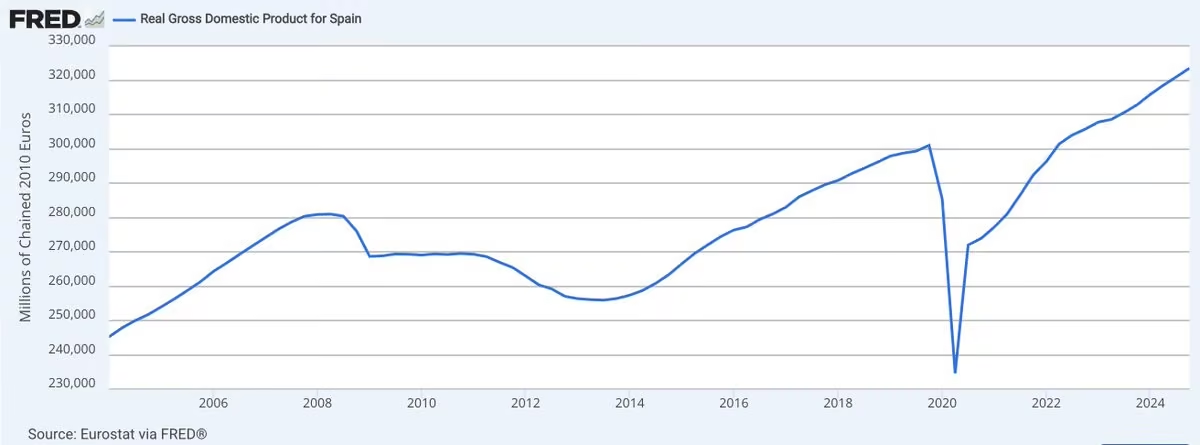 Olivier Blanchard
@ojblanchard1
I love the quote, but as many comments have noted, Gramsci got it wrong... The new socialist world was not so good. Ironic, and probably some lesson there.
Olivier Blanchard
@ojblanchard1
This quote from Gramsci captures exactly where I feel we are today:
"The old world is dying, and the new world struggles to be born: now is the time of monsters."
We have to fight the monsters, and help define the new world. Happy 2026. 😀
Olivier Blanchard
@ojblanchard1
This quote from Gramsci captures exactly where I feel we are today:
"The old world is dying, and the new world struggles to be born: now is the time of monsters."
We have to fight the monsters, and help define the new world. Happy 2026. 😀
Olivier Blanchard reposted
 John A. List
@Econ_4_Everyone
My previous post generated dozens of DMs with questions ranging from "What exactly is behavioral economics?" to "How can I teach it to my students or colleagues?"
Great questions. My friend David Laibson and I tackled these issues head-on here: ideas.repec.org/p/feb/natura/00451.html
The core problem? Many people define behavioral economics too narrowly, merely as a catalog of biases or a rejection of rationality. That misses the point. Behavioral economics uses variants of traditional economic assumptions (often psychologically motivated) to explain and predict behavior, and to provide policy prescriptions. It's not anti-economics. It tends to be economics that takes psychology seriously.
But psychology is just the beginning. Behavioral economics draws insights from across the sciences. Just a few examples:
Sociology: Social norms, peer effects, and identity shape economic decisions. Why do tax compliance rates vary across cultures? Why does neighborhood composition affect employment outcomes?
Anthropology: Cultural evolution and kinship structures influence trust, cooperation, and market behavior. Gift economies and reciprocity norms aren't irrational; they are adaptive solutions to coordination problems.
Neuroscience: Brain imaging reveals distinct systems for immediate vs. delayed rewards, helping explain why commitment devices work and why addiction is so hard to overcome.
Computer science & AI: Bounded rationality meets algorithm design. How do people actually search? When do simple heuristics outperform optimization? How should we design recommender systems that account for human decision-making limits?
Evolutionary biology: Preferences for fairness, status, and risk-avoidance often trace back to adaptive pressures, making them predictable rather than "biased."
The best behavioral economics isn't psychology bolted onto economics. It's a broader science of human behavior that happens to use the economist's toolkit.
Olivier Blanchard
@ojblanchard1
the basic argument for a large euro bond market.
 Faculti
@FacultiNet
Can a large, genuinely safe euro-denominated bond market reshape Europe’s financial system—and shift global capital away from US Treasuries? @ojblanchard1, @MIT, @MITEcon discusses: faculti.net/eurobonds-and-europes-missing-safe-asset
#currency #eurobonds #economics #finance #bonds
Olivier Blanchard reposted
 pablo
@pablogguz_
who pays for the welfare state, who benefits, and how does that change across the lifecycle?
today i'm releasing a new interactive tool to explore net fiscal contributions in spain by age, sex, education and origin, built from the latest microdata
👉 nta-spain.es
 Olivier Blanchard
@ojblanchard1
Financial aid to Ukraine: A messy process, but a fairly good outcome. But this was the easy part. Issuing debt always is.
I would feel better if the governments each committed to raise a special "Ukraine aid tax" to finance interest payments, to make clear to their citizens that there is a war going on, that Europe is committed, and aid is not free.
Olivier Blanchard
@ojblanchard1
On the loan to Ukraine. A particularly interesting set of comments ☹️
Russia will win, so why should the EU waste money.
Money will only mean more deaths.
Ukraine is controlled by corrupt Nazis
Ukraine is not part of Europe
Helping Ukraine is an elite thing. Real people do not want it.
A tax will turn people against the war, so do not do it.
Taxes are too high.
Whataboutism: What about spending more on health?
(How much is Russian trolls, how much is vox populi ? May largely show an X bias; Polls indicate 75% support for financial and military help to Ukraine in the EU)
Olivier Blanchard
@ojblanchard1
i think Wolgang Munchau @EuroBriefing and I say the same thing. The governments are ahead of their constituents on the need to help Ukraine fight the war.
Eventually, and I hope sooner rather than later, they have to convince them of that need. One way to start that discussion is to make clear to taxpayers a war has to be financed.
 Wolfgang Munchau
@EuroBriefing
There is a lot of sugar-coating going on this morning. The sequestration deal is truly dead. The EU will pay the €90bn for Ukraine out of its own pockets. Now that it is the EU’s own money at stake, diplomacy is already starting to shift. Macron said last night EU should reconnect with Putin. The war-mongering in the EU was to a large extent a money illusion - other people paying for it. Now that the EU is having to put its own money where its mouth is, expect to hear to a lot more people calling for peace.
eurointelligence.com
Olivier Blanchard
@ojblanchard1
Really interesting results on privacy regulation from the European experts poll. kentclarkcenter.org/surveys/digital-privacy/
An overwhelming majority (96%) is in favor of such regulation. At the same, a majority also believes that such regulation may slow down tech progress (44% agree, 34% uncertain). So they recognize the trade-off but end up in favor of regulation (my position also)
Olivier Blanchard
@ojblanchard1
Great analysis in real time. Conclusions might well be tested in coming years.
Peterson Institute
@PIIE
The PIIE Briefing of essays from our October conference on central bank independence in practice is now available here: www.piie.com/publications/piie-briefings/2025/central-ban…
Olivier Blanchard
@ojblanchard1
On the change in the EV EU CO2 target, from 100% to 90% in 2035.
In many contexts, it makes a lot of sense to have quantity rather than price targets (celebrated paper by Weitzman). It focuses the mind, gives a clear goal to firms.
But technological progress, demand conditions, are uncertain.
So, it also makes a lot of sense, when it becomes clear that the cost will be too high, to revise the quantity target. I am fine with the EU adjustment.
Olivier Blanchard
@ojblanchard1
leaving out economic dimensions: democratic values (at least until now). rules based. peace inside and common defense. worth it?
 Professor Eric Rasmusen
@erasmuse
Europe has no unity. Spain and Bulgaria? It's a free trade zone gone cancerous.
Olivier Blanchard
@ojblanchard1
An interesting analogy (and probably not an accident).
The difficulty for Europe to define its identity and unite between the US and China.
The difficulty for the French political center to define its identity and unite between LFI and the RN.
Olivier Blanchard
@ojblanchard1
An interesting analogy (and probably not an accident).
The difficulty for Europe to define its identity and unite between the US and China.
The difficulty for the French political center to define its identity and unite between LFI and the RN.
Olivier Blanchard
@ojblanchard1
prices are coming down. tariffs are paid by foreigners. and there is not problem with the budget deficit.
 OGA NFT
@OGA_Studio
What specific statements are you thinking of? Curious which ones crossed the line.
Olivier Blanchard
@ojblanchard1
A personal opinion on a crucial decision. Of the three major candidates for the Fed. Kevin Hassett, in his current role, has shown an unusual ability to defend the most undefendable positions of the administration with a straight face. I would worry very much if he became Fed chair.
Olivier Blanchard
@ojblanchard1
On stablecoins: Leaving aside technological aspects, and focusing on the financial ones, what is the difference between well regulated stablecoins (i.e with transparent balance sheets and liquid assets on the asset side) and “narrow banks”?
And if so, why should they not have access, just like other banks and even more so, to the lender of last resort?
(There is more to say about the pros and cons of stablecoins. But this seems like an important point)
Olivier Blanchard
@ojblanchard1
Regulating AI. When the effects of a technology are more uncertain, with thicker tails on both sides, do you want to decrease regulation (say, the US way) or tighten regulation (say, the EU way) ?
And if you tighten regulation, and the other does not, how do you remain competitive?
Olivier Blanchard
@ojblanchard1
Extracting helium-3 from the moon, bringing it back and using it to make quantum computers might be close to profitable... The speed and the scope of tech progress is scary.
 Tomas Pueyo
@tomaspueyo
Crazy story of a new space industry:
We need Helium-3 to cryogenically cool quantum computers. Until now, we could only harvest it economically from aging nuclear warheads. As nuclear arms dwindled, the price of of He has skyrocketed $20M/kg
Where can we get it for cheaper?
The Moon
It has accumulated there over millions of years because that’s precisely what the Sun produces when it fuses hydrogen and then sends it flying through space. We don’t catch it because Earth has an electromagnetic shield and an atmospheric shield, which the moon doesn’t have, so the Moon bakes the helium into its soil. We’re now about to send lunar harvesters via reusable rockets so that they can automatically harvest the helium with energy from solar panels, but only two weeks at a time because of lunar cycles.
Olivier Blanchard
@ojblanchard1
Another fascinating graph by @JedKolko When will Maga face reality?
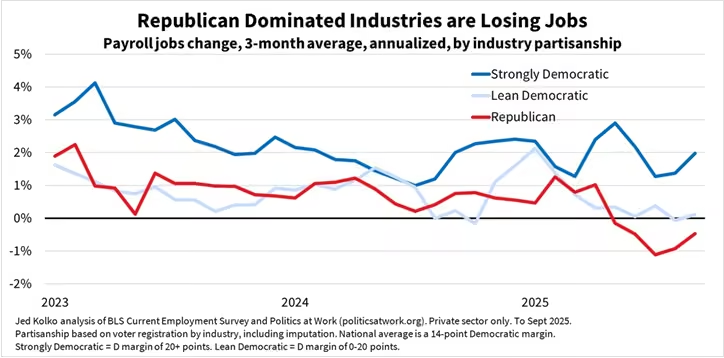 Olivier Blanchard
@ojblanchard1
Employment changes since January 2025 (thanks to my colleague @JedKolko). Except for the last line, not what I would have expected (and surely not what the Trump administration hoped for). Health care, arts, entertainment at the top. Tech, mining, manufacturing at the bottom.
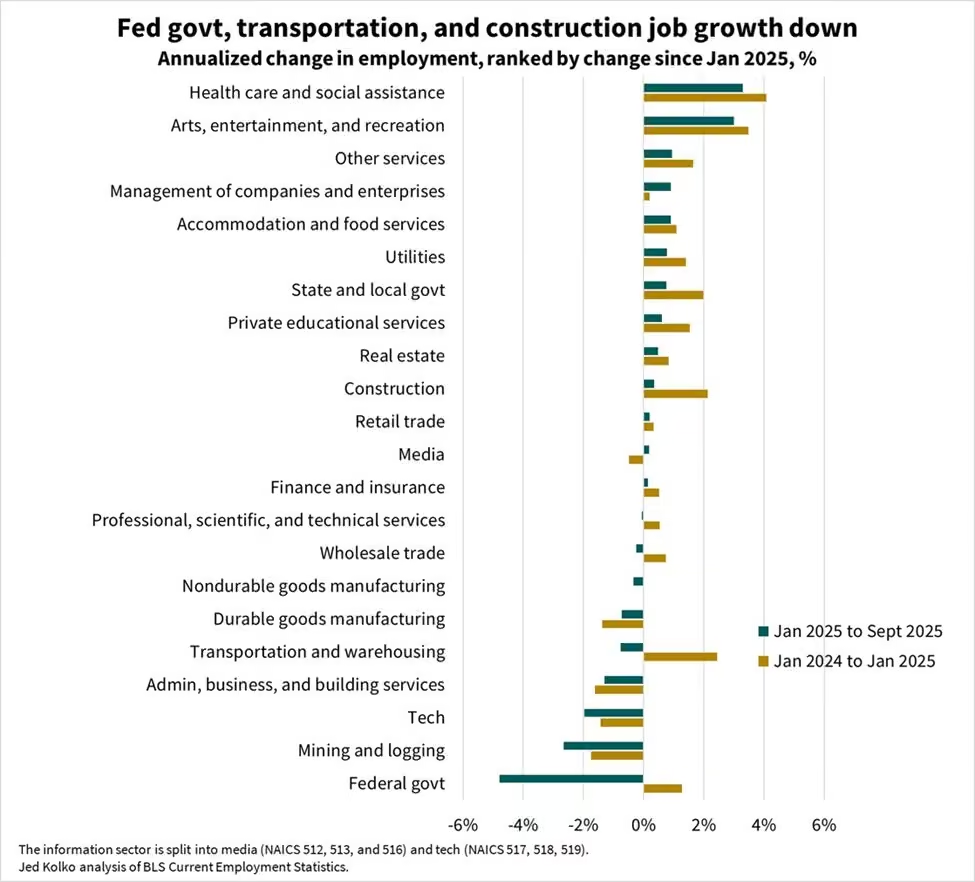 Olivier Blanchard
@ojblanchard1
On circular financing of AI. Is it so worrisome? If you have x major firms, one or two of them are going to succeed and the others to fail, don't the firms want to hold a bit of each other? (Usually applies to portfolios, but many reasons to think that firms should do some of the same).
Olivier Blanchard
@ojblanchard1
If not now, then when?
VoxEU
@voxeu
European defence governance and financing
Philipp Hildebrand @blackrock, Hélène Rey @helene_rey @LBS, Moritz Schularick @MSchularick @kielinstitute @sciencespo @ScPoEcon
cepr.org/voxeu/columns/european-defence-governance-and-fi…

Olivier Blanchard reposted
 Rodrigo Cárdenas
@rmcardenas
Esta semana me senté a conversar con uno de los economistas más relevantes del mundo, Olivier Blanchard @ojblanchard1 , que estuvo en Chile en la Conferencia del B. Central.
Hablamos de IA, Trump, política fiscal y más.
Acá la entrevista publicada hoy:
www.latercera.com/pulso/noticia/olivier-blanchard-es-esen…
Olivier Blanchard reposted
 Richard Baldwin
@BaldwinRE
New Factful Friday is up on LI!
👉Why Did US Import Prices Rise at the Border (Despite Trumpian Tariffs)?
👉Trumpian tariffs were supposed to 1) raise import prices inside the US; 2) lower import prices at the border to force foreigners to “eat” part of the tariff.
👉Part 1 happened. Part 2 didn’t; border prices rose. Today’s Factful Friday explains why.
👉Huge tariffs crushed Chinese competitiveness inside the US, thus handing pricing power to exporters based in other countries.
www.linkedin.com/pulse/why-did-us-import-prices-rise-bord…
cc:@AdamPosen @rbrtrmstrng @AllieRenison @DeanBaker13 @BrankoMilan @ChadBown @B_Eichengreen @Brad_Setser @carmenmreinhart @ChrisGiles_ @DavidHenigUK @EdwardGLuce @FabioGhironi @lugaricano @ben_golub @gideonrachman @georgemagnus1 @jamesharrigan @howserob @JustinWolfers @KofiAnnan @scottlincicome @EdwardGLuce @michaelxpettis @MaxCRoser @Noahpinion @TonyNashNerd @ojblanchard1 @PikettyWIL @BachmannRudi @TariffsUpdate @wb_research
Olivier Blanchard
@ojblanchard1
Breaking news. the French nuclear reactors refuse the threatened increase in their retirement age.
Olivier Blanchard
@ojblanchard1
The role of the dollar.
US treasuries as the dominant safe asset. Will it last?
Dollar pricing, increasing the demand for dollar assets. Will it last?
Dollar stablecoins, increasing the demand for US treasuries. Will it happen?
A nice panel discussion (in French). I learned a lot from my fellow panelists, @Helen_Rey, Eric Monnet, dans l’emission de Christine Okrent shorturl.at/8uN6j
Olivier Blanchard
@ojblanchard1
The notion that the next decision of the FOMC may come with a substantial number of dissents, (whatever the decision) is taken by some as indicating a crisis at the Fed. I think just the opposite. I see it more as a reflection that we are exactly at the point where it is not clear whether to tighten, stay, or cut, and differences across FOMC members reflect healthy but minor differences about where we are.
Olivier Blanchard
@ojblanchard1
Dear Luis
For the sake of argument, I took as a given that Musk was paid his marginal product (I have doubts, board's wisdom, rents, but am leaving them aside here.)
The standard economist answer, I think, goes like that. People should be paid their marginal product. So have him receive 1 trillion dollars, a good thing on efficiency grounds. And then, tax him according to our preferred welfare function.
I was questioning the “should” (can we do the redistribution through the tax system only) and, if not, asking about the proper tax rate, given the likelihood that labor supply becomes inelastic at much lower levels of pay. What would YOU tax him, if you were a benevolent planner?
Olivier Blanchard
@ojblanchard1
Dear Luis: A follow up. By "should" i referred to the standard EC101 conclusion that people should be paid their marginal product. And I was implicitly arguing that labor supply at some point becomes inelastic, in this case closer to 100 billion or less rather 1000 billion. And, as for land, economists approve of the taxation of inelastic factors.
Luis Garicano 🇪🇺🇺🇦
@lugaricano
I have no idea what "should" means. Do you wonder the same thing about Taylor Swift or Mbappe? If the scale of the market is such that the marginal product of making the right decisions is very high (and l don't like our overlord, but he does tend to get those engineering/product decisions right) and the owner (in this case the shareholders) are willing to pay that rather than risk his putting his attention somewhere else, I don't see why the economic treatment should be different than the one of someone particularly skilled at kicking a ball.
Olivier Blanchard
@ojblanchard1
On Musk and his 1 trillion package. Suppose (for the sake of the argument) that somebody truly has a marginal product of 1 trillion. Should he receive 1 trillion in payment? If he is taxed at 90% and receives only 100 billion, will he (she?) work less? What is the right tax rate?
Olivier Blanchard reposted
Le Grand Continent
@Grand_Continent
En économie, la doctrine Trump est chaotique, incohérente, incompréhensible — mais elle existe.
Si le président n’a pas encore transformé l’économie mondiale, il change le modèle américain.
Une conversation entre économistes @ojblanchard1 @IMateosylago.
legrandcontinent.eu/fr/2025/11/05/comprendre-la-doctrine-…
Olivier Blanchard
@ojblanchard1
When the government has a majority, and the budget is largely determined by the ministry of finance, experts play a major role.
When the political situation is such that the Assemblee is at the center, it is not clear what the role of experts becomes. And it raises the issue of what can be done to improve the quality of the Assemblee debate (short of econ courses for the deputes)
Olivier Blanchard
@ojblanchard1
@Ph_Aghion This raises a serious, eternal, issue. How to combine the preferences of the voters and the knowledge of the experts. What I observe in the Assemblee Nationale today does not look like the optimal combination.
Olivier Blanchard
@ojblanchard1
@Ph_Aghion This raises a serious, eternal, issue. How to combine the preferences of the voters and the knowledge of the experts. What I observe in the Assemblee Nationale today does not look like the optimal combination.
Olivier Blanchard
@ojblanchard1
Posting about hank or nk models on X seems to have the same effect on economists as cat videos on instagram. Explodes clics
Olivier Blanchard
@ojblanchard1
The new proposed tax on “Unproductive Wealth”, voted by the Assemblée Nationale, listing life insurance, crypto assets, gold, jewelry (Assurances-vie, Crypto-actifs, Or, Bijoux), seems unusually stupid.
The funds collected by Assurances-Vie do not lay stagnant. They finance public and private debt. They are part of the intermediation system, the same way banks or investment funds are.
I surely do not like crypto assets, and think they should be heavily regulated. But in their own way, they do the same. Stablecoins lead to an increased demand for public debt. Other coins lead to a demand for other assets.
Why decide, except on some questionable moral grounds, that jewels are unproductive wealth. Aren’t they made by jewellers, who earn a living doing so? What about paintings? And, go and get people to declare the family jewels, the wedding ring, and pay the tax.
Olivier Blanchard
@ojblanchard1
Is the (tight) victory of Rob Jetten in the Netherlands a signal that (1) a centrist program can still win against the far right, or (2) being charismatic and young can carry the day? (Probably a mix of the two, but still lessons to be drawn)
 François Geerolf
@FrancoisGeerolf
Rien ne marche dans ce modèle pourtant au cœur de la macro mainstream :
❌ Courbe de Phillips (eq.1) : rejetée par les données,
❌ Équation d’Euler (eq.2) : idem.
Et pourtant, on continue à l’enseigner (et à l’utiliser !) comme si de rien n’était.🤷♂️
Quand est-ce qu’on avance ?😉
 Jack Meyer 🏛️
@Jackbmeyer
Economists will look you dead in the face and call this science
 Olivier Blanchard
@ojblanchard1
My criticisms of these equations are well documented 😀. shorturl.at/cPKLV But this is what a useful model does and has to be judged by the work and the discussion it triggers. Why is there more inflation inertia than implied by 1? What about liquidity constraints and limited rationality in 2? Are expectations as forward looking as RE? Etc. And, given these deviations, what are the implications for policy? Is the initial model useless, profoundly misleading, or a useful starting point? What remains when you make the changes you think appropriate?
Olivier Blanchard
@ojblanchard1
This model has done more to stimulate research and discussions of crucial issues of macro than hundreds of books. (Same is true of Aghion Howitt 1992 paper for which they go the Nobel) Simple, toy, models can make a gigantic difference, stimulating both further theoretical and empirical research, and organizing precise discussions.
Jack Meyer 🏛️
@Jackbmeyer
Economists will look you dead in the face and call this science
Olivier Blanchard
@ojblanchard1
striking
Hanno Lustig
@HannoLustig
If you're an expert on wealth inequality, you have to start by acknowledging the basic asset valuation dynamics that drive financial wealth inequality. real rate r ↘️ implies top 10% wealth share ↗️, and vice-versa. Picture for US below.
The red solid line displays the top-10% financial wealth share for the United States from the World Inequality
Database. The black dash-dot line displays the 10-year real bond price approximating the real yield using the 10-year nominal yield and contemporaneous inflation.
www.dlgreenwald.com/uploads/4/5/2/8/45280895/totalwealthi…
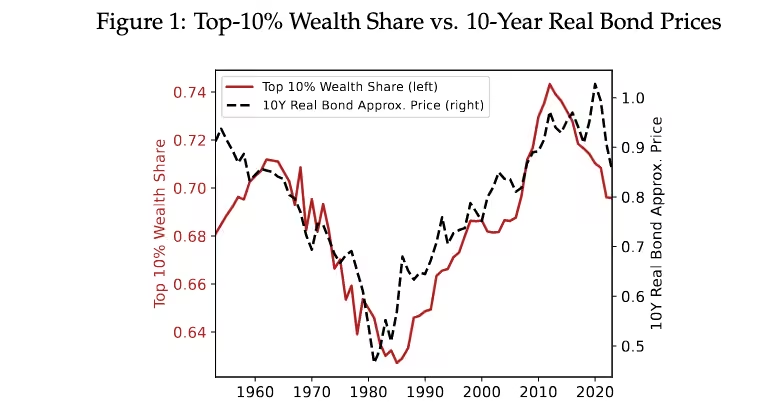 Olivier Blanchard
@ojblanchard1
If we think that what happened in 2008-09 was partly due to the lack of knowledge by regulators of the financial system at a granular level, (who owed exactly what to whom, and whom owed what to another whom, etc…), can AI monitor the system and detect risk better than we do today? (if you have seen work on this specific issue, please give me refs)
Olivier Blanchard
@ojblanchard1
With the increasing importance of increasing returns to scale technologies, the rush to be first is stronger and stronger. And with it, fast technological progress, but likely high bankruptcy rate at the end (think Chinese EVs as well). Interesting short and long run macro implications. (graph from Apollo)
 Olivier Blanchard
@ojblanchard1
Back from a conference in China. One impression about China-Europe relations. A desire to work together, but a lack of trust.
China sees Europe as caving to the US at crunch time. Europe sees China as supporting Russia, an existential foe of Europe. This affects other, including economic, relations.
Olivier Blanchard reposted
 RJB
@researchthis5

Olivier Blanchard reposted
C dans l'air
@Cdanslair
"Il y a des très riches qui paient moins que ce qu'ils devraient payer. C'est politiquement inacceptable. Il faut trouver le moyen le plus efficace de les faire payer plus, et alors la #taxezucman me parait être la moins mauvaise des solutions." @ojblanchard1, invité #cdanslair
Olivier Blanchard reposted
C dans l'air
@Cdanslair
"Une taxe sur les #holdings est mieux que rien, mais moins bien que la #taxezucman. Est-ce qu'il y a des très riches qui partiront? C'est possible, mais on ne peut pas ne rien faire!"
@ojblanchard1, ancien #économiste en chef du #fmi, était l'invité de #cdanslair
#budget #lecornu
Olivier Blanchard reposted
C dans l'air
@Cdanslair
#retraites : "Attendre deux ans n'est pas en soi très grave, c'est le contexte qui fait qu'on peut s'en préoccuper car il faut diminuer le #déficit. Les #investisseurs peuvent y voir le signal que le #gouvernement ne pourra pas faire grand-chose." @ojblanchard1, invité #cdanslair
Olivier Blanchard
@ojblanchard1
On the AI stock market boom. Fundamentals or bubbles?
A few points of arithmetic.
If a firm’s profits are expected to increase forever at a rate higher than the required rate of return, then the value of the firm is infinite.
If a firm’s profit distribution implies a positive probability that the firm’s profits will increase forever at a rate higher than the required rate of return, then the value of the firm is still infinite.
Forever is unlikely… But very far away still implies potentially extremely high rational valuations.
A point of accounting
A few firms will be winners and dominate the market. The others will disappear. It is not right to price each of them as if they were going to the winner.
A few points of psychology
More and more young (and some not so young) investors do not think in terms of fundamentals, i.e in terms of present discounted values.
They base their decisions on past returns. What has gone up (Bitcoin) will go up. Who cares about fundamentals? This however is a perfect environment for the emergence of bubbles.
Bottom line. My own assessment (and I shall be accused of being wishy-washy):
Some valuations could well be reflecting fundamentals, very high expected present discounted values. Many others probably have a large bubble component.
Olivier Blanchard
@ojblanchard1
a post scriptum, to clarify and to be fair. These are points that Philippe has made in his past work. My comments were more aimed at today's Philippe and his statements that, if Europe does not innovate, it will die on the vine.
Olivier Blanchard
@ojblanchard1
With all my admiration for Philippe Aghion’s work on the importance of innovation (what he has done with Peter Howitt in the 1990s and what he does these days with his collaborators at the College de France is essential theoretical and empirical work), a caveat.
An economy can grow without being at the frontier. Indeed, most economies in the world are not at the frontier. And most have experienced substantial growth.
More important than being at the frontier, is to be able to use these new technologies in the rest of the economy. This puts the focus on other aspects, the organization of the labor market, bankruptcy codes, a new type of education, etc. Less exciting project than new AI centers, but probably more important.
An analogy. It is nice to be ahead during a bicycle race. But it is easier to be just behind, protected from the wind by the racer who is ahead. One ends up second, but still with an impressive time.
If Europe can be first, then all means let us try. If not, let’s make sure we are a close second.
Olivier Blanchard
@ojblanchard1
The 1992 paper by Aghion and Howitt, integrating Schumpeter and Solow, shows how a smart theoretical model can clarify a confused discussion, lead naturally to next steps, and guide empirical work. (This was true also of the celebrated Solow model 36 years earlier)
Olivier Blanchard
@ojblanchard1
maybe it was not a person. maybe it was drawn by AI
Olivier Blanchard
@ojblanchard1
Totally deserved. But the person who drew the portrait of Philippe Aghion should be fired. 😀
Olivier Blanchard
@ojblanchard1
Totally deserved. But the person who drew the portrait of Philippe Aghion should be fired. 😀
Olivier Blanchard
@ojblanchard1
A potential “compromis” on SS reform (not a “compromission” (the word does not seem to exist in English. “Compromise” is used for both. Interesting…)):
Suspension of the ss reform for 6 months. During that time, conclave 2.0 (what lessons about composition, process, should we learn from Bayrou's conclave 1.0?)
At the end of 6 months, if agreement and positive vote by Parliament, reform adopted. If not, existing reform stands.
Olivier Blanchard
@ojblanchard1
Proud of my university. orgchart.mit.edu/letters/regarding-compact
Olivier Blanchard reposted
 James Lucas
@JamesLucasIT
Caravaggio pictures on stage
Olivier Blanchard
@ojblanchard1
this is exactly my point. If we suspend, and wait for another acceptable reform to appear, we may have to wait long. During that time, things will get steadily worse.
So, let's keep the reform in place, but let parties, social partners work on an alternative, a conclave bis. If and when they agree, then yes, let's move to the new reform and have Parliament endorse.
 Jacques DELPLA
@JacquesDELPLA
Olivier, that is exactly what was already tried in 🇫🇷 in H1-2025, with the so-called « Conclave sur les retraites » (pension conférence). It failed. Half of trade unions were still in demographic denial. And the others clashed with business unions. No agreement.
Olivier Blanchard
@ojblanchard1
An aside. For a time, when dealing with french events, I wrote both a french and an english version. To my surprise, the number of quotes and reposts of the english ones was much larger than for the French ones. I am not sure why, but I have concluded that it is fine to write only in english.
Olivier Blanchard
@ojblanchard1
A suggestion.
A suspension of the retirement reform is a jump without a parachute.
Given the widely different views (remember how it went last time), it means months if not years of haggling, during which the situation steadily deteriorates.
Why not do the reverse? Construct the parachute first, and then jump.
Keep the reform in place. But open a formal discussion/bargaining on an alternative architecture, with the commitment by the government that, if and once agreement is achieved (and only then), it will replace the existing architecture.
Olivier Blanchard
@ojblanchard1
PS: this is indeed exactly what Bayrou tried to do. And, on this, he was exactly right.
Olivier Blanchard reposted
Peterson Institute
@PIIE
🍂 It's fall meetings season🍂
We hope you can join us this week & next! Find all event pages, info, & registration here: www.piie.com/event-series/piie-spring-and-fall-meetings
 Olivier Blanchard
@ojblanchard1
Hard to understand what was in Macron/Lecornu's minds in presenting more or less the same government, with one largely unpopular addition. But equally striking is the degree to which the discussion is about people, and not about issues.
Olivier Blanchard reposted
Peterson Institute
@PIIE
OCTOBER 9: Our semiannual Global Economic Prospects event on outlook for US & global economies featuring Karen Dynan. @arvindsubraman discusses China's external surpluses & growth, & @AdamPosen gives his perspective on US inflation risks.
Info & register: www.piie.com/events/2025/global-economic-prospects-fall-2025

Olivier Blanchard reposted
Gérard Araud
@GerardAraud
Les partis de gouvernement ont été lobotomisés par quarante ans de néolibéralisme où on ne leur a demandé qu’administrer le marché. Ils sont aujourd’hui incapables de penser le monde.
Olivier Blanchard
@ojblanchard1
Let me follow up. Many of you must have thought about measures which do good on their own and help the budget. My list of 4 was just a start. Suggest more. (I have learned from the algorithm that the more you react, the more people it reaches, and the more interesting the discussion 😀)
Olivier Blanchard
@ojblanchard1
Given the starting deficit, a good budget must have two types of measures. Measures that are good for output, good for people, help the budget, but take time to implement and to show their effects. Measures that show a commitment to reducing the deficit now, which are likely to be painful but necessary.
Much of the discussion has been on the second kind, mostly to reject them... Not enough on the first. I shall list four, but one should think of many others.
Increase the employment rate of seniors. Progress has been made but too many old workers lose employment long before the official retirement age. France is far behind countries like Sweden or the Netherlands.
Increase the employment rate of new entrants. Again, France lags behind.
Increase the number of specialized nurses, who can partly replace doctors, increasing access to care at the same or lower cost France is lagging many other countries today.
Allow the retirees who want to (and indeed many of them want to, and have a lot to contribute), to participate in the formal education system, alleviating the burden on teachers, without increasing cost.
None of these goals will be achieved with one magic measure. But they can all be attained. And they, and others, are the eventual way out of our budget problem.
Olivier Blanchard
@ojblanchard1
Compte tenu de notre déficit, un bon budget doit comporter deux types de mesures. Des mesures qui sont bénéfiques en elles même, améliorent aussi la situation budgetaire, mais dont la mise en œuvre et les effets prendront du temps. Et puis des mesures qui témoignent d'une volonté de réduire le déficit dès maintenant, mesures qui sont douloureuses mais nécessaires.
Une grande partie des discussions a porté sur le deuxième type, principalement pour les rejeter… Les premieres n’ont pas été suffisamment développées. J'en citerai quatre, mais je suis sure qu’on peut en envisager bien d'autres.
Augmenter le taux d'emploi des seniors. On a fait des progres, mais trop de travailleurs âgés perdent encoreleur emploi bien avant l'âge officiel de la retraite. La France est loin derrière des pays comme la Suède ou les Pays-Bas. Comme la montre Gilbert Cette, les rejoindre aurait un gros effet sur le budget.
Augmenter le taux d'emploi des nouveaux entrants. Là encore, la France est à la traîne.
Augmenter considérablement le nombre d'infirmières spécialisées, qui peuvent remplacer partiellement les médecins, améliorant ainsi l'accès aux soins à coût égal ou inférieur. La France est aujourd'hui à la traîne par rapport à d'autres pays.
Permettre aux retraités qui le souhaitent (et qui sont nombreux à le vouloir) de participer au système éducatif, allégeant ainsi la charge des enseignants, sans en augmenter les coûts.
Aucun de ces objectifs ne sera atteint par une seule mesure magique. Mais ils sont tous réalisables. Et ils constituent, avec d'autres, la solution ultime à notre problème budgétaire.
Olivier Blanchard
@ojblanchard1
on the history of thought at the start of the piece: You are not fair to the academic general equilibrium economists of the past. Ken Arrow is known not only for his work on general equilibrium, but also for asymmetric information and its many implications.
 Noah Smith 🐇🇺🇸🇺🇦🇹🇼
@Noahpinion
I was bored, so I reviewed Kate Raworth's "Doughnut Economics":
www.noahpinion.blog/p/book-review-doughnut-economics
Olivier Blanchard
@ojblanchard1
On Argentina. I have been asked my views. I am no expert on Argentina, but here they are. (A very nice exercise in open economy macro…)
Exchange rate-based stabilization typically leads to an overvalued exchange rate for some time (even if the underlying cause of inflation, the money-financed deficit, is taken care of). Inflation comes down, but not as fast as the nominal exchange rate is allowed to depreciate. Over time, the overvaluation may slowly go away, and this is indeed happening in Argentina.
But as overvaluation lasts, and interest rates remain high, the risk that voters lose patience becomes higher. Or other shocks can come in play, a corruption scandal making the government less popular.
And the anticipation that voters will reject the government and the program will come to an end, leads people (domestic or foreign) to anticipate a larger depreciation, and try to move out of pesos into dollars which leads to a run on reserves. This is particularly the case when the economy is already partly dollarized, and people can easily shift from pesos to dollars. I think this is what we see in Argentina.
Can lending by the US (or the IMF) solve the issue? Some say it is just a band aid. It is more complex than that. If the Milei program cannot succeed anyway, then it is indeed just money poured down the drain. If, instead, if the Milei program is slowly working, the new funds increase reserves and allow the government to continue without a crisis, leading in turn to more support for Milei in the next election, and allowing the adjustment to continue, it may not. This is the relevant discussion.
For more informed opinions, follow @Monica_debolle and @IvanWerning (whom I thank for very useful discussions. opinion still only mine)
Olivier Blanchard
@ojblanchard1
What Roosevelt did not say: All I hear from you is that Hitler wants to march into London. The one thing I'm sure of is that Hitler isn't marching into Boston"
 Aaron Rupar
@atrupar
Bessent on why US troops won't get involved in defending Europe: "As I told my European counterparts about two weeks ago, 'All I hear from you is that Putin wants to march into Warsaw. The one thing I'm sure of is that Putin isn't marching into Boston.'"
Olivier Blanchard reposted
Sylvain Catherine
@sc_cath
Les ménages les plus modestes paient-ils réellement 46 % de prélèvements obligatoires ? Quelle est la progressivité réelle du système fiscal ?
Qu’en disent les comptes distribués de l’INSEE ?
1⃣ Prélévements et transferts monétaires en % des revenus primaires
Ce 46 % provient en principe du ratio de l’intégralité des prélèvements obligatoires (impôts, cotisations sociales, TVA...) rapportée au revenu primaire (salaires et revenus du capital).
Le choix d’inclure les cotisations retraite est controversé, mais je fais abstraction de cette partie de la polémique ici.
Cette méthodologie est reproduite sur le graphique de gauche. Il laisse apparaître un taux beaucoup plus élevé, de 94 %. Cela soulève deux questions : comment ce taux peut-il être aussi élevé ? Et pourquoi ne trouve-t-on pas 46 % ?
Le taux est très élevé parce que les ménages paient des impôts sur les transferts monétaires (pensions de retraite, RSA, allocations familiales, chômage, etc.). Par exemple, ils paient des impôts sur leurs pensions, mais aussi de la TVA lorsqu’ils dépensent des allocations sociales. Comme le dénominateur ne contient pas ces transferts, il est théoriquement possible de payer plus de prélèvements obligatoires que l’on ne dispose de revenus primaires.
Par ailleurs, le taux atteint 94 % parce que ce graphique couvre l’ensemble de la population. Le graphique présenté pour défendre la taxe Zucman concernait — sans que cela ne soit précisé — uniquement la population en emploi. Il s’agit donc d’une population moins pauvre, pour laquelle cette aberration statistique est moins visible. Elle révèle cependant un sérieux problème conceptuel dans la manière de mesurer l'impôt.
Ces transferts monétaires sont représentés en vert sur le même graphique. Pour les 10 % les plus pauvres, ils représentent 113 % des revenus primaires et doublent donc le budget monétaire de ces ménages.
Un calcul logique consisterait à mesurer le flux monétaire net entre chaque ménage et l’État, en soustrayant ces transferts du montant des prélèvements obligatoires. On obtient alors le graphique de droite, qui montre une très forte progressivité de la fiscalité nette : les 10 % les plus pauvres reçoivent, en net, l’équivalent de 19 % de leurs revenus primaires, tandis que les 10 % les plus aisés en versent 42 %.
2⃣ Traitement des pensions comme un revenu propre
Un aspect peut-être un peu controversé de cette présentation est de comptabiliser les pensions comme un transfert social qu’on soustrait de l’impôt.
On peut donc refaire ces graphiques en ajoutant les pensions au dénominateur, c’est-à-dire en additionnant revenus primaires et pensions pour mesurer le revenu des ménages avant impôts et redistribution.
Dans ce cas, on obtient une nouvelle paire de graphiques. Les taux de prélèvements obligatoires sont sensiblement plus bas, du fait de l’inclusion des pensions dans le dénominateur. Les transferts monétaires apparaissent également plus faibles, puisqu’ils n’incluent plus les pensions.
Mais le solde des transferts monétaires à gauche reste très progressif : les 10 % les plus pauvres versent 10 % de leurs revenus propres à l’État, tandis que les 10 % les plus aisés en versent 45 %.
3⃣ Inclusion des transferts non monétaires
L’État ne se contente pas de distribuer des chèques. Il rembourse les dépenses de santé, donne accès à des logements à loyers modérés… Autant d’aides matérielles qui péseraient sur le budget des ménages s’ils devaient les obtenir sur un marché privé. On peut soustraire ces dépenses individualisables de la même manière que l’on a soustrait les transferts monétaires.
On obtient alors ce troisième graphique : l’ensemble des transferts individualisables triple le niveau de vie des 10 % les plus pauvres, mais a un effet négligeable sur celui des 10 % les plus riches.
Le graphique de droite montre que le système, dans son ensemble, est extrêmement progressif.
Au final, est-il correct de dire que tous les français payent 50% d'impôts? Vous êtes juge.
4⃣ Données/Source:
Ces calculs sont basés sur les comptes nationaux distribués produits par l'INSEE. Lien dans le tweet suivant.


 Olivier Blanchard
@ojblanchard1
A fun exercise.
Since the beginning of the year:
S&P500 has increased from 5800 to 6600. Yields on 10y treasuries have decreased from 4.6% to 4.1%. Gold prices have increased from 2600 to 3700. An unusual combination.
All three are forward looking. What is the news that would explain all three?
A guess: A combination of higher expected potential growth, maybe due to AI, which would explain the stock price increase, and increased uncertainty, partly due again to AI, partly due to Trump, which would explain lower safe rates and a shift to gold.
Alternative interpretations?
Olivier Blanchard
@ojblanchard1
Important, as so much is made of supply constraints in high house prices and how tough it is for the young to become house owners, and the "malaise" of the young. (I am agnostic about whether the results will stand).
 Lukas Freund
@_LukasFreund_
Surprised I haven't seen more discussion on this site of
Louie, Mondragon and Wieland (2025): “Supply Constraints Do Not Explain House Price And Quantity Growth Across U.S. Cities”
Did I simply miss it?
 Olivier Blanchard
@ojblanchard1
Thank you for pointing the connection to some of the academic research. On type I and II errors, you are completely right. I think economists, when they give policy advice, must take into account political reality. The issue is that economists are not politicians, and may overstate or understate what is politically feasible.
 Jacob Edenhofer 🇪🇺 🇺🇦
@edenhofer_jacob
It is simple: @JohnHCochrane believes the political externalities of a Zucman-style wealth tax would be negative. @ojblanchard1, by contrast, believes that they would be positive.
The Cochrane-type position follows from basic libertarian principles. By eroding the principle of
Olivier Blanchard
@ojblanchard1
I can answer your question with some confidence. 😀The wealth of the ultra rich and the Zucman tax are, for better or for worse, topic #1 in the current political and economic discussions, in the concessions needed to form a government, on the banners in the major demonstrations yesterday. According to an IFOP poll, 86% of the French support the tax. (I think this is partly based on the incorrect belief that it will solve much of the deficit problem. So, yes, another important role we must play is in explaining that it will be, at best, a minor contributor to the adjustment.)
John Cochrane
@JohnHCochrane
"Non-negligible effect on growth" means we are all made poorer, so that some may be made poorer still (or leave the country, so their presence does not offend us). Just a little bit of Cuba please. That is a hard sell when explained honestly to voters, as you do. If we had solid cause and effect that this would give a greater sense of fairness, however, perhaps (though stepping far outside our expertise to make that claim). But of all the things riling the French voter right now, just how much is the offensive presence of people whose mark-to-market wealth is high -- a number one cannot see except in obscure statistics? Unassimilated immigrants, for example, or reductions in pensions (which we agree wealth taxes do little to fund) seem empirically much more relevant.
Olivier Blanchard
@ojblanchard1
Continuing the discussion with @JohnHCochrane and others, on the complexity of economic advice, and the role of economists.
Suppose for the sake of argument, that the Zucman tax has a non-negligible negative effect on growth. But suppose that it also reduces the widely held sense of unfairness (“fiscal justice”) and allows a political compromise on the budget to emerge. Where should we stand?
One answer is that knowing the effect of the tax on the sense of unfairness, and of unfairness on the political compromise, and of the political compromise on interest rates, growth, and so on, is inherently fuzzy, and thus one, as an economist, should ignore it. (Policy makers do not have that option).
This is probably what John would argue. I do not think this is the right approach. As fuzzy as it is, we should, as economists, put together the bits of evidence we have and come to a (guarded) conclusion. (To be clear, not any economist has to take a position. Only those of us who want to influence the public debate. )
Olivier Blanchard
@ojblanchard1
I was too quick to answer and thus unfair. Yes, if a measure makes everybody worse off, then it is suboptimal no matter what the welfare function. But I do not believe that a zucman tax measure makes everybody worse off.😀
Olivier Blanchard
@ojblanchard1
Dear John
I strongly disagree. When economists propose a policy, they have (hopefully) some welfare function in mind, which depends in some way on distribution. Distribution matters. I suspect you have one and you would not agree to a welfare function that gave all of GDP to one individual and none to the others.
John Cochrane
@JohnHCochrane
In my view, economists should analyze tax policy based on incentives, not moral sentiments, where we have little comparative advantage. The wealthy may not "deserve" their comfort, but strangely confiscating the rewards to private success seems always to produce misery for the rest. The French tax system can surely be designed to produce its prodigious revenue with less economic distortion. Shouldn't that be the quest? Does France really need poorer people and much poorer rich people?
Olivier Blanchard
@ojblanchard1
In response to comments.
I believe that those of us who have been financially successful, through a (varying) mix of effort and chance owe a lot to the society in which they have grown and lived. (A view I share, with all due respect, with Warren Buffett, Bill Gates and their Giving Pledge initiative; they are not known to be extreme leftists)
For the most part, the French tax system is very progressive, and the rich pay high taxes. But I believe that this is not the case today for many of the very rich. I believe that this is wrong, and politically explosive, especially so in an environment in which the state must reduce its spending.
I have examined various options to achieve that goal. I have concluded that, although far from perfect, a Zucman-like tax seems like the least bad way to do so (although, as I have discussed with Gabriel Zucman and stated elsewhere, I believe 1% is more realistic than 2%). This is why I have endorsed it.
(Let me also add something else. Again said elsewhere, but needs repeating. Even if relatively successful, the Zucman tax is not the solution to reducing the deficit. At most 20b , more likely half that, compared to a 120/150 b adjustment (over a number of years)
Olivier Blanchard
@ojblanchard1
On the Zucman tax and Mistral.
Yes, among the 1800 taxpayers with more than 100 million in assets, there are a few who have participations in firms that are highly valued and do not generate yet substantial benefits. Mistral being an example. Asking them to pay the Zucman tax in cash is indeed an issue (not the case for the great majority of them, who hold shares in public companies and can just sell some of them).
There is however a simple solution. Allow those taxpayers to pay the Zucman tax in cash or by selling a stake in the companies they own for an amount equal to the tax they owe, possibly without voting rights. Thus, making the state a passive investor.
The 2% tax rate is such that, unless profits never materialized, the state would most likely remain a small minority stake holder. The tax would have at most a marginal effect on investment plans and innovation. And if the idea seems strange, realize that, in effect, through the company income tax, the state is, de facto, a substantial stakeholder in all companies already. It does well when they do well, badly when they do badly
Olivier Blanchard
@ojblanchard1
How can you have a robust financial system if the main safe asset is not in the same currency as your own?
 Angel Ubide
@AngelUbide
The case for Eurobonds, and the demand for Eurobonds, are both very strong. Defragmenting EU debt to make it more efficient & reduce the cost of funding for all EU countries is the complement to defragmenting the Single Market and EU Savings and Investments @ojblanchard1 @PIIE
Olivier Blanchard
@ojblanchard1
On the budget debate, the Bayrou plan and the PS proposal.
44 = 23, and 22 = 1
It’s a really important point. I explain:
The 44 billion deficit reduction in the Bayrou plan is the reduction relative to the deficit that would take place if no measures were taken. The deficit would increase by roughly 21 billion. So, the actual deficit reduction from 2025 to 2026 is only 21 billion or so.
The 22 billion deficit reduction in the Socialist Party plan is also the reduction relative to the deficit that would take place if no measures were taken. Thus, doing the same adjustment, the actual deficit reduction, according to the plan is only 1 billion or so.
(This takes both plans at face value. Whether we should is another issue, left for later discussions)
Olivier Blanchard
@ojblanchard1
Concernant le débat budgétaire, le plan Bayrou et la proposition du PS:
44 = 23 et 22 = 1
C'est un point important. J'explique :
La réduction du déficit de 44 milliards prévue par le plan Bayrou correspond à la réduction par rapport au déficit qui aurait lieu si aucune mesure n'était prise. Le déficit augmenterait d'environ 21 milliards. Ainsi, la réduction réelle du déficit de 2025 à 2026 n'est que d'environ 23 milliards.
La réduction du déficit de 22 milliards prévue par le plan du Parti socialiste correspond également à la réduction par rapport au déficit qui aurait lieu si aucune mesure n'était prise. Ainsi, en appliquant le même ajustement, la réduction réelle du déficit, selon le plan, n'est que d'environ 1 milliard.
(Cela prend les deux plans au pied de la lettre. La question de savoir si nous devrions le faire est une autre question, sur laquelle on aura le temps de revenir.)
Olivier Blanchard
@ojblanchard1
What dominates politics in many countries today is the anger of their citizens, the feeling that their leaders have failed, and that alternatives must be explored.
There seems to me, however, to be one large difference between France and most other countries. In most countries, this search for an alternative goes mostly toward the far right. In France, it leans, in roughly equal proportions, toward the far right and the far left.
The consequences are different. In the first case, there is an alternative, whether we like it or not (I obviously do not): a far-right government. In the second, there is paralysis. Neither the far right nor the far left is strong enough to form a government.
Olivier Blanchard
@ojblanchard1
Extreme droite, extreme gauche.
Ce qui est commun a de nombreux pays aujourd’hui, c’est la colère des citoyens, le sentiment que les dirigeants ne les entendent pas, qu’ils ont échoué, et qu’il faut explorer des alternatives.
Il me parait y avoir cependant une grande différence entre la France et la plupart des autres pays. Dans la plupart des pays, cette recherche de l’alternative va vers l’extrême droite. En France, elle va, a peu près dans les mêmes proportions, a l’extrême droite et a l’extrême gauche.
Les conséquences sont différentes. Dans le premier cas, il y a une alternative, qu’on l’aime ou non (pour être clair, je ne l'aime pas) : un gouvernement d’extrême droite. Dans le deuxieme, il y a paralysie. Ni l’extrême droite, ni l’extrême gauche ne sont suffisamment fortes pour former un gouvernement.
Olivier Blanchard
@ojblanchard1
Si le gouvernement Bayrou tombe, pourquoi, plutôt que de pêcher dans le même vivier à droite avec probablement les mêmes résultats, ne pas faire appel à un homme de gauche compètent, responsable, et respecté, qui peut bénéficier d’un plus large soutien ? Laurent Berger, Pascal Lamy, par example. (Pas la moindre idée si l’un ou l’autre sont intéressés 😊 )
Olivier Blanchard
@ojblanchard1
Follow ups to an earlier tweet on the budget.
On fiscal austerity
Yes, reducing the deficit is likely to reduce demand and growth in the short run. This is what the discussion about multipliers is about. But, if the alternative is no adjustment and much higher interest rates on the debt, it is a worse alternative.
Put another way, “fiscal austerity” is unpleasant by nature. But it is no reason not to do it. The analogy with chemotherapy is relevant here. Chemotherapy is not pleasant and makes you sicker in the short term. But if it eliminates your cancer, do you really want to avoid or delay it?
On the role of the Zucman tax.
I have been clear, in past writings, that I am in favor of a tax on the super-rich, along the lines of the so called Zucman tax. The super-rich should pay their share, and too many are able to avoid it. This is even more the case if the deficit must be reduced, and painful spending cuts are needed. But one should be realistic. Even if put in place, such a tax will yield a small fraction of the needed overall adjustment.
On the role of cuts across the board versus reforms.
Obviously, the best adjustment relies on reforms, be it reforms to increase the participation rate of older workers, better orientation and matching of new workers to jobs, better education, and so on. Any reform which plausibly increases productivity and output, and by implication, government revenues is highly desirable. But reforms take time to craft and to pass, and one can never be sure they will work. Given the urgency of the adjustment and the political impasse, I believe that some of the adjustment must take the form of across the board cuts, be it annees blanches, or even decreases in nominal terms.
Olivier Blanchard
@ojblanchard1
Suite à mon tweet précédent sur le budget, quelques réponses a certaines reactions.
Sur l'austérité budgétaire
Oui, la réduction du déficit risque de réduire la demande et la croissance à court terme. C'est l'objet du débat sur les multiplicateurs, auquel j’ai souvent participe. Mais si l'alternative est l'absence d'ajustement et, par implication, des taux d'intérêt beaucoup plus élevés sur la dette, l’alternative est pire.
En d'autres termes, l'austérité budgétaire est douloureuse par nature. Mais ce n'est pas une raison pour l’éviter quand elle est nécessaire. L'analogie avec la chimiothérapie est pertinente. La chimiothérapie fait souvent qu’un patient se sente plus mal à court terme. Mais si elle élimine son cancer, est-il souhaitable qu’il l'évite où la retarde ?
Sur le rôle de la taxe Zucman. Est-ce incompatible d’etre pour la taxe Zucman et pour un ajustement du deficit principalement par une diminution des depenses ?
J'ai clairement indiqué, dans des écrits précédents, que je suis favorable à une taxe sur les super-riches, sur le modèle de la taxe Zucman. Les super-riches devraient payer leur part, et trop nombreux sont ceux qui l'évitent. C'est d'autant plus vrai si le déficit doit être réduit et que des coupes budgétaires douloureuses sont nécessaires. Mais il faut etre réaliste. Même si elle est mise en place, une telle taxe ne produira qu'une faible fraction de l'ajustement global nécessaire.
Sur le rôle des coupes budgétaires générales par rapport aux réformes.
De toute évidence, le meilleur ajustement repose sur les réformes, qu'il s'agisse de réformes visant à accroître le taux d'activité des travailleurs âgés, à améliorer l'orientation et l'adéquation des nouveaux travailleurs aux emplois, à améliorer l'éducation, etc. Mais les réformes prennent du temps à élaborer et à adopter, et on ne peut jamais être sûr de leur efficacité. Compte tenu de l'urgence de l'ajustement et de l'impasse politique dans laquelle on est, je pense qu'une partie de l'ajustement doit prendre la forme de coupes budgétaires générales, qu'il s'agisse d'années blanches, voire même de baisses automatiques en termes
Olivier Blanchard reposted
James Lucas
@JamesLucasIT
Thanks for reading! If you enjoyed this thread, please share the first post linked below 👇🏻
James Lucas
@JamesLucasIT
Colorized videos feel like a time machine 🧵
1. This is what Jerusalem looked like in 1897
Olivier Blanchard
@ojblanchard1
Après le discours de Bayrou et les réactions du RN et du PS, utile de repeter deux vérités :
La dette n'est pas en soi catastrophique, mais son explosion, à terme, l'est. Il est essentiel de réduire le déficit budgétaire et de commencer maintenant. Il n'y a pas d'alternative.
Compte tenu de la taille de l'État et du niveau d'imposition, l'ajustement doit provenir en grande partie d'une baisse des dépenses.
On peut tout a fait etre en desaccord avec les details du budget propose par Bayrou. Mais il a raison d'exiger que toute discussion se déroule dans ce cadre. Sinon, elle n'aboutira à rien. C'est l'objet de ce vote de confiance.
Olivier Blanchard
@ojblanchard1
After Bayrou’s speech and the RN and PS reactions. To repeat, in the current context, some verities:
Debt may not be catastrophic, but debt explosion eventually is. It is essential to drastically decrease the budget deficit. There is no alternative.
Given the size of the state, and the level of taxation, the adjustment must come largely from decreases in spending.
One surely does not have to accept the particulars of the Bayrou budget. But Bayrou is right to require that any discussion takes place within these parameters. Otherwise the discussion will go nowhere. This is what this vote of confidence is about.
Olivier Blanchard
@ojblanchard1
An important article, looking, beyond tariffs, at the profound effects of the measures taken by the Trump administration on international relations.
 Adam Posen
@AdamPosen
The New Economic Geography
My new article out today @ForeignAffairs
shared.outlook.inky.com/link?domain=www.foreignaffairs.co…
Olivier Blanchard reposted
 Alberto Cavallo
@albertocavallo
US tariffs update: Imported goods cost 5% more, domestic goods 3% more than pre-tariff trends predicted. Data now runs through Aug 8 — and we push the history back to Jan 1, 2024 (Appendix), showing a full year of stability before tariffs broke the trend. pricinglab.org/tariff-tracker

Olivier Blanchard reposted
James Lucas
@JamesLucasIT
20 photographs taken in the right place at the right time, either intentionally or by chance 🧵
1. Can I take a picture of the moon?
Pisa Tower: yea sorry
 Olivier Blanchard
@ojblanchard1
An open letter to the Israeli government, from professors of economics from major universities across the United States and Europe. shorturl.at/k2HQr
Olivier Blanchard
@ojblanchard1
Useful numbers for those who argue that tariff revenues will eliminate the deficit:
The primary deficit (the deficit net of interest payments) is roughly 1.5 trillion. It has to be reduced to zero if debt is to be stabilized relative to GDP.
Imports are roughly 3.3 trillion. On the extremely generous assumption that there is no trade diversion, and assuming that all goods and services are taxed at 15%, this brings about 500 billion. So only 1/3 of what is needed. (my own guess is that, when everything is said and done, 200 billion is a more reasonable number... So only 13% of what is needed).
Olivier Blanchard
@ojblanchard1
A good example of how quickly economic research reacts to a new environment. A fascinating paper on how the world trade system may look like as the system moves from rules to the law of the jungle. (caveat for non professional economists: algebra heavy) www.nber.org/papers/w34108
Olivier Blanchard
@ojblanchard1
About the decision to allow Nvidia to export to China and take a cut of the revenues:
Think of a world in which there are no longer any rules and the state bargains with every single firm. (And the state does not have the right welfare function in mind…) Interesting/scary to think about the final outcome.
Olivier Blanchard
@ojblanchard1
More reactions to the reactions. (this is stimulating and interesting)
Yes, there is a gap between ideal and actual democracy. We all know that. Lobbies, the role of money, the wars of attrition, the gerrymandering, etc. But is the right approach to give up and give it to autocrats? Or is it to try to improve it? (Very much the same choice vis a vis the European Union, with the same split in opinions)
Can the democracy/autocracy theme be a political winner? I think so, if we move from pro/con Trump to whether you prefer a system of rules and checks and balances to a system where you do not know how you will be treated by the state, what rules will apply tomorrow, you may lose your right to free speech, etc. (We also have a much clearer image of what autocracy might look like than in 2024…)
When I argue that the fight should not be about the welfare state, it is not that I do not care. I do care very much. I have spent part of my professional career thinking hard about the best design of labor market institutions, etc. It is that in the current context in which deficit reduction is a priority in many countries, any reasonable message is likely to sound dour and can hardly win against promises of plenty by the other side. The message needs to be sent, but there must be other more uplifting themes.
Olivier Blanchard
@ojblanchard1
The great thing about X is that it exposes you to the other side. I am fascinated by some of the reactions to my tweet on democracy versus autocracy. In particular:
The notion that it is profoundly naïve to think that democracy can be sold politically.
The notion that democracy is simply an outmoded form of organization.
To answer some of the other comments.
To avoid the semantic issues: I think of democracy as a system of checks and balances that tries to reflect the opinions of all, and find the best compromise. I think of autocracy as the destruction of such checks and balances.
I shall freely admit that I am stepping out of my professional lane, and am just an amateur political scientist. No need to insult me.
Olivier Blanchard
@ojblanchard1
I shall let you guess what I have read or not read.
But, for me, democracy is primarily a system of checks and balances. And this is precisely what the Trump administration is rejecting.
 Carlo Lancellotti
@_CLancellotti
This shows you can become an economics professor at MIT without having ever read Plato's Republic, since clearly Trumpian populism is almost caricaturally democratic, and the emergence of tyrannically features is precisely what one should expect as a result.
Olivier Blanchard
@ojblanchard1
Many of us are looking for a positive message from the left (the democrats in the US, the center left in Europe) to win the coming elections. My two cents: Now that autocracy has shown more and more clearly its true nature, its barbarity, its randomness, make the next elections a choice between autocracy versus democracy. Focus on the nature of the decision process. Democracy is slow, messy, but gives a voice to all. (Stay away from welfare state issues, from culture wars)
Olivier Blanchard
@ojblanchard1
Add me to the list of people who think that the firing of the BLS commissioner is extremely worrying, reminding one of the actions of the worst dictators of the past.
But, leaving aside my anger:
Given the size of the may/June revisions, shouldn’t BLS construct an additional index which combines BLS data and other sources (Linkedln, ADP, etc)?
I think only BLS can do it. While there exist private sector indices, they do not have access to not yet published BLS data.
Olivier Blanchard
@ojblanchard1
This is even more true than when I wrote it on Feb 14. The "deal" with the US shows even more clearly the cost of not doing so.
Olivier Blanchard
@ojblanchard1
Enough of the European gloom and doom. In the new world environment, Europe can and should have a major and exciting role to play. Namely, help create “coalitions of the willing”.
The argument, based on a new article with @pisaniferry, shorturl.at/j0Ewl
The Trump administration is systematically trampling on the traditional rules of international trade, and more generally, the rules of international behavior. Hampered by unanimity rules, multilateral institutions, be it the UN, the WTO, the WHO, etc, are increasingly unable to function.
Yet , many if not most countries are still willing to respect those rules, work to fight climate change, make sure that multinational companies pay their fair share, that tariffs, if used, are used for the right reasons and not to bully others, and so on.
The European Union, which has had to get 27 countries to agree to such rules, is in a unique position to lead and help the formation of coalitions of the willing, namely the set of countries willing to work to achieve specific goals, such as climate, taxation, trade, and looking for reliable partners, who will accept and then respect the rules .
By itself, the European Union is too small to make a large enough difference. Thus, it must enroll other non-EU countries. And if some EU countries do not want to participate, so be it. The proof of concept may be the Schengen agreement, which does not include all EU members but also includes some non EU members.
In general, it is essential to go far beyond Europe, work in particular with some of the Brics. Avoid "the West against the Rest". In that context, a major negotiation with China, recognizing the relevance of security considerations, the desire to protect certain industries, the rules determining the use of tariffs, would be a strong signal that the EU is not following the US blindly and that much of the world wants to continue to play by reasonable rules.
The linked note shows three areas where such coalitions look both essential and feasible, climate, trade and taxation. It discusses, in each case, what the rules could be both within the coalition and vis a vis countries outside, and how they can build on existing agreements.
There are a million technical issues to be solved in creating such coalitions. And obviously, Europe has other problems to solve, its low growth, its absence from some of the frontier technologies, how to respond to US tariffs, and so on. But we believe that, given today’s reality and geo political tensions, helping put place reasonable rules of international engagement is an exciting goal for Europe to set for itself.
Olivier Blanchard reposted
Jason Furman
@jasonfurman
My @nytopinion blog on the senseless order to fire the BLS Commissioner.
 Olivier Blanchard
@ojblanchard1
I believe that there are reasonable arguments pro and con lowering interest rates in the US at this point. It is one of those 51/49 decisions. But Trump’s attacks have made any decision to lower them look like a capitulation. If anything, this makes it less likely to happen.
Olivier Blanchard
@ojblanchard1
Before blaming Ursula von der Leyen and the European Commission, realize that the larger the group that must collectively take a tough decision, the less likely the decision will be taken. Europe is composed of 27 very different countries. It is its strength, but it is also its weakness when faced with imminent danger, from the East or from the West.
Olivier Blanchard
@ojblanchard1
What I worried about has happened. A completely unequal “deal” between the US and the EU. Have no doubt: asymmetric 15% tariffs are a EU defeat.
When the law of the jungle prevails, the weak have little choice than to accept their fate. But Europe could potentially have been strong, either alone or in a coalition with others. It would have had to be ready for stormy waters. But it would have gotten a better deal in the end and sent a strong message to the world. An opportunity lost.
Olivier Blanchard
@ojblanchard1
Why on earth should the European union be willing to accept, as it seems ready to do, the 15% tariff? Are we really so weak that this is the best we can hope for?
Olivier Blanchard
@ojblanchard1
In sharp disagreement with two of my friends for two days in a row, Mohamed El Erian yesterday about the Fed, and Larry Summers today about Columbia.
Dear Larry, I strongly disagree. How can you think that an agreement with the Trump administration is an ironclad commitment on their side? Have you not seen enough deals being broken by this administration to be at least a bit skeptical? And, in your way of thinking, how do you think about the 200 million blackmail payment? Are you advocating a similar deal for Harvard?
 Lawrence H. Summers
@LHSummers
Based on what I have read and heard so far, the agreement reached between the Federal government and @Columbia is an excellent template for agreements with other institutions including @Harvard.
First, academic freedom is preserved as the University maintains academic autonomy.
Second, ongoing reform with respect to anti Semitism, maintenance of order, promoting merit-based admissions and hiring, and strengthening the commitment to intellectual excellence is reinforced and a framework for further reform is established.
Third, normality is restored with a return to normal funding patterns, availability of visas for foreign students and removal of legal overhangs.
I, like anyone, could quibble with aspects of the program and much will depend on what both Columbia and the government do in the future. But this may be the best day higher education has had in the last year.
Olivier Blanchard
@ojblanchard1
On the Japan so called deal (diktat?). Trump can win many fights, but one thing he cannot do is win fights against accounting identities. Trade deals, whatever they do, cannot, as claimed, simultaneously reduce the US current account deficit, and increase net capital flows to the US. The reason: current account deficit = net capital flows. Thank you for your attention to this matter.😀
Olivier Blanchard
@ojblanchard1
Dear Mohamed, I could not disagree more. The potential candidates have shown a willingness to say anything to please Trump. And caving in to Trump would have gigantic costs in terms of credibility of monetary policy. Yes, it may create volatility in financial markets, but this is a small cost to pay.
 Mohamed A. El-Erian
@elerianm
This morning, US government criticism of both Federal Reserve Chair Powell and the institution itself has broadened to include "mission creep" and the effectiveness of other officials.
The developments of the last few days reinforce my view:
If Chair Powell's objective is to safeguard the Fed's operational autonomy (which I deem vital), then he should resign.
I recognize this isn't the consensus view, which favors him staying until the end of his tenure in May. Nor is it a first best, which is simply not attainable. Yet, it's better than what is playing out now – growing and broadening threats to Fed independence – and will undoubtedly increase should he remain in office.
As to market reaction, most of the frequently mentioned candidates to replace Chair Powell would be able to calm any potential market jitters.
#economy #federalreserve #markets
Olivier Blanchard reposted
Olivier Blanchard
@ojblanchard1
Il n'y a pas grand-chose à aimer dans un budget qui propose de réduire substantiellement le déficit. Mais il faut reconnaître que le budget Bayrou a relevé le défi. Il fait face au problème et propose des mesures qui, si elles devaient passer, pourraient s'élever, sinon aux 43 milliards annoncés, du moins à un chiffre pas trop éloigné.
J'ai quatre réactions immédiates.
L'essentiel de la discussion porte sur les 43 milliards. Cependant, à terme, la stabilisation de la dette nécessite un ajustement de l'ordre de 150 milliards d'euros. La question est de savoir à quelle vitesse le faire. Pour des raisons politiques et économiques, j'aurais choisi un chiffre plus petit pour 2026, de l'ordre de 30 milliards, et un ajustement crédible sur 5 ans plutôt que 4. Peut-être que la négociation mènera-t-elle à un chiffre plus réduit.
Les sondages indiquent qu’il y a un large soutien général à la réduction du déficit, mais (peut-être sans surprise) peu d'enthousiasme pour des mesures spécifiques... Cela suggère une discussion d'automne du budget sous des règles de « compensation » (« pay for » en anglais): toute mesure alternative proposée devrait s'accompagner d'autres mesures qui compensent l'effet sur le budget. Cela a été fait ailleurs. Cela ne fonctionne pas parfaitement, mais ça aide.
Les mesures de ce budget sont un mélange d'ajustements mécaniques et de mesures ciblées. D'un point de vue économique, les ajustements mécaniques ne sont jamais les meilleurs ; d'un point de vue politique, c'est précisément leur aspect mécanique, et au moins l'apparence d'une certaine équité, qui les rend nécessaires. Ils font le travail, en attendant que de meilleures mesures sont examinées et mises en œuvre.
Ce budget est le premier versement d'un ajustement de plusieurs années. Beaucoup de mesures peuvent être améliorées, et le travail devrait commencer maintenant, afin que de meilleures mesures puissent être mises en œuvre dans l’avenir. Prenez la suppression proposée de deux jours fériés. Il est bien documenté que le manque d'heures travaillées est dû au faible taux d'emploi de deux groupes, les jeunes et les personnes âgées. A terme, l'élimination de deux jours fériés n'est pas la bonne solution. Ce sont les réformes pour augmenter ces deux taux d'emploi spécifiques qui le sont. Elles sont complexes, mais elles, et d'autres, sont nécessaires si l'ajustement
Olivier Blanchard
@ojblanchard1
There is never much to love about a budget that proposes to substantially reduce the deficit. But one must admit that the Bayrou budget has taken up the challenge. It faces the issue, and proposes measures which, if they were to pass, may add up, if not to the 43 billion advertised, but to a number not too far from it.
I have four early reactions.
The focus of the discussion is on the 43 billion. Eventually however, stabilisation of the debt requires an adjustment of the order of 150 billion euros. It must be done; the question is how fast to do it. For political and economic reasons, I would have chosen a smaller number for 2026, of the order of 30 billion, and a credible adjustment over 5 years rather than 4. Maybe this is a tactical choice and bargaining will lead to a smaller number.
Polls suggest strong general support for deficit reduction, but (perhaps not surprisingly) little enthusiasm for specific measures… This suggests a fall discussion of the budget under “pay for” rules: Any proposed alternative measure should come with other measures which offset the effect on the budget. It has been done elsewhere. It does not work perfectly, but it helps.
The measures in this budget are a mix of mechanical adjustments and targeted measures. From an economic viewpoint, mechanical adjustments are never best; from a political viewpoint, it is precisely their mechanical aspect, and at least the appearance of fairness, which makes them needed. Under duress, they do the job, while better measures are examined and implemented.
This budget is the first installment of a many-year adjustment. Many of the measures can be improved, and work should start on it now, so they can be improved in future years. Take the proposed removal of two jours feries. It is well documented that the shortfall in hours worked is due to the low employment rate of two specific groups, the young and the old. The elimination of two jours feries is not the right solution. Reforms to increase these two specific employment rates are. They are complex, they may take time, but they, and others, are needed if the full budget adjustment is to be successful.
Olivier Blanchard reposted
Olivier Blanchard
@ojblanchard1
Utile d’etre explicite au risque de se faire insulter : Il ne peut y avoir de vache à lait, que ce soit les tres riches ou les retraités ou tout autre groupe. Diminuer les retraites ne peut etre acceptable que si, par exemple, la sécurité sociale rembourse moins les médicaments, si les allocations chomage sont moins généreuses, si le RSA est moins généreux, si le budget de la culture est réduit, si les tres riches paient leur part, etc. Chacune des ces mesures implique des souffrances et des sacrifices. Mais ils sont nécessaires si l’état doit vivre selon ses moyens et stabiliser sa dette. Cette discussion n’a pas eu lieu. On ne pourra pas l’éviter.
Olivier Blanchard
@ojblanchard1
Les conséquences de cet état de fait sont claires. Pour obtenir les 140 milliards d’ajustement, il faut changer la nature du jeu politique. Plutôt que de chercher à satisfaire leurs électeurs et de tracer des lignes rouges comme on le voit aujourd’hui à l’Assemblée, les partis doivent coopérer. Cela signifie accepter des mesures douloureuses pour leurs propres électeurs à condition que les autres fassent de même. Cela va-t-il se produire ? Probablement pas sans quelques signaux forts des marchés financiers et la menace d’une crise. Et même dans ce cas, ce sera au mieux un processus long et compliqué.
Olivier Blanchard
@ojblanchard1
Time to rewrite the july 8 tweet:
I am going to cut your arm
Please do not, please, please, here is my finger
On second thoughts, i shall cut both of your arms
[I let you (or the EU) write the final line.]
Olivier Blanchard
@ojblanchard1
On Europe and the 10% tariff:
I am going to cut your arm.
Please do not, please, please
Ok, I shall be generous, and just cut your thumb.
Thank you, thank you. You are so generous.
[I very much hope i am wrong]
Olivier Blanchard
@ojblanchard1
PS1. Think of common intelligent retaliation not just by EU, but EU+Japan+Canada+Brazil+whoever is willing to participate. The more countries, the better the common intelligent retaliation list. By cutting more sources, common tariffs on some products hurt the US more; by increasing the common economic market, the less they hurt the coalition. So far an opportunity missed (there was plenty of time to prepare).
PS2. To state the obvious and answer some comments: The purpose is not to end up with high tariffs on both sides, but to get the US to retreat to a reasonable position.
Olivier Blanchard
@ojblanchard1
PS1. Think of common intelligent retaliation not just by EU, but EU+Japan+Canada+Brazil+whoever is willing to participate. The more countries, the better the common retaliation list. By cutting more sources, common tariffs on some products hurt the US more; by increasing the common economic market, the less they hurt the coalition. So far an opportunity missed (there was plenty of time to prepare).
PS2. To state the obvious and answer some comments: The purpose is not to end up with high tariffs on both sides, but to get the US to retreat to a reasonable position.
Olivier Blanchard
@ojblanchard1
Tariffs on EU goods just announced: 30% across the board, probably higher in some sectors.
Being nice, giving up the digital tax, did not achieve anything for Europe. Intelligent retaliation is of the essence, even if it leads to dangerous economic and geopolitical waters in the short run (yes, the Trump administration may double up, until it retreats).
Intelligent retaliation means something quite different from the uniform US tariff (which is probably as bad for the US as it is for Europe): It means going, product by product, for what hurts most (politically or economicall) and hurts the EU least.
Olivier Blanchard
@ojblanchard1
nice to see the beautiful child of one of your (intellectual) children. Thank you Lukasz.
Lukasz Rachel
@LukaszRachel
We use the beautiful @ojblanchard1-Yaari NK model. We call it HANK as it mirrors same mechanisms and intuitions (Farhi-@IvanWerning). The main thing: deficits and debt directly affect demand, and inflation devalues nominal assets: rich and realistic two-way interaction. 3/N

 Olivier Blanchard
@ojblanchard1
No tariff on Norway if they choose the right five academics for the Nobel peace prize. And, actually, negative tariffs if they take away the one they gave to Obama.
Olivier Blanchard
@ojblanchard1
contrary to some comments, it is Norway, no Sweden, which gives the Nobel peace prize. (Do your homework before tweeting.)
Olivier Blanchard reposted
VoxEU
@voxeu
The importance of information for #tax design: Evidence from the French wealth tax
Bertrand Garbinti @CrestUmr @ENSAEparis, Jonathan Goupille-Lebret @ENSdeLyon @CNRS, @MathildeMunoz, @S_Stantcheva, @gabriel_zucman
cepr.org/voxeu/columns/importance-information-tax-design-…
 Olivier Blanchard
@ojblanchard1
Une interview avec Terra Nova jeunes. 15-20 premieres minutes: Une discussion peut etre interessante (specialement pour les etudiants en macro) sur le role et la nature des modeles en macroeconomie. terranovajeunes.wordpress.com/2025/07/08/la-macroeconomie…
Olivier Blanchard
@ojblanchard1
On Europe and the 10% tariff:
I am going to cut your arm.
Please do not, please, please
Ok, I shall be generous, and just cut your thumb.
Thank you, thank you. You are so generous.
[I very much hope i am wrong]
Olivier Blanchard
@ojblanchard1
We are not close to shift to bitcoin as a general means of payment. (Although I can think of scenarios, which until now I thought as inconceivable, where a President could make it happen, for example by requiring that all prices and payments be labeled in bitcoin, leading people to shift from dollars to bitcoin as medium of exchange...)
But, if it were to happen, I want to point two macro implications.
The stock of money would eventually be fixed (at 21 million coins), so it would be like monetary policy with a fixed M, a policy that has been proven to be very bad and fortunately has been abandoned.
As (hopefully) GDP continued to increase, this would require steady deflation to increase the real value of money in line with real GDP. Not a good thing either.
Hopefully, these are just idle speculations. But proponents of bitcoin as a replacement for the dollar should explain how they handle these issues.
Olivier Blanchard
@ojblanchard1
Dear Ivan,
So much talent, and the glasses are the final touch.
Ivan Werning
@IvanWerning
Happy 4th! 🇺🇸
Olivier Blanchard
@ojblanchard1
Very much worth reading the whole piece. Different objective functions may allow for a perceived win/win outcome. But two questions:
Isn't your forecast of an unanswered 10% US tariff an objective win for the US
How does your analysis handle the US/Europe trade war? It seems to me that there, the objective functions do not allow for a perceived win/win?
Richard Baldwin
@BaldwinRE
Alan Beattie @ftopinion predicts mass TACO:
👉Trump seems to accept that July 9 “deadline” (aka Taco Tuesday) is not a deadline at all.
👉See my LI post considering the options & arriving at same conclusion: www.linkedin.com/in/richard-baldwin-imd/recent-activity/all/
cc: @adam_tooze @AdamPosen @SimonEvenett @snlester @Brad_Setser @DeanBaker13 @ojblanchard1 @B_Eichengreen @jagjit_chadha @Lucian_Cernat @DannyQuah @DeanBaker13 @DavidHenigUK @ECIPE @econromesh @MyStephanomics @jasonfurman @lugaricano @_AnabelG @howserob @KyleLHandley @johahill @JustinWolfers @scottlincicome @LHSummers @Lucian_Cernat @loyaladvisor @michaelxpettis @RIETIenglish @Noahpinion @AngelUbide @voxeu @sjwrenlewis @wto @jzettelmeyer
 Olivier Blanchard
@ojblanchard1
Quoted from the FT: “The world’s leading economies have agreed to a deal to spare the US’s largest companies from paying more corporate tax overseas, throwing into doubt the status of the biggest global tax deal in over a century.”
This is very sad.
Nobody who cares about the common good can approve of this deal. The minimum tax agreement, achieved through hard work, was progress, avoiding a profit tax race to the bottom. This deal makes it more or less toothless.
And the G6 got very little in exchange, namely the abandonment of a US revenge tax measure, which would probably never have been implemented. This make me worry about Europe’s bargaining stance in the current tariff negotiations
Olivier Blanchard
@ojblanchard1
On our euro bonds proposal
( www.piie.com/blogs/realtime-economics/2025/now-time-eurob…):
A message largely aimed at my German and Dutch friends…
Many of the objections clearly come from the worry that euro bonds may be a trojan horse for more debt financed spending by the European Union.
Our proposal has no such implication. It keeps the overall amount of debt unchanged. It is simply a reorganisation of claims, in effect tranching, to create a large and deep market for a particular asset, namely euro bonds, and thus, lower borrowing costs for all. No more, no less.
What happens to spending, and how much should be debt financed, is an important but separate question, on which our proposal does not take a stand.
Olivier Blanchard
@ojblanchard1
it took a bit of time, but our paper is out. And it has, I think, aged fairly well.
 Philipp Heimberger
@heimbergecon
The Bernanke/Blanchard paper on what caused the US pandemic-era inflation is out in AEJ: Macro. They argue inflation was mostly driven by (temporary) supply shocks, not the tight labour market.
 Olivier Blanchard
@ojblanchard1
I am struck by the difference between the standard public finance advice not to allocate specific taxes to specific uses, and the political reality, which is that linking revenue and use often strongly increases support for the use. The reason is simple: People do not trust the government not to waste the money.
Olivier Blanchard
@ojblanchard1
One of the easiest (and least costly) actions to help Europe achieve more autonomy. Yet, old fears don't go away easy.
Peterson Institute
@PIIE
ICYMI: @ojblanchard1 & @AngelUbide write now is the time to create a Eurobond market. Given geopolitical changes, world investors want an alternative to US Treasuries. Europe can deliver such an alternative & benefit from it. www.piie.com/blogs/realtime-economics/2025/now-time-eurob…
Olivier Blanchard
@ojblanchard1
Sur le debat provoque par Sylvain Catherine et Antoine Levy a propos de la taxe Zucman:
Je crois a deux choses:
Les tres riches utilisent l’optimisation fiscale beaucoup plus que les autres.
Il est moralement et politiquement impossible de réduire les depenses de transfert (ce qui est nécessaire a terme) sans faire qq chose a cette marge.
C’est pour quoi j’ai accepte de signer la tribune du Monde avec Gabriel Zucman et Jean Pisani-Ferry.
Je suis d’accord avec le fait que de ne pas inclure les transferts dans un graphe est potentiellement trompeur.
Je suis d’accord avec le fait que d’inclure les cotisations sociales dans leur ensemble, dans le calcul des impots n’est pas justifié.
Mais ceci ne me parait pas important quand il s’agit de regarder le taux d’imposition des 0.1%, ou 0.01%, ou ces deux considérations ne jouent pas de rôle.
Et accuser Gabriel Zucman d’avoir fait une erreur me parait incorrect, and pas utile au débat.
Olivier Blanchard reposted
Gabriel Zucman
@gabriel_zucman
Il n'y a bien sûr strictement aucune erreur: le taux de prélèvements du Français moyen est 50 %, celui des milliardaires de l'ordre de 26 %, tous les déciles de la population payent plus de 26 %, et cela même si l'on exclut (ce ce qui n'a pas grand sens) les cotisations retraite
 Antoine Levy
@LevyAntoine
Cc @ojblanchard1 @gabriel_zucman @pisaniferry ce serait super utile d’avoir confirmation de cette erreur massive dans l’article du Monde et dans l’argumentation présentée à l’assemblée et au Sénat pour prétendre que le Français moyen paie deux fois + qu’un milliardaire?
Olivier Blanchard
@ojblanchard1
Dans un contexte ou la réduction des déficits impliquera des sacrifices de l’ensemble de la population, ne pas demander aux tres riches de simplement payer leur part est moralement et politiquement inacceptable.
Gabriel Zucman
@gabriel_zucman
Comment écarter une telle somme dans la situation budgétaire actuelle?
Toutes les personnes sérieusement préoccupées par l’équilibre des comptes publics devraient soutenir la mesure
Comme le font par exemple Olivier Blanchard et Jean Pisani-Ferry
www.lemonde.fr/idees/article/2025/06/11/olivier-blanchard…
/fin
Olivier Blanchard reposted
Peterson Institute
@PIIE
Tariffs are a “bad form of tax," @AdamPosen says, in terms of the costs compared with the amount of revenue raised, who pays the tax, & the chaos created.
“Costs, chaos, corruption are the reasons you don’t use tariffs as a large-scale revenue generator."
Olivier Blanchard reposted
Angel Ubide
@AngelUbide
A good discussion of why Eurobonds could rival US Treasuries www.reuters.com/markets/europe/blue-euro-bonds-rival-trea… @ojblanchard1 @PIIE
Olivier Blanchard
@ojblanchard1
A thread on the state of macroeconomics, based on www.piie.com/publications/working-papers/2025/convergence…
Macroeconomics is the subject of many criticisms. From the journalists, that macroeconomists are not good at predicting the future, or that macroeconomists too often disagree. From other economists, that modern macroeconomic models are heavy on techniques, unwieldy and ugly.
My own view is more positive.
To get some of the criticisms out of the way: Not being able to predict the future is due to the nature of the beast. To take the usual example: Movements in the stock market are and should be mostly unpredictable. That macroeconomists disagree: This is largely due to the complexity of the world, and to free entry in the macroeconomic pontification business. That the models are heavy on techniques: There is nothing wrong with techniques, so long as they help understand complex phenomena.
I would argue that, in fact, over the last 50 years, macroeconomics has made much progress, and can at last be considered a mature field. The definition of a mature field is a field in which most researchers agree on a core view of the economy, explore various extensions, but do so within a common intellectual framework. I believe that, after five decades of fights and tensions, convergence has largely taken place, we are close to being there.
I see the core as based on two principles. In terms of methods. That, to the extent possible, behavior should be derived from micro foundations. Being understood not as strict adherence to neoclassical postulates, but allowing for example for behavioral deviations from it, be it for the formation of expectations, or the motives for saving. Then, in terms of content. That there is a number of distortions essential to understanding macroeconomic fluctuations, one of them being nominal rigidities and the implied effect on the role of demand in those fluctuations.
This general view has come to be known as the New Keynesian approach. The analytical core is a set of three equations, known as the New Keynesian model, characterizing the behavior of demand, the behavior of inflation, and the role of monetary policy. This core has played a central role in redefining monetary policy. The extensions are nearly infinite, from the implications of heterogeneity in incomplete markets, to the relevance of liquidity constraints, to the importance of myopia, to search and matching models of the labor market. These models have been used to analyse the global financial crisis, the pandemic inflation, the Greek debt crisis, etc. They are sometimes heavy, sometimes too much of a black box, but they have proven useful in thinking about the nature and the effects of the shocks, and the role of policy.
Not everything is perfect, and the linked paper lists my reservations. But, on net, I believe the field is in good shape.
Olivier Blanchard
@ojblanchard1
a beautiful piece by @LHSummers on Stan Fischer.
www.piie.com/blogs/realtime-economics/2025/tribute-stanle…
Olivier Blanchard
@ojblanchard1
I should have indicated that this diagram came from Robin Wigglesworth. Apologies to him. The different colors reflect different types of relation, advisee, friend, collaborator.
Olivier Blanchard
@ojblanchard1
 Olivier Blanchard
@ojblanchard1
Olivier Blanchard
@ojblanchard1
RIP Stan. Stan was my mentor and my friend. He was an outstanding economist, an outstanding policy maker, but even more importantly, a great human being. Science, commitment, honesty, and humility at the service of humankind. www.piie.com/publications/policy-briefs/2023/stan-man-sta…
Olivier Blanchard
@ojblanchard1
usurpation.
Olivier Blanchard
@ojblanchard1
A project I am very much attached to. The time to do it is now. And it can be done. More to come.
Peterson Institute
@PIIE
@ojblanchard1 and @AngelUbide write now is the time to build a European financial ecosystem that can compete with the US, but at its base needs a deep and liquid Eurobond market. Read more: www.piie.com/blogs/realtime-economics/2025/now-time-eurob…
Olivier Blanchard
@ojblanchard1
an outstanding piece.
Noah Smith 🐇🇺🇸🇺🇦🇹🇼
@Noahpinion
A lot of our economic debates are based on the idea that the prices of health care and college are rising uncontrollably.
But that hasn't been true for a while now.
www.noahpinion.blog/p/service-costs-arent-exploding-anymore
Olivier Blanchard
@ojblanchard1
On US tariff uncertainty. Suppose (incorrectly) that by the end of the 90 day period, there is a "concept of a deal" with every country in the world. Then, remember that, historically, from the beginning of negotiations, it has taken on average 1.5 years to sign a trade agreement (FTA), and about 3 years to implement it.
Olivier Blanchard
@ojblanchard1
On the new announced tariffs on Europe.
The issue is that the things that the Trump administration wants Europe will simply not give. Giving up VAT (which is not a tariff) would be nonsense. And, given the risks, leaving digital companies alone and stopping fines will not happen either. If the Trump administration does not understand that, we must be ready for a nasty fight.
Olivier Blanchard
@ojblanchard1
The highest value-added exports of the US may be attracting and training foreign students. Do you really want to destroy it (and increase the trade deficit)?
Olivier Blanchard
@ojblanchard1
The economic cost of Trump’s policy:
According to the IMF, a revision down of world growth of 0.5% in 2025, 0.3% in 2026---nearly all of it due to US tariff policy(my assessment).
So, just over these two years, with world GDP at about 100 trillion, 800 billion dollars loss. Due to one man.
Olivier Blanchard
@ojblanchard1
I have argued for the introduction of a specific defense tax to finance at least some fraction of the additional European defense effort, the rest being financed by debt.
There are two reasons for pushing such a tax. The first is economic. As the defense effort will, I am afraid, last a long time, it will eventually have to be financed by taxes. Best to start today. The second is political and, in my mind, more important. I think it essential to send the signal that defending Europe is not free. (To be clear and avoid the usual reaction to higher taxes: French deficits must be reduced, but one can reduce the deficit and still introduce a new tax if justified).
But I have just learned something interesting: The French constitution forbids the use of dedicated taxes. (Giscard d’Estaing cheated and introduce a “taxe secheresse” in 1976). And, indeed, the public finance textbook tells us that such dedicated taxes are a bad economic idea.
I wonder whether we should not revisit this stance. If people know where their money is going, they may be more open to contribute.
I made the same argument, with Jean Tirole, for rethinking inheritance taxes or, more generally, taxes on donations: If people knew that when they give one euro to their kids, they have to give 20 cents to a fund aimed at improving the education of poorer kids, they might feel differently about such taxes.
The argument goes beyond defense and donations. People worry about their taxes going into a big bucket and do not associate what they pay with what is done with it. In some cases, dedicated taxes may help.
Olivier Blanchard
@ojblanchard1
Another problem set on monetary policy 😀 (again, with perhaps some relation to reality ☹️).
Suppose the effect of a lower interest rate on activity takes six months. Activity is fine today. But there is a positive probability of a sharp decline in activity in six months. You are the head of the central bank. What do you do today?
Suppose the effect of a lower interest rate on activity takes six months. Activity and inflation are fine today. But there is a positive probability of a sharp increase in inflation starting soon, together a sharp decline in activity in six months. You are the head of the central bank. What do you do today?
Olivier Blanchard
@ojblanchard1
The UK-US deal: A nothing burger
Olivier Blanchard
@ojblanchard1
A personal assessment of the evolution of macroeconomic research over the last 40 years (informed by the opinions of many of the main researchers in the field). shorturl.at/V7vkJ
Conclusion: Strong convergence, mostly for the better. Not everything is perfect but, then, nothing ever is.
I even venture (and I can already see the scathing comments; please refrain if you are in insulting mode) that macroeconomics has become a mature science.
Olivier Blanchard
@ojblanchard1
Une longue interview sur la matinale de France Inter, sur l'etat du monde, la guerre des droits de douane, le role de L'Europe. shorturl.at/evi0K
Olivier Blanchard
@ojblanchard1
Non, je n'ai pas changé de sexe. Et je suis beaucoup plus gentil que la photo ne le suggère.😀
 France Inter Presse
@inter_presse
Ce jeudi sur @franceinter,
À 8h20, Olivier Blanchard (@ojblanchard1), ancien chef économiste du FMI, professeur au MIT et à l’école d’économie de Paris sera l'invitée de @SimonLeBaron.
#le710inter

Olivier Blanchard reposted
Jason Furman
@jasonfurman
My latest @nytopinion makes a point that is obvious to economists but that many non-economists find surprising and unintuitive: raising the budget deficit--which the Congress is working on doing by $7T--would also raise the trade deficit.
 Olivier Blanchard
@ojblanchard1
Une réaction a certains commentaires sur mon tweet sur l’impot Zucman.
Je pense qu’il est essentiel a terme de stabiliser la dette par rapport au PIB. Ceci represente un gros ajustement du deficit primaire.
Je suis convaincu que la plus grande partie de l’ajustement nécessaire du deficit primaire, doit venir des depenses.
Je pense qu’il est illusoire que ceci puisse se faire sans réexaminer notre système de protection et de diminuer certains transferts.
Je pense qu’avant de demander un tel effort a la population en general, il est essentiel que tout le monde paye sa part, y compris les tres riches.
Je suis convaincu qu’ils ne la paient pas. Le graphe (qui vient de Zucman) sur le taux d’imposition par niveau de revenu est impressionnant (même si il n’est pas parfait. Une bonne partie de la population reçoit des transferts importants qui ne sont pas dans le graphe. Mais ceci n’affecte pas ce qui se passe a la droite du graphe, pour les revenus tres élevés).
 Olivier Blanchard
@ojblanchard1
Sur l’impot “Zucman » qui a été adoptée par l’Assemblée en fevrier et qui sera examinée en juin au Sénat. Une des critiques est qu’elle obligera certains imposables, avec peu de ressources liquides, à liquider certains biens professionnels pour payer l’impot.
Deux remarques dans ce contexte :
Cette critique a typiquement en tête les petits entrepreneurs, pour qui les biens professionels representent l'essentiel de leur richesse, et qui en effet peuvent se retrouver dans cette situation. Mais il n’y en a peu ou pas dans les centi-millionaires sujets à l’impot.
Il est possible cependant que certains imposables, par exemple des entrepreneurs de la tech, soient dans cette situation : une valeur élevée de l’entreprise, mais pas encore de profits. Dans ce cas-là, l’état pourrait devenir un investisseur passif dans l’entreprise, récupérant l’argent quand l’entreprise commence a payer des dividendes ou quand elle est vendue.
Les pistes suggerees par Zucman sont importantes, a la fois economiquement et politiquement. Comment demander aux moins riches des sacrifices si les tres riches ne contribuent pas leur part.
Olivier Blanchard
@ojblanchard1
Let's have fun playing devil's advocate.
Suppose that the Chinese producer decreases the price by the amount of the tariff, so it absorbs the tariff through a lower margin. And then Amazon shows the price plus the tariff.
The truth is that, in this case, the tariff is paid by the Chinese. But the perception of the US consumer will be that he/she is paying the tariff.
(It is so rare to partially agree with something coming out of the Trump administration that I could not resist.)
 Woke-Like-Jesus
@DougWahl1
SHOULD AMAZON SHOW THE COST OF TARIFFS?
Amazon says it will begin displaying the added cost of Donald Trump’s tariffs on items. This has enraged the White House! Press secretary Karoline Leavitt called the move a “hostile and political act.”
Your thoughts?
 Olivier Blanchard
@ojblanchard1
Important to listen to them.
 Frank Luntz
@FrankLuntz
“It needed a correction.” 📉
I asked Trump voters whether they were upset about their 401(k) accounts’ performance over the past 100 days.
📺 Full episode up now: san.com/commentary/i-can-speak-my-mind-again-voters-celeb…
Olivier Blanchard
@ojblanchard1
A perhaps relevant case of multiple equilibria (slightly nerdy).
Foreign investors hold treasuries for various reasons. One is liquidity. Another is safety. Yet another is that they tend to be negative beta assets: When things are bad, investors turn to them, increasing their price.
But there is another equilibrium. If beta becomes positive, then when times are bad, investors will turn away from them. And if they do, prices will decrease, justifying the belief of a positive beta.
Is it what we saw last week? My reading is: probably in part. Can it be a permanent change? The nature of multiple equilibria is that the best answer we can give is: Maybe investors may return to their old beliefs, and return to the old equilibrium. Maybe not.
Olivier Blanchard
@ojblanchard1
The two brakes to the Trump administration policies: Judges and markets. Markets may have the advantage. They are anonymous. Judges have names and can be attacked.
Olivier Blanchard reposted
 Sophie Pedder
@PedderSophie
Our cover this week
 Olivier Blanchard
@ojblanchard1
A problem set (with perhaps some relation to reality). Answers welcome.
Assume you are a central bank. The economy is doing fine. It is at full employment. The interest rate is appropriate. There is however a large fiscal deficit and no end in sight.
Suddenly, investors start worrying about the fiscal situation, and the spread over the central bank short rate increases. Say, for an unchanged short rate, the 10-year rate goes up by 100bps. Assume it is the 10-year rate which affects aggregate demand.
What should (you) the central bank do?
(a). Not do anything, keep the short rate the same. But to the extent that the 10-year rate is now higher, do so at the risk of a slowdown or even a recession.
(b). Decrease the short rate, so that the long rate does not go up (or goes up very little). But do so at the risk of giving a pass to irresponsible fiscal policy (in effect putting in a Fed put).
(you are not allowed to call the IMF, and have it impose constraints on fiscal policy...)
Olivier Blanchard
@ojblanchard1
Remembering the Pope, and looking at the Trump administration policies, I remember Stalin’s statement: How many divisions does the Pope have? The answer is: Not enough.
Olivier Blanchard
@ojblanchard1
Given current economic policy debates, the subject may feel exotic and distant. But I strongly believe we can use automatic stabilizers much better than we are today. If well designed, they can strongly stabilize, as well as decrease the risk of debt explosion.
NBER
@nberpubs
Exploring how, given the limits on monetary policy, fiscal policy could play a larger role in stabilization, from @ojblanchard1 www.nber.org/papers/w33698
 Olivier Blanchard
@ojblanchard1
As a Frenchman, I want to thank the new team in charge of the Kennedy Center. Which used to be colored at night with the colors of the rainbow, and is now painted at night with the colors of the French flag, bleu, blanc, rouge.😀
Olivier Blanchard
@ojblanchard1
A discussion with Larry Summers about the effects of tariffs and other US policies on the US and on Europe. shorturl.at/OqD0v
Larry’s place setter (15 minutes at the beginning) is a master class in showing the five fallacies underlying the US approach.
In mine (the next 15 minutes), I argue that, as a result of Trump and Putin, Europe has an Overton window, to react constructively and do things that it was unable to do in the past.
Olivier Blanchard
@ojblanchard1
Once more, President Trump is playing with fire (although a good part of the forest is already burning, thanks to the tariff non-strategy).
If there is a red line no economic policy maker should ever cross, it is to put into question the independence of the central bank, especially when fiscal policy is not under control. I do not know how investors will interpret Trump’s remarks on Powell. But if they conclude that independence is in doubt, the economic ride will become even more dangerous than it is today.
Olivier Blanchard
@ojblanchard1
Suppose, just for the sake of argument, that there was a new government, which presented an incoherent tariff policy: higher but highly uncertain in magnitudes. What would you do with your portfolio?
 Max Goedl
@maxgoedl
I find this model useful, but it seems a little awkward to rely on a “portfolio shock” as a deus ex machina to explain the puzzling dollar depreciation. Why would people happen to shift out of dollar assets precisely at the time the US imposes new tariffs?
Olivier Blanchard
@ojblanchard1
A nerdy tweet. 20 years ago, Francesco Giavazzi, Filipa Sa and I wrote a model of the current account, interest rates and exchange rates under imperfect capital mobility. shorturl.at/M85YY This is, I think, the right model to understand what is happening to US rates and the dollar. A trade (tariff)shock, leading to appreciation of the dollar, a portfolio shock leading to depreciation. In the last few weeks, the portfolio shock has dominated the tariff shock.
Olivier Blanchard reposted
Richard Baldwin
@BaldwinRE
Many US exports to China replaceable from other sources quickly. Much of what US imports from China is not since it involves industrial inputs (which can’t be swapped out like soy beans).
Richard Baldwin
@BaldwinRE
IMHO: US manufacturing sites will, shutdown , slowdown or layoff due to dependence on Chinese inputs (now 145% tariffed)
👉Industrial equivalent of bond bust


 Olivier Blanchard
@ojblanchard1
Speculative: Thinking about the end game on tariffs.
Trump is going to retreat whenever the other side, be it a country (China) or a firm (Apple), turns out to have enough economic or political leverage.
If the other side does not have leverage however, he will not. Thus, small players, countries or firms (think Vietnam, small US businesses…) will likely suffer.
The result will not be a return to the past, but a patchwork of badly thought-out, inefficient, and cruel tariffs.
Olivier Blanchard
@ojblanchard1
Fractal uncertainty
Uncertainty about what each Trump team member wants
Uncertainty about how each Trump team member thinks it can be achieved
Uncertainty about which team members determine the outcome
Uncertainty about how long each decision will remain in place
Uncertainty about long each of the members of the team will remain in place
Uncertainty about how long the team as a whole will remain in place
Uncertainty about what the next team will be and do
You are an investor, a trader, a hedge funder, a firm, an importer, an exporter. Good luck.
Olivier Blanchard
@ojblanchard1
Given their stated goal of bringing high tech manufacturing back to the US, the Trump administration did something apparently strange this weekend. They removed the high tariffs on Chinese imports of high-tech goods, from semiconductors to laptops.
Why? Because they got hit by reality. The reality is called global supply chains. Under the high tariffs, the domestic firms which rely on foreign intermediates hated it. And even more so the domestic firms that produce abroad and import the final products.
I have no doubt they made their unhappiness very clear. White House had to retreat. The lesson: Tariffs may hurt the other country. But they may hurt you more. If you are going to play that game, choose carefully, so you do not have to give up later and look weak.
Lesson learned? I would not bet on it.
Olivier Blanchard
@ojblanchard1
The idea behind the so-called Mar a Lago Accord was to make the dollar less attractive. No need for an accord anymore. The markets are doing it all on their own. (Yes, with a more likely recession, higher interest rates, and a higher likelihood of a fiscal crisis, but, hey, nothing is perfect…).
Olivier Blanchard
@ojblanchard1
Two points about the China/US commercial war:
China seems willing to sell US treasuries, even if it means absorbing capital losses And it looks like it does not take a lot to increase the 10-year rate by quite a bit. Given this, doubling down on US tariffs on Chinese imports does not feel like a winning strategy.
Given its political regime, in a game of chicken, the Chinese autocracy can absorb bad news for longer than can the Trump administration (Yes, the US is more autocratic than it used to be, but we have seen what a bad stock or bond market can do to the administration resolve).
Olivier Blanchard
@ojblanchard1
I cannot resist reposting this.... Stock market crashed indeed led to retreat on tariffs (presented, as forecast, as a major victory... The art of the deal), and a stock market jump...
But am I the only one to think that things are not rosy, that the conflict with China is going to be very damaging, and that we get at least 90 days of considerable uncertainty? Could it be that the stock market overreacted the other way today?
Olivier Blanchard
@ojblanchard1
The usual conundrum about the interaction between economic policy and the stock market.
The stock market crash is going to put pressure on the Trump administration to retreat on tariffs (at least, de facto. I am sure the rhetoric will be triumphant).
My guess is that the retreat will be partial and messy, with more retreat against players with more bargaining power (China perhaps excepted).
But, if so, maybe the retreat means that the future may not be as bad as it might have been, and the crash may be excessive. 😊 To be monitored.
Olivier Blanchard
@ojblanchard1
Gigantic tariffs on China. Implemented without delay. Unclear specific instructions. An administration without the means to implement it right. So goods that will not come, goods that will be unavailable at any price, exploding prices for others.
Expect the news of the next few days (unless some other grenade explodes) to be dominated by stories of shortages, disruptions, small business bankruptcies. (Remember Covid…)
Olivier Blanchard
@ojblanchard1
On the views of my Peterson Institute for International Economics colleagues on tariffs, some cliff notes: shorturl.at/2DWTl
Olivier Blanchard
@ojblanchard1
On Miran, and US trade deficits.
If you spend excessively, but your banker is willing to continue to lend to you at low rates, who is the guilty party? Who is to blame, the banker or you? What is the right remedy, for the banker or for you to behave?
I do not think I need to make the analogy explicit.
International finance and trade raise complex issues. But this is not one.
Olivier Blanchard
@ojblanchard1
The usual conundrum about the interaction between economic policy and the stock market.
The stock market crash is going to put pressure on the Trump administration to retreat on tariffs (at least, de facto. I am sure the rhetoric will be triumphant).
My guess is that the retreat will be partial and messy, with more retreat against players with more bargaining power (China perhaps excepted).
But, if so, maybe the retreat means that the future may not be as bad as it might have been, and the crash may be excessive. 😊 To be monitored.
Olivier Blanchard
@ojblanchard1
A very timely paper on people's views on trade by Stefanie Stantcheva. Although I wonder whether and how much Trump's narrative has changed views. And how those views will look like in 6 months or a year.
 Stefanie Stantcheva
@S_Stantcheva
One challenge for trade policy, is that the benefits to consumers (like lower prices) feel vague & abstract—it's hard to see what we'd lose without free trade. Job threats feel immediate, driving support for protectionism. More recent on views on trade👇
Stefanie Stantcheva
@S_Stantcheva
1/19: Excited to share a paper on how people perceive & understand trade and trade policies!
Which factors shape the support for different trade policies? Thread below with the key takeaways #econtwitter 🧵, and full paper here: scholar.harvard.edu/stantcheva/files/understanding_trade_…
 Olivier Blanchard
@ojblanchard1
It is tempting to say that imports are only 15 percent of US GDP, so that the effect of higher tariffs on the price level will be limited.
This ignores the fact that many domestic firms are competing, directly or indirectly through the supply chains, with foreign producers.
These firms, which were forced because of foreign competition to keep their prices relatively low, will now be free to increase them. Your foreign produced car will be more expensive, but so will be the US produced one, not just because of higher tariffs on imported intermediate inputs, but also larger margins of domestic producers.
Thus, the number which is relevant is not just the share of imports in GDP, but the share of the economy where firms are competing with foreign producers, a number probably close to 30 percent.
Olivier Blanchard
@ojblanchard1
US tariffs are bad for the US, but they are likely to be catastrophic for developing economies. An important blog by my PIIE colleague Cullen Hendrix. shorturl.at/R5Hmk
Olivier Blanchard
@ojblanchard1
Kevin Hassett, the current director of the National Economic Council, once predicted that the Dow Jones would soon reach 36,000. (he was off by about 21 years). He may get his wish again, but now from above.
Olivier Blanchard
@ojblanchard1
The answer from Breitbart to my tweet yesterday about the uselessness of across the board tariffs, and the likelihood of a recession rather than a boom. www.breitbart.com/economy/2025/04/02/breitbart-business-d… What do you think?
One argument in the article is that policy uncertainty is good for investment. The stock market seems profoundly skeptical. So am I.
Olivier Blanchard reposted
 Chad P. Bown
@ChadBown
Today, April 2, President Trump added another 34% tariff on imports from China.
This is in addition to the 10% on February 4, the 10% on March 4, and the substantial increase during Trump 1.0.
Starting April 5, the average US tariff on imports from China will be 76%.
 Chad P. Bown
@ChadBown
UPDATED CHARTS!!!
Trump said he will announce a massive new approach for US tariff policy later today.
Where do US tariffs currently stand?
www.piie.com/research/piie-charts/2019/us-china-trade-war…
Olivier Blanchard
@ojblanchard1
Yes, I should be doing something else than tweet today. 😟But there are so many important things to say that I cannot resist.
Tentative advice to the European Union:
Take your time to respond. Let cool heads prevail.
If you think that Trump will not back down (likely in my opinion), best economic (not necessarily political) response: Do not retaliate. Ignore it. Not because the Trump administration shot the US in the foot that there is any reason to do the same to the EU.
If you think you can get Trump to change his mind, then go for choke points. Make life harder for the GAFA using the anti coercion instrument. They have the phone numbers of the White House, and, if they hurt, they will call and explain the facts of life to the boss. (But realize that this is not without costs to the EU consumer)
Kill two birds at once. Shift as much of defense spending from the US to Europe. Have a major reallocation plan. This will take years but is high priority. Spend the EU money you need to help.
Be constructive rather than only defensive. Form coalitions of the willing with the countries still willing to play by some rules, going beyond Europe to Asia, Latin America, and Africa. Do it for multinational corporate taxation, global warming, health, even tariff rules.
Have a major negotiation with China, in particular on automobiles (tariffs, but with attractive inward FDI/joint venture conditions)
Olivier Blanchard
@ojblanchard1
 Olivier Blanchard
@ojblanchard1
Running bilateral trade surplus/deficits with different countries is the way it should be. Trying to eliminate each one is simply stupid.
I have a trade deficit with my grocer, a trade surplus with my employer. I am not sure it would be a great idea for me to work for my grocer. (Even if the loss for the economic profession was minimal, I am not very good at packing groceries.)
Same thing with countries. There are reasons why we sell more to one, buy more from another. Different tariff rates across countries imply reshuffling of deficits and surpluses across countries, but no obvious change in the overall trade deficit.
To go back to the economist’s mantra (and the power of identities): If you want to reduce the overall trade deficit, increase saving (you might consider decreasing the budget deficit?) or decrease investment.
Olivier Blanchard
@ojblanchard1
With apologies, a long tweet, about the likely macroeconomic outcomes of Liberation Day.
Tariffs can be imposed for understandable if not necessarily good reasons: Protect a sector, right or wrong. Extract rents from foreign producers if there are rents to be extracted. Sure, if there is retaliation, everybody will be worse off, but it maybe worth taking the risk.
Across the board tariffs, which sounds like what we are going to get, are however the worse possible tariffs. They are bad for the country that imposes them, even without retaliation.
Standard scenario: The initial effect of higher tariffs may look good: Lower imports. Higher demand for domestic goods. Smaller trade deficit.
But, with the smaller deficits, and the higher interest rates needed to keep demand under control, appreciation of the dollar (say), less competitive exports. Until trade deficit is back to square one.
So: Useless? Worse. Costly reallocation from exports to import competing sectors. Misallocation. And for the revenues from tariffs: They are there, but in the end, they are paid mostly by US consumers.
A relevant twist, which changes the standard scenario: The enormous uncertainty about Trumps’s tariff policy: Are the tariffs transactional or permanent? Will they remain/increase/decrease?
In that environment, if I am a firm, what do I do? Build a plant in Mexico or in the US, in Vietnam or in China, etc. I do not know, and so I wait. We all wait. Investment comes down, aggregate demand falls, and the effect is a recession.
Now the trade balance improves, for two reasons. The direct effect of tariffs, and lower activity means lower imports. As the Fed tries to maintain activity, lower interest rates and a lower dollar mean more exports. Looks great. Claim of success on the trade front (if you can make people forget the recession)
But only for a while. Over time, as the economy recovers, you go back to the first scenario. The depreciation eventually turns into an appreciation, activity recovers, the trade deficit returns to square one Overall result: a recession, no gain. A general mess.
We shall see how it all turns out.
Olivier Blanchard
@ojblanchard1
It is not so much the Trump tariffs, but the tariff policy uncertainty which is likely to affect world activity the most over the next few quarters. "Liberation day" is just the start. What will Trump do, to whom, and for how long? What will make change his mind, or not? How will lobbying, internal or external, lead him to retreat on this or that tariff.
If you are a firm, either an importer or an exporter, or just a supplier of an importer or exporter, you just do not know whether and where to invest. The option of value of waiting is very high, and so you wait to invest until things clear. The right decision for you, but very bad news for investment demand and economic activity.
Ironically, it is not the US which is likely to suffer the most. But the countries which have bet their growth on exports and their participation in supply chains, the Mexico, the Korea, or even the Germanys of the world. Sad and scary.
Olivier Blanchard
@ojblanchard1
When you thought you had seen it all, this headline from the FT:
"US tells French companies to comply with Donald Trump’s anti-diversity order"
When does it tell us to start wearing MAGA caps or else?
Olivier Blanchard
@ojblanchard1
Repeat after me: The VAT is not a tariff. The VAT is not a tariff. It levels the playing field by making sure that domestic and foreign firms face the same tax when selling on the domestic market.
Olivier Blanchard
@ojblanchard1
Tariffs, beef, pork, hormones, retaliation, reciprocity, and cashmere sweaters. The reality of tariff decisions in an 8 minute gem by my PIIE colleague Robert Lawrence.
shorturl.at/v3uqw (courtesy of Kennedy School case videos case.hks.harvard.edu/content/cases/ )
Listen to it and you will understand what mess we are soon likely to be in.
Olivier Blanchard
@ojblanchard1
The shift in the German fiscal position is great news. But, in the short run, it is likely to make life harder for other European countries. The induced slight tightening of monetary policy and the appreciation of the euro are likely to dominate the spillover effects from higher German activity. This graph from the model developed by my PIIE colleague Warwick McKibbin, showing the effects of a German expansion of 3% of GDP on Germany and other European countries, makes the point.
 Olivier Blanchard
@ojblanchard1
Let's make Canada the 28th member of the European Union.
Olivier Blanchard reposted
 Physics In History
@PhysInHistory
A beautiful blend of physics and art propelled by wind. By Theo Jansen.
Olivier Blanchard
@ojblanchard1
Message au gouvernement. Avec le CAE, vous avez une resource precieuse. Utilisez la. (Bravo Xavier, et merci Camille).
 Xavier Jaravel
@XJaravel
C'est un immense honneur d’être nommé aujourd’hui Président délégué du Conseil d'analyse économique (CAE).
👉 www.cae-eco.fr/xavier-jaravel-estnomme-president-delegue-…
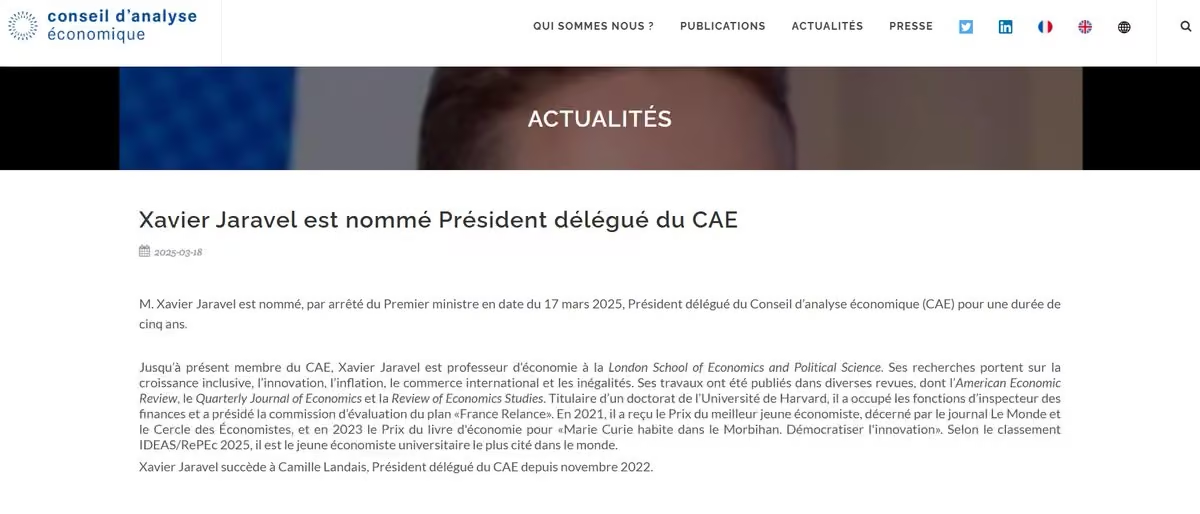 Olivier Blanchard
@ojblanchard1
On trade wars. In response to the Smoot Hawley tariffs, foreign countries strongly retaliated with tariffs on their own. Then, interestingly, the US did not escalate and did not increase tariffs further. With today in mind, the question is why? Largely because of the sharp drop in exports: The US administration understood that unilateral tariffs may be good, but bilateral tariffs are just bad. We shall see.
Olivier Blanchard
@ojblanchard1
On appropriating the 200 billions of Russian assets, two separate issues:
Whether this is creating a bad precedent. If the precedent is that, if you are going to invade another country, you may lose some of your assets abroad: I think we should not care too much about creating such a precedent. (Yes, this will lead some countries to hold fewer T bills. Not the end of the world, and it will lead to a lower dollar, just what the Trump administration is trying to do through various forms of Mar a Lago accords)
Then, if you decide you can take them, do you do it now, or do you keep the option open as a bargaining tool? On this, one can reasonably argue one way or the other. Taking them now can help finance the war now and puts you in a stronger bargaining position. Keeping the option open strengthens your hand a whole lot in bargaining. Need to do the math.
Olivier Blanchard reposted
 Justin Wolfers
@JustinWolfers
Tariffs are on/off/paused, and are targeted/universal, applied to our friends/foes/everyone, starting sooner/later. They'll be in place for the short/long run because they are a useful policy/bargaining chip, and will solve our problem with fentanyl/deficits/manufacturing/revenue
Olivier Blanchard
@ojblanchard1
As we are in danger of moving from a rules-based system to the law of the jungle, the relative size of players matters much more. Think US-Ukraine. Think US-Canada. Even if you did not like the European Union before, you may want to think again.
Olivier Blanchard
@ojblanchard1
Do not buy the “no pain no gain” emerging argument from the Trump team.
Sometimes the argument makes sense: A fiscal consolidation may put debt back on a sustainable course, but may also lead initially to a recession. Stronger regulation may slow activity now but make the system more resilient later.
What we are seeing now has nothing to do with this. The reason for the apparent slowdown is extreme policy uncertainty, which is leading consumers to worry, firms to wait to invest, and demand to fall. In exchange for nothing particularly good in the future. Just a pure loss.
Olivier Blanchard
@ojblanchard1
Given that a number of comments to the last tweet are confused about NGEU debt being "naturally self extinguishing." To clarify:
Debt issued with the expectation that it will not be rolled over, so that it will be fully repaid at maturity (through higher taxes, there is no magic here) as opposed to replaced by newly issued debt, is a soft commitment device: It indicates that the increase in debt is not supposed to be permanent. As everything in life, nothing is sure, and maybe new debt will be issued. Thus, the use of "soft".
Olivier Blanchard
@ojblanchard1
Reasons to run and finance the EU defense effort at the EU level.
Why run it at the EU level? Because it implies better coordination and less duplication of effort. Choose the best tanks, the best planes, independent of nationality. Admittedly hard to do politically at the EU level, but impossible to do if decisions are left to each country.
Debt or taxes? Because it implies an initial adjustment to get to the right defense level, it makes sense to smooth the adjustment and finance most of it initially by debt rather than higher taxes.
Why EU rather than national debt? EU defense debt, if issued along the same lines as NGEU debt, naturally extinguishes itself when it comes to maturity. Not the case for the rest of public debt, which is typically rolled over.
Olivier Blanchard
@ojblanchard1
In response to some comments. Two points
I am not saying anything new (Bernanke QJE 1983), Dixit-Pindyck Princeton U Press 1994), but the effect may be unusually big this time.
The effect may be large in other countries than the US (for example, investment in Mexico, or in Vietnam). A strong international transmission mechanism .
Olivier Blanchard
@ojblanchard1
The effect of policy uncertainty on irreversible investment can be very large, larger than for interest rate changes. If I do not know whether to put my plant in Mexico or the US (or China or Mexico, etc), there is not much cost in waiting to see how the uncertainty resolves itself.
Olivier Blanchard reposted
Peterson Institute
@PIIE
25% tariffs on Canada & Mexico would cause lower GDP & higher inflation than otherwise in all three countries, including the US—& the damage would be even worse if Canada & Mexico retaliate.
Learn more: www.piie.com/blogs/realtime-economics/2025/us-tariffs-can…
 Olivier Blanchard
@ojblanchard1
One reason I like twitter is that you get exposed to others' opinions. It definitely opens your mind.😀 The comparison between Zelensky and Churchill makes many people mad, but it is more than apt. So is the comparison between Roosevelt and Trump. For those who actually care about history, and want to kow about Roosevelt's help to the UK in 1939 and 1940, I recommend "Fateful choices: Ten decisions that changed the world" shorturl.at/3qN4W . Read and learn.
Olivier Blanchard
@ojblanchard1
this is much more than a great video. Had Roosevelt acted the same way, we, the Brits and the continental Europeans, could be living under a Nazi regime today.
 Brian Krassenstein
@krassenstein
This is incredibly well done. History won't look fondly on Trump's behavior. I guarantee it.
"If Trump was President in 1940..."
By @ByDonkeys
Olivier Blanchard
@ojblanchard1
this is much more than a great video. Had Roosevelt acted the same way, we, the Brits and the continental Europeans, could be living under a Nazi regime today.
Brian Krassenstein
@krassenstein
This is incredibly well done. History won't look fondly on Trump's behavior. I guarantee it.
"If Trump was President in 1940..."
By @ByDonkeys
Olivier Blanchard
@ojblanchard1
in this case, higher imports should be largely offset by higher inventory investment. (There seems to be an issue with the treatment of gold flows (treated as flows of goods, or flows of assets), but it is unlikely to explain the size of the adjustment.
 Natalia Gurushina
@NGurushina
the revision most likely reflects frontloading of imports/purchases to avoid tariffs, but today’s Atlanta Fed breakdown also shows that the policy uncertainty might be feeding into domestic growth drivers, which is quite concerning…
 Olivier Blanchard
@ojblanchard1
FRB-Atlanta has now revised its real time estimate of Q1 GDP growth down to -2.8%. Surely, some of it is noise, but it is too large to be just that. I had thought earlier that the expansion would go until 2026. But the Musk/layoff/scares and the even larger than expected policy uncertainty and chaos may mean the downturn will happen sooner. If so, what will Trump do? Try hard to get the Fed to drastically cut rates? Double down on fiscal expansion? Fire Musk? To be continued.
Olivier Blanchard
@ojblanchard1
In a discussion with the Ukrainian minister of finance two months ago, he told me: Russia and Europe are at war. The difference is that Russia knows it, and Europe does not. Maybe, things will now change.
Olivier Blanchard
@ojblanchard1
Why create a US crypto reserve fund, buying and holding various crypto currencies? It has no conceivable macro justification. The only possible reason is to increase crypto prices, and thus to enrich crypto holders and issuers. Why do it? Hard to think that it is not transactional, in return to the financial support from crypto during the Presidential campaign. Legal? Maybe. Ethical? No.
Olivier Blanchard
@ojblanchard1
very much honored.
Olivier Blanchard
@ojblanchard1
A transatlantic tweet. Trump-Musk reminds of LFI-PS. It will not last.
Olivier Blanchard
@ojblanchard1
nice to agree with varoufakis...
 Yanis Varoufakis
@yanisvaroufakis
On Friday 14th, Argentina's President Milei tweeted about the $LIBRA coin, encouraging his followers to buy it on the grounds that it would “help fund small businesses and start-ups”. As if that weren’t enough, he shared a link for people to buy it online. Naturally, within a few hours, $LIBRA’s price shot up. Many more people, trying to escape the poverty that Millei’s policies have subjected them to, rushed in to buy. Alas, soon after the price of $LIBRA crashed and they lost their money.
This is a standard tactic by crypto scammers. It is known as a ‘rug pull’: draw in naïve buyers only to stop trading and run with their money. But when the President of the country does it, it is more than a scam, a scandal. It is a crime.
More broadly, this incident confirms how dangerous the illusion of apolitical, non-state, money is. Money can never be anything other than state based. That we need to democratise our public money is, of course, crucial. But any attempt to privatise money, however well-meaning its adherent might be, is bound to end in tears and to empower an oligarchic circle. End of story.
Olivier Blanchard
@ojblanchard1
In case you are missing him: Paul Krugman substack is extremely good. Not pulling punches, but with the right gloves, data, and arguments, and more space than in the NYT. (and, no, i am not playing influencer, and he is not paying me to push his substack 😀)
Olivier Blanchard reposted
 Mykhaïlo Golub
@golub
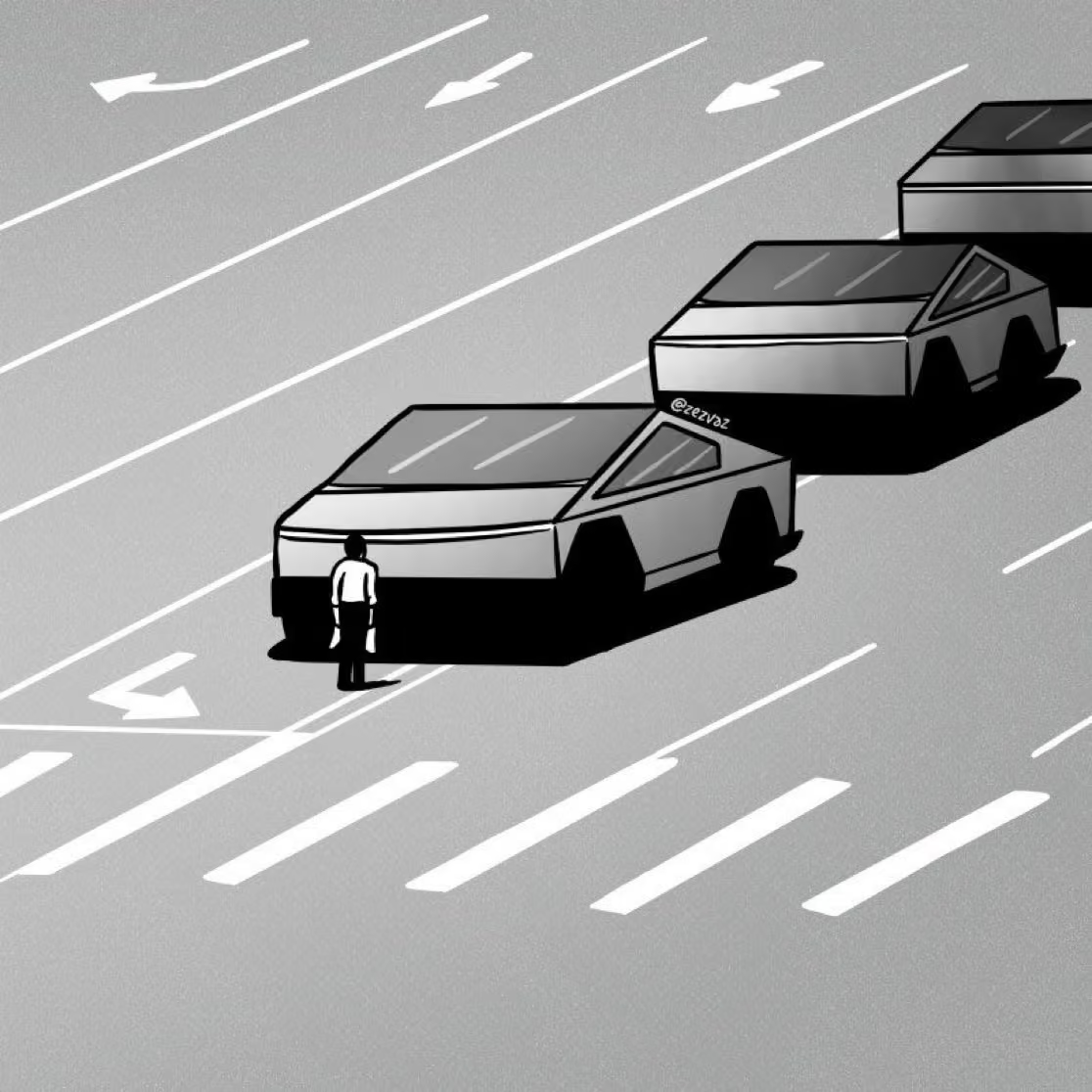 Olivier Blanchard
@ojblanchard1
A follow up. After listening to JD Vance Munich speech and his view of the role of the US, it is even more obvious that Europe has a central role to play in creating “coalitions of the willing”, where those countries who still believe in not bullying others, fighting climate change, etc, work together on specific issues; or put another, create “safe spaces” where rules and agreements are respected.
Olivier Blanchard
@ojblanchard1
Enough of the European gloom and doom. In the new world environment, Europe can and should have a major and exciting role to play. Namely, help create “coalitions of the willing”.
The argument, based on a new article with @pisaniferry, shorturl.at/j0Ewl
The Trump administration is systematically trampling on the traditional rules of international trade, and more generally, the rules of international behavior. Hampered by unanimity rules, multilateral institutions, be it the UN, the WTO, the WHO, etc, are increasingly unable to function.
Yet , many if not most countries are still willing to respect those rules, work to fight climate change, make sure that multinational companies pay their fair share, that tariffs, if used, are used for the right reasons and not to bully others, and so on.
The European Union, which has had to get 27 countries to agree to such rules, is in a unique position to lead and help the formation of coalitions of the willing, namely the set of countries willing to work to achieve specific goals, such as climate, taxation, trade, and looking for reliable partners, who will accept and then respect the rules .
By itself, the European Union is too small to make a large enough difference. Thus, it must enroll other non-EU countries. And if some EU countries do not want to participate, so be it. The proof of concept may be the Schengen agreement, which does not include all EU members but also includes some non EU members.
In general, it is essential to go far beyond Europe, work in particular with some of the Brics. Avoid "the West against the Rest". In that context, a major negotiation with China, recognizing the relevance of security considerations, the desire to protect certain industries, the rules determining the use of tariffs, would be a strong signal that the EU is not following the US blindly and that much of the world wants to continue to play by reasonable rules.
The linked note shows three areas where such coalitions look both essential and feasible, climate, trade and taxation. It discusses, in each case, what the rules could be both within the coalition and vis a vis countries outside, and how they can build on existing agreements.
There are a million technical issues to be solved in creating such coalitions. And obviously, Europe has other problems to solve, its low growth, its absence from some of the frontier technologies, how to respond to US tariffs, and so on. But we believe that, given today’s reality and geo political tensions, helping put place reasonable rules of international engagement is an exciting goal for Europe to set for itself.
Olivier Blanchard
@ojblanchard1
I think Jason overstates the case. No question that not all the policies of the Biden administration were well thought out (I stated in real time my worries about the size of the fiscal expansion and the risk of inflation). But one can argue that each one had some validity: some fiscal expansion was needed, industrial policy and even tariffs are not necessarily non-starters, subsidizing green energy made sense, etc.
To me the main issue is that the middle class they were trying to help voted for Trump. Is it just inflation? Is it the decrease in real wages (which has nothing to do with policy)? Maybe. Is it the dominance of other issues, woke and the like? I think more so. Let’s not dump too much on Biden’s policies and draw the wrong lessons for the future. If Biden had had a few more percentage points and had won the election, we would be much more positive about them.
Jason Furman
@jasonfurman
I have a new piece in @ForeignAffairs titled, "The Post-Neoliberal Delusion and the Tragedy of Bidenomics". They were generous about giving me a lot of words but were less generous with charts--so this long thread partially rectifies that. (And links to the piece at the end.)
 Olivier Blanchard
@ojblanchard1
I write this tweet not as an economist, but as a citizen (of the US, but also of the world).
It is one thing to be against immigration. It is another to forget that immigrants are human beings, worthy of respect.
It is one thing to be against foreign aid. It is another to stop the dozens of USAID programs which are saving lives around the world.
Olivier Blanchard reposted
 BFM Business
@bfmbusiness
🔴 EN DIRECT
@ojblanchard1, ancien chef économiste du FMI, enseignant au MIT est l'invité de La Grande Interview d'@hchevrillon, sur le plateau de @goodevening_biz
x.com/i/broadcasts/1lPJqMEPZeMJb
Olivier Blanchard
@ojblanchard1
A dangerous false analogy: Keeping your powder dry. In the context of monetary policy, not cutting rates now just makes it more likely to have cut them more later (and thus to be more constrained then).
Olivier Blanchard
@ojblanchard1
Please listen to this remarkable speech by Justin Trudeau. www.youtube.com/watch?v=xiaACQpFUfE. A tariff war is so much more than just economics.
Olivier Blanchard
@ojblanchard1
je l'ai deja dit, mais il semble qu'il faille le repeter... Un impot "exceptionel" n'est d'aucune utilite si le probleme est un deficit primaire a moyen terme. Ca ne change rien au probleme a moyen terme, et ca envoie le signal que le gouvernement n'est pas serieux.
Olivier Blanchard
@ojblanchard1
DeepSeek and what happened yesterday: Probably the largest positive tfp shock in the history of the world.
Olivier Blanchard
@ojblanchard1
The nerdy version, to react to some of the comments. (Yes, electricity was big):
DeepSeek and what happened yesterday: Probably the largest positive one day change in the present discounted value of total factor productivity growth in the history of the world. 😀
Olivier Blanchard
@ojblanchard1
One comment makes the point that the first person to light a fire probably made a larger expected present discounted value contribution to mankind. This is absolutely right. I am not sure however that he/she fully realized it. (if I have the timing right, the stock market had not been invented yet).
Olivier Blanchard
@ojblanchard1
Dick: returning the question: tell me how behavioral econ explain these answers 😉
 Richard H Thaler
@R_Thaler
Hmmm, Olivier which one do you favor? :)
Olivier Blanchard
@ojblanchard1
An indictment of rational expectations, or at least evidence of the overwhelming importance of priors

Olivier Blanchard reposted
 Ricardo Reis
@R2Rsquared
For those interested in partisan biases in expectations and how they matter, check the work of some star APs:
-- Rupal Kamdar: sites.google.com/view/rupalkamdar/home
-- Jane Ryngaert:
janeryngaert.github.io
-- Walker Ray: sites.google.com/view/walkerdray/home
Ricardo Reis
@R2Rsquared
And this "partisan bias" in the data mattered during Covid in 2021-22:
"...had all expectations become as unanchored as those of Republicans, average inflation would have been two to four percentage points higher for much of the pandemic period"
www.sciencedirect.com/science/article/pii/S0304393224001028
Olivier Blanchard
@ojblanchard1
An indictment of rational expectations, or at least evidence of the overwhelming importance of priors
Olivier Blanchard
@ojblanchard1
got it. thanks (although this data is a useful warning that there are many different expectations out there, forcing one to think hard about which ones matter (influence decisions). Michigan survey ones may be more relevant for political outcomes.
Ricardo Reis
@R2Rsquared
... but taking a further step to state that this is what makes the data useful.
Olivier Blanchard
@ojblanchard1
Sorry Ricardo, but I just do not understand your point. I agree that, in this case, the decisions of those polled probably do not depend much on their inflation expectations, and so they do not invest much in thinking about the answer. But would you say that measuring the inflation expectations of others, unions, business, market participants, is equally futile?
Ricardo Reis
@R2Rsquared
An even bigger indictment comes from these data being useful to model, understand, and predict inflation. Under full-info RE, they would be "solely a mirror of the outcomes that we could measure in the aggregate data. Measuring expectations was as futile as measuring utility."
Olivier Blanchard
@ojblanchard1
An indictment of rational expectations, or at least evidence of the overwhelming importance of priors
Olivier Blanchard
@ojblanchard1
An indictment of rational expectations, or at least evidence of the overwhelming importance of priors
Olivier Blanchard
@ojblanchard1
Re: the 600 billion Saudi promise of additional investment in the US, and the Trump obsession with reducing the US trade deficit: Has anybody told the Trump administration about the identity: trade deficit = net capital inflows. What do you think will happen?
Olivier Blanchard
@ojblanchard1
We may have reached AI singularity. Not the one you think about. But political singularity in which AI players control the government and eliminate all AI regulation. A bit worrisome.
Olivier Blanchard
@ojblanchard1
an important paper.
NBER
@nberpubs
Exploring the role of political economy forces in bolstering or constraining a country's geoeconomic power, from @chris_d_clayton, @m_maggiori, and @jschreger www.nber.org/papers/w33353
 Olivier Blanchard
@ojblanchard1
Reaction to Roland Lescure departure from twitter (sad). I have had a very different experience from him, and indeed from many. Most of my feeds are actually from people who seem to think largely like me. Indeed, I feel I am sometimes in a democrat bubble… I get very few insults, perhaps because I never insult anybody, or my positions are too wishy washy… My tweets often (not always) trigger a useful discussion, provide more evidence pro or con. Indeed, they have sometimes led me to change my mind… I have blocked Musk, so I do not suffer from his tweets. So, at least for the time being, I shall stay.
 Roland Lescure
@RolandLescure
Ceci est mon dernier tweet. Je quitte X.
Et j’appelle à sortir X de l’équation, collectivement.
www.leparisien.fr/politique/roland-lescure-vice-president…
Olivier Blanchard
@ojblanchard1
On this last day of the Biden administration, very deep thanks to the Biden economics team, from Janet Yellen to Cecilia Rouse to Jared Bernstein. I did not agree with all their decisions, but I never for a second doubted that their commitment to trying to improve the lives of Americans. Godspeed.
Olivier Blanchard
@ojblanchard1
Chad: Congratulations. Continue to monitor the world economy; we need you.
Chad P. Bown
@ChadBown
Public service is an incredible honor. To tackle the world’s biggest challenges, economic policy coordination remains critical.
Mom, can you believe they asked me (me!) to serve as Chief Economist at the Department of State??? As this is my last day, I just want to say thanks.


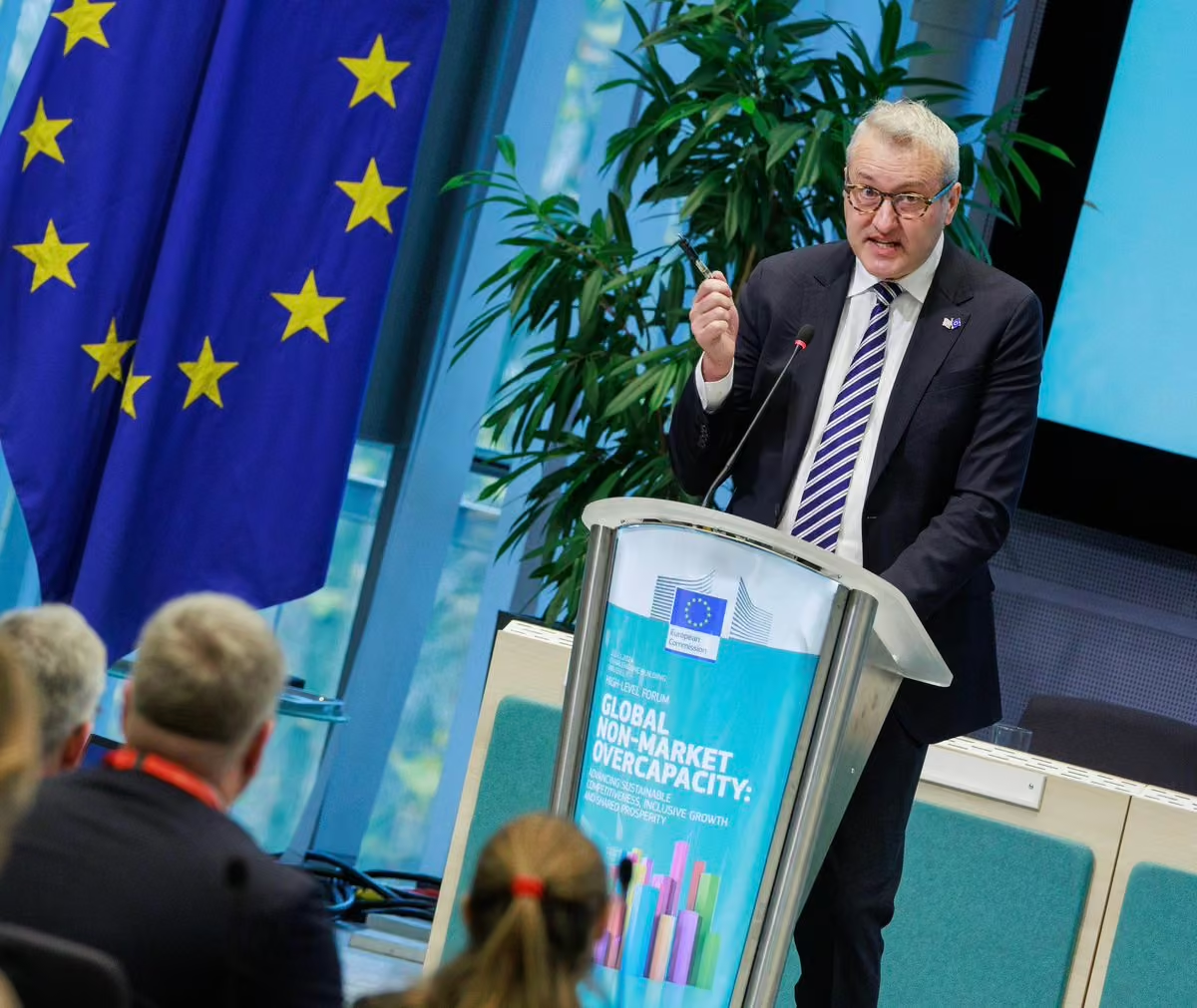
 Olivier Blanchard
@ojblanchard1
A rich panel discussion between Mario Monti, Jason Furman, and me, on the world under Trump: In effect, a full rejection of the traditional rules of the international conduct game. How should/will the other players, notably the European Union, react? www.piie.com/events/2024/eu-us-relationship-crossroads
Olivier Blanchard
@ojblanchard1
It is going to take a while to understand the actual intentions of the Trump-Musk team, and its effects on the rest of the world. This interview is a start.
 Pierre de Gasquet
@PierredeGasquet
"Il y a aussi une interrogation : qui décide ? Elon Musk ou Donald Trump ?" par @ojblanchard1
www.lesechos.fr/monde/enjeux-internationaux/leffet-des-dr…
Olivier Blanchard
@ojblanchard1
un podcast/interview par des etudiants aux Journees d'economie de Lyon. A partir de la minute 10, une discussion de l'enseignement de l'economie et du metier d'economiste. Peut etre interessant si cette profession vous tente. shorturl.at/uKAHu
Olivier Blanchard reposted
 BSurveillance
@bsurveillance
"We can't sane-wash it. There's just no excuse for the US doing that." Adam Posen of The Peterson Institute cautions against Donald Trump's threats to expand US territorial sovereignty
www.bloomberg.com/news/articles/2025-01-07/stock-market-t…
Olivier Blanchard reposted
 Giuliano
@GiulianoMana
I thought I was crazy until I found Richard Feynman.
Feynman was not only among the most brilliant people on earth, but he transmitted something I've never seen in others.
Thread with some lessons from his peculiar way of being:
 Olivier Blanchard
@ojblanchard1
Pourquoi ne pas demander à Laurent Berger (qui avait proposé dans le passé d'excellentes propositions, et qui commande un large respect sur ce sujet) d’etre en charge d’une commission chargée de proposer une nouvelle réforme des retraites?
Olivier Blanchard
@ojblanchard1
For a striking example of why trade can be good and tariffs can be bad, read this marvelous column on trade and music by my colleague Cullen Hendrix: shorturl.at/bU5t5
Olivier Blanchard
@ojblanchard1
Il s'agit de l'elasticite a moyen terme. A court terme, l'effet est principalement sur les revenus, et l'elasticite est a peu pres egale a la part des revenus dans le PIB. A moyen terme, plusieurs postes de depenses s'ajustent, le salaire reel des fonctionaires, etc...
Olivier Blanchard
@ojblanchard1
Trivial game theory, applied to France. If the government agrees not to have recourse to article 49-3, and there is no possibility of dissolution until next summer, very hard to see anything else than status quo and paralysis.
Olivier Blanchard
@ojblanchard1
A wide set of opinions on the probability of a global debt crisis. www.international-economy.com I am less worried than some. Debt crises in some countries for sure, especially among the poorer ones, but also in some more advanced. But global crisis, no.
Olivier Blanchard
@ojblanchard1
A ceux qui m’accusent d’avoir retourne ma veste (sur la dette). Non. Je continue a penser que le niveau de la dette publique n’est pas en soi catastrophique. Moins de dette, c’est bien mais pas existentiel. Et il y a des circonstances ou une augmentation de la dette est justifiée. En revanche, l’explosion de la dette, la perte de contrôle, est tres dangereuse. Je l’ai tres souvent vu quand j’étais au FMI. C’est le danger qui guette la France. Il faut reprendre le contrôle, stabiliser la dette. D’où l’article du Point shorturl.at/kQ3Zb sur l’arithmétique, et les choix necessaires.
Olivier Blanchard
@ojblanchard1
Un article dans le Point shorturl.at/kQ3Zb Comme il est derrière le mur, un résumé : Il faut a terme 150 milliards pour stabiliser la dette. Il n’y a pas de solution miracle. Les « Y’a qu’a » (y’a qu’a diminuer le nombre de fonctionnaires, y’a qu’a augmenter l’age de la retraite, y’a qu’a taxer les riches...) devraient regarder les chiffres.
Olivier Blanchard
@ojblanchard1
Amazing. Hard to think it is not going to show up in productivity numbers.
 Arpit Adlakha
@arpit20adlakha
Robots are taking over jobs faster than ever.
From chefs to delivery drivers, here are 10 that might shock you.
1. Fold and fold
Olivier Blanchard
@ojblanchard1
Utile d’etre explicite au risque de se faire insulter : Il ne peut y avoir de vache à lait, que ce soit les tres riches ou les retraités ou tout autre groupe. Diminuer les retraites ne peut etre acceptable que si, par exemple, la sécurité sociale rembourse moins les médicaments, si les allocations chomage sont moins généreuses, si le RSA est moins généreux, si le budget de la culture est réduit, si les tres riches paient leur part, etc. Chacune des ces mesures implique des souffrances et des sacrifices. Mais ils sont nécessaires si l’état doit vivre selon ses moyens et stabiliser sa dette. Cette discussion n’a pas eu lieu. On ne pourra pas l’éviter.
Olivier Blanchard
@ojblanchard1
Les conséquences de cet état de fait sont claires. Pour obtenir les 140 milliards d’ajustement, il faut changer la nature du jeu politique. Plutôt que de chercher à satisfaire leurs électeurs et de tracer des lignes rouges comme on le voit aujourd’hui à l’Assemblée, les partis doivent coopérer. Cela signifie accepter des mesures douloureuses pour leurs propres électeurs à condition que les autres fassent de même. Cela va-t-il se produire ? Probablement pas sans quelques signaux forts des marchés financiers et la menace d’une crise. Et même dans ce cas, ce sera au mieux un processus long et compliqué.
Olivier Blanchard
@ojblanchard1
Pour stabiliser sa dette publique (par rapport au PIB), la France doit réduire son deficit budgetaire a terme d’environ 140 milliards. Vu l’opposition des différents groupes parlementaires a des réductions de depenses ou des augmentations d’impot de juste quelques milliards, on est tres mal parti.
Olivier Blanchard
@ojblanchard1
If you were too lazy to read my blog 😀 here is a video.
www.piie.com/events/2024/olivier-blanchard-trumponomics
Olivier Blanchard reposted
Peterson Institute
@PIIE
TOMORROW: Join @ojblanchard1 on the next episode of PIIE Insider LIVE to discuss his recent piece on Trumponomics & how President-elect Trump's economic policies will affect the US & others.
Info & register: www.piie.com/events/2024/olivier-blanchard-trumponomics
Read the blog: www.piie.com/blogs/realtime-economics/2024/how-will-trump…

Olivier Blanchard reposted
 Marc Vignaud
@mvignaud
Que peut-on attendre de la politique économique de @realDonaldTrump ? – par @ojblanchard1 en français dans @lopinion_fr www.lopinion.fr/economie/que-peut-on-attendre-de-la-polit…
Olivier Blanchard
@ojblanchard1
Trying to think through the implications of Trumponomics: deportations, tariffs and lower taxes. Main conclusions. It will not work out as he hopes. But it will also not be the catastrophe some predict. The main issue may be inflationary pressure, setting up a fight with the Fed. shorturl.at/aNHQ2
Olivier Blanchard
@ojblanchard1
steady drops in number of followers since the elections: idiosyncratic or widespread?
Olivier Blanchard
@ojblanchard1
A truly great thread by Jason Furman
Jason Furman
@jasonfurman
The macroeconomy is strong--high growth, low unemployment, falling inflation--the best of any advanced economy.
But there was a reluctance to present/understand how families were still not out of the deep inflation hole. And too much masked by cherrypicking/misleading stats.
Olivier Blanchard
@ojblanchard1
I shall defer to historians and cliometricians. But when the world is largely governed by autocrats or would-be autocrats, I suspect that the standard deviation of what can happen increases substantially.
Olivier Blanchard
@ojblanchard1
Xi Jinping, Putin, Trump, Erdogan, Orban. What can go wrong?
Olivier Blanchard
@ojblanchard1
I am worried. As inflation raged in Venezuela in the late 2010s, people shifted from regular currency to candies. Hope our Treasury secretary, and her young advisor, are not working on a similar plan. (one has to worry about the power of the candy lobby in DC, or, given the crypto lobby, the emergence of crypto candies.)
 Secretary Janet Yellen (Archived)
@SecYellen
A frank and productive exchange of views with my counterpart on key issues like expanding the global supply of candy and toys and tightening sanctions against chores.
 Olivier Blanchard
@ojblanchard1
Et si on laisse de cote la securite sociale, l'ajustement doit etre de 20% du budget qui reste.... Pas en un an bien sur mais a terme. Ca implique des choix bien plus fondamentaux que ceux que l'on discute aujourd'hui.
Olivier Blanchard
@ojblanchard1
Frappe par la civilite de notre debat et la large convergence de vues entre Gabriel Zucman et moi, compare au debat a l'Assemblee. L'etat vit au dessus de ses moyens, par environ 10%. En meme temps, il nous faut depenser plus pour la defense (surtout si Trump est elu), la transition climatique, l'education, la sante. Ca implique des efforts considerables sur le reste, et une discussion responsable du cote des depenses et des recettes.
Olivier Blanchard
@ojblanchard1
Un debat entre @gabriel_zucman et moi, au Nouvel Obs: Les sujets previsibles: dette, deficits, depenses, recettes. Pour aller un peu plus au fonds des choses.
www.nouvelobs.com/idees/20241023.OBS95383/quel-est-vraime…
Olivier Blanchard
@ojblanchard1
Frappe par la civilite de notre debat et la large convergence de vues entre Gabriel Zucman et moi, compare au debat a l'Assemblee. L'etat vit au dessus de ses moyens, par environ 10%. En meme temps, il nous faut depenser plus pour la defense (surtout si Trump est elu), la transition climatique, l'education, la sante. Ca implique des efforts considerables sur le reste, et une discussion responsable du cote des depenses et des recettes.
Olivier Blanchard
@ojblanchard1
Un debat entre @gabriel_zucman et moi, au Nouvel Obs: Les sujets previsibles: dette, deficits, depenses, recettes. Pour aller un peu plus au fonds des choses.
www.nouvelobs.com/idees/20241023.OBS95383/quel-est-vraime…
Olivier Blanchard reposted
Peterson Institute
@PIIE
NEW: Our podcast Policy for the Planet!
Monica de Bolle speaks with economists, health experts, political scientists, & more to unravel the policy choices to save our planet's future.
Listen here or wherever you get your podcasts: sites.libsyn.com/531482
 Olivier Blanchard
@ojblanchard1
After Kazan: The Brics look like an exceptional combination of frenemies, united only in their dislike of the US and Europe. But, still, it is hard not to feel a geographic shift of the world's center of gravity towards Asia and the "global south".
Olivier Blanchard
@ojblanchard1
Un debat entre @gabriel_zucman et moi, au Nouvel Obs: Les sujets previsibles: dette, deficits, depenses, recettes. Pour aller un peu plus au fonds des choses.
www.nouvelobs.com/idees/20241023.OBS95383/quel-est-vraime…
Olivier Blanchard
@ojblanchard1
Un bon debat sur le rapport Draghi, organise par le Grand Continent. Trop alarmiste? Les bonnes solutions? Faut-il financer l'investissement par la dette? La regulation doit elle etre ex post a l'americaine, ou ex ante a l'europeene? etc. www.youtube.com/live/IrsmC4-tt-k
Olivier Blanchard
@ojblanchard1
Ayant juste discuté avec Olivia Gregoire(une des auteurs de cette proposition) , je veux clarifier mon propos : Je maintiens: Une telle vente est inutile ou même contreproductive du point de vue de l’élimination du deficit a terme.
Mais si on y pense comme un changement de portefeuille de l’état, vendant certaines participations, non pas pour diminuer la dette mais pour prendre d’autres participations dans des secteurs plus prometteurs, plus porteurs d’innovation, pourquoi pas. A explorer, mais en sachant que ça n’est pas ça qui va réduire le deficit a terme.
Olivier Blanchard
@ojblanchard1
Pour stabiliser la dette, la France doit réduire son deficit structurel a terme. Vendre les participations de l’état dans des entreprises privées est de ce point de vue totalement inutile. Cela ne change rien au deficit structurel. Pire, avec la perte de dividendes dans l'avenir, ca peut l'augmenter.
Olivier Blanchard
@ojblanchard1
The Draghi report raises all the right issues, what happens to Europe if it lags the US in innovation, the adverse effects of EU fragmentation, the role of the EU approach to regulation and anti-trust, and so on. It does not quite settle all of them. I hope the discussion goes on.
Peterson Institute
@PIIE
Given the public-good nature of defense, green transformation, etc., public investment/subsidies must be designed & implemented at the EU level.
But it does not imply it should be financed by EU debt rather than by taxes, write @ojblanchard1 & @angelubide.www.piie.com/blogs/realtime-economics/2024/essential-issu…
Olivier Blanchard
@ojblanchard1
This is interesting, and probably more general. AI has helped this low skill worker (me), but does not help the high skill workers as much. Good news for income distribution (although this low skill worker is probably overpaid :) )
 Florian Oswald 🇪🇺 🇺🇦
@FlorianOswald
It does not seem to increase the productivity of pro’s though (actually increases the bug rate) www.cio.com/article/3540579/devs-gaining-little-if-anythi…
Olivier Blanchard
@ojblanchard1
The effects of AI on productivity. I am basically bad at programming. Yesterday, I had to do a presentation, and use Matlab, Stata, and Beamer. Time and time again, I used claude.ai (this is free publicity) to debug each of the three. It was amazingly good, friendly, and efficient. I did in three hours what would have taken me days of agony (finding out the programming mistakes, bothering some IT person to help) just a few years ago. Large jump in productivity.
Olivier Blanchard reposted
Adam Posen
@AdamPosen
How much would Trump's plans for deportations, tariffs, and the Fed damage the US economy?
Straight talk blog based on non-partisan analysis by
@WarwickMcKibbin @meganrosehogan and Noland
Read and share from @PIIE
www.piie.com/blogs/realtime-economics/2024/how-much-would…
Olivier Blanchard
@ojblanchard1
A point in the interview that I see as important, and poorly understood:
If you had a friend who spent consistently more than his income, how would you react if he said: Ok, exceptionally, I shall spend less for a year, and then go back to my usual behavior. I suspect you would not be enthusiastic.
The same applies to exceptional taxes, for example a one-time higher tax rate on corporate income. It does not solve anything. And, indeed, it may do harm. Economically, slowing down demand. And politically, avoiding the tough decisions.
To deal with its budget deficit, France needs to take permanent measures, measures that decrease the primary deficit in the long term.
 Laurent Fargues
@l_fargues
"Au vu de l'effort budgétaire à réaliser en France, il me semble nécessaire, politiquement et moralement, de demander une contribution aux plus riches", estime l’économiste @ojblanchard1 dans une itw sur les comptes publics tricolores. www.challenges.fr/economie/il-me-semble-necessaire-de-dem… via @Challenges
Olivier Blanchard
@ojblanchard1
Un point dans l'interview qui me parait important, et tres mal compris:
Si vous aviez un ami qui dépensait constamment plus que son revenu, comment réagiriez-vous s'il vous disait : ok, exceptionnellement, je dépenserai moins pendant un an, puis je retournerai à mon comportement habituel. Je soupçonne que vous ne seriez pas enthousiaste.
Il en va de même pour les impôts exceptionnels, par exemple un taux d'imposition plus élevé sur les revenus des sociétés pendant un an. Cela ne résout rien. Et pire, cela peut être couteux. Sur le plan économique, en amenant à un ralentissement de la demande. Et politiquement, en évitant les décisions nécessaires difficiles.
Pour faire face à son déficit budgétaire, la France doit prendre des mesures pérennes, des mesures qui diminuent le déficit primaire à long terme.
Laurent Fargues
@l_fargues
"Au vu de l'effort budgétaire à réaliser en France, il me semble nécessaire, politiquement et moralement, de demander une contribution aux plus riches", estime l’économiste @ojblanchard1 dans une itw sur les comptes publics tricolores. www.challenges.fr/economie/il-me-semble-necessaire-de-dem… via @Challenges
Olivier Blanchard
@ojblanchard1
j'ai maintenant fini la 9eme edition, et relisant ce que j'avais ecrit il y a 7 ans, je ne changerai pas grand chose.
 Martin Anota
@martin_anota
Comment devons-nous enseigner la macroéconomie aux étudiants après la crise ?
(Olivier Blanchard)
annotationsbis.blogspot.com/2016/06/macroeconomie-crise.html
[souvenirs...]
 Olivier Blanchard
@ojblanchard1
Justin: Do a good deed. Give free copies of your textbook to JD Vance and Donald Trump. Accept the loss of royalties for the social good.
Justin Wolfers
@JustinWolfers
I'm exhausted even saying it, but blocking supply won't reduce prices, and it's not even close.
Olivier Blanchard reposted
 Catherine Rampell
@crampell
a friend sent this to me
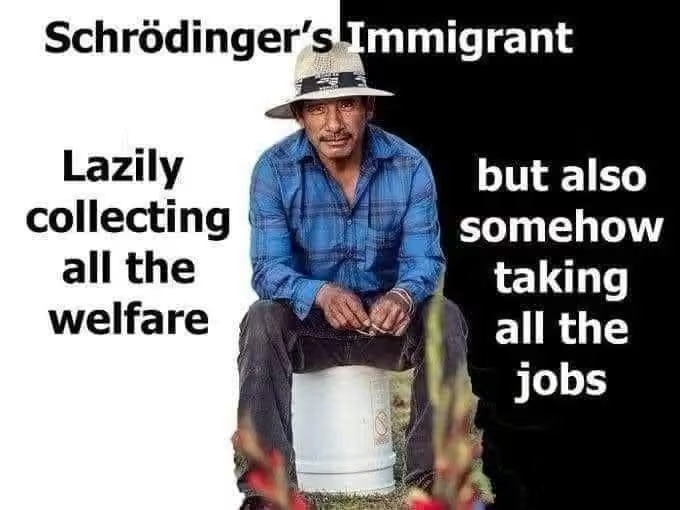 Olivier Blanchard
@ojblanchard1
We are back to normal (and difficult) monetary policy where one must guess which blip is temporary or permanent (with, often, opinions on both sides), and deal with the lags with which monetary policy affects activity. Not an easy job, but a familiar one.
Olivier Blanchard
@ojblanchard1
Guess, and amateur political science: If France had had proportional voting: RN would have had more seats. The socialist party would not have been constrained by an alliance against nature with LFI. No party would have had anywhere close to a majority. Coalitions would be needed. But, instead of parties agreeing on a list of unrealistic promises, as they had to and did before the vote under the current two round majority system, they would have to agree on a list of actual measures. It would be healthier. Lesson for next time.
Olivier Blanchard
@ojblanchard1
To JD Vance, ec101: Incentives for US firms to produce more have to come from an increase in price, making it more profitable to do so. You cannot at the same time have no increase in prices and a boom in domestic production. 😀
Justin Wolfers
@JustinWolfers
This morning @JDVance described my analysis of Trump's washing machine tariffs as dishonest, suggesting that one should look at these data two years later. Do you I need to tell you how this story ends?
Olivier Blanchard
@ojblanchard1
Reponse: Il y a gauche et gauche.
 Olivier Faure
@faureolivier
Énigme : Comment peut-on se dire de gauche et ne jamais sortir de sa tanière que pour taper la gauche, pour mieux exonérer la droite ?
Olivier Blanchard
@ojblanchard1
The French discussion is about Macron, Melenchon, Le Pen, and how, through their actions, they got us into a mess. But I am struck by the fact that exactly the same forces are at work elsewhere. See the regional elections in Germany, not to mention previous elections in Italy, the Netherlands, etc. The rise of the two extremes, and the weakening of the center, has little to do with personalities. It is much deeper, and much harder to address.
Olivier Blanchard
@ojblanchard1
A follow up on the crypto tweet. Yes, bitcoin may be a bit different from the rest of the bunch. It is more transparent, better established, without the crazy stuff of some of the other crypto assets described in the book.
Like gold, it is largely a bubble asset. Like gold, it may have some intrinsic value (partly for the wrong reasons), but, like gold, most holders hold it in the anticipation of capital gains. And the price is far above the intrinsic value.
This does not necessarily imply that one should not hold some. Like gold, this depends on its hedging properties: If for whatever reason, it does well in bad times, it provides some hedging. In practice, it does not seem to be such a good hedge. Correlations are not stable, and often have the wrong sign. There are surely better ways to hedge.
Olivier Blanchard
@ojblanchard1
Please, please, read it. It is worse than you imagined... (and the book is a page turner).
Then, worry about the following headline from Axios today: "1 big thing: Crypto dominates corporate election spending."
 Jake Donoghue
@JDonoghueAuthor
Crypto Confidential is out today.
If you want to see how the crypto industry truly operates, and how the founders, insiders and fraudsters act when the doors are closed and cameras are down, this book will show you.
Former IMF Chief Economist @ojblanchard1 says: "A brilliant and fascinating description of crypto. It makes painfully clear that, on the buying side, there is no limit to human credulity, and the faith in magic returns. And, on the selling side, no limit to hubris, deception and scamming. Read the book, and cry."
thehistorypress.co.uk/publication/crypto-confidential/
 Olivier Blanchard
@ojblanchard1
Please, please, read it. It is worse than you imagined... (and the book is a page turner).
Then, worry about the following headline from Axios today: "1 big thing: Crypto dominates corporate election spending."
Jake Donoghue
@JDonoghueAuthor
Crypto Confidential is out today.
If you want to see how the crypto industry truly operates, and how the founders, insiders and fraudsters act when the doors are closed and cameras are down, this book will show you.
Former IMF Chief Economist @ojblanchard1 says: "A brilliant and fascinating description of crypto. It makes painfully clear that, on the buying side, there is no limit to human credulity, and the faith in magic returns. And, on the selling side, no limit to hubris, deception and scamming. Read the book, and cry."
thehistorypress.co.uk/publication/crypto-confidential/
Olivier Blanchard
@ojblanchard1
I am struck by the mood in the US, the message of hope which is clearly getting through, and the emergence of so many exciting democratic party politicians. Lessons for France?
Olivier Blanchard
@ojblanchard1
Some thoughts on major future economic stabilization challenges, populism, protectionism. shorturl.at/Ck86N last panel. My 15 minute intervention at 5 minutes in. (but the whole panel is worth listening to. 😀)
Olivier Blanchard
@ojblanchard1
Sur les risques de deglobalisation et les politiques a suivre. Beaucoup de reflexion et de travail sur la planche.
Le Grand Continent
@Grand_Continent
La mondialisation fait face à cinq principaux défis susceptibles de conduire à un processus coûteux et inefficace de déglobalisation.
@ojblanchard1 appelle à se détacher de la défense absolutiste du libre-échange en faveur de politiques au cas par cas.
legrandcontinent.eu/fr/2024/08/01/une-feuille-de-route-po…
Olivier Blanchard reposted
 Bloomberg TV
@BloombergTV
"When we think about the election, what's most important is our children and grandchildren," says Wall Street Week contributor and Former Treasury Secretary @LHSummers and granddaughter, Frances Joanne, as she makes her first TV appearance www.bloomberg.com/btv/series/wall-street-week?cmpid%3D=so…
Olivier Blanchard reposted
 Soumaya Keynes
@SoumayaKeynes
In case you were focused on something else earlier in the week 🫣, here's the latest episode of #theeconomicsshow with @AdamPosen of the @PIIE
I asked Adam what *he* would do re US policy towards China. Here's part of his answer, listen for the rest... www.ft.com/content/30f90c36-6a33-4846-b787-1435d00c38ef
 Olivier Blanchard
@ojblanchard1
A truly important note by @ThomasPHI2 @Xavier_Ragot @a_auclert for the French Conseil d'Analyse Economique on the fiscal position, and what will need to be done. The constraint that any government, right, left, or center, will be facing. shorturl.at/1LvS2
Olivier Blanchard
@ojblanchard1
Why we should expect steadily increasing trade tensions, and what the right policy reactions might be.
shorturl.at/r4w58
Olivier Blanchard
@ojblanchard1
Yes, she laughs a lot (which is great). But, before making up your mind based on memes, read the wiki page en.wikipedia.org/wiki/Kamala_Harris This is a smart, driven, person, who has a truly impressive record.
Olivier Blanchard reposted
Luis Garicano 🇪🇺🇺🇦
@lugaricano
Brilliant.
Olivier Blanchard
@ojblanchard1
Discussions are taking place, coalitions are being explored. An issue that any government will have to face: Reduce the deficit. This article in Le Point (the english version of the original, with free access) discusses what has to be done and how.
shorturl.at/eUvZN
Olivier Blanchard
@ojblanchard1
Une remarque supplementaire. Le Point a oublié de mentionner une note de bas de page, disant que mon article a considérablement profite de discussions avec les membres du Conseil d'Analyse Economique, qui est en train d'écrire un rapport sur le sujet.
Olivier Blanchard
@ojblanchard1
shorturl.at/yeLUM. Pas vraiment une "feuille de route" mais l'articulation d'une contrainte qui s'impose a tout gouvernement, de droite, du centre, ou de gauche: reduire le deficit et stabiliser la dette publique.
Olivier Blanchard
@ojblanchard1
shorturl.at/yeLUM. Pas vraiment une "feuille de route" mais l'articulation d'une contrainte qui s'impose a tout gouvernement, de droite, du centre, ou de gauche: reduire le deficit et stabiliser la dette publique.
Olivier Blanchard
@ojblanchard1
Indeed, the two most important equations to understand what may happen in the coming weeks.
 JohannesBorgen
@jeuasommenulle
Thoughts about what's next in France + some important budget geekery in the middle. A long thread.
There is obviously no party capable of governing, But the two most important figures for me are approx
- RN + LFI = 214, 256 if we add EELV and PCF
- LR + PS + ENS = 131+162=293
Olivier Blanchard
@ojblanchard1
A summary of my FT oped. shorturl.at/tNiFx Replacing the center left and center right by a broad center looked brilliant, politically and policy wise, in 2017. But, when the center weakened, it only left the extremes. The existence of both a center left and a center right is essential for democracy's resilience.
Olivier Blanchard reposted
 Thierry Fabre
@FabreFaber
La tribune d'@ojblanchard1, ex économiste en chef du #fmi, sur le programme du Nouveau Front Populaire "cohérent mais très dangereux". Il risque de conduire à une "catastrophe économique" @Challenges www.challenges.fr/politique/le-programme-du-nfp-est-coher… via @Challenges
Olivier Blanchard reposted
 PhD_Genie
@PhD_Genie
Adjusting your paper within the word limit
Olivier Blanchard
@ojblanchard1
(same tweet thread, but in French).
Dernier fil de tweet de la trilogie (FN, NFP, maintenant Ensemble). Ensuite, j'ai l'intention de faire une pause. 😊
Je suis frappé par la prédominance de l'argument suivant : si vous rejetez le RN, vous devez voter NFP. Comme s'il n'y avait pas d'alternative. Il y en a évidemment une, voter pour un des partis du centre, que ce soit Ensemble, ou le LR qui n'a pas rejoint le RN, ou les « divers gauches » qui n'ont pas rejoint le NFP.
Je suis également frappé par la profondeur de l’aversion pour le President lui-même, et je soupçonne que cette aversion dépasse largement l’aversion pour un programme centriste. Il serait catastrophique que l’aversion pour l’homme conduise à l’aversion pour le centre.
Olivier Blanchard
@ojblanchard1
Il y a de bonnes raisons à cette modestie. Premièrement, la prise de conscience que le déficit est déjà trop important (j’y reviendrai plus loin), et que ce n’est donc pas le moment de dépenser beaucoup plus, sauf pour la défense et la lutte contre le réchauffement climatique. Deuxièmement, en tant que parti au pouvoir, il propose de continuer dans la même direction générale, et les nouvelles mesures sont donc limitées. Ainsi, contrairement aux deux autres programmes, on peut le juger sur ce qu’il a fait, plus que sur ce qu’il promet.
Olivier Blanchard
@ojblanchard1
La philosophie générale a été claire : augmenter le pouvoir d’achat grâce à une participation accrue et à une croissance plus forte de la productivité.
Cela a conduit à un certain nombre de réformes, depuis l’augmentation du crédit recherche pour stimuler la R&D, jusqu'aux mesures visant à accroître l'apprentissage et la formation professionnelle, à la réduction de la taille des classes au collège, a la réforme des retraites, à un rôle central de la France dans un accord sur un impôt minimum sur les multinationales,
Olivier Blanchard
@ojblanchard1
Certes, la dette a augmenté, passant de 89 % du PIB à 103 % du PIB en 2023, reflétant en grande partie le « quoi qu’il en coute » pour limiter les effets du covid et les prix de l’énergie. Cette augmentation était justifiée. Ce qui n’est cependant pas justifié et expose le gouvernement à de sérieuses critiques, c’est le déficit budgétaire restant, qui a augmenté de 3.0% en 2017 à 5.5% en 2023, ce qui rend les choix difficiles pour l’avenir. (Bien sûr, ni le RN ni le NFP n’abordent le problème…).
Olivier Blanchard
@ojblanchard1
Certains d’entre nous souhaitent-ils davantage de réformes ? Dans mon cas, surement. Jean Tirole, Dani Rodrik et moi-même avons par exemple indiqué quelques axes de réforme pour lutter contre les inégalités dans notre rapport au Président. Ils sont ambitieux, mais je les crois plus réalistes que ce que propose le NPF. C’est pour cette raison que je voterai pour le centre, en espérant une coalition des partis du centre plus large que celle que nous avons eue, plus d’humilité, plus de concertation, et une évolution dans cette direction.
Olivier Blanchard
@ojblanchard1
1/9. Last tweet thread in the trilogy (FN, NFP, now Ensemble). Then, I intend to take a break.😃
I am struck by the prevalence of the following argument: If you reject the RN, you must vote NFP. As if there was no alternative. There is obviously one, voting for one of the center parties, be it Ensemble, or the LR who did not join the RN, or the “divers gauches” who did not join the NFP.
Olivier Blanchard
@ojblanchard1
8. True, debt has increased, from 89% of GDP to 103% of GDP in 2023, reflecting in good part le “quoi qu’il en coute” in the face of Covid and the war in Ukraine. This increase was justified. What is not justified however and exposes the government to serious criticism is the remaining budget deficit, which has increased (leaving out interest payments) from 1.9% in 2017 to 3.4% this year and makes for difficult choices looking forward. (Neither the RN nor NFP are addressing the issue).
Olivier Blanchard
@ojblanchard1
9. Do some of us want more reforms? I do. Jean Tirole, Dani Rodrik, and I for example indicated some directions of reform to deal with inequality in our report to the President. They are ambitious, but I believe them to be more realistic than what is offered by the NFP. For this reason, I shall vote for the center, hoping for a broader coalition of the center parties than we have had, more humility, more concertation, and a move in that direction.
Olivier Blanchard
@ojblanchard1
1/4. My thread on the economic program of the NFP has triggered a fascinating set of reactions. I have picked up three main critiques.
Olivier Blanchard
@ojblanchard1
2/4. Critique 1. The RN is a fascist party. Thus, we must vote NFP, even if its economic program is dangerous. Pointing its shortcomings is irresponsible. Example:
“I understand Blanchard's criticism of the NFP programme. And I surely agree with him on more than one point, with numbers on the table. BUT as a citizen, it sounds a bit like equidistant ambiguity with the RN. What kind of society do we want?”
Answer : I simply do not accept the logic that the only alternative to RN is the NFP. (and even if it were so, I would still feel compelled to assess its economic program). One can vote for the center. Centrist parties may be far from perfect, but they are not racist, and their economic programs are much less dangerous. (I shall do another thread on this)
Olivier Blanchard
@ojblanchard1
3/4. Critique 2. Don’t worry. The NFP will not apply its economic program. Example:
“Olivier Blanchard assumes the program of the NFP will be wholly implemented and focuses only on the measures LFI promotes. This is red scare-mongering. NFP will have to share power with centrists.”
In other words, don’t worry. The program will not be applied. (We hear the same thing from the RN side. ) I am not sure that this is a very convincing argument, especially given the promise of the NFP (not just LFI) to take several very strong measures within the first 15 days.
Olivier Blanchard
@ojblanchard1
4/4. Critique 3. The program will not have adverse serious economic effects. There are actually surprisingly few arguments made along these lines. There are a few. Example:
“Only a very small part of the economy is firms where it will be difficult to raise SMIC without these impacts. Most of the economy is large chains which will be fine, a dent in their profits maybe, not a big deal.”
I wish I could share this optimism. Small firms will be hurt. Big firms may be better able to withstand the shock, but they are also the firms that can decide to produce elsewhere, or even to move headquarters.
Olivier Blanchard
@ojblanchard1
To be clear, there are other central issues at stake in this election, immigration, racism, foreign policy, support for Ukraine, etc, and they may be determinant in how people decide to vote. I try to stay in my lane, the economic aspects of the programs.
Olivier Blanchard
@ojblanchard1
1/6. Tweet thread. Why do I think the economic program of the Nouveau Front Populaire is worse than that of the Rassemblement National?
The nature of the two programs is very different. I have argued that the RN economic program is a Christmas tree, without logic or coherence (previous tweet thread). The NFP economic program is instead mostly internally coherent, based on an epochal redistribution from rich to poor, and from firms to workers.
Olivier Blanchard
@ojblanchard1
3/6. For all practical purposes, the NFP program is of the second kind. It intends to tax income through much higher tax rates. The program does not give a number, but in 2022, LFI suggested a marginal tax rate of 90% for the highest tranche. It intends to tax successions through much higher tax rates as well, indeed with a 100% tax rate above some level. It intends to reintroduce the ISF and tax wealth at 3% a year, according to Manon Aubry. It is hard to see how this will not lead entrepreneurs to move en masse their operations elsewhere.
Olivier Blanchard
@ojblanchard1
4/6. It intends to increase the SMIC right away to 1,600 euros. Given how many wages move with the SMIC, this means a major increase in labor costs for firms. It argues that, on Keynesian grounds, this shift in income will lead workers to spend more, increase output, and benefit all. It ignores the fact that, on the supply side, the increase in costs will lead many firms to go bankrupt, many more firms to become uncompetitive and layoff workers, all firms to decrease investment, and growth to decrease.
Olivier Blanchard
@ojblanchard1
5/6. As a social democrat, I believe in equalizing chances, in improving education, in redistributing income from rich to poor. As an economist and someone sometimes involved in policy design, I also know there is a delicate balance between reducing inequality and maintaining strong growth. The NFP program simply ignores this balance, and can only, like many of its predecessors, lead to an economic catastrophe.
Olivier Blanchard
@ojblanchard1
6/7. Just as for the RN program, we are told, sotto voce, not to worry, that the program will not be applied. I am skeptical. The program commits to taking dramatic measures in the first 15 days and it is hard to see how it can renege on those. In any case, a less bad program would still be very bad.
Olivier Blanchard
@ojblanchard1
Continuing (unwisely) the amateur real time politology. It appears that there are many more voters who like the idea of a large center than voters who like the current president. This suggests having many of the leaders of the center, from Philippe, to Attal, to Larcher, to Castex, to Le Maire, to Beaune, to others (it should have included Glucksman...), play a central role in the campaign, not hiding their diversity of views, but showing that there is a center alternative to RN.
Olivier Blanchard
@ojblanchard1
Thanks to the great Soumaya. The podcast is a good summary of how I see my recent work with Bernanke on inflation.
Soumaya Keynes
@SoumayaKeynes
Are we in for a hard landing? www.ft.com/content/ebf6b9b4-55d6-4e69-a3cc-f52ae3b51186
Olivier Blanchard reposted
 Thomas Philippon
@ThomasPHI2
Sur les réactions des marchés financiers. Il faut séparer la réaction de la bourse et celle de la dette.
La bourse valorise les revenus du capital. Si on choisit un gouvernement qui veut redistribuer, la bourse baisse. On peut être pour ou contre, mais c'est un choix légitime.
Olivier Blanchard
@ojblanchard1
Hard to resist playing political scientist. Based on current estimations (yes, stuff can happen...), RN and NFP will each get around 40% of the seats, and the center an amazing low 20%. If so, it is very hard to see how Macron can form any government. RN will not work with NFP. NFP will not work with RN. Attracting 15% from each side in a center coalition to get a center majority seems impossible. So no government and paralysis for some time seems the most plausible outcome.
Olivier Blanchard
@ojblanchard1
1. The “program” of the Rassemblement National is a pure opposition platform, an aggregation of gifts to those with legitimate or illegitimate complaints. It is not a program.
Olivier Blanchard
@ojblanchard1
5. Almost surely, implementing this “program” will lead firms to invest less, domestic and foreign investors to worry, get out or ask for risk premia. They will be accused of being “speculators,” but this will not change the fact, a likely crisis and a serious recession.
Olivier Blanchard
@ojblanchard1
6. The optimists will say. Do not worry. They will do like Meloni and not follow through with their program. But no program, while better than a bad one, is not good enough.
Olivier Blanchard
@ojblanchard1
wrong way to save. The CPS is indeed an incredibly useful survey.
 William Beach
@BeachWW453
BLS is taking a lot of heat for announcing that the CPS sample size will be reduced due to budgetary constraints. As the immediate past Commissioner at BLS, I'm here to tell you that BLS is not playing politics and that we are, indeed, losing the CPS because of poor funding and slow modernization. Congress can help fix CPS by demanding change and funding a better survey.
During my tenure and particularly during the pandemic, we used Census and BLS unused travel and conference funds (as well as some Census 2020 funding) to plug the budget holes and vigorously pushed modernization as far as dollars would allow. Even so, response rates and operating costs continued to worsen.
The survey's worsening plight is a tragedy: the Current Population Survey is one of the most important economic and social surveys conducted by the US government. That same government, however, has allowed this crown jewel of survey data to languish and sicken. It is not too late to save this program, but we are getting close to the point of no return.
If you want the labor market and demographic data produced each month by the CPS, then step up and demand change in the survey and the funding to bring that change about.
Olivier Blanchard reposted
Adam Posen
@AdamPosen
My latest: The curious case of central bank convergence
Amazing how similar the paths of rates and inflation in the large monetary areas have been, even facing common shocks, given differences in economic structures and presumably monetary transmission. [1/7] @FT
 Olivier Blanchard
@ojblanchard1
Inspired by this stimulating article by Adam Posen shorturl.at/APNnv , a simple question:
Suppose that Russia, say because of the Ukraine war, needed an external adjustment program (not likely, but a useful hypothetical). Should the IMF refuse to do it?
Olivier Blanchard reposted
Richard Baldwin
@BaldwinRE
How is that happening🤷♂️?
👉US worst economic malaise but least exposed to trade of G7
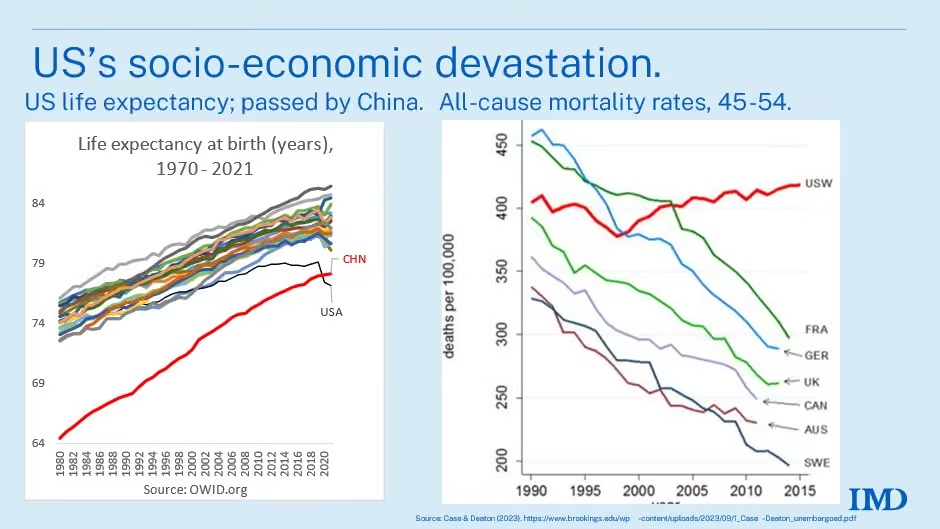 Richard Baldwin
@BaldwinRE
New Factful Friday
👉How much could worker-centric trade policy help American workers?
(hint in chart👇)
(🔗www.linkedin.com/posts/richard-baldwin-imd_us-trade-polic…)
cc: @DmitryOpines @SimonEvenett @snlester @MJansenEcon @BJavorcik @CarolineFreund @OECDtrade @TradeDiversion @TradeExperettes @TradeEconomista @alanbeattie @USTradeRep45 @sdonnan @SoumayaKeynes @TimHarford @TimHarcourt @MPGoodman88 @PIIE @adam_tooze @AdamPosen @ChadBown @jagjit_chadha @SamuelMarcLowe @Sam1Fleming @martinsandhu @martinwolf_ @IMD_Bschool
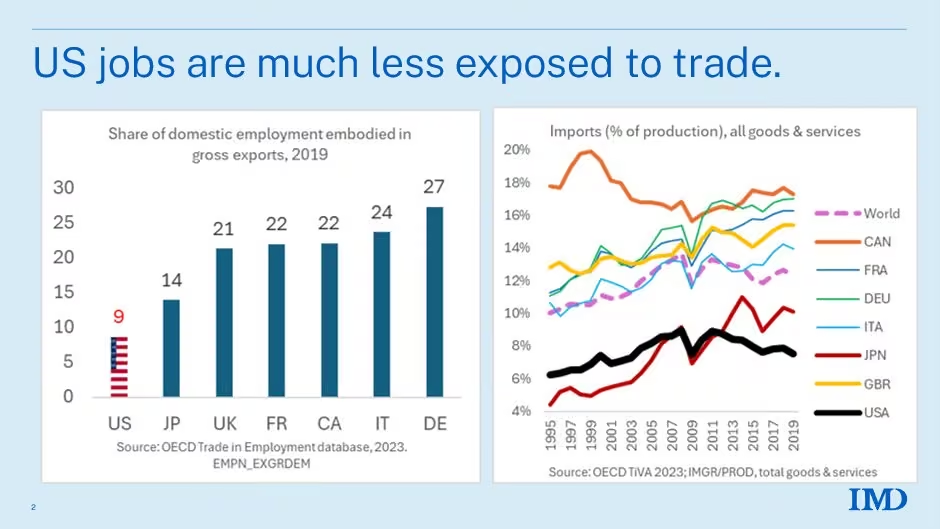
Olivier Blanchard reposted
Ricardo Reis
@R2Rsquared
Nemmers Prize to Mike Woodford for:
“advancing the New Keynesian approach to understanding economic fluctuations in general equilibrium, bridging the theory and the practice of monetary policy, and incorporating bounded rationality in macroeconomics.”
news.northwestern.edu/stories/2024/05/northwestern-announ…
Olivier Blanchard reposted
Peterson Institute
@PIIE
The latest installment of #piiecharts by @ojblanchard1 & Ben Bernanke illustrates the main components fueling the decline in inflation in the US & EU, building on previous research indicating strong price shocks help to explain most of the increase & later decrease.
 Olivier Blanchard
@ojblanchard1
Many suggestions, e, pi, 2... I suggest the following compromise: -e^(i pi) + 2 , which makes my earlier 3% suggestion look substantially more scientific.
Richard H Thaler
@R_Thaler
Is it rational for the Fed to choose an integer (2.0) as its inflation target? Suppose they chose Euler's number e instead, which is about 2.718. Are we sure that is worse? High interest rates are regressive and expensive for borrowers. @ojblanchard1 @jasonfurman @JustinWolfers
Olivier Blanchard
@ojblanchard1
An implication of my new paper with Bernanke. A decomposition of the sources of the decline in inflation between 2022Q2 and 2023Q2 in the United States and the euro area, taking into account direct and indirect effects of the various drivers. A very clear bottom line. The large decline is nearly all due to the decline in energy and food prices, and more limited shortages. With no help from the labor market. shorturl.at/98AFS
Olivier Blanchard
@ojblanchard1
more on monetary policy, food, energy prices.
Olivier Blanchard
@ojblanchard1
Important contribution. Yes, commodity prices explain most of the inflation episode. But the question becomes: how much do commodity prices reflect movements in monetary and fiscal policy, especially US policies. This starts giving an answer to the monetary part, I hope somebody does the same for fiscal.
Richard Baldwin
@BaldwinRE
Monetary policy works thru commodity prices?
👉new evidence @voxeu from @IMFNews economists
🔗 cepr.org/voxeu/columns/commodity-transmission-channel-mon… @cepr_org @jasonfurman @ojblanchard1 @AdamPosen @GitaGopinath @IndermitGill @HuwDixon

 Olivier Blanchard
@ojblanchard1
One may not agree with everything in this document, but this goes in the right direction. shorturl.at/gBuvE
Olivier Blanchard reposted
 Eric Gilliam
@eric_is_weird
When @Harvard launched their engineering school in ~2007, they talked ad nauseam about how they would have merged with MIT 100 year prior if not for a few "technicalities"
They forgot to mention the real issue was MIT ppl hated Harvard and its culture. A brief 🧵 1/6
Olivier Blanchard reposted
 Philippe Lemoine
@phl43
I can't say that I'm surprised, but it's interesting nonetheless and a good piece indeed.

 Matthew Yglesias
@mattyglesias
Cool piece from the original Slow Boring intern @MarcNovicoff!
washingtonmonthly.com/2024/05/24/are-gaza-protests-happen…
Olivier Blanchard
@ojblanchard1
1. Tweet triggered by some of the discussion following the publication of my new paper with Ben Bernanke. To clarify an important point. Finding that pre-pandemic era inflation was mostly due to relative price movements, especially the relative price of commodities, and that the labor market played a limited role, does not settle the issue of the role of aggregate demand and monetary policy in generating the inflation.
Olivier Blanchard
@ojblanchard1
2. It may well be that part of the increase in commodity prices reflected higher world demand for commodities, triggered in part by lose monetary and fiscal policy, in particular but not only US fiscal policy.
Olivier Blanchard
@ojblanchard1
3. Indeed, if one believes that individual commodity prices reflect a common aggregate demand component together with largely commodity specific supply shocks, one can use a principal component analysis to extract this common aggregate demand component. We did this in Bernanke Blanchard 2023. shorturl.at/s9IGs , Figure 5. The conclusion that it indeed played an important role, at least until the end of 2022.
Olivier Blanchard
@ojblanchard1
Scary, but seems like a positive probability scenario.
 Mikhail Khodorkovsky
@khodorkovsky_en
The West is losing the war: current efforts are insufficient to prevent the fall of key Ukrainian regions to Putin in the next 2 years.
1/16 🧵The facts you need to know
(Follow for a second part on good and bad sanctions)
Olivier Blanchard
@ojblanchard1
Last year, Ben Bernanke and I proposed and estimated a simple model of the inflation process, which we used to analyze US inflation since 2019. Ten central banks expressed interest in using our model to study inflation in their own economies. This new paper is the result of this joint project. shorturl.at/cfhAH . These are the main take aways:
Olivier Blanchard
@ojblanchard1
1. In all countries, the inflation burst was primarily the result of a series of supply disruptions and increases in the relative price of energy and food. In sharp contrast to the 1970s, this did not trigger a wage price spiral, and the inflationary effects of each these price shocks were not persistent. This was largely due to a strong anchoring of inflation expectations, itself likely reflecting increased credibility of central banks’ inflation targets.
Olivier Blanchard
@ojblanchard1
2. As the effects of supply shocks have subsided, tighter labor markets, and the resulting rises in nominal wages, have become relatively more important sources of the remaining inflation in many countries. What happens in labor markets will largely determine the cost of the “last mile”. In several countries, including the United States, curbing wage inflation, and returning price inflation to target may require a period of modestly higher unemployment.
Olivier Blanchard
@ojblanchard1
keep influencing. We need your collective wisdom
 Guntram Wolff
@GuntramWolff
Delighted to be recognised as a top 10 influencer on Europe by Table Media.
Olivier Blanchard
@ojblanchard1
22 years ago. no need for additional words. whatever your position on the Israel/Palestinian conflict, please listen.
 Bruno Maçães
@MacaesBruno
Watch this from Brzezinski. If it looks like a different America it’s because it was a different America. What a fall
Olivier Blanchard
@ojblanchard1
Supply and demand in a form we can very much relate to. Were you an uber driver, would you accept either of those two rides ? (And a great example of the trade-off between wage and waiting time in a matching model)
 Michael Wille
@michaelquotes1
Driver here. There are less of us on the road because pay is down and bonuses are not as good.
Lyft is only slightly better on bonuses.
Also long trips are not worth the money time or distance any more. Here’s a couple examples of trips I regularly decline.


Olivier Blanchard reposted
 Justin Bloesch
@JustinBloesch
A long-ish thread making old points with new data.
1. The job openings series continues to overstate labor market tightness.
2. Wage growth has been gradually declining, despite bumps in various series.
Upshot: the Fed doesn't need further labor market loosening.
Olivier Blanchard reposted
Ivan Werning
@IvanWerning
MIT had a wonderful celebration of Bob Solow's life, his contributions and person. I admire Solow and learned a lot from the talks. Amazing and relevant speakers (myself excluded) with insights and anecdotes.
Sharing video links for those interested in next tweet!... 1/2

 Olivier Blanchard
@ojblanchard1
On Russian reserves. To answer some of the reasonable objections:
I am not very worried about precedent. I think the contingency is well defined. If you engage in physical war, then you are at risk.
Holding dollar or euro reserves does not imply holding them in the US or in Europe. Countries can hold them in friendly countries.
Were some countries to reduce their dollar or their euro holdings, it would indeed have some effect on the dollar. This does not strike me as catastrophic.
If you worry about tit for tat, the tit has already happened, even before the tat. Many foreign companies have had to sell their Russian operations at basement prices.
Olivier Blanchard reposted
Jason Furman
@jasonfurman
It's worth a bit more angsting, studying & debating what we can do in the United States to improve our labor market recoveries. The European one was much better--got back to pre-COVID by mid-2021, a year and a half before we did. And prime age EPOP now 2pp higher than pre-COVID.
 Olivier Blanchard
@ojblanchard1
Discussing the seizing of Russian reserves is entering troll city. What strikes me however is a fundamental difference of opinion. I think that we, the western economies, are, by proxy, at war with Russia. Most of the trolls do not or pretend we are not.
Olivier Blanchard
@ojblanchard1
I thought it was a bad idea to seize Russian reserves before the US congress had voted on the Ukraine package. It gave too easy a way to Congress to vote no and pass the buck. Now that they have voted, it is hard to think of good reasons not to seize. Yes, it will create a precedent: Countries will know that if they go to war against a country or a friend of a country where they have reserves, they will likely lose them. So what?
Olivier Blanchard
@ojblanchard1
The IMFC did not issue a communique. This tells us something about the geopolitics of the time
There are three types of international meetings. Those that issue a communique: In that case, much of the meeting is a waste, spent agreeing on the communique. Those that never issue a communique: these are the productive ones, as one can talk about the issues without worrying about a communique. And those that should issue a communique and don’t, definitely the worse possible outcome.
Olivier Blanchard
@ojblanchard1
a clear case of exponential growth. (just like Moore's law. By the end of the decade, running around the world without stopping.)
Ivan Werning
@IvanWerning
Indeed, this is not the marathon!
Baby steps: today a 5K, 10K in June, half marathon in Nov, and then continuing on that saddle path...
Olivier Blanchard
@ojblanchard1
isn't it two days early?
Ivan Werning
@IvanWerning
Race time. 🏃♂️
 Olivier Blanchard
@ojblanchard1
Le problème budgétaire de la France n'est pas la surprise du 5.5% au lieu de 4.9%. Il était déjà là a 4.9%...
Olivier Blanchard
@ojblanchard1
I want to vent. Suppose you have given a talk in a university or at a Fed. You want to be reimbursed for the plane ticket and two taxi receipts. To do this, you are directed to a portal which clearly has been designed to handle all suppliers, including contractors, etc. It takes you forever to fill it (if it does not crash, get stuck, or ask you for something you have no clue about), when all they need is your receipts and an IBAN number. I have just have spent more time filling those forms than giving the talk. I hate it. This makes no sense.
Olivier Blanchard reposted
 Jean Pisani-Ferry
@pisaniferry
Nous avons trop longtemps laissé Bruxelles nous fixer des orientations budgétaires, que d’ailleurs nous ne respectons pas. Il est plus que temps de définir nos propres principes de responsabilité budgétaire. Ma chronique
@lemondefr
www.lemonde.fr/idees/article/2024/04/06/jean-pisani-ferry…
Olivier Blanchard
@ojblanchard1
I have been given a blue mark without asking for it 😟 What a strange system in which some people get it for free, and others can simply buy it. Do the people get it for free effectively increase the credibility of the blue mark and thus the credibility of those who bought it? Should I decline?
Olivier Blanchard
@ojblanchard1
It may make sense to have real estate professionals on the council. They know something, even if they are likely to defend their own interests more than the general good. It does not seem to make sense to allow the banks not to obey the norms prescribed by the HCSF.
Hélène Rey
@helene_rey
Le Haut Conseil de stabilité financière doit rester indépendant ! : lesechos.fr/idees-debats/cercle/opinion-le-haut-conseil-d… via @LesEchos @jmvittori @ThomasPHI2 @pogourinchas @ojblanchard1 @pisaniferry @Lagarde @ollirehn
Olivier Blanchard
@ojblanchard1
Familiar faces. Congratulations.
 Peter Henry
@PeterBlairHenry
I could not be more honored to have shared this moment with such amazing co-awardees, and to receive this recognition in the presence of Dr Samuel DuBois Cook’s family and my own mentor @SandyDarity - and surrounded by my family, friends, and colleagues. I am truly blessed.
Olivier Blanchard reposted
Stefanie Stantcheva
@S_Stantcheva
Why do we dislike inflation?
🚨New paper for @BrookingsInst revisits this long-standing question, already asked by @RobertJShiller in 1997, with current data and survey methods. Some key findings:🧵 1/10
socialeconomicslab.org/research/working-papers/why-do-we-…
Olivier Blanchard
@ojblanchard1
A non gated slightly older version of the inflation paper:
www.piie.com/publications/working-papers/what-caused-us-p…
Olivier Blanchard
@ojblanchard1
The first of two papers on inflation. This one on US inflation. The second, to come out soon, on inflation in 11 countries, based on the work of national central bank teams.
Meta conclusions very similar in the second paper.
shorturl.at/txHM3
Olivier Blanchard
@ojblanchard1
Les études académiques n'étaient pas suffisantes pour convaincre. Mais montrer que les programmes de la commission et du fonds avaient, dans le contexte courant, un effet négatif plus élevé qu'annonce était beaucoup plus convaincant.
François Geerolf
@FrancoisGeerolf
Bonjour, merci pour ce témoignage.
Pourquoi ne pas avoir utilisé par ex. ce papier de Romer & Romer sorti au NBER en 2007, publié à l'AER en 2010, qui donnait un multiplicateur d'impôts à -3 impliquant que les hausses d'impôts dégradent le déficit public ?
www.nber.org/papers/w13264
Olivier Blanchard
@ojblanchard1
Je profite de ce tweet pour retablir la verite.. Je pensai en temps reel (pas ex post) que l'ajustement budgetaire etait excessif. Mais j'avais besoin de munitions empiriques pour convaincre. Quand j'ai pu en montrer les effets, je me suis servi de cette evidence.
Jacques DELPLA
@JacquesDELPLA
faut demander @ojblanchard1. Mais il a constaté ex post que la solution retenu était sous-optimale pour l’Europe (oui) et que si on avait pu, on aurait fait moins d’austérité (oui). Mais c’est sous hypothèse de OJB convainque les contribuables All (pas évident to say the least).
Olivier Blanchard
@ojblanchard1
That I have been able to have a decent professional career without understanding double entry bookkeeping is truly amazing. What an indictment of our profession...😀 We are lucky that there are some courageous people like you to denounce this incredible fraud.
 Prof. Steve Keen
@ProfSteveKeen
You are showing your ignorance of double entry bookkeeping Olivier. This is the foundation of all Neoclassical misunderstanding of government finances.
See profstevekeen.substack.com/p/using-system-dynamics-with-m… for the actual accounting.
Olivier Blanchard
@ojblanchard1
Let me react to this. If we take as a reasonable baseline that r-g will be roughly equal to zero, stabilization of the debt to gdp ratio requires a primary balance of zero. So, indeed eliminating primary deficits should be an eventual goal for all countries.
Olivier Blanchard
@ojblanchard1
I largely agree with the recommendations in shorturl.at/krwxI . We do have to eliminate the primary deficits, but not at the cost of either defense or global warming. Both are existential threats.
Olivier Blanchard
@ojblanchard1
This implies taking deeply unpopular measures on the spending and the revenue side, and in a democracy, there is a maximum speed limit to how fast you can go. Go beyond that speed, and you making the bed of populist coalitions.
Olivier Blanchard
@ojblanchard1
The rules, as they are, will either be violated (an old story in the EU), or if they are, either compromise the future or lead to unpleasant political outcomes. They can be improved. Let's push for that to happen.
Olivier Blanchard
@ojblanchard1
"Copilot" reminds me of some students I have had. It apologizes profusely for giving the wrong answer, and, having done so, repeats it verbatim. I am not impressed.
Olivier Blanchard
@ojblanchard1
A good topic for regression discontinuity. Difference between those who just made it, and those who did not. Strong prior on professional effects. Weaker prior on personal effects as well.
Olivier Blanchard
@ojblanchard1
Did anybody study what happened professionally and personally to the many who did not make it?
Luis Garicano 🇪🇺🇺🇦
@lugaricano
Suppose Harvard College took the old Chicago PhD approach : accept 100 times more kids, do selective exams at end of year 1. Is this worse than:"admit entitled few, have them study 10h per week"?.
Luis Garicano 🇪🇺🇺🇦
@lugaricano
1) On the Econ PhD Program. I went in 1992, graduated in 1998. I did not feel the ambiance was toxic. It was tough work, almost brutal, not toxic. I was given a chance I would not have gotten elsewhere. There was nothing personal about the standards. We were getting trained by the best and that was intellectually invaluable -we got the chance of a lifetime. Here are some profs of my first two years (note 5 nobels):
Macro: Sargent, Lucas, Cochrane, Woodford, Stokey, Townsend.
Micro: Becker, Rosen, Murphy, Scheinkman
Metrics: Hansen, Heckman, Zellner.
It was extremely hard, by far the hardest thing I have ever done. But it should be hard. They were trying to put a bunch of kids at the frontier of knowledge.
It was not for everyone, but we knew what we were getting into. My admired supervisor, Sherwin Rosen, then department chair, gave us a "superstar" (he wrote THE paper after all) talk on the first day. He told us half of us would fail in the first year Core (and exit with an MA, is that so bad?), half of the rest would not make the prelims. Of the 50 we were there, maybe 10 would finish the PhD, most of those would never get any citation.
And yet we persisted. We wanted to learn, and were grateful for the hance.
2/n
Olivier Blanchard
@ojblanchard1
The alternative model: MIT, nearly all entering students getting a PhD. Cooperation, not competition, among students, help for those struggling, and an infinitely more pleasant atmosphere (at least compared to the Chicago of my time).
Olivier Blanchard
@ojblanchard1
From my work with Bernanke and 10 central banks. The effects of each price shock were indeed surprisingly transitory (largely anchored expectations, small second round effects, little catch up), but the sequence of adverse shocks was much longer than had been anticipated.
 Chris Giles
@ChrisGiles_
Riccardo’s definition must be the correct one. And the evidence suggests:
US: not transitory
Eurozone: probably not transitory
UK: not transitory
Olivier Blanchard
@ojblanchard1
Did anybody study what happened professionally and personally to the many who did not make it?
Luis Garicano 🇪🇺🇺🇦
@lugaricano
Suppose Harvard College took the old Chicago PhD approach : accept 100 times more kids, do selective exams at end of year 1. Is this worse than:"admit entitled few, have them study 10h per week"?.
Luis Garicano 🇪🇺🇺🇦
@lugaricano
1) On the Econ PhD Program. I went in 1992, graduated in 1998. I did not feel the ambiance was toxic. It was tough work, almost brutal, not toxic. I was given a chance I would not have gotten elsewhere. There was nothing personal about the standards. We were getting trained by the best and that was intellectually invaluable -we got the chance of a lifetime. Here are some profs of my first two years (note 5 nobels):
Macro: Sargent, Lucas, Cochrane, Woodford, Stokey, Townsend.
Micro: Becker, Rosen, Murphy, Scheinkman
Metrics: Hansen, Heckman, Zellner.
It was extremely hard, by far the hardest thing I have ever done. But it should be hard. They were trying to put a bunch of kids at the frontier of knowledge.
It was not for everyone, but we knew what we were getting into. My admired supervisor, Sherwin Rosen, then department chair, gave us a "superstar" (he wrote THE paper after all) talk on the first day. He told us half of us would fail in the first year Core (and exit with an MA, is that so bad?), half of the rest would not make the prelims. Of the 50 we were there, maybe 10 would finish the PhD, most of those would never get any citation.
And yet we persisted. We wanted to learn, and were grateful for the hance.
2/n
Olivier Blanchard reposted
Luis Garicano 🇪🇺🇺🇦
@lugaricano
Suppose Harvard College took the old Chicago PhD approach : accept 100 times more kids, do selective exams at end of year 1. Is this worse than:"admit entitled few, have them study 10h per week"?.
Luis Garicano 🇪🇺🇺🇦
@lugaricano
1) On the Econ PhD Program. I went in 1992, graduated in 1998. I did not feel the ambiance was toxic. It was tough work, almost brutal, not toxic. I was given a chance I would not have gotten elsewhere. There was nothing personal about the standards. We were getting trained by the best and that was intellectually invaluable -we got the chance of a lifetime. Here are some profs of my first two years (note 5 nobels):
Macro: Sargent, Lucas, Cochrane, Woodford, Stokey, Townsend.
Micro: Becker, Rosen, Murphy, Scheinkman
Metrics: Hansen, Heckman, Zellner.
It was extremely hard, by far the hardest thing I have ever done. But it should be hard. They were trying to put a bunch of kids at the frontier of knowledge.
It was not for everyone, but we knew what we were getting into. My admired supervisor, Sherwin Rosen, then department chair, gave us a "superstar" (he wrote THE paper after all) talk on the first day. He told us half of us would fail in the first year Core (and exit with an MA, is that so bad?), half of the rest would not make the prelims. Of the 50 we were there, maybe 10 would finish the PhD, most of those would never get any citation.
And yet we persisted. We wanted to learn, and were grateful for the hance.
2/n
Olivier Blanchard
@ojblanchard1
thank you so much for these daily paintings. precious.
 Dr. Peter Paul Rubens
@PP_Rubens
2/2 Patch of sunshine playing across the landscape under a sky filled with drama, 1660s. Not stopping swimmers at right, though!
 Olivier Blanchard
@ojblanchard1
Tom: You are sweet. But make sure that you combine this with other activities this summer.
More seriously. The book came out when everybody was talking about high rates.😟 Not the best timing... But I think, looking forward, that it is highly relevant.
 tom keene
@tomkeene
here, my book of the summer. I will add a few more. where will/should r-* land. how will post-pandemic 'other factors' play out. I fear our...debt.
@ojblanchard1 (modest math lift). www.amazon.com/Fiscal-Policy-under-Interest-Rates/dp/0262…
 Olivier Blanchard
@ojblanchard1
you are completely right and one has to take into account prospective stock flow adjustments. I am assuming that they will have to go to zero as well. This is yet another discussion.
 T. Sabri Öncü
@KeloglanBM
I meant, blue and green. Blue is your (r-g) contribution. And the sfa (green) seems to be quite important for the US. Its contribution hardly looks like negligible.
Olivier Blanchard
@ojblanchard1
1. Middle positions get attacked on both sides. 😀So let me expand on my interview on fiscal policy in Le Monde. www.lemonde.fr/economie/article/2024/03/04/olivier-blanch… While the particulars apply to France, the issue is very similar in many European countries. Thus, the tweet is in english.
Olivier Blanchard
@ojblanchard1
7. What if, in the end, the sum of the three parts leads to little deficit reduction initially? So be it. A small further increase in debt is surely worth the benefit of having a secure Europe, and a better planet. This is the responsible way to go.
Olivier Blanchard
@ojblanchard1
8. Let me end with a cartoon. It is 2050. An old man is sitting under a dead tree. The landscape is desolate. He talks to a young man and says: Bad news. Yes, the earth is dead. But look at the good news: The debt to GDP ratio has just gone under 60%...
Olivier Blanchard reposted
Justin Wolfers
@JustinWolfers
A truly lovely profile of my favorite economist. She has etched her own path in economics, and it's led somewhere really interesting.
www.imf.org/en/Publications/fandd/issues/2024/03/PIE-the-…
Olivier Blanchard
@ojblanchard1
Comment concilier responsabilité budgétaire, budget de défense, combat contre le réchauffement climatique. Quelles erreurs ne pas commettre. Loin d’etre évident, mais pas impossible.
Olivier Blanchard
@ojblanchard1
fascinating.
Ivan Werning
@IvanWerning
Had some fun chatting with Milton Friedman using this bot friedman.ai

Olivier Blanchard reposted
 FT Economics
@fteconomics
Adam Posen: ‘We overlooked how resilient people are’ www.ft.com/content/ef923a9b-a71a-4d26-b519-836b332b2ab3
Olivier Blanchard
@ojblanchard1
nice to discover your grand kids (and their drawing skills). Congratulations to the dads (yes, two dads in this case). And congratulations to the young man.
 Chad Jones
@ChadJonesEcon
Congratulations Jean-Felix Brouillette (@jeanfbrou)! Starting at HEC Montreal this fall as an assistant professor. He made this beautiful piece to celebrate: generations of advisers. A great artist, economist, and person! @peteklenow @ojblanchard1
 Olivier Blanchard
@ojblanchard1
One of the first reports of the joint central bank project, replicating and exploring the analysis in Bernanke and Blanchard for the US (more coming). Surprisingly similar decomposition. Largely common conclusions.
 Carlos Montes-Galdón
@CMontesGaldon
Happy to share that the @ecb just published our adaptation (with @AntoineKpb, Óscar Arce and Matteo Ciccarelli) of the Bernanke and @ojblanchard1 model, which was also picked up by the @FT recently! www.ecb.europa.eu/pub/pdf/scpops/ecb.op343~ab3e870d21.en.… @ChrisGiles_
Olivier Blanchard
@ojblanchard1
Question from a non lawyer: Why is there any reason to think that originalism is a useful principle?
Olivier Blanchard
@ojblanchard1
nicely done. The tendency to ignore intermediate goods in tariff discussions is quite striking.
Richard Baldwin
@BaldwinRE
Simple analysis of Trump’s proposed 60% tariff on Chinese goods
Olivier Blanchard reposted
Philipp Heimberger
@heimbergecon
People in the US tend to say that economic conditions are bad when their party is not in power (and vice versa good when in power). This bias is stronger among Republican (red) than Democratic (blue) voters. Republican voter sentiment on the economy is currently particularly bad.

Olivier Blanchard reposted
 Rafael Domenech | @BBVAResearch & @UV_EG
@rdomenechv
What caused the great inflation?, by @ChrisGiles_
@benbernanke and @ojblanchard1 explain the causes of the post-pandemic inflation in 11 countries
www.ft.com/content/a27f6469-e97c-4629-84fe-15b78e890e20 @ft
 Olivier Blanchard
@ojblanchard1
A profound remark by Charles Goodhart. Incapacity associated with old age is very costly economically. Will medical advances help/hurt? Will they increase life expectancy without improving symptoms, or will they improve symptoms and decrease incapacity? shorturl.at/svAZ8
Olivier Blanchard
@ojblanchard1
A good discussion of what debt sustainability means and implies. (I am still afraid that the worry about even a temporary increase in debt ratios is going to lead gvts not to do what they need to do for defense, green investment, among others. shorturl.at/svAZ8
Olivier Blanchard
@ojblanchard1
another tremendous set of maps (and, indeed, a moe complex story emerges). I have learned much in 15 minutes. This is why twitter can be great.
Olivier Blanchard
@ojblanchard1
Great maps. Is there a way to show a similar map, but for the pre-ww2 period? To make clear that this is not a long running fixed effect?
Tomas Pueyo
@tomaspueyo
Slower now, to give you time to capture the details:
Olivier Blanchard reposted
Tomas Pueyo
@tomaspueyo
Slower now, to give you time to capture the details:
Olivier Blanchard
@ojblanchard1
Signaling and networking (and having a great room mate...) are certainly relevant for elite universities. Less obvious that they are as important for others.
 Robert Waldmann
@robertwaldmann
The certification is not pas fail. It is getting admitted to MIT or that other place up Nass avenue. Exclusivity is the money making point. Teaching is not (although much of it is excellent at those places - I learned from Sen and Rawls on Kant (and paid zero for those lectures)
Olivier Blanchard
@ojblanchard1
On certification. There is also a whole set of courses with help and potential certification at the end. They are not free, but they are cheap relative to regular tuition. I have not seen how potential employers value such certifications, but there may be research which does.
Robert Waldmann
@robertwaldmann
People in the Boston area could get lectures for free for decades (no ticket required no ID checked I attended about twice as many lectures as I was registered for).
The money is fir the certification not the learning. Also for learning from other students
1/2
Olivier Blanchard
@ojblanchard1
Take them.😀 Why are people still willing to pay tens of thousands in tuition when they can get these for free... This will change, and, with it, the business model of higher ed.
 Shruti
@heyshrutimishra
MIT University just released free online courses.
No payment required.
Here are 10 courses you don't want to miss in 2024:
 Olivier Blanchard
@ojblanchard1
a striking graph.
 Elina Ribakova 🇺🇦
@elinaribakova
China is critical in facilitating the Russian military's access to Western components.
Read more in our research @sanctionsgroup
kse.ua/wp-content/uploads/2024/01/Challenges-of-Export-Co…
 Olivier Blanchard
@ojblanchard1
😀 you caught me. Senility?
 Edward Luce
@EdwardGLuce
this isn't an email
Olivier Blanchard
@ojblanchard1
A totally self serving email, but I believe very relevant: I do not think that having poor memory prevents the ability to think and take decisions.
Olivier Blanchard
@ojblanchard1
additional credit. Why have we shifted from colorful red/blue/yellow cars to grey/white/black cars?
Matthew Yglesias
@mattyglesias
Question from my kid that I did not have a good answer for: "Why among humans does the female usually wear more colorful clothing than the male, when for animals it's the opposite?"
(he loves nature documentaries)
Olivier Blanchard reposted
 Christian Gollier
@CGollier
Si vous avez un peu de temps, je vous conseille la lecture de cette tribune de Jean Tirole. Un réquisitoire contre les idées simples sur notre démocratie, au lendemain du décès de Robert Badinter.
www.nouvelobs.com/opinions/20240210.OBS84307/tribune-les-… via @LObs
Olivier Blanchard reposted
Adam Posen
@AdamPosen
Her much needed voice is back on X
Follow @bollemdb @PIIE
#brazil #climate #globalhealth #latam #nationalism
Olivier Blanchard reposted
Richard Baldwin
@BaldwinRE
My 2min Tuesday! "Will Trump's 10% across-the-board tariff backfire?"
Spoiler: Yes! (since the USD is endogenous)
cc: @IMD_Bschool @AdamPosen @adam_tooze @alanbeattie @sdonnan @SoumayaKeynes @jdportes @pdegrauwe @jasonfurman @C_Lombardelli @bweder @TradeExperettes @TradeDiversion @genevatrade_gtp @ECIPE @howserob @JGodiasMurphy
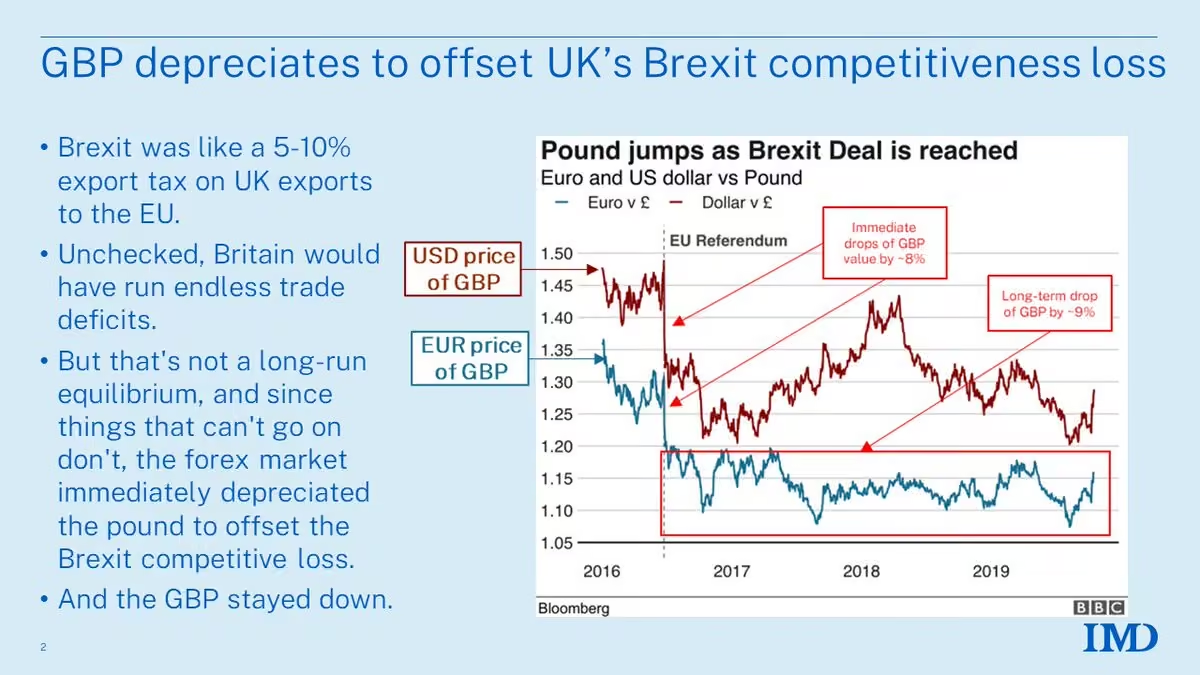
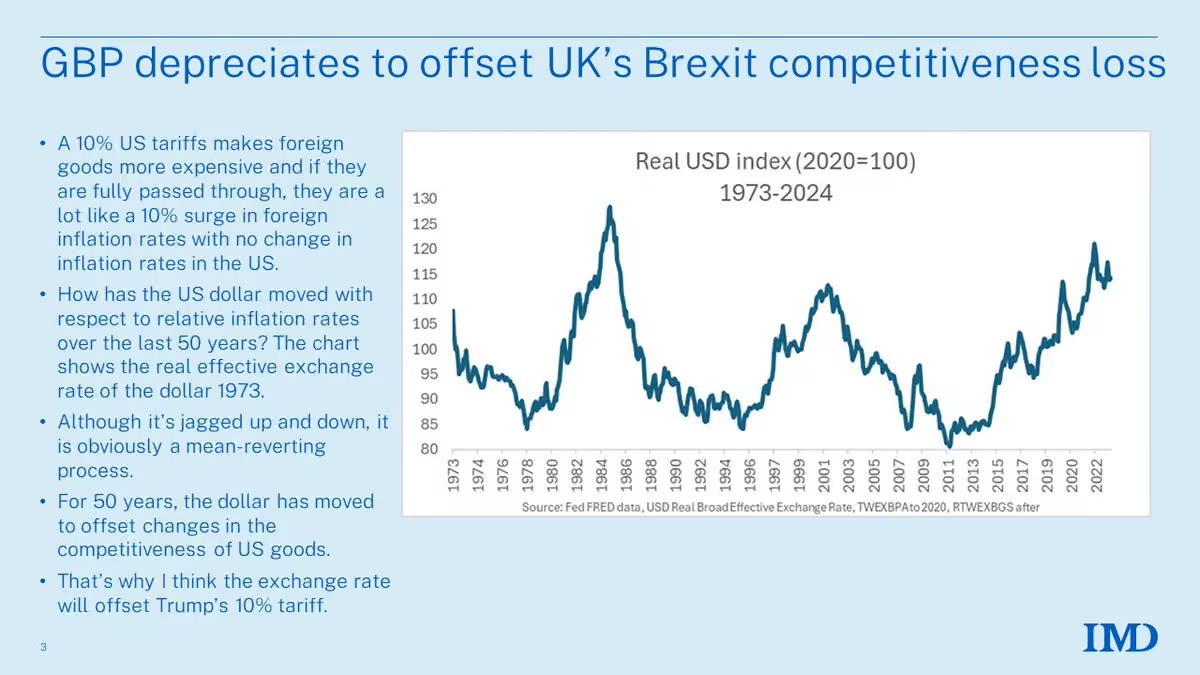
Olivier Blanchard reposted
NBER
@nberpubs
Cataloguing policies that have been deployed by jurisdictions seeking to mitigate the effects of tax competition, from @DavidRAgrawal, James M. Poterba, and @omzidar www.nber.org/papers/w32090
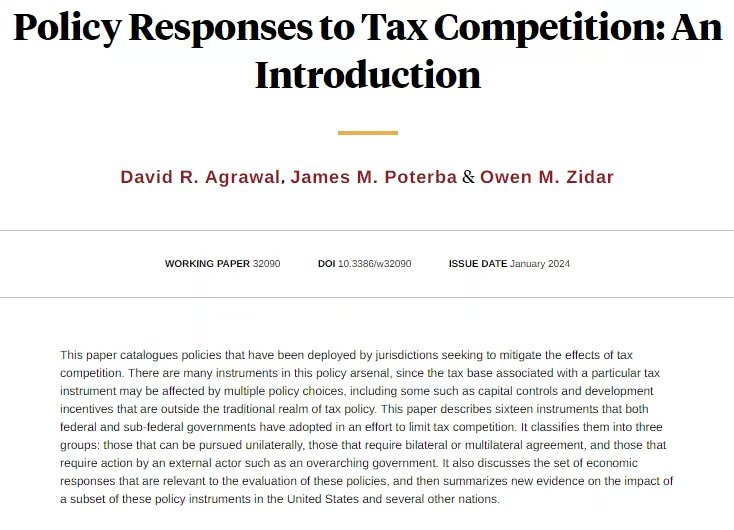
Olivier Blanchard reposted
Richard Baldwin
@BaldwinRE
Factful Friday is up!
👉"Q) Are Industrial supply chains localising, regionalising, or globalising? A) Yes!"
A six-chart portrait of the phenomenon
🔗www.linkedin.com/posts/richard-baldwin-imd_activity-71592… cc:@IMD_Bschool @OECDtrade @TradeExperettes @TradeEconomista @alanbeattie @sdonnan @ChrisGiles_ @SimonEvenett @snlester @AdamPosen @PIIE @cepr_org @voxeu @genevatrade_gtp @DmitryOpines @TradeDiversion
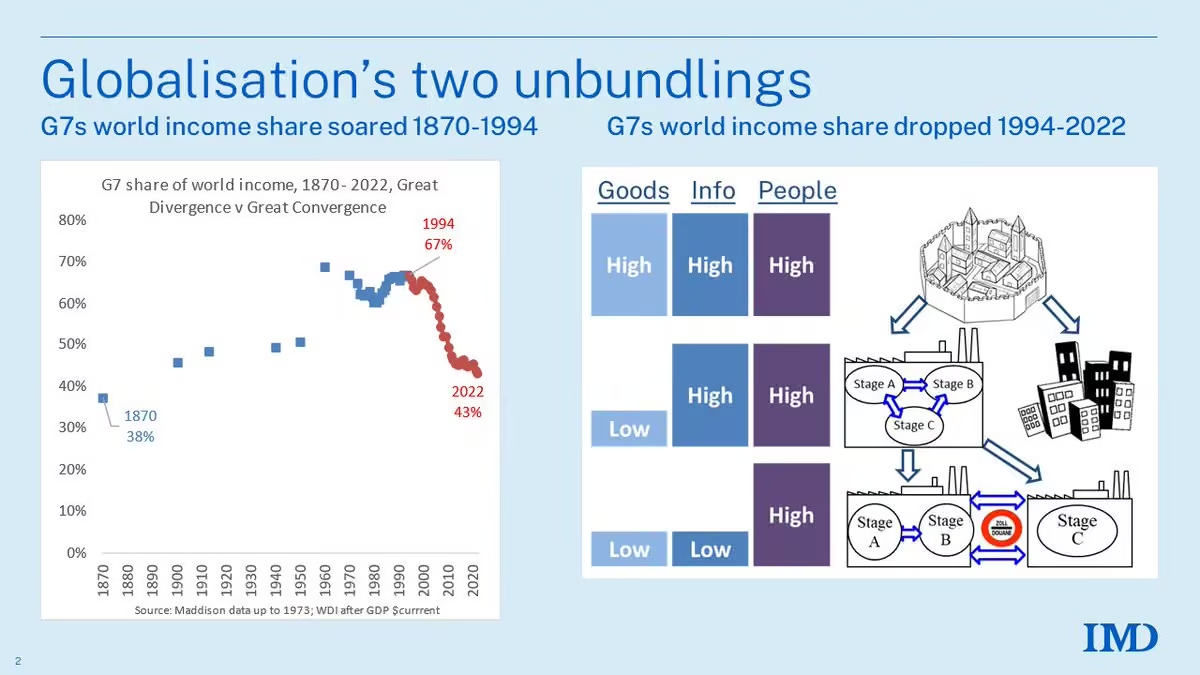
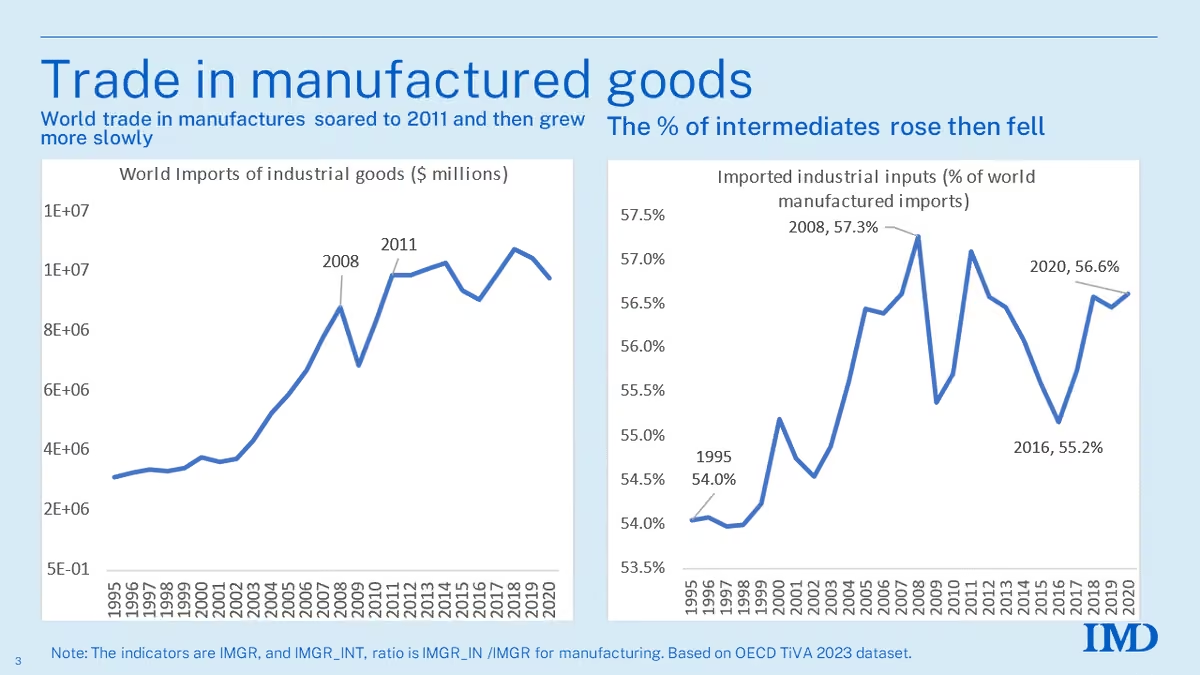
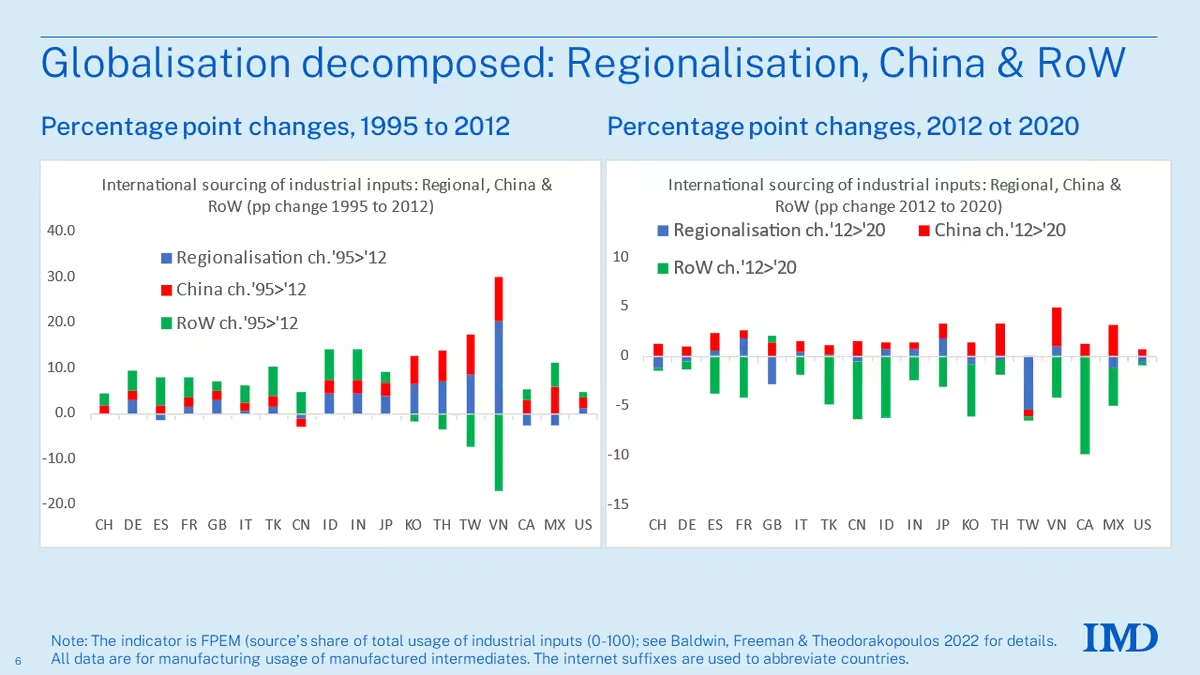
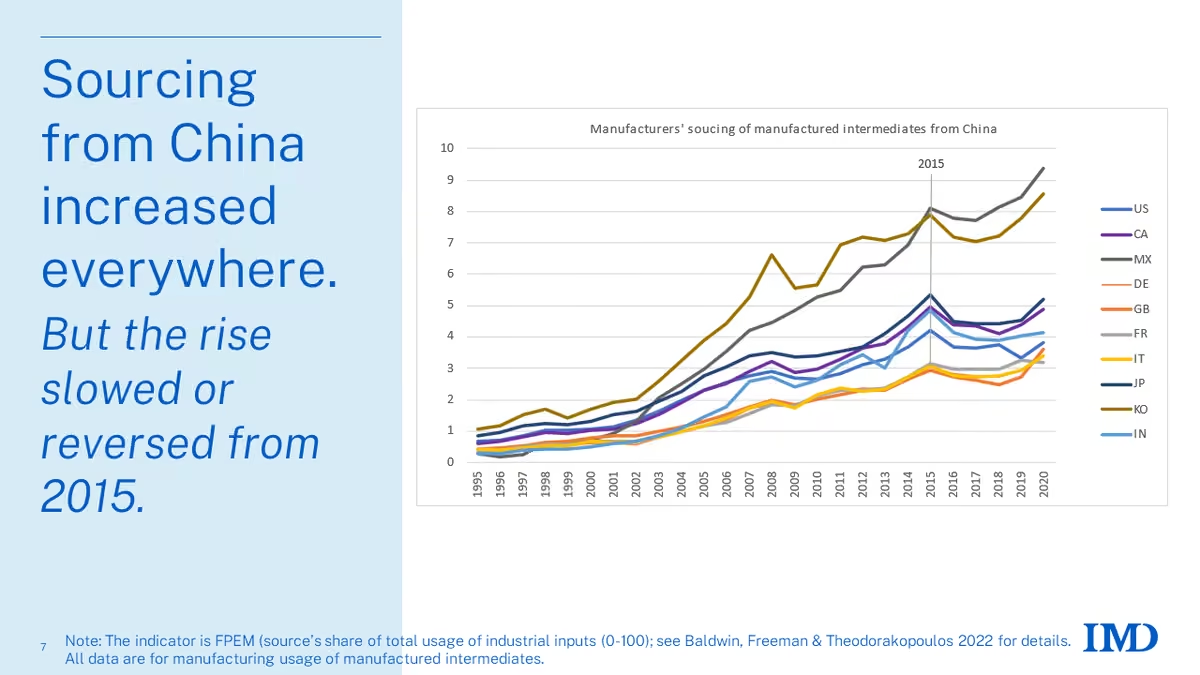 Olivier Blanchard
@ojblanchard1
I realize there are at least two interesting questions. Changes in opinion across the board. And convergence or not of anglo saxon versus european views. Hope somebody takes this up.
Olivier Blanchard
@ojblanchard1
I would love to see the same questions asked today.(I shall try to convince somebody to do it). My guess is only marginal change. More openness to the use of non-monetary incentives to change behavior.
 miche-quiche
@LMichk
Le consensus des économistes dans les années 1980 (d'après Fourcade, 2009)
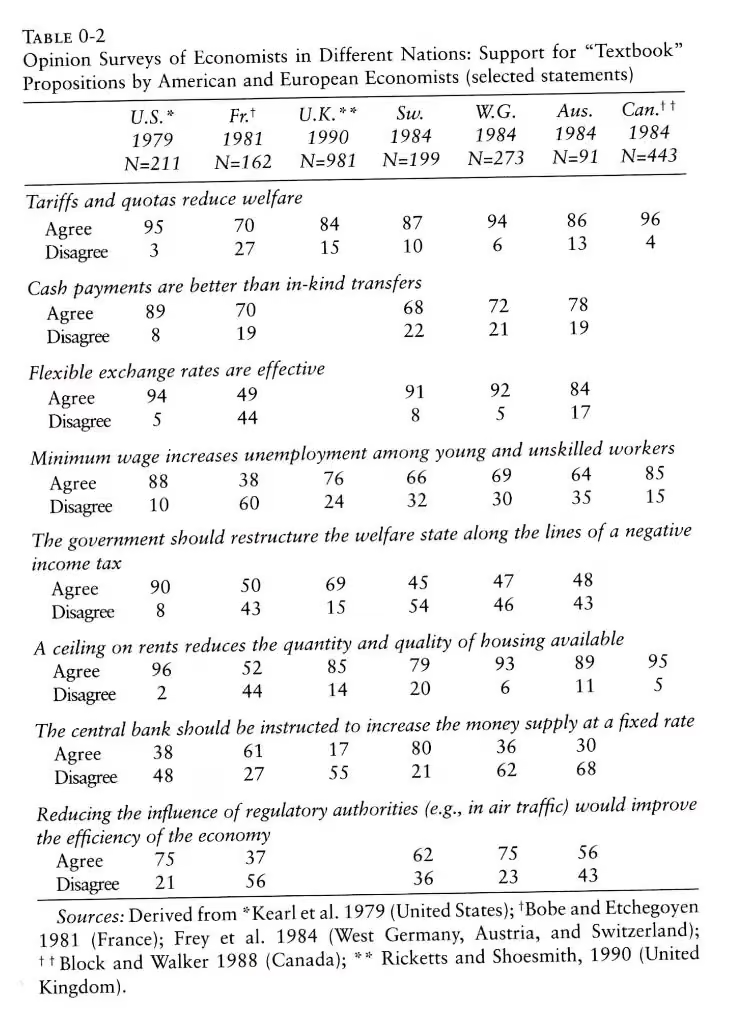 Olivier Blanchard
@ojblanchard1
I would love to see the same questions asked today.(I shall try to convince somebody to do it). My guess is only marginal change. More openness to the use of non-monetary incentives to change behavior.
miche-quiche
@LMichk
Le consensus des économistes dans les années 1980 (d'après Fourcade, 2009)
Olivier Blanchard
@ojblanchard1
A nice piece on a fascinating issue: Is it the case that economics plays less of a role in US elections, or more that it is different economic dimensions that matter? Is the apparently stronger weight on inflation transitory or more permanent? (i suspect transitory)
Olivier Blanchard
@ojblanchard1
Next few years: Given the strength of private demand and loose fiscal policy, hard not to see fairly high interest rates in the US (not as high as today). Given the weakness of private demand and likely fiscal consolidation, hard not to see fairly low interest rates in Europe.
Olivier Blanchard reposted
Adam Posen
@AdamPosen
We are so proud of @ChadBown taking on the role of Chief Economist @StateDept !! All of us @PIIE will miss him while he is on leave for public service, but we know that he will definitely serve the US public very well!
Olivier Blanchard reposted
 Paris School of Economics
@PSEinfo
👨💼 Depuis le 1er janvier 2024, @ojblanchard1 a rejoint @PSEinfo en tant que professeur.
➡️ Entre 2008 et 2015, il a occupé le poste de chef économiste du @IMFNews
➡️ Depuis 2015, il est chercheur associé au @PIIE
 Olivier Blanchard
@ojblanchard1
The initial FT piece has generated a great discussion (One of the remaining great things about Twitter/X), and the conclusion is that one must take the initial graph with a grain of salt. To be continued.
Olivier Blanchard
@ojblanchard1
Another trend I was unaware off, which seems terribly important.
Soumaya Keynes
@SoumayaKeynes
Women have become more liberal over the past decade. Men... not so much.
Great piece by @jburnmurdoch, feat. @_alice_evans
www.ft.com/content/29fd9b5c-2f35-41bf-9d4c-994db4e12998

Olivier Blanchard reposted
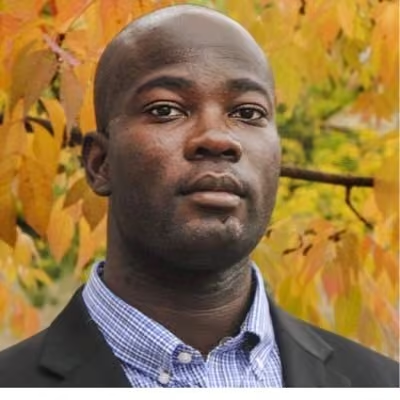 Kweku Opoku-Agyemang, Ph.D
@KwekuOA
99% of the internet network runs through submarine cables. There are over 420 submarine lines in the world, totalling 1.3 million km, over 3 times the distance from Earth to the Moon.
Olivier Blanchard
@ojblanchard1
This is indeed exactly what we find in our paper with Ben: A reversal of the earlier price shocks.
Thomas Philippon
@ThomasPHI2
Isn’t that exactly the impulse response to a negative productivity shock?
Olivier Blanchard
@ojblanchard1
Another trend I was unaware off, which seems terribly important.
Soumaya Keynes
@SoumayaKeynes
Women have become more liberal over the past decade. Men... not so much.
Great piece by @jburnmurdoch, feat. @_alice_evans
www.ft.com/content/29fd9b5c-2f35-41bf-9d4c-994db4e12998
Olivier Blanchard reposted
 Ben Zaranko
@BenZaranko
Both Labour and Tories are committed to reducing the debt-to-GDP ratio.
But current forecasts suggest that this will be more difficult over the next parliament than in any other since the 1950s.
Let me explain this rather complicated chart, and why it matters 🧵
Olivier Blanchard
@ojblanchard1
Le type d'etudes qui permet d'avancer. Merci.
Xavier Jaravel
@XJaravel
Ravi de partager quelques idées dans @LesEchos à propos de notre rapport avec @Strategie_Gouv 👇👇👇
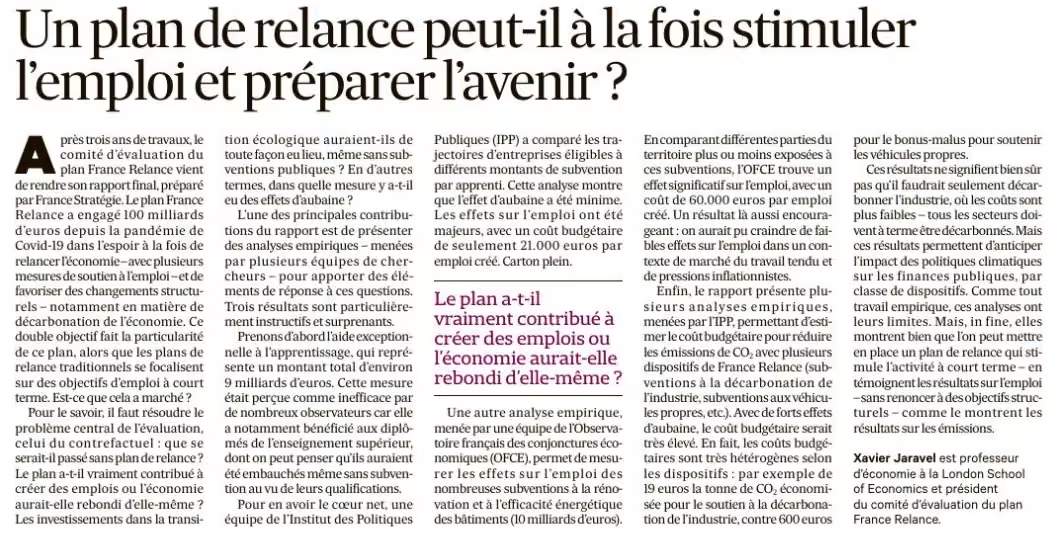
Olivier Blanchard reposted
Xavier Jaravel
@XJaravel
Ravi de partager quelques idées dans @LesEchos à propos de notre rapport avec @Strategie_Gouv 👇👇👇
Olivier Blanchard reposted
 Daniyal Khan
@khand154
🧵 Learning intermediate undergrad macroeconomics with @ojblanchard1 and Johnson from a heterodox/HET/methodology angle.
That's the text @WilliSemmler first taught me macro with at @NSSRNews. Now that I'm all done with grad school, here's a reading list to accompany the book.
Olivier Blanchard
@ojblanchard1
worth more than the two minute summary. Read the whole thing.
Richard Baldwin
@BaldwinRE
My new Two Minute Tuesday!
China as the world's sole manufacturing superpower
See details at: 🔗cepr.org/voxeu/columns/china-worlds-sole-manufacturing-su…
Olivier Blanchard
@ojblanchard1
The article is about sperm counts, not the other factors which affect fertility. This seems harder to affect than, say, behavior. Thus, more scary.
Olivier Blanchard
@ojblanchard1
This is old news, but new news to me. Taking this meta study at face value, if the trend continues, the level of fertility around the world in 2060 will be so low that we won't procreate, and the human race will disappear. Seems fairly important. rb.gy/e0jru8
Olivier Blanchard
@ojblanchard1
Watch this: x.com/lauhaim/status/1749061618653176089
and you will understand why Donald Trump is polling as it does.
 LAURENCE HAIM
@lauhaim
La force des réseaux sociaux: Montrer des images et faits qui ne sont plus que débattus. Je ne suis pas parfaite et ai fait des erreurs. J'ai desormais beaucoup d'ennemis parce que je résiste vigoureusement à une certaine idée du journalisme.
Et Hier soir, j'étais là seule, pour vous montrer ce qui arrive dans une démocratie de gens déçus :
Olivier Blanchard
@ojblanchard1
On peut tout a fait penser que la BCE n'aurait pas du augmenter ses taux, ou au moins pas autant, etant donne la pression limitee sur le marche du travail. Mais si je suis ministre des finances, je n'ai pas le choix que d'accepter les implications de ces taux.
François Geerolf
@FrancoisGeerolf
Pour moi, les taux de marché remontent non parce que la demande est en excès, mais parce que la BCE répond à une inflation qui vient d'ailleurs (énergie/alim) en ↗️ les taux. Un peu comme en 2011. Une politique monétaire discutable doit-elle amener à une restriction budgétaire ?
 Olivier Blanchard
@ojblanchard1
1. Ce qui compte pour la soutenabilite de la dette, c'est le taux d'interet que doit payer le gouvernment. Si il y a exces d'epargne (insuffisance de la demande), le taux d'interet diminuera, et le gouvernement pourra maintenir des deficits primaires plus eleves.
François Geerolf
@FrancoisGeerolf
Par exemple en 🇫🇷 on a certes creusé le déficit public mais en baissant les impôts sur les plus fortunés. Depuis 2017, le taux d’épargne est en hausse de 3 points, ce qui n’est pas si étonnant. L’Europe est encore plus en situation d’excès d’épargne avec un fort excédent courant.
 Olivier Blanchard
@ojblanchard1
2. Mais, pour le moment, ce n'est pas ce que les marches predisent. Je pense qu'ils ont probablement tort, mais, pour le moment, le gouvernment doit baser ses decisions sur les taux de marche.
Olivier Blanchard
@ojblanchard1
Countries using industrial policy as a tool of commercial war is likely to be one of the main issues of the next decade. Chad's piece helps to organize thoughts.
 Fabio Ghironi
@FabioGhironi
.@ChadBown on "Modern industrial policy and the WTO": www.piie.com/publications/working-papers/modern-industria… @PIIE
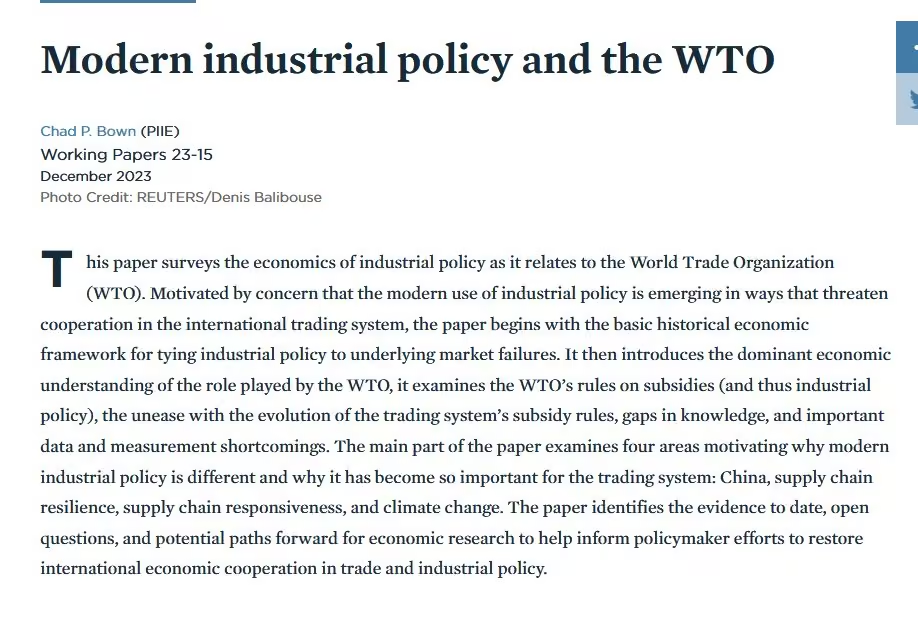
Olivier Blanchard reposted
Fabio Ghironi
@FabioGhironi
.@ChadBown on "Modern industrial policy and the WTO": www.piie.com/publications/working-papers/modern-industria… @PIIE
Olivier Blanchard
@ojblanchard1
Maybe relevant to note that it was -2 degrees celsius.
 Angelo Giuliano 🇨🇭🇮🇹
@angeloinchina
Gabriel Attal, 34 year old, rich kid from the globalist elites who never had a job in his life and here makes his first speech as France prime minister while having his nose full of cocaine
Olivier Blanchard
@ojblanchard1
1. Je suis frappe du contraste entre le message présidentiel de Macron shorturl.at/cv357 et la vidéo parodie de Netflix France. Le premier est rempli de faits, précis, raisonnable, et plat et ennuyeux. Le deuxieme est cinglé, sympa, et on le regarde jusqu’au bout.
 Netflix France
@NetflixFR
[DÉCLARATION OFFICIELLE]
Le Président Blé adresse ses vœux aux Français pour 2024.
Olivier Blanchard
@ojblanchard1
2. Pour moi, ca capture le probleme fondamental de la politique aujourd’hui. Comment faire le premier, et communiquer comme le deuxieme. Vrai en France, Macron/Melenchon mais ailleurs aussi, Trump/Biden. etc
Olivier Blanchard
@ojblanchard1
A new year's gift. Solow on Solow. Take the time. infinite.mit.edu/video/robert-m-solow
Olivier Blanchard reposted
 Emil Huth
@emil_huth
Christmas ruined
 Olivier Blanchard
@ojblanchard1
I have lost my mentor. Robert Solow was my thesis advisor, and being named the Robert Solow professor of economics at MIT was the proudest day of my life. There will be times for elogies. Meanwhile, RIP Bob, with infinite thanks.
Olivier Blanchard
@ojblanchard1
1. The reform of EU fiscal rules: An opportunity mostly missed. The new rules are better than the old ones. But they could have been much better.
Olivier Blanchard
@ojblanchard1
5. Then the bargaining started. The German government, in effect happy with the old rules, wanted hard numbers, safeguards on debt and deficits. If it had had its way, the additional constraints would have in effect taken over the implications of the debt sustainability analysis.
Olivier Blanchard
@ojblanchard1
6. Other countries objected, asked for different numbers, and the process went on and on.
The final result is far from best. The safeguards are too tight and likely to stand in the way of good fiscal policy. The rules are extremely complex, with poorly understood implications.
Olivier Blanchard
@ojblanchard1
8.For example, their calculations show, that under the assumption that adjustment periods are 7 years, 7 countries will have to maintain 0.4% annual reductions in primary deficits for 7 years, and that 10 countries will have to maintain long run primary surpluses of more than 2%.
Olivier Blanchard
@ojblanchard1
9. I am no gambler, but I am willing to bet this will not happen. Almost surely, after a few years (some countries got a temporary break), the rules will prove unworkable. They can and probably will be adjusted, but it would have been better to get them right from the start.
Olivier Blanchard
@ojblanchard1
Governments face two major challenges. Fight global warming. Keep public debt under control. Is there a way to thread the needle? Not easy, but I think so. The detailed argument: www.piie.com/blogs/realtime-economics/reconciling-tension…
Olivier Blanchard
@ojblanchard1
1. If there is a “last mile” required to fully win the fight against US inflation, then indeed it will be a painful last mile. The wage Phillips curve is very flat: In layman terms, decreasing underlying inflation by even just 1% may require more unemployment for a while.
Olivier Blanchard
@ojblanchard1
2. The issue is whether there is indeed a last mile to run, or we have already run it, and things are just fine, as Paul Krugman tells us today in the NYT. It could be: It could be that the labor market is not as tight as it looks, and we do not need to increase unemployment.
Olivier Blanchard
@ojblanchard1
3. It could be that productivity growth is going to be higher, allowing for lower price inflation given wage inflation. We genuinely do not know. Better be careful in making victory or "need for more pain" statements.
Olivier Blanchard
@ojblanchard1
Decent, smart, constructive, modest, a great economist, and a friend. RIP philippe, and thanks for what you did.
 Sciences Po
@sciencespo
Sciences Po a la grande douleur de faire part du décès de Philippe Martin.
Économiste brillant et reconnu, doyen de l'@EAPScPo depuis février 2022, il fut une figure éminente de notre institution, dont il était diplômé et à laquelle il consacra une partie de sa carrière.
 Olivier Blanchard
@ojblanchard1
Dani Rodrik and others have argued for the creation of "good jobs". It always seemed very abstract to me. This study by France Strategy (in french) makes considerable progress. shorturl.at/fpwz4
Olivier Blanchard
@ojblanchard1
"En meme temps" n'est pas un defaut. C'est une caracteristique des meilleures (ou moins mauvaises) solutions a la plupart des problemes qui se posent, de l'immigration au rechauffement climatique, aux inegalites, a la fin de vie, etc...
Olivier Blanchard
@ojblanchard1
If Germany feels it must and can achieve debt reduction
(and protect green investment, defense--not so easy, is it, Mr Lindner?), it should definitely do so. But there is no reason to impose it on other EU members.
Olivier Blanchard
@ojblanchard1
1. In view of the current EU discussions:
Debt sustainability is a lexicographic constraint. Without it, fiscal policy cannot work.
Debt reduction may be highly desirable, but it has to be balanced against other goals, and take into account political and macro constraints.
Olivier Blanchard
@ojblanchard1
2. Thus, EU rules should enforce debt sustainability, not necessarily require debt reduction. This is the crux of the issue in current discussions.
Olivier Blanchard
@ojblanchard1
nice paper, with obvious implications for thinking about the future of US public debt
 Julien Acalin
@AcalinJulien
Got an R&R! 🤓 + got to present our work with Larry Ball on "Did the U.S. Really Grow Out of Its World War II Debt?" to former colleagues and friends at @PIIE. Great feeling!
Paper here: www.nber.org/papers/w31577
Olivier Blanchard reposted
 Les Echos
@LesEchos
🗳️ A six mois des européennes, l'UE face à une poussée de l'extrême droite ➡️ www.lesechos.fr/monde/europe/a-six-mois-des-europeennes-l…
 Olivier Blanchard
@ojblanchard1
good point. But, on the other hand, younger households with 2 kids would normally upsize. So, accidental bedroom shortage on the other side of the market. Clearly inefficient, but if the two roughly balance, no obvious effect on price.
 Phil BuildTheFutureNow 🇺🇸🦅🌲💙
@PhilSustainable
Empty nester households with 2 people in a 4-5 bedroom home that would normally downsize to a 1-2 bedroom home tho.
we end up with accidental bedroom hoarding, removing millions of bedrooms from the housing market.
Olivier Blanchard reposted
Phil BuildTheFutureNow 🇺🇸🦅🌲💙
@PhilSustainable
Empty nester households with 2 people in a 4-5 bedroom home that would normally downsize to a 1-2 bedroom home tho.
we end up with accidental bedroom hoarding, removing millions of bedrooms from the housing market.
Olivier Blanchard
@ojblanchard1
Correcting a frequent incorrect conclusion: Yes, non transferable fixed mortgages lead people to keep their house and not sell. This decreases supply. But it has no obvious effect on the price, because the same people do not buy, and it decreases demand by the same amount.
Olivier Blanchard
@ojblanchard1
Dani. I agree that social norms are indeed essential, but they affect the way in which firms max profits, not the objective of profit maximisation. A firm which boasts of low costs because it uses child labor, will probably lose sales. It is then profit maximizing not to do so.
 Dani Rodrik
@rodrikdani
I broadly agree with this, but I think it leaves out two kinds of considerations. First, when state enforcement is costly, social norms ("be nice to your neighbor") may be much more effective in inducing good behavior. +
Olivier Blanchard
@ojblanchard1
4. Bottom line: Distortions and externalities must be dealt with primarily by the state. The room for firms to deviate from profit maximization is limited. Handling the problem to firms is more likely to lead to words rather than action, to greenwashing than to actual progress.
Olivier Blanchard reposted
 Dan Neidle
@DanNeidle
Is inheritance tax really as unpopular as people say? Thanks to the generosity of @wethinkpolling, we've exclusive new polling evidence. Thread:
Olivier Blanchard
@ojblanchard1
1. A bit of provocation, based on the answers to this poll: www.kentclarkcenter.org/surveys/public-corporations/
With all due respect, the answers show how confused we, the economists, are on the topic. Nearly none of the answers deal with the central issue:
Olivier Blanchard
@ojblanchard1
3. Are consumers willing to pay more to make the planet greener?
If shareholders are not willing to trade off profits, if consumers are not willing to pay higher prices, if CEOs who try get fired, or the firms which behave better go bust, is the world a better place?
Olivier Blanchard
@ojblanchard1
4. Bottom line: Distortions and externalities must be dealt with primarily by the state. The room for firms to deviate from profit maximization is limited. Handling the problem to firms is more likely to lead to words rather than action, to greenwashing than to actual progress.
Olivier Blanchard reposted
Jean Pisani-Ferry
@pisaniferry
The English version of my report to the French PM (joint with @Selma_Mahfouz) on the economic implications of the transition to Net Zero is now available on @Strategie_Gouv. We look forward to important debates! www.strategie.gouv.fr/english-articles/economic-implicati…
Olivier Blanchard
@ojblanchard1
1. My views on the implications of higher long rates for fiscal policy and debt trajectories. shorturl.at/gntAF Here is a short summary.
Olivier Blanchard
@ojblanchard1
2. Interest rates at the long end have increased by more than can be explained by the fight against inflation. (I shall freely admit that I did not expect it). It is hard to think that, for example, the 5year/5year rate should be very much affected by the current Fed tightening.
Olivier Blanchard
@ojblanchard1
3. Bond investors may well be wrong. Long real rates may decrease; we saw a hint of this last week. But for ministers of finance needing to finance their current borrowing, the rates are what they are, and they have clear implications for fiscal policy and the evolution of debt.
Olivier Blanchard
@ojblanchard1
4. With (r-g) close to zero, what happens to debt GDP ratio depends on the sign of the primary balance. So long as the government runs a primary deficit, the debt ratio increases. Only by returning to primary balance does the debt ratio stabilize, although at a higher level.
Olivier Blanchard
@ojblanchard1
5. Today, most advanced countries are running primary deficits. Eliminating them cold turkey would likely be catastrophic, as it would lead to serious recessions, and likely lead to the rise of populist parties. Thus, the plan must be to do it slowly, but steadily and credibly.
Olivier Blanchard
@ojblanchard1
6. The implication is that, even with the most responsible policies in play, debt ratios will increase for some time. This is not catastrophic. The evidence suggests that countries and markets can live with higher, but stable, debt.
Olivier Blanchard
@ojblanchard1
7. What would be catastrophic however would be to let debt ratios explode, i.e. to let primary deficits continue forever (If (r-g) becomes substantially negative again, then the constraint will be less tight, and the plan can be adjusted).
Olivier Blanchard
@ojblanchard1
8. I worry that the new European fiscal rules, focused on debt reductions, may be too tight. Leading some countries to breach them and destroying the rules' credibility, or to satisfy them at the cost of reduced activity and insufficient defense and green investment
Olivier Blanchard
@ojblanchard1
9. I worry that the US, which has a more substantial challenge, with large primary deficits, a higher (r-g) than most others, and a dysfunctional budget process, may not be prepared to do what is needed.
Olivier Blanchard
@ojblanchard1
Given the gap between objective and subjective perceptions of where the US economy stands, a serious question: Can social media amplify only bad news? Any example of good news amplification?
Olivier Blanchard
@ojblanchard1
RIP Anita Summers, a great empirical researcher and impressive woman. Watch www.youtube.com/watch?v=tRlWNsS3LVI to understand what it was to be a woman researcher in the 1950s and the 1960s.
Olivier Blanchard
@ojblanchard1
Results (67% not ready to follow me to Bluesky) show how hard it is to move from one equilibrium to the other. To find out the tilting point, we must count on Musk to continue to destroy Twitter. (Q: How to interpret the 99.7% of my followers who did not answer the poll 🙂)?
Olivier Blanchard
@ojblanchard1
Given what Musk is doing to Twitter, I am sadly considering moving, probably to Bluesky. Like everybody else, the question is who will follow. Will you?
Olivier Blanchard
@ojblanchard1
Bravo @LandaisCamille., et bravo les femmes si c'est vrai. La remarque est plus generale qu'elle ne le parait.😟 On nous demande trop souvent de sortir de notre champ d'expertise. Beaucoup d'entre nous ne resistent pas toujours a la tentation.
Hélène Rey
@helene_rey
Bravo @landais_camille !
Olivier Blanchard
@ojblanchard1
"Mission accomplished"? Paul: you of all people should know better... 🙂
Olivier Blanchard
@ojblanchard1
Given what Musk is doing to Twitter, I am sadly considering moving, probably to Bluesky. Like everybody else, the question is who will follow. Will you?
Olivier Blanchard
@ojblanchard1
A remarkable study of redistribution in France by INSEE: insee.fr/fr/statistiques/7669723…Bottom line. Before redistribution, ratio of income of highest income people (10% of pop) to lowest income people (13% of pop) is 18 to 1. After redistribution, 3 to 1.
Olivier Blanchard
@ojblanchard1
Larry: Are you becoming chartist? 😀(I kind of remember that something happened at the end of the 1970s, like a trippling of oil prices, which might be vaguely relevant. Do u expect it to happen again?)
Olivier Blanchard
@ojblanchard1
1. Rip Daniel Cohen, my friend
Daniel combined the best of anglo saxon economics and French intellectual flair. He was perhaps the world expert on sovereign debt and debt renegotiation. He was incredibly creative, had a hundred ideas a minute, had a culture beyond compare.
Olivier Blanchard
@ojblanchard1
It is more complex than that. I observed that French PhD students in the US, who typically come with a heavy math background, were often better able than their US counterparts to focus on the economics, knowing math would be easy, once the ideas were there.
 Simon Bowmaker
@SimonBowmaker
Charles Manski on the increasing use of mathematics in economics:
 Olivier Blanchard
@ojblanchard1
Le rapport Pisani-Ferry Mahfouz www.shorturl.cool/9bf7f met sur la table la question qui fâche mais qui dominera la discussion économique dans les annees à venir. Combien financer le combat contre le réchauffement climatique par l’impôt et combien par la dette?
Olivier Blanchard
@ojblanchard1
2. There is a beautiful cartoon of a scorched earth in 2050, and an old man saying to a young one: Look, yes, the bad news is that the earth is unhabitable. But the good news is that debt is below 60%.
Olivier Blanchard
@ojblanchard1
In the light of concerns about resilience, security,
the role of industrial policy, the fight against global warming, the challenge is to redefine the rules of international trade. This text, by Laurence Boone, shows how Europe is approaching it. www.piie.com/events/european-approach-economic-statecraft
Olivier Blanchard
@ojblanchard1
It would be a shame (and look terrible for Europe) if the European commission proposal on fiscal rules died because of lack of consensus. In shorturl.at/dmszV Jeromin Zettelmeyer and I try to find a common ground between the German "non paper" and the original proposal.
Olivier Blanchard
@ojblanchard1
Let's be clear. The German "non paper" proposal for the reform of EU fiscal rules, requiring in particular a decline of 0.5% in the debt to GDP (1% for high debt countries) ratio each year would be catastrophic. It would lead to the worst form of pro-cyclical fiscal policy.
Olivier Blanchard
@ojblanchard1
On ne choisit pas les titres de ses interviews.☹️ Comme je l'explique dans le texte, il n'y a pas urgence a payer maintenant, mais il y a urgence a avoir un plan pour reduire les deficits, et le faire au bon rythme.
Olivier Blanchard
@ojblanchard1
Η συνεχιζόμενη δικαστική μεταχείριση του Αντρές Γεωργίου, που κατηγορείται ότι είχε την ειλικρίνεια να λέει την αλήθεια για τις ελληνικές στατιστικές είναι απαράδεκτη. Το να μην στέκεσαι δημόσια γι' αυτόν είναι μαύρη κηλίδα για την ελληνική κυβέρνηση.
Olivier Blanchard
@ojblanchard1
The continuing judicial treatment of Andres Georgiou, accused of having had the honesty of telling the truth about Greek statistics is unacceptable. Not standing publicly for him is a black stain on the Greek government.
Olivier Blanchard
@ojblanchard1
Question sur la logique des oppositions a la réforme des retraites : Si, comme elles le disent, la reforme n’est pas nécessaire, pourquoi le gouvernement risquerait-il les grèves et une perte de capital politique, pour pousser une reforme dont la France n’a pas besoin ?
Olivier Blanchard
@ojblanchard1
2/2.The issue is that, in the inflation context, you cannot prevent some people from standing up (The oil producers, the nasty monopolists, etc.) The question is how to rearrange the seating to make some people suffer, but avoid everybody standing up. (limits of the analogy...)
Olivier Blanchard
@ojblanchard1
It is exactly that type of discussion, involving both a few decently known economists, but also many others (yes, there are a few dumb remarks in the lot as well, but this is ok...) which makes twitter great. No attempt to shout over others. And what I worry Musk may destroy.
Olivier Blanchard
@ojblanchard1
1/8. A point which is often lost in discussions of inflation and central bank policy. Inflation is fundamentally the outcome of the distributional conflict, between firms, workers, and taxpayers. It stops only when the various players are forced to accept the outcome.
Olivier Blanchard
@ojblanchard1
7/8. It is a highly inefficient way to deal with distributional conflicts. One can/should dream of a negotiation between workers, firms, and the state, in which the outcome is achieved without triggering inflation and requiring a painful slowdown.
Olivier Blanchard
@ojblanchard1
A lot of similarities between crypto and QAnon. Same anti-state sentiment, same irrationality, same herd behavior. Good reasons to worry.
Olivier Blanchard
@ojblanchard1
A textbook example of how not to design and not to sell a fiscal expansion. While we were worried about Italy, the UK sneaked in. We are lucky that the UK is not in the euro… Otherwise, we would be facing another euro crisis. ☹
Olivier Blanchard
@ojblanchard1
Unfortunately, I cannot do this for privacy reasons. But this suggests that advertising for RAs on twitter brings a lot of good candidates.
 Sony Kapoor
@SonyKapoor
Please do send me a few names who just miss the cut! Happy to try help out brilliant young minds keen to take on the world’s big problems
Olivier Blanchard
@ojblanchard1
I am closing the window for RA candidacies. I have received more than 100 applications, many if not most of them impressive. I am particularly impressed by how young researchers move across countries to study, to intern, to work. I shall be in touch with all candidates very soon.
Olivier Blanchard
@ojblanchard1
1. Looking for a research assistant, part time or full time, to help Jean Pisani Ferry (@pisaniferry) and me on research projects.
Location: Paris or DC.
Timing: Starting in the fall
Duration: At least a year.
Required skills:
Olivier Blanchard
@ojblanchard1
2.
Preferably master in economics or equivalent. Knowledge of macroeconomics. Knowledge of excel, stata (matlab useful). Ability to work in english or french.
Applications deadline: September 5, 2022
If interested, send cv at ojblanchard@gmail.com and tps@eui.eu
Olivier Blanchard
@ojblanchard1
Don't blame the oil companies for their high profits. It is not price gouging, just how markets work. But there is nothing wrong with taxing those exceptional profits.
Olivier Blanchard
@ojblanchard1
Recalé
 Thomas Porcher
@PorcherThomas
Ca s'appelle l'effet multiplicateur. On l'apprend en première année d'éco en cours de Macroéconomie.
Olivier Blanchard
@ojblanchard1
A vademecum of the likely short and medium run economic effects of the Ukraine-Russia war on the European Union. www.piie.com/research/piie-charts/war-ukraine-likely-wors… @pisaniferry
Olivier Blanchard
@ojblanchard1
An impressive line up of policy makers talking at PIIE these coming two weeks. If you want to hear what is going on in the world from the horses' mouths (with all due respect 🙂).
Peterson Institute
@PIIE
#macroweek2022 starts Monday!
Join us all week for speeches & discussions with an all-star lineup of finance officials & central bankers, including @Lagarde, @wallyadeyemo, @LawrenceWongST, @NadiaCalvino, & more!
Tune in starting at 9:30 AM ET:
www.piie.com/events/macro-week-2022
Olivier Blanchard
@ojblanchard1
For a long time, I was expecting a bump in the yield curve, and surprised not to see it coming. It took a long time indeed, but it is most definitely there.
 Olivier Blanchard
@ojblanchard1
It took me four years to get my thoughts together. I have more exploring to do. But the book and the talk are a good way of taking stock. (A prepublication version of the book is available on fiscal-policy-under-low-interest-rates.pubpub.org. The book itself will come out at MIT press later this year.
Peterson Institute
@PIIE
TUESDAY: @ojblanchard1 discusss his forthcoming book "Fiscal Policy under Low Interest Rates."
Low rates imply lower costs & higher benefits of public debt—not just directly for social welfare, but also for macroeconomic stabilization.
Register now: piie.zoom.us/webinar/register/6816485612019/WN_XaIC4AOTQO…
 Olivier Blanchard
@ojblanchard1
A great write-up of the career of Stan Fischer, who just received the central banking lifetime achievement award. For many of us, he is the North star. Congratulations Stan www.centralbanking.com/awards/7943021/lifetime-achievemen…
Olivier Blanchard
@ojblanchard1
Best analysis of costs of sanctions for Russia versus EU I have read so far, and clear policy conclusions.
Luis Garicano 🇪🇺🇺🇦
@lugaricano
I know it is a pain to read slides like this.
Here is a link to the full PDF . I hope it can stimulate a good discussion
12/12 www.dropbox.com/s/0g599p297cbubtu/20220226 Economic Warfa…
Olivier Blanchard
@ojblanchard1
1. The war in Ukraine will to an increase in gas and oil prices. How much will depend on whether either Russia is willing to limit exports or the EU is willing to limit imports. For the moment, the effects are limited. They could get worse.
Olivier Blanchard
@ojblanchard1
A fact that struck me: Russia's GDP (1.4 trillion in dollars) is equal to the sum of Netherlands and Belgium GDP (0.9 and 0.5 trillion respectively)...
Olivier Blanchard
@ojblanchard1
Thinking about first and second moves in the Ukraine crisis, war, sanctions, counter sanctions, it feels like the outcome depends entirely on the ability of the EU to adjust to a sudden stop in Russian gas in the middle of winter. I do not know the answer high prices, or worse?
Olivier Blanchard
@ojblanchard1
A BNP-Paribas (14 minutes) podcast on inflation, deglobalization, covid- and green investment-triggered reallocation, and the reform of EU budget rules: investors-corner.bnpparibas-am.com/economics/investment-s…
Olivier Blanchard
@ojblanchard1
1. If it is confirmed that even 3 doses of Sinovac are ineffective against Omicron, China now has 1.4b non immunized citizens... This has major economic implications for China and for the world.
Olivier Blanchard
@ojblanchard1
Good news on the EU fiscal rules front 🙂www.ft.com/content/ecbdd1ad-fcb0-4908-a29a-5a3e14185966
Olivier Blanchard
@ojblanchard1
For the last year, I have been working on a book on fiscal policy under low interest rates. It will be published by MIT Press in 2022. Meanwhile, MIT Press has made the draft available to all on an open source site, fiscal-policy-under-low-interest-rates.pubpub.org
Olivier Blanchard
@ojblanchard1
An interesting feedback loop. Low rates partially due to increased demand for safe assets. Low rates leading to high asset prices. High prices making pension funds fully funded. Pension funds locking in prices by shifting to safe assets. Increased demand for safe assets, etc...
Olivier Blanchard
@ojblanchard1
Concerns about the Biden stimulus plan www.piie.com/blogs/realtime-economics/2021/defense-concer… were justified. Inflation is running much above what was forecast. We should now concentrate on what comes next, what the Fed may need to do, and what the implications may be. A few thoughts: www.piie.com/blogs/realtime-economics/2021/us-inflation-r…
Olivier Blanchard
@ojblanchard1
Janos Kornai died yesterday. He was one of my heroes, not just because of his research, but because the way he lived his life. Here is an interview of him I did in 1998. www.kornai-janos.hu/Blanchard1999 interviews Kornai - Mac…
Olivier Blanchard
@ojblanchard1
1. Inspired by today’s NYT headline “Biden’s Plans Raise Questions About What U.S. Can or Cannot Afford to Do”, and the Manchin type position. Essential to distinguish between spending and deficits. One does not imply the other. There should be two guiding principles:
Olivier Blanchard
@ojblanchard1
Music to my ears. This makes me more optimistic about the future. www.esm.europa.eu/interviews/klaus-regling-interview-der-…
Olivier Blanchard
@ojblanchard1
I feel the use of ``stagflation’’ is wrong. We are not seeing anything like stagnation. What we are seeing instead is very strong growth, fueled by private and public demand, hitting supply constraints, and leading to some sharp price increases. Nothing to do with stagflation.
Olivier Blanchard
@ojblanchard1
Getting out of my comfort/knowledge zone. But a genuine question: Why is the Biden administration behaving this way vis a vis France (Europe in general). Submarines, restrictions on travel... Doesn't seem to help domestically, or internationally.
Olivier Blanchard
@ojblanchard1
On the proposed extension of the ETS system to transport: 1. It is absolutely needed. 2. So are policies to deal with the distributive implications.
Olivier Blanchard
@ojblanchard1
How should one apply the new fiscal paradigm to emerging markets? Answer: carefully.
A piece with @arvindsubraman and @Felmanjosh, based on their knowledge of India. www.piie.com/publications/policy-briefs/2021/does-new-fis…
Olivier Blanchard
@ojblanchard1
What is happening to Greece's former chief statistician #andreasgeorgiou is unacceptable. An appeals court has now found him liable of slander... Now in 10th year, #greece should end the injustice and exonerate him.
www.amstat.org/asa/News/Greek-Statistician-Found-Liable-f…
#justiceforgeorgiou #dataintegrity
Olivier Blanchard
@ojblanchard1
Who is this guy? He is stealing my show...
 Robin Wigglesworth
@RobinWigg


 Olivier Blanchard
@ojblanchard1
Helping the competition: @ChadJonesEcon has a nice additional chapter on the macroeconomic effects of covid: web.stanford.edu/~chadj/Macroeconomics_Covid.pdf
But no reason not to use the occasion to push my own 🙂piie-my.sharepoint.com/:b:/p/olivier_blanchard/EV5EqUPDCc…
Both free of charge...
Olivier Blanchard
@ojblanchard1
Returning the thanks. Thanks to @rodrickdani for arguing that redistribution is not enough to fight inequality. Need to look into the production stage itself, think hard about how to create more good jobs. Need to look at R&D, technology adoption, internal firms' organization.
Dani Rodrik
@rodrikdani
Kudos to my co-editor @ojblanchard1 whose brainchild this project was and who invited me to join (and for his patience in chasing reluctant chapter writers...)
Olivier Blanchard
@ojblanchard1
Ayons une vraie discussion des règles budgétaires européennes, pas juste des propositions de reparation. L'enjeu est trop important.
Le Grand Continent
@Grand_Continent
La pandémie a changé toutes les règles, il est temps de remettre en question nos principes.
En préconisant de « rompre avec les règles budgétaires », @ojblanchard1, @AlvaroISLM et @jzettelmeyer ouvrent un débat crucial sur le futur du Pacte de stabilité.
legrandcontinent.eu/fr/2021/02/22/que-faire-des-regles-bu…
Olivier Blanchard
@ojblanchard1
Why I am concerned about the size of the Biden 1.9 trillion package. A closer look at the output gap, the multipliers, and the risk of inflation. www.piie.com/blogs/realtime-economics/2021/defense-concer…
Olivier Blanchard
@ojblanchard1
I am known as a dove. I believe that the absolute priority is to protect people and firms affected by covid. Still, I agree with Summers. The 1.9 trillion program could overheat the economy so badly as to be counterproductive. Protection can be achieved with less.
Olivier Blanchard
@ojblanchard1
A striking example of Knightian uncertainty. How the best experts in the world failed at predicting which countries would best handle a pandemic. A PIIE piece by @cullenhendrix www.piie.com/blogs/realtime-economics/2021/why-some-exper….
Olivier Blanchard
@ojblanchard1
one month ago, days became longer
three weeks ago, vaccine distribution started in earnest
today, Joe Biden becomes President.
Hope is in the air.
Olivier Blanchard
@ojblanchard1
A feeling I had not had for 4 years: A fiscal plan, with clear goals, and numbers attached to it. buildbackbetter.gov/wp-content/uploads/2021/01/COVID_Reli…
Worth reading carefully. One may not agree with all of it, but I feel we are back into the realm of reasonable policy discussions.
Olivier Blanchard
@ojblanchard1
The good and the bad of tweeter:
Me: If we spend money, may make sense to try to give it to those who need it. (sounds trivial/reasonable to me...)
Choir(1.5 m impressions): Communist, imbecile, academic (not a compliment), ignorant, economics is a garbage science, and worse. ☹️
Olivier Blanchard
@ojblanchard1
A fascinating graph, showing the dynamics of the second wave in France.
Things were fine in July, but the 20-29 year olds starting relaxing.
Over time, they contaminated older generations until infection rates were high for all.
How will the reverse movement proceed?
 Olivier Blanchard
@ojblanchard1
50k folllowers today. Never got into a war of words. Learned quite a bit from the interactions. Twitter, used right, is incredibly useful.
Olivier Blanchard
@ojblanchard1
With apologies for the broken link. The paper with Jean Pisani Ferry and Thomas Philippon is accessible at www.piie.com/publications/policy-briefs/new-policy-toolki…
Olivier Blanchard
@ojblanchard1
The motto for fiscal policy these days is “Whatever it takes”, This is indeed the right motto. But what does it mean? And can we really afford it? Or will we wake up in a few months with a hangover, asking “What on earth did we do?” My views: www.piie.com/blogs/realtime-economic-issues-watch/whateve….
Olivier Blanchard
@ojblanchard1
Must read. Many great contributions. If you do not have the time to read the 200 pages, read the great intro by Beatrice Weber di Mauro and Richard Baldwin.
Richard Baldwin
@BaldwinRE
_icymi
The new eBook is up @voxeu !
|
Please RT!
voxeu.org/content/mitigating-covid-economic-crisis-act-fa…
 Olivier Blanchard
@ojblanchard1
The world is de facto at war (against the virus, rather than against each other---this is the good news...) With this in mind: US Federal deficits as a ratio to GDP: 1942: -12%, 1943: -26%, 1944: -21%, 1945: -20%. Let's not be squeamish.
Olivier Blanchard
@ojblanchard1
A 11-piece thread on Italy, the ECB, and the need to avoid another euro crisis. Start with the basics, the first two points being the most important.
Olivier Blanchard
@ojblanchard1
some room to go to get to gender balance...
Christine Lagarde
@Lagarde
I was pleased to invite my new Governing Council colleagues to join me at an off-site retreat yesterday. We discussed in an open and informal setting the running of the Governing Council.
 Olivier Blanchard
@ojblanchard1
Re: Draghi new measures. Wouldn't the euro area be better off today if there was a different fiscal/money mix. If, for example, fiscal deficits were, say, 1% of GDP higher, and the ECB could avoid negative rates, additional asset purchases, etc? Happy to hear disagreements...
Olivier Blanchard
@ojblanchard1
Striking agreement by European economic experts on the role of monetary and fiscal policy in the euro zone at this juncture. www.igmchicago.org/surveys/european-fiscal-and-monetary-p…
Olivier Blanchard
@ojblanchard1
Some thoughts about the need to rethink EU fiscal rules and the EU fiscal architecture in a low interest rate environment. www.project-syndicate.org/commentary/eurozone-must-relax-…
Olivier Blanchard
@ojblanchard1
r<g and ZLB together require major rethinking of the role of fiscal policy. Some thoughts as a book on Rethinking macro which I edited with Larry Summers is coming out at MIT Press. www.piie.com/blogs/realtime-economic-issues-watch/secular… (the book: mitpress.mit.edu/books/evolution-or-revolution) @piie @lhsummers
Olivier Blanchard
@ojblanchard1
Le Grand debat: Une augmentation des depenses de 1% du PIB pour addresser les problemes les plus criants d'inegalite, d'investissement public, financee par la dette, ferait augmenter la dette de 0.5% du PIB, et les paiements d'interet de 0.005% du PIB. A serieusement considerer.
Olivier Blanchard
@ojblanchard1
Serious? yes. Modest? yes. Pedestrian? Maybe. Essential? Absolutely. The low-key, honest, approach to macro modeling for policy by Ray Fair. Capturing the facts, using theory, accepting the limits of our knowledge. cowles.yale.edu/sites/default/files/files/pub/d21/d2165.pdf
Olivier Blanchard
@ojblanchard1
I wanted to start a conversation on public debt and fiscal policy. The conversation has started. This is a first pass at listing and discussing objections to my AEA paper, and also an attempt to translate general principles into practical policy advice. www.piie.com/publications/policy-briefs/public-debt-fisca…
Olivier Blanchard
@ojblanchard1
Inspired by France's events. Could it be that, given the political constraints on redistribution and the constraints from capital mobility, we may just not be able to alleviate inequality and insecurity enough to prevent populism and revolutions. What comes after capitalism?
Olivier Blanchard
@ojblanchard1
In response to popular demand. An AEA discussion board, to be populated with information about job market, discussions about anything economic. True facts, no rumors, and civility. Whether it works depends on all of us.
www.aeaweb.org/economics-discussion-forum
Olivier Blanchard
@ojblanchard1
Un tweet en francais, sur ``l'affaire Benalla.'' Sentiment fort de tempete dans un verre d'eau, de quasi hysterie journalistique. Habitant aux US, et souffrant de ses exces, j'esperai mieux des journaux de mon pays.
Olivier Blanchard
@ojblanchard1
Global supply chains and trade wars. You are China and unhappy about the new tariffs. You identify a few Chinese plants crucial to the supply chains of a couple of US firms. You send a hygiene inspector, who finds a rat, and closes the plant for a month. You are done.
Olivier Blanchard
@ojblanchard1
The Economics Job Market Rumors site can serve a useful role. But it has to clean up its act. www.piie.com/blogs/realtime-economic-issues-watch/economi…
Olivier Blanchard
@ojblanchard1
Assessing the risk of fiscal crises as interest rates increase.
piie.com/publications/policy-briefs/will-rising-interest-…
Olivier Blanchard
@ojblanchard1
I did not leak, but am not too unhappy that it did leak :). 7 years already, and still no clear/realistic plan.
 Trineesh Biswas
@TrineeshB
.@PaulBlustein: in 2010,@ojblanchard1 warned austerity cld go awry,even if done to plan. DSK broached debt restructuring: Trichet said "no!"
 Olivier Blanchard
@ojblanchard1
On the US yield curve: Don't mechanically extrapolate what happens at the short end of the curve. www.piie.com/blogs/realtime-economic-issues-watch/three-r…
 Dpto Economía Aplicada UGR