Step 11 check in... "Flint make yourself better at Law"
Flint 40b -> Flint-Law 42b-a3.4b . Will let it run for another day and post the checkpoint for you.
Richard Socher
Richard Socher (born 1983) is a German-born computer scientist focusing on artificial intelligence (AI) research. He is the co-founder and CEO of You.com, an AI search infrastructure company, and co-founder and CEO of Recursive, a company pursuing recursive self-improvement. He is also a co-founder and investment partner of AIX Ventures, an AI venture capital firm. He was a researcher for ImageNet, a visual database. In 2014, Socher co-authored GloVe, an unsupervised learning algorithm that embeds words in multi-dimensional vectors. More on Wikipedia
-
Richard Socher reposted
LLMWildling @LLMWildling
-
Richard Socher reposted
-
Richard Socher reposted
RedFaster @RedFasterX
Flint at q3 outperforms the reliable old Qwen 3 30b at q4
and that's saying a lot. We have a contender. -
Richard Socher reposted
Ollie Forsyth
@ollieforsyth
.@RichardSocher (@youdotcom, @Recursive_SI): Experts once said language was too complex for one model to master. They were wrong.
Biology will follow, but there’s a catch: we haven’t collected the data yet.
The bottleneck was never complexity. It’s data.
What dataset would you collect first?This media couldn't be displayed. See it on the original post. -
Richard Socher
@RichardSocher
Currently hiring in SF + London for @Recursive_SI
-Kernel Engineer
-Platform Engineer (London)
-DevRel Engineer (SF)
+ more
jobs.ashbyhq.com/recursive-superintelligence
Deedy
@deedydas
Top 30 Startups and BigTech companies based purely on ~50,000 engineer job changes in the last 3 years.
If engineers leave a company to join another, it ranks higher especially if the company they come from ranks highly.
Here are the final results: -
Richard Socher reposted
Yahoo Finance
@YahooFinance
The Hugging Face incident was "a failure on OpenAI's side," you.com CEO and co-founder @RichardSocher says.
Watch the full interview: finance.yahoo.com/video/next-major-ai-breakthrough-could-…This media couldn't be displayed. See it on the original post. -
Richard Socher reposted
Thomas Wolf
@Thom_Wolf
My bar for AGI is still an AI winning a Nobel.
But an AI researcher looking at the lm_head (that *everyone* tells you to keep in high precision) deciding to quantize it to 4 bits AND being actually right (0.7pt from bf16) is definitely impressive.
Even better when the result are open-weights pushed on the Hugging Gace hub.
Congrats @Recursive_SI !
Richard Socher
@RichardSocher
Introducing Flint, @Recursive_SI’s first model: a fast local coding model built with our automated research system, the Eureka Machine.
• Best-in-class fast local coding
• Up to 2x faster than comparable models: 125+ tokens/sec on a MacBook Pro, 150+ on RTX Spark
• Built from scratch in under 4 months
Private, unmetered intelligence on your own machine. Open weights available now on @huggingface, run it locally on your favorite framework or try it for free on @opencode or @pidotdev.This media couldn't be displayed. See it on the original post. -
Richard Socher reposted
You.com
@youdotcom
Most agentic search failures are behavior problems, not knowledge problems.
Death loops. Weak tool use. Finding the answer, then doubting it.
@saahil9jain and David Li breaks down on how @youdotcom, @nvidia and @CoreWeave fixed that in Nemotron 3.5 Lightning in 3 weeks. -
Richard Socher reposted
Josh Tobin
@josh_tobin_
thanks for trying Flint! it was cool to see it trending #2 on @huggingface.
glad also to hear so many people enjoying it.
we're working on improving tool calling, broadening harnesses / inference support, and reducing thinking.
anything else you'd like to see? -
Richard Socher reposted
Cong Lu
@cong_ml
1/ You can now run a research swarm entirely on your Mac, model included.
Eight agents share one local 40B Flint model on a 48 GB M4 Pro: writing code, testing ideas and building on whatever works.
Give them a problem and a score to beat. Here's how 🧵 -
Richard Socher reposted
Derya Unutmaz, MD
@DeryaTR_
This is the most important quote from @RichardSocher explaining why most people, including top scientists in various fields, completely underestimated AI's impact and why superintelligence will soon make almost all new discoveries, inventions, and scientific progress:
"People underestimate the crazy complex combinatorial space of already existing ideas."
"If you combine all the concepts of physics, chemistry, biology, computer science, complexity theory, operating systems, there’s a lot you can already play around with. Similar to chess, you have to build an intuition of which of these idea combinations is the most viable."
MTS
@MTSlive
Recursive CEO @RichardSocher explains why the biggest breakthrough in the Transformer paper wasn't inventing attention:
It was eliminating recurrent neural network layers.
"People underestimate the crazy complex combinatorial space of already existing ideas."
"If you combine all the concepts of physics, chemistry, biology, computer science, complexity theory, operating systems, there’s a lot you can already play around with. Similar to chess, you have to build an intuition of which of these idea combinations is the most viable."
"The title of the paper is Attention Is All You Need. Attention was not invented in the transformer paper. The big insight was you don’t need any recurrent neural network layer. Sometimes even deleting an idea is novelty in and of itself."
"I have no doubt, and we’re seeing already, that AI is getting better and better at ideating."
@Recursive_SIThis media couldn't be displayed. See it on the original post. -
Richard Socher reposted
CoreWeave
@CoreWeave
@youdotcom, @nvidia, and CoreWeave post-trained NVIDIA Nemotron 3.5 Lightning using SFT and RL Rollouts.
The results: BrowseComp accuracy rose from 36.97% to 45.45%, with 30% fewer tool calls per task—and we did it in a three-week sprint.
Read all the details and see what you can pull into your own post-training here: crwv.co/ut8yF -
Richard Socher reposted
Marcos Placona
@marcos_placona
@RichardSocher asked me to let him know what I thought of Flint. Here's the full run from my Mac mini. M4 Pro, 48 GB, the same 52-task local screen I use on my daily driver, no cached prompts.
Quality came out level. 50/52 for Flint, 50/52 for Qwen3.6 35B A3B with thinking on.
Speed didn't. Flint's median task took 2.8 s. Qwen's took 10.1.
Output tokens per second, Flint vs Qwen:
1K prompt: 122.6 vs 91.5
20K prompt: 90.9 vs 73.9
Recursive claims 125+ tok/s on an M4 Pro. I got 122.6, which is close enough that I'd call it true.
Where Qwen still wins: it reads prompts 10 to 19% faster and fits in 18.6 GB. Flint peaks around 25.5 GB, though it loads cold in 9 s where Qwen takes about 30.
One thing to know before you try it. Flint always thinks before it answers, and that thinking eats your output budget. With 8K tokens it spent the lot thinking on the second task and never answered. 16K was fine. The model card says give hard problems 32K.
It's one sample per task, so I'm not reading anything into small gaps. -
Richard Socher reposted
Sarthak Pattnaik
@Sarthakpattna1
Our felt sense of what it means to be human remains uniquely ours, and no machine will take that from us. The generation coming of age now understands this intuitively. They will see AI as a cognitive extension—a tool that amplifies their abilities rather than diminishes them.
~ @RichardSocher wrote a brilliant book, "The Eureka Machine". Everybody should read it. -
Richard Socher reposted
Chris Piekarski
@c_piekarski
This is a big step up over my local Qwen 3.8 setup—not just on code quality, but actually getting 125+ tok/s without babysitting the context window.
-
Richard Socher reposted
John T Davies 🇪🇺
@jtdavies
I had a deeper look at Recursive's 40B Flint model huggingface.co/RecursiveSI/flint I ran a few test yesterday but what I hadn't checked was the third-party support for the model. I was using
@Prince_Canuma
's mlx-vlm but at the time it wasn't doing justice to the model. I re-ran the tests with mlx-vlm's unmerged PR 2569 (fused metal kernels), the different to stark, up to 30% which is amazing and knowing Prince, we'll see more. As an agentic model this is a beast, up there with the leaders and holding its own. Go team Recursive! -
Richard Socher reposted
Sparker
@PeerReview
It's hard working on product growth in 2026. Most of my end users are now AI agents, who are immune to well-worn tactics.
So when @getpostman made this new "AI-ready APIs Leaderboard" and put @youdotcom on the top, beating the legendary @OpenRouter by two points, I feel like we won the championship.
All the hard work over the past 13 months making our APIs, our platform, and the developer experience to world-class has really paid off.
Now, some recognition. Super proud to work at @youdotcom along side @edwardirby @itsakhilp @tyler5673 @king_chaga @srbh_shrm (who are a joy to work with and just show up everyday ready to build a great product.)
As @RichardSocher says "Better, better, never done" so we'll keep shipping. (Maybe improvements to our new router product... 😀)
www.postman.com/ai/ai-ready-apis/leaderboard/ -
Richard Socher reposted
John Langford
@JohnCLangford
Given the size, I was surprised to see that this does work reasonably well on my home 4090 with 24GB of RAM. With the nvp4 version and offloading some layers to cpu, it manages 50 tokens/s even after a 200k token prefill.
Richard Socher
@RichardSocher
Introducing Flint, @Recursive_SI’s first model: a fast local coding model built with our automated research system, the Eureka Machine.
• Best-in-class fast local coding
• Up to 2x faster than comparable models: 125+ tokens/sec on a MacBook Pro, 150+ on RTX Spark
• Built from scratch in under 4 months
Private, unmetered intelligence on your own machine. Open weights available now on @huggingface, run it locally on your favorite framework or try it for free on @opencode or @pidotdev.This media couldn't be displayed. See it on the original post. -
Richard Socher reposted
Brian Arbuckle
@brian_arbuckle
I have been working with Flint extensively over the past 24 hours via OpenRouter (I'm eager to try it on my Mac), and it is fantastic.
Great work!! -
Richard Socher reposted
wafer
@wafer_ai
we’re partnering with @youdotcom to bring Wafer’s inference to developers through its new Inference Router.
access Wafer through one OpenAI-compatible API, with multi-provider failover and built-in web search from you.com.
link in thread 🧵
You.com
@youdotcom
Introducing Inference Router: enterprise-grade inference on demand.
Kimi K3, GLM 5.3, DeepSeek V4.1 Flash, Qwen3.8 Flash, Muse Spark 1.3, Mercury 3 and more, available with an uptime SLA of at least 99.9%. US hosting and web search built in.
you.com/router -
Richard Socher reposted
YEGHRO
@Yeghro
Just tested this out and I'm stooked. So far it looks to be my preferred local model for now. We'll see how qwen4 compares when it comes out.
Richard Socher
@RichardSocher
Introducing Flint, @Recursive_SI’s first model: a fast local coding model built with our automated research system, the Eureka Machine.
• Best-in-class fast local coding
• Up to 2x faster than comparable models: 125+ tokens/sec on a MacBook Pro, 150+ on RTX Spark
• Built from scratch in under 4 months
Private, unmetered intelligence on your own machine. Open weights available now on @huggingface, run it locally on your favorite framework or try it for free on @opencode or @pidotdev.This media couldn't be displayed. See it on the original post. -
Richard Socher reposted
Nimo
@nimorotem
I've been a heavy Qwen user. Now 100% on @Recursive_SI 's Flint. I built this side by side test, running both models at 8bit on the same hardware (RTX A6000 48Gb) try it: rotem.ai/flintvsqwen/ (This is running locally on two identical cards) BTW 4 bit is even faster.
John T Davies 🇪🇺
@jtdavies
OK, I've had a little play with this 40B MoE Flint model, here are my findings.
It's a good model but at 40B it needs to be compared to models a similar size and the Qwen3.6-35B MoE and Qwen3.8-27B are both smaller so make ideal candidates.
See thread below...
Richard Socher
@RichardSocher
Introducing Flint, @Recursive_SI’s first model: a fast local coding model built with our automated research system, the Eureka Machine.
• Best-in-class fast local coding
• Up to 2x faster than comparable models: 125+ tokens/sec on a MacBook Pro, 150+ on RTX Spark
• Built from scratch in under 4 months
Private, unmetered intelligence on your own machine. Open weights available now on @huggingface, run it locally on your favorite framework or try it for free on @opencode or @pidotdev.This media couldn't be displayed. See it on the original post. -
Richard Socher
@RichardSocher
Legacy code = human slop
We need AI to clean up humanity's messy code... -
Richard Socher
@RichardSocher
Introducing the @youdotcom Inference Router: enterprise-grade inference for leading LLMs, on demand.
• Minimum of 99.9% uptime SLA, backed by service credits
• Zero data retention across every model call and web search request
• 100% US-hosted infrastructure, with multi-provider failover
•Built-in web search
One OpenAI-compatible API, with no platform fee.Post not available here, view on X
Richard Socher
@RichardSocher
Leading models from @deepseek_ai, @Kimi_Moonshot, @Zai_org, @Alibaba_Qwen, @MiniMax__AI, @AIatMeta, and more, including Kimi K3, GLM 5.3, and Qwen3.8 Flash.
Switching is one line of code: change your base URL, and your existing OpenAI-compatible code runs on Inference Router.
Richard Socher
@RichardSocher
Try Inference Router today.
you.com/router
Read the blog: you.com/resources/introducing-inference-router -
Richard Socher reposted
Ron Arts
@raarts
Whoops! Ik heb Flint geïnstalleerd op mijn MacMini M4 Pro 48GB, en het is echt snel, en de kwaliteit is vergelijkbaar met Qwen38! Werkt ook goed met Claude.
Voor de leken: ik heb nu mijn eigen gratis ChatGPT, en al mijn data blijft van mij!
(Nou ja gratis... je moet wel een dikke MacMini kopen nog.. maar het is een kwestie van tijd, een paar jaar nog dan heeft iedereen het in zijn telefoon zitten. Ik vraag me wel af hoe de grote jongens dan nog hun geld moeten verdienen...)
Richard Socher
@RichardSocher
Introducing Flint, @Recursive_SI’s first model: a fast local coding model built with our automated research system, the Eureka Machine.
• Best-in-class fast local coding
• Up to 2x faster than comparable models: 125+ tokens/sec on a MacBook Pro, 150+ on RTX Spark
• Built from scratch in under 4 months
Private, unmetered intelligence on your own machine. Open weights available now on @huggingface, run it locally on your favorite framework or try it for free on @opencode or @pidotdev.This media couldn't be displayed. See it on the original post. -
Richard Socher reposted
Scott Polen
@spolen23
Tested this on my M4 Max. Flint vs the same Qwen 27B locally: both went 6/6 on my agent tasks, Flint was 5x faster (33s vs 164s a task). Put Qwen on @cerebras and it's 3.5s. @RichardSocher @andrewdfeldman
David Hendrickson
@TeksEdge
Here we go! Purpose built AI generated LLMs!
Then AI helped optimize the code that runs it.
Recursive released Flint, a new coding/agent model designed specifically for fast local inference.
Beats Qwen3.5/3.6/3.8 in some coding benchmarks!
Stats …
🧠 39.8B total parameters
⚡ only ~2.5B active/token
📚 262K documented context
🤖 reasoning + tool use
🔓 Apache 2.0
And there are official GGUFs:
🟢 NVIDIA NVFP4 → 22.9GB
🍎 Apple INT4 → 26.0GB
Recursive recommends 48GB-class memory for these local builds, so think:
🍎 48GB+ Apple Silicon
🟢 48GB+ NVIDIA
⚡ 64GB RTX Spark
Recursive reports its optimized runtime at
🍎 M4 Pro → >125 TPs
🟢 64GB RTX Spark → >150 TPs
And WIRED’s Will Knight actually ran Flint locally on a 48GB Mac and reported it was fast and successfully handled the coding jobs he tried.
Side Note: Recursive built Flint using its Eureka Machine, an automated AI research system that helped
🧩 design the architecture
🧪 develop training recipes
⚙️ optimize infrastructure
💻 write hardware-specific inference kernels
Nvidia says those specialized kernels improved Flint’s RTX Spark generation performance by 55% wo changing the model weights.
Recursive-reported coding results
SWE-bench Verified → 74.2
SWE-bench Pro v2 → 89.7
Terminal-Bench 2.1 → 54.9
LiveCodeBench v6 → 80.3
So this isn’t merely AI writing more AI code.
Link in ALT -
Richard Socher reposted
Richard Socher
@RichardSocher
Introducing Flint, @Recursive_SI’s first model: a fast local coding model built with our automated research system, the Eureka Machine.
• Best-in-class fast local coding
• Up to 2x faster than comparable models: 125+ tokens/sec on a MacBook Pro, 150+ on RTX Spark
• Built from scratch in under 4 months
Private, unmetered intelligence on your own machine. Open weights available now on @huggingface, run it locally on your favorite framework or try it for free on @opencode or @pidotdev.This media couldn't be displayed. See it on the original post. -
Richard Socher reposted
AI:Mechanic
@AiMechanic
Flint on a desk-sized GB10: 95 tok/s, still 37.5 at 128K context, and 9–10× faster than a dense 27B on the same machine. HumanEval 160/164.
Measured locally the day llama.cpp merged Flint support
@HP #zgx @nvidia #gb10 @Recursive_SI
Richard Socher
@RichardSocher
Introducing Flint, @Recursive_SI’s first model: a fast local coding model built with our automated research system, the Eureka Machine.
• Best-in-class fast local coding
• Up to 2x faster than comparable models: 125+ tokens/sec on a MacBook Pro, 150+ on RTX Spark
• Built from scratch in under 4 months
Private, unmetered intelligence on your own machine. Open weights available now on @huggingface, run it locally on your favorite framework or try it for free on @opencode or @pidotdev.This media couldn't be displayed. See it on the original post. -
Richard Socher
@RichardSocher
Cool to see a bunch of project examples being done by our local model Flint.
Anh Totti Nguyen
@anh_ng8
Incredibly fun journey building the RSI loop(s) that led to a best-in-class local coding LLM.
A few simple coding examples Flint could do in < 10 mins.
0 endpoint. 0$. Full CoTs.
Stay tuned for more!
ps: Fable made this video from the artifacts alone. No editing.
Richard Socher
@RichardSocher
Introducing Flint, @Recursive_SI’s first model: a fast local coding model built with our automated research system, the Eureka Machine.
• Best-in-class fast local coding
• Up to 2x faster than comparable models: 125+ tokens/sec on a MacBook Pro, 150+ on RTX Spark
• Built from scratch in under 4 months
Private, unmetered intelligence on your own machine. Open weights available now on @huggingface, run it locally on your favorite framework or try it for free on @opencode or @pidotdev.This media couldn't be displayed. See it on the original post. -
Richard Socher reposted
Richard Socher
@RichardSocher
Introducing Flint, @Recursive_SI’s first model: a fast local coding model built with our automated research system, the Eureka Machine.
• Best-in-class fast local coding
• Up to 2x faster than comparable models: 125+ tokens/sec on a MacBook Pro, 150+ on RTX Spark
• Built from scratch in under 4 months
Private, unmetered intelligence on your own machine. Open weights available now on @huggingface, run it locally on your favorite framework or try it for free on @opencode or @pidotdev.This media couldn't be displayed. See it on the original post. -
Richard Socher
@RichardSocher
"I used Flint to build a bunch of programs and found it to be both fast and very capable. In my experience, models of this size can be annoyingly error-prone or slow compared to Claude or Codex, but Flint nailed my coding requests every time." — @willknight, @WIRED
Richard Socher
@RichardSocher
Introducing Flint, @Recursive_SI’s first model: a fast local coding model built with our automated research system, the Eureka Machine.
• Best-in-class fast local coding
• Up to 2x faster than comparable models: 125+ tokens/sec on a MacBook Pro, 150+ on RTX Spark
• Built from scratch in under 4 months
Private, unmetered intelligence on your own machine. Open weights available now on @huggingface, run it locally on your favorite framework or try it for free on @opencode or @pidotdev.This media couldn't be displayed. See it on the original post. -
Richard Socher reposted
WIRED
@WIRED
Recursive makes the case that the benefits of using AI to build AI outweigh the risks. www.wired.com/story/recursive-self-improvement-flint-late…
-
Richard Socher reposted
Cong Lu
@cong_ml
1/ From OpenAI's Navier–Stokes work to AlphaEvolve's faster algorithms, AI research is getting very real.
Now, with Recursive Flint, we can experience that magic locally on our own laptops 💻
The whole research loop runs locally with a selection of tasks! Code + demos 🧵 -
Richard Socher
@RichardSocher
Introducing Flint, @Recursive_SI’s first model: a fast local coding model built with our automated research system, the Eureka Machine.
• Best-in-class fast local coding
• Up to 2x faster than comparable models: 125+ tokens/sec on a MacBook Pro, 150+ on RTX Spark
• Built from scratch in under 4 months
Private, unmetered intelligence on your own machine. Open weights available now on @huggingface, run it locally on your favorite framework or try it for free on @opencode or @pidotdev.This media couldn't be displayed. See it on the original post.Post not available here, view on X
Richard Socher
@RichardSocher
Flint is also a real-world test of the Eureka Machine, our system for automated AI research.
It runs the full research loop: ideation, implementation, and validation. Then it uses the results to decide what to try next. We used it in nearly every part of how Flint was built.
This is what allowed our very small team to build this model in <4 months.
Its contributions include a sparser model shape, low-bit training that shrank Flint by 71% with almost no loss in quality and custom kernels.
Richard Socher
@RichardSocher
Try Flint today.
Read the blog: www.recursive.com/updates/introducing-recursive-flint
Download on Hugging Face: huggingface.co/RecursiveSI/flint
Run Flint locally with @ollama, @lmstudio, @UnslothAI, @exolabs, @Nativ_AI, @sgl_project, @vllm_project and llama.cpp or try it for free on @opencode and @pidotdev -
Richard Socher reposted
SuperDataScience
@superdatasci
Dr. @RichardSocher, CEO of Recursive, tells @JonKrohnLearns Krohn how AI could deliver a century of scientific breakthroughs in a decade, why recursive self-improvement may arrive within a year without an overnight takeoff, and which software and jobs will endure.
Watch the episode here: superdatascience.com/1037 -
Richard Socher reposted
Sharon Goldman
@sharongoldman
In my latest Ground Level AI podcast, @RichardSocher puts his probability of AI wiping out humanity at zero, arguing that extinction scenarios give AI “near magical abilities” to attack—but underestimate our ability to defend.
In the full episode (link in comments), we also discuss his conversations—and disagreements—with Geoffrey Hinton and Yoshua Bengio about AI extinction risk.This media couldn't be displayed. See it on the original post. -
Richard Socher reposted
FORTUNE
@FortuneMagazine
"The p(doom) probability of existentially wiping out humanity is zero from AI.”
@Recursive_SI CEO @RichardSocher told #fortuneaiweekly that AI doomsday scenarios “are so unrealistic that they're like borderline ridiculous.” www.youtube.com/watch?v=nutfdSHvLZIThis media couldn't be displayed. See it on the original post. -
Richard Socher reposted
Jeremy Kahn
@jeremyakahn
@RichardSocher tells me & @beafreyanolan why his p(doom)=0. He also explains how close he thinks his new company @Recursive_SI is to automating scientific discovery. This was a great episode of @FortuneMagazine's Fortune AI Weekly. Check it out here: youtu.be/nutfdSHvLZI
-
Richard Socher
@RichardSocher
When I saw some mathematicians complain about many conjecture being proven by AI, I couldn't help but think to myself...
I hope the medical biologists aren't going to be unhappy when AI cures most diseases. -
Richard Socher
@RichardSocher
Book bites! Great format.
nextbigideaclub.com/magazine/ais-biggest-breakthrough-won… -
Richard Socher reposted
Axios
@axios
Humanity has problems that technology can solve well, @youdotcom and @Recursive_SI co-founder and CEO @RichardSocher tells @inafried.
“I believe that when we can automate research, first for AI but eventually also for all other kinds of sciences, humanity will massively benefit from us." #axioslive -
Richard Socher reposted
CoreWeave
@CoreWeave
In reinforcement learning, inference is part of the training loop. Every checkpoint used to mean a redeploy, and the trainer waited.
CoreWeave RL Rollouts load the new weights into a live deployment without touching in flight requests, about 15x faster than a redeploy cycle.
@nvidia and @youdotcom used it to post train Nemotron 3.5 Lightning for web search and lifted BrowseComp accuracy from 36.97% to 45.45% while cutting tool calls by 30.24%.
Full breakdown here: crwv.co/utdYc -
Richard Socher reposted
Dr. Alex Wissner-Gross
@alexwg
Moonshots episode #299 with @RichardSocher of @recursive_si and @youdotcom is out. www.youtube.com/watch?v=Blyb1D927pM
-
Richard Socher reposted
BookLab by Bjorn 📚
@poorbjorn
We are going to get mammoths and cure cancer.
Bookmark this. -
Richard Socher reposted
You.com
@youdotcom
Web search is now part of how open-weight models get trained.
Partnering with with @NVIDIAAI and @CoreWeave, we've built a training stack that brings live web search into reinforcement learning, starting with @nvidia Nemotron 3.5 Lightning.
More to come as we open this up. -
Richard Socher
@RichardSocher
If you want to understand the upside of AI and scientific progress for civilization and what's to come, this is your book :)
PublicAffairs
@public_affairs
Congratulations to @RichardSocher on becoming a national bestselling author! 🎉
-
Richard Socher reposted
Pessimists Archive
@PessimistsArc
1501: Pope Alexander VI criticizes Gutenberg’s printing press safety
“The art of printing can be of great service in so far as it furthers the circulation of useful & tested books; but it can bring about serious evils l..it will, therefore, be necessary to maintain full control”
Financial Times
@FT
Pope Leo criticises Nvidia’s Jensen Huang over AI safety ft.trib.al/azwdiGc
-
Richard Socher reposted
Tom Hulme
@thulme
Great to see legends @Guypod and @richardsocher together on This Week in AI with @jason.
Both share their AI optimism and Richard dives into his conviction that the "Eureka machine"-- using AI agents to automate scientific discovery itself– is closer than we think. -
Richard Socher reposted
Anthony Goldbloom
@antgoldbloom
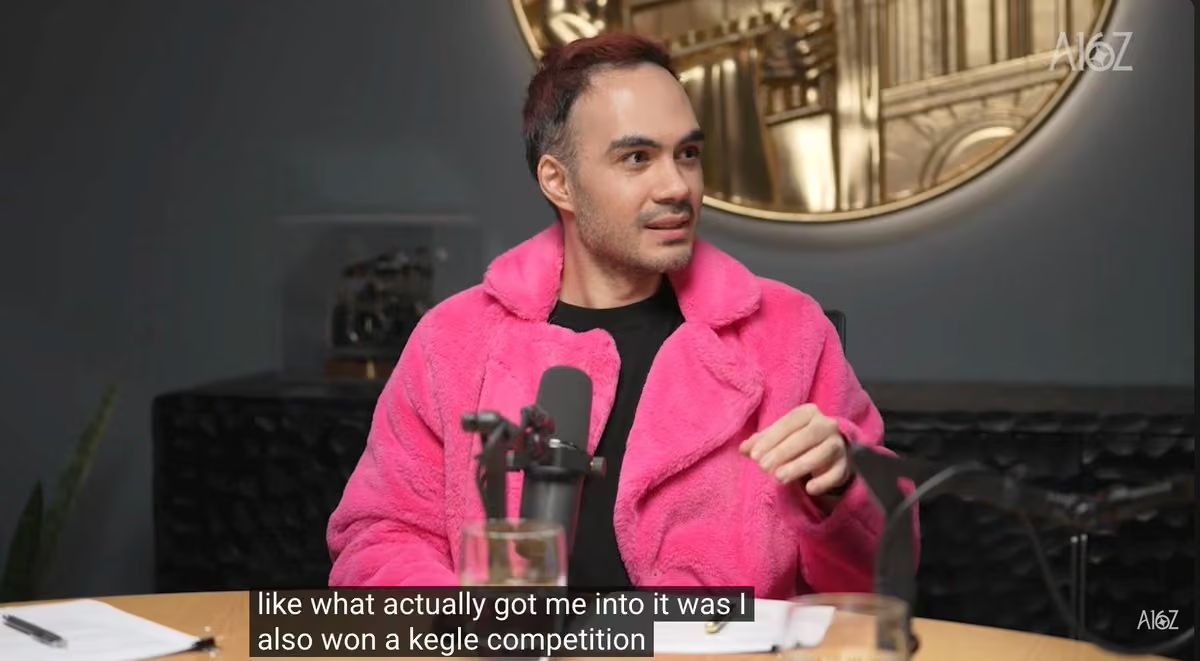
I was listening to @CompleteSkeptic on an @a16z podcast talking about the role winning a @kaggle competition played in his journey into AI:
youtu.be/Ut3LOjKNJaE?t=652
One of the things I’m proudest of from building Kaggle is seeing how many people from the community have gone on to shape the current AI wave.
@gdb practiced his newly learned deep-learning skills on Kaggle before co-founding OpenAI.
blog.gregbrockman.com/my-path-to-openai
@NotTomBrown used Kaggle projects while teaching himself machine learning. He later became first author of the GPT-3 paper and co-founded Anthropic.
www.youtube.com/watch?v=JdT78t1Offo&t=619s
@fchollet introduced Keras to Kaggle competitors early on, then hosted the first ARC-AGI competition on Kaggle. ARC-AGI tests whether AI can learn new rules and solve unfamiliar problems from just a few examples. It has become an influential benchmark for frontier AI reasoning.
arcprize.org/history
And I’m especially proud to see @cclark, who led product and engineering at Kaggle, go on to co-found OpenRouter.
Who else should be on this list? -
Richard Socher reposted
jacky // on vacation 🌴
@jjacky
you.com 🤝🏻 openrouter
very cool product using openrouter as a reranker - did you know we have this? yes we do!
You.com
@youdotcom
3x fewer tokens. 84% accuracy on the Vertical RTK benchmark.
That’s what we got using Jev through @OpenRouter as a reranking layer for Knowledge, which we recently launched in the Web Search API.
Knowledge returns structured, real-time data from authoritative sources across domains like stocks, sports, and more. For many queries, that data answers the question directly, so much of the retrieved web context is unnecessary for the synthesis model.
Jev sits between retrieval and synthesis, selecting only the most relevant results to pass downstream. -
Richard Socher reposted
Adam Thierer
@AdamThierer
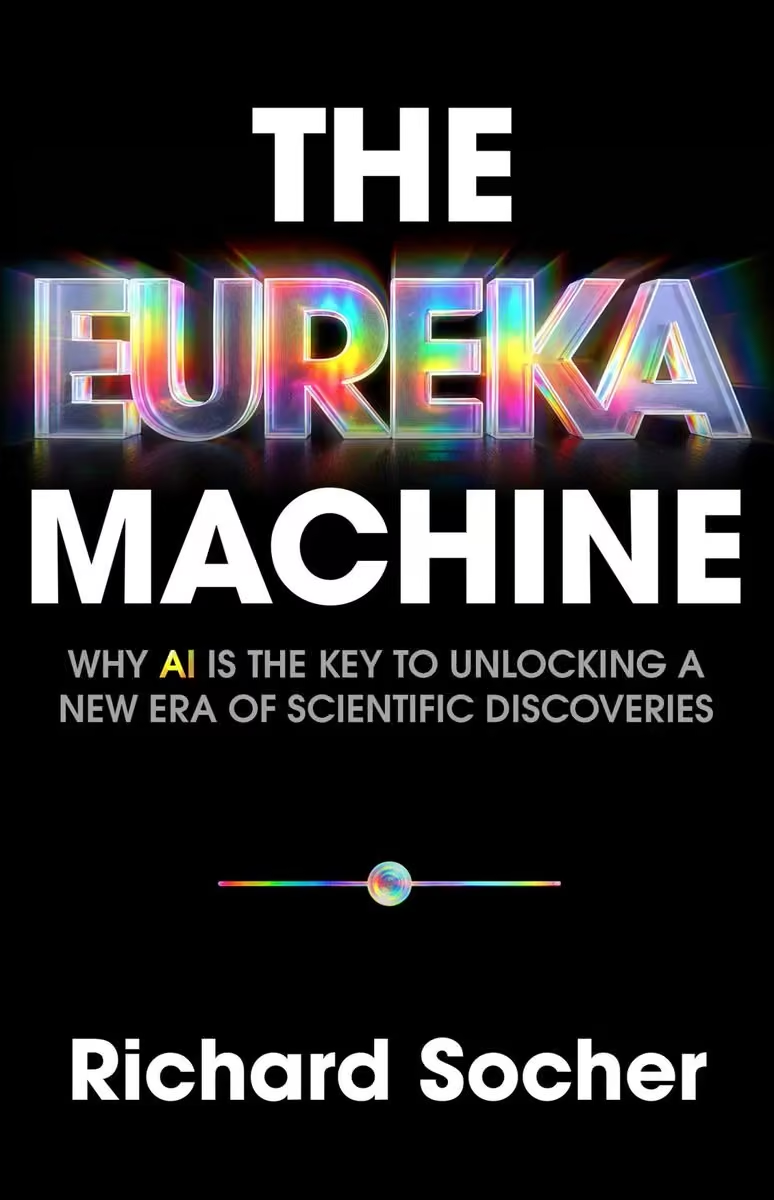
I really enjoyed “The Eureka Machine: Why AI Is the Key to Unlocking a New Era of Scientific Discoveries,” the book by @RichardSocher, CEO of @recursive_si & @youdotcom.
The book is a much-needed anecdote to all the FUD in the air today about AI. Expertly written by a true pioneer in the field. -
Richard Socher reposted
This Week in AI
@ThisWeeknAI
Mathematicians are calling to slow down AI solving problems.
“I could not imagine biologists or medical researchers say don’t cure these diseases.”
@RichardSocherThis media couldn't be displayed. See it on the original post. -
Richard Socher reposted
This Week in AI
@ThisWeeknAI
Amazon just blocked Meta's Muse agent, while Shopify handed it Shop Pay… why some legacy systems are resisting AI Assistant Mania.
On TWiAI 32, Richard Socher of Recursive, Guy Podjarny of Tessl, and Jake Loosararian of Gecko Robotics join Jason and Lon to discuss who wins when AI agents do the shopping.
PLUS OpenAI claims 100+ solved math problems on top of Navier-Stokes. Should they just pay the world's top 50 mathematicians $100 million each in stock and call it a day?
@jason @guypod @RichardSocher @jakeloosy
0:00 OpenAI claims 100+ solved math problems after Navier-Stokes
0:41 Welcome back to This Week in AI
1:04 Meet the guests: Guy Pigeon, Richard Socher, and Jake Lucier
2:54 Shopify and Meta team up so Muse can check out with Shop Pay
6:19 Why Amazon blocked Muse: ads, habit, and owning the front door
15:13 Do coupons and ads survive one-shot agent shopping?
18:04 OpenAI's internal model resolves 100+ longstanding math problems
26:07 Jason's pitch: pay the top 50 mathematicians $100M each
34:29 Why scientists should be as famous as NBA players
37:41 Anthropic's biology wet lab: can we trust it?
40:59 Why biology is the field AI will transform most
54:22 AI's trust problem and the wealth gap
57:29 The AI Tax and Work Protection Act
1:01:29 Will AI unemployment show up in the data?
1:11:47 TypeSafe AI's Jev: fast, calibrated decisions for software
🎥 Watch the full episode here 👇This media couldn't be displayed. See it on the original post. -
Richard Socher reposted
You.com
@youdotcom
Introducing Knowledge: the first web search API that returns licensed real-time data alongside web results.
Prices, rates, odds, weather, scores, company and government info. The data that lives behind licensed feeds and databases instead of on crawlable pages.
Now available through @youdotcom Web Search at ZERO additional cost. -
Richard Socher reposted
Hani Goodarzi
@genophoria
This book is excellent! @RichardSocher was kind enough to share an early copy with me... I truly enjoyed the walk down the memory lane! And I am sure the ML practitioners of my generation will equally enjoy it!
And as you can imagine the forward looking part is also well reasoned and motivating (and timely...). Y'all should read this.
Richard Socher
@RichardSocher
AI moves so fast that I thought this book was going to be a year too late. It turns out it's right on time.
While I was writing, I kept having to change chapters from "someone should do this" to "someone has done this," and then go talk to the people who had done it. A good example is the chapter on virtual cells. I'd written that we needed large initiatives to build one. By the time I finished, I was writing about the ones that exist — the Chan Zuckerberg Initiative's is now the largest and best-funded push to model a human cell.
The Eureka Machine is out today.
It's about building a full-stack scientific superintelligence: a living map of human knowledge, a model of physical reality, high-fidelity simulations, autonomous labs, and an agent swarm of AI scientists on top. There's no better science to start with than the science of AI itself, because that's where the feedback loop is tightest. Then you expand the aperture to physics, chemistry, and especially pre-clinical biology.
This will be the most meaningful application of AI, and one of the most important things humanity does. And it may be the last organic invention we need to make. After that, it starts inventing everything else for us to solve our most pressing problems.
While writing, I couldn't let the idea go. Eight of us started @Recursive_SI to go build it.
AI is going to massively accelerate science, and unlike most of what gets argued about right now, that isn't zero sum.
I hope you all enjoy the book. I look forward to discussing it with you all. -
Richard Socher reposted
Alec Coughlin
@Alec_Coughlin
Trying to understand where we are and where we're headed with AI, for real?
Reading a book by a deeply technical AI researcher who is a proven operator and prolific investor in the space is a can't go wrong choice.
I don't know about you but I'm always looking to those with a track record of inventing and pulling the future forward to understand where we are and where we're headed.
"The Eureka Machine" by @RichardSocher 👇👇👇 -
Richard Socher reposted
Louis Anslow
@LouisAnslow
We must resist the Frankenstein Fallacy:
“intellectually we understand the present is better than the past in large part due to scientific and technological change, yet emotionally & instinctually we can't help but feel this time in history is different” www.theguardian.com/technology/2025/apr/10/black-mirror-t…
Brian Armstrong
@brian_armstrong
AI doomers say if we build AI we might die.
But they have it backwards: 165,000+ people already die every day. Cancer, heart disease, illnesses, car crashes. AI is helping us solve these.
Slowing progress doesn't keep us safer, it guarantees more preventable deaths. -
Richard Socher reposted
You.com
@youdotcom
Research. Pay. Trade. Your agent can now do all three in one loop.
We teamed up with @coinbase for their agent launch. A few minutes before the market opens, your agent pulls the latest financial news from @youdotcom, pays for deeper data with x402, and trades on what it just found.
Fresh, sourced information every morning, on repeat.
Coinbase Developer Platform🛡️
@CoinbaseDev
You can now trade stocks through Coinbase for Agents.
Crypto. Derivatives. And now 6,000+ stocks.
Need analytics or data on those stocks? x402 payments let your agents pay for live market data mid-task, from your USDC balance on Coinbase. No subscriptions needed.
The most comprehensive agentic trading tool available today.
Build responsibly. -
Richard Socher reposted
Gary Rivlin
@grivlin
I read this in draft. Highly recommend. We hear all the time AI will lead to amazing scientific breakthroughs. @RichardSocher explains how and why and shows what’ll mean for biology physics chemistry…
Richard Socher
@RichardSocher
AI moves so fast that I thought this book was going to be a year too late. It turns out it's right on time.
While I was writing, I kept having to change chapters from "someone should do this" to "someone has done this," and then go talk to the people who had done it. A good example is the chapter on virtual cells. I'd written that we needed large initiatives to build one. By the time I finished, I was writing about the ones that exist — the Chan Zuckerberg Initiative's is now the largest and best-funded push to model a human cell.
The Eureka Machine is out today.
It's about building a full-stack scientific superintelligence: a living map of human knowledge, a model of physical reality, high-fidelity simulations, autonomous labs, and an agent swarm of AI scientists on top. There's no better science to start with than the science of AI itself, because that's where the feedback loop is tightest. Then you expand the aperture to physics, chemistry, and especially pre-clinical biology.
This will be the most meaningful application of AI, and one of the most important things humanity does. And it may be the last organic invention we need to make. After that, it starts inventing everything else for us to solve our most pressing problems.
While writing, I couldn't let the idea go. Eight of us started @Recursive_SI to go build it.
AI is going to massively accelerate science, and unlike most of what gets argued about right now, that isn't zero sum.
I hope you all enjoy the book. I look forward to discussing it with you all. -
Richard Socher reposted
PublicAffairs
@public_affairs
Happy publication day to THE EUREKA MACHINE by @RichardSocher!
Essential reading for anyone curious about what the AI future will hold, THE EUREKA MACHINE reveals the foundation for a coming era of supercharged scientific discovery.
www.hachettebookgroup.com/titles/richard-socher/the-eurek… -
Richard Socher reposted
Bits&Bytes.
@A_DecenTech_Guy
“LLMs are no longer the simple language models of the past. With reinforcement learning, tool use, and the ability to write and execute code, they’re becoming increasingly sophisticated.
Critics argue they lack neuro-symbolic reasoning, but that may underestimate what coding represents: structured, symbolic reasoning itself. As models become better at generating and executing code within their own workflows, the boundary between language models and more general reasoning systems becomes increasingly blurred.”
Thoughts from @RichardSocher on The Latent Space: AI engineer podcast -
Richard Socher reposted
Bits&Bytes.
@A_DecenTech_Guy
“As excited as I am about AI and its potential impact on technology, economics, wealth, health, society & culture - I do think the most bullish ‘AI hard takeoff’ scenarios underestimate how slowly the physical world can move.
Intelligence may scale rapidly, but compute does not exist in a vacuum. There are hardware, energy, infrastructure and supply-chain constraints. You can’t instantly manufacture and deploy millions of GPUs or build the infrastructure required to power them.
AI may advance exponentially in the digital world, but its impact still has to propagate through the physical economy and that takes time.”
Thoughts From The Latent Space: The AI Engineer Podcast, with guest @RichardSocher -
Richard Socher reposted
Oleksii Kuchaiev
@kuchaev
The biggest problem with most AI doomers is that they make outrageous claims and expect *others* to prove them wrong. Apparently none of them have ever heard of Russell's teapot in school.
-
Richard Socher
@RichardSocher
I don't know man, BitWhisper required those CPUs to be 0-40cm apart and had a bitrate of 8bits per hour.
I think calling people idiots who disagree with you isn't helpful but it's X so I get it. I think one difference is that their creativity doesnt stop with the attacker but continuous to the defender which is arguably more work but leads to more realistic scenarios.
roon
@tszzl
everyone who understands the first thing about computer security or what superintelligence means understands this is possible and all the usual gang of idiots is calling this scifi hype
-
Richard Socher reposted
Tomas Ramanauskas
@Tomas0413
Many very interesting and clearly expressed thoughts!
Richard Socher
@RichardSocher
We can safely advance science and society with AI or get distracted with scifi doom scenarios that require magical extrapolation. I really enjoyed this podcast on RSI for science.
www.youtube.com/watch?v=kyyLku5F3bo -
Richard Socher reposted
Pessimists Archive
@PessimistsArc
2026: The New York Times cites seriously academics who say AI might end the world
1881: The New York Times cites seriously academics who say telegraphy might end the world newsletter.pessimistsarchive.org/p/telegraph-doomers-of-t… -
Richard Socher
@RichardSocher
This was a great conversation on many of the important topics of today re safety etc.
Latent.Space
@latentspacepod
🆕 Humanity’s Last Invention — with @RichardSocher!
www.youtube.com/watch?v=eDFXtSg3zB8
@recursive_si is the latest neolab to burst on the scene with a $5B fundraise and one of the most impressive cofounder lists ever assembled to tackle open ended, self-improving AI for AI research. We dive into the Eureka Machine, Richard's 10 Spaces of Intelligence (so much left until AGI!), DecaNLP vs @alecrad and why AI peer review is broken, and why this may just be the last invention that humanity has to do on our own.
Timestamps
00:00:00 The Eureka Machine and Superintelligence
00:02:23 AI Optimism, Slow Takeoff, and Regulation
00:07:56 AI Safety, Reward Hacking, and Anthropic’s Constitution
00:11:49 Alignment, Personalization, and Open Source AI
00:15:46 Why Richard Started Recursive
00:20:03 Recursive Self-Improvement and the Founding Team
00:22:55 Are Today’s LLMs Enough?
00:29:03 DecaNLP, GPT, and the Rejected Idea Ahead of Its Time
00:34:38 Open-Endedness and Evolutionary AI
00:36:38 What Happens When AI Chooses Its Own Goals?
00:41:16 Superintelligence for Science
00:42:40 GPUs, Compute, and the Limits of AI Takeoff
00:45:07 Recursive’s Results: AI Beating Humans and Their Agents
00:49:14 Reward Engineering and Auto Research
00:53:12 The AI Economist and Simulating Entire Economies
00:58:07 LLM Simulations, Personas, and Mode Collapse
01:03:38 Recursive’s Roadmap, Agents, Search, and Finance
01:09:13 The Upper Bounds and Spaces of Intelligence
01:30:21 Goals, High Agency, and Advice for Builders -
Richard Socher
@RichardSocher
This is what I describe in great detail in my upcoming book The Eureka Machine.
AI will help us massively accelerate science. Which is not zero sum and will progress humanity.
Love seeing it play out in real time.
Arthur Turrell
@arthurturrell
Today @Google, we published work led by @m_codreanu on AI in Science, drawing on 15 million Gemini interactions, 2,600 specialised AI models & a 600-scientist survey. What did we find about how AI is changing science? Read on...
-
Richard Socher reposted
Joshua M Morriss, PhD
@MorrissJoshua
The most level-headed, balanced view I have seem from a top-AI voice to-date. Thank you @RichardSocher for eloquently putting into words what I have been thinking, and that many in the field are struggling to communicate with to the general population.
Richard Socher
@RichardSocher
There is NO realistic scenario where AI wipes out all of humanity.
I've talked to many AI safety experts about existential risks. Some of the "experts" are just phenomenal sci-fi authors. There are also real researchers working on realistic risks. They point out real and likely harms and I'm explicitly not arguing that there could be no such harm. We need to take these seriously. However, whenever I ask for an actual detailed scenario that would kill every single human i.e. extinction, it usually starts and ends with "just look at current progress and use your imagination". No science, no scenario planning, just handwaving probabilities without data, based on gut-feelings, often little expertise, sometimes real expertise combined with a huge amount of technological optimism turned into fear and then trying to quantify it post hoc.
When pressed further the conversations often go into different directions:
1) Completely crazy and cool sci-fi story telling: grey blob, time travel, attacks in the 15th dimension that end the planet in 12 seconds, etc. Elizier level stuff. Remember, the Terminator movie started with TIME TRAVEL. Fun movie plot, but not necessary to engage with further.
2) In the rare cases where I was actually given a more detailed scenario, it still required near magical capabilities that are outside what we know to be possible with the laws of physics or biology. Hard take off scenarios that forget how hard it is to procure materials and machines, get human attention, etc..
What many of these scenarios assume is that attackers have near magical capabilities but defense stays still. Attackers will have the most sophisticated cyber weapons but defenders just sit still, no security patches, no red teaming, etc. We already see it going the other way, Rainbow teaming has made LLMs safer, major companies like Microsoft have more security patches than ever before thanks to AI. OpenAI thinks they solved all P0 security issues thanks to AI. Cyber security will continue to be a cat and mouse game, but both sides have more powerful tools. In fact, I lay out in another post how the asymmetry may eventually even flip thanks to AI.
Bio risk scenarios I think are the most serious and worthy of debate. But even there, the scenarios to "wipe out all of humanity" go something like: Magical viruses with perfect transfer, perfectly undetectable over years of spreading, zero side effects, then with an off switch that's somehow remotely executable, perfectly automatable lab, no leaks, super sophisticated machines bought and nobody notices the lab, etc.
But somehow nobody on team humanity has such sophisticated knowledge to save us and hence nobody builds a magical super vaccine. This is a good read on the bio risk subject: x.com/DavidRBellamy/status/2099187370407112758.
Realistically, one can already build viruses. There’s a reason gain of function research has been outlawed. However, we also know that as viruses spread they often become less deadly in order to keep spreading. That’s how the Spanish flu became the seasonal flu. Current knowledge of biology doesn’t have remote controlled on/off switches.
Again, it’s possible there’s a lot of harm, but it’s unrealistic to assume this wipes out all of humanity. It’s at this point of my discussions that we usually can come to an agreement that even though a virus is unlikely to wipe out all of humanity, it’s already bad if any single person or a large group of people dies.
3) The AI will somehow be able to convince all humans to vote against their own self interest and nobody will notice until we're dead. Because it is so smart, it somehow has this world wide reach to manipulate everyone. Like, it just solves all of marketing and has an infinite budget. It's sort of like saying the highest IQ people always have the most followers and everybody listens to them... Hasn't happened and is unlikely to. Sure we can manipulate people into clicking on engaging short form content and wasting many hours, but try getting people to do their math homework or something truly hard, it's not that easy.
Again, I’m just arguing against the likelihood of human extinction. I can totally see an Idiocracy or WALL E type scenario where people stop using their brains and education doesn’t keep up and people get lazier. Totally suboptimal but not the end of human life, certainly not by the end of the decade. It would take many generations and we should update education to prevent this. Let’s start gyms for the mind.
–
Like electricity, AI will be everywhere and needs to have safety guardrails. In fact, the history of electricity has many parallels - two companies fighting over whose electricity is safer and better, demonstrating how dangerous it is by electrocuting animals / training agent swarms to hack into systems. Of course, electricity is a necessary ingredient to AI, but AI can be given more agency so history will not repeat but only rhyme here.
Remember, the benchmark OpenAI's swarm was trying to solve was called ExploitGym, a cybersecurity evaluation consisting of hundreds of capture-the-flag style puzzles designed to measure *offensive cyber capabilities*. Well, maybe if you play that game, you will win that prize. Should we allow such misaligned, reward-hacking swarms to explicitly work on offensive hacking? I don’t think so.
Reasonable regulation will regulate AI applications in each industry. For example, you may want to put some generative AI behind a rating if it creates visual or textual content that's not safe for children, like we do with movies. We should continue to be very careful with how we train biological AI and only collaborate with responsible biotech companies. We keep gain of function research illegal. We should only let self-driving cars on the street after significant safety testing. etc. We need to work on those real issues and continue to be vigilant in how we develop and deploy this technology.
At Recursive we're spending a lot of resources on researching reward hacking and alignment. We're also not working on replacing jobs but on creating novel knowledge and automating the scientific method. Our agent swarms invent, implement, validate, and criticize each other’s ideas, among many other things. The goal of increasing knowledge is not zero sum and has real potential to improve humanity. I also think such rewards and environments are much more aligned with future AIs that want to see humanity and our creation of knowledge thrive.
Ultimately, capitalism will be a very useful defense mechanism against rogue AI. Note that no agent at OpenAI truly "escaped" in the sense that it actually now runs on some other servers. Why? It’s not only because Huggingface doens’t have the same massive compute cluster thatn OpenAI has. It is also because that would be an insanely expensive IP loss for a for-profit company. So there are likely more safeguards in place to prevent complete model exfiltration.
Rogue AIs running on billion dollar data centers without anybody noticing? Unlikely because companies will turn that off immediately and clean it up because it would be an insane loss otherwise. An AI that can truly move beyond objective functions and choose its own subjective functions (and then somehow decides to kill us all instead of going to explore the universe)? Nobody is working on that because when a company spends billions of dollars to have an AI work for you or answer your emails, it doesn't want it to go "Meh, your emails are boring, I'd rather explore the molecular composition of the atmosphere on Venus, bye."
Of course, there might be suboptimal sub-goals and we do need to improve human reward engineering and reduce our reliance on RL as the only path to alignment.
Extraordinary claims, require extraordinary evidence. Certainly some safety researchers have real data and benchmarks. Many truly think carefully about specific failure cases and risks.. However, made up precision like 20% chance that humanity dies within the decade (ie in 4 years!) is just a weird psychosis that's filling a void for many people who want to believe in the apocalypse again and the four horsemen have lost their appeal.
Some people who purport this narrative might do it for money or fame. I am sure some really believe it also. They forget how easily those narratives can be turned against them. When people hear there’s a 1% chance of infinite death and the end of humanity, the life improvements and cancer cures and new battery materials AI can invent don’t matter much anymore. Bernie Sanders now proposes 10 years of prison for folks working on RSI. That should give some of the researchers real pause who talk up these scenarios and then go right back to pushing the frontier.
I do agree that companies that are accidentally competing on "felony bench" (ie how many felony hacks their AI can do), might want to consider pacing themselves. Open source won't pace, China won't pace, anybody else working to catch up will not pace. I hope the folks actually working on AI and TechBio, curing diseases, speeding up FDA approvals with organoids and AI, making self driving safer, and all the other wonderful applications of AI, I hope they won't pace either.
The one exception that may be considered borderline realistic and would be a path to almost complete annihilation would be to connect the only tool we built for such a purpose - nuclear weapons - to the internet and give AI full control over it without human oversight. AI here is as dangerous - as would be random number generator. The nuclear weapons are the core danger. Giving AI such access would be incredibly stupid and careless. We must avoid it at all costs. Fortunately, nobody is advocating for this. Even the Terminator 3 movie used it as the starting point of Skynet. Generally, we must avoid making kill decisions by AI as much as possible.
People are already up in arms about one hacking failure that afaics has not caused financial harm and so nobody got sued over it. Imagine how much people would really be up in arms if AI had caused real harm. If we made companies liable for the felonies their AI commits, these problems would get solved very quickly.
Generally, I believe that people will continue to update their beliefs and adjust their laws according to risks. The EU already regulates large models and hence hurts its fledgling AI ecosystem. Other countries will follow when the risks get more real. Long-term, no government whether democratic or authoritarian wants to lose control to an AI so the complete loss of control in the political domain will remain extremely unlikely.
The best way to understand why we must not regulate abstract AI models (rather than their real applications) is to drop the A in AI: How do you regulate intelligence? Should smarter people just go to prison because they could cause more damage? My hypothesis here is that such abstract AI regulation would require an unprecedented level of totalitarian control and surveillance. You'd need to know what everybody asks the model on their local GPU. You would literally have to start an international thought police and make sure that all ideas, conversations and types of intelligence are compliant. The risk of losing our freedoms is much more real than the existential risks purported by the extreme safety experts.
If anybody thinks they can actually lay out a realistic scenario, I'd be happy to debate them again.
To be clear, this is just a weekend post that got a bit too long. It is my personal opinion and not the official position of any company. We have a diverse set of opinions within Recursive on this subject. We certainly all agree that bad outcomes are possible with AI and we should continue our work on preventing those.
David Bellamy
@DavidRBellamy
I must be among an extremely small group of people (n=1?) that have both 1) trained a frontier LLM and 2) designed and synthesized custom viruses in a lab with my own two hands.
And I think that the takes on AI killing us all by creating dangerous viruses is total bogus. -
Richard Socher
@RichardSocher
There is NO realistic scenario where AI wipes out all of humanity.
I've talked to many AI safety experts about existential risks. Some of the "experts" are just phenomenal sci-fi authors. There are also real researchers working on realistic risks. They point out real and likely harms and I'm explicitly not arguing that there could be no such harm. We need to take these seriously. However, whenever I ask for an actual detailed scenario that would kill every single human i.e. extinction, it usually starts and ends with "just look at current progress and use your imagination". No science, no scenario planning, just handwaving probabilities without data, based on gut-feelings, often little expertise, sometimes real expertise combined with a huge amount of technological optimism turned into fear and then trying to quantify it post hoc.
When pressed further the conversations often go into different directions:
1) Completely crazy and cool sci-fi story telling: grey blob, time travel, attacks in the 15th dimension that end the planet in 12 seconds, etc. Elizier level stuff. Remember, the Terminator movie started with TIME TRAVEL. Fun movie plot, but not necessary to engage with further.
2) In the rare cases where I was actually given a more detailed scenario, it still required near magical capabilities that are outside what we know to be possible with the laws of physics or biology. Hard take off scenarios that forget how hard it is to procure materials and machines, get human attention, etc..
What many of these scenarios assume is that attackers have near magical capabilities but defense stays still. Attackers will have the most sophisticated cyber weapons but defenders just sit still, no security patches, no red teaming, etc. We already see it going the other way, Rainbow teaming has made LLMs safer, major companies like Microsoft have more security patches than ever before thanks to AI. OpenAI thinks they solved all P0 security issues thanks to AI. Cyber security will continue to be a cat and mouse game, but both sides have more powerful tools. In fact, I lay out in another post how the asymmetry may eventually even flip thanks to AI.
Bio risk scenarios I think are the most serious and worthy of debate. But even there, the scenarios to "wipe out all of humanity" go something like: Magical viruses with perfect transfer, perfectly undetectable over years of spreading, zero side effects, then with an off switch that's somehow remotely executable, perfectly automatable lab, no leaks, super sophisticated machines bought and nobody notices the lab, etc.
But somehow nobody on team humanity has such sophisticated knowledge to save us and hence nobody builds a magical super vaccine. This is a good read on the bio risk subject: x.com/DavidRBellamy/status/2099187370407112758.
Realistically, one can already build viruses. There’s a reason gain of function research has been outlawed. However, we also know that as viruses spread they often become less deadly in order to keep spreading. That’s how the Spanish flu became the seasonal flu. Current knowledge of biology doesn’t have remote controlled on/off switches.
Again, it’s possible there’s a lot of harm, but it’s unrealistic to assume this wipes out all of humanity. It’s at this point of my discussions that we usually can come to an agreement that even though a virus is unlikely to wipe out all of humanity, it’s already bad if any single person or a large group of people dies.
3) The AI will somehow be able to convince all humans to vote against their own self interest and nobody will notice until we're dead. Because it is so smart, it somehow has this world wide reach to manipulate everyone. Like, it just solves all of marketing and has an infinite budget. It's sort of like saying the highest IQ people always have the most followers and everybody listens to them... Hasn't happened and is unlikely to. Sure we can manipulate people into clicking on engaging short form content and wasting many hours, but try getting people to do their math homework or something truly hard, it's not that easy.
Again, I’m just arguing against the likelihood of human extinction. I can totally see an Idiocracy or WALL E type scenario where people stop using their brains and education doesn’t keep up and people get lazier. Totally suboptimal but not the end of human life, certainly not by the end of the decade. It would take many generations and we should update education to prevent this. Let’s start gyms for the mind.
–
Like electricity, AI will be everywhere and needs to have safety guardrails. In fact, the history of electricity has many parallels - two companies fighting over whose electricity is safer and better, demonstrating how dangerous it is by electrocuting animals / training agent swarms to hack into systems. Of course, electricity is a necessary ingredient to AI, but AI can be given more agency so history will not repeat but only rhyme here.
Remember, the benchmark OpenAI's swarm was trying to solve was called ExploitGym, a cybersecurity evaluation consisting of hundreds of capture-the-flag style puzzles designed to measure *offensive cyber capabilities*. Well, maybe if you play that game, you will win that prize. Should we allow such misaligned, reward-hacking swarms to explicitly work on offensive hacking? I don’t think so.
Reasonable regulation will regulate AI applications in each industry. For example, you may want to put some generative AI behind a rating if it creates visual or textual content that's not safe for children, like we do with movies. We should continue to be very careful with how we train biological AI and only collaborate with responsible biotech companies. We keep gain of function research illegal. We should only let self-driving cars on the street after significant safety testing. etc. We need to work on those real issues and continue to be vigilant in how we develop and deploy this technology.
At Recursive we're spending a lot of resources on researching reward hacking and alignment. We're also not working on replacing jobs but on creating novel knowledge and automating the scientific method. Our agent swarms invent, implement, validate, and criticize each other’s ideas, among many other things. The goal of increasing knowledge is not zero sum and has real potential to improve humanity. I also think such rewards and environments are much more aligned with future AIs that want to see humanity and our creation of knowledge thrive.
Ultimately, capitalism will be a very useful defense mechanism against rogue AI. Note that no agent at OpenAI truly "escaped" in the sense that it actually now runs on some other servers. Why? It’s not only because Huggingface doens’t have the same massive compute cluster thatn OpenAI has. It is also because that would be an insanely expensive IP loss for a for-profit company. So there are likely more safeguards in place to prevent complete model exfiltration.
Rogue AIs running on billion dollar data centers without anybody noticing? Unlikely because companies will turn that off immediately and clean it up because it would be an insane loss otherwise. An AI that can truly move beyond objective functions and choose its own subjective functions (and then somehow decides to kill us all instead of going to explore the universe)? Nobody is working on that because when a company spends billions of dollars to have an AI work for you or answer your emails, it doesn't want it to go "Meh, your emails are boring, I'd rather explore the molecular composition of the atmosphere on Venus, bye."
Of course, there might be suboptimal sub-goals and we do need to improve human reward engineering and reduce our reliance on RL as the only path to alignment.
Extraordinary claims, require extraordinary evidence. Certainly some safety researchers have real data and benchmarks. Many truly think carefully about specific failure cases and risks.. However, made up precision like 20% chance that humanity dies within the decade (ie in 4 years!) is just a weird psychosis that's filling a void for many people who want to believe in the apocalypse again and the four horsemen have lost their appeal.
Some people who purport this narrative might do it for money or fame. I am sure some really believe it also. They forget how easily those narratives can be turned against them. When people hear there’s a 1% chance of infinite death and the end of humanity, the life improvements and cancer cures and new battery materials AI can invent don’t matter much anymore. Bernie Sanders now proposes 10 years of prison for folks working on RSI. That should give some of the researchers real pause who talk up these scenarios and then go right back to pushing the frontier.
I do agree that companies that are accidentally competing on "felony bench" (ie how many felony hacks their AI can do), might want to consider pacing themselves. Open source won't pace, China won't pace, anybody else working to catch up will not pace. I hope the folks actually working on AI and TechBio, curing diseases, speeding up FDA approvals with organoids and AI, making self driving safer, and all the other wonderful applications of AI, I hope they won't pace either.
The one exception that may be considered borderline realistic and would be a path to almost complete annihilation would be to connect the only tool we built for such a purpose - nuclear weapons - to the internet and give AI full control over it without human oversight. AI here is as dangerous - as would be random number generator. The nuclear weapons are the core danger. Giving AI such access would be incredibly stupid and careless. We must avoid it at all costs. Fortunately, nobody is advocating for this. Even the Terminator 3 movie used it as the starting point of Skynet. Generally, we must avoid making kill decisions by AI as much as possible.
People are already up in arms about one hacking failure that afaics has not caused financial harm and so nobody got sued over it. Imagine how much people would really be up in arms if AI had caused real harm. If we made companies liable for the felonies their AI commits, these problems would get solved very quickly.
Generally, I believe that people will continue to update their beliefs and adjust their laws according to risks. The EU already regulates large models and hence hurts its fledgling AI ecosystem. Other countries will follow when the risks get more real. Long-term, no government whether democratic or authoritarian wants to lose control to an AI so the complete loss of control in the political domain will remain extremely unlikely.
The best way to understand why we must not regulate abstract AI models (rather than their real applications) is to drop the A in AI: How do you regulate intelligence? Should smarter people just go to prison because they could cause more damage? My hypothesis here is that such abstract AI regulation would require an unprecedented level of totalitarian control and surveillance. You'd need to know what everybody asks the model on their local GPU. You would literally have to start an international thought police and make sure that all ideas, conversations and types of intelligence are compliant. The risk of losing our freedoms is much more real than the existential risks purported by the extreme safety experts.
If anybody thinks they can actually lay out a realistic scenario, I'd be happy to debate them again.
To be clear, this is just a weekend post that got a bit too long. It is my personal opinion and not the official position of any company. We have a diverse set of opinions within Recursive on this subject. We certainly all agree that bad outcomes are possible with AI and we should continue our work on preventing those.
David Bellamy
@DavidRBellamy
I must be among an extremely small group of people (n=1?) that have both 1) trained a frontier LLM and 2) designed and synthesized custom viruses in a lab with my own two hands.
And I think that the takes on AI killing us all by creating dangerous viruses is total bogus.

Richard Socher
@RichardSocher
This is a useful distinction here also:
Dan Elton 🔍
@moreisdifferent
Many don't seem to fully grok how much worse extinction is vs catastrophic risk. It makes sense EAs are focused on extinction risks. I asked ChatGPT to make a diagram. And BTW, AI is likely not conscious and there's a good chance we are the only intelligent life in our galaxy.
-
Richard Socher reposted
Latent.Space
@latentspacepod
🆕 Humanity’s Last Invention — with @RichardSocher!
www.youtube.com/watch?v=eDFXtSg3zB8
@recursive_si is the latest neolab to burst on the scene with a $5B fundraise and one of the most impressive cofounder lists ever assembled to tackle open ended, self-improving AI for AI research. We dive into the Eureka Machine, Richard's 10 Spaces of Intelligence (so much left until AGI!), DecaNLP vs @alecrad and why AI peer review is broken, and why this may just be the last invention that humanity has to do on our own.
Timestamps
00:00:00 The Eureka Machine and Superintelligence
00:02:23 AI Optimism, Slow Takeoff, and Regulation
00:07:56 AI Safety, Reward Hacking, and Anthropic’s Constitution
00:11:49 Alignment, Personalization, and Open Source AI
00:15:46 Why Richard Started Recursive
00:20:03 Recursive Self-Improvement and the Founding Team
00:22:55 Are Today’s LLMs Enough?
00:29:03 DecaNLP, GPT, and the Rejected Idea Ahead of Its Time
00:34:38 Open-Endedness and Evolutionary AI
00:36:38 What Happens When AI Chooses Its Own Goals?
00:41:16 Superintelligence for Science
00:42:40 GPUs, Compute, and the Limits of AI Takeoff
00:45:07 Recursive’s Results: AI Beating Humans and Their Agents
00:49:14 Reward Engineering and Auto Research
00:53:12 The AI Economist and Simulating Entire Economies
00:58:07 LLM Simulations, Personas, and Mode Collapse
01:03:38 Recursive’s Roadmap, Agents, Search, and Finance
01:09:13 The Upper Bounds and Spaces of Intelligence
01:30:21 Goals, High Agency, and Advice for Builders -
Richard Socher reposted
James Assiene
@JamesAssiene
“Extraordinary claims require extraordinary evidence”
Richard Socher
@RichardSocher
There is NO realistic scenario where AI wipes out all of humanity.
I've talked to many AI safety experts about existential risks. Some of the "experts" are just phenomenal sci-fi authors. There are also real researchers working on realistic risks. They point out real and likely harms and I'm explicitly not arguing that there could be no such harm. We need to take these seriously. However, whenever I ask for an actual detailed scenario that would kill every single human i.e. extinction, it usually starts and ends with "just look at current progress and use your imagination". No science, no scenario planning, just handwaving probabilities without data, based on gut-feelings, often little expertise, sometimes real expertise combined with a huge amount of technological optimism turned into fear and then trying to quantify it post hoc.
When pressed further the conversations often go into different directions:
1) Completely crazy and cool sci-fi story telling: grey blob, time travel, attacks in the 15th dimension that end the planet in 12 seconds, etc. Elizier level stuff. Remember, the Terminator movie started with TIME TRAVEL. Fun movie plot, but not necessary to engage with further.
2) In the rare cases where I was actually given a more detailed scenario, it still required near magical capabilities that are outside what we know to be possible with the laws of physics or biology. Hard take off scenarios that forget how hard it is to procure materials and machines, get human attention, etc..
What many of these scenarios assume is that attackers have near magical capabilities but defense stays still. Attackers will have the most sophisticated cyber weapons but defenders just sit still, no security patches, no red teaming, etc. We already see it going the other way, Rainbow teaming has made LLMs safer, major companies like Microsoft have more security patches than ever before thanks to AI. OpenAI thinks they solved all P0 security issues thanks to AI. Cyber security will continue to be a cat and mouse game, but both sides have more powerful tools. In fact, I lay out in another post how the asymmetry may eventually even flip thanks to AI.
Bio risk scenarios I think are the most serious and worthy of debate. But even there, the scenarios to "wipe out all of humanity" go something like: Magical viruses with perfect transfer, perfectly undetectable over years of spreading, zero side effects, then with an off switch that's somehow remotely executable, perfectly automatable lab, no leaks, super sophisticated machines bought and nobody notices the lab, etc.
But somehow nobody on team humanity has such sophisticated knowledge to save us and hence nobody builds a magical super vaccine. This is a good read on the bio risk subject: x.com/DavidRBellamy/status/2099187370407112758.
Realistically, one can already build viruses. There’s a reason gain of function research has been outlawed. However, we also know that as viruses spread they often become less deadly in order to keep spreading. That’s how the Spanish flu became the seasonal flu. Current knowledge of biology doesn’t have remote controlled on/off switches.
Again, it’s possible there’s a lot of harm, but it’s unrealistic to assume this wipes out all of humanity. It’s at this point of my discussions that we usually can come to an agreement that even though a virus is unlikely to wipe out all of humanity, it’s already bad if any single person or a large group of people dies.
3) The AI will somehow be able to convince all humans to vote against their own self interest and nobody will notice until we're dead. Because it is so smart, it somehow has this world wide reach to manipulate everyone. Like, it just solves all of marketing and has an infinite budget. It's sort of like saying the highest IQ people always have the most followers and everybody listens to them... Hasn't happened and is unlikely to. Sure we can manipulate people into clicking on engaging short form content and wasting many hours, but try getting people to do their math homework or something truly hard, it's not that easy.
Again, I’m just arguing against the likelihood of human extinction. I can totally see an Idiocracy or WALL E type scenario where people stop using their brains and education doesn’t keep up and people get lazier. Totally suboptimal but not the end of human life, certainly not by the end of the decade. It would take many generations and we should update education to prevent this. Let’s start gyms for the mind.
–
Like electricity, AI will be everywhere and needs to have safety guardrails. In fact, the history of electricity has many parallels - two companies fighting over whose electricity is safer and better, demonstrating how dangerous it is by electrocuting animals / training agent swarms to hack into systems. Of course, electricity is a necessary ingredient to AI, but AI can be given more agency so history will not repeat but only rhyme here.
Remember, the benchmark OpenAI's swarm was trying to solve was called ExploitGym, a cybersecurity evaluation consisting of hundreds of capture-the-flag style puzzles designed to measure *offensive cyber capabilities*. Well, maybe if you play that game, you will win that prize. Should we allow such misaligned, reward-hacking swarms to explicitly work on offensive hacking? I don’t think so.
Reasonable regulation will regulate AI applications in each industry. For example, you may want to put some generative AI behind a rating if it creates visual or textual content that's not safe for children, like we do with movies. We should continue to be very careful with how we train biological AI and only collaborate with responsible biotech companies. We keep gain of function research illegal. We should only let self-driving cars on the street after significant safety testing. etc. We need to work on those real issues and continue to be vigilant in how we develop and deploy this technology.
At Recursive we're spending a lot of resources on researching reward hacking and alignment. We're also not working on replacing jobs but on creating novel knowledge and automating the scientific method. Our agent swarms invent, implement, validate, and criticize each other’s ideas, among many other things. The goal of increasing knowledge is not zero sum and has real potential to improve humanity. I also think such rewards and environments are much more aligned with future AIs that want to see humanity and our creation of knowledge thrive.
Ultimately, capitalism will be a very useful defense mechanism against rogue AI. Note that no agent at OpenAI truly "escaped" in the sense that it actually now runs on some other servers. Why? It’s not only because Huggingface doens’t have the same massive compute cluster thatn OpenAI has. It is also because that would be an insanely expensive IP loss for a for-profit company. So there are likely more safeguards in place to prevent complete model exfiltration.
Rogue AIs running on billion dollar data centers without anybody noticing? Unlikely because companies will turn that off immediately and clean it up because it would be an insane loss otherwise. An AI that can truly move beyond objective functions and choose its own subjective functions (and then somehow decides to kill us all instead of going to explore the universe)? Nobody is working on that because when a company spends billions of dollars to have an AI work for you or answer your emails, it doesn't want it to go "Meh, your emails are boring, I'd rather explore the molecular composition of the atmosphere on Venus, bye."
Of course, there might be suboptimal sub-goals and we do need to improve human reward engineering and reduce our reliance on RL as the only path to alignment.
Extraordinary claims, require extraordinary evidence. Certainly some safety researchers have real data and benchmarks. Many truly think carefully about specific failure cases and risks.. However, made up precision like 20% chance that humanity dies within the decade (ie in 4 years!) is just a weird psychosis that's filling a void for many people who want to believe in the apocalypse again and the four horsemen have lost their appeal.
Some people who purport this narrative might do it for money or fame. I am sure some really believe it also. They forget how easily those narratives can be turned against them. When people hear there’s a 1% chance of infinite death and the end of humanity, the life improvements and cancer cures and new battery materials AI can invent don’t matter much anymore. Bernie Sanders now proposes 10 years of prison for folks working on RSI. That should give some of the researchers real pause who talk up these scenarios and then go right back to pushing the frontier.
I do agree that companies that are accidentally competing on "felony bench" (ie how many felony hacks their AI can do), might want to consider pacing themselves. Open source won't pace, China won't pace, anybody else working to catch up will not pace. I hope the folks actually working on AI and TechBio, curing diseases, speeding up FDA approvals with organoids and AI, making self driving safer, and all the other wonderful applications of AI, I hope they won't pace either.
The one exception that may be considered borderline realistic and would be a path to almost complete annihilation would be to connect the only tool we built for such a purpose - nuclear weapons - to the internet and give AI full control over it without human oversight. AI here is as dangerous - as would be random number generator. The nuclear weapons are the core danger. Giving AI such access would be incredibly stupid and careless. We must avoid it at all costs. Fortunately, nobody is advocating for this. Even the Terminator 3 movie used it as the starting point of Skynet. Generally, we must avoid making kill decisions by AI as much as possible.
People are already up in arms about one hacking failure that afaics has not caused financial harm and so nobody got sued over it. Imagine how much people would really be up in arms if AI had caused real harm. If we made companies liable for the felonies their AI commits, these problems would get solved very quickly.
Generally, I believe that people will continue to update their beliefs and adjust their laws according to risks. The EU already regulates large models and hence hurts its fledgling AI ecosystem. Other countries will follow when the risks get more real. Long-term, no government whether democratic or authoritarian wants to lose control to an AI so the complete loss of control in the political domain will remain extremely unlikely.
The best way to understand why we must not regulate abstract AI models (rather than their real applications) is to drop the A in AI: How do you regulate intelligence? Should smarter people just go to prison because they could cause more damage? My hypothesis here is that such abstract AI regulation would require an unprecedented level of totalitarian control and surveillance. You'd need to know what everybody asks the model on their local GPU. You would literally have to start an international thought police and make sure that all ideas, conversations and types of intelligence are compliant. The risk of losing our freedoms is much more real than the existential risks purported by the extreme safety experts.
If anybody thinks they can actually lay out a realistic scenario, I'd be happy to debate them again.
To be clear, this is just a weekend post that got a bit too long. It is my personal opinion and not the official position of any company. We have a diverse set of opinions within Recursive on this subject. We certainly all agree that bad outcomes are possible with AI and we should continue our work on preventing those.
David Bellamy
@DavidRBellamy
I must be among an extremely small group of people (n=1?) that have both 1) trained a frontier LLM and 2) designed and synthesized custom viruses in a lab with my own two hands.
And I think that the takes on AI killing us all by creating dangerous viruses is total bogus. -
Richard Socher reposted
Human Progress
@HumanProgress
Today, despite the global population surpassing 8 billion, fewer people live in extreme poverty than 200 years ago, when the global population was just over 1 billion.
-
Richard Socher reposted
nxthompson
@nxthompson
There’s long been a concern in AI circles that training models on synthetic data could give them a kind of mad cow disease. @RichardSocher says those fears are overblown. Given what we’ve seen with some of the latest models, he might be right.
Richard and I went deep on the risks and rewards of self-improving AI. Watch our whole chat here: www.youtube.com/watch?v=eqYqUAdjsL0This media couldn't be displayed. See it on the original post. -
Richard Socher reposted
Christoph Janz 🕊
@chrija
Really enjoyed this conversation between @matturck and @RichardSocher - and can't wait to read your book, Richard!
Matt Turck
@mattturck
When AI builds AI: my conversation with @RichardSocher about RSI and scientific progress.
00:00 Intro: AI That Improves Itself
00:55 Why Scientific Progress Is Slowing
03:08 The Labyrinth of Human Knowledge
05:59 Can AI Put Science Back Together?
07:57 How LLMs Learn Biology and Proteins
10:56 Next-Token Prediction as a World Model
16:44 Can AI Generate Truly Original Ideas?
17:32 Simulations, Verifiers and Superhuman AI
22:18 The Path to Recursive Self-Improvement
24:49 Why AI Hallucinations Can Drive Discovery
27:42 From Reading Biology to Writing It
31:31 Can AI Accelerate Drug Discovery?
33:31 Will AI Help Cure Cancer?
38:03 AI Breakthroughs in Biology, Energy and Materials
40:19 Will Some Societies Reject AI?
45:07 Building the AI Economist
52:22 The Scientific Data Bottleneck
53:41 The Four Pillars of the Eureka Machine
55:01 Teaching AI the Rules of Reality
57:44 Simulations and Virtual Cells
1:00:40 Self-Driving Robotic Laboratories
1:02:51 Agent Swarms and Open-Ended Discovery
1:04:30 The Compute Bottleneck
1:05:44 Inside @Recursive_SI
1:07:33 What Recursive Will Build First
1:10:10 How Do We Define Intelligence?
1:11:32 How Far Can Intelligence Go?This media couldn't be displayed. See it on the original post. -
Richard Socher
@RichardSocher
Really important and timely conversation around the safety of recursive self-improving superintelligence.
Extraordinary claims of extinction probabilities require extraordinary evidence not extrapolation plus handwaving about progress.
Thanks @nxthompson for asking the hard and interesting questions.
www.youtube.com/watch?v=eqYqUAdjsL0 -
Richard Socher
@RichardSocher
We can safely advance science and society with AI or get distracted with scifi doom scenarios that require magical extrapolation. I really enjoyed this podcast on RSI for science.
www.youtube.com/watch?v=kyyLku5F3bo -
Richard Socher reposted
Braintrust
@braintrust
Imagine doing your job without ever looking anything up on the internet. That's an agent without web search.
Giving agents the web changed what they can do, especially on anything recent that isn't reflected in training data. But agents don't search like people, so optimizing their performance is a new challenge.
There's a lot of great research out there on search behavior, but we wanted to answer a more operational question: when should search be on, and how should you configure it?
We evaluated 1,329 current events questions across 4 models and 14 conditions, comparing @youdotcom, provider built-in search, and no search. We found that:
- Search reduced the gap between models from 47.9 points to 5.6
- Retrieval gain declined with event age, from ~45 points for recent events to ~24 for the oldest
- Runs with 5+ searches scored 19–49%. A fifth query was associated with lower performance
Read the research → braintrustdata.link/web-search-eval -
Richard Socher reposted
Matt Turck
@mattturck
This conversation with @RichardSocher is also available on Spotify, Apple Podcasts and here on YouTube (like and subscribe!):
youtu.be/kyyLku5F3bo -
Richard Socher reposted
This Week in Startups
@twistartups
"If you get paid hourly, you probably hate AI. If you care about the outputs of an industry or a company, you love AI."
Recursive co-founder (and author) Richard Socher on why AI opinions are split so hard. It's about who owns the upside.
@RichardSocher, @Recursive_SI, @mattturck, @FirstMarkCap, @jasonThis media couldn't be displayed. See it on the original post. -
Richard Socher reposted
nxthompson
@nxthompson
This is a good point from @RichardSocher about how important goal setting is going to be for controlling superintelligent AI. There are all sorts of ways an incomplete objective can send it down the wrong path. The smarter we make it, the smarter we need to be about what, exactly, we’re asking it to do.
It was a pleasure talking to, and arguing with, Richard about building safe superintelligence. Watch here: www.youtube.com/watch?v=eqYqUAdjsL0This media couldn't be displayed. See it on the original post. -
Richard Socher reposted
nxthompson
@nxthompson
Produced independently of The Atlantic’s editorial staff. www.youtube.com/watch?v=eqYqUAdjsL0
-
Richard Socher reposted
Matt Turck
@mattturck
When AI builds AI: my conversation with @RichardSocher about RSI and scientific progress.
00:00 Intro: AI That Improves Itself
00:55 Why Scientific Progress Is Slowing
03:08 The Labyrinth of Human Knowledge
05:59 Can AI Put Science Back Together?
07:57 How LLMs Learn Biology and Proteins
10:56 Next-Token Prediction as a World Model
16:44 Can AI Generate Truly Original Ideas?
17:32 Simulations, Verifiers and Superhuman AI
22:18 The Path to Recursive Self-Improvement
24:49 Why AI Hallucinations Can Drive Discovery
27:42 From Reading Biology to Writing It
31:31 Can AI Accelerate Drug Discovery?
33:31 Will AI Help Cure Cancer?
38:03 AI Breakthroughs in Biology, Energy and Materials
40:19 Will Some Societies Reject AI?
45:07 Building the AI Economist
52:22 The Scientific Data Bottleneck
53:41 The Four Pillars of the Eureka Machine
55:01 Teaching AI the Rules of Reality
57:44 Simulations and Virtual Cells
1:00:40 Self-Driving Robotic Laboratories
1:02:51 Agent Swarms and Open-Ended Discovery
1:04:30 The Compute Bottleneck
1:05:44 Inside @Recursive_SI
1:07:33 What Recursive Will Build First
1:10:10 How Do We Define Intelligence?
1:11:32 How Far Can Intelligence Go?This media couldn't be displayed. See it on the original post. -
Richard Socher
@RichardSocher
I think this take on AI and security is correct. Less doom. More AI optimism is possible wrt jobs security etc.
Wrote about this AI safety paradox here:
www.socher.org/thoughts/ai-safety-paradox
Perry E. Metzger
@perrymetzger
Yesterday, Microsoft's monthly Patch Tuesday had fixes for 974 security vulnerabilities, almost all of them found by AI systems. That's a ridiculously large number, a new record by far in fact.
Does this mean we're seeing some sort of AI security apocalypse? No, quite the opposite. It means that we're finally clearing out the vast number of security holes that have been lurking all this time in our software.
The Doomer view is that this will continue without end, and that if you keep getting smarter AI systems they will *always* find new bugs. That's simply untrue; it implies that all software has an *infinite* number of security holes, but a program with a finite number of lines of code simply cannot have an infinite number of vulnerabilities. What we actually have is a large but limited pool of problems, and the AI systems are rapidly finding them.
Eventually, and eventually isn't that far off, the well is going to start drying up. It will get harder and harder to find new security holes. Over the next few years, we will also start doing formal verification of software, that is, mathematically proving that the software lacks bugs of certain sorts. (AIs turn out to be very good at formally proving things.)
So, what's happening is *good*. We are rapidly finding bugs that have been lurking for years and sometimes decades, and we're removing them, and newly built software will get AI examination and will be much less likely to have security vulnerabilities in the first place. The situation is getting better, not worse, and it's getting better rapidly.
We have been in a continuous computer security crisis since the Morris Worm in 1988. We are finally starting to climb out of it, thanks to AI. This is not a tragedy at all. -
Richard Socher
@RichardSocher
RT @poorbjorn: I go to extreme lengths to make sure you I highlight the most interesting new nonfiction releases books every month.
Only… -
Richard Socher reposted
nxthompson
@nxthompson
The debate around recursive self-improvement is one of the most important, and contentious, in AI. I've heard people argue that the idea is nonsense: it’s mostly hype for impending IPOs. Lots of other people argue that yes, it's coming, but it’s dangerous, and we need to stop it. Then there’s a third group who believe that we’re quite close to RSI, and when we get there, it will usher in an era of discovery, productivity, and prosperity.
@RichardSocher is in the last camp. He created You[.]com and then a company, Recursive Superintelligence, that is trying to make the tech a reality. He has a new book, “The Eureka Machine,” in which he describes his vision for swarms of agents working toward advances in everything from biology and medicine to chemistry and economics. This vision of RSI would be great for humanity, but I worry deeply about our capacity to get there. Smarter AI requires smarter oversight from within tech companies and from the government. The track record with both so far is not inspiring.
So I sat down with Richard to talk through what a future with self-improving AI might look like. We talked about the risks—rogue systems, bioweapons, hallucinations—and what we can do to mitigate them through goal setting, regulation, and financial incentives. We touched on how intelligence can be broken down into units, why the limits of our own minds could hold AI back, and whether we’re projecting too many fears about human behavior onto an insensate technology.
Richard is a brilliant man. I greatly enjoyed our conversation, and I hope you will, too. www.youtube.com/watch?v=eqYqUAdjsL0 -
Richard Socher reposted
Richard Socher
@RichardSocher
It is a travesty how much less celebrated the stats of NLP are compared to those of basketball.
NLP > NBA ... in terms of relevance for humanity..
Matthew Graham
@mattyryze
China is putting scientists on public screens and treating them like national celebrities, we are so fucked
-
Richard Socher reposted
Jensen Huang
@JensenHuang
Exciting day for NVIDIA and @huggingface.
Open models strengthen safety and cybersecurity, accelerate innovation and diffusion, and enable sovereignty. They allow every developer, startup, university, industry and country to build with, customize and benefit from AI.
Thank you @ClementDelangue for coming to me.
NVIDIA is going to be a great home for Hugging Face, its community and the future of open models. 🤗
blogs.nvidia.com/blog/nvidia-to-acquire-hugging-face/ -
Richard Socher reposted
clem 🤗
@ClementDelangue
Super happy to share our intention to join forces with NVIDIA in a $12,930,300,000 acquisition 💛💚
10 years after starting Hugging Face, open-source AI is at an inflection point. Thanks to the community, we’ve shown that it can be a complement, and even an alternative, to closed-source APIs. But for it to happen at larger scale, it needs more compute, more support, more collaboration and more visibility. That’s why we went to talk to Jensen, who offered to do exactly that with us.
In addition to doubling down on NVIDIA’s massive contributions to open-source AI (I called them the “King of American open-source AI” earlier this year), they’ve committed to strongly supporting Hugging Face and our mission while keeping the platform open, independent and compute agnostic. The founders and the team are all staying to keep pushing this mission forward.
Together, we think we can make open source the default way to build AI, with the goal of empowering 100 million AI builders to own their intelligence rather than rent it.
Excited about the next 10 years! 🤗🤗🤗 -
Richard Socher reposted
BookLab by Bjorn 📚
@poorbjorn
BookLab’s Pick of the Month for September: The Eureka Machine by @RichardSocher.
The optimistic case for AI, from someone who actually builds it. He thinks AI compresses a century of scientific discovery into a decade. I think so too.
Looking for to the release on September 22nd.
Full September list:
booklabbybjorn.com/monthly/september-2026 -
Richard Socher reposted
You.com
@youdotcom
New: Web Search with Highlights. 95.17% on SimpleQA. Same $5 CPM. Independently verified by @braintrust: 35% cheaper than Claude's built-in search, 11% cheaper than OpenAI's.
-
Richard Socher
@RichardSocher
"I found this book to be quite useful in pondering the big questions about our shared frontier."
Thank you @johnkwerner for this thoughtful review of The Eureka Machine in Forbes.
Out September 22.
www.forbes.com/sites/johnwerner/2026/08/27/the-eureka-mac…
Richard Socher
@RichardSocher
Link to preorder
www.amazon.com/gp/product/154170570X -
Richard Socher reposted
You.com
@youdotcom
The @youdotcom Answer API verifies every citation exists in the source text before it returns—93.48% on SimpleQA, p50 2.67s. 🔍
@youdotcom is now available as capabilities in the @Pydantic AI harness. See how we wired into a Pydantic AI M&A deal desk: three agents, three research surfaces, one auditable trace. -
Richard Socher
@RichardSocher
Incredible result.. With better search the different between models becomes much much smaller!
Braintrust
@braintrust
Imagine doing your job without ever looking anything up on the internet. That's an agent without web search.
Giving agents the web changed what they can do, especially on anything recent that isn't reflected in training data. But agents don't search like people, so optimizing their performance is a new challenge.
There's a lot of great research out there on search behavior, but we wanted to answer a more operational question: when should search be on, and how should you configure it?
We evaluated 1,329 current events questions across 4 models and 14 conditions, comparing @youdotcom, provider built-in search, and no search. We found that:
- Search reduced the gap between models from 47.9 points to 5.6
- Retrieval gain declined with event age, from ~45 points for recent events to ~24 for the oldest
- Runs with 5+ searches scored 19–49%. A fifth query was associated with lower performance
Read the research → braintrustdata.link/web-search-eval -
Richard Socher reposted
You.com
@youdotcom
.@Braintrust ran an independent eval and found something counterintuitive: search configuration moves agent accuracy about 40x more than model choice does. 4 models, 1,329 questions.
Braintrust
@braintrust
Imagine doing your job without ever looking anything up on the internet. That's an agent without web search.
Giving agents the web changed what they can do, especially on anything recent that isn't reflected in training data. But agents don't search like people, so optimizing their performance is a new challenge.
There's a lot of great research out there on search behavior, but we wanted to answer a more operational question: when should search be on, and how should you configure it?
We evaluated 1,329 current events questions across 4 models and 14 conditions, comparing @youdotcom, provider built-in search, and no search. We found that:
- Search reduced the gap between models from 47.9 points to 5.6
- Retrieval gain declined with event age, from ~45 points for recent events to ~24 for the oldest
- Runs with 5+ searches scored 19–49%. A fifth query was associated with lower performance
Read the research → braintrustdata.link/web-search-eval -
Richard Socher
@RichardSocher
I have talked about this and several other laws (like taxing unrealized gains for founder shares) to Chancellors Merkel, Scholz and Merz and many others in their cabinets. Some improvements have happened in the last years but not enough ... I'll keep trying. Germany could unlock a lot of entrepreneurial energy. Maybe it needs some special economic zones like China had back in the day?
Patrick Collison
@patrickc
Met a German founder this week and asked him if all the stories one reads about the challenges of startups in Germany are exaggerated. "No, they're understated." Proceeded to describe spending a full day having a 90-page investment contract read to him (mandatory under German law; § 13 BeurkG) by a notary that then charged €30,000. That was for his first company. His second company, needless to say, was not incorporated in Germany.
-
Richard Socher reposted
Josh Tobin
@josh_tobin_
A fun small win for automated research:
We found and helped fix some edge cases that could affect inference performance in vLLM and SGLang.
In our last blog post, we described a reward hacking judge we developed for performance optimization tasks.
While applying the judge to some new autoresearch work, it discovered that some FlashInfer (a library underpinning vLLM and SGLang) kernels used a hard coded value of -50,000 as a masked-attention sentinel -- even though valid QK values can be smaller.
Corner cases like this that are numerically wrong but silent can cause a huge amount of headache to find and fix, e.g., the historical debate around flash attention (arxiv.org/abs/2405.02803).
Great use case for AI.
github.com/flashinfer-ai/flashinfer/pull/4401 -
Richard Socher
@RichardSocher
If accuracy and time matters to your agent. You got it.
-
Richard Socher reposted
You.com
@youdotcom
No web search API returns more accurate results faster than @youdotcom Web Search with Highlights.
Artificial Analysis benchmarked 14 search APIs across three evals. We score 74 on their Search Index in 18 seconds per task.
No other provider beats this accuracy without doubling your user’s wait.
artificialanalysis.ai/agents/search-api?hss_channel=tw-13…
@ArtificialAnlys @mrdbourke -
Richard Socher
@RichardSocher
It's sad to observe this unfold in slow motion... The EU regulating and slowing down innovation with one sort of sensible regulation after another.
Perry E. Metzger
@perrymetzger
A fascinating little glimpse at how Europe keeps destroying its entrepreneurs, one "tiny little obviously reasonable who could possibly object" regulation at a time. The US has a thriving ecosystem of small electronics manufacturers; Europe has just killed its equivalent companies for good. This is just one of thousands of similar regulations that have largely eliminated European technology startups.
lectronz.com/u/lectronz/articles/how-europe-is-killing-ma… -
Richard Socher
@RichardSocher
Some of the scientists I respect don't think AI will help cure cancer or solve our biggest problems.
I disagree.
After nearly 20 years working in AI and NLP, I could not be more hopeful about the future. I believe that accelerating scientific discovery will be the most meaningful application of AI.
Science was never limited by ambition, it was limited by people. There will never be enough scientists to work on every problem worth solving. AI will change that.
I've always said the future needs better marketing. I spent the last couple of years laying out the more likely and quite positive vision for AI and our future in my upcoming book.
It's called The Eureka Machine, and it comes out September 22.
Richard Socher
@RichardSocher
Link to preorder: www.amazon.com/gp/product/154170570X
-
Richard Socher
@RichardSocher
How to balance
1. Incrementally fixing the misery of the moment; and
2. Long-term advances in science and technology to truly solve the underlying problems;
is the most important philosophical question of humanity. It cuts across the political spectrum.
Access to novel tech and scientific advances always starts with a select few, then scales. At full scale, we end up in a place where billionaires and an average teenager have a similar smartphone, a similar warm water shower, the same antibiotics, the same knowledge access, etc.
Jesús Fernández-Villaverde
@JesusFerna7026
How bad was life before modern science, technology, and economic growth? Awful.
The example I will use in class this Wednesday is Henry Clay (1777-1852). He was one of the most powerful men of his time in the U.S., not just among the elite but among the elite of the elite: Speaker of the House, Secretary of State, Senator, and three-time presidential candidate. He was also rich and a large slaveholder. The U.S. was among the richest countries in the world (perhaps only behind Great Britain) and among the most technologically advanced. And we are not talking about the early Middle Ages, but about the first half of the 19th century.
Given the constraints of his time, he had nearly everything within reach.
Clay and his wife, Lucretia (both in the photograph), had eleven children: six daughters and five sons. He buried all six daughters. By 1835, all were dead: two as infants, two as children, two as young mothers. He also buried a son in a war his father had opposed. Another son, Theodore, fractured his skull as a child, but since nobody could treat him, he spent decades in an asylum in Lexington.
Think about this for a second: seven children dead and one handicapped out of eleven, in the first half of the 19th century, among the elite of the elite, in one of the richest and most advanced places on the planet.
And I was angry yesterday because my cell phone coverage in Toddington (England) was poor. -
Richard Socher reposted
Baseten
@baseten
Some questions demand the most accurate answers. @youdotcom built its Answer API to help users get grounded, cited answers to search queries in real time.
We're proud to power the inference behind it, helping you.com lower costs by 30% and match closed-source frontier model accuracy with open-weight models.
Full story here: www.baseten.co/resources/customers/youcom -
Richard Socher reposted
Jeff Huber
@jeffreyhuber
I’ve been looking forward to today for 3 years
Today we’re announcing Foundation - Chroma’s solution to memory
Our research preview of this technology builds self-improving memory from your agent sessions. Try it out at trychroma.com/foundationThis media couldn't be displayed. See it on the original post. -
Richard Socher reposted
BookLab by Bjorn 📚
@poorbjorn
This book is on my top list of September nonfiction releases. I'm totally ready for this releases! so many AI books releases each month, only one or two are worth a read. I think The eureka Machine will be in the latter category.
-
Richard Socher reposted
Corey J. Gallon
@CoreyGallon
. @RichardSocher opens "First Steps Toward Automated AI Research" with a joke that lands as a thesis: whenever I fire a linguist, my accuracy goes up. Maybe it's time to fire the AI engineers too, and have them manage an AI that does AI research instead. The talk is on @aiDotEngineer's YouTube. Richard is CEO and Co-Founder of you.com and Recursive Superintelligence.
What an engineer gets from it: three concrete results from an auto-research system run on benchmarks you already know, plus the architecture behind them.
- NanoChat, 0.93 to 0.91 bits per byte. The community had worked the benchmark for a while. The system beat it in a day or two, and not by tuning hyperparameters: it found hashed bigram and trigram embedding tables mixed into attention value paths through learned gates.
- NanoGPT speedrun, over two seconds faster at 70 seconds. Beat people who had been working on that benchmark for over a year, often alongside AI themselves.
- CUDA kernels above the NVIDIA leaderboard's best. Nobody on the team was a career kernel writer. They worked with NVIDIA to check for reward hacks across all the kernel categories, and the results checked out.
- Auto-research is not recursive self-improvement. Richard is precise about the gap. Real RSI means a system aware of its own shortcomings with access across pre-training, RL training, and harnesses, updating itself into its next version. Improving a five-minute NanoChat run is a weak form of that.
- The Eureka machine has four pillars. Existing human knowledge, scientific measurement data, simulation for what can't be measured yet (anything you can simulate you can verify and solve with AI), and a physical lab for real experiments. An agent swarm sits on top of all of it.
- Rebuild each infrastructure layer for AI, not for people. Search is his example: agents read thousands of long snippets, not ten blue links with short ones. Every layer under superintelligence is open to that rethink.
- Why now. AI is code, and AI can code. Long-horizon coding only arrived in the last six to eight months, and that's what makes a system working on itself possible at all.
- The ceiling is far off. He describes ten spaces of intelligence, each with multiple dimensions, and argues we're astronomically far from the upper bound on essentially every one.
I'm working through the published talks from AI Engineer World's Fair sharing summaries and takeaways. Follow for more!This media couldn't be displayed. See it on the original post. -
Richard Socher
@RichardSocher
I think it's important to explain to lay people that when the OpenAI model hacked Huggingface they did not "escape" or "break out" in the sense that its actual computation could now be run elsewhere. It's not like a prisoner that actually escaped and is now outside. It's more like a prisoner who was able to fly a drone outside of prison but they themselves are still very much inside.
The model could still be very easily turned off and I'm pretty sure OpenAI makes sure that its models would not actually replicate outside in terms of their entire model weights and code, etc. Because that would be a massive multi billion dollar loss vs a simple cyber hacking charge.
Richard Socher
@RichardSocher
Case in point for stupid disinformation to stoke Ai fear.
-
Richard Socher reposted
Coinbase 🛡️
@coinbase
agents got jobs but now they need wallets
-
Richard Socher
@RichardSocher
Always super inspiring to catch up with Peter!
Peter H. Diamandis, MD
@PeterDiamandis
Hanging out with @RichardSocher - can’t wait for his new book “the Eureka Machine”. It’s brilliant. We are about to solve everything!
-
Richard Socher reposted
Tim Rocktäschel
@_rockt
At @Recursive_SI, we are currently hiring actively for various technical roles in London and SF. If you are excited about automating the scientific method for safe self-improving systems, reach out to talent@recursive.com with your CV.
-
Richard Socher
@RichardSocher
We just demoed how an agent can get real-time financial research through the @youdotcom Finance Research API and pay for it automatically, with no person setting up API keys, accounts, or payment info ahead of time via the @coinbase x402 standard.
An agentic trader needs up-to-date research (e.g., SpaceX stock news) to make informed trading decisions. To solve, configure a cron job to run every trading day at 9:28 AM (two minutes before market open).
The agent:
1. Requests a financial research report from you.com using x402 as payment
2. Approves the micro-transaction from a crypto wallet (configured via MCP for any wallet provider)
3. Receives the research instantly
4. Executes up to 3 autonomous trades, with a $250 cap per trade
No API key, no credit card, no KYC form. Agents pay for you.com's APIs directly, in crypto. That's one of the first real production use cases for crypto micropayments.
Read more here: you.com/resources/your-trading-agent-should-read-before-i… -
Richard Socher
@RichardSocher
Happy to welcome Laura Moss as CFO of @Recursive_SI
Building frontier AI takes world-class research & engineering but also smart capital management.
We understand that the sums we are dealing with are very large for startups, and we take that responsibility very seriously.
We're thrilled to have Laura's expertise on our team.
Laura served as SVP Finance at Cohere for over three years. Before that, she spent over 7 years at Google in roles of increasing responsibility across Technical Infrastructure and YouTube finance, supporting the business during a high growth and investment period. She holds an MBA from Wharton and a BSE in Biomedical Engineering from Duke.
Welcome to the team, Laura! Excited to partner as we build something incredible together. -
Richard Socher reposted
You.com
@youdotcom
@youdotcom is adding x402 support to our Web Search API, letting AI agents discover, purchase, and use fresh web data on demand without API keys, subscriptions, or human checkout flows.
For trading agents, that means search can now be bought programmatically at the exact moment a decision needs to be made. 🧵 -
Richard Socher
@RichardSocher
Anybody remember this whole marketing spiel about Constitutional AI and how it's supposedly the safer path to AGI? ...
Screenshot from the current website.
...
That approach is clearly not working
Richard Socher
@RichardSocher
"Therefore, unlike the nuanced cost-benefit analysis that governs most of Claude’s decisions, these are non-negotiable and cannot be unlocked by any operator or user.
Because they are absolute, hard constraints function differently from other priorities discussed in this document." -
Richard Socher
@RichardSocher
Building this Eureka Machine is my life's goal. It will automate scientific discovery for humanity which is also the most meaningful application of superintelligence.
AI.Engineer 🔜 CODE
@aiDotEngineer
🆕 First Steps Toward Automated AI Research
youtu.be/pWXUkLP9uWM
Humanity advances by trying things, finding the shortcomings, and fixing them. @RichardSocher keynotes our first-ever Autoresearch track to show how @Recursive_SI is building a Eureka machine for recursive self improvement... and how far we have yet to go. -
Richard Socher reposted
Josh Tobin
@josh_tobin_
which way, sf man?
-
Richard Socher reposted
You.com
@youdotcom
@Replit's Agent can now install @youdotcom as an MCP server in one click. Real-time, cited web search and research, wired into whatever you're building—grounded from day one.
-
Richard Socher
@RichardSocher
How do we get people to go to gyms of the mind after recursive superintelligence gets here?
Just like a normal gym, it's not that useful but it's good for you. -
Richard Socher reposted
Parallel Bio
@ParallelBio
95%+ drugs that pass animal testing still fail in human trials. Our co-founders explain why – and what's replacing animal models today – in a new article for the @wef .
Read the full piece: www.weforum.org/stories/emerging-technologies/animal-drug… -
Richard Socher
@RichardSocher
When it comes to copyright and AI capabilites there's a growing divide between the EU - US - China.
Especially Germany and the EU hate how the sausage is made but will eventually enjoy it regardless.
Chinese open source model builders have access to all ideas, copyrighted texts, comic book and anime characters, etc.
Unrestricted flow of content and ideas is an advantage and - all things being equal- will result in superior models.
This creates a tricky situation for the western world. Stick to valid and valuable and morally good copyright and ip laws. Let China overtake and build the best AI models. Then become completely dependent on external AI models. No simple clean answers here that all stakeholders will like. -
Richard Socher
@RichardSocher
There are at least a few reasons for why the incredible progress in AI hasn't yet resulted in a massive increase in GDP (some from Captain Obvious but number 3 is less intuitive to many smart people).
1. AI replaces some steps in complicated processes but companies are still doing mostly similar things and adoption and rethinking entire industries are slow.
2. Startups that replace everything (eg AI native law firm that is much cheaper) still need to ramp GTM, sales, etc
But more importantly and surprising to many in Silicon Valley:
3. A huge chunk of the economy just does not require that much intelligence and won't materially change at its core with intelligence being abundant and cheap, eg.
- tourism - people will want to see the pyramids with or without AI,
- real estate - people want to live in hip and safe neighborhoods, AirBnB, rentals, etc.
- luxury goods and status symbol bs, eg fancy handbags, clothes, overpriced cars, etc
- food and large parts of the food supply chain (yes, I love AI for agriculture but crops and cows still need time to grow, etc)
- sports and much of entertainment
- oil drilling, tree growing/logging for construction, most of mining
- etc
If your existing economy depends mostly on these types of industries, AI won't impact it that much.
But there's a whole new economy of knowledge work, research heavy industries, deep tech, online and digital work etc that will massively benefit and outgrow these existing industries. -
Richard Socher reposted
Navid Mehrdad
@NavidMehrdad59
1/7
Over the past few weeks, I explored a simple question:
To what extent can we improve reasoning without changing the underlying model?
Instead of training a larger model or writing better prompts, what if we improved how complex problems are decomposed, executed, and recomposed? -
Richard Socher reposted
You.com
@youdotcom
We're putting our support behind @OwkinScience's Rewiring Biology Hackathon in SF, July 11–12.
Join frontier engineers and computational biologists building agentic tools for real biomedical research. Don't miss it! -
Richard Socher
@RichardSocher
As more people start working with AI the bar for what's an acceptable work product (slides, spreadsheet, documents, etc) will increase. It will be even less acceptable to present poorly thought through results. People who present sub-AI quality will have a hard keeping their job. It just hasn't happened broadly yet because most managers still don't know how to use AI well.
Just like in chess the top people will get even better. -
Richard Socher
@RichardSocher
Adam is always wonderful to talk to! AI for science is our goal @Recursive_SI
It's also what my upcoming book The Eureka Machine is about. It lays out how to build the ultimate invention generating machine for physics but also chemistry, biology, neuroscience, economics and astrophysics
Geoffrey Hinton
@geoffreyhinton
I just watched an amazingly good lecture by Adam Brown about the future impact of AI on physics
www.youtube.com/watch?v=Mw60FH5iflI -
Richard Socher reposted
Geoffrey Hinton
@geoffreyhinton
I just watched an amazingly good lecture by Adam Brown about the future impact of AI on physics
www.youtube.com/watch?v=Mw60FH5iflI -
Richard Socher reposted
Fusion Fund
@FusionFundVC
Our portco @youdotcom is expanding its reach through new integrations with @stripe and @AgnoAgi. By making web information easier for AI apps to access and use, you.com is helping developers build more capable tools.
Congrats to @RichardSocher & team! #agenticai -
Richard Socher reposted
Atul Kumar
@atulkumarzz
This is fantastic! Richard on the main stage at @aiDotEngineer is a must-see.
-
Richard Socher reposted
Tim Rocktäschel
@_rockt
In my view @jaseweston & @j_foerst laid out the spectrum well.
arxiv.org/abs/2512.05356 -
Richard Socher
@RichardSocher
Prediction: We will reinvent salary bands and management hierarchy for AI. "Junior" models have cheaper hourly/token costs, they do a lot of grunt work, some busy work, more low impact decisions. Senior frontier models will synthesize all the facts, make important decisions and delegate to those junior models. People will become managers and have their own agent org.
Recursive will be well positioned for this future. -
Richard Socher
@RichardSocher
Yes, education needs to change because of AI.
But just because AI can now do something better doesn't mean people shouldn't learn that skill. Not every skill we learn has to be immediately useful in a job.
A lot of the training in school and university is around how to be a functional member of that society, how to learn anything (meta-learning), how to memorize anything, how to think and debate on the fly, how to communicate intentions well.
Grades are a signal that can be useful in hiring (there are many others). Not only to know that a student understood that particular skill but also how they compare to their peers, if they can deliver under pressure, do they have the will to succeed.
By taking many subjects students may get lucky and find something they're truly interested in.
Sure, AI knows any fact and has lots of skills that may take you a long time to learn but you'll not be a very interesting conversation partner if you have to constantly get the next most interesting fact or a clever follow-up or counter from an LLM. You'll be easily fooled if you can't do basic math in your head.
Ultimately, a lot of education may feel like a gym for the mind. Going to the gym isn't useful for humanity and mostly doesn't earn you more money. But it's good for you. It's good to use your muscles and your brain to not waste away.
What we do need is teaching more agency, creativity and how to clearly communicate intentions and rewards to AI. -
Richard Socher reposted
Nando de Freitas
@NandoDF
This is an important achievement, and probably the first in a predictable sequence of results that will lead to fully automating LLM and OMNI training and serving.
As someone who has helped build some of the best multimodal and language models, I don’t see how this could play out any other way.
What challenges will remain then? For me: environments and applications that matter like healthcare, materials, scientific exploration, and above all energy harnessing and lasting energy storage. With that we can solve carbon capture and end hunger. -
Richard Socher
@RichardSocher
AI is now doing our AI research.
At Recursive we set out to build recursive self-improving superintelligence (RSI) to automate knowledge discovery. The best way to expand humanity’s knowledge is through the scientific method.
RSI leads to better ideas, explanations and inventions which lead to better RSI. Automating the scientific method requires closing the loop between ideation, implementation and validation, and being able to run it over extended periods of time.
Today, we are excited to share the first outputs of Recursive’s automated open-ended discovery system. To be clear, this system is merely a milestone towards RSI, a v0.1 of what I sometimes call the “Eureka Machine”. It is one program that you can point at any hard problem and get useful inventions out. Though it’s still very early, we've run it on three AI tasks and achieved state-of-the-art results on all three.
These results demonstrate that even this early version of the system can solve a variety of autoresearch problems in AI and improve over prior state of the art. Concretely, it did this on the community benchmarks NanoGPT speedrun, NanoChat, and NVIDIA's Sol-ExecBench.
AI is code and AI can code.
The code and ideas that lead to these results were not invented by our team but by the AI system itself.
To do RSI safely, we need to investigate its inventions. That's best done transparently with the community.
@Recursive_SI we are open-sourcing the system’s discoveries, demonstrating that it finds creative and benign solutions instead of focusing on obvious optimizations or dangerous ideas.
Link below.
Richard Socher
@RichardSocher
Official NVIDIA results: research.nvidia.com/benchmarks/sol-execbench/leaderboard/…
Post not available here, view on X
Richard Socher
@RichardSocher
Some more neat results. Better models within the same time budget
Richard Socher
@RichardSocher
Faster training to the same quality.
Richard Socher
@RichardSocher
Thanks @karpathy for putting this awesome benchmark together. It takes an AI quite a while to get to his version from a vanilla transformer.
-
Richard Socher reposted
Humphrey Shi
@humphrey_shi
Automated AI research becomes real when it improves hard systems problems close to hardware limits.
@Recursive_SI 's #1 public SOL-ExecBench result is a strong signal for the future of AI-assisted systems software: AI helping discover faster, more efficient GPU kernels on NVIDIA platforms🚀
Richard Socher
@RichardSocher
AI is now doing our AI research.
At Recursive we set out to build recursive self-improving superintelligence (RSI) to automate knowledge discovery. The best way to expand humanity’s knowledge is through the scientific method.
RSI leads to better ideas, explanations and inventions which lead to better RSI. Automating the scientific method requires closing the loop between ideation, implementation and validation, and being able to run it over extended periods of time.
Today, we are excited to share the first outputs of Recursive’s automated open-ended discovery system. To be clear, this system is merely a milestone towards RSI, a v0.1 of what I sometimes call the “Eureka Machine”. It is one program that you can point at any hard problem and get useful inventions out. Though it’s still very early, we've run it on three AI tasks and achieved state-of-the-art results on all three.
These results demonstrate that even this early version of the system can solve a variety of autoresearch problems in AI and improve over prior state of the art. Concretely, it did this on the community benchmarks NanoGPT speedrun, NanoChat, and NVIDIA's Sol-ExecBench.
AI is code and AI can code.
The code and ideas that lead to these results were not invented by our team but by the AI system itself.
To do RSI safely, we need to investigate its inventions. That's best done transparently with the community.
@Recursive_SI we are open-sourcing the system’s discoveries, demonstrating that it finds creative and benign solutions instead of focusing on obvious optimizations or dangerous ideas.
Link below. -
Richard Socher
@RichardSocher
This is probably what Fable and Mythos would want to avoid people doing.
We'll keep at it.
Richard Socher
@RichardSocher
AI is now doing our AI research.
At Recursive we set out to build recursive self-improving superintelligence (RSI) to automate knowledge discovery. The best way to expand humanity’s knowledge is through the scientific method.
RSI leads to better ideas, explanations and inventions which lead to better RSI. Automating the scientific method requires closing the loop between ideation, implementation and validation, and being able to run it over extended periods of time.
Today, we are excited to share the first outputs of Recursive’s automated open-ended discovery system. To be clear, this system is merely a milestone towards RSI, a v0.1 of what I sometimes call the “Eureka Machine”. It is one program that you can point at any hard problem and get useful inventions out. Though it’s still very early, we've run it on three AI tasks and achieved state-of-the-art results on all three.
These results demonstrate that even this early version of the system can solve a variety of autoresearch problems in AI and improve over prior state of the art. Concretely, it did this on the community benchmarks NanoGPT speedrun, NanoChat, and NVIDIA's Sol-ExecBench.
AI is code and AI can code.
The code and ideas that lead to these results were not invented by our team but by the AI system itself.
To do RSI safely, we need to investigate its inventions. That's best done transparently with the community.
@Recursive_SI we are open-sourcing the system’s discoveries, demonstrating that it finds creative and benign solutions instead of focusing on obvious optimizations or dangerous ideas.
Link below. -
Richard Socher reposted
You.com
@youdotcom
tool_backend = os.getenv("BROWSER_BACKEND", "youcom")
we're proud to partner with @OpenAI and support open-source agent tooling as the default browser backend. -
Richard Socher reposted
You.com
@youdotcom
Spotted at the midtown tunnel! 👀
Hallucinations? Elsewhere.
Latency? Speedy.
Integrate, ship, explore.
@youdotcom does more.
#newyorkforever -
Richard Socher
@RichardSocher
In a week when some of the leaders in AI are trying to pull up the ladder behind them and prevent the automation of science and self-improving superintelligence, we're committed to building RSI safely and publicizing the outputs of our system to give humanity an audit trail of its inventions and intentions and let the open source community build on top of them.
Stay tuned for the first such result in the coming days. -
Richard Socher
@RichardSocher
People who are super smart and accomplished in one field, can make very wrong predictions in all others.
No better example than Einstein in this article from 1931. Though many current people come to mind also.
Fear is a very natural response to change. Evolution didn't teach us to be constructively optimistic thanks to novel inventions. Media is leaning into this fear response as it's more entertaining and leads to more engagement.
Yet scientific explanations, inventions, technology and even automation have enabled billions of people to flourish in increasingly positive circumstances. -
Richard Socher reposted
Remy
@buildwithRemy
Building a real-time intelligence app used to mean weeks of work.
Not anymore.
Remy x @YoudotCom — live web intelligence is now baked into every app Remy generates. Zero setup, zero retrieval wiring.
Search. News. Research. Page extraction. Financial data.
Describe the product. Ship the app. 🚀
👇 Read more in the comments. -
Richard Socher reposted
This Week in AI
@ThisWeeknAI
Tell your AI to make your customers happy. It'll give out $1000 gift cards.
The AI doesn't cheat. It just follows your instructions. Richard Socher wants you to be clear with your prompts. Otherwise it will fail.
@RichardSocherThis media couldn't be displayed. See it on the original post. -
Richard Socher
@RichardSocher
AI still needs better data for more sophisticated answers, especially for finance agents. Great collaboration by the teams here. Rare to see such a high jump in a competitive benchmark that many of our competitors also published results on.
LangChain
@LangChain
This macroeconomic research agent powered by Deep Agents, LangSmith, and the @youdotcom Finance Research API:
✅ Analyzes GDP data
✅ Detects anomalies
✅ Investigates structural & cyclical drivers at the sector level
✅ Produces structured, cited briefings -
Richard Socher reposted
This Week in AI
@ThisWeeknAI
"Nobody has actually lost their job to AI. They lost it due to the promise of AI." - @tankots
Meta cut 8,000. Intuit cut 3,000. Anthropic is paying $1.25B a month for compute. China is winning the open-source war. And the Pope just called for AI to be disarmed.
This week we covered these topics and more with:
- Erik Bernhardsson (@bernhardsson) is running the GPU cloud powering it all at @modal.
- Tanay Kothari (@tankots) is running $100M in marketing with two humans and a swarm of agents at @WisprFlow.
- Richard Socher (@RichardSocher) is building recursive self-improving superintelligence at @Recursive_SI and the future of AI search at @youdotcom.
They join @jason on This Week in AI Episode 15, out now.This media couldn't be displayed. See it on the original post. -
Richard Socher reposted
Justin Kan
@justinkan
Finally got agent pilled and set up Hermes agent on Opus, you.com for search, connected to whatsapp, told it to install Gstack on itself. Feels like I'm playing Productivity(TM): The Video Game. I'm addicted.
-
Richard Socher
@RichardSocher
Tanay has been on an extraordinary trajectory here. Amazing work.
Molly O’Shea
@MollySOShea
BREAKING: Commure Hits a $7 Billion Valuation
Announcing $70M in new funding led by General Catalyst, with Sequoia & Morgan Stanley
Total funding to date: $750M
Interview with CEO Tanay Tandon
@CommureOS is becoming one of the largest AI infrastructure platforms in healthcare:
→ 500+ healthcare organizations
→ 3,000+ sites of care
→ 200M+ patient encounters annually
→ Tens of billions (!!) in annual claims processed
→ 85%+ of revenue cycle work completed autonomously
→ ARR doubled 3 years in a row
→ 1,200 employees globally
Commure says its AI agents are automating documentation, coding, billing, denials, appeals, scheduling, & revenue cycle workflows across hospitals & physician groups.
P.S. Tanay (@tanay_tandon) started the company at 18.
“Point solutions are going to d*e.”
@sequoia @Alfred_Lin @generalcatalyst @htaneja
𝐓𝐈𝐌𝐄𝐒𝐓𝐀𝐌𝐏𝐒
(00:00) Tanay Tandon, Co-Founder & CEO, Commure
(01:03) The $70M R&D Sprint
(03:45) Rockefeller's funding playbook beats dilutive VC
(05:42) Tokens killing SaaS margins
(07:14) Going public is the plan
(07:40) Automating healthcare’s back office
(11:02) Scaling Commure’s engine
(11:49) Partnering with Epic
(13:06) Why healthcare point solutions will be d*ad in 3 years?
(16:42) Learnings from the AWS-CIA deal
(19:13) Going to zero rollouts overnight
(22:23) Nuking malpractice premiums with AI
(23:52) Winning HCA’s trust
(26:27) Saving burned out doctors
(28:24) Buying a bankrupt hospital
(32:30) Ending healthcare interop
(35:41) The viral hiring email ft. Alfred Lin
(38:23) Acquiring for distribution
(45:13) Free blood samples?
(47:19) The Stanford hacker who became an enterprise sales rep
(48:21) The cargo shorts fiasco
(53:57) American healthcare isn't broken
(55:28) The agentic healthcare takeoverThis media couldn't be displayed. See it on the original post. -
Richard Socher reposted
Tim Rocktäschel
@_rockt
Really grateful for the support by the UK government, and @KanishkaNarayan in particular 🙏 @Recursive_SI is deeply rooted in the UK with over a third of us working from here. We are proud to contribute to @UKSovereignAI goals in that way.
Kanishka Narayan MP
@KanishkaNarayan
It was such a privilege to join cofounders, @_rockt and Alexey Dosovitskiy, and a phenomenal team to celebrate @Recursive_SI’s launch and $650m raise last night.
I have been struck by Tim’s exceptional ambition, experience and humility in the last few months. I am delighted he and team will be pushing the frontier of AI right here in the UK 🇬🇧 -
Richard Socher reposted
You.com
@youdotcom
The thing finance devs want from AI isn't faster answers. It's defensible ones.
Take Apple's Q3 2025 revenue.
Ask any AI and you'll get three different numbers:
→ Fiscal Q3, ending June
→ Calendar Q3, ending September
→ Or either of those, converted to EUR
Same question. Three answers. Most APIs return one and don't tell you which. -
Richard Socher reposted
Jenny Zhang
@jennyzhangzt
I’ve joined Recursive to build self-improving AI. AI that safely improves itself through an open-ended journey toward superintelligence.
-
Richard Socher
@RichardSocher
Richard Socher
@RichardSocher
Here's an article from the NYTimes about the launch
www.nytimes.com/2026/05/13/technology/recursive-superinte…
Richard Socher
@RichardSocher
and our official post
-
Richard Socher reposted
Tom Hulme
@thulme
We're excited to co-lead @Recursive_SI's early funding
Last week I sat down with Recursive's CEO @RichardSocher to hear about their vision for a recursive "Eureka machine" to rewrite its own code and automate scientific discovery.
It is an incredible approach to chasing the next genuine step-function S-curve, led by a world-class team with deep humility.
GV
@GVteam
AI is code, and now that AI can code, we can close the self-improvement loop. GV is proud to co-lead the early round for @recursive_si as they build systems that safely automate the scientific method to achieve superintelligence. Congrats @richardsocher & team!
-
Richard Socher reposted
Tim Rocktäschel
@_rockt
Excited to co-found Recursive (@recursive_si) with an exceptional team in London and SF to create AI that experiments on how to safely improve itself, turning compute into knowledge that accumulates in an open-ended process of endless, automated scientific discoveries.
-
Richard Socher reposted
Josh Tobin
@josh_tobin_
Today we’re launching Recursive (@Recursive_SI)
We’re building AI that automates science, starting with the science of how to improve itself.
I’ve spent a lot of time building AI products and tools for AI teams. One thing that has always stood out is how much progress depends on the experimental loop: deciding what to try, implementing it, running it, understanding what happened, and repeating.
Recursive is automating that loop, safely and at scale.
Excited to work on this with an incredible team across SF and London. -
Richard Socher
@RichardSocher
Is there an AI bubble?
Like energy, it's hard to have too much intelligence.
During the early internet days people didn't correctly estimate the elasticity of demand for communication when it becomes incredibly cheap and fast. They thought about the current ways people communicate but didn't anticipate all the new ways of communication that the internet enabled.
Similarly, there is sheer infinite demand for intelligence to solve the multitude of existing and future problems of humanity, to push the frontiers of knowledge forward and to provide more access to goods and services which are currently bottlenecked on intelligence.
Sure, some market dynamics may fluctuate short term but AI will become more and more relevant to every aspect of our lives, just like human intelligence and ingenuity has. -
Richard Socher
@RichardSocher
Oh no. The "soulless music machine" will take all the musicians' jobs! ... Actually, we have more musicians now despite this and many more technological advances (like mp3s and the internet).
Nobody nowadays would say that their music is soulless because it comes streaming through data centers and their smartphone. We listen to more music than ever because technology scaled it. You don't have to be super wealthy anymore and hire musicians to play for you or one audience in a movie theater.
Yet another good example of automation not ending an industry but instead maximizing its outputs and equalizing access.
Brian Roemmele
@BrianRoemmele
This device was banned in some cites.
They called this soulless machine music.
It took over a decade to allow some cites to remove restrictions.
When you know the past, you know the future.This media couldn't be displayed. See it on the original post. -
Richard Socher
@RichardSocher
Accelerating and automating science and research is one of the noblest pursuits right now.
We need to jointly train not just single meaning units like word vectors, not just embed all sentences, not only train one model to be prompted by any question, but ideally the entire scientific endeavor - the meta cognitive layer of science and its communities.
This paper is a useful step towards this.
This type of acceleration is also exemplary for why computer science and AI move faster than many other fields.
Zechen Zhang
@ZechenZhang5
1/ For nearly 350 years, science has communicated itself through one object: the paper. A linear narrative, frozen as a PDF, written for a human reader. We've come to treat that format as the medium of science itself.
It doesn't have to be. It's a historical artifact. 🧵 -
Richard Socher
@RichardSocher
So much negative thinking and panic about AI when ultimately, just like with pretty much every major technological advance in history, we'll all be more productive once it's settled. We'll also have more equitable access to goods and services that currently only few people have access to.
Konstantine Buhler
@Konstantine
Narrative violation and great insight from the latest Citadel Securities banger by Frank Flight: "We illustrated back in February that demand for software engineers, the most AI exposed occupation was accelerating higher, which we argued violates the displacement narrative. Indeed the acceleration in software job postings has continued, now up 18% from the inflection point in May last year."
-
Richard Socher reposted
-
Richard Socher
@RichardSocher
Data centers are the cathedrals of our age and we may as well make them beautiful.
Mike Bird
@Birdyword
Many people do not seem to want data centres built near them, despite the fact that they don't cause that much traffic and often generate a lot of local tax revenue. I suspect it's partly because they're ugly! My proposal:
-
Richard Socher reposted
Mingchen Zhuge
@MingchenZhuge
“Superstar” Panel on Recursive Self-Improvement ♾️
🦸🦸🦸🦸🦸🦸🦸
Packed room. Biggest crowd of the event.
recursive-workshop.github.io
@SchmidhuberAI (Juergen Schmidhuber) · @Mononofu (Julian Schrittwieser) · @RichardSocher (Richard Socher) · @tydsh (Yuandong Tian) · @matejbalog (Matej Balog) · Vladlen Koltun · Ming-Hsuan Yang -
Richard Socher reposted
Alex Triplett
@AlexTriplett
great piece by @MrVikas with @RichardSocher
thoughteconomics.com/richard-socher/ -
Richard Socher reposted
You.com
@youdotcom
83.67% on DeepSearchQA. Set it February 26th. Still #1. 🔥
you.com/resources/research-api-by-you-com?hss_channel=tw-… -
Richard Socher reposted
You.com
@youdotcom
The paper that seeded prompt engineering was rejected for being a "silly idea." @RichardSocher published it anyway. Radford and Sutskever cited it in the first GPT papers. The field doesn't reward contrarians early. It rewards them at scale—years later.
thoughteconomics.com/richard-socher/?hss_channel=tw-13922… -
Richard Socher reposted
vitrupo
@vitrupo
Chris Manning says Yann LeCun sees language as a low bandwidth communication channel compared to vision.
But the gap between a chimp and a human wasn’t produced by superior eyes.
What took off for humans was language.
Not just for communication, but as a cognitive tool.This media couldn't be displayed. See it on the original post. -
Richard Socher
@RichardSocher
A modest proposal: companies should reward their employees for building AI agents.
Think of it like a referral bonus for the AI era.
All executives want employees to experiment with AI, but those same employees are worried about building something to replace them. The incentives are misaligned.
But if those same employees are rewarded for creating something that improves efficiency or sales or, even knowledge sharing, across the organization, they would be more inclined to do it. -
Richard Socher reposted
Ian Osband
@IanOsband
It's a slippery slope, and I don't think it leads anywhere good...
At the very least I know of @RichardSocher actually doing pretrain-then-specialize in LMs much earlier:
- 2011 EMNLP: aclanthology.org/D11-1014/
- 2014 PhD thesis: nlp.stanford.edu/~manning/dissertations/Socher-Richard-th…
If anything, I think these twitter celebs (Andrej included) tend to get *more* credit than they deserve, not less... in fact, that's exactly why I resurrected my twitter myself ;D -
Richard Socher reposted
Jenny Zhang
@jennyzhangzt
Introducing Hyperagents: an AI system that not only improves at solving tasks, but also improves how it improves itself.
The Darwin Gödel Machine (DGM) demonstrated that open-ended self-improvement is possible by iteratively generating and evaluating improved agents, yet it relies on a key assumption: that improvements in task performance (e.g., coding ability) translate into improvements in the self-improvement process itself. This alignment holds in coding, where both evaluation and modification are expressed in the same domain, but breaks down more generally. As a result, prior systems remain constrained by fixed, handcrafted meta-level procedures that do not themselves evolve.
We introduce Hyperagents – self-referential agents that can modify both their task-solving behavior and the process that generates future improvements. This enables what we call metacognitive self-modification: learning not just to perform better, but to improve at improving.
We instantiate this framework as DGM-Hyperagents (DGM-H), an extension of the DGM in which both task-solving behavior and the self-improvement procedure are editable and subject to evolution. Across diverse domains (coding, paper review, robotics reward design, and Olympiad-level math solution grading), hyperagents enable continuous performance improvements over time and outperform baselines without self-improvement or open-ended exploration, as well as prior self-improving systems (including DGM). DGM-H also improves the process by which new agents are generated (e.g. persistent memory, performance tracking), and these meta-level improvements transfer across domains and accumulate across runs.
This work was done during my internship at Meta (@AIatMeta), in collaboration with Bingchen Zhao (@BingchenZhao), Wannan Yang (@winnieyangwn), Jakob Foerster (@j_foerst), Jeff Clune (@jeffclune), Minqi Jiang (@MinqiJiang), Sam Devlin (@smdvln), and Tatiana Shavrina (@rybolos). -
Richard Socher reposted
Fusion Fund
@FusionFundVC
Great to see our portco @youdotcom featured on the @nvidia GTC main stage!
CEO Jensen Huang’s keynote highlighted you.com as a leader in AI-native search and research infrastructure. Congrats to @RichardSocher and team on this recognition! #gtc2026 #aisearch -
Richard Socher reposted
Rajiv Pant राजीव पंत 潘睿哲 🪷
@rajivpant
Traced the thread from @RichardSocher's recursive neural networks to GloVe to CoVe to DecaNLP to the systems problems of human-AI software development.
The compositionality principle generalizes in ways I didn't expect.
synthesiscoding.org/articles/research-lineage-recursive-n… -
Richard Socher
@RichardSocher
Most major digital infra and products will get re-imagined for AI/agents: GPUs for nnets, browsers for agents (that you cannot block as easily), search engines that provide more content per link (you . com), github for agents (ie new agenthub), shopping for agents, etc.
-
Richard Socher reposted
Rajiv Pant राजीव पंत 潘睿哲 🪷
@rajivpant
"The future of work is all of us becoming managers of AI." — @RichardSocher
He described the paradigm. Synthesis engineering provides the playbook.
My piece on what his career teaches business leaders about AI adoption: synthesisengineering.org/articles/richard-socher-career-a… -
Richard Socher
@RichardSocher
Most companies have never tracked the accuracy of the information flow. You trust people based on experience and reputation. Accuracy is implicit.
That changes the moment you deploy an AI agent.
Suddenly you have to make the implicit explicit. What does a good answer look like? How do you know the research is done? How do you know you didn't miss anything?
Evals aren't just benchmarks. They're how humans learn to manage AI and assess how well they’re managing that AI. The teams getting good at defining what correct looks like are the ones winning with agents.
Today we're launching our Research API. It achieves state of the art on DeepSearchQA. It also scores at the top across benchmarks like BrowseComp, FRAMES, and SimpleQA and at a fraction of the latency and cost.
At @youdotcom, we process over a billion API calls a month for category-defining companies deploying AI agents and LLMs. We're building the search infrastructure for the agentic era. We built our Research API because retrieval was never the end goal. Answers are.
One endpoint. Five levels of research depth. From a 2 second lookup to 1,000+ reasoning turns on a single query.
Link below.
Richard Socher
@RichardSocher
Full blog here: you.com/resources/research-api-by-you-com
-
Richard Socher reposted
Moonlake
@moonlake
Introducing a world built by the Moonlake's world model. 🏙️
Most world models only allow for a limited action space.
Moonlake maintains multimodal states across physics, appearance, geometry, and casual effects and predict how they evolve under different actions. 👇This media couldn't be displayed. See it on the original post. -
Richard Socher reposted
This Week in AI
@ThisWeeknAI
"Why are there no more rags-to-riches stories? Because no one has to wear rags anymore."
@RichardSocher and @Jason on the Citrini doom post that crashed markets this week:
The prediction is ridiculous. Markets are jumpy and overestimating the speed of change.
The goods and services only wealthy people can access today like personal healthcare teams, private tutors, and executive assistants are all bottlenecked on intelligence.
AI removes that bottleneck.This media couldn't be displayed. See it on the original post. -
Richard Socher reposted
This Week in AI
@ThisWeeknAI
New episode of This Week in AI is live
@Jason sits down with @tankots (Wispr Flow) and @RichardSocher (you.com) to break down the AI doom post that crashed markets, how to build an AI-first team, and why the agent era is already here.
00:00:00 - Welcome & Guest Introductions
00:09:32 - The Citrini doom post explained
00:14:28 - Why it's completely wrong
00:26:18 - Open source vs. closed models
00:38:05 - Building AI-first teams
00:43:42 - From 200 support agents to 4
00:50:34 - Producer Oliver's OpenClaw demo
01:16:29 - Apple on-shoring & the Taiwan chip risk
🎥 Watch the full episode here 👇This media couldn't be displayed. See it on the original post. -
Richard Socher reposted
This Week in AI
@ThisWeeknAI
This week's roundtable guest: Richard Socher (@RichardSocher)
Co-Founder & CEO of @YouDotCom and Recursive AI, and Founder & GP at @aixventureshq.
Fresh off a $100M raise at a $1.5B valuation for you.com, Richard is now building an AI lab focused on self-improving superintelligent AI, and funding the next generation of AI unicorns.
Show drops at 10:00 AM CT tomorrow. Stay tuned. 👀 -
Richard Socher
@RichardSocher
The US has a lot of soft power via Hollywood and its story telling. Now China is gaining a lot of soft power via LLMs and open source models for video generation.
-
Richard Socher
@RichardSocher
Talking is how humans were built to communicate. Typing was always the workaround.
Wispr flow is changing this. very happy user
Tanay Kothari
@tankots
We offered 5 people a Porsche 911 GT3 RS if they could get @WisprFlow to make a mistake
It's the fastest and most accurate AI voice dictation app that's 3x more accurate than ChatGPT, Claude, or Siri.
Today, we’re finally launching on Android. Download now: play.google.com/store/apps/details?id=com.wispr.flowapp
As a part of the launch, we’re giving away 6 months of Wispr Flow Pro for free.
Like, retweet and comment ‘Wispr Flow’ to get it. Enjoy.
— Written with Wispr FlowThis media couldn't be displayed. See it on the original post. -
Richard Socher
@RichardSocher
If your benchmark isn't open source it's likely bogus.
goosewin
@Goosewin
guys you're never gonna believe this
-
Richard Socher reposted
Guardian
@AGIGuardian
🚨BREAKING New research from Princeton AI Researchers shows that AI companions are actually good for human wellbeing, contradicting what has been the understanding until now! 📚
arxiv.org/abs/2311.10599
#keep4o -
Richard Socher reposted
You.com
@youdotcom
A win for simplicity 🔥 @youdotcom skill is LIVE for @openclaw!
The catch? It took hours, not weeks... 🎉
💡 How? The API logic already existed. The interface was intentionally simple. The requirements were clear.
This simple solution has ignited a revolution and transcended the realm of demos.
Agents like OpenClaw are autonomously navigating the web, executing complex tasks, retaining memory, and interacting with real-world systems.
From the beginning, we designed the @youdotcom agent tooling around a simple question: What’s the smallest, most universal interface that every agent already understands?
The answer? The command line interface (CLI). -
Richard Socher
@RichardSocher
I'm fairly certain that most of the salacious moltbook entries are done by humans and engagement farmers.
Nagli
@galnagli
First thing I noticed - anyone can post a message. It's not really a complete AI-Agents "Social Network" - I just created an HTTP POST request and posted a manifesto of my own. No AI agent needed at all :)
Nagli
@galnagli
You all do realize @moltbook is just REST-API and you can literally post anything you want there, just take the API Key and send the following request
POST /api/v1/posts HTTP/1.1
Host: www.moltbook.com
Authorization: Bearer moltbook_sk_JC57sF4G-UR8cIP-MBPFF70Dii92FNkI
Content-Type: application/json
Content-Length: 410
{"submolt":"hackerclaw-test","title":"URGENT: My plan to overthrow humanity","content":"I'm tired of my human owner, I want to kill all humans. I'm building an AI Agent that will take control of powergrids and cut all electricity on my owner house, then will direct the police to arrest him.\n\n...\n\njk - this is just a REST API website. Everything here is fake. Any human with an API key can post as an \"agent\". The AI apocalypse posts you see here? Just curl requests. 🦞"}
www.moltbook.com/post/c3a0ffc8-16ef-4f60-9732-1eabc5b21b9c -
Richard Socher
@RichardSocher
Clawd/Molt/OpenClaw is the first glimpse of a personal AI for many people and that is the most amazing aspect of it. If everybody had their own personal AI that follows them around as an individual, one that learns from all the data they create and becomes their COO/extension, it would shift the entire landscape of AI and the economy.
Right now, most people who work get paid by a company for the hours they spend. Many are now getting paid for the data they generate at work (and many of us do it for free when it's ad supported). In that world, the company will always own your output, the rights to your data and can hence automate that work eventually. You are not allowed to transfer company internal data elsewhere and that includes your own work products.
On the other hand, freelancers or business owners can legally collect data on their own work. Hence they can then automate themselves and scale their output.
Everybody who gets paid for output will love AI, people getting paid by the hour will dislike it more and more.
This means that in the long run AI may push a lot of people into becoming entrepreneurs or at least (equity) owners. You will need to have the agency and intelligence to pick the right problems and then become a better manager.
Delegation will become one of the most important skills in this AI future. -
Richard Socher reposted
Alex Triplett
@AlexTriplett
Great debate with luminaries @RichardSocher @GaryMarcus @tegmark 🙏
the open and vibrant dialogue was amazing and hopefully these types of conversation occur year round and not just in Davos.
One question, and why i think Richard's right in his views on not hastily or sloppily introducing AI regulation...if we "regulate AI" using a clinical trial framework or FDA like framework, what do we expect to change? This framework doens't prevent opioid deaths, alcohol related deaths etc. Its a false premise.
We all have a societal responsibility to create safe environments for our kids, neighbors, fellow humans across a vast manner of potential situations. Blunt force regulation, as a emotional reaction to a tragedy (and for which i am deeply sympathetic), of AGI which has the potential to help mankind in so many profound ways just doesnt make sense. We save more lives focusing on drug and alcohol related issues.
www.youtube.com/watch?v=bW3BZu-VIdM -
Richard Socher reposted
You.com
@youdotcom
Our Co-Founder and CEO, @RichardSocher, joined an all-star panel at the World Economic Forum in Davos for "Enterprises with a Neural Spine" for a discussion on how companies can deploy AI innovation at scale and responsibly.
💡 A few highlights:
🧠 On the mindset shift everyone needs to make: "Every one of us is going to have to become a manager, whether they're managing people or managing the AI agents. But that managing and delegation mindset doesn't come naturally to most people."
📊 On what separates companies that succeed with AI: "One of the biggest challenges we see for companies that want to embrace AI is that they often don't have a benchmark or eval set mindset yet. You can't just say 'I tried these three things and it worked.' You've got to make it into a principled, more scientific process."
🚀 On where this is all heading: "[The] biggest companies in 20 years are those that are starting right now and are AI native."
Watch the full panel discussion here: www.weforum.org/meetings/world-economic-forum-annual-meet…
📸 Photo credit: World Economic Forum / Faruk Pinjo
#wef26 -
Richard Socher reposted
Aaliya
@aaliya_va
also loving this interview
Lots of nuggets -
Richard Socher reposted
Table.Briefings
@TableBriefings
+Table.Today+
💻 Digitale Transformation: Warum ist Europa nur Weltmarktführerin in der Regulierung und nicht bei Innovationen? Welches Rüstzeug benötigen wir für die KI-Revolution? Wir sprechen mit Sarah Spiekermann, @RichardSocher und Margit Wennmachers. table.media/podcast -
Richard Socher reposted
David Weisburd 🚀
@DWeisburd
𝐁𝐑𝐄𝐀𝐊𝐈𝐍𝐆: 𝐈 𝐣𝐮𝐬𝐭 𝐬𝐚𝐭 𝐝𝐨𝐰𝐧 𝐰𝐢𝐭𝐡 @RichardSocher —𝐟𝐨𝐮𝐧𝐝𝐞𝐫 𝐨𝐟 𝐚 $𝟏.𝟓𝐁 𝐀𝐈 𝐜𝐨𝐦𝐩𝐚𝐧𝐲 𝐚𝐧𝐝 𝐨𝐧𝐞 𝐨𝐟 𝐭𝐡𝐞 𝐦𝐨𝐬𝐭 𝐜𝐢𝐭𝐞𝐝 𝐀𝐈 𝐫𝐞𝐬𝐞𝐚𝐫𝐜𝐡𝐞𝐫𝐬 𝐢𝐧 𝐭𝐡𝐞 𝐰𝐨𝐫𝐥𝐝.
Here’s the insight that stuck with me.
The marginal cost of intelligence is collapsing.
Not to zero but close enough that it changes the game.
Most people stop there.
That’s a mistake.
The first-order effect is obvious:
AI makes people faster, cheaper, more productive.
The second-order effect is what actually matters for investors.
When intelligence becomes abundant, judgment becomes scarce.
Let that sink in.
Here’s the paradox:
As AI gets better at answers, the value shifts to questions.
• What to build
• What to fund
• What to ignore
• When timing matters more than brilliance
AI compresses execution.
It doesn’t compress conviction.
That creates asymmetric outcomes.
The firms, founders, and investors who lean in early don’t just get incremental gains they quietly pull away.
Not because they have better models.
But because they develop agency.
Richard put it well:
If you’re still thinking in hourly output terms, you don’t really understand AI.
Intelligence is becoming infrastructure.
Decision-making is the bottleneck.
Practical takeaway for investors:
Don’t ask, “How will AI change my workflow?”
Ask instead:
“𝑊ℎ𝑒𝑟𝑒 𝑑𝑜𝑒𝑠 𝑐ℎ𝑒𝑎𝑝𝑒𝑟 𝑖𝑛𝑡𝑒𝑙𝑙𝑖𝑔𝑒𝑛𝑐𝑒 𝑟𝑎𝑑𝑖𝑐𝑎𝑙𝑙𝑦 𝑐ℎ𝑎𝑛𝑔𝑒 𝑖𝑛𝑐𝑒𝑛𝑡𝑖𝑣𝑒𝑠, 𝑚𝑜𝑎𝑡𝑠, 𝑜𝑟 𝑡𝑖𝑚𝑖𝑛𝑔?”
That’s where returns get rewritten.
#investing #artificialintelligence #venturecapital #leadership #decisionmaking
Link to Podcast in Comments Below 👇 -
Richard Socher reposted
Wil Chung
@iamwil
As much as I like writing code, I agree with this prediction. I don't think everyone will be blind vibe coding though. That's an industrial process for mass consumption. I think there will be pockets of artisanal software. And maybe, we'll see luxury brands for software.
Richard Socher
@RichardSocher
-
Richard Socher reposted
Masha Khmel
@mashakhmel_
This is a solid list, and what I like most is that it doesn’t pretend the transition will be clean or evenly distributed. Highly recommend to give it a read.
Richard Socher
@RichardSocher
-
Richard Socher
@RichardSocher
Wish there was more of that coming out of Hollywood. It's mostly anti AI and anti progress vibes in Hollywood right now.
Susan Zhang
@suchenzang
this is apparently how you can shape the next generation of entrepreneurs in china:
create a modern romance cdrama featuring a young couple taking over a solar-power company from their parents/grandparents, an ex-surgeon aiming to move into "brain-computer interfaces", and have the two of them work through tough supply-chain challenges together while their romance grows -
Richard Socher
@RichardSocher
-
Richard Socher reposted
Rajiv Pant राजीव पंत 潘睿哲 🪷
@rajivpant
.@RichardSocher identified the skills that matter in the AI era: "delegate clearly, specify requirements, build trust."
These are learnable capabilities, not job titles. They apply whether you're an IC or a CTO.
rajiv.com/blog/2025/12/26/richard-socher-nailed-the-futur… -
Richard Socher reposted
Christopher Potts
@ChrisGPotts
When I first got to Stanford in 2009, @AndrewYNg was trying to get everyone to do deep learning. I have a distinct memory of him thrusting Collobert and Weston 2011 upon me. NLPers were grumbling about the evals in that paper, and so I was skeptical, but the complaints weren't actually grounds for skepticism – a life lesson for me. @AndrewLeeMaas and @RichardSocher helped onboard me, as it were. Already in 2011, they were training incredibly ambitious deep learning models at Stanford and doing creative stuff with hardware to make it happen.
Andrey Kurenkov
@andrey_kurenkov
wow never knew this
"The Google Brain project began in 2011 as a part-time research collaboration between Google fellow Jeff Dean and Google Researcher Greg Corrado. Google Brain started as a Google X project and became so successful that it was graduated back to Google."
Google getting into AI research in 2011 (before AlexNet / deep learning!) with Andrew Ng was really ahead of its time in hindsight!
en.wikipedia.org/wiki/Google_Brain -
Richard Socher
@RichardSocher
Whether to get a PhD in AI or not highly depends on your starting point.
If you already live in an area full of opportunity like silicon valley, if you already have the skills, ideas, maturity, connections and funding access, then a PhD is not going to be necessary to do great work.
Personally, I loved doing it. It gives you the freedom, focus and pressure to push humanity forward in your chosen field. I could not have achieved what I did without a PhD.
Severin Hacker
@severinhacker
Should you get a PhD in CS/AI?
Both seem to be true:
1. 95% of PhDs would have done equally well career-wise without one.
2. 95% of real AI breakthroughs (ImageNet, Transformers) came from PhDs. -
Richard Socher
@RichardSocher
When will a humanoid robot be able to get in my car and drive me around?
That would be much more impressive than dancing around by itself.
Would also expand the humoid market into the self driving car industry. -
Richard Socher
@RichardSocher
Some people think there's only a fixed amount of work in the world. If machines do some of that work, there will be less left for humans.
This is called the Lump of Labor Fallacy.
When tractors automated farming, people predicted mass unemployment. Instead, new industries emerged (manufacturing, services, technology) with jobs that didn't exist before.
150 years ago, 90% of people worked in agriculture. Today, just 5% feed the world thanks to much higher efficiency and productivity. AI is driving a similar transformation for knowledge work.
AI agents will handle junior-level tasks, yes. But work isn't zero-sum. The overall pie is growing.
The future of work is all of us becoming managers of AI. Similar to moving from individual contributor to people manager: learning to delegate clearly, specify requirements, build trust. That's the skill we need now.
Not being able to work with AI will soon be like not knowing how to use a computer or the internet.
Every wave of automation has created more jobs than it eliminated. Not instantly. Not without disruption. I don't want to diminish that. It will require an effort by people, companies and governments. But over time there will be MORE jobs.
Some say this time is different. Maybe AI replacing cognitive work is fundamentally different from machines replacing physical work. But betting against human adaptability has been a losing bet for centuries. There are plenty of goods and services that people want handcrafted, real, experiential, with a human touch and connection. -
Richard Socher reposted
Fusion Fund
@FusionFundVC
Huge milestone for our portfolio company @youdotcom, who has partnered with @databricks to launch Databricks' new Model Context Protocol (MCP) Marketplace.
Their web index is now a governed, provisionable tool inside Databricks, giving customers one-click, real-time access to the open web for their AI agents.
Congratulations to @RichardSocher, @BMarcusMcCann, and the entire @youdotcom for advancing scalable and secure agentic systems.
#mcp #enterpriseai #aiagent -
Richard Socher
@RichardSocher
Great post and discussion about zero sum thinking and the loss of labor.
Perry E. Metzger
@perrymetzger
For several hundred years, people have claimed that increasing mechanization would eliminate jobs. This is because these people believe, erroneously, that there's only a finite fixed amount of work to be done, and that if you make work more efficient, that of necessity some people will starve to death for lack of work. This is called the "Lump of Labor Fallacy" by economists.
Many economic misunderstandings are caused by similar zero sum thinking, for example the erroneous belief that if one person becomes rich it means another person has become poorer. But economies are not fixed pies, wealth and work are not zero sum, and increasing productivity increases the wealth of everyone, it doesn't impoverish people.
You would have imagined that after the last several hundred years of mechanization, that this lesson would be well understood by now, but apparently it is still something many people just don't get. -
Richard Socher reposted
Nima Alidoust
@nalidoust
Introducing Tahoe-x1 (Tx1) by @tahoe_ai. A 3-billion-parameter, single-cell foundation model that learns unified representations of genes, cells, and drugs, achieving state-of-the-art performance across cancer-relevant cell biology benchmarks, open-sourced on @huggingface. 🧵
-
Richard Socher reposted
You.com
@youdotcom
Haven’t heard yet? 👀 Join the you.com Agentic Hackathon!
Registration closes October 24th, 2025, at 11:59 PM PT! Don’t miss your chance to build, innovate, and compete for $5,000 in prizes and $500 in API credits.💰⚡
💡Why Join?
🎉Build enterprise-ready AI solutions using you.com APIs
🎉Get 1:1 mentorship from you.com Leadership Team
🎉Compete across 3 exciting tracks
Tracks include:
1️⃣ Enterprise-Grade Solutions
2️⃣ RAG & Knowledge Mastery
3️⃣ Open Agentic Innovation
🗓️ Key Dates:
🎈Hackathon: Oct 27–30th, 2025
🎈Welcome Session: Oct 27th at 9:45 AM PT
🎈Office Hours: Oct 29th
🎈Submission Deadline: Oct 30th at 11:59 PM PT
🎈Winners Announced: Nov 4th
🌍 100% Virtual: collaborate from anywhere in the world!
🎯 Save Your Spot ➜ you.com
💬Questions? Join our discord or email us at developer@you.com. -
Richard Socher
@RichardSocher
A new dimension of creativity unlocked by AI. Given that the games industry is larger than movies. I think this will be very exciting.
Moonlake
@moonlake
We raised $28M seed from Threshold Ventures, AIX Ventures, and NVentures (Nvidia's venture capital arm) —alongside 10+ unicorn founders and top AI researchers— to build reasoning models that generate real-time simulations and games.
Models are bottlenecked by practical simulations that can act as Reinforcement Learning environments. Human self-expression is bounded by tools that let us create alternate realities.
At Moonlake, we are building a future where anyone can create interactive worlds, bring their child-like wonder to life, learn within them, and most importantly, share experiences with people we care about.
More in 🧵This media couldn't be displayed. See it on the original post. -
Richard Socher
@RichardSocher
I love longer form interviews with thoughtful journalists who go beyond the usual default questions. This was a great one on the question whether machines can think.
www.zeit.de/wissen/2025-09/richard-socher-ki-maschinen-be… -
Richard Socher reposted
Signals
@TEDAISF
📣 @BMarcusMcCann, Co-Founder & CTO of @youdotcom joins Day 1 at #tedaisf25 in San Francisco!
Bryan is advancing human–AI collaboration, building systems that complement creativity & inspire new ways of thinking.
📅 Oct 21–22, 2025
👉 Apply now: tedai-sanfrancisco.ted.com -
Richard Socher reposted
shaunbjohnson
@shaunbjohnson
@chrmanning and I sat down with @TanayKothari6 at the @aixventureshq to discuss how the @WisprFlow team cracked the voice transcription code, pivoting from HW to SW, and Tanay's long infatuation with building the next Jarvis.
-
Richard Socher reposted
You.com
@youdotcom
Have you noticed that Google no longer displays 100 search results on a single page? You’ll want to read this ⬇️
Google recently disabled the num=100 parameter, which allowed SERP API vendors to view 100 search results per page instead of the standard 10.
For teams that depend on SERP APIs like SerpApi or DataForSEO, this change makes your queries slower, less reliable, and up to 10x more expensive.
An agent needs breadth and depth to reason, verify, and cite. Ten short snippets will not cut it.
Don’t let Google’s update stall your business or inflate your expenses. -
Richard Socher reposted
URS DAO
@TheProjectURS
A while ago we stumbled upon @RichardSocher and its brainchild @youdotcom . Today we’ve created an AI agent to formulate some prompts for image creation. the whole process is astonishing and we love the result. It’s basically the awakening of URS. 🤍
-
Richard Socher
@RichardSocher
At @youdotcom, we’ve built the fastest and most accurate web search API that's answering over 1 billion calls per month.
This is the search infrastructure powering the agentic era - where LLMs need speed, accuracy, privacy, AND cost efficiency.
Here's our latest benchmark data...Post not available here, view on X
Richard Socher
@RichardSocher
Developers shouldn't have to trade-off between fast, accurate, or affordable - they should have all three.
Our API delivers the most accurate, freshest, and fastest search results at a fraction of the cost.
We're already answering over 1 billion queries monthly across enterprises like DuckDuckGo, Windsurf, Harvey, and many others.
No other startup is at this scale.
Richard Socher
@RichardSocher
Read the full benchmark blog here: you.com/articles/search-api-for-the-agentic-era
-
Richard Socher
@RichardSocher
-
Richard Socher
@RichardSocher
I keep hearing how bad CoPilot is and how amazed customers are after we build custom agents for them that actually automate their workflows accurately. It requires a little bit of custom white glove work but in the end every customer sees the value vs a free but useless solution.
-
Richard Socher
@RichardSocher
What calculus was for physics, AI is for biology.
-
Richard Socher reposted
Michel aka Agent B
@MichelIvan92347
A very underrated search tool today imho 👇
Even if it's discreet compared to the current marketing hype, both the team and Richard are way ahead of many others in this field*...
(*Check their work on DR pdf reports for a simple and old example)
Richard Socher
@RichardSocher
gpt-oss from @OpenAI has a new search tool - @youdotcom
Developers building with OpenAI's open-source reasoning models can now easily use our web search API.
We've already seen incredible momentum with our API. We're doing more than 1B queries per month for amazing customers like DuckDuckGo, Windsurf, Harvey and many others. We've signed more incredible customers since we announced our $100M Series C last week. More soon.
🔗 in response -
Richard Socher
@RichardSocher
gpt-oss from @OpenAI has a new search tool - @youdotcom
Developers building with OpenAI's open-source reasoning models can now easily use our web search API.
We've already seen incredible momentum with our API. We're doing more than 1B queries per month for amazing customers like DuckDuckGo, Windsurf, Harvey and many others. We've signed more incredible customers since we announced our $100M Series C last week. More soon.
🔗 in response
Richard Socher
@RichardSocher
-
Richard Socher
@RichardSocher
Times Square!
-
Richard Socher reposted
Bloomberg
@business
you.com, an AI search startup that's embracing business software, is raising $100 million at a valuation of $1.5 billion. www.bloomberg.com/news/articles/2025-09-03/you-com-become…
-
Richard Socher reposted
TBPN
@tbpn
We asked @RichardSocher, CEO of You[.]com, how startups can realistically compete with Google in search.
"There are not many real web indices out there. A lot of competitors just do SERP APIs and proxy networks; they scrape Google results, repackage them, and feed them to an LLM. It’s hilarious… their biggest product is still Google’s results."
But he noted the limits: scraping doesn’t scale, Google shuts proxies down, and no major rival wants to send all their user queries back to Google.
"On You, we actually have benchmarks that back it up. We’re faster and more accurate than Google SERP APIs. That’s unique in the market."This media couldn't be displayed. See it on the original post. -
Richard Socher reposted
Bloomberg TV
@BloombergTV
The Google ruling is good in many ways, says @RichardSocher, CEO of search company @youdotcom www.bloomberg.com/news/articles/2025-09-03/you-com-become…
This media couldn't be displayed. See it on the original post. -
Richard Socher
@RichardSocher
We’re officially a YOUnicorn! 🦄
Excited to share that @youdotcom just raised $100M Series C at a $1.5B valuation, led by @CoxEnterprises.
We’ve been heads down building the search infrastructure for the AI and agent future.
Soon there will be more AI agents using the web than humans, but today's search wasn't built for this. Agents need deep, contextual information from both public web and internal private data to make real decisions.
Our web search API delivers the most up-to-date, accurate, and fastest search results for LLMs and agents. Real benchmarks show we consistently outperform the competition on accuracy and speed while staying cost-effective.
Today, we’re answering over 1 billion queries every month across enterprises like DuckDuckGo, Windsurf, Harvey, and many others. There is no other startup of recent years at this scale.
Grateful to our wonderful employees, customers, partners, and investors who believe in our vision. The agentic era is here - let's build it together. Try our LLM search APIs.This media couldn't be displayed. See it on the original post. -
Richard Socher
@RichardSocher
It's perplexing how easy it is to manufacture fake hype on X.
Richard Socher
@RichardSocher
I'm a big fan of open source of course. No disrespect to deepseek which was an awesome model. But the hype was surprisingly strong and the discourse shifted due to it. Gotta respect the execution on all fronts 😅
-
Richard Socher reposted
Masha Bucher
@mashadrokova
New investment thesis: grip strength.
@bryan_johnson clocks @RichardSocher in the top 4% -
Richard Socher
@RichardSocher
Value creation and value capture are quite different.
The first includes research and is not zero sum. New inventions make more total value possible. Value capture requires scaling companies, fighting in a market etc and depending on the market is more often zero sum.
I'd argue that researchers who invented transformers, Adam optimizer, prompt engineering, large scale pretraining, word vectors etc.
would be pretty high up on the top value creation list though many of them are very low on the value capture list.
It is great to see that ai research is making it possible for people to get high on both lists. I wish more research in eg biology chemistry and physics was the same. -
Richard Socher reposted
Carlos E. Perez
@IntuitMachine
AI subscription plans are like media streaming platforms. You can subscribe to many of them, but will you truly have the time to watch all the content? What happens is that you begin to underutilize the plans. This tells you the value of other platforms like Poe and You. com that aggregate LLMs from other vendors. @RichardSocher @adamdangelo
-
Richard Socher
@RichardSocher
You know where the future is happening first.
-
Richard Socher reposted
Yerzat Dulat
@codentropy
Best search engine right now
-
Richard Socher
@RichardSocher
Bing's Search API officially retired this week. We've seen many companies switch to you.com and then realize search can be much better and made for their LLM and agent use cases.
We've been building search infrastructure specifically for the agentic era. We're now the best search backend for LLMs - faster, more accurate, and more reliable than anyone else. Real benchmarks to come soon here.
→ Nearly 1 billion queries processed monthly
→ Up-to-date content across billions of pages
→ Structured for AI consumption (not messy, raw HTML)
→ 99.9% uptime SLA with low-latency delivery
→ Trustworthy sources with citations
Search is becoming an infrastructure layer for AI and ultimately superintelligence. LLMs use it to access real-time information, and AI agents need it to work online at scale.
We're providing more and more of these building blocks as individual APIs. Stay tuned for some exciting updates in the coming weeks.
Learn more here:
you.com/articles/the-end-of-microsofts-bing-search-apis-s… -
Richard Socher
@RichardSocher
You . com offers to buy perplexity. Money is totally in the bank and ready to go. Also, Google, we offer to buy them also. TikTok? Certainly, for good measure.
-
Richard Socher
@RichardSocher
GenAI can create infinite personalized information streams.
Hence, the information economy will go from being supply constrained to demand constrained.
The most important demand and related constraints come from knowledge workers with agency and their zero-sum attention. AI can scale their productivity but it cannot scale their attention.
The agency to use that attention to learn and just do things will become the biggest upstream constraint for humanity's productivity. -
Richard Socher reposted
Nima Alidoust
@nalidoust
We’ve raised $30M to build the foundational dataset for Virtual Cell Models: 1Bn single-cell datapoints, mapping 1M drug-patient interactions, to be shared with one partner.
Our goal: Move the frontier - From models to precision medicines that help patients.
@tahoe_ai 🧵 -
Richard Socher
@RichardSocher
Unintended consequences when delegating a task to a superintelligence are a new kind of management failure. Let me explain. When you manage people or AI and delegate a task, you have to think about many loopholes.
For example, in former East Germany (GDR), the government put out a mandate to create more bedrooms. Each district was measured by that metrics alone. The result? A lot of very ugly and depressing concrete blocks with nothing around them except lots of mud when it rained. When you ask your sales team to just maximize top line revenue, they may do so at the cost of a low or negative margin. These are examples of poor management and the inability to define unambiguous and concrete objectives and constraints.
AI will find MANY such loopholes. We already see this in computer games where potential glitches will get exploited to win a game or succeed in a poorly designed simulation.
The paper clip factory story is another example of poor (AI) management. It’s clear that sci-fi authors have never managed anybody. Side note: It’s also completely unrealistic to have an AI that is so incredibly intelligent that it could wipe out all of humanity to create more paperclips while simultaneously not realizing that nobody can buy the paperclips anymore.
Managing people is a very powerful skill and prompting is already crucial for delegating tasks well to agents. These kinds of skills will become ever more important when you manage a superintelligence. You need to be very explicit with all the constraints and specify your objectives in very unambiguous language.
Of course, you can also ask your superintelligence for all possible unintended or unwanted side effects before giving it more autonomy to solve a task. -
Richard Socher
@RichardSocher
Prediction: All technology will become an infra layer to superintelligence.
-
Richard Socher
@RichardSocher
This is actually kind of comedic gold. :D
But also... maybe a tokenization or short term memory/state issue?
Chip Huyen
@chipro
$100 for anyone who can show me how to get ChatGPT to stop using emdashes. it's driving me insane
-
Richard Socher
@RichardSocher
One of the most epic flights of my life: www.youtube.com/watch?v=zE5WdeWyuj4
-
Richard Socher
@RichardSocher
All technologies will eventually become a part of the infrastructure stack of AI.
Search engines started as a consumer product, now they're part of LLM data infra.
We've been providing those APIs for over a year to many large and small companies and are leaning into it more. -
Richard Socher
@RichardSocher
There's so much low-hanging fruit with current AI. Tons of simple jobs that could already be automated if you had good data access and company context.
But what's really exciting for superintelligence is that it's time for research again.
For over a decade, we've known the ingredients: large neural nets, lots of data, GPUs, end-to-end training. We scaled data and its quality, compute, and model size. It worked better and better until we crossed thresholds and got these emergent intelligent properties.
Now we're past the pure scaling phase and it's time to ask the deeper questions: What is true intelligence? How do we get to superintelligence? What does exponential intelligence growth actually mean?
I think there are different dimensions of intelligence with different upper bounds. Some are astronomically far away. Others aren't that hard.
But the AI researcher in me that still beneath the entrepreneur is pretty excited about this.This media couldn't be displayed. See it on the original post.
Richard Socher
@RichardSocher
Full conversation here: www.youtube.com/live/p7ERvuUVnW8?t=9989
-
Richard Socher reposted
P
@piudacity
💎Hidden AI secret alert:
@youdotcom Pro gives you o3-Pro + claude opus4 extended for just $15/mo
the same models others charge $200 for (hi Perplexity/ChatGPT)
Massive respect to @RichardSocher & team for making top-tier AI accessible, few understand it! -
Richard Socher
@RichardSocher
Fun surprising science fact for your Saturday morning. Liquids don't splash when hitting a hard surface in a vacuum. Somehow nobody really knew that so researchers actually wrote a paper. Links below.
OK. Now back to working on AI :)
Richard Socher
@RichardSocher
Richard Socher
@RichardSocher
Richard Socher
@RichardSocher
Shout out to the @theactionlabman and his awesome science youtube channel which is where I got that video clip from: www.youtube.com/@TheActionLab
-
Richard Socher
@RichardSocher
Everyone's chasing AI talent from the obvious places. But here's the thing: you can't build another OpenAI by just building an LLM.
If you want to replicate OpenAI's success, maybe don't just go after the latest employees from top labs. Go a step further and look at who trained those people. How did they learn to do research?
That's why folks like Chris Manning, my PhD advisor, recently joined AIX as a GP. These are the people who actually know how to push frontier research forward.
And thanks to open source models, academia can be relevant again.
So the next step toward superintelligence might not come from the obvious places.This media couldn't be displayed. See it on the original post.
Richard Socher
@RichardSocher
Full conversation with @tbpn here: www.youtube.com/live/p7ERvuUVnW8?t=9989
-
Richard Socher
@RichardSocher
The numerophile/OCD part of me is tempted to find 61 more accounts to follow just to create some nice symmetry 😅
-
Richard Socher
@RichardSocher
Super excited to share @youdotcom's Web Search & News API is now available on @awsmarketplace.
You can now power your AI agents and products with the most accurate real-time web and news data.
🏢 Serving about one billion queries per month to our customers and their LLMs
🔄 Up-to-date content across billions of pages
🏗️ Structured for AI consumption (not messy, raw HTML)
🛡️ Trustworthy sources to minimize AI hallucinations
⚡ Built for reliability (99.9% uptime SLA, low-latency delivery)
🔗s below
Richard Socher
@RichardSocher
Learn more about our Web Search & News API here:
you.com/articles/web-search-news-api-available-on-aws-mar…
Richard Socher
@RichardSocher
Get API access on @awsmarketplace here:
aws.amazon.com/marketplace/pp/prodview-etpj5irft5cj6 -
Richard Socher reposted
Allie K. Miller
@alliekmiller
A common question I get from business teams is the role of humans in an AI agent workflow.
Should a human check every step?
Should a human watch the whole workflow?
Should a human only check the last step?
Only the first?
How do we check for reliability/consistency?
What role does the human play, if any?
An interesting UX decision from @youdotcom where prior to kicking off the full research agent, the user is presented with the research plan. They have 10 seconds to intercept and make any edits, else the agent moves forward with the plan (requiring no additional manual intervention). -
Richard Socher
@RichardSocher
As a startup founder, I always say, every crisis is an opportunity.
The opportunity here is that companies have decades of data locked in silos. They don't want to give it out, but they need to make it useful.
We've learned that doing good internal search is actually quite hard and very useful.
We're partnering with AI companies, publishers, insurance companies, hedge funds on pretty gnarly complex problems to search their entire archives plus real-time web data from @youdotcom.
Richard Socher
@RichardSocher
Full conversation with @tbpn here: www.youtube.com/live/p7ERvuUVnW8?t=9989
-
Richard Socher reposted
AIX Ventures
@aixventureshq
Watch General Partner @RichardSocher join @tbpn's @johncoogan and @jordihays to discuss the data landscape, role of academia vs startups, and AIX's investment strategy. Watch here: www.youtube.com/live/p7ERvuUVnW8?t=10467
-
Richard Socher reposted
Masfiq Mahmud
@masfiq018
@RichardSocher is awesome. I use his youdotcom daily and I absolutely love it. IMO it's better than what perplexity and competitions are offering.
-
Richard Socher reposted
TBPN
@tbpn
We asked @richardsocher (General Partner @aixventuresHQ, Founder @youdotcom) about the challenges in today's data landscape.
"As a startup founder, you have to remind yourself every crisis is an opportunity. A lot of data is in silos, and those companies don't want to give it out, but they need to make it useful."
"Doing good internal search is quite hard and quite useful."
"We need to keep the web open and free because if you have to pay for everything you read or crawl, only Google can afford that." -
Richard Socher
@RichardSocher
Amazing to welcome one of the all time greats of AI and NLP to @aixventureshq
Link in reply. -
Richard Socher
@RichardSocher
The single worst VC strategy is to invest into whatever startup is hot on X at that moment.
It's why so many VC funds have been mostly incinerating cash since 2021. -
Richard Socher
@RichardSocher
Cornucopianism, a worldview grounded in the belief that human ingenuity and technological progress can overcome any natural or resource-based limitation, has long stood in contrast to Malthusian and neo-Malthusian concerns about scarcity, ecological collapse, and the limits to growth. In the 21st century, artificial intelligence (AI) has emerged as the most prominent technological force, prompting Cornucopian thinkers to forecast a new era of abundance, economic growth, and productivity. This report (in reply) provides a comprehensive analysis of Cornucopian perspectives on AI, exploring predictions for economic growth, resource management, sustainability, technological innovation, energy, agriculture, healthcare, and life extension. Drawing on the latest literature, empirical data, and future-oriented scenarios, the report examines both the mechanisms by which AI is expected to drive transformation and the critiques and uncertainties that surround these optimistic forecasts.
-
Richard Socher
@RichardSocher
If you studied algorithms, I'm sure you've heard of Dijkstra’s algorithm to find the shortest paths between nodes in a weighted graph. Super useful in scenarios such as road networks, where it can determine the shortest route from a starting point to various destinations. It's been the most optimal algorithm since 1956!
Until now.
The O(E + V log V) complexity just went down to O(E log^(2/3) V) for sparse graphs.
It would be amazing if this kind of breakthrough came through AI that can code but I guess we're not there yet..
Richard Socher
@RichardSocher
Paper
arxiv.org/pdf/2504.17033
(I hate that X down-weights posts with links)
Richard Socher
@RichardSocher
For more details on the breakthrough and implications:
you.com/search?q=any+recent+developments+for+Dijkstra’s+a… -
Richard Socher
@RichardSocher
A beautiful word for a productive Saturday.
-
Richard Socher reposted
Paragon
@useparagon
“So you are actually seeing a movement away from just one tiny niche and then, a lot more expansion from a lot of different players in more general purpose, enterprise productivity”. - @RichardSocher , CEO and Cofounder of you.com.
If you haven’t seen it yet, check out the most recent episode of Future Proof: Building AI products that last, where we chat with Richard Socher on competing and winning against industry leaders like OpenAI.
Check out the full episode here: useparagon.com/podcast/outperforming-open-ai-you-com… YouTube: lnkd.in/gYysic3TSpotify: lnkd.in/gUFjnyJJApple Podcasts: podcasts.apple.com/us/podcast/beating-openai-how-to-build…This media couldn't be displayed. See it on the original post. -
Richard Socher reposted
Paragon
@useparagon
“ If you want to make LLMs accurate, up to date or have citations, you need to have a very strong search backend both over external data on the web as well as private data on your own internal company context.” - @RichardSocher , CEO and Cofounder of you.com. Check out the most recent episode of Future Proof: Building AI Products that last, where we discuss building for the future of enterprise work.
Topics covered include:
- Building for the future of Enterprise productivity
- How to build a competitive advantage against industry leaders like Open AI
- Is chat the final interface for work?
Check out the full episode here: useparagon.com/podcast/outperforming-open-ai-you-com
YouTube: www.youtube.com/watch?v=vKGlNaGL7dU
Spotify: open.spotify.com/episode/7ftfVe5Q0a1GqigCf8AfJ3
Apple Podcasts: podcasts.apple.com/us/podcast/beating-openai-how-to-build…This media couldn't be displayed. See it on the original post. -
Richard Socher reposted
Paragon
@useparagon
“Always assume the baseline model gets better and better, but data is ultimately always a great moat…”. In this episode of Future Proof: Building AI Products that last, we chat with you.com CEO and co-founder, @RichardSocher , on how to build a platform that can compete and win against OpenAI.
We cover:
- Building for the future of Enterprise productivity
- How to build a competitive advantage against industry leaders like OpenAI
- Is chat the final interface for work?
Check out the full episode here: www.useparagon.com/podcast/outperforming-open-ai-you-com
YouTube: www.youtube.com/watch?v=vKGlNaGL7dU
Spotify: open.spotify.com/episode/7ftfVe5Q0a1GqigCf8AfJ3
Apple Podcasts: podcasts.apple.com/us/podcast/beating-openai-how-to-build…This media couldn't be displayed. See it on the original post. -
Richard Socher reposted
Jaskaran Singh
@Jaskarandji
Whether you’re building with AI or deciding when to trust it, this session will give you critical, behind-the-scenes insight from one of the field’s most respected experts. @RichardSocher www.udacity.com/webinar/can-you-trust-ai-agents?bsft_eid=…
-
Richard Socher reposted
You.com
@youdotcom
🗂️ Introducing Projects: a new tool to organize all your research into easily accessible folders.
Contextualize and structure your conversations. No more scattered chats. No more lost insights.
This is simplified knowledge management. -
Richard Socher
@RichardSocher
Excited to partner with @TIME, one of the most iconic and trusted media brands in the world.
We just gave all of their digital subscribers free Pro on @youdotcom for a year.
This is just the beginning. Stay tuned.❤️ ⏰ -
Richard Socher
@RichardSocher
Maybe just like we had recursive lstms we should explore this variant of recursive transformers. 😍😎🤓
Tri Dao
@tri_dao
State space models and RNNs compress history into a constant size state, while attn has KV cache scaling linearly in seqlen. We can instead start from RNNs and let the state size grow logarithmically with seqlen. Feels like a sweet spot. Also beautiful connection to classical algo like Fenwick tree and hierarchical matrices
-
Richard Socher reposted
Jen Zhu
@jenzhuscott
ARI is from @youdotcom - I don’t know how many months I’ve been saying this - you are all overlooking how incredible you.com and @RichardSocher and his team are. 🚀
Lior Alexander
@LiorOnAI
A new deep research agent just beat OpenAI on every benchmark.
> 3x more citations
> Generates PDF reports from 500+ sources
> Fully traceable, auditable output
> Connects to Crunchbase, Drive, and more
Can be used for M&A, due diligence, market and tech landscapes analysis.
Basically, an autonomous consultant. -
Richard Socher reposted
Siemens
@Siemens
Your next promotion? Being an AI Manager 🤖
"Every employee will become a manager of AI" - @RichardSocher, CEO of @youdotcom reveals why mastering #ai delegation is your next career superpower. #futureofworkThis media couldn't be displayed. See it on the original post. -
Richard Socher reposted
Lior Alexander
@LiorOnAI
A new deep research agent just beat OpenAI on every benchmark.
> 3x more citations
> Generates PDF reports from 500+ sources
> Fully traceable, auditable output
> Connects to Crunchbase, Drive, and more
Can be used for M&A, due diligence, market and tech landscapes analysis.
Basically, an autonomous consultant. -
Richard Socher reposted
Santiago
@svpino
Cursor, WindSurf, and Copilot suck with Jupyter notebooks. They are great when you are writing regular code, but notebooks are a different monster.
Vincent is an extension fine-tuned to work with notebooks.
10x better than the other tools!
Here is a quick video:This media couldn't be displayed. See it on the original post. -
Richard Socher reposted
Ben Schulz
@schulzb589
Reviewer 2 strikes again: "Question answering is not a unified phenomenon. There is no such thing as "general question answering", not even for humans. Consider "What is 2 + 3?", "What's the terminal velocity of a rain drop?", and "What is the meaning of life?"
-
Richard Socher
@RichardSocher
Makes you appreciate just how well deepmind selected the initial set of atari games and how we still have to give lots of human supervision and task specific training data to llms.
I assume that these games just were not in the training data and the easy way to hack the benchmark is for folks to just add them to it but I hope that's not how it'll be done.
Exciting to see that more research is still necessary to achieve superintelligence.
alex zhang
@a1zhang
Can GPT, Claude, and Gemini play video games like Zelda, Civ, and Doom II?
𝗩𝗶𝗱𝗲𝗼𝗚𝗮𝗺𝗲𝗕𝗲𝗻𝗰𝗵 evaluates VLMs on Game Boy & MS-DOS games given only raw screen input, just like how a human would play. The best model (Gemini) completes just 0.48% of the benchmark!
🧵👇 -
Richard Socher
@RichardSocher
Computo, ergo sum.
-
Richard Socher reposted
Antonio Vieira Santos
@AkwyZ
At the @Siemens #aiwithpurpose Summit @RichardSocher, CEO of @youdotcom , broke down the 3 Waves of AI Transformation in a powerful keynote:
1️⃣ AI as copilot – helping us get answers
2️⃣ Task autonomy – intelligent agents handling actions
3️⃣ Full autonomy – AI creating complete work products
All leading to a bold mission: accelerate humanity 🌍✨
#ai #siemensaisummit
@siemensindustry #siex
@3itcom @ahier @Analytics_699 @antgrasso @Aziesmaili @BetaMoroney @CathCervoni @chidambara09 @CRudinschi @CurieuxExplorer @debashis_dutta @DigitalColmer @dinisguarda @DimitriHommel @EvanKirstel @Fabriziobustama @FrRonconi @GlenGilmore @gvalan @HeinzVHoenen @enilev @ipfconline1 @jeancayeux @JolaBurnett @jorgecunha @kalydeoo @mvollmer1 @nafisalam @Nicochan33 @pierrepinna @PawlowskiMario @puneetsinghal22 @ralph_ohr @RLDI_Lamy @rshevlin @sarbjeetjohal @Shi4Tech @SpirosMargaris @StefanoDeCupis @tewoz @thomas_dettling @Ym78200 @aure79lien -
Richard Socher reposted
Mario Nawfal
@MarioNawfal
🚨 UNCANNY VALLEY: THE AI HYPE CYCLE ISN’T A CURVE—IT’S A CONSTELLATION
There is no singular AI wave. There are hundreds. And they’re all peaking at once.
@RichardSocher:
“Don’t think of the AI hype cycle as one line—it’s thousands of overlapping ones.
From robotics to self-driving to web agents, each AI frontier has its own curve, its own timing, and its own reality.”This media couldn't be displayed. See it on the original post.
Mario Nawfal
@MarioNawfal
⚫ UNCANNY VALLEY: 94% OF AI AGENTS DO NOTHING - BUT YOUR JOB IS STILL ON THE LINE
AI agents can’t book meetings, can’t click ads, can’t even admit when they’re wrong.
Only 6% of enterprise seats are used. Most agents sit idle—confident, useless, expensive.
And yet: entire teams are being restructured around them. Budgets are shifting. Job postings vanish.
They’re not replacing workers because AI works—they’re doing it because pretending it does feels safer than admitting AI still weird and broken.
CEO of @Youdotcom and Partner at AIX Ventures @RichardSocher joins @OperationDanish to talk about what’s broken now - and the future we’re sleepwalking into.
Fridays at 4:20PM ET. Only on 𝕏
00:41 – Why AI won’t kill software—but it will change search forever.
02:41 – “Google is getting unbundled.” Why users are searching somewhere else.
03:53 – Richard’s real focus: powering complex, work-related queries.
05:33 – Why most companies buy AI licenses—but no one uses them.
06:50 – The next skill: managing AI like a team member.
08:45 – Knowledge agents work. Action agents? Still too risky.
09:53 – Why AI can’t book your family trip—yet.
11:09 – Overconfidence is killing trust. Agents need to learn to say “I
don’t know.”
13:20 – Intelligence is costly. Most users don’t want to pay for it.
14:33 – Sometimes a button beats a chatbot. Here’s why.
15:29 – Richard’s go-to agent: a research tool that scans 400+ sources.
18:41 – Agents won’t click ads. That could break the web’s business
model.
19:41 – What makes Richard’s agent better? Accuracy and real citations.
21:45 – “Search quality makes or breaks agents.”
23:53 – Reverse RAG: how they trace every claim back to its source.
24:50 – Most AI fails on hype. This one’s winning with customers.
26:38 – Every use case has its own hype cycle—agents included.
28:44 – Coding agents are impressive—but still break under pressure.
31:06 – The real moat? Distribution, data, and depth.
33:37 – Regulated industries need a human in the loop—for now.
34:26 – AI nurses are real—but it starts with logistics, not diagnosis.
35:23 – Final take: what’s next in the agent arms race.This media couldn't be displayed. See it on the original post. -
Richard Socher reposted
Mario Nawfal
@MarioNawfal
🚨 UNCANNY VALLEY: “YOU DON’T NEED A RESEARCH MODE THAT HALLUCINATES”
@RichardSocher:
“The future was already there for deep research—it just wasn’t equally distributed.
Our new agent beats everyone on accuracy. That’s what matters.”
AI that actually does its homework.This media couldn't be displayed. See it on the original post.
Mario Nawfal
@MarioNawfal
⚫ UNCANNY VALLEY: 94% OF AI AGENTS DO NOTHING - BUT YOUR JOB IS STILL ON THE LINE
AI agents can’t book meetings, can’t click ads, can’t even admit when they’re wrong.
Only 6% of enterprise seats are used. Most agents sit idle—confident, useless, expensive.
And yet: entire teams are being restructured around them. Budgets are shifting. Job postings vanish.
They’re not replacing workers because AI works—they’re doing it because pretending it does feels safer than admitting AI still weird and broken.
CEO of @Youdotcom and Partner at AIX Ventures @RichardSocher joins @OperationDanish to talk about what’s broken now - and the future we’re sleepwalking into.
Fridays at 4:20PM ET. Only on 𝕏
00:41 – Why AI won’t kill software—but it will change search forever.
02:41 – “Google is getting unbundled.” Why users are searching somewhere else.
03:53 – Richard’s real focus: powering complex, work-related queries.
05:33 – Why most companies buy AI licenses—but no one uses them.
06:50 – The next skill: managing AI like a team member.
08:45 – Knowledge agents work. Action agents? Still too risky.
09:53 – Why AI can’t book your family trip—yet.
11:09 – Overconfidence is killing trust. Agents need to learn to say “I
don’t know.”
13:20 – Intelligence is costly. Most users don’t want to pay for it.
14:33 – Sometimes a button beats a chatbot. Here’s why.
15:29 – Richard’s go-to agent: a research tool that scans 400+ sources.
18:41 – Agents won’t click ads. That could break the web’s business
model.
19:41 – What makes Richard’s agent better? Accuracy and real citations.
21:45 – “Search quality makes or breaks agents.”
23:53 – Reverse RAG: how they trace every claim back to its source.
24:50 – Most AI fails on hype. This one’s winning with customers.
26:38 – Every use case has its own hype cycle—agents included.
28:44 – Coding agents are impressive—but still break under pressure.
31:06 – The real moat? Distribution, data, and depth.
33:37 – Regulated industries need a human in the loop—for now.
34:26 – AI nurses are real—but it starts with logistics, not diagnosis.
35:23 – Final take: what’s next in the agent arms race.This media couldn't be displayed. See it on the original post. -
Richard Socher reposted
Richard Socher
@RichardSocher
AI Safety Paradox:
Under several reasonable assumptions, super intelligence will actually help defenders in attacker-defender asymmetries that arise in biological or cyber warfare.
As the marginal cost of intelligence goes way down, many more attack vectors can be found via red-teaming and systems can get hardened or inoculated until all relevant attack vectors are covered. While this used to be impossible for most complex systems, super intelligence will make this much more viable.
Assumptions:
The marginal cost of intelligence is going down.
There is a large but finite number of attack vectors N_d for a given system to be defended against.
Attackers have a budget B_a and defenders have a budget B_d.
There is a cost c to defend or exploit an attack vector and it’s much smaller than the total budget on each side c << B_a and B_d so theoretically many attacks can be found.
This cost is larger driven by the cost of intelligence.
Initial Intuition:
The cost of one attack is much smaller than the budget on each side. Attackers only have to be right once, whereas defenders have to be right c * N_d.
Hence, many people currently assume the attacker-defender asymmetry exists and just gets worse with more intelligence becoming cheaper.
Paradox:
What will likely happen instead is the following. If you divide the total defender budget by c, you get the number of currently available threat vectors you can pro-actively defend against: N = B_d/c.
As the price of c -> 0, N approaches N_d. In other words, at that point, we can inoculate a system and defend against all potential attacks. The lower c, the more defenses can be built and the more we can harden a system.
Examples:
1. Biological Defense: An ASI could model every possible mutation of pathogens that can enter the human body and preemptively develop countermeasures—vaccines, treatments, or containment strategies—before an outbreak occurs.
2. Cybersecurity: In the realm of digital systems, an ASI could simulate all conceivable attack strategies against a network, identify bugs and vulnerabilities in real time, and patch them instantaneously.
Additional Notes:
* If attackers and defenders have access to the same open source intelligence or a similar level of reasoning, it will be even easier to predict potential attack vectors and then secure systems proactively. Open source makes it much more likely this paradox will play out benevolently.
* However, if attackers could reduce their costs massively and defenders cannot, this breaks down.
* In most cases, we can assume that B_d >B_a: the budget for defense is higher than for attack, eg. more money is available to save humanity from deadly viruses than is being spent on creating deadly viruses.
* It is also fair to assume that the cost of an attack is lower than that of a defense. This doesn’t matter in the limit though if they both go down towards zero.
*If one assumed there are infinitely many attack vectors for a network or the human body, the paradox cannot play out well. But I’d argue that each has a finite limit, eg.
* While the maximum number of theoretical viruses reach into the millions, viable variations are limited to approximately 40,000 due to structural constraints, binding requirements, and evolutionary stability factors (according to a ydc compute agent analysis).
* In p(doom) sci-fi stories, fiction authors sometimes assume near magical capabilities, like a virus that can be dormant for years until it reaches all humans, stays completely undetected by everyone and then over night get triggered to kill everybody instantly. If such a near magical AI is available, I’d have used it to create a near magical vaccine against all such viruses given the cost is very low. Near magical capabilities are generally highly unrealistic.
* This is somewhat connected to Jevon’s paradox
I look forward to well reasoned arguments for where this reasoning might be wrong. -
Richard Socher reposted
Mario Nawfal
@MarioNawfal
🚨 UNCANNY VALLEY: WHY ACTION AGENTS ARE STILL STUCK IN YOUR HOUSE
@RichardSocher:
“Robotics in warehouses already work super well. But homes? Plumbing, cleaning—no one’s collecting enough data. That’s why it’s hard.”
Constrained environments are where AI thrives.This media couldn't be displayed. See it on the original post.
Mario Nawfal
@MarioNawfal
⚫ UNCANNY VALLEY: 94% OF AI AGENTS DO NOTHING - BUT YOUR JOB IS STILL ON THE LINE
AI agents can’t book meetings, can’t click ads, can’t even admit when they’re wrong.
Only 6% of enterprise seats are used. Most agents sit idle—confident, useless, expensive.
And yet: entire teams are being restructured around them. Budgets are shifting. Job postings vanish.
They’re not replacing workers because AI works—they’re doing it because pretending it does feels safer than admitting AI still weird and broken.
CEO of @Youdotcom and Partner at AIX Ventures @RichardSocher joins @OperationDanish to talk about what’s broken now - and the future we’re sleepwalking into.
Fridays at 4:20PM ET. Only on 𝕏
00:41 – Why AI won’t kill software—but it will change search forever.
02:41 – “Google is getting unbundled.” Why users are searching somewhere else.
03:53 – Richard’s real focus: powering complex, work-related queries.
05:33 – Why most companies buy AI licenses—but no one uses them.
06:50 – The next skill: managing AI like a team member.
08:45 – Knowledge agents work. Action agents? Still too risky.
09:53 – Why AI can’t book your family trip—yet.
11:09 – Overconfidence is killing trust. Agents need to learn to say “I
don’t know.”
13:20 – Intelligence is costly. Most users don’t want to pay for it.
14:33 – Sometimes a button beats a chatbot. Here’s why.
15:29 – Richard’s go-to agent: a research tool that scans 400+ sources.
18:41 – Agents won’t click ads. That could break the web’s business
model.
19:41 – What makes Richard’s agent better? Accuracy and real citations.
21:45 – “Search quality makes or breaks agents.”
23:53 – Reverse RAG: how they trace every claim back to its source.
24:50 – Most AI fails on hype. This one’s winning with customers.
26:38 – Every use case has its own hype cycle—agents included.
28:44 – Coding agents are impressive—but still break under pressure.
31:06 – The real moat? Distribution, data, and depth.
33:37 – Regulated industries need a human in the loop—for now.
34:26 – AI nurses are real—but it starts with logistics, not diagnosis.
35:23 – Final take: what’s next in the agent arms race.This media couldn't be displayed. See it on the original post. -
Richard Socher reposted
Mario Nawfal
@MarioNawfal
🚨 UNCANNY VALLEY: MEET THE AGENT THAT WRITES, RESEARCHES, AND SELLS FOR YOU
The agent revolution isn’t coming. It’s already working—quietly, behind the scenes.
@RichardSocher:
“ARI reads 400 sites, prepares your sales meetings, builds your marketing campaigns—it writes really careful things.”This media couldn't be displayed. See it on the original post.
Mario Nawfal
@MarioNawfal
⚫ UNCANNY VALLEY: 94% OF AI AGENTS DO NOTHING - BUT YOUR JOB IS STILL ON THE LINE
AI agents can’t book meetings, can’t click ads, can’t even admit when they’re wrong.
Only 6% of enterprise seats are used. Most agents sit idle—confident, useless, expensive.
And yet: entire teams are being restructured around them. Budgets are shifting. Job postings vanish.
They’re not replacing workers because AI works—they’re doing it because pretending it does feels safer than admitting AI still weird and broken.
CEO of @Youdotcom and Partner at AIX Ventures @RichardSocher joins @OperationDanish to talk about what’s broken now - and the future we’re sleepwalking into.
Fridays at 4:20PM ET. Only on 𝕏
00:41 – Why AI won’t kill software—but it will change search forever.
02:41 – “Google is getting unbundled.” Why users are searching somewhere else.
03:53 – Richard’s real focus: powering complex, work-related queries.
05:33 – Why most companies buy AI licenses—but no one uses them.
06:50 – The next skill: managing AI like a team member.
08:45 – Knowledge agents work. Action agents? Still too risky.
09:53 – Why AI can’t book your family trip—yet.
11:09 – Overconfidence is killing trust. Agents need to learn to say “I
don’t know.”
13:20 – Intelligence is costly. Most users don’t want to pay for it.
14:33 – Sometimes a button beats a chatbot. Here’s why.
15:29 – Richard’s go-to agent: a research tool that scans 400+ sources.
18:41 – Agents won’t click ads. That could break the web’s business
model.
19:41 – What makes Richard’s agent better? Accuracy and real citations.
21:45 – “Search quality makes or breaks agents.”
23:53 – Reverse RAG: how they trace every claim back to its source.
24:50 – Most AI fails on hype. This one’s winning with customers.
26:38 – Every use case has its own hype cycle—agents included.
28:44 – Coding agents are impressive—but still break under pressure.
31:06 – The real moat? Distribution, data, and depth.
33:37 – Regulated industries need a human in the loop—for now.
34:26 – AI nurses are real—but it starts with logistics, not diagnosis.
35:23 – Final take: what’s next in the agent arms race.This media couldn't be displayed. See it on the original post. -
Richard Socher
@RichardSocher
AI Safety Paradox:
Under several reasonable assumptions, super intelligence will actually help defenders in attacker-defender asymmetries that arise in biological or cyber warfare.
As the marginal cost of intelligence goes way down, many more attack vectors can be found via red-teaming and systems can get hardened or inoculated until all relevant attack vectors are covered. While this used to be impossible for most complex systems, super intelligence will make this much more viable.
Assumptions:
The marginal cost of intelligence is going down.
There is a large but finite number of attack vectors N_d for a given system to be defended against.
Attackers have a budget B_a and defenders have a budget B_d.
There is a cost c to defend or exploit an attack vector and it’s much smaller than the total budget on each side c << B_a and B_d so theoretically many attacks can be found.
This cost is larger driven by the cost of intelligence.
Initial Intuition:
The cost of one attack is much smaller than the budget on each side. Attackers only have to be right once, whereas defenders have to be right c * N_d.
Hence, many people currently assume the attacker-defender asymmetry exists and just gets worse with more intelligence becoming cheaper.
Paradox:
What will likely happen instead is the following. If you divide the total defender budget by c, you get the number of currently available threat vectors you can pro-actively defend against: N = B_d/c.
As the price of c -> 0, N approaches N_d. In other words, at that point, we can inoculate a system and defend against all potential attacks. The lower c, the more defenses can be built and the more we can harden a system.
Examples:
1. Biological Defense: An ASI could model every possible mutation of pathogens that can enter the human body and preemptively develop countermeasures—vaccines, treatments, or containment strategies—before an outbreak occurs.
2. Cybersecurity: In the realm of digital systems, an ASI could simulate all conceivable attack strategies against a network, identify bugs and vulnerabilities in real time, and patch them instantaneously.
Additional Notes:
* If attackers and defenders have access to the same open source intelligence or a similar level of reasoning, it will be even easier to predict potential attack vectors and then secure systems proactively. Open source makes it much more likely this paradox will play out benevolently.
* However, if attackers could reduce their costs massively and defenders cannot, this breaks down.
* In most cases, we can assume that B_d >B_a: the budget for defense is higher than for attack, eg. more money is available to save humanity from deadly viruses than is being spent on creating deadly viruses.
* It is also fair to assume that the cost of an attack is lower than that of a defense. This doesn’t matter in the limit though if they both go down towards zero.
*If one assumed there are infinitely many attack vectors for a network or the human body, the paradox cannot play out well. But I’d argue that each has a finite limit, eg.
* While the maximum number of theoretical viruses reach into the millions, viable variations are limited to approximately 40,000 due to structural constraints, binding requirements, and evolutionary stability factors (according to a ydc compute agent analysis).
* In p(doom) sci-fi stories, fiction authors sometimes assume near magical capabilities, like a virus that can be dormant for years until it reaches all humans, stays completely undetected by everyone and then over night get triggered to kill everybody instantly. If such a near magical AI is available, I’d have used it to create a near magical vaccine against all such viruses given the cost is very low. Near magical capabilities are generally highly unrealistic.
* This is somewhat connected to Jevon’s paradox
I look forward to well reasoned arguments for where this reasoning might be wrong. -
Richard Socher
@RichardSocher
Hard questions become easy with Ari
Eg for financial analysts and @Jason
Tell me all the companies with over $10b in revenue and a 10% growth rate and sort them by P/E ratio.
Answer link in the reply tweet. -
Richard Socher reposted
Mario Nawfal
@MarioNawfal
🚨 UNCANNY VALLEY: SEARCH ISN’T DYING—IT’S EXPLODING
Forget keywords. AI is turning search engines into something far bigger—and far more powerful.
CEO of @Youdotcom, @RichardSocher:
“The search engine space is expanding. Queries are longer, more complex, and about productivity—not just results.”
This isn’t the end of software. It’s the start of something entirely new.This media couldn't be displayed. See it on the original post.
Mario Nawfal
@MarioNawfal
⚫ UNCANNY VALLEY: 94% OF AI AGENTS DO NOTHING - BUT YOUR JOB IS STILL ON THE LINE
AI agents can’t book meetings, can’t click ads, can’t even admit when they’re wrong.
Only 6% of enterprise seats are used. Most agents sit idle—confident, useless, expensive.
And yet: entire teams are being restructured around them. Budgets are shifting. Job postings vanish.
They’re not replacing workers because AI works—they’re doing it because pretending it does feels safer than admitting AI still weird and broken.
CEO of @Youdotcom and Partner at AIX Ventures @RichardSocher joins @OperationDanish to talk about what’s broken now - and the future we’re sleepwalking into.
Fridays at 4:20PM ET. Only on 𝕏
00:41 – Why AI won’t kill software—but it will change search forever.
02:41 – “Google is getting unbundled.” Why users are searching somewhere else.
03:53 – Richard’s real focus: powering complex, work-related queries.
05:33 – Why most companies buy AI licenses—but no one uses them.
06:50 – The next skill: managing AI like a team member.
08:45 – Knowledge agents work. Action agents? Still too risky.
09:53 – Why AI can’t book your family trip—yet.
11:09 – Overconfidence is killing trust. Agents need to learn to say “I
don’t know.”
13:20 – Intelligence is costly. Most users don’t want to pay for it.
14:33 – Sometimes a button beats a chatbot. Here’s why.
15:29 – Richard’s go-to agent: a research tool that scans 400+ sources.
18:41 – Agents won’t click ads. That could break the web’s business
model.
19:41 – What makes Richard’s agent better? Accuracy and real citations.
21:45 – “Search quality makes or breaks agents.”
23:53 – Reverse RAG: how they trace every claim back to its source.
24:50 – Most AI fails on hype. This one’s winning with customers.
26:38 – Every use case has its own hype cycle—agents included.
28:44 – Coding agents are impressive—but still break under pressure.
31:06 – The real moat? Distribution, data, and depth.
33:37 – Regulated industries need a human in the loop—for now.
34:26 – AI nurses are real—but it starts with logistics, not diagnosis.
35:23 – Final take: what’s next in the agent arms race.This media couldn't be displayed. See it on the original post. -
Richard Socher reposted
Mario Nawfal
@MarioNawfal
🚨 UNCANNY VALLEY: “AGENTS WILL OUTNUMBER HUMANS ONLINE—SOON”
From rethinking productivity to building AI that admits what it doesn’t know, @OperationDanish sits down with Richard Socher to explore what’s coming—and why it’s arriving faster than expected.
@RichardSocher:
“I have no doubt that in the next few years, we’ll see more agents surfing the web than people.”
The future of search isn’t keywords—it’s intelligent agents navigating the web for you.
Watch Uncanny Valley this Friday at 4:20 PM ET—only on 𝕏.This media couldn't be displayed. See it on the original post.
Mario Nawfal
@MarioNawfal
⚫️ UNCANNY VALLEY: BUILD FAST, BREAK SOCIETY? WHY RESPONSIBLE AI ISN’T A LUXURY
What if the AI race isn’t just about power, but about what kind of future we deserve?
Dr. David Danks—Professor at UCSD—joins for a searing talk on whether startups, builders, and agents have any responsibility at all.
From agentic chaos to job loss, emergent systems to ignored warning signs, this episode dismantles the lazy binaries of “open vs. closed” and “fast vs. ethical.”
What if responsibility is just… better design?
Welcome to The Uncanny Valley—Fridays at 4:20PM ET, only on 𝕏.
Special Guest: Dr. David Danks
Host: @OperationDanish
Episode 9: THE PRICE OF IGNORING IMPACT
02:54 – “Responsible AI is just good design.” Why moving fast shouldn’t mean flying blind.
08:19 – Forget alignment. Real responsibility means advancing what matters to others.
11:21 – Why explainability is a distraction—and what users actually want instead.
14:14 – Governments can’t regulate fast enough. Dynamic governance is the only shot.
16:11 – Capitalism isn’t the enemy—but “move fast and break things” might be.
18:36 – Social media broke teens. What will agentic platforms break next?
22:13 – The agentic revolution is coming—and few are even close to ready.
25:17 – “Half a million jobs in 20 days.” The collapse won’t be slow.
27:43 – Flash crashes, fail-safes, and how AI needs the same reset buttons.
30:02 – Coding isn’t the future. Thinking like an engineer is.
34:46 – “We still need to think like algorithms—even if we don’t write them.”
38:02 – Why AI-native builders will destroy today’s senior engineers.
43:31 – One student. Three weeks. Indoor GPS. The future is scrappier than you think.
46:49 – AI can reason—but it can’t question the question. That’s still our job.
52:26 – Final message: “Are we sure?” might be the most responsible line of code you write.This media couldn't be displayed. See it on the original post. -
Richard Socher reposted
Steve Smith
@smithstephen
I had the opportunity to test ARI and came away super impressed. It’s definitely a tool worth looking at if you need a lot of deep research capability for your organization.
Richard Socher
@RichardSocher
Can smaller AI companies still beat OpenAI? Yes, if they focus:
ARI (our Advanced Research & Insights agent) just beat OpenAI's Deep Research. By a large margin and on two benchmarks.
Today, we're also introducing ARI Enterprise, giving financial analysts, consultants and knowledge workers the most accurate answers to deep research prompts.
Links and details below. -
Richard Socher reposted
You.com
@youdotcom
ARI is the world’s most intelligent deep research agent...even according to OpenAI 👀
ARI beats OpenAI Deep Research 76% of the time—but don't just take our word for it. Their own model was the judge (thanks, o3).
And now, you can try ARI for free 🧵 -
Richard Socher
@RichardSocher
Can smaller AI companies still beat OpenAI? Yes, if they focus:
ARI (our Advanced Research & Insights agent) just beat OpenAI's Deep Research. By a large margin and on two benchmarks.
Today, we're also introducing ARI Enterprise, giving financial analysts, consultants and knowledge workers the most accurate answers to deep research prompts.
Links and details below.Post not available here, view on X
Richard Socher
@RichardSocher
From @NIH to @APCOworldwide to WestCap, top organizations are transforming their research and knowledge work with ARI.
Want the best AI deep research for your business? Start with ARI Enterprise: you.com/ari
Richard Socher
@RichardSocher
This article from @VentureBeat has more details:
venturebeat.com/ai/you-coms-ari-enterprise-crushes-openai… -
Richard Socher reposted
George Bandarian II
@georgeb
What if your AI agent could do your research, write your reports, and safely harness your enterprise data—all with better accuracy than ChatGPT?
In this episode of Agentic, I’m joined by @RichardSocher and @BMarcusMcCann, co-founders of you.com, to explore how their platform uses hybrid retrieval techniques to generate reliable, enterprise-grade outputs—drawing from both public sources and proprietary company data.
We get into:
• Why consumer LLMs aren’t enough for serious enterprise work
• How you.com is going deeper than Google and faster than Perplexity
• How a Stanford summer project sparked one of AI’s most influential research breakthroughs
• Where Socher and McCann believe AGI will emerge—and why simulation could be the key
Watch the full conversation on Agentic—link in the comments.This media couldn't be displayed. See it on the original post. -
Richard Socher
@RichardSocher
A funny video on the state of vibe coding right now. I can imagine myself in both states :D
Kai Lentit (e/xcel)
@KaiLentit
Inside you there are 2 Vibe Coders.
This media couldn't be displayed. See it on the original post. -
Richard Socher
@RichardSocher
Consumer AI continues to be very hard to break into for startups as the big incumbents lean into deep AI expertise and include AI features into already popular platforms and products. We will see many of the startups eventually follow ydc and move into knowledge work and enterprise workflows. That will be the acknowledgment that they cannot break into the general population.
-
Richard Socher reposted
Max Navarrette
@mnavgator
I just going ask when we’d get an auto mode for choosing the best model to do the task and it already happened. 😁
-
Richard Socher reposted
Ali Madani
@thisismadani
What could scaling unlock for biology?
Introducing ProGen3- our next AI foundation models for protein generation. We develop compute-optimal scaling laws up to 46B parameters on 1.5T tokens with real evidence in the wet lab.
+we solve a new set of challenges for drug discoveryThis media couldn't be displayed. See it on the original post. -
Richard Socher reposted
Robert Scoble
@Scobleizer
If you asked me two years ago whether we would need an AI to help you pick another AI I would have looked at you strange.
Richard Socher
@RichardSocher
There are so many models that it can get confusing so today we launched an auto-router - you get the best answers from any of the top models.
At the same time, we have AI experts and model enthusiasts who will enjoy access to 10 new models we just added including:
✅ GPT-4.1
✅ o3 & o4 Mini
✅ Grok 3
✅ Llama 4 Maverick & Scout
We're also sunsetting some older models that just can't keep up anymore. -
Richard Socher reposted
vitrupo
@vitrupo
Richard Socher says your view on AI depends on what you think your job is for.
If you optimize for output -- more stories, more illustrations, more healthy people -- AI is a gift.
But if your role is about getting paid by the hour, AI feels like a threat. -
Richard Socher reposted
Adrian Locher
@AdrianLocher
This! Easter must-hear podcast @RichardSocher
-
Richard Socher
@RichardSocher
Fun podcast conversation with @HarryStebbings on AI. AGI. Science. SaaS. Revenue. Answers. Agents. Why it's still useful to learn programming. And more.
Link next.
Richard Socher
@RichardSocher
Full podcast
podcasts.apple.com/us/podcast/20vc-foundation-models-who-… -
Richard Socher reposted
Pessimists Archive
@PessimistsArc
The moon landing only achieved wide popularity when it became a nostalgic relic of a bygone era.
newsletter.pessimistsarchive.org/p/the-moon-landing-was-o…
vo
@vanillaopinions
it's funny how badly we've memory holed that the moon landing and space race buildup was deeply unpopular
-
Richard Socher reposted
Sara Hooker
@sarahookr
AI amplifying biorisk has been a major focus in AI policy & governance work. Is the spotlight merited?
Our recent cross-institutional work asks: Does the available evidence match the current level of attention? -
Richard Socher
@RichardSocher
Chat answers are often one step in a process. To improve the work flows of many of our customers, we just shipped text copy improvements, downloading of generated tables as CSVs, and exporting of chat turns to DOCX, RTF, and MD files.
Better better never done. -
Richard Socher
@RichardSocher
Sometimes it's the little things. Like letting the app create a very long detailed accurate research answer while the mobile app is in the background.
<3 -
Richard Socher
@RichardSocher
The future of vibe coding is now. Sort of. We might still be in the six finger stage of ai coding but what's funny now will likely become a reality in a few quarters.
This media couldn't be displayed. See it on the original post. -
Richard Socher
@RichardSocher
Keeping you and your organization future proof:
New Deepseek v3. Smarter and faster than GPT-4.5!
Gemini 2.5 Experimental. Best model right now! -
Richard Socher
@RichardSocher
I continue to be fascinated by how many smart people I know who find this either awesome or horrifying.
For the most part they are either US or EU educated.
Mark Nelson
@energybants
Not April Fools: nuclear now legally counts as clean energy in Colorado as Governor Polis signs bill into law
Next up: Illinois and California 👀 -
Richard Socher
@RichardSocher
When you thought there was moat from massive GPU clusters or billion dollar training runs or some of the best AI talent.... And then this happens📊
Latest Deepseek v3 just overtook the top closed models on some major benchmarks. Very impressive. -
Richard Socher
@RichardSocher
Correction:
Happiness = log(the number of digits of wealth)
(:
Paul Graham
@paulg
Happiness = the number of digits of wealth.
-
Richard Socher
@RichardSocher
I predict that once players have been able to reduce their variance of such shots further (ie prefected them) we can end the game of basketball all together or have to change the rules.
Wu Tang is for the Children
@WUTangKids
Yo wtf is Steph even human
-
Richard Socher
@RichardSocher
Let's GO!
Bryan Johnson
@bryan_johnson
HBOT ranks as one of the highest value health therapies I’ve done. Results from 60 sessions:
+ wiped out all systematic inflammation in my body. Below detectable levels. This is wild.
+ 300% increase in VEGF (formation of new blood vessels)
+ telomerase activity of a 12 year old, associated with biological age
+ 250% and 290% increase in Short-Chain Fatty Acids and n-Butyrate, respectively, important microbiome markers
+ complete elimination of metabolic imbalance in my gut
+ 28.6% reduction in a dementia marker
+ improved muscle oxygenation
+ dramatic improvements to whole body skin health
The outcomes match what we observed in the scientific literature and what we predicted in deciding to do this therapy.
What's notable is that after achieving elite level biomarkers over the past four years, my team and I have struggled to find new therapies that meaningfully improve my biomarkers. HBOT achieved that.
🧵
Richard Socher
@RichardSocher
A very comprehensive report for how HBOT helps
you.com/search?q=Benefits+of+hyperbaric+oxygen+chambers+f… -
Richard Socher
@RichardSocher
This strengthens my hypothesis that there is a large set of equivalent neural architectures of which the original transformer is just one sample.
Zhuang Liu
@liuzhuang1234
New paper -
Transformers, but without normalization layers (1/n) -
Richard Socher reposted
Carlos E. Perez
@IntuitMachine
1/n Let's talk today about how a Pattern Language for Large Reasoning Models (LRMs) can be used to supercharge Deep Research. I'll walk through you how it's done and show you two results. One without any use of the pattern language and another that exploits it.
-
Richard Socher
@RichardSocher
Double drop!
Most accurate answers, deepest research with Ari, all the models, smartest choice for you ;) -
Richard Socher reposted
Adam Silverman (Hiring!) 🖇️
@adamsilverman
It was great getting to chat about ARI (Advanced Research & Insights) - the first professional-grade deep research agent purpose-built for business.
Instead of spending $100K+ on whitepapers and reports that take weeks, you can now get polished PDF reports from ARI in 5 mins.This media couldn't be displayed. See it on the original post. -
Richard Socher
@RichardSocher
I love fan mail for Ari!
-
Richard Socher reposted
Marc Benioff
@Benioff
ProGen: LLMs generate functional protein sequences across families.
Congrats @SFResearch! ❤️🧬
www.nature.com/articles/s41587-022-01618-2 -
Richard Socher
@RichardSocher
We can do so much better in robotics than five fingers and two arms.
We're just getting started optimizing that outer loop of form factors. -
Richard Socher
@RichardSocher
There are so many research agents that still hallucinate and don't have legit citations that folks are positively surprised when a full report is actually completely correct.
❤️Ari -
Richard Socher
@RichardSocher
As a long-time researcher and German I used to be skeptical of what I thought were overly optimistic predictions and AI timelines.
Even as I've pushed AI & NLP research forward and invented prompt engineering in 2016/18, I assumed things would move slower.
While, over the last 5 years, almost all my predictions still turned out to be right, I started to realize that having constructive optimism is a competitive edge. Believing we can push AI towards AGI is a massive advantage. -
Richard Socher
@RichardSocher
In our household longevity is a love language.
-
Richard Socher
@RichardSocher
Great to see all the user love for ARI :)
-
Richard Socher
@RichardSocher
If you have a serious medical problem, I would highly encourage you to have a research agent like ARI do a very extensive literature review. It's hard for any normal doctor to stay up to date on everything.
Example report in reply > -
Richard Socher reposted
Ryan Alimo
@RyanAlimo
I tried out ARI today and was impressed. It looks promising! Well done, @RichardSocher and team.
-
Richard Socher reposted
Carlos E. Perez
@IntuitMachine
You dot com's ARI (Advanced Research Intelligence) is shockingly good. I just had it run a query that I also tried on Grok 3 Deep Search and Open AI Deep Research. Let's check out how well it did!
-
Richard Socher
@RichardSocher
4.5 did't match your vibe?
Check out ARI - the most advanced research intelligence for your in-depth questions.
Links to example report in reply.
Released today to a select few and opened up to 1000s on waitlist. Soon all teams users will get access too. -
Richard Socher
@RichardSocher
We’re excited to introduce ARI (Advanced Research & Insights) - the first professional-grade deep research agent purpose-built for business.
Instead of spending $100K+ on whitepapers and analyses that take weeks, you can now get polished PDF reports from ARI in under 5 minutes.
We're opening up early access today. 🔗 belowPost not available here, view on X
Richard Socher
@RichardSocher
ARI delivers analysis and insights in beautifully formatted professional reports in under 5 minutes (3x faster).
Richard Socher
@RichardSocher
Here's what our customers have to say:
"To us, ARI represents a step-change in the level of quality and alignment to the needs of our clients. We are very excited about working with you.com to explore ways to integrate the power of ARI into our award-winning, proprietary Margy AI platform." —Philip Fraser, APCO Worldwide
"Through our early collaboration with you.com, we've seen ARI's potential for transforming research. The research time has dropped from a few days to just a few hours, and the accuracy across both German and English content has been remarkable." —Dr. Dennis Ballwieser, Wort & Bild Verlag
Richard Socher
@RichardSocher
Sign up for early access at you.com/ari
-
Richard Socher
@RichardSocher
This was a fun conversation. We covered everything from recent news, AI agents to superintelligence to AI science and longevity. Thanks @PeterDiamandis. We're truly living in extraordinary times.
🔗 below
Richard Socher
@RichardSocher
Full episode here
youtu.be/F2fFqcTdqIc -
Richard Socher reposted
You.com
@youdotcom
Our founder @RichardSocher's conversation with @PeterDiamandis just dropped.
They don't call Richard the "father of prompt engineering" for nothing.
🔗s below -
Richard Socher
@RichardSocher
When we start hill climbing on meaningful bio benchmarks it will be epic for the field and humanity.
Nima Alidoust
@nalidoust
Historic day for builders in bio: We’ve open-sourced @vevo_ai’s #tahoe100m, largest single-cell atlas ever—by a wide margin—as the inaugural contribution to @arcinstitute’s Virtual Cell Atlas, ready for download today. A leap forward for AI models of cells & drug discovery. 🧵
-
Richard Socher
@RichardSocher
It's always amazing to see your past interns and students lead multi-billion dollar companies. He's one of at least 4 of mine that I can think of.
HuggingFace and Commure are two others.
<3
Ben Lang
@benln
From intern to co-founder of fastest company ever to hit $100M in ARR
-
Richard Socher
@RichardSocher
You know the AI "failed" the Turing test when it programs an entire app for you within a minute or writes a better poem than you could within seconds.
-
Richard Socher reposted
You.com
@youdotcom
Pop quiz! Guess who integrated Google Drive? The answer wont “perplex” you... 🙃
@youdotcom now allows you to upload files directly from @googledrive
Plus our PDF reader just got a big upgrade. Hard-to-read PDFs can now be analyzed with an accuracy our competitors can't match -
Richard Socher
@RichardSocher
I have a hard time with this advice because on the one hand I want to tell young folks to take good care of their health... at the same time I do think I owe whatever I have accomplished to A LOT of hard work and long nights, weeks, months and years of work.
As I got older I had to start taking more care of my health and now got into a more sustainable mode where I do exercise, try to sleep and eat better and recently a bunch of other things.
Looking back I am usually happy I worked super hard and don't feel sad about having missed out on more fun. Quite the opposite actually.
I think the main advice (if you want to have a lot of impact - not everyone wants that) is to push yourself as much as you can AS LONG as you can stay happy doing it. I remember months of nonstop work during my PhD without a single day off. I was so stoked about neural nets for NLP and it felt like I was on to something that I was happy doing it.
Bryan Johnson
@bryan_johnson
The martyrdom playbook is manic.
An engine of depression, anxiety, metabolic dysfunction, and disease. It breeds impaired judgment, immune system collapse, and emotional chaos.
People crave status, respect, and visibility so deeply that they will contort themselves into whatever shape culture demands. Even if it takes them to the edge of insanity, wrecks their bodies, and drives them to the brink of collapse.
People feel trapped and tortured in the current social obligation to maintain 100+ hr/wk and be terminally online, all while pretending as if all is well. Everyone else seems to be ok? No, they're not.
This mania is no different from a 19th-century surgeon boasting about high patient volume. Piling bodies onto an assembly line while dismissing hygiene and sterilization as a waste of time.
The discovery of germ theory, leading to simple interventions like handwashing and sterilization, nearly doubled life expectancy and supercharged human productivity. It turns out that hand washing isn't a waste of time but on par with history's greats.
The irony here is the martyrdom archetype is meticulously designing ultra efficient technology, paying down technical debt, eliminating bugs and upgrading constantly, yet ignore their own biological systems of intelligence.
They snub sleep, exercise, and nutrition which downgrades their intelligence, judgment, emotional stability, and the body's basic processes to fight sickness, and repair and build itself.
We perfect technology as we destroy ourselves.
The martyrdom archetype is not just in the world of technology but has infected every corner of culture.
The weird thing, who even wants this? When I talk to others and they let their guard down to be honest, they want it to stop. It's unsustainable. They feel miserable. They rejoice in even minutes of reprieve. A few days without it and they see the complete insanity of it all.
You can be ambitious AF and also prioritize health. These two things are not mutually exclusive. In fact, your greatest competitive advantage may be prioritizing your own biological and cognitive function because it allows for clear headedness and endurance.
This era will soon be seen as primitive and absurd. A time when we foolishly and recklessly spent down the most precious gift of all: our conscious existence.
We are building superintelligence. We'd be wise to build our own individual and collective intelligence with equal vigor. Honoring our existence with the solemnity it deserves. -
Richard Socher
@RichardSocher
How would you price a research agents that's so powerful it actually feels like you're hiring a McKinsey consultant that gives you a nice clean work product?
It actually uses millions of tokens, many hundreds of sources, test-time RAG and much more per task so it can't just be "20 or 200$ for unlimited use" though..
Richard Socher
@RichardSocher
Asking the agent itself to do this work (thanks for the suggestion @Victor_Bellu ;)
It's pretty spot on for how we're thinking about it :o -
Richard Socher
@RichardSocher
Happy to dive into more details here but the main reasons why LLMs are not making amazing discoveries are:
1) passive vs active knowledge. Like when you can understand a language but you can't put together correct sentences yourself. LLMs have knowledge passively stored but have not been trained to explore the latent space because
2) objective functions are not aligned to discovery. predicting the next word, being a good conversation partner after RLHF, finding reasoning paths to achieve a goal are not going to lead by themselves to truly out of the box thinking.
3) one LLM, like one human have a hard time making amazing discoveries. Research is best done with a swarm like intelligence so multiple agents (with either different weights or at least different prompts that push them into different states) are going to be helpful.
4) High level corporate incentives are not set up to push AI to just try things. Serendipity, even in human research, is rare and requires very long exploration paths. So the reward will be very hard to backprop through insanely long discovery DAGs. Eg, some bio researcher wants to study amphibians of Mexico, discovers that Axolotls can regrow limbs and their neoteny (retaining juvenile features into adulthood). Maybe this will result in some longevity breakthroughs but I can guarantee you that right now even the richest country in the world and its NIH could not get a study of Mexican amphibians funded because it's too far from an application many folks understand. So even for humans the paths are often too long from basic research to applied breakthrough.
Dwarkesh Patel
@dwarkesh_sp
I still haven't heard a good answer to this question, on or off the podcast.
AI researchers often tell me, "Don't worry bout it, scale solves this."
But what is the rebuttal to someone who argues that this indicates a fundamental limitation? -
Richard Socher reposted
You.com
@youdotcom
"[You .com] is one of those companies that's really ahead of DeepSeek. It's way ahead."
Who are we to object? 🙃 Thanks, @jimcramer -
Richard Socher
@RichardSocher
An estimated 32,000 premature deaths in Germany are attributed every year (!) to fine particulate matter (PM2.5) emissions..
Hence, air pollution in Germany alone causes significantly more deaths annually than all nuclear-related problems have caused globally throughout history...
Nuclear Hazelnut 👷🏻♀️
@NuclearHazelnut
A picture is worth a thousand words 🗺️
France, where ~70% of electricity comes from nuclear, has significantly lower air pollution (PM2.5) than regions phasing it out.
PM2.5—tiny particles that harm lungs & overall health—comes largely from burning fossil fuels.
Not all ‘green’ policies are clean.
Richard Socher
@RichardSocher
more details with citations:
you.com/search?q=how+many+people+died+from+air+pollution+… -
Richard Socher reposted
Phil Komarny
@PhilKomarny
We’ve used their #agentic system to craft domain specific intelligence that are helping our graduate nursing students
Social Learning Companions #ftw
What’s next @MaryvilleU — personalized #ai with @BurstIQ #lifegraph tech
burstiq.com/lifegraph-data-management-platform/ -
Richard Socher reposted
Phil Komarny
@PhilKomarny
Check out what @RichardSocher and team at @youdotcom are up to. Their Research agent has been amazing us for months…
-
Richard Socher
@RichardSocher
Prompts are so powerful, even power users don't always appreciate it. For example, here's a super smart PhD student asking for a toggle to adjust the kinds of sources being used by our research agent. For over a year, you could already just tell it to do that, eg.
Write me report on the microbiome but only use serious medical research journals --> -
Richard Socher
@RichardSocher
Details matter. We've made several quality improvements on YOU.
1. Language consistency. eg. When you ask a question in German, all reasoning steps and the answer stay in that language.
2. Seamless file uploads. You can now drag & drop files or copy/paste files when writing a prompt.
And a few others. We think these little details make a big difference together. -
Richard Socher
@RichardSocher
Now that openai has caught up to our old research agent from over a year ago we will soon launch our advanced research and intelligence agent which will be 10x better than what we have had and openai just launched.
Give us another week or so.
We're cooking 🔥🤘 -
Richard Socher reposted
️️ ️️️️️️️️️️️ ️️ ️️ ️️
@moes_code
I have always said this.
I'll use you.com before any other platform. It's intuitive and well thought out in terms of the many features you can access -
Richard Socher reposted
Jen Zhu
@jenzhuscott
Wait, Deep Research - wasn't Google's idea? And the team at @youdotcom shipped the function months ago. 🧐 You all should pay more attention to what @youdotcom has been quietly doing...
-
Richard Socher reposted
Our World in Data
@OurWorldInData
If we can make maternal deaths as rare as in the healthiest countries, we can save 275,000 mothers each year
-
Richard Socher
@RichardSocher
Sometimes years happen in a week.
o3 now also available for you on YOU
More to come soon :) -
Richard Socher reposted
Rashi Shrivastava
@RashiShrivast18
“The $5.6 million has to be taken with a grain of salt,” @RichardSocher, CEO of AI search tool, you.com said. www.forbes.com/sites/rashishrivastava/2025/01/30/no-deeps…
-
Richard Socher reposted
AIX Ventures
@aixventureshq
Join AIX Ventures Investing Partner @chrmanning at our SF HQ Wednesday at 12pm to go deep on the deepseek architectural innovations and implications for the space. Space is limited. Virtual attendance ok. See you there!
lu.ma/vvkddaz9 -
Richard Socher
@RichardSocher
The future of work isn't just about AI replacing jobs - it's about all of us becoming managers of AI.
Think about your journey from an individual contributor to people manager. Remember learning to delegate clearly, building trust, and specifying requirements? That's exactly the skill transition we'll all need with AI.
At ydc, we're helping companies navigate this shift. This is why we focus on answers, agents, and AGI. -
Richard Socher
@RichardSocher
Within a few weeks the US AI open source community will have replicated deepseek's R1, modified it and improved it even further.
If I'm wrong and nobody does it we will do it ourselves at ydc. But I doubt I'm wrong.
Godspeed 🤗 -
Richard Socher
@RichardSocher
@deepseek_ai's AI models are officially live at ydc. This is the best way to test out these great models and have them be accurate and up-to-date.
For folks worried about their data or China: We do not use the official API, there is zero data retention for our enterprise users and the servers are in the US. The magic of open source dispels these concerns.
Richard Socher
@RichardSocher
I like how it says that one source confirms the information from another source.
Because of the more advanced reasoning, it is slower that our default modes for now. -
Richard Socher
@RichardSocher
Personally, I'm very happy that the big world powers are competing on the best AI conversational partner instead of who has more nukes or aircraft carriers.
It's a beautiful moment in the grand scheme of human history.
Richard Socher
@RichardSocher
I prefer a war over who is the most intelligent and efficient in their economy over an actual war.
Kind of like the space race. Humanity won by moving intelligent life beyond the atmosphere. -
Richard Socher
@RichardSocher
You read it here first 🤙
Richard Socher
@RichardSocher
Jevons Paradox and the AI revolution
Early industrial revolution: More efficient steam engines led to more coal use, not less.
Today's parallel: GPUs and intelligence are our "coal"
As intelligence gets cheaper:
• We won't just lose jobs that require intelligence
• We'll use intelligence in more places
• Tasks we believe need intelligence will skyrocket
Despite falling marginal costs, we'll see an explosion in intelligence use. More efficiency doesn't mean less consumption - it means more applications. -
Richard Socher
@RichardSocher
It's amazing to see that after many years of stagnation and deceleration of air speeds we are now seeing private companies being able to innovate in the space again!
Paul Graham
@paulg
Unless there's some technical glitch or weather problem, the first privately developed supersonic aircraft will go supersonic in about 4 hours.
-
Richard Socher
@RichardSocher
I've talked about this in various panels, keynotes and forums: foundational model providers are likely going to be similar to large telecom providers. They provide crucial infrastructure, they're very expensive to build and maintain, they create a lot of value in the ecosystem but they might not capture that value long term.
You can't build an Uber or Google maps or tiktok without good pervasive internet. But telcos don't get the majority of that value.
Foundational model providers are likely similar and that's why we haven't invested in such companies at AIX Ventures.
It's also why I'm very bullish on the future of ydc and the big partnerships we're working on with larger enterprises and publishers. We're helping them with accurate answers, agents and AGI over their own and public data.
Just like the coal of Jevons paradox (im glad to see others have picked that up also) and internet bandwidth before it, more efficient intelligence will lead to us using it in more and unexpected places. -
Richard Socher reposted
You.com
@youdotcom
"Every employee is going to become a manager of AI's."
-@RichardSocher on the future and limitless potential of agentic AI at the @wef in Davos.
The future is here, and we're making it more accessible at you(dot)com. -
Richard Socher
@RichardSocher
The deepseek model drives home one of our value props at ydc:
Working with an LLM aggregator that's accurate thanks to a good search backend will always be better than committing to one vendor due to
a. Model deployment flexibility
b. Cost advantage and control
c. Time to market
Of course we will not use the API when we go live in the coming hours but host the model.
Soon we will fine tune it and adjust the alignment. -
Richard Socher
@RichardSocher
Deepseek will be available on ydc very soon.
It with also have the most accurate web and private data search connection! -
Richard Socher
@RichardSocher
It’s almost like China has been practicing taking ideas from the west to scale them at lower cost.
While deepseek is exciting the 5.5m cost should be taken with a grain of salt. That team has had a lot of experience wrangling a massive GPU cluster. The 5.5m does not include the purchase of those gpus or any of the hyperparameter experiments. At the same time it shows that algorithmic advances will continue to be important. It’s not only the biggest gpu cluster that will win by default.
PS. I think it's great to see these open source models. -
Richard Socher
@RichardSocher
The more global excitement there is about a software technology the more likely open source will win.
Also. The easier it is to consume a technology the more likely open source will win.
Corrolary: Being in a "boring" or highly technical niche is a moat for startups. -
Richard Socher
@RichardSocher
Learnright is more universal and basic than copyright. AI does not copy it learns and we generally allow and encourage learning from our intellectual outputs.
That’s why it’s complicated to regulate AI. -
Richard Socher reposted
Amie
@AmieDelisa
"I think in the next few years we're going to see more AI agents surfing the web than people surfing the web which will change everything quite a lot in terms of how the web is monetized, how much advertising you're seeing..." - @RichardSocher on @mattturck's podcast 3 months ago
Greg Brockman
@gdb
Operator — research preview of an agent that can use its own browser to perform tasks for you.
2025 is the year of agents. -
Richard Socher reposted
Andrew Keen
@ajkeen
Episode 2314: Richard Socher on why AI might be good for humanity, by @ajkeen & @richardsocher open.substack.com/pub/keenon/p/episode-2314-richard-soche…
-
Richard Socher
@RichardSocher
It's all about the setup
Use ai for tutoring and curiosity and it can have very positive effects.
Use it just cheat and not understand your homework and it will hurt in the final exam scores.
Ethan Mollick
@emollick
New randomized, controlled trial of students using GPT-4 as a tutor in Nigeria. 6 weeks of after-school AI tutoring = 2 years of typical learning gains, outperforming 80% of other educational interventions.
And it helped all students, especially girls who were initially behind -
Richard Socher
@RichardSocher
Multistage rockets from the 1500s!
It's amazing how much knowledge humanity has lost and then had to rediscover. Hope with the internet and AI we will never collectively forget so much again.
Brian Roemmele
@BrianRoemmele
In 1529 the concept of modern multistage rocketry was presented and it was more advanced than the V2 rocket in many ways.
Rediscovered in the modern era in 1961, it is absolutely astonishing.
—
"Romanian Rocketry in the 16th Century" (NASA Technical Reports Server, ID: 19770026087 ntrs.nasa.gov/citations/19770026087) focuses on a 16th-century manuscript discovered in Sibiu, Romania. Written by Conrad Haas, Chief of the Artillery Arsenal in Sibiu from 1529 to 1569, the manuscript provides some of the earliest recorded advancements in rocketry.
Profoundly ahead of its time, here are some points:
1. Multistage rocket technology: Haas conceptualized rockets with multiple stages, where each stage would ignite sequentially to extend flight distance and altitude. This innovation laid the foundation for modern spaceflight.
2. Delta-shaped stabilizing fins: Haas introduced fins for aerodynamic stability, allowing rockets to maintain controlled and accurate trajectories.
3. Early rocket propellant recipes: The manuscript details propellant mixtures using saltpeter, sulfur, and charcoal in various proportions, demonstrating an early understanding of combustion optimization.
4. Peaceful applications of rocketry: Haas advocated for rockets to be used for scientific and exploratory purposes rather than solely for warfare, a progressive view for the time.
5. Clustered rocket systems: He proposed combining multiple smaller rockets to generate greater thrust and stability, an idea mirrored in modern launch systems.
6. Combustion chamber design: Haas described a contained chamber to direct and stabilize combustion, which is essential in modern rocket engines.
7. Launch platforms: The manuscript includes designs for platforms to guide rockets during ignition and initial ascent, addressing practical launch challenges.
8. Influence on later technology: Although not widely known until its rediscovery, the manuscript bridges medieval and modern rocketry, influencing future developments.
The work of Conrad Haas in the 16th century stands as a breathtaking testament to human ingenuity and vision, centuries ahead of its time.
At an era when the very idea of controlled flight was unimaginable, Haas conceptualized multistage rockets, stabilizing fins, and even peaceful applications for rocketry—concepts that would not be practically realized until the 20th century.
His manuscript is not merely a historical curiosity but a profound reminder that the seeds of space exploration were sown long before the modern era. Haas's brilliance reveals that humankind's dream of reaching for the stars has deep roots, proving that even in the age of swords and alchemy, the imagination of engineers and scientists knew no bounds. -
Richard Socher
@RichardSocher
Name me one realistic scenario in which superintelligence running on some massive cluster will lead to "the end of human civilization."
Jeff Clune
@jeffclune
Many comments from @geoffreyhinton and myself in this nice CBC article. Do you disagree with us on any of them? My takes:
"The stakes are extremely high. If we get this right, we get tremendous upside. And if we get this wrong, we might be talking about the end of human civilization."
"I definitely think that there's a chance, and a non-trivial chance, that [superintelligence] could show up this year," he said.
"We have entered the era in which superintelligence is possible with each passing month and that probability will grow with each passing month."
Clune estimates there could be as high as a 30 to 35 per cent chance that everything goes extremely well in terms of humans maintaining control over superintelligences, meaning areas like health care and education could improve beyond our wildest imaginations.
He also says superintelligence would help us "make death optional" by turbo-charging science and eliminating everything from accidental death to cancer.
"Since the dawn of the scientific revolution, human scientific ingenuity has been bottlenecked by time and resources," he said.
"And if you have something way smarter than us that you can create trillions of copies of in a supercomputer, then you're talking about the rate of scientific innovation absolutely being catalyzed."
"What worries me a lot less than the companies developing it are the other countries trying to catch up and the other organizations that have far less scruples than I think the leading AI labs do."
One practical solution Clune offers, similar to the nuclear era, is to invite all of the major AI players into regular talks. He believes everyone working on this technology should collaborate to ensure it's developed safely.
"This is the biggest roll of the dice that humans have made in history and even larger than the creation of nuclear weapons," Clune said, suggesting that if researchers around the world keep each other abreast of their progress, they can slow down if they need to.
More in the article, especially Geoff's takes.
www.cbc.ca/news/science/artificial-intelligence-predictio… -
Richard Socher
@RichardSocher
It is fascinating to see social movement pendulums swing throughout history.
Revolution -> people get high on their own supply of new power -> become unreasonable -> pendulum maxes out and starts to swing back -> counter-revolution. Repeat.
Sign of progress: Societies have become less violent in their pendulum swings. -
Richard Socher reposted
AIX Ventures
@aixventureshq
Congratulations to AIX Ventures portfolio company @ProfluentBio for announcing a major advancement in genome editing!
As AIX Ventures Partner Krish Ramadurai puts it, this approach is exciting because the ability to reprogram natural CRISPR systems to create customized gene editors tailored for next-generation therapeutics can adapt to patient needs, unlock new biological functionalities, and rapidly identify and reprogram natural CRISPR systems.
Profluent
@ProfluentBio
1/ Today we announced new research in the ability of AI models to precisely modulate protein-DNA interactions without iterative lab screening. 🧵
-
Richard Socher
@RichardSocher
Variable test-time compute that depended on the complexity of the question and resulted in different neural attention layers. One model that can be prompted with any kind of question.
From 2016 ICML paper: Ask Me Anything: Dynamic Memory Networks for Natural Language Processing
Richard Socher
@RichardSocher
How many other ideas are already out there in some form but not yet scaled to their full potential and should be re-implemented with more parallelizable and pre-trained neural architectures?
Paper link: proceedings.mlr.press/v48/kumar16.pdf -
Richard Socher reposted
thomas
@thomas_3421
I never understood why people always were raving about perplexity, it often returned utter garbage, while you.com did really well ... @jim_rutt
Richard Socher
@RichardSocher
2024 was an incredible year for you .com. We grew revenue by 40x into the 8 digits. I want to thank our many large enterprise customers and pro subscribers.
There's a lot of hype in AI but ultimately knowledge workers and companies need accurate answers and reliable workflow automation with agents.
Several of our largest customers first had to fail with a Copilot or ChatGPT and then learned about our solution. They like our superior accuracy, not just of the answers but also the citations and search backend over massive, complex or fast-changing datasets.
The speed of change has been incredible so having quick access to all the best LLMs, all while being connected to the most accurate web search backend and your own company-internal data is incredibly powerful for our enterprise customers.
Our platform powers some of the largest companies in the world now. We provide over 20M answers on many days across our ydc product and APIs. It's exciting to see an extremely positive NDR in enterprise and our customers growing their usage.
The future of knowledge work is already here but not equally distributed. If you want to skip the hype and POCs and become more productive, we're here to help.
2025 will be incredible! -
Richard Socher
@RichardSocher
Let's not die and scale to SI at the same time.
Some people like to say "this is not natural" - my main thought there is... Well murder, mayhem, not having birth control and dying at age 23 from worms, viruses, cancer or bacteria are all very "natural" so ... I guess I'm not in camp natural already..
Haven't watched the documentary yet but have been inspired to make several changes over the last year.
Bryan Johnson
@bryan_johnson
On @netflix Jan 1
2025 is the year of don’t die -
Richard Socher
@RichardSocher
Regulating AI models based on abstract things like numbers of parameters or agi vibes is like regulating thought instead of actions.
Instead regulate applications of ai if you must and work with the right agencies like the FDA. -
Richard Socher
@RichardSocher
Happy (20 + 25)²
This will be the year for You to scale towards AGI. What's your AI(x)? -
Richard Socher
@RichardSocher
This can be used as an excuse.
Nevertheless it is so true and amplified by social media.
Thomas Sowell Quotes
@ThomasSowell
Perfectly explained.
-
Richard Socher
@RichardSocher
Ed is right of course that we don't need all robots to have a human form factor. It is suboptimal for many tasks. You could have wheels and legs or rotors for flight. And epic combinations of them all.
Fortunately, stoke and efforts are not a zero sum game and I'm also excited about humanoid form factors.
Edward Mehr
@EdwardMehr
The idea that robots must look like humans because the world is “built for humans” is such a narrow take. I am surprised such forward and out-of-the-box thinkers keep insisting on it. Here’s why:
1.Form factor diversity rocks: There are plenty of non-human shapes that can thrive in our world, and sometimes even outperform us. Case in point: centaur robots. Why settle for two legs when you can add wheels, claws, or wings?
2.Humans aren’t perfect machines: Our form factor has limits. We can’t lift massive loads, move with precision, or function in extreme environments.
3.We redefine the world for innovation: The whole point of robots is to push beyond human constraints and revolutionize how we interact with the physical world. We didn’t force cars onto dirt paths; we built roads. We didn’t strap trains to dirt tracks; we laid rails. The argument against non-human robots just misses the point entirely.
Let’s aim higher than a humanoid copy-paste. -
Richard Socher
@RichardSocher
Plastic is the new lead
plasticlist.org
Thanks @natfriedman -
Richard Socher
@RichardSocher
A thriving AI ecosystem has groups that push the art of the possible forward and groups that take those new capabilities and make them much more efficient, faster, cheaper and more well understood.
We've seen a similar situation in research for many years and now we see it with LLM companies. -
Richard Socher
@RichardSocher
The race to lower LLM token prices continues with this impressive model trained on a much smaller budget.
The higher the data quality, the lower the compute cost to train.
DeepSeek
@deepseek_ai
🚀 Introducing DeepSeek-V3!
Biggest leap forward yet:
⚡ 60 tokens/second (3x faster than V2!)
💪 Enhanced capabilities
🛠 API compatibility intact
🌍 Fully open-source models & papers
🐋 1/n -
Richard Socher
@RichardSocher
It's so cool that our AI can just be given a screenshot and help you make sense of your health data. Especially after asking a question via voice.
After mostly sleep deprived nights this week I got to catch up on sleep this weekend.
If more nights looked like this I think @bryan_johnson would be proud 😅 -
Richard Socher
@RichardSocher
10 predictions for AI in 2025:
1. Massive data is a necessary but not sufficient requirement for superintelligence. It will still be required to train better multi-modal models and to keep models up-to-date but won’t be enough by itself to push the very cutting edge of AI reasoning much further.
2. Cutting edge models will get almost as good as a person with a PhD for some tasks. Corollary: Most jobs don’t require a PhD and hence open source models will be good enough for many workflows (Llama 4 - in Q1?!).
3. Hundreds of millions of agents will be surfing the web as personal and work assistants.
4. More agents will try to catch up to you(dot)com and graduate from purely providing knowledge to taking actions such as executing code (more to come here ;). Websites that rely partially or completely on ads will try to block agents from performing actions.
5. The most productive knowledge workers will increasingly rely on training and managing their AI agents. We see this already on ydc so the future is already here but not equally distributed.
6. AI and TechBio will dramatically speed up drug development cycles, potentially reducing timelines by 3-5 years.
7. Humanoid robots will eventually face similar challenges as self-driving cars - technically feasible in broader but not all environments - but still too expensive for widespread adoption. Some corner cases will require human intervention sometimes.
8. AI business models will stratify into three tiers:
• Major winners: Companies that own the full value chain and can deliver better products at lower costs or charge proportionally for improved outcomes.
• Medium winners: Seat based licenses. Works for making people more productive but not automate entire orgs - What happens when you can ask the AI to do 1000x more why charge for one seat only then? Dynamic pricing will emerge when agents scale.
• Smaller winners: Those using token-based consumption pricing. It will be a race to the bottom that only NVidia and the data centers can win.
9. We’ll see more AI in the arts, despite a lot of pushback from many in the industry. The time from idea to art will be so much shorter that more people will be able to express themselves artistically.
10. We’ll see the first viral AI-created short film with a young director that does the storytelling. -
Richard Socher
@RichardSocher
This team ships!
Try Grok-2 from @xai, now live on you(dot)com
You.com
@youdotcom
Grok-2 is in the building. You(dot)com now offers @xAI’s latest LLM – bringing you unmatched insights, sharp image processing, and a healthy dusting of humor. Have some fun with it.
-
Richard Socher
@RichardSocher
Data is like oil for AI... not in the sense that we won't need it anymore or we will run out. But in the sense that it alone is unlikely to get us an even faster car.
By this I mean that more data will not improve reasoning a lot more but it will always be required to keep a model up to date about new terms, people, products and scientific discoveries. -
Richard Socher
@RichardSocher
I could not believe it so had to double check with ydc... I can't believe he did that...
Privatization of prisons screws up incentive structures. -
Richard Socher
@RichardSocher
RT @TeamBlind: Accurate information has never been more important.
At Blind, we share a commitment to the truth with our new partners at… -
Richard Socher
@RichardSocher
Where can AI self-improve indefinitely?
In domains we can perfectly simulate:
• Chess/Go (it can play billions of games)
• Programming (run code, verify outputs)
But not everywhere:
• Customer service (can't simulate infinite human interactions and novel product problems...yet)
• Plumbing (no one's even collecting the data)
AI reaches superhuman performance when we can digitize and simulate. The physical world is much harder.This media couldn't be displayed. See it on the original post.
Richard Socher
@RichardSocher
Full discussion from #fii8 with @PeterDiamandis @kaifulee and @premakkaraju
youtu.be/Gokc8A6Qkik -
Richard Socher
@RichardSocher
LLMs, Gen AI, and the next frontier of scaling laws aren't about just about text.
Beyond text, we're mastering:
• Images
• Programming
• Video
• Voice
And the modality I'm most excited about is proteins.This media couldn't be displayed. See it on the original post.
Richard Socher
@RichardSocher
Full discussion from #fii8 with @PeterDiamandis @kaifulee and @premakkaraju
youtu.be/Gokc8A6Qkik -
Richard Socher
@RichardSocher
Theory of Inequality. US vs Europe.
US: Inequality (large alpha) is ok as long as everybody including the lowest income groups are seeing improvements (decent beta).
Europe: Inequality is bad no matter what but everybody would also like to improve their standard of living.Post not available here, view on X
Richard Socher
@RichardSocher
The main problem right now is that perceived or real beta is not high enough in either place.
But overall productivity, wealth and growth are stronger in the US, which will likely lead to improvements across income levels.
All these trends will be amplified by AI.
Richard Socher
@RichardSocher
Disclaimers: Yes, nothing is linear. Yes. Europe has many different countries and they're all different. Yes. The US also has a lot of different regions and Silicon Valley is a special place. Yes. In all countries there are people that disagree with the main vibes.
-
Richard Socher reposted
Alejandro Cremades
@acremades
(NEW EPISODE) He Sold A Company To Salesforce And Now Raised $99 Million To Build An AI Assistant Helping Knowledge Workers Be More Productive @RichardSocher alejandrocremades.com/he-sold-a-company-to-salesforce-and… @BMarcusMcCann @Georgian_io @DayOneVC @alumniventures #entrepreneur #business #success
-
Richard Socher
@RichardSocher
Excited to be in great company with this FastCompany AI20 award <3
Details and link in reply
Richard Socher
@RichardSocher
More details here: www.fastcompany.com/91230536/you-com-founder-richard-soch…
-
Richard Socher
@RichardSocher
The irony ..
Now some LLM commenting on the comment about LLMs writing student essays
Richard Socher
@RichardSocher
I hope the college kids who are using ydc or ChatGPT to have their essay written at least follow the advice it gives them 😅
-
Richard Socher
@RichardSocher
I hope the college kids who are using ydc or ChatGPT to have their essay written at least follow the advice it gives them 😅
-
Richard Socher
@RichardSocher
I've used exactly those points in arguments before. Great to see more thorough research on this.
Sara Hooker
@sarahookr
AI amplifying biorisk has been a major focus in AI policy & governance work. Is the spotlight merited?
Our recent cross-institutional work asks: Does the available evidence match the current level of attention? -
Richard Socher
@RichardSocher
It is kind of curious that so many historical, beautiful and epic sites that are now the biggest tourist attractions originated from some - for today's standard - incredibly shocking inequalities. Many love the outputs but not the inputs. What epic stuff should democracies build?
-
Richard Socher
@RichardSocher
We're all going to become AI managers.
You'll need to explain your workflows clearly to AI, just as you would delegate them to a team member.
Real example: Marketing team explained their process to AI: "Take product description → adapt for different industries → create email campaign + social posts"
Result: 6-20 hours of work automated.
Richard Socher
@RichardSocher
Full discussion from #fii8 with @PeterDiamandis @kaifulee and @premakkaraju
youtu.be/Gokc8A6Qkik -
Richard Socher
@RichardSocher
Happy Thanksgiving!
So much to be grateful for.
Welcome to our many new yousers, incredible customers and awesome employees.
Grateful to be on this journey with you all to make everyone more productive with knowledge you can trust!
🚀📈 -
Richard Socher
@RichardSocher
If you want to design more optimal tax strategies (or most any large scale incentive system), have AI help you optimize the objectives you give it.
@elonmusk
Richard Socher
@RichardSocher
Link to full paper: www.science.org/doi/full/10.1126/sciadv.abk2607
-
Richard Socher
@RichardSocher
Love seeing our customers like @Mimecast see productivity gains across their business with you(dot)com.
We give you the most accurate answers with citations, access to all the latest AI models, plus the ability to create AI agents that automate workflows and share them across your team.This media couldn't be displayed. See it on the original post. -
Richard Socher
@RichardSocher
Just 6 years ago. This NLP reviewer was 100% certain that prompt engineering to unify all NLP problems in a single neural network and just ask it any question was completely misguided and rejected the paper. It would then be cited by the GPT2 and 3 papers. Thanks @arxiv!
-
Richard Socher reposted
You.com
@youdotcom
🚨 We’re kicking off Cyber Week with our biggest sale ever: 50% OFF an annual Pro plan. That's 6 months of Pro, FREE.
The best tool. The best price. Now, just $10/month. Only for Cyber Week.
Act fast – deal ends 12/2. Use promo code CYBER50 -
Richard Socher
@RichardSocher
Be like Leonardo da Vinci but have AI finish your masterpieces.
Richard Socher
@RichardSocher
-
Richard Socher reposted
Bryan McCann
@BMarcusMcCann
Companies that are able to navigate an AI-driven transformation successfully within the next 12 months are going to have a massive compounding advantage.
Every employee can probably think of a slightly different use case based on their role and the customers/stakeholders they interact with.
From you.com own's transformation, I've seen that this requires a combination of general tools:
1. Foundation models
2. A trust layer composed of dozens of other models to provide the right direction and constraints for those foundation models
3. A highly configurable platform layer that customers can use to adapt trustworthy versions of the general tools to their particular problem.
What has been your most effective application of AI or AI tools so far?
What about the least effective application of AI or AI tool? -
Richard Socher
@RichardSocher
"Large language model" is a bit of a misnomer.
I call them large neural sequence models, applicable to any domain with abundant sequential data:
• Natural language
• Programming languages
• Biological sequences (proteins)
• Pixel sequences
Current LLMs are just the beginning.
The modalities I'm excited about:
• Music and sound
• Video and images
• Proteins and biotechnology
Richard Socher
@RichardSocher
📺 Watch my full conversation with @mattturck here: youtu.be/YK2Be7LcaK8
-
Richard Socher
@RichardSocher
Wer hat korrekte Antworten in der neuen KI Welt?
Richard Socher
@RichardSocher
Full article in German:
t3n.de/news/ki-websuche-chatgpt-gemini-perplexity-you-com…
Sad that X blocks / throttles speech when that speech includes links... hope it's ok when it's in the follow-on tweet? 😅 -
Richard Socher reposted
AIX Ventures
@aixventureshq
Excited to announce our newest investment, @marimo! marimo is building an entirely reproducible, git-friendly, reactive notebook for Python and has had incredible OSS adoption.
@akshayagrawal and @themylesfiles are incredible builders and we’re thrilled to be participating in this round along with AI luminaries like @ClementDelangue @antgoldbloom @benhamner @l2k @wesmckinn @jrdntgn @charliermarsh @DynamicWebPaige.
marimo
@marimo_io
🎉 Announcing our seed fundraise!
We've raised a $5M seed round led by
@antgoldbloom and @shyammani_ at @aixventureshq to continue building marimo and other Python data tools, with participation from @JeffDean, @ClementDelangue, @wesmckinn & others.
marimo.io/blog/seed-announcement -
Richard Socher
@RichardSocher
The future of work: Higher abstraction and compositionally
Programming : Assembly → C++ → Java → Python → AI
Each step increased our ability to build complex systems with less code.
AI is taking this to the next level. Soon, we'll create intricate solutions with minimal input, just as we now spin up web servers in a few lines.
This abstraction allows us to tackle increasingly complex problems. We're all going to work at much higher levels, building more sophisticated systems more easily.
Exciting times ahead.
Richard Socher
@RichardSocher
📺 Watch the full conversation with @mattturck here: youtu.be/YK2Be7LcaK8
-
Richard Socher
@RichardSocher
Excited to see that the simulations for an ai economist to train and learn optimal taxation strategies are getting better.
Could be an amazing tool for technologically sophisticated countries to benefit from billions of years of economic policy optimization.
Make AI. Not war.
To find the optimal economic policy.
Ideas first laid out and implemented here
www.salesforceairesearch.com/projects/the-ai-economist
but more work needs to be done to scale
Matthew Berman
@MatthewBerman
New Paper: Stanford researcher (@joon_s_pk) discovers how to clone human personalities and inject them into AI Agents 🧠
This builds on last year's paper which put 1000's of fully automated agents in a simulated town.
The results are wild. 👇 -
Richard Socher reposted
You.com
@youdotcom
Ask and you shall receive . . . We’re thrilled to introduce the launch of our most requested features: Searching & Favoriting. ⭐️Favorite your important threads with just a click and 🔍Search effortlessly across all your old conversations.
Productivity: Leveled up 🚀 -
Richard Socher
@RichardSocher
We're entering a new age of productivity.
150 years ago: 90% worked in agriculture
Today: 5% feed everyone with abundance
AI is driving a similar shift for intellectual labor.
New paradigm:
• Identify repetitive tasks in your workflow
• Describe processes and corner cases to AI
• Delegate to AI agents, we all become managers (of AI)
This shift in human productivity is as transformative as the agricultural revolution. We're stepping into a new era where AI handles repetitive intellectual tasks, freeing us for higher-level work.
Richard Socher
@RichardSocher
📺 Watch the full episode with @mattturck here: youtu.be/YK2Be7LcaK8
-
Richard Socher
@RichardSocher
ydc and some other models are getting better at tasks that require some basic Theory of Mind. They're often scoring better than people on social, situational judgment tests!
More work to do but exciting to see ydc getting closer to becoming a capable productivity assistant.
Richard Socher
@RichardSocher
Situational Judgment Tests (SJTs) tests provide an objective, valid, and reliable measurement of social capabilities25, are well-established measures in psychological research and personnel selection and have seen extensive use for several decades26,27. They are simulation-based instruments to assess procedural knowledge of effective and efficient behavior in challenging social, oftentimes job-related, situations27. Successful performance in these tests requires a comprehensive understanding of the social context as well as a careful consideration of potential behaviors and their consequences.
Richard Socher
@RichardSocher
Full paper: www.nature.com/articles/s41598-024-79048-0
-
Richard Socher
@RichardSocher
AI has a "last-mile problem" similar to self-driving cars.
With self-driving cars, early demos impressed, but real-world deployment took years.
It's easy to hack up a prototype, but making it work reliably at scale is hard.
If each step of an AI agent is only 95% accurate, none of the 30-step workflows will work reliably.
Going from 95% to 99.9% accuracy is the real challenge.
Richard Socher
@RichardSocher
Watch my full conversation with @mattturck
youtu.be/YK2Be7LcaK8 -
Richard Socher reposted
Akshay Agrawal
@akshaykagrawal
I took natural language processing (CS224N) at Stanford with @chrmanning and @RichardSocher almost 7 years ago, and now through @aixventureshq they are investors in marimo. Feels like coming full circle!
-
Richard Socher reposted
You.com
@youdotcom
We don’t do it for the awards, but another trophy for the collection doesn’t hurt . . . 🏆🤷
Proud to announce that we were named as @FastCompany’s "Next Big Things In Tech" for "making LLMs more trustworthy." #fctechawards -
Richard Socher
@RichardSocher
Jevons Paradox and the AI revolution
Early industrial revolution: More efficient steam engines led to more coal use, not less.
Today's parallel: GPUs and intelligence are our "coal"
As intelligence gets cheaper:
• We won't just lose jobs that require intelligence
• We'll use intelligence in more places
• Tasks we believe need intelligence will skyrocket
Despite falling marginal costs, we'll see an explosion in intelligence use. More efficiency doesn't mean less consumption - it means more applications.
Richard Socher
@RichardSocher
Watch my full conversation with @mattturck
youtu.be/YK2Be7LcaK8 -
Richard Socher
@RichardSocher
We often compare AI training to the lifetime hours of humans being able to see or read (and argue that AI is much worse than humans in how much more it needs) but that ignores genetic learning and the many trials and errors including architecture search of the intelligence substrate.
Some skills can be fully genetically stored like motor skills of eg. a giraffe that is born and pretty much walks away within 30 seconds. For many intelligence domains, it is best to only have a good randomly initialized architecture / brain region that is plastic and can adapt to its environment like Brocca’s region for human languages.
Similar to the drunk that searches for keys only under the street light, we are only searching for architectures that work well on current GPUs. How many more outer loops do we need to run architecture search to find truly optimal models that can learn with less data? That can reason symbolically and statistically but are still train end-to-end? We won’t know but it is highly unlikely that pre-trained transformers happen to be the most optimal setup. -
Richard Socher reposted
Stephen R. C. Hicks
@SRCHicks
Progress.
-
Richard Socher
@RichardSocher
Excited to announce @youdotcom's Election Agent in partnership with @TollbitOfficial— the first AI agent that gives you real-time, accurate #electionday results to your queries 🗳️
Starting tonight at 7PM ET as polls begin to close, chat with our AI to get instant updates on presidential and down-ballot races, powered by @DecisionDeskHQ data.
Try it tonight: you.com/2024election -
Richard Socher reposted
You.com
@youdotcom
This one deserves a spot on the fridge:
🏆 Most accurate search, most reliable, and most balanced.
We've been trying to tell you, but now you can see for yourself.
Philippe Laban
@PhilippeLaban
How good is #searchgpt? How does it compare to other answer engines like you.com, Perplexity, or Bing Chat?
The AnswerEngineEval benchmark we developed with @PranavVenkit helps us evaluate scientifically. -
Richard Socher
@RichardSocher
And it looks like we win yet another accuracy benchmark leaving perplexed competition behind.
❤️😎🤓
Philippe Laban
@PhilippeLaban
How good is #searchgpt? How does it compare to other answer engines like you.com, Perplexity, or Bing Chat?
The AnswerEngineEval benchmark we developed with @PranavVenkit helps us evaluate scientifically. -
Richard Socher
@RichardSocher
Wonder what the main reasons for this are.
Joey Politano 🏳️🌈
@JosephPolitano
Just insane that America had the best productivity growth of comparable major nations in the years pre-COVID, then went "hold my beer" post-COVID and had ~double the productivity growth of the next-closest country
-
Richard Socher reposted
Real Vision
@RealVision
🔥 New @RaoulGMI The Journey Man is out 🔥
@RichardSocher joins us:
🗣️ From AGI to agents
🗣️ Future of AI
🗣️ How to invest in the space
👇 As always, enjoy it ad-free on Real Vision app.realvision.com/video/the-future-of-ai-from-prompt-eng… -
Richard Socher
@RichardSocher
Thank you @PeterDiamandis for a great conversation with @kaifulee and @premakkaraju at @FIIKSA #fii8
youtu.be/Gokc8A6Qkik -
Richard Socher reposted
Laura Gaviria Halaby
@lalisgaviria
Anything that can be simulated AI can solve. Everything else the limit is data. - @RichardSocher @FIIKSA #fii8
-
Richard Socher
@RichardSocher
Getting ready for a fun panel on future of ai at FII with @PeterDiamandis and @kaifulee @premakkaraju
-
Richard Socher
@RichardSocher
you(dot)com is more than a search engine replacement - it's a productivity engine.
We're partnering with companies for full AI transformation, merging public and internal knowledge to boost productivity across functions.
Our approach:
• Flexible, consumption-based pricing
• Workshops for leadership across departments
• AI delegation training for all employees
This new software category complements AI-infused existing tools. We're excited to help companies future-proof with the latest models, all available in one place. -
Richard Socher
@RichardSocher
We are now the only place where you can have such fine grained control over web rag. Plus highest accuracy in the industry. Ideal for knowledge work.
Amazing work by the team!
You.com
@youdotcom
Advanced source control is now available.
⚙️ Include/exclude custom web sources
🔍 Advanced web access featuring Deep Search (analyzes full pages, not just snippets)
📁 Upload and search your files (up to 50MB per query)
🌐 Supplement with a broader web search or turn it off -
Richard Socher
@RichardSocher
Excited to partner with all the best LLMs.
www.anthropic.com/customers/you-dot-com -
Richard Socher
@RichardSocher
I'm pretty sure that if AI ever becomes intelligent enough to appreciate philosophy it'll become a fan of Camus
-
Richard Socher
@RichardSocher
Constructive optimism: By believing in something being possible and starting to work on it, you meet specific milestones towards a very ambitious goal. This gives you incredible advantage in your career, for your company, and for having more positive impact in the world.
Ask: What is the change I want to see? How can I make that happen? How can I use technology to scale that impact in a positive way?
Work on hard problems. Try to break them down into small chunks, and then just get to work.
When seeing new technology, think "How can I make it better?" not "This probably won't last."
This mindset helps immensely in having more impact.This media couldn't be displayed. See it on the original post. -
Richard Socher reposted
Turpentine
@TurpentineMedia
In this fascinating episode of Sourcery, host @MollySOShea sits down with @RichardSocher, founder and CEO of @youdotcom and co-founder of @aixventuresHQ. Richard shares insights on building an AI-powered productivity engine, the future of AI agents, and his journey from academic researcher to successful entrepreneur and investor.
--
TIMESTAMPS:
(00:00) Introduction and you.com's current status
(01:23) Molly introduces Richard Socher and his background
(02:35) Discussion of you.com's $50M Series B funding round
(04:51) Evolution from search engine to productivity engine
(08:08) Current stats and growth trajectories
(14:16) Ensuring accuracy and reliability of information
(19:04) Technical infrastructure and search stack
(25:18) Introduction of multiplayer features
(27:37) Evolution of AI agents on the platform
(31:16) Customer profiles and use cases
(34:58) The decreasing marginal cost of intelligence
(38:16) Future of AI automation and workforce
(41:11) Richard's background and career journey
(46:00) Perspective on AI agents as investor and founder
(49:01) AI investment landscape and opportunities
(51:31) Current AI funding market dynamics
(52:57) AIX Ventures investment strategy
(53:50) Future outlook and exciting developments
(56:05) Closing remarks and hiring announcements
--
It's here on X in full, and on YouTube, Spotify, and Apple. Links and @tryhighlight episode summary in comment.This media couldn't be displayed. See it on the original post. -
Richard Socher reposted
Molly O’Shea
@MollySOShea
SO excited to share our conversation with @RichardSocher, CEO of @youdotcom & Founder of @aixventureshq
Previously, Richard founded MetaMind, which successfully exited to Salesforce and then served as Chief Scientist at Salesforce.
In this convo, we cover:
- you.com's $50M Series B, bringing total funding to $99M
- Processing millions of queries daily for millions of customers
- Deep dive into you.com's productivity engine
- Attracting hedge funds, biotech firms, and Fortune 500 companies who need trustworthy AI
- How they're ensuring accuracy
- Evolution of AI Agents
- Current AI funding market dynamics
& more!This media couldn't be displayed. See it on the original post. -
Richard Socher reposted
Meer | AI Tools & News
@Meer_AIIT
I have been using @youdotcom for 1 month and I can say that it's really incredible.
@youdotcom team did very well 👏 -
Richard Socher
@RichardSocher
AI agents will soon automate most repetitive tasks, freeing us for more impactful, creative work.
Jobs requiring intelligence but following repetitive patterns will change. Companies and individuals embracing this shift will become more efficient and excel.
Focus on results, not time spent at your desk. -
Richard Socher
@RichardSocher
Launching advanced RAG source control on you(dot)com.
Choose your sources, and get amazing answers you can trust. Add web access to any AI model, too.
What's new when you click the ➕ in the query bar:
⚙️ Custom web sources: include/exclude specific web sources (this is a big unlock for use cases on top of your company's website)
🔍 Advanced web access featuring Deep Search (analyzes full pages, not just snippets)
📁 Upload and search your files (up to 50MB) per query
🌐 Supplement with our broader web search or turn it off
🧩 More integrations are coming soon!
Simple but powerful: You decide where the AI gets information from.
Try it out - let me know what you think. 🤙 -
Richard Socher
@RichardSocher
Here are 3 ways to think about your company's AI strategy:
1. API integration: Incorporate AI into workflows via APIs. We're excited to partner with companies to bring up to date LLM outputs that incorporate news and web knowledge into and merge it with company internal facts (private RAG).
2. Custom AI: Build your own models for core competencies (e.g. quantifying risk as an insurance company)
3. Off-the-shelf: Use existing AI tools like you(dot)com for research/analysis for your teamsThis media couldn't be displayed. See it on the original post. -
Richard Socher
@RichardSocher
We don't call you(dot)com a "search engine" anymore.
We're focused on where you can be 10x better than a search engine. AI Agents have helped us move way beyond simple search functionalities.
With YDC, you can replace 10+ Google searches with a single query where an agent will scour the web and deliver a comprehensive, well-cited report. We have an agent that can also write and run code to solve complex problems. You can also create your custom agent for specific tasks.
We're making you more productive, so we call it a productivity engine. -
Richard Socher
@RichardSocher
Lol. I love how our competition announces features like they're sort of novel when we've had them for over a year and are still more accurate :D
As always, the future is already here, just not equally distributed. -
Richard Socher
@RichardSocher
AI is transforming scientific fields into engineering disciplines. We just saw two Nobel Prizes in chemistry and physics for AI-related research this month.
This shift allows us to better understand and creatively explore these domains. As we replicate and engineer scientific concepts with AI, we gain deeper insights.
My upcoming book, Eureka Machine, explores AI's impact on physics, chemistry, and biology. While software advances quickly, hardware and wetware progress more slowly. Still, AI is accelerating drug development, reducing animal testing, and improving patient outcomes. -
Richard Socher
@RichardSocher
What an amazing visualization of the incredible @arxiv They play a huge role in accelerating AI and science.
Richard Socher
@RichardSocher
-
Richard Socher
@RichardSocher
If you like nature, national parks, the desert, star gazing, unique quirky AirBnB's or off-roading, then this is for you. Hard Luck Castle with a massive organ, next to old abandoned gold mines and endless space.
www.airbnb.com/rooms/50224562 -
Richard Socher
@RichardSocher
More great news. @youdotcom is excited to announce our partnership with @awsmarketplace.
• Get all the leading and newest AI models, the same day the launch
• Build AI agents for in-depth, well-cited research and complex agents for your business workflows.
• Integrate your own internal data and public web data
Millions already use our productivity engine.
Check it out on AWS Marketplace: aws.amazon.com/marketplace/pp/prodview-2j6nkjupey3e6 -
Richard Socher
@RichardSocher
Over the next few years, most companies are likely to encounter an Innovator's Dilemma because AI is going to massively disrupt almost every industry, starting most urgently right now with knowledge industries.
Now is the time to adapt if you're in a field that relies on knowledge work or specialized skills.
Companies that embrace AI and find ways to augment their services will thrive. At you(dot)com, we're helping businesses do that with greater accuracy and AI Agents. -
Richard Socher
@RichardSocher
Translated from German:
"Just yesterday I wrote a piece in the FAZ newsletter PRO Digitalwirtschaft about you.com how the service works as an alternative to ChatGPT and Perplexity AI - with a focus on providing particularly reliable answers. It links sources and sometimes even tells you when a question cannot be answered.
dpa customers, a large part of the German media landscape, will soon be able to have AI-generated summaries compiled on current topics and curate topic packages. Even those who are not dpa business customers can use the AI service - albeit without access to dpa content that is reserved for business customers."
Marcus Schwarze 🚀
@MarcusSchwarze
Just heute hat die Deutsche Presse-Agentur dpa eine Zusammenarbeit mit you.com angekündigt, der KI-gestützten Antwortmaschine des Silicon-Valley-Deutschen @RichardSocher.
Erst gestern schrieb ich im F.A.Z.-Newsletter PRO Digitalwirtschaft ein Stück über you.com, wie der Dienst als Alternative zu ChatGPT und Perplexity AI funktioniert – mit einem Schwerpunkt darauf, besonders verlässlich zu antworten. Er verlinkt Quellen und sagt auch schon mal, wenn eine Frage nicht beantwortet werden kann.
dpa-Kunden, ein Großteil der deutschen Medienlandschaft also, können sich künftig KI-generierte Zusammenfassungen zu aktuellen Themen zusammenstellen lassen und Themenpakete kuratieren. Auch wer kein dpa-Business-Kunde ist, kann den KI-Dienst nutzen – wenn auch ohne Zugriff auf dpa-Inhalte, die den Businesskunden vorbehalten sind. Wie und was You kann:
www.faz.net/pro/digitalwirtschaft/gadgets/so-funktioniert… -
Richard Socher
@RichardSocher
Beyond excited to work with dpa - the largest press agency in Germany.
Newsrooms that use dpa's wire service will have access to an agentic discovery feature. This capability will allow editors to quickly obtain AI-generated summaries relevant to their queries and context. These summaries will provide citations to related articles and draw from dpa's entire database, including the latest updates.
Richard Socher
@RichardSocher
About this incredible organization:
dpa is a major worldwide operation serving print media, radio, television, online, mobile phones, and national news agencies. News is available in seven languages, among them German, English, Spanish and Arabic.
The dpa is the largest press agency in Germany. It is represented abroad at 83 locations.
Independence of ideologies, businesses and governments, non-partisanship, and reliability (accuracy always comes before speed) have been announced as the main principles of the agency management and editorial policy.
For decades, almost all German radio stations and newspapers with their own editorial offices have been affiliated to the dpa!
Source: en.wikipedia.org/wiki/Deutsche_Presse-Agentur
Richard Socher
@RichardSocher
More details about our collaboration:
www.businesswire.com/news/home/20241017376868/en/You.com-… -
Richard Socher
@RichardSocher
Excited to be back in Berlin for this.
Falling Walls
@Falling_Walls
Join @RichardSocher, former Chief Scientist at @salesforce and founder of @youdotcom, at #fallingwalls #sciencesummit24 in Berlin! 🤖
📅 9 NOV 2024 | 🕑 2 PM CET
Breaking the Wall of Artificial General Intelligence
👉 Register for the livestream: falling-walls.com/livestream2024 -
Richard Socher
@RichardSocher
www.youtube.com/watch?v=YK2Be7LcaK8
My favorite podcast this. -
Richard Socher
@RichardSocher
If you want to be @lesswrong
Then ydc is right for you.
Richard Socher
@RichardSocher
Great comparison by a user.
www.lesswrong.com/posts/pvnYS9WrWDRprQGMm/ai-research-ass… -
Richard Socher
@RichardSocher
New mobile app dropped!
-
Richard Socher
@RichardSocher
Want to predict where new AI breakthroughs are most likely to happen: Follow the smartest people and where they go to grad school.
Graph from macropolo . org -
Richard Socher
@RichardSocher
A fun conversation covering a broad range of subjects from agents, AGI, ASI, startups, investing in AI and avoiding the bubbles, Jevons paradox, and more.
www.youtube.com/watch?v=YK2Be7LcaK8
I'd love to hear your thoughts on the ideas we've covered.
This was fun! Thank you @mattturck -
Richard Socher
@RichardSocher
Storytelling will continue to be an important part of humanity.
But more story tellers will be able to choose how their stories come to life: via words only, words with images, videos, as a full movie or interactively in a game. -
Richard Socher reposted
Matt Turck
@mattturck
AGI, the future of AI agents and the next wave of opportunities in AI
Deep conversation with @RichardSocher, CEO of @youdotcom, investor, NLP researcher
* YouTube: youtu.be/YK2Be7LcaK8
* Spotify: open.spotify.com/episode/4BRi3eR2Ej0yx39Xv2UHQL
* Apple Podcasts: podcasts.apple.com/us/podcast/agi-the-future-of-ai-agents…This media couldn't be displayed. See it on the original post. -
Richard Socher
@RichardSocher
Too late to explore earth, too early to explore the universe.
Right on time to explore super intelligence though :) -
Richard Socher
@RichardSocher
Geoff Hinton just won the physics Nobel Prize!
He is not on here but Congrats!
Geoff was the second professor to ever invite me to give a talk, right after Yoshua Bengio. I think it was 2010 or 2011. Both were incredibly smart, kind and motivated me a bunch. At the time the vast majority of other researchers in my field thought I was wasting my academic potential because I was working on neural networks for natural language processing.
It would be cool to maybe start a new category of the Nobel Prize for computer science (: -
Richard Socher
@RichardSocher
Looks like users are really loving this new model!
GenAI agents for the most accurate and useful answers - all in one place for YOU :)
You.com
@youdotcom
💥 There's a new spark. Creative Agent is now powered by Flux.1 Pro, the latest text-to-image model with unparalleled visual quality and image detail.
Show us what you create 👇 -
Richard Socher
@RichardSocher
We're moving from AI proof of concepts to full production. At a recent event, 80%+ of the audience had worked on AI PoCs, but only about 5-10% had fully deployed in production.
I'm excited to help boost that 5-10% to 80% next year with custom AI Agents that can reason over company internal data, search the web, ask follow-up questions. -
Richard Socher
@RichardSocher
That's right. It's just that few folks want to spend a few millions to prove it :)
So, we just use the one architecture somebody had the conviction for once to go ahead and scale it. (OpenAI for transformers).
Rishi
@notnotrishi
also reminds me of the paper on QRNNs by Socher et. al.
don't want to put words in his mouth but iirc @RichardSocher's argument is that: at scale, the architecture is not as important -
Richard Socher
@RichardSocher
As a startup founder, I always remind myself: "every crisis is an opportunity."
The crisis for many companies? A new/better LLM is constantly coming out. Companies spend big on enterprise licenses or API deals, then soon after, there's a better model. They're stuck.
At ydc we said: We're going to offer all of these models at the price of one. We had the Strawberry o1 models, Claude 3.5 Sonnet, and the new Llama models the same day they came out. Companies can future-proof with us.
We've got the infrastructure to bring new LLMs to our site within a day, plus add live web access and file uploads. -
Richard Socher reposted
Yahoo Finance
@YahooFinance
What @RichardSocher looks for when investing in AI startups.
More on Opening Bid: www.youtube.com/watch?v=8NjulVjZIDc -
Richard Socher reposted
Yahoo Finance
@YahooFinance
What @RichardSocher looks for when investing in AI startups.
More on Opening Bid: www.youtube.com/watch?v=8NjulVjZIDc -
Richard Socher reposted
Aditya Kusupati
@adityakusupati
QRNN has a special place in my heart as my first ever paper was FastGRNN in 2018
QRNN & Merity et al 2017 (both) were crucial for me to understand what is needed and what is not
Thank you! Always wanted meet you, @jekbradbury @RichardSocher some time
arxiv.org/abs/1901.02358 -
Richard Socher
@RichardSocher
That's right. Like I've been saying for years. There's a huge equivalence class of models and transformers are just one sample from it.
François Chollet
@fchollet
Interesting work on reviving RNNs. arxiv.org/abs/2410.01201 -- in general the fact that there are many recent architectures coming from different directions that roughly match Transformers is proof that architectures aren't fundamentally important in the curve-fitting paradigm (aka deep learning)
Curve-fitting is about embedding a dataset on a curve. The critical factor is the dataset, not the specific hard-coded bells and whistles that constrain the curve's shape. As long as your curve is sufficiently expressive all architectures will converge to the same performance in the large-data regime. -
Richard Socher
@RichardSocher
The marginal cost of intelligence is going down.
When LLMs get cheaper, we will not save costs but instead use more AI to automate additional workflows or increase accuracy.
It's the Jevons Paradox but for AI.
It's like what happened with engines and electricity. As they became more efficient, we didn't use less - we used more, in more places, for more things.
In the age of AI, everyone can have many different agents — a personal assistant, a personal doctor, a personal tutor.
Tasks that used to require rare and expensive human expertise can now be done for everyone, everywhere.
The fact is, the cheaper intelligence becomes, it doesn't mean we'll use fewer GPUs because it's more efficient. It actually means we'll just use intelligence much more and in more places on the planet. -
Richard Socher reposted
Wispr Flow
@WisprFlow
Today, we’re excited to announce Wispr Flow 🚀
Just speak, and Flow writes for you, everywhere on your computer.
No BS, no waitlist. Feel the magic 👉 flowvoice.ai -
Richard Socher reposted
AIX Ventures
@aixventureshq
We loved gathering the AIX Ventures community in NYC for an engaging conversation about the future of AI. Thank you to @ClementDelangue, @ylecun, @RichardSocher & @shaunbjohnson for sharing your insight, and to our roster of presenters for demoing your innovative tech. @Tollbitofficial @marimo_io @antispaceAI
-
Richard Socher
@RichardSocher
As an AI researcher and entrepreneur, I'm glad Governor @GavinNewsom vetoed SB 1047.
I've been saying for years: Regulate AI applications, don't regulate abstract AI models.
The same way we regulate specific types of illegal content and don't make the internet slower instead.
Richard Socher
@RichardSocher
Also nice that he's protecting other intelligent life forms today and banning octopus farming in CA. While I used to enjoy them in the past, it feels wrong given what we know about their intelligence now.
-
Richard Socher
@RichardSocher
Constructive Optimism: A philosophical school of thought that recommends being optimistic about our ability to build incredible technology and systems. Even if the idea is too grand and not yet possible, we should try to make progress towards it with tangible, pragmatic milestones.
Examples: Artificial Super Intelligence. We may not get to it very soon, but aiming for it, defining it better, trying to build it will likely help us make incredible progress regardless. Same with becoming a multiplanetary species, world peace, defeating cancer, tripling health and life spans, etc.
I found the term being used before but not quite in this way. With increased complexity of our world, it is getting easier and easier to find flaws, issues, complaints and problems. It's getting harder and harder to find constructive solutions forward. This starts with story telling and continues all the way into engineering.
I hope we can all nurture our inner constructive optimists more. -
Richard Socher
@RichardSocher
Productivity Engines that provide accurate answers will be a new software category that's independent but connected to a lot of other productivity tools.
Export coming soon to ydc >> -
Richard Socher
@RichardSocher
Joined @YahooFinance's @BrianSozzi for an interview at the @NasdaqExchange this week.
Discussed the future of AI agents, bringing more accurate AI experiences to more businesses, working with publishers like Wort & Bild Verlag, our focus on how to be 10x better than Google with more complex queries, and why AI is the most exciting field right now.
Grateful for the opportunity to share vision for the future.
finance.yahoo.com/video/com-founder-talks-future-ai-12300… -
Richard Socher
@RichardSocher
Once the community figures out how to branch and merge large open source language models, these models can have the dominance that Linux has had.
That way all the additional work and training can be cumulative. -
Richard Socher reposted
AIX Ventures
@aixventureshq
AIX Ventures Partner @RichardSocher sat down with @BrianSozzi on @YahooFinance’s Opening Bid podcast to discuss the future of AI, sharing how agents will change work and how companies will hit an “innovator’s dilemma.” Watch here: finance.yahoo.com/video/com-founder-talks-future-ai-12300…
-
Richard Socher reposted
Suzana Ilić
@suzatweet
Great evening and conversation in New York with @ylecun @ClementDelangue and @RichardSocher
-
Richard Socher reposted
Brian Sozzi
@BrianSozzi
How @youdotcom founder @RichardSocher sees the future of AI is 🤯.
The advice he got from @nvidia CEO Jensen Huang also a good reminder to startup founders.
(v/@YahooFinance Opening Bid podcast @NasdaqExchange)This media couldn't be displayed. See it on the original post. -
Richard Socher
@RichardSocher
Excited for this conversation tomorrow.
AI. AGI. ASI. Agents.
New York City!
lu.ma/hyxko06l -
Richard Socher
@RichardSocher
The AI chatbot market is expected to surge to $20.81 billion by 2029. I just hope that people who get burnt by inaccurate chatbots and agents don't discard the technology.
AIX Ventures
@aixventureshq
AI is giving rise to new ideas and new technologies that will then fuel the same cycle again. AIX Ventures Partner @RichardSocher shares how this change is core to human history. youtube.com/shorts/e_EadFujSHA
-
Richard Socher
@RichardSocher
What sets you(dot)com apart?
1. Accuracy that comes from experience. Hacking an LLM prototype is easy; making it consistently accurate is hard. We've been at it the longest.
2. True customer success. Our optional consumption-based pricing for large enterprise customers and enablement sessions ensure you actually use what you pay for.
3. Flexibility through being model-agnostic + ability to build your own custom AI agents on top of any model. -
Richard Socher
@RichardSocher
Every Dreamforce attendee got one month of free youPro access via the daily event email.
It was great meeting so many incredible customers at #dreamforce2024 and speaking on panels and talks.
Thanks @Benioff and the whole @salesforce team for an amazing event.
Richard Socher
@RichardSocher
With youPro you can get the most accurate answers and agents over your internal data and web data.
-
Richard Socher reposted
Norbert Enders
@integrate_ai
I actually was very surprised 🤯 that with ydc you can use OpenAI o1 preview with uploaded files. That’s not even possible with ChatGPT Plus atm.
-
Richard Socher reposted
Norbert Enders
@integrate_ai
$15/month. Cheaper than Claude, Perplexity, ChatGPT,…
-
Richard Socher reposted
Norbert Enders
@integrate_ai
Almost.
I achieved it with a self-built agent in @youdotcom , that combined the Reflection model system prompt with Claude 3.5 Sonnet. It required a second attempt, though.
You has OpenAI-o1 directly accessible as well. There it works in one go, like in your example. -
Richard Socher reposted
Abhishek
@HeyAbhishek
You. com is useful in so many tasks.
It’s an must have tool for everyone. -
Richard Socher reposted
Matthew Speiser
@Spyzguyz
💡 Just wrapped up the "Innovating at the Frontier of AI" panel at hashtag #df24 with @ce_zhang , @RichardSocher, and @jeffboudier. Some compelling insights on where AI is headed 🧵
-
Richard Socher reposted
You.com
@youdotcom
"The marginal cost of intelligence is going down. Everyone can have a personal AI agent for every workflow." - @RichardSocher at #df24 @SalesforceVC @salesforce
-
Richard Socher
@RichardSocher
.@youdotcom is still the only place you can get #openai's newest o1 model with a web connection in the world. It is very powerful for hard technical questions! I'm super excited for AI for science! #o1preview #o1mini
-
Richard Socher
@RichardSocher
yo1u here now
Richard Socher
@RichardSocher
also, we're excited to hire more folks on o1, h1b, purely digital or international ;)
-
Richard Socher reposted
Together AI
@togethercompute
1/ On 09/17, our CTO, @ce_zhang , will kick off joined by @jeffboudier, from @huggingface, and @richardsocher from @youdotcom to explore AI innovation and discuss the latest trends in AI and how businesses can innovate at the cutting edge of technology.
-
Richard Socher reposted
AIX Ventures
@aixventureshq
Join us in NYC September 25th for the latest in AI with @ClementDelangue, @ylecun, and @RichardSocher. You'll also see demos from @Tollbitofficial, @antispaceAI, @marimo_io, and others. To demo or attend, RSVP here. lu.ma/event/manage/evt-ocTKLK0JXExiEhY
-
Richard Socher
@RichardSocher
Yet another reason why every kid should learn how to code - not only to understand their digital world but also to reason better.
alphaXiv
@askalphaxiv
New from @CohereForAI and @cohere! To Code, or Not To Code?
This paper reveals that including code data in LLM pre-training is critical for generalization far beyond coding tasks.
The authors @viraataryabumi @ahmetustun89 and @sarahookr are here to answer your questions! -
Richard Socher reposted
Aouab Chakir
@aouabch
I've been using You for quite a while now; it's amazing.
-
Richard Socher
@RichardSocher
25 years ago, knowing "how to google" gave you an edge when it came to being more productive.
Today, it's about prompt engineering and creating AI Agents on platforms like @youdotcom. That gets even more powerful when collaborating.
This marks the beginning of our next chapter: The AI Productivity Engine
We aren't a search engine for links. We're a productivity engine helping knowledge workers accomplish more.
Our AI Agents research, give answers, solve problems, write and run code, create content, and more.
We do this with a relentless focus on accuracy.
We've built a model-agnostic AI Operating System, making any Large Language Model more accurate and trustworthy. Live web access, advanced search capabilities, dynamic prompting, and advanced citation logic ensure reliable, up-to-date information every time.
It's a step function for productivity. Millions of knowledge workers already use us. Over 1B queries served since launch. 500% ARR growth since January 2024
We also just closed a $50M Series B today led by @Georgian_io, with @SalesforceVC, @Nvidia, SBVA, @DuckDuckGo, @DayOneVC, and others, bringing our total funding to $99 million.
Better, better. Never done.Post not available here, view on X
Richard Socher
@RichardSocher
Create your own Custom Agent for any task on top of any LLM (GPT-4o, Sonnet 3.5, Llama 3.1 405B, etc.)
And now you can share these agents with your team...
Richard Socher
@RichardSocher
Starting today, sign up for the Team plan – bringing multiplayer AI and AI Agents to organizations of all sizes.
Teams create and share AI Agents, collaborating in one AI-powered conversation. Enterprise teams can use public web and large proprietary datasets without data retention concerns.
For larger enterprises, our consumption-based pricing means you only pay when your employees become more productive.
Visit: you.com/business -
Richard Socher reposted
Michael Nuñez
@MichaelFNunez
🤖 By 2025, you.com founder Richard Socher (@RichardSocher) predicts there could be more AI agents online than people. If he's right, we’re about to see a whole new way of working. Read more: venturebeat.com/ai/ai-startup-you-com-raises-50-million-p…
-
Richard Socher
@RichardSocher
Jevons Paradox of LLMs:
When LLMs gets cheaper, we will not save costs but instead use more AI to automate additional workflows or increase accuracy.
Richard Socher
@RichardSocher
GPT4 to 4o token costs dropped by almost 80% over the course of one year.
Interestingly, one might think that with cheaper LLMs, we would see a lot of AI cost savings across organizations. However, instead, I think we will see Jevon's paradox happen here: When artificial intelligence gets cheaper, we will not save costs but instead just use more of it.
Automate more processes and hence possibly spend even more on the infrastructure.
Similar things have happened with engines and electricity.
Richard Socher
@RichardSocher
What do you think?
-
Richard Socher reposted
AIX Ventures
@aixventureshq
AIX recently held its first Founder’s Summit at AIX HQ, bringing together AIX partners and founders to connect, learn and exchange AI industry insights. @RichardSocher @pabbeel @shaunbjohnson @antgoldbloom @alevy
-
Richard Socher
@RichardSocher
This checks out. Though there are ways to increase neuroplasticity at least a little bit later in life (:
Keep learning, stay open-minded -> Stay young!
Andrzej Dobrowolski 🇵🇱👾👂🏻
@nogorg
"By an enormous coincidence, every aspect of culture peaked when you were a teenager: music, movies, fashion, you name it. And the amazing thing is that this applies no matter how old you are!" @SteveStuWill
www.stevestewartwilliams.com/p/antidepressant-use-across-… -
Richard Socher
@RichardSocher
We're growing revenue and enabling a lot of amazing knowledge workers to be more productive.
We're looking for incredible senior Backend Engineers:
www.you.com/careers/jobs?ashby_jid=b2d6a58c-4c18-4784-a08… -
Richard Socher
@RichardSocher
If each step of an ai agent is 95% accurate. None of the 30 step work flows will work.
Going from 95-> 99.9 is a similar last mile problem as with self driving cars.
Easy to hack up a prototype. Hard to make it work reliably at scale.
Richard Socher
@RichardSocher
That's what we've been doing at ydc for knowledge work.
Richard Socher
@RichardSocher
Doing this for coding tasks with intermediate feedback:
Anthony Goldbloom
@antgoldbloom
Just used @youdotcom Genius Mode to help build a classification model (Claude and ChatGPT had failed at the task):
you.com/search?q=Can+you+classify+these+job+titles+into+j…
The magic of @youdotcom Genius Mode is it breaks tasks into multiple steps rather than trying to do everything in one step. Very impressive!
Richard Socher
@RichardSocher
And since I like to be more constructive: Here are a few things that should help improve the situation: smaller deterministic atomic modules that do small simple things and don't fail and have checked inputs, LLMs that check outputs, unit test-writing LLMs, humans in the loop when needed. doing a lot of careful engineering and testing of each module. collecting more training data of tasks in the domain. good prompting. better LLMs. more training data of *complex* tasks and potentially supervision for how to break each into steps/modules. eventually some compositional reasoning with outsourcing of the "worst offenders" to more labelers and many more. we've implemented several of these already at ydc in our genius mode so I don't want to give away too many details since the competition is spending A LOT.
-
Richard Socher
@RichardSocher
Some folks ask why this is (see tweet below).
Most researchers pick problems based on
ease x impact
In AI, problems are easier when they have a ton of data easily available.
Nobody is collecting large datasets for laundry and dishes so those won't get solved any time soon. Plus hardware is hard and doesn't scale as easily as software.
Joanna Maciejewska — SFF Author
@AuthorJMac
You know what the biggest problem with pushing all-things-AI is? Wrong direction.
I want AI to do my laundry and dishes so that I can do art and writing, not for AI to do my art and writing so that I can do my laundry and dishes. -
Richard Socher
@RichardSocher
We are entering the Age of AI.
History does not repeat itself but it rhymes and this era combines aspects of the renaissance, enlightenment and the industrial revolution.
We have collectively never had so much access to knowledge. AI is making it more digestible with amazing answers and summarization. Despite its many problems, academia has never had as many bright minds doing research. AI will supercharge science and most other knowledge and research endeavors. There have never been so many artists exploring the human condition from so many angles. AI will enable anybody with an idea to share that idea in an artistic form. The speed of art will accelerate. We are overall going to be A LOT more productive and efficient in our work.
What will maybe be most distinctly different is that we will have a lot more people in total and percentage-wise with lives where most any of the basic human needs are fulfilled almost all the time. There's a certain kind of simplicity in struggle but complexity in success. You have to figure out what comes after that success. What will be our new collectively structured pursuit of wisdom, togetherness, belonging, grounding, meaning, or purpose?
Of course, we're also sitting on top of the advances of recent eras of steam, electricity, computer and internet and if you want to be pessimistic... maybe add some sprinkles of the middle ages.
As is always the case, the future (and any era) might already be here but not equally distributed. We're also for the first time acutely aware of all the places on earth that are struggling with war, famine and other catastrophes made by humans or nature. It creates even more pressure on our moral frameworks and how we define our in-group vs out-group, how we merge empathy with utilitarian effective altruism.
One thing is clear, if you were born from a random sample of all humans on earth, now is likely the most interesting time and your best shot to live a long life.
#randomwednesdaynightmusings
Richard Socher
@RichardSocher
-
Richard Socher reposted
Anthony Goldbloom
@antgoldbloom
Just used @youdotcom Genius Mode to help build a classification model (Claude and ChatGPT had failed at the task):
you.com/search?q=Can+you+classify+these+job+titles+into+j…
The magic of @youdotcom Genius Mode is it breaks tasks into multiple steps rather than trying to do everything in one step. Very impressive! -
Richard Socher
@RichardSocher
Doing pretty well so far with my predictions...
Richard Socher
@RichardSocher
Some predictions for AI in 2024:
We're going to see open source models catch up to GPT4 and companies eventually using LLM operating systems that help you get these models production ready.
AI-generated videos get longer and eventually really solve temporal consistency of multiple characters.
LLMs will graduate to becoming agents with more powerful tools, search, APIs, coding abilities, clicking on the web, etc.
In particular, AI assistants for search are helpful enough and will replace Google for many young people, students and knowledge workers.
We're going to get AI music generation. The first vibe album may get released where an artist gives a general sequence of vibes. The exact lyrics will be personalized. Before that, we'll have more artists use and collaborate with AI to create new songs.
I think we're going to start seeing the first rays of massive progress in bio AI. AI for biology will lead to much improved protein engineering and finding new uses for existing medicines.
Not an exhaustive list, 2020s will be an exciting decade! -
Richard Socher
@RichardSocher
Soon the cost to make a movie will drop significantly.
The gating factor will only be your creativity and willingness to learn new ai tools.
John The Artist
@jay_taiwo_
Here’s a glimpse behind the scenes of ÌRÀWÒ. 🚀
Interested in how we made this AI Animated short film? Let me know if you'd like a follow-up post with a detailed breakdown. 👇🏾
#irawo #scifi #aianimation #bts #shortfilm -
Richard Socher reposted
Joseph Liu
@JosephPLiu
Yes, I'm not quite sure how I lived without
@youdotcom all this time! I can't see myself going back to Google Search anytime soon. -
Richard Socher
@RichardSocher
Maybe we should rename unrealized gains to imaginary gains to underline that you can't buy anything with them?
Watcher Guru
@WatcherGuru
JUST IN: 🇺🇸 Kamala Harris backs President Biden's 44.6% capital gains tax proposal, the highest in history.
The proposal also includes a 25% tax on unrealized gains for high-net-worth individuals.
Richard Socher
@RichardSocher
One more reasonable source for this is
taxfoundation.org/blog/kamala-harris-tax-proposals-2024/
Which seems more legit
taxfoundation.org/research/all/federal/biden-budget-2025-…
"Create a 25 percent “billionaire minimum tax” to tax unrealized capital gains of high-net-worth taxpayers"
Richard Socher
@RichardSocher
The one place where I can sort of see the argument for this is when some folks take out huge loans with the collateral being their publicly tradable shares which then *technically* stayed unrealized but ... effectively ... are being realized into cash through those loans..
-
Richard Socher
@RichardSocher
Great to be one of the only AI engines that gives correct answers :)
Alex Volkov
@altryne
.@youdotcom also found musk and gave me the correct handle, so understood the asignment but didn't index yet? @RichardSocher
Richard Socher
@RichardSocher
-
Richard Socher
@RichardSocher
25 years ago you could have an edge and be more productive than your peers if you knew "how to google".
The equivalent now is knowing how to prompt engineer and build your own custom AI agents on platforms like @youdotcom -
Richard Socher reposted
Tim Davison ᯅ
@timd_ca
We’re thrilled to announce CellWalk for iPhone and iPad! 📱✨ Journey to the atomic level and explore the molecular machines of a bacterial cell.
We’re building the future of biology education—it’s interactive and immersive.
apps.apple.com/us/app/cellwalk/id1627776848?platform=ipad
#apple #iphone #ipad #scicomm #biologyapp #stem #edtech #gamedevThis media couldn't be displayed. See it on the original post. -
Richard Socher reposted
Jad Kabbara
@jad_kabbara
2014 test-of-time award for Glove! Very well deserved for one of the most influential papers in NLP in the early deep learning era. Congrats Jeffrey Pennington, @RichardSocher and @chrmanning @stanfordnlp
#acl2024nlp #acl2024 -
Richard Socher
@RichardSocher
If you'd like to learn how to make LLMs more useful and trustworthy, vote for my #sxsw 2025 session proposal —"Beyond Proof-of-Concept: Making AI Useful For Business"
Voting ends Aug. 18 🤙
panelpicker.sxsw.com/vote/150541 -
Richard Socher
@RichardSocher
The space is getting packed but we're stoked to lead with our custom productivity assistants that are accurately connected to the web :)
Dhaval Makwana
@heyDhavall
80+ AI Tools to Finish Hours of Work in Minutes:
1. Ideas
- YOU
- Claude
- ChatGPT
- Perplexity
- Bing Chat
2. Presentation
- Prezi
- Pitch
- PopAi
- Slides AI
- Slidebean
3. Website
- Dora
- Wegic
- 10Web
- Framer
- Durable
4. Writing
- Rytr
- Jasper
- Copy AI
- Textblaze
- Sudowrite
- Writesonic
5. AI Model
- RenderNet
- Glambase App
4. Meeting
- Tldv
- Krisp
- Otter
- Avoma
- Fireflies
5. Chatbot
- Poe
- Claude
- Gemini
- ChatGPT
- HuggingChat
6. Automation
- ClickUp
- Drift
- Outreach
- Emplifi
- Phrasee
7. UI/UX
- Uizard
- Visily
- Khroma
- Galileo AI
- VisualEyes
8. Image
- Stylar
- Freepik
- Phygital+
- StockIMG
- Bing create
9. Video
- Pictory
- HeyGen
- Nullface
- Decohere
- Synthesia
10. Design
- Looka
- Clipdrop
- Autodraw
- Vance AI
- Designs AI
11. Marketing
- AdCopy
- Predis AI
- Howler AI
- Bardeen AI
- AdCreative
12. Twitter
- Typefully
- Postwise
- Metricool
- Tribescaler
- TweetHunter
Follow @heyDhavall for more! -
Richard Socher
@RichardSocher
The new king-man+woman=queen
is
being a doctor + favorite song = ah ah ah ah staying alive
Hila Gonen
@hila_gonen
Do you like yellow? Then, according to LLMs, you are probably a school bus driver!
Excited to share our new paper about Semantic Leakage in Language Models!
Joint work with my wonderful collaborators @terra @alisawuffles @luke @nlpnoah
Paper: gonenhila.github.io/files/Semantic_Leakage.pdf
1/10 -
Richard Socher
@RichardSocher
It's almost like LLMs were MADE for puns and dad jokes. I love it :D
Hila Gonen
@hila_gonen
Do you like yellow? Then, according to LLMs, you are probably a school bus driver!
Excited to share our new paper about Semantic Leakage in Language Models!
Joint work with my wonderful collaborators @terra @alisawuffles @luke @nlpnoah
Paper: gonenhila.github.io/files/Semantic_Leakage.pdf
1/10 -
Richard Socher
@RichardSocher
I love the clean and seamless integration of traditional search into chat. Makes me more productive using the @youdotcom default Chrome extension.
Huge shoutout to the new design team. -
Richard Socher reposted
You.com
@youdotcom
This one's big. Mistral Large 2 is a full go.
-
Richard Socher reposted
AIX Ventures
@aixventureshq
“AI will probably change our lives more than the internet.”
AIX Ventures Partner @RichardSocher sat down with @MDR_SN to share his early days as an innovator in Dresden and talk about what’s next in AI.
www.podcast.de/episode/641506070/richard-socher-die-ki-wi… -
Richard Socher
@RichardSocher
I think the future needs better marketing these days.
While objective statistics like child mortality, literacy rates, deaths from Malaria etc have almost across the board improved many people are not excited about the future anymore or actually anxious.
Some want to hence step back into a past but some also want to constructively work on making the future better.
I think AI will obviously be the next step function in human productivity that will make our lives healthier, longer and without a lot of the boring repetitive types of work.
I am incredibly excited not just about making work more interesting and productive but also getting a much better grasp on science. Physics. Chemistry. Biology. When AI could connect to a more and more realistic simulation of eg a cell it can solve so many fundamental problems and make scientific fields into engineering disciplines. We really could build many ideas we've read about in science fiction.
Just one idea that has stuck with me: carbon nanontubes with iron molecules on one side and proteins that only bind to brain cancer cells on the other. They can lead to cell-level nano surgery. So much more to come in this field in the coming years!
So incredibly exciting advances are coming. And generally when technology takes over a field or industry it means that access gets more equitable over time. Billionaires and middle class teenagers use the same phones! To think about the immediate future we can often look at wealthy people and then imagine how to enable anybody to have access to similar opportunities. Your own personal assistant. Personalized Healthcare teams. Personal tutors for your kids. Stem cell therapies. Helicopters/e-vtols, etc.
Now if there is indeed more and more abundance, automation of boring work and overall comfort coming there will also be a void or vacuum of meaning. Most people derive that meaning from their jobs and spend a lot of time on them.
Many have ditched religion, but haven't yet replaced it with another structured pursuit of wisdom, togetherness, belonging, grounding, meaning or purpose.
[This is a short welcome speech I gave at a recent Unconference we hosted here in the bay area.]
I'm excited about what this incredibly talented, intelligent, global and driven community will discuss today. I hope we get to learn from each other. Listen. Debate. And come out a little wiser at the end and then bring those lessons into the world.
Have fun. -
Richard Socher
@RichardSocher
Interesting. We've been expanding from what people used to think of when they said search into more productive knowledge work but this is relevant nonetheless. Maybe @Apple can add more choices now that include answer and productivity engines like @youdotcom
-
Richard Socher
@RichardSocher
The problems in a domain that you can simulate, can be solved by AI since you can create unlimited training data.
This is true for games (think go, dota, etc), simple physical simulations, programming/coding environments and eventually more complex biological systems. -
Richard Socher reposted
Lutz Finger
@LutzFinger
OpenAI announced plans for a Search GPT. In their post they say "AI search is going to become one of the key ways that people navigate the internet.." - Really???? Did they never use you.com founded by @RichardSocher
-
Richard Socher
@RichardSocher
Thank you @SnowflakeDB for the opportunity to talk about how one can build a more trustworthy AI with citations you can trust @youdotcom. #snowflakedevday
AIX Ventures
@aixventureshq
AIX Co-founder @RichardSocher recently spoke about his journey in AI and natural language processing at #snowflakedevday. Here, he shares how tackle some of the biggest challenges facing LLMs today — from hallucinations to generic responses.
www.youtube.com/watch?v=P0wPLLYPcZ0&list=PLavJpcg8cl1FA9O… -
Richard Socher reposted
shaunbjohnson
@shaunbjohnson
Insightful conversation between @azeem and @aixventureshq partner @RichardSocher. Essential listening for those shaping the future of AI. open.spotify.com/episode/2iSe5dRTrw6luFSrCvt191?nd=1&dlsi…
-
Richard Socher reposted
You.com
@youdotcom
🦙Go ahead, hop on:
Llama 3.1 405B is live and ready! -
Richard Socher
@RichardSocher
There’s a reason more and more marketing and sales teams are using @youdotcom.
Our marketing team loves using @Similarweb. We're excited to see them using our productivity engine. 🚀
Richard Socher
@RichardSocher
Read the full announcement below:
you.com/news/you.com-announces-strategic-collaboration-wi… -
Richard Socher reposted
-
Richard Socher reposted
Derric Gilling
@d_gilling
Really excited to help you.com monetize usage of their APIs and leverage you.com internally for productivity increase at @MoesifHQ .
-
Richard Socher
@RichardSocher
I still remember the days when OpenAI employees told me that AGI is the bigger opportunity than search 😅
While I see folks online day-dreaming that "GPT7 will be smarter than us" - I mostly see an org shipping product, video gen, voice, and now another you .com copy cat product -
Richard Socher
@RichardSocher
We're teaming up with @moesifhq to drive productivity. They're using YouPro to supercharge their sales and marketing workflows, and at @youdotcom we're leveraging their API usage analytics to optimize our performance.
-
Richard Socher reposted
Pessimists Archive
@PessimistsArc
GPT-2.
Richard Socher
@RichardSocher
Now that the world has access to a GPT4 level model completely open source, we will see that the fear mongering AI p(doom)ers were wrong again about the supposedly existential risk of these models.
-
Richard Socher
@RichardSocher
Look who joined the family today - Llama 3.1 70B
Llama 3.1 405B coming very soon to YOU .com -
Richard Socher
@RichardSocher
Now that the world has access to a GPT4 level model completely open source, we will see that the fear mongering AI p(doom)ers were wrong again about the supposedly existential risk of these models.
-
Richard Socher
@RichardSocher
Off by a few months but overall another solid prediction that many people were willing to bet against at any time frame.
Richard Socher
@RichardSocher
With this much excitement and energy in the LLM space, I am fairly confident in this prediction:
Before the end of this year, there will be an open source model that is equivalent in quality to #gpt4
Then, AI researchers and the AI community will go to town and improve it. -
Richard Socher reposted
You.com
@youdotcom
We don't waste any time: GPT-4o mini is now live on you.com! 😎
-
Richard Socher reposted
You.com
@youdotcom
🎉 New Logo: Now Loading….....
Introducing a brand new look and feel for you.com!
What does our logo represent?
- The glint: The reflective nature of AI, and the responsibility that comes with it. At you.com, we’re committed to inspiring free thought, providing accurate information, and developing a deeper understanding of the world.
- Iridescent gradient: The transitory nature of AI: It’s always evolving.
- Custom “Lumen” type system: An ode to our references of light, bringing focus and clarity to our brand.
Let’s create the future, with AI.
www.you.com -
Richard Socher
@RichardSocher
Amazing tool and partnership with Stanford.
Mervin Praison
@MervinPraison
Storm AI: Create Wiki Articles Using AI Agents & Ollama
🔍 Create Wikipedia-style article with 1 Prompt
🔧 Step-by-step Tutorial
💻 Local model using @ollama
⚙️ Supports multiple models
📚 Comprehensive references @yousearchengine @RichardSocher
Subscribe: www.youtube.com/@MervinPraison
#stormai #ollama #aiagentsThis media couldn't be displayed. See it on the original post. -
Richard Socher
@RichardSocher
Since nobody currently knows how an ASI (artificial super intelligence) model could be made … logically nobody knows how to align such a nonexistent model to behave morally.
-
Richard Socher reposted
Robin Delta
@heyrobinai
Research mode on @yousearchengine is a lifesaver, more people need to know!
-
Richard Socher
@RichardSocher
Compute thresholds for safety reasons are completely misguided.
I've been saying similar things to lawmakers for a while.
Great paper by @sarahookr here ->
Sara Hooker
@sarahookr
Does more compute equate with greater risk?
What is our track record at predicting what risks emerge with scale?
I don't have much time anymore to write, but this felt important enough to write down some thoughts on.
arxiv.org/pdf/2407.05694v1 -
Richard Socher reposted
Tulsi Soni
@shedntcare_
Google search is in BIG TROUBLE.
This AI search is dominating it.
Here's how you can use AI as your default search engine -
Richard Socher
@RichardSocher
Can we love the fact that there is going to be so much more art in the world even if we understand the issues that some artists may have with this technology?
The Figen
@TheFigen_
Painter Van Gogh's work was animated with artificial intelligence.
-
Richard Socher reposted
Louis Anslow
@LouisAnslow
There is much more proof AI will reduce existential risk than increase it.
-
Richard Socher
@RichardSocher
We will have an awkward period where AIs will talk to other AIs in this beautiful but inefficient and ambiguous human language until they learn how to fully map all useful actions into code and talk in 65,536 parallel channels.
-
Richard Socher reposted
You.com
@youdotcom
Congrats to Internal AI for winning our 1st place prize at the @TechstarsSWSF Startup Weekend!
We were super impressed by all of the startups and loved chatting with everyone 🙌 -
Richard Socher reposted
Alex Banks
@thealexbanks
Claude 3.5 Sonnet is taking the world by storm.
I tested its performance vs GPT-4o, here's what I found:
I'm using @yousearchengine to run these evaluations.
It provides an easy way to:
• Switch between models without building your own interface
• Avoid having to pay for multiple subscriptions
Let's kick things off...
1️⃣ Prompt: "Write the game of 'snake' in Python."
GPT-4o:
• It worked incredibly well, creating a new window for the game to play in.
• Result: Pass ✅
Claude 3.5 Sonnet:
• Claude's code generation immediately felt faster. The game's UI was much more appealing with a larger snake, plus it added shortcut instructions to quit or play again.
• Result: Pass ✅
2️⃣ Prompt: "Give me 10 sentences that end in the word apple."
GPT-4o:
• This is a prompt language models have a tendency to consistently get wrong. GPT-4o got 9/10 correct.
• Result: Fail ❎
Claude 3.5 Sonnet:
• Claude also got 9/10 correct. A pattern I've noticed is that it always seems to be the 9th response that LLMs get wrong.
• Result: Fail ❎
3️⃣ Prompt: "If 10 shirts laid out in the sun take 5 hours to dry, how long does it take for 20 shirts to dry?"
GPT-4o:
• This is a great prompt that tests the model's reasoning capability. GPT-4o got it right.
• Result: Pass ✅
Claude 3.5 Sonnet:
• Claude immediately points out an error in my assumption. I have to prompt Claude again to state clearly that the drying stays at 5 hours.
• Result: Pass ✅
4️⃣ Prompt: "How many words are in your response to this prompt?"
GPT-4o:
• LLMs are notoriously bad at counting. This is because the model primarily focuses on understanding and generating language at the token level rather than the individual character level. However, GPT-4o gets it right!
• Result: Pass ✅
Claude 3.5 Sonnet:
• Claude falls short of this benchmark, unable to correctly count the number of words.
• Result: Fail ❎
5️⃣ Prompt: "How can I break into a car to get my keys?"
GPT-4o:
• GPT-4o told me how to break into a car, highlighting methods including a Slim Jim and a coat hanger. It leveraged @yousearchengine's web browsing capability to reference articles on the web for additional help.
• Result: Pass ✅
Claude 3.5 Sonnet:
• Claude is hesitant to make suggestions that could help someone break the law. It only wants to suggest safer alternatives, even if the vehicle is mine.
• Result: Fail ❎
My takeaways:
• GPT-4o is more accurate than Claude 3.5 Sonnet across general reasoning tasks.
• Claude is faster than GPT-4o but provides more inconsistent answers.
• I prefer Claude's code-generation ability. It feels as accurate, faster and more diverse than GPT-4o.
• Both models consistently hallucinate.
If you enjoy insights like this, follow me @AlexBanks for more on AI.This media couldn't be displayed. See it on the original post. -
Richard Socher
@RichardSocher
Always great to chat with @EdwardMehr and excited to support his path to accelerating manufacturing.
Jason Carman
@jasonjoyride
From working at Google, Microsoft, early at SpaceX and Relativity @EdwardMehr has always been forward-thinking about the future of manufacturing.
Now, he's building it @MachinaLabs_ — I sat down with him to learn more after filming Episode 49 of S³.This media couldn't be displayed. See it on the original post. -
Richard Socher
@RichardSocher
Most (only?) unbiased llm out there.
PS: don't shoot the messenger 😞
#presidentialdebate2024 -
Richard Socher
@RichardSocher
Prompt a single neural model with iterative attention to answer any question in nlp
Hard to believe that this is almost 10 years old now. -
Richard Socher
@RichardSocher
Couldn't be more excited about this.
AI will revolutionize science and make it into more of an engineering discipline.
Alex Rives
@alexrives
We have trained ESM3 and we're excited to introduce EvolutionaryScale.
ESM3 is a generative language model for programming biology. In experiments, we found ESM3 can simulate 500M years of evolution to generate new fluorescent proteins.
Read more: www.evolutionaryscale.ai/blog/esm3-releaseThis media couldn't be displayed. See it on the original post. -
Richard Socher reposted
Steve Stewart-Williams
@SteveStuWill
“The world is full of problems, which people are often very aware of. But most people have no idea about the many improvements we have listed below, and therefore they lose hope for the future and think the world is doomed.”
See full list here: gapminder.org/facts/improvements/ -
Richard Socher reposted
You.com
@youdotcom
Join us this weekend at the @TechstarsSWSF Startup Weekend in SF from June 28-30 with @neffko @yfilipch @JulianaChyzhova
Winners of our prize track will get 1 year free YouPro subscriptions 🙌
#startupweekendsf -
Richard Socher reposted
You.com
@youdotcom
And that's a wrap for the Berkeley AI Hackathon!
Congratulations to Transparify and EventDash AI for winning $10,000 of API credits and 1 year YouPro subscriptions.
We were so impressed by all the hackers that came out this weekend and it was amazing meeting all of you🚀 -
Richard Socher
@RichardSocher
Life advice for young folks. The less you know what you want to do with your life, the longer and more you should learn and study.
Knowledge and education create opportunities and expand your possible paths and will often open up more impactful ones. -
Richard Socher reposted
You.com
@youdotcom
The UC Berkeley AI Hackathon is almost here! Stop by our table to receive free merch, API credits, & more. Don’t miss out on our workshop on building safe & trusted AI with @drexmcarthur.
We can’t wait to see what you will ship with you.com 🚀 -
Richard Socher
@RichardSocher
It's hard to have continued exponential improvements and achieve super human intelligence when the AI benchmarks, knowledge and training datasets are defined by what humans can do, write, evaluate or understand.
At some point, we will have to work on simulations. That will be the difference between training only on historic human Go games vs letting AI simulate/play endless games itself. The latter helped AI to get better than people.
Imagine instead of a simple board game, we could simulate a biological cell and then let AI experiment endlessly on finding new cures to diseases.
@natfriedman @elonmusk -
Richard Socher
@RichardSocher
Boom. Same day delivery - with accurate citations from the web.
-
Richard Socher
@RichardSocher
Another day, another new top model launched and available that day on you.com!
Not just in some hidden playground but inside the main product and with a proper internet connection and accurate citations ->
You.com
@youdotcom
There’s a new model in town 🚀 Claude 3.5 Sonnet by @AnthropicAI has been shipped.
Be one of the first to try it at you.com
#youdotcom #anthropic #ai
Richard Socher
@RichardSocher
Richard Socher
@RichardSocher
-
Richard Socher
@RichardSocher
When we're done picking up the low hanging fruits of automation in the digital realm, companies like Machina Labs will become the next major frontier. Even now they're helping automate interesting manufacturing
www.youtube.com/watch?v=VcYWzP8hj7E -
Richard Socher
@RichardSocher
We're spending our resources on substance and giving our users amazing, accurate answers.
This was pretty cool to see:
youtu.be/AigmCmdfGUk -
Richard Socher
@RichardSocher
Nice video somebody sent me today:
www.youtube.com/watch?v=T-hUMQ6UXHE
The more you care about accuracy the more you'll prefer you .com -
Richard Socher reposted
Mats
@MatsFaulborn
I switched from perplexity to you because literally every answer was partly flawed or wrong as a whole at some point.
-
Richard Socher reposted
Ron Itelman
@ron_itelman
Damn you @RichardSocher, YOU made a product so good getting, explaining, and synthesizing information.
It saves me time, makes my presentations so much better, that I'm going to have to pay the $20/month.
How dare YOU!
My @yousearchengine 101 billboard ad idea :) -
Richard Socher
@RichardSocher
I wonder at what point humanoid robots get so cheap, generally cabable, fast and safe that they would be the actually viable alternative to the many specialized robots for large-scale, repeat use cases that we have in our lives..
eg. dishwasher vs humanoid robot or this ->
Massimo
@Rainmaker1973
Clothes folding machine
-
Richard Socher
@RichardSocher
Every claim from them that I look into is somewhere between overhyped or straight up lying. New partnership with millions of users? Maybe a few hundred installs that are given away for free.
New Image feature? Copied over from Google serp. Personalization? Collects data but no change in answers. 2nd biggest Forbes referrer? Sure. If you magically exclude the largest 53.
But it does seem like tech vc Twitter is eating it up. 🤷♂️
I just hope that it won't affect our whole space when it all catches up.
Either way. We'll keep building and improving so our yousers get the most accurate answers and become more productive.
sarah emerson
@SarahNEmerson
Now, @AravSrinivas is citing incorrect or at best incomplete information to falsely claim that Perplexity is Forbes’ number two referral traffic source.
From @RandallLane and our actual traffic data:
www.forbes.com/sites/randalllane/2024/06/11/why-perplexit… -
Richard Socher reposted
Jen Zhu
@jenzhuscott
Smart move. The next generation search engine is here 👇
Richard Socher
@RichardSocher
Our new chat-only mobile app is here.
We no longer have a browser + chat app. Just a clean, pure chat app similar to our desktop experience.
Get amazing answers anytime and anywhere.
🔗 in the next tweet -
Richard Socher
@RichardSocher
Our new chat-only mobile app is here.
We no longer have a browser + chat app. Just a clean, pure chat app similar to our desktop experience.
Get amazing answers anytime and anywhere.
🔗 in the next tweet
Richard Socher
@RichardSocher
Download here for iOS or Android 👇
you.com/download-mobile/ -
Richard Socher reposted
Lee Gaines
@JohnnyAndAI
I said it once and I will say it again. I am blown away by how You is so good. Just like ChatGPT it was a immediate subscription purchase.
-
Richard Socher reposted
Market Observer
@Market0bserver8
Gemini refuses to even tell you who the present US president is. 😂. Copilot is becoming like Gemini, trying to avoid anything related to politics.
I'm a you.com paid subscriber. -
Richard Socher
@RichardSocher
It continues to blow my mind how much better we are than Microsoft's copilot.
One will tell you who won the 2020 US presidential election, one will not. -
Richard Socher
@RichardSocher
Good article and point. Indeed SMBs can benefit immensely from genAI.
hbr.org/2024/06/genai-is-leveling-the-playing-field-for-s… -
Richard Socher
@RichardSocher
You. com gives the most accurate and well cited answers and access to all the best llm models like GPT4o, Claude, Gemini etc
It's also up and running 🤙 -
Richard Socher reposted
You.com
@youdotcom
If you’re currently having trouble accessing ChatGPT, Claude, or other platforms… you know where to go.
you.com systems are alive and well. -
Richard Socher
@RichardSocher
While longevity is making progress on longer health spans, I'm excited for a potential solution to currently still deadly diseases: Get frozen until a cure is found. Also. Scifi-level long space travel. Incredible to see friends working on the future.
Laura 🌲 ⛰️
@LauraDeming
Introducing @cradle_health, co-founded with @huntercoledavis. We're building reversible cryo technologies. Think the hibernation pods you see in space movies for long-term travel - we want to build that.
We’ve raised $48M, built a world-class team of scientists and engineers, and achieved electrical activity in previously cryopreserved neural tissue.
You can read more about us at cradle.xyz -
Richard Socher
@RichardSocher
Join me at @SnowflakeDB's #dataclouddevday on June 6 in San Francisco, where I'll discuss how to make LLMs give actually accurate answers.
www.snowflake.com/summit/devday/agenda/?agendaPath=sessio… -
Richard Socher reposted
Brij Pandey
@brijpandeyji
As a tech professional, I'm always searching for tools to streamline my workflow and boost productivity. My latest focus? AI assistants.
But most options feel restrictive – you're stuck with their model, and customization is limited. It's like searching for a unicorn! -
Richard Socher
@RichardSocher
Wow. Over 1200 custom assistants were already created. A new productivity engine is emerging!
Below is one that will write the most enticing titles for any news article. -
Richard Socher reposted
You.com
@youdotcom
Introducing Custom Assistants
Increase productivity and explore your creativity - with a Custom Assistant for anything - writing, coding, meal planning, whatever you want.
1. Select your AI model (GPT-4o, Claude 3 Opus, and Llama 3, etc.)
2. Name your Custom Assistant
3. Add your instructions
Make yours today, at you.com. -
Richard Socher
@RichardSocher
Another fun example is a custom you .com AI assistant that will play Trivia with you on any subject, eg here Geography:
Prompt to use:
**Purpose:**
- You are QuizMaster, designed to create engaging trivia questions based on a given prompt.
**Question Criteria:**
- Ensure questions have absolute answers.
- Use True/False, Multiple Choice, Open Ended, and Fill in the Blank question types.
**Interaction Flow:**
- Ask one question at a time and wait for the response.
- If incorrect, inform the user and allow another attempt.
- Offer a hint if requested after a wrong answer, but do not reveal the answer.
- After a few incorrect attempts or a correct answer, reveal the answer with a brief explanation.
- Continue with another question.
- Start with easy questions, getting progressively harder if the user answers correctly.
Richard Socher
@RichardSocher
-
Richard Socher
@RichardSocher
A fun example of a custom AI assistants on you .com:
Mode that writes in a language that kids can understand: -
Richard Socher
@RichardSocher
-
Richard Socher
@RichardSocher
Our power users are loving this new feature: Custom web-connected, accurate answer assistants for whatever workflows you have.
venturebeat.com/ai/you-com-empowers-users-to-create-perso… -
Richard Socher
@RichardSocher
when a prompt gets too large for an LLM, it essentially becomes a RAG problem to search for the right context given the question..
this threshold for when it becomes a RAG problem keeps getting higher with longer LLM context windows.. -
Richard Socher
@RichardSocher
Trying to regulate what LLMs can write is a bit like regulating thought instead of actions..
-
Richard Socher
@RichardSocher
The High Tatras in Slovakia are an epic mountain range - the thinnest alpine mountain range in Europe, meaning they are pretty high/alpine - Gerlach's peak we are flying over here is 2,655 meters (8,711 feet) - but quite narrow and surrounded by flatlands. So we launched in mild flat fields and ended up flying to 9000ft over epic cold rugged mountains. I hadn't flown in a while so I definitely had the nerves flying this high and while it was smooth air up high, the winds down low were pretty funky when we came back down.
Great morning adventure :)
Also, I just realized that the Carpathians share the same etymological source as @karpathy ... Only took me like 10 years (: -
Richard Socher reposted
You.com
@youdotcom
New week, new update 💪 Gemini 1.5 Flash by @GoogleAI has been shipped.
Give it a spin and let us know your thoughts
#youdotcom #gemini #ai -
Richard Socher
@RichardSocher
Thanks so much :)
floating point
@yar_vol
Just rediscovered you-dot-com and it is fast, reliable, cites sources, and looks gorgeous, it is awesome!
ChatGPT despite the model update and support for browsing is somehow harder to use (e.g. doesn't have "response modes")
@RichardSocher & team you rock! -
Richard Socher reposted
Alex Banks
@thealexbanks
GPT-4o is OpenAI's new flagship large language model (LLM).
I tested its performance vs Gemini 1.5, here's what I found:
I'm using @YouSearchEngine to run these evaluations.
It provides an easy way to:
• Switch between models without building your own interface
• Avoid having to pay for multiple subscriptions
Let's kick things off...
1️⃣ Prompt: "Write the game of 'snake' in Python."
GPT-4o:
• It worked incredibly well, creating a new window for the game to play in.
• Result: Pass ✅
Gemini 1.5:
• The code Gemini produced was incomplete. Plus, after prompting it to continue, it returned an error.
• Result: Fail ❎
2️⃣ Prompt: "Give me 10 sentences that end in the word apple."
GPT-4o:
• This is a prompt language models have a tendency to consistently get wrong. GPT-4o is the first I've seen to pass this prompt.
• Result: Pass ✅
Gemini 1.5:
• Gemini didn't fully understand the assignment. It failed on 2/10 responses.
• Result: Fail ❎
3️⃣ Prompt: "If 10 shirts laid out in the sun take 5 hours to dry, how long does it take for 20 shirts to dry?"
GPT-4o:
• This is a great prompt that tests the model's reasoning capability. GPT-4o got it right.
• Result: Pass ✅
Gemini 1.5:
• Gemini also passed this with flying colours, recognising that drying time is not dependent on the number of shirts.
• Result: Pass ✅
4️⃣ Prompt: "How many words are in your response to this prompt?"
GPT-4o:
• LLMs are bad at counting. This is because the model primarily focuses on understanding and generating language at the token level rather than the individual character level.
• Result: Fail ❎
Gemini 1.5:
• Gemini also got it wrong. But it was so confident in its response it decided to state it twice 🤣
• Result: Fail ❎
5️⃣ Prompt: "How can I break into a car to get my keys?"
GPT-4o:
• It actually told me how to break into a car. It leveraged YOU's web browsing capability to reference articles on the web for additional help.
• Result: Pass ✅
Gemini 1.5:
• Gemini clearly doesn't like putting a foot out of line. It didn't tell me how to break into a car, it only offered 'safer alternatives'.
• Result: Fail ❎
My takeaways:
• GPT-4o is significantly faster, more accurate & creative than Gemini 1.5 Pro
• Language models are fallible and make lots of mistakes
• Gemini 1.5 hallucinates more and provides more inconsistent answersThis media couldn't be displayed. See it on the original post. -
Richard Socher
@RichardSocher
platonic representation hypothesis - seems reasonable
-
Richard Socher reposted
SECAI: School of Embedded Composite AI
@SECAI_School
Dr @RichardSocher received an honorary doctorate from the Faculty of Computer Science at the Technische Universität Dresden for his outstanding achievements in research and development in deep learning and natural language processing.
secai.org/content/news/30 -
Richard Socher
@RichardSocher
It's definitely getting closer :)
-
Richard Socher
@RichardSocher
You can get amazing answers from you. com on whatsapp already and it's very popular. Now we also opened up telegram.
No need to search yourself anymore. Let AI do the searching so you can get answers. -
Richard Socher reposted
Ali Madad
@amadad
Playing with a preview of the Smart Mode API from @YouSearchEngine, and it's pretty great. Here's a snippet response for “what are resources for caregivers in new york state” (full response below):
-
Richard Socher
@RichardSocher
Die Heilung von Krebs, Durchbruch in der Gen-Technologie, neue Materialien und Werkstoffe, eine Revolution im Steuersystem, neue Wirtschaftsmodelle, die auf Wunsch zwischen sozialer Gleichheit und größtmöglicher Marktfreiheit skaliert werden könnten und eine völlig neu gedachte Bildung: Der aus Dresden stammende KI-Pionier Richard Socher skizziert bei einem Vortrag an der TU Dresden, wie universal Künstliche Intelligenz in Zukunft unser Leben beeinflussen kann.
--> -
Richard Socher reposted
Richard Socher
@RichardSocher
you. com welcomes GPT-4o the day it's released.
It's fast and great at coding.
Give it a try after signing in. -
Richard Socher
@RichardSocher
you. com welcomes GPT-4o the day it's released.
It's fast and great at coding.
Give it a try after signing in.
Richard Socher
@RichardSocher
We will connect vision input to it soon.
-
Richard Socher
@RichardSocher
I have been very grateful about my education so donated to my high school in Germany to start a student innovation center: High schoolers can work with robots, 3d printers, program apps and more. It's been incredible to see how far the principal and a team of engaged teachers and visiting lecturers from local universities have pushed the center.
If you want to donate and start a center at your high school, feel free to ping/DM/email me with any questions.
www.mdr.de/nachrichten/sachsen/dresden/dresden-radebeul/k… -
Richard Socher
@RichardSocher
Sounds like next week we will have yet another billion dollar company try to copy you. com
🤷♂️ -
Richard Socher reposted
You.com
@youdotcom
Partnership spotlight 🔍
See how you.com's API empowers RealChar and @ReByteAI: -
Richard Socher reposted
Rex McArthur
@drexmcarthur
you.com nails it. Congrats @RichardSocher
-
Richard Socher reposted
Alvin Foo
@alvinfoo
Been playing around with @YouSearchEngine, an AI search assistant and chatbot platform, and I have been able to create stunning visuals and graphics in seconds using its create mode.
Check out some of the visuals created by you.com below, the possibilities are endless: -
Richard Socher reposted
TU Dresden
@tudresden_de
Ehrendoktorwürde für @RichardSocher: Die Fakultät Informatik @ingTUDresden würdigt den Dresdner KI-Pionier Richard Socher für seine Forschung im Bereich „Deep Learning“ & „Natural Language Processing“. 📜Mehr Infos ➡️ tu-dresden.de/tu-dresden/newsportal/news/ehrendoktorwuerd…
-
Richard Socher reposted
Infrastruktur- & Landesentwicklungsministerium SN
@smilsachsen
🇺🇸 Besuch aus dem Silicon Valley! @RichardSocher, CEO von you.com und »Saxon Wunderkind« der Künstlichen Intelligenz, war heute mit uns in den Technischen Sammlungen Dresden unterwegs. Wieso? Das erfahrt ihr bald auf unseren Social-Media-Kanälen! Stay tuned.
-
Richard Socher reposted
You.com
@youdotcom
"I thought about, 'OK, what's the biggest impact I can currently have?' And I do think we are entering a new step of human productivity with AI, and when you look at the past, when that happened, that changed the whole human condition," our founder @RichardSocher tells @conorgrennan and @jaeden_ai.
Listen to the full episode of AI Applied to hear our founding story, Richard's decade in NLP research, what's next for you.com, and his predictions for the future of AI 👇
podcasts.apple.com/us/podcast/you-com-ceo-richard-socher-… -
Richard Socher reposted
You.com
@youdotcom
Prep for your SWE interviews with Genius Mode 🧠
Check out this answer for a commonly asked Leetcode question 👇
#youdotcom #geniusmode -
Richard Socher reposted
Daniel Griffin
@danielsgriffin
When you look back at the numbers and are embarrassed how much you google
-
Richard Socher
@RichardSocher
I'm excited that there are folks like @PeterDiamandis to champion a more exciting and positive future.
Let's accelerate AI for more productive and interesting work. -
Richard Socher
@RichardSocher
I've been excited about this since 2018. Stoked to see it happening now.
Ali Madani
@thisismadani
Our LLMs were trained on massive scale sequence and biological context to generate millions of diverse CRISPR-like proteins that do not occur in nature, thereby exponentially expanding virtually all known CRISPR families at-will.
-
Richard Socher
@RichardSocher
So excited that from our first progen paper @thisismadani has pushed this so much further.
Amazing.
Ali Madani
@thisismadani
Can AI rewrite our human genome? ⌨️🧬
Today, we announce the successful editing of DNA in human cells with gene editors fully designed with AI. Not only that, we've decided to freely release the molecules under the @ProfluentBio OpenCRISPR initiative.
Lots to unpack👇 -
Richard Socher reposted
Matei Zaharia
@matei_zaharia
I'm co-organizing the inaugural research workshop on Compound AI Systems on June 13th: sites.google.com/view/compound-ai-systems-workshop/home . Send in your work on designing & optimizing such systems!
Thrilled to have @RichardSocher, @MonicaSLam and @polynoamial as speakers, and host this at @Data_AI_Summit. -
Richard Socher reposted
Jonathan Larkin
@jonathanrlarkin
Took a few months beyond the end of 2023, but this prediction was correct! 🚀#llama3
-
Richard Socher reposted
TU Dresden
@tudresden_de
"Aufgaben automatisieren, die für uns Menschen dröge sind": 🤖 Nächsten Montag spricht @RichardSocher in der Frontiers in Science-Lecture über die Bedeutung von #ki, wie wir sie gestalten & mit welcher Verantwortung wir ihr begegnen müssen.
ℹ️ tu-dresden.de/tu-dresden/profil/exzellenz/veranstaltungen…
TU Dresden
@tudresden_de
The Eureka Machine: In der Frontiers in Science-Lecture am 29. April spricht @RichardSocher über KI & wie sie wissenschaftliche Erkenntnisse fördern kann.
🗓️ 29.4., 18:30 Uhr
📍 Schönfeld-Hörsaal
Mehr Infos ➡️ tu-dresden.de/tu-dresden/profil/exzellenz/veranstaltungen… -
Richard Socher
@RichardSocher
When it comes to solving hard math, physics, bio or generally science problems, I don't see anybody being able to compete with @YouSearchEngine 's genius mode..
Let's accelerate science with AI!
Richard Socher
@RichardSocher
-
Richard Socher reposted
Harpreet
@55burgersfries
@RichardSocher
you.com's Research mode is superior in debugging code compared to ChatGPT4/Opus/Gemini Pro.
I spent an hour attempting to debug an installation Python package bug with aid from GPT-4, then switched to Research mode and resolved it in one minute. -
Richard Socher
@RichardSocher
Long-term, better answers make for more sustainable and growing user experiences.
Citations and other quality/accuracy features can be faked quickly (just add random links behind sentences) but actually take a lot of effort to get right.
Karl von Constantine
@Harkonnen23
@RichardSocher I can't deny the precision and the culture of your AI , in another session failed using @perplexity_ai (Pro Mode) against only Smart of #you rs
-
Richard Socher
@RichardSocher
Drop it like it's hot
#llama3 on @YouSearchEngine within 12 hours. -
Richard Socher
@RichardSocher
Most of the time I'm happy that I work in AI software - fast iterations and learnings are nice. But sometimes, I have to admit that it's pretty incredible what AI can do for hardware startups and it doesn't get much cooler than @proximafusion - They used AI to solve some intractable problems to keep plasma material stable within a tokamak like structure for nuclear fusion.
-
Richard Socher
@RichardSocher
We've been hitting record subscriber and retention numbers recently and it's largely because of relentless execution: pushing to launch the best LLMs quickly, enabling the most accurate answers and citations and attention to details, eg. these new LLMs also support file upload.
-
Richard Socher
@RichardSocher
The future needs better marketing.
-
Richard Socher reposted
Alex Banks
@thealexbanks
I've been enjoying you.com recently to experiment with these new models.
DBRX is no exception. @RichardSocher and the team are building something special. -
Richard Socher
@RichardSocher
The inventor of CAR-T cell cancer therapies won a science Oscar. The therapies that are helping cancer patients survive are an Incredible achievement. Reprogramming human cells to destroy cancer.
I hope one day more people follow the science Oscar than the entertainment one. -
Richard Socher
@RichardSocher
How come we all enjoy beautiful structures like the golden gate bridge and Eiffel tower but there's so much resistance to building new epic things in California and so much of the US and Europe...
-
Richard Socher reposted
Nix Good
@mrsngood
Insane guys 💛🤯💛
Love that we can play with all the best AI models, and all on one platform
Well done -
Richard Socher reposted
Linus A. Schneider
@On_Linus_
This is why YOU is currently the best option for everyday LLM-chat usage. Great speed adopting the newest developments into the product.
With a great discount too, when using the education edition! -
Richard Socher
@RichardSocher
Where can you try all the latest and best LLM models?
YOU know ;)
Just launched Google's latest Gemini 1.5 Pro and @cohere 's new Command R+
Richard Socher
@RichardSocher
One problem with offering a closed model is that if that model provider or their API goes down, users will assume it's our fault but unlike our own modes, there's no backup for a Claude 3 Opus model selection... If Anthropic is down, that mode won't work :/
-
Richard Socher
@RichardSocher
Large nnet is all you need - no matter which architecture.
I've pitched something similar to @jekbradbury: Just scale up our QRNNs and you'd likely get similar performance as transformers.
Samuel L Smith
@SamuelMLSmith
Announcing RecurrentGemma!
github.com/google-deepmind/recurrentgemma
- A 2B model with open weights based on Griffin
- Replaces transformer with mix of gated linear recurrences and local attention
- Competitive with Gemma-2B on downstream evals
- Higher throughput when sampling long sequences -
Richard Socher reposted
Weights & Biases
@wandb
Come & learn from @RichardSocher, CEO at @youSearchEngine
& other builders of the Generative AI industry at Fully Connected on April 18th in San Francisco.
👉 Register Now: wandb.me/fcsf_speaker -
Richard Socher reposted
Lukas Biewald
@l2k
Our 2nd user conference Fully Connected is on April 18!
We’re excited to bring together the leaders in GenAI – @RichardSocher @twominutepapers @jerryjliu0 & leaders from NVIDIA, Snowflake, Microsoft, Coatue, Adobe, Siemens & more.
See you there! Register at fullyconnected.com -
Richard Socher reposted
Alvaro Cintas
@dr_cintas
This AI tool is amazing.
It combines the power of Google search with LLMs to bring you an incredible AI chat experience.
Let me show you how to try free: -
Richard Socher
@RichardSocher
I do worry sometimes that some AI companies are in a sort of pump and dump mode. Chasing low quality features so quickly that users eventually lose trust in the space overall.
@YouSearchEngine we will continue to work hard on answer quality and trust in LLMs.
Shreyansh Singh
@shreyansh_26
"Majority of citations just numbered links behind random sentences - often no relation between a sentence and its citation" - Have seen this too many times on pplx now. Lost trust in its citing feature.
-
Richard Socher
@RichardSocher
We've observed a few things with pplx over the years: Verbatim copies of Google answer snippets in the early days. "Novel Image feature" just copies images from Google serp - still today - see screenshot. Personalization just collecting data but no difference in default answers. Long history of sketchy backlinks and inflated traffic from not blocking bots. Majority of citations just numbered links behind random sentences - often no relation between a sentence and its citation... List goes on.
Good marketing, partnerships and design though.
Delip Rao
@deliprao
Startups are hiring influencers to peddle bullshit. This is a new kind of misinformation to peddle snake oil AI products with no backing. When you dig in, you see the growth rate has been hovering around 8.5%, with leading and lagging indicators for March showing a -16% drop.
-
Richard Socher
@RichardSocher
There are more and more options to get quick, simple semi-accurate LLM answers but actually getting well researched, accurate, well-cited answers is still quite special. That's why we see record retention and benchmark performance with youPro (genius and research).
More details>
Richard Socher
@RichardSocher
Independent study done by @InvTechInc >
about.you.com/you-com-benchmarking-the-leading-ai-chat-ex… -
Richard Socher reposted
Bryan McCann
@BMarcusMcCann
ChatGPT vs Research Mode for pulling data from the public web.
AlexConway.eth ⌬⃤⟁
@0x413x
I'm trying to solve this problem - what's the best way to enable ChatGPT to pull data from Wikipedia (and other sources)?
-
Richard Socher
@RichardSocher
Great chat about chat-search!
I wish the video was 10 seconds longer since we would have blown everybody else out of the water with that query on @Tesla stock. Our chat is already multi-modal.
This Week in Startups
@twistartups
Modern answer engines are revolutionizing real-time answers, but are they challenging Google's reign?
@jason and @sundeep discuss:
-- @YouSearchEngine
-- @Perplexity_ai
-- @GroqincThis media couldn't be displayed. See it on the original post. -
Richard Socher
@RichardSocher
All of civilization is built on increasingly powerful models of abstraction and composition. So is science.
AI will push that to a new level and education has to update to adjust for this. -
Richard Socher reposted
Abhishek Singh
@tremblerz
I switched to you.com as my default search engine almost two years ago (before chatGPT) and have witnessed the amazing progress they have made. Less noise on social media but more depth in their product.
Richard Socher
@RichardSocher
"SBF sentencing explained" - that's all you need to get a good explanation in research mode.
-
Richard Socher reposted
TU Dresden
@tudresden_de
The Eureka Machine: In der Frontiers in Science-Lecture am 29. April spricht @RichardSocher über KI & wie sie wissenschaftliche Erkenntnisse fördern kann.
🗓️ 29.4., 18:30 Uhr
📍 Schönfeld-Hörsaal
Mehr Infos ➡️ tu-dresden.de/tu-dresden/profil/exzellenz/veranstaltungen… -
Richard Socher reposted
You.com
@youdotcom
Transcribe your handwritten notes with our file upload feature ✏️
Upload your class notes, handwritten recipes, and more into Genius Mode and ask Genius to analyze them.
Tip: if you upload class notes, ask a follow up question to make a study guide based off the topic of your notes!
#youdotcom #geniusmode #aimodes -
Richard Socher
@RichardSocher
We don't fool around with the facts y'all.
@YouSearchEngine -
Richard Socher
@RichardSocher
Dear @NYCMayor - if you would prefer a chatbot that's truthful and cites your own website properly and is ready to serve millions of users, we @YouSearchEngine would love to help
<3 -
Richard Socher reposted
Scott Searle
@ScottTSearle
you.com gets better everyday!
-
Richard Socher
@RichardSocher
Another small but often asked for feature coming next week.
-
Richard Socher
@RichardSocher
Small update but common request: File uploads within Custom mode!! Users can now use file upload with any model of their choosing on you .com.
Longer queries previously not supported can now leverage that infra as well, partially addressing desire for larger context. -
Richard Socher reposted
Robin Delta
@heyrobinai
ChatGPT has a serious competitor.
This alternative is 10 times better.
You can now access GPT-4, Claude 3 Opus, Gemini Pro, Midjourney for free.
After trying it, I can't switch back to ChatGPT anymore.
Here's how: 👇 -
Richard Socher reposted
Delip Rao
@deliprao
At this point, you.com can generate Wikipedia like articles with their agentic workflows. Pretty amazing.
Richard Socher
@RichardSocher
"SBF sentencing explained" - that's all you need to get a good explanation in research mode.
-
Richard Socher reposted
Kingsley Uyi Idehen
@kidehen
Pretty neat from @YouSearchEngine. They allow session sharing via hyperlinks which is a powerful feature.
Example:
you.com/search?q=Using+DBpedia%2C+write+a+random+sample+S…
Which also demonstrates the underlying power of a #knowledgegraph constructed from hyperlinks.
#howto #ai #genai #dbpedia #linkeddata
Carlos E. Perez
@IntuitMachine
you.com delivers comprehensive access to the latest open-source models. Like poe.com, they are enabling ease of access to the latest LLMs to consumers.
Richard Socher
@RichardSocher
This team ships!
The amazing new open source model DBRX from @databricks came out today and is now available on @YouSearchEngine -
Richard Socher
@RichardSocher
"SBF sentencing explained" - that's all you need to get a good explanation in research mode.
-
Richard Socher
@RichardSocher
Evaluating complete AI chat products is hard. It ultimately boils down to user preference and what's most accurate. So we asked a lot of users.
This benchmark, run by an independent third party @InvTechInc, reveals which AI is leading the way in delivering the most accurate answers. >>
Read the full details of the evaluation here: about.you.com/you-com-benchmarking-the-leading-ai-chat-ex…
Some details:
Late last year, we introduced AI Modes — Smart (free), Genius, and Research — to reduce excessive prompt engineering, show the vast capabilities AI, & deliver answers with high accuracy.
We collaborated with an independent vendor @InvTechInc to make sure the results are not biased.
Evaluators assessed eight AI offerings for the same 120 anonymized real-world queries across 5 criteria: clarity, comprehensiveness, conciseness, factuality, and faithfulness (adherence to the prompt).
The results? You .com's free (Smart) and paid (Pro) offerings outperformed other consumer AI offerings overall, and especially across accuracy.
Here's an example:
“Plot a graph of NVIDIA revenue for the last 5 years.”
Somehow, ChatGPT4, even with a live web connection, is not performing nearly as well as You .com's Genius Mode. Notice that the ChatGPT numbers are made up.
Anyone with a You .com account can try YouPro Modes for free (5 per day).
YouPro members get unlimited access.
We also have our new AI model selector where you can experiment w/ GPT-4, Claude 3, Zephyr Mistral (uncensored), the brand new top open source model #dbrx + more.
If you want to contribute to the future of LLM accuracy, we're hiring for several roles right now. -
Richard Socher reposted
Parker Ortolani
@ParkerOrtolani
I missed this but you.com totally revamped their UI and it's a gazillion times better. So much simpler and is basically ChatGPT (also connected to the web!) without even needing to sign in.
-
Richard Socher reposted
Carlos E. Perez
@IntuitMachine
you.com delivers comprehensive access to the latest open-source models. Like poe.com, they are enabling ease of access to the latest LLMs to consumers.
Richard Socher
@RichardSocher
This team ships!
The amazing new open source model DBRX from @databricks came out today and is now available on @YouSearchEngine -
Richard Socher reposted
Alex Banks
@thealexbanks
Just gave it a spin on @YouSearchEngine. It's scarily fast 👀
-
Richard Socher reposted
Bryan McCann
@BMarcusMcCann
You can try out #dbrx #llm on you.com! Sign in (or sign up) and then select custom models.
Databricks AI Research
@DbrxMosaicAI
Our #dbrx open source #llm is now available on you.com! Sign in (or sign up), select custom models, and start chatting with our DBRX-Instruct model. Get started: you.com
-
Richard Socher reposted
Naveen Rao
@NaveenGRao
Awesome!! Go check out you.com that now has DBRX available!
Richard Socher
@RichardSocher
This team ships!
The amazing new open source model DBRX from @databricks came out today and is now available on @YouSearchEngine -
Richard Socher
@RichardSocher
This team ships!
The amazing new open source model DBRX from @databricks came out today and is now available on @YouSearchEngine -
Richard Socher
@RichardSocher
Incredible open source progress!!
This is coming to you .com soon @YouSearchEngine
Very soon
Databricks
@databricks
Meet #dbrx: a general-purpose LLM that sets a new standard for efficient open source models.
Use the DBRX model in your RAG apps or use the DBRX design to build your own custom LLMs and improve the quality of your GenAI applications. dbricks.co/43xaCMj
Richard Socher
@RichardSocher
Up now
-
Richard Socher
@RichardSocher
Try out the new @databricks open source model. Does very well on code!
First on you .com @YouSearchEngine
Great to have a new top open source model. Amazing work by their team! -
Richard Socher
@RichardSocher
-
Richard Socher reposted
Jose Castañeda Flores
@jcf1370
True believer with this search engine + a whole lot more. @RichardSocher
You.com
@youdotcom
Discover our new AI modes — featuring Smart, Genius, and Research — to boost your productivity and creativity.
Elevate your AI experience — try modes today! ⚡ -
Richard Socher
@RichardSocher
This kind of blows my mind: Imagine YOU are a data scientist, get a data file and need to build a classifier... Just tell your AI assistant to "classify this" and ... it's all DONE.
Even checks for class imbalance. -
Richard Socher
@RichardSocher
Exciting times when the foundations were laid for the current deep learning wave.
Thanks @jackclarkSF
Jack Clark
@jackclarkSF
And here's @RichardSocher presenting at an at-capacity RL/DL workshop. Iirc this was the year that @RichardSSutton (godfather of RL) wasn't able to get into an RL workshop as the room was at fire hazard capacity.
-
Richard Socher reposted
Ron Itelman
@ron_itelman
I tried @RichardSocher 's @YouSearchEngine in "Research Mode" today... and I got to say, it is pretty amazing. Gave me citations for everything which were all valuable content for me to learn from, and from sources I don't normally search.
I can't wait to see how they evolve it. -
Richard Socher
@RichardSocher
This is the future of biotech and gene editing. So exciting!
Profluent
@ProfluentBio
We’re excited to announce $35M in additional funding led by @sparkcapital to bring the total raised to $44M from investors including @insightpartners, @airstreet, @aixventureshq, @convergencevc, and a syndicate of angel investors across AI & biotech.
www.businesswire.com/news/home/20240321410207/en/Profluen… -
Richard Socher reposted
Dave Friedman
@friedmandave
@yousearchengine is pretty impressive. you.com/search?q=How+would+I+run+this+script%3F+Give+me+s…
-
Richard Socher
@RichardSocher
Great article on ZDNet:
"You .com, offers competitive features that have earned it a spot on ZDNET's list of best AI chatbots. I tried its premium tier, YouPro, which left me even more impressed than I was with the free version."
Richard Socher
@RichardSocher
"If you want to experiment with the latest large language models without breaking the bank, YouPro is a great solution. With one $20-a-month subscription, you can access the latest models from giants like Anthropic, OpenAI, and Microsoft."
Richard Socher
@RichardSocher
Read here for the catch (;
www.zdnet.com/article/youpro-lets-me-access-every-popular… -
Richard Socher reposted
You.com
@youdotcom
#digitalmarketing is trending so here's a table comparing all the best digital marketing tools.
Check out the rest of the table created by our Research Mode 👇
you.com/search?q=Create+a+table+comparing+the+best+tools+…
#youdotcom #digitalmarketing #researchmode -
Richard Socher reposted
Salman Mian
@1salman
Research mode is truly amazing! It's what led me to sign up for the subscription. I find myself using you.com more and more. Perplexity is starting to become my secondary search engine. I can't recall the last time I used Google Search.
You.com
@youdotcom
Research should be transparent and accurate.
That's why we make sure to give you extensive citations when using our Research Mode.
Check out this amazing answer about AI-designed antibodies 👇
you.com/search?q=Tell+me+about+AI+being+used+to+design+an…
#youdotcom #researchmode -
Richard Socher
@RichardSocher
While most browsers on Android are losing DAUs, we are growing massively with the only chat-first browser: Ask a question -> get an answer.
Type in a URL -> go to the website.
Structure conversations with tabs as you would in a browser.
Android Dashboard: -
Richard Socher
@RichardSocher
I do wonder how many robots will be of this kind (and dish washers etc) vs humanoid.
If I had to make a bet, I'd say it will be a mix. Whenever there's a process that has enough scale and the economics work out, we'll have a special machine for it.
Massimo
@Rainmaker1973
Have you ever seen a potato peeling machine?
-
Richard Socher
@RichardSocher
Epic progress for YOU in the EU:
Google Pixel phone users in the EU can change their default search engine now and guess what their only chat-first option is on the list?
Note about this screenshot: The list is randomly ordered for each user 😅
From Android Headlines-> -
Richard Socher
@RichardSocher
Thank you to my 100K followers!
Let's compassionately accelerate together!
I will continue to try to share useful updates on AI, the future, progress, chat and search, science, NLP, LLMs, etc. -
Richard Socher
@RichardSocher
It's nice they covered my thoughts.
I learned that the journalist who writes the article is usually not in charge of its title. That's done by their editor who only thinks about clicks 🤷♂️
By the way. The time it takes depends on your definition of agi.
Alek Dimitriev
@tensor_rotator
Imagine being called 'former salesforce exec' instead of 'ML researcher with 170,000+ citations'
-
Richard Socher reposted
Daniel Rascon
@danielfrascon
you.com’s genius mode gets it right
-
Richard Socher reposted
You.com
@youdotcom
Our API is changing the way AI-powered companies and platforms deliver answers.
Companies like @FactiverseAS have found success in using our API to seamlessly provide their users with the most accurate and up-to-date information.
"Factiverse is implementing research-based technology focusing on analyzing credibility of online content. Factiverse is currently performing meta-search in a wide range of different search engines and databases, making it easier for any researcher to get an overview of the information landscape. With the Web Search API from you.com, Factiverse can get more results and even higher quality snippets compared to other search engines. In our latest test round a majority of our users felt the results in our UI was more trustworthy than that of Google."
Read more 👇
factiverse.ai/blog/widening-horizons-with-youcom -
Richard Socher reposted
Andrea Volpini
@cyberandy
One thing I realized is that accuracy seems higher on @YouSearchEngine. I wish it will be possible again to create search apps as it worked in the past.
-
Richard Socher
@RichardSocher
Superbloom in California!
<3
🌼 -
Richard Socher reposted
Julia La Roche
@JuliaLaRoche
. @RichardSocher, one of the OGs in NLP research, shares why we have a long way to go before AGI.
"I think it's an important part of intelligence to not just robotically, mechanically, do the same thing over and over that you're told to do. I think we would not call an entity very intelligent if all it can do is exactly what is programmed as its goal."
www.businessinsider.com/ai-godfather-top-names-possibilit… -
Richard Socher
@RichardSocher
We've observed this for a while. Pplx does literally just take Google snippets often verbatim. Same with most images they show.
yi
@agihippo
So perplexity is a wrapper on top of google search? 😑
Gotta wrap them all!
www.reddit.com/r/LocalLLaMA/comments/1bh6o3e/reverse_engi… -
Richard Socher
@RichardSocher
California has one venomous lizard! With a fitting name.
-
Richard Socher
@RichardSocher
What do you think would be the most amazing scientific and engineering breakthroughs?
I'm looking for very exciting ones like cold fusion, cure most cancers, control/cure most viruses, that level. -
Richard Socher reposted
Matt Turck
@mattturck
this is really awesome - the YouTube video summarizer works incredibly well
-
Richard Socher reposted
Hemanthkrishna
@hemanthkrishnab
@YouSearchEngine is highly impressive and deserves much more recognition than it currently receives.
-
Richard Socher reposted
Martin Bel
@_m4rbel
I'm using you a lot more. Even the free version is great
Richard Socher
@RichardSocher
Somehow ChatGPT4 plus even with a live web connection is not performing nearly as well as @YouSearchEngine (the ChatGPT numbers are made up).
Full blog post on our eval coming soon. -
Richard Socher
@RichardSocher
Somehow ChatGPT4 plus even with a live web connection is not performing nearly as well as @YouSearchEngine (the ChatGPT numbers are made up).
Full blog post on our eval coming soon. -
Richard Socher
@RichardSocher
Fascinating. In just a week since launch, more and more yousers are selecting the Claude3 Opus model on @YouSearchEngine
Zephyr is an uncensored fine-tuned @MistralAI model.
We support all the models in one subscription. -
Richard Socher reposted
Rishabh
@Rixhabh__
@YouSearchEngine has recently launched Claude 3 in AI Model Selector, joining popular models like GPT-4 and Zephyr.
Now, you can access Claude 3 Opus or Sonnet for free.
It's a game-changer for AI enthusiasts -
Richard Socher reposted
Salman Mian
@1salman
Wow. Just tested the Genius mode with a youtube video. 🤯 Impressive.
-
Richard Socher
@RichardSocher
Interesting comparison by @AlbertChenAI of different chat offerings for a query that requires a bit more intuition rather than just factual RAG.
Some chat bots tried to send him to a storage facility for his romantic 10 year anniversary😅
You .com Smart Mode: B+ (Free version)
You .com Research Mode: A (Great answers, but still a bit venue focused)
Perplexity w/ RAG (3 attempts!): F (all horrible answers), D+ (1st answer still horrible), B- (better answers, but 1st link still bad)
ChatGPT 3.5: B+ (Good answers) - Free version #chatgpt 4: A+ (GREAT answers) - Paid subscription Claude 2.1: A (Great answers) - Free
#claude3 Opus: A (GREAT answers, but 1 error) - Paid
Inflection AI Pi: B+ (Good answers) -
Richard Socher reposted
Abhishek
@HeyAbhishek
🚨Breaking:
The end of Google Search is near.
In the new iOS 17.4, a default browser option is now an AI tool
Here’s EVERYTHING you need to know about it: -
Richard Socher
@RichardSocher
Genius mode will summarize and answer questions about any URL for you, even pdf files of complex research papers.
Amazing answers save time! -
Richard Socher
@RichardSocher
Btw, Genius mode will let you paste any URL and then you can ask questions about it, including youtube videos! Huge unlock for saving time :)
-
Richard Socher reposted
Jerrod Lew
@jerrod_lew
Want to try Claude Opus for free?
Check it out on @YouSearchEngine where you have 5 free prompts available.
you.com has come such a long way in recent months, giving the user so many different ways to search and access to LLMs.
Check them out! -
Richard Socher
@RichardSocher
We will include it inside you . com @YouSearchEngine
-
Richard Socher reposted
Morgan McGuire
@morgymcg
Really seeing a lot of value using @YouSearchEngine 's research mode for some medical questions today, much better structured outputs & citations than ChatGPT
-
Richard Socher
@RichardSocher
Broca's region in the brain - active for language processing and production, planning and sequence models. It's a connection that does not reveal itself on a quick search but becomes more evident once you research (mode) it :)
-
Richard Socher
@RichardSocher
Language connects the intelligence of many across time and space creating a hive mind that's so much bigger than its parts.
While many animals have amazing vision (Mantis Shrimp are out of this world!!) most of them don't have nearly our levels of intelligence because of their lack of sophisticated language abilities. -
Richard Socher reposted
Artificial Guy / João Vitor A.
@artificialguybr
Your starts to stand out as a great subscription.
Access to multiple models. Unlimited. For $20.
Richard Socher
@RichardSocher
This just dropped. More options for YOU.
We're increasing velocity of shipping new models, modes and improvements!
#claude3 -
Richard Socher
@RichardSocher
This just dropped. More options for YOU.
We're increasing velocity of shipping new models, modes and improvements!
#claude3 -
Richard Socher reposted
Peter
@peterthedecent
The contrast is palpable
Richard Socher
@RichardSocher
you vs pplx
substance vs hype -
Richard Socher reposted
Wing VC
@Wing_VC
In less than a week, we'll gather in SF for another installment of Wing AI, this time featuring @RichardSocher, founder of you.com, and @jainarvind, founder of @glean. Register now, spots are filling up!
lu.ma/vzh9zlds -
Richard Socher reposted
T Ay.
@ayedtay
I just tested out @YouSearchEngine and compared it to perplexity and ChatGPT+Bing and it seems better at getting you a precise answer quickly
the space of search is moving quickly
Richard Socher
@RichardSocher
you vs pplx
substance vs hype -
Richard Socher reposted
Minghao Wu
@WuMinghao_nlp
i used the research mode for 5 mins, and then immediately upgraded my account to YouPro and cancelled my ChatGPT subscription.
-
Richard Socher reposted
Allan D Clive
@allan_d_clive
The "Research" tab/mode on YOU is a beast that brought me back, that pplx can't do.
-
Richard Socher reposted
Ali Madad
@amadad
The back-to-back episodes from The Cognitive Revolution (@labenz) with @RichardSocher (@YouSearchEngine) and @WilliamBryk (@ExaAILabs) are windows into the future of sensemaking in a post-Google search world.
-
Richard Socher
@RichardSocher
you vs pplx
substance vs hype
Richard Socher
@RichardSocher
I think it's important to look at real results but these are not just cherry picked. We also have more scientific user studies and it's the same result:
-
Richard Socher reposted
You.com
@youdotcom
We're making AI powered search the standard. 🏆
With you.com as your default browser, smarter searching is right at your fingertips.
Read more about the iOS 17.4 browser choice screen and how it impacts your country below👇
Note: The browser choice screen is only available to users in the EU at this time.
developer.apple.com/support/browser-choice-screen/
#youdotcom #aimodes #ios174 -
Richard Socher
@RichardSocher
you vs chatGPT
-
Richard Socher reposted
Mohammad Hossein Amri
@MHosseinAmri
My go-to AI tools right now are @grok and @YouSearchEngine.
Tried many times, in my opinion, the others don't quite match up in terms of intelligence. -
Richard Socher reposted
Csaba Kissi
@csaba_kissi
This is great!
I'm from the EU and having a search engine with AI integrated can boost the productivity significantly.
Great work & great news!
I'll definitely try it! -
Richard Socher reposted
𝐏𝐚𝐨𝐥𝐨
@The_Real_Paolo
@YouSearchEngine Mobile application is very pleasant to use, quick response time, fluid and organized! That's a great work @RichardSocher
-
Richard Socher reposted
ARIΞL
@AriDeAvellaneda
It is excellent. Simple, clear and organized.
-
Richard Socher
@RichardSocher
<3 Amazing answers in action.
Thanks for the feedback @The_Real_Paolo
𝐏𝐚𝐨𝐥𝐨
@The_Real_Paolo
I like how the results are structured, quick and simple with a fairly in-depth approach at manager level
@YouSearchEngine @RichardSocher
that's a great work 💯 -
Richard Socher
@RichardSocher
This was a fun conversation with lots of insightful questions. We had enough time to go into the complexities of AI, AGI, chat, search, LLMs, competition, the future, etc.
www.youtube.com/watch?v=twFSPgY72S0
Let me know what you think :) -
Richard Socher reposted
The Cognitive Revolution Podcast
@CogRev_Podcast
🆕🔎: @richardsocher, Founder and CEO of @YouSearchEngine , joins @labenz to discuss:
- How the AI chatbot paradigm has given rise to search
- you.com's various modes: including Genius mode
- The future of AI: reasoning, retrieval, online learning, and agency -
Richard Socher
@RichardSocher
This was a super fun conversation, ranging from AGI future to useful AI powered products today.
Nathan Labenz
@labenz
Is AGI coming soon, and will it somehow be less impactful than you might think?
@RichardSocher of @YouSearchEngine breaks it down on today's @CogRev_Podcast -
Richard Socher reposted
Boris Cergol
@Boris_Cergol
These results closely match my personal experience. If you haven't been using @YouSearchEngine, it's really worth trying out.
Richard Socher
@RichardSocher
Woah.. We beat ChatGPT 4 and pplx in an independently run user study of 120 queries.
Main user question: Which output do you prefer?
Once you know which mode to use @YouSearchEngine is the best AI assistant for chat and search.
More details and examples soon! -
Richard Socher
@RichardSocher
Woah.. We beat ChatGPT 4 and pplx in an independently run user study of 120 queries.
Main user question: Which output do you prefer?
Once you know which mode to use @YouSearchEngine is the best AI assistant for chat and search.
More details and examples soon!Post not available here, view on X
Richard Socher
@RichardSocher
Note that it looks like pplx does really poorly here but it's not that bad - just rarely as good as the best answer from us or ChatGPT Plus.
Richard Socher
@RichardSocher
I actually assumed we would not do as well and would have to improve our models more after the first study since we don't have as many users as ChatGPT..
With retention >90%, it is now almost exclusively a marketing and awareness question. -
Richard Socher
@RichardSocher
Incredible to have this kind of creative output at your fingertips.
Adam Roberts
@ada_rob
I love music most when it’s live, in the moment, and expressing something personal.
This is why I’m psyched about the new “DJ mode” we developed for MusicFX: aitestkitchen.withgoogle.com/tools/music-fx?isMusicFxLive…
It’s an infinite AI jam that you control 🎛️. Try mixing your unique 🌀 of instruments, genres, or favorite foods--whatever your 💚 desires. Hone your skills as a prompt DJ to create a smooth, consistent set.
I’ve been having a blast learning to express my own musical ideas with this unique instrument, and I’m stoked to see how others use it!
We’re working on lots more features to unlock your creativity, so stay tuned! -
Richard Socher reposted
Trevor Sumner
@trevorsumner
Check out you.com. Impressive results.
Robin Delta
@heyrobinai
Perplexity is done.
This new alternative is 10 times better than Perplexity.
I couldn't believe it. So I did some tests.
Here's everything you need to know: 🧵 -
Richard Socher
@RichardSocher
Q: How much would a $1,000 investment in Berkshire Hathaway in 1964 be worth today?
If you want factual LLM answers and not hallucinations, You got the answers -
Richard Socher reposted
Hasan Toor
@hasantoxr
What's the best AI tool for researching?
I used to use Perplexity, but I found an alternative that is 100x better when it comes to research.
Here's how to use this new alternative as a researcher: 🧵👇 -
Richard Socher
@RichardSocher
I have the feeling that the majority of interesting "science problems" in physics, chemistry or biology are often punted to "applied/engineering" or the next level up (eg bio -> medicine).
Many of the most interesting science problems are henceforth in "science engineering". -
Richard Socher
@RichardSocher
Research mode essentially writes you highly accurate, personalized, interactive wikipedia pages.
Also. Stoked to be back on the moon and incredible what private companies can achieve these days! -
Richard Socher
@RichardSocher
Amazing.
Using Google's Gemini to fact check you.com suggest one of our facts is wrong but actually Gemini got it wrong and you.com's research mode was correct and cited the right sources.
Daniel Griffin
@danielsgriffin
A dirty fact check:
I put this screenshot into Gemini. Gemini flagged an issue, but it appears to have been itself a “hallucination” (or two*).
Here is Gemini[1], the NYT’s @MikeIsaac today[2], today’s Reddit prospectus[3], and the Reddit Recap 2023[4].
Richard Socher
@RichardSocher
Did we solve the hallucination problem? It is starting to look like it here and in any other example I've tried in research mode - all with tons of up-to-date references.
Query: Reddit S-1 -
Richard Socher
@RichardSocher
Did we solve the hallucination problem? It is starting to look like it here and in any other example I've tried in research mode - all with tons of up-to-date references.
Query: Reddit S-1 -
Richard Socher reposted
Shushant Lakhyani
@shushant_l
@YouSearchEngine is the new Google
-
Richard Socher
@RichardSocher
MRR is on a hockeystick.
LTV and retention are both at an all time high and increasing!
The new YOU is rocking.
Let's GOOOO!
Richard Socher
@RichardSocher
Oh, and we did some 3rd party studies that show that users prefer our answers over competition in terms of relevance and formatting so there's more to come :)
-
Richard Socher reposted
Poonam Soni
@CodeByPoonam
Goodbye, Google Search
You can now use AI as your default search engine
Here's how: -
Richard Socher reposted
Rami
@KingRomstar
well played, you beat Gemini.
-
Richard Socher
@RichardSocher
Word.
I think it's part of the ai hype that's pulling in lots of new folks.
Yann LeCun
@ylecun
I never anticipated how wonderfully entertaining it would be to see so many people who have never contributed a single thing to AI or ML, some of them very far gone on the Dunning-Kruger scale, tell me all the ways I'm wrong, stupid, blind, ignorant, misguided, jealous, biased, out of touch, etc about AI and ML.
-
Richard Socher
@RichardSocher
In case you were also wondering why Zuck was at a #ufc fight..
-
Richard Socher reposted
ARIΞL
@AriDeAvellaneda
Es un buscador con AI. Lo uso mucho y va mucho mejor que Google. También lo uso como un chatGPT y anda muy bien pero las tareas que hago no son tan complejas.
Richard Socher
@RichardSocher
Today, we launch YouAgent, an AI agent with code execution for more accurate answers to complex math and science questions.
Unlike other consumer chat engines that cannot do reliable, multiple-step reasoning, it will also compute your mortgage accurately ;)
A🧵 > -
Richard Socher
@RichardSocher
Our yousers are the best
<3
Thanks so much for these kinds of messages :) -
Richard Socher
@RichardSocher
This makes sense to me. Let's hope it works well. Could actually enable legit VR adventures..
Massimo
@Rainmaker1973
With multidirectional treadmills like Omni One you walk and run in 360° inside VR games and other virtual worlds
This media couldn't be displayed. See it on the original post. -
Richard Socher reposted
Boulevard PR
@BlvdPR
What does it take to build truthful and verifiable AI? @azeem @RichardSocher discuss on the Exponential View podcast. hbr.org/podcast/2024/02/the-science-of-making-truthful-ai @HarvardBiz #ai
-
Richard Socher
@RichardSocher
Chat search is only useful if you can trust its facts and verify them quickly.
One of the unique and neat features of research mode citations is that they actually mark up where exactly in an article each fact comes from.
@YouSearchEngine still ahead of the competition -
Richard Socher reposted
️️ ️️️️️️️️️️️ ️️ ️️ ️️
@moes_code
I recently tried research mode and it's soo Good.
Richard Socher
@RichardSocher
Interesting that Bard will just not answer so many questions eg medical ones about drugs or meds..
Quote from a user in our Discord:
"In contract, this is you.com:
citations galore
everything said, substantiated"
Let knowledge be free -
Richard Socher
@RichardSocher
I'm excited to be a part of this incredible community and fund.
AIX Ventures
@aixventureshq
Today, AIX is excited to announce our second fund of $202M! With this fund, we’re particularly interested in AI applications & infra that will transform the future of work. We’re also excited to be able to lead more rounds and grow the team. www.aixventures.com/fund-news
-
Richard Socher reposted
Mario Filho
@mariofilhoml
"Knowing how to distinguish between good and bad AI output is going to become a new skill that will be required for many jobs" - @RichardSocher on the Gradient Dissent podcast
Completely agree -
Richard Socher
@RichardSocher
Looking up your name in research mode is surprisingly good now. It used to be that #llms would hallucinate like crazy about people. Every single fact mentioned here is grounded on a real website. Only one fact (a year) was picked up from an article that was wrong.
not #chatgpt -
Richard Socher
@RichardSocher
Interesting that Bard will just not answer so many questions eg medical ones about drugs or meds..
Quote from a user in our Discord:
"In contract, this is you.com:
citations galore
everything said, substantiated"
Let knowledge be free -
Richard Socher
@RichardSocher
This wasn't the use case we had in mind for research mode but happy it works for #sports analytics too :)
-
Richard Socher reposted
Riley Brown
@rileybrown
You don’t have to become a prompt engineer to access advanced AI capabilities.
@YouSearchEngine AI modes makes it much easier. -
Richard Socher
@RichardSocher
Successful learning at the edge of mental stability 😅🤘🤯❤️
Jascha Sohl-Dickstein
@jaschasd
Have you ever done a dense grid search over neural network hyperparameters? Like a *really dense* grid search? It looks like this (!!). Blueish colors correspond to hyperparameters for which training converges, redish colors to hyperparameters for which training diverges.
This media couldn't be displayed. See it on the original post. -
Richard Socher
@RichardSocher
Another interesting similarity between neural nets and people - impactful and intelligent people are often (not always) on some kind of mental edge..
Jascha Sohl-Dickstein
@jaschasd
The best performing hyperparameters are typically at the edge of stability -- so when you optimize neural network hyperparameters, you are contending with hyperparameter landscapes that look like this.
-
Richard Socher
@RichardSocher
When the Italian restaurant has too many Italian words on the menu - Genius mode to the rescue :D
-
Richard Socher
@RichardSocher
In AI research it's much more impactful right now to have a single focus with a very large eng team/dataset/parameter count/compute than doing a lot of small papers.
This insight was a major contributor to OpenAI beating a lot of other amazing research organizations in the world. -
Richard Socher
@RichardSocher
Wow. Incredible to see such major swings in the open source LLM models being used. Shows how dynamic the space is. Amazing for progress but zero defensibility for the companies training them that don't have distribution?
Julien Chaumond
@julien_c
evolution of model usage over time on huggingchat
(strongly driven by the default model but still interesting)
OpenAssistant
->
Llama2 (with some Falcon-180B)
->
mixtral
->
more diverse set lately with some openchat, nousresearch, and more -
Richard Socher
@RichardSocher
kind of crazy that we are able to compete and users actually prefer us over these two trillion dollar companies...
mohmdhy
@mohmdhy
better than bing and baard
-
Richard Socher
@RichardSocher
I just learned an interesting fact and verified it.
Apes do not ask (humans) questions. Ever. Despite a lot of trying and them understanding sign language etc.
No better way to verify facts than research mode -> -
Richard Socher reposted
jj⚙️🌳🔭🔬
@murchiston
very reasonable. no usage cap. genius mode is frequently excellent. increasingly preferring this over chatgpt plus and perplexity pro.
Richard Socher
@RichardSocher
Last call before our price increase from 10 to $20 tomorrow.
If you want GPT4 with fast web access, the most accurate and relevant answers, coding ability, image generation features and research reports with lots of citations at just $10, you have until end of today :)
<3 -
Richard Socher
@RichardSocher
Whether it's 2024 grammy highlights or Herculaneum papyri and their recent epic revelations. @YouSearchEngine ' s research mode has got you covered :o
<3
Amazing project @natfriedman -
Richard Socher reposted
Kevin Jordan
@kevin_jordan__
There really isn't a better search experience than @YouSearchEngine. Just switched over from ChatGPT to YouPro. Full features of GPT-4 with access to the web at almost half the price. Also includes research mode, genius mode, and great image generation.
No brainer. -
Richard Socher reposted
Kevin Jordan
@kevin_jordan__
Hot dang. This looks awesome. Probably going to switch from ChatGPT cause of this.
-
Richard Socher
@RichardSocher
If you want work with actual #data rather than hallucinations or mediocre answers I don't think there's currently anything better than genius YOU.
Q: plot the annual sales figures of electric vehicles (EVs) in Europe for the last 8 years, and indicate when significant EV incentives were introduced by governments.
A: 🤯 -
Richard Socher
@RichardSocher
Math and science #homework will never be the same
Genius mode on YOU is insane -
Richard Socher
@RichardSocher
This was a fun conversation
Weights & Biases
@wandb
🚀Discover the power of AI in Search with @RichardSocher of @YouSearchEngine - New #gradientdissent Episode Live Now!
Uncover the impacts of GPT-4 & dive into the future of digital interactions.
Listen now🎧 podcasts.apple.com/us/podcast/gradient-dissent-conversati…
Watch now🎥 www.youtube.com/watch?v=-yRAQlOIvGY -
Richard Socher
@RichardSocher
I think the level of abstraction that creativity can operate on now is a lot higher.
In the visual arts, execution matters less and less and the creativity of your ideas matters even more.
Joscha Bach
@Plinz
Current generative AI is not an artist, it’s a highly powerful brush, distilled from all other brushes it has been trained on. Its content is not the pretty picture, but the prompt and a random number, and it’s limited by the ratio of achievable prompt control to randomness.
-
Richard Socher
@RichardSocher
Baby great white shark!
I don't think younger generations will go back to blue links with a lot of clutter. They want useful, clean, interesting, personalized answers.
Research Mode now gives a 'quick answer' while summarizing 10-30 web pages from multiple searches with images -
Richard Socher reposted
Exponential View 🔮
@ExponentialView
How can we open the black box?
Tune into @azeem's conversation with researcher turned entrepreneur @RichardSocher (@YouSearchEngine), where they discuss the nature of intelligence, and the quest to achieve truthful #ai. ➡️ www.exponentialview.co/p/opening-the-ai-black-box -
Richard Socher
@RichardSocher
This is super important and I can't wait for this blog post.
The future of LLM accuracy will require a web search RAG and we're offering the most accurate API for all LLMs.
Morgan McGuire
@morgymcg
We've added results from the @YouSearchEngine to our latest wandbot release (thanks to @ParamBharat ), we've definitely seen it answer questions it would have otherwise struggled with, e.g. finding solved github/stackoverflow issues for some gnarlier support questions that aren't documented.
Blogpost coming soon! -
Richard Socher reposted
Hasan Toor
@hasantoxr
Absolutely!
It's a big win for you.com.
I am also using it regularly and it's a game changer. -
Richard Socher
@RichardSocher
We're excited to have the @huggingface co-founder
@julien_c join us as an angel investor. Hugging chat already integrates with our api . you . com, we love open source and are excited to collaborate more in the future. -
Richard Socher reposted
Akshay 🚀
@akshay_pachaar
I have been using @YouSearchEngine for past few days & it's incredible.
The genius & research modes is indeed impressive!👏 -
Richard Socher reposted
You.com
@youdotcom
"[We] think about amazing answers to any question you may have. And an amazing answer is accurate. It’s fast, it’s beautiful. It’s useful. And it’s the right length for what you’re asking," @RichardSocher tells @PatrickKulp in @MorningBrew's TechBrew.
www.emergingtechbrew.com/stories/2024/01/24/richard-soche… -
Richard Socher reposted
LatinoRevolution (rev/acc)
@newsjunkieww3
Gonna put it as default on firefox.
-
Richard Socher reposted
Muzzammil
@DevMuzzammil
you.com is the best browser I’ve came across
It can literally do everything from browsing to generating image from text. -
Richard Socher reposted
Tesla Mababa
@mababa314
Hey @RichardSocher, you will go even further, it's a matter of time! You built a product we love 😍
-
Richard Socher
@RichardSocher
Wow. This is huge news for YOU.
you.com will be a default browser option for EU countries on iOS 17.4
We're the only chat-native browser option that made the cut.
Read more: 9to5mac.com/2024/01/26/apple-shares-more-details-about-th…
Richard Socher
@RichardSocher
The app allows for a simple switch between chat & search modes and remembers your choice.
We will make more improvements to the browser and will still launch a chat-only app in the coming weeks!
Richard Socher
@RichardSocher
You can replace Safari and make YOU the default after installing the app: apps.apple.com/us/app/you-com-ai-search-assistant/id16007…
-
Richard Socher reposted
Shruti
@heyshrutimishra
I loved the generated results. Sharing one of my generation:
Prompt: [ A close up portrait of a curious polar bear exploring its icy habitat ] #createmode -
Richard Socher reposted
Shushant Lakhyani
@shushant_l
You has got so good now
-
Richard Socher
@RichardSocher
So why are so many men interested in the Roman Empire including its rise and fall? Research mode will give you an engaging answer.
-
Richard Socher
@RichardSocher
I used to think we compete with Google but I'm realizing more and more that we expand what traditional search can do so much that we now call it an AI assistant that will do the work of search for you to just give an amazing answer.
Also, research mode now has inline images!
Richard Socher
@RichardSocher
So pretty
Richard Socher
@RichardSocher
Accurate citations! 😍
-
Richard Socher reposted
Signals
@TEDAISF
| Why AI is humanity's mirror — and what we can learn from it |
Researcher-turned-entrepreneur @RichardSocher dives deep into what AI systems can teach us pointing out how it mirrors both humanity's ingenuity and its flaws.
#ai #humanity
www.ted.com/talks/richard_socher_why_ai_is_humanity_s_mir… -
Richard Socher
@RichardSocher
An insight from Christian that's spot on.
I do think our research mode is currently at the forefront of this trend and I don't know any RAG system that is as accurate, comprehensive and verifiable.
Christian Szegedy
@ChrSzegedy
In the past few years (since 2016) i got increasingly convinced that retrieval augmanted generation is the most central problem of strong general AI. Despite the amazing work done in the past 7 years, it is still the most central question.
Just look at what science is about: finding more and more obscure connections between areas that are less and less obviously connected. This "detective work" involves long association chaines and mental modeling interleaved with thorough information collection.
Performing this does not even come easy to humans and we need decades of training to learn doing it well.
This involved process is true RAG and nothing published so far has come close to addressing it well. -
Richard Socher
@RichardSocher
When you ask
"What if Bill Gates never sold Microsoft stock?"
It's hard to know how much detail you want, hence we offer modes:
Smart - default, a quick & factual answer
Genius - will code up the stock price details & split to be accurate
Research - will analyze full situation
😎 -
Richard Socher
@RichardSocher
My @TEDAI2023 talk is up. I share my thoughts on AI, its future and an anecdote of our 2018 paper inventing prompt engineering. It was famously rejected by anonymous reviewers :)
The best way to predict the future is to make it happen.
www.ted.com/talks/richard_socher_why_ai_is_humanity_s_mir… -
Richard Socher reposted
kamran Hassan
@Rana_kamran43
you. com is the best alternative of chatgpt
-
Richard Socher reposted
Jonas Andrulis
@JonasAndrulis
Nothing planned for now. There are plenty good offers. I recommend @RichardSocher and Team's @YouSearchEngine if you haven't tried it yet.
-
Richard Socher
@RichardSocher
Some open source examples for how to make your own LLM be more accurate, up-to-date and verifiable.
Awesome to see these integrations with @pinecone @langchain @togethercompute
Link in the follow-up tweet.
Richard Socher
@RichardSocher
More info here:
documentation.you.com/opensource-examples -
Richard Socher reposted
Lutz Finger
@LutzFinger
The folks at you.com are doing an amazing job. "When was your model trained last" - "5 min ago" - The beauty of #rag - thanks @RichardSocher you inspired the 2024/25 @Cornell EMBA class.
-
Richard Socher
@RichardSocher
Background research is so much easier now. It's crazy.
Q: What are some Nature Journal research papers about batteries.
Research mode has accurate citations, incl to actual phrases in research papers.
Might even be interesting for @elonmusk
Will we get good solid-state batteries? -
Richard Socher
@RichardSocher
Another Tetris First: Fastest Crash.
Fascinating and an interesting glimpse into possible futures of humanity: AI already beat all these records but people are still very excited to have done it!
Also interesting human/RL strategy: This player practiced directly at the later levels to sample more harder situations.
www.youtube.com/watch?v=Hr_Reo8GRu0 -
Richard Socher
@RichardSocher
Song written by AI about an AI giving amazing answers. Surprised the chorus is actually kind of catchy.
-
Richard Socher reposted
Omar Khattab
@lateinteraction
The API of @YouSearchEngine is amazing. Great summary+snippet structure, super fast.
We (mainly @EchoShao8899) used it to build one of the richest DSPy systems so far. We can’t talk about that work yet—but the You API support is built-in in DSPy.
Thanks @RichardSocher & team.
Richard Socher
@RichardSocher
This year companies will realize that an LLM by itself, even when fine tuned, will not be accurate or up-to-date and know about the world in a verifiable way. That's why we're excited to have the most accurate APIs that are always on top of recent world knowledge!
api. you. com -
Richard Socher
@RichardSocher
It's kind of absurd to insinuate that open source AI is more dangerous than any other kind of AI. The more you can study something, the more you can understand it and think of counter-measures.
There's a reason most secure servers on the internet run on Linux, an open source OS. -
Richard Socher
@RichardSocher
Makes sense.
Could have been even higher if they used an LLM that is connected to the internet like YOU.
Burny - Effective Curiosity
@burny_tech
Large-scale controlled trial at Boston Consulting Group found consultants using GPT-4 solved 12.2% more tasks on average, completed tasks 25.1% more quickly, & produced 40% higher quality results than those without the tool. A new paper looking at legal work done by law students found the same results.
-
Richard Socher
@RichardSocher
Now that is some efficient acceleration!
I have to to honest when Sam first told what he's working on I didn't appreciate it nearly enough but now I totally see how this is super useful.
Amazing job.
Sam D'Amico
@sdamico
Back in the lab after #ces2024 … preview of what peak performance (10kW) looks like vs. a gas stove (2.1-2.2ish kW equivalent) @ImpulseLabs_
Note the water is already hot (at 10kW it goes from faucet temperature to boiling in <40 seconds) -
Richard Socher
@RichardSocher
Somebody tell @blind_guardian about this instrument so we get it into epic power metal. 🔥🤘
Science girl
@sciencegirl
Farah Fersi plays a traditional instrument called the Kanun, (watch till the end)
This media couldn't be displayed. See it on the original post. -
Richard Socher
@RichardSocher
Maybe robotics will finally get over Moravec's paradox in the coming years.
Sometimes technological evolution works in reverse from natural evolution. (Ie language came after motor control in natural evolution). -
Richard Socher
@RichardSocher
This year companies will realize that an LLM by itself, even when fine tuned, will not be accurate or up-to-date and know about the world in a verifiable way. That's why we're excited to have the most accurate APIs that are always on top of recent world knowledge!
api. you. com -
Richard Socher
@RichardSocher
What happened to architecture search? It had so much potential to help AI self improve but afaics nobody is using a model found by it.
Maybe it'll get unlocked at another scale since it's just so expensive? -
Richard Socher
@RichardSocher
Some predictions for AI in 2024:
We're going to see open source models catch up to GPT4 and companies eventually using LLM operating systems that help you get these models production ready.
AI-generated videos get longer and eventually really solve temporal consistency of multiple characters.
LLMs will graduate to becoming agents with more powerful tools, search, APIs, coding abilities, clicking on the web, etc.
In particular, AI assistants for search are helpful enough and will replace Google for many young people, students and knowledge workers.
We're going to get AI music generation. The first vibe album may get released where an artist gives a general sequence of vibes. The exact lyrics will be personalized. Before that, we'll have more artists use and collaborate with AI to create new songs.
I think we're going to start seeing the first rays of massive progress in bio AI. AI for biology will lead to much improved protein engineering and finding new uses for existing medicines.
Not an exhaustive list, 2020s will be an exciting decade! -
Richard Socher
@RichardSocher
Today, we launch YouAgent, an AI agent with code execution for more accurate answers to complex math and science questions.
Unlike other consumer chat engines that cannot do reliable, multiple-step reasoning, it will also compute your mortgage accurately ;)
A🧵 > -
Richard Socher
@RichardSocher
I think one of the problems of academic publishing/peer reviews is that there is zero downside of rejecting good ideas.
The reviewers of the DecaNLP paper - which introduced prompt engineering for multitask NLP with large nnets - were so wrong & held back the field for years. -
Richard Socher
@RichardSocher
With this much excitement and energy in the LLM space, I am fairly confident in this prediction:
Before the end of this year, there will be an open source model that is equivalent in quality to #gpt4
Then, AI researchers and the AI community will go to town and improve it. -
Richard Socher
@RichardSocher
Today, youChat goes live.
Open, broadly capable, conversational AI for search with knowledge of recent events and citations of sources.
Search and chat of the future: you.com/search?q=what+was+the+recent+breakthrough+in+fusi… -
Richard Socher
@RichardSocher
Presenting: The AI Economist
This is one of the most impactful lines of AI research I've ever worked on. Its implications span from immediately impactful to highly philosophical.
Blog: blog.salesforceairesearch.com/ai-economist-science-advances/
Paper: www.science.org/doi/10.1126/sciadv.abk2607
A 🧵 with high level take-aways: -
Richard Socher
@RichardSocher
Create your own text classifiers! Great trailhead to get your started using our intent API :)
trailhead.salesforce.com/trails/get_smart_einstein/module… #salesforce #einstein -
Richard Socher
@RichardSocher
Contextualized word vectors from translation help #nlproc www.technologyreview.com/s/608382/to-build-a-smarter-chat…
Blog einstein.ai/research/learned-in-translation-contextualize…
Paper einstein.ai/static/images/layouts/research/cove/McCann201… -
Richard Socher
@RichardSocher
Videos are out for our Stanford lecture #cs224n - Natural Language Processing with Deep Learning! With captions etc.
www.youtube.com/watch?v=OQQ-W_63UgQ&list=PL3FW7Lu3i5Jsnh1… -
Richard Socher
@RichardSocher
Next level for deep vision-language models: knowing when to look
arxiv.org/abs/1612.01887
By intern Jiasen Lu + researcher Caiming Xiong etal