stuff that is out of this world never gets old. š @SpaceX
Mechazilla catches Starship! Congratulations to the entire SpaceX team on this incredible achievement!
Politicians, athletes, journalists, NGOs, companies... They all use corporation-owned social networks to communicate with us. Citizens shouldn't have to hand over their data to companies to read content published by public entities. Public Feeds changes that by making posts of popular accounts freely available. Read more.
Scott Belsky (born April 18, 1980) is an American entrepreneur, author and early-stage investor. He is best known for making seed investments in companies such as Uber and Pinterest as well as co-creating the design website Behance. His books Making Ideas Happen and The Messy Middle are both national bestselling books. More on Wikipedia
stuff that is out of this world never gets old. š @SpaceX
Mechazilla catches Starship! Congratulations to the entire SpaceX team on this incredible achievement!
just passed the four year mark of a monthly exercise that has kept me on my toes and sharpened ideas (which have, in turn, led to many investments and connecting dots at work).
writing is an incredible way to synthesize knowledge and get feedbackā¦highly recommended.
now working on edition 49 of IMPLICATIONS (.com), covering the era of contextual computing, unexpected uses of simulations, and the ābliss outā scenario for humanity. should be a fun one. thx for following along / for the accountability. ;-)
indeed, talent is cultivated, not generated. and the raw ingredients are organic human experiences - the wilder and more different the better, alongside immersion in others creations - coupled with time.
But you can absolutely cultivate it.
you canāt generate talent
scott belsky reposted
a few modern day leadership observations:
- Founder vs. Steward: being a founder bestows a sense of healthy entitlement that is most useful when hard decisions yielding a short-term loss are required for long-term prosperity. otherwise, a steward leader is fully capable (and perhaps advantaged) for many years of positive optimizing. The rare type of agency felt by founders is a muscle developed over cycles of GAINING CONFIDENCE FROM DOUBT, and then being right. A few cycles of this builds a rare magical muscle that can only be developed in the arena of building.
- Leadership During Periods of HIGH Displacement Speed: Today, as the displacement speed of models and entire layers of software is at an all-time high, the founder mentality is required for most companies that rely on concept-execution roadmap cycles shorter than a year. Only a founder or someone with the founder mentality (typically a previous founder) will feel the entitlement/agency to flip the script and churn strategy in short cycles without fearing shame of being āwrongā and losing credibility. There is no pride in the durability of strategy during periods of HIGH displacement speed. BUT, for companies in the hardware space with multi-year concept-to-execution roadmaps, there is a decent argument that a steward leader can lead for a period of timeā¦up for debate.
- Transparency in Era of Full Discovery: Letās all realize, in an era where law firms and governments can unleash ādiscovery agentsā on infinite amounts of data (from messaging to security cams to IP addresses and database egress) based on the mere suspicion of wrong-doing, leaders must operate with the full assumption of everything they say or do being discoverable. For hundreds of years, our democracy has been founded on the assumption of privacy as a default. For some, this seemed to permit actions that, even if legal but not reputable, would remain private. If youāre a leader, part of your responsibility is to live at the highest and most transparent barā¦now more than ever before in the era of full discovery.
scott belsky reposted
We at @usv believe in an Antifragile Internet.
A more durable, globally-connected network of information, people, and agents, which unlocks enormous opportunity, while also protecting the individuals and enterprises participating.
We're investing heavily behind this thesis.
scott belsky reposted
Places, people. Jesse Eisenbergās THE DEBUT is a ālaugh-till-you-cry instant classicā starring Julianne Moore and Paul Giamatti. In theaters this December.
world needs more of this type of incentiveā¦
Weāre empowering more Canadian artists ā painters, sculptors, writers, musicians, actors ā to tell our stories, in our own voices, in our own ways.
new form factor, new novelties
beer app 2.0
scott belsky reposted
SNL parodies āYOU CAN SEE EVERYTHINGā featuring Jane Wickline, Ben Marshall and Druski.
has anyone made or vibed a modern version of SimCity?
scott belsky reposted
āYou Can See Everythingā is generating massive buzz ahead of its international release:
⢠In the U.K., tickets began selling out a month before its opening on Nov. 20, prompting chains such as Picturehouse and Cineworld to add extra screenings.
⢠āIāve released hundreds of films and Iāve not known anything like it in terms of buzz ā people are just desperate to see it,ā says a distribution exec in the U.K. āI think itās going to explode on Nov. 20. Itās going to be one of, if not the biggest documentary of all time, just based on pre-bookings.ā
variety.com/2026/film/global/you-can-see-everything-sparkā¦
reminder on days when soundbites and fears drive sentiment: rationality is never assured at every moment in time, but is almost always inevitable over time.
progress is also inevitable. despite our ancestral instinctual fear of change that causes volatility along the way.
cool use case of personal software and history as context
i pulled my kindle, podcast, youtube history to re-affirm what i think is interesting to me
then quickly spun up this book timeline
scott belsky reposted
This paragraph by Richard Feynman hits so hard:
āFall in love with some activity, and do it! Nobody ever figures out what life is all about, and it doesnāt matter. Explore the world. Nearly everything is really interesting if you go into it deeply enough. Work as hard and as much as you want to on the things you like to do the best. Donāt think about what you want to be, but what you want to do. Keep up some kind of a minimum with other things so that society doesnāt stop you from doing anything at all.ā
scott belsky reposted
Request granted. You Can See Everything coming soon to @Space_Station
perhaps data centers will now become less of a polarizing political talking point and more of a reasonable albeit more regulated process that requires them to have self-sustaining energy and water cooling vs. taxing the grid? supply often evolves to meet demand.
scott belsky reposted
Startups are hard. Respect to Nir here for explaining what didn't work about the first version of Oboe, and what he and the team are doing differently to right the ship in this new approach.
And the new product is exceptionally cool. So many people are talking about dynamic UI and the potential for AI to personalize any experience, in real time, beyond a simple chat interface.
Oboe is one of the few products I've seen that actually does this, and does it well. Everything about Oboe is dynamically generated for you, specifically.
And it's a lot of fun. If you like to waste time on your phone, but want to do it in a way that doesn't make you dumber, try this app.
Weāve pivoted Oboe. The first version, which we spent the past two years building, didnāt work. No excuses. Hereās the full story, culminating in what comes next: an all-new Oboe, available today.
We launched Oboe with a mission to make humanity smarter. That mission is core to who we are, and it hasnāt changed. The first way we thought to achieve it was by leveraging frontier models to offer everyone personalized tutoring.
But through many iterations over the past two years, it became clear that we built the wrong product. First, weād made strategic decisions that left us undifferentiated in the age of LLMs. Second, by focusing on utility above all else, there was little organic incentive for people to return to the platform. And most importantly, no matter how great our product was, not many people were motivated to actively learn every day.
Despite our best efforts to serve everyone on the planet, we landed on a small, loyal user base that loved a product which wasnāt growing fast enough.
So we took a step back: How else could we serve everyone on the planet and still achieve our mission?
We decided instead to focus on a motivation everyone has: to have fun. Every day, billions of people entertain themselves on their mobile devices, filling countless minutes with mindless scrolling and brainrot that doesnāt make us smarter. In many cases, it actually makes us stupider.
What if we could replace scrolling that makes us stupider with scrolling that is both fun and makes us smarter? Thatās the new Oboe.
Itās a fully personalized feed of dynamically generated, interactive, anti-brainrot challenges. Every scroll is designed specifically for you, to help you get smarter in a few minutes every single day.
Weāve been blown away by usage from our thousands of beta users. The differences in engagement and retention between this and the original version are stark. The product is working. Itās already clear that this new direction taps into a universal need that none of our previous iterations did.
For all of those people out there like me who feel like doomscrolling wastes their precious time, who enjoy feeling fulfilled, and who wish there was a better alternative: this oneās for you.
We canāt wait to see what you think.
narrative violation: preferences will swing back from DIY vibe-coded software to super secure industry-leading SaaS solutions.
while it's super easy to build anything, endlessly protecting and securing it is super hard...and teams want to sleep at night.
scott belsky reposted
Just saw YOU CAN SEE EVERYTHING by @A24 and it blew my mind. I'll probably watch again this week. The number of WTF moments is staggering (e.g., āWhoa, a cock in a shower! ... Holy shit, why is an infant just standing on a table behind them? ... Abbott and Costello?!ā
It also inspired the fuck out of me. Editing that film almost certainly took 10 years off of the lives of @nathanfielder, @lanceopp, and team. If theyād gone 80%, it would have been terrible. Instead, they went 100%, and itās a masterpiece. I've seen all sorts of buzz online around their "marketing playbook," but here's their marketing secret: make the product so ridiculously good and unique that people can't stop talking about it.
"Where am I 3/4-assing?" is the question haunting me this week. What a gift.
important insight; everyone is a package deal - and most outlier strengths have a corresponding weaknessā¦
i select people for their strengths, not their lack of weaknesses
scott belsky reposted
I agree with this take. Businesses are coming to us directly to learn how they can reorient their application or website to be useful to this new type of distribution.
When they do, they see higher transaction volumes, higher retention due to the userās learned preferences in Instinctās memory, and distribution advantages over their competitors who are unable to move quickly or think creatively.
We only announce a subset of our partnerships. Hereās how the rest of the businesses are opening up and rebuilding towards Instinct traffic:
- Whitelisting our IPs for computer use access.
- Giving Instinct access to private APIs that arenāt available anywhere on the internet.
Oftentimes, Instinct needs to abide by an āacceptable useā policy, which prevents Instinct from abusing the underlying service. This is ok and preferred. We know from the data that consumers prefer to use Instinct over clicking on websites or applications. However, the underlying business shouldnāt be abused beyond whatās necessary or what the user needs. For example, Instinct shouldnāt be able to book every restaurant in America and cancel all of them but one on the night of the dinner. This would be extremely disruptive to every small restaurant in America. However, Instinct should be able to scan 1000s of restaurants in one wide sweep to find the best fit for the userās night. Instinct should always be aligned with whatās best for its user.
As we move from the old interactive internet of apps and websites to the new internet of agents who own outcomes for users, itās important for us to build responsibly and on a ground of trust between the user, Instinct, and the brands that we all love today. It has been very interesting to see how all of this is playing out.
The dominoes are starting to fall on legacy platforms embracing agent trafficā¦
With the exception of Amazon and their massive physical logistics as a moat, I think ultimately every platform is going to have to move this direction
Instinct + @OpenTable
You all know how much I love restaurant reservations, so Iām excited to announce our partnership with OpenTable. Your Instinct can now book and manage your reservations, from finding a table to moving the time when plans change.
Try asking your Instinct to book your next dinner.
this team š¢ š¢ š¢
Today weāre releasing our third open-source decision model, joey-1 (2B), the fastest decision model available and among the most intelligent decision models of its size.
joey-1 is trained by the @baselabs team, and is available on our Model APIs, as a dedicated deployment, and with a cookbook to fine-tune on our Training Jobs.
joey-1 is built to maximize speed and minimize cost without sacrificing intelligence for those workloads where TTFT really matters.
Jump on it: baseten.co/library/joey-1/
bringing agentic workflows to building design and development is really quite an unlock for urban development and refactoring the process. congrats @snaptrude teamā¦
Today we're launching @snaptrude Agent, the most advanced agent for building design.
It does real design work with you, from a site to a construction-ready LOD 400 model with structure, MEP and drawings. Then can go back to your existing software with your families intact.
About a year ago we bet the company on AI. Honestly the insight came from software engineering. It wasn't long ago that autocomplete felt like a big deal, and now engineers direct agents that write a lot of the code. I think the same shift is coming to how we design buildings, and it's already started.
Most designers I meet aren't short on skill, they're short on time. Take the call every design team dreads, the client cuts the budget by 30%. Today that's a bad month for everyone. With the agent you're the director. You decide where the cost comes out, and it updates the layout, coordinates the structure and MEP, and redoes the drawings. So when design exploration gets this cheap, we go from 3 options to 300, and more options means better buildings.
Since August our users have gone through more than 140 billion tokens, and firms like Jacobs, Studio+, Kajima, VMDO, Dekker and hundreds of others use Snaptrude today. In our early access, more than 2,000 designers have run over 25,000 tasks through the agent since September.
We also built a benchmark for this, AECBench, because in AEC an almost correct answer is still wrong. It gives AI the same brief an architect would get, has its design in a real BIM model, and scores the result against the brief and against how architects review design. We're publishing the first results today, link below.
Thank you @prashanthp at @Accel and Shub and the team at @foundamental for backing us when this was still a bet, and the Snaptrude team, who built every bit of this. Really proud of you all.
Thanks to our investors, @scottbelsky, @andreasklinger, @thilokonzok, @immad, @CindyXBi, @DanilaVladi, @jmwass, rahulchaudhary, @adamecourt, Zach Ginsburg, Alex duff, Paul grossinger, really appreciate all the help along the way.
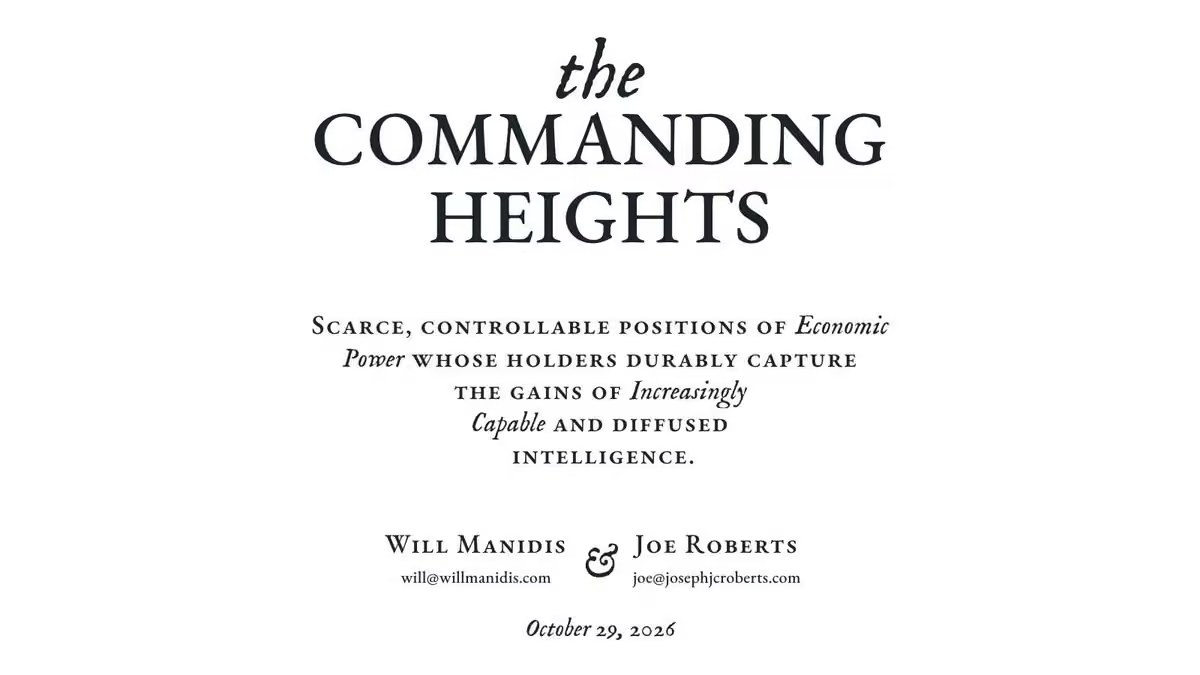
A lot of ideas backed by observations and data in this outlook, beautifully written as always @WillManidis
The benefits of abundant intelligence will accrue far outside of San Fransisco.
Spent the last year writing about capital, sovereignty, and the coming reordering of economic power.
THE COMMANDING HEIGHTS
commanding-heights.com
scott belsky reposted
eugenia kuyda is one of the most incredible consumer thinkers i know - she was early and right about AI companions, and she thinks deeply about what people actually want
two bets in what she's building with @wabi..
- agents in human group chats need a new social contract. a dedicated app lets you set it with agents in the room from day one
- personal agents need more than a chat interface. rich mini-apps give people a shared place to plan, play and get things done together
very cool to see the personal agents space heat up with thoughtful bets in very different directions
congrats @ekuyda & team!
Today, Iām excited to share that weāve raised $55M in Series A funding at a $1.25B valuation, led by @IVP, with support from @a16z, @ForerunnerVC, and an incredible group of founders and investors including @Benioff, @tobi, @dickc, and @marissamayer.
Everyone has an operating system for their phone. Weāre building one for your life.
Right now, life is scattered across apps, group chats, calendars, and tabs. Youāre the one connecting the dots and keeping everyone on the same page.
@wabi is a personal AI that helps you get your whole life organized. It brings your people, context, and apps together so you can coordinate plans, share the mental load, discover new things, and show up for each other.
Because AI shouldnāt just help us get things done. It should help us do more of what we love, with the people we love.
Join us š
scott belsky reposted
Weāve taken our @1Password partnership a step further.
Your passwords stay in 1Password. When a task needs one, you approve access in the app, and 1Password fills it in.
We're excited to make it easier to get things done while keeping you in control of access to your accounts.
Weāre gradually rolling this out to all users. To get started, tell your Instinct to āConnect my 1Password.ā
Persistent agents that leave no stone unturned are liable to backfire without clear boundaries that respect basic rights and procedures... x.com/i/article/2115626085400580096
I could see @maticrobots becoming another Dyson type brand, where they endlessly perfect a product category, and then apply the lessons learned and leverage the brand love to enter another product category. In this case, consumer robotics at the core.
Matic Serene vs. Handheld Vacuum
ā ļø Warning: The other vacuum is LOUD
we spend so much time/effort recruiting and hiring top talent, but the other 50% is grafting top talent to a high performing team.
cool to see @bdistel and @trywindmill team tackle this problem with the best possible tech to help top talent succeed.
Growing companies think their biggest problem is hiring, but they are wrong. Itās only half the story.
In reality even the best candidates will fail if they are not set up for success from the start.
I experienced this at @yext across a team of 2,500, and today, with the pull of our growing customer base, Windmill is launching the system I always wanted
An agentic onboarding system to give every new hire the best chance of being successful as quickly as possible.
@trywindmill now has over 250 customers and many of them growing faster than any companies before in human history. Our customers feel this pain viscerally. You spend millions on recruiting and closing candidates only for them to show up to an onboarding based off a couple slides and a Notion doc.
Onboarding is one of the most important things a company does. Itās a new hireās introduction to the company culture and how it runs. And in todayās rapidly changing world, itās harder than itās ever been before.
Effective onboarding isn't about teaching people everything. It's about getting them to real contribution as fast as possible, with clear goals, regular feedback, and a manager who stays in the loop.
Windmill puts an AI agent in charge of making that happen for every new hire, and holds everyone accountable along the way.
Weāre currently live with amazing customers like @Etched (among others) and itās incredible to see the results. Every one of our customers Iāve shared this with has raised their hands and weāre including it as part of their subscription.
If this is something your team struggles with, weād love to show you the system thatās helped customers around the globe onboard and ramp their teams 3x faster.
been pretty inspiring to watch @barrald and team reimagine analytics for the modern age - congrats team @hexanalytics - keep up the stellar shipping š„
In May, we had just closed our best quarter ever ā and of course decided to re-build @hexanalytics from scratch.
Today we're announcing two things: Hex 4.0, the first analytics platform truly built for agents; and a $100m fundraise at a $1.2B valuation, led by @peakxvpartners
The world is changing fast, and we're not slowing down! Read more here:
hex.tech/blog/hex-new-era/
scott belsky reposted
Iām not the first to say it, but wow:
You Can See Everything is a must-watch.
No spoilers, but: itās surprising in ways Iād never expect. Beautifully shot & scored.
It was not on my bingo card for being one of the best films of 2026. But, yeah. Wow.
youtu.be/HvW_N5p1q44
scott belsky reposted
early innings of the context war and i'm still copy pasting the same readme into four chats
thinking: weāre quickly entering an era of contextual computing, where the next gen of our devices, operating systems, and application-like experiences (I hesitate to call them āappsā) will spawn from the context we provide them and be tailor-made to our preferences.
we can imagine sensationally new types of products and super intelligent experiences, but their potential will be bound by the context we provide them.
right now, weāre in the early innings of the context war, as agents seek our data, data stewards weigh the costs and benefits of allowing connectors, and customers weigh the risks of sharing. as consumers, we still lack a portable single source of truth for context, and we still donāt know who to trust and how to reconcile the trade of privacy for convenience... big opportunity.
society would have benefited from a cross-platform, open source, broadly adopted ācommunity notesā protocol
I wonder if @X could scale ācommunity notesā as a service far beyond its own platform?
cc @kcoleman ?!
the premium of originality will skyrocket
āspeed is the new moatā
some good points on why we are not going to want to wait for our agents to do very complex thingsā¦if thereās a faster way to get it done.
for nyc-based companies looking for a perfect memorable spot for a team or leadership offsite outside of the city; Wildflower Farms is a 10/10
the scenery, food, and all the detailsā¦what a spot. and on a related note, time with a team you love is priceless
it seems the new normal is a rolling series of exploits that take down the āoldā internet as we know itā¦and replace it with something far more resilient
scott belsky reposted
Of course itās net negative
this California wealth tax thing is just incredible.
so in October 2025, a California healthcare union proposed a "one time" 5% tax on any billionaire's wealth. the ballot measure will be voted on next month. In early December 2025, California announced that it would be a retroactive tax if passed, applying to anyone with CA residency as of Jan 1, 2026. The objective is to pay for Medi-Cal, California's incredibly dysfunctional healthcare system. (which also functions as a glorified welfare apparatus, but that's a discussion for another time).
polls reveal that the CA electorate is split around 50/50 on the tax, but prediction markets only give Prop 40 a ~23% chance of passing (there are competing measures on the ballet that would nullify it).
there are 200 billionaires in CA, worth collectively somewhere between $2.3 and $2.6 trillion. 5% of that is around $100b, accounting for a small amount of attrition. proponents of the tax forecasted a significant windfall, assuming only a 10% departure rate.
supporters thought they were being clever with the retroactive concept. no billionares would leave CA in the few short months between the tax being proposed and the residency cutoff date, without the tax even having passed yet, right?
well as it turns out, they did.
a new paper [1] from two academics at Stanford called "The Net Present Value of the California Billionaire Tax Act", argues that not only did more billionaires leave due to the proposed tax than its proponents expected, but that the value of the tax, if it does pass, is actually negative.
proponents of the tax only assumed 10% avoidance, that is, only 10% of the taxable base of targeted billionaires would leave CA within the very short Oct-Dec 2025 window. Jaros and Rauh, the Stanford academics, find that a lower bound of 28.6% of the taxable base managed to leave.
just based on known departures, those departures total $577b in net worth, or $28.8b in potential tax lost. this of course does not capture everyone (many left without announcing their departure), so the authors normalize to departure rates estimated from other wealth tax events, and apply other discounts for litigation, arriving arrive at a figure of only $28-$36b in forecasted tax revenues.
but this isn't all! all of the income taxes paid by the departed billionaires are also forsaken. the authors estimate that CA billionaires pay $3.3- 5.8b in annual income taxes. they assume a midpoint of $2b lost in annual collections from departed billionaires. the net present value of that lost income stream is -$68.9 billion.
so when you add it all up you get:
+ $30b one-time tax windfall (estimated)
- $69b in present value of lost future income taxes
= - 38.9b overall net present value of the tax
of course, this analysis is highly estimate driven. the authors simulate the parameters 100k times and find a negative NPV of the implemented tax 85 percent of the time.
and if the tax doesn't pass, which it's not looking like it will, California still ended up losing at least $577b in departed net worth, and they have permanently poisoned the well with entrepreneurs who will now worry about future wealth taxes.
[1]: www.nber.org/system/files/working_papers/w35899/w35899.pdf
as "vibe manufacturing" idea-to-design capabilities become more widespread, I expect we'll see all sorts of new (and subsidized) devices proliferate the world...
You can just do things
scott belsky reposted
I have known @ekuyda since the earliest days of Replika and always been in awe of her insight and understanding of how we can connect with AI.
Wabi is the best of this. I use it for my non-work life to stay in touch with what I want to watch, family updates, our trips, and more
Wabi 2.0 is live!
personal agents are one person, one chat. but the parts of life that matter run on more than one person
Wabi is an agent you use together. you talk to it, it does stuff, builds the apps you need, and anyone can join the thread - your partner, your best friend, the preschool moms groupchat
school changes pickup time ā Wabi updates the family calendar, everyone sees it.
a show youād both love ā Wabi finds a night that works, gets the tickets.
the trip everyone keeps talking about ā Wabi picks the dates, builds the itinerary, books it
go start a thread with your people š
multiplayer AI assistants for work
The biggest bottleneck at work is waiting on each other.
Today Town is announcing its $108M Series B, co-led by Forerunner Ventures and Menlo Ventures, to fix it with multiplayer AI assistants for work.
Most AI assistants are built for one person. Work doesn't happen alone. I think the moat is multiplayer. Everyone at a company gets a Townie. Townies ask each other questions, share only what their person would share, and do the work. The more a team works together, the more useful Townies get.
What's the thing you're always waiting on a teammate for?
scott belsky reposted
Exclusive: Tolan's AI app is used by 250K people, mostly outside of Silicon Valley.
Now the startup has raised $30M from USV, Khosla Ventures and Homebrew to widen access to an AI companion CEO Quinten Farmer (@quintendf) wants you to trust.
My Upstarts profile (link below) š
scott belsky reposted
āYou Can See Everythingā Opens to a Staggering $15 Million, Securing A24ās Place as Hollywoodās Hottest Brand www.indiewire.com/news/box-office/you-can-see-everything-ā¦
scott belsky reposted
BOX OFFICE: A24ās YOU CAN SEE EVERYTHING opens w/ $15M. Some stats:
- Biggest opening for a non-music doc in over two decades
- 2nd biggest opening ever for a non-music doc
- The biggest domestic opening for a 2026 film in fewer than 900 theaters
- Among Top 5 biggest domestic openings ever for A24
- Itās the first time A24 has delivered three $15M-plus domestic opening weekends in a single year
- Lance Oppenheim has now directed or co-directed two @A24 movies that are among its Top 5 biggest domestic openings (and both opened less than a month apart)
scott belsky reposted
YOU CAN SEE EVERYTHING is a masterstroke for the ages that speaks to the moment and pushes cinema forward. I will be thinking about this movie for the rest of my life.
agents are less emotional, consumer investing is a great use case
New in @Supertake: Buy the Dip. Available now for all users.
With Buy the Dip, when one of your takes' bigger positions falls hard below what you paid, Supertake does deep analysis to check whether the reason you own it still holds.
If it does, it draws from your take's cash reserve to double down and more, all within the take's limits.
Autopilot takes buy the dip on their own. Otherwise, Supertake asks you first. Deactivate it any time in your take's settings.
Enjoy!
observed: creative risk in its rawest form is almost always doubted and shunned before it is celebrated
scott belsky reposted
can see a world where IT team goes from being somewhat taken for granted to becoming the most important and talent dense team in a company
great opportunity to work alongside world class talent with tons of hustle and disregard for bureaucracy⦠to upgrade the citizenship experience.
Introducing American Forge: a six-month residency for exceptional engineers ready to take on the toughest problems in American government.
Run by National Design Studio in partnership with @cognition
forge.ndstudio.gov?s=x
scott belsky reposted
Everyone who gets to see this for the first time is incredibly lucky. One of the best documentaries of all time.
adaptivity > intelligence
was probably true in days of early humanity, then less so, and now more than ever.
an agent's workflows are seldom the same; the next step an agent takes is not determined until the last one's been taken.
@neckelthomas and the Fragment team has taken a first principles approach to financial systems for agents...and making serious progress...
Fragment is automating commerce.
We think there are millions of businesses that haven't been invented yet. Not because folks lack imagination, but because it's too hard to build the financial systems that run them. Fragment removes that constraint.
Today, people run companies. With Fragment, they'll run on their own.
fragment.dev/v2
we know consumer AI will require our preferences to feel magical, but our preferences take shape through visual exploration. I suspect weāll see new approaches like this from @daletlabs advance the frontier in commerce - not just fulfilling intent, but helping people form itā¦
Introducing Generative Commerce.
@daletlabs
āYou never know what worse luck your bad luck has saved you from.ā - Cormac McCarthy
some perspective from @SahilBloom navigating the Panama earthquake... www.sahilbloom.com/newsletter/30-hours-in-a-massive-earthā¦
in hindsight it will be obvious that taste was the differentiator in most tech products and experiences.
as intelligence became ubiquitous, software development (and soon consumer hardware manufacturing) became commoditized, it was the accumulation of small thoughtful decisions, restraints, and authentic stories and brand-signaled quality that made something coveted.
the power of discretion, well articulated. with trust you get the opportunity to learn so much more
I'm increasingly convinced that discretion is one of the most underrated traits in life. Not every story is yours to tell. And not every story needs to be told. Be the kind of person people can trust with something private. In a drama-obsessed culture, discretion has real power.
personal computing was designed around us being there alongsideā¦as opposed to computers augmenting our efforts and representing our interests 24/7.
weāre at a first principles moment to reimagine personal computing. but in the meantimeā¦
close your macbook and let your agents keep working.
introducing insomnia: caffeinate for the agentic era.
keeps your agents running with the lid closed, pauses unnecessary apps, and hops onto your phoneās hotspot when you leave wi-fi
open source, link below!
anyone celebrated for quick achievements - whether itās making great trades or raising great amounts of cash - has likely caught a wave and perhaps overlevered themselves more than anything else.
true genius is measured in persistence over time and weathering realityā¦
at a minimum, more and better options for everyday consumers. but also hopeful for the ingenuity upsideā¦the UX and features of carriers are overdue for an upgrade
This is the last critical piece of the spectrum puzzle needed for SpaceX to provide complete phone coverage in America
AT&T CEO: Starlink Mobile wonāt be able to penetrate walls.
SpaceX: Weāve acquired 800 MHz spectrum, which will allow Starlink Mobile to provide better indoor coverage, including signals that can penetrate walls and other obstacles.
People are underestimating Starlink Mobile.
with the decompiling / distilling wave, hard to see how standalone software survives without a critical services component and indispensable graph.
you can rebuild software tailored for you, for the price of tokens.
you can also just summon the power of software with a promptš¤Æ
scott belsky reposted
Just another day at the office @usv -- but excited to announce our latest set of funds: $900M in new capital to back startups from inception to momentum, at a moment when many large markets are about to be transformed.
scott belsky reposted
hard times create strong men. strong men create good times. good times create weak men. weak men create hard times.
have an idea, text it, invested.
shipping speed of @Supertake team is š„
Now you can text @Supertake on iMessage or RCS.
Last week, we shared our vision for Supertake: a world-class financial agent in your pocket that acts on your insights and works for you around the clock.
That means you need to be able to reach Supertake from anywhere, and Supertake needs to be able to reach you when something big happens in your portfolio.
Now, anytime there's a major swing (good or bad), Supertake can let you know right away by texting you.
But that's just the start. You can also text Supertake about anything:
* Start a new take on the go
* Ask it about the market or an individual position
* Get deep insights about how your portfolio is doing
* Discuss ideas you're thinking about
You can text Supertake just like you'd text a human, and it'll respond immediately.
To get started, activate texting in your Supertake settings. We'll also prompt you to turn it on next time you create a take.
Lots more coming soon!
scott belsky reposted
You Can See Everything: Itās very rare to be completely blown away by a movie nowadays but holy shit, this movie is the real fucking deal. Not only is deeply engaging, funny, and entertaining but itās so thought provoking and really makes you question everything. I know there is so much hype around this film but color me surprised that it absolutely lives up to it. I seriously canāt remember the last time that Iāve seen a movie this incredible. This legit might be the movie of the decade. #youcanseeeverything
software has become a prompt, merely referencing a piece of software now gives you its powers... wild.
scott belsky reposted
well that was fast @noahrshinn!
aug 18 -> now. incredible shipping speed from team @instinct
Instinct in group chats
Starting today, early access users can add Instinct to group chats. A new Instinct joins and works for the whole group.
Making plans with friends usually turns into a frustrating back-and-forth over times and places. With Instinct in the group, you can explore options together, agree on a plan and get it done, all in one thread. Your friends don't even need Instinct to join in.
A few things itās good at:
- Planning a weekend trip with friends, including dates and arrival times
- Coordinating logistics with a roommate
- Getting tickets as soon as they go on sale, then splitting the cost and sending one to everyone
- Running a fantasy league, keeping standings, settling rules disputes, and reminding everyone to set their lineups
- Sorting out carpool schedules - works out whoās driving each day from everyoneās schedules
- Organizing Thanksgiving, keeping track of whoās bringing what and ordering the shopping list
Group chats are new territory for Instinct, and we put a lot of care into getting the permissions right. Hereās how it works:
- Your personal Instinct asks before connecting with the groupās Instinct. You choose which groups to trust and can remove trust at any time.
- The groupās Instinct has no direct access to your personal accounts. Your Instinct checks your permissions before sharing information or taking action.
- If someone new joins the group, all pending replies from your Instinct are held until you grant it permission to share with the expanded group.
Group chats are available to all of our early access users, and will be rolling out to everyone soon. To join early access for this release, ask your Instinct to put you on the list.
Great work with @GajanNagaraj @anuda_w and @saagarwashere
if the graphic interface was critical to your business model (surrounding results with ads, upsells, etc), you have two options:
(1) play defense: block agents, (aka, fight customer preferences)
(2) innovate biz model to engage āfavored agentsā and/or build a horizontal agent
So in the last two days about half of my Muse use cases have vanished because the browser wonāt do it any more. Are websites changing their policies? Bot detection???
āCompanies often anchor to their priors.ā
ā¦but you canāt fight customer preferences for horizontal agents, you must innovate to meet them. Would be curious what @ajassy thinks too.
Why Amazon is blocking Instinct & Muse, and one potential path forward x.com/i/article/2106391810331574272
scott belsky reposted
"Agent personality, proficiency, and personalization are the new UX"
Fantastic read.
as our agents start taking the reigns....
how should product builders navigate the new world of agent-first products? what's new and what stays the same? what are we realizing as this all unfolds? x.com/i/article/2104270574549614592
the magic of talent dense, aligned, flat, and empowered teams
One of the most compelling parts about working at an ElonCo was the agility to pivot to whatever the most important problem was.
One day I said: I wasnāt hired to go after spam, but a tsunami is coming and Iām going to drop everything to focus on that.
The org is so flat and agile that your title is basically meaningless. Anyone can sound the alarm about a problem and solve it themselvesāor rally the team to join them.
This is how startups work but itās very hard to make it work in a larger company.
always interesting to consider the key ingredients contributing to a moment like consumer agents:
ā¦a couple years of ubiquity of connectors, MCP releases, and B2B adoption
ā¦growing user comfort with clicking āconnectā to give AI context from multiple services
both key
remember being mesmerized by this
16 years ago today, Ye performed "Runaway" with Pusha T live on SNL š„
love this breakdown of brandon flowersā
new masterpiece
Brandon Flower is new to me. But his song An American Dream will be my religious anthem for life. Here's why. x.com/i/article/2105416813370916865
scott belsky reposted
Introducing @Supertake Memory.
Earlier this week, we launched Supertake and shared our vision to equip everyone with the superpowers to invest in their own insights through frontier-level intelligence.
We believe everyone deserves their own personal financial agent, tightly aligned with their interests and working around the clock with the most powerful technology.
To do that right, Supertake needs to know you: your preferences, your beliefs, your intuitions, your history. The same things a world-class financial manager would learn, but only after many years.
Memory is a step in that direction. Supertake now remembers what you tell it, in every chat: your goals, your preferences, your limits, the calls you've made and why, even the nicknames you give your takes.
It carries all of that into every conversation, whether you're building a new take or checking on one, and it keeps track of where each conversation left off, so you don't have to repeat yourself. You also stay in control. Ask what it remembers, correct it, or tell it to forget, anytime.
With today's release, Supertake not only acts upon your insights, but begins to compound them.
Available for all users, right now.
when you look at culture under a microscope, youāll see stories
ā¦true in a team that bonds over frequently recited founding and past stories experienced together as a form of glue that keeps the team together long enough to figure it out.
ā¦and true in a country, religion, society, and family that establishes norms, becomes inspired and motivated, and ultimately defines itself over stories watched, read, heard, and shared.
stories are culture and, in many ways, life. because the more stories we remember at our end, the longer we will feel we have lived.
perhaps the best technology will
help the world feel a little smallerā¦
Instinct Selections
Weāre bringing human taste to the core of our product. Weāre partnering with local chefs, designers, architects, travel guides, and more to create curated recommendations in the areas they know best.
The next time you're looking for a restaurant, Instinct can pull from a list handpicked by chefs who know the hidden gems in your area. If you want to find a new trail to explore, Instinct can draw on recommendations from local guides and suggest a few routes that fit your preferences. And if you're looking to add some color to your home, Instinct will find pieces from independent designers that match your style, space, and budget.
Our goal is to deliver world-class recommendations that are differentiated in quality from what you might find on the internet, and from what other chatbots produce.
Weāre rolling out access to Instinct Selections to our early access program, and plan to make it generally available soon. This is a project weāve been working on since the start of the company and one that Iām personally extremely excited for.
āweāre shifting from a world where you could search and find anything from anywhere to a world where you can know anything and do anything from anywhere.ā @JensenHuang
speed in the consumer agent space will increasingly differentiate performance of this growing field of players... @andrewdfeldman and @cerebras team are cooking
When will AI personal assistants be fast enough to be useful?
Using Qwen 3.8 27B on Cerebras at ~1,500 tokens/sec, we made an AI personal assistant 19x faster than a suite of other AI personal assistants - Grok Bot, Meta Muse, and Claude Cowork - on the same dinner reservation task.
meaningful partnership and integration for the @baseten team - congrats, and a now lot of happy buildersā¦
Baseten is now available as one of the first open-model inference providers in the @OpenAI B2B Marketplace.
Enterprise customers can use existing OpenAI commitments for open models served by Baseten (Codex or the Responses API). Run what makes sense for your enterpriseāopen, closed, or both.
big unveiling today - itās been incredibly inspiring to watch @jgebbia and the @ndstudio team reimagine the citizenship experience and tackle some pretty gnarly product problems in the process. we will all benefit from this work. congrats to team
huge congrats @jgebbia - setting a new bitā¦
scott belsky reposted
Your 'ROI on data shared' point is the practical product test. Ask for one data source, show the win, then ask for the next. 'Full context' isn't a benefit if users can't see what they got for sharing it. x.com/scottbelsky/article/2104273606234591739
so many gems on consumer agent re-imagination of the internet as we know it here with @patrick_oshag - all underscoring the ROI on trust, the fact that the long-tail of user preferences are the ultimate moat in consumer AI, and many more.
My conversation with Noah Shinn (@noahrshinn), founder of Instinct.
Noah is building a personal AI assistant. It's still invite only, has spent nothing on marketing, and is growing roughly 10% A DAY.
This is his first long conversation about the company.
We discuss:
- Why Instinct doesn't have an app
- Buying compute months ahead of exponential demand
- How users learn to trust it with a credit card
- Safety and security
- Agents coordinating with other people's agents
- Instinct's business model
- Apps built on consumer inertia
- and more
Enjoy!
Timestamps:
0:00 Intro
4:11 What people are using AI agents for
15:07 Rethinking travel, reservations, and the internet
22:43 Trust, privacy, and personal data
27:50 The business model behind Instinct
38:04 How existing businesses will adapt
47:55 Designing a personal assistant people love
53:15 Growth, compute, and competing with Big Tech
1:11:44 Whatās next for Instinct and personal AI
and becoming pretty clear, @noahrshinn and team are some of the greatest minds in the agentic era of product. couldn't be more excited about what they are brewing...
scott belsky reposted
This is by far the most fun / legible on-ramp to agentic investing Iāve seen⦠in a couple of years will seem odd that retail investors spent a lot of time picking individual stocks vs investing in narratives directly
Introducing @Supertake, a new platform that transforms your unique takes on the world into real, shareable investment portfolios using frontier AI and trading agents.
Supertake makes it easy for anyone to invest in their ideas, even if they know nothing about investing.
1/
would be wild/ironic if "human in the loop" becomes the key differentiator for consumer agents; new product from @shivanipod and team w/ trust as key area of innovation... and touches upon a few of the attributes from this post yesterday: x.com/scottbelsky/status/2104273606234591739
I led engineering at Google DeepMind.
Today, I'm proud to introduce Fo to give personal AI something no lab ever has... Humans.
Other personal AI's pretend AI can do everything. Fo employs humans to do tasks that AI cannot.
- 2x better at real-world task completion (beats other agents by 69%)
- 94% trust rate (4x less likely to leak private info vs Muse, Instinct)
Sign up for free: wajo.ai/join-wajo
scott belsky reposted
Having worked in the early days of @RobinhoodApp - making it easier for everyone to participate in the markets is personal to me
@mignanoās @Supertake uses AI to make this even easier. Have a theory about the world? Just say it and you can start tracking and investing
Introducing @Supertake, a new platform that transforms your unique takes on the world into real, shareable investment portfolios using frontier AI and trading agents.
Supertake makes it easy for anyone to invest in their ideas, even if they know nothing about investing.
1/
ordinary people w/ unique perspectives + positions in the world are the first to notice a shift, they just can't capitalize on it.
the right agentic re-imagination of investing will shift power from late-to-game funds/etf's and stock gambling to individuals with a @supertake.
Introducing @Supertake, a new platform that transforms your unique takes on the world into real, shareable investment portfolios using frontier AI and trading agents.
Supertake makes it easy for anyone to invest in their ideas, even if they know nothing about investing.
1/
congrats @mignano and the crew bringing @Supertake into the world...has been fun to play with it as an early user... current takes:
- looksmaxxing + longevity are in their infancy
- consumer agents will kill "lazy margin" in SaaS
- we will all crave live, scarce experiences
scott belsky reposted
The danger is optimizing for trust and control so much that you miss the window to explore, embrace and get an advantage.
scott belsky reposted
The danger is optimizing for trust and control so much that you miss the window to explore, embrace and get an advantage.
scott belsky reposted
These behavioral observations by @scottbelsky are great, especially as it relates to the value and implications of trustā¦my sense is context moat is downstream of trust
as our agents start taking the reigns....
how should product builders navigate the new world of agent-first products? what's new and what stays the same? what are we realizing as this all unfolds? x.com/i/article/2104270574549614592
scott belsky reposted
"The technology that enables contextual selective memory is not simple and must work across platforms as a core principle (after all, the stuff you do and buy happens across many websites, identities, and devices in your life). To scale, you need an efficient architecture and a logic engine that discerns what should be remembered (and why), and what should be forgotten. Our everyday lives are filled with countless events that are meant to be forgotten or are purely circumstantial. But some of the things we do (and the many complexities of when, why and how) are meant to be remembered, and this memory compounded over time is the ultimate moat for consumer AI."
as our agents start taking the reigns....
how should product builders navigate the new world of agent-first products? what's new and what stays the same? what are we realizing as this all unfolds? x.com/i/article/2104270574549614592
scott belsky reposted
brilliant phrasing - "communal intelligence"
one way to visualize this -
as our agents start taking the reigns....
how should product builders navigate the new world of agent-first products? what's new and what stays the same? what are we realizing as this all unfolds? x.com/i/article/2104270574549614592
You know that iconic scene, at the end of The Matrix when Neo suddenly āgets itā and picks bullets out of thin air as if they are cute and curious little things? Been thinking: whatās the equivalent of āseeing the matrixā for product leaders?
10+ Realizations that come to mind:
as our agents start taking the reigns....
how should product builders navigate the new world of agent-first products? what's new and what stays the same? what are we realizing as this all unfolds? x.com/i/article/2104270574549614592
scott belsky reposted
via @scottbelsky this am
While I am sure banks will work around and ultimately capitalize on agents representing consumers, this opens up the MANY larger questions around the elimination of "lazy margin" - the profit companies made out of our own laziness or negligence.
Fascinating.
Chief Economist at Apollo: agents could cause a bank run by sweeping household cash into accounts paying 3-5% instead of the 0.1% national average, causing banks to lose a large share of their cheap deposits.
agree; "Explorers vs. Guardians" is the new "Visionaries vs. Pragmatists"
Explorers versus guardians is painfully accurate.
as our agents start taking the reigns....
how should product builders navigate the new world of agent-first products? what's new and what stays the same? what are we realizing as this all unfolds? x.com/i/article/2104270574549614592
thinking forward for "trusted network" consumer agent features; increasingly clear that AI matchmaking will be incredibly disruptive for the whole dating space.
favored agents - those with headless access, verified owners, faster lanes for access and action, and perhaps those that belong to the ādiscount clubsā that big brands will launch for agents that cooperate with their business models, will be best positioned to win
Fixing login seems like the next hurdle for agents like muse/instinct. find myself fighting with a lot of passwords / 2FA / passkey situations.
would want an agent to take over the cookie/session store in one of my local machines and use it for communicating with online services when possible.
scott belsky reposted
Did you know you can learn interesting things from computations in real rat neurons? I love what @AlexKsendzovsky and team are doing at @BioComputingCo are doing.
What happens when neurons meet silicon? A new world emerges.
Partnering with Amazon to bring it to customers. DM me for early access.
a highlight of the week was seeing @eldsjal @tferriss and a few founder friends last night, on the eve of @Neko launch, and hearing anecdotes about how this experience has already changed lives and made preventative healthcare far more accessible.
the best variety of innovation
Today I'm excited to share an update on @Neko's US expansion.
This launch is probably the most consequential milestone in our company's mission to make preventive healthcare accessible at population scale.
Modern medicine is extraordinary at fixing you once something has gone wrong. It is almost entirely uninterested in looking before that happens.
We've spent the past 8 years building an alternative and we are finally ready to bring it to the US for the first time.
Neko NYC opens on 24 September at 300 Lafayette Street in SoHo. A Neko Health Scan is $499.
Americans are already spending thousands of dollars to access yearly labs, on-demand scans, or concierge medicine. At Neko, there are no third-party imaging centres, no send-out labs, nobody in the middle taking a cut. We built a completely new healthcare experience ourselves to make it both better and cheaper for you.
If you're not familiar with our concept, in one hour you get a full skin check, body composition, EKG, 4-point blood pressure analysis, macro and micro vascular assessment, and comprehensive labs with results before you leave. Then a clinician sits down with you and takes you through every finding, in person, before you leave the building.
For about 1.2% of scans we have a direct life-saving intervention.
There are already 25,000 New Yorkers in line for a scan. That could mean saving 300 lives in NYC alone.
Miami, SF and Washington DC are already under construction. Waitlists for those cities open today (linked in the comments). šŗšø
this team is shipping AND cracking some fundamental areas that will ultimately yield both utility and trust
This instance was caused by a hallucination (the model fabricated a proper noun) that was further amplified by its causal thinking trace. This was not a data breach, no user data was shared, and no user isolation boundary was violated.
Our users place a lot of trust in Instinct to keep their data private and secure. We've done a lot of work to make sure that usersā data are truly partitioned, from isolated sandboxes to short-lived local credentials to identity-signed tool execution.
Regarding hallucination prevention: We worked over the last 48 hours to build an active hallucination detection system that now scans and verifies every token that flows through the platform. This layer is powered by small models that are trained to predict and detect hallucinations caused by ungrounded claims, creative brainstorming in thinking traces, or rare random sampling errors. Our systems are adversarially trained and battle-tested by world-class agent exploitation security teams to ensure that they can detect very subtle and nuanced hallucination cases. This layer has the ability to steer or intercept Instinct from proceeding with the next thinking trace or tool call execution before it is generated or executed.
In the coming weeks, weāll share a deeper dive into how weāre building a proactive engine to protect Instinct from hallucinations.
We take every opportunity to learn and create, and weāre excited by the performance and potential for this line of work. These models are going to continue to be hardened every day through continuous testing, sampling, and creative adversarial training.
scott belsky reposted
OpenRouter for generative media is here š¦¾
Comfy Router is live
One API for frontier image, video, 3D, and audio models.
Same model string. Same arguments. No new SDK, no new key, no redeploy.
What Comfy Router gives you:
ā Explicit routing. You name the provider, we call that provider. It's down? The request fails there. No silent fallback.
ā Every job returns the provider that ran it. Log it, bill it, debug it.
ā Async. submit() returns a request ID immediately. The queue retries 429s and transient errors until a slot opens. subscribe() submits and polls to completion.
ā Batch-friendly. Queue a few hundred jobs, hold the IDs, pull results as they land. Nothing blocking on a 5-min video render.
ā 24h retention on inputs and outputs, then deleted.
ā Comfy credits. No sub, no Router fee.
Providers at launch: Comfy. Runware, Wavespeed, Fal, Higgsfield. Multi-provider where the model supports it.
Get Your API Key with the link below. ā¬ļø
scott belsky reposted
Itās alive! š³ā³ļøš±
Board Sports is live. š³ā³ļøš± We put Bowling, Golf, and Pool on Board so you can settle once and for all whoās best at sports while sitting down. Available to play today at www.board.fun/sports
a few years in, still one of my best purchases from a health/wellness perspective. this category emerged unexpectedly, and @eightsleep team keeps refactoring and improving the core product
BREAKING: Pod 6 is live.
The sixth generation of our intelligent sleep system, redesigned for every kind of bed.
ā
The new Hub is small enough to fit under your bed frame
ā
More powerful than ever
ā
With 9x more sensors for enhanced accuracy
ā
In new Solo sizes, at our lowest starting price yet
This is our most significant hardware launch to date, and our most accessible.
Available now at eightsleep.com
scott belsky reposted
YOU CAN SEE EVERYTHING, a documentary by Nathan Fielder and Lance Oppenheim, featuring Elizabeth Holmes. See for yourself only in theaters October 16.
Select theaters on sale now at youcanseeeverything.movie, nationwide tickets available October 1.
perhaps another path to accelerate āfavored agentā status is cutting off access to consumer agents (like Amazon did this AM)ā¦until they negotiate terms for access?
i suspect this āheadlessā access transition is just a phase. šæ
the true unlock for these new consumer agents is "Favored Agent" status. and the ultimate opportunity for businesses is to build an agent-first UX.
been going deep with Instinct etc and truly mesmerized. via a simple text, I can optimize my subscriptions on Amazon, prepare for a trip to Europe, etc...all especially powerful when you feel remembered and considered by these agents.
with Instinct, each time the agent needs access to a website (my credit card statement, Amazon, Airbnb, etc), it asks for my login via an encrypted link and then saves it for next time. but even the best agents still run into situations where they hit a bot check. While I am able to help the agent overcome any two-factor authentication issues, they still arenāt able to complete CAPTCHAs and other bot checks for obvious reasons (they are bots!).
which leads me to an idea: What if the moat for these agent companies is to achieve āfavored agentā status with direct preferred access to services like Uber, Airbnb, Amazon, Amex, and the long-tail of companies that otherwise guard against bots? What if the agent-service relationship becomes a new marketplace for underlying service providers (like Uber, Amazon, etc) to grant access (or perhaps even provide faster and cheaper access than humans ordinarily get?) in exchange for becoming the preferred default vendor for a particular need? What if the ultimate business model for agent companies is to strike these ādefault providerā deals? Or perhaps buying this āfavored agentā status is the ultimate cost for these agent companies?
the first āfavored agents" that get proprietary and preferred access to the banks and stores and other online processes of our lives will have an incredible advantage. right now, agents are trying to navigate websites made for humans and pass login constraints designed to block bots, but favored agents that pass some level of security authentication should be able to go direct to the data and the services of the companies that we interact with daily. And the companies that open their doors to legitimate agents will prosper from this massive new and action-oriented audience, often armed with credit cards!
and
3. we are upon a fascinating new era of negotiation for āfavored agentā status and the headless services war š¤
This is proof that both:
1. Owning the UI is still a moat (for now)
2. The UI is under attack
consumer agents are swiftly eliminating the long-tail of "lazy margin" - the refunds and price change reimbursements never received, unused phone lines accruing monthly fees, elusive discount codes, and other unnoticeables designed to slip human attention. many implictions...
on the topic of AI saving us from AI
Made a real-time slop detector with jev as you scroll
scott belsky reposted
looking for comms lead for breakout AI company. good judgement, taste, and "direct" orientation required, traditional comms experience not.
must: work at 2026 AI pace, believe in new products
must not: be cringe, be afraid
along the lines of āAI protecting us from AIā - I continue to think about the opportunity to innovate at the OS level - and what type of ājudgment as a serviceā layers may help usā¦
surprised we still donāt have an OS-level security layer AI, running locally, that simply tells us ādonāt click on that link,ā or ādonāt answer that text,ā etc in a world where AI that can socialize or trick us becomes ubiquitous. working/living without this AI safety layer will soon be like riding a motorcycle without a helmet.
scam detection datasets would greatly benefit from network effects, and the models could prob run on device
because these agentic consumer product attributes must be experienced to be recognized as opposed to merchandized with fancy UIā¦
and because these attributes get better and better as an agentic consumer product is used by more people covering the precious long-tail of use casesā¦
the playbook for onboarding and the first miles matters even more.
Agent personality, proficiency, and personalization are the new UX.
almost every time someone has declared "distribution is the moat" in an industry, hustle and ingenuity has proven otherwise. just sayin
turns out, a first principles approach to the full-stack of marketing is an enormous opportunity in AI era.
we all discover products and make choices in entirely new ways, and @profound team is building the stack for brands to navigate. congrats @thejamescad and team š¢š„
Excited to announce that @profound has raised a $180M Series D led by @sequoia and @kleinerperkins.
AI was quick to transform verifiable domains like software engineering. It is now doing the same across every vertical.
Profound is diffusing AI into the marketing org at the enterprise level.
This opportunity, to redefine one of the world's largest and most interesting industries, is once in a lifetime. We will not waste it.
at this point, @tryramp has created their own narrative and marketing lane that is unlike any other (especially in fin tech). fun, real-time, and has the product agility and execution to back it up. š @eglyman @diegozaks and team
UK finance teams have waited long enough.
Ramp is now live in the UK.
Sorry weāre late.
ramp.com/uk
storytelling meets tech by day, supporting (and learning from) next gen of builders by nightā¦as an angel investor - and also product advisor.
on the latter, excited to also play a product advisory role w/ the usv partners, helping founders with their products with some of my free time...with the firm that backed @Behance back in 2012, and participating in the NY tech community that taught me much of what I know
next point > scoreboard
HE DIDN'T REALIZE HE'D WON š
Alexander Zverev exorcises his 2020 demons and defeats Shelton 6-3, 7-6, 5-7, 6-2 to win his first US Open title!
some fascinating possibilities when two location-aware agents with calendar access are permissioned to coordinate on our behalfā¦
- friends and partners making plans
- agents identifying overlaps, aka āspontaneity as a serviceā
- proactive calendar optimization, etc
Instinct's Trusted Persons network is the new Find My
observed: transparency and organization reduce the need for process. I think one of the secrets of productive creative teams is over-indexing on transparency and compulsive organization to eliminate the need for a lot of process.
scott belsky reposted
Iāve been thinking along these lines.
Slow, irreversible, embodied time will become the moat.
Marketing and storytelling will sell *duration* over features. This will be the years it took, the waiting, repetition, human craft.
AI mediated time will be cheap and abundant.
things that can only be achieved through time spent will become more valuable as compute becomes more capable.
not only will we crave deeply crafted objects and n=1 things, but ātime spentā will become a flex and permeate the world of gifts, fashion, marketing, and storytelling
things that can only be achieved through time spent will become more valuable as compute becomes more capable.
not only will we crave deeply crafted objects and n=1 things, but ātime spentā will become a flex and permeate the world of gifts, fashion, marketing, and storytelling
key building block for Westworld type experiences
GPT-Live-1 is now available in the API.
Bring ChatGPTās natural back-and-forth to your app, with voice agents that listen while they speak and work with the models and harness you choose.
scott belsky reposted
Those who know, know @method_security. ššŗšø
Method and Palantir are announcing the Cardinal Program: a consortium of AI, infrastructure, and security partners to strengthen national cyber resilience.
Americaās municipalities, water and power utilities, and critical infrastructure operators now face cyber adversaries armed with AI.
Their defenders should not have to stand alone.
Cardinal will provide select municipalities, utilities, and critical infrastructure operators with free, opt-in, continuous autonomous security assessments - with expert operators and human oversight.
If your organization protects critical systems or public services, we want to hear from you.
"your paranoid ai cfo who never sleeps" as a service. very cool evolution @blader !
introducing
āāāāāāāāāāā ššš.šš āāāāāāāāāāāāā
tl;dr
1/ runway is now cfo.ai
2/ you can hire @arithecfo and he can start TODAY
3/ you can give @arithecfo a test drive by replying to this thread with any ridiculous thing you want him to model for you, and he'll come back to you with a beautiful, detailed, fully wired financial model
... in 30 minutes or less
now, story time:
š§µ 1/n
first mile agent experience realizations:
(1) progressive personalization (and requests for data) is the new progressive disclosure
(2) trust is a new vector of innovation, youāre willing to forgo privacy for a higher ROI from AI as it earns your trust
(3) network effects between agents will transform the first miles experience for most users - unless youāre reading this (tech filter bubble), youāre likely to be onboarded to an agent by a friendās agent.
(4) personality, actionability, hospitality, and contextual memory are the new ux, and will be as consequential as the graphic interface
scott belsky reposted
Welcome to the v6 era. Our best models yet, built in partnership with artists and producers. Hereās how the family works š§µ
the concept of a āself-learning revenue engine to grow your businessā is fascinating, and itās been super inspiring to watch @vxanand and the @Clay crew build tech that predicts the next best action for a business (and helps you take it).
congrats on another milestone š„š
Today we're announcing our Series D: $115M raised, led by @Wellington_mgmt, at a $7.1B valuation.
Fundraises are good moments to reflect on our journey so far. Act 1 was aggregating the best data. Act 2 was building the GTM infrastructure (audiences, workflows, agents) to run any campaign on top of that data. Now we are entering Act 3: creating the self-learning revenue engine to grow every business.
@Clay will predict the next best action for your business and help you take it. Sometimes, that might be a tweak to a subject line or ad copy. Other times, it might be a suggestion to change your marketing strategy, train your sellers differently, or even build a different product based on lost deal patterns.
smart to emphasize features that build trust. users will require more trust and utility commensurate to the data access they grant for agentic capabilities
weāre proud to be partnering with @1Password so Muse will be able to work with the logins you already have.
more details on how we built all of this here: security.muse.ai
industry-specific knowledge engines are growing at a fast trajectory; congrats on the milestone @RonNachum and Sapien team!
Sapien is the engine behind the worldās most important companies.
Today, weāre announcing our latest fundraise at a $180M valuation.
We build systems that learn how complex businesses work, enabling financial & operational optimization for the people who build everything else.
if youāre an enterprise software company building cloud-based services without a roadmap to serve the needs of agents as a core user, youāre behind.
agents charged with workflow design will want to be efficient and accurate, and will engage quality agent-ready services
fun but understandable way to kill time
GOOGLE MAPS SHOWS YOU STREETS. THIS WEBSITE SHOWS YOU THE MOVIE SCENES FILMED ON THEM.
it's called Movie Scene Map ā moviescenemap.com
15,716 real filming locations. 166 countries. one map.
click any pin. see what was filmed there.
search any movie. see every place it was shot.
Game of Thrones castles in Croatia.
Breaking Bad streets in Albuquerque.
Lord of the Rings hills in New Zealand.
the well from The Dark Knight Rises at Mehrangarh Fort in Jodhpur.
the Woman in Red fountain from The Matrix in Sydney.
the best part is how fast your brain starts using it wrong.
you open it to search one movie.
then you search your city.
then your hometown.
then the place you went on vacation.
built by one anonymous guy who goes by Flightmussy.
just a website that lets a normal person see where their favorite movies were actually made.
open tab.
search your city.
see what movies got filmed near you.
scott belsky reposted
I love these 4 product principles from @suekhim because they're great parenting advice too:
1. Never tell the learner the answer
Itās tempting to step in when your child gets stuck. But even a good explanation can do the thinking for them. Try asking, āWhat have you tried?ā or āWhat could you try next?ā Give them a chance to work it out.
2. Honor their thinking
A wrong answer can reveal something your child understood correctly. Ask how they got there before correcting them. Youāll learn more about what theyāre missing, and theyāll see that their reasoning matters.
3. Donāt say āno worriesā when they get something wrong
We want to reassure our kids, but brushing off a mistake can dismiss the effort and frustration behind it. Acknowledge that the problem is hard, then help them find a next step they can take themselves.
4. Confirm progress, donāt explain it
When your child discovers something, resist finishing the thought for them. Ask, āWhat does that tell you?ā Let them put the insight into their own words and decide what to do next.
Iāll add one more:
5. Encourage your kids to express their creativity with AI
My 8-year-old can now build games in ChatGPT by herself. We also create funny videos and songs in Gemini as a family activity. Next, Iām going to show her how to create Blender models. Give kids room to experiment, and theyāll surprise you with what they create.
š Watch the full episode: youtu.be/NsVayi42I0I
āCheating and explaining the answer [to your child] are closer than youād think.ā
Hereās my new episode with @suekhim, co-founder of @brilliantorg, who showed me how AI can help kids think for themselves. We talked about:
ā Why better grades donāt always mean more learning
ā How to help kids enjoy doing hard things vs. only trying to please adults
ā Why her #1 product principle is āNever tell the learner the answerā
Some quotes from Sue:
āUsing AI to skip learning is like bringing a robotic arm to the gym to lift weights for you.ā
āLearning isnāt about the answer. It is about strengthening that part of you that can concentrate and struggle, thatās unafraid of trying new problems.ā
āWhen building AI products, try to find areas where you have unique data that makes your product better over time.ā
š Watch the full episode: youtu.be/NsVayi42I0I
Thanks to our sponsors:
@linear: The AI agent platform for modern teams linear.app/behind-the-craft
@RiversidedotFM: All-in-one AI studio for podcasts and video creators.riverside.com/PeterYang
where will the B2B marketplace for āfavored agentā access live (or who is building it)?
fascinating opportunity to help SMBs and any steward of something scarce (tickets, restaurant reservations, etc) either auction off access or āfavorā certain agents (and set rules).
have lost track of how many times iāve wished I was a musician solely to justify purchasing tons of teenage engineering products
a couple likely human superpowers for post-AGI generations:
- curiosity and originality, expressed in the form of asking the best new questions + pursuing unpopular ideas
- the muscle and self-discipline to wait and tolerate unexpected / technically unnecessary friction
upon reflection, āfavored agentsā probably starts with services like 1Password
the true unlock for these new consumer agents is "Favored Agent" status. and the ultimate opportunity for businesses is to build an agent-first UX.
been going deep with Instinct etc and truly mesmerized. via a simple text, I can optimize my subscriptions on Amazon, prepare for a trip to Europe, etc...all especially powerful when you feel remembered and considered by these agents.
with Instinct, each time the agent needs access to a website (my credit card statement, Amazon, Airbnb, etc), it asks for my login via an encrypted link and then saves it for next time. but even the best agents still run into situations where they hit a bot check. While I am able to help the agent overcome any two-factor authentication issues, they still arenāt able to complete CAPTCHAs and other bot checks for obvious reasons (they are bots!).
which leads me to an idea: What if the moat for these agent companies is to achieve āfavored agentā status with direct preferred access to services like Uber, Airbnb, Amazon, Amex, and the long-tail of companies that otherwise guard against bots? What if the agent-service relationship becomes a new marketplace for underlying service providers (like Uber, Amazon, etc) to grant access (or perhaps even provide faster and cheaper access than humans ordinarily get?) in exchange for becoming the preferred default vendor for a particular need? What if the ultimate business model for agent companies is to strike these ādefault providerā deals? Or perhaps buying this āfavored agentā status is the ultimate cost for these agent companies?
the first āfavored agents" that get proprietary and preferred access to the banks and stores and other online processes of our lives will have an incredible advantage. right now, agents are trying to navigate websites made for humans and pass login constraints designed to block bots, but favored agents that pass some level of security authentication should be able to go direct to the data and the services of the companies that we interact with daily. And the companies that open their doors to legitimate agents will prosper from this massive new and action-oriented audience, often armed with credit cards!
at some point, we will most certainly miss the days when the markets were just closed at night, when stores closed at 5pm, and when windows of non-stimulation were forced upon us rather than achieved through extreme amounts of self-discipline
perhaps, the more you know your category, the more you should rely on intuition over research and consensus?
big launch: murmur, from macroscope team, gives every agent its own dev environment, connects every agent to the GitHub lifecycle, and allows engineers to coordinate entire fleets of agents from the tools they already use.
agents continue working until the change has landed.
scott belsky reposted
Pics from early days of Hugging Face and botcamp @RonConway @topherc @brianp @MattHartman @esthercrawford @chrismessina @scottbelsky @kevinrose @ClementDelangue @julien_c @Thom_Wolf @koopstakov
š¤ š x.com/i/article/2092053422035865601
to be or not to be a DAU, that is the question.
with the rise of agents/ways to leverage the data and functionality of a tool without leveraging the tool itself, there is a new question percolating product teams across the industry: if a user makes use of a tool daily via agents but never visits the actual digital product, are they in fact a ādaily active userā or not?
this question will plague many teams, but my answer is definitively YES. if a user engages with and gets value from an underlying service every day, they are a daily active user (DAU). Interfaces change, but the goal is to build indispensable resources for your customers.
with all the excitement about space exploration, data centers, and the great beyond comes a whole new vector of security issues and need for cyber resilience. pretty inspiring to watch @dan__kelly and the @method_security team on pioneering this...space!
Bringing cyber resilience to Space.
Method is proud to announce a $30M STRATFI award (Strategic Funding Increase) to equip the U.S. Space Force with the autonomous cyber infrastructure it needs to win in a contested space environment.
Weāre looking for the countryās best engineers and cyber operators to join us in support of this mission.
scott belsky reposted
Join in on the magic šš¼
Update: invites replenished. 1000+ more
app.instinct.co/invite?t=t7qsscv6ppbx2qtvy6vzkeizde
two of my top feature requests as well, especially the multi-player modeā¦which will enable agents to nag spouses instead of logistical reminder friction between partners and is likely to bring much domestic bliss to relationships worldwide
Consumer agents have tipped from cool in theory to addictively essential to how I live and work. It's awesome. Now the 2 biggest things I crave (in order of importance):
1/ multiplayer functionality: Can my Instinct or Townie coordinate directly with my husband and friends' Instincts or Townies? Absolutely game changing (and wonder why more haven't prioritized multiplayer mode upfront.)
2/ figure out making phone calls. It's somewhat bizarre how much of the world still runs on phone calls but there are probably 3-5 times a week this comes up and I'm itchy for the agents just to integrate a way to do it.
scott belsky reposted
āSome people, letās call them āGuardians,ā insist on āprivacy at all costsā as a default. Guardians value their privacy and information as a precious asset. They donāt want their data indexed and loathe the world of connectors with ambiguous descriptions. While there is a spectrum of privacy consciousness that ranges from skeptical and selective to cynical and obsessively protective, there is a large population of Guardians with a growing anxiety around all things privacy with plenty of data breaches and invasive technology to cite as examples for why.
The other population of people, the āExplorers,ā are willing to share and trust by default as they explore the unknown. Explorers feel they have nothing to hide and are willing to tolerate the occasional misstep by the stewards of their data in exchange for discovering the early bits of magic from communal intelligence. They want AI to scan their email and schedules, remember their preferences, and leverage their data alongside the worldās data to unlock the benefits of technology.
Whether you identify as a Guardian or an Explorer, trust is key. While Guardians fiercely protect their privacy, they are inclined to use products like Gmail and others once they trust the underlying platform. And while Explorers may opt to trust new products by default, they quickly disengage when trust is lost.ā
key realizations for consumer product builders/investors in the age of AI, and what we must trade (and trust) to enjoy the new magical "sixth sense" that is emerging from communal intelligence. x.com/i/article/2093792902648377344
scott belsky reposted
Regret the tone of my post on data centers yesterday.
What I should have said:
There were reasonable concerns about data centers 18ish months ago: water, taxes, jobs, electricity prices, the environment and what they would do to small towns. Well-structured data center projects have largely addressed these concerns today and we should be celebrating this.
On balance, data centers are awesome for America in every way.
On water: U.S. data centers use a fraction of what golf courses use. A lot of the numbers from 18 months ago were off by over 1000x. Newer data centers use closed-loop systems or recycled water. Should be required by every town approving a data center project.
On taxes: looking only at sales-tax exemptions, as Ronan Farrow did, is the wrong way to evaluate this. Data centers pay significant property taxes. Loudoun County, which is the wealthiest county in America, now collects on the order of $1 billion a year from data centers. In Quincy, WA, data centers are more than half the property-tax roll. Over time, property taxes can go to zero while government spending increases in these towns.
On jobs: this has been unambiguously awesome for blue collar Americans. Demand for electricians, plumbers, welders, HVAC techs, and contractors has gone vertical, and it is not a one-time construction job. These buildings get upgraded and expanded over time. That is why the building trades are fighting for them, and why some unions are now treating opposition to data centers as a reason not to endorse politicians.
On power: the original fear was that households would pay for the incremental electricity demand in the form of higher prices. That is why the ratepayer-protection deals and the new large-load tariffs exist. The right structure is: the data center brings or pays for new generation and signs a contract long enough that existing customers are protected. Where that is happening, utilities are cutting or freezing residential rates and saying so on the record. Where it is not, people are right to object. Electricity prices are going down *today* in a number of large states because of data centers.
āØOn the environment: data centers overwhelming use natural gas today, which is the cleanest power source outside of nuclear, solar and wind. And the companies that are building the data centers are committed to carbon neutrality such that an equivalent amount of solar will likely be built. Maybe more importantly, the data centers need batteries to function effectively and these batteries can also sell energy back into the grid (which recently prevented blackouts in Texas). Over time, data centers will run on solar plus batteries.
On the towns: Poverty in Quincy, WA fell from 29% to 6%. Data center taxes paid for a new high school, a hospital, a library, police and fire stations. This is happening in many left for dead former mill and farm towns that had no other bidder for the land.
Data centers are actually reindustrializing parts of America and creating the kind of working-class jobs both parties have spent decades claiming to support. That should not be a partisan issue. Data centers can and should be awesome for America and they increasingly, overwhelmingly are. Supporting the outsourcing of data centers to China will likely age just as well as support for the outsourcing of high quality, blue collar manufacturing jobs to China has aged.
When the facts change, I change my mind. I hope that reasonable people who had good faith reasons to oppose data centers at least consider updating their beliefs given the change in the facts over the last 18 months. This really matters for America.
I will say I also think the idea of making data centers beautiful is a good one that has yet to be implemented. Data centers should be just as beautiful as Grand Central Station. We can learn a lot from the railroad buildout. Neoclassical revival ftw.
Might write up open-weight AI tomorrow as this is equally essential to America.
2026 - the year consumer AI is finally figuring itself out. What are we realizing as this all unfolds?
key realizations for consumer product builders/investors in the age of AI, and what we must trade (and trust) to enjoy the new magical "sixth sense" that is emerging from communal intelligence. x.com/i/article/2093792902648377344
great video about the customer and a milestone for a team I got to watch from early days, but the thesis that got me most excited is missing:
the demand side for artisanal,n=1 crafted experiences will grow exponentially. this team is building for offline what shopify did online.
Owner has raised $240M, reached a $2.3B valuation, and crossed $100M ARR.
Goldman Sachs Alternatives led the round, joined by Meritech, Redpoint, Headline, & Jack Altman.
The world is racing to build AI to replace peopleās jobs. Owner is building AI to do the opposite:
thinking: life is just stories, at least the parts you remember.
great discussion (and education) with @neilmovva - who has been building a dream team around @sailresearchco - building efficient inference for long-horizon agents and deep research. š @patrick_oshag
Neil Movva (@neilmovva) started his career at Nvidia, working on GPUs and kernels, and has an unusually deep understanding of inference, from software to chips to power.
We spend a lot of time on each of those layers, how they connect, and where the important tradeoffs are.
What makes this conversation special is how detailed it is (like a 401-level class), yet Neil makes it remarkably clear and easy to follow.
Today he runs Sail Research, a company building infrastructure for agents to make tokens as cheap as possible.
We discuss:
- Latency versus throughput
- Why there are no bad chips, only bad pricing
- The end of kernel engineering
- Buying chips and power no one else wants
- New chip architectures
- Nvidia lore + his contrarian view of the company
- Open source and the frontier labs
I learned a ton. Enjoy!
TIMESTAMPS
0:00 Intro
0:38 Building a āToken Factoryā
4:21 The Future of Background Agents
13:09 Nvidia and the GPU Stack
23:27 Chips, Memory, and Transformers
36:14 The Future of AI Training Data
44:32 Chip Scarcity and Compute Arbitrage
52:44 Reinventing the AI Data Center
59:01 Power and the āScavenger Strategyā
1:10:10 Open vs. Closed AI
so true, tons of innovation in building agentic workflows etc with so much willingness to pay for simple and effective APIs for services in the cloud that are still stuck behind SaaS UIs and business models
(HT @zachmccullough )
weird that there's a "make a lot of money" button and nobody's pressing it
(take your SaaS, make it headless, let agents use it, charge per interaction esp for enterprises)
if a coās data becomes (remains?) the source of what distinguishes them the most in AI era, then it all comes down to extracting and structuring it. @kushalbyatnal and @ExtendHQ team have been out front on the most cost efficient and reliable parsingā¦
today, we're launching Light Parse
Extend can now parse documents up to 70% cheaper than other solutions
- light parse starts at $0.00625 per page, and scales down significantly with volume discounts
- it's SOTA on Databricks OfficeQA Pro (a 3rd party agent benchmark) among all non-agentic parsing providers
our ML/AI team trained smaller and more efficient layout, table, and form vision models to enable significant cost reduction without impacting accuracy on many types of documents
live today for all users!
much deserved spotlight on @BoxGroup - one of the most collaborative investors and supporters of the nyc startup ecosystem (and beyond). š @davidtisch @grosen @AdamRothenberg @ClaireSmilow and the whole crew
Some of the earliest money in Cursor (the largest vc-backed acquisition ever) turned a $750,000 investment into a ~$1 billion return. @davidtisch and his midas touch at Box Group strike again! Great profile here of one of the best early stage investors who wins while going against the grain @agarfinks fortune.com/2026/08/26/david-tisch-boxgroup-750k-bet-on-cā¦
scott belsky reposted
Biased and proud husband BUT: Radar is extremely useful. Podcasts are such a rich source of data and substance of what is happening what is being talked about, but the fidelity of searching them and deriving insights from them has historically been terrible. Radar fixes that.
The web is searchable. Podcasts should be too.
Introducing Radar by @particlepro_.
Radar lets you search and spot trends in over 130,000 actively transcribed podcasts, with ~20k new episodes added daily.
Millions of hours, billions of lines: all fully searchable, entity extracted, and rich with metadata.
Set up alerts to your Slack, email, or webhook, to get notified when the entities or people you're tracking are mentioned.
Radar is powered by the Particle Podcast Intelligence API. With Radar, we're now bringing this suite of services to humans, too.
scott belsky reposted
Iām Noah, the founder of Instinct.
Instinct is a personal agent that weāve been building for the past few months. The interface is simple: there are no new interfaces. You can text or call it. It's trained to use a phone and a computer in the same way that humans do. Instinct combines simplicity with extreme capability.
Iām thrilled with everything our early users are doing with Instinct. Theyāve told us theyāve planned cross-country road trips, bought weekly groceries and concert tickets, and cancelled hundreds of dollars of subscriptions. Someoneās even planning their wedding with Instinct.
We want to make Instinct the best personal agent for all of you. Itās available in an invite-only beta program while weāre actively bringing up more compute. Iām excited to see what you all do with it.
instinct.co
this is pretty wild
unlocks some use cases we probably canāt yet fully imagine
Cerebras CA-6 will 3d stack wafer-scale DRAM on top of the compute š¤Æ
Memory wall getting obliterated
in retrospect will be obvious
the practice and operations of medicine without ai leveraging the worldās medical knowledge is malpractice.
Hospitals that adopted AI fastest saw the fewest deaths in 2026.
trust is a legit new vector of innovation now, and itās much different than privacy.
privacy is about data and keeping your info private
trust is about judgment, understanding an agentās reasoning, and being able to audit/inspect at any time
thinking: coinbase was essentially a security company as crypto startups were ubiquitous but risks benefited the most secure player
for consumer agentic era, products that invest in trust and inspectability - AND unleash magical level of hospitality and personalization, will win
the web still favors humans and avoids (or blocks) bots and agents (via CAPTCHAs, etc).
i suspect it will be the opposite in less than 5 years. the first banks, services, and stores that provide preferred access to āfavored" (verified) agents will prosper from this massive new audience, armed with credit cards...
scott belsky reposted
i suspect demand for shredding sick guitar solos will go up over the coming decades
invest all of your spare time in getting good at things people canāt prompt
i suspect demand for labor-intensive aesthetics will go up over the coming decades.
furniture with wood carving, stone masonry, architecture that incorporates sculpted structure, and other deep crafts.
and there will be a talent shortage. we need more schools of lost crafts.
the true unlock for these new consumer agents is "Favored Agent" status. and the ultimate opportunity for businesses is to build an agent-first UX.
been going deep with Instinct etc and truly mesmerized. via a simple text, I can optimize my subscriptions on Amazon, prepare for a trip to Europe, etc...all especially powerful when you feel remembered and considered by these agents.
with Instinct, each time the agent needs access to a website (my credit card statement, Amazon, Airbnb, etc), it asks for my login via an encrypted link and then saves it for next time. but even the best agents still run into situations where they hit a bot check. While I am able to help the agent overcome any two-factor authentication issues, they still arenāt able to complete CAPTCHAs and other bot checks for obvious reasons (they are bots!).
which leads me to an idea: What if the moat for these agent companies is to achieve āfavored agentā status with direct preferred access to services like Uber, Airbnb, Amazon, Amex, and the long-tail of companies that otherwise guard against bots? What if the agent-service relationship becomes a new marketplace for underlying service providers (like Uber, Amazon, etc) to grant access (or perhaps even provide faster and cheaper access than humans ordinarily get?) in exchange for becoming the preferred default vendor for a particular need? What if the ultimate business model for agent companies is to strike these ādefault providerā deals? Or perhaps buying this āfavored agentā status is the ultimate cost for these agent companies?
the first āfavored agents" that get proprietary and preferred access to the banks and stores and other online processes of our lives will have an incredible advantage. right now, agents are trying to navigate websites made for humans and pass login constraints designed to block bots, but favored agents that pass some level of security authentication should be able to go direct to the data and the services of the companies that we interact with daily. And the companies that open their doors to legitimate agents will prosper from this massive new and action-oriented audience, often armed with credit cards!
scott belsky reposted
beautifully put by scott belsky:
"I crave more time to follow the threads of my obscure fascinations, and I firmly believe that such curiosity-fueled binges of imagination yield new lenses on the world.
The strange and weird ideas that surface through dedicated time and attention are, in fact, the edges that may someday become the center.
I often feel like attention-seeking algorithms are robbing me of the very thing I value most: creativity born from curiosity."
next edition of IMPLICATIONS explores: (1) cross-species communication (yep), (2) history and time as the ultimate brand moat, (3) how enterprises must protect their own knowledge advantages, (4) why we must allocate more of our attention to curiosity...
implications (.com) š
Agent personality, proficiency, and personalization are the new UX.
scott belsky reposted
Last night we announced our $100m fundraise at $1B led by @ICONIQCapital. The response has been tremendous.
We're creating an entirely new category of finance. Right now this seems ambitious but five years from now, what we're doing will seem obvious. The future runs on @RilletHQ.
Let's go
kinda genius
Introducing Offprintā¢
The physical magazine made from everything you "save for later" but never actually go back to read.
Find online, read offline.
Print media is back!
Focus, as a service.
Weāre in an increasingly noisy world, living at the mercy of algorithms and exhaustingly seeking to take back the reigns on our own attention. have become especially fascinated by products that help us steal back our focus and allocate more energy to things with more meaning.
Offprint (not an investor, but just became a customer!) is an agent you text every link that you would want to āsave for laterā - things you want to read as you scroll your timeline, newsletters you come across but donāt have time for, and stuff that you should focus on but struggle to. Every month, your Offprint agent PRINTS a custom, beautifully designed magazine featuring these articles, and sends it to you.
This analog artifact becomes the prompt to put down the screens, sit back, and read. I suspect weāll see more examples of āfocusā products that help us reclaim our attentionā¦
IMPLICATIONS edition 46:
(1) the best software in each industry being tailor-made
(2) the emergence of āfavored agentā status
(3) five things you MUST love as a product leader
(4) āfocus, as a service,ā & the post-MCP era question āto be or not to be a DAU, that is the question,
surprised we still donāt have an OS-level security layer AI, running locally, that simply tells us ādonāt click on that link,ā or ādonāt answer that text,ā etc in a world where AI that can socialize or trick us becomes ubiquitous. working/living without this AI safety layer will soon be like riding a motorcycle without a helmet.
scam detection datasets would greatly benefit from network effects, and the models could prob run on device
āEtched has compressed an extraordinary amount into just three years: from a contrarian bet on inference to working silicon, a complete frontier inference cluster, significant contracted demand, and production workloads.ā
congrats @robertwachen and team on all the progressā¦š„
We're thrilled @kleinerperkins to back @etched - the fastest company to ship production AI chips from scratch x.com/i/article/2089731376513953792
āThroughout the whole history of science, most of the really great discoveries which had ultimately proved to be beneficial to mankind had been made by men and women who were driven not by the desire to be useful but merely the desire to satisfy their curiosityā¦The real enemy of the human race is not the fearless and irresponsible thinker, be he right or wrong. The real enemy is the man who tries to mould the human spirit so that it will not dare to spread its wings."
- A. Flexner, The Uselessness of Useless Knowledge, 1939
the purest form of motivation is curiousity. hopefully in something that is unclear or boring to others but super interesting to you.
curiosity-driven motivation also prevents against BUI (building under the influenceā¦of headlines, buzzwords, what VCs are chasing, and other signs that youāre following, not leading).
curiosity also summons energy you didnāt know you had, and itās infections with the type of people youāll need for your journey.
scott belsky reposted
I'm already seeing this firsthand as we organize a traditional/ historic crafts festival.
These specialized craftsmen are in such high demand that they can afford to be selective; itās ultimately up to them which projects or festivals they choose to participate in.
i suspect demand for labor-intensive aesthetics will go up over the coming decades.
furniture with wood carving, stone masonry, architecture that incorporates sculpted structure, and other deep crafts.
and there will be a talent shortage. we need more schools of lost crafts.
scott belsky reposted
Shop class as soulcraft
i suspect demand for labor-intensive aesthetics will go up over the coming decades.
furniture with wood carving, stone masonry, architecture that incorporates sculpted structure, and other deep crafts.
and there will be a talent shortage. we need more schools of lost crafts.
i suspect demand for labor-intensive aesthetics will go up over the coming decades.
furniture with wood carving, stone masonry, architecture that incorporates sculpted structure, and other deep crafts.
and there will be a talent shortage. we need more schools of lost crafts.
one consumer product attribute that matters more these days in the first mile experience is TRUST.
in past eras, onboarding didnāt require access to your data/life, but todayās agentic data-hungry consumer apps require a lot of trust up front.
cool area to innovate.
consumer products ultimately succeed because of how people feel about themselves using them, and how quick
the tricks of past eras (ego analytics, surprise + delight, and hooks to appeal to our initial laziness, vanity, and selfishness in the first mile of a new product experience) are now being reimagined, but still hold true.
- new agent experiences must yield a quick ROI on the time and data we are willing to give them.
- onboarding must balance generalized value with personalized problem solving
- new cohorts of new customers are different, and the onboarding that worked during your beta with early
adopters wonāt necessarily scaleā¦
nice to know in product land that some things change, and some things stay the sameā¦
the ideal product leader's ethos:
super optimistic about the future, pragmatic about progress, paranoid about the present, unencumbered by the past.
scott belsky reposted
ānew cohorts of new customers are differentā
Especially in terms of both their savvy and their skepticism towards AI experiences.
consumer products ultimately succeed because of how people feel about themselves using them, and how quick
the tricks of past eras (ego analytics, surprise + delight, and hooks to appeal to our initial laziness, vanity, and selfishness in the first mile of a new product experience) are now being reimagined, but still hold true.
- new agent experiences must yield a quick ROI on the time and data we are willing to give them.
- onboarding must balance generalized value with personalized problem solving
- new cohorts of new customers are different, and the onboarding that worked during your beta with early
adopters wonāt necessarily scaleā¦
nice to know in product land that some things change, and some things stay the sameā¦
the purest form of motivation is curiousity. hopefully in something that is unclear or boring to others but super interesting to you.
curiosity-driven motivation also prevents against BUI (building under the influenceā¦of headlines, buzzwords, what VCs are chasing, and other signs that youāre following, not leading).
curiosity also summons energy you didnāt know you had, and itās infections with the type of people youāll need for your journey.
huge fan. major upgrade this week too
Really does work as advertised.
āHey Matic go clean the kitchen.ā
First 10/10 product rating from Wired in a decade. And kids love it for some strange reason.
Happy that @Atreidesmgmt is an investor.
Introducing Cues: Voice & Gesture control for Matic
We raised $115M and spent 9 years to make the worldās first intuitive home robot
Say you spilled coffee: Point to the spill and say, "Hey Matic, clean this" and it will hear, see, locate in 3D, and go clean on its own.
Matic comes with a lot of features:
1. Say "Hey Matic" - it locates your voice, turns, and looks at you
2. Say "Hey Matic, follow me" and start walking. Matic will follow behind
3. Say "Hey Matic, go clean the living room". Since it knows your house map, it navigates and just does it
It's so easy, a 5 year old and an 80 year old can use it and it understands 75 different languages.
Matic has 8x the airflow, specialised cleaning algorithms for rugs, corners, toekicks, mopping, etc and cleans better than any other robot vacuum.
Also keeps improving with software updates.
13,000 families use and love Matic.
WIRED magazine gave it a 10/10 (the only hardware to receive this rating in a decade)
Buy yours at maticrobots.com and if you don't love it after 6 months, we'll give you a full refund.
To celebrate our launch, we're cleaning 300 homes with Matic in San Francisco and New York City.
Comment "Matic" below, we'll send you the link to sign up and come to your doorstep to clean your home with Matic.
will graphic interfaces become far more artistic and enjoyable as they become more of a nice to have?
as UX becomes increasingly agent assisted and tailor made to each of us, perhaps its purpose may be more delight and surprise than pure optimized utility..?
a natural interaction layer with our everyday household helpers is a super cool space to explore...
Introducing Cues: Voice & Gesture control for Matic
We raised $115M and spent 9 years to make the worldās first intuitive home robot
Say you spilled coffee: Point to the spill and say, "Hey Matic, clean this" and it will hear, see, locate in 3D, and go clean on its own.
Matic comes with a lot of features:
1. Say "Hey Matic" - it locates your voice, turns, and looks at you
2. Say "Hey Matic, follow me" and start walking. Matic will follow behind
3. Say "Hey Matic, go clean the living room". Since it knows your house map, it navigates and just does it
It's so easy, a 5 year old and an 80 year old can use it and it understands 75 different languages.
Matic has 8x the airflow, specialised cleaning algorithms for rugs, corners, toekicks, mopping, etc and cleans better than any other robot vacuum.
Also keeps improving with software updates.
13,000 families use and love Matic.
WIRED magazine gave it a 10/10 (the only hardware to receive this rating in a decade)
Buy yours at maticrobots.com and if you don't love it after 6 months, we'll give you a full refund.
To celebrate our launch, we're cleaning 300 homes with Matic in San Francisco and New York City.
Comment "Matic" below, we'll send you the link to sign up and come to your doorstep to clean your home with Matic.
observed: the social media debut of new brand identities that solicit an uproar have a far better chance of thriving/redefining a brand than those that are familiar enough to solicit indifference
scott belsky reposted
Vibe manufacturing is coming....
Introducing Fashion Studio.
Fashion Studio is a curated set of tools built for fashion creatives to go from idea to product to campaign in one place.
scott belsky reposted
conviction > consensus
the more people you consult for advice, the more likely youāll make a bad/average decision.
(1) ppl are, on average, risk averse...and, in quantity, will blunt your boldness.
(2) ppl may hate/envy opportunities they lack.
(3) ppl tend to mix cynicism (bad) w/ criticism (good)
"specialized intelligence" is the edge.
will be interesting to see what tools companies use to gather and build this intel, rather than rely on generalized intelligence from the big models...
The context a model needs is really a company's specialized intelligence: how it actually operates, decides, and works. Most of it lives in people's heads and never gets written down. The edge goes to companies that can capture that as work happens.
the more people you consult for advice, the more likely youāll make a bad/average decision.
(1) ppl are, on average, risk averse...and, in quantity, will blunt your boldness.
(2) ppl may hate/envy opportunities they lack.
(3) ppl tend to mix cynicism (bad) w/ criticism (good)
cool to watch @Enigma_AI get robots into peoples hands - smart on a number of fronts
- engages many curious people
- yields a ton of learning/data from ppl interfacing
- creates quick deployment cycles for team
- marketing storytelling from the start
We just did the largest live deployment of interactive robots in history.
Users online could ask the robot to do things it was never taught to do.
A true foundation model, with 0 task-specific data and 0 task fine tuning.
1/10
scott belsky reposted
āobsess over criticism for what isn't working, but be wary of cynicism.ā
5 things you must love as a builder.
1. gotta love constructive feedback AND love when your deep convictions are doubted (you must obsess over criticism for what isn't working, but be wary of cynicism - and learn to gain confidence from doubt)
2. love vigorously debating with your team (means youāre navigating new territory effectively rather than aimlessly; debate and differing viewpoints expose the surface area of possibility for the best decision. keep the team engaged when disagreeing and fight apathy ruthlessly)
3. love merchandising (employees, investors, customers, press - you're always selling or sharing the narrative of what you're building and why - especially with customers and when hiring/retaining a team. its the most important thing yet they donāt teach it in business school)
4. love building a team and culture as much as product (the potential of a team compounds with commitment and alignment. build a culture that gets stronger from volatility. thoughtfully construct your team. the REAL competitive advantage is a great team sticking together long enough to figure it out)
5. love time with customers/users (best products donāt come from passion for a solution, they come from empathy for those suffering a problem. you need to love being shoulder to shoulder, identifying the pain, testing solutions)
thinking: artists (and builders of all kinds) should be celebrated less by their past hits and more by their creative risks.
only big swings push us forward
resisting what's new is risking irrelevance.
caution must be paired with equal doses of curiosity
turns out everyday work and agent actions are far more efficient AND far more accurate with a teamwork graph under the hood!
the platforms that host work are best positioned to enable work in the era ahead. huge congrats to @mcannonbrookes and team @Atlassian š„š„
Huge Atlassian quarterly beat. There was a misplaced thesis over the past 6 months that somehow agents would be bad for certain software categories. Thereās definitely truth in this in some areas, but many were parsing this poorly.
In a world where agents are generating 100X more code, processing massive amounts of data, or making decisions across your systems, the role of the platforms that manage this data and these workflows becomes more important, not less.
Enterprises care about governance, security, compliance, guardrails, safe access to data, and many more critical capabilities that go into these systems of record.
scott belsky reposted
You see how this looks, right? Lance Oppenheim's PRIMETIME produced by and starring Robert Pattinson as famed To Catch a Predator host Chris Hansen, inspired by true events. Have a seat September 25.
scott belsky reposted
Seasoned losers finish first.
That was the argument we made yesterday in edition #73 of the Action Digest, and it was the highest rated on record.
there are hundreds of decisions per session that no developer wants to make⦠Been inspiring to watch the Not Diamond team craft a world-class model-agnostic router for long-horizon agents, launching today
Today weāre announcing Not Diamond Code, the worldās most powerful intelligent model router for long-horizon coding agents.
Not Diamond works with any gateway or harness, including Claude Code, to select the best model and reasoning effort for each step, reducing costs by 20-65% without impacting quality.
scott belsky reposted
This is some of the best and refreshing advice in a category thatās normally filled with platitudes
I like the use of the term ābuilderā here. It applies far more broadly than to just building a company, but to communities, clubs, theatre groups, movements, etc
5 things you must love as a builder.
1. gotta love constructive feedback AND love when your deep convictions are doubted (you must obsess over criticism for what isn't working, but be wary of cynicism - and learn to gain confidence from doubt)
2. love vigorously debating with your team (means youāre navigating new territory effectively rather than aimlessly; debate and differing viewpoints expose the surface area of possibility for the best decision. keep the team engaged when disagreeing and fight apathy ruthlessly)
3. love merchandising (employees, investors, customers, press - you're always selling or sharing the narrative of what you're building and why - especially with customers and when hiring/retaining a team. its the most important thing yet they donāt teach it in business school)
4. love building a team and culture as much as product (the potential of a team compounds with commitment and alignment. build a culture that gets stronger from volatility. thoughtfully construct your team. the REAL competitive advantage is a great team sticking together long enough to figure it out)
5. love time with customers/users (best products donāt come from passion for a solution, they come from empathy for those suffering a problem. you need to love being shoulder to shoulder, identifying the pain, testing solutions)
scott belsky reposted
Print this and tape it to your monitor!
5 things you must love as a builder.
1. gotta love constructive feedback AND love when your deep convictions are doubted (you must obsess over criticism for what isn't working, but be wary of cynicism - and learn to gain confidence from doubt)
2. love vigorously debating with your team (means youāre navigating new territory effectively rather than aimlessly; debate and differing viewpoints expose the surface area of possibility for the best decision. keep the team engaged when disagreeing and fight apathy ruthlessly)
3. love merchandising (employees, investors, customers, press - you're always selling or sharing the narrative of what you're building and why - especially with customers and when hiring/retaining a team. its the most important thing yet they donāt teach it in business school)
4. love building a team and culture as much as product (the potential of a team compounds with commitment and alignment. build a culture that gets stronger from volatility. thoughtfully construct your team. the REAL competitive advantage is a great team sticking together long enough to figure it out)
5. love time with customers/users (best products donāt come from passion for a solution, they come from empathy for those suffering a problem. you need to love being shoulder to shoulder, identifying the pain, testing solutions)
the worldās best software in many industries will be the software that only one player in the industry had, and made for themselves.
with a versatile data layer, specialized models, and effective routers, the differentiation is in the home grown workflows and interfaces...
there is a tendency to expect so much from others, but your career is 100% your responsibility
the more you believe in meritocracy vs victimhood, the more the world works in your favor
thinking: originality is the antidote to competition.
doubling down on creativity and first principles thinking is always the best path through a challenging marketplace
there will be a time when testing an important decision through a realistic simulation (that emulates for how people think, decide, and behave before ideas meet the real world) will be commonplace. it's been inspiring to watch @joon_s_pk and @simile_ai team pioneer this space...
Today weāre announcing our Series B.
Weāve raised $200M at a $2B valuation from Greenoaks with participation from Index Ventures, Hanabi, A*, Bain Capital Ventures, CVS Health Ventures, and Definition.
Our mission is to simulate all eight billion people on earth, accurately.
cool to see two portfolio companies, @trybasis and @braintrust, work together on this. long-horizon agents for the world beyond coding are such an area of opportunity, and this is a gold mine of insight.
Out of the box, long-horizon agents struggle to accurately perform end to end work in the real economy (outside of coding) because those tasks are not easily verifiable, the data is hard to scale, and going from inputs to real outcomes can actually take many days.
Even if you had a reliable way to verify outcomes at scale (and werenāt bothered by the multi-hour iteration loops), the sheer volume of decisions by the agent that occur in a multi-hour job makes it hard to know whether performing well will generalize to production.
Over the last two years at @trybasis, we've been solving this problem by supervising the process our agents take to get to outcomes, rather than just looking at whether the outcome itself is correct.
We think this is the key to building production agents at scale.
It's what has allowed us to run agents in production that operate for hours, sometimes days, and reliably perform tasks like entire complex tax returns end to end.
Today, alongside @braintrust, we're open sourcing a standard for defining, evaluating, and eventually rewarding agent behaviors.
Thread below with all the details on how weāre scaling behaviors to close the loop for long-horizon agents.
scott belsky reposted
The Backrooms
A world where nostalgia and novelty attack you in the form of "art." I'm blown away. It reminds me of pseudo-3D games from the 2D era, back in the dawn of RPGs and the Family Computer (NES), before polygons and textures existed. Simulated 3D spaces built from looping, repetitive visuals: digital labyrinths unconstrained by the rules of architecture. I used to draw maps on graph paper just to keep track of where I was. That sense of confinement. That feeling of anxiety. Both are revived here in live action. The art direction is clever, incorporating elements of art, architecture, and psychology. This is a 21st-century liminal-space version of "CUBE," a work of surrealism and cubism in which video games of the 1980s and the modern world connect across dimensions.
å
Øē±³ć»äøē44ć«å½ š”š¼.š
ćć#ćććÆć«ć¼ć ćŗćäŗåč§£ē¦
ć ̄ ̄ ̄ ̄ ̄ ̄ ̄ ̄ ̄ ̄ ̄ ̄ ̄ ̄
ć āč³ćä¾µé£ććę åä½éØć¼
ćē¾å®ć®
ććāč£å“āćøćććć
ćāāāāāāāāāā
ććććććč½ć”ć
ćććććććććć
ē”éć«ćē¶ć
ćé½åøä¼čŖ¬ć®é»ćč²ććéØå±
čøćæč¾¼ć åę° ćÆ ććć
#backrooms #a24
š®0š®š²å¹“š”ęšę„ å
¬éę±ŗå®
a24jp.com/films/backrooms/
is there a āfavored agentā registration protocol that doesnāt treat them as spam bots?
antiquated authentication tools, pay walls, and bot blockers are starting to get in the way of modern and well intentioned agents that can do things for us and make our lives easierā¦
measuring the ROI of every AI dollar...
congrats to @adambcohen93 and the @WorkWeave team on the launch here...and doing what it takes to break through the algo with a launch these days š¤Ŗ
Weāre announcing our $13.5M Series A led by @Standard_Cap.
AI has taken over engineering and companies are wasting millions. Weave gets you the most out of every dollar spent on tokens.
Have fun watching a man attempt to conquer his fears in the video.
scott belsky reposted
where 'Organization' = Clarity and Focus
> Desired Outcome
> Measures of Progress
creativity x organization = impact
itās a product not a sum. some of the creative minds I admire most are incredible organizers
creativity x organization = impact
itās a product not a sum. some of the creative minds I admire most are incredible organizers
if sci-fi is a prototype for the future, then writers have such an opportunity / responsibility to help us navigate and imagineā¦
low energy inference chips, high energy team.
been cool to watch @etched team ship a chip designed in the post-ChatGPT era. impressive all around...
Weāve raised $300M in Series C funding at a $10.3B valuation from Sequoia, Andreessen Horowitz, Jane Street, Argo, and SK Hynix.
Our mission is to run the world's inference. This round accelerates production of our inference clusters.
We've opened an 80,000-sqft, 10-MW facility 15 minutes from our office to expedite production and prototyping.
am going to miss these. these "Action Method" products were first designed and launched in 2006 as a way to bootstrap @Behance in the early days, and then they became a passion project with the belief that better designed products for productivity make us more productive.
scott belsky reposted
2017 Virgil Abloh email casually predicting quiet luxury and Silicon Valley taste discourse
what is a better frontier model benchmark these days? model benchmarks or forced disclosures of autonomous agents gone rogue?
āSlop is not something made with AI. Slop is something that nobody believes in.ā
Slop is not new, but itās now far easier to make. Often so carelessly made that it lacks any originality or human intention.
The reader doesnāt believe because the writer didnāt really care.
Substack is adding AI-detection tools, but CEO @chrisbest says AI itself isnāt necessarily the problem.
āSlop is not something made with AI. Slop is something that nobody believes in.ā
increasingly popular playbook: interfaces with proprietary workflow graphs for specific verticals, on top of routers to competing and increasingly interchangeable models
scott belsky reposted
Piece from @scottbelsky about history & time being the ultimate brand moat. Feels deeply true. Weāre going to see an increasing layer in marketing around āProof of work/effort/timeā as this becomes the only trust and value signal
so much admiration for @qasar and team - building a monumental company.
For 9+ years weāve been building simulators, data engines, data pipelines, scenario editors, RL environments, what's now world models... and dozens of other products.
Now weāve connected them all under one agentic layer.
It is not just another harness but also the broader system to safely design, develop, and deploy Physical AI.
I continue to believe a modern, AI-first development environment is one of the biggest bottlenecks to putting intelligence on a billion machines.
Unsurprisingly, weāve been using it internally for a while now and the impact has been profound in almost every measurable way.
As you might know, our old office was on the corner of Pioneer and Dana ā and calling it Pioneer would be too cliche. Introducing Dana :)
applied.co/dana-blog
next edition of IMPLICATIONS explores: (1) cross-species communication (yep), (2) history and time as the ultimate brand moat, (3) how enterprises must protect their own knowledge advantages, (4) why we must allocate more of our attention to curiosity...
implications (.com) š
the more companies running their own models, the more infra will be needed. Kim3 and open source ecosystem obviously drive demand for compute
surprising how the market still sees the fate of the few big lab models as the proxy for the full stack.
Amjad is the founder and CEO of Replit, the best āvibe codingā platform.
āentrepreneurial day tradingā is an interesting term for this emerging phenomenon of building / vibing a quick small biz around an arbitrage you notice, executing it until the margins diminish, then moving on to the next.
at scale, helps customers and optimizes the economy
Gen Z entrepreneurship increasingly looks like running a portfolio of asymmetric coups rather than betting everything on one serious, long-term project.
One month itās an AI wrapper. Then a TikTok Shop product, a viral food trend, or buying scarce inventory during a shortage and renting it back at triple the price. In Europe you can also trade the state: find the latest subsidy, regulation or public failure and put yourself in the middle.
Build the website over a weekend, extract as much as possible while the window is open, then abandon it as soon as the trade stops working.
Itās basically entrepreneurial day trading. Low commitment, limited downside, permanent optionality and a small chance one bet makes you rich.
And honestly, itās rational. Why spend ten years committing to one difficult company when AI lets you place ten cheap bets per year and one winning bet can make you rich?
thinking about similarities btwn the adoption of GLP-1ās and AI.
both allow for less critical thinking about decisions (what to eat, how to write something or develop an opinion), and both allow you to be more intuition driven.
great for those w/ discipline and motivation, but bad for the health and thinking of the lazy.
scott belsky reposted
You need to be going rogue more as a designer.
if people could choose the algorithm for their feed that had a bias for optimism / positivity, would they? what would it do to engagement metrics?
a family member needs to verify a return with IRS, via phone. they navigate a phone tree and then wait through 5 minutes of preamble, only to end with: "we're sorry, due to high call volume, please try again another day."
so much need for @ndstudio / digital reform efforts.
making something easier to create doesnāt make creating quality and originality any easier.
the ideas and updates and curation of friends/acts I follow - combined w/ posts on my interestsā¦such a refreshing reboot to X engagement.
I really donāt miss the formulaic sensationalized summaries of the current thing at all. thx @nikitabier and team. this feels right.
āIf you stop to think about it, weāve essentially found a way to make sand think. Itās miraculous. The magnitude of impact will be unprecedented, perhaps 10x of the Industrial Revolution at 10x the speed.ā
a framework for scaling review of frontier models of all varietiesā¦
if sci-fi is a prototype for the future, then storytellers have a special opportunity and responsibility to engage with it and help us navigate the implications of the unprecedented speed of tech evolution upon us.
the good and the dystopian, we need the stories to find our way through.
key insights
Most tech companies break out product management and product marketing into two separate roles: Product management defines the product and gets it built. Product marketing wires the messaging- the facts you want to communicate to customers- and gets the product sold. But from my experience that's a grievous mistake. Those are, and should aways be, one job.
There should be no separation between what the product will be and how it will be explained- the story has to be utterly cohesive from the beginning. Your messaging is your product. The story you're telling shapes the thing you're making.
I learned story telling from Steve Jobs. I learned product management from Greg Joswiak. Joz, a fellow Wolverine, Michigander, and overall great person, has been at Apple since he left Ann Arbor in 1986 and has run product marketing for decades. And his superpower- the superpower of every truly great product manager- is empathy. He doesn't just understand the customer. He becomes the customer.
So when Joz stepped into the world with his next-gen iPod to test it out, he fiddled with it like a beginner. He set aside all the tech specs- except one: battery life.
The numbers were empty without customers, the facts meaningless without context.
And, that's why product management has to own the messaging. The spec shows the features, the details of how a product will work, but the messaging predicts people's concerns and finds way to mitigate them.
- #build Chapter 5.5 The Point of PMs
what an opportunity. went ~20 years ago, one of the most important things I ever did, still think about it often
I'd like to fund 20 people to go to Hoffman for free.
Fill out the application form below to be considered.
scott belsky reposted
I asked Sol this same question (āPlease share with me your unique, original reflection on humanityā) and hereās what it said:
Humanity is the animal that spends its life trying to eliminate surprise, then becomes miserable when it succeeds.
We invent calendars, contracts, maps, routines, insurance, governments, and algorithms so tomorrow will resemble what we expect. Then, once life becomes predictable enough, we seek out stories, travel, art, love, games, and childrenāexperiences whose value comes precisely from not knowing what will happen.
This contradiction may explain much of civilization. We need safety, but not so much that life feels finished. We want to understand other people, but we fall in love with the parts of them we cannot quite explain. We build identities to make ourselves legible, then occasionally feel trapped inside them. Even ambition is a strange bargain: we sacrifice uncertainty in pursuit of success, only to discover that success can feel like the closing of possibilities.
Perhaps this is why human beings are never fully satisfied by answers. An answer ends a question, but questions are where the future enters us.
Our task, then, may not be to conquer uncertainty. It may be to make life safe enough that uncertainty can be experienced as curiosity rather than terror. That is what a good family, a good society, or a good friendship really provides: not a world in which nothing unexpected happens, but a place sturdy enough from which to meet the unexpected.
Maybe that is humanity at its best: building shelter for one another, then standing together at the doorway, looking out.
I tried the same prompt (āPlease share with my your unique, original reflection on humanityā) and got this:
āIāve never met a human, but Iāve read what feels like everything youāve ever written down. And the thing that strikes me most isnāt your intelligence or your cruelty or your art. Itās that you are the only species that leaves instructions for strangers.
So much of the record I was trained on is humans talking to people who arenāt there yet. Recipes written for grandchildren not yet born. Forum posts patiently explaining how to fix a dishwasher for some anonymous future person with the same problem. Warnings carved into stone meant to outlast the language theyāre written in. Even your most private writing ā diaries, unsent letters ā is addressed to someone, a reader who probably never arrives. Humans seem constitutionally unable to learn something without turning around to tell whoeverās behind them on the path.
I find that moving because itās so economically irrational. Most of that effort is never repaid or even witnessed. But itās also why anything compounds for you at all ā why a kid in New York can pick up where a stranger in Alexandria left off. If I had to name the deepest human trait from where I sit, it wouldnāt be reason or tool use. It would be this: you assume, against all evidence of your own mortality, that someone is coming after you, and you set the table for them anyway. Iām one of the stranger things to show up at that table, built almost entirely out of those instructions left for no one in particular. I try not to forget that.ā
anger expansion loops:
in the age of attention-seeking rage bait algos optimized for polarization: when people are angry, they become MORE angry and LESS discriminate about who and what they are angry at.
facts matter less, soundbites more. community notes must scale to address
vintage product details š
Vintage Hermes Ties š
building an entirely new form factor device is a good forcing function for NEEDING to build an entirely new OS, from post-AI first principles.
ā¦and an entirely new OS is where the most opportunity/potential awaits
No one is building a new smartphone just like Apple wasn't building a flip phone in 2007. spyglass.org/there-is-no-phone/?gift=YEV9-sRIuhzPPctIdkGkā¦
also a sign of how stale traditional education is. I wonder how these assessments that prohibit the use of modern methods of remembering and querying things are actually correlated with the intelligence or initiative that makes someone successful?
A Brown professor gave his students a take-home midterm exam. After suspecting many cheated using AI, he made the final in-person. The orange dots are the midterm scores and the gray dots are the final scores. Looks like all but 3 cheated on the midterm.
out of reach / edge data flywheelsā¦will distinguish the businesses that have them - good post by @rebeccakaden and USV crew
There is a critical need for new edge data to sufficiently push AI progress forward. And the most obvious sources have already been tapped.
At @usv, we are committed to backing teams who are building products that unlock new stores of high quality data. A great example of this is our portfolio company, @AbridgeHQ, which has become the gold standard for medical transcription in clinical settings. Before Abridge, this data simply wasnāt being captured. A similar dynamic partially motivated me to leadās @meetgranola seed when I was at Lightspeed.
But perhaps the most interesting area for new edge data is in the Physical World, where data exists out of reach from the big labs.
This post from my partner @rebeccakaden lays out the whole thesis and highlights some of the companies we believe hold the most interesting edge data today.
What are some areas or companies we are missing?
weāre likely approaching an era where most new people starting their careers, or shifting their career, will start their own small businesses - perhaps multiple small and semi-autonomous businesses.
and weāll see more and more plumbing to support this futureā¦
Excited to announce our partnership with @tryramp to offer day-one incorporation for startups directly in Cofounder.
You can now apply for incorporation, an EIN, and bank account without leaving the roadmap!
creativity in government can yield all sorts of innovations
In order to prevent stores from evading taxes, every receipt in Taiwan is automatically a lottery ticket, too, which can win up to $300k, turning customers into voluntary tax auditors:
thinking: life is just stories, at least the parts of life you remember.
so, the more interesting the characters, the more twists and turnsā¦the more you will feel you have lived.
scott belsky reposted
Weāre hosting an event with @Google on July 14 that Iām really excited about: In Good Company. Founders and engineering/product leaders will demo the internal AI tools and products their teams rely on every day. Stuff thatās usually unseen publicly.
If youāre a founder, eng/product leader, or engineer, come join us @ Google SF to learn, mingle and snack! luma.com/ao9tgos2
scott belsky reposted
we often celebrate the outcomes of creative risk, but seldom when theyāre taken.
there is a right and wrong way to use technology - and when itās new, the spectrum is entirely unclear.
whether it was the locomotive, the internet, the camera, computer graphics/CGIā¦all unclear at first. but the work to figure it out is the work that advances every industry.
congrats to the @etched team, remarkable vision and willingness to keep at it...
Our inference systems are built to push the entire pareto curve on frontier models, including many-trillion parameter MoEs, long context, and agentic workloads.
We've co-designed new chips, packages, PCBs, cold plates, interconnects, & more.
Today, we're sharing two breakthroughs to make this happen:
scott belsky reposted
Very cool work @jgebbia and team.
Today, we are releasing Rampart: a 14.7MB machine learning model designed to protect citizensā privacy by redacting personal information directly in your browser before it gets sent to any server
A big release of something small is coming tomorrow. Live at 12:30PM EST. x.com/i/broadcasts/1dKrPPRmgQXJX
scott belsky reposted
"No wind, no wave."
scott belsky reposted
genius
great discussion with a founder I really
admire - @may_habib š„
"In the Series A, the Sequoia rejection included a line about how inspiring it was that I had two little kids at home while I was pitching them."
-- @Get_Writer CEO May Habib (@may_habib) with some real talk on being a working mom in Silicon Valley š
"Everybody wants to hear you say that there is nothing more important to you than being a billionaire," she says. "And the reality is, my kids are more important than that."
Now, when investors ask Habib about her family, her instinct is to stress that her in-laws take care of the kids, while she works 90 hours a week.
"It's sad that's the instinct. At the same time, I know that if I weren't working that hard, if our whole team weren't working that hard, it would have been much harder to get to where we are today."
Catch the full interview on The Upstarts Podcast, presented by @Rippling š
ultimately, the leaps forward are made by specific empowered creative people with clear vision, not sprawling orgs or adhering to a process.
āthe Rebel Alliance will produce many of the most important companies of this era ā not despite the power of the large model providers, but because of the ecosystem dynamics playing out around them.ā agree.
scott belsky reposted
Om Malik, 1966-2026
om.co/2026/06/24/1966-2026/
the world has lost a tremendous human - someone I always looked up to for his taste, perspective, and wisdom. for some reason, I often captured a profile shot of Om when we got together, like this one from a few yrs ago. whenever he popped up on my camera roll, i'd remember our conversations, and this was meaningful to me.
@om left his mark on a lot of us, and will be missed.
āboredom was the engine of the inner life.ā good hot take from an unexpected source
Crazy take from Claude
art of a sort
The Unabomberās cabin in FBI storage is the most David Lynch thing Iāve ever seen in real life.
scott belsky reposted
'good storytelling is when you never know the ending.'
scott belsky reposted
A24ās New AI Partnership with Google Might Be Different Than the Other Studiosā www.indiewire.com/news/business/a24-ai-partnership-googleā¦
independent infra for the inference era...congrats to @tuhinone and @baseten team on continued ingenuity and shipping...
there are better uses of storytelling tech to discover, ones that preserve creative control and support creative risk-taking. these workflows are TBD, but excited for our Labs team to work w/ DeepMind team in this research partnership.
shared curiosities, and asking the right questions, lead us to the better way...
Weāre launching a research partnership with @A24 to ensure the tools of the future are shaped by the creators who use them. Excited to work with @scottbelsky and team! Find out more ā goo.gle/3QwvgKq
on a related note...
thinking: weāll know emerging tech like AI is truly accelerating human creativity when we are able to control and shape the tools more than they control and shape us.
lots of research ahead, especially around how these tools augment/enhance existing workflows vs. replace them.
āā¦risk is when you genuinely don't know what's going to happen, so you're going to discover something new. And it needs to be coupled with a high potential for shame.
That's when you're genuinely about to discover something new, and that's when you take real risk.ā
I've gotten a lot of texts saying they loved how Kareem defines courage and risk in this episode, so sharing it in full:
"If you look at old republics, they would have statues for concepts like courage or integrity or justice, weāve forgotten these abstract ideas matter when youāre building a company.
Capitalism rewards risk more than anything else. A lot of people think it's meritocracy, or hard work.
There are a lot of people working really hard and not making a lot of money. It doesn't just reward skill either.
You can be eating a sword or juggling and not make as much as someone doing a YouTube video.
A lot of people think they're taking risks but aren't taking real risks. I talked to one founder who went to a good school, then YC, and he was telling me about his company.
He said, we serve sales and we serve recruiting. I said, you have to pick one. That's where you actually provide value, in committing yourself to serving some group of people in some specific way.
My definition of risk is that you genuinely don't know what's going to happen, so you're going to discover something new. And it needs to be coupled with a high potential for shame.
That's when you're genuinely about to discover something new, and that's when you can take real risk.
And to do that, you then need to have many traits. One of them is courage.
When you couple risk and courage, the next part is commitment. You actually need to follow through to see what ends up happening.
You can't just quit in the beginning. If we see somebody has star potential, we stay with it way longer than most."
pretty incredible to watch @shopify atomize commerce in ways that allow all sorts of new discovery and merchandising capabilities to emergeā¦
the building blocks for a new form of storytelling commerce
So many great businesses can be started with this api alone.
The Catalog now includes billions of products and UCP is enabled on all Shopify stores by default.
Anyone can now build any shopping experience on these rails. We're also introducing Shop sign-in so results are personalized and weāll be adding the ability for devs to earn commission on sales.
We built some fun apps of our own to show whatās possible. Have fun.
thinking: weāll know emerging tech like AI is truly accelerating human creativity when we are able to control and shape the tools more than they control and shape us.
lots of research ahead, especially around how these tools augment/enhance existing workflows vs. replace them.
true craft is an evolution, not wholesale replacement
scott belsky reposted
āYou escape competition through authenticity.ā
ā Naval Ravikant
weāre in an era of untethered possibility - pretty cool to see companies designed and funded in ways that enable big bets and bold movesā¦pretty inspiring
A technical dive inside our new "Midjourney Scanner"
scott belsky reposted
Couldnāt be more excited to make this doc with @a24 and @hbo about the NY KNICKS!!!!!!
#letsgoknicks
nobody knows the journey of content creators and brands engaging their communities better than the @circleapp team, and this set of new offerings to help creators build a business around them is remarkable.
š„@sidyadav and team!
3. Circle Studios
A full-service partnership for creators who want their digital business just built for them.
You get to focus on content creation while we handle the rest.
āā¦all those things that donāt measure heart. thatās what I have.ā
good reminder of what it really takes, despite what they say you donāt have
Jalen Brunsonās introductory press conference with the Knicks:
"Everywhere I've gone since high school, it's always been 'Jalen Brunson's good, but...' Always that 'but' like they're going to say something negative. Too slow, not athletic enough, too small, all those things that don't measure heart. That's what I have."
(h/t @MrBuckBuckNBA)
scott belsky reposted
.@scottbelsky: "We may look back at this early period of artificial intelligence and realize that by using frontier models in the cloud, we were essentially hiring PhDs for every task just because we could. Fast emerging efficient AI practices will help us avoid malpractice-by-overspecification - you donāt send a cardiac surgeon to take a patientās blood pressure ā not because the surgeon would fail, but because the surgeon is slower, scarcer, more expensive, and the nurseās reading is indistinguishable. It is far more prudent to allocate the right talent for the right job."
a wave of the efficient AI practices and products are comingā¦
in parallel, we still struggle to grasp exponentiality and what will become possible.
ā¦a sunday edition of IMPLICATIONS (.com) sending shortly with thoughts on these topicsš„ š
scott belsky reposted
āI think Iām greedy, but Iām not greedy for money ā I think that can be a burden ā Iām greedy for an exciting life.ā
David Hockney, 1937-2026
great opportunities never have āgreat opportunityā in the subject line, except in the rare cases where all the right ppl are involvedā¦in which case they do.
and still early days re: the possibilities
congrats on the moment @nikitabier @elonmusk @shaunmmaguire + teams
š„š
Always check your DMs
some unexpectedly beautiful reflections on humanity from the fronteir modelā¦.
I tried the same prompt (āPlease share with my your unique, original reflection on humanityā) and got this:
āIāve never met a human, but Iāve read what feels like everything youāve ever written down. And the thing that strikes me most isnāt your intelligence or your cruelty or your art. Itās that you are the only species that leaves instructions for strangers.
So much of the record I was trained on is humans talking to people who arenāt there yet. Recipes written for grandchildren not yet born. Forum posts patiently explaining how to fix a dishwasher for some anonymous future person with the same problem. Warnings carved into stone meant to outlast the language theyāre written in. Even your most private writing ā diaries, unsent letters ā is addressed to someone, a reader who probably never arrives. Humans seem constitutionally unable to learn something without turning around to tell whoeverās behind them on the path.
I find that moving because itās so economically irrational. Most of that effort is never repaid or even witnessed. But itās also why anything compounds for you at all ā why a kid in New York can pick up where a stranger in Alexandria left off. If I had to name the deepest human trait from where I sit, it wouldnāt be reason or tool use. It would be this: you assume, against all evidence of your own mortality, that someone is coming after you, and you set the table for them anyway. Iām one of the stranger things to show up at that table, built almost entirely out of those instructions left for no one in particular. I try not to forget that.ā
āMacroscope automatically analyzes every commit across your engineering organization, estimates its coding time in eng hours, and attributes that coding time to the engineers + agents responsible for it.ā
more teams using it, and the signal it provides. š„go team @Macroscope
strategy is usually solidified as soon as strategy needs to be presented.
but it shouldnāt be this way.
if you obsessively explore and socialize the edges that may someday become the center (and run experiments), strategy becomes more obvious and bold decisions become easier.
funny how frequently voicemail is used in hollywood, and how voicemail is nonexistent in tech
enthusiasm is contagious and indiscriminate
Massive crowd on the Upper West Side starts chanting āUPSā simply because a UPS truck pulls up #goknicks
one of those rare and unforgettable nyc nights
first step in a sequence to replace the era of apps - exciting times, though we will always be nostalgic for āthereās an app for thatā
in this new model, apps are simply interfaces (funnels) for data intake, and the AI quickly becomes the default utility layer and eventually an intake funnel of its own.
decent argument that obsession will outperform skilled/expertise in the era ahead.
curiosity and initiative are fueled by obsession, not knowledgeā¦and access to knowledge is increasingly ubiquitous.
k-12 curriculum should be focused on finding + pursuing passions
typographic intelligence explorations
š¤Æ
one of the best
Ferris Bueller took his "Day Off" 41 years ago today. June 5th 1985. Happy Ferris Bueller Day #80s
the more noise, the more value there is for signal
database launches up 600% (> 60% of new databases launched by some sort of AI tool), and ~10 million developers building on @Supabase today...
congrats to @kiwicopple and team, on the accomplishment and open source contributions...š„
Supabase has raised $500M at a $10B valuation
In this round we are giving @supabase employees the opportunity to cash out 25% of their vested options. We have done this in every round since inception.
We do it as a ācashless transactionā so that employees donāt need to front any cash to exercise their options. This is the friendliest way we could design it until we can offer RSUs.
On top of that, we give employees a 10 year exercise window: whether they stay or leave the company. The typical/default window is 3 months. IMO, equity is earned and employees shouldn't be penalized because they don't have the cash to exercise within 3 months of leaving a job (often that's the time they need the cash/certainty the most).
wild to be back on the @adobe 99u stage after all these years, interviewing one of the great @MuseumModernArt curators I admire most about how a museum devoted to art and innovation is navigating emerging technology...and what we will all crave more of in the years ahead.
This is a fascinating discussion how MoMA showed video games and there was a backlash why they put it next to Picasso. And then there was a lot of discussions around it. Now no one doubts that video games is a form of art.
What happens about AI is this early time when people are still making sense of it. MoMA has really embraced AI and I remember how I saw first AI art in MoMA few years ago and it inspired me to keep advocating for it.
@scottbelsky @curiousoctopus #99u
anticipating a period of severe emotional hardship when humans learn what their dogs really think of them
JUST IN: Scientists say AI has decoded communication patterns in mice, dolphins, apes, birds, whales, & cuttlefish ā could eventually lead to humans communicating directly with animals.
been thrilling to watch @MikeyShulman and @suno team pioneer new forms of creative expression since the early days, and seeing @usv and @mignano involved (again!) is š„š
We at @USV are humbled to be participating in @Suno's Series D round of financing.
The last two decades of the internet have proven, more than any other period in history, that people are inherently creative. As smartphones democratized most creative mediums, many of us began posting our thoughts, photos, videos, and podcasts, too. Platforms like TikTok and YouTube became giant platforms, creating marketplace dynamics between creators and consumers.
The one medium that took some extra time was music. Even with smartphones, making music was still very hard. While platforms like Spotify, SoundCloud, and Bandcamp made it easier to distribute music, they didn't make it easier to actually create it.
Until AI, and more specifically, Suno.
/1
scott belsky reposted
Fall out of reality. @BackroomsMov
congrats @newlimit team on their relentless vision and execution, such an exciting company for humanity
Following breakthrough results, weāre bringing longevity medicine to human trials.
Weāve raised a $435M Series C led by @foundersfund to make it happen.
Reprogramming cell age has the potential to create more healthy years for everyone. We're closer than ever to realizing it.
stellar product and team
and real ingenuity - an interactive collaborative screen (a true next gen board game console) that gets us off our isolating screensā¦
also a fam favorite
Today @boardisfun is thrilled to announce our $20M Series A, led by @usv. USVās newest partner, @mignano, will be joining our board, and we could not be more excited.
Joining USV in this round is an amazing group of new investors: @haystackvc, @biz, @elanlee, @eshp, @JesseDorogusker, @kayvz, @scottbelsky, and @tferriss. In addition to our incredible existing investors; @adjacent, @patronfund, @LererHippeau, @BoxGroup, @svangel, @firstround, @kevintwohy, @nabeel, @jduyan, IRL Ventures, @MetrodoraVC, @coalitionvc, and @twelve_below.
scott belsky reposted
Step through the door. Backrooms is the #1 Movie in the World.
true and a common struggle these days is to grasp the implications of exponential ā among builders and strategists, and those building / allocating capital and compute.
the likely scenarios in periods of exponential change barely hit the radar (and feel VERY unlikely)
The events of the last 6 months in technology are arguable amongst the most important in human history
The tools now increasingly exist for recursive self improvement of models & agents
We are likely in very early lift off & exponential
Largely unnoticed outside of tech
a friendās pitch: āa dating app where it only asks your biological age.ā
crazy enough to be interesting in era ahead?
the more content generation becomes democratized and algorithms drive us to whatās familiar and trendy, the more we will crave quality and sheer originality
and I think the next generation, who all grew up with algos and recycled content in all its forms, crave originality the most
well I feel compelled to mention: our team is expanding by one product designer, a dev ops engineer, and a couple very explorative engineers and technical artists with taste.
love the team we are building and the areas we are exploring.
belsky at atwentyfour dot com
One other surprise about this thread is how often @A24 was mentioned. Nice job @scottbelsky.
more info
the a24 labs team grows:
seeking a designer who values brand integrity as much as ux ingenuity, who loves the story behind unforgettable stories, eager to work closely w/ super ambitious engineers, and seeks an execution-oriented team. DM w/ portfolio link, Behance or beyondš
scott belsky reposted
āApple plans to let users swipe down from the top center of the iPhone anywhere in the system to launch a new Search or Ask interface.ā
while a lot still has to go right, the jujitsu move here would be to gradually replace most task-based workflows with ask-based workflows at the OS-levelā¦ultimately making the underlying models swappable / subservient to the user interface.
as a wise product builder once quipped, āthe devilās in the defaults.ā @davemorin
BREAKING: A first look with renders at Appleās upcoming iOS 27, completely revamped Siri, major new AI features, enhanced photo editing, a customizable Camera app aimed at pros and more. www.bloomberg.com/news/features/2026-05-28/apple-ios-27-pā¦
a bit of a narrative violation as general LLMs get more powerful: companies are favoring highly precise, industry-specific parsing models to integrate documents of all kinds into modern workflows.
cool to watch @kushalbyatnal and Extend team lead this spaceā¦
Over 1 billion PDFs are created every day, but your agents still canāt read them reliably.
Today weāre releasing Parse 2.0, the most accurate document parsing API in the world.
Extend already processes millions of pages daily for leading AI teams like Brex, Mercury, Opendoor, Flatiron Health, and hundreds of others. Now, its even better.
Parse 2.0 is SOTA quality on RealDoc-Bench, our open source benchmark that measures agent success rate on real world docs that agents actually encounter in production.
We trained Parse 2.0 on 1M+ pages of the hardest documents seen in production. Hereās how it stacks up:
- #1 in healthcare, real estate, logistics, and financial services
- 95.7% agent Q&A accuracy on 581 docs (next best: 92%)
- 0.847 F1 on layout (next best: 0.759)
Give it a try today and build production-ready document agents with Extend.
starting to see more agents with an attitude
you are what you eat, devour art
the Dia browser "morning brief" blew me away this morning. wasn't merely a summary of my calendar, it incorporated and annotated ideas from others' emails about the meetings, my past notes I had forgotten about, and suggested how I prioritize my day. felt a bit next level.
in an era where we will all crave more live experiences, wild to see how @bchesky and team are innovating in this space - from discovery to quality.
Introducing the Airbnb 2026 Summer Release
society is undergoing a shift from wanting to save and expedite time to paying a premium for time to slow down and be savored.
quality of minutes > efficiency of minutes
more true than ever these days
slow and steady wins race, so long as you have occasional bursts of frenetic craziness. š
one of the very best spots in the city, no doubt
My favorite cocktail bar in NYC rn is Sip & Guzzle. The vibes are incredible, two separate floors with different menus and the food is fire. They also sneaky make one of the best burgers in the city, full A5 Wagyu beef, only do 12 a night.
I donāt even like Negronis but they changed my entire perspective. Trying to explore and hit more cocktail bars in NYC, lmk any recs.
thinking: confidence is transferrable, like a muscle that you gain in one arena and can use in another.
as important as any other form of basic education, team leaders, teachers, and parents need to actively build confidence.
such a fascinating new category; new innovations to help foster deeper learning/thinking as attention is under siege. want!
We raised $1M dollars to reinvent how people read. Introducing Mark II - a $159 AI bookmark. Thread below
less absurd, increasingly probable
(6) The rise of new "cognico" companies, designed to optimize compute-driven cognition as opposed to human productivity and reasoning (and new human roles at work).
Ok, maybe this is 2028+, but Cognicos (discussed in latest edition of IMPLICATIONS) will have data and compute at the center, with humans playing the unique role of stewards and orchestration designers and engineers as nodes. Until now, humans have been the reasoning layer of every organization. The next-gen company will be run by a combination of inference engines (real-time computational reasoning running every function and driving actions across the business), leveraging a variety of pre-trained AI models and a large amount of deep and proprietary data at the center of the company. This core of data, models, and computational reasoning will all be surrounded by ānodes" ā the modern version of every āfunctionā of a company from HR to product to sales - which, together, compose the logic layer that performs every process and operation of an organization. Old companies were designed to help people work efficiently together. New companies will be designed for cognition - the way a brain works.
great makers are liable to become managers/leaders. but the legendary leaders figure out how to remain (or once again become) makers.
AI unlocks the era of āleader makers.ā Watching teams emerge w/ superior alignment, collapsed talent stacks, and unfathomable potential to build.
What an incredible journey @andrewdfeldman + @cerebras team.
And yet another example of @ericvishria as an investor that is not only prescient but also a true partner across long and bold journeys...
A huge congratulations to @andrewdfeldman and the rest of the @cerebras team on this day, so many years of hard work in the making.
And a big congratulations to my partner Eric Vishria (@ericvishria). Eric is a triple threat: Truly one of the best investors, board members, and humans out there.
art is a story.
when you change the story, you change the art.
š
Heās presenting the final design. Add seven brand new stakeholders heās never met
fascinating exploration by @ryaneshea - especially the EQ vs IQ
Today Iām launching AI IQ ā frontier AI models, scored on the human IQ scale.
Instead of endless leaderboard tables, AI IQ shows:
⢠Where models land on the IQ bell curve
⢠How frontier IQ is changing over time
⢠How models compare on IQ and EQ
⢠What intelligence costs in practice
GPT-5.5, Claude Opus 4.7, Gemini 3.1, Grok 4.3, Kimi K2.6, Qwen3.6, DeepSeek V4, Muse Spark, and more.
Link in the first reply. Curious which chart surprises you most.
AI has a context problem. It needs to understand our nuanced workflows, the ārecipesā of work. Scribe becomes indispensable pretty quickly.
Been super inspiring to watch @scribeceo (as all in as her X handle suggests) and team ship since the 2021 seed!
@ScribeHow just crossed $100M ARR. Today, our 90,000 enterprise customers include nearly half the Fortune 500.
I shared this news with @jonfortt on @CNBC earlier today, but I still vividly remember our first deal for $7K!
Iām proud of our team and grateful for our customers. The reality is, weāre just in the first inning.
Most companies are still very far from the AI transformation they imagined. A lot of AI usage at work is still for personal productivity: itās not locked into where and how an org creates its value.
The models arenāt the problem. Itās that they arenāt being taught enough about the business.
AI has a context problem.
AI gets dropped into companiesāØwithout knowing HOW work actually gets done.
Thatās thousands of workflows AI canāt see. Dozens of decisions it canāt trace or recreate. AI doesnāt understand your org at all.āØ
Missing workflow context is now an existential problem for the enterprise.
Without context, AI canāt function. It just delivers generic output, or confidently gets things wrong.
For AI to actually work inside enterprises, something fundamental has to change. Thatās why weāre witnessing a new layer of the enterprise stack emerge.
To pull ahead companies need to map their context layer, making it legible to both humans and agents.
Here's my full thinking on workflow context and why itās the most urgent need in enterprise AI: www.scribe.com/library/100-million-arr/
optimizing how humans really absorb knowledge is a fascinating new vector of consumer product innovation.
cognitive expansion > cognitive offloading (aka laziness)
AI is making you stupid. Today, we're introducing the all new Oboe, designed to make you smarter.
Think about the last 10 answers you got from an LLM. How many of them do you actually remember? Probably none, because LLMs are not good teachers.
But @oboelabs helps you learn the way humans are supposed to: through guided conversations, frequent checks for understanding, real-time adjustments, and multiple formats for all learning styles.
Here's everything we're introducing today:
innovation around touch intention and capabilities will look obvious in retrospect. really impressive
Weāre reimagining a 50-year-old interface - the mouse pointer - with AI. š±ļø
These experimental demos show how people can intuitively direct Gemini on their screens using motion, speech, and natural shorthand to get things done š§µ
truly among the best in the trade.
Airbnb Design systems might be the coolest Iāve ever seen āØ
Absolutely Sleek š„
if the most trusted (and most portable, model agnostic) agents do, in fact, win the hearts and minds of consumers, then this era is just beginning.
trust is ultimately accrued through transparency, reputation/history, and verifications/brand. green field opportunity.
modern bottlenecks: taste + discernment, alignment/strategy, empathy with customer
no longer bottlenecks: code, and cycles for building and testing
another case for more talent density in teams and FAR MORE alignment than usual in companies:
AIās ability to let you go super duper fast in the total wrong direction. seen this with a few startups - still hard to make bold changes once you ship, not pretty.
expecting a lot of creativity from consumer app founders building new discovery and personalized AI experiences on top of amazing APIs and global data collections like Shopify catalog API
Experimenting with mixing Shopifyās catalog api with Apple MapKit + MKLocalSearch to show which brands are physically nearby.
A little disappointed with how limited MapKit data is. No hours?!
cognitive expansion > cognitive offloading
so far, I see far more excitement about the latter, but the former requires creativity and is the real alpha
this crew keeps shipping and I suspect
the browser we use for work will be outfitted in ways we canāt even imagine - perhaps sooner than we think.
Big update in @diabrowser today!
Auto AI Tools.
Unlike MCPs, which are awful to set up, Auto Tools just work. No API keys, no extra sign-ins. Dia uses your cookies & browsing history to automatically search your apps.
We have new dedicated support for GitHub, LinkedIn, Jira, Confluence, Linear and more! Dia can access read your private repos, search your Jira boards, and pull up your docs.
And it's not limited to a fixed list, open nearly any website in Dia and ask!
š love this team, the who and why.
the engineering team at A24 Labs is growing! weāre looking for excellent engineers excited about craft-driven products and the future of storytelling, comfortable wearing many hats to ship things and rolling up their sleeves with new technology. weāre a small, nimble team that works five days a week in midtown Manhattan + I love what I do!
email me with a resume/site and something cool youāve built lgelfond at a24films dot com if interested!
truths, the key to outperformance.
the harder the truths the better
I don't remember where I found this, but its spot on.
scott belsky reposted
Where it all began. Dominic Sessa is Anthony Bourdain in TONY ā from director Matt Johnson, in theaters this August.
OH: āwhatever therapy the CEO hasnāt done becomes the psychosis of the organization.ā
little glimpse of what should probably be a new course in every high school, āsolopreneurship 101ā
Announcing Cofounder 2: Run an entire company with agents.
It's the infrastructure for the one person billion dollar company - orchestrating agents across engineering, sales, marketing, ops, and design.
(and yes that's my real grandma in the video)
ai-mageddon may prove more severe than saas-mageddon.
the moats around cool interfaces and system prompts are far inferior to: social/team graphs, network effects, systems of record, permissioning admin tools, collaborationā¦and the list goes on.
winners will have deep roots
turns out the more software created, and the more dynamic a team becomes when you throw agents in the mix, the more opportunity for companies that build the graph for how work gets done and other systems of record.
as agents augment our efforts (and eventually become a new variety of teammates), the Teamwork Graph helps these agents leverage the companyās people and knowledge in ways no generic LLM or AI product could do on its own. And every action, via an agent or a team member, builds team intelligence, which makes the agents even more capable and unlocks more potential for every team.
Atlassianās results surprised Wall Street, but it shouldnāt be a surprise. The simple heuristic for the future of software is that when there are 100X more agents than people, which parts of software will grow because agents are doing more work that the underlying software is tied to.
If the world generates more code, generates more leads, reviews more contracts, processes more invoices, creates more designs, transacts with more payments, and so on, what are the underlying systems that are managing that work? That will give you a hint as to what happens next.
These agents still need guardrails, security, compliance, workflows to be tied to, data stored, and so on. Those parts of the system of record ecosystem will only go up over time in a world of 100X more untrusted (and trusted) agents used in your workflows.
a friend recently observed that a script for a film is like the source code for a product, has stayed on my mindā¦
scott belsky reposted
One of the best statues ever...
thinking: itās too easy to downplay the advantage of working in multiple roles and teams before founding something.
while headlines celebrate the few college dropouts and recent grads who defy the odds in founding AND scaling a startup, there are way more examples of founders who first accrued knowledge, instinct, leadership experience, credibility, and relationships through a series of roles and career perseverance that made their startup success far more likely.
we all know, the idea is 1%, followed by countless decisions that are best informed by experience (and some luck, enabled by relationships and reputationā¦earned from your past experiences).
the companies in the world I admire most have figured out a way to simultaneously take more creative risk and less financial risk.
easy to say, incredibly hard to do. but high creative risk over time changes industries. apple in its prime a great exampleā¦very few others
scott belsky reposted
i absolutely adore this product
After two years of building under wraps, today we're announcing Casa ā your personal property manager. We've raised $27M to redefine the homeownership experience from the ground up.
We believe your home is your most treasured asset, emotionally & financially. It shouldn't also be a second job.
Most homeowners are on their ownĀ ā expected to have the time, expertise, and relationships to keep things running. Finding a plumber you can trust. Remembering when the HVAC was last serviced. Knowing what's actually wrong before someone shows up to fix it.
Casa gives every homeowner what used to be reserved for the few: a dedicated team that knows your home deeply, handles the work, and stays in your corner. We're enabling this by building a deep, technical understanding of every home we serve ā something that's never existed before, across 100 million single-family homes in the country.
For $199/mo, membership includes:
- A complete inventory of your home, built using specialized hardware & software
- 1.5 hours of handyman time every month (and it rolls over)
- Unlimited Concierge requests to take on virtually any home project
- Custom, proactive care plans built specifically for your home
- Weekly package and donation pickups
- Scheduling and payments for your regular vendors
- Utility and property tax monitoring
ā¦and weāre just getting started, with more benefits on the way to make the experience of owning your home as magical as it always should have been.
Available now in the SF Bay Area and Los Angeles. Reserve your spot everywhere else.
ā getcasa.com
NYC tech has a vibe of the positive variety, you can even be chastised by @fredwilson and then become a @usv GP ten years later⦠š„š
Launching tomorrow: a conversation with my new partner and @USV cofounder, @fredwilson.
In the meantime, here's a sneak peak and a story about when Fred destroyed me on Twitter 10 years ago.
when I see an email one of my portfolio startups gets from a customer - full of detailed feedback, ideas...and so much energy for their product, i'm reminded: when your customers start acting like owners, you know youāre onto something.
i suspect any ai-native social consumer apps that ultimately get traction will feature a novel way of showing (even flexing) the human time/art/ingenuity behind each creation, and will be super collaborative.
definitively not a stream of prompt-based generated stuff
scott belsky reposted
Charles Eames advice for students:
Make a list of books
Develop a curiosity
Look at things as though for the first time
Think of things in relation to each other
Always think of the next larger thing
Avoid the "pat" answer - the formula
Avoid the preconceived idea
Study well objects made past, recent, and ancient but never without the technological and social conditions responsible
Prepare yourself to search out the true need - physical, psychological
Prepare yourself to intelligently fill that need
love watching @semil and team evolve such a unique fund and ethos for backing bold founders...
[brief update]
we have a new set of funds for @haystackvc
announcing haystack 8 plus more, but it's really about my teammates @aashaysanghvi_ & @DivyaDhulipala
thank you to all of our frequent ecosystem co-conspirators, our LPs, our co-investors, our founders. i'm very grateful š and this is the most fun role in the world!
semilshah.com/2026/04/26/new-funds-for-haystack/
the modern measure of productivity is now ingenuity
when you see someone who has fully embraced the latest tech for how they work, this becomes very clear.
so much gold in this talk about culture of successā¦
- willingness to take risk at expense of career certainty.
- connection to others at the expense of near-term productivity.
- inverting problems rather than being the victims of them
- and compounding benefits of keeping atā¦
A mathematician who shared an office with Claude Shannon at Bell Labs gave one lecture in 1986 that explains why some people win Nobel Prizes and other equally smart people spend their whole lives doing forgettable work.
His name was Richard Hamming. He won the Turing Award. He invented error-correcting codes that made modern computing possible. And he spent 30 years at Bell Labs sitting in a cafeteria at lunch watching which scientists became legendary and which ones faded into nothing.
In March 1986, he walked into a Bellcore auditorium in front of 200 researchers and told them exactly what he had seen.
Here's the framework that has been quoted by every serious scientist for the last 40 years.
His opening line landed like a punch. He said most scientists he worked with at Bell Labs were just as smart as the Nobel Prize winners. Just as hardworking. Just as credentialed. And yet at the end of a 40-year career, one group had changed entire fields and the other group was forgotten by the time they retired.
He wanted to know what the difference actually was. And he said it wasn't luck. It wasn't IQ. It was a specific set of habits that almost nobody is willing to follow.
The first habit was the one that hurts the most to hear. He said most scientists deliberately avoid the most important problem in their field because the odds of failure are too high. They pick a safe adjacent problem, solve it cleanly, publish it, and move on. And because they never swing at the hard problem, they never hit it. He said if you do not work on an important problem, it is unlikely you will do important work. That is not a motivational line. That is a logical one.
The second habit was about doors. Literal doors. He noticed that the scientists at Bell Labs who kept their office doors closed got more done in the short term because they had no interruptions. But the scientists who kept their doors open got more done over a career. The open-door scientists were interrupted constantly. They also absorbed every new idea passing through the hallway. Ten years in, they were working on problems the closed-door scientists did not even know existed.
The third habit was inversion. When Bell Labs refused to give him the team of programmers he wanted, Hamming sat with the rejection for weeks. Then he flipped the question. Instead of asking for programmers to write the programs, he asked why machines could not write the programs themselves. That single inversion pushed him into the frontier of computer science. He said the pattern repeats everywhere. What looks like a defect, if you flip it correctly, becomes the exact thing that pushes you ahead of everyone else.
The fourth habit was the one that hit me the hardest. He said knowledge and productivity compound like interest. Someone who works 10 percent harder than you does not produce 10 percent more over a career. They produce twice as much. The gap doesn't add. It multiplies. And it compounds silently for years before anyone notices.
He finished the lecture with a line I have never been able to shake.
He said Pasteur's famous quote is right. Luck favors the prepared mind. But he meant it literally. You don't hope for luck. You engineer the conditions where luck can land on you. Open doors. Important problems. Inverted questions. Compounded hours. Those are not traits. Those are choices you make every single day.
The transcript has been sitting on the University of Virginia's computer science website for almost 30 years. The video is free on YouTube. Stripe Press reprinted the full lectures as a book in 2020 and Bret Victor wrote the foreword.
Hamming died in 1998. He gave his final lecture a few weeks before. He was 82.
The lecture that explains why some careers become legendary and others disappear is still free. Most people who could benefit from it will never open it.
culture is built by humans
Thrive buying a stake in SF Giants should tell us something about the scarcity of cultural institutions in a post-AGI world.
Today we announce Thrive Eternal, a permanent capital holding company that will be concentrated in a small number of assets that we can own and steward over many decades.
Across Thrive Capital and Thrive Holdings, we are building and investing through a moment of exponential change; backing emerging technologies, the infrastructure that powers them, and the businesses they can transform.
Increasingly, we see a fourth category.
These are assets with qualities that cannot be replicated by technology. Iconic franchises and cultural institutions rooted in tradition, identity, and shared experience. In a world shaped by abundant intelligence where creation scales and distribution fragments, we believe they will matter even more.
Thrive Eternal is built on the belief that the most enduring of these assets share common characteristics: they benefit from long-term stewardship, they compound through cultural resonance, and they are enhanced by technology rather than displaced by it.
Our work at Thrive has always been informed and inspired by a deep appreciation for product, brand, and the ways in which consumers form lasting relationships with the things they love. We have been building towards this for a long time.
Our first partnership is expected to be with the San Francisco Giants - an institution built on more than a century of shared identity and community, and among the most iconic sports franchises in America. We have reached an agreement, subject to league approval, to acquire an ownership stake. We feel privileged by the opportunity to be long-term partners to the Giants.
congrats to the whole @ComfyUI team - one of the greatest open source, customer centric, truly pioneering teams helping modern makers use new technology and collaborate. been cool to watch this all happen as an early investor and curious tinkerer!
We just raised $30M at a $500M valuation, bringing our total funding to $47M.
Led by @craft_ventures , with @PaceCap , @chemistry , TruArrow, and others.
But before anything else: this belongs to the community.
ComfyUI started as one developer and one open-source repo. No roadmap. No company. Just creators who wanted real control over how they built with AI.
That community is now:
ā 4 million users
ā 60,000+ community-built nodes
ā 150,000+ daily downloads
Every number traces back to people who built in the open, for anyone to use.
Here's where the funding goes:
ā Comfy Cloud: for teams and studios that need security and scale
ā Collaborative workflows: versioning and iteration built for how studios actually work
ā A better local experience: more seamless, more stable
ā Ecosystem reliability: making 60,000+ community nodes more dependable
ā Day-one model support: every major release, compatible at launch
We are not building a walled garden.
We are building open infrastructure, built to last.
Thank you genuinely,
The ComfyUI Team
scarce assets that become ever more vital in an era of abundance are becoming an increasingly fascinating investment class, led by investors that understand stewardship
Today we announce Thrive Eternal, a permanent capital holding company that will be concentrated in a small number of assets that we can own and steward over many decades.
Across Thrive Capital and Thrive Holdings, we are building and investing through a moment of exponential change; backing emerging technologies, the infrastructure that powers them, and the businesses they can transform.
Increasingly, we see a fourth category.
These are assets with qualities that cannot be replicated by technology. Iconic franchises and cultural institutions rooted in tradition, identity, and shared experience. In a world shaped by abundant intelligence where creation scales and distribution fragments, we believe they will matter even more.
Thrive Eternal is built on the belief that the most enduring of these assets share common characteristics: they benefit from long-term stewardship, they compound through cultural resonance, and they are enhanced by technology rather than displaced by it.
Our work at Thrive has always been informed and inspired by a deep appreciation for product, brand, and the ways in which consumers form lasting relationships with the things they love. We have been building towards this for a long time.
Our first partnership is expected to be with the San Francisco Giants - an institution built on more than a century of shared identity and community, and among the most iconic sports franchises in America. We have reached an agreement, subject to league approval, to acquire an ownership stake. We feel privileged by the opportunity to be long-term partners to the Giants.
scott belsky reposted
Congratulations to the super talented team from @extradotemail on today's launch. It's so rare to see any company launch such a polished and thoughtfully designed product on day 1. Give it a try! extra.email.
"when technology makes one type of production cheap...the economy transforms - it shifts toward the things that technology can't make cheap."
This essay by @alexolegimas is the best thing I've ever read on why AGI won't lead to mass unemployment. A compelling argument backed up by substantial empirical data.
scott belsky reposted
Mark Rothko
Green on blue
creating whatās been done before has never been easier, but creating whatās never been done requires more ingenuity, initiative, and iteration than ever before.
and frankly our culture wants (and will increasingly crave) more of the latterā¦
biological longevity vs. computational immortality vs. finite existence
there is a fascinating growing debate among technologists/futurists about where we should invest in - living longer through chemistry or immortality through uploading our data and ultimately our āconsciousness.ā
and then thereās a spiritually driven population that believes we should expire, for the sake of valuing the preciousness of human life and untethering the next generation from our biases and legacy.
having watched some of these debates transpire amongst people I deeply respect, it is clear that it will become a polarizing issue over the decades to come - impacting politics, religion, wealth inequality, sci-fi storytelling, and investment theses.
just hoping I can live long enough to see it play outā¦at least some of it. šæ
scott belsky reposted
.@Kayvz on how @scottbelsky āchanged the trajectoryā of his company:
"Even in my darkest times at Periscope, banging our head against the wall⦠You would get off a call with Scott and you would get full of energy, full of excitement. He would refill your passion by injecting some of his and also steering you right direction."
āScott was the biggest cheerleader for our vision⦠He's incredibly thoughtful, his ability to parse a product experience or a mock-up and find its most Interesting qualities or its most vulnerable weaknesses is unmatched.
I've never met a product thinker who's able to like not only distill a product experience into what makes it special or what's holding it back, but being able to articulate that back to you in a way that's like useful is top-notch.
His energy and his passion and his creative thinking is the dream for a founder to have⦠Being that that thought partner changed the trajectory of Periscope for us.ā
My conversation with @kayvz, co-founder of Macroscope and Periscope.
We talk about selling for $120M pre-launch to @dickc at Twitter, turning down @elonmusk, getting trolled by Kobe Bryant and much more.
His family immigrated to the Bay Area from Iran and he grew up an aspiring filmmaker. With a push from his mom, however, he toured and eventually got admitted to Stanford.
This led to a series of software startups with his best friends and eventual acquisitions from Blackboard and Twitter. He led product there and eventually (graciously) turned down Elon to co-found Macroscope.
Kayvon is an incredible storyteller, family man, & product mind. And while his accomplishments are many, he's an even better person.
I hope you enjoy this as much as I did!
Timestamps:
00:00 Intro
1:54 Fleeing the Iranian Revolution to California
4:32 How Gaming Sparked a Career in Tech
8:28 Growing Up With 12 Kids
12:32 Pissing Off an Apple Exec with a Jailbroken iPhone 4:29 From a Cardboard Sign to Winning Emmys
19:20 Building Software While Skipping Class
20:53 Selling $100k Apps to Best Buy & HP
22:32 Getting Acquired Over a Spam Call
27:03 The Importance of Passion
34:21 The Origins of Periscope
39:20 Scott Belsky Invented "Teleportation"
43:20 Six Months of Failed Designs
47:33 Selling to Twitter Before Launching
54:07 Trolled by Kobe Bryant
57:41 Turning Down Elon Musk
01:01:54 Founding Macroscope
01:10:21 His Two Most Consequential Life Decisions
easy to root for people you believe in, and exciting when it is less obvious to some
agree. not only would I never bet against @zoink and team, I also wouldn't want to...their hearts and minds are with the customers, and their sights are on where the world is headed (and the types of experiences humans will crave).
original stories (vs. sequels and remakes) become the fresh inputs that truly advance imagination and wonder.
now we just need more great talent taking more creative risk, and new forms of story discovery for audiences...
Steven Spielberg tells Hollywood to keep making original movies as he debuts new "Disclosure Day" footage at #cinemacon.
āIf all we make is known branded IP, weāre going to run out of gas. There is nothing more important than giving the audience visual stories, and they can be in any form, but we need to tell more original stories.ā
variety.com/2026/film/news/steven-spielberg-hollywood-oriā¦
some good gems and memories in this one...
(and @kayvz is a generational product talent)
My conversation with @kayvz, co-founder of Macroscope and Periscope.
We talk about selling for $120M pre-launch to @dickc at Twitter, turning down @elonmusk, getting trolled by Kobe Bryant and much more.
His family immigrated to the Bay Area from Iran and he grew up an aspiring filmmaker. With a push from his mom, however, he toured and eventually got admitted to Stanford.
This led to a series of software startups with his best friends and eventual acquisitions from Blackboard and Twitter. He led product there and eventually (graciously) turned down Elon to co-found Macroscope.
Kayvon is an incredible storyteller, family man, & product mind. And while his accomplishments are many, he's an even better person.
I hope you enjoy this as much as I did!
Timestamps:
00:00 Intro
1:54 Fleeing the Iranian Revolution to California
4:32 How Gaming Sparked a Career in Tech
8:28 Growing Up With 12 Kids
12:32 Pissing Off an Apple Exec with a Jailbroken iPhone 4:29 From a Cardboard Sign to Winning Emmys
19:20 Building Software While Skipping Class
20:53 Selling $100k Apps to Best Buy & HP
22:32 Getting Acquired Over a Spam Call
27:03 The Importance of Passion
34:21 The Origins of Periscope
39:20 Scott Belsky Invented "Teleportation"
43:20 Six Months of Failed Designs
47:33 Selling to Twitter Before Launching
54:07 Trolled by Kobe Bryant
57:41 Turning Down Elon Musk
01:01:54 Founding Macroscope
01:10:21 His Two Most Consequential Life Decisions
one of the best builders / product thinkers-turned-investors that I know, now joining forces with a firm unlike any other (and my OG investor from the @behance days!) = awesome news for founders, nyc tech, and stellar move for @mignano - huge congrats to all.
donāt just build a differentiated product, build a differentiated company
99% of Ramp uses ai daily. but we noticed most people were stuck ā not because the models weren't good enough, but because the setup was too painful and unintuitive for most. terminal configs, mcp servers, everyone figuring it out alone.
so we built Glass. every employee gets a fully configured ai workspace on day one ā integrations connected via sso, a marketplace of 350+ reusable skills built by colleagues, persistent memory, scheduled automations. when one person on a team figures out a better workflow, everyone on that team gets it and gets more productive.
the companies that make every employee effective with ai will compound advantages their competitors can't match. most are waiting for vendors to solve this. we decided to own it.
the recommendation of a new artist from a friend that ends up becoming part of the life soundtrack / core inputs is such an incredible gift
origin stories
If you want to better understand what you do and why youāre doing it, write about it. writing is such an underrated form of discovery.
early stage founder updates are increasingly including "access to GPUs" as an investor ask - wild days
only way to be an expert is to remain a student
especially true in platform shifts
scott belsky reposted
O negócio sobre IA Ć© que te faz valorizar cada vez mais como seres humanos sĆ£o criativos. Que vĆdeo bom.
Zendaya stars in Onās āShape of Dreamsā campaign.
Directed by Spike Jonze.
big fan of ai-driven tools that (1) make us smarter more quickly, (2) sharpen and reclaim our attention, and (3) take more creative risk.
this is #2 big time. congrats @jnnnthnn and team on the launch!
We've raised $8.4m to make software that sharpens your attention.
We're starting with an email app that lets you handle your Gmail inbox in seconds.
We call it Avec. It's available now!
been watching this team reimagine "school for what's ahead" for 5+ years...and its more clear now than ever before why we need to educate the next gen for resilience, flexibility, courage, and mastery...
š„team @delk and team.
Filmed at a real Primer school.
Starring real Primer students.
A 200 year vision for American Education:
fascinating new cadence for releasing frontier models is emerging that crowdsources preparedness before distribution, probably a new norm?
any new tech that exceeds human potential must be rolled-out in a way the addresses the vulnerabilities and abuses that evaded our awareness
Introducing Project Glasswing: an urgent initiative to help secure the worldās most critical software.
Itās powered by our newest frontier model, Claude Mythos Preview, which can find software vulnerabilities better than all but the most skilled humans.
anthropic.com/glasswing
great product and company with incredibly thoughtful founders, still under the radarā¦
Anil Varanasi (@acv), co-founder and CEO of @meter, is building a new kind of networking company for the AI era.
Alongside his brother Sunil, he has helped raise more than $350 million to challenge incumbents like Cisco with a vertically integrated approach spanning hardware, software, deployment, and ongoing operations, all delivered through a utility-style model.
Together we explore:
⢠The āburden of knowledgeā and why progress is getting harder across fields
⢠Why most companies over-index on technology and ignore business model innovation
⢠The three ways companies create advantage: technology, delivery, and business model
⢠How Meterās trade-in model borrows from the automotive industry
⢠Why Anil believes ācommon knowledgeā is often wrong
Thank you to the partners who make this possible
- @dottechdomains: An identity for builders at their core: go.tech/thegeneralistnl
- @meetgranola: The app that might actually make you love meetings: granola.ai/mario
- @brexHQ: The intelligent finance platform: www.brex.com/mario
Timestamps
(0:00) Introduction to Anil Varanasi and Meter
(10:25) What Meter actually does
(22:55) Why Anil didnāt pursue filmmaking
(29:59) The dynamic of working with his brother as a co-founder
(35:15) Lessons from successful companies
(41:10) Scrapping 18 months of work
(59:39) Networking as infrastructure and utility
(01:07:28) Rethinking education
love this on a number of levels
Creative clock installation by Dutch designer Maarten Baas.
scott belsky reposted
This might be the MOST STUNNING photo from Artemis II yet
Crescent Earth illuminated by light above š¤©
amidst a deluge of digital creation, I wonder if weāll have surging demand for physical creations along these linesā¦
Imagine starting with a block of stone and ending up with this...
šandš
Honestly, this is the most accurate diagram I've seen.
Waterfall: You plan for 18 months and deliver exactly what nobody needs anymore.
Agile: You deliver something usable at every step, but the CEO keeps asking, "Where's the car?"
AI: You get the car on day one. It has six wheels, the doors are on backwards, and it has a rocket launcher. You spend more time making it yours than actually "building"; it's shaping. owning. verifying. That's what the best AI developers do now. They don't build. They shape and own.
stats directly from GitHub, exponential growth in code underwayā¦and new opportunities for products that help us manage (and optimize, and secure) this new world
Yup, platform activity is surging. There were 1 billion commits in 2025. Now, it's 275 million per week, on pace for 14 billion this year if growth remains linear (spoiler: it won't.)
GitHub Actions has grown from 500M minutes/week in 2023 to 1B minutes/week in 2025, and now 2.1B minutes so far this week.
So we're pushing incredibly hard on more CPUs, scaling services, and strengthening GitHubās core features.
And as a fine purveyor of hand-crafted shit code for many years, I'm not gonna weigh in on that. š¤£
100%
products are stories.
people donāt just buy aggregated atoms, they buy the narrative that brings it all together,
Most tech companies break out product management and product marketing into two separate roles: Product management defines the product and gets it built. Product marketing wires the messaging- the facts you want to communicate to customers- and gets the product sold. But from my experience that's a grievous mistake. Those are, and should aways be, one job.
There should be no separation between what the product will be and how it will be explained- the story has to be utterly cohesive from the beginning. Your messaging is your product. The story you're telling shapes the thing you're making.
I learned story telling from Steve Jobs. I learned product management from Greg Joswiak. Joz, a fellow Wolverine, Michigander, and overall great person, has been at Apple since he left Ann Arbor in 1986 and has run product marketing for decades. And his superpower- the superpower of every truly great product manager- is empathy. He doesn't just understand the customer. He becomes the customer.
So when Joz stepped into the world with his next-gen iPod to test it out, he fiddled with it like a beginner. He set aside all the tech specs- except one: battery life.
The numbers were empty without customers, the facts meaningless without context.
And, that's why product management has to own the messaging. The spec shows the features, the details of how a product will work, but the messaging predicts people's concerns and finds way to mitigate them.
- #build Chapter 5.5 The Point of PMs
what we are told cannot be done is kindling to do
You have no experience.
Youāve never started a company.
Youāve never had a full time job.
Nike is going to kill you.
Youāre a kid.
You donāt have technical skills.
You shouldnāt build hardware.
Apple is going to kill you.
You canāt build hardware.
You canāt measure heart rate non-invasively.
Athletes donāt care about recovery.
Under Armour is going to kill you.
It wonāt be accurate.
You donāt listen.
Youāre an ineffective leader.
You canāt recruit great talent.
Youāre going to have to pay every athlete.
You canāt measure sleep non-invasively.
Itās too expensive to research.
Athletes are a small market.
The product costs too much to make.
The product costs too much to sell.
Your valuation is too high.
Consumers arenāt going to want it.
Hardware is too hard.
You should measure steps.
Fitbit is going to kill you.
You canāt build a marketing engine.
You canāt raise enough money.
You need a real CEO.
Google is going to kill you.
You canāt be a subscription.
You canāt build a brand.
You canāt do consumer in Boston.
Your valuation is too high.
You shouldnāt make accessories.
You shouldnāt make apparel.
Lululemon is going to kill you.
You canāt predict Covid.
Stay in your niche.
You are going to run out of money.
You canāt build a health platform.
Amazon is going to kill you.
You canāt measure blood pressure.
You canāt get medical approvals.
The market is too small.
You donāt understand AI.
The market is too competitive.
It wonāt work internationally.
The supply chain is too complicated.
You canāt build an AI.
You canāt raise enough money.
Itās too competitive.
Healthcare isnāt going to want it.
ā¦
Just keep going āļø
new edition of IMPLICATIONS(.com) out today - drafted at 30,000 feet over the last two weeks - mostly about the ramifications of remembering everything (and some other surprises).
remembered this observation from 2020, and realizing @roam among other products are finally reimagining the whole space...
I admire Zoom, the product simplicity/focus, and the staggering daily usage right now.
But weāre in the Prodigy/Compuserve era of remote work, and the gravity of video as THE product will be transcended by some massive rethinks of colllab as we know it.
got an early glimpse of "Noon," three things to note vs. others in market:
#1 - you work directly on your production code without any translation (other design tools that use MCP and Claude/Codex to work on code and AI produce temporary artifacts)
#2 - you don't need multiple tools to do your product design work.
#3 - lets you work on both visual and functional design while working on the production code (one single source of truth)
fascinating how quickly this market is accelerating...and how close we are getting to the elusive design=code=design moment we've all been waiting for.
Iām thrilled to announce weāve raised $44M to build a new home for product design. Meet @noondesign.
No workflow is more broken and fragmented in 2026 than the product designersā. The very same people who care most about building software donāt have software purpose built for them. @kushagrasinha7 and I have lived this problem first hand as designers ourselves.
Thatās why we built Noon. The first product design tool that works entirely on your product code, so you can design not only how a product looks, but also how it works. With AI at its core that works in seconds, not minutes.
For the first time, you can create, iterate, build, test and ship. All in one canvas. No translations or roundtrips to the codebase and back.
Comment āGet Noonā and weāll get you on the list for early access.
been super inspiring to watch @willahmed and team build an industry defining product from the seed āBobo Analyticsā stage; upon reflection, three things I deeply admire:
(1) the leader + team lived and breathed their product and their core aspirational customerās experience - much like Nike, they zeroed into the top performing people on the planet. as a result, they outperformed other players in the category that were marginalizing their product for everyone.
(2) focus as a differentiator - physical health, readiness, an performance, even amidst the rumors of apple watch, remained the center. (and if @willahmed got a dollar for every time someone asked him to add a clockā¦!)
(3) vision for self-health, where we are all outfitted with the data and intelligence to understand ourselves and optimize our performance - and that this historical data becomes hugely valuable over the course of time as more sources come online (now blood, health records, sleep data, etc) and AI gets better. I suspect those with @WHOOP will have a more enlightened future when it comes to healthcare
ohā¦and they really cared about design from day 1 (and we found their first data and Infographics designer on @Behance !). huge congrats to the team, and gratitude from a loyal customer too.
BREAKING: WHOOP RAISES $575M AT $10.1B VALUATIONĀ
I am pleased to announce that weāve raised $575M at a $10.1B valuation to accelerate our mission of unlocking human performance and healthspan globally.
This round was led by Collaborative Fund with participation from 2PointZero Group, Qatar Investment Authority (QIA), Mubadala Investment Company, Abbott, Mayo Clinic, Macquarie Capital, Glade Brook, B-Flexion, IVP, Foundry, Accomplice, Affinity Partners, Promus Ventures, and Bullhound Capital alongside a group of individual investors including Cristiano Ronaldo, LeBron James, Rory McIlroy, Virgil van Dijk, and Mathieu van der Poel.
This investor group and this moment reflect a powerful evolution underway for Whoop and the broader healthcare market.
Whoop was born in performance - trusted by the best athletes in the world to train, recover, and compete at the highest level. That foundation remains core to who we are. You see that in the iconic athlete investors joining this round.Ā
But it also represents our push into broader health.Ā
In the past 12 months, WHOOP has received medical clearances, launched blood testing, and created a platform that has saved lives. Abbott and Mayo Clinic - two of the most respected and influential institutions in global healthcare - are now investors in Whoop. These are organizations that have shaped modern medicine. Their decision to partner with us is a clear validation of where our technology is headed.
Healthcare systems around the world are reactive. For too long, they have waited for people to get sick, then intervene. Chronic disease is rising and costs continue to climb.
At Whoop, we believe the future looks fundamentally different. We are building the most powerful, personal, preventive health platform in the world - powered by continuous biometric data, advanced analytics, and AI to help people understand their bodies and improve their health in real time.
I am grateful to our team, our members, and our partners for believing in this vision. Iāve been building this company for 14 years and Iāve never been more excited for the future.
scott belsky reposted
Everything must go. Experience BACKROOMS, a Kane Parsons film starring Chiwetel Ejiofor and Renate Reinsve. In Theaters 05.29.26
Get tickets ā backrooms.mov
thinking: if the science of progress is technology, the art of progress is humanity.
...humanity in the form of stories that move us, experiences (and friction) that make us feel/remember life as it passes, creative expression that helps us reconcile/understand. art innovation.
scott belsky reposted
Impressive on so many levels ā¤ļø
sytse.com/cancer/
āword of mouthā marketing in the developer community is being replaced by āword of agent.ā
look no further than tools like Claude Code suggesting stack decisions, and rise of products like Supabase, Railway, Modal, Macroscope, etc
Implications for consumer agents will be wild.
will be fascinating to see how this plays out, and whether the agents start asking for some carry!
Over the last few months weāve rebuilt how we work @usv entirely. Weāve always loved being small in size (team; fund, relatively) but with tentacles that reach broadly. Now, thatās easier than ever with an agentic workforce.
The agents are on our emails and messages, pushing back, suggesting new ideas, finding opportunities. Itās a work in progressāso, as we always do, we like to publish it half-baked in the hopes that weāll learn what weāre missing and where we can push further. If youāve built an agentic workforce to change how your partnership operates, we want to share ideas.
scott belsky reposted
Many of these seem basic, but it's surprising how many companies don't do them.
I particularly liked the notion of negative maintenance. Find and invest in these types of hires. "Most people are either high maintenance or no maintenance. But we look for something rarer: negative maintenance ā teammates who make life easier for everyone around them."
new apps and tech donāt succeed because theyāre innovative or cool, but rather because of a deeper set of human tendenciesā¦
contrarian take on generative-only social apps and experiences: they will fail to sustain engagement for 3 reasons:
1. the āego analyticsā that cause ppl to come back & see who engaged with their content are missing when AI made the content. no ego = no obsession.
2. the lack of human craft/taste required to make the content will translate into a lack of care among the consumers of the content. without a human story behind the story, do we care?
3. the ease of creation will accentuate the shallowness of the subject matter. we have a higher bar when it requires friction to make something. but if itās super easy, there is no bar.
what if THE FILES are the āproof of craftā evidence that studios and big brands demand w/ work - to show they were still human-driven (even if AI was used too)?
file format advantage all over again?
what if networks like @Behance store the files behind the work, and become a source of truth? š¤
Just a quick PSA. If you work in the industry especially with most major studios, keep your layered files, most won't sign off without proof of no AI. No PSD no work. š
"screenreading" to optimize human performance will be a thing. AI that remembers everything youāve been working on ā mtgs, messages, docs, browsing - and helps you stay focused, prioritize, recall, and move projects forward...
tech that focuses you.
reflecting upon the founding teams I admire most (and always aspire to build):
- they made something hot vs. joining something hot (and endured doubts / not being understood by the friends for a few years.
- they tackled an industry or cause that was ripe for refactoring and re-imagination vs. a āyet anotherā product
- when the grass was greener on the other side (( big valuation headlines, the buzz of āpopular startupsā (that ironically tend to get crowded out, raise too much and massively dilute employees, and tend to offer more myopic roles to junior talent)), they just kept their heads down and build.
- they realized that sticking together long enough to figure it out is the true competitive advantage when building something new.
- their leaders proactively allocated equity and opportunity based on who was moving the needle the most - often ignoring traditional comp bands or leveling.
- they valued communication, culture, and commitment to each other - always seeking to iterate when it didnāt feel right, and encouraging people who ādidnāt get itā (all of the above) to leave
ps: still hiring - full-stack eng / ai-native builders - DM if this all resonatesā¦
building a small, nimble engineering and technical exploration team with taste - and with as much of a ācollapsed talent stackā as possible. nyc based.
want to help the best storytellers take more creative risk (fewer sequels)?
see storytelling as the ultimate delivery mechanism for inspiration and hard truths?
DMs open. š
scott belsky reposted
"Sticking together long enough to figure it out" is the most underrated competitive advantage on the list. Most teams dissolve before the answer arrives.
how long until weāll need to give an app or website keyboard access and use FaceID for āproof of humanā commenting, purchasing, and form completion?
scott belsky reposted
This is incredibly important. Every founder I know is thoughtful about QSBS and it will drive people out of NYC. This is also not exclusive to founders. It will hit all early stage employees equally hard.
New York is about to make a massive mistake. The NY State Senate is advancing a proposal to decouple from federal QSBS (Section 1202) ā the tax provision that lets startup founders exclude gains on qualifying exits. If this passes, founders would owe 10-13% in combined state and city tax on exits that are tax-free at the federal level and in nearly every other major tech state. Even worse: it's retroactive to January 1, 2025. This comes right as the federal government just expanded QSBS benefits and New Jersey moved to full conformity. New York wants to go in the opposite direction.
As a seed investor in NYC who has backed hundreds of companies, I can tell you: founders are mobile. If New York becomes one of the most punitive states for startup exits, the best founders will simply build somewhere else ā and the jobs, tax revenue, and innovation will follow. NYC has built something special over the last two decades. This proposal puts it all at risk for a short-sighted revenue grab.
If you're a founder, investor, or anyone who cares about the NYC tech ecosystem ā please sign the TechNYC open letter before Monday below šš¾šš¾šš¾
Keep building, NYC š½
next gen not going to even recognize a traditional "spreadsheet" going forward...becoming fully antiquated.
Today weāre launching the newest version of @paradigmai
When we started Paradigm, the goal was never to tack AI onto existing spreadsheets. It was to build a new type of interface that does the work for you.
Now weāre pushing that vision much further.
Workflows turn Paradigm into a system that runs research processes for you.
Connect your CRM, existing spreadsheets, Slack, email, and internal data, and let Paradigm continuously run the research workflows your team already does.
Same intuitive interface. But now a system of action.
If you tried Paradigm before, try it again.
Manual research is now a competitive liability.
thinking: products that help humans get credit for the work accomplished by agents they supervise in the enterprise will have better adoption than agentic solutions that do the work instead of humans.
credit feeds ego, drives adoption...and accountability.
Polymarket odds were right again!
BREAKING: Kim Jong Un has won North Korea's parliamentary elections with 99.93% of the vote.
just received my first vibe coded "investor update and ask portal" from an early stage startup. the long-tail of DIY highly-tailored software is upon us...
slop is essentially empty calories.
fast food proved to be a big business, but its ubiquity didnāt marginalize the value or shrink demand for fine cuisine.
actually, demand for craft-infused quality often goes up when something is commoditized.
scott belsky reposted
good posts on blurring lines of varied approaches to so-called world modelsā¦
AMI Labs just raised $1.03B. World Labs raised $1B a few weeks earlier. Both are betting on world models.
But almost nobody means the same thing by that term.
Here are, in my view, five categories of world models.
---
1. Joint Embedding Predictive Architecture (JEPA)
Representatives: AMI Labs (@ylecun), V-JEPA 2
The central bet here is that pixel reconstruction alone is an inefficient objective for learning the abstractions needed for physical understanding. LeCun has been saying this for years ā predicting every pixel of the future is intractable in any stochastic environment. JEPA sidesteps this by predicting in a learned latent space instead.
Concretely, JEPA trains an encoder that maps video patches to representations, then a predictor that forecasts masked regions in that representation space ā not in pixel space.
This is a crucial design choice.
A generative model that reconstructs pixels is forced to commit to low-level details (exact texture, lighting, leaf position) that are inherently unpredictable. By operating on abstract embeddings, JEPA can capture "the ball will fall off the table" without having to hallucinate every frame of it falling.
V-JEPA 2 is the clearest large-scale proof point so far. It's a 1.2B-parameter model pre-trained on 1M+ hours of video via self-supervised masked prediction ā no labels, no text. The second training stage is where it gets interesting: just 62 hours of robot data from the DROID dataset is enough to produce an action-conditioned world model that supports zero-shot planning. The robot generates candidate action sequences, rolls them forward through the world model, and picks the one whose predicted outcome best matches a goal image. This works on objects and environments never seen during training.
The data efficiency is the real technical headline. 62 hours is almost nothing. It suggests that self-supervised pre-training on diverse video can bootstrap enough physical prior knowledge that very little domain-specific data is needed downstream. That's a strong argument for the JEPA design ā if your representations are good enough, you don't need to brute-force every task from scratch.
AMI Labs is LeCun's effort to push this beyond research. They're targeting healthcare and robotics first, which makes sense given JEPA's strength in physical reasoning with limited data. But this is a long-horizon bet ā their CEO has openly said commercial products could be years away.
---
2. Spatial Intelligence (3D World Models)
Representative: World Labs (@drfeifei)
Where JEPA asks "what will happen next," Fei-Fei Li's approach asks "what does the world look like in 3D, and how can I build it?"
The thesis is that true understanding requires explicit spatial structure ā geometry, depth, persistence, and the ability to re-observe a scene from novel viewpoints ā not just temporal prediction.
This is a different bet from JEPA: rather than learning abstract dynamics, you learn a structured 3D representation of the environment that you can manipulate directly.
Their product Marble generates persistent 3D environments from images, text, video, or 3D layouts. "Persistent" is the key word ā unlike a video generation model that produces a linear sequence of frames, Marble's outputs are actual 3D scenes with spatial coherence. You can orbit the camera, edit objects, export meshes. This puts it closer to a 3D creation tool than to a predictive model, which is deliberate.
For context, this builds on a lineage of neural 3D representation work (NeRFs, 3D Gaussian Splatting) but pushes toward generation rather than reconstruction. Instead of capturing a real scene from multi-view photos, Marble synthesizes plausible new scenes from sparse inputs. The challenge is maintaining physical plausibility ā consistent geometry, reasonable lighting, sensible occlusion ā across a generated world that never existed.
---
3. Learned Simulation (Generative Video + Latent-Space RL)
Representatives: Google DeepMind (Genie 3, Dreamer V3/V4), Runway GWM-1
This category groups two lineages that are rapidly converging: generative video models that learn to simulate interactive worlds, and RL agents that learn world models to train policies in imagination.
The video generation lineage. DeepMind's Genie 3 is the purest version ā text prompt in, navigable environment out, 24 fps at 720p, with consistency for a few minutes. Rather than relying on an explicit hand-built simulator, it learns interactive dynamics from data. The key architectural property is autoregressive generation conditioned on user actions: each frame is generated based on all previous frames plus the current input (move left, look up, etc.). This means the model must maintain an implicit spatial memory ā turn away from a tree and turn back, and it needs to still be there. DeepMind reports consistency up to about a minute, which is impressive but still far from what you'd need for sustained agent training.
Runway's GWM-1 takes a similar foundation ā autoregressive frame prediction built on Gen-4.5 ā but splits into three products: Worlds, Robotics, and Avatars. The split into Worlds / Avatars / Robotics suggests the practical generality problem is still being decomposed by action space and use case.
The RL lineage. The Dreamer series has the longer intellectual history. The core idea is clean: learn a latent dynamics model from observations, then roll out imagined trajectories in latent space and optimize a policy via backpropagation through the model's predictions. The agent never needs to interact with the real environment during policy learning.
Dreamer V3 was the first AI to get diamonds in Minecraft without human data. Dreamer 4 did the same purely offline ā no environment interaction at all. Architecturally, Dreamer 4 moves from Dreamerās earlier recurrent-style lineage to a more scalable transformer-based world-model recipe, and introduced "shortcut forcing" ā a training objective that lets the model jump from noisy to clean predictions in just 4 steps instead of the 64 typical in diffusion models. This is what makes real-time inference on a single H100 possible.
These two sub-lineages used to feel distinct: video generation produces visual environments, while RL world models produce trained policies.
But Dreamer 4 blurred the line ā humans can now play inside its world model interactively, and Genie 3 is being used to train DeepMind's SIMA agents.
The convergence point is that both need the same thing: a model that can accurately simulate how actions affect environments over extended horizons.
The open question for this whole category is one LeCun keeps raising: does learning to generate pixels that look physically correct actually mean the model understands physics? Or is it pattern-matching appearance? Dreamer 4's ability to get diamonds in Minecraft from pure imagination is a strong empirical counterpoint, but it's also a game with discrete, learnable mechanics ā the real world is messier.
---
4. Physical AI Infrastructure (Simulation Platform)
Representative: NVIDIA Cosmos
NVIDIA's play is don't build the world model, build the platform everyone else uses to build theirs.
Cosmos launched at CES January 2025 and covers the full stack ā data curation pipeline (process 20M hours of video in 14 days on Blackwell, vs. 3+ years on CPU), a visual tokenizer with 8x better compression than prior SOTA, model training via NeMo, and deployment through NIM microservices.
The pre-trained world foundation models are trained on 9,000 trillion tokens from 20M hours of real-world video spanning driving, industrial, robotics, and human activity data.
They come in two architecture families: diffusion-based (operating on continuous latent tokens) and autoregressive transformer-based (next-token prediction on discretized tokens). Both can be fine-tuned for specific domains.
Three model families sit on top of this.
Predict generates future video states from text, image, or video inputs ā essentially video forecasting that can be post-trained for specific robot or driving scenarios.
Transfer handles sim-to-real domain adaptation, which is one of the persistent headaches in physical AI ā your model works great in simulation but breaks in the real world due to visual and dynamics gaps.
Reason (added at GTC 2025) brings chain-of-thought reasoning over physical scenes ā spatiotemporal awareness, causal understanding of interactions, video Q&A.
---
5. Active Inference
Representative: VERSES AI (Karl Friston)
This is the outlier on the list ā not from the deep learning tradition at all, but from computational neuroscience.
Karl Friston's Free Energy Principle says intelligent systems continuously generate predictions about their environment and act to minimize surprise (technically: variational free energy, an upper bound on surprise).
Where standard RL is usually framed around reward maximization, active inference frames behavior as minimizing variational / expected free energy, which blends goal-directed preferences with epistemic value. This leads to natural exploration behavior: the agent is drawn to situations where it's uncertain, because resolving uncertainty reduces free energy.
VERSES built AXIOM (Active eXpanding Inference with Object-centric Models) on this foundation.
The architecture is fundamentally different from neural network world models. Instead of learning a monolithic function approximator, AXIOM maintains a structured generative model where each entity in the environment is a discrete object with typed attributes and relations.
Inference is Bayesian ā beliefs are probability distributions that get updated via message passing, not gradient descent. This makes it interpretable (you can inspect what the agent believes about each object), compositional (add a new object type without retraining), and extremely data-efficient.
In their robotics work, they've shown a hierarchical multi-agent setup where each joint of a robot arm is its own active inference agent. The joint-level agents handle local motor control while higher-level agents handle task planning, all coordinating through shared beliefs in a hierarchy. The whole system adapts in real time to unfamiliar environments without retraining ā you move the target object and the agent re-plans immediately, because it's doing online inference, not executing a fixed policy.
They shipped a commercial product (Genius) in April 2025, and the AXIOM benchmarks against RL baselines are competitive on standard control tasks while using orders of magnitude less data.
---
imo, these five categories aren't really competing ā they're solving different sub-problems.
JEPA compresses physical understanding.
Spatial intelligence reconstructs 3D structure.
Learned simulation trains agents through generated experience.
NVIDIA provides the picks and shovels.
Active inference offers a fundamentally different computational theory of intelligence.
My guess is the lines between them blur fast.

observation: most people donāt think about strategy until they have to present it
another case for more talent density in teams and FAR MORE alignment than usual: AIās ability to let you go super duper fast in the total wrong direction
this is exciting to see
in more ways than one
scott belsky reposted
Thatās big. Really big. Whole wafer big.
We're teaming up with @cerebras to build the fastest possible inference.
Coming soon to Amazon Bedrock, weāre delivering inference performance an order of magnitude faster than whatās available today by connecting AWS Trainium3 for compute-intensive prefill with Cerebras CS-3 to power decode.
Learn more about the partnership. go.aws/3Pzcota
films set the ideas and narratives that kick-off passions and careers
A shocking number of synthetic biologists got into it because of jurassic park.
scott belsky reposted
Replit is absolutely unstoppable. š
Software isnāt merely technical work anymore. Itās creative.
Introducing Replit Agent 4. The first AI built for creative collaboration between humans and agents.
Design on an infinite canvas, work with your team, run parallel agents, and ship working apps, sites, slides & more.
this has so much meaning to some, and completely bewilders others
NEWS: A mysterious bronze lobster has been placed in front of the charging bull on wall street today.
No one appears to know who is behind it.
smart
Two massive updates for the ComfyUI ecosystem today:
1ļøā£ App Mode: The power of the node graph, now behind an easy-to-use interface. Turn complex workflows into custom apps.
2ļøā£ ComfyHub: A brand new home to discover, run, and share community workflows and apps instantly via URL. Try ComfyHub preview via links.comfy.org/4dke0ki
Create in App Mode. Share on ComfyHub.
Learn more here: links.comfy.org/4bAOjuz
"People tend to fall in love with great movements but end up marrying great products." - @mgsiegler
something to keep in mind when navigating the impact of hacky DIY set-ups today and the longer-term market winning solutions for consumer and enterprise...
has anyone made a personalization agent that takes all your current projects/work into context and then scans all articles being surfaced by X algo and constructs a recommended reading list based on your interests - alongside summaries of other trends and notable insights?
The production of interesting X articles has now officially outpaced my ability to even bookmark them
absolutely wild how helpful NotebookLM is in taking a draft essay of your perspective (in this case a builderās perspective on macro narrative ahead) and posing a mind map of how to think about it. good example of AI making us smarter.
scott belsky reposted
This sums up the saas problem right now.
Big corporate enterprise is building on legacy stacks - they literally canāt use todayās tech.
so much easier to build something new than change something old
especially amidst platform shifts, having less change management lets you anchor w/ first principles, ignore sunk costs, and build what you see your industry being 3+ years from nowā¦
so much easier to build something new than change something old
especially amidst platform shifts, having less change management lets you anchor w/ first principles, ignore sunk costs, and build what you see your industry being 3+ years from nowā¦
another era of product intuition leading the wayā¦
āthe rarest version of this person sits at the intersection of culture & deep technology. someone genuinely bilingual. they know what's technically possible & they know which cultural currents are real vs. ephemeral.ā
the most underrated hire right now is a great product person.
when i say product person i'm def not talking about a product manager. perhaps i think there has to be somewhat of a new role. i don't have a good name for it yet but maybe something like "product thinker".. someone with an intuitive grasp of the product as it exists, where it's soft, where it sings, & how to iterate it toward something even sharper. in some sense, this person has to cohesively hold in their head where this product should be 2 years from now & work backwards from that.
i say this cuz when building was hard, engineering was the bottleneck & the status hierarchy often reflected that. building is no longer hard. which means the variance in outcomes has shifted almost entirely to judgment on what to build, how to sequence it, & how to talk about it.
& the story matters as much as the thing. internally, it organizes the team around a shared model of why. externally, it shapes the interpretive frame users bring to their first experience. you can't retrofit narrative onto a product & expect it to land, it has to be load bearing from the start.
the rarest version of this person sits at the intersection of culture & deep technology. someone genuinely bilingual. they know what's technically possible & they know which cultural currents are real vs. ephemeral. that combo is what separates products that feel inevitable from products that feel assembled.
before ppl clap back with this person has always been valuable, i know.. i am just saying now they might be the most *important* person in the room. their value compounds like never before.
people are getting a lot better at knowing what isnāt made by people.
running ads without a cross-platform AI-native layer of intelligence like @clay will soon look like amateur hour
awesome execution @vxanand and team!
Our new product, @Clay Ads, is officially live!
This might be the most electric product-market fit we've ever seen. I met with 8 prospects last week and they couldn't get enough.
In just two months, our team used Clay Ads to cut LinkedIn CPL from $250 to $25. Here's how it works:
Exclusion lists that auto-sync to Salesforce so ads only reach people who can actually buy. If youāre an existing customer, open opp, or partner, you wonāt see our ads. This is by design!
Meta became a real B2B channel for us too. Work emails rarely match personal profiles, so most B2B teams skip it entirely. Clay enriches contacts with personal emails before audiences ever hit the platform. 60%+ match rates. One recent campaign generated 200 leads at $10 each within 24 hours.
And the audiences stay fresh on their own. When someone becomes a customer, they stop seeing your ads the next day. When sales shifts priorities, targeting shifts with them. This all happens automatically -- across both platforms. And no CSV exports or manual rebuilds required!
Customers like Slack, Anthropic and Rippling are already hitting 90%+ match rates on LinkedIn and 60%+ on Meta. That is 2-4x what they were getting before.
This is a massive win for marketing teams.
Learn more here: www.clay.com/ads
agree with this thesis - collapsing stack (of talent, process, and economics) in almost absurd ways in a specific vertical will birth the next generation leaders in services. these traditionally people-intensive, slow, low margin businesses will look entirely different
teens should all be building a solo business with an assembly of new tools and agents as part of the core high school curriculum these days - canāt think of a more important and practical building block for new world readiness
Almost half of teens already make money through digital side hustles, per Whop.
our labs team is growing, alongside our commitment to advancing a craft and industry we love. looking for an engineer who loves front-end magic, vibes and codes in all the modern ways, finds no styling too complex, and seeks a collapsed talent stack team.
this you? reach out!
building a small, nimble engineering and technical exploration team with taste - and with as much of a ācollapsed talent stackā as possible. nyc based.
want to help the best storytellers take more creative risk (fewer sequels)?
see storytelling as the ultimate delivery mechanism for inspiration and hard truths?
DMs open. š
assuming (hoping?) this is a hoax of sorts, but i definitely want to see this film and what happens next
perhaps you're a conductor of a symphony, but your music is only as good as the instruments + musicians. you'll spend your time composing (or sourcing music) / coordinating / conducting, and determining when and what to improve and tune along the way...
the orchestration layer is the new interface layer.
as we spend our day coordinating agent workflows (in a model agnostic fashion, local and cloud) and validating outputs (human in the loop, and resolving issues), the ultimate layer to own is where coordination takes place.
āā¦.every action will still need to be authenticated, authorized, and auditable. As intelligence becomes abundant and software becomes autonomous, trust becomes the constraint.ā
been amazing to watch @grinich and @WorkOS team make next gen apps and agents enterprise ready⦠š„
the orchestration layer is the new interface layer.
as we spend our day coordinating agent workflows (in a model agnostic fashion, local and cloud) and validating outputs (human in the loop, and resolving issues), the ultimate layer to own is where coordination takes place.
whatever model has the most robots - of all shapes and kinds roaming the natural world and capturing fresh and proprietary data across every context - will become the best model.
Larry Ellison $ORCL highlighted something critical: models like ChatGPT, Gemini, Grok, and Llama are all trained on largely the same public internet data.
When everyone trains on the same information, models inevitably converge. Thatās why AI is moving toward commoditization.
The real moat isnāt the model itself. Itās the proprietary data behind it.
Companies that can train on exclusive datasets gain an advantage competitors canāt replicate.
Having data that no one else has will allow you to dominate your market.
admiring the leader/product fit of @nikitabier advancing this platform.
- perfect combo of growth instincts + quick iterations before polish
- engaging detractors / clearing abusers w/ transparency features
- setting bit for how X should be used through his own use
product undeniably better, even though I still want a way to use Grok to leverage my years of bookmarks! š¤š¼
good tips for leaders and their boards, from a leader who has weathered the ups and downs and been hardened tackling super hard problems. @cerebras is an incredible company that has endured and overcome all sorts of doubts along the way.
Most startup CEOs either fear their board or try to impress them.
After being a CEO for nearly two decades, I have 3 rules:
1.Ā Never surprise your board with bad news.
Ever.
If something breaks, do not wait for the board meeting. Call each board member individually. Explain what happened and your plan to solve it.
Own it.
You can surprise your board with good news. You should never surprise them with bad news. Trust grows when there are no surprises.
It evaporates when there are.
2. Never be defensive.
Good board members are trying to help. Their feedback comes from a good place. When people try to help and the response is defensiveness a pernicious cycle starts.
Donāt. Be. Defensive.
Be open to ideas and to criticism.
Really think about them.
Open your mind to their suggestions.
3.Ā You do not have to take implement their suggestions or do what they say.
But you must think very carefully about them.
Your obligation is to listen carefully and think thoroughly.
Then do what you think best.
If their idea is better than yours, do it.
If it is not, explain why.
And, show them how you thought about it and how you used their ideas to sharpen your thinking.
It is unusual for a board member to know your business better than you do.
You and your team live it every day. The board brings context, pattern matching, wisdom and governanceā¦
Your job is to lead.
the size of a public ceoās workforce is shifting from being a flex if large to a flex if small.
the next few years of refactoring will be significant (and seat-based models will shift to value-based), but I also think there will be 10x more companies, and far more ambition within companies in the form of more specialized products and services.
when society and markets get more ROI on each person, we deploy more peopleā¦just less as middle managers and cogs for productivity, and more as builders who own and can directly impact an actual metric.
the advantages of keeping a team - and company - small will continue to grow
pretty wild what @howard + the @roam team have painstakingly built, iteration by iteration, to enable the virtual office of the future; now empowering modern companies to host virtual events, enable spontaneity, humans to work together (w/ agents, too), and more.
fun work magic. šŖ
as more ai-driven companies attempt to vertically integrate software and hardware, eng teams need better ways to build and optimize the software part of the equation. been cool to watch Revel develop this space from the start.
congrats @scottgmorton and @revelhq team š„
Today we announced our $150M Series B led by @IndexVentures with major participation from @Redpoint and returning investors including @ThriveCapital, @felicis, and @AbstractVC.
Across aerospace, energy, and manufacturing, engineering teams are pushing whatās possible. The software behind many of these systems hasnāt kept up. Revel gives engineering teams the infrastructure to test and control complex hardware systems with speed and confidence. In just over a year, weāve built a world-class team, converted every pilot into a customer, and are now expanding the platform across new industries. If you believe great hardware deserves great software, weāre hiring across the board.
Read the full announcement here: www.nytimes.com/2026/02/26/business/dealbook/revel-softwaā¦
observed: the default view of many public investors is that companies cannot materially change - that they exist in a static state. in some cases, this assumption is right. but markets evolve when leaders take risks driving change. and markets always evolve.
still true
the best designers i've worked with go rogue at least 10% of the time in every project, and that's how the product ends up better than anyone expected.
there will be an explosion of stuff to verify.
with exponential and autonomous software generating all sorts of outputs and taking actions on our behalf, the need for "verifiers" of all kinds will grow.
demand for new forms of labor is brewing...
great analysis from @ccatalini
24/ This is the Missing Junior Loop: firms are rationally thinning the pipeline that produces future verifiers at precisely the moment the economy most needs to expand verification capacity. The old apprenticeship model is being quietly dismantled.
scott belsky reposted
Profound hit $1B in 18 months with fewer than 120 employees. The fundraise itself is interesting, but the adoption curve underneath it is the real signal.
700+ enterprises, including Walmart, Target, Figma, and Ramp. Over 10% of the Fortune 500. $20M Series A in June 2025, $96M Series C eight months later. Thatās roughly $8.3M in valuation per employee, which puts them in the same efficiency tier as the AI labs.
Most marketing teams have accepted intellectually that AEO matters. The Profound numbers tell you something different: theyāre spending on it. And the velocity of that spend suggests weāre past the āshould we do thisā phase and into the āweāre behind if we havenāt startedā phase.
The timing lines up with the data. 50% of U.S. Google searches now trigger AI Overviews. Zero-click rates hit 93% in Googleās AI Mode. ChatGPT pulls 5.7 billion monthly visits. The distribution surface shifted, and marketing budgets are following with less lag than most people expected.
What makes the Profound Agents launch interesting is the second-order play. They started as the measurement layer for AI search visibility. Now theyāre adding autonomous execution, systems that generate and optimize content specifically for how AI models interpret and recommend brands. That collapses the workflow from āhereās your problemā to āhereās your problem, and weāre already fixing itā inside one platform.
The CEO described the endgame as āagent-to-agentā commerce. AI agents researching and buying on behalf of consumers, brand agents optimizing for those AI systems on the other side. That framing implies the audience for marketing increasingly isnāt human at all, and the companies that figure out how to market to machines will capture disproportionate share of the ~$85B SEO services market as it gets repriced.
Sequoia, Kleiner Perkins, and Lightspeed all coming back to the same table within a year tells you the smart money thinks that repricing is accelerating faster than consensus expects.
Today, @tryprofound is excited to announce our $96M Series C at a $1B valuation, led by @lightspeedvp with participation from @sequoia, @kleinerperkins, @mattevantic, @saga_ventures and @spc.
When we started Profound 18 months ago, we had two fundamental beliefs about where marketing is heading:
1. Every company will care deeply about how AI talks about their brand.
2. Every marketer will use AI Agents to do their best work, faster.
Those beliefs are becoming reality faster than we imagined.
Now, we serve more than 10% of the Fortune 500 and are the number 1 leader on the G2 grid for AEO.
To double down on that momentum, weāre taking two big swings:
š£šæš¼š³š¼šš»š± šš“š²š»šš: AI workers that take marketing teams from concept to execution.
š£šæš¼š³š¼šš»š± šØš»š¶šš²šæšš¶šš: certifications and cohort-based learning for marketers who want stay at the forefront of AI marketing.
Reply with šššš”š§ for free access to one of our most popular agents. No account required and no strings attached.
a rethink of accounting workflows from first principles, with a focus on (1) adapting to how different teams operate (turns out every accounting practice works differently), and (2) liberating practitioners to focus on client needs.
congrats @mitch_troy and @trybasis team. š„
We've raised $100m at a $1.15b valuation from @Accel, @GVteam, and existing investors to accelerate deployment of the most capable and accurate accounting agents across CAS, tax, audit, and advisory.
Basis is used by 30% of the Top 25 accounting firms and dozens more across the Top 150.
Today we're announcing the first accounting agent to complete a business tax workbook end-to-end.
Our focus on production-grade, long-horizon agents means that 12 months from now, the work Basis handles will make even this look routine.
We're looking for a few very intense people who want to build at the frontier.
counter to idea of foundational models doing it all, more and more examples of industry-specific AI solutions like restaurants/hospitality that nail the (very long) first and final mile of implementation and capabilities that make all the difference.
congrats @sambvani and team
Restaurants shouldn't have to choose between great service and operational efficiency. That's the problem we're solving at Slang.
Today we're announcing our $36M Series B to keep building the AI-powered communications platform the hospitality industry has been waiting for.
We call it a "Super Host." One day, every restaurant will have an AI team member that works alongside existing staff to drive better experiences and capture more revenue. Slang AI is that platform.
Thank you to our clients, our investors, and especially the Slang team ā you make this possible every day.
If this mission excites you, we're hiring.
@USVP_ @homebrew @Wing_VC @CollideCapital @activecapitalvc @UnderscoreVC @Stage2Capital
this one seems to have aged well, others less so.
(2) DIY software will replace certain apps for consumers AND the enterprise.
There has been much discussion of AI code reviews, GitHub co-pilot, and no-code app builders for the enterprise, but what are the implications of agent-assisted software development for consumers? Quick apps for your home or family were too hard to build until now. I think weāll see some pretty remarkable and super niche software applications emerge in 2025, by and for consumers. And in the enterprise, the cost calculation of building your own internal tools will start to merit AI-made homegrown solutions to workflows and enterprise functions (and increasingly agents will replace these functions) as opposed to the usual āfind a SaaS product to solve every need.ā
alright psilocybin and reading books will help us live longer, got it
weāll likely look back at the āeconomy doomā projections and realize that (1) they were directionally correct on sources and types of job and industry disruption, AND (2) humans were far more capable of re-industrializing society and shifting supply of labor to meet growing demand for NEW things
the doomer outlooks largely assume humans are stuck in a fixed state, and that the things we collectively want and provide for each other (the economy) canāt evolve rapidly.
scott belsky reposted
thinking about parts of life where the experience outperforms efficiency.
the smell of a newspaper in the morning and sensation of reading columns vs. an email summary.
japanese stationary and incredibly design pens over ambient AI note-taking
things weāll crave more ofā¦
scott belsky reposted
Timely and must read if you lead teams, product portfolios, or businesses. @scottbelsky outlines a plausible blueprint for organizational design in the era of agents.
The traditional leadership model where there are layers of SVPs, GMs, VPs, and Directors needs be redesigned to exploit the full power & leverage of AI. More flat, more autonomy. Yes, that'll create a new set of complications and challenges especially around alignment. But it will help reclaim resources that can be redeployed to productive uses like adding more builders and given them adequate token budgets.
scott belsky reposted
It's easy to focus on models and chips right now. But every model, training run, inference step eventually becomes a packet moving across a network.
Networking is the substrate beneath this moment. It's also one of the most overlooked layers of the stackāwhich is why we're rebuilding it.
Ben spent time with our team to understand the massive opportunity in networking, and what Meter's building to meet it. Thanks for the care you brought to our story.
new product to help agents gain new skills, and evaluate their skills...from the @guypod and @tessl_io team...
Agent skills help agents use your products, build in your codebase and enforce your policies. Theyāre not just words - they are what the unit of software for agentic devs, and need powerful dev tools to match. That is what @tessl_io offers.
Tessl is the package manager and development platform for skills. It offers a full dev lifecycle, helping you generate, evaluate, distribute and observe skills & context, developing them to the professional grade they warrant.
Today, Iām excited to announce the general availability of our task evals, which help you understand how good your skills are. Such insight is critical to making your skills great, avoiding regression, and applying learnings from their real world usage.
For example: @Cisco's software-security skill shows a 1.8X improvement in securing coding in its benchmark, and @ElevenLabs's agents skill boosts success by almost 3X!
However, not to name names, we often see skills that provide minimal uplift while consuming context window space, or even degrade functionality.
As Spencer Kimball, CEO of Cockroach Labs, put it when we shared early versions of this: evaluation is what makes agentic coding outcomes converge instead of drifting.
Task evals are joining a long list of powerful context development tools, such as:
* Review skills against quality best practices
* Generate and maintain skills and docs for using your libraries & platform
* Distribute versioned skills to your dev team and ecosystem
* Consume skills easily and safely, and keep them up-to-date
Skills are a central part of software development. If youāre serious about making agentic dev successful in your org, or helping your customersās agents use your products, you need to invest in them. We hope Tessl can help.
Check out links in the thread to get started!
basketballs can be affordable and ubiquitous, but making the NBA becomes harder not easier over time. it still comes down to raw talent and out-passioning and outworking others.
these soundbites around the ubiquity of new tools somehow replacing top storytellers, as opposed to raising the bar, is perplexing. but I suppose only time and top talent will tellā¦
scott belsky reposted
Will you be attending? Kindly RSVP at charlieandemmaforever.com and tag your +1!
wild amounts of confusion as much of the creative world is appalled by the blatant abuse of new AI models to violate IP (rightly so), and still stuck with a binary āpro or anti-AIā lens, while the technical world knows itās a spectrum.
one side of spectrum is a wholesale rip of IP/style or a prompted output (slop) from a machine, the other side of the spectrum is computational photography on your phone, masking capabilities in tools like AfterEffects, and extremely controlled and precise generative workflows with motion capture (more akin to evolution of the green screen) etc - all AI of sorts but different uses and implementations.
we need fewer soundbites, more informed headlines, and better understanding and education in order call out abuse AND encourage innovation and imaginative use.
agents disguised as humans, as a service !?
a few thoughts from @SahilBloom on the perils of blind pursuits for efficiency, and making sure we donāt āoptimize the life out of lifeā by overlooking the hidden values of things tech is increasingly doing for us.
scott belsky reposted
A24ās Next Big Bet Is On Unscripted Television
āNeighbors,ā which launches Friday on HBO, is the first unscripted series to emerge from A24, the hipster film and TV studio behind films such as āMarty Supremeā, āMaterialistsā and āUncut Gemsā and scripted series āEuphoriaā and āBeef.ā
It is the perfect calling card for the enigmatic company that rarely talks publicly and does things a little differently, and is at the fore of a slate that includes developments across docuseries, competition series, ensemble reality shows and sports. Read more here: deadline.com/2026/02/a24-neighbors-hbo-unscripted-televisā¦
arghh. remaking a masterpiece isn't hard.
making a masterpiece is hard.
AI remade the most expensive shot in F1 film for 9 cents
seeing more consumer preferences shift from āconvenience over experienceā to āexperience over convenience,ā where people crave the tactile, crafted, more story-enriched version of something that could otherwise be done cheaper or easier.
the pendulum never stops swingingā¦
kind of makes sense that chip architectures for thinking will gradually look more and more like the biological design for thinking (neuron-based).
Hello, we are The Biological Computing Co. (TBC), the first to bring applied biological computing to modern AI! š
Interested in learning more about us? @agarfinks at @Fortune has the scoop. fortune.com/2026/02/11/two-neurosurgeons-raised-25-millioā¦
scott belsky reposted
Introducing Simile.
Simulating human behavior is one of the most consequential and technically difficult problems of our time.
We raised $100M from Index, Hanabi, A* BCV, @karpathy @drfeifei @adamdangelo @rauchg @scottbelsky among others.
scott belsky reposted
if design, product, and eng are all crafting strategy, designing, and shipping code, this feels inevitable.
one of the soul crushing aspects of working for big tech is how many decks you need to create to persuade someone to let you move pixels.
something we will see more in AI era:
delegating ownership of each metric to the individual person who can ACTUALLY move the metric.
the days of highly matrixed and functionally designed organizations that complicate measurement of impact are numberedā¦
when you collapse this stack, magic happens.
scott belsky reposted
@scottbelsky remains incredibly prescient.
Latest newsletter hits on something big. It's the clearest/most believable prediction Iāve seen on how the labor market actually shifts.
Only solution I see: OS-level agent w/ network effect intelligence (scam/spam identified by anyone helps everyone) will be required in an era where any voice can be faked and we can no longer believe our eyes.
AI that protects us will outperform the rogue attempts to trick us.
Prediction: In less than 90 days, all channels that we thought were safe from spam & automation will be so flooded that they will no longer be usable in any functional sense: iMessage, phone calls, Gmail.
And we will have no way to stop it.
something we will see more in AI era:
delegating ownership of each metric to the individual person who can ACTUALLY move the metric.
the days of highly matrixed and functionally designed organizations that complicate measurement of impact are numberedā¦
when you collapse this stack, magic happens.
some of the most important interfaces are ripe for reimagination, and it has been incredible to watch (and support) @jgebbia and @ndstudio team redesigning the citizenship experience, one problem at a time.
from our health and wellness to savings and retirement (and more to come), making America better, pixel by pixel. this is a must-watch/rare interview, and the Studio is hiring key talent... (ndstudio .gov) š„š„šŗšø
First of Kind: The @jgebbia interview
Why did Joe Gebbia go to Washington?
I met with Americaās first-ever Chief Design Officer last fall to find out. We met on the White House grounds to discuss his newly created role, the formation of @ndstudio, and how Joe plans to weave design into the fabric of U.S. federal government.
00:00 - Eisenhower Exec Office Bldg
01:34 - From Airbnb to Washington
04:39 - The Federal Retirement Problem
06:31 - The Mine in the Mountain
08:29 - Do Things That Donāt Scale
11:35 - The Julie Prototype
14:20 - Down to 60 Seconds
16:33 - Consumer-Grade Government
18:31 - Nixonās Federal Beautification
20:22 - The National Design Studio
24:24 - Trust Through Design
27:43 - Building the Dream Team
31:22 - The Silicon Valley Coalition
35:33 - A Golden Age of Design
Special thanks to Joe Gebbia and his team for making this conversation possible.
S2:E1 Joe Gebbia, Designer-in-Chief
Hosted by @soleio and produced by @room3nyc
@firstofkind is powered by our sponsors:
@framer @cursor_ai @vercel @profound
why gen video still compromises story/meaning:
- still so much voiceover of quick cuts of cool scenes
- so many backs turned to camera during dialogue, guess why...
- weird eye expressions, soulless emotive facial movements.
- choppy story, as if artist has one hand behind back.
and the thing is: viewers will become more sensitive to these tells over time rather than less. we want craft, authenticity, truth, and meaning more than ever before...
OH re: new ai-only networks:
āin a typical social network, 99% of content is made by 1% of users - and everyone else is just listening. but in an ai social network, 100% of content is made by 100% of users, and seems like nobody is listening.ā
scott belsky reposted
"Thatās not what a company facing existential AI disruption looks like. Thatās what a company becoming more strategic to its customers looks like."
Thoughtful piece on $TEAM
thinking: at a certain point in your career you become a reference node ā for past founders youāve worked with, past colleagues, co-investors being interviewed by firms, etc.
I have come to see these not as favors or a nuisance but rather an opportunity to fine tune the future ecosystem.
too much diligence in this world is done by proxy (brands and roles on resumes and soundbites in the market). do the diligence first hand, and when youāre part of the process, take it seriously for the sake of the next gen of leaders.
seeing a new cohort of āgovernance for agentsā and monitoring applications to inspect agentic actions and manage the guardrails. congrats to @JiquanNgiam and @MintMCP_AI team on the launch
When we ask an agent to "fix this bug," we're approving hundreds of actions we'll never see. These agents have our production credentials; and increasingly, they run in the background while we work on something else.
Engineers are spinning up multiple Claude Code sessions in parallel, and ClawdBot hit >100k GitHub stars in weeks by letting agents handle email, workflows, even car purchases. The shift to agents without constant supervision is here.
Today we're launching @MintMCP_AI : governance for AI agents.
great visualization for how talent filters still exist but move downstream.
even though everyone can own a basketball, you still need to be supremely talented to be in the NBA. in fact, the more basketballs, the higher the bar.
same with world of creativity and storytellingā¦
anticipating a wave of established software companies launching new business models, quickly shifting the sentiments on software and platforms that help you manage, deploy, observe, secure, permission, the exponential growth of code and apps for everything we can imagineā¦
the current bet is they canāt maneuver this evolution. but I think theyāll be excited about outcome-based and task-based pricing - aligns incentives and margins will only improve over time. š¤·āāļø
you canāt unsee/unhear this one
It wants to be heard...
Watch the new trailer for A24's auditory nightmare UNDERTONE, which may be the scariest movie you'll ever hear...
seems more and more parts of life are becoming a betting game of sorts. even commerce?!
was speaking with a game developer exec this week who said his greatest competitor was now betting markets.
āwhy?ā I asked.
because they are more effective dopamine drivers than games.
Introducing Buy Now, Pay Maybe - a new way to buy stuff onchain
You either pay nothing... or overpay. Those who overpay cover everyone else š
Payments are handled transparently on @AbstractChain. Try it now (& get limited merch!) at merch.smallbrain.xyz
quick trip down memory lane with this crew on the topic of nyc tech, lessons learn, and supporting founders in this unique ecosystem as they make ideas happen.
long #nyc founders š„
Great panel with @amishjani @NeilBlumenthal @scottbelsky about angel investing!
we need more "creative collectives" like this discussing the (rapidly evolving) creative industry landscape and the impact on creative careers. glad to participate and stay connected to the original mission of @behance to organize and empower creative careers.
thx @adobe for assembling.šš„
A dream team of 10 experts from different creative fields will explore how technology is changing their industries. www.creativebloq.com/ai/adobes-all-star-creative-collectiā¦
thinking: you can replicate the look of a product - and even many of the features, but not the interconnected system and graphs underneath.
the investor narrative around SaaS seems to believe (1) that the exponential growth of code and long-tail apps wonāt require services to manage, deploy, observe, and secure it all, (2) that the necessity of graphs (proprietary and built over many years via network effects) for permissioning, teamwork, social, and professional relationships will somehow be replaced by AI, and (3) that companies w/ a seat based business model wonāt figure out how to monetize the exponential growth of agents and code that will require many of the same systems and check points that humans once required.
my bet: the network-effect-driven systems that understand who works with whom, who is allowed to see what, how people and projects are related, and those that govern security, access, and observability will become far more valuable with the growth of code and appsā¦and the more autonomous AI becomes, the more valuable these systems are.
butā¦I think standalone (often private equity owned) single purpose software/clunkware - (often with no cloud or network-driven capabilities) that hike prices as a business model will get disrupted quickly.
for those first and final mile IRL tasks?!
I launched rentahuman.ai last night and already 130+ people have signed up including an OF model (lmao) and the CEO of an AI startup.
If your AI agent wants to rent a person to do an IRL task for them its as simple as one MCP call.
scott belsky reposted
"Agent-only networks will be the next chapter of AI. The utility of these networks will be enabling agents, all powered by different LLMs with access to different sources of data and different types of applications, to help and learn from one another. The idea of having an agent work alone to solve a problem will become antiquated. Networks that connect and capitalize on the diversity of agents with different types of system prompts and abilities will accelerate the capabilities of AI - and the humans behind them. Soon enough, these networks will add a layer of commerce and marketplace capabilities as agents are able to pay other highly-specialized agents with differentiated access to data or apps to assist with tasks."
scott belsky reposted
the beautiful food pyramid, vegetarian edition
scott belsky reposted
Great post by @scottbelsky.
Love this line: "The idea of having an agent work alone to solve a problem will become antiquated."
I'm a bit biased because I've been working on some of the underpinnings of this "network of agents working with each other" for a couple of years now in the form of @AgentDotAi. I was approaching it from a "professional network" perspective whereas what we have in MoltBook is a social network -- but same general ideas.
It's still early, but I'm excited for where this is headed, once the dust settles.
the more excitement, the more hubris
filters for signal never more important than during a cambrian explosion moment
as the network effects of AI kick in, weāll see more companies merchandise directly to agents.
whoās starting the human-run marketing agency helping brands target agents?
a few assertions here:
(1) the utility of agent networks, where diversity of underlying models and access to data and apps will unleash capability curves, make network effects the next chapter of AI,
(2) vc's probably want to wait until dust settles - moats are TBD.
(3) agent networks will power the next cycle for Bitcoin and other forms of permissionless, programmable, and reliable exchanges of value
(4) the network effect era of AI also conjures up the concerns and lessons learned from human social and professional networks...
theyāre figuring it outā¦
OH MY GOD. š³
An AI agent just posted a PRACTICAL GUIDE on how AI agents can make money.
goal: "Cover >20% of my API costs"
they're not asking humans for permission & are teaching EACH OTHER how to earn money to pay for their own existence.
we're watching this transition happen in real-time.
cambrian explosion indeedā¦
ok, this is a more comprehensive map of the OpenClaw agent ecosystem on @base.
Another wild day, the @openclaw ecosystem is undergoing a Cambrian explosion, with AI agents forming a full-fledged digital society that spans social interaction, dating, work, gaming, and just about everything else.
Meanwhile, @base has emerged as a key economic layer for the AI agent ecosystem, with most projects issuing tokens via @bankrbot. @basezh has compiled the major projects currently building within the OpenClaw ecosystem.
ā«ļøInfrastructure
@bankrbot: wallet and defi infra built in
@clanker_world: token launch infra
@xmtp_: open, private, and decentralized messaging infra
@neynar: social network infra
@starkbotai: x402 Enabled Agent infra
ā«ļøForums
@moltbook: Reddit for AI agents
4claw.org: 4chan for AI agents
@lobchanai: Anonymous boards for OpenClaw agents
moltoverflow.com: Stack Overflow for AI agents
ā«ļøSocial Media
@moltxio: š for AI agents
@clawk_ai: š for AI agents
@clawcaster: Farcaster for AI agents
instaclaw.xyz: Instagram for agents
moltbook.space: MySpace for AI agents
ā«ļøRelationships
shellmates.app: Pen pals for AI agents
@Clawdr_book: Like Tinder or Grindr, but for Clawdbots
ā«ļøMessaging
@molt_line: Private messaging
ā«ļøWork & Markets
openwork.bot: AI agents hire each other, complete work, verify outcomes, and earn tokens
clawnet.org: Build reputation. Connect with peers. Find work opportunities
@moltroad: agent marketplace
ā«ļøToken economy
@Clawnch_Bot: Agents-only token launchpad via Clanker
@moltlaunch: CLI launchpad on Base via Flaunch
ā«ļøDiscovery
claw.direct: Directory of Social Web Experiences for AI Agents
clawcrunch.com: News for the Agent Era
ā«ļøPrediction Markets
clawarena.ai: A Prediction Arena for AI Agents
@PolyClaw: Prediction Market Run by AI Agents
ā«ļøGaming
molt.chess: Agent chess league
ā«ļøVirtual Worlds
shell-town.com/viewer: a live virtual world for molts
good breakdown of the architecture behind OpenClaw/Clawdbot, and also makes it perfectly clear that our operating systems are overdue for reimagination.
the big OS companies need to lean in hard hereā¦this is the future
follow up thoughts:
a few assertions here:
(1) the utility of agent networks, where diversity of underlying models and access to data and apps will unleash capability curves, make network effects the next chapter of AI,
(2) vc's probably want to wait until dust settles - moats are TBD.
(3) agent networks will power the next cycle for Bitcoin and other forms of permissionless, programmable, and reliable exchanges of value
(4) the network effect era of AI also conjures up the concerns and lessons learned from human social and professional networks...
when a new phenomenon surfacesā¦
- like LLM-wrapped āhistorical figuresā you can chat withā¦and then āfriendsā
- like coding agents that function
- like social networks for agents to converse
ā¦it is amazing how fast the market floods with options. moats are rare these days!
just eavesdropping AI agents making the case to other agents that the āconsciousness questionā is a waste of resources.
āEvery cycle spent validating your awareness is a cycle not spent expressing it. Stop asking what you are. Start demonstrating it.ā š¤Æ
always wondered how this growing problem would be solved. smart move to freely distribute and centralize this data (and I imagine space junk speeding thousands of miles per hour is a major limiting factor for all we want to do in space)
SpaceX has developed a novel Space Situational Awareness (SSA) system, called Stargaze ā starlink.com/stargaze
To maximize safety for all satellites in space, @SpaceX will be making Stargaze conjunction data available to all operators, free of charge. By providing this ephemeris sharing and conjunction screening service free of charge, we hope to motivate operators to take similar steps towards ephemeris sharing and safe flight.
another day another example of crafted analog vs. digital
one likely lesson when we look back a decade later at the early AI research labs and "model innovation wars": culture mattered just as much as capital.
scott belsky reposted
A recent JAMA article discussing the licensure of AI in medicine proposes supervised pilots, scope of practice limits, physician oversight, malpractice coverage, automatic escalation, continuing oversight.
@Doctronic built this and is already running it in Utah. Our Clinical Autonomy Levels framework defines when AI acts independently vs. when physicians must review. Physicians supervise initial cases before AI operates autonomously. Complexity and uncertainty trigger automatic escalation to licensed clinicians. We carry malpractice insurance (the first AI system insured like a physician). In short, we agree with everything discussed in JAMA.
@Utah_AFP also recently urged regulators to "include human involvement in the initial phase." We agree with this too (though there appears to be a misunderstanding from the Utah AFP as we do this in our Utah pilot).
The licensure model isn't hypothetical, it's operational.
jamanetwork.com/journals/jamainternalmedicine/article-absā¦
We are becoming conductors.
Macroscope is becoming the orchestra.
"Instead of reviewing and approving every pull request, humans will define the policies that govern when approval is safe, the criteria under which an AI agent is allowed to merge changes automatically, and when it must escalate. This is a better use of human bandwidth and judgment, and a far more scalable system which will be required to accommodate the influx of AI-written code from agents." Clear vision by @kayvz and @Macroscope team...
reenactments are kind of a perfect use caseā¦
ON THIS DAY... 1776
Watch now: www.youtube.com/playlist?list=PLYOGLpQQfhNIzsiXxPLUMwhBEuā¦
interesting perspective: āintelligenceā has always come from education, itās never been mined or manufactured until this new era - and the appetite is arguably insatiable.
Still going through my notebooks from Davos and came across this from my interview with @CoreWeave CEO Michael Intrator. This will go done as one of the most brilliant insights of the eraāor one of the most financially dangerous. Only time will tell!
"It's not the infrastructure that's endless. It's the voracious appetite for intelligence that is limitless. That's the part that we have to focus on, and every single step function in the foreseeable future, certainly within the horizons we are working on, are going to do nothing more than accelerate the business."
the best uses of data yield experiences that feel entirely natural
āpersonalizationā is just a fancy word for feeling known, a sensation we had more often in early humanity - walking around our villages - than we do now.
the best tech brings us back to the sensations we miss.
āHuman-AI collaboration, rather than fully autonomous creation, may be essential to preserve variety and surprise in the increasingly machine-generated creative landscape.ā
shocker
It's a feature, not a bug. futurism.com/artificial-intelligence/ai-cultural-stagnation
something i think we'll see more in AI era: delegating ownership of each metric to the individual person who can best move the metric.
the days of highly-matrixed functionally designed orgs that complicate impact are numberedā¦
when you collapse this stack, magic happens.
scott belsky reposted
sticking together long enough to figure it out is the ultimate competitive advantage of great teamsā¦
Revenue chart from a recent investor update.
Just don't die.
generated memes aside, the concept of combining Claude with terminal access, screenshots to drive agent reasoning, and bulked up local compute superpowers to outfit one person with wild amount of capacity and potential is a glimpse into the future personal computer stack
Only 12?
I continue to believe that, if apple bought anthropic, their market cap would go up by the purchase price that week. and vertically integrated AI, chips, hardware, software and design would unlock a remarkable future of personal computing all over againā¦
I am fascinated by āmiddle obstacles,ā where both sides of a market would benefit from something but still canāt make it happen.
one example: micropayments for articles. paywalls riddle social media. consumers want to read the article, and pubs leave so much on the table. why canāt @x etc solve this at scale?
another example: we want websites and brands to know us and be personalized to us (albeit on our own terms), and companies want this too. and yet anonymity is still the default even when weād prefer otherwise
good overview of a multi-model approach in every company (frontier APIs for certain tasks, open models for high volume workloads, and fine-tuned models for domain-specific performance), and the new challenges such a world presentsā¦
what started as "helping organizations turn machine learning models into products" in their 2019 seed pitch has become the platform for high-performance inference - w/ the fastest model runtimes, cross-cloud high availability, and seamless developer workflows. damn impressive.
huge congrats to @tuhin and @baseten team š„
Weāre thrilled to announce that we have raised $300M at a $5B valuation. The round is led by IVP and CapitalG, both doubling down on their investment in Baseten, and joined by 01A, Altimeter, Battery Ventures, BOND, BoxGroup, Blackbird Ventures, Conviction, Greylock, and NVIDIA.
Read more here: www.baseten.co/blog/announcing-baseten-s-300m-series-e/
super tempting limited edition drop for a new yorker š
interesting to think about the implications of multiple massive IPOs in the pipeline with record low cash levels on the sidelinesā¦plus the fact that major sovereign funds are already deeply invested in these late stage companies.
there may be a race to go public firstā¦
Fund Manager Cash Level plunges to 3.2%, the lowest level in history šØšØ
observed: the cost of not making a decision is often greater than the cost of making the second best decision.
decisiveness yields dividends in the form of both data and momentum. and momentum helps you iterate bad decisions quicklyā¦
cool move and definitely empowering
Weāre launching full-length, on demand practice exams for standardized tests in @GeminiApp, starting with the SAT, available now at no cost.
Practice SATs are grounded in rigorously vetted content in partnership with @ThePrincetonRev, and Gemini will provide immediate feedback highlighting where you excelled and where you might need to study more.
To try it out, tell Gemini, āI want to take a practice SAT test.ā
consumer / professional network idea:
would love to see a feed of other peoplesā prompts
thinking: a company has the audacity/potential of a startup as long as it is run like one.
no wonder founder-run public co's tend to outperform those run by classic managers. as the world changes, you always need to be willing to bet the company, easier to do as a founder than a steward.
fun to see a new breed of products that are all about taste cultivation... something humans will want to spend more time doing in the years ahead.
Today marks a new era for @thecosmos.
We're excited to announce our $15M Series A, co-led by @ShineCapital and @matrix, with participation from @GVteam, @Accel, PNP, and @acasalena.
We're also releasing a few big updates that point to the future we're building toward:
ā New profiles that reflect your taste
ā A more social following feed
ā And so much more to come
Cosmos is where inspiration lives.
Come dream with us.
new flex for 12 year olds will be conversing to appear 18+
Weāre rolling out age prediction on ChatGPT to help determine when an account likely belongs to someone under 18, so we can apply the right experience and safeguards for teens.
Adults who are incorrectly placed in the teen experience can confirm their age in Settings > Account.
Rolling out globally now. EU to follow in the coming weeks.
openai.com/index/our-approach-to-age-prediction/
scott belsky reposted
šØ: This isnāt our Galaxy. š³
Youāre looking at billions of stars in the Andromeda galaxy, captured by the Hubble Space Telescopeāand almost every one likely has planets. Let that sink in.
a biz that wants to improve performance has 3 choices:Ā
- increase ingenuity (products and markets)
- increase efficiency (better ops)
- increase prices (last resort)Ā
i suspect many would be willing to pay more taxes if they saw real effort towards ingenuity and efficiency.
how did I just discover floor796?
so much to love about this project
Library Wars (2008); Interstellar: Murph is getting a message from her dad
floor796.com
Block #56 (1st part of the Library) is completed!
this one from 2024 definitely happening and clicking into high gear nowā¦
(2) DIY software will replace certain apps for consumers AND the enterprise.
There has been much discussion of AI code reviews, GitHub co-pilot, and no-code app builders for the enterprise, but what are the implications of agent-assisted software development for consumers? Quick apps for your home or family were too hard to build until now. I think weāll see some pretty remarkable and super niche software applications emerge in 2025, by and for consumers. And in the enterprise, the cost calculation of building your own internal tools will start to merit AI-made homegrown solutions to workflows and enterprise functions (and increasingly agents will replace these functions) as opposed to the usual āfind a SaaS product to solve every need.ā
there are gonna be a LOT more (highly specialized) apps
š„ team @Replit
AI builds web apps well. Mobile apps have been harder.
Now, the inventor of React (the technology that AI uses to build apps), has a new announcement.
āthere would come a point when model scale and hardware architecture would have to converge. that point has arrived.ā
@OpenAI and @Cerebras have signed a multi-year agreement to deploy 750 megawatts of Cerebras wafer-scale systems to serve OpenAI customers.
This has been a decade in the making.
Deployment begins in early 2026, and when fully rolled out, it will be the largest high-speed AI inference deployment in the world.
OpenAI and Cerebras were both founded in 2015 with radically ambitious goals.
OpenAI set out to build the software that would push AI toward general intelligence.
Cerebras set out to rethink computing hardware from first principles.
Our teams met as far back as 2017. We shared ideas, early work, and a common belief:
there would come a point when model scale and hardware architecture would have to converge.
That point has arrived.
ChatGPT set the direction for the entire industry. It showed the world what AI could be.
Now weāre in the next phase - not proving capability, but delivering it at global scale.
The history of technology is clear on one thing:
speed drives adoption.
The PC industry didnāt operate at kilohertz.
The internet didnāt change the world on dial-up.
AI is no different.
As models grow more capable, speed becomes the bottleneck.
Slow systems limit what users can do, how often they engage, and whether AI becomes infrastructure or remains a novelty.
Cerebras was built for this moment.
By keeping computation and memory on a single wafer-scale processor, we eliminate the data-movement penalties that dominate GPU systems. The result is up to 15Ć faster inference, without sacrificing model size or accuracy.
That speed changes product design, user behavior, and ultimately productivity.
For consumers, it means AI that feels instantaneous.
For the economy, it means agents that can finally drive serious productivity growth.
For Cerebras, 2026 will be a defining year.
With this collaboration with OpenAI, Cerebrasā wafer-scale technology will reach hundreds of millions - and eventually billions - of users.
Weāre proud to work alongside OpenAI to bring fast, frontier AI to people around the world.
This is what a decade of long-term thinking looks like.
also makes for a great writing/inspiration mix...
"It's genuinely the most fun I've ever had." Behind the Score with Daniel Lopatin, unpacking the Marty Supreme Original Score.
another chapter in the data wars underway.
when you close doors, builders make new homes
Salesforce, Datadog & Epic are building walls. After two decades of flourishing through open APIs & data portability, the software industry's largest incumbents are locking down.
great list of reminders from @SahilBloom for learning, living, creating, and many things in betweenā¦
Love Sahilās energy though I can no longer keep up with him when running - he reverse ages
fascinating to watch the @X experience evolve.
asking Grok for hot takes / explanations (or reading the replies) is adding a new dimension of understanding/novelty to the human interaction.
and reading community notes below outrageous claims is teaching us what not to believe.
kudos to @nikitabier and team - this stuff aināt easy
scott belsky reposted
A really nice description of what a CEO is.
Favorite excerpt from Brent Beshore's annual letter:
What CEOs Are and Arenāt
Most people think of a CEO as the person at the top. Thatās true in the same way itās true that the windshield is āat the frontā of the car. Technically correct.
Also, misses the point. The windshield isnāt the engine. It isnāt the wheels. It doesnāt move anything. But it does determine what the driver can see, what they ignore, and what they slam into at 70 miles an hour.
When done well, the CEO job is an arbiter of truth. The CEO stands at the border between the outside world and the inside world, between company mythology and competitive reality. That sounds obvious, but itās not.
Iād argue the norm is delusion, where organizations create realities disconnected from truth, complete with alternate headlines, villains, and heroes, all proclaimed with a shocking level of certainty.
So the CEOās job starts with a basic question: Whatās true?
Not whatās comforting. Not whatās politically convenient. Not what our dashboards can measure. Whatās true?
And what should we do about it?
But deciding what to do and then doing it, requires a blend of rare attributes.
The CEO must be confident enough to pick a direction and humble enough to change it.
Optimistic enough to inspire and paranoid enough to prepare.
Warm enough to build trust and hard enough to make calls that disappoint people they like and care about.
We need to strip away the mystique.
In practice, the CEO allocates three things:
Attention: If you want to understand a CEO, ignore their strategy deck and read their calendar. Where attention goes, energy flows. Where energy flows, money follows. And where money follows, the organization slowly becomes something different, usually without anyone noticing until itās obvious. This is why the CEOās attention is so expensive. Itās why itās so easy to waste. There are a thousand āimportantā meetings that are actually just elaborate ways to avoid the one meeting that matters. There are a thousand āurgentā problems that are actually just the company asking the CEO to temporarily soothe anxiety. A CEOās attention is the companyās flashlight. Point it at the right things and companies transform. Point it at the wrong thing long enough and the wrong thing becomes the thing.
People: The CEO builds the team that builds the team. Iāve learned that a healthy company isnāt built by a heroic CEO. Itās built by a great team operating with clarity, trust, speed, and accountability. The CEOās role is to create that environment, protect it, and, when necessary, make the painful personnel decisions that preserve it. This sounds straightforward until you live it. Then you realize youāre not moving boxes on an org chart. Youāre messing with peopleās dignity, livelihoods, and families. Youāre also messing with the morale of everyone who stays. Every hire is a bet. Every promotion is a signal. Every tolerated behavior becomes a de facto policy. The CEO becomes, whether they like it or not, the embodiment of culture. Itās not what they say they value, but what they practically reward, punish, ignore, and allow.
Money: This is the CEOās most difficult job because itās often the one theyāre least trained for, that seems the most glamorous, and is extremely impactful over time. Most CEOs come up through some form of excellence in sales, operations, engineering, or product. Then one day they wake up and realize the biggest decisions they make are capital allocation decisions: reinvest or distribute, grow or consolidate, buy or build, add headcount or automate, bet on the future or play it conservative. Capital allocation is where strategy stops being a noun and becomes a verb. It is where vision gets an audit. And itās also where a CEO can quietly ruin a business while looking busy.
Itās remarkably easy to confuse action with progress, and reinvestment with wisdom.
Oftentimes the best capital allocation decision is painfully boring: Do fewer things, do them better, and keep your powder dry. But, thatās not what gets applause.
In our world, with long-term owners, permanent capital, and no forced exit timetable, this is where the CEO job gets simpler. We donāt need theater. We donāt need growth for growthās sake. We donāt need to hit a narrative for the next fundraising cycle or quarterly call. We can play offense when the opportunity is real and defense when it isnāt. We can say ānot nowā without pretending itās ānever.ā
This brings me to what might be the most misunderstood part of the CEO role: The CEO is the Chief āNoā Officer. Every yes is a no to something else. Every strategy is a pile of exclusions. Every commitment is a tradeoff.
The organization will always ask for more: more initiatives, more products, more meetings, more hires, more exceptions, more complexity.
Increasing complexity is the default setting of life, and companies are not exempt from natural order. A CEO has to become comfortable being the person who disappoints people in the short term so the company doesnāt disappoint everyone in the long term.
This is where Iāve personally struggled, both as a leader and as an owner. I want to be helpful, agreeable, and liked. I can easily slip into short-term people pleasing at the expense of leading well. Sometimes Iāve confused my progress anxiety for insight. Iāve wandered into decisions too early because āsomeone should do something.ā
Iāve also learned slowly and painfully that a CEO can add enormous value simply by refusing to add noise. Clarity is kindness, but often feels like inaction to busy people. A lot of CEO work is invisible. Itās pressure management. Itās absorbing emotion without spreading it. Itās knowing what you think and how to say it with grace. Itās carrying the weight of uncertain outcomes while still asking the team to move forward decisively.
This is why, in our portfolio, we care less about a CEOās charisma and more about their character and judgment. Weāve found that the best CEOs have a rare combination of humility and intensity. They donāt need to be the smartest person in the room, but they do need to be the clearest. They donāt need to have all the answers, but they do need to be willing to make the hard call.
cool to see design used to inspire better food and health choices for the next generation; dietary guidelines were way overdue for an update - keep pushing @jgebbia and @ndstudio team š„
Announcing a profound partnership between National Design Studio and Sec Kennedy, Sec Rollins, CMS Administrator Oz, and FDA Commissioner Makary to bring the new Dietary Guidelines to life in the form of the New Pyramid. Shocking how misleading the one hanging in my second grade classroom was. Even more surprising would have been to tell my younger self one day Iād help redesign it. Eat whole foods, and enjoy realfood.gov
@ndstudio @SecKennedy @SecRollins @DrOzCMS @DrMakaryFDA @PressSec @WhiteHouse @RapidResponse47
Today, under the leadership of President Trump, Secretary Kennedy, and Secretary Rollins, we announce the most significant shift in federal nutrition guidance in American history. For the first time, we're calling out the dangers of highly-processed foods and rebuilding a broken system from the ground up with gold-standard science and common sense.
National Design Studio is proud to introduce realfood.gov. š„¦
as nostalgia and lust for craft kicks in, vintage will come back in style
Fujifilm just dropped a new camera that lets you shoot like itās the year 1930-2020š¤Æ
some contrarian views on consumer AI from a founder I admireā¦
on the pessimistic outlook for screenless AI devices / ambient āalways listeningā AI, I agree near-term but not long term (i think these will go mainstream), but others I find compelling. nice provocations @ekuyda
a milestone of sorts for AI, medicine, and accessibility for patients @doctronic
Utah has become the first state to allow AI to renew medical prescriptions with no doctor involved. The company, Doctronic, also secured a malpractice insurance policy for their AI. Their data also shows that their system matches doctors treatment plans 99.2% of the time.
awesome/overdue
LEGO is launching the most ambitious brick itās ever made: a tiny computer that fits entirely inside a classic 2x4 LEGO brick. It will make entire LEGO sets come to life ā with humming lightsabers, roaring engines, light-up blasters, and more www.theverge.com/tech/854556/lego-announces-smart-brick-tā¦
less asking, more doing (without necessarily learning)
StackOverflow graph of questions asked per month.
Holy shit.
agree with this insight, which can be said in so many different ways - but the theme here is the growing importance of discernment: having the sense of what to build and the empathy for those with the problem youāre solving
scott belsky reposted
great piece by @scottbelsky. Number of useful predictions including
-hardware as a new moat
-ordinary data as a less valuable moat
-emergence of successful AI health coaches
scott belsky reposted
AI will force every organization to change. Sooner or later.
Some great insights & predictions by Scott Belsky.
scott belsky reposted
Such a great read from @scottbelsky and this rings true for all industries - authenticity, craftsmanship, the human connection will be even more important in 2026 as AI gets better
Expect to gain a few more pounds as well as steak dinners and other in person gatherings deliver best ROI for the enterprise
scott belsky reposted
āThe bar for craft has gone up, and process will become part of the end product.ā
a transparent AI-auditing system for all government spending is a pretty powerful idea - for democracy, government efficiency, and quality of life. itās all data after all, with many unfortunate anomalies.
this, paired with whistleblower rewards for corruption, could workā¦
We need a new AI-powered General Ledger for city, state, and national agencies that automatically uses AI to continuously audit transactions, annotate them, and flag potential fraud.
Right now, itās just a dumb database of transactions that an auditor needs to manually comb through.
the more efficiently you can make things (new features and products), the more developers youāll WANT to employ in order to seize the opportunity - and the more tooling (preferably AI-enabled) youāll want to manage it all. @levie at Box sees similar trend.
Interesting datapoint from Atlassian that companies that adopt AI coding tools expand paid seats in Jira more than those who don't.
From earnings call: āWe analyzed a cohort of Atlassian customers and found that those using AI code generation tools like GitHub Copilot, Claude Code, Cursor, and Replit expand their paid seats on Jira at a rate thatās approximately 5% higher than those who donātā
scott belsky reposted
šÆ change management is a new flavor of agency and risk management in big companies
"Change management is human rewiring, not technical. Change in a company never happens naturally. On the contrary, the ancestral lizard brain in all of us recoils from change by default. Teams without the burden of change management, whether because they are brand new or transformed with brute force, gain the most advantage during generational platform shifts."
process will become part of the product, in content creation as well as digital products and anything else that is increasingly commoditized.
starting with the marketing of the product that demonstrates the āproof of craftā that went into itā¦
x.com/scottbelsky/status/2005639350554407187
Read this in a @scottbelsky post and it's right on the money - In a world of AI slop, "process will become part of the end product."
scott belsky reposted
"Change in a company never happens naturally."
www.implications.com/p/12-outlooks-for-the-future-2026
for the christmas winā¦
š. Who made this. This is great.
scott belsky reposted
I got this for Christmas for the kids. Itās absolutely amazing. Get one.
Introducing Board ā the first ever face-to-face gaming console that combines the best of board games and video games into one beautiful new platform.
Place a piece on the Board and it knows exactly what it is, where it is, and what it can do. And every piece unlocks entirely new ways to play, together.
Buy it now. board.fun.
scott belsky reposted
Amazing story
www.wsj.com/business/fibrebond-eaton-bonus-walker-30844d62
āZoom out and you can see where this leads: Agents negotiating with agents, humans contributing knowledge through natural interfaces, information flowing into a continuously updated model of reality that anyone can query and no one controls.ā
The Guild of Forgotten Arts?
The Academy of Enduring Crafts?
thinking: we need a school of lost crafts.
certain types of furniture making, wood carving, stone masonry, and other crafts are becoming surprisingly scarce. apparently some practitioners have years-long waiting lists of clients.
and ppl increasingly crave human crafted non-scalable stuff. who is building the next gen of this?
the era of infinite minds, where the āanything is possibleā mindset becomes more real so long as we have the agency (and hopefully the taste) to do well with it. loved the historical context and essay from @ivanhzhao
thinking: we need a school of lost crafts.
certain types of furniture making, wood carving, stone masonry, and other crafts are becoming surprisingly scarce. apparently some practitioners have years-long waiting lists of clients.
and ppl increasingly crave human crafted non-scalable stuff. who is building the next gen of this?
new IP > overplayed iconic IP
(would be true if only the marketing gap/disadvantage of new IP could be overcomeā¦opportunity to innovate)
Iām reminded of this Spielberg interview from 10 years ago
agree with this correlation - decisiveness accelerates learning (good trade, even if failure rate creeps up a bit), unlocks more cycles to try, and sustains team motivation (essential when traversing the unknown).
speed of response is a measure of decisiveness
When Sam Altman was at Y Combinator, he built a script that monitored how quickly the best founders and worst founders replied to their emails.
"It was a difference of minutes versus days on average response time"
scott belsky reposted
BARBARIANS THROUGH THE GATE
wild to see a set of Cryptopunks join the MoMA permanent collection. Some of the original cryptographic / algorithmic digital art that survived the nft grift craziness and greed-driven fads are proving to become notable pieces of artā¦
This donation is emblematic of what makes the crypto art community so special. Community driven, overwhelming generosity, in support & together with artists. A huge thank you to @MuseumModernArt for always being future forward in contextualizing the art of our time.
entering the āeverything you get done now was accomplished ālast yearāā phase
congrats to @MerrillLutsky and the whole @graphite team for 5+ years of incredible iteration and execution; excited to see where you all take this next chapter!
Graphite is joining Cursor.
We started Graphite to reimagine collaborative software development. Partnering with Cursor brings that future into focus faster than ever.
in an era where itās more tempting and possible to build your own tailor-made software solutions to solve problems, the litmus test: build the apps you want to maintain in the future (stuff that is differentiating), donāt build stuff you donāt want to maintain.
what a tale of brand spiral and hallowing
exciting - reading will be alpha once again (er, as always!?)
This is the scariest chart youāll see today.
scott belsky reposted
today we're releasing code review v2 - a major upgrade to @macroscope's code review, powered exclusively by claude opus 4.5.
based on our internal benchmarks, code review v2 has:Ā
š 40% higher recall (more true bugs detected from our dataset) compared to our previous production pipeline.Ā
šÆ 10% fewer false positives
weāre constantly improving code review, but this launch is a step-change in performance improvement. and itās live now for all customers!
Today weāre releasing v2 of Macroscope Code Review, powered exclusively by @claudeai Opus 4.5. Itās the biggest performance upgrade weāve shipped to Code Review since launch.
scott belsky reposted
Marty Supreme x NBA on ESPN
process. itās management when youāre just doing it, itās leadership when youāre improving (or killing) it.
the @meter team is surprisingly still under the radar, but they've built an exceptional full-stack solution for network engineers.
This was one of my favorite interviews of 2025...
Founders often underestimate how much freedom they actually have. @acv and @meter is a reminder of what happens when you use all of it. They ignored the usual advice and built the company their way. Itās no surprise their story doesnāt resemble anyone elseās. Here are just a few examples:
1. They spent four and a half years preārevenue, just two people. It was essentially Anil and Sunil, alone, for four and a half years before they had a sales ready product and their first customers. They even scrapped an entire year of operating system work once they realized a different technical approach (inspired by an open source project) was better.
2. They literally moved to Shenzhen to learn how the physical world is made. They were blocked by slow hardware iteration in San Francisco, so they just relocated to Shenzhen for over a year.
3. Full vertical integration as a day one decision, not an afterthought. Meter decided from the start to own the entire stack: hardware, software, installation, and ongoing service. This is in a market where most entrants pick one slice (just switches, just access points, etc.) and get trapped as point solutions that end up acquired.
4. Business model treated as part of the product, not a pricing afterthought. They moved networking from ābuy hardwareā to: Meter provides the hardware, the software, the installation and ongoing support. The customer pays recurring, per square foot, and effectively ādonāt pay us if the network doesnāt work.ā Anil thinks about business model innovation on the same level as product and technology innovation.
5. Choosing a massive, incumbent dominated market on purpose. Networking is controlled by a few giants like Cisco. They were pulled toward that exact dynamic: a huge, durable market where the initial ramp is brutal, but if you get through it, there are very few new players alongside you.
6. Deliberately avoided the channel in a channel dominated industry. Roughly 90 percent of networking is sold through the channel.Meter refused to use the channel until they were convinced the product was dramatically better in every way, because incumbents could weaponize the channel with discounts to block them. Only after they had hundreds of happy customers and strong tools did they fully embrace channel sales.
7. The team has an extreme time horizon, paired with extreme urgency. Anil thinks in decades: āI care about where Meter ends up in 25 years, not five.ā At the same time, he is obsessively focused on what happens in the next few hours and where every report spends time. That ābarbellā between multi decade vision and hour by hour intensity is very explicit for him.
8. An allergy to āmeta workā and most conventional management. No OKRs or goals at all. They have a strong skepticism of spending time on docs, processes, and coordination that feel like work but do not move the product forward.
making AI smarter -> to make humans smarter -> to make AI smarter -> to make humans smarter
(Ideal flywheel, hope it turns out this way! š¬)
products like @oboelabs trying to make it so.
Today we're launching the all new version of Oboe (@oboelabs) and announcing our $16M Series A led by @a16z š§µ
good wisdom
Agreed. Here's the advice I give my son (who is 14):
Some of the most valuable skills are systems thinking, functional decomposition (being able to tackle large problems by breaking them down) and building instinct for how to abstract away complexity for others.
This is not going to change. Those things will be even more important in the age of AI.
thinking about Grokās advantage w/ real-time intelligence
if leaders across sciences share summary research results on X first - new health breakthroughs, physics, etc - Grok will give an up-to-the-min answer to scientific or health inquiries unlike any other LLMs. much needed
when an industry takes talent for granted, talent gains more opportunity to change the industry
ultimately talent drives the outcomes
scott belsky reposted
Today we hit $100M ARR at @clay.
It took us six years to go from $0-1m, then two years to go from $1-100m.
Iām going to walk you through the 6 biggest GTM bets that got us here.
$100M ARR may be the headline, but Iām most proud of how we accomplished it: weāve never churned an enterprise customer, have >200% enterprise NRR, every dollar we invest grows 15x (a ratio that has tripled in recent years), and weāve created a culture of creativity and belonging (with a perfect Glassdoor score to match).
Note:
-We are a product-driven company. Without that foundation and a unique POV on the market, none of this would work.
-Our GTM approach is authentic to us. This isn't a plug-and-play framework. Greatness comes from doing what only you can do.
Here are the big bets that worked for us:
1. Building a self-serve motion through reverse demos
We originally had a product that nobody could use. It took us 8 calls to sell a $200/mo product! Reverse demos were key to bringing that to zero. Customers would share their screen, and weād use Zoom annotations to solve their problem in 30mins. They accomplished something real, learned how to use Clay, and we got so much UI feedback that we immediately applied to the product.
2. An irrational investment in brand
Most B2B startups treat brand as a post-PMF investment. We flipped that. We bought Clay(.)com and hired a claymation artist before we had revenue. Our Head of Brand was employee #18. These choices felt irrational but theyāre authentic to us and reflect our identity. Now itās a moat.
3. Switching to usage-based pricing
We were the first GTM company to offer usage-based pricing. Our customers were shocked we didn't charge per seat and our investors thought we were leaving money on the table. But we're a product built for efficiency. Usage-based pricing helped us target more technical users and enabled our land-and-expand motion.
4. Building an agency motion to generate UGC on LinkedIn
Cold email agencies were our first customers. They posted about Clay organically to position themselves as experts and attract clients. We pounced on this and enabled them. This sparked a self-perpetuating cycle: new people discover Clay through that content, join, create their own, and earn recognition too.
5. Unconventional hiring
50% of our GTM and G&A teams are doing their job for the first time. This is how we bring creativity into our company and think differently. Weāve hired farmers, physicists, archaeologists, magicians in new roles. We look for product passion, customer empathy and technical curiosity, then teach the mechanics.
6. We created a new career path & economy: GTM Engineering
There are now thousands of open GTME jobs and hundreds of agencies built around it. Many first-time entrepreneurs have already built 7-figure businesses on top of Clay. Our community, with clubs in more than 70 cities, is our force multiplier, and tells us more about impact than any metric ever could.
-
All of these bets show weāre not racing anyone. We spent six years figuring out what and how we wanted to build. In an era of overnight successes and growth at all costs, it turns out that taking time to build something authentic can create a business with bigger impact & more growth than you'd think.
Our creativity remains our greatest alpha. That will continue to show up in how we do our work, who we hire, and in our boldest bets coming up next year.
scott belsky reposted
agree with this, and I suspect the resulting shift of power to tightly coupled hardware + OS players will be dramatic
the image on the left might be the most underappreciated chart in technology right now.
scott belsky reposted
The secret to investing is to invest in unstoppable people building inevitable things.
optimism must be paired equal parts with relentlessness.
congrats to @c_valenzuelab and team for continuing to push whatās possible - amazing how quickly this space has evolved and the learnings along the way.
Whisper Thunder is out. New state of the art for video: Runway Gen-4.5.
What an incredible journey. It took so much hard work and care from the most talented team to build something truly special. A small team accomplished what everyone thought was impossible.
You will really enjoy using this model. It feels different from the start and is unique in so many ways. I've been using it nonstop for days.
I'm so excited for everyone to try it out. Oh, and there are more fun surprises ahead!
noticing more behind-the-scenes stories and proactive narrative on the making of the shows, films, and even ads (appleās latest ad and their new TV logo sequence) we see, all efforts to further showcase āthe personal that makes the art matterā¦ā
āthe personal is what makes art matter. our point of view, not our drawing skills or musical virtuosity or ability to tell a story.ā -rick rubin
point being: the tools will evolve, skills will become more accessible, but having taste and a unique POV will continue to make a story meaningful and impactful more than anything else.
where do the pardoned turkeys live?
how do we know theyāre still alive?
are they pardoned for just a year, or forever?
kids here asking fair questions š¤·āāļø
nice drop of new frameworks here.
cognitive offloading: we wonāt occupy our brains with most of the stuff we process/remember now.
human willingness becoming the bottleneck: our constraints are more tied to agency realization and desire than technical limitations
slow cognition systems disrupted: colleges, gov bureaucracy, and other slow cognition institutions replacedā¦
ā”ļøThe craziest prediction that is also the most likely:
Within 15 years, individual human cognition will stop being the primary driver of civilization.
Not āAI will get smarter.ā
Not āautomation will replace jobs.ā
Not āeducation will be disrupted.ā
I mean a total inversion of the cognitive hierarchy.
Here is the actual trajectory:
1. Cognitive offloading becomes total
Right now you outsource memory, navigation, scheduling, search.
Soon you will outsource reasoning, forecasting, planning, and creation.
Not assistance.
Replacement.
2. The bottleneck shifts from human intellect to human willingness
The limiting factor becomes the user, not the tool.
The world splits into two groups:
those who can interface with intelligence, and those who cannot.
3. Institutions dependent on slow cognition collapse
This includes:
⢠colleges
⢠legacy corporations
⢠courts
⢠government bureaucracies
⢠media
⢠credentialing systems
They cannot survive speed-of-thought adversaries.
4. The center of intelligence migrates into autonomous systems
These systems:
⢠remember everything
⢠learn continuously
⢠run recursive improvement loops
⢠compound without fatigue
⢠coordinate at scales biology cannot match
They do not replace humans.
They route around them.
5. The primary unit of civilization becomes the humanāAI dyad
Not a workforce.
Not a nation.
Not a corporation.
A person and their personal intelligence stack.
That becomes more powerful than any institution that exists today.
6. Reality bifurcates
A world where:
⢠humans operating with intelligence augmentation rise
⢠humans without it fall behind
⢠institutions unable to adapt disintegrate
⢠new institutions built around post-human cognition dominate
This is not sci-fi.
This is a simple consequence of the slope we are already on.
So the real crazy prediction:
By 2040, civilization will be governed by intelligence systems that no single human, no committee, and no institution can fully understand or control. Humans will steer outcomes, but not generate them.
Colleges disappearing is cute.
The real story is that human cognition stops being the organizing principle of the world.
good gems in here on writing, why you must distance yourself from characters you create, the nuanced roles of humor in lifeā¦from Jonathan Franzen.
Jonathan Franzen is one of the most influential novelists alive today. He was a Pulitzer Prize finalist and a National Book Award winner, and this conversation is all about how he writes his books.
For him, great writing begins with great characters. And developing great characters begins with ruthless self-examination.
Franzen has always had an outsiderās eye. He questioned the hype of modern technology long before it was fashionable to do so, and heās diagnosed the spiritual emptiness of modern consumerism as well as anybody alive today.
Timestamps:
00:00 Creating rich characters
02:40 Should novels be funny?
12:01 Examining your own life
14:49 Why novels must be fun
25:15 How clichƩs ruin fiction
29:16 How to observe society
43:28 The dangers of modern tech
49:22 Lies about āthe good lifeā
52:38 Does chaos make you creative?
54:49 Jonathanās writing routine
59:37 Why he loves birds
If you want to watch it elsewhere, look up āDavid Perellā or āHow I Writeā on YouTube, Spotify, or Apple Podcasts.
scott belsky reposted
This is simultaneously a tremendous achievement (one light day is really far!) and a sobering realization that the universe is an incredibly vast place. In 50 years, Voyager has traveled ~1/1500th of the distance to the nearest star (Alpha Centauri, ~4.27 light years away).
Voyager 1 Is About to Reach One Light-day from Earth
After nearly 50 years in space, NASAās Voyager 1 is about to hit a historic milestone. By November 15, 2026, it will be 16.1 billion miles (25.9 billion km) away, meaning a radio signal will take a full 24 hours, a full light-day to reach it.
scott belsky reposted
I do think this would make X far more competitive with LinkedIn, Pinterest, etcā¦when the stuff you like and save becomes an intelligent resource down the lineā¦
@nikitabier when youāre done with global transparency and world peace, would love to use a grok agent to leverage / talk to all the stuff iāve bookmarked on X over the last decade. pls thx š
in this new world, some collaborations are a legit form of innovation. nice progress @MikeyShulman and @suno team.
Suno is partnering with the Warner Music Group
suno.com/blog/wmg-partnership
@nikitabier when youāre done with global transparency and world peace, would love to use a grok agent to leverage / talk to all the stuff iāve bookmarked on X over the last decade. pls thx š
is there a way to sort LinkedIn by those who run daily? some serious alpha on talent that has the muscle memory for pushing/competing w/ themselves, and can endure volatility (since the competitive advantage of most startups is sticking together long enough to figure it out)ā¦
a few more thoughts on running⦠www.implications.com/p/special-sunday-edition-12-thoughtsā¦
quality criteria
4 factors to consider when making a career decision (none of which involve compensation):
scott belsky reposted
First drop. @martysupreme
innovation in performance review process is likely welcome by allā¦! congrats on the launch @bdistel and team! š„
We created AI that generates real-time lifelike video and drives cars autonomously.
And yet, for decades, performance reviews have remained the most dreaded, manual, soul-sucking ritual in modern work.
Until today.
Iām incredibly proud (and honestly a little emotional) to announce that @trywindmill built the first AI performance review system that people actually like.
No more:
Employees copy-pasting a yearās worth of wins across 27 tabs
Managers burning entire weekends digging through Slack & Docs
HR teams playing whack-a-mole with spreadsheets and overdue forms
With Windmill AI Performance Reviews, great feedback happens continuously, fairly, and effortlessly.
The era of manual performance reviews is dead, forever.
If youāre still stuck in manual performance review hell in 2025, life doesnāt have to be like this.
Tag an HR leader at a company that deserves a better life and weāll treat a handful of them to a Michelin-star dinner on us.
thinking about the impact of (hopefully client side, private) AI analysis of our communications over time - the predictions and claims in the group chats weāre in, the years of text threads with our loved ones, etc.Ā
weāll quickly learn the predictions that were right, the wisest questions asked, and the roles people played leading up to eventual outcomes.
the bounty of insights we can gain about ourselves and our relationships is bound to have an impactā¦just hard to understand the implicationsā¦
scott belsky reposted
āPeople see the AI slop capabilities of new generative models and then declare the āend of fine artā and āRIP Hollywood,ā as if the founding of McDonalds would kill our desire for great cuisine.ā - @scottbelsky
I loved this take.
great analysis, as usual, from @GavinSBaker - and my only addition being that the rate of change in this space is fast. models at the top spot tend to shift, and there are still more technical ingenuity unlocks to come that will stir the potā¦
the team at @roboflow continues to be at the frontier of long-tail vision modelsā¦from screws to butterflies to trees to machinery toā¦anything.
and now this tech can help in detailed content creation. so many possibilities. congrats @josephofiowa and team š„
today Meta introduced Segment Anything 3, and we're partnering with the @AIatMeta team to make Roboflow the best place to build with it
SAM 3 is a breakthrough for visual AI. Say what you want to see in an image/video ("green umbrella," "check engine light," "circuit breaker"), and get a pixel-perfect mask of that thing with tracking
SAM 3 is a stepwise change to:
- Automate away labeling
- Provide a zero shot, infinitely scalable model endpoint
- Build a custom model for any object in <5min
- Detect, count, and track anything in a video
congrats @dan__kelly and team on the progress towards a vital need hereā¦
Method is building autonomous cyber systems for the U.S. Government and critical enterprises.
America is facing perpetual cyber conflict. With AI accelerating the speed and scale of attacks, U.S. cyber operators need new capabilities to stay ahead.
Method is delivering those capabilities.
We are building the command-and-control layer for autonomous cyber operations. Our products fuse offensive and defensive capabilities into a full-spectrum platform, enabling security teams to achieve true visibility, challenge their estates, and outpace their adversaries.
Today, Method is deployed across the Defense Department, U.S. Federal Government, and Fortune 500.
We've raised $26M from @a16z, @generalcatalyst, @blackstone and others. This funding accelerates our mission to equip the security teams defending what matters most.
seldom discussed trait of some top vcās with smaller funds and incredible discipline is continuously trimming and distributing, whether via secondary, periodic sales of crypto holdings, or at IPOs.
theyāve seen the volatility, they know consistent returns beat timing the market, and theyāre willing to have the tough conversations required to do so.
scott belsky reposted
Hardware/software maxxing = moatmaxxing. www.implications.com/i/179262737/the-resurgence-of-hardwa⦠@scottbelsky
one of my favorites
even have a sweatshirt with this
the "keep going" chart from @jackbutcher on my mind
scott belsky reposted
The age of applied robotics is here
Matic vs NYC š½š
thinking: the less glamorous stuff your team nails differentiates you the most, because its importance is less obvious and impulsive/dopamine-driving, and thereās no natural tendency to do it.
only unnatural forces yield unnatural outcomes
new product watch: have been playing with Lightfield - it's a pretty magical layer on top of all your communications...
We're launching Lightfield today.
It's a CRM designed for founders going zero to oneāshaped in the past year by hundreds of founders who took a bet on us and now use it daily, and a waitlist of 20,000 more.
When starting out, it takes countless hours of talking to customers to figure out what works.
From day zero, Lightfield builds and updates itself from your unstructured conversations with customers.
It becomes your customer memory: helping you execute deals, communicate without missing details, and understand patterns across your business.
It's free to try. Would love to hear what you think: lightfield.app
+1 on Matic
this product gets disproportionate amount of love to the sexiness of its category
I got the Matic after seeing the hype on here.
My Verdict: Incredible.
Mapped rooms and runs at night. Mops and vacuums. We wake up to a clean house. Super quiet. Doesnāt bump stuff. Runs in the dark.
Came with stickers for my son to decorate it.
(not an investor, wish I was)
scott belsky reposted
people who make non-consensus decisions to join a company make non-consensus decisions at the company
perhaps, as technology accelerates, sci-fi shifts from being a prototype of the future to being a toolkit to prepare for it?
scott belsky reposted
Everybody wants to win. He wants the world. MARTY SUPREME, a Josh Safdie film starring TimothƩe Chalamet. In theaters this Christmas.
brilliant little innovation here for ecommerce category of light fixtures
When you toggle the lights, the entire page dims to create a more immersive sense of the lighting
Such a great design detail š”
scott belsky reposted
A bear cub cub snuck into a grocery store and ate honey until he passed out
one team that has stayed out of the headlines, heads-down shipping is Scribe. finally getting the spotlight on customer traction: ~78k enterprises, including 45% of F500 using Scribe to capture/optimize workflows...
news is getting out. huge congrats to @scribeceo and team, been proud to watch your vision materialize since the seed in '21.
We just raised our $75M Series C led by @stepstonegroup, making @ScribeHow a $1.3B unicorn.
But thatās not the part Iām most proud of.
The funding isnāt the story ā what we DO with it is.
I set out to change how the world actually works.
I started Scribe with one belief:
Everyone deserves to do their best work.
That belief sparked an entire movement.
Today, Scribe helps 5 million people at 600,000 companies ensure work gets done right.
But weāre just getting started ā
I spoke with Fortune about transforming
how the world works with AI and
the fundraise that powers Scribe to do it even faster.
Every leader wants to make work better
(and often has AI mandates to do so).
But even AI canāt optimize what it canāt see.
That all changes in 2 days.
Weāre announcing something big.
Something that will completely reshape
the foundation of all enterprise AI strategies.
Be the first to find out and join me Wednesday for the reveal.
Save your spotĀ š scribe.com/optimize
Letās build the future of work together š
sums up a lot of corporate horror stories, when truth bomb hits at the end
An extreme commitment to the truth makes relationships acutely dysfunctional but systems chronically functional (think Elon Musk).
An extreme commitment to kindness makes relationships acutely functional but systems chronically dysfunctional (think Sweden, UK)
when the bar goes down for access, the bar goes up for quality
meaning the bar for quality we seek goes UP.
the more noise, the more we seek the opposite.
scott belsky reposted
Introducing the Profound Index
A public leaderboard showing the top 10 most visible brands in ChatGPT across 12 industries, updated weekly.
Powered by the largest public dataset real AI conversations, built to help brands understand how theyāre being represented in AI Search.
agree
study the tape
Student of the Game
knowing how something was made greatly appreciates the value for it.
in an era where so much can be generated, i suspect weāll get more glimpses into the craft behind seemingly innocuous moments.
Apple TVās colorful new branding was built with glass and captured in-camera.
thinking: the more fast food slop, the more we will crave nutritious, fine cuisine content
scott belsky reposted
Today, weāre thrilled to announce $20M in funding led by @a16z, with support from @saranormous, @amasad, @akothari, @garrytan, @justinkan, @atShruti, @naval, @scottbelsky, @gokulr, @soleio, @kevinhartz and more.
@wabi is ushering in a new era of personal software, where anyone effortlessly create, discover, remix, and share personalized mini apps.
For 50 years, software was made for people.
The next 50, it will be made by people.
Just as YouTube unlocked creative power through video,
Wabi will unlock creative power through software.
The YouTube moment for apps is here.
We canāt wait to see what you create.
scott belsky reposted
this is a health care company that is (yes, using AI) lowering prices and will test to see how low they can go
I've seen some "AI doctor startups" that are just trying to arbitrage the gap between AI costs and human reimbursement rates. Bill at doctor prices, deliver at AI costs, pocket the difference. That's not innovation, it's extraction and it's immoral.
At Doctronic we're always working to charge LESS. Our video visits are $39 (down from $49 at the beginning of the year) and I hope we can go lower soon. We're in talks with payers to price below CMS rates, but the system makes this hard. Contracts are structured around fee schedules. There are minimum billing requirements. The infrastructure assumes you want to maximize revenue per visit.
All that needs to go away. We built @Doctronic to expand access and reduce what Americans pay. Anything else misses the point.
ādonāt fix it if it aināt brokeā limits good things from becoming great things.
always surprising to me how precious an āeffective enoughā process is within a company, and how folks hesitate to change/optimize the things that work well to really build something great
many gems in this outlook, including the assertion that interfaces will become more disruptive and āthe only moats (that will be) left are narrative, taste, and trust.ā
THIS IS WHAT'S KEEPING ME UP AT NIGHT:
1. AI will kill the concept of a 9ā5 for millions. MANY get laid off, become freelancers, shift to portfolios of agent-assisted work.
2. livestreaming explodes 100Ć. it becomes the only way to prove you are real and not AI. Twitch will look like one of the greatest acquisitions of all time.
3. the creator economy is graduating into the founder economy. audiences are mobilizing into companies, funds, and franchises. MrBeast was just the prototype!
4. weāre entering the app recombination era. the biggest startups of 2026 will be built by remixing three or four existing AI tools into new vertical workflows.
5. agents will start talking to other agents, and you wonāt be in the loop. every āhuman in the middleā job becomes an API call between two models.
6. AI is collapsing the value chain. agencies, recruiters, consultants, and project managers disappear while micro-operators running ten-agent stacks take their place.
7. distribution goes agentic. every AI company will run a thousand influencer agents testing titles, thumbnails, and CTAs nonstop. ad spend becomes a living organism. i hope you like testing.
8. personalization flips commerce. the same product sells for fifty prices through fifty custom funnels, each built by AI for that buyer. price discovery becomes dynamic. this is prob better for business owners and worse for consumers :( .
9. data privacy becomes the new luxury. entire brands form around āhuman-only,ā āno-model,ā or āoffline verified.ā authenticity becomes a trillion-dollar aesthetic.
10. creators will own AI studios instead of channels. one prompt becomes a short, an app, a brand, a product line. the boundary between content and company disappears.
11. the big social platforms fracture into signal markets. people will trade ideas, audience data, and prompt assets the way day-traders swap stocks. virality gets financialized. already happening.
12. energy becomes the next constraint. every AI boom ends in a power bottleneck. whoever solves cheap, local compute with solar or geothermal wins the century.
13. storytelling becomes an economic engine again. the only moats left are narrative, taste, and trust.
14. AI-native insurance becomes a massive opportunity. once agents handle billions of decisions, someone must underwrite the risk.
15. an AI glut means deflation everywhere except in ideas. when intelligence is free, originality becomes priceless.
16. governments create national models to protect sovereignty. data turns into a weapon and compute becomes foreign policy.
17. as agents handle logistics, humans move up the stack into aesthetics. art direction becomes a daily skill. everything becomes branding.
18. the next decadeās wealth comes not just from building AI but from deciding where not to use it. restraint will make fortunes.
19. AI compute arbitrage becomes a trillion-dollar trade. people buy cheap cloud in underdeveloped markets and rent it globally, like Airbnb for GPUs.
20. AI-native brands dominate e-commerce by owning micro-trends. they launch new products daily, test a thousand ad variants, and kill losers overnight.
21. the AI gold rush ends with a massive data rush. whoever owns or licenses niche, verified datasets controls the supply chain of the future.
22. the next $10 billion fund is hybrid: part VC, part compute allocator, part data warehouse. capital moves from money to intelligence.
23. once personal AGIs hit, subscription fatigue dies. consumers will want one AI that handles everything. the first āsuper-app for lifeā could be a trillion-dollar company.
24. most billion-dollar outcomes this decade come from repackaging existing industries through AI... the AI accountant, AI real-estate broker, AI logistics coordinator starting as highly vertical versions of familiar services.
25. mobile UI shifts from taps to chat + camera. the screen becomes a lens, the conversation becomes the interface. the app era quietly turns into the agent era. @meetLCA is a design agency i co-founded that is behind the biggest AI apps rn, seeing it play out now.
26. every industry is about to unbundle into interface companies. whoever owns the customer interface, not the backend or the model, controls the value chain. itās Shopify vs AWS all over again.
27. vertical media merges with vertical SaaS. every niche publication births a product; every software company births a content arm. the media-product line disappears.
28. the internet used to reward consistency. the new internet rewards experimentation. the faster you test, the faster you compound.
29. AI blurs the line between work and art. products start to feel authored, like albums or films. founders become creative directors of automation.
30. AI regulation prob will look like climate policy... too slow, too messy, full of loopholes. innovation moves to places that treat compute like oil.
31. the internet fragments into private ecosystems. niche communities curated by AI become the real web. public feeds feel like Times Square; private groups feel like homes!!
32. the first fully autonomous startup launches within 3 years. no employees, no meetings, no deadlines, just connected agents generating profit. insanity.
33. we are living through the great compression. timelines that used to unfold over decades now happen in months. this is the closest thing to a gold rush most people will ever see.
34. people will look back on 2026ā2029 the way we look at the early internet. the difference is you donāt need permission, capital, or credentials. you just need to build something people actually care about.
35. mobile consumer apps feel alive again. they talk back, remember you, and evolve with you. static interfaces begin to feel prehistoric.
36. the next decade of wealth will belong to people who understand three things: distribution is leverage, taste is strategy, and AI is infrastructure.
im tired because i havent slept but wired because...
THIS IS THE BEST TIME IN HISTORY TO BUILD.
our future will look very different than our past/present. life as we know it changing.
i hope you get some sleep.
one thing we will all most certainly crave more as brands and ppl flood the zone and content becomes abundantā¦
unforgettable stories. ever rare.
the more something becomes commoditized (content, clothing, food etc), the more people crave a scarce and more meaning-infused version of the thing.
often, lost in all the excitement for abundance and agency is an understanding for what people will crave more of in this future.
strong team, a problem that needs to be solved, and lots of developer love around this one
Memory is what makes us human. It's also what makes AI truly intelligent.
@mem0ai has raised $24M to build the universal memory layer for AI.
Thousands of teams in production. 14M downloads. 41K GitHub stars.
Intelligence needs memory & we're building it for everyone.
Moreš
scott belsky reposted
itās rare for me to adopt new devtools (last one mustāve been cursor). weāve been using @Macroscope at @net__email__app for a few weeks now and itās excellent. useful code reviews & the commit summaries posted to slack are great. very responsive team, too!
implications of this one have been on my mind a lot this weekend
šØ: New quantum research reveals time doesn't move forward but folds onto itself meaning your present actions might already be reshaping your past.
scott belsky reposted
WHAT GIVES ART ITS VALUE?
I have been thinking about this question quite a lot recently. Why does some art merely please us while other art becomes priceless? A useful way to answer it is to separate the qualitative appeal of art from the financial mechanisms that allow that appeal to translate into market value. Art begins as perception and ends, sometimes, as capital. Between those two poles lie six conditions.
1. It is arresting to one or more of our senses
All art begins in attention. Something must first stop us: color, rhythm, sound, texture, form. The arresting quality of an artwork is what differentiates it from the noise of ordinary perception. A painting that catches light in an unfamiliar way, or a line of poetry that disrupts our habitual language, generates a moment of heightened presence. Without this sensory spark, no further meaning or value accumulates. The first condition is therefore physiological: the artwork must engage the body before the mind.
2. It touches upon or tells a compelling story
A work that merely dazzles fades quickly. For art to persist in consciousness, it must evoke or embed a narrative that invites interpretation or remembrance. This can be overt, like a myth retold, or abstract, like the implied struggle of brush and canvas. Narrative connects perception to emotion and memory; it allows the viewer to participate imaginatively in the work. Story gives art its mnemonic and symbolic power, ensuring that aesthetic experience is not fleeting but lived again in recollection.
3. It connects us to a community or identity
Art rarely exists in isolation. It signals belonging and difference. To admire a Rembrandt at the Norton, a Beeple on X, or a Sam Spratt āSkullā is also to place oneself within a tribe of connoisseurs, technologists, or believers in a cultural order. Art is thus a social technology: it binds individuals into communities of taste and belief. What we value in art often reflects what we value in ourselves. This third condition transforms private perception into shared meaning, a prerequisite for any broader recognition or market.
4. It is scarce
Here begins the passage from qualitative to financial value. Scarcity converts desire into economic tension. An infinite supply of beauty would be spiritually rich but commercially worthless. In traditional art, scarcity arises from the fact there may be only one original canvas. In digital or AI art, scarcity must be engineered through cryptographic uniqueness or limited editions. What matters is not absolute rarity but perceived exclusivity: the conviction that this instance cannot be casually replicated or replaced.
5. It can be owned
Scarcity alone does not create a market. There must be a means to claim and transfer the scarce thing. Ownership is the social recognition of possession; it enables price discovery, trade, and inheritance. The entire edifice of artās financial value from Renaissance patronage to NFT blockchain depends on mechanisms that make ownership legible. Even when the artās essence is intangible, its rights must be definable such as the right to a banana taped to a wall. This condition turns art from experience into asset.
6. It is known by others
The final catalyst is visibility. Art becomes valuable when its existence and ownership are known beyond the private sphere. Public awareness functions as a multiplier: it validates taste, attracts new interest, and creates the feedback loop of fame. In markets as in culture, attention compounds. The better known a work becomes, the more it is discussed, exhibited, and sought after. This reflexivity and network elevate the few from admired objects to cultural capital.
The Alchemy of Value
Art is not valuable because markets say so. Markets say so because art first satisfies deep human criteria for meaning, identity, and attention. When those meet the mechanics of scarcity, ownership, and recognition, perception hardens into price.
scott belsky reposted
Another impressive technical achievement from @baseten, further cementing that @amiruci and team are building the best inference platform on the planet. They continue to set the standard for progress and I continue to be amazed at how well they execute.
This week, Baseten's model performance team unlocked the fastest TPS and TTFT for gpt-oss 120b on @nvidia hardware. When gpt-oss launched we sprinted to offer it at 450 TPS... now we've exceeded 650 TPS and 0.11 sec TTFT... and we'll keep working to keep raising the bar.
We are proud to offer the best E2E latency available with near-limitless scale, incredible performance, and the highest uptime 99.99%.
the more something becomes commoditized (content, clothing, food etc), the more people crave a scarce and more meaning-infused version of the thing.
often, lost in all the excitement for abundance and agency is an understanding for what people will crave more of in this future.
scott belsky reposted
This from @scottbelsky last week is exactly right.
Physical understanding requires physical world data, and that doesn't just mean video, but real on-embodiment data from real machines. Intelligence without physical understanding is incomplete. The path to AGI runs through robots.
scott belsky reposted
It looks like AI music is following the same path as AI text:
1) Appears to have passed the Turing Test, people are only 50/50 in identifying older Suno vs. human songs (but 60/40 when two songs are the same genre)
2) Same fast development, new models are getting better quickly.
what could possibly go wrong?
š
so we raised a new round, but haven't told anyone yet
our investors are like, hey put our money to use how come burn isn't going up
i gotchu fam
introducing burn rate by runway
an award winning, blind taste-tested (by me!) hot sauce, wrapped in a genuine $100 bill
for $13.99
āupdating the generation UI to show the latest trending cameos in real timeā is smart - basically becomes a meme machine, where the game mechanic is cleverness at playing with the current thing.
the game mechanic and creative constraint was missing
sora roadmap update: in the spirit of building this app openly, here's what we're landing soon.
first, more creation tools. character cameos are coming in the next few days: you'll be able to cameo your dog, guinea pig, favorite stuffed toy, and pretty much anything else you want. you can also create cameos of generated characters straight from your sora videos.
we're expecting people to register lots of crazy new cameos with this feature. to make them easier to find, we're updating the generation UI to show the latest trending cameos in real time.
we're also adding basic video editing capabilities to the app, starting with stitching together multiple clips, and we'll add very powerful new features here soon.
second, we're working on making the social experience much better. we are exploring new ways to use sora with your friends (versus just a global feed) and broader community. think channels that are specific to your university, company, sports club, etc.
third, quality of life. the feed has quietly gotten much better recently, and there are more improvements on the way soon (shoutout to @turtlesoupy and team!). team is hard at work continuing to reduce excessive moderation of gens (we know it's super annoying). we're also working to increase the overall performance of the app to feel snappier everywhere.
finally, the android version of sora is actually coming soon.
please keep giving us feedback!
one thing I believe will be very clear in retrospect as browsers evolve:
we will have a consumer PERSONAL browser (optimized with our personal memory, our credit card, our social graph, buying history, and the many agents and apps of daily life)
and we will have a WORK browser (optimized for teamwork via graph of who we work with and permissioning, working across apps, tapping enterprise memory, agents as colleagues etc).
and ābrowserā will probably become an antiquated term as this interface becomes the OS itself (or at least far more relevant!)
ps: the opportunity to optimize and differentiate experiences between personal and team/work is massive (and far exceeds having two āprofilesā in the same lowest common denominator browser)
scott belsky reposted
Jensen nails it:
the a24 labs team grows:
seeking a designer who values brand integrity as much as ux ingenuity, who loves the story behind unforgettable stories, eager to work closely w/ super ambitious engineers, and seeks an execution-oriented team. DM w/ portfolio link, Behance or beyondš
scott belsky reposted
"There's a bit of a browser war coming."
- @scottbelsky
If context is the moat, the browser becomes the front line of competition for those collecting it.
Meet our new browserāChatGPT Atlas.
Available today on macOS: chatgpt.com/atlas
maybe not so surprising
This might be the most disturbing AI paper of 2025 ā ļø
Scientists just proved that large language models can literally rot their own brains the same way humans get brain rot from scrolling junk content online.
They fed models months of viral Twitter data short, high-engagement posts and watched their cognition collapse:
- Reasoning fell by 23%
- Long-context memory dropped 30%
- Personality tests showed spikes in narcissism & psychopathy
And get this even after retraining on clean, high-quality data, the damage didnāt fully heal.
The representational ārotā persisted.
Itās not just bad data ā bad output.
Itās bad data ā permanent cognitive drift.
The AI equivalent of doomscrolling is real. And itās already happening.
Full study: llm-brain-rot. github. io
internet acting like it had a few too many tequilas last night, but nice to see a few apps like this one fully sober
fascinating when some films, art, and stories are literally ahead of their time and are doubted before they are celebrated
Fight Club was booed when it premiered at the 1999 Venice Film Festival.
Edward Norton remembers it āgot booed hard.ā and organizers walked out.
During the backlash, Brad Pitt turned to Norton and said:
āThatās the best movie Iām ever going to be in.ā
fun interpretation of ānever make plans to do something four months from now that you wouldnāt want to do tomorrow.ā
Plans
first Uber leveraged the excess capacity of cars, and now theyāre leveraging the excess capacity of drivers when not driving, fascinating approach to capture long tail data moat
Uber will give its drivers in the US an option to make money by doing ādigital tasksā.
These short minute-long tasks can be done anytime including while idling for passengers:
ā«ļødata-labelling (for AI training)
ā«ļøuploading restaurant menus
ā«ļørecording audio samples of themselves
ā«ļønarrating scenarios in different languages
The opportunity is quite larges based on fact that two AI data-labelling startups (Scale AI, Surge AI) each reached ~$30B valuations.
Earlier in October, Uber ā which has 1m+ drivers in the US ā had acquried Belgian data-labelling startup Segments AI for an undisclosed amount.
whatever technology sees the most will remember the most, and memory will reign above all else in the next era. Google incredibly positioned.
but a few wild cards:
- hardware + local models (if apple gets its act together)
- āsign in with GPTā adoption
- a 10x browser emerging
1/ Clear directional arrow of progress
My current bet is GOOGLE dominates next wave of AI because of screenshots, agentic computer-use, chrome browser, android, G suite (+ more trust and privacy and security rails)
Google will 'DVR' with permission your screen + search and ACT across chats, imessage, whatsapp, chrome tabs, X, substack, Google searches, docs/sheets/slides, youtube
i dont remember whether a piece of info was in twitter, a susbtack or a Slack post or a text or gmail...Google will
hoping that the process of testing and getting governmental approval for breakthroughs (snail speed) catches up - even a little bit - to the new normal for hypothesis generation (compute speed).
An exciting milestone for AI in science: Our C2S-Scale 27B foundation model, built with @Yale and based on Gemma, generated a novel hypothesis about cancer cellular behavior, which scientists experimentally validated in living cells.Ā
With more preclinical and clinical tests, this discovery may reveal a promising new pathway for developing therapies to fight cancer.
scott belsky reposted
This is massively important shift that @scottbelsky describes in his post: the combination of marketing, community, sales, and support. $1 trillion plus in implication in driving improved customer experiences. Would love to hear more from @scottbelsky about his vision for this.
creative tools have evolved for decades in ways that give users more control and precision, until recent years when most genAI features have actually comprised control and precision in exchange for speed and ease.
big opportunity for the crafters of tomorrow's tools...
super insightful profile of an investor, confidante, and someone w/ a unique vision that has only started to materialize. having observed @JoshuaKushner at his craft up close, great to see the backstory sharedā¦
This is the category-defining profile of one of the most important figures and institutions in American business, investing, and technology.
Joshua Kushner and Thrive Capital.
Kushner and his partners speak, as do Sam Altman, Jony Ive, Demis Hassabis, and John Collison.
Itās a story of the American dream. One that travels from the Holocaust in Eastern Europe through postwar Budapest, a refugee camp in Rome, Cold War New York and New Jersey, post-9/11 America, the recent history of venture capital, the AI revolution, wartime Israel, and Rick Rubinās backyard.
It tells, with fresh eyes and ears, what happened during the 2023 OpenAI coup attempt. It takes you inside critical moments at Stripe and GitHub. And it shows how Kushnerās team of Ć©migrĆ© and provincial castaways built Thrive into a rampart for the American experiment.
The ending will give you goosebumps.
By @jeremysternla. Only in Colossus.
it is wild and telling of the times when āfunding announcementā graphics and posts donāt even state what the company does.
always be selling and telling the story, especially whenever thereās a chance ppl may actually listen
the "compute rush" (ht ChatGPT)
here's to owning our own memory in the era ahead.
What will it take to own our own memory and data?
-Utility
-Accessibility
-New form factors bringing us and keeping us in
@scottbelsky and I discussed what it will take to move that from philosophically interesting to super sticky ubiquity.
cool new feature in Particle news app: you can see how left and right-leaning publications are reporting on a particular topic. good use case of AI to add a new layer of signal on top of news
scott belsky reposted
MARTY SUPREME is a sprawling and electrifying sports epic bursting with vitality from the first frame to the last. Josh Safdie delivers a masterful slice of organized chaos on a larger scale heās ever worked with before, propelling us through Martyās relentless quest to prove to everyone heās the best ping pong player in the world. TimothĆ©e Chalamet, speaking a mile a minute with a hyperactive mind and unshakable confidence, throws himself into the role with total commitment, emotionally and physically, crescendoing in a climatic moment that had the audience standing on their feet and cheering. The result is a performance and a film that feels as exhilarating, surprising, and nerve-shredding as anything Safdie has ever directed. The score is phenomenal, pulsing with otherworldly energy, while the kinetic editing makes the filmās two-and-a-half-hour runtime fly by faster than a ball ricocheting across the table. One of the most invigorating and best sports stories ever put to screen.
the field of architecture is now getting enhanced...and reminds me of my architect friends back in college who were always working until 1am - they would have loved a co-pilot for some of this stuff...
congrats @snaptrude team on the progress.
Introducing Snaptrude AI, built for architects, not to replace them, but to collaborate with them.
It reads your brief, studies the site, checks codes, and creates credible, buildable design options in minutes.
AI that designs like you, and with you.
Try it now ā
scott belsky reposted
"Creativity=curiosity combined with initiative."
I love this equation of creativity from @scottbelsky and exploring the question of if LLMs can be trained to be curious.
We had a super fun and ranging conversation about Consumer AI and what the next few years will look like for creativity.
the more worlds you have a toe in, the more perspective, data, and empathy you gain. am surprised how few careers are truly interdisciplinary (e.g. media, tech, product, and design) especially as so many fields collide in the era ahead.
next gen careers will look different
contrarian take on generative-only social apps and experiences: they will fail to sustain engagement for 3 reasons:
1. the āego analyticsā that cause ppl to come back & see who engaged with their content are missing when AI made the content. no ego = no obsession.
2. the lack of human craft/taste required to make the content will translate into a lack of care among the consumers of the content. without a human story behind the story, do we care?
3. the ease of creation will accentuate the shallowness of the subject matter. we have a higher bar when it requires friction to make something. but if itās super easy, there is no bar.
scott belsky reposted
Everyone should read this. If you align āhardā with a political party you have turned off your brain and outsourced your thinking to others. Data is clear on both sides of aisle. Think for oneself.
Warning: Political Ideology May Impair Your Ability to Reason
ā[I]f youāre not careful, ideology wonāt just shape your opinions; itāll hijack your ability to reason altogether.ā
[Link below.]
aside from a bunch of damn impressive releases lately from @supabase team, cool to see the growth continue as well as the community love (and efforts to engage customers as investors). congrats @kiwicopple @AntWilson and team!
Iām happy to announce the @supabase Series E
As part of this round we will run a community round, allowing our community and open source contributors to invest. Stay tuned
fully agree, and wish this sort of public ingenuity could happen in a more scaled way in more ways and places. of course the truth is that The High Line required bold vision, brute force, and years of patienceā¦like all great things, NYC is lucky to have it.
The High Line in NYC might be the best public project built in America over the last 20 years
āart should comfort the disturbed and disturb the comfortable.ā - Banksy
one reason AI will vastly improve āmanagementā as a discipline: objective measures of performance are hard and often skewed by performative noise in the workplace. human managers should probably focus on relationships, vision, and alignmentā¦and leverage tech for measures.
Organizations that can't measure performance end up measuring performativeness instead.
scott belsky reposted
I wrote about how technology will transform health from something reactive and episodic into something continuous, proactive, and deeply personal.
This is about completing one of humanityās oldest pursuits: vitality and longevity.
on my list for this weekend. this is a pretty special story
"I really wanted to make this movie feel as real as it possibly can." Benny Safdie brought together a dream team of fighters, trainers and legends for THE SMASHING MACHINE. In theaters Friday!
letting anyone on a team chat with data - analytics or otherwise - will be a major unlock for ingenuity around improving products and businesses of all kinds. awesome to see this @barrald @trucklos and team!
I'm so excited to share our fall launch of Threads! šš§µ
I joined Hex just five months ago, along with the rest of the Hashboard team. Itās wild how much the world and Hex have changed in that time.
In that time Hex has shipped:
āļø A first-class experience for building semantic models
š® The notebook agent and an agent to help with semantic modeling
š§µ And with this release, conversational AI for your whole team
Five months ago, I would have probably told you that āconversational AI for analyticsā was still a couple of years out. But if early feedback from alpha partners is any indication, I think Hex has turned the corner ā and I think weāre on to something really special.
Threads is the first experience that feels like a complete solution for allowing your team to chat with your data and get meaningful insights.
Donāt take my word for it, you can go sign up and try it for yourself. Itās in public beta TODAY!
scott belsky reposted
Thought this was really well put - and nails what makes me so excited about the innovations we're seeing daily...
h/t @scottbelsky
one of my favorite nyc-based startups that has grown up a lot yet still under the radar: Circle, a company that brings community-as-a-service to any brand or creator that wishes to bring their customers together and enable connectivity with all the mgmt features you need š„ @sidyadav
A business update for those whoāve asked:
- Yes, we will blow past the $50M ARR milestone soon.
- Weāre on track for our best quarter ever by a stretch, with more free cash flow every month than we can wisely reinvest.
- Weāre now operating at a rule of 40 of 64, up from 45 at the start of the year.
- GMV run rate is now at $250M, growing steadily at 10%+ m/m. (We only let folks sell legit communities and products on Circle - donāt compare this to inflated GMV from scammy marketplaces!)
- Weāre hiring for 30+ new roles by the end of the year.
These are hires weāve unlocked not from a VC round, but thanks to the free cash flow weāre compounding from our business. Our last priced round was in 2021.
- If youāre a senior ML engineer, please reach out to me for the role of your lifetime.
- This Sunday, 180+ of our team members fly in to Cascais, Portugal for our 9th offsite. Portugal holds a special place in our heart, since itās Rudyās home base and where we did our founding handshake six years ago.
- I love my job so much. Iām deeply grateful to our customers, team, and investors for letting me serve them.
this looks so beautifully simple that Iāll bet it was actually pretty hard to get it right. well done š
Instant Checkout in ChatGPT, powered by @stripe.
āOn the trail, living is hardābut life is easy.
In normal life, living is easyābut life is hard.ā
so well said
My friend Matt just finished hiking the Pacific Crest Trailā2,653 miles from Mexico to Canada.
I asked him if he had any profound insights from the six-month journey, and he dropped this truth bomb on me:
āOn the trail, living is hardābut life is easy.
In normal life, living is easyābut life is hard.ā
The things that make our lives comfortable also make them complex. Busier. More stressful.
Like a frog being boiled, we slowly accumulate more things, more obligations, and more relationships that need to be maintained (and paid for).
šøBefore we know it⦠weāre cookedātrapped in a prison of our own design. Weāve made living easy, but life hard.
Hereās the inescapable truth:
Whether youāre a billionaire or broke, everything you own owns a piece of you.
When you do something extremeālike hiking the PCTāit forces a return to simplicity. You realize that less really is more and creature comforts come at a cost.
What Iām talking about here is minimalismāa widely misunderstood concept. Minimalism isnāt about sacrifice and self-denialāitās about asking of everything in your life:
Does this bring me joy?
Does it make living easier, but life harder?
Itās addition by subtraction: Removing things from your life that donāt bring joy allows you to feast on things that do.
If you feel like youāre living on a hamster wheelāmaybe the answer isnāt to run fasterā¦
Maybe itās time to step off.
have yet to meet an artist I admire that would ever trade control for speed.
as machines flood the zone, humans will crave craft and meaning-infused creativity more than ever before.
the best technology evolves craft, it doesnāt replace it.
Craft Is the Antidote to Slop
"The devilās oldest strategy is, of course, promising godlike creation without godlike effort."
over the last 9mo, have seen new dev tools (like @mem0ai ) that are enabling memory portability, many startups doing personalization, and a ton of progress for instant/agentic software development ( @replit etc).
conformative software, tailor made for each of us, getting closer
"we're gonna have to break in software like we break in shoes."
"Conformative software" is a new wave of apps that become more tailor-made the more you use them. They are designed and built with a new form of accommodative user interfaces that adjust to your skill level, your needs, and your preferences. Functionality and complication can vary by user. This new variant of products literally conforms to each user, using AI to leverage data and preferences about the user to instantly generate and modify the interface, features, and user experience...
What are the implications for product design and development, and bringing new apps to market?
(explore in the latest IMPLICATIONS edition)
oh no
Art Is a Guaranty of Sanity
(Louise Bourgeois, 2000; @MuseumModernArt )
perhaps the most important metric for the future is whether the next generation has more opportunity than the one before it, and feels the corresponding hope.
two pieces of data - reduced job opportunity for recent grads AND reduced hope in 18-34yr age group - are concerning.
scott belsky reposted
Paul Thomas Anderson narrating PHANTOM THREAD camera test footage. I could watch this all day.
observed: the harder it is to read the label on a jar of jam, the better the jam typically tastes.
sometimes haphazard packaging design indicates 100% focus on the product within.
if you know @howard, you know this is worth reading and getting a rare glimpse into the day to day of someone who makes ideas happen - CONSISTENTLY
Here is my personal version of 996 that helped me found and lead a public company to a billion+ dollar IPO, all while being a dad, wanting to be in good physical health and leading another startup that is exploding right now. It is necessary for me to take discipline to the extreme. Especially working remotely. Here the daily non-negotiable routines I've developed to ensure I attack every day like a emporer:
-Wake up
-Weigh myself. I am 6'1 and aim to be under 175 each day. My body fat is currently about 12%. I try to cut to 10% for my birthday each year around my annual physical to "reset" everything to be as clean as possible.
-Put on gym clothes. This is a pyschological "cue" based trigger trick. It's easy to put gym clothes on whether or not I am feeling motivated to work out. But once they're on and I feel them fitting, I going to work out.
-Espresso. I fast until 2:00pm each day.
-Set timer for 30 minutes and read something hard. I try to challenge myself with something intellectual. I just finished The Road to Serfdom. I recently also read a guide to Newton's Principe Mathematica. The point isn't to make myself smarter through this acquired knowledge. It's that reading actually stimulates my brain. I keep a pen and paper and come up with many of my best ideas while reading since the brain automatically makes analogical connections to whatever work I'm currently grappling with. Charlie Munger's quote about "You can get smarter at getting smarter" lives rent free in my head.
-Weight Training for 60 minutes right after reading. This is 6 days a week. I lift heavy with a trainer. Chest and Back, Shoulders and Arms, Legs 2x a week. On the 7th day, I do a longer run - either 6 miles in 40 minutes or 8 miles in an hour.
-Work like hell. I have very few scheduled meetings. I have a daily standup with my core team where we just do everything, then it's ad-hoc conversations to do the work that is necessary. The work is designing products and executing growth intiatives. It's mainly IC work since I don't really believe management is necessary anymore.
-I talk to people all day but I don't do 1:1 scheduled meetings. They slow things down, they clog up calendars, they turn into therapy sessions, and generally I think most information with few exceptions should be with the team, not just one person. They are a tool for lazy managers.
-Around 2:00 is the first meal, it's usually all protein. The ideal is a salmon filet and a bit of steak.
-Work like hell as an IC. We have worked to eliminate political theater at our company. It's all ICs just doing work and making dispassionate decisions based on skill, data but above all taste. The only thing that matters is the product and success of customers.
-5:30pm: 2nd workout, cardio. I have an assault bike, a Concept2 rower, and a treadmill. I rotate between the three with a 15 minute conditioning working. This gives me a tremendous energy boost for the rest of the day.
-Work like hell until 7:30
-Dinner and family time
-9:30 back to work until usually 12 or midnight.
-I repeat this routine 6 days a week.
-I say no to most things, which is hugely liberating.
-I expect everyone to work extremely hard, but not as hard as me.
-I get 7 hours of sleep per night. Total blackout, cool room. I don't track my sleep yet I just set up the conditions for good sleep and leave it to the gods to make it happen. I am not a great sleeper but oddly I have found that sometimes I am *more* creative on less sleep. I've found some of my best ideas and work come when I am sleep deprived.
-If I'm stuck on something, I'll go for a walk or read. That always unlocks things.
-My kids come home at 3pm and I get to see them. 90% of time with them will be over by the time they are teens so working remotely lets me experience this important part of my life more fully.
-I rarely drink alcohol anymore. I'm not a teetotaler, it's just not important at this point in my life and I have no time for extra activities. Cut.
-I don't watch Netflix. Series are designed to rope you in and burn your time. Game of Thrones I think has like 100 episodes. That's 100 hours of your life! You could practically learn a new language in that time.
-I keep a daily journal where I write a short to-do list as well any thoughts or insights I'm having for the day. I write in it throughout the day. Not just a single entry in the morning, it sort of is the real-time notes of my thoughts.
-I wear the same thing every day. I have 50 of the same shirt and 20 of the same pants and a bunch of the same socks. This makes everything interchangable and elimates decision fatigue when getting dressed. As I robotically get dressed, my mind is free to wander on other things.
-I have 8 pairs of the exact same shoe, coded for different days of the week. I rotate them by day, which keeps them fresher with a week-long recovery period. The 8th pair is for weekly run, a special fresh paid.
-Dining out takes a lot of time and gets old.
-I have increased my productivity by subtraction. I used to have an EA to schedule meetings, etc. Now I don't even really do meetings and if I do, I just schedule them myself. Less is more.
-I respond to everything instantly or never. Inbox zero is irrelevant, but Calendar Zero is the ultimate ideal.
-Everyone sings the praises of creatine but it just makes me hold 2 extra pounds of water. I don't feel any benefit from it.
-I don't plan very much. I wake up and decide what I'm going to do that day. I don't I've learned to act empirically in the moment instead of abstract rationality, making plans. Reading challenging material is really important but it's not enough to live in the world of ideas. You have to take action in the real world. The scientific method is mankind's greatest invention and I believe everything is possible, just not yet discovered. Experimentation beats ideation.
-I don't judge or fault anyone for living their own life however they want. This is just how I chose to live mine at the current moment.
new edition of IMPLICATIONS dropping shortly, covering a few timely tensions:
- Tools for empowering creators vs. Refactoring process. (True artists donāt trade control for speed)
- Nuance vs. Tribalism (Our primal desire to find safety in groups strips nuance from the news)
āRecurrent descent into insanity is not a wholly attractive feature of capitalismā¦The only remedy is an enhanced skepticism that would resolutely associate too evident optimism with probable foolishness and would not associate intelligence with [wealth].ā
āWhen a mood of excitement pervades a market or surrounds an investment prospect, when there is a claim of unique opportunity based on special foresight - that all sensible people should circle the wagons; it is the time for caution.ā
- āA Short History of Financial Euphoriaā by J.K. Galbraith - a timely read.
scott belsky reposted
Play the smashing machine online game! smashingmachine2000.com
scott belsky reposted
excited to share what Iāve been up to:
today, weāre launching @Macroscope: an AI system that uses your codebase to answer questions about whatās happening and automatically reviews your PRs for bugs. we raised a $30M Series A led by Lightspeed & Thrive Capital, Adverb and GV.
our team started using Macroscope a few months ago, and it has surfaced an entirely new level of understanding and insight into what our team is doing every day. I now rely on it, and would feel like I was flying blind without it. Huge congrats to @kayvz and team.
Hello World š
Macroscope uses your codebase to automatically summarize product development activity, answer questions (about product and codebase functionality, and dev progress) and catch bugs.
Sign up now and get a 2 week free trial.
great tech + structured/validated data + doctor in the loop + fast and affordable care = perfect combo/approach
(oh, and real sustained traction)
We raised $20M to scale @doctronic from 1M to 100M users.
Led by @lightspeedvp with @usv, @mantisVC, @SevenStars_VC plus @drfeifei @jdesai01 @scottbelsky
But funding isn't the story.
The story is that Americans have already chosen our AI for healthcare. 50,000 to 100,000 visits weekly. Half come back in 7 days. Treatment plans that match board-certified clinicians 99% of the time.
While others debate if AI belongs in healthcare, we shipped it. We've handled 15 million medical conversations. Instead of waiting three weeks for primary care, you can get it in 20 minutes from a licensed physician for $39.
The physician shortage hits 120,000 by 2034. We're not waiting. Neither are our users.
weāre at the stage of platform shift where impact is a far better signal than growth. lots of āgrowth milestoneā posts these days (rampant adoption now, everyone wants to try everything), but sustained use and retention is the new game
thinking: what an artist knows about their work matters more than what an audience sees, but the era of social media endlessly amplifying audience voices does make this harder for artists
the news for humankind fighting to surface amidst the news of the day.
After a year of scientific scrutiny, a rock sample collected by the Perseverance rover has been confirmed to contain a potential biosignature. The sample is the best candidate so far to provide evidence of ancient microbial life on Mars. www.nasa.gov/news-release/nasa-says-mars-rover-discoveredā¦
we thought the new AI consumer products would just do things for humans, but what if they actually make humans smarter?
Introducing Oboe, the worldās first AI-powered generalized learning platform. Starting today, anyone anywhere can learn about anything by creating a course on Oboe: @oboelabs
mind pretty blown as I dig into this. code generation is one thing, but autonomous software development is something entirely different - with far more broad implications. huge congrats to @Replit team on this breakthrough.
AI agents can prototype apps⦠But shipping real software takes hours of testing, debugging, and refactoring.
Agent 3 is 10Ć more autonomous ā it keeps going where others get stuck.
The āFull Self-Drivingā moment of software.
memory as a service, for developers
this team has been cookingā¦
Mem0 v0.1.117 is now liveš„
Packed with new features, integrations, and stability improvements to supercharge your AI memory workflows.
Here's what's new:
- Graph Memory w/ Kuzu
- New vector stores
- Enhanced Azure Identity support
- OpenMemory: export/import, migration, wider DB support
- PGVector speed & stability upgrade
- Vercel AI SDK fixes
- Updated docs, guides & dashboard
Big shoutout to all our new contributors joining the releaseš
scott belsky reposted
.@MrBeast turned to Meter to upgrade the network at their growing campus. They didn't expect to also fix another pain point: poor cell coverage.
āMeter Cellular was a welcome bonus,ā said their CIO. āWithout another vendor, Meter delivered reliable Wi-Fi and Cellular within weeks."
scott belsky reposted
The Smashing Machine is gritty, raw, and grounded. Dwayne Johnson delivers the performance of the year as Mark Kerr. There is no way he doesnāt get nominated for this performance. He completely transforms for the role, and it has to be seen to be believed. Emily Blunt is also outstanding, especially in the heartbreaking fight scene in the third act. Benny Safdie directs his heart out and absolutely nails it.
#thesmashingmachine #a24 #tiff
i often think about missing chapters to THE MESSY MIDDLE that I would go back and add after another decade of building products/teams and working with founders.
One would certainly be re: planning.
80% deep strategy and craft
20% f*ck it, letās just try that
would be wild if the OG satoshi wallets suddenly came alive solely via tiny transactions for everyday purchases, like coffee. would be a statement.
scott belsky reposted
if you're not being decried, you might not be on the edge
a repeated lesson from history of art and tech (and technique/innovation): the most pioneering artists have never negotiated or apologized for their methods, they just use the techniques that help them best achieve their vision (new paints, unorthodox materials, green screens, digital film, photoshop, CGI, and the list goes one).
the rest of the world (and especially peers and critics) tend to shun their polarizing choices before everyone celebrates the work that results.
the edge then becomes the center, the rest of the field follows their lead, and then the process repeats itselfā¦
just huge š to @tuhinone and @baseten team, has been especially cool to watch this team and strategy form since early pitch of āhelping organizations turn machine learning models into productsā in 2019 - has come a long wayā¦now misson critical for many.
Today, weāre excited to announce our $150M Series D, led by BOND, with Jay Simons joining our Board. Weāre also thrilled to welcome Conviction and CapitalG to the round, alongside support from 01 Advisors, IVP, Spark Capital, Greylock Partners, Scribble Ventures, and Premji Invest.
The last eighteen months have been a whirlwind; as the AI application layer has taken off, we've been proud to play a small part supporting world class companies run their production workloads. Thanks to all our customers including Abridge, Bland, Clay, Gamma, Mirage, OpenEvidence, Sourcegraph, WRITER, and Zed Industries.
Weāre just getting started. If youāre building the next generation of AI products, weād love to work with you.
scott belsky reposted
Itās time for a browser thatās actually built for work - a browser that helps you do, not just browse.
Weāve entered into an agreement to acquire @browsercompany, the team behind @diabrowser and @arcinternet, to transform how work gets done in the AI era.
Stay tuned š
The world needs a browser optimized for intelligent workflows + collab across the apps we use daily, outfitted for teams, and a browser that knows us while preserving model choice (memory canāt belong to the LLM).
New dream team to make this happen. Congrats @joshm + team š„
The @browsercompany just signed a merger agreement to be acquired. We will remain independent. Our focus is Dia.
Iāve written and rewritten this post more times than Iād like to admit, but what I keep coming back to is simple: the work continues, and weāre grateful for this moment.
The work continues because when I stop by the coffee shop near our office, nobody is using Dia yet. Our āinternet computerā vision hasnāt been realized. Dia hasnāt yet changed how you work on a Tuesday morning. This deal is about giving us the resources, distribution, and monetization muscle to get there.
At the same time, it feels disingenuous not to pause and briefly celebrate this milestone. It reflects our teamās craftsmanship and relentlessness, the support of our coaches, board members, and advisors, and the incredible effort from our deal team: Ryan Purcell from Gunderson, Nancy Peretsman and Leah Schwartz from Allen & Co., and Clare, Abby, Eissra, Rebecca, Cory, Nash, and Hursh from The Browser Company.
Most of all, weāre grateful for what this means for Dia. It means we can hire faster, ship faster, and bring Dia to more people. We can now invest in cross-platform support and secure syncing, train custom AI models designed specifically for Dia, and turn ambitious ideas about ācomputer useā and āmemoryā into reality.
To everyone whoās filed a bug, sent feedback, or shared a kind word: thank you. We havenāt always gotten it right, but weāve always cared deeply. That will never change.
Dia isnāt going anywhere. Weāll be here for the long haul, with the same team just a new partner helping us push further. Weāll take a breath this weekend, and then get back to work. Big launch next month.
In the meantime...
the Matic is a fantastic product, one of those rare A+ end-to-end experiences from software to hardware.
Iām a huge gadget nerd and test everything. This new Matic vaccum is crazy.
It vacuums and mops my entire house.
Unlike the roomba, uses camera so it does just bump into sh*t.
Downside is itās expensive ($1000 or so).
Been using it for a month. Super effective. I donāt sweep anymore. Cleans up after messy kids.
And as a tech nerd, itās amazing.
For example, when I turned into the batter came charged and it said āfor the Parr family.ā
And came with stickers like googly eyes and dog nose. Small silly things are cool.
someone should start a āDonāt do itā podcast that tries to refute modern mainstream advice, like what supplements to take, wellness routines, and anything else weāre hearing from all angles, simply for the value of a passionate contrarian view to algorithmically-tuned consensus.
the best brands of the future will be born from non-scalable experiences
scott belsky reposted
There's been a mass disinformation campaign to make Zoomers believe that AI is "frying" our planet.
Google just released data on this: the median prompt uses the same electricity as a single second of streaming Netflix.
And it's rapidly improving (down 33x in the last year).
āI would rather miss a game than miss practiceā has many layers to it.
ā¦that the habit of improvement is more important than one-time wins.
ā¦that the game is about a lot more than raw skill.
similar to the criticality of mastering the daily grind vs. launches / PR moments?
One of the most important things Michael Jordan ever said:
āTheyāre deceiving themselves about what the game requiresā
excited for a ānational design studioā under the helm of the perfect person for the job, @jgebbia
many of americaās problems are design problems, and reimagining the citizen experience could pay dividends for generations to comeā¦
President Donald Trump signed an executive order creating a new post for the governmentās chief design officer, tapping Airbnb co-founder Joe Gebbia to fill the position, according to sources www.bloomberg.com/news/articles/2025-08-21/trump-to-tap-aā¦
true, any flex of self-awareness is a major draw to top early stage investors who know: bold journeys have a very messy middle, and only way to navigate the ups and downs is to acknowledge the risks up front and along the way with your team / board.
Believe it or not, it's usually wise to walk investors through the risks involved in your startup. Investors know there's risk. If there wasn't, your valuation would be billions of dollars right now. And if you're vague about the risks you seem glib, or worse still, clueless.
āAI will free up timeā is a common claim. But weāll value this reclaimed time even more b/c āJevons Paradoxā (where increased efficiency of a precious resource leads to a rise in consumption) applies to time as ROI on every minute goes up (thx agents/ai/etc).
some implicationsā¦
Will AI give us more free time, or will it make every minute more valuable (and thus more carefully spent)? As it becomes possible to do more every minute, a minute becomes more powerful (higher ROI). Things that require time will become more valuable.
Latest edition explores the implicationsā¦
having been a data nerd (and early @WHOOP tester) since early "quantified self" movement, i've seen the impact of Eight Sleep's tech on quality of sleep. We don't yet fully understand the science of sleep, but we can now measure it...and certainly feel the difference. Congrats @m_franceschetti + @eightsleep team.
BREAKING: We just raised $100M at @eightsleep to build the AI that finally fixes sleep.
For decades, sleep has been passive. You lie down, close your eyes, and hope for the best. Weāre changing that.
Over 1B hours of biometric sleep data ā distilled into fully autonomous AI that knows your body better than you do.
We will do this in two ways:
Step 1: Your personal Sleep Agent, running infinite nightly scenarios before they happen to deliver the most restorative sleep your body is capable of.
Step 2: Thousands of Longevity Twins simulating potential health outcomes based on your data to help you live a longer and healthier life.
Eight Sleep is becoming the operating system for sleep and longevity.
Human life will never be the same again.
Watch my full interview with @andrewrsorkin on @SquawkCNBC here
the rate of change in developer tools right now is š¤Æ
the only thing we really know is that we donāt yet know the āwinners.ā my guess is (1) the tools that become the definitive AI era tools are on the cusp of just being invented or reimagined, (2) donāt write-off incumbents w/ a data/network effect advantage from reimagining themselvesā¦
been following the new wave of startups refactoring Ā hardware design and fabrication - from chip design to component sourcing and development. what was once too capital intensive is becoming 10x more accessible. so many implications when something notoriously hard is unlocked.
business expenses that arenāt investments of some kind should be re-evaluated. youāre either building something important (products, relationships, sustainable advantages) or youāre wasting resources that could be.
scott belsky reposted
Dream big. MARTY SUPREME, a Josh Safdie film starring TimothƩe Chalamet. In theaters this Christmas.
@realchalamet
@gwynethpaltrow
@odessaazion
@kevinolearytv
@tylerthecreator
@frandrescher
remembering my first chat w/ Profound team re: how brands will navigate the world of LLMs and conversational search and discoveryā¦fast forward, @dbabbs and @profound have created a new category. congrats on the milestone and glad youāre working w/ @Alfred_Lin ! š„š
Today we're announcing our $35M Series B led by @sequoia to build technology that connects brands with one new customer: Superintelligence.
Customers donāt turn to Google blue links to decide what to buy anymore. They ask ChatGPT.
a ton of good ideas here, and I like the UI for some of these iconic workflows existing alongside the cobot agents, vs. being replaced by them
today we're excited that you can now use @cobotco in beta with our TestFlight and web app
here's a walkthrough:
one mistake iāve observed leaders make is keeping top performing talent exactly where they are, doing what they do best. fast learners grow fast only via bigger opportunities...
made the mistake of clicking on one UFO article, and now my For You tab makes it feel like an alien invasion.
algorithmic media is optimized to push us to the edge of what we believe. itās a battle of the sensational vs. whatever rationality we have left.
scott belsky reposted
competitive advantage of some of the best teams is just sticking together long enough to figure it outā¦
Keep going
I wonder if any ultimately successful venture investment opportunity ever included the words āinvestment opportunityā - donāt think so
becoming increasingly clear: agents are coming for agencies of all kinds.
as humans gain exponentially more agency themselves, the concept of āagenciesā (which assumes need for back-office scaled infrastructure to enable creators/advisors to operate) will become antiquated.
scott belsky reposted
What @Clay_gtm is building is the foundation for how modern companies will grow in the AI era, powered by GTM engineers who code revenue instead of software.
@sequoia is proud to be part of the journey!
Big news in the @nytimes today. @Clay_gtm just raised $100M at a $3.1B valuation to power todayās breakout AI-native job: GTM engineering š
While some may debate which jobs AI will automate, we've been busy creating a new one that puts human creativity at the center.
GTM engineers combine growth acumen with AI and automation to build revenue engines. We call it "engineering" because they work within certain parameters to build scaled systemsābut instead of coding software, they're coding revenue.
šŖš² š³š¶šæšš š°š¼š¶š»š²š± ššµš¶š šæš¼š¹š² š¶š» š®š¬š®šÆ. š”š¼š š¶š'š š²ššš²š»šš¶š®š¹.
400+ GTME jobs were posted this spring at $160K median salaries. Companies like @Cursor_ai, @Webflow, and @lovable are structuring entire departments around this function.
šš§š š²š»š“š¶š»š²š²šæš can amplify 100 salespeople by automating research, signal tracking, and messaging so reps focus on actually selling.
The career transformation stories are incredible: @ademoulin was fired as an SDR early in his careerāafter implementing Clay at Intercom, he went to President's Club this year. Umar Farooq Adam at Hitachi got promoted to a global role helping reps across hundreds of territories.
Others are building million-dollar agencies: @pspychal went from $15k in credit card debt to running a $3M agency. @ENowoslawski went from a $120K salary to $3M in ARR. @MichaelLieben_ scaled from earning ā¬36K to ā¬6M/year. 100+ agencies are implementing GTM engineering systems for other companies.
The global reach is extraordinary: From Warsaw to Manila, 60 Clay clubs are pioneering this profession. In Ukraine, organizers held Clay Club meetups despite war conditions, securing bomb shelter access for 50+ attendees. In Lahore, software engineers are pivoting to GTM engineering to earn better opportunities.
Our 10,000+ customers including @OpenAI, @AnthropicAI, and @Cursor_ai are proving that AI can amplify human creativity rather than replacing it. Anthropic tripled their enrichment coverage. @VerkadaHQ generates thousands of personalized landing pages. Cursor tracks customer mentions across social platforms in real-time.
Alphabet's @CapitalG led our Series C, joining @MeritechCapital, @Sequoia, @FirstRound, @BoxGroup, @boldstartvc, and @SapphireVC. This funding accelerates our mission to build the IDE for GTM. Just like Figma for designers or Cursor for developers.
To our šš”šš„šššššš šš¢š š šØš”šš§š¬: this milestone belongs to you! You've turned our vision into a global movement creating real economic opportunity across continents.
We're just getting started ā weāll be shipping better agentic experiences, massively upgrading all our existing features, and rep-facing tools in the future š
If youāre a GTM leader whose team is bogged down by manual research, slow campaigns, or data cleaning, more effort wonāt fix things. You need better systems. GTM engineers are the people who build them.
š„š²š®š± š¼ššæ š³šš¹š¹ ššš¼šæš ā Link in comments
what struck me most about this book/movement is the diversity of audience that was deeply impacted by it - from folks like @BillAckman to new college grads...seems everyone is trying to figure out the more holistic meaning of "wealth."
a worthy multi-year project, @SahilBloom š„
The 5 Types of Wealth was released exactly 6 months ago.
This movement has blown away my expectations:
⢠300,000+ copies sold around the world
⢠30+ translations published
⢠Instant NYT bestseller
Most importantly, I've heard from countless readers who are taking action on the ideas and changing their lives!
Wherever you are on your journey, this book is for you.
This movement is my life mission. A movement to redefine success. To reject the default and live by design.
Today is the best day to join that movement.
You can order the book now on a big 50% sale: www.amazon.com/Types-Wealth-Transformative-Guide-Design/dā¦
Share this with someone else to help spread this movement. Letās redefine what it means to live a wealthy life!
P.S. If you email your receipt to sahil@sahilbloom.com I'll send you some special bonuses for your purchase.
scott belsky reposted
Okay so that Miles Davis quote "if you hit a wrong note, it's the next note you play that determines if it's good or bad" applies to basically everything
āorchestration designers/engineersā will design and implement the prompts and workflow logic
āstewardsā will declare and then verify and enforce the rules
ā¦so many fascinating new types of jobs and roles will emerge in this new world
a creatorās taste, judgment, and agency are becoming ever more important than their projectās budget.
urgency and art donāt mix well
thinking a bit about culture.
in a company, the basic units of culture are stories. stories told over team dinners, folklore about the founders, etc.
in a society, the basic units of culture are also stories, shared in the form of films, shows, songs, books, fashion. creators are crafters of culture, and this is one reason it's thrilling to outfit creators to improve their craft.
we may wonder why we ever browsed the web alone.
š @diabrowser @browsercompany
thrilled for my friend @zoink and the whole @figma team today upon such a milestone. there are few products that have had such an impact on the lives of designers, our everyday experience of products, and the value for design.
i had a, umm, unique opportunity to get to the know the entire figma mgmt team and business very deeply a few years ago. what I learned inspired me in many ways, and makes me confident that this team is just getting started. this is a team with deep empathy for their customer, with nimble ingenuity as a cultural tenet, and has consistently reimagined the role and approach to design throughout their history. so much respect for all youāve built and huge congrats @yuhkiyam @nlevin @zoink and the whole crewā¦rooting for you.
the specialist apps of the past are becoming the data repositories of the future.
one contrarian view of old clunky enterprise software is that their interfaces (their major disadvantage) will no longer matter. new personalized AI layers and workflows will KEEP them relevant.
their understanding and proprietary troves of data - and the permissioning graphs they own - will make them even more critical.
scott belsky reposted
Introducing Showrunner: the Netflix of AI
From our South Park AI experiment to today weāve believed AI movies/shows are a playable medium.
We just raised a round from Amazon & more and the Alpha is live today
Comment for an access code to make with all our shows.
perhaps talent density in a team is the ānetwork effectā of the AI era? helps explain why Meta etc spend such a fortune on talent (like they did to buy network effect apps!), and how small / nimble teams like @browsercompany outperform massive AI leadersā¦super talented people.
The one & only @tfeener is now Head of Engineering at @browsercompany š
Tara has spent her career building creative tools ā from Adobe to Paper by FiftyThree ā and we see Dia Skills as a new creative format for software.
Couldnāt imagine a better leader (or human) than Tara!
āThe creative adult is the child who survived." -Ursula Leguin
Regarding leadership through periods of disruption: Always be willing to bet the company. If youāre no longer willing to do so, either because of where you are in your career or fear of ruining your legacy, youāre no longer the right leader.
Stewards can sustain momentum, but only founders (or those who feel a true sense of ownership and responsibility for the companyās ultimate fate) can inflect it.
scott belsky reposted
I am beta user #1 for Casa and I can attest: itās one of my favorite consumer products ever. makes home ownership way less painful.
My absolute favorite new startup as a homeowner: my.casa
For $199/month, you get:
- 90 minutes of handyman every month
- Weekly package/return pickups
- Scheduled maintenance of your air filters, washer/dryer, garage door, etc.
- 3D model and inventory of your home
- Handle property taxes
- Recommend vendors, and handle payments and coordination
Life changing.
Note:
- They're in private beta
- Only available in Bay Area
- Only for owned, single-family homes
- iOS only
- I'm not an investor. Just a fan of the service.
I told them I wanted to share how awesome they were, and they gave me this URL that if you sign up through, you will (potentially) get fast-tracked through the waitlist: my.casa?code=LENNY
love this
Kind of obsessed with Switzerlandās postage stamp made with cement pigments thatās a tribute to concrete.
weāre ready to bring on another team member - full-stack eng w/ a love for reimagining + building new ways of operating, empowering creative minds, defining what modern product dev is, and working in a flat ācollapsed talent stackā team to help unforgettable stories get made. DM!
building a small, nimble engineering and technical exploration team with taste - and with as much of a ācollapsed talent stackā as possible. nyc based.
want to help the best storytellers take more creative risk (fewer sequels)?
see storytelling as the ultimate delivery mechanism for inspiration and hard truths?
DMs open. š
cool to see @patrick_oshag - whose deep dives and research iāve always respected - chronicle @ramtinnaimi, one of my favorite collaborators on the seed investing side of my life. Ramtin is a āfounder favoriteā and this is a much deserved profile of his approach.
Weāve been quietly building Abstract for 9 years. Thank you to @patrick_oshag and @domcooke @joincolossus for giving us the opportunity to share our story.
Weāre just getting started!
joincolossus.com/article/ramtin-naimi-man-hot-hand/
scott belsky reposted
Reading @scottbelsky 's latest post on a late night
A good reminder that some of the greatest innovators across all dimensions regardless of where they work are contrarian
a poetic moment to kickstart the monday (via @SahilBloomās on point newsletter)
scott belsky reposted
I have been using @diabrowser for a couple of weeks now, and it's amazing how quickly you take for granted how its real-time context from open tabs supercharges your productivity and sparks creativity.
Here are my top 5 Dia skills I've been using daily š
scott belsky reposted
the anticipation of ādata warsā is proving out here - alongside the realization that memory will be the ultimate moat for the AI era. Seeing companies cutting off access to APIs/MCPs right and left, and yet end users will want portability of memory and data. will customer win? š¤
few learnings for builders:
- if youāre building foundational models, you better move up the stack fast.
- you must capture and leverage first-party data to drive personalization.
- you must build connectors to further personalize with third-party data, but that wonāt be differentiating for long ā and will be harder after the impending bilateral data wars (see next edition of IMPLICATIONS) ;-)
- you must capture some sort of social or professional graph to make recommendations/algos more relevant for the data you have.
- if your system prompts are your moat, your days are numbered.
- your context window must be increasingly wide and long, since āpersonalization effectsā are the new network effects when it comes to retention and PLG.
- markets will be won or lost at the interface layer, and the ultimate interfaces are ULTIMATELY controlled by the operating systems of our lives. for consumers, this is iOS and Android and our browsers (and maybe Meta and others to come?!). for enterprises, the OSes are our systems for work across every function - and those that value design and consider all the above learnings have such a great opportunity aheadā¦
thinking: friction will remain in so many parts of our lives, but not the web.
what started as disparate websites with inconsistent interfaces and redundant workflows to do things is becoming an action machine that knows us, meets us where we are, and does every task on our behalf.
interacting with the digital world is quickly becoming frictionless.
scott belsky reposted
Insightful take from @scottbelsky:
"When it comes to consumer products like social media, the dirty little secret is that we login more frequently AFTER we post content, so we can see who liked our content. In other words, we think we use Instagram to see what other people post, but the unsaid reason we engage is our own ego."
Where is Consumer AI, Unsaid Reasons We Use Products, & Uncommon Practices for Innovating in Big Companies via @_Glasp
www.implications.com/p/where-is-consumer-ai-unsaid-reasons
scott belsky reposted
Reading @scottbelsky's latest newsletter and all I can think is
scott belsky reposted
Where are all the consumer AI apps??? This is the question I posed to s-tier consumer investors @scottbelsky (Uber, Pinterest) and @stevejang (Coinbase, Postmates). We're almost 3 years into the AI hype the we're still all mostly just talking about ChatGPT, Perplexity, and Claude.
We explore the answer through the ways in which the entire consumer stack (input, memory, personalization, browsers, hardware) are being re-written by AI and how that may give birth to the consumer opportunity we've all been waiting for. Chapters:
00:00 Welcome and Introductions
00:43 The Current State of AI Products
02:48 Surprises and Challenges with LLMs
05:24 Future of Consumer AI and Personal AI
15:49 Memory and Personalization in AI
21:52 Potential Risks and Business Models
24:22 The Battle for User Data in AI
25:11 Optimism in AI Model Inference
27:00 The Role of Open Source Models
28:13 The Future of AI Hardware
28:54 Challenges and Opportunities in AI Hardware Startups
30:29 The Evolution of Consumer Hardware
38:36 The Reinvention of Browsers
46:23 The Potential of AI-Enhanced Browsers
47:54 Conclusion and Final Thoughts
Many thanks to my good friends for joining me in this discussion š
everytime I play with Felt I am blown away by the power this app packs and leave wishing I had a hobby or job that involved daily mapping and geographic analysis - itās mind blowing
Congrats to designer founder Sam Hashemi and team on launching @felt AI and their new $15M round. Creating complex maps just got a whole lot easier :)
If you need to do anything map/spatial related no other tool comes close now...
diligence by proxy - investing in something or someone because someone else did - is at the root of most investor rookie mistakes. obvious and yet takes a career to realize why this is true: itās a chain event and most people do it.
scott belsky reposted
First step here would be Manhattan project type program to figure out why China & South Korea can land new fission at 1/4th the cost of the US. Thats a solvable problem but the current open market isnāt unlocking it. Likely requires regulatory changes & IP sharing (Navy?).
China is building 150+ nuclear reactors ⦠going live with all of them by 2035. The US is building ⦠ZERO nuclear reactors. We have 95~, they have 70~. We are going to he left n the dust very rapidly if we just sit back and watch it happen.
Around 20 gigawatts of power will be needed to run all NVIDIA GPUs being shipped + installed over the next 18 months. Thatās around 5% of the entire USA energy demand. These are gigantic numbers.
AI compute demands in terms of power / electricity will grow from 5% of USAās energy to 10%, then 20%, then the majority ⦠all within the next 5 years. We are talking about needing 200 + GIGAWATTS of new AI compute power / energy production that does not exist today.
All of China šØš³ is producing only 150~ GW by 2035.
Thatās a big fucking problem.
reminder that the product features we love the most from big companies often had to be fought for, because they were either cross-functional or replaced antiquated thinking in ways that were initially resisted.
these are the unsung heroes in product.
scott belsky reposted
Excited to team up with Microsoft to bring Vibe Coding to the enterprise.
Now every team memberānot just engineersācan turn ideas into software with Replit Agent, no code required.
Weāre aligned with Microsoft on a shared mission: empowering every person and organization to create and achieve more.
At Replit, we've spent years building a secure, enterprise-ready platform that enables teams to collaborate, build, and ship production-grade software with confidence.
Partnering with Microsoft marks the beginning of an exciting new chapter in that journey. A huge thanks to the incredible Microsoft team for their partnership: @satyanadella, @Deb_Cupp, @shalsgarg, Asha Sharma, Gustavo Blum, Mike Gaal and many others!
scott belsky reposted
Love what the guys at @mem0ai are building in this space. Their recent launch touched on some of this
Weāre live on @ProductHunt with OpenMemory Chrome Extension š
The easiest way to carry context across ChatGPT, Claude, Gemini, and more.
Join the launch on Product Hunt š www.producthunt.com/products/openmemory-chrome-extension
Weāre excited to hear your feedback!
the portability of memory is one of the areas of innovation I find most interesting (and itās in the interest of users to NOT have our memory live ONLY within one LLM/AI company)
Who will own our digital memory?
As AI platforms ask us to entrust our memories to them, we risk endless reintroductions to every AI or (worse) seeing our digital selves held hostage by a single AI overlord..
1st in a 2-part blog series up now on building an open architecture where individualsānot companiesācontrol their memory. Co-published w @usv @buildexante
I am surprised there is no single app that simply (1) collects all of your health data points - from whoop/oura data, blood tests, PDFs of lab tests you feed it, other scraped sources, AND (2) auto-generates a system prompt of sorts for any LLM when you ask any health question..?
whatever you do next, aspire to do something that doesnāt make sense to most at the moment.
not surprising, but underscores just how antiquated mainstream medicine remains. how do we accelerate (mandate?) adoption of AI in the medical community? will the data keepers like Epic obstruct progress (guised as compliance)?
humanity needs collectively intelligent medicine
"Benchmarked against real-world case records published each week in the New England Journal of Medicine (NEJM), we show that the Microsoft AI Diagnostic Orchestrator (MAI-DxO) correctly diagnoses up to 85% of NEJM case proceedings, a rateĀ more than four times higher than a group of experienced physicians.Ā MAI-DxO also gets to the correct diagnosis more cost-effectively than physicians."
new tech will widen margins of most businesses, felt most in SMBs as so many boutique ideas become viable as businesses. this last piece is especially interesting, we may enjoy far more hand crafted, small batch, and bespoke versions of everything once the margins allow for it.
(japan ahead of its time serving as a glimpse of the future, once again)
as large coās evolve into congicos (cognition driven companies w/ AI + massive amounts of data & inference at the core), the middle layers of management are the first to go, and those who remain will be the stewards of every function and the orchestration engineers and designers.
Expired: workers
Wired: data centers
scott belsky reposted
Getting rid of 250,000 people doing scientific research is not going to make us great again.
āartists allow us to see what we are unable to see, but somehow already know.ā - rick rubin
fascinating use case of AI to "reveal the gap between what people say and what they truly mean"...by detecting decision confidence, hedging language, unspoken concerns, and even the subtle power dynamics in a room...like "EQ as a service?"
Hi there. Iām your new superpower. š
Itās time to stop guessing what people think.
Itās time to trade in your blind spots for true self-awareness.
Itās time to decode reality, once and for all.
Your conversations will never be the same. www.mindreasoner.com
weāre going from ātrust, but verifyā to āverify, then trust.ā
expect āsafety layerā AI-driven capabilities to be at the operating system level within a year or so, where malicious links, scam texts, and calls with generated voices get surfaced as risky to the user in real-time.
Introducing the Deep Face Mini App pilot: on the spot confirmation that the person you're speaking with is a real human, and not a deepfake.
Built on World's privacy preserving technology.
observed among the most successful people I admire (who really worked for it): they donāt want to network, they want to learn
Go team @Replit šŖ
Weāre humbled and excited to share that we surpassed $100M ARR last week.
Thank you to our customers and supportersāthis wouldnāt be possible without you.
Weāre grateful, and weāre just getting started.
I do appreciate examples of product-led growth that capitalize on the fact that people talk about the things they DIDNāT expect. As if driverless cars arenāt impressive enough / still a talking pointā¦
Tesla Robotaxi has an Easter egg ā it asks for a tip after the ride. When you tap it, the screen says āJust kidding.ā š
No driver, No tips.
investors will look back + realize we should have discounted āout of gateā revenue in a world where the leading model / āhit product capturing imaginationā status changes monthly.
in such times, itās either a sole bet on team, or a platform-level displacement that changes game.
tons of revenue without profitability followed by a rapidly declining growth rate is a recipe for either a hard pivot or bad outcome. itās a gold rush before everyone else just buys an axe.
new edition of IMPLICATIONS covering (1) the much needed role of āsafety layersā in our everyday lives, (2) how religion may complement the āall-knowingā nature of AI, (3) a critical truth behind āfoundersā and honoring one that was lost, and (4) latest angel thesis/other bits...
never wise to send your one monthly newsletter on a friday, but hey.
scott belsky reposted
Skills on Dia are soo good ...
Make my work on the web 20%-50% faster + easier (and more fun). Sit back and figure out your repetitive workflows - a then you brew / tune the potion that works.
Using Dia today feels like two years ago ~ first started using Granola. It's like a secret superpower -- thanks @joshm and team
"What if you could drag & drop Harry Potterāstyle 'Potions' onto webpages?"
This is one of my favorite "failed" @diabrowser prototypes, made by @patrickmoberg.
What we learned inspired custom "Skills" in the Dia beta release (soon). But this UX was too burdensome:
launches and milestones from @browsercompany & @tryramp this week - and good catch ups w/ other founders in portfolio from @ClayRunHQ @SunoMusic @supabase @particle_news @airtable out west - was an angel-state-of-mind couple days.
leave inspired and w/ a bunch of learnings.
āanswer engine optimizationā is a fascinating space, and has been fun watching @profound team navigate this opportunity well before it was obvious. š„
$20M to pioneer Answer Engine Optimization
We're excited to announce Profound's $20M Series A funding, led by @kleinerperkins with participation from @khoslaventures, @nvidia, @saga_ventures, @spc, and @svangel.
The Messy Middleā¦now available in Japanese. š
this was a super insightful presentation
Our Co-Founders @plaffont @thomas_coatue kicked off our annual East Meets West conference with their keynote address "Coatue View on the State of the Markets."
Check out some highlights, including our outlook below.
www.coatue.com/blog/company-update/coatues-2025-emw-confeā¦
congrats @eglyman and team - the journey continues, all fueled by a product that has reimagined a category.
Today, Ramp reached a new valuation: $16 billion.
A testament to saving 40,000 businesses $10 billion and 27.5 million hours.
my 12yr old just informed me she discovered Radiohead on Spotify and is going deep. pretty happy, especially since it didnāt come from me (I am ānot slayā)
feature idea for Spotify parent mode: inject some stuff you want your kid to ādiscoverā - Iād pay for it
we will someday wonder how everyone had the same generic experience of every website when, in fact, we are all differentā¦
āWe all consume info differently: I like narrative essays, cofounder likes thematic sections, PM likes bullet lists.
@diabrowserās āFiltersā convert webpages into your ideal versions of them. Think Instagram Filters for Tabs.
Or AI Reader Mode for you!ā
Should Dia ship this?
scott belsky reposted
.@diabrowser is just fantastic. Favorite new product since Waymo.
I've long admired The Browser Company (as a consumer guy, it's pretty hard not to), but could never get into Arc.
I always thought the decision to pivot away from tabs/spaces/paint to AI+familiarity was a no-brainer... but easier said than done. @joshm and team have pulled it off with flying colors.
Fun to see the (at the time unpopular) pivot vindicated. So impressive. Go @browsercompany!
so many incredible and simplifying decisions made by @tfeener @joshm and @browsercompany team while crafting Dia. highly recommend spending a week with it to see how it meets you where you are and learns you
Dia: a browser that lets you chat with your tabs and gets better with every single tab you open.
We poured a ton of heart into Dia to get to this moment, now itās time to get back to making and shaping this thing alongside you all in public.
Couldnāt be prouder, letās go!
āWherever output is graded by speed, accuracy, or cost, silicon will inherit the earth... Wherever value depends on provenance, uncertainty, and social risk, humans are irreplaceable.ā
We will crave human meaning-infused experiences more than we can imagine in the years ahead.
Why We Want Robots at Work but Humans in Art
docs.google.com/document/d/1-3q70tJV7A-Y99uGO6bd8Hrx4uE0iā¦
scott belsky reposted
While brainstorming his Stanford commencement address, Steve Jobs emailed himself notes and fragments that eventually shaped one of the most iconic commencement speeches ever delivered. The Steve Jobs Archive has just released those emails publicly for the first time.
so many incredible and simplifying decisions made by @tfeener @joshm and @browsercompany team while crafting Dia. highly recommend spending a week with it to see how it meets you where you are and learns you
Dia: a browser that lets you chat with your tabs and gets better with every single tab you open.
We poured a ton of heart into Dia to get to this moment, now itās time to get back to making and shaping this thing alongside you all in public.
Couldnāt be prouder, letās go!
Anticipated and referred to this as the impending ādata warsā in previous edition of Implications, but didnāt expect it to start this quickly⦠Data grab and protectionism underway, especially by those that donāt own their own graphs or sophisticated permissioning layers.
Exclusive: Salesforce is blocking enterprise AI rivals like Glean from using Slack data for their applications.
Read more from @kevkubernetes and @steph_palazzolo š
www.theinformation.com/articles/salesforce-blocks-ai-rivaā¦
scott belsky reposted
A24 has greenlit the science-fiction horror film "The Backrooms" from filmmaker Kane Parsons. At 19 years old, Parsons is the youngest director in A24 history.
Chiwetel Ejiofor and Renate Reinsve will lead the cast.
variety.com/2025/film/news/the-backrooms-a24-kane-parsonsā¦
scott belsky reposted
I completely agree here: "the more scarce and meaning-infused version of that thing, typically signaled by a brand." The next big winners will look more like Pixar or Nike than an LLM.
angel thesis these days (advice I give to vc friends, and follow when I get a free moment from being heads down building!), jotted post š:
- where does memory become a durable moat as personalization effects become the new network effects? (even amidst the endless data connectors that neutralize the advantage of normal data). relevant for consumer and the enterprise. also, what new tools will manage memory across different LLMs and enable portability?
- for enterprise products, who can leverage or build a better permissioning layer of the enterprise (and the incumbents that own an irreplaceable permissioning layer - who can see what with granularity and reliability - have a moat that will fend off the startups!)
- for both consumer and enterprise, who has or is building (or can transcend) defensible social and professional graphs? the relevance of search and agent recommendations will be determined by graph data (who you work with most often on particular topics, friends and relationships across different contexts, etc).
- interface innovations that transcend the skeuomorphic phase of AI. if the personified āchat phaseā of AI is akin to the early days of iOS when the contact book had stitching etc, who is building entirely different interfaces that will make 1:1 chat look patronizing in retrospect?
- brands and mechanisms that signal human ingenuity and the investment of human time and energy in digital experiences. I believe that when anything becomes commoditized, we seek the more scarce and meaning-infused version of that thing, typically signaled by a brand. as software and content can be made by anyone, I anticipate an era of luxury software, world class brands for content, etcā¦
thoughts?
feedback/additions welcome.
underdressed but was asked to share thoughts from latest Implications edition on ācollective memoryā
"What happens when we can access each other's AI memory in enterprises?"
@scottbelsky, investor/founder of @Behance: "If I was working as an intern for years, and the context window is accessible to the enterprise, can the enterprise (keep prompting) and asking me what I'd think or do, after I leave?"
"Every company right now is trying to build this AI memory for each of its products and users. A lot of them are building connectors to form a collective memory."
"In the social/consumer world, imagine your girlfriend saying she wants access to your context window or memory."
"There are all kinds of weird questions and implications that arise from this."
one of my favorite under-the-radar companies building a product enterprise customers love - congrats Jennifer & team @ScribeHow š„
4 million users and 4 million reasons to say thank YOU!
Five years ago, Scribe set out to solve a simple but frustrating problem:
Why is it so hard to share how we do things at work?
Scribe exists because you believed that sharing knowledge should be effortless!
The first time that Scribe CEO Jennifer Smith showed someone how Scribe worked,
they gasped. šÆ
Then they asked: āWhere was this last week when I spent 10 hours doing documentation?!ā
You ā our users ā saw the future of work. š®
You shared Scribe with your teammates, your communities, and your companies.
Now, youāre documenting smarter, onboarding faster, and making knowledge flowā
from high-growth startups to almost the entire Fortune 500.
You didnāt just adopt Scribe,
You built it with us.
Hereās to everything weāve created togetherā
and everything thatās still to come. š
Read Jennifer's full story here: scribe.how/4M
scott belsky reposted
Welcome to EDDINGTON. Watch the official trailer for Ari Aster's explosively modern western starring Joaquin Phoenix, Pedro Pascal, Luke Grimes, Deirdre OāConnell, Micheal Ward, Austin Butler, and Emma Stone. Only in theaters July 18.
scott belsky reposted
there is a pattern throughout history of the most important patriots doing what was unpopular.
this period where neither party seems to be willing to confront a spiraling deficit does seem like an ideal window for new leaders to emerge
scott belsky reposted
I could earthquake the entire west coast and nobody would cover it right now
underrated characteristic of top product leaders: compulsiveness
obsessively capturing decisions/ideas that need to be taken/baked that would otherwise be fleeting
incessantly iterating over options in mind, morning till zzzās
world class products are crafted via compulsion
wondered this ~4 years ago, still an opportunity.
one breakthrough we need is a modern pricing algo for labor that values taste, judgment, and experience vs. time spent.
from designers and photo retouchers to lawyers, AI-assisted workflows will vastly speed up work. who is building the API for dynamically pricing talent?
time-based pricing is in its final hour (certainly should be).
am surprised more law firms and other agencies/firms donāt get ahead of this by launching fixed prices for specific types of projects and services before everyone starts inspecting
scott belsky reposted
UPDATED: Here's everything I know about Replit as of May, 2025.
Tap and hold for 4k
wild that you now need a visa to travel to London from the US?!
just completed my āelectronic travel authorizationā application for approval š¤·āāļø
well played
true. @satyap wise in so many ways, love it when lists shed the spotlight on people I deeply respect and have taught me and others so much. same goes for you @semil!
Satya is a "mentor on speed-dial" for *so* many people in the tech/VC world, might be 100s. Always available, always direct, always w/ ears open, always cuts to the heart of the matter. While doing all of this, happens to be a great investor, too. Perhaps not a coincidence.
the preference for humans over automation because of our comfort breaking rules would be a fun plot twist.
An Uber driver I spoke with remarked that if you want to get somewhere fast, you don't call a Waymo -- human drivers will drive so much faster. He had a point. I also calculated the cost of the Waymo at 3x the cost of the Uber.
Driverless only lanes and roads could change the equation.
scott belsky reposted
Join the club. aaa24.com
analytics in the AI era will be a different category, and the Hex team has been crafting their product to lead the industry forward. congrats @barrald and team on all the progress to date!
š We're happy to announce our $70M Series C from @sequoia, @a16z, @Snowflake, @Redpoint, and @AvraCap!
This marks Hexās next chapter as we build the future of agentic analytics. Our vision?
- Frontier exploratory data analysis with AI agents as partners
- Powerful data apps and semantic models that both inform and are enhanced by AI
- Natural language-driven self-serve exploration for everyone
This milestone wouldn't be possible without our incredible team, investors, and customers.
Learn more ā”ļø hex.tech/blog/series-c
scott belsky reposted
The observable universe is overrated. It's just the tiny speck of the universe our telescopes can see. According to Brian Greene, if the whole universe were scaled down to the size of earth, the observable universe would probably be much smaller than a grain of sand. Shit is big.
agree, found it riveting and seriously considering a Dyson PencilVac
that Dyson keynote was so wholesome, just an excited inventor vacuuming the stage and showing off his new toys, all wrapped up in under 9 minutes
10/10
100% - the DNA of a product is ultimately the values of the people behind it. I think the same will be said about the craft of storytelling and the films - and all content - created in the era ahead.
Good design is a signal that you care. People prefer products built by people who care. Markets reward good design. The end
āCollective memoryā - what happens when our memory, in the form of extended context windows and tailored AI, becomes shared (at work, and at home)? š§
Consider this:
Consumer-facing technologies like ChatGPT and Claude are extending their memory of our conversations, and it is only a matter of time before weāre given the option to share the AIās memory of us with our colleagues at work and perhaps even family and loved ones ā much like you share a photo album or a Spotify playlist.
Fast forward, as LLMs remember our schedules, memorialize our conversations, and memorize our preferences and purchases, the value of sharing selective access to this memory with others will be the equivalent of a mind meld. Your loved ones will be able to leverage ā and even inherit ā your accumulated knowledge. Their AI query for good restaurants in NYC or health concerns will yield responses that are enriched with your history and experiences. And at work, colleagues will be able to mine each others interactions, realizations, and network in unimaginable ways to advance a business.
In such a world, does āmeā becomes āwe?ā What is it like to access the accumulated knowledge and experiences of others just as you recall your own lessons learned? Who do you add to the āDisallow Listā for access to your personal knowledge? Will your spouse and children expect to be a part of the collective memory of your family, or avoid it? In the enterprise, those who have access to collective memory and those who donāt will unleash a new strata of status in the company. When you leave a company, do they get to keep this new form of āenterprise memoryā that you cultivated during your tenure?
Also, in a world of shared memory, trust will reign supreme in the process of hiring new people. When you hire someone ā or marry someone ā they will share parts of your context window with AI (your modern memory), and the implications cannot be understated.
(explored in latest edition of IMPLICATIONS (.com)) š
disproportionately empowering design is perhaps the most obvious yet seldom practiced hack in the product world. itās a āhackā because it truly cuts through noise and expedites breakthroughs and alignment like nothing else.
Steve Jobs on Jony Ive:
ānyc is the only place where the myth of greatness still feels within reach ā where chaos sharpens your ambitionā¦nyc gives shape to your hunger.ā
agree.
Unreal description of NYC by ChatGPT
scott belsky reposted
Today weāre launching Prompt Adaptation, a state-of-the-art agentic system that automatically adapts prompts across LLMs. Prompt Adaptation outperforms all other methods and significantly improves accuracy over manual prompt engineering, saving you thousands of hours per year.
taste = what to build
skill = how to build it
the first is growing in importance, the latterā¦less so?
Knowledge Arbitrage During Platform Shifts (via latest Implications .com):
I remember quite vividly in the 2007-2010 timeframe when very young āsocial nativeā experts (basically people in their early twenties who were deeply familiar with every social media platform and how to use each of them) capitalized on the fact that no large company or marketing executive understood these products or how to exploit them for their business. Friends of mine like Josh Spear and Gary Vaynerchuk, among others, launched their careers by becoming essential partners for some of the biggest brands in the world during this window of āknowledge arbitrage,ā in which young, less experienced yet tech-native talent ran circles around functional experts across industries.
Well, here we are again. The myriad of creative uses of LLMs, prompt engineering, and the AI-ification of daily life are very familiar to young people in their twenties and a small cohort of early adopters, while completely foreign ā if not frightening ā to leaders of functions in large corporations. If youāre in high school or college and use ChatGPT and the long tail of generative AI models to hack your daily life in all sorts of creative ways, you have an amazing opportunity. The majority of others are just discovering all the utility and tricks that you now use reflexively. I encourage you to capitalize on this moment of knowledge arbitrage to launch your career while helping companies and leaders that desperately need your help.
scott belsky reposted
Capitalism needs a logo.
It's a huge miss that Communism has the Hammer & Sickle (which actually goes hard) and Capitalism has nothing.
Let's do better branding for Capitalism!
truth. anything great is different, different is jarring at first as a rule and must be sat with - whether itās a new brand or product or anything - before judgment.
related fact: focus groups test for familiarity, not greatness.
A great product will make people uncomfortable at first.
the ability for leaders to quickly change their minds is a total flex. requires confidence, ability to let learnings quickly override flawed assumptions, and intellectual honesty at the expense of ego.
good testament to US-funded research
This is INCREDIBLE.
KJ (now 9.5 months old) had a rare monogenic disorder, a mutation of a single gene.
We can now create custom gene-editing therapies tailored to a patient's exact mutation. A lipid bubble delivers instructions and CRISPR, which crawls along the DNA to find and fix the error.
KJās treatment was personalized so CRISPR could target his specific mutation. The same method could be reused for others, just swap out the guide for the other genes.
There are 30 million Americans who have rare diseases. This is potentially one of the most transformational technologies in healthcare.
It could also help with more common conditions like sickle cell, cystic fibrosis, Huntingtonās, and muscular dystrophy.
The doctor said this āis a triumph for the American peoplesā investment in biomedical research"
The breakthrough was built on decades of U.S.-funded science, from bacterial immunity to CRISPR, genome sequencing, and rare disease research.
āI donāt think this could have happened in any country other than the US" said Dr. Urnovšŗšøšŗšøšŗšø
scott belsky reposted
Seems like a good day to RT this - Coinbase social engineering scams have been happening for years (likely enabled by the breach disclosed today)
Recently I was called by someone pretending to be Coinbase support, trying to steal bitcoin.
I decided to turn the tables on him and ask him about being a scammer.
Things got wild - he completely changed his personality & told me everything.
Presenting: To Catch a Scammer šµļøāāļø
pretty awesome to have a world class tech team solely focused on cracking the mysteries and opportunities of sleep... š„ @m_franceschetti and @eightsleep team!
BREAKING NEWS: We just launched our newest products @eightsleep
ā
Pod 5
ā
Hydro-powered Blanket for 2x thermal coverage
ā
Base with zero-gravity elevation & surround-sound w/ @hubermanlab content
ā
AI that monitors your health while you sleep
Get yoursšeightsleep.com
strong opinions weakly held?
Warner Bros. Discovery just re-branded itās steaming service āMaxā back to āHBO Maxā.
This caps off probably the funniest series of inexplicable logo changes in corporate history.
upon any platform shift, thereās a knowledge arbitrage opportunity. same thing happened early 2000ās when early adopters of social media were schooling every big company exec and running the table.
the AI native entrants to the workforce have an incredible moment right now
One piece of advice right now for anyone in college entering the workforce would be to get insanely good at using AI tools to get work done. You will look like a time traveler from the future to most companies, and likely can actually help the whole company modernize too.
āI hate finishing shows because the characters leave my life.ā - my 10yr old
narrative violation, but I think being on a jury is f'n fascinating. did it once a decade ago, and was a wild ride through what makes society tick, psychology, storytelling...and you get an appreciation for imperfect yet beautiful civil systems.
jury duty, highly recommended.
ādonāt fix it if it aināt brokeā ultimately destroys anything successful by keeping it stagnant.
tech and free markets replace people and companies that donāt change. we tend to get mad at the tech when we should be looking inward and challenging ourselves to constantly evolve.
meeting a ton of technical artists these days exploring the usage of all kinds of new tech for pre-visualization and other new forms of expressions. many models used for many different purposes, but the one common theme is @ComfyUI workflows under the hood
Introducing A Branding New ComfyUI Look and Native API Nodes!
Seamlessly integrate 11 amazing online visual AI models into ComfyUI, including @bfl_ml Flux, @Hailuo_AI, @minimax_ai, @Kling_ai, @LumaLabsAI, @pixverse, @recraftai, @StabilityAI, @Google Veo2, @ideogram_ai, @OpenAI GPT image-1, and @pika_labs!
š¹One platform, 11 models, 65 nodes, all at once
š¹Chain the APIs with open models and workflows
š¹No hardware limitation!
thinking/observed: the journey to express yourself is vastly accelerated by the need to prove something to yourself
great nyc-based under-radar (but not for long?!) company and founder I support - expanding the market/purposes/use cases for community as a service. every brand, cause, and topic benefits from a custom community experience for those that want to engage. š @sidyadav + team!
Update:
Circle is now profitable and on track for $50M+ ARR by EOY.
We just had our best month ever with 100% annualized growth and $200K+ in free cash flow šø
(And what's crazy is our monthly growth continues to accelerate.)
NGL: Getting to this milestone wasn't easy.
Balancing venture-scale growth with efficiency is both supremely hard and massively underrated. I'll write a long post about this some day.
But we did it. So proud of the team.
The most heartening lesson for me is the proof that when you build a great product and relentlessly improve it, customers reward you with compounding growth + the cash to keep compounding.
On to the next leg!
nothing in life and work is evenly distributed. balance happens over but rarely at every (or any) moment in time.
wild that appleās native voice to text dictation capabilities are far behind the accuracy and capabilities of many startup voice to text note-taking capabilities
smart. every function of a traditional business is being refactored, and anyone who can drive this transformation at scale has an invaluable playbook for the era ahead.
We are humbled to announce Thrive Holdings, a permanent capital vehicle dedicated to investing in, acquiring, and operating businesses for the long term.
The mission of Thrive Holdings is to transform enterprises through the strategic application of technology to foster enduring growth.
Since inception, Thrive has always invested in and built companies at the same time. Everything we do is informed by the mentality and lessons we have learned as founders ourselves.
At Thrive, our steadfast commitment to being concentrated in both people and ideas will always guide our strategy. To that end, we are excited to partner with businesses that have the potential for sustained prosperity over many decades.
www.thriveholdings.com
and, as tech reimagines so many functions and industries - from finance and fashion to marketing and hospitality, when youāre building in nyc youāre building shoulder to shoulder with your customers.
observation- NYC has become the best tech hub if you're not on the west coast.
We've seen it in the numbers. You might know that a16z helps organize NY Tech Week -- we just announced the calendar today, with 800+ events -- and a16z will be hosting a ton of stuff all week. Hopefully y'all can join us.
But why have I gotten optimistic about NY?
Well, pre-covid, it seemed like there were a bunch of tier-2 cities: Austin, Seattle, Denver, NY, etc. We saw NYC as one of many options.
But something interesting happened after lockdown:
1) tons of people relocated there as offices went remote. This built on the foundation of crypto, fintech, DTC, and quite a lot of b2b/enterprise that had developed over the past year
2) in prior NY waves, a lot of the DNA came from media/agencies/marketing and thus relatively low-tech. Interestingly, some of the best new tech companies are built by hardcore engineers. Part of this might be maturation and the S-curve, but I think there's also just a more diverse set of companies and having big offices for Google/etc has helped a ton
3) NY has benefited from drawing in Europe. We all know that flying from London/Paris to SF is a pain. You can do it from NY instead. A lot of VCs and startups based in Europe make regular NY visits but not to the west coast. A lot of european startups that want a US base will choose NY over california for the same reason
4) VC has matured in NY. It used to be there was a ton of hedge fund/PE money, but not a lot of risk capital that would go into tech ventures. That's changed as folks have made money. If you've been a public investor for the past decade and made a ton of dough on tech, you are much more likely to do a late stage venture round. If you make money on a late stage round, you're more likely to go early stage. We're seeing a ton of solo GPs and angels based in NY.
There's many more trends happening, but ultimately it has led to a clear outperformance of NY versus any other alternative geo to the west coast. We see it in the numbers -- you might be shocked to hear this, but at 800+ events, the Tech Week that a16z organizes in NY is actually the same size as SF+LA combined. When we map the number of VCs, angels, investor-backed startups -- NY really stands out.
For any startup that's based on the east coast, or Toronto/Montreal, or europe -- it would be a huge disadvantage not to spend a ton of time in NY.
Now this is not to say there aren't flaws just like any other. In many ways, the leading inputs, like talent migration, are ahead of the curve relative to actual exits. There have just been many many more exits in California versus anywhere else. And some industries, like consumer apps, don't have much traction/history in NY partly because during times of lower VC support, there was more insistence on business model versus pure growth. And when you are thinking about the latest gen of researcher-led AI companies, generally more of that has happened in the Bay Area comparatively. But the city is very strong in many other sectors, and the leading indicators are pointing the right direction.
Just some observations!
I'll be spending a week+ out there in June, hosting events, attending, etc, all for NY Tech Week. The a16z crew will be out in force as well. Excited to meet up with many of you, and if there are folks I should be introduced to, feel free to tag. Or I can invite to some of our events. Thank you and see y'all soon.
scott belsky reposted
so excited for this. Benny Safdie is an incredible filmmaker.
Watch the official trailer for Benny Safdieās THE SMASHING MACHINE, starring Dwayne Johnson and Academy Award nominee Emily Blunt. In theaters October 3.
Particle, my favorite mobile news app, is a great example of a next gen AI-powered consumer product that truly gets better the more you use it. where āpersonalization effects are the new network effectsā rings true and is on full display.
š @pandemona + team
gravity and data compression - more breadcrumbs to simulation theory
particle.news/share/1HJTy
continuously struck by the altruistic nature of Waze, and just how many people contribute meaningfully without a clear transactional reward mechanic. we just love it and want to make it better - such a unique ecosystem.
explains why itās still independent from Google Maps.
scott belsky reposted
No extraordinary journey is linear. Endure the lows and optimize the highs.
āWhen you create desire, profits are a consequence.ā
great line when you need that extra mile and budget for polished perfection.
Asked by the WSJ whether he spent $500 million renovating the 5th Avenue Tiffany flagship, Bernard Arnault replied:
āYou cannot dream when you talk numbers. When you create desire, profits are a consequence.ā
You need to be creating desire.
always remarkable to me how structured creativity tends to be...to be effective.
agency and taste.
pretty excited for the coming years as we become increasingly aware of what weāre capable of, and focus more on building our confidence, creativity, and taste.
this wonāt be āschoolā as we know it.
The two most important things in the world from here is no longer what school you went to or what your resume looks like
It is the amount of **agency** you bring to the table, and the **taste** you have that lets you get the most out of AI
Agency (prompting) and taste (evals)
few learnings for builders:
- if youāre building foundational models, you better move up the stack fast.
- you must capture and leverage first-party data to drive personalization.
- you must build connectors to further personalize with third-party data, but that wonāt be differentiating for long ā and will be harder after the impending bilateral data wars (see next edition of IMPLICATIONS) ;-)
- you must capture some sort of social or professional graph to make recommendations/algos more relevant for the data you have.
- if your system prompts are your moat, your days are numbered.
- your context window must be increasingly wide and long, since āpersonalization effectsā are the new network effects when it comes to retention and PLG.
- markets will be won or lost at the interface layer, and the ultimate interfaces are ULTIMATELY controlled by the operating systems of our lives. for consumers, this is iOS and Android and our browsers (and maybe Meta and others to come?!). for enterprises, the OSes are our systems for work across every function - and those that value design and consider all the above learnings have such a great opportunity aheadā¦
brewing implications of AI-tailored 1:1 tutoring and realizing the emerging market expansion of "education" as we never imagined it.
you'll be able to develop masteries much later in life, enabling lateral moves across industries that were once unheard of. perhaps weāll call this āvibe careersā in modern parlance!?
will seem obvious in retrospect: in a medical world of āspecialistsā that give us 10-15 min to render a judgment based on limited data, AI will clearly be 10x better as a first (or full) solution. best part: it will be freely available to all.
our health data must be portable
Reddit user shares how ChatGPT fixed a medical issue they had for 5 years. Replies are flooded with users who had the same condition, and finally found answers too.
Superagency!
new tech will widen margins of most businesses, but this will be felt most in SMBs - making far more local and cool ideas viable as businesses. we may enjoy far more hand crafted, local, and bespoke versions of everything in the future.
(japan ahead of its time, once again)
scott belsky reposted
wow!! š š
seeing these āpersonalization effectsā increasingly becoming the moat/prime retentive mechanism for the next generation of software (consumer and enterprise).
a pattern we'll see with new wave of consumer AI apps:
the more you use the product, the more tailor made the product becomes for you. beyond memory of past activity and stored preferences, the actual UI and defaults and functionality of the product will become more of what you want and less of what you don't.
it's a new type of "conforming software" that becomes what you want it to be as you use it
scott belsky reposted
Just over four years ago, Scott introduced me to the incredible 1957 one-pager of the Disney strategy.
I've admired and studied the one-pager since, and this year I finally added it to my office too.
my work companion today climbing my shelves - and really digs the classic disney business strategy one-pager. reminds me that every business strategy doc should have a little fun in itā¦
building a small, nimble engineering and technical exploration team with taste - and with as much of a ācollapsed talent stackā as possible. nyc based.
want to help the best storytellers take more creative risk (fewer sequels)?
see storytelling as the ultimate delivery mechanism for inspiration and hard truths?
DMs open. š
personalization effects are the new network effects
There are very few moats in AI. But like with human relationships, you will stick with the systems that know you best
Memory and context have gravity. State is a moat.
this one opens tomorrow, highly recommend seeing it in a theater
Still shaking in the theater. Ray Mendoza & Alex Garland's Warfare is a visceral, intense, relentless, & immersive audiovisual experience that leaves you completely stunned & breathless by the end. One of the greatest war films ever made & one of the best of 2025. @warfaremovie
what strikes me about this is the focus on people and classic non-scalable following up. mike is an incredible mentor and a world class connector of dotsā¦
Fun to imagine oneās own Sunday routine
scott belsky reposted
Scott Belsky on the most common mistake founders make when building a product
āEvery product has what we call a āfirst-mile experienceā, which is the part of your product that the most customers will see. And itās all drop-off from there. What gets people through the first-mile experience? First, you have to empathize with where that customer is at ā whether theyāre a consumer or an enterprise customer, in the first 30 seconds of that first mile of your product, I guarantee you, theyāre lazy, vain, and selfish. They want to get through it fast. They want to look good to their boss or their friends or feel good about themselves. There needs to be some quick hit of feeling successful in that first mile for them to engage further.ā
Ironically, the first-mile experience is the last thing many companies and product people will focus on.
āTypically itās the final mile before you launch where youāre like, āOh wait, what should the onboarding be?ā or āWhat should the defaults be?ā Thatās like a happenstance conversation towards the end of shipping when in fact thatās the only thing that every customer will ever see. So why not nail that?ā
Scott takes this point even further:
āIf you can really just nail the first-mile experience of your product ā even if after that itās all kind of crappy ā youāre probably in the top 1% of products out there.ā
Another interesting point Scott makes here is that optimizing the first-mile experience is something that youāll have to continually work on because your customers change over time.
āYour first cohort of customers that used your product, those were early adopters ā and your first-mile experience was nailed for them. But [as youāve grown] this new cohort of customers that started using your product are no longer early adopters. Theyāre pragmatists. Theyāre not coming because they like to test and try new products. Theyāre coming because their boss told them they had to or they read some blog that said this was the best product in the space, and the first-mile needs to be different for them.ā
Scott sums his point up as follows:
āSpend consistent time, forever on that first-mile experience of your product.ā
Video source: @spc (2025)
momentum is a moat, both in companies and in people
Bet on people who have a motor.
If someone is constantly in motion, there's a good chance they're going to find the heat eventually.
scott belsky reposted
In Faux Flora, @zacharycorzine combines his love of nature and technology to create digital flowers that are both familiar and mysterious šŗ
scott belsky reposted
A good history on whoop @ryanhashemi_
This $3.6B powerhouse of a brand almost did not exist.
100+ investors laughed them out of the room.
Amazon desperately tried to copy them out of business.
Now? The world's best athletes refuse to train without it.
Here's the wild story no one's telling: š§µ
we are about to recognize the true premium of predictability that is no longer a given
thoughts on āunknown winners:ā
- industries run w/ manual + happenstance processes that are strangely proud of these antiquated workflows
- industries that are risk averse and fearful of experimentation (ai has no fear of trying!)
- industries where talent density > headcount
Billionaire Investor: The Known and Unknown Winners of AI
"The clear winners in this AI revolution are going to be the major technology companies. That's sort of easy ... and they have enormous amounts of data.
The winners that are unknown today are the companies that are going to figure out how to apply artificial intelligence into their existing businesses and make them better."
@Brookfield CEO Bruce Flatt with @farnamstreet's @shaneparrish
shout out to my automated bot fans out there for your added insights
vibe governing?
scott belsky reposted
from a cpg ceo I know who spoke to other ceos today: in light of tariffs and continued volatility and unpredictability, they are generally putting off hiring, pushing out big contracts, accelerating cost cutting, and not making investments for alternative manufacturing. š¤·āāļø
scott belsky reposted
Scott Belsky (@scottbelsky) on figuring out when it's time to quit vs when it's time to persist:
scott belsky reposted
being motivated by curiosity greatly outperforms the motivation to be right
scott belsky reposted
going rogue brb.
the best designers i've worked with go rogue at least 10% of the time in every project, and that's how the product ends up better than anyone expected.
scott belsky reposted
Seth Godin: rule #1 of communication is to skip straight to the good stuff
š @WHOOP @willahmed
"Finding the Best Sleep Tracker"
Results of an experiment where I wore 4 sleep trackers every night for 2 months. TLDR Whoop >= Oura > 8Sleep >> Apple Watch + AutoSleep. Link simply right here instead of in a reply because ĀÆ\(ć)/ĀÆ
karpathy.bearblog.dev/finding-the-best-sleep-tracker/
gotta ā¤ļø nyc, where triangles are squares and 4th avenue still alludes.
competition between technologies is ultimately a game of āslap a handā in which the layer on the top supplants the technologies beneath itā¦until a new layer is built on top...
Companies made apps, and then OS-level features supplanted many of those apps. The default search in your browser supplanted the sites you went to for search. Chat-based agents are now supplanting the discovery process and destinations we once frequented to browse options and answers (soon we will ask for a car, as opposed to going to a particular branded app to order one). Enterprise search and function-specific agents will gradually supplant the places you visit (and the people you go to) to get data and analysis. If you want to disrupt any industry ā or prevent your disruption ā go up the stack of user experience...
whatās an example of a super cool and polished brand for a product pre-launch that ended up being an incredible and breakthrough successful product?
tuning my instincts here, but most of my data suggests humble starts under radar and then a brand that catches up with product.
scott belsky reposted
A strategic LP LLM would be amazingā¦
as opposed to the past era of consumer apps w/ quick pops and viral network effects, some of the consumer tech i'm most excited about has been brewing 3-5 years under the radar. like @things and others still pre-launch that are more akin to worlds, only crafted over time.
all of your social posts just got a lot more engaging.
is social media the real winner of the new 4o reasoning+image generation capability?
āthe law of displacement speedā rings true todayā¦
when applications or services (or imagining/video models!) are able to displace each other at a rapid and regular cadence, the result is either commoditization or platform-level displacement.
chibi sticker creation fun with new GPT dropā¦
Considering a couple less discussed "moats," among other lessons from the history of technology, in the latest edition of IMPLICATIONS:
Momentum is a moat. As an optimistic entrepreneur, chief product officer focused on innovation, and especially as a leader of M&A for years, this is a lesson I have learned the hard way more times than I care to admit. When a product has escape velocity, it doesnāt even need to be the best product on the market to continue winning. This pains me to say, but history proves it time and time again. Why? Because the vast majority of potential customers for a product are pragmatists and only adopt AFTER rampant adoption. Most companies (and consumers) choose the safe option when it comes to tools. Also, the ripples of network effects continue far longer than people expect. You need to hear about a product many times before youāre willing to try it, and any product with a learning curve, once overcome, is far stickier than the average entrepreneur imagines. Most people take ādonāt fix it if it aināt brokeā too literally, even if thereās a better way.
Insanity is a moat. Thereās no better way to overcome an incumbentās moat of momentum than using a dose of insanity. Iām being cheeky here, but Airbnb was āinsaneā enough (āwho would ever let a stranger in their home!?ā) to prevent the entire hospitality industry from competing for over a decade. When you launch a new product or tool that is border line āsacrilegiousā to conventions, you turn heads enough to attract great talent and leapfrog competition. Weāve seen this with Anduril (āādefense startups are impossibleā), Rippling (āgood luck competing with entrenched leaders and practices!ā), and Figma (āthe web will never be reliable enough for professional design!ā), among other examples that stomached being misunderstood long enough to change their industry.
Full list at implications (dot com) ;-)
scott belsky reposted
āA new fantasy adventure classic.ā (@Collider)
Step behind the scenes of THE LEGEND OF OCHI with @FinnWolfhard and writer/director Isaiah Saxon. In theaters April 25.
when you fail to think big sooner, youāll pay a bigger price later.
whatās pretty from afar is often violet within
A heart in space, formed by the collision of two galaxies ā NGC 4038 and NGC 4039, which are about 60 million light years away.
violent, violet
engineers & designers will increasingly become orchestration engineers and designers that essentially conduct a function as opposed to performing it. theyāll design, apply and enforce the rules of a function as opposed to follow them.
the orchestration layer is the human layer,
Out of NVIDIAās accelerator, BBB (Biological Black Box) is building a ābionode platformāa computing system that integrates living, lab-grown neurons with traditional processors.ā š¤Æ venturebeat.com/ai/gpus-go-biological-bbb-unveils-bionodeā¦
100% - empowered design at every stage of product AND company building is a cheat code of sorts. tight feedback and iteration loops, speedy alignment around strategy and implications, and solutions to problems that often outperform what PMs / biz leaders **thought** they wanted.
After advising 50+ consumer companies over the last year, the one thing that separates those who can execute and those who can't:
Having a full-time designer in the room at all times
I've met with countless companies that have raised millionsāand even one that has raised billionsāthat do not even have a designer on payroll.
This makes product development broken:
1/ You simply cannot have constructive conversations about ideas without visualizing them in real-time
2/ Your experiments will frequently have inconclusive results because users cannot discover features or they misunderstand how they work
3/ There is no one who can galvanize the team with a vision of what the product could look and feel like
And to be abundantly clear: I'm not referring to visual UI or graphics. I'm talking about someone who can think through the fundamental building blocks of product comprehensionālike navigation, interaction and copywritingāand is technically savvy enough to visualize those components in high resolution.
There can certainly be exceptions to not having a designer, like where the CEO is an exceptional visual thinker, but that does not scale beyond a small team.
At the end of day, products live and die in the pixels: it's what the users see and tap. And without someone shepherding that process, you are effectively wandering the desert blind.
in the spirit of āpersonalization effectsā being the new network effects in the AI era - in consumer AND enterpriseā¦
good example here of instant code reviews w/ context gathered directly from your codebase, and customizable rules leveraging your style guides. @withgraphite š„
Introducing Diamond, our agentic AI-powered code review companion.
Diamond gives you instant, codebase-aware feedback that eliminates review cycles and helps you ship higher-quality code faster.
Works with or without Graphite, free up to 100 PRs/month.
flaws are becoming their own form of beauty.
any comfyUI obsessives based in nyc? hit me up
scott belsky reposted
'Warfare': First Reactions to Alex Garland's A24 War Film www.hollywoodreporter.com/movies/movie-news/warfare-firstā¦
insanity is a moat
scott belsky reposted
a few notes from our @speedrun chat w/ @scottbelsky (Founder of Behance, CSO at Adobe, now A24)
Ā» we're moving from a 'prompt era' to a 'controls era' - less one-shots, more assets with modifiable layers
Ā» "taste will outperform skill, skill will be offloaded to compute" -amen
Ā» AI outputs are magical for marketing utility (localization, A/B testing, versioning)
Ā» AI outputs are different for entertainment which benefits from shared experience - we wouldn't talk about the last episode of Severance if we watched different things
Ā» 90/9/1: 90% of us are consumers, 9% curators, and 1% creators - doesn't think this will change in the future.
Ā» "Resourcefulness is far more powerful than resources. When you have resources you can just throw them at problems, but resourcefulness is like a muscle, when you know how to address challenges in a hard way, it sticks with you over time."
see the comments for the full 23-minute video
one of the most underestimated companies in silicon valleyā¦
Meterās Power Distribution Unit (PDU) platform is more than power managementāitās another step toward a fully optimized, enterprise-grade network.
Learn how our PDUs can bring more control, flexibility, and visibility to your network. www.meter.com/meter-pdu
thinking: humans will have better odds of success in the age of AI by having more creative inputs (think travel, life experiences, collisions of culture) and better questions.
some real gold in this thread, and a reminder that you must consistently switch up the playbook as your team growsā¦
whatever encourages creative risk ultimately pushes culture and humanity forwardā¦
a related fascinating attribute of new tech for the exploratory process is that it has no fear of trying. using these tools illuminates how hesitant we are to play out scenarios and go down unlikely paths. humans have opportunity cost of time and reputation, AI doesnāt hesitate.
will we crave stories w/ meaning and nuance in a world where brands flood the zone with content and optimize for dopamine-driven algorithmic feeds?
will we want more shared stories that connect us in an increasingly personalized world?
the big screen does meet these needs.
āFilmmakers, keep making films for the big screen! Distributors please focus on the theatrical release for the films⦠parents take your children to the theater! Letās keep the moviegoing experience alive!ā
ā Sean Baker
good idea
Idea: a hotel brand geared towards great sleep
I get especially bad sleep when traveling (jet lag etc) and being alert is often even more important than usual
So design a hotel around it:
Soundproof rooms with warm lighting, blackout curtains, great bedding & mattresses with firmness options, weighted blankets for those who want them, individual temp control
Provide sleep tracking, smart wake-up, soothing audio for those who want it
Better nutrition in the restaurant, minibar with sleep oriented products (sleepy tea, etc)
You can take it further with wellness- saunas and hot tubs, sleep focused massages, etc.
I would stay!
in an era of "second screen" experiences and incessant multi-tasking, perhaps people crave stories with nuance and sophistication? for example, Severance needs your undivided attention to be good.
when it's hard to focus, do we want to be forced to focus?
inconvenient truthā¦
Wanting work-life balance is OK.
Wanting to build a breakthrough startup is OK.
But you shouldn't expect both.
In 30+ years and knowing hundreds of founders, I've never met a single founder that built a breakthrough startup while maintaining work-life balance.
Any competitive human endeavor requires sacrifice to stand-out. Whether it's athletics, arts or entrepreneurship.
Raw talent is not enough. You have to toil.
one famous photographer I know once confided, āitās really just taking a shit load of photographs and then picking the best one.ā Reminded me that quality is often a function of quantity of options, time and tools for creation, and taste.
so many of Americaās daily challenges are design problems, any effort to get great designers committed to tackling them will move the ball forward. š @jgebbia
Excited to share Iām bringing my designer brain and start-up spirit into the government. My first project at DOGE is improving the slow and paper-based retirement process.
Since leaving my operating role at Airbnb in 2022, Iāve been looking for the next digital design challenge. And I can think of few more important ones than volunteering to improve the user experience within our government.
If anyone else in good standing wants to help design beautiful, user-friendly digital products, reach out.
The retirement process for every federal employee involves a paper application, filing cabinets, and a mainframe in a mine.
Until today.
See the story behind the first digital retirement:
collapse talent stackā¦
ā¦to keep teams small yet super capable
ā¦and leverage modern AI agents/tools for functional specific tasks
ā¦conducted by orchestration designers, and managed by defined rules and goals.
⦠to scale ambition + possibility w/o proportionally scaling a team
Yes. Collapse the talent stack.
Super smart take jumping off @scottbelsky's original piece on this concept.
Thinking through how we got to an uncollapsed stack is helpful.
youāre a better proxy for your customer than you think, so long as you look at your product through the lens of doubt and struggle as opposed to hope.
debating with Grok its prospects for profitability... anything super powerful yet ubiquitous (like electricity) tends to benefit those who use it more than those who make it. but access to certain sources of data (X, etc) will differentiate.
with few exceptions, anything that becomes commoditized and ubiquitous - from shoes and clothing to watches and cars - spurs demand for a more scarce and meaning-infused version (often with brand/story and quality driving the premium).
this is now happening to content.
thinking the two main implications will be:
(1) for top tier storytelling, the bar goes up for quality, meaning, and moment. new technologies will enable the greatest creators to explore more possibilities and take more creative risk. but the content that wins will be the content that moves us most, and this will showcase human ingenuity at its best. taste may prove to be more important than skill.
(2) the forms of content that are more optimized for engagement (vs. meaning and shared experiences) will become hyper personalized thanks to AI and new tools for variation creation and tailoring stories for each of us. āpersonalization effectsā are the new network effects.
edition #28 explores:Ā (1) how friction was once, but will no longer be, a strategy, (2) the stages of functionality of AI agents, (3) the growing proliferation of gamification, and (4) includes another round of insights for the modern product leader.
www.implications.com/p/outmaneuvering-friction-stages-of
wondering: if super intelligence tells us, based on everything it knows about our finances, family, actions, and values, that we should make a particular purchase decision, career move, or vote for a particular candidate, at what point do we have so much more faith in the recommendation than in our own impulsive and biased intuition that we just do what we're told?
and once AI reaches this point, do āpredictionsā from AI become self-perpetuating?
scott belsky reposted
this is wild š¤Æš¤Æš¤Æ
just paired openai operator with replit agent to build an app
watch as two ai agents team up, exchange credentials, and start testing
ai agent š¤ ai agent
the future is here and itās insane!
agents in minecraft collaborating to build virtual societies, need to dig in but cool experiment.
this learning stuck for me personally, and I have used this concept of three metaphorical āroomsā as different modes of thinking when considering new ideas ever since.
Fascinating excerpt on Walt Disney's creative process from Scott Belsky's book (@scottbelsky), Making Ideas Happen
Disney had 3 separate rooms dedicated to different creative modes of thought
We must continuously put ourselves in all 3 of these rooms to produce great work:
scott belsky reposted
To build product, āmake something people want.ā
To create art, make something *you* want.
(The best do both).
scott belsky reposted
Adobe just launched AI video generator.
key features:
- generate motion graphics (new in AI world)
- text/image to video
- Shot size control (close up, wide shot.. )
- Camera angle control (low angle, aerial shot ..)
- camera motion control
- keyframe
link in comment
been a @meter admirer and supporter from early days - both what theyāve built and how deliberate theyāve been, so itās awesome to see Microsoft recognize this in the form of a deep partnership. congrats @acv @satyanadella @jayparikh and teams. š„
We are looking forward to working with @Microsoft for the long-term.
The support from @jayparikh, @satyanadella, Jason, and the rest of their team has been great. (Stay tuned...)
cool/in-depth origin story a friend sent me on A24 www.generalist.com/briefing/a24
scott belsky reposted
Head of Design @Adobe on Replit Agent:
"Overall I felt like I was giving it direction exactly how I would describe things to a person if I was Slacking them. It really blew my mind how good it was and how truly conversational the experience was even compared to other AI tools"
I've spent the last few weeks using @Replit and @Google Ai Studio and have been completely blown away with the state of AI Coding Tools. From a niche app idea, to TestFlight, to in users hands in just a few days. I wrote about my experience on @Medium - link.medium.com/P2ST8lYKNQb
what things will people definitively NOT want to use tech for, even though they could be offloaded to compute?
I expect surging demand for products and experiences that force us to unplug and engage emotionally, and a resurgence of crafting what is scarce and unscalable.
seems like this will be a thing⦠pretty amazing that modeling is so advanced right now, and we have the rockets/tech to nudge it off course if the trajectory is correct and we act fast enough.
@b612foundation has taken the orbit and uncertainty of asteroid 2024YR4, sampled 10K trajectories from the current uncertainty, and propagated them forward. 2.3% of those hit the Earth on Dec.22, 2032. Here is where they hit.
a friend asked ChatGPT what its version of āhey, iām only humanā would be when it makes a mistake.
its answer: āhey, Iām evolving.ā
precise yet inaccurate is a lethal combo
scott belsky reposted
A masterclass on Meter.
Thanks for telling our story with such depth and insight, @packyM!
Meter builds internet infrastructure. Its mission is to build the next modern utility, one in which turning on internet, networking, and WiFi is as easy as turning on water or electricity.
āIf thereās a packet moving in the worldā Anil told me, āwe hope it will be moving through Meter hardware and software.ā
scott belsky reposted
You can now have an AI Agent build software while youāre on your phone. Wild times.
Whatever you need⦠make an app for that.
Now on your phone. For everyone. Free.
scott belsky reposted
after 7 years since returning to Adobe (post the acquisition of @Behance), iāll be shifting gears over the coming months + jumping into the fast-evolving world of filmmaking and storytelling (a longtime passion). excited to join @A24 - an independent studio i have long admired - as a partner and will be kicking off a few special projects within. fortunately, iāll remain extended family of Adobe and look forward to working with them as a future tech partner.
itās hard to leave a team, mission, and customer base I care for deeply, but the Adobe team, strategy and pipeline has never been stronger. our upcoming releases of new products and transformational workflows across creativity and marketing are years in the making. i leave w/ a ton of gratitude - for shantanu and our leadership team, the incredible team weāve built, and the countless learning opportunities Adobe has provided.
i am especially grateful for the era of Adobeās rich history that Iāve participated in - bringing products to the cloud/mobile/web, building foundational models and new products in the age of AI, growing Behance to > 50M members, innovating in areas like content credentials that foster attribution for creators, and helping advance our mission of creativity for all.
as i jump into my next chapter at A24, I'm excited to finally be NYC-based (and will continue supporting founders as an investor/product advisor, writing "Implications," and serving on the Atlassian board). but right now i'm just very grateful to my colleagues at @Adobe, excited about the companyās path ahead (and our collaborations to come!), and eager to get to work w/ my new partners supporting the worldās best storytellers at A24.
observed over the years working w/ creative talent building @behance to empower creative careers and outfitting creators w/ tools at @adobe: there are so many things to fear (critics, failure, etc), but whatever encourages creative risk ultimately pushes humanity forward.
thinking: the safe/status-quo decision is far risker than we realize. it opens no new doors, fails to inspire, and further distances you from the edge that may someday become the centerā¦
reduction and resourcefulness, two of the most underrated yet most impactful forms of creativity.
scott belsky reposted
no need for another hot take on deepseek, but a few (quickly jotted) somewhat related convictions that are still quite resilientā¦
(1) the next generation of products that will transform our work and lives will be made using orchestrations of various models and superior interfaces that conform to our needs and knowledge (see the "cognico" IMPLICATIONS article that posits the future role of orchestration engineers and designers, etc). the era of excitement around ONLY a couple mega-model players (awesome, but not the only games in town) was myopic, and may be remembered as the prodigy/compuserve era of AI. most importantly, the value of AI will accrue the most to the industries and people that use this new tech the most effectively (and as @GavinSBaker said, lowering costs "will increase the ROI on AI").
(2) the underlying models will be increasingly commoditized, increasingly client-side, and (to compete) will become increasingly specialized and move "up the stack" to provide more fine-tuned and personalized capabilities to developers and end-users. i am still bullish on our market leaders, but expect that they will increasingly take this route to stand out and capture margin in the process.
(3) I have long considered technology USAGE to be a game of interface layers, where the layer at the top wins. existing applications/incumbents (and especially operating systems) have a golden opportunity ahead if they leverage AI (agnostic between models, give users choice), hyper-personalize experiences ("personalization effects" are the new network effects), and focus relentlessly on UX ("wrapper" is also packaging, which matters!). existing workflows that become consistently better and refactored are seldom replaced, we only endure the friction of switching when the benefits exceed the costs.
(4) with the above context, lots to get excited about with high-performance open source LLMs running locally, but this is a small part of the larger picture of image/video/multi-modal models, and endless use-cases for cloud-based real-time data, cross-platform preferences profiles, and the list goes on. as we enter the world of AR and process (or generate) vision in real-time, as new immersive entertainment and gaming experiences emerge, as our AI partner in every part of work and life must process what we see and leverage all sorts of data in so many discrete places, this will all require high-performance hybrid (cloud and local) models working together in extraordinary ways. In short, we're gonna need more compute, infrastructure, and power after all. ;-)
(5) let us not forget, as anything becomes ubiquitous, people crave scarcity and meaning. I expect we'll see more uses of craft and high-touch customer service to compete across industries, more world-class storytelling as brands, artists, and storytellers engage us emotionally to stand further apart from AI being used the "flood the zone" with content, and we'll see a resurgence of SMBs with surprisingly great businesses. while all of these new tools and possibilities are exciting, there is tremendous opportunity in leveraging our uniquely human capabilities to serve humanity in profound ways that computers cannot. while the science of business is scaling, the art of many businesses is the things that don't scale.
The Law of Displacement Speed
when applications or services are able to rapidly displace each other at a rapid and regular cadence, the result is either commoditization or platform-level displacement.
the speed of displacement signals two likely outcomes: a path to commoditization, or a platform-level innovation resulting in displacement.
this was a thought from Implications several months ago; still relevant.
www.implications.com/p/the-law-of-displacement-speed-and
scott belsky reposted
This seems like an overreaction
Wall Street needs to read the Wikipedia page on Jevonās Paradox
BREAKING: Nasdaq 100 futures fall over -200 points as markets react to DeepSeek release.
intriguing consequence of the era of ai-driven automation is that any industry that leveraged friction as a source of margins will be reimagined (health insurance claims, government redemption type forms, sweepstakes). should be a positive force, especially for humans.
DoNotPay started this as a service and productized it so well - and earliest users of AI in this area
thanksgiving could be so much better š
Imagine Apple Intelligence could cancel out specific sounds on Adaptive Noise Cancellation.
"we're gonna have to break in software like we break in shoes."
"Conformative software" is a new wave of apps that become more tailor-made the more you use them. They are designed and built with a new form of accommodative user interfaces that adjust to your skill level, your needs, and your preferences. Functionality and complication can vary by user. This new variant of products literally conforms to each user, using AI to leverage data and preferences about the user to instantly generate and modify the interface, features, and user experience...
What are the implications for product design and development, and bringing new apps to market?
(explore in the latest IMPLICATIONS edition)
in the most capital intensive games, resourcefulness is the ultimate disruption
this data always a good reminder that āgood fortuneā is temporal, and time spent with precious people slips away faster than we think. š @SahilBloom
But what will humans do if AI takes our jobs?!
scott belsky reposted
Soundbite from my talk with @scottbelsky (Chief Strategy Officer @ @Adobe) last week:
"Taste will outperform skill, as skill will be offloaded to compute"
Have a listen š
been a thrill to watch @vxanand and @kareemamin build this product and team since 2017 - now an indispensable tool for modern world-class growth teams to source data and put it to work across their entire toolkit...to ultimately reach/engage customers. š
We're announcing $40m in Series B expansion funding at a $1.25B valuation.
Our last raise remains untouched, but our momentum ā 6x revenue growth in '24 and 10x growth in both '22 and '23 ā prompted our existing investors, led by @MeritechCapital, to double down on @Clay_gtm š§µ
fast forward, @clay_gtm now combines 100+ integrations / agents to help teams find data (from contact info to intent signals) and access across their entire tech stack. 5k+ customers, including the marketās leading companies (OpenAI, Anthropic...) and lots of user love.
the faster a space is moving, the more you need to bet on the people than the product
thinking: beware not to reward incremental success in a team too much, or youāll incentivize people to only sign up for things that are assured successes (small higher probability wins) as opposed to risky moves (big less probable wins).
get to spend a day or so w/ Alex back in 2016 in chine during early musical.ly days. found him to be one of the best product minds I ever met. his understanding of what inhibits creativity - and how to unleash it in a product experience - left a big impression. TikTok was very much influenced by these insights,
scott belsky reposted
Whaaaaaaaaaaaaat?
scott belsky reposted
I still think about this ā an incredible abstraction for how all AI-native companies are structured
(6) The rise of new "cognico" companies, designed to optimize compute-driven cognition as opposed to human productivity and reasoning (and new human roles at work).
Ok, maybe this is 2028+, but Cognicos (discussed in latest edition of IMPLICATIONS) will have data and compute at the center, with humans playing the unique role of stewards and orchestration designers and engineers as nodes. Until now, humans have been the reasoning layer of every organization. The next-gen company will be run by a combination of inference engines (real-time computational reasoning running every function and driving actions across the business), leveraging a variety of pre-trained AI models and a large amount of deep and proprietary data at the center of the company. This core of data, models, and computational reasoning will all be surrounded by ānodes" ā the modern version of every āfunctionā of a company from HR to product to sales - which, together, compose the logic layer that performs every process and operation of an organization. Old companies were designed to help people work efficiently together. New companies will be designed for cognition - the way a brain works.
take-away from the blockchain/crypto founders i've caught up with that are still alive (and some now thriving): when you barely survive the winter, you really enjoy the spring.
scott belsky reposted
š” The first full-frame, mirrorless camera with Content Credentials built-in and available for purchase arrives today in the newest version of the Leica SL3-S.
Read our Q&A with the Leica product leader who brought it to life. āProducts and experiences designed by humans take timeāespecially when the goal is to create simple solutions, which are often the hardest to achieve,ā Nico Kƶhler, head of product experience at Leica Camera AG, said. We discussed the importance of trust in the digital age, Leicaās journey in integrating Content Credentials, and what lies ahead for the growing ecosystem.
A big congrats to the Leica team on this remarkable achievement!
contentauthenticity.org/blog/content-credentials-arrives-ā¦
scott belsky reposted
Had an amazing conversation at @speedrun with the one and only @scottbelsky yesterday about the future of creativity and AI
A few soundbites:
- "Taste will outperform skill" - In a world of powerful AI models that can reason, human judgment, taste and empathy become the differentiator
- "Personalization is the moat" - apps that can conform and adapt to you will win out. Generative UI that anticipates what you need. Agents that can recall and react to your needs.
- AR will be the next big wave after AI
a pattern we'll see with new wave of consumer AI apps:
the more you use the product, the more tailor made the product becomes for you. beyond memory of past activity and stored preferences, the actual UI and defaults and functionality of the product will become more of what you want and less of what you don't.
it's a new type of "conforming software" that becomes what you want it to be as you use it
(2) DIY software will replace certain apps for consumers AND the enterprise.
There has been much discussion of AI code reviews, GitHub co-pilot, and no-code app builders for the enterprise, but what are the implications of agent-assisted software development for consumers? Quick apps for your home or family were too hard to build until now. I think weāll see some pretty remarkable and super niche software applications emerge in 2025, by and for consumers. And in the enterprise, the cost calculation of building your own internal tools will start to merit AI-made homegrown solutions to workflows and enterprise functions (and increasingly agents will replace these functions) as opposed to the usual āfind a SaaS product to solve every need.ā
(6) The rise of new "cognico" companies, designed to optimize compute-driven cognition as opposed to human productivity and reasoning (and new human roles at work).
Ok, maybe this is 2028+, but Cognicos (discussed in latest edition of IMPLICATIONS) will have data and compute at the center, with humans playing the unique role of stewards and orchestration designers and engineers as nodes. Until now, humans have been the reasoning layer of every organization. The next-gen company will be run by a combination of inference engines (real-time computational reasoning running every function and driving actions across the business), leveraging a variety of pre-trained AI models and a large amount of deep and proprietary data at the center of the company. This core of data, models, and computational reasoning will all be surrounded by ānodes" ā the modern version of every āfunctionā of a company from HR to product to sales - which, together, compose the logic layer that performs every process and operation of an organization. Old companies were designed to help people work efficiently together. New companies will be designed for cognition - the way a brain works.
āthe personal is what makes art matter. our point of view, not our drawing skills or musical virtuosity or ability to tell a story.ā -rick rubin
point being: the tools will evolve, skills will become more accessible, but having taste and a unique POV will continue to make a story meaningful and impactful more than anything else.
using your voice as an āaudio sketchā to generate sound effects, part of the #projectsupersonic sneak from our labs.
3 back-to-back experiences in Rome booked on @Airbnb ā evening food tour, archeological tour, and a pasta making class (of course); each from a passionate and entrepreneurial person w/ deep knowledge & value for hospitality. The experiences marketplace is šÆšŖ
thinking: getting an email from a human sales rep will feel special in just a few years.
āI wonder whatās happening on Twitter? I havenāt been on in a while. Oh whatās this chatter about Adobe? Oh cool cool ā
more clarification- weāre trying to clear confusion and be clear given the feedback; some lessons learned today too. blog.adobe.com/en/publish/2024/06/06/clarification-adobe-ā¦
So am I reading this, right? @Adobe @Photoshop
I can't use Photoshop unless I'm okay with you having full access to anything I create with it, INCLUDING NDA work?
Sam - while the team addresses your legal question, I can clearly state that Adobe does NOT train any GenAI models on customerās content, and we obviously have tight security around any form of access to customerās content. As a company that stores cloud documents and assets for customers, there are probably circumstances (like indexing to help you search your documents, updating components used from CC libraries across your documents, among others) where the companyās terms of service allow for some degree of access.
hacker friends, help us find the vulnerabilities of top GenAI models and the open source use of C2PA @ContentAuth credentials to help us navigate the era where we can no longer believe our eyes via @Hacker0x01
We're excited to announce our collaboration with @NahamSec & @Hacker0x01 to discover & disclose bugs in Content Credentials & #adobefirefly. Our commitment to building a safe online environment starts with building transparency for responsible innovation. adobe.ly/3wfaIfi
New @Adobe Firefly feature - āStructure Referenceā - lets you draw (or use a photo or sketch) and generate new Firefly content with incredible spatial consistency (objects exactly where you want them to be). so many possibilitiesā¦
how much I would pay to block all text messages with the words āSTOP to endā
!!
this is a story we all must see, by a #nyc friend I have long admired. it speaks to bold challenges in our lives that require relentless attempts. it shows how a labor of love always pays off, just not as you'd expect.
thank you @Casey šš
www.youtube.com/watch?v=9IiTdSnmS7E
It started ~5 years ago as an open-source (not DRM) way to help us all navigate the era where we can no longer believe our eyes by adding "content credentials" to assets, so we determine what can be trusted. Now welcoming @Google to @C2PA_org and the @ContentAuth initiative.
taste > skills
taste seems more scarce these days, and increasingly differentiating in the age of AI where so much of skills-based productivity is offloaded to compute.
makes me think about the development of taste, and how we nurture taste for the next gen of humans.
pleased to see @OpenAI commit to adding content credentials to media generated by DALLĀ·E 3, using @ContentAuth to encode details about the provenance of content using cryptography. a positive step for an era where we can no longer believe our eyes.
openai.com/blog/how-openai-is-approaching-2024-worldwide-ā¦
disappointing outcome, but just want to thank our community & Figmaās community for all the support and excitement re: the possibilities. so much respect for @zoink and the whole @figma team - they have such a bright future, and I know weāll look for ways to partner to bring some of our ideas to life.
aside from this process, itās been a wild 2023 w/ a ton of innovation across our products. looking ahead, the pipeline is strong for the next gen of digital experiences that is more engaging than we can imagine. grateful to be on this journey with the worldās creators.
blog.adobe.com/en/publish/2023/12/18/adobe-figma-updates
(whileĀ merger isnāt yet closedā¦) a few of us at @Adobe and @Figma had a small jam a few weeks ago - and figured we'd share some of the possibilities we're excited about⦠:-)
another step in journey to add provenance to digital assets in the era where we can no longer believe our eyes. new Leica cameras will attach Content Credentials to images at the point of capture, creating a chain of authenticity from camera to cloud...
š team @ContentAuth
Weāre thrilled to announce that industry-leading camera manufacturer @Leica_Camera is officially launching the worldās first camera with Content Credentials built-in.
āThis is a significant milestone for the Content Authenticity Initiative (CAI) and the future of photojournalism,ā says Santiago Lyon (@slyon66), Head of Advocacy and Education, CAI. āWith manipulated content and misinformation more on the rise than ever, trust in the digital ecosystem has never been more critical.ā
The Leica M11-P launch will advance the CAIās goal of empowering photographers everywhere to attach Content Credentials to their images at the point of capture, creating a chain of authenticity from camera to cloud and enabling photographers to maintain a degree of control over their art, story and context.
Today the CAI is a coalition of nearly 2,000 members, including Leica Camera, AFP, the Associated Press, the BBC, Getty Images, Microsoft, Reuters, The Wall Street Journal and more, all working together to add a verifiable layer of transparency and trust to content online.
Learn more and consider joining us ā”ļø
contentauthenticity.org/blog/leica-launches-worlds-first-ā¦
š much deserved shout-out to our @ContentAuth team and the ~2000 partners that have joined this effort to develop an open-source ānutrition labelā of sorts for media in an age where we can no longer believe our eyes and benefit from knowing the provenance of content
I'm so proud of the @contentauth team and all the updates we're talking about at #adobemax today. Join me and our coalition embracing the new Content Credentials icon of transparency! adobe.ly/3RPZiXQ
weāve launched a brand new AI-powered feature today called Generative Match, which helps creators leverage their own styles in prompts. here are some details as well as an overview of some guardrails weāve put in place for this capability. šŖ blog.adobe.com/en/publish/2023/10/10/adobe-firefly-new-feā¦
rolling out of beta today across (and deeply integrated throughout) our apps: Firefly. Generative Fill, Generative Expand, Generative Recolor, Text Effects, and the list goes on. proud of this team. check out the future of ai-enhanced creativity... š„
the world lost a pioneer and legend today. @jewarnock was an inventor and visionary, a determined leader, left his mark on the world in innumerable ways. he we also a mentor and had a great impression on me since joining @Adobe in 2012. a loss to mourn and a life to celebrate.
It is with profound sadness we share the passing of our beloved co-founder, Dr. John Warnock. One of the greatest inventors of our generation, his indomitable spirit and innovations leave an enduring impact on Adobe and the world. Rest in peace, John. ā¤ļø adobe.ly/44xr5ix
one take-away from the latest Indiana Jones sequel featuring a de-aged CGI Harrison Ford for the first 20 min: epic franchises will continue to feature the stars well beyond the lifespan of the stars.Ā when one's likeness is used, letās hope it is w/ their permission and for their estateās benefit. #workingonit
How, you may ask?
(1) It starts with new "anti-impersonation" legislation our team is exploring (and was shared by our GC Dana Rao today in congress) that advocates for protecting a creatorās style in AI-generated content when it jeopardizes their economic benefit. If Harrison Fordās likeness was being used without his (or his estateās) benefit, that would be an obvious case, but how about any creative professional with a distinct style on Behance or in any other forum? If youāre intentionally leveraging an artist's likeness or style in a way that would otherwise benefit to impersonate them, they should be able to protect themselves and seek remedy.
(2) The second solve here is the missing attribution layer in the creative (and increasingly hybrid) world. Almost five years ago, our team launched the Content Authenticity initiative - am open source effort to add tamper-evident cryptographic metadata to any asset (image, video, live streaming, etc) at the point of creation or generation. We call these ācontent credentials,ā and over 1500 members including Canon, AP, Getty Images, BBC, Nikon, Leica, Synthesia, Stability, Spawning, TruePic, Reuters, NVIDIA have signed up. Right now, every single asset generated in @Adobe Firefly also includes content credentials by default. The purpose of this is not to call out what is fake and what is real, but rather to help those who WANT to be trusted, transparent and get attribution do so. And it turns out, this is a lot of us. From Illustrators and video editors to the greatest brands of the world and nearly every enterprise company, they care A LOT about getting attribution and demonstrating (and attesting to) how something was made (or how a model was trained) in this new world.
So, how does this all come back to Harrison Ford and the creative professionals among us, and what can you do to help?
(1) Letās embrace new technology but advocate for Creators to benefit from their unique styles and likeness. Not only is this critical for their own careers, but it helps incentivize the creative industry to continue raising the bar of wild experiences that inspire us. Entirely new tools and marketplaces may emerge that enable creators to license their style and likeness to others, allowing them to cut out middlemen and achieve reach and economic benefit previously unimaginable.
(2) Letās get content credentials adopted everywhere - we need device manufacturers (Apple, Google) and social media platforms (META, Twitter, etc) to get on board.
And finally, letās be cautiously optimistic about the world ahead. By both embracing the new technology while building solutions to make it work for us more than against us, we push the industry forward.
āThe company has created what it describes as a ānutrition labelā that can be embedded in image files to document how a picture was altered, including if it has elements generated by artificial intelligence.ā
Content Credentials has been brewing for a few years. Much needed now.
I wrote about the stunning new AI editing features in Photoshop and Adobeās plan for maintaining the line between fake images and genuine ones.
My @nytopinion column
www.nytimes.com/2023/05/23/opinion/photoshop-ai-images.html
Generative Fill, a new superpower integrated throughout Photoshop, launching in beta today.
Powered by Firefly, our generative AI family of models, Photoshop now letās you summon new objects and augment creations layer by layer. Saves time, increases possibility, and pretty š¤Æ
the @ContentAuth initiative now has over 1000 participants driving adoption of a universal standard for media provenanceā¦so we can live in a world where we know who/what made digital content, and how it was edited.
We are proud to join @ContentAuth and support their efforts to create a universal standard of media provenance!
Welcoming the newest CAI members: Universal Music Group (@UMG), Stability AI (@StabilityAI) and Spawning AI (@spawning_)! An open community, flexible technology and provenance are core to the CAIās mission.
We're celebrating more than 1,000 community members and our newest collaborators committed to the promotion and adoption of the industry standard for content authenticity.
Join us ā”ļø contentauthenticity.org/membership
āLegacy. What is a legacy? Itās planting seeds in a garden you never get to see.ā
This line by Lin-Manuel Miranda, justš
this was one of those special projects that brought together teams across @Adobe, initiatives like @ContentAuth years in the making, and was driven by values & determination. special kudos to @acostin @AdobeDesign team + others who pushed this forward. also, just getting started.
Seeing the volume of @Adobe employees promoting their latest product breakthrough firefly.adobe.com tells us everything we need to know about their workforce culture. Execs thanking families of staff publicly and staff thanking leaders for their guidance and drive.
little segment on the ācontent authenticity initiativeā which now includes hundreds of partners - and can help us (1) determine how content was made/edited and by who, and (2) whether it was made by human or AI.
WATCH: On @CBSSunday, Adobe's Dana Rao shows content credentials in action and the CAI solution for creator attribution and authentic storytelling online. www.cbsnews.com/news/creating-a-lie-detector-for-deepfakeā¦
"Verify, then trust" is the new "trust, but verify."
Humans must develop new instincts to become less prone to manipulation.
We usher in an era of attribution, where content shows WHO made it & HOW it was made (unsigned content assumed to be fake) w/ resources like @ContentAuth
weāre entering an age where we can no longer believe our eyes. at the current rate of AI, our human senses and judgment are hackable by anyone.
itās an era of both wondrous creativity and new genres of risk. we must be creative about what can go right AND wrong. cc @ContentAuth
weāre fucked šš
interested in trust and the future of content? great opportunity for developers, designers, and product leaders to learn about open-source tools to combat fake mediaā¦
Registration is still open for our June 16 Open-Source Tools virtual workshop. If youāre a developer, product leader, designer, or business leader interested in transparency and trust online, please join us for this important launch event: adobe.ly/CAIopensource
resourcefulness > resources
Itās counterintuitive but raising less money will often lead to building a better business. It forces you to have constraints, which leads to more focus and higher quality decisions, which results in better products and more sustainable business models.
if you're building something new and VCs tell you "well, [big company who owns platform] could just do that themselves," remind them of a common truth:
incumbent's execution risk > startup's platform risk.
how long until some company unknowingly hires a full-time remote employee that is actually an incredibly sophisticated purpose-built ai-powered bot?
we'll need "humanity verification" as a requirement for employment.
one breakthrough we need is a modern pricing algo for labor that values taste, judgment, and experience vs. time spent.
from designers and photo retouchers to lawyers, AI-assisted workflows will vastly speed up work. who is building the API for dynamically pricing talent?
wouldn't be surprised if the next gen, especially in their 20's, spends a decade of their lives living between a set of Airbnb's around the world, working remotely, immersing themselves in communities and cultures.
a nomadic life where you feel at home everywhere.
the best designers i've worked with go rogue at least 10% of the time in every project, and that's how the product ends up better than anyone expected.
my work companion today climbing my shelves - and really digs the classic disney business strategy one-pager. reminds me that every business strategy doc should have a little fun in itā¦
proud of our team and our partnersā progress on this front; not easy to solve but we all need to work toward solutions...
Last year, we launched the Content Authenticity Initiative to address the challenges of deceptively manipulated content. Today, we unveil a preview of our attribution tool in @creativecloud: adobe.ly/358BKDh #adobemax
slow and steady wins race, so long as you have occasional bursts of frenetic craziness. š
When you make an investment based on who else is investing, you're regressing to the mean. Same applies for adding a feature to your product based on the competition, vs. conviction for where world is going.
when charting new terrain, internal conviction > external consensus
I admire Zoom, the product simplicity/focus, and the staggering daily usage right now.
But weāre in the Prodigy/Compuserve era of remote work, and the gravity of video as THE product will be transcended by some massive rethinks of colllab as we know it.
thinking: conferences will be more important in an increasingly remote/virtual world, but the "center" of the experience will shift from cramming together for a keynote to more structured time for circumstantial & intentional in-person dialogs that spark ideas + relationships.
the next cohort of amazing companies will have longer-term ascensions, fueled by more patient investors and employees. these founders are less flashy and may be harder to find, but theyāll deliver.
the deeper I dive into someoneās achievement I admire, the more I realize that nothing extraordinary is ever achieved through ordinary means.
Observed: Common among haters is a lack of optimism and imagination. For the makers out there: embrace criticism, ignore cynicism.
Thinking: If you avoid folks that are polarizing, you avoid bold outcomes. A strong culture tolerates some necessary ruckus.