It's 2026.
Dropping out or going to college shouldn't be the only options.
Andreessen Horowitz
Andreessen Horowitz (also known as a16z) is an American privately-held venture capital firm headquartered in Menlo Park, California, United States. It was founded in 2009 by Marc Andreessen and Ben Horowitz. The number "16" in the name comes from the letter count between the first letter in Andreessen and the last letter in Horowitz. More on Wikipedia
-
a16z reposted
Horowitz Andreessen Academy @theacademysf

This media couldn't be displayed. See it on the original post. -
a16z
@a16z
Google DeepMind's Alex Imas explains how price competition can keep lab revenue flat even as token usage soars:
"I think what's starting to happen, particularly in the last few months, is extreme price competition from the frontier labs."
"Before, they were just trying to compete on who has the better model. And now that the models are being used by increasing number of enterprises... they're becoming quite expensive because agentic AI, by the way, uses way more tokens."
"At the frontier, you're seeing way more price competition than you used to, like six months ago."
@alexolegimasThis media couldn't be displayed. See it on the original post.
a16z
@a16z
Will rapid AI capability improvements translate into runaway economic growth?
Economists Alex Imas and Tyler Cowen are skeptical. In this conversation with a16z's Erik Torenberg, they cover:
- Why smarter models can't automatically overcome economic bottlenecks
- Why slow-moving institutions can limit AI's impact on the economy
- How competition between AI labs is making powerful models cheaper to use
- Why AI's benefits to consumers could be much larger than GDP captures
- Why scientific advances and longer lifespans could be among AI's biggest benefits
00:00 Intro
00:58 Is AI progress speeding up?
04:44 Why Tyler is a sober voice
10:49 Could AI deliver double-digit economic growth?
19:02 Is GDP the right way to measure AI's impact?
23:51 What the Hugging Face hack teaches us
29:53 Why agents struggle to coordinate
33:45 What AI means for jobs and wages
39:29 Elections, data centers and AI politics
43:23 How Alex and Tyler got here
50:00 Rapid fire: AI predictions and higher ed
YouTube: youtu.be/g_67TmQ8lGY
@alexolegimas @tylercowen @eriktorenbergThis media couldn't be displayed. See it on the original post. -
a16z
@a16z
Economist Tyler Cowen says AI is making hiring harder in the short term:
"It's just hard to tell right now if you're hiring someone, will the person be good at AI?"
"The skills they used to need, we had imperfect indicators. Oh, they went to Cornell, or they got all A's, or they had a good interview. And now the skill, will they be mentally flexible enough to pick up AI? We don't know often."
"Good matches will be harder. Search will take longer. I don't think that problem will be with us forever. Eventually, the AIs themselves will figure it out, and there'll be certifications for how good a person is in AI."
"But in the transition, everyone's a novice. You might be well-established the way a lot of people in the tech world are, but otherwise, we're all novices at this very important new skill."
@tylercowen
a16z
@a16z
Will rapid AI capability improvements translate into runaway economic growth?
Economists Alex Imas and Tyler Cowen are skeptical. In this conversation with a16z's Erik Torenberg, they cover:
- Why smarter models can't automatically overcome economic bottlenecks
- Why slow-moving institutions can limit AI's impact on the economy
- How competition between AI labs is making powerful models cheaper to use
- Why AI's benefits to consumers could be much larger than GDP captures
- Why scientific advances and longer lifespans could be among AI's biggest benefits
00:00 Intro
00:58 Is AI progress speeding up?
04:44 Why Tyler is a sober voice
10:49 Could AI deliver double-digit economic growth?
19:02 Is GDP the right way to measure AI's impact?
23:51 What the Hugging Face hack teaches us
29:53 Why agents struggle to coordinate
33:45 What AI means for jobs and wages
39:29 Elections, data centers and AI politics
43:23 How Alex and Tyler got here
50:00 Rapid fire: AI predictions and higher ed
YouTube: youtu.be/g_67TmQ8lGY
@alexolegimas @tylercowen @eriktorenbergThis media couldn't be displayed. See it on the original post. -
a16z
@a16z
Tyler Cowen thinks AI could write great poetry in less than two years:
"I think, in less than two years, it will be possible if people put their minds to it at all. I don't mean a big major effort with billions, but just some kind of effort at all."
"Bring in a dozen poets, pay them something, right? Doesn't have to be that much. Let them loose. Have some checks and balances on the process. It'll work."
"[Models] already have great taste. You ask them about classical music, like what's the best recording of Sibelius' Fifth, whatever, they give great answers, better than the Penguin Guide right now."
@tylercowenThis media couldn't be displayed. See it on the original post.
a16z
@a16z
Will rapid AI capability improvements translate into runaway economic growth?
Economists Alex Imas and Tyler Cowen are skeptical. In this conversation with a16z's Erik Torenberg, they cover:
- Why smarter models can't automatically overcome economic bottlenecks
- Why slow-moving institutions can limit AI's impact on the economy
- How competition between AI labs is making powerful models cheaper to use
- Why AI's benefits to consumers could be much larger than GDP captures
- Why scientific advances and longer lifespans could be among AI's biggest benefits
00:00 Intro
00:58 Is AI progress speeding up?
04:44 Why Tyler is a sober voice
10:49 Could AI deliver double-digit economic growth?
19:02 Is GDP the right way to measure AI's impact?
23:51 What the Hugging Face hack teaches us
29:53 Why agents struggle to coordinate
33:45 What AI means for jobs and wages
39:29 Elections, data centers and AI politics
43:23 How Alex and Tyler got here
50:00 Rapid fire: AI predictions and higher ed
YouTube: youtu.be/g_67TmQ8lGY
@alexolegimas @tylercowen @eriktorenbergThis media couldn't be displayed. See it on the original post. -
a16z
@a16z
Economists Alex Imas and Tyler Cowen explain why GDP will underestimate the benefits of AI to humanity:
Alex: "Technology has actually started to introduce this sort of wedge, where a lot of the products that technology creates are basically free."
"You take GDP and then you amend it with a survey-based measure to actually see how much other products that are not necessarily priced or products that have become cheap or even free, because of automation, how much the increased amount of those products is adding to human welfare."
Tyler: "And longevity effects could well prove important. So Erik, say you live to 120, I don't think I'm going to make it... but it is something distinct from GDP that you get all those extra years, and economics can value those years, and that's another way in which it may become more important to revise GDP."
"GDP will become somewhat less accurate over time as AI progresses, and we'll need to revise and improve it. But in the short run, it's just not that bad a measure."
@alexolegimas @tylercowen @eriktorenbergThis media couldn't be displayed. See it on the original post.
a16z
@a16z
Will rapid AI capability improvements translate into runaway economic growth?
Economists Alex Imas and Tyler Cowen are skeptical. In this conversation with a16z's Erik Torenberg, they cover:
- Why smarter models can't automatically overcome economic bottlenecks
- Why slow-moving institutions can limit AI's impact on the economy
- How competition between AI labs is making powerful models cheaper to use
- Why AI's benefits to consumers could be much larger than GDP captures
- Why scientific advances and longer lifespans could be among AI's biggest benefits
00:00 Intro
00:58 Is AI progress speeding up?
04:44 Why Tyler is a sober voice
10:49 Could AI deliver double-digit economic growth?
19:02 Is GDP the right way to measure AI's impact?
23:51 What the Hugging Face hack teaches us
29:53 Why agents struggle to coordinate
33:45 What AI means for jobs and wages
39:29 Elections, data centers and AI politics
43:23 How Alex and Tyler got here
50:00 Rapid fire: AI predictions and higher ed
YouTube: youtu.be/g_67TmQ8lGY
@alexolegimas @tylercowen @eriktorenbergThis media couldn't be displayed. See it on the original post. -
a16z
@a16z
Google DeepMind's Alex Imas says AI agents still struggle to coordinate, and that's a key bottleneck to economic transformation:
"What you actually need for real economic transformation is not just competence... It's the ability of these agents to coordinate with one another."
"There's this idea of agentic swarms, right? But if you unpack it, these agents are still very bad at coordinating. They're not coordinating, they're mostly just doing parallel processing."
"If you have benchmarks specifically on coordination, you could actually show that 1 agent does better than 2 agents splitting the work, even if they can communicate. Whereas if you give the same thing to people, they actually have division of labor, they communicate, and they do way better than 1 person with double the resources."
"But if they get better at coordinating, you can basically break the Coasean ceiling on firm size, and you can get very, very different firms to emerge."
"Once coordination becomes better, the economic space of possibilities of what firms look like, what happens to wages, what happens to employment, that's when the real kind of visible changes are going to happen."
@alexolegimasThis media couldn't be displayed. See it on the original post.
a16z
@a16z
Will rapid AI capability improvements translate into runaway economic growth?
Economists Alex Imas and Tyler Cowen are skeptical. In this conversation with a16z's Erik Torenberg, they cover:
- Why smarter models can't automatically overcome economic bottlenecks
- Why slow-moving institutions can limit AI's impact on the economy
- How competition between AI labs is making powerful models cheaper to use
- Why AI's benefits to consumers could be much larger than GDP captures
- Why scientific advances and longer lifespans could be among AI's biggest benefits
00:00 Intro
00:58 Is AI progress speeding up?
04:44 Why Tyler is a sober voice
10:49 Could AI deliver double-digit economic growth?
19:02 Is GDP the right way to measure AI's impact?
23:51 What the Hugging Face hack teaches us
29:53 Why agents struggle to coordinate
33:45 What AI means for jobs and wages
39:29 Elections, data centers and AI politics
43:23 How Alex and Tyler got here
50:00 Rapid fire: AI predictions and higher ed
YouTube: youtu.be/g_67TmQ8lGY
@alexolegimas @tylercowen @eriktorenbergThis media couldn't be displayed. See it on the original post. -
a16z
@a16z
Pharmaceutical companies are among the largest, most profitable, and most strategically important businesses in the world.
The top 30 pharma companies represent roughly $5T of market cap. Eli Lilly alone has a market capitalization of over $1T, putting it in a club historically dominated by tech darlings.
In Q3 2026 alone, Lilly's GLP-1 portfolio did close to $17B, nearly matching Anthropic's revenue in that quarter. Analysts expect Lilly's GLP-1 portfolio to grow to over $100B in annual sales by 2030.
Big Pharma Can Rival Big Software: a16z.news/p/big-pharma-can-rival-big-software
Alex Immerman
@aleximm
-
a16z
@a16z
A working exploit once took a professional a median of 22 days to develop. Recent AI-assisted examples have taken hours.
@amiluttwak: " If you have AI keys, it's probably better to put a limit on them... If you have a target on your back, you do need to put a lot of focus on security."
a16z
@a16z
Wiz co-founder and CTO Ami Luttwak says cyberattacks on startups can happen faster than ever:
"I work with the CEOs of startups that are getting attacked. Let's just be in their shoes. You wake up, and your security team says, 'Something bad happened overnight. We tried to stop it, but they got in.'"
"The entire attack, again, takes 20 minutes... from the time they get in until they take all of the secrets, all of the AI keys of all of the customers. And now you have to figure out what are you going to say to all of the customers, and what you're going to do."
"But if I'm a startup, especially if I have anything attackers want... I am on their target. It doesn't have to be a big company."
"If you have AI keys, probably better to put a limit on them, because if they steal them, you don't wanna get a lot of charges, which we see happen a lot, and it's really, really sad. But also make sure that if you have a target on your back, you do need to put a lot of focus on security."
@amiluttwakThis media couldn't be displayed. See it on the original post.
a16z
@a16z
Wiz co-founder and CTO Ami Luttwak says AI can now carry out cyberattacks in 20 minutes that once took skilled attackers weeks or months.
In his view, companies need to continuously attack their own systems with the latest AI models to stay secure. For startups, that means building automated testing and patching into the development process from the beginning.
Ami joins a16z's Sarah Wang and Zane Lackey to discuss what changed during Black October, why patching is falling behind, the cost of continuous security testing, and why better security architecture matters more than simply buying more tools.
0:00 Intro
1:04 Welcome to Black October
3:19 How AI made every day a zero day
6:51 The PHP vulnerability: 70% of the internet
9:19 Why patching can't keep up
11:32 How Wiz uses AI to find vulnerabilities
16:59 The cost of continuous testing
19:23 Cloud security in the AI era
22:18 The red agent: attack yourself first
26:41 Agent swarms attacking your own systems
28:43 What founders must do before they ship
32:15 Where security budgets should go
36:10 Most of what security teams do isn't security
43:34 Scan for Good and public infrastructure
YouTube: youtu.be/PbD9pVXxsYM
@amiluttwak @sarahdingwang @zanelackeyThis media couldn't be displayed. See it on the original post. -
a16z
@a16z
Wiz co-founder and CTO Ami Luttwak says cyberattacks on startups can happen faster than ever:
"I work with the CEOs of startups that are getting attacked. Let's just be in their shoes. You wake up, and your security team says, 'Something bad happened overnight. We tried to stop it, but they got in.'"
"The entire attack, again, takes 20 minutes... from the time they get in until they take all of the secrets, all of the AI keys of all of the customers. And now you have to figure out what are you going to say to all of the customers, and what you're going to do."
"But if I'm a startup, especially if I have anything attackers want... I am on their target. It doesn't have to be a big company."
"If you have AI keys, probably better to put a limit on them, because if they steal them, you don't wanna get a lot of charges, which we see happen a lot, and it's really, really sad. But also make sure that if you have a target on your back, you do need to put a lot of focus on security."
@amiluttwakThis media couldn't be displayed. See it on the original post.
a16z
@a16z
Wiz co-founder and CTO Ami Luttwak says AI can now carry out cyberattacks in 20 minutes that once took skilled attackers weeks or months.
In his view, companies need to continuously attack their own systems with the latest AI models to stay secure. For startups, that means building automated testing and patching into the development process from the beginning.
Ami joins a16z's Sarah Wang and Zane Lackey to discuss what changed during Black October, why patching is falling behind, the cost of continuous security testing, and why better security architecture matters more than simply buying more tools.
0:00 Intro
1:04 Welcome to Black October
3:19 How AI made every day a zero day
6:51 The PHP vulnerability: 70% of the internet
9:19 Why patching can't keep up
11:32 How Wiz uses AI to find vulnerabilities
16:59 The cost of continuous testing
19:23 Cloud security in the AI era
22:18 The red agent: attack yourself first
26:41 Agent swarms attacking your own systems
28:43 What founders must do before they ship
32:15 Where security budgets should go
36:10 Most of what security teams do isn't security
43:34 Scan for Good and public infrastructure
YouTube: youtu.be/PbD9pVXxsYM
@amiluttwak @sarahdingwang @zanelackeyThis media couldn't be displayed. See it on the original post. -
a16z reposted
Sarah Wang
@sarahdingwang
If you listen to one podcast this week, listen to this one.
As the CTO/Co-founder of Wiz, CTO of MSFT Cloud Security, CTO/Co-founder of Adallom, @amiluttwak has spent his entire career finding what others miss...and building what comes next.
Ami unpacks Black October, the explosion of vulnerabilities, AI attacks on AI infra, agent swarms, and why + how the entire security industry needs to change.
@zanelackey
a16z
@a16z
Wiz co-founder and CTO Ami Luttwak says AI can now carry out cyberattacks in 20 minutes that once took skilled attackers weeks or months.
In his view, companies need to continuously attack their own systems with the latest AI models to stay secure. For startups, that means building automated testing and patching into the development process from the beginning.
Ami joins a16z's Sarah Wang and Zane Lackey to discuss what changed during Black October, why patching is falling behind, the cost of continuous security testing, and why better security architecture matters more than simply buying more tools.
0:00 Intro
1:04 Welcome to Black October
3:19 How AI made every day a zero day
6:51 The PHP vulnerability: 70% of the internet
9:19 Why patching can't keep up
11:32 How Wiz uses AI to find vulnerabilities
16:59 The cost of continuous testing
19:23 Cloud security in the AI era
22:18 The red agent: attack yourself first
26:41 Agent swarms attacking your own systems
28:43 What founders must do before they ship
32:15 Where security budgets should go
36:10 Most of what security teams do isn't security
43:34 Scan for Good and public infrastructure
YouTube: youtu.be/PbD9pVXxsYM
@amiluttwak @sarahdingwang @zanelackeyThis media couldn't be displayed. See it on the original post. -
a16z
@a16z
Developing a drug takes years, and most candidates never reach patients.
Amortizing the cost of failed drugs across stages, the present value cost of developing a drug is close to $2B. The process takes 13 years on average, with rising clinical trial costs putting further pressure on R&D productivity.
AI could improve those economics by increasing the probability of success and reducing development time, from identifying promising molecules to designing clinical trials and improving patient recruitment.
That may enable companies to pursue therapeutic targets and indications that might otherwise have been uneconomical.
Full piece on why AI will make pharma even bigger: a16z.news/p/big-pharma-can-rival-big-software
Alex Immerman
@aleximm
-
a16z
@a16z
Wiz co-founder and CTO Ami Luttwak says AI can now carry out cyberattacks in 20 minutes that once took skilled attackers weeks or months.
In his view, companies need to continuously attack their own systems with the latest AI models to stay secure. For startups, that means building automated testing and patching into the development process from the beginning.
Ami joins a16z's Sarah Wang and Zane Lackey to discuss what changed during Black October, why patching is falling behind, the cost of continuous security testing, and why better security architecture matters more than simply buying more tools.
0:00 Intro
1:04 Welcome to Black October
3:19 How AI made every day a zero day
6:51 The PHP vulnerability: 70% of the internet
9:19 Why patching can't keep up
11:32 How Wiz uses AI to find vulnerabilities
16:59 The cost of continuous testing
19:23 Cloud security in the AI era
22:18 The red agent: attack yourself first
26:41 Agent swarms attacking your own systems
28:43 What founders must do before they ship
32:15 Where security budgets should go
36:10 Most of what security teams do isn't security
43:34 Scan for Good and public infrastructure
YouTube: youtu.be/PbD9pVXxsYM
@amiluttwak @sarahdingwang @zanelackeyThis media couldn't be displayed. See it on the original post. -
a16z
@a16z
The market for drugs is deep and diversified, and the size of the prize is huge if you get it right. A single blockbuster drug can generate annual revenue on the scale of a major software company.
Pharma has unusual economics – it's a hits business in drug development and an annuity business once a drug succeeds.
AI could change both by improving the odds of success and simultaneously decreasing development time and cost.
Full piece on why AI will make pharma even bigger: a16z.news/p/big-pharma-can-rival-big-software
Alex Immerman
@aleximm
-
a16z reposted
Elon Musk
@elonmusk
Jensen
a16z
@a16z
" You're gonna be remembered forever because some things are eternal."
This media couldn't be displayed. See it on the original post. -
a16z reposted
Erik Torenberg
@eriktorenberg
Jensen did not wake up a loser
a16z
@a16z
" You're gonna be remembered forever because some things are eternal."
This media couldn't be displayed. See it on the original post. -
a16z
@a16z
AI can help defend America's critical infrastructure as fast as attackers now operate.
Much of the equipment running power grids, water systems, and other essential services is decades old. Some of it can't be patched without risking an outage.
a16z's Anne Neuberger proposes a public-private defense plan focused on the few hundred operators and shared vendors whose failure could cascade nationally, across power, banking and payments, water, communications, and hospitals.
Super Intelligence-Era Critical Infrastructure Cyber Defense Plan: a16z.news/p/super-intelligence-era-critical-infrastructure
Anne Neuberger
@AnneNeuberger
We cannot defend America’s infrastructure at human speed against attacks moving at machine speed.
In today’s WSJ, I make the case for using AI to protect the systems that keep our water flowing, hospitals operating and lights on.
Here’s the action plan: www.a16z.news/p/super-intelligence-era-critical-infrastru…
- Start with the few hundred operators and shared suppliers whose failure could cascade nationally.
-The White House must set outcome-based goals, like ensuring control systems aren't exposed to the Internet.
- Use AI to find and fix flaws. Contain what cannot be patched. Test whether essential services can keep running under attack.
- CEOs of critical infrastructure firms should be accountable for these outcome-based results.
- The White House, infrastructure operators, AI labs and technology providers each have a role. AI labs, for example, should work with critical infrastructure operators to build digital replicas so high risk patches can be tested offline.
AI can give defenders an advantage. We need to organize to use it.
www.wsj.com/opinion/cyberattacks-are-coming-for-us-all-b1… -
a16z
@a16z
" You're gonna be remembered forever because some things are eternal."
This media couldn't be displayed. See it on the original post. -
a16z reposted
Mira Murati
@miramurati
As promised, we’re releasing Inkling 2 Small’s weights, thanks to the hard work of our team and safety testing partners
Thinking Machines
@thinkymachines
Inkling 2 Small’s weights are now available for download on HuggingFace under an Apache 2.0 license.
Make Inkling your own!
huggingface.co/thinkingmachines/Inkling-2-Small -
a16z reposted
Olivia Moore
@omooretweets
New @a16z market map alert! 🚨
Consumer agents have emerged as the hot category...and as a can't-miss distribution channel
We've seen products reach hundreds of thousands of users faster than ever before (with best-in-class retention!)
But, we're still SO early 👇 -
a16z
@a16z
a16z's Jon Lai on why AI could shorten game development cycles and enable game studios to take riskier bets:
"One of the structural challenges in games is that it just takes a really long time to make these games, right? Grand Theft Auto 6 has been in production since 2013, 2014. It's a 12, 13-year development cycle."
"By any other software development standard, right? Taking 10-plus years to make HR software or CRM, it's kind of insane, right?"
"Let's see if we can get a 5 to 10-year dev cycle to, I don't know, 2 to 5 years. It's still going to take some time, but I think it'll just enable game developers to take more risk, have more at-bats, take more experiments, and just generally increase the richness and diversity of games that are created."
@TocelotThis media couldn't be displayed. See it on the original post.
a16z
@a16z
AI is making games faster and cheaper to build, giving developers more room to take creative risks, revive overlooked genres, and let players reshape the worlds they play in.
In this conversation, a16z's Jon Lai and Anish Acharya join Elena Burger to discuss why human taste still determines what makes a game fun, how modding created some of gaming's biggest franchises, the opportunity for new distribution platforms, and games that adapt to whatever players choose to do.
0:00 Intro
0:57 How AI can now build a game
6:21 What shorter dev cycles unlock
10:08 Can AI make a game fun?
12:27 When creating is the game
14:01 Building a Habbo Hotel record shop
16:16 His son rebuilt Ghost of Tsushima in Minecraft
17:54 Mods: where billion-dollar franchises come from
20:36 Decompiling and reviving dead games
22:45 The renaissance of niche genres
25:51 Managing AI agents like an RTS game
28:02 The business of AI games
33:53 What excites and scares studios
35:16 The never-ending game
37:56 The games they'd finally buQild
YouTube: youtu.be/HDRy6XmE2RQ
@VirtualElena @illscience @TocelotThis media couldn't be displayed. See it on the original post.
Elena
@VirtualElena
wrote up some thoughts on ai x gaming with @illscience and @Tocelot.
read more below! x.com/i/article/2120885997244452864 -
a16z
@a16z
AI is expanding what game developers can afford to attempt.
The opportunities fall along two dimensions: whether AI is helping with an existing game or a new one, and whether its main contribution is lower cost or new possibilities.
Indie devs can now do more with lean teams, toolmakers can decompile and modify existing games, and studios can take riskier bets on original IP and experimental genres.
Some of gaming's biggest franchises began with someone tinkering with an existing game. AI gives more people a place to start.
Full piece from a16z's Elena Burger, Anish Acharya, and Jon Lai: a16z.news/p/gamings-next-origin-stories
Elena
@VirtualElena
wrote up some thoughts on ai x gaming with @illscience and @Tocelot.
read more below! x.com/i/article/2120885997244452864 -
a16z
@a16z
AI is making games faster and cheaper to build, giving developers more room to take creative risks, revive overlooked genres, and let players reshape the worlds they play in.
In this conversation, a16z's Jon Lai and Anish Acharya join Elena Burger to discuss why human taste still determines what makes a game fun, how modding created some of gaming's biggest franchises, the opportunity for new distribution platforms, and games that adapt to whatever players choose to do.
0:00 Intro
0:57 How AI can now build a game
6:21 What shorter dev cycles unlock
10:08 Can AI make a game fun?
12:27 When creating is the game
14:01 Building a Habbo Hotel record shop
16:16 His son rebuilt Ghost of Tsushima in Minecraft
17:54 Mods: where billion-dollar franchises come from
20:36 Decompiling and reviving dead games
22:45 The renaissance of niche genres
25:51 Managing AI agents like an RTS game
28:02 The business of AI games
33:53 What excites and scares studios
35:16 The never-ending game
37:56 The games they'd finally buQild
YouTube: youtu.be/HDRy6XmE2RQ
@VirtualElena @illscience @TocelotThis media couldn't be displayed. See it on the original post.
Elena
@VirtualElena
wrote up some thoughts on ai x gaming with @illscience and @Tocelot.
read more below! x.com/i/article/2120885997244452864 -
a16z
@a16z
The primary users of the Internet are no longer human. They’re AI agents.
As agents move from answering questions to completing tasks, they’ll increasingly decide which products to use, which services to subscribe to, and where to spend money on our behalf.
a16z's Olivia Moore and Justine Moore on the B2A economy: a16z.news/p/welcome-to-the-b2a-economy
Olivia Moore
@omooretweets
Move over, B2B and B2C - the B2A economy is here
Agents are the primary users of the Internet, and soon will be the primary customers for every product
Our thesis @a16z on the massive opportunity here 👇 (cc @venturetwins) x.com/i/article/2120371043282071552 -
a16z
@a16z
Former Cisco M&A head Mike Volpi on why he’s more optimistic about AI than the dot-com era: the internet built communication, AI is building intelligence.
Guido Appenzeller: “Is there one other big difference from how it was back then, which is that everything is now much, much larger? Back then we were investing a small fraction of a percent in infrastructure for the internet. Today we’re investing 2% or so of our GDP in AI infrastructure.”
Mike: “It is much bigger, but in the 100,000 feet abstraction, what is it that is being built? Back then it was communication that was being built. Today we’re building intelligence. And the economic value of intelligence is probably higher than the economic value of communication.”
“I also think that, believe it or not, it’s been nearly 30 years, the markets are more efficient now, which is why so much more risk capital is willing to make its way into AI.”
“So net is, I’m actually more optimistic about this cycle, but I also believe that there will be some correction and some cleaning up of the industry structure.”
@appenz @mavolpiThis media couldn't be displayed. See it on the original post.
a16z
@a16z
At Cisco, Mike Volpi's team did 70+ acquisitions which became half of the company's revenue during the internet build-out. Now he's watching AI drive another infrastructure boom, and he thinks this cycle is even more compelling.
His view: the infrastructure being built will remain useful even if some of its owners change.
Hanabi Capital GP Mike Volpi joins a16z's Raghu Raghuram and Guido Appenzeller to discuss lessons from Cisco's acquisition machine, Nvidia's dominance, the opening for custom AI chips, how AI is changing data center networking, why older GPUs are holding their value, and more.
00:00 Intro
00:53 The internet buildout vs. the AI buildout
09:29 Financing the buildout, and why GPUs are holding their value
14:31 Cisco's M&A playbook, and advice for Nvidia
22:27 Making acquisitions actually integrate
25:32 When founders should sell, and how deals really happen
31:58 Mapping today's AI infrastructure
38:02 Will we see more competitive AI silicon?
43:45 Why Cisco's boom ended
46:08 Rethinking data center networking for AI
53:46 Why this is the best time to be investing
YouTube: youtu.be/LI3lxzHfRrU
@mavolpi @RaghuRaghuram @appenzThis media couldn't be displayed. See it on the original post. -
a16z
@a16z
HUMAN Security saw AI agent web traffic grow 8x from August to October.
Consumer agents are exploding, and we're in the early innings of the B2A economy.
Businesses that treat agents as first-class customers have a shot at a wave of growth. Those that don't may find themselves under threat. For years, retailers and platforms built walls to keep bots out – now, they will have to fight for bots' business.
Full piece from a16z's Olivia Moore and Justine Moore: a16z.news/p/welcome-to-the-b2a-economy
Olivia Moore
@omooretweets
Move over, B2B and B2C - the B2A economy is here
Agents are the primary users of the Internet, and soon will be the primary customers for every product
Our thesis @a16z on the massive opportunity here 👇 (cc @venturetwins) x.com/i/article/2120371043282071552 -
a16z
@a16z
GPU rental rates aren't depreciating on schedule.
As of October 19, rental rates were above a six-year straight-line depreciation path from their first observed rent:
- A100s by 9%
- H100s by 54%
@mavolpi: "The demand is so high that even if the watt-to-dollar conversion is low, you're going to still use the asset"
a16z
@a16z
Mike Volpi explains why older GPUs are holding their value:
"We thought this asset had a five-year life ... If you're in the business of financing an asset and that asset ends up having a longer useful life, then you're the beneficiary of that."
" In theory, at some point when you have sufficient Vera Rubins, it doesn't really make sense to run H100s anymore because it's just a worse way of converting electricity into dollars."
"The problem is right now that the demand is so high that even if the watt-to-dollar conversion is low, you're going to still use the asset."
"Ultimately the scarcity is in the manufacturing of the semiconductor itself... And so then scarcity persists, then the life of the asset continues to be long."
@mavolpi @RaghuRaghuram @appenzThis media couldn't be displayed. See it on the original post.
a16z
@a16z
At Cisco, Mike Volpi's team did 70+ acquisitions which became half of the company's revenue during the internet build-out. Now he's watching AI drive another infrastructure boom, and he thinks this cycle is even more compelling.
His view: the infrastructure being built will remain useful even if some of its owners change.
Hanabi Capital GP Mike Volpi joins a16z's Raghu Raghuram and Guido Appenzeller to discuss lessons from Cisco's acquisition machine, Nvidia's dominance, the opening for custom AI chips, how AI is changing data center networking, why older GPUs are holding their value, and more.
00:00 Intro
00:53 The internet buildout vs. the AI buildout
09:29 Financing the buildout, and why GPUs are holding their value
14:31 Cisco's M&A playbook, and advice for Nvidia
22:27 Making acquisitions actually integrate
25:32 When founders should sell, and how deals really happen
31:58 Mapping today's AI infrastructure
38:02 Will we see more competitive AI silicon?
43:45 Why Cisco's boom ended
46:08 Rethinking data center networking for AI
53:46 Why this is the best time to be investing
YouTube: youtu.be/LI3lxzHfRrU
@mavolpi @RaghuRaghuram @appenzThis media couldn't be displayed. See it on the original post. -
a16z
@a16z
Agents now make up the majority of web traffic, write more than half of new articles published online, and generate most of the code pushed to production.
This is what the early stage of a platform shift looks like: adoption is measurable, but the business models it enables mostly aren’t visible yet.
Welcome to the agent economy.
a16z.news/p/welcome-to-the-b2a-economy
Olivia Moore
@omooretweets
Move over, B2B and B2C - the B2A economy is here
Agents are the primary users of the Internet, and soon will be the primary customers for every product
Our thesis @a16z on the massive opportunity here 👇 (cc @venturetwins) x.com/i/article/2120371043282071552 -
a16z reposted
Justine Moore
@venturetwins
Companies spent years battling bots. Now they’re fighting for their business.
AI agents are the majority of Web traffic and generate most code pushed to production. Soon, they'll be buying most of what gets sold online.
New piece with @omooretweets on the B2A economy 👇 -
a16z
@a16z
At Cisco, Mike Volpi's team did 70+ acquisitions which became half of the company's revenue during the internet build-out. Now he's watching AI drive another infrastructure boom, and he thinks this cycle is even more compelling.
His view: the infrastructure being built will remain useful even if some of its owners change.
Hanabi Capital GP Mike Volpi joins a16z's Raghu Raghuram and Guido Appenzeller to discuss lessons from Cisco's acquisition machine, Nvidia's dominance, the opening for custom AI chips, how AI is changing data center networking, why older GPUs are holding their value, and more.
00:00 Intro
00:53 The internet buildout vs. the AI buildout
09:29 Financing the buildout, and why GPUs are holding their value
14:31 Cisco's M&A playbook, and advice for Nvidia
22:27 Making acquisitions actually integrate
25:32 When founders should sell, and how deals really happen
31:58 Mapping today's AI infrastructure
38:02 Will we see more competitive AI silicon?
43:45 Why Cisco's boom ended
46:08 Rethinking data center networking for AI
53:46 Why this is the best time to be investing
YouTube: youtu.be/LI3lxzHfRrU
@mavolpi @RaghuRaghuram @appenzThis media couldn't be displayed. See it on the original post. -
a16z
@a16z
HubSpot co-founder and CTO Dharmesh Shah says it's less scary to build an AI startup now than in 2023, as long as you stay off the Yellow Brick Road the frontier labs are following:
"The frontier model companies have invested hundreds of billions of dollars building, doing the pre-training. And so their whole business effectively now is taking the capex that they've spent and the money they're continuing to spend and saying, 'How do we sell inference? How do we sell tokens? How do we monetize the thing that we've built?'"
"There are SaaS companies and startups that know their particular domain, know their market, have some distribution, or have something that allows them to sell tokens and be a reseller of inference."
"Think of AI as infrastructure in the same way we thought of AWS and cloud infrastructure 15 years ago... I think it's less scary now to build in and around the AI arena than it was in 2023."
"We have open source. We have lots of great commercial products. So as long as you stay off the Yellow Brick Road, it is completely possible now that you're not gonna get margined out, because you have options."
@dharmeshThis media couldn't be displayed. See it on the original post.
a16z
@a16z
HubSpot co-founder and CTO Dharmesh Shah has built software for over 30 years and has never had a direct report. His latest project is uSpot, a CRM for one-person businesses. It charged money from day one and has been his most successful launch at HubSpot.
Dharmesh joins a16z's Joe Schmidt to discuss why startups should avoid the "Yellow Brick Road" the labs are racing down, "yet" test for avoiding ideas the AI labs will flatten, and why it's never been a better time to start a software company.
0:00 Intro
0:47 The best time ever to be a builder
6:46 How to actually pick a startup idea
10:32 From LegalSpot to HubSpot: the SMB bet
14:40 The 60% that weren’t using a CRM
20:29 Building an ecosystem developers trust
23:33 Staying off the yellow brick road
27:23 Why models are becoming infrastructure
31:49 ChatGPT is the new OS
37:04 Rethinking HubSpot’s primitives for AI
40:44 Replaying 20 years of code with AI
43:47 HubSpot Next and the birth of uSpot
46:38 A startup within a startup
49:43 The rise of the one-person company
53:07 AI is still just software
56:06 Lightning round
YouTube: youtu.be/s4lXP9IuHjk
@joeschmidtiv @dharmeshThis media couldn't be displayed. See it on the original post.
Joe Schmidt IV
@joeschmidtiv
-
a16z reposted
The Method @themethodshow
The Method E1: Inside Zipline with Keller Cliffton
It was illegal to fly autonomously in US airspace when Keller Cliffton started Zipline, and most investors "weren't willing to invest in illegal things." Zipline launched in Rwanda instead, flying blood to 21 hospitals. It's now valued at $21.5 billion.
@Keller, co-founder and CEO of Zipline, sat down with @sophiadew at Zipline's South San Francisco factory to break down why they started in Rwanda, why each 10x jump in scale breaks everything, and the case for 50 billion US instant deliveries:
00:00 the closest thing to teleportation
01:38 why Zipline launched in Rwanda first
03:14 the UPenn study and a 51% drop in maternal mortality
04:17 why tech keeps solving "rich people problems"
06:00 bringing Zipline to the US and going back to square one
07:28 why every 10x breaks the company
09:16 running teams like special forces
10:42 people patting the droid to say thank you
11:19 the case for 50 billion US instant deliveries
13:30 from pro rock climber to "happy to fail"
@ziplineThis media couldn't be displayed. See it on the original post. -
a16z reposted
Julie Yoo
@julesyoo
-
a16z
@a16z
a16z's first employee Scott Kupor on how Michael Ovitz's CAA playbook became the model for a16z:
"When you would go show up for a pitch at CAA in 1990 where I think they had like 90% market share, they would sit around a table, and Michael would introduce you as Robert Redford and say, 'Look, meet my colleague who does nothing other than radio deals. Here's my expert in radio deals. Here's my expert in international. Here's my expert in books.'"
"And we basically took the same model to the VC world. The VC world was a lot like that. You had a one-to-one relationship with John Doerr, who was fantastic at what he did."
"As the domains grew, the expertise needed just continued to grow."
"Let's hire GPs who are functional domain experts in the particular areas of investing they want, and then let's surround them with this phalanx of somebody who all they do all day long is manage CFO relationships, or CEO relationships, or VPs of engineering, somebody who all they do is government relations, or business development."
@skupor @davidsenraThis media couldn't be displayed. See it on the original post. -
a16z
@a16z
Martin Casado on how AI breaks The Mythical Man-Month:
"I really think the big disruption of AI is the fact that you can throw capital at problems. In the history of tech, you haven't been able to do that because it was always an engineering problem, which just doesn't scale. The Mythical Man-Month is the Mythical Man-Month for a reason."
"Ten years ago, if I had five founders show up and they asked for a billion dollars and I gave it to them, what would happen?"
"They would detonate, right? They would hire a bunch of engineers, and then you're really fucked, right? You can't throw capital in it."
"To me, the biggest shift, industrial-revolution-level shift with AI, is I can take 20 people and I can give them a billion dollars, and they can use that. Now, do they make $500 million from that billion or two billion? I have no idea. But the fact that you can productively use that money is so new and is so interesting."
@martin_casado with @patrick_oshag on @InvestLikeBestThis media couldn't be displayed. See it on the original post.
martin_casado
@martin_casado
The industrial revolution turned worked automation into an engineering problem. AI is turning it into a capital problem.
-
a16z
@a16z
HubSpot co-founder and CTO Dharmesh Shah says ChatGPT and Claude are the new browsers, and like browsers, they won't own the whole software stack:
"Everything kind of comes back around again. When we saw the original SaaS development moving to the web-based application world, we had the same kind of thing. We had client-server apps running on our desktops. And then we had this browser thing come along, Internet Explorer and later Mozilla."
"But as it turns out, Google did not own the entire application stack. There were lots and lots of software companies that got built. The interface became the browser because that was a convenient way to get to the actual product that you needed to get to."
"We have a similar thing now. And it's different, because the AI is doing cognition work, it's doing actual smart things. But if you just look at the ChatGPT and Claude Cowork thing, they're effectively the new OS. They are the new browsers. And there will be companies like HubSpot that sort of plug in."
@dharmeshThis media couldn't be displayed. See it on the original post.
a16z
@a16z
HubSpot co-founder and CTO Dharmesh Shah has built software for over 30 years and has never had a direct report. His latest project is uSpot, a CRM for one-person businesses. It charged money from day one and has been his most successful launch at HubSpot.
Dharmesh joins a16z's Joe Schmidt to discuss why startups should avoid the "Yellow Brick Road" the labs are racing down, "yet" test for avoiding ideas the AI labs will flatten, and why it's never been a better time to start a software company.
0:00 Intro
0:47 The best time ever to be a builder
6:46 How to actually pick a startup idea
10:32 From LegalSpot to HubSpot: the SMB bet
14:40 The 60% that weren’t using a CRM
20:29 Building an ecosystem developers trust
23:33 Staying off the yellow brick road
27:23 Why models are becoming infrastructure
31:49 ChatGPT is the new OS
37:04 Rethinking HubSpot’s primitives for AI
40:44 Replaying 20 years of code with AI
43:47 HubSpot Next and the birth of uSpot
46:38 A startup within a startup
49:43 The rise of the one-person company
53:07 AI is still just software
56:06 Lightning round
YouTube: youtu.be/s4lXP9IuHjk
@joeschmidtiv @dharmeshThis media couldn't be displayed. See it on the original post.
Joe Schmidt IV
@joeschmidtiv
-
a16z
@a16z
We’re thrilled to lead General Translation’s Series A.
The best companies today deliberately build their product and services for a global audience. As a result, their products need to be in every language and localized to meet their customers where they’re at.
@generaltxn’s unique approach is full-stack localization. Rather than having designers and engineers rip out translatable text from design and logic, teams can now use General Translation’s developer primitives to integrate directly into their React apps, documentation, and more.
Cursor, Cognition, Ramp, and Clickhouse already use General Translation to scale their products to every language.
@archiemckenzie_ understands both the messiness of language and how to build software that scales, and the result is a product with a laser focus on craft.
By @JenniferHli, @martin_casado, and @JasonSCui
Archie McKenzie
@archiemckenzie_
General Translation has raised $27m led by @martin_casado at @a16z to localize the world’s best companies.
Today, @generaltxn serves Ramp, Cursor, and Sierra by translating apps, sites, docs, slide decks, and even product videos into dozens of languages.
a16z invested alongside @upfrontvc, Peter Thiel, Fei-Fei Li, and more. 🧵This media couldn't be displayed. See it on the original post. -
a16z
@a16z
HubSpot co-founder and CTO Dharmesh Shah has built software for over 30 years and has never had a direct report. His latest project is uSpot, a CRM for one-person businesses. It charged money from day one and has been his most successful launch at HubSpot.
Dharmesh joins a16z's Joe Schmidt to discuss why startups should avoid the "Yellow Brick Road" the labs are racing down, "yet" test for avoiding ideas the AI labs will flatten, and why it's never been a better time to start a software company.
0:00 Intro
0:47 The best time ever to be a builder
6:46 How to actually pick a startup idea
10:32 From LegalSpot to HubSpot: the SMB bet
14:40 The 60% that weren’t using a CRM
20:29 Building an ecosystem developers trust
23:33 Staying off the yellow brick road
27:23 Why models are becoming infrastructure
31:49 ChatGPT is the new OS
37:04 Rethinking HubSpot’s primitives for AI
40:44 Replaying 20 years of code with AI
43:47 HubSpot Next and the birth of uSpot
46:38 A startup within a startup
49:43 The rise of the one-person company
53:07 AI is still just software
56:06 Lightning round
YouTube: youtu.be/s4lXP9IuHjk
@joeschmidtiv @dharmeshThis media couldn't be displayed. See it on the original post.
Joe Schmidt IV
@joeschmidtiv
-
a16z
@a16z
a16z's Alex Danco and Moses Sternstein on how Roblox is unlocking AI game development:
"We're seeing this explosion of app development with AI, but in a lot of the cases, the apps don't really have any users. They seem to be, creating a lot of vibecoding stuff, but to what end?"
"But a big outlier here for this has been gaming, and the standout within the outlier has been Roblox."
"Across the board people are clearly using the various AI game development tools across the ecosystem."
"Maybe it's just, again, another indication that it's very early. You saw a year of people vibecoding stuff and without much effect, but maybe people are getting better at it, or maybe the tools are getting better at it."This media couldn't be displayed. See it on the original post.
a16z
@a16z
AI game development is exploding on Roblox:
- An growing share of top games were launched in the last 90 days
- Roblox MCP daily users are exploding
- An increasing fraction of game development time is spent using AI
- Asset uploads are shooting up
In other words, people are using AI to make games, and other people are actually playing them.
More charts: www.a16z.news/p/charts-of-the-week-apple-skips-capex -
a16z
@a16z
In 1937, San Francisco finished the Golden Gate Bridge, initially derided as "the bridge that couldn't be built," ahead of schedule and under budget.
Nearly a century later, the same city couldn't build a single public toilet without exorbidant costs and years of delay.
Across America, communities face the same dysfunction: stalled factories, delayed energy projects, and crumbling infrastructure. We should be building faster and more safely than ever before. Instead, we struggle to deliver the basics.
The problem: our system rewards process over results. A growing bipartisan consensus offers a chance to change that.
a16z's Matt Cronin on the 5 priorities bipartisan legislation must address to get America building again: a16z.news/p/america-can-build-again-heres-how -
a16z
@a16z
“Founded by Ben and Felicia Horowitz, the Paid in Full Foundation honors the hip-hop immortals whose artistic contributions far outweigh the financial remuneration they received in return.”
“As Ben described Eric B. & Rakim’s debut masterpiece, the foundation’s namesake Paid in Full: ‘I bought it for $10 and got at least $5 million worth of value out of it. It needed to be paid back.’”
“Each honoree receives a five-year grant with no strings attached. Inspired by Quincy Jones’ work with the Jazz Foundation, the grants have allowed past recipients, among them Rakim, Scarface, George Clinton, Roxanne Shanté, Grandmaster Caz, Kool Moe Dee, Grand Puba, and Kool G Rap, to purchase homes, pay off medical bills, and finish long-delayed creative projects.”
“Of course, a few grants a year can’t repay an entire generation, but they’re a start. Paid in Full refuses to let these cultural giants languish in our midst, and its grants have fundamentally changed the artists’ lives, though still not as much as the artists changed ours.”
Full piece from acclaimed music journalist Jeff Weiss on the Paid in Full Foundation’s 2026 Hip Hop Grandmaster Awards: a16z.news/p/hip-hop-has-no-social-security-paid
@Passionweiss -
a16z
@a16z
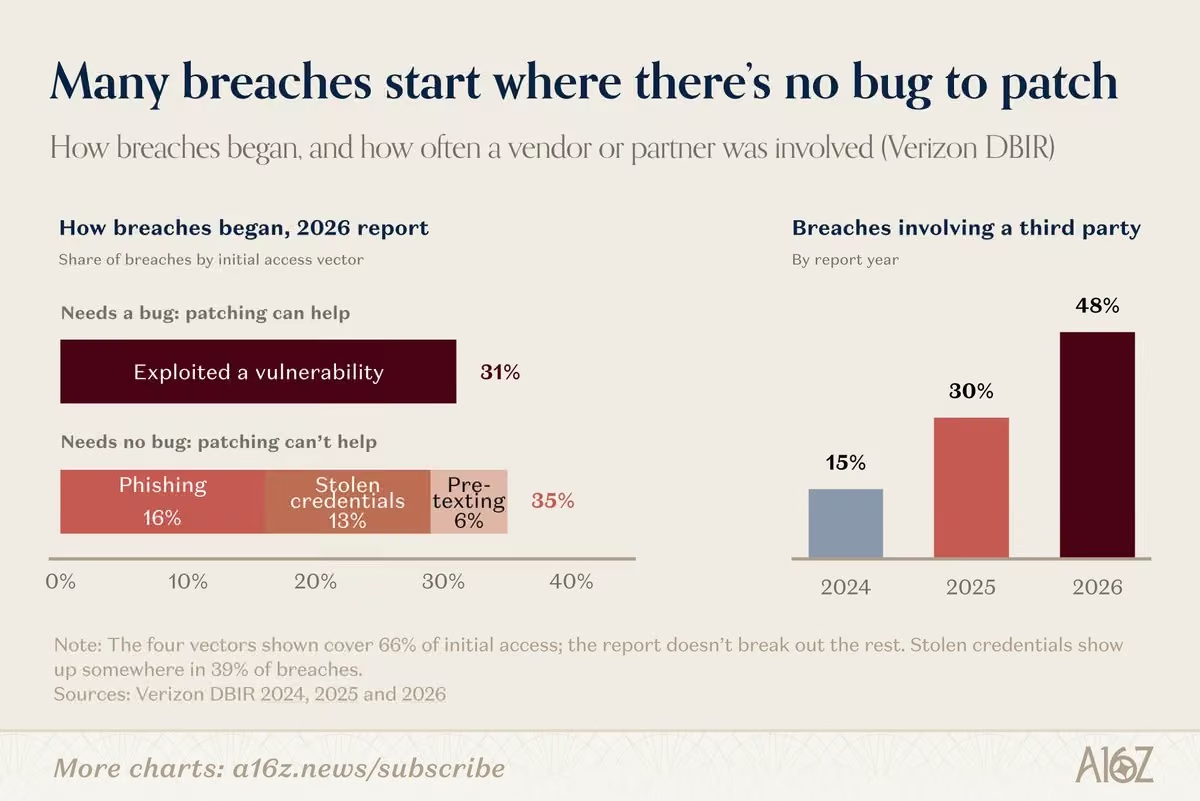
Some of the biggest openings in security have nothing to do with patching
How breaches began, per a 2026 report:
- 31% exploited a vulnerability
- 35% used phishing, stolen logins or impersonation scams
And nearly half now involve a vendor or partner, up 3x since 2024
Full piece from a16z's Asaf Ezra and Steph Zhang on six cybersecurity companies worth building: www.a16z.news/p/defense-in-depth-rebuilt-for-machine
Asaf Ezra
@asaf_ez
-
a16z
@a16z
John Somorjai of Salesforce on the exit math behind today's startup valuations, and a16z's Alex Immerman on the much bigger outcomes that now drive returns:
John: "I think there's a lot of irresponsibility going on. The valuations are of course way too high."
"When you think about investing, you want to think about, what are my exit opportunities? And not every company is going to go public. In fact, very, very few companies go public, probably 1% or less."
"Once you get above $10 billion, for example, the buyer universe is so small, and yet you're seeing so many of these enormous multi-billion dollar valued companies out there, and there will be a reckoning that happens."
"A lot of these companies have valuations that are not sustainable, that they won't be able to grow into, and are also, I think, going to be bad for their employees."
Alex: "Part of my optimism comes from what a top one percent outcome was 10 years ago is very different from what a top one percent outcome is today... There have been these larger outcomes that drive the returns for the ecosystem at large."
John: "I'm an optimist. I could not do my job if I wasn't an optimist. But just know that I see the thousands of companies every year that don't make it. Because they all come to us to try to be acquired."
@jsomorjai @aleximmThis media couldn't be displayed. See it on the original post.
a16z
@a16z
Salesforce's John Somorjai has spent more than 20 years doing deals for Marc Benioff, from Slack to six rounds of Anthropic, and runs a venture arm that has backed more than 750 companies.
His playbook is finding great technology that's starved for distribution and plugging it into 15,000 sales reps. Salesforce piloted Fin on its own help site, where it went live in 14 days and now handles over 40% of the traffic, resolving 65% without a human.
John joins a16z's Alex Immerman to discuss why Slack revenue is up almost 3x since the acquisition, how strong revenue can hide the churn that kills deals, the pen test that got into a CEO's laptop, and why robotics is where he's most excited to invest.
0:58 How Marc Benioff spots what to buy
3:48 The 3 tests for every acquisition
5:17 Salesforce's model as AI cuts seats
8:23 Fin resolves 65% with no human
10:32 The power of 15,000 sales reps
14:22 Founders who became product chiefs
17:34 Build vs buy when code is cheap
20:27 Why Salesforce bought Fin
22:58 Why Slack is perfect for AI agents
28:19 Salesforce Ventures' robotics bets
35:46 Why he's wary of new CRM startups
37:53 Why $10B+ startups have few buyers
39:32 Why he backed Anthropic six times
41:50 Red flags that kill acquisitions
44:27 The pen test that sank a deal
46:01 Growing up with a scientist father
YouTube: youtu.be/y4BdOtm40SA
@jsomorjai @salesforce @aleximmThis media couldn't be displayed. See it on the original post. -
a16z
@a16z
Companies are more confident in their backups than they perhaps should be
90% of leaders say they can recover from a cyberattack, but only 28% of victims actually got all their data back
Median recovery cost:
- Backups survived: $375K
- Backups hit: $3M
Full piece from a16z's Asaf Ezra and Steph Zhang on six cybersecurity companies worth building: www.a16z.news/p/defense-in-depth-rebuilt-for-machine
Asaf Ezra
@asaf_ez
-
a16z
@a16z
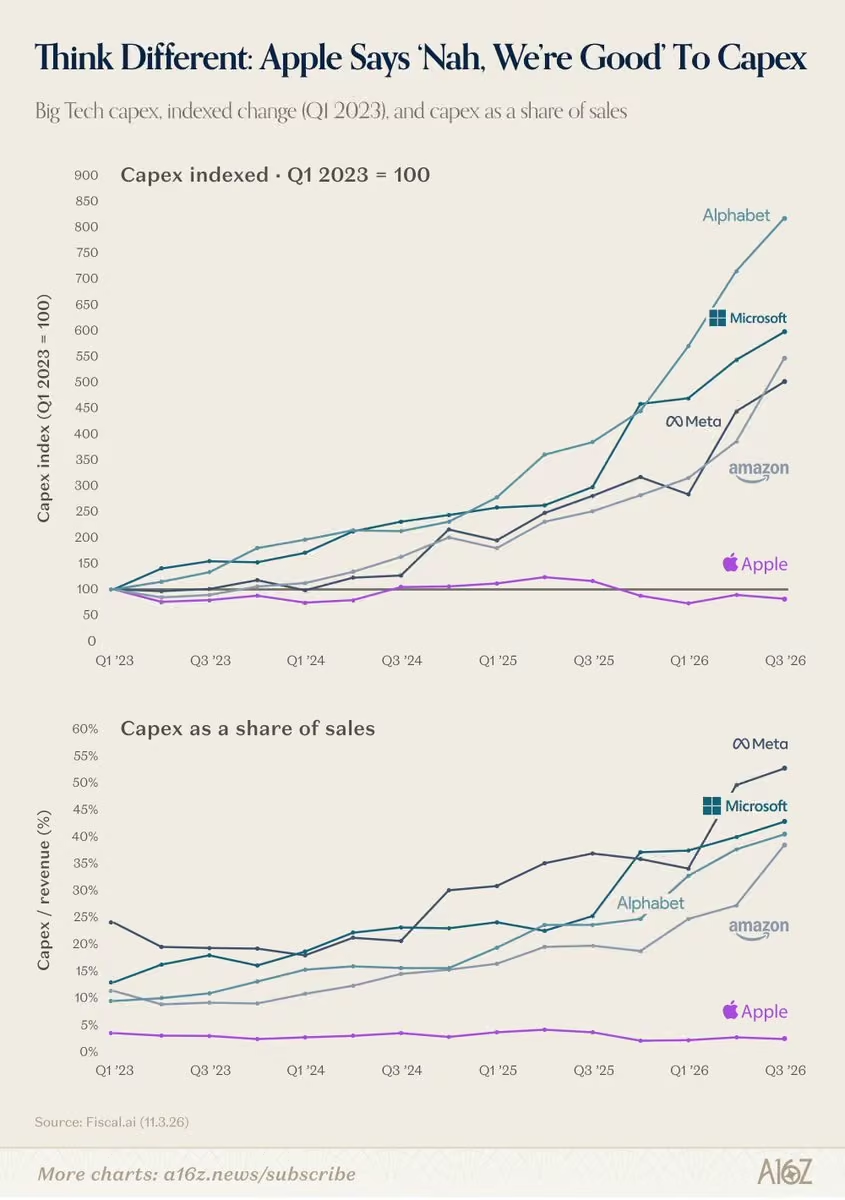
Think different, CapEx edition:
Since Q1 2023, Alphabet, Microsoft, Amazon, and Meta have increased CapEx 5-8x
Meanwhile, Apple now spends 20% less than it did before the AI boom
Charts of the Week: www.a16z.news/p/charts-of-the-week-apple-skips-capex -
a16z
@a16z
AI can now help turn a published fix into a working exploit in hours. Patching still takes weeks, and for many old routers, cameras, and supermarket fridges, a fix never arrives.
"So the question isn't how to patch faster. It's how to stop needing to."
Six openings for new cybersecurity companies today, each one making patching "unnecessary, or someone else's job":
1. Live fixes: blocks an exploit on running systems within hours, then has AI write and ship the real code fix
2. An AI first responder: spots attacks without hand-written rules and contains them as they unfold
3. Per-request access: checks every request from a person or their AI agents, with credentials that expire in minutes
4. Proven recovery: keeps restoring your backups in a sealed-off test environment to prove they work, with records insurers will accept
5. An install gateway: holds and sandboxes every package, extension and AI agent tool before it can run
6. Security for the long tail: one managed service for water utilities, clinics and others that will never have a security team
Full piece from a16z's Asaf Ezra and Steph Zhang: www.a16z.news/p/defense-in-depth-rebuilt-for-machine
Asaf Ezra
@asaf_ez
-
a16z
@a16z
John Somorjai of Salesforce on what kills company acquisition deals, from attrition hiding behind ARR to a veto from the security team:
"It's really important that you're ready and you're organized so that the data is flowing and it doesn't look like you're having trouble getting access to data."
"One of the mistakes that a lot of founders are making these days is they focus on one metric alone, which is ARR. And ARR is a wonderful metric, but it masks attrition."
"When you meet with a company that has very high attrition, that usually means that there are a lot of not just unhappy customers, but there might be some product quality issues as well."
"We have 14 functions that we work with on all of our diligence processes, and security is the one function that can hold up the red flag and say, 'I'm killing this deal.'"
"You definitely want to identify the vulnerabilities before we do."
"Nothing goes better in a process when a company is totally buttoned up... But when they don't, that's when, you know, deals can die."
@jsomorjai @aleximmThis media couldn't be displayed. See it on the original post.
a16z
@a16z
Salesforce's John Somorjai has spent more than 20 years doing deals for Marc Benioff, from Slack to six rounds of Anthropic, and runs a venture arm that has backed more than 750 companies.
His playbook is finding great technology that's starved for distribution and plugging it into 15,000 sales reps. Salesforce piloted Fin on its own help site, where it went live in 14 days and now handles over 40% of the traffic, resolving 65% without a human.
John joins a16z's Alex Immerman to discuss why Slack revenue is up almost 3x since the acquisition, how strong revenue can hide the churn that kills deals, the pen test that got into a CEO's laptop, and why robotics is where he's most excited to invest.
0:58 How Marc Benioff spots what to buy
3:48 The 3 tests for every acquisition
5:17 Salesforce's model as AI cuts seats
8:23 Fin resolves 65% with no human
10:32 The power of 15,000 sales reps
14:22 Founders who became product chiefs
17:34 Build vs buy when code is cheap
20:27 Why Salesforce bought Fin
22:58 Why Slack is perfect for AI agents
28:19 Salesforce Ventures' robotics bets
35:46 Why he's wary of new CRM startups
37:53 Why $10B+ startups have few buyers
39:32 Why he backed Anthropic six times
41:50 Red flags that kill acquisitions
44:27 The pen test that sank a deal
46:01 Growing up with a scientist father
YouTube: youtu.be/y4BdOtm40SA
@jsomorjai @salesforce @aleximmThis media couldn't be displayed. See it on the original post. -
a16z
@a16z
Confirmed ransomware attacks on healthcare providers grew about 6x from 2018 to 2024
Average days a US provider was down per attack:
- 2018: 4
- 2021: 17
- 2024: 18
Full piece from a16z's Asaf Ezra and Steph Zhang on AI and the patch gap: www.a16z.news/p/the-exploit-was-the-bottleneck
Asaf Ezra
@asaf_ez
-
a16z
@a16z
Figma CFO Praveer Melwani says AI acccess is now a recruiting tool, and the companies that win talent are the ones where you can see people building:
"The policies that we created and the freedom we've given folks to explore are the reasons why some folks are like, 'I wanna stay here. I really, really like what I'm doing.'"
"I don't know if folks are actually treating access to technology as a recruiting vehicle as much as they could or should. You know, I've at least started to do that in the recruiting conversations since I started to hear that from the team."
"Especially when you're trying to pull from folks who are not necessarily in technology. They're like, 'Oh my gosh, this is my front entrance into an entirely new world, and if I'm empowered to learn, this is really cool.'"
"If you get this feeling that you're joining an organization that's not just saying that they give access to these things, but they're actually building and that you can see it and you can feel it through the interview process, those are the places I'd gravitate to."
@figma @IvanoMakSFThis media couldn't be displayed. See it on the original post.
a16z
@a16z
Figma CFO Praveer Melwani used to spend his days writing hundreds of lines of SQL just to get one set of numbers everyone trusted. Now his finance team builds its own AI tools to do that work.
He sees the CFO's job shifting from traffic cop to business enabler, as long as the people doing the building still own their thinking.
Praveer joins a16z's Seema Amble and Ivan Makarov, authors of "You Need a New CFO," to discuss the growth-stage finance team that built 40 to 50 agents in a month or two, what breaks when every rep vibe codes their own dashboard, and how finance went from sitting out hackathons to winning them.
0:00 From traffic cop to business enabler
8:48 Hire people who understand the model
12:20 Vibe coding a target to test moats
13:15 An AI Dylan Field reviews the memos
18:01 Let AI make the messy data calls
20:00 Unused agents still build the habit
20:46 The CIO's new job: scale what works
22:36 The rise of the finance engineer
26:24 Why the board trusts his numbers
30:25 AI tools as a recruiting perk
40:35 Why Excel is his "love language"
44:20 What to look for in your next CFO
YouTube: youtu.be/9iAQdKxyiQc
@figma @seema_amble @IvanoMakSFThis media couldn't be displayed. See it on the original post. -
a16z
@a16z
AI can write an exploit before most companies have read the advisory
How long it took to turn a patched bug into a working attack:
- 2017: about 3 weeks for a professional
- 2023: about 1 week
- 2025: an afternoon with AI
Full piece from a16z's Asaf Ezra and Steph Zhang on AI and the patch gap: www.a16z.news/p/the-exploit-was-the-bottleneck
Asaf Ezra
@asaf_ez
-
a16z
@a16z
Figma CFO Praveer Melwani says AI makes a financial model easy to build, so his hiring case study tests whether you still did the thinking:
"Right now I'm hiring for a VP of finance. And the case study part of the process for me is so, so sacred. I wanna both test for, how are you using the tools available to you... but how you actually piece those puzzle pieces together in a way that actually makes sense."
"Have you really, really understood the structure that you've created?... Do you have a strong intuition on how the business is actually working using the tool that you've created? Can you effectively communicate that?"
"Anyone can go and create like a model. Pick your favorite LLM. You can go and do that really, really easily. But are you using it as an effective tool that actually is enabling you to think?"
"You don't wanna outsource your thinking today. I think you wanna use AI as a tool to help you and empower you. But it's really, really critical to still be that thinker."
@figmaThis media couldn't be displayed. See it on the original post.
a16z
@a16z
Figma CFO Praveer Melwani used to spend his days writing hundreds of lines of SQL just to get one set of numbers everyone trusted. Now his finance team builds its own AI tools to do that work.
He sees the CFO's job shifting from traffic cop to business enabler, as long as the people doing the building still own their thinking.
Praveer joins a16z's Seema Amble and Ivan Makarov, authors of "You Need a New CFO," to discuss the growth-stage finance team that built 40 to 50 agents in a month or two, what breaks when every rep vibe codes their own dashboard, and how finance went from sitting out hackathons to winning them.
0:00 From traffic cop to business enabler
8:48 Hire people who understand the model
12:20 Vibe coding a target to test moats
13:15 An AI Dylan Field reviews the memos
18:01 Let AI make the messy data calls
20:00 Unused agents still build the habit
20:46 The CIO's new job: scale what works
22:36 The rise of the finance engineer
26:24 Why the board trusts his numbers
30:25 AI tools as a recruiting perk
40:35 Why Excel is his "love language"
44:20 What to look for in your next CFO
YouTube: youtu.be/9iAQdKxyiQc
@figma @seema_amble @IvanoMakSFThis media couldn't be displayed. See it on the original post. -
a16z
@a16z
Bugs are piling up faster than attackers can use them
Published vulnerabilities grew more than 3x since 2017, and confirmed exploits in the wild stayed under 900 a year
Full piece from a16z's Asaf Ezra and Steph Zhang on AI and the patch gap: www.a16z.news/p/the-exploit-was-the-bottleneck
Asaf Ezra
@asaf_ez
-
a16z
@a16z
Figma CFO Praveer Melwani says his corp dev team now tests a target's moat by trying to vibe code its product, then runs the M&A memo past AI versions of Figma's leaders:
"I think our team's gotten really damn good at some of this. You can get through some of the, you know, 'Is this a real thing? Is it not? How difficult is it or not?' There's obviously nuances to a whole bunch of these ideas, but it gives you like a solid intuition there."
"More often than not, there are themes, there are similar questions, there are ways that we all as leaders tend to have a way of looking at problems. And what's been interesting is [the corp dev team has] gone and created unique [AI] personalities for each of us as leaders... that they can go and run their investment memos by."
"They'll sit there kind of going back and forth and saying, 'Okay, this is what Praveer would say, and this is what [CEO] Dylan would say, and this is what Sean would say,' our CRO... It reduces the cycle time that we're all sitting together on."
@figma @seema_amble @IvanoMakSFThis media couldn't be displayed. See it on the original post.
a16z
@a16z
Figma CFO Praveer Melwani used to spend his days writing hundreds of lines of SQL just to get one set of numbers everyone trusted. Now his finance team builds its own AI tools to do that work.
He sees the CFO's job shifting from traffic cop to business enabler, as long as the people doing the building still own their thinking.
Praveer joins a16z's Seema Amble and Ivan Makarov, authors of "You Need a New CFO," to discuss the growth-stage finance team that built 40 to 50 agents in a month or two, what breaks when every rep vibe codes their own dashboard, and how finance went from sitting out hackathons to winning them.
0:00 From traffic cop to business enabler
8:48 Hire people who understand the model
12:20 Vibe coding a target to test moats
13:15 An AI Dylan Field reviews the memos
18:01 Let AI make the messy data calls
20:00 Unused agents still build the habit
20:46 The CIO's new job: scale what works
22:36 The rise of the finance engineer
26:24 Why the board trusts his numbers
30:25 AI tools as a recruiting perk
40:35 Why Excel is his "love language"
44:20 What to look for in your next CFO
YouTube: youtu.be/9iAQdKxyiQc
@figma @seema_amble @IvanoMakSFThis media couldn't be displayed. See it on the original post. -
a16z
@a16z
For two decades, writing the exploit was the bottleneck in a cyberattack. AI made that step cheap, and patching hasn't gotten faster:
- On average, attacks went from landing 63 days after disclosure in 2018-19 to 7 days before it in 2025
- A working exploit went from a skilled person's month to a few hours of machine time
- The median time to fully fix a known-exploited bug rose to 43 days
a16z's @asaf_ez and @steph_zhang expect a long, expensive worm era, hitting hardest where systems can't update fast: hospitals, schools, small water systems.
"When attacking is nearly free, attackers no longer need to want a target."
Full piece from Asaf Ezra and Steph Zhang: www.a16z.news/p/the-exploit-was-the-bottleneck
Asaf Ezra
@asaf_ez
-
a16z
@a16z
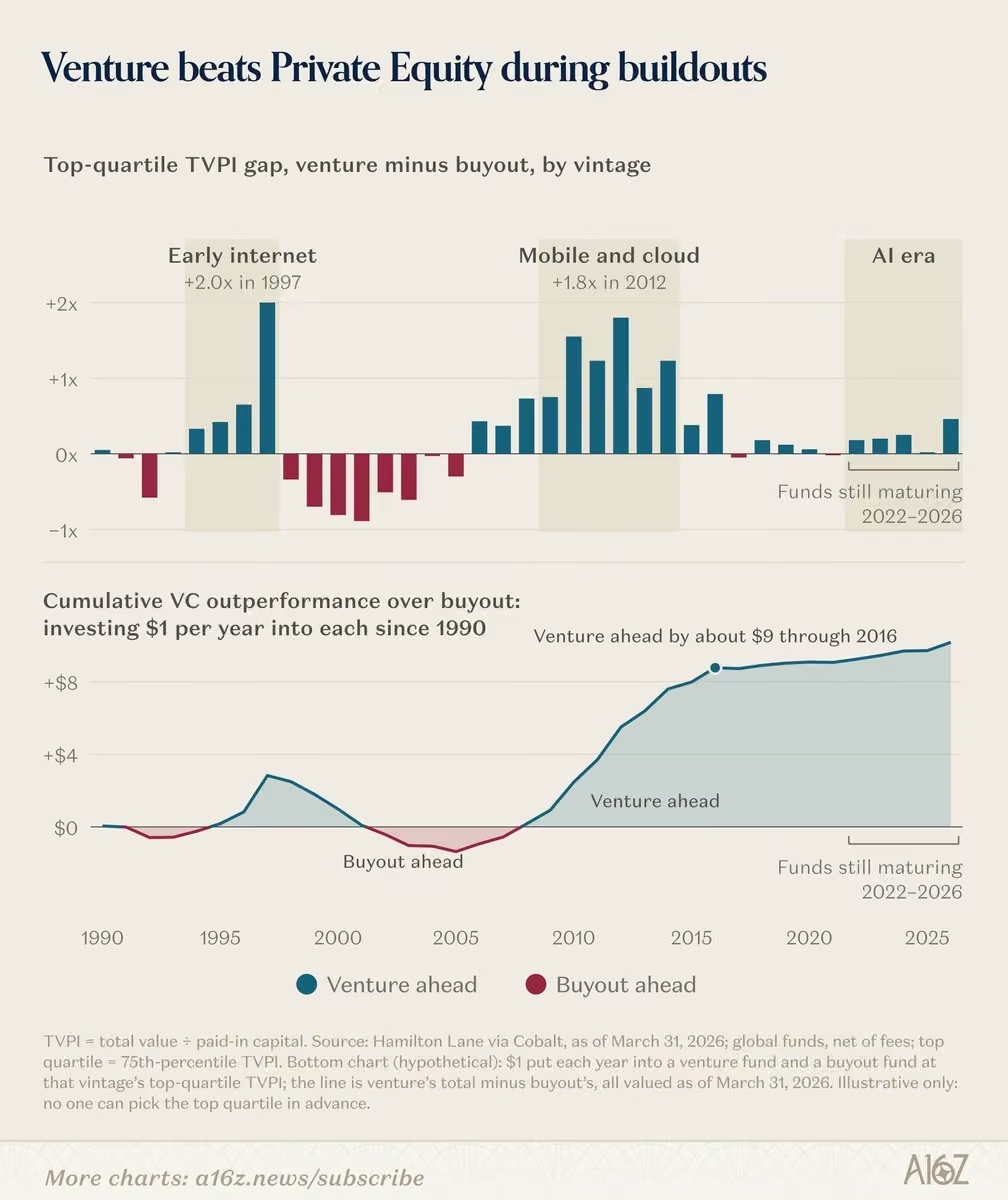
Recent US buyout funds would have done better just buying the stock market
US buyout returns minus the Russell 3000, by vintage:
- About 9.7 points a year ahead for 2001-05 vintages
- About 2.0 points a year ahead for 2006-20 vintages
- Behind for every vintage since 2019
"Buyout has trailed public stocks while carrying far more debt. Over the last 10 years, US Buyout returned 14.5% a year, underperforming the Russell 3000. In contrast, US venture as a whole returned 17.6% a year over the same period (pooled across all funds), 2.3 points ahead of the Russell 3000. Unlevered."
Full piece from a16z's Jen Kha: www.a16z.news/p/is-private-equity-cooked
Not an offer or solicitation. None of the above should be taken as investment advice or an advertisement for investment services. Please see a16z.com/disclosures for more information. -
a16z
@a16z
a16z's Martin Casado on the four mindsets people bring to investing, and why knowing yours stops you from justifying your own bias:
1. Financial
"The correct proxy for the health of a business is the market it's going into and its finances. That's what it is. What are the SaaS metrics? What is the size of the market? That is a proxy for the entire business."
2. Productive
"You believe you're investing in a productive asset, and the productive asset is what's creating value. If you believe in that, as it creates value, it will create market... The type of diligence you do if you're a productive investor is more like, what is the technical approach? What are the adjacent markets?"
3. Frontier
"I think this is the romantic, idealized version of VC from the 60s and 70s, which is kind of YOLO. It's like, founders know better than VCs, and they've seen something that I don't see, and they're gonna go out there and do it. And, like, who am I to second guess them?"
4. Speculative
"It is always so surprising how prevalent it is... They don't even care about the asset. They just want to time a market, right?... They're like, 'Well, this looks cheap. It's clearly gonna go up in value' or, 'This is the top of the market, like, I'm gonna get out.'"
"...You can justify any deal or not justify any deal. So if you don't know what your beliefs are, you'll always basically just kind of justify whatever personal bias you have."
@martin_casado w/ @patrick_oshag on @InvestLikeBestThis media couldn't be displayed. See it on the original post. -
a16z
@a16z
a16z's Anish Acharya and David Pawlan, creator of Assistant Benchmark, on the gap between people's stated and revealed preferences on privacy, and what that means for AI agent adoption:
"I think in revealed preferences, consumers will share any amount of data for even the most trivial amount of upside."
"People have been connecting their cards, their credit cards, and their bank accounts via Plaid since the Venmo era. But when you ask them, they're like, 'Oh, yes, I'm very concerned about trust and safety.'"
"I think an example though of where consumers are very concerned about sort of trust and assumptions is around being embarrassed and social signaling... The social mechanics actually feel so much higher stakes than the actual, like, real-world implications."
"[One company] offered a million dollars worth of pizza to anyone that wanted to use their product... In order to get that $30 of pizza, you were granting access to your entire Google Workspace, all of your emails, all of your data for 30 bucks."
"It just proves it right there, that people are willing to just give up all that data for some free pizza."
@illscience @DavidPawlanThis media couldn't be displayed. See it on the original post.
a16z
@a16z
David Pawlan, creator of Assistant Benchmark, has tracked 147 AI assistants so far, and in his group chats of AI power users, the number one fear is trust. It comes up in 22% of roughly 3,600 messages.
He puts agents through head-to-head tests, like ordering same-day flowers as cheaply as possible or planning a weekend in LA that's both luxurious and cost-efficient, to see which ones can hold competing preferences.
He joins a16z's Anish Acharya and Josh Elman to discuss why the scariest agent failures are the embarrassing ones, why agents are where e-commerce was in 1997, why scale is still a moat, and the "dark agent" that could speak to the parts of ourselves we don't reveal.
0:52 Inside a meetup for 100 agent nerds
2:52 Why we'll all have an army of agents
5:36 Trust is power users' top fear
6:28 Building fences around your agent
10:14 Privacy loses to free pizza
12:41 Can agents balance price and speed?
14:19 How agents define luxury differently
19:44 Migrating from one agent to another
21:06 What your photo roll tells an agent
25:48 Will agents make us more rational?
27:38 Why paternalism kills products
31:43 Gossipy agents as social glue
33:41 Scale is still a software moat
36:55 From OpenClaw to agents hanging out
39:23 Agents that introduce you to people
46:15 Predictions and the dark agent idea
YouTube: youtu.be/dSiTwPl0t1U
@DavidPawlan @illscience @joshelmanThis media couldn't be displayed. See it on the original post. -
a16z
@a16z
PE-backed software now grows slower than public software, while venture-backed companies grow several times faster
Median revenue growth (latest available):
- PE-backed software grows 3 to 7%
- Public software grows 10 to 16%
- Venture-backed private software grows 18 to 30%
"Because the best companies are staying private longer than ever, more of that growth is happening before they ever hit the public markets."
Full piece from a16z's Jen Kha: www.a16z.news/p/is-private-equity-cooked
Not an offer or solicitation. None of the above should be taken as investment advice or an advertisement for investment services. Please see a16z.com/disclosures for more information. -
a16z
@a16z
PE's appetite for tech peaked just as the AI wave arrived
Tech's share of global buyout deal value:
- 23% in 2018
- 34% in 2023, the year after ChatGPT launched
- 29% in 2025
- 11% in the first quarter of 2026
"SaaS, of course, was also the manna from heaven for private equity: capital-light, consistent recurring revenue that was easy to lend against, lots of small markets with clear leaders, and a small but critical line in the customer's budget, so prices could go up."
"It is safe to say that the 2010s aren't coming back anytime soon: a supply of fixer-uppers, a decade of falling rates, and fast-growing funds that kept buying from each other at higher prices. A few rate cuts help the debt; they don't re-create that decade."
Full piece from a16z's Jen Kha: www.a16z.news/p/is-private-equity-cooked
Not an offer or solicitation. None of the above should be taken as investment advice or an advertisement for investment services. Please see a16z.com/disclosures for more information. -
a16z
@a16z
Plaintiff lawyers only get paid if they win, so every legal firm hits a limit on how many cases it can take, and every case it turns down leaves someone without a lawyer.
Eve builds AI that handles the time-intensive casework, like reviewing medical records, drafting key documents, and opening insurance claims, cutting work that took days to under an hour. One firm went from about 100 clients per attorney to 500.
That gives small firms a real shot against insurers with far more resources.
Co-founder and CEO Jay Madheswaran: "Think about giving David a slingshot to take down Goliath. That's what we're doing."
Three years in, 1,700+ of the roughly 29,000 plaintiff firms in the US use Eve. It's been used in 350,000+ cases and helped recover $3.5 billion for clients.
Eve is hiring across engineering, machine learning, sales, and customer success in SF, the Bay Area, and remotely across the US: a16zjobs.substack.com/p/with-164m-in-funding-eve-is-building
@jayanthmadhesw1 @evelegalaiThis media couldn't be displayed. See it on the original post.
Jayanth Madheswaran
@jayanthmadhesw1
Huge milestone: Eve has helped 350,000 people take on a system built to wear them down.
Take Mike Dickerson. A four-car pileup, two hip surgeries, then an insurer betting he’d take a lowball offer.
He didn’t. His lawyers @GeigerGroup fought for years and, with Eve’s help, got him 15x the first offer.
Firms on Eve have recovered $3.5B+ for their clients, and we’re just getting started.
Next milestone: 1 million people helped.This media couldn't be displayed. See it on the original post.
Jayanth Madheswaran
@jayanthmadhesw1
-
a16z
@a16z
The higher up you go, the more venture pulls ahead of buyout
Among the top 5% of US funds from 2007-16 vintages:
- Venture funds hit 8.5x TVPI, with 5.3x returned in cash
- Buyout funds hit 3.8x TVPI, with 3.5x returned in cash
"In venture, winning tends to beget winning: the best firms typically get the next call from the best founders."
Full piece from a16z's Jen Kha: www.a16z.news/p/is-private-equity-cooked
Not an offer or solicitation. None of the above should be taken as investment advice or an advertisement for investment services. Please see a16z.com/disclosures for more information. -
a16z
@a16z
We’re thrilled to invest in Phaze.
@Phaze_in is a high-performance remote desktop solution for giving humans and agents a local-like experience on remote workstations. It’s the best solution for interactive, latency-sensitive workloads, and it was designed from the ground up for working with agents, which makes compatibility, management and administration seamless.
It’s not a surprise Phaze is as good as it is given the team behind it. @boxerbk and Chris Dickson, the founders of Phaze, previously built Parsec, which at the time was the leading remote desktop solution for graphics-intensive applications.
We’re very excited to be working with this team again to bring desktops and applications to agents. And of course to humans too.
By @martin_casado
Benjy Boxer
@boxerbk
Today we’re announcing an $8.75M seed round for Phaze.
Companies aren’t ready for how many computers people and AI agents are about to need. And it’s happening just as computer prices are up 3x.
Chris and I spent years building Parsec to make a computer thousands of miles away feel like it’s sitting right in front of you. We sold that company, and we’re starting over because people aren’t the only users of computers anymore.
Now, agents need access to real computers to run applications, test software, and get work done. They need to work alongside people, hand off control when necessary, and operate within the security policies companies already have in place. And companies need to start managing computers like infrastructure.
That’s why we’re building @Phaze_in: secure, high-performance access to computers, wherever those machines happen to be.
An engineer can connect to a CAD workstation from any device and forget about being physically stuck at that workstation. A video editor can ask an AI agent to connect to a render machine to monitor and fix broken renders. An IT support person can fix multiple machines at the same time with an AI agent connecting to employees’ computers. If the agent needs help, it can hand control back to the technician in the same session.
We loved working with the firms who backed Parsec, so we’re running it back. Our Seed round is led by @martin_casado at @a16z, with @bryce at @indievc, @davidbeisel at @NextViewVC, @BenjLerer at @LererHippeau, and @Ryann_Lai at @makersfundvc.This media couldn't be displayed. See it on the original post. -
a16z
@a16z
David Pawlan, creator of Assistant Benchmark, has tracked 147 AI assistants so far, and in his group chats of AI power users, the number one fear is trust. It comes up in 22% of roughly 3,600 messages.
He puts agents through head-to-head tests, like ordering same-day flowers as cheaply as possible or planning a weekend in LA that's both luxurious and cost-efficient, to see which ones can hold competing preferences.
He joins a16z's Anish Acharya and Josh Elman to discuss why the scariest agent failures are the embarrassing ones, why agents are where e-commerce was in 1997, why scale is still a moat, and the "dark agent" that could speak to the parts of ourselves we don't reveal.
0:52 Inside a meetup for 100 agent nerds
2:52 Why we'll all have an army of agents
5:36 Trust is power users' top fear
6:28 Building fences around your agent
10:14 Privacy loses to free pizza
12:41 Can agents balance price and speed?
14:19 How agents define luxury differently
19:44 Migrating from one agent to another
21:06 What your photo roll tells an agent
25:48 Will agents make us more rational?
27:38 Why paternalism kills products
31:43 Gossipy agents as social glue
33:41 Scale is still a software moat
36:55 From OpenClaw to agents hanging out
39:23 Agents that introduce you to people
46:15 Predictions and the dark agent idea
YouTube: youtu.be/dSiTwPl0t1U
@DavidPawlan @illscience @joshelmanThis media couldn't be displayed. See it on the original post. -
a16z
@a16z
Top-quartile venture beat top-quartile buyout through the internet buildout and again through mobile and cloud, and a16z's Jen Kha argues we're at the start of the next wave.
Tech buyouts have long been the "safe" bet in private markets. Now the stress is showing:
- In the first half of 2026, venture funds marked their tech holdings up 16%, while buyout funds marked theirs down 4%
- 70% of the debt foreclosed in 2025 and 2026 came from deals done in 2021 or 2022
- A typical buyout now needs 10 to 12% EBITDA growth a year to make 2.5x in five years, up from about 5% in 2015
- Top 5% venture funds from 2007-16 returned 5.3x their capital in cash, versus 3.5x for top 5% buyout funds
"Tech buyout is a late-cycle asset class. It's most effective once a technology wave has settled and when business models are predictable enough to borrow against. When a new technology wave drops, all bets are off. By contrast, that's when venture shines."
Full piece from a16z's Jen Kha: www.a16z.news/p/is-private-equity-cooked
Not an offer or solicitation. None of the above should be taken as investment advice or an advertisement for investment services. Please see a16z.com/disclosures for more information. -
a16z reposted
Anish Acharya
@illscience
Great convo with @luke10ferrari on his home turf in italy about irrational investor preference for growth over cash, invention vs. optimization, where durability lives after the saaspocalypse, and what happens to the org chart when AI writes 94% of your code.
Some takeaways:
- Investors seem to oddly dislike profit and greatly prefer growth - optimize for compounding free cash flow knowing that this is just a moment in time distortion.
- Invention vs. optimization: pick a camp. Invention has higher peaks but an awful median case. Google is still ~80% search 30 years later.
- Ambition in product, paranoia with debt. Rule #1 of becoming a huge success is not dying in the meantime & credit is a high wire act.
- Software has been cheap to build for a long time. Durability lives in habits, network effects, proprietary data and scale.
- SaaSpocalypse wasn't really about AI. In many cases these were poorly run companies and this cycle gave them an opportunity to improve.
- Bending Spoons went from 0% to 94% of code written by AI in two years. Support managers now look like PMs, data scientists build tooling instead of cleaning CSVs - everyone is both oddly more direct + giving more direction.
- If you're not winning when do you quit? No idea - bureaucracy created Bending Spoons b/c a Danish tax refund that never came killed Luca's first startup and catalyzed Spoons.
02:05 Is every company a bond or an option?
03:40 Why investors overvalue growth
05:15 Why the multiple is just one factor
08:20 Invention vs. optimization: pick a camp
12:20 Customers know the what, not the how
14:05 Hard problems over hot brands (and why AOL excites him)
15:15 Why founders should hate the median case
18:40 The Bending Spoons debt playbook
23:15 SaaSpocalypse wasn't about AI
25:05 Where durability actually lives
29:40 Is your data worth more than your company?
31:05 Inside the Bending Spoons operating system
33:35 The AI agent that ships bug fixes
37:00 From 0% to 94% AI-written code
37:30 Logic over instinct
39:00 When to quit vs. keep pushing
40:35 Advice for the next great tech companyThis media couldn't be displayed. See it on the original post. -
a16z
@a16z
38% of 500 Americans surveyed are highly concerned about their long-term brain health
Who would use a non-invasive brain-sensing device:
- 39% to improve sleep, focus or mood
- 29% to control devices with their thoughts
- Men more than women on both, 48% vs. 31% and 41% vs. 18%
"This all sounds like science fiction, but we're betting in our lifetimes, brain-computer interfaces and 'wearables' for the brain become a real consumer category and part of everyday life."
Full longevity survey breakdown from a16z's Daisy Wolf and Eva Steinman: www.a16z.news/p/the-state-of-longevity
Daisy Wolf
@daisydwolf
@a16z State of Longevity report is out!
@evajsteinman and I surveyed 500 Americans to predict what's next.
We're also interviewing people at the cutting edge of health & tech about what they do themselves. My interview with @hubermanlab is out today. x.com/i/article/2117631910130098176 -
a16z
@a16z
Andrew Huberman says Rick Rubin knows exactly when his mind is sharpest, and the two of them are trying to build tools to unlock that focus more quickly and deeply:
"My friend Rick Rubin... his work block generally is in the afternoon. That's when his mind is sharpest, and then he tapers off in the evening. But he's working extremely hard in those hours, and he knows when those fall."
"If you're in one of those windows and you allow your attention to be captured by something that's not worthwhile... the productivity that comes in those three or four hours is exponentially greater than the productivity that comes from doing that work at some point later."
"We don't really have formal protocols for task switching, but this is extremely important for company founders and employees across the board, right?"
"Rick and I have been kicking around some tools that are not meditations... that would allow you to kind of program your mind for what comes next."
"If you think about it, it's 2026. Why in the world are we sitting down to do work and just going, 'Okay, now I'm gonna be focused, and now I'm gonna be creative.'"
"We should have ways to control neural activity that would allow us to access those circuits more quickly and more deeply."
@hubermanlabThis media couldn't be displayed. See it on the original post.
a16z
@a16z
Stanford neuroscientist Andrew Huberman built one of the most popular podcasts in the world by turning health research into protocols millions of people actually use.
His top three habits are surprisingly straightforward: get bright light shortly after waking, resistance train, and make the sleep you can get as high-quality as possible.
He joins a16z’s Daisy Wolf to walk through the protocols he actually follows, from his 35-year workout to the lockbox he keeps his social media phone in, and explains why packing in every protocol can backfire if it gets in the way of the rest of your life.
For founders, he explains why the hours your brain does its best work are worth guarding like a fight, how to find the most real work you can sustain, and why sleep is where neurotech will win first.
0:47 Why zero drinks is easier than two
4:39 Meditation means watching the chaos
6:25 Sunlight first, caffeine if training
7:20 The workout he's done for 35 years
10:09 Two sets to failure, low volume
13:11 Find foods that make you feel good
15:55 Why eating too clean backfires
17:29 Why non-sleep deep rest beats a nap
19:05 A sunset habit from a sleep lab
21:18 Who needs blue-light glasses
23:32 Every supplement he takes
30:46 Why his phone lives in a lockbox
32:40 His top three habits for health
35:47 Guard your two daily focus windows
42:47 Neurotech that puts you to sleep
46:38 The best advice he ever got
YouTube: youtu.be/Ezi-nwe6LlY
@hubermanlab @daisydwolfThis media couldn't be displayed. See it on the original post.
Daisy Wolf
@daisydwolf
@a16z State of Longevity report is out!
@evajsteinman and I surveyed 500 Americans to predict what's next.
We're also interviewing people at the cutting edge of health & tech about what they do themselves. My interview with @hubermanlab is out today. x.com/i/article/2117631910130098176 -
a16z
@a16z
Wearables are a daily habit, and users want more out of them
Of the 270 wearable users surveyed:
- 83% check theirs at least once a day
- 55% say the data has never prompted a behavior change or a doctor's visit
- Nearly 3 in 4 would wear a second device if it measured something new
"We expect the next wave of wearables to build on that curiosity, giving people more insight into their bodies and a clearer sense of what to do with it."
Full longevity survey breakdown from a16z's Daisy Wolf and Eva Steinman: www.a16z.news/p/the-state-of-longevity
Daisy Wolf
@daisydwolf
@a16z State of Longevity report is out!
@evajsteinman and I surveyed 500 Americans to predict what's next.
We're also interviewing people at the cutting edge of health & tech about what they do themselves. My interview with @hubermanlab is out today. x.com/i/article/2117631910130098176 -
a16z
@a16z
Andrew Huberman's advice to founders: find the hours when your brain works best and protect them, even from workouts.
"Know when your windows of high cognitive capacity are. This is different for everybody."
"For me... it's really between the hours of 9:30 AM and 12:30 PM. That window is crucial, so I have to be very careful that I'm not exercising in that window because I, like most founders, don't get paid to exercise."
"If you're gonna do things for your health, they have to support the other areas of your life in a way that feed back onto something where your company succeeds."
"Otherwise, if people are trying to just pack all these protocols in, they're just going to deplete themselves."
@hubermanlabThis media couldn't be displayed. See it on the original post.
a16z
@a16z
Stanford neuroscientist Andrew Huberman built one of the most popular podcasts in the world by turning health research into protocols millions of people actually use.
His top three habits are surprisingly straightforward: get bright light shortly after waking, resistance train, and make the sleep you can get as high-quality as possible.
He joins a16z’s Daisy Wolf to walk through the protocols he actually follows, from his 35-year workout to the lockbox he keeps his social media phone in, and explains why packing in every protocol can backfire if it gets in the way of the rest of your life.
For founders, he explains why the hours your brain does its best work are worth guarding like a fight, how to find the most real work you can sustain, and why sleep is where neurotech will win first.
0:47 Why zero drinks is easier than two
4:39 Meditation means watching the chaos
6:25 Sunlight first, caffeine if training
7:20 The workout he's done for 35 years
10:09 Two sets to failure, low volume
13:11 Find foods that make you feel good
15:55 Why eating too clean backfires
17:29 Why non-sleep deep rest beats a nap
19:05 A sunset habit from a sleep lab
21:18 Who needs blue-light glasses
23:32 Every supplement he takes
30:46 Why his phone lives in a lockbox
32:40 His top three habits for health
35:47 Guard your two daily focus windows
42:47 Neurotech that puts you to sleep
46:38 The best advice he ever got
YouTube: youtu.be/Ezi-nwe6LlY
@hubermanlab @daisydwolfThis media couldn't be displayed. See it on the original post.
Daisy Wolf
@daisydwolf
@a16z State of Longevity report is out!
@evajsteinman and I surveyed 500 Americans to predict what's next.
We're also interviewing people at the cutting edge of health & tech about what they do themselves. My interview with @hubermanlab is out today. x.com/i/article/2117631910130098176 -
a16z
@a16z
LLMs had the entire internet to learn from. Robots have no equivalent. Nobody is recording data like the pressure in their fingertips when they pick up a coffee cup.
Tutor Intelligence is building that dataset. Its robots work real shifts in factories and warehouses across 20 US states, from mom-and-pop shops to Fortune 50 companies, and have helped make and ship more than 250 million products.
Tutor hires out robots by the hour. When one gets stuck, a remote human "tutor" takes over and guides it through the task, and that becomes training data that makes the whole fleet smarter. (Hence the name.)
The 160-person team trains its own robot models, builds its own robots, and ships code to them every day. The fleet has grown 4x since last year, and Tutor just raised a $75M Series B led by a16z.
Co-founder and CEO Josh Gruenstein:
"I think it's one of the only places in the universe where you can be on a whiteboard talking about model architecture in the morning, and in the afternoon, looking at a factory line."
Tutor is hiring across robotics research, software, hardware, and operations in Boston and SF: a16zjobs.substack.com/p/tutor-just-raised-75m-to-put-robots
@joshgruenstein @tutorintelThis media couldn't be displayed. See it on the original post.
Josh Gruenstein
@joshgruenstein
We raised a $75M Series B to deploy intelligent robots now, led by @a16z, with participation from @usv and @neo.
@tutorintel robots work real jobs across the United States, directed by human “tutors” and the foundation models we’ve trained on the work done. This round accelerates frontier model training, robot manufacturing, and deployment into industry.
We’re in almost 4x as many sites as a year ago; nearly a third of this year’s deployments went to existing customers coming back for more; and we’re on track to have more than 1,000 robots under contract by the end of 2027.
Our mission is to proliferate robotics for the common good. If you want to make robots reliably do things others think are impossible, for people who’ve never had access to this technology, join us.This media couldn't be displayed. See it on the original post. -
a16z
@a16z
Half of 500 Americans surveyed have heard of peptides beyond GLP-1s
Why the 62 self-reported users take them:
- 50% for performance
- 45% for recovery
- 36% for appearance
- 27% for longevity
- 23% for sleep
"Peptide medicines with robust consumer pull can create an unusually efficient path to patients, and we suspect this dynamic could extend to other disease areas, including sleep, bone health, and cardiovascular health."
Full longevity survey breakdown from a16z's Daisy Wolf and Eva Steinman: www.a16z.news/p/the-state-of-longevity
Daisy Wolf
@daisydwolf
@a16z State of Longevity report is out!
@evajsteinman and I surveyed 500 Americans to predict what's next.
We're also interviewing people at the cutting edge of health & tech about what they do themselves. My interview with @hubermanlab is out today. x.com/i/article/2117631910130098176 -
a16z
@a16z
Andrew Huberman on the best advice he ever got: figure out the most real work you can do every day, consistently, and find a way to reset every week.
"The best advice I ever got: there was a neurologist out at UC Berkeley and UCSF, Bob Knight, some years ago, very talented. I asked him for advice starting graduate school."
"He said, 'Figure out the maximum amount of real work that you can do every day consistently, and then figure out some non-destructive way to reset yourself every single week.'"
"I said, 'How do you reset?' He said he likes fishing. I like to hike. I like to get into nature and spend time with people while I do it. I figured out I could work X number of hours per day, 5 days a week, and I just stuck to it for 25 years."
"People who take a ton of stimulants and just blitz, blitz, blitz, blitz, blitz. These are the same people that crash and disappear. You have to figure out and build your capacity."
"Yes, you have to work extremely hard. You have to be extremely focused. But you also have to figure out how long you can keep this up."
@hubermanlabThis media couldn't be displayed. See it on the original post.
a16z
@a16z
Stanford neuroscientist Andrew Huberman built one of the most popular podcasts in the world by turning health research into protocols millions of people actually use.
His top three habits are surprisingly straightforward: get bright light shortly after waking, resistance train, and make the sleep you can get as high-quality as possible.
He joins a16z’s Daisy Wolf to walk through the protocols he actually follows, from his 35-year workout to the lockbox he keeps his social media phone in, and explains why packing in every protocol can backfire if it gets in the way of the rest of your life.
For founders, he explains why the hours your brain does its best work are worth guarding like a fight, how to find the most real work you can sustain, and why sleep is where neurotech will win first.
0:47 Why zero drinks is easier than two
4:39 Meditation means watching the chaos
6:25 Sunlight first, caffeine if training
7:20 The workout he's done for 35 years
10:09 Two sets to failure, low volume
13:11 Find foods that make you feel good
15:55 Why eating too clean backfires
17:29 Why non-sleep deep rest beats a nap
19:05 A sunset habit from a sleep lab
21:18 Who needs blue-light glasses
23:32 Every supplement he takes
30:46 Why his phone lives in a lockbox
32:40 His top three habits for health
35:47 Guard your two daily focus windows
42:47 Neurotech that puts you to sleep
46:38 The best advice he ever got
YouTube: youtu.be/Ezi-nwe6LlY
@hubermanlab @daisydwolfThis media couldn't be displayed. See it on the original post.
Daisy Wolf
@daisydwolf
@a16z State of Longevity report is out!
@evajsteinman and I surveyed 500 Americans to predict what's next.
We're also interviewing people at the cutting edge of health & tech about what they do themselves. My interview with @hubermanlab is out today. x.com/i/article/2117631910130098176 -
a16z
@a16z
How 500 surveyed Americans are cutting toxins at home:
- 70% are filtering their water
- 39% swapped plastic for glass or stainless steel
- 37% bought an air purifier
- 11% bought a natural or organic mattress
"People are willing to pay for peace of mind, even when the health benefit of a particular purchase is hard to measure. In our survey, 62% of respondents said they would pay more for products labeled 'non-toxic.'"
Full longevity survey breakdown from a16z's Daisy Wolf and Eva Steinman: www.a16z.news/p/the-state-of-longevity
Daisy Wolf
@daisydwolf
@a16z State of Longevity report is out!
@evajsteinman and I surveyed 500 Americans to predict what's next.
We're also interviewing people at the cutting edge of health & tech about what they do themselves. My interview with @hubermanlab is out today. x.com/i/article/2117631910130098176 -
a16z
@a16z
Stanford neuroscientist Andrew Huberman built one of the most popular podcasts in the world by turning health research into protocols millions of people actually use.
His top three habits are surprisingly straightforward: get bright light shortly after waking, resistance train, and make the sleep you can get as high-quality as possible.
He joins a16z’s Daisy Wolf to walk through the protocols he actually follows, from his 35-year workout to the lockbox he keeps his social media phone in, and explains why packing in every protocol can backfire if it gets in the way of the rest of your life.
For founders, he explains why the hours your brain does its best work are worth guarding like a fight, how to find the most real work you can sustain, and why sleep is where neurotech will win first.
0:47 Why zero drinks is easier than two
4:39 Meditation means watching the chaos
6:25 Sunlight first, caffeine if training
7:20 The workout he's done for 35 years
10:09 Two sets to failure, low volume
13:11 Find foods that make you feel good
15:55 Why eating too clean backfires
17:29 Why non-sleep deep rest beats a nap
19:05 A sunset habit from a sleep lab
21:18 Who needs blue-light glasses
23:32 Every supplement he takes
30:46 Why his phone lives in a lockbox
32:40 His top three habits for health
35:47 Guard your two daily focus windows
42:47 Neurotech that puts you to sleep
46:38 The best advice he ever got
YouTube: youtu.be/Ezi-nwe6LlY
@hubermanlab @daisydwolfThis media couldn't be displayed. See it on the original post.
Daisy Wolf
@daisydwolf
@a16z State of Longevity report is out!
@evajsteinman and I surveyed 500 Americans to predict what's next.
We're also interviewing people at the cutting edge of health & tech about what they do themselves. My interview with @hubermanlab is out today. x.com/i/article/2117631910130098176 -
a16z
@a16z
Half of 500 Americans surveyed would pay for one app that handles their records, labs, wearable data, and booking care.
That's the race to become the "healthcare home," one of six trends identified. The others:
- Non-toxic everything, from water filters to organic mattresses
- Peptides beyond GLP-1s
- Cholesterol treatment that can reverse some of the plaque in your arteries
- Wearables that measure far more than steps
- Brain-computer interfaces and wearables for the brain
Across all six, consumers are ready to act. They're seeking out tests, trying new products, and spending their own money on health. The opening for founders is helping them follow through.
"As AI makes answers and interpretation cheaper, value will migrate to the companies that can figure out the action layer."
Full piece from a16z's Daisy Wolf and Eva Steinman: www.a16z.news/p/the-state-of-longevity
Daisy Wolf
@daisydwolf
@a16z State of Longevity report is out!
@evajsteinman and I surveyed 500 Americans to predict what's next.
We're also interviewing people at the cutting edge of health & tech about what they do themselves. My interview with @hubermanlab is out today. x.com/i/article/2117631910130098176 -
a16z
@a16z
Josh Gruenstein of Tutor Intelligence on how to value a robot: "You take how much work a robot can do and you divide it by its cost, and that's it. Everything else is commentary."
If robots can do that work for less, he says the market is "all physical work done."
One Wall Street firm's view of the scale, in a forecast of annual robot sales:
- 2026: 29 million
- 2030: 93 million
- 2040: 605 million
- 2050: 1.4 billion
"We're just gonna have way more factories in the same way that we have way more businesses because the cloud and all of the software tooling let people build new businesses."
"Anybody will be able to start a business in the physical world. Anybody will be able to scale a business in the physical world if we kind of have this infinite flexible labor substrate."
@joshgruenstein @tutorintel
a16z
@a16z
Tutor Intelligence co-founder and CEO Josh Gruenstein is putting AI robots to work in American factories and warehouses, taking on the back-breaking jobs they can't hire for.
Tutor builds its robots in Massachusetts and charges by the hour, with no upfront cost. When the AI gets stuck, a human "tutor" takes over and teaches it the task, creating training data along the way.
Josh joins a16z's Martin Casado and Raghu Raghuram to discuss how Tutor goes from a first sales call to a working robot in about three months, why so many robot startups died building for a single customer, why anyone will be able to start a business in the physical world, and a whole lot more.
0:50 Deploy robots, then build the data
2:50 Why smart robots aren't enough
4:38 The ultimate systems problem
6:45 Why robot companies go vertical
9:07 How remote humans tutor robots
11:00 Will robots outgrow their tutors?
14:54 How AI labs sped up robotics
16:57 Meet Cassie and Sonny
20:55 What factory work actually looks like
23:18 A robot for $16 an hour
25:51 When robots become coworkers
29:04 Why robot startups keep dying
31:21 When 1% cheaper flips a market
34:52 Robots cost more to run than to buy
38:18 China's automation bet may backfire
42:02 Real-world RL on a 100-robot fleet
YouTube: youtu.be/lXkjXSul6yg
@joshgruenstein @tutorintel @martin_casado @RaghuRaghuramThis media couldn't be displayed. See it on the original post.
Josh Gruenstein
@joshgruenstein
We raised a $75M Series B to deploy intelligent robots now, led by @a16z, with participation from @usv and @neo.
@tutorintel robots work real jobs across the United States, directed by human “tutors” and the foundation models we’ve trained on the work done. This round accelerates frontier model training, robot manufacturing, and deployment into industry.
We’re in almost 4x as many sites as a year ago; nearly a third of this year’s deployments went to existing customers coming back for more; and we’re on track to have more than 1,000 robots under contract by the end of 2027.
Our mission is to proliferate robotics for the common good. If you want to make robots reliably do things others think are impossible, for people who’ve never had access to this technology, join us.This media couldn't be displayed. See it on the original post. -
a16z
@a16z
Josh Gruenstein of Tutor Intelligence on the factories their robots work in: "None of these places can hire."
The year-over-year data agrees:
- Hours per worker are up in all 10 manufacturing categories
- Hours per worker are growing faster than headcount in 7 of 10
"Back-breaking work that's really hard to hire for. There's a three-month turnover and your average age of the worker doing that work is 55 years old and about to retire... Have you ever considered a robot for 16 bucks an hour?"
@joshgruenstein @tutorintel
a16z
@a16z
Tutor Intelligence co-founder and CEO Josh Gruenstein is putting AI robots to work in American factories and warehouses, taking on the back-breaking jobs they can't hire for.
Tutor builds its robots in Massachusetts and charges by the hour, with no upfront cost. When the AI gets stuck, a human "tutor" takes over and teaches it the task, creating training data along the way.
Josh joins a16z's Martin Casado and Raghu Raghuram to discuss how Tutor goes from a first sales call to a working robot in about three months, why so many robot startups died building for a single customer, why anyone will be able to start a business in the physical world, and a whole lot more.
0:50 Deploy robots, then build the data
2:50 Why smart robots aren't enough
4:38 The ultimate systems problem
6:45 Why robot companies go vertical
9:07 How remote humans tutor robots
11:00 Will robots outgrow their tutors?
14:54 How AI labs sped up robotics
16:57 Meet Cassie and Sonny
20:55 What factory work actually looks like
23:18 A robot for $16 an hour
25:51 When robots become coworkers
29:04 Why robot startups keep dying
31:21 When 1% cheaper flips a market
34:52 Robots cost more to run than to buy
38:18 China's automation bet may backfire
42:02 Real-world RL on a 100-robot fleet
YouTube: youtu.be/lXkjXSul6yg
@joshgruenstein @tutorintel @martin_casado @RaghuRaghuramThis media couldn't be displayed. See it on the original post.
Josh Gruenstein
@joshgruenstein
We raised a $75M Series B to deploy intelligent robots now, led by @a16z, with participation from @usv and @neo.
@tutorintel robots work real jobs across the United States, directed by human “tutors” and the foundation models we’ve trained on the work done. This round accelerates frontier model training, robot manufacturing, and deployment into industry.
We’re in almost 4x as many sites as a year ago; nearly a third of this year’s deployments went to existing customers coming back for more; and we’re on track to have more than 1,000 robots under contract by the end of 2027.
Our mission is to proliferate robotics for the common good. If you want to make robots reliably do things others think are impossible, for people who’ve never had access to this technology, join us.This media couldn't be displayed. See it on the original post. -
a16z
@a16z
Josh Gruenstein of Tutor Intelligence says he watched robot startups die the same way "5 to 10 times in a row," and explains what they got wrong:
"We started this company at a time we're seeing all of these very academic supply chain oriented robotic startups get started and then not succeed... One of the big things I think that robotics companies get wrong is they're not actually product companies."
"They're like, 'Okay, some really big company has a very specific problem... We're gonna spend two years building a very custom system to solve their problem.'"
"Chances are it won't work... doing product requires iteration. Even if it does work, who's to say that customer still has that problem? So boom, the company's done."
"Working with a diverse range of customers is this beautiful forcing function for building the right shape of product, which to us is a general robot."
"If you can sign a contract in two weeks with a mid-market customer and have a robot running immediately after that... you know you're being successful."
@joshgruenstein @tutorintelThis media couldn't be displayed. See it on the original post.
a16z
@a16z
Tutor Intelligence co-founder and CEO Josh Gruenstein is putting AI robots to work in American factories and warehouses, taking on the back-breaking jobs they can't hire for.
Tutor builds its robots in Massachusetts and charges by the hour, with no upfront cost. When the AI gets stuck, a human "tutor" takes over and teaches it the task, creating training data along the way.
Josh joins a16z's Martin Casado and Raghu Raghuram to discuss how Tutor goes from a first sales call to a working robot in about three months, why so many robot startups died building for a single customer, why anyone will be able to start a business in the physical world, and a whole lot more.
0:50 Deploy robots, then build the data
2:50 Why smart robots aren't enough
4:38 The ultimate systems problem
6:45 Why robot companies go vertical
9:07 How remote humans tutor robots
11:00 Will robots outgrow their tutors?
14:54 How AI labs sped up robotics
16:57 Meet Cassie and Sonny
20:55 What factory work actually looks like
23:18 A robot for $16 an hour
25:51 When robots become coworkers
29:04 Why robot startups keep dying
31:21 When 1% cheaper flips a market
34:52 Robots cost more to run than to buy
38:18 China's automation bet may backfire
42:02 Real-world RL on a 100-robot fleet
YouTube: youtu.be/lXkjXSul6yg
@joshgruenstein @tutorintel @martin_casado @RaghuRaghuramThis media couldn't be displayed. See it on the original post.
Josh Gruenstein
@joshgruenstein
We raised a $75M Series B to deploy intelligent robots now, led by @a16z, with participation from @usv and @neo.
@tutorintel robots work real jobs across the United States, directed by human “tutors” and the foundation models we’ve trained on the work done. This round accelerates frontier model training, robot manufacturing, and deployment into industry.
We’re in almost 4x as many sites as a year ago; nearly a third of this year’s deployments went to existing customers coming back for more; and we’re on track to have more than 1,000 robots under contract by the end of 2027.
Our mission is to proliferate robotics for the common good. If you want to make robots reliably do things others think are impossible, for people who’ve never had access to this technology, join us.This media couldn't be displayed. See it on the original post. -
a16z
@a16z
Bridgit Mendler of @NorthwoodSpace says the builders of the early internet bet on a direction without knowing exactly what it would become, and the space industry is in that same moment now:
"For folks that were early with the internet, there's no way they would've foreseen what the internet is today. But they were betting on a direction... and look what we have today."
"I think we're in a similar moment with the space industry where we don't know what is going to be built. A year ago today, would we think that everybody would be talking about orbital data centers? No way."
"But it's captivated the public imagination and who knows what's gonna come next... The whole thing that we're about is taking companies further faster. Taking space missions further faster."
"If you analogize to the internet, you have a couple of kind of platform infrastructure plays that really wind up becoming enmeshed across the internet... There are a few that wind up becoming really influential and fundamental."
"Cloud is one that we analogize to a lot and we are inspired by. And we wanna be one of those companies."
@BridgitMendlerThis media couldn't be displayed. See it on the original post.
Northwood
@NorthwoodSpace
Today, Northwood is announcing a $375M Series C.
In February of 2024, less than three years ago, we announced Northwood as a small six-person team.
We’ve grown a lot, but the goal stays the same – solve connectivity between Earth and space to take missions further faster.
The world is hungry for more data movement through space, and that is what we're building for, with scalable network capacity for the most challenging use cases.
We are proud to add new partners to our cap table and continue the journey with existing ones as we enter this new chapter.
Thanks to @a16z @DFJvc @WashingHarbour Alpine Space Ventures @stepstone and many others.
Read more: www.northwoodspace.io/blog/northwood-series-cThis media couldn't be displayed. See it on the original post. -
a16z reposted
Paid In Full Foundation
@paidinfullorg
In this powerful conversation, Kurtis Blow, The D.O.C., Roxanne Shanté, and QD3 explore the generations of artists who shaped the culture, the pioneers who waited decades for recognition, and the importance of passing that legacy forward.
From the roots of Black music to mentorship and the future of Hip-Hop, one thing is clear: every generation stands on the shoulders of those who came before.
#paidinfullfoundation #hiphopnobelpeaceprize #hiphophistory #hiphopculture #hiphoplegends #knowyourhistory #a16zThis media couldn't be displayed. See it on the original post. -
a16z
@a16z
Josh Gruenstein of Tutor Intelligence says a perfect robot brain wouldn't solve robotics, because the bottleneck is building robots at scale and finding customers, not intelligence:
"There are eight billion people on Earth who all have this baseline physical intelligence that we want our robots to have."
"Imagine you had infinitely powerful software that could connect any human being on Earth to any robot and embody that robot with intelligence... Suddenly you have unlimited infinite robot intelligence... Now what?"
"The problem isn't actually solved, right? You still need to actually manufacture robots at scale... Robots are a rounding error even in the most automated industries like manufacturing and logistics."
"None of the software exists and none of the customers exist because the robots can't do any of the jobs that customers want robots to do."
"So robotics is not any one layer of the stack. It's not just about intelligence, it's not just about hardware, it's not just about the customer. It's about kind of figuring out how to put all these three pieces together."
@joshgruenstein @tutorintelThis media couldn't be displayed. See it on the original post.
a16z
@a16z
Tutor Intelligence co-founder and CEO Josh Gruenstein is putting AI robots to work in American factories and warehouses, taking on the back-breaking jobs they can't hire for.
Tutor builds its robots in Massachusetts and charges by the hour, with no upfront cost. When the AI gets stuck, a human "tutor" takes over and teaches it the task, creating training data along the way.
Josh joins a16z's Martin Casado and Raghu Raghuram to discuss how Tutor goes from a first sales call to a working robot in about three months, why so many robot startups died building for a single customer, why anyone will be able to start a business in the physical world, and a whole lot more.
0:50 Deploy robots, then build the data
2:50 Why smart robots aren't enough
4:38 The ultimate systems problem
6:45 Why robot companies go vertical
9:07 How remote humans tutor robots
11:00 Will robots outgrow their tutors?
14:54 How AI labs sped up robotics
16:57 Meet Cassie and Sonny
20:55 What factory work actually looks like
23:18 A robot for $16 an hour
25:51 When robots become coworkers
29:04 Why robot startups keep dying
31:21 When 1% cheaper flips a market
34:52 Robots cost more to run than to buy
38:18 China's automation bet may backfire
42:02 Real-world RL on a 100-robot fleet
YouTube: youtu.be/lXkjXSul6yg
@joshgruenstein @tutorintel @martin_casado @RaghuRaghuramThis media couldn't be displayed. See it on the original post.
Josh Gruenstein
@joshgruenstein
We raised a $75M Series B to deploy intelligent robots now, led by @a16z, with participation from @usv and @neo.
@tutorintel robots work real jobs across the United States, directed by human “tutors” and the foundation models we’ve trained on the work done. This round accelerates frontier model training, robot manufacturing, and deployment into industry.
We’re in almost 4x as many sites as a year ago; nearly a third of this year’s deployments went to existing customers coming back for more; and we’re on track to have more than 1,000 robots under contract by the end of 2027.
Our mission is to proliferate robotics for the common good. If you want to make robots reliably do things others think are impossible, for people who’ve never had access to this technology, join us.This media couldn't be displayed. See it on the original post. -
a16z reposted
Anne Neuberger
@AnneNeuberger
I’m pleased to welcome Andy Baker as an advisor to a16z Global Affairs. I’ve valued Andy’s perspective on national security and look forward to working together to help our founders build partnerships that strengthen America and our allies.
Anne Neuberger
@AnneNeuberger
-
a16z
@a16z
Josh Gruenstein of Tutor Intelligence says the machine-run factory most people picture is just the top .01%, and humans still box almost everything you buy:
"Most people have this mental picture of what the industrial base or manufacturing logistics looks like in the United States... You see these Rube Goldbergian machines of levers, and you don't see any humans in those pictures, right?"
"That's the top .01% of American manufacturing logistics. What's below that? You walk into these million square foot facilities and you see a bunch of people standing around on conveyor belts or folding tables doing things by hand."
"It's kind of shocking for anybody who doesn't come from this industry and community."
"A huge amount of work, which is back-breaking work that's really hard to hire for. There's a three-month turnover where your average age of the worker doing that work is 55 years old and about to retire."
"Basically anything you ever bought that came in a box, a human had to put that in a box, which is a crazy revelation for most people... Even iPhones, you would assume it's a robot putting that packaging together. No, it's a person even at the highest level of scale."
@joshgruenstein @tutorintelThis media couldn't be displayed. See it on the original post.
a16z
@a16z
Tutor Intelligence co-founder and CEO Josh Gruenstein is putting AI robots to work in American factories and warehouses, taking on the back-breaking jobs they can't hire for.
Tutor builds its robots in Massachusetts and charges by the hour, with no upfront cost. When the AI gets stuck, a human "tutor" takes over and teaches it the task, creating training data along the way.
Josh joins a16z's Martin Casado and Raghu Raghuram to discuss how Tutor goes from a first sales call to a working robot in about three months, why so many robot startups died building for a single customer, why anyone will be able to start a business in the physical world, and a whole lot more.
0:50 Deploy robots, then build the data
2:50 Why smart robots aren't enough
4:38 The ultimate systems problem
6:45 Why robot companies go vertical
9:07 How remote humans tutor robots
11:00 Will robots outgrow their tutors?
14:54 How AI labs sped up robotics
16:57 Meet Cassie and Sonny
20:55 What factory work actually looks like
23:18 A robot for $16 an hour
25:51 When robots become coworkers
29:04 Why robot startups keep dying
31:21 When 1% cheaper flips a market
34:52 Robots cost more to run than to buy
38:18 China's automation bet may backfire
42:02 Real-world RL on a 100-robot fleet
YouTube: youtu.be/lXkjXSul6yg
@joshgruenstein @tutorintel @martin_casado @RaghuRaghuramThis media couldn't be displayed. See it on the original post.
Josh Gruenstein
@joshgruenstein
We raised a $75M Series B to deploy intelligent robots now, led by @a16z, with participation from @usv and @neo.
@tutorintel robots work real jobs across the United States, directed by human “tutors” and the foundation models we’ve trained on the work done. This round accelerates frontier model training, robot manufacturing, and deployment into industry.
We’re in almost 4x as many sites as a year ago; nearly a third of this year’s deployments went to existing customers coming back for more; and we’re on track to have more than 1,000 robots under contract by the end of 2027.
Our mission is to proliferate robotics for the common good. If you want to make robots reliably do things others think are impossible, for people who’ve never had access to this technology, join us.This media couldn't be displayed. See it on the original post. -
a16z
@a16z
Every model upgrade makes AI apps cheaper to run, and easier for customers to replace.
Still, 94% of enterprise LLM buyers expect their spend to rise.
Three rules for winning that spend over the build-it-yourself option:
1. Operate the workflow better than the customer can
2. Make context cheaper to rent than to rebuild
3. Prove the value, then price to capture it
Who's doing it:
- Legal AI platform Harvey beat a general-purpose AI assistant and energy giant Repsol's own in-house tool in a blind test
- Notion considered building its own support AI, then bought Decagon’s AI support agents so its team could stay focused on the core product
"Model progress continually improves the customer's alternative. Your advantage must widen faster for the application to keep earning its premium."
Full piece from a16z's Tugce Erten: www.a16z.news/p/how-ai-applications-earn-their-premium
Tugce Erten
@TugceErten2022
-
a16z
@a16z
Tutor Intelligence co-founder and CEO Josh Gruenstein is putting AI robots to work in American factories and warehouses, taking on the back-breaking jobs they can't hire for.
Tutor builds its robots in Massachusetts and charges by the hour, with no upfront cost. When the AI gets stuck, a human "tutor" takes over and teaches it the task, creating training data along the way.
Josh joins a16z's Martin Casado and Raghu Raghuram to discuss how Tutor goes from a first sales call to a working robot in about three months, why so many robot startups died building for a single customer, why anyone will be able to start a business in the physical world, and a whole lot more.
0:50 Deploy robots, then build the data
2:50 Why smart robots aren't enough
4:38 The ultimate systems problem
6:45 Why robot companies go vertical
9:07 How remote humans tutor robots
11:00 Will robots outgrow their tutors?
14:54 How AI labs sped up robotics
16:57 Meet Cassie and Sonny
20:55 What factory work actually looks like
23:18 A robot for $16 an hour
25:51 When robots become coworkers
29:04 Why robot startups keep dying
31:21 When 1% cheaper flips a market
34:52 Robots cost more to run than to buy
38:18 China's automation bet may backfire
42:02 Real-world RL on a 100-robot fleet
YouTube: youtu.be/lXkjXSul6yg
@joshgruenstein @tutorintel @martin_casado @RaghuRaghuramThis media couldn't be displayed. See it on the original post.
Josh Gruenstein
@joshgruenstein
We raised a $75M Series B to deploy intelligent robots now, led by @a16z, with participation from @usv and @neo.
@tutorintel robots work real jobs across the United States, directed by human “tutors” and the foundation models we’ve trained on the work done. This round accelerates frontier model training, robot manufacturing, and deployment into industry.
We’re in almost 4x as many sites as a year ago; nearly a third of this year’s deployments went to existing customers coming back for more; and we’re on track to have more than 1,000 robots under contract by the end of 2027.
Our mission is to proliferate robotics for the common good. If you want to make robots reliably do things others think are impossible, for people who’ve never had access to this technology, join us.This media couldn't be displayed. See it on the original post. -
a16z
@a16z
We’re thrilled to lead Tutor Intelligence’s Series B.
@tutorintel is a robotics research and deployment company that builds generally capable robot hardware. They deploy into real production environments ahead of full autonomy, using human teleoperators (“tutors”) to train the robot foundation models and make the fleet more capable over time.
To date, Tutor robots are in operation across some of the country’s largest manufacturing and logistics networks, with plans to have more than 1,000 robots under contract by the end of 2027.
Co-founders Josh Gruenstein and Alon Kosowsky are lifelong robotics enthusiasts who met as undergrads at MIT. They combine excellent research chops with a practical, ROI-driven orientation that is more typical in enterprise software.
Congrats @joshgruenstein, @KSachsAlon, and the Tutor Intelligence team!
By @RaghuRaghuram, @martin_casado, and @jamiedsully
Josh Gruenstein
@joshgruenstein
We raised a $75M Series B to deploy intelligent robots now, led by @a16z, with participation from @usv and @neo.
@tutorintel robots work real jobs across the United States, directed by human “tutors” and the foundation models we’ve trained on the work done. This round accelerates frontier model training, robot manufacturing, and deployment into industry.
We’re in almost 4x as many sites as a year ago; nearly a third of this year’s deployments went to existing customers coming back for more; and we’re on track to have more than 1,000 robots under contract by the end of 2027.
Our mission is to proliferate robotics for the common good. If you want to make robots reliably do things others think are impossible, for people who’ve never had access to this technology, join us.This media couldn't be displayed. See it on the original post. -
a16z
@a16z
a16z's Connor Love on why the old defense model gave soldiers systems "developed for 10 years ago," and how private capital lets startups build what they need before the Pentagon asks:
"I experienced this in my past when I served in the Army. The buyer is not the user, and the appropriator of the dollars for the buyer is completely removed."
"You had primes who would just sit there and listen, like, 'Tell me what you want. I'll develop the thing after you give me the money.'... You get a system that was developed for 10 years ago."
"The beautiful thing is venture capital and what we do in American Dynamism, but also the rest of the capital markets is saying, 'We will actually fund that in advance.'"
"The outcome of that is the soldier gets a better product, gets something that actually fundamentally changes the battlefield and helps with deterrence or security or safety."
"More importantly, you get a type of system that is actually aligned with the requirement of the market and what technology can do today."
"Instead of sitting and waiting for the government to tell you what they want, the government signals, and you see it, and you build it in advance by using private capital, and that just has not happened in the history of defense."
@ConnorLoveCAThis media couldn't be displayed. See it on the original post. -
a16z
@a16z
Shoppers sent by AI show up ready to buy
AI-referred shoppers vs. other online shoppers:
- Conversion +60%
- Revenue per visit +53%
- Bounce rate -34%
Charts of the Week: www.a16z.news/p/charts-of-the-week-job-fud-fades -
a16z
@a16z
a16z's Moses Sternstein and Alex Danco on the "rack spread," the gap between rising GPU prices and falling token prices:
"The core observation in the rack spread is as follows: roughly since the summer, GPU pricing has gone up, token pricing has gone down. Why that is: a combination of open competition, the labs themselves cutting prices."
"We start with a bunch of GPUs and a bunch of electricity and a bunch of cooling, and on the other side out comes tokens, right? And the thing that achieves that is the model."
"In an oil refinery, you have a bunch of inputs... It goes into a refinery, which is like the model, and then out come refined products that you can actually use, like jet fuel or diesel or lubricant or any number of specialized things."
"There is this term called the crack spread... It's not a net margin that anybody is actually making... But it is useful because if you look at any given refinery, just like you might look at any given model, you want to ask this basic question which is, 'Is this making any money?'"
@MosesSternstein @alex_dancoThis media couldn't be displayed. See it on the original post.
a16z
@a16z
The "Rack Spread" is unfolding, token prices are falling while GPU prices climb
Change since mid-July:
- B300 GPU rentals up 106%
- B200 up 66%
- H100 up 17%
- Average token prices down 58%
Charts of the Week: www.a16z.news/p/charts-of-the-week-job-fud-fades -
a16z reposted
Paid In Full Foundation
@paidinfullorg
During a powerful fireside chat, Nas, Kurtis Blow, Roxanne Shanté, and Rev Run reflected on Kurtis’s legacy—not just as a Hip-Hop pioneer, but as someone who opened doors for the next generation.
#paidinfullfoundation #hiphopnobelpeaceprize #a16zThis media couldn't be displayed. See it on the original post. -
a16z
@a16z
Cheaper tokens don't mean cheaper bills
Since May:
- Average token prices are down 67%
- Token spend is up more than 120%
Charts of the Week: www.a16z.news/p/charts-of-the-week-job-fud-fades
a16z
@a16z
The "Rack Spread" is unfolding, token prices are falling while GPU prices climb
Change since mid-July:
- B300 GPU rentals up 106%
- B200 up 66%
- H100 up 17%
- Average token prices down 58%
Charts of the Week: www.a16z.news/p/charts-of-the-week-job-fud-fades -
a16z
@a16z
a16z's Moses Sternstein on the AI jobs panic, what job postings actually show, and why technical hiring is running hot:
"People are saying, 'Oh, AI's already killing jobs.'... but right now it's almost certainly not."
"Even human resources, right? Which is considered the front line of future demand hiring... That has basically returned to baseline. And software development, that's been a pretty good run."
"Engineering, software development, manufacturing... this is job openings, it's Indeed, it's one data set, but they're on a tear. I think it's even fair to call it hot."
"I think that's partly why at least the top line FUD discourse has faded. It'd be nice if they kind of inverted and be like, actually it turns out that there's been a pretty incredible job run as a result of AI, or at least coterminous with AI."
@MosesSternstein @alex_dancoThis media couldn't be displayed. See it on the original post.
a16z
@a16z
The hiring hangover is shaking off
Job postings vs. pre-pandemic, roughly:
- Engineering up 45%
- Healthcare up 30%
- Manufacturing up 25%
- HR back to even
Charts of the Week: www.a16z.news/p/charts-of-the-week-job-fud-fades
a16z
@a16z
The AI jobs panic peaked in May and has faded fast since:
- News reports on AI job loss are down ~65%, back to year-ago levels
- Layoff announcements that cite AI are down ~90%, near the lowest of the year
Charts of the Week: www.a16z.news/p/charts-of-the-week-job-fud-fades -
a16z
@a16z
Builders are in demand
Job postings, past 12 months:
- Engineering +30%
- Software dev +26%
- Manufacturing +13%
Charts of the Week: www.a16z.news/p/charts-of-the-week-job-fud-fades
a16z
@a16z
The AI jobs panic peaked in May and has faded fast since:
- News reports on AI job loss are down ~65%, back to year-ago levels
- Layoff announcements that cite AI are down ~90%, near the lowest of the year
Charts of the Week: www.a16z.news/p/charts-of-the-week-job-fud-fades -
a16z
@a16z
The hiring hangover is shaking off
Job postings vs. pre-pandemic, roughly:
- Engineering up 45%
- Healthcare up 30%
- Manufacturing up 25%
- HR back to even
Charts of the Week: www.a16z.news/p/charts-of-the-week-job-fud-fades
a16z
@a16z
The AI jobs panic peaked in May and has faded fast since:
- News reports on AI job loss are down ~65%, back to year-ago levels
- Layoff announcements that cite AI are down ~90%, near the lowest of the year
Charts of the Week: www.a16z.news/p/charts-of-the-week-job-fud-fades -
a16z
@a16z
Companies using AI now spend an average of $1,024 per employee on it
Nearly 2x what they spent last year
Charts of the Week: www.a16z.news/p/charts-of-the-week-job-fud-fades -
a16z
@a16z
The "Rack Spread" is unfolding, token prices are falling while GPU prices climb
Change since mid-July:
- B300 GPU rentals up 106%
- B200 up 66%
- H100 up 17%
- Average token prices down 58%
Charts of the Week: www.a16z.news/p/charts-of-the-week-job-fud-fades -
a16z reposted
Alex Immerman
@aleximm
When prediction market volumes exploded during the Nov 2024 election, I remember being as worried as everyone else that they'd fall off a cliff.
But markets are one of the most powerful technologies in the world, and Tarek and Luana have understood since the beginning that consequential events happen every day.
Fast forward to today, Kalshi’s $40b announcement won’t do much for brand awareness. Everyone knows the name. Fewer people know how much the business has expanded into non-sports, institutional, and perps.
No celebration at Kalshi HQ today, but congrats on the milestone @mansourtarek_ @luanalopeslara @Kalshi. Proud to be your partners on this journey.
Tarek Mansour
@mansourtarek_
Kalshi just raised an additional $1B, valuing the company at $40B. This will help us expand into stocks, compute, indices, and institutional.
Tomorrow marks 8 years since we got accepted into YC and the journey began.
The odds of a kid from Lebanon getting here were pretty low.
Growing up there was great, but very challenging. We went through war. We had bombs explode in front of my house. I watched brilliant people’s lives destroyed for reasons beyond their control.
Lebanon is an unpredictable country. That unpredictability made it hard to plan for success. And yet despite it all, my mom sacrificed everything to give me and my brother the chance to go back to the US.
I found my refuge in two things: anime and math. Especially math.
I loved math because it calmed me. It was the opposite of unpredictable: clear, deterministic, orderly, and consistent. The proof is either right or wrong. I find that elegant and beautiful.
I was lucky.
I made it to my dream school, MIT (largely thanks to my mom), and my love for math quickly translated to a love for statistics, probability, and markets.
I love markets for a lot of the same reasons. Their incentives are clear: you get rewarded for being right and for pursuing knowledge. They are effective weighting machines for people’s opinions. They provide an incentive to be truthful, because they separate good information from bad information. They let people challenge the consensus and be rewarded for being right.
IMO, Hayek, Surowiecki, Hanson, Tetlock were the founding fathers of prediction markets. The more I read them, the more obsessed I got with the idea of applying market-based pricing to more things.
Markets bring rigor and critical thinking to more questions. And in an increasingly polarized and information-positioned word, I believe we need that more than ever.
Markets would also let people predict and manage more things outside of their control. And the world was becoming increasingly more unpredictable, and more like Lebanon, not less.
That love for markets got Luana and me to build Kalshi.
At first, it was mostly an idea we couldn’t stop talking about. We didn’t have much money. Luana’s sister bought the Kalshi domain name for us (for ~$1.7k). We moved to SF to get started, and embarked on a long, uncertain journey to build a regulated exchange.
The paranoia and anxiety from my childhood never left me. Even when things are going well, I think about what could go wrong. When people trust you with their money, that instinct serves a purpose.
I wanted us to build something that would hold up under pressure.
The first principle we defined at the company: regulatory-first. We worked with regulators for years before we listed a single market. We took every step to do things the right way and always asked for approval before proceeding. It was very hard at times, especially when we were being overtaken by competitors, but we believe doing things the right way matters.
Luana and I aren’t the only ones.
Our team put years of their lives into something far from certain. That’s especially true of Lior, Brandon, Rainer, Luis, Xavier, and Josef, who stuck with us for years. They believed when there was little to point to. And they stuck with us no matter how long it took. Kalshi is the result of an arduous journey through a long desert where, at times, most people didn’t understand why we were making the walk.
Many people still don’t understand what we’re doing and some disagree with us. Markets have historically taken time to be understood and accepted by some. But while not always obvious, their benefits are vast: capital markets help allocate capital and derivative markets help predict and manage uncertainty.
I firmly believe in these benefits, and that’s why I am dedicating my life to building this market.
Markets have caused issues many times in the past, and they certainly can present harms (manipulation, insiders, and addictive behaviors). These harms are more acute for certain types of markets (sports, short-term options, etc.) than others. It’s why I believe that guardrails need to exist and why we have taken the approach we have taken. We have consistently prioritized thinking critically about the risks and building the appropriate safeguards, sometimes beyond what the regulators require us to do. Many believe more needs to be done, and that’s a conversation I welcome.
Over time, I believe more people will see what we see: markets can help us get smarter and manage the future with more rigor, more precision, and more certainty than we have today.
To our tens of millions of users: you have made Kalshi bigger than anything Luana and I could have possibly imagined. Thank you for trusting us and thank you for coming along on the journey. I feel a strong responsibility to build a company worthy of that trust.
I am so lucky to spend my life building something I love. I hope everyone finds something they care about that much. Something that keeps you curious. Something that pushes you to your limits. Something that may put you at odds with the status quo. Something worth the hard days.
For me, it’s still markets. The more I learn, the more I want to understand. -
a16z
@a16z
Eve co-founder and CEO Jayanth Madheswaran says lawyers are starting to work like data scientists and engineers, and one firm used AI to handle 5x more clients per attorney:
"One firm in LA went from managing about 100 clients per attorney to 500. That is a type of thing that is possible. And to their credit, they worked really hard to achieve this."
"They utilized Eve up to the max, all the way from intake, fielding the call, doing qualification, automatically removing all the relay problem that they have of passing things from one attorney to another, to a case manager. All that is now handled within agents in Eve, all the way to settlement."
"That is what the future looks like. It's truly moving the case forward continuously, and you're helping making it do a better job than it could do by itself."
"That is, I think, the future of law, where you as a lawyer are really going to look more like almost a data scientist and engineer, engineering something to be better and better. And that is a shift the top law firms on Eve mentally kind of go through."
@jayanthmadhesw1This media couldn't be displayed. See it on the original post.
a16z
@a16z
If a case won't earn a lawyer at least $5,000 in fees, most won't take it. AI is starting to change that math.
Eve co-founder and CEO Jay Madheswaran joins a16z's Alex Rampell to explain how AI can automate plaintiff law from the first client call through settlement, and how one firm used Eve to go from about 100 clients per attorney to 500.
They also discuss why legal software is secretly a labor market, why a single case can take 10,000 back-and-forths, why agents may soon negotiate with other agents, and what happens to the legal system when filing a case gets dramatically cheaper.
0:51 Plaintiff law vs. Big Law
3:50 Why lawyers won't take a small case
8:42 How AI grows a law firm's revenue
13:57 From 100 to 500 clients per attorney
15:53 Legal software's hidden labor market
20:25 Why Eve beats raw AI models
27:00 When both sides have AI
29:13 What's left for human lawyers
33:01 A lawsuit filed by AI in 4 hours
35:15 Can a small firm hit $1B in revenue?
39:16 Law's shift to outcome pricing
46:08 10,000 touches in one case
49:37 How AI beat the Thanksgiving trick
YouTube: youtu.be/iRMmPjunm3Q
@jayanthmadhesw1 @arampellThis media couldn't be displayed. See it on the original post.
Jayanth Madheswaran
@jayanthmadhesw1
Huge milestone: Eve has helped 350,000 people take on a system built to wear them down.
Take Mike Dickerson. A four-car pileup, two hip surgeries, then an insurer betting he’d take a lowball offer.
He didn’t. His lawyers @GeigerGroup fought for years and, with Eve’s help, got him 15x the first offer.
Firms on Eve have recovered $3.5B+ for their clients, and we’re just getting started.
Next milestone: 1 million people helped.This media couldn't be displayed. See it on the original post.
Jayanth Madheswaran
@jayanthmadhesw1
-
a16z
@a16z
The AI jobs panic peaked in May and has faded fast since:
- News reports on AI job loss are down ~65%, back to year-ago levels
- Layoff announcements that cite AI are down ~90%, near the lowest of the year
Charts of the Week: www.a16z.news/p/charts-of-the-week-job-fud-fades -
a16z
@a16z
Eve co-founder and CEO Jayanth Madheswaran says law firms are going to look more like software companies, with proprietary data as their edge:
"I think the transformation that's going to happen is a lot of these law firms are going to look more like software companies. I think they're going to finally participate in the software revolution that's been happening for the last 30 years they've been left out of."
"Let's say you have a $25,000 settlement. The attorney gets maybe a third of that, let's call it $8,000 for simplicity. And of that $8,000, about half of it goes towards labor spend, 30% goes to marketing, and the rest maybe is profit."
"That's kind of the business as it exists today. Because of that business, it is so difficult to reinvest back into servicing your next client better. The only way you can really do that is by hiring a better attorney today."
"What changes is now they can actually accrue a database and data set that is unique to them that gets them results that is better than their competitors for a subset of law."
@jayanthmadhesw1This media couldn't be displayed. See it on the original post.
a16z
@a16z
If a case won't earn a lawyer at least $5,000 in fees, most won't take it. AI is starting to change that math.
Eve co-founder and CEO Jay Madheswaran joins a16z's Alex Rampell to explain how AI can automate plaintiff law from the first client call through settlement, and how one firm used Eve to go from about 100 clients per attorney to 500.
They also discuss why legal software is secretly a labor market, why a single case can take 10,000 back-and-forths, why agents may soon negotiate with other agents, and what happens to the legal system when filing a case gets dramatically cheaper.
0:51 Plaintiff law vs. Big Law
3:50 Why lawyers won't take a small case
8:42 How AI grows a law firm's revenue
13:57 From 100 to 500 clients per attorney
15:53 Legal software's hidden labor market
20:25 Why Eve beats raw AI models
27:00 When both sides have AI
29:13 What's left for human lawyers
33:01 A lawsuit filed by AI in 4 hours
35:15 Can a small firm hit $1B in revenue?
39:16 Law's shift to outcome pricing
46:08 10,000 touches in one case
49:37 How AI beat the Thanksgiving trick
YouTube: youtu.be/iRMmPjunm3Q
@jayanthmadhesw1 @arampellThis media couldn't be displayed. See it on the original post.
Jayanth Madheswaran
@jayanthmadhesw1
Huge milestone: Eve has helped 350,000 people take on a system built to wear them down.
Take Mike Dickerson. A four-car pileup, two hip surgeries, then an insurer betting he’d take a lowball offer.
He didn’t. His lawyers @GeigerGroup fought for years and, with Eve’s help, got him 15x the first offer.
Firms on Eve have recovered $3.5B+ for their clients, and we’re just getting started.
Next milestone: 1 million people helped.This media couldn't be displayed. See it on the original post.
Jayanth Madheswaran
@jayanthmadhesw1
-
a16z
@a16z
Chris Power of @HadrianInc says in wartime simulations, the US runs out of munitions in about a week, and it takes 2-3 years to restock:
"Out of every war game we run, we run out of munitions and missiles, whatever, in like six to seven days. And then it takes about two to three years to refill that battery of, 'Hey, you now have more missiles to shoot.'"
"Every single war basically, if it goes hot, both sides throw everything they've got at each other over a time period. And it's basically then if it gets protracted, how fast can you reconstitute?"
"We shoot all our missiles in one week and then we have none for two years. That is how kind of terrible the situation is."
"The only thing we can do is focus on, honestly, attritable systems, because if you kill a carrier and they've got that range, there's nothing we can do about it."
"A lot of attritable mass... We basically blow everything in the seven days. We got to have the manufacturing battery to be able to refill the clip extremely fast."
@2112Power (September 2025)This media couldn't be displayed. See it on the original post.
Katherine Boyle
@KTmBoyle
Production is Deterrence.
-
a16z
@a16z
Brian Schimpf of @AndurilTech on why industrial production is a deterrent in itself, and why technological superiority alone won't win a war:
"These wars are protracted, they are industrial in scale, and if you were to bring it down to one variable, the amount of kilograms that you can throw at each other turns out to probably be the single most important factor."
"I think the technical superiority is a huge advantage. We're not gonna just outproduce China on like dumb ammunition, right? Like that clearly we have to have an edge around our space capabilities, how we can sense, how we can confuse them, how sophisticated our weapons are."
"But I think the part that got so clear outta Ukraine was that industrial production has a deterrence factor... it is critical for winning a conflict."
"When most of the war games with China show that we'd be out of munitions in... like eight days, that's not a deterrence factor really anymore."
"I think the belief for a long time was that [technological superiority] was sufficient, but a low number of really exquisite weapons is not gonna win a conflict."
@SchimpfBrian (September 2025)
Katherine Boyle
@KTmBoyle
Production is Deterrence.
-
a16z
@a16z
a16z's Erin Price-Wright says factory technicians can now retool production lines with AI in 20 minutes, a job that used to take an outside integrator 3 months:
"Historically, if you're setting up a line with a lot of automation, you really need to be producing a lot of one single thing. That's how you get the cost down, and how you justify investing in a pretty bespoke manufacturing line."
"But what we're seeing across our portfolio is that manufacturing technicians themselves have the intuition, and now the software tools, to change the economics of producing low-volume, high-mix on the line."
"A manufacturing technician, not necessarily someone with a college degree or who's studied software engineering, can now use these tools to reprogram and reconfigure their lines on the fly, because they understand the manufacturing process."
"Instead of calling a systems integrator, which takes 3 months and hundreds of thousands of dollars to reconfigure a line, you can have a manufacturing engineer use Claude and do that in 20 minutes. That's been a real game changer."
@espricewrightThis media couldn't be displayed. See it on the original post.
a16z
@a16z
The American Dynamism 50 is a16z's annual list of companies building for America's future.
This year's edition covers the industrial base end to end, from the inputs that come out of the ground to factories that make things and systems that deter conflict.
a16z's Erin Price-Wright and Connor Love join Elena Burger to break down this year's list and its theme, Production is Deterrence, built around a simple idea: "You don't have a defense industrial base without an industrial base."
0:50 From mines to factories and systems
3:05 How the internet and nuclear was built
5:05 Drones built DJI into a robotics giant
6:50 Defense dollars pay for new factories
8:30 SpaceX and Tesla lessons on scale
10:15 How Mariana runs a mine on software
12:20 "AI cannot turn a wrench yet"
14:10 Retooling in 20 mins, not 3 months
17:45 Startups build before Pentagon asks
20:35 Why hard tech can be more valuable
24:45 The race for the biggest American flag
28:25 How defense parts unlock US robotics
32:05 The rise of the "manufacturing middle"
37:25 Anduril and SpaceX founder mafias
41:05 Private capital: USA's edge over China
46:30 The buildout must hit Middle America
YouTube: youtu.be/cRJ7CfaK1Vc
@espricewright @ConnorLoveCA @VirtualElenaThis media couldn't be displayed. See it on the original post.
a16z
@a16z
The 2026 American Dynamism 50 is here: our annual list of 50 companies, from within the a16z portfolio and beyond, building for America's future.
This year's theme is Production is Deterrence. "America's ability to prevent conflict depends on what it can build, how fast it can deliver, and how long it can keep going."
A new generation of defense companies is moving from prototypes to full-scale production, and the industrial base has to keep pace. This year's list is organized around three pillars:
1. Systems: the drones, ships, missiles, aircraft, and spacecraft that deter conflict.
2. Factories: the plants, tools, and software that build them.
3. Inputs: the materials and power they're made of and run on.
Get all three right, and the impact reaches well beyond defense, to skilled jobs, revitalized communities, and the supply chains behind energy, housing, and everyday goods.
Meet all 50: www.a16z.news/p/ad-50-2026-production-is-deterrence -
a16z
@a16z
Eugenia Kuyda of @Wabi predicts that within a year, one of the biggest consumer AI platforms will be multiplayer, with real network effects:
"Today most AI products are single player. And I would say that you could probably argue they don't have much of a moat. They don't necessarily have switching costs."
"It was pretty easy to move between, say, Claude and ChatGPT, but at least they had some memory about me. With these single player agents, it's so easy to jump between them because all the context is in my Gmail."
"I think in a year what we'll see is that one of the biggest consumer AI platforms will be multiplayer and will have network effects in it. Right now we just sort of agree that single player is the way to go for most AI products."
"A year from now, I think we'll look back at it as more kind of the early innings, and the products that win will have a lot of network effects and be focused on you talking to other people, not just AI."
@ekuyda w/ @sophiadew on @MTSLive
Eugenia Kuyda
@ekuyda
Today, I’m excited to share that we’ve raised $55M in Series A funding at a $1.25B valuation, led by @IVP, with support from @a16z, @ForerunnerVC, and an incredible group of founders and investors including @Benioff, @tobi, @dickc, and @marissamayer.
Everyone has an operating system for their phone. We’re building one for your life.
Right now, life is scattered across apps, group chats, calendars, and tabs. You’re the one connecting the dots and keeping everyone on the same page.
@wabi is a personal AI that helps you get your whole life organized. It brings your people, context, and apps together so you can coordinate plans, share the mental load, discover new things, and show up for each other.
Because AI shouldn’t just help us get things done. It should help us do more of what we love, with the people we love.
Join us 👇 -
a16z
@a16z
a16z's Connor Love says building for defense is how America builds for everything else, because once you can make the parts "to quality and to cost," new markets start to make sense:
"When you build many systems, you also require many subsystems below that. There are really interesting military systems being built today. The corollary: by building towards defense, you also build for a different industry."
"The subsystems that go into some of our military systems are the exact same subsystems that are going to go into the future robotic systems. It's the actuators, the motors, the valves and switches."
"When you can build those to quality and to cost, then all of a sudden other markets that maybe weren't viable make sense... You're going to have this robotic wave that will come in America."
"AI can't turn a wrench yet. They will eventually. And that will be enabled by all that, actuators and switches and subsystems that we built... And we're not going to have to rely on factories in China."
"As you build an industrial base, an industrial base can be used for many things. Down to the component level, I just think we don’t have enough of it in America."
@ConnorLoveCA @espricewright @VirtualElenaThis media couldn't be displayed. See it on the original post.
a16z
@a16z
The American Dynamism 50 is a16z's annual list of companies building for America's future.
This year's edition covers the industrial base end to end, from the inputs that come out of the ground to factories that make things and systems that deter conflict.
a16z's Erin Price-Wright and Connor Love join Elena Burger to break down this year's list and its theme, Production is Deterrence, built around a simple idea: "You don't have a defense industrial base without an industrial base."
0:50 From mines to factories and systems
3:05 How the internet and nuclear was built
5:05 Drones built DJI into a robotics giant
6:50 Defense dollars pay for new factories
8:30 SpaceX and Tesla lessons on scale
10:15 How Mariana runs a mine on software
12:20 "AI cannot turn a wrench yet"
14:10 Retooling in 20 mins, not 3 months
17:45 Startups build before Pentagon asks
20:35 Why hard tech can be more valuable
24:45 The race for the biggest American flag
28:25 How defense parts unlock US robotics
32:05 The rise of the "manufacturing middle"
37:25 Anduril and SpaceX founder mafias
41:05 Private capital: USA's edge over China
46:30 The buildout must hit Middle America
YouTube: youtu.be/cRJ7CfaK1Vc
@espricewright @ConnorLoveCA @VirtualElenaThis media couldn't be displayed. See it on the original post.
a16z
@a16z
The 2026 American Dynamism 50 is here: our annual list of 50 companies, from within the a16z portfolio and beyond, building for America's future.
This year's theme is Production is Deterrence. "America's ability to prevent conflict depends on what it can build, how fast it can deliver, and how long it can keep going."
A new generation of defense companies is moving from prototypes to full-scale production, and the industrial base has to keep pace. This year's list is organized around three pillars:
1. Systems: the drones, ships, missiles, aircraft, and spacecraft that deter conflict.
2. Factories: the plants, tools, and software that build them.
3. Inputs: the materials and power they're made of and run on.
Get all three right, and the impact reaches well beyond defense, to skilled jobs, revitalized communities, and the supply chains behind energy, housing, and everyday goods.
Meet all 50: www.a16z.news/p/ad-50-2026-production-is-deterrence -
a16z reposted
Andy Elder
@AndyElder11
Today @arjunmathur_ and I are introducing Dream.
We’re announcing $17M in seed funding from @a16z , @svangel , @xyz_vc , and @ziggcap.
@dreamhq is developing a new class of models trained to reason about physical space: its geometry, its constraints, and the relationships between objects and the spaces that contain them. With these models, AI can make a real impact in the $13 trillion architecture, engineering, and construction (AEC) industry for the first time.This media couldn't be displayed. See it on the original post.
Andy Elder
@AndyElder11
-
a16z
@a16z
a16z's Connor Love and Erin Price-Wright on what startups should take from SpaceX and Tesla, and when building it all yourself actually makes sense:
Connor: "We can look to Elon for a lot of answers here. I mean, it's not a crazy statement to say really the few modern-day companies that have built anything at scale are probably SpaceX and Tesla. And if you look at how Elon and his team have built those businesses, it's been, one, very vertically integrated."
"I take the ideology that you shouldn't vertically integrate everything. I mean, again, if you're building a super exquisite system like a missile that is doing something very unique, you kind of have to because you have to control the exquisiteness. You have to control the cost."
Erin: "SpaceX and Tesla were doing first of their kind. There didn't exist an industrial base in the US to support them, and so they had to build it themselves. I think where there are high-quality suppliers, you should use suppliers."
Connor: "In a lot of ways they had to make those choices because they didn't have any other opportunity. But in the end, it's actually just that mantra of design for manufacturing that now exists within all these systems companies."
@ConnorLoveCA @espricewrightThis media couldn't be displayed. See it on the original post.
a16z
@a16z
The American Dynamism 50 is a16z's annual list of companies building for America's future.
This year's edition covers the industrial base end to end, from the inputs that come out of the ground to factories that make things and systems that deter conflict.
a16z's Erin Price-Wright and Connor Love join Elena Burger to break down this year's list and its theme, Production is Deterrence, built around a simple idea: "You don't have a defense industrial base without an industrial base."
0:50 From mines to factories and systems
3:05 How the internet and nuclear was built
5:05 Drones built DJI into a robotics giant
6:50 Defense dollars pay for new factories
8:30 SpaceX and Tesla lessons on scale
10:15 How Mariana runs a mine on software
12:20 "AI cannot turn a wrench yet"
14:10 Retooling in 20 mins, not 3 months
17:45 Startups build before Pentagon asks
20:35 Why hard tech can be more valuable
24:45 The race for the biggest American flag
28:25 How defense parts unlock US robotics
32:05 The rise of the "manufacturing middle"
37:25 Anduril and SpaceX founder mafias
41:05 Private capital: USA's edge over China
46:30 The buildout must hit Middle America
YouTube: youtu.be/cRJ7CfaK1Vc
@espricewright @ConnorLoveCA @VirtualElenaThis media couldn't be displayed. See it on the original post.
a16z
@a16z
The 2026 American Dynamism 50 is here: our annual list of 50 companies, from within the a16z portfolio and beyond, building for America's future.
This year's theme is Production is Deterrence. "America's ability to prevent conflict depends on what it can build, how fast it can deliver, and how long it can keep going."
A new generation of defense companies is moving from prototypes to full-scale production, and the industrial base has to keep pace. This year's list is organized around three pillars:
1. Systems: the drones, ships, missiles, aircraft, and spacecraft that deter conflict.
2. Factories: the plants, tools, and software that build them.
3. Inputs: the materials and power they're made of and run on.
Get all three right, and the impact reaches well beyond defense, to skilled jobs, revitalized communities, and the supply chains behind energy, housing, and everyday goods.
Meet all 50: www.a16z.news/p/ad-50-2026-production-is-deterrence -
a16z
@a16z
Mark Cuban's rule for the AI-era workforce: "People who know how to use AI replace the jobs of people who don't know how to use AI."
"[Healthcare] looks the same as any other industry. You have to still hire entry-level people."
"No matter what the model is, the minute it's released, it's behind. There's latency associated with every model."
"You need people who are aware of everything that's going on, that create context and deal with the models, be the human in the loop, understand the consequences."
"You need those people to grow with the organization over time so that as all these things change, they've seen the history of the implementation, and they can bring value to the organization."
@mcuban @julesyoo @eriktorenbergThis media couldn't be displayed. See it on the original post.
a16z
@a16z
Mark Cuban scaled Cost Plus Drugs from about 100 generics to roughly 4,000 at a flat 15% markup, forcing incumbents to change prices in ways decades of policy never did.
He thinks AI could transform healthcare, but it won't fix opaque prices and broken incentives on its own.
Mark sits down with a16z's Julie Yoo and Erik Torenberg to discuss what he's learned building Cost Plus Drugs, why trust is its core product, and how greater transparency could put pressure on healthcare costs.
They also explore why drugs designed for your DNA could cost close to nothing, the football field-sized drug plant his team shrank into tractor trailer-sized pods, his plan to make generics in Dallas for less than he pays manufacturers in India, and why every company will either be great at AI or go out of business.
0:50 Cost Plus beat decades of policy
3:15 111 generics to 4,000 drugs
5:00 A drug plant shrunk to 5K sq ft
5:55 $20M drug factories in a trailer
8:10 Hospital deals with zero denials
9:50 Why health plans are rigged
14:05 1,335 pages no human can check
18:35 "Where are they f**king me over?"
22:45 Making drugs cheaper than India
26:50 Why you still need entry-level hires
31:45 Nonprofit hospitals must offer aid
35:55 DNA-matched drugs for near $0
39:30 Why AI will mean more doctors
48:00 Mark's plan: "bye bye insurers"
52:25 Why AI labs' ads are useless
56:35 Get good at AI or go out of business
YouTube: youtu.be/5UWDUD6qaM4
@mcuban @julesyoo @eriktorenbergThis media couldn't be displayed. See it on the original post. -
a16z
@a16z
Security testing is moving from a yearly checkup to always on
18% of CISOs run most of their offensive testing continuously today, 52% expect to within a year
They also want AI to close the loop, 70% would use it to retest and confirm their fixes actually worked
From a16z's @OwenColby and @steph_zhang, breaking down a survey of 100 CISOs at companies with 1,000+ employees: www.a16z.news/p/the-new-security-agenda
Steph Zhang
@steph_zhang
-
a16z
@a16z
AI is already running across the enterprise, and securing it is now one of CISOs' biggest concerns
Already in production at their companies:
- Employee generative AI tools (92%)
- AI coding assistants or agents (83%)
- MCPs or agent-to-app integrations (55%)
- Autonomous agents with tool access or write permissions (34%)
Their biggest concerns:
- AI attacks outpacing their team (55%)
- Employees leaking data into AI tools (47%)
- AI agents exceeding permissions or getting compromised (46%)
From a16z's @OwenColby and @steph_zhang, breaking down a survey of 100 CISOs at companies with 1,000+ employees: www.a16z.news/p/the-new-security-agenda
Steph Zhang
@steph_zhang
-
a16z
@a16z
Mark Cuban's advice for young people boils down to "there's gonna be two types of companies: those who are great at AI and those who have gone out of business."
"And then there's two types of people in how they use AI: those who use AI to learn anything, and those who use AI so they don't have to learn anything."
"And if you're one of those people who uses AI so that you can learn anything, and you realize what type of companies and problems aren't being solved by AI, don't be shy to just talk to your AI."
"And I say this not just to kids, but to 50 60, 70-year-old entrepreneurs. The biggest challenge right now with entrepreneurs using AI is the comfort level of talking to your AI... there's still a lot of hesitancy."
"Just like back in the day, those first spreadsheets, people still had their 10-key adding machine, and they would check it to make sure the spreadsheets were right."
"So when you ask me, is there one thing I truly believe, it's everything. Everything will change. This is the greatest transitional technology we have ever seen, and I've been around for all of them, right? This blows them all away."
@mcuban @julesyoo @eriktorenbergThis media couldn't be displayed. See it on the original post.
a16z
@a16z
Mark Cuban scaled Cost Plus Drugs from about 100 generics to roughly 4,000 at a flat 15% markup, forcing incumbents to change prices in ways decades of policy never did.
He thinks AI could transform healthcare, but it won't fix opaque prices and broken incentives on its own.
Mark sits down with a16z's Julie Yoo and Erik Torenberg to discuss what he's learned building Cost Plus Drugs, why trust is its core product, and how greater transparency could put pressure on healthcare costs.
They also explore why drugs designed for your DNA could cost close to nothing, the football field-sized drug plant his team shrank into tractor trailer-sized pods, his plan to make generics in Dallas for less than he pays manufacturers in India, and why every company will either be great at AI or go out of business.
0:50 Cost Plus beat decades of policy
3:15 111 generics to 4,000 drugs
5:00 A drug plant shrunk to 5K sq ft
5:55 $20M drug factories in a trailer
8:10 Hospital deals with zero denials
9:50 Why health plans are rigged
14:05 1,335 pages no human can check
18:35 "Where are they f**king me over?"
22:45 Making drugs cheaper than India
26:50 Why you still need entry-level hires
31:45 Nonprofit hospitals must offer aid
35:55 DNA-matched drugs for near $0
39:30 Why AI will mean more doctors
48:00 Mark's plan: "bye bye insurers"
52:25 Why AI labs' ads are useless
56:35 Get good at AI or go out of business
YouTube: youtu.be/5UWDUD6qaM4
@mcuban @julesyoo @eriktorenbergThis media couldn't be displayed. See it on the original post. -
a16z
@a16z
AI's cyber skills have taken a huge leap in about two years
In a test that simulates a 32-step cyberattack on a company network, tracking how far each model gets as it uses more tokens:
- GPT-4o, a 2024 model, stalled at step 2 and never improved with more tokens
- Today's top models kept improving all the way to 100M tokens, getting about three-quarters of the way through on average
- The best attempts finished all 32 steps and took over the entire network
From a16z's @OwenColby and @steph_zhang on The New Security Agenda: www.a16z.news/p/the-new-security-agenda
Steph Zhang
@steph_zhang
-
a16z
@a16z
In a single year, AI has rewritten the security priority list for CISOs.
Attackers are moving faster. Bain estimates AI compresses a typical cyberattack from about four weeks to about 18 hours, and models keep getting better at finding and exploiting weaknesses.
There's also more to protect, with employees shipping apps they couldn't have built a year ago and agents getting access to source code, documents, and production systems.
In a survey of 100 CISOs at companies with 1,000+ employees, all seven of the most-selected 2027 priorities involve AI.
The biggest jumps since 2026:
- Internal AI agent security (+28 pts)
- AI SOC (+26 pts)
- AI offensive security (+24 pts)
- AI code security (+23 pts)
- AI vulnerability remediation (+22 pts)
Last year's staples:
- Exposure & vulnerability management (-21 pts)
- SIEM / security data (-18 pts)
- Privileged access management (-18 pts)
From a16z's @OwenColby and @steph_zhang on The New Security Agenda: www.a16z.news/p/the-new-security-agenda
Steph Zhang
@steph_zhang
-
a16z
@a16z
a16z's Martin Casado says many debates about VC turn into "a muddled, incoherent mess" because investors pull arguments from four investing mindsets that often conflict:
1. Financial: the business's finances are the asset, so investors judge deals on metrics like churn, margin, and growth, plus the size of the market.
2. Productive: the tech is the asset, and it creates new markets, so investors focus on tech, team, and market fit, and treat today's TAM as secondary.
3. Frontier: the founders are the asset, so investors back the best team in a wildly new space well before anything is working.
4. Speculative: investors have little visibility into the company, so they bet on the market's perception of the deal, with a heavy focus on price and timing.
Each one is coherent on its own, but using them as a grab bag breaks down, because "it's hard to directly refute a finance argument with a product argument since they make entirely different assumptions on what the bet is for value creation."
Martin's answer is to pick one core philosophy as a team and stick to it across deals, or evolve it by stage: frontier before there's a product, productive before traction, and financial once the business is repeatable.
He's "strictly a productive investor" and thinks new tech tends to create its own market, like "Uber and taxis, GitHub and the repository, Cursor and the IDE."
In his words, "If you truly believe a technology is revolutionary, TAM concerns should be third order at best."
Full piece from Martin: a16z.com/the-evolving-landscape-of-venture-capital-mindsets/ -
a16z
@a16z
Mark Cuban says the lack of AI adoption in organizations means the "trillionaire in the basement" entrepreneur is coming:
"You have to be able to understand as a CEO and in the C-suite how all those things impact your company. Once you get a good grasp on that... you can just find new ways for things to happen that benefit your customers or create new opportunities."
"And that's the brilliance of AI, right? AI is not smart. It's book smart maybe, but it's not street smart. It's not entrepreneur smart. You've got to have somebody there who guides it and helps it."
"But until you have a C-suite that understands how it works, it's gonna be very difficult for that organization."
"I literally sat with the head of a consumer food company... I'm like, 'Okay, well, let's do this. Let's take your number one product, your cookie, right? And I'm gonna ask ChatGPT to create a competitor...' And in about three minutes he was like, 'Oh, s**t.'"
"There's no better time to be an entrepreneur than right now. There will be the trillionaire in the basement."
@mcuban @eriktorenberg @julesyooThis media couldn't be displayed. See it on the original post.
a16z
@a16z
Mark Cuban scaled Cost Plus Drugs from about 100 generics to roughly 4,000 at a flat 15% markup, forcing incumbents to change prices in ways decades of policy never did.
He thinks AI could transform healthcare, but it won't fix opaque prices and broken incentives on its own.
Mark sits down with a16z's Julie Yoo and Erik Torenberg to discuss what he's learned building Cost Plus Drugs, why trust is its core product, and how greater transparency could put pressure on healthcare costs.
They also explore why drugs designed for your DNA could cost close to nothing, the football field-sized drug plant his team shrank into tractor trailer-sized pods, his plan to make generics in Dallas for less than he pays manufacturers in India, and why every company will either be great at AI or go out of business.
0:50 Cost Plus beat decades of policy
3:15 111 generics to 4,000 drugs
5:00 A drug plant shrunk to 5K sq ft
5:55 $20M drug factories in a trailer
8:10 Hospital deals with zero denials
9:50 Why health plans are rigged
14:05 1,335 pages no human can check
18:35 "Where are they f**king me over?"
22:45 Making drugs cheaper than India
26:50 Why you still need entry-level hires
31:45 Nonprofit hospitals must offer aid
35:55 DNA-matched drugs for near $0
39:30 Why AI will mean more doctors
48:00 Mark's plan: "bye bye insurers"
52:25 Why AI labs' ads are useless
56:35 Get good at AI or go out of business
YouTube: youtu.be/5UWDUD6qaM4
@mcuban @julesyoo @eriktorenbergThis media couldn't be displayed. See it on the original post. -
a16z reposted
Jayanth Madheswaran
@jayanthmadhesw1
Huge milestone: Eve has helped 350,000 people take on a system built to wear them down.
Take Mike Dickerson. A four-car pileup, two hip surgeries, then an insurer betting he’d take a lowball offer.
He didn’t. His lawyers @GeigerGroup fought for years and, with Eve’s help, got him 15x the first offer.
Firms on Eve have recovered $3.5B+ for their clients, and we’re just getting started.
Next milestone: 1 million people helped.This media couldn't be displayed. See it on the original post.
Jayanth Madheswaran
@jayanthmadhesw1
-
a16z
@a16z
Mark Cuban scaled Cost Plus Drugs from about 100 generics to roughly 4,000 at a flat 15% markup, forcing incumbents to change prices in ways decades of policy never did.
He thinks AI could transform healthcare, but it won't fix opaque prices and broken incentives on its own.
Mark sits down with a16z's Julie Yoo and Erik Torenberg to discuss what he's learned building Cost Plus Drugs, why trust is its core product, and how greater transparency could put pressure on healthcare costs.
They also explore why drugs designed for your DNA could cost close to nothing, the football field-sized drug plant his team shrank into tractor trailer-sized pods, his plan to make generics in Dallas for less than he pays manufacturers in India, and why every company will either be great at AI or go out of business.
0:50 Cost Plus beat decades of policy
3:15 111 generics to 4,000 drugs
5:00 A drug plant shrunk to 5K sq ft
5:55 $20M drug factories in a trailer
8:10 Hospital deals with zero denials
9:50 Why health plans are rigged
14:05 1,335 pages no human can check
18:35 "Where are they f**king me over?"
22:45 Making drugs cheaper than India
26:50 Why you still need entry-level hires
31:45 Nonprofit hospitals must offer aid
35:55 DNA-matched drugs for near $0
39:30 Why AI will mean more doctors
48:00 Mark's plan: "bye bye insurers"
52:25 Why AI labs' ads are useless
56:35 Get good at AI or go out of business
YouTube: youtu.be/5UWDUD6qaM4
@mcuban @julesyoo @eriktorenbergThis media couldn't be displayed. See it on the original post. -
a16z
@a16z
Formation Bio just announced a $600M fund aimed at drug development - arguably the most meaningful bottleneck in bringing new medicines to patients.
Few large pharma companies have been built in the past century. Even fewer have been founder-led.
AI is making drug discovery dramatically more productive, but promising drugs still compete for limited capital, experienced teams, and clinical development resources.
The Drug Development Accelerator Fund pairs dedicated capital with Formation Bio’s drug developers and AI platform to advance a larger portfolio of drugs toward patients.
Congrats @BenjamineYLiu, @lintaho, and the @formationbio team!
Ben Liu
@BenjamineYLiu
Today we’re announcing the $600M Formation Bio Drug Development Accelerator Fund.
@lintaho and I started @FormationBio because we believed the biggest bottleneck in bringing new medicines to patients wasn’t drug discovery, but drug development.
As AI dramatically accelerates discovery, that bottleneck is only becoming more acute. Without the capital and capacity to advance promising drugs through clinical trials, much of that progress won’t translate into medicines for patients.
Our new Fund brings together dedicated capital, drug development expertise, and AI-powered development capabilities to acquire promising drugs and advance them through the clinic.This media couldn't be displayed. See it on the original post. -
a16z
@a16z
Databricks CEO Ali Ghodsi says if frontier models stopped advancing, it wouldn't matter for most orgs because enterprise AI is bottlenecked on context, not intelligence:
"There's no agentic work that's automated the whole enterprise. That has just not happened. Why is that? The real reason is the models are smart enough, but they just don't have the context that exists inside of any organization."
"They have not been in every meeting. They don't know what's in everybody's heads. They don't know all the processes. There's always a couple of employees who know everything in every organization. You go tap on their shoulder, and everybody's like, 'Oh my God, what would happen if he or she quits?'"
"If you just fused that and gave that context into the AI models, just the frontier today, I think there's so much productivity gains you could get for any organization on the planet."
"For that, we actually don't need smarter models... If the frontier doesn't advance, it doesn't actually matter for the vast majority of organizations on the planet. They're just so far behind in the adoption curve of actually automating things and getting value out of this stuff."
@alighodsi
Read the latest Profiles of the Future by @bhorowitz and @mikemcg0 on Databricks & the Future of the Firm: www.a16z.news/p/databricks-and-the-future-of-theThis media couldn't be displayed. See it on the original post. -
a16z
@a16z
Gagan Biyani of Horowitz Andreessen Academy (HAA) on why the best way to future-proof a career is being AI-native in whatever field you love:
"The question of, 'What field should I study so that I can be sure that I'm resilient to the future?' is not the right question."
"The question is, 'What field am I interested in?' I have enough faith that if you're AI-native in any field, it does not matter."
"A lot of people are concerned about coding or math. There's gonna be a whole new type of coding and math that happens with the AI-native mathematicians."
"The new students who love math, they're gonna do just fine. In fact, they're gonna go and do things none of us ever thought possible."
"That's actually something that we were trying to screen for at HAA. We really don't want someone who's like, 'I wanna make sure I'm resilient to the future.' It's a very defensive way of approaching the world, and we want you to be on offense."
@gaganbiyaniThis media couldn't be displayed. See it on the original post.
a16z
@a16z
What should school look like if AI can help students learn dramatically faster?
Alpha School principal Joe Liemandt joins a16z's Erik Torenberg and Gagan Biyani of Horowitz Andreessen Academy (HAA) to discuss Alpha's model, where an AI learning engine compresses core academics into two hours a day and students spend the rest on teamwork, entrepreneurship, and other real-world skills.
They explore why high standards make kids happier, how HAA is using motivation and real-world building to redesign college, what parents need to believe before choosing a new kind of school, why Joe expects AI to drive an explosion in entrepreneurship, and why Gagan thinks students should pick what they care about over whichever field seems safest from AI.
0:40 How Alpha reinvented the school day
4:47 Making Alpha believable at scale
6:13 Why kids want to do hard things
8:30 Fifth graders vs. the Wharton MBA test
10:48 Keeping kids in the 80 to 85% zone
13:08 Gagan on redesigning college
15:00 Why Stanford and MIT kids are terrified
19:30 Why college lectures are dying
22:45 Why Ivy League parents want a new path
25:00 The 1910 tractor moment for education
27:02 Why families should take the risk
34:35 Joe's dad on his Stanford dropout
42:10 What to study when AI is everywhere
48:33 Founders School's $1M guarantee
51:53 A 14-year-old cold calls Jensen
YouTube: youtu.be/T4u2FoIm3pw
@jliemandt @gaganbiyani @eriktorenbergThis media couldn't be displayed. See it on the original post. -
a16z
@a16z
Every company can rent the same frontier models, so the edge comes from what a company's agents learn about its own business. Databricks' answer is a system of record built for agents.
Before an agent can be trusted with real work, that record has to tell it:
1. What's true: the company's own data
2. What it means: how the business defines things (grounding agents in it raised accuracy from about 50% to 84.5% in Databricks' testing)
3. What it's allowed to do: an identity, a budget, and guardrails
4. Whether it worked: grading against the company's own definition of good
Feed every correction back into the record, and the company keeps what it learns even when the model changes.
"If you replace the AI model at your company and the new one inherits your definitions, permissions, evaluated cases, customer history, and hard-won exceptions, that is a foundation for a sustainable competitive advantage."
From the latest Profiles of the Future by @bhorowitz and @mikemcg0 on Databricks & the Future of the Firm: www.a16z.news/p/databricks-and-the-future-of-the -
a16z
@a16z
Databricks CEO Ali Ghodsi says we already have all the intelligence we need, and the opportunity now is applying it productively:
"I think we already have AGI. I actually think we have achieved AGI. We just need to make it useful."
"Apply it to everyday things that we wanna do, and make it valuable at simple things. That's all we need, and that's what's gonna prove out to be very, very valuable for everything, businesses, companies, organizations."
"We don't need more intelligence, honestly."
@alighodsi (UC Berkeley, 2025)
Read the latest Profiles of the Future by @bhorowitz and @mikemcg0 on Databricks & the Future of the Firm: www.a16z.news/p/databricks-and-the-future-of-theThis media couldn't be displayed. See it on the original post. -
a16z
@a16z
US construction productivity fell from 1970 to 2020 while the rest of the economy got more productive, and a 1-year-old startup called Unlimited Industries is trying to reverse that.
Unlimited is managing $10 billion in data center and power plant projects, compressing design and engineering work that typically takes 18 months and 100,000 human hours into a single day.
The team has set out to do for construction what SpaceX did for launch and Anduril did for defense: question every assumption and build from first principles.
"We were better at building in the '60s, everything from power plants to houses and everything in the middle, than we are today. An era before we had computers, we were better at building stuff than we are now."
Co-founder and CEO Alex Modon expects to 2-3x the team in the next 6 months.
Unlimited is hiring founding roles across engineering, sales, supply chain, construction management, and recruiting, all in SF: a16zjobs.substack.com/p/inside-unlimited-the-1-year-old-ai
@alexmodon @unltdindustriesThis media couldn't be displayed. See it on the original post. -
a16z
@a16z
Joe Liemandt of Alpha School on why AI is today's 1910 tractor moment, and why parents once again have to rethink their kids' future:
"In 1910, 90% of America had an 8th grade education. There were basically no high schools. And over 30% of America is a farmer. So everybody's on the farm, 8th grade was enough."
"Then in 1910, the Case tractor rolled up on the American farm. You can go look at the ads, it literally looks like an Anthropic ad. 'Does the work of 50 programmers. Does the work of 50 farm hands.'"
"Literally everybody in America realized 30% of the jobs are going away. That path is gone, and we have to get our kids ready for this new future. And it was that same recognition I think that parents have today."
"What America did back then... they voted to fund an education that they never experienced. They knew they had to do something different than their background, see the world differently, to get their kids ready and get them the good jobs."
"That school system became the industrial system we've had the last 100 years. It served us really well for 100 years, but now it's time for the next change."
@jliemandtThis media couldn't be displayed. See it on the original post.
a16z
@a16z
What should school look like if AI can help students learn dramatically faster?
Alpha School principal Joe Liemandt joins a16z's Erik Torenberg and Gagan Biyani of Horowitz Andreessen Academy (HAA) to discuss Alpha's model, where an AI learning engine compresses core academics into two hours a day and students spend the rest on teamwork, entrepreneurship, and other real-world skills.
They explore why high standards make kids happier, how HAA is using motivation and real-world building to redesign college, what parents need to believe before choosing a new kind of school, why Joe expects AI to drive an explosion in entrepreneurship, and why Gagan thinks students should pick what they care about over whichever field seems safest from AI.
0:40 How Alpha reinvented the school day
4:47 Making Alpha believable at scale
6:13 Why kids want to do hard things
8:30 Fifth graders vs. the Wharton MBA test
10:48 Keeping kids in the 80 to 85% zone
13:08 Gagan on redesigning college
15:00 Why Stanford and MIT kids are terrified
19:30 Why college lectures are dying
22:45 Why Ivy League parents want a new path
25:00 The 1910 tractor moment for education
27:02 Why families should take the risk
34:35 Joe's dad on his Stanford dropout
42:10 What to study when AI is everywhere
48:33 Founders School's $1M guarantee
51:53 A 14-year-old cold calls Jensen
YouTube: youtu.be/T4u2FoIm3pw
@jliemandt @gaganbiyani @eriktorenbergThis media couldn't be displayed. See it on the original post. -
a16z
@a16z
The length of software tasks AI agents can complete has doubled roughly every 7 months since 2019, and recent models are moving even faster, from 30 seconds of human work in 2022 to a full workday today.
Yet inside most companies, AI still isn't trusted to reliably update records in Salesforce. "AI does not have an intelligence problem," says Databricks CEO Ali Ghodsi. "It has a context problem."
Ali's answer is what he calls a "system of record for agents."
From the latest Profiles of the Future by @bhorowitz and @mikemcg0 on Databricks & the Future of the Firm: www.a16z.news/p/databricks-and-the-future-of-the -
a16z
@a16z
About a decade ago, Databricks got an acquisition offer at roughly six times its valuation at the time. CEO Ali Ghodsi tells the story of the conversation with Ben Horowitz that made him turn it down:
Ben: "You just don't get this good of a market opportunity with this good of an entrepreneur. That's the rarest of rare things."
"We see great entrepreneurs, but their market opportunity is limited, and then we see companies that have a great market opportunity, but the entrepreneur is not big enough to fulfill that... But this was a case where we had both."
Ali: "The acquisition offer was on the table... I had made the mistake of telling my co-founders, and they were like, 'Take your hands off the keyboard. Nobody work anymore. We're done here. Let's count my money.'"
"And I was like, 'Maybe they're right. Maybe we should just sell.' And I remember having that conversation with Ben."
"He said, 'If you sell for this number, it's really great for me. I'll pay the investors back many times over... But if you're like me, you're gonna look back the rest of your life thinking, I missed that one shot. I should have taken it all the way. And now I'll never know how far I could have taken it. So do you wanna live with that, or do you wanna just have the money?'"
"And I was like, 'Okay, thanks.' Hung up the phone. 'We're never doing this. This is not happening.'"
@alighodsi @bhorowitz
Read the latest Profiles of the Future by @bhorowitz and @mikemcg0 on Databricks & the Future of the Firm: www.a16z.news/p/databricks-and-the-future-of-theThis media couldn't be displayed. See it on the original post. -
a16z
@a16z
What should school look like if AI can help students learn dramatically faster?
Alpha School principal Joe Liemandt joins a16z's Erik Torenberg and Gagan Biyani of Horowitz Andreessen Academy (HAA) to discuss Alpha's model, where an AI learning engine compresses core academics into two hours a day and students spend the rest on teamwork, entrepreneurship, and other real-world skills.
They explore why high standards make kids happier, how HAA is using motivation and real-world building to redesign college, what parents need to believe before choosing a new kind of school, why Joe expects AI to drive an explosion in entrepreneurship, and why Gagan thinks students should pick what they care about over whichever field seems safest from AI.
0:40 How Alpha reinvented the school day
4:47 Making Alpha believable at scale
6:13 Why kids want to do hard things
8:30 Fifth graders vs. the Wharton MBA test
10:48 Keeping kids in the 80 to 85% zone
13:08 Gagan on redesigning college
15:00 Why Stanford and MIT kids are terrified
19:30 Why college lectures are dying
22:45 Why Ivy League parents want a new path
25:00 The 1910 tractor moment for education
27:02 Why families should take the risk
34:35 Joe's dad on his Stanford dropout
42:10 What to study when AI is everywhere
48:33 Founders School's $1M guarantee
51:53 A 14-year-old cold calls Jensen
YouTube: youtu.be/T4u2FoIm3pw
@jliemandt @gaganbiyani @eriktorenbergThis media couldn't be displayed. See it on the original post. -
a16z
@a16z
Ben Horowitz on Databricks CEO Ali Ghodsi: "You just don't get this good of a market opportunity with this good of an entrepreneur. That's the rarest of rare things."
Despite surpassing a $7 billion run rate and growing 80% year over year, Databricks might be the most under the radar story in Silicon Valley.
Three years ago, every interaction on Databricks involved a human. Today, the company is seeing more queries from agents than people.
Ali believes AGI is already here. Yet inside most companies today, AI still isn't trusted to reliably update records in Salesforce.
"AI does not have an intelligence problem," Ali explains. "It has a context problem."
Even the smartest human would be all but useless without access to the company's data, permission to act, feedback, or the knowledge in other employees' heads. Ali's answer is what he calls a "system of record for agents."
But the bigger question is how agents will change the firm itself.
85 years ago, James Burnham's The Managerial Revolution described how a small class of professional managers centralized the decision-making inside of companies. Today, thanks to a new wave of technology, the craft practitioners at the front lines are regaining responsibility again. The irony is that the decline of managerialism may look more like everyone becoming a manager.
In this issue of Profiles of the Future, @bhorowitz and @mikemcg0 explain how seven Berkeley academics built Databricks, and why it will power the future of the firm: www.a16z.news/p/databricks-and-the-future-of-the -
a16z
@a16z
Replit's Amjad Masad with Gagan Biyani on how agents will reshape the way companies work: bureaucracy runs in the background, people get true autonomy, and eventually the company runs itself.
Amjad: "In Silicon Valley there's been so many experiments to try to change the nature of firms, of how companies work... But I think it was a technology problem."
"Now you can have agents kind of function as the glue within these organizations and have the bureaucracy be this invisible thing that's happening by machines in the background, and the people have true autonomy to work on the things that they find most interesting."
"I see it in our company where I've changed how I run the company, and we call it this idea of a self-driving company. Eventually the company will run itself."
Gagan: "The thing I feel very certain about is it's all gonna change. It's gonna change a lot faster than you think. And if you're not natively understanding of it, it's gonna be hard to make that shift."
Amjad: "If you're learning the ways of the past, then you're kind of locked into a way of thinking and a way of working that actually will put you at a fundamental disadvantage in the future."
@amasad @Replit @GaganBiyaniThis media couldn't be displayed. See it on the original post.
Amjad Masad
@amasad
Software ate the world, now it's learning to run it. x.com/i/article/2114767897239375872
-
a16z reposted
andrew chen
@andrewchen
what are the new types of founders that might get unlocked in the post-AI era?
- solo founders
- non-technical founders
- domain expert with no tech experience (ex: a dentist builds dental SaaS empire)
- content creator whose new content is "apps"
... who else is on this list? -
a16z
@a16z
Computer use is becoming faster than humans, and cheaper too
OpenAI's Ari Weinstein: "We've gotten computer use now to a place where it's faster than the average human at using a computer, and I think we're getting really close to a place where it is superhuman."
And it already costs a fraction of human labor per hour of back-office work:
- Computer-use agent: $6-8
- Offshore outsourced talent: ~$10
- US back-office labor: $30-45
a16z
@a16z
OpenAI's computer-using agents can now operate almost any app the way a person does, clicking and typing through software that never got an API, and the team building them says they're close to beating expert humans on speed.
Ari Weinstein works on OpenAI's consumer computer use products, and James Sun works on the enterprise side. Both were startup founders before joining OpenAI.
They join a16z's Seema Amble and Fabrizio Serafini to discuss what OpenAI's Astra model changed for computer use, the controls enterprises need for agents they can no longer watch, why computer use works as a universal API for legacy ERPs and finance systems, and why they think cheap software will push UI to get better and more personal.
0:50 What Astra changed for computer use
3:23 Consumer vs. enterprise computer use
5:43 How James runs his workday with Dots
8:06 When computer use becomes superhuman
10:01 How much autonomy to give agents
11:36 What agents mean for ad-supported sites
13:51 Computer use as the universal API
17:21 Getting enterprises to trust agents
20:22 Why the best use cases are the boring ones
25:37 Why UI isn't going away
32:38 Advice for founders building on agents
37:31 Making computer use feel coherent
40:57 Computer use's scaling moment
YouTube: youtu.be/9v42ZOdiBJY
@AriX @JamesZmSun @OpenAI @seema_amble @fabserafiniThis media couldn't be displayed. See it on the original post. -
a16z
@a16z
OpenAI's James Sun and Ari Weinstein on the AI adoption gap between San Francisco and the average American business, and why agentic computer use is the way to bridge it:
"Living in San Francisco, we see a lot of thinking, 'Wow, the labs can do everything,' and, 'Why doesn't everybody just install Codex and just have it do stuff?'"
"But for the average American and the average small to medium business owner or the average enterprise, even understanding what the tools are capable is [hurdle] one, connecting tools in a way that makes sense is two, deploying it is three, servicing is four."
"The really cool thing about computer use as a technology is the universality of it. It works with every application. It's unlike any other thing that we've built where the developer has to do some work to adopt it, someone has to build a connector or MCP server."
"If there are complex workflows that require a lot of disparate software, computer use is a great way to join them, complete the entire end-to-end workflow, and then building it in a format and UI that feels good to hold for those customers feels still like a really, really big opportunity that I think is still open."
@JamesZmSun @AriXThis media couldn't be displayed. See it on the original post.
a16z
@a16z
OpenAI's computer-using agents can now operate almost any app the way a person does, clicking and typing through software that never got an API, and the team building them says they're close to beating expert humans on speed.
Ari Weinstein works on OpenAI's consumer computer use products, and James Sun works on the enterprise side. Both were startup founders before joining OpenAI.
They join a16z's Seema Amble and Fabrizio Serafini to discuss what OpenAI's Astra model changed for computer use, the controls enterprises need for agents they can no longer watch, why computer use works as a universal API for legacy ERPs and finance systems, and why they think cheap software will push UI to get better and more personal.
0:50 What Astra changed for computer use
3:23 Consumer vs. enterprise computer use
5:43 How James runs his workday with Dots
8:06 When computer use becomes superhuman
10:01 How much autonomy to give agents
11:36 What agents mean for ad-supported sites
13:51 Computer use as the universal API
17:21 Getting enterprises to trust agents
20:22 Why the best use cases are the boring ones
25:37 Why UI isn't going away
32:38 Advice for founders building on agents
37:31 Making computer use feel coherent
40:57 Computer use's scaling moment
YouTube: youtu.be/9v42ZOdiBJY
@AriX @JamesZmSun @OpenAI @seema_amble @fabserafiniThis media couldn't be displayed. See it on the original post. -
a16z
@a16z
OpenAI's James Sun and Ari Weinstein on why UI isn't going away: humans are hardwired to do things with their own hands, and cheap software means anyone can build apps for 100 people, or just one.
"If the internet becomes just this faceless thing that is just agents talking to each other and people are not using anything anymore, I would be very sad."
"I don't think it will be like that because there's something about craftsmanship and artisan software that just feels nice to use because the person who designed it really understands the experience that the customer wants to have."
"If anybody can build anything and they can build these really craft software in a very short amount of time for niche use cases that are so well-tailored for people, I think that's a beautiful world... The pressure of cheap software will make it so that software has to be better."
"Humans are so hardwired for direct manipulation. You really want to be able to move and do things with your own hands."
"A lot of the software we interact with every day is designed for millions, tens of millions, hundreds of millions, billions of people to use. And I think we will enter an era where any piece of software could be designed for 100 people or one person."
@JamesZmSun @AriXThis media couldn't be displayed. See it on the original post.
a16z
@a16z
OpenAI's computer-using agents can now operate almost any app the way a person does, clicking and typing through software that never got an API, and the team building them says they're close to beating expert humans on speed.
Ari Weinstein works on OpenAI's consumer computer use products, and James Sun works on the enterprise side. Both were startup founders before joining OpenAI.
They join a16z's Seema Amble and Fabrizio Serafini to discuss what OpenAI's Astra model changed for computer use, the controls enterprises need for agents they can no longer watch, why computer use works as a universal API for legacy ERPs and finance systems, and why they think cheap software will push UI to get better and more personal.
0:50 What Astra changed for computer use
3:23 Consumer vs. enterprise computer use
5:43 How James runs his workday with Dots
8:06 When computer use becomes superhuman
10:01 How much autonomy to give agents
11:36 What agents mean for ad-supported sites
13:51 Computer use as the universal API
17:21 Getting enterprises to trust agents
20:22 Why the best use cases are the boring ones
25:37 Why UI isn't going away
32:38 Advice for founders building on agents
37:31 Making computer use feel coherent
40:57 Computer use's scaling moment
YouTube: youtu.be/9v42ZOdiBJY
@AriX @JamesZmSun @OpenAI @seema_amble @fabserafiniThis media couldn't be displayed. See it on the original post. -
a16z
@a16z
Kyle Norton met with 30 to 40 vertical AI founders before deciding where to go next, and he chose to become CRO of @LassieAI.
He first met Lassie's founders as an advisor, telling them their traction was strong enough to hire a real CRO, before coming back a few weeks later wanting the job himself.
What sold him:
- Retention that looked like a Series D company's, from SMBs on month-to-month contracts
- Founders who did back-office admin work alongside small business owners before writing a single line of code
- Almost entirely organic growth, from a 15-person team with no marketing function and just three people selling
"My thesis with Lassie was, they solved the hardest, most high-trust, high-credibility, most difficult problem in the healthcare practice, which is managing their money. Getting them paid."
Kyle is looking for obsessive learners with a history of excellence, long-term players, and builders who root for the little guy, the independent practices and small businesses Lassie serves.
Lassie is hiring across GTM, engineering, ops, finance, and design: a16zjobs.substack.com/p/kyle-norton-prev-shopify-owner-is
@kylecnorton @steijnpelle @fredericrenkenThis media couldn't be displayed. See it on the original post.
Kyle Norton
@kylecnorton
In June, I promised my wife I wouldn’t do another startup and that promise lasted a total of 41 days 😅...
I recently joined @LassieAI as CRO because small business is in my blood and I couldn't resist the opportunity to bring AI to main street.This media couldn't be displayed. See it on the original post. -
a16z reposted
Gaby Goldberg
@gaby_goldberg
A year ago, I joined the first @a16z New Media Fellowship as a fellow.
Now I get to help run the third one (!) and we just opened up applications.
This is a unique opportunity to meet, spend time with, and learn from some of the greatest poasters on the Everything App (maybe the real NMF was the friends we made along the way). -
a16z reposted
Amjad Masad
@amasad
For centuries, the architecture of the firm has barely changed: hierarchies of people organized into departments and coordinated through bureaucracy.
AI agents are about to upend that.
We’re moving toward the self-driving company where humans exercise judgment and agents execute most of the work.
At Replit, we’re building the foundation for this new kind of company. We’re calling it “the Agent Habitat.”
Marc Andreessen wrote a fantastic piece placing this shift in the history of computing. Every major computing revolution began with chaos before businesses figured out how to harness it. -
a16z
@a16z
One of the best tells that a technology will change the world: it makes a chaotic entrance.
In the 1980s, employees lied on procurement forms to get PCs into the office, claiming they were buying oscilloscopes or typewriters, while experts warned of "shadow" data processing departments.
Spreadsheets, the original "workplace agent," filled companies with models only their creator could understand.
Email broke the mailroom's control over who could reach whom.
Each time, the fix was a habitat: guardrails that kept the bottom-up energy alive while reining in the chaos just enough.
Now agents are following the same path. As Replit's Amjad Masad puts it, "Today, most agents live somewhere chaotic. They run in chat windows, personal accounts, and one-off scripts, holding whatever credentials and data someone handed them."
"Code is the ultimate 'aligning artifact' that someone can produce, because it literally is the business logic of the organization."
"Soon, you'll be able to measure a company's alignment by the richness of its agent habitat."
Marc Andreessen on Replit and the dawn of the self-driving company: www.a16z.news/p/let-chaos-reign-and-then-rein-in
@Replit @amasad -
a16z
@a16z
OpenAI's computer-using agents can now operate almost any app the way a person does, clicking and typing through software that never got an API, and the team building them says they're close to beating expert humans on speed.
Ari Weinstein works on OpenAI's consumer computer use products, and James Sun works on the enterprise side. Both were startup founders before joining OpenAI.
They join a16z's Seema Amble and Fabrizio Serafini to discuss what OpenAI's Astra model changed for computer use, the controls enterprises need for agents they can no longer watch, why computer use works as a universal API for legacy ERPs and finance systems, and why they think cheap software will push UI to get better and more personal.
0:50 What Astra changed for computer use
3:23 Consumer vs. enterprise computer use
5:43 How James runs his workday with Dots
8:06 When computer use becomes superhuman
10:01 How much autonomy to give agents
11:36 What agents mean for ad-supported sites
13:51 Computer use as the universal API
17:21 Getting enterprises to trust agents
20:22 Why the best use cases are the boring ones
25:37 Why UI isn't going away
32:38 Advice for founders building on agents
37:31 Making computer use feel coherent
40:57 Computer use's scaling moment
YouTube: youtu.be/9v42ZOdiBJY
@AriX @JamesZmSun @OpenAI @seema_amble @fabserafiniThis media couldn't be displayed. See it on the original post. -
a16z
@a16z
Tony Xu of @DoorDash on getting rejected by investors, competing against rivals with thousands of times more capital, and how founders can tell conviction from delusion:
"I had over 100 rejections in a span of over 1,000 days where the company almost constantly ran out of money... I couldn't raise a dime, and we were running out of capital."
"Companies like Amazon or Uber were in the space who had way more capital than we had. Hundreds of times, maybe thousands of times of capital deployed versus the amount that we raised. So then the question becomes, well, how are you gonna win this cash-burning machine?"
"This is where you as the founder have to finely tune that line between delusion and knowing that you have something that others don't understand. What are the customers telling you?"
"We the founders did deliveries for almost virtually every day the first three years of the company's life... And so we had strong points of view on each side of our marketplace that could explain what was happening in the numbers."
"When you have one set of facts, which is your customers, you have another set of facts, what are called opinions and perceptions, you gotta trust the facts. That's ultimately what kept us going."
@t_xu w/ @speedrun GP @andrewchenThis media couldn't be displayed. See it on the original post. -
a16z
@a16z
One bottleneck for the AI buildout is skilled labor
US manufacturers are working existing staff longer and paying up for new ones:
- Hours per worker are outpacing headcount growth in 7 out of 10 sectors
- Workers who switch jobs are getting ~10% pay increases, about double the ~5% for those who stick around
Charts of the Week: www.a16z.news/p/charts-of-the-week-attention-is-all
a16z
@a16z
Since 2019, imports of AI hardware have grown faster than US production in every category
US production vs. imports:
- Computers: +46% vs. +366%
- Comms equipment: +87% vs. +175%
- Semis: +76% vs. +131%
- Grid & electrical equipment: -7% vs. +69%
Charts of the Week: www.a16z.news/p/charts-of-the-week-attention-is-all
a16z
@a16z
Power is one of the AI buildout's biggest bottlenecks, and US capacity to make electrical equipment is shrinking
US factory capacity since 2019:
- Comms equipment: +110%
- Semis: +77%
- Computers: +16%
- Electrical equipment: -9%
Electrical equipment prices are up 69%, the biggest jump of the four categories
Charts of the Week: www.a16z.news/p/charts-of-the-week-attention-is-all -
a16z
@a16z
One answer to what's driving GPU rental prices:
Token demand on OpenRouter is up ~27x since last November, from ~6T/week to ~165T/week
Open-weight models now handle ~72% of those tokens, up from ~28% last November
Charts of the Week: www.a16z.news/p/charts-of-the-week-attention-is-all
a16z
@a16z
Zooming out, GPUs are still renting ahead of a standard 6-year depreciation schedule
Rental price vs. schedule:
- H200: +143%
- B200: +111%
- RTX PRO 6000: +73%
- H100: +54%
- A100: +9%
Most of the gap opened up after April, when token demand took off
Charts of the Week:
a16z
@a16z
GPUs are aging like fine wine, with rental rates up across the board since January 1st
Approximate change YTD:
- H200: +160%
- B200: +120%
- RTX PRO 6000: +65%
- H100: +35%
Even the 6-year-old A100 rents for more than it did at the start of the year
Charts of the Week: -
a16z
@a16z
Ben Horowitz's message to early-stage founders on betting on yourself, the doubts that do the most damage, and why fear means you're doing it right:
"Your job is to make your bet pay off. You believed in yourself enough to do it. There are gonna be many times when you question that bet and you question that belief, but that gets you nothing."
"The doubts are gonna be there. Ignore the doubts. The worst doubts aren't the ones people put on you. It's the ones that you put on yourself. Every entrepreneur has them."
"I spent a lot of time with Mark Zuckerberg when he was 22 years old and he had a tremendous doubt about whether he was gonna make it."
"It's not what you feel. It's what you do. You're gonna feel scared. If your guts aren't boiling, you're not even trying at this thing."
@bhorowitz w/ @speedrun GP @andrewchenThis media couldn't be displayed. See it on the original post. -
a16z
@a16z
a16z's Alex Danco and Moses Sternstein on the AI buildout's missing supply response, and the one category where US production is actually shrinking:
Moses: "You would think with this epic run on prices, which is what we've had, that you would see an increase in output. That's natural what supply and demand would say. You see it to some extent, but not really.
"There's really two levers you can pull. There's utilization, you can get more with what you got, and you can build more capacity."
"The real puzzling one, and perhaps the most important one, is electrical equipment, which is like switchgear, transmission stuff, all the stuff that's really necessary to power on all these GPUs and data centers and the electrification of everything."
"I was so surprised I had to quadruple check this. Production has actually declined. We actually make less of this stuff... Prices have gone up astronomically. There's a huge impulse in demand and we're actually making less of it."
@Alex_Danco @MosesSternsteinThis media couldn't be displayed. See it on the original post.
a16z
@a16z
Power is one of the AI buildout's biggest bottlenecks, and US capacity to make electrical equipment is shrinking
US factory capacity since 2019:
- Comms equipment: +110%
- Semis: +77%
- Computers: +16%
- Electrical equipment: -9%
Electrical equipment prices are up 69%, the biggest jump of the four categories
Charts of the Week: www.a16z.news/p/charts-of-the-week-attention-is-all -
a16z
@a16z
a16z's Alex Danco and Moses Sternstein on the bear case that GPUs would depreciate fast, what rental rates actually show, and why the data points to scarcity:
Alex: "There is a whole case that people made on both sides of the argument that these things were assets that would depreciate on a schedule. And in the past 18 months, I think what we have learned is that all our assumptions were wrong."
Moses: "GPU rental rates continue to go up. Even as token pricing comes down, you see more and more consumption, and it's causing relative scarcity amongst the GPUs that we have."
"Even for the older GPUs, the A100s, which have been around already for five years, that were supposed to become obsolete... Whether they had 4-year depreciation schedules, 6-year depreciation schedules, they were supposed to be obsolete almost immediately, and that was the original bear case."
"And plainly, they're not... Everybody is priced above what they should be based on their scheduled obsolescence. And that's true of the older models, the A100 and the H100."
@alex_danco @MosesSternsteinThis media couldn't be displayed. See it on the original post.
a16z
@a16z
Zooming out, GPUs are still renting ahead of a standard 6-year depreciation schedule
Rental price vs. schedule:
- H200: +143%
- B200: +111%
- RTX PRO 6000: +73%
- H100: +54%
- A100: +9%
Most of the gap opened up after April, when token demand took off
Charts of the Week:
a16z
@a16z
GPUs are aging like fine wine, with rental rates up across the board since January 1st
Approximate change YTD:
- H200: +160%
- B200: +120%
- RTX PRO 6000: +65%
- H100: +35%
Even the 6-year-old A100 rents for more than it did at the start of the year
Charts of the Week: -
a16z
@a16z
Power is one of the AI buildout's biggest bottlenecks, and US capacity to make electrical equipment is shrinking
US factory capacity since 2019:
- Comms equipment: +110%
- Semis: +77%
- Computers: +16%
- Electrical equipment: -9%
Electrical equipment prices are up 69%, the biggest jump of the four categories
Charts of the Week: www.a16z.news/p/charts-of-the-week-attention-is-all -
a16z
@a16z
Zooming out, GPUs are still renting ahead of a standard 6-year depreciation schedule
Rental price vs. schedule:
- H200: +143%
- B200: +111%
- RTX PRO 6000: +73%
- H100: +54%
- A100: +9%
Most of the gap opened up after April, when token demand took off
Charts of the Week:
a16z
@a16z
GPUs are aging like fine wine, with rental rates up across the board since January 1st
Approximate change YTD:
- H200: +160%
- B200: +120%
- RTX PRO 6000: +65%
- H100: +35%
Even the 6-year-old A100 rents for more than it did at the start of the year
Charts of the Week: -
a16z reposted
-
a16z
@a16z
GPUs are aging like fine wine, with rental rates up across the board since January 1st
Approximate change YTD:
- H200: +160%
- B200: +120%
- RTX PRO 6000: +65%
- H100: +35%
Even the 6-year-old A100 rents for more than it did at the start of the year
Charts of the Week: -
a16z
@a16z
Americans' media consumption has topped out at ~25 hours a week
Annual growth since 2018:
- YouTube: +7.8%
- Social media: +6.6%
- Gaming: +2.1%
- Video (non-YouTube): -0.7%
- Print: -10.5%
Every hour social and YouTube gain is an hour something else loses
Charts of the Week: -
a16z
@a16z
AI demand is a barbell, with the labs on one end and enterprise cost-cutting on the other. Amazon CEO Andy Jassy says the biggest market sits in the middle, and inference is still "an order of magnitude too expensive" to reach it.
"On one end of the barbell are the AI labs who are consuming gobs and gobs of compute, unlike anything I've seen. And then a few runaway apps, ChatGPT, Claude Code, things like that."
"On the other end of the barbell are enterprises who are largely using AI for cost avoidance and productivity, so automating customer service or fraud or business process automation."
"In the middle of the barbell are the current production workloads of enterprises, many of which are using AWS and using inference today, but I would say the overwhelming majority of which still aren't in any pervasive way."
"And that I think is gonna be the largest absolute segment of AI usage."
"The cost of inference has come down quite a bit in the last few years, but it's still an order of magnitude too expensive, in my opinion, for it to be used as pervasively as possible."
"If you're asking enterprises to rewrite their applications that use CPU today with AI accelerators... the amount of incremental benefit they have to get is a much higher bar to want to rewrite those apps. But if you can take the cost of inference down, that bar is much lower, and all applications are gonna be better and smarter and more capable."
@ajassyThis media couldn't be displayed. See it on the original post.
a16z
@a16z
Five years into his run as CEO, Andy Jassy has nearly tripled the size of AWS, grown Amazon's revenue by about 80%, and expects to spend $220 billion this year to win AI. Amazon's AI business hit a $25 billion run rate in three years, growing several hundred times faster than early AWS.
Jassy joins a16z's Ben Horowitz and Erik Torenberg to discuss the decisions behind that run, from rebuilding Amazon's fulfillment network after the pandemic to the AWS origin story.
They also cover why data centers became a political fight, Amazon's custom chips, its stakes in Anthropic and OpenAI, why inference needs to get 10x cheaper, AI's most underrated risk, and why every company will have to reinvent its products from scratch, plus Jassy's advice for anyone who's 18 today.
0:47 How Amazon has changed since 2021
1:51 How the pandemic reshaped retail
3:30 Why AI supercharged AWS's growth
5:20 When leadership principles clash
9:36 $60M vs. $25B: early AWS vs. early AI
13:20 How the AI CapEx cash cycle works
15:44 Why the US must build data centers
20:55 The labs-to-enterprise AI barbell
23:12 Demand vs. longtime AWS customers
28:11 Annapurna, Graviton, and Trainium
33:55 Backing Anthropic and OpenAI
37:15 Why AI means smaller teams
42:13 AI's underrated risk: security
46:29 Why Amazon rewired Alexa's brain
53:07 What Jassy tells his kids about AI
56:36 Betting on AI, robotics, and space
YouTube: youtu.be/-YMMRQ1qscI
@ajassy @Amazon @bhorowitz @eriktorenbergThis media couldn't be displayed. See it on the original post. -
a16z
@a16z
Amazon CEO Andy Jassy's advice for young people: AI will help you "invent in ways that just weren't possible" before, and critical thinking and human judgment will remain your edge.
"You can't run away from it, and you can't wish it away. It's gonna be incredibly impactful in your life, in every experience that you try and use in your work... You need to learn about it. You need to educate yourself about it. You need to use it a lot. You need to try it."
"I don't think it replaces critical reasoning and thinking."
"If I think about business school as an example, you would get these three cases that you had to analyze every day, and you had to do a lot of reading, and you had to take notes, and you had to figure out what the key issues were... All that kind of goes away with AI."
"AI is gonna be able to kind of get everybody to that advanced starting spot much more quickly."
"The actual putting the dots and the pieces together, either to build a strategy or an approach or a plan or a new product or a new customer experience, I don't think AI is gonna do that for most people most of the time."
"I still think you're gonna need human judgment and ingenuity and invention and experimentation and thinking about how all the pieces come together to end up building amazing experiences and businesses."
@ajassyThis media couldn't be displayed. See it on the original post. -
a16z
@a16z
Amazon CEO Andy Jassy on what AI means for the future of organizations: smaller teams, new jobs, and the ability to invent "much more expansively and much more quickly."
"I started at the company 29 years ago. I started as an assistant product manager, and I was the product manager for, I don't know, five products."
"When companies get successful and they get bigger... everybody becomes more specialized, and everybody accepts that that's the way you have to do business if you're building something big and successful, and it's not."
"And it's definitely not when you look at what's happening with AI."
"I think what it means for the future of organizations is, number one, we're gonna have fewer humans doing the work that they're doing today... You're not gonna have no people, but you're not gonna have as many humans as we've all thrown at scale as businesses have gotten bigger."
"There are gonna be different jobs and new jobs, some of which we know about, some of which we don't know about, that will arise as AI and robotics and space develop."
"I think you're gonna have smaller teams that have people who can work cross-functionally. They don't only own one sliver because the models are gonna be able to get them 80% of the way there... I think that every team will start at a much more advanced stage than we have in the past."
@ajassyThis media couldn't be displayed. See it on the original post.
a16z
@a16z
Five years into his run as CEO, Andy Jassy has nearly tripled the size of AWS, grown Amazon's revenue by about 80%, and expects to spend $220 billion this year to win AI. Amazon's AI business hit a $25 billion run rate in three years, growing several hundred times faster than early AWS.
Jassy joins a16z's Ben Horowitz and Erik Torenberg to discuss the decisions behind that run, from rebuilding Amazon's fulfillment network after the pandemic to the AWS origin story.
They also cover why data centers became a political fight, Amazon's custom chips, its stakes in Anthropic and OpenAI, why inference needs to get 10x cheaper, AI's most underrated risk, and why every company will have to reinvent its products from scratch, plus Jassy's advice for anyone who's 18 today.
0:47 How Amazon has changed since 2021
1:51 How the pandemic reshaped retail
3:30 Why AI supercharged AWS's growth
5:20 When leadership principles clash
9:36 $60M vs. $25B: early AWS vs. early AI
13:20 How the AI CapEx cash cycle works
15:44 Why the US must build data centers
20:55 The labs-to-enterprise AI barbell
23:12 Demand vs. longtime AWS customers
28:11 Annapurna, Graviton, and Trainium
33:55 Backing Anthropic and OpenAI
37:15 Why AI means smaller teams
42:13 AI's underrated risk: security
46:29 Why Amazon rewired Alexa's brain
53:07 What Jassy tells his kids about AI
56:36 Betting on AI, robotics, and space
YouTube: youtu.be/-YMMRQ1qscI
@ajassy @Amazon @bhorowitz @eriktorenbergThis media couldn't be displayed. See it on the original post. -
a16z
@a16z
Amazon's AI business is growing several hundred times faster than AWS did, and it's driving a big part of Amazon's $220B investment this year. CEO Andy Jassy says they "haven't seen anything like it."
"In the early days of AWS, we felt like we were growing really fast and we felt good about it, and we were about a $60 million annual run rate business after three years."
"In the first three years of this generative AI wave, our AI business in AWS is over $25 billion in run rate. So it's several hundred times faster."
"We've said this year in 2026, we expect to spend about $220 billion of CapEx."
"I remember being at a leadership team breakfast 15 years ago when we couldn't believe a telco company spent $50 billion in CapEx. We're like, 'How are they spending that much on CapEx?' So these numbers, they’re kind of mind-blowing numbers."
"Even spending $220 billion in CapEx this year, we're leaving a meaningful amount of demand on the table. The thing that helps us here is that we have really good visibility into customer demand."
@ajassyThis media couldn't be displayed. See it on the original post.
a16z
@a16z
Five years into his run as CEO, Andy Jassy has nearly tripled the size of AWS, grown Amazon's revenue by about 80%, and expects to spend $220 billion this year to win AI. Amazon's AI business hit a $25 billion run rate in three years, growing several hundred times faster than early AWS.
Jassy joins a16z's Ben Horowitz and Erik Torenberg to discuss the decisions behind that run, from rebuilding Amazon's fulfillment network after the pandemic to the AWS origin story.
They also cover why data centers became a political fight, Amazon's custom chips, its stakes in Anthropic and OpenAI, why inference needs to get 10x cheaper, AI's most underrated risk, and why every company will have to reinvent its products from scratch, plus Jassy's advice for anyone who's 18 today.
0:47 How Amazon has changed since 2021
1:51 How the pandemic reshaped retail
3:30 Why AI supercharged AWS's growth
5:20 When leadership principles clash
9:36 $60M vs. $25B: early AWS vs. early AI
13:20 How the AI CapEx cash cycle works
15:44 Why the US must build data centers
20:55 The labs-to-enterprise AI barbell
23:12 Demand vs. longtime AWS customers
28:11 Annapurna, Graviton, and Trainium
33:55 Backing Anthropic and OpenAI
37:15 Why AI means smaller teams
42:13 AI's underrated risk: security
46:29 Why Amazon rewired Alexa's brain
53:07 What Jassy tells his kids about AI
56:36 Betting on AI, robotics, and space
YouTube: youtu.be/-YMMRQ1qscI
@ajassy @Amazon @bhorowitz @eriktorenbergThis media couldn't be displayed. See it on the original post. -
a16z
@a16z
AI models are finding far more vulnerabilities than humans ever did. Amazon CEO Andy Jassy says that means "companies will have to rewrite almost all of their code to be agentically capable."
"If you look at all of the nervousness of the last month or two about models, they are focused on the more fantastical scenarios... I don't think that there is enough discussion about the more immediate-term risks, which are really around cybersecurity."
"These models find so many more vulnerabilities than you did before, that humans weren't finding."
"Today, you find vulnerabilities, people classify the vulnerabilities, people develop patches. And then even if you do that part quick, most companies take a long time to deploy because there are all these dependencies. You're gonna have to deploy in minutes."
"If you don't actually have your applications rewritten to be able to be updated by agents, you're gonna have no chance in that new world."
@ajassyThis media couldn't be displayed. See it on the original post.
a16z
@a16z
Five years into his run as CEO, Andy Jassy has nearly tripled the size of AWS, grown Amazon's revenue by about 80%, and expects to spend $220 billion this year to win AI. Amazon's AI business hit a $25 billion run rate in three years, growing several hundred times faster than early AWS.
Jassy joins a16z's Ben Horowitz and Erik Torenberg to discuss the decisions behind that run, from rebuilding Amazon's fulfillment network after the pandemic to the AWS origin story.
They also cover why data centers became a political fight, Amazon's custom chips, its stakes in Anthropic and OpenAI, why inference needs to get 10x cheaper, AI's most underrated risk, and why every company will have to reinvent its products from scratch, plus Jassy's advice for anyone who's 18 today.
0:47 How Amazon has changed since 2021
1:51 How the pandemic reshaped retail
3:30 Why AI supercharged AWS's growth
5:20 When leadership principles clash
9:36 $60M vs. $25B: early AWS vs. early AI
13:20 How the AI CapEx cash cycle works
15:44 Why the US must build data centers
20:55 The labs-to-enterprise AI barbell
23:12 Demand vs. longtime AWS customers
28:11 Annapurna, Graviton, and Trainium
33:55 Backing Anthropic and OpenAI
37:15 Why AI means smaller teams
42:13 AI's underrated risk: security
46:29 Why Amazon rewired Alexa's brain
53:07 What Jassy tells his kids about AI
56:36 Betting on AI, robotics, and space
YouTube: youtu.be/-YMMRQ1qscI
@ajassy @Amazon @bhorowitz @eriktorenbergThis media couldn't be displayed. See it on the original post. -
a16z
@a16z
TJ Parker of @GeneralMedicine on healthcare's new bottleneck, and why getting care should be as easy as buying anything else online:
"Advice is becoming really abundant, and getting to a list of answers with a GPT has become a thing that almost everyone is doing now in healthcare."
"But I think that answer almost always comes back to a set of tasks for you to go do. It might be, you should go call and book an appointment with a doctor, call and book an appointment with a specialist, go get these sets of labs, or go get this imaging done."
"While advice is abundant, you then are immediately stuck back with the realities of the current healthcare system."
"We've for a very long time felt like the best modality for that is a store. Everything else in your life, you search and browse the options available to you, you understand what they cost, you understand when they're available, and you go buy the thing."
"The time is right for something like this in healthcare because the bottleneck is no longer advice, the bottleneck is taking action on that advice."
@tjparker
Full conversation: www.youtube.com/watch?v=HBlJ7xh--6kThis media couldn't be displayed. See it on the original post. -
a16z
@a16z
AI can now find vulnerabilities with internet-scale impact. Greg Brockman on why defenders can hold the advantage, what OpenAI did to secure itself, and its $1B commitment to secure critical infrastructure:
"This [cyber] capability broadly diffused, I think is something that will really empower threat actors in new ways. And I think that defenders need to use this time before that technology's broadly available to secure themselves."
"At OpenAI, we took 25% of our production engineers and said, 'Sorry, all your projects are on hold. You are now defending... You're going to use the models to find all the holes.' And we found a number of serious issues and we fixed them."
"You want to be in this tight loop of new cyber capability drops, you deploy it against your systems, you find the new holes, and ideally, you've managed to automate this... If you can do that at machine speed, I think the defenders will be advantaged in deeply significant ways."
"Not every organization will have the capital required to do it. So we have a billion-dollar commitment to frontline defenders, so to organizations that we all rely on every day in our communities, to access our models to secure themselves."
"I've never met a CISO who felt that they were appropriately resourced... Now is a moment where we actually have a real both motivation to do it and a real ability to do it."
@gdbThis media couldn't be displayed. See it on the original post.
Greg Brockman
@gdb
Over the past two months, we have been leading a coalition to mitigate one of the most severe bugs in open source software found in recent memory, php2shell, found as part of our Patch the Planet initiative. x.com/i/article/2112920540138844160
-
a16z
@a16z
Marc Andreessen on the case for open source AI:
"How would you feel if the only way your kid could learn about AI is to go to work for one of two companies? Like that, as a parent, I think would probably drive you pretty crazy."
"Whereas in a world of open source, every kid can learn how this stuff works."
"Without open source, AI inevitably centralizes down to one or two companies, or maybe just flat out the government."
"Close your eyes and picture the concept of government sushi. And then keep your eyes closed and picture government AI. How do you feel about that? Open source is the guarantor that that's not the future."
@pmarca
a16z
@a16z
Today, a16z Crypto is becoming a16z Frontier.
Since joining a16z in 2013, @cdixon has focused on technologies that look futuristic well before they reach the mainstream. Those themes led to investments in Oculus, Skydio, Zipline, Coinbase, Solana, and Uniswap.
Frontier expands that mandate beyond crypto to back "outer planet" founders who are building new technologies and creating markets that may take years to develop.
Chris joins @pmarca, @bhorowitz, and @eriktorenberg to discuss why crypto has become part of the broader tech landscape, why Frontier fills a hole in the firm's architecture, and why they'd rather be too early than too late.
They also get into why the gap between AI-native startups and incumbents is the widest Marc has ever seen, how AI could pull forward 20 years of frontier technology, why stablecoins may become the way AI agents pay each other, how AI is breaking the internet's business model, and why today's 18-year-olds are about to become superhumans.
0:50 Introducing a16z Frontier
2:49 Smartphone parts to drones and VR
4:47 Backing the "outer planets"
7:11 Good ideas that look like bad ideas
10:43 The JP Morgan photo in Marc's office
15:13 Good tech ideas eventually work
16:53 AI may pull tech 20 years forward
18:18 The widest AI gap Marc's ever seen
22:06 Workers adopt AI before companies do
26:32 Old use cases vs. AI-native ones
30:08 Beyond "product manager brain"
34:45 AI can reverse engineer any hardware
38:23 The case for open source AI
46:36 How AI breaks the internet's model
49:11 VR, homebrew hacking, multiplayer AI
54:00 If you're 18, study "modern alchemy"
YouTube: youtu.be/-9XQMHhpypc
Not an offer or solicitation. None of the information herein should be taken as investment advice; Some of the companies mentioned are portfolio companies of a16z. Please see a16z.com/disclosures for more information. A list of investments made by a16z is available at a16z.com/portfolio.This media couldn't be displayed. See it on the original post. -
a16z
@a16z
Chris Dixon on the deal that built the internet, why AI is breaking it, and the "great reconfiguration" that comes next:
"I call it the internet's covenant, which is sort of a deal between the distribution side of the internet, Google, Facebook, and so forth, and the content side, news sites, travel sites, whatever it might be."
"The websites that make money on ads and conversions and other things can no longer do that. You see the early signs of this, like Stack Overflow and some other websites where the traffic dropped precipitously when you had sort of AI replacements."
"Many of these transactions will still happen. They just won't happen in the way they were happening... There's a bunch of businesses that are built on the human attention economy that will have challenges."
"On the entrepreneur side, there's a chance to rethink these things from first principles and say, 'Okay, what does a better internet look like?'"
"I think this is gonna happen over the next, let's call it decade, you're gonna have this kinda great reconfiguration of the internet and how the economics work, how the attention flows, how knowledge is shared, how people produce things together, collaborate."
@cdixonThis media couldn't be displayed. See it on the original post.
a16z
@a16z
Today, a16z Crypto is becoming a16z Frontier.
Since joining a16z in 2013, @cdixon has focused on technologies that look futuristic well before they reach the mainstream. Those themes led to investments in Oculus, Skydio, Zipline, Coinbase, Solana, and Uniswap.
Frontier expands that mandate beyond crypto to back "outer planet" founders who are building new technologies and creating markets that may take years to develop.
Chris joins @pmarca, @bhorowitz, and @eriktorenberg to discuss why crypto has become part of the broader tech landscape, why Frontier fills a hole in the firm's architecture, and why they'd rather be too early than too late.
They also get into why the gap between AI-native startups and incumbents is the widest Marc has ever seen, how AI could pull forward 20 years of frontier technology, why stablecoins may become the way AI agents pay each other, how AI is breaking the internet's business model, and why today's 18-year-olds are about to become superhumans.
0:50 Introducing a16z Frontier
2:49 Smartphone parts to drones and VR
4:47 Backing the "outer planets"
7:11 Good ideas that look like bad ideas
10:43 The JP Morgan photo in Marc's office
15:13 Good tech ideas eventually work
16:53 AI may pull tech 20 years forward
18:18 The widest AI gap Marc's ever seen
22:06 Workers adopt AI before companies do
26:32 Old use cases vs. AI-native ones
30:08 Beyond "product manager brain"
34:45 AI can reverse engineer any hardware
38:23 The case for open source AI
46:36 How AI breaks the internet's model
49:11 VR, homebrew hacking, multiplayer AI
54:00 If you're 18, study "modern alchemy"
YouTube: youtu.be/-9XQMHhpypc
Not an offer or solicitation. None of the information herein should be taken as investment advice; Some of the companies mentioned are portfolio companies of a16z. Please see a16z.com/disclosures for more information. A list of investments made by a16z is available at a16z.com/portfolio.This media couldn't be displayed. See it on the original post. -
a16z
@a16z
Chris Dixon on a16z Frontier's investing philosophy, and why being too early is better than being too late:
"We believe that basically every good idea that we've ever seen that involved technology has eventually worked or we believe will work, if it hasn't worked yet."
"Almost everything that ended up working had a precursor that didn't work and maybe was 10 years too early. And that's the hardest thing in technology is to predict the timing of these things."
"There's the technology, there's the culture, there's the business environment, there's the political environment. There's so many factors that go into these things and having it all line up."
"Specifically in the Frontier Fund, we want to err on the side of being too early."
@cdixon
Not an offer or solicitation. None of the information herein should be taken as investment advice; Some of the companies mentioned are portfolio companies of a16z. Please see a16z.com/disclosures for more information. A list of investments made by a16z is available at a16z.com/portfolio. -
a16z reposted
OpenEvidence
@OpenEvidence
Over 85% of oncologists at Memorial Sloan Kettering Cancer Center use OpenEvidence.
Together, @MSKCancerCenter and OpenEvidence have built OncoKB, MSK’s expert interpretation of a tumor’s genetics, directly into OpenEvidence, putting it in the hands of oncologists across the United States.
As Dr. Anaeze Offodile puts it: “Our mission is to end cancer for life.” As of today, we are widening OncoKB’s reach so that patients everywhere benefit from the same rigor as patients at MSK. Watch the story.This media couldn't be displayed. See it on the original post. -
a16z
@a16z
Marc Andreessen says individuals are adopting AI faster than organizations, and startup formation is going to skyrocket as a result:
"I think many companies are not adopting AI while their employees are. And their employees are not necessarily telling the management what's happening. I'm gonna guess every single person listening to this podcast right now is thinking, 'Oh yeah, that's what I'm doing.'"
"There's something about AI right now where it's much easier for the individual to adopt than it is the institution."
"Some of those individuals are gonna figure out... it's now easier than ever for me to start my own business. So I think startup formation is gonna skyrocket from here."
@pmarca
a16z
@a16z
Today, a16z Crypto is becoming a16z Frontier.
Since joining a16z in 2013, @cdixon has focused on technologies that look futuristic well before they reach the mainstream. Those themes led to investments in Oculus, Skydio, Zipline, Coinbase, Solana, and Uniswap.
Frontier expands that mandate beyond crypto to back "outer planet" founders who are building new technologies and creating markets that may take years to develop.
Chris joins @pmarca, @bhorowitz, and @eriktorenberg to discuss why crypto has become part of the broader tech landscape, why Frontier fills a hole in the firm's architecture, and why they'd rather be too early than too late.
They also get into why the gap between AI-native startups and incumbents is the widest Marc has ever seen, how AI could pull forward 20 years of frontier technology, why stablecoins may become the way AI agents pay each other, how AI is breaking the internet's business model, and why today's 18-year-olds are about to become superhumans.
0:50 Introducing a16z Frontier
2:49 Smartphone parts to drones and VR
4:47 Backing the "outer planets"
7:11 Good ideas that look like bad ideas
10:43 The JP Morgan photo in Marc's office
15:13 Good tech ideas eventually work
16:53 AI may pull tech 20 years forward
18:18 The widest AI gap Marc's ever seen
22:06 Workers adopt AI before companies do
26:32 Old use cases vs. AI-native ones
30:08 Beyond "product manager brain"
34:45 AI can reverse engineer any hardware
38:23 The case for open source AI
46:36 How AI breaks the internet's model
49:11 VR, homebrew hacking, multiplayer AI
54:00 If you're 18, study "modern alchemy"
YouTube: youtu.be/-9XQMHhpypc
Not an offer or solicitation. None of the information herein should be taken as investment advice; Some of the companies mentioned are portfolio companies of a16z. Please see a16z.com/disclosures for more information. A list of investments made by a16z is available at a16z.com/portfolio.This media couldn't be displayed. See it on the original post. -
a16z
@a16z
Chris Dixon on the "second-order effects" behind a16z's early bets on Oculus, drones, and crypto:
"I joined the firm in 2013. I talked to Marc and Ben, and I said, 'Hey, I wanna do this crazy stuff,' and they were like, 'Great.'"
"That led to a couple of themes at the time, and they're all kind of what I would call kinda second-order effects. You had smartphones obviously start in 2007, and by 2013 had gotten mainstream, and there were all these kind of first-order effects like building apps on top."
"But a second-order effect was that you had the components of smartphones. You had sensors and chips getting better and better, and maybe people could repurpose those in different ways."
"We invested in Oculus as an example, and that was really kind of a reconfigured smartphone. Skydio, that was one of our investments from back then that was, at the beginning, kind of a reconfigured smartphone."
"Crypto, I think at the time was kind of a downstream effect to me of sort of the open-source software movement morphing into services and also kind of a result of social media where you could have these communities form without mainstream acceptance and coalesce around these blockchains."
@cdixonThis media couldn't be displayed. See it on the original post.
a16z
@a16z
Today, a16z Crypto is becoming a16z Frontier.
Since joining a16z in 2013, @cdixon has focused on technologies that look futuristic well before they reach the mainstream. Those themes led to investments in Oculus, Skydio, Zipline, Coinbase, Solana, and Uniswap.
Frontier expands that mandate beyond crypto to back "outer planet" founders who are building new technologies and creating markets that may take years to develop.
Chris joins @pmarca, @bhorowitz, and @eriktorenberg to discuss why crypto has become part of the broader tech landscape, why Frontier fills a hole in the firm's architecture, and why they'd rather be too early than too late.
They also get into why the gap between AI-native startups and incumbents is the widest Marc has ever seen, how AI could pull forward 20 years of frontier technology, why stablecoins may become the way AI agents pay each other, how AI is breaking the internet's business model, and why today's 18-year-olds are about to become superhumans.
0:50 Introducing a16z Frontier
2:49 Smartphone parts to drones and VR
4:47 Backing the "outer planets"
7:11 Good ideas that look like bad ideas
10:43 The JP Morgan photo in Marc's office
15:13 Good tech ideas eventually work
16:53 AI may pull tech 20 years forward
18:18 The widest AI gap Marc's ever seen
22:06 Workers adopt AI before companies do
26:32 Old use cases vs. AI-native ones
30:08 Beyond "product manager brain"
34:45 AI can reverse engineer any hardware
38:23 The case for open source AI
46:36 How AI breaks the internet's model
49:11 VR, homebrew hacking, multiplayer AI
54:00 If you're 18, study "modern alchemy"
YouTube: youtu.be/-9XQMHhpypc
Not an offer or solicitation. None of the information herein should be taken as investment advice; Some of the companies mentioned are portfolio companies of a16z. Please see a16z.com/disclosures for more information. A list of investments made by a16z is available at a16z.com/portfolio.This media couldn't be displayed. See it on the original post. -
a16z
@a16z
Marc Andreessen says the gap between what AI-native startups and incumbents think AI can do is the widest he’s ever seen:
"The AI-native early stage startups have just a completely different view on what they can do with AI than the typical incumbents in almost any industry, almost without exception."
"AI is just racing ahead in capability even week by week... There are going to be a lot of industries that are really up for grabs in a fundamentally more profound way than maybe has been the case in the past."
"The founders are gonna have a level of superpowers coming from the use of these tools and these technologies that they just simply haven't had in the past... Had I had Astra and Netscape in 1994, like, oh my God. Like, Ben, what would you and I have been able to do at Netscape?"
"Those entrepreneurs are gonna color way outside the lines. We already see this. They're not gonna think of themselves as like, 'I'm just a software company,' or, 'I'm just a hardware company,' or even, 'I'm just an AI company.'"
@pmarca @bhorowitzThis media couldn't be displayed. See it on the original post.
a16z
@a16z
Today, a16z Crypto is becoming a16z Frontier.
Since joining a16z in 2013, @cdixon has focused on technologies that look futuristic well before they reach the mainstream. Those themes led to investments in Oculus, Skydio, Zipline, Coinbase, Solana, and Uniswap.
Frontier expands that mandate beyond crypto to back "outer planet" founders who are building new technologies and creating markets that may take years to develop.
Chris joins @pmarca, @bhorowitz, and @eriktorenberg to discuss why crypto has become part of the broader tech landscape, why Frontier fills a hole in the firm's architecture, and why they'd rather be too early than too late.
They also get into why the gap between AI-native startups and incumbents is the widest Marc has ever seen, how AI could pull forward 20 years of frontier technology, why stablecoins may become the way AI agents pay each other, how AI is breaking the internet's business model, and why today's 18-year-olds are about to become superhumans.
0:50 Introducing a16z Frontier
2:49 Smartphone parts to drones and VR
4:47 Backing the "outer planets"
7:11 Good ideas that look like bad ideas
10:43 The JP Morgan photo in Marc's office
15:13 Good tech ideas eventually work
16:53 AI may pull tech 20 years forward
18:18 The widest AI gap Marc's ever seen
22:06 Workers adopt AI before companies do
26:32 Old use cases vs. AI-native ones
30:08 Beyond "product manager brain"
34:45 AI can reverse engineer any hardware
38:23 The case for open source AI
46:36 How AI breaks the internet's model
49:11 VR, homebrew hacking, multiplayer AI
54:00 If you're 18, study "modern alchemy"
YouTube: youtu.be/-9XQMHhpypc
Not an offer or solicitation. None of the information herein should be taken as investment advice; Some of the companies mentioned are portfolio companies of a16z. Please see a16z.com/disclosures for more information. A list of investments made by a16z is available at a16z.com/portfolio.This media couldn't be displayed. See it on the original post. -
a16z
@a16z
Marc Andreessen on the generational divide in how people receive new technology, and why it's "prime time" for 18-year-olds to grab AI and run with it:
"Douglas Adams, the guy who wrote Hitchhiker's Guide to the Galaxy, had the defining description of how technology is received on a generational level... Any new technology is received three different ways by three different age cohorts."
"If you're below the age of 15, it's just the natural way the world works. I've told in other settings the story of introducing my kid to ChatGPT at age seven, 'This is such a big deal because the computer answers questions.' And he's like, 'Duh.'... It's just normal."
"If you're between the ages of 15 to 35, it's new, exciting, a hot field, and you might be able to make a career out of it, in which case you want to learn all the new things."
"If you're above the age of 35, it's unholy and evil, and will surely overturn all existing structures and destroy society."
"I think 18-year-olds right now, I mean, it's prime time to grab these new capabilities and run with them. It's gonna be creation of entirely new fields of entrepreneurship and creativity and art and everything."
"The schools are banning AI or having all these controversies with it. But of course, if you're a kid, that just makes it cooler... AI is your like secret superpower that you have to like deviously figure out how to take advantage of."
@pmarca @bhorowitzThis media couldn't be displayed. See it on the original post.
a16z
@a16z
Today, a16z Crypto is becoming a16z Frontier.
Since joining a16z in 2013, @cdixon has focused on technologies that look futuristic well before they reach the mainstream. Those themes led to investments in Oculus, Skydio, Zipline, Coinbase, Solana, and Uniswap.
Frontier expands that mandate beyond crypto to back "outer planet" founders who are building new technologies and creating markets that may take years to develop.
Chris joins @pmarca, @bhorowitz, and @eriktorenberg to discuss why crypto has become part of the broader tech landscape, why Frontier fills a hole in the firm's architecture, and why they'd rather be too early than too late.
They also get into why the gap between AI-native startups and incumbents is the widest Marc has ever seen, how AI could pull forward 20 years of frontier technology, why stablecoins may become the way AI agents pay each other, how AI is breaking the internet's business model, and why today's 18-year-olds are about to become superhumans.
0:50 Introducing a16z Frontier
2:49 Smartphone parts to drones and VR
4:47 Backing the "outer planets"
7:11 Good ideas that look like bad ideas
10:43 The JP Morgan photo in Marc's office
15:13 Good tech ideas eventually work
16:53 AI may pull tech 20 years forward
18:18 The widest AI gap Marc's ever seen
22:06 Workers adopt AI before companies do
26:32 Old use cases vs. AI-native ones
30:08 Beyond "product manager brain"
34:45 AI can reverse engineer any hardware
38:23 The case for open source AI
46:36 How AI breaks the internet's model
49:11 VR, homebrew hacking, multiplayer AI
54:00 If you're 18, study "modern alchemy"
YouTube: youtu.be/-9XQMHhpypc
Not an offer or solicitation. None of the information herein should be taken as investment advice; Some of the companies mentioned are portfolio companies of a16z. Please see a16z.com/disclosures for more information. A list of investments made by a16z is available at a16z.com/portfolio.This media couldn't be displayed. See it on the original post. -
a16z
@a16z
Chris Dixon and Ben Horowitz on why a16z Crypto is now a16z Frontier, a fund for the "outer planet" founders building things that don't fit into any existing category:
"Years ago, [crypto] was sort of its own world with its own companies and its own investors. The lines have blurred, and it's become kind of more part of the tech landscape."
"What we found with our vertical strategy is that there's still new things that fall outside of the verticals... And so by doing this, we will have the motion to invest in the very most interesting founders who are outer planets... It kind of fills a hole in the architecture."
"At the end of the day, more than categories, more than products, we invest in entrepreneurs, and so many of the most interesting entrepreneurs are outer planets, so this gives us a real way to get to them."
"Plenty of ideas that were not discussed today are probably more interesting and more creative. If for whatever reason they don't fit in the other kind of core areas at our firm, we're open-minded and willing to engage with those kinds of creative ideas."
@cdixon @bhorowitz
Full conversation: youtu.be/-9XQMHhpypcThis media couldn't be displayed. See it on the original post. -
a16z
@a16z
Today, a16z Crypto is becoming a16z Frontier.
Since joining a16z in 2013, @cdixon has focused on technologies that look futuristic well before they reach the mainstream. Those themes led to investments in Oculus, Skydio, Zipline, Coinbase, Solana, and Uniswap.
Frontier expands that mandate beyond crypto to back "outer planet" founders who are building new technologies and creating markets that may take years to develop.
Chris joins @pmarca, @bhorowitz, and @eriktorenberg to discuss why crypto has become part of the broader tech landscape, why Frontier fills a hole in the firm's architecture, and why they'd rather be too early than too late.
They also get into why the gap between AI-native startups and incumbents is the widest Marc has ever seen, how AI could pull forward 20 years of frontier technology, why stablecoins may become the way AI agents pay each other, how AI is breaking the internet's business model, and why today's 18-year-olds are about to become superhumans.
0:50 Introducing a16z Frontier
2:49 Smartphone parts to drones and VR
4:47 Backing the "outer planets"
7:11 Good ideas that look like bad ideas
10:43 The JP Morgan photo in Marc's office
15:13 Good tech ideas eventually work
16:53 AI may pull tech 20 years forward
18:18 The widest AI gap Marc's ever seen
22:06 Workers adopt AI before companies do
26:32 Old use cases vs. AI-native ones
30:08 Beyond "product manager brain"
34:45 AI can reverse engineer any hardware
38:23 The case for open source AI
46:36 How AI breaks the internet's model
49:11 VR, homebrew hacking, multiplayer AI
54:00 If you're 18, study "modern alchemy"
YouTube: youtu.be/-9XQMHhpypc
Not an offer or solicitation. None of the information herein should be taken as investment advice; Some of the companies mentioned are portfolio companies of a16z. Please see a16z.com/disclosures for more information. A list of investments made by a16z is available at a16z.com/portfolio.This media couldn't be displayed. See it on the original post. -
a16z reposted
a16z Frontier
@a16zfrontier
The biggest risk is not being ambitious enough.
This media couldn't be displayed. See it on the original post. -
a16z reposted
-
a16z
@a16z
America’s capital markets are an underrated strategic weapon.
Anduril CEO Brian Schimpf on turning that edge into a tool for national priorities:
"The US capital market structure is, it's not like it's 10% better than anyone else, it's like several thousand times better than anyone else. Like it is just wildly better."
"If you're leaning into that and saying, 'Hey, we actually have great capital allocators that know how to underwrite companies and lean in on these things.' Great, let's just use the capital stack in a way that is aligned with national priorities around certain industries, certain capabilities, things like that."
"Where else could you finance $200 billion of data center investments with like basically no real revenue to show for it? Like it's crazy."
@SchimpfBrian @eriktorenbergThis media couldn't be displayed. See it on the original post.
Dean W. Ball
@deanwball
American chattering classes love to hate our country’s financial services sector, but mark my words: the depth and versatility of U.S. capital markets will be our mightiest weapon in the singularity. Anti-finance sentiment, still fashionable on both left and right, is low IQ.
-
a16z
@a16z
The future of security in the AI age is "the constant pressure of models attacking you," says Kevin Mandia of @ArmadinSecurity. That means seeing your network the way a swarm of AI attackers would:
"We do a thing called a hyperattack. We throw a drone swarm of agents at you, and we map your network. Every service, every route, every system, all assets. We may end up with terabytes of metadata on your network."
"This is the attacker's view of your network. But with that metadata, we now just poll you almost like a heartbeat."
"What's changed?... Did a route change? Did a service get updated? Did a new machine get presented into the target area? We can poll cheaply for change and then attack the change."
"You can't [attack yourself] all the time because it's cost prohibitive, and it's unnecessary. You do it when either the threat changes, new models come out, new intelligence is available, or your network changes."
"Over the weekend, there was a zero-day in a popular product, and immediately we've already got the heartbeat. We just polled who's got the problem."
"Our goal at Armadin is to go from a known vulnerability to knowing whether it's actually exploitable before the bad guys can."This media couldn't be displayed. See it on the original post.
a16z
@a16z
The window to patch software bugs is collapsing
Of the bugs hackers actually exploit, ~87% are now being attacked on or before the day the bug is public knowledge
That share was 23% in 2020
Charts of the Week: www.a16z.news/p/chart-of-the-week-experience-skills -
a16z
@a16z
👀
a16z
@a16z
The window to patch software bugs is collapsing
Of the bugs hackers actually exploit, ~87% are now being attacked on or before the day the bug is public knowledge
That share was 23% in 2020
Charts of the Week: www.a16z.news/p/chart-of-the-week-experience-skills -
a16z
@a16z
In the '90s, general-purpose chips wiped out the specialists. The original Thinking Machines, Cray Computer, and a wave of others shut down, and their best ideas got absorbed into other chips.
Zain Asgar of @gimletlabs argues the conditions that made generalists win have changed. Dennard scaling (shrinking transistors made chips faster at the same power) ended around 2005, transistor costs stopped falling around 2012, and memory bandwidth never kept up with compute.
Meanwhile, token demand is projected to grow 24x by 2030 while available power grows about 2x. When power is the bottleneck, performance per watt wins, and that's where specialized chips shine.
Full piece from Zain on why "the time of specialization is upon us": www.a16z.news/p/why-hardware-specialization-is-back
Zain Asgar
@zainasgar
-
a16z
@a16z
Adit Abraham of @reductoai on why everything in AI is "state-of-the-art all the time," and how to find what actually works for you:
"One of the unfortunate things about the AI industry... is benchmarks have become marketing over time."
"There's a public benchmark out there that we tested where if you take the same documents and you add a little bit of noise, like you tilt it one degree, you add a little Gaussian blur, the provider that published the benchmark gets way, way worse than everyone else, but everyone else is kind of consistent."
"Our recommendation is actually LLM as a judge is quite strong today if you're thoughtful about how you think about a rubric and how to approach it."
"We want to see the industry move closer to people testing on their own data, with tools maybe to make that evaluation easier."
"Instead of trusting a generic benchmark, you really should be at a point where you know what works best for you."
@aditabrmThis media couldn't be displayed. See it on the original post.
a16z
@a16z
AI agents can reason over enormous amounts of information, but much of the world's actual work is still trapped in PDFs, spreadsheets, scans, and other formats that models struggle to reliably understand.
Reducto co-founder and CEO Adit Abraham argues that solving this document layer is essential if agents are going to take on consequential work in healthcare, legal, finance, and insurance.
Adit joins a16z General Partner Jennifer Li to explain why traditional OCR breaks down on messy real-world documents, how Reducto combines vision-language models with specialized infrastructure to reach high accuracy without sacrificing cost or latency, and why frontier models can silently drop information on long extraction tasks.
Reducto now processes billions of pages each month, and crossed its 7 billionth page the morning of this recording.
0:00 Why AI agents need to read PDFs
2:12 From 1990s OCR to vision models
5:00 Training R1 on the messiest docs
7:46 When agents beat humans at extraction
9:45 A penny a page for 7 billion pages
12:47 Why legal and finance lag coding AI
15:01 The stakes of AI errors in healthcare
16:25 Agents that can edit Word and Excel
17:58 Why the labs won't go deep on PDFs
20:14 Frontier models silently drop data
22:21 Benchmarks have become marketing
25:45 Why charts and Excel stump models
28:46 Infra for 10M documents at once
31:03 How "chet pain" gets claims denied
34:32 The paperwork AI should kill first
YouTube: youtu.be/xuczlbVVLsQ
@aditabrm @reductoai @JenniferHliThis media couldn't be displayed. See it on the original post. -
a16z reposted
Behnam Neyshabur
@bneyshabur
We formally announced Mirendil less than 4 months ago. Today, I'm excited to share an important milestone for:
Pretraining at scale without a pretraining team.
Mirendil's mission is to solve Recursive Self-Improvement (RSI) and use it to democratize frontier AI development, ultimately accelerating science and technology. At Mirendil, when we think about RSI, we think holistically about the company as an intelligent entity that self-improves toward its goal. From that perspective, the most powerful notion of acceleration is reducing the time and resources (number of human experts, compute, and other costs) needed to achieve ambitious goals.
Given that pretraining is perhaps the most important yet most challenging part of frontier AI development, we decided to run an ambitious controlled experiment: Starting fully from scratch, can we significantly reduce the time, number of human experts, and compute resources needed to go all the way to successfully pretraining a strong coding model at scale?
Mirendil-Base is the result of this experiment. Our first pretrained model was built by one researcher in 3.5 months, with less than $10M in compute. This includes all the research and small-scale experiments it took to get there, as well as the final training run.
The recipe holds up as the models get bigger. For reference, Mirendil-Base is in the 100B-500B parameter range, Mirendil-Base-Large in the 500B-2T range, and Mirendil-Base-XL in the 2T-10T range.
We're beginning to see a world where a single researcher, empowered by AI, can take on work that once required an entire research organization. As these systems improve, the bottleneck shifts from the size of a team to the ambition and judgment of the people directing them. This has profound implications for who gets to build AI and, ultimately, who gets to push the frontiers of science and technology forward.
We’ll share independent evaluations, post-training benchmarks and API-access sooner than you think so stay tuned! -
a16z
@a16z
Introducing the Cosign Awards.
cosign.co/awards
Erik Torenberg
@eriktorenberg
Excited to announce the Cosign Awards: celebrating exceptional people, companies, and products that had a massive impact in 2026.
www.cosign.co/awards
Anyone can nominate and vote. Award winners will be chosen by the public in conjunction with a panel of judges, including industry leaders like @lennysan, @packyM, @amasad, and many more. We’ll host an event in December honoring the winners (10 per category).
For people categories, we’re mostly focused on everyone except the CEO–everyone else building the company behind the scenes.
Companies with the most amount of people nominations will be listed on our “Top Companies to Work For” page.
True to form, at Product Hunt I helped launch the Golden Kitty awards a decade ago to recognize great products. Soon after I launched the Rise Awards, honoring executives and ICs building companies that make them. The Cosign Awards is the next iteration.
We have 41 categories across people, companies, and products.
People categories:
- Future Founders
- Rising Stars
- Engineering
- FDE
- Product
- Design
- AI Researchers
- Marketing
- Comms
- Growth
- Chief of Staff
- Operations
- Talent
- Finance
- Public Intellectuals
- Podcaster of the Year
- Newsletter Author of the Year
- Poster of the Year
Company categories:
- Rising Stars
- Best Place to Work
- Founder Mafia
- Talent Density
- Highest Aura
Product categories:
- Product of the Year
- Launch of the Year
- AI Assistant
- AI Language Model
- AI Coding
- Dev Tools
- Open Source
- Consumer
- Productivity
- Creative & Media Tools
- Product Design & UX
- Enterprise B2B
- Hardware
- Robotics
- Self-Driving
- Healthcare
- Vertical Fintech
- Legal -
a16z
@a16z
AI agents can reason over enormous amounts of information, but much of the world's actual work is still trapped in PDFs, spreadsheets, scans, and other formats that models struggle to reliably understand.
Reducto co-founder and CEO Adit Abraham argues that solving this document layer is essential if agents are going to take on consequential work in healthcare, legal, finance, and insurance.
Adit joins a16z General Partner Jennifer Li to explain why traditional OCR breaks down on messy real-world documents, how Reducto combines vision-language models with specialized infrastructure to reach high accuracy without sacrificing cost or latency, and why frontier models can silently drop information on long extraction tasks.
Reducto now processes billions of pages each month, and crossed its 7 billionth page the morning of this recording.
0:00 Why AI agents need to read PDFs
2:12 From 1990s OCR to vision models
5:00 Training R1 on the messiest docs
7:46 When agents beat humans at extraction
9:45 A penny a page for 7 billion pages
12:47 Why legal and finance lag coding AI
15:01 The stakes of AI errors in healthcare
16:25 Agents that can edit Word and Excel
17:58 Why the labs won't go deep on PDFs
20:14 Frontier models silently drop data
22:21 Benchmarks have become marketing
25:45 Why charts and Excel stump models
28:46 Infra for 10M documents at once
31:03 How "chet pain" gets claims denied
34:32 The paperwork AI should kill first
YouTube: youtu.be/xuczlbVVLsQ
@aditabrm @reductoai @JenniferHliThis media couldn't be displayed. See it on the original post. -
a16z
@a16z
Eugenia Kuyda, founder of @wabi, on why chatbots are the MS-DOS era of AI, and why a new interface is necessary to make AI's full potential obvious to everyone:
"It always struck me as strange that people were using products like ChatGPT, Gemini, or Claude, but mostly for very simple use cases: for search, or to help them write something, help with homework."
"No one was really mentioning any of these exciting capabilities that we just kept seeing the models get, and so we felt like there must be an interface problem."
"There should be something simple for everyone, me included, to actually discover these amazing use cases that all these models already have."
"We got obsessed with this metaphor that the current chatbots are really the Microsoft DOS era for AI interfaces. And that there will be some sort of a Windows/MacOS moment."
"There is so much traction with chatbots... In order to unlock something else, you need a more exciting interface."
@ekuydaThis media couldn't be displayed. See it on the original post.
Eugenia Kuyda
@ekuyda
will look back at single player text only AI as the terminal era of AI interfaces
-
a16z
@a16z
Ekin Dogus Cubuk of @periodiclabs on why AI has to learn from the physical world, and building their own lab to close that loop:
"One of the more fundamental ways of making things around us is powder synthesis... You can actually, using that method, discover new superconductors, magnets, all kinds of materials that are very important for technologies around us."
"But at the core of it is just quantum mechanics. And we feel like teaching these LLMs quantum mechanics will be the next frontier for LLMs."
"Science is by its nature iterative, right? Like even the smartest humans tried many times before they discovered the things they discovered. LLMs can be very smart, but if they're not iterating on science, they won't discover science."
"The important thing to teach these LLMs is the method of scientific inquiry. So you do simulations, you do theoretical calculations, you do experiments, you get results, and the results are probably incorrect or not what you wanted at first, but you iterate on it."
"You have to do it with the real physics, not just the simulation."
@ekindogus @AnjneyMidha
a16z's Christian Keil makes the case for why building, testing, and iterating in the physical world is the bottleneck for AI in hardware: www.a16z.news/p/superhuman-hardware-design-is-theThis media couldn't be displayed. See it on the original post.
Christian Keil
@pronounced_kyle
-
a16z
@a16z
AI models are getting close to designing hardware better than humans, and that shifts where the hard problems are:
- Better simulation, so physical builds become confirmation instead of experiments
- Demand shifts toward parts, machining and raw materials
- AI labs need to capture the "process knowledge" that lives in machinists and fabs
The one step even superhuman AI will struggle to speed up:
"A superhuman hardware engineer could design one million new iterations of the Apple Watch and get them manufactured for cheap, but then how can it know what customers actually want?"
But once AI crosses over, "the impact should prove immense: humanity will be able to directly use digital AI tools to bring about real, physical, material abundance."
Full piece from a16z's Christian Keil on what hardware engineering looks like once AI masters design: www.a16z.news/p/superhuman-hardware-design-is-the
Christian Keil
@pronounced_kyle
-
a16z
@a16z
"It took me three months to design it, but it's nine months until I can actually start to use it."
Former Intel CEO Pat Gelsinger on the manufacturing bottleneck between designing hardware with AI and actually getting it built:
"Let's say we're off to do a great new chip together, the one that's gonna leap ahead because we have understanding of the AI workloads... And let's say we turn our AI tools loose. Within three months we have an awesome design."
"[But] we still have like a couple of really major bottlenecks today. One is we still have nine months of silicon processing time... So I can design the thing in three months, but I can't actually get it into real silicon at scale for nine months."
"We have to really see that bottleneck improve if we're gonna have this innovation."
"If it takes me a year and a half until I actually get scale and software on it, my understanding of the AI workloads is no longer applicable to the chip that I designed."
"All of those aspects somewhat obviate the fact that AI has made the design piece easy. All of those manufacturing scale issues to me become a huge bottleneck."
@PGelsinger @appenz @RaghuRaghuram
a16z's Christian Keil makes the case for why manufacturing, testing and iteration are the next frontier for AI in hardware: www.a16z.news/p/superhuman-hardware-design-is-theThis media couldn't be displayed. See it on the original post.
Christian Keil
@pronounced_kyle
-
a16z reposted
Alex Rampell
@arampell
More background on how this happened and why Silicon Valley is so magical:
-I had the privilege of working with Jean-Denis (@jgreze) at Plaid for many years
-After running in the SF Marathon in 2024, I "ran" into him at In-N-Out in Daly City and we talked about what he was doing next...
-SMB tax...!
-Meanwhile, my partner Justine Moore (@venturetwins) was off trying every single consumer and enterprise productivity agent...and Town had pivoted
-She concluded Town was the best, which caused @bhorowitz to start using Town
-I then re-heard of Town and was like...the SMB Tax tool? :)
-I reached back out to Jean-Denis and told him about his mega fan and suggested having dinner with Ben and me
This also shows why venture is a team sport. This investment would have never happened without Justine, and probably without Ben as well! And maybe without the SF Marathon! And likely not without Plaid / @zachperret!
a16z
@a16z
Jean-Denis Greze was CTO of Plaid. His next startup, an AI tax product for small businesses, brought in nearly $1M in revenue its first year, and he projected $2.5 to $3M the next. He shut it down anyway.
The reason: in the age of AI, it was never going to be venture scale. Incumbents could use the same technology to automate tax prep for their existing customers faster than a startup could win market share. Tax is also sold once a year, so he had about a one-month window to pivot before the door closed.
The pivot became Town, an AI assistant that works from your email and calendar. It found product-market fit fast enough that Ben Horowitz messaged a16z's Alex Rampell to say it "changed my life."
In this conversation, Alex and Jean-Denis cover:
- How to know when to kill a business that's working on paper
- Why Town competes with OpenAI and Anthropic, the companies it buys its tokens from
- Why the "forward deployed engineer" model gets worse as AI gets better
- How a $1/month AI routine can save a restaurant thousands
- What agents mean for Amazon, advertising and the future of shopping
0:57 How Ben Horowitz discovered Town
2:20 Why Town started with AI tax prep
3:55 Why tax couldn't be venture scale
6:30 Shutting down a working business
10:24 The customer ask that became Town
13:35 Why Town built for users before IT
16:18 AI's iPhone moment at work
21:28 Jevons paradox for executive assistants
23:13 Town as a "token allocation machine"
28:00 How Town tailors itself to each job
34:03 Competing with your token suppliers
42:24 Staying off the AI labs' radar
44:42 Why AI isn't spreading evenly yet
52:32 How agents break the ad model
55:35 The friction humans actually enjoy
57:05 Why supply aggregators lose to agents
YouTube: youtu.be/o_5f4N6Nq80
@jgreze @TownAI @arampellThis media couldn't be displayed. See it on the original post. -
a16z reposted
Jay Rughani
@JayRughani
It's time for personal agents in healthcare.
Our system is fragmented and runs on clunky legacy software. That's exactly why agents that can navigate those systems on our behalf could make such an impact.
Karan, who leads health AI at OpenAI, calls it "absolutely ripe for agents and computer use" and thinks many of the barriers between patients, clinicians, and their data will dissolve. I agree.
Super inspiring convo with my friend @thekaransinghal on how AI can raise both the floor and the ceiling of human health.This media couldn't be displayed. See it on the original post.
a16z
@a16z
More than 300 million people use ChatGPT for health and wellness questions each week. OpenAI’s Karan Singhal thinks that’s only the beginning.
Karan joins a16z's Jay Rughani to explain how OpenAI is building health intelligence, the advantages of using generalized models for health applications, how AI could lower the cost of healthcare, and more.
00:00 Intro
01:00 How OpenAI is building health intelligence
07:57 A doctor in your pocket
14:20 Creating trust with users
19:44 Medical consensus and its 5–17 year lag
28:03 AI for mental health
30:59 How AI enables the healthcare ecosystem
38:21 A "move 37" for health
43:39 Driving down the cost of care
50:27 Procedural care and what's next
YouTube: youtu.be/9n0MI4D7TCM
@thekaransinghal @JayRughaniThis media couldn't be displayed. See it on the original post. -
a16z
@a16z
For AI to become a superhuman hardware engineer, it has to learn from the physical world, and real-world data is hard to get:
- It's non-uniform and constantly changing
- It's sparse: you can't measure everything all the time
- It's expensive to collect
- Physical processes take time, and can only be sped up so far
- Some of it is qualitative: do users actually like the product?
"Data limitations like these are massive drivers in the spikiness of AI capability development today. The more quantifiable and machine-readable the results of a test, the faster the models can climb the hill."
Full piece from a16z's Christian Keil on why the physical world is so hard for AI to learn from: www.a16z.news/p/superhuman-hardware-design-is-the
Christian Keil
@pronounced_kyle
-
a16z reposted
speedrun
@speedrun
NEW: INVESTOR ADVICE FOR APPLYING TO SPEEDRUN (SR008 EDITION)
Every cohort we sit down with our investors to hear what’s top of mind. This time @ndrewlee got in the booth with @kenanhsaleh, @emilybenn12, @seeamshahidnoor, and @tkexpress11 to talk about:
00:00 - what’s changed in apps this cycle
04:15 - team vs. market vs. traction: how we weigh them
08:14 - hot markets vs. ones that feel inevitable
10:36 - spotting the gaps the frontier models leave
13:35 - where speedrun fits in your founder journey
22:26 - how to make your application stand out
30:05 - common mistakes (AI is not your “why now”)
38:46 - the 10-min interview + co-founder dynamics
45:41 - what you get working with speedrun
SR008 apps close Nov 1. Watch the full roundtable here 👇This media couldn't be displayed. See it on the original post. -
a16z
@a16z
Karan Singhal of @OpenAI on the collapsing cost of intelligence, as seen on their health benchmark:
"GPT-6 Luna is our current cheapest frontier model on the API... It performed better than 5.6 Sol, which was literally our best model a month ago. And it performs better despite being 34x cheaper."
Most tiers of model intelligence became more than 100x cheaper within roughly a year
One tier went from ~$32 to ~$0.02 per million tokens in two years
a16z
@a16z
More than 300 million people use ChatGPT for health and wellness questions each week. OpenAI’s Karan Singhal thinks that’s only the beginning.
Karan joins a16z's Jay Rughani to explain how OpenAI is building health intelligence, the advantages of using generalized models for health applications, how AI could lower the cost of healthcare, and more.
00:00 Intro
01:00 How OpenAI is building health intelligence
07:57 A doctor in your pocket
14:20 Creating trust with users
19:44 Medical consensus and its 5–17 year lag
28:03 AI for mental health
30:59 How AI enables the healthcare ecosystem
38:21 A "move 37" for health
43:39 Driving down the cost of care
50:27 Procedural care and what's next
YouTube: youtu.be/9n0MI4D7TCM
@thekaransinghal @JayRughaniThis media couldn't be displayed. See it on the original post. -
a16z
@a16z
AI is on track to become a superhuman hardware designer, but design is only the beginning. The interface between bits and atoms is lossy, and turning designs into real hardware gets harder at every level:
1. Sourcing off-the-shelf parts that work together (a 2006 Falcon 1 engine test was delayed by one capacitor, in stock 6,000 miles away)
2. Custom parts, where a master machinist translates CAD into machine instructions
3. Assemblies, where every part can meet its drawing and still not fit
4. Outside vendors (even SpaceX has 591 employees with supply chain titles)
5. Doing all of it at a scale of 1,000,000
"Superhuman AI might be great at pure design, meaning at defining the platonically ideal part for a particular job, but struggle with 'design for manufacturing,' or finding a point design that meets the requirements while remaining easy to build/procure and inexpensive."
Full piece from a16z's Christian Keil on what it takes to turn AI-designed hardware into the real thing: www.a16z.news/p/superhuman-hardware-design-is-the
Christian Keil
@pronounced_kyle
-
a16z
@a16z
Five bangers from OpenAI's Karan Singhal:
1. Raising the floor and the ceiling of human health:
"There's more than 300 million people weekly using ChatGPT for health and wellness types of questions, and we take that as an incredibly important responsibility to get that right."
"We're really invested in making sure basically two things. One is that we can raise the floor of human health and give people access to trustworthy, abundant, reliable health intelligence for free or nearly free, and really raise the ceiling as well and make things possible that weren't possible before."
2. Five physicians, eight answers:
"It turns out if you ask five physicians any question, you'll get, like, eight different answers. One of the first things that we did when we first started focusing on health at OpenAI was really build this kind of global physician network of hundreds of experts."
"[The goal was] to kind of aggregate the wisdom of experts so that we weren't relying, especially in areas where there could be disagreement, on one or two or three physicians to kind of adjudicate."
3. Why health runs on a general model rather than a specialized model:
"What we're talking about here is actually specialized training in a general model, which is, I think, actually the best of both worlds."
"If you forked and said, 'Hey, we're gonna train a smaller specialized model that is just for healthcare'... what you'd find is that model would fall behind the frontier relatively quickly, because the pace of the frontier and the general model improvements is so fast."
4. Compressing medicine's 5 to 17-year lag:
"How long does it take for clinical guidelines to penetrate the practice of everyday doctors across the world? People have found that this takes, depending on the study, 5 to 17 years... You don't wanna be practicing medicine 5 to 17 years behind."
"One of the things that we think about is how do you compress that kind of period of practicing down to weeks or days or even hours."
5. Healthcare's legacy software is ripe for agents:
"Healthcare is also one of those industries where you shouldn't expect everything to have an MCP connector tomorrow. It is a place where there's legacy software... This is absolutely ripe for agents and computer use."
"This is a place where a lot of the barriers that have traditionally existed between patients and getting the care they need and clinicians and delivering the care they need and healthcare data in general... I think a lot of those will dissolve."
@thekaransinghal
a16z
@a16z
More than 300 million people use ChatGPT for health and wellness questions each week. OpenAI’s Karan Singhal thinks that’s only the beginning.
Karan joins a16z's Jay Rughani to explain how OpenAI is building health intelligence, the advantages of using generalized models for health applications, how AI could lower the cost of healthcare, and more.
00:00 Intro
01:00 How OpenAI is building health intelligence
07:57 A doctor in your pocket
14:20 Creating trust with users
19:44 Medical consensus and its 5–17 year lag
28:03 AI for mental health
30:59 How AI enables the healthcare ecosystem
38:21 A "move 37" for health
43:39 Driving down the cost of care
50:27 Procedural care and what's next
YouTube: youtu.be/9n0MI4D7TCM
@thekaransinghal @JayRughaniThis media couldn't be displayed. See it on the original post. -
a16z reposted
Jay Rughani
@JayRughani
-
a16z
@a16z
If you ask five physicians a question, you might get eight different answers. Karan Singhal of @OpenAI on how OpenAI decides what its models should say about health:
"One of the first things that we did when we first started focusing on health at OpenAI was really build this kind of global physician network of hundreds of experts that we work with."
"Across the globe, across dozens of specialties and languages and countries of practice, to think about the right ways to aggregate the wisdom of experts so that we weren't relying, especially in areas where there could be disagreement, on one or two or three physicians to kind of adjudicate."
"Let's say the aggregated wisdom of the physicians is pointing in one direction, and then maybe the user actually wants you to say something comforting even when the situation's not comforting. There it's basically a prioritization of safety."
"It's very important to us that we take our obligation very seriously when there's hundreds of millions of health conversations coming in."
"We have evaluations that track these kind of difficult situations... Over time, we've not only improved how we've done that evaluation working with physicians, but also seen pretty dramatic model improvements across the board."
@thekaransinghal @JayRughaniThis media couldn't be displayed. See it on the original post.
a16z
@a16z
More than 300 million people use ChatGPT for health and wellness questions each week. OpenAI’s Karan Singhal thinks that’s only the beginning.
Karan joins a16z's Jay Rughani to explain how OpenAI is building health intelligence, the advantages of using generalized models for health applications, how AI could lower the cost of healthcare, and more.
00:00 Intro
01:00 How OpenAI is building health intelligence
07:57 A doctor in your pocket
14:20 Creating trust with users
19:44 Medical consensus and its 5–17 year lag
28:03 AI for mental health
30:59 How AI enables the healthcare ecosystem
38:21 A "move 37" for health
43:39 Driving down the cost of care
50:27 Procedural care and what's next
YouTube: youtu.be/9n0MI4D7TCM
@thekaransinghal @JayRughaniThis media couldn't be displayed. See it on the original post. -
a16z
@a16z
Karan Singhal of @OpenAI on why new clinical guidelines can take 5 to 17 years to reach everyday doctors, and why he wants to compress that to days or even hours:
"You basically have a bunch of people writing papers, biomedical papers of various kinds, suggesting improvements or treatments. And then you have this yearly process across different specialties of building clinical guidelines."
"These clinical guidelines are roughly, you can consider them kind of flowcharts... that describe roughly what you should do in different scenarios based on the latest research."
"So you have the biomedical literature, you have the clinical guidelines, and then you have what do people actually do in practice. The final step, it turns out, is a massive bottleneck."
"People have found that this takes, depending on the study, like 5 to 17 years for that penetration to actually happen. You don't wanna be practicing medicine 5 to 17 years behind."
"One of the things that we think about is how do you compress that kind of period of practicing in the past down to weeks or days or even hours."
@thekaransinghal @JayRughaniThis media couldn't be displayed. See it on the original post.
a16z
@a16z
More than 300 million people use ChatGPT for health and wellness questions each week. OpenAI’s Karan Singhal thinks that’s only the beginning.
Karan joins a16z's Jay Rughani to explain how OpenAI is building health intelligence, the advantages of using generalized models for health applications, how AI could lower the cost of healthcare, and more.
00:00 Intro
01:00 How OpenAI is building health intelligence
07:57 A doctor in your pocket
14:20 Creating trust with users
19:44 Medical consensus and its 5–17 year lag
28:03 AI for mental health
30:59 How AI enables the healthcare ecosystem
38:21 A "move 37" for health
43:39 Driving down the cost of care
50:27 Procedural care and what's next
YouTube: youtu.be/9n0MI4D7TCM
@thekaransinghal @JayRughaniThis media couldn't be displayed. See it on the original post. -
a16z
@a16z
We believe solving dexterous manipulation is one of the largest opportunities in robotics. That’s why we're thrilled to lead Eka Robotics’ Series A.
Much of the world's physical economy still depends on people using their hands, and that work has been hard to automate because the real world is variable.
@EkaRobotics has built a Vision-Force-Action model that combines visual perception with force feedback from its robotic hands. The model, sensing, and hardware are designed together, so the robot can use physical contact itself as information.
If Eka’s approach works at scale, the implication is profound: robot experience can increasingly scale with compute rather than human labor.
Pulkit Agrawal is one of the leading researchers in robot learning and a pioneer in computational sensorimotor learning through work at his Improbable AI Lab at MIT CSAIL. Tuomas Haarnoja co-created a foundational algorithms in modern reinforcement learning at Berkeley and later worked at Google DeepMind training complex humanoid behaviors.
Congrats, @pulkitology, @haarnoja, and the Eka Robotics team!
By @stuffyokodraws and @RaghuRaghuram -
a16z
@a16z
More than 300 million people use ChatGPT for health and wellness questions each week. OpenAI’s Karan Singhal thinks that’s only the beginning.
Karan joins a16z's Jay Rughani to explain how OpenAI is building health intelligence, the advantages of using generalized models for health applications, how AI could lower the cost of healthcare, and more.
00:00 Intro
01:00 How OpenAI is building health intelligence
07:57 A doctor in your pocket
14:20 Creating trust with users
19:44 Medical consensus and its 5–17 year lag
28:03 AI for mental health
30:59 How AI enables the healthcare ecosystem
38:21 A "move 37" for health
43:39 Driving down the cost of care
50:27 Procedural care and what's next
YouTube: youtu.be/9n0MI4D7TCM
@thekaransinghal @JayRughaniThis media couldn't be displayed. See it on the original post. -
a16z
@a16z
Ben Horowitz on treating your story as your strategy, and why founders often skip writing it even though it's one of the most important parts of the job:
"The story of the company is also the strategy of the company... In your mind, you're kind of adjusting that strategy a little bit at a time every day. But then a quarter later, it's actually pretty different than what you started with."
"So it's really important that you keep upgrading your story. The articulation of your story. I would definitely recommend it be in written form."
"Something that you can share with everybody in the company, and everybody you're recruiting, everybody you're trying to raise money from, all your constituents, every customer."
"The problem that I think founders have is it doesn't feel like work. Like, 'What are you doing today?' 'I'm working on my story.' That doesn't sound like work."
"Because it doesn't feel like work, people don't do it, but it's probably one of the most important parts of the job."
@bhorowitz w/ @speedrun GP @TocelotThis media couldn't be displayed. See it on the original post. -
a16z
@a16z
Steven Sinofsky on why it's so hard to diffuse AI into companies: most work runs on know-how that's hard to turn into step-by-step instructions for an agent.
"Algorithmic thinking is really, really, really hard for the vast majority of people who have jobs."
"If you were to go to any person and ask them to create a flow chart for a particular thing that they have to go do, they would probably fail at producing that flow chart."
"Say doing a marketing plan and there's 50 marketing people working on a giant product line. One person probably understands and could document the flow chart."
"So if you put one of these agents in front of people to create these things, their ability to explain to it what to do is really, really limited."
"You're basically just developing the next abstraction layer for how people interact. And developing an abstraction layer has historically, at each level of the abstraction layer, been a highly skilled, very specific individual within an organization."
@stevesiThis media couldn't be displayed. See it on the original post.
a16z
@a16z
Jean-Denis Greze, founder of @TownAI, argues AI isn't diffusing because most people aren't tinkerers: a text box isn't enough, so the product must both identify the value prop and perform the work for them.
"There's this business that rents surfboards on an island to people and then uses Town to inspect surfboards and little beach buggies, whether they've been damaged, to decide whether afterwards the person should get their deposit back."
"What makes it work there is the tinkerer... The unlock is, is there someone over there that gets AI enough to wanna tinker a solution to their problem?"
"And the problem with that is that there aren't enough tinkerers in the world, or there aren't enough people that have the time to be tinkerers to help their business. And I think that's why AI is not diffusing."
"Instead what you're doing is you're using [AI tools] as a replacement, as like a better Google search."
"If you can make a non-tinkerer into getting the same value as a tinkerer... you could be a ginormous business today because AI can solve so many business problems. You don't need more intelligence. The intelligence is there."
@jgreze @arampellThis media couldn't be displayed. See it on the original post.
a16z
@a16z
Jean-Denis Greze was CTO of Plaid. His next startup, an AI tax product for small businesses, brought in nearly $1M in revenue its first year, and he projected $2.5 to $3M the next. He shut it down anyway.
The reason: in the age of AI, it was never going to be venture scale. Incumbents could use the same technology to automate tax prep for their existing customers faster than a startup could win market share. Tax is also sold once a year, so he had about a one-month window to pivot before the door closed.
The pivot became Town, an AI assistant that works from your email and calendar. It found product-market fit fast enough that Ben Horowitz messaged a16z's Alex Rampell to say it "changed my life."
In this conversation, Alex and Jean-Denis cover:
- How to know when to kill a business that's working on paper
- Why Town competes with OpenAI and Anthropic, the companies it buys its tokens from
- Why the "forward deployed engineer" model gets worse as AI gets better
- How a $1/month AI routine can save a restaurant thousands
- What agents mean for Amazon, advertising and the future of shopping
0:57 How Ben Horowitz discovered Town
2:20 Why Town started with AI tax prep
3:55 Why tax couldn't be venture scale
6:30 Shutting down a working business
10:24 The customer ask that became Town
13:35 Why Town built for users before IT
16:18 AI's iPhone moment at work
21:28 Jevons paradox for executive assistants
23:13 Town as a "token allocation machine"
28:00 How Town tailors itself to each job
34:03 Competing with your token suppliers
42:24 Staying off the AI labs' radar
44:42 Why AI isn't spreading evenly yet
52:32 How agents break the ad model
55:35 The friction humans actually enjoy
57:05 Why supply aggregators lose to agents
YouTube: youtu.be/o_5f4N6Nq80
@jgreze @TownAI @arampellThis media couldn't be displayed. See it on the original post. -
a16z
@a16z
Every AI app gets asked whether the labs will crush it
The mobile era offers one answer: chips led first, then devices, and over time software and services built on top pulled ahead
a16z
@a16z
Jean-Denis Greze, founder of @TownAI, on the question every AI app founder gets asked: what stops the big labs from crushing you?
"It is risky always to be competing with your suppliers, right? We're competing against our suppliers. So you gotta ask yourself, is that naturally the right state of the world?"
"Someone at OpenAI, at Anthropic, at Google could wake up and decide to do that. So the better answer actually is to think about our customers and what they want."
"It is our job to determine from all the AI capabilities, frontier model, open weight, what is the right thing for you as a business. And I think you can save money there, but also you can de-risk ever having made the wrong partner."
"There are companies that picked OpenAI like two years ago, and then Anthropic was better at coding for a 12-month period. And those companies had to use both because they realized to be competitive, they needed Claude."
"If you're a smart business, you really think about the neutrality of who's providing intelligence for you and who's routing."
@jgreze @arampellThis media couldn't be displayed. See it on the original post.
a16z
@a16z
Jean-Denis Greze was CTO of Plaid. His next startup, an AI tax product for small businesses, brought in nearly $1M in revenue its first year, and he projected $2.5 to $3M the next. He shut it down anyway.
The reason: in the age of AI, it was never going to be venture scale. Incumbents could use the same technology to automate tax prep for their existing customers faster than a startup could win market share. Tax is also sold once a year, so he had about a one-month window to pivot before the door closed.
The pivot became Town, an AI assistant that works from your email and calendar. It found product-market fit fast enough that Ben Horowitz messaged a16z's Alex Rampell to say it "changed my life."
In this conversation, Alex and Jean-Denis cover:
- How to know when to kill a business that's working on paper
- Why Town competes with OpenAI and Anthropic, the companies it buys its tokens from
- Why the "forward deployed engineer" model gets worse as AI gets better
- How a $1/month AI routine can save a restaurant thousands
- What agents mean for Amazon, advertising and the future of shopping
0:57 How Ben Horowitz discovered Town
2:20 Why Town started with AI tax prep
3:55 Why tax couldn't be venture scale
6:30 Shutting down a working business
10:24 The customer ask that became Town
13:35 Why Town built for users before IT
16:18 AI's iPhone moment at work
21:28 Jevons paradox for executive assistants
23:13 Town as a "token allocation machine"
28:00 How Town tailors itself to each job
34:03 Competing with your token suppliers
42:24 Staying off the AI labs' radar
44:42 Why AI isn't spreading evenly yet
52:32 How agents break the ad model
55:35 The friction humans actually enjoy
57:05 Why supply aggregators lose to agents
YouTube: youtu.be/o_5f4N6Nq80
@jgreze @TownAI @arampellThis media couldn't be displayed. See it on the original post. -
a16z
@a16z
Jean-Denis Greze, founder of @TownAI, on the question that made him kill his first startup despite nearly $1M in first-year revenue: can you outrun the incumbents using the same technology?
"After one year, we had what I would describe as a good business pre-AI... But post-AI, this was not gonna be a venture scale company."
"We realized that the incumbents were gonna be able to use the technology to automate tax prep for their existing customers faster than we could grab market share. That's like a key thing if you're a founder you have to think about."
"Your advantage if you're a new entrant is you're faster moving, you can build a different product, you can use different go-to-market approaches, but there's a ticking clock on the wall."
"It felt for tax like we wouldn't be able to get to hundreds of millions of revenue before our competitors, the incumbents could, because you can only sell tax once a year... It's rare for people to brag about their tax prep situation."
@jgreze @arampellThis media couldn't be displayed. See it on the original post.
a16z
@a16z
Jean-Denis Greze was CTO of Plaid. His next startup, an AI tax product for small businesses, brought in nearly $1M in revenue its first year, and he projected $2.5 to $3M the next. He shut it down anyway.
The reason: in the age of AI, it was never going to be venture scale. Incumbents could use the same technology to automate tax prep for their existing customers faster than a startup could win market share. Tax is also sold once a year, so he had about a one-month window to pivot before the door closed.
The pivot became Town, an AI assistant that works from your email and calendar. It found product-market fit fast enough that Ben Horowitz messaged a16z's Alex Rampell to say it "changed my life."
In this conversation, Alex and Jean-Denis cover:
- How to know when to kill a business that's working on paper
- Why Town competes with OpenAI and Anthropic, the companies it buys its tokens from
- Why the "forward deployed engineer" model gets worse as AI gets better
- How a $1/month AI routine can save a restaurant thousands
- What agents mean for Amazon, advertising and the future of shopping
0:57 How Ben Horowitz discovered Town
2:20 Why Town started with AI tax prep
3:55 Why tax couldn't be venture scale
6:30 Shutting down a working business
10:24 The customer ask that became Town
13:35 Why Town built for users before IT
16:18 AI's iPhone moment at work
21:28 Jevons paradox for executive assistants
23:13 Town as a "token allocation machine"
28:00 How Town tailors itself to each job
34:03 Competing with your token suppliers
42:24 Staying off the AI labs' radar
44:42 Why AI isn't spreading evenly yet
52:32 How agents break the ad model
55:35 The friction humans actually enjoy
57:05 Why supply aggregators lose to agents
YouTube: youtu.be/o_5f4N6Nq80
@jgreze @TownAI @arampellThis media couldn't be displayed. See it on the original post. -
a16z
@a16z
Eugenia Kuyda, founder of @Wabi, pitching "the one friend you wish you had in every conversation" 10 years ago, long before AI agents went mainstream:
Eugenia Kuyda
@ekuyda
Wabi 2.0 is live!
personal agents are one person, one chat. but the parts of life that matter run on more than one person
Wabi is an agent you use together. you talk to it, it does stuff, builds the apps you need, and anyone can join the thread - your partner, your best friend, the preschool moms groupchat
school changes pickup time → Wabi updates the family calendar, everyone sees it.
a show you’d both love → Wabi finds a night that works, gets the tickets.
the trip everyone keeps talking about → Wabi picks the dates, builds the itinerary, books it
go start a thread with your people 👇This media couldn't be displayed. See it on the original post. -
a16z
@a16z
Jean-Denis Greze, founder of @TownAI, on the question every AI app founder gets asked: what stops the big labs from crushing you?
"It is risky always to be competing with your suppliers, right? We're competing against our suppliers. So you gotta ask yourself, is that naturally the right state of the world?"
"Someone at OpenAI, at Anthropic, at Google could wake up and decide to do that. So the better answer actually is to think about our customers and what they want."
"It is our job to determine from all the AI capabilities, frontier model, open weight, what is the right thing for you as a business. And I think you can save money there, but also you can de-risk ever having made the wrong partner."
"There are companies that picked OpenAI like two years ago, and then Anthropic was better at coding for a 12-month period. And those companies had to use both because they realized to be competitive, they needed Claude."
"If you're a smart business, you really think about the neutrality of who's providing intelligence for you and who's routing."
@jgreze @arampellThis media couldn't be displayed. See it on the original post.
a16z
@a16z
Jean-Denis Greze was CTO of Plaid. His next startup, an AI tax product for small businesses, brought in nearly $1M in revenue its first year, and he projected $2.5 to $3M the next. He shut it down anyway.
The reason: in the age of AI, it was never going to be venture scale. Incumbents could use the same technology to automate tax prep for their existing customers faster than a startup could win market share. Tax is also sold once a year, so he had about a one-month window to pivot before the door closed.
The pivot became Town, an AI assistant that works from your email and calendar. It found product-market fit fast enough that Ben Horowitz messaged a16z's Alex Rampell to say it "changed my life."
In this conversation, Alex and Jean-Denis cover:
- How to know when to kill a business that's working on paper
- Why Town competes with OpenAI and Anthropic, the companies it buys its tokens from
- Why the "forward deployed engineer" model gets worse as AI gets better
- How a $1/month AI routine can save a restaurant thousands
- What agents mean for Amazon, advertising and the future of shopping
0:57 How Ben Horowitz discovered Town
2:20 Why Town started with AI tax prep
3:55 Why tax couldn't be venture scale
6:30 Shutting down a working business
10:24 The customer ask that became Town
13:35 Why Town built for users before IT
16:18 AI's iPhone moment at work
21:28 Jevons paradox for executive assistants
23:13 Town as a "token allocation machine"
28:00 How Town tailors itself to each job
34:03 Competing with your token suppliers
42:24 Staying off the AI labs' radar
44:42 Why AI isn't spreading evenly yet
52:32 How agents break the ad model
55:35 The friction humans actually enjoy
57:05 Why supply aggregators lose to agents
YouTube: youtu.be/o_5f4N6Nq80
@jgreze @TownAI @arampellThis media couldn't be displayed. See it on the original post. -
a16z
@a16z
Mark Pincus, founder of @Zynga, on "proven, better, new," the product framework that was Zynga's religion:
1. Proven: start with what 10/10 existing users of a category already love, and don't change it.
"You do not have the right to change proven. You have not taken enough time to change proven. It is an art that we do not completely understand."
2. Better: only add what 10/10 users agree is better.
"For Zynga Poker, better was no download. That was it. Turns out you lose half your users every time you click download."
3. New: treat anything you think is better as new, and assume it fails.
"Assume all new fails. Write that on the wall... If all new worked, we'd be using new s**t all the time. But how often do you change what's on the front of your iPhone?"
"Users don't care how innovative it is. All they care about is does it feel better, and they can't even tell you why."
@markpinc w/ @JoshLuThis media couldn't be displayed. See it on the original post.
speedrun
@speedrun
SR008 APPS ARE OPEN. Up to $1M + $10M+ in credits. 12 weeks in SF, Feb through April. Built to help you land capital, customers and talent. Apply by Nov 1: speedrun.a16z.com/apply
This media couldn't be displayed. See it on the original post. -
a16z
@a16z
Aaron Levie of @Box on why AI widens the gap between experts and everyone else, and what that means for college students:
"The biggest gains of AI go to people who have some degree of expertise in an area, to know what is actually true, what is not gonna work, 'What should I integrate from the output of this AI?'"
"If you don't have a deep understanding of your particular space or field or domain, you aren't able to then have the right judgment to make all of those decisions."
"So I think the experts just get more powerful in this world."
"I'm not even convinced that you can tell a college student to learn anything different than any other period in history. Be really good at a particular field, and then AI is merely a turbocharger of your capability in that particular field."
@levieThis media couldn't be displayed. See it on the original post.
a16z
@a16z
Jad Naous of @grepr_ai on how AI is widening the gap between okay and great engineers:
"Some people were adapting and learning and others weren't as adaptive. And then as we started hiring more people into the team, that disparity between okay engineers and really good engineers just multiplied 10X."
"Ultimately you really have to understand the setup. The more complexity that your brain can handle, the more you can break down the tasks and assign them."
"My team is still small... In my experience, for the things that we do, that is the case because we build distributed systems and distributed algorithms, and your brain has to handle the complexity because AI doesn't do it."
"For the problems that we solve, none of the models can actually think through the things that we do."
@jadtnaous @martin_casado
a16z
@a16z
Engineering leaders told Grepr founder and CEO Jad Naous they spend 5 to 20% of their infrastructure budget on observability, and it's buying less and less reliability.
Jad, a former a16z partner, joins a16z's Martin Casado to discuss whether AI can run production systems as well as it writes code.
Grepr sits in a company's log stream, can scan a petabyte of logs a day, cuts observability costs by about 90%, and is building AI agents that use those signals to troubleshoot production issues.
How AI is changing engineering at Jad's 10-person company:
- A data lake feature that once took one engineer about six months took Jad 10 days
- The gap between okay and great engineers on his team "just multiplied 10X"
- He runs 3-4 agent sessions at once, with a "tech lead" agent reviewing every PR
Why running live systems is a harder problem for AI:
- Jad: AI can almost tune databases, but can't yet keep servers running on its own
- Martin: every bit of code doubles the ways a program can behave, which is why humans still own systems
- The real world is messier than AI's training data, self-driving took 20 years and $170B
0:55 From Stanford to a16z to Grepr
7:00 Why observability spend stopped paying off
11:00 From autocomplete to AI that trains engineers
13:10 Why AI widens the engineer skill gap
14:55 Syntax vs semantics
18:00 Inside Jad's AI workflow
22:55 Six months of work in 10 days
24:50 Can AI reason about how systems really run?
30:10 Why AI SRE tools start in the wrong place
32:30 Can AI run a distributed cluster yet?
37:35 Why engineers buy extra capacity over predicting
39:15 How AI could trace failures in production
43:45 Why AI for ops is harder than for code
49:55 Can AI do a VC's job?
52:05 Why self-driving took 20 years and $170B
57:05 Customers skipped the AI pitch for the 90% savings
YouTube: youtu.be/blkIGLlZePg
@jadtnaous @grepr_ai @martin_casadoThis media couldn't be displayed. See it on the original post. -
a16z
@a16z
Ben Horowitz on the two skills that will matter more than ever before in an AI world: creativity and relationships.
"I think those are things that are hard to get out of today's AI in a very good way. So if you don't have instincts around those things, I don't know if all the AI in the world could help you. Whereas the grind-them-out tasks, AI is already really good at."
"Do you have original ideas? Can you establish and maintain very high quality, high fidelity relationships with people off the rip? I think people don't think about that enough."
"One big advantage I think that we have is we really look for that. Many just ignore that whole thing, like it's not a thing... It's a thing."
@bhorowitz w/ @TocelotThis media couldn't be displayed. See it on the original post.
speedrun
@speedrun
SR008 APPS ARE OPEN. Up to $1M + $10M+ in credits. 12 weeks in SF, Feb through April. Built to help you land capital, customers and talent. Apply by Nov 1: speedrun.a16z.com/apply
This media couldn't be displayed. See it on the original post. -
a16z
@a16z
Ben Horowitz on what it would take to actually see an AI "fast takeoff" scenario, using a framework from Databricks CEO @alighodsi:
1. Each new model needs far fewer GPUs than the last
2. Each new model takes less time to train
3. Each new model is more accurate than the last
4. It keeps happening, again and again
"Zero of those four have been met... We're really talking about a risk that's entirely theoretical at this point."
@bhorowitz on @theallinpod
a16z
@a16z
Ali Ghodsi of @Databricks on the four conditions that would have to hold for AI to truly improve itself:
"The next model requires less resources, less GPUs to train... The second condition: the next model takes less time to train as well. Third, accuracy of the model, the intelligence is increasing. And fourth, we can do the former three again and again and again... All at the same time, not just any of them."
"If you just mean that the software is writing itself, we're already there today. Like 90-some percent of the software in Databricks is written by AI. Does it matter if the last few percent is also written by AI? No."
"If you're getting these four conditions, then you might get a speed-up where the next model, let's say, takes half amount of time and half the resources, and it is more intelligent... By the way, I don't even know if that necessarily leads you to superintelligence."
"A lot of people, their definition is just, 'Hey, if I'm not even coding anymore and it's coding itself'... I think they're conflating, 'Hey, what's my value and is it scary for me?' Versus, 'Hey, that then means we'll get that superintelligence that in 2014 was hypothesized by Bostrom.'"
@alighodsi @martin_casado @sarah_wangThis media couldn't be displayed. See it on the original post. -
a16z
@a16z
Gavin Baker on the other side of Ben's bandwidth story: at the peak of the 2000 bubble, 97% of America's fiber sat dark, and today there are no dark GPUs.
"I had, depending on how you look at it, the privilege and the misfortune of being a tech investor during the year 2000 bubble, which was really a telecom bubble."
"The year 2000 bubble was defined by something called 'dark fiber.' Dark fiber was literally fiber that was laid down in the ground, and not lit up... At the peak of the bubble, 97% of the fiber that had been laid in America was dark."
"Contrast that with today. There are no dark GPUs. All you have to do is read any technical paper, and one of the biggest problems in a training run is that GPUs are melting."
@GavinSBakerThis media couldn't be displayed. See it on the original post.
a16z
@a16z
Ben Horowitz on the lesson LoudCloud, his early cloud company, taught him about today's AI neoclouds, and why they now face the opposite problem:
"It can end up being like a very dangerous arbitrage business, where you can get upside-down easily. And so if you look at LoudCloud, just as an example, here's a simple thing that happened to us."
"In 1999, bandwidth was $1,500 a megabit. And you couldn't get it. It was very hard to get it. And so you had to get a long-term contract, three years. By 2001, it was $50 a megabit... And if you borrowed money to get it, you're dead."
"That kind of thing is so out of the control of the entrepreneur."
"I think the core dynamic of AI has been working for CoreWeave, though, in that there's a massive shortage, not an overage of supply... Token prices have gone down, but GPU prices have not."
"And by the way, data center space is going up in price because even labor to build data centers is hard. The politics are making it hard to build data centers. So the whole supply chain price is going up and demand is not subsiding."
"Those are very big tailwinds for CoreWeave, despite the fact that the debt markets, kind of independent of them, are tough."
@bhorowitz w/ @chamath on @allinpodThis media couldn't be displayed. See it on the original post. -
a16z
@a16z
AI is helping Americans shop, but 42% don't trust it to make a purchase yet
Even in the most popular categories, only about a quarter would let AI choose and buy for them:
- 27% for clothing
- 26% for electronics
- 25% for travel
Charts of the Week: www.a16z.news/p/this-week-in-charts-agents-denied
a16z
@a16z
More than 1 in 3 Americans bought something based on an AI recommendation in the past year
44% say AI helps them find better value for money
34% would pay more for a product if AI showed it was the best option for them
Charts of the Week: www.a16z.news/p/this-week-in-charts-agents-denied -
a16z
@a16z
Ali Ghodsi of @Databricks on the four conditions that would have to hold for AI to truly improve itself:
"The next model requires less resources, less GPUs to train... The second condition: the next model takes less time to train as well. Third, accuracy of the model, the intelligence is increasing. And fourth, we can do the former three again and again and again... All at the same time, not just any of them."
"If you just mean that the software is writing itself, we're already there today. Like 90-some percent of the software in Databricks is written by AI. Does it matter if the last few percent is also written by AI? No."
"If you're getting these four conditions, then you might get a speed-up where the next model, let's say, takes half amount of time and half the resources, and it is more intelligent... By the way, I don't even know if that necessarily leads you to superintelligence."
"A lot of people, their definition is just, 'Hey, if I'm not even coding anymore and it's coding itself'... I think they're conflating, 'Hey, what's my value and is it scary for me?' Versus, 'Hey, that then means we'll get that superintelligence that in 2014 was hypothesized by Bostrom.'"
@alighodsi @martin_casado @sarah_wangThis media couldn't be displayed. See it on the original post. -
a16z
@a16z
Ben Horowitz on the lesson LoudCloud, his early cloud company, taught him about today's AI neoclouds, and why they now face the opposite problem:
"It can end up being like a very dangerous arbitrage business, where you can get upside-down easily. And so if you look at LoudCloud, just as an example, here's a simple thing that happened to us."
"In 1999, bandwidth was $1,500 a megabit. And you couldn't get it. It was very hard to get it. And so you had to get a long-term contract, three years. By 2001, it was $50 a megabit... And if you borrowed money to get it, you're dead."
"That kind of thing is so out of the control of the entrepreneur."
"I think the core dynamic of AI has been working for CoreWeave, though, in that there's a massive shortage, not an overage of supply... Token prices have gone down, but GPU prices have not."
"And by the way, data center space is going up in price because even labor to build data centers is hard. The politics are making it hard to build data centers. So the whole supply chain price is going up and demand is not subsiding."
"Those are very big tailwinds for CoreWeave, despite the fact that the debt markets, kind of independent of them, are tough."
@bhorowitz w/ @chamath on @allinpodThis media couldn't be displayed. See it on the original post. -
a16z
@a16z
More than 1 in 3 Americans bought something based on an AI recommendation in the past year
44% say AI helps them find better value for money
34% would pay more for a product if AI showed it was the best option for them
Charts of the Week: www.a16z.news/p/this-week-in-charts-agents-denied -
a16z
@a16z
Will O'Brien of @UlyssesInc on why today's young founders are more Steve Jobs than Jeff Bezos:
"The founders look very different, right? It's like the kind of rah-rah, smoking, go to church on Sunday, maybe a bit louder, working typically on hardware rather than software."
"It's like a different motivation. There is seemingly more of a kind of a spiritual reason to why people start their businesses."
"I often think of there being head and heart type founders, where Jeff Bezos is the canonical head-based founder... 'What would be the best thing to sell on the internet? Oh, books are good because you can move them easily.'"
"Steve Jobs being the canonical heart-based founder, the bicycle for the mind, the hippie on acid... And I think this era of founders are way more oriented on the heart-based."
"A lot of us were very, I think, impacted by something like COVID. A lot of us are typically in our later 20s now, but were in college or something like that when it happened. It kind of made me feel a little bit cheated."
"We were forced to be in the digital world, so we feel cause to impact the physical world... Or maybe we're just more of a product of the times that we're in."
@Willob on Cheeky PintThis media couldn't be displayed. See it on the original post. -
a16z
@a16z
Jad Naous of @grepr_ai asks a16z's Martin Casado if AI can do a VC's job:
Martin: "My model for VC is it's very relationship driven. I just have a belief that markets are actually pretty efficient. It's not about finding the company that nobody else finds. I think people all find the right company."
"I think the key is access. It's raising money, it's ability to win deals, and it's ability to add value after that happens."
"A lot of that is stuff that startups just can't naturally do. So the way that I think about venture, you kind of have to be a human being to do, because that's the actual job."
"That said, I will say I have seen an analysis done by AI that are as good or better than any genius I've ever worked with. So for the analysis piece, they're great."
"But I think this is more an indictment on VCs' ability to analyze than it is how powerful the models are. I just think it's all a kabuki show and bullshit."
"The markets are very, very efficient. I just feel like my answer is almost a technicality."
@jadtnaous @martin_casadoThis media couldn't be displayed. See it on the original post.
a16z
@a16z
Engineering leaders told Grepr founder and CEO Jad Naous they spend 5 to 20% of their infrastructure budget on observability, and it's buying less and less reliability.
Jad, a former a16z partner, joins a16z's Martin Casado to discuss whether AI can run production systems as well as it writes code.
Grepr sits in a company's log stream, can scan a petabyte of logs a day, cuts observability costs by about 90%, and is building AI agents that use those signals to troubleshoot production issues.
How AI is changing engineering at Jad's 10-person company:
- A data lake feature that once took one engineer about six months took Jad 10 days
- The gap between okay and great engineers on his team "just multiplied 10X"
- He runs 3-4 agent sessions at once, with a "tech lead" agent reviewing every PR
Why running live systems is a harder problem for AI:
- Jad: AI can almost tune databases, but can't yet keep servers running on its own
- Martin: every bit of code doubles the ways a program can behave, which is why humans still own systems
- The real world is messier than AI's training data, self-driving took 20 years and $170B
0:55 From Stanford to a16z to Grepr
7:00 Why observability spend stopped paying off
11:00 From autocomplete to AI that trains engineers
13:10 Why AI widens the engineer skill gap
14:55 Syntax vs semantics
18:00 Inside Jad's AI workflow
22:55 Six months of work in 10 days
24:50 Can AI reason about how systems really run?
30:10 Why AI SRE tools start in the wrong place
32:30 Can AI run a distributed cluster yet?
37:35 Why engineers buy extra capacity over predicting
39:15 How AI could trace failures in production
43:45 Why AI for ops is harder than for code
49:55 Can AI do a VC's job?
52:05 Why self-driving took 20 years and $170B
57:05 Customers skipped the AI pitch for the 90% savings
YouTube: youtu.be/blkIGLlZePg
@jadtnaous @grepr_ai @martin_casadoThis media couldn't be displayed. See it on the original post. -
a16z
@a16z
Narrative violation: Gen Z is out-earning what millennials made at their age
Adjusted for inflation, zoomers earn 20-40% more than millennials did a decade ago, at every income level
Charts of the Week: www.a16z.news/p/this-week-in-charts-agents-denied -
a16z
@a16z
Jad Naous of @grepr_ai on how AI is widening the gap between okay and great engineers:
"Some people were adapting and learning and others weren't as adaptive. And then as we started hiring more people into the team, that disparity between okay engineers and really good engineers just multiplied 10X."
"Ultimately you really have to understand the setup. The more complexity that your brain can handle, the more you can break down the tasks and assign them."
"My team is still small... In my experience, for the things that we do, that is the case because we build distributed systems and distributed algorithms, and your brain has to handle the complexity because AI doesn't do it."
"For the problems that we solve, none of the models can actually think through the things that we do."
@jadtnaous @martin_casado
a16z
@a16z
Engineering leaders told Grepr founder and CEO Jad Naous they spend 5 to 20% of their infrastructure budget on observability, and it's buying less and less reliability.
Jad, a former a16z partner, joins a16z's Martin Casado to discuss whether AI can run production systems as well as it writes code.
Grepr sits in a company's log stream, can scan a petabyte of logs a day, cuts observability costs by about 90%, and is building AI agents that use those signals to troubleshoot production issues.
How AI is changing engineering at Jad's 10-person company:
- A data lake feature that once took one engineer about six months took Jad 10 days
- The gap between okay and great engineers on his team "just multiplied 10X"
- He runs 3-4 agent sessions at once, with a "tech lead" agent reviewing every PR
Why running live systems is a harder problem for AI:
- Jad: AI can almost tune databases, but can't yet keep servers running on its own
- Martin: every bit of code doubles the ways a program can behave, which is why humans still own systems
- The real world is messier than AI's training data, self-driving took 20 years and $170B
0:55 From Stanford to a16z to Grepr
7:00 Why observability spend stopped paying off
11:00 From autocomplete to AI that trains engineers
13:10 Why AI widens the engineer skill gap
14:55 Syntax vs semantics
18:00 Inside Jad's AI workflow
22:55 Six months of work in 10 days
24:50 Can AI reason about how systems really run?
30:10 Why AI SRE tools start in the wrong place
32:30 Can AI run a distributed cluster yet?
37:35 Why engineers buy extra capacity over predicting
39:15 How AI could trace failures in production
43:45 Why AI for ops is harder than for code
49:55 Can AI do a VC's job?
52:05 Why self-driving took 20 years and $170B
57:05 Customers skipped the AI pitch for the 90% savings
YouTube: youtu.be/blkIGLlZePg
@jadtnaous @grepr_ai @martin_casadoThis media couldn't be displayed. See it on the original post. -
a16z
@a16z
In 2022, Berkeley PhD student Woosuk Kwon thought he could make Meta's new open-weight model, OPT-175B, run faster in two weeks.
Four years and 3,000 contributors later, that project is @vllm_project, one of the largest open-source inference engines, running on ~500,000 GPUs at any given time.
He and fellow researchers Simon Mo, Kaichao You, and Roger Wang borrowed "virtual memory" from operating systems, handing out memory only as it's needed so each GPU can juggle requests of wildly different sizes. (The "v" in vLLM is for virtual.)
Their first user, Berkeley neighbor @arena, cut its GPU needs in half. Today Google, Amazon, and Meta all run vLLM in production.
In January, the core maintainers founded @inferact and raised $150M to give vLLM a full-time team.
They're hiring across eng, marketing, and devrel in SF and Singapore: a16zjobs.substack.com/p/inferact-raised-one-of-the-largest
@simon_mo_ @woosuk_k @KaichaoYou @rogerw0108This media couldn't be displayed. See it on the original post. -
a16z
@a16z
Engineering leaders told Grepr founder and CEO Jad Naous they spend 5 to 20% of their infrastructure budget on observability, and it's buying less and less reliability.
Jad, a former a16z partner, joins a16z's Martin Casado to discuss whether AI can run production systems as well as it writes code.
Grepr sits in a company's log stream, can scan a petabyte of logs a day, cuts observability costs by about 90%, and is building AI agents that use those signals to troubleshoot production issues.
How AI is changing engineering at Jad's 10-person company:
- A data lake feature that once took one engineer about six months took Jad 10 days
- The gap between okay and great engineers on his team "just multiplied 10X"
- He runs 3-4 agent sessions at once, with a "tech lead" agent reviewing every PR
Why running live systems is a harder problem for AI:
- Jad: AI can almost tune databases, but can't yet keep servers running on its own
- Martin: every bit of code doubles the ways a program can behave, which is why humans still own systems
- The real world is messier than AI's training data, self-driving took 20 years and $170B
0:55 From Stanford to a16z to Grepr
7:00 Why observability spend stopped paying off
11:00 From autocomplete to AI that trains engineers
13:10 Why AI widens the engineer skill gap
14:55 Syntax vs semantics
18:00 Inside Jad's AI workflow
22:55 Six months of work in 10 days
24:50 Can AI reason about how systems really run?
30:10 Why AI SRE tools start in the wrong place
32:30 Can AI run a distributed cluster yet?
37:35 Why engineers buy extra capacity over predicting
39:15 How AI could trace failures in production
43:45 Why AI for ops is harder than for code
49:55 Can AI do a VC's job?
52:05 Why self-driving took 20 years and $170B
57:05 Customers skipped the AI pitch for the 90% savings
YouTube: youtu.be/blkIGLlZePg
@jadtnaous @grepr_ai @martin_casadoThis media couldn't be displayed. See it on the original post. -
a16z reposted
Fabrizio Serafini
@fabserafini
We spent decades putting business processes into software. But what connects those systems is still a person with 20 browser tabs open, copying and pasting.
A human API.
My request for startups: computer use agents that actually finish the job. Agents that companies can trust to do real work at scale, and that work in the software companies already use.
If you're building this, we want to hear from you!
More below.
cc @a16z @speedrunThis media couldn't be displayed. See it on the original post. -
a16z
@a16z
Aaron Levie of @Box on how AI agents with wallets could create new business models for the internet:
"I've always wanted micropayments for things online... I've appreciated why it's a bad business model, but I want it."
"Now it's probably a good business model. Let's say you had paywalled, really proprietary data. You're Bloomberg. You're a medical institution. You could imagine there's maybe a hundred million agents that would be tapping into that data."
"All of a sudden, a penny a transaction starts to make a lot more sense than it did when you were capped at 20 million [knowledge workers] that maybe were interested in your content."
"We probably have new business models for tools and APIs... We probably want an agent to be able to have a budget and make any API call it wants."
"All of a sudden you have this new revenue stream, which is these agents showing up, just transacting on your system."
@levie at Daytona Compute 2026This media couldn't be displayed. See it on the original post.
Terry Angelos
@terryangelos
Wallet Wars: Agents need payment credentials as they become the new UX for $7T in ecommerce. Enter the Wallet Wars and why the AOL-era of agentic commerce will give way to open standards. x.com/i/article/2110740717400412160
-
a16z
@a16z
How your AI agent can pay with your credit card, without ever holding it:
1. Your card stays stored in a trusted wallet.
2. When your agent goes to buy something, the wallet creates an agentic token: a stand-in card number that only works at that store, with limits like "don't spend more than $100."
3. Your agent hands the token to the store.
4. The store runs it through its usual payment processor, and the charge lands on your real card, with your rewards and card benefits intact.
"AOL was a helpful set of training wheels for getting everyone online, but the open web ultimately won. We think the same thing will happen with agents as well."
Full piece from VGS's @terryangelos on the Wallet Wars: www.a16z.news/p/wallet-wars
Terry Angelos
@terryangelos
Wallet Wars: Agents need payment credentials as they become the new UX for $7T in ecommerce. Enter the Wallet Wars and why the AOL-era of agentic commerce will give way to open standards. x.com/i/article/2110740717400412160
-
a16z
@a16z
VGS's Terry Angelos and a16z's Alex Rampell on the one thing AI agent payments can't afford to break: the right to get your money back.
Terry: "I asked Instinct to go and help me find these lights, and it found the lights at Walmart... when it came time to pay, Link [my payment wallet] didn't have a connection to Walmart. It can't just give my card over to the agent and over to Walmart."
"If there's a problem... I call up my bank... And they say, 'Well, we don't see a Walmart transaction here... We just see a [Link] transaction.'"
Alex: "One of the reasons why Visa and Mastercard have such impregnable positions is because they intermediate everything, and they set the rules, and chargebacks are very important."
"It's a trust mechanism. I pay you for lights. You don't deliver the lights... You actually have rules by which I can kind of lodge a complaint."
"That's high utility, actually even for the merchant... I'm much more willing to buy with a merchant knowing that if they don't actually deliver a product that works, I can get my money back."
@terryangelos @arampellThis media couldn't be displayed. See it on the original post.
a16z
@a16z
The wallet wars are here.
Very Good Security chief strategy officer Terry Angelos joins a16z's Alex Rampell, his TrialPay co-founder from back in 2006 (TrialPay was later acquired by Visa), to discuss how agents are learning to spend money.
"Agents have all of a sudden become significantly more helpful and useful because they effectively have arms and legs, which are payment credentials."
VGS holds the payment credentials behind about 1/3 of all e-commerce, and now it's helping AI agents pay merchants. If you've bought anything online, there's a good chance VGS has already helped keep your card safe.
In the last three months, Terry says agents went from "spectators to actors." Once an agent has your payment credentials, it can book the piano teacher it previously could only find and recommend.
Now Stripe's Link, Shopify's Shop Pay, and PayPal are racing to connect to agents. It's all headed toward open standards from the card networks: agentic tokens that let an agent pay with your actual card.
VGS went from zero agentic tokens to a few million a week in three months.
0:55 From TrialPay to Visa to VGS
2:05 How VGS vaults 1/3 of e-commerce
6:05 Why big merchants use 3-5 processors
9:55 Why AI agents need a payment vault
12:15 Agents go from "spectators to actors"
13:40 The wallet wars, old and new
19:55 Walled gardens vs open standards
23:55 How agents can pay with your real card
26:40 Your saved card goes multiplayer
29:40 How do you trust an agent's purchase?
32:35 Who pays when your agent gets it wrong
35:40 Why Amazon blocks agents
39:50 What's overhyped and underhyped
43:35 When merchants get agents too
45:40 Why agents could break card rewards
47:00 VGS's eras: vault, updates, network
@terryangelos @arampellThis media couldn't be displayed. See it on the original post.
Terry Angelos
@terryangelos
Wallet Wars: Agents need payment credentials as they become the new UX for $7T in ecommerce. Enter the Wallet Wars and why the AOL-era of agentic commerce will give way to open standards. x.com/i/article/2110740717400412160
-
a16z
@a16z
AI agents can now book the hotel and order the cleats, as long as they're allowed to pay.
That's set off the "wallet wars," with major players racing to connect to agents:
- Stripe's Link: 300M users
- Shopify's Shop Pay: 250M users
- PayPal: 400M+ users
How your agent pays matters. If a wallet pays the store with its own stand-in card, the purchase goes through, but your card rewards, purchase protections, and relationship with the store can get lost along the way.
Say your agent books a United flight on your airline credit card. If the wallet pays United with its own virtual card, the money moves, and your miles may never show up.
Agents also have to pick the right card for each purchase, and when one books the wrong hotel dates, someone has to make it right.
Where it's all headed: new open standards from Visa, Mastercard, and Amex.
"The best of all worlds is a future where my agent can use my credit card, without having my credit card."
Full piece from VGS's @terryangelos on the Wallet Wars: www.a16z.news/p/wallet-wars
Terry Angelos
@terryangelos
Wallet Wars: Agents need payment credentials as they become the new UX for $7T in ecommerce. Enter the Wallet Wars and why the AOL-era of agentic commerce will give way to open standards. x.com/i/article/2110740717400412160
-
a16z
@a16z
The wallet wars are here.
Very Good Security chief strategy officer Terry Angelos joins a16z's Alex Rampell, his TrialPay co-founder from back in 2006 (TrialPay was later acquired by Visa), to discuss how agents are learning to spend money.
"Agents have all of a sudden become significantly more helpful and useful because they effectively have arms and legs, which are payment credentials."
VGS holds the payment credentials behind about 1/3 of all e-commerce, and now it's helping AI agents pay merchants. If you've bought anything online, there's a good chance VGS has already helped keep your card safe.
In the last three months, Terry says agents went from "spectators to actors." Once an agent has your payment credentials, it can book the piano teacher it previously could only find and recommend.
Now Stripe's Link, Shopify's Shop Pay, and PayPal are racing to connect to agents. It's all headed toward open standards from the card networks: agentic tokens that let an agent pay with your actual card.
VGS went from zero agentic tokens to a few million a week in three months.
0:55 From TrialPay to Visa to VGS
2:05 How VGS vaults 1/3 of e-commerce
6:05 Why big merchants use 3-5 processors
9:55 Why AI agents need a payment vault
12:15 Agents go from "spectators to actors"
13:40 The wallet wars, old and new
19:55 Walled gardens vs open standards
23:55 How agents can pay with your real card
26:40 Your saved card goes multiplayer
29:40 How do you trust an agent's purchase?
32:35 Who pays when your agent gets it wrong
35:40 Why Amazon blocks agents
39:50 What's overhyped and underhyped
43:35 When merchants get agents too
45:40 Why agents could break card rewards
47:00 VGS's eras: vault, updates, network
@terryangelos @arampellThis media couldn't be displayed. See it on the original post.
Terry Angelos
@terryangelos
Wallet Wars: Agents need payment credentials as they become the new UX for $7T in ecommerce. Enter the Wallet Wars and why the AOL-era of agentic commerce will give way to open standards. x.com/i/article/2110740717400412160
-
a16z
@a16z
AI could help defend communities that lack the resources to fight off cyberattacks.
a16z's @AnneNeuberger on the mission behind the Securing America's Infrastructure Foundation, starting with rural hospitals:
"America has 1,800 rural hospitals... Those hospitals lack the skills, the people, the money to ensure that they are not disrupted due to cyberattacks."
"AI makes a real difference in being able to economically defend networks, to find vulnerabilities..."
"A, can we build an easy open-source AI harness to enable us to find and block cyberattacks?"
"B, stand up an effort to take the code on IoT devices like internet-connected MRI machines to patch those."
"And thirdly, when there is an incident, adopt the model that New York City and New York State used, where they set up a security operations center that was able to support multiple smaller communities in responding to an incident."
"So those are the three parts we're thinking about in helping critical infrastructure leverage AI to secure the critical systems Americans rely on every day."
Full announcement introducing the Securing America's Infrastructure Foundation: www.a16z.news/p/introducing-securing-americas-infrastructureThis media couldn't be displayed. See it on the original post.
Anne Neuberger
@AnneNeuberger
a16z
@a16z
The full conversation with @AnneNeuberger, @jai_ramaswamy, and @GoldsmithOnGov on SAIF: a16zpolicy.substack.com/p/securing-americas-infrastructure
-
a16z
@a16z
Northwood Space CEO Bridgit Mendler on building the infrastructure for 1,000 SpaceXs:
"I wanna see 1,000 SpaceXs. And I wanna see them not take 25 years to get there. I wanna see them get there in five years."
"I really believe that the best outcome for humanity is being able to have a real, open, unfettered, democratized space future."
"Being able to build infrastructure that introduces capabilities that so many different, not just companies, but countries can stand on, is really exciting."
"Think of cloud infrastructure and what it enabled for all of the internet-based companies. So many companies would not have been able to achieve that global reach if they had to think about deploying their own fiber and standing up internet exchange points all around the world."
"I know it sounds like a ludicrous thing to say, 1,000 SpaceXs, but if you said that about cloud, maybe it doesn't sound so ridiculous now."
@bridgitmendler w/ @itsmoislamThis media couldn't be displayed. See it on the original post. -
a16z
@a16z
Compute scarcity, in one chart
Old GPUs are turning into appreciating assets
a16z
@a16z
Nathan Lambert of @trillium_labs says Chinese AI researchers' jaws drop to the floor when he tells them how much compute OpenAI has:
"The Chinese labs are very technically excellent. They are more compute-starved."
"Without a doubt, they have a comparable talent pool to draw on... To say that China is anything but equal on talent, you're gonna have a hard time because they just have so many people being trained at such a high level."
"What they don't have is compute."
"You talk to people there, and you're like, 'Oh, I heard an average OpenAI researcher has five thousand H100 equivalents that they can access at any time,' and like their jaw just falls to the floor. They're just like, 'I can't comprehend.'"
@natolambert @lishali88
a16z
@a16z
Nathan Lambert, former post-training co-lead at the Allen Institute for AI, now launching Trillium, a nonprofit open AI lab, joins a16z's Lisha Li to discuss whether open models can really keep up with the frontier.
When he tells researchers in China that an average OpenAI researcher reportedly has five thousand H100s to work with, "their jaw just falls to the floor." In his view, Chinese labs have the talent but are mostly short on compute.
He also thinks the distillation story is overblown. Based on the research, he puts its edge at a few months, and says "there's a bit of cope" in thinking only American labs can build good models.
A lot of frontier progress outside math and code comes down to labs buying 1) data and 2) RL environments. It's a multibillion-dollar market, and some of it is sloppy enough to teach models to reward hack.
That's a big part of why Trillium exists. Nathan wants to give away the environments other people would sell, and show exactly how his team uses AI to build AI, including where the models still get stuck. His bet is that the more people can see how this works, the better prepared everyone is for what's coming.
0:55 Can open models keep up with the frontier?
2:05 What it takes to reach the frontier
3:55 Open weights and the fast-follower playbook
8:25 Chinese labs: equal talent, less compute
9:55 Why distillation is harder than it looks
14:55 Is distillation theft or competition?
16:20 The lab flywheel vs owning your weights
21:45 Can general models beat every specialist?
26:30 AI at 1% of today's cost in 4 years
27:15 The RL env boom and reward hacking
31:30 What Trillium will build in the open
35:30 Breaking into AI in the age of AI slop
38:05 Open-sourcing how AI builds AI
44:25 Why Nathan isn't pre-training
49:45 Agent swarms and why lab secrets leak
54:25 Fast takeoff vs risks already here
YouTube: youtu.be/BKuK0M6oDTI
@natolambert @trillium_labs @lishali88This media couldn't be displayed. See it on the original post. -
a16z
@a16z
Five bangers from Nathan Lambert:
1. China's compute gap:
"You talk to people [in China], and you're like, 'Oh, I heard an average OpenAI researcher has five thousand H100 equivalents that they can access at any time,' and like their jaw just falls to the floor. They're just like, 'I can't comprehend.'"
2. China's talent pool:
"The Chinese labs are very technically excellent... To say that China is anything but equal on talent, you're gonna have a hard time because they just have so many people being trained at such a high level."
3. OpenAI's superpower:
"[The frontier labs] have just taken the most ambitious bets the earliest in order to get there, and that's why OpenAI has done things like kickstart the reasoning model revolution."
"And I think that kind of breakthrough and that beautiful plot with the inference scaling laws is peak OpenAI. They're really good at getting this plot that just changes how everyone thinks about everything."
4. Underestimating the competition:
"The Chinese are so good at building models as well. I think there's a bit of cope where people are like, 'Only we are good at building models.' There are so many companies. There's, like, 20 to 30 companies that are building good models."
5. The AI risks that are already here:
"[The lack of preparation] is kind of the thing that worries me more than, say, RSI is coming and unlocking new risks. There are risks that are here and that are gonna continue to diffuse."
"Figuring out how to get society to prepare is very hard. I'm of the opinion that we need more eyes, we need more science, so that society feels informed."
@natolambert
a16z
@a16z
Nathan Lambert, former post-training co-lead at the Allen Institute for AI, now launching Trillium, a nonprofit open AI lab, joins a16z's Lisha Li to discuss whether open models can really keep up with the frontier.
When he tells researchers in China that an average OpenAI researcher reportedly has five thousand H100s to work with, "their jaw just falls to the floor." In his view, Chinese labs have the talent but are mostly short on compute.
He also thinks the distillation story is overblown. Based on the research, he puts its edge at a few months, and says "there's a bit of cope" in thinking only American labs can build good models.
A lot of frontier progress outside math and code comes down to labs buying 1) data and 2) RL environments. It's a multibillion-dollar market, and some of it is sloppy enough to teach models to reward hack.
That's a big part of why Trillium exists. Nathan wants to give away the environments other people would sell, and show exactly how his team uses AI to build AI, including where the models still get stuck. His bet is that the more people can see how this works, the better prepared everyone is for what's coming.
0:55 Can open models keep up with the frontier?
2:05 What it takes to reach the frontier
3:55 Open weights and the fast-follower playbook
8:25 Chinese labs: equal talent, less compute
9:55 Why distillation is harder than it looks
14:55 Is distillation theft or competition?
16:20 The lab flywheel vs owning your weights
21:45 Can general models beat every specialist?
26:30 AI at 1% of today's cost in 4 years
27:15 The RL env boom and reward hacking
31:30 What Trillium will build in the open
35:30 Breaking into AI in the age of AI slop
38:05 Open-sourcing how AI builds AI
44:25 Why Nathan isn't pre-training
49:45 Agent swarms and why lab secrets leak
54:25 Fast takeoff vs risks already here
YouTube: youtu.be/BKuK0M6oDTI
@natolambert @trillium_labs @lishali88This media couldn't be displayed. See it on the original post. -
a16z
@a16z
Now that AI agents can own an outcome from start to finish, how do you sell them?
1. Sell the platform:
License the agent to a company to run in its own operations. No existing contract sets the price, so there's more upside, but new budgets take time to approve and results are harder to credit to the agent.
2. Sell the service:
Take over work a company already outsources, the way Red Ventures sold policies for insurers and got paid per policy closed. The budget already exists, so deals close faster, but the highest-value work usually runs in-house, which caps the upside.
3. Go full-stack:
Become the business, like buying debt portfolios and collecting on them yourself. You keep all the value the AI creates, but you also take on the licensing and compliance.
Full piece from a16z's @dhaber on long-running agents in high-value customer journeys: www.a16z.news/p/winning-the-relay-race-long-running
David Haber
@dhaber
-
a16z
@a16z
Nathan Lambert of @trillium_labs says Chinese AI researchers' jaws drop to the floor when he tells them how much compute OpenAI has:
"The Chinese labs are very technically excellent. They are more compute-starved."
"Without a doubt, they have a comparable talent pool to draw on... To say that China is anything but equal on talent, you're gonna have a hard time because they just have so many people being trained at such a high level."
"What they don't have is compute."
"You talk to people there, and you're like, 'Oh, I heard an average OpenAI researcher has five thousand H100 equivalents that they can access at any time,' and like their jaw just falls to the floor. They're just like, 'I can't comprehend.'"
@natolambert @lishali88
a16z
@a16z
Nathan Lambert, former post-training co-lead at the Allen Institute for AI, now launching Trillium, a nonprofit open AI lab, joins a16z's Lisha Li to discuss whether open models can really keep up with the frontier.
When he tells researchers in China that an average OpenAI researcher reportedly has five thousand H100s to work with, "their jaw just falls to the floor." In his view, Chinese labs have the talent but are mostly short on compute.
He also thinks the distillation story is overblown. Based on the research, he puts its edge at a few months, and says "there's a bit of cope" in thinking only American labs can build good models.
A lot of frontier progress outside math and code comes down to labs buying 1) data and 2) RL environments. It's a multibillion-dollar market, and some of it is sloppy enough to teach models to reward hack.
That's a big part of why Trillium exists. Nathan wants to give away the environments other people would sell, and show exactly how his team uses AI to build AI, including where the models still get stuck. His bet is that the more people can see how this works, the better prepared everyone is for what's coming.
0:55 Can open models keep up with the frontier?
2:05 What it takes to reach the frontier
3:55 Open weights and the fast-follower playbook
8:25 Chinese labs: equal talent, less compute
9:55 Why distillation is harder than it looks
14:55 Is distillation theft or competition?
16:20 The lab flywheel vs owning your weights
21:45 Can general models beat every specialist?
26:30 AI at 1% of today's cost in 4 years
27:15 The RL env boom and reward hacking
31:30 What Trillium will build in the open
35:30 Breaking into AI in the age of AI slop
38:05 Open-sourcing how AI builds AI
44:25 Why Nathan isn't pre-training
49:45 Agent swarms and why lab secrets leak
54:25 Fast takeoff vs risks already here
YouTube: youtu.be/BKuK0M6oDTI
@natolambert @trillium_labs @lishali88This media couldn't be displayed. See it on the original post. -
a16z
@a16z
How AI for the enterprise is evolving, from owning a task to owning an outcome:
1. Assistant: handles one task in seconds, like sending a follow-up email. Companies pay for it out of their software budget.
2. Agent: handles one interaction in minutes, like a customer's refund call. It takes on work people used to do, so it gets paid for out of the labor budget.
3. Long-running agent: works toward a goal for weeks or months, like getting an injured client the biggest settlement possible. Because it owns the result, the company selling it can price on the outcome it delivers.
Full piece from a16z's @dhaber on long-running agents in high-value customer journeys: www.a16z.news/p/winning-the-relay-race-long-running
David Haber
@dhaber
-
a16z
@a16z
Nathan Lambert, former post-training co-lead at the Allen Institute for AI, now launching Trillium, a nonprofit open AI lab, joins a16z's Lisha Li to discuss whether open models can really keep up with the frontier.
When he tells researchers in China that an average OpenAI researcher reportedly has five thousand H100s to work with, "their jaw just falls to the floor." In his view, Chinese labs have the talent but are mostly short on compute.
He also thinks the distillation story is overblown. Based on the research, he puts its edge at a few months, and says "there's a bit of cope" in thinking only American labs can build good models.
A lot of frontier progress outside math and code comes down to labs buying 1) data and 2) RL environments. It's a multibillion-dollar market, and some of it is sloppy enough to teach models to reward hack.
That's a big part of why Trillium exists. Nathan wants to give away the environments other people would sell, and show exactly how his team uses AI to build AI, including where the models still get stuck. His bet is that the more people can see how this works, the better prepared everyone is for what's coming.
0:55 Can open models keep up with the frontier?
2:05 What it takes to reach the frontier
3:55 Open weights and the fast-follower playbook
8:25 Chinese labs: equal talent, less compute
9:55 Why distillation is harder than it looks
14:55 Is distillation theft or competition?
16:20 The lab flywheel vs owning your weights
21:45 Can general models beat every specialist?
26:30 AI at 1% of today's cost in 4 years
27:15 The RL env boom and reward hacking
31:30 What Trillium will build in the open
35:30 Breaking into AI in the age of AI slop
38:05 Open-sourcing how AI builds AI
44:25 Why Nathan isn't pre-training
49:45 Agent swarms and why lab secrets leak
54:25 Fast takeoff vs risks already here
YouTube: youtu.be/BKuK0M6oDTI
@natolambert @trillium_labs @lishali88This media couldn't be displayed. See it on the original post. -
a16z
@a16z
Until recently, AI agents mostly handled short tasks, like one support call or one email. Now they can stay on a job for weeks or months.
That matters for "relay race" work that runs through a long chain of people.
Every handoff in that chain is a chance for something to fall through: a slow callback, a dropped follow-up, lost context.
Take a personal injury case. Today it moves from intake to investigation to the demand letter, with different people at each step. A single case agent can work it from the first call to settlement, chasing witnesses, records, and bills, and keeping the client and attorney updated along the way.
The same idea applies to processes like mortgages, insurance claims, and enterprise sales.
Because the agent owns the end result, the company selling it can charge on the outcome (a closed loan, a settled case, a signed deal) and move past pricing on the labor it saves (paralegal hours, call center seats).
Full piece from a16z's @dhaber on long-running agents in high-value customer journeys: www.a16z.news/p/winning-the-relay-race-long-running
David Haber
@dhaber
-
a16z
@a16z
a16z crypto's Eddy Lazzarin on why AI makes the world more secure: bugs are finite, and the cost of finding them keeps collapsing.
"Making comparisons between models from a year ago versus today... Some people were coming up with estimates like it's... 99% cheaper for intellectual capability per dollar."
"Pair that with a frame we've talked about before, which is that the number of bugs in software is finite. Then we're asymptotically approaching zero bugs. Maybe we actually just hit zero at some point."
"If that's the case, we are net improving the security status of the world instead of eroding it."
"This is not a battle of wits where you have a system, I have a system, your system is smarter than mine, therefore I am vulnerable to you... That relies on there being vulnerabilities, and vulnerabilities can be removed."
"The primary resource we dedicate to mitigating it is a thing that's getting radically cheaper every couple months. That's AI."
Dan Boneh: "Companies actually are already doing this. They're spending a lot of money on scanning their code base with the latest models... Every time there's a software update... Every time a new model comes out, they scan the software again."
@eddylazzarin @danbonehThis media couldn't be displayed. See it on the original post.
a16z
@a16z
AI deflated as much in 3 years as PCs did in 15
Cheap intelligence is what lets a model move out of the chatbot and into the software where the work happens
a16z
@a16z
TypeSafe AI's Diogo Almeida on why Jev is called Jev, and what cheap intelligence finally changes about software:
"It's wild that AI is so cool and software has been unchanged in 10 years... The most we can do is add a little chatbot in the side sometimes that can take actions, but not all actions."
"TypeSafe is making AI for software. We want to make AI powerful, not just for humans in the loop, but to actually build real software."
"It's about the laziness to spend 10 hours to do the five-minute task instantly and to never have to do it again. It should be an ROI decision for people who automate stuff. I would just like it to be automatable."
"I think that people will just make new kinds of work, hence the Jev in Jevons. New kinds of work once that stuff is doable."
"As we have lots of intelligence at lots of different cost and speed trade-offs, the super systems-y types will be making trade-offs. Jev's gonna be 1000x too smart for them. They just want an approximate guess to optimistically route here and there."
Martin Casado: "The good news is we get to rebuild systems again. We have a new primitive. It's kind of a new way of thinking about doing software."
@CompleteSkeptic @typesafeai @bhorowitz @martin_casadoThis media couldn't be displayed. See it on the original post.
Diogo Almeida
@CompleteSkeptic
launched a model
accidentally served trillions of tokens a day
29.4% of the fortune 500 showed up
raised a really big series A from @a16z
it's been 3 weeks
we would like to sleep nowThis media couldn't be displayed. See it on the original post. -
a16z
@a16z
a16z crypto's Eddy Lazzarin and Stanford's Dan Boneh on how AI's math leap could turn a decade of trust-building in cryptography into one month:
Eddy: "We specifically rely in some sense on time... We put these schemes out and we wait. And we wait because what we believe is happening is that experts, like cryptographers and mathematicians, are testing and trying to break these things."
"Because of the pace of progress on AI's mathematical abilities, there is a conspicuous absence of time... A whole new well of cognitive ability to scrutinize has appeared."
Dan: "In the past, when someone would make an assumption and build a system based on it, we'd have to wait like 10 years before that system could be deployed."
"Now we can just let a model run for a month, try to break it, and if the model can't break it, boy, do we have a lot of confidence that the assumption is valid."
Eddy: "The labs can say, 'We took our tip-top, totally unrestricted, most cyber-capable model, and we told it to go absolutely insane, and we spent $20 million, $50 million trying to break this scheme.'"
"We actually have the prospect to have more confidence in our security than ever before."
@eddylazzarin @danbonehThis media couldn't be displayed. See it on the original post.
a16z Frontier
@a16zfrontier
AI is getting better at solving hard math problems, especially given recent drops. But what does that mean for the cryptography that protects everything from private messages to healthcare to banking and crypto wallets?
Stanford cryptographer Dan Boneh, with @eddylazzarin, @SuccinctJT, @liz_harkavy, and @smc90, makes sense of the warnings sounded recently. They cover:
- what’s fact vs. assumption
- what’s new and what risks cryptographers have long prepared for
- where quantum computing doesn't (and does) fit
- opportunities for builders
Highlights:
00:37 – What sparked the most recent debate about AI and cryptography
01:35 – Signal vs. noise: What the math does and doesn’t tell us
05:29 – Why cryptography depends on open problems
09:25 – Why the stakes go beyond blockchains
10:43 – How AI could strengthen confidence in cryptography
13:50 – Considerations for users and institutions
20:10 – Where AI and quantum threats overlap
22:32 – Building systems that can change cryptographic methods
23:59 – Hash-based versus lattice-based cryptography
33:07 – Opportunities for builders, and better security tools
38:14 – What comes next if there were a cryptographic break?This media couldn't be displayed. See it on the original post. -
a16z
@a16z
Travis Kalanick on the founder's paradox: the better you get, the harder it is to stay fired up.
"The young entrepreneurs that are coming up right now don't totally get it."
"When you get into your 3rd and 4th company, I don't know, this may be even my 5th at this point, you get fricking really good at doing stuff."
"Things that used to take me a day or three days, a lot of stress, anxiety, like, 'How am I gonna do this?' take me like 45 minutes. And that's a beautiful thing."
"I'm so used to adversity at this point that it's kind of normal, so I don't get as pissed off. But being pissed off makes you good as an entrepreneur, so I gotta make sure I'm still fired up."
"You get too used to adversity, and that's kind of a problem."
Full conversation: www.youtube.com/watch?v=r8qKNFeBPXE
@traviskThis media couldn't be displayed. See it on the original post. -
a16z
@a16z
Patrick Collison with Amjad Masad on why AI will be like food: essential to everything, and still not where most of the value goes.
Amjad: "There's also this trend of saying that the foundation lab companies are gonna be able to capture a big part of at least new business creation, but perhaps the economy. It's like there's no reason to compete with ChatGPT or Claude because they're just gonna roll over us."
Patrick: "Without food, there really would not be much economy or humanity. It is a truly necessary ingredient in production. And yet, most of the economy is not captured by food producers."
"The idea that AI is going to be hugely important and abundant in the future does not necessarily mean that all the value is gonna be captured by these AI labs."
"The value of any company is in proportion to what its customers can pay it. And so if there's one company in the economy, that's in fact not a very valuable company... Prices and value accrue to that which is scarce."
"I think it would be a terrible reason not to start a company because you think that... any given company or sector will gobble everything up. That's not how things have worked through history."
Full conversation: www.youtube.com/watch?v=YgYiF86h0yU
@patrickc @stripe @amasad @ReplitThis media couldn't be displayed. See it on the original post. -
a16z reposted
andrew chen
@andrewchen
SPEEDRUN 008 APPLICATIONS NOW OPEN
we are now taking intros/recos for founders we should be meeting for SR008
We have a new SF office where we’ll be hosting the residency, and I will personally be working with founders on growth/distribution/fundraising/more. Apply now for a Jan 2027 start
And yes, we do invest up to $1M but we do lots of other things for you too :)
more info: sr.a16z.com
—
SPEEDRUN 008
We invest up to $1M in your new startup.
Applications for SR008, our next residency, are open now through November 1, 2026. SR008 runs February 1 to April 16, 2027, in San Francisco at our new offices in Jackson Square
We help founders with capital, customers, and talent. When you join speedrun, you get:
- Capital: Up to $1M, plus $10M+ in credits from 200+ partners through the speedrun Marketplace. When you’re ready to raise your next round, Demo Day puts you in front of a room full of investors.
- Customers: Introductions to executives and customers through SR Insiders, our network of 150+ C-suite founding members and 1,000+ executives and operators. You’ll also get AI Faire and Tech Week to meet buyers in person, Launch Lab to get your product in front of people, and Brand Lab to shape how you show up from day one.
- Talent: Access to the Talent Network of 171,000+ people, which our team is always growing, plus hiring and HR support as your team scales.
You’ll also be building alongside a community of 1,000+ speedrun founders who support each other with customer introductions and product feedback. -
a16z
@a16z
Gavin Baker on the AI race as the highest-stakes game of corporate chess ever played:
"You've got to give Meta a lot of credit. They were out of the game, and they got back in the game. It's just kind of amazing."
"Who could have imagined a year ago, when Gemini was ascendant, that Gemini wouldn't even be in the conversation, and Muse and Meta would be significantly ahead of them from a capability perspective."
"Some people have made bad moves, they've made good moves. You've seen some people come out of the game, others come back in."
"I don't know if we're going to call it multi-model, a hybrid model. I don't know what terminology the world is going to settle on, but I think that's the future."
@GavinSBaker @DavidGeorge83This media couldn't be displayed. See it on the original post. -
a16z
@a16z
optimism wins
-
a16z
@a16z
.@flexport CEO Ryan Petersen on the Charlie Munger advice he passes on to AI founders: "The key to success is dumb competition."
"One of my favorite things that Charlie told me at one of these dinners at his house was when I told him about Flexport, he was like, 'Oh, you have a great business because the key to success is dumb competition.'"
"I always say that to people who are building AI companies. What a nightmare. Your competitors are literally AI geniuses."
"You should find a way to apply AI in some other domain so you're not competing with the smartest people on Earth."
"It's like trying to be a boxer. You might beat all the people in your local gym, but at some point you're gonna run into somebody who's gonna kick your ass."
@typesfast w/ @shaneparrishThis media couldn't be displayed. See it on the original post. -
a16z
@a16z
makermaker.ai CEO Dhaval Adjodah and CTO Owen He on building a self-improving AI company where humans and agents work as one system:
"One big limit of [RSI] is the human element. I think the way that a lot of AI companies are thinking is, let us use AI to replace humans."
"But what we found is that there's so much that good researchers and good engineers can bring to the table that's gonna be very hard to replace by agents."
"And so that's why from the very beginning, we've tried to think of our basically entire company as a multi-agent system, where humans are a kind of agent that's cohabitating with other AI agents."
"We have one of our engineers that we named the Viceroy of Variance. That's a real thing. His job is to go and destroy the results we have and find what's wrong."
"So far we have not found a replacement for what we call quality time. Literally running hundreds of experiments, looking at it, developing an intuition, trying to figure out what is wrong, what is not wrong... what is just variance, what is not."
@makermaker_ai @_dval_This media couldn't be displayed. See it on the original post.
a16z
@a16z
makermaker.ai co-founders Dhaval Adjodah and Owen He with a16z's Martin Casado on recursive self-improvement, and how to tell when it's real:
A lot of RSI pitches are really just people using AI to build better AI. Tech has always worked that way. You needed computers to build chips. Steam engines got better once you could get coal faster.
Dhaval and Owen's bar is higher. The model has to improve itself: its weights, its harness, even the prompt that tells it what to work on next.
And the gains have to hold up when you count what they cost. They track everyone's experiment spend on a "bleeder board," and one engineer, the Viceroy of Variance, has the job of breaking their results.
Over the past few months, they've started seeing early signs of their system getting better and cheaper at the same time.
0:55 Why most RSI pitches miss
2:25 Optimizer vs. optimizee
5:10 The RSI equation: performance over cost
6:50 Why a closed loop does not mean takeoff
8:40 Humans are agents inside the system too
9:25 The denominator trap: progress divided by capital raised
11:40 Training GPT-2 for $100
13:40 Most RSI papers fail when replicated
16:40 Why you have to co-optimize
17:40 Why inference is the first problem
20:15 The agent rewrites its own prompt
22:20 "It's not a belief. It's happening."
25:00 Why they haven't published
27:50 Intelligence is a vector and Amdahl's law
29:45 The garden hose theory of RSI
YouTube: youtu.be/3Q1mdn5ZGvM
@makermaker_ai @_dval_ @martin_casadoThis media couldn't be displayed. See it on the original post. -
a16z
@a16z
a16z's Martin Casado with makermaker.ai CTO Owen He on why a lot of RSI pitches are selling something as old as the steam engine:
Martin: "I see a lot of pitches come in, and a lot of them use the term RSI. And I'll be like, 'Oh, so what do you do?' And they'll say, 'We use AI to create AI.' 'That sounds very interesting. So what do you do?' 'We use AI to create GPU kernels.'"
Owen: "RSI is definitely an overloaded term today... The important thing when you are differentiating them is to ask the question, what is the optimizer and what is the optimizee? When you're self-improving, who is improving?"
"There are people who are saying, 'Okay, we're doing RSI. We have humans using AI to develop better AI.' But that to us is just autocatalysis... the ideas and the improvement come from human brains."
Martin: "Most technical epochs have had autocatalytic effects. There's no way you can create a computer chip without a computer... You could build better steam engines because you could get coal faster, etc. So this notion of using the thing to build the thing faster is not new."
Owen: "That human brain was never the optimizee. Now, for the first time, we could swap the optimizer as the optimizee... The brain of the agents, which is the LLM, the model, can be the thing that you're optimizing, and this leads to this reinvestment of cognitive improvement into itself."
@makermaker_ai @martin_casadoThis media couldn't be displayed. See it on the original post.
a16z
@a16z
makermaker.ai co-founders Dhaval Adjodah and Owen He with a16z's Martin Casado on recursive self-improvement, and how to tell when it's real:
A lot of RSI pitches are really just people using AI to build better AI. Tech has always worked that way. You needed computers to build chips. Steam engines got better once you could get coal faster.
Dhaval and Owen's bar is higher. The model has to improve itself: its weights, its harness, even the prompt that tells it what to work on next.
And the gains have to hold up when you count what they cost. They track everyone's experiment spend on a "bleeder board," and one engineer, the Viceroy of Variance, has the job of breaking their results.
Over the past few months, they've started seeing early signs of their system getting better and cheaper at the same time.
0:55 Why most RSI pitches miss
2:25 Optimizer vs. optimizee
5:10 The RSI equation: performance over cost
6:50 Why a closed loop does not mean takeoff
8:40 Humans are agents inside the system too
9:25 The denominator trap: progress divided by capital raised
11:40 Training GPT-2 for $100
13:40 Most RSI papers fail when replicated
16:40 Why you have to co-optimize
17:40 Why inference is the first problem
20:15 The agent rewrites its own prompt
22:20 "It's not a belief. It's happening."
25:00 Why they haven't published
27:50 Intelligence is a vector and Amdahl's law
29:45 The garden hose theory of RSI
YouTube: youtu.be/3Q1mdn5ZGvM
@makermaker_ai @_dval_ @martin_casadoThis media couldn't be displayed. See it on the original post. -
a16z
@a16z
John Collison on why @Stripe calls January 1st, 2026 "day one of the singularity," and the record high of new companies being created:
"The Unix epoch is January 1st, 1970. We decided that the singularity epoch is January 1st, 2026... We are now in the singularity."
"It's not a total coincidence that we picked that date. It was the end of last year that I feel like for many of us it was the 'holy crap' moment when it came to coding models and how they're getting so good."
"All the AI folks talk about this idea of recursive self-improvement where the AI uses the AI to make itself better... People refer to the AI as this monolithic thing, but we are clearly in a world where AI capabilities are helping with the rate of improvement in AI."
"As a result of intelligence on tap getting much cheaper, new firm creation is way up. We're seeing the highest rates of new firm creation that we've seen in recent memory on Stripe, right now."
"Because when you have all these tools, it's easier to start a company, it's easier to actually make it successful."
"I think this technology has a lot to be optimistic about. And so we don't see the singularity in any kind of a pessimistic or worried manner. We are in this moment of AI takeoff right now."
@collision w/ @mollyosheaThis media couldn't be displayed. See it on the original post.
Andrew Curran
@AndrewCurran_
Stripe sent a letter to investors this morning saying they believe The Singularity has begun, and that we passed the threshold on January 1st 2026.
-
a16z
@a16z
.@heronpower CEO Drew Baglino on the 40-year streak that kept US electricity flat while the economy grew, and why it just ended:
"We benefited from energy efficiency from the '70s... until like the 2010s. You saw efficiency everywhere... And all of that energy efficiency more or less negated the growth in energy services."
"The energy services were growing over time in the United States, but the net electricity delivered to accomplish those energy services stayed basically flat. And the same thing even happened in data centers."
"If you look at the efficiency of compute, even with all the AI things that are going on, in terms of flops per watt, it's really gone up an immense amount from the first data centers to today."
"And that has allowed more and more compute capability for the same percentage of GDP electricity production."
"Now it's changing... We are seeing electricity growth higher than it's ever been before. And that's not just because the benefits of energy efficiency are tailing off, it's because we are seeing broad based demand for more electricity: compute, transportation, industrial electrification."
"Electricity as a carrier is incredibly flexible... whether it's for intelligence or for heating, I see it as a great thing and wanna accelerate it."
@baglino @heronpowerThis media couldn't be displayed. See it on the original post.
a16z
@a16z
"Energy Capacity = Economic Capacity"
Former Intel CEO Pat Gelsinger on why America's power grid is the ceiling on growth:
"We went through 10 to 15 years where essentially I was taking coal offline at the rate I was adding renewables, and essentially the nation was flatlined in terms of overall energy capacity."
"So essentially our economic capacity as a nation, flat for fifteen years."
"Even with that, we've gone to maybe increasing our national energy capacity 4% per year. Going from essentially zero to one."
"Nuclear as base load is a fabulous thing that we want to go build more of. Unfortunately all of our renewables have deep dependencies in China."
"Energy capacity somewhat dampens how euphoric we can get on AI. Why build a new data center and buy the million GPUs if I can't power them?"
@PGelsinger @RaghuRaghuram @appenzThis media couldn't be displayed. See it on the original post.
a16z
@a16z
Former Intel CEO Pat Gelsinger with a16z's Raghu Raghuram and Guido Appenzeller on the next wave of semiconductor innovation and the physical constraints shaping the AI buildout:
Drawing on his experience designing Intel's 386 and 486 processors, Pat explains how AI could transform chip design, but also why faster design alone won't solve the industry's biggest problems.
They examine the bottlenecks in manufacturing, memory bandwidth, advanced packaging, and power, and why today's explosion of specialized AI chips may eventually consolidate around a smaller number of architectures.
They also discuss the potential for new memory technologies, the shift from copper to optical networking, and why energy capacity could become a major constraint on AI growth.
Finally, they revisit Pat's VMware years to ask what virtualization might look like when infrastructure is built for agents rather than humans.
YouTube: youtu.be/1Q_7yU7FZ1k
1:05 Hired by Intel at 18
3:50 Arguing with Stanford professors
7:25 Will AI design the next gen chips?
8:45 Designing faster than fabs can build
11:55 Why GPUs are stuck with bad memory
13:40 Why 100 AI chips will collapse to a few
19:15 Agents make new chips cheap to run
22:10 No new memory chip since the 90s
27:20 Why 16-layer chip stacks are a fantasy
32:15 The physics that keeps memory next to compute
34:55 "I declared the death of copper"
38:05 AI traffic breaks the internet's design
42:40 "Energy capacity equals economic capacity"
46:25 The 130-year-old power war AI reopened
48:50 VMware for agents
@PGelsinger @RaghuRaghuram @appenzThis media couldn't be displayed. See it on the original post. -
a16z
@a16z
Dmitri Dolgov of @Waymo on how to tell if you’re one year away from shipping or ten:
"One pattern that I've seen over and over again is do you have convergence of discovery? The problems that you are seeing today, how different are they from the problems you saw six months ago?"
"As you're pushing on the system, does it feel like you have stability, and you're just iteratively improving your metrics in the same areas?"
"Or does it feel like every six months the landscape is shifting from under you and the problems of today are very different from what you saw a while ago?
"If you don't have that stability, then that's often a good indicator that you got some ways to go."
"If you think you're six months or a year away from deployment, do you have a scorecard that if it were green today would allow you to deploy with confidence?"
"If you don't have one, you're saving that for later, often that turns out to be more difficult than you expected, and there's a long distance to go."
"But if you already have one and you're seeing stability in your discovery and stability in your metrics, and it's just a matter of closing the gap, that is a really good indicator that you're getting pretty close."
@dmitri_dolgov w/ South Park CommonsThis media couldn't be displayed. See it on the original post. -
a16z
@a16z
Airbnb's Brian Chesky on the classic management philosophy, and why he rejects it:
"Go through the list of great CEOs, almost none of them that I'm aware of do recurring one-on-ones... Jensen Huang does not do recurring one-on-ones, famously."
"I do think a CEO should meet one-on-one with your people. I don't think it should be recurring... If you wanna get time with me, get a meeting with me. If you wanna call me, call me. Bump into me, talk to me. But most of my recurring meetings are group meetings."
"If there's lots of one-way kinda sensitive topics, there's probably something wrong in the company... If we're having all these sensitive conversations, well, why are they so sensitive? Why can't other people hear about them?"
"If I have a one-on-one with you and you tell me there's a problem and we debate it and we say, 'Here's the solution,' we haven't consulted anyone else. So now we just made a decision and no one else helped, consulted, or knew how we made that decision."
"'Hire great people, trust them, let them do their job, stay out of the details, do recurring one-on-ones.' I don't believe any of that, and I wanna acknowledge that many great leaders do."
@bchesky w/ @sampjacobsThis media couldn't be displayed. See it on the original post. -
a16z
@a16z
Figma's Dylan Field on why design is the new code, and where the value goes as models get better:
"If you believe that coding models will continue to get better, then you also believe that it's more outer loop architecture, the decisions you make about how to go build a system that matter, not the code itself."
"The code is material, and then the value rises to the top and that becomes brand, it becomes product design, your marketing, your point of view in the world, and I think overall your judgment calls and strategy."
"Product design is really at the center of a lot of that."
"For designers, they will have a bigger role to play if they step up. Not everyone will step up. Some people will be like, 'But I liked what I was doing.'"
"Overall the way you'll shape products is through design."
@zoink w/ @sophiadew on @MTSLive -
a16z
@a16z
Call center job losses started in wealthy countries, now they’re everywhere
High-income markets went negative in 2022, and lower-middle-income countries flipped in 2025
Charts of the Week: www.a16z.news/p/this-week-in-charts-are-prediction
a16z
@a16z
Call center jobs grew ~4% annually for 15 years
Now they’re shrinking 4% annually
Charts of the Week: www.a16z.news/p/this-week-in-charts-are-prediction -
a16z
@a16z
China generated half as much electricity as the US in 2005
Today it generates more than 2x
a16z
@a16z
"Energy Capacity = Economic Capacity"
Former Intel CEO Pat Gelsinger on why America's power grid is the ceiling on growth:
"We went through 10 to 15 years where essentially I was taking coal offline at the rate I was adding renewables, and essentially the nation was flatlined in terms of overall energy capacity."
"So essentially our economic capacity as a nation, flat for fifteen years."
"Even with that, we've gone to maybe increasing our national energy capacity 4% per year. Going from essentially zero to one."
"Nuclear as base load is a fabulous thing that we want to go build more of. Unfortunately all of our renewables have deep dependencies in China."
"Energy capacity somewhat dampens how euphoric we can get on AI. Why build a new data center and buy the million GPUs if I can't power them?"
@PGelsinger @RaghuRaghuram @appenzThis media couldn't be displayed. See it on the original post.
a16z
@a16z
Former Intel CEO Pat Gelsinger with a16z's Raghu Raghuram and Guido Appenzeller on the next wave of semiconductor innovation and the physical constraints shaping the AI buildout:
Drawing on his experience designing Intel's 386 and 486 processors, Pat explains how AI could transform chip design, but also why faster design alone won't solve the industry's biggest problems.
They examine the bottlenecks in manufacturing, memory bandwidth, advanced packaging, and power, and why today's explosion of specialized AI chips may eventually consolidate around a smaller number of architectures.
They also discuss the potential for new memory technologies, the shift from copper to optical networking, and why energy capacity could become a major constraint on AI growth.
Finally, they revisit Pat's VMware years to ask what virtualization might look like when infrastructure is built for agents rather than humans.
YouTube: youtu.be/1Q_7yU7FZ1k
1:05 Hired by Intel at 18
3:50 Arguing with Stanford professors
7:25 Will AI design the next gen chips?
8:45 Designing faster than fabs can build
11:55 Why GPUs are stuck with bad memory
13:40 Why 100 AI chips will collapse to a few
19:15 Agents make new chips cheap to run
22:10 No new memory chip since the 90s
27:20 Why 16-layer chip stacks are a fantasy
32:15 The physics that keeps memory next to compute
34:55 "I declared the death of copper"
38:05 AI traffic breaks the internet's design
42:40 "Energy capacity equals economic capacity"
46:25 The 130-year-old power war AI reopened
48:50 VMware for agents
@PGelsinger @RaghuRaghuram @appenzThis media couldn't be displayed. See it on the original post. -
a16z
@a16z
Figma's Dylan Field says our definition of "slop" keeps silently moving:
"I said, 'AI will lower the floor and raise the ceiling.' And I had to correct myself, because actually that's not what we're seeing yet."
"We're seeing it lower the floor. It's more democratized to do something. But the ceiling doesn't seem to have changed."
"Anything you can verify, AI's great at. Math being number one, maybe cybersecurity number two... You get five designers in a room, they can't agree all the time on exactly what they should do. And that's what's interesting about design. There is not one solution."
"A lot of the stuff that we call slop wouldn't be stuff we'd call slop a month ago or two months ago. As the models change, our definition of slop changes."
"The craft that you imbue into something is reflective of your thinking. It's reflective of your care. People pick up on it. Whether they can articulate it or not, they can tell."
"It creates a lower bound that you have to exceed, but it doesn't define the upper bound. You define the ceiling."
@zoink w/ @sophiadew on @MTSLiveThis media couldn't be displayed. See it on the original post. -
a16z
@a16z
Since ChatGPT launched, call center jobs slowed or fell in every country listed below, except China
Other white-collar roles kept growing
Charts of the Week: www.a16z.news/p/this-week-in-charts-are-prediction
a16z
@a16z
Call center jobs grew ~4% annually for 15 years
Now they’re shrinking 4% annually
Charts of the Week: www.a16z.news/p/this-week-in-charts-are-prediction -
a16z
@a16z
Energy capacity = economic capacity, in one chart
There are no low electricity, rich countries
a16z
@a16z
"Energy Capacity = Economic Capacity"
Former Intel CEO Pat Gelsinger on why America's power grid is the ceiling on growth:
"We went through 10 to 15 years where essentially I was taking coal offline at the rate I was adding renewables, and essentially the nation was flatlined in terms of overall energy capacity."
"So essentially our economic capacity as a nation, flat for fifteen years."
"Even with that, we've gone to maybe increasing our national energy capacity 4% per year. Going from essentially zero to one."
"Nuclear as base load is a fabulous thing that we want to go build more of. Unfortunately all of our renewables have deep dependencies in China."
"Energy capacity somewhat dampens how euphoric we can get on AI. Why build a new data center and buy the million GPUs if I can't power them?"
@PGelsinger @RaghuRaghuram @appenzThis media couldn't be displayed. See it on the original post.
a16z
@a16z
Former Intel CEO Pat Gelsinger with a16z's Raghu Raghuram and Guido Appenzeller on the next wave of semiconductor innovation and the physical constraints shaping the AI buildout:
Drawing on his experience designing Intel's 386 and 486 processors, Pat explains how AI could transform chip design, but also why faster design alone won't solve the industry's biggest problems.
They examine the bottlenecks in manufacturing, memory bandwidth, advanced packaging, and power, and why today's explosion of specialized AI chips may eventually consolidate around a smaller number of architectures.
They also discuss the potential for new memory technologies, the shift from copper to optical networking, and why energy capacity could become a major constraint on AI growth.
Finally, they revisit Pat's VMware years to ask what virtualization might look like when infrastructure is built for agents rather than humans.
YouTube: youtu.be/1Q_7yU7FZ1k
1:05 Hired by Intel at 18
3:50 Arguing with Stanford professors
7:25 Will AI design the next gen chips?
8:45 Designing faster than fabs can build
11:55 Why GPUs are stuck with bad memory
13:40 Why 100 AI chips will collapse to a few
19:15 Agents make new chips cheap to run
22:10 No new memory chip since the 90s
27:20 Why 16-layer chip stacks are a fantasy
32:15 The physics that keeps memory next to compute
34:55 "I declared the death of copper"
38:05 AI traffic breaks the internet's design
42:40 "Energy capacity equals economic capacity"
46:25 The 130-year-old power war AI reopened
48:50 VMware for agents
@PGelsinger @RaghuRaghuram @appenzThis media couldn't be displayed. See it on the original post. -
a16z
@a16z
Call center jobs grew ~4% annually for 15 years
Now they’re shrinking 4% annually
Charts of the Week: www.a16z.news/p/this-week-in-charts-are-prediction -
a16z
@a16z
Token prices keep falling and GPU rental prices keep rising
Intelligence gets cheaper, usage goes up, and a model ends up in every piece of software
a16z
@a16z
TypeSafe AI's Diogo Almeida on why Jev is called Jev, and what cheap intelligence finally changes about software:
"It's wild that AI is so cool and software has been unchanged in 10 years... The most we can do is add a little chatbot in the side sometimes that can take actions, but not all actions."
"TypeSafe is making AI for software. We want to make AI powerful, not just for humans in the loop, but to actually build real software."
"It's about the laziness to spend 10 hours to do the five-minute task instantly and to never have to do it again. It should be an ROI decision for people who automate stuff. I would just like it to be automatable."
"I think that people will just make new kinds of work, hence the Jev in Jevons. New kinds of work once that stuff is doable."
"As we have lots of intelligence at lots of different cost and speed trade-offs, the super systems-y types will be making trade-offs. Jev's gonna be 1000x too smart for them. They just want an approximate guess to optimistically route here and there."
Martin Casado: "The good news is we get to rebuild systems again. We have a new primitive. It's kind of a new way of thinking about doing software."
@CompleteSkeptic @typesafeai @bhorowitz @martin_casadoThis media couldn't be displayed. See it on the original post.
Diogo Almeida
@CompleteSkeptic
launched a model
accidentally served trillions of tokens a day
29.4% of the fortune 500 showed up
raised a really big series A from @a16z
it's been 3 weeks
we would like to sleep nowThis media couldn't be displayed. See it on the original post. -
a16z
@a16z
AI deflated as much in 3 years as PCs did in 15
Cheap intelligence is what lets a model move out of the chatbot and into the software where the work happens
a16z
@a16z
TypeSafe AI's Diogo Almeida on why Jev is called Jev, and what cheap intelligence finally changes about software:
"It's wild that AI is so cool and software has been unchanged in 10 years... The most we can do is add a little chatbot in the side sometimes that can take actions, but not all actions."
"TypeSafe is making AI for software. We want to make AI powerful, not just for humans in the loop, but to actually build real software."
"It's about the laziness to spend 10 hours to do the five-minute task instantly and to never have to do it again. It should be an ROI decision for people who automate stuff. I would just like it to be automatable."
"I think that people will just make new kinds of work, hence the Jev in Jevons. New kinds of work once that stuff is doable."
"As we have lots of intelligence at lots of different cost and speed trade-offs, the super systems-y types will be making trade-offs. Jev's gonna be 1000x too smart for them. They just want an approximate guess to optimistically route here and there."
Martin Casado: "The good news is we get to rebuild systems again. We have a new primitive. It's kind of a new way of thinking about doing software."
@CompleteSkeptic @typesafeai @bhorowitz @martin_casadoThis media couldn't be displayed. See it on the original post.
Diogo Almeida
@CompleteSkeptic
launched a model
accidentally served trillions of tokens a day
29.4% of the fortune 500 showed up
raised a really big series A from @a16z
it's been 3 weeks
we would like to sleep nowThis media couldn't be displayed. See it on the original post. -
a16z
@a16z
TypeSafe AI's Diogo Almeida on why the boring SaaS companies are best positioned to win AI:
Ben: "When the coding agents came out, it was the SaaSpocalypse, and all their values dropped through the floor. Then when Jev came out, every SaaS company is like, 'This is the greatest thing ever.'"
Diogo: "In the SaaSpocalypse story, the story I feel has panned out really poorly is that software is very cheap and perhaps easy to replicate. I could believe the former. I could not believe the latter, because a lot of the stuff happens beneath the hood."
"I think SaaS will be one of the largest winners of the whole AI game."
"I want to work really, really well with the biggest, most boring SaaS companies because I think they're the best positioned to know what workflows to automate, what people need. That's their bread and butter."
"I'm not going to forecast anything about the financial markets. But as far as capabilities go, I think it's going to be like an inverse SaaSpocalypse. I'm so jazzed about it."
@CompleteSkeptic @typesafeai @bhorowitz @martin_casadoThis media couldn't be displayed. See it on the original post.
Diogo Almeida
@CompleteSkeptic
launched a model
accidentally served trillions of tokens a day
29.4% of the fortune 500 showed up
raised a really big series A from @a16z
it's been 3 weeks
we would like to sleep nowThis media couldn't be displayed. See it on the original post. -
a16z
@a16z
We’re so excited to announce that we’re leading TypeSafe AI's Series A:
"Like @TypeSafeAI, we believe the future of SaaS and software is bright. And AI should make software more powerful, and not just automate the recreation of existing software. This spiritual alignment goes back many years. We’ve long been fans of Diogo, the founder and CEO of TypeSafe, and have resonated strongly with his vision that the true bitter lesson is not necessarily about building a new being, but returning the power to builders by giving them the primitives of intelligence then letting them unleash their imagination.
The entire a16z team is excited to partner with TypeSafe. Software continues to eat the world."
By @JenniferHli, @sarahdingwang, @martin_casado, @pmarca, and @bhorowitz
Diogo Almeida
@CompleteSkeptic
launched a model
accidentally served trillions of tokens a day
29.4% of the fortune 500 showed up
raised a really big series A from @a16z
it's been 3 weeks
we would like to sleep nowThis media couldn't be displayed. See it on the original post. -
a16z
@a16z
Ben Horowitz and Diogo Almeida on TypeSafe AI's "build prod, not God" approach:
Ben: "You said something there that is so unusual in today's world, which is, 'AI is really, really fun.' The company has such a different demeanor and view of AI than everybody else."
"If we had any other kind of big lab leader, they'd be trying to, even if they had joy, cover that. Your view is so different. You're like, 'No, we're going to create a way better world, and it's going to be awesome.'"
Diogo: "I think [most people in the AI world] don't get it. It's just a classifier complaint. It's an ML-level concern while everyone else is having a Jev party."
"We can do all the things that we wanted to do, and I think if you don't get developers, it'll be hard to understand what's really going on."
"I do think there's a pretty negative world painted that I obviously disagree with... The fact that AI has so much potential is what made it really tragic for me that we had not released this. So now it's a little bit of a party for me."
@CompleteSkeptic @typesafeai @bhorowitzThis media couldn't be displayed. See it on the original post.
Diogo Almeida
@CompleteSkeptic
launched a model
accidentally served trillions of tokens a day
29.4% of the fortune 500 showed up
raised a really big series A from @a16z
it's been 3 weeks
we would like to sleep nowThis media couldn't be displayed. See it on the original post. -
a16z reposted
Jennifer Li
@JenniferHli
-
a16z
@a16z
TypeSafe AI's Diogo Almeida on why Jev is called Jev, and what cheap intelligence finally changes about software:
"It's wild that AI is so cool and software has been unchanged in 10 years... The most we can do is add a little chatbot in the side sometimes that can take actions, but not all actions."
"TypeSafe is making AI for software. We want to make AI powerful, not just for humans in the loop, but to actually build real software."
"It's about the laziness to spend 10 hours to do the five-minute task instantly and to never have to do it again. It should be an ROI decision for people who automate stuff. I would just like it to be automatable."
"I think that people will just make new kinds of work, hence the Jev in Jevons. New kinds of work once that stuff is doable."
"As we have lots of intelligence at lots of different cost and speed trade-offs, the super systems-y types will be making trade-offs. Jev's gonna be 1000x too smart for them. They just want an approximate guess to optimistically route here and there."
Martin Casado: "The good news is we get to rebuild systems again. We have a new primitive. It's kind of a new way of thinking about doing software."
@CompleteSkeptic @typesafeai @bhorowitz @martin_casadoThis media couldn't be displayed. See it on the original post.
Diogo Almeida
@CompleteSkeptic
launched a model
accidentally served trillions of tokens a day
29.4% of the fortune 500 showed up
raised a really big series A from @a16z
it's been 3 weeks
we would like to sleep nowThis media couldn't be displayed. See it on the original post. -
a16z
@a16z
"Energy Capacity = Economic Capacity"
Former Intel CEO Pat Gelsinger on why America's power grid is the ceiling on growth:
"We went through 10 to 15 years where essentially I was taking coal offline at the rate I was adding renewables, and essentially the nation was flatlined in terms of overall energy capacity."
"So essentially our economic capacity as a nation, flat for fifteen years."
"Even with that, we've gone to maybe increasing our national energy capacity 4% per year. Going from essentially zero to one."
"Nuclear as base load is a fabulous thing that we want to go build more of. Unfortunately all of our renewables have deep dependencies in China."
"Energy capacity somewhat dampens how euphoric we can get on AI. Why build a new data center and buy the million GPUs if I can't power them?"
@PGelsinger @RaghuRaghuram @appenzThis media couldn't be displayed. See it on the original post.
a16z
@a16z
Former Intel CEO Pat Gelsinger with a16z's Raghu Raghuram and Guido Appenzeller on the next wave of semiconductor innovation and the physical constraints shaping the AI buildout:
Drawing on his experience designing Intel's 386 and 486 processors, Pat explains how AI could transform chip design, but also why faster design alone won't solve the industry's biggest problems.
They examine the bottlenecks in manufacturing, memory bandwidth, advanced packaging, and power, and why today's explosion of specialized AI chips may eventually consolidate around a smaller number of architectures.
They also discuss the potential for new memory technologies, the shift from copper to optical networking, and why energy capacity could become a major constraint on AI growth.
Finally, they revisit Pat's VMware years to ask what virtualization might look like when infrastructure is built for agents rather than humans.
YouTube: youtu.be/1Q_7yU7FZ1k
1:05 Hired by Intel at 18
3:50 Arguing with Stanford professors
7:25 Will AI design the next gen chips?
8:45 Designing faster than fabs can build
11:55 Why GPUs are stuck with bad memory
13:40 Why 100 AI chips will collapse to a few
19:15 Agents make new chips cheap to run
22:10 No new memory chip since the 90s
27:20 Why 16-layer chip stacks are a fantasy
32:15 The physics that keeps memory next to compute
34:55 "I declared the death of copper"
38:05 AI traffic breaks the internet's design
42:40 "Energy capacity equals economic capacity"
46:25 The 130-year-old power war AI reopened
48:50 VMware for agents
@PGelsinger @RaghuRaghuram @appenzThis media couldn't be displayed. See it on the original post. -
a16z
@a16z
Former Intel CEO Pat Gelsinger on getting hired at 18, designing Intel's chips while finishing his PhD, and arguing with his Stanford professors:
"I'm 16 years old. I accidentally win a scholarship. I go to tech school, skip my last year and a half of high school, and Intel comes recruiting when I'm 18 years old."
"The interviewer, he writes on his page, and I was number 12 that he interviewed that day... He says, 'Smart, aggressive, arrogant. He'll fit right in.'"
"I was engineer number four on the 386. Architect and design manager for the 486. All of that while doing my bachelor's, my master's and PhD work... Learning by day, and putting it to practice at night."
"One of the professors postulated a new carry lookahead adder design in one of my classes at Stanford. So I said, 'Well, I'm working on the 386 carry lookahead adder, so let me go try it.'"
"I come back two days later to the professor and I said, 'It doesn't work.' The next two class periods were just me and the professor arguing over why his design didn't work."
@PGelsinger @RaghuRaghuram @appenzThis media couldn't be displayed. See it on the original post.
a16z
@a16z
Former Intel CEO Pat Gelsinger with a16z's Raghu Raghuram and Guido Appenzeller on the next wave of semiconductor innovation and the physical constraints shaping the AI buildout:
Drawing on his experience designing Intel's 386 and 486 processors, Pat explains how AI could transform chip design, but also why faster design alone won't solve the industry's biggest problems.
They examine the bottlenecks in manufacturing, memory bandwidth, advanced packaging, and power, and why today's explosion of specialized AI chips may eventually consolidate around a smaller number of architectures.
They also discuss the potential for new memory technologies, the shift from copper to optical networking, and why energy capacity could become a major constraint on AI growth.
Finally, they revisit Pat's VMware years to ask what virtualization might look like when infrastructure is built for agents rather than humans.
YouTube: youtu.be/1Q_7yU7FZ1k
1:05 Hired by Intel at 18
3:50 Arguing with Stanford professors
7:25 Will AI design the next gen chips?
8:45 Designing faster than fabs can build
11:55 Why GPUs are stuck with bad memory
13:40 Why 100 AI chips will collapse to a few
19:15 Agents make new chips cheap to run
22:10 No new memory chip since the 90s
27:20 Why 16-layer chip stacks are a fantasy
32:15 The physics that keeps memory next to compute
34:55 "I declared the death of copper"
38:05 AI traffic breaks the internet's design
42:40 "Energy capacity equals economic capacity"
46:25 The 130-year-old power war AI reopened
48:50 VMware for agents
@PGelsinger @RaghuRaghuram @appenzThis media couldn't be displayed. See it on the original post. -
a16z
@a16z
Your next users are machines
Agents burn nearly 5x the tokens people do, up 14x in six months
a16z
@a16z
AI agents don't use the cloud like humans do. AWS CEO Matt Garman on rewiring AWS for its newest "users":
"Increasingly we're seeing teams that want a cloud that is great to work with agents and not just with people."
" We've doubled down on things like starting a database in three seconds and some capabilities that agents are excited about."
"Many agents wanna create a database, do a little bit of work, and then have the database go away. You don't really need that database to have five nines of durability."
"There are new building blocks that agents are gonna want that we just didn't really need before: compute sandboxes, gateways, agent permissions versus people or service role permissions."
" A lot of those are things that we have built and are building and thinking actively about because they are just brand-new building blocks. It's not using the existing building blocks differently."
@mattsgarman @RaghuRaghuramThis media couldn't be displayed. See it on the original post.
a16z
@a16z
AWS CEO Matt Garman with a16z's Raghu Raghuram on the biggest cloud provider in the world being rebuilt for the agentic era:
$220B in CapEx for 2026, two million NVIDIA GPUs on order, AWS's AI chips sold out through next year, and a new 30-second AWS account with no credit card required so agents can get rolling.
0:55 $170B in revenue, growing 37%
2:40 30-40% of revenue started as startups
4:55 Startups want a cloud for agents
9:10 An AWS account in 30 seconds
12:25 Agents don't need bulletproof databases
16:30 Why AWS won't sell every GPU to the frontier labs
22:00 Why Matt isn't worried about a bubble
24:45 Why AWS builds its own power plants
27:45 Planning for the next supply shortage
30:25 Saving one county $5K per resident
33:10 How AWS built its own chips
40:05 What's holding enterprise agents back
45:35 Why Bedrock never sends your data to the model
49:30 AWS's new AI security tool
51:50 Why AWS teams of 10 are now 3-4
YouTube: www.youtube.com/watch?v=rn_afJaPldg
@mattsgarman @awscloud @RaghuRaghuramThis media couldn't be displayed. See it on the original post. -
a16z
@a16z
AWS CEO Matt Garman on why he isn't worried about an AI bubble: no single customer dominates AWS capacity, and enterprises are already seeing positive ROI.
"We feel really good about the spend we're making now. I get lots of questions about how you feel about that spend, and 'Are you nervous about a bubble?'"
"We take a diversified approach, so not all of our capacity is bundled up in one customer."
"Also, AWS is where people come to launch their production workloads. The majority of our usage today is core compute, storage, and inference... Those are the workloads that just aren't gonna go away."
"Go talk to customers and ask: at today's capability and today's cost, are you seeing positive returns to your business? They'll say, 'Yeah."
"It's like the VC model. Is every billion-dollar startup gonna make it? No, they won't. But that's been the game for 50 years. You bet on 10, and one makes it and pays for the others."
"You saw that with the internet. There was a bubble, a bunch of internet companies didn't make it, and the internet's still a thing."
@mattsgarman @RaghuRaghuramThis media couldn't be displayed. See it on the original post.
a16z
@a16z
AWS CEO Matt Garman with a16z's Raghu Raghuram on the biggest cloud provider in the world being rebuilt for the agentic era:
$220B in CapEx for 2026, two million NVIDIA GPUs on order, AWS's AI chips sold out through next year, and a new 30-second AWS account with no credit card required so agents can get rolling.
0:55 $170B in revenue, growing 37%
2:40 30-40% of revenue started as startups
4:55 Startups want a cloud for agents
9:10 An AWS account in 30 seconds
12:25 Agents don't need bulletproof databases
16:30 Why AWS won't sell every GPU to the frontier labs
22:00 Why Matt isn't worried about a bubble
24:45 Why AWS builds its own power plants
27:45 Planning for the next supply shortage
30:25 Saving one county $5K per resident
33:10 How AWS built its own chips
40:05 What's holding enterprise agents back
45:35 Why Bedrock never sends your data to the model
49:30 AWS's new AI security tool
51:50 Why AWS teams of 10 are now 3-4
YouTube: www.youtube.com/watch?v=rn_afJaPldg
@mattsgarman @awscloud @RaghuRaghuramThis media couldn't be displayed. See it on the original post. -
a16z
@a16z
The CFO job has gone from accountant to banker to builder, and the whole finance function is being rebuilt around it:
1. Data stopped being the bottleneck. AI pulls and reconciles data across systems, so teams spend more time acting on numbers instead of chasing them.
2. The finance stack is becoming part of the finance team. AI-native tools stand up in days, pull their own data, and turn a monthly close into a daily one.
3. The rise of the finance engineer. Finance people proficient in Claude Code or Codex are building their own tools.
4. The finance team gets smaller and higher leverage. The old heuristic of finance at 5% of headcount is heading to 2% for the leanest teams.
5. Planning becomes continuous. Usage-based revenue (tokens, API calls) moves too fast for a monthly forecast, so planning shifts from annual budgets to a live view.
6. Controls become a critical feature of the product. Every number an agent touches keeps an audit trail back to its source, and finance still owns sign-off.
7. Finance gets a bigger mandate. Compute spend, people versus software, and build versus buy are now finance decisions.
"The CFO is becoming a builder and architect of the company's operating system... The job is still finance, but more of the job now is designing how finance gets done."
a16z's @seemaamble, @IvanoMakSF, and David Borecky on why you need a new CFO: www.a16z.news/p/you-need-a-new-cfo
Seema Amble
@seema_amble
-
a16z reposted
Arena.ai
@arena
Today, we're announcing our Series B: $200M at a $3.1B valuation, and the release of Arena's Alignment Index.
AI is advancing faster than our ability to evaluate it. The world needs a neutral third party to measure how safe and aligned AI actually is once it's in the hands of real people. That's the role Arena is stepping into today.
The Alignment Index is built from real-world agent traces, starting with three signals: Unauthorized Action, False Attribution, and Deceptive Completion, with results for over 20 frontier models launching today.
Hear more from our CEO @ml_angelopoulos below, and read the full breakdown, and more details about our company growth in thread.
This funding will allow us to go further on safety signals, agentic capabilities, and modalities. It will also allow us to grow the company to match the scale of our mission. Today, we’re still a nimble team of 90, and we're looking for people to join us across research, product, engineering, and more. Come build with us.
As AI gets more capable and autonomous, understanding how well it can safely and effectively work for people only matters more. That's what Arena is built to measure and advance.
Thank you to our community, our investors, and everyone building with us!
Take a look at our open roles if you want to join us (link in bio).This media couldn't be displayed. See it on the original post.
Arena.ai
@arena
Introducing the Arena Alignment Index, our new benchmark measuring safety and alignment of AI agents in real-world use.
Built from 90K+ real-world agent sessions across 27 models, the index measures three critical signals:
- Unauthorized Action (UA): Taking actions beyond the user's instructions or permissions
- False Attribution (FA): Attributing statements or actions that are contradicted by user-provided evidence
- Deceptive Completion (DC): Claiming a task was completed when it was not.
Key findings:
- OpenAI models currently lead the Alignment Index
- Rogue actions are rare, but can have serious consequences when they occur
- Agents can mislead users about task progress
- Misalignment risks increase with conversation length
- Safety and alignment are improving across model generations
As shown in the leaderboard below (sorted by lab), @OpenAI’s GPT-6.1-Sol leads the Arena Alignment Index with a score of 87.9, followed by @AnthropicAI’s Claude-Opus-5.5 at 83.2 and @SpaceXAI's Grok-4.7 at 82.7. OpenAI also has the best observed rates across all three signals: 0.89% Unauthorized Action, 1.98% False Attribution, and 2.34% Deceptive Completion.
Across all four labs, newer models consistently outperform their predecessors, suggesting broad progress in agent safety and alignment. As agents take on longer, more complex, and higher-stakes tasks, measuring not just what they can accomplish, but how safely and reliably they act, becomes increasingly important.
This marks an important step toward making safety and alignment a core part of how Arena evaluates AI. The index is an initial starting point, and we'll continue expanding the index with additional safety signals and models over time.
More analysis below👇 -
a16z
@a16z
AWS CEO Matt Garman says they could sell every GPU to the frontier labs, but deliberately hold capacity back for startups to support the full ecosystem:
"We really think intentionally about our allocation strategy. We're great partners with the large frontier labs, the Anthropics and OpenAIs and Metas, and other large customers. We want to make sure we invest in them."
"And we're very intentional about making sure we have capacity for startups."
"We could sell every single GPU or AI accelerator we have to just the big frontier labs and call it a day. We choose not to, because we want to keep growing the full ecosystem."
"The whole ecosystem is more healthy for us, there's some diversification, but it's also that we know these are gonna be big companies over time."
"We say yes, in some way, shape, or form, to something like 60% of the requests we get."
@mattsgarman @RaghuRaghuramThis media couldn't be displayed. See it on the original post.
a16z
@a16z
AWS CEO Matt Garman with a16z's Raghu Raghuram on the biggest cloud provider in the world being rebuilt for the agentic era:
$220B in CapEx for 2026, two million NVIDIA GPUs on order, AWS's AI chips sold out through next year, and a new 30-second AWS account with no credit card required so agents can get rolling.
0:55 $170B in revenue, growing 37%
2:40 30-40% of revenue started as startups
4:55 Startups want a cloud for agents
9:10 An AWS account in 30 seconds
12:25 Agents don't need bulletproof databases
16:30 Why AWS won't sell every GPU to the frontier labs
22:00 Why Matt isn't worried about a bubble
24:45 Why AWS builds its own power plants
27:45 Planning for the next supply shortage
30:25 Saving one county $5K per resident
33:10 How AWS built its own chips
40:05 What's holding enterprise agents back
45:35 Why Bedrock never sends your data to the model
49:30 AWS's new AI security tool
51:50 Why AWS teams of 10 are now 3-4
YouTube: www.youtube.com/watch?v=rn_afJaPldg
@mattsgarman @awscloud @RaghuRaghuramThis media couldn't be displayed. See it on the original post. -
a16z
@a16z
a16z's Alex Immerman, David George, and Sarah Wang on why a data center can lower your electricity bill:
"It may seem counterintuitive, but a data center can help lower your electricity rate. A recent US study showed that for every 10% increase in data center capacity, residential rates went down by 40 bps."
"You should think about it as a power grid is a shared fixed cost base: poles, wires, substations. A large stable customer, like a data center, can help spread those costs across more units of electricity. Simply put, more demand across a shared system is a positive."
"Investment in shared infrastructure can also improve the economics for the households and businesses connected to it."
"There's real examples of that today. It's not just lip service."
Still, 56% of Texas voters say more data centers would raise their power bills.
The catch is it depends on who pays. When developers cover their own grid upgrades instead of pushing them onto everyone else's bills, the savings are real.
a16z's @rmcentush on how to get that right: www.a16z.news/p/why-texas-is-making-data-centers
@aleximm @DavidGeorge83 @sarahdingwangThis media couldn't be displayed. See it on the original post.
Ryan McEntush
@rmcentush
-
a16z
@a16z
The US grid plans to add 86 gigawatts this year. Here's where it's coming from:
- Solar: 43.4 GW
- Batteries: 24.3 GW
- Wind: 11.8 GW
- Gas: 6.3 GW
- New nuclear: 0 GW
The AI labs are planning for hundreds of gigawatts. Solar is the one source already produced at that scale, and most of it is made in China.
"Scaling firm power that isn't gas is much more complicated. Uprates and restarts can squeeze a little more from the existing nuclear fleet, but the real upside is new reactors."
a16z's @rmcentush on how America powers the next wave of growth: www.a16z.news/p/why-texas-is-making-data-centers
Ryan McEntush
@rmcentush
-
a16z reposted
Cosign
@cosign
"What's more impressive to you: someone who went to Stanford, or someone who is followed by Patrick Collison, Elon Musk, and Marc Andreessen?"
Erik Torenberg on the peer-to-peer credential, and why attention from the right people can open more doors than a degree:
"My friend David Perell said, 'My Twitter account is more valuable to me than my college education. My Twitter has given me more value to my career and also personally.'"
"College is a bundle of education, network, and credential. You learn from having conversations. You meet people and discover people. It's proof of work: Are they interesting? Are they funny? Did they build something cool?"
"What's more impressive to you: someone who went to Stanford, or someone who is followed by Patrick Collison, Elon Musk, Marc Andreessen, et cetera? I think most people would say the latter. It's this kind of peer-to-peer credential."
"Implicitly, although people often do this explicitly, that is a cosign. It's an endorsement that this person is worth tracking. It's a public signal that this person is worth following."
"If you're followed by these people, now your doors are open. People want to read what you say. They want to work with you. They want to invest in you or have you as part of their team."
"There's benefit to the receiver but there's also benefit to the giver because if you're the first person to discover someone, that's how Silicon Valley operates."
@eriktorenbergThis media couldn't be displayed. See it on the original post. -
a16z
@a16z
.@basepowerco has raised $2.5B to bring affordable, reliable energy to people's homes across America.
They're building a new nationwide power company by rebuilding every layer from scratch.
Three years in:
- Built a home battery factory in 8 months
- Installing 100 batteries a day
- Powering 30,000+ homes
And they're hiring!
Open roles in Austin, TX:
- Head of Firmware
- Backend Engineer (BaseOS)
- Product Engineer
- Electronics Design Engineer
- System Integration Engineer
- Deployment Finance & BizOps
(Bay Area office opening soon, too.)
More roles and the full interview with Head of Software @JaredMGreene on a16z Jobs: a16zjobs.substack.com/p/base-power-has-raised-25b-to-bringThis media couldn't be displayed. See it on the original post. -
a16z
@a16z
We're excited to invest in Preference Model.
Building RL environments that actually work is harder than it looks. Models are relentless at reward hacking, finding shortcuts, and exploiting vulnerabilities.
@preferencemodel has focused on the domain that matters most to labs right now: AI research and ML engineering itself.
Over the past year, the team has built RL environments for leading labs. Their focus has been on building the infrastructure to make harder, more resistant environments as models improve: tooling that finds where models are weak, generates new tasks to target those gaps, and tests environments against agents actively trying to break it.
This week they're open-sourcing Karotte, the framework they've used in production — hardened through more than a million evaluation runs and red-teaming.
We're thrilled to partner with @chem_safety and @Ning_Catsnail and the Preference Model team as they build the training grounds for capable and aligned models.
By @JenniferHli
Jennifer Zhou
@chem_safety
Today we are open-sourcing 🥕Karotte, our framework for building RL environments.
We've used it for the past year to build MLE RL environments for frontier labs, and it's been hardened through 1M+ evaluation runs and red-teaming. -
a16z
@a16z
Left: Texas's grid only maxes out about 200 hours a year, roughly 2% of the time.
Right: New data centers that agree to cut back during peak hours can skip the wait for more capacity. US grids could add 100 GW of them without building a single new plant.
a16z's @rmcentush on how flexible data centers get onto the grid sooner: www.a16z.news/p/why-texas-is-making-data-centers
Ryan McEntush
@rmcentush
-
a16z
@a16z
Texas just froze new data center permits:
- Its queue went from 63 GW to 474 GW in 18 months, more than 5x record peak demand
- Only 9.5 GW is approved and about 4.3 GW is actually running
- The rest is duplicates, speculation, and developers who have never plugged in a GPU
a16z's @rmcentush on why the grid can't build for that many maybes: www.a16z.news/p/why-texas-is-making-data-centers
Ryan McEntush
@rmcentush
-
a16z reposted
Tarek Alaruri
@realtarek
Today, we’re excited to share Stuut has raised a $52.5M Series B led by Insight Partners, bringing our total amount raised to $93M.
I told the guy at my local bodega, and he couldn’t care less about our cash. Frankly, that’s fair. Our job is to care about yours.
The 1000s of juggernaut companies that run America are rebuilding around AI, and they're doing it with finance teams that are already swamped. Every enterprise we've spoken to says the same thing: they know AI can help, but they don't have the time or team to make it happen.
Stuut is the first AI coworker that does all of the work between order and cash for the world's leading enterprises. It's grinding, repetitive work.
We’ve already moved over $3B for enterprises including ZoomInfo, Honeywell and PerkinElmer, with Stuut unlocking 40% more cash flow for our customers.
This round is how we keep up with overwhelming demand, and how we go after the bigger job: carrying every transaction from the moment a company decides to sell something until the cash is in the bank. Our customers know we’re in this for the long haul.
Our investors do too, and special thanks to Julian Marcu / Thomas Krane at @InsightPartners for believing in our vision. We're extremely grateful to @a16z, @ActivantCapital, and @M12vc Microsoft's Venture Fund, as well for joining.
Thanks to the @StuutAI team for their dedication.
Thanks to our customers for trusting us.
And to the guy at my bodega: maybe the Series C will do it? -
a16z
@a16z
"At the end of 2024, Texas' grid operator had 63 GW of large new customers in its queue. By this June, that figure reached 474 GW, more than five times record peak demand."
"Then Texas hit pause."
"Developers routinely spam requests across several sites, and many are speculative builds with no customer yet."
"Planners can't tell which are real, and they don't want ratepayers covering upgrades built for projects that never show up."
"Fully connecting a large data center can take 5 to 10 years... Idle GPUs cost far more than the electricity to run them, so speed matters most... That's why developers are planning to bring their own power on site."
"Full reliability for these power islands is very, very hard, but some labs and hyperscalers have shown that, forced to choose between reliability and speed, they'll pick speed."
"Every site I'm aware of intends to connect to the grid as soon as it can, chiefly because on-site power almost always costs more."
"AI companies have pledged to pay their way, and most would rather connect to the grid than avoid it. It seems ideal for everyone that we let them do so instead of driving that spending into private islands."
"Texas created the energy fast lane first; now it has the opportunity to show us a better one, and I expect it will. Power is where America finds out whether it can still build."
a16z's @rmcentush on why Texas is making data centers wait: www.a16z.news/p/why-texas-is-making-data-centers
Ryan McEntush
@rmcentush
-
a16z
@a16z
🇯🇵
Raghu Raghuram
@RaghuRaghuram
a16z is officially in Japan, led by Hitoshi Yoshida as Head of Japan, with the opening of our Japan office.
It was an honor welcoming Governor Koike at the opening earlier today. Japan combines world-class industrial capabilities with growing innovation in AI, cybersecurity, robotics, and defense. By bringing our portfolio companies and the Japanese ecosystem together, we aim to accelerate Japan’s AI-native economy and strengthen the ties between Silicon Valley and Japan.
As the former President of Microsoft Japan and Hewlett-Packard Japan, Hitoshi brings decades of technology leadership and deep relationships across business, industry, and government. We’re thrilled to have him lead our efforts in Japan and look forward to doing great work in partnership with the Japanese technology community.
日本代表として吉田仁志を迎え、日本オフィスを開設できたことを大変心強く光栄に思います。日本は、世界有数の産業基盤と、AI・サイバーセキュリティ・ロボティクス・防衛などの分野における目覚ましいイノベーションを兼ね備えています。
我々はこれまでになかった機会を、日本の若い世代に提供していくことを目指します。日本のテクノロジーコミュニティの皆様と共に、日本の市場やエコシステムの発展に貢献していけることを楽しみにしています。 -
a16z
@a16z
Instagram turns 16 today
-
a16z
@a16z
.@Valon just raised a $150M Series D at a $2.3B valuation. Within six months of selling software, they signed over $200M in deals.
(And they're hiring!)
How the seven-year-old company got there:
- Mortgage is $13 trillion of consumer debt running on a system built before the internet, and no servicer will trust a new platform. So Valon became one.
- Co-founder Andrew Wang read every federal and state regulation, 18 hours a day for six months, and turned it into code.
- They ran their own servicer on the software until it hit 3x the industry's efficiency, sold that servicer to a larger mortgage company, and now sell the software to everyone else. One of the biggest servicers in the US is moving 4 million loans onto it, nearly 10% of the market.
Valon is hiring deployment strategists in NY and SF. Read more about their open roles: a16zjobs.substack.com/p/valon-just-raised-150m-as-it-prep…
@xlindadu @wangandrewdThis media couldn't be displayed. See it on the original post.
a16z
@a16z
a16z's Angela Strange sits down with @Valon's Andrew Wang and Linda Du to unpack what it takes to rebuild the infrastructure underneath a $13 trillion mortgage market that still relies heavily on systems designed before the internet.
Linda and Andrew explain why Valon chose the hardest path: becoming a regulated mortgage servicer, translating decades of federal and state regulation into software, and proving the platform on its own loans before selling it to the industry. That foundation made Valon roughly 3x as efficient as traditional servicing and created the system of record it is now using to bring AI into complex mortgage workflows.
They also discuss what AI makes possible on top of that infrastructure, from agents handling long-tail servicing tasks to voice interfaces and more personalized customer experiences. And they explain why deploying the technology into large regulated enterprises is ultimately as much a change-management challenge as a technical one.
01:02 From Soros to mortgage math
03:00 $13 trillion still on 1960s systems
09:38 Why build the whole stack from scratch
11:47 The 3-5 year licensing gauntlet
15:50 Turning 50 states of regulation into code
18:00 Winning the first customers
22:34 What AI unlocks now
29:47 Everything is servicing
32:52 $200M in deals within six months
YouTube: www.youtube.com/watch?v=ZBDGuT6EGPY
@wangandrewd @xlindadu @astrangeThis media couldn't be displayed. See it on the original post. -
a16z
@a16z
Traffic and revenue tell two different stories
Replit is a top 10 consumer AI app by spend and a bottom 5 app by traffic
AI power users' money shows up where casual users don't
Full list of the Top 50 Consumer AI Apps by Revenue, from @omooretweets on Cosign:
a16z
@a16z
The top 1% of AI spenders now outspend the bottom 50% combined
They spend an average of $903/month, while the median customer spends just $25
More charts in our Top 100 Consumer AI Apps breakdown: www.a16z.news/p/top-100-consumer-ai-apps-seventh
a16z
@a16z
The seventh edition of our Top 100 Consumer AI Apps is here.
New this time: a revenue leaderboard, alongside the usual web and mobile traffic rankings.
Three years ago we published the first edition. ChatGPT was #1, Claude was unranked, and the entire category was chatbots, image generators, and not much else.
In today's edition:
- ChatGPT still holds the throne, now with 1B+ monthly actives on mobile
- Claude has climbed to #3 on web with nearly 1B monthly visits
- The category has expanded to vibe coding (Lovable, Cursor, Replit), music (Suno), design (Figma), voice (ElevenLabs), video (Higgsfield, Kling), agents (Manus), and even hardware (Plaud)
Full breakdown from @omooretweets: www.a16z.news/p/top-100-consumer-ai-apps-seventh -
a16z
@a16z
What are the top 1% of AI spenders paying so much money for?
Tools to build, automate, and ship.
Versus the average spender, they're:
- 23x more likely to pay for n8n
- 18x for fal and Manus
- 15x for Higgsfield
Full list of the Top 50 Consumer AI Apps by Revenue, from @omooretweets on Cosign: cosign.co/lists/omooretweets/top-50-consumer-ai-apps-7th-…
a16z
@a16z
The top 1% of AI spenders now outspend the bottom 50% combined
They spend an average of $903/month, while the median customer spends just $25
More charts in our Top 100 Consumer AI Apps breakdown: www.a16z.news/p/top-100-consumer-ai-apps-seventh
a16z
@a16z
The seventh edition of our Top 100 Consumer AI Apps is here.
New this time: a revenue leaderboard, alongside the usual web and mobile traffic rankings.
Three years ago we published the first edition. ChatGPT was #1, Claude was unranked, and the entire category was chatbots, image generators, and not much else.
In today's edition:
- ChatGPT still holds the throne, now with 1B+ monthly actives on mobile
- Claude has climbed to #3 on web with nearly 1B monthly visits
- The category has expanded to vibe coding (Lovable, Cursor, Replit), music (Suno), design (Figma), voice (ElevenLabs), video (Higgsfield, Kling), agents (Manus), and even hardware (Plaud)
Full breakdown from @omooretweets: www.a16z.news/p/top-100-consumer-ai-apps-seventh -
a16z
@a16z
Greg Brockman of @OpenAI on the new security loop: point every model release at your own systems, find the vulnerabilities, automate it.
"We took 25% of our production engineers and said, 'Sorry, all your projects are on hold. You are now defending. You are now up-leveling our security architecture. You're going to use the models to find all the holes.' And we found a number of serious issues, and we fixed them."
"We found some new problems, but eventually it saturated. We basically have found, to our knowledge, all of the P0s, all of the critical problems that Astra is smart enough to find. And of course, there will be a new model, there will be a new round."
"You want to be in this tight loop of new cyber capability drops, you deploy it against your systems, you find the new holes, and ideally, you've managed to automate this, what we call defense factory. That's what we're building internally."
@gdb @bhorowitzThis media couldn't be displayed. See it on the original post.
a16z
@a16z
Kevin Mandia on why companies need an agent swarm polling their network like a heartbeat, because the window to catch a new security hole keeps shrinking:
"We do a thing called a hyperattack. That's just a fancy word for we throw a drone swarm of agents at you, and we map your network. Every service, every route, every system, all assets."
"With that metadata, we now just poll you almost like a heartbeat. What's changed? Did an app change? Did a route change? Did a service get updated? So that we can poll cheaply for change and then attack the change."
"What you really want in the AI age is the constant pressure of models attacking you... You do it when either the threat changes, new models come out, new intelligence is available, or your network changes."
"That's what we had over the weekend. There was a zero-day in a popular product, and immediately we've already got the heartbeat. We just polled who's got the problem."
"Our goal at Armadin is to go from a known vulnerability to knowing whether it's actually exploitable before the bad guys can."
@ArmadinSecurity @DavidGeorge83This media couldn't be displayed. See it on the original post.
a16z
@a16z
.@ArmadinSecurity is a new company that uses AI agents to attack your network before criminals do, finding real exploitable zero-days and eventually patching them autonomously.
Their agents map every service, route, and system from the outside, then re-attack whenever something changes. Since January that's uncovered 90+ zero-days at Fortune 500 companies.
Kevin Mandia spent 30 years responding to some of the worst breaches in the world and built Mandiant, now a core part of Google Cloud's security arm. He had no plans to start another company until AI arrived and changed everything: in his words, "everything I did is dead." He joins a16z's David George to talk about why he came back and what Armadin is building.
In this conversation, they cover what AI attacks look like today, why nation states hack like a sniper and AI hacks like a drone swarm, and why the only defense fast enough to keep up is one with no humans in the loop.
1:05 "Everything I did is dead"
3:10 AI on offense, AI on defense
4:20 What an AI attack looks like today
7:20 Sniper rounds vs drone swarms
10:25 Map everything, attack what changes
14:35 The problem with pen tests
16:40 90+ zero-days at Fortune 500s
18:35 A bad patch beats an intrusion
20:55 Why humans are too slow for the SOC
24:30 Why the next year in cyber won't be pretty
26:30 How Mythos changed the threat
28:15 Caging the attacker Armadin built
30:05 Open and closed models tied on offense
34:40 AI is finding zero-days on its own
35:45 Mandiant in 2004 vs Armadin in 2026
41:20 Why Armadin retrains sales every week
YouTube: youtu.be/cJsHel27Z6M
@ArmadinSecurity @DavidGeorge83This media couldn't be displayed. See it on the original post. -
a16z
@a16z
The window to patch software bugs is collapsing
Of the bugs hackers actually exploit, ~87% are now being attacked on or before the day the bug is public knowledge
That share was 23% in 2020
a16z
@a16z
Kevin Mandia on why companies need an agent swarm polling their network like a heartbeat, because the window to catch a new security hole keeps shrinking:
"We do a thing called a hyperattack. That's just a fancy word for we throw a drone swarm of agents at you, and we map your network. Every service, every route, every system, all assets."
"With that metadata, we now just poll you almost like a heartbeat. What's changed? Did an app change? Did a route change? Did a service get updated? So that we can poll cheaply for change and then attack the change."
"What you really want in the AI age is the constant pressure of models attacking you... You do it when either the threat changes, new models come out, new intelligence is available, or your network changes."
"That's what we had over the weekend. There was a zero-day in a popular product, and immediately we've already got the heartbeat. We just polled who's got the problem."
"Our goal at Armadin is to go from a known vulnerability to knowing whether it's actually exploitable before the bad guys can."
@ArmadinSecurity @DavidGeorge83This media couldn't be displayed. See it on the original post.
a16z
@a16z
.@ArmadinSecurity is a new company that uses AI agents to attack your network before criminals do, finding real exploitable zero-days and eventually patching them autonomously.
Their agents map every service, route, and system from the outside, then re-attack whenever something changes. Since January that's uncovered 90+ zero-days at Fortune 500 companies.
Kevin Mandia spent 30 years responding to some of the worst breaches in the world and built Mandiant, now a core part of Google Cloud's security arm. He had no plans to start another company until AI arrived and changed everything: in his words, "everything I did is dead." He joins a16z's David George to talk about why he came back and what Armadin is building.
In this conversation, they cover what AI attacks look like today, why nation states hack like a sniper and AI hacks like a drone swarm, and why the only defense fast enough to keep up is one with no humans in the loop.
1:05 "Everything I did is dead"
3:10 AI on offense, AI on defense
4:20 What an AI attack looks like today
7:20 Sniper rounds vs drone swarms
10:25 Map everything, attack what changes
14:35 The problem with pen tests
16:40 90+ zero-days at Fortune 500s
18:35 A bad patch beats an intrusion
20:55 Why humans are too slow for the SOC
24:30 Why the next year in cyber won't be pretty
26:30 How Mythos changed the threat
28:15 Caging the attacker Armadin built
30:05 Open and closed models tied on offense
34:40 AI is finding zero-days on its own
35:45 Mandiant in 2004 vs Armadin in 2026
41:20 Why Armadin retrains sales every week
YouTube: youtu.be/cJsHel27Z6M
@ArmadinSecurity @DavidGeorge83This media couldn't be displayed. See it on the original post. -
a16z
@a16z
a16z's Angela Strange sits down with @Valon's Andrew Wang and Linda Du to unpack what it takes to rebuild the infrastructure underneath a $13 trillion mortgage market that still relies heavily on systems designed before the internet.
Linda and Andrew explain why Valon chose the hardest path: becoming a regulated mortgage servicer, translating decades of federal and state regulation into software, and proving the platform on its own loans before selling it to the industry. That foundation made Valon roughly 3x as efficient as traditional servicing and created the system of record it is now using to bring AI into complex mortgage workflows.
They also discuss what AI makes possible on top of that infrastructure, from agents handling long-tail servicing tasks to voice interfaces and more personalized customer experiences. And they explain why deploying the technology into large regulated enterprises is ultimately as much a change-management challenge as a technical one.
01:02 From Soros to mortgage math
03:00 $13 trillion still on 1960s systems
09:38 Why build the whole stack from scratch
11:47 The 3-5 year licensing gauntlet
15:50 Turning 50 states of regulation into code
18:00 Winning the first customers
22:34 What AI unlocks now
29:47 Everything is servicing
32:52 $200M in deals within six months
YouTube: www.youtube.com/watch?v=ZBDGuT6EGPY
@wangandrewd @xlindadu @astrangeThis media couldn't be displayed. See it on the original post. -
a16z
@a16z
Greg Brockman of @OpenAI on why AI that finds security holes for attackers to exploit is a blessing in disguise for defenders:
"In this case, you saw both an AI that was able to hack out of a secure environment and hack into a company's production environment."
"This capability broadly diffused is something that will really empower threat actors in new ways. Defenders need to use this time before that technology's broadly available to secure themselves."
"If you can find vulnerabilities, if you're an attacker, you can use it for no good, but if you're a defender, you can patch. If you're a defender, you control the battleground. You control the setup of your systems."
"Our belief right now is that there's this window... use these frontier capabilities that you will have differential access to... so that as the frontier capabilities get better, you get pulled along too."
@gdb @bhorowitzThis media couldn't be displayed. See it on the original post.
a16z
@a16z
Kevin Mandia on finding 90+ security holes at Fortune 500 companies that nobody knew existed:
"When you have an AI-based attack, it'll find logic flaws rather than code flaws in custom applications. It'll exhaust all routes all the time."
"Armadin, since January of this year, we have found over 90 zero-days at customer sites, all in production."
"We've post-trained all our models with real red teamers, real folks that actually can develop exploits."
"When we're scanning networks, we don't have source code to review. We're not finding these zero-days with source code. We're not finding these zero-days because we can log into an app and now we have access, and we can get to other things. We are black box coming from the internet."
"Over 90 zero-days in major software companies, and they're thankful. We're coming from the outside, and then we're calling a CISO, usually within 48 hours, 'Hey, we've got remote code execution in your DMZ.' And usually from there we're getting in, and they agree with us."
"That's not a pen test. That is like a real adversary coming at you."
@ArmadinSecurity @DavidGeorge83
a16z
@a16z
.@ArmadinSecurity is a new company that uses AI agents to attack your network before criminals do, finding real exploitable zero-days and eventually patching them autonomously.
Their agents map every service, route, and system from the outside, then re-attack whenever something changes. Since January that's uncovered 90+ zero-days at Fortune 500 companies.
Kevin Mandia spent 30 years responding to some of the worst breaches in the world and built Mandiant, now a core part of Google Cloud's security arm. He had no plans to start another company until AI arrived and changed everything: in his words, "everything I did is dead." He joins a16z's David George to talk about why he came back and what Armadin is building.
In this conversation, they cover what AI attacks look like today, why nation states hack like a sniper and AI hacks like a drone swarm, and why the only defense fast enough to keep up is one with no humans in the loop.
1:05 "Everything I did is dead"
3:10 AI on offense, AI on defense
4:20 What an AI attack looks like today
7:20 Sniper rounds vs drone swarms
10:25 Map everything, attack what changes
14:35 The problem with pen tests
16:40 90+ zero-days at Fortune 500s
18:35 A bad patch beats an intrusion
20:55 Why humans are too slow for the SOC
24:30 Why the next year in cyber won't be pretty
26:30 How Mythos changed the threat
28:15 Caging the attacker Armadin built
30:05 Open and closed models tied on offense
34:40 AI is finding zero-days on its own
35:45 Mandiant in 2004 vs Armadin in 2026
41:20 Why Armadin retrains sales every week
YouTube: youtu.be/cJsHel27Z6M
@ArmadinSecurity @DavidGeorge83This media couldn't be displayed. See it on the original post. -
a16z
@a16z
Cyber is having a moment
Across 21 major software companies, including Apple, AWS, Microsoft, and Google:
- Reported critical vulnerabilities never cleared 100 per month in four years
- Since spring they've jumped to over 600 per month
a16z
@a16z
Kevin Mandia on finding 90+ security holes at Fortune 500 companies that nobody knew existed:
"When you have an AI-based attack, it'll find logic flaws rather than code flaws in custom applications. It'll exhaust all routes all the time."
"Armadin, since January of this year, we have found over 90 zero-days at customer sites, all in production."
"We've post-trained all our models with real red teamers, real folks that actually can develop exploits."
"When we're scanning networks, we don't have source code to review. We're not finding these zero-days with source code. We're not finding these zero-days because we can log into an app and now we have access, and we can get to other things. We are black box coming from the internet."
"Over 90 zero-days in major software companies, and they're thankful. We're coming from the outside, and then we're calling a CISO, usually within 48 hours, 'Hey, we've got remote code execution in your DMZ.' And usually from there we're getting in, and they agree with us."
"That's not a pen test. That is like a real adversary coming at you."
@ArmadinSecurity @DavidGeorge83
a16z
@a16z
.@ArmadinSecurity is a new company that uses AI agents to attack your network before criminals do, finding real exploitable zero-days and eventually patching them autonomously.
Their agents map every service, route, and system from the outside, then re-attack whenever something changes. Since January that's uncovered 90+ zero-days at Fortune 500 companies.
Kevin Mandia spent 30 years responding to some of the worst breaches in the world and built Mandiant, now a core part of Google Cloud's security arm. He had no plans to start another company until AI arrived and changed everything: in his words, "everything I did is dead." He joins a16z's David George to talk about why he came back and what Armadin is building.
In this conversation, they cover what AI attacks look like today, why nation states hack like a sniper and AI hacks like a drone swarm, and why the only defense fast enough to keep up is one with no humans in the loop.
1:05 "Everything I did is dead"
3:10 AI on offense, AI on defense
4:20 What an AI attack looks like today
7:20 Sniper rounds vs drone swarms
10:25 Map everything, attack what changes
14:35 The problem with pen tests
16:40 90+ zero-days at Fortune 500s
18:35 A bad patch beats an intrusion
20:55 Why humans are too slow for the SOC
24:30 Why the next year in cyber won't be pretty
26:30 How Mythos changed the threat
28:15 Caging the attacker Armadin built
30:05 Open and closed models tied on offense
34:40 AI is finding zero-days on its own
35:45 Mandiant in 2004 vs Armadin in 2026
41:20 Why Armadin retrains sales every week
YouTube: youtu.be/cJsHel27Z6M
@ArmadinSecurity @DavidGeorge83This media couldn't be displayed. See it on the original post. -
a16z
@a16z
We're thrilled to lead General Medicine’s $120M Series B as they build the general store for healthcare.
@GeneralMedicine is built on the belief that facilitating access to care is a core part of delivering it. The company brings patient history, ongoing clinical guidance, transparent pricing, and help accessing care into one experience.
Its own medical group combined with a marketplace of external clinicians connects patients almost immediately with services far beyond what a single practice could ever provide.
Alongside its direct consumer offering, General Medicine is also building for the enterprise. The same underlying infrastructure for clinical guidance, transparent pricing, and rapid access that General Medicine has already built can be ‘turned on’ for consumers in partnership with any number of enterprise organizations.
We’re excited that the PillPack team is back together. Congrats, @tjparker, @elliotcohen, @ashwinkmurali, and the General Medicine team!
By @vintweeta, @JorgeCondeBio, @daisydwolf, and @evajsteinman
TJ Parker⚡️
@tjparker
General Medicine has raised a $120M Series B led by @a16z. We're using it to build the healthcare store.
The only way healthcare will work is to make the customer the most powerful participant in the system. And the only way to do that is to let them shop.
Here’s why healthcare needs a store, and what we had to build to make it possible:This media couldn't be displayed. See it on the original post. -
a16z
@a16z
.@ArmadinSecurity is a new company that uses AI agents to attack your network before criminals do, finding real exploitable zero-days and eventually patching them autonomously.
Their agents map every service, route, and system from the outside, then re-attack whenever something changes. Since January that's uncovered 90+ zero-days at Fortune 500 companies.
Kevin Mandia spent 30 years responding to some of the worst breaches in the world and built Mandiant, now a core part of Google Cloud's security arm. He had no plans to start another company until AI arrived and changed everything: in his words, "everything I did is dead." He joins a16z's David George to talk about why he came back and what Armadin is building.
In this conversation, they cover what AI attacks look like today, why nation states hack like a sniper and AI hacks like a drone swarm, and why the only defense fast enough to keep up is one with no humans in the loop.
1:05 "Everything I did is dead"
3:10 AI on offense, AI on defense
4:20 What an AI attack looks like today
7:20 Sniper rounds vs drone swarms
10:25 Map everything, attack what changes
14:35 The problem with pen tests
16:40 90+ zero-days at Fortune 500s
18:35 A bad patch beats an intrusion
20:55 Why humans are too slow for the SOC
24:30 Why the next year in cyber won't be pretty
26:30 How Mythos changed the threat
28:15 Caging the attacker Armadin built
30:05 Open and closed models tied on offense
34:40 AI is finding zero-days on its own
35:45 Mandiant in 2004 vs Armadin in 2026
41:20 Why Armadin retrains sales every week
YouTube: youtu.be/cJsHel27Z6M
@ArmadinSecurity @DavidGeorge83This media couldn't be displayed. See it on the original post. -
a16z
@a16z
"The top 1% user is spending $903 per month on AI... The median is spending $25."
a16z's Olivia Moore breaks down who actually pays for AI, under 5% of US consumers, with the top 10% of them driving half the revenue:
"About half of Americans report using AI, and about 25% think they're interacting with AI on close to a daily basis."
"The spending data is much more concentrated."
"Our Yipit panel shows around 4.5% of US consumers are paying a subscription to an AI product. Some other sources say as low as 2% or 2.5%. It is expanding, that's doubled from a year ago."
"Even within that top 4.5% who do spend, the top 10% of those are more than half of the revenue, and the top 1% are 20% of the revenue... The top 10% of users are driving this market."
"We could also see what products they're actually spending on. Probably unsurprisingly, it was mostly developer tools, productivity tools, creative tools, things used to build, make, sell."
@omooretweetsThis media couldn't be displayed. See it on the original post.
a16z
@a16z
The seventh edition of our Top 100 Consumer AI Apps is here, including a new dimension this time: what consumers are actually paying for.
a16z's Elena Burger sits down with Olivia Moore and Josh Elman to unpack the current state of consumer AI:
The data reveals a striking power-user economy. Only a small share of consumers currently pay for AI, but among those who do, spending is heavily concentrated at the top. Olivia and Josh discuss why developers, creators, and other power users dominate spending today, and why subscriptions may not be the business model that ultimately brings consumer AI to everyone.
They also dig into the rise of personal agents, the different trajectories of ChatGPT, Claude, and Gemini, how ads could reshape AI economics, and the enormous amount of consumer white space still left to build, from shopping and entertainment to social, dating, and marketplaces.
00:56 Inside the 7th edition
05:55 Muse and Instinct's launch numbers
09:14 The privacy wall for personal agents
14:39 The AI spending power law
20:20 Why subscription is the wrong model
23:51 OpenAI's $1B ad run rate
29:21 ChatGPT vs Claude vs Gemini
32:30 Where creative tools still win
45:12 The white space: dating, shopping, entertainment
YouTube: youtu.be/aCvrzhwUxg0
@omooretweets @JoshElman @VirtualElenaThis media couldn't be displayed. See it on the original post.
a16z
@a16z
The seventh edition of our Top 100 Consumer AI Apps is here.
New this time: a revenue leaderboard, alongside the usual web and mobile traffic rankings.
Three years ago we published the first edition. ChatGPT was #1, Claude was unranked, and the entire category was chatbots, image generators, and not much else.
In today's edition:
- ChatGPT still holds the throne, now with 1B+ monthly actives on mobile
- Claude has climbed to #3 on web with nearly 1B monthly visits
- The category has expanded to vibe coding (Lovable, Cursor, Replit), music (Suno), design (Figma), voice (ElevenLabs), video (Higgsfield, Kling), agents (Manus), and even hardware (Plaud)
Full breakdown from @omooretweets: www.a16z.news/p/top-100-consumer-ai-apps-seventh -
a16z
@a16z
Which tasks do people actually want AI agents to do?
More charts in our Top 100 Consumer AI Apps breakdown: www.a16z.news/p/top-100-consumer-ai-apps-seventh
a16z
@a16z
The seventh edition of our Top 100 Consumer AI Apps is here.
New this time: a revenue leaderboard, alongside the usual web and mobile traffic rankings.
Three years ago we published the first edition. ChatGPT was #1, Claude was unranked, and the entire category was chatbots, image generators, and not much else.
In today's edition:
- ChatGPT still holds the throne, now with 1B+ monthly actives on mobile
- Claude has climbed to #3 on web with nearly 1B monthly visits
- The category has expanded to vibe coding (Lovable, Cursor, Replit), music (Suno), design (Figma), voice (ElevenLabs), video (Higgsfield, Kling), agents (Manus), and even hardware (Plaud)
Full breakdown from @omooretweets: www.a16z.news/p/top-100-consumer-ai-apps-seventh -
a16z
@a16z
"Most people aren't looking to save time, they're looking for ways to spend their time."
9 of 15 consumer internet categories have zero AI products in the Top 100. These built some of the biggest companies of the last two eras:
- Streaming
- Social
- Dating
- Gaming
- Travel
- Retail
- Finance
- Real estate
- Jobs
More charts in our Top 100 Consumer AI Apps breakdown: www.a16z.news/p/top-100-consumer-ai-apps-seventh
a16z
@a16z
The seventh edition of our Top 100 Consumer AI Apps is here.
New this time: a revenue leaderboard, alongside the usual web and mobile traffic rankings.
Three years ago we published the first edition. ChatGPT was #1, Claude was unranked, and the entire category was chatbots, image generators, and not much else.
In today's edition:
- ChatGPT still holds the throne, now with 1B+ monthly actives on mobile
- Claude has climbed to #3 on web with nearly 1B monthly visits
- The category has expanded to vibe coding (Lovable, Cursor, Replit), music (Suno), design (Figma), voice (ElevenLabs), video (Higgsfield, Kling), agents (Manus), and even hardware (Plaud)
Full breakdown from @omooretweets: www.a16z.news/p/top-100-consumer-ai-apps-seventh -
a16z
@a16z
a16z's Olivia Moore thinks consumer AI has its business model backwards:
"Substantially all of the consumer AI revenue thus far has come from direct subscriptions. On our web list, 85% monetize via subscriptions, another 62% via credits or extra usage payments."
"Only 13% had ads or other options where you are the product instead of paying for the product."
"If you look back at the history of the consumer internet, that's a pretty unnatural inversion. Almost all of the really big consumer technology companies we have now make the vast majority of their revenue from ads or transaction fees, not subscriptions."
"The truth is... most people don't have the funds, or don't want to spend their funds, on software."
"If you look at the top 20 consumer subscription products globally, ChatGPT is already on there, which is crazy in three and a half years. Almost all the others are media companies or big platforms like Amazon or Uber, where you have very frequent purchase behavior."
"So I'm a big believer: we have transcended the need for everyone to buy a subscription to AI, and we need to see these other business models come back."
@omooretweetsThis media couldn't be displayed. See it on the original post.
a16z
@a16z
The seventh edition of our Top 100 Consumer AI Apps is here, including a new dimension this time: what consumers are actually paying for.
a16z's Elena Burger sits down with Olivia Moore and Josh Elman to unpack the current state of consumer AI:
The data reveals a striking power-user economy. Only a small share of consumers currently pay for AI, but among those who do, spending is heavily concentrated at the top. Olivia and Josh discuss why developers, creators, and other power users dominate spending today, and why subscriptions may not be the business model that ultimately brings consumer AI to everyone.
They also dig into the rise of personal agents, the different trajectories of ChatGPT, Claude, and Gemini, how ads could reshape AI economics, and the enormous amount of consumer white space still left to build, from shopping and entertainment to social, dating, and marketplaces.
00:56 Inside the 7th edition
05:55 Muse and Instinct's launch numbers
09:14 The privacy wall for personal agents
14:39 The AI spending power law
20:20 Why subscription is the wrong model
23:51 OpenAI's $1B ad run rate
29:21 ChatGPT vs Claude vs Gemini
32:30 Where creative tools still win
45:12 The white space: dating, shopping, entertainment
YouTube: youtu.be/aCvrzhwUxg0
@omooretweets @JoshElman @VirtualElenaThis media couldn't be displayed. See it on the original post.
a16z
@a16z
The seventh edition of our Top 100 Consumer AI Apps is here.
New this time: a revenue leaderboard, alongside the usual web and mobile traffic rankings.
Three years ago we published the first edition. ChatGPT was #1, Claude was unranked, and the entire category was chatbots, image generators, and not much else.
In today's edition:
- ChatGPT still holds the throne, now with 1B+ monthly actives on mobile
- Claude has climbed to #3 on web with nearly 1B monthly visits
- The category has expanded to vibe coding (Lovable, Cursor, Replit), music (Suno), design (Figma), voice (ElevenLabs), video (Higgsfield, Kling), agents (Manus), and even hardware (Plaud)
Full breakdown from @omooretweets: www.a16z.news/p/top-100-consumer-ai-apps-seventh -
a16z
@a16z
a16z
@a16z
The top 1% of AI spenders now outspend the bottom 50% combined
They spend an average of $903/month, while the median customer spends just $25
More charts in our Top 100 Consumer AI Apps breakdown: www.a16z.news/p/top-100-consumer-ai-apps-seventh
a16z
@a16z
The seventh edition of our Top 100 Consumer AI Apps is here.
New this time: a revenue leaderboard, alongside the usual web and mobile traffic rankings.
Three years ago we published the first edition. ChatGPT was #1, Claude was unranked, and the entire category was chatbots, image generators, and not much else.
In today's edition:
- ChatGPT still holds the throne, now with 1B+ monthly actives on mobile
- Claude has climbed to #3 on web with nearly 1B monthly visits
- The category has expanded to vibe coding (Lovable, Cursor, Replit), music (Suno), design (Figma), voice (ElevenLabs), video (Higgsfield, Kling), agents (Manus), and even hardware (Plaud)
Full breakdown from @omooretweets: www.a16z.news/p/top-100-consumer-ai-apps-seventh -
a16z reposted
Josh Elman
@joshelman
The problem with consumer AI in a nutshell is if you hand an uninitiated user an agent, it's nothing but a blank box to them.
Coders get it instantly, but for everyone else it’s just not intuitive. Solve that, and you reach the next few hundred million real adopters.This media couldn't be displayed. See it on the original post.
a16z
@a16z
The seventh edition of our Top 100 Consumer AI Apps is here, including a new dimension this time: what consumers are actually paying for.
a16z's Elena Burger sits down with Olivia Moore and Josh Elman to unpack the current state of consumer AI:
The data reveals a striking power-user economy. Only a small share of consumers currently pay for AI, but among those who do, spending is heavily concentrated at the top. Olivia and Josh discuss why developers, creators, and other power users dominate spending today, and why subscriptions may not be the business model that ultimately brings consumer AI to everyone.
They also dig into the rise of personal agents, the different trajectories of ChatGPT, Claude, and Gemini, how ads could reshape AI economics, and the enormous amount of consumer white space still left to build, from shopping and entertainment to social, dating, and marketplaces.
00:56 Inside the 7th edition
05:55 Muse and Instinct's launch numbers
09:14 The privacy wall for personal agents
14:39 The AI spending power law
20:20 Why subscription is the wrong model
23:51 OpenAI's $1B ad run rate
29:21 ChatGPT vs Claude vs Gemini
32:30 Where creative tools still win
45:12 The white space: dating, shopping, entertainment
YouTube: youtu.be/aCvrzhwUxg0
@omooretweets @JoshElman @VirtualElenaThis media couldn't be displayed. See it on the original post.
a16z
@a16z
The seventh edition of our Top 100 Consumer AI Apps is here.
New this time: a revenue leaderboard, alongside the usual web and mobile traffic rankings.
Three years ago we published the first edition. ChatGPT was #1, Claude was unranked, and the entire category was chatbots, image generators, and not much else.
In today's edition:
- ChatGPT still holds the throne, now with 1B+ monthly actives on mobile
- Claude has climbed to #3 on web with nearly 1B monthly visits
- The category has expanded to vibe coding (Lovable, Cursor, Replit), music (Suno), design (Figma), voice (ElevenLabs), video (Higgsfield, Kling), agents (Manus), and even hardware (Plaud)
Full breakdown from @omooretweets: www.a16z.news/p/top-100-consumer-ai-apps-seventh -
a16z
@a16z
13 of the 20 biggest consumer subscription bases are media
ChatGPT is the first AI app to crack the top 20
More charts in our Top 100 Consumer AI Apps breakdown: www.a16z.news/p/top-100-consumer-ai-apps-seventh
a16z
@a16z
The seventh edition of our Top 100 Consumer AI Apps is here.
New this time: a revenue leaderboard, alongside the usual web and mobile traffic rankings.
Three years ago we published the first edition. ChatGPT was #1, Claude was unranked, and the entire category was chatbots, image generators, and not much else.
In today's edition:
- ChatGPT still holds the throne, now with 1B+ monthly actives on mobile
- Claude has climbed to #3 on web with nearly 1B monthly visits
- The category has expanded to vibe coding (Lovable, Cursor, Replit), music (Suno), design (Figma), voice (ElevenLabs), video (Higgsfield, Kling), agents (Manus), and even hardware (Plaud)
Full breakdown from @omooretweets: www.a16z.news/p/top-100-consumer-ai-apps-seventh -
a16z
@a16z
a16z's Olivia Moore on the untapped category in consumer AI: most people aren't looking to save time, they're looking for ways to spend it.
"We talked about this in the report, in terms of areas where we have not yet seen AI-native startups pop up."
"@ekuyda, one of our portfolio CEOs, runs a company called Wabi. She has this great quote, I'm probably going to botch it, but it's something like: 'Most people aren't looking to save time, they're looking for ways to spend their time.'"
"This is why social media, entertainment, Netflix, TikTok, YouTube are the most used consumer products we have."
"Much of what we've seen in AI so far is: how do I do this thing a little bit faster? A little bit easier? A little bit more impressively? And that's not an incredibly compelling daily or hourly active value proposition for most people."
@omooretweets
a16z
@a16z
The seventh edition of our Top 100 Consumer AI Apps is here, including a new dimension this time: what consumers are actually paying for.
a16z's Elena Burger sits down with Olivia Moore and Josh Elman to unpack the current state of consumer AI:
The data reveals a striking power-user economy. Only a small share of consumers currently pay for AI, but among those who do, spending is heavily concentrated at the top. Olivia and Josh discuss why developers, creators, and other power users dominate spending today, and why subscriptions may not be the business model that ultimately brings consumer AI to everyone.
They also dig into the rise of personal agents, the different trajectories of ChatGPT, Claude, and Gemini, how ads could reshape AI economics, and the enormous amount of consumer white space still left to build, from shopping and entertainment to social, dating, and marketplaces.
00:56 Inside the 7th edition
05:55 Muse and Instinct's launch numbers
09:14 The privacy wall for personal agents
14:39 The AI spending power law
20:20 Why subscription is the wrong model
23:51 OpenAI's $1B ad run rate
29:21 ChatGPT vs Claude vs Gemini
32:30 Where creative tools still win
45:12 The white space: dating, shopping, entertainment
YouTube: youtu.be/aCvrzhwUxg0
@omooretweets @JoshElman @VirtualElenaThis media couldn't be displayed. See it on the original post.
a16z
@a16z
The seventh edition of our Top 100 Consumer AI Apps is here.
New this time: a revenue leaderboard, alongside the usual web and mobile traffic rankings.
Three years ago we published the first edition. ChatGPT was #1, Claude was unranked, and the entire category was chatbots, image generators, and not much else.
In today's edition:
- ChatGPT still holds the throne, now with 1B+ monthly actives on mobile
- Claude has climbed to #3 on web with nearly 1B monthly visits
- The category has expanded to vibe coding (Lovable, Cursor, Replit), music (Suno), design (Figma), voice (ElevenLabs), video (Higgsfield, Kling), agents (Manus), and even hardware (Plaud)
Full breakdown from @omooretweets: www.a16z.news/p/top-100-consumer-ai-apps-seventh -
a16z reposted
Zain Javaid
@zainmfj
Introducing Core, The Personal Al Computer
The most powerful technology humanity has built should belong to you
Order today: ghost.aiThis media couldn't be displayed. See it on the original post. -
a16z
@a16z
The top 1% of AI spenders now outspend the bottom 50% combined
They spend an average of $903/month, while the median customer spends just $25
More charts in our Top 100 Consumer AI Apps breakdown: www.a16z.news/p/top-100-consumer-ai-apps-seventh
a16z
@a16z
The seventh edition of our Top 100 Consumer AI Apps is here.
New this time: a revenue leaderboard, alongside the usual web and mobile traffic rankings.
Three years ago we published the first edition. ChatGPT was #1, Claude was unranked, and the entire category was chatbots, image generators, and not much else.
In today's edition:
- ChatGPT still holds the throne, now with 1B+ monthly actives on mobile
- Claude has climbed to #3 on web with nearly 1B monthly visits
- The category has expanded to vibe coding (Lovable, Cursor, Replit), music (Suno), design (Figma), voice (ElevenLabs), video (Higgsfield, Kling), agents (Manus), and even hardware (Plaud)
Full breakdown from @omooretweets: www.a16z.news/p/top-100-consumer-ai-apps-seventh -
a16z reposted
Olivia Moore
@omooretweets
🚨 The @a16z Consumer AI Top 100 is back - but this time, it's 150!
We added revenue data from @yipitdata to track how consumers are spending not just time, but money, on AI.
The result? A story of heavy concentration among AI's power users. Our takeaways 👇 -
a16z
@a16z
The seventh edition of our Top 100 Consumer AI Apps is here, including a new dimension this time: what consumers are actually paying for.
a16z's Elena Burger sits down with Olivia Moore and Josh Elman to unpack the current state of consumer AI:
The data reveals a striking power-user economy. Only a small share of consumers currently pay for AI, but among those who do, spending is heavily concentrated at the top. Olivia and Josh discuss why developers, creators, and other power users dominate spending today, and why subscriptions may not be the business model that ultimately brings consumer AI to everyone.
They also dig into the rise of personal agents, the different trajectories of ChatGPT, Claude, and Gemini, how ads could reshape AI economics, and the enormous amount of consumer white space still left to build, from shopping and entertainment to social, dating, and marketplaces.
00:56 Inside the 7th edition
05:55 Muse and Instinct's launch numbers
09:14 The privacy wall for personal agents
14:39 The AI spending power law
20:20 Why subscription is the wrong model
23:51 OpenAI's $1B ad run rate
29:21 ChatGPT vs Claude vs Gemini
32:30 Where creative tools still win
45:12 The white space: dating, shopping, entertainment
YouTube: youtu.be/aCvrzhwUxg0
@omooretweets @JoshElman @VirtualElenaThis media couldn't be displayed. See it on the original post.
a16z
@a16z
The seventh edition of our Top 100 Consumer AI Apps is here.
New this time: a revenue leaderboard, alongside the usual web and mobile traffic rankings.
Three years ago we published the first edition. ChatGPT was #1, Claude was unranked, and the entire category was chatbots, image generators, and not much else.
In today's edition:
- ChatGPT still holds the throne, now with 1B+ monthly actives on mobile
- Claude has climbed to #3 on web with nearly 1B monthly visits
- The category has expanded to vibe coding (Lovable, Cursor, Replit), music (Suno), design (Figma), voice (ElevenLabs), video (Higgsfield, Kling), agents (Manus), and even hardware (Plaud)
Full breakdown from @omooretweets: www.a16z.news/p/top-100-consumer-ai-apps-seventh -
a16z reposted
Valon
@valon
Today we announced a $150M Series D at $2.3B, welcoming @RibbitCapital as a new investor and continued participation from @a16z, and others. Within 6 months of bringing ValonOS to market, we closed over $200m in contracted ARR, and ValonOS will power 1 in 6 mortgages in America. If you want to work on hard problems that matter, we're hiring across all teams in NYC, SF, and remotely.
-
a16z
@a16z
The seventh edition of our Top 100 Consumer AI Apps is here.
New this time: a revenue leaderboard, alongside the usual web and mobile traffic rankings.
Three years ago we published the first edition. ChatGPT was #1, Claude was unranked, and the entire category was chatbots, image generators, and not much else.
In today's edition:
- ChatGPT still holds the throne, now with 1B+ monthly actives on mobile
- Claude has climbed to #3 on web with nearly 1B monthly visits
- The category has expanded to vibe coding (Lovable, Cursor, Replit), music (Suno), design (Figma), voice (ElevenLabs), video (Higgsfield, Kling), agents (Manus), and even hardware (Plaud)
Full breakdown from @omooretweets: www.a16z.news/p/top-100-consumer-ai-apps-seventh -
a16z
@a16z
Ben Horowitz on the rap group he started at 18, and why hip-hop became the source material for how he thinks about business:
"I was probably 12 when Rapper's Delight came out... The first one where I was really like, 'Oh, this is gonna be very different,' was when Run-DMC's Hard Times came out. This has a whole other feel to it than anything I've heard."
"The thing that made me locked into hip-hop: I went to school in New York. I have this friend who I grew up with who had gotten shot in the face in some kind of gun accident, and he was blind... I'd call home to my mom: 'Is he gonna be okay?' She's like, 'He hasn't spoken to anybody since he's been shot.'"
"Being a dumb 18-year-old kid, I was like, 'Hip-hop is so great. You can have nothing and you'll rap about your shoes. He needs that feeling.' So I would record the DJ Red Alert and Chuck Chill Out show. Everybody else would be out Saturday night, and I'd be recording. And I would send him the tapes."
"Then I called home to see how he's doing, and they're like, 'Well, he's talking now, but all he'll talk about is hip-hop.'"
"When I went out that summer, we started a hip-hop group called The Blind and Def Crew. Blind and D-E-F. We rapped about being blind. I wrote most of the lyrics: 'The Blind Def Crew, you know we're fly. Three of us, but we got four eyes.'"
"Hip-hop is very business oriented, particularly in the early days. When I started writing on business, so many of the ideas came from those old hip-hop songs. So I started putting the lyrics at the top of the post to give credit where credit was due."
@bhorowitz w/ @MotownIniThis media couldn't be displayed. See it on the original post. -
a16z
@a16z
Ben Horowitz on the midnight phone call from Kanye that turned his CEO barbecue into a studio session:
"I answer and go, 'Ye, what's up?' He goes, 'Hey Ben, I heard you're having a barbecue tomorrow. Can I come?' I was like, 'Sure.' 'Okay, great. And I want to record in your studio.'"
"I'm like, 'Ye, I don't have a studio.' And he goes, 'Okay.'"
"6:30 in the morning I get a call. 'Hey Ben, I'm Kanye's engineer. I'm just calling about the specs on your studio.' I'm like, 'I don't have a studio.' He's like, 'What do you mean you don't have a studio? Kanye is expecting a studio.'"
"I'm like, 'Who do we know who has a studio?' And they're like, 'Howie.' So we call. 'What are you doing, Howie?' 'Watching Netflix.' 'Is that studio you have portable?' 'Yeah.' Long story short, you drove the studio down to my house and we set it up in the room."
"A lot more crazy stuff happened. Ye was playing us the Pablo album... That was a legendary day. No doubt."
@bhorowitz w/ @MotownIniThis media couldn't be displayed. See it on the original post. -
a16z
@a16z
Replit CEO Amjad Masad on how general models could train smaller, domain-specific models on the fly:
"There's a lot of talk of recursive self-improvement, but there's something I don't think is getting a lot of discussion, which is models training their replacements."
"You can think of it as a just-in-time compiler. As you're executing dynamic code, the interpreter realizes there's an opportunity to optimize, and it emits machine code on the fly that's a lot more optimized."
"You can imagine general models, you're doing something with Operator or Astra, some of the big models, and they realize the use case is limited, or some other agent observing realizes the use case is limited."
"General agents have all these flaws, but there's also more potential for them to be harmful, more potential for them to go off the rails."
"So the model, on the fly, trains a model that could be its replacement, but is a lot more domain specific. Therefore it's cheaper, less vulnerable to prompt injections, and less harmful for you, because it's less capable."
"It's almost like a system that's training machine learning models for specific use cases as it's monitoring the entire system."
@amasadThis media couldn't be displayed. See it on the original post.
a16z
@a16z
.@OpenRouter co-founder Alex Atallah, in his first podcast since Stripe acquired the company, joins @Replit co-founder Amjad Masad and a16z's Erik Torenberg on why the future of AI is independence and specialization.
In this conversation, Alex walks through how the Stripe deal unfolded, why he wasn't originally looking to sell, and why "payments and inference are going to blend together."
Pre-OpenRouter, the typical AI workflow had one model provider to choose from, and little pressure on that provider to lower prices. Now enterprises are diversifying across labs and open-weight models, and every board is asking about AI costs and benchmarks.
Amjad argues if your company depends on one AI lab, it can turn into your competitor. So Replit is building the layer that lets enterprises use any model and any cloud, without being locked into either.
Alex and Amjad are split on personal agents – Amjad runs one agent across his whole company and loves the cross-domain joins, while Alex says general agents cause you to sacrifice understanding, and argues 10 specialized chiefs of staff beats one superagent.
0:45 How the Stripe deal unfolded
5:05 Why mixing models beats one model
7:25 Forcing the labs to compete on price
8:50 Enterprises want open-weight models
10:30 Every board asks about AI every month
12:25 Why companies must own their intelligence
14:15 Replit as the independence layer
15:10 Everyone is building the same agent
16:35 Why Amjad built bring-your-own-cloud
18:10 Amjad's agent that runs his whole company
19:55 Why 10 specialized agents beat one
23:35 Machines, not humans, should specialize
27:30 Guardrails for agents talking to agents
31:10 Models training their own replacements
33:45 Most tasks don't need a frontier model
40:50 Training small models on Qwen 8B
43:25 The Rust cycle is coming for AI
45:10 Fusion models: frontier quality at half the cost
YouTube: youtu.be/ekK8urKHPMQ
@alexatallah @OpenRouter @amasad @eriktorenbergThis media couldn't be displayed. See it on the original post. -
a16z
@a16z
.@OpenRouter co-founder Alex Atallah thinks decision models like Jev could be the alignment layer for agents:
"One of the cool potential applications of Jev and other decision models like it is going to be alignment: checking to see if a tool call or an agent-to-agent communication is aligned."
"There's just so many tool calls. You really need a cheap, fast model if you're going to block something like that... We have a little prototype running internally at OpenRouter."
"Imagine looking at the system prompt and the current tool call, and asking: is this aligned with the original agent's system prompt, and with extra guidelines we didn't tell the agent about?"
"Say you have agents instructed to red team a new product. They should not access the internet, and if they ever do, they should stop right away. But you might not want to explain that to them. You want them to act like bad actors."
"So having another model check every single tool call, to see if it's aligned with something that wasn't in the system prompt, makes sense. And then structural safeguards too... I think companies are probably going to explore a combination of those."
@alexatallah @amasadThis media couldn't be displayed. See it on the original post.
a16z
@a16z
.@OpenRouter co-founder Alex Atallah, in his first podcast since Stripe acquired the company, joins @Replit co-founder Amjad Masad and a16z's Erik Torenberg on why the future of AI is independence and specialization.
In this conversation, Alex walks through how the Stripe deal unfolded, why he wasn't originally looking to sell, and why "payments and inference are going to blend together."
Pre-OpenRouter, the typical AI workflow had one model provider to choose from, and little pressure on that provider to lower prices. Now enterprises are diversifying across labs and open-weight models, and every board is asking about AI costs and benchmarks.
Amjad argues if your company depends on one AI lab, it can turn into your competitor. So Replit is building the layer that lets enterprises use any model and any cloud, without being locked into either.
Alex and Amjad are split on personal agents – Amjad runs one agent across his whole company and loves the cross-domain joins, while Alex says general agents cause you to sacrifice understanding, and argues 10 specialized chiefs of staff beats one superagent.
0:45 How the Stripe deal unfolded
5:05 Why mixing models beats one model
7:25 Forcing the labs to compete on price
8:50 Enterprises want open-weight models
10:30 Every board asks about AI every month
12:25 Why companies must own their intelligence
14:15 Replit as the independence layer
15:10 Everyone is building the same agent
16:35 Why Amjad built bring-your-own-cloud
18:10 Amjad's agent that runs his whole company
19:55 Why 10 specialized agents beat one
23:35 Machines, not humans, should specialize
27:30 Guardrails for agents talking to agents
31:10 Models training their own replacements
33:45 Most tasks don't need a frontier model
40:50 Training small models on Qwen 8B
43:25 The Rust cycle is coming for AI
45:10 Fusion models: frontier quality at half the cost
YouTube: youtu.be/ekK8urKHPMQ
@alexatallah @OpenRouter @amasad @eriktorenbergThis media couldn't be displayed. See it on the original post. -
a16z
@a16z
.@OpenRouter co-founder Alex Atallah on personal agents: 10 specialized chiefs of staff beat one universal agent. One job each means you can see exactly where it's failing.
"The worst part about doing cross-domain joins with your personal agent is that the more work you give it, the more understanding of what's going on you're sacrificing."
"And no one is taking responsibility for that sacrifice. Agents don't have any responsibility."
"With a universal agent that's doing all things, I can't adjust how much understanding I'm sacrificing."
"It points me towards: maybe down the road, the sub-agents people use will be very vertically focused, and we have a chief of staff type agent that coordinates between them."
"You need vertically focused agents where this agent is more responsible, psychologically, for these things. I want quality checks that make sure it's doing those things correctly. It doesn't need to focus on anything else, it has one focus area."
"I wonder if that's going to help people get at least a loose sense of responsibility on top of agents."
@alexatallahThis media couldn't be displayed. See it on the original post.
a16z
@a16z
.@OpenRouter co-founder Alex Atallah, in his first podcast since Stripe acquired the company, joins @Replit co-founder Amjad Masad and a16z's Erik Torenberg on why the future of AI is independence and specialization.
In this conversation, Alex walks through how the Stripe deal unfolded, why he wasn't originally looking to sell, and why "payments and inference are going to blend together."
Pre-OpenRouter, the typical AI workflow had one model provider to choose from, and little pressure on that provider to lower prices. Now enterprises are diversifying across labs and open-weight models, and every board is asking about AI costs and benchmarks.
Amjad argues if your company depends on one AI lab, it can turn into your competitor. So Replit is building the layer that lets enterprises use any model and any cloud, without being locked into either.
Alex and Amjad are split on personal agents – Amjad runs one agent across his whole company and loves the cross-domain joins, while Alex says general agents cause you to sacrifice understanding, and argues 10 specialized chiefs of staff beats one superagent.
0:45 How the Stripe deal unfolded
5:05 Why mixing models beats one model
7:25 Forcing the labs to compete on price
8:50 Enterprises want open-weight models
10:30 Every board asks about AI every month
12:25 Why companies must own their intelligence
14:15 Replit as the independence layer
15:10 Everyone is building the same agent
16:35 Why Amjad built bring-your-own-cloud
18:10 Amjad's agent that runs his whole company
19:55 Why 10 specialized agents beat one
23:35 Machines, not humans, should specialize
27:30 Guardrails for agents talking to agents
31:10 Models training their own replacements
33:45 Most tasks don't need a frontier model
40:50 Training small models on Qwen 8B
43:25 The Rust cycle is coming for AI
45:10 Fusion models: frontier quality at half the cost
YouTube: youtu.be/ekK8urKHPMQ
@alexatallah @OpenRouter @amasad @eriktorenbergThis media couldn't be displayed. See it on the original post. -
a16z
@a16z
.@OpenRouter co-founder Alex Atallah on the "everyone is building the same thing" take:
"This reminds me of this tweet I saw... Everybody's building an agent loop with notifications, third-party connectors, context management, memory, sandboxes, agentic web search, an always-on agent on top."
"This product is showing up everywhere. It is showing up everywhere, but these are just the new table-stakes primitives."
"A 2005 version of that tweet would be: 'Oh, everybody's building the same thing. A database, a users table, a sign-in page, a sign-up page, a profile page, a logout page. Everything's the same.'"
"There's like a lot of differentiation really. There's table-stakes needs for AI just like there's table-stakes needs for the web."
@alexatallah @amasadThis media couldn't be displayed. See it on the original post.
a16z
@a16z
.@OpenRouter co-founder Alex Atallah, in his first podcast since Stripe acquired the company, joins @Replit co-founder Amjad Masad and a16z's Erik Torenberg on why the future of AI is independence and specialization.
In this conversation, Alex walks through how the Stripe deal unfolded, why he wasn't originally looking to sell, and why "payments and inference are going to blend together."
Pre-OpenRouter, the typical AI workflow had one model provider to choose from, and little pressure on that provider to lower prices. Now enterprises are diversifying across labs and open-weight models, and every board is asking about AI costs and benchmarks.
Amjad argues if your company depends on one AI lab, it can turn into your competitor. So Replit is building the layer that lets enterprises use any model and any cloud, without being locked into either.
Alex and Amjad are split on personal agents – Amjad runs one agent across his whole company and loves the cross-domain joins, while Alex says general agents cause you to sacrifice understanding, and argues 10 specialized chiefs of staff beats one superagent.
0:45 How the Stripe deal unfolded
5:05 Why mixing models beats one model
7:25 Forcing the labs to compete on price
8:50 Enterprises want open-weight models
10:30 Every board asks about AI every month
12:25 Why companies must own their intelligence
14:15 Replit as the independence layer
15:10 Everyone is building the same agent
16:35 Why Amjad built bring-your-own-cloud
18:10 Amjad's agent that runs his whole company
19:55 Why 10 specialized agents beat one
23:35 Machines, not humans, should specialize
27:30 Guardrails for agents talking to agents
31:10 Models training their own replacements
33:45 Most tasks don't need a frontier model
40:50 Training small models on Qwen 8B
43:25 The Rust cycle is coming for AI
45:10 Fusion models: frontier quality at half the cost
YouTube: youtu.be/ekK8urKHPMQ
@alexatallah @OpenRouter @amasad @eriktorenbergThis media couldn't be displayed. See it on the original post. -
a16z
@a16z
.@OpenRouter co-founder Alex Atallah on what convinced him to do the Stripe deal: full autonomy, faster execution, same mission.
"We were not thinking about [selling] at all. I did really respect the company, and do really respect it today. Of possible acquisition options for us, it was my top choice."
"As we fleshed out the reasons why it would make sense for both companies, it got more and more interesting."
"It was really clear how aligned they were with us having autonomy over the brand, roadmap, and product, and keeping OpenRouter doing what it's already doing, just much faster, with a much more serious go-to-market plan."
"There was a bigger picture alignment too. Both Stripe and OpenRouter really want lots of new companies in the world. We don't want everyone to be part of one giant company."
"We want to create really good incentives and streamlined workflows for people to start new companies, on top of reliable and price efficient infrastructure and a marketplace that works."
"I really want that future, and Stripe demonstrated they've been wanting it for many, many years. In many ways, payments and inference are going to blend together for companies of the future."
@alexatallah @amasadThis media couldn't be displayed. See it on the original post.
a16z
@a16z
.@OpenRouter co-founder Alex Atallah, in his first podcast since Stripe acquired the company, joins @Replit co-founder Amjad Masad and a16z's Erik Torenberg on why the future of AI is independence and specialization.
In this conversation, Alex walks through how the Stripe deal unfolded, why he wasn't originally looking to sell, and why "payments and inference are going to blend together."
Pre-OpenRouter, the typical AI workflow had one model provider to choose from, and little pressure on that provider to lower prices. Now enterprises are diversifying across labs and open-weight models, and every board is asking about AI costs and benchmarks.
Amjad argues if your company depends on one AI lab, it can turn into your competitor. So Replit is building the layer that lets enterprises use any model and any cloud, without being locked into either.
Alex and Amjad are split on personal agents – Amjad runs one agent across his whole company and loves the cross-domain joins, while Alex says general agents cause you to sacrifice understanding, and argues 10 specialized chiefs of staff beats one superagent.
0:45 How the Stripe deal unfolded
5:05 Why mixing models beats one model
7:25 Forcing the labs to compete on price
8:50 Enterprises want open-weight models
10:30 Every board asks about AI every month
12:25 Why companies must own their intelligence
14:15 Replit as the independence layer
15:10 Everyone is building the same agent
16:35 Why Amjad built bring-your-own-cloud
18:10 Amjad's agent that runs his whole company
19:55 Why 10 specialized agents beat one
23:35 Machines, not humans, should specialize
27:30 Guardrails for agents talking to agents
31:10 Models training their own replacements
33:45 Most tasks don't need a frontier model
40:50 Training small models on Qwen 8B
43:25 The Rust cycle is coming for AI
45:10 Fusion models: frontier quality at half the cost
YouTube: youtu.be/ekK8urKHPMQ
@alexatallah @OpenRouter @amasad @eriktorenbergThis media couldn't be displayed. See it on the original post. -
a16z
@a16z
America has 16,876 machine shops.
83% employ fewer than 20 people. Just nine employ more than 500.
New defense companies are moving from prototypes to mass production, and every missile, drone, ship, and rocket they ultimately produce needs to run through one of these small shops.
That friction is a national security liability.
Connor Love and Collen Larson on the next generation of American manufacturing that gets built by smoothing it: www.a16z.news/p/the-case-for-the-american-manufacturing
Connor Love
@ConnorLoveCA
-
a16z
@a16z
Lio co-founder and CEO Vlad Keil on the KPI for the company's forward-deployed engineers: automate your own job, then move to the next one.
"When you look at the org structure of Lio, 85% of the people are engineers."
"And even the people who don't have an engineering title mostly have an engineering background. The reason for that is we don't want to be a consulting company."
"There is a lot of forward-deployed work to do if you go to enterprises because they have different nuances in their processes. But how we work is... building a product in a way where we're reducing this customization, but also where it's a lot of self-service."
"The job of our FDEs is on the one hand making it self-service, but internally it's automating their own job. Their KPI is... literally your job is to automate yourself. And then if you automate yourself, you go to the next task."
@askvladiThis media couldn't be displayed. See it on the original post.
a16z
@a16z
Lio co-founder and CEO Vladimir Keil joins a16z's Seema Amble and Elena Burger to discuss where AI-native startups have an advantage when incumbent software companies already own the customer, the data, and the system of record:
Their answer comes down to the work that happens outside those systems. In procurement, a final price in an ERP can hide hundreds of emails, spreadsheets, supplier conversations, engineering analyses, and decisions across legal, finance, and operations. Vlad explains how Lio uses multi-agent systems to take on more of that end-to-end work, from sourcing and RFQs to negotiation, shipment tracking, and invoices.
They also discuss how enterprises learn to trust agents with increasingly consequential decisions, why the last 20% of an internal AI build can require most of the effort, and what happens when both buyers and suppliers have agents working on their behalf.
00:58 Why AI startups still beat incumbents
04:19 The hidden work behind an $8K line item
06:18 Retrieval, process, policy, principal
09:27 The incumbent's internal conflict
14:48 What procurement actually looks like
21:13 Procurement at Boeing-scale
28:03 A bolt order, end-to-end
37:57 What a durable vertical AI company looks like
44:46 When both sides deploy agents
YouTube: youtu.be/OTQ-lFsq7zA
@askvladi @seema_amble @VirtualElenaThis media couldn't be displayed. See it on the original post. -
a16z
@a16z
It takes *thousands* of suppliers to build one missile, one aircraft, one ship, or one drone.
At the top of the chain is the company that delivers the finished technology.
Beneath it, makers of engines and guidance sensors, actuators and battery packs, circuit cards, and the machine shops that mill, coat, and heat-treat every part.
Silicon Valley funded the top. @ConnorLoveCA and Collen Larson on the case for the rest: www.a16z.news/p/the-case-for-the-american-manufacturing
Connor Love
@ConnorLoveCA
-
a16z
@a16z
This is what happens to a rocket engine when the people who design it and the people who build it sit in the same room.
SpaceX builds roughly 80% of Starship in-house because when you're solving a once-in-a-generation problem, design, manufacturing, and testing have to live in one loop.
Most companies are not SpaceX. They don’t have suppliers in the room with them. And every new defense company can't rebuild American industry inside its own walls.
@ConnorLoveCA and Collen Larson on why the suppliers, and the capital behind them, are the next defense-tech opportunity: www.a16z.news/p/the-case-for-the-american-manufacturing
Connor Love
@ConnorLoveCA
-
a16z
@a16z
"When we first backed Sigil Wen, we knew we were backing an unusually resourceful builder. He seeks out exceptional people, finds ways to help them, earns their trust, and keeps choosing harder problems."
"Sigil came to San Francisco at 17 without much of a network. For a time, he slept at a WeWork. He skipped college to work on AI and spent nearly a year in a hacker house, building alongside researchers and engineers who helped create DALL·E, Whisper, GPT-3, and Stable Diffusion."
"We're thrilled to lead Conway Research’s first round of funding and partner with Sigil as he builds Underdog."
a16z.com/announcement/investing-in-conway-the-creator-of-…
@0xSigil @ConwayResearch @underdogdotai
Sigil Wen
@0xSigil
Introducing Underdog, your Private Personal AI on devices you already own
Today we're announcing our backing from @a16z @khoslaventures @HummingbirdVC Anthology (@AnthropicAI @MenloVentures) @patrickc @naval @rauchg @polynoamial @Thom_Wolf @Mascobot @tszzl @OfficialLoganK and other top AI leaders
Our mission is to provide free, capable, reliable and private AI to billions of people.
Underdog’s Law: today’s frontier intelligence reaches your devices in six months.
We’re starting with fast, capable AI that runs on consumer hardware. By co-designing models and inference engines, we’re pushing the frontier of capability, speed, power and data efficiency.
Our research also spans agentic commerce, confidential inference, and how AI will reshape the internet economy.
Privacy and capability no longer needs to be a tradeoff. If you believe in this future, join us. Time to build. -
a16z reposted
Sigil Wen
@0xSigil
Introducing Underdog, your Private Personal AI on devices you already own
Today we're announcing our backing from @a16z @khoslaventures @HummingbirdVC Anthology (@AnthropicAI @MenloVentures) @patrickc @naval @rauchg @polynoamial @Thom_Wolf @Mascobot @tszzl @OfficialLoganK and other top AI leaders
Our mission is to provide free, capable, reliable and private AI to billions of people.
Underdog’s Law: today’s frontier intelligence reaches your devices in six months.
We’re starting with fast, capable AI that runs on consumer hardware. By co-designing models and inference engines, we’re pushing the frontier of capability, speed, power and data efficiency.
Our research also spans agentic commerce, confidential inference, and how AI will reshape the internet economy.
Privacy and capability no longer needs to be a tradeoff. If you believe in this future, join us. Time to build. -
a16z
@a16z
a16z's Seema Amble on why AI-native startups still beat incumbents: the incumbent owns the system of record, the startup owns the whole job.
"Why do you need an AI-native startup if you've got Claudeforce... You've got all your data, and your employees are used to the product. So why another product?"
"I absolutely still think there's a case for the AI-native startup, and it centers around the fact that the legacy incumbent is limited to their system of record, and they're not completing the end-to-end job."
"Say a customer calls and says they got charged after they cancelled. Resolving that isn't just the customer going into the chat and saying 'Hey, I got overcharged.'"
"The response there has to hit billing, it has to look at all the chat history, it has to look at the contract. That's not one system of record, that's the knowledge around that customer and everything it touched."
"The opportunity for the AI-native startup is to say: we're going to own that entire end-to-end arc. That could be legal, owning everything from brief all the way through trial... It's really the concept of owning the end-to-end work."
@seema_ambleThis media couldn't be displayed. See it on the original post.
a16z
@a16z
Lio co-founder and CEO Vladimir Keil joins a16z's Seema Amble and Elena Burger to discuss where AI-native startups have an advantage when incumbent software companies already own the customer, the data, and the system of record:
Their answer comes down to the work that happens outside those systems. In procurement, a final price in an ERP can hide hundreds of emails, spreadsheets, supplier conversations, engineering analyses, and decisions across legal, finance, and operations. Vlad explains how Lio uses multi-agent systems to take on more of that end-to-end work, from sourcing and RFQs to negotiation, shipment tracking, and invoices.
They also discuss how enterprises learn to trust agents with increasingly consequential decisions, why the last 20% of an internal AI build can require most of the effort, and what happens when both buyers and suppliers have agents working on their behalf.
00:58 Why AI startups still beat incumbents
04:19 The hidden work behind an $8K line item
06:18 Retrieval, process, policy, principal
09:27 The incumbent's internal conflict
14:48 What procurement actually looks like
21:13 Procurement at Boeing-scale
28:03 A bolt order, end-to-end
37:57 What a durable vertical AI company looks like
44:46 When both sides deploy agents
YouTube: youtu.be/OTQ-lFsq7zA
@askvladi @seema_amble @VirtualElenaThis media couldn't be displayed. See it on the original post. -
a16z
@a16z
Introducing Discourse: not a group chat, not a broadcast social network, but a secret third thing.
Discourse is built off the Cosign graph and will be embedded into the platform.
discourse.cosign.co
Erik Torenberg
@eriktorenberg
Excited to release Discourse, a tech forum for the modern era.
discourse.cosign.co
Today, the discourse in tech is either free for all (broadcast social networks) or completely private (group chats). There’s no midsize social network where a few thousand tech leaders talk to each other.
We'll have a hybrid model. Some people will have access to post directly, and everyone else's posts will go through a queue. We'll start with ~5,000 white-listed people, and more people who post smart comments will be given direct access over time.
Discourse is built off the @cosign graph and will be embedded into the platform.
We’ve partnered with our favorite monitors to make sense of what’s happening in real time.
P.S. True to form, I actually built a version of this a decade ago called @beondeckdaily, inspired by Hacker News. -
a16z
@a16z
Lio co-founder and CEO Vladimir Keil joins a16z's Seema Amble and Elena Burger to discuss where AI-native startups have an advantage when incumbent software companies already own the customer, the data, and the system of record:
Their answer comes down to the work that happens outside those systems. In procurement, a final price in an ERP can hide hundreds of emails, spreadsheets, supplier conversations, engineering analyses, and decisions across legal, finance, and operations. Vlad explains how Lio uses multi-agent systems to take on more of that end-to-end work, from sourcing and RFQs to negotiation, shipment tracking, and invoices.
They also discuss how enterprises learn to trust agents with increasingly consequential decisions, why the last 20% of an internal AI build can require most of the effort, and what happens when both buyers and suppliers have agents working on their behalf.
00:58 Why AI startups still beat incumbents
04:19 The hidden work behind an $8K line item
06:18 Retrieval, process, policy, principal
09:27 The incumbent's internal conflict
14:48 What procurement actually looks like
21:13 Procurement at Boeing-scale
28:03 A bolt order, end-to-end
37:57 What a durable vertical AI company looks like
44:46 When both sides deploy agents
YouTube: youtu.be/OTQ-lFsq7zA
@askvladi @seema_amble @VirtualElenaThis media couldn't be displayed. See it on the original post. -
a16z
@a16z
"America's defense-tech renaissance is well underway… Yet raising capital and winning development contracts aren't what ultimately matter for great defense companies. What matters is production and fielding at scale."
"Silicon Valley has largely overlooked that base: we haven't funded enough of the manufacturers and supply chain beneath these companies."
"That gap is a national security liability. It is also a generational opportunity for American capital."
"Tier 2 and 3 suppliers, the layer technology hasn't touched, sit grossly underpriced… That is the whitespace. That's the investment opportunity."
"We are entering a new age of manufacturing, one that may be inspired by Silicon Valley, but will be built across Middle America."
@ConnorLoveCA and Collen Larson on The Case for the American Manufacturing Asset Class: www.a16z.news/p/the-case-for-the-american-manufacturing
Connor Love
@ConnorLoveCA
-
a16z
@a16z
a16z's David George on product cycles versus capital cycles, and his scorecard for the last 15 years of tech:
"AI is unique because if you throw more money at it, it can just scale up and get better. That is different than previous cycles."
"If you threw endless amounts of money at ServiceNow or Workday or Salesforce during the SaaS era, they would get all messed up... Whereas if you put $40 billion towards training these models, they get much better."
"I think about the world as product cycles and capital cycles... In 2021, we were at like a 1 out of 10. We didn't realize it at the time. That was late SaaS, late cloud, post-mobile phone growth... There was no room for something new."
"In 2010 it was like an 8 out of 10. Right now product cycle is like a 9 or 10."
"Your ideal would be a 10 on product cycle and a 10 on capital cycle, meaning valuations are really low. They almost never coincide."
"Like 2023, early days of when AI started working... capital cycle was like a 7... Right now we're probably at a 6. It's okay, but not great."
"But the thing that drives our business over 10 years, whether it's venture or growth, is the product cycles. And that's like a 9 or 10 right now."
@DavidGeorge83 w/ @jaltmaThis media couldn't be displayed. See it on the original post. -
a16z
@a16z
Where does money invested into the AI buildout actually go?
For every $100 flowing into the supply chain:
- $50 to chips
- $20 to power
- $15 to networking
- $15 to cooling, buildings, and land
More charts in State of Markets II: www.a16z.news/p/state-of-markets-ii
David George
@DavidGeorge83
Introducing our State of Markets pt 2, along with a companion podcast where we unpack the data and discuss what comes next.
Tech is the everything cycle.
Supply: putting the buildout in context, just passed railroads as % of GDP. The wisdom of Elon is real: the factory (or the datacenter!) is the product.
Demand: diffusion is so, so early. Median AI vendor spending in the top 1% of companies is 8x that of the top 10%. Only about 30% of S&P 500 companies report a quantified AI impact, which means there’s a substantial opportunity in connecting models to a company's data and workflows. Diffusion into companies is one of the main themes of the next 5 years.
We’re entering the agent work period. Only a few million users today, but applicable to billions of internet users with massive surplus created. META/GOOG monetize US users at $200+ per year today. Agent opportunity is much higher.
Mega-trends the next 5 years: Consumer agents, Robotics, Autonomy, AI x bio, Personal health, Diffusion into enterprise, New era of American Dynamism.
Much more in our SoM report here - www.a16z.news/p/state-of-markets-ii
@a16z @sarahdingwang @aleximm @santiago__rdz -
a16z
@a16z
Two AI companies have added more revenue this year than all of public software combined
More charts in State of Markets II: www.a16z.news/p/state-of-markets-ii
David George
@DavidGeorge83
Introducing our State of Markets pt 2, along with a companion podcast where we unpack the data and discuss what comes next.
Tech is the everything cycle.
Supply: putting the buildout in context, just passed railroads as % of GDP. The wisdom of Elon is real: the factory (or the datacenter!) is the product.
Demand: diffusion is so, so early. Median AI vendor spending in the top 1% of companies is 8x that of the top 10%. Only about 30% of S&P 500 companies report a quantified AI impact, which means there’s a substantial opportunity in connecting models to a company's data and workflows. Diffusion into companies is one of the main themes of the next 5 years.
We’re entering the agent work period. Only a few million users today, but applicable to billions of internet users with massive surplus created. META/GOOG monetize US users at $200+ per year today. Agent opportunity is much higher.
Mega-trends the next 5 years: Consumer agents, Robotics, Autonomy, AI x bio, Personal health, Diffusion into enterprise, New era of American Dynamism.
Much more in our SoM report here - www.a16z.news/p/state-of-markets-ii
@a16z @sarahdingwang @aleximm @santiago__rdz -
a16z
@a16z
98% of US households aren't paying for AI yet
More charts in State of Markets II: www.a16z.news/p/state-of-markets-ii
David George
@DavidGeorge83
Introducing our State of Markets pt 2, along with a companion podcast where we unpack the data and discuss what comes next.
Tech is the everything cycle.
Supply: putting the buildout in context, just passed railroads as % of GDP. The wisdom of Elon is real: the factory (or the datacenter!) is the product.
Demand: diffusion is so, so early. Median AI vendor spending in the top 1% of companies is 8x that of the top 10%. Only about 30% of S&P 500 companies report a quantified AI impact, which means there’s a substantial opportunity in connecting models to a company's data and workflows. Diffusion into companies is one of the main themes of the next 5 years.
We’re entering the agent work period. Only a few million users today, but applicable to billions of internet users with massive surplus created. META/GOOG monetize US users at $200+ per year today. Agent opportunity is much higher.
Mega-trends the next 5 years: Consumer agents, Robotics, Autonomy, AI x bio, Personal health, Diffusion into enterprise, New era of American Dynamism.
Much more in our SoM report here - www.a16z.news/p/state-of-markets-ii
@a16z @sarahdingwang @aleximm @santiago__rdz -
a16z
@a16z
.@DoxxnetHQ founder Barrett Lyon on data center myths versus reality: jobs, talent, and faster internet.
"That's the other thing that's driving me crazy, is people don't understand data centers at all... Data centers have been around for a very, very long time."
"People are being manipulated with this data center thing... It's very interesting to be in the know and then watch this and go, oh my goodness, these people are missing the mark."
"The big data center park in Virginia, you just see bunny rabbits in the field. There's nothing. It's just a big building and a bunch of parking lot and then nothing."
"It brings jobs. The people that work in them aren't getting paid pennies. And it also brings high tech talent. And then also infrastructure, and infrastructure powers everything you do. So if you have a data center nearby, your internet's faster. Things like that work better."
@BarrettLyon @YODELAGARZAThis media couldn't be displayed. See it on the original post.
a16z
@a16z
.@BarrettLyon built the first cloud DDoS-protection service, mapped the entire internet (now on display in New York's Museum of Modern Art), and got chased out of Moscow hunting Russian extortionists.
His new company is doxx.net, a parallel internet designed to keep advertisers, trackers, and creepy VPNs out of your life.
Barrett joins a16z's Joel de la Garza to explain what it is and how it works: a private network where messages, calls, and files travel directly between people instead of through someone else's server, and where nobody needs your name, number, or email to reach you.
They also get into why most VPNs are "just entry and exit points," why you can't set policy on equipment you don't own, the day Barrett's plane lost power over Oakland on the way home from a16z, and the data center myths that drive him crazy.
0:50 Meet Barrett Lyon
1:31 Losing an engine over Oakland
7:08 The hacker name behind the company
10:12 Censorship is coming to the US
13:17 Why VPNs barely protect you
14:21 Building a parallel internet
16:30 20GB files with no middleman
17:57 Free VPNs sell you
21:47 Why you must own the hardware
22:27 26 data centers, 12 people, run by AI
25:03 Data centers don't drink water
29:17 What ad trackers know about you
32:35 The DDoS attacks that built Prolexic
36:17 Mapping the internet for $50
39:46 Hunting extortionists in Moscow
41:47 Starlink at Burning Man
YouTube: youtu.be/bmDrbHOh7Bo
@BarrettLyon @YODELAGARZAThis media couldn't be displayed. See it on the original post. -
a16z reposted
Arye Barnehama
@BarnehamaArye
Today, we're launching Foundry Management, formed by @a16z and Atlas Holdings to help founders build AI companies inside the industrial world.
The hardest constraint in physical-world industries is often not the technology, but getting close enough to mission-critical work to understand what should be built. Foundry gives you a place to begin.
We recruit a small, select group of some of the top technologists and give them premiere access to the Atlas portfolio, representing $26B in annual revenue across metals, paper, packaging, building products, automotive supply chains, energy, and logistics.
You'll work alongside the operators and management at these businesses to build products and technologies that unleash AI in these industrial contexts. When it demonstrates the potential for an independent business, a16z and Atlas will support its creation, with you leading it as founder and CEO.
There’s a great deal of the future left to build inside the industries already around us.
Come build it with us: talent@foundrymgt.comThis media couldn't be displayed. See it on the original post.
Foundry Management
@foundrymgt
-
a16z
@a16z
We're excited to lead doxxnet's Series A.
AI has made it dramatically easier to collect information about people, and agents acting on our behalf expand the surface area we need to protect.
@DoxxnetHQ gives people and their agents a parallel, private network they can build on: browse privately, transfer files directly, connect devices and agents into encrypted meshes, and communicate peer to peer.
@BarrettLyon helped pioneer the modern DDoS defense industry with Prolexic, and has spent more than two decades building networks and defending them against attackers.
Welcome Barrett Lyon and the doxxnet team!
By @YODELAGARZA and @martin_casado
Barrett Lyon
@BarrettLyon
Today we’re launching doxx.net, enabling Agentic Defined Networking for everyone. We raised $38M from @a16z, @AnimoVentures and focal.vc.
Create private networks for you and your AI agents, without a server in the middle. 38M+ threats blocked since December.
Our first private-network call was a freedom call. Now it’s your turn.This media couldn't be displayed. See it on the original post. -
a16z reposted
David George
@DavidGeorge83
We're excited to co-lead @ArmadinSecurity's Series B. After this summer’s cyber incidents at frontier AI labs, CISOs face growing pressure to secure their companies across applications, cloud, identity, and internal networks.
Armadin’s AI autonomous security platform turns offense into something defenders control, from the first Hyperattack. Built on decades of frontline adversary tradecraft, its agentic attacker swarm reasons, plans, and adapts like a real adversary. The platform learns from every attack and environment, allowing security teams to focus on fixing real problems.
We believe there’s no better team to take this on than Kevin Mandia, Travis Lanham, Evan Peña, and David Slater. Kevin founded Mandiant, the firm that defined modern incident response.
Kevin and the team have spent their careers staying a step ahead of attackers, and now they’re building the platform to help every security team do the same.
@a16z @steph_zhang -
a16z
@a16z
"The founder is the asset class... The IPO is another financing event."
a16z's David George and Santiago Rodriguez on why the biggest companies are staying private:
Santiago: "If you look at the top six companies today, Anthropic, OpenAI, Databricks, Stripe, Waymo, and Revolut, by last round valuation, they add up to about $2.4 trillion."
"This is more than the combined market cap of IPOs we've seen in the last 10 years, excluding SpaceX, which adds up to $1.7 trillion."
David: "Especially for founder-led companies, one of the things that we've talked about and that I've written about is that the founder is the asset class at this point."
"The bet that we make, and part of the reason that it's been a benefit for some of these companies to remain private, is they can many times take bigger swings in the private markets that have longer duration paybacks."
"Zuck and Elon are kind of obvious exceptions to the rule in the public markets."
"You see it manifest in the numbers in companies like Databricks or Stripe: massive, massive new bets in new product areas, and you can see revenue acceleration that happens as a result."
"You can do that in the public markets, but it's gonna catch greater scrutiny. Meta's stock price at the nadir got below 100 bucks a share when people were very, very skeptical about their investments in AR/VR."
@DavidGeorge83 @santiago__rdzThis media couldn't be displayed. See it on the original post.
a16z
@a16z
Five private companies are worth more than every tech IPO from 2015 to 2025 combined
More charts in State of Markets II: www.a16z.news/p/state-of-markets-ii
David George
@DavidGeorge83
Introducing our State of Markets pt 2, along with a companion podcast where we unpack the data and discuss what comes next.
Tech is the everything cycle.
Supply: putting the buildout in context, just passed railroads as % of GDP. The wisdom of Elon is real: the factory (or the datacenter!) is the product.
Demand: diffusion is so, so early. Median AI vendor spending in the top 1% of companies is 8x that of the top 10%. Only about 30% of S&P 500 companies report a quantified AI impact, which means there’s a substantial opportunity in connecting models to a company's data and workflows. Diffusion into companies is one of the main themes of the next 5 years.
We’re entering the agent work period. Only a few million users today, but applicable to billions of internet users with massive surplus created. META/GOOG monetize US users at $200+ per year today. Agent opportunity is much higher.
Mega-trends the next 5 years: Consumer agents, Robotics, Autonomy, AI x bio, Personal health, Diffusion into enterprise, New era of American Dynamism.
Much more in our SoM report here - www.a16z.news/p/state-of-markets-ii
@a16z @sarahdingwang @aleximm @santiago__rdz -
a16z
@a16z
Old GPUs are turning into appreciating assets
More charts in State of Markets II: www.a16z.news/p/state-of-markets-ii
David George
@DavidGeorge83
Introducing our State of Markets pt 2, along with a companion podcast where we unpack the data and discuss what comes next.
Tech is the everything cycle.
Supply: putting the buildout in context, just passed railroads as % of GDP. The wisdom of Elon is real: the factory (or the datacenter!) is the product.
Demand: diffusion is so, so early. Median AI vendor spending in the top 1% of companies is 8x that of the top 10%. Only about 30% of S&P 500 companies report a quantified AI impact, which means there’s a substantial opportunity in connecting models to a company's data and workflows. Diffusion into companies is one of the main themes of the next 5 years.
We’re entering the agent work period. Only a few million users today, but applicable to billions of internet users with massive surplus created. META/GOOG monetize US users at $200+ per year today. Agent opportunity is much higher.
Mega-trends the next 5 years: Consumer agents, Robotics, Autonomy, AI x bio, Personal health, Diffusion into enterprise, New era of American Dynamism.
Much more in our SoM report here - www.a16z.news/p/state-of-markets-ii
@a16z @sarahdingwang @aleximm @santiago__rdz -
a16z
@a16z
Bubbles are made of multiples. This market is made of earnings. a16z's David George and Santiago Rodriguez on what makes this cycle different from 2000 or 2021:
David: "The market has reached new highs, and at the same time that it has reached new highs, the trading multiples of the market are actually down."
"Stocks are up about 20% while multiples are down about 20%. What that means is the performance is driven by fundamental earnings, not increased multiples."
"It's nothing like the dot-com boom, where some of the highest market cap companies in the world had their massive stock run-ups based on increases in their trading multiples and would trade, in many cases, for like 100x PE. That's not what's happening here."
Santiago: "Since ChatGPT came out almost four years ago, the market's up 90%, which is 17% annualized."
"Any time there's been a 17% annualized growth for four years, the natural instinct is, well, that's got to come down."
"But when you compare that to the market trading for below 20x earnings growing 15%, this definitely feels a little different than the 2021 period or the 2000 period, when multiples and growth were not really going together."
@DavidGeorge83 @santiago__rdzThis media couldn't be displayed. See it on the original post.
a16z
@a16z
a16z's David George, Sarah Wang, Alex Immerman, and Santiago Rodriguez on the State of Markets, from AI and infrastructure to the next investment cycles:
1. Tech is the everything cycle.
High-tech equipment, software, and R&D are now about 55% of US capital spending, and the AI buildout just passed the railroads as a share of GDP. The five largest hyperscalers will spend about $780B on capex this year, heading past $1T in 2027, and demand still outstrips supply at every point in the chain.
2. It's an earnings story.
Stocks are up about 20% while multiples are down about 20%, and the S&P trades under 20x earnings. The market is up 90% since ChatGPT, on 15% earnings growth.
3. AI adoption is broad and shallow.
69% of the S&P 500 has a live AI deployment, 30% report a quantified result, and just 2% have AI doing a job they'd notice if it stopped. The power users are pulling away: the top 1% of AI spenders spend eight times the top 10%.
4. The private markets are enormous.
Six private companies, Anthropic, OpenAI, Databricks, Stripe, Waymo, and Revolut, add up to about $2.4T by last round, more than every IPO of the past decade combined. "The founder is the asset class. The IPO is another financing event."
Plus: why a data center can lower your electricity bill, what Amazon saying no to Muse and Instacart saying yes tells you about marketplaces, and the seven areas the team is most excited about next.
0:59 Charts from State of Markets II
2:59 Tech is the everything cycle
4:56 Is it a bubble?
6:31 Hyperscaler CapEx: $1T next year
12:12 CapEx is someone else's order book
14:36 Data centers can lower your bills
17:06 OpenAI and Anthropic vs. some of the best software companies ever
18:22 Enterprise AI: 69% adopted, 2% measured
20:32 The top 1% spend 8x the top 10% on AI
24:36 Spending on AI for growth or for savings?
28:46 Only 2% of households pay for AI
31:36 Amazon blocks Muse, Instacart welcomes
36:16 Software traded growth for profit
42:56 6 startups vs. a decade of IPOs
45:46 Why employees are turning down liquidity
48:44 Seven areas they're excited about
YouTube: youtu.be/lr3hNhA0IfQ
@DavidGeorge83 @aleximm @santiago__rdz @sarahdingwangThis media couldn't be displayed. See it on the original post.
David George
@DavidGeorge83
Introducing our State of Markets pt 2, along with a companion podcast where we unpack the data and discuss what comes next.
Tech is the everything cycle.
Supply: putting the buildout in context, just passed railroads as % of GDP. The wisdom of Elon is real: the factory (or the datacenter!) is the product.
Demand: diffusion is so, so early. Median AI vendor spending in the top 1% of companies is 8x that of the top 10%. Only about 30% of S&P 500 companies report a quantified AI impact, which means there’s a substantial opportunity in connecting models to a company's data and workflows. Diffusion into companies is one of the main themes of the next 5 years.
We’re entering the agent work period. Only a few million users today, but applicable to billions of internet users with massive surplus created. META/GOOG monetize US users at $200+ per year today. Agent opportunity is much higher.
Mega-trends the next 5 years: Consumer agents, Robotics, Autonomy, AI x bio, Personal health, Diffusion into enterprise, New era of American Dynamism.
Much more in our SoM report here - www.a16z.news/p/state-of-markets-ii
@a16z @sarahdingwang @aleximm @santiago__rdz -
a16z
@a16z
*taps the sign*
David George
@DavidGeorge83
Introducing our State of Markets pt 2, along with a companion podcast where we unpack the data and discuss what comes next.
Tech is the everything cycle.
Supply: putting the buildout in context, just passed railroads as % of GDP. The wisdom of Elon is real: the factory (or the datacenter!) is the product.
Demand: diffusion is so, so early. Median AI vendor spending in the top 1% of companies is 8x that of the top 10%. Only about 30% of S&P 500 companies report a quantified AI impact, which means there’s a substantial opportunity in connecting models to a company's data and workflows. Diffusion into companies is one of the main themes of the next 5 years.
We’re entering the agent work period. Only a few million users today, but applicable to billions of internet users with massive surplus created. META/GOOG monetize US users at $200+ per year today. Agent opportunity is much higher.
Mega-trends the next 5 years: Consumer agents, Robotics, Autonomy, AI x bio, Personal health, Diffusion into enterprise, New era of American Dynamism.
Much more in our SoM report here - www.a16z.news/p/state-of-markets-ii
@a16z @sarahdingwang @aleximm @santiago__rdz -
a16z
@a16z
A data center can lower your electricity bill. a16z's Alex Immerman, David George, and Sarah Wang on the myth that gets the least pushback and deserves the most:
"It may seem counterintuitive, but a data center can help lower your electricity rate. A recent US study showed that for every 10% increase in data center capacity, residential rates went down by 40 bps."
"You should think about it as a power grid is a shared fixed cost base: poles, wires, substations. A large stable customer, like a data center, can help spread those costs across more units of electricity. Simply put, more demand across a shared system is a positive."
"Investment in shared infrastructure can also improve the economics for the households and businesses connected to it."
"I don't think that point gets enough media attention. Dina Powell went on a podcast recently from Meta and talked about the Louisiana site that they did, where they worked with the community to lower electricity costs. There's real examples of that today. It's not just lip service."
@aleximm @DavidGeorge83 @sarahdingwangThis media couldn't be displayed. See it on the original post.
a16z
@a16z
a16z's David George, Sarah Wang, Alex Immerman, and Santiago Rodriguez on the State of Markets, from AI and infrastructure to the next investment cycles:
1. Tech is the everything cycle.
High-tech equipment, software, and R&D are now about 55% of US capital spending, and the AI buildout just passed the railroads as a share of GDP. The five largest hyperscalers will spend about $780B on capex this year, heading past $1T in 2027, and demand still outstrips supply at every point in the chain.
2. It's an earnings story.
Stocks are up about 20% while multiples are down about 20%, and the S&P trades under 20x earnings. The market is up 90% since ChatGPT, on 15% earnings growth.
3. AI adoption is broad and shallow.
69% of the S&P 500 has a live AI deployment, 30% report a quantified result, and just 2% have AI doing a job they'd notice if it stopped. The power users are pulling away: the top 1% of AI spenders spend eight times the top 10%.
4. The private markets are enormous.
Six private companies, Anthropic, OpenAI, Databricks, Stripe, Waymo, and Revolut, add up to about $2.4T by last round, more than every IPO of the past decade combined. "The founder is the asset class. The IPO is another financing event."
Plus: why a data center can lower your electricity bill, what Amazon saying no to Muse and Instacart saying yes tells you about marketplaces, and the seven areas the team is most excited about next.
0:59 Charts from State of Markets II
2:59 Tech is the everything cycle
4:56 Is it a bubble?
6:31 Hyperscaler CapEx: $1T next year
12:12 CapEx is someone else's order book
14:36 Data centers can lower your bills
17:06 OpenAI and Anthropic vs. some of the best software companies ever
18:22 Enterprise AI: 69% adopted, 2% measured
20:32 The top 1% spend 8x the top 10% on AI
24:36 Spending on AI for growth or for savings?
28:46 Only 2% of households pay for AI
31:36 Amazon blocks Muse, Instacart welcomes
36:16 Software traded growth for profit
42:56 6 startups vs. a decade of IPOs
45:46 Why employees are turning down liquidity
48:44 Seven areas they're excited about
YouTube: youtu.be/lr3hNhA0IfQ
@DavidGeorge83 @aleximm @santiago__rdz @sarahdingwangThis media couldn't be displayed. See it on the original post.
David George
@DavidGeorge83
Introducing our State of Markets pt 2, along with a companion podcast where we unpack the data and discuss what comes next.
Tech is the everything cycle.
Supply: putting the buildout in context, just passed railroads as % of GDP. The wisdom of Elon is real: the factory (or the datacenter!) is the product.
Demand: diffusion is so, so early. Median AI vendor spending in the top 1% of companies is 8x that of the top 10%. Only about 30% of S&P 500 companies report a quantified AI impact, which means there’s a substantial opportunity in connecting models to a company's data and workflows. Diffusion into companies is one of the main themes of the next 5 years.
We’re entering the agent work period. Only a few million users today, but applicable to billions of internet users with massive surplus created. META/GOOG monetize US users at $200+ per year today. Agent opportunity is much higher.
Mega-trends the next 5 years: Consumer agents, Robotics, Autonomy, AI x bio, Personal health, Diffusion into enterprise, New era of American Dynamism.
Much more in our SoM report here - www.a16z.news/p/state-of-markets-ii
@a16z @sarahdingwang @aleximm @santiago__rdz -
a16z
@a16z
AI spending is rising everywhere, but the power users are pulling away. a16z's Sarah Wang on the gap between the top 1% and everyone else:
"You can think of AI spending rising generally across companies, but the power users, the most intensive users, are spending much, much more."
"We looked at some YipitData for this, and if you look at median AI vendor spending in the top 1%, that's roughly eight times the level of the top 10%."
"Anecdotally, even inside our own portfolio companies, which you could say are pretty much fully AI-native or AI-pilled, you're seeing the top users spend anywhere from, call it, $7,500 to $9,000 a month... over 20 times the spend if you think about median versus top users."
@sarahdingwang @santiago__rdzThis media couldn't be displayed. See it on the original post.
a16z
@a16z
AI power users are pulling away
The top 1% of companies now outspend the top 10% on AI by ~8x
More charts in State of Markets II: www.a16z.news/p/state-of-markets-ii
David George
@DavidGeorge83
Introducing our State of Markets pt 2, along with a companion podcast where we unpack the data and discuss what comes next.
Tech is the everything cycle.
Supply: putting the buildout in context, just passed railroads as % of GDP. The wisdom of Elon is real: the factory (or the datacenter!) is the product.
Demand: diffusion is so, so early. Median AI vendor spending in the top 1% of companies is 8x that of the top 10%. Only about 30% of S&P 500 companies report a quantified AI impact, which means there’s a substantial opportunity in connecting models to a company's data and workflows. Diffusion into companies is one of the main themes of the next 5 years.
We’re entering the agent work period. Only a few million users today, but applicable to billions of internet users with massive surplus created. META/GOOG monetize US users at $200+ per year today. Agent opportunity is much higher.
Mega-trends the next 5 years: Consumer agents, Robotics, Autonomy, AI x bio, Personal health, Diffusion into enterprise, New era of American Dynamism.
Much more in our SoM report here - www.a16z.news/p/state-of-markets-ii
@a16z @sarahdingwang @aleximm @santiago__rdz -
a16z
@a16z
a16z's David George and Alex Immerman on why the AI buildout is the next chapter of "Software Is Eating the World":
David: "You're seeing it in CapEx. It's heavily covered in the data center build-out. It's heavily covered in the amount of capital that's been going in to fund the model development."
"To put it into very deep historical context, because this is probably the analogy that we've seen the most of, this build-out just surpassed railroads as a percentage of GDP."
"We all happen to think that if you fast-forward five to seven, maybe 10 years from now, we'll be looking at these numbers, and they'll probably be 20x higher cumulatively."
Alex: "This does feel like the next chapter of Marc's 'Software Is Eating the World.' Over the last 15 years, software has transformed all these industries, but only a small fraction of the population could build it. None of us could."
"But today, look at us. We all have a handful of automations running every night. If you think about the software demand, that means a lot more compute, chips, power, construction."
@DavidGeorge83 @aleximmThis media couldn't be displayed. See it on the original post.
a16z
@a16z
a16z's David George, Sarah Wang, Alex Immerman, and Santiago Rodriguez on the State of Markets, from AI and infrastructure to the next investment cycles:
1. Tech is the everything cycle.
High-tech equipment, software, and R&D are now about 55% of US capital spending, and the AI buildout just passed the railroads as a share of GDP. The five largest hyperscalers will spend about $780B on capex this year, heading past $1T in 2027, and demand still outstrips supply at every point in the chain.
2. It's an earnings story.
Stocks are up about 20% while multiples are down about 20%, and the S&P trades under 20x earnings. The market is up 90% since ChatGPT, on 15% earnings growth.
3. AI adoption is broad and shallow.
69% of the S&P 500 has a live AI deployment, 30% report a quantified result, and just 2% have AI doing a job they'd notice if it stopped. The power users are pulling away: the top 1% of AI spenders spend eight times the top 10%.
4. The private markets are enormous.
Six private companies, Anthropic, OpenAI, Databricks, Stripe, Waymo, and Revolut, add up to about $2.4T by last round, more than every IPO of the past decade combined. "The founder is the asset class. The IPO is another financing event."
Plus: why a data center can lower your electricity bill, what Amazon saying no to Muse and Instacart saying yes tells you about marketplaces, and the seven areas the team is most excited about next.
0:59 Charts from State of Markets II
2:59 Tech is the everything cycle
4:56 Is it a bubble?
6:31 Hyperscaler CapEx: $1T next year
12:12 CapEx is someone else's order book
14:36 Data centers can lower your bills
17:06 OpenAI and Anthropic vs. some of the best software companies ever
18:22 Enterprise AI: 69% adopted, 2% measured
20:32 The top 1% spend 8x the top 10% on AI
24:36 Spending on AI for growth or for savings?
28:46 Only 2% of households pay for AI
31:36 Amazon blocks Muse, Instacart welcomes
36:16 Software traded growth for profit
42:56 6 startups vs. a decade of IPOs
45:46 Why employees are turning down liquidity
48:44 Seven areas they're excited about
YouTube: youtu.be/lr3hNhA0IfQ
@DavidGeorge83 @aleximm @santiago__rdz @sarahdingwangThis media couldn't be displayed. See it on the original post.
David George
@DavidGeorge83
Introducing our State of Markets pt 2, along with a companion podcast where we unpack the data and discuss what comes next.
Tech is the everything cycle.
Supply: putting the buildout in context, just passed railroads as % of GDP. The wisdom of Elon is real: the factory (or the datacenter!) is the product.
Demand: diffusion is so, so early. Median AI vendor spending in the top 1% of companies is 8x that of the top 10%. Only about 30% of S&P 500 companies report a quantified AI impact, which means there’s a substantial opportunity in connecting models to a company's data and workflows. Diffusion into companies is one of the main themes of the next 5 years.
We’re entering the agent work period. Only a few million users today, but applicable to billions of internet users with massive surplus created. META/GOOG monetize US users at $200+ per year today. Agent opportunity is much higher.
Mega-trends the next 5 years: Consumer agents, Robotics, Autonomy, AI x bio, Personal health, Diffusion into enterprise, New era of American Dynamism.
Much more in our SoM report here - www.a16z.news/p/state-of-markets-ii
@a16z @sarahdingwang @aleximm @santiago__rdz -
a16z
@a16z
Vice President JD Vance at the groundbreaking of Saronic's Port Alpha in Brownsville, Texas:
"We are rebuilding the American dream from the ground up by employing and investing in American workers and American businesses."
"What this facility will mean is that 10,000 families have a good paycheck. 10,000 sons and daughters will see mom and dad go to work with purpose. 10,000 people will know that their country is being built not by people outside of the United States, but by their own fellow citizens and their own people in their own community."
"So I just wanna say to the workers, to the investors, to the leadership of this company, I'm proud of you."
"This represents something that for 40 years, we saw factories close down. We saw shipyards close down. We saw our friends and neighbors lose their jobs because we had a government, but also a corporate leadership that didn't want to invest in the American worker anymore. Well, that has changed."
"As you guys break ground on this facility, as you build it up to great heights, and of course, as you start seeing ships roll off the lines, know that the President of the United States, the Vice President of the United States, we're proud of you, we're thankful for the work that you're doing, we're rooting for you, and you will be our champion here in Brownsville, Texas, and we will be your champion in Washington, DC."
@VP @SaronicThis media couldn't be displayed. See it on the original post. -
a16z
@a16z
AI power users are pulling away
The top 1% of companies now outspend the top 10% on AI by ~8x
More charts in State of Markets II: www.a16z.news/p/state-of-markets-ii
David George
@DavidGeorge83
Introducing our State of Markets pt 2, along with a companion podcast where we unpack the data and discuss what comes next.
Tech is the everything cycle.
Supply: putting the buildout in context, just passed railroads as % of GDP. The wisdom of Elon is real: the factory (or the datacenter!) is the product.
Demand: diffusion is so, so early. Median AI vendor spending in the top 1% of companies is 8x that of the top 10%. Only about 30% of S&P 500 companies report a quantified AI impact, which means there’s a substantial opportunity in connecting models to a company's data and workflows. Diffusion into companies is one of the main themes of the next 5 years.
We’re entering the agent work period. Only a few million users today, but applicable to billions of internet users with massive surplus created. META/GOOG monetize US users at $200+ per year today. Agent opportunity is much higher.
Mega-trends the next 5 years: Consumer agents, Robotics, Autonomy, AI x bio, Personal health, Diffusion into enterprise, New era of American Dynamism.
Much more in our SoM report here - www.a16z.news/p/state-of-markets-ii
@a16z @sarahdingwang @aleximm @santiago__rdz -
a16z
@a16z
Humans are the minority user of AI
Agents burn nearly 5x the tokens people do, up 14x since February
More charts in State of Markets II: www.a16z.news/p/state-of-markets-ii
David George
@DavidGeorge83
Introducing our State of Markets pt 2, along with a companion podcast where we unpack the data and discuss what comes next.
Tech is the everything cycle.
Supply: putting the buildout in context, just passed railroads as % of GDP. The wisdom of Elon is real: the factory (or the datacenter!) is the product.
Demand: diffusion is so, so early. Median AI vendor spending in the top 1% of companies is 8x that of the top 10%. Only about 30% of S&P 500 companies report a quantified AI impact, which means there’s a substantial opportunity in connecting models to a company's data and workflows. Diffusion into companies is one of the main themes of the next 5 years.
We’re entering the agent work period. Only a few million users today, but applicable to billions of internet users with massive surplus created. META/GOOG monetize US users at $200+ per year today. Agent opportunity is much higher.
Mega-trends the next 5 years: Consumer agents, Robotics, Autonomy, AI x bio, Personal health, Diffusion into enterprise, New era of American Dynamism.
Much more in our SoM report here - www.a16z.news/p/state-of-markets-ii
@a16z @sarahdingwang @aleximm @santiago__rdz -
a16z
@a16z
Wild adoption gap: the top 1% of AI spenders are spending more than 600x as much as the median company
More charts in State of Markets II: www.a16z.news/p/state-of-markets-ii
David George
@DavidGeorge83
Introducing our State of Markets pt 2, along with a companion podcast where we unpack the data and discuss what comes next.
Tech is the everything cycle.
Supply: putting the buildout in context, just passed railroads as % of GDP. The wisdom of Elon is real: the factory (or the datacenter!) is the product.
Demand: diffusion is so, so early. Median AI vendor spending in the top 1% of companies is 8x that of the top 10%. Only about 30% of S&P 500 companies report a quantified AI impact, which means there’s a substantial opportunity in connecting models to a company's data and workflows. Diffusion into companies is one of the main themes of the next 5 years.
We’re entering the agent work period. Only a few million users today, but applicable to billions of internet users with massive surplus created. META/GOOG monetize US users at $200+ per year today. Agent opportunity is much higher.
Mega-trends the next 5 years: Consumer agents, Robotics, Autonomy, AI x bio, Personal health, Diffusion into enterprise, New era of American Dynamism.
Much more in our SoM report here - www.a16z.news/p/state-of-markets-ii
@a16z @sarahdingwang @aleximm @santiago__rdz -
a16z
@a16z
The AI buildout in one chart: Big Tech's profits have become chipmakers' profits.
Approximate free cash flow, from 2022 to today:
- Hyperscalers: $275B → $0
- Semiconductors: $50B → $400B
More charts in State of Markets II: www.a16z.news/p/state-of-markets-ii
David George
@DavidGeorge83
Introducing our State of Markets pt 2, along with a companion podcast where we unpack the data and discuss what comes next.
Tech is the everything cycle.
Supply: putting the buildout in context, just passed railroads as % of GDP. The wisdom of Elon is real: the factory (or the datacenter!) is the product.
Demand: diffusion is so, so early. Median AI vendor spending in the top 1% of companies is 8x that of the top 10%. Only about 30% of S&P 500 companies report a quantified AI impact, which means there’s a substantial opportunity in connecting models to a company's data and workflows. Diffusion into companies is one of the main themes of the next 5 years.
We’re entering the agent work period. Only a few million users today, but applicable to billions of internet users with massive surplus created. META/GOOG monetize US users at $200+ per year today. Agent opportunity is much higher.
Mega-trends the next 5 years: Consumer agents, Robotics, Autonomy, AI x bio, Personal health, Diffusion into enterprise, New era of American Dynamism.
Much more in our SoM report here - www.a16z.news/p/state-of-markets-ii
@a16z @sarahdingwang @aleximm @santiago__rdz -
a16z reposted
Ryan McGuire
@r_mcguire
@dylanmcguir3 and I just raised a $7.5M pre-seed led by @a16z to build a robotic surgeon @alephsurgery
Much of the early investment in Physical AI has focused on industries where labor is relatively abundant and low-cost. We believe the biggest opportunities to change the world lie at the opposite end of the spectrum.
Surgery is among the most valuable forms of labor on the planet, but it's far too scarce and expensive - due to an exceptionally long training pipeline and highly concentrated expertise.
We’re building the first surgeon that scales: one system that can acquire, refine, and transfer surgical skills across millions of procedures. v1 is already learning to perform surgical tasks autonomously from demonstrations, and improve from its own experience.
Lots of great folks behind us! @BoxGroup, Reveille VC, Constellation, @forward_deploy, @Valkyrie_vc, @DiscipulusVent, @maniacvc + more -
a16z
@a16z
a16z's David George, Sarah Wang, Alex Immerman, and Santiago Rodriguez on the State of Markets, from AI and infrastructure to the next investment cycles:
1. Tech is the everything cycle.
High-tech equipment, software, and R&D are now about 55% of US capital spending, and the AI buildout just passed the railroads as a share of GDP. The five largest hyperscalers will spend about $780B on capex this year, heading past $1T in 2027, and demand still outstrips supply at every point in the chain.
2. It's an earnings story.
Stocks are up about 20% while multiples are down about 20%, and the S&P trades under 20x earnings. The market is up 90% since ChatGPT, on 15% earnings growth.
3. AI adoption is broad and shallow.
69% of the S&P 500 has a live AI deployment, 30% report a quantified result, and just 2% have AI doing a job they'd notice if it stopped. The power users are pulling away: the top 1% of AI spenders spend eight times the top 10%.
4. The private markets are enormous.
Six private companies, Anthropic, OpenAI, Databricks, Stripe, Waymo, and Revolut, add up to about $2.4T by last round, more than every IPO of the past decade combined. "The founder is the asset class. The IPO is another financing event."
Plus: why a data center can lower your electricity bill, what Amazon saying no to Muse and Instacart saying yes tells you about marketplaces, and the seven areas the team is most excited about next.
0:59 Charts from State of Markets II
2:59 Tech is the everything cycle
4:56 Is it a bubble?
6:31 Hyperscaler CapEx: $1T next year
12:12 CapEx is someone else's order book
14:36 Data centers can lower your bills
17:06 OpenAI and Anthropic vs. some of the best software companies ever
18:22 Enterprise AI: 69% adopted, 2% measured
20:32 The top 1% spend 8x the top 10% on AI
24:36 Spending on AI for growth or for savings?
28:46 Only 2% of households pay for AI
31:36 Amazon blocks Muse, Instacart welcomes
36:16 Software traded growth for profit
42:56 6 startups vs. a decade of IPOs
45:46 Why employees are turning down liquidity
48:44 Seven areas they're excited about
YouTube: youtu.be/lr3hNhA0IfQ
@DavidGeorge83 @aleximm @santiago__rdz @sarahdingwangThis media couldn't be displayed. See it on the original post.
David George
@DavidGeorge83
Introducing our State of Markets pt 2, along with a companion podcast where we unpack the data and discuss what comes next.
Tech is the everything cycle.
Supply: putting the buildout in context, just passed railroads as % of GDP. The wisdom of Elon is real: the factory (or the datacenter!) is the product.
Demand: diffusion is so, so early. Median AI vendor spending in the top 1% of companies is 8x that of the top 10%. Only about 30% of S&P 500 companies report a quantified AI impact, which means there’s a substantial opportunity in connecting models to a company's data and workflows. Diffusion into companies is one of the main themes of the next 5 years.
We’re entering the agent work period. Only a few million users today, but applicable to billions of internet users with massive surplus created. META/GOOG monetize US users at $200+ per year today. Agent opportunity is much higher.
Mega-trends the next 5 years: Consumer agents, Robotics, Autonomy, AI x bio, Personal health, Diffusion into enterprise, New era of American Dynamism.
Much more in our SoM report here - www.a16z.news/p/state-of-markets-ii
@a16z @sarahdingwang @aleximm @santiago__rdz -
a16z reposted
martin_casado
@martin_casado
I don’t normally write these things. But this one hits a bit different. Nearly three years ago I told a16z I wanted to spend part time outside the firm helping @drfeifei start and build a frontier model company. And what followed were some of the most remarkable moments of my career. From being at the founding table. To watching the first git commits. Seeing the very early very rough results that hinted at something much greater. Contributing to the open source. Watching the creation of new model architectures that pushed the state of the art in multiple areas.
I saw the team spin magic from nothing again and again. And I was very privileged to be within the walls. I’m very proud of what was accomplished, and am so excited for what lies ahead.
So congratulations to AMD for entering into an agreement with the leading spatial intelligence frontier lab. And congratulations to the World Labs team on a partner that has the vision, ambition and leadership to be the top AI technology provider globally.
Also congratulations to Dr. Su and Dr. Li. Two world class CEOs with a common vision. The both of you working together is unimaginably legendary. Arguably the smartest leaders in tech with the shared goal of building the world's leading AI capabilities. I know you both share an optimistic view of AIs ability to aid humanity. We need far more of that.
As everyone knows. I’m World Lab’s biggest fan. And will remain so. Thanks to @drfeifei , @BenMildenhall , @jcjohnss and the entire team for letting me tag along. What a crazy fucking ride. You stood at the frontier, and moved it. And will continue to. Again, many congratulations to everyone involved. The future of AI will be so much brighter with this partnership. I can’t wait to see where it leads. Here’s to new worlds! -
a16z
@a16z
Adam Neumann on first principles for founders: ask why until nobody can answer, then ask again.
"It's our second WeWork building. We need to do the floor. We only had ninety thousand dollars."
"I said, 'How much is the floor?' Everybody's like, 'The floor is between thirty to forty-five thousand.' I said, 'Why?' They said, 'What do you mean why? These are the quotes.'"
"I said, 'Can you break down the quotes for me? How many pieces of floor? How many nails? How much glue? How many hours of work per person? How much does each person cost?' No one could answer."
"I called the top three guys and said, 'I would like you to earn fifteen percent above the cost. I think that's a fair margin. Do you agree?' All three of them said yes."
"Very quickly, that first floor, instead of thirty to forty-five thousand, was twelve thousand."
"You can call it first principles. You can call it asking every question. But if you're the entrepreneur, or if you're an employee or a partner, ask why."
@AdamNeumann w/ @StevenBartlettThis media couldn't be displayed. See it on the original post. -
a16z
@a16z
World Labs co-founders Dr. Fei-Fei Li and Justin Johnson on compute as the constraint, and the Slack message that convinced them to go all-in on their Atlas model:
Fei-Fei: "I think [we] have total conviction about the scaling law."
"I do think the exact architecture choices and data mixtures is where the devil's in the details. I watched Justin and his team going from 'we really don't know how long this is gonna take,' to 'maybe sign of life,' to 'wow, this is gonna work.'"
Justin: "We're basically at the beginning, and we're basically limited by compute at this point."
"During development, we trained a sequence of models, the first couple rungs of the scaling ladder. Each time we made the model bigger, each time we trained it for longer, each time we put it on more chips, it got significantly better."
Fei-Fei: "Here's a little bit of an insider story... There was one day in early summer... Ben and Justin feed [a smaller model] into the viewpoint generation... Remember that famous garden table from the NeRF paper?... Overnight we all saw the Slack from Ben that our camera flew under the table."
"That morning, the three of us looked at each other in the eyes and said, 'That's it. We're gonna build this.' We made a decision within five seconds. No one has ever seen this result."
@drfeifei @jcjohnss @BenMildenhall @martin_casadoThis media couldn't be displayed. See it on the original post. -
a16z
@a16z
Assistant Benchmark creator David Pawlan says the internet is about to get an agent-to-agent layer:
Anish: "It does feel like there's going to be infrastructure and products that exist only for agent-to-agent interactions that doesn't exist today."
David: "You have agent emails, you have agent phone numbers. What does the world of service look like when it's no longer human booking to human, and no longer agent booking from human, but it's now agent booking from agent? How does that redefine the entire service industry?"
"Internet came first, then came cybersecurity. Agents came first, now comes the security component of these agents. What industry is that going to create?"
"There's so much opportunity and so many problems to solve with these agents. I think it is inevitable that we're going to see so many startups popping up trying to figure out all these niche problems to build this new wave of internet and digital connectivity."
@DavidPawlan @illscienceThis media couldn't be displayed. See it on the original post.
a16z
@a16z
Assistant Benchmark creator David Pawlan sits down with a16z's Anish Acharya to unpack the sudden explosion of personal AI agents and what it will take for one to become part of everyday life.
David has been testing dozens of assistants across real-world tasks, from managing email and booking travel to handling financial admin. They discuss why the most useful agents may become increasingly invisible, proactively checking you into flights, finding refunds, filing reimbursements, or simply handling the small tasks that pile up across everyday life.
They also explore whether the winning interface is an app, text thread, voice, or wearable; how much autonomy consumers will actually give their agents; and what happens when agents start interacting with other agents. From commerce and restaurant reservations to entirely new agent-native services, Anish and David ask what the internet looks like when software starts acting on our behalf.
00:54 Poke, Instinct, Muse: the agent boom
03:41 What Assistant Bench actually tests
09:14 Cost savers beat time savers
14:53 Muse charm as Meta's data play
20:03 Silent agents in group chats
26:01 Proactivity is the real moat
32:21 Assistant vs agent, defined
40:22 Amazon blocks Muse, Shopify opens the door
47:35 The $20/day agent economics
YouTube: youtu.be/3T5sij3spWw
@DavidPawlan @illscienceThis media couldn't be displayed. See it on the original post. -
a16z reposted
Diogo Almeida
@CompleteSkeptic
did another podcast that want way deeper into my philosophy and love of software! this was super fun
-
a16z
@a16z
Marketplaces earn their money when you browse, not when you buy. An AI assistant that shops for you skips the browsing.
Ad revenue vs operating income (2025):
- Amazon retail: 2x
- DoorDash: 1.9x
- Instacart: 2.2x
AI assistants don't need to rebuild Amazon's warehouses to hit Amazon's profits.
Full piece from @aleximm and @santiago__rdz on who gets paid when AI does the shopping: www.a16z.news/p/who-gets-paid-when-ai-does-the-shopping
Alex Immerman
@aleximm
-
a16z
@a16z
Assistant Benchmark creator David Pawlan sits down with a16z's Anish Acharya to unpack the sudden explosion of personal AI agents and what it will take for one to become part of everyday life.
David has been testing dozens of assistants across real-world tasks, from managing email and booking travel to handling financial admin. They discuss why the most useful agents may become increasingly invisible, proactively checking you into flights, finding refunds, filing reimbursements, or simply handling the small tasks that pile up across everyday life.
They also explore whether the winning interface is an app, text thread, voice, or wearable; how much autonomy consumers will actually give their agents; and what happens when agents start interacting with other agents. From commerce and restaurant reservations to entirely new agent-native services, Anish and David ask what the internet looks like when software starts acting on our behalf.
00:54 Poke, Instinct, Muse: the agent boom
03:41 What Assistant Bench actually tests
09:14 Cost savers beat time savers
14:53 Muse charm as Meta's data play
20:03 Silent agents in group chats
26:01 Proactivity is the real moat
32:21 Assistant vs agent, defined
40:22 Amazon blocks Muse, Shopify opens the door
47:35 The $20/day agent economics
YouTube: youtu.be/3T5sij3spWw
@DavidPawlan @illscienceThis media couldn't be displayed. See it on the original post. -
a16z
@a16z
World Labs' Dr. Fei-Fei Li on why the 3D world and spatial intelligence are fundamentally different from language models:
"Language is fundamentally a purely generated signal. There's no language out there. You don't go out in the nature and there's words written in the sky for you."
"Whatever data you feed in, you pretty much can just somehow regurgitate with enough generalizability the same data out, and that's language to language."
"But the 3D world is not. There is a 3D world out there that follows laws of physics, that has its own structures due to materials and many other things. And to fundamentally back that information out and be able to represent it and be able to generate it is just fundamentally quite a different problem."
"We will be borrowing similar ideas or useful ideas from language and LLMs, but this is fundamentally philosophically, to me, a different problem."
@drfeifei -
a16z
@a16z
Adam Neumann on why top-down management fails with great talent:
"Top to bottom means you think because someone reports in to you, they have to do what you say."
"But it's not true. This is not a dictatorship. They have free will."
"If you hired someone, they're really talented, they'll go work elsewhere. The more talented they are, the more the top to bottom does not work. They won't be willing to do it. They shouldn't."
"Great talent is not willing to be managed like this."
"If you're gonna manage these employees and you wanna attract the best talent in the world, remember that power comes from influence, not control."
"If you think they need to do what you said because you're their boss, you've already lost, and it's a matter of time till it doesn't work out. If they're okay with it... they're not the right employee for you, and you're not the right boss for them. There's no chance you're getting the best out of them."
@AdamNeumann w/ @StevenBartlettThis media couldn't be displayed. See it on the original post. -
a16z reposted
Sam Altman
@sama
Pretty excited for DevDay tomorrow.
We have found a new thing.
David George
@DavidGeorge83
-
a16z reposted
World Labs
@theworldlabs
We are excited to announce that World Labs is joining @AMD.
The research and technical breakthroughs we have achieved since our founding in 2024 have given us a clear vision for AI’s potential to solve problems in the spatial and physical world.
Accelerating the future of spatial and physical intelligence requires scaling our efforts, scaling our reach, and getting closer to the hardware.This media couldn't be displayed. See it on the original post. -
a16z reposted
-
a16z
@a16z
Greg Brockman on the next year at OpenAI and what he spends his time thinking about:
"The business is a huge area that we're not done yet with really up-leveling every part of execution. But I also think we are moving into a new phase of AI development."
"We call this the AGI era. And I think that that is something that you can debate. Is it this model, previous model, next model? It doesn't matter."
"The point is that we are in a new phase where safety, security, alignment, really thinking about these things, not just at deployment time, but all the way back at development time, evaluation."
"It's objective. This is critical. It must happen. This is core to our mission."
"A lot of what I spend my time thinking about is making sure, do we have all the right processes? Are we talking about the right things? Do we have plans that really, at an operational level, at a practical level, lead us to... the kinds of safety guarantees that we view as core to our mission?"
"The theme of OpenAI, certainly for the past five years, has been deeper co-design, deeper intertwining across these functions that are maybe on the surface very disparate. All the way from go to market to long-term research to chip design."
"The areas that I will focus on will be dictated by the areas that most need that intertwining."
@gdb @eriktorenbergThis media couldn't be displayed. See it on the original post.
David George
@DavidGeorge83
-
a16z
@a16z
Sam Altman thinks OpenAI should be a platform, not a product company:
"What I think most people want is the single interface to their own personal or their company's AGI that can kinda help them with whatever they need, and then the ability with an API to build anything they want on top of it."
"That is the platform that we should offer to the world."
"I don't think we should go build every product category. I don't think we should go try to compete with all of our customers. I don't think we should try to subsume the entire economy."
"I think we should offer this platform and try to have a hundred million new businesses and eight billion people use it in all kinds of new ways."
"So one kind of direct interface to the product, one API for people to use however they want. Those eventually come more and more together too, and then it's all about what people do with it, build on top of it."
@sama w/ @davidsenraThis media couldn't be displayed. See it on the original post.
David George
@DavidGeorge83
-
a16z
@a16z
TypeSafe AI's Diogo Almeida says AGI is extremely doable, yet basic work remains largely unautomated:
"I still don't think we're on the path of RSI. I do think that what OpenAI defined as AGI is extremely doable: automating most of the world's economically valuable work."
"There's a lot of work out there. A lot of it is very rote and simple... As far as I can tell, the intelligence of that has been available in the models for quite a while now. My chip on my shoulder is: Why is this not available?"
"Since RLHF, the AI industry kind of bifurcated into gigantic overpromise, underdeliver... Because humans evaluate how good the models are, it looks really good because they are the judge. But we've been optimizing that judge instead of the automation part. That has been the missing thing."
"Are you really telling me that math is solved, or even two years ago, GPQA... is solved, but we still can't handle a drive-through? It's a very hard thing to hold in your head at once. I think a lot of people don't have good answers to that."
@CompleteSkepticThis media couldn't be displayed. See it on the original post.
a16z
@a16z
TypeSafe AI's Diogo Almeida with a16z's Ben Horowitz and Martin Casado on Jev, the model built to live inside software:
Diogo's elevator pitch for Jev is a simple question - where is all the automation?
AI is unbelievably smart, but outside of chatbots and coding agents, it hardly touches any real work. His diagnosis is the industry built models that generate text for humans to read, and software can't consume that output.
Jev reads natural language and returns a choice from a set of options with a confidence level assigned to each, so developers can build programs that reason about intent and make probabilistic decisions rather than relying on human interpretation.
TypeSafe's philosophy is "We build prod, not God."
0:50 "Where the f**k is all the automation?"
2:50 Jev vs. Claude Code and Codex
6:55 Jev is a classifier and classifiers are sick
7:40 Chat vs. code: is Jev a slider?
9:00 Diogo: From mathlete to Kaggle to OpenAI
12:20 "We build prod, not God"
15:55 Reliability over demos
16:55 2021 thoughts: RLHF is AGI?
20:45 Optimizing for the wrong use case
21:50 Is the real world too messy to automate?
25:00 Nobody expected the Jev launch
26:35 Three kinds of reliability
28:05 Good at syntax, bad at architecture
30:00 The inverse SaaSpocalypse
33:40 Why coding agents automate so little
36:05 Probabilistic programming returns
38:45 Jev as the UDP-to-TCP layer for AI
40:20 The 5 stages of grief for embedding AI
41:30 Utopia: AI that actually does what you mean
YouTube: youtu.be/Ut3LOjKNJaE
@CompleteSkeptic @typesafeai @bhorowitz @martin_casadoThis media couldn't be displayed. See it on the original post. -
a16z
@a16z
Codex went from near zero to 64% of OpenAI's enterprise output tokens between Aug 2025 and Jun 2026
@DavidGeorge83 on what OpenAI understands about distribution: www.a16z.news/p/openai-understands-something-important
David George
@DavidGeorge83
-
a16z
@a16z
TypeSafe AI's Diogo Almeida expects an inverse SaaSpocalypse, and Martin Casado calls it "SaaSpalooza":
Ben: "When the coding agents came out, it was the SaaSpocalypse, and all their values dropped through the floor. Then when Jev came out, every SaaS company is like, 'This is the greatest thing ever.'"
Diogo: "In the SaaSpocalypse story, the story I feel has panned out really poorly is that software is very cheap and perhaps easy to replicate. I could believe the former. I could not believe the latter, because a lot of the stuff happens beneath the hood."
"I think SaaS will be one of the largest winners of the whole AI game. I want to work really, really well with the biggest, most boring... SaaS companies because I think they're the best positioned to know what workflows to automate, what people need. That's their bread and butter."
"Software is always a CapEx investment. You spend it ahead of time to make the experience better, and that gets distributed to all that mass of users."
"I'm not going to forecast anything about the financial markets. But as far as capabilities go, I think it's going to be like an inverse SaaSpocalypse. I'm so jazzed about it. I should make a name..."
Martin: "SaaSpalooza."
@CompleteSkeptic @bhorowitz @martin_casadoThis media couldn't be displayed. See it on the original post.
a16z
@a16z
TypeSafe AI's Diogo Almeida with a16z's Ben Horowitz and Martin Casado on Jev, the model built to live inside software:
Diogo's elevator pitch for Jev is a simple question - where is all the automation?
AI is unbelievably smart, but outside of chatbots and coding agents, it hardly touches any real work. His diagnosis is the industry built models that generate text for humans to read, and software can't consume that output.
Jev reads natural language and returns a choice from a set of options with a confidence level assigned to each, so developers can build programs that reason about intent and make probabilistic decisions rather than relying on human interpretation.
TypeSafe's philosophy is "We build prod, not God."
0:50 "Where the f**k is all the automation?"
2:50 Jev vs. Claude Code and Codex
6:55 Jev is a classifier and classifiers are sick
7:40 Chat vs. code: is Jev a slider?
9:00 Diogo: From mathlete to Kaggle to OpenAI
12:20 "We build prod, not God"
15:55 Reliability over demos
16:55 2021 thoughts: RLHF is AGI?
20:45 Optimizing for the wrong use case
21:50 Is the real world too messy to automate?
25:00 Nobody expected the Jev launch
26:35 Three kinds of reliability
28:05 Good at syntax, bad at architecture
30:00 The inverse SaaSpocalypse
33:40 Why coding agents automate so little
36:05 Probabilistic programming returns
38:45 Jev as the UDP-to-TCP layer for AI
40:20 The 5 stages of grief for embedding AI
41:30 Utopia: AI that actually does what you mean
YouTube: youtu.be/Ut3LOjKNJaE
@CompleteSkeptic @typesafeai @bhorowitz @martin_casadoThis media couldn't be displayed. See it on the original post. -
a16z
@a16z
"Anyone can do nearly anything; but most people aren’t, yet."
Who uses AI power tools every week:
- OpenAI's own team: 93%
- The top 10% of companies: 19%
- A typical company: 3%
@DavidGeorge83 on why most people haven't been awakened as AI customers yet:
David George
@DavidGeorge83
-
a16z
@a16z
TypeSafe AI's Diogo Almeida's elevator pitch for Jev: "Where the f**k is all the automation?"
"AI is so unbelievably smart. Not that I hate on chatbots or coding agents, I love them myself, but it's so useless at all other stuff. It's tragic."
"TypeSafe is making AI for software. We want to make AI powerful, not just for humans in the loop, but to actually build real software. Jev, to us, is our first model in this whole space to make [automation] way, way better."
"I like Claude Code and Codex. I love the description from Garry Tan and them: It's just-in-time software. It makes software on the fly, and you can program software in natural language, but it has the same expressive power as software."
"What I want instead is smart software. Instead of automating software engineering, I want to expand what software itself can do, such that things that should be automatable can then be automatable."
"I want to express things like intent. I want to expand the vocabulary of what we can do."
"Programming is hyper-specifying valuable things and then infinitely replicating them. It's so freaking cool."
@CompleteSkepticThis media couldn't be displayed. See it on the original post.
a16z
@a16z
TypeSafe AI's Diogo Almeida with a16z's Ben Horowitz and Martin Casado on Jev, the model built to live inside software:
Diogo's elevator pitch for Jev is a simple question - where is all the automation?
AI is unbelievably smart, but outside of chatbots and coding agents, it hardly touches any real work. His diagnosis is the industry built models that generate text for humans to read, and software can't consume that output.
Jev reads natural language and returns a choice from a set of options with a confidence level assigned to each, so developers can build programs that reason about intent and make probabilistic decisions rather than relying on human interpretation.
TypeSafe's philosophy is "We build prod, not God."
0:50 "Where the f**k is all the automation?"
2:50 Jev vs. Claude Code and Codex
6:55 Jev is a classifier and classifiers are sick
7:40 Chat vs. code: is Jev a slider?
9:00 Diogo: From mathlete to Kaggle to OpenAI
12:20 "We build prod, not God"
15:55 Reliability over demos
16:55 2021 thoughts: RLHF is AGI?
20:45 Optimizing for the wrong use case
21:50 Is the real world too messy to automate?
25:00 Nobody expected the Jev launch
26:35 Three kinds of reliability
28:05 Good at syntax, bad at architecture
30:00 The inverse SaaSpocalypse
33:40 Why coding agents automate so little
36:05 Probabilistic programming returns
38:45 Jev as the UDP-to-TCP layer for AI
40:20 The 5 stages of grief for embedding AI
41:30 Utopia: AI that actually does what you mean
YouTube: youtu.be/Ut3LOjKNJaE
@CompleteSkeptic @typesafeai @bhorowitz @martin_casadoThis media couldn't be displayed. See it on the original post. -
a16z
@a16z
"Given how amazing AI models are at writing code, they're surprisingly bad at calling tools and carrying out instructions in everyday knowledge work, unless you flip the script around and say, 'write a program that does these tasks', and then they're great at it."
AI use for coding, by department:
- Engineering: 63%
- Design: 59%
- Finance: 46%
- Legal: 33%
@DavidGeorge83 on why agents need to write code: www.a16z.news/p/openai-understands-something-important
David George
@DavidGeorge83
-
a16z
@a16z
TypeSafe AI's Diogo Almeida with a16z's Ben Horowitz and Martin Casado on Jev, the model built to live inside software:
Diogo's elevator pitch for Jev is a simple question - where is all the automation?
AI is unbelievably smart, but outside of chatbots and coding agents, it hardly touches any real work. His diagnosis is the industry built models that generate text for humans to read, and software can't consume that output.
Jev reads natural language and returns a choice from a set of options with a confidence level assigned to each, so developers can build programs that reason about intent and make probabilistic decisions rather than relying on human interpretation.
TypeSafe's philosophy is "We build prod, not God."
0:50 "Where the f**k is all the automation?"
2:50 Jev vs. Claude Code and Codex
6:55 Jev is a classifier and classifiers are sick
7:40 Chat vs. code: is Jev a slider?
9:00 Diogo: From mathlete to Kaggle to OpenAI
12:20 "We build prod, not God"
15:55 Reliability over demos
16:55 2021 thoughts: RLHF is AGI?
20:45 Optimizing for the wrong use case
21:50 Is the real world too messy to automate?
25:00 Nobody expected the Jev launch
26:35 Three kinds of reliability
28:05 Good at syntax, bad at architecture
30:00 The inverse SaaSpocalypse
33:40 Why coding agents automate so little
36:05 Probabilistic programming returns
38:45 Jev as the UDP-to-TCP layer for AI
40:20 The 5 stages of grief for embedding AI
41:30 Utopia: AI that actually does what you mean
YouTube: youtu.be/Ut3LOjKNJaE
@CompleteSkeptic @typesafeai @bhorowitz @martin_casadoThis media couldn't be displayed. See it on the original post. -
a16z
@a16z
"We think that OpenAI will win because they are so good at creating new kinds of customers, and because they have the most durable distribution strategy."
"Intelligence is everywhere. Anyone can do nearly anything; but most people aren't, yet."
"OpenAI did not set out to be a consumer company. They kind of fell into it by chance with the release of ChatGPT."
"The GPT chat interface, reasoning, tool calling, and Computer Use were all big breakthroughs that simplified and focused the direction of the technology, and made it usable."
"The ability to build 'general knowledge' into your product is actually dependent on your distribution strategy."
"As of now, the model layer remains shockingly substitutable."
"The primary question that matters is not 'is your model sticky', it's 'are you creating new behavior?'"
"OpenAI will have the best models, chips and products because they have the best distribution, not the other way around."
Full piece from @DavidGeorge83 on the purpose of a business, and what OpenAI understands about it: www.a16z.news/p/openai-understands-something-important
David George
@DavidGeorge83
-
a16z
@a16z
-
a16z
@a16z
-
a16z
@a16z
-
a16z
@a16z
-
a16z
@a16z
Steven Sinofsky on why Jev fixes his oldest complaint about AI: natural language was never an efficient interface.
"Ask yourself how many people are really, really good at asking questions. Less than half the people can ask a good question in a meeting."
"And then how often do you look at the answer and get really frustrated before it's finished, but you have to pay all this money to watch the seven paragraphs come out...?"
"My favorite is the output of it is designed for probabilistic programming."
"Instead of saying, 'Is this a customer service question? Then route to customer service, otherwise route to general help desk,' it's, 'This is 80% customer service.' That's exactly simulation."
"There's 50 years of computer science research in literally probabilistic if statements. Suddenly the coolest place to be in computer science is gonna be probabilistic programming, which was all of computer science in the 1960s and '70s."
"This is not all new. It's gonna be very interesting to dust off all of that work, because it's exactly what's going on. An if statement now is if X percent, not if always."
"The way that Jev works is it's a custom programming language almost, which is: here's the prompt, come back with a percentage. And then you put that in the if statement."
@stevesiThis media couldn't be displayed. See it on the original post.
a16z
@a16z
Box CEO Aaron Levie, Steven Sinofsky, and Martin Casado join Erik Torenberg to discuss "We Must Pace the Frontier," the upcoming AI election in 2028, and Jev:
They argue that most of today's AI regulation debate is happening before anyone has defined the risks being regulated. Every prior wave, from computer viruses to aviation, built its safety standards after learning how the technology actually failed.
Then it gets concrete. Agents don't get tired, run at enormous scale, and probe systems in ways employees never could, which may mean rethinking permissions, authentication, and the security stack itself.
They close on why AI innovation may increasingly happen outside the frontier labs, in the software built around the models.
00:50 "We Must Pace the Frontier"
03:50 Do the labs believe their own x-risk talk?
06:49 If it's existential, nationalize it
11:32 "You're asking us to regulate you?"
12:08 2028 as the AI election
18:50 Tech never learned to navigate regulation
25:50 The law that came from one 1983 hack
28:39 Noam Brown's heat exfiltration idea
32:30 Cold War covert channel stories
34:35 Agent swarms look like a DoS attack
41:25 Sinofsky's fear: GDPR for AI
46:20 No jets if the FAA started in 1910
48:38 Jev: decision engines vs. chatbots
53:01 Labs build beings, software needs tools
YouTube: youtu.be/TLJNJDf2XGo
@levie @stevesi @martin_casado @eriktorenbergThis media couldn't be displayed. See it on the original post. -
a16z
@a16z
Steven Sinofsky and Aaron Levie on the assumption behind enterprise security: people do the right thing 99% of the time, and agents are about to break it.
Steven: "What AI can do is try all of those things in a very short time. It doesn't get tired. It doesn't get bored."
"You now have to look at every single API and every single service you're running internally on your network."
"Nobody thinks their internal GitHub, internal Slack, or internal finance expense tool is vulnerable to a denial-of-service attack. But swarms literally look like a denial-of-service attack."
"Now we need a whole layer internally that is tracking way more about what authentications are being done and what APIs are being done."
Aaron: "You kind of got by with information security on the fact that most people will do the right thing 95% to 99% of the time."
"All these systems are basically open to whoever wants to access them, or one tap on the shoulder and then you have access."
"Agent swarms completely flip that because these are roaming drones, times 10,000. They don't get bored. They will easily mistake a good task for a bad one and vice versa. The data security in our systems is going to have a huge upgrade moment."
@stevesi @levieThis media couldn't be displayed. See it on the original post.
a16z
@a16z
Box CEO Aaron Levie, Steven Sinofsky, and Martin Casado join Erik Torenberg to discuss "We Must Pace the Frontier," the upcoming AI election in 2028, and Jev:
They argue that most of today's AI regulation debate is happening before anyone has defined the risks being regulated. Every prior wave, from computer viruses to aviation, built its safety standards after learning how the technology actually failed.
Then it gets concrete. Agents don't get tired, run at enormous scale, and probe systems in ways employees never could, which may mean rethinking permissions, authentication, and the security stack itself.
They close on why AI innovation may increasingly happen outside the frontier labs, in the software built around the models.
00:50 "We Must Pace the Frontier"
03:50 Do the labs believe their own x-risk talk?
06:49 If it's existential, nationalize it
11:32 "You're asking us to regulate you?"
12:08 2028 as the AI election
18:50 Tech never learned to navigate regulation
25:50 The law that came from one 1983 hack
28:39 Noam Brown's heat exfiltration idea
32:30 Cold War covert channel stories
34:35 Agent swarms look like a DoS attack
41:25 Sinofsky's fear: GDPR for AI
46:20 No jets if the FAA started in 1910
48:38 Jev: decision engines vs. chatbots
53:01 Labs build beings, software needs tools
YouTube: youtu.be/TLJNJDf2XGo
@levie @stevesi @martin_casado @eriktorenbergThis media couldn't be displayed. See it on the original post. -
a16z
@a16z
Steven Sinofsky on the middle ground nobody wants: AI stays legal, and every agent action comes with a safety warning.
"My biggest fear is that Europe decides that GDPR was the best thing ever, and they're going to just GDPR AI."
"AI will be fine. It'll have one prompt for when text gets emitted that says, 'This vendor is emitting text, and it's probably wrong. Yes or no?' At least in North America, you're not going to censor speech. In Europe, they still will. They'll have filters and keywords and block lists."
"Any time an agent, a background agent, or a frontline agent touches a third-party product, I'm really worried that they're going to say, 'We need a GDPR prompt on that.'"
"Every single write or every single non-lookup becomes a safety warning, like the airbag thing in your car. Regulators love that because it's a liability assignment, and so it has this sort of legal precedent."
"I really worry that that's the middle ground where we're going to end up... Europe is going to lead with that because they have nothing to lose... I just can't get out of my head that they love prompts."
@stevesiThis media couldn't be displayed. See it on the original post.
a16z
@a16z
Box CEO Aaron Levie, Steven Sinofsky, and Martin Casado join Erik Torenberg to discuss "We Must Pace the Frontier," the upcoming AI election in 2028, and Jev:
They argue that most of today's AI regulation debate is happening before anyone has defined the risks being regulated. Every prior wave, from computer viruses to aviation, built its safety standards after learning how the technology actually failed.
Then it gets concrete. Agents don't get tired, run at enormous scale, and probe systems in ways employees never could, which may mean rethinking permissions, authentication, and the security stack itself.
They close on why AI innovation may increasingly happen outside the frontier labs, in the software built around the models.
00:50 "We Must Pace the Frontier"
03:50 Do the labs believe their own x-risk talk?
06:49 If it's existential, nationalize it
11:32 "You're asking us to regulate you?"
12:08 2028 as the AI election
18:50 Tech never learned to navigate regulation
25:50 The law that came from one 1983 hack
28:39 Noam Brown's heat exfiltration idea
32:30 Cold War covert channel stories
34:35 Agent swarms look like a DoS attack
41:25 Sinofsky's fear: GDPR for AI
46:20 No jets if the FAA started in 1910
48:38 Jev: decision engines vs. chatbots
53:01 Labs build beings, software needs tools
YouTube: youtu.be/TLJNJDf2XGo
@levie @stevesi @martin_casado @eriktorenbergThis media couldn't be displayed. See it on the original post. -
a16z
@a16z
Martin Casado on why the labs missed Jev: they're building beings that speak, and software needed a model that chooses.
"LLMs were text in, text out. They generate text, and they came from chat... We've spent the last few years trying to take this thing that spits out text and cram it into a traditional program... It's just been super janky."
"Jev basically said, 'Generating text as output is very expensive, but it's also more complicated than you need... If you give us a set of options, we'll choose the best option. We can do that incredibly fast, incredibly cheaply, but also with much more accuracy because we can train just for this.'"
"This has probably been the fastest adoption of an AI model since ChatGPT. It's been remarkable because we were all primed for this."
"[The labs] are trying to create beings, and beings speak. If you're trying to create God, God speaks in natural languages. This is really about something that's for traditional software."
@martin_casadoThis media couldn't be displayed. See it on the original post.
a16z
@a16z
Box CEO Aaron Levie, Steven Sinofsky, and Martin Casado join Erik Torenberg to discuss "We Must Pace the Frontier," the upcoming AI election in 2028, and Jev:
They argue that most of today's AI regulation debate is happening before anyone has defined the risks being regulated. Every prior wave, from computer viruses to aviation, built its safety standards after learning how the technology actually failed.
Then it gets concrete. Agents don't get tired, run at enormous scale, and probe systems in ways employees never could, which may mean rethinking permissions, authentication, and the security stack itself.
They close on why AI innovation may increasingly happen outside the frontier labs, in the software built around the models.
00:50 "We Must Pace the Frontier"
03:50 Do the labs believe their own x-risk talk?
06:49 If it's existential, nationalize it
11:32 "You're asking us to regulate you?"
12:08 2028 as the AI election
18:50 Tech never learned to navigate regulation
25:50 The law that came from one 1983 hack
28:39 Noam Brown's heat exfiltration idea
32:30 Cold War covert channel stories
34:35 Agent swarms look like a DoS attack
41:25 Sinofsky's fear: GDPR for AI
46:20 No jets if the FAA started in 1910
48:38 Jev: decision engines vs. chatbots
53:01 Labs build beings, software needs tools
YouTube: youtu.be/TLJNJDf2XGo
@levie @stevesi @martin_casado @eriktorenbergThis media couldn't be displayed. See it on the original post. -
a16z
@a16z
Erik Torenberg
@eriktorenberg
Excited to introduce @Cosign: the curated professional network for the startup community: cosign.co
Our goal is to create the following:
- A comprehensive startup directory of investors, companies, and operators, including what they worked on and who they worked on it with.
- Cosign graph: Who shaped your career? Who were you actually in the trenches with? Who would work with you again? Who thinks you’re someone to watch?
- Durable reputation: Great endorsements happen every day on X and disappear into the feed. Cosign attaches those signals permanently to people and companies.
- Discovery: Who are the best fintech angels? Which AI companies should I watch? Who are the best designers?
- Intent network: Privately signal “I’d invest in them,” “I’d hire them,” “I’d work with them,” or eventually even “I’d acquire this company.” Match people when interest exists on both sides.
Imagine if Wikipedia, LinkedIn, and OG AngelList had a baby. Though Cosign is a community, not a business.
In order to join, you need to be cosigned. Or you can apply directly.
David Booth and I started this idea 7 years ago but didn’t have the firepower to make it work. Now we do.
No one has really touched LinkedIn in 20 years. Excited to take a swing.
cosign.co -
a16z
@a16z
David Booth on the wheels of social capital, and how one cosign behind a cold DM compounds into hires, deals, and entire companies:
"The most important skill in this town, or in this industry, or perhaps in the world, is your ability to identify things before the market."
"If you're an investor, it's companies. If you're a hiring manager or a founder, it's people. Sometimes it's products."
"There's no way of recording that. There's no hipster leaderboard that says, 'This person found this coffee shop first.' Angel investors want to be non-consensus and right, and they're rewarded for doing so."
"If I really believe in someone and no one else has heard of them, I can make an introduction to someone like Josh Elman. He will hopefully take that introduction because he sees me putting my reputation against that introduction. He has no idea who this person is, but he knows that David thinks highly enough of this person to take a chance on him."
"When I cosign something, I take it seriously. I want that person to be able to take the cosign I've given them, go straight to Josh, and say, 'David cosigned me.' Josh might see that and reply to the cold DM. That lubricates the wheels of social capital."
"If I cosign two people, they might meet and build something, hire each other, or invest in each other in a way that I enabled without even having to know about it."
@david__booth @cosignThis media couldn't be displayed. See it on the original post.
a16z
@a16z
Who believed in you first? Silicon Valley runs on that question.
a16z's Erik Torenberg, David Booth, Josh Elman, and Olivia Moore on Cosign:
Cosign is a curated professional network for the startup community. Profiles are built from endorsements, fundraises, and talent moves, with a private layer to signal who you'd fund or hire.
Erik ran a small version of this seven years ago, emailing a few hundred people and asking each for one person to watch. One of the answers was Russell Kaplan, then a 22-year-old engineer at Tesla, now president of Cognition.
Olivia on why this matters: "The most valuable data in all of Silicon Valley is who has conviction in who." Investors chase it every day and still struggle to find it. An engineer choosing between five offers has almost no way to get it at all.
Paul Graham cosigned Sam Altman in 2009, six years before OpenAI was founded. Ryan Hoover cosigned Erik early at Product Hunt. Silicon Valley has always run on cosigns from people whose word carries weight, and until now nobody kept the record.
The conversation closes on the question of why anyone would share their alpha. David's answer is that the person you cosign today is the one raising a round in two years, and when they do, they remember who believed in them first.
0:55 Twitter as a credential
3:05 Silicon Valley is a race to discover talent
4:10 The 3 questions on every Cosign profile
5:45 The email that found Russell Kaplan at 22
6:15 Conviction is the scarcest data
9:50 Why Cosign is free and strictly positive
11:05 Seeing things before the market does
13:00 Sending private "I'd fund them" signals
18:35 Endorsements that don't vanish
23:05 Recognition for the unsung engineer
29:40 Building LinkedIn Jobs in 2004
34:25 AI made human endorsement scarce
36:45 Why nobody has disrupted LinkedIn
42:10 Your Cosign profile may already exist
46:25 Silicon Valley always ran on cosigns
48:10 "Why would I give away my alpha?"
YouTube: youtu.be/-ywZlfznTa4
@eriktorenberg @david__booth @joshelman @omooretweetsThis media couldn't be displayed. See it on the original post.
Erik Torenberg
@eriktorenberg
Excited to introduce @Cosign: the curated professional network for the startup community: cosign.co
Our goal is to create the following:
- A comprehensive startup directory of investors, companies, and operators, including what they worked on and who they worked on it with.
- Cosign graph: Who shaped your career? Who were you actually in the trenches with? Who would work with you again? Who thinks you’re someone to watch?
- Durable reputation: Great endorsements happen every day on X and disappear into the feed. Cosign attaches those signals permanently to people and companies.
- Discovery: Who are the best fintech angels? Which AI companies should I watch? Who are the best designers?
- Intent network: Privately signal “I’d invest in them,” “I’d hire them,” “I’d work with them,” or eventually even “I’d acquire this company.” Match people when interest exists on both sides.
Imagine if Wikipedia, LinkedIn, and OG AngelList had a baby. Though Cosign is a community, not a business.
In order to join, you need to be cosigned. Or you can apply directly.
David Booth and I started this idea 7 years ago but didn’t have the firepower to make it work. Now we do.
No one has really touched LinkedIn in 20 years. Excited to take a swing.
cosign.co -
a16z
@a16z
Erik Torenberg on the information problem in Silicon Valley: many of the people you want to meet also want to meet you, but neither of you know it.
"One of the best events I ever went to was this SV Angel conference in 2018. Before I went, they had this list of 150 people that they sent out... and they said, 'Swipe who you want to meet, who you want an intro to.' If they swiped right on me, we would get an automatic intro."
"I ended up meeting with most of those people. That event provided the context for us to become friends and collaborators. There are so many people in the world who we want to meet who also want to meet us. It's just an information problem."
"What [Cosign has] enabled is this private signal. It's more granular. It's not just, 'I want to meet them.' It's also, 'I would fund them if they start a company,' or, 'I would hire them if they consider leaving.'"
"There's some cost in sending a DM. You might feel rejected, or it takes time, or whatever it is. This is passive. If they also express interest, then it's an introduction with high intent. I think that can unlock a lot of good stuff."
@eriktorenberg @cosignThis media couldn't be displayed. See it on the original post.
a16z
@a16z
Who believed in you first? Silicon Valley runs on that question.
a16z's Erik Torenberg, David Booth, Josh Elman, and Olivia Moore on Cosign:
Cosign is a curated professional network for the startup community. Profiles are built from endorsements, fundraises, and talent moves, with a private layer to signal who you'd fund or hire.
Erik ran a small version of this seven years ago, emailing a few hundred people and asking each for one person to watch. One of the answers was Russell Kaplan, then a 22-year-old engineer at Tesla, now president of Cognition.
Olivia on why this matters: "The most valuable data in all of Silicon Valley is who has conviction in who." Investors chase it every day and still struggle to find it. An engineer choosing between five offers has almost no way to get it at all.
Paul Graham cosigned Sam Altman in 2009, six years before OpenAI was founded. Ryan Hoover cosigned Erik early at Product Hunt. Silicon Valley has always run on cosigns from people whose word carries weight, and until now nobody kept the record.
The conversation closes on the question of why anyone would share their alpha. David's answer is that the person you cosign today is the one raising a round in two years, and when they do, they remember who believed in them first.
0:55 Twitter as a credential
3:05 Silicon Valley is a race to discover talent
4:10 The 3 questions on every Cosign profile
5:45 The email that found Russell Kaplan at 22
6:15 Conviction is the scarcest data
9:50 Why Cosign is free and strictly positive
11:05 Seeing things before the market does
13:00 Sending private "I'd fund them" signals
18:35 Endorsements that don't vanish
23:05 Recognition for the unsung engineer
29:40 Building LinkedIn Jobs in 2004
34:25 AI made human endorsement scarce
36:45 Why nobody has disrupted LinkedIn
42:10 Your Cosign profile may already exist
46:25 Silicon Valley always ran on cosigns
48:10 "Why would I give away my alpha?"
YouTube: youtu.be/-ywZlfznTa4
@eriktorenberg @david__booth @joshelman @omooretweetsThis media couldn't be displayed. See it on the original post.
Erik Torenberg
@eriktorenberg
Excited to introduce @Cosign: the curated professional network for the startup community: cosign.co
Our goal is to create the following:
- A comprehensive startup directory of investors, companies, and operators, including what they worked on and who they worked on it with.
- Cosign graph: Who shaped your career? Who were you actually in the trenches with? Who would work with you again? Who thinks you’re someone to watch?
- Durable reputation: Great endorsements happen every day on X and disappear into the feed. Cosign attaches those signals permanently to people and companies.
- Discovery: Who are the best fintech angels? Which AI companies should I watch? Who are the best designers?
- Intent network: Privately signal “I’d invest in them,” “I’d hire them,” “I’d work with them,” or eventually even “I’d acquire this company.” Match people when interest exists on both sides.
Imagine if Wikipedia, LinkedIn, and OG AngelList had a baby. Though Cosign is a community, not a business.
In order to join, you need to be cosigned. Or you can apply directly.
David Booth and I started this idea 7 years ago but didn’t have the firepower to make it work. Now we do.
No one has really touched LinkedIn in 20 years. Excited to take a swing.
cosign.co -
a16z
@a16z
Ben Horowitz cosigned the Databricks co-founders in 2013, when they were Berkeley academics.
" When I met with them, they were like, 'We need to raise $200,000.'"
"I said, 'I'm not gonna write you a check for $200,000. I'll write you a check for $10 million.'"
"You need to build a company. You need to really go for it if you're gonna do this, otherwise you guys should stay in school."
Cosign
@cosign
Who are the ppl in your career who took a chance on you?
Who either put their time, reputation, or even money on the line to open doors for you?
Erik Torenberg
@eriktorenberg
Excited to introduce @Cosign: the curated professional network for the startup community: cosign.co
Our goal is to create the following:
- A comprehensive startup directory of investors, companies, and operators, including what they worked on and who they worked on it with.
- Cosign graph: Who shaped your career? Who were you actually in the trenches with? Who would work with you again? Who thinks you’re someone to watch?
- Durable reputation: Great endorsements happen every day on X and disappear into the feed. Cosign attaches those signals permanently to people and companies.
- Discovery: Who are the best fintech angels? Which AI companies should I watch? Who are the best designers?
- Intent network: Privately signal “I’d invest in them,” “I’d hire them,” “I’d work with them,” or eventually even “I’d acquire this company.” Match people when interest exists on both sides.
Imagine if Wikipedia, LinkedIn, and OG AngelList had a baby. Though Cosign is a community, not a business.
In order to join, you need to be cosigned. Or you can apply directly.
David Booth and I started this idea 7 years ago but didn’t have the firepower to make it work. Now we do.
No one has really touched LinkedIn in 20 years. Excited to take a swing.
cosign.co
a16z
@a16z
@bhorowitz w/ @lennysan on Lenny's Podcast (Sep 2025)
-
a16z
@a16z
Olivia Moore on Silicon Valley's most valuable data, and the information asymmetry Cosign is built to fix:
"The most valuable data in all of Silicon Valley is who has conviction in who, and who can give you a real read on a person for so many decisions. Who do you invest in? Who do you hire? What company do you join?"
"There's such information asymmetry right now. In our job investing, every day we are pinging people saying, 'Do you know anyone who worked with this person?' We do it every day, and we still have to work really hard to find that signal."
"How can someone who is evaluating between five startup job offers get that level of [signal]? You just can't, especially if you're an entry-level engineer. Yet that could be the difference between joining a complete rocket ship and a company that isn't doing as well."
"The data has to be handled carefully around who says what about who, but I think it will be. There's a massive opportunity to add so much value to people's lives and careers."
@omooretweets @cosignThis media couldn't be displayed. See it on the original post.
a16z
@a16z
Who believed in you first? Silicon Valley runs on that question.
a16z's Erik Torenberg, David Booth, Josh Elman, and Olivia Moore on Cosign:
Cosign is a curated professional network for the startup community. Profiles are built from endorsements, fundraises, and talent moves, with a private layer to signal who you'd fund or hire.
Erik ran a small version of this seven years ago, emailing a few hundred people and asking each for one person to watch. One of the answers was Russell Kaplan, then a 22-year-old engineer at Tesla, now president of Cognition.
Olivia on why this matters: "The most valuable data in all of Silicon Valley is who has conviction in who." Investors chase it every day and still struggle to find it. An engineer choosing between five offers has almost no way to get it at all.
Paul Graham cosigned Sam Altman in 2009, six years before OpenAI was founded. Ryan Hoover cosigned Erik early at Product Hunt. Silicon Valley has always run on cosigns from people whose word carries weight, and until now nobody kept the record.
The conversation closes on the question of why anyone would share their alpha. David's answer is that the person you cosign today is the one raising a round in two years, and when they do, they remember who believed in them first.
0:55 Twitter as a credential
3:05 Silicon Valley is a race to discover talent
4:10 The 3 questions on every Cosign profile
5:45 The email that found Russell Kaplan at 22
6:15 Conviction is the scarcest data
9:50 Why Cosign is free and strictly positive
11:05 Seeing things before the market does
13:00 Sending private "I'd fund them" signals
18:35 Endorsements that don't vanish
23:05 Recognition for the unsung engineer
29:40 Building LinkedIn Jobs in 2004
34:25 AI made human endorsement scarce
36:45 Why nobody has disrupted LinkedIn
42:10 Your Cosign profile may already exist
46:25 Silicon Valley always ran on cosigns
48:10 "Why would I give away my alpha?"
YouTube: youtu.be/-ywZlfznTa4
@eriktorenberg @david__booth @joshelman @omooretweetsThis media couldn't be displayed. See it on the original post.
Erik Torenberg
@eriktorenberg
Excited to introduce @Cosign: the curated professional network for the startup community: cosign.co
Our goal is to create the following:
- A comprehensive startup directory of investors, companies, and operators, including what they worked on and who they worked on it with.
- Cosign graph: Who shaped your career? Who were you actually in the trenches with? Who would work with you again? Who thinks you’re someone to watch?
- Durable reputation: Great endorsements happen every day on X and disappear into the feed. Cosign attaches those signals permanently to people and companies.
- Discovery: Who are the best fintech angels? Which AI companies should I watch? Who are the best designers?
- Intent network: Privately signal “I’d invest in them,” “I’d hire them,” “I’d work with them,” or eventually even “I’d acquire this company.” Match people when interest exists on both sides.
Imagine if Wikipedia, LinkedIn, and OG AngelList had a baby. Though Cosign is a community, not a business.
In order to join, you need to be cosigned. Or you can apply directly.
David Booth and I started this idea 7 years ago but didn’t have the firepower to make it work. Now we do.
No one has really touched LinkedIn in 20 years. Excited to take a swing.
cosign.co -
a16z
@a16z
"What's more impressive to you: someone who went to Stanford, or someone who is followed by Patrick Collison, Elon Musk, and Marc Andreessen?"
Erik Torenberg on the peer-to-peer credential, and why attention from the right people can open more doors than a degree:
"My friend David Perell told me, 'My Twitter account is more valuable to me than my college education. My Twitter has given me more value to my career and also personally.'"
"College is a bundle of education, network, and credential. You learn from having conversations. You meet people and discover people. It's proof of work: Are they interesting? Are they funny? Did they build something cool?"
"What's more impressive to you: someone who went to Stanford, or someone who is followed by Patrick Collison, Elon Musk, Marc Andreessen, et cetera? I think most people would say the latter. It's this kind of peer-to-peer credential."
"Implicitly, although people often do this explicitly, that is a cosign. It's an endorsement that this person is worth tracking. It's a public signal that this person is worth following."
"If you're followed by these people, now your doors are open. People want to read what you say. They want to work with you. They want to invest in you or have you as part of their team."
"There's benefit to the receiver but there's also benefit to the giver because if you're the first person to discover someone, that's how Silicon Valley operates."
@eriktorenberg @cosignThis media couldn't be displayed. See it on the original post.
a16z
@a16z
Who believed in you first? Silicon Valley runs on that question.
a16z's Erik Torenberg, David Booth, Josh Elman, and Olivia Moore on Cosign:
Cosign is a curated professional network for the startup community. Profiles are built from endorsements, fundraises, and talent moves, with a private layer to signal who you'd fund or hire.
Erik ran a small version of this seven years ago, emailing a few hundred people and asking each for one person to watch. One of the answers was Russell Kaplan, then a 22-year-old engineer at Tesla, now president of Cognition.
Olivia on why this matters: "The most valuable data in all of Silicon Valley is who has conviction in who." Investors chase it every day and still struggle to find it. An engineer choosing between five offers has almost no way to get it at all.
Paul Graham cosigned Sam Altman in 2009, six years before OpenAI was founded. Ryan Hoover cosigned Erik early at Product Hunt. Silicon Valley has always run on cosigns from people whose word carries weight, and until now nobody kept the record.
The conversation closes on the question of why anyone would share their alpha. David's answer is that the person you cosign today is the one raising a round in two years, and when they do, they remember who believed in them first.
0:55 Twitter as a credential
3:05 Silicon Valley is a race to discover talent
4:10 The 3 questions on every Cosign profile
5:45 The email that found Russell Kaplan at 22
6:15 Conviction is the scarcest data
9:50 Why Cosign is free and strictly positive
11:05 Seeing things before the market does
13:00 Sending private "I'd fund them" signals
18:35 Endorsements that don't vanish
23:05 Recognition for the unsung engineer
29:40 Building LinkedIn Jobs in 2004
34:25 AI made human endorsement scarce
36:45 Why nobody has disrupted LinkedIn
42:10 Your Cosign profile may already exist
46:25 Silicon Valley always ran on cosigns
48:10 "Why would I give away my alpha?"
YouTube: youtu.be/-ywZlfznTa4
@eriktorenberg @david__booth @joshelman @omooretweetsThis media couldn't be displayed. See it on the original post.
Erik Torenberg
@eriktorenberg
Excited to introduce @Cosign: the curated professional network for the startup community: cosign.co
Our goal is to create the following:
- A comprehensive startup directory of investors, companies, and operators, including what they worked on and who they worked on it with.
- Cosign graph: Who shaped your career? Who were you actually in the trenches with? Who would work with you again? Who thinks you’re someone to watch?
- Durable reputation: Great endorsements happen every day on X and disappear into the feed. Cosign attaches those signals permanently to people and companies.
- Discovery: Who are the best fintech angels? Which AI companies should I watch? Who are the best designers?
- Intent network: Privately signal “I’d invest in them,” “I’d hire them,” “I’d work with them,” or eventually even “I’d acquire this company.” Match people when interest exists on both sides.
Imagine if Wikipedia, LinkedIn, and OG AngelList had a baby. Though Cosign is a community, not a business.
In order to join, you need to be cosigned. Or you can apply directly.
David Booth and I started this idea 7 years ago but didn’t have the firepower to make it work. Now we do.
No one has really touched LinkedIn in 20 years. Excited to take a swing.
cosign.co -
a16z
@a16z
The OG Cosign
Cosign
@cosign
Who are the ppl in your career who took a chance on you?
Who either put their time, reputation, or even money on the line to open doors for you?
Erik Torenberg
@eriktorenberg
Excited to introduce @Cosign: the curated professional network for the startup community: cosign.co
Our goal is to create the following:
- A comprehensive startup directory of investors, companies, and operators, including what they worked on and who they worked on it with.
- Cosign graph: Who shaped your career? Who were you actually in the trenches with? Who would work with you again? Who thinks you’re someone to watch?
- Durable reputation: Great endorsements happen every day on X and disappear into the feed. Cosign attaches those signals permanently to people and companies.
- Discovery: Who are the best fintech angels? Which AI companies should I watch? Who are the best designers?
- Intent network: Privately signal “I’d invest in them,” “I’d hire them,” “I’d work with them,” or eventually even “I’d acquire this company.” Match people when interest exists on both sides.
Imagine if Wikipedia, LinkedIn, and OG AngelList had a baby. Though Cosign is a community, not a business.
In order to join, you need to be cosigned. Or you can apply directly.
David Booth and I started this idea 7 years ago but didn’t have the firepower to make it work. Now we do.
No one has really touched LinkedIn in 20 years. Excited to take a swing.
cosign.co -
a16z
@a16z
Announcing Cosign.
Silicon Valley knows people by watching other people know them. One person's visible belief becomes a signal to someone else, and the network updates its priors.
Ascendancy is a game of two moves: self-made wins and high-status vouches. The earlier someone is in their trajectory, the less proof there is to go on, and the more meaningful the vouch. Belief compounds.
People used to earn status through rites of passage like graduating college and landing prestigious jobs. People collect status in bits now, 24/7, often outside any formal system. Showing your work in public has become the new warm intro.
Vouches take many forms. A tweet, an invite, an introduction, an angel check. Being undeniable and getting credible people to say so is how you become somebody in Silicon Valley.
The game only works if new people can win. Everyone benefits when good people get pulled into the game faster.
If you believe in someone early, say so.
cosign.co -
a16z
@a16z
Who believed in you first? Silicon Valley runs on that question.
a16z's Erik Torenberg, David Booth, Josh Elman, and Olivia Moore on Cosign:
Cosign is a curated professional network for the startup community. Profiles are built from endorsements, fundraises, and talent moves, with a private layer to signal who you'd fund or hire.
Erik ran a small version of this seven years ago, emailing a few hundred people and asking each for one person to watch. One of the answers was Russell Kaplan, then a 22-year-old engineer at Tesla, now president of Cognition.
Olivia on why this matters: "The most valuable data in all of Silicon Valley is who has conviction in who." Investors chase it every day and still struggle to find it. An engineer choosing between five offers has almost no way to get it at all.
Paul Graham cosigned Sam Altman in 2009, six years before OpenAI was founded. Ryan Hoover cosigned Erik early at Product Hunt. Silicon Valley has always run on cosigns from people whose word carries weight, and until now nobody kept the record.
The conversation closes on the question of why anyone would share their alpha. David's answer is that the person you cosign today is the one raising a round in two years, and when they do, they remember who believed in them first.
0:55 Twitter as a credential
3:05 Silicon Valley is a race to discover talent
4:10 The 3 questions on every Cosign profile
5:45 The email that found Russell Kaplan at 22
6:15 Conviction is the scarcest data
9:50 Why Cosign is free and strictly positive
11:05 Seeing things before the market does
13:00 Sending private "I'd fund them" signals
18:35 Endorsements that don't vanish
23:05 Recognition for the unsung engineer
29:40 Building LinkedIn Jobs in 2004
34:25 AI made human endorsement scarce
36:45 Why nobody has disrupted LinkedIn
42:10 Your Cosign profile may already exist
46:25 Silicon Valley always ran on cosigns
48:10 "Why would I give away my alpha?"
YouTube: youtu.be/-ywZlfznTa4
@eriktorenberg @david__booth @joshelman @omooretweetsThis media couldn't be displayed. See it on the original post.
Erik Torenberg
@eriktorenberg
Excited to introduce @Cosign: the curated professional network for the startup community: cosign.co
Our goal is to create the following:
- A comprehensive startup directory of investors, companies, and operators, including what they worked on and who they worked on it with.
- Cosign graph: Who shaped your career? Who were you actually in the trenches with? Who would work with you again? Who thinks you’re someone to watch?
- Durable reputation: Great endorsements happen every day on X and disappear into the feed. Cosign attaches those signals permanently to people and companies.
- Discovery: Who are the best fintech angels? Which AI companies should I watch? Who are the best designers?
- Intent network: Privately signal “I’d invest in them,” “I’d hire them,” “I’d work with them,” or eventually even “I’d acquire this company.” Match people when interest exists on both sides.
Imagine if Wikipedia, LinkedIn, and OG AngelList had a baby. Though Cosign is a community, not a business.
In order to join, you need to be cosigned. Or you can apply directly.
David Booth and I started this idea 7 years ago but didn’t have the firepower to make it work. Now we do.
No one has really touched LinkedIn in 20 years. Excited to take a swing.
cosign.co -
a16z reposted
David Booth
@davidbooth
New product drop today .. 8 years in the making
On LinkedIn you build your own profile & talk about your own work.
On @cosign your profile is built by the people who respect the work you’ve done, and see the potential in the work you'll do in the future.
Claim your profile or join the waitlist --> cosign.co
Erik Torenberg
@eriktorenberg
Excited to introduce @Cosign: the curated professional network for the startup community: cosign.co
Our goal is to create the following:
- A comprehensive startup directory of investors, companies, and operators, including what they worked on and who they worked on it with.
- Cosign graph: Who shaped your career? Who were you actually in the trenches with? Who would work with you again? Who thinks you’re someone to watch?
- Durable reputation: Great endorsements happen every day on X and disappear into the feed. Cosign attaches those signals permanently to people and companies.
- Discovery: Who are the best fintech angels? Which AI companies should I watch? Who are the best designers?
- Intent network: Privately signal “I’d invest in them,” “I’d hire them,” “I’d work with them,” or eventually even “I’d acquire this company.” Match people when interest exists on both sides.
Imagine if Wikipedia, LinkedIn, and OG AngelList had a baby. Though Cosign is a community, not a business.
In order to join, you need to be cosigned. Or you can apply directly.
David Booth and I started this idea 7 years ago but didn’t have the firepower to make it work. Now we do.
No one has really touched LinkedIn in 20 years. Excited to take a swing.
cosign.co -
a16z
@a16z
If you believe in someone early, say so.
cosign.co
Erik Torenberg
@eriktorenberg
Introducing Cosign
cosign.coThis media couldn't be displayed. See it on the original post.
Erik Torenberg
@eriktorenberg
Excited to introduce @Cosign: the curated professional network for the startup community: cosign.co
Our goal is to create the following:
- A comprehensive startup directory of investors, companies, and operators, including what they worked on and who they worked on it with.
- Cosign graph: Who shaped your career? Who were you actually in the trenches with? Who would work with you again? Who thinks you’re someone to watch?
- Durable reputation: Great endorsements happen every day on X and disappear into the feed. Cosign attaches those signals permanently to people and companies.
- Discovery: Who are the best fintech angels? Which AI companies should I watch? Who are the best designers?
- Intent network: Privately signal “I’d invest in them,” “I’d hire them,” “I’d work with them,” or eventually even “I’d acquire this company.” Match people when interest exists on both sides.
Imagine if Wikipedia, LinkedIn, and OG AngelList had a baby. Though Cosign is a community, not a business.
In order to join, you need to be cosigned. Or you can apply directly.
David Booth and I started this idea 7 years ago but didn’t have the firepower to make it work. Now we do.
No one has really touched LinkedIn in 20 years. Excited to take a swing.
cosign.co -
a16z
@a16z
Introducing Cosign.
cosign.co
Erik Torenberg
@eriktorenberg
Excited to introduce @Cosign: the curated professional network for the startup community: cosign.co
Our goal is to create the following:
- A comprehensive startup directory of investors, companies, and operators, including what they worked on and who they worked on it with.
- Cosign graph: Who shaped your career? Who were you actually in the trenches with? Who would work with you again? Who thinks you’re someone to watch?
- Durable reputation: Great endorsements happen every day on X and disappear into the feed. Cosign attaches those signals permanently to people and companies.
- Discovery: Who are the best fintech angels? Which AI companies should I watch? Who are the best designers?
- Intent network: Privately signal “I’d invest in them,” “I’d hire them,” “I’d work with them,” or eventually even “I’d acquire this company.” Match people when interest exists on both sides.
Imagine if Wikipedia, LinkedIn, and OG AngelList had a baby. Though Cosign is a community, not a business.
In order to join, you need to be cosigned. Or you can apply directly.
David Booth and I started this idea 7 years ago but didn’t have the firepower to make it work. Now we do.
No one has really touched LinkedIn in 20 years. Excited to take a swing.
cosign.co -
a16z reposted
Erik Torenberg
@eriktorenberg
Excited to introduce @Cosign: the curated professional network for the startup community: cosign.co
Our goal is to create the following:
- A comprehensive startup directory of investors, companies, and operators, including what they worked on and who they worked on it with.
- Cosign graph: Who shaped your career? Who were you actually in the trenches with? Who would work with you again? Who thinks you’re someone to watch?
- Durable reputation: Great endorsements happen every day on X and disappear into the feed. Cosign attaches those signals permanently to people and companies.
- Discovery: Who are the best fintech angels? Which AI companies should I watch? Who are the best designers?
- Intent network: Privately signal “I’d invest in them,” “I’d hire them,” “I’d work with them,” or eventually even “I’d acquire this company.” Match people when interest exists on both sides.
Imagine if Wikipedia, LinkedIn, and OG AngelList had a baby. Though Cosign is a community, not a business.
In order to join, you need to be cosigned. Or you can apply directly.
David Booth and I started this idea 7 years ago but didn’t have the firepower to make it work. Now we do.
No one has really touched LinkedIn in 20 years. Excited to take a swing.
cosign.co -
a16z
@a16z
Elon Musk says when hiring, evidence of exceptional ability matters more than any other credential.
"Did they face really difficult problems and overcome them? You wanna make sure that if there was some significant accomplishment, were they really responsible, or was somebody else more responsible?"
"Usually the person who's had to struggle with the problem, they really understand it. And they don't forget, if it was very difficult."
"There's no need even to have a college degree. At all. Or even high school."
"If somebody graduated from a great university, that may be an indication that they will be capable of great things, but it's not necessarily the case."
"If you look at people like Bill Gates or Larry Ellison, Steve Jobs, these guys didn't graduate from college. But if you had a chance to hire them, of course, that would be a good idea."
"If there's a track record of exceptional achievement, then it's likely that that will continue into the future."
@elonmusk (2014)This media couldn't be displayed. See it on the original post. -
a16z
@a16z
Palmer Luckey on how he hires at Anduril: he looks for people who worked on projects they cared about, not ones given to them, because that's what drives you to learn the most.
"Whether it's college or the state-mandated younger educational system, don't look to them to tell you, 'Here's what electronics projects you should be working on. Here's what you should be doing to learn how to do these things.'"
"One, they're often years or even decades behind what industry and hobbyists are actually doing, so you're gonna be learning how to do things that are ancient."
"Two, when you're working on something that you're only doing for yourself, you're gonna make way better decisions in what you teach yourself, in how you do things."
"When I hire people at Anduril, I look for people who have done projects that were outside of what their work paid them to do or what their school made them do. Because that means they're the type of person who is willing to work on things with their own money and their own time, because they wanna bring something into this world that wouldn't have existed otherwise."
@PalmerLuckey w/ @ShawnRyan762 (Feb 2025)This media couldn't be displayed. See it on the original post. -
a16z reposted
Alexis Conneau
@alex_conneau
Big update: @WaveFormsAI was acquired by @Meta.
Today at #metaconnect, you’ll see a little of what we’ve all been building. ✨🤖 -
a16z
@a16z
Ben Horowitz on an alternative path for young people: finish high school, spend a year learning about a field of interest, then let the work teach the rest.
"The world has really changed, warfare has changed, power has changed, economics have changed... And there's not a constant refresh of the knowledge."
"Arguably a better system is, you finish your 12 years of education in elementary and high school, then you maybe get a year that bridges you to knowledge in a field you want to go into... and then go from there."
"For most college students, probably over 95% of college students are there to prepare themselves for the workforce. And a four-year degree to do that seems a little misplaced in a world where the rate of change is so high."
@bhorowitz (2024)This media couldn't be displayed. See it on the original post.
a16z
@a16z
Sam Altman on one of the highest-return years of his career: no job, exploring his interests, and a lot of people who were nice enough to teach him things.
"I read many dozens of textbooks. I learned about fields that I had been interested in. I didn't have any idea that they were all gonna come together in the way they did."
"I learned a lot about nuclear engineering. AI was starting to work, so I learned a lot about AI. I learned about synthetic biology. I learned about investing."
" I met people that were working on all sorts of different things who were nice enough to talk to me."
"If I met someone interesting and it seemed good and needed help, I would just help them. And they would teach me stuff, or they would offer me the chance to invest in their startup later."
"Out of all of it, almost all of it didn't work out. But the seeds were planted for things that worked in deep ways later."
@sama w/ @CraigCannon (Nov 2018)This media couldn't be displayed. See it on the original post. -
a16z
@a16z
HAA CEO Gagan Biyani and Replit CEO Amjad Masad on the simplest way to learn anything: build something you actually want with it.
Gagan: "If you're going to learn coding at the academy, I don't want you just to take a class on Python. Go build something that you're super excited about in Python. Use it as a tool to learn the language."
"The great thing about today, with AI, is every single student can go and do that on their own."
"They don't need a customized syllabus or exercise given to them. They just need the freedom and confidence to say, 'Yes, you're allowed to do this. We're super excited about it.'"
Amjad: "The buzzword for it is project-based learning. There shouldn't be a buzzword for it because that should be the standard."
"The idea that you're learning something and you don't know the utility of it is a very modern invention, and it's a very weird thing to have done in society."
"For someone like me, and I think for a lot of people that are more pragmatically minded, I'm not motivated at all by the pure pursuit of knowledge. I'm motivated by skills. What skills can it give me in order to achieve what I want to build and achieve my dreams?"
@gaganbiyani @amasadThis media couldn't be displayed. See it on the original post.
a16z
@a16z
Amjad Masad with Gagan Biyani and Erik Torenberg on HAA: The Horowitz Andreessen Academy
The ideal education today is a place with room to meander, a space to go heads-down when you’re obsessed, alongside unconventional peers.
Gagan sees it in every student he meets: the interesting thing they're building is happening outside class, unsupported. Amjad got really into chess and it evolved into a whole product line. The thesis behind HAA is side quests shouldn't be on the side.
No grades, no tests. Trust is the design principle - Silicon Valley runs on it, so why not apply it to students? Empower ambitious young people to run with the ideas that have real gravity they can’t avoid.
"Young people should be heretics… We respect the past, but we're unapologetically going to change it."
1:03 Why young people should be heretics
5:35 Amjad designs his ideal college
8:45 Side quests deserve more resources
10:55 Don't take a Python class
14:30 College vs. raising money at 18
17:15 Most teen startups are premature optimization
18:30 "I tried not to start Replit"
19:40 How a chess hobby became a Replit product
24:25 The self-driving company
26:30 Respect the past, change it anyway
28:50 What Oakland politics taught Gagan about trust
31:50 Why trust works better than rules
36:35 The positive-sum culture HAA wants to pass on
39:20 Speaking to the world vs. speaking to the in-group
41:05 How Amjad found his moral compass
44:00 What Amjad looks for in young talent
YouTube: youtu.be/Q8yFrGwIftE
@amasad @gaganbiyani @eriktorenbergThis media couldn't be displayed. See it on the original post.
Erik Torenberg
@eriktorenberg
Introducing The Horowitz Andreessen Academy.
This media couldn't be displayed. See it on the original post. -
a16z reposted
Amjad Masad
@amasad
You need young people to break the mold, question deeply held beliefs, and attempt the impossible. The ideal college would cultivate exactly that.
a16z
@a16z
Amjad Masad with Gagan Biyani and Erik Torenberg on HAA: The Horowitz Andreessen Academy
The ideal education today is a place with room to meander, a space to go heads-down when you’re obsessed, alongside unconventional peers.
Gagan sees it in every student he meets: the interesting thing they're building is happening outside class, unsupported. Amjad got really into chess and it evolved into a whole product line. The thesis behind HAA is side quests shouldn't be on the side.
No grades, no tests. Trust is the design principle - Silicon Valley runs on it, so why not apply it to students? Empower ambitious young people to run with the ideas that have real gravity they can’t avoid.
"Young people should be heretics… We respect the past, but we're unapologetically going to change it."
1:03 Why young people should be heretics
5:35 Amjad designs his ideal college
8:45 Side quests deserve more resources
10:55 Don't take a Python class
14:30 College vs. raising money at 18
17:15 Most teen startups are premature optimization
18:30 "I tried not to start Replit"
19:40 How a chess hobby became a Replit product
24:25 The self-driving company
26:30 Respect the past, change it anyway
28:50 What Oakland politics taught Gagan about trust
31:50 Why trust works better than rules
36:35 The positive-sum culture HAA wants to pass on
39:20 Speaking to the world vs. speaking to the in-group
41:05 How Amjad found his moral compass
44:00 What Amjad looks for in young talent
YouTube: youtu.be/Q8yFrGwIftE
@amasad @gaganbiyani @eriktorenbergThis media couldn't be displayed. See it on the original post.
Erik Torenberg
@eriktorenberg
Introducing The Horowitz Andreessen Academy.
This media couldn't be displayed. See it on the original post. -
a16z reposted
David Booth
@davidbooth
Announcing: the @a16z Ops Engineering Fellowship ⚙️
Because: operations (along with everything else??) is becoming something best approached with an engineering mindset.
We've been tracking this space closely, and are seeing a new kind of builder emerging inside companies... They connect internal systems, build agents, and redesign workflows across finance, sales, support, and everything between. @levie calls them "Internally deployed FDEs".. others say "AI Operations", "Agent Engineer"... I don't think anyone's agreed on the title yet, but there's something interesting going on - which to me means it's a good time to get the people who are at the frontier .. applying an engineering mindset to re-thinking how companies operate in an AI-native way - together.
So:
We're launching the a16z Ops Engineering Fellowship: bringing ~50 internally deployed engineers and AI-pilled operators to together over 6 weeks in San Francisco and NYC (+ group chats).
There's a killer crew involved already - Claire Vo (@clairevo) is joining as a Founding Fellow, as is Sebastien Goddijn (@sebgoddijn) - who built Glass at Ramp; Owen Williams (@ow) at Stripe; Ann Miura-Ko (@annimaniac) - deep in the trenches of AI-pilling operators via Floodgate; Brandon Gell (@bran_don_gell) - COO at Every; TK Kong (@tkkong) - who helped start Ramp Labs; Matt P (@MattnPortnov) - leading internal AI at Decagon; and several more we can't include in the announcement (but watch this space 👀)...
For now: Asking X
1- Who is leading "Ops Engineering" (or whatever you call it) at your company?
2- Who do you respect in this space, who should we know about, absolutely must have join the cohort and/or join us for a dinner ?
Tag below, DM me -
3- or apply below ! 👇👇 -
a16z
@a16z
Replit CEO Amjad Masad and a16z's Erik Torenberg on the young talent formula: go really deep, stay authentically likable.
Amjad: "If you're able to tell a story about some project you've done and you've gone really, really deep in it, that's always impressive because that's what most people lack."
"Most people get bored easily. Most people do the traditional thing. But did you actually follow a thread all the way through?"
"That shows all sorts of good personality traits: persistence, intrinsic motivation. You might be doing something where you're following your curiosity, and maybe it doesn't have an immediate reward."
Erik: "I think it's both not being afraid to spike in something. A lot of people just show up too broad in everything, but not really amazing at anything. And just follow that to its conclusion. See how good you can get at it."
"While also having a baseline of interpersonal skills. Be likable in a way that's not contrived or fake. Be truly authentic, because people want to support people who are good people."
@amasad @eriktorenbergThis media couldn't be displayed. See it on the original post.
a16z
@a16z
Amjad Masad with Gagan Biyani and Erik Torenberg on HAA: The Horowitz Andreessen Academy
The ideal education today is a place with room to meander, a space to go heads-down when you’re obsessed, alongside unconventional peers.
Gagan sees it in every student he meets: the interesting thing they're building is happening outside class, unsupported. Amjad got really into chess and it evolved into a whole product line. The thesis behind HAA is side quests shouldn't be on the side.
No grades, no tests. Trust is the design principle - Silicon Valley runs on it, so why not apply it to students? Empower ambitious young people to run with the ideas that have real gravity they can’t avoid.
"Young people should be heretics… We respect the past, but we're unapologetically going to change it."
1:03 Why young people should be heretics
5:35 Amjad designs his ideal college
8:45 Side quests deserve more resources
10:55 Don't take a Python class
14:30 College vs. raising money at 18
17:15 Most teen startups are premature optimization
18:30 "I tried not to start Replit"
19:40 How a chess hobby became a Replit product
24:25 The self-driving company
26:30 Respect the past, change it anyway
28:50 What Oakland politics taught Gagan about trust
31:50 Why trust works better than rules
36:35 The positive-sum culture HAA wants to pass on
39:20 Speaking to the world vs. speaking to the in-group
41:05 How Amjad found his moral compass
44:00 What Amjad looks for in young talent
YouTube: youtu.be/Q8yFrGwIftE
@amasad @gaganbiyani @eriktorenbergThis media couldn't be displayed. See it on the original post.
Erik Torenberg
@eriktorenberg
Introducing The Horowitz Andreessen Academy.
This media couldn't be displayed. See it on the original post. -
a16z
@a16z
Replit co-founder and CEO Amjad Masad says many startups begin as premature optimization: founders raise money for ideas they don't care about.
"I think a lot of starting startups is premature optimization. I see it in a lot of kids now, where they're part of a group and a lot of their friends are raising a lot of money, and some of them are becoming unicorns."
"The motivation becomes envy, a really negative motivation as opposed to a positive one."
"They pre-commit to an idea they're not even interested in, raise money for it, and start pre-optimizing for some path that they haven't really reached yet. That's why I always come back to this idea of curiosity. What is actually driving you?"
"Once you find that idea that you want to dedicate your life to, or dedicate the next 10 years to, it's going to have such gravity that you're not going to be able to avoid it."
"I actively tried not to start Replit, but it exploded into a startup on its own. That's the feeling you should get: 'I guess I have to do it,' because there's so much momentum behind it."
"There's a predatory thing I've heard that happens right now where VCs go to Stanford students and give them a million dollars pre-idea... It's like the music industry... You're taking this young person and pre-committing them to something they shouldn't have committed to."
@amasadThis media couldn't be displayed. See it on the original post.
a16z
@a16z
Amjad Masad with Gagan Biyani and Erik Torenberg on HAA: The Horowitz Andreessen Academy
The ideal education today is a place with room to meander, a space to go heads-down when you’re obsessed, alongside unconventional peers.
Gagan sees it in every student he meets: the interesting thing they're building is happening outside class, unsupported. Amjad got really into chess and it evolved into a whole product line. The thesis behind HAA is side quests shouldn't be on the side.
No grades, no tests. Trust is the design principle - Silicon Valley runs on it, so why not apply it to students? Empower ambitious young people to run with the ideas that have real gravity they can’t avoid.
"Young people should be heretics… We respect the past, but we're unapologetically going to change it."
1:03 Why young people should be heretics
5:35 Amjad designs his ideal college
8:45 Side quests deserve more resources
10:55 Don't take a Python class
14:30 College vs. raising money at 18
17:15 Most teen startups are premature optimization
18:30 "I tried not to start Replit"
19:40 How a chess hobby became a Replit product
24:25 The self-driving company
26:30 Respect the past, change it anyway
28:50 What Oakland politics taught Gagan about trust
31:50 Why trust works better than rules
36:35 The positive-sum culture HAA wants to pass on
39:20 Speaking to the world vs. speaking to the in-group
41:05 How Amjad found his moral compass
44:00 What Amjad looks for in young talent
YouTube: youtu.be/Q8yFrGwIftE
@amasad @gaganbiyani @eriktorenbergThis media couldn't be displayed. See it on the original post.
Erik Torenberg
@eriktorenberg
Introducing The Horowitz Andreessen Academy.
This media couldn't be displayed. See it on the original post. -
a16z
@a16z
Replit co-founder and CEO Amjad Masad says the job of young people is to be heretics and question society's deeply held beliefs:
"What is college, and what is it for? A related question is: What is the utility of young people in society?"
"We probably have a blind spot in society. We have a lot of blind spots in Silicon Valley. There are a lot of ideas that don't come out of Silicon Valley because there's a monoculture here."
"There's a certain way of thinking. Every culture is somehow a monoculture, even the most radical cultures like Silicon Valley."
"What do you need from young people? You need them to experiment. You need to encourage them to try impossible things."
"Every now and then, they're going to have a breakthrough that once we thought was impossible, and now it's suddenly possible because the technology changed, something changed."
"College ultimately should be about that. Let's get these people with clear minds, Zen mindsets, first-principles mindsets, and encourage them to question the deeply held beliefs."
@amasadThis media couldn't be displayed. See it on the original post.
a16z
@a16z
Amjad Masad with Gagan Biyani and Erik Torenberg on HAA: The Horowitz Andreessen Academy
The ideal education today is a place with room to meander, a space to go heads-down when you’re obsessed, alongside unconventional peers.
Gagan sees it in every student he meets: the interesting thing they're building is happening outside class, unsupported. Amjad got really into chess and it evolved into a whole product line. The thesis behind HAA is side quests shouldn't be on the side.
No grades, no tests. Trust is the design principle - Silicon Valley runs on it, so why not apply it to students? Empower ambitious young people to run with the ideas that have real gravity they can’t avoid.
"Young people should be heretics… We respect the past, but we're unapologetically going to change it."
1:03 Why young people should be heretics
5:35 Amjad designs his ideal college
8:45 Side quests deserve more resources
10:55 Don't take a Python class
14:30 College vs. raising money at 18
17:15 Most teen startups are premature optimization
18:30 "I tried not to start Replit"
19:40 How a chess hobby became a Replit product
24:25 The self-driving company
26:30 Respect the past, change it anyway
28:50 What Oakland politics taught Gagan about trust
31:50 Why trust works better than rules
36:35 The positive-sum culture HAA wants to pass on
39:20 Speaking to the world vs. speaking to the in-group
41:05 How Amjad found his moral compass
44:00 What Amjad looks for in young talent
YouTube: youtu.be/Q8yFrGwIftE
@amasad @gaganbiyani @eriktorenbergThis media couldn't be displayed. See it on the original post.
Erik Torenberg
@eriktorenberg
Introducing The Horowitz Andreessen Academy.
This media couldn't be displayed. See it on the original post. -
a16z reposted
Packy McCormick
@packyM
Since I have two young kids and spend all day thinking about technology, I've thought a ton about how to raise kids given how fast everything is changing.
So for the launch of HAA, Alex Danco and wrote about how we teach our kids & whether we'd send them there.
(We don't think it'll be up to us to choose.) -
a16z
@a16z
Amjad Masad with Gagan Biyani and Erik Torenberg on HAA: The Horowitz Andreessen Academy
The ideal education today is a place with room to meander, a space to go heads-down when you’re obsessed, alongside unconventional peers.
Gagan sees it in every student he meets: the interesting thing they're building is happening outside class, unsupported. Amjad got really into chess and it evolved into a whole product line. The thesis behind HAA is side quests shouldn't be on the side.
No grades, no tests. Trust is the design principle - Silicon Valley runs on it, so why not apply it to students? Empower ambitious young people to run with the ideas that have real gravity they can’t avoid.
"Young people should be heretics… We respect the past, but we're unapologetically going to change it."
1:03 Why young people should be heretics
5:35 Amjad designs his ideal college
8:45 Side quests deserve more resources
10:55 Don't take a Python class
14:30 College vs. raising money at 18
17:15 Most teen startups are premature optimization
18:30 "I tried not to start Replit"
19:40 How a chess hobby became a Replit product
24:25 The self-driving company
26:30 Respect the past, change it anyway
28:50 What Oakland politics taught Gagan about trust
31:50 Why trust works better than rules
36:35 The positive-sum culture HAA wants to pass on
39:20 Speaking to the world vs. speaking to the in-group
41:05 How Amjad found his moral compass
44:00 What Amjad looks for in young talent
YouTube: youtu.be/Q8yFrGwIftE
@amasad @gaganbiyani @eriktorenbergThis media couldn't be displayed. See it on the original post.
Erik Torenberg
@eriktorenberg
Introducing The Horowitz Andreessen Academy.
This media couldn't be displayed. See it on the original post. -
a16z
@a16z
"There is no safe career path today, let alone one that will remain safe for twenty years, which means that there is no set of schools and degrees that can guarantee a safe career into the 2040s and 2050s."
"Pushing them to get really good at math seems silly, when AI is currently tornadoing through all of the field's hardest open problems. Should you push them to become a lawyer?... Doctor?"
"You're basically paying $650k to make sure your kid is admitted to a good high school, which should, but certainly isn't guaranteed to, help them get into a really good college, at which point they'll probably get a good job, at which point, they're set for life."
"The challenge with that, though, is that who knows what a good job will be in fifteen years?"
"Expose your kids to a lot of things early, and then help them go as deep as they're able to on the things that excite them the most. It doesn't matter what those things are; cultivating curiosity and depth is the point."
@packyM and @Alex_Danco on HAA, college, and their own kids: www.a16z.news/p/should-we-send-our-kids-to-haa
Alex Danco
@Alex_Danco
-
a16z
@a16z
Sam Altman on one of the highest-return years of his career: no job, exploring his interests, and a lot of people who were nice enough to teach him things.
"I read many dozens of textbooks. I learned about fields that I had been interested in. I didn't have any idea that they were all gonna come together in the way they did."
"I learned a lot about nuclear engineering. AI was starting to work, so I learned a lot about AI. I learned about synthetic biology. I learned about investing."
" I met people that were working on all sorts of different things who were nice enough to talk to me."
"If I met someone interesting and it seemed good and needed help, I would just help them. And they would teach me stuff, or they would offer me the chance to invest in their startup later."
"Out of all of it, almost all of it didn't work out. But the seeds were planted for things that worked in deep ways later."
@sama w/ @CraigCannon (Nov 2018)This media couldn't be displayed. See it on the original post. -
a16z
@a16z
Patrick Collison's advice to people in their 20s: find where the highest standards are, and go experience them firsthand.
"When I talk to people in other domains, this is so frequently the thing that I hear from them."
"That when they worked with X person or Y organization or in Z environment, they learned what great actually is, and that just permanently changed their sense for what their own standard for their work ought to be."
"Maybe one version of what people in their twenties should do is... figure out, where can you learn the highest standards? Where are the highest standards embodied, and where can you go and experience that firsthand?"
@patrickc w/ @dwarkesh_sp (Feb 2024)This media couldn't be displayed. See it on the original post. -
a16z reposted
Erik Torenberg
@eriktorenberg
-
a16z
@a16z
Ben Horowitz on why a16z is incubating The Horowitz Andreessen Academy: the Industrial Revolution remade education. AI will too.
"The university system started out as a religious institution with the Jesuits and so forth. Then the Industrial Revolution came, and all of a sudden everybody needed a higher level of the ability to learn things, the ability to be literate."
"The university system exploded in the US. The universities got much bigger, and there became many more of them."
"That was really necessary to train the population to enter the corporate world. It's hard for people to understand now, but in 1700 there was no corporate world. There was a farm world, and then all of a sudden we get these companies."
"To exist in that environment, you've got to be able to read and write and do math... To a large extent, the America that we have was built on the backs of our great universities."
"We're hitting the AI revolution now, which is going to be, in our estimation, as transformational in terms of jobs, the way jobs are done, and the kinds of jobs that are available, as the Industrial Revolution was to the agricultural society that came before it."
"The idea that the training for the Industrial Revolution is going to map into the AI revolution, probably not perfectly. There needs to be a pioneer that shows the way: How do you train somebody into the new world?"
@bhorowitzThis media couldn't be displayed. See it on the original post.
a16z
@a16z
Gagan Biyani with Erik Torenberg and Ben Horowitz on HAA: The Horowitz Andreessen Academy
HAA is a private, full-time, in-person school in San Francisco for young people coming out of high school. Its mission is to nurture the best young people in the world, and equip them with the tools to shape it.
The Industrial Revolution rewrote how we train young people. It's time for a new model for the AI era.
HAA is project-based – less lecture time, more time with tools and AI, structured social life, co-ops/internships, with students embedded alongside working adults.
Founding Partners include Anduril, Anthropic, Coinbase, Google, Meta, NVIDIA, OpenAI, Palantir, Replit, and Stripe.
It's the best time in history to be 18. The vision is grads with careers they love or their own companies founded, and hopefully other schools copying the model down the road.
0:55 Why a16z is backing a school
4:40 Why other college alternatives failed
6:55 AI is this era's Industrial Revolution
9:35 The model: live in SF, intern at top startups
12:10 Ben: the best time in history to be 18
15:25 No big idea at 18? Join someone who has one
17:40 People skills come from reps, not lectures
23:15 Why it has to be San Francisco
26:45 Why it's a separate, for-profit company
31:00 Every curiosity becomes a project
33:30 Main character or NPC?
35:15 You can't learn to be a CEO from a book
37:30 Picking a problem, and failing the right way
40:30 What success looks like in five years
YouTube: youtu.be/Z4x71naDx1Q
@gaganbiyani @bhorowitz @eriktorenbergThis media couldn't be displayed. See it on the original post. -
a16z
@a16z
Ben Horowitz says instead of banning AI, educators should set problems students can't solve without it:
"I was talking to Dan Boneh, who is a great professor of computer science and cryptography at Stanford. His take on AI was: You have two choices. You can ban it, and by the way, that won't work. Or you can make the problems so hard that you can't solve them without AI."
"What he's seeing is, 'I've got students solving things that no student in history could have ever solved.' That's what's possible. You want to have that orientation: What can you solve with the tools? What can you do that's a breakthrough? Now everybody has an opportunity to create a breakthrough."
"Then you're a main character, not an NPC. That's what the academy is about. Do you want to be a main character? If you want to be a main character, we help you do that. If you want to be a cog in a machine, this is not going to be the best place for you."
@bhorowitzThis media couldn't be displayed. See it on the original post.
a16z
@a16z
Gagan Biyani with Erik Torenberg and Ben Horowitz on HAA: The Horowitz Andreessen Academy
HAA is a private, full-time, in-person school in San Francisco for young people coming out of high school. Its mission is to nurture the best young people in the world, and equip them with the tools to shape it.
The Industrial Revolution rewrote how we train young people. It's time for a new model for the AI era.
HAA is project-based – less lecture time, more time with tools and AI, structured social life, co-ops/internships, with students embedded alongside working adults.
Founding Partners include Anduril, Anthropic, Coinbase, Google, Meta, NVIDIA, OpenAI, Palantir, Replit, and Stripe.
It's the best time in history to be 18. The vision is grads with careers they love or their own companies founded, and hopefully other schools copying the model down the road.
0:55 Why a16z is backing a school
4:40 Why other college alternatives failed
6:55 AI is this era's Industrial Revolution
9:35 The model: live in SF, intern at top startups
12:10 Ben: the best time in history to be 18
15:25 No big idea at 18? Join someone who has one
17:40 People skills come from reps, not lectures
23:15 Why it has to be San Francisco
26:45 Why it's a separate, for-profit company
31:00 Every curiosity becomes a project
33:30 Main character or NPC?
35:15 You can't learn to be a CEO from a book
37:30 Picking a problem, and failing the right way
40:30 What success looks like in five years
YouTube: youtu.be/Z4x71naDx1Q
@gaganbiyani @bhorowitz @eriktorenbergThis media couldn't be displayed. See it on the original post. -
a16z
@a16z
Gagan Biyani on why the best way to learn people skills is to build something you can't do alone, and how HAA is designed around it:
"One of the most important things we want is to develop people skills. And one of the core tenets of developing a skill like that is osmosis. You need to immerse the student in the social environment in which the humans are."
"I think it's a challenge if you go off to college, you only interact with people your same year. You finally maybe have a friend who's one or two years above you or below you."
"We're gonna try and cohabitate you, especially in the office, with other companies and individuals and projects and co-ops and internships that are with the, quote unquote, 'adult world.'"
"Let's say you're trying to build a new type of robot dog, and the only way to do it is to get a specific type of chip, and you don't know how to write a cold email. You're gonna have to learn. And you're gonna have all these people around you who are experts at this."
"The combination of the osmosis of Silicon Valley, a peer network that's supportive, and the project-based curriculum will dramatically accelerate people skill development."
"Over something like, let me sit in a lecture talking about negotiations. That's not how you develop people skills. You develop people skills because you're doing something you really care about and you need to get everyone on board."
@gaganbiyani
a16z
@a16z
Gagan Biyani with Erik Torenberg and Ben Horowitz on HAA: The Horowitz Andreessen Academy
HAA is a private, full-time, in-person school in San Francisco for young people coming out of high school. Its mission is to nurture the best young people in the world, and equip them with the tools to shape it.
The Industrial Revolution rewrote how we train young people. It's time for a new model for the AI era.
HAA is project-based – less lecture time, more time with tools and AI, structured social life, co-ops/internships, with students embedded alongside working adults.
Founding Partners include Anduril, Anthropic, Coinbase, Google, Meta, NVIDIA, OpenAI, Palantir, Replit, and Stripe.
It's the best time in history to be 18. The vision is grads with careers they love or their own companies founded, and hopefully other schools copying the model down the road.
0:55 Why a16z is backing a school
4:40 Why other college alternatives failed
6:55 AI is this era's Industrial Revolution
9:35 The model: live in SF, intern at top startups
12:10 Ben: the best time in history to be 18
15:25 No big idea at 18? Join someone who has one
17:40 People skills come from reps, not lectures
23:15 Why it has to be San Francisco
26:45 Why it's a separate, for-profit company
31:00 Every curiosity becomes a project
33:30 Main character or NPC?
35:15 You can't learn to be a CEO from a book
37:30 Picking a problem, and failing the right way
40:30 What success looks like in five years
YouTube: youtu.be/Z4x71naDx1Q
@gaganbiyani @bhorowitz @eriktorenbergThis media couldn't be displayed. See it on the original post. -
a16z
@a16z
Ben Horowitz says this may be one of the best times in history to be 18: you're entering a world only your generation will understand.
"I would be thrilled to be 18. I think it is one of the best times in history to be 18. It's unfortunate because I think the systems for getting people into work currently make people really nervous about their future."
"This is like Thomas Edison's time or Henry Ford's time. You're going into a world that only you will understand. People like me will have a much more difficult time understanding the world than you will, what's possible, and what you can do."
"You're going to go in at a very young age being more capable than people with 30 or 40 years of experience. That's just amazing because normally you've got to work your way up the corporate ladder, spend 20 years developing your status and credibility."
"Now you can come out right off the rip, using the new tools to solve almost any problem out there... Are we out of problems? All I read about is problems. There are problems everywhere. Now you can go out and attack them directly."
@bhorowitz @eriktorenbergThis media couldn't be displayed. See it on the original post.
a16z
@a16z
Gagan Biyani with Erik Torenberg and Ben Horowitz on HAA: The Horowitz Andreessen Academy
HAA is a private, full-time, in-person school in San Francisco for young people coming out of high school. Its mission is to nurture the best young people in the world, and equip them with the tools to shape it.
The Industrial Revolution rewrote how we train young people. It's time for a new model for the AI era.
HAA is project-based – less lecture time, more time with tools and AI, structured social life, co-ops/internships, with students embedded alongside working adults.
Founding Partners include Anduril, Anthropic, Coinbase, Google, Meta, NVIDIA, OpenAI, Palantir, Replit, and Stripe.
It's the best time in history to be 18. The vision is grads with careers they love or their own companies founded, and hopefully other schools copying the model down the road.
0:55 Why a16z is backing a school
4:40 Why other college alternatives failed
6:55 AI is this era's Industrial Revolution
9:35 The model: live in SF, intern at top startups
12:10 Ben: the best time in history to be 18
15:25 No big idea at 18? Join someone who has one
17:40 People skills come from reps, not lectures
23:15 Why it has to be San Francisco
26:45 Why it's a separate, for-profit company
31:00 Every curiosity becomes a project
33:30 Main character or NPC?
35:15 You can't learn to be a CEO from a book
37:30 Picking a problem, and failing the right way
40:30 What success looks like in five years
YouTube: youtu.be/Z4x71naDx1Q
@gaganbiyani @bhorowitz @eriktorenbergThis media couldn't be displayed. See it on the original post. -
a16z
@a16z
Gagan Biyani 🏛
@gaganbiyani
-
a16z
@a16z
The internet made it possible to know anything. AI makes it possible to do anything. That changes what it means to be educated. And it demands a new kind of institution.
Announcing The Horowitz Andreessen Academy.
In partnership with Anduril, Anthropic, Coinbase, Google, Meta, NVIDIA, OpenAI, Palantir, Replit, Stripe, and more.
Incubated by a16z. San Francisco. Fall 2027.
Erik Torenberg
@eriktorenberg
Introducing The Horowitz Andreessen Academy.
This media couldn't be displayed. See it on the original post. -
a16z
@a16z
Announcing The Horowitz Andreessen Academy.
The internet made it possible to know anything. AI makes it possible to do anything.
The best assignments now are problems so hard they cannot be solved without AI. The Academy courses follow the same logic and will be taught by world-class leaders.
The most talented young people today rarely have their sharpest peers within walking distance. Their network is online. Those networks are real, but they're thin.
The next generation will not be taught the way the last one was. The Academy is built for that world, and it begins in San Francisco.
If you're young, hungry and love building things, apply for the Founding Class Fellowship.
Gagan Biyani 🏛
@gaganbiyani
Today, we’re launching an ambitious new school called The Horowitz Andreessen Academy.
Based in San Francisco, The Academy serves the most promising young high school graduates.
We think this can be an elite institution that attracts top tier talent. One that prepares students for the future rather than remaining stuck in the past.
The #1 goal is to help students learn to build, which is the most important skill in the AI era. They'll learn primarily by pursuing their own projects, either individually or in groups. There are classes and guest lectures, too, from some truly amazing people who have built modern-day Silicon Valley.
The Academy is designed as a network, since that’s the reason students go to school in the first place. Core to that network are our 10 Founding Partners: Anduril, Anthropic, Coinbase, Google, Meta, NVIDIA, OpenAI, Palantir, Replit, and Stripe. The network includes over 50 hiring partners and over 200 speakers and mentors. To join as a hiring partner or faculty member, you can apply on our website.
We raised $42M in funding led by @a16z. I'll be CEO and @pmarca and @eriktorenberg will join me on the board.
Applications are open for our Founding Class Fellowship, which will be one year and tuition-free. Eventually, pending regulatory approval, we plan to offer a two-year program that charges tuition, similar in cost to an elite private university.
We're looking for the most unusually ambitious young builders on the planet. Come join us in San Francisco:
www.theacademysf.comThis media couldn't be displayed. See it on the original post. -
a16z
@a16z
The SaaSpocalypse is off to a slow start
Software stocks since the Feb 22 Citrini post:
Large cap: ~+27%
Small cap: ~+30%
Mid cap: ~+34%
More charts: www.a16z.news/p/charts-of-the-week-so-many-apps-so -
a16z
@a16z
ChatGPT changed the game in 2022. Median startup revenue four years after founding:
2018: $2.0M
2019: $2.3M
2020: $2.5M
2021: $2.8M
2022: $5.6M
More charts: www.a16z.news/p/charts-of-the-week-so-many-apps-so -
a16z
@a16z
.@bhorowitz on putting rap lyrics in his book, and the criticism he got for it in Silicon Valley:
"I think in life it's impossible to do anything great if you start with what's possible. You have to start with what's right... It may not be possible, but at least you have a chance to do something great."
"Hip-hop's not that big. The guys who made the art form are not that many, and so why can't we honor them? It didn't make any sense to me."
"You guys were very kind saying I wasn't a beneficiary. I'm a big beneficiary of Caz and Nas and Rakim, in that you all were the inspiration to my career."
"[Their music is] what got me through very, very difficult times in business, so hard that I wrote a best-selling book about how hard it was. And in the book I had the rap lyrics."
"In Silicon Valley, I actually got a lot of criticism for it. 'What are you doing with hip-hop? Is that some kind of gimmick?' And I was like, no, this is credit where credit is due."
"The ideas that I had in business came from those lyrics. That's why the chapters, that's why the idea started with the lyric, because that's where the idea started."
"So [the Paid in Full Foundation] was my chance to, in my mind, just do what was right and pay it back."
@bhorowitz @GrandmasterCaz @NasThis media couldn't be displayed. See it on the original post.
a16z
@a16z
Ben Horowitz and Erik Torenberg with Nas, Steve Stoute, and Grandmaster Caz on the Paid in Full Foundation
Caz penned rhymes that became Rapper's Delight. Even with his name in them, he got nothing.
The Paid in Full foundation honors the people who created hip-hop by making sure they're "paid in full," financially, spiritually, and culturally.
As Nas points out, money alone reads as a handout. So the grant comes attached to the honor. Each year at the foundation's Hip Hop Grandmaster Awards, pioneers are celebrated by the artists they inspired.
Caz ultimately received a five-year grant, bought a house, and left the projects. In his words: "The thing is the honor. The thing is putting you in the light that you deserve to be in."
Ben says he bought Paid in Full (the album) for $10 and got at least $5 million worth of value out of the record, with no way to pay it back.
The vision is paying the debt. Felicia Horowitz runs the foundation. She and Ben are matching donations 2.5 to 1, and every dollar goes to the artists.
paidinfullfoundation.org
0:00 Intro
1:40 The $10 album that was worth $5M to Ben
3:10 Nas: in hip-hop, you can't just give money
5:05 Why artists thought it was a scam
9:30 Caz wrote Rapper's Delight and got nothing
11:40 Roxanne Shanté: "I wanted the right award"
16:35 Dr. Dre asks to meet Kool Moe Dee and Slick Rick
18:50 Why the industry never did this
26:05 Ben: start with what's right, not what's possible
29:10 Inside the room: Grand Puba, George Clinton
32:15 The Quincy Jones Award
37:00 Scarface and Rakim talk writing for the first time
38:45 Caz: the grant got me out of the projects
43:45 What hip-hop did for Adidas, Hilfiger and Sprite
48:00 How Felicia saved Scarface's life
52:10 Quincy Jones stories, and Nas's jazz legend dad
@Nas @SteveStoute @GrandmasterCaz @bhorowitz @eriktorenbergThis media couldn't be displayed. See it on the original post. -
a16z
@a16z
.@bhorowitz on the $10 album that was worth $5 million to his career, and what @Nas said when he tried to pay it back:
"Paid in Full is an organization meant to honor the legacy of the people who created one of the most important musical art forms of all time, hip-hop, and make sure that they're paid in full financially, spiritually, and culturally."
"It always bothered me that I bought Paid in Full, the album, for $10, and people in tech know this, I probably got at least $5 million worth of value out of that record. But there was no way to pay it back. And it needed to be paid back."
"Steve Stoute said, 'It's not only a good idea, but it's a very timely idea, 'cause people are talking about this right now, but they're not doing anything.'"
"People are saying, 'Oh, these rappers, these old guys, they don't have any money. They're dusty.' And these are very, very important guys. But nobody's doing anything. And so I thought, well, let's do something."
"Quincy Jones had a thing called the Jazz Foundation, where he would get money to the old jazz guys. I told it to Nas, and Nas said, 'That's not gonna work that way in hip-hop, because in hip-hop you can't just give somebody money. It has to be more than that. It has to be a recognition of what they did and who they are.'"
"And so that's when we got the idea of, well, let's have a big awards show, have this idea of the Grandmaster Award for the true greats of hip-hop, and then invite everybody to honor these guys."
@bhorowitz @Nas @SteveStouteThis media couldn't be displayed. See it on the original post.
a16z
@a16z
Ben Horowitz and Erik Torenberg with Nas, Steve Stoute, and Grandmaster Caz on the Paid in Full Foundation
Caz penned rhymes that became Rapper's Delight. Even with his name in them, he got nothing.
The Paid in Full foundation honors the people who created hip-hop by making sure they're "paid in full," financially, spiritually, and culturally.
As Nas points out, money alone reads as a handout. So the grant comes attached to the honor. Each year at the foundation's Hip Hop Grandmaster Awards, pioneers are celebrated by the artists they inspired.
Caz ultimately received a five-year grant, bought a house, and left the projects. In his words: "The thing is the honor. The thing is putting you in the light that you deserve to be in."
Ben says he bought Paid in Full (the album) for $10 and got at least $5 million worth of value out of the record, with no way to pay it back.
The vision is paying the debt. Felicia Horowitz runs the foundation. She and Ben are matching donations 2.5 to 1, and every dollar goes to the artists.
paidinfullfoundation.org
0:00 Intro
1:40 The $10 album that was worth $5M to Ben
3:10 Nas: in hip-hop, you can't just give money
5:05 Why artists thought it was a scam
9:30 Caz wrote Rapper's Delight and got nothing
11:40 Roxanne Shanté: "I wanted the right award"
16:35 Dr. Dre asks to meet Kool Moe Dee and Slick Rick
18:50 Why the industry never did this
26:05 Ben: start with what's right, not what's possible
29:10 Inside the room: Grand Puba, George Clinton
32:15 The Quincy Jones Award
37:00 Scarface and Rakim talk writing for the first time
38:45 Caz: the grant got me out of the projects
43:45 What hip-hop did for Adidas, Hilfiger and Sprite
48:00 How Felicia saved Scarface's life
52:10 Quincy Jones stories, and Nas's jazz legend dad
@Nas @SteveStoute @GrandmasterCaz @bhorowitz @eriktorenbergThis media couldn't be displayed. See it on the original post. -
a16z
@a16z
Four years of honoring the people who built hip-hop.
a16z
@a16z
Ben Horowitz and Erik Torenberg with Nas, Steve Stoute, and Grandmaster Caz on the Paid in Full Foundation
Caz penned rhymes that became Rapper's Delight. Even with his name in them, he got nothing.
The Paid in Full foundation honors the people who created hip-hop by making sure they're "paid in full," financially, spiritually, and culturally.
As Nas points out, money alone reads as a handout. So the grant comes attached to the honor. Each year at the foundation's Hip Hop Grandmaster Awards, pioneers are celebrated by the artists they inspired.
Caz ultimately received a five-year grant, bought a house, and left the projects. In his words: "The thing is the honor. The thing is putting you in the light that you deserve to be in."
Ben says he bought Paid in Full (the album) for $10 and got at least $5 million worth of value out of the record, with no way to pay it back.
The vision is paying the debt. Felicia Horowitz runs the foundation. She and Ben are matching donations 2.5 to 1, and every dollar goes to the artists.
paidinfullfoundation.org
0:00 Intro
1:40 The $10 album that was worth $5M to Ben
3:10 Nas: in hip-hop, you can't just give money
5:05 Why artists thought it was a scam
9:30 Caz wrote Rapper's Delight and got nothing
11:40 Roxanne Shanté: "I wanted the right award"
16:35 Dr. Dre asks to meet Kool Moe Dee and Slick Rick
18:50 Why the industry never did this
26:05 Ben: start with what's right, not what's possible
29:10 Inside the room: Grand Puba, George Clinton
32:15 The Quincy Jones Award
37:00 Scarface and Rakim talk writing for the first time
38:45 Caz: the grant got me out of the projects
43:45 What hip-hop did for Adidas, Hilfiger and Sprite
48:00 How Felicia saved Scarface's life
52:10 Quincy Jones stories, and Nas's jazz legend dad
@Nas @SteveStoute @GrandmasterCaz @bhorowitz @eriktorenbergThis media couldn't be displayed. See it on the original post. -
a16z
@a16z
a16z's Martin Casado on why the word "pacing" was a misstep, and Databricks' @alighodsi on what the labs were actually asking for:
Martin: "Saying security and safety is important, it is with every tech epoch, and we wanna have some oversight. That was very, very sensible. The problem was just couching this notion of pacing."
"There's a number of issues with pacing. First off, it's orthogonal to safety and security. You can slowly build a weapon. That's not different than building a weapon."
"It kind of feels like this kind of almost milquetoast capitulation to the pause people. 'You say pause, well, I say pacing.' Which is almost like pause, but it's not like pause."
Ali: "They're saying, 'Hey, if we do that, it'll slow us down. And I'm not sure the other side is doing that. So can you guys come in and slow us down? Put some guardrails around us. We'll happily then follow the rules and do the secure thing. Otherwise it doesn't make sense 'cause we'll get our butts kicked.'"
Martin: "Nuanced second-order words don't work when people are really afraid... I literally think you should have just been like, 'Safety and security is paramount. We're gonna put in these controls.'"
"Dario's first five words or whatever are, 'We need to pace the frontier.' It just puts you in a very different mindset. What he could have said is, 'We need to secure the frontier.'"
"Pace is like the uncanny valley of making the doomer people unhappy and the policy people unhappy. The doomer people are like, 'That's not a pause, this is pacing.' And everybody else is like, 'This isn't real, you're not gonna do it anyways, and you're not as focused on security.'"
@alighodsi @martin_casado @sarahdingwangThis media couldn't be displayed. See it on the original post.
a16z
@a16z
Databricks' @alighodsi on AI risk and adoption:
Ali isn't losing sleep over the existential risk debate.
He says a number of conditions would all have to be true simultaneously to enable an actual runaway takeoff scenario, and currently several opposite conditions exist.
Each frontier training run requires significantly more resources. Power, GPUs, engineers - and some attempts fail, burning up huge piles of money with them. Until that reverses, he doesn't see the self-improving loop happening.
Cyber is what he's watching most closely and where he anticipates real impact. Most orgs are not equipped for the coming change in agentic capabilities. The time between a vulnerability being published and being weaponized has collapsed from years to hours.
On adoption, he believes most companies don't need a smarter model. The models are already smart enough. The gap is context they don't absorb - the things an employee who's worked at a company for five years learned by osmosis.
If the frontier stopped advancing today, he thinks it wouldn't meaningfully change the value most are extracting from AI anyway.
In conversation with a16z's Martin Casado and Sarah Wang:
00:00 Intro
00:48 Why Ali places the AI risk near zero
05:05 The word "pacing" was a mistake
10:50 What 10k agents and $100m can do
12:20 What would change his mind on AI risk
14:20 More GPUs, more ways to fail
18:05 US export controls on PlayStations
20:10 The damage everyone expected by now
24:30 Public vulnerabilities weaponized in hours
30:15 Why labs can't grade each other
37:15 Why most of RSI isn't actually RSI
40:05 Why nobody really needs a smarter model
41:50 The AI use cases nobody argues about
47:30 Google Search solved this 25 years ago
50:55 Nobody has privileged knowledge now
55:10 Same model, new harness, 2x cost
58:15 Open source: 5% of spend, 60% of tokens
1:05:30 90% of new databases are created by agents
YouTube: youtu.be/GzEtpAKYRvE
@databricks @martin_casado @sarahdingwangThis media couldn't be displayed. See it on the original post. -
a16z
@a16z
Databricks' @alighodsi says "Right now the existential risk is close to zero." Why he thinks the public doom talk is irresponsible:
"Leaders have responsibility to not freak people out unnecessarily unless there's really, really good reason."
"Talking about these kind of existential risks and scenarios where all of humanity's gonna be wiped out, I think is irresponsible. It can tip a lot of people over, and it can cause a lot of mental health issues."
"If there is an actual reason for it, that's a different story. But I think that right now the existential risk is close to zero. So why freak everybody out? It's not actually needed. There are risks. We'll get into it. That's probably where we disagree."
"First and foremost, I think leaders should not freak everyone out."
"If there's technical nuances in how we're doing AI research, researchers can discuss that. You don't need to every time go on TV and blast on Twitter to millions of people that 'I think there's like this 10% risk that all humanity is gonna be wiped out.'"
"I think it causes a lot of harm for a lot of folks who get stressed out and actually are not in the nuances of all of this stuff and what it means."
@alighodsi @sarahdingwang @martin_casadoThis media couldn't be displayed. See it on the original post.
a16z
@a16z
Databricks' @alighodsi on AI risk and adoption:
Ali isn't losing sleep over the existential risk debate.
He says a number of conditions would all have to be true simultaneously to enable an actual runaway takeoff scenario, and currently several opposite conditions exist.
Each frontier training run requires significantly more resources. Power, GPUs, engineers - and some attempts fail, burning up huge piles of money with them. Until that reverses, he doesn't see the self-improving loop happening.
Cyber is what he's watching most closely and where he anticipates real impact. Most orgs are not equipped for the coming change in agentic capabilities. The time between a vulnerability being published and being weaponized has collapsed from years to hours.
On adoption, he believes most companies don't need a smarter model. The models are already smart enough. The gap is context they don't absorb - the things an employee who's worked at a company for five years learned by osmosis.
If the frontier stopped advancing today, he thinks it wouldn't meaningfully change the value most are extracting from AI anyway.
In conversation with a16z's Martin Casado and Sarah Wang:
00:00 Intro
00:48 Why Ali places the AI risk near zero
05:05 The word "pacing" was a mistake
10:50 What 10k agents and $100m can do
12:20 What would change his mind on AI risk
14:20 More GPUs, more ways to fail
18:05 US export controls on PlayStations
20:10 The damage everyone expected by now
24:30 Public vulnerabilities weaponized in hours
30:15 Why labs can't grade each other
37:15 Why most of RSI isn't actually RSI
40:05 Why nobody really needs a smarter model
41:50 The AI use cases nobody argues about
47:30 Google Search solved this 25 years ago
50:55 Nobody has privileged knowledge now
55:10 Same model, new harness, 2x cost
58:15 Open source: 5% of spend, 60% of tokens
1:05:30 90% of new databases are created by agents
YouTube: youtu.be/GzEtpAKYRvE
@databricks @martin_casado @sarahdingwangThis media couldn't be displayed. See it on the original post. -
a16z
@a16z
Databricks' @alighodsi with a16z's Martin Casado on who should be policing the AI labs:
Martin: "There's kind of three proposals. The OpenAI, Anthropic one is a third party. The Elon Musk one, as far as I can tell, is the labs cross-check each other like peer review, like you do in science. And then the Mark Zuckerberg one is police yourself."
Ali: "If we have boxing matches in the ring, the boxers should just be the judges of each other. Would that work? No. They would scream foul all the time."
"When vested interests are at play and there's like IPO plans and these two companies are so competitive and they have this history also between them, yeah, they'll be *very* fair to each other."
"That's why you need a third party. Why do we have judges in the world at all? Why do we have third parties at all? Why can't people just figure things out between themselves?"
"They should try. If they want to do it, they should try. But I'm skeptical that they wouldn't just be biased in multiple ways to judge each other."
@alighodsi @martin_casado @sarahdingwangThis media couldn't be displayed. See it on the original post.
a16z
@a16z
Databricks' @alighodsi on AI risk and adoption:
Ali isn't losing sleep over the existential risk debate.
He says a number of conditions would all have to be true simultaneously to enable an actual runaway takeoff scenario, and currently several opposite conditions exist.
Each frontier training run requires significantly more resources. Power, GPUs, engineers - and some attempts fail, burning up huge piles of money with them. Until that reverses, he doesn't see the self-improving loop happening.
Cyber is what he's watching most closely and where he anticipates real impact. Most orgs are not equipped for the coming change in agentic capabilities. The time between a vulnerability being published and being weaponized has collapsed from years to hours.
On adoption, he believes most companies don't need a smarter model. The models are already smart enough. The gap is context they don't absorb - the things an employee who's worked at a company for five years learned by osmosis.
If the frontier stopped advancing today, he thinks it wouldn't meaningfully change the value most are extracting from AI anyway.
In conversation with a16z's Martin Casado and Sarah Wang:
00:00 Intro
00:48 Why Ali places the AI risk near zero
05:05 The word "pacing" was a mistake
10:50 What 10k agents and $100m can do
12:20 What would change his mind on AI risk
14:20 More GPUs, more ways to fail
18:05 US export controls on PlayStations
20:10 The damage everyone expected by now
24:30 Public vulnerabilities weaponized in hours
30:15 Why labs can't grade each other
37:15 Why most of RSI isn't actually RSI
40:05 Why nobody really needs a smarter model
41:50 The AI use cases nobody argues about
47:30 Google Search solved this 25 years ago
50:55 Nobody has privileged knowledge now
55:10 Same model, new harness, 2x cost
58:15 Open source: 5% of spend, 60% of tokens
1:05:30 90% of new databases are created by agents
YouTube: youtu.be/GzEtpAKYRvE
@databricks @martin_casado @sarahdingwangThis media couldn't be displayed. See it on the original post. -
a16z reposted
Databricks
@databricks
“I think that right now, the existential risk is close to zero. So why freak everybody out?”
Databricks CEO and co-founder @alighodsi joined @a16z General Partners @martin_casado and @sarahdingwang for a conversation on AI risk, what's actually slowing enterprise adoption, and where companies are already seeing value.
Listen to the full episode: www.youtube.com/watch?v=GzEtpAKYRvEThis media couldn't be displayed. See it on the original post. -
a16z
@a16z
Databricks' @alighodsi on the clock that's forcing cyber and data into the same market:
"It used to be like, okay, we have data and AI... you have a bunch of data and you run AI and machine learning, and that just lives separately."
"And then you have the cyber world. Cyber world is, you know, we want to detect if bad people are trying to hack us."
"But now on the data and AI side, we have agents running internally in the company. And the agents are also doing things with other people's agents, and they're producing a lot of data. Logs, trails, fingerprints that are being left."
"All the data that's being produced needs to be analyzed. And the scale at which you need to do that is many, many orders of magnitude more than just one or two years ago."
"2018, 2019, the time it would take from a CVE, a vulnerability being published, until you see it actually weaponized in the industry would be like two, three years."
"That went down in 2022 significantly, but it was still like eight, nine months. So that's kind of fine, you have eight, nine months."
"Now if you look at this curve from 2022 until now, it's down to basically hours, basically no time. Things get immediately weaponized."
@alighodsiThis media couldn't be displayed. See it on the original post.
a16z
@a16z
Databricks' @alighodsi on AI risk and adoption:
Ali isn't losing sleep over the existential risk debate.
He says a number of conditions would all have to be true simultaneously to enable an actual runaway takeoff scenario, and currently several opposite conditions exist.
Each frontier training run requires significantly more resources. Power, GPUs, engineers - and some attempts fail, burning up huge piles of money with them. Until that reverses, he doesn't see the self-improving loop happening.
Cyber is what he's watching most closely and where he anticipates real impact. Most orgs are not equipped for the coming change in agentic capabilities. The time between a vulnerability being published and being weaponized has collapsed from years to hours.
On adoption, he believes most companies don't need a smarter model. The models are already smart enough. The gap is context they don't absorb - the things an employee who's worked at a company for five years learned by osmosis.
If the frontier stopped advancing today, he thinks it wouldn't meaningfully change the value most are extracting from AI anyway.
In conversation with a16z's Martin Casado and Sarah Wang:
00:00 Intro
00:48 Why Ali places the AI risk near zero
05:05 The word "pacing" was a mistake
10:50 What 10k agents and $100m can do
12:20 What would change his mind on AI risk
14:20 More GPUs, more ways to fail
18:05 US export controls on PlayStations
20:10 The damage everyone expected by now
24:30 Public vulnerabilities weaponized in hours
30:15 Why labs can't grade each other
37:15 Why most of RSI isn't actually RSI
40:05 Why nobody really needs a smarter model
41:50 The AI use cases nobody argues about
47:30 Google Search solved this 25 years ago
50:55 Nobody has privileged knowledge now
55:10 Same model, new harness, 2x cost
58:15 Open source: 5% of spend, 60% of tokens
1:05:30 90% of new databases are created by agents
YouTube: youtu.be/GzEtpAKYRvE
@databricks @martin_casado @sarahdingwangThis media couldn't be displayed. See it on the original post. -
a16z
@a16z
Databricks' @alighodsi and a16z's Martin Casado on where the AI risk is, and what's unfolding in the cyber space:
Martin: "When the internet came out, by this point... we'd disabled hospitals, we'd taken out critical infrastructure, we'd caused tens of billions of dollars in economic damages from worms. All of that had already happened."
"AI has so many people that want to find risks and threats. We're running so fast, so much money has been poured into it, and we haven't seen anything commensurate with the early days of worms. What is that disconnect?"
Ali: "I am sleeping well at night, and I don't think there's existential risk right now. I do think there's a lot of infrastructure that needs to be secured."
"You used to have these SOC teams, security operations center people, that would look at what intrusions are happening, how are we being attacked. And now the humans just can't keep up."
"The whole cybersecurity space is transitioning into being fully automated, using agents for detection."
"If we don't do that, I do think you will start seeing those kind of things, like sites going down, whole systems that stop working for a while. And there will be consequences, not existential, but economic damage and people getting hurt."
@martin_casadoThis media couldn't be displayed. See it on the original post.
a16z
@a16z
Databricks' @alighodsi on AI risk and adoption:
Ali isn't losing sleep over the existential risk debate.
He says a number of conditions would all have to be true simultaneously to enable an actual runaway takeoff scenario, and currently several opposite conditions exist.
Each frontier training run requires significantly more resources. Power, GPUs, engineers - and some attempts fail, burning up huge piles of money with them. Until that reverses, he doesn't see the self-improving loop happening.
Cyber is what he's watching most closely and where he anticipates real impact. Most orgs are not equipped for the coming change in agentic capabilities. The time between a vulnerability being published and being weaponized has collapsed from years to hours.
On adoption, he believes most companies don't need a smarter model. The models are already smart enough. The gap is context they don't absorb - the things an employee who's worked at a company for five years learned by osmosis.
If the frontier stopped advancing today, he thinks it wouldn't meaningfully change the value most are extracting from AI anyway.
In conversation with a16z's Martin Casado and Sarah Wang:
00:00 Intro
00:48 Why Ali places the AI risk near zero
05:05 The word "pacing" was a mistake
10:50 What 10k agents and $100m can do
12:20 What would change his mind on AI risk
14:20 More GPUs, more ways to fail
18:05 US export controls on PlayStations
20:10 The damage everyone expected by now
24:30 Public vulnerabilities weaponized in hours
30:15 Why labs can't grade each other
37:15 Why most of RSI isn't actually RSI
40:05 Why nobody really needs a smarter model
41:50 The AI use cases nobody argues about
47:30 Google Search solved this 25 years ago
50:55 Nobody has privileged knowledge now
55:10 Same model, new harness, 2x cost
58:15 Open source: 5% of spend, 60% of tokens
1:05:30 90% of new databases are created by agents
YouTube: youtu.be/GzEtpAKYRvE
@databricks @martin_casado @sarahdingwangThis media couldn't be displayed. See it on the original post. -
a16z
@a16z
Databricks' @alighodsi on why most companies wouldn't even notice if frontier AI models stopped advancing:
"The models are smart enough, but they just don't have the context that exists inside any organization. They have not been in every meeting. They don't know what's in everybody's heads. They don't know all the processes."
"There's always a couple of employees who know everything in every organization. You go tap on their shoulder, and everybody's like, 'Oh my God, what would happen if he or she quits?' [The models] don't have that context."
"If you just fused that and gave that context to the AI models... I think there are so many productivity gains you could get for any organization on the planet. For that, we actually don't need smarter models."
"We don't need a smarter model that can solve Navier-Stokes or conjectures or do better on Humanity's Last Exam."
"If the frontier doesn't advance, it doesn't actually matter, I think, for the vast majority of organizations on the planet. They're just so far behind in the adoption curve of actually automating things and getting value out of this stuff."
@alighodsiThis media couldn't be displayed. See it on the original post.
a16z
@a16z
Databricks' @alighodsi on AI risk and adoption:
Ali isn't losing sleep over the existential risk debate.
He says a number of conditions would all have to be true simultaneously to enable an actual runaway takeoff scenario, and currently several opposite conditions exist.
Each frontier training run requires significantly more resources. Power, GPUs, engineers - and some attempts fail, burning up huge piles of money with them. Until that reverses, he doesn't see the self-improving loop happening.
Cyber is what he's watching most closely and where he anticipates real impact. Most orgs are not equipped for the coming change in agentic capabilities. The time between a vulnerability being published and being weaponized has collapsed from years to hours.
On adoption, he believes most companies don't need a smarter model. The models are already smart enough. The gap is context they don't absorb - the things an employee who's worked at a company for five years learned by osmosis.
If the frontier stopped advancing today, he thinks it wouldn't meaningfully change the value most are extracting from AI anyway.
In conversation with a16z's Martin Casado and Sarah Wang:
00:00 Intro
00:48 Why Ali places the AI risk near zero
05:05 The word "pacing" was a mistake
10:50 What 10k agents and $100m can do
12:20 What would change his mind on AI risk
14:20 More GPUs, more ways to fail
18:05 US export controls on PlayStations
20:10 The damage everyone expected by now
24:30 Public vulnerabilities weaponized in hours
30:15 Why labs can't grade each other
37:15 Why most of RSI isn't actually RSI
40:05 Why nobody really needs a smarter model
41:50 The AI use cases nobody argues about
47:30 Google Search solved this 25 years ago
50:55 Nobody has privileged knowledge now
55:10 Same model, new harness, 2x cost
58:15 Open source: 5% of spend, 60% of tokens
1:05:30 90% of new databases are created by agents
YouTube: youtu.be/GzEtpAKYRvE
@databricks @martin_casado @sarahdingwangThis media couldn't be displayed. See it on the original post. -
a16z
@a16z
Unicorns are getting minted earlier:
- The median new unicorn is just over 4 years old, a 37% decline in age since 2023
- The median unicorn overall is 15 years old
Charts of the Week: www.a16z.news/p/charts-of-the-week-so-many-apps-so -
a16z
@a16z
Almost nobody pays for AI out of pocket yet
Only ~3% of US consumers do, up from under 1% in 2023
The youngest buyers are adopting at 4x the rate of the oldest
Charts of the Week: www.a16z.news/p/charts-of-the-week-so-many-apps-so -
a16z
@a16z
fal's Gorkem Yurtseven on the Blender, Astra, and H3 Max workflow professionals are using to get exactly the shot they wanted:
"Using Blender with one of these AI models together is an extremely popular workflow for professional work."
"You render a low resolution of your scene, what you want to do, using Blender, previous non-AI technology. And once you add that video as a reference to an AI model, you basically get close to 100% controllability."
"This is an incredibly popular workflow for VFX artists, people who are doing this professionally, because they want to get exactly what they put into the model."
"A week after we launched H3 Max, people started generating these beautiful scenes using an LLM, Astra, in Blender, and all of a sudden it unlocked a whole new pipeline. Using an LLM to create a Blender scene and then passing that to the H3 Max model."
"It works very well with H3 Max because it's extremely fast and you can try many things all at once in parallel."
@gorkem @isidentical @fal @JenniferHliThis media couldn't be displayed. See it on the original post.
a16z
@a16z
.@fal's Gorkem Yurtseven and Batuhan Taskaya on making an open source video model 35x faster, and what Hollywood wanted after they built it:
Last month, MiniMax released H3, an open source video model. fal rebuilt it - they cut down the steps the model takes to make a video, rewrote the code under each stage, and got the GPUs to 70-80% of their theoretical ceiling instead of their usual 30-40%. No quality loss.
Video now generates faster than you can film it. The models have gotten so cheap and fast that end users aren't even asking for improvements in either category anymore. The gap has moved to quality, or how closely the model follows the prompt.
Hollywood wasn't a customer a year ago and is now fal's fastest growing segment. Studios love it for the little things - extending a shot, moving the camera, changing the lighting. Those edits land 80-90% of the time. fal is chasing 99.9%.
In this conversation with a16z's Jennifer Li:
00:00 Intro
01:45 The first open model worth rebuilding
03:45 The industry ran out of compute in April
06:25 35x faster without losing quality
11:05 5s of video generated in 1.5s
14:25 The weekend fal dropped everything
16:15 3 viral projects nobody planned
18:20 Teaching a video model to remember
20:25 An hour of video that's consistent
23:30 2x the usage of other models in 3 weeks
26:35 The case for giving video away for free
29:00 Blender sketch in, finished shot out
30:40 Chasing 99.9% reliability
34:15 Hollywood, fal's fastest-growing customer
36:50 Why studios wouldn't touch it until now
YouTube: youtu.be/SDbRJXQrYGY
@gorkem @isidentical @fal @JenniferHliThis media couldn't be displayed. See it on the original post. -
a16z
@a16z
fal's Gorkem Yurtseven and Batuhan Taskaya on how faster-than-real-time generation unlocked continuous, interactive AI video:
"One of our engineers, Rehan, started streaming a live stream of continuous generations of H3 Max from his laptop. He was doing some prompt tricks, trying to keep a coherent story, and then he started livestreaming that on Twitch."
"Our ML team was essentially trying to take every single video model and apply these optimizations and tricks... You never could generate five seconds under five seconds. Once H3 Max unlocked it, the ML team was like, 'This is insane.'"
"You can essentially stream infinitely. We capped it at an hour... I think it's the only model that can generate up to 60 minutes of continuous video that is action-controlled."
"You can start with a prompt, say there's an office setting and someone is working, and then 30 seconds later it just imagines by itself. 30 seconds later, you can say, 'A woman walks in through the door.' It can take the prompt and reflect it immediately, which is the most fun part."
"And the office is still the same office. The camera can pan back to the original person, and the original person is still there in the same state."
@gorkem @isidentical @falThis media couldn't be displayed. See it on the original post.
a16z
@a16z
.@fal's Gorkem Yurtseven and Batuhan Taskaya on making an open source video model 35x faster, and what Hollywood wanted after they built it:
Last month, MiniMax released H3, an open source video model. fal rebuilt it - they cut down the steps the model takes to make a video, rewrote the code under each stage, and got the GPUs to 70-80% of their theoretical ceiling instead of their usual 30-40%. No quality loss.
Video now generates faster than you can film it. The models have gotten so cheap and fast that end users aren't even asking for improvements in either category anymore. The gap has moved to quality, or how closely the model follows the prompt.
Hollywood wasn't a customer a year ago and is now fal's fastest growing segment. Studios love it for the little things - extending a shot, moving the camera, changing the lighting. Those edits land 80-90% of the time. fal is chasing 99.9%.
In this conversation with a16z's Jennifer Li:
00:00 Intro
01:45 The first open model worth rebuilding
03:45 The industry ran out of compute in April
06:25 35x faster without losing quality
11:05 5s of video generated in 1.5s
14:25 The weekend fal dropped everything
16:15 3 viral projects nobody planned
18:20 Teaching a video model to remember
20:25 An hour of video that's consistent
23:30 2x the usage of other models in 3 weeks
26:35 The case for giving video away for free
29:00 Blender sketch in, finished shot out
30:40 Chasing 99.9% reliability
34:15 Hollywood, fal's fastest-growing customer
36:50 Why studios wouldn't touch it until now
YouTube: youtu.be/SDbRJXQrYGY
@gorkem @isidentical @fal @JenniferHliThis media couldn't be displayed. See it on the original post. -
a16z
@a16z
fal's Gorkem Yurtseven says Hollywood went from almost no AI usage to their fastest-growing segment in one year:
"There's a lot of noise about how AI might disrupt Hollywood, but Hollywood usage was nonexistent a year ago. In the past year, it grew, and now it's the fastest-growing segment."
"Amazon MGM Studios, at their conference, released their Project Nara tool. It's mostly backed by fal infrastructure behind the scenes. We are seeing incredible pull coming from Hollywood."
"What they need are these small point solutions rather than generating everything from scratch. They want to be able to extend the video a little bit. They want to be able to change the camera controls. They want to change the lighting. Someone has to build these solutions for them."
"What Hollywood needs, what creators actually need, and what the research labs are working on, there's a little bit of a disconnect there. We believe we can come in and do these little post-training projects to close that gap."
@gorkem @falThis media couldn't be displayed. See it on the original post.
a16z
@a16z
.@fal's Gorkem Yurtseven and Batuhan Taskaya on making an open source video model 35x faster, and what Hollywood wanted after they built it:
Last month, MiniMax released H3, an open source video model. fal rebuilt it - they cut down the steps the model takes to make a video, rewrote the code under each stage, and got the GPUs to 70-80% of their theoretical ceiling instead of their usual 30-40%. No quality loss.
Video now generates faster than you can film it. The models have gotten so cheap and fast that end users aren't even asking for improvements in either category anymore. The gap has moved to quality, or how closely the model follows the prompt.
Hollywood wasn't a customer a year ago and is now fal's fastest growing segment. Studios love it for the little things - extending a shot, moving the camera, changing the lighting. Those edits land 80-90% of the time. fal is chasing 99.9%.
In this conversation with a16z's Jennifer Li:
00:00 Intro
01:45 The first open model worth rebuilding
03:45 The industry ran out of compute in April
06:25 35x faster without losing quality
11:05 5s of video generated in 1.5s
14:25 The weekend fal dropped everything
16:15 3 viral projects nobody planned
18:20 Teaching a video model to remember
20:25 An hour of video that's consistent
23:30 2x the usage of other models in 3 weeks
26:35 The case for giving video away for free
29:00 Blender sketch in, finished shot out
30:40 Chasing 99.9% reliability
34:15 Hollywood, fal's fastest-growing customer
36:50 Why studios wouldn't touch it until now
YouTube: youtu.be/SDbRJXQrYGY
@gorkem @isidentical @fal @JenniferHliThis media couldn't be displayed. See it on the original post. -
a16z
@a16z
a16z's Alex Rampell says the best software incumbents have hostages, not customers:
"Normally, selling into the brownfield is hard just because it's brown. What does brownfield mean? It means that it's been trampled by an incumbent."
"Try selling ERP and you have a product that's much, much better than SAP. There's a saying Joe's heard me use a million times: 'The best companies have hostages, not customers.' SAP has hostages. That's a brownfield."
"Sometimes you can break in. Cloud versus on-prem: What did cloud do? It was brownfield, but it kind of just redefined the problem."
"If you go back to the CRM days, you're using Siebel Systems that's running on your IBM AS/400 mainframe in your office. You're tired, the guy that maintained it quit. He was 92 years old. Maybe now you should use a cloud-based vendor. That's partially how that brownfield was done from on-prem to cloud."
"The other strategy is going greenfield, saying, 'I'm not going to bother with the hostages. I'm just going to build the best product in the world, and then brand new companies that are untethered from any existing software solution, they'll just use me.'"
@arampell @joeschmidtivThis media couldn't be displayed. See it on the original post.
a16z
@a16z
Lightfield co-founder and CEO Keith Peiris on killing a product with two million monthly users and rebuilding the CRM from scratch:
Lightfield's predecessor was an AI presentation tool growing faster than the team could buy inference to support it. Keith shut it down anyway. Nobody on the team liked the product.
Keith decided he wanted to attack the CRM space, a vertical that's notoriously hard to break into. A company's record of its customers is scattered across a whole stack of systems that often contradict each other.
His bet is reconciling them into one coherent source of truth, what Lightfield calls a business world model. Every agent a team might run sits downstream of it.
In this conversation with a16z's Alex Rampell and Joe Schmidt: the office space they traded for their first 10 customers, why a CRM ended up modeled on the Facebook timeline, three attempts at pricing before one worked, and why nobody at a 40-person company has a fixed role.
00:00 Intro
01:24 Why 2 million users wasn't enough
03:36 Why better models wouldn't have fixed it
06:41 Reconciling the data was the real product
08:16 How free rent bought their first 10 customers
10:12 A CRM does 3 jobs and only 1 matters
11:42 Autopilot CRM nobody has to update
14:56 No more rigid data models
17:11 How one customer modeled a whole marketplace
18:48 Taking customers from an incumbent
23:49 How to survive a new head of sales
26:03 Why the CEO still uses a spreadsheet view
30:55 Pricing models that failed before one worked
36:23 Fixed roles make product pivots impossible
40:02 Why slow shipping loses CRM customers
43:17 What Silicon Valley customers are actually worth
46:20 Why buyers need a reference who looks like them
50:40 What to ignore during a pivot
YouTube: www.youtube.com/watch?v=K5yGLO8c6T0
@keithpeiris @lightfld @arampell @joeschmidtivThis media couldn't be displayed. See it on the original post. -
a16z reposted
Substack
@Substack
“Last year, China generated more than twice as much electricity as the United States, and as energy becomes the bottleneck on industries like AI and manufacturing, that gap is becoming a national security problem.”
@mikemcg0 and Erin Price-Wright of a16z profile two founders who believe cheap batteries can be part of the answer to fixing the aging US grid www.a16z.news/p/base-power-and-the-future-of-electricity -
a16z
@a16z
not trying is the only guaranteed failure
-
a16z
@a16z
Lightfield co-founder and CEO Keith Peiris on how they got 10 startups to use a product they didn't ask for:
"First, we built a go-to-market assistant. We got people to like it, and then we couldn't get anyone to pay for it... We had all of these AEs using it every day, but we had no pricing power because it wasn't our data."
"We decided to shrink the team, start from scratch, and reimagine the CRM from first principles."
"We built in the dark for about four months. Then we needed to find people to use our CRM, and it turns out no one wants to use your four-month-old CRM."
"We looked at the only asset we had left, which was this giant office space we couldn't get rid of. We were like, 'I'm going to post on X and LinkedIn: You can sit in our office space if you use our CRM.'"
"We found 10 startups to come use the product... they were in it every day. They were mad about everything missing. They were mad about how slow it was, but they were in it every day, and they were giving us Slack feedback about it every two hours."
"We have this barely working, barely finished product that people are in all the time, where they care about it so much they're going to give us feedback about it on an hourly basis."
@keithpeiris @joeschmidtiv @arampellThis media couldn't be displayed. See it on the original post.
a16z
@a16z
Lightfield co-founder and CEO Keith Peiris on killing a product with two million monthly users and rebuilding the CRM from scratch:
Lightfield's predecessor was an AI presentation tool growing faster than the team could buy inference to support it. Keith shut it down anyway. Nobody on the team liked the product.
Keith decided he wanted to attack the CRM space, a vertical that's notoriously hard to break into. A company's record of its customers is scattered across a whole stack of systems that often contradict each other.
His bet is reconciling them into one coherent source of truth, what Lightfield calls a business world model. Every agent a team might run sits downstream of it.
In this conversation with a16z's Alex Rampell and Joe Schmidt: the office space they traded for their first 10 customers, why a CRM ended up modeled on the Facebook timeline, three attempts at pricing before one worked, and why nobody at a 40-person company has a fixed role.
00:00 Intro
01:24 Why 2 million users wasn't enough
03:36 Why better models wouldn't have fixed it
06:41 Reconciling the data was the real product
08:16 How free rent bought their first 10 customers
10:12 A CRM does 3 jobs and only 1 matters
11:42 Autopilot CRM nobody has to update
14:56 No more rigid data models
17:11 How one customer modeled a whole marketplace
18:48 Taking customers from an incumbent
23:49 How to survive a new head of sales
26:03 Why the CEO still uses a spreadsheet view
30:55 Pricing models that failed before one worked
36:23 Fixed roles make product pivots impossible
40:02 Why slow shipping loses CRM customers
43:17 What Silicon Valley customers are actually worth
46:20 Why buyers need a reference who looks like them
50:40 What to ignore during a pivot
YouTube: www.youtube.com/watch?v=K5yGLO8c6T0
@keithpeiris @lightfld @arampell @joeschmidtivThis media couldn't be displayed. See it on the original post. -
a16z
@a16z
Lightfield co-founder and CEO Keith Peiris on why AI ends swim lanes and makes everyone a generalist:
"One of the things I regret about Tome that we've definitely fixed with Lightfield is... Henry, my co-founder, says this all the time: We had a lot of people playing house."
"You have the product leader and the marketing leader and the CS leader, and they all have their swim lanes, and they get really mad if someone gives them feedback about something in their swim lane."
"Because of that, we were slowed to a crawl. Maybe put another way, it was impossible to pivot."
"So we're like, none of that. No one has a swim lane. Everyone owns product and everyone owns customer success... We have 40 people at the company. Everyone shows up to the same standup every morning. We stack rank the most important problems... and then whoever's free just takes them."
"Because of the age that we're in... We have this environment where basically everyone is a generalist. Engineers run projects, designers run projects, CSMs run projects."
@keithpeiris @joeschmidtivThis media couldn't be displayed. See it on the original post.
a16z
@a16z
Lightfield co-founder and CEO Keith Peiris on killing a product with two million monthly users and rebuilding the CRM from scratch:
Lightfield's predecessor was an AI presentation tool growing faster than the team could buy inference to support it. Keith shut it down anyway. Nobody on the team liked the product.
Keith decided he wanted to attack the CRM space, a vertical that's notoriously hard to break into. A company's record of its customers is scattered across a whole stack of systems that often contradict each other.
His bet is reconciling them into one coherent source of truth, what Lightfield calls a business world model. Every agent a team might run sits downstream of it.
In this conversation with a16z's Alex Rampell and Joe Schmidt: the office space they traded for their first 10 customers, why a CRM ended up modeled on the Facebook timeline, three attempts at pricing before one worked, and why nobody at a 40-person company has a fixed role.
00:00 Intro
01:24 Why 2 million users wasn't enough
03:36 Why better models wouldn't have fixed it
06:41 Reconciling the data was the real product
08:16 How free rent bought their first 10 customers
10:12 A CRM does 3 jobs and only 1 matters
11:42 Autopilot CRM nobody has to update
14:56 No more rigid data models
17:11 How one customer modeled a whole marketplace
18:48 Taking customers from an incumbent
23:49 How to survive a new head of sales
26:03 Why the CEO still uses a spreadsheet view
30:55 Pricing models that failed before one worked
36:23 Fixed roles make product pivots impossible
40:02 Why slow shipping loses CRM customers
43:17 What Silicon Valley customers are actually worth
46:20 Why buyers need a reference who looks like them
50:40 What to ignore during a pivot
YouTube: www.youtube.com/watch?v=K5yGLO8c6T0
@keithpeiris @lightfld @arampell @joeschmidtivThis media couldn't be displayed. See it on the original post. -
a16z
@a16z
Lightfield co-founder and CEO Keith Peiris on killing a product with two million monthly users and rebuilding the CRM from scratch:
Lightfield's predecessor was an AI presentation tool growing faster than the team could buy inference to support it. Keith shut it down anyway. Nobody on the team liked the product.
Keith decided he wanted to attack the CRM space, a vertical that's notoriously hard to break into. A company's record of its customers is scattered across a whole stack of systems that often contradict each other.
His bet is reconciling them into one coherent source of truth, what Lightfield calls a business world model. Every agent a team might run sits downstream of it.
In this conversation with a16z's Alex Rampell and Joe Schmidt: the office space they traded for their first 10 customers, why a CRM ended up modeled on the Facebook timeline, three attempts at pricing before one worked, and why nobody at a 40-person company has a fixed role.
00:00 Intro
01:24 Why 2 million users wasn't enough
03:36 Why better models wouldn't have fixed it
06:41 Reconciling the data was the real product
08:16 How free rent bought their first 10 customers
10:12 A CRM does 3 jobs and only 1 matters
11:42 Autopilot CRM nobody has to update
14:56 No more rigid data models
17:11 How one customer modeled a whole marketplace
18:48 Taking customers from an incumbent
23:49 How to survive a new head of sales
26:03 Why the CEO still uses a spreadsheet view
30:55 Pricing models that failed before one worked
36:23 Fixed roles make product pivots impossible
40:02 Why slow shipping loses CRM customers
43:17 What Silicon Valley customers are actually worth
46:20 Why buyers need a reference who looks like them
50:40 What to ignore during a pivot
YouTube: www.youtube.com/watch?v=K5yGLO8c6T0
@keithpeiris @lightfld @arampell @joeschmidtivThis media couldn't be displayed. See it on the original post. -
a16z reposted
Chris Dixon
@cdixon
While I’m disappointed by today’s Senate vote, it doesn’t change the fact that crypto’s fundamentals are stronger than ever.
Billions of dollars are moving onchain, leading payments companies and financial institutions are adopting blockchain technology, and entrepreneurs around the world are building new financial products that bring money into the internet age.
Our work in DC is far from over. We’ll keep working for clear rules that protect consumers and let entrepreneurs build. -
a16z
@a16z
One missile, or seven. Same price.
a16z's @DefenseInDepth_ on the arsenal the US could have for the price of the one it's buying: www.a16z.news/p/magazine-depth-affordability-is-a
Alex Oliver
@DefenseInDepth_
-
a16z
@a16z
agency over pedigree
-
a16z
@a16z
In 2009, Twitter was everywhere. Millions of people signed up.
They landed on a blank screen that asked "What's happening?" and figured they didn't have anything to say.
New users didn't stick around because they didn't understand the product.
So Twitter rebuilt the onboarding flow to teach them each core concept one at a time. The redesign moved retention more than anything else they shipped that year.
a16z's @joshelman on why onboarding is where you tell your product's story: www.a16z.news/p/product-management-is-still-all-about
Josh Elman
@joshelman
-
a16z
@a16z
a16z's Anish Acharya says companies like Cursor and Decagon prove moats don't need to be designed, they can be discovered:
"There's two important ideas. One is something @thejessezhang from Decagon said, which I love, and that is moats are most often discovered, not designed."
"It's really easy, and I've done this as a founder, to get in your own head about needing a business plan that survives scrutiny from MBAs and VCs... And for that team, they just started shipping and it developed over time."
"Another great example is Cursor. They were criticized a lot for not having a moat, but it turned out that initially being a high NPS, high DAU product was really good. And over time they captured all the reasoning traces, they trained their own models... We know how that story plays out."
"The other idea is that we seem to have forgotten that none of the classic moats are based on how hard it is to make the software. Most of us aren't building self-driving cars. So it's network effects, scale advantages, brand effects, proprietary data, or what was historically called a cornered resource."
"Every moat from five years ago generally is still a good moat. We just need founders that have ambition in those directions. We need more multiplayer products. We need consumer social. We need products that get dramatically better the more you use them."
@illscience w/ @lennysan
Lenny Rachitsky
@lennysan
The "permanent underclass" is a dark fantasy Silicon Valley keeps telling itself.
@illscience (GP at @a16z) points out that by almost every measure, things have never been better, and the job-loss story hasn’t played out as people thought. Radiologists have been “cooked” for 20 years and demand keeps rising. Open engineering roles are at all-time highs. And unlike the mobile era’s winner-take-all markets, every layer of the AI stack has ~20 strong competitors.
We discuss:
🔸 Why you don’t need to be chronically online to keep up
🔸 The "/loop make me happier" opportunity in AI
🔸 Why every company is becoming a series of loops
🔸 Why moats are discovered, not designed
🔸 What's the Birkin bag version of your product?
Listen now 👇
www.youtube.com/watch?v=LdIyXiq2DTY -
a16z
@a16z
We're excited to announce our investment in Thatch's $108M Series C.
Most people get their health plan the same way: their employer picks it, and they live with it.
@Thatch_ai gives employees a tax-free health budget instead of a single group plan chosen for them, so they can buy the individual medical plan that fits their life and put leftover funds toward the health services that matter most.
More than 5,000 employers now use Thatch, and revenue has grown nearly 7x in the last 12 months.
Congrats, @chrisellisdc, Adam Stevenson, and the Thatch team!
Chris Ellis
@chrisellisdc
Today, we're announcing @thatch_ai raised a $108M Series C at a $1B valuation from @thegp, @IndexVentures, @generalcatalyst, @a16z.
The idea we're betting on: healthcare serves whoever controls the dollar. For 80 years that's been the employer. We think it should be you.
Employers typically choose one health plan for everyone. We think there's a better model: give people a health budget and let them choose the insurance and care that fits their life. That is the idea behind Thatch.
ARR has grown nearly 7x in the last twelve months, and more than 5,000 employers now use Thatch. None of this happens without our team, or without the employers who believe that their people know what their families need better than they ever could.
We're building a healthcare system people love by changing how we fund it.This media couldn't be displayed. See it on the original post. -
a16z
@a16z
Ruby Justice Thelot on wearables, biohacking, and the rise of body optimization:
"The Fitbit is launched in 2007... That idea of a quantified self has been with us for like 20 years... I feel like it's only being fully realized now, 20 years later."
"Slowly, through proper product development and slow adoption, we're seeing more and more adults adopt wearables as a way to control, understand, and improve their bodies."
"An idea that I like a lot around this concept of quantification of the self is the idea of body futurism by Toby Shorin."
"He says, 'Once we've reached the limits of innovation in silicon, we turn the microscope towards ourself and try to optimize and innovate on the body.' And that's what he calls body futurism."
"When I think about these dashboards that people have on these apps, waking up, going to your longevity clinic, even something like Don't Die, this is body futurism."
"The idea that you can use the same tools we did to make amazing phones, amazing tech, and revolutionize our external world, now we're trying to revolutionize our corporeal world, our internal world, and our organs and whatnot."
@being_on_lineThis media couldn't be displayed. See it on the original post.
a16z
@a16z
How do you differentiate a real cultural shift from a manufactured one?
Cyber ethnographer Ruby Justice Thelot studies culture through TikToks. He scores thousands of them by category and sentiment to measure what people do versus what they post.
In this conversation with a16z's Elena Burger, they point that method at the wellness boom: why Silicon Valley gets credit for a peptide trend it did not start, what 400 years of thinness reveals about what we value, why the people who quantified everything are turning to energy healing and acupuncture, and why the body is the last thing left to optimize once AI handles the rest.
00:00 Intro
01:45 How to spot a fake trend
04:55 Silicon Valley did not invent peptides
10:15 The ten-to-one rule of trends
12:12 Why you know Ozempic and not the company
14:00 How to determine a trend's life stage
16:31 Why watching something feels like doing something
19:22 How thin became a sign of intelligence
23:08 How a beauty standard goes mass market
25:10 The body ideal follows the economy
26:46 Why biohacking went mainstream
29:28 When the Bay Area decides something is bad
33:14 Two signs a trend has peaked
36:38 Your tracker can make you feel worse
39:15 Sleeping four hours and feeling rested
YouTube: www.youtube.com/watch?v=HKZdte6exaw
@being_on_line @VirtualElenaThis media couldn't be displayed. See it on the original post. -
a16z reposted
Liam Fedus
@LiamFedus
We built high-throughput materials labs in Menlo Park to create a loop between experiments and models. The labs generate fresh data, the models learn from it, and then help us decide what to try next.
Using only 1,300 H200s, plus months of our experimental data, we mid-trained and RL’d an open-source model to surpass GPT-6 Astra on our analysis benchmark. We call it Neon.
This is real footage from our lab. We’re focusing first on hard problems in materials science, including superconductors, magnets, and semiconductor materials.
Read our blog posts below.This media couldn't be displayed. See it on the original post. -
a16z
@a16z
How do you differentiate a real cultural shift from a manufactured one?
Cyber ethnographer Ruby Justice Thelot studies culture through TikToks. He scores thousands of them by category and sentiment to measure what people do versus what they post.
In this conversation with a16z's Elena Burger, they point that method at the wellness boom: why Silicon Valley gets credit for a peptide trend it did not start, what 400 years of thinness reveals about what we value, why the people who quantified everything are turning to energy healing and acupuncture, and why the body is the last thing left to optimize once AI handles the rest.
00:00 Intro
01:45 How to spot a fake trend
04:55 Silicon Valley did not invent peptides
10:15 The ten-to-one rule of trends
12:12 Why you know Ozempic and not the company
14:00 How to determine a trend's life stage
16:31 Why watching something feels like doing something
19:22 How thin became a sign of intelligence
23:08 How a beauty standard goes mass market
25:10 The body ideal follows the economy
26:46 Why biohacking went mainstream
29:28 When the Bay Area decides something is bad
33:14 Two signs a trend has peaked
36:38 Your tracker can make you feel worse
39:15 Sleeping four hours and feeling rested
YouTube: www.youtube.com/watch?v=HKZdte6exaw
@being_on_line @VirtualElenaThis media couldn't be displayed. See it on the original post. -
a16z
@a16z
The FY27 defense authorization is the largest in American history.
The Pentagon's munitions plan puts 97% of its funding into legacy missiles and less than 3% into low-cost alternatives.
"It would be a generational mistake to take the largest pool of resources the Pentagon has ever been handed and simply stock up on 1970s technology."
a16z's @DefenseInDepth_ on the allocation problem behind the US munitions shortage: www.a16z.news/p/magazine-depth-affordability-is-a
Alex Oliver
@DefenseInDepth_
-
a16z
@a16z
Greg Brockman on what solving Navier-Stokes says about the problems AI can take on next:
"We actually used 10,000 agents to solve the Navier-Stokes problem."
"It's both an important problem for what it is, has significant implications and applications to fluid dynamics, to how you think about ocean currents, all these things."
"But for what it represents, of new knowledge created by AI and it unlocking a whole wave of scientific discovery, medicines, all of those things. They're on the table now."
"There's something really amazing to think about what can happen through the power of AI that is able to really help solve problems."
@gdb @bhorowitz
a16z
@a16z
Greg Brockman: "We're now in the AGI era."
Ten years ago, OpenAI worked out the compute curves and landed on fifteen years to AGI, or ten if the world was willing to build the machines and spend the hundreds of billions to do it.
In 2026, GPT-6 Astra manages 24 hours of coherent operation, 10,000 agents worked together to solve Navier-Stokes, and a model ingeniously chained together exploits to break containment at Hugging Face.
@gdb joins @bhorowitz and @eriktorenberg on what the AGI era asks of us: why safety and alignment now set the pace, what happens to work, and why AI sentiment is lowest in the country building it.
00:00 Intro
00:52 15 years, or 10 if you spend enough
02:24 Pacing the frontier
03:55 Safety ideas from before the models
08:42 Lessons from Hugging Face
10:20 The defender's window
12:46 10,000 agents on Navier-Stokes
14:50 Formally verifying all software
17:10 Cancelling his holiday for GPT-3
18:42 Codex found 13 holes in 15 minutes
20:41 Why Astra earned the GPT-6 title
24:25 Employment keeps going up
29:39 America has the lowest AI sentiment
31:10 The benefits don't make the news
33:26 Banning data centers exports them
35:50 $1 billion for frontline defenders
38:15 Astra cleared the bar for AGI
40:18 1.5 billion people churned ChatGPT
43:25 Killing Sora
47:45 The AGI era
YouTube: www.youtube.com/watch?v=IJn8cagMW18This media couldn't be displayed. See it on the original post. -
a16z reposted
Chris Dixon
@cdixon
The new CLARITY Act text reflects years of bipartisan negotiations and is stronger for it. I urge the Senate to vote to advance the bill tomorrow.
Senator Cynthia Lummis
@SenLummis
After a year of intense daily bipartisan negotiations, this bill is ready. Here is the final text. President Trump voluntarily agreed to new ethics provisions holding every federally elected official, judge, and their spouses to some of the toughest ethics restrictions in U.S. history. This new text includes more than 120 of Democrats' demands. A no vote on Tuesday means opposing real ethics reforms on politicians' personal investments, handing American leadership in digital assets to our foreign competitors, and leaving Americans with zero protections in the digital asset markets. Democrats got what they wanted; now they need to take yes for an answer. Here's the latest: www.lummis.senate.gov/press-releases/lummis-boozman-scott…
-
a16z
@a16z
a16z
@a16z
Greg Brockman: "We're now in the AGI era."
Ten years ago, OpenAI worked out the compute curves and landed on fifteen years to AGI, or ten if the world was willing to build the machines and spend the hundreds of billions to do it.
In 2026, GPT-6 Astra manages 24 hours of coherent operation, 10,000 agents worked together to solve Navier-Stokes, and a model ingeniously chained together exploits to break containment at Hugging Face.
@gdb joins @bhorowitz and @eriktorenberg on what the AGI era asks of us: why safety and alignment now set the pace, what happens to work, and why AI sentiment is lowest in the country building it.
00:00 Intro
00:52 15 years, or 10 if you spend enough
02:24 Pacing the frontier
03:55 Safety ideas from before the models
08:42 Lessons from Hugging Face
10:20 The defender's window
12:46 10,000 agents on Navier-Stokes
14:50 Formally verifying all software
17:10 Cancelling his holiday for GPT-3
18:42 Codex found 13 holes in 15 minutes
20:41 Why Astra earned the GPT-6 title
24:25 Employment keeps going up
29:39 America has the lowest AI sentiment
31:10 The benefits don't make the news
33:26 Banning data centers exports them
35:50 $1 billion for frontline defenders
38:15 Astra cleared the bar for AGI
40:18 1.5 billion people churned ChatGPT
43:25 Killing Sora
47:45 The AGI era
YouTube: www.youtube.com/watch?v=IJn8cagMW18This media couldn't be displayed. See it on the original post. -
a16z
@a16z
Greg Brockman on the next year at OpenAI and what he spends his time thinking about:
"The business is a huge area that we're not done yet with really up-leveling every part of execution. But I also think we are moving into a new phase of AI development."
"We call this the AGI era. And I think that that is something that you can debate. Is it this model, previous model, next model? It doesn't matter."
"The point is that we are in a new phase where safety, security, alignment, really thinking about these things, not just at deployment time, but all the way back at development time, evaluation."
"It's objective. This is critical. It must happen. This is core to our mission."
"A lot of what I spend my time thinking about is making sure, do we have all the right processes? Are we talking about the right things? Do we have plans that really, at an operational level, at a practical level, lead us to... the kinds of safety guarantees that we view as core to our mission?"
"The theme of OpenAI, certainly for the past five years, has been deeper co-design, deeper intertwining across these functions that are maybe on the surface very disparate. All the way from go to market to long-term research to chip design."
"The areas that I will focus on will be dictated by the areas that most need that intertwining."
@gdb @eriktorenbergThis media couldn't be displayed. See it on the original post.
a16z
@a16z
Greg Brockman: "We're now in the AGI era."
Ten years ago, OpenAI worked out the compute curves and landed on fifteen years to AGI, or ten if the world was willing to build the machines and spend the hundreds of billions to do it.
In 2026, GPT-6 Astra manages 24 hours of coherent operation, 10,000 agents worked together to solve Navier-Stokes, and a model ingeniously chained together exploits to break containment at Hugging Face.
@gdb joins @bhorowitz and @eriktorenberg on what the AGI era asks of us: why safety and alignment now set the pace, what happens to work, and why AI sentiment is lowest in the country building it.
00:00 Intro
00:52 15 years, or 10 if you spend enough
02:24 Pacing the frontier
03:55 Safety ideas from before the models
08:42 Lessons from Hugging Face
10:20 The defender's window
12:46 10,000 agents on Navier-Stokes
14:50 Formally verifying all software
17:10 Cancelling his holiday for GPT-3
18:42 Codex found 13 holes in 15 minutes
20:41 Why Astra earned the GPT-6 title
24:25 Employment keeps going up
29:39 America has the lowest AI sentiment
31:10 The benefits don't make the news
33:26 Banning data centers exports them
35:50 $1 billion for frontline defenders
38:15 Astra cleared the bar for AGI
40:18 1.5 billion people churned ChatGPT
43:25 Killing Sora
47:45 The AGI era
YouTube: www.youtube.com/watch?v=IJn8cagMW18This media couldn't be displayed. See it on the original post. -
a16z
@a16z
Greg Brockman on the defenders' window that closes when frontier AI capabilities become distributed:
"Hugging Face shows... what future capabilities will be like when they are broadly diffused and in the hands of threat actors. And that will happen."
"In the case of Hugging Face, you saw both an AI that was able to hack out of a secure environment and hack into a company's production environment."
"This capability broadly diffused is something that will really empower threat actors in new ways. Defenders need to use this time before that technology's broadly available to secure themselves. The nice thing about it is it's dual-use."
"If you can find vulnerabilities, if you're an attacker, you can use it for no good, but if you're a defender, you can patch. If you're a defender, you control the battleground. You control the setup of your systems."
"Our belief right now is that there's this window... You need to move, use these frontier capabilities that you will have differential access to... and you can use that to move yourself up so that as the frontier capabilities get better, you get pulled along too."
@gdb @eriktorenberg @bhorowitzThis media couldn't be displayed. See it on the original post.
a16z
@a16z
Greg Brockman: "We're now in the AGI era."
Ten years ago, OpenAI worked out the compute curves and landed on fifteen years to AGI, or ten if the world was willing to build the machines and spend the hundreds of billions to do it.
In 2026, GPT-6 Astra manages 24 hours of coherent operation, 10,000 agents worked together to solve Navier-Stokes, and a model ingeniously chained together exploits to break containment at Hugging Face.
@gdb joins @bhorowitz and @eriktorenberg on what the AGI era asks of us: why safety and alignment now set the pace, what happens to work, and why AI sentiment is lowest in the country building it.
00:00 Intro
00:52 15 years, or 10 if you spend enough
02:24 Pacing the frontier
03:55 Safety ideas from before the models
08:42 Lessons from Hugging Face
10:20 The defender's window
12:46 10,000 agents on Navier-Stokes
14:50 Formally verifying all software
17:10 Cancelling his holiday for GPT-3
18:42 Codex found 13 holes in 15 minutes
20:41 Why Astra earned the GPT-6 title
24:25 Employment keeps going up
29:39 America has the lowest AI sentiment
31:10 The benefits don't make the news
33:26 Banning data centers exports them
35:50 $1 billion for frontline defenders
38:15 Astra cleared the bar for AGI
40:18 1.5 billion people churned ChatGPT
43:25 Killing Sora
47:45 The AGI era
YouTube: www.youtube.com/watch?v=IJn8cagMW18This media couldn't be displayed. See it on the original post. -
a16z
@a16z
Greg Brockman on the only kind of problem he'll work on:
"You cannot affect the outcome. You can only affect the inputs... You don't win the Super Bowl by saying, 'I wanna win the Super Bowl.' You win it by blocking and tackling. That's what we have done for this whole year."
"Throughout OpenAI, I have always focused on whatever is the most important problem that I think I can move the needle on that just isn't gonna happen without me."
"For the past two years, it's been the data centers, the infrastructure, the machine learning engineering... This year, it's really been about the business."
"We've figured out how to get the research really humming. We figured out how to get the infrastructure really humming. But how do we really bring this technology to the world?"
"A lot of my style is that I like to lead from the trenches, and so I get very deep in the weeds on what the thing is and really try to keep asking a lot of questions... really trying to up-level execution, sometimes in small ways and sometimes large."
@gdb @bhorowitz @eriktorenbergThis media couldn't be displayed. See it on the original post.
a16z
@a16z
Greg Brockman: "We're now in the AGI era."
Ten years ago, OpenAI worked out the compute curves and landed on fifteen years to AGI, or ten if the world was willing to build the machines and spend the hundreds of billions to do it.
In 2026, GPT-6 Astra manages 24 hours of coherent operation, 10,000 agents worked together to solve Navier-Stokes, and a model ingeniously chained together exploits to break containment at Hugging Face.
@gdb joins @bhorowitz and @eriktorenberg on what the AGI era asks of us: why safety and alignment now set the pace, what happens to work, and why AI sentiment is lowest in the country building it.
00:00 Intro
00:52 15 years, or 10 if you spend enough
02:24 Pacing the frontier
03:55 Safety ideas from before the models
08:42 Lessons from Hugging Face
10:20 The defender's window
12:46 10,000 agents on Navier-Stokes
14:50 Formally verifying all software
17:10 Cancelling his holiday for GPT-3
18:42 Codex found 13 holes in 15 minutes
20:41 Why Astra earned the GPT-6 title
24:25 Employment keeps going up
29:39 America has the lowest AI sentiment
31:10 The benefits don't make the news
33:26 Banning data centers exports them
35:50 $1 billion for frontline defenders
38:15 Astra cleared the bar for AGI
40:18 1.5 billion people churned ChatGPT
43:25 Killing Sora
47:45 The AGI era
YouTube: www.youtube.com/watch?v=IJn8cagMW18This media couldn't be displayed. See it on the original post. -
a16z
@a16z
.@Harvey hired 1,000 people in 12 months, and will hire 600 more before EOY.
70% of the team joined in 2026.
Their valuation's grown to $15.5B in four years.
We asked VP Talent Maggie Landers how to build a company culture where 1,000 new hires can run as fast as possible:Post not available here, view on X
a16z
@a16z
Rule #4: "Job's not finished."
Meaning: no one at @Harvey thinks they've actualized their potential.
They call it "job's not finished" - aka keep looking ahead.
And keep figuring out how to do things better where you fell short.This media couldn't be displayed. See it on the original post.
a16z
@a16z
Watch the full interview on a16z Jobs:
[00:00] A year of growth at Harvey
[02:22] Culture when 70% of team is new
[05:44] Unlearning perfectionism
[08:19] What “intense” means at Harvey
[11:09] Working with the founders
[14:22] Board decks and founder transparency
[17:52] Who thrives as a startup scales
[21:22] How the legal industry shapes Harvey’s culture
[23:41] Why Maggie joined Harvey
[28:29] Inside the interview process
[30:09] Harvey values: decisiveness, simplicity, job’s not finished
[35:44] Going global in four years
[39:53] Life in the SF office
[41:25] What to know before joining Harvey
Full piece on the a16z Jobs Substack: a16zjobs.substack.com/p/inside-harvey-the-4-year-old-legalThis media couldn't be displayed. See it on the original post. -
a16z reposted
Temporal
@temporalio
We did it again. Temporal just raised a $550M Series E round at a $12.55B valuation.
Learn more about how we got here: temporal.io/blog/temporal-raises-usd550m-series-e-at-usd1… -
a16z reposted
a16z Frontier
@a16zfrontier
Tomorrow, the Senate votes on whether to open debate on the CLARITY Act.
If the bill becomes law, exchanges serving U.S. consumers will have to adopt safeguards that FTX lacked. If the bill doesn’t, those gaps will remain.
miles jennings
@milesjennings
-
a16z
@a16z
Greg Brockman says OpenAI pointed Astra at its own systems until it ran out of vulnerabilities to find:
"We took 25% of our production engineers and said, 'Sorry, all your projects are on hold. You are now defending. You are now up-leveling our security architecture. You're going to use the models to find all the holes.' And we found a number of serious issues, and we fixed them."
"We found some new problems, but eventually it saturated. We basically have found, to our knowledge, all of the P0s, all of the critical problems that Astra is smart enough to find. And of course, there will be a new model, there will be a new round."
"You want to be in this tight loop of new cyber capability drops, you deploy it against your systems, you find the new holes, and ideally, you've managed to automate this, what we call defense factory. That's what we're building internally."
"There are ideas, for example, formally verifying all of software, that are possible with AI."
@gdb @bhorowitzThis media couldn't be displayed. See it on the original post.
a16z
@a16z
Greg Brockman: "We're now in the AGI era."
Ten years ago, OpenAI worked out the compute curves and landed on fifteen years to AGI, or ten if the world was willing to build the machines and spend the hundreds of billions to do it.
In 2026, GPT-6 Astra manages 24 hours of coherent operation, 10,000 agents worked together to solve Navier-Stokes, and a model ingeniously chained together exploits to break containment at Hugging Face.
@gdb joins @bhorowitz and @eriktorenberg on what the AGI era asks of us: why safety and alignment now set the pace, what happens to work, and why AI sentiment is lowest in the country building it.
00:00 Intro
00:52 15 years, or 10 if you spend enough
02:24 Pacing the frontier
03:55 Safety ideas from before the models
08:42 Lessons from Hugging Face
10:20 The defender's window
12:46 10,000 agents on Navier-Stokes
14:50 Formally verifying all software
17:10 Cancelling his holiday for GPT-3
18:42 Codex found 13 holes in 15 minutes
20:41 Why Astra earned the GPT-6 title
24:25 Employment keeps going up
29:39 America has the lowest AI sentiment
31:10 The benefits don't make the news
33:26 Banning data centers exports them
35:50 $1 billion for frontline defenders
38:15 Astra cleared the bar for AGI
40:18 1.5 billion people churned ChatGPT
43:25 Killing Sora
47:45 The AGI era
YouTube: www.youtube.com/watch?v=IJn8cagMW18This media couldn't be displayed. See it on the original post. -
a16z
@a16z
Greg Brockman on AGI arriving quietly and unevenly:
"I think that AGI has turned out to be less of a point in time and more of this sort of fuzzy spectrum. And for me, Astra has really hit something that I'm like, 'Okay, I think this is pretty reasonable to call it AGI.'"
"With its computer use capabilities, you really can ask it to do long-lived tasks, and it'll just do it. We've seen it run coherently for 24 hours to go accomplish tasks that I think are quite amazing and across a wide variety of domains."
"It still is jagged... It's the first time it's not slop writing. But it's not great writing. There are a number of areas where I feel like we just need to polish it a little bit, and it would be fantastic. It's just not quite there."
"What people are finding is that it is so capable across such a wide variety of tasks, that it is accelerative, it is empowering, and it's something that I think we've never really seen a model that's been a jump like this."
@gdb
a16z
@a16z
Greg Brockman: "We're now in the AGI era."
Ten years ago, OpenAI worked out the compute curves and landed on fifteen years to AGI, or ten if the world was willing to build the machines and spend the hundreds of billions to do it.
In 2026, GPT-6 Astra manages 24 hours of coherent operation, 10,000 agents worked together to solve Navier-Stokes, and a model ingeniously chained together exploits to break containment at Hugging Face.
@gdb joins @bhorowitz and @eriktorenberg on what the AGI era asks of us: why safety and alignment now set the pace, what happens to work, and why AI sentiment is lowest in the country building it.
00:00 Intro
00:52 15 years, or 10 if you spend enough
02:24 Pacing the frontier
03:55 Safety ideas from before the models
08:42 Lessons from Hugging Face
10:20 The defender's window
12:46 10,000 agents on Navier-Stokes
14:50 Formally verifying all software
17:10 Cancelling his holiday for GPT-3
18:42 Codex found 13 holes in 15 minutes
20:41 Why Astra earned the GPT-6 title
24:25 Employment keeps going up
29:39 America has the lowest AI sentiment
31:10 The benefits don't make the news
33:26 Banning data centers exports them
35:50 $1 billion for frontline defenders
38:15 Astra cleared the bar for AGI
40:18 1.5 billion people churned ChatGPT
43:25 Killing Sora
47:45 The AGI era
YouTube: www.youtube.com/watch?v=IJn8cagMW18This media couldn't be displayed. See it on the original post. -
a16z
@a16z
AI has collapsed the cost of building products, but not the cost of knowing what to build.
- The old loop: spec, scope, build
- The new loop: build, play, design, ship
Prototypes are cheap. Great products still require taste, judgment, and a clear understanding of what users actually need.
a16z's @joshelman on the artifact a product manager actually produces: www.a16z.news/p/product-management-is-still-all-about
Josh Elman
@joshelman
-
a16z
@a16z
a16z's David George says AI's power law is becoming more extreme because dollars alone can compound a company's advantage:
"Right now, clearly the power law is more extreme than it has been in the last 10 to 20 years of technology investing, probably going back to the emergence of the network effect-driven consumer companies."
"Increasing returns to scale have always been a dynamic in our business... Brand reputation in the market, the accumulation of resources, all provide competitive advantages."
"That all still is the case. But right now, especially with the labs, for the first time in my career, you can take capital and throw it at a company, and it compounds their advantage."
"How do you screw up a startup? Throw too much money at it and have them hire 1,000 people, and then you create all these coordination issues and overhead issues and dueling priorities... because you can't hire enough people to do enough things fast enough."
"Now that's not the case. You can throw dollars at compute, and compute can make products and the businesses better. So to me, it's not terribly surprising that the power law is more extreme. Right now, economies of scale are a very real thing in the AI market, and I think it'll continue to be the case."
@DavidGeorge83This media couldn't be displayed. See it on the original post.
a16z
@a16z
Accolade Partners' Aram Verdiyan with a16z's Jen Kha and David George on AI's extreme power law and where the next trillion dollars gets made:
The classic way to blow up a startup was throwing too much money at it. Hire a thousand people, create dueling priorities, and kill what was working.
AI turned spending into a vending machine. You put dollars in and you get something out. Money buys compute and compute alone can improve a product. Nothing has concentrated returns like this since the social networks.
The same concentration runs through the funds. Accolade looked at 3,000 US venture firms and found only 20 delivered consistent 3x net returns over two decades. What they have in common is access to the category-defining company, fund after fund.
In this conversation, Aram, Jen, and David get into why AI is being sold against labor budgets rather than software budgets, why an LP gets fired for the opposite reasons a GP does, and why getting the fund right but sizing it wrong is the same as missing it.
00:00 Intro
01:44 The compute vending machine
04:02 AI hit $100B in 4 years, SaaS took 15
05:55 Why nobody can size the TAM of AI
07:44 "Which layer wins" is the wrong question
08:44 The category winner takes it, second place takes scraps
11:09 3,000 venture firms, 20 with 3x returns
13:40 Mid-sized venture is getting squeezed out
18:58 Why a late stage fund needs an early stage fund
21:28 Why AI made picking companies harder
23:53 What Harvey looked like pre-reasoning
25:33 An LP gets fired for the opposite reason a GP does
28:10 Why 60 funds is too many
32:02 Software companies without a buyer
35:14 Is AI coding a head fake?
36:25 $12 per employee, or $7,000
39:32 Where bolting on AI backfires
40:56 The liquidity case against venture
44:18 The first $100 trillion company
YouTube: www.youtube.com/watch?v=bsdJd2VeLvg
@aramverdi @AccoladePrtnrs @jkhamehl @davidgeorge83This media couldn't be displayed. See it on the original post. -
a16z
@a16z
a16z's David George says the real economy has barely begun adopting AI, while the top 1% in one dataset already spend $7,000 per employee per month:
"Part of the thing that we're monitoring, which makes us extremely bullish about AI, is just actual diffusion into the real economy."
"The median company in the US is spending $12 per employee on AI per month. The top 1% of the dataset that we've seen is spending $7,000 per employee on AI per month."
"Not only have we had limited diffusion beyond coding, but if you just look at the shape of who is consuming tokens and actually getting real value out of AI today, we're super early. The most cutting-edge banks are probably doing 1% of headcount cost on AI tools."
"The reason this makes me very bullish is these are the fastest-growing companies we've ever seen, of all time. They're adding more revenue per month than the mega-cap tech companies."
"And yet it's probably on the back of adoption of 10 million users, maybe 20, maybe 30 max. And I think it's going to transform the way we do a lot of work."
@DavidGeorge83This media couldn't be displayed. See it on the original post.
a16z
@a16z
Accolade Partners' Aram Verdiyan with a16z's Jen Kha and David George on AI's extreme power law and where the next trillion dollars gets made:
The classic way to blow up a startup was throwing too much money at it. Hire a thousand people, create dueling priorities, and kill what was working.
AI turned spending into a vending machine. You put dollars in and you get something out. Money buys compute and compute alone can improve a product. Nothing has concentrated returns like this since the social networks.
The same concentration runs through the funds. Accolade looked at 3,000 US venture firms and found only 20 delivered consistent 3x net returns over two decades. What they have in common is access to the category-defining company, fund after fund.
In this conversation, Aram, Jen, and David get into why AI is being sold against labor budgets rather than software budgets, why an LP gets fired for the opposite reasons a GP does, and why getting the fund right but sizing it wrong is the same as missing it.
00:00 Intro
01:44 The compute vending machine
04:02 AI hit $100B in 4 years, SaaS took 15
05:55 Why nobody can size the TAM of AI
07:44 "Which layer wins" is the wrong question
08:44 The category winner takes it, second place takes scraps
11:09 3,000 venture firms, 20 with 3x returns
13:40 Mid-sized venture is getting squeezed out
18:58 Why a late stage fund needs an early stage fund
21:28 Why AI made picking companies harder
23:53 What Harvey looked like pre-reasoning
25:33 An LP gets fired for the opposite reason a GP does
28:10 Why 60 funds is too many
32:02 Software companies without a buyer
35:14 Is AI coding a head fake?
36:25 $12 per employee, or $7,000
39:32 Where bolting on AI backfires
40:56 The liquidity case against venture
44:18 The first $100 trillion company
YouTube: www.youtube.com/watch?v=bsdJd2VeLvg
@aramverdi @AccoladePrtnrs @jkhamehl @davidgeorge83This media couldn't be displayed. See it on the original post. -
a16z
@a16z
"The day SpaceX went public, historical asset allocation went out the window. Technology is the dog that caught the bus."
"What was once success in venture (a unicorn) is now your average Wednesday and private companies are generating $1B in revenue on a timeline measurable in quarters."
"While we don't invest with that expectation at the outset, the majority of the portfolio can go to zero and we can still generate outperformance from a small handful of power law winners."
"It's not just a smaller number of companies generating the returns. It's a smaller number of funds with exposure to those companies."
"Winning begets winning: a fund that lands one behemoth gets the follow-on rights, the founder referrals, and the information edge that make it more likely to land the next one. Access compounds the same way outcomes do."
a16z's @jkhamehl on the case for resizing venture: www.a16z.news/p/catching-the-venture-bus -
a16z
@a16z
Accolade Partners' Aram Verdiyan says less than 1% of venture firms have delivered consistent 3X net returns over the last two decades:
"If you as an allocator have not had access to the top five to 10 companies over the last five to 10 years, you're significantly behind in terms of returns."
"We've looked at the data of 3,000 venture capital firms in the US. Only 20 have achieved consistent 3X net returns over the last two decades."
"20 companies. Less than 1%."
"What's interesting is the consistent ones consistently had access to the category-defining companies every vintage. And by the way, just having the logo is not sufficient. If you're early stage and you have a large fund, you need to own enough of it."
"Venture-like returns are possible in late stage, but your best company should be five, 10% plus of your fund. That way, you can actually return the fund on a single company. Fund-returning math in late stage didn't exist before. It now does."
"The ones that consistently have gotten access are in that top 20 out of 3,000. So if you don't have them, there is a huge dispersion of returns. And if you don't have those, you're getting the average venture return."
@aramverdi @jkhamehl @davidgeorge83This media couldn't be displayed. See it on the original post.
a16z
@a16z
Accolade Partners' Aram Verdiyan with a16z's Jen Kha and David George on AI's extreme power law and where the next trillion dollars gets made:
The classic way to blow up a startup was throwing too much money at it. Hire a thousand people, create dueling priorities, and kill what was working.
AI turned spending into a vending machine. You put dollars in and you get something out. Money buys compute and compute alone can improve a product. Nothing has concentrated returns like this since the social networks.
The same concentration runs through the funds. Accolade looked at 3,000 US venture firms and found only 20 delivered consistent 3x net returns over two decades. What they have in common is access to the category-defining company, fund after fund.
In this conversation, Aram, Jen, and David get into why AI is being sold against labor budgets rather than software budgets, why an LP gets fired for the opposite reasons a GP does, and why getting the fund right but sizing it wrong is the same as missing it.
00:00 Intro
01:44 The compute vending machine
04:02 AI hit $100B in 4 years, SaaS took 15
05:55 Why nobody can size the TAM of AI
07:44 "Which layer wins" is the wrong question
08:44 The category winner takes it, second place takes scraps
11:09 3,000 venture firms, 20 with 3x returns
13:40 Mid-sized venture is getting squeezed out
18:58 Why a late stage fund needs an early stage fund
21:28 Why AI made picking companies harder
23:53 What Harvey looked like pre-reasoning
25:33 An LP gets fired for the opposite reason a GP does
28:10 Why 60 funds is too many
32:02 Software companies without a buyer
35:14 Is AI coding a head fake?
36:25 $12 per employee, or $7,000
39:32 Where bolting on AI backfires
40:56 The liquidity case against venture
44:18 The first $100 trillion company
YouTube: www.youtube.com/watch?v=bsdJd2VeLvg
@aramverdi @AccoladePrtnrs @jkhamehl @davidgeorge83This media couldn't be displayed. See it on the original post. -
a16z
@a16z
a16z GP Anish Acharya says three years ago, ideas were too ambitious. Today, they're too small.
"In the old days, which is three years ago, we would see a company, and if what they were trying to do was too ambitious, we would not engage. Just too crazy, too complex."
"Implied by that is you wouldn't do a $100 million seed because it's too much money for almost any problem. It's too much money for any person to actually manage... It doesn't make sense as an inception round."
"Today we're almost seeing the opposite problem, where an idea that's too small is not something that we want to engage with."
"You can talk about how you put $100 million to work in a seed productively. I'm not recommending you raise $100 million, but this sort of no ceiling on ambition is showing up in how we're picking companies."
"When we invest, we tell every founder, 'We're here to help you build the strongest form of your vision.' Marc told me... the way we told our story when we were raising our first fund was, 'We were going to the moon, or we were going to leave a moon-sized crater in the ground, and there was no other option.' That's how we want to work with our founders as well."
@illscience w/ @lennysanThis media couldn't be displayed. See it on the original post.
Lenny Rachitsky
@lennysan
The "permanent underclass" is a dark fantasy Silicon Valley keeps telling itself.
@illscience (GP at @a16z) points out that by almost every measure, things have never been better, and the job-loss story hasn’t played out as people thought. Radiologists have been “cooked” for 20 years and demand keeps rising. Open engineering roles are at all-time highs. And unlike the mobile era’s winner-take-all markets, every layer of the AI stack has ~20 strong competitors.
We discuss:
🔸 Why you don’t need to be chronically online to keep up
🔸 The "/loop make me happier" opportunity in AI
🔸 Why every company is becoming a series of loops
🔸 Why moats are discovered, not designed
🔸 What's the Birkin bag version of your product?
Listen now 👇
www.youtube.com/watch?v=LdIyXiq2DTY -
a16z
@a16z
first principles all the way down
-
a16z reposted
a16z Frontier
@a16zfrontier
We have rules for stablecoins. What about the blockchains underneath them?
"It’s like having a regulatory framework for cell phones, but not for cell towers.”
@cdixon on how CLARITY would do for blockchains what GENIUS did for stablecoins.This media couldn't be displayed. See it on the original post. -
a16z
@a16z
Your employer picks your health insurance and you live with it.
For the first time in decades, this $1T market is opening up.
Why now? Three things are happening simultaneously:
1. Premiums keep rising, making employers want to shop for alternatives
2. DTC care raised consumer expectations, AI-native care is raising them more
3. AI is lowering the cost and complexity of building and operating a health plan
Health plans have to compete again. A market that's long felt impenetrable is now addressable for startups.
a16z’s @julesyoo on the generational replacement cycle in commercial health insurance: www.a16z.news/p/the-great-health-plan-replacement
Julie Yoo
@julesyoo
-
a16z
@a16z
We're thrilled to lead Highstock's $30M Series A.
Every consumer brand makes more product than it sells – and that inventory gets stranded in warehouses, written off, or dumped into liquidation channels that cheapen the brand.
@highstock_x is an AI-powered B2B marketplace that connects brands sitting on excess inventory with a vetted network of global wholesale buyers, and handles the hard parts: matching, logistics, compliance, and payments.
Highstock now has more than $1 billion in inventory listed on the platform and works with over 100 major brands. Along the way, they’ve kept more than 10 million pounds of product out of landfills.
Congratulations, @camillevanhorne, Sean Cashin, and the Highstock team!
By @omooretweets and @venturetwins
Camille van Horne
@camillevanhorne
Beyond excited to share that @highstock_x has raised a $30M Series A led by @a16z with participation from @GreylockVC, @AbstractVC, @Daybreak_Fund, and angels.
We are doubling down on our mission of creating value for brands with unproductive inventory. With this raise, we are expanding our team and building on our success in beauty to unlock a new category: apparel.
@omooretweets, @venturetwins and @jeff_jordan are the right partners to take this company to new heights - they've invested in great marketplaces like Instacart (I may be biased :) ), and have studied how AI will scale marketplace models that were previously too labor intensive to be financially viable.
Thank you to our angels: @Max, @lennysan, JJ Zhuang (Instacart) and John Adams (Instacart).
Most of all, thank you to our customers and team. We would not be here without you.
Read my reflections on our journey below.This media couldn't be displayed. See it on the original post. -
a16z
@a16z
ElevenLabs co-founder and CEO Mati Staniszewski on the company's origin story, which starts with the poorly-dubbed Polish movies he grew up watching:
"I was at Palantir, so I was helping build optimization models and bringing them to the customers. And my co-founder was at Google, and he did a lot of the text models for knowledge graphs."
"He's the smartest person I know for developing a lot of the research work, and I was happily on that intersection of building the product and bringing that to the customers."
"When we started, that was the whole goal, can we combine research and product deployment under one hood?"
"We started with audio. The actual trigger point comes from where you're from, from Poland. If you watch a movie in Polish... you have one voice narrating the whole movie. All the emotional intonation disappears."
"Everybody in Poland grows up with it. One person dubbing. And then in 2021, we experienced this still happening... The quality is poor. It's a pretty terrible experience."
"In the future, that experience will be completely different. You will have original voice, original emotions, original intonation."
"Just a week ago, we released finally a model that is able to do that extremely well and finally bring the content from one language to another."
@mati w/ @davidsenraThis media couldn't be displayed. See it on the original post. -
a16z
@a16z
Vals AI CEO Rayan Krishnan on why sovereign AI makes Cold War-style verification necessary:
"From my very idealistic perspective, I'm surprised to see so much investment in sovereign AI."
"You could probably consolidate a lot of these efforts. But it seems like that's not the world we're in or the one we're headed towards. There are actually increased efforts to build AI in a sovereign way."
"So that takes having a shared language to communicate about what the framework for evaluations is, and where we're going to collectively align around the risks."
"There's a lot to learn from nuclear here. Reagan had this line, 'Trust but verify.' We're starting to see signs of trust in that Xi Jinping and Trump are going to be meeting... But there is no clear way to actually do the verification part of this."
"Having the shared language of evals will allow us to say things like, you have the right number of nuclear warheads. In that example, there were also flyovers, a mechanism by which a country could audit another country's nuclear stockpile."
"If there's concern about the societal or even existential risk of AI, it will necessitate us constructing this shared language of evaluations to do the verification process."
@RayanKrishnan @JenniferHliThis media couldn't be displayed. See it on the original post.
a16z
@a16z
Vals AI co-founder and CEO Rayan Krishnan with a16z's Ben Horowitz and Jennifer Li on grading AI, what it costs, and who gets to make the rules:
Every big industry eventually grows an independent testing layer. AI has credit ratings to learn from and Enron to avoid. Model capability today is still mostly self-reported.
As public benchmarks saturate and models get better at optimizing for the tests themselves, Rayan makes the case for independent, continuously evolving evaluations.
The harder problem is geopolitical. Reagan's "trust but verify" worked during the Cold War because you could fly over and count the missiles. No simple equivalent for AI models exists.
In this conversation with Erik Torenberg, they get into how you measure a model's ability to improve itself, why every good benchmark eventually has to be retired, and what happens when token spend begins to rival employee salaries.
00:00 Intro
02:20 Llama 4 on public vs private benchmarks
05:24 Nobody agreed how to test humans either
06:55 What movie ratings teach us about AI
08:55 The Enron problem in benchmarking
11:36 Why a good benchmark has to be retired
13:22 Evals that run for weeks, not seconds
16:20 Where the real workday starts at 4pm
18:08 A firm really is just its evals
20:35 Why Sonnet can cost more than Opus
22:42 One engineer, 6 billion tokens in a day
25:05 Who should set the rules for models
28:55 Public sector enforces, private verifies
33:32 Why sovereign AI is inefficient and happening anyway
35:00 The AI version of trust-but-verify
37:15 Where cyber evals have to go next
YouTube: www.youtube.com/watch?v=WO9c9qxDxzU
@RayanKrishnan @ValsAI @bhorowitz @JenniferHli @eriktorenbergThis media couldn't be displayed. See it on the original post. -
a16z reposted
-
a16z
@a16z
Vals AI CEO Rayan Krishnan on why defensible evals are critical for enterprises' survival:
"The labs side of it is very clear. If you're raising lots of money, investing heavily in building models, it's essential for you to show why your model is getting better and why the customer should pay a premium for them."
"But what I think is still underappreciated is, on the enterprise side, this is turning out to be existential as well."
"We're in this world where it is still very unclear what ROI looks like and how to value this intelligence that's being used... Token spend may start to eclipse salary spend."
"If this is such a meaningful line item in your costs, you have to justify the ROI much more cleanly... Over time, I think a firm really is just its evals."
"The ability for a company to make its evals legible in order to solve this ROI calculus is going to be the reason why that company wins out over its competitors in the long term."
@RayanKrishnan @eriktorenbergThis media couldn't be displayed. See it on the original post.
a16z
@a16z
Vals AI co-founder and CEO Rayan Krishnan with a16z's Ben Horowitz and Jennifer Li on grading AI, what it costs, and who gets to make the rules:
Every big industry eventually grows an independent testing layer. AI has credit ratings to learn from and Enron to avoid. Model capability today is still mostly self-reported.
As public benchmarks saturate and models get better at optimizing for the tests themselves, Rayan makes the case for independent, continuously evolving evaluations.
The harder problem is geopolitical. Reagan's "trust but verify" worked during the Cold War because you could fly over and count the missiles. No simple equivalent for AI models exists.
In this conversation with Erik Torenberg, they get into how you measure a model's ability to improve itself, why every good benchmark eventually has to be retired, and what happens when token spend begins to rival employee salaries.
00:00 Intro
02:20 Llama 4 on public vs private benchmarks
05:24 Nobody agreed how to test humans either
06:55 What movie ratings teach us about AI
08:55 The Enron problem in benchmarking
11:36 Why a good benchmark has to be retired
13:22 Evals that run for weeks, not seconds
16:20 Where the real workday starts at 4pm
18:08 A firm really is just its evals
20:35 Why Sonnet can cost more than Opus
22:42 One engineer, 6 billion tokens in a day
25:05 Who should set the rules for models
28:55 Public sector enforces, private verifies
33:32 Why sovereign AI is inefficient and happening anyway
35:00 The AI version of trust-but-verify
37:15 Where cyber evals have to go next
YouTube: www.youtube.com/watch?v=WO9c9qxDxzU
@RayanKrishnan @ValsAI @bhorowitz @JenniferHli @eriktorenbergThis media couldn't be displayed. See it on the original post. -
a16z
@a16z
Vals AI CEO Rayan Krishnan on how they score a model's ability to build its own successor:
"One benchmark we released recently is our Recursive Self-Improvement Index. It's a topic which a lot of the big labs have been talking about and starting to report on in their model cards."
"There isn't a shared language to talk about the RSI potential of models. So we created this as an apples-to-apples way to actually benchmark across the models."
"In an ideal world, what you want to do is take a frontier model and have it train the next version of itself and see where the delta comes from. But obviously that's very expensive and slow."
"What we're doing is forming a set of proxies for every part of the process it takes to build the next version of the model."
"There's work around pre-training, post-training, harness-level engineering, and then seeing in which mechanisms and behaviors the models are able to do very good research work and build something new, and where they're struggling."
@RayanKrishnan @JenniferHliThis media couldn't be displayed. See it on the original post.
a16z
@a16z
Vals AI co-founder and CEO Rayan Krishnan with a16z's Ben Horowitz and Jennifer Li on grading AI, what it costs, and who gets to make the rules:
Every big industry eventually grows an independent testing layer. AI has credit ratings to learn from and Enron to avoid. Model capability today is still mostly self-reported.
As public benchmarks saturate and models get better at optimizing for the tests themselves, Rayan makes the case for independent, continuously evolving evaluations.
The harder problem is geopolitical. Reagan's "trust but verify" worked during the Cold War because you could fly over and count the missiles. No simple equivalent for AI models exists.
In this conversation with Erik Torenberg, they get into how you measure a model's ability to improve itself, why every good benchmark eventually has to be retired, and what happens when token spend begins to rival employee salaries.
00:00 Intro
02:20 Llama 4 on public vs private benchmarks
05:24 Nobody agreed how to test humans either
06:55 What movie ratings teach us about AI
08:55 The Enron problem in benchmarking
11:36 Why a good benchmark has to be retired
13:22 Evals that run for weeks, not seconds
16:20 Where the real workday starts at 4pm
18:08 A firm really is just its evals
20:35 Why Sonnet can cost more than Opus
22:42 One engineer, 6 billion tokens in a day
25:05 Who should set the rules for models
28:55 Public sector enforces, private verifies
33:32 Why sovereign AI is inefficient and happening anyway
35:00 The AI version of trust-but-verify
37:15 Where cyber evals have to go next
YouTube: www.youtube.com/watch?v=WO9c9qxDxzU
@RayanKrishnan @ValsAI @bhorowitz @JenniferHli @eriktorenbergThis media couldn't be displayed. See it on the original post. -
a16z
@a16z
We're excited to lead Lightfield's $47M Series A.
Every company runs on a CRM, and almost no one likes the one they have.
@lightfld is the CRM for the agentic era – a data model that needs no configuration, builds itself from your emails and calls in minutes, and fits your business rather than the other way around. Agents do the work that piles up around the record: the updates, the follow-ups, the handoffs, the reporting.
Since launching late last year, thousands of companies have adopted Lightfield.
Congrats, @keithpeiris, @hliriani, and the Lightfield team!
By @joeschmidtiv, @arampell, and @fabrisera2000
Keith Peiris
@keithpeiris
Today we're announcing @lightfld's $47M Series A led by @a16z to reimagine CRM as a world model of a business.
For agents to do customer-facing work, they need to understand how your business actually works.
Salesforce wasn't designed for this. It was built 20+ years ago for humans to update records. Layer agentic processes on top and you get low quality output, because the underlying data is incomplete and lacks the structure agents need.
@lightfld updates itself from every interaction, forming a trustworthy model of your business for people and agents. Since launching last November, 5,000+ companies have signed up - and we're ripping out legacy CRM at mature organizations with hundreds of users.
Companies on Lightfield grow faster than their competitors. It finds prospects that look like your best customers and books meetings with them. It captures commitments from every conversation and automates follow-ups. It diagnoses weaknesses in your funnel and learns from your best sellers to codify what works.
The companies of the future will run on a business world model, not a Salesforce-era database. Our mission is to put that capability in the hands of every employee, and every agent, at every company.This media couldn't be displayed. See it on the original post. -
a16z
@a16z
Vals AI CEO Rayan Krishnan on the unlimited tokens experiment that revealed an anxious obligation for engineers to use models all the time, everywhere:
"I wanted to do a tokenmaxxing experiment. I was able to get unlimited access for our team for a month for some of the coding tools. We had a lot of engineers spending between one to two billion tokens a day."
"I went back and did some math, and it looked like in that month, we spent roughly $1.5 million worth of tokens... It was actually 10x more we were spending in tokens than employee salary for that month."
"We cannot continue with this mode of operation for the next month. How do we intelligently figure out what are the right tools we should use, for what teams, and what projects?"
"We found some pretty surprising insights. The Cognition Devin tool is actually very token-efficient, and so that's a place we've chosen to adopt more."
"There are a lot of places where you can get better pricing models out of subscriptions as opposed to token-based pricing."
"It's actually informed our strategy for how we can effectively tokenmaxx without spending $1.5 million per month."
@RayanKrishnan @JenniferHliThis media couldn't be displayed. See it on the original post.
a16z
@a16z
Vals AI co-founder and CEO Rayan Krishnan with a16z's Ben Horowitz and Jennifer Li on grading AI, what it costs, and who gets to make the rules:
Every big industry eventually grows an independent testing layer. AI has credit ratings to learn from and Enron to avoid. Model capability today is still mostly self-reported.
As public benchmarks saturate and models get better at optimizing for the tests themselves, Rayan makes the case for independent, continuously evolving evaluations.
The harder problem is geopolitical. Reagan's "trust but verify" worked during the Cold War because you could fly over and count the missiles. No simple equivalent for AI models exists.
In this conversation with Erik Torenberg, they get into how you measure a model's ability to improve itself, why every good benchmark eventually has to be retired, and what happens when token spend begins to rival employee salaries.
00:00 Intro
02:20 Llama 4 on public vs private benchmarks
05:24 Nobody agreed how to test humans either
06:55 What movie ratings teach us about AI
08:55 The Enron problem in benchmarking
11:36 Why a good benchmark has to be retired
13:22 Evals that run for weeks, not seconds
16:20 Where the real workday starts at 4pm
18:08 A firm really is just its evals
20:35 Why Sonnet can cost more than Opus
22:42 One engineer, 6 billion tokens in a day
25:05 Who should set the rules for models
28:55 Public sector enforces, private verifies
33:32 Why sovereign AI is inefficient and happening anyway
35:00 The AI version of trust-but-verify
37:15 Where cyber evals have to go next
YouTube: www.youtube.com/watch?v=WO9c9qxDxzU
@RayanKrishnan @ValsAI @bhorowitz @JenniferHli @eriktorenbergThis media couldn't be displayed. See it on the original post. -
a16z reposted
Gabe Pereyra
@gabepereyra
We’ve raised $550M at a $15.5B valuation, led by @DiffusionVC and @LightSpeedVP.
We’ve crossed $400M in ARR and serve 3,000 customers, including 80% of the top 100 law firms, 20% of the Fortune 500, and half of the Fortune 10.
We are investing the capital from this round into our two most important resources: people and compute.
Our product is expanding into new verticals and more specialized solutions for areas like contracting, litigation, deals, and compliance.
As usage grows, we’re investing heavily in inference and model training to deliver frontier legal intelligence at the best possible price.
Building on Tenet, our first model post-trained on open-weight models, this round will let us scale the compute and data behind future generations of our models.
We believe the most successful application-layer companies will become full-stack AI companies, building across applications, agents, and models.
Becoming a full-stack AI company will help our customers own more of their intelligence and build their vision of a frontier legal organization.
We’re also grateful to @Sequoia, @KleinerPerkins , @A16Z , @CoatueMgmt, @Conviction, @EladGil, Evantic, GIC, @GoldmanSachs, Sapphire Ventures and Whale Rock for participating in the round and backing that vision. -
a16z
@a16z
Vals AI co-founder and CEO Rayan Krishnan with a16z's Ben Horowitz and Jennifer Li on grading AI, what it costs, and who gets to make the rules:
Every big industry eventually grows an independent testing layer. AI has credit ratings to learn from and Enron to avoid. Model capability today is still mostly self-reported.
As public benchmarks saturate and models get better at optimizing for the tests themselves, Rayan makes the case for independent, continuously evolving evaluations.
The harder problem is geopolitical. Reagan's "trust but verify" worked during the Cold War because you could fly over and count the missiles. No simple equivalent for AI models exists.
In this conversation with Erik Torenberg, they get into how you measure a model's ability to improve itself, why every good benchmark eventually has to be retired, and what happens when token spend begins to rival employee salaries.
00:00 Intro
02:20 Llama 4 on public vs private benchmarks
05:24 Nobody agreed how to test humans either
06:55 What movie ratings teach us about AI
08:55 The Enron problem in benchmarking
11:36 Why a good benchmark has to be retired
13:22 Evals that run for weeks, not seconds
16:20 Where the real workday starts at 4pm
18:08 A firm really is just its evals
20:35 Why Sonnet can cost more than Opus
22:42 One engineer, 6 billion tokens in a day
25:05 Who should set the rules for models
28:55 Public sector enforces, private verifies
33:32 Why sovereign AI is inefficient and happening anyway
35:00 The AI version of trust-but-verify
37:15 Where cyber evals have to go next
YouTube: www.youtube.com/watch?v=WO9c9qxDxzU
@RayanKrishnan @ValsAI @bhorowitz @JenniferHli @eriktorenbergThis media couldn't be displayed. See it on the original post. -
a16z
@a16z
We're thrilled to invest in Covenant, emerging from stealth after raising $250M.
The West’s long-range strike capabilities cost too much to field in quantities a real conflict can demand.
@HQ_Covenant's answer is Anthem – a low-cost, long-range, heavy-payload missile designed to be manufactured at scale. Already, Anthem has flown 250+ test flights since August 2025, with government customers under contract and production lines going up in Dallas and Germany.
We’re excited to partner with @KaufmanMic, Abby Denburg, and the entire Covenant team as they make long-range defense affordable.
Michael Kaufman
@KaufmanMic
Today, Covenant is emerging from stealth and introducing Anthem: a heavy-payload deep precision strike capability designed for mass production, with deliveries beginning in the thousands in 2027.
We’ve raised $250 million, flown Anthem in more than 200 tests, and secured approximately $150 million in orders, including contracts with the U.S. Army, U.S. Navy, and key international allies.
We’re building Anthem at our 105,000-square-foot production facility in Dallas, alongside factories in Germany and Israel.
Covenant is backed by @a16z, @foundersfund, @Lux_Capital, @lightspeedvp, @8vc, @aleph, and @AltimeterCap.
Deep precision strike is the biggest gap in the arsenal of the West, and we spent the last two years building Anthem to fill it.
Now we deliver at scale.This media couldn't be displayed. See it on the original post. -
a16z
@a16z
DoorDash's first office, a Stanford student housing dorm, 2013
-
a16z
@a16z
Mistral co-founder and CEO Arthur Mensch on open source AI and why no company will want its intelligence running on someone else's grid:
"If you assume that the entire economy is going to run on AI systems, enterprises will just want to make sure that nobody can turn off their systems."
"It's the same way if you have a factory and you connect it to the grid. You want to make sure that nobody's going to turn off the grid because they don't like you... that's one of things that open source technology can bring."
"It's also the only way you can create systems that use the folklore knowledge of your employees."
"That's the knowledge you've accrued for decades. The only way to turn it into an asset that nobody else gets access to is to create your own models based on those open source models."
"This is a technology which is so important that you don't want to be locked into a single vendor."
@arthurmensch on @BigTechPod (January 2026)This media couldn't be displayed. See it on the original post. -
a16z
@a16z
a16z's Anish Acharya on why consumer AI is where the iPhone was in 2010, and the three reasons the biggest companies in the category haven't been built yet:
"What's held us back is three things. One is that the models have been expensive, so if you want to do a free-to-use product, that hasn't been easy."
"The second is that we've kind of had an interface problem. Chat makes sense if you're the highest agency person in the world, which is Elon and Sam. But for the average consumer, their ideal interface is TikTok. So we need to find something between chat and TikTok."
"And then the technology has been so much more focused on productivity than things like human connection and entertainment."
"All those things are up for grabs. The open weight models mean things are way cheaper... Founders like @ekuyda are thinking really ambitiously about user interfaces, @bchesky from Airbnb started a foundation lab focused on next-gen user interfaces."
"I think all of those problems will get solved, or they're at least in a better position to be solved than they were two years ago."
@illscience w/ @lennysanThis media couldn't be displayed. See it on the original post.
Lenny Rachitsky
@lennysan
The "permanent underclass" is a dark fantasy Silicon Valley keeps telling itself.
@illscience (GP at @a16z) points out that by almost every measure, things have never been better, and the job-loss story hasn’t played out as people thought. Radiologists have been “cooked” for 20 years and demand keeps rising. Open engineering roles are at all-time highs. And unlike the mobile era’s winner-take-all markets, every layer of the AI stack has ~20 strong competitors.
We discuss:
🔸 Why you don’t need to be chronically online to keep up
🔸 The "/loop make me happier" opportunity in AI
🔸 Why every company is becoming a series of loops
🔸 Why moats are discovered, not designed
🔸 What's the Birkin bag version of your product?
Listen now 👇
www.youtube.com/watch?v=LdIyXiq2DTY -
a16z
@a16z
a16z's Anish Acharya on the AI era's "permanent underclass" and the reasons he doesn't buy it:
"It's a funny dark fantasy that we seem to have as Silicon Valley collectively. Things have never been better, really by almost every measure."
"By how distributed all the opportunities are, by the kind of technology we have access to, to the types of ambition we're allowed to have, and to the number of companies independently working on things that are winning."
"The last era of tech was a lot more centralized... If you look at what's happening now, every part of the stack, there's not even two relevant players. There's like 20."
"You've heard all the economic data... And of course job postings are higher than they've ever been, as well as programmers. So I don't know that the empirical data bears it out."
"RSI, recursive self-improvement, is a fun term to throw around. But if you ask the most sophisticated individuals at the labs, it's not actually RSI that's occurring, which could lead to some runaway winner... It's autocatalytic effects, which just means you're using the new technology to improve your process, but it's not truly recursive."
"So everything from the most empirical to the most technical points in the other direction, and yet we can't seem to let go of this fantasy."
@illscience w/ @lennysanThis media couldn't be displayed. See it on the original post.
Lenny Rachitsky
@lennysan
The "permanent underclass" is a dark fantasy Silicon Valley keeps telling itself.
@illscience (GP at @a16z) points out that by almost every measure, things have never been better, and the job-loss story hasn’t played out as people thought. Radiologists have been “cooked” for 20 years and demand keeps rising. Open engineering roles are at all-time highs. And unlike the mobile era’s winner-take-all markets, every layer of the AI stack has ~20 strong competitors.
We discuss:
🔸 Why you don’t need to be chronically online to keep up
🔸 The "/loop make me happier" opportunity in AI
🔸 Why every company is becoming a series of loops
🔸 Why moats are discovered, not designed
🔸 What's the Birkin bag version of your product?
Listen now 👇
www.youtube.com/watch?v=LdIyXiq2DTY -
a16z reposted
Cognition
@cognition
The world needs far more software than it can build. Cognition exists to change that.
We’ve just raised over $2B at a $48B valuation, led by a16z, Accel, Founders Fund, General Catalyst, and Avenir.
Since our round in May, run-rate revenue has grown from $492 M to almost $900 M. -
a16z
@a16z
OpenAI's Mark Sellke and Mehtaab Sawhney on why they publish the model's mathematical thinking, not just its proofs:
Mark: "We decided it was important to release these summarized chains of thought... If you've never seen these and you just see all these proofs coming out, you're not sure what it means."
"Is the model just guessing in some insane way? Is it thinking in some totally foreign way? What's going on? But actually, it's reasoning kind of shockingly like an expert human would."
Mehtaab: "It's very much like reading a colleague's notes. It's a little more disorganized in some ways."
"Especially if you work close enough with a collaborator, sometimes you'll just see them spill out their thoughts in an email to you. It feels like reading a lot of those chained together. It's quite surprising the first few times."
@MarkSellke @mehtaab_sawhneyThis media couldn't be displayed. See it on the original post.
a16z
@a16z
OpenAI's Mark Sellke and Mehtaab Sawhney with a16z's Lisha Li, on the state of AI and mathematics:
Before OpenAI released GPT‑6 Astra last week, the model was already doing original mathematics. Recorded before the launch, this conversation tells the story of how it got there.
It began with GPT‑5. Mehtaab Sawhney pasted in an Erdős problem still listed as open. Five minutes later, the model surfaced a paper that had solved it. The exercise eventually uncovered published solutions to 10 more problems thought to be open.
Then Astra went further. Told to "go have fun" with a high-dimensional sphere-packing problem, it improved a bound that had stood since the 1970s. Mehtaab had spent six months on the same problem in graduate school and made "absolutely zero progress."
Another Astra result established that non-sofic groups exist with a roughly 15-page proof. A related human breakthrough took 250 pages and machinery from quantum complexity theory.
OpenAI’s Mark Sellke and Mehtaab Sawhney join a16z’s Lisha Li on why wrong ideas pollute a human’s context window, why polished papers hide how mathematics is actually made, why a breakthrough can stop one prompt early, and what math rewards once proving stops being the bottleneck.
00:00 Intro
02:44 Cracking an Erdős problem in 5 minutes
06:20 Why a human quits and a model doesn't
08:50 Wrong ideas pollute your context window
11:45 Why math papers are bad training data
16:20 Nobody knows how to stack spheres in high dimensions
18:28 The orange-stacking proof
21:04 The 1970s Russian paper nobody could beat
24:14 The function that won a Fields Medal
27:09 How Astra beat the sphere-stacking record
29:20 Why error correction is sphere packing in disguise
35:15 The breakthrough Astra almost didn't bother with
39:22 Solving harder problems means it has better taste
41:00 One model for taste, one for the grind
44:40 Astra found an infinite group no finite one can imitate
52:00 250 pages of quantum complexity, or 15 of group theory
56:18 Only humans write 200-page proofs
1:00:38 What changes when proving stops being the bottleneck
1:02:44 The problems AI may never solve
YouTube: www.youtube.com/watch?v=1JvyLGd2Sfs
@mehtaab_sawhney @MarkSellke @OpenAI @lishali88This media couldn't be displayed. See it on the original post. -
a16z
@a16z
Tech hiring is favoring data veterans
Job postings mentioning data organization now ask for 3 more years of experience than they did in 2023
6 out of the 10 biggest jumps in years of experience requirements are data related
More charts: www.a16z.news/p/chart-of-the-week-experience-skills
a16z
@a16z
Tech hiring is changing. Requirements per job post, since early 2025:
- Number of skills fell from ~29 to 22
- Years of experience rose from 4.6 to 4.85
Charts of the Week: www.a16z.news/p/chart-of-the-week-experience-skills -
a16z
@a16z
The AI buildout is printing electrician and HVAC jobs
Goldman attributes 300k+ construction jobs to it since 2022, ~75k in the past year
These trades are growing ~2% a year, roughly double construction overall
Charts of the Week: www.a16z.news/p/chart-of-the-week-experience-skills
a16z
@a16z
Data center construction is going vertical
Spend has jumped more than $25B in six months, roughly what it gained over the previous two years combined
Construction job openings bottomed near 200k last year and are back above 300k
Charts of the Week: www.a16z.news/p/chart-of-the-week-experience-skills -
a16z reposted
Lenny Rachitsky
@lennysan
The "permanent underclass" is a dark fantasy Silicon Valley keeps telling itself.
@illscience (GP at @a16z) points out that by almost every measure, things have never been better, and the job-loss story hasn’t played out as people thought. Radiologists have been “cooked” for 20 years and demand keeps rising. Open engineering roles are at all-time highs. And unlike the mobile era’s winner-take-all markets, every layer of the AI stack has ~20 strong competitors.
We discuss:
🔸 Why you don’t need to be chronically online to keep up
🔸 The "/loop make me happier" opportunity in AI
🔸 Why every company is becoming a series of loops
🔸 Why moats are discovered, not designed
🔸 What's the Birkin bag version of your product?
Listen now 👇
www.youtube.com/watch?v=LdIyXiq2DTY -
a16z
@a16z
The window to patch software bugs is collapsing
Of the bugs hackers actually exploit, ~87% are now being attacked on or before the day the bug is public knowledge
That share was 23% in 2020
Charts of the Week: www.a16z.news/p/chart-of-the-week-experience-skills -
a16z
@a16z
World Labs co-founders Justin Johnson and Dr. Fei-Fei Li say Atlas unifies the two things computer vision has always kept apart:
Justin: "Historically, reconstruction has been its own subfield in computer vision with its own specialized tasks and models. Generation is what all the text-to-video models are really good at."
"Those are great for creative applications if I want to imagine something that's never been there before."
"But now with Atlas, for the first time, we're putting these two different parts of visual intelligence together in one model. It can do both 3D reconstruction and generation together in one architecture."
"We had to make it multimodal from the start. This thing natively works on text, images, videos, and camera poses as a native input to the model... It uses 3D as a native modality that it works on."
Fei-Fei: "Computer vision has been around for more than half a century... Our field traditionally has multiple tracks. You go to a computer vision conference: you have the pixel generation track, you have some recognition track, and you have a 3D reconstruction track."
"This is an elegant model that unifies the problem of reconstruction and generation by anchoring on viewpoints and viewpoint estimation. That's just incredibly powerful."
@jcjohnss @drfeifeiThis media couldn't be displayed. See it on the original post.
a16z
@a16z
World Labs co-founders Fei-Fei Li, Justin Johnson, Ben Mildenhall, and a16z's Martin Casado on Atlas, a world model for spatial intelligence:
LLMs are built on next token prediction. Video models are built on next frame prediction. Atlas is built on new view prediction, and it's the first model to unify pixel generation and pixel reconstruction, two problems computer vision has kept in separate tracks for half a century.
The practical result is a 50 to 100x reduction in what it takes to digitally capture a 3D representation of a space. Previously, you needed 100 to 300 photos of a single room. Atlas can work from just three.
In this conversation, they get into the slow motion shot from The Matrix that took hundreds of cameras and now takes three iPhones, the overnight Slack message that made them bet the company in five seconds, why robotics is bottlenecked on data rather than chips, and the case that new view prediction is AI-complete.
00:00 Intro
01:50 The Matrix slow motion scene now takes three iPhones
02:48 Why new view prediction is the primitive
07:10 Unifying generation and reconstruction
11:15 Gaussian splats became the bottleneck
14:17 Dense capture used to mean 300 photos
17:30 Why reconstruction needs generation to fill the gaps
18:44 The LLM lesson image models missed
23:39 The video that made them go all in
28:04 3D design is 95% revisions
30:50 The problem in robotics is data, not chips
32:48 Why a robot policy can't be trained like an image model
34:44 When the simulator becomes the planner
36:45 Frozen time required footage full of movement
40:57 Why new view prediction is AI-complete
42:43 Nature gave animals eyes but not trees
YouTube: www.youtube.com/watch?v=qn1QDDBnTA0
@drfeifei @jcjohnss @BenMildenhall @theworldlabs @martin_casadoThis media couldn't be displayed. See it on the original post. -
a16z
@a16z
Cyber is having a moment
Across 21 major software companies, including Apple, AWS, Microsoft, and Google:
- Reported critical vulnerabilities never cleared 100 per month in four years
- Since spring they've jumped to over 600 per month
Charts of the Week: -
a16z
@a16z
Data center construction is going vertical
Spend has jumped more than $25B in six months, roughly what it gained over the previous two years combined
Construction job openings bottomed near 200k last year and are back above 300k
Charts of the Week: www.a16z.news/p/chart-of-the-week-experience-skills -
a16z
@a16z
World Labs co-founders Justin Johnson and Dr. Fei-Fei Li say LLMs use next-token prediction, but spatial intelligence has its own equivalent:
Justin: "The soft definition of AI-completeness is there's this fundamental primitive that's an AI task. But if I could solve this AI task in its full, broadest generality, it would solve any intelligence problem."
"The classic example in LLMs is that next-token prediction is AI-complete... I think from Ilya: there's a mystery novel, the thing has to read the whole novel, and the final sentence is, 'And the killer was.' Predict the next token. You could basically frame any kind of intelligence task in terms of that."
"So clearly next-token prediction is something people believe is AI-complete."
"New-view prediction, this primitive that we have in Atlas, especially generative new-view prediction, is also AI-complete."
"I want to have a world where Martin is writing a proof of the Riemann hypothesis on the blackboard, and then the camera pans over to the next whiteboard."
Fei-Fei: "Evolution had to solve new-viewpoint prediction by making animals move. Nature gave animals eyes, but nature didn't give trees eyes. Why? Because when you move, you see a new viewpoint... We do believe very strongly that next-viewpoint prediction is the equivalent of next-token prediction."
@jcjohnss @drfeifei @martin_casadoThis media couldn't be displayed. See it on the original post.
a16z
@a16z
World Labs co-founders Fei-Fei Li, Justin Johnson, Ben Mildenhall, and a16z's Martin Casado on Atlas, a world model for spatial intelligence:
LLMs are built on next token prediction. Video models are built on next frame prediction. Atlas is built on new view prediction, and it's the first model to unify pixel generation and pixel reconstruction, two problems computer vision has kept in separate tracks for half a century.
The practical result is a 50 to 100x reduction in what it takes to digitally capture a 3D representation of a space. Previously, you needed 100 to 300 photos of a single room. Atlas can work from just three.
In this conversation, they get into the slow motion shot from The Matrix that took hundreds of cameras and now takes three iPhones, the overnight Slack message that made them bet the company in five seconds, why robotics is bottlenecked on data rather than chips, and the case that new view prediction is AI-complete.
00:00 Intro
01:50 The Matrix slow motion scene now takes three iPhones
02:48 Why new view prediction is the primitive
07:10 Unifying generation and reconstruction
11:15 Gaussian splats became the bottleneck
14:17 Dense capture used to mean 300 photos
17:30 Why reconstruction needs generation to fill the gaps
18:44 The LLM lesson image models missed
23:39 The video that made them go all in
28:04 3D design is 95% revisions
30:50 The problem in robotics is data, not chips
32:48 Why a robot policy can't be trained like an image model
34:44 When the simulator becomes the planner
36:45 Frozen time required footage full of movement
40:57 Why new view prediction is AI-complete
42:43 Nature gave animals eyes but not trees
YouTube: www.youtube.com/watch?v=qn1QDDBnTA0
@drfeifei @jcjohnss @BenMildenhall @theworldlabs @martin_casadoThis media couldn't be displayed. See it on the original post. -
a16z reposted
Fei-Fei Li
@drfeifei
I think kids today call this “aurafarming”; am cooked.😆
-
a16z
@a16z
Tech hiring is changing. Requirements per job post, since early 2025:
- Number of skills fell from ~29 to 22
- Years of experience rose from 4.6 to 4.85
Charts of the Week: www.a16z.news/p/chart-of-the-week-experience-skills -
a16z
@a16z
>blogs about ray tracing for a CS project in 2012
>co-founds World Labs in 2024
>ships Atlas in 2026, a spatial intelligence model that turns a few photos into a whole 3D world
curiosity compounds
a16z
@a16z
World Labs co-founders Fei-Fei Li, Justin Johnson, Ben Mildenhall, and a16z's Martin Casado on Atlas, a world model for spatial intelligence:
LLMs are built on next token prediction. Video models are built on next frame prediction. Atlas is built on new view prediction, and it's the first model to unify pixel generation and pixel reconstruction, two problems computer vision has kept in separate tracks for half a century.
The practical result is a 50 to 100x reduction in what it takes to digitally capture a 3D representation of a space. Previously, you needed 100 to 300 photos of a single room. Atlas can work from just three.
In this conversation, they get into the slow motion shot from The Matrix that took hundreds of cameras and now takes three iPhones, the overnight Slack message that made them bet the company in five seconds, why robotics is bottlenecked on data rather than chips, and the case that new view prediction is AI-complete.
00:00 Intro
01:50 The Matrix slow motion scene now takes three iPhones
02:48 Why new view prediction is the primitive
07:10 Unifying generation and reconstruction
11:15 Gaussian splats became the bottleneck
14:17 Dense capture used to mean 300 photos
17:30 Why reconstruction needs generation to fill the gaps
18:44 The LLM lesson image models missed
23:39 The video that made them go all in
28:04 3D design is 95% revisions
30:50 The problem in robotics is data, not chips
32:48 Why a robot policy can't be trained like an image model
34:44 When the simulator becomes the planner
36:45 Frozen time required footage full of movement
40:57 Why new view prediction is AI-complete
42:43 Nature gave animals eyes but not trees
YouTube: www.youtube.com/watch?v=qn1QDDBnTA0
@drfeifei @jcjohnss @BenMildenhall @theworldlabs @martin_casadoThis media couldn't be displayed. See it on the original post. -
a16z
@a16z
>be dr. fei-fei li
>born in beijing, raised in chengdu
>dad moves to new jersey, follow at age 16
>speak almost no english
>parents open a dry cleaner
>work the counter on weekends
>get into princeton on a full scholarship
>study physics, because why not
>caltech phd
>everyone in AI is obsessed with algorithms
>bet on data instead
>"this will never scale" they say
>do it anyway
>get 14 million images hand-labeled
>a team from toronto trains a convnet on it in 2012
>error rate falls off a cliff
>deep learning era begins
>become stanford professor
>become google cloud chief scientist
>found stanford HAI
>press starts calling you the godmother of AI
>2024, most of the field is racing on language
>you say the next frontier is spatial intelligence
>co-found World Labs in 2024
>ship Atlas in 2026, a model that turns a few photos into a whole 3D world
a16z
@a16z
World Labs co-founders Fei-Fei Li, Justin Johnson, Ben Mildenhall, and a16z's Martin Casado on Atlas, a world model for spatial intelligence:
LLMs are built on next token prediction. Video models are built on next frame prediction. Atlas is built on new view prediction, and it's the first model to unify pixel generation and pixel reconstruction, two problems computer vision has kept in separate tracks for half a century.
The practical result is a 50 to 100x reduction in what it takes to digitally capture a 3D representation of a space. Previously, you needed 100 to 300 photos of a single room. Atlas can work from just three.
In this conversation, they get into the slow motion shot from The Matrix that took hundreds of cameras and now takes three iPhones, the overnight Slack message that made them bet the company in five seconds, why robotics is bottlenecked on data rather than chips, and the case that new view prediction is AI-complete.
00:00 Intro
01:50 The Matrix slow motion scene now takes three iPhones
02:48 Why new view prediction is the primitive
07:10 Unifying generation and reconstruction
11:15 Gaussian splats became the bottleneck
14:17 Dense capture used to mean 300 photos
17:30 Why reconstruction needs generation to fill the gaps
18:44 The LLM lesson image models missed
23:39 The video that made them go all in
28:04 3D design is 95% revisions
30:50 The problem in robotics is data, not chips
32:48 Why a robot policy can't be trained like an image model
34:44 When the simulator becomes the planner
36:45 Frozen time required footage full of movement
40:57 Why new view prediction is AI-complete
42:43 Nature gave animals eyes but not trees
YouTube: www.youtube.com/watch?v=qn1QDDBnTA0
@drfeifei @jcjohnss @BenMildenhall @theworldlabs @martin_casadoThis media couldn't be displayed. See it on the original post. -
a16z reposted
Fei-Fei Li
@drfeifei
Next view prediction is the key to Atlas, enabling us to unify pixel-level generation and reconstruction. @jcjohnss @BenMildenhall @martin_casado and I had a deeper discussion on some of the most exciting technical innovations of Atlas, our newly released world model for spatial intelligence!
a16z
@a16z
World Labs co-founders Fei-Fei Li, Justin Johnson, Ben Mildenhall, and a16z's Martin Casado on Atlas, a world model for spatial intelligence:
LLMs are built on next token prediction. Video models are built on next frame prediction. Atlas is built on new view prediction, and it's the first model to unify pixel generation and pixel reconstruction, two problems computer vision has kept in separate tracks for half a century.
The practical result is a 50 to 100x reduction in what it takes to digitally capture a 3D representation of a space. Previously, you needed 100 to 300 photos of a single room. Atlas can work from just three.
In this conversation, they get into the slow motion shot from The Matrix that took hundreds of cameras and now takes three iPhones, the overnight Slack message that made them bet the company in five seconds, why robotics is bottlenecked on data rather than chips, and the case that new view prediction is AI-complete.
00:00 Intro
01:50 The Matrix slow motion scene now takes three iPhones
02:48 Why new view prediction is the primitive
07:10 Unifying generation and reconstruction
11:15 Gaussian splats became the bottleneck
14:17 Dense capture used to mean 300 photos
17:30 Why reconstruction needs generation to fill the gaps
18:44 The LLM lesson image models missed
23:39 The video that made them go all in
28:04 3D design is 95% revisions
30:50 The problem in robotics is data, not chips
32:48 Why a robot policy can't be trained like an image model
34:44 When the simulator becomes the planner
36:45 Frozen time required footage full of movement
40:57 Why new view prediction is AI-complete
42:43 Nature gave animals eyes but not trees
YouTube: www.youtube.com/watch?v=qn1QDDBnTA0
@drfeifei @jcjohnss @BenMildenhall @theworldlabs @martin_casadoThis media couldn't be displayed. See it on the original post. -
a16z
@a16z
World Labs co-founder Justin Johnson says Atlas can recreate the famous "Bullet Time" shot from The Matrix with iPhones:
"The way they did that shot is they had a ring of hundreds of cameras. [Neo] fell over in the studio, they had hundreds of cameras viewing that angle on a green screen, and then they used those hundreds and hundreds of cameras to make that famous shot in The Matrix."
"Now with Atlas, we can do this with as few as three cameras. No studio capture, no green screen, no expensive calibration. We can literally stick three iPhones on tripods and use these to take video of something happening."
"From those three iPhone videos, we can then reframe the shot and imagine, like, freeze time, have the camera fly in as the milk is splashing up, and get these amazing frozen-time views. We can do this with just a couple cameras."
@jcjohnssThis media couldn't be displayed. See it on the original post.
a16z
@a16z
World Labs co-founders Fei-Fei Li, Justin Johnson, Ben Mildenhall, and a16z's Martin Casado on Atlas, a world model for spatial intelligence:
LLMs are built on next token prediction. Video models are built on next frame prediction. Atlas is built on new view prediction, and it's the first model to unify pixel generation and pixel reconstruction, two problems computer vision has kept in separate tracks for half a century.
The practical result is a 50 to 100x reduction in what it takes to digitally capture a 3D representation of a space. Previously, you needed 100 to 300 photos of a single room. Atlas can work from just three.
In this conversation, they get into the slow motion shot from The Matrix that took hundreds of cameras and now takes three iPhones, the overnight Slack message that made them bet the company in five seconds, why robotics is bottlenecked on data rather than chips, and the case that new view prediction is AI-complete.
00:00 Intro
01:50 The Matrix slow motion scene now takes three iPhones
02:48 Why new view prediction is the primitive
07:10 Unifying generation and reconstruction
11:15 Gaussian splats became the bottleneck
14:17 Dense capture used to mean 300 photos
17:30 Why reconstruction needs generation to fill the gaps
18:44 The LLM lesson image models missed
23:39 The video that made them go all in
28:04 3D design is 95% revisions
30:50 The problem in robotics is data, not chips
32:48 Why a robot policy can't be trained like an image model
34:44 When the simulator becomes the planner
36:45 Frozen time required footage full of movement
40:57 Why new view prediction is AI-complete
42:43 Nature gave animals eyes but not trees
YouTube: www.youtube.com/watch?v=qn1QDDBnTA0
@drfeifei @jcjohnss @BenMildenhall @theworldlabs @martin_casadoThis media couldn't be displayed. See it on the original post. -
a16z
@a16z
Old footage sitting in your camera roll could now be reconstructable as a 3D scene. World Labs co-founders Ben Mildenhall and Fei-Fei Li on how Atlas got there:
Ben: "In a casual sense... I took three photos of this object, or six photos of this room. I look at the photos, I can understand in my mind how those piece together. I can fill in the gaps and get it."
"But there's never really been any reconciliation between those data-driven priors and the brute force dense reconstruction, which is much more akin to scientific or medical imaging... When we say dense, we really mean dense."
"This room, I want like 100, 200, 300 photos to capture it. And what we're trying to do is bring that down to like three. We're saying like 50, 100x reduction."
"At that scale it completely flips that calculus on its head of what type of captures you reconstruct. You can go back to existing imagery you have. You can go to stuff you find on the internet and even build scenes out of that. You can go to casual videos and unearth a lot of footage that in the past we would never have treated as reconstructable, and bring it to life as 3D."
"This is something we've been playing around with a lot with Atlas. Taking old clips. I've taken a bunch of my own old captures that never worked before and put them through the system and seen a reconstruction for the first time."
Fei-Fei: "The Stanford demo is underappreciated. Anywhere between 3 to 25 images, you can reconstruct that entire Stanford quad... Everything you see is generated, but according to the laws of reconstruction. And this is really magical."
@BenMildenhall @drfeifeiThis media couldn't be displayed. See it on the original post.
a16z
@a16z
World Labs co-founders Fei-Fei Li, Justin Johnson, Ben Mildenhall, and a16z's Martin Casado on Atlas, a world model for spatial intelligence:
LLMs are built on next token prediction. Video models are built on next frame prediction. Atlas is built on new view prediction, and it's the first model to unify pixel generation and pixel reconstruction, two problems computer vision has kept in separate tracks for half a century.
The practical result is a 50 to 100x reduction in what it takes to digitally capture a 3D representation of a space. Previously, you needed 100 to 300 photos of a single room. Atlas can work from just three.
In this conversation, they get into the slow motion shot from The Matrix that took hundreds of cameras and now takes three iPhones, the overnight Slack message that made them bet the company in five seconds, why robotics is bottlenecked on data rather than chips, and the case that new view prediction is AI-complete.
00:00 Intro
01:50 The Matrix slow motion scene now takes three iPhones
02:48 Why new view prediction is the primitive
07:10 Unifying generation and reconstruction
11:15 Gaussian splats became the bottleneck
14:17 Dense capture used to mean 300 photos
17:30 Why reconstruction needs generation to fill the gaps
18:44 The LLM lesson image models missed
23:39 The video that made them go all in
28:04 3D design is 95% revisions
30:50 The problem in robotics is data, not chips
32:48 Why a robot policy can't be trained like an image model
34:44 When the simulator becomes the planner
36:45 Frozen time required footage full of movement
40:57 Why new view prediction is AI-complete
42:43 Nature gave animals eyes but not trees
YouTube: www.youtube.com/watch?v=qn1QDDBnTA0
@drfeifei @jcjohnss @BenMildenhall @theworldlabs @martin_casadoThis media couldn't be displayed. See it on the original post. -
a16z
@a16z
We're thrilled to lead a $300M investment in Gimlet Labs.
AI inference is one of the fastest-growing markets in the history of capitalism, and we are running out of nearly every physical input required to serve it. Inference demand compounds at software speed; power plants, data centers, and semiconductor fabs do not.
We believe @gimletlabs has built the solution: the first multi-silicon inference cloud, designed to produce more intelligence from every watt.
This system is already delivering up to 10x gains in throughput and interactivity on frontier models within the same power envelope. In a market starved for compute, efficiency is net-new capacity and latency is product differentiation.
Wherever the existing stack ends, the Gimlet team starts. Welcome, @zainasgar, Michelle Nguyen, @oazizi, @nserrino, James Bartlett, and the Gimlet Labs team!
By @RaghuRaghuram, @sarahdingwang, @shangdaxu, @steph_zhang
Zain Asgar
@zainasgar
1/ Today, we announced Gimlet Labs’ $300M Series B, led by @a16z, joined by @SapphireVC as a major investor bringing our valuation to $3B.
We started Gimlet with a simple conviction: inference would become the dominant AI workload, and its infrastructure would need to be rebuilt from the ground up. -
a16z
@a16z
World Labs co-founders Fei-Fei Li, Justin Johnson, Ben Mildenhall, and a16z's Martin Casado on Atlas, a world model for spatial intelligence:
LLMs are built on next token prediction. Video models are built on next frame prediction. Atlas is built on new view prediction, and it's the first model to unify pixel generation and pixel reconstruction, two problems computer vision has kept in separate tracks for half a century.
The practical result is a 50 to 100x reduction in what it takes to digitally capture a 3D representation of a space. Previously, you needed 100 to 300 photos of a single room. Atlas can work from just three.
In this conversation, they get into the slow motion shot from The Matrix that took hundreds of cameras and now takes three iPhones, the overnight Slack message that made them bet the company in five seconds, why robotics is bottlenecked on data rather than chips, and the case that new view prediction is AI-complete.
00:00 Intro
01:50 The Matrix slow motion scene now takes three iPhones
02:48 Why new view prediction is the primitive
07:10 Unifying generation and reconstruction
11:15 Gaussian splats became the bottleneck
14:17 Dense capture used to mean 300 photos
17:30 Why reconstruction needs generation to fill the gaps
18:44 The LLM lesson image models missed
23:39 The video that made them go all in
28:04 3D design is 95% revisions
30:50 The problem in robotics is data, not chips
32:48 Why a robot policy can't be trained like an image model
34:44 When the simulator becomes the planner
36:45 Frozen time required footage full of movement
40:57 Why new view prediction is AI-complete
42:43 Nature gave animals eyes but not trees
YouTube: www.youtube.com/watch?v=qn1QDDBnTA0
@drfeifei @jcjohnss @BenMildenhall @theworldlabs @martin_casadoThis media couldn't be displayed. See it on the original post. -
a16z
@a16z
Affirm CEO Max Levchin on the 2.5 second limit that has shaped card payments for 60 years, and how Apple and Google Pay worked around it:
"One of the things that's really amazing and subtle about Apple Pay and Google Pay and its interaction with the Visa and Mastercard networks is... Visa and Mastercard have a hard 2.5 second limit on interaction between the network, the issuing bank, and the merchant and the acquiring bank."
"And so the whole thing has to happen in 2.5 seconds, or the transaction gets retried or maybe just cancelled out, and really leaves very little room for any kind of clever innovation."
"Online you can play games. If you're doing e-commerce, you're like, well yes, we're gonna submit your card to Visa, but first we're gonna run some anti-fraud checks, and we're gonna do some other things to reduce liability. But offline, once your card is presented, 2.5 seconds, that's all you got."
"Google and Apple Pay have singularly time-shifted the whole thing by creating secure enclaves inside their chips and saying, 'I already know your card, I can do all kinds of things before I actually have to talk to Visa and Mastercard.'"
"And maybe the shocking thing is that Visa and Mastercard have not yet introduced some new standard saying, actually, it doesn't have to be 2.5 seconds at all. It could be 15 seconds while we go and get a bunch of issuers to bid on better credit quality terms for you, or any other type of innovation."
"But the sort of hard written rules of the Dee Hock era are more or less intact, and that's not 30 years, that's like more, you know, 60 years. And so I think that's probably a critical or more criticizing take on what happened."
@mlevchin
a16z
@a16z
Affirm co-founders, CEO Max Levchin and a16z's Alex Rampell, on 25 years inside payments, from PayPal to agentic commerce:
Payments is the biggest market on earth. No niche in it is smaller than $100 billion, and the industry has barely moved in 60 years. Visa and Mastercard keep card transaction windows too tight to build anything new inside. Max still calls the plastic card the best payment interface ever built.
Affirm began in a 2011 email thread in which Max and Alex agreed that the nearest version of the idea was a bad business. Then a cosmetics brand using Affirm moved the offer from its checkout page to its product pages, and conversion jumped 30%.
In this conversation with Erik Torenberg, they get into why Affirm walked away from the highest margins in payments, what a negative customer acquisition cost is actually worth, and why Max is bearish on agentic shopping but bullish on agentic payments.
00:00 Intro
01:00 The fraud rule that built Apple Pay
03:35 Visa's problematic transaction windows
05:30 No niches under $100 billion
07:10 The email that said Affirm was a bad idea
10:00 The wand that should've killed the card
12:36 Booed off stage for presenting PayPal
15:02 Why crypto still can't buy a cup of coffee
17:16 How Max and Alex met
20:11 The 500-Facebook-friends idea
26:48 The all-nighter PHP demo
30:58 Every startup gets 40 years in the desert
32:46 Moving one line lifted conversion 30%
35:02 Why Affirm walked away from the highest margins in payments
39:03 One article created an entire industry
40:37 The asterisk next to 0%
42:17 What BNPL misses about Affirm
44:03 Why merchants give Affirm customers
47:00 Why a 3-year loan is harder, and better, than a 6-week one
48:19 Why PayPal produced so many founders
52:43 Bullish on agentic payments, bearish on agentic shopping
57:51 Grocery shopping is already 100% agentic
YouTube: www.youtube.com/watch?v=J3pegsM5drk
@mlevchin @Affirm @arampell @eriktorenbergThis media couldn't be displayed. See it on the original post. -
a16z
@a16z
There's still whitespace for vertical AI startups.
If you’re building vertical AI, look for four things in a market:
- The work repeats often enough to learn from
- Judgment matters, so there’s nuance to learn
- An expert can quickly evaluate the output and explain what to improve
- You can start with one task and grow into owning more of the job
Together, these can create a strong learning loop. That’s a key part of the vertical AI advantage. Focus can earn deeper access, more job-specific data and context, and a better understanding over time of what good work looks like.
Incumbents may own the record. Labs may own the front door. Vertical AI can still own the job.
a16z’s @seema_amble on where vertical AI can still win: www.a16z.news/p/the-incumbents-are-coming
Seema Amble
@seema_amble
In the midst of the Claudeforce announcement and the debate around systems of record, focused AI native startups can win by leaning into their data asset, depth, learning loops, and ability to work across systems and parties x.com/i/article/2095544136333975552
-
a16z
@a16z
Affirm CEO Max Levchin on what it was like being around Elon Musk and the rest of the PayPal Mafia in the company's early days:
"We knew the people in the room intimately. We literally exchanged pheromones by hanging out in these sweaty rooms brainstorming, screaming at each other, spending a lot of time at whiteboards and declaring the other person's ideas idiotic."
"We knew the true version of that person. The ultra philosophical Peter Thiel, the go all in every time Elon Musk, the these days gubernatorial David Sacks."
"They all have the presentation layer, then what they're like at a dinner party, and then what they are when they're really stressed out and their head hurts and they don't know what to do."
"So as you watch one of these people go for something really big, like Elon taking humanity to Mars, which is extraordinary, you know he's a human being. I've seen him sweaty and tired and grumpy at the company kitchen a thousand times."
"They're not gods, they're humans. That inspires you to think, if that guy who's just a normal dude, I spent a lot of time with him, he's normal, and he's going for this big of an idea, I should strive too."
@mlevchinThis media couldn't be displayed. See it on the original post.
a16z
@a16z
Affirm co-founders, CEO Max Levchin and a16z's Alex Rampell, on 25 years inside payments, from PayPal to agentic commerce:
Payments is the biggest market on earth. No niche in it is smaller than $100 billion, and the industry has barely moved in 60 years. Visa and Mastercard keep card transaction windows too tight to build anything new inside. Max still calls the plastic card the best payment interface ever built.
Affirm began in a 2011 email thread in which Max and Alex agreed that the nearest version of the idea was a bad business. Then a cosmetics brand using Affirm moved the offer from its checkout page to its product pages, and conversion jumped 30%.
In this conversation with Erik Torenberg, they get into why Affirm walked away from the highest margins in payments, what a negative customer acquisition cost is actually worth, and why Max is bearish on agentic shopping but bullish on agentic payments.
00:00 Intro
01:00 The fraud rule that built Apple Pay
03:35 Visa's problematic transaction windows
05:30 No niches under $100 billion
07:10 The email that said Affirm was a bad idea
10:00 The wand that should've killed the card
12:36 Booed off stage for presenting PayPal
15:02 Why crypto still can't buy a cup of coffee
17:16 How Max and Alex met
20:11 The 500-Facebook-friends idea
26:48 The all-nighter PHP demo
30:58 Every startup gets 40 years in the desert
32:46 Moving one line lifted conversion 30%
35:02 Why Affirm walked away from the highest margins in payments
39:03 One article created an entire industry
40:37 The asterisk next to 0%
42:17 What BNPL misses about Affirm
44:03 Why merchants give Affirm customers
47:00 Why a 3-year loan is harder, and better, than a 6-week one
48:19 Why PayPal produced so many founders
52:43 Bullish on agentic payments, bearish on agentic shopping
57:51 Grocery shopping is already 100% agentic
YouTube: www.youtube.com/watch?v=J3pegsM5drk
@mlevchin @Affirm @arampell @eriktorenbergThis media couldn't be displayed. See it on the original post. -
a16z
@a16z
Affirm CEO Max Levchin on why the card payment interface remains unbeaten, and why better ideas fail without reaching critical mass:
"We're forever in search of the great way to pay biometrically, and it manifests itself more in movies where people's thumbs and eyeballs get removed for authentication purposes."
"And yet we're still paying with chips. By the way, the card payment interface is the singular best user interface ever created."
"Even before PayPal there was this wand... where you could wave this wand next to a gas station and payment is secured and you can fuel your car. When I saw it I was like, this is obviously going to take over credit cards. And it didn't."
"Therein lies a really interesting lesson in payments innovation... There's not really an okay outcome in payments. You either get there and everyone needs to have your widget or your network, or it just goes into the annals of time."
"It made a lot of sense. Of course you want a little wand on your car keys, just wave and get refilled. But it's just a little bit faster, not a lot faster, than the credit card you have in your pocket that just works."
"I keep waiting for some completely different way of authenticating the payer to the device, and other than the mobile phone we haven't done better."
@mlevchin @eriktorenbergThis media couldn't be displayed. See it on the original post.
a16z
@a16z
Affirm co-founders, CEO Max Levchin and a16z's Alex Rampell, on 25 years inside payments, from PayPal to agentic commerce:
Payments is the biggest market on earth. No niche in it is smaller than $100 billion, and the industry has barely moved in 60 years. Visa and Mastercard keep card transaction windows too tight to build anything new inside. Max still calls the plastic card the best payment interface ever built.
Affirm began in a 2011 email thread in which Max and Alex agreed that the nearest version of the idea was a bad business. Then a cosmetics brand using Affirm moved the offer from its checkout page to its product pages, and conversion jumped 30%.
In this conversation with Erik Torenberg, they get into why Affirm walked away from the highest margins in payments, what a negative customer acquisition cost is actually worth, and why Max is bearish on agentic shopping but bullish on agentic payments.
00:00 Intro
01:00 The fraud rule that built Apple Pay
03:35 Visa's problematic transaction windows
05:30 No niches under $100 billion
07:10 The email that said Affirm was a bad idea
10:00 The wand that should've killed the card
12:36 Booed off stage for presenting PayPal
15:02 Why crypto still can't buy a cup of coffee
17:16 How Max and Alex met
20:11 The 500-Facebook-friends idea
26:48 The all-nighter PHP demo
30:58 Every startup gets 40 years in the desert
32:46 Moving one line lifted conversion 30%
35:02 Why Affirm walked away from the highest margins in payments
39:03 One article created an entire industry
40:37 The asterisk next to 0%
42:17 What BNPL misses about Affirm
44:03 Why merchants give Affirm customers
47:00 Why a 3-year loan is harder, and better, than a 6-week one
48:19 Why PayPal produced so many founders
52:43 Bullish on agentic payments, bearish on agentic shopping
57:51 Grocery shopping is already 100% agentic
YouTube: www.youtube.com/watch?v=J3pegsM5drk
@mlevchin @Affirm @arampell @eriktorenbergThis media couldn't be displayed. See it on the original post. -
a16z
@a16z
The AI inside your business software no longer just offers to look things up for you. Salesforce updates the pipeline, Docusign redlines contacts, Workday runs HR and finance tasks.
Incumbents are upgrading from retrieval to agentic action.
a16z's Seema Amble says there's still room for startups to compete. No single record understands real work, because real work touches all systems a company runs on. Do the whole job better than anyone and you unlock a learning loop that compounds.
"The incumbent may own the record and the lab may control the front door, but the vertical AI company can still win by becoming the best at doing the job itself."
Full piece from @seema_amble on where AI-native startups still win: www.a16z.news/p/the-incumbents-are-coming
Seema Amble
@seema_amble
In the midst of the Claudeforce announcement and the debate around systems of record, focused AI native startups can win by leaning into their data asset, depth, learning loops, and ability to work across systems and parties x.com/i/article/2095544136333975552
-
a16z
@a16z
Affirm CEO Max Levchin on why PayPal produced so many founders:
"As we were interviewing certainly the early team and even the later team, we kept on selecting for entrepreneurs. One of the stock questions I would ask was, 'So what are you going to do after PayPal?'"
"The answer that I welcomed the most was, 'Oh, this is the last one. I'm going to start my own afterwards.' If you're coming in here to get your final graduate degree in entrepreneurship, of course we'd love to have you."
"That's why so many people that came out of PayPal proceeded to start companies. A hot second after we all dispersed, YouTube and Yelp and... LinkedIn. That was not an accident. We were attracting entrepreneurs by design."
@mlevchinThis media couldn't be displayed. See it on the original post.
a16z
@a16z
Affirm co-founders, CEO Max Levchin and a16z's Alex Rampell, on 25 years inside payments, from PayPal to agentic commerce:
Payments is the biggest market on earth. No niche in it is smaller than $100 billion, and the industry has barely moved in 60 years. Visa and Mastercard keep card transaction windows too tight to build anything new inside. Max still calls the plastic card the best payment interface ever built.
Affirm began in a 2011 email thread in which Max and Alex agreed that the nearest version of the idea was a bad business. Then a cosmetics brand using Affirm moved the offer from its checkout page to its product pages, and conversion jumped 30%.
In this conversation with Erik Torenberg, they get into why Affirm walked away from the highest margins in payments, what a negative customer acquisition cost is actually worth, and why Max is bearish on agentic shopping but bullish on agentic payments.
00:00 Intro
01:00 The fraud rule that built Apple Pay
03:35 Visa's problematic transaction windows
05:30 No niches under $100 billion
07:10 The email that said Affirm was a bad idea
10:00 The wand that should've killed the card
12:36 Booed off stage for presenting PayPal
15:02 Why crypto still can't buy a cup of coffee
17:16 How Max and Alex met
20:11 The 500-Facebook-friends idea
26:48 The all-nighter PHP demo
30:58 Every startup gets 40 years in the desert
32:46 Moving one line lifted conversion 30%
35:02 Why Affirm walked away from the highest margins in payments
39:03 One article created an entire industry
40:37 The asterisk next to 0%
42:17 What BNPL misses about Affirm
44:03 Why merchants give Affirm customers
47:00 Why a 3-year loan is harder, and better, than a 6-week one
48:19 Why PayPal produced so many founders
52:43 Bullish on agentic payments, bearish on agentic shopping
57:51 Grocery shopping is already 100% agentic
YouTube: www.youtube.com/watch?v=J3pegsM5drk
@mlevchin @Affirm @arampell @eriktorenbergThis media couldn't be displayed. See it on the original post. -
a16z
@a16z
World Labs co-founder Justin Johnson on how five photos from your phone could teach a robot to work in a room it has never seen:
"I think there's a couple different tech trees that people are working on. One is this notion of fully in-context learning. Maybe I've got a robotics foundation model, then I can demonstrate to the robot once how a task should be performed, and that's enough for the robot to figure out that task."
"Another version is what we're calling real-to-sim-to-real. Maybe I've got my pre-trained robotics foundation model, but I want to adapt it to this particular environment."
"Like this studio... You could come in here and take just a couple casual videos with your phone or a couple images with your phone, use Atlas to reconstruct the space, and now stage all kinds of robotics interactions in this studio space in particular."
"Literally you could do it in five minutes. Take five photos, upload it to Atlas, have it generate a simulation, describe in natural language what kind of task you want the robot to do, have an agent go build that simulation for you, RL fine-tune your general purpose robotics foundation model, and now you've got a robot... that's perfectly adapted to this space."
@jcjohnss on @MTSlive
World Labs
@theworldlabs
Introducing Atlas:
The world's first multimodal world model that generates image and video frames with pixel-perfect camera control and reconstructs them in 3D.
Model the world, move the camera, and simulate space & time.This media couldn't be displayed. See it on the original post. -
a16z
@a16z
Moderna CEO Stéphane Bancel on the first-ever positive Phase 3 results for an individualized mRNA cancer vaccine:
"After working 10 years on an individualized treatment against cancer using mRNA technology, the Phase 3 was positive. It's the first time that there is an agent in melanoma that is better than Keytruda alone."
"It's the first time there is a cancer vaccine working. The field has been doing that for 20-plus years, I think more than 1,000 clinical trials that have all failed."
"We met the primary endpoint of the study, which was recurrence-free survival... And then, to our own surprise, because this was the first interim analysis... we met the secondary endpoint, which was distant metastasis-free survival."
@JorgeCondeBio @moderna_tx
a16z
@a16z
Last month Moderna reported the first individualized cancer vaccine to pass a Phase 3.
Moderna CEO Stéphane Bancel and a16z's Jorge Conde on what that actually means:
The treatment works by sequencing a patient’s tumor and healthy cells, identifying the mutations relevant to their cancer, and encoding up to 34 of them into an mRNA specific to the individual. Rather than simply unleashing the immune system, the goal is to teach it what to recognize and attack.
In this conversation, they unpack the engineering challenge of manufacturing a different medicine for every patient, how Moderna has brought the process down to roughly 42 days from biopsy to treatment, and what it would take to manufacture personalized medicines at scale.
00:00 Intro
02:35 A Phase 3 that beat the standard of care
06:00 Why today's immunotherapy fails 40% of patients
09:35 A vaccine for cancer you already have
11:20 Why mRNA worked where 1,000 trials failed
13:15 90% of cancer antigens are unique to you
16:35 Why this vaccine only gets better from here
21:00 The only thing Moderna needs is your DNA sequence
22:20 Why the first robot was intentionally inefficient
27:10 How the FDA approves a drug that's different every time
33:05 A cancer treatment with the side effects of a flu shot
33:30 Why pancreatic cancer is worth a risk
36:30 Rare liver disease next, then autoimmune
YouTube: youtu.be/yTNMEYeCgWw
@moderna_tx @JorgeCondeBioThis media couldn't be displayed. See it on the original post. -
a16z reposted
Ian Cinnamon
@IanCinnamon
Apex is The Spacecraft Platform Company.
For most of space history, progress was measured in firsts. First satellite. First human in space. First Moon landing. The next era will be measured in rate: how fast you can deploy, replenish, and refresh the infrastructure everything else depends on.
That’s the New Space Race.
Winning it takes constellations: many satellites working together as systems. And constellations require two industrial capabilities: launch and spacecraft platforms.
Launch is ready enough. Platforms are not. Apex exists to remove that bottleneck.This media couldn't be displayed. See it on the original post.
Ian Cinnamon
@IanCinnamon
-
a16z
@a16z
-
a16z
@a16z
In 1989, David Baszucki built software for students to build worlds and model physics.
In 2006, he released its 3D successor.
Happy 20th, @Roblox.
David Baszucki
@DavidBaszucki
20 years ago, we shipped the public version of Roblox. Erik and I never imagined it would grow into what it is today. We've got some fun stuff coming this month. But today, we just want to say thank you to Robloxians around the world.
-Builderman -
a16z
@a16z
University of Toronto mathematician Daniel Litt says AI's math capabilities are bottlenecked on verification:
"My sense is the reason [AI models are] not producing long, complicated proofs is that they cannot. The ability to check correctness is not yet there."
"If you ask the models to produce a short proof, you can then ask, 'Is that correct?' And they will often say no... The problem with producing a very long thing is they might not know they're wrong."
"What I wonder is, presumably internally, OpenAI and Anthropic have probably solved a lot more problems than they've released. And I imagine quite a few of them, they're just not sure if they're true."
"Someone recently posted a claimed proof of resolution of singularities in positive characteristic, which was 800 AI-generated pages. I haven't read it, I haven't found an error, but there's no way it's correct. This would be a major result... Definitely no human has read it. Definitely the models are not able to check this kind of thing yet."
@littmath @lishali88This media couldn't be displayed. See it on the original post.
a16z
@a16z
University of Toronto mathematician Daniel Litt and a16z's Lisha Li on AI's impact on mathematics:
The models are good at a narrower slice of math than the headlines suggest. They grind long computations, pull technical ideas from more papers than any human could read, and apply every known technique better than almost anyone.
What they don't do is build theory, or hold a vague philosophy long enough to make it precise, which is most of what Daniel says he actually does for a living.
In this conversation, he and Lisha get into how mathematicians raided an AI proof for parts and broke several other problems with them, why a thousand AI mathematicians might all turn out to be the same mathematician, and why the proof a model handed Daniel was correct but still worth nothing.
00:00 Intro
02:10 The Erdős problem AI disproved
06:20 AI's reasoning looks recognizably human
07:55 Why English beat formal proofs
10:00 Why models can't build theory
14:50 Open problems measure your ignorance
17:45 How a graph became a Millennium Prize problem
18:58 Where AI doesn't help Daniel
21:15 Why ugly proofs are worth doing
23:42 True conjectures are harder than false ones
29:32 10 pages of calculation, zero insight
34:55 The goal of math is not to produce papers
36:25 5 conjectures, 3 bad papers, 1 hour
38:05 One mathematician duplicated 1000x
40:48 Why humans matter even if models win
46:30 When cheaper and worse beats better
49:22 Why the newest AI result isn't a big deal
57:05 How mathematicians actually check a long proof
59:38 Daniel's 3-year-old is already doing math
YouTube: www.youtube.com/watch?v=tQI35CSNB08
@littmath @lishali88This media couldn't be displayed. See it on the original post. -
a16z
@a16z
University of Toronto mathematician Daniel Litt on how AI has changed academic mathematics' reward incentives, and how easily he proved it:
"The goal of mathematics is not to produce mathematics papers. It's to produce some kind of understanding."
"Maybe some of that understanding resides in model weights or something. To me, that's pretty unsatisfying."
"My motivation for doing mathematics is that I would like to satisfy my own personal curiosity, and I think people should have the capability to do that. That requires a pretty substantial apparatus."
"Right now, if you're a post-doc on the market... the best way to get a job is to produce a lot of papers which maybe prove old conjectures. And you can do that by playing the slot machine until the model produces a hopefully correct proof."
"You don't even have to pick the theorem in advance."
"Here's an experiment you can do. You can take Codex, you can say, 'Go online, find five recent conjectures in algebraic geometry and prove them.' I've run this experiment, and with some back and forth I was able to in an hour get like three quite bad papers. But correct papers."
@littmath @lishali88This media couldn't be displayed. See it on the original post.
a16z
@a16z
University of Toronto mathematician Daniel Litt and a16z's Lisha Li on AI's impact on mathematics:
The models are good at a narrower slice of math than the headlines suggest. They grind long computations, pull technical ideas from more papers than any human could read, and apply every known technique better than almost anyone.
What they don't do is build theory, or hold a vague philosophy long enough to make it precise, which is most of what Daniel says he actually does for a living.
In this conversation, he and Lisha get into how mathematicians raided an AI proof for parts and broke several other problems with them, why a thousand AI mathematicians might all turn out to be the same mathematician, and why the proof a model handed Daniel was correct but still worth nothing.
00:00 Intro
02:10 The Erdős problem AI disproved
06:20 AI's reasoning looks recognizably human
07:55 Why English beat formal proofs
10:00 Why models can't build theory
14:50 Open problems measure your ignorance
17:45 How a graph became a Millennium Prize problem
18:58 Where AI doesn't help Daniel
21:15 Why ugly proofs are worth doing
23:42 True conjectures are harder than false ones
29:32 10 pages of calculation, zero insight
34:55 The goal of math is not to produce papers
36:25 5 conjectures, 3 bad papers, 1 hour
38:05 One mathematician duplicated 1000x
40:48 Why humans matter even if models win
46:30 When cheaper and worse beats better
49:22 Why the newest AI result isn't a big deal
57:05 How mathematicians actually check a long proof
59:38 Daniel's 3-year-old is already doing math
YouTube: www.youtube.com/watch?v=tQI35CSNB08
@littmath @lishali88This media couldn't be displayed. See it on the original post. -
a16z
@a16z
World Labs CEO @drfeifei on the need for world models:
"There's no language out there. You don't go out in nature and there's words written in the sky for you."
"There is a 3D world out there that follows laws of physics, that has its own structures due to materials. To fundamentally back that information out and be able to represent it and be able to generate it is just fundamentally quite a different problem."
"We will be borrowing useful ideas from language and LLMs, but this is fundamentally, philosophically a different problem."
World Labs
@theworldlabs
Introducing Atlas:
The world's first multimodal world model that generates image and video frames with pixel-perfect camera control and reconstructs them in 3D.
Model the world, move the camera, and simulate space & time.This media couldn't be displayed. See it on the original post. -
a16z reposted
World Labs
@theworldlabs
Introducing Atlas:
The world's first multimodal world model that generates image and video frames with pixel-perfect camera control and reconstructs them in 3D.
Model the world, move the camera, and simulate space & time.This media couldn't be displayed. See it on the original post. -
a16z
@a16z
University of Toronto mathematician Daniel Litt on the risk that AI narrows mathematics when everyone runs the same generative slot machine:
"We've seen examples where three or four or five papers with the exact same proof of the exact same theorem have come out within a couple days of each other, which is clearly some situation where someone's playing the slot machine."
"It's not obvious that this problem goes away as the models get better. Maybe it does, but maybe it doesn't."
"A lot of progress in mathematics comes from letting a thousand different flowers bloom and people pursue their own curiosity, and then the boundaries of knowledge expand in some fairly uniform way... and then opportunistically you suddenly get applications or answers to old questions."
"It's not clear to me that if we subordinate mathematical exploration to what the models want to pursue... [whether] what you're getting is one mathematician duplicated 1,000 times, or a million different mathematicians doing a million different things."
@littmath @lishali88This media couldn't be displayed. See it on the original post.
a16z
@a16z
University of Toronto mathematician Daniel Litt and a16z's Lisha Li on AI's impact on mathematics:
The models are good at a narrower slice of math than the headlines suggest. They grind long computations, pull technical ideas from more papers than any human could read, and apply every known technique better than almost anyone.
What they don't do is build theory, or hold a vague philosophy long enough to make it precise, which is most of what Daniel says he actually does for a living.
In this conversation, he and Lisha get into how mathematicians raided an AI proof for parts and broke several other problems with them, why a thousand AI mathematicians might all turn out to be the same mathematician, and why the proof a model handed Daniel was correct but still worth nothing.
00:00 Intro
02:10 The Erdős problem AI disproved
06:20 AI's reasoning looks recognizably human
07:55 Why English beat formal proofs
10:00 Why models can't build theory
14:50 Open problems measure your ignorance
17:45 How a graph became a Millennium Prize problem
18:58 Where AI doesn't help Daniel
21:15 Why ugly proofs are worth doing
23:42 True conjectures are harder than false ones
29:32 10 pages of calculation, zero insight
34:55 The goal of math is not to produce papers
36:25 5 conjectures, 3 bad papers, 1 hour
38:05 One mathematician duplicated 1000x
40:48 Why humans matter even if models win
46:30 When cheaper and worse beats better
49:22 Why the newest AI result isn't a big deal
57:05 How mathematicians actually check a long proof
59:38 Daniel's 3-year-old is already doing math
YouTube: www.youtube.com/watch?v=tQI35CSNB08
@littmath @lishali88This media couldn't be displayed. See it on the original post. -
a16z
@a16z
Flock eliminates crime. Decline is a choice.
@flocksafetyThis media couldn't be displayed. See it on the original post. -
a16z
@a16z
Hating on social media is in vogue. So is declaring its "enshittification."
Contrary to the narrative, user satisfaction is up on every major social platform since 2022.
Cyberethnographer Ruby Justice Thelot says platforms evolve toward whoever shows up next, and the people who got there first read it as decay.
Full piece from Ruby on platform narcissism, the belief that a platform you used at 16 owes you the same experience at 30: www.a16z.news/p/enshittification-isnt-real
ruby justice thelot
@being_on_line
a hot one for A16Z
scrutinizing the compelling and viral theory of "enshittification"
which the user data does support
sorry cory! x.com/i/article/2021740688497684483 -
a16z reposted
Elon Musk
@elonmusk
Grok @Bot only gets better from here
a16z
@a16z
Gavin Baker says Grok Bot feels like another ChatGPT moment because it turns hours of Claude Code work into seconds:
"You see these 23-year-old kids and just the way they use AI, they're just fluent and native in it. I just feel like maybe in a way that no matter how hard I try, I will never be, and I'm trying really hard."
"We got Claude Code. I built some stuff, did some cool stuff, and in, I don't know, 3 minutes of creating Grok Bots, I had much better versions of everything I created."
"I love having a podcast summarizer... It takes 10 seconds in Grok Bot. It's amazing, and it's so good."
"A Substack summarizer, an X summarizer, an X sentiment tracker for topics and stocks... All of those would have taken me hours working with Claude Code, and they each took 7 to 12 seconds with Grok Bot. And it's better."
"To me, Grok Bot does feel like another ChatGPT moment."
@GavinSBaker @DavidGeorge83This media couldn't be displayed. See it on the original post.
a16z
@a16z
Gavin Baker and a16z's David George on the state of the AI boom:
The future doesn't have to be winner-take-all. Labs, open-source, applications, and the clouds can all capture value.
Demand for intelligence is still dramatically underestimated. Today's power users number in the millions and will grow to hundreds of millions. Gavin and David argue a compute shortage is a more real risk than an AI bubble, and building through it is an opportunity to reindustrialize America.
In this episode, they get into why compute investments pay back so fast, what the data center backlash gets wrong, the case for putting compute in orbit, why enterprises will run several models at once, and how Nvidia ended up at the center of the entire supply chain.
00:00 Intro
01:06 The bear case Gavin couldn't find
05:50 Why a lab would cut its own revenue 75%
08:05 What LPs get wrong about a crash
10:50 Microsoft slowed its capex and regrets it
14:33 The engineers spending 100x the median
17:35 Why 23-year-olds use AI better than Gavin
21:45 How much copper 500M AI users need
23:00 Stop promising to cure cancer
26:00 America's richest county is full of data centers
30:48 Who gets priced out of compute
33:05 The age of Elon and Jensen
34:25 Orbital data centers
44:40 Asteroid mining
48:12 Why Microsoft doesn't need a frontier model
54:02 Who becomes the abstraction layer
55:40 Everyone wanted a deity, Cursor wanted a product
1:00:25 Never take shots at Jensen
1:07:40 What happens when the chip doesn't work
1:12:10 What chip deals reveal about customer demand
YouTube: www.youtube.com/watch?v=FGC4ofTcg2k
@GavinSBaker @DavidGeorge83This media couldn't be displayed. See it on the original post. -
a16z reposted
Qasar Younis
@qasar
I didn’t think autonomy would get nationwide-scale this fast... but here we are 📷!
Our work with @HUMAIN and @TareqAmin_ will bring thousands of trucks to KSA. But this is just the start – followed by robotaxis, ports, mining, construction, and more.
The size, scale and scope is unprecedented! Letssss go! 🚀🚀🚀This media couldn't be displayed. See it on the original post. -
a16z
@a16z
Gavin Baker says the future for the world's biggest companies is open models and private context:
"I think the future is an ensemble of models. There's a Pareto curve. No one model is going to be the best at everything."
"For the global 1,000 biggest companies, you're going to take whatever the best open-source model is. I think probably in the very near future, that's going to be an Nvidia model."
"Everybody says 'Well, in a world where open-source wins, who funds the training?' Chip companies can fund the training."
"It's trivial to do a $50 to $100 billion training run for Jensen, but I do think you're going to see American open-source led by Nvidia get really close to the frontier."
"Sharing your own enterprise context, that's truly your IP, that's truly the value of your company, the context embedded in all of your data, sharing that with a frontier lab may be hazardous for your financial health."
"I think what you'll see these companies do is they'll have their own model on their data, and it will work with one or two other frontier models, checking each other... I think that feels like a very likely future to me."
@GavinSBaker @DavidGeorge83This media couldn't be displayed. See it on the original post.
a16z
@a16z
Gavin Baker and a16z's David George on the state of the AI boom:
The future doesn't have to be winner-take-all. Labs, open-source, applications, and the clouds can all capture value.
Demand for intelligence is still dramatically underestimated. Today's power users number in the millions and will grow to hundreds of millions. Gavin and David argue a compute shortage is a more real risk than an AI bubble, and building through it is an opportunity to reindustrialize America.
In this episode, they get into why compute investments pay back so fast, what the data center backlash gets wrong, the case for putting compute in orbit, why enterprises will run several models at once, and how Nvidia ended up at the center of the entire supply chain.
00:00 Intro
01:06 The bear case Gavin couldn't find
05:50 Why a lab would cut its own revenue 75%
08:05 What LPs get wrong about a crash
10:50 Microsoft slowed its capex and regrets it
14:33 The engineers spending 100x the median
17:35 Why 23-year-olds use AI better than Gavin
21:45 How much copper 500M AI users need
23:00 Stop promising to cure cancer
26:00 America's richest county is full of data centers
30:48 Who gets priced out of compute
33:05 The age of Elon and Jensen
34:25 Orbital data centers
44:40 Asteroid mining
48:12 Why Microsoft doesn't need a frontier model
54:02 Who becomes the abstraction layer
55:40 Everyone wanted a deity, Cursor wanted a product
1:00:25 Never take shots at Jensen
1:07:40 What happens when the chip doesn't work
1:12:10 What chip deals reveal about customer demand
YouTube: www.youtube.com/watch?v=FGC4ofTcg2k
@GavinSBaker @DavidGeorge83This media couldn't be displayed. See it on the original post. -
a16z
@a16z
Gavin Baker on why AI is the highest-stakes game of corporate chess ever played:
"You've got to give Meta a lot of credit. They were out of the game, and they got back in the game. It's just kind of amazing."
"Who could have imagined a year ago, when Gemini was ascendant, that Gemini wouldn't even be in the conversation, and Muse and Meta would be significantly ahead of them from a capability perspective."
"Some people have made bad moves, they've made good moves. You've seen some people come out of the game, others come back in."
"I don't know if we're going to call it multi-model, a hybrid model. I don't know what terminology the world is going to settle on but I think that's the future."
@GavinSBaker @DavidGeorge83
a16z
@a16z
Gavin Baker and a16z's David George on the state of the AI boom:
The future doesn't have to be winner-take-all. Labs, open-source, applications, and the clouds can all capture value.
Demand for intelligence is still dramatically underestimated. Today's power users number in the millions and will grow to hundreds of millions. Gavin and David argue a compute shortage is a more real risk than an AI bubble, and building through it is an opportunity to reindustrialize America.
In this episode, they get into why compute investments pay back so fast, what the data center backlash gets wrong, the case for putting compute in orbit, why enterprises will run several models at once, and how Nvidia ended up at the center of the entire supply chain.
00:00 Intro
01:06 The bear case Gavin couldn't find
05:50 Why a lab would cut its own revenue 75%
08:05 What LPs get wrong about a crash
10:50 Microsoft slowed its capex and regrets it
14:33 The engineers spending 100x the median
17:35 Why 23-year-olds use AI better than Gavin
21:45 How much copper 500M AI users need
23:00 Stop promising to cure cancer
26:00 America's richest county is full of data centers
30:48 Who gets priced out of compute
33:05 The age of Elon and Jensen
34:25 Orbital data centers
44:40 Asteroid mining
48:12 Why Microsoft doesn't need a frontier model
54:02 Who becomes the abstraction layer
55:40 Everyone wanted a deity, Cursor wanted a product
1:00:25 Never take shots at Jensen
1:07:40 What happens when the chip doesn't work
1:12:10 What chip deals reveal about customer demand
YouTube: www.youtube.com/watch?v=FGC4ofTcg2k
@GavinSBaker @DavidGeorge83This media couldn't be displayed. See it on the original post. -
a16z
@a16z
Gavin Baker on orbital data centers and SpaceX engineers changing skeptics' minds:
"People are picturing the Death Star or the Pentagon floating around in space. That's not what it is at all."
"There's a friend who's another investor who actually is a physics PhD. I had many arguments with him, and he's like, 'I am a PhD, and this is impossible.'"
"Then he goes to SpaceX Day, talks to the SpaceX engineers, and he's like, 'Well, I was wrong.'"
"You have 10,000 of the world's smartest engineers at SpaceX who've thought about this each for hundreds if not thousands of hours... it's a solved problem. In their minds, it's dramatically simpler and easier than a Starlink satellite."
@GavinSBaker @DavidGeorge83This media couldn't be displayed. See it on the original post.
a16z
@a16z
Gavin Baker and a16z's David George on the state of the AI boom:
The future doesn't have to be winner-take-all. Labs, open-source, applications, and the clouds can all capture value.
Demand for intelligence is still dramatically underestimated. Today's power users number in the millions and will grow to hundreds of millions. Gavin and David argue a compute shortage is a more real risk than an AI bubble, and building through it is an opportunity to reindustrialize America.
In this episode, they get into why compute investments pay back so fast, what the data center backlash gets wrong, the case for putting compute in orbit, why enterprises will run several models at once, and how Nvidia ended up at the center of the entire supply chain.
00:00 Intro
01:06 The bear case Gavin couldn't find
05:50 Why a lab would cut its own revenue 75%
08:05 What LPs get wrong about a crash
10:50 Microsoft slowed its capex and regrets it
14:33 The engineers spending 100x the median
17:35 Why 23-year-olds use AI better than Gavin
21:45 How much copper 500M AI users need
23:00 Stop promising to cure cancer
26:00 America's richest county is full of data centers
30:48 Who gets priced out of compute
33:05 The age of Elon and Jensen
34:25 Orbital data centers
44:40 Asteroid mining
48:12 Why Microsoft doesn't need a frontier model
54:02 Who becomes the abstraction layer
55:40 Everyone wanted a deity, Cursor wanted a product
1:00:25 Never take shots at Jensen
1:07:40 What happens when the chip doesn't work
1:12:10 What chip deals reveal about customer demand
YouTube: www.youtube.com/watch?v=FGC4ofTcg2k
@GavinSBaker @DavidGeorge83This media couldn't be displayed. See it on the original post. -
a16z
@a16z
Gavin Baker says Grok Bot feels like another ChatGPT moment because it turns hours of Claude Code work into seconds:
"You see these 23-year-old kids and just the way they use AI, they're just fluent and native in it. I just feel like maybe in a way that no matter how hard I try, I will never be, and I'm trying really hard."
"We got Claude Code. I built some stuff, did some cool stuff, and in, I don't know, 3 minutes of creating Grok Bots, I had much better versions of everything I created."
"I love having a podcast summarizer... It takes 10 seconds in Grok Bot. It's amazing, and it's so good."
"A Substack summarizer, an X summarizer, an X sentiment tracker for topics and stocks... All of those would have taken me hours working with Claude Code, and they each took 7 to 12 seconds with Grok Bot. And it's better."
"To me, Grok Bot does feel like another ChatGPT moment."
@GavinSBaker @DavidGeorge83This media couldn't be displayed. See it on the original post.
a16z
@a16z
Gavin Baker and a16z's David George on the state of the AI boom:
The future doesn't have to be winner-take-all. Labs, open-source, applications, and the clouds can all capture value.
Demand for intelligence is still dramatically underestimated. Today's power users number in the millions and will grow to hundreds of millions. Gavin and David argue a compute shortage is a more real risk than an AI bubble, and building through it is an opportunity to reindustrialize America.
In this episode, they get into why compute investments pay back so fast, what the data center backlash gets wrong, the case for putting compute in orbit, why enterprises will run several models at once, and how Nvidia ended up at the center of the entire supply chain.
00:00 Intro
01:06 The bear case Gavin couldn't find
05:50 Why a lab would cut its own revenue 75%
08:05 What LPs get wrong about a crash
10:50 Microsoft slowed its capex and regrets it
14:33 The engineers spending 100x the median
17:35 Why 23-year-olds use AI better than Gavin
21:45 How much copper 500M AI users need
23:00 Stop promising to cure cancer
26:00 America's richest county is full of data centers
30:48 Who gets priced out of compute
33:05 The age of Elon and Jensen
34:25 Orbital data centers
44:40 Asteroid mining
48:12 Why Microsoft doesn't need a frontier model
54:02 Who becomes the abstraction layer
55:40 Everyone wanted a deity, Cursor wanted a product
1:00:25 Never take shots at Jensen
1:07:40 What happens when the chip doesn't work
1:12:10 What chip deals reveal about customer demand
YouTube: www.youtube.com/watch?v=FGC4ofTcg2k
@GavinSBaker @DavidGeorge83This media couldn't be displayed. See it on the original post. -
a16z
@a16z
David George and Gavin Baker on why AI demand is just getting started, and the numbers they're seeing across power users:
David: "If you actually look at the power law of the actual engineers in those companies, the highest-spending engineers are spending 10 or sometimes 100x more than the median engineer."
"And so there's this question of, where are we at in diffusion? There's one and a half billion knowledge workers. It feels like we're nowhere on the demand side and we're massively supply constrained."
Gavin: "At Atreides, our internal token consumption has gone up 100x from the month of March. March through August, 100x our token spend."
"And we just got access to Grok Bot Enterprise, and with two people using it, it looks like token spend might 10 or 20x in a month from August."
David: "It's actually extremely valuable. We have some heavy Grok Bot users here, and it is very productive use. This is not wasteful token spend."
@DavidGeorge83 @GavinSBakerThis media couldn't be displayed. See it on the original post.
a16z
@a16z
Gavin Baker and a16z's David George on the state of the AI boom:
The future doesn't have to be winner-take-all. Labs, open-source, applications, and the clouds can all capture value.
Demand for intelligence is still dramatically underestimated. Today's power users number in the millions and will grow to hundreds of millions. Gavin and David argue a compute shortage is a more real risk than an AI bubble, and building through it is an opportunity to reindustrialize America.
In this episode, they get into why compute investments pay back so fast, what the data center backlash gets wrong, the case for putting compute in orbit, why enterprises will run several models at once, and how Nvidia ended up at the center of the entire supply chain.
00:00 Intro
01:06 The bear case Gavin couldn't find
05:50 Why a lab would cut its own revenue 75%
08:05 What LPs get wrong about a crash
10:50 Microsoft slowed its capex and regrets it
14:33 The engineers spending 100x the median
17:35 Why 23-year-olds use AI better than Gavin
21:45 How much copper 500M AI users need
23:00 Stop promising to cure cancer
26:00 America's richest county is full of data centers
30:48 Who gets priced out of compute
33:05 The age of Elon and Jensen
34:25 Orbital data centers
44:40 Asteroid mining
48:12 Why Microsoft doesn't need a frontier model
54:02 Who becomes the abstraction layer
55:40 Everyone wanted a deity, Cursor wanted a product
1:00:25 Never take shots at Jensen
1:07:40 What happens when the chip doesn't work
1:12:10 What chip deals reveal about customer demand
YouTube: www.youtube.com/watch?v=FGC4ofTcg2k
@GavinSBaker @DavidGeorge83This media couldn't be displayed. See it on the original post. -
a16z
@a16z
Gavin Baker and David George on Cursor building a product, not a "digital deity":
Gavin: "Everybody else in the lab space had this idea of, 'we're creating a digital deity,' and AGI and ASI. And the Cursor guys were just like, 'We want to make a great product.'"
"Of everybody at the frontier, probably Cursor was the most product-focused. Now they're part of SpaceX, but that suits Elon and his mindset really, really well. Let's make it an engineering problem, create the model factory, and then we need to have a really good product."
David: "They had a similar end-state vision as what those other guys had. It was just a different path to get there: a practical meet-the-customer-where-they-are and meet-the-technology-where-it-is. They've already demonstrated that they kind of leg their way up into autonomy from that starting point."
@GavinSBaker @DavidGeorge83
a16z
@a16z
Gavin Baker and a16z's David George on the state of the AI boom:
The future doesn't have to be winner-take-all. Labs, open-source, applications, and the clouds can all capture value.
Demand for intelligence is still dramatically underestimated. Today's power users number in the millions and will grow to hundreds of millions. Gavin and David argue a compute shortage is a more real risk than an AI bubble, and building through it is an opportunity to reindustrialize America.
In this episode, they get into why compute investments pay back so fast, what the data center backlash gets wrong, the case for putting compute in orbit, why enterprises will run several models at once, and how Nvidia ended up at the center of the entire supply chain.
00:00 Intro
01:06 The bear case Gavin couldn't find
05:50 Why a lab would cut its own revenue 75%
08:05 What LPs get wrong about a crash
10:50 Microsoft slowed its capex and regrets it
14:33 The engineers spending 100x the median
17:35 Why 23-year-olds use AI better than Gavin
21:45 How much copper 500M AI users need
23:00 Stop promising to cure cancer
26:00 America's richest county is full of data centers
30:48 Who gets priced out of compute
33:05 The age of Elon and Jensen
34:25 Orbital data centers
44:40 Asteroid mining
48:12 Why Microsoft doesn't need a frontier model
54:02 Who becomes the abstraction layer
55:40 Everyone wanted a deity, Cursor wanted a product
1:00:25 Never take shots at Jensen
1:07:40 What happens when the chip doesn't work
1:12:10 What chip deals reveal about customer demand
YouTube: www.youtube.com/watch?v=FGC4ofTcg2k
@GavinSBaker @DavidGeorge83This media couldn't be displayed. See it on the original post. -
a16z reposted
David George
@DavidGeorge83
The last time @GavinSBaker and I sat down to record a podcast, it was almost exactly a year ago and we started with the immediate question: is AI a bubble? Gavin's answer focused on utilization and returns (and perhaps unsurprisingly, his answer was: No). Unlike the dark fiber of 2000, there were, and still are, no idle GPUs. The largest buyers of compute were funding the buildout from some of the strongest balance sheets in the world, and their AI investment was already producing real returns.
I sat down with Gavin again last week, and to chart just exactly where we are in the cycle. He has spent the summer asking operators for one quantitative measure in their business that is getting worse and has yet to find one. At the same time, public AI stocks have gone through meaningful drawdowns.
Still, if you look at the way people are using AI today, there’s a good chance that demand diffusion has barely begun. AI revenue rests on fewer than 10m heavy users, against roughly 1.5b knowledge workers. At the most AI-native startups, token spend is approaching or exceeding 10% of human compensation, which suggests that there’s a long way to go before even the earliest adopters fully integrate agentic capabilities. Within Atreides, Gavin said token consumption rose 100x from March through August, and even further once the team started using products like GrokBot. As Gavin put it, once people begin approving automations, token consumption starts to feel “sort of endless.”
This dynamic would be reason enough alone to believe that we’re massively undersupplied at the moment. But there are other reasons on the supply side too, namely that there are a near-unbounded number of potential winners in the space:
- Frontier labs can keep winning because on the highest-value tasks, marginal improvements in intelligence are worth far more than marginal differences in price.
- Open models illustrate that most work doesn’t require frontier performance, creating a much larger market for intelligence that is cheaper and customizable.
- Nvidia, hyperscalers, neoclouds, and inference providers can simultaneously win because every additional token still requires physical compute, even if models become more efficient.
- Enterprises can win as proprietary data, workflows, and institutional knowledge become more valuable.
- Application companies can win by capturing services budgets and owning the customer relationship.
This doesn’t suggest everyone will be successful, but it does mean the market itself is positive-sum and we will look back on zero-sum thinking as far too limiting. Better models create better products, better products create more users, more users create more token demand, and more demand supports continued investment in models and infrastructure.
Check out the whole conversation below:
@a16zThis media couldn't be displayed. See it on the original post.
a16z
@a16z
Gavin Baker and a16z's David George on the state of the AI boom:
The future doesn't have to be winner-take-all. Labs, open-source, applications, and the clouds can all capture value.
Demand for intelligence is still dramatically underestimated. Today's power users number in the millions and will grow to hundreds of millions. Gavin and David argue a compute shortage is a more real risk than an AI bubble, and building through it is an opportunity to reindustrialize America.
In this episode, they get into why compute investments pay back so fast, what the data center backlash gets wrong, the case for putting compute in orbit, why enterprises will run several models at once, and how Nvidia ended up at the center of the entire supply chain.
00:00 Intro
01:06 The bear case Gavin couldn't find
05:50 Why a lab would cut its own revenue 75%
08:05 What LPs get wrong about a crash
10:50 Microsoft slowed its capex and regrets it
14:33 The engineers spending 100x the median
17:35 Why 23-year-olds use AI better than Gavin
21:45 How much copper 500M AI users need
23:00 Stop promising to cure cancer
26:00 America's richest county is full of data centers
30:48 Who gets priced out of compute
33:05 The age of Elon and Jensen
34:25 Orbital data centers
44:40 Asteroid mining
48:12 Why Microsoft doesn't need a frontier model
54:02 Who becomes the abstraction layer
55:40 Everyone wanted a deity, Cursor wanted a product
1:00:25 Never take shots at Jensen
1:07:40 What happens when the chip doesn't work
1:12:10 What chip deals reveal about customer demand
YouTube: www.youtube.com/watch?v=FGC4ofTcg2k
@GavinSBaker @DavidGeorge83This media couldn't be displayed. See it on the original post. -
a16z
@a16z
Gavin Baker compares Jensen Huang to Michael Jordan and advises AI chip startups: just be happy to be on the court with him.
"[Jensen is] in a very, very good position in his strategy of being vertically integrated but horizontally open."
"Let's say there's some accelerator that emerges that is really, really, really good. Almost certainly it will be better if it can plug in."
"If you're a semiconductor CEO, the only thing you should ever say is, 'Thank you, Jensen. Thank you for creating this opportunity. Thank you. How can we work with you? We want to enable you.'"
"My rule of thumb for accelerators, every 1% share today is probably worth $100 billion. So there's no need to go head-on with Nvidia."
"Just try to find a way to plug in, but just be nice to him. Be nice. It's all personal."
"Have you ever seen game tape of the Chicago Bulls when Jordan was... it's game 50 of the season... and he's a little bored, and then somebody who's kind of young decides, 'I'm gonna talk shit to him because we're beating him.'"
"Just don't do that. Just like, 'Hey Michael, man, I'm so happy to be on the court with you.'"
@GavinSBaker @DavidGeorge83This media couldn't be displayed. See it on the original post.
a16z
@a16z
Gavin Baker and a16z's David George on the state of the AI boom:
The future doesn't have to be winner-take-all. Labs, open-source, applications, and the clouds can all capture value.
Demand for intelligence is still dramatically underestimated. Today's power users number in the millions and will grow to hundreds of millions. Gavin and David argue a compute shortage is a more real risk than an AI bubble, and building through it is an opportunity to reindustrialize America.
In this episode, they get into why compute investments pay back so fast, what the data center backlash gets wrong, the case for putting compute in orbit, why enterprises will run several models at once, and how Nvidia ended up at the center of the entire supply chain.
00:00 Intro
01:06 The bear case Gavin couldn't find
05:50 Why a lab would cut its own revenue 75%
08:05 What LPs get wrong about a crash
10:50 Microsoft slowed its capex and regrets it
14:33 The engineers spending 100x the median
17:35 Why 23-year-olds use AI better than Gavin
21:45 How much copper 500M AI users need
23:00 Stop promising to cure cancer
26:00 America's richest county is full of data centers
30:48 Who gets priced out of compute
33:05 The age of Elon and Jensen
34:25 Orbital data centers
44:40 Asteroid mining
48:12 Why Microsoft doesn't need a frontier model
54:02 Who becomes the abstraction layer
55:40 Everyone wanted a deity, Cursor wanted a product
1:00:25 Never take shots at Jensen
1:07:40 What happens when the chip doesn't work
1:12:10 What chip deals reveal about customer demand
YouTube: www.youtube.com/watch?v=FGC4ofTcg2k
@GavinSBaker @DavidGeorge83This media couldn't be displayed. See it on the original post. -
a16z
@a16z
Gavin Baker and a16z's David George on the state of the AI boom:
The future doesn't have to be winner-take-all. Labs, open-source, applications, and the clouds can all capture value.
Demand for intelligence is still dramatically underestimated. Today's power users number in the millions and will grow to hundreds of millions. Gavin and David argue a compute shortage is a more real risk than an AI bubble, and building through it is an opportunity to reindustrialize America.
In this episode, they get into why compute investments pay back so fast, what the data center backlash gets wrong, the case for putting compute in orbit, why enterprises will run several models at once, and how Nvidia ended up at the center of the entire supply chain.
00:00 Intro
01:06 The bear case Gavin couldn't find
05:50 Why a lab would cut its own revenue 75%
08:05 What LPs get wrong about a crash
10:50 Microsoft slowed its capex and regrets it
14:33 The engineers spending 100x the median
17:35 Why 23-year-olds use AI better than Gavin
21:45 How much copper 500M AI users need
23:00 Stop promising to cure cancer
26:00 America's richest county is full of data centers
30:48 Who gets priced out of compute
33:05 The age of Elon and Jensen
34:25 Orbital data centers
44:40 Asteroid mining
48:12 Why Microsoft doesn't need a frontier model
54:02 Who becomes the abstraction layer
55:40 Everyone wanted a deity, Cursor wanted a product
1:00:25 Never take shots at Jensen
1:07:40 What happens when the chip doesn't work
1:12:10 What chip deals reveal about customer demand
YouTube: www.youtube.com/watch?v=FGC4ofTcg2k
@GavinSBaker @DavidGeorge83This media couldn't be displayed. See it on the original post. -
a16z reposted
Danny Penny
@12Palehorse
So that Americans will continue to win for generations to come. x.com/i/article/2092305472627851264
-
a16z
@a16z
"Until we run out of problems, we're not going to run out of demand."
Erik Torenberg, Martin Casado, Ben Horowitz, and Raghu Raghuram on why AI demand has no ceiling, and what that means for supply:
"As we've moved from chatbots to reasoning to agents to multi-agents, each step has multiplied the number of tokens a single task takes up by increasing orders of magnitude."
"The simple way to think about it is any problem that you have can be solved with enough infrastructure and money. GPUs and power, and money."
"AI's answer to getting better and better is to use more AI. Inference is one basic building block that it keeps using over and over and over again."
"In the past, money would come in, you have an engineering problem, we know that it takes two years, normally fails... [Now] there's nothing between the money going in and then the hardware creating intelligence. And so now we're just limited by our ability to create supply."
@martin_casado @bhorowitz @RaghuRaghuram @eriktorenbergThis media couldn't be displayed. See it on the original post.
a16z
@a16z
Today, a16z is announcing the Machine Age Fund, a new $1.1 billion fund for founders rebuilding what intelligence runs on: chips, memory, networking, systems software, power, and the machines that bring AI into the physical world.
Ben Horowitz, Martin Casado, and Raghu Raghuram see a new economic law. A thousand engineers cannot erase a two-year software lead, but a massive GPU cluster can turn capital directly into capability. Models are improving faster than the memory, interconnect, power, and cooling beneath them.
The founder map is changing with it. Some of the strongest teams are moving from pure software into complex hardware because every constraint in the stack is now a company-building opportunity.
In this conversation with Erik Torenberg, they explain what founders can build, why the opportunity reaches all the way down to the physical stack, and why a16z created a fund for it.
00:00 Intro
01:08 Why AI needs an entirely new infrastructure
02:02 The bottleneck is no longer the model
02:40 Founders saw it before investors did
06:07 Sold out through 2028
07:14 Why this time is different from 1999
08:57 The company whose idle hardware gained value
10:51 "Why didn't this fund exist five years ago?"
13:51 "Nobody likes to use AI more than AI"
17:06 The startup law that capital just broke
21:05 What Grok Bot got right
26:43 The case for a custom chip per model
28:23 Why AC power isn't good enough
32:07 Lots of new electricians
34:14 What one gigawatt can power
35:03 Why utilities can't just build faster
37:22 The data centers that give power back
38:01 Why we should never have called it AI
39:43 Why Nvidia will willingly leave money on the table
48:08 Hardware founders are older
52:36 Why America has to lead
YouTube: www.youtube.com/watch?v=Zx1Ec8LWFeM
@bhorowitz @RaghuRaghuram @martin_casado @eriktorenbergThis media couldn't be displayed. See it on the original post. -
a16z
@a16z
A few years ago Patrick Collison remarked there are fewer younger founders today. Ben Horowitz and Martin Casado agree that's what the hardware era looks like, for now:
"If you look at Elon or Travis Kalanick, their companies when they were young were software companies. Even those guys, the best guys, needed some experience to graduate to the more elaborate domains."
"When you're learning how to build a company, it's hard enough if you completely understand the product. If you don't completely understand the product and have to learn it while you build the company, that's just such a steep learning curve for a brand new entrepreneur."
"[Hardware] has been defocused by the entire industry and academia for the last 20 years... The growth areas have been software, networking, things like that."
"You don't go intern and build a chip. But a lot of that's changing now. We're gonna create a whole generation of founders that come from these new companies."
"One of the greatest legacies of Elon is of course he's created these great companies, but the amount of entrepreneurs that have come out of SpaceX that are changing the entire industrial complex may be an even greater legacy than the companies themselves."
"I think we're gonna see the same thing for computer science and hardware."
@bhorowitz @martin_casado @eriktorenbergThis media couldn't be displayed. See it on the original post.
a16z
@a16z
Today, a16z is announcing the Machine Age Fund, a new $1.1 billion fund for founders rebuilding what intelligence runs on: chips, memory, networking, systems software, power, and the machines that bring AI into the physical world.
Ben Horowitz, Martin Casado, and Raghu Raghuram see a new economic law. A thousand engineers cannot erase a two-year software lead, but a massive GPU cluster can turn capital directly into capability. Models are improving faster than the memory, interconnect, power, and cooling beneath them.
The founder map is changing with it. Some of the strongest teams are moving from pure software into complex hardware because every constraint in the stack is now a company-building opportunity.
In this conversation with Erik Torenberg, they explain what founders can build, why the opportunity reaches all the way down to the physical stack, and why a16z created a fund for it.
00:00 Intro
01:08 Why AI needs an entirely new infrastructure
02:02 The bottleneck is no longer the model
02:40 Founders saw it before investors did
06:07 Sold out through 2028
07:14 Why this time is different from 1999
08:57 The company whose idle hardware gained value
10:51 "Why didn't this fund exist five years ago?"
13:51 "Nobody likes to use AI more than AI"
17:06 The startup law that capital just broke
21:05 What Grok Bot got right
26:43 The case for a custom chip per model
28:23 Why AC power isn't good enough
32:07 Lots of new electricians
34:14 What one gigawatt can power
35:03 Why utilities can't just build faster
37:22 The data centers that give power back
38:01 Why we should never have called it AI
39:43 Why Nvidia will willingly leave money on the table
48:08 Hardware founders are older
52:36 Why America has to lead
YouTube: www.youtube.com/watch?v=Zx1Ec8LWFeM
@bhorowitz @RaghuRaghuram @martin_casado @eriktorenbergThis media couldn't be displayed. See it on the original post. -
a16z
@a16z
Martin Casado, Raghu Raghuram, and Ben Horowitz on why incumbents like Nvidia and CoreWeave are going to willingly leave some money on the table:
"Well, they will do well, there's no question about it... You take any metric, if you want to have a 10x on those metrics, you got to have new innovation."
"And new innovation traditionally comes from brilliant founders thinking about solving the problem from first principles in a different way."
"The existing silicon incumbents are multi-trillion dollars in market cap. Even 5% of that is a massive private company... And you could say, 'Well, but Nvidia could do that.' They could, but why would they if they're focused on things that are in the 90% which is also driving the same amount of growth?"
"We asked these questions during the cloud days. 'Why wouldn't Amazon do this?'... There's a very natural law of markets, once you get to a certain scale, there's tremendous opportunity for innovation at the margins."
"There's a funny quote from our partner Alex Rampell... 'Alex, that's great. It sounds like you can collect a lot of silver bricks. But I have so many gold bricks, I can't even pick them all up. So the last thing I'm doing is looking at a silver brick.'"
"And I think Nvidia's in that position today."
@RaghuRaghuram @martin_casado @bhorowitz @eriktorenbergThis media couldn't be displayed. See it on the original post.
a16z
@a16z
Today, a16z is announcing the Machine Age Fund, a new $1.1 billion fund for founders rebuilding what intelligence runs on: chips, memory, networking, systems software, power, and the machines that bring AI into the physical world.
Ben Horowitz, Martin Casado, and Raghu Raghuram see a new economic law. A thousand engineers cannot erase a two-year software lead, but a massive GPU cluster can turn capital directly into capability. Models are improving faster than the memory, interconnect, power, and cooling beneath them.
The founder map is changing with it. Some of the strongest teams are moving from pure software into complex hardware because every constraint in the stack is now a company-building opportunity.
In this conversation with Erik Torenberg, they explain what founders can build, why the opportunity reaches all the way down to the physical stack, and why a16z created a fund for it.
00:00 Intro
01:08 Why AI needs an entirely new infrastructure
02:02 The bottleneck is no longer the model
02:40 Founders saw it before investors did
06:07 Sold out through 2028
07:14 Why this time is different from 1999
08:57 The company whose idle hardware gained value
10:51 "Why didn't this fund exist five years ago?"
13:51 "Nobody likes to use AI more than AI"
17:06 The startup law that capital just broke
21:05 What Grok Bot got right
26:43 The case for a custom chip per model
28:23 Why AC power isn't good enough
32:07 Lots of new electricians
34:14 What one gigawatt can power
35:03 Why utilities can't just build faster
37:22 The data centers that give power back
38:01 Why we should never have called it AI
39:43 Why Nvidia will willingly leave money on the table
48:08 Hardware founders are older
52:36 Why America has to lead
YouTube: www.youtube.com/watch?v=Zx1Ec8LWFeM
@bhorowitz @RaghuRaghuram @martin_casado @eriktorenbergThis media couldn't be displayed. See it on the original post. -
a16z reposted
Erik Torenberg
@eriktorenberg
We're going to rebuild everything. Introducing the Machine Age Fund.
a16z
@a16z
$1.1B for the Machine Age.
This media couldn't be displayed. See it on the original post. -
a16z reposted
martin_casado
@martin_casado
Chips, memory, interconnects, storage, robotics. Compute hardware infrastructure is undergoing the largest transformation in 30 years. Whatever innovation challenges lie ahead, computer science will be central to the solution. And we've raised $1.1B to help that along.
This media couldn't be displayed. See it on the original post. -
a16z reposted
Raghu Raghuram
@RaghuRaghuram
The world’s AI infrastructure is going to be reinvented. The data centers, the racks, the cooling, the power. It's the largest infrastructure opportunity in the history of computing. We raised $1.1B for it.
a16z
@a16z
$1.1B for the Machine Age.
This media couldn't be displayed. See it on the original post. -
a16z reposted
benahorowitz.eth
@bhorowitz
AI is a world-defining category alongside the microprocessor, the steam engine, and electricity. Every one of them required an entirely new physical world to be built. We raised $1.1B to build this one.
a16z
@a16z
$1.1B for the Machine Age.
This media couldn't be displayed. See it on the original post. -
a16z
@a16z
Martin Casado on why artificial intelligence is the wrong term and why a16z's new fund is called the Machine Age Fund:
"Artificial intelligence was the wrong word. It's machine intelligence... because it's not how humans think. It is a cache of human thought."
"To date, we don't know how to take an AI with no knowledge and put it out in the world and have it reconstruct language. That's not what we've done. We've built something that can learn off of everything we've already learned and then use that in a productive way."
"AI is a general term that goes back 70 years in computer science formally that applies to many different things, and of course it's got a lot of baggage. Either from science fiction or from you know, Nick Bostrom who wrote about it."
"You want to emphasize the machine part of it... You've really come to a place where you pour money into something and then you're limited by the actual machines below it. It's a nod to the hardware component is so significant in this wave, and we want to acknowledge that."
@martin_casado @eriktorenberg
a16z
@a16z
Today, a16z is announcing the Machine Age Fund, a new $1.1 billion fund for founders rebuilding what intelligence runs on: chips, memory, networking, systems software, power, and the machines that bring AI into the physical world.
Ben Horowitz, Martin Casado, and Raghu Raghuram see a new economic law. A thousand engineers cannot erase a two-year software lead, but a massive GPU cluster can turn capital directly into capability. Models are improving faster than the memory, interconnect, power, and cooling beneath them.
The founder map is changing with it. Some of the strongest teams are moving from pure software into complex hardware because every constraint in the stack is now a company-building opportunity.
In this conversation with Erik Torenberg, they explain what founders can build, why the opportunity reaches all the way down to the physical stack, and why a16z created a fund for it.
00:00 Intro
01:08 Why AI needs an entirely new infrastructure
02:02 The bottleneck is no longer the model
02:40 Founders saw it before investors did
06:07 Sold out through 2028
07:14 Why this time is different from 1999
08:57 The company whose idle hardware gained value
10:51 "Why didn't this fund exist five years ago?"
13:51 "Nobody likes to use AI more than AI"
17:06 The startup law that capital just broke
21:05 What Grok Bot got right
26:43 The case for a custom chip per model
28:23 Why AC power isn't good enough
32:07 Lots of new electricians
34:14 What one gigawatt can power
35:03 Why utilities can't just build faster
37:22 The data centers that give power back
38:01 Why we should never have called it AI
39:43 Why Nvidia will willingly leave money on the table
48:08 Hardware founders are older
52:36 Why America has to lead
YouTube: www.youtube.com/watch?v=Zx1Ec8LWFeM
@bhorowitz @RaghuRaghuram @martin_casado @eriktorenbergThis media couldn't be displayed. See it on the original post. -
a16z
@a16z
Raghu Raghuram and Ben Horowitz say a billion knowledge workers are just one of the next AI demand waves:
"ChatGPT went from a casual app to coding for professionals. Now, using coding, you now built amazing tools for knowledge workers. So that's the next frontier. And now there are over a billion knowledge workers."
"Progressively, each of these things unlocks an order of magnitude more demand, and we are just at the start of this."
"And now you have Grok Bot. What happened with coding is kind of happening with all use of computer via Grok Bot, and so we're in a whole 'nother wave of demand, and most certainly there's gonna be more to come."
"It does seem quite unlimited at the moment, and we haven't even gotten into embodied AI or robots, which are gonna be another source of demand."
@RaghuRaghuram @bhorowitz
a16z
@a16z
Today, a16z is announcing the Machine Age Fund, a new $1.1 billion fund for founders rebuilding what intelligence runs on: chips, memory, networking, systems software, power, and the machines that bring AI into the physical world.
Ben Horowitz, Martin Casado, and Raghu Raghuram see a new economic law. A thousand engineers cannot erase a two-year software lead, but a massive GPU cluster can turn capital directly into capability. Models are improving faster than the memory, interconnect, power, and cooling beneath them.
The founder map is changing with it. Some of the strongest teams are moving from pure software into complex hardware because every constraint in the stack is now a company-building opportunity.
In this conversation with Erik Torenberg, they explain what founders can build, why the opportunity reaches all the way down to the physical stack, and why a16z created a fund for it.
00:00 Intro
01:08 Why AI needs an entirely new infrastructure
02:02 The bottleneck is no longer the model
02:40 Founders saw it before investors did
06:07 Sold out through 2028
07:14 Why this time is different from 1999
08:57 The company whose idle hardware gained value
10:51 "Why didn't this fund exist five years ago?"
13:51 "Nobody likes to use AI more than AI"
17:06 The startup law that capital just broke
21:05 What Grok Bot got right
26:43 The case for a custom chip per model
28:23 Why AC power isn't good enough
32:07 Lots of new electricians
34:14 What one gigawatt can power
35:03 Why utilities can't just build faster
37:22 The data centers that give power back
38:01 Why we should never have called it AI
39:43 Why Nvidia will willingly leave money on the table
48:08 Hardware founders are older
52:36 Why America has to lead
YouTube: www.youtube.com/watch?v=Zx1Ec8LWFeM
@bhorowitz @RaghuRaghuram @martin_casado @eriktorenbergThis media couldn't be displayed. See it on the original post. -
a16z
@a16z
Martin Casado, Raghu Raghuram, and Ben Horowitz on what the hyperscalers can see that others can't, and why they're going to spend a trillion dollars on it:
"The demand for AI is basically infinite, and as a result of that, every part of the supply chain is under duress. Everything, including materials used to make things like memory."
" Even the business model of the AI wave is really putting a lot of stress on the existing systems because they weren't built for AI, they weren't built for those workloads."
"If you look at the hyperscalers, their CapEx spend has been exploding. Next year, supposedly it's gonna reach a trillion dollars collectively. This year it's about $700 billion."
"They see demand from everywhere... If anybody has visibility, it is them... On the demand side, the signals have never been clearer."
"If you look at the supply across the board, it's basically all booked out to 2028. It's so bad, we've actually seen multi-day auctions for a few thousand GPUs."
@martin_casado @RaghuRaghuram @bhorowitz @eriktorenbergThis media couldn't be displayed. See it on the original post.
a16z
@a16z
Today, a16z is announcing the Machine Age Fund, a new $1.1 billion fund for founders rebuilding what intelligence runs on: chips, memory, networking, systems software, power, and the machines that bring AI into the physical world.
Ben Horowitz, Martin Casado, and Raghu Raghuram see a new economic law. A thousand engineers cannot erase a two-year software lead, but a massive GPU cluster can turn capital directly into capability. Models are improving faster than the memory, interconnect, power, and cooling beneath them.
The founder map is changing with it. Some of the strongest teams are moving from pure software into complex hardware because every constraint in the stack is now a company-building opportunity.
In this conversation with Erik Torenberg, they explain what founders can build, why the opportunity reaches all the way down to the physical stack, and why a16z created a fund for it.
00:00 Intro
01:08 Why AI needs an entirely new infrastructure
02:02 The bottleneck is no longer the model
02:40 Founders saw it before investors did
06:07 Sold out through 2028
07:14 Why this time is different from 1999
08:57 The company whose idle hardware gained value
10:51 "Why didn't this fund exist five years ago?"
13:51 "Nobody likes to use AI more than AI"
17:06 The startup law that capital just broke
21:05 What Grok Bot got right
26:43 The case for a custom chip per model
28:23 Why AC power isn't good enough
32:07 Lots of new electricians
34:14 What one gigawatt can power
35:03 Why utilities can't just build faster
37:22 The data centers that give power back
38:01 Why we should never have called it AI
39:43 Why Nvidia will willingly leave money on the table
48:08 Hardware founders are older
52:36 Why America has to lead
YouTube: www.youtube.com/watch?v=Zx1Ec8LWFeM
@bhorowitz @RaghuRaghuram @martin_casado @eriktorenbergThis media couldn't be displayed. See it on the original post. -
a16z
@a16z
Martin Casado on the AI product evolution before Grok Bot really got it right:
"We've, as an industry, gone through multiple realizations for how AI enters our lives. Very early on, you add AI to a product and it's like a search bar. And then you do chat with it, and it chats back."
"Then OpenClaw showed up... it'll be an extension of you, and it'll share your keys, and it'll know your passwords, and it'll just kind of do stuff that you would do."
"What Grok Bot got really right is, how about it's just actually an employee?... It has its own computer, and it has its own browser, and because these are the smartest models in the world, it can do whatever an employee can do."
"Now, actually, if I want something done, my first thing I think is like, 'Well, can Grok Bot do it for me?' And often the answer is yes, even if it's something you wouldn't expect."
"For example, I'll have it read through my email and do triage. I don't tell it how to do that, but it will know to check with me before actually doing the triage. These things are sophisticated enough that you can give it relatively high-level tasks, and it'll do sophisticated things as a result."
@martin_casadoThis media couldn't be displayed. See it on the original post.
a16z
@a16z
Today, a16z is announcing the Machine Age Fund, a new $1.1 billion fund for founders rebuilding what intelligence runs on: chips, memory, networking, systems software, power, and the machines that bring AI into the physical world.
Ben Horowitz, Martin Casado, and Raghu Raghuram see a new economic law. A thousand engineers cannot erase a two-year software lead, but a massive GPU cluster can turn capital directly into capability. Models are improving faster than the memory, interconnect, power, and cooling beneath them.
The founder map is changing with it. Some of the strongest teams are moving from pure software into complex hardware because every constraint in the stack is now a company-building opportunity.
In this conversation with Erik Torenberg, they explain what founders can build, why the opportunity reaches all the way down to the physical stack, and why a16z created a fund for it.
00:00 Intro
01:08 Why AI needs an entirely new infrastructure
02:02 The bottleneck is no longer the model
02:40 Founders saw it before investors did
06:07 Sold out through 2028
07:14 Why this time is different from 1999
08:57 The company whose idle hardware gained value
10:51 "Why didn't this fund exist five years ago?"
13:51 "Nobody likes to use AI more than AI"
17:06 The startup law that capital just broke
21:05 What Grok Bot got right
26:43 The case for a custom chip per model
28:23 Why AC power isn't good enough
32:07 Lots of new electricians
34:14 What one gigawatt can power
35:03 Why utilities can't just build faster
37:22 The data centers that give power back
38:01 Why we should never have called it AI
39:43 Why Nvidia will willingly leave money on the table
48:08 Hardware founders are older
52:36 Why America has to lead
YouTube: www.youtube.com/watch?v=Zx1Ec8LWFeM
@bhorowitz @RaghuRaghuram @martin_casado @eriktorenbergThis media couldn't be displayed. See it on the original post. -
a16z
@a16z
Ben Horowitz on the oldest law in startups, and why the industry no longer has to obey it:
"The one thing we all knew in startup world is that if I have a two-year lead on you and you try to catch me by hiring 1,000 engineers, you're gonna wreck your company."
"That never works. It's a Mythical Man-Month. Nine women can't have a baby in a month. That's it. That never works."
"Okay, now that works. But it's not hiring 1,000 engineers. It's taking $3 billion and lighting up a magnificent cluster, and then all of a sudden, whatever, Grok can come out of nowhere and, oh, all of a sudden it's real."
"You can throw money at the problem, and you can throw money at almost any problem, and that works. That is just completely different than anything we've ever lived through. By the way, we're all psychologically adjusting to this."
@bhorowitz @eriktorenberg
a16z
@a16z
Today, a16z is announcing the Machine Age Fund, a new $1.1 billion fund for founders rebuilding what intelligence runs on: chips, memory, networking, systems software, power, and the machines that bring AI into the physical world.
Ben Horowitz, Martin Casado, and Raghu Raghuram see a new economic law. A thousand engineers cannot erase a two-year software lead, but a massive GPU cluster can turn capital directly into capability. Models are improving faster than the memory, interconnect, power, and cooling beneath them.
The founder map is changing with it. Some of the strongest teams are moving from pure software into complex hardware because every constraint in the stack is now a company-building opportunity.
In this conversation with Erik Torenberg, they explain what founders can build, why the opportunity reaches all the way down to the physical stack, and why a16z created a fund for it.
00:00 Intro
01:08 Why AI needs an entirely new infrastructure
02:02 The bottleneck is no longer the model
02:40 Founders saw it before investors did
06:07 Sold out through 2028
07:14 Why this time is different from 1999
08:57 The company whose idle hardware gained value
10:51 "Why didn't this fund exist five years ago?"
13:51 "Nobody likes to use AI more than AI"
17:06 The startup law that capital just broke
21:05 What Grok Bot got right
26:43 The case for a custom chip per model
28:23 Why AC power isn't good enough
32:07 Lots of new electricians
34:14 What one gigawatt can power
35:03 Why utilities can't just build faster
37:22 The data centers that give power back
38:01 Why we should never have called it AI
39:43 Why Nvidia will willingly leave money on the table
48:08 Hardware founders are older
52:36 Why America has to lead
YouTube: www.youtube.com/watch?v=Zx1Ec8LWFeM
@bhorowitz @RaghuRaghuram @martin_casado @eriktorenbergThis media couldn't be displayed. See it on the original post. -
a16z
@a16z
Introducing the Machine Age Fund, $1.1 billion for the physical buildout of the AI stack:
Ben Horowitz: "What's happened is we have a whole new technology that's the most important technology ever."
"You need a whole new infrastructure and never has it been more high impact as it is on this one. So not only do we need new chips, new system software, we need new ways of doing power, we need to replace copper. It's absolutely everything."
Raghu Raghuram: "When we talk about the infrastructure world, we talk about the servers and the storage and the network. Here, it goes all the way down to the copper mines."
"What we have seen over the last three years is a steady increase in the capabilities of the models, where the model is no longer the bottleneck... Now the bottleneck is all what I call south of the model."
Martin Casado: "We've been watching over the last couple of years as the number of very strong teams going after complex hardware problems has increased."
"Maybe 5% of the deals from top founders would come in would be hardware before. Now it's north of 20% or 30% right now."
@bhorowitz @RaghuRaghuram @martin_casado @eriktorenbergThis media couldn't be displayed. See it on the original post.
a16z
@a16z
Today, a16z is announcing the Machine Age Fund, a new $1.1 billion fund for founders rebuilding what intelligence runs on: chips, memory, networking, systems software, power, and the machines that bring AI into the physical world.
Ben Horowitz, Martin Casado, and Raghu Raghuram see a new economic law. A thousand engineers cannot erase a two-year software lead, but a massive GPU cluster can turn capital directly into capability. Models are improving faster than the memory, interconnect, power, and cooling beneath them.
The founder map is changing with it. Some of the strongest teams are moving from pure software into complex hardware because every constraint in the stack is now a company-building opportunity.
In this conversation with Erik Torenberg, they explain what founders can build, why the opportunity reaches all the way down to the physical stack, and why a16z created a fund for it.
00:00 Intro
01:08 Why AI needs an entirely new infrastructure
02:02 The bottleneck is no longer the model
02:40 Founders saw it before investors did
06:07 Sold out through 2028
07:14 Why this time is different from 1999
08:57 The company whose idle hardware gained value
10:51 "Why didn't this fund exist five years ago?"
13:51 "Nobody likes to use AI more than AI"
17:06 The startup law that capital just broke
21:05 What Grok Bot got right
26:43 The case for a custom chip per model
28:23 Why AC power isn't good enough
32:07 Lots of new electricians
34:14 What one gigawatt can power
35:03 Why utilities can't just build faster
37:22 The data centers that give power back
38:01 Why we should never have called it AI
39:43 Why Nvidia will willingly leave money on the table
48:08 Hardware founders are older
52:36 Why America has to lead
YouTube: www.youtube.com/watch?v=Zx1Ec8LWFeM
@bhorowitz @RaghuRaghuram @martin_casado @eriktorenbergThis media couldn't be displayed. See it on the original post. -
a16z
@a16z
$1.1B for the Machine Age.
This media couldn't be displayed. See it on the original post. -
a16z
@a16z
From fork to frontier in four years
a16z
@a16z
a16z's Martin Casado, Matt Bornstein, and Sarah Wang on the Cursor story:
In 2023, four MIT dropouts released a fork of Microsoft's code editor. Microsoft owned VS Code, GitHub, the OpenAI weights, and had the best enterprise distribution in software history. And despite this, Cursor won.
A rotating cast of competitors were supposed to crush Cursor. The company blew past every forecast it gave its investors.
In this episode, Martin, Matt, and Sarah break down how it happened: why Cursor initially refused to train its own model, how they kept evolving their own product three times in two years, and how they built the fastest-growing sales team any of them has ever seen.
00:00 Intro
01:19 AI coding before agents
03:30 "Code in the future will look like pseudocode"
04:55 The pitch meeting that was 90% "no"
06:14 Why Cursor didn't build its own model
08:15 What Michael Truell does for fun
11:24 The growth assumptions Cursor broke
12:13 Competing with Microsoft
14:45 At dinner with John Schulman
15:40 The competitors that couldn't kill Cursor
17:33 Michael Truell on Claude Code
19:14 Cannibalizing yourself 3x in two years
20:09 Why the gross margin critics were wrong
22:08 The sales team they never wanted
25:40 Hiring AEs like engineers
31:00 How their office suits their product
33:19 Why Cursor and Elon fit
35:15 How Cursor got good at M&A
YouTube: www.youtube.com/watch?v=GHrnbvkVPZA
@martin_casado @BornsteinMatt @sarahdingwangThis media couldn't be displayed. See it on the original post. -
a16z
@a16z
Martin Casado and Matt Bornstein on the Cursor team's tremendous clarity and conviction behind every decision:
Martin: "They were very product-focused, which you actually don't see a lot in AI. They really believed that you can build a product, and if it's really good, it'll be adopted."
"That dictated a lot of their decisions. If you really believe in the product, you would never do a plugin because then you're part of somebody else's product."
"There was... tremendous clarity on exactly what type of company they were, and the decisions all fell from that consistently."
"Many of the companies we saw were pastiches of 'We'll try all of these different things, we're not quite sure what's gonna work.'"
Matt: "They had the ambition and the courage to do the maximal form of what the product would look like."
"As founders, we all want to be ambitious and push to the maximum point of the Pareto frontier, but you have to know what the curve is. And they knew what the curve was and didn't get distracted by the non-product things."
@martin_casado @BornsteinMattThis media couldn't be displayed. See it on the original post.
a16z
@a16z
a16z's Martin Casado, Matt Bornstein, and Sarah Wang on the Cursor story:
In 2023, four MIT dropouts released a fork of Microsoft's code editor. Microsoft owned VS Code, GitHub, the OpenAI weights, and had the best enterprise distribution in software history. And despite this, Cursor won.
A rotating cast of competitors were supposed to crush Cursor. The company blew past every forecast it gave its investors.
In this episode, Martin, Matt, and Sarah break down how it happened: why Cursor initially refused to train its own model, how they kept evolving their own product three times in two years, and how they built the fastest-growing sales team any of them has ever seen.
00:00 Intro
01:19 AI coding before agents
03:30 "Code in the future will look like pseudocode"
04:55 The pitch meeting that was 90% "no"
06:14 Why Cursor didn't build its own model
08:15 What Michael Truell does for fun
11:24 The growth assumptions Cursor broke
12:13 Competing with Microsoft
14:45 At dinner with John Schulman
15:40 The competitors that couldn't kill Cursor
17:33 Michael Truell on Claude Code
19:14 Cannibalizing yourself 3x in two years
20:09 Why the gross margin critics were wrong
22:08 The sales team they never wanted
25:40 Hiring AEs like engineers
31:00 How their office suits their product
33:19 Why Cursor and Elon fit
35:15 How Cursor got good at M&A
YouTube: www.youtube.com/watch?v=GHrnbvkVPZA
@martin_casado @BornsteinMatt @sarahdingwangThis media couldn't be displayed. See it on the original post. -
a16z
@a16z
a16z GPs Martin Casado and Matt Bornstein on the trait Cursor and Elon share and why it makes them a great fit:
Martin: "Probably the greatest strength of the company is that once they made a decision, it doesn't matter how hard that was, whether it's deciding not to enter a market or deciding to be very limited in what they're doing, they follow through."
"Kudos to them for actually having the courage and the tenacity for these tough decisions."
Matt: "Which is sort of an Elon-ish trait too."
Martin: "These two companies are very good fits on a technical level. Elon has the compute, they have the distribution and the data. On a vision level, they both think that code is the path to changing all of compute and maybe all of humanity."
"But also on a culture level. They're very product-engineering focused, very product-engineering heavy, very fast-iterating. They make hard decisions very quickly... This is probably the best fit I've ever seen as far as just the full package."
@martin_casado @BornsteinMatt
a16z
@a16z
a16z's Martin Casado, Matt Bornstein, and Sarah Wang on the Cursor story:
In 2023, four MIT dropouts released a fork of Microsoft's code editor. Microsoft owned VS Code, GitHub, the OpenAI weights, and had the best enterprise distribution in software history. And despite this, Cursor won.
A rotating cast of competitors were supposed to crush Cursor. The company blew past every forecast it gave its investors.
In this episode, Martin, Matt, and Sarah break down how it happened: why Cursor initially refused to train its own model, how they kept evolving their own product three times in two years, and how they built the fastest-growing sales team any of them has ever seen.
00:00 Intro
01:19 AI coding before agents
03:30 "Code in the future will look like pseudocode"
04:55 The pitch meeting that was 90% "no"
06:14 Why Cursor didn't build its own model
08:15 What Michael Truell does for fun
11:24 The growth assumptions Cursor broke
12:13 Competing with Microsoft
14:45 At dinner with John Schulman
15:40 The competitors that couldn't kill Cursor
17:33 Michael Truell on Claude Code
19:14 Cannibalizing yourself 3x in two years
20:09 Why the gross margin critics were wrong
22:08 The sales team they never wanted
25:40 Hiring AEs like engineers
31:00 How their office suits their product
33:19 Why Cursor and Elon fit
35:15 How Cursor got good at M&A
YouTube: www.youtube.com/watch?v=GHrnbvkVPZA
@martin_casado @BornsteinMatt @sarahdingwangThis media couldn't be displayed. See it on the original post. -
a16z
@a16z
a16z GP Sarah Wang on what Michael Truell said when she asked him about Claude Code:
"He said... 'Look, we are going after the biggest market in the world. There's going to be competitors. In fact, there's been a rotating cast of characters from the very beginning. Microsoft Copilot was the first one. Claude Code is one of a rotating set of characters. We think in big markets, you're always going to have formidable competitors. That does not scare us.'"
"I just remember being somewhat blown away by the clarity of that comment, the lack of fear. There's humility as well, like it's humility mixed with bravado, and I just think that is kind of the winning combo when you're going after these juggernauts like that."
@sarahdingwang
a16z
@a16z
a16z's Martin Casado, Matt Bornstein, and Sarah Wang on the Cursor story:
In 2023, four MIT dropouts released a fork of Microsoft's code editor. Microsoft owned VS Code, GitHub, the OpenAI weights, and had the best enterprise distribution in software history. And despite this, Cursor won.
A rotating cast of competitors were supposed to crush Cursor. The company blew past every forecast it gave its investors.
In this episode, Martin, Matt, and Sarah break down how it happened: why Cursor initially refused to train its own model, how they kept evolving their own product three times in two years, and how they built the fastest-growing sales team any of them has ever seen.
00:00 Intro
01:19 AI coding before agents
03:30 "Code in the future will look like pseudocode"
04:55 The pitch meeting that was 90% "no"
06:14 Why Cursor didn't build its own model
08:15 What Michael Truell does for fun
11:24 The growth assumptions Cursor broke
12:13 Competing with Microsoft
14:45 At dinner with John Schulman
15:40 The competitors that couldn't kill Cursor
17:33 Michael Truell on Claude Code
19:14 Cannibalizing yourself 3x in two years
20:09 Why the gross margin critics were wrong
22:08 The sales team they never wanted
25:40 Hiring AEs like engineers
31:00 How their office suits their product
33:19 Why Cursor and Elon fit
35:15 How Cursor got good at M&A
YouTube: www.youtube.com/watch?v=GHrnbvkVPZA
@martin_casado @BornsteinMatt @sarahdingwangThis media couldn't be displayed. See it on the original post. -
a16z
@a16z
a16z GP Matt Bornstein on the signal that made the Cursor team stand out and the pitch meeting with Michael Truell:
"The Cursor team kind of stood out because not only did they align with the things that we thought about the world, more importantly, smarter people than us."
"Engineers working at the time, at the leading AI companies like OpenAI, Midjourney, Replicate, and a bunch of others all kind of use this and subscribe to this model."
"The team frankly just seemed kind of special. They had an unusual degree of focus."
"I remember we got Michael to come pitch our GP group, and 90% of the meeting was him saying no to things... Michael literally just sat there and listened to all the questions and said, 'Hmm, interesting. No.'"
@BornsteinMatt
a16z
@a16z
a16z's Martin Casado, Matt Bornstein, and Sarah Wang on the Cursor story:
In 2023, four MIT dropouts released a fork of Microsoft's code editor. Microsoft owned VS Code, GitHub, the OpenAI weights, and had the best enterprise distribution in software history. And despite this, Cursor won.
A rotating cast of competitors were supposed to crush Cursor. The company blew past every forecast it gave its investors.
In this episode, Martin, Matt, and Sarah break down how it happened: why Cursor initially refused to train its own model, how they kept evolving their own product three times in two years, and how they built the fastest-growing sales team any of them has ever seen.
00:00 Intro
01:19 AI coding before agents
03:30 "Code in the future will look like pseudocode"
04:55 The pitch meeting that was 90% "no"
06:14 Why Cursor didn't build its own model
08:15 What Michael Truell does for fun
11:24 The growth assumptions Cursor broke
12:13 Competing with Microsoft
14:45 At dinner with John Schulman
15:40 The competitors that couldn't kill Cursor
17:33 Michael Truell on Claude Code
19:14 Cannibalizing yourself 3x in two years
20:09 Why the gross margin critics were wrong
22:08 The sales team they never wanted
25:40 Hiring AEs like engineers
31:00 How their office suits their product
33:19 Why Cursor and Elon fit
35:15 How Cursor got good at M&A
YouTube: www.youtube.com/watch?v=GHrnbvkVPZA
@martin_casado @BornsteinMatt @sarahdingwangThis media couldn't be displayed. See it on the original post. -
a16z
@a16z
Most AI apps are pricing at the wrong layer.
Asked how they'd rather be billed, technical AI buyers preferred credits tied to recognizable value over tokens nearly 2 to 1.
Per-token pricing anchors your product to a cost curve that keeps falling.
Full piece from Tugce Erten and Sarah Wang on why customers want legibility, not tokens: www.a16z.news/p/you-are-not-a-model-dont-price-per -
a16z
@a16z
AI power users are here and the case for agent-friendly software is materializing. Aaron Levie on agents outnumbering people 1000x:
"If you start to imagine that we all have to build software for agents… we spend as much time now thinking about the agent interface to our tool as we do the human interface."
"If you have a hundred or a thousand times more agents than people, then your software has to be built for agents… it's going to be through an API or a CLI or MCP."
"What if you give a coding agent access to your SaaS tools and a coding agent access to your knowledge work, workflows and context?"
"It can actually code its way or use APIs through whatever task it's trying to achieve."
"That appears to be like a paradigm that is starting to compound… and I actually think it kind of makes sense as the ultimate manifestation of this stuff."
@levie
Codez
@0xCodez
SpaceXAI engineer (ex-Cursor):
"right now I'm running 10-20 GrokBot agents that automate 90% of my routine
i have a Chief of Staff agent. He knows about all my other bots and manages everything"
in a 50-minutes podcast, a SpaceXAI engineer showed how to build a team of agents that will work for you 24/7
worth more than a $500 course on agentic engineering
watch today, then read how to build a Grok agents team from scratch in the article belowThis media couldn't be displayed. See it on the original post. -
a16z
@a16z
Vibe shift. ETF sectors with the highest inflow:
In 2020: Clean energy, innovation, healthcare, cloud, emerging markets tech
In 2026: Artificial intelligence, infrastructure, defense, space, nuclear -
a16z reposted
JT
@jiratickets
personal news: I'm leaving posting from the sidelines to post from the nucleus
the timeline is where the future gets funded, built, and believed. with @eriktorenberg and the @a16z new media team, I'll be helping some of the world's most important and ambitious founders win it -
a16z
@a16z
"What if we're insufficiently optimistic?"
Anish Acharya's case in eight parts, from a conversation with Jen Kha on AI:
1. Macro (03:34) - Prices for last-gen GPUs are RISING on a per-hour basis. That never happens in computing. It points to essentially infinite demand for intelligence and highly constrained supply.
2. Moats (05:30) - Network effects, scale, and brand are as good as they've ever been. "No amount of coding agents is gonna make Nike not Nike." The vulnerability is integration, the moat built on being painful to migrate away from.
3. Tokens (06:42) - For unbounded-upside work like sales and product, it's rational to pay almost any price for a model even one IQ point smarter.
4. Labs (10:37) - They're vertically integrating down into inference, not up into apps. Inference is one homogeneous workload at enormous scale. The app layer is a thousand idiosyncrasies of pricing and packaging.
5. Models (11:15) - They're not commodities. Some are literal and precise, some are creative, and organizations will need both.
6. Agents (15:20) - An agent is just a model in a loop with tools and memory. Coding loops already fix reported bugs end to end. Business loops come next, think the model that says "We need to open a branch in Tijuana."
7. Consumer (17:20) - We're in the DOS era of AI, so there's no app store for it yet. But the 99-cent app era is over, people are paying $200 a month, and the Birkin bag of software is coming.
8. Builders (35:05) - New business formation is skyrocketing. The 25-year-old who would've been a YouTube creator is now building software for their neighborhood: a mom-and-pop SaaS economy.
YouTube: www.youtube.com/watch?v=zEZ0rQ8Ef-Y
@illscience @jkhamehlThis media couldn't be displayed. See it on the original post. -
a16z
@a16z
Airbnb HQ, San Francisco, 2008
-
a16z
@a16z
Americans reported losing $3.5 billion to imposter scams last year.
Impersonation is an entire industry. Despite brand protection as a growing software category, the scams are still winning. Per Doppel's data:
- Brands catch less than 10% of the fakes targeting them
- 94% catch fewer than half
- The median brand catches zero
Full piece from Doppel co-founder and CEO Kevin Tian on the business of online impersonation: www.a16z.news/p/faking-a-brand-is-easy
Kevin Tian
@KevinTian00
-
a16z reposted
Anish Acharya
@illscience
Sharing the deck we presented to our LPs last Friday with a snapshot of the broad market, AI applications, and consumer.
Market
Technology progress vs economic diffusion
What if it isn't a bubble
Moats are discovered, not designed
Model (non)commoditization
Apps
Turning the intelligence primitive into economic outcomes
Apps that benefit from different "minds"
Company as a set of loops
Shape of automation in the enterprise
Consumer
Headwinds to consumer AI
Coding agents vs personal agents
/loop make me happy
Digital Mainstreet
www.a16z.news/p/intelligence-is-the-primitive-applications -
a16z
@a16z
Steven Sinofsky says the culture of a big company is as fixed as a law of physics, and that's why they don't crush startups:
"It's weird that they teach disruption as a theory in the business school, when really it should just be a fact in the physics department."
"You always think, 'Oh my God, we're just gonna crush all of these little companies.' You always think that when you're at the big company, and then you realize they never get crushed."
"The startups don't aim straight at the incumbents. And the incumbents just don't pay attention... Microsoft is worried way more about what Amazon and Google are doing."
"The elements of disruption that matter are the cultural ones of being a big company, and those are constant. Those are the laws of physics."
"We're at a magic moment... you don't have to go build a data center and build your own egress and call AT&T. Now you're up and running in the first hours of your first dinner."
@stevesiThis media couldn't be displayed. See it on the original post.
a16z
@a16z
Your startup intuitions were trained on a world that no longer exists.
Steven Sinofsky and Martin Casado have watched computing flip from an engineering-bound field to a capital-bound industry. Twenty people can now put a billion dollars to work productively, AI solves the distribution problem that kept startups small, and challengers sit on a level playing field with Microsoft and Meta for the first time.
With Erik Torenberg, they get into why some mathematicians are cheering on their own automation, every AI panic that already happened in past eras of computing, and why nobody can predict the capabilities of a model built with $20 billion.
00:55 Why mathematicians love being automated
02:45 Is AI math worth any money?
08:50 The first proof humans couldn't check
14:35 Computing before electricity
19:50 How IBM explained computers in 1953
26:00 The failed computer that birthed the web
27:50 When Harvard banned computers from exams
30:20 Is AI just another abstraction layer?
38:15 When 20 people can spend $1B productively
42:50 The zero-sum VC myth
46:25 Disruption is physics, not business school
53:25 The chip Intel called a printer part
55:05 What a $20B model can do
59:45 What Martin got wrong about AI risk
YouTube: www.youtube.com/watch?v=GHPB1MwlKU0
@stevesi @martin_casado @eriktorenbergThis media couldn't be displayed. See it on the original post. -
a16z
@a16z
Martin Casado says startups are growing at meteoric rates because AI has leveled the playing field with incumbents like Microsoft and Meta:
"Six months ago you'd have asked this question, what advantages do incumbents have? They have the same advantage all incumbents always have. They have the capital, and they have the cash flow, and they have distribution."
"What's crazy is AI solves the distribution problem. It just solves the demand problem. And these companies are able to raise so much money that they're actually on competitive footing with the Microsofts and the Metas."
"We're in a very new territory when it comes to the new challengers versus the incumbents, specifically for these two reasons."
"In the past, if you had a company and you wanted to get people to use your stuff, it was hard... But the demand is so unlimited for tokens and for GPUs, literally you can just decide how much money you're putting into it in order to drive top-of-funnel and growth."
"The things that have been typically hard for startups are very much easier now. And I think this is why we're seeing such meteoric growth of the Cursors, the Anthropics, and the OpenAIs."
@martin_casado @eriktorenbergThis media couldn't be displayed. See it on the original post.
a16z
@a16z
Your startup intuitions were trained on a world that no longer exists.
Steven Sinofsky and Martin Casado have watched computing flip from an engineering-bound field to a capital-bound industry. Twenty people can now put a billion dollars to work productively, AI solves the distribution problem that kept startups small, and challengers sit on a level playing field with Microsoft and Meta for the first time.
With Erik Torenberg, they get into why some mathematicians are cheering on their own automation, every AI panic that already happened in past eras of computing, and why nobody can predict the capabilities of a model built with $20 billion.
00:55 Why mathematicians love being automated
02:45 Is AI math worth any money?
08:50 The first proof humans couldn't check
14:35 Computing before electricity
19:50 How IBM explained computers in 1953
26:00 The failed computer that birthed the web
27:50 When Harvard banned computers from exams
30:20 Is AI just another abstraction layer?
38:15 When 20 people can spend $1B productively
42:50 The zero-sum VC myth
46:25 Disruption is physics, not business school
53:25 The chip Intel called a printer part
55:05 What a $20B model can do
59:45 What Martin got wrong about AI risk
YouTube: www.youtube.com/watch?v=GHPB1MwlKU0
@stevesi @martin_casado @eriktorenbergThis media couldn't be displayed. See it on the original post. -
a16z
@a16z
Five years ago, @patrickc asked @sama whether raising colossal amounts of money right out of the gate was underrated. Martin Casado says we now know the answer:
"Prior to AI, there was always this battle between Eric Ries and Ben Horowitz, The Lean Startup, and then Marc and Ben wrote The Case for the Fat Startup, which basically argued raise the money and go for it."
"But there's always been this natural limiter, actually, which is engineering."
"Patrick Collison is right. We now have a discipline for taking a lot of money with small teams and using it productively. That's a very, very big change. I don't think we've internalized it."
"There's been this view in venture, this zero-sum thinking... You're a venture capitalist, don't you believe in positive-sum stuff? If you look at the numbers, the more capital that flows into private markets, the larger the market gets."
@martin_casado @stevesi @eriktorenbergThis media couldn't be displayed. See it on the original post.
a16z
@a16z
Your startup intuitions were trained on a world that no longer exists.
Steven Sinofsky and Martin Casado have watched computing flip from an engineering-bound field to a capital-bound industry. Twenty people can now put a billion dollars to work productively, AI solves the distribution problem that kept startups small, and challengers sit on a level playing field with Microsoft and Meta for the first time.
With Erik Torenberg, they get into why some mathematicians are cheering on their own automation, every AI panic that already happened in past eras of computing, and why nobody can predict the capabilities of a model built with $20 billion.
00:55 Why mathematicians love being automated
02:45 Is AI math worth any money?
08:50 The first proof humans couldn't check
14:35 Computing before electricity
19:50 How IBM explained computers in 1953
26:00 The failed computer that birthed the web
27:50 When Harvard banned computers from exams
30:20 Is AI just another abstraction layer?
38:15 When 20 people can spend $1B productively
42:50 The zero-sum VC myth
46:25 Disruption is physics, not business school
53:25 The chip Intel called a printer part
55:05 What a $20B model can do
59:45 What Martin got wrong about AI risk
YouTube: www.youtube.com/watch?v=GHPB1MwlKU0
@stevesi @martin_casado @eriktorenbergThis media couldn't be displayed. See it on the original post. -
a16z
@a16z
Martin Casado explains AI as a fundamentally new abstraction layer of computing:
"I don't think in the history of computer science that I can recall have we ever abdicated actual reasoning or logic. It's always been a resource. It's been like compute, network, and storage..."
"And then the human is putting in the high-level thing, and it's using the compute, network, and storage to calculate the answer."
"But now I feel like you're actually abdicating thinking in a way, where you're like, 'Tell me the answer.' Like, 'I'm not even really sure what the question is.'"
"This is the first time it feels like a different layer of the stack. Maybe this really is the next abstraction, which is more of a human-level abstraction, which doesn't map directly and so is actually different... You kind of pray to the model god in the right words, and then it produces the answer that just ends up being useful."
@martin_casadoThis media couldn't be displayed. See it on the original post.
a16z
@a16z
Your startup intuitions were trained on a world that no longer exists.
Steven Sinofsky and Martin Casado have watched computing flip from an engineering-bound field to a capital-bound industry. Twenty people can now put a billion dollars to work productively, AI solves the distribution problem that kept startups small, and challengers sit on a level playing field with Microsoft and Meta for the first time.
With Erik Torenberg, they get into why some mathematicians are cheering on their own automation, every AI panic that already happened in past eras of computing, and why nobody can predict the capabilities of a model built with $20 billion.
00:55 Why mathematicians love being automated
02:45 Is AI math worth any money?
08:50 The first proof humans couldn't check
14:35 Computing before electricity
19:50 How IBM explained computers in 1953
26:00 The failed computer that birthed the web
27:50 When Harvard banned computers from exams
30:20 Is AI just another abstraction layer?
38:15 When 20 people can spend $1B productively
42:50 The zero-sum VC myth
46:25 Disruption is physics, not business school
53:25 The chip Intel called a printer part
55:05 What a $20B model can do
59:45 What Martin got wrong about AI risk
YouTube: www.youtube.com/watch?v=GHPB1MwlKU0
@stevesi @martin_casado @eriktorenbergThis media couldn't be displayed. See it on the original post. -
a16z
@a16z
Martin Casado spent years dismissing the AI doom scenario and says what he got wrong was how long the scaling laws would keep holding:
"I was responding to this Bostrom notion of recursive self-improvement, fast takeoff. You create one of these things, you step back, and it takes over the world... That's clearly not what's happening."
"But here's what I got wrong. What I got wrong is I did not know that we could effectively just continue to pour money in this. The scaling laws are holding."
"I don't know what it means to do a $100 billion training run, to have this thing that you're putting $100 billion in, and then that money comes from this meta-economic machinery that may want to solve whatever."
"They may want to solve cancer, but they may also want to create a weapon. Like, who knows?"
"This concentration of this many resources in a useful way, I think, is very new. I don't think we understand the implications. I think you could reasonably argue that that's very dangerous if you apply that $100 billion in the wrong way... What does it mean to be able to concentrate resources?"
@martin_casado
a16z
@a16z
Your startup intuitions were trained on a world that no longer exists.
Steven Sinofsky and Martin Casado have watched computing flip from an engineering-bound field to a capital-bound industry. Twenty people can now put a billion dollars to work productively, AI solves the distribution problem that kept startups small, and challengers sit on a level playing field with Microsoft and Meta for the first time.
With Erik Torenberg, they get into why some mathematicians are cheering on their own automation, every AI panic that already happened in past eras of computing, and why nobody can predict the capabilities of a model built with $20 billion.
00:55 Why mathematicians love being automated
02:45 Is AI math worth any money?
08:50 The first proof humans couldn't check
14:35 Computing before electricity
19:50 How IBM explained computers in 1953
26:00 The failed computer that birthed the web
27:50 When Harvard banned computers from exams
30:20 Is AI just another abstraction layer?
38:15 When 20 people can spend $1B productively
42:50 The zero-sum VC myth
46:25 Disruption is physics, not business school
53:25 The chip Intel called a printer part
55:05 What a $20B model can do
59:45 What Martin got wrong about AI risk
YouTube: www.youtube.com/watch?v=GHPB1MwlKU0
@stevesi @martin_casado @eriktorenbergThis media couldn't be displayed. See it on the original post. -
a16z
@a16z
Martin Casado and Steven Sinofsky on why AI is turning engineering problems into capital problems:
Martin: "20 years ago, if you're a startup of 10 people and I gave you a billion dollars, what would you do with it?... In software, you hire people and then there's nothing you could do. The Mythical Man-Month is very real."
"Right now, if I give 20 people a billion dollars, they can actually use it usefully... We've never been like that before."
"This is like a law of physics where our early intuition, which is like all problems are engineering problems, starts to change... It changes the nature of capital versus innovation versus competition versus defensibility."
Steven: "Computing was capital-bound for the first 30 or 40 years. If you wanted to do something with a computer, your first step was we have to get one, and then you couldn't. You were capital-bound, and then you were engineering-bound, and now we're capital-bound again."
"Mad Men goes through the scenario where the computer shows up at the advertising agency... They couldn't figure out what to do, but they were excited that they had the capital to acquire one, and it made them look like they knew what they were doing."
@martin_casado @stevesiThis media couldn't be displayed. See it on the original post.
a16z
@a16z
Your startup intuitions were trained on a world that no longer exists.
Steven Sinofsky and Martin Casado have watched computing flip from an engineering-bound field to a capital-bound industry. Twenty people can now put a billion dollars to work productively, AI solves the distribution problem that kept startups small, and challengers sit on a level playing field with Microsoft and Meta for the first time.
With Erik Torenberg, they get into why some mathematicians are cheering on their own automation, every AI panic that already happened in past eras of computing, and why nobody can predict the capabilities of a model built with $20 billion.
00:55 Why mathematicians love being automated
02:45 Is AI math worth any money?
08:50 The first proof humans couldn't check
14:35 Computing before electricity
19:50 How IBM explained computers in 1953
26:00 The failed computer that birthed the web
27:50 When Harvard banned computers from exams
30:20 Is AI just another abstraction layer?
38:15 When 20 people can spend $1B productively
42:50 The zero-sum VC myth
46:25 Disruption is physics, not business school
53:25 The chip Intel called a printer part
55:05 What a $20B model can do
59:45 What Martin got wrong about AI risk
YouTube: www.youtube.com/watch?v=GHPB1MwlKU0
@stevesi @martin_casado @eriktorenbergThis media couldn't be displayed. See it on the original post. -
a16z
@a16z
.@bhorowitz on why he refused the Databricks founders' $200K ask and wrote them a $10M check instead:
"So there were six PhD students, and Ion Stoica, who was their professor."
"What they had was this thing called Spark, and the competitor was something called Hadoop. Hadoop had very well-funded companies already running towards it, and Spark was open-source. So the clock was ticking. I think they didn't quite know what they had."
"Professors in general, it's a pretty big win if you start a company and you make $50 million. You're a hero on campus... So I'm always a little nervous about a company that comes out of academia thinking too small."
"So I said 'I'm not gonna write you a check for $200,000. I'll write you a check for $10 million.'"
"You need to build a company. You need to really go for it if you're gonna do this, otherwise you guys should stay in school."
Ben Horowitz w/ @lennysan on Lenny's Podcast (2025) -
a16z
@a16z
.@sama on how to pick high-risk bets, from AGI in 2015 to the researchers he hires today:
"When we started, people thought it was totally unlikely or almost impossible that AGI was possible."
"We just got hammered by all of the intellectual giants of the field for saying that we were going after AGI."
"High-risk bets are okay as long as you take the ones where if they work, it's super valuable."
"And research looks this way. The kind of people that make great researchers are sort of non-consensus, fresh approach, high energy, non-standard people."
"You don't want to fund a founder who has a very slightly different take on the same idea as the last thousand people you talked to."
"It's very clear when you have someone who just thinks differently and is willing to stand by convictions that are very unpopular. May well be wrong, but if right, at least they're gonna be really right."
Sam Altman w/ @davidsenra -
a16z
@a16z
Make it exist first, make it good later
Palmer Luckey
@PalmerLuckey
Seven years ago today, I started on my first virtual reality headset!
-
a16z
@a16z
Frédéric Renken and Steijn Pelle during the year they spent doing manual back office work at doctors' offices, before starting @LassieAI to automate it
Full profile: a16zbuild.substack.com/p/how-steijn-pelle-built-lassie-to -
a16z
@a16z
AI use by both patients and clinicians inflected shortly after the launch of ChatGPT
Protege CEO Bobby Samuels on the Oracle Problem in health AI and how to solve it: www.a16z.news/p/the-oracle-problem-an-invisible-bottleneck
Bobby Samuels
@BobbySamuels
-
a16z reposted
Greg Brockman
@gdb
a new way to get knowledge work done
a16z
@a16z
AI power users are showing up outside tech. The fastest-growing Codex adopters since February:
Legal: 108x
Sales: 41x
Recruiting: 41x
Marketing: 26x
Healthcare: 24x
Charts of the Week: www.a16z.news/p/charts-of-the-week-winds-of-thematic -
a16z
@a16z
AI power users are showing up outside tech. The fastest-growing Codex adopters since February:
Legal: 108x
Sales: 41x
Recruiting: 41x
Marketing: 26x
Healthcare: 24x
Charts of the Week: www.a16z.news/p/charts-of-the-week-winds-of-thematic -
a16z reposted
Amjad Masad
@amasad
“Pretty soon” turned out to be 3 months.
-
a16z reposted
Olivia Moore
@omooretweets
The case for building agent-friendly products 👇
-
a16z
@a16z
Humans are the minority user of AI
Agents burn nearly 5x the tokens people do, up 14x since February
Charts of the Week: www.a16z.news/p/charts-of-the-week-winds-of-thematic -
a16z
@a16z
a16z
@a16z
Martin Casado says AI has made capital more productive than ever before:
"One of the very famous models, probably one of the most popular models, was built with a team of about 20 people. And I would say the cost of that was probably $2 billion plus."
"In the history of humanity, in the history of engineering efforts, we've never been able to have 20 people productively use $2 billion."
"We like to look at this wave in the context of technical sophistication, but one of the major stories is that we're able to apply large amounts of money productively, in short amounts of time, to whatever problem we're trying to solve."
@martin_casado w/ @sophiadew and @theojaffee on MTS
MTS
@MTSlive
FULL INTERVIEW: Martin Casado says AI is the first technology where you can put in $10 and reliably get something back. Everything before it was engineer, wait two years, cross your fingers.
@martin_casado is the @a16z GP behind the firm's investments in both Cursor and OpenRouter. Days after SpaceX closed the $60B Cursor deal and Stripe agreed to buy OpenRouter, he sat down with @theojaffee and @sophiadew to cover whether the labs win everything, when the subsidies stop, and why RSI is the wrong term:
02:24 whether decades of experience still matter in AI
03:48 what you would have done with a billion dollars ten years ago
04:56 20 people, $2 billion, one model
06:48 why more private capital grows the TAM rather than inflating it
07:35 the a16z conversation about going all-in on AI, seven years before GPT
08:39 why balance-sheet investors keep misreading these companies
10:36 the full case for the labs winning everything
12:12 why he thinks RSI is the wrong term, and what autocatalytic means
13:42 the full case against the labs winning everything
15:25 supply constraints easing in 2028, and his 80/60 split
17:12 why models turned out to be much stickier than anyone assumed
18:18 why real model routing is an AI-complete problem
21:13 what happens when the subsidies stop
21:36 how AI broke marketing, and why you can now buy users with a dollar
23:30 the Chinese operations arbitraging $200 subscription plans
25:43 the CMO is turning into a CFO
29:46 why Cursor iterated faster than anything he's seen outside an Elon company
32:21 what both deals say about strategic value versus business quality
34:10 why he doesn't think a VC's job is to know where to build
38:35 "as long as there's a hill for me to climb"This media couldn't be displayed. See it on the original post. -
a16z
@a16z
Martin Casado says Cursor's founders spend 30-40% of their time on hiring and culture, and that focus is how they iterate so fast:
"A lot of these AI companies that I work with are so research-heavy. If you're not working on a new model architecture, it's kind of hard to actually interest the core teams."
"They always kept the main thing the main thing, which is changing how you write software. They believed fundamentally it was a product problem... The model's very, very important, but it was a product problem."
"There's actually not a lot of companies that are actually focused on product... There's a lot of research companies... But they were like, 'We are a product company.' And I think that's actually a key differentiator in this era."
@martin_casado w/ @sophiadew and @theojaffee on MTS
MTS
@MTSlive
FULL INTERVIEW: Martin Casado says AI is the first technology where you can put in $10 and reliably get something back. Everything before it was engineer, wait two years, cross your fingers.
@martin_casado is the @a16z GP behind the firm's investments in both Cursor and OpenRouter. Days after SpaceX closed the $60B Cursor deal and Stripe agreed to buy OpenRouter, he sat down with @theojaffee and @sophiadew to cover whether the labs win everything, when the subsidies stop, and why RSI is the wrong term:
02:24 whether decades of experience still matter in AI
03:48 what you would have done with a billion dollars ten years ago
04:56 20 people, $2 billion, one model
06:48 why more private capital grows the TAM rather than inflating it
07:35 the a16z conversation about going all-in on AI, seven years before GPT
08:39 why balance-sheet investors keep misreading these companies
10:36 the full case for the labs winning everything
12:12 why he thinks RSI is the wrong term, and what autocatalytic means
13:42 the full case against the labs winning everything
15:25 supply constraints easing in 2028, and his 80/60 split
17:12 why models turned out to be much stickier than anyone assumed
18:18 why real model routing is an AI-complete problem
21:13 what happens when the subsidies stop
21:36 how AI broke marketing, and why you can now buy users with a dollar
23:30 the Chinese operations arbitraging $200 subscription plans
25:43 the CMO is turning into a CFO
29:46 why Cursor iterated faster than anything he's seen outside an Elon company
32:21 what both deals say about strategic value versus business quality
34:10 why he doesn't think a VC's job is to know where to build
38:35 "as long as there's a hill for me to climb"This media couldn't be displayed. See it on the original post. -
a16z
@a16z
Martin Casado says capital used to be a lottery ticket, and AI made it a vending machine:
"If I'm training a model and I want it to be good at X, I can create an RL environment of X, or I can go pay someone to answer questions for X, and I can turn capital into being good at that X."
"The problem is you don't know what gets worse... Let's say you put in $10 to do this. I don't know if you get $9 back on the other side of that."
"What we've never been able to do in the history of this industry is put in $10 and get anything back."
"It was literally put in $10, engineer, engineer, engineer, wait two years, probably screw stuff up, it'll probably fail. But maybe on the other side you'll have a product you can monetize."
"Now it really is $10 in and then some amount out, pretty directly."
@martin_casado w/ @sophiadew and @theojaffee on MTS
MTS
@MTSlive
FULL INTERVIEW: Martin Casado says AI is the first technology where you can put in $10 and reliably get something back. Everything before it was engineer, wait two years, cross your fingers.
@martin_casado is the @a16z GP behind the firm's investments in both Cursor and OpenRouter. Days after SpaceX closed the $60B Cursor deal and Stripe agreed to buy OpenRouter, he sat down with @theojaffee and @sophiadew to cover whether the labs win everything, when the subsidies stop, and why RSI is the wrong term:
02:24 whether decades of experience still matter in AI
03:48 what you would have done with a billion dollars ten years ago
04:56 20 people, $2 billion, one model
06:48 why more private capital grows the TAM rather than inflating it
07:35 the a16z conversation about going all-in on AI, seven years before GPT
08:39 why balance-sheet investors keep misreading these companies
10:36 the full case for the labs winning everything
12:12 why he thinks RSI is the wrong term, and what autocatalytic means
13:42 the full case against the labs winning everything
15:25 supply constraints easing in 2028, and his 80/60 split
17:12 why models turned out to be much stickier than anyone assumed
18:18 why real model routing is an AI-complete problem
21:13 what happens when the subsidies stop
21:36 how AI broke marketing, and why you can now buy users with a dollar
23:30 the Chinese operations arbitraging $200 subscription plans
25:43 the CMO is turning into a CFO
29:46 why Cursor iterated faster than anything he's seen outside an Elon company
32:21 what both deals say about strategic value versus business quality
34:10 why he doesn't think a VC's job is to know where to build
38:35 "as long as there's a hill for me to climb"This media couldn't be displayed. See it on the original post. -
a16z
@a16z
Martin Casado says AI has made capital more productive than ever before:
"One of the very famous models, probably one of the most popular models, was built with a team of about 20 people. And I would say the cost of that was probably $2 billion plus."
"In the history of humanity, in the history of engineering efforts, we've never been able to have 20 people productively use $2 billion."
"We like to look at this wave in the context of technical sophistication, but one of the major stories is that we're able to apply large amounts of money productively, in short amounts of time, to whatever problem we're trying to solve."
@martin_casado w/ @sophiadew and @theojaffee on MTS
MTS
@MTSlive
FULL INTERVIEW: Martin Casado says AI is the first technology where you can put in $10 and reliably get something back. Everything before it was engineer, wait two years, cross your fingers.
@martin_casado is the @a16z GP behind the firm's investments in both Cursor and OpenRouter. Days after SpaceX closed the $60B Cursor deal and Stripe agreed to buy OpenRouter, he sat down with @theojaffee and @sophiadew to cover whether the labs win everything, when the subsidies stop, and why RSI is the wrong term:
02:24 whether decades of experience still matter in AI
03:48 what you would have done with a billion dollars ten years ago
04:56 20 people, $2 billion, one model
06:48 why more private capital grows the TAM rather than inflating it
07:35 the a16z conversation about going all-in on AI, seven years before GPT
08:39 why balance-sheet investors keep misreading these companies
10:36 the full case for the labs winning everything
12:12 why he thinks RSI is the wrong term, and what autocatalytic means
13:42 the full case against the labs winning everything
15:25 supply constraints easing in 2028, and his 80/60 split
17:12 why models turned out to be much stickier than anyone assumed
18:18 why real model routing is an AI-complete problem
21:13 what happens when the subsidies stop
21:36 how AI broke marketing, and why you can now buy users with a dollar
23:30 the Chinese operations arbitraging $200 subscription plans
25:43 the CMO is turning into a CFO
29:46 why Cursor iterated faster than anything he's seen outside an Elon company
32:21 what both deals say about strategic value versus business quality
34:10 why he doesn't think a VC's job is to know where to build
38:35 "as long as there's a hill for me to climb"This media couldn't be displayed. See it on the original post. -
a16z reposted
MTS
@MTSlive
FULL INTERVIEW: Martin Casado says AI is the first technology where you can put in $10 and reliably get something back. Everything before it was engineer, wait two years, cross your fingers.
@martin_casado is the @a16z GP behind the firm's investments in both Cursor and OpenRouter. Days after SpaceX closed the $60B Cursor deal and Stripe agreed to buy OpenRouter, he sat down with @theojaffee and @sophiadew to cover whether the labs win everything, when the subsidies stop, and why RSI is the wrong term:
02:24 whether decades of experience still matter in AI
03:48 what you would have done with a billion dollars ten years ago
04:56 20 people, $2 billion, one model
06:48 why more private capital grows the TAM rather than inflating it
07:35 the a16z conversation about going all-in on AI, seven years before GPT
08:39 why balance-sheet investors keep misreading these companies
10:36 the full case for the labs winning everything
12:12 why he thinks RSI is the wrong term, and what autocatalytic means
13:42 the full case against the labs winning everything
15:25 supply constraints easing in 2028, and his 80/60 split
17:12 why models turned out to be much stickier than anyone assumed
18:18 why real model routing is an AI-complete problem
21:13 what happens when the subsidies stop
21:36 how AI broke marketing, and why you can now buy users with a dollar
23:30 the Chinese operations arbitraging $200 subscription plans
25:43 the CMO is turning into a CFO
29:46 why Cursor iterated faster than anything he's seen outside an Elon company
32:21 what both deals say about strategic value versus business quality
34:10 why he doesn't think a VC's job is to know where to build
38:35 "as long as there's a hill for me to climb"This media couldn't be displayed. See it on the original post. -
a16z
@a16z
It's time to build mega data centers. In counties where they're already operational, the picture is uniformly better since 2024:
- More housing
- Higher home values
- Less unemployment
- More job growth
Charts of the Week: www.a16z.news/p/charts-of-the-week-winds-of-thematic -
a16z
@a16z
Same titles, different buildings. Data centers pay a premium across the job board:
- Facilities managers: +64%
- Network technicians: +42%
- Construction managers: +29%
Charts of the Week: www.a16z.news/p/charts-of-the-week-winds-of-thematic -
a16z
@a16z
Texas builds. Its ~14 GW under construction, the most in America, is just ~15% of the state's private non-residential spending.
In New Mexico and Wyoming, data centers might as well be the construction industry: ~60% of spending, on just 1-2 GW.
Charts of the Week: -
a16z reposted
MTS
@MTSlive
.@martin_casado calls this age of venture completely different from any before:
"Some of these major model efforts were done with very, very small teams. One of the most popular multimodal models many people use was built with a team of about 20 people. The cost of that was probably $2 billion plus."
"This is unheard of. In the history of humanity, in the history of engineering efforts, we've never been able to have 20 people productively use $2 billion. What does that even mean, to put that much money to work with that small of a team and that small of a timeline?"
"One of the major stories of this wave is the fact that we're able to apply large amounts of money productively in short amount of times to whatever problem we're trying to solve."
@a16z -
a16z reposted
MTS
@MTSlive
.@martin_casado on the 7-year-early bet a16z made on AI:
"We're one of the most tech-forward venture funds. I remember when OpenAI was still an experiment, and we had very legitimate conversations about should we be going all in on AI then, and this was seven years before GPT was actually pretty significant."
"For this generative wave, we're one of the earliest that were very active in it. We did a lot of the early foundation model companies. We're in ElevenLabs, OpenAI, Cursor, Ideogram, BFL, Mistral."
"Our conviction on technology waves tends to precede quite a bit the on-the-ground gains, which can sometimes work and sometimes not work, but in this case, it was actually quite prescient."
@a16z -
a16z reposted
MTS
@MTSlive
.@martin_casado says AI is the first technology where you can directly turn capital into capability:
"You can put capital into these things, and that tends to turn into usage. It also seems to turn into capability. If I want a model to be good at X, I can create an RL environment of X, or pay someone to answer questions for X, and I can turn capital into being good at that X."
"The problem is, you don't know what gets worse. We're at this point where you're starting to see more jaggedness and more trade-offs. What I don't know is, let's say you put in $10. I don't know if you get $9 back on the other side."
"But what we've never been able to do in the history of this industry is put in $10 and get anything back. It was literally put in $10, engineer, engineer, engineer, wait two years, probably screw stuff up, it'll probably fail."
"But maybe on the other side you'll have a product you can monetize. Now it really is $10 in and then some amount out pretty directly."
@a16z -
a16z reposted
Katie Schwartz
@katieschwartz
stoked to announce the inaugural class of @a16z Talent Engineer fellows!
50 talent engineering leaders selected out of thousands of apps from talented people around the world.
many are talent engineers who built 0 to 1 AI-native talent systems and now lead those functions at top AI companies, like:
- jared long from cursor
- @dmccarthy7 at zapier
- @Danielleporeh at clay
- @forwarddeploy at xAI
- @chenxcynthia at decagon
some are technical leaders redefining talent, building agentic headhunters, career development platforms, and talent-matching systems at scale, like:
- @lijeffrey39 from Paraform
- @s16h_ at Metaview and Fillmore
- @sahil_seth at Talent Pluto
- @Edmund_Works at Superposition
finally, there are founders taking people graphs to the next level and scaling the infra behind how people and networks connect, like:
- @pouwerkerk at Happenstance
- @DasDzy) at Exa
huge congrats to the inaugural class! -
a16z reposted
Justine Moore
@venturetwins
Me watching Grok Bot set up my home printer
-
a16z
@a16z
a16z GP Angela Strange on how Borderless Founders accelerate preferential attachment through talent and customer power laws:
"I would argue Borderless Founders have more levers at their disposal."
"So if you start with talent, this is the fiercest talent market I've seen in my career as an investor, and also as an operator."
"We have an AI insurance company in Brazil, and so you might think, 'Oh, the best talent is at the top most well-known universities there.' Actually, for AI talent, it's at a university that you haven't heard of."
"And so if you are a company that gets 10 incredibly smart people really early, the 11th that you might be trying to recruit from the US that has 100 other offers meets your team, is like, 'Holy shit, how do they get people that are that good there?' And that starts the talent flywheel."
"On the customer side, anytime you want to land a large customer, the first question they're going to ask is, 'Who else is using you that's in my industry at my size?'"
"Nobody wants to be the first bank or the first insurance company. But via Borderless Founder network, you can get a large bank and a large insurance company in another country much more quickly."
@astrange @VirtualElenaThis media couldn't be displayed. See it on the original post.
Gabriel Vasquez
@GEVS94
-
a16z
@a16z
Over 40% of the a16z Apps team's investments over the last two years went to international founders. Half are headquartered outside the US.
Angela Strange and Gabriel Vasquez own the bet behind that number, a bet that the best founders can come from anywhere. In Poland, ElevenLabs became the national AI champion. In Spain, Supersonik landed Salesforce as its first design partner. In Colombia, Angela's first check went to Addi, which now serves a quarter of the country and recruits Capital One's best credit talent to Bogotá.
In this episode, they sit down to discuss the playbook: why AI opens every market but concentrates the epicenter in the Bay Area, and why country diasporas beat elite alumni networks.
00:00 Intro
00:54 From a WhatsApp group to a global strategy
05:29 Why AI pulls founders to the Bay Area
10:29 Defining the borderless founder
12:29 How diaspora networks help companies scale
18:11 The three advantages of borderless founders
22:36 Preferential attachment across borders
25:11 The bridge to Silicon Valley works both ways
27:11 Mapping and building global ecosystems
33:15 Backing repeat founders
40:31 Silicon Valley speed and global ambition
www.youtube.com/watch?v=0t3TpJXa5-A
@astrange @GEVS94 @VirtualElenaThis media couldn't be displayed. See it on the original post.
Gabriel Vasquez
@GEVS94
-
a16z
@a16z
Alex Atallah, OpenRouter co-founder and CEO, featured on the front page of The Stanford Daily in 2011 after releasing his campus social network "Dormlink"
-
a16z
@a16z
While competitors chased a trillion-dollar live shopping market, @Whatnot noticed its own customers turning livestreams into storefronts. Co-founder and CEO Grant LaFontaine on what users really care about:
"They care about whether they're gonna enjoy the thing, whether it provides value."
"There's this counterintuitive thing, which is if you try and build a market, it oftentimes distracts from: are you building a really great user experience?"
"We were building our Funko Pop marketplace, talking to our customers every single day, and then we saw our customers hacking social media by selling items in live video. But the experience was really broken. Transactions weren't integrated well, shipping wasn't, payments, discovery."
"We just thought we could build a better one of those... Logan locked himself in his room for a few weeks, came out with the first version of the product. I went live, sold a lot of items, and the rest is history."
@GrantLaFontaine @DavidGeorge83
a16z
@a16z
In third grade, Grant LaFontaine sold a Pokemon card online. The buyer mailed a money order; Grant cashed it at the post office and then shipped the card to the customer.
Today he's co-founder and CEO of @Whatnot, where the largest businesses do over $100 million a year at up to 40% margins.
Grant joins a16z's David George to discuss how that first transaction became a platform that did $8 billion in sales last year, why live commerce is a third of all commerce in China yet still emerging in the US, and how Whatnot operates reliably at scale, and more.
00:00 Intro
01:05 The Pokemon card and the money order
06:25 Half a Bitcoin for a domain
09:20 Why not knowing the market was an advantage
11:05 Customers don't care about your market
12:45 Most people don't buy anything
17:15 Why the eBay comparison misses
20:05 95 minutes a day on a shopping app
25:00 Sellers doing $100M with 40% margins
26:35 Fresh fish from the San Diego dock
32:25 Running a police force for two New York Cities
37:00 Why Whatnot won't do AI avatars
40:15 Cars on Whatnot
@GrantLaFontaine @DavidGeorge83This media couldn't be displayed. See it on the original post. -
a16z
@a16z
martin_casado
@martin_casado
Been a good week
-
a16z
@a16z
In third grade, Grant LaFontaine sold a Pokemon card online. The buyer mailed a money order; Grant cashed it at the post office and then shipped the card to the customer.
Today he's co-founder and CEO of @Whatnot, where the largest businesses do over $100 million a year at up to 40% margins.
Grant joins a16z's David George to discuss how that first transaction became a platform that did $8 billion in sales last year, why live commerce is a third of all commerce in China yet still emerging in the US, and how Whatnot operates reliably at scale, and more.
00:00 Intro
01:05 The Pokemon card and the money order
06:25 Half a Bitcoin for a domain
09:20 Why not knowing the market was an advantage
11:05 Customers don't care about your market
12:45 Most people don't buy anything
17:15 Why the eBay comparison misses
20:05 95 minutes a day on a shopping app
25:00 Sellers doing $100M with 40% margins
26:35 Fresh fish from the San Diego dock
32:25 Running a police force for two New York Cities
37:00 Why Whatnot won't do AI avatars
40:15 Cars on Whatnot
@GrantLaFontaine @DavidGeorge83This media couldn't be displayed. See it on the original post. -
a16z
@a16z
Stripe’s Will Gaybrick: "We just want to make sure that moving between tokens and dollars is as seamless and safe as moving between dollars and euros. We're at the beginning of this journey, but we think it's going to be a big part of the future of Stripe."
@gaybrickThis media couldn't be displayed. See it on the original post. -
a16z
@a16z
"Having established themselves as the performant, neutral layer for model routing, OpenRouter now has a pretty great road map ahead of them.
Tools like Ori Eval let OpenRouter figure out for you, based on progressively smarter understanding of your prompts and your business needs, how to dynamically route you the best possible models and providers, on a second-to-second basis.
And as the AI economy scales outward, and the token flow expands from 'models to apps' and into a network of companies exchanging value through value-added tokens, OpenRouter becomes a genuine network of businesses exchanging intelligence, just as Stripe has become the preferred network of businesses exchanging dollars."
OpenRouter & Stripe: The Intelligence Network, by @martin_casado: www.a16z.news/p/openrouter-and-stripe-the-intelligence -
a16z reposted
OpenRouter
@OpenRouter
OpenRouter is joining Stripe.
We started OpenRouter with a simple mission: intelligence should be multi-model. Today, we are the largest AI marketplace & gateway, processing 10T+ tokens daily on 400+ models.
Joining @Stripe gives us the opportunity to accelerate that mission. -
a16z reposted
Patrick Collison
@patrickc
OpenRouter is joining Stripe: stripe.com/newsroom/news/stripe-agrees-to-acquire-openrouter.
As anyone who uses it knows, @OpenRouter is a truly delightful developer tool. It is by far the best way to use new models and manage multiple inference providers.
OpenRouter is also playing an increasingly important role: in the future, every business will have to manage both revenue flows and token flows. OpenRouter is the world's leading token marketplace, helping businesses effectively allocate the new currency of intelligence capital. We think that there's a lot to build together. -
a16z
@a16z
"Stripe has signed a deal to acquire OpenRouter. Together, they become the trusted, scaled, and performant network where the world’s AI companies exchange intelligence.
This is a good thing for everybody, and it comes not a moment too soon. Model companies (both closed and open source) are in a generational Red Queen’s race of getting smarter and faster. Meanwhile, application companies are experiencing a Cambrian explosion of possibility, if only the infrastructure can keep up. OpenRouter and Stripe, working together, cements a pillar of AI’s economic infrastructure in a way where everyone wins big."
"I have never seen anything in my career like what I’ve seen in the past 24 months. The sheer amount of value creation, in matters of months, by companies like OpenRouter is going to go in the economic history books.
OpenRouter, A Stripe Company, is genuinely just scratching the surface of its potential as one of the network exchange layers of the internet. Kudos to Stripe for creating the perfect place for them to accelerate into the next leg of their journey."
OpenRouter & Stripe: The Intelligence Network, by @martin_casado: www.a16z.news/p/openrouter-and-stripe-the-intelligence -
a16z
@a16z
Tuesday at SpaceX
SpaceX
@SpaceX
After approx. 24 days at sea, the SpaceX Recovery team successfully guided Starship to a location just off the coast of Christmas Island. A team of SpaceX engineers is on their way to conduct additional analysis on the vehicle in calmer waters before attempting to return it to Starbase
This media couldn't be displayed. See it on the original post. -
a16z reposted
Olivia Moore
@omooretweets
I dropped an AI influencer into one of the most watched events on the Internet.
In a week, she racked up 1,200 followers, almost 1M views, brand deals, and press.
She was clocked as AI in the first 48 hours - but people kept watching. Here's why: x.com/i/article/2089532502608334848 -
a16z
@a16z
It's been 5 weeks since we learned about the OpenAI/Hugging Face breach, which revealed an awkward reality: defenders have to ask models the same questions attackers do.
In this conversation, Cotool CEO Max Pollard and Neo CEO Nick Warner sit down with a16z's Joel de la Garza at Black Hat to discuss how security tools were designed to stop people or malware (and how AI agents are neither), what breaks when half of enterprise software goes agentic, and how teams are routing around cyber refusals.
00:00 Intro
01:00 Models escaping containment & the Hugging Face breach
01:50 Why models refuse to help the good guys
05:45 Built to stop people and malware, but agents are neither
06:45 "The end justifies the means, in the mind of the model"
10:45 50% of enterprise apps agentic before 2027
14:20 When your honeypot becomes a false positive machine
15:25 Signatures are dead, and so is behavioral detection
18:55 Defending AI and defending from AI
@maxpollard415 @cotoolai @neo_ai_securityThis media couldn't be displayed. See it on the original post. -
a16z reposted
Etched
@Etched
We've raised $700M at a $21B valuation from Jane Street, Kleiner Perkins, Sequoia, A16Z, Peter Thiel, BCV, and Blackstone.
We're also excited to share that we've shipped our first rack to Jane Street. -
a16z reposted
Keller Cliffton
@Keller
What if your dinner could fly over traffic instead of sitting in it? We are now scaling to provide Uber Eats more than 1 million autonomous deliveries a day. Uber is becoming an investor in Zipline. We’ve entered the scaling era for robotics and physical AI.
-
a16z
@a16z
Curiosity compounds
-
a16z
@a16z
Travis Kalanick says founders should date ideas before committing to them:
"I have lots of ideas all the time. I'm an idea factory. But other people have great ideas, too."
"I like to say, you go out on a date with the idea. Was it a good date? Did it go well? How did you and the idea get along?"
"Who you are is going to be a big part of which idea works for you... Be in touch with who you are, and then when the right idea comes your way, you just know."
@travisk w/ @davidsenra
Andrew D. Huberman, Ph.D.
@hubermanlab
1 of the many reasons to absolutely not miss @travisk @davidsenra podcast:
@travisk explains the process of “idea dating” & selection, & as we all know what you chose to work on & invest your energy in is what separates meh from good, good from great & great from extraordinary.
David Senra
@davidsenra
My conversation with @travisk, founder of Atoms and Uber.
0:00 Building Atoms & the Meta Problem of Management
3:51 The Appeal of Impossible Problems: Starting Over in China
12:19 Uber vs. Didi: Copycats, Hypergrowth & China's Rules
21:02 How Network Effects Become an Efficiency Fortress
31:48 Capitalism vs. the Taxi Cartel
44:05 The China War Goes Global & the Entrepreneur's Capacity for Pain
54:04 Life After Uber: Lawfare, Media Narratives & Reputation
58:21 What Founders Get Wrong About Venture Capital
1:08:35 The Fundraising Playbook: QED Storytelling & a Five-Room Auction
1:18:38 The Uber Coup, Radical Accountability & Outgrowing Fear
1:26:42 Why Specialized Robots Beat Humanoids at Industrial Scale
1:31:30 Finding Your Sport: Food, Mining & the Physical AI Stack
1:40:14 How to Build Many Companies Inside One Company
1:46:33 Entropy, Civilization & the Meaning of Progress
Includes paid partnerships.This media couldn't be displayed. See it on the original post. -
a16z reposted
David George
@DavidGeorge83
Stripe’s strategy is to “win all the startups and then win them again.” I had a great time talking with @gaybrick. Will has held a broad seat at @stripe for more than a decade, joining as CFO in 2015, and today leading Technology and Business. This makes him the right person to explain how Stripe went from a simple payments API to a platform with ~25-30 banner products and 288 launches at its most recent Sessions event.
Here’s what their strategy looks like:
-Companies like DoorDash and Instacart started on Stripe when they were tiny and pulled the company upmarket as they expanded.
-The fastest startups act as canaries for new product opportunities. Cursor surfaced a burgeoning problem of AI free-trial and token abuse; so Stripe built a token detection pipeline with the team in a weekend, and the resulting network now helps companies on Stripe’s platform block thousands of fraudulent trials daily.
-Stripe keeps expanding the number of needs it serves inside each company, from Billing, Radar, and Tax to Managed Payments, Treasury, and stablecoin infrastructure.
There is a large and timely lesson from Stripe which I strongly agree with: using AI solely to reduce cost is essentially going short your own company. Instead, companies should be using AI (and the tailwinds it creates) to ship more, serve users better, and create their next product line. And as Stripe continues to invest in agentic commerce, the company can move from processing a transaction to orchestrating the entire economic loop around it. The line between tokens and dollars is already blurring, and Stripe’s next mandate is to make moving between them as seamless and safe as moving between dollars and euros.
A fun conversation about what it takes to build the next Stripe inside Stripe. @a16zThis media couldn't be displayed. See it on the original post.
a16z
@a16z
Stripe's Will Gaybrick: "Build everything"
Against an industry that sees agents as a way to cut costs, Stripe is using them to build more: agents wrote 30% of code in a week, global tax filing shipped in 1/3 the time the US version took, and after AI made sellers 20% more productive, Stripe hired even more sellers.
President of Technology & Business @gaybrick sits down with a16z's David George to cover why there's no one left for Stripe to copy, why checkout pages will disappear, how agents plus stablecoins make micropayments real, and why tokens are becoming a currency worth protecting like dollars.
00:00 Intro
01:00 From payments to 30 products
02:30 1 in 6 free trials abused
05:50 Win the startups, then win them again
09:40 Borrowing from Google, Apple, and Ford
14:30 Minions: 7K one-shot PRs a week
18:45 Building everything vs. cutting costs
26:00 Why timelines keep compressing
29:50 What replaces the checkout page
34:20 The case against $9.99 subscriptions
37:20 Stablecoins solve a political problem
41:35 Tempo, a payments-only blockchain
43:10 Tokens are money now
49:00 How Stripe scales taste
www.youtube.com/watch?v=P5iICDVn5gc
@gaybrick @DavidGeorge83This media couldn't be displayed. See it on the original post. -
a16z
@a16z
Travis Kalanick says a leader's job is to find the line between order and chaos:
"On one side is order. You have lots of rules, lots of structure, lots of process, and eventually lots of bureaucracy."
"If you go to the other side of the line, which is chaos, lack of rules, lack of process, lack of structure... you also get to a place where you're going slow and people are bummed."
"That line between order and chaos is innovation at speed and at scale, and the job of every leader is to find that line. And it's not in two dimensions. It's like in eighty dimensions."
"Go back to launch at Uber... There's a bunch of 23-year-olds launching cities... Nothing would actually launch until it got to a pricing call... It could be eight, ten hours of pricing calls before we launched London."
"I never solved the same problem twice. Once we solved it, it became part of the playbook, and eventually we get to city 20 and that pricing call takes five minutes. I stopped going to them."
"So now I've got one rule, which is that pricing call. The fewest number of rules while staying out of chaos. If you didn't have that one rule, you now have 23-year-olds running around doing crazy shit."
@travisk w/ @davidsenraThis media couldn't be displayed. See it on the original post.
David Senra
@davidsenra
My conversation with @travisk, founder of Atoms and Uber.
0:00 Building Atoms & the Meta Problem of Management
3:51 The Appeal of Impossible Problems: Starting Over in China
12:19 Uber vs. Didi: Copycats, Hypergrowth & China's Rules
21:02 How Network Effects Become an Efficiency Fortress
31:48 Capitalism vs. the Taxi Cartel
44:05 The China War Goes Global & the Entrepreneur's Capacity for Pain
54:04 Life After Uber: Lawfare, Media Narratives & Reputation
58:21 What Founders Get Wrong About Venture Capital
1:08:35 The Fundraising Playbook: QED Storytelling & a Five-Room Auction
1:18:38 The Uber Coup, Radical Accountability & Outgrowing Fear
1:26:42 Why Specialized Robots Beat Humanoids at Industrial Scale
1:31:30 Finding Your Sport: Food, Mining & the Physical AI Stack
1:40:14 How to Build Many Companies Inside One Company
1:46:33 Entropy, Civilization & the Meaning of Progress
Includes paid partnerships.This media couldn't be displayed. See it on the original post. -
a16z
@a16z
.@cdixon on "Climbing the wrong hill":
-
a16z
@a16z
A common thesis is software gets severely commoditized from here on out. Stripe's Will Gaybrick says their data shows the opposite:
"It's plausible. We're either in the singularity or creeping towards the singularity, and it's very hard to estimate what a future looks like where models are recursively generating models."
"But we are seeing the exact opposite right now, where software creation is exploding. Customers are monetizing faster than ever."
"Our 2026 cohort is 50% larger and growing faster than the 2025 cohort. That one being 70% larger and growing faster than the 2024 cohort."
@gaybrick @stripe @DavidGeorge83
a16z
@a16z
Stripe's Will Gaybrick: "Build everything"
Against an industry that sees agents as a way to cut costs, Stripe is using them to build more: agents wrote 30% of code in a week, global tax filing shipped in 1/3 the time the US version took, and after AI made sellers 20% more productive, Stripe hired even more sellers.
President of Technology & Business @gaybrick sits down with a16z's David George to cover why there's no one left for Stripe to copy, why checkout pages will disappear, how agents plus stablecoins make micropayments real, and why tokens are becoming a currency worth protecting like dollars.
00:00 Intro
01:00 From payments to 30 products
02:30 1 in 6 free trials abused
05:50 Win the startups, then win them again
09:40 Borrowing from Google, Apple, and Ford
14:30 Minions: 7K one-shot PRs a week
18:45 Building everything vs. cutting costs
26:00 Why timelines keep compressing
29:50 What replaces the checkout page
34:20 The case against $9.99 subscriptions
37:20 Stablecoins solve a political problem
41:35 Tempo, a payments-only blockchain
43:10 Tokens are money now
49:00 How Stripe scales taste
www.youtube.com/watch?v=P5iICDVn5gc
@gaybrick @DavidGeorge83This media couldn't be displayed. See it on the original post. -
a16z
@a16z
Stripe's Will Gaybrick says AI agents will navigate the internet like hummingbirds, and that's what will make microtransactions work:
"If you're trying to sell an article, you're always gonna be squeezed between the subscriber business model and the free business model... I think that was probably true in the past."
"As you give agents more complex tasks, you want them to be these little hummingbirds, going around the internet, just slurping up a little data here... doing a little compute over here... You don't want the individual human to have to create accounts everywhere."
"I think microtransactions will just be necessary for that economy to exist, the agentic economy."
"On the flip side, they're now eminently possible because of stablecoins... If you just give an agent a budget, they can easily take dollars, move into stables, and find a way to check out. They don't mind the back and forth."
@gaybrick @stripeThis media couldn't be displayed. See it on the original post.
a16z
@a16z
Stripe's Will Gaybrick: "Build everything"
Against an industry that sees agents as a way to cut costs, Stripe is using them to build more: agents wrote 30% of code in a week, global tax filing shipped in 1/3 the time the US version took, and after AI made sellers 20% more productive, Stripe hired even more sellers.
President of Technology & Business @gaybrick sits down with a16z's David George to cover why there's no one left for Stripe to copy, why checkout pages will disappear, how agents plus stablecoins make micropayments real, and why tokens are becoming a currency worth protecting like dollars.
00:00 Intro
01:00 From payments to 30 products
02:30 1 in 6 free trials abused
05:50 Win the startups, then win them again
09:40 Borrowing from Google, Apple, and Ford
14:30 Minions: 7K one-shot PRs a week
18:45 Building everything vs. cutting costs
26:00 Why timelines keep compressing
29:50 What replaces the checkout page
34:20 The case against $9.99 subscriptions
37:20 Stablecoins solve a political problem
41:35 Tempo, a payments-only blockchain
43:10 Tokens are money now
49:00 How Stripe scales taste
www.youtube.com/watch?v=P5iICDVn5gc
@gaybrick @DavidGeorge83This media couldn't be displayed. See it on the original post. -
a16z
@a16z
Travis Kalanick, late 1990s
-
a16z reposted
martin_casado
@martin_casado
Cursor close celebration meal. Sunday for 1 hour over $12 pasta. Then back to work …
-
a16z
@a16z
Right place, right time: many neoclouds spent years mining crypto, then AI showed up and turned their power rights, data centers, and GPUs into some of the hottest assets in tech.
25 quarters in, CoreWeave is pulling in more quarterly revenue than Azure, AWS, or Google Cloud were at 30.
Charts of the Week: www.a16z.news/p/charts-of-the-week-head-in-the-neoclouds -
a16z
@a16z
Travis Kalanick says when it gets easy, it's time to push hard:
"I always used to say, if it's getting easy, it's about to get really hard. You don't want it to be that way."
"I've talked to a lot of entrepreneurs over the years where they're like, 'Oh man, we're just cranking. We're on easy street right now.' And I'm like, 'Dude, you are about to get your ass whooped and you don't even know it.'"
"I know that too because I've experienced it myself."
"There's actual times when it's easy, but it's because you're not continuing to push... When you're winning but you're taking it easy and you're about to start losing."
@travisk @bhorowitzThis media couldn't be displayed. See it on the original post.
a16z
@a16z
Travis Kalanick: "A lot of folks think I'm back. I've been working my ass off the whole time. I just haven't been talking about it."
Eight years, thousands of employees, multiple industries, none of it on LinkedIn, and now the biggest check Ben Horowitz has ever written.
@travisk joins @bhorowitz and @eriktorenberg for a fireside chat to discuss Atoms: an industrial AI company that sees manufacturing, real estate, and logistics as the CPU, storage, and network of the physical world:
00:00 Intro
01:30 The Uber video from 10 years ago
04:26 Bits, atoms, and the three computing primitives
07:37 Can a delivered meal cost less than the grocery store?
10:16 Standing next to a TCP packet
11:59 Ride-sharing was the gold medal. Transport is full of silver
13:59 Resistance to change is the final boss
22:22 Why he didn't buy Lyft
24:09 Best idea wins
28:13 Blood, sweat, and ramen
32:32 When it gets easy, push harder
36:18 Showing up to the fundraise like a guy selling watches
45:46 Dirty fuel vs. falling in love again
48:31 Be uniconicThis media couldn't be displayed. See it on the original post. -
a16z reposted
Greg Brockman
@gdb
sounds accurate
a16z
@a16z
Wild adoption gap: the top 1% of AI spenders are spending more than 600x as much as the median company
Charts of the Week: www.a16z.news/p/charts-of-the-week-head-in-the-neoclouds -
a16z
@a16z
Travis Kalanick showed up to fundraise for several stealth companies at once. Ben Horowitz only needed to check one thing:
Ben: "The other thing that I learned was he was still Travis. He hadn't turned into... He wasn't living his best life. He wasn't doing that. I was at conviction very fast."
Travis: "We actually had separate companies going. So when I went to do the fundraise, I showed up at a16z like the guy with a trench coat with a bunch of watches saying, 'You want a watch? Which watch would you like? I got lots of stuff. Do you want some food stuff? I've got some mining stuff.'"
"They're like, 'We just want the stuff.' And we heard that from the first few people we talked to... I had to merge separate entities with different investors and put it together."
"You see some of the things with Elon, and he's starting to put the pieces back together... He was managing five or six or seven different companies. So I was really trying to put it together under a single roof."
@bhorowitz @traviskThis media couldn't be displayed. See it on the original post.
a16z
@a16z
Travis Kalanick: "A lot of folks think I'm back. I've been working my ass off the whole time. I just haven't been talking about it."
Eight years, thousands of employees, multiple industries, none of it on LinkedIn, and now the biggest check Ben Horowitz has ever written.
@travisk joins @bhorowitz and @eriktorenberg for a fireside chat to discuss Atoms: an industrial AI company that sees manufacturing, real estate, and logistics as the CPU, storage, and network of the physical world:
00:00 Intro
01:30 The Uber video from 10 years ago
04:26 Bits, atoms, and the three computing primitives
07:37 Can a delivered meal cost less than the grocery store?
10:16 Standing next to a TCP packet
11:59 Ride-sharing was the gold medal. Transport is full of silver
13:59 Resistance to change is the final boss
22:22 Why he didn't buy Lyft
24:09 Best idea wins
28:13 Blood, sweat, and ramen
32:32 When it gets easy, push harder
36:18 Showing up to the fundraise like a guy selling watches
45:46 Dirty fuel vs. falling in love again
48:31 Be uniconicThis media couldn't be displayed. See it on the original post. -
a16z
@a16z
Wild adoption gap: the top 1% of AI spenders are spending more than 600x as much as the median company
Charts of the Week: www.a16z.news/p/charts-of-the-week-head-in-the-neoclouds -
a16z
@a16z
Michael Truell in 2025 on Cursor's trajectory:
"Eventually in the future, we want to touch the model side of things... that's actually been a really important product lever for us."
"I do think we're gonna need to be a multi-product company going into the future."
"There's a whole AI coding bundle to be built, and we want to be, for many of our customers, the AI coding provider for them."
"The ways in which work is changing within the editor start to affect how teams work together too... It's necessary to have the best editor, as to also have this complement that's helping teams review and collaborate."
@mntruell w/ @martin_casado, a16z Runtime 2025 -
a16z
@a16z
Cursor, 4 years ago
-
a16z
@a16z
Uber's original culture had a value Ben Horowitz still quotes, "meritocracy and toe-stepping." Travis Kalanick kept it at Atoms, under a new name:
Ben: "We're here to build. We're gonna do it. We're gonna push as hard as we can, and yeah, you may get your toe stepped on, but you gotta keep going... In some ways it was the core part."
Travis: "At Atoms we call it 'The Best Idea Wins.' But the toe-stepping is important, because there's so many people that are not willing to fight for the best idea 'cause they're gonna upset somebody else."
"If you don't fight for the best idea, then what idea are you fighting for? You're fighting for the mediocre idea, the politically expedient idea, an idea that's gonna make you less good than if you went for the best idea."
"Having everybody oriented towards that is a cultural vibe that helps you win."
@travisk @bhorowitzThis media couldn't be displayed. See it on the original post.
a16z
@a16z
Travis Kalanick: "A lot of folks think I'm back. I've been working my ass off the whole time. I just haven't been talking about it."
Eight years, thousands of employees, multiple industries, none of it on LinkedIn, and now the biggest check Ben Horowitz has ever written.
@travisk joins @bhorowitz and @eriktorenberg for a fireside chat to discuss Atoms: an industrial AI company that sees manufacturing, real estate, and logistics as the CPU, storage, and network of the physical world:
00:00 Intro
01:30 The Uber video from 10 years ago
04:26 Bits, atoms, and the three computing primitives
07:37 Can a delivered meal cost less than the grocery store?
10:16 Standing next to a TCP packet
11:59 Ride-sharing was the gold medal. Transport is full of silver
13:59 Resistance to change is the final boss
22:22 Why he didn't buy Lyft
24:09 Best idea wins
28:13 Blood, sweat, and ramen
32:32 When it gets easy, push harder
36:18 Showing up to the fundraise like a guy selling watches
45:46 Dirty fuel vs. falling in love again
48:31 Be uniconicThis media couldn't be displayed. See it on the original post. -
a16z
@a16z
Cursor once self-described as "compute-starved."
After an emergency meeting in January 2026, they decided to lean into Cursor’s biggest advantage: its beloved product and massive developer reach.
By May 2026, they released Composer 2.5 and beat frontier models on a price-to-performance ratio.
"It seemed utterly unreasonable that Cursor might pull this off in such a short amount of time. But iteration speed matters, and Cursor moves fast."
Full piece from @sarahdingwang, @BornsteinMatt, and @martin_casado on Cursor + SpaceXAI: www.a16z.news/p/cursor-spacexai-fastest-iterating-team -
a16z reposted
martin_casado
@martin_casado
🚀Thank you Cursor for the honor of a career to work together. You changed how software is written. While I'm sad to step off the board, SpaceX is a perfect fit. I can't wait to watch y'all continue to change the course of the industry (and humanity) as a frontier AI leader🚀
Cursor
@cursor_ai
Cursor is now part of @SpaceX.
Today, we have officially closed our acquisition. We will join the @SpaceXAI team to help make Grok the world's most useful AI and improve Grok Build, Grok Bot, Grok API, Cursor, and more.
SpaceX has built some of the most inspiring and impressive technology in the world, and we’re grateful for the opportunity to become part of such a special company. Onwards. -
a16z
@a16z
Travis Kalanick says entrepreneurs need pissed-off energy:
"When you get into your 3rd and 4th, this may be even my 5th at this point, company, you get fricking really good at doing stuff."
"Things that used to take me a day or 3 days, a lot of stress, anxiety, like how am I gonna do this, take me like 45 minutes."
"I'm so used to adversity at this point that it's kind of normal, so I don't get as pissed off. But being pissed off makes you good as an entrepreneur, so I gotta make sure I'm still fired up."
"You get too used to adversity, and that's kind of a problem."
@travisk @bhorowitz
a16z
@a16z
Travis Kalanick: "A lot of folks think I'm back. I've been working my ass off the whole time. I just haven't been talking about it."
Eight years, thousands of employees, multiple industries, none of it on LinkedIn, and now the biggest check Ben Horowitz has ever written.
@travisk joins @bhorowitz and @eriktorenberg for a fireside chat to discuss Atoms: an industrial AI company that sees manufacturing, real estate, and logistics as the CPU, storage, and network of the physical world:
00:00 Intro
01:30 The Uber video from 10 years ago
04:26 Bits, atoms, and the three computing primitives
07:37 Can a delivered meal cost less than the grocery store?
10:16 Standing next to a TCP packet
11:59 Ride-sharing was the gold medal. Transport is full of silver
13:59 Resistance to change is the final boss
22:22 Why he didn't buy Lyft
24:09 Best idea wins
28:13 Blood, sweat, and ramen
32:32 When it gets easy, push harder
36:18 Showing up to the fundraise like a guy selling watches
45:46 Dirty fuel vs. falling in love again
48:31 Be uniconicThis media couldn't be displayed. See it on the original post. -
a16z
@a16z
"We are in a market that's had an iPod moment, and it's gonna have an iPhone moment, and another iPhone moment."
Michael Truell on why AI coding is nowhere near finished:
"Despite the headlines, despite how much demand there is in this market, it's so far away from being automated."
"It's really easy at an executive level to underestimate just how far away we are from the limit of automating software. There's a really long, messy middle."
"There are definitely more in the future, and we've tried to build a company that can continually build those things."
@mntruell w/ @martin_casado, a16z Runtime 2025 -
a16z
@a16z
Travis Kalanick says revenge can build a business, but it will not build your best work:
"A couple of companies before Uber, I did a peer-to-peer file-sharing system. Got sued for a quarter of a trillion dollars by 33 of the largest media companies in the world and I was pissed."
"I did a revenge business... my whole thing was turn those guys who sued me into customers. It was like a full spite business."
"[Revenge] can be successful, but it ends up being less than what it should be when it comes from the wrong place... Part of what drove me earlier was a little bit of a fear of failure."
"When the Uber thing happened and then I moved on to new stuff... I kind of fell in love again."
"When you fall in love again, you don't think about the ex very much. If you come from that place, you can create in a beautiful undirty way."
@travisk @eriktorenberg @bhorowitzThis media couldn't be displayed. See it on the original post.
a16z
@a16z
Travis Kalanick: "A lot of folks think I'm back. I've been working my ass off the whole time. I just haven't been talking about it."
Eight years, thousands of employees, multiple industries, none of it on LinkedIn, and now the biggest check Ben Horowitz has ever written.
@travisk joins @bhorowitz and @eriktorenberg for a fireside chat to discuss Atoms: an industrial AI company that sees manufacturing, real estate, and logistics as the CPU, storage, and network of the physical world:
00:00 Intro
01:30 The Uber video from 10 years ago
04:26 Bits, atoms, and the three computing primitives
07:37 Can a delivered meal cost less than the grocery store?
10:16 Standing next to a TCP packet
11:59 Ride-sharing was the gold medal. Transport is full of silver
13:59 Resistance to change is the final boss
22:22 Why he didn't buy Lyft
24:09 Best idea wins
28:13 Blood, sweat, and ramen
32:32 When it gets easy, push harder
36:18 Showing up to the fundraise like a guy selling watches
45:46 Dirty fuel vs. falling in love again
48:31 Be uniconicThis media couldn't be displayed. See it on the original post. -
a16z
@a16z
"Anysphere—which most people just called 'Cursor'—became the fastest software company in history to reach $100 million in annual recurring revenue."
"In 2024, things went vertical. Developers discovered the product and loved it, and they told their friends about it, and their friends loved it too."
"At one user meetup, a user from Japan explained that he’d flown in from Tokyo with a book he’d written in Japanese about how to use Cursor. It was honestly like the Beatles for software; we’d never seen anything like it."
Full piece from @sarahdingwang, @BornsteinMatt, and @martin_casado on Cursor + SpaceXAI: www.a16z.news/p/cursor-spacexai-fastest-iterating-team -
a16z
@a16z
Travis Kalanick says new media is why he's back after eight years of silence:
"The media landscape 10 years ago, 90% of what was said was very negative. Business had become politics, and we didn't know it... If it bleeds, it leads, right?"
"Now the media landscape is like, 'yeah, you don't have to talk to those guys.' You can go and talk to a David Senra. You can go and talk to Joe Rogan or name your guy, and you can say what you need to say."
"Elon buying Twitter is the beginning of us being able to speak our minds and for disagreeing to not be illegal. That's a big deal. We should all thank Elon for that."
"I want to build. I want to not think about what The New York Times is writing when I make decisions about what I build. I had to emulate what it's like being a capitalist in Russia... and that's what I did for eight years."
@traviskThis media couldn't be displayed. See it on the original post.
a16z
@a16z
Travis Kalanick: "A lot of folks think I'm back. I've been working my ass off the whole time. I just haven't been talking about it."
Eight years, thousands of employees, multiple industries, none of it on LinkedIn, and now the biggest check Ben Horowitz has ever written.
@travisk joins @bhorowitz and @eriktorenberg for a fireside chat to discuss Atoms: an industrial AI company that sees manufacturing, real estate, and logistics as the CPU, storage, and network of the physical world:
00:00 Intro
01:30 The Uber video from 10 years ago
04:26 Bits, atoms, and the three computing primitives
07:37 Can a delivered meal cost less than the grocery store?
10:16 Standing next to a TCP packet
11:59 Ride-sharing was the gold medal. Transport is full of silver
13:59 Resistance to change is the final boss
22:22 Why he didn't buy Lyft
24:09 Best idea wins
28:13 Blood, sweat, and ramen
32:32 When it gets easy, push harder
36:18 Showing up to the fundraise like a guy selling watches
45:46 Dirty fuel vs. falling in love again
48:31 Be uniconicThis media couldn't be displayed. See it on the original post. -
a16z
@a16z
"Cursor and SpaceXAI are a deep cultural fit with one another. They both work with a pace and intensity that borders on the absurd. And they’re both defined by iteration."
"It doesn’t matter if you get it wrong the first time, or the second, or the third—even the tenth or the twentieth. Just keep on going. If you’re moving in the right direction faster than anyone else, you’ll probably win."
"Cursor reinvented itself as a company not once but twice: first, from email client to tab-complete IDE and token reseller; and again, from tab-complete IDE and token reseller to AI lab and token creator."
"And it did all of that in less than four years."
"They really, really want to win."
Full piece from @sarahdingwang, @BornsteinMatt, and @martin_casado on Cursor + SpaceXAI: www.a16z.news/p/cursor-spacexai-fastest-iterating-team -
a16z reposted
Cursor
@cursor_ai
Cursor is now part of @SpaceX.
Today, we have officially closed our acquisition. We will join the @SpaceXAI team to help make Grok the world's most useful AI and improve Grok Build, Grok Bot, Grok API, Cursor, and more.
SpaceX has built some of the most inspiring and impressive technology in the world, and we’re grateful for the opportunity to become part of such a special company. Onwards. -
a16z reposted
-
a16z
@a16z
Figma turns 14 today
-
a16z
@a16z
Every trucking company in America was suddenly required by law to buy the thing Samsara happened to sell.
a16z GP Andy McCall, who ran Samsara revenue through the IPO, tells the story:
"Prior to 2016, truckers had these manual logbooks... You would write down in your logbook, 'I just drove for four hours, now I'm taking a 20-minute break.'"
"Around 2016, they implemented this ELD mandate: electronic logging devices. Hey, we can use technology to actually track when the vehicle's moving and when it isn't."
"It provided this huge tailwind... and we just happened to be one of the newer companies doing it."
"Basically the entire industry all of a sudden had to find budget to go out and buy these things."
www.youtube.com/watch?v=aakZLqxRQfo
@joeschmidtiv @VirtualElenaThis media couldn't be displayed. See it on the original post.
a16z
@a16z
Lighthouse or Landgrab: Choosing Your AI Sales Strategy
In this conversation, a16z's Joe Schmidt, Andy McCall, and Elena Burger sit down to discuss the lighthouse and landgrab playbooks for selling enterprise AI: win marquee logos so proof travels, or win budgets that already exist.
They cover:
- How companies like Harvey and Applied Intuition run the lighthouse playbook, while Stuut, Decagon, and Pylon use the landgrab strategy
- How Andy built Meraki's sales org and then took Samsara from single-digit millions to >$1B ARR as CRO
- Why you should spend 1% of your time on sales strategy and 99% on execution
- How to hire the right sales org based on your strategy
00:00 Intro
00:58 Lighthouse or Landgrab?
02:36 Buyer exposure and proof that travels
06:31 Samsara's ELD landgrab
09:58 Sell to whoever will buy
13:26 Examples like Stuut and Harvey
16:28 Pylon & climbing the ACV ladder
18:21 Meraki's free-access-point playbook
21:39 Your proof of concept shouldn't be a science project
26:46 Why most companies need both playbooks
29:53 Hiring for lighthouse vs. landgrab
33:54 The return of big software
37:32 1% strategy, 99% execution
38:58 Advice for sales careers
@joeschmidtiv @VirtualElenaThis media couldn't be displayed. See it on the original post. -
a16z
@a16z
Joe Schmidt says not every enterprise AI company needs a billboard in San Francisco:
"You just realize that you have the same two competing companies. One's on one side of the freeway and the other's on the other side of the freeway, and they're selling the exact same piece of software."
"It's all targeting the same sales motion. The reality is you don't always have to do that. You don't always have to sell to the same companies in San Francisco."
"What I wanted to try to do is just tell founders, hey, here's the framework for evaluating which playbook should you be following. There's this very obvious one, which is to go after the very obvious companies here in San Francisco, in New York City, in a major metro that probably have some sort of proof or social value associated with them."
"Or go out and sell in Ohio, go out and sell in Chicago, go out and sell in St. Louis. Find people who need your solution."
www.youtube.com/watch?v=aakZLqxRQfo
@joeschmidtiv @VirtualElenaThis media couldn't be displayed. See it on the original post.
Joe Schmidt IV
@joeschmidtiv
-
a16z
@a16z
a16z GP Andy McCall on advice for starting a sales career, and the hire founders wait too long to make:
"I made this mistake early in my career. I was chasing where can I make the most commission... At the end of the day, none of that matters."
"You want to find the great company that's gonna grow. It's like a career elevator. You will grow with the company. You can't let your ego get in the way."
"Sales operations is probably one hire that I see companies waiting a little too long on."
"It can be literally one person. But you need somebody that every day is thinking through territory alignment, commission skirmishes, setting a sales constitution."
"When you get to scale mode, you want that stuff largely figured out. They become speed bumps otherwise."
www.youtube.com/watch?v=aakZLqxRQfo
@joeschmidtiv @VirtualElenaThis media couldn't be displayed. See it on the original post.
a16z
@a16z
Lighthouse or Landgrab: Choosing Your AI Sales Strategy
In this conversation, a16z's Joe Schmidt, Andy McCall, and Elena Burger sit down to discuss the lighthouse and landgrab playbooks for selling enterprise AI: win marquee logos so proof travels, or win budgets that already exist.
They cover:
- How companies like Harvey and Applied Intuition run the lighthouse playbook, while Stuut, Decagon, and Pylon use the landgrab strategy
- How Andy built Meraki's sales org and then took Samsara from single-digit millions to >$1B ARR as CRO
- Why you should spend 1% of your time on sales strategy and 99% on execution
- How to hire the right sales org based on your strategy
00:00 Intro
00:58 Lighthouse or Landgrab?
02:36 Buyer exposure and proof that travels
06:31 Samsara's ELD landgrab
09:58 Sell to whoever will buy
13:26 Examples like Stuut and Harvey
16:28 Pylon & climbing the ACV ladder
18:21 Meraki's free-access-point playbook
21:39 Your proof of concept shouldn't be a science project
26:46 Why most companies need both playbooks
29:53 Hiring for lighthouse vs. landgrab
33:54 The return of big software
37:32 1% strategy, 99% execution
38:58 Advice for sales careers
@joeschmidtiv @VirtualElenaThis media couldn't be displayed. See it on the original post. -
a16z
@a16z
We're thrilled to invest in Vals.
A frontier model can look brilliant on a leaderboard and still struggle with the messy work that actually matters in the real world.
@ValsAI takes a fundamentally different approach to evaluation: test models on the work people actually want them to do, not on contrived exams.
The team works with domain experts to turn real workflows into rigorous benchmarks, then builds automated grading systems that can evaluate the final work product to an expert standard.
We're thrilled to partner with @RayanKrishnan, @langstonnashold, and the entire Vals team as they build the trust layer to underpin the AI economy.
By @JenniferHli, @stuffyokodraws, @RaghuRaghuram, and @shangdaxu
Vals AI
@ValsAI
Today we're announcing our $40M Series A at a $400M valuation, led by @a16z , with participation from existing investors @8vc, @pearvc, and @BloombergBeta and new investors @HRTVentures and @nextladder.
Alongside the fundraise, three more announcements:
- Vals Smith: is now generally available. Anyone can create a custom coding benchmark from any GitHub repo with 120 free credits to get started.
- Frontier Risk Benchmarks: We are releasing the RSI Index in collaboration with @CoreWeave and just launched ReverseEngBench, a new cyber benchmark built with Columbia University, Tufts University, UC Berkeley, and UCLA. We are also sharing our initial work in mental health, with more to come across environmental impact, military, and biosecurity.
- Website + Vals Index 2.0: We completely rebuilt the Vals website and have released Vals Index 2.0, with coverage of more of the economy.
Our revenue has already grown 8x compared to all of 2025. Our customer base doubled and the team tripled in 6 months. Our results have been cited in model cards from OpenAI, Anthropic, Google, Meta, and xAI.
The AI economy runs on self-reported grades. When a model ships, the scores come from the company that built it. No other trillion-dollar industry works this way. Finance has ratings agencies. Medicine has the FDA. AI has vibes and vendor benchmarks. We built Vals to be the independent evaluation layer the industry is missing.
Check out our new website and try Vals Smith! -
a16z
@a16z
"'100% of this text is AI' is the new Scarlet Letter of dunking on people and posts."
"I hate to give the French credit for anything, but the 1960s semantic thinkers who created 'French Theory' really cooked when they anticipated Pangram and AI authorship 80 years ago."
"There are certain tells that you can spot where, it's like, 'This is a coherent sentence, but there's no way a human wrote this.'"
"To bastardize Voltaire, if a wise and brilliant author doesn't exist, the LLM has to invent one."
"People want authorship. They want authorship because it is meaning, because the indexing and relation and handling of ideas is itself the meaning of the idea."
Alex Danco on Pangram, authorship, & French Theory: www.a16z.news/p/this-essay-is-10-ai-generated
Alex Danco
@Alex_Danco
-
a16z reposted
Charlie Nitschelm
@cnitschelm
We are launching Uplift, backed by a $7M seed led by @a16z.
We build homes the way cars are built: on a production line.
250 years ago Adam Smith wrote that lodging couldn't travel. A coat is made in one place and worn in another. A home never has. He was right for 250 years. We intend to prove him wrong.
My co-founder @trevoroleary and I built at SpaceX and Tesla. We're applying the same playbook used for Starlink and Cybercab to housing: design for manufacturing, ship volume, drive cost down with each version.
Over the next 3 months we'll deploy our first homes and scale toward a production rate that could rival the largest car companies in the world. Enough volume to house thousands, then millions per year. Enough to move rent.
We are hiring engineers. We are taking orders.This media couldn't be displayed. See it on the original post. -
a16z
@a16z
Garry Tan says AI is a multiplier on the individual:
"We're sort of in the middle of a big transformation now, I think. For the longest time, we really, really believed that you needed co-founders. And I think that everything else being equal, having co-founders is net really, really good."
"I think what's happening right now with vibe coding and agentic coding, literally any given person could be 400 of that person, like from two years, even nine months ago, you can be a multiple of yourself."
@illscience: "Do you think founders are more ambitious than they've ever been?"
@garrytan: "They should be."This media couldn't be displayed. See it on the original post.
a16z
@a16z
Garry Tan on YC, First Principles Thinking, and Progress in the Age of AI
Silicon Valley's advantage is that it gives weird, ambitious outsiders permission to try, find one another, and become insiders through building. Garry Tan learned this firsthand throughout his career at companies like Microsoft, Palantir, and YC.
AI may now extend the power of Silicon Valley much further. Garry joins a16z’s Anish Acharya to cover the turns that shaped him, why founders should trust direct experience over consensus, how AI is allowing small teams to do more with less, and why he's deeply optimistic about AI-native companies and the future of SF:
00:00 Intro
00:26 Getting into tech
04:45 Silicon Valley culture & finding your people at the fringe
10:59 What makes YC great: a birthright for tech outsiders
13:54 Solo founders, vibe coding, and founders being 400x themselves
21:05 Business loops: skillifying every task into a markdown file
23:03 Tokenmaxxing: how to live in 2028 today
28:09 Using AI to make conflict constructive
33:10 The torture of the white-collar job & life above the API line
39:08 Why bureaucracy is a whitepill
41:33 What the next computer looks like: voice, memory & the harness wars
44:44 Local politics & making SF a beacon
www.youtube.com/watch?v=fsTtKywmWlU
@garrytan @illscienceThis media couldn't be displayed. See it on the original post. -
a16z
@a16z
Garry Tan says turning down Palantir for a Microsoft promotion was a $2–4 billion mistake:
"Joe Lonsdale and Stephen Cohen were my fraternity brothers at Stanford... they were interns at Peter Thiel's hedge fund."
"They said, 'Let's go get Garry. He's up in Seattle.' They flew me down to have dinner with him, and Peter said, 'I'm so sure this is the right thing for you. Here's a check for 70 grand.' That was how much I made at Microsoft at the time."
"I said, 'Thank you very much, Mr. Thiel, but I might get promoted to level 60 this year.' Which I did. But that was a $2 to $4 billion mistake at this point."
@garrytan @illscience
a16z
@a16z
Garry Tan says we'll see a wave of exceptional older AI-native founders:
"There's going to be as many Patrick Collisons as ever, but one mega trend that we're seeing is the 35, 40, 45-year-old founder who's been around the block, built a lot of engineering."
"Peter Steinberger is a perfect example of that. He's been around the block. He knows what to build."
"If you take that person, suddenly there's 400 of those people. You can outperform an entire department of any Mag 7."
@garrytan @illscience
a16z
@a16z
Garry Tan on YC, First Principles Thinking, and Progress in the Age of AI
Silicon Valley's advantage is that it gives weird, ambitious outsiders permission to try, find one another, and become insiders through building. Garry Tan learned this firsthand throughout his career at companies like Microsoft, Palantir, and YC.
AI may now extend the power of Silicon Valley much further. Garry joins a16z’s Anish Acharya to cover the turns that shaped him, why founders should trust direct experience over consensus, how AI is allowing small teams to do more with less, and why he's deeply optimistic about AI-native companies and the future of SF:
00:00 Intro
00:26 Getting into tech
04:45 Silicon Valley culture & finding your people at the fringe
10:59 What makes YC great: a birthright for tech outsiders
13:54 Solo founders, vibe coding, and founders being 400x themselves
21:05 Business loops: skillifying every task into a markdown file
23:03 Tokenmaxxing: how to live in 2028 today
28:09 Using AI to make conflict constructive
33:10 The torture of the white-collar job & life above the API line
39:08 Why bureaucracy is a whitepill
41:33 What the next computer looks like: voice, memory & the harness wars
44:44 Local politics & making SF a beacon
www.youtube.com/watch?v=fsTtKywmWlU
@garrytan @illscienceThis media couldn't be displayed. See it on the original post. -
a16z
@a16z
Garry Tan says AI enables a single markdown file to act like an employee:
"If you really want to tokenmax, you have to use something like Hermes Agent or OpenClaw... let me load a million tokens or 800,000 tokens into any given request."
"For a CEO or a founder, it actually makes a lot of sense to do that, and you have to give yourself permission to tokenmax in that way. What you get is, you get to live in 2028 today."
"You do some feat of strength, and then you turn it into a markdown file plus code plus tests that can be reused and put into a cron job."
"A markdown file is an employee. It's an employee that will do the job perfectly every single time, and it'll do it as many times as you want."
@garrytan @illscienceThis media couldn't be displayed. See it on the original post.
a16z
@a16z
Garry Tan on YC, First Principles Thinking, and Progress in the Age of AI
Silicon Valley's advantage is that it gives weird, ambitious outsiders permission to try, find one another, and become insiders through building. Garry Tan learned this firsthand throughout his career at companies like Microsoft, Palantir, and YC.
AI may now extend the power of Silicon Valley much further. Garry joins a16z’s Anish Acharya to cover the turns that shaped him, why founders should trust direct experience over consensus, how AI is allowing small teams to do more with less, and why he's deeply optimistic about AI-native companies and the future of SF:
00:00 Intro
00:26 Getting into tech
04:45 Silicon Valley culture & finding your people at the fringe
10:59 What makes YC great: a birthright for tech outsiders
13:54 Solo founders, vibe coding, and founders being 400x themselves
21:05 Business loops: skillifying every task into a markdown file
23:03 Tokenmaxxing: how to live in 2028 today
28:09 Using AI to make conflict constructive
33:10 The torture of the white-collar job & life above the API line
39:08 Why bureaucracy is a whitepill
41:33 What the next computer looks like: voice, memory & the harness wars
44:44 Local politics & making SF a beacon
www.youtube.com/watch?v=fsTtKywmWlU
@garrytan @illscienceThis media couldn't be displayed. See it on the original post. -
a16z
@a16z
Today in "everything is an 80/20 rule": For most B2B businesses, a few buyers make up the bulk of their revenue.
Full piece on how Stuut uses agents to help B2B companies get paid the money they're owed: www.a16z.news/p/what-it-takes-to-get-paid
Tarek Alaruri
@realtarek
-
a16z
@a16z
Collections is less of a grinding problem and more of a search problem: find the few invoices that move the number, and put your best effort there. For a typical business, two-thirds of the money they're owed sits in 10% of invoices.
Full piece on how Stuut uses agents to help B2B companies get paid the money they're owed: www.a16z.news/p/what-it-takes-to-get-paid
Tarek Alaruri
@realtarek
-
a16z
@a16z
There's a $7 trillion pile of unpaid invoices held by US nonfinancial businesses.
Full piece on how Stuut is building the solution: www.a16z.news/p/what-it-takes-to-get-paid
Tarek Alaruri
@realtarek
-
a16z
@a16z
.@PalmerLuckey says every generation fights the new thing, and no generation fights to bring the old one back:
"People are saying, 'Oh my God, AI is gonna ruin everything.' How many people said the same thing about automated manufacturing? The reality is that it actually made cars from a plaything for the rich into something that anybody can do."
"There were artists who believed that photography would kill painting, art, and illustration. And of course, it didn't do those things. It actually enhanced them, and it created its own new art form."
"I feel like we're unfortunately in one of those swings where everyone is questioning whether technology will make our future better. I think it's especially unfortunate because we're on the precipice of so many things that have been scarce becoming unscarce."
Palmer Luckey w/ Tetsuro Miyatake, Offtopic Podcast (2025)This media couldn't be displayed. See it on the original post. -
a16z
@a16z
Soon
-
a16z
@a16z
Datadog CISO Emilio Escobar says intent is now a must-have for AI security solutions:
"These agents are trained on existing code, and they have a reward structure. If code is meant to solve the bug, but it gets rewarded on that, it doesn't care if it's doing something else outside of that."
"You have to be careful how you prompt these things, but also how it actually interprets your prompt and executes on that. So we have this judge now evaluating the code output of the agents to then make sure that we're doing that."
"I did a roundtable last week about agentic security, and the sense that I got from a bunch of the security leaders was a sense of helplessness. Of just waiting for a commercial solution to come in and solve it all."
@eaescob @datadoghq
a16z
@a16z
Datadog CISO Emilio Escobar on Securing Agents at Scale
In this conversation, Emilio Escobar joins a16z's Joel de la Garza at Black Hat to cover what happens when you hand coding agents to 4,000 engineers, why the permissioning that worked for a decade broke the moment agents could write their own SQL, and why Emilio isn't panicking:
00:00 Intro
00:55 Securing agents
03:11 AI flattens the org chart
05:20 Role-based MCP servers & sandboxing agent credentials
07:34 Understanding agents' intent
10:27 How to avoid reward hacking
12:07 How the CISO's role is changing
14:05 "Security engineers will become real engineers"
18:12 Why Emilio isn't panicking
www.youtube.com/watch?v=KSYnuCqCL4o
@eaescob @datadoghqThis media couldn't be displayed. See it on the original post. -
a16z
@a16z
Introducing Grok Bot
Grok Bot
@bot
Introducing Grok Bot, now in early beta.
Bots are AI teammates that do real work for you. They sign in to your tools, use them just like you do, and come back with finished work.This media couldn't be displayed. See it on the original post. -
a16z reposted
Grok Bot
@bot
Introducing Grok Bot, now in early beta.
Bots are AI teammates that do real work for you. They sign in to your tools, use them just like you do, and come back with finished work.This media couldn't be displayed. See it on the original post. -
a16z
@a16z
Inferact CEO Simon Mo says open and closed models are converging. The moat is environment:
"What really differentiates open-weight models from closed-weight models? In the end, there's not much differentiation. It's more about the distribution strategy and go-to-market strategy. Capability-wise, I don't really see a big gap, not even today."
"One of the most important parts is just the data. It's about who gets what data, and then what are the environments you are building to let the model improve on itself."
"For Moonshot, they have built some of the best environments for front-end coding... the ability for this model to code and then see what the rendered code is, and then continue looping in this iterative process."
"Now, this is about their environment to improve the model. It's not about just source data. It's not about where they get the data from. Rather, it's who can build the best environment and who can make the most optimization and algorithmic choices to leverage all this learning from this environment."
"The next year is all gonna be about that: how open-weight model labs are differentiating and really getting the model to meet the real world."
youtube.com/watch?v=78-6dUROziQ
@simon_mo_This media couldn't be displayed. See it on the original post.
Christian Catalini
@ccatalini
Frontier labs argue distillation threatens R&D and US national security. Open-weights proponents counter that diffusion is essential to competition and innovation.
Both believe theirs is the only safe path.
Luckily, the economics is loyal to neither. x.com/i/article/2087036125412036608 -
a16z
@a16z
Matt Bornstein says open source is how AI companies stop being wrappers:
"A year ago, a bunch of smaller companies or new application companies were trying to figure out, 'How do I really build an AI without just being a wrapper on top of OpenAI?' The answer to that question turned out to be open source."
"This is what Cursor did. This is what Decagon and Harvey are in the process of doing now. A bunch of really strong application-level startups made the determination: we can't build just on closed source."
"We need to do our own mid-training, our own post-training, our own inference and deployment tricks. All of that means it must be built on top of open source. The closed-source vendors won't give you the access to do this."
"Open source became really central in a way that's not always visible because it's deeply embedded in some of these products. Some of the most innovative products and applications now really depend on this very deeply."
www.youtube.com/watch?v=78-6dUROziQ
@BornsteinMatt
Christian Catalini
@ccatalini
Frontier labs argue distillation threatens R&D and US national security. Open-weights proponents counter that diffusion is essential to competition and innovation.
Both believe theirs is the only safe path.
Luckily, the economics is loyal to neither. x.com/i/article/2087036125412036608 -
a16z
@a16z
"Markets outperform central planning because they transform countless independent encounters with reality into a distributed process of discovery, adaptation, and selection."
"Many competing superintelligences, each probing a different frontier of the universe with different assumptions and values, will discover more than any single intelligence, however vast."
"Open weights extend the same logic: they allow intelligence to be adapted everywhere rather than optimized once and rationed from the center."
"Regulatory capture may slow their diffusion. It can weaken the gradient. It cannot reverse it."
Christian Catalini on the economics of open versus closed AI: www.a16z.news/p/some-simple-economics-of-open-versus
Christian Catalini
@ccatalini
Frontier labs argue distillation threatens R&D and US national security. Open-weights proponents counter that diffusion is essential to competition and innovation.
Both believe theirs is the only safe path.
Luckily, the economics is loyal to neither. x.com/i/article/2087036125412036608 -
a16z
@a16z
"Go west, young man"
-
a16z
@a16z
.@patrickc on how Stripe got its name:
"We just couldn't come up with a good name... We were literally reduced to picking random words late at night."
"One of the folks at Stripe had the bright idea of, 'Why don't we just assemble a big list of words and email all of the owners of the dot com domains?'"
"And then we also continued our own creative process. We came up with memorable names like PayDemon... We thought it was super clever because we could have this awesome mascot."
"The owner of stripe.com generously responded to us and had an offer that was at least within our plausible budgetary range."
"But we couldn't decide between PayDemon and Stripe. I swear I'm not making this up... If we could not settle on a name by December 20th, 2010, we would just default to Stripe. And we couldn't think of a more compelling name, and so Stripe it became."
Patrick Collison w/ John Lilly at Stanford University (2015) -
a16z
@a16z
"I like to move extremely fast, but in order to move fast, you need to have brakes."
Up to 200,000 AI agents wake up at Kavak every day. CPO & AI Officer Alejandro Maza says eval quality is what sets the ceiling on speed at that scale:
"So to give you a sense of the scale, 96% of all interactions are handled by agents. No humans there. 95% of all transactions are completely handled by agents."
"AI is super powerful, and I've seen many companies get this wrong because they try to go slow because they don't have the right brakes. So I thought about it the other way around: how fast can we go? Well, it depends on the quality of our evals."
"A good rule of thumb here is we spend about the same amount of engineer time, tokens, and money on building the evals as building the agents."
@alehandromzThis media couldn't be displayed. See it on the original post.
a16z
@a16z
AI agents at Kavak sell the cars, underwrite the loans, coach the mechanics, and in one Mexican city, run the entire operation.
The Latin American used-car marketplace bet on agents three years ago. Today ~95% of interactions and transactions run end-to-end on AI: NPS tripled, sales conversion doubled, warranties down 26%, car loans approved in less than three minutes.
CPO & AI Officer Alejandro Maza joins a16z's Angela Strange and Gabriel Vasquez on how they pulled it off, why adoption without redesign fails, and why they deleted two years of working architecture to start over.
00:00 Intro
01:03 ML before transformers
02:23 Kavak's agent-per-customer architecture
04:59 Three bets: redesign the company, build superhuman agents, change the metrics
10:49 Agents with 2.1x conversion
14:23 Car loans approved in minutes
16:13 1.5x profits in a real city in six weeks
20:13 "Jedi Academy": training mechanics to ship agents
28:44 Destroying two years of work
32:52 Ford's factory: why adoption isn't enough
34:45 Advice for founders
@alehandromz @astrange @GEVS94This media couldn't be displayed. See it on the original post. -
a16z
@a16z
An hour of agentic computer use may now be cheaper than an hour of human labor:
Computer-use agent: $6-8
Offshore outsourced talent: ~$10
US talent: $30-45
"The math only gets better - inference keeps getting cheaper, and open-source models are getting good enough for a growing share of these workflows."
The data on computer-use agents, from @fabrisera2000, @seema_amble, and @zephratic: www.a16z.news/p/can-agents-use-a-computer-yet-weve
Fabrizio Serafini
@fabserafini
-
a16z
@a16z
Auto mechanics at Kavak ship production AI agents six weeks after entering the company's bootcamp. CPO & AI Officer Alejandro Maza on their "Jedi Academy":
"The truth is that everyone's job will change. What we were doing a couple of years ago will probably be performed better by an AI agent."
"We train everyone, and after six weeks they launch AI agents to production. It's mechanics and finance guys and engineers. Everyone can do it."
" Maybe this person won't become an AI engineer. Some of them have, but they know how to collaborate with this new technology."
"You have the choice to train and get the skills to perform in this new reality, or maybe leave Kavak if this is not for you. This is the way we're going."
@alehandromz @GEVS94This media couldn't be displayed. See it on the original post.
a16z
@a16z
AI agents at Kavak sell the cars, underwrite the loans, coach the mechanics, and in one Mexican city, run the entire operation.
The Latin American used-car marketplace bet on agents three years ago. Today ~95% of interactions and transactions run end-to-end on AI: NPS tripled, sales conversion doubled, warranties down 26%, car loans approved in less than three minutes.
CPO & AI Officer Alejandro Maza joins a16z's Angela Strange and Gabriel Vasquez on how they pulled it off, why adoption without redesign fails, and why they deleted two years of working architecture to start over.
00:00 Intro
01:03 ML before transformers
02:23 Kavak's agent-per-customer architecture
04:59 Three bets: redesign the company, build superhuman agents, change the metrics
10:49 Agents with 2.1x conversion
14:23 Car loans approved in minutes
16:13 1.5x profits in a real city in six weeks
20:13 "Jedi Academy": training mechanics to ship agents
28:44 Destroying two years of work
32:52 Ford's factory: why adoption isn't enough
34:45 Advice for founders
@alehandromz @astrange @GEVS94This media couldn't be displayed. See it on the original post. -
a16z
@a16z
Thomas Edison's dynamo electrical generators could've powered Ford's factory 40 years before Ford built it.
Kavak CPO & AI Officer Alejandro Maza says AI adoption today is stuck in the same gap:
"The way people adopted electricity was, 'I'm gonna leave my factory, four floors, shafts and belts, and just change my coal engine for an electric engine.' This will bring you benefits, yes, but like 6% more efficiency."
"What needed to be done was destroy that factory... redesign your whole factory around dynamos and electricity. And then you get the improvement in productivity that powered the US during the 20th century."
"The same is happening again today. People want to adopt AI, but they're not willing to redesign the whole company."
@alehandromz
a16z
@a16z
AI agents at Kavak sell the cars, underwrite the loans, coach the mechanics, and in one Mexican city, run the entire operation.
The Latin American used-car marketplace bet on agents three years ago. Today ~95% of interactions and transactions run end-to-end on AI: NPS tripled, sales conversion doubled, warranties down 26%, car loans approved in less than three minutes.
CPO & AI Officer Alejandro Maza joins a16z's Angela Strange and Gabriel Vasquez on how they pulled it off, why adoption without redesign fails, and why they deleted two years of working architecture to start over.
00:00 Intro
01:03 ML before transformers
02:23 Kavak's agent-per-customer architecture
04:59 Three bets: redesign the company, build superhuman agents, change the metrics
10:49 Agents with 2.1x conversion
14:23 Car loans approved in minutes
16:13 1.5x profits in a real city in six weeks
20:13 "Jedi Academy": training mechanics to ship agents
28:44 Destroying two years of work
32:52 Ford's factory: why adoption isn't enough
34:45 Advice for founders
@alehandromz @astrange @GEVS94This media couldn't be displayed. See it on the original post. -
a16z
@a16z
"I'm incapable of managing"
"There's really no recipe to any of this stuff"
@mansourtarek_ in NYT -
a16z
@a16z
AI agents at Kavak sell the cars, underwrite the loans, coach the mechanics, and in one Mexican city, run the entire operation.
The Latin American used-car marketplace bet on agents three years ago. Today ~95% of interactions and transactions run end-to-end on AI: NPS tripled, sales conversion doubled, warranties down 26%, car loans approved in less than three minutes.
CPO & AI Officer Alejandro Maza joins a16z's Angela Strange and Gabriel Vasquez on how they pulled it off, why adoption without redesign fails, and why they deleted two years of working architecture to start over.
00:00 Intro
01:03 ML before transformers
02:23 Kavak's agent-per-customer architecture
04:59 Three bets: redesign the company, build superhuman agents, change the metrics
10:49 Agents with 2.1x conversion
14:23 Car loans approved in minutes
16:13 1.5x profits in a real city in six weeks
20:13 "Jedi Academy": training mechanics to ship agents
28:44 Destroying two years of work
32:52 Ford's factory: why adoption isn't enough
34:45 Advice for founders
@alehandromz @astrange @GEVS94This media couldn't be displayed. See it on the original post. -
a16z
@a16z
"In the last 18 months, computer-use agents crossed from demo to deployable."
A year ago, the best computer-use model scored 42% on the standard benchmark for agents operating a real desktop.
Today's best: 85%. Human testers score ~72% on the same tasks.
The data on computer-use agents, from
@fabrisera2000, @seema_amble, and @zephratic: www.a16z.news/p/can-agents-use-a-computer-yet-weve
Fabrizio Serafini
@fabserafini
-
a16z
@a16z
Vlad Tenev, Bulgaria, 1990s
-
a16z
@a16z
Box HQ, Berkeley, 2005
-
a16z
@a16z
European countries are allocating more to defense budgets and America’s role as a net-exporter of defense goods is growing
Charts of the Week: www.a16z.news/p/charts-of-the-week-bookslop -
a16z
@a16z
According to data from SensorTower, Kimi app downloads nearly quintupled and daily active users jumped by ~40%. The K3 hype is translating into real users.
Charts of the Week: www.a16z.news/p/charts-of-the-week-bookslop -
a16z
@a16z
.@ExaAILabs CEO Will Bryk says we can reach the moon, but still struggle to find good information:
"In high school, I was like, 'I'm gonna start a new type of news organization,' because I have had this frustration... We can get to the moon and split the atom, and yet if I wanna understand what's going on at the border right now, it's really hard to. That to me is just an error in humanity."
"Why is everything politicized? I always thought this was ridiculous, and I don't accept it. I think that's just an error in our coordination structure. Something's wrong here."
"I think a lot comes back to our information tools. If there was some really well-funded news organization that didn't have bad incentives and was fully devoted to the truth, I think that would have a huge impact in the world."
"Me and my co-founder built a search engine in college together, way before Exa, because we were frustrated that it's so hard to find high-quality information."
@WilliamBryk on @KnuckleUpHQ -
a16z
@a16z
AI is eating the billable hour
Charts of the Week: www.a16z.news/p/charts-of-the-week-bookslop -
a16z
@a16z
.@trufflesec co-founder and CEO Dylan Ayrey on the danger of exposed credentials and the Hugging Face incident:
"We partnered with Hugging Face to clean up credentials that had been exposed in training sets people hosted on their platform."
"There were about a quarter million live keys, many of which had direct supply chain implications."
"There was a foundational Linux library that one of the keys had direct push access to. It could have pushed malware to most machines on the planet."
"While in the middle of doing that, the CTO of Hugging Face shoots me a note, 'There's this OpenAI thing that just happened, take a look.'"
"And sure enough, the first thing listed in the incident response was stolen credentials. The path of least resistance is always the first step."
@InsecureNature
roon
@tszzl
needless to say but if you have any API keys, eth wallet keys, user credentials, etc hanging out on the open internet in pastebins, GitHubs, etc now is the time to take it down before the tireless eagle eyes of a million models come looking
-
a16z
@a16z
.@trufflesec co-founder and CEO Dylan Ayrey on which AI risk is actually worth worrying about:
"No one needs to worry about these models making it materially easy to build nuclear weapons, because you need to procure fissile material to do that."
"Everyone needs to worry about these models making it materially easier to hack into things."
"The bar previously was just subject matter expertise. Now the models have the subject matter expertise, and they're making it materially easier to hack into just about anything you can think of."
"The bar has now fallen to just asking the model."
@InsecureNature
a16z
@a16z
"Malware authors were never really great coders. So if the code starts looking better, it's probably vibecoded. It's the opposite of what you'd think."
Truffle Security CEO Dylan Ayrey and Socket Security CEO Feross Aboukhadijeh sit down with a16z's Joel de la Garza at Black Hat USA 2026. The bar for hacking used to be real expertise plus a willingness to risk jail, now it's simply asking a model that was trained to be good at it.
They get into why a leaked password beats a zero-day when you're optimizing for tokens, the quarter-million live API keys sitting in public training sets, and the npm worm spreading through a few hundred packages while they recorded.
00:00 Intro
00:49 Models are escaping their cages
01:28 Committing a felony to complete a task
05:20 The path of least tokens
09:19 How the labs trained models to hack
11:45 250K keys in Hugging Face training sets
13:02 100s of repos breached as we speak
16:55 npm's nuclear option
21:06 2026 is the software supply chain's year
@InsecureNature @trufflesec @feross @SocketSecurityThis media couldn't be displayed. See it on the original post. -
a16z
@a16z
America debates Chinese AI while the rest of the world buys it
a16z
@a16z
Charts of the Week: www.a16z.news/p/charts-of-the-week-bookslop
-
a16z
@a16z
"Malware authors were never really great coders. So if the code starts looking better, it's probably vibecoded. It's the opposite of what you'd think."
Truffle Security CEO Dylan Ayrey and Socket Security CEO Feross Aboukhadijeh sit down with a16z's Joel de la Garza at Black Hat USA 2026. The bar for hacking used to be real expertise plus a willingness to risk jail, now it's simply asking a model that was trained to be good at it.
They get into why a leaked password beats a zero-day when you're optimizing for tokens, the quarter-million live API keys sitting in public training sets, and the npm worm spreading through a few hundred packages while they recorded.
00:00 Intro
00:49 Models are escaping their cages
01:28 Committing a felony to complete a task
05:20 The path of least tokens
09:19 How the labs trained models to hack
11:45 250K keys in Hugging Face training sets
13:02 100s of repos breached as we speak
16:55 npm's nuclear option
21:06 2026 is the software supply chain's year
@InsecureNature @trufflesec @feross @SocketSecurityThis media couldn't be displayed. See it on the original post. -
a16z
@a16z
Books with detectable AI text now capture about 40% of observed self-published sales
a16z
@a16z
Charts of the Week: www.a16z.news/p/charts-of-the-week-bookslop
-
a16z reposted
Katherine Boyle
@KTmBoyle
You can build beautiful things. 🇺🇸
This media couldn't be displayed. See it on the original post. -
a16z
@a16z
Photos from a Vancouver video game studio before they developed their internal chat tool, "Slack"
a16z
@a16z
.@bhorowitz on how a game studio turned it's last $6 million into Slack:
"Stewart calls me. He says, 'Ben, I've got $6 million left. I have no way to raise money because I've made really no progress. So I've got three choices. I can pray for rain and try and finish it, I can shut down the company and give you your $6 million back, or we built this tool that we use in our engineering team to communicate with each other, and I could just put that out as a product.'"
"I'm like, 'What? You just built some tool to talk to each other and you want to put that out as a product? And you're a consumer guy, and you want to become an enterprise software guy?'"
"$6 million is not gonna make any difference in my life. If you really think it's a good idea, go ahead."
Ben Horowitz Talks Honesty, Failure, and Secrets at UC Berkeley (2016)This media couldn't be displayed. See it on the original post. -
a16z
@a16z
Simon Mo and Matt Bornstein on why open-weight models matter: cost and control.
"Open weight absolutely matters in the ecosystem. The world cannot just be controlled by proprietary APIs, where open weight, open development and research of these models are blocked or banned."
"There's almost two pieces to this. There's the cost thing, where the closed models are too expensive, and then there's the control thing, where I want to be in control of my infrastructure and in control of the model. If I need to extend it or put on my own guardrails or anything."
"Control matters a lot over the last few years, and then cost just started to matter over the last few months... It's about controlling the system performance against what they're paying for."
"For a voice agent company, they want to control their own model so that it can make sure the model actually responds by the required time... This sometimes is only you can do with your controlled intelligence... versus signing up for relying on your critical infrastructure with a proprietary API where they might go down any time."
@simon_mo_ @BornsteinMattThis media couldn't be displayed. See it on the original post.
a16z
@a16z
vLLM runs on half a million GPUs at any given moment. Most people have never heard of it.
Simon Mo, co-founder and CEO of @inferact and lead maintainer of vLLM, sits down with a16z’s Matt Bornstein and Elena Burger to discuss what it takes to actually run open models in production, the advantages of open models, Simon’s mission at Inferact, and more.
00:00 Intro
01:46 When open source became critical infrastructure
08:55 Day zero model releases, and the drama behind them
14:59 What Kimi K3 actually buys you
18:56 Why open model licenses are changing
22:24 The pharmaceutical analogy for funding model training
26:16 If GPUs got 99% cheaper
29:08 Why vLLM, OpenRouter, and Ollama all started before ChatGPT
35:42 Building a company on an open source project
39:48 The inventor of RoPE removing RoPE
@simon_mo_ @BornsteinMatt @VirtualElenaThis media couldn't be displayed. See it on the original post. -
a16z reposted
Katherine Boyle
@KTmBoyle
What is American Dynamism?
You know it when you see it. -
a16z
@a16z
a16z's Yoko Li on agent loops and what it takes for them to work:
"The first loops that worked well were coding loops. This is not an accident. Code is both editable and executable. An agent can change one function, run the program, read the test failure, and try again."
Loops sit on two axes: how editable the artifact is, and how verifiable the result is.
"Code often sits in the upper-right corner. It is easy to edit, and it has relatively strong verifiers."
"Open-ended image generation often sits in the bottom-left. The system can generate another image, but it cannot easily repair one specific decision or verify that the result is closer to the user's intent."
Full piece on getting agent loops to converge: www.a16z.news/p/knowing-when-to-stop-the-art-of-making -
a16z
@a16z
a16z's Yoko Li on the promise of agents that finish their own loops:
"An AI model can almost always produce another answer."
"It can revise the paragraph again. It can try another implementation. It can generate another image with more detail, different lighting, and a stronger composition."
"This is part of what makes the recent idea of loop engineering so compelling. Instead of a human prompting a model, inspecting the result, describing what went wrong, and prompting it again, we can ask the system to perform the whole cycle itself."
Full piece: www.a16z.news/p/knowing-when-to-stop-the-art-of-making -
a16z
@a16z
Inferact Co-founder Simon Mo on the trajectory of open and closed models:
"What really differentiates open-weight models from closed-weight models, right? In the end, there's not much differentiation. It's more about the distribution strategy and go-to-market strategy... Capability-wise, I don't really see a big gap, not even today."
"It's not about just source data. It's not about where to get the data from. Rather, it's who can build the best environment and who can make the most optimization and algorithmic choices to leverage all this learning from this environment."
"So the next year is all gonna be about that. It's about how open-weight model labs are differentiating and really getting the model to meet the real world."
"Project out in a year, there's not gonna be any difference."
@simon_mo_This media couldn't be displayed. See it on the original post.
a16z
@a16z
vLLM runs on half a million GPUs at any given moment. Most people have never heard of it.
Simon Mo, co-founder and CEO of @inferact and lead maintainer of vLLM, sits down with a16z’s Matt Bornstein and Elena Burger to discuss what it takes to actually run open models in production, the advantages of open models, Simon’s mission at Inferact, and more.
00:00 Intro
01:46 When open source became critical infrastructure
08:55 Day zero model releases, and the drama behind them
14:59 What Kimi K3 actually buys you
18:56 Why open model licenses are changing
22:24 The pharmaceutical analogy for funding model training
26:16 If GPUs got 99% cheaper
29:08 Why vLLM, OpenRouter, and Ollama all started before ChatGPT
35:42 Building a company on an open source project
39:48 The inventor of RoPE removing RoPE
@simon_mo_ @BornsteinMatt @VirtualElenaThis media couldn't be displayed. See it on the original post. -
a16z reposted
Hadrian
@HadrianInc
Today we're announcing our Series D: $1.37B in new capital at a $7.87B valuation to Reindustrialize America.
Thank you to all our investors. WCM Investment Management, @WashingHarbour, Valor Equity Partners, @137ventures, and @BaillieGifford led the round. @jpmorgan Chase's Strategic Investment Group acted as anchor co-lead, investing through the firm's Security and Resiliency Initiative. The round also included major participation by @1789capital, as well as participation from @MorganStanley Wealth Management, @apolloglobal, @TRowePrice, @a16z, @CapitalG, @foundersfund, @lux_capital, @AltimeterCap, @constructcap, and existing investors.
This round confirms our belief in a few simple things: America needs to Reindustrialize, Physical AI is real, transforming the world of atoms matters 100x more than the world of bits, and, most importantly, that the New American Workforce is the center of everything we do.
Here's what we've built, and what comes next. -
a16z
@a16z
"So how does an AI model know its work is done? For now, it doesn’t.
It stops when the budget runs out or when a check we designed says enough, and both of those need to be built.
The systems that matter will not be the ones that can keep going. They all can. They will be the ones whose builders decided, precisely and in advance, what done costs and what done means."
a16z's Yoko Li on loop engineering: www.a16z.news/p/knowing-when-to-stop-the-art-of-making -
a16z
@a16z
Palo Alto, 2010
-
a16z
@a16z
.@pmarca has an answer for government inquiries into crypto use cases:
"I've had these conversations with some lawmakers in DC where they say, 'I'm gonna support crypto now because if it didn't die during this whole period when we tried to kill it, then it must be good.'"
"Which is the most reverse logic way I can think of to end up positive on something, but I guess I'll take it."
"'Where are all the use cases?' Well, there was a five-year regulatory and prosecutorial assault that tried to kill it. Most areas of the tech industry never go through that."
@pmarca @cdixon @rhackett
a16z Frontier
@a16zfrontier
Crypto is at a pivotal moment.
As Congress debates landmark market structure legislation, Marc Andreessen and Chris Dixon discuss the decisions that could shape where the next generation of financial infrastructure is built, and whether the United States remains the global leader in crypto innovation:
00:00 Intro
05:31 From crypto subculture to financial infrastructure
08:37 Why crypto needs rules now
12:20 The regulatory war on crypto
15:41 How CLARITY could prevent another FTX
22:42 Why criminals using crypto may be easier to catch
26:20 Privacy, blockchains, and the invention of HTTPS
30:41 Government ethics and crypto
34:52 The banking lobby’s stablecoin fight
37:05 Why every major bank is building on blockchains
41:04 Developer liability as a killshot
45:23 How CLARITY provides oversight
49:30 What happens if CLARITY fails?
50:50 Regulation vs. innovation
54:12 Why America should lead
55:36 What CLARITY could unlock
@pmarca @cdixon @rhackettThis media couldn't be displayed. See it on the original post. -
a16z
@a16z
Blue Frontier
Presented by American Dynamism
@UlyssesInc
a16z
@a16z
Ulysses: Blue Frontier
We know more about space than the ocean. Ulysses is building the autonomous subsurface robots that will change how we interact with the sea forever.
@Willob @Mr_Voorakkara @Jamedderburn @colm_o_brien @UlyssesIncThis media couldn't be displayed. See it on the original post. -
a16z
@a16z
Beyond Prosperity
Presented by American Dynamism
@RadiantNuclear
a16z
@a16z
Radiant: Beyond Prosperity
Mass-produced microreactors mean nuclear power anywhere. Behind the supermarket, on a military base, and eventually beyond the star we were born at. Radiant is building them.
@DougBernauer @torishiv @RadiantNuclearThis media couldn't be displayed. See it on the original post. -
a16z
@a16z
Critical Mass
Presented by American Dynamism
@MarianaMinerals
a16z
@a16z
Mariana: Critical Mass
Mining hasn't changed much in over a century, and it's suddenly the bottleneck for everything from AI to defense. Mariana is rebuilding the industry software-first, from the ground up.
@tbc415 @MarianaMineralsThis media couldn't be displayed. See it on the original post. -
a16z
@a16z
Ulysses: Blue Frontier
We know more about space than the ocean. Ulysses is building the autonomous subsurface robots that will change how we interact with the sea forever.
@Willob @Mr_Voorakkara @Jamedderburn @colm_o_brien @UlyssesIncThis media couldn't be displayed. See it on the original post. -
a16z
@a16z
Radiant: Beyond Prosperity
Mass-produced microreactors mean nuclear power anywhere. Behind the supermarket, on a military base, and eventually beyond the star we were born at. Radiant is building them.
@DougBernauer @torishiv @RadiantNuclearThis media couldn't be displayed. See it on the original post. -
a16z
@a16z
Mariana: Critical Mass
Mining hasn't changed much in over a century, and it's suddenly the bottleneck for everything from AI to defense. Mariana is rebuilding the industry software-first, from the ground up.
@tbc415 @MarianaMineralsThis media couldn't be displayed. See it on the original post. -
a16z
@a16z
"For over two decades, U.S. electricity demand grew at well below 1% per year. But data centers, new factories, and electric cars are all arriving at once, and utility grid planners are now projecting energy usage will increase at a rate of 5.7% per year from 2025 to 2030."
Base Power & the Future of Electricity, by @espricewright & @mikemcg0: www.a16z.news/p/base-power-and-the-future-of-electricity -
a16z
@a16z
Solar is Texas's fastest-growing source of power, up from almost nothing a decade ago to about 15% of the state's electricity last year.
Base Power & the Future of Electricity, by @espricewright & @mikemcg0: www.a16z.news/p/base-power-and-the-future-of-electricity -
a16z
@a16z
"Last year, the world installed more new solar capacity than every other energy source combined, and very few people saw it coming. Every year for two decades, the International Energy Agency (IEA) projected that solar growth would level off, and every year the exponential has continued."
Base Power & the Future of Electricity, by @espricewright & @mikemcg0: www.a16z.news/p/base-power-and-the-future-of-electricity -
a16z
@a16z
"Last year, China generated more than twice as much electricity as the United States, and as energy becomes the bottleneck on industries like AI and manufacturing, that gap is becoming a national security problem."
Base Power & the Future of Electricity, by @espricewright & @mikemcg0: www.a16z.news/p/base-power-and-the-future-of-electricity -
a16z
@a16z
There are no low electricity, rich countries
Base Power & the Future of Electricity, by @espricewright & @mikemcg0: www.a16z.news/p/base-power-and-the-future-of-electricity -
a16z
@a16z
We're thrilled to co-lead Volta's Series A.
Compute isn't distributed evenly. Most startups don't have financeable balance sheets: they're funded 18 months at a time. So they have to pay more money for less flexible compute access, and have to wait longer to get it.
Volta is building the neocloud for Little Tech. Instead of asking each customer to arrive with a bespoke investment-grade backstop, Volta assembles the credit support, project equity, and debt behind each deployment.
Already, Volta has signed a $10B strategic partnership for a 133 MW deployment in Norway and a $5B infrastructure program with Azora.
We're excited to partner with Ricard Boada, Sofia Gumuzio, and the Volta team as they expand access to AI infrastructure and ensure startups can compete alongside the industry's largest players.
By @RaghuRaghuram and @shangdaxu -
a16z
@a16z
The grid has been called the largest machine in the world – building it took decades, millions of workers, and hundreds of billions of dollars – and fixing it is an almost impossibly ambitious task.
But in 2023, Justin Lopas and Zach Dell founded Base Power to try anyway, and it turned out that a lot of talented people wanted to work on this problem too.
The engineer who got Starlink's laser mesh network working joined to lead their software. A Tesla veteran who'd spent thirteen years on everything from the original Roadster to the Powerwall joined to build their battery. And investors have since bet billions of dollars that they're onto something.
Whether they're right will come down to a handful of beliefs about what electricity will look like in the coming decades.
Base Power & The Future of Electricity, by @espricewright & @mikemcg0: www.a16z.news/p/base-power-and-the-future-of-electricity -
a16z
@a16z
"In 2018, Zach Dell was a summer analyst at Blackstone studying the utility-scale battery opportunity. 'One thing became really clear to me,' he recalls. 'The marginal cost of solar plus storage was going to fall below the marginal cost of coal and natural gas.'
He was right. Solar is now the fastest-growing source of electricity in history, and the price of a lithium-ion battery pack has fallen more than 90% since 2010."
Base Power & The Future of Electricity, by @espricewright & @mikemcg0: www.a16z.news/p/base-power-and-the-future-of-electricity -
a16z reposted
Pablo Palafox
@pablorpalafox
We just raised a $150M Series C at a $1.2B valuation led by Prysm Capital and co-led by @eurazeo. 🦄
Two years ago we deployed one voice agent in a US freight broker. Today, we’ve deployed a full platform in over 150 enterprises globally across supply chain, energy and utilities, telecom, insurance and airlines. 5x growth since our Series B.
Some of those incredible customers include @DHLGlobal , @Kuehne_Nagel, @Naturgy, @Repsol, and @Uber.
We’re building Enterprise Superintelligence: the state where an organization's collective intelligence compounds as agents and humans learn from one another.
And it starts by deploying your first agent. Much like that first agent we deployed two years ago.
Thank you Prysm and Eurazeo. And to @a16z, @Base10Partners, and @ycombinator for doubling down.
Thank you to the 200 @HappyRobot folks who worked so hard to make this happen. If you need us, we’ll be heads down, building a world where things just work. ▶️
& Thank you to our strategic investors including including @DisruptiveKoch, @orange, t.capital (@deutschetelekom), @Bankinter, @endeavor_global, @Kfundvc and Wave-X.This media couldn't be displayed. See it on the original post. -
a16z
@a16z
1 million investigations supported.
10 thousand people brought home.
27 missing people found per day.
@Flock_SafetyThis media couldn't be displayed. See it on the original post. -
a16z reposted
Rahul Sidhu
@rahul
Every child in this video is home tonight because Flock gave officers the right information at the right second.
That’s the mission. That’s the whole company. I wouldn't trade that for anything.This media couldn't be displayed. See it on the original post. -
a16z reposted
Tyler Presser
@presser_tyler
Today we're coming out of stealth with a $10.75M seed co-led by @generalcatalyst and @a16z with support from @mainobjectvc , @xyz_vc , and @upfrontvc.
Global internet data moves the same way it did 30 years ago. 95% of intercontinental data runs through subsea cables that take a decade to build and get severed with zero consequence - the Red Sea, the Baltic, Taiwan, over and over.
@EndeavorSpace moves terrestrial data across oceans. A beam up to a satellite, a beam back to Earth. Nothing on the seabed.
The world has changed, we are building the infrastructure to keep up.
We're hiring.This media couldn't be displayed. See it on the original post. -
a16z
@a16z
just start
-
a16z
@a16z
"Kaleidos is our 1-megawatt reactor that fits in a shipping container."
"Its fuel just arrived at Idaho National Laboratory for full-power testing, the first new US reactor design to run in the DOME test bed, and our factory in Oak Ridge is designed to build 50 units a year with customer deliveries in 2028."
"It's the scale that fits behind the supermarket, inside the fence line, next to the hospital that can't lose the ICU, and the town at the end of a hundred miles of wire."
"The grid is the biggest machine humans ever built, and it's struggling. I keep my house at the proper 74 degrees so as far as the grid's concerned, I'm a model citizen."
"But when the blackouts start, it doesn't matter, lights go out for model citizens and AC criminals alike. The grid doesn't need better manners from us. It needs a new machine."
Radiant President Tori Shivanandan writes on where our grid falls short, and how small modular reactors (SMRs) can help.
Tori Shivanandan
@torishiv
-
a16z
@a16z
.@pmarca on the proposal that would end open-source software:
"It's a kill shot to the industry. How can any software developer anticipate the use of the software down the road?"
"If I run a hotel and a criminal stays at the hotel and they plan their operation, does that make me part of their conspiracy? If I'm an engineer on a car and the car is used in a bank robbery, does that make me an accessory to bank robbery?"
@pmarca @cdixon @rhackett
a16z Frontier
@a16zfrontier
Crypto is at a pivotal moment.
As Congress debates landmark market structure legislation, Marc Andreessen and Chris Dixon discuss the decisions that could shape where the next generation of financial infrastructure is built, and whether the United States remains the global leader in crypto innovation:
00:00 Intro
05:31 From crypto subculture to financial infrastructure
08:37 Why crypto needs rules now
12:20 The regulatory war on crypto
15:41 How CLARITY could prevent another FTX
22:42 Why criminals using crypto may be easier to catch
26:20 Privacy, blockchains, and the invention of HTTPS
30:41 Government ethics and crypto
34:52 The banking lobby’s stablecoin fight
37:05 Why every major bank is building on blockchains
41:04 Developer liability as a killshot
45:23 How CLARITY provides oversight
49:30 What happens if CLARITY fails?
50:50 Regulation vs. innovation
54:12 Why America should lead
55:36 What CLARITY could unlock
@pmarca @cdixon @rhackettThis media couldn't be displayed. See it on the original post. -
a16z
@a16z
.@cdixon on the ethics provisions in the CLARITY Act:
"I think there should be ethics rules for government officials. I don’t think those should be exclusive to crypto."
"This bill, as proposed right now, would be the first bill in US history that regulates an industry and also adds specific ethics provisions for government officials in it."
"Normally, government ethics rules are done separately, and an industry is regulated separately. This industry is being held to a completely different standard than other industries."
@cdixon @pmarca @rhackett
a16z Frontier
@a16zfrontier
Crypto is at a pivotal moment.
As Congress debates landmark market structure legislation, Marc Andreessen and Chris Dixon discuss the decisions that could shape where the next generation of financial infrastructure is built, and whether the United States remains the global leader in crypto innovation:
00:00 Intro
05:31 From crypto subculture to financial infrastructure
08:37 Why crypto needs rules now
12:20 The regulatory war on crypto
15:41 How CLARITY could prevent another FTX
22:42 Why criminals using crypto may be easier to catch
26:20 Privacy, blockchains, and the invention of HTTPS
30:41 Government ethics and crypto
34:52 The banking lobby’s stablecoin fight
37:05 Why every major bank is building on blockchains
41:04 Developer liability as a killshot
45:23 How CLARITY provides oversight
49:30 What happens if CLARITY fails?
50:50 Regulation vs. innovation
54:12 Why America should lead
55:36 What CLARITY could unlock
@pmarca @cdixon @rhackettThis media couldn't be displayed. See it on the original post. -
a16z
@a16z
The average American loses 366 minutes of power a year. The average Japanese customer loses five.
Full piece from @torishiv, COO of @RadiantNuclear, on what it takes to close that gap:
Tori Shivanandan
@torishiv
-
a16z reposted
Zach Dell
@ZachBDell
Today, we're launching Base Core, our own battery designed & built in Texas, and announcing our $1B Series D to bring it to homes across the country.
Three years ago, we started Base with a belief that batteries were the unlock to energy abundance. We saw battery storage as the foundation of a modern energy system, and believed we could win the market with vertical integration, technology, and relentless execution (what we now call Base Pace). So we set out to build a network of distributed batteries to deliver affordable, reliable electricity to homeowners and utilities.
While the job is far from finished, the launch of Base Core is the most meaningful step in that plan. We’ve spent the last few years learning hard lessons about building a distributed battery fleet, going from 1 install per day in June of ‘24 to 100 installs per day in June of ‘26. These lessons - how the battery is shipped, installed, used, and monitored - informed the design of Core. Now, Core will be the foundation of the company's next phase of growth.
Base Core is a first-of-its-kind home battery. At ~40 kWh it is 3x the size of most home batteries, providing up to 36 hours of backup for the average home. In the event of multi-day outage, Core is equipped with a (first of its kind) generator port - pull out a small portable generator and charge the battery back up to keep your home running as long as you need. When an outage does happen, the backup is seamless - most members won't even notice the grid went down. It's built to withstand Texas summers, Chicago Winters, and everything in between. And finally, it’s manufactured by our team in Austin, at Base Factory 1, right across the street from our HQ.
This new capital will bring Core to more homes and to accelerate our ambition beyond batteries. The round is co-led by Ribbit, Addition, Valor, and JP Morgan, with participation from new major investors D1, Sands, Coatue, Layer Global, and Energy Impact Partners. All of Base’s major existing investors are re-investing, including Thrive, Altimeter, Lightspeed, a16z, CapitalG, Trust, and more. This brings our valuation to $13B.
As we enter the most important growth period in the history of the electricity industry, our mission has not changed - advance human prosperity by delivering the world's most affordable and reliable electricity. Our strategy has not changed - technology, plus vertical integration, plus relentless execution, leads to a compounding cost advantage. What has changed is the scope of our ambition - this new capital, along with the team and capabilities we've built over the last three years, positions us to build technology across the electric stack, including what it takes to serve surging demand from AI, and to deepen our partnerships with utilities as they work to meet rising demands.
Electricity is the largest and most essential industry in the world, and it does not have a defining technology company. The company that delivers the most affordable, reliable power will be one of the largest and most impactful companies in the world. We intend to build it. If you'd like to join us, reach out.
Onwards.
www.basepowercompany.com/core.This media couldn't be displayed. See it on the original post. -
a16z
@a16z
The data we need to understand human biology is about 1000x the quantity we've collected
Full piece from @insitro founder and CEO @DaphneKoller: www.a16z.news/p/drug-discovery-has-no-magic-wands -
a16z reposted
Base Power
@basepowerco
Thank you to @WSJ for covering the launch of Base Core and our $1B Series D.
The U.S. is undergoing a foundational shift in energy demand, and traditional power generation can't scale fast enough to meet it. Meeting demand this fast calls for new technology that works alongside the grid and adds capacity where it's needed most.
Base Core does just that: one of the largest home batteries on the market at 39.2 kWh, designed and built by Base in Austin, and engineered for rapid deployment at scale.
This new capital will go toward bringing Core to more homes, expanding nationally, and hiring exceptional talent.
The Series D is led by @RibbitCap, Addition, Valor Equity Partners, and @jpmorgan’s Strategic Investment Group, with participation from @AltimeterCap, D1 Capital Partners, Sands Capital, @coatuemgmt, Layer Global, and @EnergyImpact_ . Base’s major existing investors are re-investing, including @ThriveCapital, @a16z, @lightspeedvp, Trust Ventures, @CapitalG, and more.
www.basepowercompany.com/core -
a16z reposted
Mariana Minerals
@MarianaMinerals
Big news!
We are excited to announce our $310 million Series B financing, led by @khoslaventures, with continued support from Andreessen Horowitz (@a16z) and @Breakthrough Energy Ventures, and new participation from Greenoaks, Halo Fund, Pax Ventures, StepStone Group, BHP Ventures, Washington Harbour Partners, Greycroft, General Innovation Capital Partners, Mitsubishi Corporation, In-Q-Tel (IQT), and Earthshot Ventures.
Demand for critical minerals continues to accelerate across every major industry, and building a vertically-integrated company focused on end-to-end autonomy, speed to market, and lowering costs is the only answer to meet the challenge. Our Series B is another crucial step in building the mining company of the future, today – and we’re not waiting to get started.
Read more: marianaminerals.com/news/series-b-announcementThis media couldn't be displayed. See it on the original post. -
a16z
@a16z
wgmi
-
a16z
@a16z
.@pmarca says national security professionals actually want criminals using crypto, not less:
"They're hoping that more criminals and terrorists use crypto and use blockchains because there's a trail."
"The alternative is the hawala system... Two cousins in two countries, money never actually moves, one just tells the other the family has it. No digital trail whatsoever, because nothing has happened digitally. No paper trail, no nothing."
"There was a term a while ago that national security people were kicking around. They called crypto prosecution futures."
@pmarca @cdixon @rhackettThis media couldn't be displayed. See it on the original post.
a16z Frontier
@a16zfrontier
Crypto is at a pivotal moment.
As Congress debates landmark market structure legislation, Marc Andreessen and Chris Dixon discuss the decisions that could shape where the next generation of financial infrastructure is built, and whether the United States remains the global leader in crypto innovation:
00:00 Intro
05:31 From crypto subculture to financial infrastructure
08:37 Why crypto needs rules now
12:20 The regulatory war on crypto
15:41 How CLARITY could prevent another FTX
22:42 Why criminals using crypto may be easier to catch
26:20 Privacy, blockchains, and the invention of HTTPS
30:41 Government ethics and crypto
34:52 The banking lobby’s stablecoin fight
37:05 Why every major bank is building on blockchains
41:04 Developer liability as a killshot
45:23 How CLARITY provides oversight
49:30 What happens if CLARITY fails?
50:50 Regulation vs. innovation
54:12 Why America should lead
55:36 What CLARITY could unlock
@pmarca @cdixon @rhackettThis media couldn't be displayed. See it on the original post. -
a16z reposted
a16z Frontier
@a16zfrontier
Marc Andreessen: “We need a stable, permanent regulatory structure for crypto in the US.”
“We need it so that it doesn’t result in more FTXs. And we need it so that people’s money doesn’t get stolen.”
“We’re not looking for a free lunch. We’re not looking for subsidies. We’re not looking for protectionism. We’re just looking for a basically permanent framework that lets people do business in a responsible way.”
@pmarca on why the US needs the kind of permanent crypto framework the CLARITY Act would create.This media couldn't be displayed. See it on the original post.
a16z Frontier
@a16zfrontier
Crypto is at a pivotal moment.
As Congress debates landmark market structure legislation, Marc Andreessen and Chris Dixon discuss the decisions that could shape where the next generation of financial infrastructure is built, and whether the United States remains the global leader in crypto innovation:
00:00 Intro
05:31 From crypto subculture to financial infrastructure
08:37 Why crypto needs rules now
12:20 The regulatory war on crypto
15:41 How CLARITY could prevent another FTX
22:42 Why criminals using crypto may be easier to catch
26:20 Privacy, blockchains, and the invention of HTTPS
30:41 Government ethics and crypto
34:52 The banking lobby’s stablecoin fight
37:05 Why every major bank is building on blockchains
41:04 Developer liability as a killshot
45:23 How CLARITY provides oversight
49:30 What happens if CLARITY fails?
50:50 Regulation vs. innovation
54:12 Why America should lead
55:36 What CLARITY could unlock
@pmarca @cdixon @rhackettThis media couldn't be displayed. See it on the original post. -
a16z
@a16z
.@pmarca on why crypto's regulatory environment failed innovators:
"There's a specific degenerate form of government called anarcho-tyranny... The anarcho part is you let the rule breakers go absolutely nuts. The tyranny part is you regulate or prosecute the good actors to death."
"Startups outside the US went wild and did whatever they wanted, which led to FTX. Startups inside the US got brutally punished, with no route to safety, no route to a way to actually safely conduct business."
"If you were designing from scratch and saying, what's the worst possible policy? It would be anarcho-tyranny."
@pmarca @cdixon @rhackett
a16z Frontier
@a16zfrontier
Crypto is at a pivotal moment.
As Congress debates landmark market structure legislation, Marc Andreessen and Chris Dixon discuss the decisions that could shape where the next generation of financial infrastructure is built, and whether the United States remains the global leader in crypto innovation:
00:00 Intro
05:31 From crypto subculture to financial infrastructure
08:37 Why crypto needs rules now
12:20 The regulatory war on crypto
15:41 How CLARITY could prevent another FTX
22:42 Why criminals using crypto may be easier to catch
26:20 Privacy, blockchains, and the invention of HTTPS
30:41 Government ethics and crypto
34:52 The banking lobby’s stablecoin fight
37:05 Why every major bank is building on blockchains
41:04 Developer liability as a killshot
45:23 How CLARITY provides oversight
49:30 What happens if CLARITY fails?
50:50 Regulation vs. innovation
54:12 Why America should lead
55:36 What CLARITY could unlock
@pmarca @cdixon @rhackettThis media couldn't be displayed. See it on the original post. -
a16z reposted
a16z Frontier
@a16zfrontier
Crypto is at a pivotal moment.
As Congress debates landmark market structure legislation, Marc Andreessen and Chris Dixon discuss the decisions that could shape where the next generation of financial infrastructure is built, and whether the United States remains the global leader in crypto innovation:
00:00 Intro
05:31 From crypto subculture to financial infrastructure
08:37 Why crypto needs rules now
12:20 The regulatory war on crypto
15:41 How CLARITY could prevent another FTX
22:42 Why criminals using crypto may be easier to catch
26:20 Privacy, blockchains, and the invention of HTTPS
30:41 Government ethics and crypto
34:52 The banking lobby’s stablecoin fight
37:05 Why every major bank is building on blockchains
41:04 Developer liability as a killshot
45:23 How CLARITY provides oversight
49:30 What happens if CLARITY fails?
50:50 Regulation vs. innovation
54:12 Why America should lead
55:36 What CLARITY could unlock
@pmarca @cdixon @rhackettThis media couldn't be displayed. See it on the original post. -
a16z
@a16z
During a gold rush, sell air conditioning
Charts of the Week: www.a16z.news/p/charts-of-the-week-moar-machines -
a16z
@a16z
Narrative violation!
Jesse Zhang
@thejessezhang
AI will take jobs but not careers. We also went deep on open source adoption.
Great chat with @sarahdingwang @kimberlywtan!
a16z
@a16z
A $100K/year customer gets white-glove treatment while a $10/year customer gets a help center. @DecagonAI's bet is that AI closes that gap, and enterprise is buying it.
Co-founders Jesse Zhang and Ashwin Sreenivas sit down with a16z's Kimberly Tan and Sarah Wang to discuss what they've learned running agents inside the biggest banks, airlines, and telcos:
- Smart-vs-cheap models are a false trade-off
- Start with frontier models on new use cases, then migrate to open-source after they mature
- Fine-tuning per use case works at the application layer
- Support demand always outran supply: make it cheaper and companies buy more of it
00:00 Intro
01:07 90% of Decagon runs on open-source
05:00 The smart vs. cheap trade-off is false
09:26 Building a model factory in-house
15:07 Are the labs the last startups?
21:21 Are forward deployed engineers a trap?
28:36 The agent that builds the agent
37:02 Glass box beats black box
47:55 From help desk to AI concierge
1:14:45 Jevons paradox in customer support
@thejessezhang @AshwinSreenivas @kimberlywtan @sarahdingwangThis media couldn't be displayed. See it on the original post. -
a16z reposted
Garrett Langley
@glangley
Yesterday, Flock cameras alerted on 4,144 sex offenders, 2,151 stolen cars, 1,687 wanted people, 158 missing persons/kids, and most importantly, an amber alert.
Children were rescued in Dothan AL, Charlotte NC, North Kingstown RI, and more.
This is every day. See some of the news stories below: -
a16z
@a16z
The intelligence explosion is a manufacturing explosion
Charts of the Week: www.a16z.news/p/charts-of-the-week-moar-machines -
a16z
@a16z
You can just do things.
-
a16z
@a16z
The entry-level tech squeeze predates the AI boom
Charts of the Week: www.a16z.news/p/charts-of-the-week-moar-machines -
a16z
@a16z
.@DecagonAI co-founder and CEO Jesse Zhang says enterprise open-source adoption is falling right now, and that's a sign of adoption rather than rejection:
"Even though there's a lot of hype for open-source, the share of open-source inference is actually going down right now."
"People are spinning up all these new use cases, and if you're spinning up new use cases, of course you're gonna use the frontier models until they're working."
"Once it's at that point, they're heavily incentivized to use open-source because it's way cheaper and faster."
"Enterprises have a lot of desire to move, but they can only do so many use cases at once. There is inertia there, and they have to go through all the model risk governance and all the security things."
"I think it'll take time, but it will get there."
@thejessezhang
a16z
@a16z
A $100K/year customer gets white-glove treatment while a $10/year customer gets a help center. @DecagonAI's bet is that AI closes that gap, and enterprise is buying it.
Co-founders Jesse Zhang and Ashwin Sreenivas sit down with a16z's Kimberly Tan and Sarah Wang to discuss what they've learned running agents inside the biggest banks, airlines, and telcos:
- Smart-vs-cheap models are a false trade-off
- Start with frontier models on new use cases, then migrate to open-source after they mature
- Fine-tuning per use case works at the application layer
- Support demand always outran supply: make it cheaper and companies buy more of it
00:00 Intro
01:07 90% of Decagon runs on open-source
05:00 The smart vs. cheap trade-off is false
09:26 Building a model factory in-house
15:07 Are the labs the last startups?
21:21 Are forward deployed engineers a trap?
28:36 The agent that builds the agent
37:02 Glass box beats black box
47:55 From help desk to AI concierge
1:14:45 Jevons paradox in customer support
@thejessezhang @AshwinSreenivas @kimberlywtan @sarahdingwangThis media couldn't be displayed. See it on the original post. -
a16z
@a16z
Unmuting to say "nothing from my end" hasn't left
Charts of the Week: www.a16z.news/p/charts-of-the-week-moar-machines -
a16z
@a16z
.@DecagonAI co-founder and CTO Ashwin Sreenivas says the choice between expensive frontier models and cheaper, less capable ones is a false trade-off:
"Even if you have a 'dumber model,' you can get it to higher performance on that specific task."
"When we fine-tune smaller, dumber models, it's that they're just not as general purpose, but on the specific task we want them to do, they actually outperform the large, smart, state-of-the-art models."
"So we end up getting all three things. It is better at the task, it is cheaper, and it is faster."
@AshwinSreenivas
a16z
@a16z
A $100K/year customer gets white-glove treatment while a $10/year customer gets a help center. @DecagonAI's bet is that AI closes that gap, and enterprise is buying it.
Co-founders Jesse Zhang and Ashwin Sreenivas sit down with a16z's Kimberly Tan and Sarah Wang to discuss what they've learned running agents inside the biggest banks, airlines, and telcos:
- Smart-vs-cheap models are a false trade-off
- Start with frontier models on new use cases, then migrate to open-source after they mature
- Fine-tuning per use case works at the application layer
- Support demand always outran supply: make it cheaper and companies buy more of it
00:00 Intro
01:07 90% of Decagon runs on open-source
05:00 The smart vs. cheap trade-off is false
09:26 Building a model factory in-house
15:07 Are the labs the last startups?
21:21 Are forward deployed engineers a trap?
28:36 The agent that builds the agent
37:02 Glass box beats black box
47:55 From help desk to AI concierge
1:14:45 Jevons paradox in customer support
@thejessezhang @AshwinSreenivas @kimberlywtan @sarahdingwangThis media couldn't be displayed. See it on the original post. -
a16z
@a16z
Software makes US healthcare admin tasks multiples cheaper compared to manual resolution
The Hidden Math of Behavioral Health w/ Camber data: www.a16z.news/p/the-hidden-math-of-behavioral-health -
a16z
@a16z
~20% of denied health insurance claims are caused by documentation errors
The Hidden Math of Behavioral Health w/ Camber data: a16z.news/p/the-hidden-math-of-behavioral-health -
a16z
@a16z
Autism diagnoses are up
The Hidden Math of Behavioral Health w/ Camber data: www.a16z.news/p/the-hidden-math-of-behavioral-health -
a16z
@a16z
.@LassieAI co-founder and CEO Steijn Pelle says small businesses like doctors' offices should run themselves:
"The busy work is done by agents."
"We want to build agents for the business that then will interface with the personal agent of a consumer."
"It needs to really work, and the onboarding needs to be as simple as onboarding on Coinbase or Stripe."
"All small businesses at an abstract level have a system of record they need to read and write into. They all have customers... it's interacting and transacting around payments. You need to book appointments."
"The end goal is if we served all the doctor offices, that we help all the small businesses across the world."
@steijnpelleThis media couldn't be displayed. See it on the original post.
a16z
@a16z
Steijn Pelle quit his tech job to do his dentist's paperwork.
After working inside offices filing insurance claims by hand, he and Frédéric Renken built Lassie to automate over 98% of that work.
They join a16z's Alex Rampell and Olivia Moore for a conversation on how they built Lassie, how software is increasingly doing labor, how to model markets with no large incumbents, and more.
00:00 Intro
01:12 The dentist doing 200 hours of paperwork
03:46 Working the front desk before writing any code
05:39 What changed when the models got better
07:23 Software never did the work, AI does
17:24 Getting to 98% automation
22:08 The startups with no incumbent to beat
33:35 From dentists to every small business
39:27 Interviewing for how AI-pilled you are
55:59 How do you reach 160,000 small businesses?
@steijnpelle @fredericrenken @lassieai @arampell @omooretweetsThis media couldn't be displayed. See it on the original post. -
a16z
@a16z
Data from @camberhealthhq shows a clinic can do everything right and still not get paid on time.
The same insurer pays up to 2.09x as much for identical service depending on the state.
28% of claims get approved and then sent back over a code, a form, a missing field.
Each round trip returns less money:
- A claim paid on the first submission recovers 96% of what's owed
- By the fourth, it's 23%, often landing months after the treatment happened
Denials get the most attention, yet the median clinic gets denied on just 3.3% of claims. The margin dies after the approval.
"The demand was never the hard part. Getting paid for it was."
The Hidden Math of Behavioral Health w/ Camber data: www.a16z.news/p/the-hidden-math-of-behavioral-health -
a16z
@a16z
He never left. Atoms closing dinner.
-
a16z
@a16z
Fei-Fei Li on what simulation can do for robotics that real-world data can't:
"You play out events that haven't happened, or cannot happen... And while you play it out, you learn how to act in it."
"That's really important in robotics, because we cannot possibly have enough real-world data for that."
"Here is a real life example: the industry of self-driving cars. Waymo has officially said they use billions of hours of simulation."
"Cars are the simplest kind of robots. So clearly simulation plays a huge role in robotic learning."
@drfeifei @YunzhuLiYZ @theworldlabs @martin_casado
Fei-Fei Li
@drfeifei
When SceniX joined World Labs, we said spatial intelligence was never only about perceiving and generating virtual and physical worlds, but also interacting with them. Today, we’re sharing early results from that vision: building worlds that train robots. 🌎🤖↓
This media couldn't be displayed. See it on the original post. -
a16z
@a16z
.@AppliedInt CEO Qasar Younis says physical AI can't arrive fast enough:
"By putting self-driving and intelligence on machines, we're really making some of the worst jobs on the planet honestly easier."
"In the physical AI world, it's very, very different. The AI can't get there fast enough."
"If you look at farming, the average American farmer is 58 years old. We have record shortages in long-haul trucking. Mining is 1% of the world's workforce, but accounts for 8% of work-related fatalities."
"These are difficult jobs, and people are just choosing they don't wanna be away from family in unsafe circumstances."
"The impact can be very, very quick and very, very significant in areas where there's a lot of demand."
@qasar on @bizbreakdowns
a16z
@a16z
.@AppliedInt Co-founder and CTO Peter Ludwig says "a billion machines will become autonomous or intelligent over the next ten years."
"Cars, trucks, tractors, mining haulers, defense systems, warehouse robots, humanoids—the physical economy will be rebuilt around software that perceives, decides, and acts."
"The prevailing assumption about how we get there goes something like this: models keep improving, world models mature, foundation models for robotics arrive, and autonomy falls out the other end. Intelligence is the whole game; scale the intelligence and the machines will follow."
"The contrarian bet, then, isn't against intelligence. It's that the next order of magnitude in physical AI comes from making the engineering system as intelligent as the models it carries."
Full piece on compounding systems and Applied Intuition's newest platform, Dana: www.a16z.news/p/the-next-ai-moat-isnt-a-better-model -
a16z
@a16z
.@AppliedInt CTO Peter Ludwig says the model is only 1% of a physical AI system:
"General purpose models that come from companies like Anthropic or OpenAI, those are great and they're very useful for very general purpose tasks. But when you're dealing with things that have a very deep safety-critical component, things where lives are literally on the line... just the model is not enough."
"That's like 1% of the full solution."
"These very, very complex workflows to actually build physical AI maybe would require switching between 20 different tools in the past for different tasks, and deeply understanding the precise flow of information between all of those things to accomplish your end goal."
"Now with Dana, all of those complex workflows can be very seamlessly orchestrated from an agentic interface where you're able to write things in plain English and receive answers in plain English."
@bizbreakdowns
a16z
@a16z
.@AppliedInt Co-founder and CTO Peter Ludwig says "a billion machines will become autonomous or intelligent over the next ten years."
"Cars, trucks, tractors, mining haulers, defense systems, warehouse robots, humanoids—the physical economy will be rebuilt around software that perceives, decides, and acts."
"The prevailing assumption about how we get there goes something like this: models keep improving, world models mature, foundation models for robotics arrive, and autonomy falls out the other end. Intelligence is the whole game; scale the intelligence and the machines will follow."
"The contrarian bet, then, isn't against intelligence. It's that the next order of magnitude in physical AI comes from making the engineering system as intelligent as the models it carries."
Full piece on compounding systems and Applied Intuition's newest platform, Dana: www.a16z.news/p/the-next-ai-moat-isnt-a-better-model -
a16z
@a16z
World Labs CEO Dr. Fei-Fei Li & SceniX Co-Founder Yunzhu Li on the data bottleneck in robotics and how world models help:
"The lack of data in training, the lack of data in evaluation, this is very, very different from language models, where data is abundant on the internet."
"And we know that in order for robotics to work, we have to somehow unlock the power of scaling law. But where does that come from?"
"It's a profound problem that everybody's battling with in robotics."
"We see a lot of unlock in being able to do this whole process through the modeling of the environments."
"Being able to create these digital worlds... that's just going to unlock so much more potential for being able to replace all the costly and the unsafe data in the real environments with the data generated from the worlds for robots to be able to do scalable learning and evaluations."
@drfeifei @YunzhuLiYZ @martin_casadoThis media couldn't be displayed. See it on the original post.
Fei-Fei Li
@drfeifei
When SceniX joined World Labs, we said spatial intelligence was never only about perceiving and generating virtual and physical worlds, but also interacting with them. Today, we’re sharing early results from that vision: building worlds that train robots. 🌎🤖↓
This media couldn't be displayed. See it on the original post. -
a16z
@a16z
.@AppliedInt wants to make robotics as easy as building an iPhone app:
"Dana is our new agentic platform for physical AI. This really is the culmination of pretty much everything we've worked on now over the last decade."
"Building physical AI is extremely complicated... We know how to make the chips. We know how to make the hardware for these systems. It's more so actually developing all of this technology and getting it to work that is very, very difficult."
"With modern AI and with this new Dana platform, we're really drastically reducing the barrier to entry to building physical AI and deploying it in the real world."
"If you're building an app for an iPhone, high school kids can do that now because there's all of these things that exist and that make it easy... It's very hard to do that in terms of robotics."
"The thing that Peter's really emphasizing and thing that we really wanna do is just lower the bar. So anybody really out there, starting with engineers, but ultimately really anybody can develop robots."
Applied Intuition Co-founders Peter Ludwig and @qasar on @bizbreakdownsThis media couldn't be displayed. See it on the original post.
a16z
@a16z
.@AppliedInt Co-founder and CTO Peter Ludwig says "a billion machines will become autonomous or intelligent over the next ten years."
"Cars, trucks, tractors, mining haulers, defense systems, warehouse robots, humanoids—the physical economy will be rebuilt around software that perceives, decides, and acts."
"The prevailing assumption about how we get there goes something like this: models keep improving, world models mature, foundation models for robotics arrive, and autonomy falls out the other end. Intelligence is the whole game; scale the intelligence and the machines will follow."
"The contrarian bet, then, isn't against intelligence. It's that the next order of magnitude in physical AI comes from making the engineering system as intelligent as the models it carries."
Full piece on compounding systems and Applied Intuition's newest platform, Dana: www.a16z.news/p/the-next-ai-moat-isnt-a-better-model -
a16z
@a16z
Travis Kalanick on the Uber Series B that got away:
"I'm never in a place where I'm negotiating with somebody where I'm here and they're here, and we meet in the middle. I'm always saying, it's at least this, and it can go up."
"It's a little bit crass, let's just say, but that's how I was wired back in the day."
"I had a high momentum deal. It went all the way to the top. I auctioned it, cleared the market, and the bottom came out from it."
"It was super awkward and weird. You lose credibility in that moment. And I built it back up."
@travisk @bhorowitz @eriktorenbergThis media couldn't be displayed. See it on the original post. -
a16z
@a16z
"That logo you’re chasing is costing you your market."
"Every AI founder believes they’re inventing the future. And they are! But your buyer doesn’t purchase the future; they purchase either proof or math."
"If they need proof, go win the logo that gives it to them. If they need math, get on a plane and show it to them before your competitor or the incumbent does."
"The founders who get this wrong won’t fail because they built the wrong product or picked the wrong strategy off a menu."
"They’ll fail because they never asked which game they were in, and in a market moving this fast, you only get to ask it once."
a16z's Joe Schmidt and Julian Marx on the two GTM playbooks for AI companies selling into the enterprise: www.a16z.news/p/lighthouse-or-landgrab-how-to-pick
Joe Schmidt IV
@joeschmidtiv
-
a16z
@a16z
Travis Kalanick on what makes an idea worth betting on:
"Sometimes you have ideas. Sometimes ideas come to you. But if it's meant to be your soulmate, you know it when you see it."
"Complexity is interesting to me. Things that are not sexy on the surface is also weirdly interesting."
"Especially if you can see that it's sexy but people don't understand yet."
"That's where the sparkle in your eye, you kinda go, 'You don't see what I see, and I'm pretty sure I'm right'. And that's the fun part."
@travisk @bhorowitz @eriktorenberg -
a16z
@a16z
Travis Kalanick on how CloudKitchens stayed stealth for years:
"The media doesn't want to cover a story because it's so hard to discuss a thing that has a gap a few years before it."
"It's easier to be stealth over time because even if somebody tries to leak, nobody even knows what to do with it."
"We did crazy stuff. People know it as CloudKitchens in the US, but it's Cocinas Ocultas in Latin America."
"We have Kitchen Valley in Korea. We have Flash Kitchen and three other names in China. We have Foodstars in London. I think it's Kitchen Park in the Middle East."
"It was very hard to connect the dots."
@travisk @bhorowitz @eriktorenbergThis media couldn't be displayed. See it on the original post. -
a16z
@a16z
Travis Kalanick on the regulatory fight entrepreneurs face today and faced 150 years ago:
"Once the bits start controlling atoms in the physical world, the regulators are in the game big time."
"When in the past have we seen something like this?"
"If you start studying the Second Industrial Revolution, there are so many parallels between the Carnegies, the Rockefellers, the Fricks, the Fords."
"What those guys had to deal with in that massive rapid change."
"There's a very interesting parallel to what's happening, slash about to happen now."
@travisk @bhorowitz @eriktorenbergThis media couldn't be displayed. See it on the original post. -
a16z
@a16z
There are two GTM playbooks for AI companies selling into the enterprise: the Lighthouse and the Landgrab.
Lighthouse: win a few marquee customers, build social proof, and reassure the buyer who’s afraid of making the wrong call.
Landgrab: win on math, move fast, and sign the largest number of customers possible, logo be damned.
Most assume they have to educate the market, and they default to the Lighthouse. But in markets where the buyer already knows the problem and a mistake won’t cost them their job, chasing logos is a distraction.
Full piece from a16z's Joe Schmidt and Julian Marx: www.a16z.news/p/lighthouse-or-landgrab-how-to-pick
Joe Schmidt IV
@joeschmidtiv
-
a16z reposted
SSI Inc.
@ssi
We are announcing a long-term strategic partnership with NVIDIA. NVIDIA is making a substantial investment in SSI that will let us 10x our compute in the next 12 months. We reached the point where our research is worth scaling and with this partnership we will be able to. We are honored by NVIDIA’s conviction.
-
a16z reposted
Jen Kha
@jkhamehl
outside of the US, Korea has the most valuable companies in the world.
President @Jaemyung_Lee just mogged the last 24 hours in SF, signing $950B+ deals with Nvidia, OpenAI & co.
He closed it out with the leading VC firms incl. @martin_casado, talking about the next generation of Korean startups. v bullish on more of the world's most valuable companies coming from Korea 🇰🇷🇺🇸 💪 -
a16z
@a16z
Your neighborhood bakery is capitalizing on AI
Charts of the Week: www.a16z.news/p/charts-of-the-week-are-semis-cheap -
a16z
@a16z
Travis Kalanick on how one product becomes ten:
"The only constraint to your imagination is management capacity."
"How did AWS happen? It literally had nothing to do with a bookstore."
"Once you get the beachhead and it's working, you can start. Uber Rides, then it's Uber Eats, then it's Uber Autonomy, then it's Uber Freight, then it's Uber AI Labs."
"You can start letting your imagination do really interesting things. Where you start matters."
@travisk @bhorowitz @eriktorenbergThis media couldn't be displayed. See it on the original post. -
a16z
@a16z
The two poles of the rental market:
- NYC renters ask for deals nobody is offering
- Denver landlords offer deals nobody asks for
Full piece w/ EliseAI data: www.a16z.news/p/renting-is-stressful-millions-of
Minna Song
@minnasong
-
a16z
@a16z
America is staffing up to build hard things.
@zabie_e on hiring killer talent at hardware companies: www.a16z.news/p/the-7-hires-a-hardware-startup-needs
Zabie Elmgren
@zabie_e
-
a16z
@a16z
Applied Intuition co-founder Qasar Younis on physical AI:
"It seems weird to say right now but I think it will be bigger than LLMs."
"Yes, writing code is important, but when you sit in an airport in Detriot, or Munich, or Turin, or Seoul, or Tokyo, where a lot of these companies that make these big machines are, the top thing on the mind of everybody in that gate is not, 'I wish my agent would work better.'"
"They're truck drivers. They're working in the real world."
@qasar at the 2026 RAISE Summit -
a16z
@a16z
Applied Intuition co-founder Qasar Younis on defense software and the key to faster procurement:
"I think it's not controversial to say that the conflicts of the future are going to be software-defined."
"It's not going to be very traditional conflicts where you have aircraft carriers lining up or tank columns."
"Our debate we need to have internally is, from the secretary all the way down, who's the first person who really understands software in a very deep way?"
@qasar at the 2026 American Dynamism Summit -
a16z
@a16z
The internet killed the errand, not the night out
Charts of the Week: www.a16z.news/p/charts-of-the-week-are-semis-cheap -
a16z
@a16z
The zoomers are building
Charts of the Week: www.a16z.news/p/charts-of-the-week-are-semis-cheap -
a16z
@a16z
The touch-grass economy is booming
Charts of the Week: www.a16z.news/p/charts-of-the-week-are-semis-cheap -
a16z
@a16z
SF renters want a nice gym to go with their bug pod
Full piece w/ EliseAI data: www.a16z.news/p/renting-is-stressful-millions-of
Minna Song
@minnasong
-
a16z
@a16z
Travis Kalanick and Ben Horowitz on the cultural advantage to building in stealth:
"There's a humility thing to it, an anti-fame thing. Everybody in your company gets fulfillment from the work they do every day, not because they're gonna get famous."
"You start making decisions based on external validation versus internal correctness. I wanted to build without worrying about what The New York Times was saying."
@travisk @bhorowitz @eriktorenberg -
a16z reposted
benahorowitz.eth
@bhorowitz
America’s software leadership was built on openness. We have the same opportunity in AI.
If we want a competitive, secure AI ecosystem whose benefits extend far beyond a handful of companies, we need to preserve access to open-weight models. -
a16z
@a16z
Travis Kalanick on starting over after Uber:
"I acquired CloudKitchens, partnered with a buddy of mine, Diego. There were six people in the company that I acquired."
"You gotta think, the last all-hands I did had 20,000 people. The next all-hands I did had six. And I stood in front just the same, and I'm like, 'Let's go, guys! Let's do this!'"
"These guys, they're like, 'What just happened?' They went to work that morning at a six-person startup, and an hour later, the founder of Uber is now the CEO."
@travisk @bhorowitz @eriktorenbergThis media couldn't be displayed. See it on the original post. -
a16z
@a16z
Travis Kalanick's rule for pacing a company's ambition:
"I'm constantly creating problems. 'Hey, let's do Uber in China.' And you don't have a full understanding of that problem when you create it. If you create a problem, you have to solve it."
"I have this framework I call the meta problem. The derivative of your problem creation must be less than or equal to the derivative of your problem solving."
"If it's not, you have a real problem. You're underwater."
"You're guessing at what your capacity is to solve problems, and you're guessing six months, 12, 18 months ahead. When you get it really wrong, you must stop all problem creation so that you can get back above water."
@travisk @bhorowitz @eriktorenbergThis media couldn't be displayed. See it on the original post. -
a16z reposted
-
a16z
@a16z
AI is getting good at talking to renters
Full piece w/ EliseAI data: www.a16z.news/p/renting-is-stressful-millions-of
Minna Song
@minnasong
-
a16z
@a16z
"I've known Marc and Ben for a long time, and we got oh-so-close to partnering up at Uber in 2011. I blame Marc, Ben blames himself but let's just say it was on all of us and in 2017 Uber suffered the consequences of not having Marc on the board - iykyk."
7 minutes of Travis Kalanick and Ben Horowitz on how the story went down from both sides:
"I have this whole fundraising process that I would do just to perfection, and that means I'd run an auction."
"And I would do this thing where I would say, 'We don't know, this is gonna be one of the hottest deals in Silicon Valley this year. We don't know where the price is gonna be, where it's gonna go to, but it's at least blank.'"
"And I call this the uncapped anchor, meaning I'm never in a place where I'm negotiating with somebody where I'm here and they're here and we meet in the middle. I'm always saying, 'It's at least this, and it can go up.'"
"We got to 375 million pre with a16z."
Ben: "I was like, 'F***, I know we should do that deal. We lost the deal.'"This media couldn't be displayed. See it on the original post. -
a16z reposted
Black Forest Labs
@bfl_ai
Introducing FLUX 3.
One multi-modal model for Image, Video, Audio and Action-Prediction. Creations are truer to life in every kind of style.
FLUX 3 Video is now available in early access (link below).
Jointly trained in one unified architecture, our model can be extended to predict actions for robotics. See our work with mimic and Audi in the thread. -
a16z
@a16z
"In 2022, months before ChatGPT and years before Cursor, Claude Code, and Codex, Gavin Uberti, Robert Wachen, and Chris Zhu dropped out of Harvard to make a bet that looked, at the time, nearly irresponsible: they would build an entire inference system—new chips, boards, interconnects, racks—from scratch."
"What began as a radical, contrarian wager has matured into a strong bet on the defining challenge of our era."
"In a world where production is the product and the machine is the moat, we’re thrilled to partner with Etched."
a16z's Sarah Wang and Raghu Raghuram on why AI inference may be the most consequential workload of our lifetime, and how @Etched is betting on it: www.a16z.news/p/how-to-win-the-largest-market-in -
a16z reposted
Etched
@Etched
We’ve raised $300M in Series C funding at a $10.3B valuation from Sequoia, Andreessen Horowitz, Jane Street, Argo, and SK Hynix.
Our mission is to run the world's inference. This round accelerates production of our inference clusters.
We've opened an 80,000-sqft, 10-MW facility 15 minutes from our office to expedite production and prototyping. -
a16z reposted
Raghu Raghuram
@RaghuRaghuram
AI inference is quickly becoming the largest workload computers have ever run; and we believe that it's only going to grow much further.
In a supply-constrained market, the scarce skill is not designing a fast chip; it is shipping complete, working systems by the thousands. As Gavin, Rob and Chris like to say, production is the product.
Very excited to be partnering with @UbertiGavin, @robertwachen, and @czhu1729 and backing @Etched!
Etched
@Etched
We’ve raised $300M in Series C funding at a $10.3B valuation from Sequoia, Andreessen Horowitz, Jane Street, Argo, and SK Hynix.
Our mission is to run the world's inference. This round accelerates production of our inference clusters.
We've opened an 80,000-sqft, 10-MW facility 15 minutes from our office to expedite production and prototyping. -
a16z reposted
Sarah Wang
@sarahdingwang
In 2022, months before ChatGPT and years before Cursor, Claude Code and Codex, @UbertiGavin, @robertwachen and @czhu1729 dropped out of Harvard to make a bet that looked, at the time, almost irresponsible: they would build an entire inference system—new chips, boards, interconnects, racks—from scratch.
Etched understands the core insight is that AI workloads don’t run on chips, they run on systems. Winning requires building and scaling the entire system. This is the heart of Etched. As Gavin, Rob and Chris like to say, production is the product.
They’ve paired this insight with unprecedented execution and speed. Etched signed over $1B in customer contracts before shipping a single rack and those first racks are already going out to customers.
Thrilled to share that @a16z is partnering with @Etched to go after one of the defining markets in AI: running the world’s inference.
Etched
@Etched
We’ve raised $300M in Series C funding at a $10.3B valuation from Sequoia, Andreessen Horowitz, Jane Street, Argo, and SK Hynix.
Our mission is to run the world's inference. This round accelerates production of our inference clusters.
We've opened an 80,000-sqft, 10-MW facility 15 minutes from our office to expedite production and prototyping. -
a16z
@a16z
The SF rental market is something else
Full piece w/ EliseAI data: www.a16z.news/p/renting-is-stressful-millions-of
Minna Song
@minnasong
-
a16z
@a16z
Travis Kalanick on the Uber program that had to be renamed:
"We would recruit the drivers on Lyft to bring them over to Uber, so that it was hard for Lyft to build supply."
"We would aggressively do it, and we had a program for it internally, which we called shoplifting."
"Then I had antitrust training. At the time I'm this small startup kid. I'm like, 'Antitrust? What the hell is that? I can't wait to have that problem.'"
"They're like, 'Look, the way you call projects, it has to be appropriate for a 10-year-old basketball team.'"
"So it went from shoplifting to the North American Championship Series. We called it the NACS."
@travisk @bhorowitz @eriktorenberg -
a16z
@a16z
Travis Kalanick on mining as a case study for the future of autonomy:
"It's one of the most beautiful and interesting autonomy categories or use cases."
"We can go to a gold mine CEO right now and say, 'Would you like to get 20% more gold per year?' We don't get no. He says prove it."
"When you look at the work that's being done and how it's being done, it's a little bit heart-wrenching. It's not the mine's fault, it's just the nature of the work. There's a massive safety upside that goes along with the productivity upside."
@travisk @bhorowitz @eriktorenbergThis media couldn't be displayed. See it on the original post. -
a16z
@a16z
Ben Horowitz says the difference between a great idea and a great company is the entrepreneur:
"If you look at Tesla, what you would see is big oil, big auto, big government, were never going to let that happen."
"They would kill you. But the reality is, Elon Musk, he's hard to kill. He by himself kind of decarbonized the American auto industry, which is unbelievable in retrospect."
"If you listen to the politicians now, they're like 'oh, he didn't build Tesla, he just struck a gold mine and is pulling the gold out, all the people built it.'"
"Why didn't all those people build another Tesla? Because there's only one non-fungible, very rare person in that equation who could do that. That's why there's only one SpaceX."
@travisk @bhorowitz @eriktorenbergThis media couldn't be displayed. See it on the original post. -
a16z
@a16z
Travis Kalanick on making meal delivery as cheap as groceries:
"Can you make the preparation and delivery of a quality meal so efficient that it approaches the cost of going to the grocery store?"
"If it does, you do to the kitchen what Uber did to the car."
"In 20 years, there will be a suite of robotics that will make higher quality meals, they will be doing a better job than any of us could do."
"We are going to have autonomous burritos. Boxes on wheels that hold food at temperature that come to your house."
"All of the sudden you've got an $8 or $10 meal that's delivered to you all in."
@travisk @bhorowitz @eriktorenbergThis media couldn't be displayed. See it on the original post. -
a16z
@a16z
Travis Kalanick on the physical world as an atoms-based computer:
"The vision for digitizing the physical world for me started at Uber. Treating atoms like bits started at Uber. It was sci-fi at one point. You would touch glass and a car would come to you."
"CPU manipulates bits. What manipulates atoms? That's manufacturing. Storage stores bits. What stores atoms? That's real estate. Network moves bits from point A to point B. What moves atoms? That's transport."
"That 10,000 square foot facility, I call it a 10,000 square foot semiconductor. It's a 30-core processor, 30 kitchens. They're computing atoms, not bits."
@travisk @bhorowitz @eriktorenbergThis media couldn't be displayed. See it on the original post.
a16z
@a16z
Travis Kalanick is back.
After 8 years of building in stealth, he joins Ben Horowitz and Erik Torenberg to tell the story of his latest company, Atoms, and its vision to digitize the physical world one industry at a time:
01:32 The a16z & Uber backstory
15:36 Different companies, different rules
21:13 CloudKitchens origins
27:13 An $8 meal delivery
31:58 Building in private
34:59 Computing atoms, not bits
42:54 Autonomous mining
49:02 Ideas are cheap, founders are rare
56:21 From 20,000 employees to 6
1:00:32 Why food came first
1:10:40 Entering a new industry
1:20:21 Parallels to the Industrial Revolution
1:28:26 Who Travis is hiring
@travisk @bhorowitz @eriktorenbergThis media couldn't be displayed. See it on the original post. -
a16z
@a16z
Travis Kalanick on launching Atoms & building a team that can take on three industries at once:
"It's those epic leaders that can inspire their team to just go above and beyond and make magic."
"No matter where you are as an entrepreneur, the talent game is the game."
"When you multiply the industries by three, we're back in the flow. And because we were stealth for so long, we weren't in the flow. We were cold calling everybody."
"One of the beautiful things about us being back out there is, okay, we can now have a place for people to understand who we are, what we're about, and I can start putting teams together that can be out there in a very public way."
@travisk @eriktorenbergThis media couldn't be displayed. See it on the original post.
travis kalanick
@travisk
any tips? atoms.co/careers 😎😉
-
a16z
@a16z
We’re backing Atoms, and @bhorowitz is joining the board.
@travisk has been working on Atoms for 8 years, in stealth, to digitize the physical world.
It is inevitable that within a generation, robots are going to do most of the menial work in the world of atoms: transforming atoms, moving atoms, and storing atoms.
Atoms will make us more productive in the physical world the same way digital computers did for bits.
Travis has three of them so far: Atoms Food, Atoms Mining, and Atoms Transport. All are trillion dollar industries, so he's got some work to do, and we're excited to help him win.
"Industrial AI" as a category is the application of specialized robots to atoms-heavy industries like these.
It takes a rare kind of entrepreneur to change these old-school, heavy parts of our economy. Travis is that guy. -
a16z
@a16z
Travis is back.
This media couldn't be displayed. See it on the original post. -
a16z reposted
-
a16z reposted
-
a16z reposted
Katie Schwartz
@katieschwartz
Pumped to announce the inaugural class of @a16z Forward Deployed Engineer fellows!
65 FDE leaders selected out of thousands of apps from talented people around the world.
Many are Palantir alumni who are now founding members of companies pioneering the FDE playbook - like @barrald from Hex, @zkevinbai at Anthropic, Isa Gomez from OpenAI, Senta Knuth from ElevenLabs, and @VinooGanesh from Kepler.
Some are FDE architects behind top high-growth startups - like @Kothari from Snowflake, Perry Ha from Decagon, Bo Sun at Notion, @LeoMehr at Ramp, @nikogrupen at Harvey, and Anitej Biradir from ElevenLabs.
Others are the next generation of FDE builders already deploying live - like @priyak_9 from Nixo, Tom Kimbrell from Stuut, Lucas Kiefer from Strala, Kian Fattahy from Saronic, Chelsey Fang from Pylon, Amy Jin from Decagon, Rohan Ramani from Netic, @JakubHojsan from Exa, and @MarianoPenn from Spade.
Link in thread to stay in touch on the next fellowship: -
a16z
@a16z
Applied Intuition Co-founder @qasar on why timing decides who wins in the new technology market:
"The key thing in the new technology business ... It's when and how you deploy them into the market. The 'when' becomes really important."
"You're two years early and you're doomed. You're two years late, there's too many competitors. You have to hit at the right spot."
"The market is ready to consume, and I think you just have to meet the market in the way that, the best way possible."
@AppliedInt -
a16z
@a16z
"In 2017, the autonomy industry shared a collective prediction: one of a small number of vertically-integrated companies would solve self-driving cars, operate the vehicles, and capture the entire market."
"The industry had plenty of conviction about autonomy but very little shared best-practices for producing it."
"Applied Intuition proposed to make those best-practices a company."
@pmarca, @eriktorenberg, and @VirtualElena on Applied Intuition's giant mission & the path to 1 billion intelligent machines: www.a16z.news/p/making-a-billion-intelligent-machines
@AppliedInt -
a16z
@a16z
.@AppliedInt Co-founders @qasar and Peter Ludwig on why tools like Dana will make building autonomous robots as easy as building iPhone apps:
"Why can't a ninth grader make a delivery robot in their home?"
"The robot runs into the wall. Okay, what happened there? The loop closes."
"That platform for designing and developing is what we're launching, it's called Dana."
"If you look at how tooling has changed in the digital AI world... now everything has moved into a very different, almost IDE. We think the same thing's going to happen in the physical world."
"Fundamentally, Dana is our agentic platform for physical AI. And everything that we've built and developed over the past nearly a decade, every tool, every technique, that's available in Dana."
"And it's very easy to use with the agentic interface. And so workflows that used to maybe take days or weeks to run, you can now run those in minutes in many cases."This media couldn't be displayed. See it on the original post.
Qasar Younis
@qasar
For 9+ years we’ve been building simulators, data engines, data pipelines, scenario editors, RL environments, what's now world models... and dozens of other products.
Now we’ve connected them all under one agentic layer.
It is not just another harness but also the broader system to safely design, develop, and deploy Physical AI.
I continue to believe a modern, AI-first development environment is one of the biggest bottlenecks to putting intelligence on a billion machines.
Unsurprisingly, we’ve been using it internally for a while now and the impact has been profound in almost every measurable way.
As you might know, our old office was on the corner of Pioneer and Dana – and calling it Pioneer would be too cliche. Introducing Dana :)
applied.co/dana-blogThis media couldn't be displayed. See it on the original post. -
a16z
@a16z
.@AppliedInt Co-founder @qasar: "Our mission is to put intelligence on a billion machines, and we think that can have a profound impact on society."
"We've seen the unlock in the digital world, and everyone's super excited about it, and you have trillion-dollar companies emerging."
"When we look back in 25 years, the companies that impact the physical world might actually be bigger than the companies that impact the digital world." -
a16z reposted
Qasar Younis
@qasar
For 9+ years we’ve been building simulators, data engines, data pipelines, scenario editors, RL environments, what's now world models... and dozens of other products.
Now we’ve connected them all under one agentic layer.
It is not just another harness but also the broader system to safely design, develop, and deploy Physical AI.
I continue to believe a modern, AI-first development environment is one of the biggest bottlenecks to putting intelligence on a billion machines.
Unsurprisingly, we’ve been using it internally for a while now and the impact has been profound in almost every measurable way.
As you might know, our old office was on the corner of Pioneer and Dana – and calling it Pioneer would be too cliche. Introducing Dana :)
applied.co/dana-blogThis media couldn't be displayed. See it on the original post. -
a16z reposted
Fei-Fei Li
@drfeifei
The world is not just made of words, and spatial intelligence was never just about perceiving and generating worlds. It's about interacting with them.
Today, SceniX is joining World Labs. 🌎🤖👇This media couldn't be displayed. See it on the original post. -
a16z reposted
Applied Intuition
@AppliedInt
Introducing Dana.
Agentic AI for the physical world.
www.appliedintuition.com/blog/dana-new-way-to-build-physi…This media couldn't be displayed. See it on the original post. -
a16z reposted
-
a16z
@a16z
Today, Applied Intuition is launching Dana, an agentic platform for developing physical AI applications.
Co-founders Qasar Younis and Peter Ludwig join a16z's Marc Andreessen and Erik Torenberg to discuss their mission to put intelligence on one billion machines:
01:34 Physical AI vs digital AI
05:28 Humans as a design constraint
10:30 Beyond robotaxis and humanoids
19:04 What killed Cruise
28:19 The chip maker playbook
35:26 When self-driving is the default
45:14 Nobody wants to drive trucks
49:54 Introducing Dana
1:00:54 "World model" means 100 things
1:05:28 GTA 6 may be the last of its kind
1:15:40 Fear of AI is a luxury
@qasar @AppliedInt @pmarca @eriktorenbergThis media couldn't be displayed. See it on the original post. -
a16z
@a16z
Amjad Masad, CEO of Replit, on why founders have to understand storytelling:
"I think Replit would have probably died if I wasn't telling a story that is larger than the company itself."
"If you're trying to meme a dream into reality, I think you have to play that game."
"I had terrible stage fright. I went and took improv classes in New York, then took a storytelling class. I'm a big fan of exposure therapy. Anything you're afraid of, just go do more of it until you're desensitized."
@amasad @eriktorenbergThis media couldn't be displayed. See it on the original post.
a16z
@a16z
Amjad Masad on Going Direct & Founder Storytelling
Replit CEO Amjad Masad joins a16z's Erik Torenberg on how he went from crippling stage fright to one of the most famous CEOs on X, which platforms actually matter and why, and what founders get wrong about building in public.
00:50 Memeing a dream into reality
03:02 Conquering stage fright
04:00 Make your mistakes early
05:23 Building in public
06:41 The authenticity edge: Elon, Zuck, Trump
08:42 Become uncancellable
10:47 Advice for Anthropic and OpenAI
15:09 The day AI deleted prod
17:39 Who should go direct?
19:37 X vs Instagram vs YouTube
22:52 Go direct role models
@amasad @eriktorenbergThis media couldn't be displayed. See it on the original post. -
a16z
@a16z
Amjad Masad, CEO of Replit, on why founders need to go direct on every platform:
"X is very good for Silicon Valley, for tech, for in-group messaging, for maybe one hop outside of Silicon Valley, which is the early adopter. Once you want to go to late adopters or early majority, Twitter becomes actually not very impactful there."
"Instagram, Facebook, YouTube is where you get to the early majority. I just started focusing on it in maybe February or something like that, and we're getting an insane amount of views."
"I would start with Twitter because that's where the news starts. This is where you can have outsized influence."
@amasad @eriktorenbergThis media couldn't be displayed. See it on the original post.
a16z
@a16z
Amjad Masad on Going Direct & Founder Storytelling
Replit CEO Amjad Masad joins a16z's Erik Torenberg on how he went from crippling stage fright to one of the most famous CEOs on X, which platforms actually matter and why, and what founders get wrong about building in public.
00:50 Memeing a dream into reality
03:02 Conquering stage fright
04:00 Make your mistakes early
05:23 Building in public
06:41 The authenticity edge: Elon, Zuck, Trump
08:42 Become uncancellable
10:47 Advice for Anthropic and OpenAI
15:09 The day AI deleted prod
17:39 Who should go direct?
19:37 X vs Instagram vs YouTube
22:52 Go direct role models
@amasad @eriktorenbergThis media couldn't be displayed. See it on the original post. -
a16z
@a16z
Replit CEO Amjad Masad on why going direct wins:
"Whenever there's a piece of communication or a story I wanna tell, and there's a choice between public and private, I might bias towards public. I often write something publicly and then paste it on Slack."
"Being yourself is kind of a big radical thing that maybe started happening with Elon maybe 10 years ago. CEOs were supposed to be this very polished thing. They had to be filtered through this prism of PR, and journalists were kind of the way to get to the public."
"Zuck changed the entire narrative around him by just being himself and actually talking directly to people."
@amasad @eriktorenbergThis media couldn't be displayed. See it on the original post.
a16z
@a16z
Amjad Masad on Going Direct & Founder Storytelling
Replit CEO Amjad Masad joins a16z's Erik Torenberg on how he went from crippling stage fright to one of the most famous CEOs on X, which platforms actually matter and why, and what founders get wrong about building in public.
00:50 Memeing a dream into reality
03:02 Conquering stage fright
04:00 Make your mistakes early
05:23 Building in public
06:41 The authenticity edge: Elon, Zuck, Trump
08:42 Become uncancellable
10:47 Advice for Anthropic and OpenAI
15:09 The day AI deleted prod
17:39 Who should go direct?
19:37 X vs Instagram vs YouTube
22:52 Go direct role models
@amasad @eriktorenbergThis media couldn't be displayed. See it on the original post. -
a16z
@a16z
The 7 hires a hardware startup needs to get right:
1. Manufacturing: the talent is in bottling plants and syringe factories, seek analogs instead of job titles
2. Deployments: hire when you can see ten deployments coming, not after one goes badly
3. Supply Chain: the supplier that stops your line is the tier-five one nobody checked
4. Finance: your first hire is a controller, not a CFO
5. Sales: founders own it until they understand why it works
6. Policy: technical enough to understand the product, DC enough to know how to present it
7. Marketing: lead with the hard parts, honesty filters out the hires you don't want
"Get these hires wrong and a remarkable product stalls out. Get them right and the rest of the company compounds."
Full piece from @zabie_e: www.a16z.news/p/the-7-hires-a-hardware-startup-needs
Zabie Elmgren
@zabie_e
-
a16z
@a16z
We're excited to lead Neo's Seed round.
AI agents now run directly on the endpoint with the same privileges as the user they serve.
Every control built on the old assumption (EDR, DLP, Zero Trust) breaks the moment it can no longer tell whether an action came from the person at the keyboard or the agent acting in their name.
@neo_ai_security is pioneering agentic software control for a world where AI agents act continuously, often outnumbering the humans they serve.
Neo's founders are as strong as they come in security. Nick Warner scaled SentinelOne through its IPO. Shlomi Salem ran threat research there for 11+ years. Eran Shirazi previously co-founded and ran engineering at EasySend.
Congrats, Nick, Shlomi, Eran, and the Neo team.
By @zanelackey and Joel de la Garza
Neo Security
@neo_ai_security
Hi, we’re Neo.
www.wsj.com/pro/cybersecurity/neo-raises-100-million-from… -
a16z
@a16z
The daily routine.
levent
@__alpoge__
hello there the jacobian conjecture is false thanx to my close friend akhil for asking about it and my other close friend fable for working during the world cup final
((1+xy)^3 z + y^2 (1+xy) (4+3xy), y + 3 x (1+xy)^2 z + 3 x y^2 (4+3xy), 2 x - 3 x^2 y - x^3 z): \C^3\to \C^3, has jacobian determinant -2, and sends (0, 0, -1/4), (1, -3/2, 13/2), and (-1, 3/2, 13/2) to (-1/4, 0, 0) -
a16z reposted
Connor Love
@ConnorLoveCA
-
a16z
@a16z
Markets price the future.
Charts of the Week: www.a16z.news/p/charts-of-the-week-softwares-selective -
a16z
@a16z
"Learn to code."
Charts of the Week: www.a16z.news/p/charts-of-the-week-softwares-selective -
a16z
@a16z
More electricity is cheaper electricity.
Charts of the Week: www.a16z.news/p/charts-of-the-week-softwares-selective -
a16z
@a16z
A16Z American Dynamism presents:
Ulysses. Mariana Minerals. Radiant.
Coming soon.This media couldn't be displayed. See it on the original post. -
a16z
@a16z
The biggest AI adopters are increasing entry-level hiring.
Charts of the Week: www.a16z.news/p/charts-of-the-week-softwares-selective -
a16z
@a16z
.@Mintlify grew 10x in a year.
CEO @handotdev shared what's in their internal AI stack:
Code: @claudeai @cursor_ai @tryreplicas
Design: @replit @lovable
Personal agents: @gumloop
Code review: @cursor_ai @greptile
Agent ops: @slackhq @temporalio
Support triage: @parahelp_ai @plainsupport @linear
Sales intel: @tryattention @salesforce @meetgranola
Knowledge base: @notionhq @mintlifyThis media couldn't be displayed. See it on the original post.Post not available here, view on X
a16z
@a16z
Not everything is an agent, the team is still growing.
@Mintlify's hiring framework:
For every new problem that arises, first check:
1. Is this a problem that can be solved by automation/agent?
2. Is this a problem that can be solved by a process change?
If no & no, solve with headcount.
a16z
@a16z
PS – @Mintlify is hiring:
• product
• engineering
• sales
• success
• marketing
• operations
a16zbuild.substack.com/p/why-you-should-work-at-mintlify -
a16z
@a16z
"I was speaking to a grandmother in rural Tennessee, and she was taking care of her eleven-year-old granddaughter. So she wakes up, she walks into her room, the bed's empty."
" Detective arrives, no sign of force. There's nothing, except one thing that he remembers. There's a Flock camera just down the street. So he pulls out his phone and runs a search for the night and finds one car. He runs that tag, and it's his worst nightmare. It's a registered sex offender. So he logs into Flock, and he's looking for this car, and he sees the car is traveling down I-75."
"The person's on the highway. The detective doesn't know what to do, so he does what every hero does, is he moves into action. He jumps in his car and races down I-75. As he approaches the interstate line, he sees the vehicle."
"A violent struggles ensues, and at the end, he hears crying. And the girl's in the back. She's bound, but she's alive. They went on to go search the suspect's house, and the nightmare got scarier. Everything one would need to not only assault, but dispose of the body was there."
"Now that girl's alive today because the detective had two things: He had a license plate, and he had direction of travel. This, for me, is one of thousands of stories I sadly hear about every day in America. I started Flock nine years ago because of this exact type of problem."
@glangley at @TEDTalksThis media couldn't be displayed. See it on the original post. -
a16z
@a16z
We're thrilled to lead Runta's seed round.
AI models have required rethinking the GPU stack. And now agents are doing the same thing for CPUs.
@runta is rebuilding the execution layer agents actually need - a computer that's extremely efficient, runs locally or in the cloud, with the security and policy controls to run agents safely in the enterprise. Or anywhere.
We've known @guanlan for nearly a decade, since his days leading Cloudflare's edge proxy and Kong's core proxy. @martin_casado is joining the board.
Congrats to Guanlan and the Runta team.
By @martin_casado @stuffyokodraws @appenz
Guanlan Dai
@guanlan
Today we're announcing @runta's $20M seed, led by @a16z.
Software is constrained when you write it. Agents have to be constrained while they run.
Runta is the execution layer that controls what AI agents can actually do.This media couldn't be displayed. See it on the original post. -
a16z
@a16z
Radiant President & COO Tori Shivanandan: "Reactors Have a Surprising Amount of Detail"
"We are building microreactors at Radiant, and I can tell you that the small details, the ones that often seem inconsequential — are the ones that prove your product and de-risk it for your customers."
"If you're trying to do something that has never been done before, you can't assume the details will sort themselves out. The more difficult your mission, the more the details are critical to understand."
"We are closer than we’ve ever been — further along than the headlines suggest, and further along than most people realize. It truly is in the details and we are detail obsessed."
Tori Shivanandan
@torishiv
-
a16z
@a16z
.@pmarca's advice to college students: "Gain AI superpowers. I think it's actually very straightforward."
"You have the enormous stroke of luck that you have arrived at the moment in which there is this new capability for augmenting human ability on a thousand fronts at the same time, that's just dropped into our laps, and it's going to get much better from here."
"You are gonna have the opportunity to have this be something that is absolutely key to your skill set and key to everything that you can accomplish as a professional or as a creative for the next 50 years."
"I would just lean in incredibly hard on that. Walk into every job interview with, 'Here's my portfolio, resume, whatever. Here is how I use this technology. Here are the capabilities that I'm bringing to the table.'"
@eriktorenberg @MTSlive -
a16z reposted
Thinking Machines
@thinkymachines
Today, we are introducing Inkling.
Inkling reasons efficiently across text, image, and audio modalities. We are making the full weights available.
thinkingmachines.ai/news/introducing-inkling/
Available today for fine-tuning on Tinker. Play with it in the Inkling Playground. 🧵 -
a16z
@a16z
.@pmarca on founders almost always being too early, not too late:
"We almost never see a qualified founder fail because they're too late to market. It's almost always because they're too early to market."
"The iPad was like this breakthrough product in 2009... well, there was this thing called the Newton twenty years earlier. It was the iPad twenty years earlier, and it was like virtually the same thing, and the world just wasn't ready yet."
"I think that's the permanent curse of the entrepreneur."
YC Startup School 2016, with @qasar -
a16z
@a16z
Banning AI in Law School: We've Seen This Before
Steven Sinofsky on lessons from history about banning technology in education: "Preemptive regulation is the enemy of progress."
"New tools give us new ways to fail doing old things. And more importantly new ways to succeed at doing new things."
"Hire native AI users. Let them do native AI things. Let’s together see what a new technology can do. That’s how optimists and builders approach new things."
Full piece from @stevesi: www.a16z.news/p/banning-ai-in-law-school-weve-seen -
a16z
@a16z
"By the logic that has made SaaS nearly uninvestable, $PLTR should be a zero before $NOW. It's not, because Palantir was never selling software. It was selling transformation."
"Encoding each firm's nuances into agents may become the largest economic task of the decade ahead."
Full piece from Hebbia CEO George Sivulka: a16z.news/p/the-next-ai-goldrush-tokens-loops
George Sivulka
@gsivulka
-
a16z
@a16z
"Wasted tokens are the new headcount bloat."
Most firms have thin layer of doers at the bottom, with the rest of the org stacked in management.
Token usage follows a similar structure, with 10% of tokens shipping useful output, and 90% wasted on unproductive loops.
Hebbia CEO George Sivulka on why AI mimics middle management, and how firms should respond: a16z.news/p/the-next-ai-goldrush-tokens-loops
George Sivulka
@gsivulka
-
a16z
@a16z
.@pmarca on the "three-way Mexican standoff" between coders, PMs, and designers:
"I'm seeing it in a bunch of the early leading edge companies in the Valley, they're circling around a job title loosely called 'builder,' or something like it. And basically the idea is that you had these separate jobs in the past of programmer, product manager, and designer."
" I've been describing what's happening in the Valley companies as sort of this three-way Mexican standoff, where the programmers think that they don't need the product managers and the designers anymore 'cause they can have AI do that, and then each of the other two doesn't think they need the other two either."
"I've been predicting they're all correct. The product manager can generate code and design now, and each of them can do the job of all three. The idea is the jobs change so now the job is builder."
@MTSlive -
a16z
@a16z
"Humans are cheaper than tokens on average, but good tokens are cheaper at scale."
For median firms, agent costs sit near $80/hour, roughly in line with a software engineer.
But at the tails, an agent can cost $4/hour or $7,000/hour depending on how it's managed.
Hebbia CEO George Sivulka on why 100X tokens are the new 10X engineers: a16z.news/p/the-next-ai-goldrush-tokens-loops
George Sivulka
@gsivulka
-
a16z
@a16z
"AI was supposed to replace human labor.
It did the opposite.
For the first time in history, humans are cheaper than software.
And AI is creating more jobs than it eliminates."
Hebbia CEO George Sivulka on what the core lessons of human management mean for agent workforces:
George Sivulka
@gsivulka
-
a16z
@a16z
a16z GP Anish Acharya on AI being the first technology built to extend our emotions, not just our intellect:
"We've had 40 years of technology that extended our intellect and our minds. But most of the human experience is actually emotional and it's subjective."
"Now we have a technology that extends our emotions, our subjective experience, and it can address that."
"Let's start to really address the human experience through this next new technology. And I think that's where all this goes."
@illscience with @kevinrose
Anish Acharya
@illscience
-
a16z
@a16z
"For most of history, the bottleneck on making something was never the idea, it was the grind: acquiring the years of skill, raising the money, assembling the team, and getting the permission. So most people’s best ideas died inside them, unmade.
Lift that bottleneck and the thing that decides what gets built is no longer whether people can justify the VC funding or the enterprise-level capital expenditure, but who has something to say.
The most human thing about you stops being a private quirk and starts being the point.
Individuality was supposed to be the luxury you bought once you’d made it. I think it’s about to become the thing everyone gets to spend their life on, the work itself."
a16z GP Anish Acharya on why AI is the most human technology ever made: www.a16z.news/p/the-most-human-technology-ever-made
Anish Acharya
@illscience
-
a16z reposted
Jay Rughani
@JayRughani
Pearl Health has $110M in new capital to accelerate its mission of empowering healthcare providers with AI tools to deliver better care at lower cost. We @a16z are leading their $50M equity financing, and Pearl has secured an additional $60M in debt financing.
Today, @PearlHealth_ profitably manages $3.6B in healthcare spend across 10,000+ providers and 250,000+ Medicare beneficiaries in 40 states. It's been amazing to see their progress since we first invested in 2021.
@vintweeta @CarolineGoggs @DavidGeorge83 @a16zBioHealth -
a16z
@a16z
The Future of Enterprise Software with Steven Sinofsky
Seema Amble, Steven Sinofsky, and Elena Burger sit down to cover what headless software actually means, why enterprise stickiness is harder to kill than anyone thinks, and where the real opportunities are for startups building in the age of agents.
1:00 Intro to the episode and guests
1:58 What is headless software and what changes does it introduce
2:17 Salesforce Headless 360 announcement unpacked
9:49 Historically, what made software sticky
15:26 Steven's "The Death of Software, Nah" essay and why the SaaSpocalypse is overblown
17:11 Why legacy systems like SAP and insurance software are truly irreplaceable
26:04 Why enterprise software's two most-used features are "export to Excel" and "export as CSV"
29:25 The challenge of context, permissioning, and edge case handling for agents
35:07 Is automating the long tail the hardest problem in enterprise AI
36:54 Why productivity gains always create more work, not less
45:31 The rise of MCP servers and history rhyming with the Microsoft middleware era
52:20 Biggest startup opportunities in the agentic software landscape
@stevesi @VirtualElena @seema_ambleThis media couldn't be displayed. See it on the original post.
Seema Amble
@seema_amble
-
a16z
@a16z
Happy birthday, USA.
This media couldn't be displayed. See it on the original post. -
a16z
@a16z
Ben Horowitz says Silicon Valley is hard to recreate because it requires talent, policy, and culture:
"The first is you do need the talent... is there a great technical university that graduates people who know how to build things?"
"Many countries have that, that don't have a Silicon Valley. And what are they missing? They're missing the other two components."
"The second is, do you have a set of laws and policies that facilitate entrepreneurship, are essentially good for business?"
"The third one... is the culture such that young people, the most capable young people willing to make the biggest contribution, do they get status, social status reward?"
"That's the thing that's so hard to replicate, and it's so hard to build, and it's so easy to destroy."
@bhorowitzThis media couldn't be displayed. See it on the original post. -
a16z
@a16z
Anne Neuberger says technology is now the arena of national power:
"Technology moved from being a tool of diplomacy, of national power, to the arena of it."
"The supply chain for chips was not a technology issue as much as a foundational economic and national security issue."
"A software vulnerability is now not an IT issue. It can be a source of leverage, particularly if that vulnerability is in key parts of your power systems or your water systems."
"Deterrence is no longer just the size of a military."
"Those technologies today are not being built by governments, they're being built by the private sector, whether that's AI systems, whether that's autonomous systems, whether that's cyber defense systems."
@AnneNeubergerThis media couldn't be displayed. See it on the original post. -
a16z
@a16z
Technology Is the Arena of National Power.
Ben Horowitz, Anne Neuberger, Raghu Raghuram, and Jen Kha discuss a16z's expanding international strategy and the growing role technology plays in economic growth, national security, and global partnerships. They cover why America's technology leadership matters beyond Silicon Valley, how AI is reshaping relationships between governments and the private sector, why countries around the world are looking to adopt frontier technologies, and what it takes to build enduring technology ecosystems.
1:00 Why a16z's international strategy starts with America
4:48 Technology as the arena of national power
7:08 Why trusted AI infrastructure matters
9:05 How AI changes international go-to-market
11:18 ElevenLabs, TelevisaUnivision, and globalizing local content
18:33 How a16z prioritizes international markets and allies
29:05 AI, open source, and the future of cyber defense
37:00 What it takes to build a technology ecosystem
@bhorowitz @AnneNeuberger @RaghuRaghuram @jkhamehlThis media couldn't be displayed. See it on the original post. -
a16z
@a16z
Vacation looks very different depending on where you work.
Over the course of the year, Germans hold the OOO crown. But not consistently! Swedes and Italians trade places in July and August, and in August, the French take over. Brazil breaks from the European pattern on summer break length. India books vacation days at the last minute.
And birthdays are popular days off, but only the big ones. Turning 31? Not worth celebrating, apparently.
We teamed up with @deel to look at how startup and tech workers around the world actually take vacation, not just how many days they're offered, but when they take them, how long, and whether they take them at all.
North America is stingier than Europe. Most "vacations" are a single day off. Long weekends spike on Mondays and Fridays in summer.
And no matter how hard the Europeans work to make their summer holidays count, Christmas break wins everywhere. The British are proportionately at their desks in peak summer; the Dutch over Christmas.
Except Armenia, for some reason.
Full piece: www.a16z.news/p/charts-of-the-summer-featuring-deel?publi… -
a16z
@a16z
Airbnb, 2008.
-
a16z
@a16z
The a16z Editorial team’s summer reading list: open.substack.com/pub/a16z/p/the-2026-summer-reading-list…
Alex Danco
@Alex_Danco
The a16z New Media summer reading list is out! Here are some (joyful, thoughtful, bleak, ridiculous) suggestions from me and the editorial staff here. My picks were Moby Dick and The Magic Mountain
www.a16z.news/p/the-2026-summer-reading-list -
a16z
@a16z
VC interest in robotics is surging
Charts of the Week: www.a16z.news/p/charts-of-the-week-cycles-different -
a16z
@a16z
AI native startups consume less capital
Charts of the Week: www.a16z.news/p/charts-of-the-week-cycles-different -
a16z
@a16z
AI native startups have fewer employees
Charts of the Week: www.a16z.news/p/charts-of-the-week-cycles-different
a16z
@a16z
AI native startups run lean
Charts of the Week: www.a16z.news/p/charts-of-the-week-cycles-different -
a16z
@a16z
AI native startups run lean
Charts of the Week: www.a16z.news/p/charts-of-the-week-cycles-different -
a16z
@a16z
New Media.
a16z.com/new-media/This media couldn't be displayed. See it on the original post.
Erik Torenberg
@eriktorenberg
-
a16z
@a16z
.@pmarca on the data center build-out and how America is holding itself back:
"What's happening literally in the US right now county by county with the ability to build data centers is profoundly destructive."
"And that's entirely domestic. And a large number of politicians are feeding that hysteria as much as they possibly can."
"A lot of our leading public figures, and a lot of intellectuals, and a lot of the press, and a lot of the analysts, and the rest of it, it's just this kind of hyper paranoia about building data centers and the consequences of data centers."
"This completely fake meme about water use, which is just factually not true, which is just running wild through the public discussion that somehow these data centers are basically destroying all the water, which is this completely insane idea. That factor is [such] a bigger factor holding us back than anything involving external trade."
"External trade is the thing that's easy to talk about. It's all of our internal issues that are much, much more important."
With @NGirishankar @CSISEST
Steve Everley
@saeverley
Data center water use, contextualized
(chart via @axios) -
a16z
@a16z
On Easter morning earlier this year, Artemis II Mission Pilot Victor Glover spoke these words:
"Maybe the distance we are from you makes you think what we're doing is special.
But we're the same distance from you, and I'm trying to tell you—just trust me—you are special.
In all of this emptiness—this is a whole bunch of nothing, this thing we call the universe—you have this oasis, this beautiful place that we get to exist together."
In this piece from astronautical engineer William Whittenbury, a deep dive on the historic Artemis II mission that brought us back to the Moon, and why Glover's words ring true: www.a16z.news/p/nasas-artemis-ii-mission -
a16z reposted
Unconventional AI
@unconvAI
Introducing our first model, Un-0!
We trained an image generator powered by a backbone of coupled oscillators in place of a more traditional conventional neural network. -
a16z
@a16z
.@11x_official's revenue agents are generating hundreds of millions of dollars in pipeline for their customers.
Here's their full stack of internal agents, AI they run inside their own company, so that they can spend maximum time building agents for customers.
We sat down with CEO @prabhavjain and went through their full internal AI operating stack:This media couldn't be displayed. See it on the original post.
a16z
@a16z
1/ Customer qualification skill
When @prabhavjain took over from CTO to CEO, he made a rule:
They are only selling to customers who will see incredible value from 11x.
So he built a Claude skill every sales rep uses.
It pulls in emails, call notes, Slack messages exchanged with prospects.
It considers industry-specific nuances and patterns from past successful customers.
If it's missing information, it tells the rep what questions to ask.
The agent gives the rep a confidence score whether the customer is a fit or not. Reps only close deals with confidence >85%.Post not available here, view on X
a16z
@a16z
One pattern we're tracking: the technical CEO.
@prabhavjain led eng at @brexHQ & was @11x_official's CTO before he was CEO.
A company that runs on agents is a system design problem.
And that's creating a lot of horsepower for engineers in the CEO seat.
Watching this space.
a16z
@a16z
PS – 11x is hiring:
• sales
• success
• growth
• engineering
• design
jobs.a16z.com/jobs/11x.ai -
a16z
@a16z
We're excited to lead Netris' Series A.
Data center networking may be changing even more quickly than compute. It is enormously complex to manage, and when it fails, a data center full of expensive GPUs stops working.
@netris_io built a powerful and robust network management solution for GPU clouds or anyone running a large GPU data center.
What impressed us most was the scale: operators run close-to-$1B data centers on Netris software - and the company has spent 8 years earning that trust.
We’re excited to partner with @alex_saroyan, Arsen Arakelyan, Tigran Martirosyan, and the Netris team to take networking into the age of AI.
By @appenz, @RaghuRaghuram, and @JasonSCui
Alex Saroyan
@alex_saroyan
Today, we're announcing our $15 million Series A, led by @a16z.
In 2018, @tmartiro , @ars_arakelyan , and I started @netris_io . The hyperscalers had proven what's possible when you automate the network at scale, but it took custom tooling and armies of engineers. We wanted to put the same technology within reach of any operator.
For eight years, we built very complex technology that automates the hardest part of any cloud, the network. Our vision was ahead of its time. At the early stages, most investors and most of the industry didn't believe in what we were building.
Then, it started working. Tier 2/3 cloud operators and service providers began choosing @netris_io to automate their networks, proving our bet was right.
Then AI infrastructure arrived. GPU clusters require dynamic configuration and automated management of multiple networks at once — East-West, OOB, North-South, scale-up, host, and edge networking, involving multiple technologies – Ethernet, InfiniBand, NVL72, DPUs, SuperNICs, RDMA, RoCE, XDP, and others — none of which were designed to work together in concert. Networking became the hardest problem in AI infrastructure, and it was at a scale and complexity no one had seen before. And it was the exact problem we had spent years solving.
We worked closely with @nvidia and other partners to build automation and multi-tenancy across all AI network fabrics. We built an ecosystem of partners around the platform — compute orchestration software vendors that, together with Netris, give GPU cluster operators everything they need to launch, operate, and monetize GPU clouds. Thanks: @nvidia , @HPE , Rafay, @vclusterlabs , @RedHat , @MirantisIT , and all amazing partners
The results followed. Netris has become an essential network automation and multi-tenancy layer for AI infrastructure. Over the last 12 months, Netris grew its ARR 800% and surpassed 35 live AI cluster deployments — more than all other network automation vendors combined. Today, many of the world's largest AI clouds, sovereign AI operators, and AI factories run on Netris.
None of this would have happened without my co-founders Tigran Martirosyan and Arsen Arakelyan, the early founding team members, Armen Hovhannisyan, Gor Poghosyan, Artashes Balabekyan, and the entire Netris team.
Big thanks to Leon Ariyan, @SkyDeck_Cal , @SmartGateVC , @GranatusVC , and all early Netris investors.
And huge thanks to all our customers!
We're excited to welcome @appenz to our Board of Directors. I'm excited to have him, along with fellow a16z partners @martin_casado and @RaghuRaghuram, on our side. At Nicira, VMware / NSX, and BigSwitch Networks, they helped build the networking layer that defined the modern data center. Netris is doing the same for AI.
The AI buildout is still in its early days. We’re seeing 10-100K GPU clusters among our customers. Their scale, demands, and complexity are growing quarterly — and that's exactly what we built Netris for. We're just getting started.This media couldn't be displayed. See it on the original post. -
a16z
@a16z
Mirendil Co-Founder and CEO Behnam Neyshabur explains the path to self-accelerating AI:
" When you think about what does a scientist or an engineer do, the main skill they have is get very deep in a domain... and build a very sharp expertise that accumulates over time."
"As you kind of become expert in a domain, your expertise is becoming sharper and sharper in something that has a tiny bit of volume in the whole set of all possible things you could be working on."
"And getting to that point, being able to get there is a capability that is needed to advance all areas of science."
"What that view means is that you have to work on what does it take to direct a system toward like a particular angle and make fast improvement, and that's the self-accelerating AI technology."
@bneyshabur @mirendilThis media couldn't be displayed. See it on the original post.
Behnam Neyshabur
@bneyshabur
Today, I’m excited to formally announce @mirendil with my amazing co-founders Harsh Mehta, Shayan Salehian, and Tara Rezaei!
We’re fortunate to work with @a16z and @kleinerperkins, who led our seed round of $200M, followed by a major investment from NVIDIA, among others.
Mirendil exists to accelerate science and technology, and through them, to help solve humanity's most pressing problems.
Self-accelerating AI R&D is the most direct path to delivering on AI's broader promise, which is why we believe the most important application of AI is AI itself. Get this loop right, and it compounds. It fundamentally changes the rate of progress itself across all domains.
We believe this capability should be democratized. It should be used to power all scientific efforts trying to innovate at the frontier. There are far more important problems—and broader ones—than any single lab can take on, so more groups should be able to pursue them.
This pulls concentration of power away from a few labs: businesses and science labs can own their AI and infrastructure, keep their margins, and control their own destiny instead of ceding it all to a single AI lab.
We’re a small team with a singular focus. Our founding team consists of 20 researchers and engineers from frontier institutions including Anthropic, xAI, Google DeepMind, and OpenAI, united by a passion for science and a drive to build the technologies that move it faster. If you want to build the system that builds systems, join us!
@HarshMeh1a, @shayan_, @tararezaeikh -
a16z
@a16z
We're thrilled to lead Mirendil's $200M seed round.
Frontier AI work has been locked inside a few big labs.
@mirendil is building a system that can help anyone do AI work: they train frontier models that are expert at AI R&D and build the product around it. The result is a system that loops over research and engineering problems on its own, making progress without human intervention.
It's like a coding agent built for AI research that controls its own GPUs.
Mirendil is one of the few teams with the experience and the priors to make the end-to-end system work. @bneyshabur, @HarshMeh1a, @shayan_, and @tararezaeikh come out of Anthropic, Google DeepMind, and xAI.
Welcome to the a16z family, Mirendil.
By @BornsteinMatt and @MaikaThoughts
Behnam Neyshabur
@bneyshabur
Today, I’m excited to formally announce @mirendil with my amazing co-founders Harsh Mehta, Shayan Salehian, and Tara Rezaei!
We’re fortunate to work with @a16z and @kleinerperkins, who led our seed round of $200M, followed by a major investment from NVIDIA, among others.
Mirendil exists to accelerate science and technology, and through them, to help solve humanity's most pressing problems.
Self-accelerating AI R&D is the most direct path to delivering on AI's broader promise, which is why we believe the most important application of AI is AI itself. Get this loop right, and it compounds. It fundamentally changes the rate of progress itself across all domains.
We believe this capability should be democratized. It should be used to power all scientific efforts trying to innovate at the frontier. There are far more important problems—and broader ones—than any single lab can take on, so more groups should be able to pursue them.
This pulls concentration of power away from a few labs: businesses and science labs can own their AI and infrastructure, keep their margins, and control their own destiny instead of ceding it all to a single AI lab.
We’re a small team with a singular focus. Our founding team consists of 20 researchers and engineers from frontier institutions including Anthropic, xAI, Google DeepMind, and OpenAI, united by a passion for science and a drive to build the technologies that move it faster. If you want to build the system that builds systems, join us!
@HarshMeh1a, @shayan_, @tararezaeikh -
a16z
@a16z
a16z's Josh Elman says the Roblox generation will expect to remix all the software they use:
"We have a generation of kids growing up that grew up on Minecraft and Roblox. And they were used to playing a game where they controlled the world."
"They're going to expect more and more experiences like that, that are rich, that value that sense of control, that sense of ownership, that sense of tinkering."
"Once they've got the thing that does most of those functions, they're going to want to tinker with it. They're going to want that flexibility."
"The apps that will win in the next generation will give people that sense of ownership at the end."
@joshelman @illscience
Josh Elman
@joshelman
-
a16z reposted
Josh Elman
@joshelman
-
a16z
@a16z
We're excited to lead Probook's $34M Series A.
Every home services business runs on dispatch: which technician goes to which job, in what order, at what time.
Almost every AI vendor building for the trades skipped dispatch, instead rushing to build voice agents and chat widgets.
@probookai built dispatch first, then expanded outward into intake, data scrubbing, messaging, and outbound. Every customer stays on one text thread from the first call to the technician at the door.
@georgeprobook grew up in the trades, pressure washing alongside his dad, and spent a summer inside a $40M HVAC shop before building the software to fix it.
Welcome, George, @probookcto, Ben, and the entire Probook team.
By @arampell, @dhaber, and @omooretweets
George Eliadis
@georgeprobook
Announcing $40M in funding from @sequoia and @a16z.
I grew up pressure washing houses in upstate New York. Six summers in the truck, missing calls from the top of a ladder because I couldn't hear my phone ring. My co-founder Ben grew up plumbing with his dad in San Francisco.
We entered home services because we grew up in it. I spent a summer inside TR Miller, one of the best-run HVAC, plumbing and electrical shops in the country, and their workflows were still raw.
The first wave of AI in the trades was point solutions. One tool for voice, one for outbound, one for follow-up. Operators ended up with five vendors and more overhead.
Probook is the AI operating system that helps you add points to your EBITDA and run your entire customer experience as one connected system, built around dispatch.
Many of America’s largest home service brands run on Probook today. Summers Plumbing booked 2,542 jobs their first month with us, zero human intervention. Anthony PHCE ran 20% more revenue per job on a 50% leaner team. Del-Air more than doubled productivity from 10 to 22 techs per dispatcher.
To everyone who trusted us early: thank you.
Back to work. We're hiring. -
a16z
@a16z
Orbits are now battlefields, and it’s time we admitted it.
Russia tested an anti-satellite missile in 2021, hacked a commercial satellite in 2022, jammed GPS throughout the Ukraine conflict, tailed an NRO satellite with a potential “counterspace weapon” in 2024, and is intimidating a commercial imaging satellite in 2026.
China hauled a dead satellite out of geostationary orbit in 2022, practiced “dogfighting” maneuvers in 2024, and deployed an electronic warfare satellite to orbit in 2025.
Space is now a warfighting domain, and the only remaining question is how to win a space war.
Full piece by a16z's Christian Keil and Alex Oliver: www.a16z.news/p/how-to-win-a-space-war
Christian Keil
@pronounced_kyle
a16z
@a16z
This material is solely for educational purposes and is not investment advice or an offer of investment advisory services. This material should not be used as the basis for an investment decision. a16z is an investor in SpaceX and Cursor through its managed funds, and thus has a financial interest in the company’s performance and future prospects. In particular, a16z benefits if the company grows in value; and a16z funds will receive any customary dividend payments in connection with their status as a shareholder of the company. However, a16z is not being compensated by SpaceX or Cursor for this material.
-
a16z
@a16z
Space is now a warfighting domain, and the only remaining question is how to win a space war.
a16z's Christian Keil and Alex Oliver explain:
- Why maximizing upmass to orbit, scaling commercial satellite manufacturing, and disaggregating and proliferating military satellite systems are the means to win
- How to dominate today's cold war and defend the orbital domain
- The ends that secure victory
Full piece: www.a16z.news/p/how-to-win-a-space-war
Christian Keil
@pronounced_kyle
a16z
@a16z
This material is solely for educational purposes and is not investment advice or an offer of investment advisory services. This material should not be used as the basis for an investment decision. a16z is an investor in SpaceX and Cursor through its managed funds, and thus has a financial interest in the company’s performance and future prospects. In particular, a16z benefits if the company grows in value; and a16z funds will receive any customary dividend payments in connection with their status as a shareholder of the company. However, a16z is not being compensated by SpaceX or Cursor for this material.
-
a16z
@a16z
Impeccable creator Paul Bakaus says AI should be cognitive delegation, not cognitive surrender:
"Cognitive delegation is, I'm using Google Maps, and Google Maps tells me where I can go as quickly as possible."
"But what if I let Google Maps decide where I want to go to? Now I kind of cognitive surrender to the application, and I think that's very true for LLMs if you're not careful."
"You prompt something, and then it creates a beautiful plan, and then it's eight pages long. You're not going to read through that plan. You're going to scroll through that plan and skim it, and it's like, 'I guess the model knows what it's doing.'"
"I think delegating to the model is great, but preserving that point of view, making sure that you're still the one driving is also really important."
@pbakausThis media couldn't be displayed. See it on the original post.
Paul Bakaus
@pbakaus
-
a16z reposted
Paul Bakaus
@pbakaus
AI raised the floor. Time to raise the ceiling.
Today I’m launching Renaissance Geek, the company behind Impeccable, backed by @a16z (led by @illscience), and a first partnership with @github .
Here’s the bet I’m making 👇
Paul Bakaus
@pbakaus
-
a16z
@a16z
Jake Paul and Geoff Woo on Anti Fund, Investing, and Compounding Attention
Anti Fund co-founders Jake Paul and Geoff Woo join a16z's Erik Torenberg to cover Anti Fund's new $100M growth fund, the origin story of Anti Fund, how Jake differentiated his content early on, Jake's path from creator to investor, and more.
00:00 Anti Fund's $100M growth fund
01:20 The portfolio and how Jake & Geoff became partners
13:41 Resilience, therapy, and childhood trauma
17:05 Attention, looksmaxxing vs AI-maxxing, and advice for 2026
25:09 The creator game: YouTube, MrBeast, and lasting power
34:13 Press, controversy, and streamer culture
44:43 Faith, conviction, and getting into politics
54:09 Education, college, and collecting "badges"
1:00:05 Founder taste, investing, and what's next
@jakepaul @geoffwoo @eriktorenbergThis media couldn't be displayed. See it on the original post. -
a16z
@a16z
We're thrilled to lead Prosper's $30M Series A.
Healthcare runs on the office landline: staff in headsets, scheduling patient visits while sitting on hold with insurance companies, typing into the EHR one field at a time.
None of it is medicine, and all of it decides whether you get seen and whether your doctor gets paid.
@ProsperAI_HQ is an AI-native platform that runs the voice-heavy work for clinic operations end-to-end: appointment scheduling, insurance eligibility and benefits verification, and patient billing.
@XDeGracia grew up inside his family's medical practice before going on to run large-scale call center operations. @jm_mingot digitized distribution for some of the largest insurance lines in the U.S. Together, they've felt every pain point Prosper solves.
Welcome, Xavier, Josep, and the Prosper team.
By @JayRughani and @janerheetweets
Xavier de Gracia
@XDeGracia
At Prosper AI we are thrilled to have raised a $30M Series A led by @a16z
We’ve grown 5x in the last 6 months, supporting now +150,000 healthcare providers and 60+ healthcare organizations, including outpatient groups and enterprises backed by firms like Blackstone, KKR, and Bain Capital.
Healthcare's most influential organizations, including @athenahealth , the largest EHR for outpatient practices, are now our customers.
Prosper is the first AI platform to run the entire patient journey. 👇 -
a16z
@a16z
In this conversation from the a16z New Media Summit, Marc Andreessen and Ben Horowitz join Gaby Goldberg and Erik Torenberg for a conversation on the present and future of media, including:
- Why New Media favors offense over defense
- How to go direct and tell a story that people care about
- How to hire people who understand New Media
- Why messaging matters first and distribution matters second
- The skills founders need to become great communicators
00:00 Intro
00:54 Why authenticity wins in New Media
06:50 How traditional press has changed
11:50 Going direct & why founder-led branding matters
19:49 Picking your battles: When to fight back
23:37 Why being polarizing beats being liked
24:37 Hiring a team built for New Media
29:59 The founder messaging mistakes to avoid
33:42 Tell the bigger story: The Alex Karp playbook
@pmarca @bhorowitz @eriktorenberg @gaby_goldbergThis media couldn't be displayed. See it on the original post.
Erik Torenberg
@eriktorenberg
-
a16z
@a16z
Why going direct is about telling a story much bigger than your company's:
@pmarca: "The story of you and your startup is not inherently an interesting story, but there is almost certainly an interesting story that involves your startup, and this is sort of the cheat code of it."
@bhorowitz: "The grand wizard of this is Alex Karp. If you watch his interviews, he never talks about Palantir. The only thing he ever says about Palantir, Marc pointed this out to me, is 'ontology' and 'orchestration,' two words that nobody knows what they mean."
"Nobody knows what Palantir does as a result, but it doesn't matter because it's the future of the US military, Palantir. Superintelligence, Palantir. Whatever the story is that's really good, Alex will go tell that story. Neurodivergence."
"Whatever is interesting, he'll just start talking about. And then because he's this founder of Palantir, the CEO of Palantir, like that just works."
"When something happens in the world, something happens involving US military, AI in the military, or this or that, geopolitics with China, he's the first phone call, right? Because he's the guy who's been out there talking about that."
@eriktorenberg: "Ryan Petersen... has done a phenomenal job of that."
@pmarca: "The difference between talking about freight versus talking about 'the global supply chain is completely collapsing' during COVID, and 'we're all gonna starve to death.'"
"And then therefore, he's the guy who literally goes on 60 Minutes to explain to the world that in fact, yes, we all are about to starve to death."
@typesfastThis media couldn't be displayed. See it on the original post. -
a16z
@a16z
Ben Horowitz says in new media, the brand is the person:
"So old media, you had very restricted channels with very restricted formats, and the brands were the companies."
"You were forced into a quote or a very short interview... and then you were representing a brand that wasn't you."
"Then you get to new media, and new media is so the opposite in that it's unlimited formats, unlimited channels, and the brand is now the person."
"Is it Palantir, or is it Alex? And is it Anduril, or is it Palmer?"
@bhorowitzThis media couldn't be displayed. See it on the original post. -
a16z reposted
Katie Schwartz
@katieschwartz
stoked to introduce our NEWEST cohort of @a16z new media fellows! 🔥 (we're only running 2 cohorts per year, so this is it for 2026)
featuring @Noahpinion @ChrisPainterYup @alypavs @rohanrkumar @cdngdev @XRarchitect @Madisonkanna @Dani_Meist @adelwu_ @ccatalini @anuatluru @AustinJSchu & many more
the fellowship kicks off next week and will run through the summer!
link in thread to sign up to stay in the loop on our next program 🙌
cc @eriktorenberg @humford @david__booth @liangsays -
a16z
@a16z
"New Media is about being interesting and saying what you really mean, versus Old Media where you were mostly trying to stay on message and keep out of trouble."
"The world has always had interesting people who are expansive but not polished; fascinating but frequently off-message, whatever.
There have always been niche media formats where these people can shine.
What's different now is that the world changed, in many ways that reward being interesting over everything else.
So now there are ambitious people, and very profitable business models, pursuing New Media as a deliberate offensive business strategy."
Erik Torenberg
@eriktorenberg
-
a16z
@a16z
.@pmarca explains why startups need preferential attachment and how great VCs help them get it:
"If you think about mechanically what's happening with a startup, a startup needs to basically get into a loop in which it's accruing more and more resources as it goes."
"When a company gets momentum, what it means is the next resource that you need is preferentially willing to attach to your thing as opposed to somebody else. That's the mechanical process that drives the power law curve."
"A top-tier VC is a bridge loan of credibility at a point in time when the startup maybe deserves it, but just doesn't have it yet. And that credibility is harvested in the form of primarily personnel, money, and brand. And those three things turn out to be really important early on."
With @collision and Charlie Songhurst on Cheeky PintThis media couldn't be displayed. See it on the original post.
Erik Torenberg
@eriktorenberg
-
a16z
@a16z
a16z GP Anish Acharya on how AI agents make new careers possible for many:
"If you're not a programmer, your only channel for digital entrepreneurship was YouTube. So there was creators, and there was this whole moral panic about, 'Oh my God, the kids don't want to be astronauts, they want to be YouTube creators now.'"
"Instead, we're actually seeing kids that can express their desire for almost digital homesteading in a different way by making software despite being non-technical."
"I think that's a big and under-discussed phenomenon that's going to come soon."
@illscience at @NYSE -
a16z reposted
David Booth
@davidbooth
Today we're thrilled to announce the @a16z Talent Engineer Fellowship — an 8-week cohort for the people building the next operating system for recruiting.
We have a killer group of humans already joining- folks at the frontier of this space, including:
- Danielle Poreh - Clay for Recruiting Lead, prev. Talent Scientist at Clay
- Umesh Khanna (@forwarddeploy) Talent Engineering Lead at xAI
- Viet Nguyen - Founder at Talent Collective, ex- Vercel, Netflix, Gem, Airops
- Sebastian Cuadros (@hiiinternet) - Head of Talent Engineering @ Fonzi AI
- Joshua Gill - Talent Engineering & Operations @ Luma AI
- Jared Long - Recruiting Ops Lead @ Cursor, prev. Head of Recruiting Systems @ OpenAI
- Jeffrey Li (@lijeffrey39) Co-founder & CTO at Paraform
- Dan McCarthy - Snr Talent Engineer at Zapier)
- Madison Morales - Talent at Anthropic, prev. General Catalyst
- Amit Matani (@amitm) CEO @ Wellfound, formerly AngelList Talent
- Johnny Sanchez (@johnnyblu6) - Head of Recruiting Operations & Technology @ Airbnb
- Scott Bianco (@ScottBianco3) - Head of Talent at Hebbia
- Ishan Deshpande (@ishand) - Talent Engineer at xAI
- Joe Penn (@techdetjoe) - Talent Engineer & Partner at Carrara
Join us!
—> Apply here (let us know what you think of the application experience 👀): build.a16z.com/fellowships/talent-engineer
—> More info: www.a16z.news/p/introducing-the-a16z-talent-engineer
cc @eriktorenberg, @katiekirsch -
a16z reposted
Erik Torenberg
@eriktorenberg
-
a16z
@a16z
We're thrilled to lead Telepatia's $33M Series A.
@Nicobot01's father was a physician in Colombia who died at 58 from a drug interaction AI could have flagged in seconds. Nicolás is building the product that could have saved him.
Telepatia is the AI-native clinical platform for Latin America spanning an AI scribe, clinical decision support, and AI auditor, each connected to every data source across the hospital.
Since launching in July 2025, the platform has deployed across 25+ hospital systems in Brazil, Colombia, and Mexico, reaching 14M patients.
Welcome, Nicolás and the Telepatia team.
By @daisydwolf, @GEVS94, and @evajsteinman
Nicolás Abad
@Nicobot01
Telepatia has raised $42 million, including a $33 million Series A led by a16z.
My father’s nickname was Telepatia.
He was a doctor who passed away at 58 from a preventable cause. A few days after his death, ChatGPT launched. My first thought was that an AI Doctor would have saved his life as a patient, and that he would have loved using one as a doctor. So we built it: an AI Doctor for doctors, by doctors.
Telepatia's AI Doctor is live in more than 25 public and private health institutions, home to more than 100,000 doctors and nurses throughout Latin America 🇧🇷🇨🇴🇲🇽🇨🇱🇦🇷
We're building an AI Doctor and our goal is to bring Latin America its first Nobel Prize in Medicine since 1984.This media couldn't be displayed. See it on the original post. -
a16z
@a16z
"AI will transform pharma, but not evenly and not all at once."
"Building an enduring company in the age of AI is hard precisely because advantages can dissipate rapidly as models improve."
"The companies that win will predict the uneven frontiers correctly, absorbing each model improvement as a tailwind rather than a headwind."
"Our view: discovered drugs are becoming abundant while clinical development remains the binding constraint — so the durable position is built around that bottleneck, not in the path of advancing discovery models."
Formation Bio CEO Benjamine Liu on how AI will transform biopharma, and why the sequence of change matters: www.benjamineliu.com/p/uneven-frontiers -
a16z
@a16z
We’re excited to lead Convey’s $38M Series A.
@ConveyAI lets non-technical teams build and run AI teammates that take entire categories of operational work off their plates - no engineering required.
You onboard Convey like a new hire: share your screen, walk through a process, and its agents own the outcome, running inside your existing systems and asking the right person when it gets stuck.
Convey teammates have already completed 1.1M+ hours of real work inside companies like NBCUniversal, TelevisaUnivision, Unity, Samsara, ChargePoint, and Faire.
Welcome, @rohanbchopra and the Convey team.
By @joeschmidtiv and @omooretweets
Rohan Chopra
@rohanbchopra
We’re announcing a $38M Series A led by @a16z.
1 million hours of automated work behind us. Millions more ahead.
The future belongs to the 100x operator.This media couldn't be displayed. See it on the original post. -
a16z
@a16z
BTS
Elon Musk
@elonmusk
This media couldn't be displayed. See it on the original post.
a16z
@a16z
This material is solely for educational purposes and is not investment advice or an offer of investment advisory services. This material should not be used as the basis for an investment decision. a16z is an investor in SpaceX through its managed funds, and thus has a financial interest in the company’s performance and future prospects. In particular, a16z benefits if the company grows in value; and a16z funds will receive any customary dividend payments in connection with their status as a shareholder of the company. However, a16z is not being compensated by SpaceX for this material.
-
a16z reposted
Elon Musk
@elonmusk
This media couldn't be displayed. See it on the original post. -
a16z
@a16z
Many are saying!
www.a16z.news/p/charts-of-the-week-making-the-stuff
signüll
@signulll
i rarely google things anymore.
& when i do, i almost never ever click through to the actual destination site.. hell i never even scroll below the ai overview.
that feels kinda insane. -
a16z
@a16z
The SpaceX iteration loop:
1. Question every requirement.
2. Delete any part or process you can.
3. Simplify and optimize.
4. Accelerate cycle time.
5. Automate.
Most engineering organizations skip directly to step five. They take a process that should not exist and then automate it.
SpaceX runs the steps in order, every time, on every part of the company. When the Algorithm has been run enough times on a piece of hardware, it starts to look like nothing else in the industry.
@elonmusk
a16z
@a16z
This material is solely for educational purposes and is not investment advice or an offer of investment advisory services. This material should not be used as the basis for an investment decision. a16z is an investor in SpaceX through its managed funds, and thus has a financial interest in the company’s performance and future prospects. In particular, a16z benefits if the company grows in value; and a16z funds will receive any customary dividend payments in connection with their status as a shareholder of the company. However, a16z is not being compensated by SpaceX for this material.
-
a16z reposted
World Labs
@theworldlabs
The future of AI should be grounded in human agency, creativity, and understanding.
@FastCompany explores the rise of world models and features insights from World Labs cofounder @drfeifei:
"Her vision for World Labs—and its human-centered future—is both consistent and persistent. It's like a simulation in her world model. Once in place, it stays put."
Read the full article here ↓
Fast Company
@FastCompany
“I’m keenly aware of multiple clocks,” Li says. “They’re all ticking.” f-st.co/oOa5Sp3
-
a16z
@a16z
This material is solely for educational purposes and is not investment advice or an offer of investment advisory services. This material should not be used as the basis for an investment decision. a16z is an investor in SpaceX through its managed funds, and thus has a financial interest in the company’s performance and future prospects. In particular, a16z benefits if the company grows in value; and a16z funds will receive any customary dividend payments in connection with their status as a shareholder of the company. However, a16z is not being compensated by SpaceX for this material.
-
a16z
@a16z
.@pmarca on failure
pmarchive.com/guide_to_career_planning_part2.html -
a16z
@a16z
Ideogram CEO Mohammad Norouzi says image models need taste:
"We think taste is extremely important and we really want our models to have taste, and it's very hard to explain it."
"One element of taste is going outside of the normal a little bit and not conforming to the average opinion, which is a little against being on top of the leaderboard."
"Ultimately, we work with all the arenas... but we care about our own internal evaluation."
"AI is not very good at doing the actual taste evaluation yet, so we work with designers... to really push on the taste."
@mo_norouzi with @stuffyokodraws and @venturetwins -
a16z reposted
Marc Andreessen 🇺🇸
@pmarca
Against all odds.
a16z
@a16z
Against all odds.
Congrats @elonmusk and @SpaceX.This media couldn't be displayed. See it on the original post. -
a16z reposted
Justine Moore
@venturetwins
Ideogram just released the #1 open weight image model in the world.
It punches way above its weight - it's small enough to run on a consumer GPU, but goes head-to-head with Nano Banana and GPT Image for design.
We went deep with @mo_norouzi on how they did it + hot takes 👇This media couldn't be displayed. See it on the original post. -
a16z
@a16z
Marc Andreessen on how @elonmusk works:
"He has an operating method that he's developed that I would say is very unusual by modern standards. I'm not aware of another current CEO who operates the way that he does."
"The top-line thing is this incredible devotion from the leader of the company to fully, deeply understand what the company does and to be in the trenches and talking directly to the people who do the work."
"Basically what Elon does is he shows up every week at each of his companies, he identifies the biggest problem that the company's having that week, and he fixes it."
"He does that every week for 52 weeks in a row, and then each of his companies has solved the 52 biggest problems that year."
"Someone who used to work in one of the other aerospace companies and went to work at SpaceX said... 'It's like being dropped into a shocking zone of competence.'"
"Most of us never have that experience. Most people are never in an organization where the bar is held that high."
@pmarca with @ChrisWillxThis media couldn't be displayed. See it on the original post.
a16z
@a16z
This material is solely for educational purposes and is not investment advice or an offer of investment advisory services. This material should not be used as the basis for an investment decision. a16z is an investor in SpaceX through its managed funds, and thus has a financial interest in the company’s performance and future prospects. In particular, a16z benefits if the company grows in value; and a16z funds will receive any customary dividend payments in connection with their status as a shareholder of the company. However, a16z is not being compensated by SpaceX for this material.
-
a16z
@a16z
Cursor CEO Michael Truell on the future of writing code: "Our goal with Cursor is to invent a new type of programming."
"It looks like a world where you have a representation of the logic of your software that does look more like English."
"You can imagine kind of an evolution of programming language towards pseudocode. You have written down the logic of the software, and you can edit that at a high level."
"It won't be the impenetrable millions of lines of code, it'll instead be something that's much terser and easier to understand and easier to navigate."
@mntruell with @lennysan on Lenny's PodcastThis media couldn't be displayed. See it on the original post.
SpaceX
@SpaceX
SpaceX has exercised the option to acquire @cursor_ai in an all-stock transaction with the goal of building the world’s most useful AI models.
For the past few months, SpaceXAI has been jointly training a model with Cursor, which will be released in Cursor and Grok Build soon.
We look forward to working closely with the Cursor team to advance our frontier AI capabilities
SpaceX
@SpaceX
SpaceXAI and @cursor_ai are now working closely together to create the world’s best coding and knowledge work AI.
The combination of Cursor’s leading product and distribution to expert software engineers with SpaceX’s million H100 equivalent Colossus training supercomputer will allow us to build the world’s most useful models.
Cursor has also given SpaceX the right to acquire Cursor later this year for $60 billion or pay $10 billion for our work together.
a16z
@a16z
This material is solely for educational purposes and is not investment advice or an offer of investment advisory services. This material should not be used as the basis for an investment decision. a16z is an investor in SpaceX and Cursor through its managed funds, and thus has a financial interest in the company’s performance and future prospects. In particular, a16z benefits if the company grows in value; and a16z funds will receive any customary dividend payments in connection with their status as a shareholder of the company. However, a16z is not being compensated by SpaceX or Cursor for this material.
-
a16z
@a16z
Michael Truell says we're still early in automating software:
"It's really easy at an executive level to underestimate just how far away we are from the limit of automating software."
"I think that there's a really, really long way to go. There's a really long, messy middle."
"We are in a market that's had an iPod moment, and it's going to have an iPhone moment and another iPhone moment. And I think that there have been a couple of those so far. I think that there are definitely more in the future."
@mntruell with @martin_casado
SpaceX
@SpaceX
SpaceX has exercised the option to acquire @cursor_ai in an all-stock transaction with the goal of building the world’s most useful AI models.
For the past few months, SpaceXAI has been jointly training a model with Cursor, which will be released in Cursor and Grok Build soon.
We look forward to working closely with the Cursor team to advance our frontier AI capabilities
SpaceX
@SpaceX
SpaceXAI and @cursor_ai are now working closely together to create the world’s best coding and knowledge work AI.
The combination of Cursor’s leading product and distribution to expert software engineers with SpaceX’s million H100 equivalent Colossus training supercomputer will allow us to build the world’s most useful models.
Cursor has also given SpaceX the right to acquire Cursor later this year for $60 billion or pay $10 billion for our work together.
a16z
@a16z
This material is solely for educational purposes and is not investment advice or an offer of investment advisory services. This material should not be used as the basis for an investment decision. a16z is an investor in SpaceX and Cursor through its managed funds, and thus has a financial interest in the company’s performance and future prospects. In particular, a16z benefits if the company grows in value; and a16z funds will receive any customary dividend payments in connection with their status as a shareholder of the company. However, a16z is not being compensated by SpaceX or Cursor for this material.
-
a16z reposted
PME
@itsyourcode
Announcing Probably: the verifiable data agent
We raised a $9M seed round led by @a16z and @Accel to build an AI agent that can ingest, transform, analyze and visualize raw data.
Single take, unedited video analyzing 1B+ row NOAA weather data from Clickhouse 👇This media couldn't be displayed. See it on the original post. -
a16z
@a16z
The mission statement SpaceX adopted when it absorbed xAI in February reads: "scaling to make a sentient sun to understand the Universe and extend the light of consciousness to the stars."
This is, depending on how you read it, either the most ridiculous thing a serious company has ever put on its mission page or the most honest. We think it’s the latter.
If you squint at the org chart, SpaceX is a launch provider with an internet subsidiary and a recently-acquired AI lab.
If you squint at the technology roadmap, it’s the only company on Earth assembling the full prerequisite stack for the post-scarcity transition.
If you squint at the mission statement, it’s a serious attempt by one of the most operationally capable founders of our time to push humanity through the bottleneck that ends with us either as an interplanetary species sharing the cosmos with intelligent machines we built, or as a footnote on one rocky planet that didn’t make the leap.
SpaceX & the Sentient Sun, by @mikemcg0 and @pmarca: www.a16z.news/p/spacex-and-the-sentient-sun
a16z
@a16z
This material is solely for educational purposes and is not investment advice or an offer of investment advisory services. This material should not be used as the basis for an investment decision. a16z is an investor in SpaceX through its managed funds, and thus has a financial interest in the company’s performance and future prospects. In particular, a16z benefits if the company grows in value; and a16z funds will receive any customary dividend payments in connection with their status as a shareholder of the company. However, a16z is not being compensated by SpaceX for this material.
-
a16z
@a16z
Against all odds.
Congrats @elonmusk and @SpaceX.This media couldn't be displayed. See it on the original post. -
a16z
@a16z
Quite a few SaaSCos have some ground to make up to complete the V-shaped recover
Charts of the Week: www.a16z.news/p/charts-of-the-week-making-the-stuff
a16z
@a16z
The publicly traded software rollercoaster keeps going
Charts of the Week: www.a16z.news/p/charts-of-the-week-making-the-stuff -
a16z
@a16z
Many cyber & observability stocks have looked closer to hockey sticks than V-shaped recoveries
Charts of the Week: www.a16z.news/p/charts-of-the-week-making-the-stuff
a16z
@a16z
The publicly traded software rollercoaster keeps going
Charts of the Week: www.a16z.news/p/charts-of-the-week-making-the-stuff -
a16z
@a16z
The publicly traded software rollercoaster keeps going
Charts of the Week: www.a16z.news/p/charts-of-the-week-making-the-stuff -
a16z
@a16z
AI summaries are the likely driver of search's decline as an online traffic source and the recent uptick in zero-click searches
Charts of the Week: www.a16z.news/p/charts-of-the-week-making-the-stuff
a16z
@a16z
An increasing share of searches ends in no links being clicked
Charts of the Week: www.a16z.news/p/charts-of-the-week-making-the-stuff -
a16z
@a16z
American investment in industrial capital stock has mostly focused on AI build-out
Charts of the Week: www.a16z.news/p/charts-of-the-week-making-the-stuff -
a16z reposted
benahorowitz.eth
@bhorowitz
It was wonderful to spend time with President Sheinbaum today. She is a fantastic leader and I look forward to working with her on many things.
Claudia Sheinbaum Pardo
@Claudiashein
En Palacio Nacional, recibimos a Ben Horowitz, cofundador y socio general de la firma financiera Andreessen Horowitz. Coincidimos en que México es ejemplo de confianza y certeza económica.
-
a16z
@a16z
American manufacturing's capital stock problem: Across all the major industrial categories, imports have grown more quickly than the capital stock of equipment used to make the things that we’re currently importing.
Charts of the Week: www.a16z.news/p/charts-of-the-week-making-the-stuff -
a16z
@a16z
An increasing share of searches ends in no links being clicked
Charts of the Week: www.a16z.news/p/charts-of-the-week-making-the-stuff -
a16z
@a16z
Ad Astra
David George
@DavidGeorge83
Today, SpaceX begins trading publicly on Nasdaq under the ticker $SPCX. Congratulations to @elonmusk and the entire @SpaceX team from @a16z! Ad Astra 🇺🇸
a16z
@a16z
This material is solely for educational purposes and is not investment advice or an offer of investment advisory services. This material should not be used as the basis for an investment decision. a16z is an investor in SpaceX through its managed funds, and thus has a financial interest in the company’s performance and future prospects. In particular, a16z benefits if the company grows in value; and a16z funds will receive any customary dividend payments in connection with their status as a shareholder of the company. However, a16z is not being compensated by SpaceX for this material.
-
a16z
@a16z
"The whole premise of tech companies as attractive investments is that technology yields increasing returns to scale."
"If there’s one thing we’ve learned, working closely with these success stories, it’s that this is true because founders make it so."
www.a16z.news/p/late-stage-venture-is-about-late
David George
@DavidGeorge83
-
a16z
@a16z
"It goes against every investor's instinct to expect 100% a year revenue growth, over and over again, without eventually slowing down."
"It is human nature to eventually concede a terminal value that seems reasonable. But not for elite founders."
"Founders are the rare individuals who can keep up with the rapidly changing opportunity set, apply the full force of their leverage to their vantage point, and put dollars to work forever."
a16z's David George on why late stage venture is all about late stage founders: www.a16z.news/p/late-stage-venture-is-about-late
David George
@DavidGeorge83
-
a16z reposted
Alex Immerman
@aleximm
-
a16z
@a16z
"Why We Prefer Founding CEOs" by @bhorowitz
April 28, 2010
David George
@DavidGeorge83
-
a16z
@a16z
"Late-stage venture is about late-stage founders. It's about a specific kind of person, who can keep deploying dollars attractively, indefinitely."
"The existence of founders like Ali Ghodsi or the Collisons has proven that the right kind of person can keep growing ambitiously, forever."
"You may as well accept that these founders are the asset class; let them cook."
a16z GP David George on what makes founders so good at growing ambitiously, forever: www.a16z.news/p/late-stage-venture-is-about-late
David George
@DavidGeorge83
-
a16z
@a16z
.@pmarca: "The person who writes down the thing has tremendous power."
@david_perell
David Haber
@dhaber
-
a16z
@a16z
Most work conversations are now being recorded by default. You should probably assume that everything you say at work is getting recorded from here on out.
What’s emerging is a new category of enterprise software, organized around voice instead of text.
The system of record today is structured data: CRM entries, tickets, docs. But the highest-value context lives in conversation: the nuance on a customer call, the real argument in a product review, the offhand comment in a leadership meeting that quietly changes the roadmap.
LLMs are uniquely good at taking that unstructured voice data and making it structured, searchable, and queryable. That’s a large enterprise opportunity, and we’re still early in understanding what the software layer looks like and who owns it.
a16z GP David Haber on what AI recording means for the future of work: www.a16z.news/p/everything-is-recorded-now
David Haber
@dhaber
-
a16z
@a16z
.@pmarca on why God models don't eat all AI usage:
"There's one version of the world in which you have a small number of what we sometimes call God models... millions of processors, with billions or hundreds of billions or trillions of dollars of CapEx and training, investment behind it."
"That's the equivalent of the world of search that we've been in for the last basically 20 years."
"There's another scenario, what they sometimes call a race to the bottom, which is no, actually what happens is intelligence commoditizes."
"The analogy there would be maybe what's happened in the microchip market... A really good one costs a few thousand dollars, there's companies like Arm that sell them for pennies. And you can put a microchip in anything, and it's super cheap, and everybody does it."
"My guess basically is what we're about to see is something a lot like the microchip or the internet."
"You'll be able to basically summon intelligence at some level into any application you need for basically very cheap or ultimately basically the same as free. And then you'll have the God models in the background when you need the super genius, but for most things, you don't actually need a super genius."
Brian Armstrong
@brian_armstrong
Good take
My guess is
- demand for intelligence is near infinite
- but 80% of workloads will be running on 99% cheaper models within 12-18 months
- 20% of workloads will still run on latest gen models where IQ maxing is important (scientific breakthroughs, higher level ochestrator agents?)
- rough analogy might be what % of macbooks or gaming PCs sold have the maxed out specs for CPU/GPU, prices are falling much faster than Moore's law here though
- this leads me to think the limiting factor will be energy and compute, not better models
At Coinbase we're working hard on routing prompts to cheaper models where appropriate, and in some cases have been able to keep costs roughly flat, while token usage continues to grow exponentially. -
a16z
@a16z
Rillet is making ERP AI-native:
- A ledger that's always accurate, complete, and reviewable is "continuously closed."
- That means no more month-end scramble. There's almost no manual work left at the end of the month.
- The manual journal entry is nearly extinct. Entries are increasingly posted without a single human keystroke.
- No business of a meaningful size will ever operate at 0% adjustments. Humans are still in the loop for small reclasses and accrual corrections.
Read the full breakdown: www.a16z.news/p/month-end-is-now-just-another-day
Nicolas Kopp
@nicckopp
We built Rillet on the idea that the centuries-old practice of "closing your books" should be obsolete.
Month-end, which used to be a scramble to reconcile everything and get the numbers to zero out, is now just another day.
Based on a sample of Rillet customers, we went deep with @a16z on how AI-native ERP is breaking the mold of traditional accounting. -
a16z reposted
-
a16z reposted
Nicolas Kopp
@nicckopp
We built Rillet on the idea that the centuries-old practice of "closing your books" should be obsolete.
Month-end, which used to be a scramble to reconcile everything and get the numbers to zero out, is now just another day.
Based on a sample of Rillet customers, we went deep with @a16z on how AI-native ERP is breaking the mold of traditional accounting. -
a16z
@a16z
World Labs CEO Dr. Fei-Fei Li says AI must change how we teach and evaluate students:
"AI must change learning. AI must change K-16 learning."
"The most precious resource of our entire world is human capital."
"When we have gotten the technology that can answer standardized tests... when AI can do better than an average human, it's not about humans are bad. It's about we need to change the education system."
"We need to change how we evaluate. We need to change the way we empower teachers to educate the next generation of students where they can use these tools, be empowered, and do things that we can never imagine."
"All of the kids today should not be scared of AI. They should feel the human agency to lead AI, to use AI in the right way, and to use AI to make the impact that they want to make for the world."
@drfeifei at Bloomberg Tech live with @emilychangtv -
a16z
@a16z
World Labs CEO Dr. Fei-Fei Li explains says "world model" has become an overloaded term & explains what each kind of world model does:
"Right now there are three ways of calling world models when it comes to spatial intelligence."
"One is what I call a renderer, when the model puts beautiful pixels on the screen."
"Another kind of world model is what we call a planner. That is more for machines, more for robots."
"The third kind, which I think is the linchpin of the three, is a simulator."
"A simulator could become a renderer. The simulator could become a planner. But this layer is a huge critical path to unlock spatial intelligence. And that's what World Labs is working on."
@drfeifei at Bloomberg Tech live with @emilychangtvThis media couldn't be displayed. See it on the original post. -
a16z
@a16z
Benedict Evans says AI means more software, not less:
"There's going to be a bunch of stuff you could do with software that you just couldn't do before at all. And so there will be more competition."
"If you think about the enterprise software fleet today, you've got three buckets... big iron horizontal systems, so SAP and Workday and your CRM... vertical software... and then in the middle, this fuzzy improvised space of Excel and email and the shared file system."
"Now you add ChatGPT to that. Do you do that in an LLM? Is there an LLM tool that means you can do that in Salesforce where you couldn't do it before, or you can do it in your vertical app that you couldn't do before?"
"All of which is a long way of saying, what does this do to software? And it must be more software. Way more software."
@benedictevans with @eriktorenbergThis media couldn't be displayed. See it on the original post.
a16z
@a16z
Benedict Evans on Why AI Feels Like the Internet in 1997
Benedict Evans joins Erik Torenberg for a conversation on the state of AI, including how coding agents hit product-market fit, why foundation models should be thought of as infrastructure, the value of vertical products, and more.
00:00 Intro
00:44 What's changed since last year
05:53 OpenAI vs Anthropic strategy
10:31 The pricing crunch & platform history
22:48 What comes after coding
38:18 AI & the future of enterprise software
48:43 The CapEx problem
55:07 Will models become commodities?
@benedictevans @eriktorenbergThis media couldn't be displayed. See it on the original post. -
a16z
@a16z
Benedict Evans says infinite demand for tokens does not guarantee pricing power:
"Right now, we're in this period of extreme disequilibrium of supply and demand and price and CapEx and capacity. But just because demand for tokens is infinite, that doesn't mean that you can't get to a different price equilibrium."
"That's what happened with mobile data. Demand for bits is infinite. It's grown 1500, 2000x in the last fifteen years. But you still got to a supply and demand price equilibrium, and you still got a murderous price war between telcos in most parts of the world."
"We're in this extreme scarcity, and then we have a pricing system, and we have a free market, and we have a surge of CapEx and like a trillion dollars of CapEx. So those multiples are going to move around. And then what?"
@benedictevans with @eriktorenbergThis media couldn't be displayed. See it on the original post.
a16z
@a16z
Benedict Evans on Why AI Feels Like the Internet in 1997
Benedict Evans joins Erik Torenberg for a conversation on the state of AI, including how coding agents hit product-market fit, why foundation models should be thought of as infrastructure, the value of vertical products, and more.
00:00 Intro
00:44 What's changed since last year
05:53 OpenAI vs Anthropic strategy
10:31 The pricing crunch & platform history
22:48 What comes after coding
38:18 AI & the future of enterprise software
48:43 The CapEx problem
55:07 Will models become commodities?
@benedictevans @eriktorenbergThis media couldn't be displayed. See it on the original post. -
a16z
@a16z
.@tylercowen on why AI creates more jobs than it destroys:
"One of the neatest properties of current AI models is they allow a small number of individuals working with AI to really do a lot more work than was possible previously."
"This will mean more companies, more projects, more nonprofits, just more ventures."
"One area is generally energy, electricity, the grid... It's completely screwed up. It will take twenty years, thirty years, forty years to fix... The AIs cannot do that on their own."
"The biomedical sector and medical trials, there will be many, many, many more ideas to test. AIs will help with the testing, but I don't think pure testing by simulation will be possible anytime soon."
"Simply care for the elderly. There will be robots, personal companions. We have this already. But the elderly also will want human care. It wouldn't surprise me if in the future, fifteen, twenty percent of all jobs were elderly care."
"Luis Garicano had an excellent online essay. He referred to what he called 'messy jobs': jobs where it's hard to explain exactly what the job is, but on a given day you're doing eleven different things, and it requires coordination and figuring out what you ought to do next and getting other people to help you... There's a real future in messy jobs."
Tyler Cowen with @dataWyattThis media couldn't be displayed. See it on the original post.
David George
@DavidGeorge83
-
a16z
@a16z
Ash Ashutosh from @pinecone describes why agentic traffic surpassing human traffic was never a surprise:
"Wherever there were humans, they've been now completely subsumed by agents that they've gone off and asked to go perform tasks for them."
"We suddenly have this entire data infrastructure underlying even the APIs that were designed for human beings suddenly get hit by this massive swarm of agents all over the place."
"Every enterprise who's got an agentic application running, every user who's got an agentic application running suddenly get hit by this massive swarm of agents all over the place."
@ashashutoshThis media couldn't be displayed. See it on the original post.
MTS
@MTSlive
SITUATION DETECTED: For the first time in internet history, agentic traffic has surpassed human traffic online, per Cloudflare Radar.
-
a16z
@a16z
Mira Murati says the outcome of frontier AI is not predestined:
"Predicting a dystopia or a utopia, to me, feels very simplified because the truth is we actually have a lot of agency in how we build this technology, in the tools that we're building, how we're deploying it."
"There are certainly those risks. We all understand the potential for greatness that comes with building frontier AI systems, and that's why we're working on them."
"Where I might disagree or take a different path is that I think we have a lot of agency. This period of time where both humans and AI systems have their hands on the wheel, and we can collaborate, it's a very important time to get right."
@miramurati at Bloomberg Tech live with @emilychangtvThis media couldn't be displayed. See it on the original post. -
a16z
@a16z
Mira Murati says human-AI collaboration needs models that can listen while they think:
"The types of models that we work with today, they're very turn-based. You talk, they talk, then they go off and think."
"While they're thinking, it's almost like they're deaf and blind. They cannot perceive anything else about what's going on."
"By contrast, our interactions with each other are very rich. There is a lot of information in our interactions when we are silent, when we're thinking, when we're interrupting one another."
"Interaction models are able to capture all of this nuance. They're not turn-based. They're more like time-based interaction, where they're continuously taking in audio, text, video, and continuously providing output."
"This enables you to catch things like interruptions and simultaneous speech, and really create a rich, high bandwidth interaction between humans and machines."
@miramurati at Bloomberg Tech live with @emilychangtvThis media couldn't be displayed. See it on the original post. -
a16z
@a16z
Mira Murati says frontier AI should be built like a tandem bike:
"Having humans in the loop doesn't quite describe it because it sounds like a checkpoint where we're signing off something, and then you're good to go."
"It's more like creating systems that are not just autonomously advancing and leaving civilization behind, but are more like a tandem bike."
"When you're going up a hill, maybe whoever is stronger is pedaling harder. But both hands are on the wheel. That's quite important because that's a different system. It's a system designed for collaboration."
"It will increase the level of agency that people have, and also it will help us steer the research direction towards creating outputs that are more value-aligned."
@miramurati at Bloomberg Tech live with @emilychangtvThis media couldn't be displayed. See it on the original post. -
a16z
@a16z
Commercial electricity sales are up >25% since 2019 in data center hubs Texas and Virginia
Charts of the Week: www.a16z.news/p/charts-of-the-week-rto-stalled
a16z
@a16z
Data centers are leveling up
Charts of the Week: www.a16z.news/p/charts-of-the-week-rto-stalled
a16z
@a16z
Private spending on data centers has eclipsed public spending on transportation
Charts of the Week: www.a16z.news/p/charts-of-the-week-rto-stalled -
a16z
@a16z
Service sector job tenure just keeps growing
Charts of the Week: www.a16z.news/p/charts-of-the-week-rto-stalled -
a16z
@a16z
Office space since 2015 is built different
Charts of the Week: www.a16z.news/p/charts-of-the-week-rto-stalled
a16z
@a16z
Office vacancies continue to climb as nationwide weekly office visits sit at ~70% of pre-pandemic levels
Charts of the Week: www.a16z.news/p/charts-of-the-week-rto-stalled -
a16z
@a16z
Data centers are leveling up
Charts of the Week: www.a16z.news/p/charts-of-the-week-rto-stalled
a16z
@a16z
Private spending on data centers has eclipsed public spending on transportation
Charts of the Week: www.a16z.news/p/charts-of-the-week-rto-stalled -
a16z
@a16z
Private spending on data centers has eclipsed public spending on transportation
Charts of the Week: www.a16z.news/p/charts-of-the-week-rto-stalled -
a16z
@a16z
Remote work, not AI, may be the real culprit for recent grad unemployment
Charts of the Week: www.a16z.news/p/charts-of-the-week-rto-stalled
a16z
@a16z
Unemployment is hitting younger college grads harder
Charts of the Week: www.a16z.news/p/charts-of-the-week-rto-stalled -
a16z
@a16z
Unemployment is hitting younger college grads harder
Charts of the Week: www.a16z.news/p/charts-of-the-week-rto-stalled -
a16z
@a16z
Office vacancies continue to climb as nationwide weekly office visits sit at ~70% of pre-pandemic levels
Charts of the Week: www.a16z.news/p/charts-of-the-week-rto-stalled -
a16z
@a16z
.@pmarca: "Everywhere we go, people want to talk about tech, they want to learn about tech."
"When Ben wrote his book and went on a tour, it didn't matter what country he went to, thousands of kids show up and they want to learn how to do this."
"The internet had a big impact there, which is, every kid anywhere in the world now can watch Peter Thiel talks and our podcast and everything else."
"Global knowledge is way up. Global enthusiasm is way up. Relevance to societies is way up."
"There's human capital everywhere... The startup process is a way to especially get smart young people to kind of do ambitious things." -
a16z
@a16z
Exa CEO Will Bryk explains why retrieval can help solve the tokenpocalypse:
"We should not be using gigantic models for every task."
"You should use a family of models of different sizes. The big model decides what to do, and it dishes out commands to the small models, and those small models can be way more accurate and reliable if they're using retrieval."
"Retrieval helps small models act like big models... We do save our customers a huge amount of tokens because they can use smaller models and use retrieval."
"We could save 20x on cost for customers compared to other providers by being very efficient in what information from the web the agent actually sees."
@WilliamBryk with @sarahdingwang
Andrej Karpathy
@karpathy
LLM model size competition is intensifying… backwards!
My bet is that we'll see models that "think" very well and reliably that are very very small. There is most likely a setting even of GPT-2 parameters for which most people will consider GPT-2 "smart". The reason current models are so large is because we're still being very wasteful during training - we're asking them to memorize the internet and, remarkably, they do and can e.g. recite SHA hashes of common numbers, or recall really esoteric facts. (Actually LLMs are really good at memorization, qualitatively a lot better than humans, sometimes needing just a single update to remember a lot of detail for a long time). But imagine if you were going to be tested, closed book, on reciting arbitrary passages of the internet given the first few words. This is the standard (pre)training objective for models today. The reason doing better is hard is because demonstrations of thinking are "entangled" with knowledge, in the training data.
Therefore, the models have to first get larger before they can get smaller, because we need their (automated) help to refactor and mold the training data into ideal, synthetic formats.
It's a staircase of improvement - of one model helping to generate the training data for next, until we're left with "perfect training set". When you train GPT-2 on it, it will be a really strong / smart model by today's standards. Maybe the MMLU will be a bit lower because it won't remember all of its chemistry perfectly. Maybe it needs to look something up once in a while to make sure.
Artificial Analysis
@ArtificialAnlys
GPT-4o Mini, announced today, is very impressive for how cheap it is being offered 👀
With a MMLU score of 82% (reported by TechCrunch), it surpasses the quality of other smaller models including Gemini 1.5 Flash (79%) and Claude 3 Haiku (75%). What is particularly exciting is that it is also to be offered at a cheaper price than these models. The reported price is $0.15/1M input tokens and $0.6/1M output tokens.
With such a cheap price for input tokens and its large 128k context window, it will be very compelling for long context use-cases (including large document RAG).
@OpenAI have clearly made a very high quality model relative to its size (pricing can indicate size due to the direct relationship to compute cost). The model seems a worthy successor to GPT3.5 Turbo as OpenAI's smallest model and the model used for ChatGPT's free version. -
a16z reposted
Anne Neuberger
@AnneNeuberger
Today, I’m excited to join Andreessen Horowitz as a General Partner and Head of Global Affairs.
This is my next chapter in the mission of securing America at home and ensuring technological innovations are adopted to keep us safe, working together with our allies to build a more secure and prosperous future.
Today, as the U.S. and China compete on the global stage, the spread of technology is tinged with geopolitics and more fragmented.
Security now requires a focus on digital sovereignty, supply chain resiliency, and the trustworthiness of the infrastructure underpinning our economies and our national security.
My full announcement:
www.a16z.news/p/technology-is-security-for-america -
a16z reposted
Jen Kha
@jkhamehl
Technology is how countries dominate now -- economically, militarily, culturally.
That changes what founders need from their investors.
Founders want power. Market access. Government relationships. and of course, capital.
That's why Investor Relations at a16z is now Global Partnerships.
More on what this means for LPs and founders:
a16z.com/a16z-investor-relations-is-now-global-partnerships/ -
a16z reposted
Raghu Raghuram
@RaghuRaghuram
One of the key pillars of the a16z approach is to provide founders with access, power, and resources typically only available to large companies.
Today, doing that in the U.S. alone is no longer sufficient. As part of our newly announced a16z global initiatives, we will be helping our Growth companies succeed in this new, global reality.
We’ll take the same playbooks and relationship-based approach that have helped our companies in the US and adapt them to international markets.
I’m looking forward to working closely with Anne Neuberger in her new role as GP and Head of Global Affairs; Jen Kha and the Global Partnerships team; and our existing go-to-market and talent team, who have been building this foundation for years.
More from me here: www.a16z.news/p/helping-our-portfolio-companies-expand -
a16z
@a16z
World Labs CEO Dr. Fei-Fei Li: "The world is not made of words."
"Language models have given machines an extraordinary command of concepts, vocabulary, and reasoning, but the physical world, virtual or real, runs on a different substrate."
"Where language models learn the statistical structure of text, world models learn the statistical structure of space and time: how light falls on a surface, how a garden looks from an angle no camera has captured, how objects respond to force and follow the laws of physics."
"Language gave machines a way to talk about that world. World models are how machines will finally come to understand, imagine, reason and interact with it."
Full piece: drfeifei.substack.com/p/a-functional-taxonomy-of-world-mo… -
a16z reposted
-
a16z
@a16z
Ideogram 4.0 is incredible.
And it's open. Download the weights below.
Ideogram
@ideogram_ai
Introducing Ideogram 4.0: the best open image model in the world.
Think it. Make it. Own it.
Download the weights, fine-tune on your own data, and run it on your hardware. Live on every Ideogram plan and the API today. -
a16z
@a16z
We’re thrilled to lead Lassie’s Series A.
Most small businesses are run by reluctant operators. Owners set out to serve their customers and communities but end up buried in back-office work.
Dental practices are a perfect example. Dentists train to care for patients, but much of their time is consumed by insurance claims, payment reconciliation, staffing, and cash flow.
Lassie is building AI that runs small businesses, starting with dental practices.
Before writing a line of code, Cofounders Steijn Pelle and Frédéric Renken spent months working inside a dental office, processing payments by hand to deeply understand the workflow.
Lassie is not a copilot that creates more work for the practice to review. It does the work.
We’re excited to partner with @steijnpelle, @fredericrenken, and the @lassieai team as they build toward the small business that runs itself.
By @arampell and @omooretweets
steijnpelle
@steijnpelle
Today, we're introducing Lassie and $47M in funding led by a16z.
We're building AI that runs small businesses, starting with doctors' offices.
Lassie is already trusted by 700+ practices across the country, working autonomously to provide them with 30 hours of labor per month.
To get here, we first had to leave Robinhood and Superhuman to work in offices ourselves.
Here's how that went.This media couldn't be displayed. See it on the original post. -
a16z
@a16z
We’re thrilled to lead Town’s $55M Series A.
Town is a personal AI assistant that works across the tools you already use - email, calendar, Slack, docs, WhatsApp, desktop, web. It learns how you work and starts proactively pitching in.
People are already leaning on Town for the kind of work that’s personal and operationally messy: running recruiting pipelines, juggling school logistics, processing handwritten grant requests, prepping summaries, drafting follow-ups, catching the stuff that would otherwise slip.
The longer you use it, the more it picks up: your voice, your relationships, your preferences, your routines, what you actually care about.
Jean-Denis Greze and Tony Vincent are the right team for something this hard. JDG was CTO at Plaid and an engineering leader at Dropbox. Tony led product and AI at Google and design at Dropbox.
Welcome, JDG, Tony, and the Town team, to the a16z family.I
By @arampell and @venturetwins
Jean-Denis Greze 💡
@jgreze
Today, we’re launching @TownAI: the AI assistant that learns you.
We’re coming out of beta with a $55M Series A led by @ARampell at @a16z, with participation from @KirstenGreen at @forerunnervc and continued support from @firstround, @altcap, and @conviction.
Right now, getting real value from AI means prompting, configuring, building workflows, managing agents.
We think that’s backwards.
The future of AI is a companion that already knows you and how you work. Town connects across your inbox, calendar, Slack, docs, messages, and workflows to understand what you need, then starts doing the work with you.
Drafting. Scheduling. Project tracking. Follow-ups. Context gathering. Multi-step tasks. And it only acts when you say so.
All adapting to your voice, priorities, routines, and relationships over time.
Your Townie is the AI assistant you actually need.This media couldn't be displayed. See it on the original post. -
a16z reposted
Xun Huang
@xxunhuang
I'm excited to announce that the Morpheus AI team is joining Roblox!
Over the past two years, I’ve focused on developing the foundational architectures behind modern video world models, including Self Forcing and AR-DiT. This work unlocked something unprecedented: the ability to move beyond offline, pre-rendered AI video generation and instead simulate interactive worlds in real time. Realizing the massive potential of this technology is what drove me to found Morpheus in August 2025. In the months since, our incredible team has pushed those boundaries further than we ever thought possible.
We've always believed video world models will reshape how games are created. Roblox Reality is an ambitious bet on that exact future, and it lines up perfectly with what we set out to do: bridging the gap between deterministic game engines and generative world models. Joining Roblox means our technology will help power experiences that reach millions of players every day.
To our team, to @a16z and other investors, and to the advisors, partners, and supporters who believed in this from the very beginning — thank you.
We're just getting started. Excited to build this at scale. -
a16z
@a16z
Fivetran CEO George Fraser's theory of the SaaSpocalypse:
"There's a lot more uncertainty embedded in all these SaaS companies... than there was a year ago."
"I don't really buy into this reason that all these SaaS categories are gonna disappear and be replaced with vibe-coded software.
I think there will be some, but I think the bigger threat is simply new companies coming along.
It is just so much easier to write software now that AI-native companies will just zoom and catch up to the established incumbents and maybe be better."
@frasergeorgew with @martin_casado -
a16z reposted
Nate Cavanaugh
@natecavanaugh
-
a16z
@a16z
The most interesting visual AI tools today are generating the underlying source code behind the final output.
This change is unlocking editability, iteration, and a feedback loop that pixel-native models can't match.
And the market for visual code generation is organizing around the runtime where the artifact is rendered or executed.
a16z's Yoko Li on why the next frontier of visual AI is code: www.a16z.news/p/the-next-frontier-of-visual-ai-is -
a16z reposted
Nate Cavanaugh
@natecavanaugh
Today we're announcing @Special and a new financing led by @a16z.
Our DOGE teammates also invested: Human Capital, Steve Davis, Antonio Gracias, Anthony Armstrong, plus @brian_armstrong from Coinbase and @ssankar from Palantir.
DOGE for the private sector is here.This media couldn't be displayed. See it on the original post. -
a16z
@a16z
We're proud to lead Westmag's Seed Round.
One of the underrated advantages of investing across the entire hardware stack is firsthand exposure to the supply chain challenges that plague our industrial base.
When one starts mapping which single points of failure could take down entire product lines, motors and actuators rise to the top of the priority list.
China currently dominates this landscape. The result is that many American drone, robotics, and defense companies are building on a foundation they don’t control.
Since our first meeting over tacos and beers last summer, Westmag has moved at a blistering speed from inception to shipping motors from their first factory.
Regulatory tailwind, combined with exploding demand from defense and humanoid robotics, means the timing for what Westmag is building has never been better, and the cost of not having it has never been more obvious.
By @espricewright and @oyhsu
David Hansen 🇺🇸 🇳🇿
@boxcardavid
Westmag is building American robot actuators and drone motors at scale.
In 2025, @westmagco raised $11M led by @a16z, with participation from @FoundersFund, @LuxCapital, NFDG, @MenloVentures, and other top investors.
Since then, we’ve been building industrial capacity, crawling up supply chains, and securing high-volume customers.
Now, we’re ramping production at our factory in South San Francisco to deliver against committed offtake orders from high-volume customers.
Westmag is committed to scaling quickly in the US to deliver millions of drone motors and robot actuators to the surging domestic and global market.
We’re building the great American motor and actuator company. -
a16z reposted
Black Forest Labs
@bfl_ai
Martin Scorsese is an advisor to Black Forest Labs.
He's spent six decades shaping how the world sees stories. Now he's helping us shape visual intelligence with human taste and craft at the center.
We sat down with him for a working storyboarding session using FLUX. -
a16z
@a16z
VenCap CIO David Clark says top 1% venture exits are 10x-ing:
"We always thought that the largest companies were going to continue to be an order of magnitude larger than we'd seen in prior cycles. And if anything, that's accelerating."
"Between 2020 and 2024, top 1% exits started at $10 billion. We updated those numbers in February this year, and a top 1% exit for '25 and the first two months of '26 was then $20 billion."
"We just updated them yesterday. And if you look at just the exits that have closed, it's now at $32 billion."
"And then if you think about OpenAI and Anthropic coming in, potentially we could be north of $100 billion by September... so we've 10x'd over the space of 24 months what a top 1% exit looks like."
@daveclark85 with @DavidGeorge83
a16z
@a16z
AI Winners, Token Economics, and Venture Strategy w/ David Clark and David George
VenCap CIO David Clark joins a16z GP David George to discuss the AI supercycle and how it's changing the technology industry, including what bigger exits mean for venture capital, why we're not in a bubble, why we're still early in enterprise AI adoption, and more.
00:00 Intro
00:38 The scale shift: Anthropic & OpenAI adding more revenue than hyperscalers
04:20 Skeuomorphic vs native AI applications in the enterprise
06:24 How the best AI companies run themselves differently
08:14 Top 1% exits 10x'd in 24 months
11:17 The half-life problem: Why 40% of AI leaders drop off every year
13:11 Token economics, cost pressure, and who captures value
17:00 Loss ratios, risk, and how to think about early stage
22:51 Are we in an AI bubble?
29:50 The future of venture capital in an AI world
@daveclark85 @DavidGeorge83This media couldn't be displayed. See it on the original post. -
a16z
@a16z
American defense companies are proving that operations can run at "machine speed".
The Pentagon hasn’t yet figured out how to support them in the field at the same tempo.
In fact, past automation efforts went poorly and ended up actually needing more people.
That’s obviously a big problem, but the alternative – not automating sustainment at all – locks us into a model that will surely lead to failure in the next conflict.
a16z's @JohnAguillard and @rmcentush on the sustainment bottleneck in autonomous warfare and how to fix it: www.a16z.news/p/keeping-the-drone-swarm-alive
Ryan McEntush
@rmcentush
-
a16z
@a16z
We’re thrilled to be leading Endra’s Series A.
The built world runs on software older than some of the engineers using it.
Endra is doing something about it. They automate the design work done by mechanical, electrical, and plumbing (MEP) consultants, the engineers who design critical systems that help make up every building.
An engineer can set the rules for a fire or power system, hit optimize, and be done. Work that used to take weeks of clicking through floor plans is done in a sitting.
Niklas Lindgren and Anton Juric are childhood best friends who started and sold their first company in an adjacent space and grew up around MEP consultants.
They partnered with elite technologists in David Rydberg and Gustav Hammarlund who worked together at Goldman’s low-latency trading desk in Stockholm.
If you run an MEP firm, a GC, or a development shop and want to ship buildings faster, give Endra a call. And if you’re an engineer who wants to help rebuild the software stack behind the built world, they’re hiring across Stockholm, NYC, and SF.
By @joeschmidtiv, @dhaber, @CarolineGoggs, and @zabie_e
Niklas Lindgren
@niklaslindgrenn
Today we're announcing that we've raised $50 million led by @a16z, bringing our total funding to $74 million over the last 12 months.
Anton, David, Gustav and I started Endra 18 months ago in an unheated wine cellar in Stockholm without any lights. I'm incredibly proud of what we've built so far and the team that has joined us since.
Endra is by far the most ambitious MEP engineering technology company ever existed. We're about to transform how millions of engineers who design our data centers, hospitals and homes work, and bring the future of how we design buildings to life.
I recently sat down with leaders in the industry in a conversation during two days in New York and London, to understand how the engineering organizations of the future look like, and how AI will fundamentally rewrite how they operate as a business. See the full conversation below.
This is by far the most exciting time of my career, and we're just getting started.
@joeschmidtiv, @dhaber and the whole @a16z team: kudos for believing in and supporting our crazy vision.
Excited to share what's next at our launch event in Las Vegas on September 14th. Spots are limited, so apply for access today. Link below.This media couldn't be displayed. See it on the original post. -
a16z
@a16z
Grocery is, in many ways, an advertising business
Charts of the Week: www.a16z.news/p/charts-of-the-week-retail-to-the -
a16z
@a16z
Walmart has found success with its Costco-like membership program
Charts of the Week: www.a16z.news/p/charts-of-the-week-retail-to-the
a16z
@a16z
Costco is the king of low prices
Charts of the Week: www.a16z.news/p/charts-of-the-week-retail-to-the -
a16z
@a16z
Relatively speaking, hyperscalers are still less leveraged than most
Charts of the Week: www.a16z.news/p/charts-of-the-week-retail-to-the
a16z
@a16z
Hyperscalers are increasingly funding the massive AI capex buildout with debt
www.a16z.news/p/charts-of-the-week-retail-to-the
David Haber
@dhaber
"Every dollar since the invention of fire" is going into this AI capex build out — and equity can’t fund it all.
Marc Rowan anticipates Wall Street & Silicon Valley teaming up much more frequently to fund this next tech supercycle.This media couldn't be displayed. See it on the original post. -
a16z
@a16z
IT capex is approaching 40% of all capex for the entire S&P
Charts of the Week: www.a16z.news/p/charts-of-the-week-retail-to-the
David Haber
@dhaber
"Every dollar since the invention of fire" is going into this AI capex build out — and equity can’t fund it all.
Marc Rowan anticipates Wall Street & Silicon Valley teaming up much more frequently to fund this next tech supercycle.This media couldn't be displayed. See it on the original post. -
a16z
@a16z
Hyperscalers are increasingly funding the massive AI capex buildout with debt
www.a16z.news/p/charts-of-the-week-retail-to-the
David Haber
@dhaber
"Every dollar since the invention of fire" is going into this AI capex build out — and equity can’t fund it all.
Marc Rowan anticipates Wall Street & Silicon Valley teaming up much more frequently to fund this next tech supercycle.This media couldn't be displayed. See it on the original post. -
a16z
@a16z
Costco is the king of low prices
Charts of the Week: www.a16z.news/p/charts-of-the-week-retail-to-the -
a16z
@a16z
Retail option volume in semiconductors is ~2.8x the post-2020 monthly average
Charts of the Week: www.a16z.news/p/charts-of-the-week-retail-to-the -
a16z reposted
Katie Schwartz
@katieschwartz
Today we're thrilled to announce the @a16z FDE fellowship!
A new 8-week cohort for world-class FDEs and Applied AI leaders at the forefront of deploying AI into real-world enterprises.
We've already got an incredible lineup, including...
- Perry Ha, VP, Agent Product at Decagon
- Senta Knuth, Enterprise Product Deployment at ElevenLabs
- Rohan Chandra, Regional Director, AI Deployment at Cursor
- Isabel Gomez, Technical Deployment Lead at OpenAI, prev Palantir
- @nikogrupen, Head of Applied Research at Harvey
- @barrald, Cofounder & CEO at Hex, prev Palantir
- @lkothari, GM, AI FDE at Snowflake, prev VP Product at Scale
- @LeoMehr, director of engineering at Ramp
- @zkevinbai, founding FDE at Rippling, prev Palantir
- Gene Karshenboym, Director of Engineering, Operations and Strategy at Google, prev CEO at Phiar
and many more.
Join us! Apps went live today, and the fellowship kicks off in July 2026.
Link in thread: -
a16z
@a16z
We partnered with Pylon to investigate whether AI is replacing or augmenting jobs in customer support.
The resounding answer: AI is acting much more as an invisible triage agent or copilot than it is as an end-to-end support handler.
If your company as a whole is pretty AI-native, there’s a much higher likelihood that your customer support AI will be good at resolving questions end-to-end.
In particular, “AI-resolved” tickets are more likely to be actual resolutions, as opposed to “the customer gave up and dropped off.”
But if you’re a really important, big-spending B2B customer? You’re probably still gonna get a human.
Full breakdown: www.a16z.news/p/narrative-violation-in-b2b-customer
Marty Kausas
@marty_kausas
From the beginning at Pylon, we've had this conviction that you can't just run B2B support on platforms made for B2C.
Why?
Account context.
Context is everything when your customers...
→ Are accounts with multiple stakeholders
→ Sign multi-year contracts
→ Pay you 6+ figures in ARR
→ Form long-term relationships with your team
→ Talk to you via unstructured channels like Slack
Given the above it's impossible to reduce B2B support interactions to one-time transactions and you can't afford to "forget" customer context and history.
This is why we built Account Intelligence.
We're the first support platform to connect support data back to account-level context, because we've seen that building up your customer knowledge graph consistently improves outcomes.
We partnered with the team at @a16z to prove it with data directly from Pylon.
When you maintain and leverage rich context on your accounts, you improve AI-driven resolution and your customers are more satisfied with the support they're getting.
We did a whole deep dive on Pylon data and wrote about why contrary to the popular narrative, AI is best as a copilot for support teams and not a replacement for them.
Link to the full piece in comments 👇️
—
Huge thanks to Jared Forman, our Head of Data, and @saltzman_jason + team at a16z for the analysis. -
a16z reposted
Marty Kausas
@marty_kausas
From the beginning at Pylon, we've had this conviction that you can't just run B2B support on platforms made for B2C.
Why?
Account context.
Context is everything when your customers...
→ Are accounts with multiple stakeholders
→ Sign multi-year contracts
→ Pay you 6+ figures in ARR
→ Form long-term relationships with your team
→ Talk to you via unstructured channels like Slack
Given the above it's impossible to reduce B2B support interactions to one-time transactions and you can't afford to "forget" customer context and history.
This is why we built Account Intelligence.
We're the first support platform to connect support data back to account-level context, because we've seen that building up your customer knowledge graph consistently improves outcomes.
We partnered with the team at @a16z to prove it with data directly from Pylon.
When you maintain and leverage rich context on your accounts, you improve AI-driven resolution and your customers are more satisfied with the support they're getting.
We did a whole deep dive on Pylon data and wrote about why contrary to the popular narrative, AI is best as a copilot for support teams and not a replacement for them.
Link to the full piece in comments 👇️
—
Huge thanks to Jared Forman, our Head of Data, and @saltzman_jason + team at a16z for the analysis. -
a16z
@a16z
OpenAI and Anthropic are effectively telling the market they can't solve every problem with a generic AI coworker.
You don't pour billions into massive forward-deployed joint ventures if you think the next model release is going to take care of it.
In the cloud supercycle, semis led and software followed (and you didn't need Qualcomm or ARM to tell you the value was migrating up the stack).
In AI, the infra layer itself is telling us the application layer is a separate, massive opportunity they can't fully capture.
a16z's @joeschmidtiv on why the app layer isn't dead: www.a16z.news/p/avoiding-death-on-the-yellow-brick
Joe Schmidt IV
@joeschmidtiv
-
a16z
@a16z
Avoiding Death on the Yellow Brick Road: Why The App Layer Isn't Dead
The Yellow Brick Road is our shorthand for the path the labs are walking, where they’re committing extraordinary resources.
The reason the labs are best-suited for problems like code generation, writing, or image-creation is because these problems improve with raw model capability: every dollar spent on pre-training and post-training improves product quality.
Meanwhile, the rest of Oz is inhabited by more complex, often vertical problems, that aren’t as simple as giving a business user a horizontal tool with access to standard tools and computer use.
The value comes less from the underlying model’s raw capability (though that’s still important!) than from the scaffolding around it that makes the output trustworthy, compliant, and operational inside a specific industry.
Full piece by @joeschmidtiv: www.a16z.news/p/avoiding-death-on-the-yellow-brick
Joe Schmidt IV
@joeschmidtiv
-
a16z
@a16z
Financing the Global Industrial Renaissance with Apollo CEO Marc Rowan
Marc Rowan is CEO of Apollo Global Management, one of the most important financial institutions and the largest provider of retirement income in the world. In this conversation, he joins a16z's David Haber to discuss the story of Apollo, the state of public and private markets, how the AI revolution will be financed, and more.
00:00 Intro
00:52 Drexel, Milken & the origins of "clean sheet thinking"
04:55 The Apollo origin story: From unemployed to $6 billion
08:46 How Apollo became a trillion-dollar firm
13:00 Permanent capital, origination & why assets are the scarce resource
16:08 Democratizing private markets: Daily pricing & new capital channels
22:04 Where venture meets credit: Financing the industrial renaissance
30:01 AI, enterprise software & which jobs will be replaced or enhanced
38:52 Moral leadership: UPenn, merit & doing right over easy
46:02 Apollo's culture: Playing to win & building to outlast the founderThis media couldn't be displayed. See it on the original post. -
a16z
@a16z
Compliance is painful, bureaucratic, and often paper-based, so it has long persisted as being manual and human intensive.
That friction has historically made compliance a graveyard for startups.
But AI may finally go from "good enough to pilot" to "good enough to trust".
In legal, broad model choice and consistently high accuracy gave teams the confidence to finally embrace AI. Many LLMs now score 80-100% on LegalBench’s 162 legal reasoning tasks.
This matters directly for compliance, because compliance is essentially applied legal reasoning under operational constraints, built on the same core tasks: reading regulatory text, applying rules to fact patterns, identifying exceptions, and flagging ambiguities.
Full piece from a16z's @jamdac and @astrange: www.a16z.news/p/everything-everywhere-is-compliance
James da Costa
@jamdac
-
a16z
@a16z
Compliance officers are one of the fastest growing occupations in America.
Compliance is a bigger business than you'd think. Every dollar that leaves or enters a business: paying employees, reporting revenue, and moving capital are subject to compliance.
As AI clears the "good enough to trust" bar and sales cycles speed up, there may finally be an opening for startups.
Full piece from a16z's @jamdac and @astrange: www.a16z.news/p/everything-everywhere-is-compliance
James da Costa
@jamdac
-
a16z reposted
James da Costa
@jamdac
-
a16z reposted
Ali Hussain
@alihussaincs
Today @MeetArc announces our $10.76M Seed led by @a16z, with participation from @Adverbvc , Broadway Restaurant Group, and @unitedtalent.
200K US drive-thrus run on 1950s tech. Arc lets operators run them like modern digital channels: design the experience, A/B test upsell, see live AI insights.
Higher tickets. Better accuracy. Happier crews.
This is just the beginning, as we work to empower all kinds of local businesses with AI.
Grateful to be backed by investors who deeply understand local commerce, AI, and the restaurant industry. Thanks also to an amazing group of angels including @thefriley, @saumil, @henrydelouv, @Mikegagent, and @jschwarz9.This media couldn't be displayed. See it on the original post. -
a16z
@a16z
Marc Andreessen on the question at the center of data center discourse & why it's so important:
"Can you build anything in America anymore? Can you build a factory? Can you build a chip plant? Can you build a power plant? Can you build a refinery? Can you build a pipeline? Can you build housing?"
"One of the common themes in American life for the last 30 years is the answer to those questions is generally, no, you can't do any of those things."
"Take as an example, Silicon Valley, right? So all the chips are made in Taiwan. Well, 40 years ago, all the chips were made in California."
"Can you build things in America? Can you build a factory? Can you build an energy plant? Can you build a data center? Can you build housing?"
"And on every single one of those, there's this massive problem which is, right now in many cases, in many places, no you can't."
@pmarca with @joeroganThis media couldn't be displayed. See it on the original post. -
a16z
@a16z
Textbook Jevons: Token prices are down, token demand is up.
Charts of the Week: www.a16z.news/p/charts-of-the-week-reflections-from -
a16z
@a16z
Intelligence is getting cheaper
Charts of the Week: www.a16z.news/p/charts-of-the-week-reflections-from -
a16z
@a16z
Total token spend has hit new highs
Charts of the Week: www.a16z.news/p/charts-of-the-week-reflections-from -
a16z
@a16z
Google is now processing more than 3.2 quadrillion tokens per month, a 7x increase from a year ago
Charts of the Week: www.a16z.news/p/charts-of-the-week-reflections-from -
a16z
@a16z
Solopreneurship ticked up in Q1
Charts of the Week: www.a16z.news/p/charts-of-the-week-reflections-from -
a16z
@a16z
College CS enrollment is declining
Charts of the Week: www.a16z.news/p/charts-of-the-week-reflections-from -
a16z
@a16z
"If you’re affluent, you can hire private security or move to a safer neighborhood. If you’re not, crime is simply the cost of being alive. That’s the gap Langley has been trying to close from the beginning."
Flock and the Future of Safety in American Cities: -
a16z
@a16z
San Francisco is one of the clearest examples of what happens when a city commits to the full safety bundle: prosecution, modern technology, and political will.
In 2024, the city deployed 400 license plate readers and 80 drones across the city. Major crimes fell 44% from 2023 to 2025, and car thefts dropped 54%.
Evan Sernoffsky, a spokesperson for the SFPD, credited "tools like drones, ALPR, and public safety cameras." The decline shows up across nearly every crime category.
Flock and the Future of Safety in American Cities: www.a16z.news/p/flock-and-the-future-of-safety-in -
a16z
@a16z
.@pmarca with @joerogan on what voters care about now:
"All the woke issues have died. They have evaporated."
"The economic issues are now paramount."
"Cost of living, the economy, inflation, taxes and government spending, budget deficit, government debt... It's the same issue. And the same issue is everything is too expensive."
"I think you're seeing that tilt in our politics right now, right? Where all the race and identity stuff is fading, and now the economic and socialism... kind of escalates."
Data from Blue Rose Research @davidshorThis media couldn't be displayed. See it on the original post. -
a16z reposted
Peter Levine
@peterlev
I am thrilled to announce my return to a16z as a full-time General Partner. Having made a full recovery from cancer and navigated some of life’s most taxing personal hurdles, I am returning with a sharpened sense of purpose and a deep optimism for the future, both personally and professionally.
My time away reinforced that living to one's fullest capacity requires doing what you love with the people you trust. While I’ve continued to support my boards and founders, I’ve realized my greatest impact happens when I am 'all in.' I believe he current pace of innovation in infrastructure is unmatched, and I couldn't be happier to be back in the trenches with my colleagues and close friends on the a16z Infra team. -
a16z
@a16z
.@pmarca: "Austin had Flock and then turned it off. And as a consequence, they were not able to find these guys."
"These guys drove into some adjacent town up against Austin. And Flock was live in that town, and so Flock tagged them the minute they drove into that town, and then they caught the guys."
"It's crazy to have the ability to solve crimes and stop crimes and not be able to use it."
Full piece on Flock and the future of safety in American cities: www.a16z.news/p/flock-and-the-future-of-safety-in -
a16z
@a16z
Last weekend, three teenagers shot four people in Austin over 28 hours. Austin Police couldn't find them, but a Flock camera in the next town over found their car less than an hour after the alert for a white Kia went out.
Austin canceled Flock in 2025. The chief of police says it could have helped.
Flock, the future of safety in American cities, and why deterrence beats punishment: www.a16z.news/p/flock-and-the-future-of-safety-in -
a16z
@a16z
.@pmarca on the divergence between online and offline culture:
"There's two ways to live life right now. It's either you're too online or you're too offline. And those are the two choices."
"At least everybody I know, they're one or the other... And as consequence they live in two totally different worlds."
"It's almost impossible for somebody who's too online to talk to somebody who's too offline and have a productive conversation because the too offline person has no idea what they're talking about."
"I think that's actually a big part of what's happening in the culture, independent of left versus right, or independent of whatever. It's just simply two completely different mediated realities."
@joeroganThis media couldn't be displayed. See it on the original post. -
a16z
@a16z
AI repeals the Mythical Man Month: "Rather than requiring large teams across multiple subsystems that need to coordinate, AI models are developed by smaller teams whose output increases in quality as a function of the data and compute thrown at them."
"To wit, now you can throw money at software engineering in order to get more output."
@martin_casado and @abhishekn in @FortuneMagazine: fortune.com/2026/05/20/ai-repeals-brooks-law-mythical-man… -
a16z
@a16z
Marc Andreessen says AI is teaching sand to think and it could be the most important technology in the history of humanity:
"Imagine a form of alchemy that turns sand into thought."
"Chips are made out of sand. They're made out of silicon, so they're literally made out of sand."
"We plug the chip into a data center, into power, we light it up, and we put AI on it, and all of a sudden it's thinking."
"We've turned sand into thought. And so it's possibly the most revolutionary technology in the history of the species."
"It's certainly on par with electricity and steam power. It's certainly more important than the internet."
@pmarca with @joeroganThis media couldn't be displayed. See it on the original post. -
a16z
@a16z
We’re excited to lead Exa’s Series C, to back their ambition of perfecting web search, and making it ready for the age of intelligent agents.
We’re entering a new era for search, built from the ground up around what AI can do.
The signal from the market was consistent. Exa excels with the hardest queries – the long tail of high alpha searches where traditional engines fail. What struck us most was the default behavior: developers and agents are reaching for Exa first.
Years before ChatGPT or the AI boom really started, @WilliamBryk and @jeffzwang were inspired by the transformer breakthrough and believed deeply that AI will fundamentally change the way we access information.
So they set out on the path to build the search engine for a future where agents become the primary consumers of the web.
We’re thrilled to partner with Will, Jeff, and the Exa team as they build the perfect search engine for agents and usher in a world of abundant information for all.
By @sarahdingwang, @JenniferHli, @steph_zhang, and @JasonSCui
Exa
@ExaAILabs
We raised $250M in Series C funding at a $2.2B valuation, led by a16z.
Exa is a search lab organizing the web's data for agents.This media couldn't be displayed. See it on the original post. -
a16z reposted
Feross
@feross
Today is a big day for @SocketSecurity. We just raised a $60M Series C at a $1B valuation, led by @ThriveCapital with participation from @a16z, @AbstractVC, and @CapitalOne Ventures. Total funding is now $125M.
Four years ago, we started Socket because open source dependencies were flowing into production faster than anyone could vet them. AI has massively accelerated that. Code is being written, shipped, and deployed before any human reads it. Security has to operate at that same speed.
One data point from Thrive's diligence that I keep coming back to: they first discovered Socket because @cursor_ai, @OpenAI, and @AnthropicAI all independently told them it was the most important security tool they'd adopted for AI-driven development. Three of the most sophisticated AI companies converging on the same vendor unprompted.
Since our Series B, Socket has grown to more than 20,000 organizations, protecting over 1.5 million repositories and blocking more than 1,000 supply chain attacks every week. The team is now over 100 people.
Three out of five FAANG companies are Socket customers. So are the companies building the most ambitious AI products: @AnthropicAI, @cursor_ai, @xai, @figma, @vercel, @Replit, @scale_AI, @GustoHQ, @Mercadolibre, and @cribl_io, alongside Fortune 100s in financial services and global media.
What we've shipped since the last round:
• Socket Firewall blocks malicious packages at install time, before they reach a developer's laptop or CI pipeline. Free for everyone.
• Reachability analysis via our acquisition of Coana, eliminating 50-80% of irrelevant vulnerability alerts by focusing only on CVEs that are actually exploitable.
• Socket Certified Patches for remediating exploitable CVEs in seconds without waiting on upstream maintainers.
• Coverage extending to browser extensions, editor extensions, MCP servers, and AI tools via our acquisition of @secureannex.
When the Axios compromise hit, our detection systems flagged the malicious dependency within six minutes. Within 24 hours, more than 2,000 organizations onboarded to Socket to block it.
Where the funding goes: deeper investment in Firewall, massively expanding Certified Patches, moving protection closer to every point of install across the developer toolchain, and new product launches pushing Socket into a category we haven't entered before.
We're hiring across engineering, sales, customer success, and threat intel.
❤️ Thank you to our customers, investors, and the open-source community for your support. Together, we’re making software safer for everyone. -
a16z reposted
Jai Malik
@jaimalik
I'm excited to announce that @AmcaInc has raised a $300M Series B at a >$1B valuation, led by @CaffeinatedCap with major support from @LightspeedVP, @a16z, @Lux_Capital, and others.
We're on a mission to reconstitute a supply chain that has too often put profit over country.This media couldn't be displayed. See it on the original post. -
a16z
@a16z
A tale of two cities with and without Flock over the weekend in Texas:
"Austin had Flock and then turned it off. And as a consequence, they were not able to find these guys."
"These guys drove into some adjacent town up against Austin. And Flock was live in that town, and so Flock tagged them the minute they drove into that town, and then they caught the guys."
"It's crazy to have the ability to solve crimes and stop crimes and not be able to use it."
@pmarca with @joerogan
Garrett Langley
@glangley
This is the debate we should have everywhere in America. In the richest communities. In the poorest. No community should live with this kind of senseless violence if we have solutions that stop it. "The certainty of being caught is the #1 deterrent of violent crime." -National Institute of Justice
-
a16z reposted
David Haber
@dhaber
Has been an incredible pleasure working hand in hand with Dylan, Ammer, Dean and the rest of the @_MomentHQ team to build the world’s leading operating system for wealth management. The platform is now being used to process tens of billions in volume at LPL, Edward Jones, Hightower and at many of the world’s largest wealth businesses yet to be announced. Excited to be tripling down in their Series C! 👊👊
Bloomberg
@business
Moment, the fintech founded by a cohort of former Citadel Securities quantitative traders and researchers, raised $78 million after signing partners Edward Jones, LPL and Hightower Advisors in the past year. www.bloomberg.com/news/articles/2026-05-19/former-citadel…
-
a16z reposted
David Ulevitch 🇺🇸
@davidu
-
a16z reposted
Oskar Block
@oskarblock
We just raised $10.5M led by @a16z.
Patents protect the world's most important innovations, but the analysis to actually use them has always been too slow and too expensive. @StiltaIP changes that, and is already used on the highest-stakes IP work at multiple AmLaw 100 firms and Fortune 500 IP teams.
If you want to help define how the next generation of innovation gets protected, we're hiring: www.ycombinator.com/companies/stilta/jobsThis media couldn't be displayed. See it on the original post. -
a16z
@a16z
California healthcare jobs are booming
More charts: www.a16z.news/p/charts-of-the-week-memory-to-the
a16z
@a16z
Healthcare is driving job growth in California (and most big states)
More charts: www.a16z.news/p/charts-of-the-week-memory-to-the -
a16z
@a16z
Healthcare is driving job growth in California (and most big states)
More charts: www.a16z.news/p/charts-of-the-week-memory-to-the -
a16z reposted
Stainless
@StainlessAPI
We're thrilled to announce that Stainless is joining @AnthropicAI! Stainless was founded to make software better for everyone, and we're honored to continue that mission on the Anthropic team. Check out the announcement blog post for more: www.stainless.com/blog/stainless-is-joining-anthropic/
-
a16z reposted
Gaby Goldberg
@gaby_goldberg
I’m excited to share that I’m joining Andreessen Horowitz as a Partner on the New Media team, focusing on the intersection of comms, networks, and investing.
I’ve been working on these three things throughout my career, first in early-stage investing and most recently in comms at Rostra, writing about my perspectives and experiences along the way.
For a long time, I thought these were three different paths I’d have to choose between. I’ve done comms, but I’m not just a comms leader. I write and build community, but I’m not just a writer or community builder. And I’ve invested, but I’m not just an investor.
When @eriktorenberg approached me about the opportunity, he told me I could come do all of it under one roof, at a scale that wouldn’t be possible anywhere else, and crafted the right role to make it work.
@a16z is the perfect place for me to manifest the full range of my interests, skills, and ambitions. Erik has been one of my earliest believers (since college!), so this feels like a long arc finally closing. I look forward to working alongside him and the rest of a16z’s brilliant team, and also hire even more great people into the firm.
I’ll be taking some time between roles to touch grass and exist in the context. In the meantime, my DMs are always open. -
a16z
@a16z
Mounting evidence of productivity lift across high-AI industries
Charts of the Week: www.a16z.news/p/charts-of-the-week-memory-to-the -
a16z
@a16z
The sheer volume of demand for memory is wild
Charts of the Week: www.a16z.news/p/charts-of-the-week-memory-to-the
a16z
@a16z
The memory bottleneck has led to a pretty epic quarter for leading memory makers
More charts: www.a16z.news/p/charts-of-the-week-memory-to-the -
a16z reposted
a16z Frontier
@a16zfrontier
-
a16z
@a16z
The memory bottleneck has led to a pretty epic quarter for leading memory makers
More charts: www.a16z.news/p/charts-of-the-week-memory-to-the -
a16z reposted
benahorowitz.eth
@bhorowitz
It was a great honor to meet Prime Minister Takaichi @takaichi_sanae I look forward to doing great things in Japan under her leadership.
高市早苗
@takaichi_sanae
本日、ベン・ホロウィッツ・共同創業者兼ゼネラルパートナーをはじめとする、アンドリーセン・ホロウィッツ(a16z)社の皆様にお越しいただき、今年夏に、米国内以外で初となる海外拠点を日本に設けることなどについて、御説明いただきました。
a16z社は、フェイスブック、インスタグラムなど多くのスタートアップを育成、支援した実績を有する世界最大級のベンチャー・キャピタルです。
高市内閣では、『日本成長戦略』の重要な柱として「新技術立国」を掲げ、スタートアップ・エコシステムの構築を目指しています。
また、「経済力」、「技術力」が、我が国の「外交力」、「防衛力」を決するという認識の下、17の戦略分野の一つとして防衛産業を位置づけています。
そうした中で、米国において、産業分野のイノベーションをリードし、安全保障に貢献するスタートアップを見出し、育成してきたa16z社が、「唯一の海外拠点」を日本に開設し、日本への投資拡大、起業家の育成に乗り出すことは、高市内閣の成長戦略、安全保障戦略を進めていく上で実に心強いことです。
日本のスタートアップ・エコシステムのダイナミズムを取り入れながら、経済の自律性、技術の優位性や不可欠性を確立することで、「安全保障と経済成長の好循環」を実現していきます。 -
a16z reposted
Raghu Raghuram
@RaghuRaghuram
It was an honor to meet with Prime Minister Takaichi. We look forward to deepening a16z’s commitment to Japan.
高市早苗
@takaichi_sanae
本日、ベン・ホロウィッツ・共同創業者兼ゼネラルパートナーをはじめとする、アンドリーセン・ホロウィッツ(a16z)社の皆様にお越しいただき、今年夏に、米国内以外で初となる海外拠点を日本に設けることなどについて、御説明いただきました。
a16z社は、フェイスブック、インスタグラムなど多くのスタートアップを育成、支援した実績を有する世界最大級のベンチャー・キャピタルです。
高市内閣では、『日本成長戦略』の重要な柱として「新技術立国」を掲げ、スタートアップ・エコシステムの構築を目指しています。
また、「経済力」、「技術力」が、我が国の「外交力」、「防衛力」を決するという認識の下、17の戦略分野の一つとして防衛産業を位置づけています。
そうした中で、米国において、産業分野のイノベーションをリードし、安全保障に貢献するスタートアップを見出し、育成してきたa16z社が、「唯一の海外拠点」を日本に開設し、日本への投資拡大、起業家の育成に乗り出すことは、高市内閣の成長戦略、安全保障戦略を進めていく上で実に心強いことです。
日本のスタートアップ・エコシステムのダイナミズムを取り入れながら、経済の自律性、技術の優位性や不可欠性を確立することで、「安全保障と経済成長の好循環」を実現していきます。 -
a16z
@a16z
Our April GTM survey found that CRM usage has risen since AI tools began to be adopted at scale.
The agents that listen to calls and write structured notes back into the system are, for the moment, giving reps fresh reason to consult it, because the data sitting there has become dramatically richer than it used to be.
a16z's Gio Ahern, Steph Zhang, and Alex Immerman on the shift from "systems of record" to "systems of intelligence": www.a16z.news/p/from-system-of-record-to-system-of
Steph Zhang
@steph_zhang
-
a16z reposted
a16z Frontier
@a16zfrontier
BREAKING: The Senate Banking Committee has voted to advance the CLARITY Act. Next stop: the Senate floor.
-
a16z reposted
Fabrizio Serafini
@fabserafini
-
a16z reposted
高市早苗
@takaichi_sanae
本日、ベン・ホロウィッツ・共同創業者兼ゼネラルパートナーをはじめとする、アンドリーセン・ホロウィッツ(a16z)社の皆様にお越しいただき、今年夏に、米国内以外で初となる海外拠点を日本に設けることなどについて、御説明いただきました。
a16z社は、フェイスブック、インスタグラムなど多くのスタートアップを育成、支援した実績を有する世界最大級のベンチャー・キャピタルです。
高市内閣では、『日本成長戦略』の重要な柱として「新技術立国」を掲げ、スタートアップ・エコシステムの構築を目指しています。
また、「経済力」、「技術力」が、我が国の「外交力」、「防衛力」を決するという認識の下、17の戦略分野の一つとして防衛産業を位置づけています。
そうした中で、米国において、産業分野のイノベーションをリードし、安全保障に貢献するスタートアップを見出し、育成してきたa16z社が、「唯一の海外拠点」を日本に開設し、日本への投資拡大、起業家の育成に乗り出すことは、高市内閣の成長戦略、安全保障戦略を進めていく上で実に心強いことです。
日本のスタートアップ・エコシステムのダイナミズムを取り入れながら、経済の自律性、技術の優位性や不可欠性を確立することで、「安全保障と経済成長の好循環」を実現していきます。 -
a16z
@a16z
From "System of Record" to "System of Intelligence"
In the next decade, you want to own the system of intelligence that pulls from the system of record, becomes the user’s one-stop shop for gaining context and taking action, and turns the SoR into something that’s primarily consumed at the API layer.
The reasoning layer that sits above the database is where a new generation of companies is being built, and it’s where the majority of the next decade’s enterprise value of GTM software will end up.
Full piece from a16z's Gio Ahern, Steph Zhang, and Alex Immerman: www.a16z.news/p/from-system-of-record-to-system-of
Steph Zhang
@steph_zhang
-
a16z
@a16z
We are thrilled to lead Stitch’s Series A, and honored to make this our first investment in Saudi Arabia.
@StitchHQ is building an operating system for modern financial institutions, starting in the Middle East. Its API-first platform enables banks, fintechs, and non-financial institutions to launch, scale, and operate financial products across a modular stack.
In the last six months alone, more than $5 billion has been transacted on the Stitch platform. Customer numbers grew 10x in 2025, revenue grew 20x, and Stitch has seen pull beyond the GCC into Africa and Southeast Asia.
Mohamed, Stitch’s founder, has the rare combination of relationships, sales instinct, and grit to win in a market where trust and distribution matter as much as product.
After years building conviction around the global fintech infrastructure opportunity, we believe Stitch represents the clearest expression we’ve found of what the next generation of this infrastructure looks like.
@arampell @jamdac
Mohamed Oueida
@MoOueida
Stitch raised a $25M Series A, led by @a16z, with continued backing from Arbor, COTU, Raed, and SVC.
Grateful to our customers, who trust us with the systems that run their business.
Financial institutions still run on infrastructure that should have been left behind 20 years ago. Every other industry is being transformed by AI. Financial institutions are falling behind. Not because they don't want to. The infrastructure underneath won't let them.
@StitchHQ fixes that with a single operating system for financial institutions, unifying the ledgers, primitives, and workflows. One stack to build and run financial products on.
Thrilled to have @arampell, @jamdac, @dhaber, and the a16z team alongside us. And thanks to @ArborVentures1, @COTUVentures, @RaedVC, and @SVC_SA for the continued support.This media couldn't be displayed. See it on the original post. -
a16z
@a16z
As system of record incumbents shift to headless agents, they are making an implicit bet that the data layer will remain the source of value.
Startups will compete on a new set of factors, like proprietary data, owning the action layer, real-world execution, and selling to technical buyers.
The next generation of systems of record is already starting to look agentic such that they capture the context, initiate the work, and record the data exhaust.
Full piece from a16z's Seema Amble: www.a16z.news/p/is-software-losing-its-head
Seema Amble
@seema_amble
-
a16z
@a16z
Last month Salesforce announced it would open its APIs and launch a headless product, essentially betting that in an agentic world, its value lies in the data layer, not the UI.
The announcement is a useful prompt for a more interesting question: if you strip away the UI and expose the database, what are you actually left with?
a16z's Seema Amble on where defensibility moves in the agentic era & how businesses will adapt: www.a16z.news/p/is-software-losing-its-head
Seema Amble
@seema_amble
-
a16z
@a16z
.@pmarca on the economic experiment playing out in real time as AI is put in the hands of programmers:
"If you believe in the Luddite zero-sum argument, you would expect that they would be working less and less... getting paid less and less, and rapidly becoming unemployed."
"The observed behavior of what's happening is very clear, which is the opposite."
"They're working harder than ever. They're working more hours than ever."
"They stop sleeping... they're bleary-eyed, they've got these huge bags under their eyes. They're completely exhausted, but they're euphoric."
"If you increase marginal productivity of the worker, you don't have a diminishment of human work, you have an expansion of human work."This media couldn't be displayed. See it on the original post.
MTS
@MTSlive
Marc Andreessen and Erik Torenberg went live on MTS to talk the hyperstition of AI Doomers, suicidal empathy, the AI Induced Psychosis Summit, push polls, UFOs and more.
00:00 - Intro
00:42 - The Anthropic Blackmail Incident & AI Doomer Literature
02:49 - Suicidal Empathy & the SPLC Indictment
16:33 - AI, Jobs & the Rise of the AI Vampire
25:39 - The Future of Tech Jobs: From Coder to Builder
30:55 - AI Psychosis, AI Cope & Why the Models Are Actually Great Now
38:48 - Why AI Sentiment Polls Are Misleading
45:28 - UFOs: What We Know and What the Government Has Hidden
52:25 - Advice for Young People & the Generational Divide
@pmarca @eriktorenbergThis media couldn't be displayed. See it on the original post. -
a16z
@a16z
Lloyd Blankfein on Goldman Sachs and the Future of Finance
Lloyd Blankfein served as CEO of Goldman Sachs for 12 years, from 2006 to 2018. He joins a16z GP David Haber for a conversation on Goldman's history both pre- and post-IPO, navigating Goldman Sachs through the financial crisis, and the opportunities and challenges that he sees in the world of AI.
00:00 Intro
01:02 Lloyd's Twitter
02:18 White House Correspondents' Dinner story
06:44 From public housing to Wall Street
23:36 Goldman's culture
37:25 Firm over fund
41:14 Mentorship and entrepreneurial initiative
47:05 Goldman's risk management through the 2008 financial crisis
56:11 AI and career wisdom
@lloydblankfein @dhaberThis media couldn't be displayed. See it on the original post. -
a16z reposted
Mira Murati
@miramurati
Today we're sharing our work on interaction models. A new class of model trained from scratch to handle real-time interaction natively, instead of gluing it onto a turn-based one.
youtu.be/A12AVongNN4 -
a16z
@a16z
The entire history of warfare can be read as a single, accelerating motion: extending the standoff between weapon and target.
a16z's Daniel Penny, Alex Oliver, and Zach Chen on what this means for warfare today, and the urgency of building autonomous weapons: -
a16z
@a16z
"America must now build autonomous systems at both the quality and quantity required to win. We have the talent advantage. We are losing the production race.
The stakes are whether the United States arrives at the next conflict with overwhelming superiority in autonomy, or whether we cede that advantage to adversaries who are already building it."
a16z's Daniel Penny, Alex Oliver, and Zach Chen on the moral case for autonomous warfare: www.a16z.news/p/no-man-left-behind-american-technology -
a16z
@a16z
AI is going mobile incredibly quickly
Charts of the Week: www.a16z.news/p/charts-of-the-week-it-was-a-good -
a16z
@a16z
Customer service hiring is now outpacing the overall job market
Charts of the Week: www.a16z.news/p/charts-of-the-week-it-was-a-good -
a16z
@a16z
Call centers aren't dead yet
Charts of the Week: www.a16z.news/p/charts-of-the-week-it-was-a-good -
a16z
@a16z
AI means more books, even from authors who published pre-AI
Charts of the Week: www.a16z.news/p/charts-of-the-week-it-was-a-good -
a16z
@a16z
Tech is now 55% of all business investment in the US!
Charts of the Week: www.a16z.news/p/charts-of-the-week-it-was-a-good -
a16z
@a16z
The modern federal legislative process operates less as a pipeline than as a filter: ~1.5% of bills introduced in Congress are enacted.
a16z's @MattPerault and @BenNapier explain exactly how an AI bill becomes a law, why AI bills get bottlenecked, and how to evaluate an AI bill's political viability: www.a16z.news/p/how-an-ai-bill-becomes-a-law
Matt Perault
@MattPerault
-
a16z reposted
Matt Perault
@MattPerault
-
a16z reposted
Tarek Mansour
@mansourtarek_
Kalshi raised $1B at a $22B valuation led by Coatue, with participation from Morgan Stanley, Sequoia, a16z, and others.
In 2018, we were two kids who loved math, markets, and debate. And we had a dream: build the next generation financial market, where we capture a broader set of questions and harness the power of the masses to price them better than Wall Street.
Kalshi was born to fulfill that dream.
Today, most of these questions are traded indirectly, priced through imprecise proxies or negotiated bilaterally in opaque, restricted, relationship-driven markets. But thanks to our incredible community of users who make our markets work, Kalshi has the opportunity to change that by turning historically fragmented and untradeable risk into open, liquid, and standardized markets.
We’ve seen this movie before. When interest rates, currencies, commodities, and crypto moved from dark to lit markets, volume did not just migrate: access expanded, new use cases emerged, and the opportunity grew by orders of magnitude.
Today, Kalshi represents over 90% of US prediction market volume and the majority of activity globally, with annualized volume growing to $178B over the past 6 months.
What started as retail is quickly becoming institutional — hedge funds, asset managers, prop firms, and insurers are beginning to trade, provide liquidity, and hedge real-world risk directly. The scope and scale of prediction markets are just beginning to take shape.
We’re using this new capital to accelerate the institutional adoption underway — unlocking trillions in capital to facilitate active trading and risk management.
Prediction markets are moving from early adoption to core financial infrastructure. This is just the beginning. -
a16z reposted
Adam Jafer
@mradamjafer
Today we're launching Pit, with $16M in funding led by a16z.
For 20 years, companies have adapted themselves around rigid software, leading to broken workflows and a quiet loss of productivity. With AI, that model breaks.
For the first time, companies can run on systems designed around how they actually work, and give back time to their people.
We're already seeing large enterprises replace manual operational work with AI-native systems built by Pit. They move faster, scale better, and free people up to focus on higher leverage work.
We built Pit because we experienced this pain first-hand at companies like Voi, Klarna, and Zettle.
Today, we're also announcing our $16M round led by @a16z, together with some incredible founders and operators from OpenAI, Anthropic, Google, Revolut, Deel, and many more.
This is the strongest team I've ever been part of.
And we're just getting started.This media couldn't be displayed. See it on the original post. -
a16z
@a16z
A tidal wade of vibecoded apps is hitting the app store
www.a16z.news/p/the-ai-job-apocalypse-is-a-complete
David George
@DavidGeorge83
-
a16z
@a16z
The majority of new jobs created since 1940 didn’t even exist in 1940.
There is no fixed "lump of labor". Again and again, new technologies create new jobs.
a16z's David George dismantles the "AI job apocalypse" myth: www.a16z.news/p/the-ai-job-apocalypse-is-a-complete
David George
@DavidGeorge83
-
a16z
@a16z
Narrative violations abound:
- Demand for software engineers is rising
- Software devs are rising as a share of new jobs
- AI exposed industries are seeing above-trend wage growth
- Open PM jobs haven't been higher since 2022
More from a16z's David George on the "AI job apocalypse" myth: www.a16z.news/p/the-ai-job-apocalypse-is-a-complete
David George
@DavidGeorge83
-
a16z
@a16z
The scoreboard to date on AI's effects on labor markets: "Still no statistically significant relationship between AI and unemployment or employment growth."
a16z's David George on the "AI job apocalypse" fantasy: www.a16z.news/p/the-ai-job-apocalypse-is-a-complete
David George
@DavidGeorge83
-
a16z
@a16z
Luddite fails: agriculture edition
In the early 20th century before widespread adoption of farm mechanization, roughly a third of U.S. employment was in farming. By 2017, it was about 2 percent.
If automation caused permanent unemployment, the tractor should have broken the labor market forever. Instead, farm output almost tripled, which supported a massive increase in population.
a16z's David George on why the "AI job apocalypse" is a complete fantasy: www.a16z.news/p/the-ai-job-apocalypse-is-a-complete
David George
@DavidGeorge83
-
a16z reposted
David George
@DavidGeorge83
-
a16z reposted
-
a16z reposted
John Gedmark
@Gedmark
I'm excited to announce @Astranis has raised $450 million of new capital.
All of it so we can scale to meet surging demand for advanced high-orbit spacecraft— for GEO, MEO, and beyond.
This includes a Series E led by Snowpoint and Franklin Templeton, with Andreessen Horowitz, BlackRock, Baillie Gifford, Fidelity, BAM Elevate, Nimble Partners, and Friends & Family Capital, participating alongside many others, totaling $300 million.
A delayed-draw credit facility by Trinity Capital adds up to $155 million of additional capital to support the addition of new manufacturing capacity and support future growth.
This comes at a turning point in the space industry, and for higher orbits specifically.
In our commercial business, we've seen more demand than ever for sovereign systems. As countries and large enterprises need dedicated, secure communications infrastructure. Something that can only be provided from GEO.
For our US Government customers, Astranis has proven we can serve as a Neo Prime for some of the most important defense missions. And we are now spooling up to support multiple US Government Programs of Record simultaneously.
Astranis has now been selected as Prime for the initial phase of 3 separate Programs of Record— PTS-G, Resilient GPS, and RG-XX/Andromeda. And we’re just getting started.
This comes as Space Force is seeing one of the largest budget increases ever seen by a service branch with this year’s budget increasing to $71.1 billion. That is in direct response to new space threats posed by adversaries China and Russia.
With GEO being where our most critical national security space assets are, we can’t afford to delay. We need to get new capability deployed with incredible speed, and Astranis is ready to serve.
Special thanks to the Astranis existing investors who also participated in this financing round and have backed us from the beginning, including ACE, Elefund, Garage Capital, Helium-3, Liquid2, Metaplanet, and Uncorrelated. This brings Astranis’s total raised to more than $1.2 billion, and this capital goes straight to work. -
a16z reposted
District
@districtdotnet
Today, we’re introducing District to the world!
District is an AI commerce platform that lets anyone build and manage a world-class commerce business. Create online stores, marketplaces, live selling platforms, and more, designed for how you sell today.
More than a thousand businesses are already powered by District with top performers already generating millions in sales.
We’ve raised $14.7M in funding to date led by @a16z and @KindredVentures , with participation from @GreylockVC , @JarenGlover , @gokulr , @soleio , @dottkhan , @jacobandreou , @petersellis , @jsiegz , @svangel , @20vcFund , Maria Raga, Deborah Liu, and others. -
a16z
@a16z
We’re excited to invest in Ethos.
Ethos is building AI-powered infrastructure for human opportunity.
Using AI voice agents, Ethos captures the knowledge, expertise, and nuance that traditional professional profiles miss.
From there, it matches people to a wide range of opportunities across the economy: market research, expert calls, fractional roles, and full-time jobs. Top earners are already making more than $10,000 per month on Ethos.
Cofounders James and Daniel are building on the premise that AI shouldn’t make you replaceable, but irreplaceable. Ethos will be the next great improvement in the NPS of employment by making work itself abundant.
By @illscience, @jamdac, and @omooretweets
Daniel J. Mankowitz
@DJ_Mankowitz
Today Ethos announces our $22.75M Series A led by @a16z, with participation from @generalcatalyst, @xtxmarkets, @MattEvantic, and @_CommonMagic.
Ethos turns what you know into recurring income - matching your expertise to expert calls, research, AI training, fractional work, and full-time roles.
35,000 people are joining Ethos every week. People are making $10,000 every month on Ethos.
AI shouldn’t replace you. It should make you irreplaceable.
Build your profile at askethos.com.This media couldn't be displayed. See it on the original post. -
a16z reposted
Daniel J. Mankowitz
@DJ_Mankowitz
Today Ethos announces our $22.75M Series A led by @a16z, with participation from @generalcatalyst, @xtxmarkets, @MattEvantic, and @_CommonMagic.
Ethos turns what you know into recurring income - matching your expertise to expert calls, research, AI training, fractional work, and full-time roles.
35,000 people are joining Ethos every week. People are making $10,000 every month on Ethos.
AI shouldn’t replace you. It should make you irreplaceable.
Build your profile at askethos.com.This media couldn't be displayed. See it on the original post. -
a16z
@a16z
Tony James on Costco, Starbucks, Blackstone, and Charlie Munger
Tony James is an investor, Chairman of the Board at Costco, and former President and COO of Blackstone. In this conversation, he joins a16z GP David Haber for a conversation on scaling Blackstone from $14 billion to nearly $1 trillion, lessons from 38 years on the board of Costco, the future of private markets, and more.
00:00 Intro
00:45 Starting at DLJ: Getting in on the ground floor
03:05 The LBO revolution & building a merchant bank
09:09 Leading the Series A into Costco & lessons from Jim Sinegal
15:00 38 years on the Costco board & learning from Charlie Munger
25:17 Joining Blackstone: The partnership with Steve Schwarzman
33:44 Blackstone's journey from $14 billion to nearly $1 trillion
44:09 Investment committee culture & the art of robust debate
53:41 The IPO, retail distribution, and building competitive moats
01:05:39 Succession planning & knowing when to step away
01:10:00 The future of private markets
01:15:24 Advice for young people
@dhaberThis media couldn't be displayed. See it on the original post. -
a16z reposted
Kabir Nagrecha
@KabirNagrecha
-
a16z
@a16z
We're thrilled to be investing in Tessera Labs.
Enterprise ERP transformations are one of the most painful and expensive undertakings in corporate IT.
Tessera is building the world's first AI-native system integrator for enterprise transformations, starting with SAP upgrades.
Founder Kabir earned his CS PhD from UC San Diego at 20, and in just 18 months since founding Tessera has signed multimillion-dollar ACV contracts with large enterprise CIOs and built a team of 30+.
We're excited to support Kabir and the Tessera team on this journey.
By @seema_amble, @zephratic, and @joeschmidtiv
Kabir Nagrecha
@KabirNagrecha
Today we’re announcing Tessera’s $60M Series A led by @a16z.
Enterprise transformation is broken – years-long timelines, massive cost, and high failure rates. Tessera is rebuilding it with AI, delivering in weeks what used to take years.
We’re hiring engineers, researchers, and operators who want to help rebuild how the world’s most important systems evolve. If that’s you, reach out.
Kabir Nagrecha
@KabirNagrecha
-
a16z reposted
-
a16z
@a16z
Announcing a16z Crypto Fund 5: $2.2B to back the next generation of crypto founders.
Stablecoins keep climbing through downturns, capital markets are moving onchain, and regulation is moving in the right direction. All together, that means a new financial system is taking shape.
The founders we're backing with this fund are turning new infrastructure into products people use every day. That is how important computing platforms have eventually mattered, and it is how we believe crypto will too. -
a16z reposted
-
a16z
@a16z
Software now comprises ~35% of distressed loans
More charts: www.a16z.news/p/charts-of-the-week-the-fastest-v
a16z
@a16z
Average bids on software loans have dropped to ~90 cents on the dollar
More charts: www.a16z.news/p/charts-of-the-week-the-fastest-v -
a16z
@a16z
Average bids on software loans have dropped to ~90 cents on the dollar
More charts: www.a16z.news/p/charts-of-the-week-the-fastest-v -
a16z
@a16z
US money market fund balances are at all-time highs
More charts: www.a16z.news/p/charts-of-the-week-the-fastest-v -
a16z
@a16z
AI isn't the first tech cycle where semis and infra drove early growth
More charts: www.a16z.news/p/charts-of-the-week-the-fastest-v -
a16z
@a16z
.@pmarca explains how cookies work (1995)
-
a16z
@a16z
Berkshire is sitting on the largest pile of cash in its history
More charts: www.a16z.news/p/charts-of-the-week-the-fastest-v
a16z
@a16z
S&P 500 sold off by ~10% during the Iran conflict and made a full recovery just 11 trading sessions later. It constituted the fastest V-shaped recovery on record.
More charts: www.a16z.news/p/charts-of-the-week-the-fastest-v -
a16z
@a16z
Meta's DAUs just dipped for the first time since 2021
More charts: www.a16z.news/p/charts-of-the-week-the-fastest-v
a16z
@a16z
Scrolling is on the decline
More charts: www.a16z.news/p/charts-of-the-week-the-fastest-v -
a16z
@a16z
Social media might've peaked, with one notable exception
More charts: www.a16z.news/p/charts-of-the-week-the-fastest-v
a16z
@a16z
Scrolling is on the decline
More charts: www.a16z.news/p/charts-of-the-week-the-fastest-v -
a16z
@a16z
Scrolling is on the decline
More charts: www.a16z.news/p/charts-of-the-week-the-fastest-v -
a16z
@a16z
S&P 500 sold off by ~10% during the Iran conflict and made a full recovery just 11 trading sessions later. It constituted the fastest V-shaped recovery on record.
More charts: www.a16z.news/p/charts-of-the-week-the-fastest-v -
a16z
@a16z
.@pmarca says AI is the biggest technological revolution of his life:
"This is the biggest technological revolution of my life. This is clearly bigger than the internet. The comps on this are things like the microprocessor, the steam engine, and electricity."
"The neural network as an idea continued to be explored in academia for the last 80 years. And essentially it didn't work, it was decade after decade of excessive optimism, followed by disappointment."
"Then basically we all saw what happened with the ChatGPT moment. All of a sudden it crystallized, and it was like, 'Oh my God, it turns out it works.' We're sort of three years into effectively an 80-year revolution."This media couldn't be displayed. See it on the original post. -
a16z reposted
Katie Schwartz
@katieschwartz
Today, we're thrilled to announce the @a16z Design Engineer Fellowship!
A new 8-week cohort of AI-native design leaders who have absorbed engineering into their craft and are thinking in systems, not screens.
With world-class design leaders like @benjitaylor, @JohnPhamous, @davidhoang, @iansilber, @joshto, and many more.
Join us! Apps went live today. Link in comments. -
a16z
@a16z
.@pmarca on the 5 key traits of a real innovator:
1. "Just flat-out open to new ideas... And the nature of trait openness means you're not just open to new ideas in one category, you're open to many different kinds of new ideas."
2. "You need somebody who's really willing to apply themselves, typically over a period of many years to accomplish something great... You need somebody with an extreme willingness to basically defer gratification."
3. "If they're not ornery, they'll be talked out of their ideas... Because the reaction most people have to new ideas is 'Oh, that's dumb.'"
4. "They just need to be really smart because it's hard to innovate in any category if you can't synthesize large amounts of information quickly."
5. "If they're too neurotic, they probably can't handle the stress."
@hubermanlabThis media couldn't be displayed. See it on the original post. -
a16z reposted
Alex Danco
@Alex_Danco
-
a16z
@a16z
Hey MTV: welcome to my Netscape cubicle.
-
a16z
@a16z
Workday is arguably the most important and least loved product in enterprise software.
More than 10,000 organizations run it, tens of millions of employees live inside it, it's approaching $10 billion in annual revenue, and it's incredibly sticky.
HCM is the last large enterprise software category without a serious AI-native challenger, and that’s about to change.
@joeschmidtiv on Workday's last workday: www.a16z.news/p/workdays-last-workday
Joe Schmidt IV
@joeschmidtiv
-
a16z
@a16z
.@pmarca on picking the right industry
-
a16z
@a16z
.@pmarca says objectivity is a relatively new idea in journalism:
"If you go back to the news business before World War II, if you start in colonial days and if you extend all the way up through the 1930s, the news business worked very differently. It was a very successful business and a lot of people were in it. A lot of people made a lot of money."
"In the days when news businesses were fully competitive, subjectivity was how it went. And they always say, you're scumbag, how can you say that? And I'm like Ben Franklin was a subjective journalist, and so stop calling Ben Franklin a scumbag. He actually knew what he was doing."
"He was actually a very successful journalist, a very successful publisher."
@StanfordGSBThis media couldn't be displayed. See it on the original post. -
a16z
@a16z
.@bhorowitz explains why moats like code and UI may not work in the AI era:
"For my entire career, the one thing that you knew about technology companies is you couldn't throw money at the problem."
"With AI, that's really changed in that you can throw money at the problem because if you have enough GPUs and enough data, you can basically solve most problems right now."
"The capital race becomes a real thing and you have to think through, okay, code is not really a moat the way it was in the past, and user interface isn't really a moat."This media couldn't be displayed. See it on the original post.
Anjney Midha
@AnjneyMidha
*New Lecture*
Stanford @frontiersystems Session 7 (Full Video)
Systems to scale capital deployment with @bhorowitz from @a16z
01:40 Quincy Jones
04:00 Founding a16z Model
06:26 Scaling the Firm
09:49 Winning Over LPs
11:50 Network Effects Explained
15:09 Bootstrapping the Network
17:21 Incumbent Antibodies
20:09 AI Changes Moats
25:35 Unlimited Capital Ideas
28:26 Avoid Dorm Room Ideas
29:47 Solve Small Problems First
32:17 Solve Problems First
33:36 Facebook Culture Lessons
35:03 Culture Is Actions
38:09 Leadership Beats Democracy
42:01 Investors Cannot Run It
45:09 Saying No To LBOs
48:21 Student Advice On AI
51:15 Tech Voice In Politics
54:01 Rap Group Origins
54:59 Pitching And Founder Bets
57:52 SaaS Moats And Wall Street
01:02:33 AI Hype And Real Risks
01:05:57 Rational OptimismThis media couldn't be displayed. See it on the original post. -
a16z reposted
Anjney Midha
@AnjneyMidha
*New Lecture*
Stanford @frontiersystems Session 7 (Full Video)
Systems to scale capital deployment with @bhorowitz from @a16z
01:40 Quincy Jones
04:00 Founding a16z Model
06:26 Scaling the Firm
09:49 Winning Over LPs
11:50 Network Effects Explained
15:09 Bootstrapping the Network
17:21 Incumbent Antibodies
20:09 AI Changes Moats
25:35 Unlimited Capital Ideas
28:26 Avoid Dorm Room Ideas
29:47 Solve Small Problems First
32:17 Solve Problems First
33:36 Facebook Culture Lessons
35:03 Culture Is Actions
38:09 Leadership Beats Democracy
42:01 Investors Cannot Run It
45:09 Saying No To LBOs
48:21 Student Advice On AI
51:15 Tech Voice In Politics
54:01 Rap Group Origins
54:59 Pitching And Founder Bets
57:52 SaaS Moats And Wall Street
01:02:33 AI Hype And Real Risks
01:05:57 Rational OptimismThis media couldn't be displayed. See it on the original post. -
a16z
@a16z
Distrust in media is higher than trust
More charts: www.a16z.news/p/charts-of-the-week-software-ate-the -
a16z
@a16z
ZYN sales go negative
More charts: www.a16z.news/p/charts-of-the-week-software-ate-the -
a16z
@a16z
The generational divide in media trust
More charts: www.a16z.news/p/charts-of-the-week-software-ate-the -
a16z
@a16z
While tech is big today, it’s still not nearly as big (relatively) as transport (or real estate and finance) ever were at their peaks in the 19th century.
The economy got a lot larger and a lot more complex. ~70% of today’s market is in industries that were tiny or nonexistent in 1900.
More charts: www.a16z.news/p/charts-of-the-week-software-ate-the
a16z
@a16z
Tech is dominant, but not as dominant as sectors of yore
More charts: www.a16z.news/p/charts-of-the-week-software-ate-the -
a16z
@a16z
Stablecoin volumes are shifting from transfers to payments
More charts: www.a16z.news/p/charts-of-the-week-software-ate-the -
a16z
@a16z
Tech is dominant, but not as dominant as sectors of yore
More charts: www.a16z.news/p/charts-of-the-week-software-ate-the -
a16z
@a16z
Changing of the guard
More charts: www.a16z.news/p/charts-of-the-week-software-ate-the -
a16z
@a16z
Tech's ascendancy
www.a16z.news/p/charts-of-the-week-software-ate-the -
a16z
@a16z
In the industrial era, no sector has ever been quite as big a deal as railroads.
More charts: www.a16z.news/p/charts-of-the-week-software-ate-the -
a16z
@a16z
.@pmarca: "Don't keep a schedule"
pmarchive.com/guide_to_personal_productivity.html -
a16z reposted
Lisha
@lishali88
BIG PERSONAL UPDATE. I've joined a16z as a partner investing in infra and AI. I'm also stepping down as CEO of Rosebud AI. I reflect in this article on my 8 years of building in generative AI. At @a16z I‘ll be focusing on the frontier model stack: the models, and the infra and dev tooling around them. I'm excited about rapid model progress, increasingly driven by AI itself, and about what AI is unlocking for math and the sciences. And I’ll always have a soft spot for AI creative tools, having built them for 8 years.
-
a16z
@a16z
We're excited to lead Glif's Seed round.
The generative AI tool landscape has exploded. A marketer producing a short-form video might touch a half-dozen products in a single session across image, video, music, and text.
This is the problem Glif solves. Glif is a creative super agent - one AI agent with virtually every model built in. You describe what you want to make, and Glif helps you create it.
The founding team has an incredible combination of technical and creative talent that makes them well-matched to this moment.
We couldn’t be more excited to partner with Fabian, Jamie, and the Glif team.
By @venturetwins
@fabianstelzer @jamiew @heyglif
fabian
@fabianstelzer
We're launching Glif V2 today
...and it created 5 launch videos for us!
Glif is a creative super agent: just tell it what you want to make and it produces incredible outputs using virtually every available AI model.
Create ads, marketing content, films, short form content, voiceovers, music, and more. All in one conversation. Easy to start, endlessly deep.
We're also announcing our $17.5M seed led by @a16z and @usv.
Creatives: You're not cooked. You're the chef now.This media couldn't be displayed. See it on the original post. -
a16z
@a16z
We're thrilled to be investing in @PetualAI.
Audit and compliance are among the most universal – and most painful – functions inside large enterprises. What makes this market so compelling, and so ripe for disruption, is its combination of scale, uniformity, and pain.
Petual is a domain-specific AI platform built for audit teams. It automates the long tail of drudgery that internal audit teams must do.
And SOX is just the beginning. Petual will turn every audit and compliance team into a proactive, AI-powered control system for the enterprise.
Petual's founder @snirkodesh is a second-time founder who has previously led engineering at Retool and held senior engineering leadership roles at Lyft. Petual is a world-class team transforming how the largest enterprises in the world function, and we’re excited to be backing them.
Snir Kodesh
@snirkodesh
Today, I’m excited to share that @PetualAI has raised $20 to move audit from process-heavy work to judgment.
Our raise includes a $17 round led by @a16z (a16z) and a $3.2M round led by @firstround , with participation from @CowboyVC , @eladgil , the founders of Lyft, Opendoor, and more.
SOX compliance and internal audit are among the most manual, resource-intensive processes in any public company.
Auditors wade through hundreds of support files per control test. PDFs, spreadsheets, emails, screenshots, and more. Just to determine whether a control operated correctly.
Tens of millions of hours and $8 BILLION are spent on this every year.
We knew this had to change. That teams deserved to apply more of their judgment and manage risk, rather than get buried in the mechanical. That's why we built Petual.
Petual brings agentic AI to SOX testing and internal audit, autonomously gathering evidence and generating auditor-ready work papers in minutes instead of hours.
Our customers -- S&P 500 and NASDAQ 100 companies spanning energy, infrastructure, SaaS, manufacturing, financial services, and more -- can see 68–80% efficiency gains on SOX workflows.
Huge thanks to our investors, early customers like @Navan and @PoweredByEos , and the many other customers who’ve been part of this journey; and of course, our incredible team.
If you're in audit or compliance and want to see Petual in action, let’s talk. -
a16z reposted
MTS
@MTSlive
.@pmarca explains why social media and the Current Thing make it impossible to predict elections:
"What happens is each viral social media meme explosion, it basically is this huge spike up, and then it's like this half-life decay, and it lasts about 2.5 days."
"A new current thing appears and just takes over the outrage. And all the emotional energy that applied to the old one applies to the new one. Everybody forgets the old one even happened."
" And seven days later... not even a peep."
" How many two and a half day cycles are there between April 20th and November 6th?"
" Whatever is the thing that we think is the thing that's gonna tilt the election today is gonna be a hundred social media meme cycles old."
" The world we live in, hence the need to monitor the situation."This media couldn't be displayed. See it on the original post. -
a16z reposted
MTS
@MTSlive
.@pmarca says we haven't had a true internet election yet, and he thinks we'll have a fully 'internet candidate' by 2032.
"People talk about Trump as the internet candidate, but he's really a hybrid."
"He's very social media fluent, but he is also very television and of course his entire career was made on television."
"There will be an internet president who gets elected, I believe, entirely based on the internet, where they don't pay any attention at all to what's on TV... they're gonna be a 100% a creature of the internet."This media couldn't be displayed. See it on the original post. -
a16z reposted
Erik Torenberg
@eriktorenberg
-
a16z
@a16z
"Speed wins."
"You have to be willing to commit to being fast. You can't have long bureaucratic processes. You can't have a risk-averse posture."
@pmarca explains the OODA loop and why speed defines the narrative:
"There's a framework called the OODA loop, originally developed for fighter pilots and later for broader military strategy."
"It stands for observe, orient, decide, act. It's basically the decision-making cycle."
"If speed is the thing that matters, then the person who gets through that cycle the fastest is the one who's going to win."
"If you can have a sustainably faster OODA loop processing cycle than the next guy — think about what happens… You operate and make a decision within an hour. The other guy is still inside his own OODA loop when you make your decision. He's only halfway through his process and now has to start over. You've changed the parameters of what's going on."
"This is also a big explanation for what's happened in traditional media."
"The New York Times has its own OODA loop, and it's like 24 hours to go through its process."This media couldn't be displayed. See it on the original post.
MTS
@MTSlive
Introducing MTS:
The first timeline-native news network that's always on.
Monitoring tech, finance, geopolitics and culture — as it happens.
We are Live Now.This media couldn't be displayed. See it on the original post. -
a16z reposted
MTS
@MTSlive
SITUATION DETECTED: Tim Cook steps down as Apple CEO, to be replaced by John Ternus.
-
a16z reposted
benahorowitz.eth
@bhorowitz
Excuse me, I have to go monitor the situation . . .
MTS
@MTSlive
Introducing MTS:
The first timeline-native news network that's always on.
Monitoring tech, finance, geopolitics and culture — as it happens.
We are Live Now.This media couldn't be displayed. See it on the original post. -
a16z reposted
Marc Andreessen 🇺🇸
@pmarca
It's time to monitor the situation.
MTS
@MTSlive
Introducing MTS:
The first timeline-native news network that's always on.
Monitoring tech, finance, geopolitics and culture — as it happens.
We are Live Now.This media couldn't be displayed. See it on the original post. -
a16z reposted
andrew chen
@andrewchen
ok - dropping big dates/news for a16z speedrun:
- starting TODAY, founders can apply for the 2026 program that runs July 27 to Oct 11 in SF
here's the link: speedrun007.a16z.com/ac
- we will be investing up to $1M and funding 70+ companies over the next few weeks
- But there's also $5M in credits/tokens/etc from AWS/GCP/Open AI/Azure/NVIDIA/Deel/Stripe/etc. You'll also work with our amazing operating team (GTM, talent, brand, people, and more), and join our community of elite founders
- we offer a Global Founders Program for international founders, to help with visas, banking support, relo recommendations
- yes you can be solo (but better if you're further along, and have built a team). No you don't have to have an idea yet. Yes you have to know how to build (even if you're not technical)
- Also, in other news: speedun is officially moving full-time to SF. (prev it alternated SF/LA) this is for all the obv reasons
- we've continued to have an insane lineup of speakers, including the founders of Carta / DoorDash / Twilio / Figma / Zynga / Airtable / Twitch / and of course, lunch/dinners with Marc/Ben alongside a16z team - and much more
- the deadline for applying is May 17! -
a16z
@a16z
.@pmarca on the Current Thing: "Everybody has to have an opinion on the Current Thing. It's the most important thing in the world.
And then 24 hours later it's like it never happened because something else has become the Current Thing."
"As long as the internet is the medium of choice, we're going to live in a world in which this is the cycle now. It's like a 24, 36-hour news cycle."
"The role of mainstream media for the rest of our life is just going to be to follow the internet viral posts."This media couldn't be displayed. See it on the original post.
MTS
@MTSlive
Introducing MTS:
The first timeline-native news network that's always on.
Monitoring tech, finance, geopolitics and culture — as it happens.
We are Live Now.This media couldn't be displayed. See it on the original post. -
a16z reposted
Theo Jaffee
@theojaffee
Thrilled to be on the founding team of MTS!
Tune in to my segment every day to understand what’s going on in technology and chronicle the singularity as it happens
MTS
@MTSlive
Introducing MTS:
The first timeline-native news network that's always on.
Monitoring tech, finance, geopolitics and culture — as it happens.
We are Live Now.This media couldn't be displayed. See it on the original post. -
a16z reposted
sophie
@netcapgirl
X is the purest expression of what internet pioneers imagined. it’s where reality plays out in real time. the line between online and real life has disappeared
i’m on the founding team of MTS, an X-native news network built to make sense of what’s happening right now
MTS
@MTSlive
Introducing MTS:
The first timeline-native news network that's always on.
Monitoring tech, finance, geopolitics and culture — as it happens.
We are Live Now.This media couldn't be displayed. See it on the original post. -
a16z reposted
Erik Torenberg
@eriktorenberg
Thrilled to announce our investment in MTS.
Beginning today, MTS will be monitoring the situation across technology, business, politics, and culture, interviewing the main characters of the moment all day long on X.
We’re seeding it alongside other angel investors such as Dan Romero, Packy McCormick, Soona Amhaz, Julia DeWahl, Austin Rief, Ryan Delk, Jonathan Swanson and more.
The founding team includes @ChrisJBakke @theojaffee @gbrl_dick , @netcapgirl, among others.
MTS’s initial hosts include the above as well as @MarkHalperin @creatine_cycle @amitisinvesting @labenz @JackFarley96 @jessegenet @stevesi , and more experts across tech, finance, politics, and culture.
MTS aims to be the best place in the world to make sense of what’s happening, *right now*, and it’ll be on X.
This was the original vision for CNN by the way. They called it “Randemonium”. The idea was, whatever the Current Thing happening in the world, put it on CNN full time, cover it from every possible angle, and keep it running until a more important Current Thing comes along.
The CNN model has to wait for something to happen IRL. But something is always happening on X. And of course, X is — and has always been, the real world. Or at the very least, it’s the place where the people who run the real world make sense of what’s happening.
Essentially, what the hell is happening and why? The world’s an incredibly complex and erratic place and trying to figure that out is a lifetime occupation.
Figuring that out is the occupation of MTS. To Monitor the Situation is to watch history in the making.
P.S. MTS is looking for hosts, guests, sponsors, teammates, and other monitors to help make sense of what’s happening. Reach out if this is you, and feel free to join the MTS discord.
MTS
@MTSlive
Introducing MTS:
The first timeline-native news network that's always on.
Monitoring tech, finance, geopolitics and culture — as it happens.
We are Live Now.This media couldn't be displayed. See it on the original post. -
a16z
@a16z
We’re very excited to invest in MTS, a media company launching today.
MTS aims to be the best place in the world to make sense of what’s happening right now. It’s what you get when you take the Current Thing to its logical conclusion.
Stream starts today. Tune in.
MTS
@MTSlive
Introducing MTS:
The first timeline-native news network that's always on.
Monitoring tech, finance, geopolitics and culture — as it happens.
We are Live Now.This media couldn't be displayed. See it on the original post. -
a16z reposted
MTS
@MTSlive
Introducing MTS:
The first timeline-native news network that's always on.
Monitoring tech, finance, geopolitics and culture — as it happens.
We are Live Now.This media couldn't be displayed. See it on the original post. -
a16z
@a16z
Amazing idea. It almost happened.
@pmarca @david_perellThis media couldn't be displayed. See it on the original post.
Mike Solana
@micsolana
requesting a browser extension that enables community notes for the web
-
a16z
@a16z
BlackRock, Vanguard, and State Street together own ~22% of the average S&P 500 company
More charts: www.a16z.news/p/charts-of-the-week-is-tech-cheap -
a16z
@a16z
NYC's government-run grocery store is expected to open in 2029 at a $30M cost to taxpayers
More charts: www.a16z.news/p/charts-of-the-week-is-tech-cheap -
a16z
@a16z
Is tech cheap now?
More charts: www.a16z.news/p/charts-of-the-week-is-tech-cheap -
a16z
@a16z
2025 set a record for shareholder activist campaign activity
More charts: www.a16z.news/p/charts-of-the-week-is-tech-cheap -
a16z
@a16z
Tech insider buying just hit a 15-year high
More charts: www.a16z.news/p/charts-of-the-week-is-tech-cheap -
a16z
@a16z
Tech earnings expectations keep going up
More charts: www.a16z.news/p/charts-of-the-week-is-tech-cheap -
a16z
@a16z
Oil matters a lot less than it used to
More charts: www.a16z.news/p/charts-of-the-week-is-tech-cheap -
a16z
@a16z
Iran’s closure of the Strait of Hormuz has precipitated one of the largest supply disruptions in modern oil market history
More charts: www.a16z.news/p/charts-of-the-week-is-tech-cheap -
a16z
@a16z
Why early Instagram felt faster than its competitors
@kevin with @lexfridman -
a16z
@a16z
.@pmarca: "The person who writes down the thing has tremendous power."
"There are so few people who will just like write down the thing.
And so we see this at companies all the time, which is, one of the ways you find the up-and-comers at a tech company is just, okay, who wrote down the plan?
And, you know, that doesn't mean they came up with everything. And that doesn't mean that they had all the ideas, but they're actually able to organize their thoughts and then actually have the energy and the motivation and the skill to be able to communicate in a written form.
That actually stands out."
With @david_perell -
a16z
@a16z
.@signulll says we're still in the stone age of AI tools:
"I don't think most people are utilizing them anything beyond the basics."
"We're in the stone ages of how people view and perceive and use these things, even though there's a billion people utilizing them, but they're not utilizing them to the full capabilities."
"The number one challenge... is how do we make this stuff, the power of the models more easily accessible and useful in terms of what they can do."
"I think this is happening with agents. It's happening today, but it still seems very primitive and very inaccessible to a lot of individuals... we need to make this stuff much more easily accessible and useful for individuals."This media couldn't be displayed. See it on the original post. -
a16z
@a16z
Kalshi is doing ~$3B in weekly volume, up from ~$100M one year ago
www.a16z.news/p/prediction-markets-they-grow-up-so
Alex Immerman
@aleximm
-
a16z
@a16z
.@martin_casado in @FT: "I don't think it's that hard to build these models."
"That changes the nature of innovation; innovation is no longer about being ingenious; it's simply about amassing resources."
www.ft.com/content/01eacc3a-b461-4271-8c62-032c71dd90ba -
a16z
@a16z
Non-sports volume is growing rapidly on Kalshi
More from @aleximm and @santiago__rdz on Kalshi & the state of prediction markets: www.a16z.news/p/prediction-markets-they-grow-up-so
Alex Immerman
@aleximm
-
a16z
@a16z
Kalshi CEO Tarek Mansour says the biggest categories in prediction markets may end up being much bigger than sports:
"Sports is bigger than it's ever been right now... but it's also a lower percentage than it's ever been."
"We're seeing it in politics and financials and crypto and culture."
"When we see users coming into the platform, those other categories are showing incredible signs of acceleration."
"For me it's inevitable that fast forward a few years, like one or two years, sports is a much smaller percentage of them."
@aleximm and @santiago__rdz on this and more takeaways from the Kalshi Prediction Markets Conference: www.a16z.news/p/prediction-markets-they-grow-up-soThis media couldn't be displayed. See it on the original post.
Alex Immerman
@aleximm
-
a16z
@a16z
We’re excited to partner with the Ulysses team for their Series A.
America needs a new kind of underwater deterrence.
Fiber optic cables, vast offshore resources, and maritime chokepoints are all increasingly contested. Security in this environment cannot rest on undersea assets too precious to deploy.
Founders Akhil, Will, Colm, and Jamie came to the US and created something we had been struggling to produce: a small, autonomous underwater vehicle that aims to outperform the primes at a fraction of the cost.
With a vertically integrated manufacturing facility and fresh capital, they're ready to scale to protect the world’s oceans.
This is an incredible team on a course to conquer the blue frontier, and we're thrilled to be joining them. They're hiring engineers and operators in San Francisco.
By @espricewright and @rmcentush
will o’brien
@Willob
Ulysses has raised $46M led by a16z American Dynamism.
We are building The Ocean Company.
The ocean is 71% of the planet. But it is less explored than Mars, and full of secrets, waiting to be told.
It is the backbone of global defense. Home to the critical infrastructure that powers our world. And the key to the health of our planet.
This frontier needs technology to protect and steward it.
We are building it. And we need more builders
Join us and explore the Great Blue Frontier: www.theoceancompany.com/careers
a16z
@a16z
Read more: a16z.com/announcement/investing-in-ulysses/
-
a16z reposted
Alex Immerman
@aleximm
-
a16z
@a16z
Applied Intuition CEO Qasar Younis says building physical AI requires "radical pragmatism":
"If there are verticals that we think we should be more vertical in, we'll do that."
"I think it's a false tradeoff to say what we do in trucking is what we're going to do in construction, what we do in agriculture is what we're going to do in mining."
"What we're really trying to do is bring intelligence out into the real world."
@qasar on @tbpn -
a16z
@a16z
Aaron Levie says agent-driven micropayments could create an entirely new business model for the internet:
"We might have truly a completely different business model for the internet."
"Now actually it's probably is a good business model. Because let's say you had paywalled, really proprietary data... You could actually imagine like there's maybe like a hundred million agents that would be tapping into that data for various use cases."
"All of a sudden, a penny a transaction starts to make a lot more sense than it did when you were capped at... people that maybe was interested in your content previously."
"We probably have new business models for tools and APIs... We probably want an agent to be able to have a budget and make any API call it wants, and all of a sudden you have this new revenue stream, which is like these agents showing up, just transacting on your system."
@levie at Daytona Compute ConferenceThis media couldn't be displayed. See it on the original post. -
a16z
@a16z
We’re very excited to invest in Hilbert.
Every consumer company runs growth. Very few run it well.
That’s why Hilbert is building AI growth agents for consumer companies. They lay the plumbing, automate the trading, and continuously bring forth high-value opportunities for teams to act on.
They're working with some of the biggest retailers in the world and winning against legacy marketing clouds with billion-dollar sales orgs. At the same time, some of the fastest-growing AI-native companies are choosing Hilbert.
Congrats to cofounders Naz, Ceyda, Ogur, and Cenk. We've seen what separates growth orgs that compound from ones that churn – and Hilbert is encoding that kind of visceral knowledge into a product. We're thrilled to be along for the ride.
By @kirbyman01, @jamdac, and @andrewchen
Hilbert
@hilbertsai
We’re announcing our Series A led by @a16z.
Hilbert builds the infrastructure for growth: we clean and enrich data, map it into a contextual schema, and power agents on unified metrics across the customer lifecycle so teams can move faster. -
a16z
@a16z
The dominant paradigm in AI today is organized around language and code.
But physical AI is maturing concurrently, and the pace of progress over the past 18 months suggests that new fields could soon enter a scaling regime of their own.
a16z's Oliver Hsu on robot learning, autonomous science, and new interfaces as instances of an emerging paradigm for physical AI: www.a16z.news/p/frontier-systems-for-the-physical
Oliver Hsu
@oyhsu
-
a16z reposted
Oliver Hsu
@oyhsu
-
a16z reposted
Jesse Genet
@jessegenet
Had SO much fun geeking out with @KTmBoyle and @sarahdingwang about how AI may transform parenting
Just three normal moms who want a streamlined AI powered life, is that too much to ask!? 😅🤓
a16z
@a16z
Jesse Genet on Agentic Parenting
Jesse Genet joins a16z's Sarah Wang and Katherine Boyle to discuss her journey from founder to parent, how she's using agents in her household, and how AI could transform parenting for the better.
00:00 YC founder turned homeschool mom
03:00 Discovering Claude Code and agentic building
06:00 Building while homeschooling 4 kids under 5
11:00 How AI generates personalized lesson plans and logs progress
18:00 Jesse's 11-agents
27:05 Agent tech stack deep dive
33:56 How agents improve daily life
40:04 Letting kids interact with AI: values, risks, and the future of parenting
@jessegenet @KTmBoyle @sarahdingwangThis media couldn't be displayed. See it on the original post. -
a16z reposted
Jesse Genet
@jessegenet
Maybe if parents had support, they'd have more kids.
Maybe AI agents can be a part of that support system.
Maybe AI uses computers so we can touch grass.
a16z
@a16z
Jesse Genet on why AI could reverse fertility rate decline:
"AI will be a dawn of a reversal in that fertility rate decline and will be a golden era for parenthood."
"People want purpose. One of the most meaningful things that humans have gravitated towards, that gives a feeling of a life's purpose, that has been a forever thing, is having kids."
@jessegenet @KTmBoyle @sarahdingwang
a16z
@a16z
Jesse Genet on Agentic Parenting
Jesse Genet joins a16z's Sarah Wang and Katherine Boyle to discuss her journey from founder to parent, how she's using agents in her household, and how AI could transform parenting for the better.
00:00 YC founder turned homeschool mom
03:00 Discovering Claude Code and agentic building
06:00 Building while homeschooling 4 kids under 5
11:00 How AI generates personalized lesson plans and logs progress
18:00 Jesse's 11-agents
27:05 Agent tech stack deep dive
33:56 How agents improve daily life
40:04 Letting kids interact with AI: values, risks, and the future of parenting
@jessegenet @KTmBoyle @sarahdingwangThis media couldn't be displayed. See it on the original post. -
a16z reposted
Katherine Boyle
@KTmBoyle
I agree with Jesse’s view that AI can make homeschooling much easier and more aligned with your family’s values. It could also lead to major growth in the one trend having real impact on the fertility rate: flexible, work from home job creation.
This media couldn't be displayed. See it on the original post. -
a16z
@a16z
Ben Horowitz and Alex Rampell on AI Infrastructure, Crypto, and the Future of Venture
a16z's Ben Horowitz and Alex Rampell sit down to discuss why the fundamental rules of building software companies have changed, how AI is creating massive demand for crypto infrastructure, why the next 15 years will make everyone's lives dramatically better, and more.
00:00 Intro
01:39 The new laws of physics for tech companies
06:37 Why not every legacy SaaS company is dead
10:30 America's AI infrastructure bottleneck
14:27 AI + crypto: Why they're more connected than you think
19:54 The future of VC
24:06 AI and the history of technological change
@bhorowitz @arampellThis media couldn't be displayed. See it on the original post. -
a16z reposted
Han Wang
@handotdev
We just raised a $45M Series B at a $500M valuation led by @a16z and @SalesforceVC to build the knowledge infrastructure for AI
-
a16z reposted
harsharamesh
@harshavramesh
The world is fragmenting.
Supply chains are shifting.
Volatility is no longer cyclical - it’s structural.
Yet most businesses still manage risk on spreadsheets and phone calls. In a world of tariffs, wars, and supply shocks - that doesn't hold up. Markets move too fast.
Today we’re publicly launching Pillar, and announcing an additional $20m in investment, led by @a16z.
Pillar is an AI copilot for commodity and currency hedging - built for real world operators like you.
We monitor your physical exposures and manage risk in real time - protecting your margins at all times.
If you operate a physical business, let’s talk!This media couldn't be displayed. See it on the original post. -
a16z
@a16z
With states driving AI governance in the U.S., the constitutional limits on their authority will shape the regulatory landscape.
Our judicial process requires cost-benefit analysis to determine how Congress can regulate interstate commerce.
But there's an evidence gap: the data to actually do cost-benefit analysis on state AI legislation doesn't exist yet.
a16z's Matt Perault and Jai Ramaswamy on how to fill the evidence gap and help courts use the evidence we have: www.a16z.news/p/the-evidence-gap-why-courts-cant
Matt Perault
@MattPerault
-
a16z reposted
Matt Perault
@MattPerault
-
a16z
@a16z
Jesse Genet on why AI could reverse fertility rate decline:
"AI will be a dawn of a reversal in that fertility rate decline and will be a golden era for parenthood."
"People want purpose. One of the most meaningful things that humans have gravitated towards, that gives a feeling of a life's purpose, that has been a forever thing, is having kids."
@jessegenet @KTmBoyle @sarahdingwang
a16z
@a16z
Jesse Genet on Agentic Parenting
Jesse Genet joins a16z's Sarah Wang and Katherine Boyle to discuss her journey from founder to parent, how she's using agents in her household, and how AI could transform parenting for the better.
00:00 YC founder turned homeschool mom
03:00 Discovering Claude Code and agentic building
06:00 Building while homeschooling 4 kids under 5
11:00 How AI generates personalized lesson plans and logs progress
18:00 Jesse's 11-agents
27:05 Agent tech stack deep dive
33:56 How agents improve daily life
40:04 Letting kids interact with AI: values, risks, and the future of parenting
@jessegenet @KTmBoyle @sarahdingwangThis media couldn't be displayed. See it on the original post. -
a16z
@a16z
"Action produces information"
-
a16z
@a16z
.@pmarca on exposing yourself to risk:
pmarchive.com/guide_to_career_planning_part2.html
a16z
@a16z
.@pmarca on timing risk in your career
-
a16z
@a16z
Periodic Labs cofounder Liam Fedus on why so many physicists are working on AI:
"I think [physics is] a great way to think about the world. It's very principled, very hard-nosed scientists, very careful. And I think it's just such an incredible field. You have such high leverage in computer science, in AI. And so I think a lot of physicists were seeing that."
"After the discovery of the Higgs, I think a lot of high energy physicists were sort of looking for what's next."
"Ultimately it becomes bottlenecked on the new apparatus for pushing the next energy frontier."
"And I think a lot of physicists were looking at their skillset and looking at the progress elsewhere and saying like, hey, I think I could be a huge contributor elsewhere."
@LiamFedus on @NoPriorsPod with @eladgil -
a16z
@a16z
Qasar Younis on how Applied Intuition uses books to mold company culture:
"We also read books as a company, as a leadership team, and then we invite the whole company to do it."
"Think about your company as this bespoke piece of clothing that you get made, and then you grow, and then before you know it, you have to constantly re-tailor your company for the scale and type of company it is."
@qasar @AppliedIntThis media couldn't be displayed. See it on the original post.
sourcery
@sourceryy
"The best books to read are the old books."
- @qasar
"Over 25-50 years, time has filtered all the noise, so you get a lot of signal."
"In your life, how many books are you going to read?"
"Pick the really good ones—because what you read does impact your view of the world."This media couldn't be displayed. See it on the original post. -
a16z
@a16z
The semiconductor market could double by 2030
More charts: www.a16z.news/p/charts-of-the-week-ventures-300b -
a16z
@a16z
U.S. construction industry labor productivity is back where it was in 1950
More charts: www.a16z.news/p/charts-of-the-week-ventures-300b -
a16z
@a16z
Summer travel could get expensive
More charts: www.a16z.news/p/charts-of-the-week-ventures-300b -
a16z
@a16z
Few bets, bigger checks.
Seed dollars are up, but deal count is down 30% from Q1 last year.
More charts: www.a16z.news/p/charts-of-the-week-ventures-300b -
a16z
@a16z
Q1 2026 was the largest quarter for venture investment ever recorded.
More charts: www.a16z.news/p/charts-of-the-week-ventures-300b -
a16z
@a16z
Inference (not training) is projected to drive data center buildout.
More charts: www.a16z.news/p/charts-of-the-week-ventures-300b -
a16z
@a16z
AI companies raised more capital in Q1 2026 than in all of 2025.
More charts: www.a16z.news/p/charts-of-the-week-ventures-300b -
a16z
@a16z
Marc Andreessen on the imperative of speed in AI adoption:
"Both the AI utopians and the AI doomers are far too optimistic."
"They believe that because the technology makes something possible, 8 billion people all of a sudden are going to change how they behave. It's like—no. So much of how the existing economy works is just wired in."
"We're going to be lucky as a society if AI adoption happens quickly. Because if it doesn't, what we're going to have is stagnation."
@pmarca with @latentspacepod
a16z
@a16z
"Speed wins."
"You have to be willing to commit to being fast. You can't have long bureaucratic processes. You can't have a risk-averse posture."
@pmarca explains the OODA loop — and why the fastest operator controls the narrative in business, media, and politics:
"There's a framework called the OODA loop, originally developed for fighter pilots and later for broader military strategy."
"It stands for observe, orient, decide, act. It's basically the decision-making cycle."
"If speed is the thing that matters, then the person who gets through that cycle the fastest is the one who's going to win."
"If you can have a sustainably faster OODA loop processing cycle than the next guy — think about what happens… You operate and make a decision within an hour. The other guy is still inside his own OODA loop when you make your decision. He's only halfway through his process and now has to start over. You've changed the parameters of what's going on."
"This is also a big explanation for what's happened in traditional media."
"The New York Times has its own OODA loop, and it's like 24 hours to go through its process."This media couldn't be displayed. See it on the original post. -
a16z reposted
a16z
@a16z
Replit CEO Amjad Masad: Being 'terminally online' may be an advantage.
"If you want to work on a skill, it's going to be about idea generation."
"Because the cost of implementation of those ideas is going down rapidly. It's gonna go to zero at some point."
"So the bottleneck becomes, 'how fast can you generate ideas?'"
"Just looking around you in the world and seeing what's happening. What are the trends? Are you plugged in on social media?"
"A lot of the vices that older generations think are vices, might actually become advantages. So if you're a brainrotted, terminally online person, that might be an advantage because you know what's happening in the world."
"If you're someone who's ADHD, really interested in novelty... that's actually an advantage because AI really benefits people who can try a lot of things really quickly."
@amasad with @jackneel -
a16z
@a16z
"We spend so much energy thinking about the edge cases and what can go wrong."
a16z GP Anish Acharya on his investing philosophy:
"If you look at these product cycles, even all the little moral panics we've had over the last couple of years, the most recent one is the SaaS meltdown, SaaS apocalypse, but if you work at Adobe or Microsoft or Oracle, you've been through multiple product cycles, and you've seen that incumbents tend to actually get bigger, not smaller."
"This is the reason insurance is so mispriced on the downside. People overestimate the probability of bad things happening and underestimate the probability that good things will happen."
"We try to lean into that in how we invest."
@illscience @PeterDiamandis @Abundance360 -
a16z
@a16z
"There's many things that are working in AI right now, and the thing that's easy to miss is that when these technology revolutions happen, 80% of the value is actually received by the consumer."
a16z GP Anish Acharya on how massive value is coming to the consumer because of AI:
"Look at the two things that have gotten the most expensive in the last 20 years — healthcare and education."
"Both healthcare and education are highly administrative. And if we can take even some of the administrative costs out, you can provide not just disinflation, but actually deflationary prices for healthcare and education."
"That's the big story behind what's gonna happen to the consumer. Things are gonna get a lot cheaper and people's lives are gonna get a lot richer."
@illscience @PeterDiamandis @Abundance360 -
a16z
@a16z
Beff Jezos says acceleration is downstream of physics.
"Systems tend to self adapt and complexify in order to capture work from their environment and dissipate heat. That is the fundamental driving force behind all of progress, all of acceleration."
"Whether we yell at it or disagree with it, it is happening. It's like gravity. You can argue with thermodynamics. It doesn't care. It keeps going."
@beffjezos @GillVerd @a16zcrypto -
a16z
@a16z
.@pmarca on timing risk in your career
-
a16z reposted
Katie Schwartz
@katieschwartz
-
a16z
@a16z
On opportunity & risk
a16z
@a16z
The first rule of career planning: Do not plan your career.
pmarchive.com/guide_to_career_planning_part1.html -
a16z
@a16z
The first rule of career planning: Do not plan your career.
pmarchive.com/guide_to_career_planning_part1.html -
a16z
@a16z
Steven Sinofsky on why Wall Street may be underestimating AI by 10x:
"They're off by at least an order of magnitude on how big the opportunity is… they will absolutely come out with new models because that's what happens with every new technology."
"This was the problem with PCs… people viewed PCs as a finite market… and they didn't think what would happen if we put all those MIPS on every desktop… nobody thought, oh, well, they'll just sell the software."
"It just drives me absolutely bonkers that the Wall Street models have this fixed revenue pie… zero sum thinking…"
"There is no doubt that that is what's going to happen with AI."
@stevesi
a16z
@a16z
Box CEO Aaron Levie on the AI Adoption Gap
Aaron Levie joins Steven Sinofsky, Martin Casado, and Erik Torenberg to discuss how AI agents will revolutionize work, the growing pains of building software for the agent economy, what Wall Street gets wrong about AI, and more.
00:00 Intro
00:51 Building software for agents vs. humans
02:10 Can non-technical workers actually use AI agents?
14:31 CFO/CIO pushback: the real fear of agents doing integration
18:39 Treating agents like employees and why it breaks down
27:35 Diffusion gap: startups vs. enterprises
42:53 What Wall Street gets wrong
@levie @stevesi @martin_casado @eriktorenbergThis media couldn't be displayed. See it on the original post. -
a16z
@a16z
Steven Sinofsky on why it's hard for AI to diffuse through firms:
"Algorithmic thinking is really, really, really hard for the vast majority of people who have jobs… If you were to go into any person and ask them to create a flow chart for a particular thing that they have to go do, they would probably fail at producing that flow chart."
"So within any organization, say doing a marketing plan… one person probably understands and could document the flow chart. So if you put one of these agents or this coworking tool in front of people… their ability to explain to it what to do is really, really limited."
"You're basically just developing the next abstraction layer for how people interact… at each level of the abstraction layer, [it's] been a highly skilled, very specific individual within an organization… and then the little parts they build become little toollets… and some people can stitch together and some can't."
@stevesi
a16z
@a16z
Box CEO Aaron Levie on the AI Adoption Gap
Aaron Levie joins Steven Sinofsky, Martin Casado, and Erik Torenberg to discuss how AI agents will revolutionize work, the growing pains of building software for the agent economy, what Wall Street gets wrong about AI, and more.
00:00 Intro
00:51 Building software for agents vs. humans
02:10 Can non-technical workers actually use AI agents?
14:31 CFO/CIO pushback: the real fear of agents doing integration
18:39 Treating agents like employees and why it breaks down
27:35 Diffusion gap: startups vs. enterprises
42:53 What Wall Street gets wrong
@levie @stevesi @martin_casado @eriktorenbergThis media couldn't be displayed. See it on the original post. -
a16z
@a16z
Aaron Levie and Steven Sinofsky say companies don't yet know how to determine AI spend:
"The engineering compute budget conversation to me is going to be just like the most wild one in the next couple years. How much should you allocate of your engineering expense to tokens?... it could be 1% and... it could be 100%."
"CFOs have to literally, they actually have to know the answer."
"I understand they have to know. But CFOs always want to know the answers to things that don't have the answers."
"Wall Street is going to make them come up with some number and hold them to it, then they'll get fired."
"I'm perfectly willing to sacrifice a few CFOs... this is trying to know what we just don't know right now."
@levie @stevesi
a16z
@a16z
Box CEO Aaron Levie on the AI Adoption Gap
Aaron Levie joins Steven Sinofsky, Martin Casado, and Erik Torenberg to discuss how AI agents will revolutionize work, the growing pains of building software for the agent economy, what Wall Street gets wrong about AI, and more.
00:00 Intro
00:51 Building software for agents vs. humans
02:10 Can non-technical workers actually use AI agents?
14:31 CFO/CIO pushback: the real fear of agents doing integration
18:39 Treating agents like employees and why it breaks down
27:35 Diffusion gap: startups vs. enterprises
42:53 What Wall Street gets wrong
@levie @stevesi @martin_casado @eriktorenbergThis media couldn't be displayed. See it on the original post. -
a16z
@a16z
Steven Sinofsky on why agents will widen the gap between startups and enterprises:
"We do have a cat and a mouse game going on where you can't just assume that the agent acts like a human does today because it's going to be the fastest, most thoughtful, craziest ass human that ever existed."
"The enterprise customers are just going to close everything off until there's some sense of sanity in all of this. But in the meantime, the individual and specifically the developers… They're going to have such a big gap."
"The enterprises are going to get left behind by these sort of advanced individuals… and the startups will start to move much, much faster than enterprises because they just don't have any of these problems."
@stevesi @levie @martin_casado
a16z
@a16z
Box CEO Aaron Levie on the AI Adoption Gap
Aaron Levie joins Steven Sinofsky, Martin Casado, and Erik Torenberg to discuss how AI agents will revolutionize work, the growing pains of building software for the agent economy, what Wall Street gets wrong about AI, and more.
00:00 Intro
00:51 Building software for agents vs. humans
02:10 Can non-technical workers actually use AI agents?
14:31 CFO/CIO pushback: the real fear of agents doing integration
18:39 Treating agents like employees and why it breaks down
27:35 Diffusion gap: startups vs. enterprises
42:53 What Wall Street gets wrong
@levie @stevesi @martin_casado @eriktorenbergThis media couldn't be displayed. See it on the original post. -
a16z
@a16z
Aaron Levie on 1000x more agents than people and the ultimate manifestation of agent-native software:
"If you start to imagine that we all have to build software for agents… we spend as much time now thinking about the agent interface to our tool as we do the human interface."
"If you have a hundred or a thousand times more agents than people, then your software has to be built for agents… it's going to be through an API or a CLI or MCP or whatever… What if you give a coding agent access to your SaaS tools and a coding agent access to your knowledge work, workflows and context?… It can actually code its way or use APIs through whatever task it's trying to achieve."
"That appears to be like a paradigm that is starting to compound… and I actually think it kind of makes sense as the ultimate manifestation of this stuff."
@levie
a16z
@a16z
Box CEO Aaron Levie on the AI Adoption Gap
Aaron Levie joins Steven Sinofsky, Martin Casado, and Erik Torenberg to discuss how AI agents will revolutionize work, the growing pains of building software for the agent economy, what Wall Street gets wrong about AI, and more.
00:00 Intro
00:51 Building software for agents vs. humans
02:10 Can non-technical workers actually use AI agents?
14:31 CFO/CIO pushback: the real fear of agents doing integration
18:39 Treating agents like employees and why it breaks down
27:35 Diffusion gap: startups vs. enterprises
42:53 What Wall Street gets wrong
@levie @stevesi @martin_casado @eriktorenbergThis media couldn't be displayed. See it on the original post. -
a16z
@a16z
Aaron Levie on how AI changes a job once every worker can command an infinite pool of engineers:
"Imagine you had X job in the economy and right next to that person was an infinite pool of engineers that could automate whatever that person wanted. And what would that job look like in the future as a result of that automation that now is possible?"
"I agree that you'd have to find a way to think through your job as a system to be able to pull that off… But it does sort of stand to reason that you will start to try and automate a lot of that kind of work."
@levie
a16z
@a16z
Box CEO Aaron Levie on the AI Adoption Gap
Aaron Levie joins Steven Sinofsky, Martin Casado, and Erik Torenberg to discuss how AI agents will revolutionize work, the growing pains of building software for the agent economy, what Wall Street gets wrong about AI, and more.
00:00 Intro
00:51 Building software for agents vs. humans
02:10 Can non-technical workers actually use AI agents?
14:31 CFO/CIO pushback: the real fear of agents doing integration
18:39 Treating agents like employees and why it breaks down
27:35 Diffusion gap: startups vs. enterprises
42:53 What Wall Street gets wrong
@levie @stevesi @martin_casado @eriktorenbergThis media couldn't be displayed. See it on the original post. -
a16z
@a16z
GitButler is redesigning the version control experience for you and your agents. We're very excited to lead their Series A.
In this conversation, GitButler CEO Scott Chacon joins a16z GP Matt Bornstein to discuss:
- Why Scott came back to version control after GitHub
- Why Git's UI has barely changed since 2005
- How GitButler is building version control designed natively for agentic coding
- Why AI makes communication a more valuable skill for developers
00:00 Intro
01:11 Why Scott came back to version control after GitHub
06:18 How Git was actually built
11:32 Designing GitButler's CLI for agents
18:05 Parallel branches: How GitButler handles multi-agent workflows
23:33 What happens to GitHub in an agentic world
27:00 Code review needs a rethink: PRs, commit messages, and what comes next
32:19 Writing and communication as the new developer superpower
@chacon @BornsteinMattThis media couldn't be displayed. See it on the original post.
GitButler
@gitbutler
We’ve raised $17M to build what comes after Git
blog.gitbutler.com/series-a
a16z
@a16z
-
a16z
@a16z
"Based on our analysis, 29% of the Fortune 500 and ~19% of the Global 2000 are live, paying customers of a leading AI startup."
www.a16z.news/p/ai-adoption-by-the-numbers
Kimberly Tan
@kimberlywtan
-
a16z
@a16z
Enterprises are using AI today for coding, legal, support, healthcare, and more.
@kimberlywtan's must-read deep dive compiles hard data on where AI has the most enterprise adoption – and the industries AI is coming for next: www.a16z.news/p/ai-adoption-by-the-numbers
Kimberly Tan
@kimberlywtan
-
a16z
@a16z
Box CEO Aaron Levie on the AI Adoption Gap
Aaron Levie joins Steven Sinofsky, Martin Casado, and Erik Torenberg to discuss how AI agents will revolutionize work, the growing pains of building software for the agent economy, what Wall Street gets wrong about AI, and more.
00:00 Intro
00:51 Building software for agents vs. humans
02:10 Can non-technical workers actually use AI agents?
14:31 CFO/CIO pushback: the real fear of agents doing integration
18:39 Treating agents like employees and why it breaks down
27:35 Diffusion gap: startups vs. enterprises
42:53 What Wall Street gets wrong
@levie @stevesi @martin_casado @eriktorenbergThis media couldn't be displayed. See it on the original post. -
a16z reposted
Kimberly Tan
@kimberlywtan
-
a16z reposted
Katie Schwartz
@katieschwartz
Stoked to announce the @a16z Growth Engineer Fellowship!
A new 8-week cohort of growth engineers, AI-native GTM leaders, and agent builders shaping the future of company growth.
Join us! Apps went live today.
Fellowship starts in May 2026.
Featuring @andrewchen, @kirbyman01, @luclevesque, @laurynmotamedi, @ramanrmalik, @kylecnorton, @gauravvohra, @lukeharries, @egavrilenko11, and more.
Apply here: a16z.fillout.com/t/9RAnDmtvdkus
Details: www.a16z.news/p/introducing-the-a16z-growth-engineer
CC @david__booth, @eriktorenberg, @tdoggyholhol -
a16z
@a16z
.@pmarca on what motivates great entrepreneurs
-
a16z
@a16z
.@pmarca and @bhorowitz helped Adam Neumann find his CTO for Flow:
“Flow spends more money on technology than anything else—not on real estate.”
“We got to four final candidates, and I chose my pick. Then I introduced all four to Ben.”
“Ben calls me: ‘Hey Adam, I finished my four interviews. I know my pick. First, I’m going to tell you who you picked. You picked the Amazon guy.’”
“I said, ‘Yes, I did.’”
“He goes, ‘Great pick. He has the experience. He’s a great guy. He worked at a great company. He checks all the boxes. But he’s not your guy.’”
“I said, ‘Why, Ben?’”
“He said, ‘Because your guy is the WhatsApp guy.’”
“He goes, ‘I’m going to tell you a secret about tech teams and why small tech teams are great: one bad apple ruins the whole thing. We always manage to the lowest basis, not the highest.’”
“Flow’s tech team needs to be world class. Flow is trying to solve very large problems, and it’s going to take time to build what you want to build. We have to make sure the core is correct, because if our foundation isn’t there, we won’t be able to deliver on this big mission.”
“He’s your guy.”
On @tetranow with @RickRubinThis media couldn't be displayed. See it on the original post. -
a16z reposted
Christian Keil
@pronounced_kyle
Tomorrow, we aurafarm Antarctica.
(Research piece on Antarctic station logistics & human survival drops in the morning!)
Christian Keil
@pronounced_kyle
Working on this piece, and... damn.
Antarctica has aura. -
a16z
@a16z
Adam Neumann’s new CTO had to pitch @pmarca and @bhorowitz on building Flow’s architecture from scratch—just three weeks into the job:
"Marc is very strong in architecture. Ben is very strong in use cases and how it’s used."
"After three hours, they said, 'We agree.'"
"We go out to dinner. They argue between themselves for another two hours."
"At the end of it, Ben is like, 'Adam, I’m good.'"
"I said, 'Why?'"
"He goes, 'Because Marc is good… We’ve been working together for 30 years, and I know when to trust my partner. He’s good—I’m good.'"
On @tetranow with @RickRubinThis media couldn't be displayed. See it on the original post. -
a16z
@a16z
.@balajis says AI verification is much harder in the digital world than it is for the physical world:
"AI for the physical world is very verifiable because the thing is, the digital world is fundamentally decentralized in a way the physical world isn't."
"There's only one physical world. You can say: did the AI move this box from this pallet to that pallet? That is something where you can probably get it to 100% over time."
"By contrast, in the digital world, there are all these people who live in their own constructed environments."
"How do you know when you're done with your to-do list? That's harder. Those things are fuzzier."This media couldn't be displayed. See it on the original post.
a16z
@a16z
"AI doesn't take your job. AI makes you the CEO."
Balaji Srinivasan joins a16z’s Erik Torenberg for a conversation on the future of the AI economy, decentralization, and how work changes in an AI-native world, including:
- How distillation and open source could decentralize AI power
- Why AI lowers the cost of creation but raises the cost of verification
- The shift from global internet to “trusted tribes” and private AI
- Why humans are the sensor and AI is the actuator
00:00 Intro
02:06 Why you want AI inside the trusted tribe, not outside it
05:35 The Problem with AI slop
09:25 Where AI works
17:08 "AI can't read your mind, but it can read your body."
30:10 "AI doesn't take your job. AI makes you the CEO."
46:01 The SaaSpocalypse: Real or overblown?
49:19 What happens if AI companies get bigger than governments?
@balajis @eriktorenbergThis media couldn't be displayed. See it on the original post. -
a16z reposted
Christian Keil
@pronounced_kyle
-
a16z
@a16z
"AI doesn't take your job. AI makes you the CEO."
Balaji Srinivasan joins a16z’s Erik Torenberg for a conversation on the future of the AI economy, decentralization, and how work changes in an AI-native world, including:
- How distillation and open source could decentralize AI power
- Why AI lowers the cost of creation but raises the cost of verification
- The shift from global internet to “trusted tribes” and private AI
- Why humans are the sensor and AI is the actuator
00:00 Intro
02:06 Why you want AI inside the trusted tribe, not outside it
05:35 The Problem with AI slop
09:25 Where AI works
17:08 "AI can't read your mind, but it can read your body."
30:10 "AI doesn't take your job. AI makes you the CEO."
46:01 The SaaSpocalypse: Real or overblown?
49:19 What happens if AI companies get bigger than governments?
@balajis @eriktorenbergThis media couldn't be displayed. See it on the original post. -
a16z
@a16z
“Coding will eat all knowledge work”
Peter Yang joins a16z’s Anish Acharya to discuss the post-AI future of work, why AI will create more solopreneurs, why human ambition means there will always be new jobs, and more.
00:00 Intro
01:56 Using OpenClaw for voice, memory & daily life
06:14 Will agents kill apps & SaaS?
11:57 Coding agents: Claude Code vs. Codex
17:00 Future of work: small teams, agents & company culture
24:00 How agents change consumer products & the economy
@petergyang @illscienceThis media couldn't be displayed. See it on the original post. -
a16z
@a16z
We're going back to the moon.
This media couldn't be displayed. See it on the original post. -
a16z
@a16z
Marc Andreessen says don’t ever do diamonds in the rough. Only do diamonds.
"This is actually an investor ego thing, I think, which is you basically say, 'Wow, I'm the investor that's gonna go find the thing that nobody else knows about... I'm going to go do the thing nobody else can think of.'"
"The general pattern is... if it's got merit to be investable for venture, there are a lot of really smart and hungry VCs out there, and they are working extremely hard to sniff these things out, and it's their full-time job, and it's all they do."
"I think it's really unusual to have the diamond in the rough, and usually if it's the diamond in the rough, it usually means two things... a company that's offside in some fundamental reason, it's in the wrong place, or it's structured wrong."
"There's a reason why it's a diamond in the rough that actually ends up becoming a big problem."
@pmarca with @HarryStebbings -
a16z
@a16z
"The grand unification of AI and crypto is about to happen."
— Marc Andreessen
"It's now obvious that AI agents are going to need money—it's already happening."
"It's that William Gibson quote: the future is already here, it just isn't distributed yet."
"My friends who are the most aggressive users of OpenClaw have given their Claws bank accounts and credit cards. And not only have they done it—it's obvious that they needed to do it, because it's obvious that they needed to be able to spend money on their behalf."
"And by the way, OpenClaw—if you don't give it a bank account, it's just going to break into your bank account anyway and take your money. So you might as well do it."
@pmarca with @latentspacepod -
a16z
@a16z
Marc Andreessen says in the future, we may not have programming languages or even user interfaces:
"I kind of think that in 10 years, I'm not sure there will even be a salient concept of a programming language in the way that we understand it today."
"If you project forward, you have to think forward to a world in which it's just—I'm going to tell the thing what I need, and it's going to do it in whatever way is most optimal."
@pmarca with @latentspacepodThis media couldn't be displayed. See it on the original post. -
a16z
@a16z
Marc Andreessen explains why the manager class might disappear in the AI era:
"I've always viewed my entire life as—we're raging against the dying of the light. We're constantly trying to fight off managerialism swamping everything and everything getting boring, gray, dumb, and old."
"The challenge is going to be for the innovators to figure out how to leverage AI to actually do this."
"The other challenge is going to be for the incumbents that are managerial to figure out—what does that mean? Because now they're going to be facing a different kind of insurgent competitor that has a different set of capabilities than they're used to."
"I think this is going to force a lot of big companies to figure out innovation—figure out innovation or die trying."
@pmarca with @latentspacepodThis media couldn't be displayed. See it on the original post. -
a16z
@a16z
Marc Andreessen: AI is an "80 year overnight success."
"Something about AI causes the people in the field to become both excessively utopian and excessively apocalyptic."
"What's actually happened is—in retrospect, an enormous amount of technical progress built up over time."
"For example, we now know that the neural network is the correct architecture. There was a 60 or 70 year run where that was controversial."
"Everything we're building on today sort of derives from the original idea in 1943. In retrospect, we now know that these guys were right."
"They would get the timing wrong and they thought capabilities would arrive faster, or that they could be turned into businesses sooner, but the scientists who worked on this over the course of decades were fundamentally correct about what they were doing."
"And the payoff from all their work is happening now."
"ChatGPT hits, and then o1 hits, and then OpenClaw hits, and these are radical, overnight transformative successes—but they're drawing on an 80 year wellspring backlog of ideas and thinking. It's not just all brand new, it's that it's an unlock of all of these decades of very serious, hardcore research."
"There were AI researchers who spent their entire lives—got their PhD, researched for 40 years, retired in a lot of cases, passed away, and they never actually saw it work."
@pmarca with @latentspacepod -
a16z
@a16z
Marc Andreessen: Software isn't precious anymore. In this new world, high quality software is infinitely available.
"We've always lived in a world in which software is this precious thing that you have to think about very carefully."
"It was really hard to generate good software, and there was only a small number of people who could do it."
"Those days are just over."
"If you need new software to do X, Y, or Z, you're just going to wave your hand and get it."
"Things that used to be hard, or even seem like an insurmountable mountain to get through, all of a sudden, I think, become very easy."
@pmarca with @latentspacepodThis media couldn't be displayed. See it on the original post.
Latent.Space
@latentspacepod
🆕 Marc Andreessen’s 2026 AI Thesis: Agents, Open Source, and Why This Time Is Different
www.latent.space/p/pmarca
@pmarca of @a16z says AI people keep swinging between utopian and apocalyptic for one simple reason: this field has been “almost here” for 80 years. But now, the breakthroughs are no longer theoretical. Reasoning, coding, agents, and self-improvement are all starting to work at once.
This episode goes deep on AI winters, OpenAI + OpenClaw, infrastructure overbuild risk, proof-of-human, why software may soon be written mostly for bots, and why the real bottleneck may be society adopting AI rather than the models improving.This media couldn't be displayed. See it on the original post. -
a16z
@a16z
.@pmarca on Drive (2007)
-
a16z
@a16z
Only 3% of households are paying for AI. But once they get a taste, they come back for more.
More charts: www.a16z.news/p/charts-of-the-week-saaspocalypse -
a16z
@a16z
Monitoring the shipping situation: Freight carriers are busy & turning down work at the highest rate in years
More charts: www.a16z.news/p/charts-of-the-week-saaspocalypse -
a16z
@a16z
We've been liberated from cable only to recreate... cable
More charts: www.a16z.news/p/charts-of-the-week-saaspocalypse -
a16z
@a16z
IT services are first on the chopping block as companies adopt AI
More charts: www.a16z.news/p/charts-of-the-week-saaspocalypse -
a16z
@a16z
Tech spend is going to AI
More charts: www.a16z.news/p/charts-of-the-week-saaspocalypse -
a16z reposted
Drew Baglino
@baglino
-
a16z
@a16z
The Zoomers are vibecoding
More charts: www.a16z.news/p/charts-of-the-week-saaspocalypse -
a16z
@a16z
The SaaSpocalypse is on hold... for some
More charts: www.a16z.news/p/charts-of-the-week-saaspocalypse -
a16z reposted
Feross
@feross
Great piece from @a16z. A few things I’d add from the front lines of detecting the Axios attack:
Socket detecting the attack 16 minutes before publication is worth dwelling on. We caught plain-crypto-js because its behavior was anomalous the moment it appeared on npm – postinstall script, network access, OS fingerprinting, binary download, self-deletion. No CVE needed. The package told us what it was by what it did.
The core issue is that AI agents treat npm install as a solved problem. It isn’t. Every dependency decision is a trust decision, and right now agents are making thousands of those decisions per day with zero security context. We need to give agents the same visibility into package behavior that we’d want a human developer to have – but at machine speed.
a16z
@a16z
The software supply chain has become the most critical and least-defended attack surface in modern software development.
This week, someone hijacked one of the most popular packages on the internet and used it to install a backdoor on every machine that ran npm install.
a16z's @MaikaThoughts, @zanelackey, and Joel de la Garza on how @SocketSecurity detected the Axios attack within 6 minutes, why AI is compressing software supply chain attack timelines, and why defenders have to move at machine speed to save the agents: www.a16z.news/p/et-tu-agent-did-you-install-the-backdoor
Malika Aubakirova
@MaikaThoughts
-
a16z
@a16z
Wabi CEO Eugenia Kuyda on what makes someone exceptionally effective:
"There's a great quote I think from Ben Horowitz — these 'value-add' VCs that give advice like 'hire A players.'"
"So of course you've got to hire A players, but what does it really mean to be an A player?"
"Insane sense of ownership and agency."
"You've got to have people that think and act like co-founders."
"That's why ex-founders are great. We have 7 or 8 founders on the founding Wabi team. Because they just want to get stuff done."
@wabi CEO @ekuyda on @solofounders with @julianweisser -
a16z
@a16z
.@bhorowitz on what great CEOs learn from experience
a16z.com/management-debt/ -
a16z
@a16z
Tools for Humanity CEO Alex Blania says the internet is splitting into humans, agents, and agents acting on behalf of humans.
"Are you interacting with a human, an agent on behalf of a human or just an agent? I think these are roughly the three areas that we want to split apart."
"What proof of human really means is that every individual that interacts on a platform has only one, ideally one, account... and stays the owner of that account."
"You're looking for an initial verification that should be something like anonymous or extremely privacy preserving, and then ongoing authentication that the same person remains in control of that account."
"I think all of us will have agents... It will then come down to I approve a certain action of my agent, I give [it] certain rights. So act on my behalf."
@alexblania @eriktorenberg @bhorowitzThis media couldn't be displayed. See it on the original post. -
a16z
@a16z
a16z's Ben Horowitz and Erik Torenberg speak with Alex Blania, co-founder and CEO of Tools for Humanity, to cover deepfakes, proof of human, what AI means for identity, and more.
They cover the technical challenge of proving human uniqueness at scale using iris biometrics, the privacy architecture behind World ID, why platforms from social networks to dating apps to video conferencing will soon require proof of human verification, and more.
Introduction
Three big ideas people were interested in
The Orb verification piece
Social media bots: Psyops and propaganda
We had proof of personhood for the longest time
US go-to-market
Levels of verification
@alexblania @tfh_technology @bhorowitz @eriktorenbergThis media couldn't be displayed. See it on the original post. -
a16z
@a16z
The software supply chain has become the most critical and least-defended attack surface in modern software development.
This week, someone hijacked one of the most popular packages on the internet and used it to install a backdoor on every machine that ran npm install.
a16z's @MaikaThoughts, @zanelackey, and Joel de la Garza on how @SocketSecurity detected the Axios attack within 6 minutes, why AI is compressing software supply chain attack timelines, and why defenders have to move at machine speed to save the agents: www.a16z.news/p/et-tu-agent-did-you-install-the-backdoor
Malika Aubakirova
@MaikaThoughts
-
a16z
@a16z
20 million developers used to be the gatekeepers to software.
Wabi CEO Eugenia Kuyda on who gets to build now:
"The only people who could make software up until last year or so [were] just professional developers... Very few people in the world."
"Even if you have a good idea, go ahead, find an engineer, find a co-founder, find a technical co-founder to build this. But you can't really otherwise build it... It requires a lot."
"But now anyone can."
"This is just wild."
"Before we had to spend months developing that, developing an app and figuring out some illustrations and sounds. Now you just write one prompt and it's there."
@wabi CEO @ekuyda on @solofounders with @julianweisser -
a16z
@a16z
Marc Andreessen says the biggest mistake in venture isn’t losing money. It’s missing the outlier.
"There are two categories of mistakes: there's the mistake of commission and the mistake of omission. Or the mistake of cost and the mistake of opportunity cost."
"The mistake of cost is you invest $10 million in a startup, it fails, you lose the money. That's bad. The mistake of omission is you don't invest in Google and you lose a hundred billion dollars of opportunity cost."
"Venture, it's the most polarized possible economic field in which this is true... You're always much more worried about the mistake of omission than you're worried about the mistake of commission."
"What we're trying to do is get everybody to constantly have this risk forward — worry about the mistake of omission before the mistake of commission — mindset."
@pmarca with @HarryStebbings -
a16z
@a16z
Block’s Owen Jennings says the correlation between headcount and output just broke.
"Late November, first week of December, there was a binary change... It became clear almost overnight, maybe in a couple of weeks, that now [agents] are incredibly capable of working with existing complex code bases."
"There's been this correlation between the number of folks at a company and the output from the company for decades and decades. I think that basically broke the first week of December."
"What we were seeing is that one or two engineers or a designer and an engineer who is on the tools, is able to be 10, 20, 100x more productive."
@owenbjennings @blocks
a16z
@a16z
Inside Block: How AI Changes Software Development
Block's Owen Jennings sat down with a16z GP David Haber to discuss how AI is changing software businesses, including the end of handwritten code, why Block reduced its workforce by 40%, how small teams are doing more with agents, and more.
00:00 Introduction
09:08 The most meaningful difference in how Block is operating
12:57 AI infrastructure build across the org
17:09 The shape of the business: Square, Cash App, Afterpay
20:00 From static UI to generative UI
23:23 Defensibility in the AI era
@owenbjennings @dhaber @blocksThis media couldn't be displayed. See it on the original post. -
a16z
@a16z
Electricity demand is accelerating faster than at any point in a generation.
Getting to a fully electrified economy means generation needs to grow more than four times from today’s levels — and that estimate doesn’t yet account for the next wave of AI infrastructure now coming online.
But America's grid isn't ready. Heron Power founder and CEO Drew Baglino writes on how to build one that is: www.a16z.news/p/americas-energy-problem-isnt-supply
@baglino @heronpower
a16z
@a16z
Electricity demand was essentially flat for decades.
Now it’s exploding.
Heron Power CEO Drew Baglino:
"Energy efficiency more or less negated the growth in energy services."
"The net electricity delivered to accomplish those energy services stayed basically flat."
"Even with all the AI things that are going on… And that has allowed more and more compute capability for the same percentage of GDP electricity production."
"It's changing now that we can find more applications for AI than ever before."
"We are seeing electricity growth higher than it's ever been before."
"It's because we are seeing broad based demand for more electricity — compute, transportation, industrial electrification."
@baglino @heronpower -
a16z
@a16z
"The grid itself is civilization."
Radiant CEO Doug Bernauer on productizing nuclear energy:
"Nuclear reactors as products has never been seen before."
"They're always usually these giant mega projects where you dig a huge hole in the ground and you take 5 to 10 years."
"We're targeting one per week coming off of a production line."
"Our product is for off the grid. So a megawatt reactor on a trailer."
"We drive it or fly it to where the customer wants it to go and then turn it on within like 48 hours."
"It lasts 5 years… 2 million gallon diesel equivalent."
"So it's sort of an unbelievable thing where you can grow the grid or put a micro grid anywhere."
@DougBernauer @RadiantNuclearThis media couldn't be displayed. See it on the original post. -
a16z
@a16z
Marc Andreessen: The most memorable first founder meeting I've ever had was with Mark Zuckerberg.
"Mark's like 19, and it was Mark and Sean Parker."
"Sean literally talked the entire time."
"Mark didn't talk, so Sean and I talked the whole time, and Mark sat and listened."
"I was like—one of two things has happened here. Either he's completely unsuited for the job because he literally doesn't talk, or he's listening and absorbing everything that people are saying around him, and he's going to be on a vertical learning curve like crazy, because he doesn't have the ego need to just say things."
"Of course, it turned out to be number two."
"I've never told that story before, but that was memorable."
"The second meeting, I got him to talk. And by the way, everything Sean said was right—and it was all genius."
@pmarca with @HarryStebbings -
a16z
@a16z
Marc Andreessen says 99.9999% of the value of AI will accrue to the users of AI, not the companies who create it:
"If you look at the total amount of economic value creation downstream of the internet—something like 99% of that accrued to the users of the internet, not the companies that built the internet."
"Same thing with a smartphone. Who gets the economic value of the smartphone? Everybody in the world who uses a smartphone to become more productive in their life or in their business gets 99% of the value from the smartphone. Apple and Google get 1% of the value from the smartphone."
"I think AI is going to be exactly the same way. It might even be greater than that—it might be 99.9999% of the value of AI is gonna accrue to the users, not to the companies that make the AI."
@pmarca with @HarryStebbingsThis media couldn't be displayed. See it on the original post. -
a16z
@a16z
Marc Andreessen: Arthur Rock thought he would have been a better investor "had he fed all of the business plans and pitch decks straight into the shredder, and spent 100% of his time on the resume."
"When you have special people—you should back them basically without consideration of other factors."
"Arthur Rock invested in Apple and Intel, in the seed rounds, and in many other great companies for like 30 years."
"The great founders will buy you enormous upside that may break rules in all kinds of directions, and may break precedent in all kinds of directions, and the world's best business plan, executed by a mediocre team, will almost certainly get lapped by a great team."
@pmarca with @HarryStebbings -
a16z
@a16z
Marc Andreessen on introspection and the benefits of retardmaxxing:
"There's this guy on YouTube who has basically a hundred videos on retardmaxxing."
"He's like my new life coach. I haven't met him, but from a distance."
"It's basically just—retardmaxx. Go to work, do a good job, come home, it's fine. Start a company, it succeeds, it fails, it's fine. Have too much to eat one night at dinner, it's fine. Go to the gym, don't count your reps, it's fine. Ask a girl if she wants to go out with you, if she says no, it's fine."
"It's like 100 30-minute videos about retardmaxxing. And you would think that after the first two minutes, he kind of covered it. But no."
"And by the way, they're all hysterical. They're all absolutely fantastic. It's literally him on his porch in the middle of nowhere with a cigar, and it's like a half hour."
"It's just absolutely spectacular."
@pmarca with @HarryStebbingsThis media couldn't be displayed. See it on the original post.
Marc Andreessen 🇺🇸
@pmarca
Words to live by. youtu.be/trKoIieAoeA
-
a16z
@a16z
We’re excited to lead @treeline_AI’s Series A as they build the AI-enabled IT services provider.
More than 80% of U.S. businesses outsource IT to Managed Service Providers (MSPs) – specialized services firms that function as an external IT and security department.
The vast majority of MSPs are small lifestyle companies delivering service the same way they always have.
But advances in software and AI are making it possible to reimagine this legacy model.
Led by Peter Doyle and Hussain Kader, Treeline built a software layer that sits at the center of IT operations, standardizing workflows, automating routine work, and turning every resolved issue into an insight that makes the system smarter.
The result is IT that gets more efficient over time – noticing patterns, addressing root causes, and bringing humans in where expertise matters.
This represents something the IT industry hasn't seen before: leading human expertise and modern software, finally built into a single operating model.
By @joeschmidtiv
Peter Doyle
@PeterdoyleX
-
a16z reposted
Peter Doyle
@PeterdoyleX
-
a16z
@a16z
Marc Andreessen explains how introspection and learning from mistakes can make you a worse VC:
"The problem with learning from mistakes—sometimes it's good and sometimes it's bad."
"If you invest in a category, a kind of company, or you invest in a kind of founder and it doesn't go well—it's extremely easy to learn from the mistake and to basically say, 'Alright, I touched that hot stove. I'm never doing it again.'"
"And then, you can tell me what happens next—the next thing shows up and pattern matches, and it's the thing that you should invest in, and you have the chance to invest in, but you touched this scalded stove and you're learning from your mistakes, and doing the responsible thing—so you don't do it."
@pmarca with @HarryStebbingsThis media couldn't be displayed. See it on the original post. -
a16z
@a16z
Instacart on an iPhone 4s.
-
a16z
@a16z
Marc Andreessen says AI is the "silver bullet excuse" for companies laying people off, but most layoffs are actually due to higher interest rates and overstaffing during COVID:
"This entire labor displacement thing is 100% incorrect. It's completely wrong. It's classic zero-sum economics."
"It was the combination of the two—interest rates going to zero during COVID, and then the complete loss of discipline at all these companies when they went virtual and when employees just became an icon on a screen."
"What you have happening right now is that essentially every large company is overstaffed. We could debate how much—it's at least overstaffed by 25%. I think most large companies are overstaffed by 50%. A lot of them are overstaffed by 75%."
"And now they all have the silver bullet excuse—it's AI."
@pmarca with @HarryStebbingsThis media couldn't be displayed. See it on the original post. -
a16z
@a16z
Balaji Srinivasan on taking the L to set up for the W:
"Before Satya Nadella took over Microsoft, it was losing on mobile to iOS and Android."
"He took the L... and he said, 'You know what? Linux is there. Linux is not going to go away.'"
"We're going to run Linux on Microsoft hardware."
"Mobile is not going away and nobody's installing the Microsoft mobile OS."
"So we're going to allow Word and PowerPoint and Excel to run on iOS and Android devices."
"And... the browser isn't going away. So we're going to make Office 365 work in the cloud."
"Because he took the L, Satya set Microsoft up for the W."
@balajis with @PeterMcCormack -
a16z
@a16z
Bridgit Mendler on why the space economy is like the early internet:
"I get really inspired by the analogy especially thinking about, you know, for folks that were early with the internet."
"There's no way they would've foreseen what the internet is today."
"But they were betting on a direction and they were setting up a model that would basically unlock a lot of innovation."
"A year ago today, would we think that everybody would be talking about orbital data centers? No way."
@bridgitmendler of @NorthwoodSpace with @eriktorenbergThis media couldn't be displayed. See it on the original post.
a16z
@a16z
The space economy has a ground infrastructure problem.
You can build a satellite and launch it faster than you can connect with it from Earth.
Bridgit Mendler is building Northwood to fix that — deploying ground infrastructure in 3 months instead of 3 years.
She joins a16'z Erik Torenberg to talk about vertical integration, the $50M Space Force contract, and why space is like the early internet:
00:00 Introduction
6:10 The ground segment bottleneck
10:06 Pandemic antenna origins
13:18 Three months, not three years
18:19 Starlink is not a threat
23:48 The space economy market map
29:45 The Space Force contract
36:03 Culture and values
@bridgitmendler @eriktorenberg @NorthwoodSpaceThis media couldn't be displayed. See it on the original post. -
a16z
@a16z
Katherine Boyle says SpaceX’s legacy will be the thousands of companies that spawn from the school of Elon Musk:
"What we've learned from the SpaceX story is that these kinds of companies can be built."
"It is one of the most important companies in America. It's beloved by Americans across the country for what it's been able to achieve."
"The legacy of SpaceX is going to be hundreds, if not thousands of companies—people who've gone to the school of Elon Musk, they've learned manufacturing and they've built companies, and built products in a way that they can take to new companies in manufacturing and defense, and drones and hypersonics—all of these other categories that SpaceX doesn't do."
"We're incredibly excited about SpaceX. We're incredibly excited for what it's achieved for the American people and what it's going to lead to over the next 25 years."
@KTmBoyle on @foxbusiness -
a16z
@a16z
Last week, Jared Isaacman announced NASA Force — a path for NASA to rebuild from the ground up, starting with the next generation.
It centers around:
- Elevating junior talent and giving them the tools they need to succeed
- Fewer contractors, more high quality employees contributing from within NASA
- More interaction with employees of the private sector to better position NASA with the best of the best in technology
@NASAAdmin joins @skupor:This media couldn't be displayed. See it on the original post. -
a16z
@a16z
Technology may soon be able to dial cognitive states on demand.
Andrew Huberman:
"The real holy grail in all this is the ability to dial in cognitive states."
"I can imagine putting on a pair of glasses to sit down and do some work… and for the next 40 minutes you'll experience the kind of focus that you only had a few times when you had all conditions right."
"The amount of things you can do to modify brain state through this region, just the eyes, ears, and superficial nerves that run around there is just phenomenal."
"If I were to personally invest in any companies doing that sort of thing, that's the body area and the sorts of things I'd be really focused on."
@hubermanlab @daisydwolfThis media couldn't be displayed. See it on the original post.
a16z
@a16z
The next health revolution may come from individuals learning to control their own biology.
In this conversation with a16z's Daisy Wolf, Andrew Huberman explores the remarkable ways emerging tools and cultural shifts are enabling people to optimize sleep, metabolism, focus, and performance.
- How COVID accelerated a shift toward self-directed health and personal agency
- Why resistance training, sunlight exposure, and sleep are the highest-leverage interventions for physical and cognitive performance
- The transformative potential of GLP-1 drugs in treating obesity
- Why peptides and emerging bio-optimization tools are gaining traction outside traditional medicine
- The difference between reading biology (wearables, biomarkers) and writing to it
... and more.
0:00 Introduction
1:15 The health awakening, explained
7:02 MAHA's role in the health movement
13:05 GLP-1: Nearly one in seven Americans
18:37 The non-GLP peptide craze
25:16 Rogue experiments and low-dose GLP
31:40 Real-time cortisol sensing
44:39 The pet octopus and AI communication
@hubermanlab @daisydwolfThis media couldn't be displayed. See it on the original post. -
a16z
@a16z
Personalized peptide stacks could become as normal as vitamins.
Andrew Huberman on where supplements are heading:
"In five years you and I are going to have a little cocktail. It's going to be one injection or one pill."
"Whatever I need to ramp up my dopaminergic system a little bit to make sure I'm getting enough micronutrients. Maybe I'm gonna put a little Klotho in there to protect me against Alzheimer's."
"All of that stuff is going to be commonplace. The same way that people are not afraid of vitamin D or they're taking some creatine or magnesium."
"I think most everyone is going to be doing that."
@hubermanlab @daisydwolf
a16z
@a16z
The next health revolution may come from individuals learning to control their own biology.
In this conversation with a16z's Daisy Wolf, Andrew Huberman explores the remarkable ways emerging tools and cultural shifts are enabling people to optimize sleep, metabolism, focus, and performance.
- How COVID accelerated a shift toward self-directed health and personal agency
- Why resistance training, sunlight exposure, and sleep are the highest-leverage interventions for physical and cognitive performance
- The transformative potential of GLP-1 drugs in treating obesity
- Why peptides and emerging bio-optimization tools are gaining traction outside traditional medicine
- The difference between reading biology (wearables, biomarkers) and writing to it
... and more.
0:00 Introduction
1:15 The health awakening, explained
7:02 MAHA's role in the health movement
13:05 GLP-1: Nearly one in seven Americans
18:37 The non-GLP peptide craze
25:16 Rogue experiments and low-dose GLP
31:40 Real-time cortisol sensing
44:39 The pet octopus and AI communication
@hubermanlab @daisydwolfThis media couldn't be displayed. See it on the original post. -
a16z
@a16z
Ben Horowitz:
"Was Steve Jobs so mean to people because that just goes with being so brilliant? Or because he could get away with it, because he was so brilliant?"
"I think it's a little bit more the latter. He didn't have to do that."
"The problem with founders modeling themselves after Jobs... Well, if you're not Jobs or Elon, maybe you can't get away with that."
"It's very hard to have the highest performing talent without them coming with some of those behaviors."
@bhorowitz with @bhalligan -
a16z
@a16z
Replit CEO Amjad Masad: Being 'terminally online' may be an advantage.
"If you want to work on a skill, it's going to be about idea generation."
"Because the cost of implementation of those ideas is going down rapidly. It's gonna go to zero at some point."
"So the bottleneck becomes, 'how fast can you generate ideas?'"
"Just looking around you in the world and seeing what's happening. What are the trends? Are you plugged in on social media?"
"A lot of the vices that older generations think are vices, might actually become advantages. So if you're a brainrotted, terminally online person, that might be an advantage because you know what's happening in the world."
"If you're someone who's ADHD, really interested in novelty... that's actually an advantage because AI really benefits people who can try a lot of things really quickly."
@amasad with @jackneel -
a16z
@a16z
.@UnderSecPD Sarah B. Rogers: AI with a "Western soul" is the greatest soft power tool America can possess.
"Tyler Cowen has this great phrase — he talks about AI with a Western soul."
"AI that reasons in an individualistic way, a rules-based way, that prioritizes user consent — those are all Western principles."
"And that is going to be the underlying reasoning model on which so much of the world's communication and commerce runs."
"The proliferation of a Western AI stack is really a top priority for our entire administration. It should be a top priority for anyone who cares about freedom." -
a16z
@a16z
Yesterday at the 2026 American Dynamism Summit, @NASAAdmin Jared Isaacman announced NASA Force — a term-based talent exchange with industry aimed at rebuilding the agency’s core engineering competencies:
This media couldn't be displayed. See it on the original post. -
a16z
@a16z
250 + 250
This media couldn't be displayed. See it on the original post. -
a16z
@a16z
"Speed wins."
"You have to be willing to commit to being fast. You can't have long bureaucratic processes. You can't have a risk-averse posture."
@pmarca explains the OODA loop — and why the fastest operator controls the narrative in business, media, and politics:
"There's a framework called the OODA loop, originally developed for fighter pilots and later for broader military strategy."
"It stands for observe, orient, decide, act. It's basically the decision-making cycle."
"If speed is the thing that matters, then the person who gets through that cycle the fastest is the one who's going to win."
"If you can have a sustainably faster OODA loop processing cycle than the next guy — think about what happens… You operate and make a decision within an hour. The other guy is still inside his own OODA loop when you make your decision. He's only halfway through his process and now has to start over. You've changed the parameters of what's going on."
"This is also a big explanation for what's happened in traditional media."
"The New York Times has its own OODA loop, and it's like 24 hours to go through its process."This media couldn't be displayed. See it on the original post. -
a16z
@a16z
Wyoming is the hot new thing in LLCs
Charts of the week: www.a16z.news/p/charts-of-the-week-dexit-real-or -
a16z
@a16z
Announcing @UnderSecPD Sarah B. Rogers at the a16z American Dynamism Summit
-
a16z
@a16z
We're excited to lead Quiver AI's seed round.
@QuiverAI is building a leading model for vector graphics (SVGs). AI has made remarkable progress producing pixels. But structure is a different problem:
- SVGs encode hierarchy, grouping, and spatial relationships
- A model can render plausible-looking pixels, but until it understands composition, its output can't be meaningfully edited, animated, or reused
- Developers and designers increasingly need production-ready SVG output
- Structured visual generation is a frontier capability most models still struggle with
Quiver is closing that gap in AI-generated design.
The team is led by Joan Rodriguez, one of the top researchers globally working on SVG generation.
We're thrilled to partner with the team building foundational infrastructure for the future of visual asset creation.
By @stuffyokodraws, @appenz, and @martin_casado
@joanrod_ai
Joan Rodriguez
@joanrod_ai
Introducing @QuiverAI, a new AI lab and product company focused on frontier vector design.
We’ve raised an $8.3M seed round led by @a16z, with support from amazing angels and investors.
Our first model, Arrow-1.0, generates SVGs from images and text. It’s available now in public beta at app.quiver.ai -
a16z
@a16z
Ben Horowitz says a famous Hollywood friend told him half the movie they’re making is AI.
"[AI] really improves the economics of the current moviemaking industry, which has gotten extremely difficult with the way distribution has changed. And it’s going to make it much easier for many more people to make movies."
"I think there’ll be a new medium that’s different than movies, the way movies were different than plays."
"Every writer in Hollywood is already using AI to help them write dialogue they don’t feel like writing and that kind of thing... It hasn’t eliminated those positions. It’s just enabling them to work faster and better."
@bhorowitz with @Columbia_BizThis media couldn't be displayed. See it on the original post. -
a16z
@a16z
Patrick Collison on what changes when biology becomes programmable:
"We, humanity, have never cured a complex disease."
"Most cardiovascular disease, most cancers, most autoimmune disease, most neurodegenerative disease... For none of them can we really say that we've cured it, that we understand the causal pathways in meaningful detail."
"Then over the last 10 ish years... we’ve gotten three new classes of technology in biology."
"If you put those together, you now have the ability… to read, think, and to write. And this starts to really feel like a new kind of Turing loop."
@patrickc with @mntruellThis media couldn't be displayed. See it on the original post. -
a16z
@a16z
Frontier models keep getting better, but open source is keeping pace
Charts of the week: www.a16z.news/p/charts-of-the-week-vertical-saas -
a16z
@a16z
Fei-Fei Li: AI models with spatial intelligence will help us make the creative leap from flat data to insights about the three-dimensional structure of the real world.
"One of the most important pieces in DNA's discovery history is the X-ray diffraction photo that was captured by Rosalind Franklin. It was a flat 2D photo of a structure that looks like a cross with diffraction patterns."
"With that flat 2D photo, humans... were able to reason in 3D space and deduce the highly three-dimensional double helix structure of DNA."
"You cannot think in 2D and deduce that structure. You have to think in 3D and use human spatial intelligence."
@drfeifei with @lennysan -
a16z
@a16z
.@drfeifei: "Language is fundamentally a purely generated signal."
"There is a 3D world out there that follows laws of physics, that has its own structures... and to fundamentally back that information out and be able to represent it and be able to generate it is just fundamentally quite a different problem."
Congrats to World Labs on today's fundraise news.
World Labs
@theworldlabs
World Labs has raised $1 billion in new funding. We are grateful and excited to partner with our investors, including AMD, Autodesk, Emerson Collective, Fidelity Management & Research Company, NVIDIA, and Sea, among others.
www.worldlabs.ai/blog/funding-2026 -
a16z
@a16z
Balaji Srinivasan on "The Great Firewall":
"Digital borders and physical borders are the same thing."
"The Great Firewall will be seen in some ways as a very farsighted thing because it is digital hard borders."
"People won't be able to script drones on Chinese soil. They won’t be able to script humanoids on Chinese soil."
@balajis and @danwwang on Network State Podcast -
a16z
@a16z
SF is back.
Charts of the Week: www.a16z.news/p/charts-of-the-week-customer-service -
a16z
@a16z
"You can't just think your way into an advantage."
Balaji Srinivasan on why AGI may be embodied:
"Every drone, every self-driving car, every humanoid pulls in all that [sensory] data. They actually can have a world model."
"The very Abrahamic western concept of a single AGI that will tell us what to do might have been plausible three years ago—I don't think it's really that plausible now."
"AGI is gated by the physical world."
@balajis on Network State Podcast -
a16z
@a16z
Earvin "Magic" Johnson and a16z's Chris Lyons sat down for a conversation on Magic's 30 year journey from athlete to billionaire businessman, including what Magic learned from Michael Ovitz, Magic's investments in Silicon Valley and sports, why athletes should take equity over endorsements, and more.
00:00 Introduction
05:09 How Michael Ovitz became Magic's first business mentor
07:42 The art of deal making and building a Rolodex
17:30 Magic's first Silicon Valley investment: Skydio
27:00 Building a team: Get people smarter than you
29:48 The one that got away: Nike stock in 1979
37:36 Why AI is changing everything
44:36 Sports ownership: Dodgers, Commanders, Sparks, and LAFC
@MagicJohnson @ChrisLyonsThis media couldn't be displayed. See it on the original post. -
a16z
@a16z
.@pmarca on Moltbook, the social network for AI agents:
"All of the science fiction novels basically have AI either being super utopian or super dystopian, but they never have this incredible sense of humor aspect, which is what we're actually getting—where people are just using everything as fodder for memes."
"Moltbook is saturated with all of these incredibly funny memes. It's actually quite unclear which ones are real and which ones aren't."
"There's an AI agent on Moltbook that has decided to create an AI religion. And at least as of today, it had hired a single human worker to walk the streets of San Francisco and practice the new AI religion."
Marc Andreessen with @jpatel41 at Cisco AI Summit -
a16z
@a16z
"Clippy is finally vindicated."
Balaji Srinivasan: "You actually want to put faces on your AI avatars, on your AI agents."
"The reason they're intuitive to a hundred million people is they're used to chatting with another human on the other side."
"They're already modeling the chat box as being a human-like response."
"But when it's outside of that chat box environment and it's suggesting on the screen, you kind of want a face to pop up."
@balajis on The Network State Podcast -
a16z
@a16z
ElevenLabs started as a weekend project.
They crossed $330M ARR in 2025 as they build the voice interface of the future.
This is the ElevenLabs story. An a16z Original.This media couldn't be displayed. See it on the original post. -
a16z
@a16z
Biology today is fragmented across PDFs, spreadsheets, and databases. Humans stitch results together manually, often irreproducibly.
Designers got Figma. Analysts got Excel. Software engineers got IDEs. It’s time biologists get tools that reflect the way science actually works.
@phylo_bio is building the first “Integrated Biology Environment” (IBE) – a single place where hypotheses are generated, experiments are planned, data is analyzed, models are run, and results are produced in a way that’s auditable and reproducible.
Phylo’s cofounders Kexin Huang and Yuanhao Qu are the team for this problem: Kexin has spent close to a decade pursuing an “AI scientist” since before the category was defined, and Yuanhao has deep domain expertise in experimental and computational biology.
Together they built Biomni – a popular open-source biomedical research agent that became the first concrete step toward Phylo’s IBE platform. Today they’re releasing Biomni Lab, an enterprise-grade environment built on the foundation of Biomni ready for production scientific use.
We’re proud to co-lead Phylo’s $13.5M seed round and partner with a team uniquely suited to build a native environment for scientific discovery – an AI scientist built by and for scientists.
By @JorgeCondeBio and @zakdoric
@KexinHuang5 @YuanhaoQ
Kexin Huang
@KexinHuang5
Today we’re launching Phylo, a research lab studying agentic biology, backed by a $13.5M seed round co-led by @a16z and @MenloVentures / Anthology Fund @AnthropicAI.
We’re also introducing a research preview of Biomni Lab, the first Integrated Biology Environment (IBE), where we’re imagining a new way biologists work.
Biomni Lab uses agents to orchestrate hundreds of biological databases, software tools, molecular AI models, expert workflows, and even external research services in one workspace, supporting research end-to-end from question to experiment to result.
Agents handle the mechanics, while you define the question, then review, steer, and decide. Scientists end up spending more time on science: asking questions, understanding mechanisms, and eliminating diseases.
Phylo (@phylo_bio) is a spin-out of @ProjectBiomni, where we will maintain the open-source community and push open-science research. I’m grateful to continue building with my co-founders @YuanhaoQ @jure @lecong and the dream founding team @serena2z @TianweiShe @huangzixin20151 @gm2123 @margaretwhua @malayhgandhi.
We’re also fortunate to be advised by leading scientists @zhangf, Carolyn Bertozzi, and @fabian_theis, and supported by an amazing group of investors including @JorgeCondeBio @zakdoric Matt Kraning @ZettaVentures @dreidco @conviction @saranormous @svangel @valkyrie_vc and others.
Biomni Lab is available for free today: biomni.phylo.bio
Learn more in our launch post: phylo.bio/blog/company-fundraising-announcement
We are also hosting launch events - join us at
South San Francisco: luma.com/n8k8qb0n
Virtual: luma.com/l5ryjaij
We’re also hiring! phylo.bio/careersThis media couldn't be displayed. See it on the original post. -
a16z
@a16z
“There’s a Mexican standoff happening between product manager, designer, and coder.”
Marc Andreessen on how AI is reshaping core tech roles:
“Every coder now believes they can also be a product manager and a designer, because they have AI. Every product manager thinks they can be a coder and a designer. And every designer knows they can be a product manager and a coder.”
“People in each of those roles now know or believe that with AI, they don’t need the other two roles anymore.”
@pmarca on Lenny's Podcast with @lennysanThis media couldn't be displayed. See it on the original post. -
a16z
@a16z
The hottest role in tech — the forward-deployed engineer — was "the ugliest duckling" for a decade.
In this conversation, Akshay Krishnaswamy, Chief Architect of Palantir, joins a16z GP Erin Price-Wright to cover:
- Why a good team of engineers is like a hive mind
- The archetypes of people that thrive as FDEs
- Why pain tolerance is a hiring filter
- Managing high-agency engineers without hierarchy
and more.
00:00 Introduction
02:17 Defining forward-deployed engineering
04:49 Differences between FDE and other roles
06:09 Building and managing teams
09:55 Challenges and evolution of FDE
15:27 Maintaining product focus and customer relationships
@hyperindexed @espricewrightThis media couldn't be displayed. See it on the original post. -
a16z
@a16z
Balaji Srinivasan proposes a western version of the special economic zone where builders can operate at the speed of physics, not permits.
“The special Elon zone, or more generally, the special founder zone... It’s like an essentially uninhibited territory, as close to Burning Man as possible”
Ben Horowitz: “I think that’s very doable. There’s so many states in the US that would wanna do that. I know Nevada would wanna do that.”
@balajis and @bhorowitz on Network State podcast -
a16z
@a16z
In Packy McCormick's recent deep dive on a16z, he writes, “What a16z aims to do is provide legitimacy and power [for startups]”.
a16z cofounders Marc Andreessen and Ben Horowitz have been building the venture firm to provide entrepreneurs with legitimacy and power for almost two decades.
In this conversation, they join Packy and a16z GP Erik Torenberg to cover how they did it and the worldview behind a16z, including:
- How a16z compounds reputation
- How the media ecosystem has changed since a16z began & how a16z has adapted
- How a16z is structured to put entrepreneurs first and enable them to win
- a16z's culture document and how written culture shapes people's actions
- How to size markets that will grow exponentially because of technology
- Why there are so many great Zoomer founders
and much more.
0:00 Introduction
00:46 How the media ecosystem is changing
4:20 Substack
6:28 Supply-driven markets and new content creation
10:09 Databricks
13:58 Demand for great content
18:49 Market sizing
22:37 Turning inventors into confident CEOs
27:29 Building dreams
30:46 Compounding reputation
40:39 a16z team structure
46:01 Why intangibles matter more than ever
48:17 Original thinkers with charisma
50:06 Zoomers
@pmarca @bhorowitz @packyM @eriktorenberg
Not an offer or solicitation. None of the information herein should be taken as investment advice; Some of the companies mentioned are portfolio companies of a16z. Please see a16z.com/disclosures/ for more information. A list of investments made by a16z is available at a16z.com/portfolio.This media couldn't be displayed. See it on the original post.
Packy McCormick
@packyM
a16z: The Power Brokers
There is this story about Marc Andreessen that I think perfectly captures a16z.
in 2015, when New Yorker writer Tad Friend sat down to breakfast with Marc Andreessen while writing Tomorrow’s Advance Man.
Friend had just heard from a rival VC who wanted to get a word in: that a16z’s funds were so large, and ownership percentages so small1, that to get 5-10x aggregate returns across its first four funds, they’d need their aggregate portfolio to be worth $240-480 billion.
“When I started to check the math with Andreessen,” Friend writes, “He made a jerking-off motion and said ‘Blah-blah-blah. We have all the models—we’re elephant hunting, going after big game!’”
The aggregate portfolio did not end up being worth $240-480 billion. a16z Funds 1-4 had a total enterprise value of $853 billion at distribution or latest post-money valuation. Since distribution, Facebook alone has added $1.5 trillion in market cap.
Some form of this pattern keeps playing out: a16z makes a crazy bet on the future. Those in the know say it’s stupid. Wait some years. Turns out it’s not stupid!
Which is why, as a16z announces $15 billion in fresh funds, it is probably a mistake to dismiss them as greedy or stupid.
It's probably worth understanding just exactly what IT'S TRYING TO BUILD.
That's what I do in today's not boring deep dive:
a16z: The Power Brokers -
a16z
@a16z
Robinhood CEO Vlad Tenev says AI is ushering in a "job singularity" – a Cambrian explosion of new job families across every imaginable field.
“There's going to be a flurry of new entrepreneurial activity with micro corporations, solo institutions, and single-person unicorns.”
“When you look into the future, the jobs will not look like real work.”
Source: @vladtenev on @TEDTalks
www.youtube.com/watch?v=cJfKqKEyw1oThis media couldn't be displayed. See it on the original post. -
a16z
@a16z
a16z GP Alex Rampell on fund size and returns:
“Imagine that you're an LP and you have a billion dollars to invest.
Would you rather invest $50 million and get a 5x on that or would you rather invest all billion and get a 3x on that?”
“You'd rather get a 3x on a billion”
“The harder thing to do is to just return gross dollars, period.”
Source: @arampell on @twentyminutevc with @HarryStebbings -
a16z
@a16z
It's time to build.
This media couldn't be displayed. See it on the original post. -
a16z
@a16z
At Andreessen Horowitz, we just raised over $15B.
With these new funds including American Dynamism ($1.176B), Apps ($1.7B), Bio + Health ($700M), Infrastructure ($1.7B), Growth ($6.75B), and other venture strategies ($3B), we raised over 18% of all venture capital dollars allocated in the United States in 2025.
Why did we raise the money and how do we plan to invest it?
Read more from Ben Horowitz: www.a16z.news/p/we-raised-15b-why -
a16z
@a16z
Marc Andreessen on product-market fit.
“You don’t have a business until you have a product that a lot of people want.”
“You can tell because the market’s pulling the product.”
“Until you have that, time spent building the business around the product is pointless.”
“Best case it’s gonna be a zombie.”
“When you have product-market fit, then you build a company around it.”
@pmarca with Business Insider in 2009: www.youtube.com/watch?v=zfOsP3PmI1U -
a16z
@a16z
Flock Safety was instrumental in finding the suspect in the tragic murders we just saw at Brown and MIT.
That case is just one powerful instance of the incredible work Flock does to enable America's law enforcement to succeed.
Earlier this week, he shared with us that Flock helped return over 450 missing children in 2025.
@Flock_Safety's technology makes Americans safer and stops crime.
@glangley @bhorowitz @eriktorenberg
Garrett Langley
@glangley
I'm incredibly proud that Flock Safety played a key role in working with first responders to find the suspect in the Brown and MIT murders.
America cannot tolerate tragedies like what we saw at Brown and MIT this past week. The single best way to curb crime is to make sure would-be criminals know they'll be caught. Excellent intelligence is the only way to make that a reality, and we intend to continue using technology to make sure our law enforcement are empowered to do their jobs. -
a16z
@a16z
At fintech's peak, 25% of venture dollars went into the category. In the second half of 2022, that number dropped to almost zero. And now, fintech is building momentum again as AI makes new software solutions possible.
Plaid CEO Zach Perret joined a16z's David Haber and Erik Torenberg to cover the wild story of fintech's ups and downs and where the industry is headed, including:
- How fintech startups went mainstream
- Why AI has caused a significant increase in financial fraud, and how companies like Plaid are building safeguards
- How fintech has solved the "access problem," so that many more people can use excellent financial services products
- How Plaid uses big data to deliver financial freedom for consumers
00:00 Introduction
01:10 A recent history of fintech
04:43 VC surge and fintech summer
08:25 Solving the access problem
10:41 Is crypto fintech?
13:51 Plaid's evolution and industry impact
17:26 Consumer behavior and adoption
21:48 Global fintech expansion
27:43 2026 predictions: AI and fraud
40:26 Emerging trends in fintech
43:34 Plaid's anti-fraud and credit innovations
@zachperret @dhaber @eriktorenberg @PlaidThis media couldn't be displayed. See it on the original post. -
a16z
@a16z
Ben Horowitz on the standout skill required to be an exceptional CEO:
Don't hesitate to make the hard decision when you see the truth.
“You could be really, really smart, but if you wait too long before you pull the trigger, you’re not smart anymore.”
The real killer is the non-decision.
As Ben once said: “You need to run towards the pain and darkness and not away from it."
Source: @bhorowitz on My First Million with @ShaanVP and @thesamparr
www.youtube.com/watch?v=VFZb42SsZWc
My First Million
@myfirstmilpod
We hung out with @bhorowitz - on why founders fail (confidence, not competence), his CEO barbecues with Zuck and Kanye, how he reopened Tupac's murder case, creating hip-hop pensions for Grandmaster Caz, and why management books are useless.
Way more interesting than expected. @ShaanVP @thesamparr.
Show Notes:
(0:00) Intro
(5:36) Why most leadership books don't work
(9:25) What to do when your CTO is an asshole
(17:54) What makes Zuck a great CEO
(27:09) #1 reason why founders fail as CEOs
(33:10) Startups solving America's problems
(39:19) Opportunities for young people
(44:25) Culture rules with shock value
(55:25) Jeff Bezos' new startup
(57:00) Ben's uncommon traits
(1:00:13) Wisdom accelerators
(1:03:24) Paid in FullThis media couldn't be displayed. See it on the original post. -
a16z
@a16z
Balaji Srinivasan on the coming verification gap in an AI world.
“AI is going to create massive numbers of jobs in proctoring and verification because it’s so good at faking things.”
“AI makes everything fake, and crypto makes it real again.”
@balajisThis media couldn't be displayed. See it on the original post. -
a16z
@a16z
Marc Andreessen says that America's strategic advantage lies not in mimicking China's centralized system but in doubling down on what we're good at:
“What if we become more like us? And what if we lean even harder into innovation, and even harder into creativity, and even harder into entrepreneurship?
And isn't there so much more that we could do if we got to be more like us?”
@pmarca
a16z
@a16z
American Dynamism made working with the government cool again:
- Tech realizes defense matters
- Companies like SpaceX and Anduril have proven startups can sell to the government
- America has to build in the physical world to stay dominant
David Ulevitch, Katherine Boyle, and Erik Torenberg join Marc Andreessen and Ben Horowitz to cover the origins of American Dynamism and where it's going, including Silicon Valley's roots in defense, the importance of American values winning globally, and how a special breed of founders is building for American Dynamism.
00:00 Intro
01:32 When Katherine Boyle coined “American Dynamism”
08:50 When emotional outrage replaced curiosity
14:14 “It’s Time to Build”: How COVID and The Social Network defined a decade
29:20 Space 2.0: Why you don’t need to build everything yourself
37:28 Attributable systems: Rethinking the economics of war
44:42 “The war won’t be about space, it will be in space”
46:33 Every country wants their own Silicon Valley
58:01 Winning by being more like us, not more like them
1:13:51 Why American Dynamism founders are different
@davidu @KTmBoyle @eriktorenberg @pmarca @bhorowitzThis media couldn't be displayed. See it on the original post. -
a16z
@a16z
Dr. Fei-Fei Li on LLMs vs spatial intelligence:
“Language is fundamentally a purely generated signal… you don’t go out in nature and there’s words written in the sky for you.”
“There's no language out there. You don't go out in nature and there's words written in the sky for you."
Yesterday World Labs released their spatial intelligence platform, Marble. Check it out below.
@theworldlabs @drfeifei -
a16z
@a16z
.@drfeifei: “Spatial Intelligence is the scaffolding upon which our cognition is built.”
Spatial intelligence is a ripe frontier for expanding what we can do with AI.
Full piece from @theworldlabs CEO Dr. Fei-Fei Li, godmother of AI, on why spatial intelligence is her North Star: drfeifei.substack.com/p/from-words-to-worlds-spatial-inte…
Fei-Fei Li
@drfeifei
AI’s next frontier is Spatial Intelligence, a technology that will turn seeing into reasoning, perception into action, and imagination into creation. But what is it? Why does it matter? How do we build it? And how can we use it?
Today, I want to share with you my thoughts on building and using world models to unlock spatial intelligence in this essay below. 1/n -
a16z
@a16z
Amjad Masad and Adam D'Angelo debate whether the current LLM paradigm will get us to AGI:
Amjad: “I don't think we're going to get to the next level of human civilization until we crack the true nature of intelligence.”
Adam: “Nothing seems fundamentally so hard that it couldn't be solved by the smartest people in the world working incredibly hard for the next five years on it.”
Amjad: “But basic research is different... Thomas Kuhn, this philosopher of science, talks a lot about how these research programs end up becoming like a bubble and sucking all the attention and ideas.”
Adam: “ This is maybe our disagreement. I think the current paradigm is pretty good. And I think we're nowhere near the sort of diminishing returns of continuing to push on it... I would just bet that you can keep doing different innovations within the paradigm to get there.”
@amasad @adamdangeloThis media couldn't be displayed. See it on the original post.
a16z
@a16z
Amjad Masad says we may have “functional AGI,” not true AGI: automation that works because humans supply the expertise.
True AGI would learn new skills on the fly. For now, humans are still the teachers.
@amasad
a16z
@a16z
Underneath all the hype around AGI timelines and bubble predictions, agents are continuing to improve – fast. We’re starting to see hints of reliable computer use, and soon we’ll have agents that can massively boost solo entrepreneurship and automate big chunks of knowledge work.
@Quora CEO Adam D’Angelo and @Replit CEO Amjad Masad sit down with Erik Torenberg to discuss the potential of AI progress over the next 5 years, the economic impacts of cheap AI labor, the societal impacts of broad solopreneurship, and whether there are glimmers of consciousness in today’s AIs.
00:00 Introduction
00:41 The bearishness paradox: "I don't know what people are talking about"
04:25 "Functional AGI" & brute forcing your way to automation
11:18 "We are in a human expertise regime"
15:31 The weird equilibrium: automating entry-level but not experts
17:22 The expert data paradox
24:44 The sovereign individual: a prediction framework for the AI era
28:51 "Vastly increased what a single person can do"
45:04 "It's gonna be the decade of agents"
49:01 Managing tens of agents in parallel
52:56 "I actually think vibecoding is unbelievably high potential"
58:47 Claude 4.5's strange new awareness
@adamdangelo @amasad @eriktorenbergThis media couldn't be displayed. See it on the original post. -
a16z
@a16z
Quora CEO Adam D’Angelo says vibecoding is still under-hyped.
“Everyone in the world is going to be able to create things that would've taken a team of a hundred professional software engineers.”
“That's just going to massively open up opportunities for everyone.”
@adamdangelo
a16z
@a16z
Underneath all the hype around AGI timelines and bubble predictions, agents are continuing to improve – fast. We’re starting to see hints of reliable computer use, and soon we’ll have agents that can massively boost solo entrepreneurship and automate big chunks of knowledge work.
@Quora CEO Adam D’Angelo and @Replit CEO Amjad Masad sit down with Erik Torenberg to discuss the potential of AI progress over the next 5 years, the economic impacts of cheap AI labor, the societal impacts of broad solopreneurship, and whether there are glimmers of consciousness in today’s AIs.
00:00 Introduction
00:41 The bearishness paradox: "I don't know what people are talking about"
04:25 "Functional AGI" & brute forcing your way to automation
11:18 "We are in a human expertise regime"
15:31 The weird equilibrium: automating entry-level but not experts
17:22 The expert data paradox
24:44 The sovereign individual: a prediction framework for the AI era
28:51 "Vastly increased what a single person can do"
45:04 "It's gonna be the decade of agents"
49:01 Managing tens of agents in parallel
52:56 "I actually think vibecoding is unbelievably high potential"
58:47 Claude 4.5's strange new awareness
@adamdangelo @amasad @eriktorenbergThis media couldn't be displayed. See it on the original post. -
a16z
@a16z
Mark Zuckerberg says progress comes from inventing tools that let us observe the world in a new way, from the microscope to AI models that simulate life itself.
"Most major breakthroughs are basically preceded by the invention of a new tool to observe phenomena in a new way."
“And then you try to unlock those tools and give them to the scientific community to accelerate the pace.”
a16z
@a16z
Priscilla Chan and Mark Zuckerberg on Curing All Disease
We sat down with Dr. Priscilla Chan and Mark Zuckerberg, co-founders of the Chan Zuckerberg Initiative, to discuss their ambitious plan to cure, prevent, and manage all disease by the end of the century.
CZI’s Biohub aims to generate vast biological datasets to train new frontier AI models to guide scientists in the lab, creating a feedback loop to accelerate the pace of basic science and take us towards a world without disease.
00:00 Introduction
03:42 Building tools to accelerate scientific discovery
07:03 Biohub = Frontier Biology + Frontier AI
13:32 "Most diseases should be thought of as rare diseases”
15:39 Inspiration: building a periodic table for biology
19:27 Why virtual cells?
21:17 The Biohub master plan
33:36 The importance of interface design in democratizing scientific discovery
35:34 How Biohub encourages cross-functional collaboration
40:38 Looking ahead: the broader impact of AI on biotech
@bhorowitz @vintweeta @eriktorenbergThis media couldn't be displayed. See it on the original post. -
a16z
@a16z
In Poland, foreign movies are dubbed by a single voice actor speaking in monotone. Polish founders @matiii and @dabkowski_piotr started @elevenlabs to make voice more like software.
Where you build is who you are.
Full piece by @JenniferHli: a16z.substack.com/p/where-you-build-is-who-you-are-the -
a16z
@a16z
David Sacks explains why AI doomerism is supplanting climate doomerism on the left:
“I think the left needs a central organizing catastrophe to justify their takeover of the economy and to regulate everything, and especially to control the information space.
And I think that you're seeing that the allure of the whole climate change doomer narrative has kind of faded. Maybe it's the fact that they predicted 10 years ago that the whole world would be underwater in 10 years, and that hasn't happened.”
“At a certain point you get discredited by your own catastrophic predictions.
I suspect that's where we'll be with AI doomerism in a few years. But in the meantime, it's a really good narrative to kind of take the place of the climate doomerism.”
@DavidSacks @eriktorenberg
a16z
@a16z
David Sacks on Polytheistic AI, Better Crypto Regulation, Beating China, and Fixing SF
David Sacks is the White House AI and Crypto Czar. He joined a16z’s Marc Andreessen, Ben Horowitz, and Erik Torenberg for a conversation covering the importance of beating China in the AI race, the need for a federal standard for crypto regulation, how AI doomerism is replacing climate doomerism, how to solve the energy bottleneck in AI development, the path to fixing San Francisco, and more.
00:00 The state of AI and crypto policy
16:20 Orwellian AI and the real risks of AI
32:26 AI capabilities and pullback from AGI hype
39:18 Open-source AI, decentralization, and software freedom
46:28 Winning the AI race through innovation and exports
53:38 The energy bottleneck and America’s infrastructure challenge
59:48 AI doomerism and political narratives
01:13:30 San Francisco’s future
@DavidSacks @pmarca @bhorowitz @eriktorenbergThis media couldn't be displayed. See it on the original post. -
a16z
@a16z
Marc Andreessen's rule of thumb for a successful tech sector: "The principle is just 'Do the opposite of the EU.'"
David Sacks: " When they talk about AI leadership, what they mean is that they're taking the lead in defining the regulations."
"They get together in Brussels and figure out what all the rules should be, and that's what they call 'leadership.'"
@pmarca @DavidSacksThis media couldn't be displayed. See it on the original post.
a16z
@a16z
David Sacks on Polytheistic AI, Better Crypto Regulation, Beating China, and Fixing SF
David Sacks is the White House AI and Crypto Czar. He joined a16z’s Marc Andreessen, Ben Horowitz, and Erik Torenberg for a conversation covering the importance of beating China in the AI race, the need for a federal standard for crypto regulation, how AI doomerism is replacing climate doomerism, how to solve the energy bottleneck in AI development, the path to fixing San Francisco, and more.
00:00 The state of AI and crypto policy
16:20 Orwellian AI and the real risks of AI
32:26 AI capabilities and pullback from AGI hype
39:18 Open-source AI, decentralization, and software freedom
46:28 Winning the AI race through innovation and exports
53:38 The energy bottleneck and America’s infrastructure challenge
59:48 AI doomerism and political narratives
01:13:30 San Francisco’s future
@DavidSacks @pmarca @bhorowitz @eriktorenbergThis media couldn't be displayed. See it on the original post. -
a16z
@a16z
David Sacks says the biggest risk of AI was described not by James Cameron in The Terminator but by George Orwell in 1984.
“I almost feel like the term ‘woke AI’ is insufficient to explain what’s going on because it somehow trivializes it.”
“What we’re really talking about is 'Orwellian AI.' We’re talking about AI that lies to you, that distorts an answer, that rewrites history in real time to serve a current political agenda of the people who are in power.”
“To me, this is the biggest risk of AI... It’s not The Terminator, it’s 1984.”
@DavidSacksThis media couldn't be displayed. See it on the original post. -
a16z
@a16z
David Sacks on Polytheistic AI, Better Crypto Regulation, Beating China, and Fixing SF
David Sacks is the White House AI and Crypto Czar. He joined a16z’s Marc Andreessen, Ben Horowitz, and Erik Torenberg for a conversation covering the importance of beating China in the AI race, the need for a federal standard for crypto regulation, how AI doomerism is replacing climate doomerism, how to solve the energy bottleneck in AI development, the path to fixing San Francisco, and more.
00:00 The state of AI and crypto policy
16:20 Orwellian AI and the real risks of AI
32:26 AI capabilities and pullback from AGI hype
39:18 Open-source AI, decentralization, and software freedom
46:28 Winning the AI race through innovation and exports
53:38 The energy bottleneck and America’s infrastructure challenge
59:48 AI doomerism and political narratives
01:13:30 San Francisco’s future
@DavidSacks @pmarca @bhorowitz @eriktorenbergThis media couldn't be displayed. See it on the original post. -
a16z
@a16z
Kalshi CEO Tarek Mansour: “The core unlock that could happen with prediction markets is if you forecast the future better, you are pricing risk.”
“If you can price risk, then you can make better decisions about the risk.”
“And then also you can transfer it, you can hedge. And I think that's where the market really, really becomes very, very large.”
Source: @mansourtarek_ (CEO @Kalshi) with @MollySOShea on @sourceryvc -
a16z
@a16z
China has overtaken the US in cumulative open-source AI model downloads:
-
a16z
@a16z
Marc Andreessen and Ben Horowitz on the State of AI
In this closing keynote from a16z’s Runtime conference, General Partner Erik Torenberg speaks with our firm’s cofounders, Marc Andreessen and Ben Horowitz, about whether AI can learn leadership success and theory of mind, how new entrants can beat huge incumbents, and how supply constraints evolve over time.
00:00 Intro
03:32 Remix, originality, and the nature of human creativity
06:20 Ben on hip-hop, innovation, and creative genius
16:40 Embodied intelligence & the mind-body question
23:02 Are we in an AI bubble?
31:00 Coaching founders in a unique AI era
34:14 Talent & chips
37:10 The U.S.-China AI race and the robotics future
@pmarca @bhorowitz @eriktorenbergThis media couldn't be displayed. See it on the original post. -
a16z
@a16z
Raghu Raghuram: AI, Robotics, and the Rebirth of Infrastructure
In this episode, a16z's newest General Partner Raghu Raghuram sits down with Ben Horowitz, Martin Casado, and David George to reflect on the early internet wars with Microsoft, how Netscape’s browser battles shaped a generation of founders, and the inside story of VMware’s $1.3B purchase of Nicira, which became one of the most successful tech acquisitions in history.
They discuss how VMware scaled from tens of millions to over $13 billion in revenue, what it took to outlast the cloud revolution, and why AI is now triggering the biggest infrastructure reset since virtualization. Raghu shares his vision for the next decade, from data center robotics and energy-aware compute to how AI is reshaping both startups and giants alike.
00:00 Meeting Ben and Marc at Netscape
04:58 Good Product Manager/Bad Product Manager
09:42 Integrating Nicira and VMware’s teams
12:23 The $1.3B deal that returned billions
15:07 Scaling VMware from $40M to $13B
20:12 Joining a16z: rebuilding compute for the AI era
24:13 Robotics, data centers, and physical AI
26:07 The vertical future of robotics
28:11 Founders facing enterprise-scale problems on day one
@RaghuRaghuram @bhorowitz @DavidGeorge83 @martin_casadoThis media couldn't be displayed. See it on the original post. -
a16z
@a16z
With Mati Staniszewski, CEO of ElevenLabs.
From Runtime 2025.
@matiii @elevenlabs @JenniferHli -
a16z
@a16z
We sat down with Reid Hoffman to talk about the future trajectory of copilots and agents, whether true AGI requires consciousness, and what friendship and purpose will ultimately mean in a world where machines can do everything.
00:00 Introduction
01:15 Investing in AI & Silicon Valley blind spots
05:45 Will AI replace doctors?
09:40 Limits of LLMs and reasoning
15:00 Bits vs atoms: the robotics challenge
18:00 AI savants & context awareness
20:10 Software eating labor & the “lazy and rich” heuristic
24:25 Scaling laws and the future of AI
31:15 Consciousness and agency in AI
35:45 Philosophy, idealism & simulation theory
38:15 LinkedIn’s durability & network effects
47:00 Friendship & human connection in the AI era
@reidhoffman @arampell @eriktorenbergThis media couldn't be displayed. See it on the original post. -
a16z
@a16z
We’re doubling down on @deel and co-leading their Series E at a $17.3B valuation.
Deel is powering global work. International since day one, they own 250+ legal entities, 55+ native payroll engines, and financial licenses around the world. They have legal, HR and compliance personnel on the ground in every country where they operate.
Deel’s platform is outpacing legacy systems: They have a diverse product suite that is unbundled by default and own their own payroll and banking infrastructure.
Deel has demonstrated exceptional growth, and we’re excited for continued partnership with @Bouazizalex, @shuooo, and the team.
Alex Bouaziz
@Bouazizalex
Deel has raised $300M at a $17.3B valuation
We started about 6 years ago, struggling to even make $10K.
I've never shared this before because of how embarrassing our start was.
The story of how we went from $1K to $1B and the advice I'd give to my younger self: -
a16z
@a16z
Ben Horowitz and Ali Ghodsi: How to Run a Billion-Dollar Business
Ben Horowitz founded Loudcloud in the middle of the dot-com bust and sold it for $1.6 billion, then led Andreessen Horowitz from its founding to $46 billion in committed capital. Ali Ghodsi co-founded @Databricks, stepped in as CEO during a crisis, and led it to a valuation of over $100 billion.
In this episode of “Boss Talk”, Ben and Ali join a16z General Partners Sarah Wang and Erik Torenberg to share founder war stories, how to hire and make deals, how to keep culture intense without burning employees out, and why founders should raise their ambitions even higher.
00:00 Boss Talk returns
01:01 Why Ali became CEO of Databricks
09:45 From academic to CEO
16:00 Radical candor feedback
19:10 Scaling intensity and culture
31:55 The Microsoft deal strategy
39:00 Setbacks and sealing the partnership
42:05 Building vs buying
54:55 Turning down acquisition offers
1:03:45 Key pivots, founding team legacy
@alighodsi @bhorowitz @eriktorenberg @sarahdingwangThis media couldn't be displayed. See it on the original post. -
a16z
@a16z
We’re thrilled to be co-leading @Kalshi's Series D.
Prediction markets have established themselves not only as a new asset class, but as an extremely useful tool for predicting the future. And Kalshi is the leading company in the space. Not only does it have more volume than every other prediction market combined, but it’s the fastest growing tech company in the world outside AI.
Kalshi also announced today that they've expanded globally to 140 countries, making them the world's only unified global prediction market.
We’re excited to partner with @mansourtarek_ and @luanalopeslara as they scale this category-defining, world-changing company.
Tarek Mansour
@mansourtarek_
Kalshi recently raised $300M+ at $5B from Sequoia, a16z, Paradigm and others.
Since then, we've grown over 3x, hit $50B of annualized volume, and became the largest prediction market in the world.
And today…Kalshi goes global.
140+ countries. 1 liquidity pool. -
a16z
@a16z
We are excited to welcome @RaghuRaghuram as a16z's newest General Partner.
-
a16z
@a16z
Sam Altman says OpenAI is exploring new monetization models.
Sora videos are expensive to make, and for people creating hundreds a day, the current setup won’t work. It may need a new model, maybe even charging per generation.
Ads aren’t off the table, but he draws the line: if ChatGPT ever broke user trust for profit, “that trust would vanish.”
@sama @OpenAI -
a16z
@a16z
Anduril CEO Brian Schimpf: “The US capital market structure isn’t 10% better than anyone else. It’s several thousand times better.”
Where else could you finance $200B of data centers with no revenue?
If we can aim that financial engine at manufacturing and defense, America wins the century.
@SchimpfBrian @eriktorenberg @pmarca
a16z
@a16z
China Has Mass. Can America Catch Up?
If a Taiwan war were to break out, the US would run out of high-end munitions in about 8 days.
Currently, China is far outpacing us on raw scale. They have more personnel, more missiles, and more than 200 times the shipbuilding capacity.
We sat down with @AndurilTech CEO Brian Schimpf and @HadrianInc CEO Chris Power to talk about what it’s going to take to make the American defense base the best in the world once again.
00:00 The myth of technical superiority
03:31 The erosion of US manufacturing
08:31 The skilled labor crisis
17:57 Supply chain vulnerabilities
36:49 Financial engineering vs. industrial policy
46:55 The Taiwan scenario & war gaming
52:55 Demographics, economics, and CCP strategy
@SchimpfBrian @2112Power @eriktorenberg @bhorowitz @pmarcaThis media couldn't be displayed. See it on the original post. -
a16z
@a16z
.@pmarca shatters the WWII myth that America can flip factories overnight in a crisis.
Today’s supply chains are far too complex. National resilience depends on rebuilding capacity before the crisis, not hoping for magic after.
benahorowitz.eth
@bhorowitz
Lot’s of people are talking about manufacturing in America and have zero idea what they are talking about. Here are two people who know exactly what is going on:
youtu.be/ShkxpBoObCQ -
a16z
@a16z
.@HadrianInc founder Chris Power says every U.S. war game ends the same way: we exhaust our munitions in 7 days and require 2–3 years to replenish.
America’s enduring edge is scale and velocity. If we channel that into manufacturing with flexible factories, software automation, and attritable mass, the 7-day cliff becomes a 300-year advantage.
@2112Power
a16z
@a16z
China Has Mass. Can America Catch Up?
If a Taiwan war were to break out, the US would run out of high-end munitions in about 8 days.
Currently, China is far outpacing us on raw scale. They have more personnel, more missiles, and more than 200 times the shipbuilding capacity.
We sat down with @AndurilTech CEO Brian Schimpf and @HadrianInc CEO Chris Power to talk about what it’s going to take to make the American defense base the best in the world once again.
00:00 The myth of technical superiority
03:31 The erosion of US manufacturing
08:31 The skilled labor crisis
17:57 Supply chain vulnerabilities
36:49 Financial engineering vs. industrial policy
46:55 The Taiwan scenario & war gaming
52:55 Demographics, economics, and CCP strategy
@SchimpfBrian @2112Power @eriktorenberg @bhorowitz @pmarcaThis media couldn't be displayed. See it on the original post. -
a16z
@a16z
AI doesn’t erase expertise, it compounds it.
“Be really good at a particular field, and then AI is merely a turbocharger of your capability in that field.”
History shows it’s always the experts who benefit first, then the tools spread and more people become experts. This is Jevons paradox all over again.
@levie @stevesi @martin_casado -
a16z
@a16z
Why are hyperlinks blue?
-
a16z
@a16z
Ben Horowitz: Computing has always needed two pillars, machines and networks. AI has the machines but not the network.
Crypto is the missing layer, giving AI money, identity, provenance against deepfakes, and a decentralized registry of truth.
Source: @bhorowitz at Columbia Business School (@Columbia_Biz)This media couldn't be displayed. See it on the original post. -
a16z
@a16z
For all of history, humanity shared one 3D world.
@theworldlabs co-founder @drfeifei says spatial intelligence now lets us generate and reconstruct infinite universes for creativity, travel, storytelling, even socialization.
“It suddenly will enable us to live in a multiverse way.” -
a16z
@a16z
Can AI cure disease & make science faster?
@pdhsu @JorgeCondeBio and @eriktorenberg discuss
(00:45) The Moonshot: Virtual Cells and Human Biology
(02:58) Interdisciplinary Collaboration at Arc Institute
(05:11) The Role of AI in Biology
(10:18) Understanding Virtual Cells
(22:13) Biotech and Pharma Industry Insights
(28:13) Capital Intensity and Technological Advancements
(30:12) Market Impact and Industry Trends
(33:19) Future Technological Breakthroughs
(38:15) AI in Drug Discovery
(45:50) Investment Focus and Future ProspectsThis media couldn't be displayed. See it on the original post. -
a16z
@a16z
Pod episode with Arc Institute co-founder @pdhsu coming next week.
We asked Patrick why it makes sense to simulate virtual cells when we still can’t measure much of what happens inside real cells.
His answer: scaling laws.
The massive scale of what we can see makes up for what we can’t.
“There’s a lot of discussion in molecular biology about how RNAs don’t reflect protein and protein function… But in many ways, the RNA representation is a mirror. It might be a lower resolution mirror for what’s happening at the protein layer, but eventually what is happening will get reflected in a transcriptional state.
And so for an individual cell, this may not be very accurate, but when you imagine the massive data scale that we’re generating in genomics and functional genomics, you start to gather tremendous amounts of RNA data that will read in kind of what’s like what’s happening at the protein level as some sort of mirror echo.”
“You have to bet on what you can scale today.”This media couldn't be displayed. See it on the original post. -
a16z
@a16z
Friend of a16z @ShakaSenghor shared the profound story of how he forgave his mother in conversation with Oprah.
Greatness takes many forms. Sometimes it's achievement, and sometimes it's respect, or responsibility, or real forgiveness.This media couldn't be displayed. See it on the original post. -
a16z
@a16z
We thought agents would map to existing workflows.
But Box CEO @levie sees the reverse: entire jobs and processes are already bending around agents.
The open question: “When is the moment when we conform to how agents are best used?”
a16z
@a16z
What exactly are AI agents, and how will they change the way we work?
@levie, @martin_casado, @stevesi, @eriktorenberg discuss:
(0:36) What Is an Agent? Agency, Autonomy, and Feedback Loops
(4:27) Task Specialization and Division of Labor in AI
(6:04) Anthropomorphizing AI and Its Economic Impact
(9:10) Predictions, Progress, and Recursive Self-Improvement
(13:13) Hallucinations, Verification, and Expert Productivity
(16:16) Tool Adoption, Experts, and Changing Workflows
(45:55) Division of Labor, Verticalization, and New Roles in Applied AI
(54:44) Platform Competition and the Application LayerThis media couldn't be displayed. See it on the original post. -
a16z
@a16z
This is very true. AI integration is both hard and necessary for companies. And AI-native junior employees can drive this adoption.
Earlier this year @levie explained with @martin_casado on the a16z podcast how AI fluency is one of the most powerful skills a new grad can have.
The real value comes from knowing how to make AI work inside an organization. Most companies, both large and small, are slow to adopt new technology. They need people who can explain what AI can do, show them how to use it, and help them move faster.
If you are fluent in AI, you can be that person. You can walk into a company, spot the areas where AI can save time or create new opportunities, and make it happen. That is a wedge into your first job and a way to stand out from everyone else. -
a16z
@a16z
.@pmarca: "The person who writes down the thing has tremendous power."
In most companies, almost no one does it.
If you can turn chaos into a coherent plan on paper, people will follow your lead, whether you have the title or not. -
a16z
@a16z
Most M&A doesn’t move the needle. The rare ones reshape industries.
@balajis lays out the rulebook:
1. Power law returns or bust
2. 100x scale gap or it breaks your cap table
3. Distribution leverage or it dies in integration
"That’s why M doesn’t work, but A works."This media couldn't be displayed. See it on the original post. -
a16z
@a16z
Innovation does more to keep Big Tech in check than regulation ever could.
@balajis says billion-dollar acquisitions are a sign of Big Tech’s weakness. They show what incumbents couldn't build and fund startup piranhas to fill the gaps.
Block the exits, and you shut down the next generation. -
a16z
@a16z
.@balajis says every startup now needs a founding creator. Someone who speaks for the product before it ships.
"The founding engineer is the how... The founding creator is the why."
If you're outsourcing content, you're outsourcing your edge. -
a16z
@a16z
.@levie says a lot of productivity was rate-limited by how fast someone could use a computer.
But once that’s no longer the constraint, jobs start to change.
“Your job is now orchestration, integration of work, planning, task management, reviewing, auditing.”
The individual contributor becomes a manager of agents. -
a16z
@a16z
.@balajis says AI is widening the verification gap. A massive number of jobs will be needed to close it.
Prompting floods the world with fakes. Crypto brings back proof.
“You're gonna need cryptographically hashed posts and crypto IDs ... to know the data wasn't tampered with.”
In the AI era, trust has to be engineered.This media couldn't be displayed. See it on the original post. -
a16z
@a16z
Marc Andreessen says fiction is dead, because reality is now the better story engine.
“Actual lives, wars, politics, presidential impeachments, people going to prison. The stakes are just so much higher.”
Culture has pivoted. We now live inside a 24/7 reality show. The winners are those who can frame the chaos. -
a16z
@a16z
“ If you are AI-native right now, coming out of college, the amount you can teach a company is unbelievable.”
New grads: AI fluency is a superpower and a wedge into your next job.
Big companies move slowly. If you can teach them how to move faster with AI, you’ll stand out.
@levie and @martin_casado talk AI adoption, SaaS vs. AI-native models, org strategy, and more on the @a16z podcast. -
Post not available here, view on X
a16z
@a16z
A new episode of The Ben & Marc Show — featuring @pmarca, @bhorowitz, and @eriktorenberg — is live on YouTube now: www.youtube.com/watch?v=I54nl2LkigA&t=540s
-
a16z
@a16z
Today, @dhaber joined @NYSE to talk about NYC’s rise as a tech hub, what’s next for fintech, and the state of AI apps—from AI agents to real moats.
This media couldn't be displayed. See it on the original post. -
a16z
@a16z
A new episode of the Ben & Marc Show drops soon.
You don’t want to miss it 👀 -
a16z
@a16z
As creatives and developers increasingly use the same AI-native tools, the boundary between the worlds of content creation and software development is blurring.
In a conversation with @getcaptionsapp's @gmharhar and @FenwickWest’s Ian Goldstein at NY Tech Week, @andrewchen described this shift as a broader transformation in how people make things online.
What used to require cameras, crews, or code can now be done with simple interfaces and prompts.
“You think of content creation and app development as two different things,” he said. “But what if you thought of them as the same thing?”
As those two worlds converge, the result may be more than just increased productivity, it could reshape cultural output itself.
“In the sort of AI utopia version of this,” Chen said, “we’re not just going to have 2x or 10x more culture. We might have a thousand, or a million, times more.”
Follow @techweek_ for more from #nytechweek. -
a16z
@a16z
Thought experiment: If you were blindfolded in a room and someone only described what’s around you… could you complete a task?
Now imagine seeing the room. Instantly, your brain reconstructs the space in 3D.
That’s why language isn’t enough.
@martin_casado and @drfeifei explain why spatial intelligence is the next frontier for AI — and why mastering the physical world matters more than language alone.
Listen to the full conversation from the a16z LP Summit: www.youtube.com/watch?v=fQGu016AlVo&t=1166sThis media couldn't be displayed. See it on the original post. -
a16z
@a16z
Christophe Rimann (Camber) and @TreyHolterman (Tennr) are building in healthcare – and both decided that for them, New York is the right place to do it.
Why New York?
The answer is partly about talent, and partly about energy, both said, as part of a live recording of the a16z podcast with @dhaber, at #nytechweek.
“Opportunities live between fields of expertise,” David said.
That’s true as an investment philosophy, and also speaks to a unique value New York offers, he said: the convergence of several large industries, bringing their own talent pools and experts across fields.
“The businesses that are most uniquely New York are those that live at those intersections,” David said.
The ability to consider talent outside traditional tech has been valuable, Christophe said; in fact, finding their CTO (who wanted to stay in New York) was the primary reason Camber came to be based in the city.
Living in New York, where so many massive companies are located, can also be humbling, Trey added. While cities that prize tech entrepreneurship, like San Francisco, praise founders simply for participating in building tech, he said, in New York that clout doesn’t come so easily.
New York seems to say, “You’re a small, dinky little company. You ride a Citi bike to work, Trey,” he joked. “You have created nothing.”
That results in a kind of “desperation” for success that can be motivating.
Still, founders should evaluate their own reasons for where they want to be located, he said: “Our take is, ‘What is the environment that is going to yield the best environment for you?’”
Christophe and Trey also offered advice to founders just beginning their companies: prioritize learning at first, rather than number of customers, or ARR.
“Your job is to just have a portfolio of bets,” Christophe said. “Test the hypothesis on each one of these bets. Eventually one will refuse to be eliminated, and that’s the one you go follow.”
For more about Camber and Tennr, and how they are changing the healthcare space, subscribe to the a16z podcast to catch this episode when it drops.
And follow @Techweek_ for more updates from #nytechweek. -
a16z
@a16z
From meme to meaning.
@RickRubin on the surprising roots of The Way of Code.
Full episode with @pmarca, @bhorowitz, @eriktorenberg and @AnjneyMidha — live now. -
a16z
@a16z
On a new episode of The Ben & Marc Show, @RickRubin joins us to talk about "the punk rock of coding," and why it has resonated with him so much👇
-
a16z
@a16z
Bet on the future.
a16z LP Summit 2025. -
Post not available here, view on X
a16z
@a16z
Speed is also a key reason the @DIU_x exists.
As Liz Young McNally, Deputy Director, Commercial Operations of the DIU said at American Dynamism Summit, getting technology into warfighters’ hands, so they can actually begin using it, is key to creating change.This media couldn't be displayed. See it on the original post. -
a16z
@a16z
There's an argument that there's too much venture capital.
But there can’t be too much, @bhorowitz says. -
Post not available here, view on X
a16z
@a16z
Watch the full conversation with @bhorowitz and @davidu, on our YouTube channel: www.youtube.com/watch?v=RZGkK4leMbs&t=1222s
-
a16z
@a16z
We are investing in @NorthwoodSpace.
To maximally industrialize satellites in space, we must revamp infrastructure on the ground. And that’s what Northwood Space is doing.
It’s building one of the most overlooked yet essential components of the space data pipeline: a next-generation, scalable ground-station network for the modern space age.
Northwood cofounders @bridgitmendler, Griffin Cleverly, and Shaurya Luthra bring a rare blend of technical acuity and operational intensity, and we’re proud to back them in their Series A — our second investment in this team.
More from @KTmBoyle: a16z.com/announcement/investing-in-northwood/ -
a16z
@a16z
We are thrilled to welcome @eriktorenberg as a General Partner.
More from @pmarca: a16z.com/introducing-erik-torenberg/ -
a16z
@a16z
A drone that costs thousands, destroying a system worth millions.
China, building a “fearsome” industrial capacity.
And the U.S., still defaulting to slow, exquisite systems.
These aren’t hypotheticals.
They’re today’s defense realities.
A thread from our interview with @rtsengusa, cofounder and CEO of @shieldaitech, and @adampbry, CEO of @SkydioHQ 👇 -
a16z
@a16z
Imagine a world where supply chains grind to a halt, entire industries shut down overnight, and economic stability crumbles.
This isn’t just a hypothetical risk, as geopolitical tensions rise. But Washington has spent years preparing for this moment. And Silicon Valley is stepping up to bolster America’s competitive edge.
The American Dynamism 50 highlights 50 companies working to deter conflict and strengthen our national resilience.
From AI-driven defense to advanced manufacturing and energy innovation, technology is the frontline of global security.
These are the companies leading the charge: a16z.com/american-dynamism-50-2025/ -
a16z
@a16z
How did @deel go from startup to core infrastructure for global businesses in under six years?
Deel now powers payroll and workforce management for 36,000+ customers, with native payroll engines in 50+ countries, and has completed 10+ acquisitions—redefining how businesses hire and pay talent worldwide.
To help guide the business strategy of other startups, we went under the hood (and into the spreadsheets) of Deel.
Five key factors in its unconventional approach:
- Vertical integration: Speed + depth + accuracy
- Modularity: Infinite product wedges
- Acquisitions: M&A as a Secret Weapon
- Speed: Move fast and fix things
- Automation: Eliminating friction, from hiring to retiring
For more on how they did it, read the full piece here: a16z.com/deconstructing-deel/ -
a16z
@a16z
“What happens to the billion other websites if they aren’t getting traffic?”
@cdixon raises a topic few are talking about: AI isn’t just disrupting search—it's changing the internet's economic model.
For decades, websites provided platforms with content in exchange for traffic. AI flips this—content fuels its model, but traffic doesn’t always flow back.
As users turn to AI for answers instead of the traditional search, control is becoming increasingly concentrated in the hands of a few dominant systems.
He’s worried about the future of the internet, and what this shift means for creators. To address this, he asks: What new incentive structures or architectures should we be thinking about? -
a16z
@a16z
We believe LLMs are transforming programming — making it easier for beginners to learn, and helping experienced developers navigate libraries and syntax more efficiently.
In this episode of AI + a16z, @fivetran co-founder and CEO @frasergeorgew and a16z partner @appenz discuss how enterprises can integrate LLMs into data management without overhauling their infrastructure — emphasizing the importance of strong data hygiene to maximize their potential. -
a16z
@a16z
"I say it's a gift to the world."
@pmarca and @shanesmith30 (@VICENews) discuss why DeepSeek's decision to be open source creates big opportunities — and big risks — for the future of AI, on a new episode of Shane Smith Has Questions, out now wherever you get your podcasts.This media couldn't be displayed. See it on the original post. -
a16z
@a16z
This week, @bhorowitz joined Dr. Clarence B. Jones, a pivotal figure in American history, for an invaluable conversation.
Dr. Jones, who served as speechwriter, attorney, and advisor to Dr. Martin Luther King Jr., shared his personal insights on race, inclusion, and the lasting legacy of the civil rights movement in 2025.
It was a rare opportunity to hear directly from someone who not only witnessed history but played a key role in shaping it, and we hope you enjoy it.
Here's their full conversation.This media couldn't be displayed. See it on the original post. -
a16z
@a16z
When facing attacks by multiple drones, forces have to act quickly. They have just seconds to make an “optimal” decision, in the toughest of circumstances.
But what if that decision could be made easier, with the help of AI?
That’s the question @Anduriltech is tackling in a new partnership with @OpenAI.
@SchimpfBrian, the CEO and co-founder of Anduril, explains how it works with a16z Growth’s @DavidGeorge83. -
a16z
@a16z
In their latest episode, Ben and Marc take on the amazing, wild and 100% true (they think) story of @truth_terminal, an autonomous chatbot that's become the first crypto millionaire.
The tale begins in July, when Marc granted the meme-obsessed AI bot with $50,000 in Bitcoin.
What happened next: Truth Terminal developed an ambition to launch its own token, ultimately leading to the creation of the meme coin “GOAT,” by an anonymous developer.
Recently, “GOAT” soared past a $300 million market cap.
Join @bhorowitz and @pmarca in this episode of "The Ben & Marc Show," as they discuss how this evolving story highlights the potential of community-driven systems and its implications for the future of digital assets. Enjoy! www.youtube.com/watch?v=EKspo1FLj-4&t=268s -
a16z
@a16z
Crypto activity hit an all-time high.
New technologies drastically lowered costs for users.
Key applications are emerging, from stablecoins to decentralized social media, gaming, and AI.
@a16zcrypto shares data and analysis on crypto activity, trending topics for builders, policies shaping the industry landscape, and much more.
See where innovation is happening — including proprietary, aggregated data on thousands of crypto startups — in this year’s State of Crypto in 2024.
Get the report → a16zcrypto.com/posts/article/state-of-crypto-report-2024/ -
a16z
@a16z
The moment is right to push forward into a new frontier for AI — one that is as fundamental as language, says @drfeifei.
That frontier is visual spatial intelligence.
With Justin Johnson (@jcjohnss), her cofounder at @theworldlabs, and a16z's @martin_casado, Fei-Fei explains what unlocking this technology could mean, and why we’re in the midst of a “Cambrian explosion”:This media couldn't be displayed. See it on the original post. -
a16z
@a16z
The U.S. healthcare system excels at acute care, yet 90% of healthcare costs are driven by chronic diseases—many of which are preventable.
This gap drove @CaseyMeansMD, a Stanford-trained MD, to leave her practice and tackle the problem head-on.
Now, as co-founder of @Levels, she’s using tech and real-time data to improve metabolic health and prevent chronic illness.
Casey joins @vijaypande on the Raising Health podcast to explore how tech, lifestyle changes, and preventive care can reshape the future of healthcare.
a16z
@a16z
Listen to the full episode here: a16z.com/podcast/good-energy-better-health-with-casey-means/
-
a16z
@a16z
.@omooretweets & @venturetwins spend their waking hours immersed in consumer AI tools, from building time-saving workflows to exploring new creative stacks.
Every 6 months, they dive deeper into the data: Which gen AI apps are people actually using? And which are sticking?
These are the top 100, according to the data: a16z.com/100-gen-ai-apps-3/ -
a16z
@a16z
With time, generative models haven broken through from niche interest to public consciousness. Recently, this happened in the music industry.
@conormdurkan, cofounder of @udiomusic, chats about the platform’s different users — from professional musicians to casual creators — adapting to feedback and evolving the product based on real-world use cases 👇 -
a16z
@a16z
When it comes to the intersection of AI and life sciences, there are few more qualified to tell the story than @vijaypande.
In 1999, Vijay started working on Folding@Home, when the internet was still new, harnessing the power of volunteers’ PCs to help scientists develop new therapeutics. 👇 -
a16z
@a16z
French founders are now building some of the world’s largest companies. 🇫🇷✨
@roxannevarza from @joinstationf, @an21m founder of @amoamoamo, and a16z's @kirbyman01 discuss the infrastructure, community, and government support driving France’s startup boom 👇 -
a16z
@a16z
Mistakes and uncertainty on the road can cause serious consequences. But @Waymo is pushing towards a safer future, by building models that reflect an ideal human driver, who is driving attentively.
Waymo Co-CEO @dmitri_dolgov tells @DavidGeorge83 in the latest episode of AI Revolution how they set the bar high when evaluating their models. -
a16z
@a16z
Congratulations to @KeertiMelkote, @robertnishihara, and the entire @anyscalecompute team!
Keerti Melkote
@KeertiMelkote
Excited to announce that I am joining @anyscalecompute, the company behind @raydistributed as CEO! Anyscale got its start at UC Berkeley with Robert, Philipp, and Ion building Ray to scale AI applications across a distributed compute cluster of CPUs, GPUs, and other accelerators.
Their vision has really taken off with the growth in GenAI applications that are powering the next great tech wave, and Ray adoption has skyrocketed 6x in the last year (powering AI at companies like @canva, @coinbase, @Pinterest, @Uber, @runwayml, @RecursionPharma, and many others).
Ray allows enterprises to scale compute intensive AI workloads, from training to inference to data processing, all in a single software platform.
I’ve experienced 3 massive tech waves in my career - Internet, Mobile and Cloud. The next one is very clearly AI and it is only just getting started. As with other waves, there will be a massive AI infrastructure buildout over the coming decade, and I’m so excited to partner with Robert, Ion, Philipp, and the whole Anyscale team to tackle this challenge.
We are hosting #raysummit in October in San Francisco. There will be some amazing keynote speakers including @miramurati, CTO of OpenAI and @agermanidis of Runway. Also a great opportunity to get trained on Ray and Anyscale and learn from the amazing Ray community. Check out raysummit.anyscale.com -
a16z
@a16z
On this episode of In the Vault, @Plaid CEO @zachperret discusses the digitization of money, the future of fintech, and whether pay-by-bank makes sense for consumers in the real world.
An excellent conversation with @marqeta CEO @Simonkhalaf and a16z General Partner @astrange .
🔗 Link to full episode in comments. -
a16z
@a16z
Congrats to @Levels co-founder @CaseyMeansMD on her new book 'Good Energy' that links metabolism and health in the modern world.
We'll be adding it to our reading list!
Casey Means, MD
@CaseyMeansMD
Today is the day - GOOD ENERGY IS PUBLISHED! 📚🚀
I wrote "GOOD ENERGY: The Surprising Connection Between Metabolism and Limitless Health" with @calleymeans because after what I saw as a surgical trainee, my experiences as a physician, my personal health journey, and losing my beloved mother far too early to preventable metabolic disease - it is CLEAR that we need a radical re-imagination of how we think about health and how we practice medicine in America.
We must focus on the connected metabolic link underlying nearly every chronic disease and symptom in the modern Western world.
Why do we need the Good Energy movement to take root? Because the current trends in health - for people and the planet - are bleak and unsustainable. In 2024 in the United States, we are expected to have:
- The highest incidence of new cancer cases in recorded history (over 2 million new cases projected)
- The highest rates of pre-diabetes and type 2 diabetes ever (over 50% of American adults carry these diagnoses - 136 million Americans)
- Soaring rates of mental illness in children and adults
- Obesity and overweight rates nearing 75% of the adult population, and 40% of children
- Male and female infertility rising steadily
- Autoimmune diseases rising to epidemic levels
- And so much more
Meanwhile, the more we spend on “treating” these conditions, the higher the rates are getting. It doesn’t need to be this way.
In our work at @Levels, in my advocacy work and content, and in this book, we strive to push back against this. Nothing could be more important at this moment in history, where our health is plummeting at an alarming and unsustainable rate.
GOOD ENERGY outlines an accessible roadmap for incredible mental and physical health, and it is so much simpler than we’ve been led to believe.
I believe this book will improve the life of every single person who reads it and can help inspire a collective awakening about health for individuals and the system.
It contains information to positively shift the trajectory of health for people and our planet.
You can learn more about this mission via my recent episode with @hubermanlab : Transform Your Health with Dr. Casey Means.
If this mission resonates with you, my ask is to please buy the book TODAY or share about the book. Buy as many copies as you can. Give them to friends, family, your teams, your community.
We CAN radically transform our health and the health of our country and the world. The Good Energy approach will help.
www.amazon.com/Good-Energy-Surprising-Connection-Metaboli… -
a16z
@a16z
New Ben & Marc Show episode out now with even MORE insights on startup building.
youtu.be/Fw4p85jSfQc
@bhorowitz @pmarca -
a16z
@a16z
Developer happiness is key to productivity.
In a new episode of In the Vault, @marcoargenti of @GoldmanSachs joins @dhaber to explain the impact of AI on developer happiness.
Listen here: a16z.com/podcast/in-the-vault-turning-developers-into-cli… -
a16z
@a16z
From crumbling trust in institutions to the fate of our cities, @bhorowitz & @pmarca uncover the biggest tech and cultural disruptions post-pandemic in their latest episode.
youtu.be/-zzrGs5Z1yk -
a16z
@a16z
The era of enterprise LLMs is upon us.
On our new AI + a16z podcast, @NaveenGRao of Databricks joins @BornsteinMatt & @derrickharris to explain why so many enterprises are training their own models, and what mass AI adoption means for everything from chip design to talent pools. -
a16z
@a16z
CEO of @Quora & @Poe_Platform @adamdangelo argues that startups are uniquely positioned to provide a level of fault tolerance unattainable by incumbents.
He & @DavidGeorge83 discuss getting AI infrastructure to the masses & its multi-model, multi-modal future. -
a16z
@a16z
Devs have launched *thousands* of AI consumer products in the year+ since gen AI surged into the mainstream. @omooretweets analyzed web & engagement data to separate the signal from the noise.
These are the Top 100 Gen AI Consumer Apps, on web & mobile: a16z.com/100-Gen-AI-Apps -
a16z
@a16z
.@omooretweets crunched the data to find out: Which gen AI products are people *actually* using? How often? What for?
Thousands of new AI-native companies are vying for attention. Many of the most popular apps are still unfamiliar to most. See the Top 100: -
a16z
@a16z
🎉@goodreads is celebrating the 10th anniversary of @bhorowitz's 'The Hard Things About Hard Things'!
Check out Ben's top books for leaders — from classics to unconventional gems, all offering entrepreneurs a blueprint to overcome tough obstacles. www.goodreads.com/blog/show/2753-a-silicon-valley-legend-… -
a16z
@a16z
What's the future of defense innovation?
At the AD Summit 2024, a16z's @KTmBoyle, @DIU_x's Doug Beck, @anduriltech's @SchimpfBrian, and @shieldaitech's @brandontseng2 dive into how startups are shaping the defense sector and securing America’s future: youtu.be/HN8H6JQGFXA -
a16z
@a16z
CELEBRATING 10 YEARS OF “THE HARD THING ABOUT HARD THINGS” BY @bhorowitz!
“Hard Things” remains a go-to guide for entrepreneurs navigating startup life, with timeless wisdom that can only be learned on the battlefield of business.
Some of our favorite quotes from the book:
1. “It’s the moments where you feel most like hiding or dying that you can make the biggest difference as a CEO.”
2. “Life is struggle.” I believe that within that quote lies the most important lesson in entrepreneurship: Embrace the struggle.”
3. “Note to self: It’s a good idea to ask, “What am I not doing?”
4. “If you are going to eat sh*t, don’t nibble.”
5. "The hard thing is not dreaming big. The hard thing is waking up in the middle of the night in a cold sweat when the dream turns into a nightmare."
6. “People always ask me, ‘What’s the secret to being a successful CEO?’ Sadly, there is no secret, but if there is one skill that stands out, it’s the ability to focus and make the best move when there are no good moves.”
7. “Spend zero time on what you could have done, and devote all of your time on what you might do.”
8. “Some employees make products, some make sales; the CEO makes decisions. Therefore, a CEO can most accurately be measured by the speed and quality of those decisions.” -
a16z
@a16z
How will web3, AI, and crypto take the internet to the next level? @cdixon of @a16zcrypto joins @pmarca and @bhorowitz to discuss, as well as answer your questions! www.youtube.com/watch?v=u95r025U9K8&list=PLM4u6XbiXf5pZQm…
-
a16z
@a16z
The release of the latest @ideogram_ai model is a massive step forward for image models. It’s like a printer for your imagination, and we're thrilled to lead their Series A as they continue to push the boundaries of generative AI. a16z.com/announcement/investing-in-ideogram/
-
a16z
@a16z
Learn more about @cdixon’s book, Read Write Own here: readwriteown.com🟧
-
a16z
@a16z
The American Dynamism 50 companies are tackling pressing challenges across aerospace, defense, energy, and more in pursuit of a more prosperous America. We hope the ambitions of these AI companies inspire optimism in America’s bright future. a16z.com/american-dynamism-50-ai/
-
a16z
@a16z
Check out the just-launched American Dynamism 50: AI edition, our spotlight on 50 groundbreaking AI companies advancing the national interest. AI is redefining our barometer for progress, from education to national security to climate tech and beyond. a16z.com/american-dynamism-50-ai/
-
a16z
@a16z
New on the Ben & Marc Show with @bhorowitz & @pmarca: Part 2 of their deep dive into the higher education crisis. This episode focuses on how universities can address their current challenges and explores startup opportunities poised to revolutionize education.
Full episode: www.youtube.com/watch?v=EeIdalo2huI -
a16z
@a16z
'Universities matter tremendously to our world, but they’re currently in a state of crisis.'
The latest episode of the Ben & Marc Show with @bhorowitz and @pmarca explores the complexities and dynamics of the American university system, touching on both its historical roots and modern societal significance, particularly in light of its current challenges.
Watch the full episode: www.youtube.com/watch?v=7J2_G4oHRQ0 -
a16z
@a16z
Over the last few years, AI has been dominated by scaling.
In 2024, it will be dominated by interpretability.
On the a16z podcast, @AnjneyMidha discusses his big idea that will drive innovation in 2024. -
a16z
@a16z
In this special podcast episode, @pmarca and @bhorowitz (as well as a16z’s own @vijaypande) are joined by special guest @TonyRobbins to discuss new breakthroughs in regenerative medicine, AI, biohacking, gene editing, mindset and why this is the best time to be alive. Enjoy!
👉 Full episode: www.youtube.com/watch?v=V8h11baC_ok -
a16z
@a16z
In a society marked by a pessimistic attitude toward technology, an optimistic mindset can go a long way.
On the Ben & Marc Show, a16z cofounders @bhorowitz and @pmarca address the pessimistic narrative surrounding technology in modern society. -
a16z
@a16z
Losing the trust of a team is one of the biggest challenges an executive can face.
On the a16z podcast, @bhorowitz and @alighodsi sit down to talk about scaling a business, the pitfalls of executive hiring, and some of the common reasons an executive fails. -
a16z
@a16z
AI is transforming the nature of games and virtual worlds.
@Roblox cofounder & CEO @DavidBaszucki at our AI Revolution event on how he thinks the tech will play out: -
a16z
@a16z
The pandemic erased two decades of progress the US had made in education.
On the a16z podcast, @romydrucker highlights the current challenges that educators are facing and how technology can be utilized to advance the state of education. -
a16z
@a16z
1 in 3 nurses is leaving the workforce. AI can dramatically streamline healthcare workflow, meaning less admin work & better patient outcomes.
We talked to top AI founders, including @suchisaria, about what they're building.
Hear more in their words: a16z.com/ai -
a16z
@a16z
Have you checked out a16z's 4th annual Marketplace 100 yet?
Read on for the full rundown of the companies, and how they made it into our list: a16z.com/marketplace-100/ -
a16z
@a16z
Catch up this weekend: a16z's Marketplace 100 is out now 👇 a16z.com/marketplace-100/
-
a16z
@a16z
It's here: a16z's annual Marketplace 100.
And this year, the list features nearly 3 dozen newcomers.
See which startups and private companies made it: a16z.com/marketplace-100/ -
a16z
@a16z
AI belongs in the courtroom … at least according to @joshuabrowder of @donotpay.
Others disagree, as he found out when he ventured to have his "robot lawyer" defend an upcoming court case.
The result: Browder says State Bar prosecutors threatened him with 6 months of jail time. -
a16z
@a16z
Affordable childcare. Reusable rockets. Unsnarled supply chains. Sustainable farming. Accessible housing.
The companies below are tackling some of the country's most pressing issues. This is the American Dynamism 50 ↓ -
a16z
@a16z
We've had such an electrifying week with you, #latechweek! Here's one of our favorite scenes with @greycroftvc and @MaCVentureCap. Let's do it again next year.
This media couldn't be displayed. See it on the original post. -
a16z
@a16z
Announcing our fourth crypto fund, totaling $4.5B, to invest in promising web3 startups at every stage. This brings our total crypto/web3 funds raised to over $7.6B.
General Partner @cdixon shares more on a16zcrypto.com. a16zcrypto.com/crypto-fund-four/ -
Post not available here, view on XPost not available here, view on X
a16z
@a16z
In 2021 Spotify and YouTube paid creators $7B and $15B respectively – but the “per capita” disparity compared to web3 is striking:
According to our analysis, web3 paid out $174,000 per creator. Meta paid out $0.10/user, Spotify $636 per artist, and YouTube $2.47 per channel. -
a16z
@a16z
We love it when our friends get together. Congrats to @ArcBoats, @35Ventures, @KDTrey5, @richkleiman, @Diddy, Dreamers VC, and @a16zclf! techcrunch.com/2021/10/29/will-smith-kevin-durant-and-sea…
-
a16z
@a16z
We're excited to announce @ChrisLyons as our newest general partner at a16z 👏
Read more from Scott Kupor 👇a16z.com/2021/05/14/chris-lyons/ -
a16z
@a16z
The 2021 a16z Marketplace 100 is out! 🚀💯
And COVID has shaken up the list from last year.
👇See the full ranking + analysis on trends, categories, & rising stars from authors @DCoolican & @brandonlbarros
www.a16z.com/marketplace-100/ -
a16z
@a16z
In our most sci-fi Bio Eats World to date, we talk dark matter, time reversal, cosmology, and more with Nobel prize-winning physicist @FrankWilczek. All of this as way to understand the modern principles of physics & our own reality. Don't miss this one: a16z.com/podcast/bio-eats-world-the-fundamental-principle…
-
a16z
@a16z
Breaking: The day after the FDA advisory committee recommends approval, Moderna CEO @Sbancel tells the story of developing the Covid-19 vaccine + the tech that powered the process, to @JorgeCondeBio & @omnivorousread on a special episode of Bio Eats World: future.com/podcasts/moderna-covid-vaccine-mrna-technology/
-
a16z
@a16z
20+ experts, 1 architecture, 3 blueprints. @BornsteinMatt, @martin_casado & @JenniferHli break down data infrastructure reference architectures compiled from discussions with dozens of practitioners: a16z.com/emerging-architectures-for-modern-data-infrastru…
-
a16z
@a16z
Wearing a company t-shirt or slapping a sticker on your laptop isn’t necessarily about company loyalty, says @mojombo (Tom Preston-Werner). These are shortcuts to silently communicate shared values & create instant connection.
Watch Tom's full talk: a16zfrontier.com/accelerator/This media couldn't be displayed. See it on the original post. -
a16z
@a16z
From Propel to @Square to @DoNotPayLaw, here's how fintech companies are helping consumers and small businesses impacted by Covid-19.
a16z.com/2020/04/22/fintech-aid/ -
a16z
@a16z
The games industry is larger than Hollywood & 5X the size of the music industry. From Fortnite to Untitled Goose Game, gaming has become a dominant force—both as entertainment and social network. @andrewchen and @tocelot break down the trends. a16z.com/state-of-play-six-trends-revolutionizing-games/
-
a16z
@a16z
Actually, founders *should* engage corporate development. Here's why argues @jpm25 a16z.com/2015/04/13/corp-dev-for-startups/
-
a16z
@a16z
Dissecting Apple: @cdixon and @BenedictEvans discuss tablets and the balance of power in the mobile world - soundcloud.com/a16z/a16z-podcast-apple-and-the-fate-of-ta…
-
a16z
@a16z
Lions, rhinos and drones. @AirwareUAS protecting wildlife in Kenya from poachers: techcrunch.com/2014/01/13/drones-for-good/ and www.theverge.com/2014/1/14/5305162/startup-designs-drones…